/















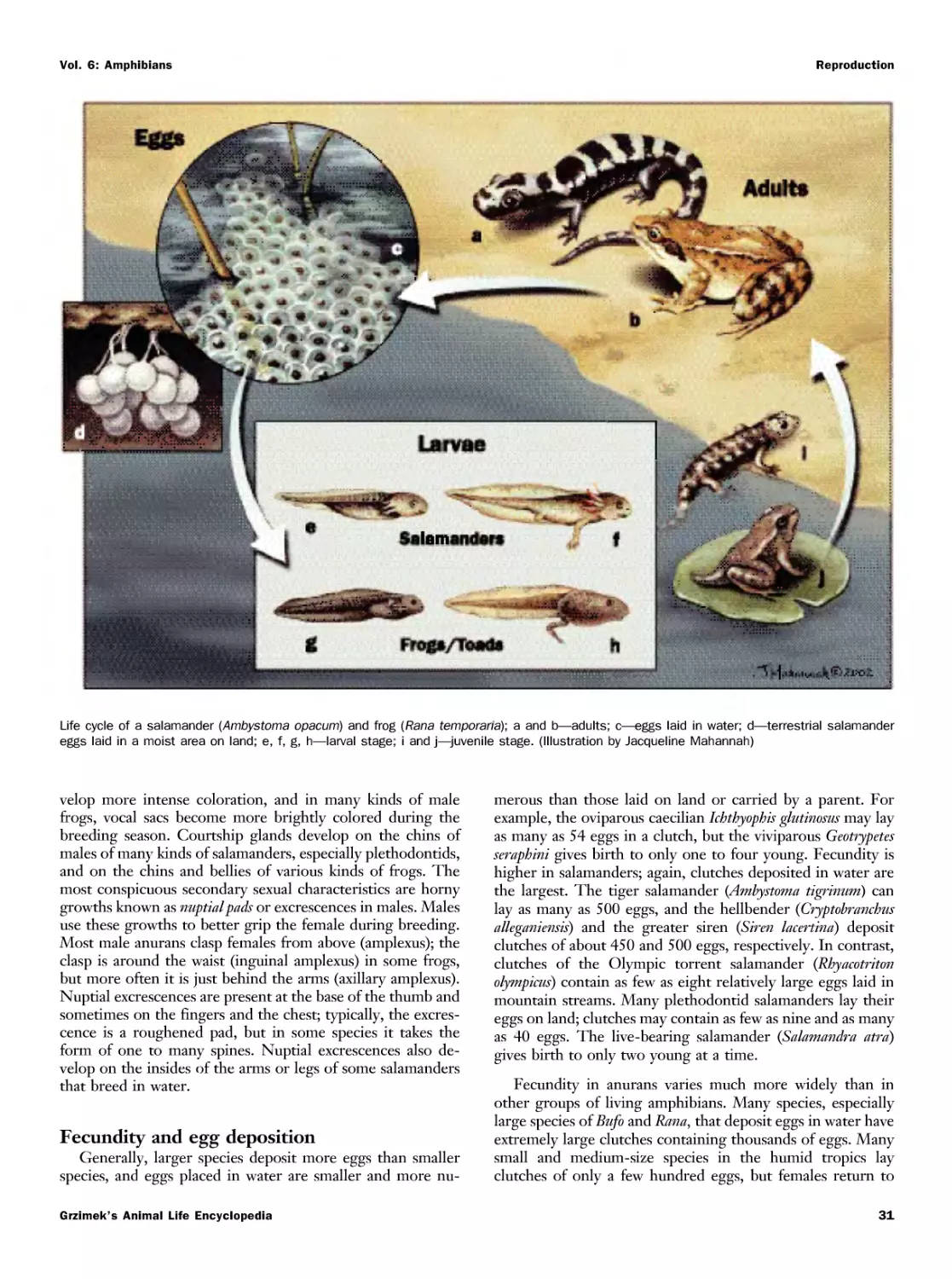



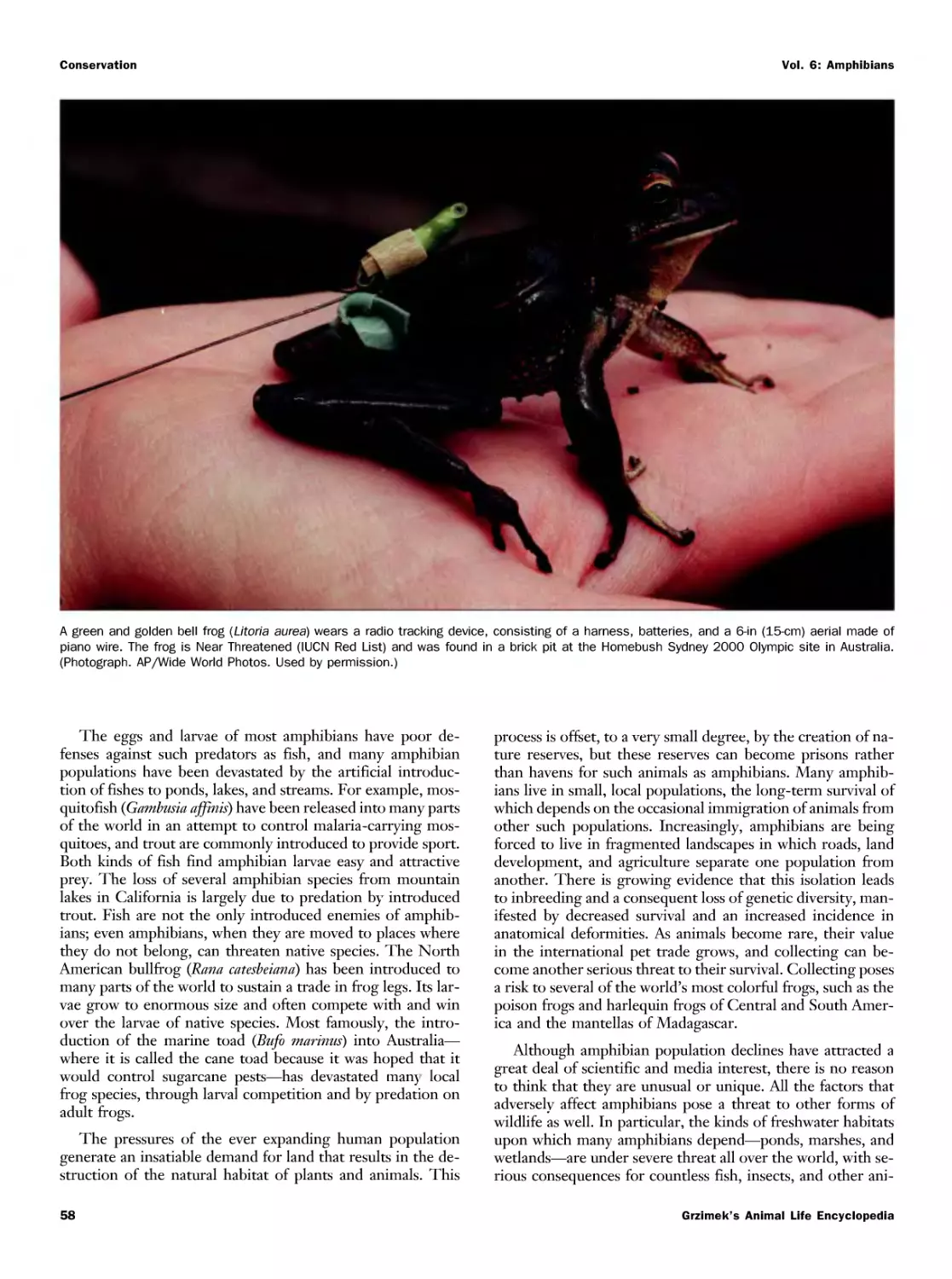
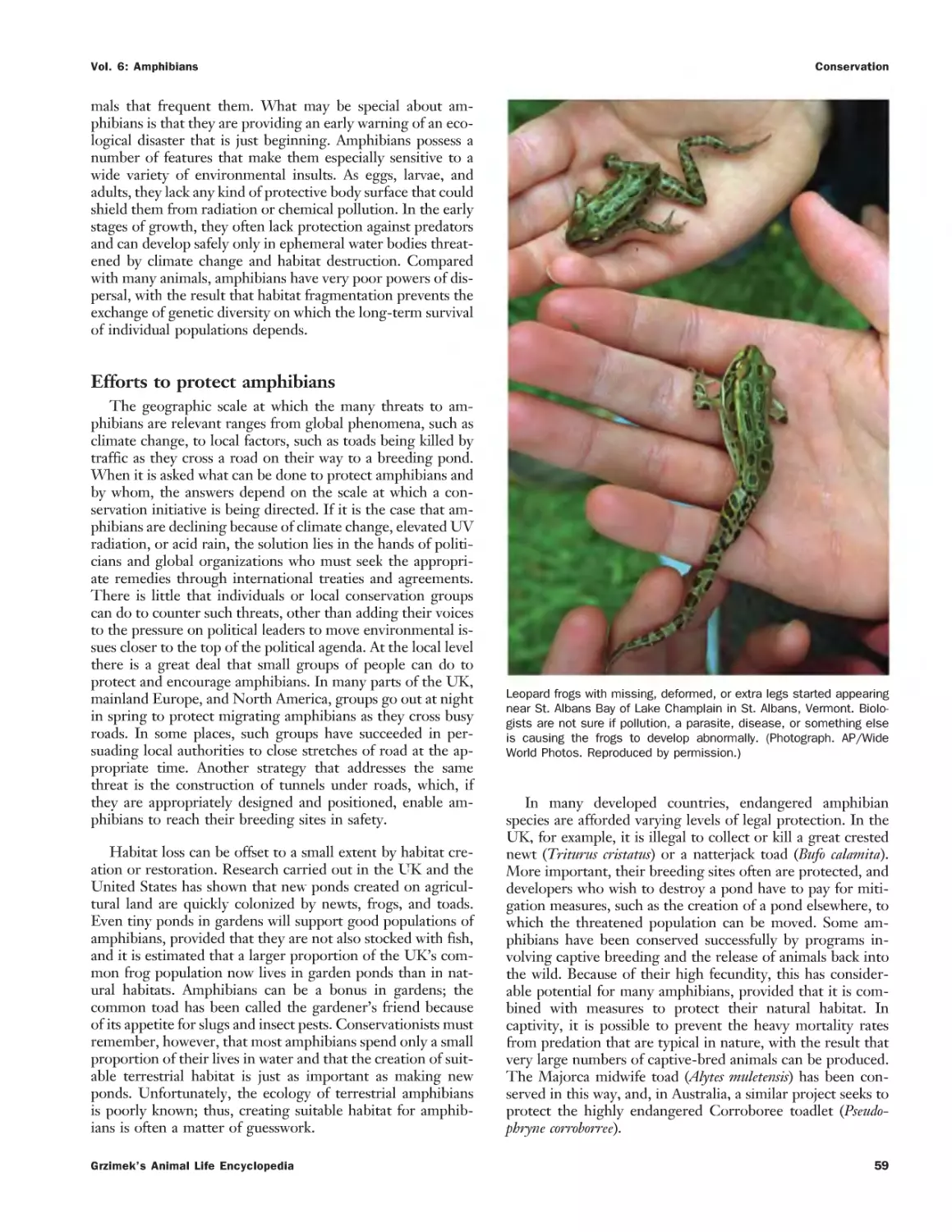
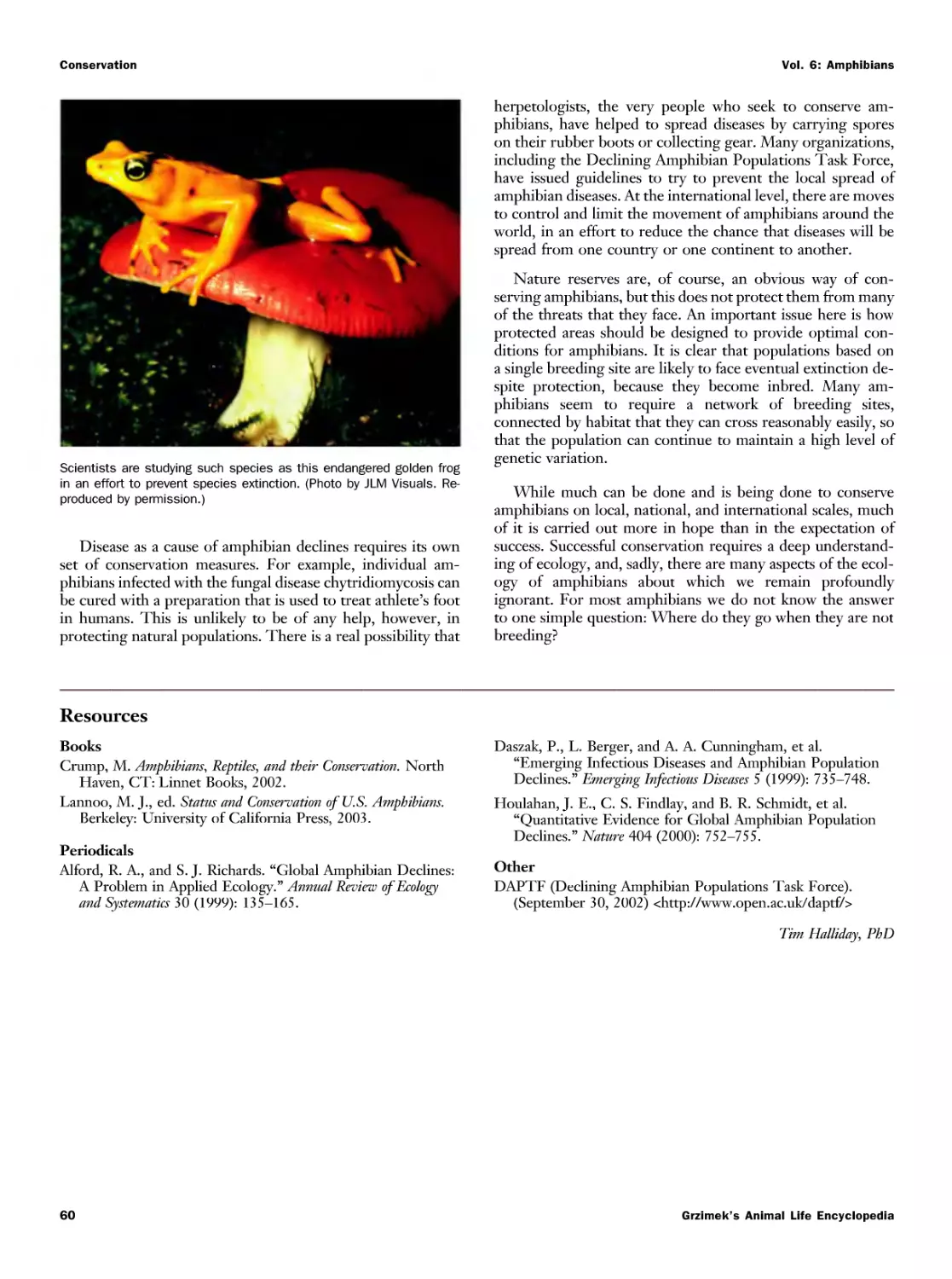
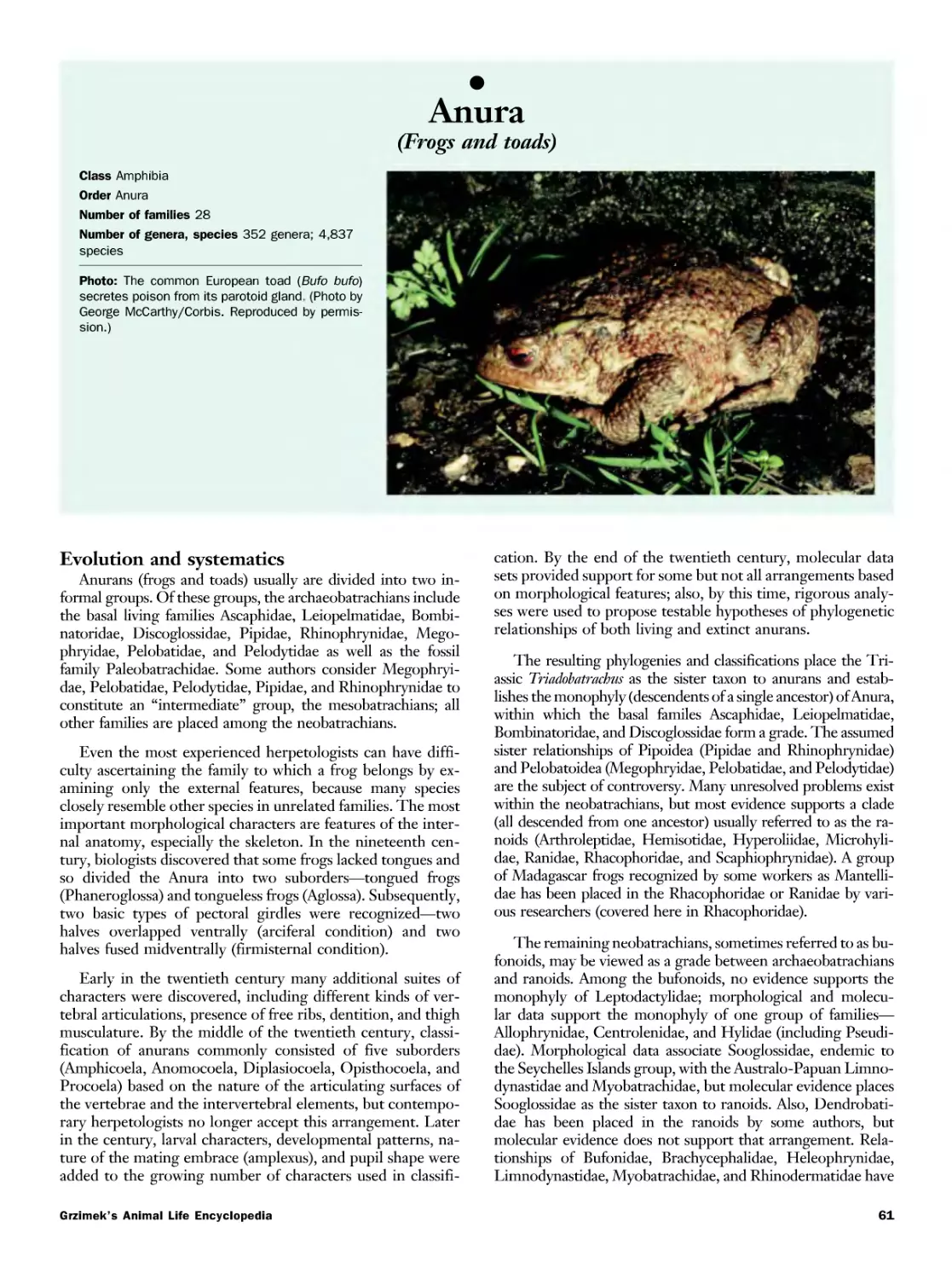





























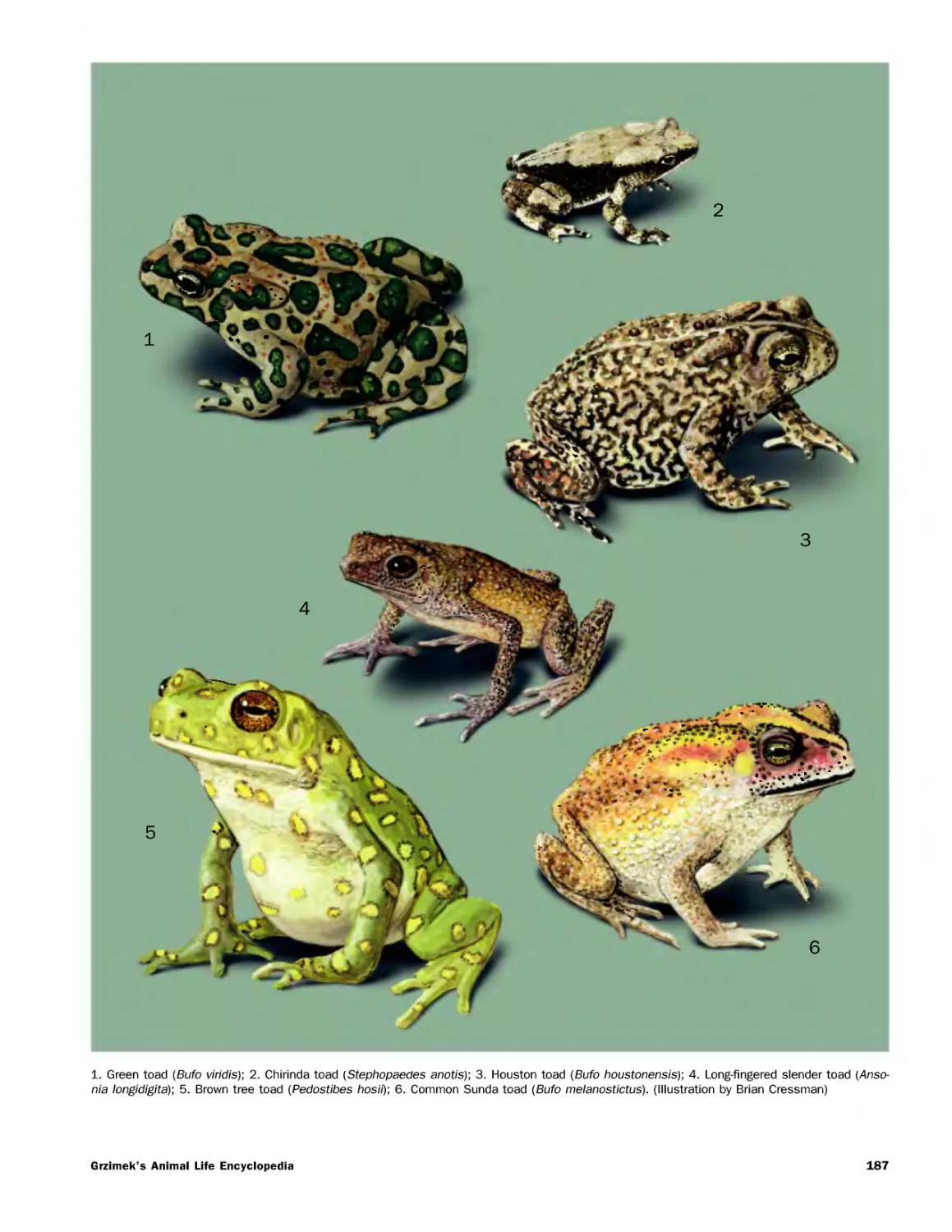
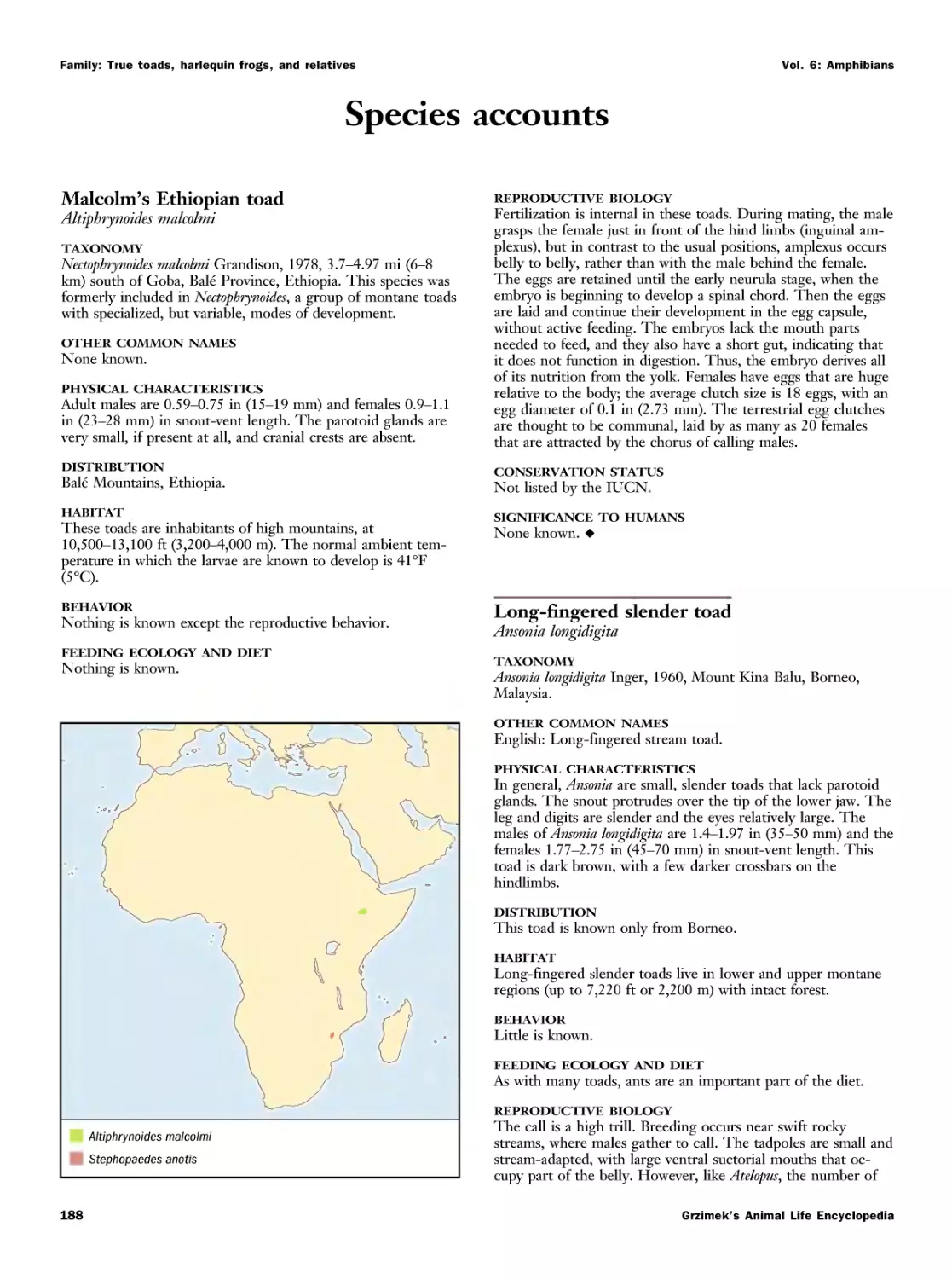
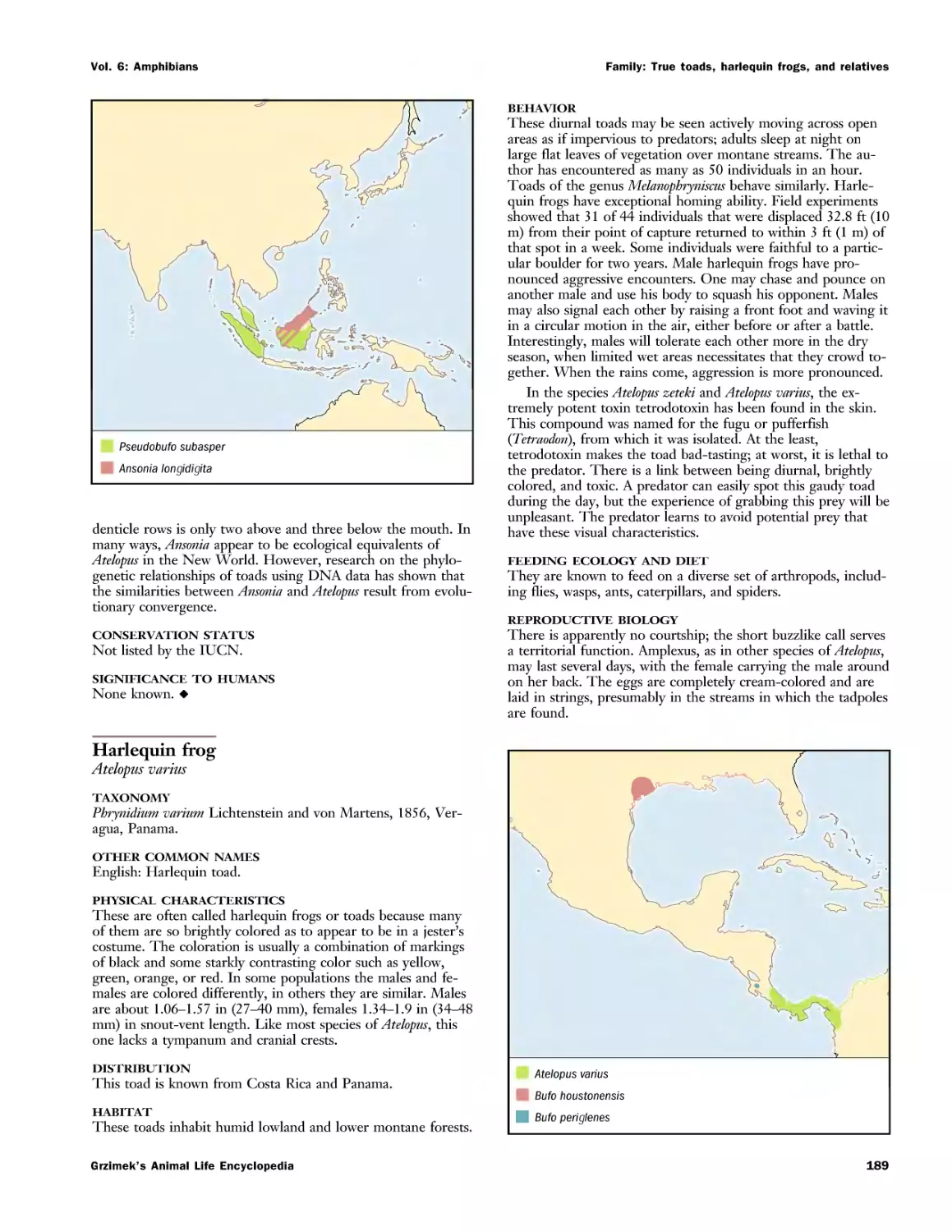

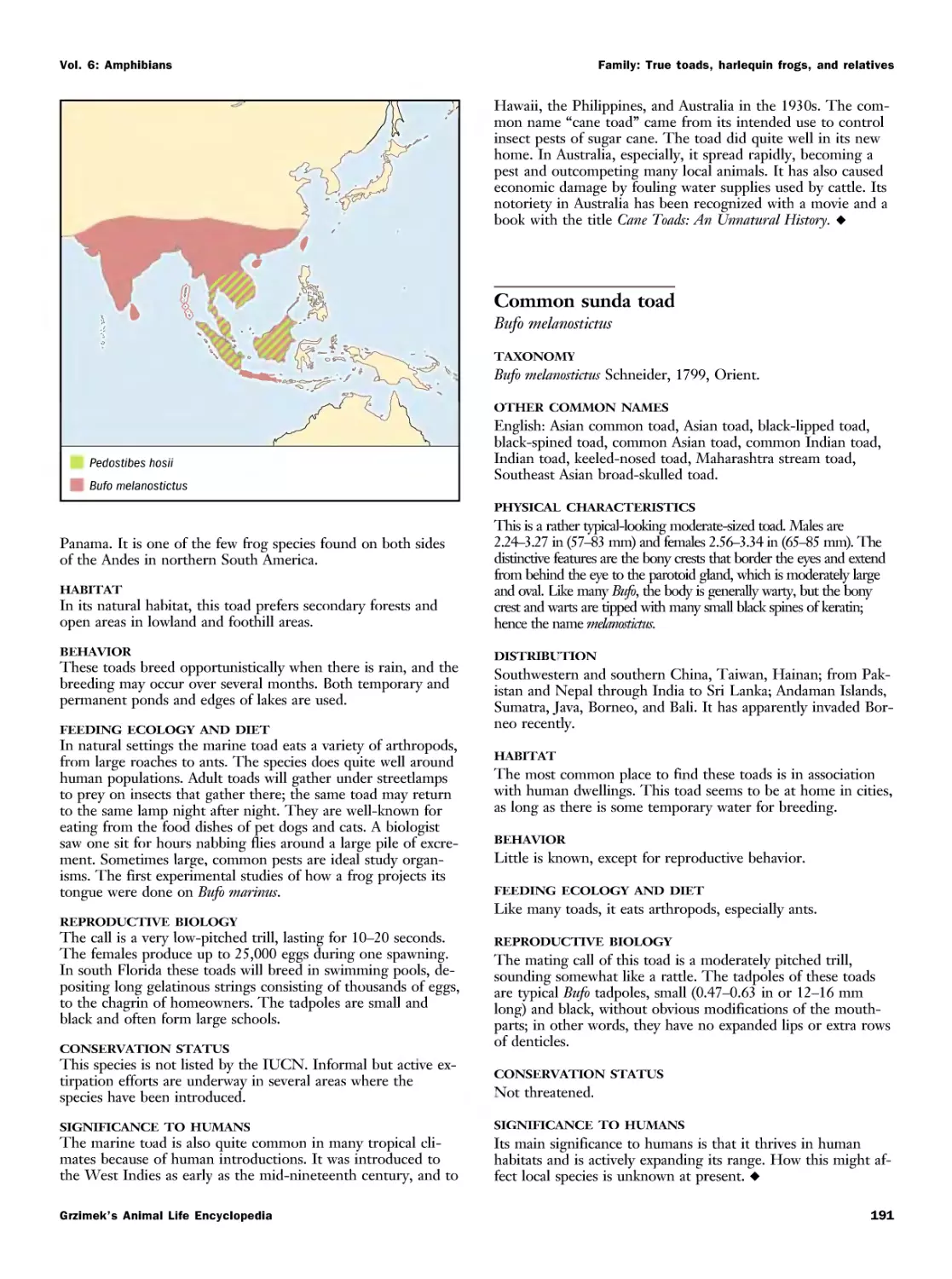











































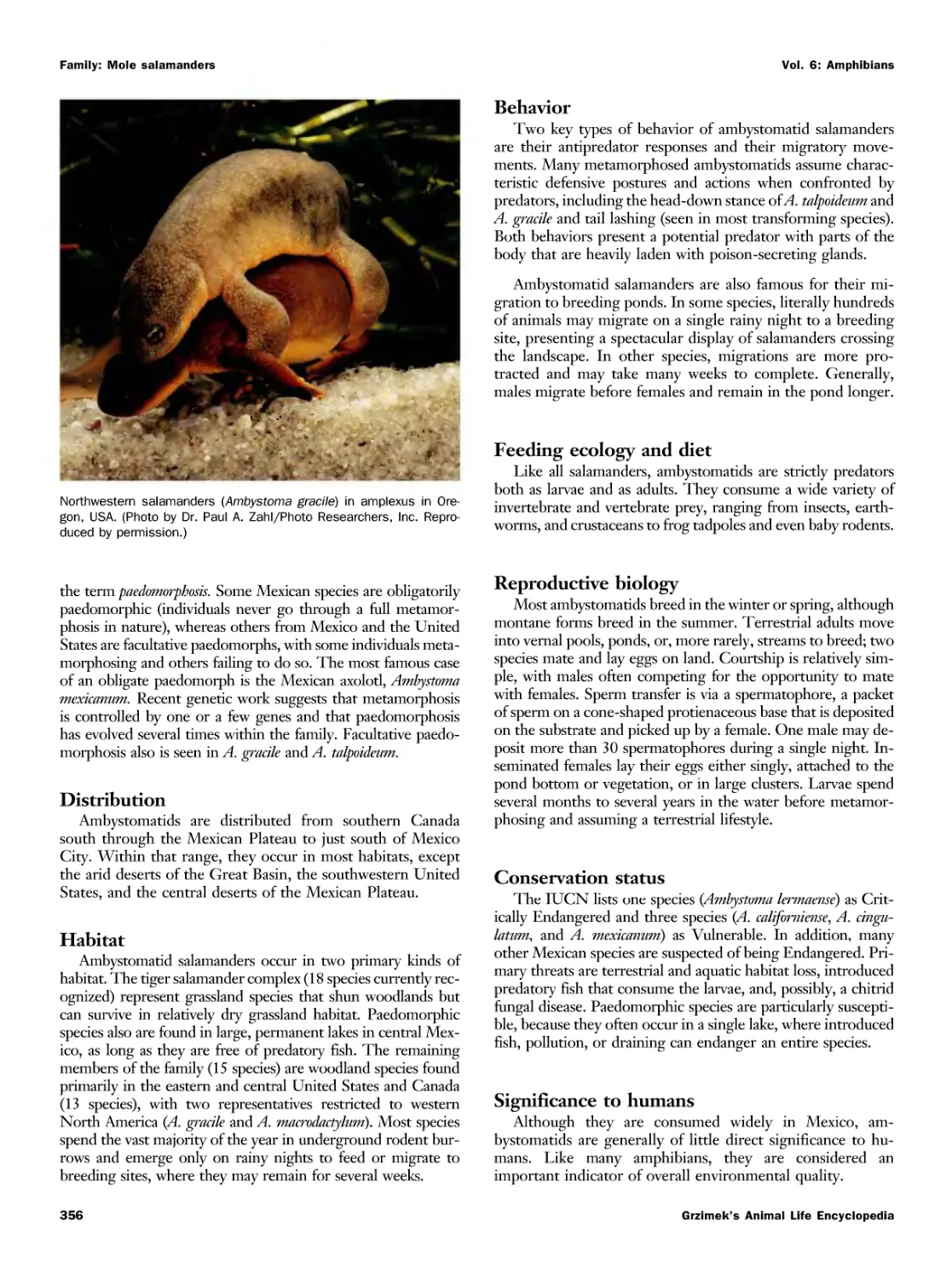
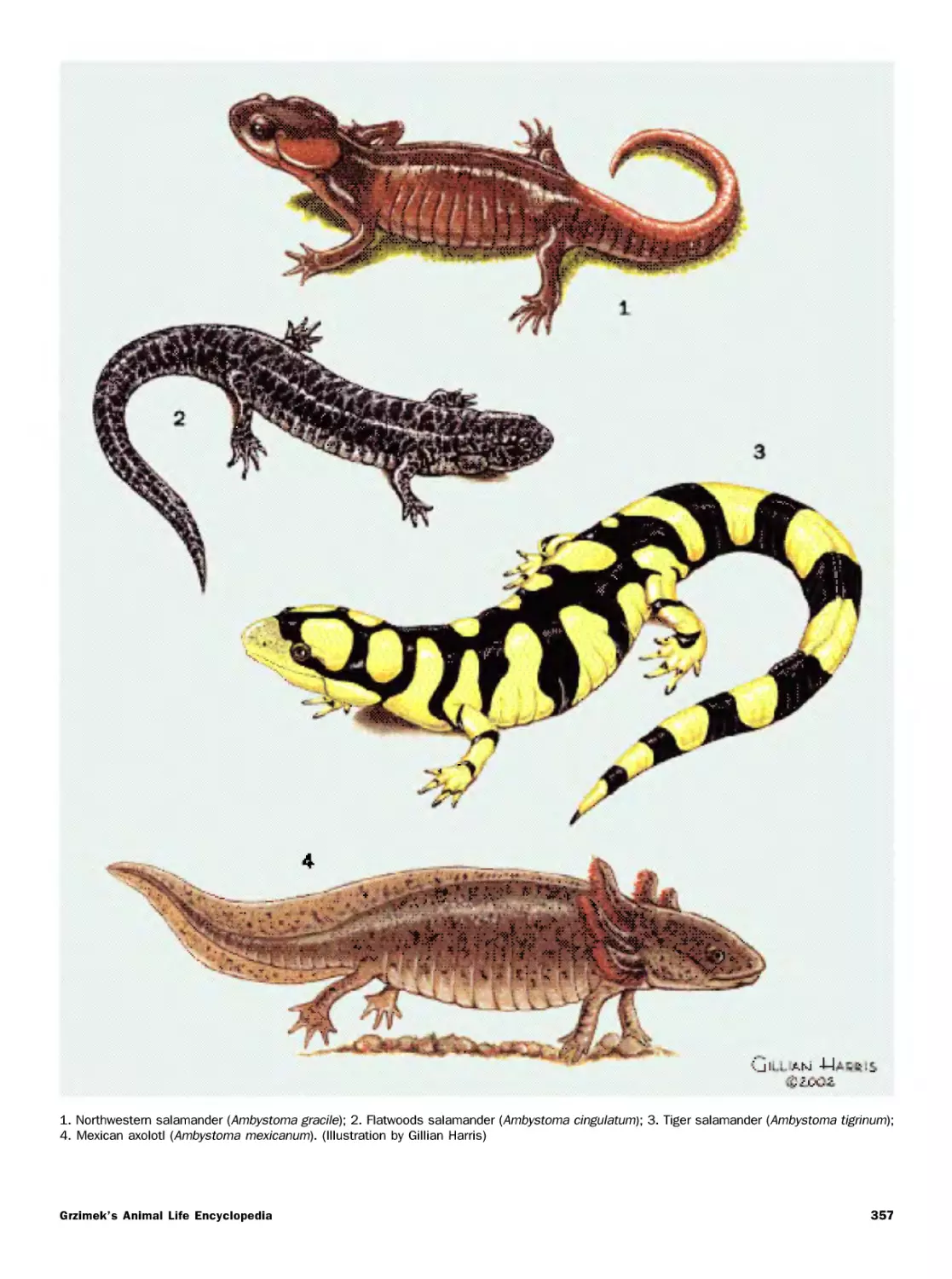

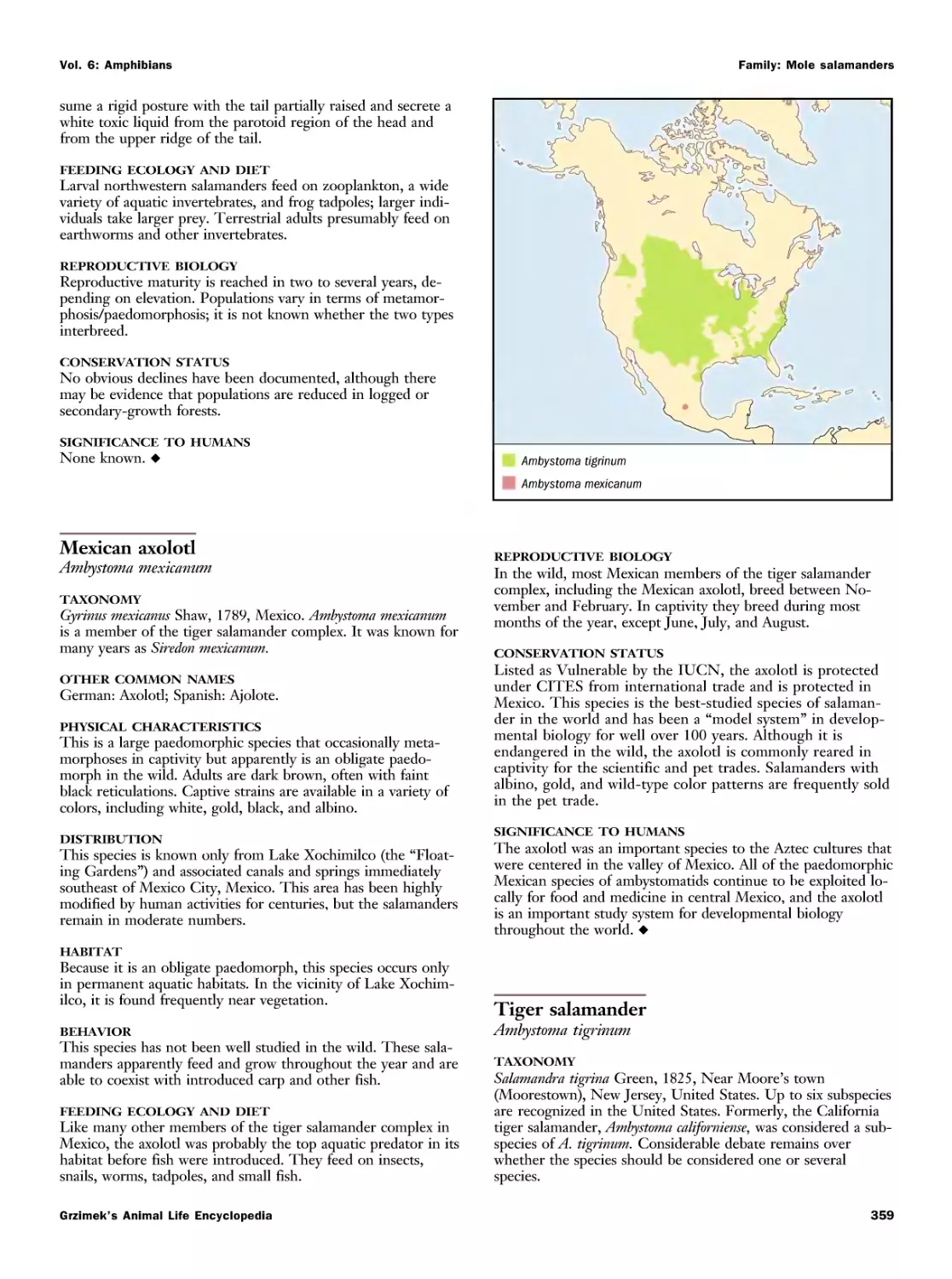



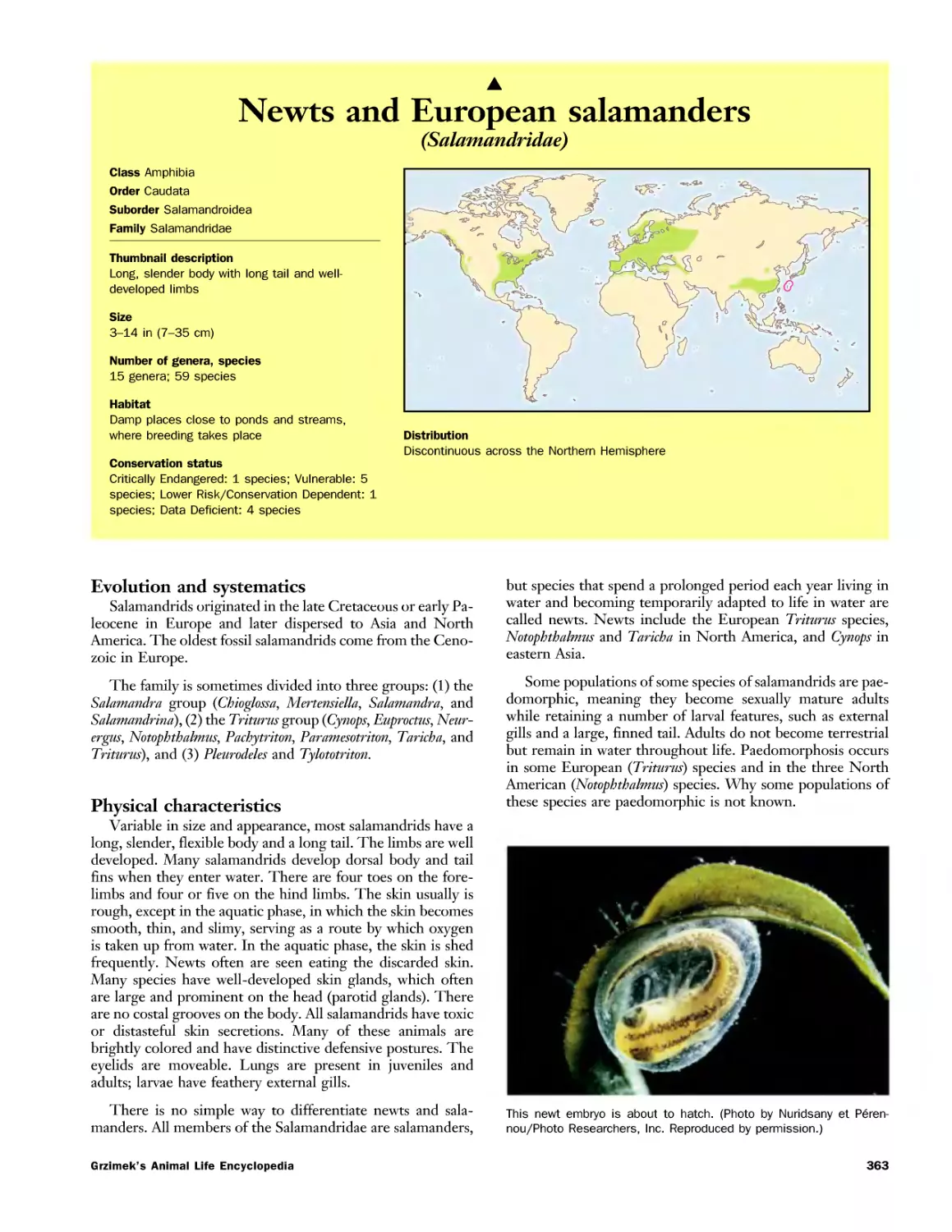











































































Текст
                    i E
о i ton
ol m б1 m-h a
E огт
E i n,

Grzimek's
Animal Life Encyclopedia
Second Edition

This page intentionally left blank

Grzimek's
Animal Life Encyclopedia
Second Edition
Volume 6
Amphibians
William E. Duellman, Advisory Editor
Neil Schlager, Editor
Joseph E. Trumpey, Chief Scientific Illustrator
Michael Hutchins, Series Editor
In association with the American Zoo and Aquarium Association
GALE"
THOIVISOI4I
GALE
Detroit • New York • San Diego • San Francisco • Cleveland • New Haven, Conn • Waterville, Maine • London • Munich

THOIVISOIM
GALE
Grzimek's Animal Life Encyclopedia, Second Edition
Volume 6: Amphibians
Produced by Schlager Group Inc.
Neil Schlager, Editor
Vanessa Torrado-Caputo, Assistant Editor
Project Editor
Melissa С McDade
Editorial
Stacey Blachford, Deirdre Blanchfield,
Madeline Harris, Christine Jeryan, Kate
Kretschmann, Mark Springer
Permissions
Margaret Chamberlain
Imaging and Multimedia
Randy Bassett, Mary K. Grimes, Lezlie Light,
Christine O'Bryan, Barbara Yarrow, Robyn V.
Young
Product Design
Tracey Rowens, Jennifer Wahi
Manufacturing
Wendy Blurton, Dorothy Maki, Evi Seoud, Mary
Beth Trimper
© 2003 by Gale. Gale is an imprint of The Gale
Group, Inc., a division of Thomson Learning Inc.
Gale and Design™ and Thomson Learning™
are trademarks used herein under license.
For more information, contact
The Gale Group, Inc.
27500 Drake Rd.
Farmington Hills, Ml 48331-3535
Or you can visit our Internet site at
http://www.gale.com
ALL RIGHTS RESERVED
No part of this work covered by the copyright
hereon may be reproduced or used in any
form or by any means—graphic, electronic, or
mechanical, including photocopying,
recording, taping. Web distribution, or
information storage retrieval systems—without
the written permission of the publisher.
For permission to use material from this
product, submit your request via Web at
http://www.gale-edit.com/permissions, or you
may download our Permissions Request form
and submit your request by fax or mail to:
The Gale Group, Inc., Permissions
Department, 27500 Drake Road, Farmington
Hills, Ml, 48331-3535, Permissions hotline: 248-
699-8074 or 800-877-4253, ext. 8006, Fax: 248-
699-8074 or 800-762-4058.
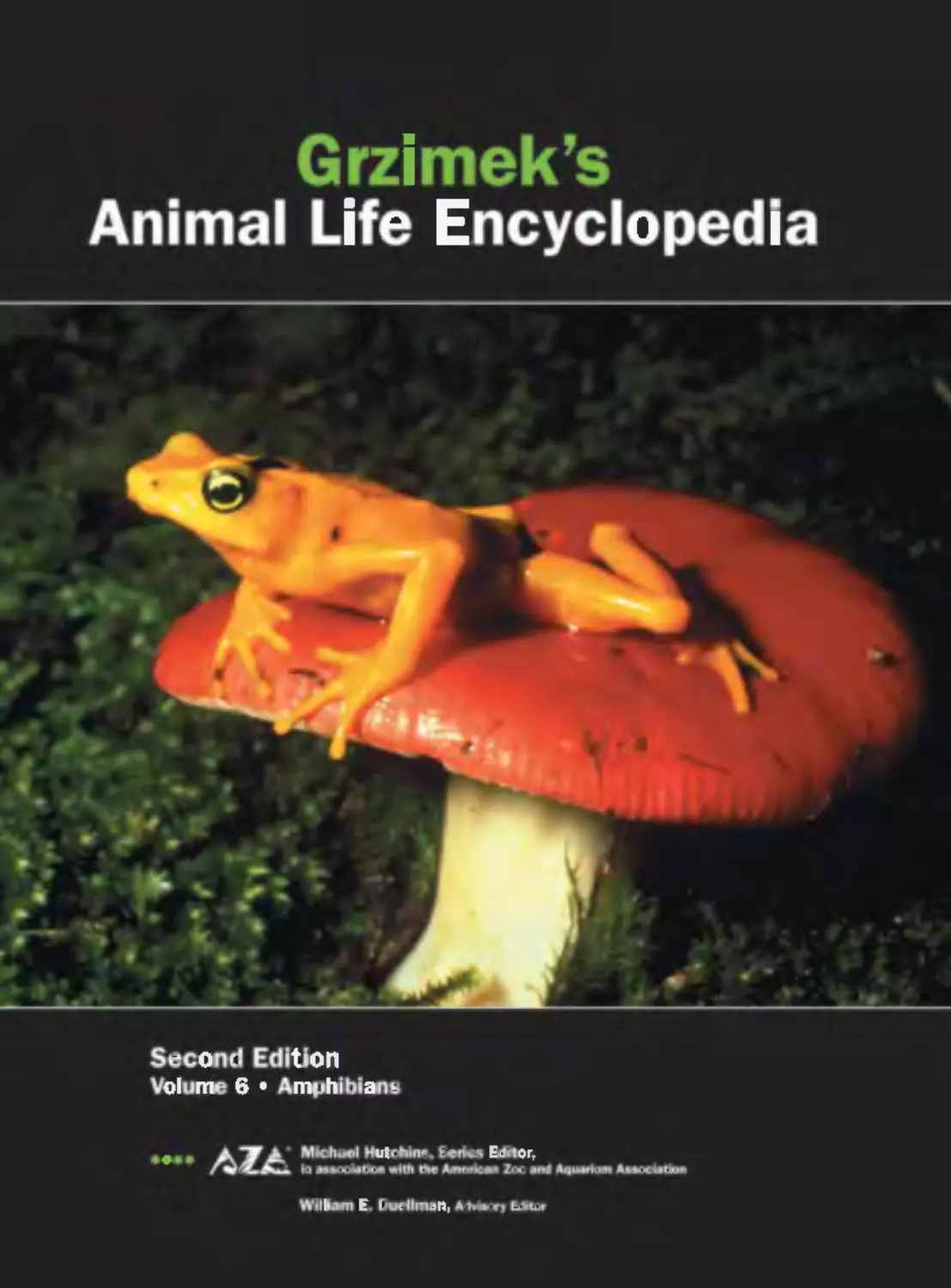
Cover photo of golden frog by JLM
Visuals. Back cover photos of sea anemone by
AP/Wide World Photos/University of
Wisconsin-Superior; land snail, lionfish,
golden frog, and green python by JLM
Visuals; red-legged locust © 2001 Susan Sam;
hornbill by Margaret F. Kinnaird; and tiger by
Jeff Lepore/Photo Researchers. All reproduced
by permission.
While every effort has been made to
ensure the reliability of the information
presented in this publication. The Gale Group,
Inc. does not guarantee the accuracy of the
data contained herein. The Gale Group, Inc.
accepts no payment for listing; and inclusion
in the publication of any organization,
agency, institution, publication, service, or
individual does not imply endorsement of the
editors and publisher. Errors brought to the
attention of the publisher and verified to the
satisfaction of the publisher will be corrected
in future editions.
ISBN 0-7876-5362-4 (vols. 1-17 set)
0-7876-5782-4 (vol 6)
LIBRARY OF CONGRESS CATALOGING-IN-PUBLICATION DATA
Grzimek, Bernhard.
[Tierleben. English]
Grzimek's animal life encyclopedia.— 2nd ed.
v. cm.
Includes bibliographical references.
Contents: v. 1. Lower metazoans and lesser deuterosomes / Neil Schlager, editor
— v. 2. Protostomes / Neil Schlager, editor — v. 3. Insects / Neil Schlager, editor —
v. 4-5. Fishes l-ll / Neil Schlager, editor — v. 6. Amphibians / Neil Schlager, editor
— v. 7. Reptiles / Neil Schlager, editor — v. 8-11. Birds I-IV / Donna Olendorf, edi-
editor — v. 12-16. Mammals I-V / Melissa С McDade, editor — v. 17. Cumulative
index / Melissa С McDade, editor.
ISBN 0-7876-5362-4 (set hardcover : alk. paper)
1. Zoology—Encyclopedias. I. Title: Animal life encyclopedia. II.
Schlager, Neil, 1966- III. Olendorf, Donna IV. McDade, Melissa С V. American Zoo
and Aquarium Association. VI. Title.
QL7 .G7813 2004
590\3—dc21
2002003351
Printed in Canada
10 987654321
Recommended citation: GrzimeVs Animal Life Encyclopedia, 2nd edition. Volume 6, Amphibians, edited by Michael
Hutchins, William E. Duellman, and Neil Schlager. Farmington Hills, MI: Gale Group, 2003.

Contents
Foreword vii
How to use this book ix
Advisory boards xii
Contributing writers xiv
Contributing illustrators xvi
Volume 6: Amphibians
What is an amphibian? 3
Early evolution and fossil history 7
Structure and function 15
Reproduction 28
Larvae 39
Behavior 44
Amphibians and humans 51
Conservation 56
Order ANURA
Frogs and toads 61
Family: New Zealand frogs 69
Family: Tailed frogs 77
Family: Fire-bellied toads and barbourulas 83
Family: Midwife toads and painted frogs 89
Family: Mesoamerican burrowing toads 95
Family: Clawed frogs and Surinam toads 99
Family: Asian toadfrogs 109
Family: Spadefoot toads 119
Family: Parsley frogs 127
Family: Ghost frogs 131
Family: Seychelles frogs 135
Family: Australian ground frogs 139
Family: Australian toadlets and water frogs 147
Family: Leptodactylid frogs 155
Family: Vocal sac-brooding frogs 173
Family: Three-toed toadlets 179
Family: True toads, harlequin frogs, and relatives.. 183
Family: Poison frogs 197
Family: Ruthven's frogs 211
Family: Glass frogs 215
Family: Amero-Australian treefrogs 225
Family: True frogs 245
Family: Squeakers and cricket frogs 265
Family: Shovel-nosed frogs 273
Family: African treefrogs 279
Family: Asian treefrogs 291
Family: Narrow-mouthed frogs 301
Family: Madagascaran toadlets 317
Order CAUDATA
Salamanders and newts 323
Family: Sirens and dwarf sirens 327
Family: Asiatic salamanders 335
Family: Asiatic giant salamanders and hellbenders . 343
Family: Pacific giant salamanders 349
Family: Mole salamanders 355
Family: Newts and European salamanders 363
Family: Olms and mudpuppies 377
Family: Torrent salamanders 385
Family: Lungless salamanders 389
Family: Amphiumas 405
Order GYMNOPHIONA
Caecilians 411
Family: American tailed caecilians 415
Family: Asian tailed caecilians 419
Family: Kerala caecilians 425
Family: Buried-eyed caecilians 431
Family: Tailless caecilians 435
For further reading 443
Organizations 446
Contributors to the first edition 447
Glossary 453
Amphibians species list 456
Geologic time scale 490
Index 491
Grzimek's Animal Life Encyclopedia

Foreword
Earth is teeming with life. No one knows exactly how many
distinct organisms inhabit our planet, but more than 5 mil-
million different species of animals and plants could exist, rang-
ranging from microscopic algae and bacteria to gigantic elephants,
redwood trees and blue whales. Yet, throughout this won-
wonderful tapestry of living creatures, there runs a single thread:
Deoxyribonucleic acid or DNA. The existence of DNA, an
elegant, twisted organic molecule that is the building block
of all life, is perhaps the best evidence that all living organ-
organisms on this planet share a common ancestry. Our ancient
connection to the living world may drive our curiosity, and
perhaps also explain our seemingly insatiable desire for in-
information about animals and nature. Noted zoologist, E.O.
Wilson, recently coined the term "biophilia" to describe this
phenomenon. The term is derived from the Greek bios mean-
meaning "life" and philos meaning "love." Wilson argues that we
are human because of our innate affinity to and interest in the
other organisms with which we share our planet. They are,
as he says, "the matrix in which the human mind originated
and is permanently rooted." To put it simply and metaphor-
metaphorically, our love for nature flows in our blood and is deeply en-
engrained in both our psyche and cultural traditions.
Our own personal awakenings to the natural world are as
diverse as humanity itself. I spent my early childhood in rural
Iowa where nature was an integral part of my life. My father
and I spent many hours collecting, identifying and studying
local insects, amphibians and reptiles. These experiences had
a significant impact on my early intellectual and even spiri-
spiritual development. One event I can recall most vividly. I had
collected a cocoon in a field near my home in early spring.
The large, silky capsule was attached to a stick. I brought the
cocoon back to my room and placed it in a jar on top of my
dresser. I remember waking one morning and, there, perched
on the tip of the stick was a large moth, slowly moving its
delicate, light green wings in the early morning sunlight. It
took my breath away. To my inexperienced eyes, it was one
of the most beautiful things I had ever seen. I knew it was a
moth, but did not know which species. Upon closer exami-
examination, I noticed two moon-like markings on the wings and
also noted that the wings had long "tails", much like the ubiq-
ubiquitous tiger swallow-tail butterflies that visited the lilac bush
in our backyard. Not wanting to suffer my ignorance any
longer, I reached immediately for my Golden Guide to North
American Insects and searched through the section on moths
and butterflies. It was a luna moth! My heart was pounding
with the excitement of new knowledge as 1 ran to share the
discovery with my parents.
I consider myself very fortunate to have made a living as
a professional biologist and conservationist for the past 20
years. I've traveled to over 30 countries and six continents to
study and photograph wildlife or to attend related conferences
and meetings. Yet, each time I encounter a new and unusual
animal or habitat my heart still races with the same excite-
excitement of my youth. If this is biophilia, then I certainly possess
it, and it is my hope that others will experience it too. I am
therefore extremely proud to have served as the series editor
for the Gale Group's rewrite of Grzimek's Animal Life Ency-
Encyclopedia, one of the best known and widely used reference
works on the animal world. Grzimek's is a celebration of an-
animals, a snapshot of our current knowledge of the Earth's in-
incredible range of biological diversity. Although many other
animal encyclopedias exist, Grzimek7s Animal Life Encyclopedia
remains unparalleled in its size and in the breadth of topics
and organisms it covers.
The revision of these volumes could not come at a more
opportune time. In fact, there is a desperate need for a deeper
understanding and appreciation of our natural world. Many
species are classified as threatened or endangered, and the sit-
situation is expected to get much worse before it gets better.
Species extinction has always been part of the evolutionary
history of life; some organisms adapt to changing circum-
circumstances and some do not. However, the current rate of species
loss is now estimated to be 1,000-10,000 times the normal
"background" rate of extinction since life began on Earth
some 4 billion years ago. The primary factor responsible for
this decline in biological diversity is the exponential growth
of human populations, combined with peoples' unsustainable
appetite for natural resources, such as land, water, minerals,
oil, and timber. The world's human population now exceeds
6 billion, and even though the average birth rate has begun
to decline, most demographers believe that the global human
population will reach 8—10 billion in the next 50 years. Much
of this projected growth will occur in developing countries in
Central and South America, Asia and Africa-regions that are
rich in unique biological diversity.
vi
Grzimek's Animal Life Encyclopedia

Foreword
Finding solutions to conservation challenges will not be
easy in today's human-dominated world. A growing number
of people live in urban settings and are becoming increasingly
isolated from nature. They "hunt" in super markets and malls,
live in apartments and houses, spend their time watching tele-
television and searching the World Wide Web. Children and
adults must be taught to value biological diversity and the
habitats that support it. Education is of prime importance now
while we still have time to respond to the impending crisis.
There still exist in many parts of the world large numbers of
biological "hotspots"-places that are relatively unaffected by
humans and which still contain a rich store of their original
animal and plant life. These living repositories, along with se-
selected populations of animals and plants held in profession-
professionally managed zoos, aquariums and botanical gardens, could
provide the basis for restoring the planet's biological wealth
and ecological health. This encyclopedia and the collective
knowledge it represents can assist in educating people about
animals and their ecological and cultural significance. Perhaps
it will also assist others in making deeper connections to na-
nature and spreading biophilia. Information on the conserva-
conservation status, threats and efforts to preserve various species have
been integrated into this revision. We have also included in-
information on the cultural significance of animals, including
their roles in art and religion.
It was over 30 years ago that Dr. Bernhard Grzimek, then
director of the Frankfurt Zoo in Frankfurt, Germany, edited
the first edition of Grzimek's Animal Life Encyclopedia. Dr. Grz-
Grzimek was among the world's best known zoo directors and
conservationists. He was a prolific author, publishing nine
books. Among his contributions were: Serengeti Shall Not Die,
Rhinos Belong to Everybody and He and I and the Elephants. Dr.
Grzimek's career was remarkable. He was one of the first
modern zoo or aquarium directors to understand the impor-
importance of zoo involvement in in situ conservation, that is, of
their role in preserving wildlife in nature. During his tenure,
Frankfurt Zoo became one of the leading western advocates
and supporters of wildlife conservation in East Africa. Dr.
Grzimek served as a Trustee of the National Parks Board of
Uganda and Tanzania and assisted in the development of sev-
several protected areas. The film he made with his son Michael,
Serengeti Shall Not Die, won the 1959 Oscar for best docu-
documentary.
Professor Grzimek has recently been criticized by some
for his failure to consider the human element in wildlife con-
conservation. He once wrote: "A national park must remain a pri-
primordial wilderness to be effective. No men, not even native
ones, should live inside its borders." Such ideas, although con-
considered politically incorrect by many, may in retrospect actu-
actually prove to be true. Human populations throughout Africa
continue to grow exponentially, forcing wildlife into small is-
islands of natural habitat surrounded by a sea of humanity. The
illegal commercial bushmeat trade-the hunting of endangered
wild animals for large scale human consumption-is pushing
many species, including our closest relatives, the gorillas,
bonobos and chimpanzees, to the brink of extinction. The
trade is driven by widespread poverty and lack of economic
alternatives. In order for some species to survive it will be
necessary, as Grzimek suggested, to establish and enforce a
system of protected areas where wildlife can roam free from
exploitation of any kind.
While it is clear that modern conservation must take the
needs of both wildlife and people into consideration, what will
the quality of human life be if the collective impact of short-
term economic decisions is allowed to drive wildlife popula-
populations into irreversible extinction? Many rural populations
living in areas of high biodiversity are dependent on wild an-
animals as their major source of protein. In addition, wildlife
tourism is the primary source of foreign currency in many de-
developing countries and is critical to their financial and social
stability. When this source of protein and income is gone,
what will become of the local people? The loss of species is
not only a conservation disaster; it also has the potential to
be a human tragedy of immense proportions. Protected ar-
areas, such as national parks, and regulated hunting in areas out-
outside of parks are the only solutions. What critics do not realize
is that the fate of wildlife and people in developing countries
is closely intertwined. Forests and savannas emptied of wildlife
will result in hungry, desperate people, and will, in the long-
term lead to extreme poverty and social instability. Dr. Grz-
Grzimek's early contributions to conservation should be
recognized, not only as benefiting wildlife, but as benefiting
local people as well.
Dr. Grzimek's hope in publishing his Animal Life Encyclo-
Encyclopedia was that it would "...disseminate knowledge of the ani-
animals and love for them", so that future generations would
"...have an opportunity to live together with the great diver-
diversity of these magnificent creatures." As stated above, our goals
in producing this updated and revised edition are similar.
However, our challenges in producing this encyclopedia were
more formidable. The volume of knowledge to be summa-
summarized is certainly much greater in the twenty-first century than
it was in the 1970's and 80's. Scientists, both professional and
amateur, have learned and published a great deal about the
animal kingdom in the past three decades, and our under-
understanding of biological and ecological theory has also pro-
progressed. Perhaps our greatest hurdle in producing this revision
was to include the new information, while at the same time
retaining some of the characteristics that have made Grzimek's
Animal Life Encyclopedia so popular. We have therefore strived
to retain the series' narrative style, while giving the informa-
information more organizational structure. Unlike the original Grz-
Grzimek's, this updated version organizes information under
specific topic areas, such as reproduction, behavior, ecology
and so forth. In addition, the basic organizational structure is
generally consistent from one volume to the next, regardless
of the animal groups covered. This should make it easier for
users to locate information more quickly and efficiently. Like
the original Grzimek's, we have done our best to avoid any
overly technical language that would make the work difficult
to understand by non-biologists. When certain technical ex-
expressions were necessary, we have included explanations or
clarifications.
Considering the vast array of knowledge that such a work
represents, it would be impossible for any one zoologist to
have completed these volumes. We have therefore sought spe-
specialists from various disciplines to write the sections with
Grzimek's Animal Life Encyclopedia
vii

Foreword
which they are most familiar. As with the original Grzimek's,
we have engaged the best scholars available to serve as topic
editors, writers, and consultants. There were some complaints
about inaccuracies in the original English version that may
have been due to mistakes or misinterpretation during the
complicated translation process. However, unlike the origi-
original Grzimek Js, which was translated from German, this revi-
revision has been completely re-written by English-speaking
scientists. This work was truly a cooperative endeavor, and I
thank all of those dedicated individuals who have written,
edited, consulted, drawn, photographed, or contributed to its
production in any way. The names of the topic editors, au-
authors, and illustrators are presented in the list of contributors
in each individual volume.
The overall structure of this reference work is based on
the classification of animals into naturally related groups, a
discipline known as taxonomy or biosystematics. Taxonomy
is the science through which various organisms are discov-
discovered, identified, described, named, classified and cata-
catalogued. It should be noted that in preparing this volume we
adopted what might be termed a conservative approach, re-
relying primarily on traditional animal classification schemes.
Taxonomy has always been a volatile field, with frequent
arguments over the naming of or evolutionary relationships
between various organisms. The advent of DNA finger-
fingerprinting and other advanced biochemical techniques has
revolutionized the field and, not unexpectedly, has pro-
produced both advances and confusion. In producing these vol-
volumes, we have consulted with specialists to obtain the most
up-to-date information possible, but knowing that new
findings may result in changes at any time. When scientific
controversy over the classification of a particular animal or
group of animals existed, we did our best to point this out
in the text.
Readers should note that it was impossible to include as
much detail on some animal groups as was provided on oth-
others. For example, the marine and freshwater fish, with vast
numbers of orders, families, and species, did not receive as
detailed a treatment as did the birds and mammals. Due to
practical and financial considerations, the publishers could
provide only so much space for each animal group. In such
cases, it was impossible to provide more than a broad overview
and to feature a few selected examples for the purposes of il-
illustration. To help compensate, we have provided a few key
bibliographic references in each section to aid those inter-
interested in learning more. This is a common limitation in all ref-
reference works, but Grzimek's Encyclopedia of Animal Life is still
the most comprehensive work of its kind.
I am indebted to the Gale Group, Inc. and Senior Editor
Donna Olendorf for selecting me as Series Editor for this pro-
project. It was an honor to follow in the footsteps of Dr. Grz-
imek and to play a key role in the revision that still bears his
name. Grzimek's Animal Life Encyclopedia is being published
by the Gale Group, [nc. in affiliation with my employer, the
American Zoo and Aquarium Association (AZA), and I would
like to thank AZA Executive Director, Sydney J. Butler; AZA
Past-President Ted Beattie Qohn G. Shedd Aquarium,
Chicago, IL); and current AZA President, John Lewis (John
Ball Zoological Garden, Grand Rapids, MI), for approving
my participation. I would also like to thank AZA Conserva-
Conservation and Science Department Program Assistant, Michael
Souza, for his assistance during the project. The AZA is a pro-
professional membership association, representing 205 accred-
accredited zoological parks and aquariums in North America. As
Director/William Conway Chair, AZA Department of Con-
Conservation and Science, I feel that I am a philosophical de-
descendant of Dr. Grzimek, whose many works I have collected
and read. The zoo and aquarium profession has come a long
way since the 1970s, due, in part, to innovative thinkers such
as Dr. Grzimek. I hope this latest revision of his work will
continue his extraordinary legacy.
Silver Spring, Maryland, 2001
Michael Hutchins
Series Editor
viii
Grzimek's Animal Life Encyclopedia

How to use this book
Grzimek's Animal Life Encyclopedia is an internationally
prominent scientific reference compilation, first published in
German in the late 1960s, under the editorship of zoologist
Bernhard Grzimek A909-1987). In a cooperative effort be-
between Gale and the American Zoo and Aquarium Association,
the series has been completely revised and updated for the
first time in over 30 years. Gale expanded the series from 13
to 17 volumes, commissioned new color paintings, and up-
updated the information so as to make the set easier to use. The
order of revisions is:
Volumes 8-1 L: Birds I-IV
Volume 6: Amphibians
Volume 7: Reptiles
Volumes 4-5: Fishes I-Il
Volumes 12-16: Mammals I-V
Volume 3: Insects
Volume 2: Protostomes
Volume 1: Lower Metazoans and Lesser Deuterostomes
Volume 17: Cumulative Index
Organized by taxonomy
The overall structure of this reference work is based on
the classification of animals into naturally related groups, a
discipline known as taxonomy—the science in which various
organisms are discovered, identified, described, named, clas-
classified, and catalogued. Starting with the simplest life forms,
the lower metazoans and lesser deuterostomes, in volume 1,
the series progresses through the more advanced classes of
classes, culminating with the mammals in volumes 12-16.
Volume 17 is a stand-alone cumulative index.
Organization of chapters within each volume reinforces
the taxonomic hierarchy. In the case of the volume on Am-
Amphibians, introductory chapters describe general characteris-
characteristics of the class Amphibia, followed by taxonomic chapters
dedicated to order and family. Species accounts appear at the
end of family chapters. To help the reader grasp the scien-
scientific arrangement, each type of taxonomic chapter has a dis-
distinctive color and symbol:
A= Family Chapter (yellow background)
# = Order Chapter (blue background)
As chapters narrow in focus, they become more tightly for-
formatted. Introductory chapters have a loose structure, reminis-
reminiscent of the first edition. Although not strictly formatted, chapters
on orders are carefully structured to cover basic information
about the group. Chapters on families are the most tightly struc-
structured, following a prescribed format of standard rubrics that
make information easy to find. These chapters typically include:
Thumbnail introduction
Common name
Scientific name
Class
Order
Suborder
Family
Thumbnail description
Size
Number of genera, species
Habitat
Conservation status
Main chapter
Evolution and systematics
Physical characteristics
Distribution
Habitat
Behavior
Feeding ecology and diet
Reproductive biology
Conservation status
Significance to humans
Species accounts
Common name
Scientific name
Subfamily
Taxonomy
Other common names
Physical characteristics
Distribution
Habitat
Behavior
Feeding ecology and diet
Reproductive biology
Conservation status
Significance to humans
Grzimek's Animal Life Encyclopedia

How to use this book
Resources
Books
Periodicals
Organizations
Other
Color graphics enhance understanding
Grzimek's features approximately 3,500 color photos, in-
including 120 in the Amphibians volume; 3,500 total color maps,
including over 150 in the Amphibians volume; and approxi-
approximately 5,500 total color illustrations, including more than 300
in the Amphibians volume. Each featured species of animal is
accompanied by both a distribution map and an illustration.
All maps in Grzimek's were created specifically for the pro-
project by XNR Productions. Distribution information was pro-
provided by expert contributors and, if necessary, farther
researched at the University of Michigan Zoological Museum
library. Maps are intended to show broad distribution, not
definitive ranges.
All the color illustrations in GrzimeFs were created specif-
specifically for the project by Michigan Science Art. Expert con-
contributors recommended the species to be illustrated and
provided feedback to the artists, who supplemented this in-
information with authoritative references and animal skins from
University of Michigan Zoological Museum library. In addi-
addition to illustrations of species, Grzime?s features drawings
that illustrate characteristic traits and behaviors.
About the contributors
All of the chapters were written by herpetologists who are
specialists on specific subjects and/or families. Topic editor
William E. Duellman reviewed the completed chapters to in-
insure consistency and accuracy.
Standards employed
In preparing the volume on Amphibians, the editors relied
primarily on the taxonomic structure outlined in Herpetology:
An Introductory Biology of Amphibians and Reptiles, 2nd edition,
edited by George R. Zug, Laurie J. Vitt, and Janalee P. Cald-
well B001). Systematics is a dynamic discipline in that new
species are being discovered continuously, and new tech-
techniques (e.g., DNA sequencing) frequently result in changes
in the hypothesized evolutionary relationships among various
organisms. Consequently, controversy often exists regarding
classification of a particular animal or group of animals; such
differences are mentioned in the text.
Grzimek's has been designed with ready reference in mind,
and the editors have standardized information wherever fea-
feasible. For Conservation Status, Grzimek's follows the IUCN
Red List system, developed by its Species Survival Commis-
Commission. The Red List provides the world's most comprehensive
inventory of the global conservation status of plants and an-
animals. Using a set of criteria to evaluate extinction risk, the
IUCN recognizes the following categories: Extinct, Extinct
in the Wild, Critically Endangered, Endangered, Vulnerable,
Conservation Dependent, Near Threatened, Least Concern,
and Data Deficient. For a complete explanation of each cat-
category, visit the IUCN web page at <http://www.iucn.org/
themes/ssc/redlists/categor.htm>.
In addition to IUCN ratings, chapters may contain other
conservation information, such as a species' inclusion on one
of three Convention on International Trade in Endangered
Species (CITES) appendices. Adopted in 1975, CITES is a
global treaty whose focus is the protection of plant and ani-
animal species from unregulated international trade.
In the species accounts throughout the volume, the edi-
editors have attempted to provide common names not only in
English but also in French, German, and Spanish. Unlike for
birds, there is no official list of common names for amphib-
amphibians of the world, but for species in North America an offi-
official list does exist: Scientific and Standard English Names of
Amphibians and Reptiles of North America, North of Mexico, with
Comments Regarding Confidence in our Understanding, edited by
Brian I. Crother B000). A consensus of acceptable common
names in English, French, German, Portuguese, and Spanish
for European species exists in the Atlas of Amphibians and Rep-
Reptiles in Europe, edited by Jean-Pierre Gasc, et al. A997). Two
books purportedly contain common names of amphibians
worldwide, but these are names mostly coined by the authors
and do not necessarily reflect what the species are called in
their native countries. The first of these books, Dictionary of
Animal Names in Five Languages. Amphibians and Reptiles^ by
Natalia B. Anajeva, et al. A988), contains names in Latin,
Russian, English, German, and French. The second is A Com-
Complete Guide to Scientific Names of Reptiles and Amphibians of the
World, by Norman Frank and Erica Ramus A995); for those
species for which no commonly accepted common name ex-
exists, the name proposed in this book has been used in the vol-
volume on Amphibians.
GrzimeWs provides the following standard information on
lineage in the Taxonomy rubric of each species account: [First
described as] Ophryophryne microstoma [by] Boulenger, [in]
1903, [based on a specimen from] Tonkin, Vietnam. The per-
person's name and date refer to earliest identification of a species,
although the species name may have changed since first iden-
identification. However, the entity of amphibian is the same.
Anatomical illustrations
While the encyclopedia attempts to minimize scientific jar-
jargon, readers will encounter numerous technical terms related
to anatomy and physiology throughout the volume. To assist
readers in placing physiological terms in their proper context,
we have created a number of detailed anatomical drawings.
These can be found on pages 16 to 26 in the "Structure and
function" chapter. Readers are urged to make heavy use of
these drawings. In addition, terms are defined in the Glossary
at the back of the book.
Grzimek's Animal Life Encyclopedia

How to use this book
Appendices and index
Tn addition to the main text and the aforementioned Glos-
Glossary, the volume contains numerous other elements. For
further reading directs readers to additional sources of in-
information about amphibians. Valuable contact information
for Organizations is also included in an appendix. An ex-
exhaustive Amphibians species list records all known species of
amphibians as of November 2002, based on information in
Amphibian Species of the World <http://research.amnh.org/
herpetology/amphibia/> and organized according to Her-
petology, 2nd edition, by Zug, Vitt, and Caldwell; further in-
information was obtained from Amphibia Web <http://www.
amphibiaweb.org>. And a full-color Geologic time scale helps
readers understand prehistoric time periods. Additionally, the
volume contains a Subject index.
Acknowledgements
Gale would like to thank several individuals for their im-
important contributions to the volume. Dr. William E. Duell-
man, advisory editor for the Amphibians volume, oversaw all
phases of the volume, including creation of the topic list,
chapter review, and compilation of the appendices. Neil
Schlager, project manager for the Amphibians volume, coor-
coordinated the writing and editing of the text. Dr. Michael
Hutchins, chief consulting editor for the series, and Michael
Souza, program assistant of conservation and science at the
American Zoo and Aquarium Association, provided valuable
input and research support.
Grzimek's Animal Life Encyclopedia
xi

Advisory boards
Series advisor
Michael Hutchins, PhD
Director of Conservation and Science/William Conway Chair
American Zoo and Aquarium Association
Silver Spring, Maryland
Subject advisors
Volume 1: Lower Metazoans and Lesser Deuterostomes
Dennis Thoney, PhD
Director, Marine Laboratory & Facilities
Humboldt State University
Arcata, California
Volume 2: Protostomes
Dennis Thoney, PhD
Director, Marine Laboratory & Facilities
Humboldt State University
Arcata, California
Sean F. Craig, PhD
Assistant Professor, Department of Biological Sciences
Humboldt State University
Arcata, California
Volume 3: Insects
Art Evans, PhD
Entomologist
Richmond, Virginia
Rosser W. Garrison, PhD
Systematic Entomologist, Los Angeles County
Los Angeles, California
Volumes 4-5: Fishes I- П
Paul Loiselle, PhD
Curator, Freshwater Fishes
New York Aquarium
Brooklyn, New York
Dennis Thoney, PhD
Director, Marine Laboratory & Facilities
Humboldt State University
Arcata, California
Volume 6: Amphibians
William E. Duellman, PhD
Curator of Herpetology Emeritus
Natural History Museum and Biodiversity Research Center
University of Kansas
Lawrence, Kansas
Volume 7: Reptiles
James B. Murphy, DSc
Smithsonian Research Associate
Department of Herpetology
National Zoological Park
Washington, DC
Volumes 8-11: Birds I-IV
Walter J. Bock, PhD
Permanent secretary, International Ornithological Congress
Professor of Evolutionary Biology
Department of Biological Sciences,
Columbia University
New York, New York
Jerome A. Jackson, PhD
Program Director, Whitaker Center for Science, Mathe-
Mathematics, and Technology Education
Florida Gulf Coast University
Ft. Myers, Florida
Volumes 12-16: Mammals I-V
Valerius Geist, PhD
Professor Emeritus of Environmental Science
University of Calgary
Calgary, Alberta
Canada
Devra Gail Kleiman, PhD
Smithsonian Research Associate
National Zoological Park
Washington, DC
xii
Grzimek's Animal Life Encyclopedia

Advisory boards
Library advisors
James Bobick
Head, Science & Technology Department
Carnegie Library of Pittsburgh
Pittsburgh, Pennsylvania
Linda L. Coates
Associate Director of Libraries
Zoological Society of San Diego Library
San Diego, California
Lloyd Davidson, PhD
Life Sciences bibliographer and head, Access Services
Seeley G. Mudd Library for Science and Engineering
Evanston, Illinois
Thane Johnson
Librarian
Oaklahoma City Zoo
Oaklahoma City, Oklahoma
Charles Jones
Library Media Specialist
Plymouth Salem High School
Plymouth, Michigan
Ken Kister
Reviewer/General Reference teacher
Tampa, Florida
Richard Nagler
Reference Librarian
Oakland Community College
Southfield Campus
Southfield, Michigan
Roland Person
Librarian, Science Division
Morris Library
Southern Illinois University
Carbondale, Illinois
Grzimek's Animal Life Encyclopedia
xiii

Contributing writers
Amphibians
Kraig Adler, PhD
Cornell University
Ithaca, New York
Ronald Altig, PhD
Mississippi State University
Mississippi State, Mississippi
Janalee P. Caldwell, PhD
University of Oklahoma
Norman, Oklahoma
David Cannatella, PhD
Section of Integrative Biology and
Texas Memorial Museum
University of Texas
Austin, Texas
Alan Channing, PhD
University of the Western Cape
South Africa
Martha Lynn Crump, PhD
Northern Arizona University
Flagstaff, Arizona
Margaret Davies, PhD
University of Adelaide
South Australia, Australia
Alain Dubois, Docteur d'Etat
Museum National d'Histoire Na-
turelle
Paris, France
William E. Duellman, PhD
Natural History Museum and Biodi-
Biodiversity Research Center
University of Kansas
Lawrence, Kansas
Harold A. Dundee, PhD
Tulane University Museum of Natural
History
Belle Chasse, Louisiana
Jinzhong Fu, PhD
University of Guelph
Guelph, Ontario
Canada
Frank Glaw, PhD
Zoologische Staatssammlung
Munich, Germany
David M. Green, PhD
Redpath Museum
McGill University
Montreal, Quebec
Canada
Tim R. Halliday, PhD
Open University
United Kingdom
Amy Lathrop, MA
Royal Ontario Museum
Toronto, Ontario
Canada
Michel Laurin, PhD
Centre National de Recherche Scien-
tifique, UMR 8570
Paris, France
Anne M. Maglia, PhD
University of Missouri-Rolla
Rolla, Missouri
Max A. Nickerson, PhD
University of Florida
Gainesville, Florida
Ronald A. Nussbaum, PhD
Museum of Zoology
University of Michigan
Ann Arbor, Michigan
Jose P. Pombal, Jr., PhD
Museu Nacional
Universidade Federal do Rio de Janeiro
Rio de Janeiro, Brazil
Arne Schiotz, DSc
Zoologisk Museum
Copenhagen, Denmark
Stanley K. Sessions, PhD
Hartwick College
Oneonta, New York
H. Bradley Shaffer, PhD
University of California
Davis, California
Kyle B. Summers, PhD
East Carolina University
Greenville, North Carolina
Linda Trueb, PhD
Natural History Museum and Biodi-
Biodiversity Research Center
University of Kansas
Lawrence, Kansas
David B. Wake, PhD
Museum of Vertebrate Zoology
University of California
Berkeley, California
Marvalee H. Wake, PhD
University of California
Berkeley, California
Richard J. Wassersug, PhD
Dalhousie University
Halifax, Nova Scotia
Canada
Kentwood D. Wells, PhD
Department of Ecology & Evolution-
Evolutionary Biology
University of Connecticut
Storrs, Connecticut
Erik R. Wild, PhD
University of Wisconsin-Stevens Point
Stevens Point, Wisconsin
xiv
Grzimek's Animal Life Encyclopedia

Contributing writers
Jeffery Wilkinson, PhD Richard G. Zweifel, PhD
California Academy of Sciences American Museum of Natural History
San Francisco, California New York, New York
Grzimek's Animal Life Encyclopedia

Contributing illustrators
Drawings by Michigan Science Art
Joseph E. Trumpey, Director, AB, MFA
Science Illustration, School of Art and Design, University
of Michigan
Wendy Baker, ADN, BFA
Brian Cressman, BFA, MFA
Emily S. Damstra, BFA, MFA
Maggie Dongvillo, BFA
Barbara Duperron, BFA, MFA
Dan Erickson, BA, MS
Patricia Ferrer, AB, BFA, MFA
Gillian Harris, BA
Jonathan Higgins, BFA, MFA
Amanda Humphrey, BFA
Jacqueline Mahannah, BFA, MFA
John Megahan, BA, BS, MS
Michelle L. Meneghini, BFA, MFA
Bruce D. Worden, BFA
Thanks are due to the University of Michigan, Museum of Zoology,
which provided specimens that served as models for the images.
Maps by XNR Productions
Paul Exner, Chief cartographer
XNR Productions, Madison, WI
Tanya Buckingham
Jon Daugherity
Laura Exner
Andy Grosvold
Cory Johnson
Paula Robbins
xvi
Grzimek's Animal Life Encyclopedia

Topic overviews
What is an amphibian?
Early evolution and fossil history
Structure and function
Reproduction
Larvae
Behavior
Amphibians and humans
Conservation

This page intentionally left blank

What is an amphibian?
Almost everyone recognizes a fish, a bird, or a mammal,
even a reptile. But what about an amphibian? Most people rec-
recognize frogs and toads as amphibians, but these animals are
not the only Amphibia, a class of vertebrates (back-boned an-
animals). There are three living groups of amphibians. The most
generalized are salamanders, order Caudata (= with tail), hav-
having a cylindrical body, long tail, distinct head and neck, and
usually well-developed limbs of approximately equal length.
Most salamanders are terrestrial, but some are aquatic, a few
are burrowers, and some others are arboreal. Frogs, order
Anura (= without tail), have a robust body continuous with the
head, no tail, and long hind limbs. Most frogs are terrestrial
or arboreal, but many are aquatic, and a few are burrowers.
The third group contains the caecilians, order Gymnophiona,
also called Apoda (= without foot). These limbless amphibians
superficially resemble earthworms and have blunt heads and
tails, and their elongate bodies are encircled by grooves (an-
nuli). A few caecilians are aquatic, but most burrow in soil in
tropical regions of the world.
Defining characteristics
Tn some ways amphibians are intermediate between the
fully aquatic fishes and the terrestrial amniotes (reptiles,
birds, and mammals), but they are not simply transitional in
their morphology, life history, ecology, and behavior. Dur-
During their nearly 350 million years of evolution, amphibians
have undergone a remarkable adaptive radiation, and the liv-
living groups exhibit a greater diversity of life history than any
other group of vertebrates.
Basically, amphibians can be defined as quadrupedal verte-
vertebrates (four-legged, or tetrapods) with a skull having two oc-
occipital condyles (articulating surfaces with the first element of
the vertebral column). The attachment of the pelvic girdle to
the vertebral column incorporates only one sacral vertebra. In
anurans (frogs and toads), the postsacral vertebrae are fused
into a rodlike structure, the urostyle (coccyx), and a tail is ab-
absent. Caecilians and some salamanders lack limbs and girdles,
whereas in anurans the hind limbs are elongated and modified
for jumping. The skin is glandular and contains both mucous
and poison glands but lacks external structures such as scales,
feathers, or hair, characteristic of other groups of tetrapods.
The heart has three chambers, two atria and one ventricle,
which may be partially divided. The aortic arches are sym-
symmetrical. Typically, amphibians have two lungs, but the lungs
may be reduced or absent in some salamanders, and the left
lung is proportionately small in most caecilians (as it is in
snakes). Some features are unique to amphibians, all of which
have teeth that consist of a pedicel and a crown, and special-
specialized papillae for sound reception in the inner ear. Amphibians
are ectotherms (cold-blooded). They are unable to regulate
their body temperatures physiologically, as do birds and mam-
mammals; therefore, their body temperatures approximate those of
the immediate environment, especially the substrate.
The life histories of amphibians are highly diverse. The
classic amphibian life history of aquatic eggs and larvae is only
one of many modes of reproduction, which include direct de-
development of terrestrial eggs (no aquatic larval stage) and live
birth. The eggs of amphibians lack a shell and the embryonic
membranes (e.g., amnion, allantois, and chorion) of reptiles,
birds, and mammals. Instead, amphibian eggs are protected
only by mucoid capsules that are highly permeable; thus, am-
amphibian eggs must develop in moist situations.
Phylogenetic relationships and classification
The living groups of amphibians are most closely allied with
diverse fossils, the basal tetrapod vertebrates commonly placed
in the class Amphibia. The phylogenetic relationships among
these groups of fossils is equivocal. Based on morphologi-
morphological and molecular evidence, salamanders and anurans form a
monophyletic group (i.e., have a common ancestor) and to-
together are referred to as batrachians. Batrachians and caecil-
caecilians form another monophyletic group, the lissamphibians.
Classification reflects biologists' knowledge of the rela-
relationships of groups of organisms. Consequently, as new char-
characteristics, both morphological and molecular, as well as
behavioral and developmental, are discovered and analyzed,
the classification changes. New evidence may reveal that a
group of species or genera that were once believed to be mem-
members of one family are actually more closely related to another
group or are not related to the family with which they for-
formerly were associated. For example, salamanders in the fam-
families Dicamptodontidae and Rhyacotritonidae formerly were
placed in the Ambystomatidae. Likewise, African treefrogs
now recognized as the family Hyperoliidae formerly were in
Grzimek's Animal Life Encyclopedia

What is an amphibian?
Vol. 6: Amphibians
the Rhacophoridae, and frogs formerly recognized as the fam-
family Pseudidae are now assigned to a subfamily of Hylidae.
Systematics (the study of evolution and classification of or-
organisms) is a dynamic field, and the relationships of many
groups are still being unraveled. Depending on which kinds
of evidence are used, the results may differ and different clas-
classifications may be proposed. The relationships of some groups
of living amphibians have not been resolved with a high level
of confidence. For example, a group of frogs endemic to
Madagascar has been recognized as a family, Mantellidae, a
subfamily of Ranidae, and a subfamily of Rhacophoridae
(adopted herein). The classification used in this volume is or-
order Gymnophiona (caecilians) with five families, order Cau-
data (salamanders) with 10 families, and order Anura (frogs
and toads) with 28 families.
Historical biogeography
The distributions of the families of amphibians reflect the
history of Earth, especially from the time of the breakup of
the supercontinent Pangaea, beginning about 190 million
years ago. The early fragmentation resulted in two major land
masses: Laurasia, consisting of what is now North America,
Europe, and most of Asia; and Gondwana, which included
what are now South America, Africa, Madagascar, the Indian
subcontinent, Australia, New Zealand, and Antarctica. Pro-
totypic lissamphibians apparently were rather widely distrib-
distributed in Pangaea before the continental fragmentation.
Although a fossil caecilian is known from the Jurassic of
North America, these amphibians now all live in regions that
were part of Gondwana. Two families are restricted to the
Indian subcontinent (one in adjacent southeastern Asia), one
family is endemic to Africa, and another to South America.
Salamanders evolved in Laurasia. One family is restricted to
Asia, and four families are shared by Eurasia and North Amer-
America, where five families are endemic. Only one lineage (Pletho-
dontidae) has dispersed from North America to South America.
The biogeography of anurans is somewhat more compli-
complicated. One early lineage containing the living Ascaphidae in
North America and Leiopelmatidae in New Zealand has been
allied with fossils from the Jurassic of South America, thereby
Class: Amphibia
Subclass: Lissamphibia
Infraclass: Gymnophiona—caecilians and relatives with limbs
Order: Apoda—caecilians
Infraclass: Batrachia—salamanders, anurans, and relatives
Superorder: Urodela—salamanders and relatives
Order: Caudata—salamanders
Superorder: Salientia—anurans and Triassic relatives
Order: Anura—frogs and toads
The hierarchical classification of living amphibians and their close rel-
relatives. (Illustration by Argosy. Courtesy of Gale.)
indicating that this lineage had diversified prior to the breakup
of Pangaea. The fossil records and present distributions of other
lineages of archaeobatrachians (primitive frogs) are in Laurasian
continents: Bombinatoridae, Discoglossidae, Megophryidae,
Pelodytidae, and the fossil Paleobatrachidae in Eurasia; Pelo-
batidae in Eurasia and North America; and Rhinophrynidae in
North America. However, the historical biogeography of most
anurans (neobatrachians or advanced frogs) is associated with
Gondwana, the fragmentation of which into the existing conti-
continents played a major role in the differentiation of many lineages
of anurans. Many lineages are restricted to one continent: six
families in South America, three in Africa, two in Australia, and
one each in Madagascar and the Seychelles. Others are shared
with two or more Gondwanan continents: one (Pipidae) in
Africa and South America; one (Hylidae) in South America and
Australia (also via dispersal into North America and Eurasia);
one (Ilyperoliidae) in Africa, Madagascar, and the Seychelles;
and another (Rhacophoridae) in those three regions plus the In-
Indian subcontinent and adjacent southeastern Asia. Microhylidae
is present on all Gondwanan land masses except the Seychelles,
and it has dispersed into southeastern Asia and southern North
America. True frogs (Ranidae) occur throughout the world,
though only in northern Australia and northern South Amer-
—--\-JC-
Nearctic
Neotropical
¦ •¦ ?.
¦ KJ
Palearctic
Ethiopian
r
V
w
I'-A
¦ ¦
• A. '
- Л
Ш Oriental
Australo-Papuan
Configuration of the continents in the Early Cretaceous A30 million
years ago)
Numbers of families/genera/species of amphibians in biotic regions
of the world. Nearctic: 17/40/243; Neotropical: 19/185/2782;
Palearctic: 15/34/192; Ethiopian: 13/95/770; Oriental: 12/75/825;
Australo-Papuan: 6/58/450.
Grzimek's Animal Life Encyclopedia

Vol. 6: Amphibians
What is an amphibian?
ica on these continents, and toads (Bufonidae) occur on all con-
continents, except Australia (one species introduced).
Regional diversity
As a group, amphibians are distributed throughout the
world, except for polar regions, most oceanic islands, and
some desert regions. However, the patterns of distribution
differ among the three living groups of amphibians. Anurans
occur throughout the world but are most diverse in the trop-
tropics; salamanders are most diverse in the northern continents;
and caecilians are restricted to the tropics.
Globally, except for the Arctic and Antarctic regions (which
are not inhabited by amphibians), six biogeographic regions
are recognized. The largest of these, the Palearctic (Europe
and temperate Asia) has the fewest species of amphibians A92),
followed by the Nearctic (temperate North America) with 243
species. Historically, these regions are part of the former
Laurasia and have the greatest diversity of salamanders, espe-
especially in the Nearctic. In contrast, the amphibian faunas of the
southern continents consist mainly of anurans. The Australo-
Papuan region (Australia, New Zealand, New Guinea, and as-
associated islands) has 450 species of anurans, but no salamanders
or caecilians. The Ethiopian or Afrotropical region (sub-
Saharan Africa and Madagascar) has 770 species, of which 29
are caecilians. The Oriental region (tropical and subtropical
southeastern Asia, India, and associated islands harbors 825
species, of which 29 are salamanders and 44 are caecilians. By
far the greatest amphibian diversity is in the Neotropical re-
region (South America, tropical Mesoamerica, and the West In-
Indies) with 82 species of caecilians, about 200 species of
salamanders, and more than 2,500 species of anurans.
Although caecilians are pantropical, they are absent in Mada-
Madagascar. Ichthyophiidae and Uraeotyphlidae are endemic to the
Oriental region, Scolecomorphidae to the Ethiopian region, and
Rhinatrematidae to the Neotropical region. The large family
Caeciliidae is most diverse in the Neotropical region A4 gen-
genera and 73 species) and is present in Africa F genera and 17
species), Oriental region B genera and 4 species), and in the
Seychelles Islands in the Indian Ocean C genera and 7 species).
Most salamanders live in the Northern Hemisphere; they are
absent in the Australo-Papuan and Ethiopian regions. At the
family level, the greatest diversity is in the Nearctic region,
where all families (except Hynobiidae) occur, and five families
(Ambystomatidae, Amphiumidae, Dicamptodontidae, Rhya-
cotritonidae, and Sirenidae) are endemic. Cryptobranchidae and
Proteidae are represented by one genus each in the Nearctic
and Palearctic regions. Salamandridae is the most widespread
family of salamanders with nine genera in the Palearctic region,
and two genera in the Nearctic region. Hynobiidae is the only
family of salamanders restricted to the Palearctic region. By far,
the largest family of salamanders is Plethodontidae with 25 gen-
genera in the Nearctic; one of these (Hydrmnantes) is shared with
Europe. However, the greatest diversity of plethodontids is in
tropical America, especially Central America and southern Mex-
Mexico, where 12 genera with about 200 species occur; two of these
genera also occur in South America, one as far south as Bolivia.
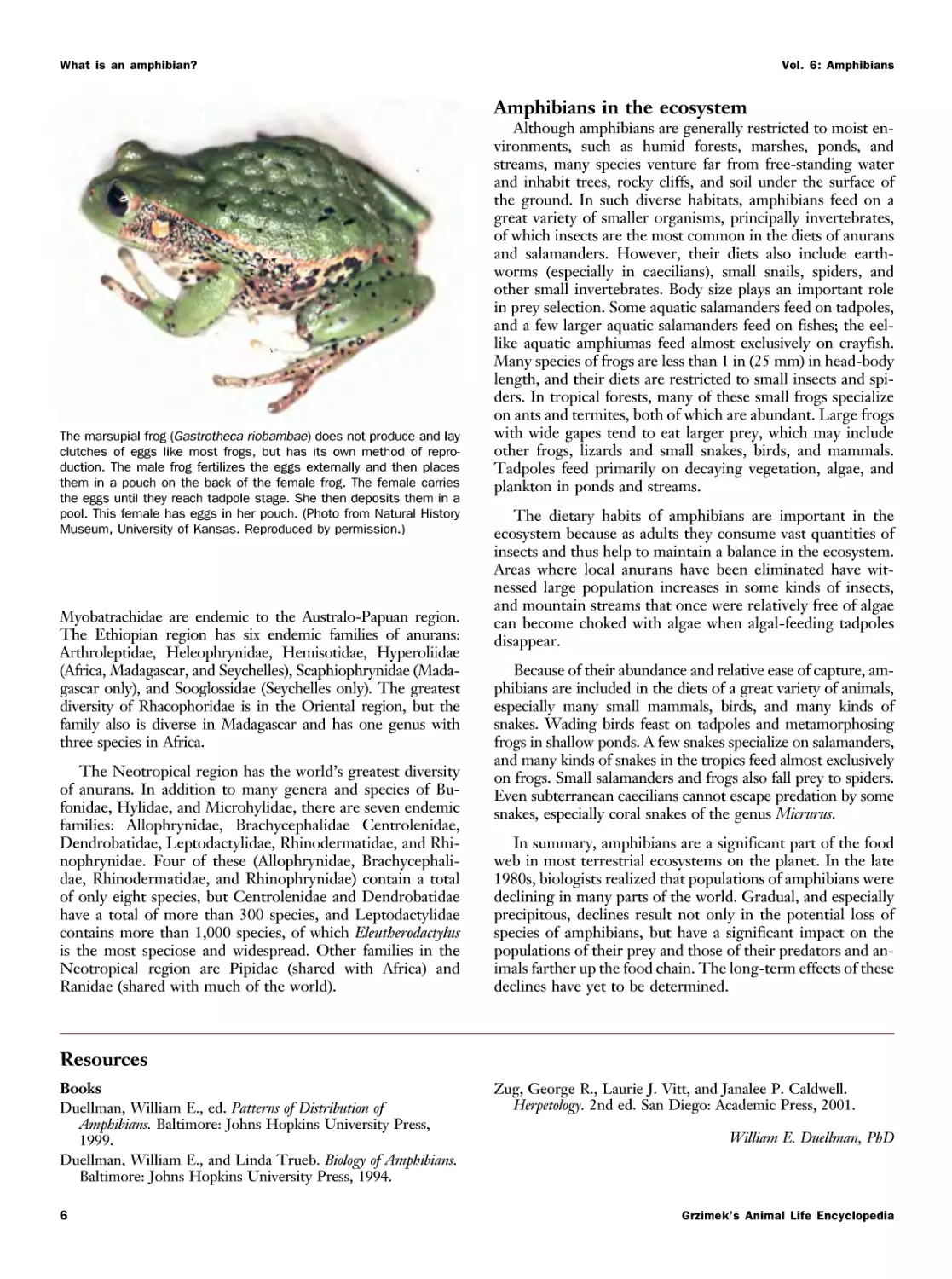
Foothill yellow-legged frog {Rana boylii) transforming from a tadpole in
Mendocino County, California. (Photo by Dan Suzio/Photo Researchers,
Inc. Reproduced by permission.)
Only four of the 2 8 families of anurans occur in both the
Old and New Worlds. Bufonidae is global in its distribution,
except for Australia, New Zealand, and Madagascar. Ranidae
has a similar pattern, but also occurs in Madagascar and in
northern Australia. Microhylidae has a few representatives in
the Nearctic and Palearctic regions and is highly diverse on the
southern continents, including Madagascar and New Guinea,
but not in New Zealand. Hylidae is most diverse in the
Neotropical region and secondarily in the Australo-Papuan re-
region. Two genera are endemic to North America, and only a
few species oiHyla inhabit the Oriental and Palearctic regions.
With the exception of Pelobatidae in the Nearctic and
Palearctic regions, all other families of anurans are restricted to
the New World or the Old World, and only a few of these are
in the Northern Hemisphere. Ascaphidae is endemic to the
Nearctic region, Megophryidae to the Oriental region,
Discoglossidae and Pelodytidae to the Palearctic region, and
Bombinatoridae in the Palearctic and Oriental regions. The
greatest diversity is in the southern land masses. Leiopelmati-
dae is endemic to New Zealand, and Limnodynastidae and
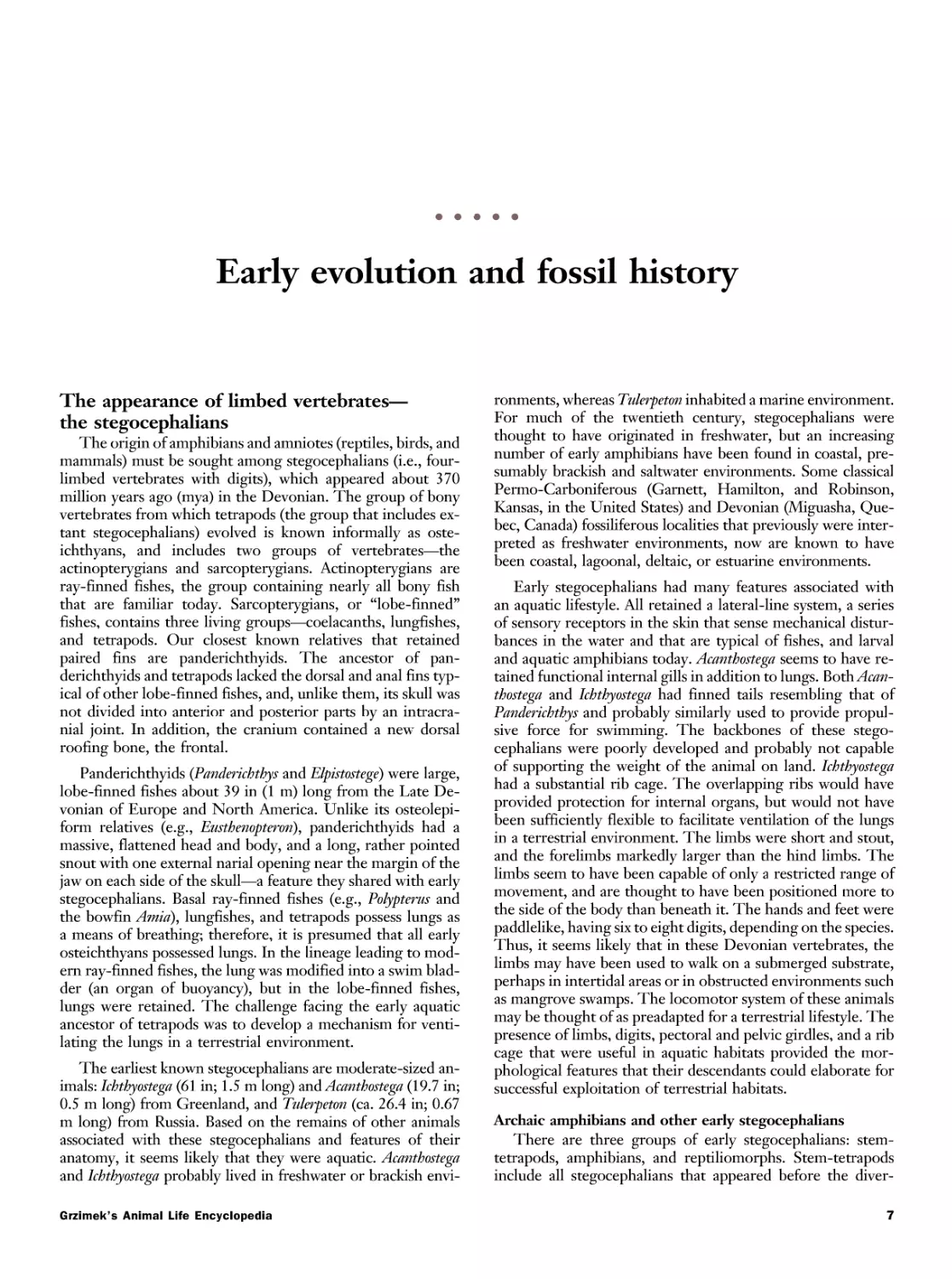
The wide-mouthed frog {Amietia vertebralis) is found at high altitudes—
over 10,000 ft C,000 m)—in South Africa. There is an umbraculum
in each eye that serves as a sun-shade to protect against UV light.
(Photo by Alan Channing. Reproduced by permission.)
Grzimek's Animal Life Encyclopedia

What is an amphibian?
Vol. 6: Amphibians
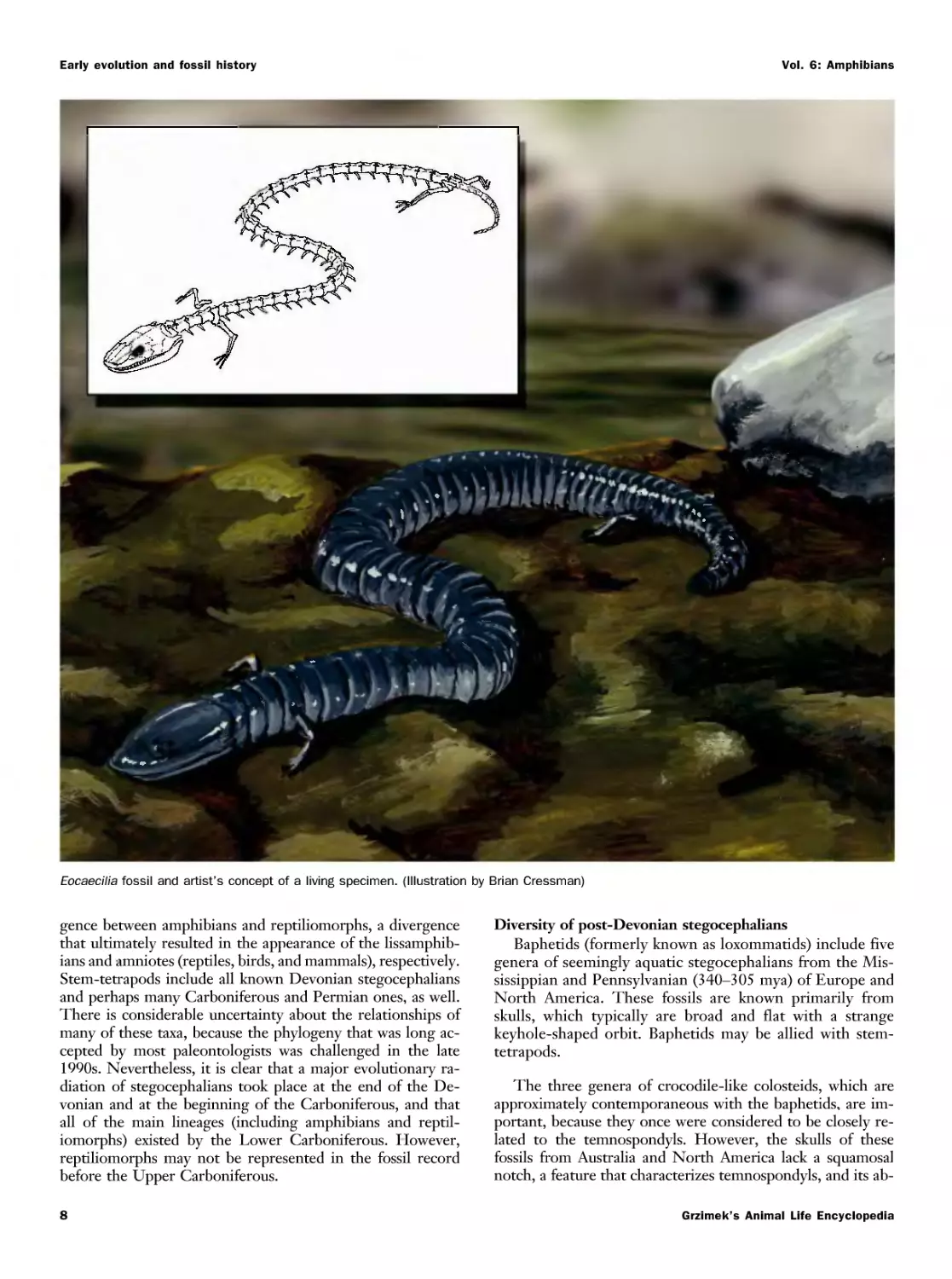
The marsupial frog {Gastrotheca riobambae) does not produce and lay
clutches of eggs like most frogs, but has its own method of repro-
reproduction. The male frog fertilizes the eggs externally and then places
them in a pouch on the back of the female frog. The female carries
the eggs until they reach tadpole stage. She then deposits them in a
pool. This female has eggs in her pouch. (Photo from Natural History
Museum, University of Kansas. Reproduced by permission.)
Myobatrachidae are endemic to the Australo-Papuan region.
The Ethiopian region has six endemic families of anurans:
Arthroleptidae, Heleophrynidae, Hemisotidae, Hyperoliidae
(Africa, Madagascar, and Seychelles), Scaphiophrynidae (Mada-
(Madagascar only), and Sooglossidae (Seychelles only). The greatest
diversity of Rhacophoridae is in the Oriental region, but the
family also is diverse in Madagascar and has one genus with
three species in Africa.
The Neotropical region has the world's greatest diversity
of anurans. In addition to many genera and species of Bu-
fonidae, Hylidae, and Microhylidae, there are seven endemic
families: Allophrynidae, Brachycephalidae Centrolenidae,
Dendrobatidae, Leptodactylidae, Rhinodermatidae, and Rhi-
nophrynidae. Four of these (Allophrynidae, Brachycephali-
Brachycephalidae, Rhinodermatidae, and Rhinophrynidae) contain a total
of only eight species, but Centrolenidae and Dendrobatidae
have a total of more than 300 species, and Leptodactylidae
contains more than 1,000 species, of which Eleutherodactylus
is the most speciose and widespread. Other families in the
Neotropical region are Pipidae (shared with Africa) and
Ranidae (shared with much of the world).
Amphibians in the ecosystem
Although amphibians are generally restricted to moist en-
environments, such as humid forests, marshes, ponds, and
streams, many species venture far from free-standing water
and inhabit trees, rocky cliffs, and soil under the surface of
the ground. In such diverse habitats, amphibians feed on a
great variety of smaller organisms, principally invertebrates,
of which insects are the most common in the diets of anurans
and salamanders. However, their diets also include earth-
earthworms (especially in caecilians), small snails, spiders, and
other small invertebrates. Body size plays an important role
in prey selection. Some aquatic salamanders feed on tadpoles,
and a few larger aquatic salamanders feed on fishes; the eel-
like aquatic amphiumas feed almost exclusively on crayfish.
Many species of frogs are less than I in B5 mm) in head-body
length, and their diets are restricted to small insects and spi-
spiders. In tropical forests, many of these small frogs specialize
on ants and termites, both of which are abundant. Large frogs
with wide gapes tend to eat larger prey, which may include
other frogs, lizards and small snakes, birds, and mammals.
Tadpoles feed primarily on decaying vegetation, algae, and
plankton in ponds and streams.
The dietary habits of amphibians are important in the
ecosystem because as adults they consume vast quantities of
insects and thus help to maintain a balance in the ecosystem.
Areas where local anurans have been eliminated have wit-
witnessed large population increases in some kinds of insects,
and mountain streams that once were relatively free of algae
can become choked with algae when algal-feeding tadpoles
disappear.
Because of their abundance and relative ease of capture, am-
amphibians are included in the diets of a great variety of animals,
especially many small mammals, birds, and many kinds of
snakes. Wading birds feast on tadpoles and metamorphosing
frogs in shallow ponds. A few snakes specialize on salamanders,
and many kinds of snakes in the tropics feed almost exclusively
on frogs. Small salamanders and frogs also fall prey to spiders.
Even subterranean caecilians cannot escape predation by some
snakes, especially coral snakes of the genus Micrurus.
In summary, amphibians are a significant part of the food
web in most terrestrial ecosystems on the planet. In the late
1980s, biologists realized that populations of amphibians were
declining in many parts of the world. Gradual, and especially
precipitous, declines result not only in the potential loss of
species of amphibians, but have a significant impact on the
populations of their prey and those of their predators and an-
animals farther up the food chain. The long-term effects of these
declines have yet to be determined.
Resources
Books
Duellman, William E., ed. Patterns of Distribution of
Amphibians. Baltimore: Johns Hopkins University Press,
1999.
Duellman, William E., and Linda Trueb. Biology of Amphibians.
Baltimore: Johns Hopkins University Press, 1994.
Zug, George R., Laurie J. Vitt, and Janalee P. Caldwell.
Herpetology. 2nd ed. San Diego: Academic Press, 2001.
William E. Duellman, PhD
Grzimek's Animal Life Encyclopedia

Early evolution and fossil history
The appearance of limbed vertebrates—
the stegocephalians
The origin of amphibians and amniotes (reptiles, birds, and
mammals) must be sought among stegocephalians (i.e., four-
limbed vertebrates with digits), which appeared about 370
million years ago (mya) in the Devonian. The group of bony
vertebrates from which tetrapods (the group that includes ex-
extant stegocephalians) evolved is known informally as oste-
ichthyans, and includes two groups of vertebrates—the
actinopterygians and sarcopterygians. Actinopterygians are
ray-finned fishes, the group containing nearly all bony fish
that are familiar today. Sarcopterygians, or "lobe-finned"
fishes, contains three living groups—coelacanths, lungfishes,
and tetrapods. Our closest known relatives that retained
paired fins are panderichthyids. The ancestor of pan-
derichthyids and tetrapods lacked the dorsal and anal fins typ-
typical of other lobe-finned fishes, and, unlike them, its skull was
not divided into anterior and posterior parts by an intracra-
nial joint. In addition, the cranium contained a new dorsal
roofing bone, the frontal.
Panderichthyids (Panderichthys and Elpistostege) were large,
lobe-finned fishes about 39 in A m) long from the Late De-
Devonian of Europe and North America. Unlike its osteolepi-
form relatives (e.g., Eusthenopteron), panderichthyids had a
massive, flattened head and body, and a long, rather pointed
snout with one external narial opening near the margin of the
jaw on each side of the skull—a feature they shared with early
stegocephalians. Basal ray-finned fishes (e.g., Polypterus and
the bowfin Amia), lungfishes, and tetrapods possess lungs as
a means of breathing; therefore, it is presumed that all early
osteichthyans possessed lungs. In the lineage leading to mod-
modern ray-finned fishes, the lung was modified into a swim blad-
bladder (an organ of buoyancy), but in the lobe-finned fishes,
lungs were retained. The challenge facing the early aquatic
ancestor of tetrapods was to develop a mechanism for venti-
ventilating the lungs in a terrestrial environment.
The earliest known stegocephalians are moderate-sized an-
animals: Ichthyostega F1 in; 1.5 m long) and Acanthostega A9.7 in;
0.5 m long) from Greenland, and Tulerpeton (ca. 26.4 in; 0.67
m long) from Russia. Based on the remains of other animals
associated with these stegocephalians and features of their
anatomy, it seems likely that they were aquatic. Acanthostega
and Ichthyostega probably lived in freshwater or brackish envi-
environments, whereas Tulerpeton inhabited a marine environment.
For much of the twentieth century, stegocephalians were
thought to have originated in freshwater, but an increasing
number of early amphibians have been found in coastal, pre-
presumably brackish and saltwater environments. Some classical
Permo-Carboniferous (Garnett, Hamilton, and Robinson,
Kansas, in the United States) and Devonian (Miguasha, Que-
Quebec, Canada) fossiliferous localities that previously were inter-
interpreted as freshwater environments, now are known to have
been coastal, lagoonal, deltaic, or estuarine environments.
Early stegocephalians had many features associated with
an aquatic lifestyle. All retained a lateral-line system, a series
of sensory receptors in the skin that sense mechanical distur-
disturbances in the water and that are typical of fishes, and larval
and aquatic amphibians today. Acanthostega seems to have re-
retained functional internal gills in addition to lungs. Both Acan-
Acanthostega and Ichthyostega had finned tails resembling that of
Panderichthys and probably similarly used to provide propul-
propulsive force for swimming. The backbones of these stego-
stegocephalians were poorly developed and probably not capable
of supporting the weight of the animal on land. Ichthyostega
had a substantial rib cage. The overlapping ribs would have
provided protection for internal organs, but would not have
been sufficiently flexible to facilitate ventilation of the lungs
in a terrestrial environment. The limbs were short and stout,
and the forelimbs markedly larger than the hind limbs. The
limbs seem to have been capable of only a restricted range of
movement, and are thought to have been positioned more to
the side of the body than beneath it. The hands and feet were
paddlelike, having six to eight digits, depending on the species.
Thus, it seems likely that in these Devonian vertebrates, the
limbs may have been used to walk on a submerged substrate,
perhaps in intertidal areas or in obstructed environments such
as mangrove swamps. The locomotor system of these animals
may be thought of as preadapted for a terrestrial lifestyle. The
presence of limbs, digits, pectoral and pelvic girdles, and a rib
cage that were useful in aquatic habitats provided the mor-
morphological features that their descendants could elaborate for
successful exploitation of terrestrial habitats.
Archaic amphibians and other early stegocephalians
There are three groups of early stegocephalians: stem-
tetrapods, amphibians, and reptiliomorphs. Stem-tetrapods
include all stegocephalians that appeared before the diver-
Grzimek's Animal Life Encyclopedia

Early evolution and fossil history
Vol. 6: Amphibians
Eocaecilia fossil and artist's concept of a living specimen. (Illustration by Brian Cressman)
gence between amphibians and reptiliomorphs, a divergence
that ultimately resulted in the appearance of the lissamphib-
ians and amniotes (reptiles, birds, and mammals), respectively.
Stem-tetrapods include all known Devonian stegocephalians
and perhaps many Carboniferous and Permian ones, as well.
There is considerable uncertainty about the relationships of
many of these taxa, because the phylogeny that was long ac-
accepted by most paleontologists was challenged in the late
1990s. Nevertheless, it is clear that a major evolutionary ra-
radiation of stegocephalians took place at the end of the De-
Devonian and at the beginning of the Carboniferous, and that
all of the main lineages (including amphibians and reptil-
reptiliomorphs) existed by the Lower Carboniferous. However,
reptiliomorphs may not be represented in the fossil record
before the Upper Carboniferous.
Diversity of post-Devonian stegocephalians
Baphetids (formerly known as loxommatids) include five
genera of seemingly aquatic stegocephalians from the Mis-
sissippian and Pennsylvanian C40-305 mya) of Europe and
North America. These fossils are known primarily from
skulls, which typically are broad and flat with a strange
keyhole-shaped orbit. Baphetids may be allied with stem-
tetrapods.
The three genera of crocodile-like colosteids, which are
approximately contemporaneous with the baphetids, are im-
important, because they once were considered to be closely re-
related to the temnospondyls. However, the skulls of these
fossils from Australia and North America lack a squamosal
notch, a feature that characterizes temnospondyls, and its ab-
Grzimek's Animal Life Encyclopedia

Vol. 6: Amphibians
Early evolution and fossil history
^Ш»^, ¦
?
Triadobatrachus fossil and artist's concept of a living specimen. (Illustration by Brian Cressman)
sence in colosteids and the presence of a lateral-line organ
suggest an aquatic existence.
Temnospondyls are a large group of more than 150 de-
described genera; they extend from the Mississippian to the
Lower Cretaceous, a span of about 200 million years. Most
of the early temnospondyls and all of the Mesozoic repre-
representatives were aquatic, but others were amphibious, and some
are thought to have been terrestrial. Among the latter are the
dissorophoids, which are noteworthy because they have been
argued to be closely related to living amphibians. Tem-
Temnospondyls ranged in size from less than 12 in C0 cm) to
more than 9.8 ft C m) in length. Many, if not all, dis-
dissorophoids had aquatic larvae with external gills. Some larval
and/or paedomorphic (i.e., having larval or juvenile features
maintained in sexually mature adults) dissorophids had bi-
bicuspid (and possibly pedicellate) teeth, as do lissamphibians;
hence, dissorophids are thought by some scientists to be
closely related to lissamphibians. Other paleontologists con-
consider temnospondyls to be stem-tetrapods. Temnospondyls
had a large opening in the palate (interpterygoid vacuity) that
may have been involved in a buccal pump mechanism that is
similar to that used by all lissamphibians to ventilate their
lungs. The stapes (middle ear bone) of most temnospondyls
is more slender and oriented more laterally than that of ear-
earlier stegocephalians. Because of this, some researchers think
these animals possessed a tympanum (eardrum) in the otic
notch (or squamosal embayment) of the skull. If this hypoth-
hypothesis is correct, then the absence of a tympanum in caecilians
and salamanders must be secondary (i.e., having resulted from
Grzimek's Animal Life Encyclopedia

Early evolution and fossil history
Vol. 6: Amphibians
Early fossils of: 1. Ichthyostega. 2. Panderichthys, and 3. Eusthenopteron. (Illustration by Emily Damstra)
an evolutionary loss). The vertebrae of early temnospondyls
retained the rhachitome pattern that is primitive for stego-
cephalians. Rachitomous vertebrae had a large, ventral, cres-
centic intercentrum and small, paired, dorsal pleurocentra
that supported the neural arch; such vertebrae are poorly
suited to a terrestrial lifestyle. In Mesozoic temnospondyls,
the vertebral column was consolidated to form the stere-
ospondylous pattern, characterized by a large intercentrum,
along with a small pleurocentrum that sometimes was carti-
cartilaginous. The functional reason for this strengthened verte-
vertebral column is unclear, because most, if not all, Mesozoic
temnospondyls were strictly aquatic.
Embolomeres ranged in length from 12 in C0 cm) up to
9.8 ft C m) and were mostly aquatic and amphibious preda-
predators. The fossil record of embolomeres extends from the Up-
Upper Carboniferous into the Triassic, and they are known from
Europe, North America, and Russia. Their vertebrae are
composed of cylindrical intercentra and pleurocentra. Be-
Because they have a massive stapes, it is thought that em-
embolomeres lacked a tympanum, but the stapes may have
conducted low-frequency ground-borne and water-borne
sounds. Embolomeres are important because earlier they
were thought to be related to amniotes. However, now they
are considered by many scientists to represent another group
of stem-tetrapods.
Seymouriamorphs are another group of stem-tetrapods
that was formerly thought to be closely related to amniotes.
This relatively small A2 genera), but widespread, group is
known from the Permian of North America, Europe, and
Asia, and is represented by larvae bearing external gills and
adults (ca. 3 ft [90 cm] long). The absence of lateral-line or-
organs and gills in the adults suggests that they were terres-
terrestrial. Adult seymouriamorphs had a long, slender stapes,
which suggests that they might have had a tympanum, and a
rib architecture that suggests the capacity for costal ventila-
ventilation of the lungs.
Diadectomorphs are represented by eight genera in the Up-
Upper Carboniferous and Lower Permian. Once considered to be
amniotes, they now are thought to be closely related to them.
These animals attained lengths of 6.5 ft B m). In addition to
some carnivorous or piscivorous forms, diadectomorphs in-
include some of the earliest herbivorous stegocephalians, the di-
adectids.
An assemblage of small amphibians (most less than 12 in
[30 cm] long) comprising five groups (ai'stopods, nectrideans,
"microsaurs," adelogyrinids, and lysorophids) forms an evo-
evolutionary grade informally known as "lepospondyls." These
animals are known from the Lower Carboniferous to the Up-
Upper Permian. Some seem to have been strictly aquatic (e.g.,
10
Grzimek's Animal Life Encyclopedia

Vol. 6: Amphibians
Early evolution and fossil history
many nectrideans, adelogyrinids), whereas others (e.g., the
"microsaurs" Pantylus and Tuditanus) apparently were am-
amphibious or terrestrial. Most lepospondylous amphibians ei-
either lacked or had only a small otic notch or squamosal
embayment (e.g., aelogyrinids); thus, they must have lacked a
tympanum. If these amphibians include the closest known rel-
relatives of lissamphibians, then the ancestor of caecilians and
salamanders probably lacked a tympanum, and the tympanum
of anurans may have appeared only in the Triassic. The name
of the group derives from the structure of their vertebrae,
which are dominated by a large, cylindrical pleurocentrum
that fused to the neural arch early in development, as it does
in lissamphibians. In some lepospondyl amphibians, a small
crescentic intercentrum remains, but in others it is lost, as it
is in most lissamphibians.
Lissamphibia
The oldest known lissamphibians, a group consisting of
the caecilians, salamanders, anurans, and their fossil allies,
date from the Triassic, some 250 mya. The fossil record of
this group is extremely scanty. Indeed, in the Triassic, which
lasted about 37 million years, only two species of lissamphib-
lissamphibians are known and both are closely related to anurans. Not
all paleontologists agree that Lissamphibia is a natural group,
but most neontologists consider it to be monophyletic. Re-
Regardless of which phylogenetic arrangement one prefers, there
is a gap of several tens of million years between the sister
group (i.e., dissorophoids or lysorophids) and the earliest
known lissamphibian. Beginning in the Jurassic B06 mya) fos-
fossil lissamphibians become more common; however, the best-
represented groups are those that inhabited an aquatic
environment.
Salientia (anurans and Triadobatrachus)
Triadobatrachus, the oldest fossil lissamphibian, is from the
Lower Triassic of Madagascar. It is known from a single spec-
specimen, a largely complete and articulated skeleton D.2 in [10.6
cm] long), which reveals it to be closely related to anurans. It
shares many cranial features with frogs and toads, but it dif-
differs from them by having a longer trunk, a less specialized
pelvic girdle, shorter limbs, and a short tail. Another, slightly
younger fossil, Czatkobatrachus, from the Lower Triassic of
Poland, is based on a few, isolated bones; thus, little can be
said about its affinities or phylogenetic position. Beginning in
the Lower Jurassic, there are fossil representatives of each of
the modern orders. However, the record for caecilians and
the general quality of fossil salamanders are exceedingly poor
in contrast to that for anurans.
Triadobatrachus is considered to be closely allied to anu-
anurans (frogs and toads). Together, these animals compose a
taxonomic group known as Salientia. The earliest known
anurans, Prosalirus and Vieraella, are from the Lower Juras-
Jurassic of Arizona (United States), and Argentina, respectively,
and approximately contemporaneous with Eocaecilia, the
stem-caecilian. Each of these moderate-sized B in [50 mm]
and 1.25 in [30 mm] in snout-vent length, respectively) frogs
differs from the larger Triadobatrachus in having a shorter
trunk, urostyle, lacking a tail, and possessing long hind limbs
P ill nidi ill
T Im
rf
p- ¦¦
III I I —I
4 *¦
Par rn h i -.
n l Je
T гтг 4ir
Fm hrTirri
E гтпц-пп Ju
Dii .-1с4т>]ф|-к1
ли
in mr ui
Lywia h'm
Af-fli
l^u[ _¦
5.h H
i
E
1—
I
Чар-' am-ara
A and B: Possible phylogenetic trees for amphibians. (Illustration by
Argosy. Courtesy of Gale.)
in which the ankles are modified to form an extra limb seg-
segment. Unlike Triadobatrachus, these frogs clearly were capa-
capable of saltatorial (i.e., jumping, hopping) locomotion typical
of extant anurans
One genus, Eodiscoglossus, is represented by Middle Juras-
Jurassic remains from Great Britain. This rather large frog C.25
Grzimek's Animal Life Encyclopedia
11

Early evolution and fossil history
Vol. 6: Amphibians
Artist's concept of a living specimen of Prosalirus bitis. (Illustration by Brian Cressman)
in [80 mm] in snout-vent length) is remarkably similar to liv-
living discoglossids, especially species of Discoglossus.
By the Late Jurassic, the fossil record of anurans is much
more diverse taxonomically and geographically. Eobatrachus
and Comobatrachus are known from Wyoming (United States),
and Enneabatrachus from Wyoming and Utah (United States);
all are of uncertain affinities. Notobatrachus, from several lo-
localities in Patagonia in Argentina, is one of the most impor-
important Middle-Late Jurassic finds, because it is represented by
whole, articulated skeletons and numerous individuals, in-
including juveniles and subadults. This frog was large, reach-
reaching a snout-vent length of about 5.7 in A4.5 cm). It has
several primitive features, including free ribs on some of the
vertebrae, a poorly developed sacrum, a relatively short
pelvic girdle, and stout, relatively short hind limbs. This frog
is thought to be ancestral to all living anurans. Two other
taxa, Callobatrachus and Mesophryne, were described from
Jurassic/Cretaceous fossil beds of China; the former is allied
with discoglossids, but the affinities of the latter are un-
unknown. The oldest fossil pipoid is Rhadinosteus from the Late
Jurassic of Utah.
The Cretaceous produced a proliferation of anurans. Among
the more significant Lower Cretaceous finds are the discoglos-
sid Eodiscoglossus from Spain, and a variety of pipoid frogs—
Thoraciliacus, Cordicephalus, and Shomronella (larvae) from Israel
Middle/Upper Cretaceous anurans include gobiatids from
Mongolia and Uzbekistan, pipoid frogs from Argentina (Salte-
nia and Avitabatrachus) and Niger (Pachybatrachus), and lepto-
12
Grzimek's Animal Life Encyclopedia

Vol. 6: Amphibians
Early evolution and fossil history
> ¦ V
Fossilized frog skeleton embedded in rock. Frogs and toads first ap-
appeared 190-160 million years ago, in the early Jurassic period. (Photo
by Volker Steger/Science Photo Library/Photo Researchers, Inc. Re-
Reproduced by permission.)
dactylids (Baurubatrachus and Estesius) from Brazil and Bolivia,
respectively.
The Tertiary record of anurans is too extensive to recount
here. Suffice it to say that most major families are repre-
represented by fossil remains from Europe, Africa, Asia, and North
America.
Gymnophionans (caecilians and Eocaecilid)
Extant apodans or caecilians comprise a peculiar group of
limbless, snake-like amphibians that are terrestrial or aquatic
and specialized for burrowing; they possess a tentacle on each
side of the head beneath the reduced eye. Most scientists con-
consider caecilians to be the most basal of the lissamphibians. The
Lower Jurassic (about 204 mya) fossil Eocaecilia from Arizona
is thought to be a stem-caecilian. It differs from extant mem-
members of the group in having small, well-ossified limbs and gir-
girdle elements that are absent in living caecilians. \lthough the
eyes were larger, and the skull contained more bones than liv-
living species, the lower jaw and the jaw-closing mechanism seem
to resemble those of living representatives. The only other fos-
fossil remains associated with gymnophionans are vertebrae from
the Upper Cretaceous of the Sudan, Early Paleocene of Bo-
Bolivia, and Late Paleocene of Brazil. These fossils provide little
useful information except that the modern families of caecil-
caecilians had begun to differentiate by the late Mesozoic.
Urodeles (salamanders and related fossils)
Fossil urodeles are known from Middle Jurassic-Lower
Cretaceous (about 180-127 mya) lake and lagoon deposits of
Europe, the Upper Cretaceous-Eocene (about 90-35 mya)
flood-plain deposits of North America, and the Eocene-
Miocene (about 35-5 mya) brown-coals of Europe. In addi-
addition, there are remains from the Cretaceous of Bolivia, the
Sudan, Niger, and Israel. Laccotriton, Sinerpeton, Jeholotriton,
and Liaoxitriton are salamanders from the Upper Jurassic/
Lower Cretaceous of China. With three exceptions men-
mentioned below, all these remains clearly are caudate, i.e., be-
belonging to salamanders. The affinities of Albanerpetontidae
from Middle Jurassic-Miocene deposits of northern conti-
continents are equivocal. This group may represent a peculiar,
early offshoot of the salamander lineage, or a separate lis-
samphibian group, the origin of which preceded the phylo-
genetic divergence between caudates and anurans. The
phylogenetic status of Ramonellus from the Lower Cretaceous
of Israel is unknown. A third taxon, Triassurus, was described
from the Triassic of Uzbekistan. If the latter poorly preserved
remains prove to be those of a urodele, then the group would
have originated in the Triassic or earlier.
The earliest fossil remains of salamanders that can be defi-
definitely identified as caudates are the Jurassic remains from
China, the karaurid salamanders, Karaurus and Kokartus, from
Kazakhstan and Kirghizstan, and Marmorerpeton from England.
The extant groups of salamanders are represented by a sur-
surprising number of fossils. A) Sirenidae: Upper Cretaceous and
Paleocene of North America; Cretaceous remains of several
taxa from southern continents may also be related to sirenids;
B) Hynobiidae: Upper Pliocene of Kazakhstan; C) Crypto-
branchidae: Paleocene of Mongolia and Russia, Upper
Oligocene-Pliocene of Europe, Upper Paleocene-Upper
Miocene of North America, with Pleiocene-Pleistocene oc-
occurrences of Cryptobranchus in North America; E) Salaman-
droids Ambystomatidae, Amphiumidae, Dicamptodontidae,
Plethodontidae, Proteidae, Rhyacontritonidae, and Salaman-
dridae): Stem-salamandroids from Lower Cretaceous of Eu-
Europe; Amphiumidae from Paleocene-Pleistocene of North
America; Dicamptotontidae from Paleocene of Canada; Sala-
mandridae from Upper Paleocene and onwards of Europe and
Upper Miocene of East Asia, and Neogene of North America.
In addition, there are three groups of fossil caudates of uncer-
uncertain affinities: batrachosauroids from Mid-Cretaceous-Lower
Pliocene of North America and Europe; scapherpetontids from
Upper Cretaceous, Paleocene, and Eocene of North America,
and possibly Cretaceous of Asia; and dicamptodontid-like sala-
salamanders from Paleocene-Miocene of Europe.
Grzimek's Animal Life Encyclopedia
13

Early evolution and fossil history
Vol. 6: Amphibians
Resources
Books
Duellman, William E., and Linda Trueb. Biology of Amphibians.
New York: McGraw-Hill Book Co., 1986.
Estes, Richard. Handbuch der Palaoherpetologie, Vol. 2. Stuttgart:
Gustav Fischer Verlag, 1988.
Heatwole, Harold, and Robert L. Carroll, eds. Amphibian
Biology. Vol. 4, Palaeontology. The Evolutionary History of
Amphibians. Chipping Norton, Australia: Surrey Beatty &
Sons Pty. Limited, 2000.
Sanchiz, Borja. Encyclopedia of Paleoherpetology. Part 4, Salientia.
Munich: Verlag Dr. Friedrich Pfeil, 1998.
Schultze, Hans-Peter, and Linda Trueb, eds. Origins of the
Higher Groups ofTetrapods. Controversy and Consensus. Ithaca,
NY: Comstock Publishing Associates, Cornell University
Press, 1991.
Periodicals
Baez, Ana Maria, Linda Trueb, and Jorge O. Calvo. "The
Earliest Known Pipoid Frog from South America: A New
Genus from the Middle Cretaceous of Argentina." Journal
of Vertebrate Paleontology 20 B000): 490-500.
Gao, Ke-Qin, and Yuan Wang. "Mesozoic Anurans from
Liaoning Province, China, and Phylogenetic Relationships
of Archaeobatrachian Anuran Clades." Journal of Vertebrate
Paleontology 21 B001): 460^76.
Laurin, Michel. "A Reevaluation of the Origin of
Pentadactyly." Evolution 52 A998): 1476-1482.
. "The Importance of Global Parsimony and Historical
Bias in Understanding Tetrapod Evolution. Part I—
Systematics, Middle Ear Evolution, and Jaw Suspension."
Annales des Sciences Naturelles, Zoologie 13 erne Serie, 19
A998): 1-42.
Laurin, Michel, Marc Girondot, and Armand de Ricqles.
"Early Tetrapod Evolution." Trends in Ecology and Evolution
15B000): 118-123.
Laurin, Michel, and Rodrigo Soler-Gijon. "The Oldest
Stegocephalian from the Iberian Peninsula: Evidence that
Temnospondyls Were Euryhaline." Comptes Rendus de
lAcademie des Sciences de Paris, Sciences de la vie/Life Sciences
324 B001): 495-501.
Linda Trueb, PhD
Michel Laurin, PhD
14
Grzimek's Animal Life Encyclopedia

Structure and function
The three living orders of lissamphibians represent only
a small fraction of the amphibian diversity reflected by the
fossil record, which contains examples of lineages that flour-
flourished and diversified over long periods of time as well as
short-lived, less successful evolutionary experiments. It is as-
assumed that the orders Gymnophiona (caecilians), Caudata
(salamanders), and Anura (frogs and toads) arose from a
common ancestor in the Triassic. Thus, each of these am-
amphibian lineages has evolved along a unique trajectory for
some 300 million years to produce the three distinct groups
of organisms recognized today. Superficially, it would seem
that frogs and toads, the snakelike caecilians, and salaman-
salamanders have few anatomical traits in common, but shared fea-
features of their integument, musculoskeletal system, internal
organs, endocrine system, and sensory structures indicate
their common ancestry.
Morphological features common to all
lissamphibians
Integument
Skin is the interface between the organism and its envi-
environment. As a water-permeable covering, the skin functions
as an organ of osmoregulation and respiration; it also sup-
supports internal structures. All lissamphibians have mucous and
granular (poison or serous) glands distributed over the body.
The mucous glands secrete mucopolysaccarides (mucus) that
keep the skin moist and facilitate oxygen transport. Moisture
is critical to respiration—as much as 90% of the animal's oxy-
oxygen needs are met by passive transport of oxygen into the skin
and its capillary vessels, rather than by ventilation through
the lungs. Granular glands secrete a variety of substances (e.g.,
peptides and alkaloids) that commonly are noxious and some-
sometimes highly toxic, and therefore are important defense mech-
mechanisms.
The colors and patterns of lissamphibians are determined
by pigments produced by chromatophore cells in the skin.
Stimuli such as changes in hormone, light, and temperature
levels cause changes in the amounts and distributions of pig-
pigments in chromatophores. Thus, the colors of an organism
can vary from day to night, seasonally, and throughout the
life of the animal.
The skin also is the site of the lateral-line system, which
is present in all lissamphibian larvae and in adults that are
aquatic. This sensory-receptor system consists of a series of
sense organs distributed in the skin of the head and along
the body. These are of two types: mechanoreceptors and
electroreceptors. Neuromasts are lateral-line organs that are
responsive to mechanical stimuli (e.g., water currents). Am-
pullary organs (electroreceptors) occur only in larval caecil-
caecilians and aquatic salamanders.
Musculoskeletal system
The basic architecture of a vertebrate is its musculoskele-
musculoskeletal system—the framework of bones and the muscles associ-
associated with them that are covered by the skin and that,
internally, enclose and support the viscera and sensory organs.
In lissamphibians, as in other vertebrates, the musculoskele-
musculoskeletal system can be divided into three architectural units: the
head and associated structures, the trunk or backbone, and
the girdles and appendages.
The head or cranium contains the brain and the primary
sense organs (eyes, olfactory organs, ears, equilibrium organs)
in a cartilage and bone housing—the skull. The upper and
lower jaws are also part of the cranium. If the jaws bear teeth,
the teeth are of a type unique to lissamphibians among living
vertebrates. Each tooth is composed of a bicuspid crown that
sits atop a base pedicel; as a tooth is lost, it is replaced by an-
another that has formed on the inside (lingual margin) of the
jaw adjacent to the older tooth. The lower jaw or mandible
and its associated musculature form the floor of the mouth.
Seated in the musculature of the throat is a complex skeletal
assemblage known as the hyobranchial apparatus. Muscles as-
associated with the hyobranchium, mandible, and cranium form
the mechanical systems for securing food (opening and clos-
closing jaws, the tongue and its movement) and breathing. Me-
Mechanical ventilation of the lungs is accomplished, in part, by
the buccal pump mechanism. When the muscles in the floor
of the mouth contract, the volume of the buccal chamber is
reduced and air is forced out through the open nostrils. When
these muscles are relaxed, the floor of the mouth drops and
the volume of the buccal chamber increases; this creates a vac-
vacuum that pulls air into the mouth through the nares. Then
the nares are closed, the muscles are contracted, and air is
forced from the mouth into the lungs.
Grzimek's Animal Life Encyclopedia
15

Structure and function
Vol. 6: Amphibians
external naris
tentacular
foramen
orbit
frontal •
— nasopremaxilla
maxillopalatine-
squamosal
vomer
choana
carotid
foramen
parietal
os basale
occipital condyle
pterygoquadrate
nasopremaxilla
external naris
tentacular formen
pseudodentary
frontal orbit squamosal
os basale
columella
pterygoquadrate
retroarticular process
pseudoangular
Skull of a caecilian, Dermophis mexicanus, in dorsal (upper left), ventral (upper right), and lateral (bottom) view. (Illustration by Dan Erickson)
The vertebral column (backbone) provides axial support
for the head, appendicular skeleton (pectoral girdle and fore-
limbs anteriorly and pelvic girdle and hind limbs posteriorly),
viscera, and tail if it is present. The column is composed of a
series of bony elements, the vertebrae, each of which can be
visualized as being composed of a spool that bears a bony arch
on its top and a rib on each side. The ends of each spool abut
one another to form a segmented, flexible column of bone.
Collectively, the bony arches on top of each spool form a lon-
longitudinal canal that houses the spinal cord. The ribs (if pre-
present) are short and extend laterally from the vertebrae and
their associated muscles to form a sling that supports the in-
internal organs. The first vertebra behind the head (atlas) is spe-
specialized to support the skull; it bears a pair of hemispherical
depressions (cotyles) into which the pair of rounded condyles
at the end of the skull fits. This paired articular arrangement
in lissamphibians eliminates their ability to move their heads
from side to side. In contrast, reptiles, birds, and mammals
have a single ball-and-socket arrangement that allows the
head to be moved up and down, as well as from side to side.
In those lissamphibians with limbs, one of the posterior ver-
vertebrae is modified into a sacrum—an enlarged trunk vertebra
with elaborate lateral processes that support the pelvic girdle.
Tails are composed of caudal vertebrae that lie behind (pos-
(posterior) the sacrum and lack ribs.
If present, limbs are suspended from the axial column by
girdles and complex muscular connections. The pectoral gir-
girdle consists of broad blades (suprascapulae) located behind
the head on either side of the back. The lower part of each
blade is connected to a bone (scapula) that bears a fossa (cav-
(cavity) in which the head of the upper bone (humerus) of the
16
Grzimek's Animal Life Encyclopedia

Vol. 6: Amphibians
Structure and function
arm articulates. The medial (chest region) parts of the pec-
pectoral girdle consist of highly variable systems of bracing car-
cartilages and bones. The forelimb consists of an upper arm
(humerus), forearm (radius and ulna), and hand with four or
fewer digits. The pelvic girdle consists of three pairs of bones.
The largest and most anterior bones are the ilia, each of
which bears an elongated process that articulates with the
sacrum. The posterior parts of the ilia, along with the ven-
ventral paired pubes and posterior paired ischia, form a thick
vertical plate with a concavity (acetabulum) on each side
which receives the head of the upper limb bone, the femur.
The hind limb consists of the femur, the tibia and fibula, and
a foot with five or fewer digits.
Visceral anatomy
The visceral anatomy includes the circulatory system and
lungs and the digestive and urogenital systems. The circu-
circulatory system consists of the blood, heart, and blood and
lymph vessels that transport oxygen and metabolic products
through the body. All lissamphibians (except the salaman-
salamanders Siren and Necturus with four-chambered hearts) have
three-chambered hearts composed of two atria and one ven-
ventricle, from which blood is routed to the head, body, skin,
or lungs. Blood returning from the head, body, and skin en-
enters the left atrium. The rest of the vascular system is com-
composed of arteries carrying blood away from the heart and
veins that route blood back to the heart. The lungs are an
important adjunct to the circulatory system, because it is
here that carbon dioxide is released from the blood and oxy-
oxygen is acquired. Lungs are present as paired structures in all
lissamphibians except plethodontid salamanders and two
genera of salamandrids (Chioglossa and Salamandrind). In
most, they are relatively simple structures; as little as 10%
of the necessary oxygen is exchanged across the lung sur-
surfaces, with the remaining 90% being exchanged across the
organism's skin. In aquatic lissamphibians, the lungs seem
to be more important as hydrostatic (buoyancy), rather than
respiratory, organs. The lymphatic system is composed of a
third series of vessels that collect substances that seep
through the walls of capillaries or are not picked up by the
capillaries (e.g., fats from intestinal capillaries). Fluid move-
movement through the lymph vessels is directed to the venous
system by a series of lymph hearts (valves that restrict lymph
flow in one direction). The spleen is a large aggregation of
lymph tissue located on the left side adjacent to the intes-
intestine below the stomach; in lissamphibians, this is a major
site of production of red blood cells and recovery of rem-
remnants of worn-out blood cells.
The mouth (buccal cavity) is an important part of the
lissamphibian digestive system. The mouth has many dif-
different kinds of glands; the most notable are the intermax-
intermaxillary glands, which produce a sticky secretion that is
deposited on the tongue and helps to entrap prey. Food
(e.g., insects) usually is crushed partially in the mouth so
that the process of digestion can begin. The pharynx is an
expanded chamber behind the mouth; it also bears many
glands that produce mucus to help move food into the thin-
walled esophagus, a short tube that connects the pharynx
to the stomach. The stomach usually lies to the left of the
midline; posteriorly, it is separated from the intestines,
Uppc -1И
¦с
Eye anatomy of amphibians. The upper eyelid is immoveable, but the
lower eyelid is moveable—the upper part of which (the nictitating mem-
membrane) is usually transparent. (Illustration by Michelle Meneghini)
where nutrients are absorbed, by the pyloric sphincter. The
terminal part of the digestive tract is the cloaca, which opens
to the outside by means of the vent. Two important glan-
glandular organs are associated with the digestive system—the
liver and the pancreas. The liver removes toxic substances
from the blood and delivers them to the small intestine via
the gall bladder and bile duct. The pancreas is an exocrine
and endocrine gland that lies between the small intestine
and the stomach; it produces pancreatic juice, which con-
contains an enzyme (trypsin) that is delivered to the small in-
intestine to break down proteins.
The reproductive and excretory systems are closely allied
with one another to form the urogenital system, which in-
includes the kidneys, gonads, urogenital ducts, urinary bladder,
cloaca, and, in lissamphibians, fat bodies. The pair of kidneys
flanks the dorsal aorta from which each kidney receives nu-
numerous arteries that branch to form clusters of capillaries
(glomeruli). Each capillary cluster is encased by an expanded
end of a kidney tubule known as Bowman's capsule. This is
the primary site of filtration of metabolic by-products from
the blood, which if retained would upset the physiological bal-
balance of the organism. The collective wastes (urine) are con-
conducted through the kidney tubules to the Wolffian duct to
the cloaca. The urinary bladder is a pouchlike outgrowth of
the cloaca where urine can be safely stored, rather than be-
being voided constantly as it is formed. Water conservation is
critical to many lissamphibians; therefore, they store urine in
Grzimek's Animal Life Encyclopedia
17

Structure and function
Vol. 6: Amphibians
prenasal process
-premaxilla-
vomer
choana
orsph
external naris
antorbital с
oculomotor f
palatoquadrate
occipital condyle
tectum synoticum
frontal orsph
coronoid process
parietal squam
/ / pro-exocc
postotic f
prefrontal
nasolac d
nasal
alary с
premaxilla
maxilla
onasal f
prsph
vomer
prearticular
Meckel's с
mandibular
symphysis
Skull of salamander, Salamandra salamandra. Views: A=ventral; B=dorsal; C=lateral; D=mandible in lateral view; E=mandible in medial view. Ab-
Abbreviations: orsph=orbitosphenoid; pter=pterygoid; operc=operculum; prsph=parasphenoid; c=cartilage; f=foramen; nasolac d=nasolacrimal duct;
quad=quadrate; pro-exocc=prootic-exoccipital; onasal=orbitonasal; squam=squamosal. (Illustration by Bruce Worden)
the bladder so that it does not create osmotic pressure that
would draw water from the tissues of the animal.
The paired gonads are closely associated with the kidneys
and are the site of gametes—sperm from the testes of males
and eggs from the ovaries of females. Each testis has a mem-
membranous attachment to the kidney; this membrane supports
the ductules for sperm transport. The sperm pass through the
kidney to the Wolffian duct and then to the cloaca. Each ovary
is suspended by a membrane from the middle side of the kid-
kidney. As eggs are released from the ovary into the body cav-
cavity, they are moved forward by ciliary action of the coelomic
epithelium toward the lung, where the opening of the oviduct
is located. The oviduct lies parallel to, and at the side of, the
kidney. Ciliated epithelium and smooth muscles of the oviduct
wall move eggs from the opening of the oviduct to the cloaca,
where they are extruded through the vent. All lissamphibians
have fat bodies associated with the gonads; the fat bodies are
thought to provide nutrients for the gonads and are largest
just before hibernation and smallest following breeding. The
common receptacle for the intestine, Wolffian ducts, oviducts,
and the bladder is the cloaca. The opening of the cloaca to
the exterior, the vent, is controlled by a muscular sphincter.
Endocrine system
Endocrine glands produce complex chemical substances
(hormones) that, in combination with the activity of the ner-
nervous system, regulate and coordinate the activities of various
organs. These glands include the pituitary, pineal body, thy-
thyroid, parathyroids, ultimobranchial bodies, thymus, pancre-
pancreatic islets, adrenals, and gonads.
18
Grzimek's Animal Life Encyclopedia

Vol. 6: Amphibians
Structure and function
ПХ1 1a
;\ '
еьа ve e
Ь а е
Anuran skeleton and skull. (Illustration by Marguette Dongvillo)
The pituitary is closely associated with the ventral surface
of the brain and consists of several discrete parts that secrete
different hormones and directly or indirectly are controlled
by the brain. Among the functions controlled by pituitary
hormones are activities of the ovaries and testes, larval
growth, production and control of pigment cells, and regu-
regulation of water loss and salt balance. The pineal body is lo-
located on the dorsal surface of the brain; it is light sensitive.
During prolonged darkness, the pineal body releases the hor-
hormone melatonin, which triggers aggregation of melanosomes
in the skin chromatophores and thereby lightens the color of
the skin.
The pair of thyroid glands lies in the throat and produces
two hormones—thyroxine (T4) and triodothyronine (T3).
These hormones control morphological and functional
changes during the metamorphosis of lissamphibian larvae
to adults. In adults, they are thought to be involved in the
control of metabolic activities, skin structure, and nerve
function.
Several other glands are located in the neck region.
There are two small, parathyroid glands that secrete calci-
tonin and parathyroid hormone, both of which control cal-
calcium metabolism. Similarly, the ultimobranchial bodies
secrete a calcitonin-like substance that affects mineral me-
Grzimek's Animal Life Encyclopedia
19

Structure and function
Vol. 6: Amphibians
Cerebral hemisphere
Optic chiasma
Infundiblum
Hypophysis
Heart
Lung
Liver
Ova
Ovaduct
Kidney
Ovasac
Wolffian duct
.Olfactory lobe
Eyeball
-Optic lobe
Esophagus
Stomach
Pancreas
-—Gall bladder
Small intestine
Fat body
Adrenal gland
Male
Bladder' / Cloaca
Large Intestine
Testis
Vas efferens
Seminal vesicle
Frog internal organs, showing the differences between male and female. (Illustration by Marguette Dongvillo)
tabolism, especially during metamorphosis. The thymus se-
secretes several substances, collectively known as thymosin,
that stimulate production of lymph cells.
The pancreatic islets (islets of Langerhans) are pancreatic
glands that develop in lissamphibian larvae and become ac-
active only at metamorphosis, when they begin to secrete in-
insulin, glucagon, somatostatin, and pancreatic polypeptide.
Insulin and glucagon are critical in carbohydrate metabolism;
insulin facilitates the assimilation of sugar (glucose) into cells,
whereas glucagon stimulates glucose levels to rise in the
blood. Somatostatin promotes the growth of skeletal and soft
tissues. Pancreatic polypeptide, which is released into the
blood after meals, promotes the flow of gastric juice (e.g., hy-
hydrochloric acid) in the stomach.
Each member of the pair of elongate adrenal glands
is located on the underside of the kidney. The outer part
of the gland produces corticosteroid hormones, which
are involved in the control of water reabsorption and
sodium transport in the kidney, metabolism of carbohy-
carbohydrates, and reproduction. The inner part of the gland
produces catecholamines—epinephrine (adrenaline) and
norepinephrine. Both of these affect the cardiovascular
system and blood flow through the brain, liver, kidneys,
and skeletal muscle, in addition to the rate of metabolism
20
Grzimek's Animal Life Encyclopedia

Vol. 6: Amphibians
Structure and function
П~ П
e о
b [ no
X :~
О s qsp'
gen ohyo u
g U I SfiLJ
вг cis
Ventrolateral view of cranial, hyoid, and anterior trunk musculature of a caecilian, Dermophis mexicanus. (Illustration by Dan Enckson)
of blood sugars. Their actions are antagonistic; thus,
adrenaline dilates blood vessels to increase blood flow and
increases the rate of sugar metabolism, whereas norepi-
nephrine constricts blood vessels and decreases the rate
of sugar metabolism.
In addition to producing gametes, the gonads produce and
secrete hormones that regulate the reproductive cycle and de-
development of secondary sex characters. The testes produce
testosterone, which promotes sperm production and the ap-
appearance of male secondary sex characters such as nuptial ex-
excrescences. The ovaries produce estrogen, which promotes
early development of eggs.
Nervous system and sensory organs
The vertebrate nervous system is composed of the central
nervous system (brain and spinal cord) and the peripheral ner-
nervous system, which is composed of somatic and visceral
nerves. Somatic nerves transmit information to and from
skeletal muscle, skin, and derivatives of these structures,
whereas visceral nerves serve involuntary muscles and glands
and make up the autonomic nervous system. Specialized sen-
sensory organs, such as the olfactory organ, eye, ear, and lateral-
line system, respond to chemical, electromagnetic, and
mechanical stimuli to provide the organism with information
about changes in its environment.
The lissamphibian brain is slightly more complex than
that of fishes, but lacks the cerebral cortex of reptiles, birds,
and mammals. The forebrain is composed of the dien-
cephalon (epithalamus, thalamus, and hypothalamus) and
telencephalon (olfactory lobes and cerebral hemispheres);
Cranial Nerve I (olfactory) arises from the forebrain. The
midbrain, or mesencephalon, is composed of the optic lobes
and a basal peduncular portion. Information from the eyes,
ears, cerebellum, nose, and lateral-line system is processed
in the midbrain. Three cranial nerves originate from this
area of the brain—[I (optic), III (oculomotor), and IV
(trochlear); all are involved with receiving visual stimuli and
controlling the eye. The hindbrain is composed of the cere-
cerebellum and medulla oblongata (continuous with the spinal
cord); it is the center for motor coordination and is small
in lissamphibians. The cranial nerves emerging from the
hindbrain are V (trigeminal, serving the jaws and mouth),
VI (abducens, serving eye muscles), VII (facial, serving
lateral-line organ of head and taste buds), \4II (auditory,
serving inner ear), IX (glossophryngeal, serving taste buds,
pharynx, and lateral line), X (vagus, serving areas of mouth,
pharynx, and viscera), and XI (spinal accessory, serving the
muscle suspending pectoral girdle). Cranial Nerve XII (hy-
poglossus) innervates muscles associated with the tongue.
In lissamphibians, this nerve is associated with the first and
second spinal nerves; this contrasts to the condition in
amniotes (reptiles, birds, mammals), in which the nerve
emerges from the cranium.
The spinal cord is protected by the neural arches of the
vertebral column. From it arise spinal nerves that innervate
each body segment. The number of pairs of spinal nerves
Grzimek's Animal Life Encyclopedia
21

Structure and function
Vol. 6: Amphibians
Nares
Tongue
' Vocal
. sac
^ Buccal cavity
'". Larynx
Lung :j .
Vocal sac
aperture
2B
\
Buccal floor
muscles contract
Buccal floor
muscles
contract
Nares close,
buccal floor
muscles contract
Vocal sac
aperture
closes, air
shifts back
Body wall contracts,
vocal sac aperture opens,
sacs inflate'
Nares open, larynx closes,
buccal floor muscles
relax
Anuran vocalization and airflow: 1A-1B. Oscillation cycle; 2A-2B. Ventilation cycle; 3. Vocalization. (Illustration by Gillian Harris)
varies according to the number of body segments. Spinal
nerves coalesce to form complex networks in the thoracic re-
region (brachial plexus) and sacral region (sciatic or crural
plexus) to control movement of the fore and hind limbs, re-
respectively.
The eyes of lissamphibians differ significantly from those
of fishes and amniotes. The lissamphibian eye is focused by
moving the lens; in amniotes, the lens is deformed. In lis-
lissamphibians the lens is moved distally (outward) to accom-
accommodate distal vision, whereas in fishes it is moved proximally
(inward). Lissamphibians are unique in having specialized re-
receptor cells (green rods) in the retina, in addition to the three
other receptor cells possessed by other vertebrates. In addi-
addition to the eye, lissamphibians sense electromagnetic stimuli
through the pineal end organ located on the top of dien-
cephalons. The receptor cells in this organ help them to syn-
synchronize their daily and seasonal activity cycles and orient
themselves spatially.
Chemosensory cues are important to lissamphibians and
are processed by two different systems: the nose (olfactory
system) and the vomeronasal organ. The olfactory organ is
located in the snout and consists of a series of sacs lined with
sensory epithelium that receives information about the chem-
chemical makeup of air that is inhaled through the external nares
and the various olfactory chambers into the buccal cavity. The
vomeronasal organ is an accessory olfactory system that is lo-
22
Grzimek's Animal Life Encyclopedia

Vol. 6: Amphibians
Structure and function
\ у
N
ti
1-h ' N1
V M SE
{ em-
"-L
/
CO
prs fi
fp
al
\ •
ГЕ
I '
¦. .u
ЁХЙС
po
с a no
n I
\
Skull of frog, Gastrotheca walkeri. Views: A=ventral; B=dorsal; C=lateral; D=mandible in lateral view; E=mandible in medial view. Abbreviations:
pro=prootic; col=columella; prsph=parasphenoid; premax=premaxilla; spheth=sphenethmoid; fpar=frontoparietal; pter=pterygoid; qj=quadratojugal;
sq=squamosal; occ con=occipital condyle; exoc=exoccipital; cr par=crista parotica; mmk=mentomeckelian bone. (Illustration by Bruce Worden)
cated within the larger olfactory system and separately in-
innervated. The precise function of this organ is unknown, but
in lissamphibians it seems to be important in social and re-
reproductive behavior.
The lissamphibian auditory apparatus is unique among
vertebrates because its structure functions in transmission
of substrate vibrations, as well as sound waves in some. The
vertebrate ear consists of three parts: the inner, middle, and
outer ears. Most lissamphibians have inner and middle ears,
but some only have inner ears. The inner ear consists of a
series of canals that contain fluid and are suspended in the
otic capsule. Specialized receptor cells are stimulated by the
movement of the fluid contained in the inner ear; this pro-
provides information about sounds, vibrations, and balance or
equilibrium. One of these patches of receptor cells, the
papilla amphibiorum, is unique to lissamphibians and re-
receives acoustic signals less than 1,000 Hertz in frequency.
Although not all lissamphibians have a middle ear, most
have a middle ear bone or stapes that is associated with a
small opercular bone in the oval window of the otic capsule
and extends outward to articulate with the lateral part of
the skull or the external ear. Vibrations from the air or the
substrate are transmitted from the external ear or the side
of the skull, along the stapes, to the oval window; vibrations
against the oval window disturb the fluid of the inner ear,
thereby stimulating the various receptor cells that are found
there.
The diversity of lissamphibian body plans
Salamanders
Of the three living orders of lissamphibians, salamanders
are the generalists. Typically they have elongate bodies, small
heads, four limbs, a tail, and a sprawling gait. The rather
arched, narrow skulls of most terrestrial salamanders are not
well roofed; nonetheless, they have more bones than those of
frogs and caecilians. A salamander skull also bears an addi-
additional articulation (total of three, instead of two) with the ver-
vertebral column. It is thought that this provides extra support
for the head, for these animals lack the specialized trunk mus-
musculature that supports the heads of frogs and caecilians.
Grzimek's Animal Life Encyclopedia
23

Structure and function
Vol. 6: Amphibians
Female
Pituitary
Medulla oblongata
Esophagus
Pancreas
Liver
Gall bladder
Male
Cerebral hemisphere
Optic chiasma
Hypothalamus
Heart
Lung
Stomach
Small intestine
Mesovarium
Fat body
Wolffian duct
Collecting ducts
Ovaduct
Testes
Salamander internal organs, showing the differences between male and female. (Illustration by Marguette Dongvillo)
Most salamanders have a rather simple hyoid apparatus,
and nonspecialized jaw musculature and teeth. This simple
architecture allows them to roll their fleshy tongue forward
over the margin of the lower jaw to procure prey, which they
transport to the mouth and manipulate with their teeth and
tongue. In salamanders that lack lungs (plethodontids, the
salamandrids Chioglossa and Salamandrina^ and the hynobiid
Onychodactylus), the hyobranchial apparatus no longer func-
functions as a buccal pump. In these animals, the hyobranchium
is used to project the tongue from the mouth; some of these
salamanders can capture prey at distances equal to 4-80% of
their body lengths.
Given their complex courtship and mating behavior and the
ways that salamanders feed, vision and smell are particularly
important. Thus all salamanders (except cave dwellers) have
large, well-developed eyes, which are protected by eyelids in
all but obligate neotenic salamanders (those that carry some
larval traits into adulthood), such as axolotls. Salamanders use
chemosensory cues in courtship and, in some cases, to return
to the same breeding ponds each year. All have large, but rel-
relatively simple, olfactory organs and vomeronasal organs; these
structures are best developed in terrestrial species and least de-
developed in aquatic species. Vocalization is not important to
salamanders; therefore, they have poorly developed ears and
lack an external eardrum. They respond to low-frequency
sounds that are conducted from the substrate through the fore-
limbs and girdle to the inner ear.
24
Grzimek's Animal Life Encyclopedia

Vol. 6: Amphibians
Structure and function
ax
п
q о. I,
"Г
~. (
й ¦¦ ^ X
em
•#
Salamander skeleton. (Illustration by Marguette Dongvillo)
The musculoskeletal system of most salamanders is rather
generalized, having a relatively undifferentiated axial skeleton
and poorly developed girdles that are not firmly attached to
the vertebral column; the trunk musculature, however, is well
developed. When startled, most salamanders undulate their
body to move across the substrate. Otherwise, they throw
their body into alternate curves to advance the stride of each
forelimb as they move deliberately across the substrate.
Aquatic salamanders deviate the most from this generalized
body plan. Because these animals are supported by the water
in which they live, they tend to be much larger than their ter-
terrestrial counterparts. Some retain their limbs, which they use
to crawl across the bottom of ponds and streams, whereas oth-
others have lost or reduced their limbs and propel themselves
through the water with undulatory motions.
Anurans
Frogs and toads have used their locomotory, feeding, and
reproductive specializations to exploit habitats unavailable to
most salamanders and caecilians; this doubtless accounts for
their greater numbers of taxa and broader distributions. With
its broad, flat, fenestrate head and short, inflexible trunk, an
anuran body can be thought of as a projectile that is thrust
forward in leaps from one place to another powered by strong
hind limbs. The effectiveness of the hind limbs in propulsion
is improved because anurans have two elongate ankle bones
Grzimek's Animal Life Encyclopedia
25

Structure and function
Vol. 6: Amphibians
capillary
(oxydentated blood)
capillary
(deoxydentated blood)
E
-CD
"q.
CD
E
CD
¦a
Diagram showing gas exchange through the skin—amphibian skin is
very thin, enabling easy transfer of gases while mucous glands keep
the surface damp. (Illustration by Patricia Ferrer)
(astragalus and calcaneum) which lengthen the hind limb and
add another folding segment to it. As the limb unfolds the
body is thrust up and forward, the anuran retracts its eyes into
its large orbits, and it pulls its front limbs back alongside its
body so that the head and trunk are as fusiform (tapered at
each end) as possible. As the animal reaches the apogee (high-
(highest point) of its jump, the forelimbs are rotated forward and
the eyes are opened. Because the animal lands on its forelimbs,
an especially complex and elastic or strong pectoral-girdle
mechanism is necessary to absorb the shock of landing. Like-
Likewise the pelvic girdle is modified with exceedingly long ilial
shafts and a large acetabulum, and the end of the vertebral col-
column is a long, bony rod to accommodate the complex, robust
muscles involved in jumping.
A few basal, primitive frogs (e.g., ascaphids, bombina-
torids) feed in much the same way as unspecialized salaman-
salamanders. However, most anurans have developed a complex
hyobranchial apparatus and associated musculature that per-
permits them to catapult their tongues from their mouths to pick
up prey. Once the prey is in the mouth, anurans retract their
eyes into the orbital opening to help push the food into the
pharynx and esophagus. Visual acumen is critical to animals
that feed in this way and are saltatorial (jumping); thus, all
frogs have eyes and the eyes usually are large.
Because anurans move by jumping, they cannot leave a
continuous scent trail as most salamanders can. They must
rely on another mechanism to advertise their presence to oth-
others of their kind for courtship and territorial behavior—they
vocalize. The larynx is a cartilaginous capsule that contains
the vocal cords and is located between the lungs and the buc-
cal cavity. Air moving from the lungs to the buccal cavity
passes over the vocal cords and causes them to vibrate. The
quality of the sound produced depends on the structure of the
larynx and the nature of the vocal sac, which acts as a res-
resonating chamber in male frogs; females can produce limited
sounds because they have vocal cords, but they lack the vocal
sacs of males. Some anurans do not call and the males lack
vocal sacs. Among those that have them, the sacs of most are
single or double and located under the floor of the mouth be-
between the lower jaws, or laterally at the angles of the jaw. The
sacs are connected with the buccal cavity via slits in the floor
of the mouth on either side of the tongue.
Given the importance of vocalization in anurans, it is not
surprising that they have well-developed ears that consist of
an inner ear, a middle ear, and usually an external ear (tym-
(tympanum or eardrum). Sound waves impinge on the eardrum,
which is a piece of skin connected to an underlying ring of
cartilage (tympanic annulus), and are conducted through the
middle ear by a slim column of bone (stapes) to the inner ear.
It is not unusual for anurans to lack the eardrum, but to re-
retain the stapes and middle ear. In some anurans (e.g., some
burrowers and montane stream breeders), the external and
middle ear may be absent. Presumably in these anurans vi-
vibrations are conducted through the forelimbs to the inner ear
in the same way they are in salamanders.
Despite their anatomical and behavioral specializations,
anurans have exploited a wide range of habitats and have
suites of morphological traits that are associated with spe-
specialized lifestyles. Toads typically have short hind limbs that
allow them to hop only short distances and burrow; their
skulls usually are heavily ossified and their skin verrucose
(heavy and warty). These traits are suited to the arid or sea-
seasonally arid areas in which they frequently are found. Other
anurans are adapted to life in bushes and trees. Generally,
these frogs have lightweight skulls, long limbs, and suction-
like pads on the ends of the digits. Frogs that spend most of
their lives in water tend to have their eyes on top, rather than
at the sides, of the head. The toes usually are fully webbed,
and in some the bodies are flattened and the limbs sprawled
at the sides of the bodies; these frogs cannot jump and hop
on land, and move only with difficulty by "swimming" over
the substrate.
Caecilians
The snakelike, limbless caecilians probably are the most
bizarre of the living lissamphibians. Most of these peculiar
animals are fossorial, living in subterranean burrows, but a
few are aquatic. Their heads are blunt and their tails are short,
if present at all. Caecilians lack any vestige of pectoral or pelvic
girdles, but have a highly flexible vertebral column and ex-
exceedingly strong trunk musculature. The overlying skin is im-
immovable on the underlying musculature. There are some
modifications of the viscera, which are correlated with the
snakelike morphology of caecilians. Both lungs are elongate,
but the left one usually is reduced, and the testes are elon-
elongate. Typically caecilians have grooves (annuli) in the skin
that correspond to the number of vertebrae (body segments)
and extend over the length of the body. Buried within some
or all of these annuli are minute dermal scales, which are
thought to provide a frictional surface that aids the animal in
burrowing through the soil.
26
Grzimek's Animal Life Encyclopedia

Vol. 6: Amphibians
Structure and function
All caecilians have well-ossified, compact, long, narrow
skulls, which are well adapted to their habit of burrowing in
soil. The skull structure constrains the development of jaw
musculature, and caecilians have developed a unique dual
jaw-closing mechanism that involves special adductor mus-
musculature that is attached to a process on the back end of the
lower jaw. They have only a rudimentary tongue and robust,
recurved, fanglike teeth, with which they seize their prey and
then twist the body to shear off bites of food. The eyes of
all caecilians are reduced and in some covered by bone. In
contrast, their olfactory organs are elaborate. In addition to
a well-developed nasal organ, caecilians have a tentacle on
each side of the head in front of the eye. The tentacle can
be extended and retracted; thus, when the animals are bur-
burrowing (and presumably their nostrils are closed), they can
extrude the tentacle and pick up chemosensory cues. Hear-
Hearing in caecilians probably is less acute than in anurans and
salamanders. They lack external and middle ears, but retain
a stapes (middle ear bone). This compact, heavy bone ex-
extends from the inner ear to the quadrate (a jaw bone) and
probably functions only to receive low-frequency vibrations
in the substrate.
Resources
Books
Duellman, William E., and Linda Trueb. Biology of Amphibians.
New York: McGraw Hill, 1986.
Linda Trueb, PhD
Grzimek's Animal Life Encyclopedia
27

Reproduction
An essential attribute of any species or population is the
ability to produce a succeeding generation. As the first verte-
vertebrates to set foot on land, amphibians were faced with new
reproductive challenges. The primitive reproductive behavior
involves terrestrial adults moving to water. There the eggs
are deposited, fertilized externally, and develop into larvae
that obtain necessary nutrients from the aquatic environment;
the larvae grow and change into adults with a body form
adapted for life on land—a process known as metamorphosis.
Early European naturalists observed this kind of reproductive
behavior in local frogs, toads, and newts, and for more than
a century, amphibians were characterized as having a bipha-
sic (two-stage) life cycle (as implied by the name Amphibia).
One of the most fascinating aspects of amphibians is that
their successful exploitation of a great variety of habitats ne-
necessitated the evolution of diverse reproductive modes; these
modes made use of existing environmental resources in mixed
climatic conditions and enhanced the survival of their young.
It generally is conceded that the ancestral reproductive mode
is the deposition of eggs that are fertilized externally and that
development takes place in water or in a moist terrestrial or
arboreal (tree) environment; this mode is known as oviparous.
During their nearly 300 million years of reproductive exper-
experimentation, different groups of amphibians independently
evolved terrestrial eggs, many of which undergo direct de-
development into miniatures of the adults and bypass the free-
living aquatic larval stage. Various amphibians exhibited
different degrees of parental care, not only attending eggs or
larvae or both but in some cases also transporting them; oth-
others evolved ways to fertilize eggs internally. In the latter case,
the result is that embryos derive nutrients from the yolk for
development (ovoviparous) or obtain nutrients from mater-
maternal tissues (viviparous) in a manner reminiscent of placental
mammals. Both ovoviviparity and viviparity result in the birth
of living young that are miniatures of the adults; again, there
are no intermediate aquatic larval stages.
Within these general evolutionary trends, there are many
specializations restricted to a few species (e.g., stomach-
brooding and carrying larvae in pouches) and some deviations
that are counter to general trends (e.g., nonfeeding larvae in
terrestrial nests in humid regions). However, the overall pat-
pattern clearly is toward increased terrestriality. Thus, the exis-
existence among amphibians of manifold ways to reproduce is an
example of multiple evolutionary success stories—amphibians
have adopted disparate life-history strategies to cope with a
variety of environmental regimes. The diversity of these
strategies within the group as a whole and their flexibility
within species and even within populations reflect the evolu-
evolutionary and ecological diversity of amphibians, the vertebrate
pioneers of the terrestrial environment.
There are costs and benefits associated with different re-
reproductive strategies in amphibians. The presumed primitive
strategy is to produce many small eggs with a small amount
of yolk and deposit them in water; these eggs hatch into small
larvae that obtain nutrients from the environment (exogenous
larvae). Parental investment (energetic expenditure) per off-
offspring is minimal, but survivorship is low. The large numbers
of potential offspring maintain populations; this is the strat-
strategy common to ambystomatid salamanders and many fami-
families of frogs, (e.g., bufonids, hylids, and ranids). Chances of
survivorship improve when larger eggs with more nutrients
are produced; the embryos hatch as more advanced larvae.
These larvae can survive in more strenuous environments,
such as mountain streams (e.g., salamanders, such as
Dicamptodon and Rhyacotriton, and anurans, such as Atelopus,
Ptychohyla, and Scutiger), or require less time to complete
metamorphosis (e.g., some species of marsupial frogs). This
strategy requires greater investment per offspring by the fe-
female. The next step is production of fewer eggs with suffi-
sufficient nutrients for the completion of development as
nonfeeding larvae or as miniatures of the adults. Maternal in-
investment per offspring and survivorship are high. Survivor-
Survivorship is enhanced by many kinds of parental care, but in many
of these species fecundity is low.
Direct development not only has evolved independently in
different lineages of anurans, but it also has taken place in dis-
distinct ways. In most direct-developing anurans, the early lar-
larval stages are absent; thyroid hormones that are essential to
triggering metamorphosis in tadpoles also influence later de-
developmental stages in frogs, such as Eleutherodactylus coquu and
bring about the metamorphic climax shortly before hatching.
In contrast, in hemiphractine hylids, the usual larval stages
are present within the egg capsules of those species with di-
direct development. Possibly, the production of tadpoles in
some species of marsupial frogs (Gastrotheca) is an example of
28
Grzimek's Animal Life Encyclopedia

Vol. 6: Amphibians
Reproduction
'?
Anuran reproductive strategies: 1. An eastern newt {Notophthalmus viridescens) carefully wraps her eggs individually in vegetation with her hind
feet; 2. A tiger salamander (Ambystoma tigrinum) guards her aquatic clump of eggs; 3. An Appalachian woodland salamander {Plethodon jordani)
is coiled around its terrestrial clutch. (Illustration by Jonathan Higgins)
arrested development or simply suggests that there are insuf-
insufficient amounts of nutrients in the eggs to complete devel-
development.
Courtship and mating
With the possible exception of some poison frogs of the
genus Dendrobates, in which pairs apparently are bonded
throughout a breeding season, amphibians are polygamous.
Most salamanders reach sexual maturity during their second
year, with females usually maturing later than males. Females
of the aquatic cryptobranchids and proteiids do not breed be-
before six years; in contrast, both sexes of the aquatic plethod-
ontid Eurycea multiplicata reach sexual maturity shortly after
metamorphosis at an age of five to eight months. Most anu-
rans reach sexual maturity in six months to one year, but
species inhabiting cool climates require much longer, up to
four years in Ascaphus and many Rana. The limited data on
caecilians suggest that sexual maturity is reached in two to
three years.
Reproductive cycles are controlled by hormones, the ac-
actions of which are correlated with environmental variables as
well as constraints of habitat, size, reproductive mode, and
parental care. Caecilians reproduce biennially, and salaman-
salamanders reproduce annually or biennially. In the wet tropics, anu-
rans commonly reproduce continually and may deposit several
clutches of eggs per year, but in seasonally dry or cold re-
regions, the number of clutches may be limited to one per year
or one every other year. In temperate regions, breeding co-
coincides with higher temperatures and spring rains, whereas in
semiarid regions and deserts, breeding activity is initiated by
rains that result in the formation of temporary ponds. Thus,
Grzimek's Animal Life Encyclopedia
29

Reproduction
Vol. 6: Amphibians
1 ¦ *
у e
6
* * •
©2ОО2
Anuran reproductive strategies: 1. Rhacophorids create an arboreal foam nest; 2. Leptodactylus creates an aquatic foam nest; 3. A centrolenid
with his clutch on the underside of a leaf, usually over a stream; 4. Eleutherodactylus creates a terrestrial clutch; 5. Bufo lays eggs in strings,
one from each oviduct; 6. Rana lays a single, massive, aquatic clutch (Illustration by Jonathan Higgins)
breeding activities may be limited to only a few days or weeks
in any given year.
In many amphibians, especially those laying terrestrial
eggs, courtship and mating take place within their normal
home ranges, but most of those species that deposit their eggs
in water migrate to breeding sites, and large numbers of in-
individuals often congregate at these sites. Several species of
anurans and salamanders are known to return to the same
breeding sites in successive years; in some cases, this is the
site where they developed as larvae. Olfaction seems to be the
primary method used by salamanders and some frogs to lo-
locate breeding sites, but vocalization plays the dominant role
among most frogs. Calling by aggregations of anurans attracts
not only females but also other males to the breeding site.
Little is known about courtship in the secretive, subterranean
caecilians; it is thought that olfaction is important for the lo-
location of mates in burrows.
Release of hormones (principally gonadotropin) during
early phases of the reproductive cycle results in the develop-
development of many secondary sexual characters that can persist
throughout adult life or might be transitory during the re-
reproductive season. Among the former features are body size
and skin texture. Females usually are larger than males. Males
of some salamanders, especially newts (Salamandridae), de-
30
Grzimek's Animal Life Encyclopedia

Vol. 6: Amphibians
Reproduction
-.¦*¦¦¦¦ -.
К \j-
lam
vv ¦ ¦ .-UK
Л 'j. ±i.iv ^
Life cycle of a salamander {Ambystoma opacum) and frog {Rana temporana); a and b—adults; с—eggs laid in water; d—terrestrial salamander
eggs laid in a moist area on land; e, f, g, h—larval stage; i and j—juvenile stage. (Illustration by Jacqueline Mahannah)
velop more intense coloration, and in many kinds of male
frogs, vocal sacs become more brightly colored during the
breeding season. Courtship glands develop on the chins of
males of many kinds of salamanders, especially plethodontids,
and on the chins and bellies of various kinds of frogs. The
most conspicuous secondary sexual characteristics are horny
growths known as nuptial pads or excrescences in males. Males
use these growths to better grip the female during breeding.
Most male anurans clasp females from above (amplexus); the
clasp is around the waist (inguinal amplexus) in some frogs,
but more often it is just behind the arms (axillary amplexus).
Nuptial excrescences are present at the base of the thumb and
sometimes on the fingers and the chest; typically, the excres-
excrescence is a roughened pad, but in some species it takes the
form of one to many spines. Nuptial excrescences also de-
develop on the insides of the arms or legs of some salamanders
that breed in water.
Fecundity and egg deposition
Generally, larger species deposit more eggs than smaller
species, and eggs placed in water are smaller and more nu-
numerous than those laid on land or carried by a parent. For
example, the oviparous caecilian Ichthyophis glutinosus may lay
as many as 54 eggs in a clutch, but the viviparous Geotrypetes
seraphini gives birth to only one to four young. Fecundity is
higher in salamanders; again, clutches deposited in water are
the largest. The tiger salamander (Ambystoma tigrinum) can
lay as many as 500 eggs, and the hellbender (Cryptobranchus
alleganiensis) and the greater siren (Siren lacertina) deposit
clutches of about 450 and 500 eggs, respectively. In contrast,
clutches of the Olympic torrent salamander {Rhyacotriton
olympicus) contain as few as eight relatively large eggs laid in
mountain streams. Many plethodontid salamanders lay their
eggs on land; clutches may contain as few as nine and as many
as 40 eggs. The live-bearing salamander (Salamandra atra)
gives birth to only two young at a time.
Fecundity in anurans varies much more widely than in
other groups of living amphibians. Many species, especially
large species ofBufo and Rana, that deposit eggs in water have
extremely large clutches containing thousands of eggs. Many
small and medium-size species in the humid tropics lay
clutches of only a few hundred eggs, but females return to
Grzimek's Animal Life Encyclopedia
31

Reproduction
Vol. 6: Amphibians
©2ОО2
Egg-carrying anurans: 1. Д/ytes obstetricans; 2. Hemiphractus johnsoni; 3. P/pa carvalhoi; 4. Colostethus subpunctatus; 5. Gastrotheca cornuta.
(Illustration by Jonathan Higgins)
breeding ponds in a matter of a week or two to deposit an-
another clutch. Species (e.g., phyllomedusine hylids and hyper-
oliids of the genera Afrixalus and Hyperolius) that deposit their
eggs on vegetation above water have smaller clutches, com-
commonly fewer than 400 eggs, and the small glass frogs (Cen-
trolenidae) usually deposit fewer than 40 eggs. Many kinds of
frogs deposit clutches of six to 67 eggs on land; in some cases
the eggs are deposited in chambers excavated by the parents.
A few kinds of frogs give birth to no more than eight living
young at a time.
Anurans deposit eggs in places other than in water or on
land. Several kinds of hylids and microhylids lay their eggs in
water-holding leaf axils, tree holes, or bromeliads; such
clutches usually contain fewer than 60 eggs. Amplectant pairs
of some leptodactylids and limnodynastids kick the eggs with
their feet into a mixture of water, air, and secretions that form
a foamlike mass floating on the water; the outer part of the
foam nest hardens and protects the moist interior in which
the eggs develop. Rhacophorid frogs also build foam nests on
leaves or branches over water, and some leptodactylids (Ade-
nomerd) deposit eggs in terrestrial foam nests, where the eggs
and embryos obtain all their nutrients for development from
the yolk. Fecundity decreases from as many as 1,000 eggs in
aquatic foam nests to as few as 25 in terrestrial foam nests.
Fertilization
The eggs, which consist of an ovum within one or more
gelatinous capsules, are fertilized externally in nearly all anu-
anurans and in salamanders of the families Cryptobranchidae,
Hynobiidae, and, presumably, Sirenidae. Eggs are deposited
in water (on land in the case of many anurans), and males ex-
exude sperm over them. However, in all caecilians and in most
salamanders, success is enhanced by internal fertilization. In
caecilians, males have a penis-like intromittent organ, the
phallodeum, which is inserted into the female's cloaca. This
unique structure in amphibians is a portion of the cloaca that
is eversible (able to turn inside out). An analogous, but not
32
Grzimek's Animal Life Encyclopedia

Vol. 6: Amphibians
Reproduction
African gray treefrog {Chiromantis xerampelina) tadpoles drop from foam nests into seasonal ponds in South Africa. (Photo by Animals Animals
©Michael Fogden. Reproduced by permission.)
homologous, "tail" (a posterior extension of the cloaca) in
frogs of the genus Ascaphus (Ascaphidae), which breed in fast-
flowing streams, conducts sperm from the male into the fe-
female's cloaca. Internal fertilization in salamanders is
accomplished by another unique feature, the spermatophore,
which is a conical, gelatinous structure with a cap of sperm.
During courtship, males deposit spermatophores on the sub-
substrate; females pick up spermatophores in their cloacas, and
the sperm are stored in a small pouch, the spermatheca, off
the cloaca. Subsequently, often many months later, the eggs
are fertilized as they pass through the cloaca. Aside from As-
Ascaphus, internal fertilization is known in a few other anurans,
namely, African toads (Nectophrynoides) and some West Indian
species of the leptodactylid genus Eleutherodactylus. Internal
fertilization also is suspected in the African bufonid Merten-
sophryne micranotis and an East Indian ranid of the genus Lim-
nonectes, because of modifications of the cloacal regions of
males.
Development and hatching
Most aquatic eggs hatch as small larvae, whereas many ter-
terrestrial eggs undergo direct development and hatch as minia-
miniatures of the adults. In direct-developing eggs, the larval stages
are completed within the egg capsules, or the larval stage is
suppressed. There is a positive correlation between ovum size
and stage of hatching. The ova of salamanders that have
aquatic larvae usually are 0.06-0.12 in A.5-3.0 mm) in di-
diameter, and anuran ova deposited in water are even smaller,
0.04-0.08 in A.0-2.0 mm) in diameter. Such eggs contain
small amounts of yolk that provide sufficient nutrients for only
partial development. The larvae obtain nutrients from the en-
environment for the rest of their development.
In those salamanders and frogs that undergo direct devel-
development, the ova contain all the nutrients necessary for growth
into a small salamander or frog. Consequently, the ova are
much larger—0.12-0.5 in C.0-5.0 mm) in salamanders and
0.08-0.40 in B.0-10.0 mm) in anurans—than eggs that hatch
as tadpoles. A negative correlation exists between tempera-
temperature and developmental rate. Aquatic eggs of salamanders
develop in relatively cold water, and the duration of devel-
development ranges from 20 days in some newts (Triturus) to about
nine months for the eggs of Dicamptodon in cold mountain
streams. Likewise, most salamanders laying terrestrial eggs
live in cool or temperate conditions; their eggs require 56-165
days to complete their growth to miniatures of the adults. The
small aquatic eggs of many anurans hatch within one day of
deposition, but those laid in cold water may require more than
Grzimek's Animal Life Encyclopedia
33

Reproduction
Vol. 6: Amphibians
-.Г.:"- I f
African gray treefrogs {Chiromantis xerampelina) in cooperative foam nesting in a savanna habitat, South Africa. The frogs use their feet to beat
the eggs and seminal fluid to form a foam nest. (Photo by Animals Animals ©Michael Fogden. Reproduced by permission.)
40 days to hatch. Direct-developing eggs of anurans need
longer, usually about a month, but those of the small lepto-
dactylid Eleutherodactylus planirostris complete their develop-
development in as few as 15 days. In a few salamanders (e.g., the
plethodontid Desmognathus aeneus) and several frogs (e.g., the
myobatrachid Crinia nimbus, limnodynastids of the genera
Kyarranus and Philoria, leptodactylids of the genus Adenomera,
bufonids of the genus Pelophryne, and some dendrobatids of
the genus Colostethus), terrestrial eggs hatch as nonfeeding lar-
larvae that obtain the nutrients necessary to complete growth
from yolk encased in their body cavities.
Parental care
Parental care in the form of protection and feeding typi-
typifies birds and mammals; although they are less universal, di-
diverse kinds of parental care exist among amphibians as well.
Parental care can be defined as any behavior exhibited by a
parent toward its offspring that increases the offspring's
chances of survival; this behavior, however, can reduce the
parent's ability to invest in additional offspring. Among am-
amphibians, parental care includes attendance of eggs, trans-
transportation of eggs or larvae, and feeding of larvae. Parental
care occurs only in those species that deposit their eggs in
single clusters, never among species that scatter their eggs in
aquatic situations. Nest construction and retention of eggs in
the oviducts are not considered to be parental care.
Egg attendance
Egg attendance is the most common and taxonomically
widespread type of parental care. In most cases, the eggs sim-
simply are guarded against potential predators, but some species
of salamanders have been observed to rotate and possibly aid
in aeration of aquatic eggs by creating water currents with
their gills or tails. Guarding seems to be the principal func-
function of terrestrial salamanders that coil about their clutches,
but by osmotic transfer of moisture they also may help pre-
prevent desiccation of the eggs; some species also have been seen
to rotate the eggs, which aids in the elimination of pathogenic
fungi. A few anurans attend clutches of aquatic eggs, but many
attend terrestrial or arboreal clutches.
Stream-inhabiting salamanders of five families are known
to attend egg clutches attached to objects in streams; atten-
attendance is by males in Andrias, Cryptobranchus (Cryptobranchi-
dae), and several species of Hynobius (Hynobiidae) but by
females in two species of Dicamptodon (Dicamptodontidae),
several species of plethodontids (Desmognathus, Eurycea,
Gyrinophilus, and Pseudotriton), and Necturus maculosus (Pro-
34
Grzimek's Animal Life Encyclopedia

Vol. 6: Amphibians
Reproduction
teiidae). Attendance is by either parent in the subterranean
proteiid Proteus anguinus. Generally, the adults remain with
the eggs from the time of deposition until hatching; the du-
duration of this attendance varies from about six weeks in Nec-
turus maculosus to about 13 weeks in Desmognathus marmoratus
Attendance by females at terrestrial nests is known among
many salamanders—the ambystomatid Ambystoma opacum and
several genera of plethodontids (e.g., Batrachoseps, Bolitoglossa,
Ensatina, Desmognathus, Hemidactylium, and Plethodon). Be-
Because egg deposition may occur many months after insemi-
insemination by spermatophores, males of these salamanders may
no longer be in the vicinity and do not attend nests. The du-
duration of female attendance varies from about six weeks in
Ambystoma opacum to nearly six months in Bolitoglossa rostrata.
Females of some caecilians {lchthyophis and Idiocranium) and
one salamander (Amphiuma) are known to coil around sub-
subterranean clutches of eggs, presumably to minimize desicca-
desiccation, or loss of moisture.
With the exception of males of the hairy frogs (Arthrolep-
tidae: Trichobatrachus robustus), which sit on eggs in streams,
and males of the moustache toads (Megophryidae: Vibriss-
aphora), which guard eggs under boulders at the edges of
streams, attendance of aquatic eggs among anurans is known
only in species that lay eggs in foam nests (Limnodynastidae:
Adelotus) or in basins constructed by males (Bufonidae: Nec-
tophryne; Hylidae: Hyla rosenbergi). In these cases, the eggs are
in territories defended by males, who secondarily guard eggs.
Eggs are not attended very long in these species—two to three
days in Hyla rosenbergi, six days in Adelotus brevis, and 3 5 days
in Nectophryne afra. Females of some species of Leptodactylus
guard aquatic foam nests and subsequently remain with the
schools of tadpoles, defending them from potential predators.
Male attendance of egg clutches on vegetation over water
is common among territorial centrolenids, but it is unknown
in the arboreal-nesting phyllomedusine hylids. Centrolenids
not only guard the eggs from potential parasitic insects but
also keep the eggs moist by perching on top of them by day.
Species in three genera of microhylids (Anodonthyla, Platype-
lis, and Plethodontohyld) in Madagascar deposit their eggs in
water-filled leaf axils; males attend the eggs for 26-35 days,
until hatching. Females of the African ranid Phrynodon attend
arboreal eggs, as do females of at least two hyperoliids (Alex-
teroon obstetricans and Hyperolius spinigularis), who not only
guard their arboreal egg clutches but also moisten them by
eliminating water from their bladders on the eggs.
Attendance of eggs is common among species that deposit
their eggs on the ground and in burrows. The eggs of African
Hemisus (Hemisotidae) and Breviceps (Microhylidae) are de-
deposited in subterranean burrows and attended by females, who
presumably moisten the eggs. Females of the former genus
burrow headfirst from the chamber to a nearby pond, thereby
releasing tadpoles into the water.
Several species of frogs in different families and one sala-
salamander, the plethodontid Desmognathus aeneus, have terres-
terrestrial eggs that hatch as nonfeeding larvae and derive all their
nutrients from the yolk encased in their bodies. Attendance
is by females in the salamander and in the leptodactylid frog
'.'¦? ¦: ' :-.
\
\
Wood frogs (Rana sylvatica) copulate among masses of previously laid
frog eggs. (Photo by Gregory K. Scott/Photo Researchers, Inc. Repro-
Reproduced by permission.)
Zachaenus parvulus, but the eggs are attended by males in the
leptodactylid Thoropa petropolitana, the bufonid Nec-
tophrynoides malcolmi, three species of the ranid genus Petro-
pedetes, and at least two microhylids {Breviceps adspersus and
Synapturanus salseri).
Clutches of terrestrial eggs undergo direct development
into froglets in many different lineages of anurans. This mode
of development is characteristic of all arthroleptines and
brachycephalids, three species of Leiopelma, two genera of
myobatrachids (Arenophryne and Myobatrachus), a few bu-
fonids and ranids, and leptodactylids of the genus Eleuthero-
dactylus (and relatives). The mode also characterizes about
50% of the Microhylidae (all asterophryines, brevicipines,
and genyophrynines and at least one microhyline, Myersiella
microps). In some cases females attend the clutches, but in
others attendance is by males, especially territorial species,
such as some Eleutherodactylus. The known duration of at-
attendance is 17-100 days.
Transportation of eggs and larvae
Adults of diverse species of anurans that attend develop-
developing clutches of eggs subsequently transport eggs, larvae, or
Grzimek's Animal Life Encyclopedia
35

Reproduction
Vol. 6: Amphibians
The eggs of the Natal forest frog {Natalobatrachus bonebergi) are at-
attached to twigs above small streams in the forest. (Photo by Alan Chan-
ning. Reproduced by permission.)
Larvae of glass frogs in Virolin, Colombia. Like many frogs who live
near running water, their eggs are laid on leaves over the stream.
When they hatch, the tadpoles simply drop into the water. (Photo by
Animals Animals ©Juan Manuel Renjifo. Reproduced by permission.)
both. The European midwife toads of the genus Alytes exhibit
the simplest form of this type of parental care. As the strings
of eggs are deposited and fertilized in shallow water, they ad-
adhere to the hind limbs of the male; he carries them with him
and enters water when the eggs are ready to hatch, at which
time the egg membranes disintegrate, and the tadpoles swim
away.
Most instances of larval transport are associated with ter-
terrestrial eggs. In all dendrobatids except Aromobates, an adult
sits in the disintegrating gelatinous material, and the hatch-
ling tadpoles wriggle up the legs and onto the back of the
adult. The larvae do not hold on to the adult with their
mouths; instead, their bellies adhere to the skin on the dor-
sum of the parent by means of a gluelike substance (mu-
copolysaccharide) that dissolves in water once the parent
transports them to a stream, small pond, or water-holding
plant. In some Dendrobates, adults transport tadpoles from
terrestrial nests to arboreal bromeliads that may be as high
as 100 ft C0 m) above the ground. Similar transportation
of larvae from terrestrial nests to aquatic sites for tadpole
development is known in two genera (Aphantophryne and Li-
ophryne) of genyophrynine microhylids and in some species
of the ranid genus Limnonectes. Terrestrial eggs of the
sooglossid Sooglossus sechellensis hatch as nonfeeding larvae
that wriggle onto the back of the attending female, where
they complete their growth. Transportation of hatchling
froglets occurs in three of the four species of Leiopelma in
New Zealand; the hatchlings climb on the back of atten-
attendant males.
Males of the small myobatrachid frog in Australia (Assa
darlingtoni) have an inguinal pocket on each side of the body.
The male sits in a clutch of 10 or 11 terrestrial eggs; upon
hatching, the nonfeeding tadpoles wriggle onto the male and
into the inguinal pockets, where they complete their devel-
development and emerge as froglets about two months later. Males
of the southern South American mouth-brooding frogs of the
family Rhinodermatidae attend terrestrial clutches of eggs.
Male Rhinoderma rufum transport the tadpoles in the mouth
to water, where they complete their development. Male Rhin-
Rhinoderma danvinii pick up hatchling tadpoles in the mouth; the
tadpoles enter the vocal sac via the vocal slits in the floor of
the mouth. The male carries the tadpoles in his vocal sac for
50-70 days, at which time fully developed young crawl
through the vocal slits and emerge from the mouth. Some ev-
evidence suggests that nutrients are provided by the epithelial
lining of the vocal sac.
Two groups of anurans exhibit highly specialized modes
of transport of eggs and developing embryos under entirely
different environmental conditions. During inguinal am-
plexus in aquatic frogs of the genus Pipa (Pipidae), females
exude eggs into the water, and males sweep them with the
feet onto the backs of the females, where the eggs become
imbedded in the females' skin. In all species the eggs hatch
as tadpoles. In some species (e.g., Pipa carvalhoi and P. my-
ersi), the tadpoles leave the chambers and complete develop-
development as free-swimming tadpoles. In other species (e.g., Pipa
aspera and P. pipa), the tadpoles complete their growth within
the chambers and emerge as froglets. Females of the terres-
terrestrial and arboreal hemiphractine hylid frogs transport eggs or
36
Grzimek's Animal Life Encyclopedia

Vol. 6: Amphibians
Reproduction
Tokyo salamander {Hynobius tokyoensis) egg sac. (Photo by henk.wal-
lays@skynet.be. Reproduced by permission.)
tadpoles on the dorsum (back) or in a dorsal pouch; the eggs
are enclosed at least partially in bell-shaped external gills. The
eggs adhere to the dorsum in Cryptobatrachus, Stefania, and
Hemiphractus and hatch as froglets.
[n Flectonotus, the eggs reside in a basinlike structure (which
may be open or closed by lateral folds of skin) on the female's
back; the eggs develop into nonfeeding tadpoles that are de-
deposited in water in bromeliads or tree holes, where they com-
complete their development in a few days. During amplexus, male
marsupial frogs of the genus Gastrotheca push eggs into the
opening of a pouch on the back of the female. In most species
(e.g., Gastrotheca ceratophrys, G. guentheru and G. plumbed), the
large eggs develop directly into froglets that emerge from the
pouch. In several species inhabiting high elevations of the An-
Andes, the eggs hatch as tadpoles, at which time the females sit
in shallow ponds and spread out the pouch opening with their
toes to allow the tadpoles to escape into the water, where they
feed and complete their growth.
Perhaps the most unusual mode of transport was in two
species of Australian gastric-brooding frogs (Myobatrachi-
dae: Rheobatrachus) that lived in mountain streams in north-
northeastern Australia and are now presumed to be extinct. The
female swallowed the fertilized eggs; the eggs or embryos
secreted a hormone, prostaglandin E2, that inhibited the
usual production of digestive enzymes and acids by the ep-
epithelial tissue of the stomach. Thus, for a period of six to
seven weeks, the female did not feed, because her digestive
system had been shut down and her stomach converted to a
gestation chamber. The tadpoles obtained all nutrients for
development from the large amount of yolk contained in the
eggs. Young were expelled from the mouth by the mother's
propulsive vomiting. Within a few days after giving birth,
the female's stomach resumed its digestive function, and the
female began to feed.
Feeding of tadpoles
Females of frogs in four families are known to provide eggs
as nutrients for developing tadpoles; all examples of this kind
Female common European toad (Bufo bufo) carrying male to the place
where she'll lay her eggs. (Photo by Animals Animals ©Robert Maier.
Reproduced by permission.)
of maternal behavior occur in cases in which the tadpoles are
in confined or constrained situations, such as water in
bromeliads or tree holes or in foam nests. After deposition of
eggs or transportation of tadpoles, the female returns to the
site and deposits eggs on which the tadpoles feed. Insofar as
is known, tadpoles of some species are obligatorily oophagous
(egg eating), whereas those of other species also feed on de-
detritus or insect larvae, which may be present in the water in
bromeliads or tree holes.
The simplest expression of this type of parental behavior
is seen in a species oiLeptodactylus (L. fallax) in the Lesser An-
Antilles and several species of hylid frogs in Jamaica and Cen-
Central and South America. The eggs of L. fallax are deposited
as a foam nest in a shallow basin; the hatchlings remain in a
disintegrating foam nest and produce secretions that mix with
moisture to create additional foam in which they develop. The
female periodically inserts her cloaca into the foam and ex-
exudes eggs, on which the tadpoles feed.
Likewise, females of several hylids that deposit eggs in
bromeliads or tree holes provide eggs for their larvae; these
species include Anotheca spinosa, Ну la picadoi, and H. zeteki in
Central America; Osteocephalus oophagus and some species of
Phyllodytes in South America; and Osteopilus brunneus in Ja-
Jamaica. Because presumably conspecific (i.e. of the same
species) frog eggs have been found in the stomachs of some
other tadpoles, the females of those species are thought to
provide eggs as nutrients for their tadpoles. These species in-
include the mierohylid Hoplophryne rogersi in Africa, a species of
Philautus (Rhacophoridae) in Asia, Phrynohyas resinifictrix in
South America, and Calyptahyla crucialis, Hyla marianae, and
H. wilder! in Jamaica. With additional studies in the field, we
should expect to find many more examples of this kind of
parental care.
In some species of Dendrobates, females transport tadpoles
individually from the terrestrial nest to an aquatic microhab-
Grzimek's Animal Life Encyclopedia
37

Reproduction
Vol. 6: Amphibians
itat (bromeliad, tree hole, or the husk of a Brazil nut). Sub-
Subsequently, the female returns to each of the sites of tadpole
development and deposits unfertilized eggs for the tadpoles
to eat. In some other species of Dendrobates (e.g., D. vanzolinii),
however, the male transports the tadpoles and subsequently
leads the female to each deposition site so that she can feed
the tadpoles.
Live birth
Ovoviviparity (in which all nutrients during development
are provided by yolk) occurs facultatively (i.e. in some condi-
conditions but not others) in two salamanders (Mertensiella cauca-
sica and Salamandra salamandrd) and two frogs (Nectophrynoides
tornieri and N. viviparus). True viviparity (maternal provision
of nutrients during development in the oviducts) is known in
several caecilians of three different families and in two sala-
salamanders (some populations of Mertensiella luschani and Sala-
Salamandra atra) and one anuran (Nectophrynoides occidentalis).
During their development, fetuses of the caecilians quickly
exhaust their yolk supply, escape from the embryonic mem-
membranes, and obtain nourishment from the female by ingesting
secretions and epithelial tissue from the lining of the oviducts;
fetal caecilians have deciduous teeth that are specialized for
scraping the lining of the oviduct. Maternal nutrients also are
supplied from the walls of the oviduct in Salamandra atra and
by epithelial secretions in the oviducts of Nectophrynoides occi-
occidentalis.
Resources
Books
Crump, Martha L. "Parental Care." In Amphibian Biology, Vol.
2, Social Behaviour, edited by Harold Heatwole. Chipping
Norton, Australia: Surrey Beatty and Sons, 1995.
Duellman, William E., and Linda Trueb. Biology of Amphibians.
Baltimore: Johns Hopkins University Press, 1994.
Taylor, Douglas H., and Sheldon I. Guttman, eds. The Repro-
Reproductive Biology of Amphibians. New York: Plenum Press, 1977.
Tyler, Michael J., ed. The Gastric Brooding Frog. London:
Biddies, 1983.
Periodicals
Callery, Elizabeth M., Hung Fang, and Richard P. Elinson.
"Frogs Without Polliwogs: Evolution of Anuran Direct
Development." BioEssays 23 B001) 233-241.
Crump, Martha L. "Reproductive Strategies in a Tropical
Anuran Community." Miscellaneous Publications, Museum of
Natural History, University of Kansas 61 A974) 1-68.
Duellman, William E. "Reproductive Strategies of Frogs."
Scientific American 267 A992) 80-87.
Elinson, Richard P. "Direct Development: An Alternative Way
to Make a Frog." Genesis 29 B001) 91-95.
Wassersug, Richard J., and William E. Duellman. "Oral
Structures and Their Development in Egg-Brooding Hylid
Frog Embryos and Larvae: Evolutionary and Ecological
Implications." Journal of Morphology 182 A984) 1-37.
William E Duellman, PhD
38
Grzimek's Animal Life Encyclopedia

Larvae
The majority of amphibian species have free-living larvae
that are temporary residents in aquatic habitats. Although di-
direct development of terrestrial eggs has evolved many times
among modern amphibians, most species still retain a larval
stage and for good reason. In parts of the world where the
seasons change and ponds vary in their longevity and pro-
productivity, there are clear benefits in having an aquatic stage
of development. Most amphibians lay their eggs at a time of
year (spring in the temperate world and the rainy season in
the tropics) when food is abundant for the larvae. The larvae
then metamorphose later in the season, when competition,
predation, or physical degradation of the environment (e.g.,
drying up of ponds) makes those habitats unsafe. Amphibian
species that have lost the larval stage tend to live in tropical
environments with little seasonality. Indeed, the majority of
caecilians (approximately 75%) are viviparous (born alive)
without a free-living larval stage. Most of the remaining cae-
cilian species, which are oviparous (egg laying), have direct
development of terrestrial eggs.
Morphologic characteristics
Among the caecilians, free-living larvae are found in some
species of Caeciliidae, Rhinatrematridae, and Ichthyophiidae.
These larvae are morphologically similar to the adults but
have open gill slits and relatively long, filamentous, external
gills. They also have a vertical tail fin and thin skin and lack
scales. They are carnivorous, feeding largely on small aquatic
invertebrates. Caecilian larvae are secretive, nocturnal, and
little is known about their behavior and ecology.
There are free-living larvae in all salamander families,
though they are absent in most plethodontid genera. Com-
Common external features that distinguish larval salamanders from
adult salamanders are open gill slits and external gills, a tail
fin, and specialized dentition. In certain taxa (e.g.,Ambystoma),
flaps of skin at the corners of the mouth help make the mouth
rounder when it is open. This facilitates suction feeding,
which is important in catching active prey.
At metamorphosis both caecilian and salamander larvae
lose their gills, gill slits, and tail fins. There are also changes
in the bones of the skull. The alimentary tract, however, al-
alters little relative to the changes seen at metamorphosis in
frogs and toads. The caecilian and salamander larvae, like the
adults, are predators, feeding on aquatic invertebrates and
other amphibian larvae, including in certain circumstances
members of their own species.
The larvae of frogs and toads are known as tadpoles. Tad-
Tadpoles differ far more from adults than do the larvae of cae-
caecilians or salamanders. The most conspicuous features that
tadpoles share with adult anurans are a wide head, a short ver-
vertebral column, and no neck. As a result, tadpoles have a round
combined head and body, with a laterally compressed tail ap-
appended to it. This "lollipop" shape, as seen from above, dis-
distinguishes tadpoles not only from other amphibian larvae but
also from virtually all fishes. Tadpoles also differ from other
amphibian larvae in that their gills and forelimbs develop un-
under a fold of skin, the opercular fold. This fold may not cover
the gills fully at hatching, but the external gills shrink, and
the opercular fold grows quickly backward from the throat
region to cover the gills by the time the tadpoles are freely
swimming and feeding.
Compared with frogs, tadpoles have small mouths exter-
externally. This mouth is directed ventrally (downward) or an-
teroventrally (forward and downward) in the majority of
tadpoles, which are bottom feeders. A few tadpoles graze on
particles floating at the water's surface, and their mouths are
directed dorsally (upward). Tadpoles in the families Micro-
hylidae (with the exception of the Peret' toad, Otophryne), Pip-
idae, and Rhinophrynidae lack keratinized structures (hard
tissue such as human nails) surrounding their mouths. Kera-
Keratinized mouthparts are also absent in a few species with oblig-
obligatorily carnivorous tadpoles that feed only on large prey
(including other tadpoles of their own species, e.g., Lepidoba-
trachus) as well as some genera with nonfeeding larvae that
survive until metamorphosis solely on yolk reserves.
Free-living tadpoles in all the other families have complex
external oral features surrounding their mouths. The most
prominent are the jaw sheaths (or beaks), formed of hard,
darkly pigmented, keratinized tissue. The margins of these
sheaths commonly are embellished with fine serrations, which
make the jaws efficient at scraping and biting into soft mate-
material during feeding. In some carnivorous tadpoles (e.g., Cer-
atophrys), the jaw sheaths are sharply pointed. In certain
stream-associated tadpoles from Southeast Asia, the sheaths
are divided on the midline and are peglike in structure. This
Grzimek's Animal Life Encyclopedia
39

Larvae
Vol. 6: Amphibians
>_A , *""^ . i-_
7 '¦¦'•¦'
¦¦¦*
: i^
Ч г Л'.?*Е
Internal mouth of a typical tadpole. (Photomicrograph by Richard J. Wassersug. Reproduced by permission.)
shape presumably is an aid to holding on to irregular rocky
surfaces. In some other stream-associated species, many ker-
atinized spikes replace the sheaths. Most pond- and stream-
dwelling tadpoles have a fleshy oral disc surrounding the jaw
sheaths. The free border of this disc may be partly or fully
covered with tiny finger-like projections (papillae). Between
the marginal papillae and the jaw sheaths run transverse rows
of labial teeth (also called denticles or keradonts). These teeth
are formed of the same keratin that stiffens the jaw sheaths.
Seen under the microscope, the individual teeth may end in
a blunt point, or they can be multi-cusped, depending on the
species. In the majority of tadpoles, which feed by scraping
food off surfaces, the labial teeth are multi-cusped.
Tadpoles of most species from around the world have two
rows of labial teeth in front of (rostral to) the upper jaw sheath
and three rows of denticles behind (caudal to) the lower jaw
sheath. The number of labial tooth rows ranges greatly from
species to species, even among closely related taxa. For ex-
example, tadpoles of the Central American treefrog Hyla micro-
microcephaly which feed on large food particles in ponds, have small
jaws set back in an oral tube and no labial teeth. Tadpoles of
a certain tropical stream-dwelling Hyla, in contrast, have the
most number of rows known: 17 upper and 21 lower rows.
Variations in the size and shape of the oral disc, the papil-
papillae at the margins of the oral disc, the shape of the jaws, the
numbers of denticle rows, and any gaps in those rows are all
important features in identifying tadpoles of different species.
The ways in which these structures actually function has re-
received little study, however. It is clear that large oral discs
with many denticle rows are common among stream-dwelling
tadpoles exposed to currents. The larvae use these structures
to hold on to surfaces and resist being swept downstream. Jaw
sheaths that have sharp edges characterize many tadpoles that
feed on active prey.
High-speed video of feeding North American bullfrog
(Rana catesbeiana) larvae, which have the common pattern of
two upper and three lower tooth rows, show that tadpoles use
their labial teeth to anchor the oral disc to surfaces while their
jaws bite at the substrate. When grazing on algae, the mouth
can open and close rapidly, more than six times per second
at room temperature. As the jaws close, the labial teeth re-
release their grip and then rake the surface toward the mouth.
This action produces a suspension of fine material that can
be sucked into the mouth. The sucking itself is achieved by
the pulsatile raising and lowering of cartilaginous plates that
lie under the front, or the buccal region, of the oral cavity.
Pulsations of the buccal floor draw water into the mouth, aid-
aiding both feeding and aquatic breathing (i.e., gill irrigation).
Although the mouths of tadpoles are externally small, in-
inside they are relatively large and structurally complex. Typ-
Typical pond and stream tadpoles have sensory papillae near the
front of the buccal cavity and additional rows of papillae on
the buccal floor and roof that are used to trap larger food
particles and funnel them toward the esophagus. Most tad-
tadpoles have a flap of skin that acts as a valve and separates the
buccal cavity anteriorly from the pharynx region posteriorly.
This valve ensures that flow through the mouth is one way,
that is, backward into the pharynx. In the pharynx there are
mucus-secreting organs that trap finer particles that get past
the papillae of the buccal cavity. They work in conjunction
with ruffled gill filters, which extend inward and upward from
gill bars to catch the smaller particles that the tadpoles draw
into their mouths.
These internal oral features of tadpoles vary among taxa
and can be correlated with their diets. Most stream-dwelling
tadpoles, for example, feed on a rather coarse suspension
of material that they generate by scraping their food off of
algal-covered surfaces. Such tadpoles tend to have many large
papillae on the buccal floor and roof, for coarse sieving of
food particles, but smaller and less dense gill filters in the
pharynx. Pond tadpoles that live midwater and feed largely
on single-cell organisms already in suspension (i.e., mi-
crophagous tadpoles) have few or no papillae in their mouths
but comparatively large, dense gill filters. Obligatorily
macrophagous tadpoles—ones that feed solely on big items,
like frogs' eggs or other tadpoles—have neither elaborate buc-
buccal papillation nor large and dense gill filters. They also lack
40
Grzimek's Animal Life Encyclopedia

Vol. 6: Amphibians
Larvae
the mucus-secreting food craps. The muscles that depress the
buccal floor are massive, however, which is consistent with
the powerful sucking forces they must generate during feed-
feeding to capture active prey.
Water that passes the gill filters of tadpoles washes through
the gill slits and around the gill filaments that lie on the su-
superficial side of the gill bars. This water must exit the gill
chamber, which is covered by an opercular fold. There may
be one or two openings, called spiracles, for expelling water
from the opercular cavity. The pattern of these openings has
been important in the superfamilial taxonomy of anurans.
Tadpoles of Ascaphidae, Leiopelmatidae, Discoglossidae,
Bombinatoridae, and Microhylidae (with the exception of
Otophryne) have a single, midline spiracle. Those of Pipidae
and Rhinophrynidae (plus the carnivorous leptodactylid tad-
tadpole Lepidobatrachus) have two spiracles, one on each side of
the tadpole. By far the most common pattern, found in the
free-living ectotrophic tadpoles of all other anuran families,
is a single sinistral spiracle.
In most tadpoles this single spiracle lies halfway between
the ventral (front) and dorsal (back) surfaces of the tadpole,
about halfway between the snout and the end of the head/body.
For tadpoles of the leaf frogs (phyllomedusine hylids), which
are largely midwater feeders, the otherwise sinistral spiracle
lies close to the midline of the belly. In some microhylid tad-
tadpoles the branchial chamber extends all the way to the end of
the body, and thus the spiracle opens near the vent. In
Otophryne the sinistral spiracle is at the end of a long, flexible,
free tube that extends caudally halfway to the tip of the tad-
tadpole's tail. This strange appendage is believed to help these
tadpoles expel water when they are buried below the surface
in the sandy bottoms of streams in northern South America.
The body cavity of tadpoles is filled mostly with an elon-
elongated and coiled intestine. Except in a few carnivorous tad-
tadpoles, the foregut of tadpoles is undeveloped, and the region
of the gut tube that later becomes the stomach does not ex-
expand into a sac, as in most vertebrates, and does not secrete
acid. The intestines of many tadpoles can be more than 10
times the length of the tadpole's head and body, though it is
shorter in strictly carnivorous species. Most tadpoles are om-
omnivorous grazers and at the same time suspension feeders. One
typically finds silt and fragments of plant matter packed in the
intestines of bottom-dwelling pond tadpoles. The microscopic
animals living within that material may be disproportionately
important as a source of protein for these larvae. Tadpoles of
the clawed frogs (genus Xenopus) and the microhylid tadpoles
are obligatory midwater suspension feeders, which is consis-
consistent with their lack of hard mouthparts for grazing on sur-
surfaces. Their guts are filled with a mixture of the various
planktonic organisms that live with them in the water column.
Tadpoles vary in the timing of lung development. Most tad-
tadpoles that live in lentic (still) water fill their lungs for the first
time shortly after hatching. From then on, they supplement
aquatic respiration with aerial respiration. For some tadpoles
that live in turbid (muddy) water, such as those of Xenopus, oc-
occasional air breaths are essential for normal growth and devel-
development. At the other extreme, tadpoles that live in lotic
(flowing) water tend to be negatively buoyant and do not in-
The barking treefrog {Hyla gratiosa) tadpole. The black spot on the tail,
which disappears as the tadpole grows, may aid in disrupting the tad-
tadpole's outline, making it difficult for predators to detect it. (Photo by
Jan Caldwell. Reproduced by permission.)
flate their lungs until shortly before metamorphosis. Most, if
not all, bufonid tadpoles fill their lungs just before metamor-
metamorphosis.
As tadpoles grow in size, their head/body and tail change
little in shape, but conspicuous hind limbs develop. The limbs
start as simple rounded protuberances or limb buds at the
junction of the body with the tail. By the time the tadpole is
ready to metamorphose, those limbs are large and functional,
assisting the tadpole in locomotion. The forelimbs develop at
the same time as the hind limbs, but they do so under the op-
opercular cover and thus are not seen externally until the mo-
moment of metamorphosis, when within a day or so they erupt
through the operculum.
Behavior and ecology
Where a tadpole lives is determined largely by where its
mother lays her eggs. Indeed, there is evidence that adult frogs
can sense the presence of potential aquatic predators and even
the intermediate hosts of some parasites that might harm their
tadpoles, and, given a choice, they avoid depositing their eggs
in those dangerous places. Once the eggs hatch, most tad-
tadpoles in ponds and streams are on their own. The most com-
common defense that tadpoles have against predators is their
cryptic coloration and secretiveness. Most tadpoles that live
in ponds hide among vegetation. Those that live in streams
may hang on to rocks in torrents, where they are similarly
difficult to see. Other stream-dwelling tadpoles may sequester
themselves between rocks at the bottom of streams or in veg-
vegetation at the stream margins. The daily activity cycles of tad-
tadpoles have not been well studied, but pond-dwelling tadpoles
of species such as the green frog, Rana clamitans, change their
location throughout the day. Temperature, oxygen concen-
concentration, and predation risk all may be factors affecting the mi-
crohabitat selection of tadpoles at any hour on any day.
When tadpoles swim rapidly, they produce high-amplitude
waves in their tails, and their snouts oscillate accordingly from
Grzimek's Animal Life Encyclopedia
41

Larvae
Vol. 6: Amphibians
side to side. This wobbly swimming may appear grossly in-
inefficient. Indeed, a computer simulation of tadpole swimming
has shown that tadpoles are less efficient than more stream-
streamlined fishes of similar sizes when swimming in a straight line.
Those same simulations also show that the tadpole's kine-
kinematics and shape work in concert to produce a region be-
behind the body where the hind limbs can develop without
handicapping their swimming. Thus, although the shape and
swimming style of tadpoles are not graceful compared with
those offish, they allow tadpoles to grow hind limbs in prepa-
preparation for metamorphosis with far less loss of efficiency than
a fish-shaped animal would experience. In that regard, the
tadpole shape and swimming style may not be ideal for the
aquatic environment, but it fits well with tadpoles' ability to
transform into something quite different—a frog or a toad.
Because of their highly flexible tails, tadpoles can turn
rapidly; that is, they have high angular acceleration, with a
short turning radius. Those features, rather than simple speed
or endurance, may be most important in terms of escaping
predatory insects, fish, and wading birds. In general, though,
tadpoles do not do well in large, open bodies of water, par-
particularly if large predatory fishes are present. Most tadpoles
live in temporary ponds or isolated lakes that, in the absence
of active stocking programs, would not have resident popu-
populations of large fishes. Those tadpoles that live in larger and
more permanent waters are found most often in the grassy
margins or shallow reaches. A few tadpoles that live in the
open in permanent ponds with fishes (e.g., Rana catesbeiana)
that are unpalatable to some predators.
Toad tadpoles (genus Bufo) from around the world are
black and particularly toxic. They form large schools with
hundreds to thousands of individuals. Bufo tadpoles can dis-
distinguish siblings from nonsiblings, suggesting that school
structure may be influenced by the genetic relationships of
the individual tadpoles. Schooling is seen in other anuran lar-
larvae from diverse genera around the world. In a few species
(e.g., the genus Leptodactylus), schooling tadpoles may even
follow an adult frog, which is presumed to be guarding them,
around the pools where they live.
There is increasing evidence that amphibian larvae are cog-
cognizant of other animals in their environment besides con-
specifics. Salamander larvae (Ambystoma) in ponds with fish,
for example, avoid the open water much more than those in
similar ponds without fish. Tadpoles of many species mini-
minimize their activity and stay near the bottom when housed in
aquariums with fish or predatory insects, even when the
predators are screened off and thus pose no real risk to the
tadpoles. Tadpoles also can exhibit phenotypic plasticity and
change their form in subtle ways in response to environmen-
environmental stresses. These changes are best documented in the shape
of their tails, which become more efficient for swimming
when the tadpoles are raised in the presence of potential
predators. There are, however, trade-offs in these situations.
If tadpoles change their behavior and morphologic features
in response to predators, they pay for it in the time that they
can spend feeding and in the morphologic characteristics they
have dedicated to food capture. As a result, the threat of pre-
dation can reduce the growth rates of tadpoles. The way tad-
tadpoles sense other species is not well studied. Schooling species
respond to the visual presence of other tadpoles, but for sens-
sensing nearby predators olfaction appears to be most important.
Ecomorphological types
The feature of salamander larvae that varies most with
habitat is gill size. Species that live in lotic environments have
proportionately smaller gills than those species that live in
lentic environments. Various researchers have divided tad-
tadpoles into a wealth of categories based on ecomorphologic
factors, but there is clearly a continuous spectrum of tadpole
types. Anuran larval diversity is greatest in the tropics,
whereas salamander larval diversity is highest among tem-
temperate taxa (most tropical salamanders, in fact, are direct de-
developers). In the wet tropics, one can find tadpoles in aquatic
habitats that are as meager as the axil bases of bromeliads or
cattle footprints or as vast as a torrential stream.
In general, tadpoles that live in still water and off the bot-
bottom have tall tail fins, compared with similar species of bottom-
dwelling tadpoles. Tadpoles in several families that are midwater
specialists have tails that terminate in an elongated filament that
can oscillate rapidly. This allows the tadpoles to hold their po-
positions or move slowly through the water without the whole-
body movements that occur when tadpoles use the entire tail
for locomotion. Tadpoles that live in flowing water have pro-
proportionately longer tails with more axial musculature. The few
semiterrestrial tadpoles that live on wet, rocky surfaces have
long, thin tails with reduced fins. Fossorial tadpoles—whether
they live in wet leaves along the edge of tropical streams or
among the axils of bromeliads—also tend to have long, thin tails.
Metamorphosis
Tadpoles vary greatly in their size at metamorphosis. The
tadpoles of some small treefrogs (genus Hyla) leave their
aquatic environment when they are less than 0.79 in B0 mm)
in length, whereas tadpoles of the paradox frog, Pseudis para-
doxa, can grow to 9.8 in B5 cm) before they transform. How
close a tadpole's size at metamorphosis is to the size of the
mature adult varies from family to family. Thus, for example,
in the Ranidae and Leptodactylidae, tadpoles that transform
at a large size typically become large frogs, [n the family Bu-
fonidae, however, the tadpoles always transform at a small size
regardless of whether the adult is the 1.2-in-long C0-mm-
long) oak toad (Bufo quercicus) or the 9-in-long B3-cm-long)
marine toad (Bufo marinus).
Metamorphosis for anurans is very rapid compared with
the length of their larval life. Whereas some temperate tad-
tadpoles may take more than two years to reach metamorphosis
(e.g., Ascaphus truei and Rana catesbeiana), most tadpoles can
go from emergence of the forelimbs to complete loss of the
tail in just a few days. At metamorphosis the forelimbs emerge,
the tail is resorbed, and the head changes shape. The rapid
loss of the tail is facilitated by the absence of vertebrae, ex-
except at the base. Those few caudal vertebrae fuse at the end
of metamorphosis to form the urostyle, which is a long thin
bone that extends backward between the hip bones of the frog
and provides surfaces for the attachment of muscles used in
jumping. The major change in the head is associated with the
42
Grzimek's Animal Life Encyclopedia

Vol. 6: Amphibians
Larvae
shift from a small-mouthed tadpole to a big-mouthed adult.
The oral disc, labial teeth, and jaw sheaths are lost. The cor-
corners of the mouth move backward as the jaws themselves elon-
elongate. The tongue develops, except in the tongueless frogs
(family Pipidae). All the internal oral features involved in the
capture of food particles are lost, as are the gill filaments and
gill slits. The foregut expands into a stomach, and the in-
intestines shorten greatly as the gut prepares for a strictly car-
carnivorous diet. All these changes testify to the great difference
in the way of life of a tadpole versus an adult anuran
Resources
Books
Anstis, Marion, ed. Tadpoles of South-eastern Australia: A Guide
with Keys. Sydney, Australia: New Holland Publishers, 2002.
McDiarmid, Roy W., and Ronald Altig, eds. Tadpoles: The
Biology of Anuran Larvae. Chicago: University of Chicago
Press, 1999.
Sanderson, S. Laurie, and Sarah J. Kupferberg. "Development
and Evolution of Aquatic Larval Feeding Mechanisms." In
The Origin and Evolution of Larval Forms, edited by Brian K.
Hall and Marvalee H. Wake. San Diego: Academic Press,
1999.
Wassersug, Richard J. "Assessing and Controlling Amphibian
Populations from the Larval Perspective." In Amphibians in
Decline: Canadian Studies of a Global Problem, edited by
David Green. Herpetological Conservation, Vol. 1. St. Louis:
Society for the Study of Amphibians and Reptiles
Publications, 1997.
Zug, George R., Laurie J. Vitt, and Janalee P. Caldwell, eds.
Herpetology: An Introductory Biology of Amphibians and Reptiles.
2nd edition. San Diego: Academic Press, 2001.
Periodicals
Liu, Hao, Richard J. Wassersug, and Keiji Kawachi. "The
Three Dimensional Hydrodynamics of Tadpole
Locomotion." Journal of Experimental Biology 200, no. 20
A997): 2807-2819.
Liu, Hao, Richard J. Wassersug, Keiji Kawachi, and Masamichi
Yamashita. "Plasticity and Constraints on Feeding Kine-
Kinematics in Anuran Larvae." Comparative Biochemistry and
Physiology A: Molecular Integrative Physiology 131, no. 1
B001): 183-195.
Relyea, Rick A. "Morphological and Behavioral Plasticity of
Larval Anurans in Response to Different Predators." Ecology
82, no. 2 B001): 523-540.
Van Buskirk, J., and S. A. McCollum. "Functional Mechanisms
of an Inducible Defence in Tadpoles: Morphology and
Behavior Influence Mortality Risk from Predation." Journal
of Evolutionary Biology 13 B000): 336-347.
Richard J. Wassersug, PhD
Grzimek's Animal Life Encyclopedia
43

Behavior
Amphibians are not by nature especially social creatures.
Most live solitary lives, and even when they form temporary
aggregations, they tend to ignore one another. Some tadpoles
form large schools that protect them from predators or en-
enhance feeding, and some exhibit a preference for aggregating
with closely related individuals. There is little evidence of such
cooperative behavior in adult amphibians. Most social inter-
interactions are competitive, and most competition is related to
acquisition of mates. Sometimes such competition is relatively
benign, with males scrambling for access to females, but in
some species, males fight violently for individual females or
for territories that contain resources that are attractive to fe-
females.
Modes of communication
Any type of social interaction between individuals involves
an exchange of communication signals based on chemical, vi-
visual, acoustic, or tactile cues. The three major lineages of am-
amphibians have undergone millions of years of independent
evolution, and, not surprisingly, their modes of communica-
communication are different. Little is known about the communication
and social behavior of caecilians. We do not know, for ex-
example, how males and females of any species of caecilian lo-
locate one another. Because most caecilians spend their lives
underground, are entirely or nearly blind, and are not known
to produce sounds, it is likely that chemical signals are used
for mate location and courtship.
Chemical communication in salamanders
The ancestral mode of communication in salamanders ap-
appears to be chemical. Salamanders have a variety of special-
specialized glands that produce chemical signals (pheromones) that
convey messages of aggression or attraction to other individ-
individuals. The use of chemical signals in aggressive interactions
has been studied best in the North American red-backed
salamander (Plethodon cinereus). Both males and females de-
defend feeding territories under logs and other cover objects
(objects used for cover) outside the breeding season. Terri-
Territory owners mark their territories with fecal pellets contain-
containing pheromones produced by glands near the cloaca. Other
individuals avoid areas marked by territorial salamanders.
During the breeding season, females apparently use the same
chemical cues to assess the quality of potential mates. In lab-
laboratory experiments, females were more likely to enter terri-
territories of males marked with fecal pellets containing termites,
a high-quality food, than those marked with pellets contain-
containing ants, a low-quality food.
For many other salamanders, chemical cues are used in the
initial identification of potential mates as members of the same
species. Studies of several closely related species in the ter-
terrestrial genus Plethodon have shown that males court only fe-
females of their own species and prefer both airborne and
substrate-borne chemical cues from conspecific females to
those of other species. Similar results have been obtained in
studies of dusky salamanders in the genus Desmognathus. In
both of these groups, hybridization (mating between species)
is relatively common in areas where populations have diverged
only recently, and behavioral experiments have shown that
discrimination of chemical cues is most accurate in popula-
populations where hybridization does not occur.
Male salamanders also use chemical cues during courtship
to increase the receptivity of females. Many salamanders have
elaborate courtship behavior that involves the transfer of
pheromones from the male to the female. The ancestral con-
condition appears to be the production of pheromones by glands
in the cloacal region, [n mole salamanders (Ambystomatidae),
such as the tiger salamander (Ambystoma tigrinum), the female
follows the male in a tail-nudging walk with her snout pressed
against the male's cloacal gland, presumably receiving some
chemical stimulation from the male. More derived salaman-
salamanders in the families Salamandridae and Plethodontidae have
courtship glands on the chin or head. In the North American
eastern newt (Notophthalmus viridescens), the male clasps the
female around her neck with his hind legs and rubs the side
of his head against her snout, transferring pheromones from
glands on his cheeks. In large species of the genus Plethodon,
such as the red-legged salamander (P. shermant), the male
leads the female in a tail-straddling walk, with the female
walking over the male's tail and resting her chin at the base
of the tail. Periodically, the male turns and slaps the female's
snout with a large padlike gland on his chin. This gland pro-
produces a protein-based pheromone that has been shown ex-
experimentally to increase the sexual receptivity of the female.
In the dusky salamanders of the genus Desmognathus, males
often have enlarged front teeth that are used to transfer
44
Grzimek's Animal Life Encyclopedia

Vol. 6: Amphibians
Behavior
&: A
.-. ^л
.> ¦.¦¦«¦
¦л ->-т. - • -\
v..
. 4"
Amphibian morphological defense mechanisms; a. Darwin's frog {Rhinoderma darwinii) uses camouflage and cryptic structure; b. Pseudotriton ru-
ber and Notophthalmus viridescens display mimicry; с Bufo americanus has poison parotid glands; d. Strawberry poison frog (Dendrobates pumilio)
has warning coloration; e. Physalaemus nattereri has "eyespots" on its hindquarters. (Illustration by Jacqueline Mahannah)
pheromones from small glands at the tip of the chin. In most
species, the male rakes his teeth across the skin of the female,
dragging the chin gland across the wound to introduce the
chemical secretions directly into the bloodstream. In two very
small species, Desmognathus wrighti and D. aeneus, this some-
somewhat violent form of courtship is carried a step further, and
the male actually bites the female to deliver the pheromone
into the bloodstream. Remarkably, this unusual form of
courtship appears to have evolved independently in these two
species (a phenomenon known as convergence), which are not
closely related.
Visual communication in salamanders
Some salamanders also make use of visual displays during
courtship, often in conjunction with pheromone delivery.
This form of communication is best developed in the aquatic
Old World newts (Triturus). Males do not clasp females but
display near them. Triturus males have wide tail fins and crests
extending over most of the back, and the fins, crests, and sides
Grzimek's Animal Life Encyclopedia
of the body are marked with bright colors and dark spots and
blotches. A male uses his tail fin to waft pheromones pro-
produced in cloacal glands toward the female, but this display
probably provides visual stimulation as well. In the largest
species of newts, including the great crested newt (Triturus
cristatus) and the marbled newt (T. marmoratus), components
of courtship involved in chemical signaling are reduced, while
visual displays have become elaborated, with the male ex-
exhibiting his bright coloration in broadside displays to the
female.
Chemical communication in frogs and toads
Chemical communication is poorly developed in most
frogs and toads, although there is evidence that males of some
species emit chemical signals that are attractive to females. In
dwarf African clawed frogs (Hymenochirus), males have glands
behind their front legs that become greatly enlarged during
the breeding season. Experimental studies have shown that
females are attracted to water containing breeding males or
45

Behavior
Vol. 6: Amphibians
ь
Amphibian behavioral and physiological defense mechanisms; a. Marine toad {Bufo marinus) inflates its lungs and enlarges; b. Two-lined sala-
salamander (Eurycea bislineata) displays tail autotomy (tail is able to detach); с Eleutherodactylus curtipes feigns death; d. Echinotriton andersoni
protrudes its ribs; e. Bombina frog displays unken reflex. (Illustration by Jacqueline Mahannah)
to extracts from the glands but not to males from which the
glands have been removed surgically. The use of chemical sig-
signals by an aquatic frog such as Hymenochirus is not surpris-
surprising, because pheromones are dispersed readily through water.
More surprising is the finding that males of a terrestrial frog,
the magnificent treefrog (Litoria splendidd) from Australia, also
produce a courtship pheromone, called splendipherin, that is
attractive to females
Visual communication in frogs and toads
Males of some species of frogs and toads have bright col-
coloration that develops during the breeding season and proba-
probably serves as a visual signal to other males. In the North
American green frog (Rana clamitans), breeding males have
bright yellow throats that probably advertise ownership of ter-
territories to other males. Males of several species of frogs that
breed in fast-running streams near noisy waterfalls have in-
independently evolved foot-flagging displays, in which a hind
foot is raised above the head or extended sideways, often dis-
displaying bright white or blue webbing between the toes. These
displays are used both for territorial display to other males
and to attract females. The displays provide a conspicuous vi-
visual signal in a noisy environment, where calls are difficult to
hear. Very similar foot-flagging displays have evolved in frogs
from Malaysia (Staurois latopalmatus, Ranidae), Brazil (Hylodes
asper, Leptodactylidae), Venezuela (Hyla parviceps, Hylidae),
and Australia (Taudactylus eungelknsis, Myobatrachidae, and
Litoria genimaculata, Hylidae). Some frogs also use postural
displays to appear larger, often elevating the body during ag-
aggressive encounters with other males.
Acoustic communication in frogs and toads
Frogs and toads are unique among amphibians in having
evolved elaborate acoustic signals that are used both in ag-
aggressive interactions with other males and to attract females.
Indeed, frogs probably were the first vocal vertebrates, and
their calls are a familiar sound to anyone who lives near a
swamp or pond. Frog calls are produced by contractions of
46
Grzimek's Animal Life Encyclopedia

Vol. 6: Amphibians
Behavior
muscles in the trunk region that force air out of the lungs,
through the vocal cords, and, in most species, into a thin vo-
vocal sac that expands to radiate sound to the surrounding air.
Vocal sacs of some species are balloon-like structures in the
throat region, whereas in other species they expand from slits
in the sides of the head.
The muscles involved in call production differ from other
muscles in the body, having specialized anatomical and phys-
physiological features that allow them to contract hundreds of
times per hour for hours at a time without becoming ex-
exhausted. This type of sound production is energetically ex-
expensive, and some tree frogs' metabolic rates while calling
are more than 25 times their resting metabolism. In such
species as the North American spring peeper (Pseudacris cru-
cifer), which call at high rates in cold weather, calling is sup-
supported by huge stores of fat that accumulate in the trunk
muscles in the fall, before the frogs go into hibernation. Con-
Consequently, the length of time a male can remain in a chorus
may depend on energy reserves that were accumulated
months earlier. This, in turn, can affect a male's ability to
acquire mates.
Most frogs have a repertoire of several kinds of calls. The
most commonly heard are advertisement calls, which serve
not only to attract females but also to communicate a male's
ownership of a territory to other males. Experiments with
many different species have shown that females are attracted
only to the calls of their own species, and this ensures that fe-
females do not waste their reproductive effort on matings that
cannot produce viable offspring. Often, a relatively simple fea-
feature of the call is sufficient for females to discriminate be-
between members of their own species and those of closely
related species.
For example, two species of North American gray tree-
frogs are closely related and sometimes breed in the same
ponds. One species, Hyla chrysoscelis, has a normal diploid
complement of chromosomes, whereas the other, Hyla versi-
color, has a double set of chromosomes (that is, it is a tetraploid
animal) and evolved from Hyla chrysoscelis. These species look
almost identical, and their calls have the same frequency struc-
structure (pitch). The calls consist of a series of repeated pulses of
sound, but they differ in the rate at which pulses are pro-
produced. The pulse rate of Hyla chrysoscelis is about twice that
of Hyla versicolor, and females readily approach males of their
own species and reject males of the other species, even when
the calls of the wrong species are much louder. The ability of
females to find males of their own species in a noisy chorus
of several kinds of frogs prevents wasted matings that would
result in inviable hybrid offspring.
Many frogs also have courtship calls that are used in close-
range interactions with females. In some species, the courtship
call is simply a more rapidly repeated version of the adver-
advertisement call, which provides a better directional signal to fe-
females trying to locate males. In other species, a male gives a
distinctly different call that is softer than the advertisement
call, probably to avoid attracting nearby males that might at-
attempt to intercept the approaching female. In some species,
females even answer males with calls of their own. These calls
invariably are very soft, because female frogs lack vocal sacs
ч-
-Jf^:
?¦:* ¦ ¦ ¦'к. ¦. ¦ ¦. v *•>. t- ¦ v • •:..-r -ir-" v- 4i-,r V-
¦ .^" ¦ ¦ ^ ¦¦-. ¦ ".- ¦...¦: " --.Ц"- - 1 -\
Two North American green frog (Rana clamitans) males wrestling for
possession of a territory in Ithaca, New York. (Photo by Kentwood D.
Wells. Reproduced by permission.)
to amplify their calls, but they probably allow the male and
female to approach each other more efficiently. In some frogs,
such as European midwife toads (Alytes), males and females
call on the ground away from water and engage in duets as
they approach one another. Similar duets have been recorded
in African clawed frogs (Xenopus), which call entirely under-
underwater and have a completely different mechanism of call pro-
production from other frogs. Their calls consist of a series of
simple clicks, and females respond to males with clicks of their
own. This calling probably enables males and females to find
one another in the muddy pools where these frogs normally
breed.
Most frogs also have aggressive calls that are used to chal-
challenge intruders into male territories and in actual fights with
'¦*¦*.-
¦4
V
Calling male of Physalaemus pustulosus (Leptodactylidae) from Gam-
boa, Panama. This species has an unusually large external vocal sac.
(Photo by Kentwood D. Wells. Reproduced by permission.)
Grzimek's Animal Life Encyclopedia
47

Behavior
Vol. 6: Amphibians
Mixed breeding aggregation of common European toads {Bufo bufo) and brown frogs {Rana temporaria). Both species have explosive mating ag-
aggregations with scramble competition among males for the females, and males may clasp females of the wrong species in their attempts to find
mates. (Photo by Walter Hodl. Reproduced by permission.)
other males. Usually, these calls are quite distinct from the
advertisement call, but in some species, such as North Amer-
American cricket frogs (Acris), aggressive calls grade into adver-
advertisement calls and differ mainly in the number and timing of
repeated pulses. Some frogs have graded aggressive calls that
vary in structure as a function of the intensity of the aggres-
aggressive interaction. For example, in a tiny treefrog from Panama,
Hyla ebraccata, males produce aggressive calls that are similar
to advertisement calls, but call notes are much longer and have
higher pulse rates. As males approach each other in fights,
these calls become progressively longer, signaling an increase
in aggressiveness.
Mating systems and sexual selection
Much of the exchange of communication signals in am-
amphibians occurs during mate attraction and competition. As
is the case for most animals, males tend to compete for ac-
access to females rather than the other way around. This is be-
because males can fertilize the eggs of many females, so the
availability of females limits male reproductive success. This
situation results in intense competition among males for the
available females. The exact nature of this competition de-
depends on the length of time females are available and the de-
degree to which they are aggregated in a limited area.
Scramble competition
Many amphibians have explosive breeding periods that last
only a few days. This is characteristic of many desert-dwelling
amphibians, which rely on temporary rain pools for repro-
reproduction, and of many species that breed in temporary ponds
in early spring. In both cases the breeding season is short, be-
because it is critical for eggs to be laid quickly and larvae to de-
develop and get out of the ponds before they dry up. These
48
Grzimek's Animal Life Encyclopedia

Vol. 6: Amphibians
Behavior
Foot-flagging display of a male Hylodes asper (Leptodactylidae) from
the Atlantic forest of southeastern Brazil. The male is calling with paired
lateral vocal sacs inflated while giving the visual foot-flagging display.
These frogs call on rocks in streams or near noisy waterfalls. (Photo
by Walter Hodl. Reproduced by permission.)
conditions generally result in dense aggregations of males and
females and lead to a mating system known as scramble com-
competition. In North American spotted salamanders (Ambystoma
maculatuni), males gather in large numbers in early spring and
engage in group courtship of females. Fertilization is internal
and is accomplished by means of spermatophores, or sperm
packets, deposited by males on the bottom of a pond. Males
often interfere with the mating of other males by placing their
spermatophores on top of those already deposited by other
males. When a female picks up spermatophores with the lips
of her cloaca, she is likely to get only that which is placed on
top of the pile.
The European brown frog (Rana temporarid) and the sim-
similar North American wood frog (Rana sylvaticd) both form "ex-
"explosive" mating aggregations. Males search the pond for
mates, grabbing anything that resembles a female frog. Of-
Often, several males pile onto a single female and struggle to be
the one to fertilize her eggs. These mating balls can be dan-
dangerous to females, and many are crushed or drowned by the
competing males. Similar scramble competition occurs in
some African treefrogs (genus Chiromantis) that lay eggs in
foamy masses on tree branches over temporary ponds. It also
is characteristic of some Central and South American tree-
frogs (Agalychnis and Phyllomedusa) that lay eggs in jelly masses
over water. In these species more than one male sometimes
remains on the back of the female when she lays her eggs, so
more than one male can fertilize her eggs.
Mate searching and mate guarding
When breeding seasons are relatively long, the arrival of
females is less predictable. In the case of many species of sala-
salamanders, males search for mates and court females individu-
individually. This is the mating system of many newts, including
Triturus in Europe and Notophthalmus in North America.
Males do not produce chemical signals that attract females
from long distances but instead move about the pond bottom
in search of suitable mates. Males of the genus Triturus court
females but do not physically restrain them. In Notophthalmus
and many other genera in the family Salamandridae, males
clasp females during courtship. This is a form of mate guard-
guarding behavior that prevents other males from courting the same
female. Because most frogs and toads use vocalizations to at-
attract females, males usually do not search for mates, but some
species engage in prolonged mate guarding. South American
toads of the genus Atelopus sometimes remain in amplexus for
weeks or months, presumably because females are encoun-
encountered infrequently.
Leks and choruses
Among some of the larger European newts, such as the
great crested newt (Triturus cristatus), males gather in groups
and defend small territories, where they display to females.
This mating system resembles the leks of many birds and
mammals. A lek is a traditional display ground on which males
gather to attract females. They defend territories used as dis-
display sites, but these territories do not contain resources that
are attractive to females. Female choice in this type of mat-
mating system is based on behavioral or morphological charac-
characteristics of the males, and for this reason sexual dimorphism
in size and coloration often is pronounced. Newts with lek
mating systems are among the most sexually dimorphic of all
salamanders.
Many frogs that gather in large choruses also have lek-like
mating systems, with males defending a small space around a
calling site that is used to attract mates; once a female arrives,
however, she carries the male in amplexus to another site to
lay eggs. Females use the rate at which males call or other as-
aspects of their vocal displays to assess the quality of potential
mates, usually choosing the ones with the most vigorous dis-
displays. In many species, however, it is simply persistence that
pays off; males that spend the most time in a chorus tend to
be the ones that mate most frequently. For many species time
in the chorus probably is limited by energy reserves to sup-
support their vigorous calling.
Resource defense
Some amphibians attract females by defending resources,
such as egg-laying sites, as territories; males with the most at-
attractive territories obtain the most mates. This type of mat-
mating system is rare among salamanders, but does occur in
North American hellbenders (Cryptobranchus allegeniensis) and
closely related members of the same family, the Japanese and
Chinese giant salamanders (Andrias). In these species, males
defend cavities under rocks on the bottom of rivers as terri-
territories. Other males are excluded with biting and other ag-
aggressive behavior, but females are allowed to enter the
territory to mate. Males with large cavities often mate with
several females, which place their eggs in large groups under
rocks. Some male frogs also defend egg-laying sites. This type
of mating system is characteristic of North American bull-
bullfrogs (Rana catesbeiana) and green frogs (Rana clamitans), and
males often fight violently for possession of choice territories.
Males with the best territories may mate five or six times in
a single breeding season and fertilize as many as 100,000 eggs,
whereas males with poor-quality territories often do not mate
at all.
Grzimek's Animal Life Encyclopedia
49

Behavior
Vol. 6: Amphibians
In South America, males of the large treefrogs known as
gladiator frogs, such as Ну la boans and Hylafaber, build mud
nests at the edges of streams and defend them against other
males. These frogs are equipped with sharp spines in the
thumb region that are used to slash and stab other males in
fights. Some males are seriously injured, but those with es-
especially good nests are most likely to mate and produce off-
offspring. Territorial males sometimes continue to guard their
nests after eggs are laid, to prevent other males from de-
destroying the egg masses.
Resources
Books
Dawley, Ellen M. "Olfaction." In Amphibian Biology. Vol. 3,
Sensory Biology, edited by Harold Heatwole and E. M.
Dawley. Chipping Norton, Australia: Surrey Beatty and
Sons, 1998.
Griffiths, Richard A. Newts and Salamanders of Europe. San
Diego: Academic Press, 1996.
Halliday, Tim R. "Sperm Competition in Amphibians." In
Sperm Competition and Sexual Selection, edited by T. R.
Birkhead and A. P. Moller. San Diego: Academic Press,
1998.
Halliday, Tim R., and Miguel Tejedo. "Intrasexual Selection
and Alternative Mating Behaviour." In Amphibian Biology.
Vol. 2, Social Behaviour, edited by Harold Heatwole and B.
K. Sullivan. Chipping Norton, Australia: Surrey Beatty and
Sons, 1995.
Hodl, W., and A. Amezquita. "Visual Signaling in Anuran
Amphibians." In Anuran Communication, edited by M. J.
Ryan. Washington, DC: Smithsonian Institution Press,
2001.
Jaeger, R. G., M. E. Peterson, and J. R. Gillette. "A Model of
Alternative Mating Strategies in the Redback Salamander,
Plethodon cinereus.n In The Biology of Plethodontid Salamanders,
edited by Richard C. Bruce, Robert G. Jaeger, and Lynne
D. Houck. New York: Kluwer Academic/Plenum Press,
2000.
Mathis, A., R. G. Jaeger, W. H. Keen, P. K. Ducey, S. С
Walls, and B. W. Buchanan. "Aggression and Territoriality
by Salamanders and a Comparison with the Territorial
Behaviour of Frogs." In Amphibian Biology. Vol. 2, Social
Behaviour, edited by Harold Heatwole and В. К. Sullivan.
Chipping Norton, Australia: Surrey Beatty and Sons, 1995.
Sullivan, В. К., М. J. Ryan, and P. A. Verrell. "Female Choice
and Mating System Structure." In Amphibian Biology, Vol. 2,
Social Behaviour, edited by Harold Heatwole and В. К.
Sullivan. Chipping Norton, Australia: Surrey Beatty and
Sons, 1995.
Verrell, P., and M. Mabry. "The Courtship of Plethodontid
Salamanders: Form, Function, and Phylogeny." In The
Biology of Plethodontid Salamanders, edited by Richard C.
Bruce, Robert G. Jaeger, and Lynne D. Houck. New York:
Kluwer Academic/Plenum Press, 2000.
Wells, K. D. "The Energetics of Calling in Frogs." In Anuran
Communication, edited by M. J. Ryan. Washington, DC:
Smithsonian Institution Press, 2001.
Periodicals
Gerhardt, H. C. "Acoustic Communication in Two Groups of
Closely Related Treefrogs." Advances in the Study of Behavior
30 B001): 99-167.
Martins, M., С F. B. Haddad, and J. P. Pombal. "Escalated
Aggressive Behaviour and Facultative Parental Care in the
Nest Building Gladiator Frog, Hylafaber." Amphibia-Reptila
19, no. 1 A998): 65-73.
Pearl, C. A., M. Cervantes, M. Chan, U. Ho, R. Shoji, and E.
O. Thomas. "Evidence for a Male-Attracting Chemosignal
in the Dwarf African Clawed Frog Hymenochirus." Hormones
and Behavior 38, no. 1 B000): 67-74.
Rollmann, S. M., L. D. Houck, and R. С Feldhoff.
"Proteinaceous Pheromone Affecting Female Receptivity in
a Terrestrial Salamander." Science 285, no. 5435 A999):
1907-1909.
Wabnitz, P. A., J. H. Bowie, M. J. Tyler, J. С Wallace, and B.
P. Smith. "Differences in the Skin Peptides of the Male and
Female Australian Tree Frog Litoria splendida. The
Discovery of the Aquatic Male Sex Pheromone
Splendipherin, Together with Phe8 Caerulein and a New
Antibiotic Peptide Caerin 1.10." European Journal of
Biochemistry 267, no. 1 B000): 269-275.
Kentwood D. Wells, PhD
50
Grzimek's Animal Life Encyclopedia

Amphibians and humans
Amphibians have figured in the lives of humans since an-
antiquity. Frogs and salamanders are richly represented in
mythology, culture, art, and literature, and even today they
are seen as attractive characters in commercial advertising and
as whimsical stars on television. In contrast to these roles,
which in some cases are rather superficial, amphibians are of
real importance as food and the source of compounds of med-
medicinal value. They are key organisms in research and teach-
teaching and for purposes of natural control of insects. Despite the
importance of amphibians, humans' actions have negative ef-
effects on them in numerous direct and indirect ways—through
introductions of exotic species, in the loss or alteration of
habitats, and even by overcollecting. Several species are be-
believed to have become extinct within the past two decades,
probably owing to human activities.
Mythology and culture
Frogs and salamanders have appeared in the legends and
folklore of many cultures throughout history. Certain beliefs,
such as the connections of amphibians to water, rainfall, earth,
and the underground, recur in diverse cultures, but other be-
beliefs are more localized. Such linkages often are depicted in
indigenous art. For example, the Zunis of New Mexico even
today decorate their water-holding pots with frog tadpoles.
In ancient Egypt frogs were associated with water and mud
because of their sudden reappearance and reproductive activ-
activity following the annual flooding of the Nile River Valley.
Thus, frogs came to symbolize birth and resurrection. Among
the hieroglyphics found on the walls of the Egyptian funer-
funerary temple of Hatshepsut (queen of Egypt during the fifteenth
century B.C.) are images of the god of creation, Khnum, and
his wife, the frog-headed Heqet, forming children on a pot-
potter's wheel. Indeed, several Egyptian gods were depicted with
the heads of frogs.
Half a world away, in the Mayan culture of the Yucatan
Peninsula of Central America, frogs and toads were believed
to announce the rains with their choruses. Today's Maya still
perform rain dances, rituals that are thought to be of great
antiquity. At one point in the ceremony, four boys are tied to
the altar and mimic the calls of two different species (Bufo
marinus and Rhinophrynus dorsalis). The Maya also associated
frogs with agriculture. The Madrid Codex, a fifteenth-
century Mayan almanac painted on plaster-coated bark paper,
shows frogs making furrows with sticks and sowing seeds. One
frog, which the Maya called the uo, was thought to come from
the sky with green corn grains in its intestines. The uo was
probably Rhinophrynus, which breeds only during heavy rains.
The name uo is onomatopoetic—the name represents the
sound of the frog's call. Uo is also the name of the Mayan
month of greatest rainfall.
In other cultures amphibians were believed to have mys-
mystical powers, and shamans used their images in various ritu-
rituals. Several ancient cultures in Egypt, Greece, Turkey, and
Italy had images of frogs as amulets for good luck or to ward
off evil; this is true even in present-day Myanmar (Burma).
The ltelmens, aboriginal people of the Kamchatka Peninsula
of eastern Siberia, considered hynobiid salamanders (Sala-
mandrella keyserlingit) to be spies sent by Gaech, lord of the
underground, to find and capture them for their master. An-
Another Siberian nation, the Selkups, thought that frogs pro-
protected them from evil spirits, and frog images thus were used
widely by shamans in ceremonies. In medieval Europe, much
interest was attached to the toad because of its poison glands,
and extracts from the glands were employed in witchcraft. It
was believed that the toad could withstand its own poison by
carrying around an antidote in the form of a stone located in
its head. Shamans used so-called toad stones—in practice, any
stone the size and shape of a toad—to neutralize poisons from
snakebites or bee stings.
Another common belief in European culture, since at least
the time of Pliny the Elder in the first century A.D., is the
myth of the invulnerability of salamanders to fire. The com-
common name of the European Salamandra salamandra—the fire
salamander—is directly traceable to this legend. Images of
salamanders emerging from fire have led to an otherwise in-
inexplicable association among the common dictionary defini-
definitions of the term salamander. Among these definitions are "a
mythical being thought to live in fire," "a portable stove or
burner," and "the mass of iron that accumulates at the bot-
bottom of a blast furnace." When asbestos, an incombustible
mineral, was discovered, it was believed to be the hair of the
salamander and sometimes was referred to as "salamander's
wool." The basis for the association between salamanders and
fire is thought to be that salamanders seemed to emerge from
the flames when the logs in which they were hiding were
Grzimek's Animal Life Encyclopedia
51

Amphibians and humans
Vol. 6: Amphibians
>¦;¦-.. КЕПШ HEFR06 ''¦.'
Humans have long had an affinity for frogs, as represented by Kermit
the Frog, a favorite character. (Photo by Reuters/Fred Prouser. Repro-
Reproduced by permission.)
thrown onto a fire. Recent observations of California newts
(Taricha torosd), which cover their bodies with slime secreted
by their glands and then walk unaffected through the flame
fronts of brush fires, demonstrate that these amphibians have
a greater tolerance for fire than was previously understood.
Art and literature
Traditional art often has incorporated the likeness of frogs.
Among the weaving patterns of the Native South Americans
of northeastern South America, frogs appear regularly, often
in a highly stylized form that resembles a dumbbell. The pre-
Columbian Hopewell Native Americans of the Upper Ohio
River Valley smoked ceremonial pipes in the shape of frog ef-
effigies. The fleur-de-lis, the traditional iris symbol of French
kings and of France, originally was depicted as a group of
three frogs.
Amphibians also have figured regularly in literature. The
Frogs, a Greek satirical play, was first performed in Athens in
405 B.C. In this play Aristophanes used frogs to make fun of
humans when the chorus repeatedly sings out to the god
Dionysus, the patron of drama, as he crosses the River Styx
to enter Hades and bring back the playwright Euripedes. The
call, "Brekekekex, co-ax, co-ax," is thought to be the first use
of phonetic imitations of animal sounds in literature. Many
of Aesop's famous animal fables dealt with frogs, and the tra-
traditional fairy tale of the prince turned into a frog by a wicked
witch, only to be restored by the kiss of a beautiful princess,
is widely known.
v
Frog carving on Chief Kadashan totem pole on Chief Shakes Island,
Wrangell, Alaska, USA. (Photo by Pat O'Hara/Corbis. Reproduced by
permission.)
Shakespeare regularly used frog and salamander references
in his plays. In Richard III, he derisively referred to the king
as "that bottled spider, that foul bunch-back'd toad." The
three witches in Macbeth chant, "Eye of newt, and toe of frog,"
as they stir those ingredients into their evil brew. In As You
Like It, Shakespeare made yet another of his many toad
metaphors: "Sweet are the uses of adversity, / Which, like the
toad, ugly and venomous, / Wears yet a precious jewel in his
head." The jewel, often thought to signify the toad's beauti-
beautiful eye, may well refer to a toad stone.
Later literary references to amphibians include those in
Mark Twain's first story, "The Celebrated Jumping Frog of
Calaveras County," which featured a frog by the name of
Dan'l Webster, and Karel Capek's science fiction thriller War
with the Newts. Through the ages amphibians have held a se-
secure place in mythology, art, and literature, as they still do in
today's culture. Frogs are used regularly in commercial ad-
advertising—whether for beer or shoe polish—and arguably the
most famous anuran of them all, Kermit the Frog, the mup-
pet star of Sesame Street on public television, is loved by chil-
children around the world.
52
Grzimek's Animal Life Encyclopedia

Vol. 6: Amphibians
Amphibians and humans
A contestant (bullfrog) in the Jumping Frog Jubilee in Calavaras County,
California, USA. (Photo by Tim Davis/Photo Researchers, Inc. Repro-
Reproduced by permission )
Medical and research uses
Amphibians have been employed for medicinal purposes
for millennia. The Chinese brown frog (Rana chensinensis) has
long been used in traditional medicine in the three north-
northeastern provinces of the country. An oil called "Ha Shi Ma
Yu," derived from the dried oviducts, is believed to cure ner-
nervous exhaustion. Until the 1970s, as many as 72 million frogs
were collected annually for the purpose of obtaining this oil,
but the yields have now dropped below five million as the re-
result of habitat loss and overcollecting. Until a century ago
frog egg clutches were used as plaster in Russia, frog meat
was put on snakebite wounds in western Siberia, and teas made
from dried and powdered hynobiid salamanders (Ranodon
sibiricus) were used to treat bone fractures and malaria in
northwestern China. Amphibians continue to be an impor-
important part of traditional medicine in many parts of the world.
More than 200 psychoactive alkaloids have been extracted
from the skin of frogs and toads. For these amphibians, they
act as natural chemical defenses by affecting the muscles and
nerves of would-be predators. Scientists have been able to syn-
synthesize many of these alkaloids for research. One of them, ba-
trachotoxin (found only in the skin of the dendrobatid frog
Phyllobates), causes ion channels in nerve and muscle cells to
fail, resulting in heart failure; when it is labeled radioactively
the toxin becomes a very useful tool for medical research. An-
Another alkaloid, epibatidine (from the skin of another dendro-
dendrobatid, Epipedobates tricolor), is a highly effective painkiller; it is
200 times stronger than morphine, but it is not addictive and
has no sedating effects. Epibatidine is produced synthetically
and is being tested as a drug for humans. Skin secretions from
Frogs have appeared in literature, sometimes acting somewhat like
humans and dressed in clothing. This is a scene from A Frog He Would
a Wooing Go by Randolph Caldecott from the early twentieth century.
(Photo by Stapleton Collection/Corbis. Reproduced by permission.)
the green treefrog (Litoria caerulea), called caeruletide, stim-
stimulate activity in the pancreas and intestine, and synthetic ver-
versions of it are commercially available for human use for these
purposes.
The large parotid glands of toads of the genus Bufo, located
just behind the eyes, produce two substances—bufogenin and
bufotoxin—that affect the adrenal and cardiovascular systems in
humans. A third parotoid secretion—bufotenin, an alkaloid—is
a powerful hallucinogen. The Colorado River toad (Bufo alvar-
ius) possesses the specific enzyme for production of this sub-
substance, and the parotoids, which can contain large amounts of
the hallucinogen, can produce hallucinations when the skin is
dried and smoked. The hallucinogenic properties of toad paro-
parotoid glands were well known to the native peoples of Central
America, and images of toads with prominent parotoid glands
are a common feature on bowls and other objects found at
archeological sites.
Frog skin secretions also can have powerful antimicrobial
properties. The skin of African clawed frogs (Xenopus laevis)
produces peptides called magainins that assist in the natural
healing of cuts and bruises. These peptides have potential as
a new class of antibiotics. Glues extracted from frog skin can
be used to fix crockery, and research suggests that skin se-
secretions may help repair human internal organs.
Among the many medical and research applications of am-
amphibians, frogs and salamanders have been standard labora-
laboratory preparations for studies in embryology and physiology.
Amphibians are also highly useful model organisms for many
field studies of behavior and ecology. Xenopus frogs were the
first test organisms to be used for determining pregnancy in
humans. Frogs and salamanders are commonly found in bi-
biology teaching laboratories throughout the world.
Grzimek's Animal Life Encyclopedia
53

Amphibians and humans
Vol. 6: Amphibians
Rattle in the form of a raven with the head of a hawk used in shamanistic dances and rituals. On the back is a human face and human figure
with a tongue protruding into the mouth of a frog. Shamans may have used frog poison in their rituals. (Photo by Werner Forman/Corbis. Repro-
Reproduced by permission.)
Other human uses of amphibians
Frogs—mainly their large, muscular legs—are eaten regu-
regularly by many indigenous peoples, especially in impoverished
societies, where they constitute an important source of protein.
In the Rift Valley of eastern Africa, clawed frogs (Xenopus) are
netted in huge numbers as seasonal supplements to human di-
diets. In affluent countries, frogs' legs are consumed as a delicacy
but also as a meat alternative during Lent. The international
trade in frogs' legs is enormous and mostly originates in south-
southern Asia and the East Indies. The wild capture of so many frogs,
which are insectivores, has resulted in growing populations of
mosquitoes and other insects in these countries. Salamanders
are eaten rarely, but a major exception is the Chinese giant
salamander (Andrias davidianus). This animal, which reaches a
length of 5.25 ft A.6 m) and a weight of 143 lb F5 kg), is raised
in farm ponds in China for food. Because of its importance as
a food item, an institute devoted to the biology of this species
has been established in Hunan Province.
Amphibians are key elements in many ecosystems. They
feed primarily on invertebrate prey, especially insects, and
thus represent an all-important trophic link between their
prey and the larger animals that, in turn, feed on them. Be-
Because of their insectivorous nature, frogs and toads, among
them, North American bullfrogs (Rana catesbeiana), have
been introduced to many parts of the world to control in-
insect populations. A poison frog species, Dendrobates aura-
tus, was introduced to Hawaii from Panama in 1932 to help
control mosquitoes. The most famous, and ill-advised, in-
introduction was that of the marine or cane toad (Bufo mar-
inus) to Australia, ostensibly to get rid of a beetle that
infested sugarcane. In 1935, 102 toads were released in
Queensland. The experiment failed to control the beetle
population. Moreover, the toads ate a wide variety of prey,
including native frogs; reproduced rapidly in the absence of
natural predators; and expanded their range enormously.
Today the toads represent a major challenge in themselves
and have created a new and destabilizing relationship be-
between amphibians and humans.
Over the years, beginning in Europe in the late eighteenth
century, amphibians have become popular as terrarium pets.
Many species are regularly kept, including newts, colorful
54
Grzimek's Animal Life Encyclopedia

Vol. 6: Amphibians
Amphibians and humans
hylids, neotropical poison frogs, Madagascan mantellas and
tomato frogs, and aquatic caecilians. Terrarium keepers often
have made observations that are of importance to science.
Some species have been bred successfully, and an entire in-
industry has developed around amphibians as pets, including
public expositions, wholesale and retail dealers in live speci-
specimens, veterinarians that specialize in their care, amphibian
keepers' magazines, and texts on medicine and husbandry. It
seems that we have reached the ultimate in relationships: am-
amphibians as human companions.
Resources
Books
Hofrichter, Robert, ed. "Amphibians in the Cultural Heritage
of Peoples Around the World." In Amphibians: The World of
Frogs, Toads, Salamanders and Newts. Buffalo, NY: Firefly
Books, 2000.
Kuzmin, S. "History." In Amphibians of the Former Soviet Union,
by S. Kuzmin. Sofia, Bulgaria, and Moscow, Russia:
Pensoft, 1999.
Lee, J. C. "Ethnoherpetology in the Yucatan Peninsula." In
Amphibians and Reptiles of the Yucatan Peninsula, byj. C. Lee.
Ithaca, NY: Cornell University Press, 1996.
Stebbins, R. C, and N. W. Cohen. "Contributions of
Amphibians to Human Welfare." In Natural History of
Amphibians, by R. C. Stebbins and N. W. Cohen. Princeton:
Princeton University Press, 1995.
KraigAdler, PhD
Grzimek's Animal Life Encyclopedia
55

Conservation
The world's amphibians face a variety of threats to their
continued existence. Since the late 1980s herpetologists have
become increasingly concerned about dramatic population
declines among amphibians throughout the world. In many
places, these declines reflect the global deterioration of the
environment and have led to the extinction of species. Am-
Amphibians are by no means unique; there is just as much con-
concern about birds, reptiles, and all other forms of life. In
relation to amphibians, it has been of particular concern that
declines and extinctions have occurred in nature reserves,
national parks, and other supposedly protected areas set
aside to preserve biodiversity. A notable example is the loss
of several amphibian species endemic to the Monteverde
Cloud Forest Reserve in Costa Rica, including the golden
toad (Bufo periglenes), which has become the symbol of am-
amphibian decline.
Reasons for amphibian decline and extinction
The decline and loss of amphibians in protected areas rule
out habitat loss as the immediate cause, but there is no doubt
that this is the reason for such declines over much of the
world, where amphibians are threatened by such conse-
consequences of human population growth and development as
deforestation, industrialized agriculture, and pollution. Com-
Common features of amphibian population declines in protected
areas in such widely separated parts of the world as eastern
Australia, the Pacific Northwest of the United States, and
Central and South America are twofold. First, they have been
very sudden, with species vanishing over two or three years,
and, second, they have affected some amphibian species but
not others. This has stimulated research to find one or more
environmental factors that affect amphibians on a global
scale but to which some species are more susceptible than
others.
One such factor is the increase in the amount of ultravio-
ultraviolet В (UV-B) radiation that now reaches the earth's surface
as a result of the thinning of the ozone layer by atmospheric
pollutants. Research carried out both in the field and in the
laboratory has shown that the eggs, embryos, and larvae of
most amphibians are generally highly sensitive to elevated
UV-B, which breaks up their DNA and thus causes them to
develop abnormally and die. Nonetheless, some species were
found to be unaffected by increased UV-B, raising hopes that
the global factor that affects only some amphibians had been
isolated. This optimism was short-lived.
Many amphibians have declined, especially in the tropics,
in localities where levels of UV-B radiation have not increased
and in species whose eggs and embryos are not exposed to
sunlight. While this rules out UV-B as the cause of all am-
amphibian declines, it is a significant threat to some species, par-
particularly those that breed at high altitude and in shallow water,
where levels of UV light are higher. Recent research also in-
indicates that, whereas elevated UV-B does not always cause
death, it does have a harmful effect on developing amphib-
amphibians, reducing their growth and causing physical deformities,
thus limiting the reproductive output of populations.
In many parts of the world, amphibians are threatened by
one or more human-made chemical compounds, released into
the environment as herbicides, pesticides, and fertilizers or as
the by-products of industrial processes. The list of compounds
known to be harmful to amphibians is very long. Of particu-
particular concern are nitrates, which are used as agricultural fertil-
fertilizers and accumulate in ponds and streams, and a variety of
compounds called endocrine disrupters, which interfere with
amphibians' natural hormones. These have two major harm-
harmful effects. First, they can cause amphibians to develop ab-
abnormally, with deformed mouthparts or, in extreme cases,
missing or additional limbs. Second, they can have a femi-
feminizing effect on males, reducing their reproductive success.
The herbicide atrazine, widely used throughout the world in
agricultural areas, has been shown to have a feminizing effect
on male frogs, even at very low concentrations.
Deformities among amphibians have excited a great deal
of public and media interest in the United States, but their
relevance to amphibian populations is unclear. They tend to
be concentrated in particular areas; Minnesota, in particular,
is a deformed frog hot spot. Deformities are caused by sev-
several factors, some of which are entirely natural. They can be
the result of predatory attacks, and there are parasites that
burrow into the limb buds of frog tadpoles, causing two or
more legs to develop where there should be only one. Non-
natural causes of deformities, usually missing limbs or parts
of limbs, are several human-made chemicals, increased UV
radiation, and inbreeding in very small, isolated populations.
56
Grzimek's Animal Life Encyclopedia

Vol. 6: Amphibians
Conservation
Fertilizer levels the Environmental Protection Agency says are safe for
human drinking water can kill some species of frogs and toads, ac-
according to a study by Oregon State University researchers. They found
some tadpoles and young frogs reduced their feeding activity, swam
less vigorously, experienced disequilibrium, developed physical ab-
abnormalities (shown in photo), suffered paralysis, and eventually died.
In control tanks with normal water, none died. (Photograph. AP/Wide
World Photos. Used by permission.)
Male glass frog hydrating its eggs in Monteverde Cloud Forest Pre-
Preserve, Costa Rica. The dramatic loss of several frog species in this
preserve has been linked to a succession of El Nino events that have
resulted in a marked reduction in the amount of land that becomes
enveloped by low clouds each year. (Photo by Rita Nannin/Photo Re-
Researchers, Inc. Reproduced by permission.)
Deformities are sometimes common in individual popula-
populations and so may have a negative impact on amphibian num-
numbers at a local level. They may represent a response to
sublethal levels of environmental factors than can kill am-
amphibians. One study found that exposure to low levels of a
pesticide increases the susceptibility of frog tadpoles to a
deformity-causing parasite
In many parts of the world, industrial activity creates acid
rain, which can fall hundreds of miles from the immediate
source of the pollution. For example, burning of fossil fuels
in the United Kingdom (UK) is a major cause of acid rain in
Scandinavia. Acidification of water has a negative effect on
the egg and embryo stages of amphibians and can cause am-
amphibian population declines over wide areas. Many amphib-
amphibians are highly dependent on ephemeral ponds or streams for
breeding, and their mating activity is linked closely to climatic
changes that herald the advent of suitable conditions. Am-
Amphibians in Britain are now breeding several weeks earlier in
the year than they were 20 years ago, a trend commonly seen
as a symptom of "global warming." Climate change can af-
affect amphibians in many different ways and has been impli-
implicated in several instances of population decline. Notably, the
dramatic loss of several frog species at Monteverde, Costa
Rica, has been linked to a succession of El Nino events that
have resulted in a marked reduction in the amount of land
that becomes enveloped by low cloud cover each year. It has
been suggested that the drier conditions that have resulted
from the limited cloud cover have forced amphibians to con-
concentrate in fewer underground hiding places, increasing the
spread of parasites and diseases.
Disease had the most dramatic impact on amphibians in
the last 10 years of the twentieth century. In the 1990s, there
were mass deaths among brown frogs (капа temporarid) over
a wide area of the southern UK caused by viral infections. Of
much greater concern has been an apparently global outbreak
of the disease chytridiomycosis, caused by a single-cell fun-
fungus called a chytrid. The fungus invades the skin of amphib-
amphibians and appears to have been responsible for the dramatic
collapse of amphibian faunas in Central America, eastern Aus-
Australia, and parts of the western United States. First described
among captive animals, chytridiomycosis has been found on
nearly every continent of the world. It is not yet clear whether
a new strain of what is presumably a well-established disease
has appeared or whether, for a variety of reasons, amphibians
have become susceptible to a disease with which they were
previously able to coexist.
Much of the research carried out to investigate possible
causes of amphibian declines inevitably involves considering
one factor in isolation, although, in reality, amphibians are
threatened by many different factors. Some research has
looked at interactions between two or more factors and has
shown that there can be significant synergistic effects between
them. For example, in the western United States, climate
change, increased UV-B radiation, and disease have acted to-
together to cause amphibian declines. Climate change has re-
reduced water levels in breeding ponds, with the result that
amphibian eggs are less protected by deep water from UV
light. This, in turn, makes the eggs more susceptible to the
pathogenic fungus Saprolegnia, which invades and kills am-
amphibian eggs.
Grzimek's Animal Life Encyclopedia
57

Conservation
Vol. 6: Amphibians
A green and golden bell frog (Litoria aurea) wears a radio tracking device, consisting of a harness, batteries, and a 6-in A5-cm) aerial made of
piano wire. The frog is Near Threatened (ILJCN Red List) and was found in a brick pit at the Homebush Sydney 2000 Olympic site in Australia.
(Photograph. AP/Wide World Photos. Used by permission.)
The eggs and larvae of most amphibians have poor de-
defenses against such predators as fish, and many amphibian
populations have been devastated by the artificial introduc-
introduction of fishes to ponds, lakes, and streams. For example, mos-
quitofish (Gambusia affinis) have been released into many parts
of the world in an attempt to control malaria-carrying mos-
mosquitoes, and trout are commonly introduced to provide sport.
Both kinds of fish find amphibian larvae easy and attractive
prey. The loss of several amphibian species from mountain
lakes in California is largely due to predation by introduced
trout. Fish are not the only introduced enemies of amphib-
amphibians; even amphibians, when they are moved to places where
they do not belong, can threaten native species. The North
American bullfrog {Rana catesbeiana) has been introduced to
many parts of the world to sustain a trade in frog legs. Its lar-
larvae grow to enormous size and often compete with and win
over the larvae of native species. Most famously, the intro-
introduction of the marine toad (Bufo marinus) into Australia—
where it is called the cane toad because it was hoped that it
would control sugarcane pests—has devastated man) local
frog species, through larval competition and by predation on
adult frogs.
The pressures of the ever expanding human population
generate an insatiable demand for land that results in the de-
destruction of the natural habitat of plants and animals. This
process is offset, to a very small degree, by the creation of na-
nature reserves, but these reserves can become prisons rather
than havens for such animals as amphibians. Many amphib-
amphibians live in small, local populations, the long-term survival of
which depends on the occasional immigration of animals from
other such populations. Increasingly, amphibians are being
forced to live in fragmented landscapes in which roads, land
development, and agriculture separate one population from
another. There is growing evidence that this isolation leads
to inbreeding and a consequent loss of genetic diversity, man-
manifested by decreased survival and an increased incidence in
anatomical deformities. As animals become rare, their value
in the international pet trade grows, and collecting can be-
become another serious threat to their survival. Collecting poses
a risk to several of the world's most colorful frogs, such as the
poison frogs and harlequin frogs of Central and South Amer-
America and the mantellas of Madagascar.
Although amphibian population declines have attracted a
great deal of scientific and media interest, there is no reason
to think that they are unusual or unique. All the factors that
adversely affect amphibians pose a threat to other forms of
wildlife as well. In particular, the kinds of freshwater habitats
upon which many amphibians depend—ponds, marshes, and
wetlands—are under severe threat all over the world, with se-
serious consequences for countless fish, insects, and other ani-
58
Grzimek's Animal Life Encyclopedia

Vol. 6: Amphibians
Conservation
mals that frequent them. What may be special about am-
amphibians is that they are providing an early warning of an eco-
ecological disaster that is just beginning. Amphibians possess a
number of features that make them especially sensitive to a
wide variety of environmental insults. As eggs, larvae, and
adults, they lack any kind of protective body surface that could
shield them from radiation or chemical pollution. In the early
stages of growth, they often lack protection against predators
and can develop safely only in ephemeral water bodies threat-
threatened by climate change and habitat destruction. Compared
with many animals, amphibians have very poor powers of dis-
dispersal, with the result that habitat fragmentation prevents the
exchange of genetic diversity on which the long-term survival
of individual populations depends.
Efforts to protect amphibians
The geographic scale at which the many threats to am-
amphibians are relevant ranges from global phenomena, such as
climate change, to local factors, such as toads being killed by
traffic as they cross a road on their way to a breeding pond.
When it is asked what can be done to protect amphibians and
by whom, the answers depend on the scale at which a con-
conservation initiative is being directed. If it is the case that am-
amphibians are declining because of climate change, elevated UV
radiation, or acid rain, the solution lies in the hands of politi-
politicians and global organizations who must seek the appropri-
appropriate remedies through international treaties and agreements.
There is little that individuals or local conservation groups
can do to counter such threats, other than adding their voices
to the pressure on political leaders to move environmental is-
issues closer to the top of the political agenda. At the local level
there is a great deal that small groups of people can do to
protect and encourage amphibians. In many parts of the UK,
mainland Europe, and North America, groups go out at night
in spring to protect migrating amphibians as they cross busy
roads. In some places, such groups have succeeded in per-
persuading local authorities to close stretches of road at the ap-
appropriate time. Another strategy that addresses the same
threat is the construction of tunnels under roads, which, if
they are appropriately designed and positioned, enable am-
amphibians to reach their breeding sites in safety.
Habitat loss can be offset to a small extent by habitat cre-
creation or restoration. Research carried out in the UK and the
United States has shown that new ponds created on agricul-
agricultural land are quickly colonized by newts, frogs, and toads.
Even tiny ponds in gardens will support good populations of
amphibians, provided that they are not also stocked with fish,
and it is estimated that a larger proportion of the UK's com-
common frog population now lives in garden ponds than in nat-
natural habitats. Amphibians can be a bonus in gardens; the
common toad has been called the gardener's friend because
of its appetite for slugs and insect pests. Conservationists must
remember, however, that most amphibians spend only a small
proportion of their lives in water and that the creation of suit-
suitable terrestrial habitat is just as important as making new
ponds. Unfortunately, the ecology of terrestrial amphibians
is poorly known; thus, creating suitable habitat for amphib-
amphibians is often a matter of guesswork.
Leopard frogs with missing, deformed, or extra legs started appearing
near St. Albans Bay of Lake Champlain in St. Albans, Vermont. Biolo-
Biologists are not sure if pollution, a parasite, disease, or something else
is causing the frogs to develop abnormally. (Photograph. AP/Wide
World Photos. Reproduced by permission.)
In many developed countries, endangered amphibian
species are afforded varying levels of legal protection. In the
UK, for example, it is illegal to collect or kill a great crested
newt (Triturus cristatus) or a natterjack toad (Bufo calamitd).
More important, their breeding sites often are protected, and
developers who wish to destroy a pond have to pay for miti-
mitigation measures, such as the creation of a pond elsewhere, to
which the threatened population can be moved. Some am-
amphibians have been conserved successfully by programs in-
involving captive breeding and the release of animals back into
the wild. Because of their high fecundity, this has consider-
considerable potential for many amphibians, provided that it is com-
combined with measures to protect their natural habitat. In
captivity, it is possible to prevent the heavy mortality rates
from predation that are typical in nature, with the result that
very large numbers of captive-bred animals can be produced.
The Majorca midwife toad (Alytes muletensis) has been con-
conserved in this way, and, in Australia, a similar project seeks to
protect the highly endangered Corroboree toadlet (Pseudo-
phryne corroborree).
Grzimek's Animal Life Encyclopedia
59

Conservation
Vol. 6: Amphibians
Scientists are studying such species as this endangered golden frog
in an effort to prevent species extinction. (Photo by JLM Visuals. Re-
Reproduced by permission.)
Disease as a cause of amphibian declines requires its own
set of conservation measures. For example, individual am-
amphibians infected with the fungal disease chytridiomycosis can
be cured with a preparation that is used to treat athlete's foot
in humans. This is unlikely to be of any help, however, in
protecting natural populations. There is a real possibility that
herpetologists, the very people who seek to conserve am-
amphibians, have helped to spread diseases by carrying spores
on their rubber boots or collecting gear. Many organizations,
including the Declining Amphibian Populations Task Force,
have issued guidelines to try to prevent the local spread of
amphibian diseases. At the international level, there are moves
to control and limit the movement of amphibians around the
world, in an effort to reduce the chance that diseases will be
spread from one country or one continent to another.
Nature reserves are, of course, an obvious way of con-
conserving amphibians, but this does not protect them from many
of the threats that they face. An important issue here is how
protected areas should be designed to provide optimal con-
conditions for amphibians. It is clear that populations based on
a single breeding site are likely to face eventual extinction de-
despite protection, because they become inbred. Many am-
amphibians seem to require a network of breeding sites,
connected by habitat that they can cross reasonably easily, so
that the population can continue to maintain a high level of
genetic variation.
While much can be done and is being done to conserve
amphibians on local, national, and international scales, much
of it is carried out more in hope than in the expectation of
success. Successful conservation requires a deep understand-
understanding of ecology, and, sadly, there are many aspects of the ecol-
ecology of amphibians about which we remain profoundly
ignorant. For most amphibians we do not know the answer
to one simple question: Where do they go when they are not
breeding?
Resources
Books
Crump, M. Amphibians, Reptiles, and their Conservation. North
Haven, CT: Linnet Books, 2002.
Lannoo, M. J., ed. Status and Conservation of U.S. Amphibians.
Berkeley: University of California Press, 2003.
Periodicals
Alford, R. A., and S. J. Richards. "Global Amphibian Declines:
A Problem in Applied Ecology." Annual Review of Ecology
and Systematics 30 A999): 135-165.
Daszak, P., L. Berger, and A. A. Cunningham, et al.
"Emerging Infectious Diseases and Amphibian Population
Declines." Emerging Infectious Diseases 5 A999): 735-748.
Houlahan, J. E., C. S. Findlay, and B. R. Schmidt, et al.
"Quantitative Evidence for Global Amphibian Population
Declines." Nature 404 B000): 752-755.
Other
DAPTF (Declining Amphibian Populations Task Force).
(September 30, 2002) <http://www.open.ac.uk/daptf/>
Tim Halliday, PhD
60
Grzimek's Animal Life Encyclopedia

Anura
(Frogs and toads)
Class Amphibia
Order Anura
Number of families 28
Number of genera, species 352 genera; 4,837
species
Photo: The common European toad (Bufo bufo)
secretes poison from its parotoid gland (Photo by
George McCarthy/Corbis. Reproduced by permis-
permission.)
Evolution and systematics
Anurans (frogs and toads) usually are divided into two in-
informal groups. Of these groups, the archaeobatrachians include
the basal living families Ascaphidae, Leiopelmatidae, Bombi-
natoridae, Discoglossidae, Pipidae, Rhinophrynidae, Mego-
phryidae, Pelobatidae, and Pelodytidae as well as the fossil
family Paleobatrachidae. Some authors consider Megophryi-
dae, Pelobatidae, Pelodytidae, Pipidae, and Rhinophrynidae to
constitute an "intermediate" group, the mesobatrachians; all
other families are placed among the neobatrachians.
Even the most experienced herpetologists can have diffi-
difficulty ascertaining the family to which a frog belongs by ex-
examining only the external features, because many species
closely resemble other species in unrelated families. The most
important morphological characters are features of the inter-
internal anatomy, especially the skeleton. In the nineteenth cen-
century, biologists discovered that some frogs lacked tongues and
so divided the Anura into two suborders—tongued frogs
(Phaneroglossa) and tongueless frogs (Aglossa). Subsequently,
two basic types of pectoral girdles were recognized—two
halves overlapped ventrally (arciferal condition) and two
halves fused midventrally (firmisternal condition).
Early in the twentieth century many additional suites of
characters were discovered, including different kinds of ver-
vertebral articulations, presence of free ribs, dentition, and thigh
musculature. By the middle of the twentieth century, classi-
classification of anurans commonly consisted of five suborders
(Amphicoela, Anomocoela, Diplasiocoela, Opisthocoela, and
Procoela) based on the nature of the articulating surfaces of
the vertebrae and the intervertebral elements, but contempo-
contemporary herpetologists no longer accept this arrangement. Later
in the century, larval characters, developmental patterns, na-
nature of the mating embrace (amplexus), and pupil shape were
added to the growing number of characters used in classifi-
classification. By the end of the twentieth century, molecular data
sets provided support for some but not all arrangements based
on morphological features; also, by this time, rigorous analy-
analyses were used to propose testable hypotheses of phylogenetic
relationships of both living and extinct anurans.
The resulting phylogenies and classifications place the Tri-
assic Triadobatrachus as the sister taxon to anurans and estab-
establishes the monophyly (descendents of a single ancestor) of Anura,
within which the basal familes Ascaphidae, Leiopelmatidae,
Bombinatoridae, and Discoglossidae form a grade. The assumed
sister relationships of Pipoidea (Pipidae and Rhinophrynidae)
and Pelobatoidea (Megophryidae, Pelobatidae, and Pelodytidae)
are the subject of controversy. Many unresolved problems exist
within the neobatrachians, but most evidence supports a clade
(all descended from one ancestor) usually referred to as the ra-
noids (Arthroleptidae, Hemisotidae, Hyperoliidae, Microhyli-
dae, Ranidae, Rhacophoridae, and Scaphiophrynidae). A group
of Madagascar frogs recognized by some workers as Mantelli-
dae has been placed in the Rhacophoridae or Ranidae by vari-
various researchers (covered here in Rhacophoridae).
The remaining neobatrachians, sometimes referred to as bu-
fonoids, may be viewed as a grade between archaeobatrachians
and ranoids. Among the bufonoids, no evidence supports the
monophyly of Leptodactylidae; morphological and molecu-
molecular data support the monophyly of one group of families—
Allophrynidae, Centrolenidae, and Hylidae (including Pseudi-
dae). Morphological data associate Sooglossidae, endemic to
the Seychelles Islands group, with the Australo-Papuan Limno-
dynastidae and Myobatrachidae, but molecular evidence places
Sooglossidae as the sister taxon to ranoids. Also, Dendrobati-
dae has been placed in the ranoids by some authors, but
molecular evidence does not support that arrangement. Rela-
Relationships of Bufonidae, Brachycephalidae, Heleophrynidae,
Limnodynastidae, Myobatrachidae, and Rhinodermatidae have
Grzimek's Animal Life Encyclopedia
61

Order: Anura
Vol. 6: Amphibians
S
- ¦ "\
Unken reflex in Bombina variegata. (Illustration by Wendy Baker)
yet to be determined with any degree of certainty, but some
molecular evidence supports the relationships of Bufonidae and
Rhinodermatidae and of Heleophrynidae and Myobatrachidae.
Physical characteristics
Anurans are unique among amphibians and all other ver-
vertebrates in having a broad head, large mouth, large protu-
protuberant eyes, short body, and no tail. The hind limbs are long
and modified for jumping by having an extra segment com-
composed of elongated "ankle" bones—fibulare and tibiale (as-
(astragalus and calcaneum, respectively). The vertebral column
is short and consists of no more than nine (usually eight, but
10 in the Jurassic Notobatrachus) presacral vertebrae; the pre-
62
sacral vertebrae are articulated firmly so as to allow only slight
lateral and dorsoventral flexure, and the postsacral vertebrae
are fused into a bony rod, the urostyle (coccyx).
Although most anurans have snout-vent lengths of about
1.5-3.0 in C5-75 mm), many are much smaller, and a few are
much larger. The smallest frogs are the Brazilian two-toed
toadlet (Psyllophryne didactyld) and the Cuban Iberian rain frog
(Eleutherodactylus iberid), which have lengths of 0.42 in A0.2
mm) and 0.43 in A0.5 mm), respectively. By far the largest
anuran is the West African ranid, the Goliath frog (Conraua
goliath), which reaches a length of 13 in C2 cm).
Larval anurans (tadpoles) are unlike the aquatic larvae of
other amphibians. Tadpoles have short, globular bodies and
Grzimek's Animal Life Encyclopedia

Vol. 6: Amphibians
Order: Anura
long tails. The mouth is a unique structure usually contain-
containing keratinized rows of labial teeth and jaw sheaths supported
by cartilaginous elements. During metamorphosis the tail is
absorbed, and the mouthparts and their support structures
change dramatically to produce the adult condition.
Distribution and habitat
Frogs and toads are nearly worldwide in distribution, ex-
except for Antarctica, Greenland, Arctic regions of North Amer-
America and Eurasia, and some oceanic islands. Tn desert regions,
such as the Sahara, they are restricted to oases. Few species
live at high latitudes. The ranges of only three species extend
north of the Arctic Circle; these are the brown frog (Rana
temporaria) and the moor frog (Rana arvalis) in Eurasia and
the wood frog (Rana sylvatica) in North America. The south-
southernmost frog is the gray four-eyed frog (Pleurodema bufonina),
which reaches the Straits of Magellan. Most frogs and toads
live at low to moderate elevations, but a few are found at high
elevations. The highest known record is for the Pakistani toad
(Bufo siachinensis) at an elevation of 16,971 ft E,238 m) in the
Himalaya Mountains of Pakistan. In South America, the range
и h Suprascapula Omosternum
Clavicle
^ \Scapula
., __¦ - Epicoracoid
v ^ cartilage
Coracoid " Sternum
Pectoral girdle. (Illustration by Joseph E. Trumpey)
i i
\
¦I
в
J
In Spain or southern France, midwife (A) and natterjack (center) toads often share the same burrow. Newts, such as this marbled newt (right),
can also take advantage of the safe retreat and ready-made burrow with a food supply of earthworms, spiders, and beetles. The burrows may be
up to 26 ft (8 m) long. (Illustration by Marguette Dongvillo)
Grzimek's Animal Life Encyclopedia
63

Order: Anura
Vol. 6: Amphibians
I
, - Ml,
\ ^L^'
Defensive posture of Physalaemus nattereri, displaying "eyespots" on its hindquarters. (Illustration by Gillian Harris)
of the puna frog (Pleurodema marmoratd) extends to 16,200 ft
E,000 m) in the Andes of Peru.
Far more anurans live in the tropical parts of the world
than in the northern temperate climates. Only 90 species live
in North America and 116 species in temperate Eurasia. The
greatest diversity of anurans is in the neotropical region (Cen-
(Central America, South America, and the West Indies), which is
home to about 2,200 species. This number is about three
times those in tropical Asia or tropical Africa and about five
times that in the Australo-Papuan region.
Different historical patterns are evident among anurans.
The basal living families Ascaphidae (northwestern North
America) and Leiopelmatidae (New Zealand) apparently are
relics of former widespread Pangaean distributions and pre-
presumably are related to Notobatrachus from the Middle to Up-
Upper Jurassic boundary in Argentina. With the breakup of
Pangaea in the Triassic, the ancestors of the archaeobatra-
chian families Bombinatoridae, Discoglossidae, Megophryi-
dae, Pelobatidae, and Pelodytidae were in Laurasia, whereas
the ancestors of the other families of archaeobatrachians and
the neobatrachians were in Gondwana.
П
Leiopelmatidae
Ascaphidae
Bombinatoridae
Discoglossidae
Pipidae
Rhinophrynidae
Pelodytidae
Pelobatidae
Megophryidae
Sooglossidae
Heleophrynidae
Limnodynastidae
Myobatrachidae
Leptodactylidae
Dendrobatidae
Rhinodermatidae
Bufonidae
Brachycephalidae
Allophrynidae
Centrolenidae
Hylidae
Arthroleptidae
Hyperoliidae
Ranidae
Rhacophoridae
Hemisotidae
Scaphiophrynidae
Microhylidae
>
Phylogenetic tree of anurans. (Illustration by Argosy. Courtesy of Gale.)
Behavior
Because of their thin skin, through which water is lost,
most frogs live in humid regions or are active only during
rainy seasons of the year. During dry times of the year, anu-
anurans estivate, usually below ground. Likewise, in temperate
regions, anurans hibernate below the frost line. Despite
these physiological limitations, anurans display a wide va-
variety of activity, mostly at night, when they feed and breed.
Most respiration is cutaneous (through the skin) and is
facilitated by dermal mucous glands that secrete a moist
coating.
The long hind limbs facilitate a saltatorial (jumping) loco-
locomotion; most frogs can leap two to 10 times their body length,
and a few can approach 30 times their body length. A few
anurans (e.g., species in the Andean bufonid genus Os-
ornophryne) have relatively short hind limbs and slowly walk
instead of jumping. Because of their saltatorial locomotion,
anurans do not leave a scent trail, and females do not locate
males by chemosensory means. Instead, male frogs vocalize;
air is forced from the lungs over the vocal cords and is res-
resonated by a single or paired vocal sacs. Acute hearing allows
females (and other males) not only to recognize the unique
vocalization of their species but also to locate the calling
males.
64
Grzimek's Animal Life Encyclopedia

Vol. 6: Amphibians
Order: Anura
Amplectic positions in anuran males (orange) and females (blue): 1. axillary; 2. cephalic; 3. glued; 4. independent; 5. inguinal; 6. straddle. (Il-
(Illustration by Dan Erickson)
Northern leopard frog {Rana pipiens) in mid-jump. (Illustration by Bar-
Barbara Duperron)
Predation of anurans
Throughout all stages of their life cycle anurans are preyed
upon by a great variety of animals, and small frogs even fall
prey to a carnivorous plant—the Venus flytrap. Aquatic eggs
are eaten by fish and various aquatic invertebrates; the arbo-
arboreal eggs of centrolenids are consumed by various orthopterns
and parasitized by wasps and flies, and the arboreal eggs of
phyllomedusines are eaten by noctural colubrid snakes of the
genus Leptodeira. Tadpoles are eaten by fishes, snakes, wading
birds, and aquatic insects, such as diving beetles, water bugs,
water scorpions, and dragonfly larvae. Some salamander lar-
larvae also feed on tadpoles, and the large tadpoles of species of
Ceratophrys and Leptodactylus pentadactylus consume the smaller
tadpoles of other species. Adult African clawed frogs (Xenopus
laevis) also feed on tadpoles. Practically anything will eat anu-
anurans, especially newly metamorphosed individuals. Frogs are
consumed by a variety of birds and mammals. Many snakes
feed almost exclusively on frogs, and several species of car-
carnivorous frogs include anurans in their diets. When in water,
anurans fall prey to fishes, turtles, and crocodilians. Spiders
are the major invertebrate predators on small anurans.
Grzimek's Animal Life Encyclopedia
65

Order: Anura
Vol. 6: Amphibians
_^.-^- -ч
Morphological types of tadpoles showing differences in mouth struc-
structure and position of spiracle(s). (Illustration by Joseph E. Trumpey)
Anurans have evolved a variety of defense mechanisms to
escape predation. The most obvious of these methods is the
jumping ability of most anurans; by leaping away, anurans leave
no scent trail that can be followed by a potential predator us-
using chemosensation in tracking its prey. This kind of escape
behavior may involve a long leap to shelter (e.g., from land to
water, as employed by many species of Rana); a single leap and
subsequent immobility, with the anuran depending on cryptic
coloration to avoid subsequent discovery (e.g., many crypti-
cryptically colored terrestrial frogs, such as some species of Eleuthero-
dactylus); a leap from one branch to another, as is characteristic
of most treefrogs; a series of long leaps that carry the frog a
sufficient distance from the predator (e.g., the rocket frog, Lito-
ria nasuta, in Australia); or a series of multidirectional hops,
such as are employed by cricket frogs of the genus Acris and
dendrobatid frogs of the genus Colostethus.
Many anurans have cryptic or disruptive coloration, so that
they are difficult to detect visually by potential predators.
Other anurans are structured cryptically so that they blend
into the substrate. This is a common feature of "dead-leaf
mimics" that live on the forest floor. Examples are species of
Bufo, Ceratobatrachus, Edalorhina, Hemiphractus, and Mego-
phrys, all of which have disruptive structures, such as project-
projecting snouts or posterolateral corners of their skulls, dermal
flaps, or dermal ridges.
Many anurans exhibit defensive behavior when faced by a
potential predator. Some treefrogs (Hylidae) feign death by
tucking the limbs close to the body and remaining motionless
on their backs. A common defensive behavior among heavy-
bodied anurans is the inflation of the lungs, thereby puffing
up the body and presenting a larger image to a potential preda-
predator. Other species modify their posture to display aspects of
66
A frog jumping contest candidate. (Photo by Robert Holmes/Corbis.
Reproduced by permission.)
their coloration. Some leptodactylid frogs of the genera
Physalaemus and Pleurodema have large, elevated inguinal
glands, which are displayed prominently in a defensive pos-
posture when the head is lowered and the pelvic region is ele-
elevated, thereby emphasizing the glands to a potential predator.
The markings on the glands have been interpreted as "eye-
spots," with the suggestion that the broad pelvic region with
elevated "eyes" gives an image of a much larger frog.
Some anurans avoid predation by being unpalatable to po-
potential predators. Granular (or poison) glands may be dis-
distributed throughout the integument or concentrated in
certain areas, such as the parotoid glands behind the eyes in
toads of the genus Bufo, and secrete substances that are nox-
noxious or even toxic. Consequently, potential predators soon
learn to avoid grabbing such anurans. Poison frogs of the gen-
genera Dendrobates, Epipedobates, and especially Phyllobates have
extremely toxic steroidal alkaloids in the skin; these frogs also
have bright aposematic (warning) coloration and usually are
avoided by predators. Defensive postures may be assumed to
direct poison glands toward a potential predator. This is ob-
obvious in toads of the genus Bufo when they elevate the poste-
posterior part of the body and lower the head directly at the
Grzimek's Animal Life Encyclopedia

Vol. 6: Amphibians
Order: Anura
¦&¦¦ 'V
-
, ¦;
4:
'*¦
¦¦¦- :- \ -V**
* ¦-. ".. ". "
"V
This green frog is about to become a meal for an eastern screech owl
(Otus asio). (Photo by Joe McDonald/Corbis. Reproduced by permis-
permission.)
predator. Some frogs (e.g., Bombina and Melanophryniscus) dis-
display their brightly colored venters in an unken reflex con-
consisting of arching the back and elevating the head and
posterior part of the body while remaining motionless. Even
the eggs of some species of bufonids of the genera Atelopus
and Bufo have noxious properties, as do the larger tadpoles of
other anurans, such as Rana chalconota and Gastrophryne caro-
linensis.
Feeding ecology and diet
Most anurans adopt the sit-and-wait foraging strategy; that
is, they perch in one place and wait for suitable prey to ap-
appear. In most anurans, vision is important in detecting po-
potential prey, and anurans respond positively to movement of
prey. Anurans can distinguish different colors, and visual cues
are used to identify different kinds of prey, such as those that
may be optimal in energy content or those that are distaste-
distasteful. Some frogs, such as Bufo boreas, B. marinus, and Rana pip-
iens, are capable of locating prey solely by olfaction, and some
species of Bufo are known to be able to locate prey by audi-
Malaysian painted toad (Kaloula pulchra) has a deep booming voice
that is heard after heavy rains in Malaysia. (Photo by Joe McDonald.
Bruce Coleman Inc. Reproduced by permission.)
tory detection. The aquatic Pipidae, however, have poor vi-
vision and detect prey by olfaction; they also can detect move-
movements of potential prey by the sensitive lateral-line organs.
Prey are captured with the tongue, which is equipped with
glands that produce a sticky substance. Prey capture involves a
lingual flip, during which the posterodorsal surface of the re-
retracted tongue becomes the anteroventral surface of the ex-
extended tongue; adhesion to the prey permits retraction of the
prey into the mouth. Food is not chewed but swallowed whole.
In this manner, anurans feed on a great variety of insects, spi-
spiders, and other small invertebrates, [t seems that most anurans
feed on a variety of prey, determined by the animal's gape and
corresponding size of the prey. Several small frogs specialize
on small prey, especially ants (e.g., dendrobatids and many mi-
crohylids) and termites (e.g., members of the leptodactylid
genus Physalaemus and fossorial frogs of the genera Hemisus and
Rhinophrynus). Some large frogs, such as the African ranid (Pyx-
icephalus) and the South American leptodactylid (Ceratophrys)
feed on small vertebrates, including other frogs, snakes, lizards,
rodents, and birds. But some anurans feed in other ways. The
diurnal dendrobatids use the same mechanism for feeding, but
they are active foragers on the ground, where they feed on small
prey, such as ants and small beetles. A few frogs feed on ants
and termites underground; at least one of these frogs, the
Mesoamerican burrowing toad, Rhinophrynus dorsalis, does not
flip its tongue but protrudes it forward from the small mouth.
Pipid frogs are completely aquatic and lack tongues; feeding is
accomplished by transportation of food into the mouth with
water currents produced by pumping movements of the throat,
but larger prey are pushed into the mouth by the fingers.
Grzimek's Animal Life Encyclopedia
67

Order: Anura
Vol. 6: Amphibians
A southern ground-hornbill {Bucorvus leadbeateri) finds frogs make a
tasty meal. (Photo by Karl Ammann/Corbis. Reproduced by permis-
permission.)
Reproductive biology
Except for Dendrobatidae and a few Ranidae, mating typ-
typically takes place by males grasping females from above (am-
plexus). In archaeobatrachians, Myobatrachidae, Sooglossidae,
and a few Leptodactylidae, the male grasps the female around
the waist (inguinal amplexus), whereas males of most neoba-
trachians grasp the female just behind the forelimbs (axillary
amplexus). In the globular-bodied microhylids (e.g., Breviceps,),
the small males are "glued" by dermal secretions of the male
to the posterior part of the body of the much larger females.
In a few Ranidae (e.g., Nyctibatrachus and some species otMan-
tidactylus), males simply straddle females. In some Dendro-
Dendrobatidae, amplexus is cephalic, other dendrobatids and some
Eleutherodactylus do not amplex but solely juxtapose their cloa-
cas. [n these various positions, the female deposits eggs that
are fertilized externally.
Most species deposit their eggs in water, but many
Leptodactylidae {Eleutherodactylus and relatives), some
Arthroleptidae, Microhylidae, and Ranidae, among others,
deposit eggs in moist places on the ground, and these eggs
undergo development directly into froglets; the aquatic
tadpole stage is bypassed. Internal fertilization is known for
a few anurans. Males of the stream-dwelling Ascaphus have
a "tail," an extension of the cloaca, that during inguinal
amplexus is inserted into the cloaca of the female. Fertil-
Fertilization is internal and accomplished by cloacal apposition
in Eleutherodactylus jasperi and some species of Nec-
tophrynoides.
Resources
Books
Duellman, William E., ed. Patterns of Distribution of
Amphibians: A Global Perspective. Baltimore: Johns Hopkins
University Press, 1999.
Duellman, William E., and Linda Trueb. Biology of Amphibians.
Baltimore: Johns Hopkins University Press, 1994.
Lynch, John D. "The Transition from Archaic to Advanced
Frogs." In Evolutionary Biology of Anurans, edited by James
L. Vial. Columbia: University of Missouri Press, 1973.
Savage, Jay M. "The Geographic Distribution of Frogs:
Patterns and Predictions." In Evolutionary Biology of Anurans,
edited by James L. Vial. Columbia: University of Missouri
Press, 1973.
Tyler, Michael J. Frogs. Sydney, Australia: Collins, 1976.
Periodicals
Bossuyt, Franky, and Michel C. Milinkovitch. "Convergent
Adaptive Radiations in Madagascan and Asian Ranid Frogs
Reveal Co-variation Between Larval and Adult Traits."
Proceedings of the National Academy of Sciences of the United
States of America 97 B000): 6585-6590.
. "Amphibians as Indicators of Early Tertiary 'Out-of-
India' Dispersal of Vertebrates." Science 292 B001): 93-95.
Ford, Linda S., and David C. Cannatella. "The Major Clades
of Frogs." Herpetological Monographs 7 A993): 94-117.
Hay, Jennifer M., et al. "Phylogenetic Relationships of
Amphibian Families Inferred from DNA Sequences of
Mitochondial 12S and 16S ribosomal RNA genes."
Molecular Biology and Evolution 12 A995): 928-937.
Maglia, Anne S., L. Analia Pugener, and Linda Trueb.
"Comparative Development of Anurans: Using Phylogeny
to Understand Ontogeny." American Zoologist 41 B001):
538-551.
Orton, Grace L. "The Systematics of Vertebrate Larvae."
Systematic Zoology 2 A953): 63-75.
William E. Duellman, PhD
68
Grzimek's Animal Life Encyclopedia

New Zealand frogs
(Leiopelmatidae)
Class Amphibia
Order Anura
Family Leiopelmatidae
Thumbnail description
Medium-small and brown, reddish, or green
frogs with broad heads, rounded pupils, and
smooth soles of the feet
Size
7.9-2.0 in B0-50 mm)
Number of genera, species
1 genus; 4 species
Habitat
Humid forest, banks of rocks, and streams
Conservation status
Vulnerable: 2 species; Lower Risk/Near
Threatened: 1 species
Distribution
New Zealand
Evolution and systematics
Leiopelmatidae is among the most primitive of living
frogs. These frogs have skeleton characters otherwise known
only in the tailed frogs, family Ascaphidae, and in the most
primitive known fossil frogs, which date from the Jurassic.
Because of their shared primitive morphologic features, the
tailed frogs, genus Ascaphus, on some occasions have been
grouped into the same family. All that the frogs in these fam-
families share are primitive features, however, and so there is no
sound basis for considering them to be closely related.
Leiopelmatidae is certainly an ancient group and dates from
the time when New Zealand broke off from the rest of the
continental landmasses sometime during the Mesozoic era.
Within the genus, the species Leiopelma archeyi, L. hamiltoni,
and L. pakeka are closely related, to the exclusion of L.
hochstetteri. Of three additional subfossils, extinct species
from the North Island of New Zealand, L. auroraensis and L.
markhami, resemble L. hochstetteri, whereas L. waitomoensis
seems to be related to the other extant species. No subfam-
subfamilies are recognized.
Physical characteristics
These are small frogs, less than 2.0 in E0 mm) in length,
with characteristically broad heads and smooth skin on the
soles of the feet. They have rounded pupils, no visible
eardrum, and little or no webbing between the toes. Paro-
toid glands (glandular swellings in the skin on the back of
the head behind each eye) are present. Mostly, these frogs
are various shades of brown, but some individuals have a red-
reddish tint or are green. Skeletally, they have nine presacral
vertebrae, of which the third, fourth, and fifth have free ribs;
they also have inscriptional (abdominal) ribs between the
blocks of muscle in the belly, terminating posteriorly with a
broad, flat prepubic bone.
Distribution
The species are known from North Island, Maud Island,
Stephens Island, and Great Barrier Island, New Zealand.
Habitat
The frogs inhabit humid native forest except on Stephens
Island, where there is no forest remaining and the frogs are
restricted to a fog-enshrouded and shrub-covered rock pile at
the summit. Leiopelma hochstetteri is usually found alongside
forest streams, particularly in rocky stretches of stream near
cascades or even waterfalls. The other species are not re-
restricted to standing or flowing bodies of water.
Grzimek's Animal Life Encyclopedia
69

Family: New Zealand frogs
Vol. 6: Amphibians
There are only four living native species of New Zealand frogs.
Leiopelma hochstetteh is found only in a few isolated areas on the
North Island of New Zealand. It is thought that spreading human land
use has reduced the frog's native habitiat. (Photo by R. Wayne Van
Devender. Reproduced by permission.)
Behavior
Largely nocturnal and cryptic, these frogs forage on the
forest floor or along the stream banks. During the day they
generally hide underneath rocks or fallen wood or under
other debris on the forest floor or by the streamside. When
disturbed, all species sit motionless and rely upon their cryp-
cryptic coloration to avoid detection. If physically molested,
however, the frogs squeak, even though they otherwise make
no sounds. If they become particularly agitated by a poten-
potential predator, the frogs stand high on their four legs, head
down and turned in the direction of their persecutor. The
frogs swim using alternating kicks of their legs rather than
with a synchronous motion of the two legs, as in most other
frogs.
Feeding ecology and diet
The diet consists of small invertebrates that are captured
by lunges and bites, inasmuch as the frogs do not have pro-
trusible tongues.
Reproductive biology
The New Zealand native frogs do not call and presumably
find mates by olfaction. During mating, the male clasps the
female around the waist with his arms in inguinal amplexus.
The eggs are fertilized externally. All species of Leiopelma lay
small clutches of up to two to three dozen unpigmented, yolky
eggs. Those of Leiopelma hochstetteri hatch into whitish, free-
living tadpoles that tend to remain hidden under stones or
other cover in seepages and stream edges. The other species
lay terrestrial eggs and have no free-living larvae, passing
through complete development within the egg to emerge as
tiny frogs. The male parent guards the eggs and, for a time,
the newly emerged froglets.
Conservation status
Two of the species of Leiopelma are among the rarest frogs
in the world. The IUCN considers Archey's frog to be Lower
Risk/Near Threatened and Hamilton's frog (encompassing
both L. hamiltoni and L. pakeka) as Vulnerable. All species are
protected in New Zealand under the Wildlife Act and may
not be disturbed except by permit.
Significance to humans
These frogs are of scientific interest because they are
among the most primitive of living frogs, as well as for a pe-
peculiar system of chromosomal sex determination in Hochstet-
ter's frog. The North Island populations of this species,
uniquely, have a single, female-determining sex chromosome
that exists without a homologue. Otherwise, these frogs are
unseen by most people, since they are small, cryptic, and noc-
nocturnal. To see them, you have to go looking for them, and
they may have been almost completely unknown even to the
Maori people of New Zealand.
70
Grzimek's Animal Life Encyclopedia

л _
\
1. Hamilton's frog {Leiopelma hamiltoni); 2. Archey's frog {Leiopelma archeyi); 3. Maud Island frog {Leiopelma pakeka); 4. Hochstetter s frog
{Leiopelma hochstetteri). (Illustration by Brian Cressman)
Grzimek's Animal Life Encyclopedia 71

Family: New Zealand frogs
Vol. 6: Amphibians
Species accounts
Archey's frog
Leiopelma archeyi
TAXONOMY
Leiopelma archeyi Turbott, 1942, Tokatea, near Coromandel,
New Zealand. Although it was encountered by naturalists as
early as 1862 and its behavior was characterized in 1922, this
species was not formally described until L942.
OTHER COMMON NAMES
None known.
PHYSICAL CHARACTERISTICS
This is the smallest species of Leiopelma: it reaches less than 1.6
in D0 mm) in length in the Coromandel Peninsula, although
larger specimens are common in the Waikato district. Females
tend to be larger than males, but the sexes are otherwise indis-
indistinguishable. This is the most boldly patterned species of
Leiopelma, with dark blotches and a dorsolateral glandular ridge
elegantly underlined with dark spots. The skin glands are
arranged in parallel longitudinal rows down the back. Parotoid
glands are present behind each eye. Archey's frogs vary consid-
considerably in color. Some individuals are green, others may be
largely red, and still others are an assortment of shades of tan
or brown. There is a pale patch on the snout. The upper part
of the iris is bright gold. The hind limbs are fairly short, and
the feet are not webbed.
DISTRIBUTION
The range is restricted to North Island, New Zealand, where it
occurs at elevations above 1,300 ft D00 m) in the Coromandel
Peninsula and in the western Waikato district.
Leiopelma archeyi
Resident
HABITAT
This species inhabits cool, moist, native forest or mist-
enshrouded mountain ridges where there are adequate rocks,
logs, or other fallen debris as daytime cover.
BEHAVIOR
Largely terrestrial and nocturnal, the frogs hide during the day
and forage at night, sometimes climbing to moderate heights
in tree ferns and other moisture-holding plants. They squeak if
disturbed, but they tend not to try to escape as readily as
Hochstetter's frogs. Predators are not known.
FEEDING ECOLOGY AND DIET
The diet consists of small insects and other invertebrates.
REPRODUCTIVE BIOLOGY
Up to a dozen large, yolk-filled eggs are laid under cover in
cool, damp terrestrial sites. The larvae undergo development
within the egg capsule and hatch when fully metamorphosed
The male attends the eggs and froglets, which clamber onto
his back and legs.
CONSERVATION STATUS
This species is designated Lower Risk/Near Threatened ac-
according to the IUCN and is protected under New Zealand's
Wildlife Act.
SIGNIFICANCE TO HUMANS
None known. ¦
Hamilton's frog
Leiopelma hamiltoni
TAXONOMY
Leiopelma hamiltoni McCullough, 1919, Stephens Island, New
Zealand.
OTHER COMMON NAMES
German: Hamilton-Frosch
PHYSICAL CHARACTERISTICS
This species is virtually indistinguishable from the Maud Island
frog, Leiopelma pakeka, but differs by usually being paler. Like
the Maud Island frog, it reaches 2.0 in E0 mm) in length; fe-
females tend to be larger than males, but the sexes are otherwise
identical. Dorsolateral glandular ridges are underlined with
dark spots, and parotoid glands are present behind each eye.
These frogs generally are pale brown or tan with a pale patch
on the snout. The upper part of the iris is bright gold. The
hind limbs are fairly short, and the feet are not webbed.
DISTRIBUTION
The species is restricted to a deforested, 6,460 ft2 F00 m2)
bank of rocks at an elevation of 900 ft B75 m) near the sum-
summit of Stephens Island, which is located in the Cook Straight
off the northern tip of the South Island of New Zealand.
HABITAT
The frogs inhabit a bank of rocks, which, though previously
bare, lately has been allowed to become overgrown with grass
72
Grzimek's Animal Life Encyclopedia

Vol. 6: Amphibians
Family: New Zealand frogs
Leiopelma hamiltoni
Resident
and shrubs. The interior of the rock pile maintains conditions
cool and moist enough to sustain the frogs.
BEHAVIOR
This nocturnal frog squeaks repeatedly if molested. There is
evidence that it may be preyed upon by tuatara (Sphenodon
punctatus).
FEEDING ECOLOGY AND DIET
This frog most certainly eats small insects and other terrestrial
arthropods.
REPRODUCTIVE BIOLOGY
Hamilton's frog lays five to nine terrestrial eggs. The white em-
embryos undergo virtually all their development within the egg and
emerge as small frogs, about 0.4 in A1 mm) long. Males attend
the eggs and hatchlings, which climb onto its back and legs.
CONSERVATION STATUS
This is one the rarest and most localized species of frogs in the
world. Its habitat and population status, as well as the whole of
Stephens Island, are monitored and patrolled carefully. The
frog is ranked Vulnerable by the IUCN (encompassing both
Leiopelma hamiltoni and L. pakeka), and it is protected under
New Zealand's Wildlife Act.
SIGNIFICANCE TO HUMANS
None known. ¦
Hochstetter's frog
Leiopelma hochstetteri
TAXONOMY
Leiopelma hochstetteri Fitzinger, 1861, Coromandel, New
Zealand.
OTHER COMMON NAMES
None known.
PHYSICAL CHARACTERISTICS
This is a rather stout, wide-faced frog up to 2.0 in E0 mm)
long. Females are larger than males, but males have decidedly
more robust forearms. The feet are webbed. The skin of the
back is rugose, with many scattered glandular tubercules but
with neither distinct parotoid glands behind the eyes nor dor-
solateral glandular ridges. A small tubercle adorns the top of
each eyelid. The belly skin is smooth and pink. Hochstetter's
frogs may be dark olive brown to reddish tan, with some indi-
individuals being distinctly green. There are oblique dark bands on
the legs and indistinct dark patches on the back. There is a
pale patch on the snout from between the eyes to the nostrils.
DISTRIBUTION
This species is known only from scattered hilly localities on the
northern half of the North Island of New Zealand, including the
Coromandel, Waitakere, Dome, and Hunua ranges and East
Cape, Mount Ranginui, western Waikato, and the vicinity of
Waipu as well as the northern section of Great Barrier Island.
HABITAT
This frog normally is near streams, commonly beside cascading
and rapidly flowing water, where there are rocks at the stream
edge or a splash zone for refuge. It also inhabits rock-strewn
trickles and seeps in damp forest.
BEHAVIOR
These nocturnal frogs hide during the day under rocks but
emerge to forage at night and wander some distance during
rains. They are the most aquatic of the Leiopelma. If disturbed,
a frog often jumps from under a rock into the stream and
swims furiously underwater to hide under a submerged rock. In
20 minutes to half an hour, the frog reemerges and hides once
more under a rock out of the stream, often the same one it was
Leiopelma hochstetteri
Resident
Grzimek's Animal Life Encyclopedia
73

Family: New Zealand frogs
Vol. 6: Amphibians
under before. The frogs squeaks if disturbed and, under ex-
extreme duress, secretes a noxious white substance from its nu-
numerous skin glands. Its predators are not known but probably
consist of native stream fishes, centipedes, and birds.
FEEDING ECOLOGY AND DIET
Food consists of small insects and other invertebrates.
REPRODUCTIVE BIOLOGY
Females lay 10-15 large, yolky white eggs under rocks or fallen
vegetation in seepages or the damp sides of streams. The eggs
hatch into white, free-swimming tadpoles, which generally re-
remain hidden under cover. They retain a large amount of yolk
and may not feed during larval development. The forelimbs are
not covered completely by an operculum. There is neither egg
attendance nor protection of the tadpoles by the adults.
CONSERVATION STATUS
This is the most widespread, most common, and least threat-
threatened of the native New Zealand frogs. Hochstetter's frog nev-
nevertheless is protected under New Zealand's Wildlife Act.
SIGNIFICANCE TO HUMANS
The frog is of scientific interest because of its uniqueness,
primitive morphologic features, and high chromosomal vari-
variability. It appears to have been little known to the Maori. ¦
Maud Island frog
Leiopelma pakeka
TAXONOMY
Leiopelma pakeka Bell Daugherty, and Hitchmough, 1998,
Maud Island, New Zealand.
OTHER COMMON NAMES
None known.
PHYSICAL CHARACTERISTICS
This is a larger, duller version of Archey's frog, reaching 2.0 in
E0 mm) in length. Females tend to be larger than males, but
the sexes are otherwise indistinguishable. Dorsolateral glandu-
glandular ridges are underlined with dark spots, and parotoid glands
are present behind each eye. These frogs are generally brown
with a pale patch on the snout. The upper part of the iris is
bright gold. The hind limbs are fairly short, and the feet are
not webbed.
DISTRIBUTION
Restricted to Maud Island in the Marlborough Sounds off the
north coast of the South Island of New Zealand, this frog in-
inhabits a remnant patch of forest about 0.06 mi2 @.15 km2) in
extent.
HABITAT
The patch of forest on Maud Island is at an elevation of 295-980
ft (90-300 m) on an eastward-facing hillside. There are numer-
Leiopelma ракека
Resident
ous boulders, logs, and rocks toward the lower, damper, less
steeply sloping part of the forest, where the frogs are most
abundant. There are no permanent streams or seepages.
BEHAVIOR
The frogs emerge from hiding places after dark and sit on
rocks or logs or forage slowly on the forest floor.
FEEDING ECOLOGY AND DIET
The diet consists of terrestrial insects.
REPRODUCTIVE BIOLOGY
Females lay up to 20 large, yolk-filled eggs in cool, damp de-
depressions under cover on the ground. The whitish larvae un-
undergo development within the egg capsule and hatch when
fully metamorphosed. The male attends the eggs and froglets,
which clamber onto his back and legs.
CONSERVATION STATUS
This species is Vulnerable according to IUCN (encompassing
both Leiopelma hamiltoni and L. pakeka) and is protected under
New Zealand's Wildlife Act. This rare frog may be reasonably
secure in its isolation: Maud Island is monitored carefully to
keep out invasive mammals, and the frogs persist in fairly high
density.
SIGNIFICANCE TO HUMANS
None known. ¦
Resources
Books
Grigg, G., R. Shine, and H. Ehmann, eds. The Biology of
Australasian Frogs and Reptiles. Chipping Norton, Australia:
Surrey Beatty and Sons, 1985.
Robb, Joan. New Zealand Amphibians and Reptiles in Color.
Auckland: Collins Publishers, 1980.
74
Grzimek's Animal Life Encyclopedia

Vol. 6: Amphibians
Family: New Zealand frogs
Resources
Periodicals
Abourachid, A., and D. M. Green. "Origins of the Frog-Kick?
Alternate-Leg Swimming in Primitive Frogs, Familes
Leiopelmatidae and Ascaphidae." Journal of Herpetology 33,
no. 4 A999): 657-663.
Bell, Ben D. "A Review of the Status of New Zealand
Leiopelma Species (Anura: Leiopelmatidae), Including a
Summary of Demographic Studies in Coromandel and on
Maud Island." New Zealand Journal of Zoology 21, no. 4
A994): 341-349.
"The Amphibian Fauna of New Zealand." New
Zealand Wildlife Service Occasional Publications 2 A982):
27-89.
Green, D. M., and D. C. Cannatella. "Phylogenetic
Significance of the Amphicoelous Frogs, Ascaphidae and
Leiopelmatidae." Ecology, Ethology, and Evolution 5, no. 2
A993): 233-245.
Worthy, Т. Н. "Osteology of Leiopelma (Amphibia:
Leiopelmatidae) and descriptions of three new subfossil
Leiopelma species." Journal of the Royal Society of New Zealand
17, no. 3 A987): 201-251.
Organizations
Society for Research on Amphibians and Reptiles in New
Zealand (SRARNZ). SBS, Victoria University of
Wellington, PO Box 600, Wellington, New Zealand.
David M. Green, PhD
Grzimek's Animal Life Encyclopedia
75

This page intentionally left blank

Tailed frogs
(Ascaphidae)
Class Amphibia
Order Anura
Family Ascaphidae
Thumbnail description
Small, stream-dwelling frogs with broad heads,
vertical pupils, no visible eardrum, long hind
legs, rugose skin, and webbed hind feet with a
thickened outermost toe; males have a tail-like
extension of cloaca; tadpoles are dark and
streamlined and have enlarged, ventral, suctorial
lips bearing many rows of small denticles
Size
1.2-2.0 in C0 to 50 mm)
Number of genera, species
1 genus; 2 species
Habitat
Streams on forested mountains
Conservation status
Not threatened
Distribution
Northwestern North America
Evolution and systematics
Tailed frogs are considered to be among the most primi-
primitive of living frogs, rivaled in that position only by the leiopel-
matid frogs of New Zealand. Their skeletal anatomy is
remarkably similar to that of the earliest known fossil frogs
from the Jurassic. The two species were distinguished from
each other in 2001 based on genetic data, though at one time
they were described as different subspecies. There is no fos-
fossil record. No subfamilies are recognized.
Physical characteristics
These are small brown or gray frogs with a pale patch
on the snout. The head is broad, the nostrils are placed far
apart, and the eyes have vertical, diamond-shaped pupils. A
slight fold of skin curves back from the eye to the corner
of the mouth. No tympanum is visible, and the dorsal skin
is roughened with small tubercles. The toes of the hind feet
are short, but the feet are webbed; the outermost toe of the
hind foot is thicker than the rest of the toes. Adult males
have a fleshy "tail," which is actually an extension of the
cloaca and not a tail in the usual sense. Females are slightly
larger than males. These frogs have small lungs and rely
upon their vascularized skin for much of their respiratory
gas exchange. Such reduced lungs do not present a prob-
problem to frogs living in fast-flowing, well-oxygenated streams.
There are nine prescacral vertebrae, and small, free ribs are
associated with the third, fourth, and fifth vertebrae. All
other living frogs, except the New Zealand native frogs,
genus Leiopelma, have eight or fewer presacral vertebrae and
ribs that are fused to the vertebrae. The tadpoles are dark
gray with wide heads dominated by a large, ventral sucker
surrounding the mouth.
Distribution
Tailed frogs are found in the Pacific coastal mountainous
region of North America from northern California north to
the Nass River in British Columbia, but not on Vancouver
Island {Ascaphus truet), and in the Rocky Mountains of Idaho,
Montana, northeastern Oregon, southwestern Washington,
and extreme southeastern British Columbia {Ascaphus mon-
tanus).
Grzimek's Animal Life Encyclopedia
77

Family: Tailed frogs
Vol. 6: Amphibians
poles tend to cling to rocks in fast-flowing currents or inhabit
pools and riffles in the stream.
Feeding ecology and diet
Tailed frogs eat terrestrial and aquatic insects or other in-
invertebrates. The tadpoles scrape algae and diatoms from
rocks.
The coastal tailed frog {Ascaphus truei) inhabits streams of the north-
northwestern United States. (Photo by Animals Animals ©David M. Dennis.
Reproduced by permission.)
Reproductive biology
In the fall breeding season males develop black pads on the
hands and black tubercles on their arms and sides. They do
not vocalize. During mating amplexus is inguinal, and the
"tail" is used for internal fertilization. The female lays 35-100
unpigmented eggs in small clusters under rocks in streams.
The tadpoles take up to seven years to metamorphose and an-
another three to eight years to reach maturity.
Conservation status
Not threatened.
Habitat
Tailed frogs inhabit small, clear, unsilted, permanent
mountain streams surrounded by forest; they tend to avoid
steep gradients and flat, still waters.
Behavior
Tailed frogs hide under rocks during the day and emerge
at night, especially during rains, to forage for food. The tad-
Significance to humans
These frogs are of scientific interest, because they are
among the most primitive of living frogs. They are also indi-
indicators of environmental health, in that they inhabit small,
clear, unsilted streams devoid of fish.
78
Grzimek's Animal Life Encyclopedia

1. Coastal tailed frog {Ascaphus truei); 2. Rocky Mountain tailed frog {Ascaphus montanus) (Illustration by Dan Erickson)
Grzimek's Animal Life Encyclopedia 79

Family: Tailed frogs
Vol. 6: Amphibians
Species accounts
Rocky Mountain tailed frog
Ascaphus montanus
TAXONOMY
Ascaphus truei montanus Mittleman and Myers, 1949, tributary
of Lincoln Creek, Glacier National Park, Flathead County,
Montana, United States. Recognized as a species in 2001.
OTHER COMMON NAMES
None known.
PHYSICAL CHARACTERISTICS
The body is brown or gray with distinct, dense, fine black
speckling on the dorsal and ventral surfaces. There is a light
patch between the eyes that extends forward across the snout,
but there are no spots or blotches on the back. The belly is
pink. The toes of the hind feet are short, but the webbing of
the hind foot is even more extensive than it is in the coastal
tailed frog. Adults are 1.2-2.0 in C0-50 mm) long; females are
slightly larger than males. The tadpoles are slate gray and up
to 1.2 in C0 mm) long, with large, suctorial mouthparts.
Within the mouth disc are broad, horny upper jaws and large
numbers of labial teeth.
DISTRIBUTION
The species occurs in western North America in the Rocky
Mountains and Columbia Mountains of Idaho, western Mon-
Montana, northeastern Oregon, and southeastern Washington to
extreme southeastern British Columbia.
HABITAT
This frog inhabits small, permanent, mid-elevation mountain
streams.
Ascaphus montanus
Resident
BEHAVIOR
During the day Rocky Mountain tailed frogs hide under rocks
beside the stream or in nearby rivulets. At night they forage in
the surrounding forest. Tadpoles are found in the swiftest-
flowing parts of streams, and metamorphosing tadpoles tend to
occur in pools where there are large boulders. The frogs face
predatory threats from snakes, fish, larger frogs, birds, preda-
predatory invertebrates, and small mammals.
FEEDING ECOLOGY AND DIET
Rocky Mountain tailed frogs eat terrestrial and aquatic insects
and forage under water as well as on land. To feed, tadpoles
scrape algae off rocks with their rows of small teeth.
REPRODUCTIVE BIOLOGY
Breeding occurs in the fall. In mid-summer females adhere
45-75 unpigmented eggs in small clusters to the undersides of
rocks in streams. The tadpoles stay in pools until the suction-
cup-like mouth develops fully. The tadpoles may take up to
five years to metamorphose, and they do so usually in early
spring to late summer. The newly transformed frogs typically
do not reach sexual maturity for seven to eight years. These
are long-lived frogs, estimated to live anywhere from 15 to 20
years.
CONSERVATION STATUS
Not threatened.
SIGNIFICANCE TO HUMANS
These frogs are interesting because of their primitive morpho-
morphologic features and unusual life history; they are of some impor-
importance because of their reliance on undamaged forested streams
that are generally too small to maintain fish. ¦
Coastal tailed frog
Ascaphus truei
TAXONOMY
Ascaphus truei Stejneger, 1899, Humptulips, Washington,
United States.
OTHER COMMON NAMES
None known.
PHYSICAL CHARACTERISTICS
The dorsum usually is brown or gray with a pale patch on the
snout between the eyes and nose. The belly is a translucent
pink with scattered small white dots. The toes of the hind feet
are short, but the feet are webbed, though slightly less exten-
extensively than in Ascaphus montanus. Adults are 1.2-2.0 in C0-50
mm) long; females are slightly larger than the males. The tad-
tadpoles are slate gray and up to 1.2 in C0 mm) long; they typi-
typically have a white spot on the tip of the tail.
DISTRIBUTION
This frog is distributed along the Pacific coast of North Amer-
America from the Nass River in British Columbia south through the
Coast Ranges and Cascade Range to northwestern California.
80
Grzimek's Animal Life Encyclopedia

Vol. 6: Amphibians
Family: Tailed frogs
Ascaphus truei
Resident
HABITAT
This species inhabits cold, clear, unsilted streams from sea
level up to subalpine meadows
BEHAVIOR
Elusive and nocturnal and tending to hide under rocks or logs
by the stream edge or in little rivulets, these frogs range into
the forest on rainy days and in the evenings to forage for food.
The tadpoles cling to rocks in fast-flowing currents by means
of an enlarged, suction-cup-like mouth that keeps them from
being washed away. Small tadpoles tend to be found in pools,
and larger tadpoles inhabit riffles; sometimes they can be seen
attached to exposed rocks in midstream. Predatory threats are
from snakes, fish, larger frogs, birds, invertebrates, and small
mammals.
FEEDING ECOLOGY AND DIET
The frogs' food includes terrestrial and aquatic insects. The
tadpoles use their rasping mouthparts to scrape off algae and
diatoms from rocks.
REPRODUCTIVE BIOLOGY
Breeding is in the fall. During mating, inguinal amplexus lasts
24-30 hours; the so-called tail is used for insemination. The
sperm remains viable within the female's oviduct until egg lay-
laying takes place many months later. Females lay 45-75 unpig-
mented eggs in small clusters adhering to the underside of
rocks in streams. The tadpoles take one to three years to meta-
metamorphose. The newly transformed frogs reach sexual maturity
in three to five years. These frogs are estimated to live up to
15 years.
CONSERVATION STATUS
Not threatened.
SIGNIFICANCE TO HUMANS
The species is interesting because of its primitive morphologic
features and unusual life history. The frogs are of some impor-
importance because of their reliance upon undamaged forested
streams that are generally too small to maintain fish. ¦
Resources
Books
Nussbaum, R. A., E. D. Brodie, and R. M. Storm. Amphibians
and Reptiles of the Pacific Northwest. Moscow: University of
Idaho Press, 1983.
Wright, A. H., and A. A. Wright. Handbook of Frogs and Toads
of the United States and Canada. Ithaca, NY: Comstock,
1949.
Periodicals
Bull, E. L., and В. Е. Carter. "Tailed Frogs: Distribution,
Ecology, and Association with Timber Harvest in
Northeastern Oregon." U.S. Department of Agriculture,
Forest Service Research Paper PNW-RP-497 A996): 1-12.
Bury, R. В., and M. J. Adams. "Variation in Age at
Metamorphosis Across a Latitudinal Gradient for the Tailed
Frog Ascaphus truei." Herpetologica 55, no. 2 A999):
283-291.
Daugherty, С. Н., and A. L. Sheldon. "Age-Determination,
Growth and Life History of a Montana Population of the
Tailed Frog (Ascaphus truei)" Herpetologica 38, no. 4 A982a):
461^68.
Daugherty, С. Н., and A. L. Sheldon. "Age-Specific
Movement Patterns of the Tailed Frog Ascaphus truei."
Herpetologica 38, no. 4 A982b): 468-474.
Diller, L. V., and L. R. Wallace. "Distribution and Habitat of
Ascaphus truei in Streams on Managed, Young Growth
Forests in North Coastal California." Journal of Herpetology
33, no. 1 A999): 71-79.
Dupuis, L., and D. Steventon. "Riparian Management and the
Tailed Frog in Northern Coastal Forests." Forest Ecology and
Management 124, no. 1 A999): 35^3.
Nielson, M., K. Lohman, and J. Sullivan. "Phylogeography of
the Tailed Frog {Ascaphus truei): Implications for the
Biogeography of the Pacific Northwest." Evolution 55, no. 1
B001): 147-160.
Wallace, R. L., and L. V. Diller. "Length of the Larval Cycle
of Ascaphus truei in Coastal Streams of the Redwood
Region, Northern California." Journal of Herpetology 32, no.
3 A998): 404-409.
David M. Green, PhD
Grzimek's Animal Life Encyclopedia
81

This page intentionally left blank

Fire-bellied toads and barbourulas
(Bombinatoridae)
Class Amphibia
Order Anura
Family Bombinatoridae
Thumbnail description
Often warty, aquatic toads with flattened bodies
that may have a brightly colored venter
Size
1.6-3.9 in D0-100 mm)
Number of genera, species
2 genera; 10 species
Habitat
Usually found in marshes, ponds, stony
mountain streams, shallow pools, or rock
crevices
Conservation status
Vulnerable: 1 species; Lower Risk/Conservation
Dependent: 1 species
Distribution
Much of Europe and eastern Asia
Evolution and systematics
The evolutionary relationships of the Bombinatoridae are
debatable. Many authors believe that Bombina and Barbou-
Barbourula should be placed together with Alytes and Discoglossus in
the family Discoglossidae. Others suggest that only Alytes
and Bombina should be placed together and should be given
the name Bombinatoridae (without consideration of Bar-
bourulri). At present, the most accepted hypothesis of rela-
relationships (and the one followed here) suggests that Bombina
and Barbourula are each other's closest relative and should
be grouped in the Bombinatoridae, whereas Discoglossus and
Alytes are a separate, more distantly related group, the
Discoglossidae.
Fossils of Bombina are known from the Pliocene to the
Pleistocene. No subfamilies are recognized.
Physical characteristics
These medium-sized frogs have warty, almost "spiny"
skin on the back. The color of the dorsum varies from
brown-gray to greenish gray or bright green with dark
spots. The belly, which is smooth, may be red, orange, or
yellow with dark spots. There is no external eardrum (tym-
(tympanic membrane), and the eyes have triangular pupils.
Males have nuptial pads, enlarged bumps that help aquatic
frogs hold on to females during breeding, on their first and
second fingers.
Distribution
Bombinatorids occur in Europe east to Ukraine, western
Russia, Turkey, eastern Russia and also in China, Korea, Viet-
Vietnam, Borneo, and the Philippines.
Habitat
Frogs in the genus Bombina are aquatic and generally pre-
prefer slow-moving and open waters, such as swamps, ponds, and
marshes. Barbourula typically are found in water in more
mountainous regions, where they prefer streams and shallow
pools, particularly those with stones and rocks. They often
hide below rocks or in rocky crevices close to the edge of the
water.
Behavior
Fire-bellied toads of the genus Bombina are diurnal and quite
active in open areas during the day. These frogs have poiso-
poisonous skin secretions that help protect them from predators. As
is the case with many poisonous amphibians, their bright col-
colors and distinct patterns help remind predators that they are
toxic. If attacked or threatened by a would-be predator, fire-
bellied toads will perform an arching "back bend" called the
unken reflex; this maneuver exposes their brightly colored un-
underbellies. Barbourulas, however, have more camouflaged color
patterns and do not engage in the anti-predator behavior pat-
Grzimek's Animal Life Encyclopedia
83

Family: Fire-bellied toads and barbourulas
Vol. 6: Amphibians
eluding worms, snails, beetles, and bugs. Tadpoles eat plants,
fungus, and small invertebrates.
' ' .; ¦. Л'1
Reproductive biology
Fire-bellied toads from Europe breed from late spring to
midsummer; males often call throughout the day and night.
Most breeding occurs in the evening, and males grasp females
around the waist. Females lay up to 200 eggs on immersed
vegetation or directly on the bottom of the pond. Eggs hatch
in about seven days, and tadpoles metamorphose within 45
days of hatching. Although little is known about the biology
of barbourulas, it seems that females lay about 80 large eggs
and place them under stones in streams.
An oriental fire-bellied toad {Bombina orientalis) adopts a defensive
display, showing the warning colors on its belly. (Photo by M.P.L Fog-
den. Bruce Coleman Inc. Reproduced by permission.)
terns of the fire-bellied toads. They are highly secretive and
spend most of their time hiding under rocks in streams. For
this reason, little more is known about their behavior.
Feeding ecology and diet
Depending on the species, the diet may consist of differ-
different proportions of aquatic or terrestrial invertebrates, in-
Conservation status
The IUCN lists Barbourula busuangensis as Vulnerable, and
Bombina bombina as Lower Risk/Conservation Dependent.
Several species have disappeared from parts of their range,
and one species is known only from a single locality. Others
are critically threatened because of destruction of their habi-
habitats. A few species, however, seem to have been able to tol-
tolerate human modification of the environment and may even
have increased in numbers in certain areas because of human
influences.
Significance to humans
Fire-bellied toads are common laboratory animals, partic-
particularly for studies of embryology and physiology. They are also
common in the pet trade, owing to their bright colors, inter-
interesting anti-predator behavior, and ease of care.
84
Grzimek's Animal Life Encyclopedia

* :¦'
-П
1. Oriental fire-bellied toad (Bombina orientalis); 2 Yellow-bellied toad (Bombina variegata); 3. Fire-bellied toad (Bombina bombina). (Illustration
by Barbara Duperron)
Grzimek's Animal Life Encyclopedia 85

Family: Fire-bellied toads and barbourulas
Vol. 6: Amphibians
Species accounts
Fire-bellied toad
Bombina bombina
TAXONOMY
Rana bombina Linnaeus, 1761, Europe and western Asia. No
subspecies recognized.
OTHER COMMON NAMES
English: Firebelly toad; French: Sonneur a ventre feu; German:
Rotbauchunke; Spanish: El sapillo de vientre de fuego.
PHYSICAL CHARACTERISTICS
The skin on the back of these frogs is covered with rounded
warts and is dark gray to black, with large dark spots. Some in-
individuals living in pools with a lot of vegetation are camou-
camouflaged by being bright green with sparse dark green spots. The
belly is red or orange, with large bluish black spots and many
white dots. There is no external eardrum (tympanic mem-
membrane), and the pupil of the eye is triangular.
DISTRIBUTION
These frogs are found in central and eastern Europe from
Denmark and western Germany east to the Ural Mountains
and south to the Caucasus Mountains. In the north they range
to the Gulf of Finland. They also are found in Turkey. Some
have been seen in Sweden, but these are most likely an intro-
introduced population.
HABITAT
Fire-bellied toads are aquatic in forests and wetlands. They live
in dense vegetation as well as open areas, such as drainage
ditches. They are also common to permanent freshwaters, such
as river valleys, shallow stagnant lakes, ponds, swamps, bogs,
ditches, flooded rice fields, and quarries. Sometimes they are
Bombina variegata
Bombina bombina
found in slow-moving waters, such as springs, irrigation chan-
channels, rivers, and streams. In other areas, they seem to prefer
stagnant water.
BEHAVIOR
These frogs are active mostly during the day when tempera-
temperatures reach about 60°F (about 15°C). In the daytime they
spend most of their time in the water or near the shore hunt-
hunting for food. At night, when the humidity in the air is higher,
they move onto land to continue foraging. During windy or
cold weather, their activity levels decrease. From October to
April they hibernate in mud at the bottom of ponds or on
land. Although they are active primarily by day, males call
mostly at dusk. As with other fire-bellied toads, this species
displays the unken reflex when threatened. Despite this behav-
behavior and their toxic skin, they are still common prey for many
animals.
FEEDING ECOLOGY AND DIET
Fire-bellied toads eat a variety of insects, but more than half of
their diet is made up of aquatic prey. Of course, the more time
they spend foraging on land, the more terrestrial insects they
include in the diet. Terrestrial insects eaten most often include
beetles, flies, and ants. The tadpoles may eat some aquatic in-
insects as well, but they mainly eat algae and plants.
REPRODUCTIVE BIOLOGY
These toads breed from May to September, during which time
males call either underwater or from a position floating on the
water's surface. The male grabs the female around the waist,
and she deposits up to 300 eggs. After about two months, eggs
hatch, and tadpoles usually metamorphose before autumn.
Toads become adults at about three years of age and live for
about 12 years.
CONSERVATION STATUS
The IUCN lists this species as Lower Risk/Conservation De-
Dependent. In western Europe this species is threatened or ex-
extinct in many areas. The destruction of wetland habitats seems
to be the major cause of its decline. In other areas, it seems to
be one of the most common toads.
SIGNIFICANCE TO HUMANS
As with other fire-bellied toads, this species is common in the
pet trade and laboratory. ¦
Oriental fire-bellied toad
Bombina orientalis
TAXONOMY
Bombinator orientalis Boulenger, 1890, Chefoo (Yantai, Shan-
Shandong, China). No subspecies recognized.
OTHER COMMON NAMES
English: Oriental firebelly toad, Oriental bell toad; German:
Chinesische Rotbauchunke; Spanish: Sapo de vientre de fuego.
PHYSICAL CHARACTERISTICS
The skin on the back of these frogs is covered with pointed,
even spiked warts. The dorsum is brownish gray, greenish gray,
86
Grzimek's Animal Life Encyclopedia

Vol. 6: Amphibians
Family: Fire-bellied toads and barbourulas
j
Bombina orientalis
Barbourula busuangensis
SIGNIFICANCE TO HUMANS
As with other fire-bellied toads, this species is common in the
pet trade and laboratory. ¦
or bright green with large dark spots. The belly is red or or-
orange with large dark spots. The pupil of the eye is triangular.
DISTRIBUTION
These toads are found in the southern part of Primorsky Kraj
(the Russian maritime territory), northeastern China (south to
Jiangsu), Korea, and the Tsushima and Kyushu islands of Japan.
HABITAT
Oriental fire-bellied toads inhabit mixed coniferous or broad-
leaved forests as well as spruce and pine forests, open mead-
meadows, river valleys, and swamps. They typically are found in
slow-moving waters, such as lakes, ponds, swamps, streams,
springs, ditches, and puddles. At the end of the summer, they
are on land close to water.
BEHAVIOR
This toad is active in warmer temperatures. It hibernates from
October to May, mostly on land in tree stumps, piles of stones,
or leaves but also on stream bottoms. Up to six toads may hi-
hibernate together, presumably as a way to prevent water loss. As
with other fire-bellied toads, this species displays the unken re-
reflex when threatened.
FEEDING ECOLOGY AND DIET
Oriental fire-bellied toads eat a variety of insects, including
beetles, flies, and ants. They also include worms and snails in
their diet. The tadpoles mainly eat algae and plants but, as
they age, increase the amount of aquatic and terrestrial insects.
REPRODUCTIVE BIOLOGY
These toads breed from May to August. Breeding and calling
are similar to those of the fire-bellied toad, but a female may
take many weeks to deposit all of her eggs. She deposits about
30 or so each week until finished and may deposit as many as
250 eggs. Eggs hatch in about two months, and tadpoles usu-
usually metamorphose before autumn. The maximum life span
recorded for these toads is estimated to be about 20 years.
CONSERVATION STATUS
Not threatened.
Yellow-bellied toad
Bombina variegata
TAXONOMY
Rana variegata Linnaeus, 1758, Switzerland. No subspecies rec-
recognized.
OTHER COMMON NAMES
English: Yellowbelly toad; French: Sonneur a ventre jaune;
German: Gelbbauchunke; Russian: Zheltobryukhaya
zherlyanka; Spanish: El sapillo de vientre amarillo.
PHYSICAL CHARACTERISTICS
The skin on the back is covered with sharp warts. Unlike other
fire-bellied toads, the skin on the belly also has warts, though
fewer than on the back. These toads are also drabber than
other fire-bellied toads, being dark olive with small dark spots
The belly usually is yellow with large dark spots, and the inner
thighs and tips of the toes also are brightly colored. The pupil
of the eye is triangular.
DISTRIBUTION
These toads occur in central and southern Europe (excluding
the Iberian Peninsula, adjacent France, and Britain) southeast
to the Carpathian Mountains in Ukraine.
HABITAT
Yellow-bellied toads inhabit all kinds of forests, meadows,
grasslands, and glades, where they occur in lakes, ponds,
swamps, rivers, streams (even those with fast currents), and
springs. Apparently, the species has a fairly high tolerance for
poor quality water, because it has been found in wetlands that
are highly polluted with hydrogen sulfide and salts.
BEHAVIOR
As with fire-bellied toads, this toad is active in warmer temper-
temperatures. Hibernation begins in October and ends sometime be-
between March and May, depending on the elevation. These
toads hibernate on land in burrows or holes under stones and
logs. In thermal springs with warm waters, they may stay active
throughout the winter.
FEEDING ECOLOGY AND DIET
Yellow-bellied toads mainly forage for food on land and eat a
variety of terrestrial arthropods, including beetles, spiders, flies,
and ants.
REPRODUCTIVE BIOLOGY
In the spring these toads leave hibernation and migrate to wa-
waters. Mating is similar to that of other toads in the group; it
begins within 10 days of entering the water and continues
throughout the summer. Heavy rains often increase the inten-
intensity of spawning in populations. Sometimes heavy rains in sum-
summer are followed by intensive spawning in small wetlands. The
mating call is similar to that of the fire-bellied toad, but qui-
quieter and higher. The clutch consists of 45-100 eggs deposited
in portions, similarly to the oriental fire-bellied toad.
CONSERVATION STATUS
Although not listed by the IUCN, at least 13 local populations
of this toad are now extinct, and others are in grave danger.
Grzimek's Animal Life Encyclopedia
87

Family: Fire-bellied toads and barbourulas
Vol. 6: Amphibians
Despite their tolerance for poor water conditions, destruction
of natural habitats and urbanization is the main threat to their
survival.
SIGNIFICANCE TO HUMANS
Generally, the species is of no major significance to humans,
but it may be found sporadically in the pet trade. ¦
Philippine barbourula
Barbourula busuangensis
TAXONOMY
Barbourula busuangensis Taylor and Noble, 1924, Philippines.
No subspecies recognized.
OTHER COMMON NAMES
English: Busuanga jungle toad.
PHYSICAL CHARACTERISTICS
Barbourulas have cryptic color patterns that help them blend
in with their surroundings. Usually these are drab colors, such
as olive and brown, with some darker markings. Their hands
and feet are fully webbed, which is an adaptation for a highly
aquatic lifestyle.
DISTRIBUTION
The species occurs in the Busuanga and Palawan islands of the
Philippines.
HABITAT
These frogs generally are found in water in mountains, where
they prefer streams and shallow pools, particularly those with
stones and rocks. They often are found below rocks or in
rocky crevices close to the edge of the water.
BEHAVIOR
They are highly secretive and spend most of their time hiding
under rocks in streams. For this reason, little more is known
about their behavior.
FEEDING ECOLOGY AND DIET
Presumably, they actively forage for a variety of aquatic inver-
invertebrates, including insects. They also may include terrestrial
invertebrates in their diet.
REPRODUCTIVE BIOLOGY
Although little is known about the biology of barbourulas, it
seems that females lay about 80 large eggs and place them un-
under stones in streams.
CONSERVATION STATUS
The IUCN lists this species as Vulnerable. Because these frogs
are sensitive to water quality, pollution of streams on Busuanga
severely limits the amount of available habitat. Therefore, they
are threatened and likely subject to extinction.
SIGNIFICANCE TO HUMANS
None known. ¦
Resources
Books
Duellman, William E., and Linda Trueb. Biology of Amphibians.
Baltimore: Johns Hopkins University Press, 1994.
Garcia Paris, Mario. Los Anfibios de Espana. Madrid: Ministerio
de Agricultura, Pesca у Alimentation, 1985.
Gasc, Jean-Pierre, A. Cabela, J. Crnobrnja-Isailovic, et al., eds.
Atlas of Amphibians and Reptiles in Europe. Paris: Societas
Europaea Herpetologica and Museum National d'Histoire
Naturelle, 1997
Herrmann, Hans-Joachim. Terrarien Atlas. Vol. 1,
Kulturgeschichte, Biologie, and Terrarienhaltung von Amphibien,
Schleichenlurche, Schwanzlurche, Froschlurche. Melle,
Germany: Mergus Verlag, 2001.
Zug, George R., Laurie J. Vitt, and Janalee P. Caldwell.
Herpetology: An Introductory Biology of Amphibians and Reptiles
2nd edition. San Diego: Academic Press, 2001.
Other
Canatella, David. "Bombinatoridae." Tree of Life. A5 June
2002) <http://tolweb.org/tree>
Frost, Darrel R. Amphibian Species of the World: An Online
Reference. V2.20. 1 Sept. 2000. A5 June 2002)
<http://research.amnh.org/herpetology/amphibia>
Amphibia Web. A5 June 2002)
<http://elib.cs.berkeley.edu/aw/index.html>
Anne M. Maglia, PhD
88
Grzimek's Animal Life Encyclopedia

Midwife toads and painted frogs
(Discoglossidae)
Class Amphibia
Order Anura
Family Discoglossidae
Thumbnail description
Moderate-sized, terrestrial to semiaquatic frogs
with thick, disc-shaped tongues
Size
1.6-3.0 in D0-75 mm)
Number of genera, species
2 genera; 10 species
Habitat
Banks of fast-flowing streams, small ponds and
swamps, and densely wooded areas
Conservation status
Extinct: 1 species; Critically Endangered: 1
species; Vulnerable: 2 species
Distribution
Northwestern Africa, central and western Europe
Evolution and systematics
The evolutionary relationships of the Discoglossidae are
debatable. Many authors consider the group to include four
genera: Discoglossus, Alytes, Bombina, and Barbourula. However,
others suggest that Discoglossidae only includes one genus,
Discoglossus, and that Alytes and Bombina should be grouped
together in the Bombinatoridae without consideration of Bar-
Barbourula. The most accepted hypothesis of relationships (and
the one followed here) suggests that Discoglossus and Alytes are
each other's closest relatives and should be grouped in the
Discoglossidae, whereas Bombina and Barbourula are a sepa-
separate, more distantly related group, the Bombinatoridae.
Several fossil forms have been attributed to the Discoglos-
Discoglossidae. Of these, several forms, including Latonia (Miocene of
Europe) and Eodiscoglossus (Jurassic of Spain) may be removed
from the group as more information about their phylogenetic
relationships becomes available. Other fossil taxa include
Spondylophryne (Pleistocene of Hungary), Scotiophryne and Par-
adiscoglossus (Cretaceous of the United States), Prodiscoglossus
(Oligocene of France), and Pelophilus (Miocene of Germany).
The name Baleaphryne was given to a fossil from the Pleis-
Pleistocene of Spain; it was later discovered to be the same species
as the living Alytes muletensis. No subfamilies are recognized.
Physical characteristics
These frogs are generally small and squat. They may have
brightly colored patterns, and have distinct eyes with slitlike
pupils. Several anatomical features make them distinct among
frogs. These include the lack of palatine bones, eight opisto-
coelous, presacral vertebrae, articulation of sacrum and
urostyle formed by two bony proturusions (bicondylar), a dis-
distinct sternum, and the presence of free ribs on Vertebrae
II-IV. Also, the ankle bones (tibiale and fibulare, or astragalus
and calcaneum) are fused only at their ends.
Distribution
These frogs occur in central and southern Europe, in-
including the Iberian Peninsula and Italy, northwestern Africa,
and Israel.
Habitat
Painted frogs occur primarily in wet or moist areas, in-
including the edges of fast moving streams with rocky sub-
substrates. Midwife toads prefer slightly drier habitats that
include wooded areas and open habitats near ponds and
Grzimek's Animal Life Encyclopedia
89

Family: Midwife toads and painted frogs
Vol. 6: Amphibians
The male midwife toad (Alytes obstetricans) wraps long strings of eggs
around his hind feet and protects them until they hatch. (Photo by
Nuridsany et Perennou/Photo Researchers, Inc. Reproduced by per-
permission.)
streams. During the day, these frogs hide beneath cover ob-
objects such as rocks and logs.
Behavior
Frogs in this group are primarily active only at night, when
they forage for insects near moist areas. During the day, they
seek shelter from the sun under cover objects or in tunnels
they excavate. Those that dig their own burrows do so dig-
digging head-first with their forearms through sandy soils, and
they sometimes push their heads against the top of the tun-
tunnel to pack the soil tightly. The tunnel systems may be quite
complex and elaborate.
Feeding ecology and diet
Larval and adult insects make up the majority of the diets
of discoglossids. Stomach contents may include flies,
grasshoppers, moth larvae, weevils and other beetles, ants,
isopods, spiders, and snails. These frogs actively forage for
prey at night.
Reproductive biology
During the breeding season, males call from in or near wa-
waters. In some species, the females also call in response to the
males, but at a lower frequency. In all species, males mate with
females by grabbing them around the waist (inguinal amplexus).
Frogs in the genus Alytes are known for the parental care given
by the males. During reproduction, males fertilize up to 100
egg strings, which they wrap around their legs. The males carry
and protect these eggs until they hatch, at which time they re-
return to the water to allow the tadpoles to swim free. In Discoglos-
Discoglossus, females deposit up to 1,000 eggs attached to aquatic
vegetation or on the bottom of the stream. Some tadpoles over-
overwinter and metamorphose the next spring or summer. All tad-
tadpoles have keratinized mouth parts and two small fused
spiracular tubes with a single anteromedial spiracle.
Conservation status
One species, Discoglossus nigriventer, is listed by the IUCN
as Extinct, one (Alytes muletensis) as Critically Endangered,
and two (Discoglossus montalenti and Alytes dickhilleni) as Vul-
Vulnerable. Other populations seem to be robust and viable, but
may eventually be affected by habitat destruction. Seven
species are listed in Appendix II of the Convention on the
Conservation of European Wildlife and Natural Habitats.
Significance to humans
None known.
90
Grzimek's Animal Life Encyclopedia

::>
^ 1
f ;¦
¦= <y .
1. Iberian midwife toad (Л/yres cistemasii); 2. Midwife toad (Л/ytes obstetricans); 3. Tyrrhenian painted frog {Discoglossus sardus); 4 Painted
frog (Discoglossus pictus). (Illustration by Patricia Ferrer)
Grzimek's Animal Life Encyclopedia
91

Family: Midwife toads and painted frogs
Vol. 6: Amphibians
Species accounts
Iberian midwife toad
Alytes cisternasii
TAXONOMY
Alytes cisternasii Bosca, 1879, Badamoz, Merida, Spain. No sub-
subspecies recognized.
OTHER COMMON NAMES
French: Alyte de cisternas; German: Iberische Geburtshelfer-
krote; Spanish: Sapo-partero iberico; Portuguese: Sapo-parteiro
iberico, sapo partero de cisternas.
PHYSICAL CHARACTERISTICS
The average body length ranges between 1.4 in C6 mm) for
males and 1.7 in D2 mm) for females. The frogs are small and
stocky, and have large eyes with a vertical pupil. Males and fe-
females also vary in several relative morphometric variables, in-
including the diameter of external ear, the width of the head, and
the length of portions of the hind limb. These frogs display
several characteristics commonly found in toads, including:
small parotid glands behind the ear, warty skin, and two broad
bumps on each hand. Their color pattern can vary, but consists
mostly of a brown background with dark spots and red warts.
Rows of red warts may be present on the upper eyelids, ex-
extending down the side of the body from the ear to the hind
limb.
DISTRIBUTION
Endemic to the Iberian Peninsula; inhabits the southwestern
and central parts of this region, including southern Portugal
and much of Spain.
HABITAT
The Iberian midwife toad is usually found in dry habitats with
sandy soils. In the southern part of its distribution, it inhabits
Alytes obstethcans
Alytes cisternasii
wetter environments, particularly near small, temporary
streams.
BEHAVIOR
These frogs are nocturnal, spending most daylight hours hid-
hiding in burrows they dig in sandy soils.
FEEDING ECOLOGY AND DIET
Iberian midwife toads actively forage at night for small insects
and crustaceans, including flies, grasshoppers, moth larvae,
weevils and other beetles, and ants. To a lesser extent, they
may also prey on isopods, spiders, and snails.
REPRODUCTIVE BIOLOGY
This species is particularly known for the care that males give
to their offspring. Between September and March, males call
for several hours during the night. Females respond, but with a
weaker call. Mating begins when the male grabs the female
around the waist. After some time, the female ejects an egg
mass. The male then releases his lumbar grip, takes hold of the
female around the chest, and inseminates the eggs. After 10-15
minutes, the male uses his legs to wrap the egg mass around
his ankles. A male can mate again, and can carry up to four egg
clutches around his legs (as many as 180 eggs). Females can
breed up to four times per season.
The eggs nearly double in size as they mature, likely be-
because of water absorption. Males prevent drying of the eggs
by resting in moist areas or wading in waters. When the eggs
are ready to hatch, the male enters shallow water to deposit
the larvae. Larvae metamorphose after 110-140 days of de-
development; sexual maturity is not reached for at least two
years.
CONSERVATION STATUS
Not threatened. This species is fairly common throughout
most of its range. However, in a few areas in Spain, popula-
populations are in decline owing to the destruction of forest habitats
SIGNIFICANCE TO HUMANS
None known. ¦
Midwife toad
Alytes obstetricans
TAXONOMY
Bufo obstetricans Laurenti, 1768, France. Three subspecies are
recognized.
OTHER COMMON NAMES
French: Crapaud accroucheur, alyte accoucheur; German:
Geburtshelferkrote, Glockenfrosch; Spanish: Sapo partero
PHYSICAL CHARACTERISTICS
Midwife toads are generally small and squat, with large heads.
The average body size for both males and females is 2.17 in
E5 mm). As in other midwife toads, the large eyes have a ver-
vertical, slit-shaped pupil. Small parotoid glands are present behind
92
Grzimek's Animal Life Encyclopedia

Vol. 6: Amphibians
Family: Midwife toads and painted frogs
the eardrum. Warts are present on the skin, which may be
spotted with black, brown, olive, or green. A row of large, red-
reddish warts extends from behind the eardrum to the hind limb.
The palm of the forelimb has three bumps (metacarpal tuber-
tubercles). The underside is off-white, and the throat and the chest
may be spotted with gray.
DISTRIBUTION
Alytes obstetricans occurs in eight European countries: Portugal,
Spain, France, Belgium, the Netherlands, Luxembourg, Ger-
Germany, and Switzerland. The distribution of the species clearly
follows the habitat differences between the mountainous re-
regions of Central Europe, where it is present, and the plains ex-
extending to the North Sea, where the species is absent. For this
reason, it is absent from the coast of Belgium and most of the
Netherlands.
HABITAT
Midwife toads prefer permanent bodies of water, such as ponds
and streams, because larvae often overwinter. The type of wa-
water may vary by region, but these toads generally avoid fast-
moving waters. On land, they are generally found hiding in
moist, warm, sandy or loose soils with little vegetation; but
they are also found under gravel, stone walls, embankments
with small stones, and large stone slabs.
BEHAVIOR
As with other midwife toads, their most interesting behaviors
have to do with reproduction and parental care by males.
These frogs are nocturnal, and spend most of the daylight
hours hiding in burrows.
FEEDING ECOLOGY AND DIET
Midwife toads have a diet similar to that of other toads. They
actively forage at night, mostly for insects, arthropods, isopods,
and snails.
REPRODUCTIVE BIOLOGY
As with other toads in the genus, males care for the eggs by at-
attaching them to their legs during amplexus and carrying them
until they eggs hatch. The mating season varies with climate,
males carry eggs from beginning of February in some areas,
but not until late March in others.
Generally, males call only at night, but may call from their
hiding places during the day. Amplexus and fertilization are
similar to that of other midwife toads, but males have been re-
reported to stimulate ovulation by scratching the female with the
toes of their hind limbs.
Males carry up to 150 eggs (from three different females)
until they hatch, about three to six weeks after breeding. Lar-
Larvae overwinter and metamorphose the following year.
CONSERVATION STATUS
Although not threatened according to the IUCN, this species
is in decline in several areas, including the northernmost por-
portions of its distribution, where several populations have disap-
disappeared entirely. The primary cause of population declines
seems to be habitat destruction and alteration.
SIGNIFICANCE TO HUMANS
None known. ¦
Painted frog
Discoglossus pictus
TAXONOMY
Discoglossus pictus Otth, 1837, Sicily. Three subspecies are rec-
recognized.
OTHER COMMON NAMES
French: Discoglosse peint; German: Gemalter Scheibenztiat-
ngler; Spanish: Sapillo pintojo.
PHYSICAL CHARACTERISTICS
Painted frogs have stout bodies with flat, wide heads, and their
pupils are shaped like upside-down teardrops. Average body
size is 2.76-3.15 in G0-80 mm). They are quite colorful (as
the common name implies), and vary from having large dark
spots with bright edges, two dark brown bands, or a band
along the back and two along the sides. They may also have
longitudinal glands on the back.
DISTRIBUTION
Mediterranean Africa in Tunisia, northern Algeria, and Mo-
Morocco; Sicily (Italy), Malta, and Gozo (Ghawdax); one sub-
subspecies introduced to France and Spain.
HABITAT
Painted frogs seem to prefer human-made habitats, including
orchards and vineyards, stone-sided cisterns, irrigation pipes
and canals in cultivated areas, campsites, and cattle tracks filled
with water. They can also be found near small brooks, as well
as in holes they dig under stones. One subspecies lives and
breeds in brackish water.
BEHAVIOR
Most of the knowledge of this species has been acquired from
studies of the introduced populations and regards their repro-
reproductive behavior. They are primarily nocturnal, and excavate
small, flat burrows under stones to use as refugia
Discoglossus pictus
Discoglossus sardus
Grzimek's Animal Life Encyclopedia
93

Family: Midwife toads and painted frogs
Vol. 6: Amphibians
FEEDING ECOLOGY AND DIET
Painted frogs actively forage at night for insects and other in-
invertebrates.
REPRODUCTIVE BIOLOGY
Mating season occurs from January to early November. Males
clasp females in the lumbar region, and after 35 seconds to two
hours, depending on the subspecies, females will lay up to 50
eggs. Females mate with several males consecutively, laying up
to 1,000 eggs in one night. The eggs have no common jelly
coating, and form a loose mass on the water surface, or sink to
the bottom. Eggs usually hatch within six days of mating, and
in one to three months, tadpoles metamorphose. Adulthood is
reached after one year.
CONSERVATION STATUS
Not threatened. However, in Europe, populations that live in
or near agricultural habitats appear to be in decline because of
the loss of farmlands. Those living near rivers and seasonal
ponds seem to be less threatened. Populations in France are
protected, and several in northern Africa are endangered.
SIGNIFICANCE TO HUMANS
None known. ¦
Tyrrhenian painted frog
Discoglossus sardus
TAXONOMY
Discoglossus sardus Tschudi, 1837, Sardinia. No subspecies rec-
recognized.
OTHER COMMON NAMES
English: Sardinia painted frog; French: Discoglosse sarde; Ger-
German: Sardischer Scheibenztiatngler.
PHYSICAL CHARACTERISTICS
This is a small, squat frog that can be dark brown, dark gray,
reddish, or red-brown, with or without dark brown spots. Av-
Average body size is 2.76-3.15 in G0-80 mm).
DISTRIBUTION
These frogs are restricted to Sardinia, Corsica, and several
small islands of the Tyrrhenian Sea. They are also found on
the Italian mainland on the small peninsula Monte Argentario
(Tuscany).
HABITAT
These frogs occur in a variety of habitats, including open,
windy, desolate coastlines and coniferous forest streams. They
prefer stagnant water or slow-running brooks, but have also
been found in slightly brackish waters.
BEHAVIOR
What is known seems to be similar to that of other frogs in
the genus.
FEEDING ECOLOGY AND DIET
Insects and other invertebrates make up most of the diet of
these frogs.
REPRODUCTIVE BIOLOGY
Reproduction seems to be similar to that of other frogs in the
genus. Females lay eggs in small clumps or singularly on the
bottom of a stream or on or near aquatic vegetation
CONSERVATION STATUS
Not threatened. However, because populations are so small,
the species may be at greater risk of decline owing to habitat
destruction and fragmentation.
SIGNIFICANCE TO HUMANS
None known ¦
Resources
Books
Crespo, E. G. Contribuigao para о conhecimento da Biologia dos
Alytes ibericos, Alytes obstetricans Boscai Latase, 1819 e
Alytes cisternasii Boscd, 1819 (Amphibia-Salientia):—A
Problemdtica da Especiagdo de Alytes cisternasii. Ph.D.
Dissertation, Universidade de Lisboa, 1979.
Duellman, William. E., and Trueb, Linda. Biology of Amphibians.
Baltimore: Johns Hopkins University Press, 1994.
Garcia Paris, Mario. Los Anfibios de Espana. Madrid: Ministerio
de Agricultura, Pesca у Alimentation, 1985.
Gasc, Jean-Pierre, et al., eds. Atlas of Amphibians and Reptiles in
Europe. Paris: Societas Europea Herpetologica and Museum
National d'Histoire, 1997.
Herrmann, Hans-Joachim. Terrarien Atlas Band 1. Melle,
Germany: Mergus Verlag GmbH, 2001.
Zug, George R., Laurie J. Vitt, and Janalee P. Caldwell.
Herpetology. 2nd edition. San Diego: Academic Press, 2001.
Other
Amphibian Species of the World: An Online Reference. 1
September 2000. A2 April 2002)
<http://research.amnh.org/herpetology/amphibia>
Amphibia Web: Information on Amphibian Biology and
Conservation. A2 April 2002) <http://elib.cs.berkeley.edu>
Anne M. Maglia, PhD
94
Grzimek's Animal Life Encyclopedia

Mesoamerican burrowing toads
(Rhinophrynidae)
Class Amphibia
Order Anura
Family Rhinophrynidae
Thumbnail description
Moderate-sized burrowing frog with rotund body;
triangular head with truncate snout and tiny
eyes; exceptionally short, powerful limbs; and
loose, pustulose skin
Size
1.8-2.6 in D5-65 mm)
Number of genera, species
1 genus; 1 species
Habitat
Seasonally dry forests and savannas in lowland
tropics and subtropics
Conservation status
Not threatened
Distribution
Extreme southern Texas and lowlands of Mexico and Central America to Guatemala
on the Atlantic slope and from Guerrero, Mexico, to Costa Rica on the Pacific slope
Evolution and systematics
Rhinophrynus dorsalis (the burrowing toad, Mexican burrow-
burrowing toad, or Mesoamerican burrowing toad) is the only living
representative of the anuran family Rhinophrynidae. Despite its
common name, the Mesoamerican burrowing toad is not a toad.
It is a curious, almost absurd-looking frog that is related most
closely to another bizarre group of frogs—the pipids, of which
the flat-headed Pipa pipa (Surinam toad) and Xenopus laevis
(African clawed frog) are the most familiar representatives in
laboratories and the pet trade. No subfamilies are recognized.
Externally, the Mesoamerican burrowing toad resembles
several other burrowing frogs (e.g., the microhylid Breviceps,
the hemisotid Hemisus, and the myobatrachid Myobatrachus),
but several skeletal features of the adults and characteristics
of the larvae indicate that the Mesoamerican burrowing toad
is allied with pipid anurans (e.g., the living Xenopus, Silurana,
Pseudhymenochirus, Hymenochirus, and Pipa and many fossil
taxa). The tadpoles of both pipids and the Mesoamerican bur-
burrowing toad have broad, flat heads with wide, slitlike mouths
that lack keratinous mouthparts and bear marginal barbels;
there is a pair of spiracles (instead of only one) located on the
underside of the tadpole body rather than on its side, as in
most other anurans.
As a group, pipoid frogs (i.e., Rhinophrynidae and Pipi-
dae) have a rather extraordinary fossil record, in terms of both
numbers of fossil representatives and their ages. The
Mesoamerican burrowing toad is no exception. It is known
from the Upper Pleistocene of Mexico in deposits less than
one million years old. A related, extinct species, Rhinophrynus
canadensis, was described from the Lower Oligocene (ca. 32
million years ago) of Saskatchewan, Canada. Older fossils (ca.
40-50 million years old) include Eorhinophrynus septentrionalis
from the Middle Eocene and the slightly younger Chelo-
mophrynus bayi—both from Wyoming in the United States.
The taxonomy of this species is Rhinophrynus dorsalis Du-
meril and Bibron, 1841, Vera Cruz, Mexico.
Physical characteristics
Typical of burrowing frogs, the Mesoamerican burrowing
toad has a short head with tiny eyes and a globular body with
Grzimek's Animal Life Encyclopedia
95

Family: Mesoamerican burrowing toads
Vol. 6: Amphibians
31b
Mesoamerican burrowing toad (Rhinophrynus dorsalis). (Illustration by
Barbara Duperron)
loose skin that obscures the short, stout limbs, leaving only
the immense hands and feet visible when the frog is at rest.
The pectoral girdle and forelimbs are located far forward so
that the shoulder blades actually wrap around the back end
of the skull. Consequently, the head of the Mesoamerican
burrowing toad seems to be even shorter than it actually is,
and there is no indication of a neck and no room for a tym-
tympanum (external ear). The snout of the Mesoamerican bur-
burrowing toad is unique. The nostrils are located much closer
to the eyes than to the end of the long, narrow snout, which
is truncate at the end. The skin covering the snout firmly ad-
adheres to the skull beneath and bears cushionlike pads. Each
epidermal skin cell in the snout region has a minute keratin
spicule, which is not visible to the naked eye; the spicules are
pointed on the top of the snout but rounded on the bottom.
The lips are thick, and the lower lip is glandular.
The Mesoamerican burrowing toad lacks teeth and has an
unusual triangular tongue. Unlike other anurans, in which the
tongue is rolled over the edge of the lower jaw or flipped out
of the mouth, in the Mesoamerican burrowing toad the
tongue protrudes forward through the buccal groove and out
the end of the snout for a short distance. Because this frog
feeds underground on termites and ants, it is thought that the
tongue is a special adaptation for feeding in confined quar-
quarters. Thus, having located and broken through to a subter-
subterranean ant or termite tunnel, the frog can place the tip of its
snout against the hole and simply extend its sticky tongue each
time it detects a passing insect and then retract its tongue and
the prey into its mouth.
•*
Mesoamerican burrowing toad {Rhinophrynus dorsalis) on the forest
floor in Costa Rica. (Photo by Animals Animals ©Michael Fogden. Re-
Reproduced by permission.)
Despite its stocky form, this species is an accomplished
burrower. The body is highly flexible, and the stout hind limbs
are equipped with large feet with short, thick digits and a pair
of digging "spades." While pivoting its body in a circle around
its forelimbs, the frog shifts soil away from itself by digging
with its hind feet and inflating and deflating its body; it soon
disappears, rear end first, into soil, which then fills in over
the head as the frog disappears down the shaft it is excavat-
excavating. Typically, the Mesoamerican burrowing toad is dark
brown or nearly black dorsally, whereas the venter varies from
dark brown to gray and usually has no pattern. There is a
bright stripe on the middle of the back of the frog from its
head to the vent; the vertebral stripe is flanked by scattered
blotches or spots that vary from bright yellow to yellow-
orange or reddish orange.
Distribution
Although extinct rhinophrynids occurred in North Amer-
America, the Mesoamerican burrowing toad is restricted to the
southern tip of Texas in the United States and the lowlands
of southern Mexico and Central America (Honduras,
Guatemala, Belize, El Salvador, Nicaragua, and Costa Rica).
Habitat
The Mesoamerican burrowing toad is found in savanna
habitats and seasonally dry forests.
¦f: ¦ ' ¦ .1
Tadpole of Rhinophrynus dorsalis. (Illustration by Barbara Duperron)
Behavior
Because this species is fossorial (adapted to digging), it is
seen above ground only when it emerges to breed during the
rainy season. At this time, adults usually are found in flooded
pastures, roadside ditches, pools in savannas, and other
ephemeral bodies of water. The frogs spend the dry season
96
Grzimek's Animal Life Encyclopedia

Vol. 6: Amphibians
Family: Mesoamerican burrowing toads
underground. Thus, virtually nothing is known about their
nonbreeding activity patterns and their interactions with one
another and other species.
Feeding ecology and diet
No one has reported observing the Mesoamerican bur-
burrowing toad feed. Presumably they do so underground and
specialize in termites and ants that use subterranean burrows,
because these insects have been recovered from stomach con-
contents of the frogs.
Reproductive biology
Adult members of the species emerge from their subter-
subterranean burrows at the beginning of the rainy season to breed.
Males call from temporary bodies of water at the water sur-
surface. When they call, their internal vocal sacs become enor-
enormously distended; with each abrupt inflation of the vocal sacs,
the frog is rotated and pushed backward in the water. The
loud call has been described as an "uooooooooo" that lasts
about 1.4 seconds and is repeated 15-20 times a minute. Cho-
Choruses of these frogs can be heard over great distances. A fe-
female Mesoamerican burrowing toad initiates contact with a
breeding male by nudging him in the throat or the chest with
her snout. The male then grasps the female from above in the
inguinal region and fertilizes the single egg or small groups
of eggs that she deposits in the water. Each female produces
several thousand eggs. Because she expels only a few at a time,
it is possible that each female mates with many males during
the breeding season. The fertilized eggs sink to the bottom
of the temporary pond and hatch into tadpoles in a few days.
The developing tadpoles filter-feed on algae and congregate
into swimming groups. These groups may be composed of as
few as 50 individuals swimming in a coordinated "ball" about
3.9 in A0 cm) in diameter to several thousand tadpoles in a
congregation more than 3.3 ft A m) in diameter.
Conservation status
The Mesoamerican burrowing toad is not threatened.
Significance to humans
None known.
Resources
Books
Lee, Julian C. The Amphibians and Reptiles of the Yucatan
Peninsula. Ithaca: Comstock Publishing Associates, Cornell
University Press, 1996.
Periodicals
Henrici, Amy C. "Chelomophrynus bayi (Amphibia, Anura,
Rhinophrynidae), a New Genus and Species from the
Middle Eocene of Wyoming: Ontogeny and Relationships."
Annals of the Carnegie Museum 60 A991): 97-144.
Trueb, Linda, and David Cannatella. "The Cranial Osteology
and Hyolaryngeal Apparatus of Rhinophrynus dorsalis (Anura:
Rhinophrynidae) with Comparisons to Recent Pipid Frogs."
Journal of Morphology 171 A982): 11-40.
Trueb, Linda, and Carl Gans. "Feeding Specializations of the
Mexican Burrowing Toad, Rhinophrynus dorsalis (Anura:
Rhinophrynidae)." Journal of Zoology, London 199 A983):
189-208.
Linda Trueb, PhD
Grzimek's Animal Life Encyclopedia
97

This page intentionally left blank

Clawed frogs and Surinam toads
(Pipidae)
Class Amphibia
Order Anura
Family Pipidae
Thumbnail description
Fully aquatic anurans distinguished by having a
dorsoventrally depressed body; holding their
limbs in a laterally sprawled position; having
fully webbed feet and tiny, dorsally placed eyes;
lacking a tongue; and retaining the lateral-line
system as adults
Size
Small-to-medium sized anurans ranging from 0.8
to 1.2 in B0 to 30 mm) long up to 4.1-6.7 in
A04-170 mm) long
Number of genera, species
5 genera; 30 species
Habitat
All pipids are aquatic and leave the water only
under duress; in Africa and South America, they
are found in almost every kind of water body,
including lakes, rivers, swamps, forest ponds,
and varieties of human-made bodies of water
Conservation status
Vulnerable: 1 species
Distribution
Africa south of the Sahara in the Old World; in extreme lower part of Central
America, the Amazon Basin of South America, and coastal areas of Venezuela,
Guyana, French Guiana, Suriname, and Brazil in the New World
Evolution and systematics
The family Pipidae is distinguished by a few soft anatom-
anatomical characters, their larvae, and many skeletal features that
involve the structure of the skull and the vertebral column.
Living representatives are placed into two subfamilies—
Xenopodinae, comprising Xenopus and Silurana in Africa, and
Pipinae, comprising Pipa in the New World and Hymenochirus
and Pseudhymenochirus in Africa. Pipids are indisputably basal
but highly derived anurans; their relationships to other ar-
chaeobatrachian frogs are controversial.
The family has an extensive fossil record that spans about
90 million years and two continents—Africa and South Amer-
America. The most ancient fossil is Pachybatrachus taqueti, which
lived 84-90 million years ago (Upper Cretaceous) in what is
now the Republic of Niger. Pachybatrachus is related closely
to the living Hymenochirus and Pseudhymenochirus. A Creta-
Cretaceous pipid 71—84 million years old, Saltenia ibanezi, lived in
southern South America (Argentina), and a Paleocene pipid
that is 60 million years old, "Xenopus" romeri, is known from
Brazil. (The generic name Xenopus is placed inside quotation
marks because scientists are not certain that it is a member
of the living genus of that name.) There are two slightly
younger C4-55 million years old) Eocene fossil pipids from
Argentina—Shelania pascuali and S. laurenti. A contempora-
contemporaneous Eocene fossil pipid, Eoxenopoides reuningi, is known
from South Africa.
Two species of Xenopus, X. hasaunas and X. arabiensis,
were described from the Lower Oligocene of Libya C0-34
million years ago) and Late Oligocene B6-30 million years
ago) of the Republic of Yemen, respectively. The youngest
pipid fossils are Xenopus stromeri, from the Lower Miocene
A6—23 million years ago) of South Africa, and, from the
Miocene of Morocco, Silurana tropicalis—a fossil that, if
correctly identified, is represented by living frogs in central
and west Africa today. It seems reasonable to speculate that
Pipidae originated on the southern, Gondwanan landmass
and was well established before South America completely
separated from Africa about 80 million years ago, in the
Late Cretaceous. Erom the Early Triassic through the Juras-
Jurassic, the southern parts of the incipient continents experi-
experienced warm-temperate climatic conditions, not unlike those
of eastern temperate Africa today, and during the Creta-
Cretaceous, tropical conditions prevailed in the northern parts of
both Africa and South America, where living pipids are
found today.
Physical characteristics
Pipid frogs are medium-sized to large anurans with extra-
extraordinarily depressed bodies and flat to wedge-shaped heads
with small, dorsally placed eyes. All lack tongues and tym-
tympana. The adults retain lateral-line organs, visible on the head
Grzimek's Animal Life Encyclopedia
99

Family: Clawed frogs and Surinam toads
Vol. 6: Amphibians
ZOO —
Surinam toad {Pipa pipa) uses its highly specialized fingers for underwater feeding. (Illustration by Patricia Ferrer)
and body as a series of "stitches." Usually the forelimbs are
small; in all pipids except Hymenochirus and Pseudhymenochirus,
the slender fingers are not webbed. The hind limbs are ro-
robust and the feet fully webbed. In all pipids except Pipa pipa
and P. snethlageae, the inner three toes bear keratinized
"claws." Xenopus species typically have smooth skin, whereas
Pipa and the hymenochirines have tuberculate skin. The anu-
anurans usually are tan to olive brown to gray, with darker spots
and mottling dorsally and paler coloring ventrally with darker
mottling.
Like other anurans, pipids communicate acoustically, but
under water rather than in the air. They lack vocal cords and
vocal sacs and have a highly modified laryngeal apparatus to
produce the typical "clicking" call. The small, cup-shaped ary-
tenoid cartilages inside the larynges of other anurans are rep-
represented by a pair of large, cartilaginous discs, the medial
surfaces of which are tightly opposed when the frog is not
calling. Contraction of the laryngeal muscles separates the
discs and produces the "click"—a sound that is thought to re-
result from implosion of air rushing into the cleft that abruptly
opens between the discs. Although a tympanum is absent,
there is a large, circular cartilaginous disc located beneath the
skin on the side of the head. This is part of the stapes (mid-
(middle ear bone) that transmits sound vibrations received through
the water to the inner ear of the frog.
Distribution
Pipids occur in lowland, tropical South America and sub-
Saharan Africa. In Africa they are found from sea level to el-
elevations of 9,000 ft B,780 m). Introduced populations of
Xenopus laevis occur in the United Kingdom, Europe, South
America, and the United States.
Habitat
Pipids are totally aquatic, occupying temporary and per-
permanent bodies of water, including swamps, reservoirs, and
slow-moving streams and rivers.
Behavior
Little is known about diel (daily/nightly) activity or inter-
and intraspecific territoriality of pipids, because they are ex-
exceptionally difficult to observe in nature. Apparently, they
remain in a body of water as long as it is suitable. During
droughts they burrow into the mud at the bottom of the pond
or swamp and estivate up to several months, and during rains
they undertake short overland excursions at night, moving
from one body of water to another.
Feeding ecology and diet
Because pipids lack a tongue, prey capture is quite differ-
different from that in other anurans and is best known in Xenopus
laevis. Like all other pipids, Xenopus species eat anything that
they can catch, from aquatic invertebrates to fish, birds, and
mammals, as well as their own larvae. Having teeth, Xenopus
is able to grip its prey. Observations suggest that the frogs
bite their prey. While holding it, they use their powerful hind
limbs to claw at the prey and shred it and their forelimbs to
shove the prey into the mouth. Adult Xenopus species have
100
Grzimek's Animal Life Encyclopedia

Vol. 6: Amphibians
Family: Clawed frogs and Surinam toads
,.¦>¦¦.
Clawed African frogs (Xenopus laevis) can spend up to 10 months in
an inactive state, buried in the mud, when hot, dry summers deplete
their water homes. (Photo by E.R. Degginger. Bruce Coleman Inc. Re-
Reproduced by permission )
Tadpole of Xenopus muelleri. (Illustration by Michelle Meneghini)
been reported to attack prey in groups and collectively tear
the body of the prey into fragments that can be ingested.
Edentate pipids, those with no teeth, (e.g., Pip a pip d) lunge at
prey and suck it into the mouth using their forelimbs as Xeno-
Xenopus does. Pipids detect prey by chemosensory cues in the wa-
water, vision, and vibrations detected by the lateral-line system.
throughout the year. Both sexes vocalize and have repertoires
of three to six types of clicking calls that are emitted under
water. The advertisement calls of different species are distin-
distinguished by their temporal frequencies and the dominant fre-
frequency of the call. For example, an isolated male Xenopus
borealis advertises his presence by two to four single clicks per
second. A male of the same species, approaching a female,
emits a call of 10 clicks per second, and frogs of both sexes
emit a release call consisting of 20 clicks per second.
Reproductive biology
Breeding in pipids seems to coincide with the onset of rains
and, in this sense, is opportunistic; under appropriate condi-
conditions, however, the frogs seem to be capable of breeding
¦' " Г* ': ¦
Tadpole of Pipa myersi (Illustration by Michelle Meneghini)
Grzimek's Animal Life Encyclopedia
A Surinam toad {Pipa pipa) incubates eggs on its back. The eggs, af-
after fertilization, sink into the spongy skin of the female and remain
there 12-20 weeks, until they hatch. (Photo by Tom McHugh/Stein-
hart Aquarium/Photo Researchers, Inc. Reproduced by permission.)
101

Family: Clawed frogs and Surinam toads
Vol. 6: Amphibians
Old World pipids (Xenopus, Silurana, Pseudhymenochirus, and
Hymenochirus) deposit their eggs in water. Free-swimming tad-
tadpoles hatch from the eggs and undergo their development in the
water. All larvae lack keratinous mouthparts; those of Xenopus
and Silurana bear sensory barbels at the periphery of the mouth.
The larvae of Xenopus and Silurana are exclusively filter feeders,
whereas those of Pseudhymenochirus and Hymenochirus are preda-
ceous feeders on aquatic insect larvae and ostracods. Among New
World pipids, the eggs are deposited on the backs of the females
in Pipa, although this is not verified in one species, Pipa myersi.
Two species have free-swimming larvae that lack barbels around
the mouth (P. myersi and P. parva). In the remaining five species,
the tadpoles undergo their development on the backs of the fe-
females and emerge from her back as miniatures of the adults.
Conservation status
Xenopus gilli (Gill's plantanna) is listed as Vulnerable by
the IUCN, and as Endangered according to the South African
Red Data Book. Many species in the lowland rainforests of
sub-Saharan Africa, however, are threatened by habitat de-
destruction.
Significance to humans
As discussed in the accounts that follow, pipids are tremen-
tremendously important to humans, because of their use as biomed-
ical experimental animals and their popularity in the pet trade.
Medical researchers are investigating several substances found
in the skin of some pipids. Among them are magainins (an-
(antimicrobial peptides that inhibit the growth of numerous bac-
bacteria and fungi) and other peptides, such as xenopsin and
caerulein, that cause predators to vomit if they eat these frogs.
Pipids are of particular interest to systematic biologists be-
because of their widespread distribution and extensive fossil
record.
102
Grzimek's Animal Life Encyclopedia

Vol. 6: Amphibians
Family: Clawed frogs and Surinam toads
Species accounts
Common plantanna
Xenopus laevis
SUBFAMILY
Xenopodinae (= Dacylethrinae)
TAXONOMY
Bufo laevis Daudin, 1802, type locality not designated. Five
subspecies are recognized.
OTHER COMMON NAMES
English: Plantanna, African clawed frog, clawed toad, clawed
frog, upland clawed frog; German: Glatter Krallenfrosch;
Spanish: Rana de garras africana.
PHYSICAL
CHARACTERISTICS
Xenopus laevis varies
in size over the
range of the species;
males, however, al-
always are smaller
than females within
a given population.
Female frogs range
from 2.2 to 5.8 in
E7 to 147 mm) and
males from 1.8 to
3.8 in D5.6 to 97.5
mm) in snout-vent
Xenopus laevis
Xenopus laevis
Xenopus muelleri
I Silurana tropicalis
length. The body and head are depressed, and the small, round
eyes are located on top of the head. The skin is smooth. The
hind limbs are long and robust. The three inner toes of the
large, fully webbed feet bear small, black claws. The inner
metatarsal tubercle is an elevated ridge. The subocular tentacle
is minute, less than half the diameter of the eye, and there are
23-31 lateral-line bars between the eye and the vent. Although
the dorsal coloration varies, it usually is dark—gray to greenish
brown—and marked with darker blotches. The venter is pale
and may bear irregular spots. The toe webbing usually is gray
and occasionally is tinged with yellow.
DISTRIBUTION
Members of this group occupy mainly savannas of the Republic
of South Africa north to Kenya, Uganda, and the Democratic
Republic of Congo westward to Cameroon. These frogs are
not found in the Congo Basin or the hotter lowlands of eastern
Africa. Owing to the pet trade and common use of Xenopus as a
laboratory animal, the frog (most likely X. laevis) has been in-
introduced in Europe, the United States, and South America. In-
Introduced populations thrive in the United Kingdom (Isle of
Wight, South Wales, and southeast and southwest England),
mainland Europe (Germany and the Netherlands), Chile (spe-
(specific locality unknown), Ascension Island, and the United
States (Tucson, Arizona; and Los Angeles, Orange, Riverside,
and San Diego counties in California).
HABITAT
An extraordinary trait of this species is its apparent environ-
environmental tolerances and lack of discrimination with regard to
its habitat, as long as there is a body of water for the frog to
occupy. Doubtless this accounts for the success of the species
in the laboratory and as invasive populations around the
world. The species occurs in any kind of body of water,
including rivers, lakes, reservoirs, swamps, flooded pits,
ditches, and wells, and at elevations from sea level to about
9,000 ft B,780 m) in the Drakensberg Mountains of South
Africa. Water quality seemingly is not an issue. The species
is common in stagnant, still waters and sluggish streams as
well as fast-flowing waters. Similarly, it can be found in water
occluded with organic detritus or clear water and in acidic or
alkaline waters.
Unlike nearly all other anurans, the common plantanna
can tolerate saline waters and has been known to survive in
25% seawater indefinitely and in 40% seawater for a few days.
Temperature, as it affects larvae, may be a limiting factor for
the species, although they display a remarkable tolerance; in
laboratory tests, the critical lethal minimum and maximum
temperatures for larvae were shown to be 50°F A0°C) and
95°F C5°C), respectively. Introduced populations survive in
ice-covered ponds for several months a year as well as in ponds
that are subject to the extreme summer temperatures of
southern Arizona. In the introduced southern California popu-
populations, when temperatures reach 86°F C0°C), the frogs bur-
burrow into the pond bottom to depths of about 12-16 in C0^1-0
cm), where the temperature is relatively stable at 68°F B0°C).
BEHAVIOR
Under good conditions, members of this group do not leave
the water, although they may undertake short nocturnal excur-
excursions. Prolonged drought, however, forces them to estivate.
Grzimek's Animal Life Encyclopedia
103

Family: Clawed frogs and Surinam toads
Vol. 6: Amphibians
They have been observed to estivate in the laboratory for up to
eight months and doubtless are capable of the same in nature,
where they burrow backward into drying mud and occupy a
vertically oriented chamber. Physiological tests reveal that esti-
vating X. laevis have a number of adaptations to survive desic-
desiccation and starvation. Rather than excreting ammonia, which is
highly toxic, they excrete the less-toxic urea that is accumu-
accumulated in the blood, liver, and muscle tissue. The frogs can re-
reduce their oxygen consumption by 30%. Frogs maintained in
water can survive a year without food and incur as much as a
35-45% loss in body weight. They survive by using stored car-
carbohydrates and lipids for energy for the first four to six
months, after which time, the frogs switch to protein catabo-
lism (especially breakdown of body muscle) for energy. If they
survive an extended period of drought, they are likely to mi-
migrate over land en masse with the onset of torrential rains.
FEEDING ECOLOGY AND DIET
The food preferences of this species are as wide ranging as are
the aquatic habitats in which the species is found. Typically,
the hatching of tadpoles coincides with algal blooms, and the
larvae, which have a highly specialized filter-feeding mecha-
mechanism, are able to extract algae and the finest suspended organic
matter from the water. Recently metamorphosed froglets seem
to specialize in small crustaceans and aquatic insect larvae.
Adults eat insects and prey on or scavenge other vertebrates—
anurans, fish, birds, and small mammals. They have been seen
to leap out of the water to capture winged insects. Although
the species typically is not found in bodies of water with high
natural populations of fishes, it is known to prey occasionally
on fish in constrained situations (e.g., isolated pools and hatch-
hatcheries). Adult frogs feed on other species of anurans and are
cannibalistic with respect to their own larvae and young. They
will eat small birds and rodents that fall into the water. There
is no evidence that the species feeds on land, and in this regard
they are quite distinct from most other anurans.
REPRODUCTIVE BIOLOGY
Under laboratory conditions, the common plantanna will
breed throughout the year and attains sexual maturity in eight
months (i.e., six months after metamorphosis). In nature, when
these frogs are exposed to seasonal differences in temperature
(e.g., South Africa), development probably is slower. Mating
coincides with the onset of heavy rainfall and a temperature
of about 68°F B0°C) and thus varies throughout the range of
the species. Oogenesis is determined by food supply, and prey
abundance correlates positively with rainfall; thus, the onset of
rainfall indirectly stimulates egg production. Heavy rains wash
fresh sediments into the breeding sites and enrich the nutrients;
this, in turn, triggers phytoplankton blooms that provide food
for developing larvae.
Both male and female frogs call, and the calls vary in
length, pattern, and frequency throughout the range of the
species. In South African common plantanna, the male adver-
advertisement call is described as a long trill composed of alternat-
alternating fast-pulsed D3-66 pulses per second) and slow-pulsed
B4^1-2 pulses per second) elements, with the fast element last-
lasting 0.18-0.6 seconds and the slow element lasting 0.34-0.9
seconds. Calling continues for several minutes, and frequencies
up to 2.3 kHz are emphasized. When males clasp females in
inguinal amplexus, they utter a soft amplectant call. Typically
about 1,000 eggs are laid at a time and attached to aquatic veg-
vegetation or other underwater objects. The pale brown eggs are
about 0.05 in A.15 mm) in diameter.
CONSERVATION STATUS
Not threatened.
SIGNIFICANCE TO HUMANS
X. laevis is probably one of the most familiar frogs to humans,
owing to its long use as a model system for biomedical re-
research and its popularity in the pet trade. Until the 1940s these
frogs were used for pregnancy tests; injection of a small
amount of urine from a pregnant woman under the frog's skin
causes the frog to lay eggs. Biomedical researchers discovered
that the species is a convenient experimental organism. It is
easy to maintain in aquariums, and it is robust and has a rela-
relatively short life cycle. Unlike most other amphibians, it can be
induced to provide fertile embryos throughout the year, and
the embryos and their cells are large, making them convenient
subjects for experimental manipulation and molecular research.
In the past, members of this species were used as a food source
in Cameroon, Sierra Leone, Central African Republic, Uganda,
Rwanda, and the Democratic Republic of the Congo. The in-
indigenous people of these countries used baited wicker baskets
or traps to capture the frogs or occasionally drained smaller
bodies of water and collected the stranded frogs. ¦
Miiller's plantanna
Xenopus muelleri
SUBFAMILY
Xenopodinae (= Dacylethrinae)
TAXONOMY
Dactylethra mulleri Peters, 1844, "Mozambique."
OTHER COMMON NAMES
English: Mueller's clawed frog, Miiller's smooth clawed frog,
tropical plantanna, northern tropical plantanna, northern plan-
plantanna.
PHYSICAL
CHARACTERISTICS
Xenopus muelleri is
moderately large;
females are 2.6-3.5
in F5-90 mm) long,
and males are
2.1-2.8 in E2-72
mm) long. The body
and head are de-
depressed, and the
small, round eyes are
located on top of the
head; the skin is
smooth. The hind
limbs are long and robust. The three inner toes of the large,
fully webbed feet bear small, black claws. The inner metatarsal
tubercle is a small, fingerlike projection. The subocular tenta-
tentacle is long and conspicuous, equal to or more than half the di-
diameter of the eye, and there are 22-27 lateral-line bars
between the eye and the vent. Dorsally, the frog is gray and
marked with darker blotches. The venter varies from pale gray
to darkly marked and may be deep orange-yellow on the belly
and legs. The toe webbing is orange-yellow.
DISTRIBUTION
Miiller's plantanna has the widest range of any pipid species
and occurs in two disjunct populations, usually below 2,625 ft
(800 m). In eastern Africa it is found from southeastern Kenya
through Tanzania, Zanzibar and the Mafia islands, Zambia,
Xenopus muelleri
104
Grzimek's Animal Life Encyclopedia

Vol. 6: Amphibians
Family: Clawed frogs and Surinam toads
Malawi, Botswana, Zimbabwe, and Mozambique and in eastern
South Africa south to the area of Saint Lucia/Empangeni (ca.
lat. 28°S). The western population extends from Burkina Faso
and Ghana eastward to southern Sudan and the northeastern
part of the Democratic Republic of the Congo.
HABITAT
This frog is found in hot, dry lowlands exclusive of rainforests.
It frequents a wide variety of bodies of water and prefers per-
permanent ones, such as reservoirs, ponds, and quiet regions of
rivers during the dry season. Only rarely is it found in the
same body of water with another species of Xenopus.
BEHAVIOR
Members of the western population of Muller's plantanna seem
to pass the dry season in the bank zone of rivers, burrowed in
the mud of permanent savanna ponds and occasionally beneath
humid layers of leaf litter. The frogs migrate short distances
between ponds on rainy nights.
FEEDING ECOLOGY AND DIET
Adults eat toad tadpoles and fish.
REPRODUCTIVE BIOLOGY
Little is known about the breeding behavior of Muller's plan-
plantanna. The species uses temporary bodies of water for breed-
breeding. Females produce small @.04 in [1.0 mm] in diameter),
dark gray eggs, which are attached singly on aquatic plants and
rocks. There are many different reported advertisement calls,
suggesting that they vary within and between populations. In
South Africa the call of Muller's plantanna is a single note that
lasts 0.2 seconds and consists of five to seven pulses at a rate of
26-32 pulses per second and an emphasized frequency of
774-1,142 Hz. The western population is reported to have a
call consisting of a repetition of two-pulsed notes at a rate of
four to eight pulses per second; the emphasized frequency is
unknown.
CONSERVATION STATUS
Not threatened.
SIGNIFICANCE TO HUMANS
None known. ¦
Tropical clawed frog
Silurana tropicalis (= Xenopus tropicalis)
SUBFAMILY
Xenopodinae (= Dacylethrinae)
TAXONOMY
Silurana tropicalis Gray, 1864, "West Africa, Lagos," Nigeria.
OTHER COMMON NAMES
None known.
PHYSICAL
CHARACTERISTICS
Silurana tropicalis is
moderately small; fe-
females have an aver-
average length of 1.7 in
D3 mm), and males
have an average
length of 1.4 in
C6.6 mm). The body and head are depressed, and the small,
round eyes are located on top of the head; the dorsal skin is
pustulose, especially on the heads of males. The hind limbs are
short and robust. The inner three toes bear small, black claws,
and the inner metatarsal tubercle is in the form of a claw. The
subocular tentacle is minute, less than half the diameter of the
eye, and there are 18-20 lateral-line bars between the eye and
the vent. Dorsally, the frog is olive to brown, with fine gray
and black marks that never coalesce into larger spots. The ven-
venter is white to gray with scattered black mottling.
DISTRIBUTION
The tropical clawed frog is found in western Africa from the
Casamance River (Senegal) to the Cross River (Nigeria); the
eastern limit of distribution is undetermined.
HABITAT
Confined to lowland tropical forest below 2,297 ft G00 m), the
tropical clawed frog is found in still and running waters. Occa-
Occasionally, it is found in savanna ponds near forests after heavy
rainfalls.
BEHAVIOR
During heavy rain, tropical clawed frogs move between ponds
at night. In the dry season the species is found along river-
banks under flat stones, in holes in the banks, or under roots
by day; at night, it is found in small rock pools along the river.
If isolated in pools, the frog burrows into the mud at the bot-
bottom of the pool.
FEEDING ECOLOGY AND DIET
Little is known about the diet of the tropical clawed frog. The
species apparently is an opportunistic feeder and has been re-
reported to eat arthropods and tadpoles—whether its own or
those of other species is unknown.
REPRODUCTIVE BIOLOGY
Male frogs grasp females in the inguinal region and perform
mating turnovers in the water before attaching eggs to aquatic
plants in forest pools. Apparently, they breed throughout the
year when it rains. Although the frogs prefer larger bodies of
water, they will use small, water-filled holes in the forest; dur-
during the day, adult frogs hide nearby under dead trunks in shal-
shallow water. The advertisement call is described as a deep
rattling trill that sounds like "roaroaroa" and lasts one to 10.5
seconds, with an emphasized frequency of about 1 kHz.
CONSERVATION STATUS
Not threatened.
SIGNIFICANCE TO HUMANS
None known. ¦
Surinam toad
Pipa
Silurana tropicalis
SUBFAMILY
Pipinae
TAXONOMY
Rana pipa Linnaeus, 1758, "Surinami."
OTHER COMMON NAMES
French: Pipa americain; German: Wabenkrote.
Grzimek's Animal Life Encyclopedia
105

Family: Clawed frogs and Surinam toads
Vol. 6: Amphibians
Pipa pipa
PHYSICAL
CHARACTERISTICS
Arguably, Pipa pipa
is the most bizarre-
looking frog known.
The frog is large,
with adult females
being 4-7 in
A05-171 mm) long
and the slightly
smaller males being
4-6 in A05-154
mm) long. It has an
improbably flat, tri-
triangular head sur-
surmounting an extremely depressed, wide body equipped with
short, muscular hind limbs and immense, fully webbed feet.
The tip of each finger is divided into four lobes, each of which
is distally bifurcate. The eyes are minute and sometimes covered
with skin. The nostrils are located at the tip of the snout and
are valvular and slitlike. The lateral-line organs around the
mouth are elaborated into spine-shaped dermal appendages;
those at the corner of the mouth are associated with an en-
enlarged, flat, bifurcate flap of skin. The dorsal and lateral sur-
surfaces of the body are tuberculate. Although coloration varies
from light tan to dark brown with variable mottling, a distinc-
distinctive T-shaped mark always is present on the venter; the top of
the "T" traverses the chest between the forelimbs, and the leg
of the "T" runs down the middle of the abdomen.
DISTRIBUTION
The Surinam toad is distributed widely in the Amazon Basin,
occurring in eastern Venezuela, Guyana, Surinam, Brazil,
Colombia, Ecuador, Peru, and Bolivia. It also is known from
the Guianan region and Trinidad.
HABITAT
These odd frogs are found in slow-moving streams and rivers
and lowland rainforest ponds and swamps, the bottoms of
which are covered with organic detritus.
BEHAVIOR
Because the Surinam toad is extraordinarily difficult to observe
in nature, most of its reported "natural history" is based on ob-
observations of captive individuals. The frogs usually are found
lying immobile amidst the detritus on the bottom of ponds.
On rainy nights they move from one pond to another.
FEEDING ECOLOGY AND DIET
In nature the Surinam toad has been observed to eat small fish
and aquatic invertebrates. The frog lacks teeth. Typically, it
lunges toward its prey, opens its mouth, and inflates its body,
creating a vacuum into which the prey is sucked; the frog uses
its forelimbs to push food into its mouth.
REPRODUCTIVE BIOLOGY
Preliminary amplexus lasts 24-30 hours, with a male clasping a
female around the waist while bobbing and pumping his body;
during this time the female's back becomes tumescent, and the
lips of her vent swell. Amplectant pairs of Surinam toads con-
conduct a complex, repeated ritual of midwater acrobatic turnovers,
with the female leading the male, who clasps her around her
waist. The 11-14-second sequence includes ascending to the
surface, doing a complete turnover without breaking the surface
of the water, and descending to the bottom. When the female
is upside down and ascending through the water, she expels
three to five eggs that are fertilized and caught on the male's
belly. As the rollover is completed, the eggs drop on the female's
back and are implanted there by pressure from the male's
clasp. The entire oviposition sequence takes about three hours.
The skin of the female's back gradually swells up around the
individual eggs (about 50); after 10 days only a small portion
of the top of the embryo is visible, and the outer membrane
of the egg covers it. Fully developed froglets begin to emerge
from the female's back within three to four months. The call
of the Surinam toad is a metallic clicking noise produced at the
rate of four per second for periods of 10-20 seconds.
CONSERVATION STATUS
Not threatened.
SIGNIFICANCE TO HUMANS
The Surinam toad is a source of food for some indigenous
Amazonian people. ¦
106
Grzimek's Animal Life Encyclopedia

Vol. 6: Amphibians
Family: Clawed frogs and Surinam toads
Resources
Books
Channing, Alan. Amphibians of Central and Southern ifrica.
Ithaca, NY: Comstock Publishing Associates, Cornell
University Press, 2001.
Rodel, Mark-Oliver. Herpetofauna of West Africa. Vol. 1,
Amphibians of the West African Savanna. Frankfurt: Edition
Chimaira, 2000.
Tinsley, R. C, and H. R. Kobel, eds. The Biology ofXenopus.
London: Clarendon Press, 1996.
Periodicals
Baez, Ana Maria, and Lourdes Analia Pugener. "A New
Paleogene Pipid Frog from Northwestern Patagonia."
Journal of Vertebrate Paleontology 18 A998): 511-524.
Cannatella, David C, and Linda Trueb. "Evolution of Pipoid
Frogs: Intergeneric Relationships of the Aquatic Frog
Family Pipidae (Anura)." Zoological Journal of the Linnean
Society 94 A988): 1-38.
. "Systematics, Morphology, and Phylogeny of Genus
Pipa (Anura: Pipidae)." Herpetologica 42 A986): 412-449.
Henrici, Amy C, and Ana Maria Baez. "First Occurrence of
Xenopus (Anura: Pipidae) on the Arabian Peninsula: A New
Species from the Late Oligocene of the Republic of
Yemen." Journal of Paleontology 75 B001): 870-882.
Rabb, George В., and Mary S. Rabb. "On the Mating and
Egg-Laying Behavior of the Surinam Toad, Pipa pipa."
Copeia 4 (I960): 271-276.
-. "Additional Observations on Breeding Behavior of the
Surinam Toad, Pipa pipa" Copeia 4 A963): 636-642.
Trueb, Linda, and David Massemin. "The Osteology and
Relationships of Pipa aspera (Amphibia: Anura: Pipidae),
with Notes on Its Natural History in French Guiana."
Amphibia-Reptilia 22 B001): 33-54.
Linda Trueb, PhD
Grzimek's Animal Life Encyclopedia
107

This page intentionally left blank

Asian toadfrogs
(Megophryidae)
Class Amphibia
Order Anura
Family Megophryidae
Thumbnail description
Small to large frogs that are exceptionally well
camouflaged and often secretive
Size
0.59-5.51 in A5-140 mm)
Number of genera, species
11 genera; 107 species
Habitat
Forest, mountain streams
Conservation status
Not threatened
Distribution
Eastern Asia
Evolution and systematics
Asian toadfrogs are a group of frogs with diverse mor-
morphologic features, and there is not one character that easily
defines them. For this reason, using anatomy to form an un-
understanding of the natural groupings within the megophryids
or their relationship to other frog families has been difficult.
There are no fossil megophryids, and thus the age of this
group and its ancient distribution cannot be confirmed. Like
other organisms with similar distributions and limitations to
dispersal, their current ranges are the result of geologic events
that took place more than 30 million years ago. In the Late
Oligocene, the sea levels were much lower than they are to-
today, creating a continuous landmass from mainland Asia to
the Indo-Australian archipelago, including a portion of the
Philippine islands. The tropical rainforest climate at that time
was similar to the environments where megophryids are found
today, and many of the megophryid genera likely were es-
established and distributed across much of this area. Subsequent
fluctuations in sea levels and shifting tectonic plates eroded
these land-bridge connections, isolating representatives of
Megophrys, Xenophrys, and Leptobrachium on many islands, in-
including Borneo, Sumatra, Java, and the Philippines. The ra-
radiation of Scutiger and Oreolalax is intimately tied to the
uplifting of the Tibet plateau that followed the collision of
the Indian plate with Eurasia some 50 million years ago.
As of the year 2002, the family Megophryidae included 107
species divided among 11 genera and two subfamilies. The
arrangement of tubercles on the hand and two distinct types of
tadpoles easily distinguish the subfamilies. The subfamily Lep-
tobrachiinae includes Leptobrachella, Leptobrachium, Leptolalax,
Oreolalax, Scutiger, and Vibrissaphora. In this group a large tu-
tubercle is present at the base of the first finger. The tadpoles of
all of these genera typically have a downward oriented mouth
and a robust keratinized horny beak on both the upper and lower
jaws. The subfamily Megophryinae includes Atympanophrys,
Brachytarsophrys, Megophrys, Ophryophryne, and Xenophrys. The
tubercle on the hand, at the base of the first finger, extends well
onto the thumb. The tadpoles have a large umbelliform (funnel-
like) mouth that is directed upward. The keratinized beak is re-
reduced and present only on the margin of the lower jaw.
All Asian toadfrogs have eight vertebrae and intervertebral
discs that are not fused to adjacent vertebrae at the time of
metamorphosis. The sacral diapophyses are dilated, and the
pectoral girdle is arciferal, with a long bony sternum. On the
roof of the mouth the neopalatines are absent; to compensate,
Grzimek's Animal Life Encyclopedia
109

Family: Asian toadfrogs
Vol. 6: Amphibians
toad (Ophryophryne), in which they are either horizontal or
diamond-shaped. The color pattern is generally cryptic, but
in some species the males may exhibit breeding coloration in
the form of bright highlights on the digits or vocal sac, and
even fewer have brilliant spots (red, yellow, or orange) along
the flanks or thighs.
Burmese spadefoot toad {Xenophrys pan/a) is a diminutive species
and is both slow of movement and cryptic of color. (Photo by R. D.
Bartlett. Reproduced by permission.)
a palatal process of the maxilla is elongated. Asian toadfrogs
share a common ancestor with North American and European
spadefoot toads (Pelobatidae) and parsley frogs (Pelodytidae).
Some researchers have recognized these three families as the
suborder Pelobatoidea. Asian toadfrogs can be distinguished
from their sister groups by their paddle-shaped tongue and a
hyoid that is simplified and elongated; the hyoid lacks any rem-
remnant of a cartilaginous connection to the back of the skull.
Distribution
Asian toadfrogs occur throughout Southeast Asia, as far
north as Shanxi, China; south to the island of Java (Indonesia);
and east from Bengal, India, to Mindanao in the Philippines.
The Asian horned frog (Megophrys montand) has been collected
at sea level on the beaches of Sarawak, whereas the Nyingchi
lazy toad (Scutiger nyingchiensis) has adapted to the harsh cli-
climate at 16,732 ft E,100 m) on the southern slopes of the Hi-
Himalayas. Of the 11 genera of megophryids, only one genus,
Leptobrachella, occurs exclusively on the island of Borneo (In-
(Indonesia and Malaysia) or a nearby oceanic island. The most
widely distributed genus and the largest, in terms of number
of species, is Xenophrys. It occurs throughout much of the range
of the family at moderate elevations, between 1,968 and 6,889
ft F00-2,100 m). Leptobrachium and Leptolalax have a more re-
restricted distribution that covers southern China, Indochina, and
the island of Borneo; Ophryophryne and Brachytarsophrys occur
in Vietnam and southern China. The five species of Vibriss-
aphora live on only two widely disjunct mountain ranges in
southern China and northern Vietnam. Because of their pref-
preference for montane habitats, certain species in each genus are
unique to a specific mountain range. Of the 107 species of Asian
toadfrogs, 26 are known from only a single location.
Physical characteristics
Asian toadfrogs come in just about every size and shape
imaginable. The largest species, the broad-headed toad {Brachy-
{Brachytarsophrys), attains a maximum length of 6.6 in A68 mm), and
the smallest species, the Borneo frog (Leptobrachella), is a mere
0.7 in A7.8 mm) long. Females are typically larger than males,
except among the moustache toads (Vibrissaphora) and two
species of alpine toads (Scutiger). Other sexually dimorphic
characters include keratinized nuptial patches on the chest and
fingers of breeding male alpine toads and cat-eyed frogs (Ore-
olalax) and bizarre keratinized spines seen on the upper lip of
the male moustache toad during the breeding season.
The group takes its family name from the genus Megophrys,
derived from Greek words (meg + ophrys) that mean "large
eyebrow." This refers to the species Megophrys montana, which
has long, fleshy appendages above the eyes. This trait is pre-
present in most species of Megophryinae, though it is not as pro-
pronounced. Leptobrachiinae includes two genera of warty
toadlike species, the cat-eyed frogs and alpine toads. The re-
remainder of the Leptobrachiinae, the slender frogs (Leptolalax),
leaf litter frogs (Leptobrachium), and moustache toads, are not
as toadlike, but they have fairly large eyes in proportion to
their heads. The Borneo frog has unique toe disks that are
swollen and have a pointed tip; all other megophryids have
simple rounded toes with no visible disks. The pupils are ver-
vertical in all genera except the Borneo frog and the mountain
Habitat
Asian toadfrogs have an extensive north-south distribution
that encompasses temperate to tropical rainforest climates. In
their northern distribution (approximately 8-35° north lati-
latitude), they are found in seasonal monsoon forests where the
dry season may last 2-5 months and where the annual rain-
rainfall is 106 in B70 cm) a year. In their southern equatorial
limit, they occur in aseasonal tropical rainforests in which the
annual rainfall may be as much as 263 in F68 cm) a year.
Asian toadfrogs require primary or old-growth secondary
montane forests. In either case, the forest canopy is generally
dense, and the ground is covered with accumulated leaf lit-
litter. The tadpoles need clear mountain streams of varying
depths. The slender-bodied tadpoles of Leptolalax and Lepto-
Leptobrachella live in swift torrents among the small stones that
line the streambed. Larger-bodied tadpoles, such as those of
Leptobrachium, Vibrissaphora* Scutiger* and Oreolalax occupy
the deeper splash pools, where they are able to avoid the cur-
current. The funnel-mouth tadpoles opt for calmer edges of
larger streams or are found in the clear, shallow seeps that are
scarcely deeper than the tadpoles' bodies.
Behavior
Asian toadfrogs are nocturnal, coming out at dusk to for-
forage and breed. In seasonal climates, their activity is dictated
110
Grzimek's Animal Life Encyclopedia

Vol. 6: Amphibians
Family: Asian toadfrogs
by the wet and dry seasons, but in the tropics they may be
active all year long. In the north, breeding takes place during
the wet season; Asian toadfrogs may be very abundant at this
time. During the dry season it is difficult to find Asian toad-
toadfrogs, and it is thought that they return to the forest, taking
refuge under rocks and logs. There is one report of five male
moustache toads "hibernating" in a tree hole. Asian toadfrogs
are poor jumpers; in fact, the leaf litter frog is more inclined
to walk slowly away from a disturbance than it is to hop. The
cryptic appearance of most species is their only defense against
predation, but if they are threatened, the broad-headed toads
will open their large mouths and lunge as if to bite.
Feeding ecology and diet
The broad-headed toads are sit-and-wait predators, con-
consuming fairly large prey that may be moving along the forest
floor. Little else is known about the foraging activities of the
remaining species. Random examination of stomach contents
has found that moths, spiders, crickets, cockroaches, beetles,
scorpions, centipedes, and snails are all potential prey of Asian
toadfrogs.
Funnel-mouth tadpoles feed on minute particles on the
surface of the water. While feeding, the larvae position their
upturned lips at the level of the water. Taking advantage of
the gentle currents that they prefer, they simply allow water
and any small particles on the surface film to flow over the
edge of the funnel and into the mouth. Papillae (small fleshy
fmgerlike projections) around the lips direct the food parti-
particles into the mouth. When the papillae come in contact with
a particle that is too large, the tadpole quickly dives to avoid
the obstruction and resurfaces to resume the feeding process.
The non-funnel-mouth tadpoles of Leptobrachiinae all for-
forage on the detritus or algae that accumulate in streams. One
study has shown that in the same microhabitat, leptobrachine
larvae consume food particles that are on average three times
the size of what the funnel-mouth tadpoles eat.
Reproductive biology
In seasonal climates breeding activity occurs during the wet
season. In Vietnam, this is typically late fall to early spring,
and it may last one to two months. In these climates, it is not
uncommon to find peak breeding activity when evening tem-
temperatures are 41-44°F E-7°C). Males also may be heard call-
calling during the day, but these efforts are never made with the
enthusiasm that is heard at night. Female leaf-litter frogs from
Borneo are full of eggs in January, June, July, and August;
these equatorial megophryids may breed all year round.
The males of most species situate themselves along the
stream bank, either in the vegetation or under the boulders that
are at the sides of the stream. The semi-arboreal Ophryophryne
calls from vegetation up to 3 ft A m) above the ground. Larger
species (Megophrys and Brachytarsophrys) space themselves
162-324 ft E0-100 m) along the stream bank. Smaller species,
such as Leptolalax, Ophryophryne, and Scutiger, may form ag-
aggregations of five to 10 males along a 7 5-ft B3 m) stretch of a
stream. The calls of Xenophrys, Brachytarsophrys, and Lepto-
The Malayan horned frog {Megophrys nasuta), is one of the largest
species in the family. It is a terrestrial form that is clad in the hues
of dead leaves. (Photo by R. D. Bartlett. Reproduced by permission.)
brackium sound like a guttural bark, "grrrack," whereas
Ophryophryne produces a series of eight to 10 quick whistles.
Leptolalax and Leptobrachella have calls made up of series of
quick pulses that sound like a finger dragging across a comb.
Amplexus is either axillary, where males clasp the females at
the level of the shoulder, or inguinal, where males clasp females
around the waist. Alpine toads (Scutiger) engage in inguinal am-
amplexus and are said to use their keratinized chest patches to
stimulate the female to lay eggs. The eggs always are deposited
on the underside of large boulders at the edges of streams.
Parental care has been recorded in the moustache toad—males
remain with the clutches until they develop into tadpoles.
Conservation status
Asian toadfrogs vary from being extremely common to ex-
exceedingly rare. The slender mud frog (Leptolalax pelodytoides)
has a vast distribution and during the breeding season can be
the most abundant species in a stream habitat. On the other
hand, Sung's slender frog {Leptolalax sung!) is known only from
a 50-yd E0 m) stretch of one mountain stream. Efforts are
being made to protect the rapidly disappearing habitat in
which Asian toadfrogs live. As of the year 2002, no Asian toad-
toadfrogs were listed as endangered or threatened by the IUCN.
Significance to humans
During the winter breeding season, when Asian toadfrogs
are most abundant, the larger species, such as the Annam
broad-headed toad (Brachytarsophrys intermedia), are eaten by
local people. The immediate relevance of the smaller species
to humans has not been discovered. Given their preference
for mature, undisturbed forests and the larval requirement for
clean streams, however, they may prove to be a valuable in-
indicator for evaluating the health of Southeast Asian montane
forests.
Grzimek's Animal Life Encyclopedia
111

6
8
1. Ailao moustache toad {Vibrissaphora ailaonica); 2. Bana leaf litter frog {Leptobrachium banae); 3. Burmese spadefoot toad {Xenophrys pan/a);
4. Schmidt's lazy toad (Oreolalax schmidti); 5. Asian horned frog (Megophrys montana); 6. Slender mud frog (Leptolalax pelodytoides); 7. Annam
broad-headed toad {Brachytarsophrys intermedia); 8. Asian mountain toad {Ophryophryne microstoma). (Illustration by Bruce Worden)
112 Grzimek's Animal Life Encyclopedia

Vol. 6: Amphibians
Family: Asian toadfrogs
Species accounts
Bana leaf litter frog
Leptobrachium banae
SUBFAMILY
Leptobrachiinae
TAXONOMY
Leptobrachium banae Lathrop Murphy, Orlov, and Cue, 1998,
Gia Lai Province, Vietnam.
OTHER COMMON NAMES
None known.
PHYSICAL CHARACTERISTICS
Males are 2.3-2.9 in E7.2-73.0 mm) long, and females are
3.1-3.3 in G9.9-84.2 mm) long. This heavy-bodied frog has a
head that is broad and flat. The limbs are slender and short
and seem disproportionately small for the body. The protrud-
protruding eyes are dark, except for the upper third, which is white.
The pupil is vertical. A narrow white membrane is visible
around the margin of the eye. From above, the Bana leaf litter
frog is uniformly dark brown with red spots on the flanks and
hind limbs; the belly is gray with minute white spots.
DISTRIBUTION
This species inhabits the central highlands of Vietnam.
HABITAT
This species is known only from primary forests at elevations
between 2,620 and 3,280 ft (800-1,000 m).
BEHAVIOR
The Bana leaf litter frog is nocturnal and terrestrial; it spends
most of its time taking refuge in the leaf litter deep in the
forest.
FEEDING ECOLOGY AND DIET
The feeding habits are not known, but the diet likely includes
a variety of large to medium-size insects.
REPRODUCTIVE BIOLOGY
Solitary males have been heard calling from burrows or under
logs some distance away from the nearest stream.
CONSERVATION STATUS
The species is not listed as threatened, but prevailing habitat
destruction for coffee plantations is jeopardizing the only
known population of this species.
SIGNIFICANCE TO HUMANS
None known. ¦
Slender mud frog
Leptolalax pelodytoides
SUBFAMILY
Leptobrachiinae
TAXONOMY
Leptobrachium pelodytoides Boulenger, 1893, Karin Hills, Burma
(Myanmar). This species has the most extensive distribution of
any Asian toadfrog and probably represents a complex of
species.
OTHER COMMON NAMES
English: Mountain short-legged toad; German: Schlamm-
Schlankfrosh; Vietnamese: Coc may buen.
Megophrys montana
Leptobrachium banae
и
\
Vibrissaphora ailaonica
Leptolalax pelodytoides
Oreolalax schmidti
Grzimek's Animal Life Encyclopedia
113

Family: Asian toadfrogs
Vol. 6: Amphibians
PHYSICAL CHARACTERISTICS
Males grow up to 1.31 in C3.4 mm) and females to 1.62 in
D1.2 mm). An elongate frog, it is orange to light brown, with
irregular dark brown mottling on the back and head. The chin
and belly are creamy white, and the slender limbs have black
transverse bars. The upper lip includes several vertical black
bars and one cream-colored vertical bar at the apex of the
snout. Small tubercles may be scattered along the back. The
tadpole is long and slender and has a subterminal mouth. The
body and tail are light brown, and the edges of the tail fin are
translucent.
DISTRIBUTION
The slender mud frog ranges across Hong Kong, southern
China, Myanmar, Thailand, Vietnam, and Malaysia.
HABITAT
This species occurs in the vicinity of montane streams but is
tolerant of disturbed habitats.
BEHAVIOR
The frogs are nocturnal and terrestrial.
FEEDING ECOLOGY AND DIET
The diet is unknown, but it presumably consists of small
insects.
REPRODUCTIVE BIOLOGY
Males call from rocks in and along the edges of streams. Once
approached by a female, the male places his chin on the fe-
female's shoulder and guides her to a site to lay eggs. Eggs are
deposited on the underside of partially submerged rocks.
CONSERVATION STATUS
This species is common in montane stream habitats and is not
considered threatened.
SIGNIFICANCE TO HUMANS
None known. ¦
Schmidt's lazy toad
Oreolalax schmidti
SUBFAMILY
Leptobrachiinae
TAXONOMY
Scutiger schmidti Liu, 1947, Mount O-mei, Szechwan, China.
OTHER COMMON NAMES
English: Webless toothed toad.
PHYSICAL CHARACTERISTICS
Males are 1.7-2.0 in D4-52 mm) in length, and females are
1.8-2.1 in D5-54 mm) long. This species has an overall toad-
like appearance, including numerous scattered warts on the
back and limbs and a thick layer of skin that hides the tympa-
tympanum. Males have two large nuptial patches on the chest and
many keratinized spines on the first finger. The color of the
back is grayish brown; the belly and chin are flesh-colored and
partially transparent. The short limbs are covered with dark
brown transverse bars. The pupil is vertical, and the iris is
golden. The thick-bodied tadpole has a subterminal mouth,
and the body and tail are ashy-brown with gold and green
flecks.
DISTRIBUTION
This species is distributed throughout the Hengduanshan
Mountains in southern Szechwan and Yunnan, China.
HABITAT
The species lives around the headwaters of high mountain
streams in desolate high-altitude valleys at elevations of
5,700-7,800 ft A,740-2,380 m).
BEHAVIOR
Schmidt's lazy toad is nocturnal, terrestrial, and inactive.
FEEDING ECOLOGY AND DIET
The diet is unknown.
REPRODUCTIVE BIOLOGY
The males are extremely persistent callers and will not be de-
deterred even if they are covered with leeches or if someone
overturns the stone under which they are calling. Females lay
about 120 eggs in balls affixed to the underside of rocks in
small mountain streams at a time when the tadpoles from the
previous year are on the verge of metamorphosing. Males seem
to seek out and court females; individual females may be sur-
surrounded by several calling males.
CONSERVATION STATUS
Not threatened.
SIGNIFICANCE TO HUMANS
None known. ¦
Ailao moustache toad
Vibrissaphora ailaonica
SUBFAMILY
Leptobrachiinae
TAXONOMY
Vibrissaphora ailaonica Yang Chen, and Ma, 1983, Jingdong
County, Yunnan, China. Some authorities include Vibrissaphora
in the genus Leptobrachium.
OTHER COMMON NAMES
English: Ailao spiny toad.
PHYSICAL CHARACTERISTICS
Males are slightly larger than females. Males can grow to 3.2
in (81.6 mm) and females to 3.1 in G8.5 mm). Both sexes have
a fine network of ridges over the body and limbs. Keratinized
spines develop on the upper lip of the males; females have
white spots that correspond to the spines found on the males.
The adults are reddish brown with indistinct dark spots; juve-
juveniles are light brown with more conspicuous spotting. The
pupil is vertical, and the iris is nearly black except for the top
third, which is a striking lime green. Tadpoles have a thick
body and a subterminal mouth; the body and tail are brown
with a light brown line above that bifurcates into a Y where
the body joins the tail.
DISTRIBUTION
This species is distributed across the Ailao Shan and Wuliang
Shan mountain ranges; a southern extension of the Tibet
plateau, in Yunnan province, China; and probably northern
Vietnam.
HABITAT
The Ailao moustache toad prefers closed canopy montane
forests at elevations of 7,220-8,200 ft B,200-2,500 m).
114
Grzimek's Animal Life Encyclopedia

Vol. 6: Amphibians
Family: Asian toadfrogs
BEHAVIOR
This species is primarily terrestrial, though males become
aquatic during the breeding season.
FEEDING ECOLOGY AND DIET
Not known.
REPRODUCTIVE BIOLOGY
The breeding season occurs in late winter and lasts 2-6 weeks.
There appears to be a considerable paternal investment; males
construct nests underneath large boulders and undergo sub-
substantial physical transformations. At the onset of the breeding
season, 20-60 keratinized spines develop on the upper lip of
the males; the forearms become very thick, and the skin begins
to loosen, forming numerous folds on the back and sides of the
body. After the female deposits eggs in the nest, the male stays
to guard the eggs while attempting to attract additional fe-
females. Nesting sites may contain several males and several egg
masses. Fertilized eggs take more than a month to develop into
tadpoles, and metamorphosis does not take place for two years.
CONSERVATION STATUS
Not threatened.
SIGNIFICANCE TO HUMANS
None known. ¦
Brachytarsophrys intermedia
Xenophrys parva
Ophryophryne microstoma
Annam broad-headed toad
Brachytarsophrys intermedia
SUBFAMILY
Megophryinae
TAXONOMY
Megalophrys intermedius Smith, 1921, Annam, Vietnam.
OTHER COMMON NAMES
English: Annam spadefoot toad; Vietnamese: Coc mat trung
gian.
PHYSICAL CHARACTERISTICS
Males grow up to 4.6 in A18.3 mm) and females to 5.5 in
A39.5 mm) in length. One of the largest Asian toad frogs, it
has a stout body and a broad, flat head. The limbs are short
and thick, and webbing is absent on the feet. A fleshy ap-
appendage is present above the eyes, and there are irregular folds
and ridges on the flanks and back. The color of the back is
light brown to reddish brown. The pupil is vertical, and the
iris is nearly black. Tadpoles have a funnel-shaped mouth and
are brown on the back, with contrasting black and white bars
that extend from the belly to the tail.
DISTRIBUTION
The Annam broad-headed toad occupies the central highlands
of Vietnam.
HABITAT
The species prefers montane forest and streams at elevations of
2,460-3,940 ft G50-1,200 m).
BEHAVIOR
This toad is solitary and inactive and relies on its cryptic ap-
appearance to avoid predation. If disturbed, it will not attempt to
escape but rather gape its mouth and threaten to bite.
FEEDING ECOLOGY AND DIET
The Annam broad-headed toad is a sit-and-wait predator that
will eat nearly anything that approaches. The diet is known to
include smaller frogs, beetles, crickets, spiders, and moths.
Small rodents are a likely prey as well.
REPRODUCTIVE BIOLOGY
This species is known to breed in late fall and early spring.
Males migrate to streams and call from underneath large boul-
boulders, where the eggs are deposited.
CONSERVATION STATUS
Not threatened.
SIGNIFICANCE TO HUMANS
The Annam broad-headed toad is occasionally used as a food
source by local people. ¦
Asian horned frog
Megophrys montana
SUBFAMILY
Megophryinae
TAXONOMY
Megophrys montana Kuhl and Van Hasselt, 1822, Java, Indo-
OTHER COMMON NAMES
English: Asian spadefoot toad; Dialect (unspecified): Katak
bertanduk, Takang.
PHYSICAL CHARACTERISTICS
Males grow to 1.7-3.6 in D4-92 mm) in length and females to
2.6-AA in F7-111 mm). This is a stocky, large-bodied frog
with a bizarre, elongated "horn" on the upper eyelid and, in
some forms, a fleshy appendage projecting off the nose. This
skin is smooth, except for one or two pairs of fleshy ridges that
extend from behind the head to the groin. The color of the
back is light brown to reddish brown, occasionally with a few
black tubercles. The flanks bear numerous fleshy tubercles and
are slightly darker in color than those on the back. The color
Grzimek's Animal Life Encyclopedia
115

Family: Asian toadfrogs
Vol. 6: Amphibians
and overall shape of this species is a perfect imitation of a
dried leaf. The pupil is vertical, and the iris is dark brown.
Tadpoles have a funnel mouth, and the body and tail are
brown.
DISTRIBUTION
The species inhabits Thailand, Malaysia, Sumatra, Java,
Natuna, Borneo (Indonesia), and the Philippines.
HABITAT
This species prefers dense tropical forests from elevations be-
between sea level and 7,220 ft B,200 m). On rare occasions it is
discovered in agricultural areas.
BEHAVIOR
The Asian horned frog is nocturnal. Its impeccable camouflage
makes it extremely difficult to see on the forest floor. If it is
discovered, either during the day or at night, it will crouch
down farther into the leaf litter and wait for the disturbance to
go away.
FEEDING ECOLOGY AND DIET
This species consumes relatively large prey, including cock-
cockroaches, scorpions up to 3.9 in A0 cm) in length, and snails
with diameters greater than 1.6 in D cm).
REPRODUCTIVE BIOLOGY
During the breeding season these frogs migrate to streams to
breed. Males call individually and do not form choruses. The
call sounds like a resonant honk.
CONSERVATION STATUS
Not threatened.
SIGNIFICANCE TO HUMANS
None known. ¦
Asian mountain toad
Ophryophryne micwstoma
SUBFAMILY
Megophyrinae
TAXONOMY
Ophryophryne micwstoma Boulenger, 1903, Tonkin, Vietnam.
OTHER COMMON NAMES
English: Narrow-mouthed horned toad.
PHYSICAL CHARACTERISTICS
Males grow up to 1.43 in C6.2 mm) in length and females up
to 1.79 in D5.4 mm). This bizarre toothless frog has a narrow
mouth and an extremely truncated snout. Small, pointy tuber-
tubercles are present above the eye and leaflike venations are on the
back. The color of the back ranges from light to dark brown,
with some irregular mottling on the head and back. The pupil
is diamond-shaped, and the iris is golden brown.
DISTRIBUTION
The Asian mountain toad lives in Vietnam and southwestern
China.
HABITAT
The species prefers montane forests and streams at elevations
above 1,300 ft D00 m).
BEHAVIOR
This nocturnal frog is terrestrial to semi-arboreal. It relies on
its camouflage to avoid predation.
FEEDING ECOLOGY AND DIET
The species feeds on small insects.
REPRODUCTIVE BIOLOGY
Males typically call from an elevated position above a stream,
either in the vegetation or on rocks. The call includes a series
of five to 10 quick whistles. Males do not form choruses, but
they often are compelled to respond with calls to nearby call-
calling males.
CONSERVATION STATUS
This species is not threatened, but its habitat is disappearing
quickly. The habitats in Vietnam (populations in the north and
in the central highlands) are becoming urbanized or altered for
agricultural purposes.
SIGNIFICANCE TO HUMANS
None known. ¦
Burmese spadefoot toad
Xenophrys parva
SUBFAMILY
Megophryinae
TAXONOMY
Xenophrys monticola Gunther, 1864, Khasi Hills, India. A study
of karyotypes found X. parva to have six large and seven small
chromosomes, a pattern shared with other Xenophrys species.
Preliminary DNA analyses indicate that the Vietnamese popu-
populations are distinct from those in Nepal. Further population
sampling across the broad distribution of this species undoubt-
undoubtedly will confirm that this is a complex of species.
OTHER COMMON NAMES
English: Concave-crowned horned toad.
PHYSICAL CHARACTERISTICS
Males grow to 1.8 in D4.6 mm) and females to 2.0 in E1.0
mm) in length. The width of the body is slightly less than that
of the head, and the snout is flat and shieldlike. A distinct
ridge extends from the tip of the nose over the tympanum to
the shoulder. There are one or two fleshy ridges on the back
and a small cone-shaped tubercle is often present above the
eye. The top of the head has a dark brown triangle, and there
is a similar brown X on the back. The color of the back ranges
from reddish brown to golden brown, and the throat and chest
are mottled with dark brown. The pupil is vertical, and the iris
is golden brown. Tadpoles have a funnel-shaped mouth, and
the body is almost uniformly light brown, except for the
translucent extremities of the tail fin.
DISTRIBUTION
The species inhabits eastern and central Nepal, northeastern
and eastern India, Bangladesh, Myanmar, northern Thailand,
northern Vietnam, and southern China.
HABITAT
This montane frog prefers forests and streams at elevations
above 4,950 ft A,400 m).
116
Grzimek's Animal Life Encyclopedia

Vol. 6: Amphibians
Family: Asian toadfrogs
BEHAVIOR
The species is terrestrial and relatively active. It hides in leaf
litter by day and relies on its cryptic coloration to avoid preda-
predators.
FEEDING ECOLOGY AND DIET
The Burmese spadefoot toad actively forages at night, feeding
on small insects, including crickets, spiders, and moths.
REPRODUCTIVE BIOLOGY
The species is known to breed in early spring.
CONSERVATION STATUS
Not threatened.
SIGNIFICANCE TO HUMANS
None known. ¦
Resources
Books
Bourret, Rene. Les Batraciens de VIndochine. Vol. 6. Hanoi:
[nstitut Oceanographique de l'Indochine, 1942.
Duellman, William. E., and Linda Trueb. Biology of
Amphibians. New York: McGraw-Hill Book Co., 1986.
Inger, Robert, F. "Distribution of Amphibians in Southern Asia
and Adjacent Islands." In Patterns of Distribution of
Amphibians: A Global Perspective, edited by William
Duellman. Baltimore: Johns Hopkins University Press, 1999.
Zhao, Er-Mi. "Distribution Patterns of Amphibians in
Temperate Eastern Asia." In Patterns of Distribution of
Amphibians: A Global Perspective, edited by William
Duellman. Baltimore: Johns Hopkins University Press,
1999.
Zug, George R., Laurie J. Vitt, and Janalee P. Caldwell.
Herpetology: An Introductory Biology of Amphibians and Reptiles.
2nd ed. San Diego: Academic Press, 2001.
Periodicals
Dring, Julian. "Frogs of the Genus Leptobrachella
(Pelobatidae)." Amphibia-Reptilia 4, no. 2-A A983): 89-102.
Dubois, Alain, and Annemarie Ohler. "A New Species of
Leptobrachium {Vibrissaphora) from Northern Vietnam, with
a Review of the Taxonomy of the Genus Leptobrachium
(Pelobatidae, Megophryinae)." Dumerilia 4, no. 1 A998):
1-32.
Inger, Robert F. "Diets of Tadpoles Living in a Bornean Rain
Forest." Alytes 5, no. 4 A986): 153-164.
Lathrop, Amy. "Taxonomic Review of the Megophryid Frogs
(Anura: Pelobatoidea)." Asiatic Herpetological Research 7
A997): 68-79.
Xie, Feng, and Zhuwang Wang. "Review of the Systematics of
Pelobatids (Anura: Pelobatidae)." Cultum Herpetologica Sinica
8 (June 2000): 356-370.
Other
Frost, Darrel R. Amphibian Species of the World: An Online
Reference. Vers. 2.20. 1 Sept. 2000 (8 May 2002)
<http://research.amnh.org/herpetology/amphibia/
index.html>.
Orlov, Nikolai, Roman Khalikov, Robert W. Murphy, and
Amy Lathrop. Atlas of Megophryids (Megophryidae: Anura:
Amphibia) of Vietnam. Compact Disc. Saint Petersburg:
Zoological Institute of Saint Petersburg, 2000.
Amy Lathrop, MA
Grzimek's Animal Life Encyclopedia
117

This page intentionally left blank

Spadefoot toads
(Pelobatidae)
Class Amphibia
Order Anura
Family Pelobatidae
Thumbnail description
Rotund, moderate-size frogs with vertical pupils
and a keratinous tubercle on the hind foot
Size
2.0-3.2 in E1-81 mm)
Number of genera, species
3 genera; 11 species
Habitat
Spadefoot toads usually live in arid to semiarid
areas, such as fields and woodlands with sandy
or loose soil
Conservation status
No species listed by IUCN
Distribution
North America and Europe to central Asia and northern Africa
Evolution and systematics
The earliest fossil Pelobatidae are from the late Cretaceous
of North America, and extend through the middle Eocene of
Europe to the Pleistocene. Pelobatidae are characterized by
having sacral vertebrae (the vertebrae attached to the hips) fused
to their "tail" vertebrae (whereas these are jointed in many
frogs); the presence of a metatarsal spade; and bony ornamen-
ornamentation on the bones covering the brain (the frontoparietals).
Within the family, the Nearctic genera Spea and Scaphiopus are
each other's closest relative; some researchers recognize only a
single genus, Scaphiopus. For a long time, members of the fam-
family Megophryidae commonly were considered to be a subfam-
subfamily of Pelobatidae. Research eventually showed, however, that
megophryids are not the closest relative to pelobatids, and the
megophryids were removed from Pelobatidae family in 1985.
The extinct subfamily Eopelobatinae has also been considered
a member of Pelobatidae by some authors, but this relation-
relationship is not well supported. No subfamilies are recognized.
Physical characteristics
Frogs in this family are often mistaken for toads (exempli-
(exemplified by the common name, "spadefoot toads"). They do not
have the warty skin of true toads, however, and they have teeth
in the upper jaw (which true toads lack). All pelobatids have
teeth on the maxilla and premaxilla. Palatines, bones that sup-
support the upper part of the inside of the mouth, are absent from
the skull, and there are two frontoparietal bones covering the
brain. Some species {Pelobates and Scaphiopus) have exostosis,
or additional bony deposits, on the dorsal surface of the skull.
In members of this family, the facial nerve exits through
the anterior acoustic foramen in the auditory capsule. The
pupil is vertically elliptical. There are eight vertebrae before
the pelvis, and ribs are absent. The pectoral girdle is arciferal
with a distinct sternum and omosternum. The small leg bones,
the fibulare and tibiale, are fused only at their ends.
Larvae are aquatic with complete larval mouths (beaks).
Distribution
The family has a discontinuous distribution. The genus
Pelobates occurs throughout most of western Eurasia and in
the northwestern tip of Africa. The genera Scaphiopus and Spea
occur throughout temperate North America, north to south-
southern Canada, and south to southern Mexico.
Habitat
Spadefoot toads normally are found in arid to semiarid ar-
areas, such as fields, farmlands, dunes, and woodlands. They
prefer rocky or sandy areas or regions where the soil is loose.
Spadefoot toads typically inhabit low-lying areas that retain
water after heavy rains. In eastern North America, one species
occurs in cool, moist areas.
Behavior
All spadefoot toads are adapted to digging (fossorial). They
are primarily nocturnal, but males call both day and night.
Usually, males call while floating near the surface of shallow
waters. They are very secretive and spend most of their time
hiding in burrows. Those that live in strictly desert areas are
active on the surface for only about two weeks during the
year. As an adaptation to living in dry places, all spadefoot
toads burrow down far enough so that the moisture content
Grzimek's Animal Life Encyclopedia
119

Family: Spadefoot toads
Vol. 6: Amphibians
A spadefoot toad hibernates in a cocoon underground during the dry season in the desert. (Illustration by Patricia Ferrer)
in the soil is the same as in their skin. Some may form a co-
cocoon of dead skin to help protect against desiccation. These
behaviors ensure that they can live for long periods without
losing much water to the environment. During the rainy sea-
season, they burrow only about 2 in E cm) below the surface,
but during droughts they can be found more than 3 ft A m)
underground. They burrow feet first, like most other digging
frogs, but spadefoot toads have thick, shovel-like, keratinous
spades on their feet to help them move dirt quickly. They al-
alternate from left to right, pushing dirt forward, while rock-
rocking their bodies backward into the hole they are excavating.
Like most frogs, spadefoot toads rely on several an-
tipredator mechanisms to ward off would-be attackers. If they
detect motion, they stay completely still and depend on their
camouflaged skin to blend in with the environment. If threat-
threatened, they inflate their lungs to make themselves appear big-
bigger. Some toads also produce distasteful skin secretions, which
often are accompanied by a strong odor (some smell like gar-
garlic, and others like peanut butter).
Feeding ecology and diet
During the night, when there is enough moisture in the
air to keep them from becoming desiccated, spadefoot toads
come out of their burrows to hunt for food. The adult diet
generally consists of invertebrates, including beetles, snails,
spiders, and caterpillars. The diets of spadefoot tadpoles are
much more remarkable. Most anuran larvae eat vegetative
matter, but spadefoot larvae include some of the few species
that eat aquatic insects and small crustaceans as well. They
also eat plant material, filtering particles from the water col-
column. Spadefoot tadpoles sometimes group together in huge
schools, which may help stir up settled plant material from
the bottom of the pond. Schooling also may help protect
against predation by insect larvae.
Because spadefoots breed in relatively shallow, temporary
waters, they are under constant stress from drying waters, in-
increasing temperatures, reduced food densities, and crowding.
If the density of tadpoles reaches a certain point, some of the
larvae of certain species eat their fellow tadpoles. The canni-
120
Grzimek's Animal Life Encyclopedia

Vol. 6: Amphibians
Family: Spadefoot toads
The spade (shown at right) on the hind leg of Scaphiopus couchii gives
the group its common name (spadefoot toads). (Illustration by Emily
Damstra)
bal morphs develop larger heads, sharp beaks, strong jaw mus-
muscles, and shortened intestines. Research indicates that canni-
cannibalism is adaptive in these species, because it allows for
increased caloric intake, which, in turn, accelerates the rate of
growth of the tadpoles. This ensures that the larvae reach the
necessary size to metamorphose before the pond dries. Re-
Research also indicates that the cannibals use chemical cues to
recognize related tadpoles and avoid eating their close relatives.
Close-up of the spade of the eastern spadefoot toad (Scaphiopus hol-
brookii) that allows the toad to burrow. (Photo by Jeff Lepore/Photo
Researchers, Inc. Reproduced by permission.)
stead, males wait in their burrows for optimal weather con-
conditions (triggered by the low-frequency vibrations of rainfall)
and then race to any available waters and let out a relatively
loud call for their size (much like a deep "bleet" from a sheep).
This call can be heard for about a mile A.6 km), and other
males will join in and set up adjoining territories in the wa-
water. Females then emerge from their burrows and join the
males in their territories.
Spadefoot toads generally breed in shallow, temporary
pools, such as cow ponds and drainage ditches. Because these
waters may last for only a few weeks, much of the population
mates on the first night of heavy rains. Males clasp females
in front of the hind legs during amplexus (mating). Hundreds
of thousands of small, dark eggs are laid in gelatinous clumps
or bands attached to aquatic vegetation. Because the waters
in which the eggs are laid may have begun to evaporate, to
survive to adulthood these eggs must develop into toadlets
that can leave the water in a matter of days. Thus the devel-
developmental cycle of most spadefoot toads is fast. Hatching oc-
occurs within 24-72 hours in hot weather or up to one week in
cooler temperatures. Generally, spadefoot tadpoles meta-
metamorphose in about four weeks. Tadpoles range from tan to
Reproductive biology
Because spadefoot toads live where rains and available wa-
water are unpredictable, they do not have a breeding season. In-
This spadefoot toad {Scaphiopus), found in Arizona, has a call that is
compared to the bleating of sheep. (Photo by Joe McDonald. Bruce
Coleman Inc. Reproduced by permission.)
Grzimek's Animal Life Encyclopedia
121

Family: Spadefoot toads
Vol. 6: Amphibians
dark brown; some are finely dotted with orange pigmentation
and have transparent tail fins (with dark rims) that typically
maintain transparency throughout the larval period.
Conservation status
No species are listed by the IUCN. In some parts of their
range, several species are not considered threatened or en-
endangered. However, population numbers and geographic
ranges of several species are showing signs of rapid decline
throughout their ranges. Several species (e.g., Scaphiopus hol-
Ьгоокщ Spea intermontana) are of special concern in parts of
their range, because they are found only rarely. Other species,
such as Pelobates fuscus, are listed as protected, threatened, or
endangered by some agencies.
Significance to humans
Spadefoot toads are of no special significance to humans,
though a few species are found in the pet trade.
122
Grzimek's Animal Life Encyclopedia

Е5.ЬАИ TRA® 00
1. Plains spadefoot toad (Spea bombifrons); 2. Common spadefoot (Pelobates fuscus); 3. Couch's spadefoot toad (Scaphiopus couchii). (Illus-
(Illustration by Emily Damstra)
Grzimek's Animal Life Encyclopedia 123

Family: Spadefoot toads
Vol. 6: Amphibians
Species accounts
Common spadefoot
Pelobates fuscus
TAXONOMY
Bufo fuscus Laurenti, 1768, Vienna, Austria.
OTHER COMMON NAMES
English: Spadefoot toad; French: Craupad brun; German:
Kroblauchkrote.
PHYSICAL CHARACTERISTICS
The average length of adults is 3.2 in (81 mm). Despite having
stout bodies with short limbs, these frogs are fairly agile on
land. The dorsum is mottled green to brown; the skin on the
dorsum is smooth.
DISTRIBUTION
Widespread in Europe from France to eastern Siberia; not pre-
present on the Iberian Peninsula.
HABITAT
Occurs in areas with loose soil, especially forests and fields
used for agriculture. Usually, it is found in low-lying areas near
shallow ponds or ephemeral waters.
BEHAVIOR
The frogs of this mostly nocturnal species take refuge in burrows
that they excavate with keratinous spades on the hind limbs.
FEEDING ECOLOGY AND DIET
The diet consists primarily of insects, mollusks, and worms.
REPRODUCTIVE BIOLOGY
The breeding season extends from about April to June, during
which time males call from shallow waters. About 1,000 small
eggs are laid in a short, thick strand.
CONSERVATION STATUS
P. fuscus insubricus is listed by the IUCN as Endangered. P. fus-
fuscus is listed as Endangered by the Red Data Books of Estonia,
Moldavia, and Krasnodar and Middle Urals (Russia). Habitat
destruction and pollution seem to be the major causes of its
decline.
SIGNIFICANCE TO HUMANS
None known. ¦
Couch's spadefoot toad
Scaphiopus couchii
TAXONOMY
Scaphiopus couchii Baird, 1854, Coahuila and Tamaulipas, Mexico.
OTHER COMMON NAMES
English: Spadefoot toad; French: Pied-en-beche meridional;
German: Sudlicher Schaufelfufi; Spanish: Sapo con espuelas.
PHYSICAL CHARACTERISTICS
In this stout species with short limbs, adults are about 3 in G6
mm) long. The dorsum is bright greenish yellow to brown
with dark green, brown, or black markings. The ventral surface
is white, and the skin is granular.
DISTRIBUTION
Distributed widely in the United States, in parts of California,
Arizona, New Mexico, Texas, and Oklahoma. En Mexico it ex-
Spea bombifrons
Scaphiopus couchii
124
Grzimek's Animal Life Encyclopedia

Vol. 6: Amphibians
Family: Spadefoot toads
ists in Baja California and on the coasts south to Nayarit and
San Luis Potosi.
HABITAT
Well-drained, sandy areas, and common in deserts, short grass
prairies, grasslands, and farmlands.
BEHAVIOR
A fossorial species, generally nocturnal, but recent metamorphs
are slightly more active on the surface than adults. Takes
refuge in burrows excavated using sickle-shaped spades on the
hind limbs.
FEEDING ECOLOGY AND DIET
Primarily beetles, ants, grasshoppers, and termites; these toads
often go for months without eating.
REPRODUCTIVE BIOLOGY
The breeding season is concurrent with heavy rains from April
to September. Breeding may not occur in years in which rain-
rainfall is not sufficient. Males form large choruses. Up to 3,000
eggs are laid in clumps in shallow waters. Eggs hatch in about
a day, and tadpoles transform in about six weeks.
CONSERVATION STATUS
Not threatened, though some populations are in decline owing
to habitat destruction.
SIGNIFICANCE TO HUMANS
None known. ¦
Plains spadefoot toad
Spea bombifrons
TAXONOMY
Spea bombifrons Cope, 1863, Fort Williams, North Dakota,
United States.
OTHER COMMON NAMES
Spanish: Sapo de espuela de los llanos.
PHYSICAL CHARACTERISTICS
A stout species with a prominent boss between the eyes. The
snout-vent length, on average, is 1.5-2.5 in C8-64 mm). The
dorsum is gray, brown, or cream; some individuals may have
dark pigmentation surrounding red or yellow granules or four
pale stripes on the dorsum.
DISTRIBUTION
Distributed widely in North America from Manitoba and Al-
Alberta, Canada, southward to Chihuahua, Mexico; disjunct pop-
populations exist in the United States in southern Texas and New
Mexico.
HABITAT
Primarily inhabits dry grassland or farmland with sandy or
loose soil.
BEHAVIOR
A fossorial and generally nocturnal toad, rarely present on the
surface unless there are heavy rains.
FEEDING ECOLOGY AND DIET
The typical diet consists of invertebrates.
REPRODUCTIVE BIOLOGY
Known as an explosive breeder, this species emerges by the
hundreds during warm spring rains. Adults return to burrows
until the next heavy rain. Eggs hatch within two days.
CONSERVATION STATUS
Some populations are declining owing to habitat destruction.
Although not threatened by IUCN criteria, the species is listed
as rare or species of Special Status by states or provinces in
parts of its range.
SIGNIFICANCE TO HUMANS
None known. ¦
Resources
Books
Duellman, William E., and Linda Trueb. Biology of Amphibians.
Baltimore: Johns Hopkins University Press, 1994.
Stebbins, Robert C. A Field Guide to Western Reptiles and
Amphibians. Boston: Houghton Mifflin, 1985.
Zug, George R., Laurie J. Vitt, and Janalee P. Caldwell.
Herpetology: An Introductory Biology of Amphibians and Reptiles.
2nd ed. San Diego: Academic Press, 2001.
Periodicals
Pfennig, David W. "Polyphenism in Spadefoot Toad Tadpoles
as a Locally Adjusted Evolutionarily Stable Strategy."
Evolution 46 A992): 1408-1420.
Anne M. Magha, PhD
Grzimek's Animal Life Encyclopedia
125

This page intentionally left blank

Parsley frogs
(Pelodytidae)
Class Amphibia
Order Anura
Family Pelodytidae
Thumbnail description
Moderately small, primarily nocturnal, terrestrial
Eurasian frogs
Size
1.8-2.2 in D5-55 mm)
Number of genera, species
1 genus; 3 species
Habitat
Moist areas from low elevations to midmountain
regions
Conservation status
Data Deficient: 1 species
Distribution
Iberian Peninsula and southwestern Europe; Caucasus Mountains in Asia
Evolution and systematics
Fossil Pelodytidae (genus Miopelodytes) are known from the
Middle Miocene of Nevada in the United States, and the
Eocene of Germany (genus Propelodytes).
The designation Pelodytidae most commonly includes the
fossil forms, and is characterized by the fusion of the "ankle
bones" (astragalus and calcaneum). Fossils of Miopelodytes and
the extinct Propelodytes arevacus have a fused astragalus and
calcaneum, but other Propelodytes do not. Therefore, the sta-
status of Propelodytes as a pelodytid is questionable. No subfam-
subfamilies are recognized.
Physical characteristics
Parsley frogs (named for their speckled green coloration),
are small and gracile, with large, bulging eyes. They are dis-
distinguished from all other frogs by a unique set of morpho-
morphological features that includes the presence of a parahyoid bone,
fused Vertebrae I and II, fused astragalus and calcaneum, and
three tarsalia bones in the foot. The average body size is
1.57-1.97 in D0-50 mm).
Spain, and the third is in Belgium, through France to eastern
Spain and northwestern Italy.
Habitat
Parsley frogs are regularly found in deciduous and conif-
coniferous forested canyons, valleys drained by streams, and
coastal zones. They can be found in or near shallow ponds,
streams, and flooded quarries. One species seems prefer small
streams with stony areas and/or sandy bottoms. Larval
pelodytids are regularly found in brackish waters. These frogs
can be found as far as 900 ft B75 m) away from the nearest
water source.
Behavior
Pelodytids are generally nocturnal. During the day, they
retreat to refugia under rocks or hide among vegetation at
the base of large rocks or stone walls. At night, they forage
near water sources. Parsley frogs hibernate from Septem-
September to March, depending on the altitude and weather con-
conditions.
Distribution
The three species have a discontinuous distribution in Eu-
Europe and western Asia. One species is in the northwestern
Caucasus and western Trans-Caucasus, Russia, Georgia, and
Turkey. The second is in southern Portugal and southern
Feeding ecology and diet
Parsley frogs generally forage at night. Their diet consists
primarily of invertebrates, including flies, crickets, slugs, and
worms.
Grzimek's Animal Life Encyclopedia
127

Family: Parsley frogs
Vol. 6: Amphibians
nal, and apparently may call from under water. Amplexus
(mating) is inguinal. Although the species are generally ter-
terrestrial, they breed in slow-moving to still waters, with eggs
and tadpoles normally found in waters with high oxygen con-
content and low plant nutrients. In France, several populations
of pelodytid tadpoles have been found inhabiting brackish wa-
waters. The tadpoles have denticles, a sinistral spiracle, and well-
defined jaw sheaths. Tadpole development can be prolonged,
with some tadpoles regularly overwintering and completing
their development the following year. Generally, tadpoles are
medium-sized, but if they take two years to develop, can be
quite large.
The parsley frog {Pelodytes punctatus) is named for its green col-
coloration—it appears to be garnished with parsley. (Photo by Francesc
Muntada/Corbis. Reproduced by permission.)
Reproductive biology
Breeding in these frogs occurs during the spring and sum-
summer, with a second breeding season possible in the fall. Mat-
Mating and egg laying seems to be triggered by rainfall. During
the breeding season, males emit a low-volume acoustic sig-
Conservation status
Although not listed (with one exception) by the IUCN or
CITES, most populations are declining because of habitat
destruction. Pelodytes caucaskus is categorized as Data Defi-
Deficient by the IUCN; it is also listed in the Red Data Books
of Russia, Georgia, and Azerbaijan and in the Bern Conven-
Convention (Annex 2). Pelodytes punctatus is listed as endangered by
the national standards of Belgium, Luxembourg, France, and
as vulnerable in the other countries where it is found.
Significance to humans
None known.
128
Grzimek's Animal Life Encyclopedia

Vol. 6: Amphibians
Family: Parsley frogs
Species accounts
Pelodytes punctatus
Parsley frog
Pelodytes punctatus
TAXONOMY
Rana punctata Daudin, 1803, Beauvoise, Oise, France. No sub-
subspecies are recognized.
OTHER COMMON NAMES
English: Common parsley frog; French: Pelodyte ponctue;
German: Westlicher Schlammtaucher; Spanish: Sapo moteado.
PHYSICAL
CHARACTERISTICS
This species is small,
averaging only about
1.6 in D cm). It is
brown in color, with
green flecks on the
dorsum. The com-
common name seems to
have originated be-
because its coloring
makes it appear to
be coated with pars-
parsley. The parsley frog
is similar to other
species of pelodytids,
but differs by several
morphological and morphometric characteristics. P. punctatus is
a smaller frog, with shorter hind legs. Also, the teeth found on
the vomer bone (hard palate) are very close to the internal
opening of the nares (the small hole connecting the nostrils
and the inside of the mouth); this is not the case in other
pelodytids.
DISTRIBUTION
P. punctatus is found in several countries in Europe. Its distrib-
distribution includes Belgium, France, Luxembourg, eastern Spain,
and northwestern Italy. Small populations occur in northern
Spain.
HABITAT
This species generally inhabits open areas, including agricultural
lands, as well as coniferous and deciduous forests. Although a
terrestrial species, it can be found near slow, to still waters, such
as deep ponds, small pools, flooded quarries, and slow-moving
streams. It seems to prefer waters with stony or sandy areas.
During the mating season, parsley frogs enter water to breed.
BEHAVIOR
A primarily terrestrial, nocturnal species, these frogs generally
hide under stones or in holes in the ground. They emerge only
at night, after moderate rainfalls. Parsley frogs migrate to wa-
water during breeding season, and both males and females are
good swimmers. Depending on the weather, climate, and alti-
altitude, the frogs may hibernate during the winter months (No-
(November to March).
FEEDING ECOLOGY AND DIET
These frogs actively forage at night, searching for small inver-
invertebrates, including crickets and flies.
REPRODUCTIVE BIOLOGY
Depending on the climate, the breeding season begins in early
spring (late February to April) and may occur again in fall (No-
(November to December). Reproduction seems to be triggered by
rainfall. Males emit a low volume call from below the surface of
the water. Amplexus (mating) is inguinal. Females lay an aver-
average of 50-300 eggs. During extended reproductive seasons, fe-
females may produce up to 1,600 eggs. The eggs are laid in small
strings attached to aquatic plants. Tadpoles develop for approxi-
approximately seven to eight months, and before metamorphosis, grow
to be nearly 2.5 in F.5 cm) long, which is larger than the adult
frog. Metamorphosis occurs in January or February.
CONSERVATION STATUS
Although not categorized by the IUCN, this species is listed as
endangered by the national standards of Belgium, Luxem-
Luxembourg, France, and as vulnerable in the other countries where
it is found. The most likely cause for its declines is the alter-
alteration and loss of its habitat through drainage of marshlands,
canalization of rivers, and destruction of stream habitats. Its
range is subsequently highly fragmented, and most populations
are in steady decline.
SIGNIFICANCE TO HUMANS
None known. ¦
Grzimek's Animal Life Encyclopedia
129

Family: Parsley frogs
Vol. 6: Amphibians
Resources
Books
Duellman, William E., and Linda Trueb. Biology of Amphibians.
Baltimore: Johns Hopkins University Press, 1994.
Garcia Paris, Mario. Los Anfibios de Espana. Madrid: Ministerio
de Agricultura, Pesca у Alimentation, 1985.
Gasc, Jean-Pierre, et al., eds. Atlas of Amphibians and Reptiles in
Europe. Paris: Societas Europaea Herpetologica and
Museum National d'Histoire Naturelle, 1997.
Herrmann, Hans-Joachim. Terrarien Atlas Band 1. Melle,
Germany: Mergus Verlag GmbH, 2001.
Zug, George R., Laurie J. Yitt, and Janalee P. Caldwell.
Herpetology. 2nd edition. San Diego: Academic Press, 2001.
Other
\mphibian Species of the World: An Online Reference.
September 1, 2000. Lcited April 19, 2002] <http://research
.amnh.org/herpetology/amphibia>
Anne M. Maglia, PhD
130
Grzimek's Animal Life Encyclopedia

Ghost frogs
(Heleophrynidae)
Class Amphibia
Order Anura
Family Heleophrynidae
Thumbnail description
Medium-sized frogs with triangular discs on the
fingers and toes
Size
1.4-2.6 in C5-65 mm)
Number of genera, species
1 genus; 6 species
Habitat
Montane forest
Conservation status
Endangered: 1 species; Vulnerable: 1 species
Distribution
South Africa, Lesotho, and Swaziland
Evolution and systematics
No fossils are known. The family has its closest relatives
in South America and Australia, which is interesting farther
evidence of continental drift and the great age of this family.
Although it was placed earlier as a subfamily within the Lep-
todactylidae, it now is recognized as a distinct family. No sub-
subfamilies are recognized.
Physical characteristics
The large, triangular discs on the fingers and toes are char-
characteristic, along with a vertical pupil and a dorsal color pat-
pattern usually consisting of large spots on a brown or green
background. The adult males of the smaller species, such as
Heleophryne orientalis, do not exceed 1.4 in C5 mm), while the
females of larger species grow to more than 2.6 in F5 mm).
The body is flattened with protruding eyes, and the limbs are
thin and long. The pupil is vertical, the tongue is disc-shaped,
and the upper jaw bears teeth. The frogs swim well, with toes
that are nearly fully webbed in some species. Most species
have large dark spots on a paler background. The background
color is typically tan to pale gray, but dark brown, yellowish,
or bright green individuals are found. The tadpoles are
streamlined and cling to rocks in fast-flowing streams. Most
tadpoles have no keratinized jaw sheaths, except Heleophryne
rosei, which has only a lower jaw sheath.
Distribution
This family is endemic to the high mountains and escarp-
escarpment of the Drakensberg range and its extensions in south-
southern Africa. Species are found from sea level to 9,843 ft C,000
m). The recent loss of natural forest has caused streams to
dry up, especially in areas where pines have been planted. Two
species have very restricted ranges associated with pine plan-
plantations.
Habitat
Adults are found in forest or riverine forest. They may
move 0.6 mi A km) or more from streams outside the breed-
breeding season, even into alpine grassland. The larvae are re-
restricted to fast-flowing streams with rocky substrates. They
are found attached to rocks in the fast current and also in
quiet backwaters.
Grzimek's Animal Life Encyclopedia
131

Family: Ghost frogs
Vol. 6: Amphibians
\
A male Purcell's ghost frog (Heleophryne purcelli) sits on a waterfall
ledge. (Photo by Alan Channing. Reproduced by permission.)
Behavior
The frogs congregate after the rains near waterfalls or
other fast-flowing water once the rivers subside. After breed-
breeding, the adults stay near the stream to feed but will move
long distances away from water until the next rainy season
heralds a new breeding season. Adults remain concealed in
cracks or in holes during the day, emerging at night to feed
and breed.
Feeding ecology and diet
These frogs take a range of insects, arthropods, and snails.
They readily eat smaller species of frogs.
Reproductive biology
During the breeding season the body skin becomes loose,
forming large, slimy folds, with the toes fringing with web.
Males move into the streams as sexual activity increases and
remain aquatic until the breeding season ends. The loose skin
provides additional surface area, so that the males can obtain
oxygen from the water. The breeding season is from spring
to mid-summer (October to January in southern Africa). The
male calls from within the spray zone of a waterfall or con-
concealed in a rock crack or under a large rock, [n some species
the call is loud, but in others it is quiet, audible only from 10
ft C m) or less. Eggs are laid in quiet backwaters, but they
also may be laid out of water in seepage zones, singly in
slow-flowing areas and small pools. Some species attach their
eggs under rocks in a stream. The eggs develop into free-
swimming tadpoles. There is no parental care. The tadpoles
graze on algae growing on rocks, leaving grazing trails.
Conservation status
The family is endemic to the Drakensberg mountain chain
running through South Africa, Lesotho, and Swaziland. Two
species are common, with wide distributions, while one is clas-
classified as Vulnerable (Heleophryne rose!) and another as En-
Endangered (Heleophryne hewitti) by the IUCN. H. hewitti is
known from short sections of only four rivers, all within 6.2
mi A0 km) along the slopes of the Elandsberg Mountains. H.
rosei is restricted to a few streams on one side of Table Moun-
Mountain in Cape Town, South Africa.
Significance to humans
These animals are not used for food. Although the skin
contains toxins that protect the animal from mammalian
predators, these toxins are not significant for humans.
132
Grzimek's Animal Life Encyclopedia

Vol. 6: Amphibians
Family: Ghost frogs
Species accounts
Natal ghost frog
Heleophryne natalensis
TAXONOMY
Heleophryne natalensis Hewitt, 1913, eastern South Africa,
Lesotho and Swaziland.
OTHER COMMON NAMES
Spanish: Sapo de espuela de los llanos.
PHYSICAL
CHARACTERISTICS
The body is flat-
flattened, and the eyes
are large and pro-
protruding. The back is
brown to black with
green or yellowish
markings. These
frogs have a marbled
throat and triangular
discs on the fingers
and toes that are
only slightly wider
than the fingers and toes themselves.
DISTRIBUTION
This species is known from the eastern mountains of South
Africa, including those in Lesotho and Swaziland.
HABITAT
These frogs are found where the streams are fast flowing in
natural forest. Adults can be found up to 0.6 mi A km) from
water, in holes in banks and cliffs.
Heleophryne natalensis
Heleophryne natalensis
Heleophryne rosei
BEHAVIOR
The adults sometimes can be seen during the day as they sit
and wait for prey in the splash zone of waterfalls. They mostly
hide under rocks in the river during the day, however, and
come out after dark.
FEEDING ECOLOGY AND DIET
The Natal ghost frog eats small insects, spiders, and other
arthropods.
REPRODUCTIVE BIOLOGY
The males call from vegetation near streams or from rock
ledges or under large boulders within the spray zone of small
waterfalls. The eggs are deposited under rocks in a stream.
Within days they hatch into free-living tadpoles with as many
as four upper rows and 17 lower rows of labial teeth.
CONSERVATION STATUS
Not threatened.
SIGNIFICANCE TO HUMANS
None known. ¦
Rose's ghost frog
Heleophryne rosei
TAXONOMY
Heleophryne rosei Hewitt, 1925, Table Mountain above Cape
Town, South Africa.
OTHER COMMON NAMES
English: Thumbed ghost frog, Table Mountain ghost frog,
Skeleton Gorge ghost frog.
PHYSICAL
CHARACTERISTICS
This is a moderately
sized frog, with the
larger female up to
2.4 in F0 mm) and
the smaller male up
to 2 in E0 mm).
The coloration of
adults is striking: of-
often a pale green
background with
purple to brown
blotches. The fingers
and toes have large
triangular terminal discs. A rudimentary thumb is present as a
distinct inner metacarpal tubercle. The feet are half webbed,
with one phalanx of the fifth toe free of web. The tadpole has
neither an upper nor lower jaw sheath but up to 17 rows of
posterior labial teeth. The tadpole also has a large oral disc and
is able to climb up wet vertical rock faces.
DISTRIBUTION
This species is known only from the eastern side of Table
Mountain in Cape Town in a few perennial streams.
Heleophryne rosei
Grzimek's Animal Life Encyclopedia
133

Family: Ghost frogs
Vol. 6: Amphibians
HABITAT
The typical habitat of this frog includes moist, forested gorges,
with vertical rock faces covered with moss.
BEHAVIOR
The frogs are found on rock ledges or up in vegetation at
night, retreating under large rocks and in cracks of rocks dur-
during the day.
FEEDING ECOLOGY AND DIET
These frogs eat a range of small insects and other forest
arthropods.
REPRODUCTIVE BIOLOGY
Breeding starts in November when the streams are low but the
temperature is high. The male's secondary sexual characters in-
include a number of small black spines on the outside surfaces of
the forearms, on the back, and on the top of the back legs.
The eggs have not been found, but in other species they are
deposited under rocks in streams. The tadpoles develop for
about 12 months.
CONSERVATION STATUS
This species is listed as Vulnerable by the IUCN and in the
South African Red Data Book. The population is small, geo-
geographically restricted, and threatened by the plantations of
pines on the mountain that cause the streams to dry up.
SIGNIFICANCE TO HUMANS
None known. ¦
Resources
Books
Channing, A. Amphibians of Central and Southern Africa. Ithaca:
Cornell University Press, 2001.
Alan Channing, PhD
134
Grzimek's Animal Life Encyclopedia

Seychelles frogs
(Sooglossidae)
Class Amphibia
Order Anura
Family Sooglossidae
Thumbnail description
Small, secretive frogs with varying, generally
subdued coloration and generalized body form
Size
Snout-vent length of adults ranging from 0.41 to
2.2 in A0.5-55 mm)
Number of genera, species
2 genera; 3 species
Habitat
Tropical rainforest, including both undisturbed
and disturbed forest
Conservation status
Endangered: 1 species; Vulnerable: 2 species
Distribution
Granitic islands of the Seychelles, western Indian Ocean
Evolution and systematics
The three species of sooglossid frogs were discovered at
the turn of the nineteenth century and were described from
specimens sent to European museums by field biologists.
These frogs mistakenly were thought to be bufonids or ranids
until 1931, when Noble placed them in a separate subfamily
(Sooglossinae), which he thought was a subgroup of the Pelo-
batidae. The taxonomic history of sooglossids has been
tortuous, and even today the phylogenetic history and classi-
classification are uncertain. However, all frog systematists today
rank them as a full family. Sooglossids have no fossil record,
but it is believed that they originated many millions of years
ago and may be transitional between the more primitive ar-
ciferal frogs (with separate shoulder girdles) and the more ad-
advanced firmisternal groups (with fused shoulder girdles). No
subfamilies are recognized.
Sooglossids are confined to the high granitic islands of
the Seychelles archipelago, which are isolated from major
landmasses in the western Indian Ocean. The islands are
1,000 mi A,600 km) distant from Africa (Mombasa), 580 mi
(930 km) northeast of Madagascar, and 1,800 mi B,900 km)
southwest of India (Bombay). Because amphibians are in-
intolerant of saltwater and have no obvious means of trans-
transoceanic dispersal, the presence of endemic frogs in the
Seychelles was somewhat of a mystery until the history of
these islands was elucidated. The main islands of the Sey-
Seychelles are composed of granite rocks, which are of a con-
continental nature. The islands are the mountain top remnants
of a partially submerged microcontinent that was left behind
as India drifted northward toward Asia during the Cenozoic.
The exact date that the Seychelles microcontinent separated
from India is unknown, but it probably occurred sometime
between 55 and 65 million years ago. The geological his-
history of the Seychelles suggests that the ancestors of the mod-
modern sooglossids drifted to their present position and have
been isolated for many millions of years. The observation
that these frogs have no obvious sister group also suggests
they have been isolated for a very long time. These facts
indicate that the Seychelles microcontinent has never been
submerged fully since it detached from India; otherwise
there would be no surviving endemic frogs and other an-
ancient endemic groups, such as the Seychellean caecilians
(Amphibia, Gymnophiona).
Grzimek's Animal Life Encyclopedia
135

Family: Seychelles frogs
Vol. 6: Amphibians
Physical characteristics
Sooglossid frogs are small to medium-small, ordinary
frogs. They have subdued colors that generally make them
difficult to see where they live on the forest floor among lit-
litter and rocks and on low vegetation. The smallest species,
Sooglossus gardineri, or Gardiner's frog, is among the smallest
frogs in the world, with adults growing to only about
0.39—0.47 in A0—12 mm) in snout-vent length. Nesomantis
thomassetu or Thomasset's frog, is much larger at about 1.8
in D5 mm) in snout-vent length. Females are slightly larger
than males in all three species. There are no obvious differ-
differences in coloration between the sexes, and young are colored
nearly the same as adults.
Distribution
Sooglossids are restricted to two granitic islands, Mahe and
Silhouette, of the Seychelles in the western Indian Ocean.
The islands lie just south of the equator between 4° and 5°
south latitude and 55° and 56° east longitude.
Habitat
Sooglossids occur in the rainforests above the 656 ft B00
m) contour line. They have not been observed on coastal
plains. Presumably, their ancestral habitat was undisturbed
forest, but they obviously survive in disturbed and even
highly disturbed forests. The Seychelles frog, Sooglossus
sechellensis, and Gardiner's frog are not associated with
streams, whereas Thomasset's frog usually is found near
streams.
Reproductive biology
Sooglossids call day or night from hiding places; each
species has a distinctive call. Gardiner's frog has a high-
pitched "peep" and the Seychelles frog a "wrracck toe toe toe
toe"; Thomasett's frog produces a call similar to that of the
Seychelles frog, which sounds like "wrracck wrracck wrracck
toe toe toe."
These frogs have the primitive form of the mating em-
embrace (inguinal amplexus), in which the male clasps the fe-
female just in front of her hind limbs with his forelimbs. The
Seychelles frog and Gardiner's frog deposit their eggs in hid-
hidden nests on the forest floor. Both species engage in parental
care, in which the female remains with the eggs until they
hatch. This finding is contrary to statements in the early lit-
literature, which claimed that the male Seychelles frog guards
the young. In the latter species, the eggs hatch into tadpoles,
which climb onto their mother's backs and are carried around
until they metamorphose into froglets. The froglets remain
on their mother's backs a short time but soon jump off to live
an independent life.
The eggs of Gardiner's frog hatch directly into tiny froglets
about the size of a grain of rice, which soon leave the nest.
There is no post-hatching tadpole stage in this species, and
the mothers do not transport the young on their backs. Noth-
Nothing is known about the reproduction of Thomasset's frog; pre-
presumably, they deposit their eggs in hidden nest sites on land,
and the females guard the eggs until they hatch directly into
small froglets. This is a suggestion based on the reproductive
biology of the two other species and the fact that no uniden-
unidentified tadpoles have been found in aquatic habitats in the Sey-
Seychelles.
Behavior
Sooglossids are secretive frogs, generally hiding in leaf lit-
litter, hollow stems, rock crevices, and leaf axils of low vegeta-
vegetation. Generally, they are not active on the surface except
during rainy weather.
Feeding ecology and diet
These frogs eat a wide variety of small invertebrates, in-
including mites, fruit flies, moths, mosquitoes, and other forest
floor insects. Thomasset's frog often perches on rocks near
streams at night and feeds on flying insects.
Conservation status
Gardiner's frog and the Seychelles frog are listed as Vul-
Vulnerable by the IUCN; both occur in dense populations and
are distributed widely at higher elevations. Thomasset's frog,
however, which is listed as Endangered by the IUCN, is less
common and has a more restricted range. All three species
occur in a national park on one of the islands. Although there
appears to be no immediate threat to their survival, the fact
that they are restricted to two tiny islands with expanding hu-
human populations is reason for concern.
Significance to humans
None known.
136
Grzimek's Animal Life Encyclopedia

Vol. 6: Amphibians
Family: Seychelles frogs
Species accounts
Gardiner's frog
Sooglossus gardineri
TAXONOMY
Nectophryne gardineri Boulenger, 1911, Mahe, Morne Pilot,
2,700 ft (823 m), and Silhouette, highest jungle.
OTHER COMMON NAMES
None known.
PHYSICAL
CHARACTERISTICS
These are among the
world's smallest
frogs. The average
snout-vent length of
adult males is 0.4 in
A0.2 mm), with a
maximum of 0.43 in
A1 mm); the average
for females is 0.47 in
A1.9 mm), with a
maximum of 0.5 in
A3 mm). The col-
coloration varies widely.
Some frogs are uni-
uniformly reddish
brown on the dorsum, and others are tan; some have scattered
spots, and others have stripes on the dorsum. The sides of the
head and body are usually darker than the dorsal and ventral
surfaces.
Sooglossus gardineri
Sooglossus sechellensis
Sooglossus gardineri
DISTRIBUTION
The species occurs at elevations above 660 ft B00 m) on Mahe
and Silhouette, Seychelles Archipelago, in the western Indian
Ocean.
HABITAT
They inhabit the forest floor and low vegetation.
BEHAVIOR
The frogs are active night and day during the rainy season.
FEEDING ECOLOGY AND DIET
This species feeds on tiny ground and litter-layer invertebrates.
REPRODUCTIVE BIOLOGY
The call is a high-pitched "peep." The female deposits eight
to 15 eggs in hidden nests on the forest floor. The female
guards the eggs until they hatch into tiny froglets about 0,12
in C mm) long. There is no larval stage.
CONSERVATION STATUS
The EUCN lists the Gardiner's frog as Vulnerable.
SIGNIFICANCE TO HUMANS
None known. ¦
Seychelles frog
Sooglossus sechellensis
TAXONOMY
Arthrokptis sechellensis Boettger, 1896, Auf den Seychellen.
OTHER COMMON NAMES
None known.
PHYSICAL
CHARACTERISTICS
This is a medium-
sized sooglossid.
The average snout-
vent length is about
0.59 in A5 mm) in
males and about 0.79
in B0 mm) in fe-
females. The dorsum
is golden brown, and
the sides and upper
surfaces of the legs
have scattered black
spots. There is a
large, often triangu-
triangular black spot on top
of the head between
the eyes.
Sooglossus sechellensis
DISTRIBUTION
This species occurs at elevations above 660 ft B00 m) on Mahe
and Silhouette, Seychelles archipelago, in the western Indian
Ocean.
Grzimek's Animal Life Encyclopedia
137

Family: Seychelles frogs
Vol. 6: Amphibians
HABITAT
The Seychelles frog inhabits leaf litter on the forest floor and
at the edges of rainforest.
BEHAVIOR
These secretive frogs are seldom seen at the water surface.
FEEDING ECOLOGY AND DIET
The Seychelles frog feeds on small insects, mites, and other in-
invertebrates that live in forest litter and rotten logs.
REPRODUCTIVE BIOLOGY
Males call day or night from hidden sites on the forest
floor during the rainy season: "wrracck toe toe toe toe." Fe-
Females deposit six to 15 small white eggs in hidden nests.
They remain with the eggs until they hatch into tadpoles.
Tadpoles are transported on the mother's back until they
metamorphose into tiny froglets. There is no aquatic tad-
tadpole stage.
CONSERVATION STATUS
The IUCN classifies this species as Vulnerable.
SIGNIFICANCE TO HUMANS
None known. ¦
Resources
Books
Noble, Gladwyn K. The Biology of the Amphibia. New York:
McGraw-Hill, 1931.
Nussbaum, R. A. "Amphibians of the Seychelles." In
Biogeography and Ecology of the Seychelles Islands, edited by D.
R. Stoddart. Hague: Dr. W. Junk, 1984.
Periodicals
Green, D. M., R. A. Nussbaum, and Y. Datong. "Genetic
Divergence and Heterozygosity Among Frogs of the Family
Sooglossidae." Herpetologica 44, no. 1 A988): 113-119.
Griffiths, I. "The Phylogenetic Status of the Sooglossine."
Annals and Magazine of Natural History 2, no. 22 A959):
626-640.
. "The Phylogeny of the Salientia." Biological Review no.
38 A963): 241-292.
Noble, Gladwyn K. "An Analysis of the Remarkable Cases of
Distribution Among the Amphibia, with Descriptions of
New Genera." American Museum Novitates no. 212 A926):
1-24.
Nussbaum, R. A. "Mitotic Chromosomes of Sooglossidae
(Amphibia: Anura)." Caryologia 32, no. 3 A979): 279-298.
. "Phylogenetic Implications of Amplectic Behavior in
Sooglossid Frogs." Herpetologica 36, no. 1 A980): 1-5.
-. "Amphibian Fauna of the Seychelles Archipelago."
National Geographic Society Research Reports no. 18 A985):
53-62.
Nussbaum, R. A., A. Jaslow, and J. Watson. "Vocalization in
Frogs of the Family Sooglossidae." Journal of Herpetology 16,
no. 3 A982): 198-203.
Ronald A. Nussbaum, PhD
138
Grzimek's Animal Life Encyclopedia

Australian ground frogs
(Limnodynastidae)
Class Amphibia
Order Anura
Family Limnodynastidae
Thumbnail description
Small to large frogs that range from rotund
burrowing forms to terrestrial species with
powerful legs
Size
0.9-4.3 in B2-108 mm)
Number of genera, species
9 genera; 48 species
Habitat
These frogs are wide ranging, from arid habitats
to the wet/dry tropics to temperate and
subtropical zones with summer or winter peaks
in rainfall and in all vegetation types found
within these climatic areas
Conservation status
Critically Endangered: 1 species; Endangered: 2
species; Vulnerable: 2 species; Lower Risk/Near
Threatened: 1 species; Data Deficient: 1 species
Distribution
Australia (including Tasmania) and New Guinea
Evolution and systematics
Based on studies of the ilium from disarticulated material,
three extant genera, Limnodynastes, Lechriodus, and Kyarranus
have been recorded from the Oligo-Miocene, and Lechriodus
also has been recorded from the early Eocene. The extant
species Limnodynastes ornatus has been recorded from a Qua-
Quaternary site. Other Limnodynastes material has been recorded
from a Plio-Pleistocene site and Neobatrachus from the
Miocene/Pliocene boundary. Lechriodus is well represented in
material from the Riversleigh site in northwestern Queens-
Queensland, Australia, and its occurrence in the Tertiary helps ex-
explain the current disjunct distribution of the genus, with four
species in New Guinea and a single representative in south-
southeastern Queensland. No subfamilies are recognized.
The Australopapuan ground frogs have had a checkered tax-
onomic and phylogenetic history that remains the subject of
debate. Early workers, such as Cope, placed individual genera
in several families, but the seminal work of Parker in 1940 rec-
recognized the frogs as two subfamilies of the Leptodactylidae.
The Myobatrachinae and Cycloraninae were defined clearly,
on the basis of numerous skeletal and myological features.
Within the Cycloraninae were the recognized genera Adelotus,
Cyclorana, Heleioporus, Lechriodus, Limnodynastes, Mixophyes, No-
taden, and Philoria. Cyclorana later was shown to be a hylid genus,
and the subfamily became the Limnodynastinae. Heleioporus was
split into the nominate genus and Neobatrachus; and Kyarranus
was recognized as a new genus with affinities to Philoria.
Megistolotis was described in 1979 but has since been made
synonymous with Limnodynastes. The problematic genus Rheo-
batrachus was described in 1973, and it has been allied vari-
variously with the Limnodynastinae, the Myobatrachinae, or its
own subfamily, Rheobatrachinae, or family Rheobatrachidae.
Mixophyes has posed problems in the acceptance of monophyly
of the Limnodynastinae. The Myobatrachidae inclusive of all
genera formerly assigned to the Limnodynastinae and My-
Myobatrachinae was recognized in 1973 on the basis of geo-
geographical distribution. Monophyly of the Myobatrachidae
with or without Rheobatrachus or Mixophyes or both has been
challenged, though the data used are old and not always sub-
substantiated by later studies. Familial status as recognized here
must remain subject to debate and further analysis with new
data. Mixophyes currently is placed within the Limnodynasti-
Limnodynastidae, but the genus does not share many of the features that
unite the lineage. For example, they engage in axillary am-
Grzimek's Animal Life Encyclopedia
139

Family: Australian ground frogs
Vol. 6: Amphibians
Spencer's burrowing frog {Limnodynastes spenceri) begins its burrow-
burrowing. (Photo by Margaret Davies. Reproduced by permission.)
plexus, their tongue muscles differ, and the first two verte-
vertebrae are not fused.
Physical characteristics
In all Limnodynastidae (except Mixophyes) the first two ver-
vertebrae are fused. The alary (wing-like) processes of the hyoid
are on stalks, though the actual shape of these processes can
vary. The superficial jaw muscle, the M. intermandibularus,
underlies the M. submentalis, and the cricoid ring is complete.
Some genera or species groups (e.g., Notaden, Neobatrachus,
Heleioporus, Limnodynastes dorsalis, and L. ornatus groups) are
burrowers and exhibit the burrowing morphotype of short
limbs, short heads, and rotund bodies. Others are more
streamlined and have powerful hind limbs (e.g., Mixophyes),
and still others (e.g., the Limnodynastes tasmaniensis group)
have a body form that is intermediate between these extremes.
Foam-nesting species (except Heleioporus) exhibit seasonal
development of flanges on the second and third fingers in fe-
females. Nuptial excrescences in males vary from heavily spin-
ous structures on the thumb and second finger (e.g.,
Heleioporus and Limnodynastes lignarius) to glandular pads that
may be restricted to the base of the thumb, found solely on
the thumb and second fingers (e.g., Limnodynastes spencer г), or
extend to three fingers (e.g., L. ornatus.).
Many species are dull brown or gray, but others have red
or gold marks on the thighs or brilliantly colored labial glands.
Still others have spectacular dorsal markings of yellow super-
superimposed with black and red warty markings in the form of a
cross (e.g., Notaden bennettii).
Distribution
Lymnodynastids occur throughout Australia. Limnody-
Limnodynastes convexiusculus also inhabits southern New Guinea, and
a single species of Mixophyes (M. hihihorlo) and four species of
Lechriodus occur in New Guinea.
Habitat
These frogs inhabit arid desert and seasonally arid grass-
grasslands, woodlands, and open forest; they are found along
perennial and ephemeral (temporary) streams and around per-
permanent and ephemeral ponds from sea level to elevations
above the snow line.
Behavior
Seasonal activity is governed by the availability of moisture.
All limnodynastids are crepuscular or nocturnal. Many limno-
dynastids burrow to avoid dry conditions. All burrow backward,
but in one of two ways. Backward-sliding burrowers shuffle
with the hind limbs and descend at an angle to the surface,
whereas circular burrowers corkscrew vertically downward,
turning themselves around as they descend. The different forms
of burrowing are associated with differences in muscle mass in
the lower hind legs. Of the burrowing species, members of the
genera Neobatrachus and Heleioporus form cocoons and reduce
evaporative water loss dramatically while estivating under-
underground. Burrowing species resorb water from the bladder to
maintain water balance during their subterranean periods. Ade-
lotus brevis engages in male-male combat, but encounter calls
are used by other species to maintain calling sites.
Spencer's burrowing frog {Limnodynastes spenceri) during its
"corkscrew" burrowing. (Photo by Margaret Davies. Reproduced by per-
permission.)
Feeding ecology and diet
The diet is arthropod-based, but it is restricted by the gape
of the mouth and by seasonal availability of prey items. The
140
Grzimek's Animal Life Encyclopedia

Vol. 6: Amphibians
Family: Australian ground frogs
form of the tongue governs whether animals capture prey by
biting or by tongue flicking.
Reproductive biology
Marked differences in breeding seasons are common.
Many species, in particular most of the burrowing species, are
explosive breeders. They come to the surface in response to
heavy rain and breed in temporary pools. Others are strictly
seasonal, and still others (e.g., Limnodynastes tasmaniensis)
breed continuously if conditions are right.
Calls vary considerably, from clicks (e.g., Limnodynastes
tasmaniensis) to whoops (e.g., Heleioporus, Notaden) to trills
(e.g., some Neobatrachus). The complex calls of the amazing
repertoire emitted by many Australian hylid frogs are lacking
in the ground frogs. Calling is nocturnal in the group.
The Limnodynastidae have highly varying forms of egg
deposition. Some frogs produce eggs in jelly that are laid in
water (e.g., Neobatrachus and Notaden); others produce eggs in
jelly that are deposited out of water. The tadpoles enter the
stream on hatching (Mixophyes). All species of Limnodynastes,
Lechriodus, and Adelotus produce a foam nest in water, though
some Limnodynastes tasmaniensis in southern South Australia
lay eggs that are not in a foamy mass. Heleioporus lays eggs,
also in a foamy mass, in a burrow that, on flooding, releases
tadpoles into the water. The other foam-nesting species,
Philoria and Kyarranus, lay their eggs either out of water or
in shallow water, and the nonfeeding tadpoles develop in the
broken-down foam and jelly mass.
Spencer's burrowing frog (Limnodynastes spenceri) has burrowed into
the sand, and is nearly completely covered. (Photo by Margaret Davies.
Reproduced by permission.)
Conservation status
Philoria frosti is listed as Critically Endangered by the
IUCN; Mixophyes fleayi and M. iteratus as Endangered, M. bal-
bus and Heleioporus australiacus as Vulnerable; Adelotus brevis
as Lower Risk/Near Threatened; and Notaden weigeli as Data
Deficient. Reasons for declines have not been identified pos-
positively, though Mixophyes may have been decimated by chytrid
fungus. Philoria is an alpine species that is threatened by ski-
field development as well as unidentified factors that are caus-
causing declines elsewhere in the Australian Alps.
- У уф
Significance to humans
Some burrowing species, such as Notaden bennettii, have
been recognized as a source of water to aboriginal people liv-
living in arid areas. Skin secretions have been investigated for
pharmacological activity, and an unidentified toxic substance
has been recorded in Heleioporus.
¦;-^
Painted frog (Neobatrachus pictus) cocooned. (Photo by Margaret
Davies. Reproduced by permission.)
Grzimek's Animal Life Encyclopedia
141

1
¦ \ •
:.*.-;*«¦¦'¦'¦ •
Ч ••
1. Tusked frog {Adelotus brevis); 2. Woodworker frog {Limnodynastes lignarius); 3. Baw Baw frog {Philoha frosti); 4. Giant barred frog {Mixophyes
fasciolatus); 5. Painted frog {Neobatrachus pictus); 6. Northern spadefoot toad {Notaden melanoscaphus). (Illustration by John Megahan)
142
Grzimek's Animal Life Encyclopedia

Vol. 6: Amphibians
Family: Australian ground frogs
Species accounts
Tusked frog
Adeloms brevis
TAXONOMY
Cryptotis brevis Gunther, 1863, Clarence River, New South
Wales, Australia.
OTHER COMMON NAMES
None known.
PHYSICAL CHARACTERISTICS
In this medium-size, sexually dimorphic species, males are
larger than females, which is unusual. Males are 1.3—1.7 in
C4-44 mm), and females are 1.1-1.5 in B9-38 mm). The head
of the male is broad and flat with two large tusks on the lower
jaw. The head of the female is not as expanded posteriorly, and
the tusks, if present, are small. The ventral surface of both
males and females is pigmented heavily with strong white mar-
marbling; the groin and the back of the hind legs are bright red.
Fingers and toes are basally webbed.
DISTRIBUTION
This species occurs on the Great Dividing Range and the coast
from central and eastern Queensland to the southern coast of
New South Wales, Australia.
HABITAT
This species inhabits temperate rainforest or wet sclerophyll
forest floor and sometimes is found in open grasslands.
r
Adelotus brevis
Limnodynastes lignarius
Mixopfiyes fasciolatus
BEHAVIOR
Male combat occurs at calling sites; the tusks are used to attack
rivals.
FEEDING ECOLOGY AND DIET
Males tend to eat more snails and fewer arthropods than do fe-
females, a dietary divergence related to habitat separation of
male and female frogs. Males usually spend more time in moist
habitats, where snails are abundant, whereas females are apt to
be found on the drier forest floor, where arthropods are more
abundant.
REPRODUCTIVE BIOLOGY
The call is a single repeated "cluck." Females lay unpigmented
eggs in foam nests in still water. Males remain with the foam
nest after deposition. Tadpoles are ovoid to elliptical in shape,
with shallow fins, and they seem to feed on detritus.
CONSERVATION STATUS
Listed as Lower Risk/Near Threatened. Some mortality in
Brisbane has been attributed to chytrid fungus. Loss and
degradation of habitat may be a threat.
SIGNIFICANCE TO HUMANS
None known. ¦
Woodworker frog
Limnodynastes lignarius
TAXONOMY
Megistolotis lignarius Tyler Martin, and Davies, 1979, 4 mi F.5
km) north of Lake Argyle Tourist Milage on Kununnura and
Lake Argyle Road, Kimberley Division, Western Australia.
OTHER COMMON NAMES
English: Carpenter frog.
PHYSICAL CHARACTERISTICS
This moderately large frog is characterized by an extremely
large tympanum, a broad head, and an extensive row of vomer-
ine teeth. The males are 1.7-2.4 in D3-62 mm), and the fe-
females are 1.9-2A in D7-61 mm). Males have muscular
forelimbs and spiny nuptial pads on the thumb and second
finger.
DISTRIBUTION
This species is confined to escarpment country in the Kimber-
Kimberley Division of Western Australia and the Northern Territory.
HABITAT
The frog inhabits scree slopes and escarpments near ephemeral
or perennial streams.
BEHAVIOR
The frogs take shelter in caves and crevices during the dry sea-
season and emerge to mate during the wet season.
FEEDING ECOLOGY AND DIET
Nothing is known of the feeding ecology or diet of this
species, but it probably feeds on arthropods.
Grzimek's Animal Life Encyclopedia
143

Family: Australian ground frogs
Vol. 6: Amphibians
REPRODUCTIVE BIOLOGY
Males call from concealed locations beneath rocks or vegeta-
vegetation beside streams. The call is a soft tap similar to the sound
of wood being struck. Females lay a foam nest of unpig-
mented eggs beneath vegetation or rocks. The eggs hatch
into darkly pigmented tadpoles with ventral suctorial mouths
adapted to the fast-flowing streams. Tadpoles actively seek
out riffles in the stream and usually are found in the fastest-
flowing sections.
CONSERVATION STATUS
Not threatened. The species is secure across its range.
SIGNIFICANCE TO HUMANS
None known. ¦
Giant barred frog
Mixophyes fasciolatus
TAXONOMY
Mixophyes fasciolatus Gtinther, 1864, Clarence River, New
South Wales, Austalia.
OTHER COMMON NAMES
None known.
PHYSICAL CHARACTERISTICS
This large frog has a proportionately large head, powerful hind
limbs, and moderately webbed toes. The males are 2.4-2.6 in
F0-65 mm), and the females are 2.8-1 in G2-101 mm). The
dorsum is brown or gray with well-defined blotches on the
body, stripes on the head, and transverse bars on the limbs.
Notaden melanoscaphus
Neobatrachus pictus
Philoria frosti
DISTRIBUTION
The species occurs along the Great Dividing Range and east-
eastern coast from Bundaberg in Queensland to the southern coast
of New South Wales, Australia.
HABITAT
The frogs inhabit the forest floor adjacent to streams.
BEHAVIOR
A crepuscular and nocturnal species, little is known of its be-
behavior other than its reproductive strategy.
FEEDING ECOLOGY AND DIET
The diet consists of insects and smaller frogs.
REPRODUCTIVE BIOLOGY
Breeding usually takes place along streams but sometimes in
unconnected pools near streams and drainages away from
streams. Amplectant pairs sit in the water facing the bank. A
few eggs are laid and then kicked in a spray of water onto the
bank or rock face by the female, where the eggs stick to the
surface. Hatching tadpoles fall into the water. The stream-
adapted tadpoles have ventral suctorial mouths
CONSERVATION STATUS
Not threatened. The species seems to be secure, which may be
because of a broader use of habitat than its congeners.
SIGNIFICANCE TO HUMANS
None known. ¦
Painted frog
Neobatrachus pictus
TAXONOMY
Neobatrachus pictus Peters, 1863, Loos, 2.8 mi D.5 km) west of
Gawler (Buchsfelde), South Australia.
OTHER COMMON NAMES
English: Trilling frog.
PHYSICAL CHARACTERISTICS
This moderate-size, rotund frog has short limbs and a short
head. The males are 1.8-2.3 in D6-58 mm), and the females
are 1.9-2.2 in D8-55 mm). This frog is brightly colored, with
yellow, gray, or pale brown markings with irregular dark
patches and a warty dorsum. In breeding males, these warts are
tipped with spines. The inner metatarsal tubercle is large, com-
compressed, keratinized, and black. The toes are almost fully
webbed, and the pupil is vertically elliptical when constricted.
DISTRIBUTION
This species lives in southeastern South Australia and probably
in adjoining parts of Victoria and New South Wales, Australia.
HABITAT
This frog inhabits clay pans, grassy marshes, roadside pools,
and open woodland.
BEHAVIOR
This burrowing species forms a cocoon. Once below the sur-
surface of the ground, the outer keratinous layer of skin is lifted
from the body, as if to be shed, but remains attached, enclos-
enclosing the entire animal except for the nostrils, which remain
open to the exterior. The cocoon splits and is shed after rain
percolates down through the soil to the estivating animal. The
144
Grzimek's Animal Life Encyclopedia

Vol. 6: Amphibians
Family: Australian ground frogs
frog digs its way to the surface and breeds and feeds before
digging down again as drought sets in.
FEEDING ECOLOGY AND DIET
Nothing is known about the feeding ecology or diet of this
species, but it probably feeds on arthropods.
REPRODUCTIVE BIOLOGY
Many animals emerge from the ground after heavy rains. The
call is a musical trill. Small, pigmented eggs are laid as loose
clumps in vegetation at the edge of pools. Tadpoles, which
have massive jaw sheaths, grow as large as 3.5 in (up to 90
mm) before metamorphosing.
CONSERVATION STATUS
Not threatened.
SIGNIFICANCE TO HUMANS
Skin secretions are believed to be harmful if ingested. ¦
Northern spadefoot toad
Notaden melanoscaphus
TAXONOMY
Notaden melanoscaphus Hosmer, 1962, Borroloola, Northern
Territory, Australia.
OTHER COMMON NAMES
French: Pied-en-beche du nord.
PHYSICAL CHARACTERISTICS
This moderate-size, rotund species has short limbs and a short
snout. The males are 1.3-1.9 in C4-48 mm), and the females
are 1.8-1.9 in D5^49 mm). The dorsum is gray or olive brown,
with large, dark, symmetrical blotches. The dorsum is warty,
and the warts commonly are tipped with white. Juveniles typi-
typically have bright yellow, red, and black spots. The inner
metatarsal tubercle is black and keratinized.
DISTRIBUTION
The species is widespread in eastern and northern Kimberley,
Western Australia, across to Townsville, Queensland, Australia.
HABITAT
The frog is found in flooded grassland after torrential rains.
BEHAVIOR
This burrowing species exudes a sticky, yellow-orange, gluelike
substance when disturbed; the exudate hardens quickly and is
difficult to remove. It does not appear to be toxic to other
frogs. These frogs run rather than hop; at night they can be
mistaken for small rodents.
FEEDING ECOLOGY AND DIET
The mouth is small, and, hence, these frogs are restricted in
their diet to small arthropods. They flick the tongue rather
than bite at prey.
REPRODUCTIVE BIOLOGY
Males inflate the entire body while lying in shallow water and
call, "whoop, whoop, whoop." Tf disturbed, they deflate, sink,
and remain silent until the threat has passed. Males grasp fe-
females in inguinal amplexus, and eggs are laid as a surface film
that sinks as the larvae hatch. The tadpoles seem to be filter
feeders rather than grazers.
CONSERVATION STATUS
Not threatened The species is secure across its range.
SIGNIFICANCE TO HUMANS
None known. ¦
Baw Baw frog
Philoria frosti
TAXONOMY
Philoria frosti Spencer, 1901, Mount Baw Baw, Victoria, Aus-
Australia.
OTHER COMMON NAMES
None known.
PHYSICAL CHARACTERISTICS
Males of this species are 1.7-1.8 in D2^1-6 mm), and females
are 1.9-2.2 in D7-55 mm). This moderate-size frog with an
indistinct tympanum has a rather drab, dark brown, warty ap-
appearance and well-developed parotoid glands; the ventral sur-
surfaces and groin are cream or yellowish.
DISTRIBUTION
This species is found only at elevations above 3,800 ft A,160
m) on Mount Baw Baw, Victoria, Australia.
HABITAT
This frog inhabits tunnels in sphagnum bogs or lives beneath
logs and rocks on the sides of streams.
BEHAVIOR
A reclusive species.
FEEDING ECOLOGY AND DIET
Nothing is known about the feeding ecology or diet of this
species, but it probably feeds on arthropods.
REPRODUCTIVE BIOLOGY
Males call in frost hollows. Unpigmented eggs are laid in a
foam nest in small, seepage-fed depressions beneath logs or
rocks or dense vegetation. The jelly breaks down, and tadpoles
lacking mouthparts feed on their yolk supply and develop
within the liquefied jelly over a period of five to eight weeks.
CONSERVATION STATUS
This species is listed as Critically Endangered, but the cause,
other than habitat threat, has not been identified. Population
decline seems to be a widespread phenomenon at high eleva-
elevations, and ultraviolet light, temperature, and prolonged
drought cannot be tied directly to the declines.
SIGNIFICANCE TO HUMANS
None known. ¦
Grzimek's Animal Life Encyclopedia
145

Family: Australian ground frogs
Vol. 6: Amphibians
Resources
Books
Anstis, M. Tadpoles of South-eastern Australia: A Guide with Keys.
Sydney: Reed New Holland, 2002.
Barker, John, Gordon C. Grigg, and Michael J. Tyler. A Field
Guide to Australian Frogs. Chipping Norton, Australia:
Surrey Beatty, 1995.
Campbell, A., ed. Declines and Disappearances of Australian Frogs.
Canberra, Australia: Environment Australia, 1999.
Cogger, H. G. Reptiles and Amphibians of Australia. 6th edition.
Sydney: Reed New Holland, 2001.
Cogger, H. G., E. E. Cameron, and H. M. Cogger. Zoological
Catalogue of Australia. Vol. 1, Amphibia and Reptilia.
Canberra, Australia: Australian Government Publishing
Service, 1983.
Littlejohn, M. J., M. Davies, J. D. Roberts, and G. F. Watson.
"Family Myobatrachidae." In Fauna of Australia. Vol. 2 A,
Amphibia and Reptilia, edited by C. J. Glasby, G. J. B. Ross,
and P. Beesley. Canberra, Australia: AGPS, 1993.
Malone, B. S. "Mortality during the Early Life History Stages
of the Baw Baw Frog, Philoria frosti (Anura:
Myobatrachidae)." In Biology of Australasian Frogs and
Reptiles, edited by G. Grigg, R. Shine, and H. Ehmann.
Chipping Norton, Australia: Surrey Beatty and Sons, 1985.
Periodicals
Davies, M., and G. F. Watson. "Morphology and Reproductive
Biology of Limnodynastes salmini, L. convexiusculus and
Megistolotis lignarius (Anura: Leptodactylidae:
Limnodynastinae)." Transactions of the Royal Society of South
Australia 118, no. 3 A994): 149-169.
Katsikaros, K., and R. Shine. "Sexual Dimorphism in the
Tusked Frog, Adelotus brevis (Anura: Myobatrachidae): The
Roles of Natural and Sexual Selection." Biological Journal of
the Linnean Society 60, no. 1 A997): 39-51.
Parker, H. W. "The Australasian Frogs of the Family
Leptodactylidae." Novitates Zoologicae 42, no. 1 A940):
1-106.
Schauble, С S., С Moritz, and R. W. Slade. "A Molecular
Phylogeny for the Frog Genus Limnodynastes (Anura:
Myobatrachidae)." Molecular Phylogenetics and Evolution 16,
no. 3 B000): 379-391.
Tyler, M. J. "Limnodynastes Fitzinger (Anura: Leptodactlidae)
from the Cainozoic of Queensland." Memoirs of the
Queensland Museum 28, no. 2 A990): 779-784.
. "Kyarranus Moore (Anura: Leptodactylidae) from the
Tertiary of Queensland." Proceedings of the Royal Society of
Victoria 103, no. 1 A991): 47-51.
Tyler, M. J., and H. Godthelp. "A New Species of Lechriodus
Boulenger (Anura: Leptodactylidae) from the Early Eocene
of Queensland." Transactions of the Royal Society of South
Australia 117, no. 4 A993): 187-189.
Tyler, M. J., H. Godthelp, and M. Archer. "Frogs from a Plio-
Pleistocene Site at Floraville Station, Northwest
Queensland." Records of the South Australian Museum 27, no.
2 A994): 169-173.
Tyler, M. J., A. A. Martin, and M. Davies. "Biology and
Svstematics of a New Limnodynastine Genus (Anura:
Leptodactylidae) from Northwestern Australia." Australian
Journal of Zoology 27, no. 1 A979): 135-150.
Organizations
Environment Australia. GPO Box 787, Canberra, ACT 2601
Australia. Phone: 61 B) 6274-1111. Web site:
<http://www.ea.gov.au>
Margaret Davies, PhD
146
Grzimek's Animal Life Encyclopedia

Australian toadlets and water frogs
(Myobatrachidae)
Class Amphibia
Order Anura
Family Myobatrachidae
Thumbnail description
Small to large frogs in which the first two
presacral vertebrae are not fused, and in which
are seen widely varying reproductive modes,
ranging from fully aquatic to direct development
and including some bizarre forms of parental
care
Size
0.6-3.1 in A6-79 mm)
Number of genera, species
21 genera; 121 species
Habitat
Streams, alpine meadows, seasonally arid open
forest and grasslands, woodlands, temperate
rainforest
Conservation status
Extinct: 3 species; Critically Endangered: 5
species; Endangered: 1 species; Vulnerable: 5
species; Data Deficient: 17 species
Distribution
Australia (including Tasmania) and southern New Guinea
Evolution and systematics
The fossil record is poor and based on studies of the il-
ilium, believed to be the most diagnostic of disarticulated
bones. The extant species Crinia signifera and С georgiana
have been recorded from Pleistocene deposits, whereas C. re-
mota, also an extant species, has been recorded from a deposit
of unknown age, probably Holocene or late Pleistocene. An
extinct species, С presignifera, has been identified from the
Oligo-Miocene of Queensland. No subfamilies are recog-
recognized.
The relationships of the Australopapuan ground frogs have
been the subject of much argument. Originally believed to be
part of the widely distributed family Leptodactylidae, they
were placed in a single family, Myobatrachidae, in 1973 on
the sole basis of distribution. An argument was raised at this
stage that knowledge of the subfamilies Myobatrachinae and
Limnodynastinae was insufficient to decide whether they were
different enough from each other to merit familial status.
Composition of the subfamilies has been subject to dispute,
with two enigmatic genera, Mixophyes and Rheobatrachus, be-
being of uncertain affinities. Mixophyes has been placed within
the Limnodynastinae uncritically, but Rheobatrachus has been
placed variously in either the Limnodynastinae or Myobatra-
Myobatrachinae or even in its own subfamily or family.
Monophyly of the two major subfamilies (leaving aside the
two questionable genera) has never been in dispute, but mono-
monophyly of Myobatrachidae has yet to be established. Attempts to
answer this question have relied on early studies that were shown
to be based on spurious data (probably owing to misidentifica-
tion of the material under examination). Family or subfamily
status of these two lineages is likely a semantic argument in the
absence of new data, but within the Myobatrachidae as recog-
recognized here, relationships of all genera recognized in 2001, ex-
except Rheobatrachus, have been established using mitochondria!
genes. The monotypic genus Bryobatrachus has been shown to
be the sister taxon to С tasmaniensis (both taxa are endemic to
Tasmania) and, pending morphologic investigation of the
generic status of this lineage, has been placed in Crinia.
The monotypic genus Spicospina is the sister taxon to Up-
eroleia, which resolves the enigmatic biogeographical obser-
observation of an absence in southwestern Australia of this speciose
and widely distributed genus. Classification issues relate to
the status of С tasmaniensis and С nimbus and to the familial
position of Rheobatrachus.
Grzimek's Animal Life Encyclopedia
147

Family: Australian toadlets and water frogs
Vol. 6: Amphibians
superficial muscles of the throat and of the leg muscles, (ex-
(except in Rheobatrachus). The finger and toe discs are small or
absent in members of this family.
Distribution
Species are found throughout Australia and Uperoleia mim-
ula and Crinia remota have been recorded in southern New
Guinea. Myobatrachids occur in sand dunes close to the
oceans through intermediate elevations to the alpine mead-
meadows of the Australian Alps in the Great Dividing Range.
The turtle frog's {Myobatrachus gouldii) modifications for forward bur-
burrowing include its thickened snout and modified front limbs. (Photo by
Margaret Davies. Reproduced by permission.)
Physical characteristics
Apart from the larger aquatic species (Rheobatrachus) with
fully webbed toes, myobatrachids are small frogs, varying
from slender, long-legged froglets to squat, short-legged
toadlets. Some are highly modified as frontward burrowers
with thickened snouts, broad hands, and reduced digits; some
dig backward with two raised, compressed metatarsal tuber-
tubercles; and many others have an unmodified terrestrial or semi-
aquatic body form.
Most frogs vary from dull slate gray to brown, often with
bright flash markings in the groin or armpits or both, but oth-
others are brilliantly colored with yellow and black, as in the Cor-
roboree frog, Pseudophryne corroborree, or with blue, orange,
and red, as in Spicospina flammocaerulea.
Features of the skeleton and muscles indicative of this fam-
family include the lack of fusion of the first two presacral verte-
vertebrae, the shape of the alary processes of the hyoid (broad and
winglike except in Rheobatrachus), and the relationship of the
Habitat
Adults live in habitats ranging from seasonally arid grass-
grasslands to sand dunes in which no surface free water is avail-
available to temperate rainforest to open woodland to alpine
meadows and to rainforest streams. Larvae develop in per-
permanent streams, temporary ponds, nests in damp mossy habi-
habitats, underground egg membranes, and the stomachs of
female parents as well as the hip pockets of males.
Behavior
Most species are nocturnal or crepuscular, but the day frogs
of the genus Taudactylus are active during daylight hours.
Species found in the wet/dry tropics are strictly seasonal, as
are most temperate species. A few species are active and call
after rain throughout the year. Members of the genus Uper-
Uperoleia burrow to escape the dry season in seasonally arid areas
and remain underground until the rains come, whereas the
two frontward-burrowing genera Myobatrachus and Areno-
phryne spend daylight hours underground irrespective of the
season.
Male Uperoleia lithomoda wrestle with intruding males if
challenged at their calling sites. Vocalizations are part of the
ensuing struggle. Females of Crinia georgiana can be clasped
simultaneously by as many as five males, resulting in multiple
paternity of the eggs but with reduced fertilization success
compared with single matings. This has been attributed to in-
intense conflict between males attempting to mate with a single
female, and usually the conflict is resolved when extra males
clasp the female in suboptimal positions, such as ventrally.
Feeding ecology and diet
Some species (e.g., Arenophryne) feed mostly on ants, and
Myobatrachus feeds almost exclusively on termites. All species
are arthropod feeders. Type of prey is restricted by the gape
of the mouth and seasonal availability. No species is known
to eat other frogs. Myobatrachus live in termite mounds; hence,
prey items are readily available. Most other frogs feed op-
opportunistically.
Sandhill frog {Arenophryne rotunda) tracks in the sand. (Photo by Mar-
Margaret Davies. Reproduced by permission.)
Reproductive biology
Most myobatrachids are strictly seasonal breeders, but some
frogs breed in all seasons. Those in the wet/dry tropics re-
148
Grzimek's Animal Life Encyclopedia

Vol. 6: Amphibians
Family: Australian toadlets and water frogs
spond to monsoon rains, though many species of Uperoleia
call throughout much of the wet season. Some males (e.g.,
Assa) call away from nesting sites, whereas others call beside
water and, after females have selected them, move to the wa-
water in amplexus. Arenophryne and Myobatrachus call from un-
underground. Crinia nimbus and Taudactylus call during the day,
but all other species call in the evening and at night. Female
Uperoleia inundata approach a calling male from behind and
wriggle underneath him when he is in full voice. He rapidly
deflates his vocal sac and clasps her in the inguinal region,
and they move to water to deposit eggs. Female Assa follow
the male to the nesting site, and female Crinia georgiana of-
often are subjected synchronously to attempted matings by mul-
multiple males.
Myobatrachids have a wide range of reproductive modes,
but they do not include foam nesting. Uperoleia, many species
of Crinia, Paracrinia haswelli, and Taudactylus all lay aquatic
eggs and have free-swimming tadpoles. Others, such as some
species of Geocrinia and all Pseudophryne except P. douglasi lay
terrestrial eggs that develop out of water for differing peri-
periods of time and then hatch at times of rains and are flushed
or wriggle into the water.
The eggs of Arenophryne and Myobatrachus are laid under-
underground, undergo the entire larval period within jelly mem-
membranes, and hatch as froglets. One of the most unusual
reproductive modes is exhibited by Assa, in which the newly
hatched larvae wriggle up the flanks of the male, lodge in a
pair of inguinal pouches, and undergo their entire develop-
development at these sites. Rheobatrachus has an equally unusual form
of reproduction, in which the larvae develop in the stomach
of the female.
The sandhill frog {Arenophryne rotunda) burrows frontwards into the
sand. (Photo by Margaret Davies. Reproduced by permission.)
Conservation status
Rheobatrachus silus, R. vitellinus, and Taudactylus diurnus are
listed as Extinct. In addition, five species are Critically En-
Endangered; one is Endangered; five are Vulnerable; and 17 are
Data Deficient. Taudactylus acutirostris, which the IUCN lists
as Critically Endangered, is categorized as extinct by the 2002
Environment Australia Threatened Species List.
Many species have restricted distributions, with endemic
centers in southwestern Australia, Tasmania, Kimberley, Pil-
bara, and Cape York, which increases their vulnerability. The
presumed extinct species may have been decimated by chytrid
fungus; no known anthropogenic influence can be cited.
Other factors that may influence frog survival are herbicides,
pesticides, urbanization, salinization, and fire.
The sandhill frog {Arenophryne rotunda), nearly covered after burrowing
into the sand. (Photo by Margaret Davies. Reproduced by permission.)
Significance to humans
Secretions of pharmacological activity have been isolated
from the skins of Uperoleia, Taudactylus, and Pseudophryne. None
has been developed further. Skin secretions are potentially
toxic, though studies of toxicity have not been undertaken.
Grzimek's Animal Life Encyclopedia
149

1. Southern gastric brooding frog {Rheobatrachus silus); 2. Hip pocket frog (Assa darlingtoni); 3. Moss frog (Crinia nimbus); 4. Eungella torrent
frog (Taudactylus eungellensis); 5. Sandhill frog (Arenophryne rotunda). (Illustration by Barbara Duperron)
150 Grzimek's Animal Life Encyclopedia

Vol. 6: Amphibians
Family: Australian toadlets and water frogs
Species accounts
Sandhill frog
Arenophryne rotunda
TAXONOMY
Arenophryne rotunda Tyler, 1976, False Entrance Well Tank,
Edel Land, Shark Bay, Western Australia.
OTHER COMMON NAMES
English: Round frog.
PHYSICAL CHARACTERISTICS
This is a small species; males are 1-1.3 in B6-33 mm), and fe-
females are 1.1-1.3 in B8-33 mm). These frogs have short limbs
and broad hands with reduced phalanges on the first digit. The
dorsal skin is mottled with small warts and ridges and often a
pale mid-dorsal stripe.
DISTRIBUTION
The narrow range extends from Kalbarri north to Shark Bay
and Dirk Hartog Island, Western Australia.
HABITAT
This frog lives in seasonally arid sand dunes close to the coast
with no surface free water.
BEHAVIOR
The frog burrows head first into the sand and takes shelter
during the day at the interface of damp and dry sand at the top
of the water table at depths that are seasonally variable. At
night they walk around on the dunes leaving characteristic
tracks.
Arenophryne rotunda
Assa darlingtoni
FEEDING ECOLOGY AND DIET
Probably catholic and opportunistic in their feeding their diet
consists mainly of ants as well as beetles, arachnids, spiders,
and true bugs. Individuals have been observed at night with
their heads down openings of ant nests, where they presumably
are feeding.
REPRODUCTIVE BIOLOGY
Males call from underground from about April until July, and
pairs form, also underground, by November, sometimes in ag-
aggregations at the same site. About five months later, directly
developing eggs are deposited about 31.5 in (80 cm) under-
underground over a period of three months.
CONSERVATION STATUS
Not threatened. Although this species has a restricted distribu-
distribution, it is locally abundant.
SIGNIFICANCE TO HUMANS
None known. ¦
Hip pocket frog
Assa darlingtoni
TAXONOMY
Crinia darlingtoni Loveridge, 1933, Queensland National Park,
McPherson Range, Queensland, Australia.
OTHER COMMON NAMES
English: Pouched frog, marsupial frog; French: Rainettes-a-
bourse; German: Beutelfrosche.
PHYSICAL CHARACTERISTICS
In this small species, males are 0.6-0.7 in A5-19 mm), and fe-
females are 0.7-0.8 in A8-21 mm). The pointed snout expands
into a broad body, which is gray, pale brown, or pinkish brown
to red dorsally; a dark stripe commencing anteriorly to the
nostrils extends posterolaterally, passing through the eye and
terminating midway along the flank. The toes lack fringes and
webbing but have slightly expanded tips. Vomerine teeth are
absent.
DISTRIBUTION
This small frog inhabits the mountain ranges on the New
South Wales/Queensland border and the McPherson Ranges
in northeastern Australia.
HABITAT
Found in deeply-shaded leaf litter in montane rainforest, the
frogs take shelter under rocks, vegetated soil banks, or over-
overhangs.
BEHAVIOR
Little known. Reproductive behavior more well known.
FEEDING ECOLOGY AND DIET
The feeding ecology of this species is unknown, but it feeds on
arthropods.
REPRODUCTIVE BIOLOGY
Males call from leaf litter or under logs; when approached by
females, they increase the intensity of their calls and lead the
Grzimek's Animal Life Encyclopedia
151

Family: Australian toadlets and water frogs
Vol. 6: Amphibians
female to a nesting site, where inguinal amplexus occurs. Eggs
are laid in two layers on moist, decomposing leaves deep in the
leaf litter or on soil under leaf litter. The female attends the
nest during this time. After several days A1 in captivity), the
male covers the egg mass with the anterior part of his body as
the jelly capsules rupture; using tail movements, the hatchling
tadpoles move up his flanks and enter one of the bilateral in-
inguinal pouches (up to six in each pouch). Tadpoles lack a spir-
spiracle and are supplied with yolk. Fully formed froglets emerge
either frontward or backward 48-69 days later.
CONSERVATION STATUS
Not threatened.
SIGNIFICANCE TO HUMANS
None known. ¦
Moss frog
Crinia nimbus
TAXONOMY
Bryobatrachus nimbus Rounsevell Zeigeler, Brown, Davies, and
Littlejohn, 1994, 984 ft C00 m) north of Lake Esperance,
Herz Mountains National Park, Tasmania.
OTHER COMMON NAMES
None known.
PHYSICAL CHARACTERISTICS
This species is small; males are 0.7-1.1 in A9-27 mm), and fe-
females are 1-1.2 in B5-30 mm). The frogs have maxillary teeth
and no reduction in the bones of the ear. The last two presacral
vertebrae fuse with the sacrum; the dorsum has consistent
Crinia nimbus
Taudactylus eungellensis
Rheobatrachus silus
markings of a chevron-shaped patch between the eyes and dark
parallel lines extending posteriorly from the shoulder, with a
second pair of dark patches laterally on the posterior part of the
body. The fingers and toes lack fringes and webbing.
DISTRIBUTION
This frog occurs in mountains in southern Tasmania ranging
from sea level to 3,600 ft A,100 m).
HABITAT
The species is confined to subalpine moorland or implicate
rainforest.
BEHAVIOR
This cryptozoic species hides under low vegetation or in
breeding chambers, often in cushions of sphagnum moss,
lichens, or similar vegetation. The frogs do not appear to ag-
aggregate or to use open surface water.
FEEDING ECOLOGY AND DIET
Nothing is known about the feeding ecology or diet of this
species, but it probably feeds on arthropods.
REPRODUCTIVE BIOLOGY
The call is a series of "toks"; frogs call diurnally in spring and
early summer from the ground in dense vegetation or from
breeding chambers. Egg capsules are extremely large, with an
ovum diameter of about 0.2 in D mm) and a capsule diameter
of about 0.6 in A5 mm); clutches of four to 16 eggs are laid in
moss or lichens. The jelly capsules break down, and the entire
period of larval development takes place in the liquefied jelly.
Tadpoles do not feed, and the oral disk lacks keratinous jaws
or labial teeth. Tadpoles spend the winter under snow and
metamorphose after about 395 days.
CONSERVATION STATUS
Not threatened.
SIGNIFICANCE TO HUMANS
None known. ¦
Eungella torrent frog
Taudactylus eungellensis
TAXONOMY
Taudactylus eungellensis Liem and Hosmer, 1973, Eungella Na-
National Park, 33.6 mi E4 km) west of Mackay, Queensland,
Australia.
OTHER COMMON NAMES
English: Eungella day frog.
PHYSICAL CHARACTERISTICS
This is a small to medium-size frog; males are 1-1.1 in B5-28
mm), and females are 1.1-1.4 in B8-36 mm). The frogs have
relatively powerful hind limbs; the finger and toe discs are
clearly expanded, and the terminal phalangeal bones are T-
shaped. The dorsal surface is smooth or granular and gray or
brown with irregular darker brown patches. Ventrally, the skm
is smooth and white with yellow suffusions on the lower ab-
abdomen and thighs.
DISTRIBUTION
The frog occurs only in the Clarke Range, mostly in Eungella
National Park, in central and eastern Queensland, Australia.
152
Grzimek's Animal Life Encyclopedia

Vol. 6: Amphibians
Family: Australian toadlets and water frogs
HABITAT
Frogs are found on rocks, boulders, and waterfalls in fast-
flowing streams at elevations of 490-3,280 ft A50-1,000 m) in
disturbed and undisturbed rainforest.
BEHAVIOR
This species is both diurnal and nocturnal and communicates
visually by head bobbing and by waving the hind legs.
FEEDING ECOLOGY AND DIET
Nothing is known, but it probably feeds on arthropods.
REPRODUCTIVE BIOLOGY
The call resembles a gentle rattling sound. Tadpoles have
weakly keratinized jaws but lack labial tooth rows. The oral
disc is small, almost ventrally positioned, and surrounded by a
complete row of papillae—all adaptations to fast-flowing
streams.
CONSERVATION STATUS
This species is listed as Endangered by the IUCN. It was one
of the stream frogs that partially vanished in the 1980s, but
small relict populations appear to be maintaining themselves
The three largest populations are in the same catchment, and
no populations are now known from the southern and north-
northern areas of the former distribution.
SIGNIFICANCE TO HUMANS
None known. ¦
Southern gastric brooding frog
Rheobatrachus silus
TAXONOMY
Rheobatrachus silus Liem, 1973, Kondalilla National Park,
Queensland, Australia.
OTHER COMMON NAMES
English: Southern platypus frog.
PHYSICAL CHARACTERISTICS
This was a medium-size species; males were 1.3-1.6 in C 3—41
mm), and females were 1.8-2.1 in D5-54 mm). The species
had a small head with large, dorsally protruding eves and pow-
powerful hind limbs with fully webbed toes. The dorsum was dull
gray to slate with obscure darker and paler patches.
DISTRIBUTION
Apparently the range was restricted to the Conondale and
Blackall Ranges in southeast Queensland.
HABITAT
This aquatic species usually was found in perennial streams in
closed forest.
BEHAVIOR
This frog was a strong swimmer but would drift in the water.
The species was observed sitting on exposed rocks and was ca-
capable of traveling across land through moist habitat.
FEEDING ECOLOGY AND DIET
Insects were taken either from the stream surface or from sur-
surrounding rocks by grabbing with the mouth and using the
hands to push in the prey.
REPRODUCTIVE BIOLOGY
Males called with a soft pulsed note of about 33 pulses and a
low dominant frequency. Females swallowed either the large,
unpigmented eggs or the newly hatched tadpoles (not known
which), and the entire development through metamorphosis
took place inside the stomach; 18-25 young were brooded in
this manner for six to seven weeks. Tadpoles were supplied
with yolk, and neither they nor the mother fed throughout this
period. The stomach wall became thin and vascular, and gastric
acid secretion was switched off in response to prostaglandin E2,
which was secreted by the egg capsules and developing tad-
tadpoles. When fully formed, the young were released through
the mother's mouth over a period of about six days. The fe-
female arched her back and dilated her esophagus, and the
young were ejected onto her tongue and climbed out. About
four days after birth of the last young, the female resumed
feeding, and the stomach converted to its pregestation condi-
condition.
CONSERVATION STATUS
This species is listed as Extinct by the IUCN and Environment
Australia and has not been seen in the wild since 1981. The
reasons for its disappearance remain unknown. The habitat was
logged during their persistence in large numbers, and few frogs
were collected for scientific purposes, but dead and dying frogs
were seen in 1977.
SIGNIFICANCE TO HUMANS
The mechanisms for switching off acid secretion by these frogs
are the same used in medicine today for gastric ulcers. ¦
Resources
Books
Anstis, M. Tadpoles of South-eastern Australia: A Guide with Keys.
Sydney: Reed New Holland, 2002.
Barker, John, Gordon C. Grigg, and Michael J. Tyler. A Field
Guide to Australian Frogs. Chipping Norton, Australia:
Surrey Beatty, 1995.
Campbell, A., ed. Declines and Disappearances of Australian Frogs.
Canberra, Australia: Environment Australia, 1999.
Cogger, H. G. Reptiles and Amphibians of Australia. 6th edition.
Sydney: Reed New Holland, 2001.
Cogger, H. G., E. E. Cameron, and H. M. Cogger. Zoological
Catalogue of Australia. Vol. 1, Amphibia and Reptilia.
Canberra, Australia: Australian Government Publishing
Service, 1983.
Ehmann, H., and G. Swan. "Reproduction and Development
in the Marsupial Frog Assa darlingtoni (Leptodactylidae:
Anura)." In Biology of Australasian Frogs and Reptiles, edited
by G. Grigg, R. Shine, and H. Ehmann. Chipping Norton,
Australia: Surrey Beatty and Sons, 1985.
Littlejohn, M. J., M. Davies, J. D. Roberts, and G. F. Watson.
"Family Myobatrachidae." In Fauna of Australia. Vol. 2 A,
Amphibia and Reptilia, edited by C. J. Glasby, G. J. B. Ross,
and P. Beesley. Canberra, Australia: AGPS, 1993.
Grzimek's Animal Life Encyclopedia
153

Family: Australian toadlets and water frogs
Vol. 6: Amphibians
Resources
Roberts, J. D. "The Biology of Arenophryne rotunda (Anura:
Myobatrachidae): A Burrowing Frog from Shark Bay,
Western Australia." In Research in Shark Bay, Report of the
France-Australe Bicentennary Expedition Committee, edited by
P. F. Berry, S. D. Bradshaw, and B. R. Wilson. Perth,
Australia: West Australian Museum, 1990.
Tyler, M. J., ed. The Gastric Brooding Frog. London and
Canberra: Croom Helm, 1983.
Periodicals
Byrne, P. G., and J. D. Roberts. "Simultaneous Mating with
Multiple Males Reduces Fertilization Success in the
Myobatrachid Frog Crinia georgiana." Proceedings of the Royal
Society Biological Sciences Series В 266, no. 1420 A999):
717-721.
Liem, D. S., and W. Hosmer. "Frogs of the Genus Taudactylus
with Descriptions of Two New Species (Anura:
Leptodactylidae)." Memoirs of the Queensland Museum 16, no.
3 A973): 435-457.
McDonald, K. R. Rheobatrachus Liem and Taudactylus
Straughan and Lee (Anura: Leptodactylidae) in Eungella
National Park, Queensland: Distribution and Decline.
Transactions of the Royal Society of South Australia 114, no. 4
A990): 187-194.
Mitchell, N, and R. Swain. "Terrestrial Development in the
Tasmanian Frog Bryobatrachus nimbus (Anura:
Myobatrachinae): Larva] Development and a Field Staging
Table." Papers and Proceedings of the Royal Society of Tasmania
130, no. 1 A996): 75-80.
Mitchell, N, R. Swain, and R. S. Seymour. "Effects of
Temperature on Energy Cost and Timing of Embryonic
and Larval Development of the Terrestrially Breeding Frog
Bryobatrachus nimbus Г Physiological and Biochemical Zoology
73, no. 6 B000): 829-840.
Read, K, J. S. Keogh, I. A. W. Scott, J. D. Roberts, and P.
Doughty. "Molecular Phylogeny of the Australian Frog
Genera Crinia, Geocrinia and Allied Taxa (Anura:
Myobatrachidae)." Molecular Phylogenetics and Evolution 21,
no. 2 B001): 294-308.
Retallick, R. W. R., and J.-M. Hero. "The Tadpoles of
Taudactylus eungellensis Liem and Hosmer and T liemi
Ingram (Anura: Myobatrachidae) and a Key to the Stream-
Dwelling Tadpoles of the Eungella Rainforest in East-
central Queensland, Australia." Journal of Herpetology 32, no.
2 A998): 304-309.
Rounsevell, D. E., D. Ziegeler, P. B. Brown, M. Davies, and
M. J. Littlejohn. "A New Genus and Species of Frog
(Anura: Leptodactylidae: Myobatrachinae) from Southern
Tasmania." Transactions of the Royal Society of South Australia
118, no. 3 A994): 171-185.
Tyler, M. J. "Crinia tchudi (Anura: Leptodactylidae) from the
Cainozoic of Queensland, with the Description of a New
Species." Transactions of the Royal Society of South Australia
115, no. 2 A991): 99-101.
Organizations
Environment Australia. GPO Box 787, Canberra, ACT 2601
Australia. Phone: 61 B) 6274-1111. Web site:
<http://www.ea.gov.au>
Margaret Davies, PhD
154
Grzimek's Animal Life Encyclopedia

Leptodactylid frogs
(Leptodactylidae)
Class Amphibia
Order Anura
Family Leptodactylidae
Thumbnail description
Small to large terrestrial and aquatic frogs with
arciferal pectoral girdles, usually with teeth on
the upper jaw, and no intercalary elements
between the penultimate and terminal
phalanges of digits
Size
0.4-10 in A0-250 mm)
Number of genera, species
45 genera; 1,124 species
Habitat
Tropical rainforest, temperate rainforest,
semiarid grasslands, montane forests, and
grassland above tree line
Conservation status
Critically Endangered: 5 species; Endangered: 2
species; Vulnerable: 13 species; Data Deficient:
18 species
Distribution
Leptodactylids occur throughout South America, the West Indies, Central America,
and Mexico and also range into the extreme southern United States
Evolution and systematics
Fossils of the subfamily Telmatobiinae are known from Pa-
leocene, Eocene, and Oligocene deposits in Brazil and Ar-
Argentina. Ceratophryine fossils are known from the Miocene
and Pliocene of Argentina, and early Tertiary fossils of
Eleutherodactylus are known from the West Indies.
Formerly, Leptodactylidae included the South African
Heleophryne, now placed in its own family (Heleophrynidae),
and two subfamilies in Australia, now recognized as Limno-
dynastidae and Myobatrachidae; Limnodynastidae also in-
included Cyclorana, now recognized as a pelodryadine hylid.
Most of the features of leptodactylids are primitive for neo-
batrachians. There is no compelling evidence that the family
is monophyletic, and it probably is paraphyletic with respect
to several other neotropical families of frogs.
Classification within Leptodactylidae has not been sta-
stable; herein seven subfamilies are recognized. Of these, Cy-
cloramphinae, Eleutherodactylinae, and Odontophryinae
commonly have been recognized as tribes within Telmato-
Telmatobiinae.
Ceratophryinae
This group consists of medium to large frogs with broad
heads, large mouths, robust bodies, and relatively short limbs.
The skull is massive and casqued, and the dermal roofing bones
are exostosed (with bony outgrowths). The sternum is carti-
cartilaginous. The transverse processes on the anterior vertebrae
are greatly expanded, and the sacral diapophyses are rounded.
The terminal phalanges are knoblike, and dermal glandular
pads are absent on the dorsal surfaces of the tips of the digits.
The usual karyotype consists of 13 pairs of chromosomes, but
some Ceratophrys are polyploids with as many 52 pairs of chro-
chromosomes. Pigmented aquatic eggs hatch into carnivorous tad-
tadpoles. The subfamily is widely distributed in the tropical
lowlands of South America from northern Argentina north-
northward to northern Colombia. It contains 3 genera and 12
species: Ceratophrys (8 species), Chacophrys A species), and Lep-
idobatrachw C species).
Cycloramphinae
This group contains small to medium-sized frogs with nor-
normal heads and limbs. The skull is not casqued, and the der-
dermal roofing bones are not exostosed. The sternum is
Grzimek's Animal Life Encyclopedia
155

Family: Leptodactylid frogs
Vol. 6: Amphibians
Thoropa miliaris, of the subfamily Telmatobiinae. (Photo from Natural
History Museum, University of Kansas. Reproduced by permission.)
cartilaginous but has an osseous plate in Paratelmatobius. The
transverse processes on the anterior vertebrae are short, and
the sacral diapophyses are rounded or dilated. The terminal
phalanges are knoblike, and dermal glandular pads are absent
on the dorsal surfaces of the digital pads. Chromosomes are
in 13 pairs. Eggs are deposited in moist situations and hatch
as stream-inhabiting tadpoles or as nonfeeding tadpoles that
complete their development in terrestrial nests. The subfam-
subfamily is restricted to southeastern Brazil. It contains 8 genera and
44 species: Crossodactylodes C species), Cydoramphus B5
species), Paratelmatobius F species), Rupirana A species), Scyth-
rodes A species), Thoropa E species), and Zachaenus C species).
Eleutherodactylinae
This group consists of small to medium-sized frogs, mostly
with normal heads and limbs. The skull is not casqued, and
the dermal roofing bones are not exostosed. The sternum is
cartilaginous. The transverse processes on the anterior verte-
vertebrae are short, and the sacral diapophyses are rounded. The
terminal phalanges are knoblike or T-shaped, and paired der-
dermal glandular pads are absent on the dorsal surfaces of the
terminal digits. Chromosomes are in 13 pairs in most genera
(9 in Holoaden) but vary from 9 to 17 pairs in Eleutherodacty-
Eleutherodactylus. A few large, unpigmented eggs are deposited on land or
in bromeliads. Eggs hatch as froglets; there is no aquatic lar-
larval stage. At least one species, Eleutherodactylus jasperi, gives
birth to living young. The subfamily is widely distributed in
South America from northern Argentina northward;
Eleutherodactylus also occurs throughout the West tndies,
Central America, Mexico, and southern Texas and Florida in
the United States. It contains 12 genera and 745 species: Ade-
lophryne E species), Atopophrynus A species), Barycholos B
species), Dischidodactylus B species), Eleutherodactylus F89
species), Euparkerella D species), Geobatrachus A species),
Holoaden B species), Ischnocnema E species), Phrynopus B9
species), Phyllonastes F species), and Phyzelaphryne A species).
Hylodinae
This subfamily contains small to large frogs with normal
heads and limbs. The skull is not casqued, and the dermal
roofing bones are not exostosed. The sternum is cartilaginous
but tends to calcify in old adults. The transverse processes on
the anterior vertebrae are short, and the sacral diapophyses
are rounded. The terminal phalanges are T-shaped, and a pair
of dermal glandular pads is present on the dorsal surfaces of
the digital pads. Chromosomes are in 3 pairs. Pigmented eggs
deposited in ponds or streams hatch into herbivorous tadpoles
with two upper and three lower rows of labial teeth. The sub-
subfamily is restricted to southeastern Brazil and extreme north-
northeastern Argentina. It contains 3 genera and 34 species:
Crossodactylus A0 species), Ну lodes A9 species), and Megaelosia
E species).
Leptodactylinae
This subfamily consists of small to large frogs with normal
heads and limbs. The skull is not casqued, and the dermal roof-
roofing bones are not exostosed. The sternum consists of a bony
style. The transverse processes on the anterior vertebrae are
not expanded, and the sacral diapophyses are rounded or
slightly dilated. In most genera, the terminal phalanges are
knoblike, but they are T-shaped in Lithodytes, and dermal glan-
glandular pads are absent on the dorsal surfaces of the terminal
digits. The chromosome complement consists of 10—13 pairs,
except for two tetraploid species of Pleurodema that have 22
pairs. Most genera deposit eggs in aquatic foam nests, with
tadpoles hatching as free-living herbivrous tadpoles, but eggs
are laid in clumps or strings in Limnomedusa, Pseudopaludicola,
and some Pleurodema; eggs oiAdenomera are in terrestrial foam
nests and usually hatch as nonfeeding larvae. The subfamily
occurs throughout South America and tropical and subtropi-
subtropical Mesoamerica as far north as southern Texas, United States,
and also in the West Indies. It contains 9 genera and 152
species: Adenomera G species), Edalorhina B species), Hydro-
laetare A species), Leptodactylus F6 species), Limnomedusa A
species), Lithodytes A species), Physalaemus D1 species), Pleu-
Pleurodema A2 species), and Pseudopaludicola A1 species).
Odontophryinae
This group contains medium-sized frogs with robust bod-
bodies and relatively large heads. The skull is not casqued, and
the dermal bones are not exostosed except in Proceratophrys.
The sternum is cartilaginous. The transverse processes on the
anterior vertebrae are not widely expanded, and the sacral di-
diapophyses are rounded or slightly dilated. The terminal pha-
phalanges are knoblike, and dermal glandular pads are absent on
the dorsal surfaces of the terminal digits. The known chro-
chromosome complement is 11 pairs. Eggs are deposited in ponds
and hatch into herbivorous tadpoles. The subfamily ranges
from eastern Brazil to central Argentina. It contains 3 genera
and 27 species: Macrogenioglottus A species), Odontophrynus (9
species), and Proceratophrys A7 species).
Telmatobiinae
This subfamily contains the basal leptodactylids that have
normal heads and bodies. The skull is not casqued and dermal
roofing bones are not exostosed, except in Caudiverbera. The
sternum is cartilaginous but tends to calcify in old adults. The
transverse processes on the anterior vertebrae are short, and
the sacral diapophyses are rounded. The terminal phalanges
are knoblike (T-shaped in Batrachyla), and dermal glandular
156
Grzimek's Animal Life Encyclopedia

Vol. 6: Amphibians
Family: Leptodactylid frogs
pads are absent on the dorsal surfaces of the terminal digits.
Chromosomes are in 13 pairs. Pigmented eggs deposited in
water hatch into herbivorous tadpoles. The subfamily is re-
restricted to the temperate forests and Patagonian Region of
southern Chile and Argentina but extends northward in the
Andes to Ecuador. It contains 11 genera and 92 species: Al-
sodes A4 species), Atelognathus (8 species), Batrachophrynus B
species), Batrachyla E species), Eupsophus (8 species), Hylorina
A species), Insuetophrynus A species), Somuncuria A species),
Telmatobius D7 species), and Telmatobufo C species).
Physical characteristics
Leptodactylids range in size from minute species of
Eleutherodactylus with a snout-vent length of only 0.4 in A0
mm) to large terrestrial species (Ceratophrys aurita) and aquatic
species (Telmatobius culeus) with snout-vent lengths of 10 in
B50 mm). Body shape varies from robust toadlike species
(e.g., Odontophrynus) with extremely large heads (cer-
atophryines) to dorsoventrally flattened aquatic species (e.g.,
Atelognathus and some Telmatobius) with loose flaps of skin.
Some long-legged, terrestrial species (e.g., some Eleuthero-
Eleutherodactylus and some Leptodactylus) resemble ranids but lack web-
webbing between the toes. Some other arboreal Eleutherodactylus
have expanded digits.
All members of the family have eight separated presacral
vertebrae, except that the first and second are fused in Tel-
Telmatobufo. The two halves of the pectoral girdle overlap mid-
ventrally to produce the arciferal condition. Usually the
pectoral girdle contains two cartilaginous elements, the ster-
sternum and omosternum; in leptodactylines, the sternum has a
bony style and in Paratelmatoibius, a bony plate. Maxillary and
premaxillary bones usually bear teeth. The terminal phalanges
of the digits are knoblike or T-shaped. The skin on the dor-
sum varies from smooth (with or without longitudinal ridges)
to pustular or tubercular. Species of Ceratophrys and Procer-
atophrys have fleshy eyelid "horns," and Edalorhina and many
species of Eleutherodactylus have elongate tubercles on the
snout, eyelids, and/or heels. The constricted pupil on the eye
is horizontally elliptical in most leptodactylids, but it is ver-
vertically elliptical in some telmatobiines (Caudiverbera, Hylorina,
and Telmatobufo), leptodactylines (Hydrolaetare and Limnome-
dusa), and one ceratophryine (Lepidobatrachus).
Dorsally most leptodactylids are varying shades of gray,
brown, or dull green, and the venter usually is dull white or
cream. However, many species of Eleutherodactylus have pale
longitudinal stripes and/or bright flash colors on the flanks
or limbs that are not visible when the frog is in a resting po-
position. The striped pattern is most evident in the black
Lithodytes lineatus, which also has red spots in the groin and
on the thighs.
Most leptodactylid tadpoles have a globular body with a
single sinistral spiracle and well-developed caudal fins; the
oral disc usually has keratinized jaw sheaths and two anterior
and three posterior rows of labial teeth. Tadpoles of Lepido-
Lepidobatrachus have paired spiracles and lack keratinized mouth-
parts. Some stream-inhabiting tadpoles (e.g., Cycloramphus
and Thoropa) have long, muscular tails with extremely low fins.
South American leptodactylid frog {Eleutherodactylus) in Peru. (Photo
by Animals Animals ©Paul Freed. Reproduced by permission.)
Distribution
With the exception of the Atacama Desert, leptodactylids
occur throughout South America from the Straits of Magel-
Magellan northward; they range from sea level to 16,200 ft E,000
m) in the Andes. In so doing, the family contains the south-
southernmost frog in the world (Pleurodema bufonina) and the species
reaching the highest elevation in the New World (Pleurodema
marmorata) Leptodactylus ranges northward to southern Texas,
United States, and on Hispaniola, Puerto Rico, and the Lesser
Antilles in the West Indies. Eleutherodactylus occurs through-
throughout the West Indies and Mesoamerica to southwestern United
States. The only other genera not confined to South America
The South American bullfrog {Leptodactylus pentadactylus) is relatively
large and has vibrant colors. (Photo by Animals Animals ©Patti Mur-
Murray. Reproduced by permission.)
Grzimek's Animal Life Encyclopedia
157

Family: Leptodactylid frogs
Vol. 6: Amphibians
Surinam horned frog {Ceratophrys cornuta) digs itself backwards into
the leaves and waits for a meal to come by. It may remain motionless
for hours at a time. (Photo from Natural History Museum, University
of Kansas. Reproduced by permission.)
are Pleurodema, which extends into Panama, and Physalaemus,
which ranges northward into Mexico.
Habitat
Leptodactylids occur wherever moisture is present some-
sometime during the year. Ceratophryines mostly inhabit dry
regions, but three species inhabit humid forests. Cycloram-
phines, hylodines, and eleutherodactylines mostly inhabit hu-
humid forests, but some eleutherodactylines occur above the
tree line in the Andes; many Eleutherodactylus are arboreal in
tropical forests. Leptodactylines occur in semiarid regions as
well as humid forests, and three species of Pleurodema exist
above tree line in the Andes; Hydrolaetare is aquatic. Odon-
tophryines inhabit humid forests, grasslands, and semiarid
regions. Telmatobiines are most diverse in humid temperate
forests but also range into semiarid regions; Telmatobius and
Batrachophrynus inhabit lakes and streams in the high Andes,
and Somuncuria inhabits streams originating from hot
springs.
Behavior
Most leptodactylids are nocturnal; daytime retreats are un-
under logs or leaf litter, in burrows, or in bromeliads or other
epiphytes. However, hylodines are diurnal in mesic montane
environments. Two genera of leptodactylines, Edalorhina and
Pseudopaludicola, also are diurnal. Even at high elevations when
nighttime temperatures are only slightly above freezing, many
species of Eleutherodactylus and Phrynopus and three species of
Pleurodema are active at night.
The large, carnivorous Ceratophrys secret themselves in
shallow excavations amidst leaf litter with only the tops of
their heads visible. During the dry season, Lepidobatrachus bur-
burrow into the mud in the bottoms of drying ponds; once un-
underground, they shed successive layers of skin that harden into
a cocoon that protects them from desiccation.
Escape behavior in most leptodactylids consists of leaping
away from potential predators, but some (e.g., Ceratophrys
and Edalorhina) sit still and rely on their cryptic coloration
and disruptive outlines to avoid predators; this is accompa-
accompanied by stretching out the limbs in the cryptically colored
Proceratophrys appendiculata. When disturbed, Caudiverbera
and some species of Leptodactylus inflate their lungs and
thereby increase their size to a potential predator. Many
species of Physalaemus and Pleurodema have a pair of large,
elevated, and brightly colored glands on the posterior part
of the body. These frogs assume a defensive posture by low-
lowering their heads and elevating the posterior part of the body,
thereby presenting the glands to the potential predator.
These glands have been interpreted as "eyespots" and can be
construed by the predator as representing a much larger or-
organism.
Feeding ecology and diet
Most leptodactylids are sit-and-wait predators on small
arthropods. But Caudiverbera, Ceratophrys, and large species
of Leptodactylus also feed on other vertebrates, including frogs,
lizards, and small snakes, birds, and mammals. Some species
of Eleutherodactylus feed only on ants, and Physalaemus feeds
almost exclusively on termites.
Reproductive biology
Leptodactylids living in seasonal environments and at least
some living in continuously humid forests have defined breed-
breeding seasons usually associated with the beginning of the rainy
season. Those species living in continuously humid environ-
environments may breed several times a year.
Males of most species of leptodactylids vocalize to attract
females. Calls vary from a single "peep" or series of short
notes in various species of Eleutherodactylus to a loud "baaa"
in Ceratophrys and a loud "whoorup" in some Leptodactylus. At
least some species of Physalaemus and Eleutherodactylus have
more complex calls consisting of notes that are territorial and
others that are courtship calls. Selection of a mate seems to
be mostly by female choice. Once a female approaches a male,
he grasps her from above with his hands in her armpits (ax-
(axillary amplexus), except in the telmatobiine Batrachyla, in
which amplexus is around the waist.
All ceratophryines, cycloramphines, odontophryines,
odontophryines, and telmatobiines deposit their eggs in wa-
water or at the edge of water and have aquatic tadpoles. Clutches
vary from a few dozen to hundreds of eggs, mostly depend-
depending on the size of the frog. Most leptodactylines construct a
foam nest by the pair or with only the male kicking the mu-
mucous secreted with the eggs and trapping air bubbles within
it. The nests float on water or are constructed in depressions
that become inundated shortly after the eggs hatch. The small
leptodactyline Adenomera has terrestrial foam nests, and the
eggs hatch as nonfeeding larvae that complete their develop-
development in the nest. The foam nests develop a sticky exterior
and contain moisture within, thereby protecting the eggs from
desiccation. These frogs commonly deposit their eggs earlier
than sympatric pond-breeders, and therefore in temporary
158
Grzimek's Animal Life Encyclopedia

Vol. 6: Amphibians
Family: Leptodactylid frogs
ponds the tadpoles get an early start before potential com-
competitors and predators.
Insofar as known, all eleutherodactylines deposit their eggs
in moist situations on the ground or in epiphytic plants.
Clutches usually contain fewer than 50 relatively large eggs
that undergo direct development, thereby eliminating the
aquatic larval stage. One species, Eleutherodactylus jasp eri, is
known to give birth to one to six living young; fertilization is
internal and the eggs are retained in the oviducts.
Developmental time is highly variable. In most species
with aquatic eggs, hatching occurs three to five days after de-
deposition and the larval period lasts for four to nine weeks,
but in Lepidobatrachus and Odontophrynus eggs hatch within
two days and the larval period is only about three weeks. In
contrast, in some telmatobiines, which deposit eggs in cold
water, ovarian development may require as long as 20 days
and the larval period lasts up to two years. In eleuthero-
eleutherodactylines, development from time of fertilization to hatch-
hatching of froglets usually is only three to four weeks, and the
development period in Eleutherodactylus jasperi is only 30 days.
Parental care in the form of male attendance of terrestrial
or arboreal clutches of eggs is common among Eleuthero-
Eleutherodactylus in the West Indies, but only a few instances of
parental care (by females) are known among Eleutherodacty-
Eleutherodactylus on the mainland. In some species of Leptodactylus, the fe-
female remains with the foam nest during embryonic
development; after hatching the tadpoles remain closely as-
associated with the female. Female Leptodactylus bolivianus have
been observed to modify the depth of the pond or to guide
the school of tadpoles to deeper water, thereby protecting
their tadpoles from possible desiccation. Females of Lepto-
Leptodactylus fallax remain with the foam nest; when the larvae
hatch, the females deposit unfertilized eggs in the foam nest
and the larvae feed on the eggs.
Conservation status
Many leptodactylids are threatened by habitat destruction.
Possibly several species are extinct, including the large
Eleutherodactylus karlschmidti and the live-bearing Eleuthero-
Eleutherodactylus jasperi in Puerto Rico. The 2002 IUCN Red List in-
includes 36 species: 5 are categorized as Critically Endangered;
2 as Endangered; 13 as Vulnerable; and 18 as Data Deficient.
Significance to humans
Several large leptodactylids (Caudiverbera, Batrachophrynus,
Leptodactylus, and Telmatobius) are consumed by humans. In
the Andes of Peru and Bolivia, Telmatobius culeus are captured
by "raneros" in Lago Titicaca, and Batrachophrynus macrosto-
mus are likewise taken from Lago Junfn. Restaurants in vil-
villages near these lakes commonly advertise that frogs are on
the menu. Ceratophrys have become popular in the pet trade
and are bred in captivity for this purpose. The Puerto Rican
Eleutherodactylus johnstonei has been introduced intentionally
into Colombia and Venezuela because people who vacationed
in Puerto Rico were enamored by the call. In contrast, the
unintentional introduction o?Eleutherodactylus coqui in Hawaii
has caused distress among inhabitants—they are unused to
nocturnal vocalization, because there are no frogs native to
Hawaii.
Grzimek's Animal Life Encyclopedia
159

8
1. Warty tree toad {Hylodes asper); 2. Tungara frog {Physalaemus pustulosus); 3. Gray four-eyed frog {Pleuroaema bufonina); 4. Gold-striped frog
{Lithodytes lineatus); 5. South American bullfrog (Leptodactylus pentadactylus); 6. Cururu lesser escuerzo {Odontophrynus occidentalis); 7. Rock
River frog (Thoropa miliaris); 8. Titicaca water frog {Telmatobius culeus). (Illustration by Dan Erickson)
160 Grzimek's Animal Life Encyclopedia

¦ - A
¦¦> :: V
.-.:¦::¦::¦::::¦
¦ ¦ :x: ¦ j,' ;
$:.-.
'¦v*
^
6
ч
--с .-ч". у>- -с . :
*;;¦
^
.' -л\
•\ :
4 "л- .
^¦. 4v..=
^x-.- ¦ ^
1. Surinam horned frog {Ceratophrys cornuta); 2. Patagonia frog {Atelognathus patagonicus); 3. Puerto Rican coqui {Eleutherodactylus coqui);
4. Budgett's frog {Lepidobatrachus laevis); 5. Golden coqui {Eleutherodactylus jasperi); 6. Helmeted water toad {Caudiverbera caudiverbera);
7. Perez's snouted frog {Edalorhina perezi); 8. Emerald forest frog {Hylorina sylvatica). (Illustration by Dan Erickson)
Grzimek's Animal Life Encyclopedia
161

Family: Leptodactylid frogs
Vol. 6: Amphibians
Species accounts
Surinam horned frog
Ceratophrys cornuta
SUBFAMILY
Ceratophryinae
TAXONOMY
Rana cornuta Linnaeus, 1758, "Virginia" (in error).
OTHER COMMON NAMES
English: Horned frog, packman frog.
PHYSICAL CHARACTERISTICS
This large, robust frog has an immense head, the width of
which is about one-half of the snout-vent length, which is as
great as 3.1 in (80 mm) in males and 4.7 in A20 mm) in fe-
females. The skin on the dorsum and flanks is finely rugose with
conical tubercles, and the venter is nearly smooth. A distin-
distinguishing feature is the presence of a large, triangular, dermal
process ("eyelid horn") extending upward on each eyelid. The
fingers are unwebbed, and the hind limbs are moderately short
with toes that are about one-half webbed. The dorsum is green
or brown with brown markings, and the venter is dull cream
except for a dark brown or black throat. The iris is creamy tan
with brown flecks. Breeding males have tan nuptial excres-
excrescences on the thumbs.
Ceratophrys cornuta
Lithodytes lineatus
Pleurodema bufonina
DISTRIBUTION
This species is widely distributed in the Amazon Basin and
Guianan Region in South America.
HABITAT
This frog is a denizen of lowland tropical rainforest.
BEHAVIOR
Using its cryptic color pattern as camouflage, this frogs wrig-
wriggles into the leaf litter on the forest floor, so that only the
head is exposed. Individuals may remain in the same place for
several days and nights before moving to another site on rainy
nights.
FEEDING ECOLOGY AND DIET
A classic sit-and-wait predator, Ceratophrys cornuta apparently
will eat anything that moves by it and is not too large to swal-
swallow. It makes a short lunge at its prey, which consists of ants,
spiders, and other small arthropods, but the bulk of its prey are
large grasshoppers, frogs, and even snakes, lizards, and mice.
REPRODUCTIVE BIOLOGY
This is an explosive breeder at the time of the first heavy rains
of the rainy season. Males call from the edges of ponds or
while sitting in shallow water; the call is a low-pitched "baaa."
Amplexus is axillary, and clutches of up to 2,000 small, pig-
mented eggs are deposited in water. Tadpoles attain a total
length of about 2.5 in F5 mm). The body is broadly ovoid
with a bluntly rounded snout and small eyes directed dorsolat-
erally. The oral disc is large and directed anteriorly. The jaw
sheaths are massive; a long, pointed median process on the
lower sheath inserts into a notch on the upper sheath; there
are 13 rows of labial teeth on the upper lip and eight rows on
the lower lip. The tadpoles are voracious carnivores and feed
on other tadpoles in the pond and even are cannibalistic. Feed-
Feeding is a gape-and-suck process, during which the prey is punc-
punctured by the process on the lower jaw sheath and quickly
ingested; attack and swallowing takes only about five seconds.
CONSERVATION STATUS
Although Ceratophrys cornuta is locally abundant throughout its
range, clearing of forest is restricting its habitat. It is not listed
by the IUCN.
SIGNIFICANCE TO HUMANS
This species is found in the pet trade. ¦
Budgett's frog
Lepidobatrachus laevis
SUBFAMILY
Ceratophryinae
TAXONOMY
Lepidobatrachus laevis Budgett, 1899, Paraguayan Chaco, South
America.
OTHER COMMON NAMES
Guarani: Kururti chini.
162
Grzimek's Animal Life Encyclopedia

Vol. 6: Amphibians
Family: Leptodactylid frogs
Thoropa miliaris
Lepidobatrachus laevis
PHYSICAL CHARACTERISTICS
Adults of this broad-headed frog with a flattened body attain
snout-vent lengths of 4.5-5.1 in A10-130 mm). The eyes are
small and close together on the top of the head. The snout is
broad and sloping. The fingers are unwebbed, and the toes are
nearly fully webbed. A large, spade-like, black inner metatarsal
tubercle is present on the base of each hind foot. The dorsal skin
is glandular, and the skin on the venter is granular. The dorsum
is dull brown or gray with faintly darker blotches or paler streaks;
the belly is white. The iris is pale cream, and the pupil is round.
DISTRIBUTION
Budgett's frog occurs only in the dry Chaco Region in north-
northern Argentina and southern Paraguay.
HABITAT
This species inhabits dry scrub forest.
BEHAVIOR
This frog is active only during the short rainy season, Novem-
November through January, when individuals swim in temporary
ponds. As the ponds dry up toward the end of the rainy season,
the frogs burrow backwards, using the spade-like tubercles on
the hind feet, deep in the mud in the bottoms of ponds. Once
below the surface, they shed the outer layers of skin several
times; this skin forms an impermeable cocoon that protects the
frog from desiccation during the long dry season. With the ad-
advent of following rainy season, moisture softens the cocoon,
and the frogs emerge into the water, eat the shed skin, and be-
begin a new season of activity. Budgett's frog is aggressive and
opens its large mouth as a defensive posture.
FEEDING ECOLOGY AND DIET
Apparently most feeding takes place in the water. These frogs
eat snails and smaller frogs; in captivity they also will eat fish.
REPRODUCTIVE BIOLOGY
Males call while floating on the water; the call is a loud "eeee."
Amplexus is axillary. As many as 1,200 small pigmented eggs
are laid in water, and these sink to the bottom, where they
hatch in about 18 hours. The tadpoles, which are carnivores,
metamorphose about 20 days after hatching. The tadpoles,
which reach a total length of about 2 in E0 mm), have broad,
depressed bodies, paired spiracles, and large mouths with weak
labial teeth and no horny jaw sheaths. The tadpoles feed on
smaller tadpoles, which they swallow whole.
CONSERVATION STATUS
Populations seem to be stable, and the species is not listed by
the IUCN.
SIGNIFICANCE TO HUMANS
None known. ¦
Rock river frog
Thoropa miliaris
SUBFAMILY
Cyclorampinae
TAXONOMY
Rana miliaris Spix, 1824, "Amazon River" (in error).
OTHER COMMON NAMES
None known.
PHYSICAL CHARACTERISTICS
Males attain a maximum snout-vent length of 2.8 in G1 mm)
and females, 3.2 in (81 mm). The head is broad with a rounded
snout and large, distinct tympanum. The skin of the dorsum is
smooth to weakly granular with scattered tubercles; the venter
is smooth. The fingers and toes lack webbing and have slightly
swollen tips. Breeding males lack vocal slits but have small
nuptial spines on the thumb and first and second fingers. The
dorsum is tan or brown, and the groin is dull yellow; the
throat and belly are gray and the anterior and posterior sur-
surfaces of the thighs are dull yellow with dark brown bars. The
iris is reddish copper with black reticulations.
DISTRIBUTION
Thoropa miliaris ranges in the Atlantic Coast Forest from Es-
pirito Santa to Sao Paulo in southeastern Brazil.
HABITAT
This species inhabits humid tropical and subtropical forests.
BEHAVIOR
This species is nocturnal and terrestrial and is most common
along streams.
FEEDING ECOLOGY AND DIET
Presumably the diet includes small arthropods.
REPRODUCTIVE BIOLOGY
Males call from rock faces along streams; the call is a short,
pulsed, low-pitched note. Eggs are deposited in streams. Tad-
Tadpoles wriggle onto wet rocks faces. They have depressed bod-
bodies, long and muscular tails without noticeable fins, and
ventrally directed oral discs with slender jaw sheaths and two
anterior and three posterior rows of labial teeth.
Grzimek's Animal Life Encyclopedia
163

Family: Leptodactylid frogs
Vol. 6: Amphibians
CONSERVATION STATUS
Although not listed by the IUCN, this species is threatened by-
habitat destruction.
SIGNIFICANCE TO HLMANS
None known. ¦
Puerto Rican coqui
Eleutherodactylus coqui
SUBFAMILY
Eleutherodactylinae
TAXONOMY
Eleutherodactylus coqui Thomas, 1966, 7.3 mi A1.8 km) south of
Palmer, Puerto Rico.
OTHER COMMON NAMES
Spanish: Coqui.
PHYSICAL CHARACTERISTICS
Males attain a snout-vent length of 2 in E0 mm) and females,
2.5 in F3 mm). The dorsum is shagreen with scattered small
tubercles, and the venter is areolate. The snout is subacuninate,
and the tympanum is distinct. The fingers and toes are long,
unwebbed, and bear terminal, expanded, truncate discs. The
dorsum is various shades of brown, commonly with a middor-
sal or pair of dorsolateral creamy tan stripes. A distinct dark
brown bar extends from the nostrils through the reddish
bronze eye to a point above the tympanum. The venter is
grayish white.
Eleutherodactylus coqui
Physalaemus pustulosus
Edalorhina perezi
DISTRIBUTION
This frog occurs throughout Puerto Rico to elevations of 3,900
ft A,200 m). It has been introduced on St. Thomas and St.
Croix in the U.S. Virgin Islands, and into southern Florida,
Louisiana, and Hawaii, United States.
HABITAT
The Puerto Rican coqui lives in nearly all regions of Puerto
Rico; it inhabits humid montane forest, dry forest, gardens,
and houses.
BEHAVIOR
This strictly nocturnal species takes refuge under objects, in
axils of palms, and especially in bromeliads. At night it is active
on the ground but usually on vegetation to heights of more
than 50 ft A5 m). Individuals seldom move more than 20 ft
F.5 m) from their diurnal retreats, and when feeding at night
they move no more than about 2 in E0 mm). Males establish
territories by vocalization and are aggressive toward other
males that enter their territories.
FEEDING ECOLOGY AND DIET
Feeding occurs on vegetation at night; the frogs consume vast
quantities of insects, principally ants, crickets, and roaches, as
well as spiders, snails, and even small frogs.
REPRODUCTIVE BIOLOGY
Breeding occurs throughout the year but is reduced in the driest
times of the year (January through March). Males call at night.
The call is a multiple note, "co-qui." The "со" solicits response
from females, whereas the "qui" is a territorial call, which is re-
repeated rapidly upon the intrusion of another male. Amplexus in-
involves the male sitting on the body of the female with his arms
around her body; fertilization is internal via cloacal apposition.
Clutches of about 26 eggs are deposited on leaves of bromeliads
or other plants. The female abandons the eggs, which are at-
attended by the male, who commonly places his body over the
eggs. Development is direct into a froglet within the egg capsule
and requires 17-26 days. Late embryos develop a tubercle on the
tip of the snout ("egg-tooth") that is used to rip open the capsule
Hatchings are about 0.23 in F mm) long. The frogs reach sexual
maturity in less than one year and have a life span of four to five
years. Females can breed as often as every 58 days.
CONSERVATION STATUS
This ubiquitous species is common throughout its range.
SIGNIFICANCE TO HUMANS
Exportation of plants, especially bromeliads, from Puerto Rico
has resulted in the accidental introduction of the Puerto Rican
coqui on the U.S. Virgin Islands, into Florida and Louisiana,
and Hawaii, where there are no native frogs. People in Hawaii
complain about the nocturnal "noise" made by the coqui. Be-
Because of its abundance and ease for study in Puerto Rico, this
species has been investigated more thoroughly than any other
tropical anuran. ¦
Golden coqui
Eleutherodactylus jasp eri
SUBFAMILY
Eleutherodactylinae
TAXONOMY
Eleutherodactylus jasperi Drewry and Jones, 1976, 3.7 mi F km)
southeast of Cayey, Puerto Rico.
164
Grzimek's Animal Life Encyclopedia

Vol. 6: Amphibians
Family: Leptodactylid frogs
Eleutherodactylus jasperi
Leptodactylus pentadactylus
Telmatobius culeus
OTHER COMMON NAMES
Spanish: Coqui dorado.
PHYSICAL CHARACTERISTICS
This small frog attains a maximum snout-vent length of 8.5 in
B1.5 mm). The dorsum is shagreen, and the venter is areolate.
The snout is bluntly rounded and nearly truncate in dorsal
view; the tympanum is about one-half of the diameter of the
eye. The fingers and toes are moderately long, unwebbed, and
have rounded terminal discs. The dorsum is golden yellow to
orange yellow, and the venter is pale yellow, except that the
skin covering the abdomen is transparent. The iris is pale gray
with black flecks.
DISTRIBUTION
This species has been known only from elevations of 2,100-
2,750 ft F50-850 m) in the Sierra de Cayey, Puerto Rico.
HABITAT
This strictly nocturnal frog inhabits arboreal bromeliads in
subhumid forest.
BEHAVIOR
This small nocturnal species seeks shelter in bromeliads by day.
FEEDING ECOLOGY AND DIET
Presumably the diet includes small arthropods
REPRODUCTIVE BIOLOGY
Males call from bromeliads at night; the call consists of a series
of six to eight notes, "tuit-tuit-tuit-tuit." Eleutherodactylus jasperi
is the only member of the family that is known to have inter-
internal fertilization and give birth to living young. The species is
ovoviparous, in that the eggs are retained in the oviduct and
the yolk within the Ggg capsule supplies all nutrition. The eggs
are up to 0.2 in E mm) in diameter and require about 30 days
to develop into froglets. The number of young is three to five;
upon birth they are 0.3 in G mm) long and contain a large
amount of yolk in the abdomen.
CONSERVATION STATUS
Although listed as Data Deficient by the IUCN, this species is
presumed to be extinct; it was last observed in 1981.
SIGNIFICANCE TO HUMANS
Because of its nearly unique reproductive mode, this small frog
was of immense interest to biologists, but only limited data
were obtained before it disappeared. ¦
Warty tree toad
Hylodes asper
SUBFAMILY
Hylodinae
TAXONOMY
Elosia aspera Mtiller, 1924, Barreria, Rio de Janeiro, Brazil.
OTHER COMMON NAMES
None known.
PHYSICAL CHARACTERISTICS
Males attain a maximum snout-vent length of 1.7 in D3 mm)
and females, 2 in E0 mm). The snout is rounded, and a tym-
tympanum is present but not always distinct. The fingers are un-
unwebbed but fringed, and the toes are unwebbed; terminal
Hylodes asper
Odontophrynus occidentalis
Caudiverbera caudiverbera
Grzimek's Animal Life Encyclopedia
165

Family: Leptodactylid frogs
Vol. 6: Amphibians
segments of all digits are expanded, truncate, and have a pair of
scutes on the dorsal surfaces Males have vocal sacs that are ex-
expanded laterally but lack nuptial excrescences. The dorsum is
dull brown with irregular darker brown to black markings, but
the upper surfaces of the truncate digits are white. The upper
lip is white with narrow brown bars. The venter is pale tan
with darker mottling or spots, and the iris is pale bronze.
DISTRIBUTION
This species is distributed in the coastal mountain ranges from
Rio de Janeiro to Santa Catarina in southeastern Brazil.
HABITAT
Hylodes asper inhabits humid montane forest.
BEHAVIOR
This diurnal terrestrial species is most commonly seen on
rocks and low vegetation along mountain streams. Calling
males also display by waving their hind feet one at a time.
FEEDING ECOLOGY AND DIET
Presumably the diet consists of small arthropods.
REPRODUCTIVE BIOLOGY
Males call by day from rocks at the edges of streams. The call
is a long high-pitched whistling trill. Amplexus is axillary, and
eggs are deposited in water, where they hatch into herbivorous
tadpoles. The tadpoles have rather slender bodies and long
tails with moderately low fins; the oral disc is directed ventrally
and has heavy, coarsely serrate jaw sheaths and two anterior
and three posterior rows of labial teeth
CONSERVATION STATUS
Although not listed by the IUCN, this species is threatened by
the great reduction in habitat that also affects other inhabitants
of the Atlantic Coastal Forest in southeastern Brazil.
SIGNIFICANCE TO HUMANS
None known. ¦
Perez's snouted frog
Edalorhina perezi
SUBFAMILY
Leptodactylinae
TAXONOMY
Edalorhina perezi Jimenez de la Espada, 1870, Napo, Ecuador.
OTHER COMMON NAMES
None known.
PHYSICAL CHARACTERISTICS
Males of this small frog attain a snout-vent length of 1.2 in C0
mm) and females, L.4 in C5 mm). The snout is short and trun-
truncate; prominent, pointed tubercles are present on the upper eye-
eyelid, and a distinct dorsolateral fold extends from the orbit to the
groin. The dorsum may be tuberculate, smooth with a few scat-
scattered tubercles, or having several longitudinal ridges between the
dorsolateral folds; the venter is smooth. The dorsum is gray or
brown with or without reddish brown streaks, the flanks are
black, and the venter is white with extensive black markings. The
iris is grayish tan with a reddish copper ring around the pupil.
DISTRIBUTION
This species is distributed in the upper Amazon Basin from
southern Colombia to northern Bolivia.
HABITAT
Edalorhina perezi inhabits lowland tropical rainforest.
BEHAVIOR
This diurnal species is active on the forest floor, where its
cryptic coloration blends well with the leaf litter.
FEEDING ECOLOGY AND DIET
A great variety of small arthropods, including spiders, flies, crick-
crickets, and roaches are eaten while the frogs forage in the leaf litter.
REPRODUCTIVE BIOLOGY
Males call solitarily from the leaf litter by day; the call consists
of three to five low whistles with two pulses per note. Am-
Amplexus is axillary, and the pair moves to a small body of water,
usually temporary ponds, where 78-98 eggs are deposited in a
foam nest constructed by the pair kicking the eggs, secretions,
and water into a small, spherical mound that floats on the sur-
surface of the water. The eggs hatch in four to six days, and the
tadpoles develop in water. Tadpoles attain a maximum total
length of about 0.8 in B0 mm). The body is ovoid with a
bluntly rounded snout and dorsally positioned eyes. The oral
disc is directed anteroventrally; the jaw sheaths are finely ser-
serrate, and there are two rows of labial teeth on the anterior lip
and three on the posterior lip. The body and caudal muscula-
musculature are tan, and the belly is greenish yellow.
CONSERVATION STATUS
Not listed by the IUCN. However, as in the case of all inhabi-
inhabitants of the Amazonian rainforest, the continuous range of this
species is being fragmented by clearing of the forest.
SIGNIFICANCE TO HUMANS
None known. ¦
South American bullfrog
Leptodactylus pentadactylus
SUBFAMILY
Leptodactylinae
TAXONOMY
Rana pentadactyla Laurenti, 1768, "Indiis" (Surinam).
OTHER COMMON NAMES
None known.
PHYSICAL CHARACTERISTICS
Males of this large, robust frog are slightly larger than females;
they attain a maximum snout-vent length of 7.3 in A80 mm),
whereas the maximum length in females is 6.9 in A76 mm).
The body is robust; the head is large with an acutely rounded
snout and prominent tympanum. The skin on the dorsum and
venter is smooth, and a prominent dorsolateral dermal fold ex-
extends from the orbit to the groin. The fingers and toes are long
with slender tips and lack webbing. Breeding males have greatly
swollen forelimbs and one large, pointed, black spine on the in-
inner surface of the thumb and two black spines on each side of
the chest. The dorsum is tan to reddish brown with broad, red-
reddish brown marks on the body between the yellowish tan dor-
dorsolateral folds. The dorsal surfaces of the limbs are tan to
reddish brown with narrow transverse brown bars. The upper
lip is tan with a brown margin and dark brown triangular spots.
The venter is cream with bold dark brown to black mottling,
especially on the belly and hind limbs. The iris is bronze.
166
Grzimek's Animal Life Encyclopedia

Vol. 6: Amphibians
Family: Leptodactylid frogs
DISTRIBUTION
This frog ranges in lowlands (below 3,800 ft or 1,200 m) from
northern Honduras to the Pacific lowlands of Ecuador and
throughout the Guianas and northern two-thirds of the Ama-
Amazon Basin in South America.
HABITAT
Principally a denizen of tropical rainforest, this species also in-
invades dry forest and lower montane forests.
BEHAVIOR
This nocturnal species spends its days in burrows, under logs,
or hidden in leaf litter. Defensive mechanisms include noxious
skin secretions and posturing by inflating the lungs and elevat-
elevating the body on all four limbs. When grasped, these frogs usu-
usually emit a high-pitched scream.
FEEDING ECOLOGY AND DIET
Juveniles feed on small arthropods, but large adults feed on
large arthropods, frogs, lizards, snakes, and small birds and
mammals. Tadpoles are omnivorous, feeding on vegetation,
tadpoles, and eggs, even of their own species.
REPRODUCTIVE BIOLOGY
Males call solitarily from margins of ponds and backwaters of
streams; the call is a loud "whoorup" repeated at intervals of five
to 10 seconds. An attracted female is grasped by the male by ax-
axillary amplexus and held firmly by the muscular forearms and
nuptial spines on the thumbs and chest. About 1,000 eggs are
deposited in a large foam nest by backward and forward motions
of the male's hind limbs that mix air, water, eggs, and secretions
into the nest, which usually is deposited in a depression adjacent
to water. The eggs hatch in two to three days; subsequent rains
flood the nest site, and the tadpoles move into the pond or slow-
moving stream. Development is rapid, and metamorphosis oc-
occurs about four weeks after hatching. Tadpoles attain a
maximum total length of about 3.3 in (83 mm). The body is
ovoid with a rounded snout with large eyes directed dorsolater-
ally. The oral disc is nearly terminal and bears finely serrate jaw
sheaths and two anterior and three posterior rows of labial teeth.
The body and caudal musculature are brown.
CONSERVATION STATUS
Populations of this species seem to be stable. It is not listed by
the IUCN.
SIGNIFICANCE TO HUMANS
Some indigenous people eat these frogs, after they have been
washed thoroughly. ¦
Gold-striped frog
Lithodytes lineatus
SUBFAMILY
Leptodactylinae
TAXONOMY
Rana lineata Schneider, 1799, Guyana.
OTHER COMMON NAMES
None known.
PHYSICAL CHARACTERISTICS
Males attain a maximum snout-vent length of 1.8 in D5 mm)
and females, 2.2 in E6 mm). The body is slender; the snout is
rounded, and a distinct tympanum is present. The fingers and
toes are unwebbed and slender with slightly dilated tips. The
skin on the dorsum is finely spiculate, and the venter is
smooth. The dorsum and flanks are black; a pair of broad yel-
yellow stripes extends from the tip of the snout to the groin. A
large red spot is present in the groin, and a smaller red spot is
present on the posterior surface of each thigh. The throat and
chest are grayish brown, and the undersurfaces of the hind
limbs are gray. The iris is coppery bronze. Males lack nuptial
excrescences.
DISTRIBUTION
The species is widely distributed in the upper and middle
Amazon Basin and in the Guianan region in northeastern
South America.
HABITAT
This species is restricted to humid tropical lowland rainforest.
BEHAVIOR
Juveniles are active on the ground by day and night, whereas
adults are primarily nocturnal. Adults have been found in asso-
association with the large earthen nest of leaf-cutting ants (Atta),
and males are known to call from subterranean tunnels in these
nests.
FEEDING ECOLOGY AND DIET
This species feeds on a variety of small arthropods and also
earthworms on the forest floor.
REPRODUCTIVE BIOLOGY
Males call from mouths of burrows or other partially concealed
sites; the call is a series of melodious notes. About 200 unpig-
mented eggs are deposited in a foam nest constructed at the
edge of water. The tadpoles remain in the foam nest for seven
to 15 days after hatching and then disperse into the water.
Tadpoles metamorphose about nine weeks after hatching. Tad-
Tadpoles attain a maximum total length of about 2 in E0 mm).
The body is elongately ovoid with a truncate snout and dor-
sally situated eyes. The oral disc is directed anteroventrally and
bears slender, finely serrate jaw sheaths and up to two rows of
labial denticles on the anterior lip and up to three rows on the
posterior lip. The tadpoles are bright pink with a short mid-
dorsal white stripe.
CONSERVATION STATUS
Clearing of rainforest threatens to limit the distribution of this
species. It is not listed by the IUCN.
SIGNIFICANCE TO HUMANS
Lithodytes is not known to have toxic skin secretions like the
poison frogs of the family Dendrobatidae; however, the color
pattern of Lithodytes closely resembles that of the sympatric
poison frog Epipedobates femoralis and thus may be a case of
mimicry. ¦
Tungara frog
Physalaemus pustulosus
SUBFAMILY
Leptodactylinae
TAXONOMY
Paludicola pustulosa Cope, 1864, New Grenada and Truando
River (Colombia).
Grzimek's Animal Life Encyclopedia
167

Family: Leptodactylid frogs
Vol. 6: Amphibians
OTHER COMMON NAMES
None known.
PHYSICAL CHARACTERISTICS
This small, toadlike anuran attains a maximum snout-vent length
of 1.4 in C5 mm). The head is relatively small with a subacumi-
nate snout and no distinct tympanum. The dorsum is rubercu-
late, and the venter is smooth. A well-defined elongate gland is
present on the tlank. The first finger is longer than the second,
and the fingers and toes lack webbing. The dorsum is dull brown
with or without irregular darker brown spots; the venter is gray-
grayish white with black spots, and the iris is tan with black flecks.
Breeding males have brown nuptial excrescences on the thumbs.
DISTRIBUTION
The species is widely distributed in the lowlands of southern
Mexico, Central America, northern Colombia, the coastal re-
region and llanos of Venezuela eastward to Guyana, and the is-
islands of Trinidad and Tobago.
HABITAT
Physalaemus inhabits grasslands, pastures, and open forest for-
formations.
BEHAVIOR
This small species is nocturnal and active only in the rainy sea-
season. During the day they are hidden in leaf litter or under ob-
objects; in the dry season they burrow in the ground and may
remain inactive for many months.
FEEDING ECOLOGY AND DIET
The diet consists of a variety of small arthropods.
REPRODUCTIVE BIOLOGY
Breeding takes place primarily at the beginning of the rainy
season when males congregate in small bodies of water, even
puddles in roads, and commence calling while floating on the
surface of the water. The call consists of a whine followed or
not by one or more short notes, "chuck." Females swim to
males and preferentially select males with low-pitched "chucks."
Amplexus is axillary; as the eggs are extruded, they are kicked
into a foam nest by the feet of both individuals. Foam nests
float on the water and contain 8CM-50 small eggs that hatch in
two to three days into tiny larvae, which may remain in or un-
under the foam nest for up to five days if the water level has
dropped. Tadpoles grow to a length of 0.8 in B0 mm) and
metamorphose in five to nine weeks. The larval body is ovoid;
the eyes are directed dorsolaterally, and the caudal fins are shal-
shallow. The oral disc is directed anteroventrally; the jaw sheaths
are moderately massive, and there are two anterior and three
posterior rows of labial teeth. In the laboratory, the frogs reach
breeding condition two to three months after metamorphosis.
CONSERVATION STATUS
Inasmuch as this small frog is not an inhabitant of dense forest,
clearing of forests probably has enhanced its abundance and
distribution. It is not listed by the IUCN.
SIGNIFICANCE TO HUMANS
Physalaemus pustulosus has contributed to knowledge of amphib-
amphibian biology by being the object of studies on vocal communica-
communication, sexual selection, and avoidance of predation. ¦
Gray four-eyed frog
Pleurodema bufonina
SUBFAMILY
Leptodactylinae
TAXONOMY
Pleurodema bufonina Bell, 1843, Puerto Deseado and Rio Santa
Cruz, Patagonia, Argentina.
OTHER COMMON NAMES
None known.
PHYSICAL CHARACTERISTICS
Males of this toadlike species attain a snout-vent length of 1.8
in D5 mm), and females reach 2.2 in E6 mm). The skin on the
dorsum is shagreen and glandular; the belly is smooth. The
snout is bluntly rounded, and a distinct but small tympanum is
present. The fingers are unwebbed, and the toes are basally
webbed. A distinct feature is the pair of large, ovoid, lumbar
glands that are about one-third of the length of the body. The
dorsum is dull brown with or without darker brown spots
and/or a tan middorsal stripe; the venter is creamy tan. The
iris is pale bronze with black flecks.
DISTRIBUTION
This is the southernmost frog in the world, [ts distribution ex-
extends from the Straits of Magellan northward to 36° south lati-
latitude in Patagonian Argentina and adjacent Chile; the
elevational range is from sea level to 7,500 ft B,300 m).
HABITAT
This small frog inhabits the harsh semiarid Patagonian scrub
and steppe, where it is most common in arroyos and margins
of lakes.
BEHAVIOR
Pleurodema bufonina is active by day and night, especially after
rains. It seeks shelter under stones and in crevices.
FEEDING ECOLOGY AND DIET
Nothing is known; presumably it feeds on small arthropods.
REPRODUCTIVE BIOLOGY
Breeding takes place in shallow water in the austral spring.
Males do not call; amplexus is inguinal. Eggs are laid in irreg-
irregular strings in shallow water. Tadpoles attain a maximum
length of about 1.4 in C 5 mm); the body is ovoid, and the
eyes are small and directed dorsolaterally. The caudal muscu-
musculature is moderately robust, and the dorsal fin does not extend
onto the body. The oral disc is small and directed anteroven-
anteroventrally; the jaw sheaths are broadly arched and finely serrate,
and there are two anterior and three posterior rows of labial
teeth. The body and caudal musculature are grayish brown,
and the belly is gray.
CONSERVATION STATUS
Not threatened.
SIGNIFICANCE TO HUMANS
None known. ¦
168
Grzimek's Animal Life Encyclopedia

Vol. 6: Amphibians
Family: Leptodactylid frogs
Cururu lesser escuerzo
Odontophrynus occidentalis
SUBFAMILY
Odontophryinae
TAXONOMY
Ceratophrys occidentalis Berg, 1896, Arroyo Agrio, Neuquen, Ar-
Argentina.
OTHER COMMON NAMES
None known.
PHYSICAL CHARACTERISTICS
Males attain a maximum snout-vent length of 2.4 in F0 mm)
and females, 2.6 in F5 mm). The body is robust and toadlike.
The head is broad with a rounded snout and small tympanum.
The skin on the dorsum is pustular with enlarged glands on the
eyelids, posterior to the eyes, arms, and legs; the venter is
coarsely areolate. The fingers and toes have narrow lateral
fringes, and the toes are about one-third webbed. A large,
shovel-shaped tubercle is present at the base of the foot. The
dorsum is various shades of brown with a middorsal tan stripe;
the venter is cream. The iris is dull bronze with black flecks.
Breeding males have dark brown nuptial excrescenses on the in-
inner surface of the thumb and dorsal surface of the first finger.
DISTRIBUTION
This species is widely distributed at elevations from near sea
level to 6,500 ft B,000 m) in central and western Argentina.
HABITAT
This frog inhabits arid and semiarid sandy areas; usually indi-
individuals are near streams.
BEHAVIOR
This nocturnal species is active above ground only during the
rainy season. Using their hind feet for digging, individuals
spend the dry season underground. In exceptionally dry years,
the frogs do not emerge and are known to spend two years in
their underground retreats.
FEEDING ECOLOGY AND DIET
For its size, this frog eats relatively large prey—large arthro-
arthropods and small mice.
REPRODUCTIVE BIOLOGY
Males call day and night while floating in water; the call is a long
series of low-pitched notes. Heavily pigmented eggs are deposited
in deep, natural pools at the edges of streams. Tadpoles grow to a
maximum length of 4.6 in A17 mm); they have globular bodies
with dorsally directed eyes, high caudal fins, and oral discs that
have two anterior and three posterior rows of labial teeth.
CONSERVATION STATUS
Not threatened.
SIGNIFICANCE TO HUMANS
None known. ¦
Patagonia frog
Atelognathus patagonicus
SUBFAMILY
Telmatobiinae
TAXONOMY
Batrachophrynus patagonicus Gallardo, 1962, Laguna Blanca,
Neuquen Province, Argentina.
Hylorina sylvatica
Atelognathus patagonicus
OTHER COMMON NAMES
None known.
PHYSICAL CHARACTERISTICS
Adults attain a maximum snout-vent length of 2 in E0 mm).
The snout is acutely rounded in dorsal and lateral views. The
eyes are small and directed anterolaterally; the tympanum is
obscured by a dermal fold. The skin on the dorsum and venter
is smooth; in aquatic adults, loose flaps of skin are present on
the sides of the body and on the thighs, but these are absent in
terrestrial subadults. The fingers are unwebbed, and the toes
are fully webbed. The dorsum is dull brown to live brown with
faint darker spots or flecks, and the venter is pale orange; the
iris is pale bronze-brown. Breeding males have smooth gray
nuptial excrescences.
DISTRIBUTION
This species is known only from the basaltic Laguna Blanca
and nearby small lakes in northern Patagonia, Argentina.
HABITAT
Adults inhabit cold lakes with rocky bottoms; subadults are ter-
terrestrial in grassy pampas, where they take refuge under stones.
BEHAVIOR
Adults are aquatic and swim among submerged rocks on the
bottoms of shallow lakes. Upon metamorphosis, young move
onto land and subsequently enter lakes, where they develop
loose, baggy skin, which provides additional surface area for in-
integumentary respiration in the cold water.
FEEDING ECOLOGY AND DIET
The diet consists of aquatic arthropods, especially amphipods.
Grzimek's Animal Life Encyclopedia
169

Family: Leptodactylid frogs
Vol. 6: Amphibians
REPRODUCTIVE BIOLOGY
Small eggs are randomly attached to aquatic plants. Tadpoles
are bottom-dwellers in shallow water. They reach a total
length of about 2 in E0 mm) and have a golden brown dorsum
with small brown spots and translucent fins. The body is de-
depressed, and the eyes and nostrils are dorsal; the oral disc is di-
directed anteroventrally and bears two anterior and three
posterior rows of labial teeth.
CONSERVATION STATUS
This species is not listed by the IUCN. However, introduction
of trout into Laguna Blanca has resulted in a decline in abun-
abundance of this species, which might be near extinction.
SIGNIFICANCE TO HUMANS
None known. ¦
slightly wider than high, with an angular snout; the eyes are di-
directed dorsolaterally. The caudal musculature is moderately ro-
robust, and the dorsal fin originates on the posterior part of the
body. The oral disc is directed anteroventrally; there are three
anterior and three posterior rows of labial teeth. The body and
anterior two-thirds of the tail are grayish brown, and the pos-
posterior part of the tail is dark brown to black.
CONSERVATION STATUS
This species is negatively affected by habitat degradation
and hunting pressure. It is listed as Data Deficient by the
IUCN.
SIGNIFICANCE TO HUMANS
Caudiverbera is subjected to human consumption. ¦
Helmeted water toad
Caudiverbera caudiverbera
SUBFAMILY
Telmatobiinae
TAXONOMY
Lacerta caudiverbera Linnaeus, 1758, Peru (in error).
OTHER COMMON NAMES
None known
PHYSICAL CHARACTERISTICS
Males of this large frog attain a maximum snout-vent length of
4.8 in A20 mm); females as large as 12.8 in C20 mm) have
been reported. The body is robust, and the head is large with
short, rounded snout. The eyes are small with a vertical pupil
and are directed anterolaterally; the tympanum is large and dis-
distinct. The skin is smooth with elongate pustules on the dor-
sum. The fingers are moderately short and unwebbed, and the
toes are about one-half webbed. The dorsum is dull brown
with faint, paler, irregular markings, and the venter is grayish
white. The iris is dull bronze; breeding males have black nup-
nuptial excrescences on the inner surfaces of the thumbs.
DISTRIBUTION
This species ranges throughout the lowlands of Chile between
30° and 42° south latitude.
HABITAT
This species is primarily aquatic in ponds, lakes, and rivers.
BEHAVIOR
These large frogs are active by day and night. They are aggres-
aggressive toward potential predators. The frogs inflate the lungs, el-
elevate the body, open the mouth, lunge, and bite.
FEEDING ECOLOGY AND DIET
Caudiverbera is a voracious carnivore. Adults eat aquatic insect
larvae, fishes, frogs, and even small birds and mammals.
REPRODUCTIVE BIOLOGY
Breeding occurs in September and October when males call
from shallow water. The call is a loud "oouti." Amplexus is ax-
axillary. Eggs are laid in clumps in shallow water; clutches consist
of 1,000-10,000 eggs about 0.10-0.12 in B.7-3.1 mm) in di-
diameter. The eggs hatch about 20 days after deposition, and the
larval duration is about two years. The tadpoles reach a maxi-
maximum length of about 6 in A50 mm). The body is ovoid,
Emerald forest frog
Hylorina sylvatica
SUBFAMILY
Telmatobiinae
TAXONOMY
Hylorina sylvatica Bell, 1843, Chonos Island, Chile.
OTHER COMMON NAMES
None known.
PHYSICAL CHARACTERISTICS
This frog attains a maximum snout-vent length of 2.5 in F2
mm). The skin on the dorsum is slightly tubercular, and the
belly is smooth. The snout is bluntly rounded; the eyes are
large and prominent with vertical pupils, and the tympanum is
distinct and about one-half of the diameter of the eye. The fin-
fingers and toes are long, slender, and unwebbed. The dorsum is
pale green with coppery brown markings; the venter is pale
cream. The iris is brown; breeding males have smooth, gray
nuptial excrescences on the thumbs.
DISTRIBUTION
This species is restricted to the austral humid forests of south-
southern Chile and adjacent Argentina.
HABITAT
Hylorina inhabits humid forests.
BEHAVIOR
This nocturnal species spends its days under logs; at night it
perches in bushes.
FEEDING ECOLOGY AND DIET
Presumably this species feeds on small arthropods.
REPRODUCTIVE BIOLOGY
Most reproductive activity occurs in January, when males call
from the edges of ponds. The call is a series of low-pitched
notes. Amplexus is axillary. Clumps of 400-500 eggs (ova
about 0.08 in or 2 mm in diameter) are deposited at the bases
of plants in shallow water. In about 10 days, tadpoles hatch in
developmental Stage 21. Tadpoles attain a maximum size of
about 2.4 in F0 mm) and require about one year to develop
to metamorphosis. Tadpoles have a broad, slightly depressed
body with dorsolateral eyes. The oral disc is directed an-
anteroventrally and has two anterior and two posterior rows of
labial teeth.
170
Grzimek's Animal Life Encyclopedia

Vol. 6: Amphibians
Family: Leptodactylid frogs
CONSERVATION STATUS
\lthough this frog is not listed by the IUCN, extensive defor-
deforestation is restricting its habitat
SIGNIFICANCE TO HUMANS
None known. ¦
Titicaca water frog
Telmatobius culeus
SUBFAMILY
Telmatobiinae
TAXONOMY
Cycloramphus culeus Garman, 1875, Lake Titicaca, Peru and
Bolivia.
OTHER COMMON NAMES
None known.
PHYSICAL CHARACTERISTICS
This large, aquatic frog attains a snout-vent length of about 6
in A50 mm). The snout is acutely rounded, and the eyes are
relatively small and protuberant dorsally; a tympanum is not
evident. The skin is nearly smooth and tends to be loose and
somewhat baggy. The digits are long with narrowly rounded
tips; fingers are unwebbed, and the toes are about one-half
webbed. The dorsum is dull olive green or dark brown, with or
without paler or darker spots. The venter is creamy gray, and
the iris is dull bronze.
DISTRIBUTION
This species is known only from Lake Titicaca and nearby
lakes in the Titicaca Basin at elevations of about L2 300 ft
C,800 m) in the Andes in southern Peru and adjacent Bolivia.
HABITAT
This strictly aquatic frog inhabits shallower parts of lakes
where the water temperature is about 50°F A0°C).
BEHAVIOR
Living in cold, well-oxygenated water, Telmatobius culeus has a
low metabolic rate; the lungs are relatively small, and appar-
apparently all respiration occurs through the skin.
FEEDING ECOLOGY AND DIET
Nothing is known.
REPRODUCTIVE BIOLOGY
Eggs are laid in water and hatch into feeding tadpoles, which
attain maximum total lengths of about 3.1 in (80 mm). The
tadpoles have a large, globular body with a round snout. The
oral disc is directed anteroventrally and bears keratinized jaw
sheaths and two anterior and three posterior rows of labial
teeth. The body is dark gray with white flecks, and the caudal
fins are tan.
CONSERVATION STATUS
This frog is not listed by the IUCN. However, in Lake
Titicaca, Telmatobius culeus is threatened by pollution and
hunting.
SIGNIFICANCE TO HUMANS
This frog is a staple for residents in the vicinity of Lake Titi-
Titicaca; the frogs are collected with seines (nets) and sold in local
markets. ¦
Resources
Books
Cei, Jose M. Batracios de Chile. Santiago: Ediciones se la
Universidad de Chile, 1962.
Joglar, Rafael L. Los Coquies de Puerto Rico. San Juan: Editorial
de la Universidad de Puerto Rico, 1998.
Ryan, Michael J. The Tungara Frog. Chicago: University of
Chicago Press, 1985.
Periodicals
Cei, Jose M. "The Amphibians of Argentina." Monitore
Zoologico Italiano Monografia 2 A980): 1-609.
Heyer, W. Ronald. "A Preliminary Analysis of the Intergeneric
Relationships of the Frog Family Leptodactylidae."
Smithsonian Contributions from Zoolology 31 A975): 1-55.
Heyer, W. Ronald, A. Stanley Rand, Carlos A. G. da Cruz,
Oswaldo L. Peixoto, and Craig E. Nelson. "Frogs of
Boraceia." Arquivos de Zoologia Univ. Sao Paulo 31 A990):
231^10.
Lynch, John D. "Evolutionary Relationships, Osteology, and
Zoogeography of the Frog Family Leptodactylidae."
Miscellaneous Publications of the Museum of Natural History,
University of Kansas 53 A971): 1-238.
Lynch, John D. "A Re-assessment of the Telmatobiine
Leptodactylid Frogs of Patagonia." Occasional Papers of the
Museum of Natural History, University of Kansas, no. 72
A978): 1-57.
Lynch, John D., and William E. Duellman. "Frogs of the
Genus Eleutherodactylus (Leptodactylidae) in Western
Ecuador: Systematics, Ecology, and Biogeography." Natural
History Museum, Universoity of Kansas Special Publication 23
A997): 1-236.
William E Duellman PhD
Grzimek's Animal Life Encyclopedia
171

This page intentionally left blank

Vocal sac-brooding frogs
(Rhinodermatidae)
Class Amphibia
Order Anura
Family Rhinodermatidae
Thumbnail description
Small frogs; green, tan, or brown (or a
combination of these colors) with a distinctive
fleshy proboscis at the tip of the snout
Size
Snout-vent length to 1.3 in C3.0 mm)
Number of genera, species
1 genus; 2 species
Habitat
Forest and open areas; often near streams
Conservation status
Data Deficient: 2 species
Distribution
Chile, Argentina
Evolution and systematics
No fossils have been described for the family.
Frogs belonging to the family Rhinodermatidae have been
included in the families Brachycephalidae, Dendrobatidae,
and Leptodactylidae at various times. Since 1971 they have
been recognized in their own family.
Rhinoderma rufum was originally named Heminectes rufus.
These frogs were later considered to be a local variant of Rhin-
Rhinoderma darwinii, rather than a valid species. Subsequent work
suggested that Heminectes is a synonym of Rhinoderma. The
new combination of Rhinoderma rufum was proposed based
on differences in the mating call, karyotype, larval develop-
development, and male parental care between the two species. No
subfamilies are recognized.
found in both sexes and all age classes. The forelimbs and
hind limbs are rather long and slender. These frogs are ex-
extremely variable in color. Dorsally, they may be uniformly
tan, brown, or reddish brown; uniformly pale green or dark
green; or a combination of brown and green, in variable
patterns. The underside has blotches of black and white.
Brooding males are easily distinguished by their enlarged
vocal sacs.
Distribution
Vocal sac-brooding frogs are found in central to southern
Chile, and in Argentina near the Chilean border. Many pop-
populations have declined or disappeared from their historical
sites during the past 15 years.
Physical characteristics
Rhinodermatids are small frogs; males range from
0.9-1.2 in B2-31 mm), females from 1-1.3 in B5-33 mm).
The tympana (external eardrums) are indistinct. The most
distinctive external characteristic is a fleshy proboscis,
Habitat
These terrestrial frogs are found in wet temperate south-
southern beech forest (Nothofagus), often near slowly running
streams or in swampy areas, and in open areas around human
habitation.
Grzimek's Animal Life Encyclopedia
173

Family: Vocal sac-brooding frogs
Vol. 6: Amphibians
Cross-section of male Darwin's frog carrying developing young in his
vocal pouch. The young feed off their yolks in the pouch. As froglets,
they emerge from his mouth and swim away. (Illustration by Wendy
Baker)
Behavior
Both species exhibit seasonal patterns of activity. They take
refuge during the colder months, presumably under moss or
logs on the ground, and breed during the warmer months.
Both species are primarily diurnal. Territoriality has not been
reported.
Feeding ecology and diet
The feeding ecology and diet of these frogs have not been
studied. Anecdotal field observations suggest they oppor-
A male Darwin's frog {Rhinoderma darwinii) brooding tadpoles. (Photo
by Martha L Crump. Reproduced by permission.)
tunistically eat insects and other small invertebrates. In cap-
captivity they eat fruit flies, aphids, and juvenile crickets. Both
species are sit-and-wait predators, that is, they sit in one place
and snap up prey that come within striking distance.
Reproductive biology
Breeding is seasonal. Males call from land to attract fe-
females. Eggs are fertilized on moist ground, and males attend
the eggs. Just before the eggs hatch, the males take the eggs
into their mouths, where they slide into the vocal sacs. In
Rhinoderma darwinii, the tadpoles develop within the vocal sac
until they metamorphose 50-70 days later. In Rhinoderma ru-
fam, the male releases the tadpoles into water, where they
continue to develop for an unknown period of time.
i ' * *¦-¦
.^ 'j-*
Conservation status
Both species are listed as Data Deficient by the IUCN.
However, Rhinoderma rufum is listed as Endangered and R.
darwinii as Vulnerable by CITES. Possible reasons for pop-
population declines and disappearances include habitat destruc-
destruction and modification, climate change, and detrimental effects
from increased levels of ultraviolet radiation. No specific ef-
efforts are known to be underway to protect these species.
Darwin's frog (Rhinoderma darwinii) demonstrates its anti-predator be-
behavior—the frog flips over onto its back and "plays dead." (Photo by
Martha L. Crump. Reproduced by permission.)
Significance to humans
None known
174
Grzimek's Animal Life Encyclopedia

Vol. 6: Amphibians
Family: Vocal sac-brooding frogs
Species accounts
Rhinoderma darwinii
Darwin's frog
Rhinoderma darwinii
TAXONOMY
Rhinoderma darwinii Dumeril and Bibron, 1841, Valdivia,
Chile. No subspecies are recognized.
OTHER COMMON NAMES
French: Le rhinoderme de Darwin; German: Darwin-
Nasenfroschs; Spanish: Ranita de Darwin, sapito de Darwin,
sapito vaquero.
PHYSICAL
CHARACTERISTICS
These are small
frogs; males are up
to 0.9-1.1 in B2-28
mm), females are
1-1.2 in B5-31
mm), with moder-
moderately developed
membranes between
the first and second
toes and between the
second and third
toes. The membrane
between the third
and fourth toes is
smaller, and there is no membrane between the fourth and
fifth toes. The metatarsal tubercle is evident, but less promi-
prominent than in R. rufum.
DISTRIBUTION
This species occurs in central and southern Chile, from the
province of Maule south to the province of Aisen, from
(M-,921 ft @-1,500 m) elevation. In Argentina, the frogs occur
near the border with Chile, in the provinces of Neuquen and
Rio Negro.
HABITAT
The frogs are found both in primary and in disturbed forest.
They are also commonly found in open areas around human
habitation, and in open wooded or grassy areas. Most individ-
individuals are found in or near swampy areas or slowly running
water.
BEHAVIOR
This species is primarily diurnal, but males also call at night.
Some individuals display an unusual behavior when disturbed.
They flip over onto their backs, revealing their contrasting black
and white undersides. If a frog near a stream is frightened, it
may jump into the water and float downstream on its back.
FEEDING ECOLOGY AND DIET
Darwin's frogs are sit-and-wait predators. By day, they sit in
one place and snap up moving insects and other small inverte-
invertebrates that come within striking distance.
REPRODUCTIVE BIOLOGY
The male mating call is a rapidly repeated "piiiip, piiiiip, piii-
iip, piiiiip." Calling is most prevalent beginning in the spring
Rhinoderma darwinii
Rhinoderma rufum
and continuing through the breeding season (November
through March).
Observations made in captivity reveal that a male leads a fe-
female to a sheltered place that serves as the site for egg deposi-
deposition. After considerable courtship movements by both frogs,
the female crawls underneath the male. He holds onto her very
loosely, in contrast to the typical strong amplectant hold of
most frogs.
Darwin's frogs deposit and fertilize large eggs (about 0.16
in/4 mm in diameter) on land. In a population studied from
the far south of the range, clutch size was estimated to be
three to seven eggs. The male stays near the eggs for about
20 days, until the eggs are nearly ready to hatch. At that
point, the male takes the eggs into his mouth where they en-
enter his vocal sac and soon hatch. The tadpoles develop
within the vocal sac for the next 50-70 days. After the young
metamorphose, they crawl back into the father's mouth. The
father opens his mouth and the froglets hop out onto land.
The tadpoles lack the typical morphology of free-swimming
tadpoles. They do not have external gills, spiracle, beak, or
keratinized teeth, and their caudal fins are poorly developed.
Studies of the lining of the vocal sacs of brooding males
suggest that the epithelial cells secrete a substance that is taken
up by the tadpoles through their skin. Tracers experimentally
introduced into the lymphatic sacs moved into tissues of the
tadpoles, farther supporting the idea that tadpoles receive nu-
nutrients from the lining of the vocal sac.
Grzimek's Animal Life Encyclopedia
175

Family: Vocal sac-brooding frogs
Vol. 6: Amphibians
CONSERVATION STATUS
Listed as Data Deficient by IUCN but Vulnerable by CITES.
Although the frogs are locally common in some areas (partic-
(particularly at low elevations), populations are declining or disap-
disappearing in other areas (especially at high elevations). The
causes of these declines and disappearances are unknown, but
habitat destruction is a major threat. Some areas that previ-
previously supported dense populations of Darwin's frogs are now
planted in non-native pine or eucalyptus, or have been con-
converted to pastures or human residential areas. Climatic
change may also be affecting the species, as the climate
throughout much of the range is warmer and drier than it
was 15—20 years ago. The frogs may also be affected by in-
increased levels of ultraviolet radiation, as the frogs are diurnal
and often bask in sunlight.
SIGNIFICANCE TO HUMANS
None known. ¦
oped. The metatarsal tubercle is more prominent than in R.
darwinii.
DISTRIBUTION
Central Chile, from the province of Bio-Bio north to the
province of Maule, between 164 and 1,640 ft E0 and 500 m)
elevation.
HABITAT
These frogs are found on the ground, in southern beech
(Nothofagus) forest, usually near slowly running water.
BEHAVIOR
No study of behavior under natural field conditions has been
published.
FEEDING ECOLOGY AND DIET
Presumably these frogs are sit-and-wait predators that feed on
small insects and other small invertebrates.
Chile Darwin's frog
Rhinoderma rufum
TAXONOMY
Heminectes rufus Philippi, 1902, Vichuquen, Chile. No sub-
subspecies are recognized.
OTHER COMMON NAMES
Spanish: Ranita de Darwin de Chile, sapito de Darwin de
Chile.
PHYSICAL
CHARACTERISTICS
Small frogs (males
to 1.2 in [31 mm],
females to 1.3 in [33
mm]), with mem-
membranes between each
of the toes; the
membranes between
the first and second
and the second and
third toes are espe-
especially well devel-
Rhinoderma rufum
REPRODUCTIVE BIOLOGY
The male mating call is a rapid "pip, pip, pip, pip," with long
pauses between repetitions. These frogs deposit and fertilize
their eggs on moist ground. The eggs are smaller than those
of R. darwinii, about 0.10 in B.4 mm) in diameter on average.
Clutch size is estimated to be 12-24 eggs. After about eight
days, the male takes the eggs into his vocal sac. The eggs
hatch there, and the tadpoles remain in the vocal sac until
they have developed horny jaws and the digestive tract has
elongated and spiraled. At that point, the male releases the
tadpoles into water. The tadpoles undergo free-swimming
aquatic development for an unknown number of days until
metamorphosis.
CONSERVATION STATUS
Listed as Data Deficient by IUCN and listed on CITES. In-
Investigators have been unable to find any individuals within the
past decade. Historically, they occurred in a very restricted
area. Much of their known habitat is currently planted in non-
native pine or eucalyptus, or has been converted to pasture or
human residential areas.
SIGNIFICANCE TO HUMANS
None known. ¦
176
Grzimek's Animal Life Encyclopedia

Vol. 6: Amphibians
Family: Vocal sac-brooding frogs
Resources
Periodicals
Busse, Klaus. "Bemerkungen zum Fortpflanzungsverhalten und
zur Zucht von Rhinoderma darwinii." Herpetofauna 13 A991):
11-21.
Crump, Martha L. "Natural History of Darwin's Frog,
Rhinoderma darwinii.''' Herpetological Natural History 9, no. 1
B002): 21-30.
Formas, Ramon, Fmilio Pugin, and Boris Jorquera. "La
identidad del batracio Chileno Heminectes rufus Philippi,
1902." Physis Section С Buenos Aires 34 A975): 147-157.
Goicoechea, Oscar, Orlando Garrido, and Boris Jorquera.
"Evidence for a Trophic Paternal-Larval Relationship in the
Frog Rhinoderma darwinii" Journal ofHerpetology 20 A986):
168-178.
Jorquera, Boris. "Biologia de la reproduction del genero
Rhinoderma." Anales del Museo de Historia Natural Valparaiso
17 A986): 53-62.
Jorquera, Boris, Emilio Pugin, and Oscar Goicoechea. "Tabla
de desarrollo normal de Rhinoderma darwini." Archivos de
Medicina Veterinaria 4 A972): 1-15.
Jorquera, Boris, Emilio Pugin, Orlando Garrido, Oscar
Goicoechea, and Ramon Formas. "Procedimiento de
desarrollo en dos especies del genero Rhinoderma." Medio
Ambiente 5 A981): 58-71.
Martha Lynn Crump, PhD
Grzimek's Animal Life Encyclopedia
177

This page intentionally left blank

Three-toed toadlets
(Brachycephalidae)
Class Amphibia
Order Anura
Family Brachycephalidae
Thumbnail description
Small toad-like anurans with reduced number of
segments in their digits and a fully ossified
pectoral girdle lacking a sternum
Size
0.3-0.8 in (8.5-20.0 mm) snout-vent length
Number of genera, species
2 genera; 6 species
Habitat
Humid forest
Conservation status
Not threatened
Distribution
Atlantic coastal forest of eastern Brazil
Evolution and systematics
No fossils are known. These small anurans were formerly
placed in Bufonidae, from which they differ by the absence
of a Bidder's organ (a growth of ovarian tissue on the testis).
The relationships of the family are unknown, but it has been
suggested that brachycephalids are related to Euparkerella, 2l
telmatobiine (tribe Eleutherodactylini) leptodactylid. No sub-
subfamilies are recognized.
Physical characteristics
These small toad-like anurans reach a maximum snout-
vent length of 0.8 in B0 mm). The head is short, and the
body is robust. The limbs are short to moderately long. The
digits are reduced, so there are only two or three functional
fingers and three or four functional toes. The dorsum is or-
orange to greenish yellow or brown. The two halves of the pec-
pectoral girdle overlap midventrally (arciferal condition) and are
fully ossified; a sternum is absent. Teeth are absent on the
maxillaries and premaxillaries. The phalanges are short and
reduced in number; the terminal phalanges are T-shaped. In
Brachycephalus ephippium, a dermal bony shield ossifies dorsal
to the vertebral column
Distribution
Ml members of the family have restricted distributions in
the coastal mountains to elevations of approximately 2,240 ft
G50 m) from Espirito Santo southward to Parana in eastern
Brazil.
Habitat
Terrestrial amidst leaf litter on the forest floor.
Behavior
During the rainy season, brachycephalids are active by day
and slowly walk about on the leaf litter. Males are territorial
and advertise vocally and visually; male-male encounters have
been observed. During the dry season, the toadlets seek shel-
shelter beneath leaf litter or under logs.
Feeding ecology and diet
Small arthropods, principally springtails and mites.
Grzimek's Animal Life Encyclopedia
179

Family: Three-toed toadlets Vol. 6: Amphibians
Two pumpkin toadlets {Brachycephalus ephippium) on a leaf in the Atlantic rainforest. (Photo by Kevin Schafer/Corbis. Reproduced by permission.)
Reproductive biology Conservation status
The advertisement call is a long, low-pitched buzz in Although not officially listed as threatened, these toadlets
Brachycephalus. Males grasp females around the waist (in- are restricted to the Atlantic coastal forest, much of which has
guinal amplexus). Relatively large, unpigmented eggs are de- been cleared,
posited terrestrially and undergo direct development into
miniatures of the adults. Brachycephalus ephippium deposits up Significance to humans
to five eggs per clutch but clutches of B. didactyla consist of The skin secretions of Brachycephalus ephippium contain ex-
a single egg. tremely strong toxins, tetradotoxin, and analogues.
180 Grzimek's Animal Life Encyclopedia

Vol. 6: Amphibians
Family: Three-toed toadlets
Species accounts
Pumpkin toadlet
Brachycephalus ephippium
TAXONOMY
Bufo ephippium Spix, 1824, Ilheus, Bahia, Brazil (probably erro-
erroneous).
OTHER COMMON NAMES
English: Spix's saddleback toad; Portuguese: Botao de ouro,
sapinho dourado.
PHYSICAL
CHARACTERISTICS
This robust, short-
legged toadlet is
bright yellow to or-
orange; the iris is
black. Adults attain a
snout-vent length of
0.5-0.8 in A2.5-19.7
mm). A bony shield
ossifies dorsal to the
vertebral column.
DISTRIBUTION Brachycephalus ephippium
Serra do Mar and
Serra da Mantiqueira in southeastern Brazil.
HABITAT
Terrestrial on and amid leaf litter on the forest floor in the At-
Atlantic coastal forest.
BEHAVIOR
Individuals actively walk slowly on the leaf litter by day during
the rainy season. When the relative humidity approaches
100%, the toadlets often ascend low perches. Pumpkin toadlets
commonly clean themselves by wiping the head and body with
their limbs. During the rainy season, males are territorial and
advertise their presence vocally. On approach by an intruder,
the male toadlet moves an arm up and down in front of its eye.
This movement may be derived from the wiping behavior. If
an intruder does not retreat, a resident male may embrace or
push the intruder until it departs.
FEEDING ECOLOGY AND DIET
Toadlets actively forage on the leaf litter and consume a vari-
variety of small arthropods, of which collembolans make up 54%
of the diet, mites, 8%; and insect larvae, 6%.
REPRODUCTIVE BIOLOGY
Reproductive activity occurs throughout most of the rainy sea-
season. Males call while in a high posture allowing for expansion
of the large subgular vocal sac. The call consists of a continu-
continuous series of buzzes lasting two to six minutes with emphasized
frequencies at 3.4-5.3 kHz. The first notes in the series are
shortest with five or six pulses. Succeeding notes increase in
length to as many as 15 pulses, but most of the notes have 10
pulses and a nearly constant pitch. Initial amplexus is inguinal
as the male walks behind the female as she selects an oviposi-
Brachycephalus ephippium
Brachycephalus pernix
tion site in the leaf litter or under a log. Before oviposition the
male moves forward and grasps the female nearly in an axillary
position. This shift in position results in juxtaposition of the
vents of both toadlets, maximizing fertilization. During a pe-
period of approximately 30 minutes, five large @.2 in [5.1-5.3
mm] diameter), yellowish white eggs are deposited. The male
leaves the site, but the female uses her hind feet to press and
roll the eggs in the soil, particles of which adhere to the eggs
and camouflage them. Then the eggs remain unattended. Em-
Embryos have a large yolk sac. The mouth is differentiated at 25
days of age, and a small tail is evident. By 41 days, fingers and
toes are fully formed, and two egg teeth are present on the
snout. By 54 days the tail is reduced in size, only one egg
tooth is present, and the body is pigmented. Hatching occurs
in 64 days. The miniature reddish brown toadlets retain a ves-
vestigial tail but no egg tooth.
CONSERVATION STATUS
Not threatened. It exists within various protected areas in the
Atlantic coastal forest.
SIGNIFICANCE TO HUMANS
Dermal glands secrete extremely strong toxins, tetradotoxin
and analogues, which have biomedical importance. ¦
Grzimek's Animal Life Encyclopedia
181

Family: Three-toed toadlets
Vol. 6: Amphibians
Southern three-toed toadlet
Brachycephalus pernix
TAXONOMY
Brachycephalus pernix Pombal, Wistuba, and Bornschein, 1998,
Morro do Anhagava, Serra da Baitaca, Parana, Brazil.
OTHER COMMON NAMES
None known.
PHYSICAL
CHARACTERISTICS
This robust, short-
legged toadlet has a
bright orange body,
but the flanks, vent
region, limbs, and
area around the eye
are black. Adults at-
attain a snout-vent
length of 0.5-0.6 in
A2.0-15.8 mm). Os-
Ossified warts and a
dermal shield are
absent.
Brachycephalus pernix
DISTRIBUTION
Southern part of the Serra do Mar, Parana, Brazil
HABITAT
Leaf litter in humid forest.
BEHAVIOR
Diurnal; visual and vocal communication similar to that of B.
ephippium.
FEEDING ECOLOGY AND DIET
These toadlets feed on small arthropods in the leaf litter by
day; mites and insect larvae are the most common prey.
REPRODUCTIVE BIOLOGY
The advertisement call is a low buzz. Reproductive activity oc-
occurs throughout the rainy season. Terrestrial eggs undergo di-
direct development into miniature toadlets.
CONSERVATION STATUS
Not threatened.
SIGNIFICANCE TO HUMANS
None known. ¦
Resources
Periodicals
Pires Jr., O. R., A. Sebben, E. F. Schwartz, S. W. R. Larguna.
С Bloch Jr., R. A. V. Morales, and С A. Schwartz.
"Occurrence of Tetradotoxin and Its Analogues in the
Brazilian Frog Brachycephalus ephippium (Anura:
Brachycephalidae)." Toxico?? 40 B002): 761-766.
Pombal Jr., J. P. "Oviposition and Development of the
Pumpkin Toadlet, Brachycephalus ephppium (Anura:
Brachycephalidae)." Reuta Bras. Zool. 16 A999): 967-976.
. "A New Species of Brachycephalus (Anura:
Brachycephalidae) from Atlantic Rain Forest of
Southeastern Brazil." Amphibia-Reptilia 22 B001): 179-185.
Pombal Jr., J. P., I. Sazima, and C. F. B. Haddad. "Breeding
Behavior of the Pumpkin Toadlet, Brachycephalus ephippium
(Brachycephalidae)." Journal ofHerpetology 28 A994):
516-519.
Pombal Jr., J. P., E. M. Wistuba, and M. Bornschein. "A new
species of Brachycephalid (Anura) from the Atlantic
rainforest of Brazil." Journal of Herpetology 32 A998):
70-74.
Jose P. Pombal, Jr, PhD
182
Grzimek's Animal Life Encyclopedia

True toads, harlequin frogs, and relatives
(Bufonidae)
Class Amphibia
Order Anura
Family Bufonidae
Thumbnail description
These are tiny to very large, generally warty or
dry-skinned frogs, with usually unspecialized
digital tips; most have parotoid glands
Size
0.6-9.8 in A5-250 mm)
Number of genera, species
33 genera; 344 species
Habitat
Deserts, savanna, dry and humid forests, from
sea level to 16,404 ft E,000 m)
Conservation status
Critically Endangered: 1 species; Endangered: 6
species; Vulnerable: 6 species; Lower Risk/Near
Threatened: 2 species; Data Deficient: 3 species
Distribution
Worldwide, except for Madagascar, Australia (introduced), and New Guinea;
bufonids just barely cross Wallace's Line to the east, and are present on the
Indonesian island of Sulawesi
Evolution and systematics
Bufonidae currently contains 33 genera. Subfamily names
have been proposed, but these were based on geographic dis-
distribution rather than evolutionary relationships and have not
been widely accepted.
Scientists have not determined which are the closest rela-
relatives of Bufonidae. Although many data from DNA sequences
have been accumulated recently, no other group of frogs has
emerged as a close relative to Bufonidae. Although not known
with certainty, South America is generally believed to be the
continent of origin for the group.
Bufo is known as far back as the Oligocene (Whitneyan) of
North America, the Miocene of Europe, western Asia, and
North Africa, and questionably from the Middle Paleocene
(with certainty from the Miocene) of South America.
Evolutionary novelties that unite the species of Bufonidae
include the presence of Bidder's organ; a unique pattern of
insertion of the rectractor muscle of the tongue (hyoglossus);
the loss of the posterior constrictor muscles of the larynx; the
absence of teeth; and the presence of the "otic element," an
independent bone in the temporal region that fuses indistin-
guishably to the posterior arm of the squamosal bone.
Physical characteristics
The term toad is usually applied to frogs in the family Bu-
Bufonidae. Sometimes "toad" is used for any frog that is rough-
skinned, regardless of its evolutionary relationships. More
often, toad is used to describe any member of the family Bu-
Bufonidae. English is not the only language to recognize frogs
and toads; the distinction is made in languages as diverse as
French, German, Quechua, and Bahasa Indonesia.
Toads in the family Bufonidae are relatively diverse in their
appearance. Yet all of them share certain structural charac-
characteristics that unite them into this taxon. Most frogs have teeth
on the upper jaws, but all bufonids lack them. At the turn of
the twentieth century, the presence or absence of teeth was
considered to be a significant character for classification, and
several species that herpetologists now know are unrelated
were grouped into Bufonidae simply because they lacked
teeth. Although several other groups of frogs have indepen-
independently lost teeth, the absence of teeth in bufonids remains a
diagnostic feature of the group.
Only the Bufonidae among frogs have a Bidder's organ. In
amphibians, the testis and ovary develop from an undifferen-
tiated mass of gonadal tissue. During larval development, the
gonadal tissues of future males secrete testosterone, which
causes the animal to develop as a male. In the absence of testos-
testosterone production, the animal will become a female. In other
words, being female is the default sex. The organ of Bidder is
a bit of gonadal tissue that apparently retains its female at-
attributes in male toads, which also develop normal testes. If the
testes of adult toads are removed surgically, Bidder's organ will
transform into a functional ovary. Thus it seems that the pres-
presence of a functional testis, which produces male hormones,
suppresses the development of the ovarian tissue of the bid-
bidder's organ. It is not known whether Bidder's organ has an
adaptive or functional role in the natural life of toads.
Bufonids are basically hoppers and walkers, never leapers.
The joint between the hip bones (pelvic girdle) and vertebral
column (at the sacrum) is modified such that the range of mo-
motion is not in the longitudinal vertical plane, as in leapers such
as Rana, but rather movement is from side to side. Also, sev-
several genera of bufonids apparently have evolved skeletal mod-
Grzimek's Animal Life Encyclopedia
183

Family: True toads, harlequin frogs, and relatives
Vol. 6: Amphibians
ifications that perhaps reflect the reduced locomotor abilities
of these toads. They have seven or fewer vertebrae (rather
than eight as in most frogs). The coccyx is fused to the sacrum,
rather than having a flexible joint. The left and right halves
of the shoulder girdle are fused to each other, rather than hav-
having a flexible joint at midline. The number of bones in the
hands and feet is reduced; the lengths of the fingers and toes
are correspondingly shorter; and the hands and feet look more
like a mitten rather than a glove (the name Atelopus means
"incomplete foot"). All of these modifications suggest a re-
reduced ability to jump. In fact, this is true. But also, these toads
are all rather small, and the skeletal modifications might also
result from a smaller size.
Skin glands are present in almost all amphibians and are
generally widely distributed throughout the skin as small
structures that are not obvious. In contrast, the parotoid gland
consists of closely spaced skin glands concentrated into a
prominent organ behind the ear. Within bufonids, one can
distinguish two groups, those with parotoid glands and those
without. Parotoid glands are found in all species of Bufo, as
well as members of several of the non-Bufo genera. However,
several non-Bufo genera lack parotoid glands. In some species
the glands are difficult to distinguish without a close exami-
examination of the skin in cross section. When disturbed, the toad
can discharge a milky venom from the glands, sometimes
through the air. The secretions of large toads have been
known to kill predators such as dogs.
An American toad {Bufo americanus) swallows an earthworm in Penn-
Pennsylvania, USA. (Photo by Joe McDonald. Bruce Coleman Inc. Repro-
Reproduced by permission.)
Distribution
The genus Bufo has a world-wide distribution, with radia-
radiations in North America, Central America, South America, the
West Indies, Africa (but not Madagascar), Europe, and all of
Asia including Japan, the Philippines, Southeast Asia, and Su-
Sulawesi east of Wallace's Line.
The non-Bufo genera in the Neotropics include Crepi-
dophryne and Atelophryniscus, which are endemic to Central
America; Atelopus in Central and South America; and
Andinophryne, Atelopus, Dendrophryniscus, Frostius, Melanophrynis-
cus, Metaphryniscus, Osornophryne, Oreophrynella, Truebella, and
Rhamphophryne in South America. The other genera endemic
to Africa are Altiphrynoides* Capensibufo, Didynamipus, Lauren-
tophryne, Mertensophryne, Nectophrynoides, Nectophryne, Nim-
baphrynoides, Schismaderma, Spinophrynoides, Stephopaedes,
Werneria, and Wolterstorffina. Some genera are found in South-
Southeast Asia: Ansonia, Leptophryne, Pedostibes, Pelophryne, and
Pseudobufo. Genera endemic to the Indian subcontinent include
Adenomus and Bufoides.
Harlequin frogs {Atelopus varius) inhabit rainforests from Costa Rica
to northwestern South America. (Photo by Michael Fogden. Bruce Cole-
Coleman Inc. Reproduced by permission.)
Habitat
It is difficult to make general statements for a group with as
many species and with as broad a geographic range as Bufonidae.
Species may be found in near-desert to primary tropical rain-
rainforest habitats, from sea level to 16,400 ft E,000 m) in treeless
alpine environments. The genus Bufo occupies the greatest
range of latitudes and altitudes of any frog. Most bufonids would
be termed terrestrial; very few are fully aquatic or arboreal.
184
Grzimek's Animal Life Encyclopedia

Vol. 6: Amphibians
Family: True toads, harlequin frogs, and relatives
Golden toads (Bufo periglenes) mating. They are secretive most of the year and are seen only during breeding season. (Photo by Michael Fog-
den. Bruce Coleman Inc. Reproduced by permission.)
Behavior
Behavior in this diverse group of toads varies. Very little
is known about some species, while others are more well-
studied. Atelopus varius is known to have exceptional homing
ability.
Feeding ecology and diet
Like most frogs, bufonids feed mainly on a diet of arthro-
arthropods. Ants form a large part of the diet in tropical areas. De-
Despite their size, large toads such as Bufo marinus are not
decidedly carnivorous, although they are capable of eating
small mammals such as mice.
Reproductive biology
The mating call of most species is a trilled call emitted at
a rather steady pitch, rather than an untrilled or pure tone
that might rise or drop in pitch. Most bufonids lay numerous,
small pigmented eggs that are enclosed single file in strings of
jelly, rather than in a discoid or globular egg mass. These egg
masses are usually laid in temporary ponds rather than large
bodies of water or streams. Typically, the eggs develop quickly,
with tiny tadpoles hatching out in large numbers. Most of these
die, and the few that make it through metamorphosis do so as
very tiny toadlets, regardless of the ultimate size of the adult.
Even Bufo marinus has small toadlets; therefore the total weight
increase over the life of the animal may be several orders of
magnitude. Tiny toadlets are notoriously difficult to identify
to the exact species. A few species of bufonids deviate from
this general pattern and are presumed to have direct develop-
development, because the eggs observed in dissected specimens are
large, few in number, and not pigmented. Few toads are known
to exhibit parental care.
Many species of toads are known to hybridize in nature, and
hybrids have been produced in the laboratory between species
that are very distantly related, even from different continents.
Conservation status
The IUCN lists 1 species as Critically Endangered {Bufo
periglenes), 6 as Endangered, 6 as Vulnerable, 2 as Lower
Risk/Near Threatened, and 3 as Data Deficient. Although
many species are not threatened and some are so common in
human settlements as to be considered pests, several species
appear to have suffered dramatic and mysterious population
declines since the 1980s, along with many other amphibians.
Significance to humans
Because of their ubiquity, toads have been the subject of
myth and lore.
Grzimek's Animal Life Encyclopedia
185

1. Yungas redbelly toad {Melanophryniscus rubriventris); 2. Roraima bush toad {Oreophrynella quelchii); 3. Malcolm's Ethiopia toad {Altiphrynoides
malcolmi); 4. Golden toad {Bufo periglenes); 5. Aquatic swamp toad {Pseudobufo subasper); 6. Harlequin frog {Atelopus varius); 7. Marine toad
{Bufo marinus). (Illustration by Brian Cressman)
186 Grzimek's Animal Life Encyclopedia

1. Green toad {Bufo viridis); 2. Chirinda toad {Stephopaeaes anotis); 3. Houston toad {Bufo houstonensis); 4. Long-fingered slender toad {Anso-
nia longidigita); 5. Brown tree toad {Pedostibes hosii); 6. Common Sunda toad {Bufo melanostictus). (Illustration by Brian Cressman)
Grzimek's Animal Life Encyclopedia 187

Family: True toads, harlequin frogs, and relatives
Vol. 6: Amphibians
Species accounts
Malcolm's Ethiopian toad
Altiphrynoides malcolmi
TAXONOMY
Nectophrynoides malcolmi Grandison, 1978, 3.7-4.97 mi F-8
km) south of Goba, Bale Province, Ethiopia. This species was
formerly included in Nectophrynoides, a, group of montane toads
with specialized, but variable, modes of development.
OTHER COMMON NAMES
None known.
PHYSICAL CHARACTERISTICS
Adult males are 0.59-0.75 in A5-19 mm) and females 0.9-1.1
in B3-28 mm) in snout-vent length. The parotoid glands are
very small, if present at all, and cranial crests are absent.
DISTRIBUTION
Bale Mountains, Ethiopia.
HABITAT
These toads are inhabitants of high mountains, at
10,500-13,100 ft C,200-4,000 m). The normal ambient tem-
temperature in which the larvae are known to develop is 41°F
E°Q.
BEHAVIOR
Nothing is known except the reproductive behavior.
FEEDING ECOLOGY \ND DIET
Nothing is known.
Altiphrynoides malcolmi
Stephopaedes anotis
REPRODUCTIVE BIOLOGY
Fertilization is internal in these toads. During mating, the male
grasps the female just in front of the hind limbs (inguinal am-
plexus), but in contrast to the usual positions, amplexus occurs
belly to belly, rather than with the male behind the female.
The eggs are retained until the early neurula stage, when the
embryo is beginning to develop a spinal chord. Then the eggs
are laid and continue their development in the Ggg capsule,
without active feeding. The embryos lack the mouth parts
needed to feed, and they also have a short gut, indicating that
it does not function in digestion. Thus, the embryo derives all
of its nutrition from the yolk. Females have eggs that are huge
relative to the body; the average clutch size is 18 eggs, with an
Ggg diameter of 0.1 in B.73 mm). The terrestrial Ggg clutches
are thought to be communal, laid by as many as 20 females
that are attracted by the chorus of calling males.
CONSERVATION STATUS
Not listed by the IUCN
SIGNIFICANCE TO HUMANS
None known. ¦
Long-fingered slender toad
Ansonia longidigita
TAXONOMY
Ansonia longidigita Tnger, I960, Mount Kina Balu, Borneo,
Malaysia.
OTHER COMMON NAMES
English: Long-fingered stream toad.
PHYSICAL CHARACTERISTICS
In general, Ansonia are small, slender toads that lack parotoid
glands. The snout protrudes over the tip of the lower jaw. The
leg and digits are slender and the eyes relatively large. The
males of Ansonia longidigita are 1.4-1.97 in C5-50 mm) and the
females \ .11-2.15 in D5-70 mm) in snout-vent length. This
toad is dark brown, with a few darker crossbars on the
hindlimbs.
DISTRIBUTION
This toad is known only from Borneo.
HABITAT
Long-fingered slender toads live in lower and upper montane
regions (up to 7,220 ft or 2,200 m) with intact forest.
BEHAVIOR
Little is known.
FEEDING ECOLOGY AND DIET
As with many toads, ants are an important part of the diet.
REPRODUCTIVE BIOLOGY
The call is a high trill. Breeding occurs near swift rocky
streams, where males gather to call. The tadpoles are small and
stream-adapted, with large ventral suctorial mouths that oc-
occupy part of the belly. However, like Atelopus, the number of
188
Grzimek's Animal Life Encyclopedia

Vol. 6: Amphibians
Family: True toads, harlequin frogs, and relatives
Pseudobufo subasper
Ansonia longidigita
denticle rows is only two above and three below the mouth. In
many ways, Ansonia appear to be ecological equivalents of
Atelopus in the New World. However, research on the phylo-
genetic relationships of toads using DNA data has shown that
the similarities between Ansonia and Atelopus result from evolu-
evolutionary convergence.
CONSERVATION STATUS
Not listed by the IUCN.
SIGNIFICANCE TO HUMANS
None known. ¦
Harlequin frog
Atelopus varius
TAXONOMY
Phrynidium varium Lichtenstein and von Martens, 1856, Ver-
agua, Panama.
OTHER COMMON NAMES
English: Harlequin toad.
PHYSICAL CHARACTERISTICS
These are often called harlequin frogs or toads because many
of them are so brightly colored as to appear to be in a jester's
costume. The coloration is usually a combination of markings
of black and some starkly contrasting color such as yellow,
green, orange, or red. In some populations the males and fe-
females are colored differently, in others they are similar. Males
are about 1.06-1.57 in B7-40 mm), females 1.34-1.9 in C4-48
mm) in snout-vent length. Like most species of Atelopus, this
one lacks a tympanum and cranial crests.
DISTRIBUTION
This toad is known from Costa Rica and Panama.
HABITAT
These toads inhabit humid lowland and lower montane forests.
BEHAVIOR
These diurnal toads may be seen actively moving across open
areas as if impervious to predators; adults sleep at night on
large flat leaves of vegetation over montane streams. The au-
author has encountered as many as 50 individuals in an hour.
Toads of the genus Melanophryniscus behave similarly. Harle-
Harlequin frogs have exceptional homing ability. Field experiments
showed that 31 of 44 individuals that were displaced 32.8 ft A0
m) from their point of capture returned to within 3 ft A m) of
that spot in a week. Some individuals were faithful to a partic-
particular boulder for two years. Male harlequin frogs have pro-
pronounced aggressive encounters. One may chase and pounce on
another male and use his body to squash his opponent. Males
may also signal each other by raising a front foot and waving it
in a circular motion in the air, either before or after a battle.
Interestingly, males will tolerate each other more in the dry
season, when limited wet areas necessitates that they crowd to-
together. When the rains come, aggression is more pronounced.
In the species Atelopus zeteki and Atelopus varius, the ex-
extremely potent toxin tetrodotoxin has been found in the skin.
This compound was named for the fugu or pufferfish
(Tetraodon), from which it was isolated. At the least,
tetrodotoxin makes the toad bad-tasting; at worst, it is lethal to
the predator. There is a link between being diurnal, brightly
colored, and toxic. A predator can easily spot this gaudy toad
during the day, but the experience of grabbing this prey will be
unpleasant. The predator learns to avoid potential prey that
have these visual characteristics.
FEEDING ECOLOGY AND DIET
They are known to feed on a diverse set of arthropods, includ-
including flies, wasps, ants, caterpillars, and spiders.
REPRODUCTIVE BIOLOGY
There is apparently no courtship; the short buzzlike call serves
a territorial function. Amplexus, as in other species of Atelopus,
may last several days, with the female carrying the male around
on her back. The eggs are completely cream-colored and are
laid in strings, presumably in the streams in which the tadpoles
are found.
Atelopus varius
Bufo houstonensis
Bufo periglenes
Grzimek's Animal Life Encyclopedia
189

Family: True toads, harlequin frogs, and relatives
Vol. 6: Amphibians
The tadpole has an enlarged mouth and sucker that extends
onto the belly. The tadpoles adhere to the undersides of rocks
in swiftly flowing mountain streams.
CONSERVATION STATUS
Their diurnal habits make these toads easy to observe. But this
has led to the unsettling realization that well-established popu-
populations of the Costa Rican Atelopus varius have mysteriously
disappeared since the mid-1980s. However, the species is not
listed on the IUCN Red List.
SIGNIFICANCE TO HUMANS
In the past, this animal was exported in large numbers for the
pet trade. It apparently has been one of the victims of the
worldwide decline of amphibians. Most populations in Costa
Rica appear to be extinct. ¦
Houston toad
Bufo houstonensis
TAXONOMY
Bufo houstonensis Sanders, 1953, Fairbanks, Harris County,
Texas, United States.
OTHER COMMON NAMES
None known.
PHYSICAL CHARACTERISTICS
Males range from 1.92-2.6 in D9-66 mm) and females from
2.24-3.15 in E7-80 mm). This toad resembles others in the
Oreophrynella quelchii
Melanophryniscus rubriventris
Bufo mannus
Bufo americanus group: The dorsal surfaces are very warty, with
obvious larger warts and many smaller warts between. Some
dark dorsal spots surround the larger warts. Cranial crests are
moderately developed.
DISTRIBUTION
This toad is known from a few counties in southeast Texas in
the United States.
HABITAT
This toad is usually associated with sandy soils in loblolly pine
forests.
BEHAVIOR
The Houston toad is one of the first frogs to call in the spring,
in January or February, when the 24-hour minimum air tem-
temperature reaches 57°F A4°C).
FEEDING ECOLOGY AND DIET
Nothing is known.
REPRODUCTIVE BIOLOGY
The call is a high-pitched, pleasant musical trill lasting four to
11 seconds. Males often begin calling at sunset from burrows
and then move out to occupy the highest sites around a pond
to continue calling. Amplexus lasts a minimum of six hours be-
before oviposition. Choruses last three to five nights, unless cold
weather intervenes. Pigmented eggs are laid in strings and
hatch in as little as seven days. The time from oviposition to
metamorphosis is relatively constant, from 60-65 days. Meta-
morphic young are 0.27-0.35 in G-9 mm) in length. The
species is known to hybridize in the wild with Bufo woodhousii
and Bufo valliceps.
CONSERVATION STATUS
The IUCN categorizes this species as Endangered. A captive
breeding program was begun at the Houston Zoo.
SIGNIFICANCE TO HUMANS
Continued survival of this toad depends on effective manage-
management. Expansion of local golf courses and parks threatens to
remove some of the species' critical habitat. ¦
Marine toad
Bufo marinus
TAXONOMY
Rana marina Linnaeus, 1758, America.
OTHER COMMON NAMES
English: Cane toad; French: Bufo geant; German: Aga-Krote;
Spanish: Sapo grande.
PHYSICAL CHARACTERISTICS
This is a very large toad with a broad U-shaped farrow be-
between the eyes. The parotoid glands are large and triangular.
Adults may reach 9 in B30 mm) and weigh 3.3 lb A.5 kg). A
close relative, Bufo paracnemis, is even larger and may be as big
as a dinner plate.
DISTRIBUTION
This large, rather plain toad is native to South and Central
America, Mexico, and the south of Texas. Its closest relatives
are in South America, so its presence in Central America and
northward represents a gradual migration across the Isthmus of
190
Grzimek's Animal Life Encyclopedia

Vol. 6: Amphibians
Family: True toads, harlequin frogs, and relatives
Pedostibes hosii
Bufo melanostictus
Panama. It is one of the few frog species found on both sides
of the Andes in northern South America.
HABITAT
In its natural habitat, this toad prefers secondary forests and
open areas in lowland and foothill areas.
BEHAVIOR
These toads breed opportunistically when there is rain, and the
breeding may occur over several months. Both temporary and
permanent ponds and edges of lakes are used.
FEEDING ECOLOGY AND DIET
In natural settings the marine toad eats a variety of arthropods,
from large roaches to ants. The species does quite well around
human populations. Adult toads will gather under streetlamps
to prey on insects that gather there; the same toad may return
to the same lamp night after night. They are well-known for
eating from the food dishes of pet dogs and cats. A biologist
saw one sit for hours nabbing flies around a large pile of excre-
excrement. Sometimes large, common pests are ideal study organ-
organisms. The first experimental studies of how a frog projects its
tongue were done on Bufo marinus.
REPRODUCTIVE BIOLOGY
The call is a very low-pitched trill, lasting for 10-20 seconds.
The females produce up to 25,000 eggs during one spawning.
In south Florida these toads will breed in swimming pools, de-
depositing long gelatinous strings consisting of thousands of eggs,
to the chagrin of homeowners. The tadpoles are small and
black and often form large schools.
CONSERVATION STATUS
This species is not listed by the IUCN. Informal but active ex-
extirpation efforts are underway in several areas where the
species have been introduced.
SIGNIFICANCE TO HUMANS
The marine toad is also quite common in many tropical cli-
climates because of human introductions. It was introduced to
the West Indies as early as the mid-nineteenth century, and to
Hawaii, the Philippines, and Australia in the 1930s. The com-
common name "cane toad" came from its intended use to control
insect pests of sugar cane. The toad did quite well in its new
home. In Australia, especially, it spread rapidly, becoming a
pest and outcompeting many local animals. It has also caused
economic damage by fouling water supplies used by cattle. Its
notoriety in Australia has been recognized with a movie and a
book with the title Cane Toads: An Unnatural History. ¦
Common sunda toad
Bufo melanostictus
TAXONOMY
Bufo melanostictus Schneider, 1799, Orient.
OTHER COMMON NAMES
English: Asian common toad, Asian toad, black-lipped toad,
black-spined toad, common Asian toad, common Indian toad,
Indian toad, keeled-nosed toad, Maharashtra stream toad,
Southeast Asian broad-skulled toad.
PHYSICAL CHARACTERISTICS
This is a rather typical-looking moderate-sized toad. Males are
2.24-3.27 in E7-83 mm) and females 2.56-3.34 in F5-85 mm). The
distinctive features are the bony crests that border the eyes and extend
from behind the eye to the parotoid gland, which is moderately large
and oval. Like many Bufo, the body is generally warty, but the bony
crest and warts are tipped with many small black spines of keratin;
hence the name melanostictm.
DISTRIBUTION
Southwestern and southern China, Taiwan, Hainan; from Pak-
Pakistan and Nepal through India to Sri Lanka; Andaman Islands,
Sumatra, Java, Borneo, and Bali. It has apparently invaded Bor-
Borneo recently.
HABITAT
The most common place to find these toads is in association
with human dwellings. This toad seems to be at home in cities,
as long as there is some temporary water for breeding.
BEHAVIOR
Little is known, except for reproductive behavior.
FEEDING ECOLOGY AND DIET
Like many toads, it eats arthropods, especially ants.
REPRODUCTIVE BIOLOGY
The mating call of this toad is a moderately pitched trill,
sounding somewhat like a rattle. The tadpoles of these toads
are typical Bufo tadpoles, small @.47-0.63 in or 12-16 mm
long) and black, without obvious modifications of the mouth-
parts; in other words, they have no expanded lips or extra rows
of denticles.
CONSERVATION STATUS
Not threatened.
SIGNIFICANCE TO HUMANS
Its main significance to humans is that it thrives in human
habitats and is actively expanding its range. How this might af-
affect local species is unknown at present. ¦
Grzimek's Animal Life Encyclopedia
191

Family: True toads, harlequin frogs, and relatives
Vol. 6: Amphibians
Golden toad
Bufo periglenes
TAXONOMY
Bufo periglenes Savage, 1966, 2 mi C.22 km) east-northeast of
Monteverde, Puntarenas Province, Costa Rica.
OTHER COMMON NAMES
English: Alajuela toad, Monteverde toad; French: Crapaud
dore; Spanish: Sapo dorado de Monteverde.
PHYSICAL CHARACTERISTICS
This species is spectacular in that both sexes are brightly col-
colored. Males are a uniform bright orange, and females are
blackish green with red spots. The coloration of this toad
makes it impossible to confuse with anything else. The males
are 1.53-1.89 in C9-48 mm) in snout-vent length and the fe-
females 1.65-2.2 in D2-56 mm). The cranial crests are not well
developed, and the tympanum and middle ear are absent.
DISTRIBUTION
The golden toad is known from two localities at elevations of
4,920-5,250 ft A,500-1,600 m) along the continental divide of
northwestern Costa Rica.
HABITAT
This toad is a denizen of the elfin, windswept montane rain-
rainforests along the crest of the cordillera. The areas where it is
known are part of the Monteverde Cloud Forest Preserve.
BEHAVIOR
Although such bright colors are usually associated with skin
toxins, this species has not been examined for these.
FEEDING ECOLOGY AND DIET
Not known.
REPRODUCTIVE BIOLOGY
It is not clear whether this species has an advertisement call.
The breeding of these toads is explosive and coincides with
heavy thunderstorms. As many as several hundred males
emerge, but only about 100 females at most. Several males may
battle, attempting to dislodge a male already in amplexus with
a female. The eggs of this species are about 0.11 in C mm) in
diameter, which is a little larger than the eggs of most Bufo, but
they are laid in the typical strings. The tadpoles are about 1.18
in C0 mm) in length, which is larger than tadpoles of most
species of Bufo. In addition, the larvae can develop in the ab-
absence of food. Mostly likely, the larger size of the eggs provides
sufficient yolk supply for them to survive if food is not present.
CONSERVATION STATUS
The golden toad is one of many frog species whose recent dis-
disappearance has caused much concern. After their discovery,
these toads bred regularly each year until about 1988, when
only a few emerged. In 1989 only one was observed, and there-
thereafter none. The IUCN lists the species as Critically Endan-
Endangered, although most experts believe it is extinct.
SIGNIFICANCE TO HUMANS
This beautiful toad is a reminder of the fragility with which
some species pass their existence and a symbol for amphibian
conservation. ¦
Green toad
Bufo viridis
TAXONOMY
Bufo viridis Laurenti, 1768, Vienna, Austria. The exact taxo-
nomic status of many populations assigned to this species is not
clear because there are diploid, triploid, and tetraploid popula-
populations in various parts of the range that have been named as
subspecies or fall species. These populations differ in call char-
characteristics as well as the number of sets of chromosomes.
OTHER COMMON NAMES
English: European green toad; French: Crapaud vert; German:
Wechselkrote; Spanish: Sapo verde.
PHYSICAL CHARACTERISTICS
Males reach about 2.44-3.22 in F2-82 mm) in snout-vent
length, and females may reach 3.9 in A00 mm); however, local
populations in parts of the range are extremely variable in size.
This toad has well-defined marbled green dorsal markings,
usually with darker edges, against a tan background. The para-
toid glands are oval and parallel to each other rather than di-
diverging. Cranial crests are absent.
DISTRIBUTION
The green toad occurs in Europe east of the Rhine River, in-
including the southern tip of Sweden; the Balearic Islands, Cor-
Corsica, and Sardinia; western Asia, including Iran, Mongolia, and
China; southwestern Asia and the Arabian Peninsula; and
northern Africa, from Morocco to Libya.
HABITAT
The green toad is usually found in open, drier lowland areas in
Europe and more mountainous regions in Asia.
BEHAVIOR
The green toad is nocturnal; in cities these toads may con-
congregate around street lamps and eat insects. Some physiolog-
physiological color change may occur in the intensity of the green
marbling.
192
Grzimek's Animal Life Encyclopedia

Vol. 6: Amphibians
Family: True toads, harlequin frogs, and relatives
FEEDING ECOLOGY AND DIET
This toads eats arthropods and insects of all kinds; anecdotes
report that it will starve rather than eat earthworms.
REPRODUCTIVE BIOLOGY
The call is a high-pitched trill that lasts for about 10 seconds;
it is said to resemble a bird more than a toad. Small @.04 in or
1.2 mm diameter) blackish eggs A,000-2,000) are laid in
strings. Like most Bufo tadpoles, these are small @.47-0.59 in
or L2-15 mm) and blackish.
CONSERVATION STATUS
Not listed by the IUCN.
SIGNIFICANCE TO HUMANS
None known ¦
Yungas redbelly toad
Melanophryniscus rubriventris
TAXONOMY
Atelopus rubriventris Vellard, 1947, San Andres, Salta Provice,
Argentina.
OTHER COMMON NAMES
None known.
PHYSICAL CHARACTERISTICS
Individuals are about 1.57-1.77 in D0-45 mm) in snout-vent
length. This is a moderately warty toad, but the warts appear
to be glandular swellings. There are no parotoid glands. The
head and snout are relatively short compared to Atelopus. The
dorsum may be mostly black or may have some yellow spots.
The belly and palms and soles are uniformly red-orange.
DISTRIBUTION
This species is known from the subtropical valleys of north-
northwestern Argentina.
HABITAT
These toads live in humid hilly regions along small streams.
BEHAVIOR
Like Atelopus, these toads are diurnal; they are also toxic.
Melanophryniscus exhibit the same sort of unken reflex when
disturbed as do the European fire-bellied toads, Bombina.
FEEDING ECOLOGY AND DIET
Nothing is known.
REPRODUCTIVE BIOLOGY
The call of males is a soft, short trill. Although this species is
often found near streams, the eggs are attached to vegetation
in small bodies of standing water. The tadpoles are bottom
dwellers in ponds.
CONSERVATION STATUS
Not listed by the IUCN.
SIGNIFICANCE TO HUMANS
None known. ¦
OTHER COMMON NAMES
None known.
PHYSICAL CHARACTERISTICS
These small toads are about 0.78 in B0 mm) in snout-vent
length. This species lacks cranial crests. The venter has brown
and yellow blotches, and the dorsum is dark brown and warty.
Species of Oreophrynella are distinctive in the morphology of
the foot, in which the first digit is opposed to the others and
the second toe is distinctly shorter than the remaining ones.
Originally, it was thought that this foot functioned as a branch
grasper, much as in the treefrog Phyllomedusa (Hylidae). How-
However, observations of these toads in life indicate that the foot is
used for clambering across rocks. The toads are basically walk-
walkers and rarely if ever hop. The number of vertebrae is reduced
to six, which is probably related to the mode of locomotion.
DISTRIBUTION
This toad is found on Mount Roraima on the border of
Venezuela and Guyana, one of the highlands of the Guianan
shield region of South America consisting of flattened table-
top mountains with steep sides, known as tepuis.
HABITAT
The few available data indicate that this species lives among
boulders in dense vegetation on the mountaintops.
BEHAVIOR
These toads do not leap or hop; rather, they walk slowly across
rocks. When disturbed, they tuck their head, hands, and feet
under the body and roll off of the rock face like a dislodged
stone.
FEEDING ECOLOGY AND DIET
Nothing is known.
REPRODUCTIVE BIOLOGY
The call of this species is not known with certainty, but that of
a related species (O. huberi) was described as a shrill "pi, pi, pi "
Development of the eggs is apparently direct; no tadpoles have
ever been found. Females have been observed attending terres-
terrestrial Ggg clutches.
CONSERVATION STATUS
Not listed by the IUCN.
SIGNIFICANCE TO HUMANS
None known. ¦
Roraima bush toad
Oreophrynella quelchii
TAXONOMY
Oreophryne quelchii Boulenger, 1895, summit of Mount Ro-
Roraima, Guyana.
Brown tree toad
Pedostibes hosii
TAXONOMY
Nectophryne hosii Boulenger, 1892, Mt. Dulit, Sarawak, Borneo,
Malaysia.
OTHER COMMON NAMES
English: Boulenger's Asian tree toad, common tree toad.
PHYSICAL CHARACTERISTICS
This is a moderately large toad, with males 2.09-3.07 in E3-78
mm) and females 3.5-4.1 in (89-105 mm). The dorsum is only
moderately warty. A small parotoid gland is present; there is a
slight bony ridge just behind the eye, but otherwise cranial
crests are not obvious. Consistent with this toad's arboreal
Grzimek's Animal Life Encyclopedia
193

Family: True toads, harlequin frogs, and relatives
Vol. 6: Amphibians
habits, the digital tips are slightly widened, but these are not
true digital discs as found in species of the families Hylidae or
Rhacophoridae. Female brown tree toads are often featured in
pet enthusiast magazines because some of them are dark purple
with yellow spots. The significance of this coloration is not
known.
DISTRIBUTION
This apparently widespread species is found in Borneo, Suma-
Sumatra, peninsular Malaysia, and Thailand.
HABITAT
Species of Pedostibes are perhaps the only truly arboreal toads.
They are found in lowland primary forests and not in open areas.
BEHAVIOR
Unlike many toads, brown tree toads apparently do not form
breeding aggregations with large numbers of males calling.
FEEDING ECOLOGY AND DIET
Ants form the major part of the diet.
REPRODUCTIVE BIOLOGY
The males make a call, which has been described as a slurred
squawk. Adults breed at clear streams. The tadpoles are similar
but not identical to those of Bufo. The color is dark brown, but
not quite black as in Bufo. The tadpoles live in the side pools
of streams.
CONSERVATION STATUS
Not listed by the IUCN.
SIGNIFICANCE TO HUMANS
None known. ¦
Aquatic swamp toad
Pseudobufo subasper
TAXONOMY
Pseudobufo subasper Tschudi, 1838, Borneo.
OTHER COMMON NAMES
None known.
PHYSICAL CHARACTERISTICS
This is a large toad, with males 3.03-3.7 in G7-94 mm) and fe-
females 3.62-6.1 in (92-155 mm) in snout-vent length. In general,
most toads have relatively unremarkable body shapes and are
terrestrial. They have not really invaded the aquatic or arboreal
niches. Pseudobufo subasper is an exception. This toad is basically
a Bufo that has become an aquatic specialist. The feet are fully
webbed, and the webbing is thin, in contrast to the rather thick
webbing found in most toads. The nostrils are placed dorsally,
and the fingers are slender and unwebbed. The vertebral column
exhibits a reduction in ossification that is consistent with it being
an aquatic species. Paratoid glands are present.
DISTRIBUTION
This toad is found in the Indonesian province of Kalimantan
on the island of Borneo, Sumatra, peninsular Malaysia.
HABITAT
These toads are found associated with pools in swampy areas
near large rivers.
BEHAVIOR
Little information is available for these toads; it is not known
when they call or breed
FEEDING ECOLOGY AND DIET
Not known.
REPRODUCTIVE BIOLOGY
Not known.
CONSERVATION STATUS
Not listed by the IUCN.
SIGNIFICANCE TO HUMANS
None known. ¦
Chirinda toad
Stephopaedes anotis
TAXONOMY
Bufo anotis Boulenger, 1907, southeast Mashonaland, Zim-
Zimbabwe.
OTHER COMMON NAMES
English: Boulenger's earless toad, Chirinda forest toad,
Mashonaland toad.
PHYSICAL CHARACTERISTICS
These are moderately small toads about 1.57-1.77 in DCM-5
mm) in snout-vent length. The cranial crests are poorly devel-
developed, and the tympanum is absent. The parotoid glands are
large. The dorsum is not so much warty as granular, and the
brown coloration renders this animal cryptic against dead
leaves.
DISTRIBUTION
The Chirinda toad is known only from the Chirinda Forest in
Zimbabwe and from forest in adjacent Mozambique.
HABITAT
This toad dwells in the leaf litter on the forest floor.
BEHAVIOR
Little is known, except for reproductive behavior.
FEEDING ECOLOGY AND DIET
The diet consists of leaf-litter arthropods, mainly ants.
REPRODUCTIVE BIOLOGY
It is questionable whether this species of Stephopaedes calls; no
direct observations of vocalizations are known. Unlike most
bufonids, this species breeds in restricted pools of water and in
holes in the trunks of a particular species of tree. The eggs are
about 0.1 in B.5 mm) in diameter and are laid in short strings
that quickly fall apart. The tadpoles are remarkable in having a
crown of epithelial tissues forming a closed circle around the
eyes and nostrils. It may function as an additional respiratory
surface for the restricted habitats in which these tadpoles live.
CONSERVATION STATUS
Although not listed by the IUCN, this species is considered to
be vulnerable owing to its restricted distribution.
SIGNIFICANCE TO HUMANS
None known. ¦
194
Grzimek's Animal Life Encyclopedia

Vol. 6: Amphibians
Family: True toads, harlequin frogs, and relatives
Resources
Books
Crump, Martha L. In Search of the Golden Frog. Chicago:
University of Chicago Press, 2000.
Duellman, William E., and Linda Trueb. Biology of Amphibians.
New York: McGraw-Hill, 1986.
Inger, Robert F., and Robert B. Stuebing. A Field Guide to the
Frogs of Borneo. Kota Kinabalu: Natural History
Publications, 1997.
Sanchiz, Borja. Salientia. Part 4: Encyclopedia of Paleoherpetology.
Munich: Verlag Dr. Friedrich Pfeil, 1998.
Savage, Jay M. The Amphibians and Reptiles of Costa Rica.
Chicago: University of Chicago Press, 2002.
Periodicals
Crump, Martha L. "Homing and Site Fidelity in a Neotropical
Frog, Atelopus varius (Bufonidae)." Copeia 1986 A986):
438^44.
Daly, John W., Robert J. Highet, and Charles W. Myers.
"Occurrence of Skin Alkaloids in Non-dendrobatid Frogs
from Brazil (Bufonidae), Australia (Myobatrachidae) and
Madagascar (Mantellinae)." Toxicon 22 A984): 905-919
Ford, Linda S., and David C. Cannatella. "The Major Clades
of Frogs." Herpetological Monographs 7 A993): 94-117.
Graybeal, Anna. "Phylogenetic Relationships of Bufonid Frogs
and Tests of Alternate Macroevolutionary Hypotheses
Characterizing their Radiation." Zoological Journal of the
Linnean Society 119 A997): 297-338.
Graybeal, Anna, and David C. Cannatella. "A New Taxon of
Bufonidae from Peru, with Descriptions of Two New
Species and a Review of the Phylogenetic Status of
Supraspecific Bufonid Taxa." Herpetologica 51 A995):
105-131.
McDiarmid, Roy W. "Comparative Morphology and Evolution
of Frogs of the Neotropical Genera Atelopus,
Dendrophryniscus, Melanophryniscus, and Oreophrynella."
Science Bulletin of the Los Angeles County Museum of Natural
History 12 A971): 1-66.
McDiarmid, Roy W., and Stefan Gorzula. "Aspects of the
Reproductive Ecology and Behavior of the Tepui Toads,
Genus Oreophrynella (Anura, Bufonidae)." Copeia 1989
A989): 445^51.
Roessler, Martha K. P., Hobart M. Smith, and David Chiszar.
"Bidder's Organ: A Bufonid By-product of the Evolutionary
Loss of Hyperfecundity." Amphibia-Reptilia 11 A990):
225-235.
Wake, Marvalee H. "The Reproductive Biology of
Nectophrynoides malcolmi (Amphibia: Bufonidae), with
Comments on the Evolution of Reproductive Modes in the
Genus Nectophrynoides.77 Copeia 1980 A980): 193-209.
David Cannatella, PhD
Grzimek's Animal Life Encyclopedia
195

This page intentionally left blank

Poison frogs
(Dendrobatidae)
Class Amphibia
Order Anura
Family Dendrobatidae
Thumbnail description
Small, agile frogs that occur in rainforests of
the New World tropics; more primitive genera
are cryptically colored with nontoxic skin,
whereas the derived genera are brightly colored
poison frogs
Size
Most species are 0.75-1.5 in A5-35 mm) in
length; a few species reach 2.5 in F2 mm)
Number of genera, species
9 genera; 207 species
Habitat
Rain and cloud forest
Conservation status
No species listed by the ILJCN
Distribution
Southern Central America through tropical South America
Evolution and systematics
The relationship of the poison frog family to other frogs
remains the subject of controversy. Dendrobatidae lies within
a clade of frogs, the neobatrachians, that diverged in the early
Cretaceous or late Jurassic. Within this clade, two major
groups, the hyloids and ranoids, diverged. Since 1959 nu-
numerous studies have placed dendrobatids inconsistently within
these two groups. Most recent studies have shown that place-
placement within the hyloids, specifically the leptodactylid/bufonid
clade, is most likely.
The largest dendrobatid genus, Colostethus, comprises
about 100 species, whereas the more derived genera, includ-
including Dendrobates and Phyllobates, contain about 36 and five
species, respectively. Relationships at the generic level are
fairly well understood. In 1991 the most primitive dendro-
dendrobatid known, Aromobates, was described. Colostethus and
Mannophryne are basal or primitive groups closely related to
Aromobates, whereas Dendrobates is the most derived, or ad-
advanced, genus.
Relationships of species within each genus are not well
worked out. Partly this is because many species have small
ranges and occur in areas that cannot be reached easily; thus,
many species have not been studied in detail. The genus Phyl-
lobates is best understood. This genus contains five species that
occur from Colombia to southern Nicaragua and are united
by being the only species that have a unique alkaloid (batra-
chotoxin) in the skin. Other genera, such as Colostethus and
Epipedobates, may be composed of groups of species that are
not related closely; thus, it is probable that these genera will
be subdivided into smaller genera in the future. Many species
in the poison frog family have yet to be discovered. At least
three or four new species in this group are described each
year. No subfamilies are recognized.
Physical characteristics
Poison frogs are typically small frogs, less than 1 in B.5
mm) in body length. The name of one genus, Dendrobates, is
derived from the Greek dendro (tree) and bates (walker), an al-
allusion to the fact that they can walk or hop up trees. Den-
Dendrobatids have short but powerful hind limbs and are agile
jumpers and, in some cases, climbers. They are characterized
by the presence of divided scutes (thick pads of skin) on the
upper surfaces of the fingers and toes.
Grzimek's Animal Life Encyclopedia
197

Family: Poison frogs
Vol. 6: Amphibians
Bright colors and distinctive patterns appear on many species of poi-
poison frogs (Photo by Michael & Patricia Fogden/Corbis. Reproduced by
permission.)
Poison frogs derive their common name from the fact
that the more derived, or advanced, frogs in the group are
brightly colored and have toxic skin. All frogs have glands
in the skin that produce a variety of noxious substances serv-
serving to protect them from predators. However, poison frogs
are unique, because their skin glands contain a large array
of alkaloids, which are especially toxic nitrogen-containing
chemicals once believed to be produced only by plants. In-
Investigations of these chemicals have found hundreds of dif-
different alkaloids in the four derived genera of dendrobatids.
Individual species or populations of frogs have different al-
alkaloids, and within a population individual frogs may have
different combinations of alkaloids. Some of these alkaloids
are encountered in only one or a few species of frogs,
whereas others may be present in numerous species. Exam-
Examples are batrachotoxin, found in only four of the five species
of the genus Phyllobates, and epibatidine, found in just one
species in the genus Epipedobates. It was once thought that
the frogs produced these chemicals, but it is now believed
that they are obtained from the frogs' diet.
The derived poisonous species of dendrobatids are brightly
colored. Some species of Dendrobates are bright yellow with
black spots and black and blue legs, whereas others are a bril-
brilliant green with black markings. At least one species, Den-
Dendrobates pumilio, has numerous differently colored individuals
throughout its range. Some populations are bright red, oth-
others are yellow with black spots, and still others are blue. The
more primitive species, such as those in the genera Aromo-
bates, Colostethus, and Mannophryne, are cryptically colored,
generally brown frogs that lack alkaloids in their skin.
Distribution
Poison frogs occur in the neotropics from Nicaragua south
through Costa Rica, Panama, and northern South America to
southern Brazil and Bolivia. Within their range, most species
are found only in undisturbed primary rainforest or cloud for-
forest, although a few species occur in converted pastureland,
cerrado (a savanna-like habitat) in southern Brazil, or cacao
plantations in Central America.
No dendrobatids are known to be extinct at present, but
many dendrobatids have small distributions within the over-
overall range of the family, so information on the status of these
species is difficult to obtain. Some species seem to be on the
verge of extinction (e.g., D. mysteriosus in the Cordillera del
Condor of Peru), and others have not been seen in the wild
for years and may be extinct (e.g., D. speciosus from Panama).
Only one species, Dendrobates auratus, has become established
outside its natural range. This species was introduced into
Hawaii.
Poison frogs can be found in a variety of colors and patterns includ-
including combinations of red, orange, green, blue, purple, and black. (Photo
by Buddy Mays/Corbis. Reproduced by permission.)
Habitat
Throughout the range, most species of dendrobatids oc-
occur in primary rainforest. The more primitive species, such
as those in the genus Colostethus and Mannophryne, occur
strictly in leaf litter on the forest floor. Frogs in the genus
Dendrobates are partially or completely arboreal, depending
198
Grzimek's Animal Life Encyclopedia

Vol. 6: Amphibians
Family: Poison frogs
on the species. For example, some species of Dendrobates, such
as D. auratus, D. pumilio, and D. castaneoticus, largely inhabit
the forest floor leaf litter but frequently climb trees and vines.
Dendrobates vanzolinii, a species in western Brazil, lives in the
lower canopy of the forest and avoids the forest floor. Other
species, such as D. arboreus in Panama, seem to have an al-
almost entirely arboreal existence.
Nearly all species of dendrobatids deposit eggs on land.
Among the more primitive species, tadpoles are transported
to small, slow-moving streams or pools on the forest floor.
The more derived species transport their tadpoles to con-
container habitats, such as bromeliads, tree holes, Heliconia bracts,
Brazil nut capsules, or other types of small phytotelmata (wa-
(water-holding plants). Although most of these container habi-
habitats are arboreal, some, such as Brazil nut capsules and other
seed husks, are on the forest floor.
Behavior
All species of dendrobatids, except the most primitive, Aro-
mobates, are diurnal. They tend to be most active in early
morning at first light and in late afternoon, particularly on
rainy days. Dendrobatids are also most active and conspicu-
conspicuous during the rainy season. Their collective range encom-
encompasses a large area of the neotropics, and consequently the
rainy season in any one area may be longer or shorter or oc-
occur earlier or later in the year compared with other areas.
Dendrobatids may be found during the dry season, but they
are generally less active during this time.
Many species of dendrobatids seem to be territorial. Ter-
ritoriality typically is associated with reproduction. In most
species, males are territorial, and females are not. However,
in several species of Colostethus females are territorial.
Feeding ecology and diet
Dendrobatids usually feed on tiny arthropods, ranging in
average size from 0.03 to 0.07 in @.8 to 1.7 mm) in length.
Prey include ants, mites, small beetles, small flies, springtails,
and tiny spiders, among others.
Evidence is accumulating that toxic dendrobatids obtain
alkaloids from their diet. When frogs collected as tadpoles
were raised under similar conditions and fed either leaf-litter
arthropods or fruit flies, only those fed on arthropods devel-
developed alkaloids in the skin. Poison frogs fed fruit flies dusted
with alkaloids have been shown to absorb those toxins from
the diet and secrete them from the skin glands. Some species
of ants have the same alkaloids as those in dendrobatid skin;
thus, ants may be one of the main sources of alkaloids. Fur-
Further work on species of dendrobatid frogs representing both
primitive and derived clades showed that three derived species
(which are also toxic) had diets consisting 50-73% of ants,
whereas the diets of five nontoxic species contained only
6-16% ants. Thus, the diet of the derived, toxic, brightly col-
colored dendrobatids is composed of a much higher percentage
of ants than the primitive, cryptically colored, nontoxic
species.
Epipedobates trivittatus with tadpoles on its back, from Brazil. The
eggs are deposited on land, and when they have developed into tad-
tadpoles, the male parent crouches by them, and they wiggle onto his
back. He then transports them to small pools in the rainforest when
they undergo the remainder of their development and tranform into
small frogs. (Photo by Janalee P. Caldwell. Reproduced by permission.)
Reproductive biology
Dendrobatid frogs breed primarily during the rainy sea-
season. Males typically call intensely at first light for a period of
several hours and then are quiet during midday, unless rain-
rainfall occurs. They may call again in late afternoon, especially
on wet days. Like other frogs, each species has a unique call.
Call characteristics are important in distinguishing closely re-
related species that may be very similar in morphologic features.
A red-backed poison dart frog {Dendrobates reticulatus) carries its tad-
tadpoles on its back. (Photo by Michael Fogden. Bruce Coleman Inc. Re-
Reproduced by permission.)
Grzimek's Animal Life Encyclopedia
199

Family: Poison frogs
Vol. 6: Amphibians
All species of dendrobatids (with the possible exception of
Aromobates nocturnus) deposit eggs on land. Depending on the
species, eggs may be deposited on leaves in leaf litter on the
forest floor, or they may be attached above the waterline to
the inside of a tree hole or a bromeliad tank.
The eggs are attended by the male or female parent, de-
depending on the species. When the eggs have developed into
tadpoles, the transporting parent sits among the tadpoles in
the nest, and they wiggle up the parent's leg and onto the
back. The tadpoles are attached to the body of the parent by
mucopolysacchrides, chemicals that dissolve easily in water.
The parent frog then carries the tadpoles to a body of water,
such as a small stream or pool or a bromeliad tank. The par-
parent submerges the back half of its body in the water, and the
tadpoles gradually dislodge and swim away, thus ending the
period of parental care for most species. In some species, par-
parents spend substantial amounts of time searching for suitable
pools.
In terms of reproduction, differences exist between the
primitive and the advanced dendrobatids and even within
these groups. Among the primitive species, clutch size is
larger, and all tadpoles are transported at once. In some
species of Colostethus, for example, clutch size may be from 25
to 35 offspring. Clutch size in Dendrobates is much smaller,
generally from three to six eggs, tn these species, depending
on aspects of the biology, each tadpole may be transported
singly by the parent to a different aquatic site, usually a tree
hole or some other type of phytotelmata.
Parental care is more complex in some species of Dendro-
Dendrobates. In at least one species, D. vanzolinii, males and females
may remain together as pairs and care for their offspring to-
together. Eggs are deposited on the inside of tiny tree holes or
vine holes above the water level. After the tadpoles develop,
the male parent carries each one to another tiny tree hole, in
which it completes its development. About every five days,
the male and female court, which appears to trigger ovulation
in the female. However, instead of depositing fertilized eggs
above the waterline, the pair returns to the site of their tad-
tadpole. The tadpole goes through a stereotypic movement in
which the body stiffens and vibrates. The female parent ap-
appears to respond to this movement by the tadpole by backing
into the water and depositing one or two unfertilized eggs for
the tadpole to consume. This type of parental care presum-
presumably evolved in response to the lack of nutrients in the tree
holes; the tadpoles are dependent on the nutritive eggs pro-
produced by the parent to survive.
In another species of Dendrobates, D. pumilio, the female
rather than the male transports the tadpoles from the nest in
the leaf litter to individual leaf axils that contain a tiny bit of
water. The female then returns about every five days to de-
deposit eggs for the tadpole to consume. Although the male par-
parent appears not to be involved, as is the case for D. vanzolinii,
there is some suggestion that the female seeks the calling male
and remains near him for a period of time, possibly to stim-
stimulate ovulation.
Tadpoles of all species of dendrobatids, except those in
Dendrobates, are typical herbivores that graze on algae and de-
detritus. In contrast, those of Dendrobates are predaceous. This
trait may have evolved in response to confinement of the tad-
tadpoles in small, unproductive habitats, where the ability to kill
and eat small macroinvertebrates, such as mosquito larvae,
would have been advantageous. In some species, tadpoles of
Dendrobates readily kill and eat smaller tadpoles of the same
and different species; thus, as discussed earlier, parent frogs
in some species transport only one tadpole at a time and place
it singly at an isolated site for development so that it will not
be consumed by one of its larger siblings.
Conservation status
Most species of dendrobatid frogs occur in rainforest habi-
habitats that are vulnerable to deforestation. In addition, the ex-
extent of the distribution ranges of many species is unknown,
because areas where they may occur are unexplored. These
facts make determination of the conservation status difficult.
In Ecuador five species of Colostethus and one species of Den-
Dendrobates are declining in numbers; all are Andean species that
occur above 3,940 ft A,200 m). At present, no species are cited
as threatened on the IUCN Red List. In contrast, all species,
except those in the genera Colostethus, Mannophryne, and Neph-
elobates, are listed on CITES Appendix II.
Significance to humans
Derived species of dendrobatids produce large numbers of
alkaloids in the skin. The toxins in most species have not been
studied thoroughly, and little is known about the potential
pharmacological uses. An alkaloid produced by one species of
Epipedobates is a painkiller 200 times more potent than mor-
morphine. Some Indian tribes in Colombia have used skin toxins
of three species in the genus Phyllobates as poison for their
blowgun darts; blowguns were used in hunting small game.
200
Grzimek's Animal Life Encyclopedia

\
1. Trinidad poison frog {Mannophryne trinitatis); 2 Venezuelan skunk frog {Aromobates nocturnus); 3. Blue-toed rocket frog {Colostethus caeruleo-
dactylus); 4. Blue-bellied poison frog {Dendrobates minutus); 5 Stephen's rocket frog {Colostethus stepheni). (Illustration by Joseph E. Trumpey)
Grzimek's Animal Life Encyclopedia
201

..„л" " " ¦'¦"-""¦"
6
7
v-
-л- :
8
1. Phantasmal poison frog (Epipedobates tricolor); 2 Green poison frog (Dendrobates auratus); 3. Amazonian poison frog (Dendrobates ventri-
maculatus); 4. Golden dart-poison frog (Phyllobates terribilis); 5. Brazilian poison frog (Dendrobates vanzolinii); 6. Harlequin poison frog (Den-
(Dendrobates histrionicus); 7. Strawberry poison frog (Dendrobates pumilio); 8. Brazil nut poison frog (Dendrobates castaneoticus); 9. Imitating poison
frog (Dendrobates imitator). (Illustration by Joseph E. Trumpey)
202
Grzimek's Animal Life Encyclopedia

Vol. 6: Amphibians
Family: Poison frogs
Species accounts
Venezuelan skunk frog
Aromobates nocturnus
TAXONOMY
Aromobates nocturnus Myers Paolillo, and Daly, 1991, about 1.2
mi B km) airline east-southeast of ^gua de Obispos, Trujillo,
Venezuela.
OTHER COMMON NAMES
None known.
PHYSICAL CHARACTERISTICS
The Venezuelan skunk frog is large compared with other den-
drobatids; females may reach 2.5 in F2 mm) in snout-vent
length. This species derives its generic name from the produc-
production of a particularly noxious substance that has a skunklike
odor but which has defied analysis. The substance is not toxic
and is not an alkaloid, like the chemicals found in the skin of
advanced dendrobatids, but the noxious odor, released by the
frog upon being handled, is sufficient to protect it from preda-
predators.
DISTRIBUTION
The Venezuelan skunk frog is known only from the type local-
locality in northwestern Venezuela.
HABITAT
This species occurs in small streams and rivulets in dense An-
Andean cloud forest at an elevation of 7,382 ft B,250 m).
BEHAVIOR
The species is entirely nocturnal, in contrast to all other
species of dendrobatids. Also in contrast to all other dendro-
dendrobatids, the Venezuelan skunk frog is strictly aquatic, found
only by small streams, usually sitting or swimming in water.
f^ \) —c
Aromobates nocturnus
Mannophryne trinitatis
c
о ь
»'
6
V ——^ ^
FEEDING ECOLOGY AND DIET
No information is available on the diet or feeding, but individ-
individuals sitting out at night readily took insects tossed to them.
They probably feed strictly on small insects and arthropods,
like most other frogs.
REPRODUCTIVE BIOLOGY
Individuals have not been observed calling, and no information
is available on reproduction.
CONSERVATION STATUS
The range of this species probably is restricted to a small area;
thus, disturbance of the area could have a severe impact on
populations of these frogs.
SIGNIFICANCE TO HUMANS
This frog, discovered only in the early 1980s, is significant be-
because of its basal position in the poison frog family. It may of-
offer clues to the relationship of poison frogs to other families of
frogs. Its discovery illustrates how much remains to be discov-
discovered about tropical frogs. ¦
Blue-toed rocket frog
Colostethus caeruleodactylus
TAXONOMY
Colostethus caeruleodactylus Lima and Caldwell, 2001, about 25
mi D0 km) south of Manaus, Amazonas, Brazil.
OTHER COMMON NAMES
None known.
PHYSICAL CHARACTERISTICS
The snout-vent length is 0.60-0.67 in A5.4-17.4 mm) for fe-
females and 0.58-0.63 in A4.9-16.3 mm) for males. These small
frogs are brown on the dorsum, with white chins and bellies.
Males have sky-blue fingers and blue discs on the toes during the
breeding season. Females have blue discs on the fingers and toes.
DISTRIBUTION
This species is known only from the type locality.
HABITAT
The frogs occur in leaf litter in an isolated patch of slightly
disturbed lowland igapo (flooded) forest intersected with small
hills and valleys. During the rainy season, rising rivers overflow
into small streams in the valleys, creating a system of deep, in-
interconnected, meandering pools. The frogs occur on the slopes
above the streams, and their tadpoles develop in the seasonal
pools that form in the streams.
BEHAVIOR
Males are territorial, defending small areas of forest approxi-
approximately 1,000 ft2 A0 m2) in size. Short, loud encounter calls are
produced by the resident male when an intruding male ap-
approaches.
FEEDING ECOLOGY AND DIET
This species feeds on a variety of small insects and other
arthropods.
Grzimek's Animal Life Encyclopedia
203

Family: Poison frogs
Vol. 6: Amphibians
Colostethus caeruleodactylus
Colostethus stepheni
Phyllobates terribilis
BEHAVIOR
Males produce three types of vocalizations: an advertisement
call to attract females, an encounter call to signal that another
male is invading the caller's territory, and a courtship call to
communicate at close range, particularly with a gravid female.
FEEDING ECOLOGY AND DIET
This species feeds on tiny arthropods found in leaf litter.
REPRODUCTIVE BIOLOGY
Males call during the rainy season, from November to April.
Peak calling times are at dawn and dusk, although males may
call anytime during the day before or after heavy rainfall. Un-
Unlike most other dendrobatids, tadpoles of this species develop
entirely in small terrestrial nests in cuplike leaves on the forest
floor. Clutch size varies from three to six eggs; males remain
with the clutches and guard them from potential predators,
such as small lizards or large spiders.
CONSERVATION STATUS
Not listed by IUCN.
SIGNIFICANCE TO HUMANS
None known. ¦
REPRODUCTIVE BIOLOGY
Reproduction takes place during the rainy season, from January
through April. Courtship lasts all of one day and part of the
following morning, after which an average of 19 eggs are de-
deposited in rolled or folded leaves on the forest floor. Males at-
attend the clutches and transport all the developing tadpoles near
the end of the rainy season, when igapo pools are at their maxi-
maximum depth.
CONSERVATION STATUS
This species is known only from the type locality. Should the
forest in this area be removed, the species would become ex-
extinct. No special protection is provided the forest at present; it
is under the control of private landowners.
SIGNIFICANCE TO HUMANS
None known. ¦
Stephen's rocket frog
Colostethus stepheni
TAXONOMY
Colostethus stepheni Martins, 1989, proveniente da bica da vila
residencial da Usina Hidroelectrica de Balbin, Municipio de
Presidente Figueiredo, Amazonas, Brazil.
OTHER COMMON NAMES
None known
PHYSICAL CHARACTERISTICS
The snout-vent length is 0.66-0.70 in A7.0-18.0 mm) in fe-
females and 0.59-0.64 in A5.2-16.5 mm) in males. This small
frog has a brown dorsum with a white oblique lateral stripe.
DISTRIBUTION
This species is known only from the region of the type locality.
HABITAT
Individuals occur in the leaf litter of lowland tropical forest.
Green poison frog
Dendrobates auratus
TAXONOMY
Dendrobates auratus Girard, 1855, Taboga Island, Panama.
OTHER COMMON NAMES
German: Goldbaumsteiger.
PHYSICAL CHARACTERISTICS
The snout-vent length is 1.06-1.65 in B7.CM-2.0 mm) in fe-
females and 0.98-1.56 in B5.0-39.5 mm) in males. This rela-
relatively large dendrobatid typically has calligraphic brilliant
green markings on a black background. There is substantial
variation among populations in both hue (ranging from white
to blue-green) and especially pattern (from thick stripes to
dots).
DISTRIBUTION
This species occurs from Nicaragua through Costa Rica and
Panama to Colombia.
HABITAT
The green poison frog is found in lowland primary rainforest.
BEHAVIOR
Males are territorial at high population densities but may not
be at low population densities. Males attempt to attract and
mate with many females and can care for offspring of several
different females simultaneously. This behavior increases male
reproductive success but imposes a cost on the survival proba-
probability of each offspring. Females do not defend territories, but
some females guard particular males and will attack other fe-
females to prevent them from approaching their mates. This
species provides an excellent example of sexual conflict.
FEEDING ECOLOGY AND DIET
Like other species of Dendrobates, this one feeds primarily on
tiny ants and mites. Other prey include tiny beetles, flies, and
springtails.
204
Grzimek's Animal Life Encyclopedia

Vol. 6: Amphibians
Family: Poison frogs
—-—
Dendrobates auratus
Ш Dendrobates pumilio
Dendrobates minutus
REPRODUCTIVE BIOLOGY
Eggs are laid in leaf litter. The male visits the eggs periodically
over the two weeks of development, shedding water on them,
removing fungus, and rotating the eggs. The male then trans-
transports the tadpoles on his back, usually one at a time, to small
pools of water, typically in tree holes.
CONSERVATION STATUS
Not threatened.
SIGNIFICANCE TO HUMANS
This species is popular in the pet trade, and most individuals
are raised in captivity. ¦
Brazil nut poison frog
Dendrobates castaneoticus
TAXONOMY
Dendrobates castaneoticus Caldwell and Myers, 1990, near the
Rio Xingu, Para, Brazil
OTHER COMMON NAMES
None known.
PHYSICAL CHARACTERISTICS
The snout-vent length is 0.83-0.88 in B1.5-22.7 mm) in fe-
females and 0.70-0.79 in A7.9-20.3) in males. The body is black
with white spots; the arms and legs are black with brilliant or-
orange spots.
DISTRIBUTION
This species is known from the type locality and two other lo-
localities within 155 mi B50 km) in Para, Brazil.
Dendrobates histrionicus
Dendrobates ventrimaculatus
Dendrobates castaneoticus
HABITAT
This species is found in primary rainforest.
BEHAVIOR
This species is diurnal and commonly is seen hopping through
leaf litter or climbing vines and trees in the forest. One indi-
individual hopped straight up the trunk of a large tree and disap-
disappeared into the canopy.
EEEDING ECOLOGY AND DIET
Like other species of Dendrobates, this one feeds primarily on
tiny ants and mites. Other prey include tiny beetles, flies, and
springtails.
REPRODUCTIVE BIOLOGY
Neither eggs nor calling males have been observed. During the
rainy season, males transport tadpoles singly to fallen Brazil
nut capsules on the forest floor.
CONSERVATION STATUS
The extent of the range and the number of populations in this
species are unknown. Like many species of dendrobatids, the
size of the distribution range is small.
SIGNIFICANCE TO HUMANS
None known. ¦
Harlequin poison frog
Dendrobates histrionicus
TAXONOMY
Dendrobates histrionicus Berthold, 1845, Pacific versant of north-
northwestern Colombia, probably the upper Rio San Juan drainage
in the present-day Departamento Risaralda.
OTHER COMMON NAMES
None known.
Grzimek's Animal Life Encyclopedia
205

Family: Poison frogs
Vol. 6: Amphibians
PHYSICAL CHARACTERISTICS
The snout-vent length is 1.1—1.5 in B8.0-38.0 mm) in females
and 0.95-1.5 in B4-38 mm) in males. This large dendrobatid
has extensive variation in color and pattern among populations.
The color is typically red with yellow and orange variants.
DISTRIBUTION
The species inhabits Choco of western Colombia and north-
northwestern Ecuador.
HABITAT
This species occurs in lowland rainforest.
BEHAVIOR
Resident males establish small territories. They respond ag-
aggressively when the call of another male is played on a tape
recorder near them.
FEEDING ECOLOGY AND DIET
This species feeds on small insects and arthropods, particularly
ants and mites.
REPRODUCTIVE BIOLOGY
If a female approaches a calling male, the male continues call-
calling until the female begins to follow him. He leads the female
under the leaf litter, where deposition of eggs occurs. After the
eggs develop into tadpoles, the female transports them on her
back to small pools of water in the axils of plants such as Heli-
conia, where the tadpoles undergo the remainder of their devel-
development. This species has female parental care, as in the
strawberry poison frog, but unlike the strawberry poison frog,
the male does not tend the eggs.
CONSERVATION STATUS
Not threatened.
SIGNIFICANCE TO HUMANS
None known. ¦
Imitating poison frog
Dendrobates imitator
TAXONOMY
Dendrobates imitator Schulte, 1986, Tarapoto, Peru.
OTHER COMMON NAMES
German: Zweipunkt-Baumsteiger.
PHYSICAL CHARACTERISTICS
The snout-vent length is 0.67-0.87 in A7.0-22.0 mm). This
small dendrobatid has considerable variation in color but gen-
generally is black with yellow stripes on the dorsum.
DISTRIBUTION
This species is known from the eastern foothills of the Andes
in Departamentos San Martin and Huanuco, Peru.
HABITAT
The imitating poison frog occurs below 3,300 ft A,000 m) in
primary rainforest.
BEHAVIOR
Little is known of this frog's behavior.
FEEDING ECOLOGY AND DIET
Like other species of Dendrobates, this one feeds primarily on
tiny ants and mites. Other prey include tiny beetles, flies, and
springtails.
Dendrobates imitator
Dendrobates vanzolinii
I Epipedobates tricolor
REPRODUCTIVE BIOLOGY
Not known.
CONSERVATION STATUS
Not threatened.
SIGNIFICANCE TO HUMANS
This species represents the only known example of mimetic
radiation (in which different populations of a single species
mimic different species) in amphibians. Three populations of
this frog occur in sympatry with one of three other species of
poison frogs, D. variabilis, D. ventrimaculatus, and D. fantasti-
cus, none of which is related closely to the imitating poison
frog. These three species differ dramatically with respect to
color pattern. Each population of the imitating poison frog
looks virtually identical to the species with which it occurs in
sympatry. Molecular phylogenetic analysis has confirmed that
the separate populations of imitating poison frog are all
closely related members of a single species. The mimicry is
likely to be Mtillerian in nature, because all involved species
are highly toxic. ¦
Blue-bellied poison frog
Dendrobates minutus
TAXONOMY
Dendrobates minutus Shreve, 1935, Barro Colorado Island,
Panama.
OTHER COMMON NAMES
German: Zwergbaumsteiger.
PHYSICAL CHARACTERISTICS
The snout-vent length is 0.47-0.61 in A2.0-15.5 mm) in fe-
females and 0.47-0.59 in A2.0-15.0 mm) in males. This tiny
dendrobatid typically is bronze on the dorsum, with a black-
and-white or black-and-blue marbled venter
206
Grzimek's Animal Life Encyclopedia

Vol. 6: Amphibians
Family: Poison frogs
DISTRIBUTION
This species occurs on the Pacific coast from Panama to cen-
central Colombia.
HABITAT
Individuals are found in rainforest below 3,300 ft A,000 m).
BEHAVIOR
Adult males transport tadpoles on their backs to bromeliad
tanks. Tadpoles are predaceous and feed on mosquito larvae.
FEEDING ECOLOGY AND DIET
Adults feed on small insects and other arthropods. Like other
dendrobatids, this species is an active, diurnal forager.
REPRODUCTIVE BIOLOGY
Males are territorial. Clutches of two eggs are laid in leaf litter.
The male attends the eggs periodically and carries the tadpoles
to small pools of water in the leaf axils of plants.
CONSERVATION STATUS
Not threatened.
SIGNIFICANCE TO HUMANS
None known. ¦
Strawberry poison frog
Dendrobates pumilio
TAXONOMY
Dendrobates pumilio O. Schmidt, 1857, between В ocas del Того
and Volcan Chiriqui, Panama.
OTHER COMMON NAMES
German: Erdbeerfroschchen.
PHYSICAL CHARACTERISTICS
The snout-vent length is 0.69-0.95 in A7.5-24.0 mm) in fe-
females and 0.71-0.95 in A8.0-24.0 mm) in males. This rela-
relatively small dendrobatid typically is red with blue legs,
although populations from the В ocas del Того archipelago in
Panama are among the most variable on earth. Populations
there vary in color from blue to green and from yellow to red
or orange and have patterns with speckles, spots, stripes, or
solid colors. Sexual dimorphism is absent, except that males
typically have darker throats than females. Genetic and geo-
geologic analysis shows that these populations diverged from each
other very recently.
DISTRIBUTION
This species occurs in Nicaragua, Costa Rica, and Panama.
HABITAT
This species generally inhabits rainforest but also frequently
occurs in cacao and banana groves.
BEHAVIOR
Males are territorial and incessantly produce a nonmusical
chirp during the wet season. Field studies have shown that
males with larger territories with more three-dimensional
structures are more likely to attract mates, possibly because
they can advertise more effectively. Mate-choice experiments in
the laboratory suggest that females from the В ocas del Того
archipelago prefer to mate with males of the same color.
FEEDING ECOLOGY AND DIET
This species feeds primarily on tiny ants and mites.
REPRODUCTIVE BIOLOGY
The small clutch (two to six eggs) is laid in leaf litter. The
male visits the eggs periodically over the two weeks of develop-
development, shedding water on them, removing fungus, and rotating
the eggs. Females transport tadpoles singly to small pools of
water, typically those in the leaf axils of bromeliads or large
leafy plants like Philodendron. Females return to the pool, on
average, every five days for several months to deposit infertile
eggs that tadpoles rely on for food in their nutrient-poor
pools.
CONSERVATION STATUS
Not threatened.
SIGNIFICANCE TO HUMANS
None known. ¦
Brazilian poison frog
Dendrobates vanzolinii
TAXONOMY
Dendrobates vanzolinii Myers, 1982, Porto Walter on the Rio
Jurua, Acre, Brazil.
OTHER COMMON NAMES
None known.
PHYSICAL CHARACTERISTICS
The snout-vent length is 0.67-0.77 in A7.4-19.9 mm) in fe-
females and 0.62-0.70 in A6.1-18.1 mm) in males. This small
frog has black spots and bars on a bright yellow background
and a pattern of blue mesh on the legs.
DISTRIBUTION
This frog is known from western Brazil in the state of Acre
and the adjacent Amazonian region in Peru.
HABITAT
The species inhabits lowland rainforest. Individuals avoid leaf
litter; instead, they inhabit small trees or shrubs in the lower
canopy.
BEHAVIOR
Males are territorial and interact vocally with males in adjacent
territories to establish the limits of their territories.
FEEDING ECOLOGY AND DIET
Adults forage continually during the day. They feed on tiny in-
insects and other arthropods, primarily ants and mites.
REPRODUCTIVE BIOLOGY
Pairs of frogs remain together and care for their offspring.
Small clutches of two to three eggs are deposited in tiny tree
holes above the waterline, and tadpoles develop individually in
these nutrient-poor habitats. Pairs undergo courtship about
every five days, but instead of depositing fertilized eggs, the fe-
female deposits eggs in the water for the tadpoles to consume
CONSERVATION STATUS
Not threatened. As in many other species of dendrobatids, lit-
little is known about the extent of the distribution range. Con-
Continual deforestation in the area around Porto Walter, Brazil,
has caused the demise of some populations in that area.
SIGNIFICANCE TO HUMANS
This species is unusual among frogs, in that pairs remain to-
together to care for their offspring. Loss of this species would
Grzimek's Animal Life Encyclopedia
207

Family: Poison frogs
Vol. 6: Amphibians
prevent gaining a better understanding of the evolution of this
reproductive mode and those in closely related species. ¦
Amazonian poison frog
Dendrobates ventrimaculatus
TAXONOMY
Dendrobates ventrimaculatus Shreve, 1935, Sarayacu, Ecuador.
OTHER COMMON NAMES
None known.
PHYSICAL CHARACTERISTICS
The snout-vent length is 0.59-0.85 in A5-21.5 mm) in females
and 0.57-0.79 in A4.5-20.0 mm) in males. This relatively small
dendrobatid typically has linear yellow stripes on a black back-
background, with a bright blue mesh pattern on the legs and venter.
DISTRIBUTION
This species occurs in the Amazon lowlands in Ecuador, Peru,
Colombia, Brazil, and French Guiana.
HABITAT
Individuals inhabit lowland forest, where they live in leaf litter
and climb into the forest canopy.
BEHAVIOR
These frogs are active during the day in rainforest. They fre-
frequently climb into the canopy to feed, court, and deposit eggs
in small pools of water held in leaf axils.
FEEDING ECOLOGY AND DIET
These frogs are diurnal, active foragers. They consume small
insects, primarily ants, and other arthropods.
REPRODUCTIVE BIOLOGY
Eggs are deposited in the stem axils of such plants as Heliconia,
near the surface of the water. The male parent transports tad-
tadpoles to new pools, or they may slide into the pool below.
Cannibalism of small tadpoles by older conspecifics may occur.
CONSERVATION STATUS
Not threatened.
SIGNIFICANCE TO HUMANS
None known. ¦
Phantasmal poison frog
Epipedobates tricolor
TAXONOMY
Epipedobates tricolor Boulenger, 1899, Porvenir, Provincia Boli-
Bolivar, Ecuador.
OTHER COMMON NAMES
None known.
PHYSICAL CHARACTERISTICS
The snout-vent length is 0.83-1.04 in B1.0-26.5 mm) in fe-
females and 0.75-0.97 in A9.0-24.5 mm) in males. This
medium-size frog is dark brown to dull red, with wide yellow
or whitish stripes along the sides and down the middle of the
back.
DISTRIBUTION
This frog is known from southwestern Ecuador and northwest-
northwestern Peru west of the Andes.
HABITAT
The species inhabits wet and dry habitats but generally occurs
near streams in mountain valleys.
BEHAVIOR
Little is known, except for reproductive behavior.
FEEDING ECOLOGY AND DIET
This species feeds on small insects and other arthropods.
REPRODUCTIVE BIOLOGY
Cephalic amplexus, in which the male sits atop the female and
clasps her with his forelimbs around her head, has been ob-
observed in captive individuals of this species. Large clutches of
15^40 terrestrial eggs are tended by the male. The male carries
all the tadpoles at one time on his back to a stream or small
pool, where the tadpoles complete their development.
CONSERVATION STATUS
Not threatened.
SIGNIFICANCE TO HUMANS
The phantasmal poison frog has a toxin called epibatidine, an
alkaloid that binds to nicotine receptors and acts as an anal-
analgesic (painkiller). Remarkably, this painkiller is 200 times more
powerful than morphine. Although epibatidine itself is too
toxic to use as a painkiller, its discovery led to the synthesis of
other drugs that bind to the same receptors and are also highly
effective painkillers without the toxic effects of epibatidine. ¦
Trinidad poison frog
Mannophryne trinitatis
TAXONOMY
Mannophryne trinitatis Garman, 1888, Trinidad. Containing 10
species, the genus Mannophryne is composed of small frogs that
have a throat collar.
OTHER COMMON NAMES
None known.
PHYSICAL CHARACTERISTICS
The snout-vent length is 0.85-1.00 in B2.0-26.0 mm) in fe-
females and 0.74-0.85 in A9.0-22.0 mm) in males. Females and
males are brown on the dorsum. Females have a bright yellow
throat with a black collar and a white venter, whereas males
have a gray throat and a black collar.
DISTRIBUTION
The species occurs in Trinidad and northern Venezuela.
HABITAT
The frogs occur around large boulders in intermittent and per-
permanent streams in mountain ranges. They may wander a short
distance from the streams during rainy periods.
BEHAVIOR
In contrast to other species of dendrobatids, females (but not
males) are territorial. Their small territories are usually 11 ft2
A m2) or less. Females defend their territories by sitting up-
upright on top of a boulder and pulsating their bright yellow
throats at intruders.
208
Grzimek's Animal Life Encyclopedia

Vol. 6: Amphibians
Family: Poison frogs
FEEDING ECOLOGY AND DIET
This species feeds on small insects and other arthropods.
REPRODUCTIVE BIOLOGY
Courting males use a visual advertisement display in addition
to calling, presumably so females will not mistake them for in-
intruders. The visual displays include running forward and jump-
jumping up with the front feet off the ground and moving quickly
side to side in a crablike motion. Small clutches of eggs are de-
deposited in rock crevices or under leaf litter during the rainy
season. Males attend the eggs and transport an average of eight
tadpoles to small pools along the streams.
CONSERVATION STATUS
Not threatened.
SIGNIFICANCE TO HUMANS
None known. ¦
HABITAT
Individuals are found in lowland rainforest.
BEHAVIOR
This species is diurnal and terrestrial like most other dendro-
batids. It does not have arboreal tendencies, like many species
of Dendrobates.
FEEDING ECOLOGY AND DIET
The golden dart-poison frog feeds on small insects and other
arthropods.
REPRODUCTIVE BIOLOGY
This species has male parental care similar to that of the green
poison frog, although the type of pools used for tadpole depo-
deposition in nature is not known.
Golden dart-poison frog
Phyllobates terribilis
TAXONOMY
Phyllobates terribilis Myers Daly, and Malkin, 1978, Quebrada
Guangui, Departamento Cauca, Colombia.
OTHER COMMON NAMES
English: Golden poison frog; German: Schrecklicher Pfeilgift-
frosch, Goldener Giftfrosch.
PHYSICAL CHARACTERISTICS
Females of this large, brilliant yellow dendrobatid are
1.59-1.83 in D0.3^-6.5 mm) in length, and males are
1.47-1.76 in C7.3^4.6 mm).
DISTRIBUTION
The species is known from the region of the type locality in
Cauca, Colombia.
CONSERVATION STATUS
This species is known only from the vicinity of the type local-
locality. Thus, any disturbance of this area could threaten the exis-
existence of populations of this species.
SIGNIFICANCE TO HUMANS
This species is the most toxic amphibian and one of the most
toxic animals on Earth. Its skin contains the alkaloid batra-
chotoxin, which is a potent neurotoxin, a type of toxin that
affects the nervous system. A microscopic amount is lethal if
it reaches the bloodstream. Batrachotoxin acts by forcing
sodium channels to remain open. It has become an extremely
useful tool for investigating the physiology of sodium chan-
channels. Recent research shows that this toxin also is found in
certain species of birds from New Guinea and in a North
American insect. The toxin probably is produced by plants,
though this has not yet been confirmed. The golden dart-
poison frog and two closely related species in the Choco re-
region of Colombia are the only frogs known to be used to
make dart poison. ¦
Resources
Books
Heselhaus, Ralf. Poison-Arrow Frogs: Their Natural History and
Care in Captivity. London: Blandford, 1992.
Schulte, Rainer. Pfeilgififrbsche, "Arteneil Peru." INIBICO,
Waiblingen, 1999.
Walls, Jerry G. Poison Frogs of the Family Dendrobatidae: Jewels
of the Rainforest. Neptune City, NJ: TFH Publications,
1994.
Periodicals
Caldwell, Janalee P. "The Evolution of Myrmecophagy and Its
Correlates in Dendrobatid Frogs (Anura: Dendrobatidae)."
Journal of Zoology, London 240 A996): 75-101.
"Pair Bonding in the Spotted Poison Frog." Nature
385A997): 211.
Caldwell, Janalee P., and Maria Carmozina Araujo.
"Cannibalistic Interactions Resulting from Indiscriminate
Predatory Behavior in Tadpoles of Poison Frogs (Anura:
Dendrobatidae)." Biotropica 30 A998): 92-103.
Caldwell, Janalee P., and Veronica L. Oliveira. "Determinants
of Biparental Care in the Spotted Poison Frog, Dendrobates
vanzolinii (Anura: Dendrobatidae)." Copeia 1999 A999):
565-575.
Clough, M., and Kyle Summers. "Phylogenetic Systematics
and Biogeography of the Poison Frogs: Evidence from
Mitochondrial DNA Sequences." Biological Journal of the
Linnaean Society 70, no. 3 B000): 515-540.
Daly, John W., H. Martin Garraffo, and Charles W. Myers.
"The Origin of Frog Skin Alkaloids: An Enigma."
Pharmaceutical News 4, no. 4 A997): 9-14.
Daly, John W., Charles W. Myers, and Noel Whittaker.
"Further Classification of Skin Alkaloids from Neotropical
Poison Frogs (Dendrobatidae), with a General Survey of
Toxic/Noxious Substances in the Amphibia." Toxicon 25, no.
10 A987): 1023-1095.
Myers, Charles W., and John W. Daly. "Dart-Poison Frogs."
' Scientific American 248 A983): 120-133.
Myers, Charles W., John W. Daly, and Borys Malkin. "A
Dangerously Toxic New Frog {Phyllobates) Used by Embera
Grzimek's Animal Life Encyclopedia
209

Family: Poison frogs
Vol. 6: Amphibians
Resources
Indians of Western Colombia, with Discussion of Blowgun
Fabrication and Dart Poisoning." Bulletin of the American
Museum Natural History 161 A978): 307-366.
Myers, Charles W., Alfredo Paolillo O., and John W. Daly.
"Discovery of a Malodorous and Nocturnal Frog in the
Family Dendrobatidae: Phylogenetic Significance of a New
Genus and Species from the Venezuelan Andes." American
Museum Novitates 3002 A991): 1-20.
Summers, Kyle, and W. Amos. "Behavioral, Ecological and
Molecular Genetic Analyses of Reproductive Strategies in
the Amazonian Dart-Poison Frog, Dendrobates
ventrimaculatus." Behavioral Ecology 8 A997): 260-267.
Summers, Kyle, E. Bermingham, L. Weigt, S. McCafferty, and
L. Dahlstrom. "Phenotypic and Mitochondrial DNA
Divergence in Three Species of Dart-Poison Frogs with
Contrasting Parental Care Behavior." Journal of Heredity 88
A997): 8-13.
Summers, Kyle, and M. Clough. "The Evolution of Coloration
and Toxicity in the Poison Frog Family (Dendrobatidae)."
Proceedings of the National Academy of Science USA 98, no.
11 B001): 6227-6232.
Symula, Rebecca, Rainer Schulte, and Kyle Summers.
"Molecular Phylogenetic Evidence for a Mimetic Radiation
in Peruvian Poison Frogs Supports a Mtillerian Mimicry
Hypothesis." Proceedings of the Royal Society of London В 268
B001): 2415-2421.
Vences, M., J. Kosuch, S. Letters, A. Widmer, J. Kohler, K.-
H. Jungfer, and M. Veith. "Phylogeny and Classification of
Poison Frogs (Amphibia: Dendrobatidae), Based on
Mitochondrial 16S and 12S Ribosomal RNA Gene
Sequences." Molecular Phylogenetics and Evolution 15 B000):
34-40.
Wells, K. D. "Behavioral Ecology and Social Organization of a
Dendrobatid Frog (Colostethus inguinalis).n Behavioral
Ecology and Sociohiology 6 A980): 199-209.
Weygoldt, P. "Evolution of Parental Care in Dart Poison
Frogs (Amphibia: Dendrobatidae)." Zeitschrift fur Zoologische
Systematik und Evolutionsforschung 25 A987): 51-67.
Janalee P. Caldwell, PhD
Kyle B. Summers, PhD
210
Grzimek's Animal Life Encyclopedia

Ruthven's frogs
(Allophrynidae)
Class Amphibia
Order Anura
Family Allophrynidae
Thumbnail description
Small frog that dwells in trees around streams
and rivers in lowland tropical forest; body is
elongate and covered dorsally with small
spicules
Size
Females: 0.85-1.20 in B2-31 mm); males:
0.80-0.95 in B0.6-24.6 mm)
Number of genera, species
1 genus; 1 species
Habitat
Lowland tropical rainforest particularly around
streams and rivers
Conservation status
Not threatened
Distribution
South America
Evolution and systematics
Allophryne ruthveni was described by Helen Gaige in 1926.
The type locality is at Tukeit Hill below Kaiteur Falls in
British Guiana. Since its description, the relationship of this
frog to other frogs has been an enigma. In the original de-
description, Gaige placed it in the toad family, primarily because
it lacks teeth. The name Allophryne comes from the Greek al-
los, meaning "other," and phrynos, meaning "toad," presum-
presumably because the author considered the species to be another
kind of toad. Other authors considered this frog to be a
treefrog or a glass frog, because of the nature of the bones
supporting the toe discs. Later researchers examined the in-
internal structure of the toe discs and determined that this char-
character in Allophryne is different from that in treefrogs or glass
frogs. Those researchers supported placing Allophryne in a
separate group. No subfamilies are recognized.
Physical characteristics
The dorsal color of this small frog varies from bronze
or grayish brown to gold with darker mottling; gold or
yellowish brown narrow dorsolateral stripes are present. A
variable amount of spotting occurs on the throat of both males
and females, although the vocal sac in males is always dark
without spots. The vocal sac expands greatly when an indi-
individual is calling; it can exceed the size of the head. Sharp
spicules, larger and denser in males, are embedded in the skin.
The tips of the toes are expanded into discs. The body is elon-
elongate, and the head slopes in lateral profile.
Distribution
The frog inhabits the Amazon and Guianan forests from
Venezuela through Guyana, Suriname, and French Guiana to
Amapa, Brazil, south of the Amazon River in Para, and west
to Rondonia.
Habitat
Individuals generally are found near streams or rivers in
lowland forests. Breeding congregations occur around flooded
pools, which may form in depressions in the forest or as a re-
result of rising rivers or heavy rains.
Grzimek's Animal Life Encyclopedia
211

Family: Ruthven's frogs
Vol. 6: Amphibians
Ruthven's frog {Allophryne ruthveni). (Illustration by Dan Erickson)
Behavior
During the rainy season, when they are not breeding, in-
individual frogs sit out at night on leaves several feet above the
ground, in the general vicinity of streams or rivers. An indi-
individual found in Amapa, Brazil, was taken from a terrestrial
bromeliad. A gravid female was taken from the stomach of
the snake Leimadophis reginae; the snake had been collected
on the bank of a river in Surinam.
Feeding ecology and diet
No information is available on feeding or diet of this
species.
Reproductive biology
Breeding in this species has been observed in the months
of March, May, and July and generally is associated with the
rainy season. Males call from the edges of small temporary
ponds in the forest or from the flooded edges of rising rivers.
In northern Brazil a few individuals have called from positions
on the leaves of small trees several meters from the edge of a
small pond after heavy rainfall. In southern Venezuela, indi-
individuals have called from small trees and bushes near a flooded
depression in the forest. Perhaps the most dramatic observa-
observation was the explosive breeding event witnessed in March in
Para, Brazil, when several hundred individuals appeared on
one evening after only a few individuals had been found in the
area during the preceding two months. This congregation was
found in a flooded area created by the rising of the Rio Xingu,
a large tributary of the Amazon River. The chorus occurred
near the end of the rainy season and seemed to be triggered
when the river reached a critical stage of flooding.
The call of this species has been described as a series of
short notes or of low, raspy trills. A recording of the call from
an individual in Roraima, Brazil, disclosed that the calls are
given at a rate of 18 notes per minute. During a breeding
event observed in the La Escalera region of Venezuela, a pair
of frogs in axillary amplexus was found on a branch about 5
ft A.5 m) above water. This pair was placed in a plastic bag,
where the female subsequently deposited approximately 300
pigmented eggs. The eggs did not survive to hatching.
Conservation status
Although not threatened according to the IUCN, the con-
conservation status of this frog is largely unknown, primarily be-
because the frog is rarely encountered. Large areas in the
Amazon region and in other places where the frogs occur are
being deforested continually; thus, populations of this secre-
secretive frog are likely being destroyed before they are discovered.
Ruthven's frog {Allophryne ruthveni) is the only known member of its
family and resides in Guianan area of South America. (Photo by Beat
Akeret. Reproduced by permission.)
Significance to humans
This frog has been an enigma since its discovery in 1926,
because it cannot be placed within any other known frog clade.
Until 1984 it was thought to occur only in the Guianan forests
well north of the Amazon River. In 1984, 1985, and 1987
specimens were found considerable distances south of the
Amazon River in Amazon rainforest. The discovery of this
frog in the Amazon region as recently as the 1980s indicates
how much remains to be learned not only about this frog but
also about the vast, largely biologically unexplored Amazon
region. By 2002 the tadpoles of this species, which could hold
clues to the relationship of this species to other frogs, still had
not been described
212
Grzimek's Animal Life Encyclopedia

Vol. 6: Amphibians
Family: Ruthven's frogs
Resources
Books
Caldwell, Janalee P. "Diversity of Amazonian Anurans: The
Role of Systematics and Phylogeny in Identifying
Macroecological and Evolutionary Patterns." In Neotropical
Biodiversity and Conservation, edited by A. C. Gibson. Los
Angeles: Mildred E. Mathias Botanical Garden
Miscellaneous Publications, 1996: 73-88.
Periodicals
Caldwell, Janalee P., and M. S. Hoogmoed. "Allophrynidae."
Catalogue of American Amphibians and Reptiles A998):
666Л-6663.
Gaige, H. T. "A New Frog from British Guiana." University of
Michigan, Occasional Papers of the Museum of Zoology 176
A926): 1-3.
Hoogmoed, M. S. "Notes on the Herpetofauna of Surinam. II.
On the Occurrence oiAllophryne ruthveni Gaige (Amphibia,
Salientia, Hylidae) in Surinam." Zoologische Mededelingen
Leiden 44, no. 5 A969): 751-781.
Lynch, J. D., and H. L. Freeman. "Systematic Status of a
South American Frog, Allophryne ruthveni Gaige."
Miscellaneous Publications, Museum of Natural History of the
University of Kansas 17, no. 10 A966): 493-502.
Janalee P. Caldwell, PhD
Grzimek's Animal Life Encyclopedia
213

This page intentionally left blank

Glass frogs
(Centrolenidae)
Class Amphibia
Order Anura
Family Centrolenidae
Thumbnail description
Mostly diminutive green frogs with toe pads
large eyes directed forward, and transparent
ventral skin
Size
0.7-3.2 in A8-81 mm)
Number of genera, species
3 genera; 133 species
Habitat
Humid tropical forest
Conservation status
Not threatened
Distribution
Mexico, Central America, and South America
Evolution and systematics
There are no known fossils of these small, fragile frogs;
thus, all systematic studies have relied solely on extant species.
Centrolenidae is a monophyletic lineage, and as early as 1973,
Lynch considered the Centrolenidae to be phylogenetically
close to the neobatrachian families of Pseudidae and Hylidae
based on the presence of intercalary elements in the digits. In
1993 Linda Ford and David Cannatella noted that this fea-
feature is found in other families as well and that further study
would be needed to determine if this condition arose inde-
independently in centrolenids. Molecular genetic data have yet to
be brought to bear on the phylogenetic position of the Cen-
Centrolenidae. No subfamilies are recognized.
Three genera are recognized within Centrolenidae. Cen-
trolene, with 39 species, is characterized by the presence of a
humeral spine in males. Hyalinobatrachium, literally translated
as "glass frog," with 33 species, is characterized by the pos-
possession of a bulbous liver. Cochranella, with 61 species, lacks
the diagnostic features of the other genera. It is thought that
many new glass frogs will be discovered as poorly studied ar-
areas are explored and new molecular genetic techniques are
used in the systematic study of these frogs.
Physical characteristics
The family is characterized by having the two elongate an-
ankle bones (astragulus and calcaneum) fused, a medial process
on the third metacarpal bone in the hand, T-shaped terminal
phalanges, an intercalary element between the penultimate
and terminal phalanges, and deposition of eggs on leaves or
rocks above streams. Most centrolids are small, at just 0.7-1.2
in A8-30 mm) in length, but one species, Centrolene geck-
oideum, is a relative giant, reaching 3.2 in (81 mm). Aside from
this exceptional species, glass frogs have slender, fragile bod-
bodies with long, thin limbs and webbed feet. The digits of these
excellent climbers terminate in enlarged toe pads resembling
those of tree frogs (Hylidae). In dorsal view, the head is round,
with large, protruding eyes set more dorsally than in most
frogs.
Most glass frogs are a shade of green, varying from pale lime
green to dark forest green. A few species, such as Cochranella
igonta, are brown or tan. Species may lack any pattern at all,
but most possess pale yellow or white spots or even multicol-
multicolored dots, termed ocelli. The ventral surfaces and frequently
the peritoneum (membrane enclosing internal body cavities) of
these frogs are transparent, so that the internal organs and
Grzimek's Animal Life Encyclopedia
215

Family: Glass frogs
Vol. 6: Amphibians
This tan-brown Chochranella ignota is one of the few species of glass
frogs that is not green. This adult provides parental care in the form
of egg attendance in the Andes of Valle de Cauca, Colombia, at
6,360-6,700 ft A,940-2,050 m). (Photo by Erik R. Wild. Reproduced
by permission.)
bones can easily be seen in the living frogs, [t is through this
transparent skin that one also can see that the bones of cen-
trolenid frogs are either white or green. Unique pigment cells
in the skin reflect infrared radiation, the same wavelength of
light reflected by plants but invisible to the human eye. This
pigmentation is thought to camouflage glass frogs when they
sit on leaves, thus protecting them from pit vipers and birds.
Distribution
Glass frogs occur from southern Mexico to Bolivia, east to
northeastern Argentina and southeastern Brazil. The genus
Fleischmann's glass frogs {Centrolenella fleischmanni) in amplexus
(mating) in Monteverde Cloud Forest Preserve, Costa Rica. (Photo
by Gregory G. Dimijian/Photo Researchers, Inc. Reproduced by per-
permission.)
Hyalinobatrachium is most diverse in Central America, whereas
Cochranella and Centrolene are more speciose in South Amer-
America. Many species of glass frogs are endemic to the Andean
valleys and thus have restricted distributions.
Habitat
Glass frogs are associated almost exclusively with vegeta-
vegetation along and above streams, predominantly in montane
cloud forest. Tadpoles inhabit slow-moving portions of
forested streams after hatching from eggs deposited on leafy
vegetation above the water.
Behavior
Glass frogs are nocturnally active with diurnal retreats.
Males of some species are known to engage in combat for
calling or egg-laying sites by wrestling for prime breeding
spots. Several species exhibit parental care in the form of egg
attendance by one or the other parent, who sits near or di-
directly on the clutch of eggs.
Feeding ecology and diet
Little is known of the diet of glass frogs. They eat pri-
primarily insects, although the large Centrolene geckoideum has
been known to consume small vertebrates.
Male Fleischmann s glass frog {Centrolenella fleischmanni) calling in
the rainforest of Central America. (Photo by M.P.L. Fogden. Bruce Cole-
man Inc. Reproduced by permission.)
Reproductive biology
In habitats without seasonal variations, glass frog breeding
is continuous throughout the year, whereas in seasonal climates
breeding is tied closely to the rainy season. Breeding occurs
under the darkness of night either during rains or, in cloud for-
forest species, during evening mists from clouds. Males call from
selected sites on leaves overhanging forest streams. Most calls
216
Grzimek's Animal Life Encyclopedia

Vol. 6: Amphibians
Family: Glass frogs
are a high-pitched series of whistles. Females are attracted to
calling males, who have secured suitable sites for calling and
egg deposition. Males of some species are known to defend
these sites by aggressively posturing with stiffened limbs to
challenge intruding males. In some species, such as Cochranella
griffithsi, males physically battle with other males for these call-
calling and egg-deposition sites. Such wrestling matches involve
grappling until one individual looses his grip and falls. The
humeral spines on males of the genus Centrolene are thought
to be used as weapons in such territorial disputes, because males
sometimes are found with scars on the head and body.
In nearly all species for which reproduction is known, ax-
axillary amplexus and egg deposition take place at or near these
won breeding sites. The eggs are deposited on leaf surfaces,
either above or below, depending on the species. One re-
remarkable exception is the giant Centrolene geckoideum, which
deposits masses of eggs on rock faces in splash zones of rapids
and waterfalls. Adults, either male or female, are known to
attend these eggs, often sitting directly on top of them. By
night or day, this behavior is thought to protect eggs from
invertebrate predators and desiccation. Occasionally, adult
Centrolene geckoideum attend multiple clutches at varying de-
degrees of developmental maturity at the same location. Larvae
hatch and fall into the streams, which, for Andean species,
may be rushing torrents. Tadpoles settle in the substrate of
eddies or other slow-moving portions of the stream. Tadpoles
in oxygen-poor microhabitats often are colored bright red as
a result of blood flowing close to the surface of their unpig-
mented skin. There is no known parental care of the larvae.
Conservation status
There is no official conservation status for any species of
glass frog, but many species have restricted distributions that
make them vulnerable to extinction.
Adult Hyalinobatrachium aureoguttatum provides parental care in the
form of egg attendance on the underside of a Heliconia leaf 16 ft E
m) above a stream in the Andes of Choco, Colombia, at 3,080-3,150
ft (940-960 m). (Photo by Erik R. Wild. Reproduced by permission.)
Significance to humans
Glass frogs have had little direct use by humans; however,
they have aesthetic value and are potential indicators of over-
overall ecosystem health, especially in tropical montane stream
ecosystems.
Grzimek's Animal Life Encyclopedia
217

\*
8
ESl^AHSTRA© 0
1. Lynch's Cochran frog (Cochranella ignota); 2 Atrato glass frog (Hyalinobatrachium aureoguttatum); 3. Pichincha glass frog (Centrolene helo-
derma); 4. La Palma glass frog (Hyalinobatrachium vaierioi); 5. Nicaragua glass frog (Centrolene prosoblepon); 6. Spotted Cochran frog (Cochranella
ocellata); 7. Ecuador Cochran frog (Cochranella griffithsi); 8. Pacific giant glass frog (Centrolene geckoideum); 9. Fleischmann's glass frog (Hyali-
(Hyalinobatrachium fleischmanni). (Illustration by Emily Damstra)
218
Grzimek's Animal Life Encyclopedia

Vol. 6: Amphibians
Family: Glass frogs
Species accounts
Pacific giant glass frog
Centrolene geckoideum
TAXONOMY
Centrolene geckoideum Jimenez de la Espada, 1872, las riberas
del rio Napo en el Ecuador.
OTHER COMMON NAMES
None known.
PHYSICAL CHARACTERISTICS
In this species the males are larger than the females. Males
grow to 2.8-3.2 in G0.2-80.7 mm) and females to 2.4-2.9 in
F0.7-72.9 mm) in snout-vent length. This largest centrolenid
has relatively small eyes, heavily webbed digits, and large,
rectangular-shaped toe pads. Males have large, muscular fore-
forearms and a long, sharply pointed bony spine on the humerus.
The dorsum is lime green to dark forest green. The skin is tu-
berculate, with some small, scattered white flecks; in males the
tubercles are finely spiculate. The bones are green.
DISTRIBUTION
This species ranges through Andean Ecuador and Colombia at
elevations of 5,740-9,840 ft A,750-3,000 m).
HABITAT
The habitat of the Pacific giant glass frog is upper montane
cloud forest along swiftly flowing, shaded streams with numer-
numerous waterfalls.
BEHAVIOR
The Pacific giant glass frog is nocturnal and uses rock faces or
leaves as diurnal retreats. At night, males call from splash zones
behind waterfalls or on boulders in torrents. There have been
no direct observations, but it is hypothesized that these frogs,
Г
Centrolene geckoideum
Centrolene heloderma
Centrolene prosoblepon
like some other centrolids, may be territorial, battling for
prime calling and oviposition (egg-laying) sites. Adult males
found in the field in Colombia had numerous scars on the face,
head, and flanks, which may have been the result of battles be-
between males using their sharp, bony humeral spines.
FEEDING ECOLOGY AND DIET
This large centrolid feeds on a variety of insects and also in-
ingests frogs and fish.
REPRODUCTIVE BIOLOGY
Male Pacific giant glass frogs call at night throughout the year
within splash zones behind waterfalls or on boulders in tor-
torrents. The call is a loud, high-pitched, trilled whistle, 155-373
milliseconds in duration and produced at intervals of 1.48-5.05
min, with emphasized frequencies of 3,468-4,187 Hz. The calls
lack consistent amplitude modulation; this may be related to
the din of the rushing water, which would obliterate any subtle
characteristics in the calls. Tadpoles are elongate and slender
with low caudal fins and eyes positioned dorsally. The oral disc
has thin jaw sheaths.
CONSERVATION STATUS
Not threatened.
SIGNIFICANCE TO HUMANS
None known. ¦
Pichincha glass frog
Centrolene heloderma
TAXONOMY
Centrolenella heloderma Duellman, 1981, Quebrada Zapadores,
3.1 mi E km) east-southeast of Chiriboga, Provincia de Pichin-
Pichincha, Ecuador.
OTHER COMMON NAMES
None known.
PHYSICAL CHARACTERISTICS
Males are 1.1-1.2 in B6.8-31.5 mm), and females are 1.3 in
C2.3 mm) in snout-vent length. This moderately large cen-
centrolenid has small eyes. Males have a blunt humeral spine. The
toes are about four-fifths webbed, and the digits have expanded
toe pads. This species has unique tuberculate skin on the dor-
sum. The dorsum is dark forest green with bluish white tuber-
tubercles and a yellow margin on the lip. The bones are green.
DISTRIBUTION
This species inhabits cloud forest on the Pacific slopes of the
Andes in Colombia and Ecuador at elevations of 6,430-7,870 ft
A,960-2,400 m).
HABITAT
The Pichincha glass frog inhabits streams in the upper limits
of montane cloud forest.
BEHAVIOR
Not known.
Grzimek's Animal Life Encyclopedia
219

Family: Glass frogs
Vol. 6: Amphibians
FEEDING ECOLOGY AND DIET
Not known.
REPRODUCTIVE BIOLOGY
Little is known of the reproductive biology of this frog. The
call is a harsh peep made from the upper surfaces of leaves and
ferns 3.3-13.1 ft A^4 m) above streams on cliff faces below
seepages.
CONSERVATION STATUS
Not threatened.
SIGNIFICANCE TO HUMANS
None known. ¦
Nicaragua glass frog
Centrolene prosoblepon
TAXONOMY
Hyla prosoblepon Boettger, 1892, Plantage Cairo (La Junta) near
Limon, Costa Rica.
OTHER COMMON NAMES
None known.
PHYSICAL CHARACTERISTICS
Males are 0.9-1.1 in B1.7-28.1 mm), and females are 1.0-1.1
in B5.4-27.8 mm) in snout-vent length. The dorsum is green
with or without black dots. The tips of the digits are pale yel-
yellow, and the chest is white. The skin is shagreen on the dor-
sum, and the belly and thighs are granular. Males possess a
pointed humeral spine. The bones are green.
DISTRIBUTION
This species occurs in Nicaragua, Costa Rica, Panama, and the
Pacific slopes of Colombia and Ecuador at elevations of
328-4,921 ft A00-1,500 m).
HABITAT
The Nicaragua glass frog inhabits vegetation associated with
cascading streams. Tadpoles occupy the bottom of silt-
bottomed pools in streams.
BEHAVIOR
Aggressive behavior takes place between calling males. One or
both frogs dangle upside down while holding vegetation with
their hind legs. The males grapple with each other until one
drops off or flattens his body against the leaf.
FEEDING ECOLOGY AND DIET
Not known.
REPRODUCTIVE BIOLOGY
Breeding is coincident with significant rainfall. The call con-
consists of three short beeps with a pitch of 5,300-6,000 Hz at a
frequency of one to 43 calls per hour. Calls are made from the
tops of leaves over streams. Males are not territorial and initi-
initiate amplexus with the female. Egg deposition can occur some
distance from the calling site at heights of 0-10 ft @-3 m)
above the ground, usually on the top side of leaves but also on
moss-covered rocks and branches. The average clutch of 20
black eggs is attended during the first night by the female, who
lies motionless on top of the clutch. Males call vigorously dur-
during amplexus and immediately after egg deposition. Tadpoles
are elongate and slender, with low caudal fins and eyes posi-
positioned dorsally. The oral disc has thin jaw sheaths and a labial
tooth row formula of 2(l)/3.
CONSERVATION STATUS
Not threatened.
SIGNIFICANCE TO HUMANS
None known. ¦
Ecuador Cochran frog
Cochranella griffithsi
TAXONOMY
Cochranella griffithsi Goin, 1961, Rio Saloya, Ecuador.
OTHER COMMON NAMES
None known.
PHYSICAL CHARACTERISTICS
Males are 0.8-1.9 in A9.7-26.1 mm), and females are 0.8-1.0
in B0.0-24.8 mm) in snout-vent length. The dorsum is pale
yellowish green, with or without dark green flecks. The tips of
the digits are pale yellow, and the chest is white. The skin is
shargreen on the dorsal surfaces, granular on the belly and
posterior surfaces of the thighs, and smooth on other areas.
The bones are pale green.
DISTRIBUTION
The Ecuador Cochran frog occurs on the Pacific slopes of the
Andes in southern Colombia and adjacent Ecuador at eleva-
elevations of 3,940-8,700 ft A,200-2,650 m).
Cochranella griffithsi
Cochranella ignota
Cochranella ocellata
220
Grzimek's Animal Life Encyclopedia

Vol. 6: Amphibians
Family: Glass frogs
HABITAT
The species inhabits cloud forest.
BEHAVIOR
Males call from leaves of herbs and bushes over cascading
streams by night and seek out retreats in such places as the ax-
axils of elephant ear (Colocasia esculentd) plants by day. Aggressive
behavior among males is associated with breeding and territori-
ality. Competing males grasp each other in a belly-to-belly
fashion. While hanging from vegetation by the hind limbs, the
combatants wrap their forelimbs about each other's neck. In
this position the frogs repeatedly flex and extend their out-
outstretched hind limbs so as to move their bodies up and down
while swinging laterally.
FEEDING ECOLOGY AND DIET
Not known.
REPRODUCTIVE BIOLOGY
Males make calls from vegetation over streams. Eggs are laid
on the tips of leaves overhanging streams, into which hatchling
tadpoles drop and complete their development.
CONSERVATION STATUS
Not threatened.
SIGNIFICANCE TO HUMANS
None known ¦
Lynch's Cochran frog
Cochranella ignota
TAXONOMY
Centrolenella ignota Lynch, 1990, Penas Blancas, Farallones de
Cali, 3.7 mi F km) by the road southwest of Pichinde, Valle de
Cauca, Colombia.
OTHER COMMON NAMES
None known.
PHYSICAL CHARACTERISTICS
Males are 0.9-1.0 in B2.3-25.4 mm), and females are 1 in
B4.2-24.4 mm) in snout-vent length. The dorsum is tan-
brown to pale olive, with black ocelli with orange or yellow
centers. The skin is smooth and has elevated flat, white warts.
The head is rounded in dorsal view, and the protruding eyes
are directed anteriorly. The toes are about one-half webbed,
with enlarged toe pads. The bones are pale green.
DISTRIBUTION
This species occurs in the western Andes of Colombia at eleva-
elevations of 6,230-6,430 ft A,900-1,960 m).
HABITAT
Lynch's Cochran frog inhabits montane cloud forest streams.
BEHAVIOR
Not known.
FEEDING ECOLOGY AND DIET
Not known.
REPRODUCTIVE BIOLOGY
The advertisement call is a series of chirps, which males make
from vegetation over streams.
CONSERVATION STATUS
Not threatened
SIGNIFICANCE TO HUMANS
None known. ¦
Spotted Cochran frog
Cochranella ocellata
TAXONOMY
Hylella ocellata Boulenger, L918, Huancabamba, eastern Peru.
OTHER COMMON NAMES
None known.
PHYSICAL CHARACTERISTICS
Males are 0.8-1.0 in B1.0-25.1 mm), and females are 1.1 in
B9 mm) in snout-vent length. The dorsum is dark green with
large, dark-edged, pale bluish white ocelli. The dorsal skin is
shagreen. The bones are green.
DISTRIBUTION
This species lives on the Amazonian slopes of the Andes in
Peru at elevations of 5,350-5,580 ft A,630-1,700 m).
HABITAT
The spotted Cochran frog inhabits cloud forest
BEHAVIOR
Not known.
FEEDING ECOLOGY AND DIET
Not known.
REPRODUCTIVE BIOLOGY
Not known.
CONSERVATION STATUS
Not threatened.
SIGNIFICANCE TO HUMANS
None known. ¦
Atrato glass frog
Hyalinobatrachium aureoguttatum
TAXONOMY
Centrolenella aureoguttatum Barrera-Rodrigues and Ruiz-
Carranza, 1989, Choco, Colombia, 14 mi B3 km) carretera El
Carmen-Quibdo.
OTHER COMMON NAMES
None known.
PHYSICAL CHARACTERISTICS
Males are 0.8-0.9 in B0.4-23.3 mm), and females are 0.9 in
B2.9-23.9 mm) in snout-vent length. The dorsum is yellow-
green with scattered large brown chromatophores (pigment
cells). Two to five large yellow spots free of the brown chro-
chromatophores are prominent dorsally. The bones are white.
DISTRIBUTION
This species ranges across the western slopes of the Andes in
Colombia at elevations of 150-5,120 ft D5-1,560 m).
Grzimek's Animal Life Encyclopedia
221

Family: Glass frogs
Vol. 6: Amphibians
Hyalinobatrachium aureoguttatum
Hyalinobatrachium fleischmanni
Hyalinobatrachium valeroi
HABITAT
These frogs are active at night on vegetation 3.3-22.9 ft A-7
m) above rapidly flowing streams with abundant canopy and
high local humidity
BEHAVIOR
Not known.
FEEDING ECOLOGY AND DIET
Not known.
REPRODUCTIVE BIOLOGY
The call is unknown, but these frogs engage in axillary am-
amplexus. Clutches of 25-35 clear green eggs are deposited in a
translucent gelatinous mass on the undersides of leaves, usually
Heliconia. Parental care is provided in the form of egg atten-
attendance within 2 in E cm) of the clutch or directly upon it.
CONSERVATION STATUS
Not threatened.
SIGNIFICANCE TO HUMANS
None known. ¦
Fleischmann's glass frog
Hyalinobatrachium fleischmanni
TAXONOMY
Hylella fleischmanni Boettger, 1893, San Jose, Costa Rica.
OTHER COMMON NAMES
English: Northern glass frog; Spanish: Ranita de vientre trans-
parente.
PHYSICAL CHARACTERISTICS
Males are 0.8-1.0 in A9.2-25.5 mm) in snout-vent length. The
dorsum is pale green with pale yellow or yellowish green spots
and darker green reticulations. The belly is white, and the tips
of the digits are yellow. The bones are white.
DISTRIBUTION
This is the most widespread species of glass frog; it ranges
from Guerrero and Veracruz, Mexico, through Central Amer-
America to Colombia, Venezuela, Guyana, and Surinam at eleva-
elevations of 200-4,790 ft F0-1,460 m).
HABITAT
This species inhabits vegetation near moderate to fast-flowing
streams at low elevations.
BEHAVIOR
Males exhibit territorial behavior by aggressively defending
calling and oviposition sites. Both males and females are known
to attend the developing egg clutches by sitting on the eggs
during the night and sleeping near but not directly on the eggs
during the day.
FEEDING ECOLOGY AND DIET
Not known.
REPRODUCTIVE BIOLOGY
The advertisement call of males, made from either the upper
or lower surfaces of leaves overhanging streams, is a single un-
trilled "wheet" that is repeated after a short pause. Males ag-
aggressively defend calling and oviposition sites, and successful
males may engage in many matings. Females choose a mate
and initiate amplexus. Clutches of 18-30 eggs are deposited on
the undersides of leaves directly over streams. Sometimes fe-
females, but usually males, attend clutches by sitting on eggs at
222
Grzimek's Animal Life Encyclopedia

Vol. 6: Amphibians
Family: Glass frogs
night and near them but not on them by day. Fruit flies
(Drosophila melanogaster) deposit eggs on clutches of Fleis-
chmann's glass frog, and the maggots of the fruit fly develop in
the clutches and consume the eggs and embryos, resulting in
extremely high mortality rates. As many as 80% of clutches
may be destroyed by bio tic or abiotic factors. Tadpoles are
elongate and slender, with low caudal fins and eyes positioned
dorsally. The oral disc has thin jaw sheaths and a labial tooth
row formula of 2(l)/3. The tadpoles appear bright red as a re-
result of blood flowing beneath the skin.
CONSERVATION STATUS
Not threatened.
SIGNIFICANCE TO HUMANS
None known. ¦
La Palma glass frog
Hyalinobatrachium valerioi
TAXONOMY
Centrolene valerioi Dunn, 1931, La Palma, Costa Rica.
OTHER COMMON NAMES
None known.
PHYSICAL CHARACTERISTICS
Males are 0.8-1.0 in B0.8-26.0 mm) in snout-vent length. The
yellowish background with a bold reticulated pattern of green
and dark flecks gives the appearance of prominent large yellow
spots on the dorsum of this frog. The texture of the dorsum is
smooth and that of the belly and thighs is rugose (wrinkled).
The bones are white.
DISTRIBUTION
This species ranges across central Costa Rica to the Pacific
slopes of Ecuador.
HABITAT
Not known.
BEHAVIOR
Little is known aside from its reproductive biology.
FEEDING ECOLOGY AND DIET
Not known
REPRODUCTIVE BIOLOGY
The advertisement call is a single short "seet" that is repeated
after a pause. Males of this species provide 24-hour parental
care to clutches on leaves, more than that known for any other
glass frog. Although diurnal attendance increases survivorship of
eggs and unhatched larvae, it exposes the males to predation.
The uncanny resemblance between the color pattern of the
adult male frog and the appearance of an egg clutch on a leaf
led to the suggestion that the patterning is a co-evolutionary
adaptation to this increased diurnal predation risk.
CONSERVATION STATUS
Not threatened.
SIGNIFICANCE TO HUMANS
None known. ¦
Resources
Books
McDiarmid, Roy W. "Evolution of Parental Care in Frogs." In
The Development of Behavior: Comparative and Evolutionary
Aspects, edited by G. M. Burghardt and M. Bekoff. New
York: Garland Press, 1978.
Periodicals
Grant, Taran, Wilmar Bolivar, and Fernando Castro. "The
Advertisement Call of Centrolene geckoideum." Journal of
Herpetology 32, no. 3 A998): 452-455.
Greer, Beverly J., and Kentwood D. Wells. "Territorial and
Reproductive Behavior of the Tropical American Frog
Centrolenellafleischmanni" Herpetologica 36, no. 4 A980):
318-326.
Jacobson, Susan K. "Reproductive Behavior and Male Mating
Success in Two Species of Glass Frogs (Centrolenidae)."
Herpetologica 41, no. 4 A985): 396-404.
Lynch, John D., and William E. Duellman. "A Review of the
Centrolenid Frogs of Ecuador, with Descriptions of New
Species." Occasional Papers of the Museum of Natural History,
University of Kansas 16 A973): 1-66.
Rueda-Almonacid, Jose Vicente. "Estudio Anatomico у
Relaciones Sistematicas de Centrolene geckoideum (Salienta:
Anura: Centrolenidae)." Trianea 5 A994): 133-187.
Ruiz-Carranza, Pedro M., and John D. Lynch. "Ranas
Centrolenidae de Colombia. I. Propuesta de Una Nueva
Clasiflcacion Generica." Lozania 51 A991): 1-30.
. "Ranas Centrolenidae de Colombia. IX. Dos Nuevas
Especies del Suroeste de Colombia." Lozania 68 A996): 1-11.
Villa, Jaime. "Biology of a Neotropical Glass Frog Centrolenella
fleischmanni (Boettger), with Special Reference to Its Frogfly
Associates." Milwaukee Public Museum Contributions in Biology
and Geology 55 A984): 1-60.
Erik R. Wild, PhD
Grzimek's Animal Life Encyclopedia
223

This page intentionally left blank

Amero-Australian treefrogs
(Hylidae)
Class Amphibia
Order Anura
Family Hylidae
Thumbnail description
Small to large primarily arboreal frogs with
expanded, adhesive discs on the digits
Size
0.8-4.8 in B0-120 mm)
Number of genera, species
42 genera; 854 species
Habitat
Primarily tropical and subtropical forests, some
savannas, grasslands, and deserts; a few
species inhabit elevations above the tree line
Conservation status
Critically Endangered: 6 species; Endangered: 5
species; Vulnerable: 5 species; Lower Risk/New
Threatened: 5 species; Data Deficient: 8 species
Distribution
Most of the New World, Australia, and New Guinea, and discontinuously in Eurasia
Evolution and systematics
The earliest fossil Hylidae are from the Paleocene of
Brazil; elsewhere, fossil hylids are known from as early as the
Miocene in Australia, the Oligocene in North America, the
Miocene in Europe, and the Pleistocene in Japan. The mea-
meager fossil data are consistent with a Gondwanan origin of the
family, presumably in South America after its separation from
Africa. Independent dispersals from South America were to
Australia via Antarctica and to North America and subse-
subsequently to Eurasia.
Treefrogs of the family Hylidae presumably are related most
closely to other families of frogs in the New World that also
have the two halves of pectoral girdle overlapping ventrally (ar-
ciferal conditions and intercalary elements between the penul-
penultimate and terminal claw-shaped phalanges). These families
include Centrolenidae, which differ by having T-shaped ter-
terminal phalanges, tarsal elements fused throughout their lengths
(fused proximally and distally in Hylidae), and 10 pairs of chro-
chromosomes A1 or more in Hylidae). The monotypic Allophryni-
dae differs by lacking teeth on the maxillaries and premaxillaries
and intercalary elements in the digits, but the T-shaped ter-
terminal phalange is offset ventrally, as in Hylidae.
Five subfamilies are recognized:
Hemiphractinae
The eggs are brooded on the back of, or in a dorsal pouch
of females; the embryos have large, sheet-like gills that at least
partially envelop them. Most species have direct development.
In those in which the eggs hatch as tadpoles, the spiracle is
ventrolateral in position but moves to a lateral position in Gas-
trotheca. The intercalary elements are cartilaginous, and the
terminal phalange is offset ventrally. The constricted pupil of
the eye is horizontally elliptical. The diplod number of chro-
chromosomes is 26 B8 and 30 in some species of Flectonotus).
The subfamily contains five genera and 71 species; it is dis-
distributed principally in montane regions from Costa Rica to
northwestern Argentina, the Guiana Highlands, and eastern
Brazil.
Hylinae
The eggs are deposited in water, on vegetation above wa-
water, or in subterranean nests near water; all eggs hatch as free-
swimming tadpoles, which have a lateral spiracle. The
intercalary elements are cartilaginous, and the terminal pha-
phalange is offset ventrally. The constricted pupil of the eye is
horizontally elliptical. The diploid number of chromosomes
is 24, but this number is reduced to 22 in Acris and increased
to 30 in many species of Ну la and to 34 in Osteopilus brunneus.
The subfamily contains 26 genera with more than 500 species;
it has the same distribution as the family, except that it is ab-
absent in the Australo-Papuan region.
Pelodryadinae
The eggs are deposited in water or, in a few species, on
vegetation above water. The free-swimming tadpoles have
filamentous gills and a lateral spiracle. The intercalary ele-
elements are cartilaginous, and the terminal phalange is offset
ventrally. The constricted pupil of the eye is horizontally el-
elliptical (vertically elliptical in Nyctimystes). The diploid num-
number of chromosomes is 26 B4 in Litoria infrafrenata and 30
in Litoria angiana). The subfamily contains three genera with
about 150 species; it is widespread in Australia and New
Guinea. Two species are endemic to the Bismarck Archipel-
Archipelago and Solomon Islands, and three Australian species have
been introduced into New Zealand and New Caledonia.
Grzimek's Animal Life Encyclopedia
225

Family: Amero-Australian treefrogs
Vol. 6: Amphibians
"' ¦ т ^
\
A horned treefrog (Hemiphractus helioi) is camouflaged on the rainforest floor in Peru. (Photo by Michael Fogden. Bruce Coleman Inc. Reproduced
by permission.)
Phyllomedusinae
The eggs are deposited on vegetation above water; the em-
embryos have large, branched gills; and the free-swimming tad-
tadpoles have a ventrolateral spiracle. The intercalary elements
are cartilaginous, and the terminal phalange is offset ventrally.
The constricted pupil of the eye is vertically elliptical. The
diploid number of chromosomes is 26. The subfamily contains
five genera with 70 species; it is widely distributed in tropical
parts of Mexico, Central America, and South America.
Pseudinae
These aquatic frogs deposit eggs in water; the free-
swimming tadpoles have feathery gills and a lateral spiracle. The
intercalary elements are elongated and ossified; the terminal
phalange is essentially in the same plane as the other phalanges.
The constricted pupil of the eye is horizontally elliptical. The
diploid number of chromosomes is 24. Two genera contain
seven species; the subfamily is distributed widely east of the An-
Andes in tropical South America and on the island of Trinidad.
Physical characteristics
The family is characterized by a suite of internal features
that distinguish Hylidae from other families. The two halves
226
of the pectoral girdle overlap (arciferal condition); the verte-
vertebrae are procoelous, and the first two presacral vertebrae are
not fused. The coccyx has a bicondylar (two-headed) articu-
articulation with the expanded sacrum. Neopalatine and quadrato-
jugal bones usually are present. An intercalary element
(usually cartilaginous) is present between the terminal and
penultimate phalanges in each digit of the hand and foot, and,
except for Pseudinae, the terminal segment of each digit is
offset ventrally. The terminal phalanges are claw-shaped, and
the terminal segment of each digit typically is expanded into
an adhesive disc.
Several hylid frogs have casque heads, in which the skin
on the head is co-ossified with expanded underlying dermal
bones in the skull. Casque heads are especially well developed
in Aparasphenodon, Corythomantis, Hemiphractus, Trachy-
cephalus, and Triprion. In some of these frogs (e.g., Aparas-
Aparasphenodon and Triprion), the upper lips are flared outward, and
an additional bone, the prenasal, is present; a different bone,
the internasal, is present in Pternohyla. Some species of Gas-
trotheca and Osteocephalus have bony ridges on the skull, and
Anotheca spinosa has bony spines directed upward on the back
of the skull. All hylids have teeth on the maxillae and pre-
maxillae, and most have teeth on the vomers. Gastrotheca guen-
theri is the only frog known to have true teeth on the dentary
Grzimek's Animal Life Encyclopedia

Vol. 6: Amphibians
Family: Amero-Australian treefrogs
bones in the lower jaw, but Hemiphractus and Phyllodytes have
bony projections (odontoids) on the anterior ends of the den-
taries in the lower jaw.
Prominent glands are present on the top of the head in
some species of Litoria, especially Litoria splendida, and paro-
toid glands in the shoulder region are present in many species
of Phyllomedusa. The dermis of the dorsal skin in some arbo-
arboreal hylids (e.g., Gastrotheca weinlandii, Phyllomedusa bicolor,
and P. vaillanti) contains small, vascularized bony plates (os-
teoderms) from which small lamellar spines protrude into the
epidermis. Presumably, these structures impede water loss
through the skin on the body.
Most treefrogs have rather slender bodies and long limbs.
The terrestrial and fossorial Cyclorana in Australia and the
carnivorous Hemiphractus in South America, however, have
robust bodies and proportionately shorter limbs. All hylid
frogs, except pseudines, have ventrally offset terminal discs on
their digits; these discs are expanded and adhesive in arboreal
species. With the exception of most phyllomedusines, the feet
are at least one-half webbed. The fingers may be webbed or
not. The fingers are fully webbed in several arboreal species,
some of which (e.g., Agalychnis craspedopus and Ну la miliaria)
bear thin flaps of skin at the outer edges of the limbs. Other
dermal modifications include a fleshy proboscis in Hemiphrac-
Hemiphractus and eyelid "horns" in some species of Gastrotheca.
Most hylids have a prominent tympanum (eardrum). Males
of most hylid frogs have a single, subgular vocal sac, which is
inflated while they perch on the ground or vegetation. Osteo-
cephalus* Phrynohyas, and Trachycephalus call while floating on
water. In these frogs the vocal sacs are paired and located be-
behind the angles of the jaws; when inflated, they form balloon-
like structures that extend above the head and thus do not
inhibit the floating frog. Males of most species develop nuptial
excrescences in the breeding season. Commonly, they are ker-
atinized, and in some stream-breeding species (e.g., Ptychohyla)
they take the form of clusters of spines; a cluster of spines also
is present on the humerus in Hyla armata. Male Plectrohyla and
gladiator frogs (Hyla boans group) have a sharp spine at the base
of the thumb. Burrowing hylids {Cyclorana and Pternohyld) have
enlarged, spade-like inner metatarsal tubercles.
Treefrogs vary tremendously in size and coloration. With
a few exceptions, females are larger than males. Several species
have snout-vent lengths of less than 1 in B5 mm). The small-
smallest is Litoria microbelos in northern Australia; adults of both
sexes attain snout-vent lengths of only 0.65 in A6 mm). The
largest species is Hyla vasta on the island of Hispaniola in the
West Indies; females are known to exceed 4.8 in A42 mm).
The exceptions are the gladiator frogs and relatives in South
and Central America, males of which aggressively defend their
nesting sites from other males.
In most hylid frogs the dorsum is brown or green, usually
with darker markings. Others have a yellow or gray dorsum,
and some, such as Hyla picturata with a gaudy red-and-yellow
dorsum, are more boldly marked. The ventral surfaces typi-
typically are white or pale yellow, but many species have brown
or black spots or mottling on the belly; males of many species
have bright yellow or dark gray vocal sacs. The most striking
A water-holding frog {Cyclorana platycephala) inflates its flexible body
full of water after floods on the arid floodplain of the Paroo River, Aus-
Australia. As the water recedes, the frog burrows underground and lives
on its stored water. (Photo by Wayne Lawler/Photo Researchers, Inc.
Reproduced by permission.)
aspects of coloration are the so-called flash colors on the flanks
and surfaces of the hind limbs, which are not visible when the
frogs are in a resting position. These flash colors are espe-
especially colorful in some species of Agalychnis and Phyllomedusa,
in which the flanks are marked variously with black, blue, yel-
yellow, and white bars. Others, such as several species of Scinax,
have bright yellow or red bars or spots on the posterior sur-
surfaces of the thighs.
With the exception of some Hemiphractinae, all hylid
frogs have aquatic, free-swimming, feeding tadpoles, which
have a sinistral spiracle and keratinized jaw sheaths. The oral
disc usually is directed anteroventrally and lacks marginal
papillae on the median part of the upper lip; elsewhere the
lips typically bear one or two rows of marginal papillae. Tad-
Tadpoles of many species that develop in streams have enlarged
suctoral oral discs, but the tadpoles of Duellmanohyla and Phas-
mahyla have upturned, umbelliform oral discs in the form of
an inverted umbrella. Labial teeth generally are present, but
they are absent in one group of South American Hyla; the
labial teeth are reduced greatly in oophagous (egg-eating) tad-
tadpoles. Most tadpoles that develop in ponds have two upper
rows and three lower rows of labial teeth; the number of rows
is increased greatly in many tadpoles that develop in torren-
torrential streams. The maximum is 17 upper rows and 21 lower
rows of labial teeth.
Most hylid tadpoles have total lengths of less than 2 in E0
mm); in those that develop in ponds, the body is about one-
Grzimek's Animal Life Encyclopedia
227

Family: Amero-Australian treefrogs
Vol. 6: Amphibians
lands and deserts, are terrestrial or even fossorial, a habit also
characteristic of Pternohyla in Mexico. Members of the sub-
subfamily Pseudinae are aquatic. By day most hylids secrete them-
themselves in arboreal situations, such as under the loose bark of
trees, on the undersides of leaves, and in bromeliads. A few
that breed in mountain streams seek diurnal shelter under
rocks at the edges of streams or in rock crevices.
Northern cricket frogs {Acris crepitans) can leap three feet in a sin-
single jump. They prefer to live along water's edge and leap into the
water when frightened, but circle back, as they prefer land to deep
water. (Photo by Animals Animals ©Breck P. Kent. Reproduced by
permission.)
third of the total length. The largest known tadpole is that of
Pseudis paradoxa, which reaches a total length of more than
10 in B5 cm). Tadpoles that develop in streams have pro-
proportionately longer, more muscular tails with lower fins than
those that mature in ponds.
Distribution
The family has a continuous distribution throughout most
of the New World, including the West Indies but excluding
Arctic North America and southern South America. It is dis-
distributed widely in Australia and New Guinea, and two species
also inhabit the Bismarck Archipelago and the Solomon Is-
Islands. A few species of Hyla occur in Europe, southwestern
Asia, discontinuously in eastern Asia (including the Japanese
Archipelago), and Mediterranean North Africa as well as on
the Azores, Madeira, and the Canary Islands in the Atlantic
Ocean. Some Australian species have been introduced into
New Caledonia and New Zealand, and some North Ameri-
American species have been introduced onto islands in the West In-
Indies. One West Indian species has been introduced into
Florida.
Habitat
Hylid frogs are most diverse in tropical and subtropical
humid forests, especially in the Amazonian rainforest, where
as many as 40 species may occur together. Hylids also are nu-
numerous in montane cloud forests, especially in Mexico, Cen-
Central America, and New Guinea, as well as in the coastal forests
of southeastern Brazil and the lowland forests of northern
Australia and New Guinea. In Australia some species of Lito-
ria and all species of Cyclorana, most of which inhabit grass-
Behavior
Nearly all species are nocturnal; Acris in North America
also is active by day, and some montane species are active by
day. In the latter category are the Andean Hyla labialis and
the Guatemalan Plectrohyla glandulosa, both of which bask on
bushes or rocks. Thus, hylids are encountered mostly at night,
especially after rains, when they feed and breed. Although
adults may spend the day in seclusion, most treefrogs perch
on branches, leaves, or grasses at night. Aside from natural
diurnal retreats, treefrogs also utilize human-made structures,
including window shutters, thatch roofs, water tanks, and cis-
cisterns.
Some hylids that live in arid regions survive long dry pe-
periods by special behaviors to prevent desiccation. In the Aus-
Australian deserts Cyclorana dig burrows with spadelike tubercles
on the hind feet; they remain underground for many months.
Dehydration is prevented by shedding layer upon layer of
skin, which hardens into an impermeable cocoon. Some Phyl-
lomedusa in dry regions of South America have lipid glands in
the skin. The secretion from these glands is wiped by the
hands and feet over the entire body so as to provide an al-
almost impermeable covering that allows the frogs to remain
exposed to air for long periods of time. Some of the casque-
headed treefrogs (e.g., Gastrotheca, Trachycephalus, and
Triprion) back into bromeliads, where water exists at the bases
of the leaf axils, or tree holes with water inside; they plug the
openings with their bony heads. Treefrogs living in temper-
temperate regions hibernate below ground. At least two species {Hyla
versicolor and Pseudacris crucifer) have large quantities of glyc-
erol in their tissues, which acts as an antifreeze; these frogs
can tolerate temperatures well below freezing.
Territorial behavior in hylids mostly is acoustic; males of
many species are known to emit territorial or aggressive calls
in the presence of conspecific males. Such calls usually define
a given calling site; in cases where calling fails, males have
been observed to grapple or even bite one another. Male glad-
gladiator frogs in the American tropics defend their excavated
nests by attacking intruders with the sharp spines at the bases
of their thumbs. Such attacks may result in deep cuts, punc-
punctured eardrums, or even death. At least some of the stream-
breeding Plectrohyla in Central America presumably also incur
damage with their thumb spines, inasmuch as some males have
scarred bodies. Captive Anotheca spinosa have been seen to
puncture the body of another individual in the same tree hole
with the sharp spines on their heads.
Hylid frogs are prey for many kinds of animals, especially
snakes. Avoidance of predation principally is by the escape
behavior of leaping to another branch or leaf; this is carried
to an extreme by some species (e.g., Agalychnis moreletii and
228
Grzimek's Animal Life Encyclopedia

Vol. 6: Amphibians
Family: Amero-Australian treefrogs
\ ¦ ¦ ..
¦ v . *"¦¦¦*
;" -J-1".-"
Giant, or white-lipped, tree frogs {Litoria infrafrenata) can reach over 5.5 in A30 mm) in length, not including their legs. (Photo by Joe McDon-
McDonald. Bruce Coleman Inc. Reproduced by permission.)
Anotheca spinosa) by "parachuting" for a long distance from a
high limb. The terrestrial Litoria nasuta in Australia escapes
by a series of long leaps. Some small species with fully webbed
feet are capable of skittering across the surface of the water.
Acris crepitans skitters after an initial leap from land, and
Scarthyla goinorum is capable of leaping off a low bush to skit-
skitter on the water and then jump up onto another bush.
In an encounter with a potential predator, some Hyla and
Phyllomedusa feign death by tucking their limbs close to the
body and remaining motionless on their backs. In contrast,
Hemiphractus turn their heads up, open their mouths so as to
display an orange tongue, and even snap at a potential preda-
predator. The volatile, alkaline skin secretions of Phrynohyas are in-
insoluble in water and have a deleterious effect on mucous
membranes of the eyes and mouth; consequently, most preda-
predators avoid these frogs.
Tadpoles of most species seem to exist independently from
conspecifics, but tadpoles of Hyla geographica and Phyllome-
Phyllomedusa vaillanti form schools of hundreds of individuals. This
behavior may result in less predation. Otherwise, tadpoles
avoid predation by either remaining motionless or rapidly hid-
hiding amidst aquatic vegetation.
Feeding ecology and diet
All hylids seem to be sit-and-wait predators that feed on a
wide variety of arthropods; the selection of food depends pri-
primarily on the size of the prey. A few species are specialists on
certain kinds of insects. Sphaenorhynchus lacteus feeds almost
exclusively on ants, and Hyla leucophyllata feeds mostly on
moths. The large-headed, broad-mouthed Hemiphractus eat
large insects and other frogs.
Reproductive biology
Throughout temperate regions and the lowland tropics,
hylid frogs respond to rains by moving to breeding sites, ei-
either temporary or, less frequently, permanent ponds. The
length of the breeding season is determined by the period of
rainfall; some northern species (e.g., Pseudacris crucifer) even
call from the edges of ponds with ice on the water and snow
on the banks. Species in dry regions tend to be explosive
breeders that are active for only a day or so after heavy rains
form temporary ponds. In contrast, hylids inhabiting humid
rainforests and montane cloud forests may breed throughout
the year in streams and ponds.
In those species that breed in ponds and streams, males
congregate for breeding; after a heavy rain in tropical regions,
breeding sites may have hundreds of individuals of several
species calling at the same time. The calls vary from soft
"peeps" to loud "growls." The calls of some species consist
of only one note repeated at intervals of a few seconds to sev-
several minutes; other calls are a series of notes, [n those species
that call from bromeliads or tree holes, males usually are soli-
solitary. Females are attracted to the breeding site by the calls.
Amplexus is axillary.
Grzimek's Animal Life Encyclopedia
229

Family: Amero-Australian treefrogs
Vol. 6: Amphibians
¦• 'V^x..
A pair of tiger-leg monkey frogs {Phyllomedusa hypochondrialis) in am-
plexus. (Photo by Dante Fenolio/Photo Researchers, Inc. Reproduced
by permission.)
Diverse reproductive modes are employed by hylid frogs:
• Eggs are deposited in water (ponds or streams), and
tadpoles develop in water: most Hylinae and
Pelodryadinae and all Pseudinae.
• Eggs are deposited, and early-stage tadpoles develop
in natural or constructed basins; subsequent flood-
flooding releases tadpoles into ponds or streams: Hyla
boans group.
• Eggs are deposited in a foam nest floating on water
in a pond; tadpoles develop in the pond: Scinax riz-
ibilis.
• Eggs are deposited, and tadpoles develop in subter-
subterranean nests near ponds; subsequent flooding re-
releases feeding tadpoles into ponds: Hyla leucopygia.
• Eggs are deposited on vegetation above water; feed-
feeding tadpoles develop in ponds or streams: all Phyl-
lomedusinae and a few Hylinae and Pelodryadinae.
• Eggs are deposited, and tadpoles develop in bromeli-
ads or cavities in trees: several species of Hylinae.
• Eggs are deposited in a pouch on the dorsum of the
female; feeding tadpoles live in ponds: some Gas-
trotheca.
• Eggs are deposited in the dorsal pouch or on the
back of the female; nonfeeding tadpoles live in
bromeliads or tree holes: Flectonotw.
• Eggs are deposited in the dorsal pouch or on the
back of a female; eggs hatch as froglets: Cryptobatra-
chus, Hemiphractus, Stefania, and some Gastrotheca.
At high latitudes and high elevations, as well as in arid en-
environments, females usually deposit only one clutch of eggs
per year, but at lower latitudes, especially in the lowland hu-
humid tropics, females may lay several clutches per year. Clutch
size correlates with female body size within a given repro-
reproductive mode. Females of large species, such as Hyla rosen-
bergi and Phrynohyas venulosa, that deposit small eggs in wa-
water have clutches in excess of 2,000 eggs, whereas in small
species, such as Pseudacris ocularis, clutches consist of only
about 100 eggs. Species that deposit eggs on vegetation over
water have smaller clutches, ranging from 10 in the small
Hyla thorectes to more than 250 in the large Phyllomedusa bi-
color. Clutch size is less than 100 eggs in those species of Gas-
Gastrotheca that transport eggs that hatch as tadpoles, whereas in
those hemiphractines that carry eggs that hatch as froglets,
clutches typically contain fewer than 15 proportionately
much larger eggs.
No parental care exists among most hylid frogs, but female
hemiphractines carry their eggs several weeks or months, de-
depending on the stage at which the eggs hatch. The ultimate
in parental care exists in several species that deposit their eggs
in bromeliads or tree holes, where food is scarce. After de-
deposition of a clutch of fertilized eggs, the female, accompa-
accompanied or not by the male, returns to the breeding site and
deposits additional fertilized or unfertilized eggs, which are
eaten by the tadpoles. This behavior is known only in a few
hylines (Anotheca spinosa, Osteocephalus oophagus, Osteopilus
brunneus, and Phrynohyas resinifictrix) in tropical America.
Conservation status
According to the IUCN, six species are Critically Endan-
Endangered; five are Endangered; five are Vulnerable; five are
Lower Risk/Near Threatened; and eight are Data Deficient.
Habitat destruction imperils many species of hylid frogs.
This is especially evident in montane regions, where many
species have limited distributions. Some of the species of Hyla,
Plectrohyla, and Ptychohyla have not been seen in recent years
in areas where they were common before logging and stream
pollution. Likewise, the conversion of dry tropical forests to
agriculture seems to have limited greatly the distributions of
such species as Triprion spatulatus. Chytrid fungus may be re-
responsible for drastic declines or the extinction of many
species, such as Hyla calypsa and H. xanthosticta in Central
America and Nyctimystes dayi and at least three species ofLito-
ria in northeastern Australia.
Significance to humans
Hylid frogs are not among those species commonly eaten
by Europeans and North Americans, but many indigenous
peoples in the American tropics and in the Australo-Papuan
region catch and eat a variety of larger hylids, especially Hyla
boans and Osteocephalus taurinus in the Americas and Nyc-
Nyctimystes in New Guinea. Indigenous people in New Guinea
also eat tadpoles of Litoria and Nyctimystes, and the large tad-
tadpoles of Pseudis paradoxa are eaten in South America. Aus-
Australian Aborigines unearth estivating Cyclorana platycephala
and squeeze water out of them before replacing the frog in
its burrow. Before going on a hunt, some indigenous people
in the upper Amazon Basin lick the skin secretions of Phyl-
Phyllomedusa bicolor; this has a hallucinogenic effect.
230
Grzimek's Animal Life Encyclopedia

2
8
10
¦A
1. Yucatecan shovel-headed treefrog {Triprion petasatus); 2 White-lined treefrog {Phyllomedusa vaillantii); 3 Manaus long-legged treefrog
{Osteocephalus taurinus); 4. Rocket frog {Litoria nasuta); 5. Green treefrog {Litoria caerulea); 6. Cuban treefrog {Osteopilus septentrional is);
7. Chorus frog {Pseudacris triseriata); 8. Amazonian skittering frog {Scarthyla goinorum); 9. Hartweg's spike-thumb frog {Plectrohyla hartwegi);
10.Paradox frog {Pseudis paradoxa). (Illustration by Brian Cressman)
Grzimek's Animal Life Encyclopedia 231

8
10
1. Cope's gray treefrog {Hyla chrysoscelis); 2. European treefrog {Hyla arborea); 3. Spiny-headed treefrog {Anotheca spinosa); 4. Sumaco horned
treefrog {Hemiphractus proboscideus); 5. Northern cricket frog (Acris crepitans); 6. Water-holding frog {Cyclorana platycephala); 7. Hourglass tree-
frog {Hyla leucophyllata); 8. Rosenberg's treefrog {Hyla rosenbergi); 9. Riobamba marsupial frog {Gastrotheca riobambae); 10. Red-eyed treefrog
{Agalychnis callidryas). (Illustration by Amanda Humphrey)
232 Grzimek's Animal Life Encyclopedia

Vol. 6: Amphibians
Family: Amero-Australian treefrogs
Species accounts
Riobamba marsupial frog
Gastrotheca riobambae
SUBFAMILY
Hemiphractmae
TAXONOMY
Ну la riobambae Fowler, 1913, Riobamba, Chimborazo, Ecuador.
Before 1972, the frog was referred to as Gastrotheca marsupiata,
a name now restricted to a species in Peru and Bolivia.
OTHER COMMON NAMES
English: Ecuadorian marsupial frog; Spanish: Rana marsupial.
PHYSICAL CHARACTERISTICS
Males are 1.4-2.3 in C4-57 mm) long, and females are 1.4-2.7
in C4-66 mm) long. A stout-bodied frog with a rounded
snout. The skin on the dorsum is smooth or areolate, and the
skin on the venter is granular. The limbs are moderately short,
and the terminal disks on the digits are only slightly wider than
the rest of the digit. Females have a dorsal pouch with an aper-
aperture placed posteriorly. The dorsum is tan or various shades of
green, with or without darker green or brown markings; the
venter is cream with or without gray or brown spots.
DISTRIBUTION
Found at elevations of 5,150-10,400 ft A,590-3,220 m) in the
Andes of northern and central Ecuador.
Hemiphractus proboscideus
Gastrotheca riobambae
HABITAT
Montane grasslands, cultivated fields, and gardens in cities.
BEHAVIOR
Terrestrial and primarily nocturnal; it finds diurnal refuges in
crevices in stone walls, rock piles, terrestrial bromeliads, and
agave plants.
FEEDING ECOLOGY AND DIET
A variety of arthropods, especially beetles.
REPRODUCTIVE BIOLOGY
Males call from the ground or rocks; the call is "wraaack-
ack-ack." Although a given male may breed several times a
year, females breed only once per year. Females approach
males, and mating takes place on land. Once in amplexus, the
female elevates the cloaca, and the male exudes seminal fluid
and, with his feet, spreads the fluid between the female's cloaca
and the opening of the brood pouch. As the female exudes
eggs, the male pushes the eggs with his feet over the back of
the female and into the pouch. The incubation period of the
64-166 eggs in the pouch is 70-108 days. Tadpoles hatch in
the pouch; their wriggling results in the female's sitting in
shallow water. Parturition is partly spontaneous and partly as-
assisted by the female, who distends the opening of the pouch
with her hind feet and inserts one or both feet into the pouch
and scoops out tadpoles. Newly released tadpoles have small
hind-limb buds and begin feeding in the water in shallow
grassy ponds or irrigation ditches within one to two days after
release. Metamorphosis occurs 4-12 months after parturition.
CONSERVATION STATUS
Although not listed by the IUCN, the Riobamba marsupial
frog is threatened by pesticides that accumulate in the water
where tadpoles develop and by chytrid fungus.
SIGNIFICANCE TO HUMANS
None known. ¦
Sumaco horned treefrog
Hemiphractus proboscideus
SUBFAMILY
Hemiphractinae
TAXONOMY
Cerathyla proboscidea Jimenez de la Espada, 1871, Sumaco,
Napo, Ecuador.
OTHER COMMON NAMES
None known.
PHYSICAL CHARACTERISTICS
Males are 1.8-2.0 in D3-50 mm) long; females are 2.3-2.7 in
E7-66 mm) long. The Sumaco horned treefrog is a bizarre
frog with a triangular head; fleshy, pointed snout; prominent
tubercles on the upper eyelids; depressed body; and neural
spines of vertebrae evident on the back. The dorsum is brown
or tan with green, brown, or gray marks on the body and bars
on the limbs; the venter is brown with tan or orange spots.
Grzimek's Animal Life Encyclopedia
233

Family: Amero-Australian treefrogs
Vol. 6: Amphibians
DISTRIBUTION
Upper Amazon Basin and lower slopes of the Andes in south-
southern Colombia, Ecuador, and Peru.
HABITAT
Humid lowland and lower montane forest.
BEHAVIOR
Nocturnal and arboreal. Defensive display consists of opening
the mouth and exhibiting a bright yellow tongue.
FEEDING ECOLOGY AND DIET
Large arthropods, small lizards, and other frogs.
REPRODUCTIVE BIOLOGY
Females carry up to 26 large eggs that adhere to her back; eggs
undergo direct development into small frogs.
CONSERVATION STATUS
Not threatened.
SIGNIFICANCE TO HUMANS
None known. ¦
Northern cricket frog
Acris crepitans
SUBFAMILY
Hylinae
TAXONOMY
Acris crepitans Baird, 1854, northeastern United States. Two
subspecies are recognized.
OTHER COMMON NAMES
German: Grillenfrosch; French: Acris-grillon; Spanish: Rana
grillo.
4
и
Acris crepitans
Pseudacris triseriata
-
Ik
\)
t
PHYSICAL CHARACTERISTICS
Males are 0.7-1.2 in A7-28 mm) long; females are 1.0-1.5 in
B5-38 mm) long. The dorsum is weakly tubercular, and the
venter is smooth. The snout is acutely rounded, and the discs
are not expanded; the toes are about four-fifths webbed. The
dorsum is tan with brown or green markings, including a trian-
triangle on the head, a mid-dorsal stripe, and bars on the upper
lips. The venter is white, and the posterior surfaces of the
thighs are white with a longitudinal dark brown stripe.
DISTRIBUTION
Eastern North America.
HABITAT
The vicinity of permanent ponds, marshes, and slow-moving
streams.
BEHAVIOR
Nocturnal and diurnal; they are terrestrial and semiaquatic.
FEEDING ECOLOGY AND DIET
Feed under and on the surface of the water on a variety of
small arthropods.
REPRODUCTIVE BIOLOGY
Throughout the warm season of the year, males call from shal-
shallow water or floating vegetation; the call is a series of clicks.
Amplectant pairs deposit up to 400 eggs singly or in clutches
of two to seven eggs in shallow water. The eggs hatch in three
to four days into small, solitary tadpoles that require five to
seven weeks before metamorphosis
CONSERVATION STATUS
Not threatened.
SIGNIFICANCE TO HUMANS
None known. ¦
Spiny-headed treefrog
Anotheca spinosa
SUBFAMILY
Hylinae
TAXONOMY
Hyla spinosa Steindachner, 1864, Brazil (in error). From 1939
to 1968 the frog was known as Anotheca coronata (Stejneger).
OTHER COMMON NAMES
Spanish: Rana de coronata.
PHYSICAL CHARACTERISTICS
Males are 2.5-2.7 in F0-65 mm) long; females are 2.4-3.0 in
E8-73 mm) long. The head is casqued with sharp, upwardly
pointing spines. The dorsum is brown with darker brown
markings; the venter is black.
DISTRIBUTION
Discontinuous from central Veracruz, Mexico, to central
Panama.
HABITAT
Humid forests at elevations of 300-5,800 ft (90-1,800 m)
BEHAVIOR
Nocturnal and arboreal.
234
Grzimek's Animal Life Encyclopedia

Vol. 6: Amphibians
Family: Amero-Australian treefrogs
Plectrohyla hartwegi
Anotheca spinosa
I Hyla rosenbergi
FEEDING ECOLOGY AND DIET
Feed on arthropods; tadpoles feed on frog eggs and mosquito
larvae.
REPRODUCTIVE BIOLOGY
Males call solitarily from bromeliads and tree holes; the call is
a series of notes, "boop-boop-boop." Clutches of 48-322 eggs
are deposited just above water level on the leaves of bromeliads
or on walls of the cavities in trees; only a small percentage of
eggs hatch. Hatching tadpoles wriggle into the water and feed
on the remaining eggs; the female returns to the site and de-
deposits more eggs, on which tadpoles feed. Tadpoles that are
not in crowded containers and that are supplied with sufficient
nutritive eggs metamorphose in 60 days.
CONSERVATION STATUS
Not threatened.
SIGNIFICANCE TO HUMANS
None known. ¦
European treefrog
Hyla arborea
SUBFAMILY
Hylinae
TAXONOMY
Rana arborea Linnaeus, 1758, Europe. Five subspecies are rec-
recognized.
OTHER COMMON NAMES
French: Rainette verte; German: Laubfrosche; Spanish: Ranita
de San Antonio; Russian: Obyknovennaya kvaksha.
PHYSICAL CHARACTERISTICS
Males are 1.3-1.8 in C2—43 mm) long; females are 1.6-2.0 in
D0-50 mm) long. A moderately slender treefrog with long
legs. The skin on the dorsum is smooth, and the skin on the
venter is granular. The dorsum is green or tan with a dark
brown stripe from the eye to the groin, bordered above by a
narrow white line; the upper lip and venter are creamy white.
DISTRIBUTION
Most of Europe, exclusive of the British Isles and Scandinavia,
eastward to the Ural Mountains and northern Turkey. Present
on several Mediterranean islands, including Corsica, Crete,
Elba, Rhodes, and Sardinia.
HABITAT
Humid and dry forests.
BEHAVIOR
Nocturnal and primarily arboreal.
FEEDING ECOLOGY AND DIET
Feed on a variety of small arthropods.
REPRODUCTIVE BIOLOGY
After spring rains, males call from low vegetation or shallow
water in ponds; the call is a rapid "krak-krak-krak." Females
deposit 800-1,000 eggs in small clumps in ponds. The eggs
hatch in 12-15 days into free-swimming tadpoles that meta-
metamorphose in three or more months.
CONSERVATION STATUS
Lower Risk/Near Threatened. The European treefrog is
threatened throughout most of its range by habitat destruction
and pollution.
SIGNIFICANCE TO HUMANS
None known. ¦
Grzimek's Animal Life Encyclopedia
235

Family: Amero-Australian treefrogs
Vol. 6: Amphibians
Cope's gray treefrog
Hyla chrysoscelis
SUBFAMILY
Hylinae
TAXONOMY
Hyla femoralis chrysoscelis Cope, 1880, Dallas, Texas, United
States.
OTHER COMMON NAMES
None known.
PHYSICAL CHARACTERISTICS
Males are 1.2-1.8 in C0-^45 mm) long; females are 1.6-2.2 in
D0-53 mm) long. This is a moderately robust treefrog with
lightly tuberculate skin on the dorsum, which is green or gray
with darker blotches. There is a white spot below the eye.
Hidden surfaces of the hind limbs are yellow; the belly is
white.
DISTRIBUTION
Eastern North America; the exact range is unknown, because it
overlaps with the morphologically identical gray treefrog {Hyla
versicolor), which differs in call and chromosome number.
HABITAT
Primarily hardwood but also coniferous forest.
BEHAVIOR
Nocturnal and arboreal.
FEEDING ECOLOGY AND DIET
Feeds on a variety of small arthropods.
REPRODUCTIVE BIOLOGY
Breeding takes place after warm spring rains. Males call from
bushes and trees bordering ponds; females approach and nudge
calling males. Amplexus may last several hours, during which
time the female ovulates. In the course of amplexus females
carry males to water. The ovarian complement is 485-3,840
eggs, which are laid in small packets of five to 31 eggs attached
to aquatic vegetation. Eggs hatch in four to five days into free-
swimming tadpoles that require seven to eight weeks to meta-
metamorphose. Females may deposit three decreasingly smaller
clutches at intervals of eight to 35 days.
CONSERVATION STATUS
Not threatened.
SIGNIFICANCE TO HUMANS
None known. ¦
Hourglass treefrog
Hyla leucophyllata
SUBFAMILY
Hylinae
TAXONOMY
Rana leucophyllata Bereis, 1783, Suriname.
OTHER COMMON NAMES
English: Bereis' treefrog; French: Rainette a bandeau.
PHYSICAL CHARACTERISTICS
Males are 1.3-1.5 in C3-36 mm) long; females are 1.6-1.8 in
D0-44 mm) long. This is a slender treefrog with a truncate
snout and smooth skin on the dorsum. The toes are about
two-thirds webbed, and there is an extensive axillary mem-
membrane. The dorsum is creamy yellow with a brown, hourglass-
shaped mark on the back; hidden surfaces of the limbs and the
Scarthyla goinorum
Osteocephalus taurinus
Hyla leucophyllata
236
Grzimek's Animal Life Encyclopedia

Vol. 6: Amphibians
Family: Amero-Australian treefrogs
webbing are orange. The dorsum in some individuals is brown
with cream reticulations.
DISTRIBUTION
The Amazon Basin and the Guiana region in South America.
HABITAT
Lowland tropical rainforest.
BEHAVIOR
Nocturnal and arboreal.
FEEDING ECOLOGY AND DIET
Eats mostly moths but also other small insects.
REPRODUCTIVE BIOLOGY
Males call from vegetation around ponds; the call is a ratchet-
ratcheting primary note followed by two to seven shorter secondary
notes. While in axillary amplexus, females deposit clutches of
about 600 eggs on vegetation over water. The eggs hatch in
five to seven days. Tadpoles drop into water; they are
macrophagous and feed on the bottom of shallow ponds.
CONSERVATION STATUS
Not threatened.
SIGNIFICANCE TO HUMANS
None known. ¦
Rosenberg's treefrog
Hyla rosenbergi
SUBFAMILY
Hylinae
TAXONOMY
Hyla rosenbergi Boulenger, 1898, Cachabe, Esmeraldas,
Ecuador.
OTHER COMMON NAMES
English: Rosenberg's gladiator frog.
PHYSICAL CHARACTERISTICS
Males are 2.8-3.7 in G7-91 mm) long; females are 3.4-3.8 in
(82-93 mm) long. The head is broad and flat. The limbs are
long, and the fingers and toes are more than three-fourths
webbed. The dorsum is tan with faintly darker mottling; the
venter is pale bluish green. Males have an elongated spine on
the base of the thumb.
DISTRIBUTION
Pacific lowlands from Costa Rica to Ecuador.
HABITAT
Humid lowland rainforest.
BEHAVIOR
Nocturnal and arboreal.
FEEDING ECOLOGY AND DIET
Eats a variety of arthropods.
REPRODUCTIVE BIOLOGY
Males excavate shallow basins into which water seeps on mud-
mudflats adjacent to ponds or slow-flowing streams. Males call
from basins and defend them from other males; the call is a
short series of low-pitched notes, "tonk-tonk-tonk." Attracted
by the calls, the female enters and inspects the basin; once in
amplexus, the female renovates the basin and deposits
1,700-3,000 eggs. Males remain at the basins until the eggs
hatch, in 40-66 hours; at subsequent flooding of the basin, the
tadpoles enter open water and metamorphose at an age of
about 40 days.
CONSERVATION STATUS
Not threatened.
SIGNIFICANCE TO HUMANS
None known. ¦
Manaus slender-legged treefrog
Osteocephalus taurinus
SUBFAMILY
Hylinae
TAXONOMY
Osteocephalus taurinus Steindachner, 1862, Manaus, Amazonas,
Brazil.
OTHER COMMON NAMES
English: Bony-headed treefrog; French: Osteocephale taurin.
PHYSICAL CHARACTERISTICS
Males are 2.7-3.5 in F6-85 mm) long; females are 3.1—4.2 in
G6-104 mm) long. Long-legged, with toes about three-fourths
webbed. The dorsal skin in females is smooth and bears spiny
tubercles in males. In large individuals, the skin on top of the
head is co-ossified with underlying bones, which form a pair of
longitudinal ridges on the top of the head. The dorsum is tan
to reddish brown, with brown irregular markings on the back
and bars on the limbs; the venter is cream with brown spots or
mottling on the chest. The iris is bronze with radiating black
lines. Males have paired lateral vocal sacs.
DISTRIBUTION
The Amazon Basin and Guianan region of South America.
HABITAT
Humid lowland rainforest.
BEHAVIOR
Nocturnal and arboreal.
FEEDING ECOLOGY AND DIET
Eats a variety of arthropods, especially orthopterans.
REPRODUCTIVE BIOLOGY
After the initial heavy rains of the season, males congregate at
ponds and mostly call while floating on the surface of the wa-
water; the call is a loud "boop-boop-boop," followed or not by a
"worrr." Females deposit 500-600 small pigmented eggs as a
surface film on the water. The eggs hatch in about 24 hours;
the free-swimming tadpoles require about 86 days to reach
metamorphosis.
CONSERVATION STATUS
Not threatened.
SIGNIFICANCE TO HUMANS
Some indigenous people eat this species. ¦
Grzimek's Animal Life Encyclopedia
237

Family: Amero-Australian treefrogs
Vol. 6: Amphibians
Cuban treefrog
Osteopilus septentrionalis
SUBFAMILY
Hylinae
TAXONOMY
Ну la septentrionalis Dumeril and Bibron, 1841, Cuba.
OTHER COMMON NAMES
German: Kuba-Laubfrosch; Spanish: Rana platanera.
PHYSICAL CHARACTERISTICS
Males are 2.5-3.6 in F0-89 mm) long; females are 3.7-5.7 in
(90-140 mm) long. The head is broad and flat; the skin is co-
ossified with the skull in large individuals. The dorsum has
scattered tubercles, and the venter is granular. The toes are
about two-thirds webbed. The dorsum is gray to olive green,
with bold darker mottling or elongated blotches; the venter is
creamy white.
DISTRIBUTION
Cuba, the Cayman Islands, and the Bahamas. They have been
introduced into Puerto Rico, various islands in the Lesser An-
Antilles, and Florida in the United States.
HABITAT
Mesic and dry forest.
BEHAVIOR
These frogs are nocturnal and arboreal. Diurnal retreats in-
include banana plants, burrows, cisterns, and secluded areas in
buildings; they are tolerant of brackish water.
FEEDING ECOLOGY AND DIET
Large individuals have a voracious appetite and feed on a vari-
variety of insects, small crustaceans, and frogs.
REPRODUCTIVE BIOLOGY
Males call from vegetation near water and from vertical walls
adjacent to pools of rainwater; the call consists of a series of
loud, low-pitched notes. Eggs are deposited as a surface
film on water and hatch in 27-30 hours into free-swimming
tadpoles.
Osteopilus septentrionalis
Triprion petasatus
CONSERVATION STATUS
Not threatened.
SIGNIFICANCE TO HUMANS
None known. ¦
Hartweg's spike-thumbed frog
Plectrohyla hartwegi
SUBFAMILY
Hylinae
TAXONOMY
Plectrohyla hartwegi Duellman, 1968, Barrejonel, Chiapas, Mex-
Mexico.
OTHER COMMON NAMES
Spanish: Ranita de dedos delgados.
PHYSICAL CHARACTERISTICS
Males are 2.2-2.9 in E4-72 mm) long; females are 2.2-3.1 in
E4-77 mm) long. The body is robust, with finely tuberculate
skin and a short snout. The arms are robust in males, with a
bifid spine at the base of the thumb; the toes are about four-
fifths webbed. The dorsum is olive tan to green, and the venter
is pale gray. The anterior and posterior surfaces of the thighs
are mottled boldly with pale cream and black or dark green.
DISTRIBUTION
Moderate to high elevations of the Pacific slopes of Chiapas,
Mexico, and the Atlantic slopes of Guatemala and northwest-
northwestern Honduras.
HABITAT
Montane cloud forest.
BEHAVIOR
Active at night on rocks at the edges of streams and in trees
bordering streams.
FEEDING ECOLOGY AND DIET
Eats a variety of arthropods.
REPRODUCTIVE BIOLOGY
Males are not known to vocalize. Females deposit 191-352
eggs in streams. Tadpoles have large, ventral mouths and ad-
adhere to stones in pools in streams.
CONSERVATION STATUS
Not threatened.
SIGNIFICANCE TO HUMANS
None known. ¦
Chorus frog
Pseudacris triseriata
SUBFAMILY
Hylinae
TAXONOMY
Hyla triseriata Wied, 1839, Mount Vernon, Ohio River, Indi-
Indiana, United States.
238
Grzimek's Animal Life Encyclopedia

Vol. 6: Amphibians
Family: Amero-Australian treefrogs
OTHER COMMON NAMES
French: Rainette faux criquet, rainette faux-grillon de FOuest.
PHYSICAL CHARACTERISTICS
Males are 0.8-1.2 in A9-29 mm) long; females are 1.2-1.5 in
B9-37 mm) long. The skin on the dorsum is slightly tubercu-
tubercular, and on the venter it is granular. The snout is acutely
rounded. The toes are about one-third webbed. The dorsum is
grayish tan, with brown mid-dorsal and dorsolateral stripes or
rows of spots. There is a broad dark brown or black stripe
from the snout through the eye and tympanum to the groin;
the venter is white.
DISTRIBUTION
Eastern North America.
HABITAT
Grassland, pastures, cropland, and moist forest.
BEHAVIOR
Nocturnal and terrestrial.
FEEDING ECOLOGY AND DIET
Eats small arthropods, including beetles, grubs, ants, and spi-
spiders.
REPRODUCTIVE BIOLOGY
Breeding occurs after the first spring rains. Males call from
grasses in the water or at the edge of water in ponds, marshes,
and roadside ditches. The call consists of a vibrant, pulsed "cr-
reeck." Females deposit 100-1,500 eggs in small clutches of
five to 300 eggs attached to vegetation in shallow water. Eggs
require about two weeks to hatch into small, free-swimming
tadpoles that metamorphose in about two months.
CONSERVATION STATUS
Not threatened.
SIGNIFICANCE TO HUMANS
None known. ¦
Amazonian skittering frog
Scarthyla goinorum
SUBFAMILY
Hylinae
TAXONOMY
Hyla goinorum Bokermann, 1962, Tarauaca, Acre, Brazil
OTHER COMMON NAMES
None known.
PHYSICAL CHARACTERISTICS
Males are 0.6-0.8 in A5-20 mm) long; females are 0.7-0,9 in
A8-23 mm) long. Slender body with a pointed snout and long
limbs with fully webbed toes. The dorsum is green with brown
and white lateral stripes; the venter is white.
DISTRIBUTION
Upper Amazon Basin from southern Colombia to northeastern
Bolivia.
HABITAT
Swampy regions in lowland tropical rainforest.
BEHAVIOR
Nocturnal and arboreal; they perch on leaves just above the sur-
surface of the water and are capable of skittering across the surface
FEEDING ECOLOGY AND DIET
Eats a variety of small arthropods; spiders make up more than
50% of their diet.
REPRODUCTIVE BIOLOGY
Males call from low vegetation above water; the call consists of
eight to 10 short, whistle-like notes. Clutches of L30-202
small, pigmented eggs are deposited in ponds. Elongate tad-
tadpoles have muscular tails with low fins. Macrophagous tadpoles
swim just below the surface of the water and can propel them-
themselves out of water for distances of 8-12 in B0-30 cm).
CONSERVATION STATUS
Not threatened.
SIGNIFICANCE TO HUMANS
None known. ¦
Yucatecan shovel-headed treefrog
Triprion petasatus
SUBFAMILY
Hylinae
TAXONOMY
Pharyngodon petasatus Cope, 1865, Cenote Tamanche, Yucatan,
Mexico.
OTHER COMMON NAMES
Spanish: Ranita de casco yucateca.
PHYSICAL CHARACTERISTICS
Males are 2-2.5 in D8-61 mm) long; females are 2.6-3 in F5-75
mm) long. The head is casque-shaped, with a large, upturned
prenasal bone and expanded maxillaries forming a broad labial
shelf. The dorsum is olive green or tan with dark brown mark-
markings. The belly is white, and the undersides of the limbs are tan.
DISTRIBUTION
Yucatan Peninsula of Mexico, northern Guatemala, and Belize;
a disjunct population exists in northwestern Honduras.
HABITAT
Semiarid scrub forest and savannas.
BEHAVIOR
A nocturnal species, found on the ground, bushes, and low trees.
FEEDING ECOLOGY AND DIET
Eats a variety of small arthropods and small frogs.
REPRODUCTIVE BIOLOGY
An explosive breeder after heavy rains. Males call from trees,
bushes, and ground around temporary pools; the call consists
of quickly repeated, low-pitched notes resembling the quacking
of a duck. Eggs are laid in clumps in water, where they hatch
into free-swimming tadpoles.
CONSERVATION STATUS
Not threatened.
SIGNIFICANCE TO HUMANS
None known. ¦
Grzimek's Animal Life Encyclopedia
239

Family: Amero-Australian treefrogs
Vol. 6: Amphibians
Water-holding frog
Cyclorana platycephala
SUBFAMILY
Pelodryadinae
TAXONOMY
Chiroleptis platycephalus Gtinther, 1873, Fort Bourke,
South Wales, Australia.
OTHER COMMON NAMES
None known.
PHYSICAL CHARACTERISTICS
Males are 1.7-2.6 in D2-64 mm) long; females are 2.0-2.9 in
E0-72 mm) long. A robust frog with a flat head, small eyes,
muscular limbs, a spadelike tubercle on the foot, and exten-
extensively webbed toes. The dorsum is dull gray, brown, or green
with irregular darker blotches; the venter is dull white.
DISTRIBUTION
Found discontinuously in the interior of Australia.
HABITAT
Dry grassland and desert.
BEHAVIOR
Nocturnal and terrestrial. Using their hind feet, the frogs bur-
burrow into soil and shed multiple layers of skin that form a
nearly impermeable cocoon, to prevent water loss during
months of estivation.
FEEDING ECOLOGY AND DIET
Eats a variety of arthropods.
REPRODUCTIVE BIOLOGY
After rains create temporary ponds, males congregate and call;
the call is a long snoring sound, "maw-w-w-w-maw-w-w-w."
Eggs are laid in clumps in shallow water; free-swimming tad-
tadpoles metamorphose in as few as 30 days.
CONSERVATION STATUS
Not threatened.
SIGNIFICANCE TO HUMANS
Aborigines dig up estivating frogs and squeeze water from
them. ¦
Green treefrog
Litoria caerulea
SUBFAMILY
Pelodryadinae
TAXONOMY
Rana caerulea White, 1790, New South Wales, Australia. Some
authors place this species in the genus Pelodryas.
OTHER COMMON NAMES
English: White's treefrog.
PHYSICAL CHARACTERISTICS
Males are 2.7-3.1 in F6-77 mm) long; females are 2.9-^4.5 in
G0-110 mm) long. The green treefrog is a robust-bodied tree-
frog with large, diffuse glands on the back of the head and ex-
extensively webbed toes. The dorsum is green; the venter is
white.
Litoria nasuta
Litoria caerulea
Cyclorana platycephala
DISTRIBUTION
Found from northern and eastern Australia to southern New
South Wales and in southern New Guinea. It has been intro-
introduced into New Zealand.
HABITAT
Dry and humid forests.
BEHAVIOR
Nocturnal and arboreal.
FEEDING ECOLOGY AND DIET
Eats a variety of arthropods, other frogs, and small mam-
mammals.
REPRODUCTIVE BIOLOGY
After rains males call from trees, rocks, and ground near
swamps and slow-moving streams; the call is a continuously re-
repeated "crawk." Clutches of 200-2,000 eggs are deposited in
still water from November to February. Free-swimming tad-
tadpoles metamorphose in about six weeks.
CONSERVATION STATUS
Not threatened.
SIGNIFICANCE TO HUMANS
Caerulin, a drug used to control hypertension, was discovered
in the skin secretions of this species. Now the compounds have
been synthesized, and the drug is produced artificially. This is
a common species in the pet trade. ¦
240
Grzimek's Animal Life Encyclopedia

Vol. 6: Amphibians
Family: Amero-Australian treefrogs
Rocket frog
Litoria nasuta
SUBFAMILY
Pelodryadinae
TAXONOMY
Pelodytes nasutus Gray, 1842, Port Essington, Northern Terri-
Territory, Australia.
OTHER COMMON NAMES
None known.
PHYSICAL CHARACTERISTICS
Males are 1.3-1.8 in C3^1-5 mm) long; females are 1.5-2.3 in
C6-55 mm) long. A streamlined frog with extremely long legs
and a pointed snout. The dorsum is colored in shades of
brown, with darker longitudinal skin folds or rows of pustules;
the venter is white.
DISTRIBUTION
Found in coastal and adjacent areas of northern and eastern
Australia, from northern Western Australia to central New
South Wales; they also live in southern New Guinea.
HABITAT
Dry and humid forests.
BEHAVIOR
Nocturnal and terrestrial and capable of making a series of
long leaps.
FEEDING ECOLOGY AND DIET
Feeds on a variety of arthropods.
REPRODUCTIVE BIOLOGY
Males call from the edges of ponds in November through Feb-
February; the call is a series of notes, "wick-wick-wick-wick."
Batches of 50-100 eggs are laid as a surface film on water;
free-swimming tadpoles metamorphose in about one month
CONSERVATION STATUS
Not threatened.
SIGNIFICANCE TO HUMANS
None known. ¦
Red-eyed treefrog
Agalychnis callidryas
SUBFAMILY
Phyllomedusinae
TAXONOMY
Ну la callidryas Cope, 1862, Darien, Panama.
OTHER COMMON NAMES
English: Red-eyed leaf frog; Spanish: Ninfa de bosque, rana
borracha, rana-de arbol ojos rojos.
PHYSICAL CHARACTERISTICS
Males are 1.6-2.5 in C9-59 mm) long; females are 2.2-2.9 in
E1-71 mm) long. Slender, long-legged treefrog with a green
dorsum, blue flanks with white vertical bars, a creamy white
venter, vertical pupil, bright red iris, and lower eyelid reticu-
reticulated with white or pale yellow.
Phyllomedusa vaillantii
Agalychnis callidryas
I Pseudis paradoxa
DISTRIBUTION
Found at elevations from sea level to 3,100 ft (960 m), from
southeastern Mexico to extreme northwestern Colombia.
HABITAT
Humid lowland rainforest.
BEHAVIOR
The frog is nocturnal and arboreal; by day, the limbs are
tucked closely against the body, and they sleep on the under-
undersides of leaves.
FEEDING ECOLOGY AND DIET
Eats a variety of small arthropods, especially orthopterns.
REPRODUCTIVE BIOLOGY
Males call from branches and leaves of trees above ponds in the
rainy season; the call is a soft single or double note, "cluck." Fe-
Females approach calling males; once in amplexus, the female de-
descends to the pond, where she absorbs water and then climbs to
a leaf above the water. Clutches of 11-78 eggs are deposited on
the leaf, which usually is folded around the egg clutch. Females
deposit only part of their ovarian complement in one clutch.
Hatchling tadpoles drop into the water. Tadpoles are mid-water
filter feeders and orient themselves in a head-up position.
CONSERVATION STATUS
Not threatened.
SIGNIFICANCE TO HUMANS
This frog, which is common in the pet trade, has become the
"poster frog" for many conservation organizations. ¦
Grzimek's Animal Life Encyclopedia
241

Family: Amero-Australian treefrogs
Vol. 6: Amphibians
White-lined treefrog
Phyllomedusa vaillanti
SUBFAMILY
Phyllomedusinae
TAXONOMY
Phyllomedusa vaillanti Boulenger, 1882, Santarem, Para, Brazil.
OTHER COMMON NAMES
French: Phyllomeduse de Vaillant.
PHYSICAL CHARACTERISTICS
Males are 2.0-2.4 in E0-58 mm) long; females are 1.8-2.4 in
F8-84 mm) long. A large treefrog with a truncate snout and a
pair of elevated, longitudinal parotoid glands posterior to the
eye and extending to the mid-body. The innermost fingers and
toes are longer than the adjacent ones; webbing is absent. The
dorsum and side of the head are green, with a row of white
granules along the angle of the parotoid gland; the flanks are
green above and reddish brown below, with row of elliptical
cream or orange spots. The venter is brownish gray, with a
pair of cream spots on the throat and a large green spot on the
chest. The pupil is vertical, with a pale gray iris.
DISTRIBUTION
Amazon Basin and Guiana region of South America.
HABITAT
Lowland tropical rainforest.
BEHAVIOR
Nocturnal and arboreal; the frog methodically walks on
branches of trees and bushes.
FEEDING ECOLOGY AND DIET
Feeds on a variety of arthropods.
REPRODUCTIVE BIOLOGY
After rains males call from vegetation above permanent ponds;
the call is a short, harsh "cluck." Females approach males. Once
in amplexus, the female carries the male to a pond, where she
absorbs water, and then to a large leaf, where clutches of 415-645
eggs are deposited. Eggs hatch in about four days, and tadpoles
drop into the water, where they are free-swimming, usually in
schools of more than 50 individuals. The tadpoles are midwa-
ter filter feeders that orient themselves in a head-up position.
CONSERVATION STATUS
Not threatened.
SIGNIFICANCE TO HUMANS
None known. ¦
Paradox frog
Pseudis paradoxa
SUBFAMILY
Pseudinae
TAXONOMY
Rana paradoxa Linnaeus, 1758, Suriname. Six subspecies are
recognized.
OTHER COMMON NAMES
English: Paradoxical frog; French: Grenouille paradoxale;
Spanish: Rana boyadera.
PHYSICAL CHARACTERISTICS
Males are Y.6-2.1 in C8-65 mm) long; females are 1.7-3.2 in
D0-65 mm) long. The snout is acutely rounded, and the eyes
are large and protuberant dorsally. The limbs are long and
muscular, with fully webbed toes. The dorsum is greenish tan;
the venter is white. The posterior surfaces of the thighs are
cream with brown longitudinal stripes.
DISTRIBUTION
Distributed disjunctly in South America—the lower Rio Mag-
dalena Valley in Colombia, the Llanos of Colombia and
Venezuela, Trinidad, central and southern Brazil, southern
Peru, eastern Bolivia, Paraguay, and northern Argentina.
HABITAT
Marshes and permanent ponds in savannas and open forest in
tropical lowlands.
BEHAVIOR
Nocturnal and aquatic, but during the breeding season males
call by day and night; they float in water with only their eyes
above the surface.
FEEDING ECOLOGY AND DIET
Feeds on a variety of aquatic arthropods and small frogs.
REPRODUCTIVE BIOLOGY
Breeding takes place in water. Females are attracted to males
by their call, a single loud croak. Frothy masses of eggs are laid
amidst aquatic vegetation. Free-swimming tadpoles grow to to-
total lengths of 11 in B70 mm).
CONSERVATION STATUS
Not threatened.
SIGNIFICANCE TO HUMANS
Some indigenous peoples eat the tadpoles. ¦
242
Grzimek's Animal Life Encyclopedia

Vol. 6: Amphibians
Family: Amero-Australian treefrogs
Resources
Books
Barker, John, Gordon Grigg, and Michael J. Tyler. A Field
Guide to Australian Frogs. Chipping Norton, Australia:
Surrey Beatty and Sons, 1995.
Duellman, William E. Ну lid Frogs of Middle America. Ithaca, NY:
Society for the Study of Amphibians and Reptiles, 2001.
Lescure, Jean, and Christian Marty. Atlas des Amphibiens de
Guyane. Paris: Museum National d'Histoire Naturelle, 2001.
Periodicals
Duellman, William E. "The Biology of an Equatorial
Herpetofauna in Amazonian Ecuador." Miscellaneous
Publications, Museum of Natural History of the University of
Kansas 65 A978): 1-352.
Rodriguez, Lily O., and William E. Duellman. "Guide to the
Frogs of the Iquitos Region, Amazonian Peru." Special
Publications, Museum of Natural History of the University of
Kansas 22 A994): 1-80.
Trueb, Linda. "Evolutionary Relationships of Casque-headed
Tree Frogs with Co-ossifed Skulls (Family Hylidae)."
Miscellaneous Publications, Museum of Natural History of the
University of Kansas 18, no. 7 A970): 547-716.
William E. Duellman, PhD
Grzimek's Animal Life Encyclopedia
243

This page intentionally left blank

True frogs
(Ranidae)
Class Amphibia
Order Anura
Family Ranidae
Thumbnail description
Small to large firmisternal aquatic or terrestrial
frogs with a toothed upper jaw and cylindrical sacral
diapophyses, without intercalary elements between
penultimate and terminal phalanges of the digits
Size
0.4-12.6 in A0-320 mm)
Number of genera, species
51 genera; 686 species
Habitat
Ranids live in a variety of habitats, including
tropical, subtropical, and temperate forests;
savannas; grasslands; deserts; and high-
elevation sites
Conservation status
Extinct: 3 species; Critically Endangered: 7
species; Endangered: 6 species; Vulnerable: 14
species; Lower Risk/Near Threatened: 4
species; Data Deficient: 12 species
Distribution
Ranids occur throughout the Old World (Eurasia, Africa), on most western Pacific
islands, and in northern Australia, North America, and the northern part of South
America; absent in the Pacific east of Fiji, in Madagascar (except as introduced),
and on numerous isolated oceanic islands
Evolution and systematics
Ranid fossils are known reliably only since the Eocene of
Europe, but the fossil record is of little help for the recon-
reconstruction of the early history of the group. Although it seems
clear that the group is Gondwanan, current evidence does not
allow unambiguous distinction between an Asian or an African
origin. Molecular data from mitochondrial genes and a few
nuclear genes suggest the existence of a monophyletic group
(called by some researchers the "epifamily Ranoidae" of the
"superfamily Ranoidea") made up of two monophyletic sub-
subgroups generally treated as families (Mantellidae and Rha-
cophoridae) and a third subgroup, the Ranidae, the
monophyly of which is highly questionable. The latter sub-
subgroup contains several groups that are treated herein as sub-
subfamilies or tribes.
Five of these groups (Cacosterninae, Conrauini, Petro-
pedetinae, Ptychadeninae, Pyxicephalinae) seem to be en-
endemic to tropical and southern Africa, and nine
(Ceratobatrachini, Limnonectini, Paini, Lankanectinae, Mi-
crixalinae, Nyctibatrachinae, Occidozyginae, Amolopini,
Ranixalinae) are endemic to the Oriental region. A fifteenth
group (Dicroglossini) is distributed in both regions, and a
sixteenth (Ranini) is present in those two regions as well as
the Holarctic and the northern parts of South America and
Australia.
Most ranids have 13 pairs of chromosomes, but various
species have different numbers of chromosomes Besides the
generalized development in water through a tadpole stage,
various kinds of direct development (endotrophy) have
evolved independently in several clades. Much variation ex-
exists in the labial tooth-row formula besides the generalized
and probably plesiomorphic formula of 2/3; a few groups, es-
especially those with rheophilic tadpoles, have up to 14 rows on
the anterior lip and 12 on the posterior lip; in a few genera,
labial teeth are absent on one or both lips.
The phylogenetic data currently available support the pro-
provisional recognition of eleven subfamilies, within some of
which distinct tribes can be recognized.
Cacosterninae
This subfamily includes six to eight genera in sub-
Saharan Africa: Anhydrophryne (one species), Arthroleptella
(three species), Cacosternum (seven species), Microbatrachella
(one species), Nothophryne (one species), Poyntonia (one
species), and possibly also Strongylopus (six species), and To-
mopterna (eight species). These are minute to medium-size
frogs, including some of the smallest known anurans @.4 in,
or 10 mm, in Microbatrachella). Most of these genera have
a partially or entirely cartilaginous omosternal style and
procoracoid clavicular bar; the latter is sometimes incom-
incomplete. Known chromosome numbers are 26 {Anhydrophryne,
diploid Tomopterna), 24 (Poyntonia), and 52 (tetraploid To-
mopterna). Development is exotrophic in most genera; tad-
tadpoles have 1-4/2-3 rows of labial teeth. Anhydrophryne and
Arthroleptella lay five to 40 eggs, 0.09-0.2 in B.2-4.5 mm)
in diameter, under shelters, where they undergo direct de-
development.
Grzimek's Animal Life Encyclopedia
245

Family: True frogs
Vol. 6: Amphibians
Dicroglossinae
Despite anatomical heterogeneity, monophyly of this
group is established firmly by molecular data. Many members
share several characters, including a peculiar scapular girdle
with slightly overlapping coracoids, the lowest one having a
slight concavity medially; a basally forked omosternum; large
nasals in contact medially; no dorsolateral folds; and small
numbers of large eggs. Five subgroups are treated provision-
provisionally as tribes:
• Ceratobatrachini: This tribe includes five genera on
western Pacific islands and in southern Indochina.
These genera are Ceratobatrachus (one species), Dis-
codeles (five species), Ingerana (five species), Palma-
torappia (one species), and Platymantis (about 50
species). There are 20-26 known chromosome num-
numbers in the latter genus. Most species in this tribe
have dilated digital tips, commonly with a dorsoter-
minal groove. Females lay four to 47 eggs, 0.09-0.2
in B.2-5.0 mm) in diameter, under objects or in bur-
burrows, where they undergo direct development.
• Conrauini: The unique genus Conraua (six species),
from tropical sub-Saharan Africa, includes Conraua
goliath, the largest living anuran (reaching 12.6 in, or
320 mm, in snout-vent length). This genus is char-
characterized by an exceptional development of the pro-
coracoid cartilage and by the medial divergence of
the coracoids and clavicles. The diploid chromosome
number of Conraua crassipes is 26. Males of this genus
lack vocal sacs, but they have a unique mode of call-
calling, a strident whistling emitted with an open mouth.
Rheophilic tadpoles have 7-14/6-12 labial tooth
rows. The current assignment of this tribe to the Di-
Dicroglossinae is only tentative.
• Dicroglossini: This group is composed of six gen-
genera distributed in southern Asia (India and neigh-
neighboring countries). Three genera (Minervarya, one
species; Nannophrys, three species; Sphaerotheca,
three species) are restricted to this region. The dis-
distributions of the other three genera include other
regions: Fejervarya (about 20 species) also occurs in
most of the Oriental region, Euphlyctis (three
species) occurs in the Near East and the Arabian
peninsula, and Hoplobatrachus (six species) is found
in China, Indochina, and tropical Africa. The chro-
chromosome numbers are 26 and 52 (tetraploid Hoplo-
Hoplobatrachus). Hoplobatrachus is one of the few
well-supported genus-group taxa for which there is
substantial of a distribution that includes tropical
\sia and tropical Africa but not the Near East. Be-
Besides molecular and morphologic data, the mono-
monophyly of this genus is supported by its unique
tadpole, which has strong jaw sheaths and double
tooth rows, a unique character in the Ranoidea. All
species of this tribe are exotrophic, tadpoles have
1-5/2-6 rows of labial teeth. Tadpoles of the
strange, crevice-dwelling genus Nannophrys are
semiterrestrial, with elongated bodies and low tail
fins, a condition that is strikingly convergent with
that of the genus Indirana, a member of a distinct
ranid lineage. Adults of the aquatic Euphlyctis genus
retain the larval lateral-line system.
• Limnonectini: This tribe encompasses two genera
from Indochina, southern China, and the western
Pacific islands: Limnonectes (about 50 species) and
Taylorana (six species). Known chromosome num-
numbers are 22-26. Many species have dilated digital tips
with a dorsoterminal groove and various combina-
combinations of unusual male secondary sex characters, in-
including the absence of nuptial pads and vocal sacs or
an advertisement call, fanglike odontoids on the
lower jaw, an enlarged head, and a knob on the pos-
terodorsal part of the head. Most Limnonectes have
free-swimming tadpoles with 1—3/1—3 rows of labial
teeth; some species exhibit parental care, and some
might undergo endotrophic development in the fe-
female genital tract. Males of the genus Taylorana dig
nests in the mud, where they call; females deposit
five to 13 large eggs @.12 in, or 3 mm, in diameter)
that undergo direct development.
• Paini: This group includes two genera in south-
central Asia (through the Himalayas from Afghanistan
to eastern China): Chaparana (six species) and Paa
(about 30 species). Despite the fact that the omoster-
omosternum is not forked at the base and the coracoids do
not overlap but are connected by epicoracoid carti-
cartilage, several other morphologic characters as well as
molecular data suggest that these frogs are members
of the Dicroglossinae. Known chromosome numbers
in Paa are 26 and 64; the latter most likely is a poly-
ploid. Most species in this tribe have various combi-
combinations of unusual male secondary sex characters,
including keratinized spines on the first three fin-
fingers, chest, belly, and forearms; hypertrophied fore-
forearms (Paa); or differentiated skin, sometimes bearing
spines, around the vent (some Chaparana). These
characters presumably facilitate breeding in fast-
flowing waters up to elevations of more than 13,123
ft D,000 m) in the Himalayas. Tadpoles have three
to nine rows of labial teeth on the anterior lip but
only three rows on the posterior lip.
Lankanectinae
The aquatic Lankanectes corrugatus from Sri Lanka has an
unusual combination of characters, such as a forked omoster-
omosternum; skin folds on the head, body and limbs; retention of the
lateral-line system in adults; and vocal sacs and fanglike odon-
odontoids on the lower jaw of males but absence of nuptial pads.
The tadpole has 2/3 rows of labial teeth.
Micrixalinae
The genus Micrixalus (about 10 species) is endemic to the
Western Ghats in southern India. These small frogs have
nonoverlapping coracoids, an unforked omosternum, T-
shaped terminal phalanges, no vomerine teeth or femoral
glands, a tongue that usually has a median process, dorsolat-
dorsolateral folds, smooth ventral skin, and tadpoles with 1/0 rows of
labial teeth.
246
Grzimek's Animal Life Encyclopedia

Vol. 6: Amphibians
Family: True frogs
Nyctibatrachinae
The genus Nyctibatrachus (about 12 species) is found in the
Western Ghats of India. These are the only known ranids
with a vertical pupil. Other notable characters are the pres-
presence of femoral glands, T-shaped terminal phalanges, a forked
omosternum, and, in tadpoles, jaw sheaths and numerous
papillae on the labia but no labial teeth.
Occidozyginae
This subfamily includes Occidozyga (one species) and
Phrynoglossus A0 species) in southeastern Asia and the west-
western Pacific islands. This group is a well-characterized clade
in most molecular phylogenetic analyses, some of which sug-
suggest that it could be the sister group to all other Ranoidae
(including the Mantellidae and Rhacophoridae). The oral disc
of the tadpole is reduced to a fleshy rim, without papillae,
labial teeth, or an upper jaw sheath; the lower jaw sheath is
horseshoe-shaped. The omosternum is forked basally, and
vomerine teeth are absent. The chromosome number is 26.
Adult Occidozyga retain the lateral-line system and have axil-
axillary amplexus. Adults of Phrynoglossus do not have lateral lines
and engage in inguinal amplexus.
Petropedetinae
This group includes seven genera in sub-Saharan Africa:
Arthroleptides (two species), Dimorphognathus (one species), Er-
icabatrachus (one species), Natalobatrachus (one species), Petro-
pedetes (seven species), Phrynobatrachus (about 70 species), and
Phrynodon (three species). This subfamily of frogs includes
some of the smallest known anurans @.4 in, or 10 mm, among
some Phrynobatrachus). The terminal phalanges of the digits
are T-shaped, and femoral glands may be present. Known
chromosome numbers are 26 (Petropedetes), 24 (Dimorphog-
(Dimorphognathus), and 16-20 (Phrynobatrachus). Development is ex-
otrophic in most genera; tadpoles have 1-7/2-6 rows of labial
teeth. Phrynodon sandersoni frogs lay 12-17 eggs, 0.09 in B.3
mm) in diameter, on vegetation above ground, where they
undergo direct development with the mother remaining in
the vicinity.
Ptychadeninae
Three genera from sub-Saharan Africa, Hildebrandtia
(three species), Lanzarana (one species), and Ptychadena (about
50 species), share several apomorphic characters, including
the loss of the neopalatines; reduced clavicles that usually are
fused with the anterior borders of the coracoids; a short, com-
compact, bony metasternal style, fusing of the eighth presacral
and sacral vertebrae, and reduction or absence of the otic plate
of the squamosal. Frogs of the genus Ptychadena have 24 chro-
chromosomes. All species are exotrophic. Tadpoles of Hilde-
Hildebrandtia have 0/2 rows of labial teeth, and those of Ptychadena
have 1—3/2 rows.
Pyxicephalinae
This group consists of two genera with widely different
habitats and modes of life: Aubria (two species) is aquatic and
lives in humid tropical forests in central Africa, whereas Pyx-
icephalus (three species), which is adapted to burrowing dur-
during dry seasons, occurs in savannas and semiarid to arid
habitats in eastern and southern Africa. These two genera
share several skeletal apomorphies, femoral glands, and tad-
-.Т. • ..К
¦ ¦¦ v* . ' ¦
The crawfish frog {Rana areolata) is secretive and resides underground
most of the year, frequently using crawfish burrows. It emerges in early
spring to breed in temporary ponds. (Photo by Janalee P. Caldwell. Re-
Reproduced by permission.)
poles swimming in compact schools, sometimes under the
protection of adults that will attack potential predators. Pyx-
icephalus adspersus has 26 chromosomes. Tadpoles have 5/3
rows of labial teeth.
Raninae
This is the largest group of Ranidae. The coracoids do not
overlap, the omosternum is not forked at the base, and the
nasals usually are small and not in contact medially. These
frogs typically have dorsolateral folds and deposit large num-
numbers of small, pigmented eggs. The group includes two pro-
provisional tribes:
• Amolopini: This group contains several taxa that are
treated by different authors as distinct genera, sub-
genera, or species groups. The two major ones are
the Amolops group (about 40 species in four subgen-
era or genera: Amo, Amolops, Huia, and Meristogenys)
and the Odorrana group (about 30 species in at least
three subgenera or genera: Chalcorana, Eburana, and
Odorrana). These frogs live in or along swift torrents
in the Himalayas and mountains of southern and
eastern China, in Indochina, and on the western Pa-
Pacific islands. They have long hind limbs, smooth ven-
venters, and large digital discs with ventrolateral
grooves. Tadpoles of the Odorrana group have gen-
generalized mouthparts and 4-5/3-5 rows of labial teeth.
The gastromyzophorous tadpoles of the Amolops
group are adapted even better to torrent life. They
have 4-12/3-10 rows of labial teeth and a sucker on
the anterior part of the belly; additionally, they usu-
usually have integumentary glands on the body and tail
and keratinized spinules in the skin. The known
chromosome numbers are 26 and 27 (sexually di-
dimorphic in some Amolops).
• Ranini: This is an unresolved, partly catch-all tribe
that includes Batrachylodes (eight species) on the
Solomon Islands, Nanorana (three species) in Tibet
Grzimek's Animal Life Encyclopedia
247

Family: True frogs
Vol. 6: Amphibians
and surrounding high mountains, Staurois (three
species) in the western Pacific, and a heterogeneous,
nearly cosmopolitan assemblage traditionally called
Rana (about 200 species), among which more than
35 subgenera and species groups are recognized.
These groups include all the well-known Palearctic
Ranidae (subgenera Pelophylax and Rana sensu
stricto) and American Ranidae (subgenera Amerana,
Aquarana, Lithobates, Pantherana, and related
groups). They also encompass a few African groups
(subgenera Afrana and Amietia) and numerous Asi-
Asiatic groups (subgenera Babina, Glandirana, Nasirana,
Nidirana, Pseudoamolops, Pseudorana, Pterorana, Ru-
gosa, and several other poorly known taxa) as well as
a few groups present in both regions (Hylarana and
related groups). Chromosome numbers are 24, 26,
and 27 as well as 39 and 52 in the triploid or
tetraploid European Pelophylax. There are 1-10/2-9
labial tooth rows. Several groups in this tribe have
T-shaped terminal phalanges with enlarged digit tips
or even fully differentiated discs, but they always
have ventrolateral grooves. Many adult males of
these species have dorsolateral folds or particular
macroglands or other secondary sex characters, such
as humeral glands in Hylarana and related groups;
suprabrachial glands in Babina and Nidirana; dagger-
like prepollex (both sexes) in Babina; and vocal sacs,
nuptial pads, and advertisement calls. Some Babina
and Nidirana that lay eggs in mud nests engage in
simple parental care. In Batrachylodes, there is prob-
probably direct development of terrestrial eggs.
Ranixalinae
The genus Indirana (about 10 species) occurs in the West-
Western Ghats in southern India. These frogs are characterized by
their unusual Y-shaped terminal phalanges, digital discs,
femoral glands, and semiterrestrial tadpoles with 3-5/3-4
rows of labial teeth, elongated bodies, and low tail fins, which
can make long jumps on the ground to escape predators.
Physical characteristics
Few derived characters are common to all groups currently
included in the Ranidae. These frogs usually have a firmis-
ternal pectoral girdle, in which the coracoids do not overlap
and are connected by an epicoracoid cartilage; however, some
groups have a pseudofirmisternal pectoral girdle, in which the
coracoids do overlap and are fused to each other. The
omosternum usually is ossified and may be forked or unforked
basally. The metasternum generally is ossified. There are
eight procelous presacral vertebrae, and the last two presacrals
are not fused. The sacral diapophyses are cylindrical or
slightly dilated. The carpal bones are composed of six ele-
elements: the first and second carpals and the first centrale are
free, and the third carpal is fused with the fourth and fifth
carpals and with the second centrale. Intercalary elements are
absent between the penultimate and terminal phalanges of the
digits. The terminal phalanges may be simple, slightly dilated,
and T-shaped or Y-shaped. All species have teeth along the
upper jaw, and most of them have vomerine teeth or ridges.
The musculus sartorius is distinct from the musculus semi-
tendinosus, and the tendon of the latter passes dorsal to the
musculus gracilis. The musculus cutaneus pectoris usually is
present. Most other characters vary.
Most species have 26 chromosomes, but 16-27 are known
in nonpolyploid taxa. Polyploidy is not uncommon; tetraploidy
E2 chromosomes) has been reported in several groups (Ho-
plobatrachus, Pelophylax, and Tomopterna), and some members
of Paa have up to 64 chromosomes. Triploidy C9 chromo-
chromosomes) is common in European members of Pelophylax.
The snout-vent length varies from 0.4 in A0 mm) in sev-
several minute African frogs (Arthroleptella and Phrynobatrachus)
to more than 12.2 in C10 mm) in the African Conraua and
the large Discodeles in the Solomons and neighboring islands.
Many aquatic or terrestrial species are 1.6-3.3 in D1-84 mm)
in length and have elongated bodies and long limbs. Some
stream-adapted forms (e.g., Amolops and Odorrana) have par-
particularly long hind limbs, whereas a few burrowing taxa (Pyx-
icephalus, Tomopterna, Sphaerotheca, and Hildebrandtia) have
short, toadlike bodies with short limbs, spadelike metatarsal
tubercles, and, sometimes, strongly ossified skulls. On the
other hand, a few high-altitude taxa (Nanorana) have partly
uncalcified skeletons.
Most ranids have moderate to extensive webbing that ex-
extends proximally between the outer metatarsals, but primar-
primarily terrestrial or semiarboreal and endotrophic taxa (e.g.,
Platymantis) have reduced webbing, and their outer
metatarsals are not separated from each other. Many semiar-
semiarboreal species or ones that live along or in running water have
dilated digital tips or even differentiated terminal discs with
grooves. Several kinds of digital discs, which are probably not
homologous, exist in the Ranidae: dicroglossines have dor-
soterminal grooves, and ranines have ventrolateral grooves.
The latter condition includes a completely closed ventral
"cell" bordered by a groove below the extremity of the digit;
this feature occurs in some genera or subgenera of Raninae
(Amo and Staurois) as well as in the Rhacophoridae and other
arboreal families.
Different kinds of glandular structures may be present in
the skin (e.g., various warts and folds on the dorsum and
flanks, supratympanic folds, dorsolateral folds on the dorsum,
rictal glands at the mouth commissure, humeral glands on the
upper arm and suprabrachial glands above the arm insertion
in males, and femoral glands on the posterior surfaces of the
thighs in males or in both sexes). Taxa that climb on rocks
(e.g., Ingerana and Staurois) have a granular venter similar to
that in other arboreal families (Hylidae, Hyperoliidae, and
Rhacophoridae). Various keratinized structures also arise on
the skin, at least seasonally (e.g., nuptial pads bearing a layer
of minute spinules on the thumb, or on the first two or three
fingers, and on the prepollex, which is dagger-like in both
sexes in Babina; larger spines in the same places and on the
arms, chest, and belly in some stream-breeding species; and
spines around the vent).
Males of many species are smaller than the females and have
longer hind limbs and more extensive webbing; they also have
enlarged forelimbs and internal or external (i.e., protruding
248
Grzimek's Animal Life Encyclopedia

Vol. 6: Amphibians
Family: True frogs
Male African bullfrogs (Pyxicephalus adspersus) gather in groups, or leks, during the day to establish territories and attract females. (Photo by
Alan Channing. Reproduced by permission.)
through slits during calling) vocal sacs. In a few groups, males
display special secondary sex characters, such as fanglike odon-
toids at the extremity of the lower jaw (e.g., Lankanectes, Lim-
nonectes, and Taylorand), enlarged heads {Limnonectes\ and
knobs on the posterodorsal part of head {Elachyglossa).
Coloration varies widely, though rarely (e.g., some
Amolops, Odorrana, and Pulchrana) is it as extraordinarily
bright as in some other families, such as the Mantellidae or
Dendrobatidae. Frogs living or breeding in lentic aquatic
habitats tend to be a shade of green, whereas most terrestrial
species that live primarily on the forest floor, especially in
temperate regions with deciduous trees, commonly are shades
of brown, like the color of dead leaves. Species living in sa-
savannas and grasslands usually have longitudinal marks or spots
on the dorsum, whereas some aquatic species (Euphlyctis or
Occidozygri) have black and white bars at the posterior surfaces
of the thighs. Frogs that spend a large part of their lives on
rocks in streams (e.g., Amolops, lngerana, Odorrana, and Petro-
pedetes) usually have variegated coloration. The iris coloration
varies; generally there is a horizontal dark line continuous
with a dark line on the canthus rostralis and another such line
on or below the supratympanic fold. This contributes to cam-
camouflage of the eye, a particularly visible feature for many ver-
vertebrate predators. A dark vertical line also may be present,
especially in the lower part of eye. The pupil typically is hor-
horizontally oval, but it may be rhomboidal or even vertical in a
few species (Nyctibatrachus).
Some aquatic ranids (Euphlyctis, Lankanectes, and Occi-
dozyga) show pedomorphic retention of the larval lateral-line
system in adults. Tadpoles of ranids have a sinistral spiracle.
Most have a generalized anteroventral, ventral, or almost ter-
terminal oral apparatus, with complete keratinized structures
(upper and lower jaw sheaths and labial teeth) and marginal
and submarginal oral papillae. Tadpoles of a few groups lack
some of these structures. Occidozyginae lack papillae, tooth
rows and the upper jaw sheath; the lower jaw is recessed and
semilunar in shape. Nyctibatrachinae lack tooth rows on both
lips; Micrixalinae lack them on the lower lip and Hildebrand-
tia on the upper lip. All other groups have rows on both lips.
The common number of tooth rows is two on the upper lip
and three on the lower lip, but many variations exist. Tooth
rows are usually simple, except in the genus Hoplobatrachus,
in which they are double.
Some groups have very specialized tadpoles. Tadpoles with
very elongated bodies and tails with shallow tail fins (Indirana
and Nannophrys) are semiterrestrial and may use the tail or,
at later stages, the hind limbs to move over long distances on
the ground. Numerous tadpoles that live in streams (Cha-
parana, Clinotarsus, Conraua, Nasirana, Odorranagroup, Paa,
Petropedetes, and Pseudorand) have muscular tails with low fins
and a large oral disc with numerous papillae and many tooth
rows, up to 14 on the anterior lip and 12 on the posterior lip.
Some tadpoles (Amolops group and Pseudoamolops) have a large
sucker that includes the oral disc and extends onto the ante-
Grzimek's Animal Life Encyclopedia
249

Family: True frogs
Vol. 6: Amphibians
rior part of the belly. Tadpoles of some members of the
Amolops and Hylarana groups have dermal glands on the body
and sometimes on the tail. Certain ranid tadpoles have a dark
tail tip (e.g., Fejervarya) or a large, brightly colored ocellus at
the lateral base of the tail (Nasirana) that may attract preda-
predators, thus diverting attack from the head.
Distribution
The family is distributed throughout the Holarctic, except
at higher latitudes and elevations, all of Africa except most of
the Sahara, the Oriental region and western Pacific islands to
Fiji, northern Australia, Central America, and the northern
part of South America. It is absent (except as introduced) from
Madagascar, New Zealand, New Caledonia and the Pacific
islands east of Fiji, most of Australia and South America, the
West Indies, many oceanic islands, and the Arctic and Antarc-
Antarctic. Because of the human consumption of frog legs, ranids
were introduced by humans into Madagascar (Hoplobatrachus)
and a number of continental regions and oceanic islands
(mostly subgenera Aquarana and Pelophylax).
Habitat
The popular image of Rana as a green frog bathing in the
sun on a water lily leaf is misleading. Although most Euro-
European and North American ranids live close to ponds or lakes
or move to these lentic habitats for breeding, this does not
apply to the whole family. Many tropical ranids live or breed
in slowly flowing or swiftly running water, which often is vir-
virtually the only aquatic habitat available. These frogs are most
diverse in the tropical and subtropical parts of the Oriental
region and in sub-Saharan Africa. Most ranids live in forests
or along streams, where, because of the longer survival of nat-
natural vegetation and rocky shelters than in open areas, the frogs
can survive long after deforestation of the surrounding envi-
environment. Some ranids occur in savannas, grasslands, or even
high-elevation habitats; however, at high elevations they tend
to be aquatic, mostly because of the risk of desiccation by
wind. Other aquatic ranids, either in lentic (still-water) or in
lotic (running-water) habitats, also inhabit tropical and tem-
temperate regions, but most of them are primarily terrestrial, stay-
staying close to water much of the time or going to water to breed.
Several taxa that undergo direct development do not need
free water for breeding and can spend most of their lives away
from water; this has allowed them to conquer several rather
dry oceanic islands, such as the Solomons. Although many
ranids climb on rocks, bushes, or low branches of trees, none
are truly arboreal, as are many members of the related Rha-
cophoridae, which climb and live mostly in trees. Species of
Ingerana inhabit rocky cliffs adjacent to cascades, where they
live in a permanent mist that provides the moisture accessary
for the direct development of their large eggs that presum-
presumably are deposited in rock crevices.
Behavior
Most ranids are nocturnal, especially along streams and
ponds; thus, they avoid desiccation from sunlight and diurnal
predators. Some frogs living close to ponds and lakes, espe-
especially in temperate regions, tend to be active by day; they bask
in sunlight and periodically enter water. Species living at high
elevations also tend to be diurnal, because at night the tem-
temperatures may drop too low for them to maintain activity. In
tropical forests, ranids feed and breed at night, especially af-
after rains. In savannas and semiarid areas, most species spend
the dry season estivating in burrows underground, but a few
species concentrate in the few remaining aquatic habitats and
may remain active all year round. In humid forests ranids are
active most of the year, though breeding is restricted to the
rainy periods. In temperate climates, these frogs hibernate ei-
either underground or at the bottom of water bodies deep
enough to allow the maintenance of a layer of free water be-
below the frozen surface. A few species that occur at high lati-
latitudes have antifreeze glycerol-like substances in their tissues.
Territorial behavior is common in ranids. Males of most
species call from a permanent site, and they react to the in-
intrusion of another male. The characteristics of the call may
change by becoming more aggressive; if the intruder does
not leave, physical fighting may ensue (jumping on or biting
each other). Some species have hard structures (fanglike
odontoids or keratinized spines on the prepollex, fingers, and
chest) that may be involved in agonistic behavior. Snakes,
birds, and mammals feed on ranids. Large frogs may even
feed on smaller ones, including their young, and in natural
habitats the young often live in different areas or are not ac-
active at the same time as adults, presumably to limit this kind
of predation.
Many species are cryptically colored and remain motion-
motionless to avoid predation. In several taxa (e.g., Fejervarya and
Phrynobatrachus) in which many individuals exist in close prox-
proximity around ponds or in grass, color polymorphism (e.g., with
or without colored spots, lines, or bands on the dorsum) may
create a visual search image for some predators, like birds, so
that predation is concentrated for some time on the most com-
common morph. This results in a gradual change in the relative
frequencies of morphs over time.
A few large ranids, such as Pyxicephalus, may attack their
potential predators or those of their larvae and bite them, but
most ranids avoid predation by escape behavior. In species
that aggregate around ponds, diving into water often is ac-
accompanied by an expulsion of air from the lungs; this alarm
or warning call usually prompts nearby individuals to jump
into the water. In ponds with soft muddy or sandy bottoms,
frogs may hide in the substrate before surfacing, but in streams
with nude rocky bottoms devoid of shelters, frogs commonly
let the current carry them downstream, where they swim to
the bank and remain motionless, protected by their col-
coloration. A few pond-dwelling ranids (Euphlyctis cyanophlyctis
and Rana erythraea) can skitter on the surface of water; they
may even start from one bank, cross the pond, and jump onto
the opposite bank.
Terrestrial frogs (e.g., Ptychadena and Rana sensu stricto)
may leap quickly and repeatedly on the ground over several
meters without stopping and disappear from sight within a
few seconds. Ranid tadpoles usually are swift swimmers and
escape predators by dispersing in many directions, sometimes
250
Grzimek's Animal Life Encyclopedia

Vol. 6: Amphibians
Family: True frogs
even jumping above the water surface. In a few genera (Aubria
and Pyxicephalus), however, tadpoles from the same clutch
tend to remain tightly grouped in ball-like schools, which pre-
presumably reduces predation.
Feeding ecology and diet
Most ranids are sit-and-wait predators and feed on a wide
variety of prey, primarily invertebrates, but the kind of prey
depends mostly on the habitats of the frogs. Some terrestrial
species tend to move around, both by day and night, likely in-
increasing their chances of finding prey. Large species tend to
eat larger prey, including small vertebrates (birds, mammals,
reptiles, and other frogs, even their own young). Tadpoles usu-
usually feed by rasping food from the substrate with their kera-
tinized mouthparts. Some {Hoplobatrachus) are carnivorous and
may feed on heterospecific or conspecific tadpoles.
Reproductive biology
Most ranids have seasonal breeding activity. In temperate
climates, breeding usually occurs once a year; in Europe and
North \merica, depending on the species, breeding takes
place in early spring, immediately after the melting of ice and
snow, or in late spring, when waters are much warmer. In the
tropics breeding may happen several times a year, usually at
the beginning or end of rainy seasons. In species that breed
in standing water (permanent ponds, lakes, or paddy fields)
or in temporary waters (marshes or rain pools), calling males
aggregate at the breeding site. Choruses may be very loud and
audible from considerable distances. Different males often
tend to synchronize their calls; if calling is stopped by some
perturbation, it is often the same male that reinitiates calling
and is followed quickly by the others. Females move to the
breeding chorus only when they are ready to ovulate. They
may be intercepted on their way to the chorus by peripheral
(so-called satellite or parasite) silent males that benefit from
the others' calls. In species that breed in lotic aquatic habi-
habitats, such as streams or torrents, calling males usually are scat-
scattered along the stream, and their calls, which are not
synchronized, commonly are sequences of pure notes sepa-
separated by long intervals.
Amplexus usually is axillary, but in Phrynoglossus it is in-
inguinal. Egg sizes and numbers vary widely and correlate neg-
negatively for frogs of the same size. Egg diameter varies from
0.04 in A mm) in many small species to 0.2 in E mm) in Cer-
atobatrachus guentheri and eggs number from a few to about
20,000 in Rana catesbeiana. Fertilization is external, except per-
perhaps in some possibly ovoviviparous Limnonectes and in a few
poorly known members of the Paini group (Annandia and Om-
brana), in which males have a ventrally directed vent sur-
surrounded by spines and females have a dorsally directed vent,
thus suggesting the possibility of internal fertilization.
Eggs that are deposited in open waters have a pigmented
animal pole (brown or black), which probably contributes to
their heating and to protection from ultraviolet radiation.
Eggs that are hidden under shelters are unpigmented. In
some taxa, all ripe eggs are emitted as a single clutch, which
is fertilized synchronously by the male, but in other taxa the
ovarian complement is partitioned into several clutches de-
deposited at different times in different places. Egg clutches of
different females may be grouped together or isolated, often
attached to vegetation or as a surface film on water. In tem-
temperate regions or at high altitudes, egg clutches are laid pref-
preferentially in shallow waters, which are much warmer than
the deep parts of the ponds. The eggs of torrent-breeding
frogs may be stuck by their jelly under stones or big rocks in
a swift-running, richly oxygenated part of the stream. In a
few species of the genus Limnonectes, eggs are deposited un-
under decaying vegetation on the forest floor, where the male
stays by them for a few days before carrying them to a pool
or a stream, a form of behavior resembling larval transport
in Dendrobatidae.
A few species build nests for their eggs. In Babina and some
species of Nidirana, eggs deposited in water inside nests in
paddy fields or marshes hatch as tadpoles. In Anhydrophryne,
Arthroleptella, and Taylorana, males dig holes in mud under dead
leaves or rocks, where the eggs are deposited and undergo di-
direct development. Other direct-developing ranids deposit eggs
in rock crevices (Discodeles and probably Ingerana) or on vege-
vegetation above ground {Phrynodon). In the latter genus the female
remains near the clutch until the froglets hatch; she sometimes
urinates on the eggs, behavior that not only moistens the eggs
but also may protect them against fungi and parasites.
Most ranids have aquatic eggs that hatch as free-swimming
tadpoles, but direct development has evolved independently
in several lineages. Direct development is known in the
African Cacosterninae {Anhydrophryne and Arthroleptella) and
Petropedetinae (Phrynodon) and in the Asian Dicroglossinae
Ceratobatrachini (all five genera) and Limnonectini (Taylo-
(Taylorana). It also is suspected in the Asian Batrachylodes. At least
one species of Limnonectes in Sulawesi might undergo direct
development within the female's genital tract. In some species
of Platymantis and Discodeles opisthodon, embryos have several
folds on the sides of the belly, which probably serve as respi-
respiratory devices, and a hard conical tubercle is present at the
extremity of snout, which allows the froglet to pierce the egg
capsule at hatching.
Conservation status
According to the IUCN, three species are Extinct: Arthro-
leptides dutoiti, Rana fisheri, and R. tlaloci. In addition, seven
species are Critically Endangered; six are Endangered; 14 are
Vulnerable; four are Lower Risk/Near Threatened; and 12
are Data Deficient. Like most anurans, many ranids are
threatened with population declines and extinction. Even in
pristine national parks in North America, populations of Rana
have declined drastically or have become extinct, possibly be-
because of acid rains, increased ultraviolet irradiation, or spread-
spreading of pathogens or parasites. Introduction of fishes (especially
salmonids) into mountain lakes and even some frogs (such as
the aquatic pipid Xenopus) or large ranids (for example, Rana
catesbeiana or Hoplobatrachus tigerinus) into fragile ecosystems
have had deleterious effects on local populations of many
ranids. Capture by humans for frog leg consumption has dras-
drastically reduced populations of medium-size to large species in
some parts of Europe, northern Africa, and Asia.
Grzimek's Animal Life Encyclopedia
251

Family: True frogs
Vol. 6: Amphibians
Significance to humans
Frog legs have long been considered a delicacy in France,
where their consumption used to be a regional and seasonal
tradition, linked to the breeding period of brown frogs {Rana
temporaria) and green frogs (Pelophylax) in other regions. Sub-
Subsequent to deep-freezing technology, this consumption has
become more widespread, especially in Europe and North
America. Because frog "farming" is not profitable, this in-
increased consumption is weighted more and more on natural
populations of frogs, especially in southern and southeastern
Asia, but several countries now limit this commerce, which is
restricted by the Washington Convention for a few ranids.
Local consumption by some ethnic groups of whole frogs (not
just the legs), often in soups, is a tradition in several tropical
countries of Asia and Africa. In southern Africa, adults and
larvae of Pyxicephalus are considered a great delicacy. Some
species (e.g., members of the genus Paa in the Himalayas or
adult males of Elachyglossa in Indochina) are considered to
have medicinal value. The use of ranids, especially some Eu-
European and North American Rana, has contributed greatly to
the growth of descriptive and experimental embryology and
teratology, and thus to the understanding of the development
of vertebrates, and to the perfection of our techniques of in-
intervention in this field.
252
Grzimek's Animal Life Encyclopedia

л *
8
1. Spiny-armed frog (Paa liebigii); 2. Corrugated water frog {Lankanectes corrugatus); 3. Nilgiri tropical frog {Micrixalus phyllophilus); 4. Penang
Taylor's frog {Taylorana hascheana); 5. Micro frog {Microbatrachella capensis); 6. Indian tiger frog {Hoplobatrachus tigerinus); 7. Faro webbed frog
{Discodeles opisthodon); 8 Malabar night frog {Nyctibatrachus major); 9. Goliath frog {Conraua goliath). (Illustration by Jacqueline Mahannah)
Grzimek's Animal Life Encyclopedia 253

5
4
7
6
8
1. Pointed-tongue floating frog {Occidozyga lima); 2. Sanderson's hook frog {Phrynodon sandersoni); 3. Sharp-nosed grass frog {Ptychadena
oxyrhynchus); 4. Beddome's Indian frog {Indirana beddomii); 5. Bullfrog {Rana catesbeiana); 6. Roesel's green frog {Rana esculenta); 7. Beauti-
Beautiful torrent frog {Amolops formosus); 8. African bullfrog {Pyxicephalus adspersus); 9. Brown frog {Rana temporaria). (Illustration by Jacqueline
Mahannah)
254 Grzimek's Animal Life Encyclopedia

Vol. 6: Amphibians
Family: True frogs
Species accounts
Micro frog
Microbatrachella capensis
SUBFAMILY
Cacosterninae
TAXONOMY
Phrynobatrachus capensis Boulenger, 1910, Cape Flats, Cape
Province, Republic of South Africa.
OTHER COMMON NAMES
None known.
PHYSICAL CHARACTERISTICS
This is one of the smallest anuran species in the world, with a
snout-vent length in the adult of 0.4-0.7 in A0-18 mm). The
dorsal coloration varies from pale to dark green, gray, fawn,
russet, or black, with a dark line from the eye to the armpit,
often with a narrow pale or green vertebral stripe, and some-
sometimes with broad lateral stripes or speckles. The dorsum is
slightly warty. The ventral surface is smooth, with black and
white mottling. Webbing is present but leaves free two or
three phalanges of the fourth toe. The male vocal sac extends
over half the ventral surface and is blown out almost to the
size of the body during call.
DISTRIBUTION
This species exists in the coastal lowlands of southwestern
Cape Province, South Africa.
HABITAT
The frogs live around temporary acidic pools and ponds and in
decaying roots.
BEHAVIOR
Little is known.
FEEDING ECOLOGY AND DIET
Little is known.
REPRODUCTIVE BIOLOGY
Males call from half-submerged sites in the marginal vegeta-
vegetation. Calls consist of a series of five to six scratches ("tschik,
tschik, tschik"). The very tiny pigmented eggs are deposited in
June and July in clusters of about 20, attached to vegetation
below the water surface in shallow pools. Benthonic tadpoles
have a rather low tail fin and 3/3 tooth rows. They reach 1 in
B5 mm) in length, with a tail length of 0.7 in A8 mm). Meta-
Metamorphosis takes place in December.
CONSERVATION STATUS
The species is listed as Endangered according to the [UCN. It
is threatened by habitat destruction and pollution over its re-
restricted, and apparently decreasing, range, which covers only a
small area of coastal lowlands.
SIGNIFICANCE TO HUMANS
None known. ¦
Microbatrachella capensis
Phrynodon sandersoni
Ptychadena oxyrhynchus
Faro webbed frog
Discodeles opisthodon
SUBFAMILY
Dicroglossinae, tribe Ceratobatrachini
TAXONOMY
Rana opisthodon Boulenger, 1884, Treasury and Faro Islands,
Solomon Islands.
OTHER COMMON NAMES
None known.
PHYSICAL CHARACTERISTICS
This is a large species, with a snout-vent length reaching 3 in
(80 mm) in males and 5 in A25 mm) in females. The skin is
smooth or warty, with olive or dark brown coloration on top
The hind limbs are short, the feet are incompletely webbed,
and the digital tips are dilated into small discs. The tongue
shows a median process. Males have internal vocal sacs.
DISTRIBUTION
This frog lives on the Solomon Islands.
HABITAT
Little is known.
BEHAVIOR
Little is known.
FEEDING ECOLOGY AND DIET
Little is known.
Grzimek's Animal Life Encyclopedia
255

Family: True frogs
Vol. 6: Amphibians
Discodeles opisthodon
Hoplobatrachus tigennus
Occidozyga lima
REPRODUCTIVE BIOLOGY
Eggs, which are very large (at least 0.2 in, or 5 mm, in diame-
diameter), are deposited in moist crevices of rocks close to water.
Development takes place within these transparent gelatinous
balls. The embryos lack tail and gills, but on each side of the
abdomen there are several regular transverse folds with a res-
respiratory function. The tip of the snout of these tiny frogs
bears a small conical protuberance, projecting slightly through
the delicate envelope of the egg and used to perforate this en-
envelope.
CONSERVATION STATUS
Not listed by the IUCN.
SIGNIFICANCE TO HUMANS
None known. ¦
Goliath frog
Соптаиа goliath
SUBFAMILY
Dicroglossinae, tribe Conrauini
TAXONOMY
Rana goliath Boulenger, 1906, Efulen, Cameroon.
OTHER COMMON NAMES
German: Goliatfrosch.
PHYSICAL CHARACTERISTICS
At 12.6 in C20 mm) in snout-vent length and 7 lb C.25 kg),
this is the largest species of frog still living on our planet. It is
dark gray dorsally, with some spots and faintly visible dark bars
on the limbs and lips; the ventral coloration is light. The skin
on the dorsum and limbs is finely granular. The hind limbs are
long, the hand shows slight webbing at the base of the fingers
(especially between the first and second), and the foot has
complete webbing, without incurvation between the toe tips,
which are dilated.
Conraua goliath
Pyxicephalus adspersus
DISTRIBUTION
The distribution of the goliath frog is from southern
Cameroon to equatorial Guinea.
HABITAT
These frogs live in rapids and cascades of rivers in equatorial
forest.
BEHAVIOR
Little is known.
FEEDING ECOLOGY AND DIET
Little is known.
REPRODUCTIVE BIOLOGY
Males of this and other species of the genus Conraua are devoid
of vocal sacs but have developed a unique mode of calling; they
emit long and powerful whistles with the mouth slightly open.
Egg masses containing several hundred pigmented eggs, 0.14 in
C.5 mm) in diameter, are attached to plants in rocky pools
among the rapids. Tadpoles have 7-8/5-8 tooth rows, numer-
numerous papillae, and a low tail fin. They can reach a size of 1.9 in
D7 mm). Larval development takes between 85 and 95 days.
CONSERVATION STATUS
This species is considered Vulnerable by the IUCN. Recent
overharvesting of the species for food, the pet trade, and habi-
habitat alteration by humans seem to have reduced the number of
populations drastically, and the remainders seem threatened
with extinction within a short period of time despite official le-
legal and administrative protection of the species.
SIGNIFICANCE TO HUMANS
These frogs traditionally are hunted as food by the local peo-
people, who often approach them by boat on the river and fire at
them with guns before they can jump into the water. The
species also has been collected live to serve as pets for terrar-
ium keepers in North America. ¦
256
Grzimek's Animal Life Encyclopedia

Vol. 6: Amphibians
Family: True frogs
Indian tiger frog
Hoplobatrachus tigerinus
SUBFAMILY
Dicroglossinae, tribe Dicroglossini
TAXONOMY
Rana tigerina Daudin, 1802, Bengal, India.
OTHER COMMON NAMES
English: Indian bullfrog, tiger Peters frog; German: Tiger-
frosch, Asiatischer Ochsenfrosch.
PHYSICAL CHARACTERISTICS
This is a large frog species, with a snout-vent length up to 4.3
in A10 mm) in males and 6.3 in A60 mm) in females. The
frogs have greenish coloration, longitudinal skin folds on the
dorsum, and strong hind limbs with large webbing. Males show
nuptial pads on the first finger and vocal sacs on both ventral
sides of the throat, forming bluish longitudinal folds.
DISTRIBUTION
This frog occurs in Bangladesh, Bhutan, India, Myanmar,
Nepal, and Pakistan; it was introduced into Madagascar.
HABITAT
The species lives around ponds and in paddy fields.
BEHAVIOR
Little is known.
FEEDING ECOLOGY AND DIET
Little is known.
REPRODUCTIVE BIOLOGY
At the beginning of the monsoon, breeding males, which have
bright yellow coloration, gather around standing waters, where
they emit loud calls that attract females. The pigmented eggs
are small and numerous. Tadpoles show very strong jaw
sheaths and have 3-4/4-5 double tooth rows; they are carnivo-
carnivorous.
CONSERVATION STATUS
This species is not listed by the IUCN. However, overexploita-
tion of this species for frog leg consumption has resulted in
steep declines in populations, especially in northern India,
which has resulted in a striking increase in pest populations in
paddy fields. Recent legal protection of this species has limited
this decline, though it has not suppressed it entirely.
SIGNIFICANCE TO HUMANS
None known. ¦
Taylorana hascheana
Paa liebigii
PHYSICAL CHARACTERISTICS
This is a small species, reaching 1.5 in C7 mm) in snout-
vent length. It is yellow, orange, or brown dorsally, with
dark brown spots and a mid-dorsal chevron, sometimes with
a yellow vertebral streak. The extremities of the digits are
dilated into small discs with dorsoterminal grooves. The
feet are poorly webbed. The male is devoid of nuptial pads
and vocal sacs but has a pair of fanglike odontoids on the
lower jaw.
DISTRIBUTION
This species is found in Cambodia, Laos, Malaysia, Thailand,
and Vietnam.
HABITAT
The frog inhabits the forest floor, often close to small
rivers.
BEHAVIOR
Little is known.
FEEDING ECOLOGY AND DIET
Little is known.
Penang Taylor's frog
Taylorana hascheana
SUBFAMILY
Dicroglossinae, tribe Limnonectini
TAXONOMY
Polypedates hascheanus Stoliczka, 1870, Penang Island, Malaysia.
OTHER COMMON NAMES
None known.
REPRODUCTIVE BIOLOGY
Males dig holes in the mud under dead leaves, from where
they emit isolated short notes ("kra") of 250^400 msec, sepa-
separated by silences of 30 sec to several minutes. Females meet
them in these "nests," where they deposit five to 13 large
whitish eggs @.12 in, or 3 mm, in diameter). The complete de-
development takes place within the egg, from which tiny froglets
emerge about one month after egg laying
CONSERVATION STATUS
Not listed by IUCN.
SIGNIFICANCE TO HUMANS
None known. ¦
Grzimek's Animal Life Encyclopedia
257

Family: True frogs
Vol. 6: Amphibians
Spiny-armed frog
Pact liebigii
SUBFAMILY
Dicroglossinae, tribe Paini
TAXONOMY
Rana liebigii Gunther, 1860, Nepal.
OTHER COMMON NAMES
None known.
PHYSICAL CHARACTERISTICS
This is a large species, with a snout-vent length up to 4.6 in
A17 mm). The frog is brown, yellow, reddish, or blackish in
color, with long hind limbs and well-developed, but incomplete
webbing. The iris is bright gold, with a horizontal and a verti-
vertical dark line forming a cross in the eye. Breeding adult males
have very large forelimbs and large black spines on the pre-
pollex, the first three fingers, the arm, the forearm, and both
sides of the breast.
DISTRIBUTION
This species exists in Bhutan, western China (Xizang), north-
northern India, and Nepal.
HABITAT
These frogs live along torrents from 5,000 ft A,520 m) to
11,500 ft C,510 m) in forested and nonforested areas.
BEHAVIOR
Little is known.
FEEDING ECOLOGY AND DIET
Little is known.
REPRODUCTIVE BIOLOGY
Breeding males call at night from below rocks or from the
banks of fast-running torrents. Their call consists of a long
B.3^.6 sec) series of 15-27 pure notes separated by long si-
silences A0.1-37.2 sec), which are easier for females to locate
than continuous noisy calls would be. Amplexus and egg depo-
deposition take place below rocks in oxygenated parts of the tor-
torrent. The eggs are large @.2 in, or 5 mm, in diameter) and
only slightly colored at the animal pole; inside, a sticky jelly
maintains them attached to rocks in the current. The tadpoles
have strong tail muscles, low tail fins, and 3-6/3 tooth rows.
CONSERVATION STATUS
Not listed by IUCN.
SIGNIFICANCE TO HUMANS
In central Nepal, women eat females of this species to relieve
abdominal pain. ¦
Corrugated water frog
Lankanectes corrugatus
SUBFAMILY
Lankanectinae
TAXONOMY
Rana corrugata Peters, 1863, Sri Lanka.
Micrixalus phyllophilus
Lankanectes corrugatus
OTHER COMMON NAMES
None known.
PHYSICAL CHARACTERISTICS
This is a stout, medium-size species, with a snout-vent length
up to 2.6 in F5 mm). The hind limbs are short and thick, with
broad but not complete webbing and slightly dilated tips. The
dorsal coloration is brown or brownish orange with dark spots.
The dorsal parts of the head and body are covered with a net-
network of ridges, and the larval lateral-line system persists in
adults. Adult males have odontoid fangs on the lower jaw and
internal vocal sacs.
DISTRIBUTION
This species is found in Sri Lanka.
HABITAT
These frogs live along shaded, slow-flowing streams and
marshes in forested areas at elevations of 200-5,000 ft
F0-1,525 m).
BEHAVIOR
Little is known.
FEEDING ECOLOGY AND DIET
Little is known.
REPRODUCTIVE BIOLOGY
Males of this species emit dull advertisement calls ("urrm")
that can be heard from several meters in the forest habitat.
Tadpoles have 2/3 tooth rows and are 1 in B6 mm) long when
the hind limbs are fully developed.
CONSERVATION STATUS
Not listed by IUCN.
SIGNIFICANCE TO HUMANS
None known ¦
258
Grzimek's Animal Life Encyclopedia

Vol. 6: Amphibians
Family: True frogs
Nilgiri tropical frog
Micrixalus phyllophilus
SUBFAMILY
Micrixalinae
TAXONOMY
Limnodytes phyllophila Jerdon, 1853, Nilgiris, southern India.
OTHER COMMON NAMES
None known.
PHYSICAL CHARACTERISTICS
This small species A.25 in or 3.175 cm long) is brownish, with
smooth dorsal skin and narrow dorsolateral folds. The hind
part of the abdomen and the lower side of the legs are rose
colored. Vomerine teeth are absent; the tongue bears a median
process. The hind limbs are of medium length, the toes are
nearly entirely webbed, and the digital tips bear small discs.
The males have internal vocal sacs and nuptial pads.
DISTRIBUTION
This species ranges across southern India.
HABITAT
The frogs inhabit evergreen hill forests.
BEHAVIOR
Little is known.
FEEDING ECOLOGY AND DIET
Little is known.
REPRODUCTIVE BIOLOGY
The body of the tadpole is elongated and depressed, with a
long and slender tail and low fins. The subterminal mouth
bears many papillae and stout jaw sheaths, but there is only a
single row of poorly developed teeth on the upper jaw.
CONSERVATION STATUS
Not listed by IUCN.
SIGNIFICANCE TO HUMANS
None known. ¦
Malabar night frog
Nyctibatrachus major
SUBFAMILY
Nyctibatrachinae
TAXONOMY
Nyctibatrachus major Boulenger, 1882, Malabar and Wynaad,
southern India.
OTHER COMMON NAMES
None known.
PHYSICAL CHARACTERISTICS
This medium-size, stout species has a snout-vent length up to
2.1 in E3.6 mm). The dorsal coloration varies from light tan
to dark brown, with indistinct markings. The pupil is vertical.
The limbs are short and the feet nearly entirely webbed; the
digital tips have discs bearing dorsoterminal folds. Adult males
have well-developed femoral glands, internal vocal sacs, and
nuptial pads.
Nyctibatrachus major
Шкапа beddomii
Amolops formosus
DISTRIBUTION
The species ranges across southern India.
HABITAT
This frog lives in and beside rocky hill streams at medium ele-
elevations, 360-3,020 ft A10-920 m).
BEHAVIOR
Little is known.
FEEDING ECOLOGY AND DIET
Little is known.
REPRODUCTIVE BIOLOGY
Eggs have pigmented animal poles. Tadpoles are devoid of
tooth rows but have jaw sheaths and numerous papillae.
CONSERVATION STATUS
Not listed by IUCN.
SIGNIFICANCE TO HUMANS
None known. ¦
Pointed-tongue floating frog
Occidozyga lima
SUBFAMILY
Occidozyginae
TAXONOMY
Rana lima Gravenhorst, L 829, Java, Indonesia.
OTHER COMMON NAMES
English: Java frog.
PHYSICAL CHARACTERISTICS
This small frog has a maximum size of 1.5 in C9 mm). The
skin is very rough, and there is persistence of the lateral-line
system in the adult The dorsum is dark olive with dark spots
Grzimek's Animal Life Encyclopedia
259

Family: True frogs
Vol. 6: Amphibians
and sometimes a mid-dorsal line; the rear parts of the thighs
show two longitudinal dark lines enclosing a longitudinal white
line. The tongue is pointed behind, and there are no vomerine
teeth. The extremities of the digits are pointed, and webbing
of the feet is complete. Males have nuptial pads and internal
vocal sacs.
DISTRIBUTION
The frog occurs in southern China, Indochina, Indonesia, and
Malaysia.
HABITAT
These frogs live in ponds, marshes, and paddy fields, where
they seldom leave water.
BEHAVIOR
Little is known.
FEEDING ECOLOGY AND DIET
Little is known.
REPRODUCTIVE BIOLOGY
Males emit calls composed of two short notes. Amplexus is ax-
illar. The eggs are small and pigmented, and the tadpole is
elongated (up to 1.3 in, or 33 mm), with a pointed snout and
tail tip and a high crest on the anterior tail fin. The tadpole's
mouth is small, without papillae, tooth rows, or upper jaw
sheath but with a horseshoe-shaped lower jaw sheath.
CONSERVATION STATUS
Not listed by IUCN.
SIGNIFICANCE TO HUMANS
None known. ¦
Sanderson's hook frog
Phrynodon sandersoni
SUBFAMILY
Petropedetinae
TAXONOMY
Phrynodon sandersoni Parker, 1935, Cameroon.
OTHER COMMON NAMES
None known.
PHYSICAL CHARACTERISTICS
This is a small species, with a snout-vent length up to 0.9 in
B2 mm) in males and 1 in B6 mm) in females. The frogs have
trapezoidal enlarged digital tips and femoral glands. The dorsal
coloration varies widely, from translucent yellow to brownish;
the lower parts are lemon yellow. Males are devoid of nuptial
pads but have internal vocal sacs and odontoid fangs on the
lower jaw.
DISTRIBUTION
The frogs exist in Cameroon, Fernando Poo, and West
Africa.
HABITAT
This species inhabits hilly equatorial forest.
BEHAVIOR
Little is known.
FEEDING ECOLOGY AND DIET
Little is known.
REPRODUCTIVE BIOLOGY
Males are territorial and will bite intruder males in their terri-
territory. Eggs are laid on the leaves of small trees, bushes, or
herbaceous plants, up to 6.6 ft B m) above a very humid sub-
substrate. Each clutch counts 12-17 eggs that are each 0.09 in B.3
mm) in diameter. The female remains in the vicinity of the
eggs during daylight hours and climbs on them every evening
to spend the night over them. After 12 days of development,
the tadpoles, which are curved narrowly within the egg's cap-
capsule, are "ejected" from the eggs. They are devoid of jaw
sheaths and tooth rows, and they do not feed until metamor-
metamorphosis, living on their vitelline reserves. Small froglets with
fully resorbed tails develop about six weeks after egg laying.
CONSERVATION STATUS
Not listed by IUCN.
SIGNIFICANCE TO HUMANS
None known. ¦
Sharp-nosed grass frog
Ptychadena oxyrhynchus
SUBFAMILY
Ptychadeninae
TAXONOMY
Rana oxyrhynchus Smith, 1849, Natal, South Africa.
OTHER COMMON NAMES
None known.
PHYSICAL CHARACTERISTICS
This is a medium-size species, with a snout-vent length up to
2.3 in E8 mm) in males and 2.7 in F8 mm) in females. The
snout is long, and the dorsum is brownish with dark spots on
strongly elevated skin ridges. The hind limbs are very long,
with large webbing. Males have nuptial pads and vocal sacs
that protrude through lateral slits.
DISTRIBUTION
These frogs exist in most of sub-Saharan Africa.
HABITAT
The species inhabits forests and nearby savannas.
BEHAVIOR
Little is known.
FEEDING ECOLOGY AND DIET
Little is known.
REPRODUCTIVE BIOLOGY
Males emit intense, high-pitched thrills of about 0.4 sec, which
are repeated every second. Tadpoles have 2/2 tooth rows.
CONSERVATION STATUS
Not listed by IUCN.
SIGNIFICANCE TO HUMANS
None known. ¦
260
Grzimek's Animal Life Encyclopedia

Vol. 6: Amphibians
Family: True frogs
African bullfrog
Pyxicephalus adspersus
SUBFAMILY
Pyxicephalinae
TAXONOMY
Pyxicephalus adspersus Tschudi, 1838, Cape of Good Hope,
South Africa.
OTHER COMMON NAMES
English: Giant pixie; German: Gruener Grabfrosch.
PHYSICAL CHARACTERISTICS
This is a large, toadlike species; males have a snout-vent length
up to 9 in B30 mm) and a weight up to 2.4 lb A.075 kg).
Males are larger than females. Adults are olive green and juve-
juveniles are bright green, with longitudinal skin folds on the dor-
sum, short legs, and a shovel-shaped inner metatarsal tubercle.
Odontoid fangs are present on the lower jaw.
DISTRIBUTION
The species' range is southern Africa.
HABITAT
This frog inhabits open grass or bush country.
BEHAVIOR
These frogs estivate underground in a cocoon made of layers
of molted skin. They emerge after heavy rains to breed.
FEEDING ECOLOGY AND DIET
These frogs are omnivorous. Because of their large size and
aggressive habits, they can feed on vertebrates (mammals,
birds, snakes, lizards, and frogs, including their own young or
even other adults).
REPRODUCTIVE BIOLOGY
Males gather in daylight in shallow temporary pools, where
they emit their loud "whoop, whoop," which recalls the lowing
of cattle. Males usually fight among themselves, frequently
wounding each other with their odontoids. Dominant males
may fertilize the eggs of several females in their territory. Fe-
Females lay 3,000^,000 pigmented eggs that are each 0.08 in B
mm) in diameter. Tadpoles with 4-5/3 tooth rows may reach a
size of 2.8 in G1 mm). They swim together in schools of up to
3,000, attended by the father. The father can attack and bite
potential predators (including lions or humans) or dig channels
49 ft A5 m) long or more, allowing tadpoles that have become
isolated in peripheral puddles to return to the main pond.
Metamorphosis usually takes place very quickly (as little as 18
days after egg laying). Froglets may eat each other.
CONSERVATION STATUS
Not listed by IUCN.
SIGNIFICANCE TO HUMANS
From prehistoric times to the present, adults, young, and tad-
tadpoles have been eaten by various peoples in Africa. ¦
OTHER COMMON NAMES
English: Assam sucker frog.
PHYSICAL CHARACTERISTICS
This is a medium-size species, with a snout-vent length up to
3.3 in (85 mm). The frogs have a bright green, greenish, or
olive dorsum covered with spots. The dorsal and ventral skins
are smooth; dorsolateral folds are absent. The hind limbs are
very long, with complete webbing. The digital tips bear large
discs with ventrolateral grooves. Adult males have vocal sacs
and velvety nuptial pads on the first finger.
DISTRIBUTION
The species' range is Bhutan, northern India, and Nepal.
HABITAT
The frogs live along torrents from 5,640 ft A,720 m) to 8,700
ft B,650 m) in forested and nonforested areas.
BEHAVIOR
Little is known.
FEEDING ECOLOGY AND DIET
Little is known.
REPRODUCTIVE BIOLOGY
Males call from the banks or rocks along or in torrents. Eggs,
which are ivory white, are stuck by their jelly under rocks or
stones in the rapid part of the torrent. Tadpoles are gastromy-
zophorous, that is, they have a large sucker that covers the an-
anterior part of the belly and numerous tooth rows F-7/3).
CONSERVATION STATUS
Not listed by IUCN.
SIGNIFICANCE TO HUMANS
None known. ¦
Beautiful torrent frog
Amolops formosus
SUBFAMILY
Raninae, tribe Amolopini
TAXONOMY
Polypedates formosus Gtinther, 1876, Khasi Hills, Assam, India.
Bullfrog
Rana catesbeiana
SUBFAMILY
Raninae, tribe Ranini
TAXONOMY
Rana catesbeiana Shaw, 1802, North America.
OTHER COMMON NAMES
French: Grenouille taureau (France), Ouaouaron (Quebec);
German: Nordamerikanischer Ochsenfrosch; Spanish: Rana
toro americana, rana mugidora.
PHYSICAL CHARACTERISTICS
This member of the subgenus Aquarana is the largest North
American frog, reaching 8 in B03 mm) and more than 3.3 lb
A.5 kg). It is greenish, olive, or brownish, sometimes with
darker spots on the back. The tympanum is large, especially in
males, and there are no dorsolateral folds. The hind limbs are
long and the feet fully webbed. Males have nuptial pads, single
internal vocal sacs, and yellowish throats.
DISTRIBUTION
The species inhabits eastern North America from Mexico to
southern Canada. It was introduced into western North Amer-
America, Central and South America, the West Indies, Japan, China,
Thailand, several European countries, and several oceanic islands.
Grzimek's Animal Life Encyclopedia
261

Family: True frogs
Vol. 6: Amphibians
HABITAT
This semiaquatic frog can be found in many habitats, though
it prefers larger bodies of water than most other frogs.
BEHAVIOR
Bullfrogs prefer warmer weather, digging into the mud to hi-
hibernate during cold winter weather. Adult males are aggressive
and defend their shoreline territories by wrestling with other
male bullfrogs.
FEEDING ECOLOGY AND DIET
Rather than actively hunting, bullfrogs wait for their prey to
come to them. They eat others of their own species, frogs and
tadpoles, snakes, insects, worms, and crustaceans.
REPRODUCTIVE BIOLOGY
After hibernation, males gather to emit their low, guttural calls
composed of long notes. They are territorial and aggressive.
Eggs, which are 0.05-0.07 in A.2-1.7 mm) in diameter and
pigmented at the animal pole, are laid in groups of
3,000-20,000. Tadpoles have 2-3/3 tooth rows and attain
lengths up to 6.7 in A70 mm) before metamorphosis, which
may occur after two to four years in northern latitudes (Que-
(Quebec, Canada).
CONSERVATION STATUS
Not listed by IUCN.
SIGNIFICANCE TO HUMANS
This frog is consumed by humans and is used for dissection in
colleges and universities. It has been introduced into a variety
of regions all around the world, often with success; many of
these introduced populations have had dramatic negative im-
impacts, through competition and direct predation, on the local
fauna. Because of its high level of fertility, eradication of the
species once it is established in a new habitat is difficult, if not
impossible. ¦
Roesel's green frog
Rana esculenta
SUBFAMILY
Raninae, tribe Ranini
TAXONOMY
Rana esculenta Linnaeus, 1758, Ntirnberg, Germany.
OTHER COMMON NAMES
English: Edible frog; French: Grenouille verte; German:
Teichfrosch Wasserfrosch.
PHYSICAL CHARACTERISTICS
This is the common green frog that appears in many textbooks
as well as in comics and children books. It is about 2.4-3.5 in
F0-90 mm) in snout-vent length. Typically, this frog is green
or greenish, though sometimes other colors (brownish, grayish)
are seen; there are a varying numbers of spots on the back.
The frog has rather long hind limbs, and its feet are almost
fully webbed. In several characters, this form is intermediate
between the two species from which it originated by hybridiza-
hybridization: Rana lessonae (which is smaller, with shorter hind limbs
and a short, shovel-shaped internal metatarsal tubercle) and
Rana ridibunda (which is larger, with longer hind limbs and a
long and flat internal metatarsal tubercle). Males have nuptial
pads and white external vocal sacs that protrude during calling
through slits on the sides of the mandible close to the mouth
commissure.
DISTRIBUTION
The species is distributed throughout Europe.
HABITAT
This frog lives in open habitats around medium-size or large
ponds and lakes, and less often close to small ponds or along
Rana temporaria
Rana esculenta
262
Grzimek's Animal Life Encyclopedia

Vol. 6: Amphibians
Family: True frogs
BEHAVIOR
This frog is semiaquatic and seldom goes far from water except
on rainy nights, when it may colonize new habitats. It is active
both during the day and at night. It has complex social struc-
structures, behaviors, and vocal repertoires, especially since it shares
its habitat with at least one of its parental species.
FEEDING ECOLOGY AND DIET
Little is known.
REPRODUCTIVE BIOLOGY
This form is not properly a species but a "stabilized hybrid," or
klepton (which may be indicated by inserting ukl." before its
"specific" name), that shows a modified meiosis known as hy-
bridogenesis. As a result, the frogs produce pure gametes con-
containing the chromosomes from only one of their original
parental species, that is, either Rana lessonae or R. ridibunda;
they breed with the opposite species, and, thus, individuals
identical to first-generation hybrids are produced again at each
generation. This frog breeds in late spring or early summer
(April-June). Males gather in breeding leks, where they emit
loud calls and where they are joined by females that are ready
to lay eggs. Females lay 2,000-6,000 pigmented eggs that are
0.04-0.06 in A-1.5 mm) in diameter. Tadpoles have high tail
fins and 2/3 tooth rows, and they are swift swimmers. They
usually reach a size of 1.6-1.77 in D0^-5 mm) and metamor-
metamorphose in late summer; occasionally, they hibernate and reach
giant sizes of 3.5^.7 in (90-120 mm).
CONSERVATION STATUS
This species is not listed by the IUCN. However, because of
frog consumption, many populations of this frog have been
drastically reduced.
SIGNIFICANCE TO HUMANS
The legs of this frog traditionally have been eaten in Europe,
especially in France. Apart from this economic function, this
frog is particularly significant to humans as basic research ma-
material. Despite its having been used for many years in innumer-
innumerable experimental works in various fields of biology (among
them, physiology, embryology, teratology), it was only in the
1960s that the extraordinary nature of this "species" was sus-
suspected and later established. Several kleptons exist among
European green frogs (subgenus or genus Pelophylax), but in
all cases one of the two parental species is Rana ridibunda.
This phenomenon is still largely misunderstood, and research
on this frog complex remains promising for the understanding
of basic aspects of cell physiology and vertebrate sexuality.
Other unresolved research topics related to these frogs include
the massive anomalies affecting the limbs of high percentages
of frogs in some populations, which have been studied for
more than half a century but remain a mystery.
Brown frog
Rana temporaria
SUBFAMILY
Raninae, tribe Ranini
TAXONOMY
Rana temporaria Linnaeus, 1758, Sweden.
OTHER COMMON NAMES
English: European common frog, grass frog; French: Grenouille
rousse; German: Grasfrosch; Spanish: Rana roja, rana bermeja.
PHYSICAL CHARACTERISTICS
This is the most common European species of the group of
brown frogs, the distribution of which covers most of Europe
from sea level in the north to above 6,562 ft B,000 m) in the
south. Over this vast area, the species shows considerable vari-
variety in most characters, and several subspecies have been recog-
recognized. It is 2.4-3.7 in F0-95 mm) in snout-vent length and
displays a vast array of colorations, including brown, reddish,
orange, yellow, olive, gray, and blackish; none is green. The
dorsum is more or less spotted, the legs are barred, and the eye
coloration varies considerably, with a basic golden iris, which
may be more or less charged in melanophores. The hind limbs
are short but may be longer in some southern populations or
regions. The webbing is usually large but is less developed in
[berian populations. Males have nuptial pads and internal vocal
sacs, and their throats are bluish during the breeding period.
DISTRIBUTION
The species is distributed throughout Europe.
HABITAT
This frog occurs in forest habitats and grasslands. At high eleva-
elevations and latitudes, it lives in meadows, marshes, and peat bogs.
BEHAVIOR
This frog spends most of its life on the forest floor or in the
grass, but it moves to ponds for breeding. In mountain habitats
it may remain around ponds or lakes for most of the year.
FEEDING ECOLOGY AND DIET
Little is known.
REPRODUCTIVE BIOLOGY
This species breeds as soon as snow and ice melt, at widely dif-
different periods according to elevation and latitude. Males gather
for calling, and egg masses often are grouped by the dozens or
hundreds in shallow parts of the ponds. Each female lays
1,000-4,000 eggs that are each 0.08-0.12 in B-3 mm) in diam-
diameter. Tadpoles, which have 3^/4 tooth rows, may reach a
length of 1.77 in D5 mm) before metamorphosis.
CONSERVATION STATUS
This species is not listed by the IUCN. However, in several
countries, and especially in mountain areas, commercial ex-
exploitation of these frogs for human consumption has had dras-
drastic negative impacts on the populations.
SIGNIFICANCE TO HUMANS
This species is eaten by Europeans. ¦
Beddome's Indian frog
Indirana beddomii
SUBFAMILY
Ranixalinae
TAXONOMY
Polypedates beddomii Gtinther, 1876, Anamallays, Malabar, Se-
vagherry and Travancore, India.
OTHER COMMON NAMES
None known.
PHYSICAL CHARACTERISTICS
This medium-size species has a snout-vent length up to 2 in
D9.5 mm) in males and 2.4 in F0.1 mm) in females. The
Grzimek's Animal Life Encyclopedia
263

Family: True frogs
Vol. 6: Amphibians
dorsal skin is covered with short longitudinal glandular folds.
The coloration varies; it can be yellowish, pinkish, or brown-
brownish, with irregular speckling. The hind limbs are long, the
webbing is incomplete, and the tips of the digits are dilated
into discs. Adult males have large tympana, vocal sacs, nuptial
pads, and femoral glands.
DISTRIBUTION
The species is distributed throughout southern India.
HABITAT
The frogs inhabit the forest floor or rocky soil in evergreen
forest at 330-2,950 ft A00-900 m).
BEHAVIOR
Little is known.
FEEDING ECOLOGY AND DIET
Little is known.
REPRODUCTIVE BIOLOGY
Pigmented eggs presumably are deposited outside water under
shelters, such as stones, rotten vegetation, or the bark of dead
trees. Tadpoles are peculiar, with an elongated body form, ex-
extremely large eyes, and a slender and pointed tail. The hind
limbs develop early, and they have 4-5/4 tooth rows. From the
beginning they can use their tails, and later their hind limbs, to
skitter on the rocks or ground, which allows them to go from
one humid terrestrial shelter or shallow pool to another.
CONSERVATION STATUS
Not listed by IUCN.
SIGNIFICANCE TO HUMANS
None known. ¦
Resources
Books
Duellman, William E., and Linda Trueb. Biology of Amphibians.
New York: McGraw-Hill, 1986.
Passmore, N. Т., and V. C. Carruthers. South African Frogs: A
Complete Guide. Revised edition. Johannesburg, South
Africa: Witwatersrand University Press, 1995.
Periodicals
Blommers-Schlosser, R. M. A. "Systematic Relationships of the
Mantellinae Laurent, 1946 (Anura, Ranoidea)." Ethology,
Ecology, and Evolution 5 A993): 199-218.
Bossuyt, F., and M. C. Milinkovitch. "Convergent Adaptive
Radiations in Madagascan and Asian Ranid Frogs Reveal
Covariation between Larval and Adult Traits." Proceedings of
the National Academy of Sciences of the United States of America
97 B000): 6585-6590.
Clarke, В. Т. "Comparative Osteology and Evolutionary
Relationships in the African Raninae (Anura Ranidae)."
Monitore Zoologico Italiano (new series), supplement 15 A981):
285-331.
Dubois, A. "Liste des Genres et Sous-genres Nominaux de
Ranoidea (Amphibiens, Anoures) du Monde, avec
Identification de Leurs Especes-types: Consequences
Nomenclaturales." Monitore Zoologico Italiano (new series),
supplement 15 A981): 225-284.
-. "Notes sur la Classification des Ranidae (Amphibiens,
Anoures)." Bulletin Mensuele de la Societe Linneenne de Lyon
61, no. 10 A992): 305-352.
Emerson, S. В., R. F. Inger, and D. Iskandar. "Molecular
Systematics and Biogeography of the Fanged Frogs of
Southeast Asia." Molecular Phylogenetics and Evolution 16
B000): 131-142.
Kosuch, J., M. Vences, A. Dubois, A. Ohler, and W. Bohme.
"Out of Asia: Mitochondrial DNA Evidence for an Oriental
Origin of Tiger Frogs, Genus Hoplobatrachus." Molecular
Phylogenetics and Evolution 21 B001): 398-407.
Marmayou, J., A. Dubois, A. Ohler, E. Pasquet, and A. Tillier.
"Phylogenetic Relationships in the Ranidae: Independent
Origin of Direct Development in the Genera Philautus and
Taylor ana Г Comtes Rendus de lAcademie de Sciences Paris 323
B000): 287-297.
Ohler, A., and A. Dubois. "Demonstration de l'Origine
Independante des Ventouses Digitales dans Deux Lignees
Phylogenetiques de Ranidae (Amphibiens, Anoures)."
Comtes Rendus de lAcademie de Sciences Paris 309 A989):
419-422.
Vences, Miguel, and F. Glaw. "When Molecules Claim for
Taxonomic Changes: New Proposals on the Classifcation of
Old World Treefrogs." Spixiana 24, no. 1 B001): 85-92.
Vences, Miguel, Stefan Wanke, Gaetano Odierna, Joachim
Kosuch, and Michael Veith. "Molecular and Karyological
Data on the South Asian Ranid Genera Indirana,
Nyctibatrachus and Nannophrys (Anura: Ranidae)." Hamadryad
25, no. 2 B000): 75-82.
Alain Dubois, Docteur d'Etat
264
Grzimek's Animal Life Encyclopedia

Squeakers and cricket frogs
(Arthroleptidae)
Class Amphibia
Order Anura
Family Arthroleptidae
Thumbnail description
Mostly small, inconspicuous brown frogs
Size
The frogs are generally less than 1 in B5 mm)
long, although some, like the East African
species Arthroleptis tanneri, may exceed 2.4 in
F0 mm)
Number of genera, species
8 genera; 77 species
Habitat
Forest
Conservation status
Not threatened
Distribution
Sub-Saharan Africa
Evolution and systematics
No fossils are known from this terrestrial family. There is
an ongoing debate concerning the relationships of this group.
The consensus appears to be that it is not a subsection of
the Ranidae, and should retain its status as a discrete family.
Two subfamilies are recognized—the Arthroleptinae and the
Astylosterninae—although an alternative classification regards
each as a distinct family. The characteristics of the Arthrolepti-
Arthroleptinae include a typical hourglass pattern on the back, and the
presence of an elongated third finger in males. The character-
characteristics of the Astylosterninae include bent fingers with project-
projecting bony tips.
Physical characteristics
These are smooth-skinned terrestrial frogs. A longitudinal
middorsal fine skin ridge is characteristic of the Arthrolepti-
Arthroleptinae. Webbing is absent between the toes. Some species have
enlarged disks on the fingers and toes. The frogs are mostly
less than 1 in B5 mm) long, although some, like the East
African species A. tanneri, may exceed 2.4 in F0 mm). The
limbs and body are gracile in most species, although some of
the burrowing species are robust and have robust limbs and
flattened tubercles on the heel. A characteristic arthroleptine
pattern is a dark hourglass or series of diamond-shaped mark-
markings along the dorsal midline. The background color varies
greatly within a species, and can range from red to olive. Adult
males in the Arthroleptinae have extremely long third fingers.
In some species the finger may reach 40% of the body length.
The astylosternines are mostly large frogs associated with fast-
flowing streams in forests. The subfamily is distinguished on
small differences in anatomy; most have curved sharp termi-
terminal phalanges that protrude through the skin of the finger tip.
Distribution
The family is found throughout tropical Africa from sea
level to 9,800 ft C,000 m) in forest or wooded savanna. The
ranges are decreasing as the African rainforest is being de-
destroyed.
Habitat
The frogs are known from the moist tropics, where they
are found in leaf litter. The arthroleptines are inhabitants of
Grzimek's Animal Life Encyclopedia
265

Family: Squeakers and cricket frogs
Vol. 6: Amphibians
Feeding ecology and diet
The leaf litter frogs eat minute insects and other arthro-
arthropods like small spiders, as well as other frogs. The larger,
more robust species will eat anything that moves, providing
it can be forced into the mouth. The terrestrial frogs move
through the leaf litter taking small moving arthropods. The
river dwellers feed along the edge of the water.
Hairy frog (Trichobatrachus robustus) lives in sub-Saharan Africa. Dur-
During the breeding season males move to mountain streams and grow
hairlike projections that aid in aquatic respiration. (Photo by R. Wayne
Van Devender. Reproduced by permission.)
natural forests, but will live in any dense vegetation. Many
astylosternines are associated with rapidly flowing torrents on
forested slopes. There are no free-swimming larvae in
Arthroleptinae, whereas large, well-muscled astylosternine
larvae develop in fast-flowing streams.
Behavior
The adults are active throughout the year, with peaks of
feeding and breeding after rain. They emerge only after dark
in more open habitats, but can be found active in the shaded
forest during the day. In areas where there is a distinct dry
season they estivate. Males engage in combat with other males
during the breeding season, in an effort to hold a breeding
territory.
Reproductive biology
Arthroleptines are terrestrial breeders with direct develop-
development. Large, yolky eggs are laid in a hollow nest on the ground
and develop into small adults without a free-swimming tadpole
stage. Astylosternines deposit eggs in quiet backwaters of
streams; they develop into torrent-adapted tadpoles. There are
peaks of calling after rain, and most egg clutches are laid dur-
during the start to middle of the rainy season. In moist forests near
rivers, breeding takes place over an extended period. Male
arthroleptines call from concealed sites in leaf litter, although
some species like the common squeaker sometimes call in the
open from ground level. Astylosternine males call from the shal-
shallow edges of rivers. The eggs of arthroleptines are laid in small
clutches under dead leaves. In these moist surroundings they
hatch rapidly into juveniles, passing through a tadpole stage in
the egg. There is no direct parental care, although the males of
some species attract more than one female into the breeding
territory, effectively placing the eggs from previous females
within his care. Little is known of astylosternine breeding, but
the hairy frog, Trichobatrachus robustus, remains underwater near
the eggs, apparently to protect them from predators.
Conservation status
This is an endemic African family. Squeakers are common,
and it is not unusual to see two or three along every step of
a forest path or along the bank of a river. As the African forests
are being logged, the available habitat is contracting, and the
populations of all the forest amphibians are becoming smaller.
Significance to humans
The small arthroleptines are not of direct importance to
humans; they are not eaten and they are not toxic. The larger
astylosternines, such as the hairy frog, are a prized food of lo-
local people.
266
Grzimek's Animal Life Encyclopedia

I s
\
© 2002
1. Crowned forest frog {Astylosternus diadematus); 2. Common squeaker (Arthroleptis stenodactylus); 3. Tanner's litter frog {Arthroleptis tanneri);
4. Hairy frog (Trichobatrachus robustus); 5. Bush squeaker {Arthroleptis wahlbergii); 6. Ugandan squeaker (Schoutedenella poecilonotus). (Illus-
(Illustration by Wendy Baker)
Grzimek's Animal Life Encyclopedia 267

Family: Squeakers and cricket frogs
Vol. 6: Amphibians
Species accounts
Common squeaker
Arthroleptis stenodactylus
SUBFAMILY
Arthroleptinae
TAXONOMY
Arthrokptis stenodactylus Pfeffer, 1893, central and southern Africa.
OTHER COMMON NAMES
English: Shovel-footed squeaker, dune squeaker, savanna
squeaking frog, Kihengo screeching frog.
PHYSICAL CHARACTERISTICS
This is a robust species, with relatively short legs. The inner
metatarsal tubercle is large, spadelike, and as long as, or longer
than, the first toe. The pattern on the back consists of a pair of
dark sacral spots, with various combinations of a three-lobed
dorsal band. In some animals a pale vertebral line is present. A
dark line runs from the tip of the snout to the shoulder.
DISTRIBUTION
This species is widespread, known from southern and eastern
Democratic Republic of the Congo to Kenya and southward to
northern South Africa, Zimbabwe, and Mozambique.
HABITAT
It is often associated with leaf litter. It can be found at altitudes
from 130 to 6,600 ft D0-2,000 m). This frog is very common,
and is able to live in gardens and natural vegetation.
Arthroleptis stenodactylus
Arthroleptis tanneri
Arthroleptis wahlbergii
BEHAVIOR
This species is active during the day in the wet season. The
frogs move around searching for food.
FEEDING ECOLOGY AND DIET
This frog appears to eat a wide range of insect and other
arthropod prey, as well as earthworms, snails, and even other
frogs.
REPRODUCTIVE BIOLOGY
The male calls from concealed sites in leaf litter and under
vegetation, during the day and night after rain. Eggs are de-
deposited in hollows or burrows in damp earth, often under
bushes or around the roots of trees, or under loose leaf mold.
Eggs are 0.1 in B.5 mm) in diameter, creamy white, and de-
deposited in clutches of 33-80.
CONSERVATION STATUS
This species is widespread and common, able to live around
human habitation, and not specifically threatened.
SIGNIFICANCE TO HUMANS
The common squeaker may live around human habitation, but
has no direct significance as food or in any other way. ¦
Tanner's litter frog
Arthroleptis tanneri
SUBFAMILY
Arthroleptinae
TAXONOMY
Arthroleptis tanneri Grandison, 1893, west Usambara Moun-
Mountains, Tanzania.
OTHER COMMON NAMES
English: Tanner's squeaker.
PHYSICAL CHARACTERISTICS
This is the largest arthroleptid—females exceed 2.4 in F0
mm). They are robust, with no expanded disks on the fingers
or toes, nor webbing between the toes. The skin of the back is
smooth. The back is brown with indistinct darker chevron-
shaped markings. A dark band runs from the nostril through
the eye to the upper arm. The limbs are crossbanded.
DISTRIBUTION
This species is confined to highland forest in the west Usam-
Usambara Mountains of Tanzania.
HABITAT
This species prefers forest floor habitats and may be found
along streams in the forest.
BEHAVIOR
The frogs sit and wait along streams or in leaf litter for insect
prey during the day.
FEEDING ECOLOGY AND DIET
Tanner's litter frog eats forest-floor arthropods, including
small spiders.
268
Grzimek's Animal Life Encyclopedia

Vol. 6: Amphibians
Family: Squeakers and cricket frogs
REPRODUCTIVE BIOLOGY
Males call from the ground, well camouflaged in the leaf litter.
The eggs are laid in clutches of about 30 eggs in hollow nests
under the cover of dead leaves. The young emerge directly
without a free-swimming tadpole stage.
CONSERVATION STATUS
Not listed by the IUCN, though this species is restricted to a
small forest patch at Mazumbai, as the rest of the west Usam-
bara Mountains have been cleared of natural forest.
SIGNIFICANCE TO HUMANS
None known. ¦
SIGNIFICANCE TO HUMANS
This species is able to successfully coexist with humans even in
large cities like Durban. ¦
Bush squeaker
Arthroleptis wahlbergii
SUBFAMILY
Arthroleptinae
TAXONOMY
Arthroleptis wahlbergii Smith, 1849, eastern South Africa.
OTHER COMMON NAMES
English: Wahlberg's screeching frog.
PHYSICAL CHARACTERISTICS
Females are larger than males and attain lengths of 1 in B5
mm). The inner metatarsal tubercle is small, rounded, and less
than half the size of the inner toe. The tips of the fingers and
toes do not possess disks, although they may be swollen. The
color pattern of the back is variable. Tan and darker brown
background colors are typical. An hourglass pattern is com-
common, and a pale vertebral stripe is found in some specimens.
DISTRIBUTION
This species is endemic to the tropical east coast of South
Africa, and in suitable adjacent habitats inland.
HABITAT
It is found under leaf litter at the base of dense bushes. This
species occurs in forest or thick bush, and is common under
lush hedges and shrubs in gardens.
BEHAVIOR
This small frog is very secretive, rarely coming into the open,
and then only after the start of the rains. Diligent searching for
days for the same calling male is often fruitless.
FEEDING ECOLOGY AND DIET
This frog is known to eat a wide range of insect prey, such as
crickets, cockroaches, beetles, and grasshoppers, as well as
other arthropod prey like spiders and centipedes. They also eat
earthworms, snails, and even other frogs.
REPRODUCTIVE BIOLOGY
The call is a long, high-pitched "wheep" or "wheepee." The
eggs are pale and about 0.1 in B.5 mm) within a capsule of 0.2
in E mm). Clutches of 11-80 eggs are known. Eggs are laid
0.8-1.2 in B0-30 mm) below the surface of the leaf litter, usu-
usually beneath bushes or other dense vegetation. The tadpole
stage is passed in the Ggg. Eggs have been found in shallow
burrows with an adult in attendance.
CONSERVATION STATUS
Not threatened.
Ugandan squeaker
Schoutedenella poecilonotus
SUBFAMILY
Arthroleptinae
TAXONOMY
Schoutedenella poecilonotus Peters, 1863, West Africa.
OTHER COMMON NAMES
English: West African screeching frog.
PHYSICAL CHARACTERISTICS
This is a small frog with a blunt snout. The head is broad and
the body is squat. Females can be as large as 1.1 in B8 mm).
The skin is quite smooth with small warts, although some indi-
individuals have a granular skin. There is no webbing between the
toes. The color of the back varies from reddish to light tan
with a dark pattern.
DISTRIBUTION
The Ugandan squeaker is found throughout the forest belt
from West Africa to Uganda. There is some confusion with
other species.
HABITAT
This frog is found in the forest, and also in peripheral savanna
where there is lush vegetation.
Schoutedenella poecilonotus
Astylosternus diadematus
Grzimek's Animal Life Encyclopedia
269

Family: Squeakers and cricket frogs
Vol. 6: Amphibians
BEHAVIOR
The frogs move slowly along the ground taking small prey that
move nearby.
FEEDING ECOLOGY AND DIET
This squeaker feeds on small leaf-litter arthropods.
REPRODUCTIVE BIOLOGY
Males call from beneath dead leaves on the ground. Females
lay clutches of 10-25 large, yolky eggs of 0.1 in C mm) in di-
diameter. Each female may lay two or more clutches. The frogs
only survive one breeding season, and have a recorded
longevity of around six months.
CONSERVATION STATUS
This species is not threatened, although the general concerns
of the loss of forest habitat apply.
SIGNIFICANCE TO HUMANS
None known. ¦
Crowned forest frog
Astylosternus diadematus
SUBFAMILY
Astylosterninae
TAXONOMY
Astylosternus diadematus Werner, 1898, Cameroon.
OTHER COMMON NAMES
None known
PHYSICAL CHARACTERISTICS
The female is much smaller than the male. The largest frogs
are 2.7 in G0 mm) in length. There is a distinct marking on
the head, and the underside is characteristically white or yellow
with many dark spots.
DISTRIBUTION
This species is known from southwestern Cameroon and ex-
extreme eastern Nigeria at high elevations.
HABITAT
This frog is known from high savanna and dense mountain
forest.
BEHAVIOR
The frogs are active during the day, with peaks of feeding ac-
activity after dark.
FEEDING ECOLOGY AND DIET
These frogs eat a range of small arthropods found on the for-
forest floor.
REPRODUCTIVE BIOLOGY
Eggs are laid in quiet backwaters of streams. The tadpoles
move into faster water as they grow. Although the tadpoles are
found in fast-flowing streams, they do not have large sucker
mouths.
CONSERVATION STATUS
Not threatened.
SIGNIFICANCE TO HUMANS
None known. ¦
Hairy frog
Trichobatrachus robustus
SUBFAMILY
Astylosterninae
TAXONOMY
Trichobatrachus robustus Boulenger, 1900, West Africa.
OTHER COMMON NAMES
French: Grenouille poilve; German: Haarfrosch.
PHYSICAL CHARACTERISTICS
The frog is stocky, up to 5.2 in A30 mm) in males, although
the females only attain 3.6 in (90 mm), with darker markings
on a brown background. The throat is yellow. During the
breeding season, the sides of the thighs and body of the male
develop small hairlike outgrowths. These increase the surface
area for the uptake of oxygen. This fringe gives the frog its
common name. The tadpole has an oral disk and a large suck-
erlike disk on the abdomen.
DISTRIBUTION
This frog is known from eastern Nigeria to Equatorial Guinea.
HABITAT
Hairy frogs are found in dense forest along streams.
BEHAVIOR
The frogs are terrestrial during most of the year, and feed
along the forest floor. When the rains set in and the breeding
season starts, the females remain in the forest to feed while the
males move into the streams. Once the females are ready to
breed they join the males in the water.
270
Grzimek's Animal Life Encyclopedia

Vol. 6: Amphibians
Family: Squeakers and cricket frogs
FEEDING ECOLOGY AND DIET
This species feeds along the edges of streams and on
the forest floor. They eat a range of insects and other
arthropods.
REPRODUCTIVE BIOLOGY
Eggs are laid in fast-flowing rivers. The male attends the egg
clutches underwater, presumably to protect them from preda-
predators. The fringe of hairlike papillae enables him to remain
underwater for days without needing to come to the surface
for air.
CONSERVATION STATUS
Not threatened. This species is widely distributed and not in
need of any conservation action.
SIGNIFICANCE TO HUMANS
Large hairy frogs are collected and eaten by local people, al-
although not in significant numbers. ¦
Resources
Books
Channing, Alan. Amphibians of Central and Southern Africa.
[thaca, NY: Comstock Publishing Associates, 2001.
Passmore, Neville, and Vincent Carruthers. South African
Frogs: A Complete Guide. Revised edition. Halfway House,
South Africa: Southern Book Publishers and Johannesburg:
Witwatersrand University Press, 1995.
Rodel, Mark-Oliver. Herpetofauna of West Africa. Vol. L,
Amphibians of the West African Savanna. Frankfurt:
Chimaira, 2000.
Alan Channing, PhD
Grzimek's Animal Life Encyclopedia
271

This page intentionally left blank

Shovel-nosed frogs
(Hemisotidae)
Class Amphibia
Order Anura
Family Hemisotidae
Thumbnail description
Small frogs with powerful forelimbs and a hard,
sharp snout for burrowing
Size
1-3 in B5-80 mm)
Number of genera, species
1 genus; 8 species
Habitat
Savanna
Conservation status
Not threatened
Distribution
Sub-Saharan Africa
Evolution and systematics
No fossils of this family are known. There is some evi-
evidence suggesting that this family is related closely to the rain
frogs in the genus Breviceps, family Microhylidae. Another
point of view is that these similarities follow from a common
burrowing way of life and may not reflect a true relationship.
No subfamilies are recognized.
Physical characteristics
These heavily built frogs have particularly robust skele-
skeletons associated with their burrowing habits. The species
have a globular body, with short, muscular limbs. The well-
muscled limbs end in short fingers and toes. The snout is
sharp and has a hardened tip for digging, and a groove runs
transversely behind the eyes. The frogs are smooth-skinned,
with very small eyes. A large, flattened tubercle on the in-
inner heel assists them in pushing headfirst into the soil. Adults
are as small as 1 in B5 mm) and range in size to the largest,
the spotted snout-burrower, at 3 in (80 mm). The back and
sides are generally brown or purple with yellow spots or
blotches.
Distribution
These frogs are found in the tropical savanna of sub-
Saharan Africa, from Ethiopia, in western Africa, to South
Africa and from sea level to 5,900 ft A,800 m).
Habitat
Shovel-nosed frogs are native to open and wooded savanna
where soils are sandy. The larvae are found in deep tempo-
temporary pools with muddy substrates, and they occur together
with tadpoles of many other species, such as Xenopus and
Kassina.
Behavior
The frogs are active during the wet season, emerging from
burrows after dark to feed. They are found in habitats that
become very arid before the rains start. In the dry season they
burrow deep into banks and the mud of hollows, where they
estivate. Adults emerge after rain to feed on the surface, al-
although they may tunnel like moles and catch underground
prey, such as earthworms.
Grzimek's Animal Life Encyclopedia
273

Family: Shovel-nosed frogs Vol. 6: Amphibians
Shovel-nosed frog (Hemisus guttatus) is built to bury itself, head first, First in a series of five photographs showing a common snout-burrower
into the soil. Shown here in Natal, South Africa. (Photo by Animals An- {Hemisus sudanensis) burrowing head-first into soil. (Photo by Alan
imals ©Austin J. Stevens. Reproduced by permission.) Channing. Reproduced by permission.)
Snout-burrower begins by forcing its head into the soil, pushing with Head and fo work themse|ves int0 the soi| (photo b A|an Chan.
its strong legs. (Photo by Alan Channing. Reproduced by permission.) njng Reproduce6d by permission.)
Head and forebody are submerged. (Photo by Alan Channing. Repro- Snout-burrower is almost completely submerged into the soil. (Photo
duced by permission.) by Alan Channing. Reproduced by permission.)
274 Grzimek's Animal Life Encyclopedia

Vol. 6: Amphibians
Family: Shovel-nosed frogs
Feeding ecology and diet
Shovel-nosed frogs eat nocturnal termites. In captivity they
readily eat earthworms. They can be found after rain, feed-
feeding on the surface. They hunt earthworms by digging tunnels
just below the surface. The hardened, sharp snout enables
these frogs to move rapidly through loose soil.
ter within a capsule 0.12-0.16 in C^4 mm) in size. Clutch
sizes may be as small as 30-35. At the top of the clutch are
numerous empty egg capsules, which help protect the clutch.
The nest is situated a little back from the water. Continuing
rains cause the ponds to fill, and the water rises to the level
of the tadpoles and liberates them.
Reproductive biology
Breeding is initiated by the first rains of the season. The
male calls from a concealed site under vegetation at the edge
of pools, usually on wet mud. The calls are prolonged buzzes.
The male clasps the female and is dragged into the burrow
by the larger female, who digs. The male then fertilizes the
eggs in the nest. Females mate with only one male. Females
remain with the developing eggs, which are laid in a burrow
or under a log or stone. About 150-200 eggs are laid in a
compact mass, each egg 0.08-0.10 in B-2.5 mm) in diame-
Conservation status
Most species are widespread, and all are common. In ar-
areas where lowlands are drained and converted to housing
schemes, much of the frogs' habitat is lost. This is especially
true of species that are found in prime tourist areas along the
east coast of Mozambique and South Africa.
Significance to humans
None known.
Grzimek's Animal Life Encyclopedia
275

GlLLIANi
©ZOOZ
1. Spotted snout-burrower {Hemisus guttatus); 2 Marbeled snout-burrower {Hemisus sudanensis) (Illustration by Gillian Harris)
276 Grzimek's Animal Life Encyclopedia

Vol. 6: Amphibians
Family: Shovel-nosed frogs
Species accounts
Marbled snout-burrower
Hemisus sudanensis
TAXONOMY
Hemisus sudanensis Steindachner, 1863, sub-Saharan Africa.
OTHER COMMON NAMES
English: Marbled shovel-nosed frog, mottled shovel-nosed
frog, pig-nosed frog, mottled burrowing frog.
PHYSICAL CHARACTERISTICS
Large females reach 2.2 in E5 mm). The eyes are small, the
forearms are massive, and the toes are slightly webbed. Col-
Coloration varies, with dark gray or brown marbling or spots on a
paler brown background. A light vertebral line is often present.
DISTRIBUTION
Found in most of sub-Saharan Africa, excluding rainforests,
from Senegal to Eritrea, western Ethiopia, and Somalia and
south into southern Kenya and the northern and northeastern
parts of South Africa.
HABITAT
Open savanna.
BEHAVIOR
The frogs feed on the surface or hunt prey underground by
digging tunnels.
FEEDING ECOLOGY AND DIET
These frogs eat a range of small insects and feast on winged
termites when they emerge. They also readily eat earthworms.
Hemisus guttatus
Hemisus sudanensis
REPRODUCTIVE BIOLOGY
Females are attracted to calling males. The male clasps the fe-
female, and she digs headfirst into the soft mud near a tempo-
temporary pool. The eggs are laid and fertilized in an underground
burrow. The female may remain near the eggs, which develop
into tadpoles in the nest. Rain causes the pool to fill, and the
tadpoles swim out of the nest as it floods. Tn extreme cases the
tadpoles swarm onto the back of the female, who carries them
to water.
CONSERVATION STATUS
Not threatened.
SIGNIFICANCE TO HUMANS
None known. ¦
Spotted snout-burrower
Hemisus guttatus
TAXONOMY
Hemisus guttatus Rapp, 1842, northeastern South Africa.
OTHER COMMON NAMES
English: Spotted shovel-nosed frog, spotted burrowing frog,
eastern sharp-snouted frog.
PHYSICAL CHARACTERISTICS
The female may reach 3 in (80 mm); this is the largest species
of snout-burrower. The toes are not webbed, and the back pat-
pattern is quite distinct, with a number of yellow dots on a dark
purple or brown background. The head is pointed and small,
with very small eyes. The snout tip is hard and used for bur-
burrowing. The arms are muscular, and the fingers are thick and
strong.
DISTRIBUTION
Recorded from the KwaZulu Natal lowlands between Hluh-
luwe and Durban through the interior of South Africa.
HABITAT
Areas of flat, sandy soil that flood during the rains.
BEHAVIOR
Active after dark, when they feed and breed.
FEEDING ECOLOGY AND DIET
Eats burrowing prey, such as earthworms, also takes insects
that are active on the surface at night.
REPRODUCTIVE BIOLOGY
The advertisement call is a long, high-pitched buzz. Eggs are
laid in chambers that are 5.9 in A5 cm) below the surface.
Each clutch consists of some 200 eggs. Each egg is 0.10 in B.5
mm) in diameter within a 0.16-in D-mm) jelly capsule. The
eggs are protected by a few top layers of empty jelly capsules.
CONSERVATION STATUS
The species is not directly threatened, although parts of the
coastal habitat are threatened by development.
SIGNIFICANCE TO HUMANS
None known. ¦
Grzimek's Animal Life Encyclopedia
277

Family: Shovel-nosed frogs Vol. 6: Amphibians
Resources
Books Tadpole Guidance in the African Pig-nosed Frog,
Channing, A. Amphibians of Central and Southern Africa. Ithaca, Hemisus marmoratus." Journal of Herpetology 33 A999):
NY: Cornell University Press, 2001. 118-123.
Periodicals Alan Channing, PhD
Kaminsky, S. K., K. E. Linsenmair, and T. U. Grafe.
"Reproductive Timing, Nest Construction and
278 Grzimek's Animal Life Encyclopedia

African treefrogs
(Hyperoliidae)
Class Amphibia
Order Anura
Family Hyperoliidae
Thumbnail description
Most species are typical treefrogs with webbing
and digital discs, and live in trees or on reeds;
a few are toadlike and live on and in the ground
Size
From 0.5 in A2 mm) in body length for the
smallest adult male {Hyperolius minutissimus)
to 4.3 in A10 mm) for the largest female
{Leptopelis palmatus)
Number of genera, species
19 genera; 240 species
Habitat
Forest, woodland, and savanna
Conservation status
Vulnerable: 3 species
Distribution
Sub-Saharan Africa, Madagascar, and Seychelles
Evolution and systematics
Hyperoliidae was formerly regarded as part of the family
Rhacophoridae, the Asian treefrogs, which are very similar in
morphology and ecology. Based on small morphological dif-
differences, such as the shape of the metasternum, it was postu-
postulated that most of the African and some of the Madagassan
members of the Rhacophoridae deserved their own family.
Further studies have shown that Rhacophoridae and Hyper-
Hyperoliidae are not closely related, but have developed indepen-
independently from the true frogs, the Ranidae.
African treefrogs are separated into four subfamilies—Hy-
peroliinae, Kassininae, Leptopelinae, and Tachycneminae—
but the affinity of several of the genera to subfamily is
disputed.
Hyperoliinae
Hyperoliinae, the largest subfamily, is distributed through-
throughout the range of the family, except on the Seychelles. Most
members are small, and most males possess vocal sacs and as-
associated gular glands.
There are 12 genera. Hyperolius is the largest genus, with
at least 85 species, but many subspecies are recognized, and
new species and subspecies continue to be found. All have a
horizontal pupil, a character separating them from the simi-
similar genus Afrixalus. Hyperolius has been called by museum zo-
zoologists "the most difficult of all frog genera" because they
are so similar in morphology, but it is quite easy to separate
the species by their calls and their habitat preference and color
pattern, features not apparent in museum specimens. They
are small, 0.5-1.6 in A.2^- cm). Most Hyperolius fall in two
phases, the nature of which is not well understood. The newly
metamorphosed froglets of both sexes, and some—in most
species the majority—of adult calling males have the "juve-
"juvenile" phase, a subdued yellow to brownish color with darker
stripes or a darker hourglass pattern on the back. All adult fe-
females found at the breeding localities, as well as some of the
males, have the "female" phase, which normally is very col-
colorful and shows the characteristic color pattern of the species.
A number of small genera are similar to Hyperolius and
probably closely related. Nesionixalus, with two species from
the Atlantic islands (Bioko, Sao Tome) may not really be dis-
distinct from Hyperolius. Acanthixalus (two species), with a dia-
diamond-shaped pupil, is found in the forests of Cameroon and
eastern Ivory Coast. Alexteroon (three species, horizontal
pupil), Arlequinus (one species, diamond-shaped pupil), and
Grzimek's Animal Life Encyclopedia
279

Family: African treefrogs
Vol. 6: Amphibians
ESDc
Several diverse color patterns of one species of frog, Hyperolius viridi-
flavus. 1. H. v. variabilis; 2. H. v. reesi; 3. H. v. taeniatus. (Illustra-
(Illustration by Emily Damstra)
Chlorolius (one species, horizontal pupil) are Hyperolius-like
frogs from Cameroon. Chrysobatrachus (one species, horizon-
horizontal pupils) and Callixalus (one species, vertical pupils) are en-
endemic to the highlands of central Africa, whereas Cryptothylax
(one or two species, diamond-shaped pupils) is found in the
western part of Central Africa.
The only genus of Hyperoliidae on Madagascar, Heterix-
alus A1 species; vertical diamond-shaped pupils), is very like
Hyperolius in body shape and color pattern.
The genus Afrixalus, distributed throughout sub-Saharan
Africa, consists of very small to medium-sized frogs 0.6-1.6 in
The greater leaf-folding frog, Afrixalus fornasinii, lays its eggs on a reed
or leaf, 2-3 ft F0-90 cm) above the water. It folds together and glues
the leaf margins of about 2 in E cm) of the leaf to protect its eggs.
When they hatch, the tadpoles fall to the water. (Illustration by Emily
Damstra)
A.5^4.1 cm). These frogs have vertical, diamond-shaped pupils.
Almost all species have a pattern in dark brown and light gold,
and the pattern is normally diagnostic for the species. Males
and females are the same size, an unusual feature among
treefrogs. Kassinula (one species) is superficially very similar to
a tiny Kassina, but is probably more related to the Hyperoli-
inae. Its voice is quite different from that of Kassina.
Kassininae
Kassininae, with four or five genera, occurs nearly
throughout tropical Africa. Kassina A2 species) are quite large
280
Grzimek's Animal Life Encyclopedia

Vol. 6: Amphibians
Family: African treefrogs
frogs 1-2.5 in B.5-6.4 cm). Most are terrestrial. They tend
to run rather than leap, and are sometimes called running
frogs. Their hind legs are not much longer than their forelegs.
Their characteristic voice is a very brief whistle or popping
sound with a fast rising frequency.
Semnodactylus from Southern Africa (one species), have a
voice quite different from Kassina, and are terrestrial frogs su-
superficially similar to Kassina. Tornierella, from Ethiopia (two
species), and Phlyctimantis, (four species), from the forests
from Tanzania to Sierra Leone, are very similar to Kassina in
biology, appearance, tadpoles, and voice, and the two are
probably closely related, although Phlyctimantis is arboreal.
Opisthothylax (one species, vertical pupil), is very much like
Afrixalus, and may not belong to the Kassininae.
Leptopelinae
Leptopelinae consists of the African genus Leptopelis. A
large genus, with at least 45 species, these frogs are medium
to large 1^4.3 in B.5-11 cm). Some species live on or under
ground; at the other extreme are species that live in the tree-
tops. Other species live in bushes in the savannas, others in
open forest, and many inhabit the dense evergreen forest.
Most terrestrial species have a warty skin, and lack webbing
and digital discs. The morphology follows the biology, in that
species in more dense forest are smoother skinned, and have
more webbing and larger digital discs. Most Leptopelis occur
in two phases, a green juvenile phase, which in some species
is retained by many adult specimens, and a much more sub-
subdued brownish adult phase.
Tachycneminae
Tachycneminae consists solely of Tachycnemis. This one
species is the only treefrog on the Seychelles.
Physical characteristics
Most hyperoliids are typical treefrogs, with well-developed
webbing and digital discs, but a few terrestrial species lack
discs and webbing and are more toadlike. The digital discs
are offset by an intercalary element between the distal and
penultimate phalanges, and the pectoral girdle is firmisternal,
a condition in which two elements in the breastbones are jut-
jutted together, bracing the frog against the jar of landing after
jumps. Males have a well-developed vocal sac (pouch). Except
in Leptopelis, the pouch has an area of thickened skin, as well
as a gular flap or gular gland, the shape of which may differ
among species. African treefrogs are similar in appearance,
ecology, and anatomy to two other large families of treefrogs,
Rhacophoridae, with one genus (Chiromantis) in Africa and
two genera (Boophis and Aglyptodactylus) on Madagascar; and
Hylidae, with one species in Africa north of the Sahara where
the Hyperoliidae does not occur. The Hyperolius nasutus group
is similar in appearance to Centroleniidae in tropical Amer-
America, but Centroleniidae and Hylidae differ from Hyperoliidae
by having arciferal pectoral girdles. Hyperoliidae range in size
from 0.5 in A.3 cm) in body length for the smallest adult male
{Hyperolius minutissimus) to 4.3 in A1 cm) for the largest fe-
female {Leptopelis palmatus).
Hyperolius viridiflavus nitidulus calling in Nigeria. Note the large gular
pouch with gular flap. (Photo by A. Schi0tz. Reproduced by permission.)
Distribution
Hyperoliidae occurs throughout sub-Saharan Africa, ex-
except in the central and western parts of South Africa and the
dry parts of Namibia. Heterixalus is endemic to Madagascar,
and Tachycnemis to the Seychelles.
Habitat
Like most frogs, hyperoliids congregate at breeding sites
in the beginning of the rainy season. Breeding sites are se-
selected on criteria based on the surrounding vegetation, so that
the different species can be grouped into distinct faunas, or
guilds, associated with vegetation. Three major faunas are rec-
recognized: savanna, high forest, and farmbush (or bushland)
fauna.
The savanna fauna is found over a wide spectrum of land-
landscapes, from open, treeless grassland to dense bush with many
shrubs and trees. Savannas have great fluctuation in humid-
African treefrog (Leptopelis brevirosths) calls in Cameroon. (Photo by
J.-L. Amiet. Reproduced by permission.)
Grzimek's Animal Life Encyclopedia
281

Family: African treefrogs
Vol. 6: Amphibians
montane taxa can also be separated into grassland or savanna
species and forest forms.
A pair of gray-eyed frogs {Opisthothylax immaculatus) are forest dwellers
in Africa. (Photo by J.-L. Amiet. Reproduced by permission.)
ity and temperature, with very low humidity and high tem-
temperature in the daytime throughout most of the year, even
during dry spells in the rainy season, whereas the forest has
a more stable, cooler, and more humid microclimate.
The high forest fauna is found in the moist evergreen for-
forest or rainforest in the southern parts of West Africa,
Cameroon, and the Congo basin, and as a few isolated forests
outside this area, most notably the Eastern Arc Forests in
Tanzania.
The farmbush, or bushland, fauna is distinct from the sa-
savanna fauna and the high forest fauna, although it occurs in
the same areas. In the savanna belt, this fauna is found in the
gallery forests and in the rather dry, semideciduous forests in
the coastal areas of eastern Africa. In the high forest belt, this
fauna is found in clearings with farmland, or where abandoned
farmland is in the process of returning to forest. This vege-
vegetation is widespread in the forest belt of Africa, so the farm-
bush fauna is much better known than the high forest fauna,
which today is confined to isolated pockets of forest.
In addition to this separation into three faunas, a few
species are confined to higher altitudes in mountains, but the
A Seychelles treefrog {Tachycnemis seychellensis) rests on a palm
leaf, Praslin Island, Seychelles. (Photo by Lawson Wood/Corbis. Re-
Reproduced by permission.)
Behavior
Hyperoliids are nocturnal and emerge around dusk, either
to seek food or breeding. Some species in savannas are fos-
sorial (adapted to digging), but others spend the hot, dry day-
daytime immovable on leaves. It is not known whether the
fossorial species spend most of the dry season dormant un-
underground, as is known for some other frogs, or emerge to
hunt in the early morning when the humidity is high. In the
dry season in savannas, Leptopelis may estivate underground;
they have been dug up completely covered by a cocoon of dry
shed skin. In the dry season, the Hyperolius viridiflavus group
has an almost waterproof skin, thanks to a layer of mucus, and
younger individuals can survive a water loss of up to half their
body weight. Some waste products are stored in the skin
rather than being excreted, and this also conserves water.
Feeding ecology and diet
Most treefrogs will eat any small animal of a suitable size,
but they mostly feed on insects. The two species in the
Ethiopian genus Tornierella and the Cameroonese Leptopelis
brevirostris feed on snails. The East African Afrixalus fornasinii
have be observed eating the eggs of Hyperolius and Chiro-
mantis. A. fornasinii will stick its head into the foam nest of
Chiromantis and eat some of the eggs. This behavior of feed-
feeding on immobile objects is unusual, because frogs normally
react on movements of their prey, and in fact are believed to
be unable to observe things that do not move.
Tadpoles of African treefrogs are probably omnivorous,
eating all suitable material, primarily algae and bacteria on
stones and plants, but also decomposing plants and animals.
Reproductive biology
The Hyperoliidae gather near small, temporary waterholes
in the beginning of the rainy season, sometimes even before
the waterholes have been formed. The males start calling and
thereby attract the females. The temporary waterholes con-
contain fewer predators than permanent waters and make it less
likely for the tadpoles to be eaten by fish (although some fish
in Africa also live in temporary waters). Normally, many
species of frogs gather at the same ponds. The females are at-
attracted to the voices of males of their own species, as are other
males. Although almost all tadpoles live in water, there is a
general tendency to keep eggs and the very young tadpoles
out of reach of the many dangers in water. Most Hyperoli-
Hyperoliidae thus place their eggs out of water, glued to leaves above
a pool. The tadpoles drop into the water when they start wrig-
wriggling with their tails.
The common name for the genus Afrixalus^ leaf-folding
frogs, refers to their way of depositing their eggs. The male
and female will place a small number of eggs on a leaf above
water and fold this leaf around the eggs. The egg-jelly is sticky
enough to hold the leaf together until the eggs hatch, when
282
Grzimek's Animal Life Encyclopedia

Vol. 6: Amphibians
Family: African treefrogs
the small tadpoles wriggle down into the water. The tadpoles
have a characteristic sharklike appearance and are agile plant
eaters. Acanthixalus breeds in small water-filled holes in for-
forest trees. Kassina places the eggs in water, and the tadpoles
have a high fin. Opisthothylax is the only member of the fam-
family that makes a foam nest. Leptopelis bury their large, yolk-
filled eggs in the soil, sometimes 33 ft A0 m) or more from
the nearest waterhole. The tadpoles stay in the Ggg until the
yolk is used and they have become strong enough to wriggle,
eel-like, down to the water. One forest species, L. brevirostris,
has probably foregone the free-living tadpole stage; the tad-
tadpoles metamorphose before leaving the egg.
Alexteroon has parental care; the female guards the eggs
and helps the tadpoles break free of the jelly. In the South
African Afrixalus delicatus, females can mate with several
males on the same night (or several days apart), ensuring a
more genetically diverse offspring. Another species, A.
brachycnemis, has a voice consisting of a zip and a trill. The
zip serves to keep the other males at a distance, the trill
serves to attract the female. The other species in the genus
have a similar division of the call, probably with a similar
function.
Satellite males have been observed in some Afrixalus.
These males sit quietly some distance away from a calling
male and intercept and mate with an approaching female.
Conservation status
Hyperoliids are strictly bound to their preferred habitat,
and although hard data on population sizes and population
trends are lacking, it is safe to assume that populations are
declining as their preferred habitat is reduced. Thus species
living in threatened habitats are themselves threatened. This
is especially true for the rich, unique fauna in the isolated
Eastern Arc Forests in Tanzania, where 35 endemic species
of amphibians occur, 10 of them hyperoliids. The small, dwin-
dwindling forests in Ethiopia are also threatened, and so is the
habitat for a number of species in South Africa with very re-
restricted distributions. Three species are listed by the IUCN
as Vulnerable: the South African Hyperolius pickersgilli and
Leptopelis xenodactylus; and Tachycnemis seychellensis from the
Seychelles.
Significance to humans
In the wet season treefrogs gather in swamps and lakes in
great numbers, where they eat huge numbers of insects, es-
especially mosquitoes. Because mosquitoes transfer one of the
primary plagues of Africa, malaria, one must assume that
treefrogs play an important role for humans, although stud-
studies of their importance in this respect are lacking. Apart from
that, direct significance to humans is small. None of the
species are eaten by humans.
Grzimek's Animal Life Encyclopedia
283

v. •
¦>•
-¦'•• .'•¦.<¦
8
Е. ЪА ST
1. Female Seychelles treefrog {Tachycnemis seychellensis); 2 Betsileo reed frog {Heterixalus betsileo); 3. Big-eared forest treefrog {Leptopelis
macrotis); 4. Painted reed frog (Hyperolius viridiflavus, subspecies H. v. viridiflavus); 5. Toad-like treefrog (Leptopelis bufonides); 6. African wart
frog (Acanthixalus spinosus); 7. Sharp-nosed reed frog (Hyperolius nasutus); 8. Greater leaf-folding frog (Afrixalus fornasinii); 9. Bubbling kassina
(Kassina senegalensis). (Illustration by Emily Damstra)
284
Grzimek's Animal Life Encyclopedia

Vol. 6: Amphibians
Family: African treefrogs
Species accounts
African wart frog
Acanthixalus spinosus
SUBFAMILY
Hyperoliinae
TAXONOMY
Hyperolius spinosus Buchholz and Peters, 1875, Cameroon. No
subspecies are recognized.
OTHER COMMON NAMES
None known.
PHYSICAL CHARACTERISTICS
Both sexes attain lengths up to 1.4 in C.6 cm). The dorsum is
very warty, grayish to brown, with transverse darker bands.
DISTRIBUTION
The species occurs in the northern part of the Cameroon-
Congo rainforest.
HABITAT
This frog inhabits dense rainforest.
BEHAVIOR
Acanthixalus spinosus seems to spend life in small holes filled
with water in tree trunks and branches. Adults spend the days
submerged with their nostrils just above water and may emerge
to forage at night. If attacked, the frog closes its eyes, keeps its
limbs close to the body, and sticks out its orange tongue.
Acanthixalus spinosus
Afrixalus fornasinii
I Heterixalus betsileo
FEEDING ECOLOGY AND DIET
Nothing is known, although the diet most likely consists of
arthropods of a suitable size.
REPRODUCTIVE BIOLOGY
This frog apparently is mute. Eight to 10 eggs are placed in a
sticky jelly just above water in a small water body in a tree.
The tadpoles fall into the water, where they grow very slowly
(for a tropical frog), probably because of scarcity of food. Up
to three months are required before metamorphosis.
CONSERVATION STATUS
Nothing is known about the conservation status of this frog,
but the forests in its range are degrading rapidly.
SIGNIFICANCE TO HUMANS
None known. ¦
Greater leaf-folding frog
Afrixalus fornasinii
SUBFAMILY
Hyperoliinae
TAXONOMY
Euchnemis fornasini Bianconi, 1849, Mozambique. No sub-
subspecies are recognized.
OTHER COMMON NAMES
English: Banana frog.
PHYSICAL CHARACTERISTICS
Afrixalus fornasinii is the largest member of the genus. Both
sexes have a body length of up to 1.6 in D.1 cm). The ground
color is dark brown with a pair of silverish, broad stripes, leav-
leaving a dark mid-dorsal band. En the northern half of this frog's
distribution, up to half the specimens lack the dark mid-dorsal
stripe, so that the back is entirely silverish.
DISTRIBUTION
This species is found in eastern Africa, from the coast of
Kenya to the east coast of South Africa, and inland to eastern
Zambia and Zimbabwe.
HABITAT
These frogs are typical members of the savanna community of
the eastern lowlands, from the coast of Kenya to the northeast-
northeastern coast of South Africa The species is associated with rather
large ponds containing reeds.
BEHAVIOR
Little is known aside from the feeding and reproductive biology.
FEEDING ECOLOGY AND DIET
Other than small insects of suitable size, A. fornasinii eat the
newly laid eggs of Hyperolius and of Chiromantis xerampelina, a
treefrog that lays its eggs in a foam nest above water
REPRODUCTIVE BIOLOGY
The call is a creaking sound followed by a series of unmelodic
clicks. It has been compared with the stuttering of a small ma-
Grzimek's Animal Life Encyclopedia
285

Family: African treefrogs
Vol. 6: Amphibians
chine gun. The eggs are placed on vegetation above water, and
leaves are glued around the egg mass. The tadpoles later wrig-
wriggle down to the water.
CONSERVATION STATUS
These frogs are very common over a large area.
SIGNIFICANCE TO HUMANS
None known. ¦
Betsileo reed frog
Heterixalus betsileo
SUBFAMILY
Hyperoliinae
TAXONOMY
Eucnemis betsileo Grandidier, 1872, Betsileo, Madagascar. No
subspecies are recognized.
OTHER COMMON NAMES
None known.
PHYSICAL CHARACTERISTICS
This is a small treefrog; males are 0.75-1.1 in A.9-2.8 cm),
while females are 0.75-1.14 in A.9-2.9 cm). The webbing is
extensive, and the discs on fingers and toes are well developed.
The frogs are green to yellow with yellow or white dorso-
lateral lines.
DISTRIBUTION
This species is found in the central plateau in Madagascar, at
heights above 2,625 ft (800 m), and at lower altitudes in the
western part.
HABITAT
This frog is common on the savanna and in cleared parts of
the forests.
BEHAVIOR
Little is known aside from the reproductive biology.
FEEDING ECOLOGY AND DIET
Not known.
REPRODUCTIVE BIOLOGY
Breeding starts early in the wet season; breeding sites are open
stagnant waters where males call in large choruses. The eggs
are deposited in vegetation just above water
CONSERVATION STATUS
The species is common over a large area.
SIGNIFICANCE TO HUMANS
None known. ¦
Sharp-nosed reed frog
Hyperolius nasutus
SUBFAMILY
Hyperoliinae
TAXONOMY
Hyperolius nasutus Gtinther, 1864, Duque de Braganca, Angola.
Several subspecies have been described, but currently none are
recognized.
OTHER COMMON NAMES
English: Long reed frog.
PHYSICAL CHARACTERISTICS
H. nasutus is a small frog, very slender and sharp-nosed; both
sexes are 0.75-0.94 in A.9-2.4 cm). The color is a transparent
green, with light dorsolateral lines in males. This line some-
sometimes also appears in females.
DISTRIBUTION
H. nasutus occurs in the savanna of tropical Africa, with the ex-
exception of the western part of West Africa, but there is some
suspicion that more than one species is involved A similar
species, H. benguellensis, with a different voice, has been distin-
distinguished in southern Africa.
HABITAT
This frog inhabits rather dense, humid savanna.
BEHAVIOR
This delicate-looking little frog can survive harsh conditions in
the dry season, probably by hiding in stems of grass and
emerging only when humidity is high.
FEEDING ECOLOGY AND DIET
This frog probably feeds on arthropods of a suitable size.
REPRODUCTIVE BIOLOGY
The eggs are placed in water, a rare feature in Hyperolius, in
batches of about 200. There are indications that males are
born early in the rainy season metamorphose and grow so
quickly that they can reproduce later in the same season.
CONSERVATION STATUS
Not threatened.
SIGNIFICANCE TO HUMANS
None known. ¦
286
Grzimek's Animal Life Encyclopedia

Vol. 6: Amphibians
Family: African treefrogs
Painted reed frog
Hyperolius viridiflavus
SUBFAMILY
Hyperoliinae
TAXONOMY
Eucnemis viridiflavus Dumeril and Bibron, 1841, Abyssinia; Hy-
Hyperolius marmoratus Rapp, 1842, Natal; H. marginatus Peters,
1854, Macanga, Mozambique; Rappia tuberculata Mocquard,
1897, Lambarene, Gabon. About 40 subspecies are recognized.
OTHER COMMON NAMES
English: Reed frog, sedge frog.
PHYSICAL CHARACTERISTICS
H. viridiflavus is a characteristic and abundant reed frog on the
savanna, and its call—a chorus sounding like small bells or
xylophones—is much more tonal than other Hyperolius calls.
All members have a blunt snout and much webbing. Males
have a very large gular sac; females have a transversal gular
fold, a feature which is otherwise rare in the genus. In contrast
to this morphological uniformity, the color pattern varies
wildly. As a result of this variation, the group is usually subdi-
subdivided into subspecies. However, the number of subspecies and
the boundaries between them are not settled, and it can even
be disputed whether the classical subspecies concept is appro-
appropriate here. More than 100 names have given to subspecies in
this group, and more than 40 are commonly used.
These forms can be regarded as subspecies of one species,
H. viridiflavus, but some researchers prefer to split them up
into a small number of species belonging to a "superspecies."
This is partly because there are a few cases of two "subspecies"
occurring together, which indicates that they cannot interbreed
and are thus not the same species.
The group is often split into three species: H. viridiflavus,
distributed throughout West Africa and the northern part of
Eastern Africa to southern Tanzania; H. marginatus, (some-
(sometimes called H parallelus) found from southern Tanzania and
northern Mozambique, and across Africa to Angola and the
southern Congo; and H marmoratus, found from the east coast
of South Africa to southern Mozambique and Zimbabwe.
However, the question of species relationship is far from set-
settled. En addition to the savanna-living members of this group,
Hyperolius tuberculatus exist in the forest in central Africa and at
a single locality in West Africa. It is usually regarded as a
member of the H viridiflavus superspecies.
DISTRIBUTION
This frog is found throughout the savannas of sub-Saharan
Africa.
HABITAT
Most forms are strictly confined to the savanna, but one group
(H tuberculatus) occurs in clearings in the forest belt.
BEHAVIOR
The savanna-living members of the H. viridiflavus group can sit
exposed in the glaring sun, even in the dry season. Their skin is
almost waterproof thanks to a thin layer of dried mucus, and the
young are able to tolerate a water loss of up to one-half their
body weight. Some waste products can be stored in the skin as a
pigment, so that the skin becomes chalky white in the dry season.
FEEDING ECOLOGY AND DIET
This frog most likely feeds on all suitable arthropods.
REPRODUCTIVE BIOLOGY
Observations in captivity show that members of this group
have a great capacity for producing repeated clutches of eggs
with intervals of a few weeks, but whether that is also the case
in nature is not known. The newly metamorphosed frogs are
very large compared to the adult and to other Hyperolius juve-
juveniles, and are themselves able to reproduce the following rainy
season, perhaps even sometimes late in the same season. At
least one observer has noted the ability of this species to
change sex from female to male while still maintaining the
ability to produce eggs, but this remarkable observation has
not been made by the many people keeping this species in
terraria.
CONSERVATION STATUS
This species is widespread and common, but some subspecies
are very localized.
SIGNIFICANCE TO HUMANS
The Masai in East Africa believe that cattle will die if they
eat H. viridiflavus. It may be that the very bright colors of
some subspecies are a warning coloration, and their often ex-
exposed resting places during the day may enhance the warning
effect.
Bubbling kassina
Kassina senegalensis
SUBFAMILY
Kassininae
TAXONOMY
Cystignathus senegalensis Dumeril and Bibron, 1841, Galam,
Senegal. Several subspecies have been described, but presently
it is regarded as monotypic
Grzimek's Animal Life Encyclopedia
287

Family: African treefrogs
Vol. 6: Amphibians
Kassina senegalensis
Leptopelis bufonides
Leptopelis macrotis
CONSERVATION STATUS
Not threatened.
SIGNIFICANCE TO HUMANS
This species pleases humans with its melodious voice. ¦
OTHER COMMON NAMES
English: Running frog.
PHYSICAL CHARACTERISTICS
These frogs are of medium size, with both sexes growing to
about 1-1.9 in B.5^.9 cm); different populations differ much
in size. The hind legs are not much longer than the forelegs,
so the frogs will crawl or run rather than jump. The frogs are
striped in gray and black, or spotted in part of southern Africa.
There are differences in sizes and patterns throughout the vast
range. However, the significance of this difference is not well
understood, so K. senegalensis is regarded as monotypic.
DISTRIBUTION
This frog occurs throughout the savannas of Africa.
HABITAT
K. senegalensis lives on the ground in the savanna.
BEHAVIOR
The most typical night sound in the African savanna in the
rainy season is the popping, melodious whistle of K. senegalen-
senegalensis. Hearing the frog is easy, but finding it is very difficult. The
frog sits quietly on the ground, and its gray and black stripes
and spots makes it very hard to find among the grass.
FEEDING ECOLOGY AND DIET
This frog's diet consists most likely of arthropods of a suit-
suitable size.
REPRODUCTIVE BIOLOGY
The male calls from the ground, often at the edge of shallow
waterholes. The eggs are placed in water, and adhered to the
vegetation. The tadpoles have a very high fin and swim grace-
gracefully in midwater.
Toad-like treefrog
Leptopelis bufonides
SUBFAMILY
Leptopelinae
TAXONOMY
Leptopelis bufonides Schiotz, 1967, Bolgatanga, Ghana. No sub-
subspecies are recognized.
OTHER COMMON NAMES
None known.
PHYSICAL CHARACTERISTICS
A small Leptopelis; males are 1.1-1.3 in B.9-3.3 cm), while fe-
females are 1.4-1.6 in C.6^.1 cm). The skin is warty, and the
fingers and toes are without web and digital discs.
DISTRIBUTION
L. bufonides is known only from a few localities in the northern
dry part of the West African savanna, but is probably wide-
widespread in those places.
HABITAT
This frog inhabits open, dry savanna.
BEHAVIOR
L. bufonides lives on the ground and is unable to climb. It
spends most of its time—perhaps the entire dry season—
underground in burrows, where the humidity is not too low.
FEEDING ECOLOGY AND DIET
Not known.
REPRODUCTIVE BIOLOGY
Not known.
CONSERVATION STATUS
Not threatened.
SIGNIFICANCE TO HUMANS
None known. ¦
Big-eared forest treefrog
Leptopelis macrotis
SUBFAMILY
Leptopelinae
TAXONOMY
Leptopelis macrotis Schiotz, 1967, Gola Forest Reserve, Sierra
Leone. No subspecies are recognized.
OTHER COMMON NAMES
None known.
PHYSICAL CHARACTERISTICS
L. macrotis is a large Leptopelis; males are 1.6-1.8 in D.1-4.6
cm), while females are up to 3.3 in (8.4 cm). This frog is
288
Grzimek's Animal Life Encyclopedia

Vol. 6: Amphibians
Family: African treefrogs
smooth-skinned, and has fully webbed feet and large digital
discs.
DISTRIBUTION
L. macrotis is known from the forest of West Africa, from
Ghana westward to Sierra Leone. It is probably widespread in
West Africa, but very few people have looked for it, so the
species is known only from few specimens and few localities.
Very closely related and similar species occur in Cameroon (L.
rufus and L. millsoni) and on Ihlo do Principe, an island off the
Cameroon coast (L. palmatus).
HABITAT
This frog inhabits dense rainforest, where it lives high up in
trees.
BEHAVIOR
Not known.
FEEDING ECOLOGY AND DIET
This frog feeds most likely on arthropods of a suitable size.
REPRODUCTIVE BIOLOGY
L. macrotis calls from high-up branches of trees near small wa-
watercourses. The frogs most likely emerge to the ground only to
bury their large, yolk-filled eggs in the moist soil not far from
water.
CONSERVATION STATUS
Although not listed by the IUCN, this species is threatened to
the extent that its habitat, dense forest, is disappearing.
SIGNIFICANCE TO HUMANS
None known. ¦
Seychelles treefrog
Tachycnemis seycheUensis
SUBFAMILY
Tachycneminae
TAXONOMY
Eucnemis seycheUensis Dumeril and Bibron, 1841, Seychelles. No
subspecies are currently recognized, but the four discrete pop-
populations might deserve subspecific recognition.
OTHER COMMON NAMES
None known.
PHYSICAL CHARACTERISTICS
This is a large treefrog; males are 1.3-2 in C.3-5.1 cm), while
females are 1.8-3 in D.6-7.6 cm). The pupils are vertical.
There are differences in size, coloration, and other characters
between the four island populations. On Mahe Island and
Praslin, males are brown and females are green; both sexes are
green on Silhouette and La Digue.
о
Tachycnemis seycheUensis
DISTRIBUTION
T. seycheUensis is the only treefrog on the isolated Seychelles Is-
Islands in the Indian Ocean. It occurs on the four largest of
these granitic islands, Mahe, Silhouette, La Digue, and Praslin.
HABITAT
A forest species, this frog occurs along forest watercourses in
the breeding season.
BEHAVIOR
Nothing is known aside from the reproductive biology.
FEEDING ECOLOGY AND DIET
Nothing is known.
REPRODUCTIVE BIOLOGY
T. seycheUensis forms breeding aggregations; depositing 100-500
eggs on the ground or on stems of plants near streams or
ponds, or in places to be flooded. The tadpoles are eel-shaped
with a long, strong tail. They are similar to tadpoles of Lep-
topelis in morphology and dentition, and like them probably
able to migrate to water over damp soil.
CONSERVATION STATUS
This species is listed as Vulnerable by the IUCN.
SIGNIFICANCE TO HUMANS
None known. ¦
Grzimek's Animal Life Encyclopedia
289

Family: African treefrogs
Vol. 6: Amphibians
Resources
Books
Carruthers, V. C. Frogs and Frogging in Southern Africa. Cape
Town: Struik, 2001.
Channing, A. Amphibians of Central and Southern Africa. Ithaca,
NY: Cornell University Press, 2001.
Passmore, N. I., and V. C. Carruthers. South African Frogs.
Johannesburg: Southern Book & Witwatersrand U. P.,
1995.
Rodel, M. O. Herpetofauna of West Africa. I. Amphibians of the
West African Savanna. Frankfurt: Chimaira, 2000.
Schiotz, A. The Treefrogs of Eastern Africa. Copenhagen:
Steenstrupia, 1975.
. Treefrogs of Africa. Frankfurt: Chimaira, 1999.
Stewart, M. Amphibians of Malawi. Albany: State University of
New York Press, 1967.
Periodicals
Blommers-Schloesser, R. M. A. "Observations on the Malagasy
Frog Genus Heterixalus." Beaufortia 32 A982): 1-11.
Drewes, R. C. "A Phylogenetic Analysis of the Hyperoliidae."
Occasional Papers of the California Academy of Science 139
A984): 1-70.
Laurent, R. F. "Le genre Afrixalus en Afrique centrale."
Annales du Musee Royal de VAfrique Centrale 235 A982):
1-58.
-. "Les genres Crypthothylax, Phlyctimantis et Kassina au
Zaire." Annales du Musee Royal de Г Afrique Centrale 213
A976): 1-67.
. "Le genre Leptopelis au Zaire." Annales du Musee Royal
de VAfrique Centrale 212 A972): 1-62.
Liem, S. S. "The Morphology, Systematics and Evolution of
the Old World Treefrogs." Fieldiana Zoology 57 A970):
1-145.
Nussbaum, R. A., and Sheng Hai Wu. "Distribution, Variation
and Systematics of the Seychelles Tree Frog, Tachycnemis
seychellensis" Journal of Zoology, London 236 A995): 1-14.
Poynton, J. C, and D. G. Broadley. "Amphibia Zambesiaca 3,
Rhacorphoridae and Hyperoliidae." Natal Museum Annals
28 A987): 161-229.
Schiotz, A. "The Treefrogs of West Africa." Spolia Zoologica
Musei Hauniensis 25 A967): 1-346.
. "The Supersedes Hyperolius viridiflavus." Videnskabelige
Meddelelser Dansk Naturhistorisk Forening 134 A971): 21-76.
Arne Schietz, DSc
290
Grzimek's Animal Life Encyclopedia

Asian treefrogs
(Rhacophoridae)
Class Amphibia
Order Anura
Family Rhacophoridae
Thumbnail description
Small to relatively large treefrogs with the two
halves of the pectoral girdle fused midventrally
and expanded disks on the fingers and toes
Size
0.6-4.9 in A5-120 mm) in snout-vent length
Number of genera, species
13 genera; 341 species
Habitat
Both primary and disturbed forests, agricultural
fields, ponds, streams, and savanna
Conservation status
Endangered: 1 species; Vulnerable: 2 species;
Lower Risk/Near Threatened: 1 species; Data
Deficient: 2 species
Distribution
Southeast Asia from eastern India, Sri Lanka, and Nepal, to Japan, Borneo,
Celebes, and the Philippines; also in sub-Saharan Africa and Madagascar
Evolution and systematics
Asian treefrogs are most closely related to the true frogs
(Ranidae) as evidenced by abutting epicoracoids in the pec-
pectoral girdle (firmisterny), the metasternum forming a bony
style, and the presence of the cutaneous pectoris muscle.
However, rhacophorids differ from ranids by having an in-
intercalary element between the penultimate and terminal pha-
phalanges in the digits.
No fossils are known for the family. Relationships among
the frogs currently assigned to Rhacophoridae are problem-
problematic. Results of morphological and molecular analyses are con-
controversial. Some workers place rhacophorids as a subfamily of
Ranidae; others recognize as many as three separate families,
one of which also contains species usually placed in Ranidae.
Herein, the 341 recognized species of rhacophorids are placed
in 12 genera in three subfamilies, though 13 genera may be
recognized.
Buergerinae
Flange on the third metacarpal bone and femoral glands
absent; nuptial excrescences present; eggs deposited in water;
free-living tadpoles. One genus (Buergeria) with four species
in eastern Asia.
Mantellinae
Flange on third metacarpal bone absent; femoral glands
present; nuptial excrescences absent; eggs deposited on ground
or on vegetation; free-living tadpoles. Two genera (Mantella
and Mantidactylus) in Madagascar.
Rhacophorinae
Flange on third metacarpal absent or present; femoral
glands absent; nuptial excrescences present; eggs deposited in
water, in arboreal cavities, or foam nests; free-living tadpoles
or direct development. Nine genera: Chiromantis in sub-
Saharan Africa; Aglyptodactylus and Boophis in Madagascar;
Chirixalus, Nyctixalus, Philautus, Polypedates, Rhacophorus, and
Theloderma in southeastern Asia.
Physical characteristics
Asian treefrogs have enlarged disks on the ends of the fin-
fingers and toes that aid in climbing on vertical surfaces and
clinging to branches and leaves, and a head that is usually dis-
distinct from the body. They have varying degrees of webbing
on the toes, and some have extensive webbing on the fingers.
Some species of Rhacophorus with extensive webbing also have
flaps of skin or fringes along the outside of the limbs and a
flattened body. These characters increase their surface area,
enabling them to glide or parachute from their higher perches
to other trees or the ground when they jump. They have
therefore been named "flying frogs." One of the most famous
is Wallace's flying frog {Rhacophorus nigropalmatus) of Borneo
and Southeast Asia, which can glide up to 24 ft G.3 m) if it
is dropped from a height of 17.7 ft E.4 m).
Asian treefrogs usually have large eyes with horizontal
pupils. The dorsal coloration varies from green, gray, and
brown to white and black. Many have spots or irregular
blotches on their backs. Some species have flash colors on
Grzimek's Animal Life Encyclopedia
291

Family: Asian treefrogs
Vol. 6: Amphibians
out the Philippines. They also occur in China and Japan, ex-
extending into temperate forests north of 40° latitude on the is-
island of Honshu, Japan. Chiromantis, with only three species,
is in sub-Saharan Africa, and four genera (Aglyptodactylus,
Boophis, Mantella, and Mantidactylus) are endemic to Mada-
Madagascar.
Habitat
Most Asian treefrogs occur in forests and some (Nyctixalus,
Philautus, and Theloderma) usually are not near water. Many
species of Chirixalus, Polypedates, and Rhacophorus also inhabit
flooded rice fields and grasses or low shrubs between agri-
agricultural lands and forests. Many species of the genera Boophis
and Buergeria breed in streams, others in ponds, ditches, or
other sources of stagnant water. Polypedates leucomystax is
abundant in and around human habitation, such as on build-
buildings and in gardens, and even within cities throughout South-
Southeast Asia. Species of Chiromantis inhabit dry areas of the
African savanna; they can be found resting on tree limbs ex-
exposed to direct sunlight.
A jade treefrog {Rhacophorus dulitensis) gliding. (Photo by Stephen
Dalton/Photo Researchers, Inc. Reproduced by permission.)
their sides and inside their thighs, and sometimes on the web-
webbing between the fingers and toes. Several species have fringes
on the forearm from the elbows to the outside of the fourth
finger, and projections at the knees and vent. The skin may
also vary from smooth to the very bumpy skin of the genus
Theloderma. In some species the skin is co-ossified to the skull.
The species of the genus Mantella do not look at all like
treefrogs. They are usually not arboreal but instead spend
their lives on the forest floor. As a result, most of these
diminutive frogs lack one of the most conspicuous characters
of this family, the expanded digital disks. Mantellas have toxic
skin secretions, and bright dorsal colors similar to the poison
frogs (Dendrobatidae) in South America. These colors vary
from bright yellow, orange, or red on the dorsum as in the
golden mantella (Mantella aurantiaca), to yellow, orange, or
red on the limbs with jet black on the dorsum as in Mantella
cowanii. Femoral glands are present in males of Mantella and
of the highly variable genus Mantidactylus, which are more
like treefrogs with expanded disks on the tips of their digits.
Because of the presence of femoral glands, the absence of nup-
nuptial pads on the males, and the non-amplexing mating be-
behavior, both of these genera are considered closely related.
Frogs of the Malagasy genus Aglyptodactylus also lack enlarged
disks on the tips of the fingers and toes, which indicates that
these frogs are terrestrial or possibly semifossorial.
Distribution
Most Asian treefrogs occur in south, southeast, and east
Asia from eastern India, Sri Lanka, and Nepal throughout
Myanmar (Burma), Thailand, Laos, Kampuchea (Cambodia),
and Vietnam, southeast along the Malay Peninsula onto the
islands of Sumatra, Java, Borneo, and Sulawasi, and through-
Behavior
Most of what is known about the behavior of rhacophorid
frogs is related to mating and reproduction, since it is during
the mating season that these frogs are more noticeable as
males gather and call at breeding sites. In this respect, most
rhacophorid frogs are active at night, when the males set up
territories around a pond or stream and advertise to females.
However, males can even call during the day but usually from
hidden retreats. In contrast to this, males of many species of
Mantella are usually active during the day, calling and fight-
fighting for territories in the open, calling from hidden positions
under leaf litter, or foraging for ants, termites, and fruit flies.
Feeding ecology and diet
Adults probably feed primarily on insects, spiders, and
other arthropods depending on relative size. Tadpoles of most
species graze on algae on the rocks and debris. Tadpoles of
Philautus carinensis and Chirixalus eiffingeri have been reported
to feed on eggs of other frogs.
Reproductive biology
Most males call at night, or from a hidden retreat during
the day. However, males of many species of Mantella are ac-
active and call during the day. Most species of Chirixalus, Chi-
Chiromantis^ Polypedates, and Rhacophorus deposit eggs in a foam
mass on vegetation over ponds or swamps, and the tadpoles
fall into the water below or are washed out of the foam by the
next rain. In contrast to the foam-nesters, species of the gen-
genera Nyctixalus and Theloderma lay a small number of eggs on
the inner walls of water-filled tree holes. The eggs hatch and
the tadpoles drop into and develop within the water in the tree
hole. Alternatively, the many relatively small frogs of the genus
Philautus and some frogs of the genus Mantidactylus lay a small
number of eggs on the ground. The embryos develop directly
292
Grzimek's Animal Life Encyclopedia

Vol. 6: Amphibians
Family: Asian treefrogs
into froglets. All species of the genera Aglyptodactylus, Boophis,
and Buergeria lay eggs in stagnant or moving water.
Most rhacophorids have prolonged breeding seasons, but
Aglyptodactylus are "explosive breeders" during a few days in
temporary ponds. Mantella and Mantidactylus do not engage
in amplexus. Instead, there appears to be an abbreviated con-
contact at which time the male induces the female to lay eggs by
hormonal stimulation from femoral glands. For example, in
Mantidactylus depressiceps, the male and female position them-
themselves on vertical leaves so that the male is over the female
and his thighs are touching her shoulder and back. He rubs
his thighs against her and she almost immediately begins to
deposit eggs on the upper surface of the leaf.
In most species there is no parental care of eggs and tad-
tadpoles. However, in some Mantidactylus, males sit on egg
masses, apparently guarding them against possible desiccation
or predation. In some foam-nesting frogs, females return to
the foam nest to add more foam or urinate on the nest prob-
probably to prevent desiccation. Female Chirixalus eiffingeri return
to tree holes to feed unfertilized eggs to their own tadpoles.
Conservation status
Due to a drastic reduction in populations and habitat, the
IUCN lists Philautus schmackeri as Endangered and Nyctixalus
spinosus and Mantella aurantiaca as Vulnerable; P. alticola and
P. poecilus are listed as Data Deficient, [n addition, two species
of Philautus are listed in CITES as Near Threatened and En-
Endangered, and M. aurantiaca and N. spinosus are listed as Vul-
Vulnerable. Several species are endemic to small regions or
islands. For example, the genera Aglyptodactylus, Boophis, Man-
Mantella, and Mantidactylus are all endemic to the island of Mada-
Madagascar and are probably highly impacted by deforestation, as
are many other animals on that island.
Significance to humans
Most rhacophorid frogs receive little attention from the peo-
people of the regions where they live. Most of the frogs are too
small to eat, but the legs of some larger Mantidactylus appear
in food markets. Because of their striking colors, frogs of the
genus Mantella have been captured and sold in the pet trade in
the same fashion as poison frogs of South America.
Grzimek's Animal Life Encyclopedia
293

8
1. Forest bright-eyed frog (Boophis erythrodactylus); 2. Buerger's frog (Buergeria buergeri); 3. Kinugasa flying frog (Rhacophorus arboreus);
4. Luzon bubble-nest frog (Philautus surdus); 5. Eiffinger's Asian treefrog (Chirixalus eiffingeri); 6. Painted Indonesian treefrog (Nyctixalus pictus);
7. Gray treefrog (Chiromantis xerampelina); 8. Betsileo golden frog (Mantella betsileo); 9. Free Madagascar frog (Mantidactylus liber). (Illustration
by Brian Cressman)
294 Grzimek's Animal Life Encyclopedia

Vol. 6: Amphibians
Family: Asian treefrogs
Species accounts
Buerger's frog
Buergeria buergeri
SUBFAMILY
Buergerinae
TAXONOMY
Hyla burgeri Temminck and Schlegel, 1838, Japan.
OTHER COMMON NAMES
English: Kajika frog; Japanese: Kajika-Gaeru.
PHYSICAL CHARACTERISTICS
A medium-sized treefrog; males are 1.5-1.7 in C7^44 mm),
and females are 1.9-2.7 in D9-69 mm) in snout-vent length.
The body is slender and dorsoventrally depressed. This frog
has a ground color of ash gray to brown with an irregular
darker pattern on the back that blends in with the rocks on
which it sits. The skin on the back has scattered irregular gran-
granules with blunt tips. The legs have a banding pattern but the
abdomen is cream to white. The tips of the fingers and toes
are expanded into large truncated disks.
DISTRIBUTION
This species is endemic to the mountainous regions of the is-
islands of Honshu, Kyushu, and Shikoku, Japan.
HABITAT
Usually this species breeds in mid-sized streams with numerous
boulders. Outside of the breeding season it has been seen
Rhacophorus arboreus
Buergeria buergeri
Chirixalus eiffingeri
along forest roads and in trees, and overwintering on river
banks under stones and among sand.
BEHAVIOR
Male territoriality observed during the breeding season.
FEEDING ECOLOGY AND DIET
Known to feed on rather small insects and spiders.
REPRODUCTIVE BIOLOGY
This is a prolonged breeder, with males territorial on rocks
within riffles of streams and calling both day and night from
April into August. Females enter the stream from upland areas
throughout the breeding season. Females are quickly amplexed
by males when they enter a breeding site Amplectant pairs
may travel up to 130 ft D0 m) to a spawning site. Spawning
occurs under rocks in the stream. The Ggg masses contain
200-600 eggs. The tadpoles with ventrally directed mouths
feed on algae among the pebbles and rocks.
CONSERVATION STATUS
This species is relatively common throughout its range and is
not considered threatened.
SIGNIFICANCE TO HUMANS
The call of this species is a high trill of 10 or more clear notes
that is sometimes mistaken for that of a bird. Many hot-spring
resorts in Japan take advantage of this beautiful call as a tourist
attraction during the spring and summer. ¦
Betsileo golden frog
Mantella betsileo
SUBFAMILY
Mantellinae
TAXONOMY
Dendrobates betsileo Grandidier, 1872, Pays des Betsileos, Mada-
Madagascar.
OTHER COMMON NAMES
English: Betsileo poison frog.
PHYSICAL CHARACTERISTICS
This is a small frog of 0.8-1.1 in B0-28 mm) in snout-vent
length. The tips of the fingers and toes are not expanded into
disks. It has a yellow to orange middorsal color that abruptly
turns black dorsolaterally. There is a pale line along the upper
lip. The venter is black with irregular blue spotting. The chin
is blue. The legs are gray or brown with black bands. The up-
upper half of the iris is golden.
DISTRIBUTION
This species is found from sea level to about 1,640 ft E00 m)
in northeastern, western, and southern regions of Madagascar.
HABITAT
Lowland coastal areas, usually outside of forest.
BEHAVIOR
Active during the day; males call from exposed areas and fight
with other males.
Grzimek's Animal Life Encyclopedia
295

Family: Asian treefrogs
Vol. 6: Amphibians
Mantella betsileo
Boophis erythrodactylus
Chiromantis xerampelina
FEEDING ECOLOGY AND DIET
The diet consists of ants, fruit flies, and small beetles. These
frogs actively search for insects during the day.
REPRODUCTIVE BIOLOGY
The call of the male consists of two short clicks with a short
interval between them. Females lay clutches of eggs near
streams where the tadpoles wash into pools.
CONSERVATION STATUS
Although this species is not threatened, it is exploited in the
pet trade.
SIGNIFICANCE TO HUMANS
This frog may be desired as a pet, as are other mantella frogs. ¦
Free Madagascar frog
Mantidactylus liber
SUBFAMILY
Mantellinae
TAXONOMY
Rhacophorus liber Peracca, 1893, Andrangoloaka, Madagascar.
OTHER COMMON NAMES
None known.
PHYSICAL CHARACTERISTICS
This species is a relatively small treefrog with a snout-vent
length of 0.8-1.1 in B1-29 mm) in males and 1.06-1.1 in
B7-28 mm) in females. The fingers and toes have expanded
disks. There is no webbing between the fingers and only mod-
moderate webbing between the toes. The males have either diffuse
or large distinct femoral glands. They also possess a large
white subgular vocal sac. The smooth dorsum varies between
red, gray, or green, with a dark bar between the eyes, a pale
median band, and white or yellow spots on the side under the
hind legs. The legs and ventrum may be black.
DISTRIBUTION
Eastern and central Madagascar from sea level to 3,900 ft
A,200 m).
HABITAT
This species is usually found in or around water holding plants
within or out of primary forests.
BEHAVIOR
Males call from vegetation near swamps, pools, and slow-
moving water during the rainy season.
FEEDING ECOLOGY AND DIET
Probably feeds on small insects, spiders, and other arthropods.
REPRODUCTIVE BIOLOGY
The male's call sounds like two pebbles hitting each other.
The female is attracted to a male by his call. She may nudge
him from behind, and he places the ventral side of his thighs
on her head and shoulders and pulsates laterally. She then be-
begins depositing between 30 and 90 eggs on a leaf overhanging
water into which the tadpoles drop after five to seven days of
development.
CONSERVATION STATUS
Not threatened.
SIGNIFICANCE TO HUMANS
None known. ¦
Forest bright-eyed frog
Boophis erythrodactylus
SUBFAMILY
Rhacophorinae
296
Grzimek's Animal Life Encyclopedia

Vol. 6: Amphibians
Family: Asian treefrogs
TAXONOMY
Hyperolius erythrodactylus Guibe, 1953, Foret de Mahajeby, pres
de Morafenobe, Ouest de Madagascar.
OTHER COMMON NAMES
None known.
PHYSICAL CHARACTERISTICS
This is a small, bright green treefrog (snout-vent length of
0.8-1.3 in [20-32 mm]), with many red spots, each surrounded
by a yellow ring. The upper eyelids are yellow with brown
spots, and there is a yellow line from the snout to the eye. The
venter is transparent, the bones are green, and the disks of the
fingers and toes are red.
DISTRIBUTION
Eastern Madagascar.
HABITAT
Usually found on leaves of trees and shrubs near rapids of
large streams.
BEHAVIOR
Not known.
FEEDING ECOLOGY AND DIET
Probably feeds on insects and other small arthropods.
REPRODUCTIVE BIOLOGY
Breeds in streams, where the tadpoles live in the rapids.
CONSERVATION STATUS
Not threatened, but a limited range in southeastern Madagascar.
SIGNIFICANCE TO HUMANS
None known. ¦
Eiffinger's Asian treefrog
Chirixalus eiffingeri
SUBFAMILY
Rhacophorinae
TAXONOMY
Rana eiffingeri Boettger, 1895, Liukiu [Ryukyu] Islands, either
and probably from Okinawa, the middle group, or from
Ohoshima, the northern group, Japan.
OTHER COMMON NAMES
English: Big-thumbed treefrog.
PHYSICAL CHARACTERISTICS
This is a relatively small but stout treefrog, with the males 1.2-1.4
in C1-35 mm) and the females 1.4—1.6 in C6-A0 mm) in snout-
vent length. The rough skin on the back has scattered small round
tubercles and short ridges, is pale brown to dark brown with some
black-brown spotting, sometimes with a dark triangle between
the eyes, an X-shaped mark on the back, and cross-bands on the
legs. The tips of the fingers and toes have expanded round disks.
DISTRIBUTION
Yaeyama Island Group, Japan; Taiwan.
HABITAT
This species inhabits mountain forests not necessarily near
water and occurs in groves of bamboo.
BEHAVIOR
Males usually call near tree holes or from within cut bamboo
that have filled with water.
FEEDING ECOLOGY AND DIET
Presumably feeds on small insects.
REPRODUCTIVE BIOLOGY
Males call near tree holes or within cut water-filled bamboo.
This species breeds throughout the year in tree holes or cut
water-filled bamboo 1.6-4.9 ft E0-150 cm) above the ground.
Usually the bottom of the holes is covered with rotting leaves.
The eggs are laid separately or in a small mass of about 20-70
eggs above water on the inner walls of the hole. Males often
stay in the breeding hole, probably to moisten and, thus, keep
the eggs from desiccating. Females spawn continually over sev-
several months and periodically return to the breeding site and lay
unfertilized eggs directly into the water as food for the tadpoles.
CONSERVATION STATUS
This species is not considered threatened or endangered, but it
has limited distribution in Taiwan and two small islands out-
outside of Taiwan.
SIGNIFICANCE TO HUMANS
The practice of cutting bamboo may actually create a breeding
habitat for these frogs in areas where tree holes are uncommon. ¦
Gray treefrog
Chiromantis xerampelina
SUBFAMILY
Rhacophorinae
TAXONOMY
Chiromantis xerampelina Peters, 1854, Tette and Sena, Mozam-
Mozambique.
OTHER COMMON NAMES
English: Foam nest frog, southern foam nest treefrog, great
African gray treefrog, African gray treefrog; German: Ruder-
frosch.
PHYSICAL CHARACTERISTICS
This species is a relatively large tree frog with a snout-vent
length of 2.8 in G2 mm) in males and 3.3 in (85 mm) in fe-
females. It is robust with long limbs. The fingers and toes have
expanded disks, and the two outer fingers are opposable to the
inner fingers, thereby enabling better grasp of the limbs on
which it perches. The dorsum is shades of gray and brown
with variable darker markings on a roughly textured skin, ef-
effectively concealing the frog against different backgrounds, es-
especially the bark of trees. However, the color can change to
almost white as temperature rises.
DISTRIBUTION
Savannas of coastal Kenya and northeastern Namibia south to
Natal, Republic of South Africa.
HABITAT
This species usually occurs in warm regions at low elevations
and is common in dry savanna.
BEHAVIOR
This frog and one of the two other species of this genus are
unique to rhacophorids in their ability to conserve water so that
Grzimek's Animal Life Encyclopedia
297

Family: Asian treefrogs
Vol. 6: Amphibians
they can live in the dry African savanna. Individuals orient
themselves when resting on tree limbs so that their bodies do
not receive fall exposure to the sunlight. They tuck the arms
and legs under their body, thereby decreasing the amount of
surface area exposed to the air and thus reducing evaporative
water loss. Also, the frogs turn almost white during the hottest
times of the day to reduce heat absorption. While estivating
during the dry season, this frog secretes a fluid that turns into a
waterproof cocoon. In addition, physiologically this species has
been shown to be more tolerant of higher temperatures, and its
skin is resistant to water loss of up to 3 5 times that of other
frogs. However, if the temperature becomes too high, this frog
will produce drops of water on the skin to cool it down by
evaporative cooling. Also, instead of producing urine, as in most
frogs, or ammonia, as in highly aquatic frogs, this species, like
reptiles, produces the semi-solid uric acid to conserve water.
FEEDING ECOLOGY AND DIET
Probably feeds on insects and other arthropods.
REPRODUCTIVE BIOLOGY
This species deposits fertilized eggs as a foam nest. The female
may begin building the foam nest, stop, climb down from her
perch, and rehydrate in the pool below. At this point the male
usually releases her. She then climbs back up and continues
building the foam nest. She may repeat this two to four times.
The male that originally was on her back may not be the one
that is on her back when she releases 500-1,200 eggs into the
foam nest. The female may return to the nest the following
night and add more foam but not more eggs to the nest to
keep it from dehydrating. Communal nests result from up to
20 females and twice as many males building nests close
enough together so that they coalesce. Sperm competition is
thought to occur in this species (as in many foam-nesting
treefrogs with multiple males spawning with one female). This
is further confirmed by the presence of large testes in the
males that allows them to produce and shed sperm multiple
times throughout the breeding season. After four to six days
the developing larvae drop from the nest into the water below.
CONSERVATION STATUS
Not threatened.
SIGNIFICANCE TO HUMANS
None known. ¦
Painted Indonesian treefrog
Nyctixalus pictus
SUBFAMILY
Rhacophorinae
TAXONOMY
Ixalus pictus Peters, 1871, Sarawak, Malaysia (Borneo).
OTHER COMMON NAMES
English: Cinnamon treefrog, Peter's treefrog.
PHYSICAL CHARACTERISTICS
This small- to medium-sized treefrog, males 1.12-1.5 in
C0-37 mm) and females 1.46-1.54 in C7-39 mm) in snout-
vent length, has a relatively long pointed snout and slender
limbs. The skin on the back is rough with numerous spiny tu-
tubercles, and the skin on the head is co-ossified to the skull.
The dorsum is cinnamon to chocolate brown with small white
spots scattered throughout, but which also form a broken line
Nyctixalus pictus
Philautus surdus
from the edge of the snout, along the edge of the upper eyelid,
and continuing partway down the side of the back Some indi-
individuals are red or orange. The upper half of the iris is white,
and the lower half is brown. The webbing on the hand is ab-
absent or only basal, and the webbing on the foot is moderate.
DISTRIBUTION
Borneo, Malaya, Sumatra, and Palawan Island, Philippines.
HABITAT
This species is found in both lowland and montane forests
from near sea level to 5,400 ft A,650 m). Adults have been
found on leaves of shrubs and small trees one to three meters
above the ground but probably are also higher in trees.
BEHAVIOR
Not known.
FEEDING ECOLOGY AND DIET
Presumably feeds on small invertebrates.
REPRODUCTIVE BIOLOGY
This species deposits approximately 10 eggs in a gelatinous
mass on the inner walls of water-filled tree holes. The hatch-
ling tadpoles drop into the water and feed on the detritus
within the tree holes.
CONSERVATION STATUS
Not threatened.
SIGNIFICANCE TO HUMANS
None known. ¦
Luzon bubble-nest frog
Philautus surdus
SUBFAMILY
Rhacophorinae
298
Grzimek's Animal Life Encyclopedia

Vol. 6: Amphibians
Family: Asian treefrogs
TAXONOMY
Polypedates surdus Voters, 1863, Luzon, Philippines.
OTHER COMMON NAMES
English: Common forest treefrog.
PHYSICAL CHARACTERISTICS
This small treefrog is 0.9-1.1 in B2-28 mm) in snout-vent
length. The tips of the fingers and toes are expanded into
disks. There is a pair of tubercles within dark spots at the
shoulder and tubercles on the upper eyelids. Webbing is absent
between the fingers but moderate between the toes.
DISTRIBUTION
Bohol, Mindanao, and Polillo Islands, Philippines.
HABITAT
Primary forests from 1,640 to 6,560 ft E00-2,000 m) in eleva-
elevation, not necessarily near water.
BEHAVIOR
Not known.
FEEDING ECOLOGY AND DIET
Probably feeds on small insects and spiders.
REPRODUCTIVE BIOLOGY
Breeding occurs throughout the year. This species lays five to
19 large, unpigmented eggs in the leaf axils of ferns. The em-
embryos develop directly into froglets. The tail is absorbed just
before hatching.
CONSERVATION STATUS
Not threatened.
SIGNIFICANCE TO HUMANS
None known. ¦
Kinugasa flying frog
Rhacophorus arboreus
SUBFAMILY
Rhacophorinae
TAXONOMY
Polypedates arboreus Okada and Kawano, 1924, Kinugasa, Kyoto,
Honshu, Japan.
OTHER COMMON NAMES
English: Forest green treefrog; Japanese: Mori-ao-gaeru.
PHYSICAL CHARACTERISTICS
This relatively large treefrog has a large head. Males are
1.7-2.4 in D2-60 mm), and the females are 2.3-3.2 in E9-82
mm) snout-vent length. The dorsum is bright green with or
without black or brown spots with black edges. The abdomen
is white or cream with pale brown spots. The iris is orange to
brownish red. The backs of the thighs are white with black
mottling reticulation. The webbing on the hand is well devel-
developed, but the webbing on the toes is moderate. The tips of the
toes and fingers are expanded into large, truncated disks. The
skin on the back is rough with tubercles on the upper eyelid,
elbow, and shanks.
DISTRIBUTION
The species is endemic to Honshu, Japan, and the small island
of Sado off northeastern Honshu; it occurs from sea level to
over 6,560 ft B,000 m) and is most common in mountainous
regions.
HABITAT
Outside of the breeding season it is found perched in trees or
under leaf litter, usually in forested areas but also in urban gar-
gardens. During the breeding season it is often seen in trees,
grass, and on the ground near ponds and rice fields. During
the winter it hibernates under moss or shallow soil.
BEHAVIOR
This frog is a prolonged breeder, beginning in April and con-
continuing through July. Males set up territories around a breed-
breeding site, usually a pond or rice field from where they call.
FEEDING ECOLOGY AND DIET
This frog feeds on insects.
REPRODUCTIVE BIOLOGY
The males' call is a series of two to six clicks usually followed
by a lower series of clucking sounds. This species deposits eggs
in a foam nest on vegetation or the ground over standing wa-
water. A female exudes an albumen-based fluid from her cloaca,
which she beats with her hind feet into an elliptical foam mass
approximately 3.5 x4.7 in (88x 120 mm). The amplexing male
may also participate by beating the foam with his hind feet. Af-
After the foam nest is completed, she deposits 300-800 eggs into
the nest, and the male sheds his sperm over the eggs as they
leave her cloaca. In some cases the female is surrounded by
several males in addition to the male on her back, and all will
participate in beating the fluid into a foam mass. These males
then shed sperm into the foam mass along with the amplexing
male. The foam mass hardens on the outside, protecting the
developing embryos from desiccation and predation. After the
tadpoles have hatched, the bottom of the foam nest softens by
weathering or possibly enzymes released from the hatched
eggs, and the tadpoles fall from the foam nest into the standing
water below where they develop to metamorphosis.
CONSERVATION STATUS
This frog has some protection because of its rarity in a few
prefectures in Japan (i.e., Nagano Prefecture).
SIGNIFICANCE TO HUMANS
This species is a predominant part of rural life in Japan, as the
chorus of frogs signifies the long summer nights. There are a
few ponds where literally hundreds of adult frogs are seen
breeding day and night and are therefore set aside as tourist at-
attractions. ¦
Grzimek's Animal Life Encyclopedia
299

Family: Asian treefrogs
Vol. 6: Amphibians
Resources
Books
Alcala, A. C, and W. C. Brown. Philippine Amphibians: An
Illustrated Field Guide. Makati City, Philippines: Bookmark,
Inc., 1998.
Channing, A. Amphibians of Central and Southern Africa. Ithaca,
NY: Comstock Publishing Associates, 2001.
Glaw, F., and M. Vences. A Fieldguide to the Amphibians and
Reptiles of Madagascar. Frankfurt, Germany: Edition
Chimaira, 1999.
Inger, R. F., and R. B. Stuebing. A Field Guide to the Frogs of
Borneo. Kota, Indonesia: Natural History Publications, 1997.
Maeda, N., and M. Matsui. Frogs and Toads of Japan. Tokyo,
Japan: Bun-Ichi Sogo Shuppan Co., 1990.
Passmore, N. I., and V. C. Carruthers. South African Frogs: A
Complete Guide. Johannesburg, South Africa: Witwatersrand
University Press, 1995.
Schiotz, A. Treefrogs of Africa. Frankfurt, Germany: Edition
Chimaira, 1999.
Zug, G. R., L. J. Vitt, and J. P. Caldwell. Herpetology: An
Introductory Biology of Amphibians and Reptiles. San Diego:
Academic Press, 2001.
Periodicals
Bossuyt, F., and M. C. Milinkovitch. "Convergent Adaptive
Radiations in Madagascan and Asian Ranid Frogs Reveal
Covariation Between Larval and Adult Traits." Proceedings of
the National Academy of Science 97 B000): 6585-6590.
Brown, W. C, and A. C. Alcala. "Philippine Frogs of the
Family Rhacophoridae." Proceedings of the California Academy
of Sciences 48 A994): 185-220.
Channing, A. "A Re-evaluation of the Phylogeny of Old
World Treefrogs." South African Journal of Zoology 24
A989): 116-131.
Emerson, S. В., С. Richards, R. C. Drewes, and К. М. Kjer.
"On the Relationships Among Ranoid Frogs: A Review of
the Evidence." Herpetologica 56 B000): 209-230.
Glaw, F., M. Vences, and W. Bohme. "Systematic Revision of
the Genus Aglyptodactylus Boulenger, 1919 (Amphibia:
Ranidae), and Analysis of Its Phylogenetic Relationships to
Other Madagascan Ranid Genera (Tomopterna, Boophis,
Mantidactylus, and Mantella).n Journal of Zoology, Systematics,
and Evolutionary Research 16 A998): 17-37.
Kaul, R., and V. H. Shoemaker. "Control of
Thermoregulatory Evaporation in the Waterproof Treefrog
Chiromantis xerampelina." Journal of Comparative Physiology
and Biochemistry 158 A989): 643-649.
Richards, С. М., and W. S. Moore. "A Molecular Phylogenetic
Study of the Old World Treefrog Family Rhacophoridae."
Herpetological Journal 8 A998): 41^6.
Richards, C. M., R. A. Nussbaum, and C. J. Raxworthy.
"Phylogenetic Relationships Within the Madagascan
Boophids and Mantellids As Elucidated by Mitochondrial
Ribosomal Genes." African Journal of Herpetology 49 B000):
23-32.
Wassersug, R. J., K. J. Frogner, and R. F. Inger. "Adaptations
for Life in Tree Holes by Rhacophorid Tadpoles from
Thailand." Journal of Herpetology 15 A981): 41-52.
Jeffery Wilkinson, PhD
300
Grzimek's Animal Life Encyclopedia

Narrow-mouthed frogs
(Microhylidae)
Class Amphibia
Order Anura
Family Microhylidae
Thumbnail description
Tiny to medium-size frogs with a broad spectrum
of morphologic features
Size
0.5-4 in A1.5-100 mm)
Number of genera, species
67 genera; 362 species
Habitat
Forest, woodlands, scrub, savanna, grassland,
semidesert
Conservation status
Endangered: 2 species; Vulnerable: 6 species;
Data Deficient: 3 species
Distribution
The eastern to southwestern United States southward through much of South
America; sub-Saharan Africa, Madagascar, most of India, Sri Lanka, and Southeast
Asia to extreme northern Australia
Evolution and systematics
It scarcely has been questioned that the Microhylidae fam-
family constitutes a natural group most closely related to others
among the ranoid frog families, such as the Ranidae, Rha-
cophoridae, and Hyperoliidae. Characterizing the family
proves elusive, however. Definitions always include the
unique character of serrated, transverse folds of skin on the
palate, but some species lack these features or have them in
reduced numbers and sizes. Emphasis always is placed on a
distinctive suite of larval characters, though almost 30% of
the genera and nearly half the species of microhylids undergo
direct embryonic development, skipping a free-living larval
stage. Where there are free-swimming, feeding larvae, they
typically lack the cornified denticles ("teeth") and beak seen
in larvae of other families and have a median, ventral spira-
spiracle (the opening through which water taken in through the
mouth is discharged) rather than one on the left side. Here
again there are exceptions.
The fossil record of the Microhylidae is meager, but if the
assignment of fossils from the Miocene of Florida (about 24
million years ago) to the present-day genus Gastrophryne is ac-
accurate, it speaks to a moderately long history. The presence
of Microhylidae in South America, Africa, Madagascar, India,
and Australia strongly suggests a Gondwanan origin. If this
is correct, the abundance of microhylids in Southeast Asia,
reaching as far as Korea, remains to be explained, as does their
restriction to northern Australia. One scenario has primitive
microhylids riding northward on the drifting Indian subcon-
subcontinent, thereby gaining access to Asia and, eventually, New
Guinea and Australia. Alternatively, they could have accom-
accompanied Australia on its northward journey, spreading to New
Guinea and the East Indies as those more recent terrains
emerged. Until a better understanding of relationships among
the microhylid families is gained, the zoogeography of the
Microhylidae will remain enigmatic.
A monograph of the family Microhylidae by H. W. Parker,
published in 1934 and still the only family-wide treatment,
was conservative in outlook; subsequent research has in-
increased greatly the recognized number of genera and species.
In 1954 Antenor Leitao de Carvalho published the first mod-
modern treatment of the American genera of microhylids. A phy-
logenetic arrangement of the New World microhyline genera
presented by Zweifel in 1986 was refined by Donnelly, de Sa,
and Guyer in 1990 and again by Wild in 1995. The Aster-
ophryinae received similar attention from Zweifel in 1972 and
Burton in 1986.
Relationships among the microhylid subfamilies and their
genera are not well worked out. The presence of maxillary
and vomerine teeth together with the retention of clavicles
and procoracoid cartilages in the genera Dyscophus (Dyscophi-
nae) and Platypelis (Cophylinae) mark these Malagasy frogs as
primitive with respect to other microhylids. No firm line of
relationship has been drawn, however, to other subfamilies.
Relationships among the African and Asiatic microhylines
have not been investigated.
Nine subfamilies are recognized; the Scaphiophrynidae of
Madagascar formerly was placed as a subfamily but is now
recognized as a separate family.
Asterophryinae
The vertebral column is diplasiocelous: all vertebrae are
procelous (concave anteriorly, convex posteriorly) except the
eighth, which is opisthocelous (convex anteriorly, convex pos-
posteriorly). There are no teeth, and the tongue is largely ad-
adherent behind. The maxillary bones tend to meet in front of
Grzimek's Animal Life Encyclopedia
301

Family: Narrow-mouthed frogs
Vol. 6: Amphibians
the premaxillary bones or overlap them, and the pectoral gir-
girdle lacks clavicles and procoracoid cartilages. The latter are
paired elements of the pectoral girdle present in the major-
majority of frogs. All species undergo direct embryonic develop-
development. The distribution is confined to New Guinea and the
Moluccas. There are eight genera with 54 species.
Brevicipitinae
The vertebral column is diplasiocelous, and there are clav-
clavicles and procoracoid cartilages. This subfamily has no teeth.
The vomerine bones, paired elements in the roof of the
mouth, are large, with a median expansion. Tadpoles are not
free swimming. These frogs occur wholly in Africa, from
Ethiopia to the Cape of Good Hope. There are five genera
with 19 species.
Cophylinae
The vertebral column is procelous; there are procoracoids,
but there may or may not be clavicles. This subfamily has
maxillary or vomerine teeth or both. Four of the genera lack
the transverse palatal folds found in almost all other micro-
hylids. The distribution is restricted to Madagascar. There
are seven genera with 35 species.
Dyscophinae
The vertebra] column is diplasiocelous; clavicles and pro-
procoracoids typically are present, but they are absent in one
species. The anterior median element of the pectoral girdle,
the omosternum, is bony (which is unique within the Micro-
hylidae) or cartilaginous. This subfamily has maxillary and
vomerine teeth. The distribution is broadly disjunct, with one
genus (Dyscophus, three species) in Madagascar and one genus
{Caluella, six species) in Madagascar and Asia. Their supposed
evolutionary relationship is based largely on shared primitive
characters that are not phylogenetically informative, and it
deserves to be reassessed.
Genyophryninae
The vertebral column is procelous; maxillary bones over-
overlap the premaxillae only slightly. The pectoral girdle may lack
clavicles and procoracoids, may have both, or may have only
procoracoids. Teeth usually are lacking, but vestiges may be
present on the maxilla; the tongue is at least one-fourth free
behind. All species undergo direct embryonic development.
The distribution is concentrated in New Guinea, with fringe
species in the southern Philippines, Sulawesi, the Lesser
Sunda Islands, New Britain, and northern Australia. There
are 11 genera and 118 species, more species than in any other
subfamily.
Melanobatrachinae
The vertebra] column is procelous; there are no clavicles,
and the procoracoids may be present or vestigial. This sub-
subfamily lacks a tympanum (eardrum) and teeth. Tadpoles are
not free swimming. The distribution is discontinuous; the
genera are dispersed between eastern Africa (Tanzania: two
genera, with three species) and India (one monotypic genus).
Microhylinae
The vertebral column is diplasiocelous (rarely procelous);
the pectoral girdle may lack clavicles and procoracoids, may
have both, or may have only procoracoids. There are no
teeth. Vomers typically are present in separate anterior and
posterior locations, but they may be absent posteriorly. Most
species typically have free-swimming microhylid larva lack-
lacking cornified denticles and beak. The distribution is wide-
widespread; this is the only microhylid family in the New World
apart from the Otophryninae, and it also ranges from east-
eastern Pakistan, Sri Lanka, and India to China, Korea, the
Ryukyu Islands, and into the Southeast Asian archipelago.
There are 29 genera, with 115 species (second only to the
Genyophryninae).
Otophryninae
The vertebral column is diplasiocelous, and there are clav-
clavicles and procoracoids. The larval spiracle is on the left side
rather than median, and extends posteriorly as a tube as the
tadpole grows. The larvae have dagger-like, keratinized teeth.
This subfamily is distributed in northern South America from
southeastern Colombia to the extreme northeast of Brazil.
There is one genus, with three species. The recognition of
the Otophryninae as a taxon distinct from the Microhylinae
is questioned by some researchers.
Phrynomerinae
The vertebral column is diplasiocelous; procoracoids and
clavicles are absent. A pad of cartilage (the intercalary carti-
cartilage) separates the distal two phalanges of each finger and toe.
Tadpoles are the typical, free-swimming microhylid sort. The
subfamily is wholly African in distribution, found from west-
western Africa to Somalia and South Africa. There is one genus,
with five species. The Phrynomerinae once held family sta-
status, but only the phalangea] character distinguishes Phryno-
mantis from other microhylids.
Physical characteristics
Narrow-mouthed frogs have no external physical charac-
characteristics that enable a person with a living frog in hand, but
no other pertinent information, to identify it as a micro-
microhylid. Most genera of microhylids have two or three serrated
folds across the palate (a feature unique to this family) and
lack teeth. The pectoral girdle always has coracoid bones
that meet on the midline (the so-called firmisternal condi-
condition) but often shows reduction or absence of other ventral
elements. Clavicles may be as small as tiny slivers of bone
or may be lacking, and the procoracoid cartilage may be ab-
absent. The omosternum (which is not always present) is, with
one exception, cartilaginous rather than bony. Species with
exceptions to some of these characters are presumably prim-
primitive forms in Madagascar that have teeth, lack the palatal
folds, and show minimal reduction of elements of the pec-
pectoral girdle.
There are few large microhylids. Only about 8% of the
species have a body length as great as 2.4 in F0 mm), whereas
about 83% attain a length of less than 2 in E0 mm). A few
are less than 0.5 in A3 mm) when they reach adulthood. Mi-
Microhylids have adapted to a wide variety of habitats and con-
consequently show diverse body forms. One of the most common
is a teardrop shape with chunky body and narrow head end-
ending in a pointed snout. This habitus is responsible for the
302
Grzimek's Animal Life Encyclopedia

Vol. 6: Amphibians
Family: Narrow-mouthed frogs
name narrow-mouthed frogs, but the appellation is inappro-
inappropriate for many microhylid genera. Some microhylids are true
treefrogs with large eyes and expanded terminal disks on the
fingers and toes that facilitate climbing. Terrestrial species in-
include squat, small-eyed, short-legged frogs that spend most
of their time in burrows or hidden in leaf litter and other,
more svelte and agile forms that live in and on the forest floor
amid leaf litter.
Microhylids typically are drab-colored frogs with shades
of brown and dull yellow dominating dorsally; the undersides
may be brighter. Species of rubber frogs (genus Phrynoman-
tis) in southern Africa are exceptions; they have bright-red
dorsal markings on a black or brown background. This may
be a warning coloration, as at least one species produces toxic
skin secretions.
Distribution
Most of the geographic range of the Microhylidae lies be-
between the Tropics of Cancer and Capricorn, with a few
species exceeding these limits in North America, South Amer-
America, southern Africa, and Southeast Asia. In addition to these
continental distributions and their presence in the East In-
Indies, Philippines, and northern Australia, microhylids are an
important component of the frog faunas of the large tropical
islands of Madagascar and New Guinea.
Habitat
Microhylids occupy diverse habitats ranging in elevation
from sea level to about 13,000 ft D,000 m). A majority of
species dwell in tropical rainforests, occupying a variety of
ecological niches. Some live in burrows in the soil, from which
they emerge to feed or find mates; others seem to stay largely
within the shelter of the forest floor amid leaf litter. Climb-
Climbing species may ascend low shrubbery at night, but more ar-
arboreal varieties may spend their entire lives high in the trees.
A small number of species (genera Oreophryne and Oxydactyld)
inhabit alpine grassland at elevations of more than 12,000 ft
C,700 m) in New Guinea. Temperate regions apparently lack
arboreal microhylids, but frogs nevertheless range through
terrestrial habitats from moist lowland forests to nearly desert
conditions. Rain frogs (genus Breviceps) in southern Africa
even burrow in sand dunes. Although aquatic habitats serve
as breeding sites for many microhylid species and there are a
few riparian species, no microhylid is known to be primarily
aquatic.
]f ¦ . .
¦ v Л . ¦ ' >¦
: "*¦¦¦
.. . -i ¦ ¦:.-
¦¦'¦¦
The Malaysian painted frog (Kaloula pulchra) is active at night. The
frog has no cervical vertebrate, and its lack of a neck makes the frog
appear fat, giving it the common name of "chubby frog." (Photo by An-
Animals Animals ©Zig Leszczynski. Reproduced by permission.)
Asterophrys turpicola, takes the offensive when disturbed. It
faces a potential predator with its body inflated and its mouth
gaping, displaying a bright blue tongue; then it bites and holds
on. If attacked, the Madagascar tomato frog (Dyscophus an-
tongilii) can produce slime so sticky that a small predator try-
trying to eat it could find its eyelids and lips stuck together. In
its adhesive properties, the slime is nearly five times stronger
than rubber cement! The Great Plains narrow-mouthed toad
{Gastrophryne olivacea) in the United States and a South Amer-
American species, the dotted humming frog (Chiasmodeis ventri-
maculatus), sometimes live with and are not attacked by
tarantulas in their burrows. Quite likely this affords a degree
of protection from various would-be predators. There may be
a trade-off, too, if the frogs eat insects that might attack the
spider's eggs.
Seasonal activity varies with climate. Where low temper-
temperature is not a factor, as in the tropics, rainfall is probably the
chief determinant of the timing of the frogs' activity. Even in
tropical rainforests there may be seasonal variation, and frogs
may actively move about or call only during heavy rains. In
tropical regions with a pronounced dry season, microhylids
remain in burrows or other concealment and emerge only in
the event of heavy rains. Few microhylid species live where
freezing temperatures regularly occur, and those frogs depend
on both warmth and rainfall to allow them to be active. Mi-
Microhylids generally are nocturnal, but species at high eleva-
elevations (and sometimes elsewhere) call in the daytime.
Behavior
Given their wide range of habitats and diversity of body
forms, microhylids would be expected to show a variety of
adaptive behaviors, and indeed they do. Some terrestrial
species have flattened, projecting "spades" on the heels that
facilitate burrowing backward into the soil with a shuffling
motion. Others lack these structures and burrow headfirst.
Defensive activity is usually "leap and hide"—that is, dive un-
underwater or burrow into surface litter—which is characteris-
characteristic of frogs in general. A broad-headed frog of New Guinea,
Feeding ecology and diet
Ants are a common prey of microhylid frogs, especially
pointy-nosed species with a narrow gape. Just as in other fea-
features of their biological makeup, microhylids show diversity
in diet. Even species that feed largely on ants do not ignore
other tiny invertebrates. Larger species with a broad gape can
eat bigger prey in addition to the usual insects; examples in-
include lizards, frogs, and earthworms. Little is known of feed-
feeding behavior. Frogs found moving about on the forest floor
may be foraging for food, but sit-and-wait behavior may be
Grzimek's Animal Life Encyclopedia
303

Family: Narrow-mouthed frogs
Vol. 6: Amphibians
A Sambava tomato frog {Dyscophus guineti) tucks its head down in a
defensive posture. (Photo by Suzanne L. & Joseph T. Collins/Photo
Researchers, Inc. Reproduced by permission.)
more common. Free-swimming larvae of microhylids (as op-
opposed to those that develop in confined situations and do not
feed) all feed by filtering microscopic organisms from the wa-
water. Some with a funnel-shaped mouth specialize in taking
food from the water's surface.
Reproductive biology
The common (and presumably primitive) mode of repro-
reproductive behavior in frogs includes courtship, in which male vo-
vocalization plays an important part, and amplexus accompanied
by external fertilization of the eggs as they are extruded into
water. The adults then go their separate ways. The tadpoles
grow and metamorphose into frogs and then, according to the
habit of the species, remain in the water or disperse to other
habitats. Except for the fact that adults do not remain in the
water, many microhylids engage in this sort of reproductive
behavior. As is the case with other aspects of their biological
makeup, microhylid breeding is not stereotyped.
Mating in most kinds of frogs requires amplexus, in which
the male, situated dorsally, grasps the female just behind the
front legs (axillary position) or just anterior to the hind legs
(inguinal position), putting himself in position to fertilize the
spawn as it is extruded (there are variations on these posi-
positions). Surprisingly little is recorded about mating in micro-
microhylids, but axillary amplexus is known in species that deposit
eggs in water. In many, perhaps most, species of frogs, males
that are ready to breed possess patches of cornified areas,
sometimes literally spines, on one or more of the fingers.
These areas enable the frog to maintain a grip on a slippery
female while mating.
Such structures are absent in most microhylids, but they
are found in at least two genera, Dyscophus and Hoplophryne.
In the species of another genus, Anodonthyla, a single spine
projects from the first finger. Gastrophryne and some other
genera have another solution: ventral glands in the male se-
secrete a substance that glues the pair together. The African
genus Breviceps does this to bizarre effect. These are short-
legged, rotund frogs, the female being much the larger of the
two. Imagine a golf ball glued to a tennis ball. Very likely
such adhesive behavior is more widespread in the Microhyl-
idae than is recognized. Nothing at all is known about how
the numerous direct-developing genyophrynine and aster-
ophryine microhylids achieve insemination.
Breeding sites are diverse. Species with free-swimming but
feeding larvae breed in quiet waters. According to the species,
however, they may be permanent waters or sites that are dry
but reliably fill in rainy seasons or fill only during sporadic
heavy rains. Species with free-swimming but nonfeeding lar-
larvae breed in narrowly confined waters; examples include the
leaf axils of bromeliads, tree holes, and pools in the crevices
of logs. Species with direct embryonic development are di-
divorced from free water and nest in burrows, leaf litter, and
other sheltered terrestrial sites or in moisture-holding plants
high in forest trees.
The timing of breeding is controlled primarily by the avail-
availability of adequately wet conditions and secondarily by tem-
temperature. In wet, largely tropical settings without distinct
seasons, some individuals may be in a condition to breed year-
round. Even here, however, there may be periodic variations
in rainfall, which influence breeding activity. In drier tropi-
tropical situations, breeding may be confined to discrete rainy sea-
seasons, and especially in temperate climate areas frogs may
breed only at a warm, wet time of the year.
Vocalizing is one of the defining aspects of frogs, and mi-
microhylids are no exception. Probably all male microhylid frogs
produce what are now called advertisement calls (formerly
mating calls); even species that lack the secondary apparatus
of a vocal sac with openings into the mouth cavity are known
to call. Microhylid calls vary broadly, from pure-toned, high-
pitched peeps to low, harsh notes, given either singly or in
series. The characteristics of a call often define a species, but
no correlation with higher systematic categories has been
shown. Little research has been done on behavioral aspects
of vocalization in microhylids. Certainly, the call serves to
identify the caller to a female as an appropriate mate. In
species of other families, a male's call has been shown to in-
include aspects that may bear upon his suitability as a mate.
Calling also functions in territoriality. This is to be expected,
especially among forest-floor microhylids that do not migrate
to water to breed.
Eliminating feeding is the first step beyond free-swimming
larvae that feed themselves. In this mode, the eggs are heav-
heavily yolked, much larger than typical aquatic eggs, and are de-
deposited in a small body of water, such as a tree hole or a leaf
axil. The larva hatches (sometimes in an advanced stage of
development) and subsists on the stored yolk until it meta-
metamorphoses. This mode of development evidently has evolved
independently in different parts of the world, for example, in
Madagascar (genera Anodonthyla, Platypelis, and Plethodonto-
hyla), Southeast Asia (genus Kalophrynus), and South America
(genus Syncope).
Direct development, where growth through metamorpho-
metamorphosis occurs within the egg capsule, eliminates the necessity for
depositing eggs in water but still requires a moist situation.
304
Grzimek's Animal Life Encyclopedia

Vol. 6: Amphibians
Family: Narrow-mouthed frogs
Approximately one-half of all species of Microhylidae have
this reproductive mode. All species of the subfamilies Aster-
ophryinae and Genyophryninae evidently engage in this mode
of development, as do some genera in other parts of the world,
for example, the African rain frog of the genus Breviceps.
Direct development carries with it advantages as well as
constraints. The need for a large amount of yolk greatly re-
restricts the number of eggs a female frog can produce at one
time. Thus, a high survival rate of eggs and hatchlings is es-
essential if the species is to persist. Guarding of egg clutches by
male frogs probably protects them from predaceous and par-
parasitic insects and may minimize dehydration as well. Guard-
Guarding behavior is known in eight genera of Asterophryinae and
Genyophryninae and probably is universal in these families.
Frogs of two genyophrynine genera, Aphantophryne and Lio-
phryne, have even been seen to transport newly hatched young
on their backs. In moist tropical regions, direct development
greatly increases the potential area a species can inhabit, be-
because mountainous areas generally are poor in still-water
habitats of the sort many microhylids require for breeding.
Also, such free water as exists is likely to be in rapidly flow-
flowing streams, and no microhylid tadpole is known to have the
peculiar adaptations needed for life in such streams. As long
as there is sufficient rainfall, however, frogs that undergo di-
direct development can spread, breeding from underground to
treetop habitats.
Conservation status
As of 2002, the IUCN classifies only two microhylids as
Endangered: the Camiguin narrow-mouthed frog (Oreophryne
папа), found only on one small island in the southern Philip-
Philippines, and the black microhylid (Melanobatrachus indicus) of
southwestern India. In addition, six species are classified as
Vulnerable and three as Data Deficient. The Cape rain frog
(Breviceps gibbosus) and the desert rain frog (Breviceps macrops),
both with small ranges in South Africa, are listed as Vulner-
Vulnerable, as is the Negros truncate-toed chorus frog (Kaloula con-
juncta negrosensis) of Negros Island in the Philippines and the
tomato frog (Dyscophus antongilii) in Madagascar.
Most microhylids are small, dull-colored creatures that at-
attract little attention and so are unlikely to become well enough
known to be recognized as needing formal protection. Where
they live in national parks, such as in northern Australia, pro-
protection of both habitats and individual species may be afforded,
at least nominally. Many countries and lesser jurisdictions have
laws to protect wildlife, frogs included, but too often these
laws serve to inhibit scientific research without doing much
else. Most microhylid frogs live in tropical rainforests, and
such forests around the world are being destroyed at an alarm-
alarming rate. It is inevitable that many species will become extinct
before their plight is even recognized, and many others will
disappear without achieving scientific recognition.
Significance to humans
Microhylids frogs figure in the diets of indigenous peoples
in New Guinea, South America, and probably elsewhere.
Given the small size of most species, the contribution of mi-
microhylids to human nutrition must be meager and the danger
from overutilization slight.
Grzimek's Animal Life Encyclopedia
305

V
8
1. Horned land frog (Sphenophryne cornuta); 2. Wilhelm rainforest frog (Cophixalus riparius); 3. Boulenger's climbing frog (Anodonthyla boulen-
gerii); 4. Fry's whistling frog (Austrochaperina fryi); 5. New Guinea bush frog (Asterophrys turpicola); 6. Bushveld rain frog (Breviceps adspersus);
7. Saffron-bellied frog (Chaperina fusca); 8. Boulenger's callulops frog (Callulops robustus). (Illustration by Brian Cressman)
306 Grzimek's Animal Life Encyclopedia

•>¦•. -у .
¦ 4- T
\" ".
1. Timbo disc frog {Synapturanus salseri); 2. Ornate narrow-mouthed frog {Microhyla ornata); 3. Eastern narrow-mouthed toad {Gastrophryne car-
olinensis); 4. Pyburn's pancake frog (Otophryne pyburni); 5. Banded rubber frog (Phrynomantis bifasciatus); 6. Malaysian painted frog (Kaloula
pulchra); 7. Bolivian bleating frog (Hamptophryne boliviana). (Illustration by Brian Cressman)
Grzimek's Animal Life Encyclopedia
307

Family: Narrow-mouthed frogs
Vol. 6: Amphibians
Species accounts
New Guinea bush frog
Asterophrys turpicola
SUBFAMILY
Asterophryinae
TAXONOMY
Ceratophrys turpicola Schlegel, 1837, Lobo district, Triton Bay,
Dutch New Guinea (Irian Jaya, Indonesia).
OTHER COMMON NAMES
None known.
PHYSICAL CHARACTERISTICS
This species is the antithesis of the narrow-mouthed frog; its
head (and, consequently, its gape) is as broad as its wide body.
The eyelids bear fleshy spines, and the limbs and sides of the
body are warty. It is one of the larger microhylids, reaching a
body length of 2.5 in F5 mm). Its coloration is drab, with
brown and black shades dominating.
DISTRIBUTION
This frog lives at low to moderate elevations in New Guinea,
from the western end in Irian Jaya (Indonesia) to eastern Papua
New Guinea.
HABITAT
This is a species of the forest floor, where it calls from sites
below the surface. In at least one region in Papua New Guinea
it has adapted to disturbed environments and is found in sub-
suburban gardens.
BEHAVIOR
The New Guinea bush frog is noteworthy for its unusual de-
defensive behavior. When annoyed, it may inflate the body and
hold the mouth open, exposing the bright blue tongue. If an-
annoyance persists, the frog may leap at and bite its disturber,
holding on for minutes. Curiously, closely similar behavior is
found in unrelated but morphologically similar species of the
genera Hemiphractus (Hylidae) and Ceratophrys (Leptodactyli-
dae) in tropical America.
FEEDING ECOLOGY AND DIET
This species has a wide-ranging diet that includes lizards, in-
insects, and frogs.
REPRODUCTIVE BIOLOGY
Undoubtedly, the species has direct embryonic development,
but no details of the reproductive habits are known.
CONSERVATION STATUS
Not threatened.
SIGNIFICANCE TO HUMANS
None known. ¦
Boulenger's callulops frog
Callulops robustus
SUBFAMILY
Asterophryinae
TAXONOMY
Mantophryne robusta Boulenger, 1898, Saint Aignan island,
south of Fergusson island, British New Guinea (Misima Island,
Louisiade Archipelago, Milne Bay Province, Papua New
Guinea).
Cophixalus riparius
Asterophrys turpicola
Callulops robustus
Sphenophryne cornuta
308
Grzimek's Animal Life Encyclopedia

Vol. 6: Amphibians
Family: Narrow-mouthed frogs
OTHER COMMON NAMES
None known.
PHYSICAL CHARACTERISTICS
This is a rather toadlike species, with a relatively broad head
and body, large eyes, and short legs. At a maximum body
length of almost 3 in G3 mm), it is one of the larger micro-
hylids. Many individuals are dark purplish brown dorsally with
a somewhat darker facial region. Small white spots may be pre-
present laterally on the body. A variant coloring is light reddish
brown all over. These different colors may represent geo-
geographic variation.
DISTRIBUTION
Boulenger's callulops frog has a wide distribution in Ne^
Guinea, from the Birds Head peninsula at the western tip of
the island to islands off the eastern end. It occurs from nearly
sea level to an elevation of at least 4,800 ft A,460 m).
HABITAT
The species lives in rainforest regions, though not necessarily
primary forest.
BEHAVIOR
The frogs are terrestrial, sheltering in burrows up to 3 ft A m)
in length, which probably are appropriated by the frogs rather
than constructed by them.
FEEDING ECOLOGY AND DIET
Nothing is recorded.
REPRODUCTIVE BIOLOGY
Males call from the entrances to burrows, though they some-
sometimes leave the burrows to call. A male frog was found sitting
on a clutch of 17 eggs about 0.25 in G mm) in diameter in a
decaying tree stump. The tails of the well-developed embryos
were heavily vascularized and probably served for respiration,
because the embryos had no gills.
CONSERVATION STATUS
Not threatened.
SIGNIFICANCE TO HUMANS
None known. ¦
Bushveld rain frog
Breviceps adspersus
SUBFAMILY
Brevicipitinae
TAXONOMY
Breviceps adspersus Peters, 1882, Damaraland (Namibia) and
Transvaal (Republic of South Africa).
OTHER COMMON NAMES
German: Gesprenkelter Kurzkopffrosch.
PHYSICAL CHARACTERISTICS
This is a nearly globular frog with short legs and a blunt, pushed-
in snout. The toes are not webbed, and there are stout "spades"
(inner and outer metatarsal tubercles) on the hind feet
DISTRIBUTION
The species ranges across southern Africa, into Namibia, Bots-
Botswana, Zimbabwe, Mozambique, and northern South Africa.
Anodonthyla boulengerii
Phrynomantis bifasciatus
Breviceps adspersus
HABITAT
The frog inhabits open or savanna regions where the soil is
sandy.
BEHAVIOR
This is a burrowing frog that digs by using its "spades" while
shuffling backward. Burrows may be as deep as 20 in E0 cm).
For much of the year the frogs remain underground, living on
stored fat, but they emerge to feed and call for mates in the
wet summer. Such activity is mostly nocturnal but occasionally
happens during the day.
FEEDING ECOLOGY AND DIET
Termites are the principal food, taken when they emerge by
the thousands from their underground nests during rainy peri-
periods to mate and disperse.
REPRODUCTIVE BIOLOGY
When the rains arrive, males call from the mouths of their
burrows or sometimes while walking (not hopping) about.
The mating posture is with the smaller male glued (literally)
to the female's back. Thus positioned, the pair digs backward
into the soil and hollows out a small cavity in which about
30 eggs are laid; the female may remain with the eggs. The
young develop entirely within the egg capsule, hatching as
tiny frogs about 0.25 in F mm) in length after four to six
weeks.
CONSERVATION STATUS
Not threatened. Two species of rain frogs with small ranges
are considered Vulnerable, but the more widespread Bushveld
rain frog apparently is more secure.
SIGNIFICANCE TO HUMANS
None known. ¦
Grzimek's Animal Life Encyclopedia
309

Family: Narrow-mouthed frogs
Vol. 6: Amphibians
Boulenger's climbing frog
Anodonthyla boulengerii
SUBFAMILY
Cophylinae
TAXONOMY
Anodonthyla boulengerii Mtiller, 1892, Madagascar.
OTHER COMMON NAMES
None known.
PHYSICAL CHARACTERISTICS
This is a small frog, with a body length of 0.85 in B2 mm).
The head is narrower than the body, and the snout is bluntly
pointed. Teeth, which are lacking in most microhylids, are pre-
present in the upper jaw. The fingers and toes (except the first in
each instance) have enlarged terminal disks; those of the fin-
fingers are much the broader. There is no webbing. The first fin-
finger of the male bears a sharp, projecting spine that may serve
to help grip the female during amplexus. The background
color is brown with varying paler or darker brown markings.
DISTRIBUTION
The species ranges across eastern Madagascar.
HABITAT
This is an arboreal species, but sometimes it is found under the
forest floor litter.
BEHAVIOR
Little is known aside from reproductive behavior.
FEEDING ECOLOGY AND DIET
Like so many other microhylids, this species feeds on ants.
REPRODUCTIVE BIOLOGY
Males are reported to call from the trunks of trees and ferns as
well as other vegetation but rarely from leaves. This is one of
many species of microhylids whose breeding habits diverge
from those more typical of frogs. The 25-30 eggs are small
(less than 0.1 in, or 2 mm) and are laid in water held in tree
cavities or leaf axils. The male remains with the eggs as they
develop and through the period of larval growth, which lasts
less than a month. The tadpoles take no food; they survive and
grow through metamorphosis on energy supplied by the yolk.
CONSERVATION STATUS
Not threatened.
SIGNIFICANCE TO HUMANS
None known. ¦
Fry's whistling frog
Austrochaperina fryi
SUBFAMILY
Genyophryninae
TAXONOMY
Austrochaperina brevipes Fry, 1915, Bloomfield River, near
Cooktown, northeastern Queensland, Australia.
OTHER COMMON NAMES
None known.
Tb.
Austrochaperina fryi
Microhyla ornata
PHYSICAL CHARACTERISTICS
This is a small frog—females attain a body length of 1.3 in C5
mm), and males are slightly smaller. The species has average
frog morphologic features: rather than the fat body, narrow
head, small eyes, and pointed snout of the classic microhylid,
the slightly rotund body is only a little wider than the head,
the eyes are relatively large, and the snout is rounded. The
toes are not webbed, and the tips of the fingers and toes are
slightly broadened. The body is brown above, with a reddish
tint, and the facial region is black.
Species of microhylid frogs often are confusingly similar in
morphologic characteristics. In this instance, Austrochaperina
fryi cannot be distinguished reliably by morphologic features
from another Australian species, Austrochaperina robusta, but the
two have distinctly different calls: A. fryi gives a series of brief
whistles, whereas A. robusta produces whistles in couplets.
DISTRIBUTION
The species occurs in northeast Queensland, Australia.
HABITAT
The habitat is the leaf litter on the floor of rainforest, where the
frogs hide by day amid the leaves or under other cover. The
range in elevation is from virtually sea level to 3,600 ft A,100 m).
BEHAVIOR
Little is known aside from reproductive behavior.
FEEDING ECOLOGY AND DIET
Nothing is recorded, but the frogs undoubtedly eat small in-
invertebrates.
REPRODUCTIVE BIOLOGY
At night males call from superficial cover on the forest floor,
not from deep within the leaf litter. Like other members of the
subfamily, A. fryi has direct embryonic development. Large
eggs, about 0.2 in E mm) in diameter, are deposited in shel-
310
Grzimek's Animal Life Encyclopedia

Vol. 6: Amphibians
Family: Narrow-mouthed frogs
tered sites on the forest floor and are attended by the male.
The clutch size is seven to 12 eggs. Hatchling frogs are about
0.25 in F mm) in body length.
CONSERVATION STATUS
Not threatened. The presence of this species in protected areas
may ensure its survival, though forest destruction may frag-
fragment the range.
SIGNIFICANCE TO HUMANS
None known. ¦
Wilhelm rainforest frog
Cophixalus riparius
SUBFAMILY
Genyophryninae
TAXONOMY
Cophixalus riparius Zweifel, 1962, at an elevation of 9,100 ft
B,774 m) beside Pengagl Creek on the eastern slope of Mount
Wilhelm, Territory of New Guinea (Simbu Province, Papua
New Guinea).
OTHER COMMON NAMES
None known.
PHYSICAL CHARACTERISTICS
The largest species of its genus, the Wilhelm rainforest frog
reaches a body length of 2 in E0 mm). The habit is that of a
treefrog: large hands, fingers and toes with broad terminal
disks, and large eyes. The background color is tan, with vary-
varying darker brown markings and sometimes a purple tinge.
DISTRIBUTION
The species lives in the central ranges of Papua New Guinea at
elevations of about 6,000-9,000 ft A,900-2,800 m).
HABITAT
This species inhabits rainforest.
BEHAVIOR
The Wilhelm rainforest frog is an adaptable, scansorial (climb-
(climbing) frog that is at home high in forest trees or on steep sur-
surfaces at ground level. It is found in pandanus trees and in
cavities in epiphytic plants (ones that grow attached to trees) as
well as in holes on steep banks, such as road cuts.
FEEDING ECOLOGY AND DIET
Nothing is recorded.
REPRODUCTIVE BIOLOGY
Like other genyophrynine microhylids, the Wilhelm rainforest
frog has direct embryonic development. In one instance, a
string of 27 eggs, about 0.2 in F mm) in diameter and joined
by short cords, was found in a burrow in a soil bank with an
attending frog. Male frogs call from such burrows. Eggs also
are deposited in sheltered arboreal situations, where frogs can
be heard calling from far out of reach.
CONSERVATION STATUS
Not threatened.
SIGNIFICANCE TO HUMANS
None known. ¦
Horned land frog
Sphenophryne cornuta
SUBFAMILY
Genyophryninae
TAXONOMY
Sphenophryne cornuta Peters and Doria, 1878, near the Wa
Samson river in northern New Guinea (Irian Jaya, Indonesia).
OTHER COMMON NAMES
None known.
PHYSICAL CHARACTERISTICS
The maximum body length is about 1.6 in D1 mm); females are
slightly larger than males. The body is relatively slender, with
long legs and a somewhat pointed snout. Enlarged terminal disks
on the fingers and toes, both of which are not webbed, give the
species the aspect of a tree frog, and a pointed tubercle on each
eyelid distinguishes it from other species with which it might be
confused. The color varies from dark to light brown above and
gray laterally, with largely gray, orange, or red undersides.
DISTRIBUTION
The species inhabits most of New Guinea at low to moderate
elevations, usually below 4,100 ft A,250 m).
HABITAT
This species inhabits rainforest.
BEHAVIOR
Males call at night from shrubs or other low vegetation but ap-
apparently not from high in trees. Females may be more terres-
terrestrial (when they are not attracted to calling males), but this is
not known. Calls that differ from the presumed advertisement
call have been heard in a call-response sequence between two
individuals, suggesting a territorial function.
FEEDING ECOLOGY AND DIET
Food habits have not been studied, but small invertebrates
must be the mainstay.
REPRODUCTIVE BIOLOGY
The presumed advertisement call is a rattling sound lasting up
to three seconds. The presence of large, heavily yolked eggs in
females essentially confirms that this species, like other micro-
microhylids in New Guinea, has direct embryonic development, but
this remains to be verified by the discovery of eggs and an as-
associated parent.
CONSERVATION STATUS
Not threatened. As a widely distributed species, the horned
land frog is less likely than many others to be exterminated by
destruction of rainforest.
SIGNIFICANCE TO HUMANS
None known. ¦
Saffron-bellied frog
Chaperina fusca
SUBFAMILY
Microhylinae
TAXONOMY
Chaperina fusca Mocquard, 1893, Sintang, Borneo (Kalimantan,
Indonesia)
Grzimek's Animal Life Encyclopedia
311

Family: Narrow-mouthed frogs
Vol. 6: Amphibians
Kaloula pulchra
Chaperina fusca
OTHER COMMON NAMES
None known.
PHYSICAL CHARACTERISTICS
Males grow only up to 0.8 in B1 mm) and females to 0.9 in
B4 mm) in body length. The body is slender to moderately
stocky; the head is as wide as, or slightly narrower, than the
body; and the snout is rounded. The tips of the fingers bear
expanded terminal disks, and the toes have disks of similar size;
the toes have scant webbing. Each elbow and heel has a conical
dermal projection. For a microhylid, this is a colorful frog. All
undersurfaces have large yellow spots against a network of
black, and this pattern extends well up onto the sides of the
body. The dorsal surfaces of the head and body are black, with
a pattern of greenish yellow to silvery flecks.
DISTRIBUTION
The range includes the Malay Peninsula and Borneo north-
northward to the southern Philippine islands of Jolo, Mindanao, and
Palawan.
HABITAT
The saffron-bellied frog inhabits primarily the ground surface
layer of forest. It is found both in level, lowland country and in
hills up to 5,900 ft A,800 m).
BEHAVIOR
When not breeding, these frogs hide under litter, such as
fallen leaves, during the day and may climb into low vegetation
at night.
FEEDING ECOLOGY AND DIET
The diet is not described, but the food undoubtedly is small
invertebrates.
REPRODUCTIVE BIOLOGY
Males call in chorus by day around small, temporary pools,
where the eggs are laid and the tadpoles develop.
CONSERVATION STATUS
Not threatened.
SIGNIFICANCE TO HUMANS
None known. ¦
Eastern narrow-mouthed toad
Gastrophryne carolinensis
SUBFAMILY
Microhylinae
TAXONOMY
Engystoma carolinense Holbrook, 1836, Charleston, South Car-
Carolina, and extending westward to the lower Mississippi River,
United States.
OTHER COMMON NAMES
German: Carolina-Engmaulfrosch; Spanish: Ranita olivo.
PHYSICAL CHARACTERISTICS
This small frog grows up to 1.5 in C.8 cm) in length. It has a
chunky body tapering to a narrow head, with a fold of skin
across the head behind the small eyes and a somewhat pointed
snout. The toes lack webbing. The dorsum varies in color,
generally a shade of brown more or less distinct from a paler
shade laterally.
DISTRIBUTION
The eastern narrow-mouthed toad occurs in the southern and
eastern United States from eastern Texas and Oklahoma to
Maryland and south to the Gulf of Mexico and the tip of
Florida. It has been introduced into two islands in the Ba-
Bahamas. A close relative, the Great Plains narrow-mouthed toad
(Gastrophryne olivacea), has a complementary distribution west-
westward to southern New Mexico and southern Arizona and south
on both coasts of Mexico.
Gastrophryne carolinensis
Hamptophryne boliviana
312
Grzimek's Animal Life Encyclopedia

Vol. 6: Amphibians
Family: Narrow-mouthed frogs
HABITAT
The species inhabits mostly coastal plain and piedmont terrain
and, rarely, mountains; it ranges from seashore to forest, gen-
generally avoiding dryer conditions.
BEHAVIOR
This secretive, terrestrial species seldom is seen except in
breeding choruses, unless one turns over rocks, logs, or other
ground surface cover, when it is quick to escape. Activity is al-
almost wholly nocturnal. Distasteful and possibly toxic skin se-
secretions provide some protection from enemies, but egrets,
bullfrogs (Rana catesbeiana), and garter snakes (species of
Thamnophis) are known predators. The secretions help protect
the frogs from attack by ants.
FEEDING ECOLOGY AND DIET
This species preys on a wide variety of small invertebrates up
to about 0.25 in F mm) in length; ants, beetles, and termites
constitute the bulk of the diet.
REPRODUCTIVE BIOLOGY
Breeding takes place during heavy rains that fill or supplement
permanent or semipermanent pools. The breeding season may
be from April to October in the south, but it takes place over a
narrower span farther north. Males call in the water or from
sheltered sites nearby. They grip females in axillary amplexus
while becoming glued to them by secretions from ventral skin
glands. The call, which lasts up to four seconds, is often com-
compared to the bleat of a lamb. On average, about 500 eggs are
deposited as a surface film, not necessarily in one continuous
batch. The duration of larval development ranges from 20 to
67 days, with the longer periods in the northern part of the
range. Newly metamorphosed frogs are less than 0.5 in A1
mm) in length.
CONSERVATION STATUS
Not threatened.
SIGNIFICANCE TO HUMANS
None known. ¦
Bolivian bleating frog
Hamptophryne boliviana
SUBFAMILY
Microhylinae
TAXONOMY
Chiasmocleis boliviana Parker, 1927, Buena Vista, Santa Cruz,
Bolivia.
OTHER COMMON NAMES
None known.
PHYSICAL CHARACTERISTICS
This frog, the only species of its genus, has the classic micro-
hylid habitus of squat body tapering to a narrow head with
small eyes and a pointed snout. Females reach a body length of
1.75 in D4 mm), and males are slightly smaller. The toes have
no webbing, and the tips of the fingers and toes are slightly ex-
expanded. The flanks and sides of the head are dark brown,
sharply set off from the tan to reddish dorsal coloring.
DISTRIBUTION
The species ranges across South America and is distributed
widely on the western and northern sides of the Amazon basin
in Bolivia, Peru, Ecuador, French Guiana, Surinam, and Brazil.
HABITAT
The frog inhabits mature and secondary forests at moderately
low elevations G00-1,100 ft, or 220-340 m).
BEHAVIOR
Little is known of the activities of these frogs, apart from when
they are breeding. They have been found feeding at columns
of ants on the forest floor at night and as high as 5 ft A.5 m)
up on the trunks and branches of trees.
FEEDING ECOLOGY AND DIET
Ants make up the bulk of the diet.
REPRODUCTIVE BIOLOGY
Following the first heavy rainfall at the onset of the rainy sea-
season, frogs congregate in great numbers for a few days at lotic
waters then formed or augmented. Males begin calling in day-
daylight as they approach the ponds and then from the water,
where mating and depositing of eggs take place. Eggs are de-
deposited in clutches about 4 in A0 cm) in diameter, with about
200 eggs in each clutch. Presumably, one female lays several
clutches, as one frog was found to contain more than 2,000
mature eggs. The tadpoles hatch after about a day and a half,
but the period of growth to metamorphosis has not been mea-
measured. Tadpoles are preyed upon by a variety of animals, in-
including dragonfly larvae and freshwater crabs. The frogs leave
the ponds right after breeding, but later intense rain following
a dry period may initiate another short period of reproductive
activity.
CONSERVATION STATUS
Not threatened.
SIGNIFICANCE TO HUMANS
None known. ¦
Malaysian painted frog
Kaloula pulchra
SUBFAMILY
Microhylinae
TAXONOMY
Kaloula pulchra Gray, 1831, China.
OTHER COMMON NAMES
German: Indischer Ochsenfrosch; Spanish: Microhilido asiatico.
PHYSICAL CHARACTERISTICS
This species is rather large for a microhylid, up to 3 in G5
mm) long. The body is rotund, with a blunt, rounded snout;
the legs are short and stout. The hind feet have a projecting
"spade" on the sole just anterior to the heel; the toes are only
slightly webbed.
DISTRIBUTION
The native range is from southern China through Indochina to
Sumatra. The species' presence in Borneo and Sulawesi is
thought to be due to introductions, probably inadvertent.
Kaloula taprobanica, once considered to be a subspecies of К
pulchra^ ranges from northeastern India to Sri Lanka, so frogs
of this sort are widespread.
HABITAT
The Malaysian painted frog is unusual, in that it is abundant in
human settlements but is not found in undisturbed habitats.
Grzimek's Animal Life Encyclopedia
313

Family: Narrow-mouthed frogs
Vol. 6: Amphibians
The frogs take shelter in burrows, rubbish heaps, and the like.
This association with people may explain spotty occurrences
out of the apparent natural range.
BEHAVIOR
This is a secretive, terrestrial frog that utilizes the spadelike
structures (metatarsal tubercles) on its hind feet to burrow
backward into the soil It is most likely to be seen when con-
congregating to breed.
FEEDING ECOLOGY AND DIET
Ants constitute most of the diet, along with other small insects.
REPRODUCTIVE BIOLOGY
Breeding takes place only when heavy rains fill ditches and
other temporary sources of water. There the males float high
in the water, giving loud, honking calls. Their rounded shape
is exaggerated even more when they inflate while floating and
calling. In such ephemeral habitats, larval growth typically is
rapid, but it may not be fast enough to reach completion be-
before the water dries up.
CONSERVATION STATUS
Not threatened.
SIGNIFICANCE TO HUMANS
None known. ¦
Ornate narrow-mouthed frog
Microhyla ornata
SUBFAMILY
Microhylinae
TAXONOMY
Engystoma ornatum Dumeril and Bibron, 1841, Malabar coast,
India.
OTHER COMMON NAMES
None known.
PHYSICAL CHARACTERISTICS
This is a small frog: males grow to about 0.8 in B3 mm) and
females to 1 in B5 mm) in body length. The rather rotund
body tapers to a narrow head and bluntly pointed snout. Fin-
Finger and toe tips are pointed, and the toes have only scant web-
webbing. The dorsal ground color is light olive brown and
sometimes grayish or reddish. A prominent dorsal pattern in-
includes black bands that originate behind the head and diverge
as they pass posteriorly.
DISTRIBUTION
This is a widely distributed species that ranges from eastern
and southern China, including Hainan, to Taiwan and the
Ryukyu Islands; west to Pakistan, Nepal, India, and Sri Lanka;
and south through Indochina and the Malay Peninsula.
HABITAT
Typical habitats are grassy areas near flooded rice paddies,
ditches, and pools up to the lower slopes of mountains at about
3,000 ft (900 m). The association with rice paddies and similar
agricultural sites may help explain this species' wide geographic
distribution
BEHAVIOR
The frogs are nocturnal, taking daytime shelter in grass or the
crevices in drying soil or under surface litter. They are said to
be poor swimmers but very active jumpers.
FEEDING ECOLOGY AND DIET
The diet is not described, but undoubtedly small invertebrates
are taken.
REPRODUCTIVE BIOLOGY
Breeding takes place after heavy rain, when males call from the
water in flooded rice fields and similar habitats. The female
deposits several hundred eggs that float in a film at the surface
of the water, and the tadpoles exhibit unusually rapid growth.
This, no doubt, is associated with the ephemeral nature of the
water in many breeding sites. Tadpoles are largely transparent,
which makes them inconspicuous in shallow water.
CONSERVATION STATUS
Not threatened.
SIGNIFICANCE TO HUMANS
None known. ¦
Timbo disc frog
Synapturanus salseri
SUBFAMILY
Microhylinae
TAXONOMY
Synapturanus salseri Pyburn, 1975, Timbo, Vaupes, Colombia.
OTHER COMMON NAMES
None known.
Synapturanus salseri
Otophryne pyburni
314
Grzimek's Animal Life Encyclopedia

Vol. 6: Amphibians
Family: Narrow-mouthed frogs
PHYSICAL CHARACTERISTICS
This is a small A.1 in, or 28 mm) frog with a stout body that
tapers to a narrow head with a blunt, overhanging snout. There
is a transverse fold of skin just behind the small eyes, and the
tympanum is concealed completely. The toes are not webbed,
and the inner metatarsal tubercle is indistinct, not enlarged into
a digging spade. The dorsum is gray-brown with small spots
over the body and legs varying from cream to orange.
DISTRIBUTION
The species is known only from southeastern Colombia and
adjacent Ecuador and Venezuela. The range of the genus
(three species) extends to eastern Brazil.
HABITAT
The species lives on the floor of rainforest.
BEHAVIOR
These are secretive frogs that live in burrows beneath the for-
forest floor under layers of fallen leaves and root tangles; they
emerge rarely, if ever, into the open.
FEEDING ECOLOGY AND DIET
These frogs are known to eat ants and spiders.
REPRODUCTIVE BIOLOGY
The call, a brief whistle, is given only during heavy rainfall,
presumably from the mouth of the burrow. Reproduction is
entirely terrestrial. The eggs are large and few (four to six) and
are deposited in the burrow and accompanied by the male frog.
The hatched tadpoles do not feed but live instead on the
stored yolk until they metamorphose.
CONSERVATION STATUS
Not threatened.
SIGNIFICANCE TO HUMANS
None known. ¦
HABITAT
This species lives on the forest floor in sandy soils of the rain-
rainforest.
BEHAVIOR
Individuals probably stay underground much of the time.
FEEDING ECOLOGY AND DIET
Another species of Otophryne is known to feed on ants, and it is
likely that Pyburn's pancake frog does also.
REPRODUCTIVE BIOLOGY
Males call during the day from sheltered sites, such as beneath
leaf litter or under root tangles beside streams. The unpig-
mented eggs are large @.2 in, or 5 mm) in diameter and prob-
probably are deposited in a nest cavity near a stream, as is known
for another species of Otophryne. The tadpole has characters
unique within the Microhylidae. It possesses a row of sharp,
keratinized teeth in the upper and lower jaws, and the spiracle,
instead of opening mid-ventrally, is on the lower-left side of
the body near the base of the tail. As the tadpole grows, the
spiracle extends as a tube that may reach halfway along the tail.
Probably the larvae of the other two species of Otophryne are
similar. The function of the teeth is uncertain. One suggestion
is that the tadpoles are predaceous. Another, perhaps more
plausible, idea is that the teeth serve to screen out sand grains
as the larva filter-feeds in shallow water. Tadpoles of Pvburn's
pancake frog have been found hiding under leaves in tiny, shal-
shallow streams.
CONSERVATION STATUS
Not threatened.
SIGNIFICANCE TO HUMANS
None known. ¦
Pyburn's pancake frog
Otophryne pyburni
SUBFAMILY
Otophryninae
TAXONOMY
Otophryne pyburni Campbell and Clarke, 1998, Wacara, Vaupes,
Colombia.
OTHER COMMON NAMES
None known
PHYSICAL CHARACTERISTICS
Females grow up to 2.2 in E6 mm) in length, and males are
slightly smaller. The body is rather broad, with short legs, and
tapers to a sharp-pointed, projecting snout. The tympanum is
distinct and slightly greater in diameter than the eye. The dor-
dorsal surfaces are reddish brown to grayish yellow, uniform or
with darker markings, including a mid-dorsal stripe, and sepa-
separated by a pale stripe from the darker side of the body. The
general impression is that of a dead leaf.
DISTRIBUTION
The frog is found in South America. The range is from south-
southeastern Colombia eastward through southern Venezuela and
Guyana to French Guiana.
Banded rubber frog
Phrynomantis bifasciatus
SUBFAMILY
Phrynomerinae
TAXONOMY
Brachymerus bifasciatus Smith, 1847, country to the east and
northeast of the Cape Colony, Republic of South Africa.
OTHER COMMON NAMES
English: Red-banded frog; German: Wendehalsfrosch.
PHYSICAL CHARACTERISTICS
The banded rubber frog is of medium size, with a body length
up to about 2.75 in F8 mm). This is a strikingly colored frog;
the dorsum is black with red bands running from the snout
over the eyelids to the rear of the body and red spotting on the
limbs. The body is moderately robust, with the tips of the fin-
fingers expanded into truncate disks; the legs are short, and the
toes have no webbing. The skin is smooth and shiny; its tex-
texture is responsible for the name rubber frog.
DISTRIBUTION
The frog is found in Africa, from Somalia and Zaire to South
Africa.
HABITAT
This species inhabits open or savanna country
Grzimek's Animal Life Encyclopedia
315

Family: Narrow-mouthed frogs
Vol. 6: Amphibians
BEHAVIOR
These frogs are nocturnal and spend the dry season under-
underground in holes or termitaria. They tend to walk or run rather
than hop, and they burrow backward, though they are not
equipped with the large "spades" on the hind feet that are
found in some other microhylids. Secretions from glands in the
skin have been known to cause skin irritations in people.
FEEDING ECOLOGY AND DIET
Ants and termites are the principal food.
REPRODUCTIVE BIOLOGY
Reproduction takes place in rain pools and similar inundated
sites. Males give their melodious trill from beside or in shal-
shallow water; when they mate, they hold the female in axillary
amplexus. Masses of as many as 1,500 eggs are attached to
submerged weeds. Development to metamorphosis at a body
length of about 0.5 in A3 mm) takes about one month. The
tadpole has a whiplike tail tip, which it vibrates while it hangs
suspended at a steep angle in the water filtering its micro-
microscopic food. As in other midwater tadpoles (as opposed to bot-
bottom feeders), these larvae have their eyes at the sides of the
head, which permits a broad range of vision both above and
below.
CONSERVATION STATUS
Not threatened.
SIGNIFICANCE TO HUMANS
None known. ¦
Resources
Books
Parker, H. W. A Monograph of the Frogs of the Family
Microhylidae. London: British Museum, 1934.
Periodicals
Blum, J. P, and J. I. Menzies. "Notes on Xenobatrachus and
Xenorhina (Amphibia: Microhylidae) from New Guinea with
Description of Nine New Species." Alytes 7, no. 4 A988):
125-163.
Burton, Т. С "A Reassessment of the Papuan Subfamily
Asterophryinae (Anura: Microhylidae)." Records of the South
Australian Museum 19, no. 10 A986): 405-450.
Carvalho, Antenor Leitao de. "A Preliminary Synopsis of the
Genera of American Microhylid Frogs." Occ. Pap. Mus. Zool.
Univ. Michigan 555 A954): 1-19.
Donnelly, Maureen, Rafael O. de Sa, and C. Guyer.
"Description of the Tadpoles of Gastrophryne pictiventris and
Nelsonophryne aterrima (Anura: Microhylidae), with a Review
of Morphological Variation in Free-swimming Microhylid
Larvae." American Museum Novitates 2976 A990): 1-19.
Menzies, James I. "A Study of Albericus (Anura: Microhylidae)
of New Guinea." Australian Journal of Zoology 47 A999):
327-360.
Wild, Erik Russell. "New Genus and Species of Amazonian
Microhylid Frog with a Phylogenetic Analysis of
New World Genera." Copeia 1995, no. 4 A995):
837-849.
Zweifel, Richard G. "A New Genus and Species of Microhylid
Frog from the Cerro de la Neblina Region of Venezuela
and a Discussion of Relationships among New World
Microhylid Genera." American Museum Novitates 2863
A986): 'l-24.
. "Australian Frogs of the Family Microhylidae." Bulletin
of the American Museum of Natural History 182, no. 3 A985):
265-388.
. "Partition of the Australopapuan Microhylid Frog
Genus Sphenophryne with Descriptions of New Species."
Bulletin of the American Museum of Natural History 253
B000): 1-130.
. "Results of the Archbold Expeditions. No. 97. A
Revision of the Frogs of the Subfamily Asterophryinae
Family Microhylidae." Bulletin of the American Museum of
Natural History 148, no. 3 A972): 411-546.
Richard G. Zweifel PhD
316
Grzimek's Animal Life Encyclopedia

Madagascaran toadlets
(Scaphiophrynidae)
Class Amphibia
Order Anura
Family Scaphiophrynidae
Thumbnail description
Small to medium-size toad-like frogs with or
without enlarged fingertips
Size
0.8-2.4 in B0-60 mm) in snout-vent length
Number of genera, species
2 genera; 9 species
Habitat
Semidesert, dry forest, rainforest, and mountain
savanna
Conservation status
Not threatened
Distribution
Madagascar
Evolution and systematics
The systematics and phylogenetic relationships of the
Scaphiophrynidae are of special interest because Scaphiophryne
seems to represent a link between two major anuran lineages,
the Ranoidea and Microhyloidea, indicating that the groups are
closely related. Adult Scaphiophryne have typically microhylid
features (e.g., dilated sacral diapophyses) in addition to sharing
features of the Ranidae (e.g., possession of a complete shoul-
shoulder girdle). The tadpoles of S. calcarata likewise represent a mo-
mosaic of characters of both families and intermediate features as
well. Scaphiophryne therefore may represent an old lineage that
has conserved a step in the evolution from the ranoid to the
microhylid tadpole type and can be considered a "living fossil."
Reflecting the mosaic-like character distribution of Scaphio-
Scaphiophryne, their classification in the anuran system was, and is,
difficult. They were considered mostly a subfamily of Micro-
hylidae, a subfamily of Ranidae, or a separate family. As of 2001,
two genera are included in the Scaphiophrynidae: Scaphiophryne
contains six nominal species and, in addition, several newly dis-
discovered but unnamed species, whereas Paradoxophyla includes
only a single species. Unlike Scaphiophryne, however, Paradoxo-
Paradoxophyla has an incomplete shoulder girdle and typically microhylid
tadpoles, with a median spiracle (breathing vent) and apparently
without keratinized mouthparts. Further research is necessary
to clarify its relationships with Scaphiophryne and other micro-
hylids. No subfamilies are recognized.
Physical characteristics
Adult scaphiophrynids are 0.8-2.4 in B0-60 mm) in snout-
vent length. The general body form of Scaphiophryne is some-
somewhat toadlike. The legs are short, and well-developed
metatarsal tubercles are present on the hind limbs. Some
species (e.g., S. marmorata and S. gottlebei) have distinctly en-
enlarged fingertips that may help them climb. The coloration
varies widely, but some species are beautiful and have sym-
symmetrical markings on the back. The habitus of Paradoxophyla
is different; at first glance, it resembles that of aquatic pipid
frogs of the genus Hymenochirus.
Distribution
The family is endemic to Madagascar and inhabits most of
the island at elevations from sea level to 6,600 ft B,000 m),
Grzimek's Animal Life Encyclopedia
317

Family: Madagascaran toadlets
Vol. 6: Amphibians
dwelling S. marmorata can be found in the leaf litter on the
ground and climbing on mossy trees as well. Sometimes, it is
even active during the day. Activity patterns in scaphio-
phrynids are highly seasonal. This is especially true for the
species in arid regions and those in cold mountain habitats in
which good climatic conditions for the development of tad-
tadpoles and juveniles are restricted to a short period of time
Most observations have been made at the beginning of the
rainy season in December or January, when breeding takes
place and activity is at its peak. After the rainy season the frogs
in the arid habitats disappear for about six months and pre-
presumably estivate buried in the ground.
Mocquard's rain frog {Scaphiophryne calcarata) lays up to 500 eggs
that float on the water surface and metamorphose in just 3 or 4 weeks.
(Photo from Natural History Museum, University of Kansas. Reproduced
by permission.)
although records are missing from far northern and north-
northeastern Madagascar.
Habitat
Representatives of the Scaphiophrynidae occur in all cli-
climatic regions of Madagascar; S. calcarata, S. brevis, and S. got-
tlebei inhabit the hot and arid regions of the west and south.
They are found in rocky formations, deciduous dry forest,
open savanna, and even dry sand dunes close to the sea. An-
Another group of species (e.g., S. madagascariensis) occurs in the
cold, high montane savannas of central Madagascar below and
above the tree line. Scaphiophryne marmorata and Paradoxo-
phyla palmata inhabit primarily low and mid-elevation rain-
rainforests of eastern Madagascar. Despite the different habitats
of the adults, the larval habitat is similar in all species; tad-
tadpoles develop in stagnant and mostly temporary ponds and
swamps.
Behavior
Scaphiophrynids are primarily nocturnal and terrestrial,
spending the day buried in the ground under stones, fallen
tree trunks, or other refuges. The species with expanded fin-
finger disks have some climbing abilities. The rainforest-
Feeding ecology and diet
The food seems to consist mainly of insects, but few data
are available.
Reproductive biology
Scaphiophrynids are primarily explosive breeders and re-
reproduce after heavy and prolonged rains at the beginning of
the rainy season (generally in December, January, or Febru-
February). Males aggregate in or at the edge of temporary ponds
and often form large choruses that produce a continuous loud
noise that can be heard from long distances. Before they start
calling, Scaphiophryne greatly inflate the extremely large vocal
sac and the body as well. Sometimes calling males swimming
at the water's surface are unable to dive when they are dis-
disturbed, because they cannot get rid of the air quickly. Am-
plexus is axillary. Females lay numerous small, pigmented
eggs, which generally are deposited as a film on the surface
of the water. The free-swimming and mainly filter-feeding
tadpoles develop quickly to froglets if the water temperature
is high.
Conservation status
Several Scaphiophryne species (e.g., S. gottlebei) seem to have
a quite restricted distribution, but more research is necessary
to assess their conservation status reliably.
Significance to humans
Some of the beautifully colored Scaphiophryne species are
offered regularly in the pet trade.
318
Grzimek's Animal Life Encyclopedia

Vol. 6: Amphibians
Family: Madagascaran toadlets
Species accounts
Web-foot frog
Paradoxophyla palmata
TAXONOMY
Microhyla palmata Guibe, 1974, Ambana, Chaines Anosyennes,
Madagascar.
OTHER COMMON NAMES
None known.
PHYSICAL
CHARACTERISTICS
The snout-vent
length is 0.8-1.0 in
B0-24 mm); males
are slightly smaller
than females. This is
a distinctive, small
frog with a triangular
body form, a pointed
snout, small eyes,
and fully webbed
toes. The tympanum
is indistinct, and the fingertips are not enlarged. The dorsum is
brown, gray, or beige, with some small black spots. The venter
is mostly white with distinct dark spots. Males have a dark vo-
vocal sac.
DISTRIBUTION
Rainforest in eastern Madagascar.
Paradoxophyla palmata
HABITAT
Known from pristine and degraded primary rainforest up to el-
elevations of 3,300 ft A,000 m).
BEHAVIOR
From December to February, males call after dusk at the edge
of puddles or larger ponds, mainly after heavy rains.
FEEDING ECOLOGY AND DIET
Nothing is known.
REPRODUCTIVE BIOLOGY
The males' calls are rather loud trills reminiscent of crickets
Occasionally, males and couples in axillary amplexus swim on
the surface of the water and dive quickly when disturbed. Fe-
Females lay several hundred small pigmented eggs about 0.04 in
A mm) in diameter surrounded by a gelatinous capsule. The
gelatinous capsules and eggs emerge above the water surface.
Embryonic development is rapid, and larvae hatch one day af-
after egg deposition. The tadpoles are typical microhylid filter-
feeding tadpoles and swim in open water.
CONSERVATION STATUS
Because the range of this unique species covers most of the
eastern rainforest belt, including several nature reserves, it may
be considered as not threatened.
SIGNIFICANCE TO HUMANS
Apparently, this frog is unknown to most indigenous people ¦
<D
О
Paradoxophyla palmata
Scaphiophryne calcarata
Scaphiophryne gottlebei
Mocquard's rain frog
Scaphiophryne calcarata
TAXONOMY
Pseudohemisus calcaratus Mocquard, 18У5, Madagascar.
OTHER COMMON NAMES
None known.
PHYSICAL
CHARACTERISTICS
This is the smallest
known Scaphiophryne;
the snout-vent
length is 0.8-1.1 in
B0-27 mm) in males
and 1.1-1.3 in
B8-33 mm) in fe-
females. The dorsum
is pale brown, gray,
or green with or
without darker sym-
symmetrical markings and a pale vertebral line. The flanks are dark
brown, and the venter is white; the ventral surfaces of the
thighs are red to violet. The throat is black in males and mar-
marbled brown and white in females. The tips of the fingers are
not enlarged. The skin on the back is smooth or slightly gran-
granular. The tympanum is indistinct, and the webbing between
the toes is poorly developed. The tadpoles have a sinistral
Scaphiophryne calcarata
Grzimek's Animal Life Encyclopedia
319

Family: Madagascaran toadlets
Vol. 6: Amphibians
spiracle and keratinized mouthparts, although the latter are
poorly developed. On the other hand, they have unperforated
nares, as is typical of microhylid larvae.
DISTRIBUTION
Distributed widely in western and southern Madagascar at ele-
elevations below 1,000 ft C00 m).
HABITAT
Grassland savanna, dry forest, and other arid habitats.
BEHAVIOR
It seems nearly impossible to find this nocturnal species during
the dry season. After the first heavy rains, however, large num-
numbers of individuals walk around at night, and calling males and
amplectant pairs gather in temporary, sun-exposed ponds and
swamps.
FEEDING ECOLOGY AND DIET
One specimen had numerous large ants in its stomach.
REPRODUCTIVE BIOLOGY
Males aggregate in large choruses and produce loud, noisy calls.
A female was observed approaching a calling male. The male
became very excited and strongly enhanced the repetition rate
of his vocalizations before clasping the female. Breeding activ-
activity is explosive at the beginning of the rainy season and often is
finished after a few nights. Each female lays several hundred
small eggs about 0.04 in A mm) in diameter. The tadpoles are
largely transparent, mostly swim in open water, and are mainly
filter feeders, but they also feed on larger particles. The larval
development is rapid, in a race against the desiccation of wa-
waters. After a few weeks, metamorphosis is completed, and tiny
froglets, 0.2-0.3 in E.5-7.5 mm) in snout-vent length, emerge.
CONSERVATION STATUS
Being widely distributed and common in primary and sec-
secondary habitats, the species is not threatened.
SIGNIFICANCE TO HUMANS
At the beginning of the rainy season, S. calcarata occasionally
may penetrate the huts of Madagascan people. ¦
Red rain frog
Scaphiophryne gottlebei
TAXONOMY
Scaphiophryne gottlebei Busse and Bohme, 1992, Isalo, Vallee des
Singes, Madagascar.
OTHER COMMON NAMES
None known.
Scaphiophryne gottlebei
PHYSICAL
CHARACTERISTICS
The snout-vent
length reaches 1.4 in
C6 mm). This is a
toadlet that is col-
colored conspicuously
with contrasting col-
colors. Four pink or red
symmetrically
arranged patches
surrounded by black
and green are present on the dorsum. The flanks and legs are
white with black bands on the legs. The venter is dark grayish
violet. The tips of the fingers are distinctly enlarged. The skin
on the back is smooth, and the tympanum is indistinct. The
webbing between the toes and the inner metatarsal tubercle is
well developed.
DISTRIBUTION
Known only from a small area of the Isalo massif in southwest-
southwestern Madagascar.
HABITAT
Lives in eroded sandstone formations. In the Isalo massif, hu-
humid forests persist in canyons and on the slopes, although the
climate is rather arid.
BEHAVIOR
Found under stones during the day in the rainy season. It
probably estivates during the dry season. The expanded termi-
terminal finger disks may indicate partial climbing habits. Disturbed
specimens inflate themselves, probably as a strategy to protect
against predators.
FEEDING ECOLOGY AND DIET
The diet in nature is unknown. In captivity the frog feeds on
crickets and other insects.
REPRODUCTIVE BIOLOGY
Nothing is known, but probably an explosive breeder at the
beginning of the rainy season. Recently metamorphosed juve-
juveniles have been found at the edge of stagnant ponds.
CONSERVATION STATUS
The species is not categorized by the IUCN and is not pro-
protected by CITES. However, because of the small known range,
it may be considered potentially threatened.
SIGNIFICANCE TO HUMANS
This beautiful frog is offered regularly in the international pet
trade. ¦
320
Grzimek's Animal Life Encyclopedia

Vol. 6: Amphibians
Family: Madagascaran toadlets
Resources
Books
Glaw, Frank, and Miguel Vences. A Fieldguide to the
Amphibians and Reptiles of Madagascar. 2nd ed. Koln: Vences
& GlawVerlag, 1994.
Periodicals
Blommers-Schlosser, R. M. A. "Observations on the Larval
Development of Some Malagasy Frogs, with Notes on Their
Ecology and Biology (Anura: Dyscophinae, Scaphiophryninae
and Cophylinae)." Beaufortia 24, no. 309 A975): 7-26.
Blommers-Schlosser, R. M. A., and C. P. Blanc. "Amphibiens
(Premiere Partie)." Faune de Madagascar 75, no. 1 A991):
1-379.
Busse, K., and W. Bohme. "Two Remarkable Frog Discoveries
of the Genera Mantella (Ranidae: Mantellinae) and
Scaphiophryne (Microhylidae: Scaphiophryninae) from the
West Coast of Madagascar." Revue Frangaise Aquariologie 19,
no. 1-2 A992): 57-64.
Wassersug, R. "The Pseudohemisus Tadpole: A Morphological
Link Between Microhylid (Orton Type 2) and Ranoid
(Orton Type 4) Larvae." Herpetologica 40, no. 2 A984):
138-149.
Frank Glaw, PhD
Grzimek's Animal Life Encyclopedia
321

This page intentionally left blank

Caudata
(Salamanders and newts)
Class Amphibia
Order Caudata
Number of families 10
Number of genera, species 61 genera; 502
species
Photo: A barred tiger salamander (Ambystoma
mavortium) eats an earthworm. (Photo by Ken
Highfill/Photo Researchers. Inc. Reproduced by
permission.)
' <* '. . '¦
Evolution and systematics
The order Caudata includes species that are generally called
salamanders. Newts are terrestrial forms of some members of
a single family, Salamandridae. Salamander classification is sta-
stable at the family level, but the relationship of the families is
controversial. The 10 families typically are placed in three sub-
suborders. However, because the phylogenetic relationships of the
species are uncertain, the suborders are seldom recognized or
used by professional herpetologists. The suborder Sirenoidea
includes only the Sirenidae, a small family restricted to eastern
North America and generally considered the most basal lin-
lineage. The suborder Cryptobranchoidea and suborder Sala-
mandroidea are sister taxa. Cryptobranchidae includes the small
family Cryptobranchidae, of eastern Asia and eastern North
America, and the large family Hynobiidae, which is restricted
to Asia with the exception of one species that enters Europe in
northern Russia. Salamandroidea includes most families and
most species. These families are Ambystomatidae, Amphiumi-
dae, Dicamptodontidae, Rhyacotritonidae, Plethodontidae,
Proteidae, and Salamandridae. Dicamptodontidae and Am-
Ambystomatidae are restricted to North America and are thought
to be sister taxa. Plethodontidae, by far the largest family, oc-
occurs in North, Central, and South America and has a few species
in Mediterranean Europe. Plethodontidae has no close rela-
relatives but may be the sister taxon of the small North American
family Amphiumidae. Some herpetologists consider the Rhya-
Rhyacotritonidae (a small family restricted to northwestern North
America), Plethodontidae, and Amphiumidae relatively basal
within the Salamandroidea. The small, gilled, permanently
aquatic Proteidae occurs in North America and southern
Europe. Its relationships are obscure. The Salamandridae,
which is widespread in the Old World as well as in North
America, may be the sister taxon to the Dicamptodontidae-
Ambystomatidae.
Salamanders have evolved in fits and starts, and there has
been a great deal of parallel and convergent evolution and
even reversals of characters to more ancestral states. This in-
indirect evolution has made determination of relationships un-
uncertain, and many systematists have turned to biochemical
characters. However, some features of the superorders and
families are used to sort species. Sirenidae has many bizarre
features, among them lack of teeth on the main jaw bones
(premaxilla and dentary; the maxilla often is absent and when
present is not articulated). Sirenids are permanently aquatic,
have gills, and lack hind limbs; they are thought to practice
external fertilization. The jaws are covered with a keratinized,
beaklike structure. Cryptobranchoidea has a bone in the lower
jaw, the angular, that was present in ancestral, Paleozoic forms
and is lacking in all other salamanders. Cryptobranchids are
the only salamanders that practice external fertilization, an-
another ancestral trait. All Salamandroidea practice internal fer-
fertilization; the male deposits a spermatophore, which is picked
Grzimek's Animal Life Encyclopedia
323

Order: Caudata
Vol. 6: Amphibians
Sirenidae
Hynobiidae
Cryptobranchidae
Plethodontidae
Amphiumidae
Rhyacotritonidae
Proteidae
Salamandridae
Ambystomatidae
Dicamptodontidae
Generalized phylogenetic tree of the living families of salamanders.
(Illustration by GGS. Courtesy of Gale.)
Excited rough-skinned newt males {Taricha granulosa) cling onto any-
anything, including each other—the females are not yet in the water.
(Photo by henk.wallays@skynet.be. Reproduced by permission.)
up by the vent margins of the female, and the sperm enter
the reproductive tract.
Salamanders are thought more closely related to living
anurans than to the gymnophionans (caecilians), mainly be-
because of biochemical traits. The three lissamphibian groups
are ancient, and there is little similarity among them. Al-
Although fossil sister taxa are known for each order, none of
these fossils is of much use in assessment of relationships of
the lissamphibians to Paleozoic amphibians. A number of fos-
fossil lineages are known from the Mesozoic and Cenozoic eras
that fit well within the Caudata, but they do not help resolve
phylogenetic relationships. A Jurassic taxon, Karaurus, usually
is considered the sister taxon to caudates. The Caudata are
monophyletic with respect to Karaurus, so discovery of this
taxon was an important event.
Physical characteristics
Salamanders display great diversity in body form, but
most of the species are small, generalized vertebrates that
have a head about as wide as the body, a trunk that contains
12-20 vertebrae, four limbs that vary in length from long
(overlapping when appressed to the side of the body) to very
short, and a tail that usually is about the same length as the
head and body combined. These generalized salamanders
typically range in size from approximately 1.5 to 8 in D-20
cm). However, some salamanders have a highly aberrant
form. The permanently aquatic giant salamanders of east-
eastern Asia may exceed 59 in A50 cm) in length and have broad,
flattened bodies and heads and a strongly keeled tail. Sirens
and amphiumas have very elongated bodies with many trunk
vertebrae, short tails, and diminutive limbs. Sirens lack hind
limbs and have gills throughout life, whereas amphiumas
have an open spiracle. Proteids are permanently aquatic,
gilled forms, but they have relatively well-developed limbs
that have lost some digits. The more bizarre salamanders of-
often are known by colorful common names: hellbenders
(North American cryptobranchids), mud sirens (North
American sirenids), Congo eels (North American amphiu-
mids), and olms (European proteids). Newts in the terres-
terrestrial stages are known as efts.
Herpetologists have become aware of the existence of large
numbers of miniaturized salamanders, mainly within the fam-
family Plethodontidae. Most of these miniaturized species are ter-
terrestrial throughout their lives, and many are secretive. New
species continue to be discovered at a rather high rate. Many
of these species are less than 1.2-1A in C-3.5 cm) in total
length.
The most phylogenetically basal taxa have aquatic larvae
with external gills and limbs that metamorphose after a grow-
growing season to produce a semiterrestrial to fully terrestrial
adult. Approximately one half of the species of salamanders
have abandoned the aquatic larval stage and lay eggs on land
that develop directly into terrestrial juveniles. A few species
are truly viviparous.
Salamanders include many species that are prototypical
generalized tetrapods. The head is no broader than the trunk
and usually is relatively small. The trunk is of moderate length
and has 12-18 trunk vertebrae. The tail is approximately the
same length as the head plus the body. The four limbs are of
moderate length and just overlap when appressed to the trunk.
These animals have large eyes used mainly in prey detection
and capture and in predator detection. They have excellent
olfactory capabilities. There is no external ear and although
salamanders can hear, sound appears to play little role in their
lives. Many people confuse salamanders and lizards In the
southern parts of the United States, salamanders often are
called "spring lizards." Like frogs and caecilians, salamanders
have moist skin that is well supplied with glands, both so-
called poison or granular glands and mucous glands. Unlike
that of frogs, the skin of salamanders is thick and tightly at-
attached to underlying bone and muscle. Generalized salaman-
salamanders may or may not have lungs, but in either case, most
gaseous exchange takes place across the moist, vascularized
324
Grzimek's Animal Life Encyclopedia

Vol. 6: Amphibians
Order: Caudata
skin. Salamanders that have this generalized shape can be fully
aquatic, but they are more typically semiterrestrial or fully
terrestrial. The terrestrial species often spend extensive peri-
periods underground, especially during nonbreeding seasons and
during cold winters or dry summers.
Most salamanders fit the foregoing general description, but
several are truly bizarre in appearance. The fully aquatic sirens
lack hind limbs, have large, feathery external gills, and are ex-
extremely elongate. The mouth is a cornified beak that lacks
teeth on the jaws, except for a tiny patch on the inside of the
lower jaw that faces inward. Amphiumas, also aquatic but
somewhat more terrestrial than sirens, are very elongate but
generally slender. They have ridiculously small limbs with
four, three, or even two toes depending on the species. Adult
amphiumas lack gills but have an open spiracle, and they have
formidable teeth that can produce a painful bite. Some sala-
salamanders in several families are permanently larval in mor-
morphology, but their gonads mature. Some of these animals (e.g.,
Proteus of south central Europe) are known to inhabit only
underground water courses.
Unlike aquatic specialists, terrestrial salamanders can as-
assume bizarre morphologies, such as becoming extremely slen-
slender and elongate with tails more than twice body length (e.g.,
the plethodontid genera Batrachoseps, Lineatriton, and Oedip-
ind). Others have evolved fully webbed hands and feet, such
as some species of Bolitoglossa and Chiropterotriton).
Biological attributes
Few predators specialize on salamanders, but a few snakes
are known to prefer salamanders. Many salamanders are long-
lived, and individuals dated by bone rings are thought to be
between 20 and 30 years of age. Salamander skin is richly sup-
supplied with glands that produce bad-tasting, sticky, and some-
sometimes dangerously poisonous secretions. Newts, especially
those in the salamandrid genus Taricha in western North
America, use a poison known as tarichatoxin, which is iden-
identical to tetrodotoxin (produced by puffer fish). This substance
is one of the most potent natural toxins. One species of garter
snake has evolved defenses and is capable of eating these
newts, even though the poison has strong effects on the preda-
predator. Most salamanders have color patterns thought cryptic,
but some salamanders have vivid colors. All these salaman-
salamanders are poisonous or are Miillerian mimics of other poiso-
poisonous salamanders. When bothered by a predator, a newt
displays the unken reflex, depressing its trunk and raising its
head and tail to expose bright ventral coloration. The newt
often rocks back and forth and exudes a strong-smelling skin
secretion that contains toxin.
Salamanders are generally thought to have a life cycle in-
involving an aquatic larval and a terrestrial adult stage, but
there are many variations. At least some species in all of the
families except the Ilynobiidae and the Rhyacotritonidae are
permanently aquatic. Some species in the exceptional fami-
families are nearly completely aquatic. In contrast, true terres-
triality has evolved in the Plethodontidae and to a limited
extent in the Salamandridae. The most terrestrial plethod-
ontids are found in diverse regions ranging from boreal
forests to tropical rainforests. They also are found in mesic
microhabitats in dry regions. The terrestrial species range
The male Vienna newt {Tnturus carnifex ) performs its nuptial dance
with a female (right). Note open papiliae at his cloaca. (Photo by
henk.wallays@skynet.be. Reproduced by permission.)
from those that are largely fossorial to cave dwellers and fully
arboreal species.
Distribution
Salamanders are classic examples of organisms with a
mainly Holarctic distribution. Only one family (Plethodon-
(Plethodontidae) has a significant presence in the tropics, and that ex-
exclusively in the New World, reaching nearly 20 degrees
south. Few species reach high latitudes, and only one (Sala-
mandrella keyserlingii) extends north of the Arctic Circle. The
southernmost salamanders are unnamed species of the genus
Bolitoglossa of central Bolivia. Many salamanders are mon-
montane, and some reach high elevations. The species that ap-
apparently reaches the highest elevation is the plethodontid
Pseudoeurycea gadovii, which lives higher than 16,400 ft
E,000 m) on Pico de Orizaba in eastern Mexico. Several
tropical species occur above 13,100 ft D,000 m) in Mexico,
Guatemala, and Colombia. The highest extratropical species
is Hydromantes platycephalus, which reaches 10,500 ft C,200
m) in California.
Because nine of the 10 families occur almost exclusively in
the North Temperate Zone (a salamandrid and a few am-
bystomatids enter tropical Mexico; a few salamandrids barely
enter tropical Asia), the greatest lineage diversity is in north-
northern regions, especially in North America and eastern Asia.
However, Plethodontidae is abundant in both temperate and
tropical zones. The plethodontids of the New World tropics
are numerous B07 species) and diverse, and occur from sea
level to above 16,400 ft E,000 m). In contrast, far more anu-
rans inhabit the tropical parts of the world than the northern
temperate climates. Only 90 species live in North America
and 116 species in temperate Eurasia. The greatest diversity
of anurans is in the neotropical region (Central America,
South America, and the West Indies), which is home to ap-
approximately 2,200 species. This number is approximately
three times that in tropical Asia or tropical Africa and five
times that in the Australo-Papuan region.
Grzimek's Animal Life Encyclopedia
325

Order: Caudata
Vol. 6: Amphibians
Feeding ecology and diet
Larval salamanders and many adults that are permanently
aquatic feed by using suction. The buccal cavity of the sala-
salamander is expanded by the action of the gill bar system, and
the mouth is suddenly opened, drawing in water and prey.
The prey are grasped with the jaws and swallowed.
Adult salamanders feed primarily on small arthropods, al-
although ambystomatids and some salamandrids are worm spe-
specialists. Prey are located with vision, but secondarily by
olfaction. Prey typically are captured with a highly mobile
tongue that varies greatly in structure from one species to
the next, even within the same family. The tongue has a
skeleton derived from the larval gill skeleton. As many as 11
skeletal elements can be found in a salamander tongue. The
tongue is propelled from the mouth by specialized protrac-
protractor muscles and brought back to the mouth by extremely
long retractor muscles that may arise on the back of the
pelvis. The longest tongues are found in bolitoglossine
plethodontids, but other families have also evolved long and
fast tongues. A sit-and-wait foraging strategy typically is
used. Plethodontids in particular may remain motionless un-
until the tongue explodes out of the mouth and the prey dis-
disappears The tongue action is too fast to be resolved by
human eyes.
Reproductive biology
Many salamanders court, mate, and deposit eggs in water,
but most never go into water, choosing to court, mate, and
deposit eggs on land. The ancestral life cycle involves the first
strategy, which includes external fertilization and a larval stage
that lasts for one season. A derived state is internal fertiliza-
fertilization, which results from the deposition of a spermatophore by
the male that is picked up by the cloacal walls of the female.
A more derived state is deposition of eggs on land, hatchlings
being either larvae that wriggle to nearby water or are over-
overcome by rising spring waters. A still more derived state is com-
complete development within the egg of a hatchling that is a
miniature of the adult. Some members of the family Sala-
mandridae give birth to larvae, which may be very immature
or be large and near metamorphosis. A few salamandrids re-
retain the larvae in the oviduct for one or two years or perhaps
even longer. Very large juveniles are produced that have been
nourished within the female reproductive tract, first on sib-
siblings and later on secretions of the female. Larvae usually can
be classified as pond or stream type. The former usually meta-
metamorphose in one season and have large, feathery gills. Stream-
type larvae have a much smaller tail fin that does not extend
onto the body as in pond larvae; short, sometimes inconspic-
inconspicuous, gills; and a depressed body with stout limbs and corni-
fied digital tips. These larvae may persist for several seasons.
All salamander larvae are carnivorous, generally eating aquatic
insects but sometimes small fish and even smaller salamanders.
Resources
Books
Deban, S. M., and D. B. Wake. "Aquatic Feeding in
Salamanders." In Feeding, edited by K. Schwenk. San Diego:
Academic Press, 2000.
Duellman, William E., ed. Patterns of Distribution of Amphibians.
Baltimore: Johns Hopkins University Press, 1999.
Duellman, William E., and Linda Trueb. Biology of Amphibians.
Baltimore: Johns Hopkins University Press, 1994.
Petranka, J. W. Salamanders of the United States and Canada.
Washington: Smithsonian Institution Press, 1998.
Thorn, R., and J. Raffaelli. Les Salamandres de VAncien Monde.
Paris: Societe Nouvelle des Editions Boubee 2001.
Wake, D. В., and S. M. Deban. "Terrestrial Feeding in
Salamanders." In Feeding, edited by K. Schwenk. San Diego:
Academic Press, 2000.
Zug, G. R., L. J. Vitt, andj. P. Caldwell. Herpetology. 2nd
edition. San Diego: Academic Press, 2001.
Periodicals
Crawford, A. J., and D. B. Wake. "Phylogenetic and
Evolutionary Perspectives on an Enigmatic Organ: The
Balancer of Larval Caudate Amphibians." Zoology 101
A998): 107-123.
David B. Wake, PhD
326
Grzimek's Animal Life Encyclopedia

Sirens and dwarf sirens
(Sirenidae)
Class Amphibia
Order Caudata
Suborder None
Family Sirenidae
Thumbnail description
Small to large, elongate, aquatic salamanders
with a larval-like form and lacking hind limbs
Size
4.7-38.5 in A2-98 cm)
Number of genera, species
2 genera; 4 species
Habitat
Swamp, lake, and wetland
Conservation status
Not classified by ILJCN, but local populations of
certain species may be threatened
Distribution
Southeastern United States, from Texas to southwestern Michigan to Maryland
Evolution and systematics
The oldest sirenid fossils are from the upper Cretaceous
A65—65 million years ago [mya]) of Wyoming and Montana
(e.g., Habrosaurus dilatus) and Sudan. The genus Siren, with
four fossil species (Eocene [54-38 mya] of Wyoming;
Miocene [28-5 mya] of Florida and Texas; Pliocene [5-1.8
mya] of Florida), is known from the Eocene to present. Pseudo-
branchus, with two fossil species, is known from the Pliocene
to present in the southeastern United States. Vertebrae are
among the most common fossil elements collected.
In 1962 there was a proposal to place the sirenids in the
order Trachystomata, separate from the order Caudata for
the salamanders. This idea was quickly rebutted and never
gained scientific acceptance.
A consensus of where the Sirenidae should be placed within
a classification of the order Caudata has not been achieved.
The extreme larval condition of these salamanders sometimes
makes character evaluations difficult, and the lack of infor-
information on their fertilization mode adds to this dilemma. In
various recent phylogenetic analyses of salamanders, the fam-
family usually is considered to be the sister group to all other
salamanders, but information on the fertilization mode of
these animals could change that arrangement.
The genus Siren (sirens) with the species S. lacertina was
described by Linnaeus in 1767, and S. intermedia, now with
three subspecies, was described by Barnes in 1826.
The genus Pseudobranchus (dwarf sirens) with the species
P. striatus (Le Conte, 1824) was described by Gray in 1825,
and several subspecies largely based on perceived differences
in the muted, striped color pattern were subsequently named.
That situation persisted until 1993 when the species was di-
divided into P. axanthus, with two subspecies each with 32 chro-
chromosomes, and P. striatus, with three subspecies each with 24
chromosomes. Other than the chromosome morphology and
range, the species are difficult to identify and all other infor-
information, presented mostly under the heading of P. striatus, ap-
applies equally well to both species.
No subfamilies are recognized.
Physical characteristics
All sirenids are paedomorphs (i.e., they attain sexual
maturity but retain a larval morphology relative to their
ancestors—no eyelids, external gills [main support structures
branched], gill slits [one to three], teeth without attachment
bases, and gill rakers present). They have a cylindrical body
with a flattened tail and lack hind limbs and all pelvic girdle
components; they have three to four fingers with cornified
tips. The maxillary bone in the upper jaw is small to absent.
There is a partial metamorphosis that is subtle and prolonged,
but they never become terrestrial. These salamanders are re-
refractory to extraneous hormone stimuli that promote meta-
metamorphosis in other salamanders and are permanently aquatic.
Grzimek's Animal Life Encyclopedia
327

Family: Sirens and dwarf sirens
Vol. 6: Amphibians
Greater siren (Siren lacertina) is the largest of the sirens, ranging from 19 to 38 in D8-97 cm). It hunts at night and spends daylight hours hid-
hidden under debris or logs. (Photo by Jack Dermid. Bruce Coleman Inc. Reproduced by permission.)
Because larviform salamanders seldom have external features
representative of the sexes, it is usually impossible to sex an
individual without internal examinations.
Hatchlings and small larvae have an intensely black ground
color with contrasting marks in yellow, red, or silvery white;
a band across the nose and one on the top of the head and
stripes on the body are common. Clear, unmarked fins ex-
extending well onto the body become restricted to the tail and
opaque in postlarvae.
Distribution
Sirens are distributed in the U.S. coastal plain and Missis-
Mississippi River embayment from northeastern Tamaulipas, Mex-
Mexico, to Maryland. Dwarf sirens occur in the coastal plain from
the western Florida Panhandle to central South Carolina and
throughout the Florida Peninsula.
Habitat
Sirenids occur in many types of still to slow-flowing, of-
often swampy, sites with muddy substrates and often with float-
floating and rooted vegetation.
Behavior
Sirens commonly find retreats in burrows in the bank dur-
during daylight hours and forage along the bottom and among
vegetation at night. Dwarf sirens are most commonly caught
among the fine roots of the exotic floating water hyacinth
{Eichhornia crassipes). All sirenids swim by body and tail un-
undulations but also move their rather small legs in walking mo-
motions when near the bottom.
Feeding ecology and diet
Sirenids have rather small mouths but will eat any animal
material small enough for them to swallow. They probe about
with their snouts while foraging and likely detect prey by odor.
Food items are sucked into the mouth by rapidly expanding
the throat and opening the mouth so that the item is carried
inside with the inrush of water; the item is retained by the gill
rakers and the water is expelled out the gill slits. Their feed-
feeding activities can be quite gluttonous. These animals shake
food items vigorously and swallow larger organisms in a series
of gulps, but items are seldom broken into pieces.
Sirenids forage along the bottom and among floating and
rooted vegetation, primarily at night. Older reports of at least
328
Grzimek's Animal Life Encyclopedia

Vol. 6: Amphibians
Family: Sirens and dwarf sirens
sirens being herbivorous surely are based on the voluminous
extraneous material that sometimes is captured while sucking
appropriate animal-based food items into their mouth.
Reproductive biology
The mode of sperm transfer between males and females is
not known for any species, but it is generally assumed that
fertilization is external. Males lack glands that make a sper-
matophore (a gelatinous structure containing sperm) in other
salamanders, and females lack a spermotheca (reproductive
sac for sperm storage). The large sperm have elongate nuclei
and two axial filaments, each with an undulating membrane.
The large eggs are laid singly, sometimes attached to vegeta-
vegetation, or in groups.
Conservation status
Members of this family generally are not threatened, and
neither the IUCN nor CITES has listings for any of the species
in this family. However, some species are in decline in parts
of their distribution areas, mainly because of habitat loss.
Significance to humans
Dwarf sirens have been sold as fishing bait.
Grzimek's Animal Life Encyclopedia
329

1. Greater siren {Siren lacertina); 2. Northern dwarf siren {Pseudobranchus striatus); 3. Lesser siren {Siren intermedia). (Illustration by Joseph E.
Trumpey)
330 Grzimek's Animal Life Encyclopedia

Vol. 6: Amphibians
Family: Sirens and dwarf sirens
Species accounts
Northern dwarf siren
Pseudobranchus striatus
TAXONOMY
Siren striata Le Conte, 1824, Riceborough, Liberty County,
Georgia, United States. Three subspecies are recognized.
OTHER COMMON NAMES
None known.
PHYSICAL CHARACTERISTICS
In addition to the familial characteristics listed above, dwarf
sirens have 34-36 costal grooves (successive vertical grooves
along the sides marking embryological segments), three toes,
one gill slit, and a total length up to 10 in B5 cm). The col-
coloration usually involves a series of muted stripes that extend
for most of the length of the slim, cylindrical body. The head
is rather pointed. Species are separated reliably only by chro-
chromosome number: 24 in P. striatus and 32 in P. axanthus.
DISTRIBUTION
The species occurs in the northern third of the Florida Penin-
Peninsula and in the Gulf and Atlantic coastal plains from the west-
western Florida Panhandle to central South Carolina.
HABITAT
These salamanders are most often caught with nets or dredges
that sample emergent or floating vegetation, especially water
hyacinth (E. crassipes), that grow in swampy wetlands, sloughs,
and lakes.
BEHAVIOR
See the family behavior section.
FEEDING ECOLOGY AND DIET
Any small aquatic organism will be consumed; however, be-
because of the small size of these salamanders, the average size of
food items is smaller than for the species of Siren. Small
j
Pseudobranchus striatus
Siren intermedia
worms, insect larvae, crustaceans of various sizes, and small
mollusks are common food items.
REPRODUCTIVE BIOLOGY
The method of sperm transfer between male and female is not
known. Eggs (lightly pigmented, about 100 per clutch, 0.1 in
[2.5-2.7 mm] diameter, four jelly envelopes) with tough jelly
coats and crystalline inclusions in the outer layers are laid
singly and scattered and often are attached to the fibrous roots
of water hyacinth and other aquatic vegetation. Larvae hatch in
three to four weeks at about 0.6 in A5 mm) total length and
are black with a silvery white stripe from the tip of the snout
to the end of the body.
CONSERVATION STATUS
This species is threatened in at least South Carolina, and de-
destruction of wetland habitats usually is the reason.
SIGNIFICANCE TO HUMANS
None known, other than having been used for fish bait. ¦
Lesser siren
Siren intermedia
TAXONOMY
Siren intermedia Barnes, 1826, Liberty County, Georgia,
United States. Three subspecies are recognized, although the
status of these names is debated (e.g., S. i. texand).
OTHER COMMON NAMES
German: Mittlerer Armmolch; Spanish: Sirena menor.
PHYSICAL CHARACTERISTICS
In addition to the familial characteristics listed above, this
species has 31-37 costal grooves, four toes, three gill slits, and
a total length up to 27 in F9 cm). The head is broadly
rounded as viewed from the top. Larvae (about 0.4 in [10 mm]
total length at hatching) have pronounced red bands across the
tip of the snout, across the head, and on the body; postlarvae
may keep a pale snout band, but the other markings disappear.
The adult pattern appears to be geographically variable, but
with a greenish to gray ground color with variable amounts of
iridophore speckling.
DISTRIBUTION
The species inhabits the Atlantic coastal plain and Mississippi
River embayment from northeastern Tamaulipas, Mexico, to
southeastern Virginia.
HABITAT
Lesser sirens occur in many types of slowly flowing or still, of-
often swampy water.
BEHAVIOR
These aquatic salamanders can be extremely numerous; they
spend daylight hours burrowed into the bottom debris or the
bank. Sound production is uncommon in salamanders, but a
bitten individual or one routed from a hiding spot by another
salamander often yelps; an individual placed in unfamiliar sur-
Grzimek's Animal Life Encyclopedia
331

Family: Sirens and dwarf sirens
Vol. 6: Amphibians
roundings may make several types of sounds. If oxygen concen-
concentrations become low, these salamanders come to the surface to
gulp air.
If the habitat dries out, lesser sirens move into burrows in
the bottom and estivate (condition of torpor analogous to hi-
hibernation but in response to hot or dry conditions). Because
gills do not work effectively when not submerged, the gills re-
reduce to small nubs under these conditions and the salamanders
respire by their lungs. They produce a water-impervious co-
cocoon by shedding their skin several times.
FEEDING ECOLOGY AND DIET
Almost any appropriately sized aquatic animal will be consumed;
large individuals eat larger items than smaller salamanders, but
even larger specimens eat considerable numbers of small crus-
crustaceans. Snails, worms, insect larvae, and small fishes are con-
consumed. Individuals forage mostly along the bottom at night, and
all items are sucked into the mouth and swallowed whole.
REPRODUCTIVE BIOLOGY
The method of fertilization or methods of courtship are not
known, but during the presumed breeding season, most indi-
individuals large enough to be sexually mature have a number of
bite marks on them that match the dimensions of the mouth.
These bites are presumed to reflect either courtship or territo-
territorial disputes by males, or perhaps both. A group of up to 1,500
single, unpigmented eggs is laid in a localized spot (nest) on
the bottom and is seemingly guarded by a parent. The eggs are
0.25 in [6.0-6.5 mm] in diameter with four jelly envelopes and
have crystalline inclusions in the outer jelly layer. Hatching oc-
occurs in 45-75 days at about 0.4 in A0 mm) total length, and
the larvae are densely black with red markings on the snout,
head, and body. The clear, unmarked dorsal fin originating on
the back eventually is opaque and restricted to the tail in larger
individuals. Most of the red markings are lost, but the nose
band may persist in muted form.
CONSERVATION STATUS
This species is threatened in Texas, probably because of the
drainage of wetlands, but seems abundant in most places with
the proper habitat.
SIGNIFICANCE TO HUMANS
None known, although some people fear them because they
confuse them with the larger amphiuma {Amphiuma), which
can produce a dangerous bite. ¦
Greater siren
Siren lacertina
TAXONOMY
Siren lacertina Linnaeus, 1767, Charleston, South Carolina,
United States. No subspecies are recognized, but considerable
variations from throughout the range are known.
OTHER COMMON NAMES
French: Sirene lacertine; German: Grosser Armmolch; Spanish:
Sirena grande.
PHYSICAL CHARACTERISTICS
In addition to the familial characteristics listed above, this
species has 36-40 costal grooves, four toes, three gill slits, and
a total length up to 36 in (91 cm). Larvae have pronounced
yellow bands across the tip of the snout and along the body;
postlarvae may retain the snout band, but the other markings
disappear. The adult pattern appears to be geographically vari-
variable, but with a greenish to gray ground color with variable
amounts of lighter speckling.
DISTRIBUTION
The species occurs throughout the Atlantic coastal plain
from western Alabama to Maryland and in all of the Florida
Peninsula.
HABITAT
Usually they inhabit larger wetlands, lakes, sloughs, and ponds
with soft substrates and considerable vegetation.
BEHAVIOR
Same behavior as the lesser siren. The greater sirens are also
hosts to parasitic copepods.
FEEDING ECOLOGY AND DIET
Their feeding habits are similar to those of the lesser siren, al-
although more, larger objects are common in the diet.
REPRODUCTIVE BIOLOGY
Eggs are laid singly and attached to vegetation. The larvae are
similar to those of the lesser siren, but the markings are yellow
and there are lateral and ventrolateral stripes on the body.
CONSERVATION STATUS
Not threatened.
SIGNIFICANCE TO HUMANS
None known
332
Grzimek's Animal Life Encyclopedia

Vol. 6: Amphibians
Family: Sirens and dwarf sirens
Resources
Books
Duellman, William E., and Linda Trueb. Biology of Amphibians.
New York: McGraw Hill, 1986.
Estes, Richard. Gymnophiona, Caudata. Vol. 2 of Handbuch der
Palaoherpetologie, edited by Peter Wellnhofer. Stuttgart,
Germany: Gustav Fischer Verlag, 1981.
Periodicals
Altig, Ronald. "Food of Siren intermedia nettingi in a Spring-fed
Swamp in Southern Illinois." American Midland Naturalist
11, no. 1 A967): 239-241.
Aresco, Matthew J. "Siren lacertina (Greater Siren). Aestivation
Chamber." HerpetologicalReview 32, no. 1 B001): 32-33.
Asquith, Adam, and Ronald Altig. "Osmoregulation of the Lesser
Siren, Siren intermedia (Caudata: Amphibia)." Comparative
Biochemistry and Physiology 84, no. 4 A986): 683-685.
. "Phototaxis and Activity Patterns of Siren intermedia."
Southwestern Naturalist 32, no. 1 A987): 146-148.
Duke, Jeffrey Т., and Gordon R. Ultsch. "Metabolic Oxygen
Regulation and Conformity during Submergence in the
Salamanders Siren lacertina, Amphiuma means, and
Amphiuma tridactylum, and a Comparison with Other Giant
Salamanders." Oecologia 84, no. 1 A990): 16-23.
Gehlbach, Frederick R., Roxanne Gordon, and Judy B. Jordan.
"Aestivation of the Salamander, Siren intermedia.'" American
Midland Naturalist 89, no. 2 A973): 455-463.
Gehlbach, Frederick R., and Braz Walker. "Acoustic Behavior
of the Aquatic Salamander Siren intermedia.'" BioScience 20
A970): 1107-1108.
Godley, J. Steven. "Observations on the Courtship, Nests, and
Young of Siren intermedia in Southern Florida." American
Midland Naturalist 110, no. 1 A983): 215-219.
Goin, Coleman J. "Notes on the Eggs and Early Larvae of
Three Florida Salamanders." Natural History Miscellanea 10
A947): 1-4.
Moler, Paul E., and James Kezer. "Karyology and Systematics
of the Salamander Genus Pseudobranchus (Sirenidae)." Copeia
1 A993): 39-47.
Neill, Wilfred T. "Juveniles of Siren lacertina and S. i.
intermedia." Herpetologica 5, no. 1 A949): 19-20.
Raymond, Larry R. "Seasonal Activity of Siren intermedia in
Northwestern Louisiana (Amphibia: Sirenidae)."
Southwestern Naturalist 36, no. 1 A991): 144-147.
Reilly, Stephen M., and Ronald Altig. "Cranial Ontogeny in
Siren intermedia (Caudata: Sirenidae): Paedomorphic,
Metamorphic, and Novel Patterns of Heterochrony." Copeia
1 A996): 29-41.
Reno, Harley W., Frederick R. Gehlbach, and Robert A.
Turner. "Skin and Aestivational Cocoon of the Aquatic
Amphibian, Siren intermedia Le Conte." Copeia 4 A972):
625-631.
Sever, David M., Lisa С Rania, and John D. Krenz.
"Reproduction of the Salamander Siren intermedia Le Conte
with Especial Reference to Oviducal Anatomy and Mode of
Fertilization." Journal of Morphology 227, no. 3 A996):
335-348.
Sullivan, Aaron M., Paul W. Frese, and Alicia Mathis. "Does
the Aquatic Salamander, Siren intermedia, Respond to
Chemical Cues from Prey?" Journal of Herpetology 34, no. 4
B000): 607-611.
Ultsch, Gordon R. "Observations on the Life History of Siren
lacertina." Herpetologica 29, no. 4 A973): 304-305.
. "The Relationship of Dissolved Carbon Dioxide and
Oxygen to Microhabitat Selection in Pseudobranchus
striatus." Copeia 2 A971): 247-252.
Ronald Altig, PhD
Grzimek's Animal Life Encyclopedia
333

This page intentionally left blank

Asiatic salamanders
(Hynobiidae)
Class Amphibia
Order Caudata
Suborder Cryptobranchoidea
Family Hynobiidae
Thumbnail description
Medium-size to small salamanders, usually dark
brown to olive in color
Size
Body length 4-10 in A00-250 mm)
Number of genera, species
8 genera; 43 species
Habitat
Marshes, mountain streams, and ponds
Conservation status
Endangered: 5 species; Vulnerable: 4 species;
Data Deficient: 1 species
Distribution
Central and eastern Asia
Evolution and systematics
In 1995 the first fossil record of hynobiid, which resem-
resembles the extant species Ranodon sibiricus, was discovered from
the Upper Pliocene in Kazakhstan. Later, two other fossil
species were described from late Miocene and Lower Pleis-
Pleistocene deposits in Europe. The oldest fossil hynobiid is per-
perhaps Liaoxitriton zhongjiani, which was discovered from the
early Cretaceous of western Liaoning, China. In morpho-
morphological features, it most closely resembles hynobiids of the
genus Batrachuperus. It may represent an extinct branch of
extant hynobiid salamanders or an early branch of ancestral
hynobiids.
The current understanding about the origin of hynobiids
is based on comparisons among extant salamander groups us-
using a phylogenetic approach. Recent morphological and mol-
molecular studies have suggested that hynobiid salamanders are
related most closely to the family Cryptobranchidae, which
includes the hellbender (Cryptobranchus alleganiensis) and the
Chinese giant salamander (Andrias davidianus). They may
share a recent common ancestor and may represent one of
the oldest salamander lineages. Together with the family
Sirenidae, the three families usually are considered the most
"primitive" salamanders.
At present, there are eight recognized genera. Most gen-
genera are well established, but the validity of Pseudohynobius and
Liua is still in dispute. In addition, the genus Batrachuperus
may not be a natural group. It may consist of two distantly
related groups. About half of the described species belong to
the genus Hynobius, most of which occur only in Japan. The
Japanese species are the best studied of the hynobiids. Sev-
Several other genera may be as diverse as Hynobius. The small
numbers of described species in these genera may be attrib-
attributed more to lack of knowledge than to lack of diversity.
The species Protohynobius puxiongensis is morphologically
very different and has been placed into its own subfamily. All
other hynobiids are placed into another subfamily and sorted
into two groups based on morphological characters. One
group includes Hynobius and Salamandrella, and the other in-
includes Onychodactylus, Ranodon, Pseudohynobius, Batrachuperus,
and Liua. The former genera share several characters, such as
large number of eggs and a one-year duration of larval devel-
development. The latter group has a much smaller number of eggs
and two to three years of larval development. The genus Ony-
Onychodactylus once was considered an "advanced" group, because
it possesses several unique characteristics: lack of lungs, a
round and slender tail, a short egg sac, and distinctive male
secondary sexual characters. Data from molecular studies,
however, have shown a different pattern, in which Onychodac-
Onychodactylus may represent the oldest lineage of hynobiids, instead of
an "advanced" group. Two subfamilies are recognized.
Subfamily Hynobiinae
This subfamily lacks an internasal bone and includes all
the other hynobiids. Their distribution covers a large area of
central and eastern Asia. At present there are about 42 species,
which are grouped into seven genera.
Grzimek's Animal Life Encyclopedia
335

Family: Asiatic salamanders
Vol. 6: Amphibians
a complete lack of lungs in Onychodactylus. Such reduction of
the lung may be associated with the aquatic lifestyle. All Ba-
trachuperus, Salamandrella keyserlingii, and some Hynobius have
four instead of five toes. The arrangement of vomerine teeth,
which are located on the roof of the mouth cavity, is an im-
important character for identifying genera and species. Overall,
the external appearance is similar and rather uniform in hyno-
biid salamanders.
Hokkaido salamander {Hynobius retardatus) larva. (Photo by henk
.wallays@skynet.be. Reproduced by permission.)
Subfamily Protohynobiinae
This subfamily is characterized by the presence of an in-
ternasal bone. Currently, only one species (Protohynobius pux-
iongensis) is assigned to the Protohynobiinae. Its distribution
is limited to western China.
Physical characteristics
Hynobiids are small to medium-size salamanders. The
body length typically is between 4 and 10 in A00 and 250
mm), although some species may grow as long as 11.8 in C00
mm). Metamorphosis is complete in all species, and adults
have eyelids and lack larval teeth and gill slits. Larvae have
four pairs of gill slits. The coloration of most species is dull
and varies from sandy brown to dark olive, although a few
species, such as Pseudo hynobius flavomaculatus, have colorful
spots on their backs.
Some mountain stream dwellers have keratinized struc-
structures on their appendages. Onychodactylus species have claw-
like structures on the fingers and toes; Liua shihi and a few
Batrachuperus species have horny covers on their hands and
feet. Such structures presumably aid in the grasp of the sub-
substrate by increasing friction. Other morphological variations
include reduced lungs in Ranodon, Liua, and Batrachuperus and
Distribution
Hynobiids are exclusively Asian. They range from Japan,
Taiwan, and the mainland of China westward to Afghanistan,
Iran, and Kazakhstan in central Asia. To the north, the sala-
salamanders occur from the Kamchatka peninsula, the island of
Sakhalin, Siberia, and Mongolia westward to the west of the
Ural Mountains. The Siberian salamander {Salamandrella key-
keyserlingii) is the only member of the family that ranges into
European Russia and is the only salamander found north of
the Arctic Circle. Some hynobiids, such as Hynobius nebulosus,
are lowland species, whereas others, such as species of Batra-
Batrachuperus, are strictly montane. The latter are particularly
common at elevations of 6,500-13,000 ft B,000^,000 m).
The highest record is for B. tibetanus, which occurs at an el-
elevation of 13,940 ft D,250 m) in western China.
Habitat
Species of the genera Batrachuperus and Liua are aquatic
year-round. They occur primarily in mountain streams with
cool, often fast-flowing water. During daylight hours, they
frequently are found under rocks in the water. Occasionally,
they are under large rocks on shore but are never far from
water. Adults of other hynobiid species are terrestrial, but in
the breeding season (February to June) they migrate to and
congregate at breeding sites, either mountain streams with
running water or ponds. Most species breed in only one of
the types of water. For example, Hynobius leechii breeds ex-
exclusively in ponds. Nevertheless, other species, such as Hyno-
Hynobius chinensis, breed in both ponds and streams. Little is known
about the activities of most of the terrestrial species out of the
breeding season. They have been found under rocks or grasses
or in burrows, and Pseudo hynobius flavomaculatus and some
species of Hynobius have been dug out of soil.
1 V 1
^. :¦/**¦ .
Behavior
Little is known about the behavior of this group aside from
feeding and reproductive behavior.
¦;¦¦./¦
¦ _¦ "pii
Tsushima salamander (Hynobius tsuensis). (Photo by henk.wallays@
skynet.be. Reproduced by permission.)
Feeding ecology and diet
Hynobiids actively forage at night. They are carnivorous,
and both larvae and adults feed on various insects and on
aquatic and terrestrial invertebrates. Some species (Hynobius
retardatus and Batrachuperus londongensis) practice cannibalism.
Batrachuperus mustersi has the most bizarre diet of all hyno-
hynobiids. This species is a cave dweller and often shares caves
with bats; baby bats have been found in the stomachs of these
336
Grzimek's Animal Life Encyclopedia

Vol. 6: Amphibians
Family: Asiatic salamanders
salamanders. Apparently, the baby bats fall into the water,
where they are eaten.
Reproductive biology
Fertilization in hynobiids is external. Males of most hyno-
biids release sperm into the water while the females are de-
depositing eggs. The only exception is Ranodon sibiricus; the
males of this species produce a spermatophore-like structure,
but the eggs are fertilized externally. Eggs are deposited in
two groups, representing the eggs from each oviduct, respec-
respectively; each group is contained in a gelatinous sac. The egg
sacs generally are attached to rocks or vegetation in ponds,
streams, or marshes. Egg sacs that fail to attach to an object
are often not fertilized. The number of eggs in each sac varies
within as well as across species, ranging from three in Ony-
chodactylus japonicus to 105 in Salamandrella keyserlingii.
In most species, males actively participate in the spawning
process. The female chooses an object, which she grasps
firmly and to which the egg sacs adhere. After she releases
part of the egg sac, she lets go of the object and floats back-
backward. The males, waiting nearby, immediately move onto the
egg sac. The males often push and kick the female with their
limbs and press the egg sacs with the cloacal area to fertilize
the eggs. The male's activity may help and accelerate the egg-
deposition process.
Most eggs hatch in three to five weeks, although their de-
development is temperature-dependent. Larvae of some species,
such as most Hynobius, hatch at an early developmental stage
and have balancers, which are temporary appendages and pro-
provide stability for the larvae. Larvae of most stream breeders,
such as Batrachuperus, hatch at a more advanced stage and do
not have balancers. The duration of the larval stage varies
from one to three years. Water temperature plays an impor-
important role in determining duration.
The breeding season varies from late winter to early sum-
summer. Most Hynobius breed in late winter and early spring. The
eggs develop in ice-cold water mixed with ice and snow. On
the other hand, Batrachuperus breed in early summer. The
breeding season may be as late as July for some western Chi-
Chinese species. Little is known about parental care in hynobiid
salamanders. It is known that males of Hynobius nebulosus guard
and vigorously defend the egg sacs.
Conservation status
Hynobiid salamanders are highly endemic. Many are re-
restricted to one island or mountain, and most have limited dis-
distributions. Local range reduction and fragmentation are well
documented in Japan and China. For example, Hynobius chi-
nensis of eastern China has disappeared from many sites. The
primary threat to their survival is probably their limited dis-
distributions and small population sizes. Human habitat de-
destruction poses another problem. Five species are listed as
Endangered: Batrachuperus mustersi, Hynobius abei, Hynobius
okiensis, Hynobius takedai and Ranodon sibiricus. In addition, four
species are listed as Vulnerable: Batrachuperus gorganensis, Ba-
Batrachuperus persicus, Hynobius hidamontanus, and Hynobius dunni.
One species, Hynobius stejnegeri, is listed as Data Deficient.
Significance to humans
None known.
Grzimek's Animal Life Encyclopedia
337

1. Japanese marbled salamander {Hynobius naevius); 2. Japanese clawed salamander {Onychodactylus japonicus); 3. Semirechensk salamander
{Ranodon sibiricus); 4. Hokkaido salamander {Hynobius retardatus); 5. Tibetan stream salamander {Batrachuperus tibetanus); 6. Siberian sala-
salamander {Salamandrella keyserlingii). (Illustration by Marguette Dongvillo)
338 Grzimek's Animal Life Encyclopedia

Vol. 6: Amphibians
Family: Asiatic salamanders
Species accounts
Tibetan stream salamander
Batrachuperus tibetanus
SUBFAMILY
Hynobiinae
TAXONOMY
Batrachuperus tibetanus Schmidt, 1925, Lintao, China.
OTHER COMMON NAMES
None known.
PHYSICAL CHARACTERISTICS
The body length is 6.7-8.3 in A70-211 mm), and the coloring
is dark brown to olive. In some individuals, there are pale spots
on the back. The tail is compressed laterally, which is perhaps
an adaptation to an aquatic lifestyle. Like other Batrachuperus
and differing from most other salamanders, the species has four
instead of five toes.
DISTRIBUTION
This species occurs only in western China along the northeast-
northeastern corner of the Tibetan plateau.
HABITAT
This salamander is aquatic throughout the year. Preferred
habitats include small mountain streams and creeks at eleva-
elevations of 4,900-14,000 ft A,500-4,250 m), but mostly the sala-
salamanders live at or above 9,800 ft C,000 m). Typical creeks are
3.3-6.6 ft A-2 m) wide and 6-12 in A5-30 cm) deep. During
the day the salamanders hide under rocks or logs in moving
water. Occasionally, they are under large rocks on mountain
slopes near water.
BEHAVIOR
Little is known aside from feeding and reproductive behavior.
FEEDING ECOLOGY AND DIET
The salamanders actively forage in shallow water at night. Oc-
Occasionally they also forage on land. The diet includes small
Ranodon sibiricus
Batrachuperus tibetanus
Onychodactylus japonicus
crustaceans G0-90% amphipods) as well as aquatic and terres-
terrestrial insects.
REPRODUCTIVE BIOLOGY
Breeding occurs once annually. The breeding season lasts from
April to June in most areas. Paired egg sacs are attached to the
undersides of rocks or logs. Each egg sac typically contains
10-15 eggs. The embryos develop in moving water. The dura-
duration of larval development is two to three years.
CONSERVATION STATUS
Not threatened.
SIGNIFICANCE TO HUMANS
None known. ¦
Japanese marbled salamander
Hynobius naevius
SUBFAMILY
Hynobiinae
TAXONOMY
Salamandra naevia Temminck and Schlegel, 1838, Honshu and
Shikoku islands, Japan.
OTHER COMMON NAMES
None known.
PHYSICAL CHARACTERISTICS
The body length is 2.7-5.6 in F9-142 mm). This species has
relatively short and robust limbs and tail and 14 grooves be-
Hynobius retardatus
Hynobius naevius
Salamandrella keyserlingii
Grzimek's Animal Life Encyclopedia
339

Family: Asiatic salamanders
Vol. 6: Amphibians
tween the forelimbs and hindlimbs on each side of the trunk.
The color is dark blue with pale blue spots.
DISTRIBUTION
This species occurs on three Japanese islands: Honshu,
Shikoku, and Kyushu.
HABITAT
This species is a mountain forest dweller and is particularly
common at elevations of 1,600-3,200 ft E00-1,000 m). Adults
are terrestrial during the nonbreeding season. They are com-
commonly found under logs, rocks, and leaf litter near streams on
mountain slopes. Eggs are deposited in mountain streams with
moving water.
BEHAVIOR
Nothing is known about the behavior of this species.
FEEDING ECOLOGY AND DIET
Larvae feed primarily on larvae forms of aquatic insects. Adults
feed on both aquatic and terrestrial insects and other small in-
invertebrates.
REPRODUCTIVE BIOLOGY
The breeding season generally starts in late March and lasts
until early April. Each egg sac contains 12-18 eggs. Eggs hatch
within four to five weeks, and larvae complete metamorphosis
in the fall.
CONSERVATION STATUS
Not listed by the IUCN.
SIGNIFICANCE TO HUMANS
None known. ¦
from other Hynobius species, individuals of this species fre-
frequently visit bodies of water during the nonbreeding season.
BEHAVIOR
Little is known aside from feeding and reproductive behavior.
FEEDING ECOLOGY AND DIET
Larvae feed on small aquatic invertebrates. Adults feed mainly
on insects, crustaceans, some aquatic worms, and, occasionally,
fish. Cannibalism is common among larvae in high-density
populations. A wide head presumably is an adaptation against
cannibalism; larvae with narrower heads are more vulnerable to
cannibalism. The larvae have kin recognition ability; they pref-
preferentially consume nonkin and avoid siblings.
REPRODUCTIVE BIOLOGY
Breeding starts when the snow begins to melt and the water
temperature is typically 37-41 °F C-5°C). In most areas, the
breeding season is in April, but at higher elevations, it may be
delayed until early June. Both males and females migrate to
and congregate at the breeding sites. Mating and egg deposi-
deposition take place at night. Paired egg sacs are attached to twigs
and grass. Each egg sac usually contains 30-50 eggs, but there
may be as many as 93 eggs. Larvae typically complete meta-
metamorphosis in the same year, but low water temperature some-
sometimes delays metamorphosis until the next year or even the
third year.
CONSERVATION STATUS
Not listed by the IUCN.
SIGNIFICANCE TO HUMANS
None known. ¦
Hokkaido salamander
Hynobius retardatus
SUBFAMILY
Hynobiinae
TAXONOMY
Hynobius retardatus Dunn, 1923, Hokkaido Island, Japan.
OTHER COMMON NAMES
None known.
PHYSICAL CHARACTERISTICS
The body length is 4.3-7.3 in A10-185 mm). There are 11 or
12 costal grooves and a relatively long tail. The limbs and toes
are long compared with other species of Hynobius. The dorsum
is dark brown with a few indistinct spots. This species has a
low diploid chromosome number of 40, compared with 56-78
in other hynobiids. Neotenic form, in which some individuals
maintain the larval morphology and grow to adult size, is pre-
present in this species.
DISTRIBUTION
This species occurs on Hokkaido, the northernmost of the
main Japanese islands.
HABITAT
The preferred breeding sites are slow-moving streams or ponds
below elevations of 6,500 ft B,000 m). During nonbreeding pe-
periods, the salamanders are terrestrial and are commonly found
under grasses, rocks, and leaf litter on the forest floor. Differing
Japanese clawed salamander
Onychodactylus japonicus
SUBFAMILY
Hynobiinae
TAXONOMY
Salamandra japonica Houttuyn, 1782, Honshu Island, Japan.
OTHER COMMON NAMES
English: Japanese lungless salamander.
PHYSICAL CHARACTERISTICS
The body length is 4.2-7.2 in A06-184 mm). The body is
slender, and the tail is relatively long. The dorsum is brown
with orange spots on the back of the head and the limbs, and
there are longitudinal orange mid-dorsal stripes. The larvae
have clawlike structures on the fingers and toes. Adults have
the "claws" only during the breeding season. Lungs are absent.
DISTRIBUTION
This species occurs on two Japanese islands, Honshu and
Shikoku.
HABITAT
Usually this species occurs at elevations of more than 3,200 ft
A,000 m). During the nonbreeding season, they are terrestrial
but are very close to water. Their favorite places are beneath
wet rocks or logs beside a stream. They also are found fre-
frequently under logs on the forest floor, in tree holes, and in
other places with high humidity.
340
Grzimek's Animal Life Encyclopedia

Vol. 6: Amphibians
Family: Asiatic salamanders
BEHAVIOR
Little is known aside from feeding and reproductive be-
behavior.
FEEDING ECOLOGY AND DIET
Adults feed primarily on insects and their larvae. Other inver-
invertebrates, such as spiders, millipedes, snails, tadpoles, and larval
fish, also are part of their diet.
REPRODUCTIVE BIOLOGY
Males are biennial breeders, and females probably are triennial
breeders The breeding season is in May; in some areas it ex-
extends into June. The females deposit eggs at night, generally in
the headwaters of mountain streams. Each egg sac typically
contains three to eight eggs; the total number of eggs pro-
produced per female is seven to 15. Larvae take three years to
reach metamorphosis.
CONSERVATION STATUS
Not listed by IUCN.
SIGNIFICANCE TO HUMANS
None known. ¦
Semirechensk salamander
Ranodon sibiricus
SUBFAMILY
Hynobiinae
TAXONOMY
Ranodon sibiricus Kessler, 1866, Kazakhstan
OTHER COMMON NAMES
English: Alatau salamander.
PHYSICAL CHARACTERISTICS
The body length is 5.9-9.8 in A50-250 mm). The tail is as
long as the rest of the body and has a dorsal crest. The body is
brown, with scattered black spots. The adults have small lungs.
DISTRIBUTION
This species is limited to the Ala Tau mountains and the adja-
adjacent Tien Shan mountains of eastern Kazakhstan and western
China.
HABITAT
This species lives in mountain streams and marshes at eleva-
elevations of 4,920-9,000 ft A,500-2,750 m).
BEHAVIOR
Little is known aside from feeding and reproductive behavior.
FEEDING ECOLOGY AND DIET
This species forages nocrarnally. Larvae begin feeding at four
to eight days after hatching. Larvae mainly feed on aquatic in-
invertebrate larvae, such as those of ostracods and trichopterans.
Feeding continues during metamorphosis. The diet of newly
metamorphosed individuals is exclusively aquatic invertebrates,
but mature salamanders feed on both aquatic and terrestrial in-
invertebrates.
REPRODUCTIVE BIOLOGY
The breeding season is from May to July. The duration of
larval development is two to three years. Ranodon sibiricus is
the only hynobiid salamander that produces spermatophore-
like structures that bear sperm. Males attach the sper-
matophore to the undersides of rocks and plants. Instead of
picking up the spermatophore, the females attach their egg
sacs to the same objects, and the eggs are fertilized externally.
In such cases, it is the male that chooses the spawning site,
not the female.
CONSERVATION STATUS
The IUCN lists this species as Endangered. It is currently un-
under protection in both Russia and China. Restricted distribu-
distribution and habitat destruction are the main threats to the survival
of the species. The species is doing well in captivity, and some
reintroduction programs are in place.
SIGNIFICANCE TO HUMANS
None known. ¦
Siberian salamander
Salamandrella keyserlingii
SUBFAMILY
Hynobiinae
TAXONOMY
Salamandrella keyserlingii Dybowski, 1870, vicinity of Lake
Baikal, Russia.
OTHER COMMON NAMES
German: Sibirischer Winkelzahnmolch.
PHYSICAL CHARACTERISTICS
The body length is 3.9-5.0 in A00-127 mm). Costal grooves,
usually 13 in number, are distinctive. The tail is much shorter
than the body. A mid-dorsal brown stripe extends the length of
the body. This probably is a complex of species.
DISTRIBUTION
This species has the widest distribution of all hynobiid sala-
salamanders. Its range includes northern Japan, Korea, northeast-
northeastern China, Mongolia, and Siberia (including Sakhalin and the
Kamchatka Peninsula), and it extends westward to European
Russia; it is the only species of salamander that occurs north of
the Arctic Circle.
HABITAT
The Siberian salamander is a terrestrial species. During the
nonbreeding season marshes are their preferred habitat; they
are found in these marshes under grasses and sometimes in
burrows. The females usually deposit eggs in large, shallow
ponds.
BEHAVIOR
Little is known aside from feeding and reproductive behavior.
FEEDING ECOLOGY AND DIET
Siberian salamanders are nocturnal foragers, especially after
rains. The diet consists mainly of insects, small snails, earth-
earthworms, and, occasionally, small fish.
REPRODUCTIVE BIOLOGY
Each egg sac contains 28-105 eggs; the total number of eggs
deposited by one female is 59-189. The breeding season in
most areas begins in early April. Females first grasp a twig or
grass with their four limbs and then deposit the egg sacs. One
end of the egg sac is attached to a twig or grass. When the egg
Grzimek's Animal Life Encyclopedia
341

Family: Asiatic salamanders
Vol. 6: Amphibians
sacs are released halfway, the female lets go of the twig and
floats backward. At this time, several males usually join in. The
males and females often grab each other and form a "ball."
The males do not simply fertilize the eggs; their activity often
also helps the female deposit the Ggg sacs. Larvae complete
metamorphosis in one year.
CONSERVATION STATUS
Not listed by the IUCN, but listed as near threatened in Japan
by the National Strategy of Japan on Biological Diversity.
SIGNIFICANCE TO HUMANS
None known.
Resources
Books
Duellman, William E., and Linda Trueb. Biology of Amphibians.
Baltimore: Johns Hopkins University Press, 1994.
Pough, F. Henry, Robin M. Andrews, John E. Cadle, Mart L.
Crump, Alan H. Savitzky, and Kentwood D. Wells.
Herpetology. 2nd ed. Upper Saddle River, NJ: Prentice Hall,
2001.
Weisrock, D. W., J. R. Macey, A. Larson, and T. J. Papenfuss.
"Phylogenetic Relationships Among Hynobiid Salamanders:
Evidence for an Old North Asian Fauna and Clock-like
Evolution in the Mitochondrial Genome." In Abstracts of the
Joint Meeting of the ASIH/AE/HL/SSAR. State College, PA:
Penn State University, 1999.
Zhao, Ermi, Qixiong Hu, Yaoming Jing, and Yuhua Yang.
Studies on Chinese Salamanders. Oxford, OH: Society for the
Study of Amphibians and Reptiles, 1988.
Periodicals
Averianov, A. O., and L. A. Tjutkova. uRanodon cf. sibiricus
(Amphibia, Caudata) from the Upper Pliocene of Southern
Kazakhstan: The First Fossil Record of the Family
Hynobiidae." Palaeontologische Zeitschrift 69 A995):
257-264.
Dong, Z., and Y. Wang. "A New Urodele (Liaoxitriton
zhongjiani gen. et. sp. nov.) from the Early Cretaceous of
Western Liaoning Province, China." Vertebrata PalAsiatica
36 A998): 159-172.
Hasumi, M., and F. Kanda. "Breeding Habitats of the Siberian
Salamander (Salamandrella keyserlingii) Within a Fen in
Kushiro Marsh, Japan." Herpetological Review 29 A998):
150-153.
Venczel, M. "Land Salamanders of the Family Hynobiidae
from the Neocene and Quaternary of Europe." Amphibia-
Reptilia 20 A990): 401-412.
Wakahara, M. "Kin Recognition Among Intact and Blinded,
Mixed-Sibling Larvae of a Cannibalistic Salamander
Hynobius retardatus." Zoological Science (Tokyo) 14, no. 6
A997): 893-899.
Jinzhong Fu, PhD
342
Grzimek's Animal Life Encyclopedia

Asiatic giant salamanders and hellbenders
(Cryptobranchidae)
Class Amphibia
Order Caudata
Suborder Cryptobranchoidea
Family Cryptobranchidae
Thumbnail description
Cryptobranchids are large aquatic salamanders
with dorsoventrally flattened bodies, short limbs,
and laterally compressed tails; metamorphosis
is incomplete; lateral folds present on the body
and limbs are highly vascularized; eyelids are
absent, and the eyes are small; larvae may
maintain gills from 18 months to more than
three years
Size
Larvae are usually 1-1.3 in B5-33 mm) long;
adult hellbenders are about 29 in G40 mm),
and adult Asiatic giant salamanders can reach
5.2-5.9 ft A.6-1.8 m) in length
Number of genera, species
2 genera; 3 species
Habitat
Typically found in cool streams and rivers with
gravel and rock-covered bottoms
Conservation status
Vulnerable: 1 species; Data Deficient: 1 species
Distribution
These salamanders range across eastern North America, central China, and central
Japan; fossils are known from western North America and Europe
Evolution and systematics
Cryptobranchids are believed to be derived from hynobiid-
like amphibians by the retention of larval characters into adult-
adulthood. Morphologic features (fusion of the tibialis muscles, which
move the lower leg, as well as the first hypobranchials with the
first ceratobranchials, both found in the hyoid apparatus) and
molecular studies (analysis of ribosomal RNA sequences) sup-
support a group with a single line of phylogeny (lineage) compris-
comprising the families Hynobiidae and Cryptobranchidae within the
suborder Cryptobranchoidea. The fossil record of crypto-
branchid salamanders begins with Cryptobranchus saskatchewa-
nensis from the Upper Paleocene to the Lower Eocene, С
matthewi from the middle Miocene to the Miocene-Pliocene
boundary, and С alleganiensis from the Pleistocene and recent
sites in North America. It includes С scheuchzeri from the Mid-
Middle Oligocene to the Upper Pliocene in Europe and Andrias
japonicus from Pleistocene sites in Asia. С guiday from the Pleis-
Pleistocene of Kansas probably is referable to С alleganiensis.
It is impossible to compare many parameters between fos-
fossil and extant forms. For example, adult С alleganiensis have
a single hemoglobin (iron-containing pigment of red blood
cells), and adult Andrias davidianus possess two different types
of hemoglobin, yet nothing is known about the hemoglobin
of fossil cryptobranchids. There are three extant species: the
Chinese giant salamander, Andrias davidianus Blanchard,
1871, "Tchong Pa from the Fowho River" (Jiangyou County,
Sichuan Province, China); the Japanese giant salamander, An-
Andrias japonicus Temminck, 1837, mountains of Suzuka, Omi
Province, en route from Tsuchiyama to Sukanoshita, Japan
(lectorype, Hoogmoed, 1978); and the hellbender, Crypto-
Cryptobranchus alleganiensis Daudin, 1803, Allegheny Mountains,
Virginia, United States. Two subspecies of hellbenders are
recognized. No subfamilies are recognized. Cryptobranchids
have a very low level of genetic variation, but hellbenders may
have substantial variation of mitochondrial DNA.
Physical characteristics
Hellbenders usually maintain a single pair of gill openings,
whereas the Asiatic giant salamanders lose these openings dur-
during metamorphosis. The Japanese giant salamanders are dis-
distinguished from the Chinese giant salamander by having large
tubercles on the head and throat that are singular and scat-
scattered irregularly. The tubercles of the Chinese relative are
smaller and typically paired. Cryptobranchids vary widely in
color and pattern. The dorsum is slate, brown, greenish
brown, yellowish brown, orange-red, or, rarely, albino. Dur-
During the breeding season some mature hellbenders from Ozark
streams change from greenish brown or yellowish brown dur-
during the day to orange at night.
Grzimek's Animal Life Encyclopedia
343

Family: Asiatic giant salamanders and hellbenders Vol. 6: Amphibians
?¦-;¦*>
1. Japanese giant salamander {Andrias japonicus); 2. Hellbender {Cryptobranchus alleganiensis); 3. Chinese giant salamander {Andrias davidi-
anus). (Illustration by Brian Cressman)
344 Grzimek's Animal Life Encyclopedia

Vol. 6: Amphibians
Family: Asiatic giant salamanders and hellbenders
Distribution
The Chinese giant salamander ranges from Jiangsu to
Quinghai south to Guanxi, Guangdong, and Sichuan. They
are found in montane streams, usually below 4,888 ft A,490
m), including the middle and lower tributaries of the Huang
He, Yangtze, and Zhu Jiang rivers. Giant salamanders from
Taiwan may be introduced. The Japanese giant salamander is
found in the prefecture of Oita on Kyushu Island and from
the southwestern region of Honshu Island northeast to the
prefecture of Gifu, Shikoku, typically below 2,264 ft F90 m).
Hellbenders occur in streams, usually below 2,641 ft G50 m),
from the Susquehanna and Allegheny rivers of southern New
York south to the Tennessee river drainage of northeastern
Mississippi and west to the Springfield and Salem plateau
streams of the Missouri and Arkansas Ozark highlands.
Habitat
Although cryptobranchids are typically cool-stream in-
inhabitants, adults have survived damming in some lakes. Year-
round water quality data from a Missouri (United States)
stream with very high hellbender populations cited these fig-
figures: dissolved oxygen, 8.4-13.6 ppm; carbon dioxide, near
0-9.8 ppm; alkalinity, 122-289 ppm; and temperature,
49.6-72.5°F (9.8-22.5°C).
Behavior
All species are typically nocturnal and exhibit positive cor-
correlations with stream flow (rheotaxis) and touch (thigmotaxis).
They become less photophobic during the breeding season,
and their positive thigmotaxis may be related to the amount
of light present. Daily activity patterns of hellbenders are sim-
similar before and during the breeding season, but individual ac-
activity may vary with gender, season, and water temperature.
When hellbenders are stressed by high temperatures or low
oxygen concentrations, they rock their bodies laterally, pre-
presumably to expose the well-vascularized lateral folds to more
oxygenated water. This behavior also has been observed in
males that are brooding eggs. All are permanently aquatic,
and although they readily leave aquatic holding tanks, espe-
especially at night and during the breeding season, they rarely are
seen out of water under noncaptive conditions. Adult hell-
hellbenders use cutaneous respiration for about 95% of oxygen
uptake at temperatures up to 77°F B5°C) and rarely surface
in their natural habitat. In one Missouri stream hellbenders
moved from still to moving water when temperatures reached
69-71°F B1-22.5°C), even though water temperature, oxy-
oxygen concentrations, and pH levels were not significantly dif-
different between the sites. During the breeding season there is
increased antagonistic activity, especially between mature
males, which may result in serious injuries from bites.
Feeding ecology and diet
Cryptobranchids feed on a wide variety of prey, including
worms, mollusks, insect larvae, crustaceans, lamprey, fish and
their eggs, anurans and their tadpoles, aquatic reptiles, and
small mammals. They also feed on carrion and their own shed
skin and eggs, and they are cannibalistic. Usually, most of the
adults' diet consists of crustaceans and fish. The symphysis
(fuse) of the two mandibles is flexible, with large bundles of
elastic cartilage that allow one side of the mandible to be de-
depressed as much as 40°. Asymmetrical suction feeding is ac-
accomplished when the mandible is quickly depressed and
nearby prey are sucked into the mouth.
Reproductive biology
Asiatic giant salamanders and hellbenders breed from Au-
August through January, as day length decreases or is near min-
minimal annual day length. During much of the breeding season,
the water temperature also decreases. Fertilization is exter-
Andriasjaponicus
Andrias davidianus
Grzimek's Animal Life Encyclopedia
345

Family: Asiatic giant salamanders and hellbenders
Vol. 6: Amphibians
* i I t i
Symphyseal cartilage allows the jaw to move in a unique way during asymmetrical suction feeding (Illustration by Brian Cressman)
nal. As the breeding season approaches, mature crypto-
branchids, especially males, become more diurnally active,
searching for and obtaining brooding sites. These sites are
typically under rocks or logs, with the opening facing down-
downstream. Brooding sites also may be tunnels in banks or
crevices in bedrock. Typically, a dominant male establishes
a position at the entrance to the nest and either allows a
gravid female into the nest cavity or drives her in; he may
aggressively resist the female's efforts to leave before egg lay-
laying. As two strands of eggs begin to protrude from the fe-
female's cloaca (the cavity that serves as terminal depository
for excretory, reproductive, and digestive material), males are
attracted, perhaps chemically, and position themselves along-
alongside the female. The male rocks the lower portion of his body,
dispensing sperm over the egg masses. The male then guards
the eggs and the nest against intruders, including other mem-
members of the same species.
Nesting sites may be limited to one male and the eggs of
a single female. However, communal nesting is well docu-
documented, and some nest sites may have numerous males and
females. The social structure of many conspecifics of both
genders within some nesting sites is not well understood. An
Asiatic giant salamander may lay 400-600 eggs, which hatch
in 50-60 days. A hellbender may have 150-750 enlarged ovar-
ovarian eggs and communal nests with up to 1,946 eggs. Increased
numbers of eggs deposited usually correlates with larger sala-
salamander size. Asiatic giant salamanders may live more than 60
years, and hellbenders are known to live 29 years in captivity
and probably more than 30 years in the wild. Sexual dimor-
dimorphism is evident just before and during the breeding season.
During this period the cloacal glands of adult males exhibit
enlarged swelling around the margins of the vent.
Chinese giant salamanders (Andrias davidianus) are the largest sala-
salamanders in the world. (Photo by Animals Animals ©Zig Leszczynski.
Reproduced by permission.)
Conservation status
All extant cryptobranchid species have shown drastic pop-
population declines and fragmentation. The largest individuals
within populations are much smaller and presumably younger
than those cited in earlier studies. The IUCN categorizes the
Japanese giant salamander (Andrias japonicus) as Vulnerable,
and lists the Chinese giant salamander (Andrias davidianus) as
Data Deficient.
346
Grzimek's Animal Life Encyclopedia

Vol. 6: Amphibians
Family: Asiatic giant salamanders and hellbenders
Both the Chinese and Japanese giant salamanders are listed
as CITIES I species and also receive other national and re-
regional protection in their respective countries Hellbenders
(Cryptobranchus) are listed as species of special concern, threat-
threatened, or rare and endangered by state regulations in the
United States. During the past century much of the giant sala-
salamander and hellbender habitat has been destroyed or de-
degraded by channeling, damming, increased siltation, and
pollution. There is evidence that overcollecting is decimating
populations. The Japanese giant salamander was bred at the
Amsterdam Zoo at the beginning of the twentieth century.
Propagation efforts at the Asa Zoo in Japan began in the
1970s. The Asa Zoo teams have produced substantial hus-
husbandry information and were successful in breeding these
salamanders during the 1980s. There are several propagation
programs in Japan and China that harvest eggs from streams
and hatch and raise these salamanders. In the United States
substantial numbers of population and reproduction studies
have been completed in Missouri's Ozark streams.
Significance to humans
Extant cryptobranchids have been used as a human food
source for centuries. In parts of Asia they were used in some
medical and religious practices and were considered culinary
delicacies until they gained protected status. In North Amer-
America they were used for food, fish bait, and witchcraft (perhaps
medicinal purposes). Large adult cryptobranchids are capable
of delivering a severe bite to a finger or hand.
Resources
Books
Nickerson, M. A., and С. Е. Mays. The Hellbenders: North
American Giant Salamanders. Milwaukee: Milwaukee Public
Museum Press, 1973.
Petranka, James W. Salamanders of the United States and
Canada. Washington, D.C.: Smithsonian Institution Press,
1998.
Periodicals
Cundall, D., J. Lorenz-Elwood, andj. D. Grooves.
"Asymmetric Suction Feeding in Primitive Salamanders "
Experiential A987): 1229-1231.
Haker, K. "Haltung und Zucht des Chinesischen
Riesensalamanders Andrias davidianus.n Salamandra 33
A997): 69-74.
Naylor, B. G. "Cryptobranchid Salamanders from the
Paleocene and Miocene of Saskatchewan." Copeia 1 A981):
76-86.
Nickerson, M. A. "Maintaining Hellbenders in Captivity: The
Evolution of Our Knowledge." Proceedings of the American
Association of Zoological Parks and Aquaria, Little Rock, Ark.
1977-1978: 396-399.
Nickerson, M. A., K. L. Krysko, and R. D. Owen. "Ecological
Status of the Hellbender (Cryptobranchus alleganiensis) and
the Mudpuppy (Necturus maculosus) Salamanders in the
Great Smoky Mountains National Park." Journal of the
North Carolina Academy of Sciences 118, no. 1 B002): 27-34.
Peterson, C. L., D. E. Metter, and В. Т. Miller. "Demography
of the Hellbender Cryptobranchus alleganiensis in the
Ozarks." American Midland Naturalist 119, no. 2 A988):
492^96.
Other
"About Andrias." A1 July 2002) <http://www3.ocn.ne.jp/
herpsgh/aboutandrias.htmb
Organizations
Asa Zoological Garden. Asa-cho, Asakita-ku, Hiroshima, 731-
33 Japan. Phone: @82) 838-1111. Web site: <http://www.
tourism.city.hiroshima.jp/english/level7/h040200008.html>
Max A. Nickerson, PhD
Grzimek's Animal Life Encyclopedia
347

This page intentionally left blank

Pacific giant salamanders
(Dicamptodontidae)
Class Amphibia
Order Caudata
Suborder Salamandroidea
Family Dicamptodontidae
Thumbnail description
Large salamanders that have a multiyear
aquatic larval stage and usually metamorphose
into terrestrial adults with very large heads,
short tails, stout bodies, and strong limbs
Size
6.7-13.8 in A7-35 cm)
Number of genera, species
1 genus; 4 species
Habitat
Wooded areas with clear, permanent streams
for larvae
Conservation status
No species listed by the ILJCN
Distribution
Northwestern North America
Evolution and systematics
These large salamanders occupy a somewhat enigmatic po-
position phylogenetically. They long were thought to be allied
with mole salamanders (Ambystomatidae) and torrent salaman-
salamanders (Rhyacotritonidae) and were classified in a single family,
Ambystomatidae, but there are no uniquely derived traits shared
by these three groups. Despite the fact that each contains only
a single genus, at present three families are typically recognized.
Some molecular evidence suggests that dicamptodontids and
ambystomatids are sister taxa. Some recent classifications place
the dicamptodontids and rhyacotritontids in a single family,
Dicamptodontidae, but there is no morphological or molecular
evidence in support of a sister-group relationship of these two
distinct lineages. Dicamptodontids differ from most ambysto-
ambystomatids in having a larval stage that lasts for more than one year,
but there are species in both families that never metamorphose
and breed as permanently gilled forms Dicamptodontids also
differ from ambystomatids in having relatively much larger and
more heavily ossified skulls, with more skull bones; in the
anatomy of the tongue skeleton; and in having trunk vertebrae
that are not pierced by the spinal nerves. Members of both fam-
families have species that reach the largest size of any metamor-
metamorphosed, terrestrial salamander (one plethodontid is as nearly as
large), but dicamptodontids are more massive. Dicamptodon-
Dicamptodontids differ from rhyacotritontids in being much larger and in
having less well developed skulls and limbs.
The single genus, Dicamptodon, includes four species (D.
aterrimus, D. copei, D. ensatus, and D. tenebrosus). No subfam-
subfamilies are recognized.
Physical characteristics
These large, robust salamanders have a massive head, well
developed eyes, and large, well developed limbs. Fore and
hind limbs fail to overlap when adpressed to the trunk in D.
copei as well as in some individuals of the other species, but
overlap slightly by as many as four costal folds in the other
species. The tail is relatively short, always much shorter than
head plus body length, and it is laterally compressed with a
distinct keel. Metamorphosed adults are dark in coloration,
often attractively mottled or marked with different shades of
gray. Larvae are somewhat flattened dorsoventrally and are
darkly pigmented. The relatively short, robust tail is some-
somewhat flattened at the base but then becomes laterally com-
compressed with a modest fin. The fin terminates at the base of
Grzimek's Animal Life Encyclopedia
349

Family: Pacific giant salamanders
Vol. 6: Amphibians
because they have strong jaws and small but numerous and
well developed teeth. Nothing is known concerning courtship
and mating, but fertilization is internal by means of a sper-
matophore, probably deposited in a terrestrial site, and eggs
are deposited singly but in large groups of 80 or more under
large rocks and logs in headwater streams. Adults are capable
of vocalizing. They produce a sharp "bark," but the function
of this behavior is unknown.
A coastal giant salamander {Dicamptodon tenebrosus) eats a large ba-
banana slug {Ariolimax columbianus) in northern California, USA. (Photo
by Karl H. Switak/Photo Researchers, Inc. Reproduced by permission.)
the tail, well behind the pelvis. Gills of larvae are short and
relatively inconspicuous in larvae living in small, rapidly flow-
flowing streams, but can become large and filamentous in larvae
living in lakes and larger streams.
Distribution
The family is narrowly distributed and is restricted to the
Pacific Northwest region of North America. An isolated
group of populations of D. ensatus occurs on the central and
southern San Francisco peninsula in California. The species
are more or less continuously distributed in the coastal ranges
from north of San Francisco to the northern end of the
Olympic Peninsula in Washington, and from the southern
Cascade Mountains of Oregon into the coastal mountains of
southwestern British Columbia (but not on Vancouver and
neighboring islands). One species, D. aterrimus, is disjunctly
distributed and occurs in the mountains of northern Idaho
and northwestern Montana, west of the Continental Divide.
Feeding ecology and diet
The larvae are opportunistic feeders of benthic larvae of in-
insects (those found at the bottom of the stream or river), but they
also take other stream-dwelling organisms. Because the larvae
grow to large size, they feed on larger prey as well, including
larvae of ambystomatid salamanders and small fish. They are
considered to be the most abundant vertebrate predators in
headwater streams throughout their range. Adults display a wide
range of sizes. As small adults they eat a wide array of terres-
terrestrial invertebrates, which they catch with their protrusible
tongue. As they grow larger they prey on vertebrates, such as
slender salamanders, lizards, shrews, mice, and even snakes,
which they seize with their strong jaws. They forage widely and
climb vegetation as high as 6.5 ft B m) on tree trunks.
Reproductive biology
Relatively little is known concerning the reproduction of
dicamptodontids. Courtship has not been observed, but most
likely it is aquatic because D. copei typically reproduces as a
gilled form. Eggs are hard to find. The few discoveries have
been under large rocks and logs in or at the edge of streams.
Eggs develop slowly, and hatching does not occur for many
weeks. Newly hatched larvae have large amounts of abdomi-
abdominal yolk and probably do not feed for several weeks. The lar-
larval stage is at least two years and may be as long as four years
occasionally. Metamorphosis is rare in D. copei. Reproductive
larvae have been reported in the other species, but courting
and egg laying has not been observed, and the gravid larvae
may metamorphose before reproducing.
Habitat
Dicamptodontids are restricted to wooded areas that have
clear, permanent streams in which their larvae live. Typically
they live in coniferous woodlands that are in relatively steep
terrain. They do especially well in areas dominated by Dou-
Douglas fir and coast redwood. Larvae do best in small, troutless
streams, but larger larvae ma) live in rivers (such as the
Willamette) and small lakes. Occasionally they are caught on
hook and line by fishermen.
Behavior
Adults are frequently found walking by day in dark, moist
forests, but more typically they are nocturnal. Large individ-
individuals can be aggressive and engage in head-butting and tail-
lashing. They are capable of inflicting a dangerous bite
Conservation status
Pacific giant salamanders are dependent on forests and
clear, unpolluted streams. Areas in which they occur have
been and are now undergoing great habitat modification as
a result of forestry practices, road building and other con-
construction, and urbanization. Salamanders are most abundant
in old growth forests, but they survive following logging and
even increase in density so long as streams remain relatively
unsilted. Eventually their numbers decline, and as the for-
forest regrows they appear not to recover, and their popula-
populations in second growth forests are much lower than in
primary forests. These salamanders may spend most of their
lives as stream-dwelling larvae, so stream quality is a major
factor in their long-term survival. Different species are pro-
protected to some degree in various preserves, including na-
national and state parks, and none of the species is at risk of
extinction at present.
350
Grzimek's Animal Life Encyclopedia

Vol. 6: Amphibians Family: Pacific giant salamanders
Significance to humans pressively large and do not attempt to escape unless molested.
Pacific giant salamanders are rarely seen by humans, but Adults can be encountered during periods of light rain on the
rare encounters are memorable because the animals are im- floors of dense coniferous forests.
Grzimek's Animal Life Encyclopedia 351

Family: Pacific giant salamanders
Vol. 6: Amphibians
Species accounts
Dicamptodon tenebrosus
Coastal giant salamander
Dicamptodon tenebrosus
TAXONOMY
Dicamptodon tenebrosus Baird and Girard, 1852, Oregon, United
States.
OTHER COMMON NAMES
English: Pacific giant salamander; German: Pazifisher Riesen-
Guerzahnmolch.
PHYSICAL
CHARACTERISTICS
Adults of this species
may be the largest
terrestrial salaman-
salamanders, with head plus
body lengths of
more than 7.5 in A9
cm) and total length
of at least 13.5 in
C4 cm). Projected
mean adult sizes
based on statistical
analyses by Nuss-
baum A976) are
about 8 in B0 cm)
total length. The
largest recorded specimens, however, are larvae found in large
rivers; these exceed 8 in B0 cm) in head plus body length and
are nearly 14 in C6 cm) in overall length. While tiger salaman-
salamanders (Ambystoma tigrinum) also reach this approximate size,
they are differently proportioned, having longer tails and
smaller heads, so giant salamanders are perceived as being
larger and are certainly more massive. Pacific giant salaman-
salamanders are geographically variable in proportions, with popula-
populations from California having longer legs. The species is highly
variable in coloration of metamorphosed individuals. Col-
Coloration is variable, but the ground color is dark in larvae and
in adults, and as metamorphosis approaches, light coloration
appears over the dark base and produces a marbling effect of
light (silvery to dull golden in color) on dark. The marbling
varies from fine to coarse, and in extreme cases it is so coarse
that the underlying ground color is obscured.
DISTRIBUTION
This species occurs in and near streams from southwestern
British Columbia, Canada (south of the Fraser River), south-
southward generally west of the crest of the Cascade Mountains to
Mendocino and Sonoma counties in northern California,
where it is abruptly replaced by the closely related and mor-
morphologically nearly identical California giant salamander, D.
ensatus. In some streams hybridized populations occur, but
there is apparently no gene flow between the two species.
Some populations occur in isolated habitats in north central
Oregon, east of the Cascade crest.
HABITAT
Coniferous woodlands
BEHAVIOR
Adult salamanders are generally nocturnal and secretive, but
they can be encountered on rainy days in densely forested re-
regions walking through leaf litter. When approached they may
issue a distinctive "bark," for they are one of the very few sala-
salamanders with a voice. They also can be found on rainy nights
attempting to cross roads in areas near breeding sites.
FEEDING ECOLOGY AND DIET
These salamanders are voracious eaters and readily take frogs
and small mammals, but they also eat worms and arthropods.
REPRODUCTIVE BIOLOGY
Very little is known concerning the breeding habits of Pacific
giant salamanders. They have internal fertilization, so males
are presumed to produce a spermatophore, but it has not been
observed. Females typically lay large numbers of large, yolky
eggs under large rocks that are at least partially submerged in
streams. Eggs take several months to hatch, and they appear to
be guarded by the female during this time.
CONSERVATION STATUS
Not threatened. The greatest danger to this species is destruc-
destruction of forests and siltation of streams. Larvae require at least
two fall years in clear streams.
SIGNIFICANCE TO HUMANS
The species is rarely encountered and is little known to hu-
humans. ¦
352
Grzimek's Animal Life Encyclopedia

Vol. 6: Amphibians Family: Pacific giant salamanders
Resources
Books (Ambystomatidae)." Miscellaneous Publications of the Museum
Petranka, James W. Salamanders of the United States and Canada. of Zoology of the University of Michigan L49 A976): 1-94.
Washington, DC: Smithsonian Institution Press, 1998. parkel% M s «Feeding Ecology of Stream-dwelling Pacific
Giant Salamander Larvae Dicamptodon tenebrosus." Copeia
Periodicals 1994 A994): 705-718.
Nussbaum, Ronald A. "Geographic Variation and Systematics
of Salamanders of the Genus Dicamptodon Strauch David B. Wake, PhD
Grzimek's Animal Life Encyclopedia 353

This page intentionally left blank

Mole salamanders
(Ambystomatidae)
Class Amphibia
Order Caudata
Suborder Salamandroidea
Family Ambystomatidae
Thumbnail description
These are medium to large, stocky salamanders,
generally with both aquatic larval and terrestrial
metamorphosed stages; often boldly patterned
as adults, with well-developed costal grooves
(successive vertical grooves on the sides of the
body)
Size
3.5-13.8 in (90-350 mm) in total length
Number of genera, species
1 genus; 33 species
Habitat
Ambystomatids inhabit woodlands and
grasslands, including semi-arid pine and juniper
woodland with vernal pools, ponds, or
occasionally streams for breeding; they are
absent from arid deserts within their range
Conservation status
Critically Endangered: 1 species; Vulnerable: 3
species
Distribution
North America from southern Canada to the mountains bordering the Mexican
Plateau in central Mexico
Evolution and systematics
Ambystomatids have had a complex taxonomic history,
with up to three subfamilies and six genera recognized. The
current understanding of the family removes both
Dicamptodon and Rhyacotriton from the ambystomatids and
subsumes the old generic names Rhyacosiredon, Bathysiredon,
and Siredon into the single genus Ambystoma. All species that
occur in Mexico (about half of the total in the genus) are close
relatives of the tiger salamander {Ambystoma tigrinum) and
generally are placed in the tiger salamander complex based
on molecular and morphologic evidence. Amazingly, these
Mexican species originally were placed in four genera, re-
reflecting their diverse ecological and morphologic character-
characteristics. Molecular and fossil evidence suggest that the members
of the tiger salamander complex are a recently derived adap-
adaptive radiation of salamanders. However, the other members
of the family are an old, deeply differentiated set of species
that have a fossil record extending from the Lower Oligocene
C0 million years ago) through the Pleistocene. No subfami-
subfamilies are recognized.
Physical characteristics
Ambystomatids are small to large heavy-bodied salaman-
salamanders with broad heads, small protuberant eyes, well-developed
costal grooves, and a long, laterally flattened tail. Many species
are brightly colored as metamorphosed adults, with yellow,
orange, or silver spots, bars, and frosted patterns on a black
background. In some species large poison glands are found
on the head and along the body, and transformed adults of
all species are distasteful to predators. Lungs are present in
all metamorphosed animals. The tiger salamander, at 13.8 in
C50 mm) in total length, is one of the largest terrestrial sala-
salamanders in the world.
All ambystomatids also have an aquatic larval stage, charac-
characterized by filamentous external gills, a large tail-body fin, and
small eyes that lack moveable eyelids. In many species of the
tiger salamander complex in Mexico and the United States,
metamorphosis from the larval stage never occurs, and adults
breed and remain in the larval phase throughout their lives. This
fascinating life history pattern goes by many names, but we use
Grzimek's Animal Life Encyclopedia
355

Family: Mole salamanders
Vol. 6: Amphibians
Behavior
Two key types of behavior of ambystomatid salamanders
are their antipredator responses and their migratory move-
movements. Many metamorphosed ambystomatids assume charac-
characteristic defensive postures and actions when confronted by
predators, including the head-down stance of A. talpoideum and
A. gracile and tail lashing (seen in most transforming species).
Both behaviors present a potential predator with parts of the
body that are heavily laden with poison-secreting glands.
Ambystomatid salamanders are also famous for their mi-
migration to breeding ponds. In some species, literally hundreds
of animals may migrate on a single rainy night to a breeding
site, presenting a spectacular display of salamanders crossing
the landscape. In other species, migrations are more pro-
protracted and may take many weeks to complete. Generally,
males migrate before females and remain in the pond longer.
Northwestern salamanders (Ambystoma gracile) in amplexus in Ore-
Oregon, USA. (Photo by Dr. Paul A. Zahl/Photo Researchers, Inc. Repro-
Reproduced by permission.)
Feeding ecology and diet
Like all salamanders, ambystomatids are strictly predators
both as larvae and as adults. They consume a wide variety of
invertebrate and vertebrate prey, ranging from insects, earth-
earthworms, and crustaceans to frog tadpoles and even baby rodents.
the term paedomorphosis. Some Mexican species are obligatorily
paedomorphic (individuals never go through a full metamor-
metamorphosis in nature), whereas others from Mexico and the United
States are facultative paedomorphs, with some individuals meta-
metamorphosing and others failing to do so. The most famous case
of an obligate paedomorph is the Mexican axolotl, Ambystoma
mexicanum. Recent genetic work suggests that metamorphosis
is controlled by one or a few genes and that paedomorphosis
has evolved several times within the family. Facultative paedo-
paedomorphosis also is seen in A. gracile and A. talpoideum.
Distribution
Ambystomatids are distributed from southern Canada
south through the Mexican Plateau to just south of Mexico
City. Within that range, they occur in most habitats, except
the arid deserts of the Great Basin, the southwestern United
States, and the central deserts of the Mexican Plateau.
Habitat
Ambystomatid salamanders occur in two primary kinds of
habitat. The tiger salamander complex A8 species currently rec-
recognized) represent grassland species that shun woodlands but
can survive in relatively dry grassland habitat. Paedomorphic
species also are found in large, permanent lakes in central Mex-
Mexico, as long as they are free of predatory fish. The remaining
members of the family A5 species) are woodland species found
primarily in the eastern and central United States and Canada
A3 species), with two representatives restricted to western
North America (A. gracile and A. macrodactylum). Most species
spend the vast majority of the year in underground rodent bur-
burrows and emerge only on rainy nights to feed or migrate to
breeding sites, where they may remain for several weeks.
Reproductive biology
Most ambystomatids breed in the winter or spring, although
montane forms breed in the summer. Terrestrial adults move
into vernal pools, ponds, or, more rarely, streams to breed; two
species mate and lay eggs on land. Courtship is relatively sim-
simple, with males often competing for the opportunity to mate
with females. Sperm transfer is via a spermatophore, a packet
of sperm on a cone-shaped protienaceous base that is deposited
on the substrate and picked up by a female. One male may de-
deposit more than 30 spermatophores during a single night. In-
Inseminated females lay their eggs either singly, attached to the
pond bottom or vegetation, or in large clusters. Larvae spend
several months to several years in the water before metamor-
metamorphosing and assuming a terrestrial lifestyle.
Conservation status
The IUCN lists one species (Ambystoma lermaense) as Crit-
Critically Endangered and three species (A. californiense, A. cingu-
latum, and A. mexicanum) as Vulnerable. In addition, many
other Mexican species are suspected of being Endangered. Pri-
Primary threats are terrestrial and aquatic habitat loss, introduced
predatory fish that consume the larvae, and, possibly, a chitrid
fungal disease. Paedomorphic species are particularly suscepti-
susceptible, because they often occur in a single lake, where introduced
fish, pollution, or draining can endanger an entire species.
Significance to humans
Although they are consumed widely in Mexico, am-
ambystomatids are generally of little direct significance to hu-
humans. Like many amphibians, they are considered an
important indicator of overall environmental quality.
356
Grzimek's Animal Life Encyclopedia

• xV"
>Ч " УХ У
-*" ft".
х: ¦
:. ¦ ..v
XV-.
¦у ¦
* 4
! У ¦ " " " .'.! ¦ г " "
¦ ¦ ¦¦ л
ijl AM -M
1. Northwestern salamander (>Ambystoma gracile); 2. Ratwoods salamander (>Ambystoma cingulatum); 3. Tiger salamander (>Ambystoma tighnum);
4. Mexican axoloti {Ambystoma mexicanum). (Illustration by Gillian Harris)
Grzimek's Animal Life Encyclopedia
357

Family: Mole salamanders
Vol. 6: Amphibians
Species accounts
Flatwoods salamander
Ambystoma cingulatum
TAXONOMY
Ambystoma cingulatum Cope, 1868, Grahamville, South Car-
Carolina, United States. Some authors recognize two subspecies,
and others recognize none.
OTHER COMMON NAMES
English: Reticulated salamander.
PHYSICAL CHARACTERISTICS
This small species grows to only 5.3 in A35 mm) in length.
The head is relatively narrow. The flatwoods salamander is
dark gray to black, with grayish or silvery lines or flecks that
form a reticulate or frosted pattern on the back.
DISTRIBUTION
This salamander is restricted to the southeastern United States,
where it ranges across northern Florida and southern Alabama
east through southern Georgia and the extreme southern part
of South Carolina.
HABITAT
The flatwoods salamander inhabits seasonally wet pine flat-
woods with vernal pools. Originally it was associated with a
unique community of longleaf pine/wire grass, but much of
this habitat is now replaced by slash pine plantations.
BEHAVIOR
This species spends most of the year in underground crayfish
burrows or tunnels left by dead roots. The larval period lasts
about four months, from about January to April.
Ambystoma gracile
Ambystoma cingulatum
FEEDING ECOLOGY AND DIET
Larvae of this species feed on small zooplankton and other in-
invertebrates. After metamorphosis, adults spend most of their
lives in underground burrows, where they feed on earthworms
and small invertebrates.
REPRODUCTIVE BIOLOGY
This is one of two species of Ambystoma (the other is A.
opacum) that court and lay eggs on land. Females lay eggs in
dry pond bottoms; the embryos develop and hatch when the
ponds fill after heavy rains. This strategy is thought to give
young larvae a head start over potential predators that might
exclude them from ponds if they hatched later in the season.
CONSERVATION STATUS
The flatwoods salamander is listed as Vulnerable by the IUCN
and as Endangered under the U.S. Endangered Species Act. It
is extirpated from Alabama, and its remaining stronghold is in
Florida.
SIGNIFICANCE TO HUMANS
None known. ¦
Northwestern salamander
Ambystoma gracile
TAXONOMY
Siredon gracilis Baird, 1859, Cascade Mountains, near latitude
44° north, Oregon, United States. Two subspecies generally
are recognized, although scientific evidence for this is weak.
OTHER COMMON NAMES
None known.
PHYSICAL CHARACTERISTICS
These fairly large salamanders grow to 8.7 in B20 mm) in
length. They are uniformly brown or black and breed both as
metamorphs and paedomorphs. Metamorphosed adults have
extensive poison glands in the parotoid region and on the base
of the tail; when disturbed, they often secrete a white, sticky,
toxic secretion.
DISTRIBUTION
The northwestern salamander occurs in wet fir and redwood
forests of northwestern North America from Sonoma County,
California, United States, to British Columbia, Canada.
HABITAT
Paedomorphs of this species are most common in permanent
lakes at higher elevation, whereas metamorphs tend to occur in
conifer forests at lower elevations. Unlike many other am-
bystomatids, paedomorphs can coexist with predatory fish by
shifting their activity patterns and becoming nocturnal.
BEHAVIOR
Individuals of this species spend most of their adult life in un-
underground burrows, although they may be found on the surface
during rains. When these salamanders are disturbed, they as-
358
Grzimek's Animal Life Encyclopedia

Vol. 6: Amphibians
Family: Mole salamanders
sume a rigid posture with the tail partially raised and secrete a
white toxic liquid from the parotoid region of the head and
from the upper ridge of the tail.
FEEDING ECOLOGY AND DIET
Larval northwestern salamanders feed on zooplankton, a wide
variety of aquatic invertebrates, and frog tadpoles; larger indi-
individuals take larger prey. Terrestrial adults presumably feed on
earthworms and other invertebrates.
REPRODUCTIVE BIOLOGY
Reproductive maturity is reached in two to several years, de-
depending on elevation. Populations vary in terms of metamor-
phosis/paedomorphosis; it is not known whether the two types
interbreed.
CONSERVATION STATUS
No obvious declines have been documented, although there
may be evidence that populations are reduced in logged or
secondary-growth forests.
SIGNIFICANCE TO HUMANS
None known. ¦
16
Ambystoma tigrinum
Ambystoma mexicanum
Mexican axolotl
Ambystoma mexicanum
TAXONOMY
Gyrinus mexicanus Shaw, 1789, Mexico. Ambystoma mexicanum
is a member of the tiger salamander complex. It was known for
many years as Siredon mexicanum.
OTHER COMMON NAMES
German: Axolotl; Spanish: Ajolote.
PHYSICAL CHARACTERISTICS
This is a large paedomorphic species that occasionally meta-
metamorphoses in captivity but apparently is an obligate paedo-
morph in the wild. Adults are dark brown, often with faint
black reticulations. Captive strains are available in a variety of
colors, including white, gold, black, and albino.
DISTRIBUTION
This species is known only from Lake Xochimilco (the "Float-
"Floating Gardens") and associated canals and springs immediately
southeast of Mexico City, Mexico. This area has been highly
modified by human activities for centuries, but the salamanders
remain in moderate numbers.
HABITAT
Because it is an obligate paedomorph, this species occurs only
in permanent aquatic habitats, [n the vicinity of Lake Xochim-
Xochimilco, it is found frequently near vegetation.
BEHAVIOR
This species has not been well studied in the wild. These sala-
salamanders apparently feed and grow throughout the year and are
able to coexist with introduced carp and other fish.
FEEDING ECOLOGY AND DIET
Like many other members of the tiger salamander complex in
Mexico, the axolotl was probably the top aquatic predator in its
habitat before fish were introduced. They feed on insects,
snails, worms, tadpoles, and small fish.
REPRODUCTIVE BIOLOGY
In the wild, most Mexican members of the tiger salamander
complex, including the Mexican axolotl, breed between No-
November and February. In captivity they breed during most
months of the year, except June, July, and August.
CONSERVATION STATUS
Listed as Vulnerable by the IUCN, the axolotl is protected
under CITES from international trade and is protected in
Mexico. This species is the best-studied species of salaman-
salamander in the world and has been a "model system" in develop-
developmental biology for well over 100 years. Although it is
endangered in the wild, the axolotl is commonly reared in
captivity for the scientific and pet trades. Salamanders with
albino, gold, and wild-type color patterns are frequently sold
in the pet trade.
SIGNIFICANCE TO HUMANS
The axolotl was an important species to the Aztec cultures that
were centered in the valley of Mexico. All of the paedomorphic
Mexican species of ambystomatids continue to be exploited lo-
locally for food and medicine in central Mexico, and the axolotl
is an important study system for developmental biology
throughout the world. ¦
Tiger salamander
Ambystoma tigrinum
TAXONOMY
Salamandra tigrina Green, 1825, Near Moore's town
(Moorestown), New Jersey, United States. Up to six subspecies
are recognized in the United States. Formerly, the California
tiger salamander, Ambystoma califomiense, was considered a sub-
subspecies of A. tigrinum. Considerable debate remains over
whether the species should be considered one or several
species.
Grzimek's Animal Life Encyclopedia
359

Family: Mole salamanders
Vol. 6: Amphibians
OTHER COMMON NAMES
English: Mud puppy, water dog; French: Ambystome tigre
German: Tigerquerzahnmolch; Spanish: Salamandra tigre.
PHYSICAL CHARACTERISTICS
This is a large, robust species that grows to 13.8 in C50 mm)
in length. Adults vary widely in color pattern, from black with
bright yellow spots and bars or indistinct yellow flecks and
reticulations to pure brown or black. In the central United
States and Rocky Mountains, tiger salamanders may breed as
paedomorphs or metamorphs; elsewhere (including A. cali-
forniense) they always metamorphose.
DISTRIBUTION
The tiger salamander is the most widely distributed salamander
in North America, ranging from southern Canada south,
roughly to the border of Mexico and the United States. It is
absent from the Appalachian Mountains, the northeastern
United States, parts of the southern United States, and the
Great Basin, including the Mojave Desert In California it is
replaced by the California tiger salamander, A. califomiense.
HABITAT
Primarily a grassland-associated species, the tiger salamander is
found in prairie and open, dry woodland habitats. It ranges
from sea level to an elevation of more than 11,000 ft C350 m).
BEHAVIOR
Adults of this species spend virtually all of their lives in under-
underground rodent burrows. They emerge and migrate to breeding
ponds during spring rains and sometimes can be found on the
surface at night during heavy rains.
FEEDING ECOLOGY AND DIET
A fearsome predator, the tiger salamander is a feeding general-
ist. As larvae, they eat prey ranging from tiny zooplankton to
tadpoles and even each other. In captivity they consume prey
almost as large as they are. On land they eat all kinds of inver-
invertebrates and small vertebrate prey.
REPRODUCTIVE BIOLOGY
Like many other members of the tiger salamander complex and
the northwestern salamander group, many tiger salamander
populations vary in terms of metamorphosis, with both meta-
metamorphs and paedomorphs coexisting in permanent or semiper-
semipermanent water bodies.
CONSERVATION STATUS
In many areas tiger salamanders are abundant and under no
obvious threats, whereas in other regions they are Endangered.
The Sonoran tiger salamander, A. t. stebbinsi is listed as Endan-
Endangered under the U.S. Endangered Species Act, and the related
California tiger salamander (A. califomiense) is listed as Vulner-
Vulnerable by the IUCN. Across its range the tiger salamander can-
cannot coexist with predatory fish, and the introduction of bass,
catfish, and other species poses a threat to these salamanders.
SIGNIFICANCE TO HUMANS
Larval tiger salamanders are often the top predator in the ver-
vernal pools and ponds where they live, and they are therefore an
important part of many aquatic ecosystems. In many parts of
the United States, tiger salamander larvae are commercially
valuable as fish bait. Particularly in the southwestern United
States, these "water dogs" are sold in large numbers. ¦
360
Grzimek's Animal Life Encyclopedia

Vol. 6: Amphibians
Family: Mole salamanders
Resources
Books
Bishop, Sherman C. Handbook of Salamanders: The Salamanders
of the United States, of Canada, and of Lower California.
Ithaca, NY: Comstock, 1994.
Duellman, William E., and Linda Trueb. Biology of Amphibians.
New York: McGraw-Hill Book Co., 1986.
Frost, Darrel R. Amphibian Species of the World: A Taxonomic
and Geographical Reference. Lawrence, KS: Allen Press and
Association of Systematics Collections, 1985.
Petranka, James W. Salamanders of the United States and
Canada. Washington, DC: Smithsonian Institution Press,
1998.
Shaffer, H. Bradley. "Ambystoma gracile." In Status and
Conservation of U.S. Amphibians, edited by M. J. Lannoo.
Vol. 2, Species Accounts. Berkeley, CA: University of
California Press, 2001.
Periodicals
Brodie Jr., E. D., and L. S. Gibson. "Defensive Behavior and
Skin Glands of the Northwestern Salamander, Ambystoma
gracile:' Herpetologica 25 A969): 187-194.
Collins, J. P., J. B. Mitton, and B. A. Pierce. "Ambystoma
tigrinum: A Multispecies Conglomerate?" Copeia no. 4
A980): 938-941.
Eagleson, G. W. "A Comparison of the Life Histories and
Growth Patterns of Populations of the Salamander
Ambystoma gracile (Baird) from Permanent Low-Altitude and
Montane Lakes." Canadian Journal of Zoology 54 A976):
2098-2111.
Means, D. Bruce, John G. Palis, and Mary Baggett. "Effects of
Slash Pine Silviculture on a Florida Population of
Flatwoods Salamander." Conservation Biology 10, no. 2
A996): 426-437.
Shaffer, H. Bradley. "Natural History, Ecology, and Evolution
of the Mexican 'Axolotls.'" Axolotl Newsletter 18 A989):
5-11.
. "Systematics of Model Organisms: The Laboratory
Axolotl, Ambystoma mexicanum." Systematic Biology 42, no. 4
A993): 508-522.
, and M. L. McKnight. "The Polytypic Species
Revisited: Genetic Differentiation and Molecular
Phylogenetics of the Tiger Salamander, Ambystoma tigrinum
(Amphibia: Caudata), Complex." Evolution 50, no. 1 A996):
417-433.
Taylor, J. "Orientation and Flight Behavior of a Neotenic
Salamander {Ambystoma gracile) in Oregon." American
Midland Naturalist 109 A983): 40-49.
Titus, T. A. "Genetic Variation in Two Subspecies of
Ambystoma gracile Baird (Caudata: Ambystomatidae)."
Journal of Herpetology 24, no. 1 A990): 107-111.
H. Bradley Shaffer, PhD
Grzimek's Animal Life Encyclopedia
361

This page intentionally left blank

Newts and European salamanders
(Salamandridae)
Class Amphibia
Order Caudata
Suborder Salamandroidea
Family Salamandridae
Thumbnail description
Long, slender body with long tail and well-
developed limbs
Size
3-14 in G-35 cm)
Number of genera, species
15 genera; 59 species
Habitat
Damp places close to ponds and streams,
where breeding takes place
Conservation status
Critically Endangered: 1 species; Vulnerable: 5
species; Lower Risk/Conservation Dependent: 1
species; Data Deficient: 4 species
Distribution
Discontinuous across the Northern Hemisphere
Evolution and systematics
Salamandrids originated in the late Cretaceous or early Pa-
leocene in Europe and later dispersed to Asia and North
America. The oldest fossil salamandrids come from the Ceno-
zoic in Europe.
The family is sometimes divided into three groups: A) the
Salamandra group (Chioglossa, Mertensiella, Salamandra, and
Salamandrina), B) the Triturus group (Cynops, Euproctus, Neur-
ergus, Notophthalmus, Pachytriton, Paramesotriton, Taricha, and
Triturus), and C) Pleurodeles and Tylototriton.
Physical characteristics
Variable in size and appearance, most salamandrids have a
long, slender, flexible body and a long tail. The limbs are well
developed. Many salamandrids develop dorsal body and tail
fins when they enter water. There are four toes on the fore-
limbs and four or five on the hind limbs. The skin usually is
rough, except in the aquatic phase, in which the skin becomes
smooth, thin, and slimy, serving as a route by which oxygen
is taken up from water. In the aquatic phase, the skin is shed
frequently. Newts often are seen eating the discarded skin.
Many species have well-developed skin glands, which often
are large and prominent on the head (parotid glands). There
are no costal grooves on the body. All salamandrids have toxic
or distasteful skin secretions. Many of these animals are
brightly colored and have distinctive defensive postures. The
eyelids are moveable. Lungs are present in juveniles and
adults; larvae have feathery external gills.
There is no simple way to differentiate newts and sala-
salamanders. All members of the Salamandridae are salamanders,
but species that spend a prolonged period each year living in
water and becoming temporarily adapted to life in water are
called newts. Newts include the European Triturus species,
Notophthalmus and Taricha in North America, and Cynops in
eastern Asia.
Some populations of some species of salamandrids are pae-
domorphic, meaning they become sexually mature adults
while retaining a number of larval features, such as external
gills and a large, finned tail. Adults do not become terrestrial
but remain in water throughout life. Paedomorphosis occurs
in some European (Triturus) species and in the three North
American (Notophthalmus) species. Why some populations of
these species are paedomorphic is not known.
This newt embryo is about to hatch. (Photo by Nuridsany et Peren-
nou/Photo Researchers, Inc. Reproduced by permission.)
Grzimek's Animal Life Encyclopedia
363

Family: Newts and European salamanders
Vol. 6: Amphibians
С
.:y.
„Г
Warty newt courtship—the male wafts pheromones with its tail. (Il-
(Illustration by Wendy Baker)
A female newt lays single eggs and immediately wraps a waterweed
leaf around each egg to hide it from predators such as fish. (Illustra-
(Illustration by Gillian Harris)
Distribution
Fragmented in Northern Hemisphere, including western
and eastern North America, Europe, Asia, north Africa, and
Japan.
Rough-skinned newt {Taricha granulosa) during breeding season on
Olympic Peninsula, Washington, USA. (Photo by Lee Rentz. Bruce Cole-
man Inc. Reproduced by permission.)
Habitat
Salamandrids are found in a variety of habitats, including
woodland, grassland, and heath. In the terrestrial phase, sala-
salamandrids need damp conditions and are generally confined to
dense vegetation or crevices under rocks and logs where con-
conditions remain moist at the drier times of year. Because the lar-
larvae are aquatic, all salamandrids need water for reproduction.
Many breed in ponds; some breed in larger lakes and others in
mountain streams. The larvae are vulnerable to predation, and
364
Grzimek's Animal Life Encyclopedia

Vol. 6: Amphibians
Family: Newts and European salamanders
The enlarged gills of a smooth newt (Triturus vulgahs vulgahs) larva. (Photo by Nigel Cattlin/Holt Studios International/Photo Researchers, Inc.
Reproduced by permission.)
many salamandrids thrive best in ponds that dry up during the
summer, because these ponds cannot support populations of
fish, dragonfly larvae, and other aquatic predators.
Behavior
Little is known about the behavior of salamandrids during
the greater part of the time they live on land, because they
are rarely seen. At least some species, notably the eastern newt
(Notophthalmus viridescens) have highly developed powers of
orientation that enable them to return to breeding ponds each
spring. This involves the ability to detect at least one aspect
of the environment that provides directional information, in-
including smell, the position of the sun, the pattern of light po-
polarization in the sky, and the direction of the magnetic field
of the earth.
The most striking and best-studied aspect of salamandrid
behavior is mating. Salamandrids achieve internal fertilization
with spermatophores. During mating, the male deposits a
spermatophore close to the female and then places, pushes,
or entices her over it, so that the sperm is taken up into her
cloaca. The female stores the sperm in special storage organs
called spermathecae. The female thus controls when and
where she lays the eggs.
There is much diversity among species in the behavior that
accompanies sperm transfer. Many male salamandrids restrain
the female before and during sperm transfer. This behavior
involves grasping the female, a behavior called amplexus. Eu-
European newts (Triturus) do not exhibit amplexus. Unable to
,1- ¦:¦
The defensive position of a spectacled salamander (Salamandrina ter-
digitata) is used to alarm predators and expose bright warning col-
coloration. (Illustration by Michelle Meneghini)
Grzimek's Animal Life Encyclopedia
365

Family: Newts and European salamanders
Vol. 6: Amphibians
Male smooth newt (Triturus vulgahs) in breeding dress. (Photo by Adrian Davies. Bruce Coleman Inc. Reproduced by permission.)
constrain the female or to control her movements, the male
European newt must attract the female with the intensity and
complexity of his displays. Physical differences in appearance
between the sexes (sexual dimorphism) are much more marked
in Triturus species than in any other tailed amphibians.
Indirect sperm transfer by means of a spermatophore has
two interesting consequences. First, it is unreliable; in some
species, many spermatophores are missed by females. Second,
rival males can interfere. For example, in several species rival
males mimic female behavior, eliciting spermatophores that
are not found by females. Much of the diversity and com-
complexity in salamandrid sexual behavior can be interpreted as
adaptations that increase the reliability of sperm transfer or
that counteract sexual interference (sexual defense). For ex-
example, Taricha males defend females by picking them up and
carrying them away if a rival male approaches.
Chemical communication is important in salamandrid
mating. Males have glands that produce courtship phero-
mones. In some species the pheromones are carried on the
head; in others they open into the cloaca. Male pheromones
alter the hormonal state of the female, making her receptive
to males.
Feeding ecology and diet
All salamandrids feed on small invertebrate prey, includ-
including insects, earthworms, slugs, and snails. In the aquatic phase,
newts feed on aquatic insects and are voracious predators of
366
Grzimek's Animal Life Encyclopedia

Vol. 6: Amphibians
Family: Newts and European salamanders
frog tadpoles. Feeding under water requires changes in the
shape of the eye for seeing prey and of the mouth for suck-
sucking prey into the mouth. In the aquatic phase, newts develop
lateral line organs in the skin. These organs enable the newt
to direct tiny water currents and thus locate moving prey,
even in the dark or in muddy water. Larval salamandrids eat
small invertebrates, such as water fleas.
Reproductive biology
Most salamandrids are terrestrial as adults but migrate to wa-
water to breed. In terms of life history, salamandrids are a diverse
family. The species vary greatly in the proportion of life spent
in water and on land. Newts that lay eggs singly (e.g., Triturus
and Notophthalmus) have long breeding seasons because it takes
many weeks for a female to lay all her eggs. In contrast, female
Taricha lay eggs in clusters and spend little time in the water.
Four European salamandrids are viviparous. That is, the
eggs are retained in the female's body, where they develop
into large larvae or, in some instances, miniature adults. Vi-
Viviparous salamandrids have small clutches, so only a small pro-
proportion of eggs complete development, [n the Caucasian
salamander (Mertensiella luschani) only two, fully developed
young are born after a gestation period of three or four years.
The fire salamander (Salamandra salamandra), alpine sala-
salamander (S. atra), and Lanza's alpine salamander (S. lanzat)
also are viviparous.
Conservation status
Most salamandrids are threatened by loss of habitat as the
result of deforestation, urbanization, and intensive agricul-
agriculture. Some species can coexist with humans where agriculture
takes a traditional form, involving the creation of hedgerows
and of ponds for livestock. Modern agricultural methods,
however, are disastrous for amphibians. Ponds are filled in,
hedges are torn up, and pesticides, herbicides, and chemical
fertilizers kill amphibians.
The IUCN 2002 Red List includes 11 species. One species,
Euproctus platycephalus, is categorized as Critically Endan-
Endangered. Five are listed as Vulnerable; one as Lower Risk/Con-
Risk/Conservation Dependent; and four as Data Deficient.
Significance to humans
Because they taste bad or are toxic, salamandrids are not
eaten by humans. Several species are popular as pets, in which
context they are well known for the ability to escape from all
but the most secure aquarium or terrarium.
Grzimek's Animal Life Encyclopedia
367

Л t '
'\
Gilliam -Harris
1. Mandarin salamander {Tylototriton verrucosus); 2 Eastern newt {Notophthalmus viridescens); 3. Red eft Quvenile) form of eastern newt; 4.
Japanese fire-bellied newt {Cynops pyrrhogaster); 5. California newt {Taricha torosa). (Illustration by Gillian Harris)
368 Grzimek's Animal Life Encyclopedia

^
Ч-'..v
\
1. Great crested newt (Triturus cristatus); 2. European fire salamander (Salamanclra salamandra); 3. Pyrenean brook salamander (Euproctus as-
per); 4. Golden-striped salamander (Chioglossa lusitanica); 5. Smooth (common) newt (Triturus vulgaris); 6. Spanish sharp-ribbed newt (Pleu-
rodeles waltl). (Illustration by Gillian Harris)
Grzimek's Animal Life Encyclopedia
369

Family: Newts and European salamanders
Vol. 6: Amphibians
Species accounts
Golden-striped salamander
Chioglossa lusitanica
TAXONOMY
Chioglossa lusitanica Bocage, 1864, Coimbra, Portugal.
OTHER COMMON NAMES
English: Gold-striped salamander; French: Chioglosse; Ger-
German: Goldstreifen salamander; Spanish: Salamandra rabilarga.
PHYSICAL CHARACTERISTICS
The golden-striped salamander can grow to 6 in A6 cm) in
length. It has a long, slender body and tail. The tail constitutes
67% of the total length. Because of its shape and rapid move-
movements, this salamander resembles a lizard. It is dark brown and
has two golden-brown stripes on the back that merge to form
one stripe on the tail. On some salamanders, the stripes are
broken into lines of spots. The golden-striped salamander has
a long, narrow head, large eyes and a long, sticky tongue for
catching prey.
DISTRIBUTION
Northern Portugal and northwest Spain.
HABITAT
The golden-striped salamander inhabits wet, mountainous areas.
BEHAVIOR
Nocturnal in its habits, the golden-striped salamander is active
only when it is damp and is thus confined to areas of heavy
rainfall. It hibernates underground or in caves during the win-
winter and estivates (is dormant) during dry summer periods. If at-
attacked, the golden-striped salamander can run quickly. If
Chioglossa lusitanica
Thturus chstatus
Euproctus asper
caught, it often drops its tail. The tail regrows but never
reaches the previous length. This salamander produces a milky,
toxic skin secretion when attacked.
FEEDING ECOLOGY AND DIET
The golden-striped salamander uses a long, protrusible tongue
to feed on flies and other insects.
REPRODUCTIVE BIOLOGY
Terrestrial for most of its life, the golden-striped salamander
breeds in water, laying clumps of as many as 20 eggs in sum-
summer or autumn under rocks in springs and streams. Males de-
develop swellings on the upper parts of the forelimbs during the
breeding season. The larvae remain in water over winter.
CONSERVATION STATUS
This rare species is listed as Vulnerable. It is threatened by
habitat loss, land drainage, replacement of natural forest by
plantations, and agricultural pollution.
SIGNIFICANCE TO HUMANS
None known. ¦
Japanese fire-bellied newt
Cynops pyrrhogaster
TAXONOMY
Molge pyrrhogaster Boie, 1826, Nagasaki, Japan.
OTHER COMMON NAMES
German: Japanischer Feuerbauchmolch; Spanish: Triton vien-
tre de fuego.
PHYSICAL CHARACTERISTICS
The Japanese fire-bellied newt reaches a total length of up to 5
in A2 cm). It has a long tail with a large fin that enables the
Tylotothton verrucosus
Cynops pyrrhogaster
370
Grzimek's Animal Life Encyclopedia

Vol. 6: Amphibians
Family: Newts and European salamanders
salamander to swim powerfully. The tail of the male is tipped
by a thin filament. Black above, the salamander has a bright
red, spotted belly that acts as warning coloration. When at-
attacked, the salamander produces toxic skin secretions, espe-
especially from large glands on the head.
DISTRIBUTION
Honshu, Shikoku, and Kyushu, Japan.
HABITAT
The highly aquatic Japanese fire-bellied newt inhabits ponds
and pools, often reaching high population density.
BEHAVIOR
Not known.
FEEDING ECOLOGY AND DIET
The Japanese fire-bellied newt feeds on wide variety of small
invertebrates.
REPRODUCTIVE BIOLOGY
Mating takes place in water and does not involve amplexus.
The male stands in front of the female and may restrain her
with one hind foot. In this position the male beats the tip of
his tail, producing a water current that carries odor from
glands in his swollen cloaca to the female's snout. Eggs are laid
in water and attach to submerged vegetation.
CONSERVATION STATUS
Not listed by the IUCN. One of the seven species in Cynops,
C. wolterstorffi, once was found in China, but it has likely be-
become extinct as the result of destruction and degradation of the
aquatic habitat, particularly through chemical pollution.
SIGNIFICANCE TO HUMANS
These brightly colored newts may be found in the pet trade. ¦
Pyrenean brook salamander
Euproctus asper
TAXONOMY
Triton glacialis Phillipe, 1847, Lac Bleu, Pyrenees.
OTHER COMMON NAMES
French: Euprocte de Pyrenees; German: Pyrenaen Gebirgs-
molch; Spanish: Triton pirenaico.
PHYSICAL CHARACTERISTICS
Total length is up to 5.5 in A4 cm). A slender animal with a
long tail, the Pyrenean brook salamander is dark gray, brown,
or black on the back, often with pale yellow markings that may
form a continuous or broken stripe along the midline. The
belly is yellow or orange. The tail is flattened laterally, en-
enabling the salamander to swim well in flowing water. There is
little difference in appearance between the sexes.
DISTRIBUTION
France and Spain in Pyrenees Mountains.
HABITAT
The Pyrenean brook salamander is one of three species in its
genus adapted for life in fast-flowing mountain streams. It in-
inhabits streams and mountain lakes at an altitude higher than
1,970 ft F00 m) and free of ice for more than four months
each year.
BEHAVIOR
Almost nothing is known about the behavior of the Pyrenean
brook salamander.
FEEDING ECOLOGY AND DIET
The Pyrenean brook salamander feeds on insects and other in-
invertebrates.
REPRODUCTIVE BIOLOGY
During mating, members of this genus exhibit a unique form
of amplexus in which the male restrains the female by wrap-
wrapping his prehensile tail around her. This posture may be main-
maintained for many hours while spermatophore transfer is
achieved. Females lay 20-40 eggs under rocks. These hatch
into streamlined larvae that have small external gills. The lar-
larvae undergo metamorphosis and leave the water when they are
2.0-2.4 in E0-60 mm) long.
CONSERVATION STATUS
Not threatened. The Pyrenean brook salamander is locally
common, but its range has contracted. Pollution of streams
presents a risk. This salamander is protected by the Conven-
Convention on the Conservation of European Wildlife and Natural
Habitats (Berne Convention).
SIGNIFICANCE TO HUMANS
None known. ¦
Eastern newt
Notophthalmus viridescens
TAXONOMY
Triturus viridescens Rafinesque, 1820, Lake Champlain,
York, United States.
OTHER COMMON NAMES
English: Red-spotted newt; French: Triton vert.
Notophthalmus viridescens
Taricha torosa
Grzimek's Animal Life Encyclopedia
371

Family: Newts and European salamanders
Vol. 6: Amphibians
PHYSICAL CHARACTERISTICS
Green above and yellow on the belly, the body is decorated
with a number of bright red spots, each ringed in black. The
tail is one-half the total length of the newt, which is up to 4.8
in A2 cm). The tail of aquatic adults bears a large fin, which is
larger on males than on females.
DISTRIBUTION
Eastern North America. The black-spotted newt (Notophthal-
mus meridionalis) occurs only in coastal areas of Texas and
Mexico. The striped newt (N. perstriatus) is confined to south-
southern Georgia and northern Florida.
HABITAT
The eastern newt lives and breeds in all kinds of permanent
and semipermanent water.
BEHAVIOR
In its juvenile stage, which lasts one to four years, the eastern
newt acquires a vivid red coloration, is highly toxic, and is
called a red eft. This newt has the most complex and variable
life history of any amphibian. It typically goes through four
stages: Ggg, aquatic larva, eft, and terrestrial adult, returning an-
annually to water to breed. There is much variation in this basic
pattern, however, from one part of the range to another. Some
populations have no eft stage. In other populations, some adults
enter water at maturity but then do not leave. In other popula-
populations, some adults are never terrestrial but are paedomorphic.
Adult eastern newts are only mildly toxic in comparison with
red efts. When attacked, adults exhibit the unken reflex
whereby they twist themselves into a circle to expose a bright
yellow belly. Paedomorphosis is widespread in this species, in
which the red and black markings take the form of stripes.
FEEDING ECOLOGY AND DIET
The eastern newt feeds on a variety of small invertebrates and
on frog tadpoles.
REPRODUCTIVE BIOLOGY
Mating behavior is complex and variable. In the breeding season,
males develop large and powerful hind limbs that have horny
patches on the inner surfaces. Males use the limbs to capture fe-
females in a remarkably rapid movement. The male holds the fe-
female in amplexus for a long time, stimulating her by rubbing
large glands on his head over her snout. When the female is re-
responsive, the male dismounts and deposits a spermatophore.
Sometimes a quicker form of mating is used in which the male
quickly "tests" the female by waving his tail in front of her. If the
female responds, the male proceeds immediately to spermato-
spermatophore deposition. The female lays eggs singly, attaching them to
water weeds. It is thought that clutch size is 200-300 eggs.
CONSERVATION STATUS
Not threatened. The eastern newt is by far the most widespread
of the three species in this genus, although it has declined over
much of its range as a result of habitat loss and pollution.
SIGNIFICANCE TO HUMANS
None known. ¦
Spanish sharp-ribbed newt
Pleurodeles waltl
TAXONOMY
Pleurodeles waltl Michahelles, 1830, Cadiz, Spain.
tD
4
Pleurodeles waltl
Triturus vulgaris
OTHER COMMON NAMES
French: Pleurodele de Waltl; German: Spanische Rippenmolch;
Spanish: Gallipato.
PHYSICAL CHARACTERISTICS
Total length is up to 12 in C0 cm). The Spanish sharp-ribbed
newt is one of the largest salamandrids, growing very large in
some localities. Greenish gray with darker blotches, this newt
has a row of pale spots along each side of the body. These
spots mark the ends of the ribs.
DISTRIBUTION
Southern Spain and Portugal, coastal areas of Morocco.
HABITAT
The Spanish sharp-ribbed newt lives in ditches, ponds, and
lakes that contain water plants. If the pond habitat dries up in
summer, this newt is able to survive buried in mud.
BEHAVIOR
The ribs of the Spanish sharp-ribbed newt are sharp-tipped,
providing a unique form of defense. When attacked, the newt
twists its body, and the sharp-tipped ribs protrude through the
skin to impale the attacker. The Japanese spiny newt {Echinotri-
ton andersoni) uses a similar form of defense.
FEEDING ECOLOGY AND DIET
The Spanish sharp-ribbed newt is a voracious predator of
pond-living invertebrates.
REPRODUCTIVE BIOLOGY
In the spring, rough patches develop on the forelimbs of males
that enable the newt to grasp a female during mating. Eggs are
laid in water in spring and summer.
CONSERVATION STATUS
Not threatened. The range has contracted owing to loss of
some ponds and to pollution and degradation of others.
SIGNIFICANCE TO HUMANS
None known. ¦
372
Grzimek's Animal Life Encyclopedia

Vol. 6: Amphibians
Family: Newts and European salamanders
European fire salamander
Salamandra salamandra
TAXONOMY
Lacerta salamandra Linnaeus, 1758, Nuremberg, Germany.
OTHER COMMON NAMES
French: Salamandre terrestre; German: Feuersalamander;
Spanish: Salamandra pintada.
PHYSICAL CHARACTERISTICS
With a total length up to 11 in B8 cm), the European fire
salamander is a robustly built animal with a relatively short tail.
The species shows considerable variation in color and skin pat-
pattern. Individuals may be black with yellow markings or yellow
with black or occasionally red or orange markings. The mark-
markings may be spots or stripes. The limbs are short and stout
with broad toes, and the tail is cylindrical and shorter than the
body. Females are slightly larger than males.
DISTRIBUTION
Europe.
HABITAT
The European fire salamander inhabits deciduous and, occa-
occasionally, coniferous forests at 656-3,280 ft B00-1,000 m).
BEHAVIOR
Once it has completed its larval stage, the European fire sala-
salamander lives entirely on land. Individuals live in burrows and
are territorial, defending the ground around the burrow against
intrusion by neighbors. Striking color patterns act as warning
coloration. Two rows of poison glands run along the body, and
a cluster of poison glands is present on each side of the head
behind the eyes. When attacked, fire salamanders can squirt
toxin from these glands over a considerable distance.
FEEDING ECOLOGY AND DIET
Fire salamanders are active at night. They emerge from the
burrow when conditions are damp to forage for worms, insects,
insect larvae, and slugs.
REPRODUCTIVE BIOLOGY
During mating, which takes place on land, the male grasps the
female from below. He stimulates the female with glands on
his head and when the female is receptive deposits a sper-
matophore. The male then flips his tail to one side so that the
female falls onto it. The eggs develop inside the female and are
eventually released into ponds or streams as larvae in clutches
of 12-50 eggs. In a few, high-altitude populations, the larvae
are retained in the female throughout development and are
released as miniature adults. During development in the
oviduct, larvae may be cannibalistic, eating smaller siblings. As
a result, only a few individuals in each clutch of eggs complete
development.
CONSERVATION STATUS
Not threatened. The range has contracted in some areas as a
result of deforestation. The population is declining in northern
Spain for unknown reasons.
SIGNIFICANCE TO HUMANS
None known. ¦
California newt
Taricha torosa
TAXONOMY
Triton torosa Rathke, 1833, San Francisco Bay, California,
United States. Two subspecies are recognized.
OTHER COMMON NAMES
German: Kalifornischer Gelbbauchmolch; Spanish: Triton de
California.
PHYSICAL CHARACTERISTICS
Heavily-built with a total length up to 8 in B0 cm), the Cali-
California newt is light to dark brown on the back and flanks and
has a bright yellow, orange, or, in the case of the red-bellied
newt (T. rivularis), red belly. In the terrestrial phase, the skin is
dry and warty, but in the breeding season, aquatic males de-
develop smooth, slimy skin, a pale body color, a generally plump
appearance, a large tail fin, and a swollen cloaca.
DISTRIBUTION
California coast, Sierra Nevada. The two populations that in-
inhabit these regions are recognized as subspecies, Taricha torosa
torosa and T. torosa sierrae.
HABITAT
For much of their lives, California newts live underground in
the burrows of ground squirrels and other animals. They
emerge into the open only on rainy nights. In the spring, the
newts migrate to ponds and lakes, where they can build up
large populations. En northern parts of the range, California
newts inhabit mesic forests. In the south they live in drier ar-
areas, including oak woodland and grassland.
BEHAVIOR
All three Taricha species are extremely poisonous. The skin se-
secretes the powerful nerve poison tetrodotoxin, which is lethal
to humans. When attacked, California newts exhibit the unken
reflex, raising the head and tail up and over the body, extend-
extending the limbs, and closing the eyes to reveal the bright belly.
FEEDING ECOLOGY AND DIET
The California newt feeds on a variety of small invertebrates
and on eggs and larvae of its own species.
Grzimek's Animal Life Encyclopedia
373

Family: Newts and European salamanders
Vol. 6: Amphibians
REPRODUCTIVE BIOLOGY
Before mating, the male California newt grasps the female
from above, holding her firmly beneath him with both pairs of
limbs. The pair can remain in this posture (amplexus), for
many hours. The male rubs glands on his chin over the fe-
female's head and body until she adopts a receptive posture, at
which point the male releases the female and deposits a sper-
matophore. As soon as the female has picked up the sper-
matophore, the male grasps her again. This post-mating
amplexus, which is unique to this genus, guards the female
from mating attempts by other males. The female lays eggs in
gelatinous clusters of seven to 30 attached to water plants. The
larvae are yellowish brown with bushy external gills and large
tail fins.
CONSERVATION STATUS
Not threatened. The California newt is at risk in some parts of
the range, however. In southern California, this newt is a
species of special concern. Threats include loss of breeding
habitat, reduction in hatching success due to increases in ultra-
violet-B radiation, and predation on eggs and larvae by intro-
introduced crayfish and mosquitofish. In some places, road kill is an
important cause of adult mortality. Important stretches of road
sometimes are closed to allow newts to migrate safely to ponds
and streams.
SIGNIFICANCE TO HUMANS
None known. ¦
Great crested newt
Triturus cristatus
TAXONOMY
Triton cristatus Laurenti, 1768, Nuremberg, Germany.
OTHER COMMON NAMES
French: Triton a crete; German: Kammolch; Spanish: Triton
crestado.
PHYSICAL CHARACTERISTICS
The crested newt (total length up to 6 in [16 cm]) gets its name
from the large, deeply notched crest that runs along the back of
of the breeding male. The male also has a deep tail decorated
with a conspicuous white stripe. As does its close relative, the
green and black marbled newt {Triturus marmoratus), the crested
newt has a remarkable abnormality of chromosomes. As a re-
result of the abnormality, 50% of all young die as early embryos.
This may be one reason crested newts have declined more
rapidly than have European newts not handicapped in this way.
DISTRIBUTION
Europe.
HABITAT
The crested newt needs dense cover when terrestrial and large,
deep ponds for breeding.
BEHAVIOR
Crested newts live as long as 16 years. They spend much of
their lives on land, and little is known of their habits. Crested
newts are markedly distasteful. When the newt is handled,
glands in the skin produce a bitter-smelling milky secretion
that humans and potential predators, such as water birds and
hedgehogs, find highly aversive. The bright orange and black
pattern on the belly of crested newts appears to be warning
coloration; predators associate the color with the distastefulness
and do not attack the newt.
FEEDING ECOLOGY AND DIET
Crested newts feed on variety of small invertebrates, on frog
tadpoles, and on the larvae of other newts.
REPRODUCTIVE BIOLOGY
Adults migrate to ponds early in the spring. In Sweden they
have been observed moving over snow and entering ponds that
are still partially covered in ice. Females start the breeding sea-
season full of large, yolk-filled eggs, but it takes males several
weeks to fully develop the deep tail and crest. Males that
emerge from winter hibernation with larger fat reserves de-
develop larger crests, and it is likely they are more attractive to
females than are males with small crests.
While in breeding ponds, crested newts are secretive by day
and mate at dusk. The male takes up a position in front of the
female and displays to her with rhythmic beats of his tail. This
wafts a pheromone, secreted by a large gland in the cloaca, to-
toward the female's snout. The display also presents visual stim-
stimuli, particularly the white tail-stripe, which is conspicuous in
dim light. If the female responds to the displays by moving to-
toward him, the male turns and deposits a spermatophore on the
floor of the pond. The female moves over it and picks it up
with her open cloaca.
Two or three days after mating, the female begins to lay
eggs, a process that takes many weeks. Crested newts produce
70-600 eggs, usually 150-200, laid individually carefully
wrapped in the leaf of a water plant. After two to three weeks,
the eggs hatch into tiny larvae, which, once they have used up
the reserves of yolk, start to feed on tiny aquatic animals, such
as water fleas. Larval development takes two to three months,
and the young emerge from the pond as miniature adults in
late summer and autumn. Female newts mate several times
during the breeding season, interrupting egg-laying to replen-
replenish the supply of sperm.
CONSERVATION STATUS
This species is listed as Lower Risk/Conservation Dependent.
Like the other five species of large-bodied newts widely dis-
distributed across Europe, the population of crested newts has de-
declined over much of the range as a result of changes to the
habitat. This newt is the victim of changes in land use and
agricultural practices. At the southwestern edge of its distribu-
distribution, however, the crested newt is slowly expanding its range.
In central France, the crested newt overlaps with the marbled
newt, and hybrids between the two species are quite common.
In some parts of France, the crested newt seems to be coping
better than the marbled newt with new patterns of land use
and is expanding into ponds previously used only by marbled
newts, which are declining as a result.
SIGNIFICANCE TO HUMANS
None known. ¦
Smooth newt
Triturus vulgaris
TAXONOMY
Lacerta vulgaris Linnaeus, 1758, Sweden.
OTHER COMMON NAMES
English: Common newt; French: Triton ponctue; German:
Teichmolch; Spanish: Triton vulgar.
374
Grzimek's Animal Life Encyclopedia

Vol. 6: Amphibians
Family: Newts and European salamanders
PHYSICAL CHARACTERISTICS
The smooth newt is small and slender (length up to 4 in [11
cm]). The tail constitutes approximately one-half the total
length. In the terrestrial phase, this newt is brown or dark
gray.
DISTRIBUTION
Europe.
HABITAT
The habitat is variable, including woodland, grassland, park-
parkland, hedgerows, gardens, heath, and moorland. The smooth
newt breeds in small ponds.
BEHAVIOR
The skin secretions of smooth newts are distasteful rather than
toxic and provide little defense against predation. The newts
are eaten by birds and other animals.
FEEDING ECOLOGY AND DIET
The smooth newt feeds on a wide variety of small invertebrates
and on frog tadpoles.
REPRODUCTIVE BIOLOGY
Smooth newts return to ponds to breed in early spring and re-
remain aquatic for several months. This species, like other Tritu-
rus species, exhibits marked sexual dimorphism during the
breeding season. The male develops a high dorsal crest that
runs along the back and tail. This crest has a jagged edge and,
like the rest of the body, is marked with large, dark spots. Par-
Parallel stripes of red and blue decorate the lower edge of the
male's tail, just behind the greatly swollen and dark cloaca.
The toes on the hind limbs of the male develop flaps of skin.
These flaps help the male swim fast in pursuit of females.
Females lay several hundred eggs during the breeding sea-
season. Each egg is laid individually, carefully wrapped in a folded
leaf. The eggs hatch into tiny carnivorous larvae, which grow
over the summer months to leave the water in late summer at
a length of approximately 0.8 in B cm). The offspring spend
the next two or three years on land before they return to breed
as mature adults.
CONSERVATION STATUS
Not threatened. Although they have lost many breeding ponds
throughout Europe as the result of modern methods of agri-
agriculture, smooth newts remain common in many areas. They
have a remarkable ability to colonize any new pond soon after
it forms.
SIGNIFICANCE TO HUMANS
None known. ¦
Mandarin salamander
Tylototriton verrucosus
TAXONOMY
Tylototriton verrucosus Anderson, 1871, western Yunnan, China.
OTHER COMMON NAMES
English: Crocodile newt; German: Burma-Krokodilmolch.
PHYSICAL CHARACTERISTICS
The mandarin salamander is robustly built with a total length
up to 7 in A8 cm). It has a large head with prominent glandular
ridges. The long, laterally compressed tail in the aquatic phase
bears a well-developed fin. The salamander is black or dark
brown and is covered with two rows of large brown, orange, or
red tubercles. This striking coloration is aposematic (conspicu-
(conspicuous and serving to warn). Mandarin salamanders produce a dis-
distasteful skin secretion. The skin has a granular texture.
DISTRIBUTION
China, India, Nepal, Thailand, and Vietnam.
HABITAT
The mandarin salamander lives in hills and mountains. The
natural habitat is damp woodland and forest, but the salaman-
salamander also inhabits a variety of habitats that are the result of hu-
human activity, such as rice fields, tea gardens, and meadows.
BEHAVIOR
Little is known.
FEEDING ECOLOGY AND DIET
The mandarin salamander feeds on a variety of small inverte-
invertebrates.
REPRODUCTIVE BIOLOGY
Terrestrial for most of its life, the mandarin salamander mi-
migrates to ponds and other water bodies in March or April when
the monsoon rains begin. Mating occurs in water, the male
clasping the female before spermatophore transfer. The female
lays 30-60 eggs in water. There are reports that the female
guards her eggs. Sexual maturity is achieved at three to five
years of age.
CONSERVATION STATUS
Not threatened. The mandarin salamander, however, has de-
declined in abundance, primarily as the result of loss and change
of its natural habitat. Collection for the pet trade has had a
negative effect.
SIGNIFICANCE TO HUMANS
This species appears frequently in the international pet trade. ¦
Resources
Books
Griffiths, R. A. Newts and Salamanders of Europe. London: T. &
A. D. Poyser, 1996.
Petranka, J. W. Salamanders of the United States and Canada
Washington, DC: Smithsonian Institution Press, 1998.
Tim R. Halliday, PhD
Grzimek's Animal Life Encyclopedia
375

This page intentionally left blank

Olms and mudpuppies
(Proteidae)
Class Amphibia
Order Caudata
Suborder Salamandroidea
Family Proteidae
Thumbnail description
Permanently aquatic, medium-size to large
salamanders with a somewhat elongated
"squared-off" snout, small limbs, reduced
numbers of toes, and large, bushy, red gills;
most olms are pale (rarely dark) and nearly
eyeless, whereas mudpuppies are dark with
large spots and small eyes
Size
12-16 in C0.5-40.6 cm)
Number of genera, species
2 genera; 6 species
Habitat
Freshwater
Conservation status
Vulnerable: 1 species
Distribution
Southeastern Europe and eastern North America
Evolution and systematics
Fossil proteids, including species of two extinct genera, are
known from the Miocene and Pleistocene of Europe, the Up-
Upper Paleocene and Pleistocene of North America, and the
Miocene of Asia. Fossils of Necturus date to the Paleocene of
Canada and the Pleistocene of Florida. Fossils of Proteus date
from the Pleistocene of Germany.
As of the year 2002, one species of Proteus and five species
of Necturus were recognized. These are enigmatic salaman-
salamanders that have long been shrouded in mystery in both popu-
popular and scientific circles. The European blind cave salamander
or olm (Proteus anguinus) has been known for centuries as the
"human fish" (because of its pale skin color), haunting the
subterranean waters of the Dinaric karst in Slovenia and ad-
adjacent areas. Olms were first mentioned in the scientific lit-
literature more than 300 years ago. North American
mudpuppies (species of the genus Necturus) likewise have been
known for centuries as "waterdogs"; They have been familiar
to scientists since at least 1799 and are one of the most ex-
extensively used vertebrates for courses in comparative anatomy
and physiology. And yet the phylogenetic relationships of pro-
proteids to other salamanders and systematics within the family
remain problematic.
The relationship between Necturus and Proteus has been
questioned and has long been the subject of controversy. Part
of the problem with this group is that it represents ancient
lineages of permanently aquatic, neotenic salamanders that
retain their larval morphologic characters into adulthood.
Neoteny is a well-known phenomenon in which adults main-
maintain larval morphologic features and breed in that state. Some
scientists believe that the morphologic similarities between
Proteus and Necturus are the result of convergent (or parallel)
evolution toward neoteny in permanent aquatic habitats.
Studies of similarities in DNA sequences, proteins, and
chromosomes in proteid salamanders are ongoing and have
not yet produced conclusive results. In addition to general
morphologic similarities, Necturus and Proteus share the same
diploid chromosome number C8), which is not found in any
other salamanders. All species of Necturus have distinctive X
and Y sex chromosomes that are unlike those of other sala-
salamanders, but it is not known whether olms have this feature.
Working out the precise phylogenetic relationships of these
strange salamanders depends on additional research.
Taxonomy and evolutionary relationships within both gen-
genera are in a state of flux. In 1986 a population of dark-
colored Proteus was discovered in Slovenia. Salamanders from
this population have enough distinct features that some sci-
scientists consider them to be a subspecies (Proteus anguinus
parkelf), but others suspect that they may constitute a differ-
different species altogether. Within the genus Necturus, compara-
comparative biochemical (protein) and karyological (chromosome)
analyses indicate that individual species fall into three main
lineages: N. lewisi, N punctatus, and a group of three closely
related species consisting of N alabamensis, N. beyeri and N.
maculosus. The relationships among these three species and
especially the taxonomic status of N. alabamensis are uncer-
uncertain. It is clear that both genera need to be analyzed further.
No subfamilies are recognized.
Grzimek's Animal Life Encyclopedia
377

Family: Olms and mudpuppies
Vol. 6: Amphibians
Physical characteristics
All proteid salamanders are permanently aquatic and have
larval morphologic features, including three pairs of large,
bushy, red gills; a relatively short, laterally compressed tail
with a tail fin; and reduced eyes, even as adults. These are
moderately large to large salamanders that can reach more
than 16 in D0.6 cm) in total length (from the tip of the snout
to the tip of the tail). Proteus anguinus is the most striking-
looking species. It is long and skinny with pale, pinkish white
skin, and it has a flat, narrow head with tiny degenerate eyes
and small limbs with only three digits on the forelimbs and
two digits on the hind limbs. These features are thought to
reflect adaptation to aquatic, subterranean habitats. Thus,
Proteus often is described as "troglomorphic." Reportedly,
Proteus has some pigment and turns darker when exposed to
light. Dark-colored individuals of Proteus, which are thought
to be a separate subspecies (P. a. parkelj), are less strongly
troglomorphic and have larger eyes. Proteus achieves a total
length of approximately 12 in C0.5 cm).
Species of Necturus are somewhat larger than Proteus,
reaching nearly 19 in D8.3 cm) in total length. They are fully
pigmented. They are also more robust, with a wider head and
a thicker body and limbs. Most Necturus species are dark rusty
brown or grayish brown; they have large, irregular spots of
black or blue-black on the dorsum (back) of the animal and
a paler venter (belly), with a dark stripe passing through the
eye. Necturus is colored cryptically against the dark bottom of
lakes, rivers, and streams, but the exact color pattern depends
on the species. The morphologic features of Necturus are at
least somewhat reminiscent of Proteus, including small, larval
eyes; a short tail; reduced limbs with four digits on both pairs;
and a peculiar-looking "squared off" snout, reflecting the ab-
absence of maxillary (upper jaw) bones.
Distribution
The distribution of proteids is disjunct: Necturus is found
only in the New World, whereas Proteus is exclusively Old
World. All species of Necturus, with the exception of N. mac-
ulosus, are distributed along the coastal plain of the south-
southeastern United States, from southeastern Virginia to eastern
Texas. Necturus maculosus is by far the most widely distributed
species, with a fanlike range extending from an apex in
Louisiana and broadening northward to southeastern Mani-
Manitoba in the west and southestern Quebec, Canada, in the east,
essentially encompassing the entire Mississippi River drainage
system. The combined ranges of these species result in a more
or less continuous distribution of Necturus over most of east-
eastern North America, interrupted in the east by the Appalachian
Mountains, which form a wedge separating the two coastal
species, N. lewisi and N. punctatus, from inland populations of
N. maculosus. The two most enigmatic species, N. alabamensis
and N. beyeri, are distributed near the southern limits of the
ranges of N. maculosus to the west and N. punctatus to the east.
Proteus anguinus is known from approximately 250 locali-
localities, from the limestone cave systems along the Adriatic
seaboard from western Slovenia and northeastern Italy in the
north to Montenegro in the south. The majority of localities
are in western Slovenia. The putative subspecies, Proteus a.
parkelj, is from the Bela Krajina region of western Slovenia.
Habitat
Proteus inhabits underground streams and lakes in limestone
caves in eternal darkness, where the water is cold year-round
(usually about 46.5°F, or 8°C). These salamanders are thought
to congregate in their main habitat in deep crevices and fis-
fissures that are largely inaccessible to exploration by humans.
Most sightings and captures of olms appear to have been in
marginal habitats, where the salamanders either were flushed
out by heavy rains or were hunting for food. Mudpuppies in-
inhabit a wide variety of permanently aquatic habitats, includ-
including muddy canals; ditches; large, rocky, fast-flowing streams;
reservoirs; and large, cool lakes. They are most active at night
and may be found during the day by lifting or disturbing rocks
and other cover. Necturus may be found at all seasons of the
year and are even active beneath the ice in mid-winter.
Behavior
Proteid salamanders have been neglected in terms of de-
detailed behavioral studies. Mudpuppies often are seen crawl-
crawling slowly over the bottom of streams or lakes, but they can
swim rapidly when frightened. In captivity, mudpuppies are
secretive and prefer to hide beneath any available objects, in-
including each other. They appear to be repelled by light. In
poorly aerated water, mudpuppies constantly fan their gills,
which may become large, bushy, and bright red. Under such
conditions, the salamanders often rise to the surface to take
gulps of air. In well-oxygenated water the gills tend to be
held motionless against the sides of the neck and eventually
shrink in size. There is some evidence that mudpuppies are
capable of homing behavior. Even less information is avail-
available for olms. Olms are gregarious, at least when they are
not breeding, and tend to congregate in deep fissures. They
apparently use chemosensory cues to mark and find their
"home shelters."
Feeding ecology and diet
Mudpuppies are generalist predators; their natural food in-
includes fish, fish eggs, crayfish, worms, small mollusks, and
aquatic insects, in short almost anything that moves and will
fit into their mouths. They are especially fond of sculpins and
sometimes can be found gorged with these fish. Most infor-
information about the ecology and other aspects of the biology of
Proteus is based on observations of animals raised in captiv-
captivity. Little is known about the feeding ecology of these sala-
salamanders in the wild, except that they seem to feed on
amphipods, insect larvae, and other small invertebrates. Ap-
Apparently, Proteus uses chemosensory cues to locate prey in to-
total darkness.
Reproductive biology
Relatively limited information is available on the repro-
reproductive biology of proteid salamanders. The animals tend to
378
Grzimek's Animal Life Encyclopedia

Vol. 6: Amphibians
Family: 01ms and mudpuppies
A mudpuppy {Necturus maculosus maculosus) has different gills, depending on its environment. Mudpuppies living in the fast moving waters of
rivers and streams develop small, compressed gills. In warm or slow moving rivers and lakes they have big, bushy gills. (Photo by Jack Dermid.
Bruce Coleman Inc. Reproduced by permission.)
be gregarious, at least when they are not breeding. The
breeding season for Necturus is in the fall or winter, de-
depending on the species and location. Sexually active males
have swollen, "inflamed" cloacas (urogenital openings), with
a pair of enlarged papillae (finger-like appendages) that pro-
project posteriorly. Breeding in Proteus appears to be aseasonal,
reflecting the stability of their subterranean habitat. Olms
seem to be much more territorial during breeding than mud-
mudpuppies. All species for which information is known show
some kind of courtship ritual in which the males and females
stimulate each others' cloacas. Courtship culminates in the
male depositing a packet of sperm (spermatophore), which
the female picks up with her cloaca. The female may store
sperm in special structures inside her cloaca called sper-
mathecae for six months or more. The eggs usually are at-
attached beneath some object, such as a rock or a log, and are
guarded by the female. The eggs are large @.2 in, or 5-6
mm), full of yolk, and unpigmented; they may number 100
or more per clutch.
The incubation period lasts two to six months, depending
on the species and the temperature. Proteus reportedly is capa-
capable of some degree of viviparity (live-bearing), giving birth to a
pair of well-developed young. The larvae, which in mudpup-
mudpuppies may have strikingly different pigmentation from the adults,
develop gradually into the adult form, with no distinct meta-
metamorphosis. The age of sexual maturation is not known for mud-
mudpuppies, but for olms it is reported to be seven years. Little is
known about longevity in proteid salamanders; reports range
from nine years to nearly 60 years, depending on the species.
Conservation status
Proteus is listed by the IUCN as Vulnerable, mostly be-
because of the restricted range and apparently small sizes of most
known populations. Olms have been protected in Slovenia
since 1949. The main threats to olms are economic develop-
development, industrial pollution, and overcollecting. Although it is
almost impossible to assess populations of olms with certainty,
given the inaccessibility of most of the natural habitat, pop-
population declines have been reported in Italy and Slovenia.
None of the species of Necturus are listed by the IUCN as of
2002, and most populations seem to be doing well. Mudpup-
Mudpuppies, however, are vulnerable to factors that are known to af-
affect amphibians adversely, including chemical pollution,
habitat alteration, and overcollecting.
Significance to humans
Proteids have long been used for scientific studies, and
Necturus is the most commonly used amphibian in compara-
comparative anatomy courses. Proteids are also important in the pet
trade and have been used to promote ecotourism, particularly
in Slovenia. Because of their thin skin and dependence on
clean, well-oxygenated water, proteids may be good indica-
indicators of water quality.
Grzimek's Animal Life Encyclopedia
379

1. Dwarf waterdog {Necturus punctatus); 2. Olm {Proteus anguinus); 3. Mudpuppy {Necturus maculosus); 4. Neuse River waterdog {Necturus
lewisi). (Illustration by Joseph E. Trumpey)
380
Grzimek's Animal Life Encyclopedia

Vol. 6: Amphibians
Family: 01ms and mudpuppies
Species accounts
Olm
Proteus anguinus
TAXONOMY
Proteus anguinus Laurenti, 1768, Magdalene Cave, near Adels-
berg Cave, Slovenia. Two subspecies are tentatively recog-
recognized.
OTHER COMMON NAMES
English: Blind cave salamander; German: Grottenolm.
PHYSICAL CHARACTERISTICS
The body is slender, elongated, and pinkish white, with a long,
angular, "squared-ofP snout; degenerate eyes; a short, laterally
compressed tail; and three pink external gills on each side of
the head. The limbs are thin, with a reduced number of digits:
three digits on the forelimb and two digits on the hind limb.
The average size of adults is approximately 10 in B5.4 cm).
DISTRIBUTION
The species occurs in Italy, Slovenia, Croatia, Bosnia, and
Herzegovina, with a captive population in France.
HABITAT
Olms inhabit subterranean lakes and rivers in limestone caves
of the Dinaric Alps, from Slovenia and Italy in the north to
Montenegro in the south.
BEHAVIOR
These salamanders are gregarious except during the breeding
season, when males are territorial. Generally, they are secretive
and rarely seen, except in marginal habitats either when feed-
feeding or because of flooding.
EEEDING ECOLOGY AND DIET
Olms feed at night, using chemosensory cues to find small
arthropods and other invertebrates.
REPRODUCTIVE BIOLOGY
Breeding is aseasonal. Fertilization is internal via sper-
matophores after courtship; eggs are large and yellowish and
are laid under rocks and other cover and guarded by the fe-
female. The incubation period is up to six months; larvae de-
develop directly into adults without metamorphosis.
CONSERVATION STATUS
The species is listed by the IUCN as Vulnerable and in Ap-
Appendix II of the Convention of European Wildlife and Natural
Habitats of 1979. It is not considered critically endangered or
endangered but faces a high risk of extinction in the wild in
the not too distant future.
SIGNIFICANCE TO HUMANS
Olms are an ecotourist attraction; they are popular in the pet
trade and are used in scientific research. ¦
Neuse River waterdog
Necturus lewisi
TAXONOMY
Necturus maculosus lewisi Brimley, L924, Neuse River, near
Raleigh, North Carolina, United States.
Necturus lewisi
Necturus maculosus
I Necturus punctatus
Grzimek's Animal Life Encyclopedia
381

Family: Olms and mudpuppies
Vol. 6: Amphibians
OTHER COMMON NAMES
English: Lewis' mudpuppy.
PHYSICAL CHARACTERISTICS
This is a medium-size mudpuppy, 6-11 in A5.2-28 cm) in to-
total length. It has a rusty, yellowish brown dorsum with large,
dark spots scattered over the back and sides. The venter is
paler, with fewer and smaller blotches.
DISTRIBUTION
The range is restricted to the Neuse and Tar river systems in
North Carolina, United States.
HABITAT
This salamander prefers relatively wide, fast-flowing streams
with a high oxygen content and a hard substrate.
BEHAVIOR
The Neuse River waterdog is active at night and retreats into
burrows in the stream bank or under large rocks during the
day. Activity decreases at high stream temperatures. The skin
produces noxious secretions that may defend against predation.
FEEDING ECOLOGY AND DIET
The diet consists of small invertebrates and vertebrates, includ-
including Crustacea, mollusks, annelid worms, aquatic insect larvae,
small fish, and other amphibians. Like other mudpuppies,
Neuse River waterdogs are sit-and-wait predators that use
"gape and suck" feeding mechanics.
REPRODUCTIVE BIOLOGY
The breeding season is from December through March and
possibly also in the spring. Eggs are deposited on the under-
surface of large rocks in fast-flowing water. Hatching occurs
in July.
CONSERVATION STATUS
Not threatened.
SIGNIFICANCE TO HUMANS
Waterdogs are collected in great numbers by biological supply
houses, probably with little regard to exact species or locality;
they also are seen in the pet trade. ¦
DISTRIBUTION
This species has by far the widest distribution in the genus, en-
encompassing essentially the entire Mississippi River drainage
system, from southern Manitoba and Quebec, Canada, in the
north to Georgia, Alabama, Mississippi, and Louisiana, United
States, in the south.
HABITAT
These salamanders inhabit a wide variety of permanently
aquatic habitats, including rivers, streams, canals, and lakes.
BEHAVIOR
Mudpuppies are active all year round and have been seen mov-
moving around beneath the ice in mid-winter. Adults are mostly
active at night, when they forage, and they hide under rocks
and other objects or in burrows during the day.
FEEDING ECOLOGY AND DIET
Mudpuppies feed on a variety of small aquatic invertebrates
and vertebrates, including crayfish and other crustaceans, mol-
mollusks, worms, insect larvae, fish, and amphibians.
REPRODUCTIVE BIOLOGY
As with all mudpuppies and waterdogs, the sex of adults can be
determined by examining the morphologic characteristics of
the vent, especially during the breeding season, when the
male's vent is swollen. The male's vent also is equipped with
two nipple-like papillae that project posteriorly. The vent of
the female is a simple slit. The mating season is in the autumn
or winter, possibly extending into spring, depending on the lo-
locality. In May or June the eggs are attached to the undersur-
faces of large rocks, where they are attended by the female,
who apparently defends them against predators. Hatching takes
place in one or two months, depending on the temperature of
the water. The newly hatched larvae are approximately 1 in
B5.4 mm) in length and have two lateral yellow stripes on a
dark ground color.
CONSERVATION STATUS
Not threatened.
SIGNIFICANCE TO HUMANS
Mudpuppies are collected in great numbers by biological sup-
supply companies for use in classrooms and laboratories around
the world; they are seen often in the pet trade as well. ¦
Mudpuppy
Necturus maculosus
TAXONOMY
Sirena maculosa Rafinesque, 1818, Ohio River, United States
(state not recorded). Two subspecies are recognized.
OTHER COMMON NAMES
English: Common mudpuppy, waterdog; French: Necture ta-
chete; German: Gefleckter Furchenmolch.
PHYSICAL CHARACTERISTICS
This is the largest member of the genus, reaching 8-19 in
B0.3^-8.3 cm) in total length. Coloration varies from deep
rusty brown to gray or even black, with scattered black or
bluish black spots and blotches. The spots sometimes may
form two fairly regular rows along the back. As with other
mudpuppies and waterdogs, a dark bar extends through the eye
to the gills. The venter is paler, with or without dark spots.
The margins of the tail commonly are tinged with reddish
orange.
Dwarf waterdog
Necturus punctatus
TAXONOMY
Menobranchus punctatus Gibbes, 1850, southern Santee River,
South Carolina, United States.
OTHER COMMON NAMES
English: Southern waterdog, Carolina waterdog.
PHYSICAL CHARACTERISTICS
This is the smallest species of Necturus, reaching only about 7
or 8 in A7.8-20.3 cm) in total length. The coloration is slate-
gray to dark brown or black, with no spots or only a few small,
pale spots. The venter is pale and has no spots. Unlike other
species of Necturus, the larvae are not striped.
DISTRIBUTION
This species occurs along the coastal plain from southern Vir-
Virginia to central Georgia in the United States. The distribution
overlaps that of N. lewisi.
382
Grzimek's Animal Life Encyclopedia

Vol. 6: Amphibians
Family: 01ms and mudpuppies
HABITAT
The dwarf waterdog prefers small and medium-size streams, espe-
especially in deeper, slower sections with leaf beds and other debris.
BEHAVIOR
Little is known about the life history and behavior of this
species. Adults have been observed to congregate in leaf beds
during winter.
FEEDING ECOLOGY AND DIET
Dwarf waterdogs feed on a variety of small invertebrates and
vertebrates, including crayfish, worms, arthropods, mollusks,
and other amphibians. They may compete for food with N.
lewisi where the two inhabit the same streams.
REPRODUCTIVE BIOLOGY
Little is known about the reproductive biology of this species,
but it is thought that mating occurs in winter, followed by egg
laying sometime between March and May.
CONSERVATION STATUS
Not threatened.
SIGNIFICANCE TO HUMANS
Dwarf waterdogs are probably not collected in large numbers
for educational or scientific purposes, but they may enter the
pet trade. ¦
Resources
Books
Arnold, E. N., and J. A. Burton. Field Guide to the Reptiles and
Amphibians of Britain and Europe. 2nd ed. London:
HarperCollins Publishers, L998.
Bishop, S. C. Handbook of Salamanders. Reprint. Ithaca, NY:
Cornell University Press, 1994.
Conant, Roger, and Joseph T. Collins. A Field Guide to Reptiles
and Amphibians, Eastern and Central North America. New
York: Houghton Mifflin, 1991.
Duellman, William E., and Linda Trueb. Biology of Amphibians.
New York: McGraw Hill Book Company, 1986.
Noble, G. K. The Biology of the Amphibia. New York: Dover
Publications, 1954.
Petranka, James W. Salamanders of the United States and
Canada. Washington, D.C.: Smithsonian Institution Press,
1998.
Periodicals
Arntzen, J. W., and Boris Sket. "Morphometric Analysis of
Black and White European Cave Salamanders, Proteus
anguinus" Journal of Zoology (London) 241 A997): 699-707.
Bishop, Sherman C. "The Salamanders of New York." New
York State Museum Bulletin 324 A941): 1-365.
Guttman, S. I., L. A. Weight, P. A. Moler, R. E. Ashton Jr., B.
W. Mansell, and J. Peavy. "An Electrophoretic Analysis of
Necturus from the Southeastern United States." Journal of
Herpetology 24 A990): 163-175.
Hecht, M. K. "A Case of Parallel Evolution in Salamanders "
Proceedings of the Zoological Society Calcutta, Mookerjee
Memorial Volume A957): 283-292.
"A Synopsis of the Mud Puppies of Eastern North
America." Proceedings of the Staten Island Institute of Arts and
Sciences 21, no. 1 A958): 1-38.
Sessions, S. K., and J. E. Wiley. "Chromosomal Evolution in
Salamanders of the Genus Necturus." Brimleyana 10 A985):
37-52.
Sket, Boris. "Distribution of Proteus (Amphibia: Urodela:
Proteidae) and Its Possible Explanation." Journal of
Biogeography 24 A997): 263-280.
Other
AmphibiaWeb. (May 8, 2002) <http://elib.cs.berkeley.edu/aw>
Maddison, David R., ed. The Tree of Life Web Project. (May 8,
2002) <http://tolweb.org/tree/phylogeny.html>
Stanley K. Sessions, PhD
Grzimek's Animal Life Encyclopedia
383

This page intentionally left blank

Torrent salamanders
(Rhyacotritonidae)
Class Amphibia
Order Caudata
Suborder Salamandroidea
Family Rhyacotritonidae
Thumbnail description
Small, short-tailed, greenish yellow, large-eyed
salamanders found near cool water in seeps,
springs, or flowing streams
Size
3-4.5 in G5-11.5 cm)
Number of genera, species
1 genus, 4 species
Habitat
The name torrent salamander is derived from
direct translation of the scientific name (Greek
rhyakos, "stream," and triton, the Greek sea
god). These salamanders rarely are found in
torrential streams, although they are found in
gravelly habitat beside such streams. More
typically they are encountered in seeps and
springs, especially where clear, cool water flows
or drips over crumbling rocks These habitats
almost always are in closed-canopy forests
often dominated by coniferous trees, but some
are in riparian areas dominated by maples and
alders.
Conservation status
Not classified by the IUCN
Distribution
Northwestern United States
Evolution and systematics
Torrent salamanders constitute a unique lineage of sala-
salamanders that have no close relatives. Morphological and mol-
molecular data attest to the distinctiveness of this clade, but there
is no clear sister taxon. These salamanders may be remnants
of an early radiation of the Salamandroidea. When first dis-
discovered early in the twentieth century, these salamanders
were thought members of the family Hynobiidae (well rep-
represented in eastern Asia but not otherwise known in the New
World). They then were included in the Ambystomatidae and
later in the Dicamptodontidae. In several respects, they re-
resemble plethodontids, and they may be related to that group.
At present torrent salamanders are recognized as a separate
family.
Physical characteristics
These are small to medium-sized C^4.5 in; 7.5-11.5 cm)
semiaquatic salamanders with relatively stocky bodies and
broad heads with protuberant eyes and a short snout. Limbs
are small but robust, and the tail is short and laterally com-
compressed with a small keel. These salamanders have vestigial
lungs.
Distribution
This family occurs from the Olympic Peninsula in north-
northwestern Washington in the coast ranges to southern Mendo-
cino County in northern California, and in the Cascade range
from the vicinity of Mount Saint Helens, Washington, to
Lane County, central Oregon.
Habitat
Torrent salamanders are aquatic and semiaquatic, inhab-
inhabiting usually densely forested areas in small, clear, rapidly
flowing streams, seeps in rocky areas, and rock crevices with
thin layers of water cascading over the surface.
Behavior
The behavior of this family is not well known. These sala-
salamanders are secretive and are seldom seen.
Feeding ecology and diet
Little is known about the feeding ecology of this family.
The diet probably consists of aquatic and semiaquatic insects,
especially larvae, as well as other invertebrates.
Grzimek's Animal Life Encyclopedia
385

Family: Torrent salamanders
Vol. 6: Amphibians
! ''- ¦ '*
- ? v v
Olympic torrent salamanders {Rhyacothton olympicus) live in the clear,
cold streams of the Olympic Mountains in Washington, USA. (Photo by
Animals Animals ©Maresa Pryor. Reproduced by permission.)
Reproductive biology
Fertilization is internal. Large, unpigmented, yolky eggs
are laid in cold, clear water under rocks or in crevices. Eggs
develop slowly, as do the aquatic larvae, which live for three
or four years. Metamorphosis occurs at close to adult size, but
it is not known how long it takes metamorphs to mature.
Metamorphosis is a gradual and mild transformation. Adults
are characterized by morphology more typical of juveniles of
other taxa, especially with respect to skulls and limbs.
Conservation status
No species are listed by the IUCN. Clearing of forests is
the greatest risk to torrent salamanders, because it leads to
habitat degradation. One species, Rhyacotriton variegatus, is
protected in California.
Significance to humans
The four species of this family are probably similar to each
other in ecology and other biological features. They form a
unique clade that harbors unique parasites. The primary sig-
significance to humans is a contribution to understanding of the
dimensions of biodiversity in the Pacific Northwest region of
California.
386
Grzimek's Animal Life Encyclopedia

Vol. 6: Amphibians
Family: Torrent salamanders
Species accounts
Cascade torrent salamander
Rhyacotriton cascadae
TAXONOMY
Rhyacotriton cascadae Good and Wake, 1992, base of Wahkeena
Falls, Multnomah County, Oregon, United States.
OTHER COMMON NAMES
English: Cascades salamander.
Rhyacotriton cascadae
PHYSICAL
CHARACTERISTICS
Moderately small
C-4.5 in; 7.5-11 cm
in total length) with
a relatively stout
body, a moderately
broad head with
prominent, protrud-
protruding eyes and a rela-
relatively short snout,
and a laterally com-
compressed, keeled tail
that is shorter than head plus body. Somewhat variable in col-
coloration but usually rich brown above and yellowish below with
greenish yellow in some specimens. The dorsal surfaces are
richly marked with darker blotches and speckles. There is a
sharp distinction between the brown coloration of the back
and flanks and the yellow pigment of the belly. White flecking
is found in the flank region above the transition to the yellow
venter. The ventral surfaces are much less spotted than the
dorsal ones. However, dark spots are present, as is fine gray
flecking on the throat and chest. Males have swollen glands in
the margins of the vent, and these produce a characteristically
squared-off, conspicuous pair of structures.
DISTRIBUTION
Cascade Mountains of Washington and Oregon from near
Mount Saint Helens in Washington to central Oregon. Gener-
Generally found at elevations below 2,000 ft F20 m).
HABITAT
Streams, usually in heavily forested areas. These salamanders
avoid large streams but may be found near them in small,
rapidly flowing tributaries, where they live under moss-covered
rocks and in coarse gravel, even in talus in areas that are very
moist. Water often is flowing through the rocks in thin sheets.
Adults venture onto land but rarely go more than a few feet A
m) from water. They may inhabit wet rock crevices. Larvae ex-
exist in the same habitat as adults but are strictly aquatic.
BEHAVIOR
Not known. Extremely secretive; not seen unless actively
sought through turning of rocks at the edges of the habitat.
FEEDING ECOLOGY AND DIET
Not known. Likely eat small invertebrates, especially aquatic
insect larvae and mollusks.
REPRODUCTIVE BIOLOGY
Not well known. /V related species lays eggs singly in small
groups in cold water flowing through rocks and rock crevices.
Females lay approximately eight relatively large, unpigmented,
yolky eggs. Eggs probably are slow to hatch in the cold water.
Larvae grow slowly, taking three or four years to metamor-
metamorphose when they are relatively large A.5—1.8 in; 37-45 mm).
CONSERVATION STATUS
Not threatened. The greatest risk for this species is clear cut-
cutting of forests, which severely affects local habitats by causing
small watercourses to heat and dry.
SIGNIFICANCE TO HUMANS
None known. ¦
Grzimek's Animal Life Encyclopedia
387

Family: Torrent salamanders Vol. 6: Amphibians
Resources
Books Rhyacotriton (Caudata: Rhyacotritonidae)." University of
Petranka, James W. Salamanders of the United States and Canada. California Publications in Zoology 126 A976): 1-91.
Washington, DC: Smithsonian Institution Press, 1998.
David В. Wake, PhD
Periodicals
Good, David A., and David B. Wake. "Geographic Variation
and Spedation in the Torrent Salamanders of the Genus
388 Grzimek's Animal Life Encyclopedia

Lungless salamanders
(Plethodontidae)
Class Amphibia
Order Caudata
Suborder Salamandroidea
Family Plethodontidae
Thumbnail description
Small to medium-sized salamanders with
generalized body form including four limbs with
four fingers and four or five toes and a medium
to long tail
Size
1-13 in B.5-25 cm)
Number of genera, species
28 genera; 346 species
Habitat
Forest, woodlands, streams, springs, and caves
Conservation status
Critically Endangered: 1 species; Endangered: 4
species; Vulnerable: 11 species; Lower
Risk/Near Threatened: 7 species; Data
Deficient: 2 species
Distribution
North, Middle, and South America; Central Mediterranean Europe
Evolution and systematics
The Plethodontidae was long thought to include the most
derived salamanders, because of the terrestrial nature of so
many of the species. However, studies of phylogenetic rela-
relationships using molecular markers have led biologists to ques-
question this assumption, and it is now generally recognized that
the family is likely relatively old and derived near the base of
the clade that constitutes the suborder Salamandroidea. There
are few fossils earlier than the Pliocene and Pleistocene; the
oldest are vertebrae from the Lower Miocene that are assigned
to the living genera Aneides and Plethodon, thus showing that
these close relatives were already differentiated by that time.
Using estimates obtained from molecular evolutionary clocks,
the family may be more than 100 million years old.
Plethodontids are thought to have arisen in what is
present-day Appalachia, the ancient mountainous region of
the southeastern United States. Lunglessness is thought to
have evolved as an adaptation for life in flowing water. Lar-
Larvae are small, and lungs would tend to act as air sacs that
might make the animal float in the water column. This would
dislodge them and threaten their survival. In well-aerated wa-
water such as a stream, respiration can take place readily through
the skin, and so there would be little countervailing selection
to retain lungs. While there are other hypotheses concerning
lung loss, the flowing-water hypothesis is strengthened by
similarities between plethodontids and other families: lung-
less salamanders in other families have larvae that live in flow-
flowing water, and usually the adults also live in or near streams.
At present two subfamilies are recognized.
Desmognathinae
This subfamily includes two genera, Desmognathus (with 17
species) and Phaeognathus (with only a single species). These
salamanders have highly specialized heads and necks used for
burrowing, for wedging under rocks and in stream beds, and
for courtship, but they retain some ancestral traits as well.
The desmognathines are restricted to eastern North Amer-
America, where they extend as far west as Texas. Most of the species
have an aquatic larval stage that varies in length from a few
months to three years. However, at least three species have
abandoned the larval stage and have direct development, with
miniatures of the adult hatching from eggs laid in moist ter-
terrestrial to semiaquatic habitats. It long was assumed that lar-
larvae were an ancestral retention in the desmognathines, but
Grzimek's Animal Life Encyclopedia
389

Family: Lungless salamanders
Vol. 6: Amphibians
A
¦ ..'•-;¦..;
¦l. ¦ j\- 7-. i^" ¦ ' - .
*'/¦
Female ensatina (Ensatina eschscholtzii) on her nest with eggs in Jefferson County, Washington, USA. (Photo by Suzanne L. Collins/Photo Re-
Researchers, Inc. Reproduced by permission.)
now it appears that larvae may have been re-evolved within
the subfamily because the species with terrestrial development
include the most basal members of the clade. Either direct
development evolved independently several times, or larvae
reappeared.
Plethodontinae
This subfamily is a large and heterogeneous group that is
not so well characterized as the Desmognathinae. Some mol-
molecular data suggest that the Plethodontinae may not be mono-
phyletic, but it does contain some well-defined clades, notably
a large assemblage of salamanders from the American tropics,
the west coastal region of North America, and some small parts
of central Mediterranean Europe that are collectively placed in
the tribe Bolitoglossini and termed bolitoglossines. Two other
tribes are recognized: the Plethodonini, which includes fully
terrestrial species that occur in North America, and the Hemi-
dactyliini, which includes species that have an aquatic larval
stage and occur mainly in eastern North America. Whereas the
monophyletic status of the Bolitoglossini is well established, the
other two have only weak support.
Hemidactyliines were long thought to be most similar to
ancestors of the Plethodontidae in structure and general bi-
biology. Many of them live in or near streams and have larvae
that live in streams, springs, or seeps. However, there are also
a few hemidactyliines that have pond larvae and more that
have larvae and adults that are restricted to caves. Hemi-
dactylium scutatum differs in many ways from other hemi-
hemidactyliines in that it is terrestrial as an adult and has an
ephemeral pond-dwelling larva. Most fully metamorphosed
hemidactyliines have a projectile tongue that can be fired
rapidly and for a relatively great distance, but Hemidactylium
has a much less specialized tongue. Tt may represent an en-
entirely separate clade from the other hemidactyliines. The re-
remainder of the Hemidactyliini seems to form a clade. All of
them have aquatic larvae, many of which live in streams. The
rest live in springs, seeps, or caves, with the exception of two
species that have pond larvae: Stereochilus marginatus and Eu-
rycea quadridigitata (which appears to be a complex of species,
not yet clearly diagnosable), both of which live on the coastal
plain. Stereochilus lacks a highly specialized tongue and may
be relatively basal in the clade. Among the members of this
clade are large spring salamanders {Gyrinophilus, with 4
species) and mud salamanders {Pseudotriton, with 2 species),
but most of the species are relatively small. The dominant
genus is Eurycea, a large and complicated group of 23 species,
including a number of species that fail to metamorphose and
spend their entire lives as larval forms that become sexually
390
Grzimek's Animal Life Encyclopedia

Vol. 6: Amphibians
Family: Lungless salamanders
mature (these are termed perennibranchiate, referring to the
retention of gills throughout life). These permanent larvae
are surprisingly species rich, especially in and near the Ed-
Edwards Plateau region of central Texas, where some of them
have become restricted to underground waters. The cave
species lack eyes and most pigment and may have bizarrely
formed limbs and snouts. Cave-restricted permanently larval
species have also evolved in the genera Gyrinophilus and
Haideotriton. The genus Typhlotriton starts life as an Eurycea-
like larva, but as it metamorphoses its eyes degenerate, its eye-
eyelids fuse, and it loses pigment. The adult is restricted to
terrestrial habitats in caves. Both Haideotriton A species) and
Typhlotriton A species) are closely related to Eurycea, which
may be paraphyletic.
The Plethodontini includes species that have a relatively
unspecialized tongue and are strictly terrestrial, with no larval
stage and having direct development. They have long been
considered to be close relatives, and some have even recom-
recommended that they be placed in the same genus. While Pletho-
don and Aneides are close relatives, Ensatina now appears to be
only distantly related to the others. Plethodon is a very large
genus E4 species in at least 3 and probably more major clades);
Aneides is smaller F species) and appears on the basis of mol-
molecular evidence to be nested within the paraphyletic Plethodon.
Exact relationships are uncertain, but eventually there may be
taxonomic changes in this assemblage. Many of the species of
Plethodon are cryptic and can only be distinguished from other
members of the genus by molecular evidence. However, geo-
geographic distribution is distinctive for every species, and thus
locality information aids immeasurably in their identification.
The species of Aneides are generally well differentiated in mor-
morphology, but one pair of species (A. ferreus, A. vagrans) is vir-
virtually identical in morphology; they, too, have distinct
geographic distributions. At present it appears that Ensatina is
the sister taxon of Plethodon and Aneides; this may change as
more molecular data become available.
The tribe Bolitoglossini is the only group of plethodon-
tids that does not occur in the presumptive ancestral home,
eastern North America. Instead, this tribe is widely dispersed,
with many species in tropical America, a number in western
North America, and a few in restricted parts of central
Mediterranean Europe. All members of this group are ter-
terrestrial, with no larval stage and direct terrestrial develop-
development. There are three well supported clades recognized as
supergenera:
Supergenus (SG) Hydromantes. This genus contains two
distinct lineages, treated as genera or subgenera by different
authors. SG Hydromantes has three species in California, and
SG Speleomantes has five species, three on the island of Sar-
Sardinia and two on the Italian mainland, also extending into ex-
extreme southeastern France.
Supergenus Batrachoseps. There are 20 species in this su-
supergenus, placed in a single genus Batrachoseps, which in turn
is divided into two subgenera that are biochemically distinct.
Supergenus Bolitoglossa. All tropical plethodontids are
placed in this genus, which includes about 200 species. This
is by far the largest salamander taxon. One genus, Bolitoglossa,
¦: i ".
* f
I
:••*
.1 -¦
A spring salamander {Gyrinophilus porphyhticus) eats a dusky sala-
salamander {Desmognathus fuscus). (Photo by Gary Meszaros/Photo Re-
Researchers, Inc. Reproduced by permission.)
includes more than 80 species and has an enormous geo-
geographic range, from northeastern Mexico to central Bolivia
and Brazil. Other genera contain fewer species and have
smaller ranges. Pseudoeurycea includes about 40 species and
ranges from northwestern and northeastern Mexico into
southern Guatemala. Lineatriton includes three extremely
elongate, slender species from eastern Mexico, and it is a close
relative of Pseudoeurycea.
Also closely related to Pseudoeurycea are two small genera
from eastern Mexico {Parvimolge, with one species) and south-
southern Mexico (Ixalotriton, with two species). The former is a
diminutive species, among the smallest of terrestrial verte-
vertebrates at about 1.5 in C.8 cm) total length, while the latter
includes one species G. niger) that is an active, scansorial, leap-
leaping animal with a long whiplike tail and long legs and digits.
Chiropterotriton includes about 14 species of diverse habitats,
from cave-dwelling and arboreal to terrestrial, all from east-
eastern and southern Mexico. Thorius, the minute salamanders,
include 22 species from eastern and southern Mexico. All are
very small and some are even smaller than Parvimolge, achiev-
achieving sexual maturity at less than 1 in B.5 cm) total length.
Grzimek's Animal Life Encyclopedia
391

Family: Lungless salamanders
Vol. 6: Amphibians
Dendrotritofi F species), Bradytriton A species), Cryptotriton F
species), Nototriton A2 species), and Nyctanolis A species) all
occur in Middle America, with some entering southern Mex-
Mexico and one, Nototriton, reaching central Costa Rica. Most of
these are small, inconspicuous salamanders that are rarely
seen; many of them occur in arboreal bromeliads and moss
mats. Nyctanolis contrasts sharply in being relatively large,
long-limbed, and spectacularly colored (a kind of harlequin
pattern of red, yellow, and cream spots on a shiny black
ground color). The final genus, Oedipina B1 species), differs
dramatically from all other genera in having 18 to more than
20 rather than 14 trunk vertebrae and in being extremely slen-
slender and elongate, with tails of some species being more than
twice head plus body size. These mainly fossorial animals oc-
occur from southern Mexico to Ecuador and are most numer-
numerous in Costa Rica.
Physical characteristics
These are diverse organisms that include the smallest and
nearly the largest terrestrial salamanders. All are lungless and
breathe through their skin. All have four limbs and a tail, but
some are permanently larval and some of these are blind. The
vast majority develop directly with no larval stage. Many are
fully terrestrial, but a number are semiaquatic and some have
become secondarily aquatic as adults. There are many fosso-
fossorial as well as arboreal species.
Distribution
With the exception of six species in the middle western
Mediterranean region of Europe, these are New World sala-
salamanders that occur from southern Canada throughout much
of the United States and Mexico (except the north-central
parts of these countries), through Central America and into
southern South America (central Bolivia and Brazil). Species
are most numerous in the eastern United States and Middle
America.
Habitat
These are salamanders that thrive in wooded montane ar-
areas, but they occur in many other kinds of habitats. Some ter-
terrestrial species occur in desert areas that receive far less than
10 in B5 cm) of rainfall yearly, whereas others occur in rain-
rainforests, both temperate and tropical. Many species are semi-
arboreal to fully arboreal.
Behavior
Plethodontids are typically secretive by day and active by
night. They have small home ranges, and seasonal migrations
are limited to a few species that use aquatic breeding sites.
Stream salamanders are more active than terrestrial species,
but most species are capable of moving quickly when dis-
disturbed, and they are good at escaping capture. The more ter-
terrestrial species and especially the tropical species rely more
on stealth to avoid detection and capture, and do not move
as quickly as aquatic and semiaquatic species. Social behavior
has been studied in only a few species, and in these groups,
individuals display territoriality and aggression. All species
have complex courtship and mating behavior, and courtship
can take many hours.
Feeding ecology and diet
These salamanders typically feed on small arthropods but
occasionally take worms, and the large species can eat mem-
members of smaller species. Prey is captured by very rapid move-
movements of the tongue.
Reproductive biology
More generalized species lay eggs in or near shallow wa-
water, typically moving water, and eggs hatch into aquatic lar-
larvae that remain as larvae for a few months to as long as three
years. Metamorphosis is somewhat more profound than in
other families. A handful of species have larvae that live in
standing water. More than half the species are strictly terres-
terrestrial and lay large yolky eggs that are hidden in cavities un-
under rocks or logs, or deposited in moss mats, balls of moss
hanging in vegetation, or arboreal plants including bromeli-
bromeliads. Hatching typically takes many weeks, and miniatures of
the adult are produced.
Conservation status
Most plethodontids are secretive animals, and their con-
conservation depends on maintenance of habitat. However, in re-
recent years populations of many species have dramatically
declined for unknown reasons, even in protected habitats. The
2002 IUCN Red List includes 25 plethodontid species.
Significance to humans
These are inconspicuous organisms that are not very of-
often seen. However, they commonly occur in high density and
typically are the most numerous vertebrates in a given region
392
Grzimek's Animal Life Encyclopedia

¦¦I, ¦ ¦ ^\ - . ъ
•О
v .-¦¦"
8
ч. ' ¦ -¦ ¦
Gjluam -Harris
1. Talamancan web-footed salamander {Bolitoglossa pesrubra); 2. Mt. Lyell salamander {Hydromantes platycephalus); 3. Two-lined salamander
{Eurycea bislineata); 4. Bell's salamander {Pseudoeurycea bellii); 5. Female ensatina {Ensatina eschscholtzii); 6 Red Hills salamander {Phaeog-
nathus hubrichti); 7. Red-backed salamander {Plethodon cmereus); 8. Dusky salamander {Desmognathus fuscus). (Illustration by Gillian Harris)
Grzimek's Animal Life Encyclopedia 393

\
6
GJLLIAK!
©zjoqz
1. Italian cave salamander (Hydromantes italicus); 2 Arboreal salamander (Aneides lugubris); 3. Costa Rican worm salamander (Oedipina uni-
formis); 4. Four-toed salamander (Hemidactylium scutatum); 5. Texas blind salamander (Eurycea rathbuni); 6. Golden thorius (Thorius aureus);
7. Inyo Mountains salamander (Batrachoseps campi). (Illustration by Gillian Harris)
394 Grzimek's Animal Life Encyclopedia

Vol. 6: Amphibians
Family: Lungless salamanders
Species accounts
Dusky salamander
Desmognathus fuscus
SUBFAMILY
Desmognathinae
TAXONOMY
Desmognathus fuscus Green, 1818, type locality not given but
thought to be near Princeton, New Jersey, United States.
OTHER COMMON NAMES
English: Northern dusky salamander; French: Salamandre som-
sombre du nord; German: Brauner Bachsalamander.
PHYSICAL CHARACTERISTICS
This is a medium-sized salamander (to about 5.5 in or 14 cm
total length) with short limbs and stocky proportions. The
hind limbs are much larger than the forelimbs. The head is
wedge-shaped and has prominent, protruding eyes. Jaw and
neck muscles are well developed, and there is no discernable
neck. The tail has a low fin and terminates in a sharp point,
but often it is at least partially regenerated and then is blunt-
tipped. Coloration is variable, but in general the upper surfaces
are darker than the cream-colored lower surfaces, and the
trunk may be mottled gray and black, striped with various
shades of tan to yellow-brown to brown. A black stripe extends
from the eye diagonally back to the angle of the jaw.
DISTRIBUTION
The species ranges from Quebec and New Brunswick in east-
eastern Canada south and west as far as Indiana and South Car-
Desmognathus fuscus
Plethodon cinereus
Aneides lugubris
olina; a related form currently treated as a subspecies extends
further south and west to peninsular Florida and Louisiana.
HABITAT
Larvae live in seeps, springs, and small streams. Adults are
more terrestrial but spend most of their time in seeps or on
the margins of springs and small streams, where they are found
in rocky streambanks or under logs or other cover objects.
BEHAVIOR
Dusky salamanders are active animals, and when one attempts
to capture them they move very rapidly and are elusive. Most
of their normal surface activity occurs in the early evening, but
when conditions are warm and moist they may be active
throughout the night. By day they typically are found only un-
under cover objects. They defend themselves from predators ei-
either by remaining motionless or in some instances by biting.
They lack effective chemical defenses.
FEEDING ECOLOGY AND DIET
Larvae eat small invertebrates such as larvae of aquatic insects
but also copepods and tiny clams. Adults eat more terrestrial
prey, principally small arthropods, but they also feed on
aquatic insects when in more aquatic sites. Larger individuals
eat increasingly larger prey but they continue to eat small prey.
Occasional cannibalism occurs, especially on larvae. Adults cap-
capture their prey by rapidly flicking their tongues and then snap-
snapping their jaws.
REPRODUCTIVE BIOLOGY
Courtship behavior is well studied and takes place on land.
Following extensive behavioral interactions between the male
and female, a spermatophore is deposited by the male and
taken up by the female. The female stores sperm internally.
Eggs are deposited in mid- to late summer in moist, hidden
sites in seeps or at the edges of springs and small streams. Eggs
are laid in clusters of from five to six to as many as 30 or
more, and they are guarded by the female, typically until
hatching, which occurs after 45 days or more. Larvae hatch
with a good yolk supply and do not feed immediately. Larvae
grow slowly in the fall and winter but rapidly in the spring and
metamorphose in about nine months.
CONSERVATION STATUS
This is one of the most common and widely encountered sala-
salamanders in eastern North America, and it adapts well to habi-
habitat modification so long as appropriate microhabitats remain.
SIGNIFICANCE TO HUMANS
None known. ¦
Red Hills salamander
Phaeognathus hubrichti
SUBFAMILY
Desmognathinae
TAXONOMY
Phaeognathus hubrichti Highton, 1961, 3 mi D.8 km) northwest
of McKenzie on US Route 31, Butler County, Alabama,
United States.
Grzimek's Animal Life Encyclopedia
395

Family: Lungless salamanders
Vol. 6: Amphibians
Eurycea rathbuni
Eurycea bislineata
Phaeognathus hubrichti
OTHER COMMON NAMES
None known.
PHYSICAL CHARACTERISTICS
This large, dark, elongate animal has a large head with protru-
protrusive eyes, short legs, a very long trunk, and a relatively short,
round tail. They exceed 10 in B5 cm) in length and are the
longest desmognathine.
DISTRIBUTION
This species is known only from a small part (Red Hills re-
region) of southern Alabama.
HABITAT
The Red Hills salamander occurs in ravines in mature forests
with closed canopies. These are fossorial salamanders that con-
construct burrows in rich, friable soil.
BEHAVIOR
The species stays underground by day but partly emerges from
its retreats at night to forage.
FEEDING ECOLOGY AND DIET
This salamander feeds mainly on small arthropods and snails.
REPRODUCTIVE BIOLOGY
This is a strictly terrestrial species and it lays large,
yolky eggs.
CONSERVATION STATUS
The Red Hills salamander is classified as Endangered and is
protected by federal law. It occupies a special habitat that is
very limited in extent, and the greatest threat is deforestation
and associated disturbances.
SIGNIFICANCE TO HUMANS
None known. ¦
Arboreal salamander
Aneides lugubris
SUBFAMILY
Plethodontinae
TAXONOMY
Aneides lugubris Hallowell, 1849, Monterey, California, United
States.
OTHER COMMON NAMES
Spanish: Salamandra arborea.
PHYSICAL CHARACTERISTICS
Arboreal salamanders are large (to a little over 7 in or 17.8 cm
total length), muscular animals with long limbs that overlap
when adpressed to the trunk and a relatively long, strongly
prehensile tail. Large adults have a formidable appearance,
with a heavily muscularized head and body and long limbs and
digits. The very long, prehensile digits have expanded, some-
somewhat recurved tips. The large eyes bulge from the head in
front of greatly enlarged jaw muscles. The head is nearly trian-
triangular in appearance, with the long snout having skin that is co-
ossified to the underlying bone. The upper and lower jaws bear
large, saberlike teeth with recurved tips that are capable of in-
inflicting a serious wound. These salamanders are gray-brown to
brown in coloration, with lighter ventral surfaces. Yellow spots
are always present, but they may be small and scattered or
large and rather densely arranged.
DISTRIBUTION
Arboreal salamanders occur mainly in California, where they
are found in the coastal mountains and valleys from the north-
northwestern part of the state continuously to the extreme north-
northwestern part of Baja California Norte, Mexico. They are found
on some off-shore islands in the Pacific Ocean. They have a
disjunct distribution, with another group of populations in the
foothills of the Sierra Nevada.
HABITAT
These salamanders are mainly found in oak woodland habitats,
where they utilize holes in the trees for nesting sites and es-
escape from unfavorably dry conditions. They are also found in
sycamore woodlands near creeks in the southern parts of their
range. They are commonly found under the bark of fallen oak
logs and in rocky areas under rocks and in underground
cavities.
BEHAVIOR
Arboreal salamanders are aggressive. Both sexes have enlarged
jaw muscles and teeth that are used in territorial disputes and
against predators. They are adept climbers but are most often
found in terrestrial situations.
FEEDING ECOLOGY AND DIET
Despite their large jaws and teeth, these salamanders mainly
eat arthropods, although generally an array somewhat larger
than would be predicted for related less specialized species of
similar size. Rarely they eat slender salamanders.
REPRODUCTIVE BIOLOGY
These fully terrestrial animals lay grape-like clusters of large,
yolky eggs that are suspended from roofs of cavities, under-
underground, in large decaying logs, or in holes in trees. Hatching
takes place just before fall rains, three to four months after
laying.
396
Grzimek's Animal Life Encyclopedia

Vol. 6: Amphibians
Family: Lungless salamanders
CONSERVATION STATUS
Not threatened.
SIGNIFICANCE TO HUMANS
None known. ¦
Inyo Mountains salamander
Batrachoseps campi
SUBFAMILY
Plethodontinae
TAXONOMY
Batrachoseps campi Marlow Brode, and Wake, 1979, Long John
Canyon, NE Lone Pine, Inyo County, California, United States.
OTHER COMMON NAMES
None known.
PHYSICAL CHARACTERISTICS
This species differs greatly from most other members of this
genus in being relatively robust, long-legged, and broad
headed, with a tail that is shorter than head plus body length.
Maximum size is about 4.25 in A0.8 cm). The long legs fail to
overlap by two to five costal folds when adpressed to the sides
of the trunk. As with other members of this genus, there are
only four toes. The eyes are prominent and protrude from the
flattened head. Ground color is black, both above and below,
but typically there are silvery or greenish gray patches on the
head and the front part of the back, especially over the fore-
limbs. However, there is much individual and geographic varia-
variation, and in some individuals there is a general suffusion of the
light pigment over most dorsal surfaces, giving the impression
of a silvery gray coloration.
DISTRIBUTION
This species has a remarkable distribution in strict desert envi-
environment throughout the Inyo Mountains in eastern California.
It is found both on western facing slopes descending into the
Owens Valley, and on eastern facing slopes descending into the
Saline Valley, and occurs at elevations ranging from about
1,800 to 8,500 ft E50-2,590 m).
HABITAT
This species is most commonly found in moist soil near per-
permanent streams, but it is also known from mossy limestone
crevices beneath large rocks on open desert slopes. This
species never enters water voluntarily but can be found in very
wet soil. However, it appears not to be dependent on flowing
water. It has been found in willow patches.
BEHAVIOR
Almost nothing is known concerning the biology of this re-
remarkable species.
FEEDING ECOLOGY AND DIET
Nothing is known concerning diet, but the salamanders most
likely resemble other members of the genus in eating primarily
small arthropods, especially insects.
REPRODUCTIVE BIOLOGY
Large yolky eggs are produced and development is direct with
no larval stage.
CONSERVATION STATUS
Classified as Endangered because of its apparent limited habi-
habitat and the fact that it is a narrow endemic, but the species is
strongly differentiated genetically throughout its small range,
indicating that the populations may be large and certainly that
the populations are old.
SIGNIFICANCE TO HUMANS
None known. ¦
Hydromantes platycephalus
Batrachoseps campi
Talamancan web-footed salamander
Bolitoglossa pesrubra
SUBFAMILY
Plethodontinae
TAXONOMY
Bolitoglossa pesrubra Taylor, 1952, Cerro de la Muerte (at cross-
crossing with the Pan American Highway), Costa Rica.
Until recently this species was known as Bolitoglossa sub-
palmata, but molecular studies demonstrated that two species
were inappropriately placed in the same taxon.
OTHER COMMON NAMES
None known.
PHYSICAL CHARACTERISTICS
These relatively stocky salamanders reach a size of about 4.5 in
A1.4 cm) total length and have a tail about the same length as
the head plus body. The tail is strongly constricted at its base.
Limbs fail to overlap when adpressed to the side of the trunk
and bear hands and feet that are moderately webbed, with all
digits having one to three phalanges extending beyond the web
and bearing subdigital pads. Color pattern is extremely variable
but is basically dark brown with mottled, striped, or marbled
coloration, often contrasting gray and black, or it may be uni-
Grzimek's Animal Life Encyclopedia
397

Family: Lungless salamanders
Vol. 6: Amphibians
Oedipina uniformis
Bolitoglossa pesrubra
formly brown. The lower surfaces are lighter, but usually the
belly is relatively dark gray and the throat region is much
lighter and often bears yellowish pigment. The basal parts of
the limbs are usually dark red to red-orange.
DISTRIBUTION
This species is known only from the Cordillera de Talamanca
in central and eastern Costa Rica, generally at elevations above
7,500 ft B,286 m). It is the best known of the many tropical
salamanders because it has been observed by generations of
students in the classes organized by the Organization for
Tropical Studies.
HABITAT
This species is found under the bark of logs and under surface
debris in oak forests, but it also has survived in many areas
where habitats have been destroyed. It can be locally abundant
in rubbish heaps. It has also been found in arboreal bromeliads
and in moss mats on trees and roadside banks. It was once
common at very high elevations (around 10,000 ft or 3,050 m),
even in completely open areas where it was found under rocks,
slabs of disused concrete, and other surface objects, but in re-
recent years it has become scarce.
BEHAVIOR
Little is known concerning the behavior of this species. It is
nocturnal and forages and mates by night.
FEEDING ECOLOGY AND DIET
The vast majority of prey are small terrestrial insects that are
caught with a very fast, highly projectile tongue that is fired
with great accuracy.
REPRODUCTIVE BIOLOGY
Like all tropical plethodontids, this is a direct-developing
species. Eggs have been found throughout the year. They are
laid in small clusters of 13-38 eggs (average 22.5). The eggs
are large and yolky, and take a very long time to develop,
partly because of the cool temperatures typical of the montane
habitat. Females guard the eggs, which hatch after many
months into tiny miniatures of the adult, well supplied with
yolk.
CONSERVATION STATUS
Not threatened. Once this species was thought to be extremely
tolerant of human activities and thrived even along heavily dis-
disturbed roadsides, but in recent years it has disappeared from
much of its previous range. It is still found in deep forests.
SIGNIFICANCE TO HUMANS
None known. ¦
Ensatina
Ensatina eschscholtzii
SUBFAMILY
Plethodontinae
TAXONOMY
Ensatina eschscholtzii Gray, 1850, Monterey, California, United
States.
This is the celebrated "ring-species" of western North
America, a polytypic species comprised of seven subspecies that
are distributed in a ringlike manner surrounding the inhos-
inhospitable Central Valley of California. Coastal populations are
generally mottled to unmarked whereas inland populations are
spotted, blotched, or banded. Coastal and inland populations
either hybridize or live in sympatry as distinct species, but con-
continuous interactions around the ring suggest that one species,
in various stages of species formation, is represented. Some re-
researchers recommend breaking the complex up into 2, 4, or 11
or more species, and the taxon is under active study.
OTHER COMMON NAMES
English: Large-blotched salamander, Monterey ensatina,
Oregon ensatina, painted salamander, Sierra Nevada ensatina,
yellow-blotched salamander, yellow-eyed ensatina; Spanish:
Salamandra ensatina.
Hemidactylium scutatum
Ensatina eschscholtzii
Hydromantes italicus
398
Grzimek's Animal Life Encyclopedia

Vol. 6: Amphibians
Family: Lungless salamanders
PHYSICAL CHARACTERISTICS
These salamanders are relatively large and stout with long legs,
a large head, and a long, well-developed tail. The tail has a
marked constriction at its base and is sexually dimorphic, long
and thin in males and relative short and stout in females. Males
in courtship season have greatly swollen upper lips and na-
solabial projections. Color varies geographically. Oregon sala-
salamanders are dull brown or yellow-brown with some highlights
of lighter pigment. Painted salamanders are complexly mottled
with different colors, from black to yellow and orange. Yellow-
eyed salamanders have reddish brown heads and backs and
bright orange lower surfaces; they have a bright yellow spot in
the upper eye and often have yeliow-orange eyelids. Monterey
salamanders are similar in color but are less vivid and more
pinkish and have black eyes. Sierra Nevada salamanders are
dark brown above with numerous small to moderate sized
spots or blotches of red-orange to dull red. Yellow-blotched
salamanders are black with lemon yellow blotches, typically
larger and less numerous than those of Sierra Nevada salaman-
salamanders. Large-blotched salamanders are black with a few yellow
to dull orange to flesh-colored bold blotches or bands.
DISTRIBUTION
This group occurs from Vancouver Island and the mainland of
southwestern British Columbia, Canada, southward west of the
Cascade-Sierra Nevada crest, to the Sierra San Pedro Martir in
northern Baja California, Mexico. It is not present in the Cen-
Central Valley of California.
HABITAT
These salamanders usually occur in woodlands, but the coastal
forms occur in coastal sage scrub and chaparral as well.
Blotched forms usually occur in mixed conifer forests with
closed canopies. The species has an enormous ecological scope
and occurs in areas that receive well over 150 in C81 cm) of
rainfall per year to areas in southern California and northern
Mexico that receive less than 10 in B5 cm) of rain per year.
The species is typically found with rotting or decaying wood
but also under rocks and other cover.
BEHAVIOR
This is a nocturnal species, but the blotched forms can be
found by day during periods of rain. The species is aggressive
toward conspeciflcs and bites and eats the tail tip of adver-
adversaries. The tail is richly supplied with poison glands and exudes
a milky substance that many predators find repulsive. The tail
is strongly constricted at the base, and when seized by a preda-
predator it can be autotomized (separated from the body by reflex),
but autotomy is rarely observed. Nevertheless, about 20% of
adults have regenerated tails.
FEEDING ECOLOGY AND DIET
This species generally feeds on small terrestrial arthropods, which
it consumes by modulated use of a highly projectile tongue.
REPRODUCTIVE BIOLOGY
Courtship behavior is poorly known but involves deposition of
a spermatophore following an elaborate series of maneuvers by
both members. Eggs are laid in grape-like clusters (generally
12-25 eggs each) in underground cavities and are guarded by
the female. Eggs are especially large and yolky, and females
turn onto their backs and aid oviposition with leg movements.
CONSERVATION STATUS
Not threatened.
SIGNIFICANCE TO HUMANS
None known. ¦
Two-lined salamander
Eurycea bislineata
SUBFAMILY
Plethodontinae
TAXONOMY
Eurycea bislineata Green, 1818, probably Princeton, New Jer-
Jersey, United States.
OTHER COMMON NAMES
French: Salamandre a deux linges; German: Zweistreifiger
Gelbsalamander.
PHYSICAL CHARACTERISTICS
Two-lined salamanders are small E-5.5 in or 12.7-14 cm total
length), slender salamanders with long, tapered, laterally com-
compressed tails and limbs of moderate length. The eyes are
prominent. Coloration ranges from greenish yellow to yellow
or orange-brown. A broad band extends from behind the eye
along the trunk to near the tip of the tail. This band is marked
with dark brown or black speckles and spots in no apparent
pattern, and it is bound on either side by a prominent brown
or black stripe that extends from the eye well onto the tail,
above the limb insertions. The lateral flanks are light with dark
spots, and the venter is typically bright yellow with scattered
dark spots.
DISTRIBUTION
This species ranges from northeastern Canada southwest
through northeastern United States to Ohio, West Virginia,
and Virginia. Closely related species sometimes combined with
this species extend to the Gulf coastal plain, from Louisiana to
Florida.
HABITAT
Larvae live mainly in small springs and seeps and in some
places in ponds, where they are benthic (occurring near the
bottom of the lake or stream). Metamorphosed young and
adults generally stay near streams in forested areas but move
out into the forest and can be found some distance from water
As adults they are often fully terrestrial for much of the year.
BEHAVIOR
Two-lined salamanders are nocturnal and forage in the forest
at night. There is some evidence that they are territorial, but
the species has not been intensively studied by behavioral ecol-
ogists.
FEEDING ECOLOGY AND DIET
Larvae feed on small aquatic insect larvae but also eat other
small arthropods. Adults feed mainly on small arthropods but
will also eat snails.
REPRODUCTIVE BIOLOGY
Courtship is thought to occur on land, and females store sperm
until eggs are laid, singly, beneath rocks in small streams.
Nests are formed but are not guarded. Nests can contain over
100 eggs, but clutches generally are around 50. Eggs take up to
10 weeks to hatch. Length of the larval period varies geo-
geographically but generally is two years (one year in southern
parts of the range).
CONSERVATION STATUS
Not threatened.
SIGNIFICANCE TO HUMANS
None known. ¦
Grzimek's Animal Life Encyclopedia
399

Family: Lungless salamanders
Vol. 6: Amphibians
Texas blind salamander
Eurycea rathbuni
SUBFAMILY
Plethodontinae
TAXONOMY
Eurycea rathbuni Stejneger, 1896, subterranean waters near San
Marcos, Texas, United States.
Until recently this extraordinary salamander was placed in
the genus Typhlomolge, but molecular systematic analyses have
shown that it is a highly derived member of Eurycea. When
first discovered it was placed in the family Proteidae, but it was
soon recognized as a bizarrely specialized plethodontid.
OTHER COMMON NAMES
English: San Marcos salamander, white salamander; German:
Rathbunscher Brunnenmolch.
PHYSICAL CHARACTERISTICS
This blind and pigmentless salamander is strictly subterranean,
where it lives in aquifers and can be observed in waters in caves
and sinkholes. It is gilled and shiny white, with long, extraordi-
extraordinarily slender legs that strongly overlap when adpressed to the
trunk. It is large for a larval member of this genus, reaching a
total length of about 5-5.5 in A2.7-14 cm). Eyes are absent and
the large head is strongly depressed with a broad, blunt snout.
DISTRIBUTION
This species is restricted to a small area on the edge of the Ed-
Edwards Plateau, near San Marcos in south-central Texas.
HABITAT
The species is known only from underground streams and
pools that are in sinkholes, caves, and recesses.
BEHAVIOR
Little is known, but individuals are active and have been ob-
observed swimming in the water column of recesses and using
their long limbs to grab and cling to the rocky sides of the cav-
cavity containing the water column.
FEEDING ECOLOGY AND DIET
Known food items include snails, amphipods, and cave-adapted
shrimp.
REPRODUCTIVE BIOLOGY
Nothing has been reported concerning the reproductive biol-
biology of this species.
CONSERVATION STATUS
This species is listed as Vulnerable by the IUCN. One of the
first species named to the federal endangered species list, this
salamander is threatened by human withdrawals of water from
the aquifers it occupies and by pollution from surface sources.
SIGNIFICANCE TO HUMANS
None known. ¦
Four-toed salamander
Hemidactylium scutatum
SUBFAMILY
Plethodontinae
TAXONOMY
Hemidactylium scutatum Temminck and Schlegel, 1838,
Nashville, Tennessee, United States.
OTHER COMMON NAMES
French: Salamandre a quatre doigts; German: Vierzehensala-
mander.
PHYSICAL CHARACTERISTICS
This small (maximum total size about 4 in or 10 cm) terrestrial
species is immediately identified by having only four toes on its
hind feet, having a strong constriction at the base of its tail,
and in having lower surfaces that are white with conspicuous
black marks, usually round spots.
DISTRIBUTION
This species is found all over eastern North America from
southern Canada to Oklahoma, Louisiana, and Florida.
HABITAT
This salamander is most commonly found in forested areas near
bogs, swamps, and vernal pools. The species has a wide toler-
tolerance of environmental temperatures and occurs in seasonally
very cold areas of southern Canada and northern Minnesota,
Wisconsin, and Michigan, to very hot parts of Louisiana, Missis-
Mississippi, Alabama, Florida, and Georgia. In the southern parts of its
range its distribution is highly fragmented and discontinuous,
and adults are rarely seen outside the spring breeding season
BEHAVIOR
There have been extensive studies of nesting behavior. Females
may lay eggs in communal nests, in isolated nests that are
guarded, or abandon the eggs. They occasionally form dense
aggregations as winter approaches and overwinter in subter-
subterranean sites. When attacked this salamander coils tightly and
hides its head, exposing the tail, which is well supplied with
glands that produce a noxious secretion. The tail can be auto-
tomized, and it then whips rapidly back and forth.
FEEDING ECOLOGY AND DIET
Only small arthropods have been recorded as food items.
REPRODUCTIVE BIOLOGY
Raised moss mats in boggy or swampy ground are favored
nesting sites. More than 1,000 eggs have been found in com-
communal nests in such habitats. Eggs hatch after about five weeks
and larvae are small and inconspicuous, metamorphosing after
a brief period of as little as two and as much as six weeks, with
geographic variation.
CONSERVATION STATUS
Not threatened, although specialized breeding habits make this
species vulnerable to human disturbance, such as forestry and
wetland drainage and conversion.
SIGNIFICANCE TO HUMANS
None known. ¦
Italian cave salamander
Hydromantes italicus
SUBFAMILY
Plethodontinae
TAXONOMY
Hydromantes italicus Dunn, 1923, Apuan Alps and Appenines,
Italy.
European members of this genus are frequently placed in
the genus Speleomantes. European and American species are
each other's closest phylogenetic relatives. All of the species in-
involved are very similar in general morphology, which is highly
specialized and distinguishes them instantly from all members
of all other genera.
400
Grzimek's Animal Life Encyclopedia

Vol. 6: Amphibians
Family: Lungless salamanders
OTHER COMMON NAMES
German: Italienischer Hohlensalamander; Italian: Salamandra
cavernicola italiana.
PHYSICAL CHARACTERISTICS
This is a stocky, short-bodied salamander with long, partly
webbed hands and feet and a relatively short tail. It grows to
about 4.5 in A1.4 cm) in total length. Arms and legs overlap
when adpressed, and the arms are nearly the same length as
the legs. The fingers and toes are relatively long and blunt-
tipped. The color pattern is a rather dull gray-brown but with
highlights of reddish or yellow-brown. The ventral surfaces are
dark.
DISTRIBUTION
This species is endemic to the Appenine Alps of central and
northern Italy, including San Marino.
HABITAT
This completely terrestrial species is associated with limestone
and is most commonly found in caves. However, it also is
found outside of caves, especially on wet, rocky slopes where it
is active on cool, rainy nights.
BEHAVIOR
The Italian cave salamander is an agile climber, using its long
limbs, large webbed hands and feet, and short tail to maneuver
on the vertical walls of caves and on rock faces.
FEEDING ECOLOGY AND DIET
This salamander has a spectacular tongue that is especially long
and fast and that it uses to feed on active terrestrial arthropods.
REPRODUCTIVE BIOLOGY
Small clusters of large yolky eggs are laid in crevices and un-
underground cavities; these hatch after several months into
miniatures of the adults. Egg-laying is so secretive that for
many years the species was thought to give birth to living
young.
CONSERVATION STATUS
Not threatened. Because the species is rarely observed, it is of-
often thought to be rare, but in fact it is locally abundant and is
very widespread. It does not appear to be in any danger but
could be harmed locally by overcollection
SIGNIFICANCE TO HUMANS
Italian cave salamanders are collected as pets. ¦
digits are extensively webbed, although all of the digits are free
of the webbing for much of their length. The breadth of the
body is partly the result of the generally flattened nature of the
organism but is enhanced by the elongate epibranchials that lie
above the shoulders lateral to the main trunk. These epi-
epibranchials extend to the middle of the trunk and are the
main structural elements of the tongue, the longest of any
salamander.
DISTRIBUTION
This species occurs in the Sierra Nevada of California, from
the southern end of Sequoia National Park to the Sierra Buttes
in the north, above about 3,000 ft (910 m) in elevation, rang-
ranging upward to about 12,000 ft C,660 m).
HABITAT
Most species belonging to this genus are associated with lime-
limestone, but this species is a granite specialist that occurs exclu-
exclusively in the high Sierra Nevada. It is very cold-tolerant and is
found near melting snow, where it hides under flat pieces of
granite. Much of its habitat is above tree line, and it is most
frequently found in moist areas, near seeps or small streams or
near snow-melt, in areas dominated by low shrubs with some
scrubby trees.
BEHAVIOR
Locomotion is exceptional in these salamanders. They move
along moist, slick rocks at steep angles and use their short,
blunt-tipped tails as a fifth appendage, bracing themselves with
it as they move. When exposed by day they roll up into a ball
that often rolls downhill, away from a potential predator.
FEEDING ECOLOGY AND DIET
Very little is known concerning its diet except that it feeds us-
using its extraordinarily long tongue and concentrates on arthro-
arthropods, mainly insects.
REPRODUCTIVE BIOLOGY
Little is known, but these are direct-developing species that lay
large, yolky terrestrial eggs.
CONSERVATION STATUS
Much of the range of this species is in large national parks—
Yosemite, Kings Canyon, and Sequoia—as well as in wilder-
wilderness areas, and the species is not threatened.
SIGNIFICANCE TO HUMANS
None known. ¦
Mt. Lyell salamander
Hydromantes platycephalus
SUBFAMILY
Plethodontinae
TAXONOMY
Hydromantes platycephalus Camp, 1916, head of Lyell Canyon,
10,800 ft C,29l'm) altitude, Yosemite National Park, Califor-
California, United States.
OTHER COMMON NAMES
None known.
PHYSICAL CHARACTERISTICS
These salamanders have broad, relatively flattened heads and
bodies and short tails. The limbs are relatively long and the
Costa Rican worm salamander
Oedipina uniformis
SUBFAMILY
Plethodontinae
TAXONOMY
Oedipina uniformis Keferstein, 1868, Costa Rica. Several other
species are now included in this taxon, although recently two
sets of lowland populations were separated on biochemical
grounds and recognized as separate species, O. pacificensis and
O. gracilis (the latter is the common species at La Selva Biolog-
Biological Station in northeastern Costa Rica).
OTHER COMMON NAMES
None known.
Grzimek's Animal Life Encyclopedia
401

Family: Lungless salamanders
Vol. 6: Amphibians
PHYSICAL CHARACTERISTICS
The extraordinarily slender form and tiny limbs and digits
characterize this and related species. The species reaches 6-6.5
in A5.2-16.5 cm) in total length, two-thirds of which may be
its tail. The head, body, and tail are of roughly equivalent
width, and the tail does not taper until near its tip. Eyes are
small and inconspicuous and the head is small. Typically the
species is completely black with inconspicuous white speckles
and occasionally light spots behind the eyes.
DISTRIBUTION
This species is known only from the region surrounding the
Meseta Central of Costa Rica, generally above 4,000 ft A,219
m) elevation.
HABITAT
This species is fossorial, found most commonly in well rotted
logs and under moss mats on roadside banks, usually in
forested areas.
BEHAVIOR
This salamander lives in the interstices between soil, rotting
logs, leaf litter, and mats of moss and other plants covering soil
and fallen logs. When uncovered the salamanders whip their
tails back and forth violently in attempting to escape, and will
readily autotomize any length of the tail if it is grabbed.
FEEDING ECOLOGY AND DIET
These salamanders feed on small arthropods.
REPRODUCTIVE BIOLOGY
The species lays large yolky eggs in cavities in the soil.
CONSERVATION STATUS
Not threatened. This species was once common but now is
rarely seen, in part because of extensive conversion of original
habitat for agriculture and urbanization.
SIGNIFICANCE TO HUMANS
None known. ¦
Red-backed salamander
Plethodon cinereus
SUBFAMILY
Plethodontinae
TAXONOMY
Plethodon cinereus Green, 1818, New Jersey, United States.
OTHER COMMON NAMES
English: Lead-backed salamander; French: Salamandre rayee;
German: Rotrticken-Waldsalamander.
PHYSICAL CHARACTERISTICS
This is a small species C.5-5 in or 9-13 cm total length) with
a small head, short limbs, and an elongate, narrow trunk and
tail. It occurs in two morphs, a striped or red-backed phase
that features a long, even-sided dull tan to an orange or red-
reddish stripe extending nearly the full length of the trunk and
tail, and a lead-back phase in which the dull gray-black ground
color of the sides extends all over the upper surfaces. Lower
surfaces are light gray with numerous black speckles.
DISTRIBUTION
This species ranges from eastern Canada to western Ontario
and eastern Minnesota in the North, to North Carolina and
eastern Tennessee in the South, and eastern Illinois in
the West.
HABITAT
This is a woodland salamander, and it is often extremely com-
common. It is found under cover objects by day, usually wood de-
debris but also rocks and leaf litter. It forages actively in the
early evening hours and is common when conditions are moist
and cool.
BEHAVIOR
Red-backed salamanders have been the subject of extensive be-
behavioral ecological studies by Robert Jaeger and associates.
They have a rich social life and are very aggressive toward con-
specifics (members of their own species) as well as other
species, actively protecting feeding territories and retreats.
They modulate their behavior depending on familiarity, and
they select mates according to diverse criteria including quality
of the food eaten by potential mates. They are active foragers,
and they are capable of modulating their tongue projection
mechanisms depending on the size, distance, and other charac-
characteristics of the prey.
FEEDING ECOLOGY AND DIET
Food is basically small terrestrial arthropods, but occasionally
they eat snails, slugs, and even small earthworms.
REPRODUCTIVE BIOLOGY
Courtship is terrestrial, and following acceptance of a sper-
matophore by a female, eggs are laid in secretive sites, typically
underground cavities or crevices in logs or rocks. The grape-
like clusters of three to 14 eggs are guarded by the female and
hatch in about six weeks.
CONSERVATION STATUS
Not threatened. This is a highly adaptable species, but it does
require wooded environments and does best in closed canopy
forests.
SIGNIFICANCE TO HUMANS
None known. ¦
Bell's salamander
Pseudoeurycea bellii
SUBFAMILY
Plethodontinae
TAXONOMY
Pseudoeurycea bellii Gray, 1850, Mexico.
OTHER COMMON NAMES
English: Bell's false brook salamander.
PHYSICAL CHARACTERISTICS
This is a spectacular species that is the largest lungless sala-
salamander and close to the largest terrestrial salamander (it
reaches nearly 14 in or 36 cm total length). It is shiny dark
black with a pair of red to red-orange spots on the back of its
head and paired rows of similarly colored spots along the back
to the base of the tail. There is usually a chevron-shaped mark
at the beginning of the paired rows. The tail is long and large
and is basally contricted. The limbs are long and well devel-
developed and the overall appearance of the animal is massive
402
Grzimek's Animal Life Encyclopedia

Vol. 6: Amphibians
Family: Lungless salamanders
Pseudoeurycea be////
Thorius aureus
DISTRIBUTION
Bell's salamander is widely distributed from northwestern and
northeastern Mexico into central Mexico, usually at relatively
high elevations (above 4,000 ft or 1,220 m).
HABITAT
This is a strictly terrestrial species that is found under large
surface objects such as logs and rocks in relatively moist woods.
It utilizes terrestrial burrows and can be found in holes in road
banks.
BEHAVIOR
Almost nothing is known of the behavior of this species, except
that it is nocturnal.
FEEDING ECOLOGY AND DIET
No information is available. It most likely feeds mainly on in-
insects, which are caught with its freely projectile tongue.
REPRODUCTIVE BIOLOGY
Almost nothing is known except that it lays clutches (more
than 20) of large, yolky eggs.
CONSERVATION STATUS
This species is widespread and was once common in many
parts of Mexico. Not threatened, although in recent years it
has become scarce.
SIGNIFICANCE TO HUMANS
None known ¦
Golden thorius
Thorius aureus
SUBFAMILY
Plethodontinae
TAXONOMY
Thorius aureus Hanken and Wake, 1994, 0.7 mi A.1 km) east of
Cerro Pelon, Oaxaca, Mexico.
OTHER COMMON NAMES
None known.
PHYSICAL CHARACTERISTICS
This tiny salamander is one of the largest species of a group
known as the minute salamanders, among the smallest known
tetrapods. [n comparison to other members of the large genus
Thorius, this is a robust and colorful species that reaches a size
of about 2.25 in E.7 cm) total length. The legs are slender and
short, separated by six to eight costal interspaces when ad-
pressed to the sides of the body. Digits are joined to neighbor-
neighboring digits for most of their short length but are free at the tips.
Nostrils of many members of this genus are very large, but in
this species they are relatively small. This species has teeth on
its upper jaw, but these are missing in most members of this
genus. The bones of this species, as in other members of the
genus, are weak and poorly articulated, and there is a large
fontanelle in the back of the head, over the brain. Eyes are
large and well developed. This is a colorful species, with a
golden band or broad stripe on its back and tail and with rela-
relatively light ventral surfaces.
DISTRIBUTION
This species is known only from high elevations, from 7,500 to
10,000 ft B,286-3,048 m) in the Sierra de Juarez, northern Oax-
Oaxaca, Mexico, where a rich diversity of species of Thorius is found.
HABITAT
This species is found in high cloud forest under rocks, logs,
and surface debris, and can be found under the bark of fallen
logs and in moss on road banks.
BEHAVIOR
When uncovered these animals make a tight coil that hides the
head. They have a constriction at the base of the tail and are
capable of autotomy at this site, or at any point along the
length of the tail.
FEEDING ECOLOGY AND DIET
Nothing is known.
REPRODUCTIVE BIOLOGY
Eggs have never been observed, but it is known that the
species practices direct development.
CONSERVATION STATUS
Not threatened.
SIGNIFICANCE TO HUMANS
None known. ¦
Grzimek's Animal Life Encyclopedia
403

Family: Lungless salamanders
Vol. 6: Amphibians
Resources
Books
Bruce, R., L. D. Houck, and R. G. Jaeger. The Biology of
Plethodontid Salamanders. New York:
KluwerAcademic/Plenum Publishers, 2000.
Griffiths, R. A. Newts and Salamanders of Europe. San Diego:
Academic Press, 1996.
Petranka, James W. Salamanders of the United States and
Canada. Washington, DC: Smithsonian Institution Press,
1998.
Periodicals
Lanza, В., V. Caputo, G. Nascetti, and L. Bullini.
"Morphologic and Genetic Studies of the European
Plethodontid Salamanders: Taxonomic Inferences (genus
Hydromantes), Monografie." Museo Regionale di Scienze
Naturalu Torino XVI A995): 15-366.
Wake, D. B. "Adaptive Radiation of Salamanders in Middle
American Cloud Forests." Annals of the Missouri Botanical
Garden 74 A987): 242-264.
David B. Wake, PhD
404
Grzimek's Animal Life Encyclopedia

Amphiumas
(Amphiumidae)
Class Amphibia
Order Caudata
Suborder Salamandroidea
Family Amphiumidae
Thumbnail description
These are elongate, cylindrical, medium-sized to
very large semilarval salamanders with very
short limbs and one to three toes per limb, no
eyelids, and a gill slit is present in the
pharyngeal region; fertilization is internal
Size
Adults reach 13-46 in C3-117 cm) in length,
depending on the species
Number of genera, species
1 genus; 3 species
Habitat
Streams, lakes, ditches, ponds, swamps, and
marshes
Conservation status
Not threatened
Distribution
Southeastern Virginia to eastern Texas along the coastal plain and northeast to
southeastern Missouri in the Mississippi Valley drainage
Evolution and systematics
Amphiumidae dates from the Upper Cretaceous and Am-
phiuma from the Upper Paleocene, but the fossil record does
not give a clear picture of the evolution of the family. Con-
Concise phylogenetic placement of the family has not been pos-
possible, despite various external and internal structural features,
specific muscles present or absent, chromosome numbers and
appearance, and biochemical studies. Electrophoretic analy-
analysis shows that the living species A. means and A. tridactylum
have considerable genetic similarity, but A. pholeter is genet-
genetically quite distinct from the two larger species. When larval
characteristics are not considered, different cladograms show
that the relationships of Amphiumidae to Dicamptodontidae
and Proteidae change positions. Amphiumidae is placed in the
salamander suborder Salamandroidea based on several struc-
structural features of living species, but other features that might
be considered are not available from the fossil material. The
fact that the family members are semilarval in construction
also is an obstacle to phylogentic interpretation. Fossils of A.
means are known from Florida, and a questionable fossil of
this species is known from Texas, well out of its current range.
Amphiuma contains the longest and most massive salaman-
salamanders in the United States. Local people use colloquial names,
such as congo eel, lamper eel, ditch eel, lamprey, and congo
snake with reference to the salamander. Amphiuma has legs
and eyelids and lacks fins, whereas eels are legless and have
fins and eyelids; the lack of scales in the congo snake preclude
the validity of such a name. No subfamilies are recognized.
Physical characteristics
Amphiumas are elongate, cylindrical, eel-like salamanders
with four small limbs that are usually less than 0.4 in A cm)
long. They have one to three toes on each foot, depending on
the species. The head is pointed, and the snout is somewhat de-
depressed in two species. The tail is laterally compressed and
makes up about 20-25% of the total body length. Adults have
glandular skin that exudes slippery mucus. Metamorphosed in-
individuals retain some larval features—lack of eyelids and tongue
and presence of four gill arches with a single spiracular open-
opening between the third and fourth arches. Lungs are present, but
amphiumas also can breath via the pharynx and skin. When the
young hatch, they retain gills for a few days. Hatchlings are a
little more than 2 in E.1 cm) in length, and metamorphosed in-
Grzimek's Animal Life Encyclopedia
405

Family: Amphiumas
Vol. 6: Amphibians
Two-toed amphiuma {Amphiuma means) with her eggs. She wraps her body around the eggs to protect them from predators and keep them moist.
Eggs take five months to hatch. (Photo by Allan Blank. Bruce Coleman Inc. Reproduced by permission.)
dividuals may be as short as 2.3 in E.8 cm). Adults reach 46 in
A17 cm) in length. The trunk contains 57-60 costal grooves,
each of which indicates a vertebra. The vertebrae are amph-
icelous, that is, they are concave on each end. A few anterior
vertebrae bear ribs. Teeth are present on the premaxillary, max-
maxillary, vomerine, and mandibular bones. A lateral line system is
present on the body and head. The diploid chromosome num-
number is 28. The dorsum is dark reddish brown to gray or black,
and the belly may contrast with the dorsum or be almost as dark.
Distribution
These animals are found from southeastern Virginia south-
southward along the coastal plain and throughout Florida, west-
westward along the coastal plain; and from southwestern Alabama
and all of Mississippi and Louisiana to the easternmost part
of Texas and most southeastern part of Oklahoma northward
to the extreme southeastern portion of Missouri. During the
Cretaceous and the Upper Miocene, amphiumids were dis-
distributed widely in the United States, but since the Pleistocene,
they have been restricted to their present ranges.
Habitat
These animals normally are aquatic and nocturnal. They
are especially common in swamps, ditches, lakes, and sluggish
streams, and one species typically is found in watery muck.
They can be quite common in cities, where they occur in
ditches and canals, including situations where the water is
406
temporary. They may hide among aquatic plants but prefer
crayfish holes. In rainy weather they may crawl around on wet
surfaces.
Behavior
If a ditch or pond goes dry, amphiumids hide in holes
where they can estivate; they have been excavated from as
deep as 3.3 ft A m). They can go for up to three years with-
without food and are known to live at least 27 years. They may
lie in wait for passing prey or prowl in search of prey. The
skin is shed periodically and may be eaten, thus helping to
sustain them. Adult males may fight during the reproductive
season, and many show scars from fighting. Locomotion is
via lateral undulations. The animals are sensitive to vibrations
that are likely detected by the lateral line system. Animals out
of water occasionally emit a whistling sound. The mud snake
(Farancia abacurd) feeds almost exclusively on amphiumas.
These salamanders can be captured with dip nets, seines, min-
minnow traps, electroshock equipment, and by hand. The skin is
so slippery that cotton gloves must be used to keep hold of
the animal long enough to place it in a container. Care in
handling is recommended, because the bite can be painful.
Feeding ecology and diet
Most activity takes place when water temperatures are
above 41 °F E°C). The salamanders are strictly carnivorous
and eat worms, aquatic insects and aquatic insect larvae, frogs,
Grzimek's Animal Life Encyclopedia

Vol. 6: Amphibians
Family: Amphiumas
salamanders, fishes, and any other small vertebrates. A favorite
prey is crayfish. Amphiumas normally wait in holes for pass-
passing prey, with the front part of the body protruding. The
strong teeth and powerful bite assist in subduing prey. Am-
Amphiumas are preyed upon mostly by snakes and large wading
birds.
Reproductive biology
Females have smooth cloacal walls, and males have papil-
papillae lining the walls. During the breeding season the male
cloaca is swollen. Males may fight during the courtship sea-
season, and, as a result, they may show scars on the body.
Spermiogenesis occurs from October to May. Courtship has
been observed in one species. The female makes a nest in a
moist place, usually under logs, leaves, or other cover. The
eggs are laid in rosary-like strings with constrictions between
each egg. Fifty to 200 eggs usually constitute a clutch, but
as many as 354 eggs might be produced. The female coils
around and guards the eggs. Incubation of eggs may take up
to six months. The eggs and their gelatinous outer layers are
approximately 0.4 in A cm) in diameter in large species.
Nests in Florida have been found in the nest mounds of al-
alligators. Females apparently reproduce biennially and males
annually.
Conservation status
No species of Amphiumas are listed by the ICUN. Al-
Although human activity has decimated much of the habitat of
Amphiuma, it also has increased habitat by the building of
aquatic sites, ponds, ditches, canals, lagoons, and lakes. Am-
Amphiumas can survive in waters with fish, and they may be ma-
major predators in some aquatic habitats. Apparently,
amphiumas are not now in need of protection, except for.l
phokter, which is scarce and restricted to a small area.
Significance to humans
Amphiuma flesh is edible and tastes much like frogs' legs.
Few people eat them, because the skin is difficult to strip from
the flesh. Amphiuma cells, especially the red blood cells, are the
largest known in vertebrates, and they have long been used in
physiological studies and in the classroom. The chromosomes
also are very large and useful for study. The bite of amphiu-
amphiumas is considered to be poisonous by some rural inhabitants.
Grzimek's Animal Life Encyclopedia
407

1. One-toed amphiuma (Amphiuma pholeter); 2 Two-toed amphiuma (Amphiuma means); 3. Three-toed amphiuma (Amphiuma tridactylum). (Illus-
(Illustration by Dan Erickson)
408 Grzimek's Animal Life Encyclopedia

Vol. 6: Amphibians
Family: Amphiumas
Species accounts
Two-toed amphiuma
Amphiuma means
TAXONOMY
Amphiuma means Garden, 1821, Charleston, South Carolina,
United States.
OTHER COMMON NAMES
German: Zweizehen-Aalmolch; French: Amphiume.
PHYSICAL CHARACTERISTICS
This large species reaches 46 in A17 cm) in length. The snout
is somewhat depressed. The dorsum is usually dark reddish
brown, black, or gray and contrasts little with the venter. A
faint dark patch is present on the throat.
DISTRIBUTION
This species is distributed widely in the southeastern United
States along the coastal plain from southeastern Virginia to
southeastern Louisiana, including all of peninsular Florida.
HABITAT
This large aquatic salamander inhabits swamps, lakes, ditches,
and sluggish streams.
BEHAVIOR
When it is active, this species swims by undulating movements.
It estivates in holes.
FEEDING ECOLOGY AND DIET
Crayfish are the primary items eaten, but the species also feeds
on other aquatic organisms.
REPRODUCTIVE BIOLOGY
Spermiogenesis occurs from October to May. Fifty to 200 eggs
usually constitute a clutch. Courtship has not been observed.
Incubation of eggs may take up to six months. Hatchlings are
Amphiuma means
Amphiuma tridactylum
I Amphiuma pholeter
about 2 in E.1 cm) in length, and metamorphosed individuals
may be as short as 2.3 in E.8 cm). Females apparently repro-
reproduce biennially and males annually.
CONSERVATION STATUS
The two-toed amphiuma is not threatened. No immediate
conservation is needed for the species, but it is considered to
be rare in several states and thus may warrant protection.
SIGNIFICANCE TO HUMANS
Like other members of the genus, this species is edible but
rarely eaten, and it is used for classroom study. ¦
One-toed amphiuma
Amphiuma pholeter
TAXONOMY
АтпрЫитпа pholeter Neill, 1964, 4.5 mi G.2 km) east-northeast
of Rosewood, Levy County, Florida, United States.
OTHER COMMON NAMES
None known.
PHYSICAL CHARACTERISTICS
This is the smallest species of the Amphiumidae; adults reach
only 8.5-13 in B2-33 cm) in total length. Each foot has a
single toe. The entire body is dark reddish brown or gray to
grayish brown with no notable contrast between dorsum and
venter. The head is cylindrical, and the snout is not de-
depressed.
DISTRIBUTION
The species has a narrow range in the coastal plain of south-
southeastern Mississippi through the Florida panhandle and the
northern part of the Florida peninsula to the extreme southern
portion of Georgia in the United States.
HABITAT
АтпрЫитпа pholeter lives primarily in the liquid muck of swampy
streams and the swamps of smaller alluvial streams.
BEHAVIOR
Little is known, but one might expect the species to behave
similarly to the two larger species. This species is more likely
to be an air breather, because of the anaerobic conditions of its
mucky habitat.
FEEDING ECOLOGY AND DIET
Presumably, the diet is like that of other amphiumas, but its
small size apparently limits its diet to small clams, earthworms,
larval aquatic insects, and small beetles.
REPRODUCTIVE BIOLOGY
Courtship apparently takes place in winter or spring, and the
eggs are probably laid in June and July, with hatching in late
summer or early fall. Because of the anaerobic habitat, the
young may emerge from the eggs fully metamorphosed.
Hatchlings reared in the laboratory reach adult size in about
two years.
Grzimek's Animal Life Encyclopedia
409

Family: Amphiumas
Vol. 6: Amphibians
CONSERVATION STATUS
The limited geographic distribution and relative rarity justify a
need for protection. Georgia has placed the species under pro-
protection. Sediments from runoff in the course of home and road
construction tend to destroy the muck habitats. Collecting also
may be a detriment to the species.
SIGNIFICANCE TO HUMANS
None known. ¦
Three-toed amphiuma
Amphiuma tridactylum
TAXONOMY
Amphiuma tridactylum Cuvier, 1827, New Orleans, Louisiana,
United States.
OTHER COMMON NAMES
None known.
PHYSICAL CHARACTERISTICS
This species has three toes on each foot. The limbs of A. tri-
tridactylum are longer than those of A. means in relation to body
length. In A. tridactylum the body is 35-37 times the length of
the forelimbs, compared with 44-50 times in A. means, and the
body is 22-25 times longer than the hind limbs compared with
31-34 times in A means. Hatchlings are 1.7-2.5 in D.3-6.4
cm) in total length, and metamorphosed individuals may be as
short as 2.4 in F.1 cm). Adults may reach 40.5 in A03 cm) in
length. The dorsum is dark brown to black, and the venter is
substantially lighter, thus creating a bicolor appearance. The
throat has a conspicuous dark patch.
DISTRIBUTION
The species inhabits a narrow belt of eastern Texas less than
75 mi A22 km) wide and ranges from southeastern Oklahoma
to southeastern Missouri and southwestern Alabama.
HABITAT
The three-toed amphiuma lives in swamps, lakes, ditches, and
sluggish streams.
BEHAVIOR
Although A. tridactylum generally stays in a restricted area,
marked individuals have been known to move as far as 1,300 ft
C96 m) from the original point of capture.
FEEDING ECOLOGY AND DIET
Crayfish are the primary items eaten, but the species also feeds
on other aquatic organisms.
REPRODUCTIVE BIOLOGY
The male courts the female by rubbing his snout against her.
The female then rubs her nose along the male's body and coils
her body under his, so that the two cloacae are joined. The
male produces a spermatophore, and the female picks up the
sperm with her cloaca. Examination of the female spermatheca
shows that sperm is present throughout the year, but whether
the sperm are fresh or carryovers from previous times is un-
unknown. Egg development in female Amphiuma tridactylum oc-
occurs from November to September and spermiogenesis in the
male from August to May. Females apparently have biennial
egg-laying seasons. The eggs number 42-150 in salamanders
from Louisiana, but examination of the ovaries indicates a po-
potential for 106-354 eggs; the larger numbers are produced by
larger females. Courtship and mating occur January to July and
nesting from February to June in southeast Louisiana. Eggs are
laid January to September. Hatching takes place from Novem-
November to December, usually after a five-month incubation. One
major study showed that most of the A. tridactylum eggs were
laid in burrows. On one occasion a naturalist found a female
with eggs retained in the body and well-developed larvae. A.
tridactylum probably reach maturity in three to four years.
CONSERVATION STATUS
The species is in no immediate danger, except in a few states
where they are rare and warrant protection. Because A. tri-
tridactylum and A. means may occupy the same habitat, they may
lend themselves to an interesting potential study of resource
partitioning.
SIGNIFICANCE TO HUMANS
Like other members of the genus, this species is edible but
rarely eaten, and it is used for classroom study. Several new
species of flatworms (Trematoda) and tapeworms (Cestoda)
taken from Amphiuma tridactylum have been described. ¦
Resources
Books
Duellman, William E., and Linda Trueb. Biology of Amphibians.
New York: McGraw-Hill Book Co., 1986.
Dundee, Harold A., and Douglas A. Rossman. The Amphibians
and Reptiles of Louisiana. Baton Rouge: Louisiana State
University Press, 1989.
Petranka, J. W. Salamanders of the United States and Canada.
Washington, DC: Smithsonian Institution Press, 1998.
Periodicals
Baker, C. L. "The Natural History and Morphology of
Amphiumae." Report of the Reelfoot Lake Biological Station 9
A945): 55-91.
Cagle, Fred R "Observations on a Population of the
Salamander Amphiuma tridactylum Cuvier." Ecology 29, no. 4
A948): 479-491.
Harold A. Dundee, PhD
410
Grzimek's Animal Life Encyclopedia

Gymnophiona
(Caecilians)
Class Amphibia
Order Gymnophiona
Number of families 5
Number of genera, species 33 genera, 165
species
Photo: Rio Cauca caecilian (Typhlonectes natans)
eating cooked fish. Caecilians resemble earth-
earthworms but, unlike earthworms, have jaws and
teeth. (Photo by henk.wallays@skynet.be. Repro-
Reproduced by permission.)
< " ^ .
¦ .* у- ¦.
Evolution and systematics
The fossil record for caecilians is primarily of a few verte-
vertebrae and other small elements; however, exquisite fossils from
the Kayenta formation of Arizona include nearly complete
skeletons that have small limbs, a moderately long tail, the
vertebral column, and complete skulls. The fossils are late
Jurassic in age, and have features that clearly identify them as
gymnophiones. Vertebrae of approximately the same age have
been found in the Sahara of Africa, and in Paleocene,
Miocene, and Quaternary sites in South America and Central
America, respectively. The Kayenta fossils clearly demon-
demonstrate a transition toward the limblessness, body elongation,
and tail reduction characteristic of extant taxa. Only the Qua-
Quaternary vertebra from southern Mexico has been assigned to
a family, the Caeciliidae, definitively.
Five families are recognized according to current phyloge-
netic treatments (e.g., Hedges, et al. 1993). They include the
basal Rhinatrematidae of South America, which with the fam-
family Ichthyophiidae of southeast Asia constitutes the sister group
to all other caecilians, the Indian Uraeotyphlidae, the pantrop-
ical and phylogenetically poorly known Caeciliidae, and the
east and west African Scolecomorphidae. However, most ex-
experts on caecilian biology also recognize a sixth family, the
Typhlonectidae, because of its special features and because of
the multiple paraphyly of the family Caeciliidae. Resolution of
the relationships of genera now included in the Caeciliidae is
likely to result in the designation of additional families.
Physical characteristics
Caecilians are limbless, elongate, usually tailless amphib-
amphibians. They have a somewhat flattened head with a large, usu-
usually underslung mouth, anterior nostrils, and an extrusible
organ called the tentacle between the nostril and the eye re-
region. The tentacle is a chemosensory and tactile structure,
composed largely of "remnant" elements of the eye, but with
a fluid-filled channel that runs from the tip to a sensory cham-
chamber that opens into the olfactory lobe of the brain. The eyes
of caecilians are small and covered by skin; they are also cov-
covered by skull bone in some species. The eyes of many species
have lost some to all of their musculature, and some have
modified or lost the lens, and reduced the retina and the op-
optic nerve. However, most caecilians apparently can distinguish
light and dark.
The mouths of caecilians have two rows of teeth on the
upper jaw, and one or two on the lower. The tooth crowns
have different shapes among species, but all are hinged, and
usually recurved backward, apparently to prevent the loss of
prey items. The features of the bones, and to a lesser de-
degree, the muscles, and other organ systems provide charac-
characters for identifying species, as well as understanding the
biology of caecilians. The bodies of caecilians are encircled
by grooves, correlated loosely with the number of vertebrae.
There is always one groove per vertebra beginning a few
vertebrae behind the head; some species have two grooves
per vertebra, especially on the posterior, and the most basal
species have three grooves per vertebra the length of their
bodies. The basal species also have short tails, which also
bear grooves.
Most caecilians are a dark gray to gray-brown to deep pur-
purple color, often with a lighter head and venter. However, some
are more brightly colored; for example, a species on the
African island of Sao Tome, Schistometopum thomense, is bright
yellow. A South American species, Siphonops annulatus, is deep
blue-purple with bright white body grooves. Several of the
basal species are dark gray to gray-brown to brown-black with
bright yellow side stripes. Most adult caecilians are between
11.8 and 23.6 in C00 and 600 mm) long; however, some
Grzimek's Animal Life Encyclopedia
411

Order: Gymnophiona
Vol. 6: Amphibians
- Rhinatrematidae
- Ichthyophiidae
- Uraetyphlidae
- Scolecomorphidae
- Caeciliidae
Generalized phylogenetic tree of the living families of caecilians. (Il-
(Illustration by GGS. Courtesy of Gale.)
species are much smaller or larger. The smallest adult caecil-
caecilians, the miniaturized Idiocranium russeh, are about 4.5 in A15
mm) long. The largest, Caecilia thompsoni, are more than 63
in A60 cm) long.
Distribution
[n the New World, caecilians occur from mid-Mexico
through Peru, Bolivia, Paraguay, and northern Argentina.
The aquatic or semi-aquatic "typhlonectids" inhabit primar-
primarily the Orinoco and Amazonian drainages, but occur from
Colombia to northern Argentina and Uruguay. Old World
species are found in East and West Africa south of the Sa-
Sahara and north of the Temperate Zone, the Seychelles Is-
Islands, India, Sri Lanka, Southern China, Cambodia, Laos,
Vietnam, and much of Malaysia to the southern Philippines,
but are not known from Madagascar, much of central Africa,
and the Australian-Papuau Region.
Habitat
Caecilians typically are fossorial, living in moist organic
soil, leaf litter, and (rarely) in the axils of plants just above the
substrate. The "typhlonectids" are aquatic or semi-aquatic,
and nose about in the substrate to find food, or scrape it from
logs, rocks, and the like in the water or stream banks.
Behavoir
The skins of caecilians have mucous and serous glands; the
latter secrete a substance ("poison") that is toxic to many po-
potential predators.
Feeding ecology and diet
Caecilians are carnivores; terrestrial species prey on ani-
animals that they can reach in the substrate, such as earthworms,
termites, orthopteran instars, and many other invertebrates.
Larger caecilians are known to eat lizards and baby rodents.
Snakes and birds are predators that feed on caecilians, and
some snakes apparently specialize on them.
Reproductive biology
Members of the two basal families, the Rhinatrematidae
and the Ichthyophiidae, as well as the Uraeotyphlidae, one of
the two genera of the Scolecomorphidae, and several mem-
members of the large family Caeciliidae, are egg layers with free-
living larvae that have small gills and tail fins. So far as is
known, eggs are laid in burrows or under grass or litter on
land, the mother guards the clutch, and the newly hatched
larvae wriggle into nearby streams which they inhabit until
they metamorphose, when they again become terrestrial.
Some caeciliid species have direct development, in which the
embryos of the land-laid clutch develop through metamor-
metamorphosis, so that juveniles hatch and the aquatic larval period is
avoided. Derived species of caeciliids and scolecomorphids,
and the "Typhlonectidae," are viviparous, retaining the de-
developing eggs in the female's oviducts, where she provides nu-
nutrients to the embryos after the yolk of the eggs has been
resorbed. Pregnancies are seven to 1 L months, depending on
the species, and fully metamorphosed juveniles are born. The
embryos of species with larvae have three pairs of gills, which
are reduced at hatching, though one or more gill slits remain
open. Embryos of terrestrial direct-developing and viviparous
species also have triramous gills; in the "typhlonectids," the
gills are fused during development and form large sac-like
structures that may aid in intraoviductal transport of gases and
nutrients. The fetuses of viviparous species, and apparently
some with direct development or larvae, have a fetal denti-
dentition in which the tooth crowns have a distinct morphology
and distribution that is quite different from that of the adults.
The live-bearers apparently use the dentition to ingest the
nutrient material secreted by the epithelium of the oviducts
and to stimulate its production. The fetal teeth are shed at or
near birth. Several studies have added new information about
the developmental biology of various species, following nearly
100 years of little research on caecilian development.
Resources
Books
Duellman, William E., and Linda Trueb Biology of Amphibians.
Baltimore: Johns Hopkins University Press, 1994.
Himstedt, W. Die Blindwuehlen. Marburg: Die Neue Brehm-
Buecherei Bd. 630, Westart Wissenschaften and
Heidelberg: Spektrum Akademischer Verlag, 1996.
Taylor, Edward H. The Caecilians of the World. Lawrence, KS:
University of Kansas Press, 1968.
Wake, Marvalee H. "The Osteology of Caecilians." In
Amphibian Biology. Vol. 5, Osteology, edited by Harold
Heatwole and Margaret Davies. Chipping Norton,
Australia: Surrey Beatty and Sons.
Periodicals
Duenker, Nicole, Marvalee H. Wake, and Wendy M. Olson.
"Embryonic and Larval Development in the Caecilian
Ichthyophis kohtaoensis (Amphibia, Gymnophiona): A
Staging Table." Journal of Morphology 243 B000): 3-34.
Hedges, S. Blair, Ronald A. Nussbaum, and Linda R. Maxson.
"Caecilian Phylogeny and Biogeography Inferred from
Mitochondrial DNA Sequences of the 12S rRNA and 16S
412
Grzimek's Animal Life Encyclopedia

Vol. 6: Amphibians
Order: Gymnophiona
Resources
rRNA Genes (Amphibia: Gymnophiona." Herpetology
Monographs 7 A993): 64-76.
Jenkins, Farish A., and Dennis M. Walsh. "An Early Jurassic
Caecilian with Limbs." Nature 365 A993): 246-250.
Nussbaum, Ronald A., and Mark Wilkinson. "On the Classifica-
Classification and Phylogeny of Caecilians (Amphibia: Gymnophiona),
a Critical Review." Herpetolgy Monographs 3 A989): 1-42.
Savage, J. M., and M. H. Wake. "A Re-evaluation of the Status
of Taxa of Central American Caecilians (Amphibia:
Gymnophiona), with Comments on Their Origin and
Evolution." Copeia 2001 B001): 52-64.
Wake, Marvalee H., and David B. Wake. "Early Developmental
Morphology of Vertebrae in Caecilians (Amphibia:
Gymnophiona): Resegmentation and Phylogenesis."
Zoology—Analysis of Complex Systems 103 B000): 68-88.
Marvalee H. Wake, PhD
Grzimek's Animal Life Encyclopedia
413

This page intentionally left blank

American tailed caecilians
(Rhinatrematidae)
Class Amphibia
Order Gymnophiona
Family Rhinatrematidae
Thumbnail description
Characterized by the presence of a tail and a
terminal mouth; some species are more or less
uniform lead gray in coloration, while others are
lead gray with yellowish lateral stripes
Size
Adults range in size from 7.7 to 12.9 in
A95-328 mm) in length
Number of genera, species
2 genera; 9 species
Habitat
Leaf litter and burrows in tropical rainforests
Conservation status
Not classified by the ILJCN; population data
unknown
Distribution
Northern South America
Evolution and systematics
Before 1968 all caecilians were placed in a single family.
In 1968 E. H. Taylor described two new families, Ichthyophi-
Ichthyophiidae and Typhlonectidae; the former family included caecil-
caecilians now placed in the family Rhinatrematidae. Taylor's
Ichthyophiidae was characterized by the presence of a tail (all
other groups have no tails) and breeding habits that included
egg laying and an aquatic, feeding larval stage in the life cy-
cycle. Because no information was available about the life his-
history of the majority of species, the features of egg laying and
a larval stage in the life cycle were highly speculative. Even
today nothing is known about the life history of most species
of Taylor's "Ichthyophiidae."
The "Ichthyophiidae," as envisioned by Taylor, included
caecilians from Southeast Asia and South America. This posed
an interesting biogeographic question, because "ichthyophi-
ids" were not known to occur in the geographic regions be-
between southwestern Asia and South America (Africa,
Madagascar, Seychelles). In the 1970s R. A. Nussbaum em-
embarked on a broad-based anatomical investigation of caecil-
caecilians with the aim of gaining a better understanding of their
evolutionary and biogeographical relationships. An important
result of these studies was the discovery that Taylor's
"Ichthyophiidae" contained two highly distinct, relatively
primitive groups, one (Ichthyophiidae) restricted to Southeast
Asia and the other (Rhinatrematidae fam. nov.) restricted to
northern South America. Nussbaum published these results
in 1977, along with information about the rediscovery of the
dual jaw-closing mechanism, which characterizes all caecil-
caecilians and hence identifies the Gymnophiona.
All vertebrates, except caecilians, have a single pair of mus-
muscles used for closing the jaws. These are the paired adductor
mandibulae muscles that pull up on the lower jaws via their
attachment in front of the jaw joint. Caecilians have this prim-
primitive mechanism of jaw closure, but they also have a second,
novel component of jaw closure that enlists (in the evolu-
evolutionary sense) a new muscle to assist in closing the jaws. This
new muscle, the interhyoideus posterior, pulls down on a part
of the lower jawT (retroarticular process) that projects behind
the jaw joint, causing the forward, toothed portion of the
lower jaw to close by rotating upward. The action is much
like that of a teeter-totter.
The two genera of the Rhinatrematidae have a relatively
primitive dual jaw-closing mechanism, in which the retroar-
Grzimek's Animal Life Encyclopedia
415

Family: American tailed caecilians
Vol. 6: Amphibians
Two-lined caecilian (Rhinatrema bivittatum) from South America. These
caecilians are small, up to about 11 in C0 cm), and have short tails.
(Photo by Renaud Boistel. Reproduced by permission.)
ticular process is short and straight and the interhyoideus
muscle is relatively small and unmodified. The ichthyophiid
genera (sensu Nussbaum) have a longer and dorsally curved
retroarticular process of the lower jaw and a well-developed
interhyoideus muscle, suggesting a more highly developed
and evolutionarily advanced mechanism. Other attributes of
the rhinatrematids also suggest that they are the basal or most
ancestral group of caecilians and that, by comparison, the
Southeast Asian ichthyophiids are advanced. For example, rhi-
rhinatrematids have terminal mouths in which the lower jaw is
as long as the upper jaw; in ichthyophiids, the lower jaw is
recessed, presumably for better burrowing efficiency. The rhi-
rhinatrematids also have sensory tentacles in the presumed an-
ancestral position adjacent to the eyes, compared with
ichthyophiids, in which the tentacles are positioned some-
somewhere between the eyes and the nostrils. No subfamilies are
recognized.
Physical characteristics
Rhinatrematids are medium-sized caecilians with true, al-
albeit short, tails. Radiographic studies show that rhina-
rhinatrematids have a few vertebrae posterior to the cloacal
opening, hence a true tail. Other caecilians have fleshy "ter-
"terminal shields" that project behind the cloaca, but these shields
contain no vertebrae and therefore are not true tails. Rhina-
Rhinatrematids have primary annuli, which are subdivided by sec-
secondary and tertiary annuli. All annuli are complete and
orthoplicate (straight folds). The mouth is terminal, and the
tentacles are adjacent to the eyes. The skulls are distinctly zy-
gokrotaphic (with temporal openings through which the ad-
adductor mandibulae muscles bulge). The lower jaws have short,
straight retroarticular processes, which attach to a weakly de-
developed interhyoideus muscle that aids in jaw closure. The
hyoid apparatus of adults has only two or three elements,
which decrease in size posteriorly. The ground color is either
lead gray (purplish lead gray in life) or lead gray with yel-
yellowish lateral stripes along the body.
Distribution
Northern South America, including parts of Brazil,
Colombia, Ecuador, French Guiana, Guyana, Peru, Surinam,
and Venezuela.
Habitat
All species are denizens of tropical forests, where they oc-
occur in moist habitats associated with leaf litter, rotten logs,
and burrows in soil. Larvae occur mainly in streams but oc-
occasionally are found in sluggish waters associated with
streams.
Behavior
Nothing is known of the behavior of rhinatrematids be-
beyond the facts that they burrow in soil and leaf litter and that
they sometimes twist their bodies rapidly when subduing prey
organisms that have been grasped in the mouth.
Feeding ecology and diet
As with most caecilians, nothing much is known about the
feeding habits of rhinatrematids. Digestive tracts of museum
specimens contain large amounts of soil, suggesting that
earthworms have been ingested; occasionally undigested
earthworms have been noted. Remains of arthropods, mostly
insects, also have been found in their guts.
Reproductive biology
There are no studies available concerning the reproduc-
reproductive biology of rhinatrematids. The absence of developing em-
embryos in the oviducts of museum specimens and the presence
of large eggs in the ovaries suggest that most species are egg
layers. Recently, larvae of Rhinatrema bivittatum were discov-
discovered in French Guiana. At least one species of Epicrionops, E.
marmoratus, also has indirect development with functional lar-
larvae in the life cycle. All records of caecilians that deposit eggs
in terrestrial nests indicate that the females engage in mater-
maternal care, coiling around the developing eggs. Although this
has not been recorded for rhinatrematids, it likely occurs,
based on phylogenetic history.
Conservation status
Although not threatened according to the IUCN, caecil-
caecilians (all species) are rarely observed. For the most part, it is
unclear whether this is because they are rare or because they
are highly secretive and difficult to find. For this reason, and
because so few people have directed their efforts toward cae-
caecilian research, the conservation status of most caecilians is
completely unknown.
Significance to humans
None known.
416
Grzimek's Animal Life Encyclopedia

Vol. 6: Amphibians
Family: American tailed caecilians
Species accounts
Marbled caecilian
Epicrionops marmoratus
TAXONOMY
Epicrionops marmoratus Taylor, 1968, Santo Domingo de los
Colorados, Ecuador.
OTHER COMMON NAMES
None known.
PHYSICAL
CHARACTERISTICS
Relatively large (up
to 11.8 in [300 mm]
in length), stocky
rhinatrematid with a
long tail (up to 0.9
in, or 22 mm, long).
The dorsal ground
color is dark laven-
lavender with scattered
yellowish blotches;
the sides and ventral surfaces are yellow with scattered dark
lavender spots.
DISTRIBUTION
Occurs on the Pacific slope of Ecuador.
Epicrionops marmoratus
Rhinatrema bivittatum
Epicrionops marmoratus
HABITAT
Inhabits pristine rainforest at middle elevations and also lives
along streams in deforested areas.
BEHAVIOR
The behavior of this species, other than burrowing and feeding
in captivity, is completely unknown. These caecilians can form
their own burrows in moist soil in terraria. They discover
earthworms and crickets by scent and lunge forward to grasp
them in their jaws. Larger earthworms, capable of struggling
when grasped, elicit a twisting response, in which the caecilian
rapidly spins on its longitudinal axis. This often results in the
earthworm being twisted in half; the grasped part then is swal-
swallowed. This behavior, which is characteristic of many caecil-
caecilians, is reminiscent of the technique used by crocodilians to
subdue and rip apart their prey.
FEEDING ECOLOGY AND DIET
Earthworms and small litter and soil arthropods have been
found in the digestive tracts of marbled caecilians.
REPRODUCTIVE BIOLOGY
As with most caecilians, the reproductive biology of this
species is poorly understood. Larvae of this species have been
found in leaf litter and stone rubble on the bottoms of small
streams. Along with the absence of embryos in the oviducts
of adults, this finding suggests that this is an egg-laying
species.
CONSERVATION STATUS
Not threatened.
SIGNIFICANCE TO HUMANS
None known. ¦
Two-lined caecilian
Rhinatrema bivittatum
TAXONOMY
Caecilia bivittatum Guerin-Meneville, 1829, Guyane [Cayenne],
French Guiana.
OTHER COMMON NAMES
None known.
PHYSICAL
CHARACTERISTICS
These are relatively
small G.4-8.5 in
[188-215 mm] in
length), slender rhi-
natrematids with a
transverse cloacal
opening and a short
tail (less than 0.11 in
[2.8 mm] long).
They are lead gray in coloration with paired yellowish lateral
stripes.
Rhinatrema bivittatum
Grzimek's Animal Life Encyclopedia
417

Family: American tailed caecilians
Vol. 6: Amphibians
DISTRIBUTION
These caecilians occur in French Guiana, Surinam, Guyana,
and Brazil.
HABITAT
They inhabit the litter layer and soil in tropical rainforest.
BEHAVIOR
Nothing is known about their behavior.
FEEDING ECOLOGY AND DIET
The stomachs of museum specimens contain remains of earth-
earthworms and insects.
REPRODUCTIVE BIOLOGY
Their reproductive habits are largely unknown. Larvae of this
species have been discovered, showing that the species has in-
indirect development.
CONSERVATION STATUS
Not threatened. The IUCN and CITES do not classify these
caecilians. Although they are rare in collections, reports sug-
suggest that the species is not uncommon in French Guiana.
SIGNIFICANCE TO HUMANS
None known. ¦
Resources
Books
Taylor, Edward Harrison. Caecilians of the World: A Taxonomic
Review. Lawrence: University of Kansas Press, 1968.
Periodicals
Nussbaum, R. A. "The Evolution of a Unique Jaw-closing
Mechanism in Caecilians (Amphibia: Gymnophiona) and Its
Bearing on Caecilian Ancestry." Journal of Zoology (London)
199 A983): 545-554.
-. "Rhinatrematidae: A New Family of Caecilians
(Amphibia: Gymnophiona)." Occasional Papers of the
Museum of Zoology, University of Michigan no. 683 A977):
1-30.
Nussbaum, R. A., and M. S. Hoogmoed. "Surinam
Caecilians, with Notes on Rhinatrema bivittatum and the
Description of a New Species of Microcaecilia (Amphibia,
Gymnophiona)." Zoologische Mededelingen 54, no. 14 A979):
217-235.
Nussbaum, R. A., and M. Wilkinson. "On the Classification
and Phylogeny of Caecilians (Amphibia: Gymnophiona):
A Critical Review." Herpetological Monographs 3 A989):
1-42.
Ronald A. Nussbaum, PhD
418
Grzimek's Animal Life Encyclopedia

Asian tailed caecilians
(Ichthyophiidae)
Class Amphibia
Order Gymnophiona
Family Ichthyophiidae
Thumbnail description
Relatively primitive, medium-size to large
caecilians that have a true tail and a
subterminal (recessed) mouth; are either
unicolor (lavender gray) or unicolor with paler
lateral stripes
Size
Adults range in size from 6.7 to 21.7 in A70 to
550 mm) in total length
Number of genera, species
2 genera; 39 species
Habitat
The primary habitat is the forest floor (leaf litter
and soil) of tropical rainforests; many species
do well, however, in deforested areas under
cultivation
Conservation status
Endangered: 1 species; Vulnerable: 1 species
Distribution
India, Sri Lanka, and Southeast Asia
Evolution and systematics
E. H. Taylor established this family in 1968. He believed
ichthyophiids to be the most primitive of caecilians based on
the presence of a tail, numerous subdivided annuli, many der-
dermal scales in the annular grooves, and small but distinct eyes.
He also assumed that all species had the ancestral (primitive)
life history pattern, which includes oviparity (egg laying) and
aquatic larvae that metamorphose into terrestrial adults. The
life history, however, was and still is known for very few
species. Taylor's Ichthyophiidae contained both Southeast
Asian (Ichthyophis and Caudacaecilia) and South American (Epi-
crionops and Rhinatremd) genera. In 1977 R. A. Nussbaum re-
removed the South American genera to their own family
(Rhinatrematidae) and argued that the South American taxa
are relatively more primitive than the Southeast Asian
ichthyophiids based on morphologic characteristics. Subse-
Subsequent molecular studies have supported this argument. No
subfamilies are recognized.
Physical characteristics
[chthyophiids have true tails, stegokrotaphic skulls (with-
(without temporal openings), subterminal mouths, and a relatively
advanced dual jaw-closing mechanism in which the retroar-
ticular process curves upward and the interhyoideus muscle
is well developed. Primary annuli are subdivided into com-
complete secondary and tertiary annuli. The annuli (up to 420 in
some species) are orthoplicate (straight) posteriorly but an-
angled anteriorly on the ventral surface of the anterior portion
of the body. Numerous dermal scales are found in all the an-
annular grooves. The tentacular openings are positioned in front
of the eyes, usually no more than halfway to the nostrils.
Species are either nearly unicolor (lavender-gray) or unicolor
with yellow-cream lateral stripes.
Distribution
These caecilians occur in India, Sri Lanka, the Philippines,
southern China, Thailand, Myanmar, Laos, Vietnam, and the
Indo-Malayan Archipelago west of Wallace's Line.
Habitat
Asian tailed caecilians are always associated with moist soil
or leaf litter or both in tropical rainforests or disturbed areas
near rainforest.
Grzimek's Animal Life Encyclopedia
419

Family: Asian tailed caecilians
Vol. 6: Amphibians
Feeding ecology and diet
The feeding habits of ichthyophiids are poorly known. Guts
of museum specimens contain large amounts of soil, probably
from ingesting earthworms. Partially digested earthworms of-
often are seen, as are parts of insects. In captivity ichthyophiids
can be maintained solely on earthworms. They also eat crick-
crickets and even strips of meat (beef), fish, and chicken.
Asian tailed caecilians {Ichthyophis kohtaoensis) are widespread over
Southeast Asia and may grow to be nearly 20 in E0 cm). (Photo by
henk.wallays@skynet.be. Reproduced by permission.)
Behavior
The behavior of ichthyophiids is poorly studied. All species
are burrowers. Maternal guarding of embryos is known for
some species. Newly hatched larvae are attracted to light. In
terraria adults leave their burrows at night and crawl on the
surface. They also have been found on the surface at night
during heavy rains in their natural habitats.
Reproductive biology
As with all caecilians, fertilization is internal. Spermatozoa
are placed inside the female's cloaca via the male's phallodeum
(copulatory organ). Large white eggs strung together by gelati-
gelatinous strands are deposited in hidden nests, where the female
attends them until they hatch. Upon hatching, the larvae leave
the nest and wriggle to a stream, where they spend an unknown
amount of time feeding on small aquatic organisms until they
metamorphose into subadults. After metamorphosis, they leave
the streams and take up a terrestrial, burrowing lifestyle.
Conservation status
Ichthyophis glandulosus is Endangered and I. mindanaoensis
is Vulnerable.
Significance to humans
None known.
420
Grzimek's Animal Life Encyclopedia

3 ч
1. Ceylon caecilian {Ichthyophis glutinosus); 2 Bannan caecilian {Ichthyophis bannanicus); 3 Pattipola caecilian {Ichthyophis orthoplicatus);
4. Koh Tao Island caecilian {Ichthyophis kohtaoensis). (Illustration by Marguette Dongvillo)
Grzimek's Animal Life Encyclopedia 421

Family: Asian tailed caecilians
Vol. 6: Amphibians
Species accounts
Bannan caecilian
Ichthyophis bannanicus
TAXONOMY
Ichthyophis bannanicus Yang, 1984, Mengla County, Xishuang-
banna, Yunnan, China.
OTHER COMMON NAMES
None known.
PHYSICAL CHARACTERISTICS
This is a medium-size to large caecilian; adults grow to 7.5-15.2
in A90-386 mm) in length. This striped species has 322-388
annular folds along the body. The tentacle is positioned in front
of the eye, about one-third to one-half the distance from the eye
to the nostril. It is difficult to distinguish from several other
striped Ichthyophis species from Southeast Asia.
DISTRIBUTION
This species is known only from the region of the type locality
near Mengla, Yunnan, China.
HABITAT
Larvae have been collected in small streams and pools in de-
deforested areas near rice paddies. Adults have been found under
logs and in mud adjacent to pools and streams after rain.
BEHAVIOR
The behavior of this species is largely unknown. Adults burrow
in moist soil in terraria. Larvae can swim, but normally they
burrow and crawl in litter and silt on the bottoms of pools and
streams.
FEEDING ECOLOGY AND DIET
Museum specimens (adults) have earthworms in their stom-
stomachs. They readily eat earthworms and crickets in captivity.
REPRODUCTIVE BIOLOGY
Courtship, mating, and nests are unreported. The life cycle in-
includes a larval stage.
CONSERVATION STATUS
Not threatened.
SIGNIFICANCE TO HUMANS
None known. ¦
Ceylon caecilian
Ichthyophis glutinosus
TAXONOMY
Caecilia glutinosa Linnaeus, 1758, habitat in Indies.
OTHER COMMON NAMES
None known.
PHYSICAL CHARACTERISTICS
This is a medium-size to large caecilian that attains a length of
9.1-16J in B30-410 mm). It is a striped species; adults have
342-392 annuli along the body. The tentacular aperture is dis-
distinctly closer to the eye than to the nostril and close to the
margin of the mouth. The species is similar to Ichthyophis ban-
bannanicus and a few other striped Ichthyophis species from South-
Southeast Asia.
DISTRIBUTION
The species occurs in Sri Lanka.
HABITAT
Most specimens have been taken from deforested agricultural
areas. They have been found in piles of rotting vegetation and
Ichthyophis kohtaoensis
Ichthyophis bannanicus
Ichthyophis glutinosus
Ichthyophis orthoplicatus
422
Grzimek's Animal Life Encyclopedia

Vol. 6: Amphibians
Family: Asian tailed caecilians
manure and in loose, wet soil. One individual was dug up from
the soil of a moist meadow.
BEHAVIOR
The behavior of this species is poorly known. When prey
(earthworms) are grasped on the surface, the caecilian retreats
backward into the burrow while vigorously twisting its head
and neck to subdue the prey. Sometimes the caecilian spins on
its longitudinal axis, which may break the prey into small,
more manageable pieces.
FEEDING ECOLOGY AND DIET
Subadults and adults eat mainly earthworms but also other
small litter and soil invertebrates. The food of larvae is un-
unknown, but they eat small bloodworms and earthworms in cap-
captivity.
REPRODUCTIVE BIOLOGY
Details of courtship and mating have not been reported, but
the species is oviparous. Females deposit 25-38, large white
eggs in jelly strings. The eggs are placed in hidden nests (cavi-
(cavities in soil), and the female coils around them until they hatch.
Larvae range in size from about 2.8 to 4.5 in G0 to 115 mm)
in total length. The larvae metamorphose (in captivity) after
about 280 davs.
CONSERVATION STATUS
Not threatened.
SIGNIFICANCE TO HUMANS
None known. ¦
Koh Tao Island caecilian
Ichthyophis kohtaoensis
TAXONOMY
Ichthyophis kohtaoensis Taylor, 1960, Koh Tao Island (west side),
Gulf of Siam.
OTHER COMMON NAMES
German: Koh-Tao-Blindwuehle.
PHYSICAL CHARACTERISTICS
The Koh Tao Island caecilian is a medium-size to large caecil-
caecilian; it attains a length of 7.6-13.8 in A92-350 mm). This
striped Ichthyophis species has 362-366 annular folds along the
body. This caecilian is similar to 1. bannanicus and I. glutinosus,
but it has a smaller head with a more rounded snout.
DISTRIBUTION
The species occurs on Koh Tao Island in the Gulf of Siam and
mainland peninsular Thailand.
HABITAT
It inhabits the forest floor of tropical rainforest and deforested
agricultural sites.
BEHAVIOR
These caecilians are burrowers. Sometimes they are seen on
the surface at night.
FEEDING ECOLOGY AND DIET
The diet is largely unstudied, but this species eats earthworms
and other small invertebrates.
REPRODUCTIVE BIOLOGY
Females deposit nine to 47 large white eggs in jelly strings in
hidden nests, usually cavities in the soil. The female remains
coiled around the eggs until they hatch after about 70-80 days.
The hatchlings grow from about 2.8 to 5.9 in G0 to 150 mm)
in length in 10-14 months, at which time they metamorphose.
CONSERVATION STATUS
Not threatened.
SIGNIFICANCE TO HUMANS
None known. ¦
Pattipola caecilian
Ichthyophis orthoplicatus
TAXONOMY
Ichthyophis orthoplicatus Taylor, 1965, Pattipola, Central
Province, Ceylon.
OTHER COMMON NAMES
None known.
PHYSICAL CHARACTERISTICS
The Pattipola caecilian is a medium-size to large species that
grows to 8.3-12.1 in B10-307 mm) in length. This unstriped
caecilian is a uniform lavender-gray with 282-335 annular folds
along the body. The tentacular opening is distinctly closer to
the eye than to the nostril.
DISTRIBUTION
This species occurs in Sri Lanka.
HABITAT
Adults have been found in piles of rotting vegetation and ma-
manure and in soil along streams.
BEHAVIOR
Their behavior is largely unknown, although they are burrow-
burrowers.
FEEDING ECOLOGY AND DIET
The stomachs of these caecilians contain soil and remains of
earthworms and insects.
REPRODUCTIVE BIOLOGY
The details of their reproductive biology are unknown, but it is
presumed that they are similar to the habits of other species of
Ichthyophis.
CONSERVATION STATUS
Not threatened.
SIGNIFICANCE TO HUMANS
None known ¦
Grzimek's Animal Life Encyclopedia
423

Family: Asian tailed caecilians
Vol. 6: Amphibians
Resources
Books
Himstedt, W. Die Blindwuhlen. Magdeburg, Germany: Wolf
Graf von Westarp, 1996.
Taylor, Edward Harrison. Caecilians of the World: A Taxonomic
Review. Lawrence: University of Kansas Press, 1968.
Periodicals
Breckenridge, W. R., and S. Jayasinghe. "Observations on the
Eggs and Larvae of Ichthyophis glutinosus." Ceylon Journal of
Science (Biological Science) 13, nos. 1 and 2 A979): 187-202.
, S. Nathanael, and L. Pereira. "Some Aspects of the
Biology and Development of Ichthyophis glutinosus
(Amphibia: Gymnophiona)." Journal of Zoology (London) 211
A987): 437^50.
Gans, C, and R. A. Nussbaum. "On the Ichthyophis (Amphibia:
Gymnophiona) of Sri Lanka." Spolia Zeylanica 35, parts I
and II A980): 137-154.
Nussbaum, R. A. "The Evolution of a Unique Jaw-closing
Mechanism in Caecilians (Amphibia: Gymnophiona) and Its
Bearing on Caecilian Ancestry." Journal of Zoology (London)
199 A983): 545-554.
. "Rhinatrematidae: A New Family of Caecilians
(Amphibia: Gymnophiona)." Occasional Papers of the Museum
of Zoology, University of Michigan no. 683 A977): 1-30.
Nussbaum, R. A., and M. Wilkinson. "On the Classification
and Phylogeny of Caecilians (Amphibia: Gymnophiona): A
Critical Review." Herpetological Monographs 3 A989): 1-42.
Ronald A. Nussbaum, PhD
424
Grzimek's Animal Life Encyclopedia

Kerala caecilians
(Uraeotyphylidae)
Class Amphibia
Order Gymnophiona
Family Uraeotyphylidae
Thumbnail description
Small to medium-sized caecilians with strongly
subterminal mouths; short tails; small, distinct
eyes; tentacular openings far forward, below the
nostrils; primary annuli mostly or entirely
subdivided by secondary annuli; and numerous
dermal scales; either nearly uniformly dark lead-
gray in coloration or bicolor, with undersurfaces
that are whitish to yellowish cream
Size
Subadults and adults range in total length from
5.7 to 11.9 in A45 to 303 mm)
Number of genera, species
1 genus; 5 species
Habitat
Moist soil and litter in rainforests and
deforested areas
Conservation status
Not threatened
Distribution
Western Ghats, peninsular India
Evolution and systematics
Until 1968 all caecilians were placed in a single family. In
that year, E. H. Taylor established two new families, the
Ichthyophiidae and Typhlonectidae, leaving the majority of
genera and species in the original family, the Caeciliidae. Tay-
Taylor retained the genus Uraeotyphlus and its four species in the
Caeciliidae but thought that, based on morphologic similar-
similarities, it might belong to the Ichthyophiidae. He was reluctant
to place Uraeotyphlus in the Ichthyophiidae, because the life
histories of all species of the genus were unknown. In 1979
R. A. Nussbaum transferred Uraeotyphlus to the Ichthyophi-
Ichthyophiidae and placed it in its own subfamily, Uraeotyphlinae. W.
E. Duellman and L. Trueb raised Uraeotyphlinae to family
rank in 1986, and in 1996 M. Wilkinson and R. A. Nussbaum
provided morphologic evidence that Uraeotyphlidae and
Ichthyophiidae are sister groups. No subfamilies are recog-
recognized.
In morphologic features uraeotyphlids appear to be inter-
intermediate between the relatively more primitive rhinatrematid
and ichthyophiid caecilians and the more advanced caeciliids.
Relatively primitive characteristics of uraeotyphlids include
numerous skull bones, weakly fused skull bones, eyes not cov-
covered by bone, the presence of a tail, and numerous scales. Ad-
Advanced features include a strongly recessed mouth, far for-
forward and subnarial (below the nostrils) position of the
tentacular apertures, imperforate stapes (stapes bone not per-
perforated), and lack of tertiary subdivision of the primary an-
annuli. Based on molecular genetic data, uraeotyphlids are
phylogenetically intermediate between the more ancestral
ichthyophiids/rhinatrematids and the more derived caeciliids.
The skull of uraeotyphlids, with its projecting snout and
strongly recessed mouth, suggests that they are better bur-
rowers than rhinatrematids and ichthyophiids are, but they
are not nearly so well adapted for burrowing as caeciliids. The
latter have fewer and more solidly fused skull bones, which
presumably increase burrowing efficiency compared with the
uraeotyphlids.
Studies of the evolutionary relationships of uraeotyphlids
and ichthyophiids based on molecular genetic data show that,
most likely, they originated and diversified in isolation on the
Indian continent as it drifted northward toward Asia during
the Cenozoic. After contacting Asia, ichthyophiids spread out
from India across Southeast Asia and the Indo-Malayan Arch-
Grzimek's Animal Life Encyclopedia
425

Family: Kerala caecilians
Vol. 6: Amphibians
Distribution
These caecilians inhabit the Western Ghats in Kerala
State, peninsular India.
Habitat
Their habitat is rainforest and disturbed, deforested areas
within the rainforest belt. They usually are found in moist
soil near streams, marshes, or other bodies of water.
J
Uraeotyphlus narayani live in the southern tip of India and grow to 12
in C0 cm). (Photo by John Measey. Reproduced by permission.)
Behavior
Other than their burrowing locomotion, nothing is known
about their behavior.
Feeding ecology and diet
The guts of adults contain soil, earthworms, and fragments
of insects. Larvae also have insect remains and mineral soil in
their digestive tracts.
ipelago. The alternative scenario, that India was without
ichthyophiids and uraeotyphlids when it was isolated in the
Indian Ocean and received them from Asia after contact with
Asia, is not supported by the genetic data.
Physical characteristics
These are small to medium-sized caecilians with short, true
tails; weakly stegokrotaphic skulls (solid-skull roof), with the
roofing bones nearly covering the underlying adductor
mandibulae (jaw-closing) muscles; stapes not perforated by
the stapedial artery; and a recessed (subterminal) mouth. The
tentacular apertures are far forward of the eye, below the nos-
nostrils. Most primary annuli are subdivided by secondary an-
nuli; the most anterior few primaries may not be subdivided.
There are no tertiary annuli, and annular grooves normally
do not completely encircle the body. Numerous scales are
present in the annular grooves.
Reproductive biology
Umost nothing is known about the reproductive habits of
uraeotyphlids. It had been assumed that they are Ggg layers
with direct development (lacking a larval stage), because of the
presence of large ovarian eggs full of yolk in some specimens,
the lack of oviductal embryos in museum specimens, and the
lack of reported larvae. At least one species, Uraeotyphlus oxyu-
rus, however, has a larval stage, which suggests that the other
species also might have one. The presence of larvae is con-
considered to be an ancestral character state, which helps us un-
understand the evolutionary position of uraeotyphlids.
Conservation status
Not threatened.
Significance to humans
None known.
426
Grzimek's Animal Life Encyclopedia

1. Kannan caecilian (Uraeotyphlus narayani); 2. Red caecilian (Uraeotyphlus oxyurus). (Illustration by John Megahan)
Grzimek's Animal Life Encyclopedia 427

Family: Kerala caecilians
Vol. 6: Amphibians
Species accounts
Kannan caecilian
Uraeotyphlus narayani
TAXONOMY
Uraeotyphlus narayani Seshachar, 1939, Kannan, Travancore,
India.
OTHER COMMON NAMES
None known.
PHYSICAL CHARACTERISTICS
Adults range in size from 7.8 to 9.3 in A99 to 237 mm) in to-
total length. These bicolor caecilians have a dark blue-gray dor-
sum and a pale, flesh-colored venter. There are 169-178
primary annuli and 77-83 secondary annuli; only the most an-
anterior primaries are not subdivided by secondary annuli.
DISTRIBUTION
These caecilians are found in Kannan and Kottayam, Kerala
State, India.
HABITAT
Details of the habitat are unknown, but the Kannan caecilian
lives within the rainforest belt, presumably in moist soil and
forest floor litter. Like many caecilians, this species probably
occurs in agricultural areas carved out of rainforest.
BEHAVIOR
Their behavior has not been described.
Uraeotyphlus oxyurus
Uraeotyphlus narayani
FEEDING ECOLOGY AND DIET
The diet is unknown, but presumably it consists of earthworms
and small litter or soil invertebrates.
REPRODUCTIVE BIOLOGY
The reproductive habits of these caecilians are not known
CONSERVATION STATUS
Not threatened.
SIGNIFICANCE TO HUMANS
None known. ¦
Red caecilian
Uraeotyphlus oxyurus
TAXONOMY
Caecilia oxyura Dumeril and Bibron, 1841, Cote du Malabar.
OTHER COMMON NAMES
None known.
PHYSICAL CHARACTERISTICS
This relatively stout-bodied species ranges in size from 7.3 to
11.9 in A85 to 303 mm) in total length. It is nearly uniformly
dark bluish gray and slightly paler below. The common name
is a misnomer, because there is no red coloration. There are
98-107 primary annuli and 89-104 secondary annuli. Nearly
all of the primary annuli are subdivided by secondary annuli,
except occasionally the most anterior one or two primaries.
Numerous scales are present in the annular folds.
DISTRIBUTION
The species ranges across Taliparamba, Wynaad, Tinnivelly,
Allur near Trichur, and Anamallai Hills in Kerala, India.
HABITAT
These caecilians inhabit the rainforest belt and are found in
moist soil and forest floor litter in and adjacent to forest.
BEHAVIOR
Their behavior is unknown, but presumably they are burrow-
ers.
FEEDING ECOLOGY AND DIET
The diet is not known, but earthworm and insect remains have
been found in the guts of museum specimens. Larvae also con-
contain insect remains.
REPRODUCTIVE BIOLOGY
The reproductive habits of these caecilians are largely un-
unknown, but the species has functional (feeding) larvae that
metamorphose at about 3.5 in (90 mm) in total length
CONSERVATION STATUS
Not threatened.
SIGNIFICANCE TO HUMANS
None known. ¦
428
Grzimek's Animal Life Encyclopedia

Vol. 6: Amphibians
Family: Kerala caecilians
Resources
Books
Taylor, Edward Harrison. Caecilians of the World: A Taxonomic
Review. Lawrence: University of Kansas Press, 1968.
Periodicals
Gower, D. J., A. Kupfer, O. V. Oommen, et al. "A Molecular
Phylogeny of Tchthyophiid Caecilians (Amphibia:
Gymnophiona: Ichthyophiidae): Out of India or Out of
Southeast Asia?" Proceedings of the Royal Society of London B.
(in press).
Nussbaum, R. A. "The Evolution of a Unique Jaw-closing
Mechanism in Caecilians (Amphibia: Gymnophiona) and Its
Bearing on Caecilian Ancestry." Journal of Zoology, London
199 A983): 545-554.
. "The Taxonomic Status of the Caecilian Genus
Uraeotyphlus Peters.'" Occasional Papers of the Museum of
Zoology, University of Michigan no. 687 A979): 1-20.
Nussbaum, R. A., and M. Wilkinson. "On the Classification
and Phylogeny of Caecilians (Amphibia: Gymnophiona): A
Critical Review." Herpetological Monographs 3 A989): 1^-2.
Wilkinson, M. "On the Life History of the Caecilian Genus
Uraeotyphlus (Amphibia: Gymnophiona)." Herpetological
Journal! A992): 121-124.
Wilkinson, M., and R. A. Nussbaum. "On the Phylogenetic
Position of the Uraeotyphlidae (Amphibia: Gymnophiona)."
Copeia A996): 550-562.
Ronald A. Nussbaum, PhD
Grzimek's Animal Life Encyclopedia
429

This page intentionally left blank

Buried-eyed caecilians
(Scolecomorphidae)
Class Amphibia
Order Gymnophiona
Family Scolecomorphidae
Thumbnail description
Small to medium-sized caecilians with a
recessed mouth, tentacular apertures far
forward on the snout, and eyes attached to the
base of tentacles, which move with the
tentacles; usually dark lavender-gray above and
cream to flesh-colored below
Size
Adult scolecomorphids range in size from 6.3 to
18.2 in A60-463 mm) in total length
Number of genera, species
2 genera; 6 species
Habitat
Tropical rainforests and deforested areas,
generally in mountainous regions
Conservation status
Not classified by the ILJCN; population data
unknown
Distribution
Western (Cameroon) and eastern (Malawi and Tanzania) equatorial Africa
Evolution and systematics
In 1968 E. H. Taylor showed that caecilians are far more
diverse than their rather uniform external morphologic fea-
features had suggested. At the time, caecilians were placed in a
single family, the Caeciliidae. Taylor described two new fam-
families but left the majority of genera in the Caeciliidae, noting
that various genera eventually might have to be removed from
that family. In 1969 Taylor removed the genus Scolecomorphus
from the Caeciliidae and placed it in a new family, the Scole-
Scolecomorphidae. Species of this new family have several unusual
and highly derived characteristics that set them broadly apart
from all other caecilians, including a mobile eye and lack of
a stapes (sound-conducting bone) in the middle ear. No sub-
subfamilies are recognized.
At the time Taylor described the Scolecomorphidae, he
recognized six species in a single genus. In 1981 R. A. Nuss-
baum described a seventh species of Scolecomorphus, and in
1985 he partitioned the latter genus into two genera, Scoleco-
Scolecomorphus with three species (two were lost to synonymy) and
a new genus, Crotaphatrema, with two species. Subsequently
B000), D. P. Lawson described a third species of Crotapha-
Crotaphatrema
Scolecomorphids, along with another caecilian family
(Caeciliidae), are evolutionarily derived compared to the
"tailed caecilians" (Rhinatrematidae, Ichthyophiidae, and
Uraeotyphlidae). Species of the former two families are ad-
advanced in several ways. They lack tails and have fewer and
more solidly fused skull bones. The skin segmentation is re-
reduced; only primary and secondary annuli (rings or folds) oc-
occur and often only primaries. There are also fewer scales and
usually no larval stage in the life cycle. Scolecomorphids are
perhaps the most specialized of the two advanced families.
They differ from caeciliids in several uniquely derived fea-
features, including lack of a stapes in the middle ear and pres-
presence of an eye that is attached to the base of the tentacle,
which can be moved outside the skull when the tentacle is
protruded.
Physical characteristics
Scolecomorphids lack stapes and internal processes (bony
projections) on the pseudoangular bones of the lower jaw.
There are no secondary annuli; the number of primary annuli
ranges from 120 to 153 and the number of vertebrae from 131
Grzimek's Animal Life Encyclopedia
431

Family: Buried-eyed caecilians
Vol. 6: Amphibians
Malawi, whereas Crotaphatrema is restricted to Cameroon. No
caecilians of any kind have been found in central equatorial
Africa. This distribution pattern is anomalous, because the
vast region of the upper Congo seems ideally suited for cae-
caecilians. Caecilians likely occur in this region, and scoleco-
morphids are among the most likely candidates to be found
there.
Tropical caecilians {Scolecomorphidae) live in tropical, sub-Saharan
Africa. The eye is covered with bone and there is no tail (Photo by
Daniel Boone. Reproduced by permission.)
to 165. There are typically no dermal scales in the annular
folds; rarely, a few tiny vestigial scales may be present in the
posterior folds. Annuli are usually complete anteriorly but may
be fused dorsally, ventrally, or both, especially along the mid-
middle and posterior parts of the body. The mouth is subtermi-
nal. The vestigial eyes are attached to and move with the
tentacles and may be exposed when the tentacles are extruded.
Normally, the eyes are under bone, as there are no orbits. The
tentacular apertures are positioned ventrolaterally on the
snout, below the nostrils and even with, or slightly anterior to,
the anterior margin of the mouth. Each tentacle has an exter-
external subglobular base that is surrounded partly or entirely with
a groove and a central opening through which the body of the
tentacle passes when it is extruded or retracted. There is no
tail; instead, there is a terminal shield without annuli. The ter-
terminus is bluntly rounded and flattened ventrally. The longi-
longitudinal vent lies in a shallow, oval depression only a few
millimeters longer than the vent. The tongue lacks narial
plugs. Temporal openings may be present {Scolecomorphus) or
absent {Crotaphatrema). Some species have calcified spines on
the phallodeum (penis), but this has not been seen in all species.
R. A. Nussbaum noted that some scolecomorphids have an
interesting pattern of sexual dimorphism in which the females
are the larger (longer) sex. This occurs because females have
considerably more vertebrae (and primary annuli) than males;
it may be advantageous, because the elongation of the body
provides more space for developing fetuses. Males have larger
heads than females of comparable size. R. A. Nussbaum and
M. Pfrender found this to be true of several species of caecil-
caecilians in different genera and families. It may be related to male
combat in competition for mates or territory, as suggested by
bite marks found on caecilians in captivity and in nature.
Distribution
Scolecomorphids are restricted to eastern and western
equatorial Africa. Scolecomorphus occurs in Tanzania and
Habitat
Like most caecilians, scolecomorphids inhabit tropical
rainforests and adjoining deforested areas. They usually are
found in moist areas under logs and in leaf litter on the for-
forest floor. They also can be dug up from moist soil. Most spec-
specimens were seen in hilly or mountainous regions. In Tanzania
and Malawi, they have been found in turned soil and piles of
vegetation in farming regions.
Behavior
These caecilians are seen rarely, and little is known about
their behavior. They are excellent burrowers, and they pump
their tentacles in and out when they are moving and other-
otherwise investigating their environment. As with all caecilians,
their tentacles are thought to be chemosensory organs used
for "tasting" their immediate surroundings.
Feeding ecology and diet
Little is known about the feeding habits of scolecomor-
scolecomorphids. Soil, earthworms, and insects have been found in their
digestive tracts. They readily eat earthworms and small crick-
crickets in captivity.
Reproductive biology
The three species of Scolecomorphus are viviparous. The
young are retained in the oviducts, were they are thought to
feed on "uterine milk," a nutritious substance secreted by their
mother's oviducts and ingested with the aid of specialized em-
embryonic or fetal teeth. These teeth are comblike, with multi-
multiple crowns, and they also may be used to stimulate the oviduct
to secrete "milk" near the mouth of the feeding fetus. This
remains to be established. The reproductive biology of the
three species of Crotaphatrema is unknown. Because they have
large, yolky, ovarian eggs, it seems likely that they are Ggg
layers with direct development (lacking a larval stage) and fe-
female parental care.
Conservation status
Not classified by IUCN—population data are unknown.
Significance to humans
None known.
432
Grzimek's Animal Life Encyclopedia

Vol. 6: Amphibians
Family: Buried-eyed caecilians
Species accounts
Scolecomorphus kirkii
Kirk's caecilian
Scolecomorphus kirkii
TAXONOMY
Scolecomorphus kirkii Boulenger, 1883, East Africa, probably
from the vicinity of Lake Tanganyika.
OTHER COMMON NAMES
None known.
PHYSICAL
CHARACTERISTICS
This is the largest
species of Scoleco-
Scolecomorphus: adults at-
attain a length of
8.5-18.2 in
B15-463 mm).
There are 130-152
primary annuli. The
dorsal lavender-gray
coloration extends
ventrally past the
midlateral line, en-
encroaching on the
sides of the venter;
the midventral sur-
surfaces are flesh- to cream-colored. The top and sides of the
head are dark, like the rest of the dorsal body, but a light
area is visible along the tract of the tentacle; the black retina
of the eye at the base of the tentacle can be seen through the
skin and skull bones.
DISTRIBUTION
This species occurs in eastern equatorial Africa in Malawi and
Tanzania.
HABITAT
The species inhabits tropical rainforest and agricultural areas,
generally in mountainous regions. It is found under and in sur-
surface litter and in the soil.
BEHAVIOR
The behavior of this species is not well known. They are effi-
efficient burrowers. The protrusion of the tentacles while investi-
investigating the environment has been observed and filmed. The
latter studies proved that scolecomorphids can project their
eyes outside their skull bones. Previously, this had been sur-
surmised from anatomical studies of museum specimens.
FEEDING ECOLOGY AND DIET
Mineral soil and remains of arthropods have been found in the
guts of museum specimens.
REPRODUCTIVE BIOLOGY
Courtship and copulation are not reported. The species is vi-
viviparous.
CONSERVATION STATUS
Not threatened.
SIGNIFICANCE TO HUMANS
None known. ¦
Scolecomorphus kirkii
Scolecomorphus vittatus
Banded caecilian
Scolecomorphus vittatus
TAXONOMY
Bdellophis vittatus Boulenger, 1895, Usambara, [Tanga Division]
German East Africa (Tanzania).
OTHER COMMON NAMES
None known.
PHYSICAL
CHARACTERISTICS
This is the smallest
species of Scolecomor-
Scolecomorphus; adults grow to
5.6-14.8 in A41-376
mm) in total length.
There are 120-148
primary annuli. A
dorsal lavender-gray
band extends ven-
ventrally only to the
midlateral line and
often is confined
above the midlateral
line; the sides and
venter are a yellowish cream to flesh color.
DISTRIBUTION
The species occurs in eastern equatorial Africa in Tanzania
(Usambara, Uluguru, and northern Pare Mountains).
Scolecomorphus vittatus
Grzimek's Animal Life Encyclopedia
433

Family: Buried-eyed caecilians
Vol. 6: Amphibians
HABITAT
The habitat is tropical rainforests and cleared agricultural areas
in mountainous regions. They are found under and in litter on
moist soil and in soil.
BEHAVIOR
The behavior of this species has not been studied, but they
clearly are burrowers.
FEEDING ECOLOGY AND DIET
The diet has not been studied in detail, but soil (indicating the
ingestion of earthworms) and the remains of arthropods (exter-
(external skeletons) have been observed in the guts of museum speci-
specimens.
REPRODUCTIVE BIOLOGY
The species is viviparous.
CONSERVATION STATUS
Not threatened.
SIGNIFICANCE TO HUMANS
None known. ¦
Resources
Books
Taylor, Edward Harrison. Caecilians of the World: A Taxonomic
Review. Lawrence: University of Kansas Press, 1968.
Periodicals
Lawson, D. P. "A New Caecilian from Cameroon, Africa
(Amphibia: Gymnophiona: Scolecomorphidae)."
Herpetologica 56 B000): 77-80.
O'Reilly, J. C, R. A. Nussbaum, and D. Boone. "Vertebrate
with Protrusible Eye." Nature 382 A996): 33.
Nussbaum, R. A. "The Evolution of a Unique Jaw-closing
Mechanism in Caecilians (Amphibia: Gymnophiona) and Its
Bearing on Caecilian Ancestry." Journal of Zoology London
199 A983): 545-554.
-. "Scolecomorphus lamottei, a New Caecilian from West
Africa (Amphibia: Gymnophiona: Scolecomorphidae)."
Copeia A981): 265-269.
. "Systematics of Caecilians (Amphibia: Gymnophiona)
of the Family Scolecomorphidae." Occasional Papers of the
Museum of Zoology, University of Michigan, no. 713 A985):
1^9
Nussbaum, R. A., and M. Wilkinson. "On the Classification
and Phylogeny of Caecilians (Amphibia: Gymnophiona), a
Critical Review." Herpetological Monographs 3 A989): 1^-2.
Taylor, E. H. "A New Family of African Gymnophiona."
University of Kansas Science Bulletin 48, no. 10 A969):
297-305.
Ronald A. Nussbaum, PhD
434
Grzimek's Animal Life Encyclopedia

Tailless caecilians
(Caeciliidae)
Class Amphibia
Order Gymnophiona
Family Caeciliidae
Thumbnail description
Miniaturized to very large caecilians, mostly
lacking a tail, with relatively few body rings
Size
4-63 in A0-160 cm)
Number of genera, species
26 genera, 107 species
Habitat
Tropical forests, grasslands, streambanks
Conservation status
Not classified by the ILJCN, but several species
are declining and some are thought to be
extinct
Distribution
Virtually pantropical; Central and South America, East and West Africa, the
Seychelles Islands, India and Sri Lanka, Southeast Asia from the East Indies to
southern Philippines, southern China through the Malay Peninsula
Evolution and systematics
The phylogenetic relationships of members of the family
Caeciliidae are not well known. Various phylogenetic hy-
hypotheses have appeared in the literature, some based on mor-
morphological data and some on biochemical or molecular data.
Because of either methodological problems or the sampling
of very few taxa (especially with biochemical or molecular
data), most recently advanced hypotheses have been rejected
by experts on caecilian biology. These experts are working
toward assembling more complete data sets in order to fully
analyze the relationships of the members of the family. It is
clear, though, that the three genera found on the Seychelles
Islands form a distinct lineage. Their relationship to other
caecilians, and of the African, Indian, and American caecili-
ids to each other, are not yet resolved.
Several classification issues exist for the family Caeciliidae.
Both morphological and molecular data suggest that the fam-
family is multiply paraphyletic; that is, that some groups have
members that occur not as monophyletic clades, but within
other clades. A particular problem is that of the semi-aquatic
to aquatic caecilians of northern, central, and western South
America, long recognized as a separate family, the Ty-
phlonectidae. The features that distinguish them are particu-
particular to that group, so they do not provide information about
relationships. They share some morphological and molecular
characters with certain genera placed in the family Caecili-
Caeciliidae. Therefore, taxonomic purists refer to the typhlonectids
as a subfamily of the caeciliids, rather than a separate family.
This account follows that purism, with some hesitation, be-
because most experts on caecilians reject that conclusion. They
continue to recognize the family Typhlonectidae, because
they are convinced that adequate data will reveal that the cur-
current family Caeciliidae is composed of several lineages that
are likely to be designated new families. In the absence of
those data, this account includes the aquatic lineage as a sub-
subfamily, the Typhlonectinae, of the Caeciliidae. The subfam-
subfamily name Caeciliinae has been proposed for some of the
remaining taxa; it is not appropriate to all the remaining gen-
genera, thus posing a taxonomic inequity of names. Other sub-
subfamilies have been proposed but rejected on methodological
grounds. The data necessary to resolve these issues are steadily
accruing, so in the near future, we should have a much bet-
better understanding of the phylogenetic relationships within the
Caeciliidae and of the family with other caecilians.
Physical characteristics
Caeciliids have the features typical of most caecilians—
elongate limbless bodies, very short to no true tail, the head
flattened with the mouth underslung. The eyes are covered
by skin, or in some species, by skin and by bone. The
chemosensory/tactile tentacle lies between the eye and the
nostril. Perhaps the most striking feature of caecilians is the
series of rings around the body. All caeciliids have such rings,
but many have a primary series that runs the length of the
body, and a secondary series that can be as long as the pri-
primary series, to only a few rings posteriorly, to complete loss
of the secondary series.
Distribution
This family is virtually pantropical in its distribution. Its
range includes Central and South America; East and West
Africa; the Seychelles Islands; India and Sri Lanka; Southeast
Asia from the East Indies to southern Philippines; and south-
southern China through the Malay Peninsula.
Grzimek's Animal Life Encyclopedia
435

Family: Tailless caecilians
Vol. 6: Amphibians
Behavior
Little is known about the behavior of terrestrial caeciliids
because of their secretive, soil-dwelling nature. Members of
several species are known to emerge from deeper in the soil
or leaf litter to forage at dusk or dawn, often during light rain.
They appear to be capable burrowers, digging head-first
through moist organic soil. Species may differ in their ability
to burrow efficiently in different kinds of soils. They appear
to spend most of their time in their burrows, but they are ca-
capable of considerable movement as well. There also is lim-
limited information on the behavior of the semiaquatic to aquatic
typhlonectines, except for some laboratory observations, be-
because they typically live in rather slow-moving streams and
rivers that have a lot of organic material in the water, thus
making observation difficult in the field.
Gaboon caecilian {Geotrypetes seraphini) from Cameroon. (Photo by
henk.wallays@skynet.be. Reproduced by permission.)
Habitat
Terrestrial caeciliids live in habitats characterized by loose,
moist, organically rich soil and leaf litter. They are often
found under stones, logs, and debris, such as piles of coffee
hulls. Many species are found near streams. Some species oc-
occur in savanna areas and are found by rolling the grass layer
from the soil. The semiaquatic to aquatic typhlonectives live
in the banks of streams and rivers and variously venture onto
nearby land or out into the bodies of slow-moving waters.
They hide under hanging branches, logs, and other floating
materials.
---" \
Tailless caecilian {Gymnopis multiplicata) in the rainforest of Costa
Rica. (Photo by M.P.L. Fogden. Bruce Coleman Inc. Reproduced by per-
permission.)
Feeding ecology and diet
Caeciliids are "sit-and-wait" predators, staying in their
burrows or on the substrate surface where they seize prey
items that wander near them. They are carnivores, eating
earthworms, termites, a diversity of other small invertebrates,
and even small lizards and rodents. They lunge at their prey,
grabbing it with their strong jaws and powerful jaw muscles.
They propel prey items into their mouths and progressively
swallow them. Several species have been observed to retreat
backward into their burrows, turning rapidly on their body
axis in a corkscrew motion, so that the prey item may be
sheared to a bite-sized morsel.
Reproductive biology
Caeciliids include several modes of reproduction: egg-
laying with free-living larvae; egg-laying with direct develop-
development (the eggs laid on land, and development through meta-
metamorphosis occurs before hatching, so that there is no
free-living larval stage); and viviparity (retention of the de-
developing embryos in the oviducts of the mother, provision of
nutrient material in the oviducts, and birth of fully meta-
metamorphosed juveniles). All caeciliids apparently have internal
fertilization (as it is assumed is characteristic of all caecilians);
the male inserts a cloacal intromittent organ into the vent of
the female so that sperm is transported directly to her repro-
reproductive tract. Courtship and mating are not reported in the
literature, save for that of typhlonectines. They have been ob-
observed in aquaria to coil around each other before the male
inserts his intromittent organ. It is not known how males and
females recognize each other, though pheromones have been
suggested for Typhlonectes. Some species of caeciliids are
known to provide care of either their laid eggs {Idiocranium
russeli females curl their bodies around the clutch) or their al-
tricial young {Siphonops annulatus and Geotrypetes seraphini). Id-
Idiocranium, Boulengerula, Hypogeophis, some Grandisonia, and
perhaps some Caecilia and Oscaecilia have direct development,
so that juveniles hatch; Siphonops annulatus also may have di-
direct development, but its newly hatched young apparently
feed on skin secretions of the mother, as do the newborns of
Geotrypetes seraphini. Viviparity has probably evolved at least
three times in caecilians, including all of the "typhlonectids,"
436
Grzimek's Animal Life Encyclopedia

Vol. 6: Amphibians
Family: Tailless caecilians
so far as is known, and several caeciliids (e.g., Dermophis,
Gymnopis, Geotrypetes), as well as the scolecomorphid genus
Scolecomorphus. Gestation periods are lengthy (e.g., seven to
nine months in Typhlonectes, 11 months in Dermophis), and
young are born fully metamorphosed.
Conservation status
Too little is known of the ecology and biology of nearly
all species of caecilians to evaluate their conservation status.
However, anecdotal information indicates that land use
change is severely restricting the ranges of several species,
some populations are succumbing to the chytrid fungus, and
some species may be extinct; they have not been collected for
some time at localities where they had been observed previ-
previously. To date, no species are listed by the IUCN.
Significance to humans
Caecilians are little-appreciated biological control carni-
carnivores; they forage on small arthropods and so forth, thus po-
potentially helping to control such populations. Because they
actively burrow, rather than following root channels or other
ready-made holes in the ground, they aid in turning the soil
and maintaining good soil condition. In most areas of the
world, the indigenous lore about caeciliids is that they are
nasty, dangerous animals; in contrast, however, humans eat
them in some parts of Southeast Asia.
Grzimek's Animal Life Encyclopedia
437

1. Frigate Island caecilian (Hypogeophis rostratus); 2 Cayenne caecilian (Typhlonectes compressicauda); 3. Mexican caecihan (Dermophis mexi-
canus). (Illustration by Brian Cressman)
438 Grzimek's Animal Life Encyclopedia

Vol. 6: Amphibians
Family: Tailless caecilians
Species accounts
Mexican caecilian
Dermophis mexicanus
TAXONOMY
Siphonops mexicanus Dumeril and Bibren, 1841, Mexico. Der-
Dermophis mexicanus is a member of the Caeciliidae; it has been
placed in a subfamily Dermophiinae by some workers, but
most experts reject the use of subfamilial designations until
generic relationships of caecilians are better understood.
OTHER COMMON NAMES
Spanish: Dos cabezas, solda con solda.
PHYSICAL CHARACTERISTICS
Adults are medium-length for caecilians A1.8-19.7 in [300-500
mm] total length) and fairly stout bodied. They are dark gray
dorsally, with paler venters and jaw and tentacle markings.
Their numerous body annuli are more darkly pigmented; this
feature distinguishes Dermophis mexicanus from most other
species in the genus.
DISTRIBUTION
Mexico, from lowlands and the mountains of Guerrero on the
Pacific versant, and Veracruz on the Atlantic, to northern
Panama.
HABITAT
Moist, friable soil; leaf litter.
BEHAVIOR
Little is known of the behavior of caecilians, including D. mex-
mexicanus. They spend most of their time in burrows in loose,
moist soil; they often emerge at dusk in a light rain to forage
on the surface. They make their own burrows and are effective
in a diversity of soil types. The internal concertina and lateral
undulation modes of locomotion of D. mexicanus have been an-
analyzed.
FEEDING ECOLOGY AND DIET
These carnivores are sit-and-wait predators; their diet is com-
composed of invertebrates and certain vertebrates that live or travel
on soil or leaf litter and so on, including earthworms, termites,
orthopteran instars, even small lizards and baby mice, depend-
depending on the size of the predator. Their feeding mechanics have
been studied experimentally.
REPRODUCTIVE BIOLOGY
Dermophis mexicanus is a viviparous species. Nothing is known
of mate attraction or courtship. They are sexually mature at
two to three years of age. Like all caecilians, Dermophis have
internal fertilization; the male inserts the extruded rear part of
its cloaca into the cloaca of the female, thus transporting
sperm directly to her reproductive tract. Males are spermato-
genic 11 months of the year; however, females in a population
are in synchrony in the developmental stages of their oviductal
embryos and young, and they all give birth at about the same
time, in May-June when the rainy season begins. There is no
evidence of sperm storage by the females. Their pregnancies
are 11 months long. They have three to 16 young, which are
born at 3.9-5.9 in A0-15 cm) (the mother is only 11.8-17.7 in
Dermophis mexicanus
Typhlonectes compressicauda
[30^45 cm]). The embryos exhaust the yolk supply of their
small eggs @.1 in [2 mm] diameter) about three months into
the gestation period; the mother secretes a nutrient material
from the glands of the lining of her oviducts. The developing
young move around in the oviducts, ingesting the secretions.
The fetuses have a special dentition that they apparently use
to stimulate the secretion and to help take it into their
mouths. The fetal dentition is shed at birth, and the adult
teeth, which are very different in shape and distribution from
those of the fetus, erupt within a few days. The fetuses have
gills; they have three branches with numerous extensions. The
gills and the skin are the organs of gaseous exchange in the
oviducts.
CONSERVATION STATUS
The species remains locally abundant in some areas, but its
habitat is being changed considerably as forests are removed
for agriculture. It seems to adapt reasonably well to some kinds
of farm use; for example, it has been abundant on some coffee
fincas, where the coffee hulls are thrown in piles to decay, thus
forming the moist organic soil in which Dermophis and its prey,
earthworms, survive well.
SIGNIFICANCE TO HUMANS
Dermophis is valuable to humans; it can turn soil as it makes its
burrows and eats insects and the like that might otherwise be-
become super abundant. ¦
Grzimek's Animal Life Encyclopedia
439

Family: Tailless caecilians
Vol. 6: Amphibians
Frigate Island caecilian
Hypogeophis rostratus
TAXONOMY
Coecilia rostrata Cuvier, 1829, Mahe, Seychelles. Hypogeophis,
including only one species, is a member of a monophyletic lin-
lineage that has radiated on the granitic islands in the Seychelles
archipelago. Molecular, morphological, biochemical, and chro-
chromosome data all support the monophyly of the Seychelles gen-
genera, but do not give clues as to the relationships of the
Seychelles caecilians to those of Africa, India, and southeast
Asia.
OTHER COMMON NAMES
English: Sharp-nosed caecilian.
PHYSICAL CHARACTERISTICS
Hypogeophis rostratus is a relatively small G.9-14.6 in [200-370
mm] total length as adults) caecilian, dark black-brown in col-
coloration, slightly paler ventrally. Its body has the characteristic
annuli; it does not have a tail. The head is small and rather
pointed, the eyes covered by skin, the mouth underslung, and
the chemosensory tentacle apparent on the side of the head.
The structure and development of the skull, teeth, and verte-
vertebral column and many organs of the body are well known,
through the work of the German biologist Harry Marcus dur-
during the early part of the twentieth century, and more recent
work by Swiss and United States scientists.
DISTRIBUTION
Hypogeophis rostratus is a relatively abundant species, inhabiting
all of the granitic islands in the Seychelles group.
HABITAT
The species occurs in a diversity of habitats, including moist
leaf litter and soil, under wood and rocks, in debris piles, and
occasionally in streams.
Hypogeophis rostratus
BEHAVIOR
Little is published about the behavior of the Seychelles caecil-
caecilians.
FEEDING ECOLOGY AND DIET
Specific information on the natural diet of Hypogeophis is not
available. Presumably they eat earthworms and terrestrial
arthropods, as do most caecilians; there are anecdotal reports
that they also consume frogs. Hypogeophis in captivity are
strong-bite, sit-and-wait predators, suggesting that this is their
mode in nature as well, similar to the majority of caecilians.
REPRODUCTIVE BIOLOGY
Males and females court in streams. Hypogeophis rostratus is a di-
direct developer: females lay internally fertilized eggs in burrows
on land and coil around them to guard them. They apparently
can breed at any time of year. The eggs are large, approxi-
approximately 0.3 in (8 mm) diameter. The first cell divisions take
place atop the yolk, so that a disk of cells that will become the
embryo is formed, similar to birds. The embryos develop inside
their egg membranes, have gills and so forth, and then undergo
metamorphosis, all before hatching as juvenile caecilians.
CONSERVATION STATUS
Hypogeophis rostratus seems to be abundant.
SIGNIFICANCE TO HUMANS
The carnivorous habits make it useful as an insect/arthropod
control mechanism, and its burrowing aids in soil turning and
aeration. ¦
Cayenne caecilian
Typhlonectes compressicauda
TAXONOMY
Caecilia compressicauda Dumeril and Bibron, 1841, French Guiana
Typhlonectes compressicauda is a member of a group of five
genera thought to be closely related because of certain shared,
derived characters, mostly associated with semi-aquatic to
aquatic habits. The group is recognized as a family by most bi-
biologists expert on caecilians, but some phylogenetic analyses
place them within the paraphyletic family Caeciliidae. It is dif-
difficult to distinguish compressicauda from T. natans; much of the
information in the literature purportedly describing T. compres-
compressicauda and its biology really pertains to T. natans.
OTHER COMMON NAMES
None known.
PHYSICAL CHARACTERISTICS
Typhlonectes compressicauda, like most "typhlonectids," lacks sec-
secondary body annuli, and its annuli are distinct. Animals are
gray to dark blue-black, and nearly uniform in color. Adults
are 11.8-21.7 in C00-550 mm) total length. They have moder-
moderately long, flattened heads. They also have a slight dorsal "fin"
or ridge that extends from the anterior third of the body to its
end. The vent (cloacal) region is flattened, forming a disk that
is paler in color. Features associated with its aquatic habit in-
include the body fin, lateral body compression, large choanae,
and development of both lungs.
DISTRIBUTION
Typhlonectes compressicauda is found throughout the Guianas and
the Amazon region; the closely related and very similar T.
natans is restricted to Colombia and northwestern Venezuela.
440
Grzimek's Animal Life Encyclopedia

Vol. 6: Amphibians
HABITAT
This caecilian is fully aquatic, inhabiting slow-moving, warm
tropical rivers and streams.
BEHAVIOR
Individuals are known to share burrows and leave them at sun-
sunset to forage for food. They have many mucous glands all over
their bodies, and the secretion is apparently toxic and distaste-
distasteful to fishes. Predators include large fish, snakes, and birds.
There are several reports in the literature of observation of
courtship by nudging and coiling around each other, intromis-
intromission, and of birth in captivity the ability to view the animals in
aquaria has allowed more extensive observation of their feed-
feeding, swimming, and reproductive behavior than that of the
more secretive terrestrial caecilians. Pheromones have been
suggested to be involved in mate attraction.
FEEDING ECOLOGY AND DIET
The animals root around in the mud of the sides and bottoms of
the waterways they inhabit. They eat arthropods of various sorts,
including shrimp, insect pupae, and so on, and small fish. They
have the strong-bite mechanism typical of caecilians. In captiv-
captivity, they feed on pieces of earthworms and liver. They do not
seem to use chemosensory cues extensively to find food items;
they seem to perceive presence of prey by touch or motion.
REPRODUCTIVE BIOLOGY
Typhlonectes compressicauda is viviparous, as all typhlonectids are
suspected to be. The species has a seven to nine month gesta-
Family: Tailless caecilians
tion period; a female can have six to 14 developing young, with
a mean of 10. The gills of typhlonectid embryos fuse into large
sacs. The gills may function in uptake of nutrients as well as
gaseous exchange. The gills are shed shortly after birth. The
fetal dentition, different in structure and arrangement from
that of the adults, is used to ingest oviductal secretions. Fetuses
are fully metamorphosed at birth; even their hemoglobin has
changed from the embryonic to the adult.
CONSERVATION STATUS
This species has been collected extensively, apparently with no
indication of diminution of its numbers. It has been taken by
fishermen (and scientists) using nets to catch fish. No formal
designation of its conservation status has been attempted, but
the species apparently remains locally abundant, so far as is
known.
SIGNIFICANCE TO HUMANS
The ecological significance of the species has not been deter-
determined; presumably its carnivorous habits and abundance make
it an effective part of the riverine food web. Many animals
have been imported and sold in aquarium stores as rubber eels
or black eels; only rarely are they identified as amphibians, and
then they are usually called T. compressicauda. In fact, the
species that has been most imported is T. natans, so many of
the reports in aquarium journals bear an incorrect species
name. ¦
Resources
Books
Duellman, William E., and Linda Trueb. Biology of Amphibians.
Baltimore: Johns Hopkins University Press, 1994.
Exbrayat, Jean-Marie. Les Gymnophiones Ces curieux Amphibiens.
Paris: Societe Nouvelle des Editions Boubee, 2000.
Himstedt, W. Die Blindwuehlen. Marburg: Die Neue Brehm-
Buecherei Bd. 630, Westart Wissenschaften and
Heidelberg: Spektrum Akademischer Verlag, 1996.
Nussbaum, Ronald A. "Amphibians of the Seychelles." In
Biogeography and Ecology of the Seychelles Islands, edited by
David R. Stoddart. The Hague, Netherlands, and Boston:
W. Junk Publishers A984): 379^15.
Taylor, Edward H. The Caecilians of the World. Lawrence, KS:
University of Kansas Press, 1968.
Periodicals
Brauer, August. "Beitraege zur Kenntniss der
Entwicldungsgeschichte und der Anatomie der
Gymnophionen. II. Die Entwicklung der auessern Form."
Zoologische Jahrbuch der Anatomie 12 A899): 477^08.
Marcus, Harry, O. Winsauer, and A. Huebner. "Beitrage zur
Kenntnis der Gymnophionen. XVTII. Der kinetische
Schadel von Hypogeophis und die Gehoerknoekelchen. "
Zeit.Anat. Entw. 100 A933): 149-193.
Moodie, G. E. E. "Observations on the Lite History of the
Caecilian Typhlonectes compressicaudus (Dumeril and Bibron)
in the Amazon Basin." Canadian Journal of Zoology 56
A978): 1005-1008.
Nussbaum, Ronald A., and Mark Wilkinson. "On the
Classification and Phylogeny of Caecilians (Amphibia:
Gymnophiona), a Critical Review." Herpetology Monographs
3 A989): 142.
Sammouri, R., Sabine Renous, Jean-Marie Exbrayat, and Jean
Lescure. "Developpement embryonnaire de Typhlonectes
compressicaudus (Amphibia Gymnophiona)." Annimal Science
Nature Zoology Paris 11 A990): 135-163.
Savage, J. M., and M. H. Wake. "A Re-evaluation of the Status
of Taxa of Central American Caecilians (Amphibia:
Gymnophiona), with Comments on Their Origin and
Evolution." Copeia 2001 B001): 52-64.
Summers, Adam P., and James C. O'Reilly. "A Comparative
Study of Locomotion in the Caecilians Dermophis mexicanus
and Typhlonectes natans (Amphibia: Gymnophiona)."
Zoological Journal of the Linnean Society 121 A997): 65-76.
Wake, Marvalee H. "Reproduction, Growth and Population
Structure of the Central American Caecilian Dermophis
mexicanus."Herpetologica 36 A980): 244-256.
Wake, Marvalee H., and James Hanken. "Development of the
Skull of Dermophis mexicanus (Amphibia: Gymnophiona)
with Comments on Skull Kinesis and Amphibian
Relationships." Journal of Morphology 173 A982): 203-223.
Wake, Marvalee H., John C. Hafner, Mark S. Hafner, Lorrie
L. Klosterman, and James L. Patton. "The Karyotype of
Typhlonectes compressicaudus (Amphibia: Gymnophiona), with
Comments on Chromosome Evolution in Caecilians."
Experientia 36 A980): L71-172.
Wilkinson, Mark, and Ronald A. Nussbaum. "Evolutionary
Relationships of the Lungless Caecilian Atretochoana eiselti
(Amphibia: Gymnophiona: Typhlonectidae)." Biological
Journal of the Linnean Society 126 A999): 192-223.
Marvalee H. Wake, PhD
Grzimek's Animal Life Encyclopedia
441

This page intentionally left blank

For further reading
\lcala, A. C, and W. C. Brown. Philippine Amphibians: An
Illustrated Field Guide. Makati City, Philippines: Bookmark,
Inc., 1998.
Amphibia Web: Information on Amphibian Biology and
Conservation. [Web site]. 2002 [accessed November 19,
2002]. <http://amphibiaweb.org>
Anajeva, Natalia, Leo J. Borkin, Ilya S. Darevsky, and N. L.
Orlov. Dictionary of Animal Names in Five Languages.
Amphibians and Reptiles. Moscow: Russky Yazk Publishers,
1988.
Anstis, M. Tadpoles of South-eastern Australia: A Guide with Keys.
Sydney, Australia: Reed New Holland, 2002.
Arnold, E. N., and J. A. Burton. Field Guide to the Reptiles and
Amphibians of Britain and Europe, 2nd ed. London:
HarperCollins Publishers, L998.
Ashton, Raymond E., and Patricia S. Ashton. Handbook of
Amphibian and Reptiles of Florida, Parts 1-3. Miami:
Windward Publishing, 1985-1988.
Barker, John, Gordon Grigg, and Michael J. Tyler. A Field
Guide to Australian Frogs. Chipping Norton, Australia:
Surrey Beatty and Sons, 1995.
Bekoff, M., and G. M. Burghardt, eds. The Development of
Behavior: Comparative and Evolutionary Aspects. New York:
Garland Press, 1978.
Birkhead, T. R. and A. P. Moller, eds. Sperm Competition and
Sexual Selection. San Diego: Academic Press, 1998.
Bishop, Sherman C. Handbook of Salamanders: The Salamanders
of the United States, of Canada, and of Lower California.
Ithaca, NY: Comstock, L994.
Bourret, Rene. Les Batraciens de Vlndochine. Vol. 6. Hanoi:
Institut Oceanographique de Flndochine, 1942.
Bruce, R., L. D. Houck, and R. G. Jaeger. The Biology of
Plethodontid Salamanders. New York:
KluwerAcademic/Plenum Publishers, 2000.
Campbell, A., ed. Declines and Disappearances of Australian Frogs.
Canberra, Australia: Environment Australia, 1999.
Campbell, Jonathan A. Amphibians and Reptiles of Northern
Guatemala, the Yuacatdn, and Belize. Norman: University of
Oklahoma Press, 1998.
Carruthers, V. C. Frogs and Frogging in Southern Africa. Cape
Town: Struik, 2001.
Catalogue of American Amphibians and Reptiles. New Haven, CT:
Society for the Study of Amphibians and Reptiles,
1963-2002.
Cei, Jose M. Batracios de Chile. Santiago: Ediciones de la
Universidad de Chile, 1962.
-. "The Amphibians of Argentina." Monitore Zoologico
Italiano (n.s.) Monogr 2 A980): 1-609.
Channing, A. Amphibians of Central and Southern Africa. Ithaca,
NY: Cornell University Press, 2001.
Cogger, Harold G. Reptiles and Amphibians of Australia. 6th ed.
Sydney, Australia: Reed New Holland, 2001.
Cogger, Harold G., and Richard G. Zweifel, eds. Encyclopedia
of Reptiles and Amphibians, 2nd ed. San Diego: Academic
Press, 1998.
Collins, Joseph T. Amphibians and Reptiles in Kansas, 3rd ed.
Public Education Series No. 13. Lawrence: Museum of
Natural History, University of Kansas, 1993.
Conant, Roger, and Joseph T. Collins. Л Field Guide to Reptiles
and Amphibians, Eastern and Central North America. New
York: Houghton Mifflin, 1991.
Cook, Francis R. Introduction to Canadian Amphibians and
Reptiles. Ottawa, Canada: National Museums of Canada,
1984.
Degenhardt, William G., Charles W. Painter, and Andrew H.
Price. Amphibians and Reptiles of New Mexico. Albuquerque:
University of New Mexico Press, 1996.
Duellman, William E. Amphibian Species of the World: Additions
and Corrections. Special Publication 21. Lawrence: Museum
of Natural History, University of Kansas, 1993.
, ed. Patterns of Distribution of Amphibians: A Global
Perspective. Baltimore: Johns Hopkins University Press, 1999.
. Ну lid Frogs of Middle America. Ithaca, NY: Society for
the Study of Amphibians and Reptiles, 2001.
Duellman, William E., and Linda Trueb. Biology of Amphibians.
New York: McGraw-Hill Book Co., 1986.
Grzimek's Animal Life Encyclopedia
443

For further reading
Dundee, Harold A., and Douglas A. Rossman. The Amphibians
and Reptiles of Louisiana. Baton Rouge: Louisiana State
University Press, 1989.
Dutta, Suchil K., and K. Manamendra-Arachchi. The
Amphibian Fauna of Sri Lanka. Colombo, Sri Lanka:
Wildlife Heritage Trust of Sri Lanka, 1996.
Estes, Richard. Handbuch der Palaoherpetologie, Vol. 2. Stuttgart:
Gustav Fischer Verlag, 1988.
Exbrayat, Jean-Marie. Les Gymnophiones Ces curieux Amphibiens.
Paris: Societe Nouvelle des Editions Boubee, 2000.
Feder, Martin E., and Warren W. Burggren, eds.
Environmental Physiology of the Amphibians. Chicago:
University of Chicago Press, 1992.
Frank, Norman, and Erica Ramus. A Complete Guide to
Scientific Names of Reptiles and Amphibians of the World.
Pottsville, PA: N. G. Publishing, Inc., 1995.
Frost, Darrel R. Amphibian Species of the World: A Taxonomic
and Geographical Reference. Lawrence, KS: Allen Press and
Association of Systematics Collections, 1985.
-. Amphibian Species of the World: An Online
Reference. [Web site]. American Museum of Natural
History. July 15, 2002 [accessed November 19, 2002].
<http://research.amnh.org/herpetology/amphibia/>.
Garcia Paris, Mario. Los Anfibios de Espana. Madrid: Ministerio
de Agricultura, Pesca у Alimentation, 1985.
Gasc, Jean-Pierre, A. Cabela, J. Crnobrnja-Isailovic, et al., eds.
Atlas of Amphibians and Reptiles in Europe. Paris: Societas
Europaea Herpetologica and Museum National d'Histoire
Naturelle, 1997.
Gibson, A. C, ed. Neotropical Biodiversity and Conservation.1Los
Angeles: Mildred E. Mathias Botanical Garden
Miscellaneous Publications, 1996.
Glaw, F., and M. Vences. A Fieldguide to the Amphibians and
Reptiles of Madagascar. Frankfurt, Germany: Edition
Chimaira, 1999.
Grasse, P.-P., and M. Delsol, eds. Traite de Zoologie: Batraciens.
Paris: Masson, 1986.
Green, David, ed. Amphibians in Decline: Canadian Studies of a
Global Problem. Vol. 1, Herpetological Conservation. St. Louis:
Society for the Study of Amphibians and Reptiles
Publications, 1997.
Grigg, G., R. Shine, and H. Ehmann, eds. The Biology of
Australasian Frogs and Reptiles. Chipping Norton, Australia:
Surrey Beatty and Sons, 1985.
Griffiths, Richard A. Newts and Salamanders of Europe. San
Diego: Academic Press, 1996.
Halliday, Tim, and Kraig Adler, eds. The New Encyclopedia of
Reptiles and Amphibians. Oxford, UK: Oxford University
Press, 2002.
Hall, Brian K., and Marvalee H. Wake, eds. The Origin and
Evolution of Larval Forms. San Diego: Academic Press, 1999.
Heatwole, Harold, and George T. Barthalmus, eds. Amphibian
Biology. Vol. 1, The Integument. Chipping Norton, Australia:
Surrey Beatty & Sons, 1994.
Heatwole, Harold, and Brian K. Sullivan, eds. Amphibian
Biology. Vol. 2, Social Behavior. Chipping Norton, Australia:
Surrey Beatty & Sons, 1995.
Heatwole, Harold, and Ellen M. Dawley, eds. Amphibian
Biology. Vol. 3, Sensory Biology. Chipping Norton, Australia:
Surrey Beatty & Sons, 1998.
Heatwole, Harold, and Robert L. Carroll, eds. Amphibian
Biology. Vol. 4, Palaeontology. The Evolutionary History of
Amphibians. Chipping Norton, Australia: Surrey Beatty &
Sons, 2000.
Herrmann, Hans-Joachim. Terrarien Atlas. Vol. 1,
Kulturgeschichte, Biologie, und Terranenhaltung von Amphibien,
Schleichenlurche, Schwanzlurche, Froschlurche. Melle,
Germany: Mergus Verlag, 2001.
Himstedt, W. Die Blindwuehlen. Marburg: Die Neue Brehm-
Buecherei Bd. 630, Westart Wissenschaften and
Heidelberg: Spektrum Akademischer Verlag, 1996.
Hofrichter, Robert, ed. Amphibians: The World of Frogs, Toads,
Salamanders and Newts. Buffalo, NY: Firefly Books, 2000.
Inger, R. F., and R. B. Stuebing. A Field Guide to the Frogs of
Borneo. Kota, Indonesia: Natural History Publications, 1997.
Joglar, Rafael L. Los Coquies de Puerto Rico. San Juan: Editorial
de la Universidad de Puerto Rico, 1998.
Johnson, Tom R. Amphibians and Reptiles of Missouri, 2nd ed.
Jefferson City, Missouri: Missouri Department of
Conservation, 2000.
Kuzmin, S. Amphibians of the Former Soviet Union. Sofia,
Bulgaria, and Moscow, Russia: Pensoft, 1999.
Lamar, William W. The Worlds Most Spectacular Reptiles and
Amphibians. Tampa, FL: World Publications, 1997.
Lannoo, M. J., ed. Status and Conservation of U.S. Amphibians.
Berkeley: University of California Press, 2003.
Lee, J. C. Amphibians and Reptiles of the Yucatan Peninsula.
Ithaca, NY: Cornell University Press, 1996.
Lescure, Jean, and Christian Marty. Atlas des Amphibiens de
Guyane. Paris: Museum National d'Histoire Naturelle, 2000
Maeda, N. and M. Matsui. Frogs and Toads of Japan. Tokyo:
Bun-Ichi Sogo Shuppan Co., 1990.
McCranie, James R., and Larry David Wilson. The Amphibians
of Honduras. Ithaca, NY: Society of the Study of Amphibians
and Reptiles, 2002.
McDiarmid, Roy W., and Ronald Altig, eds. Tadpoles: The
Biology of Anuran Larvae. Chicago: University of Chicago
Press, 1999.
444
Grzimek's Animal Life Encyclopedia

For further reading
Menzies, James I. Handbook of Common New Guinea Frogs.
Wau, Papua New Guinea: Wau Ecology Institute, 1976.
Meyer, John R., and Carol Farneti Foster. A Guide to the Frogs
and Toads of Belize. Malabar, FL: Krieger Publishing
Company, 1996.
Murphy, John C. Amphibians and Reptiles of Trinidad and
Tobago. Malabar, FL: Krieger Publishing Company, 1997.
Noble, G. K. The Biology of the Amphibia. New York: Dover
Publications, 1954.
Nussbaum, R. A., E. D. Brodie, and R. M. Storm. Amphibians
and Reptiles of the Pacific Northwest. Moscow: University of
Idaho Press, 1983.
Parker, H. W. A Monograph of the Frogs of the Family
Microhylidae. London: British Museum, 1934.
Passmore, Neville, and Vincent Carruthers. South African
Frogs: A Complete Guide, rev. ed. Halfway House, South
Africa: Southern Book Publishers; Johannesburg:
Witwatersrand University Press, 1995.
Petranka, J. W. Salamanders of the United States and Canada.
Washington, DC: Smithsonian Institution Press, 1998.
Pleguezuelos, Juan M. ed. Distribucion у Biogeogrfia de los Anfibis
у Reptiles en Espana у Portugal. Granada, Spain: Universidad
de Granada, 1997. ~
Pough, F. Henry, Robin M. Andrews, John E. Cadle, Mart L.
Crump, Alan H. Savitzky, and Kentwood D. Wells.
Herpetology, 2nd ed. Upper Saddle River, NJ: Prentice Hall,
2001.
Powell, Robert, and Robert C. Henderson. Contributions to
West Indian Herpetology. Ithaca, NY: Society for the Study of
Amphibians and Reptiles, 1996.
Rivero, Juan A. Los Anfibios у Reptiles de Puerto Rico, 2nd ed.
San Juan: Universidad de Puerto Rico, 1998.
Robb, Joan. New Zealand Amphibians and Reptiles in Colour.
Auckland: Collins Publishers, 1980.
Rodel, M. O. Herpetofauna of West Africa. I, Amphibians of the
West African Savanna. Frankfurt, Germany: Edition
Chimaira, 2000.
Rodriguez, Lily O., and William E. Duellman. Guide to the
Frogs of the Iquitos Region, Amazonian Peru. Special
Publication 22. Lawrence: Natural History Museum,
University of Kansas, 1994.
Ryan, M. J., ed. Anuran Communication. Washington, DC:
Smithsonian Institution Press, 2001.
Sanchiz, Borja. Encyclopedia of Paleoherpetology. Part 4, Salientia.
Munich: Verlag Dr. Friedrich Pfeil, 1998.
Savage, Jay M. The Amphibians and Reptiles of Costa Rica.
Chicago: University of Chicago Press, 2002.
Schiotz, A. Treefrogs of Africa. Frankfurt, Germany: Edition
Chimaira, 1999.
Schulte, Rainer. Pfeilgiftfwsche, 'Arteneil Peru." INIBICO,
Waiblingen, 1999.
Schultze, Hans-Peter, and Linda Trueb, eds. Origins of the
Higher Groups ofTetrapods. Controversy and Consensus. Ithaca,
NY: Comstock Publishing Associates, Cornell University
Press, 1991.
Schwartz, Albert, and Robert C. Henderson. Amphibians and
Reptiles of the West Indies: Descriptions, Distributions^ and
Natural History. Gainesville: University of Florida Press,
1991.
Schwenk, K., ed. Feeding. San Diego: Academic Press, 2000.
Stebbins, Robert C. A Field Guide to Western Reptiles and
Amphibians, 2nd ed. Boston: Houghton Mifflin, 1985.
Stebbins, Robert C, and N. W. Cohen. Natural History of
Amphibians. Princeton, NJ: Princeton University Press,
1995.
Taylor, Douglas H., and Sheldon I. Guttman, eds. The
Reproductive Biology of Amphibians. New York: Plenum Press,
1977.
Taylor, Edward Harrison. Caecilians of the World: A Taxonomic
Review. Lawrence: University of Kansas Press, 1968.
Thorn, R., and J. Raffaelli. Les Salamandres de VAncien Monde.
Paris: Societe Nouvelle des Editions Boubee, 2001.
Tyler, Michael J. Frogs. Sydney, Australia: Collins, 1976.
, ed. The Gastric Brooding Frog. London: Biddies, 1983.
Vial, James L., ed. Evolutionary Biology of Anurans. Columbia:
University of Missouri Press, 1973.
Walls, Jerry G. Poison Frogs of the Family Dendrobatidae: Jewels
of the Rainforest. Neptune City, NJ: TFH Publications,
1994.
Zhao, Er-Mi, and Kraig Adler. Herpetology of China. Ithaca,
NY: Society for the Study of \mphibians and Reptiles,
1993.
Zhao, Er-mi, Qixiong Hu, Yaoming Jing, and Yuhua Yang.
Studies on Chinese Salamanders. Oxford, OH: Society for the
Study of Amphibians and Reptiles, 1988.
Zug, George R., Laurie J. Vitt, and Janalee P. Caldwell.
Herpetology: An Introductory Biology of Amphibians and Reptiles^
2nd ed. San Diego: Academic Press, 2001.
г
m
я
я
2
Grzimek's Animal Life Encyclopedia
445

Organizations
American Society of Ichthyologists and Herpetologists
donnelly@fm. edu
Phone: C05)919-5651
<http://199.245.200.110/>
American Zoo and Aquarium Association
8403 Colesville Road, Suite 710
Silver Spring, MD 20910
<http://www.aza.org>
Asociacion Herpetologica Espanola
Apartado de Correos 191
28911 Leganes
Madrid
Spain
<http://elebo.fbiolo.uv.es/zoologia/AHE/>
Australian Society of Herpetologists
c/o CSIRO Wildlife and Ecology
PO Box 84
Lyneham, ACT 2602
Australia
<http://www.gu.edu.au/school/asc/ppages/academic/jmhero/
ash/frameintro .htmb
AZA Amphibian Advisory Group
<http://www.amphibiantag.homestead.com/>
Declining Amphibian Populations Task Force
Phone: 44 @I908 653831
<http://www.open.ac.uk/daptf/>
Environment Australia
GPO Box 787
Canberra, ACT 2601
Australia
Phone: 61-2-6274-1111
<http://www.ea.gov.au>
Herpetologists' League
<http://www.inhs.uiuc.edu/cbd/HL/HL.html>
IUCN: The World Conservation Union
Rue Mauverney 28
1196
Gland
Switzerland
Phone:41-22-999-0000
<http://www.iucn. org>
National Amphibian Conservation Center
Detroit Zoological Park
8450 W. Ten Mile Rd.
Royal Oak, MI 48067
<http://www.detroitzoo.org/critters2.html>
North American Amphibian Monitoring Program
<http://www.mp2-pwrc.usgs.gov/naamp/>
Societas Europaea Herpetologica
Natural Resources Institute, University of Greenwich
Central Avenue, Chatham Maritime
Kent
ME4 4TB
United Kingdom
<http://www.gli.cas.cz/SEH/>
Society for Research on Amphibians and Reptiles in New
Zealand (SRARNZ)
SBS, Victoria University of Wellington, PO Box 600
Wellington
New Zealand
Society for the Study of Amphibians and Reptiles
<http://www.ukans. edu/~ssar/>
446
Grzimek's Animal Life Encyclopedia

Contributors to the first edition
The following individuals contributed chapters to the original edition o/Grzimek's Animal Life Encyclopedia, which was edited by
Dr. Bernhard Grzimek, Professor, Justus Liebig University of Giessen, Germany; Director, Frankfurt Zoological Garden, Germany;
and Trustee, Tanzanian National Parks, Tanzania.
Dr. Michael Abs
Curator, Ruhr University
Bochum, Germany
Dr. Salim Ali
Bombay Natural History Society
Bombay, India
Dr. Rudolph Altevogt
Professor, Zoological Institute, Uni-
University of Miinster
Miinster, Germany
Dr. Renate Angermann
Curator, Institute of Zoology, Hum-
boldt University
Berlin, Germany
Edward A. Armstrong
Cambridge University
Cambridge, England
Dr. Peter Ax
Professor, Second Zoological Institute
and Museum, University of Gottingen
Gottingen, Germany
Dr. Franz Bachmaier
Zoological Collection of the State of
Bavaria
Munich, Germany
Dr. Pedru Banarescu
Academy of the Roumanian Socialist
Republic, Trajan Savulescu Institute of
Biology
Bucharest, Romania
Dr. A. G. Bannikow
Professor, Institute of Veterinary
Medicine
Moscow, Russia
Dr. Hilde Baumgartner
Zoological Collection of the State of
Bavaria
Munich, Germany
C. W. Benson
Department of Zoology, Cambridge
University
Cambridge, England
Dr. Andrew Berger
Chairman, Department of Zoology,
University of I Iawaii
Honolulu, Hawaii, U.S.A.
Dr. J. Berlioz
National Museum of Natural History
Paris, France
Dr. Rudolf Berndt
Director, Institute for Population
Ecology, Hiligoland Ornithological
Station
Braunschweig, Germany
Dieter Blume
Instructor of Biology, Freiherr-vom-
Stein School
Gladenbach, Germany
Dr. Maximilian Boecker
Zoological Research Institute and A.
Koenig Museum
Bonn, Germany
Dr. Carl-Heinz Brandes
Curator and Director, The Aquarium,
Overseas Museum
Bremen, Germany
Dr. Donald G. Broadley
Curator, Umtali Museum
Mutare, Zimbabwe
Dr. Heinz Brull
Director; Game, Forest, and Fields
Research Station
Hartenholm, Germany
Dr. Herbert Bruns
Director, Institute of Zoology and the
Protection of Life
Schlangenbad, Germany
Hans Bub
Heligoland Ornithological Station
Wilhelmshaven, Germany
A. H. Chrisholm
Sydney, Australia
Herbert Thomas Condon
Curator of Birds, South Australian
Museum
Adelaide, Australia
Dr. Eberhard Curio
Director, Laboratory of Ethology,
Ruhr University
Bochum, Germany
Dr. Serge Daan
Laboratory of Animal Physiology,
University of Amsterdam
Amsterdam, The Netherlands
Dr. Heinrich Dathe
Professor and Director, Animal Park
and Zoological Research Station, Ger-
German Academy of Sciences
Berlin, Germany
Dr. Wolfgang Dierl
Zoological Collection of the State of
Bavaria
Munich, Germany
Dr. Fritz Dieterlen
Zoological Research Institute, A.
Koenig Museum
Bonn, Germany
Dr. Rolf Dircksen
Professor, Pedagogical Institute
Bielefeld, Germany
Josef Donner
Instructor of Biology
Katzelsdorf, Austria
Grzimek's Animal Life Encyclopedia
447

Contributors to the first edition
Dr. Jean Dorst
Professor, National Museum of Nat-
Natural History
Paris, France
Dr. Gerti DUcker
Professor and Chief Curator, Zoologi-
Zoological Institute, University of Miinster
Miinster, Germany
Dr. Michael Dzwillo
Zoological Institute and Museum,
University of Hamburg
Hamburg, Germany
Dr. Irenaus Eibl-Eibesfeldt
Professor and Director, Institute of
Human Ethology, Max Planck Insti-
Institute for Behavioral Physiology
Percha/Starnberg, Germany
Dr. Martin Eisentraut
Professor and Director, Zoological
Research Institute and A. Koenig Mu-
Museum
Bonn, Germany
Dr. Eberhard Ernst
Swiss Tropical Institute
Basel, Switzerland
R. D. Etchecopar
Director, National Museum of Nat-
Natural History
Paris, France
Dr. R. A. Falla
Director, Dominion Museum
Wellington, New Zealand
Dr. Hubert Fechter
Curator, Lower Animals, Zoological
Collection of the State of Bavaria
Munich, Germany
Dr. Walter Fiedler
Docent, University of Vienna, and Di-
Director, Schonbrunn Zoo
Vienna, Austria
Wolfgang Fischer
Inspector of Animals, Animal Park
Berlin, Germany
Dr. C. A. Fleming
Geological Survey Department of Sci-
Scientific and Industrial Research
Lower Hutt, New Zealand
Dr. Hans Fradrich
Zoological Garden
Berlin, Germany
Dr. Hans-Albrecht Freye
Professor and Director, Biological In-
Institute of the Medical School
Halle a.d.S., Germany
Giinther E. Freytag
Former Director, Reptile and Am-
Amphibian Collection, Museum of Cul-
Cultural History in Magdeburg
Berlin, Germany
Dr. Herbert Friedmann
Director, Los Angeles County Mu-
Museum of Natural History
Los Angeles, California, U.S.A.
Dr. H. Friedrich
Professor, Overseas Museum
Bremen, Germany
Dr. Jan Frijlink
Zoological Laboratory, University of
Amsterdam
Amsterdam, The Netherlands
Dr. Dr. H.C. Karl Von Frisch
Professor Emeritus and former Direc-
Director, Zoological Institute, University of
Munich
Munich, Germany
Dr. H. J. Frith
C.S.I.R.O. Research Institute
Canberra, Australia
Dr. Ion E. Fuhn
Academy of the Roumanian Socialist
Republic, Trajan Savulescu Institute of
Biology
Bucharest, Romania
Dr. Carl Gans
Professor, Department of Biology,
State University of New York at Buf-
Buffalo
Buffalo, New York, U.S.A.
Dr. Rudolf Geigy
Professor and Director, Swiss Tropical
Institute
Basel, Switzerland
Dr. Jacques Gery
St. Genies, France
Dr. Wolfgang Gewalt
Director, Animal Park
Duisburg, Germany
Dr. Dr. H.C. Dr. H.C. Viktor Goert-
tler
Professor Emeritus, University of Jena
Jena, Germany
Dr. Friedrich Goethe
Director, Institute of Ornithology,
Heligoland Ornithological Station
Wilhelmshaven, German)
Dr. Ulrich F. Gruber
Herpetological Section, Zoological
Research Institute and A. Koenig Mu-
Museum
Bonn, Germany
Dr. H. R. Haefelfinger
Museum of Natural History
Basel, Switzerland
Dr. Theodor Haltenorth
Director, Mammalology, Zoological
Collection of the State of Bavaria
Munich, Germany
Barbara Harrisson
Sarawak Museum, Kuching, Borneo
Ithaca, New York, U.S.A.
Dr. Francois Haverschmidt
President, High Court (retired)
Paramaribo, Suriname
Dr. Heinz Heck
Director, Catskill Game Farm
Catskill, New York, U.S.A.
Dr. Lutz Heck
Professor (retired), and Director, Zoo-
Zoological Garden, Berlin
Wiesbaden, Germany
Dr. Dr. H.C. Heini Hediger
Director, Zoological Garder
Zurich, Switzerland
Dr. Dietrich Heinemann
Director, Zoological Garden, Miinster
Dornigheim, Germany
Dr. Helmut Hemmer
Institute for Physiological Zoology,
University of Mainz
Mainz, Germany
Dr. W. G. Heptner
Professor, Zoological Museum, Uni-
University of Moscow
Moscow, Russia
Dr. Konrad Herter
Professor Emeritus and Director (re-
(retired), Zoological Institute, Free Uni-
University of Berlin
Berlin, Germany
Dr. Hans Rudolf Heusser
Zoological Museum, University of
Zurich
Zurich, Switzerland
448
Grzimek's Animal Life Encyclopedia

Contributors to the first edition
Dr. Emil Otto Hohn
Associate Professor of Physiology,
University of Alberta
Edmonton, Canada
Dr. W. Hohorst
Professor and Director, Parasitological
Institute, Farbwerke Hoechst A.G.
Frankfurt-Hochst, Germany
Dr. Folkhart Hiickinghaus
Director, Senckenbergische Anatomy,
University of Frankfurt a.M.
Frankfurt a.M., Germany
Francois Hue
National Museum of Natural History
Paris, France
Dr. K. lmmelmann
Professor, Zoological Institute, Tech-
Technical University of Braunschweig
Braunschweig, Germany
Dr. Junichiro Itani
Kyoto University
Kyoto, Japan
Dr. Richard F. Johnston
Professor of Zoology, University of
Kansas
Lawrence, Kansas, U.S.A.
Otto Jost
Oberstudienrat, Freiherr-vom-Stein
Gymnasium
Fulda, Germany
Dr. Paul Kahsbauer
Curator, Fishes, Museum of Natural
History
Vienna, Austria
Dr. Ludwig Karbe
Zoological State Institute and Mu-
Museum
Hamburg, Germany
Dr. N. N. Kartaschew
Docent, Department of Biology,
Lomonossow State University
Moscow, Russia
Dr. Werner Kastle
Oberstudienrat, Gisela Gymnasium
Munich, Germany
Dr. Reinhard Kaufmann
Field Station of the Tropical Institute
Justus Liebig University, Giessen,
Germany
Santa Marta, Colombia
Dr. Masao Kawai
Primate Research Institute, Kyoto
University
Kyoto, Japan
Dr. Ernst F. Kilian
Professor, Giessen University and
Catedratico Universidad Austral, Val-
divia-Chile
Giessen, Germany
Dr. Ragnar Kinzelbach
Institute for General Zoology, Univer-
University of Mainz
Mainz, Germany
Dr. Heinrich Kirchner
Landwirtschaftsrat (retired)
Bad Oldesloe, Germany
Dr. Rosl Kirchshofer
Zoological Garden, University of
Frankfort a.M.
Frankfurt a.M., Germany
Dr. Wolfgang Klausewitz
Curator, Senckenberg Nature Mu-
Museum and Research Institute
Frankfurt a.M., Germany
Dr. Konrad Klemmer
Curator, Senckenberg Nature Mu-
Museum and Research Institute
Frankfurt a.M., Germany
Dr. Erich Klinghammer
Laboratory of Ethology, Purdue Uni-
University
Lafayette, Indiana, U.S.A.
Dr. Heinz-Georg Klos
Professor and Director, Zoological
Garden
Berlin, Germany
Ursula Klos
Zoological Garden
Berlin, Germany
Dr. Otto Koehler
Professor Emeritus, Zoological Insti-
Institute, University of Freiburg
Freiburg i. BR., Germany
Dr. Kurt Kolar
Institute of Ethology, Austrian Acad-
Academy of Sciences
Vienna, Austria
Dr. Claus Konig
State Ornithological Station of Baden-
Wurttemberg
Ludwigsburg, Germany
Dr. Adriaan Kortlandt
Zoological Laboratory, University of
Amsterdam
Amsterdam, The Netherlands
Dr. Helmut Kraft
Professor and Scientific Councillor,
Medical Animal Clinic, University of
Munich
Munich, Germany
Dr. Helmut Kramer
Zoological Research Institute and A.
Koenig Museum
Bonn, Germany
Dr. Franz Krapp
Zoological Institute, University of
Freiburg
Freiburg, Switzerland
Dr. Otto Kraus
Professor, University of Hamburg,
and Director, Zoological Institute and
Museum
Hamburg, Germany
Dr. Dr. Hans Krieg
Professor and First Director (retired),
Scientific Collections of the State of
Bavaria
Munich, Germany
Dr. Heinrich Kuhl
Federal Research Institute for Fish-
Fisheries, Cuxhaven Laboratory
Cuxhaven, Germany
Dr. Oskar Kuhn
Professor, formerly University
Halle/Saale
Munich, Germany
Dr. Hans Kumerloeve
First Director (retired), State Scien-
Scientific Museum, Vienna
Munich, Germany
Dr. Nagamichi Kuroda
Yamashina Ornithological Institute,
Shibuya-Ku
Tokyo, Japan
Dr. Fred Kurt
Zoological Museum of Zurich Univer-
University, Smithsonian Elephant Survey
Colombo, Ceylon
Dr. Werner Ladiges
Professor and Chief Curator Zoologi-
Zoological Institute and Museum, University
of Hamburg
Hamburg, Germany
о
о
2
CO
3
m
о
1
Grzimek's Animal Life Encyclopedia
449

Contributors to the first edition
Leslie Laidlaw
Department of Animal Sciences, Pur-
Purdue University
Lafayette, Indiana, U.S.A.
Dr. Ernst M. Lang
Director, Zoological Garden
Basel, Switzerland
Dr. Alfredo Langguth
Department of Zoology, Faculty of
Humanities and Sciences, University
of the Republic
Montevideo, Uruguay
Leo Lehtonen
Science Writer
Helsinki, Finland
Bernd Leisler
Second Zoological Institute, Univer-
University of Vienna
Vienna, Austria
Dr. Kurt Lillelund
Professor and Director, Institute for
Hydrobiology and Fishery Sciences,
University of Hamburg
Hamburg, Germany
R. Liversidge
Alexander MacGregor Memorial Mu-
Museum
Kimberley, South Africa
Dr. Dr. Konrad Lorenz
Professor and Director, Max Planck
Institute for Behavioral Physiology
Seewiesen/Obb., Germany
Dr. Dr. Martin Luhmann
Federal Research Institute for the
Breeding of Small Animals
Celle, Germany
Dr. Johannes Luttschwager
Oberstudienrat (retired)
Heidelberg, Germany
Dr. Wolfgang Makatsch
Bautzen, Germany
Dr. Hubert Markl
Professor and Director, Zoological In-
Institute, Technical University of Darm-
Darmstadt
Darmstadt, Germany
Basil J. Marlow , B.SC. (Hons)
Curator, Australian Museum
Sydney, Australia
Dr. Theodor Mebs
Instructor of Biology
Weissenhaus/Ostsee, Germany
Dr. Gerlof Fokko Mees
Curator of Birds, Rijks Museum of
Natural History
Leiden, The Netherlands
Hermann Meinken
Director, Fish Identification Institute,
V.D.A.
Bremen, Germany
Dr. Wilhelm Meise
Chief Curator, Zoological Institute
and Museum, University of Hamburg
Hamburg, Germany
Dr. Joachim Messtorff
Field Station of the Federal Fisheries
Research Institute
Bremerhaven, Germany
Dr. Marian Mlynarski
Professor, Polish Academy of Sci-
Sciences, Institute for Systematic and Ex-
Experimental Zoology
Cracow, Poland
Dr. Walburga Moeller
Nature Museum
Hamburg, Germany
Dr. H.C. Erna Mohr
Curator (retired), Zoological State In-
Institute and Museum
Hamburg, Germany
Dr. Karl-Heinz Moll
Waren/Miiritz, Germany
Dr. Detlev Muller-Using
Professor, Institute for Game Manage-
Management, University of Gottingen
Hannoversch-Miinden, Germany
Werner Miinster
Instructor of Biology
Ebersbach, Germany
Dr. Joachim Miinzing
Altona Museum
Hamburg, Germany
Dr. Wilbert Neugebauer
Wilhelma Zoo
Stuttgart-Bad Cannstatt, Germany
Dr. Ian Newton
Senior Scientific Officer, The Nature
Conservancy
Edinburgh, Scotland
Dr. Jiirgen Nicolai
Max Planck Institute for Behavioral
Physiology
Seewiesen/Obb., Germany
Dr. Giinther Niethammer
Professor, Zoological Research Insti-
Institute and A. Koenig Museum
Bonn, Germany
Dr. Bernhard Nievergelt
Zoological Museum, University of
Zurich
Zurich, Switzerland
Dr. С. С. Olrog
Institut Miguel Lillo San Miguel de
Tucuman
Tucuman, Argentina
Alwin Pedersen
Mammal Research and aRctic Ex-
Explorer
Holte, Denmark
Dr. Dieter Stefan Peters
Nature Museum and Senckenberg Re-
Research Institute
Frankfurt a.M., Germany
Dr. Nicolaus Peters
Scientific Councillor and Docent, In-
Institute of Hydrobiology and Fisheries,
University of Hamburg
Hamburg, Germany
Dr. Hans-Giinter Petzold
Assistant Director, Zoological Garden
Berlin, Germany
Dr. Rudolf Piechocki
Docent, Zoological Institute, Univer-
University of Halle
Halle a.d.S., Germany
Dr. Ivo Poglayen-Neuwall
Director, Zoological Garden
Louisville, Kentucky, U.S.A.
Dr. Egon Popp
Zoological Collection of the State of
Bavaria
Munich, Germany
Dr. Dr. H.C. Adolf Portmann
Professor Emeritus, Zoological Insti-
Institute, University of Basel
Basel, Switzerland
Hans Psenner
Professor and Director, Alpine Zoo
Innsbruck, Austria
Dr. Heinz-Siburd Raethel
Oberveterinarrat
Berlin, Germany
Dr. Urs H. Rahm
Professor, Museum of Natural History
Basel, Switzerland
450
Grzimek's Animal Life Encyclopedia

Contributors to the first edition
Dr. Werner Rathmayer
Biology Institute, University of Kon-
stanz
Konstanz, Germany
Walter Reinhard
Biologist
Baden-Baden, Germany
Dr. H. H. Reinsch
Federal Fisheries Research Institute
Bremerhaven, Germany
Dr. Bernhard Rensch
Professor Emeritus, Zoological Insti-
Institute, University of Miinster
Miinster, Germany
Dr. Vernon Reynolds
Docent, Department of Sociology,
University of Bristol
Bristol, England
Dr. Rupert Riedl
Professor, Department of Zoology,
University of North Carolina
Chapel Hill, North Carolina, U.S.A.
Dr. Peter Rietschel
Professor (retired), Zoological Insti-
Institute, University of Frankfurt a.M.
Frankfurt a.M., Germany
Dr. Siegfried Rietschel
Docent, University of Frankfurt; Cu-
Curator, Nature Museum and Research
Institute Senckenberg
Frankfurt a.M., Germany
Herbert Ringleben
Institute of Ornithology, Heligoland
Ornithological Station
Wilhelmshaven, Germany
Dr. K. Rohde
Institute for General Zoology, Ruhr
University
Bochum, Germany
Dr. Peter Roben
Academic Councillor, Zoological In-
Institute, Heidelberg University
Heidelberg, Germany
Dr. Anton E. M. De Roo
Royal Museum of Central Africa
Tervuren, South Africa
Dr. Hubert Saint Girons
Research Director, Center for Na-
National Scientific Research
Brunoy (Essonne), France
Dr. Luitfried Von Salvini-Plawen
First Zoological Institute, University
of Vienna
Vienna, Austria
Dr. Kurt Sanft
Oberstudienrat, Diesterweg-Gymnasium
Berlin, Germany
Dr. E. G. Franz Sauer
Professor, Zoological Research Insti-
Institute and A. Koenig Museum, Univer-
University of Bonn
Bonn, Germany
Dr. Eleonore M. Sauer
Zoological Research Institute and A.
Koenig Museum, University of Bonn
Bonn, Germany
Dr. Ernst Schafer
Curator, State Museum of Lower Sax-
Saxony
Hannover, Germany
Dr. Friedrich Schaller
Professor and Chairman, First Zoo-
Zoological Institute, University of Vienna
Vienna, Austria
Dr. George B. Schaller
Serengeti Research Institute, Michael
Grzimek Laboratory
Seronera, Tanzania
Dr. Georg Scheer
Chief Curator and Director, Zoologi-
Zoological Institute, State Museum of Hesse
Darmstadt, Germany
Dr. Christoph Scherpner
Zoological Garden
Frankfurt a.M., Germany
Dr. Herbert Schifter
Bird Collection, Museum of Natural
History
Vienna, Austria
Dr. Marco Schnitter
Zoological Museum, Zurich University
Zurich, Switzerland
Dr. Kurt Schubert
Federal Fisheries Research Institute
Hamburg, Germany
Eugen Schuhmacher
Director, Animals Films, I.U.C.N.
Munich, Germany
Dr. Thomas Schultze-Westrum
Zoological Institute, University of
Munich
Munich, Germany
Dr. Ernst Schiit
Professor and Director (retired), State
Museum of Natural History
Stuttgart, Germany
Dr. Lester L. Short, Jr.
Associate Curator, American Museum
of Natural History
New York, New York, U.S.A.
Dr. Helmut Sick
National Museum
Rio de Janeiro, Brazil
Dr. Alexander F. Skutch
Professor of Ornithology, University
of Costa Rica
San Isidro del General, Costa Rica
Dr. Everhard J. Slijper
Professor, Zoological Laboratory,
University of Amsterdam
Amsterdam, The Netherlands
Bertram E. Smythies
Curator (retired), Division of Forestry
Management, Sarawak-Malaysia
Estepona, Spain
Dr. Kenneth E. Stager
Chief Curator, Los Angeles County
Museum of Natural History
Los Angeles, California, U.S.A.
Dr. H.C. Georg H.W. Stein
Professor, Curator of Mammals, Insti-
Institute of Zoology and Zoological Mu-
Museum, Humboldt University
Berlin, Germany
Dr. Joachim Steinbacher
Curator, Nature Museum and Senck-
Senckenberg Research Institute
Frankfurt a.M., Germany
Dr. Bernard Stonehouse
Canterbury University
Christchurch, New Zealand
Dr. Richard Zur Strassen
Curator, Nature Museum and Senck-
Senckenberg Research Institute
Frandfurt a.M., Germany
Dr. Adelheid Studer-Thiersch
Zoological Garden
Basel, Switzerland
Dr. Ernst Sutter
Museum of Natural History
Basel, Switzerland
Dr. Fritz Terofal
Director, Fish Collection, Zoological
Collection of the State of Bavaria
Munich, Germany
Grzimek's Animal Life Encyclopedia
451

Contributors to the first edition
Dr. G. F. Van Tets
Wildlife Research
Canberra, Australia
Ellen Thaler-Kottek
Institute of Zoology, University of
Innsbruck
Innsbruck, Austria
Dr. Erich Thenius
Professor and Director, Institute of
Paleontolgy, University of Vienna
Vienna, Austria
Dr. Niko Tinbergen
Professor of Animal Behavior, Depart-
Department of Zoology, Oxford University
Oxford, England
Alexander Tsurikov
Lecturer, University of Munich
Munich, Germany
Dr. Wolfgang Villwock
Zoological Institute and Museum,
University of Hamburg
Hamburg, Germany
Zdenek Vogel
Director, Suchdol Herpetological Sta-
Station
Prague, Czechoslovakia
Dieter Vogt
Schorndorf, Germany
Dr. Jiri Volf
Zoological Garden
Prague, Czechoslovakia
Otto Wadewitz
Leipzig, Germany
Dr. Helmut O. Wagner
Director (retired), Overseas Museum,
Bremen
Mexico City, Mexico
Dr. Fritz Walther
Professor, Texas A & M University
College Station, Texas, U.S.A.
John Warham
Zoology Department, Canterbury
University
Christchurch, New Zealand
Dr. Sherwood L. Washburn
University of California at Berkeley
Berkeley, California, U.S.A.
Eberhard Wawra
First Zoological Institute, University
of Vienna
Vienna, Austria
Dr. Ingrid Weigel
Zoological Collection of the State of
Bavaria
Munich, Germany
Dr. B. Weischer
Institute of Nematode Research, Fed-
Federal Biological Institute
Miinster/Westfalen, Germany
Herbert Wendt
Author, Natural History
Baden-Baden, Germany
Dr. Heinz Wermuth
Chief Curator, State Nature Museum,
Stuttgart
Ludwigsburg, Germany
Dr. Wolfgang Von Westernhagen
Preetz/Holstein, Germany
Dr. Alexander Wetmore
United States National Museum,
Smithsonian Institution
Washington, D.C., U.S.A.
Dr. Dietrich E. Wilcke
Rottgen, Germany
Dr. Helmut Wilkens
Professor and Director, Institute of
Anatomy, School of Veterinary Medi-
Medicine
Hannover, Germany
Dr. Michael L. Wolfe
Utah, U.S.A.
Hans Edmund Wolters
Zoological Research Institute and A.
Koenig Museum
Bonn, Germany
Dr. Arnfrid Wunschmann
Research Associate, Zoological Garden
Berlin, Germany
Dr. Walter Wust
Instructor, Wilhelms Gymnasium
Munich, Germany
Dr. Heinz Wundt
Zoological Collection of the State of
Bavaria
Munich, Germany
Dr. Claus-Dieter Zander
Zoological Institute and Museum,
University of Hamburg
Hamburg, Germany
Dr. Dr. Fritz Zumpt
Director, Entomology and Parasitol-
ogy, South African Institute for Med-
Medical Research
Johannesburg, South Africa
Dr. Richard L. Zusi
Curator of Birds, United States Na-
National Museum, Smithsonian Institu-
Institution
Washington, D.C., U.S.A.
452
Grzimek's Animal Life Encyclopedia

Glossary
Advertisement call—Sound produced by male anurans
during the mating season to attract females.
Agonistic behavior—Fighting behavior between members
of the same species.
Amplexus—The copulatory embrace of frogs and toads,
during which the male fertilizes the eggs that are re-
released by the female.
Aposematic—The conspicuously recognizable markings of
an animal, such as in poison frogs, that serve to warn off
potential predators. Also called warning coloring.
Arciferal—A condition in which the two halves of the pec-
pectoral (shoulder) girdle are not fused ventrally.
Axillary—Of, relating to, or located near the axilla; the cav-
cavity beneath the junction of a forelimb and the body.
Barbels—Whisker-like appendages found on both sides of
the mouth.
Basal—Arising from the base of a stem; of or relating to, or
being essential for, maintaining the fundamental vital ac-
activities of an organism.
Cartilaginous—Consisting of cartilage, a tough, elastic
skeletal tissue consisting mostly of collagen fibers.
Chromosome—Thread-like structure consisting mostly of
genetic material (DNA) in the nucleus of cells.
Clade—An evolutionary lineage of organisms that includes
the most recent common ancestor of all those organisms
and all the descendants of that common ancestor.
Cladograms—Graphic, tree-like representations that show
the evolutionary relationships of organisms.
Clavicle—Paired bony elements of the pectoral girdle.
Grzimek's Animal Life Encyclopedia
Cloaca—The common chamber into which the urinary, di-
digestive, and reproductive systems discharge their con-
contents, and which opens to the exterior.
Cloud forest—Moist forest at mid- to high elevations on
mountains in the tropics.
Clutch—Eggs deposited by a single female in one breeding.
Cocoon—A tough protective covering.
Conspecific—Of or belonging to the same species.
Continuous breeder—An animal that may breed through-
throughout the year.
Coracoid—Paired bony elements of the pectoral girdle.
Courtship—Behavioral interactions between males and fe-
females that precede and accompany mating.
Cranial—Of or pertaining to the cranium (skull).
Crest—An elevated ridge-like structure.
Crypsis—Involves resemblance or imitation of some fea-
feature (background or object) in an organism's environ-
environment, including its form, color, and pattern; camouflage.
It may also be referred to as cryptic coloration.
Cutaneous—Of or pertaining to the skin.
Dermis—The layer of skin immediately below the epidermis.
Desiccation—The process of drying out.
Diapause—A period of physiologically enforced dormancy
between periods of activity.
Dimorphism—The existence of two different forms (color,
size, sex) of a species in the same population.
453

Glossary
Direct development—Transition from the egg to the
adult form without passing through a free-living larval
stage.
Diurnal—Active by day.
Dorsal—Pertaining to the back or upper surface or one of
its parts.
Dorsolateral—Pertaining to the interface of the back and
the sides.
Ectotherm—An animal whose body temperature is con-
controlled by the environment.
Eft—The juvenile, terrestrial phase of newts.
Electrophoretic analysis—Running electric currents
through tissues in a chemical medium or gel to cause
various components to separate. Used in genetic analysis.
Embryo—The young before hatching from the egg.
Epicoracoid—Paired cartilaginous elements of the pectoral
girdle.
Epidermis—The outermost layer of skin.
Estivation—A state of dormancy or torpor during pro-
prolonged hot or dry periods.
Exostosis—A proliferation of bone usually resulting in
sculpturing on the surface of a bone.
Explosive breeder—A species in which the breeding sea-
season is very short, usually at the time of the first heavy
rains of the rainy season.
External fertilization—The joining of sperm and eggs
(fertilization) outside of the female's body.
Femoral gland—A gland on the thigh.
Fertilization—The penetration of an egg by sperm.
Fetus—The unborn young of a viviparous animal.
Firmisternal—A condition in which the two halves of the
pectoral (shoulder) girdle are fused ventrally.
Fossorial—Living underground.
Frontoparietal—Paired bones forming most of the roof of
the skull.
Gill—A respiratory structure in aquatic animals through
which gas exchange occurs.
Girdle—The group of connected bones that provide sup-
support for a pair of limbs.
Gland—An organ that produces chemical compounds (se-
(secretions).
Gravid—Female carrying young or eggs.
Hatchling—A young animal that has just emerged from an
egg-
Heterospecific—Members of a different species.
Home range—The area in which an individual lives, ex-
except for migrations.
Hybrid—Individual resulting from mating of parents that
belong to different species.
Hyoid—The group of cartilages and bones in the throat.
Ilium (pi. ilia)—Dorsal or anterior part of the pelvic (hip)
girdle.
Inguinal—Pertaining to the groin.
Internal fertilization—Penetration of eggs bv sperm inside
the female's body.
Intromittent organ—A male copulatory organ.
Juvenile—Young, not sexually mature.
Keratinous—Epidermal structures composed of tough, fi-
fibrous protein (e.g., claws).
Labial tooth-row formula—The LTRF is written as a
fraction designating the location and number of labial
tooth rows. The most common LTRF is 2/3. The nu-
numerator indicates the number of rows on A, the anterior
labium, while the denominator indicates the number of
rows on P, the posterior labium. A LTRF only tells how
many tooth rows there are on each labium and which
ones have medial gaps; the lengths or positions of the
rows are not designated.
Larva—The early stage of development after hatchling and
before metamorphosis.
Larynx—A sound-producing structure at the anterior end
of the trachea (windpipe) in the throat, containing the
vocal cords.
Lateral line organ—A sense organ embedded in the skin
that responds to water-borne vibrations.
Live-bearing—Giving birth to young that have developed
beyond the egg stage.
454
Grzimek's Animal Life Encyclopedia

Glossary
Mandible—The skeletal elements (bones) that make up the
lower jaw.
Maxillary—The skeletal elements (bones) that make up
most of the upper jaw.
Metamorphosis—The transformation from one stage to
another in the life cycle (e.g., from larva to adult).
Monophyly—The monophyletic taxon, also called a clade,
includes the most recent common ancestor of all those or-
organisms and all the descendants of that common ancestor.
Nares—The paired openings of the nasal capsule.
Nasal—Paired bones forming the anterior roof of the skull.
Newt—Salamanders of the genera Notophthalmus, Taricha,
and Triturus that are characteristically aquatic.
Nocturnal—Active at night.
Ovary—The female reproductive organ that produces eggs,
or ova.
Oviduct—The duct in females through which eggs pass
from the ovary to the cloaca.
Oviparous—Producing eggs that develop and hatch outside
the mother's body.
Ovoviviparous—Producing eggs that develop within the
mother's body and hatch within or immediately after ex-
extrusion from the parent.
Ovum (pi. ova)—The female gamete, an egg.
Paedomorphic—Retention of juvenile (or larval) characters
in the adult stage.
Papilla—A small, nipple-like projection.
Parotoid gland—One of a pair of large glands situated be-
behind the eye.
Pectoral girdle—The group of bones that support the
forelimbs.
Pelvic girdle—The group of bones that support the hind
limbs.
Penultimate—Next to the last.
Phalange—One of the digits in the hand or foot.
Phylogenetic—Pertaining to evolutionary history.
Premaxillary—Paired bones forming the anterior margin
of the upper jaw.
Scansorial—Adapted to or specialized for climbing.
Seasonal breeder—A species that breeds at a specific time
of the year.
Sexual dimorphism—Difference of physical form (shape,
size, or coloration) between the sexes; any consistent dif-
difference between males and females beyond the basic ©
functional portions of the sex organs. g>
Spermatheca—Organ in the female that receives and stores
sperm from the male pending fertilization of the eggs.
Spermatogenesis—Synonymous to spermiogenesis, the ini-
initial stage of sperm formation.
Spermatophore—A gelatinous structure capped with
sperm produced by most male salamanders.
Spiracle—A slit that opens the throat to the outside.
Sternum—A median element in the pectoral girdle.
Tubercle—A small knob-like projection.
Tympanic annulus—A cartilaginous ring surrounding the
tympanum.
Tympanum—The membranous eardrum.
Unken reflex—A defensive posture in which the body is
arched and the head and tail are lifted upward.
Ventral—Pertaining to the lower surfaces of the body or
one of its parts.
Viviparous—Giving birth to live young that develop within
and are nourished by the mother.
Grzimek's Animal Life Encyclopedia
455

Amphibians species list
Anura [Order]
Leiopelmatidae [Family]
Leiopelma [Genus]
L. archeyi [Species]
L. hamiltoni
L. hochstetteri
L. pakeka
Ascaphidae [Family]
Ascaphus [Genus]
A. montanus [Species]
A. truei
Bombinatoridae [Family]
Barbourula [Genus]
B. busuangensis [Species]
B. kalimantanensis
B. homhina
В. fortinuptialis
В. lichuanensis
В. maxima
В. microdeladigitora
В. orientalis
В. pachypus
В. variegata
Discoglossidae [Family]
Alytes [Genus]
A. cisternasii [Species]
A. dickhilleni
A. muktensis
A. obstetricans
Discoglossus [Genus]
D. hispanicus [Species]
D. jeanneae
D. montalenti
D. nigriventer
D. pictus
D. sardus
Rhinophrynidae [Family]
Rhinophrynus [Genus]
R. dorsalis [Species]
Pipidae [Family]
Hymenochirus [Genus]
H. boettgeri [Species]
H. boulengeri
H. curtipes
H.feae
Pipa [Genus]
P. arrabali [Species]
P. aspera
P. carvalhoi
P. myersi
P. parva
P. pipa
P. snethlageae
Pseudhymenochirus [Genus]
P. merlini [Species]
Silurana [Genus]
S. epitropicalis [Species]
S. petersii
S. tropicalis
Xenopus [Genus]
X. amieti [Species]
X. andrei
X. borealis
X. boumbaensis
X. clivii
X. fraseri
X. gilli
X. laevis
X. largeni
X. longipes
X. muelleri
X. pygmaeus
X. ruwenzoriensis
X. vestitus
X. wittei
Megophryidae [Family]
Atympanophrys [Genus]
A. gigantica [Species]
A. shapingensis
Brachytarsophrys [Genus]
B. carinensis [Species]
B. feae
B. gigantica
B. intermedia
B. platyparietus
Leptobrachella [Genus]
L. baluensis [Species]
L. brevicrus
L. mjobergi
L. natunae
L. palmata
L. parva
L. serasanae
Leptobrachium [Genus]
L. abbotti [Species]
L. banae
L. chapaense
L. gunungense
L. hainanense
L. hasseltii
L. hendricksoni
L. montanum
L. nigrops
L. pullum
L. smithi
L. xanthospilum
Leptolalax [Genus]
L. alpinus [Species]
L. arayai
L. bourreti
L. dringi
L. gracilis
L. hamidi
L. heteropus
L. liui
L. maurus
L. na
L. pelodytoides
L. pictus
L. sungi
L. tuberosus
L. ventripunctatus
Megophrys [Genus]
M. aceras [Species]
M. baluensis
M. boettgeri
M. brachykolos
M. dringi
M. edwardinae
456
Grzimek's Animal Life Encyclopedia

Amphibians species list
M. glandulosa
M. kobayashii
M. kuatunensis
M. lateralis
M. longipes
M. mangshanensis
M. minor
M. montana
M. nankiangensis
M. omeimontis
M. pachyproctus
M. palpebralespinosa
M. parva
M. robusta
M. spinata
Ophryophryne [Genus]
O. microstoma [Species]
O. pachyproctus
O. poilani
Oreolalax [Genus]
O. chuanbeiensis [Species]
O. granulosus
O. jingdongensis
O. liangbeiensis
O. lichuanensis
O. major
O. multipunctatus
O. nanjiangensis
O. omeimontis
O. pingii
O. popei
O. puxiongensis
O. rhodostigmatus
O. rugosus
O. schmidti
O. weigoldi
O. xiangchengensis
Scutiger [Genus]
S. adungensis [Species]
S. bhutanensis
S. boulengeri
S. brevipes
S. chintingensis
S. chuanbeiensis
S. glandulatus
S. gongshanensis
S. granulosus
S. jingdongensis
S. jiulongensis
S. lichuanensis
S. liupanensis
S. maculatus
S. major
S. mammatus
S. muliensis
S. multipunctatus
S. nepalensis
S. ningshanensis
S. nyingchiensis
S. occidentalis
S. omeimontis
S. pingii
S. pingwuensis
S. popei
S. rhodostigmatus
S. ruginosus
S. rugosus
S. schmidti
S. sikimmensis
S. tuberculatus
S. weigoldi
S. xiangchengensis
Vibrissaphora [Genus]
V. ailaonica [Species]
V. boringii
V. echinata
V. leishanensis
К liui
Xenophrys [Genus]
X. daweimontis [Species]
X. jingdongensis
X. medogensis
X. wuliangshanensis
X. wushanensis
X. zhangi
Pelobatidae [Family]
Pelobates [Genus]
P. cultripes [Species]
P. fuscus
P. syriacus
P. varaldii
Scaphiopus [Genus]
S. couchii [Species]
S. holbrookii
S. hurterii
Spea [Genus]
S. bombifrons [Species]
S. hammondii
S. intermontana
S. multiplicata
Pelodytidae [Family]
Pelodytes [Genus]
P. caucasicus [Species]
P. ibericus
P. punctatus
Heleophrynidae [Family]
Heleophryne [Genus]
H. hewitti [Species]
H. natalensis
H. orientalis
H. purcelh
H. regis
H. rosei
Sooglossidae [Family]
Nesomantis [Genus]
N. thomasseti [Species]
Sooglossus [Genus]
S. gardineri [Species]
S. sechellensis
Limnodynastidae [Family]
Adelotus [Genus]
A. brevis [Species]
Heleioporus [Genus]
H. albopunctatus [Species]
H. australiacus
H. barycragus
H. eyrei
H. inornatus
H. psammophilus
Kyarranus [Genus]
K. kundagungan [Species]
K. loveridgei
K. sphagnicolus
Lechrwdus [Genus]
L. aganoposis [Species]
L. fletcheri
L. intergerivus
L. melanopyga
L. platyceps
Limnodynastes [Genus]
L. convexiusculus [Species]
L. depressus
L. dorsalis
L. dumerilii
L. fletcheri
L. interions
L. ornatus
L. peronii
L. salmini
L. spenceri
L. tasmaniensis
L. terraereginae
Megistolotis [Genus]
M. lignarius [Species]
Mixophyes [Genus]
M. balbus [Species]
M. fasciolatus
M. fleayi
M. hihihorlo
M. iteratus
M. schevilli
Neobatrachus [Genus]
N. albipes [Species]
N. aquilonius
N. centralis
N. fulvus
N. kunapalari
N. pelobatoides
N. pictus
N. sudelli
N. sutor
N. wilsmorei
Notaden [Genus]
N. bennettii [Species]
N. melanoscaphus
N. nichollsi
N. weigeli
Philoria [Genus]
P. frosti [Species]
>
¦o
i
>
z
3
о
G5
Grzimek's Animal Life Encyclopedia
457

Amphibians species list
Myobatrachidae [Family]
Arenophryne [Genus]
A. rotunda [Species]
Assa [Genus]
A. darlingtoni [Species]
Bryobatrachus [Genus]
B. nimbus [Species]
Crinia [Genus]
С bilingua [Species]
С deserticola
C. georgiana
C. glauerti
C. insignifera
C. parinsignifera
C. pseudinsignifera
C. remota
C. riparia
C. signifera
C. sloanei
C. subinsignifera
C. tasmaniensis
C. tinnula
Geocrinia [Genus]
G. alba [Species]
G. laevis
G. leai
G. lutea
G. rosea
G. victoriana
G. vitellina
Metacrinia [Genus]
M. nichollsi [Species]
Myobatrachus [Genus]
M. gouldii [Species]
Paracrinia [Genus]
P. haswelli [Species]
Pseudophryne [Genus]
P. australis [Species]
P. bibronii
P. coriacea
P. corroboree
P. covacevichae
P. dendyi
P. douglasi
P. guentheri
P. major
P. occidentalis
P. pengilleyi
P. raveni
P. semimarmorata
Rheobatrachus [Genus]
R. silus [Species]
R. vitellinus
Spicospina [Genus]
S. flammocaerulea [Species]
Taudactylus [Genus]
T. acutirostris [Species]
T. diurnus
T. eungellensis
T. liemi
T. pleione
T. rheophilus
Uperoleia [Genus]
U. altissima [Species]
U. arenicola
U. aspera
U. borealis
U. capitulata
U. crass a
U. fuse a
U. glandulosa
U. inundata
U. laevigata
U. lithomoda
U. littlejohni
U. marmorata
U. martini
U. micromeles
U. mimula
U. minima
U. mjobergi
U. orientalis
U. rugosa
U. russelli
U. talpa
U. trachyderma
U. tyleri
Leptodactylidae [Family]
Adelophryne [Genus]
A. adiastola [Species]
A. baturitensis
A. gutturosa
A. maranguapensis
A. pachydactyla
Adenomera [Genus]
A. andreae [Species]
A. bokermanni
A. H.edactyla
A. lutzi
A. marmorata
A. martinezi
Alsodes [Genus]
A. australis [Species]
A. barrioi
A. gargola
A. hugoi
A. kaweshkari
A. laevis
A. montanus
A. monticola
A. nodosus
A. pehuenche
A. tumultuosus
A. vanzolinii
A. verrucosus
A. vittatus
Atelognathus [Genus]
A. ceii [Species]
A. grandisonae
A. nitoi
A. patagonicus
A. praebasalticus
A. reverberii
A. salai
A. solitarius
Atopophrynus [Genus]
A. syntomopus [Species]
Barycholos [Genus]
B. pulcher [Species]
B. ternetzi
Batrachophrynus [Genus]
B. brachydactylus [Species]
B. macrostomus
Batrachyla [Genus]
B. antartandica [Species]
B. fitzroya
B. leptopus
B. nibaldoi
B. taeniata
Caudiverbera [Genus]
С caudiverbera [Species]
Ceratophrys [Genus]
C. aurita [Species]
С calcarata
C. cornuta
C. cranwelli
C. joazeirensis
C. ornata
C. stolzmanni
C. testudo
Chacophrys [Genus]
С pierottii [Species]
Crossodactylodes [Genus]
С bokermanni [Species]
С izecksohni
C. pintoi
Crossodactylus [Genus]
С aeneus [Species]
С bokermanni
C. caramaschii
C. dantei
C. dispar
C. gaudichaudii
C. grandis
C. lutzorum
C. schmidti
C. trachystomus
Cycloramphus [Genus]
С asper [Species]
С bandeirensis
C. bolitoglossus
C. boraceiensis
C. brasiliensis
C. carvalhoi
C. catarinensis
C. cedrensis
C. diringshofeni
C. dubius
C. duseni
C. eleutherodactylus
458
Grzimek's Animal Life Encyclopedia

Amphibians species list
С fulginosus
C. granulosus
C. izecksohni
C. jordanensis
C. juimirim
C. lutzorum
C. migueli
C. mirandaribeiroi
C. ohausi
C. rhyakonastes
C. semipalmatus
C. stejnegeri
C. valae
Dischidodactylus [Genus]
D. colonnelloi [Species]
D. duidensis
Edalorhina [Genus]
E. nasuta [Species]
E. perezi
Eleutherodactylus [Genus]
E. aaptus [Species]
E. abbotti
E. acatallelus
E. acerus
E. achatinus
E. acmonis
E. actinolaimus
E. actites
E. acuminatus
E. acutirostris
E. adamastus
E. aemulatus
E. affinis
E. alalocophus
E. alberchi
E. albericoi
E. albipes
E. alcoae
E. alfredi
E. altae
E. altamazonicus
E. alticola
E. amadeus
E. amniscola
E. amplinympha
E. anatipes
E. anciano
E. andi
E. andicola
E. andrewsi
E. anemerus
E. angelicus
E. angustidigitorum
E. anolirex
E. anomalus
E. anonymus
E. anotis
E. anthrax
E. antillensis
E. aphanus
E. apiculatus
E. apostates
E. appendiculatus
E. araiodactylus
E. ardalonychus
E. armstrongi
E. ashkapara
E. atkinsi
E. atrabracus
E. atratus
E. audanti
E. augusti
E. aurantiguttatus
E. auriculatoides
E. auriculatus
E. aurilegulus
E. avicuporum
E. avius
E. azueroensis
E. babax
E. bacchus
E. baiotis
E. bakeri
E. balionotus
E. barlagnei
E. bartonsmithi
E. baryecuus
E. batrachylus
E. bearsei
E. bellona
E. berkenbuschii
E. bernali
E. bicolor
E. bicumulus
E. bilineatus
E. binotatus
E. biporcatus
E. blairhedgesi
E. bockermanni
E. boconoensis
E. bocourti
E. bogotensis
E. bolbodactylus
E. boulengeri
E. bransfordii
E. bresslerae
E. brevifrons
E. brevirostris
E. briceni
E. brittoni
E. brocchi
E. bromeliaceus
E. buccinator
E. buckleyi
E. bufoniformis
E. cabrerai
E. cacao
E. cadenai
E. cajamarcensis
E. calcaratus
E. calcarulatus
E. caliginosus
E. cantitans
E. capitonis
E. caprifer
E. caribe
E. carmelitae
E. carranguerorum
E. carvalhoi
E. caryophyllaceus
E. casparii
E. catalinae
E. cavernibardus
E. cavernicola
E. celator
E. cerasinus
E. cerastes
E. ceuthospilus
E. chac
E. chalceus
E. charadra
E. charlottevillensis
E. cheiroplethus
E. chiastonotus
E. chloronotus
E. chlorophenax
E. chlorosoma
E. chrysops
E. chrysozetetes
E. citriogaster
E. cochranae
E. coffeus
E. colodactylus
E. colomai
E. colostichos
E. condor
E. conspicillatus
E. cooki
E. coqui
E. cornutus
E. corona
E. cosnipatae
E. counouspeus
E. crassidigitus
E. cremnobates
E. crenunguis
E. crepitans
E. cristinae
E. croceoinguinis
E. crucifer
E. cruentus
E. cruralis
E. cruzi
E. cryophilius
E. cryptomelas
E. cuaquero
E. cubanus
E. cundalli
E. cuneatus
E. cuneirostris
>
¦o
i
>
z
Я
о
G5
Grzimek's Animal Life Encyclopedia
459

Amphibians species list
E. curtipes
E. cystignathaides
E. danae
E. darlingtoni
E. daryi
E. decoratus
E. degener
E. deinops
E. delicatus
E. delius
E. dennisi
E. devillei
E. diadematus
E. diaphonus
E. diastema
E. dilatus
E. dimidiatus
E. diogenes
E. discoidalis
E. dissimulatus
E. dixoni
E. dolomedes
E. dolops
E. dorsopictus
E. douglasi
E. duellmam
E. duende
E. dundeei
E. eileenae
E. elassodiscus
E. elegans
E. emcelae
E. emiliae
E. emleni
E. eneidae
E. epipedus
E. epochthidius
E. eremitus
E. eriphus
E. ernesti
E. erythromerus
E. erythropleura
E. escoces
E. etheridgei
E. eugeniae
E. eunaster
E. euphronides
E. eurydactylus
E. exoristus
E. factiosus
E. fallax
E. fecundus
E. fenestratus
E. fetosus
E. fitzingeri
E. flavescens
E. fleischmanni
E. floridus
E. fowlen
E. frater
E. fraudator
E. farcy ensis
E. fuscus
E. gaigeae
E. galdi
E. ganonotus
E. ginesi
E. gladiator
E. glamyrus
E. glandulifer
E. glanduliferoides
E. glandulosus
E. glaphycompus
E. glaucoreius
E. glaucus
E. goini
E. gollmeri
E. gossei
E. grabhami
E. gracilis
E. grahami
E. grandiceps
E. grandis
E. grandoculis
E. granulosus
E. greggi
E. greyi
E. griphus
E. gryllus
E. gualteri
E. guanahacabibes
E. guantanamera
E. guentheri
E. guerreroensis
E. gularis
E. gulosus
E. gundlachi
E. guttilatus
E. gutturalis
E. haitianus
E. hamiotae
E. hectus
E. hedricki
E. helonotus
E. helvolus
E. heminota
E. hernandezi
E. heterodactylus
E. hobartsmithi
E. hoehnei
E. holti
E. hybotragus
E. hylaeformis
E. hypostenor
E. iberia
E. ibischi
E. ignicolor
E. illotus
E. ilojsintuta
E. imitatrix
E. inachus
E. incanus
E. incertus
E. incomptus
E. infraguttatus
E. ingeri
E. inguinalis
E. inoptatus
E. insignitus
E. intermedius
E. interorbitalis
E. inusitatus
E. ionthus
E. izecksohni
E. jaimei
E. jamaicensis
E. jasperi
E. jaumei
E. johannesdei
E. johnstonei
E. jorgevelosai
E. jota
E. juanchoi
E. jugans
E. juipoca
E. junori
E. karcharias
E. karlschmidti
E. katopteroides
E. kelephas
E. kirklandi
E. klinikowskii
E. labiosus
E. lacrimosus
E. lacteus
E. lamprotes
E. lancinii
E. lanthanites
E. lasallorum
E. latens
E. laticeps
E. laticlavius
E. laticorpus
E. latidiscus
E. lauraster
E. leberi
E. lemur
E. lentiginosus
E. lentus
E. leoncei
E. leoni
E. leprus
E. leptolophus
E. leucopus
E. librarius
E. lichenoides
E. limbatus
E. lindae
E. lineatus
E. lirellus
460
Grzimek's Animal Life Encyclopedia

Amphibians species list
E. lividus
E. llojsintuta
E. locustus
E. longipes
E. longirostris
E. loustes
E. lucioi
E. luscombei
E. luteolateralis
E. luteolus
E. lutitus
E. lymani
E. lynchi
E. lythrodes
E. macdougalli
E. maculosus
E. malkini
E. manezinho
E. mantipus
E. manposa
E. marmoratus
E. marnockii
E. mars
E. martiae
E. martinicensis
E. matudai
E. maurus
E. medemi
E. megacephalus
E. megalops
E. megalotympanum
E. melacara
E. melanoproctus
E. melanostictus
E. memorans
E. mendax
E. mercedesae
E. merendonensis
E. merostictus
E. metabates
E. mexicanus
E. milesi
E. mimus
E. minutus
E. miyatai
E. mnionaetes
E. modestus
E. modipeplus
E. molybrignus
E. mondolfii
E. monensis
E. monnichorum
E. montanus
E. mow
E. muricatus
E. museosus
E. myersi
E. myllomyllon
E. myops
E. nasutus
E. nebulosus
E. necerus
E. necopinus
E. neodreptus
E. nephophilus
E. nervicus
E. nicefori
E. nigriventris
E. nigrogriseus
E. nigrovittatus
E. nitidus
E. nivicolimae
E. noblei
E. nortoni
E. nubicola
E. nyctophylax
E. obesus
E. obmutescens
E. occidentalis
E. ocellatus
E. ockendeni
E. ocreatus
E. octavioi
E. oeus
E. olanchano
E. olivaceus
E. omiltemanus
E. omoaensis
E. opimus
E. orcesi
E. orcutti
E. orestes
E. orientalis
E. ornatissimus
E. orpacobates
E. orphnolaimus
E. oxyrhyncus
E. paisa
E. palenque
E. pallidus
E. palmeri
E. pantoni
E. parabates
E. paramerus
E. paranaensis
E. parapelates
E. pardalis
E. parectatus
E. parvillus
E. parvus
E. pastazensis
E. pataikos
E. patriciae
E. paulodutrai
E. paulsoni
E. paululus
E. pechorum
E. pecki
E. pelorus
E. penelopus
E. pentasyringos
E. peraticus
E. percnopterus
E. percultus
E. permixtus
E. peruvianus
E. petersorum
E. petrobardus
E. pezopetrus
E. phalarus
E. phasma
E. philipi
E. phoxocephalus
E. phragmipleuron
E. piceus
E. pictissimus
E. pinarensis
E. pinchoni
E. pinguis
E. pipilans
E. pituinus
E. planirostris
E. platychilus
E. platydactylus
E. pleurostriatus
E. plicifer
E. pluvicanorus
E. podiciferus
E. polychrus
E. polymniae
E. poolei
E. portoricensis
E. pozo
E. principalis
E. probolaeus
E. prolatus
E. prolixodiscus
E. proserpens
E. pruinatus
E. psephosypharus
E. pseudoacuminatus
E. pteridophilus
E. ptochus
E. pugnax
E. pulidoi
E. pulvinatus
E. punctariolus
E. pusillus
E. pycnodermis
E. pygmaeus
E. pyrrhomerus
E. quantus
E. quaquaversus
E. quidditus
E. quinquagesimus
E. racemus
E. ramagii
E. randorum
E. raniformis
E. rayo
>
¦o
i
>
z
Я
о
G5
Grzimek's Animal Life Encyclopedia
461

Amphibians species list
E. repens
E. restrepoi
E. reticulatus
E. rhabdolaemus
E. rhodesi
E. rhodopis
E. rhodoplichus
E. rhodostichus
E. rhyacobatrachus
E. richmondi
E. ricordii
E. ridens
E. riparius
E. riveroi
E. riveti
E. rivulus
E. ronaldi
E. rosadoi
E. roseus
E. rostralis
E. rozei
E. rubicundus
E. rubrimaculatus
E. ruedai
E. rufescens
E. rufifemoralis
E. rufioculis
E. rugosus
E. rugulosus
E. ruidus
E. ruizi
E. rupinius
E. ruthae
E. ruthveni
E. sabrinus
E. salaputium
E. saltator
E. saltuarius
E. samaipatae
E. sanctaemartae
E. sanguineus
E. sartori
E. satagius
E. savagei
E. saxatilis
E. schmidti
E. schultei
E. schwartzi
E. sciagraphus
E. scitulus
E. scoloblepharus
E. scolodiscus
E. scopaeus
E. semipalmatus
E. serendipitus
E. sernai
E. shrevei
E. sierramaestrae
E. signifer
E. silverstonei
E. silvicola
E. simonbolivari
E. simoteriscus
E. simoterus
E. siopelus
E. sisyphodemus
E. skydmainos
E. sobetes
E. spanios
E. spatulatus
E. spilogaster
E. spinosus
E. stadelmani
E. stejnegerianus
E. stenodiscus
E. sternothylax
E. stuarti
E. subsigillatus
E. suetus
E. sulcatus
E. sulculus
E. supernatis
E. surdus
E. symingtoni
E. syristes
E. taeniatus
E. talamancae
E. tamsitti
E. tarahumaraensis
E. taurus
E. taylori
E. tayrona
E. tenebrionis
E. teretistes
E. terraebolivaris
E. tetajulia
E. thectopternus
E. thomasi
E. thorectes
E. thymalopsoides
E. thymelensis
E. tigrillo
E. tinker
E. toa
E. toftae
E. tonyi
E. torrenticola
E. trachyblepharis
E. trachydermus
E. trepidotus
E. tribulosus
E. truebae
E. tubernasus
E. turquinensis
E. turumiquirensis
E. unicolor
E. unistrigatus
E. uno
E. uranobates
E. urichi
E. vanadise
E. variabilis
E. varians
E. varleyi
E. veletis
E. venancioi
E. ventrilineatus
E. ventrimarmoratus
E. verecundus
E. verrucipes
E. verruculatus
E. versicolor
E. vertebralis
E. vicarius
E. vidua
E. viejas
E. vilarsi
E. vinhai
E. viridicans
E. viridis
E. vocalis
E. vocator
E. w-nigrum
E. walkeri
E. warreni
E. weinlandi
E. wetmorei
E. wiensi
E. wightmanae
E. xeniolum
E. xestus
E. xucanebi
E. xylochobates
E. yaviensis
E. yucatanensis
E. zeuctotylus
E. zeus
E. zimmermanae
E. zongoensis
E. zophus
E. zugi
E. zygodactylus
Euparkerella [Genus]
E. brasiliensis [Species]
E. cochranae
E. robusta
E. tridactyla
Eupsophus [Genus]
E. calcaratus [Species]
E. contulmoensis
E. emiliopugini
E. insularis
E. migueli
E. nahuelbutensis
E. roseus
E. vertebralis
Geobatrachus [Genus]
G. walkeri [Species]
Holoaden [Genus]
H. bradei [Species]
462
Grzimek's Animal Life Encyclopedia

Amphibians species list
H. luederwaldti
Hydrolaetare [Genus]
H. schmidti [Species]
Hylodes [Genus]
H. amnkola [Species]
H. asper
H. babax
H. charadranaetes
H. glaber
H. heyeri
H. lateristrigatus
H. magalhaesi
H. meridionalis
H. mertensi
H. nasus
H. ornatus
H. otavioi
H. perplicatus
H. phyllodes
H. regius
H. sazima
H. uai
H. vanzolinii
Hylorina [Genus]
H. sylvatica [Species]
Insuetophrynus [Genus]
/. acarpicus [Species]
Ischnocnema [Genus]
/. quixensis [Species]
/. sanctaecrucis
I. saxatilis
I. simmonsi
I. verrucosa
Lepidobatrachus [Genus]
L. asper [Species]
L. laevis
L. llanensis
Leptodactylus [Genus]
L. albilabris [Species]
L. bolivianus
L. bufonius
L. camaquara
L. chaquensis
L. colombiensis
L. cunicularius
L. dantasi
L. didymus
L. diedrus
L. elenae
L. fallax
L. flavopictus
L. furnarius
L. fuscus
L. geminus
L. gracilis
L. griseigularis
L. hallowelli
L. insularum
L. jolyi
L. knudsem
L. labialis
L. labrosus
L. labyrinthicus
L. laticeps
L. latinasus
L. leptodactyloides
L. lithonaetes
L. longirostris
L. macrosternum
L. magistris
L. marambaiae
L. melanonotus
L. myersi
L. mystaceus
L. mystacinus
L. nesiotes
L. notoaktites
L. ocellatus
L. pallidirostris
L. pascoensis
L. pentadactylus
L. petersii
L. plaumanni
L. podicipinus
L. poecilochilus
L. pustulatus
L. rhodomystax
L. rhodonotus
L. rhodostima
L. riveroi
L. rugosus
L. sabanensis
L. silvanimbus
L. spixii
L. stenodema
L. syphax
L. tapiti
L. troglodytes
L. validus
L. ventrimaculatus
L. viridis
L. wagneri
Limnomedusa [Genus]
L. macroglossa [Species]
Lithodytes [Genus]
L. lineatus [Species]
Macrogenioglottus [Genus]
M. alipioi [Species]
Megaelosia [Genus]
M. bocainensis [Species]
M. boticariana
M. goeldii
M. lutzae
M. massarti
Odontophrynus [Genus]
0. achalensis [Species]
0. americanus
0. barrioi
0. carvalhoi
0. cultripes
0. lavillai
0. moratoi
0. occidentalis
0. salvatori
Paratelmatobius [Genus]
P. cardosoi [Species]
P. gaigeae
P. lutzii
P. mantiqueira
P. pictiventris
P. poecilogaster
Phrynopus [Genus]
P. adenobrachius [Species]
P. adenopleurus
P. bagrecitoi
P. bracki
P. brunneus
P. columbianus
P. cophites
P. dagmarae
P. fallaciosus
P. flavomaculatus
P. heimorum
P. horstpauli
P. iatamasi >
P. juninensis -o
P. kauneorum ro
P. kempffi z
P. laplacai </>
P. lucida S
P. montium jjj
P. nanus с
P. nebulanastes H
P. parkeri
P. peraccai
P. pereger
P. peruanus
P. peruvianus
P. pinguis
P. simonsii
P. spectabilis
P. thomsoni
P. wettsteini
Phyllonastes [Genus]
P. carrascoicola [Species]
P. heyeri
P. lochites
P. lynchi
P. myrmecoides
P. ritarasquinae
Physalaemus [Genus]
P. aguirrei [Species]
P. albifrons
P. albonotatus
P. barrioi
P. biligonigerus
P. bokermanni
P. caete
P. centralis
P. cicada
Grzimek's Animal Life Encyclopedia
463

Amphibians species list
P. coloradorum
P. crombiei
P. cuqui
P. cuvieri
P. deimaticus
P. enesefae
P. ephippifer
P. evangelistai
P. fernandezae
P. fischeri
P. fuscomaculatus
P. gracilis
P. henselii
P. jordanensis
P. kroyeri
P. lisei
P. maculiventris
P. maximus
P. moreirae
P. nanus
P. nattereri
P. obtectus
P. olfersii
P. petersi
P. pustulatus
P. pustulosus
P. riograndensis
P. rupestris
P. santafecinus
P. signifer
P. soaresi
P. spinigerus
Phyzelaphryne [Genus]
P. miriamae [Species]
Pleurodema [Genus]
P. bibroni [Species]
P. borellii
P. brachyops
P. bufonina
P. cinerea
P. diplolistris
P. guayapae
P. kriegi
P. marmorata
P. nebulosa
P. thaul
P. tucumana
Proceratophrys [Genus]
P. appendiculata [Species]
P. avelinoi
P. bigibbosa
P. boiei
P. cristiceps
P. cristinae
P. cururu
P.fryi
P. goyana
P. laticeps
P. melanopogon
P. moehringi
P. palustris
P. schirchi
Pseudopaludicola [Genus]
P. boliviana [Species]
P. ceratophryes
P. falcipes
P. llanera
P. mineira
P. mirandae
P. mystacalis
P. pusilla
P. riopiedadensis
P. saltica
P. ternetzi
Rupirana [Genus]
R. cardosoi [Species]
Scythrophrys [Genus]
S. sawayae [Species]
Somuncuria [Genus]
S. somuncurensis [Species]
Syncope [Genus]
S. antenori [Species]
S. carvalhoi
S. tridactyla
Telmatobius [Genus]
T. albiventris [Species]
T. arequipensis
T. atacamensis
T. atahualpai
T. brevipes
T. brevirostris
T. carillae
T. ceiorum
T. cirrhacelis
T. colanensis
T. contrerasi
T. crawfordi
T. culeus
T. dankoi
T. edaphonastes
T. fronteriensis
T. gigas
T. halli
T. hauthali
T. hockingi
T. hypselocephalus
T. ifornoi
T. ignavus
T. intermedius
T. jahuira
T. jelskii
T. laticeps
T. latirostris
T. marmoratus
T. mayoloi
T. necopinus
T. niger
T. oxycephalus
T. pefauri
T. peruvianus
T. pinguiculus
T. platycephalus
T. rimac
T. schreiteri
T. scrocchii
T. simonsi
T. stephani
T. thompsoni
T. truebae
T. vellardi
T. yuracare
T. zapahuirensis
Telmatobufo [Genus]
T. australis [Species]
T. bullocki
T. venustus
Thoropa [Genus]
T. lutzi [Species]
T. megatympanum
T. miliaris
T. petropolitana
T. saxatilis
Vanzolinius [Genus]
V. discodactylus [Species]
Zachaenus [Genus]
Z. carvalhoi [Species]
Z. parvulus
Z. roseus
Rhinodermatidae [Family]
Rhinoderma [Genus]
R. darwinii [Species]
R. rufum
Brachycephalidae [Family]
Brachycephalus [Genus]
B. didactyla [Species]
B. ephippium
B. hermogenesi
B. nodoterga
B. pernix
B. vertebralis
Bufonidae [Family]
Adenomus [Genus]
A. dasi [Species]
A. kandianus
A. kelaartii
Altiphrynoides [Genus]
A. malcolmi [Species]
Andinophryne [Genus]
A. atelopoides [Species]
A. colomai
A. olallai
Ansonia [Genus]
A. albomaculata [Species]
A. anotis
A. fuliginea
A. guibei
A. hanitschi
A. inthanon
464
Grzimek's Animal Life Encyclopedia

Amphibians species list
A. latidisca
A. leptopus
A. longidigita
A. malayana
A. mcgregori
A. minuta
A. muellen
A. ornata
A. penangensis
A. platysoma
A. rubrigina
A. siamensis
A. spinulifer
A. tiomanica
A. torrentis
Atelophryniscus [Genus]
A. chrysophorus [Species]
Atelopus [Genus]
A. andinus [Species]
A. angelito
A. arsyecue
A. arthuri
A. hallos
A. homolochos
A. boulengeri
A. carauta
A. carbonerensis
A. carrikeri
A. certus
A. chiriquiensis
A. chocoensis
A. chrysocorallus
A. coynei
A. cruciger
A. ebenoides
A. elegans
A. erythropus
A. eusebianus
A. exiguus
A. famelicus
A. farci
A. flavescens
A. franciscus
A. galactogaster
A. glyphus
A. guanujo
A. guitarraensis
A. halihelos
A. ignescens
A. laetissimus
A. leoperezii
A. limosus
A. longibrachius
A. longirostris
A. lozanoi
A. lynchi
A. mandingues
A. mindoensis
A. minutulus
A. mucubajiensis
A. muisca
A. nahumae
A. nanay
A. nepiozomus
A. nicefori
A. oxyrhynchus
A. pachydermus
A. palmatus
A. pedimarmoratus
A. peruensis
A. petriruizi
A. pictiventris
A. pinangoi
A. planispina
A. quimbaya
A. sanjosei
A. seminiferus
A. senex
A. sernai
A. simulatus
A. sir anus
A. sonsonensis
A. sorianoi
A. spumarius
A. spurrelli
A. subornatus
A. tamaensis
A. tricolor
A. varius
A. walkeri
A. willimani
A. zeteki
Bufo [Genus]
B. abatus [Species]
B. achalensis
B. acutirostris
B. ailaoanus
B. alvarius
B. amatolicus
B. amboroensis
B. americanus
B. anderssoni
B. andrewsi
B. angusticeps
B. arabicus
B. arborescandens
B. arenarum
B. arequipensis
B. arunco
B. asmarae
B. asper
B. aspinius
B. atacamensis
B. atukoralei
B. bankorensis
B. baxteri
B. beddomii
B. beebei
B. beiranus
B. bergi
B. biporcatus
B. blanfordii
B. blombergi
B. bocourti
B. boreas
B. brauni
B. brevirostris
B. brongersmai
B. buchneri
B. bufo
B. caeruleostictus
B. calamita
B. californicus
B. camerunensis
B. campbelli
B. canaliferus
B. canorus
B. castaneoticus
B. cataulaciceps
B. cavifrons
B. celebensis
B. ceratophrys
B. chavin
B. chlorogaster
B. chudeaui
B. claviger
B. coccifer
B. cognatus
B. compactilis
B. coniferus
B. cophotis
B. corynetes
B. cristatus
B. cristiglans
B. crucifer
B. cryptotympanicus
B. cycladen
B. cyphosus
B. damaranus
B. danatensis
B. danielae
B. dapsilis
B. debilis
B. dhufarensis
B. diptychus
B. divergens
B. djohongensis
B. dodsoni
B. dombensis
B. dorbignyi
B. empusus
B. exsul
B. fastidiosus
B. fenoulheti
B. fergusonii
B. fernandezae
B. fissipes
B. flavolineatus
B. fowleri
B. fuliginatus
E
I
Я
о
Grzimek's Animal Life Encyclopedia
465

Amphibians species list
B. funereus
B. gabbi
B. galeatus
B. gallardoi
B. gargarizans
B. gariepensis
B. garmani
B. gemmifer
B. glaberrimus
B. gnustae
B. gracilipes
B. grandisonae
B. granulosus
B. guttatus
B. gutturalis
B. hadramautinus
B. haematiticus
B. hemiophrys
B. himalayanus
B. hoeschi
B. holdridgei
B. hololius
B. houstonensis
B. hypomelas
B. ibarrai
B. ictericus
B. inca
B. intermedius
B. inyangae
B. iserni
B. japonicus
B. jimi
B. jordani
B. justinianoi
B. juxtasper
B. kabischi
B. kassasii
B. kavangensis
B. kavirensis
B. kelloggi
B. kerinyagae
B. kisoloensis
B. kotagamai
B. koynayensis
B. langanoensis
B. latastii
B. latifrons
B. lemairii
B. limensis
B. lindneri
B. lonnbergi
B. luetkenii
B. lughenisis
B. lughensis
B. luristanicus
B. macrocristatus
B. macrotis
B. maculatus
B. margaritifer
B. marinus
B. marmoreus
B. mauritanicus
B. mazatlanensis
B. melanochlorus
B. melanogaster
B. melanopleura
B. melanostictus
B. mexicanus
B. microscaphus
B. microtympanum
B. minshanicus
B. mocquardi
B. nasicus
B. nesiotes
B. noellerti
B. nouettei
B. nyikae
B. oblongus
B. occidentalis
B. ocellatus
B. olivaceus
B. pageoti
B. pantherinus
B. paracnemis
B. pardalis
B. parietalis
B. parkeri
B. parvus
B. pentoni
B. periglenes
B. peripatetes
B. perplexus
B. perreti
B. pewzowi
B. poeppigii
B. poweri
B. proboscideus
B. pseudoraddei
B. punctatus
B. pygmaeus
B. quadriporcatus
B. quechua
B. quercicus
B. raddei
B. rangeri
B. reesi
B. regularis
B. retiformis
B. robinsoni
B. roqueanus
B. rubropunctatus
B. rufus
B. rumbolli
B. schmidti
B. schneideri
B. sclerocephalus
B. scorteccii
B. shaartusiensis
B. silentvalleyensis
B. simus
B. speciosus
B. spiculatus
B. spinulosus
B. steindachneri
B. stejnegeri
B. sternosignatus
B. stomaticus
B. stuarti
B. sumatranus
B. superciliaris
B. surdus
B. tacanensis
B. taiensis
B. taitanus
B. terrestris
B. tibetanus
B. tienhoensis
B. tihamicus
B. togoensis
B. torrenticola
B. trifolium
B. tuberculatus
B. tuberosus
B. turkanae
B. tutelarius
B. urunguensis
B. uzunguensis
B. valhallae
B. valliceps
B. variegatus
B. vellardi
B. veraguensis
B. verrucosissimus
B. vertebralis
B. villiersi
B. viridis
B. vittatus
B. wolongensis
B. woodhowii
B. xeros
Bufoides [Genus]
B. meghalayanus [Species]
Capensibufo [Genus]
С rosei [Species]
С tradouwi
Crepidophryne [Genus]
С epiotica [Species]
Dendrophryniscus [Genus]
D. berthalutzae [Species]
D. bokermanni
D. brevipollicatus
D. carvalhoi
D. leucomystax
D. minutus
D. stawiarskyi
Didynamipus [Genus]
D. sjostedti [Species]
Frostius [Genus]
F. pernambucensis [Species]
Laurentophryne [Genus]
466
Grzimek's Animal Life Encyclopedia

Amphibians species list
L. parkeri [Species]
Leptophryne [Genus]
L. borbonica [Species]
L. cruentata
Melanophryniscus [Genus]
M. atroluteus [Species]
M. cambaraensis
M. devincenzii
M. macrogranulosus
M. montevidensis
M. moreirae
M. orejasmirandai
M. rubriventris
M. sanmartini
M. stelzneri
M. tumifrons
Mertensophryne [Genus]
M. micranotis [Species]
Metaphryniscus [Genus]
M. sosai [Species]
Nectophryne [Genus]
N. afra [Species]
N. batesii
Nectophrynoides [Genus]
N. asperginis [Species]
N. cryptus
N. minutus
N. tornieri
N. viviparus
N. wendyae
N. liberiensis
N. occidentalis
Oreophrynella [Genus]
O. cryptica [Species]
O. hubneri
O. macconnelli
O. nigra
O. quelchii
O. vasquezi
Osornophryne [Genus]
O. antisana [Species]
O. bufoniformis
O. guacamayo
O. percrassa
O. sumacoensis
O. talipes
Pedostibes [Genus]
P. everetti [Species]
P. hosii
P. kempi
P. maculatus
P. rugosus
P. tuberculosus
Pelophryne [Genus]
P. albotaeniata [Species]
P. api
P. brevipes
P. guentheri
P. lighti
P. macrotis
P. misera
P. rhopophilius
P. scalptus
P. fluviatica
P. guentheri
P. gundlachi
P. lemur
P. longinasus
P. peltocephala
P. taladai
Pseudobufo [Genus]
P. subasper [Species]
Rhamphophryne [Genus]
R. acrolopha [Species]
R. festae
R. lindae
R. macrorhina
R. nicefori
R. proboscidea
R. rostrata
R. tenrec
R. truebae
Schismaderma [Genus]
S. carens [Species]
Spinophrynoides [Genus]
S. osgoodi [Species]
Stephopaedes [Genus]
S. anotis [Species]
S. loveridgei
Torrentophryne [Genus]
T. aspinia [Species]
T. burmana
Truebella [Genus]
T. skoptes [Species]
T. tothastes
Werneria [Genus]
W. bambutensis [Species]
W. mertensiana
W. preussi
IV. tandyi
Wolterstorffina [Genus]
W. chirioi [Species]
W. mirei
W. parvipahnatu
Dendrobatidae [Family]
Aromobates [Genus]
A. nocturnus [Species]
Colostethus [Genus]
С abditaurantius [Species]
С agilis
C. alacris
C. alagoanus
C. alessandroi
С anthracinus
C. argyrogaster
C. atopoglossus
C. awa
C. ayarzaguenai
C. beebei
С betancuri
C. bocagei
С brachistriatus
C. breviquartus
C. bromelicola
C. brunneus
С caeruleodactylus
С capixaba
С capurinensis
C. carioca
C. cevallosi
C. chalcopis
С chocoensis
C. degranvillei
C. delatorreae
C. dunni
C. edwardsi
С elachyhistus
С exasperatus
C. faciopunctulatus
С fallax
C. fascianiger
С flotator
С fraterdanieli
C. fugax
C. fuliginosus
C. furviventris
С goianus
С guanayensis
С humilis
C. idiomelas
C. imbricolus
С infraguttatus
C. inguinalis
С jacobuspetersi
C. juanii
C. kingsburyi
С lacrimosus
С latinasus
С lehmanni
C. littoralis
C. lynchi
С machalilla
С mandelorum
С maquipucuna
C. marchesianus
C. marmoreoventris
C. mcdiarmidi
С melanolaemus
С mertensi
C. mittermeieri
C. murisipanensis
C. mystax
С nexipus
С nubicola
C. olfersioides
C. palmatus
C. parimae
С parkerae
С peculiaris
C. peruvianus
>
¦o
i
E
>
z
3
о
G5
Grzimek's Animal Life Encyclopedia
467

Amphibians species list
С pinguis
C. poecilonotus
C. praderioi
С pratti
C. pulchellus
C. pumilus
C. ramosi
C. ranoides
C. roraima
C. ruizi
C. ruthveni
C. saltuarius
C. saltuensis
C. sanmartini
C. sauli
C. shrevei
C. shuar
C. stepheni
C. subpunctatus
C. sylvaticus
C. talamancae
C. tamacuarensis
C. tepuyensis
C. thorntoni
С toachi
C. trilineatus
C. utcubambensis
C. vergeli
C. vertebrate
C. whymperi
C. yaguara
Cryptophyllobates [Genus]
С azureiventris [Species]
Dendrobates [Genus]
D. amazonicus [Species]
D. arboreus
D. auratus
D. azureus
D. biolat
D. captivus
D. castaneoticus
D. claudiae
D. duellmani
D. fantasticus
D. flavovittatus
D. galactonotus
D. granuliferus
D. histrionicus
D. imitator
D. labialis
D. lamasi
D. lehmanni
D. leucomelas
D. mysteriosus
D. occultator
D. pumilio
D. quinquevittatus
D. reticulatus
D. rubrocephalus
D. rufulus
D. speciosus
D. sylvaticus
D. tinctorius
D. truncatus
D. vanzolinii
D. ventrimaculatus
D. vicentei
Epipedobates [Genus]
E. andinus [Species]
E. bassleri
E. bilinguis
E. bolivianus
E. boulengeri
E. braccatus
E. cainarachi
E. erythromos
E. espinosai
E. femoralis
E. flavopictus
E. hahneli
E. ingeri
E. macero
E. maculatus
E. myersi
E. parvulus
E. petersi
E. pictus
E. planipaleae
E. pongoensis
E. pulchripectus
E. rubriventris
E. silverstonei
E. simulans
E. smaragdinus
E. tricolor
E. trivittatus
E. zaparo
Mannophryne [Genus]
M. caquetio [Species]
M. collaris
M. cordilleriana
M. herminae
M. lamarcai
M. neblina
M. oblitterata
M. olmonae
M. riveroi
M. trinitatis
M. yustizi
Minyobates [Genus]
M. abditus [Species]
M. altobueyensis
M. bombetes
M. fulguritus
M. minutus
M. opisthomelas
M. steyermarki
M. viridis
M. virolensis
Nephelobates [Genus]
N. alboguttatus [Species]
N. duranti
N. haydeeae
N. leopardalis
N. mayorgai
N. meridensis
N. molinarii
N. orostoma
N. serranus
Phyllobates [Genus]
P. aurotaenia [Species]
P. bicolor
P. lugubris
P. terribilis
P. vittatus
Allophrynidae [Family]
Allophryne [Genus]
A. ruthveni [Species]
Centrolenidae [Family]
Centrolene [Genus]
С acanthidiocephalum [Species]
С altitudinale
C. andinum
C. antioquiense
C. audax
C. azulae
C. bacatum
C. ballux
C. buckleyi
C. fernandoi
C. geckoideum
C. gemmatum
C. gorzulai
C. grandisonae
C. guanacarum
C. heloderma
C. hesperium
C. huilense
C. hybrida
C. ilex
C. lemniscatum
C. litoralis
C. lynchi
C. mariae
C. medemi
C. muelleri
C. notostictum
C. paezorum
C. papillahallicum
C. peristictum
C. petrophilum
C. pipilatum
C. prosoblepon
C. puyoense
C. quindianum
C. robledoi
C. sanchezi
C. scirtetes
468
Grzimek's Animal Life Encyclopedia

Amphibians species list
с.
с.
tayrona
venezuelense
Cochranella [Genus]
С.
С.
С.
с.
с.
с.
с.
с.
с.
с.
с.
с.
с.
с.
с.
с.
с.
с.
с.
adiazeta [Species]
albomaculata
ametarsia
anomala
armata
auyantepuiana
balionota
bejaranoi
cariticommata
castroviejoi
chami
chancas
cochranae
cristinae
croceopodes
daidalea
duidaeana
euhystrix
euknemos
С. flavopunctata
С.
с.
с.
с.
с.
с.
с.
с.
с.
с.
с.
с.
с.
с.
с.
с.
с.
с.
с.
с.
с.
с.
с.
с.
с.
с.
с.
с.
с.
с.
с.
с.
с.
с.
с.
с.
с.
garciae
geijskesi
granulosa
griffithsi
helenae
ignota
luminosa
luteopunctata
megacheira
megistra
midas
nephelophila
nola
ocellata
ocellifera
orejuela
oreonympha
oyampiensis
phenax
pluvialis
posadae
prasina
punctulata
ramirezi
resplendens
ritae
riveroi
rosada
ruizi
savagei
saxiscandens
siren
solitaria
spiculata
spilota
spinosa
susatamai
C. tangarana
С truebae
C. vozmedianoi
C. xanthocheridia
Hyalinobatrachium [Genus]
H. antisthenesi [Species]
H. aureoguttatum
H. bergeri
H. cardiacalyptum
H. chirripoi
H. colymbiphyllum
H. crurifasciatum
H. crybetes
H. duranti
H. esmeralda
H. eurygnathum
H. flavidigitatum
H. fleischmanni
H. fragile
H. iaspidiense
H. ibama
H. lemur
H. loreocarinatum
H. mondolfii
H. munozorum
H. nouraguensis
H. orientale
H. ostracodermoides
H. pallidum
H. parvulum
H. pellucidum
H. pleurolineatum
H. pulveratum
H. revocatum
H. ruedai
H. talamancae
H. taylori
H. uranoscopum
H. valerioi
H. vireovittatum
Hylidae [Family]
Acris [Genus]
A. crepitans [Species]
A. gryllus
Agalychnis [Genus]
A. annae [Species]
A. calcarifer
A. callidryas
A. craspedopus
A. litodryas
A. moreletii
A. saltator
A. spurrelli
Anotheca [Genus]
A. spinosa [Species]
Aparasphenodon [Genus]
A. bokermanni [Species]
A. brunoi
A. venezolanus
Aplastodiscus [Genus]
A. perviridis [Species]
Argenteohyla [Genus]
A. siemersi [Species]
Calyptahyla [Genus]
С crucialis [Species]
Corythomantis [Genus]
С greeningi [Species]
Cryptobatrachus [Genus]
С boulengeri [Species]
С fuhrmanni
C. nicefori
Cyclorana [Genus]
С alboguttata [Species]
С australis
C. brevipes
C. cryptotis
C. cultripes
C. longipes
C. maculosa
C. maini
C. many a
C. novaehollandiae
С platycephala
C. vagitus
C. verrucosa
Duellmanohyla [Genus]
D. chamulae [Species]
D. ignicolor
D. lythrodes
D. rufioculis
D. salvavida
D. schmidtorum
D. soralia
D. uranochroa
Flectonotus [Genus]
F. fissilis [Species]
F. fitzgeraldi
F. goeldii
F. ohausi
F. pygmaeus
Gastrotheca [Genus]
G. abdita [Species]
G. albolineata
G. andaquiensis
G. angustifrons
G. antomia
G. argenteovirens
G. aureomaculata
G. bufona
G. christiani
G. chrysosticta
G. cornuta
G. dendronastes
G. dunni
G. espeletia
G. excubitor
G. fissipes
G. galeata
G. gracilis
¦o
i
IBI
z
s
о
IES
G5
H
Grzimek's Animal Life Encyclopedia
469

Amphibians species list
G. griswoldi
G. guentheri
G. helenae
G. lateonota
G. lauzurica
G. litonedis
G. longipes
G. marsupiata
G. microdiscus
G. monticola
G. nicefori
G. ochoai
G. orophylax
G. ovifera
G. pucchamama
G. peruana
G. plumbea
G. pseustes
G. psychrophila
G. rebeccae
G. riobambae
G. ruizi
G. splendens
G. testudinea
G. trachyceps
G. walkeri
G. weinlandii
G. williamsoni
Hemiphractus [Genus]
H. bubalus [Species]
H. fasciatus
H. helioi
H. johnsoni
H. proboscideus
H. scutatus
Ну la [Genus]
H. acreana [Species]
H. albofrenata
H. alboguttata
H. albomarginata
H. albonigra
H. albopunctata
H. albopunctulata
H. albosignata
H. albovittata
H. alemani
H. allenorum
H. altipotens
H. alvarengai
H. alytolylax
H. ameibothalame
H. americana
H. amicorum
H. anataliasiasi
H. anceps
H. andersonii
H. andina
H. angustilineata
H. annectans
H. aperomea
H. araguaya
H. arborea
H arborescandens
H. arenicolor
H. arildae
H. armata
H. aromatica
H. astartea
H. atlantica
H. auraria
H. avivoca
H. baileyi
H balzani
H. battersbyi
H. benitezi
H. berthalutzae
H. bifurca
H. biobeba
H. bipunctata
H bischoffi
H. bistincta
H. boans
H bocourti
H. bogerti
H. bogotensis
H. bokermanni
H. branneri
H. brevifrons
H. bromeliacia
H. buriti
H. cachimbo
H. cadaverina
H caingua
H. calcarata
H. callipeza
H. callipygia
H. calthula
H. calvicollina
H. calypsa
H. carnifex
H. carvalhoi
H. catracha
H. caucana
H. cavicola
H. celata
H. cembra
H. cerradensis
H. chaneque
H. charadricola
H. charazani
H. chimalapa
H. chinensis
H. chlorostea
H. chryses
H. chrysoscelis
H. cinerea
H. cipoensis
H. circumdata
H. claresignata
H. clepsydra
H columbiana
H. colymba
H crass a
H. crepitans
H. cruzi
H. cyanomma
H. cymbalum
H debilis
H. decipiens
H. delarivai
H dendrophasma
H. dendroscarta
H dentei
H. denticulenta
H dolloi
H. dutrai
H. ebraccata
H. echinata
H. ehrhardti
H. elegans
H. elianeae
H. euphorbiacea
H eximia
Hfaber
H. fasciata
H. femoralis
H. fernandoi
H. fimbrimembra
H. fluminea
H. fuentei
H fuse a
H. garagoensis
H gaucheri
H. geographica
H. giesleri
H. godmani
H. goiana
H. gouveai
H. graceae
H. grandisonae
H. granosa
H. gratiosa
H. gryllata
H. guentheri
H. haddadi
H. hadroceps
H. hallowellii
H. haraldschultzi
H. hazelae
H. heilprini
H. helenae
H hobbsi
H. hutchinsi
H. hylax
H. hypselops
H. ibitiguara
H. ibitipoca
H. imitator
H. inframaculata
H. inparquesi
470
Grzimek's Animal Life Encyclopedia

Amphibians species list
H. insolitus
H. intermedia
H. izecksohni
H. jahni
H. japonica
H. jimi
H. joannae
H. juanitae
H. kanaima
H. karenanneae
H. koechlini
H. lahedactyla
H. labialis
H. lancasteri
H. lanciformis
H. langei
H. larinopygion
H. lascinia
H. leali
H. lemai
H. leptolineata
H. leucophyllata
H. leucopygia
H. limai
H. lindae
H. loquax
H. loveridgei
H. luctuosa
H. luteoocellata
H. lynchi
H. marginata
H. marianae
H. marianitae
H. marmorata
H. martinsi
H. mathiassoni
H. melanargyrea
H. melanomma
H. melanopleura
H. melanorhabdota
H. meridensis
H. meridiana
H. meridionalis
H. microcephala
H. microderma
H. microps
H. miliaria
H. minima
H. minuscula
H. minuta
H. miotympanum
H. mixe
H. mixomaculata
H. miyatai
H. molitor
H. multifasciata
H. musica
H. mykter
H. nahdereri
H. папа
H. nanuzae
H. nephila
H. novaisi
H. nubicola
H. ocapia
H. oliveirai
H. ornatissima
H. pacha
H. pachyderma
H. padreluna
H. palaestes
H. palliata
H. palmeri
H. pantosticta
H. pardalis
H. parviceps
H. pauiniensis
H. pelidna
H. pellita
H. pellucens
H. pentheter
H. perkinsi
H. phlebodes
H. phyllognatha
H. picadoi
H. piceigularis
H. picta
H. pictipes
H. picturata
H. pinima
H. pinorum
H. platydactyla
H. plicata
H. polytaenia
H. praestans
H. prasina
H. psarolaima
H. pseudopseudis
H. pseudopuma
H. ptychodactyla
H. pugnax
H. pulchella
H. pulchrilineata
H. punctata
H. quadrilineata
H. raniceps
H. regilla
H. rhea
H. rhodopepla
H. riveroi
H. rivularis
H. robertmertensi
H. robertsorum
H. roeschmanni
H. roraima
H. rosenbergi
H. rossalleni
H. rubicundula
H. rubracyla
H. rufitela
H. ruschii
H. sabrina
H. salvaje
H. sanborni
H. sanchiangensis
H. sarampiona
H. sarayacuensis
H. sarda
H. sartori
H. savignyi
H. saxicola
H. sazimai
H. schubarti
H. secedens
H. semiguttata
H. senicula
H. sibleszi
H. simmonsi
H. simplex
H. siopela
H. smaragdina
H. smithii
H. soaresi
H. squirella
H. staufferorum
H. stenocephala
H. stingi
H. subocularis
H. sumichrasti
H. surinamensis
H. suweonensis
H. taeniopus
H. thorectes
H. thysanota
H. tica
H. timbeba
H. tintinnabulum
H. torrenticola
H. triangulum
H. tritaeniata
H. trux
H. tsinlingensis
H. tuberculosa
H. Uruguay a
H. valancifer
H. varelae
H. vasta
H. versicolor
H. vigilans
H. virolinensis
H. walkeri
H. warreni
H. wavrini
H. werneri
H. weygoldti
H. wilderi
H. xanthosticta
H. xapuriensis
H. xera
H. yaracuyana
>
¦o
i
E
>
z
3
о
G5
Grzimek's Animal Life Encyclopedia
471

Amphibians species list
H. zeteki
H. zhaopingensis
Hylomantis [Genus]
H. aspera [Species]
H. granulosa
Litoria [Genus]
L. adelaidensis [Species]
L. albolabris
L. amboinensis
L. andiirrmalin
L. angiana
L. arfakiana
L. aruensis
L. aurea
L. becki
L. bicolor
L. booroolongensis
L. brevipalmata
L. brongersmai
L. bulmeri
L. burrowsae
L. caerulea
L. capitula
L. castanea
L. cavernicola
L. Moris
L. chloronota
L. citropa
L. congenita
L. contrastens
L. cooloolensis
L. coplandi
L. cyclorhynchus
L. dahlii
L. darlingtoni
L. dentata
L. dorsalis
L. dorsivena
L. electrica
L. eucnemis
L. everetti
L. ewingii
L. exophthalmia
L. fallax
L. freycineti
L. genimaculata
L. gilleni
L. gracilenta
L. graminea
L. havina
L. impura
L. inermis
L. infrafrenata
L. iris
L. jervisiensis
L. jeudii
L. latopalmata
L. lesueuri
L. leucova
L. littlejohni
L. longicrus
L. longirostris
L. lorica
L. louisiadensis
L. lutea
L. majikthise
L. meiriana
L. microbelos
L. micromembrana
L. modica
L. moorei
L. mucro
L. multiplica
L. mystax
L. nannotis
L. napaea
L. nasuta
L. nigrofrenata
L. nigropunctata
L. nyakalensis
L. obtusirostris
L. oenicolen
L. ollauro
L. olongburensis
L. pallida
L. paraewingi
L. pearsoniana
L. peronii
L. personata
L. phyllochroa
L. piperata
L. pratti
L. pronimia
L. prora
L. pygmaea
L. quadrilineata
L. raniformis
L. revelata
L. rheocola
L. rothii
L. rubella
L. sanguinolenta
L. spenceri
L. spinifera
L. subglandulosa
L. thesaurensis
L. timida
L. tornieri
L. tyleri
L. umbonata
L. vagabunda
L. verreauxii
L. vocivincens
L. wapogaensis
L. watjulumensis
L. wisselensis
L. wollastoni
L. xanthomera
Lysapsus [Genus]
L. caraya [Species]
L. laevis
L. limellus
Nyctimantis [Genus]
N. rugi [Species]
Nyctimystes [Genus]
N. avocalis [Species]
N. cheesmani
N. dayi
N. daymani
N. disruptus
N. fluviatilis
N. foricula
N. granti
N. gularis
N. humeralis
N. kubori
N. montanus
N. narinosus
N. obsoletus
N. oktediensis
N. papua
N perimetri
N. persimilis
N. pulcher
N. rueppelli
N. semipalmatus
N. trachydermis
N. tyleri
N. zweifeli
Osteocephalus [Genus]
O. ayarzaguenai [Species]
O. buckleyi
O. cabrerai
O. deridens
O. elkejungingerae
O. exophthalmus
O. fuscifacies
O. langsdorffii
O. leprieurii
O. mutabor
O. oophagus
O. pearsoni
O. planiceps
O. subtilis
O. taurinus
O. verruciger
O. yasuni
Osteopilus [Genus]
O. brunneus [Species]
O. dominicensis
O. septentrionalis
Pachymedusa [Genus]
P. dacnicolor [Species]
Pelodryas [Genus]
P. splendida [Species]
Phasmahyla [Genus]
P. cochranae [Species]
P. exilis
P. guttata
P. jandaia
Phrynohyas [Genus]
472
Grzimek's Animal Life Encyclopedia

Amphibians species list
P. coriacea [Species]
P. imitatrix
P. mesophaea
P. resinifictrix
P. venulosa
Phrynomedusa [Genus]
P. appendiculata [Species]
P. bokermanni
P. fimbriata
P. marginata
P. vanzolinii
Phyllodytes [Genus]
P. acuminatus [Species]
P. auratus
P. brevirostris
P. kautskyi
P. luteolus
P. melanomystax
P. tuberculosus
Phyllomedusa [Genus]
P. atelopoides [Species]
P. ayeaye
P. baltea
P. bicolor
P. boliviana
P. buckleyi
P. burmeisteri
P. centralis
P. coelestis
P. danieli
P. distincta
P. duellmani
P. ecuatoriana
P. hulli
P. hypochondrialis
P. iheringii
P. lemur
P. medinai
P. palliata
P. perinesos
P. psilopygion
P. rohdei
P. sauvagii
P. tarsius
P. tetraploidea
P. tomopterna
P. trinitatis
P. vaillantii
P. venusta
Plectrohyla [Genus]
P. acanthodes [Species]
P. avia
P. chrysopleura
P. dasypus
P. exquisita
P. glandulosa
P. guatemalensis
P. hartwegi
P. ixil
P. lacertosa
P. matudai
P. pokomchi
P. psiloderma
P. pycnochila
P. quecchi
P. sagorum
P. tecunumani
P. teuchestes
Pseudacris [Genus]
P. brachyphona [Species]
P. brimleyi
P. clarkii
P. crucifer
P. feriarum
P. illinoensis
P. metadata
P. nigrita
P. ocularis
P. ornata
P. streckeri
P. triseriata
Pseudis [Genus]
P. bolbodactyla [Species]
P. fusca
P. minuta
P. paradoxa
P. tocantins
Pternohyla [Genus]
P. dentata [Species]
P. fodiens
Ptychohyla [Genus]
P. erythromma [Species]
P. euthysanota
P. hypomykter
P. legleri
P. leonhardschultzei
P. macrotympanum
P. panchoi
P. salvadorensis
P. sanctaecrucis
P. spinipollex
Scarthyla [Genus]
S. ostinodactyla [Species]
Scinax [Genus]
S. acuminata [Species]
S. agilis
S. albicans
S. alcatraz
S. alleni
S. altera
S. angrensis
S. argyreornata
S. ariadne
S. atrata
S. aurata
S. baumgardnen
S. berthae
S. blairi
S. boesemani
S. boulengen
S. brieni
S. caldarum
S. canastrensis
S. cardosoi
S. carnevallii
S. castroviejoi
S. catharinae
S. centralis
S. chiquitana
S. crospedospila
S. cruentomma
S. cuspidatus
S. cynocephala
S. danae
S. duartei
S. ehrhardti
S. elaeochroa
S. eurydice
S. exigua
S. flavoguttata
S. funerea
S. fuscomarginata
S. fuscovaria
S. garbei
S. goinorum
S. granulata
S. hayii
S. heyeri
S. hiemalis
S. humilis
S. icterica
S. jolyi
S. jureia
S. kautskyi
S. kennedyi
S. lindsayi
S. littoralis
S. littorea
S. longilinea
S. luizotavioi
S. machadoi
S. maracaya
S. megapodia
S. melloi
S. nasica
S. nebulosa
S. obtriangulata
S. opalinus
S. oreites
S. pachycrus
S. parkeri
S. pedromedinae
S. perereca
S. perpusilla
S. proboscidea
S. quinquefasciata
S. ranki
S. rizibilis
S. rostrata
S. rubra
>
¦o
i
E
>
z
3
о
G5
Grzimek's Animal Life Encyclopedia
473

Amphibians species list
S. similis
S. squalirostris
S. staufferi
S. strigilata
S. sugillata
S. trachythorax
S. trapicheiroi
S. trilineata
S. v-signata
S. wandae
S. x-signata
Smilisca [Genus]
S. baudinii [Species]
S. cyanosticta
S. phaeota
S. puma
S. sila
S. sordida
Sphaenorhynchus [Genus]
S.bromelicola [Species]
S.carneus
S.dorisae
S.lacteus
S.orophilus
S.palustris
S.pauloalvini
S.planicola
S.platycephalus
S.prasinus
S.surdus
Stefania [Genus]
S. ackawaio [Species]
S. ayangannae
S. coxi
S. evansi
S. ginesi
S. goini
S. marahuaquensis
S. oculosa
S. percristata
S. riae
S. riveroi
S. roraimae
S. safeties
S. scalae
S. schuberti
S. tamacuarina
S. woodleyi
Tepmhyla [Genus]
T. aecii [Species]
T. celsae
T. edelcae
T. galani
T. luteolabris
T. rimarum
T. rodriguezi
T. talbergae
Trachycephalus [Genus]
T. atlas [Species]
T. jordani
T. nigromaculatus
Tripriofi [Genus]
T. petasatus [Species]
T. spatulatus
Xenohyla [Genus]
X. eugenioi [Species]
X. truncata
Ranidae [Family]
Amolops [Genus]
A. chakratensis [Species]
A. chapaensis
A. chunganensis
A. cremnobatus
A. formosus
A. gerbillus
A. granulosus
A. hainanensis
A. himalayanus
A. hongkongensis
A. jaunsari
A. jinjiangensis
A. kangtingensis
A. kaulbacki
A. larutensis
A. liangshanensis
A. lifanensis
A. loloensis
A. longimanus
A. mantzorum
A. marmoratus
A. monticola
A. nepalicus
A. ricketti
A. spinapectoralis
A. taiwanianus
A. tormotus
A. torrentis
A. tuberodepressus
A. viridimaculatus
A. wuyiensis
Anhydrophryne [Genus]
A. rattrayi [Species]
Arthroleptella [Genus]
A. bicolor [Species]
A. drewesii
A. hewitti
A. landdrosia
A. lightfooti
A. ngongoniensis
A. villiersi
Arthroleptides [Genus]
A. dutoiti [Species]
A. martiensseni
Aubna [Genus]
A. masako [Species]
A. subsigillata
Batrachylodes [Genus]
B. elegans [Species]
B.gigas
B. mediodiscus
B. minutus
B. montanus
B. trossulus
B. vertebrahs
B. wolfi
Cacosternum [Genus]
С boettgeri [Species]
С capense
C. karooicum
С leleupi
C. namaquense
C. nanum
C. platys
C. poyntoni
C. striatum
Ceratobatrachus [Genus]
С guentheri [Species]
Chaparana [Genus]
С аепеа [Species]
С delacouri
С fansipani
C. quadranus
C. sikimensis
С unculuanus
Conraua [Genus]
С alleni [Species]
С beccarii
C. crassipes
С derooi
C. goliath
С robusta
Dimorphognathus [Genus]
D. africanus [Species]
Discodeles [Genus]
D. bufoniformis [Species]
D. guppyi
D. malukuna
D. opisthodon
D. vogti
Elachyglossa [Genus]
E. gyldenstolpei [Species]
Ericabatrachus [Genus]
E. baleensis [Species]
Euphlyctis [Genus]
E. cornii [Species]
E. cyanophlyctis
E. ehrenbergii
E. hexadactylus
Fejervarya [Genus]
F. iskandari [Species]
Hildebrandtia [Genus]
H. macrotympanum [Species]
H. ornata
H. ornatissima
Hoplobatrachus [Genus]
H. crassus [Species]
H. demarchii
H. occipitalis
H. rugulosus
H. tigerinus
474
Grzimek's Animal Life Encyclopedia

Amphibians species list
H. verruculosus
Huia [Genus]
H. cavitympanum [Species]
H. javana
H. nasica
H. sumatrana
Indirana [Genus]
/. beddomii [Species]
/. brachytarsus
I. diplosticta
I. gundia
I. leithii
I. leptodactyla
I. phrynoderma
I. semipalmata
I. tenuilingua
Ingerana [Genus]
/. alpina [Species]
/. baluensis
I. liui
I. mariae
I. medogensis
I. reticulata
I. sariba
I. tasanae
I. tenasserimensis
I. xizangensis
Lankanectes [Genus]
L. corrugatus [Species]
Lanzarana [Genus]
L. largeni [Species]
Limnonectes [Genus]
L. acanthi [Species]
L. andamanensis
L. arathooni
L. asperatus
L. blythii
L. brevipalmatus
L. cancrivorus
L. dabanus
L. dammermani
L. diuatus
L. doriae
L. finchi
L. fragilis
L. fujianensis
L. greenii
L. grunniens
L. heinrichi
L. ibanorum
L. ingeri
L. kadarsani
L. kenepaiensis
L. keralensis
L. khammonensis
L. khasiensis
L. kirtisinghe
L. kohchangae
L. kuhlii
L. laticeps
L. leporinus
L. leytensis
L. limnocharis
L. macrocephalus
L. macrodon
L. macrognathus
L. magnus
L. malesianus
L. mawlyndipi
L. mawphlangensis
L. micrixalus
L. microdiscus
L. microtympanum
L. modestus
L. murthii
L. mysorensis
L. namiyei
L. nepalensis
L. nilagiricus
L. nitidus
L. orissaensis
L. palavanensis
L. paramacrodon
L. parambikulamana
L. parvus
L. pierrei
L. pileatus
L. plicatellus
L. raja
L. rhacoda
L. rufescens
L. sauriceps
L. shompenorum
L. syhadrensis
L. teraiensis
L. timorensis
L. toumanoffi
L. tweediei
L. visayanus
L. vittiger
L. woodworthi
Meristogenys [Genus]
M. amoropalamus [Species]
M. jerboa
M. kinabaluensis
M. macrophthalmus
M. orphnocnemis
M. phaeomerus
M. poecilus
M. whiteheadi
Micrixalus [Genus]
M. fuscus [Species]
M. gadgili
M. nudis
M. phyllophilus
M. saxicola
M. silvaticus
M. thampii
Microbatrachella [Genus]
M. capensis [Species]
Minervarya [Genus]
M. sahyadris [Species]
Nannophrys [Genus]
N. ceylonensis [Species]
N. guentheri
N. marmorata
Nanorana [Genus]
N. parkeri [Species]
N. pleskei
N. ventripunctata
Natalobatrachus [Genus]
N. bonebergi [Species]
Nothophryne [Genus]
N. broadleyi [Species]
Nyctibatrachus [Genus]
N. aliciae [Species]
N. beddomii
N. deccanensis
N. humayuni
N. hussaini
N. kempholeyensis
N. major
N. minor
N. modestus
N. sanctipalustris
N. sylvaticus
N. vasanthi
Occidozyga [Genus]
0. baluensis [Species]
0. borealis
0. celebensis
0. diminutivus
0. floresianus
0. laevis
0. lima
0. magnapustulosus
0. martensii
0. semipalmatus
0. vittatus
Odorrana [Genus]
0. exiliversabilis [Species]
0. hainanensis
0. jingdongensis
0. nasuta
Paa [Genus]
P. annandalii [Species]
P. arnoldi
P. blanfordii
P. boulengeri
P. bourreti
P. chayuensis
P. conaensis
P. ercepeae
P. exilispinosa
P. fasciculispina
P. feae
P. hazarensis
P. jiulongensis
P. liebigii
P. liui
¦o
x
Ё
z
s
I-
Grzimek's Animal Life Encyclopedia
475

Amphibians species list
P. maculosa
P. minica
P. mokokchungensis
P. polunini
P. ranca
P. rostandi
P. shini
P. spinosa
P. sternosignata
P. verrucospinosa
P. vicina
P. yunnanensis
Palmatorappia [Genus]
P. solomonis [Species]
Petropedetes [Genus]
P. cameronensis [Species]
P. johnstoni
P. natator
P. newtoni
P. palmipes
P. parkeri
P. perreti
Phrynobatrachus [Genus]
P. accraensis [Species]
P. acridoides
P. acutirostris
P. albolabris
P. albomarginatus
P. alleni
P. alticola
P. annulatus
P. anotis
P. asper
P. auritus
P. batesii
P. bequaerti
P. bottegi
P. brevipalmatus
P. calcaratus
P. congicus
P. cornutus
P. cricogaster
P. cryptotis
P. dalcqi
P. dendrobates
P. dispar
P. elberti
P. fraterculus
P. gastoni
P. ghanensis
P. giorgii
P. grauen
P. guineensis
P. gutturosus
P. hylaios
P. irangi
P. keniensis
P. kinangopensis
P. kreffiii
P. latifrons
P. liberiensis
P. mababiensis
P. manengoubensis
P. minutus
P. nanus
P. natalensis
P. ogoensis
P. pakenhami
P. parkeri
P. parvulus
P. perpalmatus
P. petropedetoides
P. plicatus
P. pygmaeus
P. rouxi
P. rungwensis
P. scapularis
P. sciangallarum
P. steindachneri
P. sternfeldi
P. stewartae
P. sulfureogularis
P. taiensis
P. tellinii
P. tokba
P. ukingensis
P. uzungwensis
P. versicolor
P. villiersi
P. vogti
P. werneri
P. zavattarii
Phrynodofi [Genus]
P. sandersoni [Species]
Platymantis [Genus]
P. acrochordus [Species]
P. acukodactylus
P. akarithymus
P. banahao
P. batantae
P. boulengeri
P. browni
P. cheesmanae
P. cornutus
P. corrugatus
P. dorsalis
P. gilliardi
P. guentheri
P. guppyi
P. hazelae
P. ingeri
P. insulatus
P. isarog
P. lawtoni
P. levigatus
P. luzonensis
P. macrops
P. macrosceles
P. magnus
P. meyen
P. mimicus
P. mimulus
P. montanus
P. myersi
P. naomii
P. neckeri
P. negrosensis
P. nexipus
P. panayensis
P. papuensis
P. parkeri
P. pelewensis
P. polillensis
P. punctatus
P. pygmaeus
P. rabori
P. rhipiphalcus
P. schmidti
P. sierramadrensis
P. solomonis
P. spelaeus
P. subterrestris
P. vitiana
P. vitiensis
P. weberi
Poyntonia [Genus]
P. paludicola [Species]
Ptychadena [Genus]
P. aequiplicata [Species]
P. anchietae
P. ansorgii
P. arnei
P. bibroni
P. broadleyi
P. bunoderma
P. christyi
P. chrysogaster
P. cooperi
P. erlangeri
P. filwoha
P. grandisonae
P. guibei
P. harenna
P. ingeri
P. keilingi
P. largeni
P. longirostris
P. mahnerti
P. mapacha
P. mascareniensis
P. mossambica
P. папа
P. neumanni
P. newtoni
P. obscura
P. oxyrhynchus
P. perplicata
P. perreti
P. porosissima
P. pujoli
P. pumilio
P. retropunctata
P. schillukorum
476
Grzimek's Animal Life Encyclopedia

Amphibians species list
P. schubotzi
P. stenocephala
P. straeleni
P. submascareniensis
P. subpunctata
P. superciliaris
P. taenioscelis
P. tournieri
P. trinodis
P. upembae
P. uzungwensis
Pyxicephalus [Genus]
P. adspersus [Species]
P. edulis
P. obbianus
Rana [Genus]
R. adenopleura [Species]
R. albolabris
R. altaica
R. alticola
R. amamiensis
R. amieti
R. amnicola
R. amurensis
R. andersonii
R. angolensis
R. anlungensis
R. aragonensis
R. archotaphus
R. areolata
R. arfaki
R. arvalis
R. asiatica
R. asperrima
R. attigua
R. aurantiaca
R. aurora
R. bannanica
R. baramica
R. bedriagae
R. bergeri
R. berlandieri
R. blairi
R. bonaespei
R. boylii
R. brownorum
R. bwana
R. caldwelli
R. camerani
R. cascadae
R. catesbeiana
R. celebensis
R. cerigensis
R. chalconota
R. chaochiaoensis
R. chapaensis
R. charlesdarwini
R. chensinensis
R. chevronta
R. chichicuahutla
R. chiricahuensis
R. chitwanensis
R. chosenica
R. damitans
R. cordofana
R. crassiovis
R. cretensis
R. cubitalis
R. curtipes
R. daemeli
R. dalmatina
R. danieli
R. darlingi
R. daunchina
R. debussyi
R. demarchii
R. desaegeri
R. dracomontana
R. draytonii
R. dunni
R. dybowskii
R. elberti
R. emelijanovi
R. epeirotica
R. erythraea
R. esculenta
R. everetti
R. fasciata
R. fasciatus
R. florensis
R. forreri
R. fuelleborni
R. fukienensis
R. fuscigula
R. galamensis
R. garoensis
R. garritor
R. ghoshi
R. glandulosa
R. gracilis
R. graeca
R. grahami
R. grandocula
R. grayii
R. grisea
R. grylio
R. guentheri
R. heckscheri
R. hejiangensis
R. hispanica
R. holm
R. holtzi
R. honnorati
R. hosii
R. huanrenensis
R. hubeiensis
R. humeralis
R. hymenopus
R. iberica
R. igorota
R. inyangae
R. ishikawae
R. italica
R. japonica
R. jimiensis
R. johni
R. johnsi
R. johnstoni
R. juliani
R. kampeni
R. khare
R. kreffii
R. kuangwuensis
R. kunyuensis
R. kurtmuelleri
R. latastei
R. lateralis
R. latouchii
R. lemairei
R. lemairii
R. leptoglossa
R. lepus
R. lessonae
R. livida
R. longicrus
R. longipes
R. luctuosa
R. lungshengensis
R. luteiventris
R. macrocnemis
R. macrodactyla
R. macroglossa
R. macrops
R. maculata
R. magnaocularis
R. malabarica
R. mangyanum
R. maosonensis
R. margaretae
R. margariana
R. maritima
R. megapoda
R. melanomenta
R. miadis
R. milleti
R. minima
R. miopus
R. moellendorffi
R. moluccana
R. montezumae
R. montivaga
R. multidenticulata
R. muscosa
R. narina
R. neovolcanica
R. nicobariensis
R. nigrolineata
R. nigromaculata
R. nigrotympanica
R. nigrovittata
R. novaeguineae
R. oatesii
>
¦o
i
E
>
z
Я
о
G5
Grzimek's Animal Life Encyclopedia
477

Amphibians species list
R. occidentalis
R. okaloossae
R. okinavana
R. omeimontis
R. omiltemana
R. onca
R. ornativentris
R. palmipes
R. palustris
R. papua
R. parkeriana
R. perezi
R. persimilis
R. picturata
R. pipiens
R. pirica
R. plancyi
R. pleuraden
R. porosa
R. pretiosa
R. psaltes
R. pueblae
R. pustulosa
R. pyrenaica
R. raniceps
R. rhodesianus
R. ridibunda
R. rugosa
R. ruwenzorica
R. saharica
R. sakuraii
R. sanguined
R. sangzhiensis
R. sauteri
R. schmackeri
R. scutigera
R. senchalensis
R. septentrionalis
R. sevosa
R. shqiperica
R. shuchinae
R. siberu
R. sierramadrensis
R. signata
R. similis
R. spectabilis
R. sphenocephala
R. spinidactyla
R. spinulosa
R. springbokensis
R. subaquavocalis
R. subaspera
R. supragrisea
R. supranarina
R. swinhoana
R. sylvatica
R. tagoi
R. taipehensis
R. tarahumarae
R. taylori
R. temporalis
R. temporaria
R. tenggerensis
R. terentievi
R. tiannanensis
R. tientaiensis
R. tipanan
R. tlaloci
R. tsushimensis
R. utsunomiyaorum
R. vaillanti
R. vandijki
R. vanans
R. versabilis
R. vertebralis
R. vibicaria
R. virgatipes
R. wageri
R. warszewitschii
R. weiningensis
R. wittei
R. wuchuanensis
R. yavapaiensis
R. zhengi
R. zhenhaiensis
R. zweifeli
Sphaerotheca [Genus]
S. breviceps [Species]
S. dobsonii
S. leucorhynchus
S. maskeyi
S. rolandae
S. strachani
S. swani
Staurois [Genus]
S. latopalmatus [Species]
S. natator
S. tuberilinguis
Taylorana [Genus]
T. hascheana [Species]
T. limborgi
Tomopterna [Genus]
T. cryptotis [Species]
T. delalandii
T. dobsoni
T. krugerensis
T. marmorata
T. natalensis
T. tandyi
T. tuberculosa
Arthroleptidae [Family]
Arthroleptis [Genus]
A. adelphus [Species]
A. adolfifriederici
A. ajfinis
A. bivittatus
A. brevipes
A. carquejai
A. francei
A. reichei
A. stenodactylus
A. tanneri
A. tuberosus
A. variabilis
A. wahlbergii
Astylosternus [Genus]
A. batesi [Species]
A. corrugatus
A. diadematus
A. fallax
A. laurenti
A. montanus
A. nganhanus
A. occidentalis
A. perreti
A. ranoides
A. rheophilus
A. schioetzi
Cardioglossa [Genus]
С aureoli [Species]
С cyaneospila
C. dorsalis
C. elegans
C. escalerae
C. gracilis
С gratiosa
C. leucomystax
C. liberiensis
C. melanogaster
C. nigromaculata
С oreas
C. pulchra
C. schioetzi
C. trifasciata
C. venusta
Leptodactylodon [Genus]
L. albiventris [Species]
L. axillaris
L. bicolor
L. bland
L. boulengeri
L. erythrogaster
L. mertensi
L. ornatus
L. ovatus
L. perreti
L. polyacanthus
L. ventrimarmoratus
Schoutedenella [Genus]
S. crusculum [Species]
S. discodactyla
S. hematogaster
S. lameerei
S. loveridgei
S. milletihorsini
S. mossoensis
S. nimbaensis
S. phrynoides
S. poecilonotus
S. pyrrhoscelis
478
Grzimek's Animal Life Encyclopedia

Amphibians species list
S. schubotzi
S. spinalis
S. sylvatica
S. taeniata
S. troglodytes
S. vercammeni
S. xenochirus
S. xenodactyla
S. xenodactyloides
S. zimmeri
S. gabonicus
Trichobatrachus [Genus]
T. robustus [Species]
Hemisotidae [Family]
Hemisus [Genus]
H. barotseensis [Species]
H. brachydactylus
j 7
H. guineensis
ti. guitaius
H. marmoratus
H. microscaphus
H. olivaceus
tl. perreti
if ^1ЛППТ1РТ1 f 1 f
H wittei
Л—Ж- • К\/ §/ is Is К/ §s
Hyperoliidae [Family]
Acanthixalus [Genus]
A. spinosus [Species]
Afrixalus [Genus]
A. aureus [Species]
A. brachycnemis
A. clarkei
A. crotalus
A. delicatus
A. dorsalis
A. enseticola
A. equatorialis
A. fornasini
A. fornasinii
A. fulvovittatus
A. knysnae
A. lacteus
A. laevis
A. leucostictus
A. lindholmi
A. morerei
A. nigeriensis
A. orophilus
A. osorioi
A. paradorsalis
A. schneideri
A. septentrionalis
A. spinifrons
A. stuhlmanni
A. sylvaticus
A. uluguruensis
A. upembae
A. vibekensis
A. vittiger
A. weidholzi
A. wittei
Alexteroon [Genus]
A. hypsipbonus [Species]
A. jynx
A. obstetricans
Arlequinus [Genus]
A. krebs [Species]
Callixalus [Genus]
С pictus [Species]
Chlorolius [Genus]
С koehleri [Species]
Chrysobatrachus [Genus]
С cupreonitens [Species]
Cryptothylax [Genus]
С greshoffii [Species]
С minutus
Heterixalus [Genus]
H. alboguttatus [Species]
H. andrakata
H. betsileo
H. boettgeri
H. luteostriatus
H. madagascariensis
H. mocquardi
H. punctatus
H. rutenbergi
H. tricolor
H. variabilis
Hyperolius [Genus]
H. acutirostris [Species]
H. adametzi
H. albofrenatus
H. alticola
H. angolensis
H. argus
H. atrigularis
H. balfouri
H. baumanni
H. benguellensis
H. bicolor
H. bobirensis
H. bocagei
H. bolifambae
H. bopeleti
H. brachiofasciatus
H. castaneus
H. chabanaudi
H. chlorosteus
H. chrysogaster
H. cinereus
H. cinnamomeoventris
H. concolor
H. cystocandicans
H. destefanii
H. diaphanus
H. discodactylus
H. endjami
H. fasciatus
H. ferreirai
H. ferrugineus
H. fimbriolatus
H. frontalis
H. fuscigula
H. fusciventris
H. ghesquieri
H. gularis
H. guttulatus
H. horstockii
H. houyi
H. hutsebauti
H. inornatus
H. kachalolae
H. kibarae
H. kihangensis
H. kivuensis
H. kuligae
H. lamottei
H. langi
H. lateralis
H. laticeps
H. laurenti
H. leleupi
H. leucotaenius
H. lucani
H. maestus
H. major
H. marmoratus
H. minutissimus
H. mitchelli
H. montanus
H. mosaicus
H. nasutus
H. nienokouensis
H. nimbae
H. obscurus
H. occidentalis
H. ocellatus
H. orkarkarri
H. pardalis
H. parkeri
H. phantasticus
H. pickersgilli
H. picturatus
H. pictus
H. platyceps
H. polli
H. polystictus
H. poweri
H. protchei
H. pseudargus
H. puncticulatus
H. punctulatus
H. pusillus
H. pustulifer
H. quadratomaculatus
H. quinquevittatus
H. raveni
H. reesi
H. rhizophilus
¦o
IIBU
z
s
о
IES
H
Grzimek's Animal Life Encyclopedia
479

Amphibians species list
H. riggenbachi
H. robustus
H. rubrovermiculatus
H. sankuruensis
H. schoutedeni
H. seabrai
H. semidiscus
H. sheldricki
H. soror
H. spinigularis
H. steindachneri
H. stenodactylus
H. sylvaticus
H. tannerorum
H. thoracotuberculatus
H. tornieri
H. torrentis
H. tuberculatus
H. tuberilinguis
H. vilhenai
H. viridiflavus
H. viridigulosus
H. viridis
H. wermuthi
H. xenorhinus
H. zavattarii
H. zonatus
Kassina [Genus]
K. arboricola [Species]
K. cassinoides
K. cochranae
K. decorata
K. fuse a
K. kuvangensis
K. lamottei
K. maculata
K. maculifer
K. maculosa
K. mertensi
K. parkeri
K. schioetzi
K. senegalensis
K. somalica
Kassinula [Genus]
K. wittei [Species]
Leptopelis [Genus]
L. anchietae [Species]
L. argentew
L. aubryi
L. barbouri
L. bequaerti
L. bocagei
L. bocagii
L. boulengeri
L. brevipes
L. brevirostris
L. broadleyi
L. bufonides
L. calcaratus
L. christyi
L. concolor
L. cynnamomeus
L. fenestratus
L. fiziensis
L. flavomaculatus
L. gramineus
L. hyloides
L. jordani
L. karissimbensis
L. kivuensis
L. lebeaui
L. macrotis
L. marginatus
L. millsoni
L. modestus
L. mossambicus
L. natalensis
L. nordequatorialis
L. notatus
L. occidentalis
L. ocellatus
L. omissus
L. oryi
L. palmatus
L. parbocagii
L. parkeri
L. parvus
L. ragazzii
L. rufus
L. susanae
L. uluguruensis
L. vannutellii
L. vermiculatus
L. viridis
L. xenodactylus
L. yaldeni
L. zebra
Nesionixalus [Genus]
N. molleri [Species]
N. thomensis
Opisthothylax [Genus]
O. immaculatus [Species]
Paracassina [Genus]
P. kounhiensis [Species]
P. obscura
Phlyctimantis [Genus]
P. boulengeri [Species]
P. keithae
P. leonardi
P. verrucosus
Semnodactylus [Genus]
S. wealii [Species]
Tachycnemis [Genus]
T. seychellensis [Species]
Rhacophoridae [Family]
Aglyptodactylus [Genus]
A. laticeps [Species]
A. madagascariensis
A. securifer
Boophis [Genus]
B. albilabris [Species]
B. albipunctatus
B. andohahela
B. andreonei
B. anjanaharibeensis
B. ankaratra
B. blommersae
B. boehmei
B. brachychir
B. burgeri
B. difficilis
B. elenae
B. englaenden
B. erythrodactylus
B. feonnyala
B. goudotii
B. granulosus
B. haematopus
B. hillenii
B. idae
B. jaegeri
B. laurenti
B. lichenoides
B. luteus
B. madagascariensis
B. majori
B. mandraka
B. marojezensis
B. microtis
B. microtympanum
B. miniatus
B. occidentalis
B. opisthodon
B. pauliani
B. perigetes
B. picturatus
B. pyrrhus
B. rappiodes
B. reticulatus
B. rhodoscelis
B. rufioculis
B. sibilans
B. tephraeomystax
B. viridis
B. vittatus
B. williamsi
B. xerophilus
Buergeria [Genus]
B. buergeri [Species]
B. japonica
B. pollicaris
B. robusta
Chirixalus [Genus]
С doriae [Species]
С dudhwaensis
C. eiffingeri
C. hansenae
C. idiootocus
C. laevis
C. nongkhorensis
C. palpebralis
C. simus
480
Grzimek's Animal Life Encyclopedia

Amphibians species list
С vittatus
Chiromantis [Genus]
С petersii [Species]
С rufescens
C. xerampelina
Laliostoma [Genus]
L. labrosum [Species]
Mantella [Genus]
M. aurantiaca [Species]
M. baroni
M. bernhardi
M. betsileo
M. cowanii
M. crocea
M. expectata
M. haraldmeieri
M. laevigata
M. madagascariensis
M. nigricans
M. pulchra
M. viridis
Mantidactylus [Genus]
M. acuticeps [Species]
M. aerumnalis
M. aglavei
M. albofrenatus
M. albolineatus
M. alutus
M. ambohimitombi
M. ambohitra
M. ambreensis
M. argenteus
M. asper
M. bertini
M. betsileanus
M. bicalcaratus
M. biporus
M. blommersae
M. boulengeri
M. brevipalmatus
M. cornutus
M. corvus
M. curtus
M. decaryi
M. depressiceps
M. domerguei
M. eiselti
M. elegans
M. femoralis
M. fimbriatus
M. flavobrunneus
M. grandidieri
M. grandisonae
M. granulatus
M. guibei
M. guttulatus
M. horridus
M. kelyi
M. klemmeri
M. leucomaculatus
M. liber
M. lugubris
M. luteus
M. madecassus
M. majori
M. malagasius
M. massi
M. microtympanum
M. mocquardi
M. moseri
M. opiparis
M. peraccae
M. phantasticus
M. plicifer
M. pseudoasper
M. pulcher
M. punctatus
M. redimitus
M. rivicola
M. sculpturatus
M. silvanus
M. spinifer
M. spiniferus
M. striatus
M. thelenae
M. tornieri
M. ulcerosus
M. ventrimaculatus
M. webbi
M. wittei
Nyctixalus [Genus]
N. moloch [Species]
N pictus
N. spinosus
Philautus [Genus]
P. abditus [Species]
P. acutirostris
P. acutus
P. adspersus
P. albopunctatus
P. alticola
P. amoenus
P. andersoni
P. annandalii
P. aurantium
P. aurifasciatus
P. banaensis
P. beddomii
P. hombayensis
P. bunitus
P. carinensis
P. chalazodes
P. charius
P. cherrapunjiae
P. cornutus
P. crnri
P. disgregus
P. dubius
P. elegans
P. emembranatus
P. eximius
P. femoralis
P. flaviventris
P. garo
P. glandulosus
P. gracilipes
P. gryllus
P. hassanensis
P. hosii
P. hypomelas
P. ingeri
P. jacobsoni
P. jerdonii
P. jinxiuensis
P. kempiae
P. kerangae
P. kottigeharensis
P. leitensis
P. leucorhinus
P. longchuanensis
P. longicrus
P. maosonensis
P. medogensis
P. melanensis
P. menglaensis
P. microdiscus
P. microtympanum
P. mjobergi
P. namdaphaensis
P. narainensis
P. nasutus
P. noblei
P. ocellatus
P. odontotarsus
P. pallidipes
P. parkeri
P. parvulus
P. petersi
P. pleurostictus
P. poecilius
P. pulcherrimus
P. refugii
P. rhododiscus
P. romeri
P. sanctisilvaticus
P. saueri
P. schmackeri
P. shillongensis
P. shyamrupus
P. signatus
P. similis
P. stictomerus
P. surdus
P. surrufus
P. swamianus
P. tectus
P. temporalis
P. terebrans
P. travancoricus
P. tytthus
E
I
о
Grzimek's Animal Life Encyclopedia
481

Amphibians species list
P. umbra
P. variabilis
P. vermiculatus
P. vittiger
P. worcesteri
Polypedates [Genus]
P. chenfui [Species]
P. colletti
P. cruciger
P. dennysii
P. dorsoviridis
P. dugritei
P. eques
P. feae
P. hecticus
P. hungfuensis
P. insularis
P. leucomystax
P. longinasus
P. macrotis
P. maculatus
P. megacephalus
P. mutus
P. naso
P. omeimontis
P. otilophus
P. pingbianensis
P. prasinatus
P. pseudocruciger
P. puerensis
P. taeniatus
P. yaoshanensis
P. zed
P. zhaojuensis
Rhacophorus [Genus]
R. achantharrhena [Species]
R. angulirostris
R. annamensis
R. appendiculatus
R. arboreus
R. arvalis
R. aurantiventris
R. baliogaster
R. baluensis
R. barisani
R. bimaculatus
R. bipunctatus
R. bisacculus
R. calcadensis
R. calcaneus
R. catamitus
R. cyanopunctatus
R. depressus
R. dulitensis
R. edentulus
R. everetti
R. exechopygus
R. fasaatus
R. fergusonianus
R. gauni
R. georgii
R. gongshanensis
R. harrissoni
R. hoanglienensis
R. javanus
R. kajau
R. macropus
R. malabaricus
R. margaritifer
R. maximus
R. modestus
R. moltrechti
R. monticola
R. namdaphaensis
R. nigropalmatus
R. nigropunctatus
R. notater
R. orlovi
R. owstoni
R. oxycephalus
R. pardalis
R. poecilonotus
R. prominanus
R. prominanus
R. reinwardtii
R. reticulatus
R. rhodopus
R. robinsonii
R. rufipes
R. schlegelii
R. taipeianus
R. taroensis
R. translineatus
R. tuberculatus
R. turpes
R. verrucopus
R. verrucosus
R. viridis
Theloderma [Genus]
T. asperum [Species]
T. bicolor
T. corticate
T. gordoni
T. horridum
T. kwangsiense
T. leporosum
T. phrynoderma
T. schmarda
T. stellatum
Microhylidae [Family]
Adelastes [Genus]
A. hylonomus [Species]
Albericus [Genus]
A. brunhildae [Species]
A. darlingtoni
A. fafniri
A. gudrunae
A. gunnari
A. laurini
A. rhenaurum
A. siegfriedi
A. swanhildae
A. tuberculus
A. valkuriarum
A. variegatus
Altigius [Genus]
A. olios [Species]
Anodonthyla [Genus]
A. boulengerii [Species]
A. montana
A. nigrigularis
A. rouxae
Aphantophryne [Genus]
A. minuta [Species]
A. pans a
A. sabini
Arcovomer [Genus]
A. passarellii [Species]
Asterophrys [Genus]
A. leucopus [Species]
A. turpicola
Balebreviceps [Genus]
B. hillmani [Species]
Barygenys [Genus]
B. atra [Species]
B. cheesmanae
B. exsul
B. flavigularis
B. maculata
В. папа
В. parvula
Breviceps [Genus]
B. acutirostris [Species]
B. adspersus
B. fuscus
B. gibbosus
B. macrops
B. maculatus
B. montanus
B. mossambicus
B. namaquensis
B. poweri
B. rosei
B. sylvestris
B. verrucosus
Calluella [Genus]
С brooksii [Species]
C. flava
C. guttulata
C. smithi
C. volzi
C. yunnanensis
Callulina [Genus]
С kreffti [Species]
Callulops [Genus]
С boettgeri [Species]
С comptus
C. doriae
482
Grzimek's Animal Life Encyclopedia

Amphibians species list
С. dubius
С. eurydactylus
С. fuscus
С. glandulosus
С. humicola
С. kopsteini
С. personatus
С. robustus
С. sagittatus
С. slateri
С. stictogaster
С. wilhelmanus
Chaperina [Genus]
С. fusca [Species]
Chiasmocleis [Genus]
С alagoanus [Species]
С albopunctata
C. anatipes
C. atlantica
С bassleri
С bicegoi
C. capixaba
C. carvalhoi
C. centralis
C. hudsoni
C. leucosticta
C. mehelyi
C. panamensis
C. schubarti
C. shudikarensis
C. urbanae
C. ventrimaculata
Choerophryne [Genus]
С longirostris [Species]
С rostellifer
Cophixalus [Genus]
С ateles [Species]
С biroi
C. bombiens
C. cheesmanae
C. concinnus
C. crepitans
C. cryptotympanum
C. daymani
C. exiguus
С hosmeri
C. infacetus
C. kaindiensis
C. mcdonaldi
C. montanus
С monticola
C. neglectus
C. nubicola
C. ornatus
C. parkeri
С peninsularis
C. pipilans
C. riparius
C. saxatilis
C. shellyi
C. sphagnicola
C. tagulensis
C. verecundus
C. verrucosus
С zweifeli
Cophyla [Genus]
С phyllodactyla [Species]
Copiula [Genus]
С fistulans [Species]
С minor
С oxyrhina
C. pipiens
C. tyleri
Ctenophryne [Genus]
С geayi [Species]
С minor
Dasypops [Genus]
D. schirchi [Species]
Dermatonotus [Genus]
D. muelleri [Species]
Dyscophus [Genus]
D. antongilii [Species]
D. guineti
D. insularis
Elachistocleis [Genus]
E. bicolor [Species]
E. erythrogaster
E. ovalis
E. piauiensis
E. surinamensis
Gastrophryne [Genus]
G. carolinensis [Species]
G. elegans
G. olivacea
G. pictiventris
G. usta
Gastrophrynoides [Genus]
G. borneensis [Species]
Genyophryne [Genus]
G. thomsoni [Species]
Glyphoglossus [Genus]
G. molossus [Species]
Hamptophryne [Genus]
H. boliviano [Species]
Hoplophryne [Genus]
H. rogersi [Species]
H. uluguruensis
Hylophorbus [Genus]
H. nigrinus [Species]
H. picoides
H. richardi
H. rufescens
H. sextus
H. tetraphonus
H. wondiwoi
Hyophryne [Genus]
H. histrio [Species]
Hypopachus [Genus]
H. barberi [Species]
H variolosus
Kalophrynus [Genus]
K. baluensis [Species]
K. bunguranus
K. heterochirus
K. interlineatus
K. intermedius
K. menglienicus
K. nubicola
K. orangensis
K. palmatissimus
K. pleurostigma
K. punctatus
K. robinsoni
K. subterrestris
Kaloula [Genus]
K. baleata [Species]
K. borealis
K. conjuncta
K. kokacii
K. mediolineata
K. picta
K. pulchra
K. rigida
K. rugifera
K. taprobanica
K. verrucosa
Madecassophryne [Genus]
M. truebae [Species]
Mantophryne [Genus]
M. infulata [Species]
M. lateralis
M. huisiadensis
Melanobatrachus [Genus]
M. indicus [Species]
Metaphrynella [Genus]
M. pollicaris [Species]
M. sundana
Microhyla [Genus]
M. achatina [Species]
M. annamensis
M. annectens
M. berdmorei
M. borneensis
M. butleri
M. chakrapanii
M. erythropoda
M. fowleri
M. fusca
M. heymonsi
M. karunaratnei
M. maculifera
M. mixtura
M. okinavensis
M. ornata
M. palmipes
M. perparva
M. petrigena
M. picta
>
¦o
i
E
>
z
3
о
G5
Grzimek's Animal Life Encyclopedia
483

Amphibians species list
M. pulchra
M. rubra
M. superciliaris
M. zeylanica
Micryletta [Genus]
M. inornata [Species]
M. steinegeri
Myersiella [Genus]
M. microps [Species]
Nelsonophryne [Genus]
N. aequatorialis [Species]
N. aterrimus
Oreophryne [Genus]
O. alhopunctata [Species]
O. anthonyi
O. anulata
O. atrigularis
O. biroi
O. brachypus
O. brevicrus
O. celebensis
O. crucifer
O. flava
O. frontifasciata
O. geislerorum
O. idenburgensis
O. inornata
O. insulana
O. jeffersoniana
O. kampeni
O. moluccensis
O. monticola
О. папа
О. parkeri
О. rookmaakeri
О. variabilis
О. wapoga
О. wolterstorffi
О. zimmeri
Otophryne [Genus]
O. pyburni [Species]
O. robusta
O. steyermarki
Parhoplophryne [Genus]
P. usambarica [Species]
Pherohapsis [Genus]
P. menziesi [Species]
Phrynella [Genus]
P. pulchra [Species]
Phrynomantis [Genus]
P. affinis [Species]
P. annectens
P. bifasciatus
P. microps
P. somalicus
Platypelis [Genus]
P. alticola [Species]
P. barbouri
P. cowanii
P. grandis
P. milloti
P. occultans
P. pollicaris
P. tsaratananaensis
P. tuberifera
Plethodontohyla [Genus]
P. alluaudi [Species]
P. angulifera
P. bipunctata
P. brevipes
P. coudreaui
P. guentherpetersi
P. inguinalis
P. laevipes
P. minuta
P. notosticta
P. ocellata
P. serratopalpebrosa
P. tuberata
Probreviceps [Genus]
P. macrodactylus [Species]
P. rhodesianus
P. uluguruensis
Ramanella [Genus]
R. anamalaiensis [Species]
R. minor
R. montana
R. mormorata
R. obscura
R. palmata
R. triangularis
R. variegata
Relictivomer [Genus]
R. pearsei [Species]
Rhombophryne [Genus]
R. testudo [Species]
Spelaeophryne [Genus]
S. methneri [Species]
Sphenophryne [Genus]
S. adelphe [Species]
S. brevicrus
S. brevipes
S. cornuta
S. crassa
S. dentata
S.fiyi
S. gracilipes
S. hooglandi
S. macrorhyncha
S. mehelyi
S. palmipes
S. pluvialis
S. polysticta
S. pusilla
S. rhododactyla
S. robusta
S. schlaginhaufeni
Stereocyclops [Genus]
S. incrassatus [Species]
Stumpffia [Genus]
S. gimmeli [Species]
S. grandis
S. psologlossa
S. pygmaea
S. tetradactyla
S. tridactyla
Synapturanus [Genus]
S. mirandaribeiroi [Species]
S. rabus
S. salseri
Syncope [Genus]
S. antenori [Species]
S. carvalhoi
S. tridactyla
Uperodon [Genus]
U. globulosus [Species]
U. systoma
Xenobatrachus [Genus]
X. anorbis [Species]
X. arfakianus
X. bidens
X. fuscigula
X. giganteus
X. huon
X. macrops
X. mehelyi
X. multisica
X. obesus
X. ocellatus
X. ophiodon
X. rostratus
X. scheepstrai
X. schiefenhoeveli
X. subcroceus
X. tumulus
X. zweifeli
Xenorhina [Genus]
X. arboricola [Species]
X. bouwensi
X. eiponis
X. minima
X. oxycephala
X. parkerorum
X. similis
Scaphiophryninae [Family]
Paradoxophyla [Genus]
P. palmata [Species]
Scaphiophryne [Genus]
S. brevis [Species]
S. calcarata
S. gottlebei
S. madagascariensis
S. marmorata
S. obscura
S. pustulosa
S. verrucosa
Caudata [Order]
Sirenidae [Family]
Pseudobranchus [Genus]
484
Grzimek's Animal Life Encyclopedia

Amphibians species list
P. axanthus [Species]
P. striatus
Siren [Genus]
S. intermedia [Species]
S. lacertina
Hynobiidae [Family]
Batrachuperus [Genus]
B. gorganensis [Species]
B. karlschmidti
B. londongensis
B. mustersi
B. persicus
B. pinchonii
B. taihaiensis
B. tibetanus
B. yenyuanensis
Hynobius [Genus]
H. abei [Species]
H. amjiensis
H. arisanensis
H. boulengeri
H. chinensis
H. dunni
H. formosanus
H. hidamontanus
H. kimurae
H. leechii
H. lichenatus
H. mantschuriensis
H. naevius
H. nebulosus
H. nigrescens
H. okiensis
H. retardatus
H. sonani
H. stejnegeri
H. takedai
H. tenuis
H. tokyoensis
H. tsuensis
H. turkestanicus
H. yiwuensis
H. yunanicus
Liua [Genus]
L. shihi [Species]
Onychodactylus [Genus]
0. fischeri [Species]
O. japonicus
Pachyhynobius [Genus]
P. shangchengensis [Species]
Protohynobius [Genus]
P. puxiongensis [Species]
Pseudohynobius [Genus]
P. tsinpaensis [Species]
Ranodon [Genus]
R. sibiricus [Species]
Salamandrella [Genus]
S. keyserlingii [Species]
Cryptobranchidae [Family]
Andrias [Genus]
A. davidianus [Species]
A. japonicus
Cryptobranchus [Genus]
С alleganiensis [Species]
Dicamptodontidae [Family]
Dicamptodon [Genus]
D. aterrimus [Species]
D. copei
D. ensatus
D. tenebrosus
Ambystomatidae [Family]
Ambystoma [Genus]
A. altamirani [Species]
A. amblycephalum
A. andersoni
A. annulatum
A. barbouri
A. bombypellum
A. californiense
A. cingulatum
A. dumerilii
A. flavipiperatum
A. gracile
A. granulosum
A. jeffersonianum
A. later ale
A. leorae
A. lermaense
A. mabeei
A. macrodactylum
A. maculatum
A. mavortium
A. mexicanum
A. opacum
A. ordinarium
A. rivulare
A. rosaceum
A. talpoideum
A. taylori
A. texanum
A. tigrinum
A. velasci
Salamandridae [Family]
Chioglossa [Genus]
С lusitanica [Species]
Cynops [Genus]
С chenggongensis [Species]
С cyanurus
С ensicauda
С orientalis
C. orphicus
C. pyrrhogaster
C. wolterstorffi
Echinotriton [Genus]
E. andersoni [Species]
E. chinhaiensis
Euproctus [Genus]
E. asper [Species]
E. montanus
E. platycephalus
Mertensiella [Genus]
M. caucasica [Species]
Neurergus [Genus]
N. crocatus [Species]
N. kaiseri
N. microspilotus
N. strauchii
Notophthalmus [Genus]
N. meridionalis [Species]
N. perstriatus
N. viridescens
Pachytriton [Genus]
P. brevipes [Species]
P. labiatus
Paramesotriton [Genus]
P. caudopunctatus [Species]
P. chinensis
P. deloustali
P. fuzhongensis
P. guanxiensis
P. hongkongensis
P. laoensis
Pleurodeles [Genus]
P. poireti [Species]
P. waltl
Salamandra [Genus]
S. algira [Species]
S. atra
S. Corsica
S. infraimmaculata
S. lanzai
S. luschani
S. salamandra
Salamandrina [Genus]
S. terdigitata [Species]
Tancha [Genus]
T. granulosa [Species]
T. rivularis
T. torosa
Triturus [Genus]
T. alpestris [Species]
T. boscai
T. carnifex
T. cristatus
T. dobrogicus
T. helveticus
T. italicus
T. karelinii
T. marmoratus
T. montandoni
T. vittatus
T. vulgaris
Tylototriton [Genus]
T. asperrimus [Species]
T. hainanensis
T. kweichowensis
T. shanjing
T. taliangensis
>
E
>
z
s
о
G5
Grzimek's Animal Life Encyclopedia
485

Amphibians species list
т.
т.
verrucosus
wenxianensis
Proteidae [Family]
Necturus [Genus]
N.
N.
N.
N.
N.
alabamensis [Species]
beyeri
lewisi
maculosus
punctatus
Proteus [Genus]
P.
anguinus [Species]
Rhyacotritonidae [Family]
Rhyacotriton [Genus]
R.
R.
R.
R.
cascadae [Species]
kezeri
olympicus
variegatus
Plethodontidae [Family]
Aneides [Genus]
A.
A.
A.
A.
A.
A.
aeneus [Species]
ferreus
flavipunctatus
hardii
lugubris
vagrans
Batrachoseps [Genus]
B.
B.
B.
B.
B.
B.
B.
B.
B.
B.
B.
B.
B.
B.
B.
B.
B.
B.
B.
aridus [Species]
attenuatus
campi
diabolicus
gabrieli
gavilanensis
gregarius
incognitas
kawia
luciae
major
minor
nigriventris
pacificus
regius
relictus
simatus
stebbinsi
wrighti
Bolitoglossa [Genus]
B.
B.
B.
B.
B.
B.
B.
B.
B.
B.
B.
B.
adspersa [Species]
altamazonica
alvaradoi
anthracina
arborescandens
biseriata
borburata
capitana
earn
celaque
cerroensis
chica
B. colonnea
B. compacta
B. conanti
B. cuchumatana
В. сипа
В. decora
В. diaphora
В. digitigrada
В. diminuta
В. dofleini
В. dunni
В. engelhardti
В. epimela
В. equatoriana
В. flavimembris
В. flaviventris
В. franklini
В. gracilis
В. guaramacalensis
В. hartwegi
В. helmrichi
В. hermosa
В. hiemalis
В. hypacra
В. jacksoni
В. lignicolor
В. lincolni
В. longissima
В. lozanoi
В. macrinii
В. marmorea
В. medemi
В. meliana
В. mexicana
В. minutula
В. mombachoensis
В. morio
В. mulleri
В. nicefori
В. nigrescens
В. oaxacensis
В. occidentalis
В. odonnelli
В. orestes
В. palmata
В. pandi
В. peruviana
В. pesrubra
В. phalarosoma
В. platydactyla
В. porrasorum
В. ramosi
В. riletti
В. robusta
В. rostrata
В. rufescens
В. salvinii
В. savagei
В. schizodactyla
В. silverstonei
В. sima
В. sooyorum
В. spongai
В. striatula
В. stuarti
В. subpalmata
В. synoria
В. taylori
В. vallecula
В. veracrucis
В. walkeri
В. yucatana
В. zapoteca
Bradytnton [Genus]
B. silus [Species]
Chiropterotriton [Genus]
С arboreus [Species]
С chiropterus
C. chondrostega
C. cracens
C. dimidiatus
С lavae
C. magnipes
С mosaueri
C. multidentatus
C. orculus
С priscus
С terrestris
Cryptotriton [Genus]
C. adelos [Species]
C. alvarezdeltoroi
С monzoni
С nasalis
С veraepacis
C. wakei
Dendrotriton [Genus]
D. bromeliacius [Species]
D. cuchumatanus
D. megarhinus
D. rabbi
D. sanctibarbarus
D. xolocalcae
Desmognathus [Genus]
D. aeneus [Species]
D. apalachicolae
D. auriculatus
D. brimleyorum
D. carolinensis
D. conanti
D. folkertsi
D. fuscus
D. imitator
D. marmoratus
D. monticola
D. ochrophaeus
D. ocoee
D. orestes
D. quadramaculatus
D. santeetlah
D. welteri
486
Grzimek's Animal Life Encyclopedia

Amphibians species list
D. wrighti
Ensatina [Genus]
E. eschscholtzii [Species]
Eurycea [Genus]
E. aquatica [Species]
E. bislineata
E. chisholmensis
E. cirrigera
E. guttolineata
E. junaluska
E. latitans
E. longicauda
E. lucifuga
E. multiplicata
E. папа
E. naufragia
E. neotenes
E. pterophila
E. quadridigitata
E. rathbuni
E. robusta
E. sosorum
E. tonkawae
E. tridentifera
E. troglodytes
E. tynerensis
E. waterlooensis
E. wilderae
Gyrinophilus [Genus]
G. gulolineatus [Species]
G. palleucus
G. porphyriticus
G. subterraneus
Haideotriton [Genus]
H. wallacei [Species]
Hemidactylium [Genus]
H. scutatum [Species]
Hydromantes [Genus]
H. ambrosii [Species]
H. brunus
H. flavus
H. genei
H. imperialis
H. italicus
H. platycephalus
H. shastae
H. strinatii
H. supramontis
Ixalotriton [Genus]
/. niger [Species]
/. parvus
Lineatriton [Genus]
L. lineolus [Species]
L. orchileucos
L. orchimelas
Nototriton [Genus]
N. abscondens [Species]
N. barbouri
N. brodiei
N. gamezi
N. guanacaste
N. lignicola
N. limnospectator
N. major
N. picadoi
N. richardi
N. saslaya
N. stuarti
N. tapanti
Nyctanolis [Genus]
N. pernix [Species]
Oedipina [Genus]
0. alfaroi [Species]
0. alleni
0. altura
0. carablanca
0. collaris
0. complex
0. cyclocauda
0. elongata
0. gephyra
0. gracilis
0. grandis
0. ignea
0. maritima
0. pacificensis
0. parvipes
0. paucidentata
0. poelzi
0. pseudouniformis
0. savagei
0. stenopodia
0. stuarti
0. taylori
0. uniformis
Parvimolge [Genus]
P. townsendi [Species]
Phaeognathus [Genus]
P. hubrichti [Species]
Plethodon [Genus]
P. ainsworthi [Species]
P. albagula
P. amplus
P. angusticlavius
P. aureolus
P. caddoensis
P. chattahoochee
P. cheoah
P. chlorobryonis
P. cinereus
P. cylindraceus
P. dorsalis
P. dunni
P. electromorphus
P. elongatus
P. fourchensis
P. glutinosus
P. grobmani
P. hoffmani
P. hubrichti
P. idahoensis
P. jordani
P. kentucki
P. kiamichi
P. kisatchie
P. larselli
P. meridianus
P. metcalfi
P. mississippi
P. montanus
P. neomexicanus
P. nettingi
P. ocmulgee
P. oconalufiee
P. ouachitae
P. petraeus
P. punctatus
P. richmondi
P. savannah
P. sequoyah
P. serratus
P. shenandoah
P. shermani
P. stormi
P. teyahalee
P. vandykei
P. variolatus
P. vehiculum
P. ventralis
P. Virginia
P. websteri
P. wehrlei
P. welleri
P. yonahlossee
Pseudoeurycea [Genus]
P. ahuitzotl [Species]
P. altamontana
P. amuzga
P. anitae
P. aquatica
P. bellii
P. brunnata
P. cephalica
P. cochranae
P. conanti
P. exspectata
P. firscheini
P. gadovii
P. galeanae
P. gigantea
P. goebeli
P. juarezi
P. leprosa
P. longicauda
P. lynchi
P. melanomolga
P. mixcoatl
P. mystax
P. naucampatepetl
P. nigromaculata
P. praecellens
P. rex
P. robertsi
>
I
E
>
z
s
о
G5
Grzimek's Animal Life Encyclopedia
487

Amphibians species list
P. saltator
P. scandens
P. smithi
P. tenchalli
P. teotepec
P. tlahcuiloh
P. unguidentis
P. werleri
Pseudotriton [Genus]
P. montanus [Species]
P. ruber
Stereochilus [Genus]
S. marginatus [Species]
Thorius [Genus]
T. arborew [Species]
T. aureus
T. boreas
T. dubitus
T. grandis
T. infernalis
T. insperatus
T. lunaris
T. macdougalli
T. magnipes
T. maxillabrochus
T. minutissimus
T. minydemw
T. munificus
T. narismagnus
T. narisovalis
T. omiltemi
T. papaloae
T. pennatulus
T. pulmonaris
T. schmidti
T. smithi
T. spilogaster
T. troglodytes
Typhlotriton [Genus]
T. spelaeus [Species]
Amphiumidae [Family]
Amphiuma [Genus]
A. means [Species]
A. pholeter
A. tridactylum
Gymnophiona [Order]
Rhinatrematidae [Family]
Epicrionops [Genus]
E. bicolor [Species]
E. columbianus
E. lativittatus
E. marmoratus
E. niger
E. parkeri
E. peruvianus
E. petersi
Khinatrema [Genus]
R. bivittatum [Species]
Ichthyophiidae [Family]
Caudacaecilia [Genus]
С asplenia [Species]
С larutensis
C. nigroflava
C. paucidentula
C. weberi
Ichthyophis [Genus]
/. acuminatus [Species]
/. atricollaris
I. bannanicus
I. beddomei
I. bernisi
I. biangularis
I. billitonensis
I. bombayensis
1. dulitensis
I. elongatus
I. glandulosus
1. glutinosus
I. humphreyi
1. husaini
I. hypocyaneus
I. javanicus
I. kohtaoensis
1. laosensis
1. longicephalus
I. malabarensis
I. mindanaoensis
I. monochrous
I. orthoplicatus
I. paucisulcus
1. peninsularis
1. pseudangularis
I. sikkimensis
I. singaporensis
I. subterrestris
I. sumatranus
1. supachaii
1. tricolor
I. youngorum
Uraeotyphlidae [Family]
Uraeotyphlus [Genus]
U. interruptus [Species]
U. malabaricus
U. menoni
U. narayani
U. oxyurus
Scolecomorphidae [Family]
Crotaphatrema [Genus]
С bornmuelleri [Species]
С lamottei
C. tchabalmbaboensis
Scolecomorphus [Genus]
S. kirkii [Species]
S. uluguruensis
S. vittatus
Caeciliidae [Family]
Atretochoana [Genus]
A. eiselti [Species]
Boulengerula [Genus]
B. boulengeri [Species]
B. changamwensis
B. fischeri
B. taitana
B. uluguruensis
Brasilotyphlus [Genus]
B. braziliensis [Species]
Caecilia [Genus]
С abitaguae [Species]
С albiventris
C. antioquiaensis
C. armata
C. attenuata
C. bokermanni
C. caribea
C. corpulenta
C. crassisquama
C. degenerata
C. disossea
C. dunni
C. flavopunctata
C. gracilis
C. guntheri
C. inca
C. isthmica
C. leucocephala
C. marcusi
C. mertensi
C. nigricans
C. occidentalis
C. orientalis
C. pachynema
C. perdita
C. pressula
C. subdermalis
C. subnigricans
C. subterminalis
C. tentaculata
C. tenuissima
C. thompsoni
C. volcani
Chthonerpeton [Genus]
С arii [Species]
С braestrupi
C. exile
C. indistinctum
C. onorei
C. perissodus
C. viviparum
Dermophis [Genus]
D. costaricense [Species]
D. glandulosus
D. gracilior
D. mexicanus
D. oaxacae
488
Grzimek's Animal Life Encyclopedia

Amphibians species list
D. occidentalis
D. parviceps
Gegeneophis [Genus]
G. carnosus [Species]
G. fallen
G. ramaswamii
Gegenophis [Genus]
G.s krishni [Species]
Geotrypetes [Genus]
G. angeli [Species]
G. pseudoangeli
G. seraphini
Grandisonia [Genus]
G. alternans [Species]
G. brevis
G. diminutiva
G. larvata
G. sechellensis
Gymnopis [Genus]
G. multiplicata [Species]
G. syntremus
Herpele [Genus]
H. multiplicata [Species]
H. squalostoma
Hypogeophis [Genus]
H. rostratus [Species]
Idiocranium [Genus]
/. russeli [Species]
Indotyphlus [Genus]
/. battersbyi [Species]
Luetkenotyphlus [Genus]
L. brasiliensis [Species]
Microcaecilia [Genus]
M. albiceps [Species]
M. rabei
M. supernumeraria
M. taylori
M. unicolor
Mimosiphonops [Genus]
M. reinhardti [Species]
M. vermiculatus
Nectocaecilia [Genus]
N. petersii [Species]
Oscaecilia [Genus]
0. bassleri [Species]
0. elongata
0. equatorialis
0. hypereumeces
0. koepckeorum
0. ochrocephala
0. osae
0. polyzona
0. zweifeli
Parvicaecilia [Genus]
P. nicefori [Species]
P. pricei
Potomotyphlus [Genus]
P. kaupii [Species]
Praslinia [Genus]
P. cooperi [Species]
Schistometopum [Genus]
S. garzonheydti [Species]
S. gregorii
S. thomense
Siphonops [Genus]
S. annulatus [Species]
S. hardyi
S. insulanus
S. leucoderus
S. paulensis
Sylvacaecilia [Genus]
S. grandisonae [Species]
Typhlonectes [Genus]
T. compressicauda [Species]
T. cunhai
T. natans
ъ
MPHIBIANS SPECIES LIS
Grzimek's Animal Life Encyclopedia
489

A brief geologic history of animal life
A note about geologic time scales: A cursory look will reveal that the timing of various geological periods differs among textbooks. Is one
right and the others wrong? Not necessarily. Scientists use different methods to estimate geological time—methods with a precision some-
sometimes measured in tens of millions of years. There is, however, a general agreement on the magnitude and relative timing associated
with modern time scales. The closer in geological time one comes to the present, the more accurate science can be—and sometimes the
more disagreement there seems to be. The following account was compiled using the more widely accepted boundaries from a diverse selec-
selection of reputable scientific resources.
Geologic time scale
Era
Proterozoic
Paleozoic
Mesozoic
Cenozoic
Period
Cambrian
Ordovician
Silurian
Devonian
Carboniferous
Permian
Triassic
Jurassic
Cretaceous
Tertiary
Quaternary
Epoch
Mississippian
Pennsylvanian
Paleocene
Eocene
Oligocene
Miocene
Pliocene
Pleistocene
Holocene
Dates
2,500-544 mya*
544-490 mya
490-438 mya
438-408 mya
408-360 mya
360-325 mya
325-286 mya
286-248 mya
248-205 mya
205-145 mya
145-65 mya
65-55.5 mya
55.5-33.7 mya
33.7-23.8 mya
23.8-5.6 mya
5.6-1.8 mya
1 8 mya-8,000 ya
8,000 ya-present
Life forms
First single-celled organisms, simple plants, and invertebrates (such as
algae, amoebas, and jellyfish)
First crustaceans, mollusks, sponges, nautiloids, and annelids (worms)
Trilobites dominant. Also first fungi, jawless vertebrates, starfish, sea
scorpions, and urchins
First terrestrial plants, sharks, and bony fish
First insects, arachnids (scorpions), and tetrapods
Amphibians abundant. Also first spiders, land snails
First reptiles and synapsids
Reptiles abundant. Extinction of trilobytes
Diversification of reptiles: turtles, crocodiles, therapsids (mammal-like
reptiles), first dinosaurs
Insects abundant, dinosaurs dominant in later stage. First mammals, lizards,
frogs, and birds
First snakes and modern fish. Extinction of dinosaurs, rise and fall of
toothed birds
Diversification of mammals
First horses, whales, and monkeys
Diversification of birds. First anthropoids (higher primates)
First hominids
First australopithecines
Mammoths, mastodons, and Neanderthals
First modern humans
*Millions of years ago (mya)
490
Grzimek's Animal Life Encyclopedia

How to яо to your vase
Index
Bold page numbers indicate the primary discussion of a topic; page numbers in italics indicate illustrations.
Acanthixalus spp., 6:279, 6:283
Acanthixalus spinosus. See African wart frogs
Acanthostega spp., 6:7
Acid rain, 6:57
Acris spp., 6:48, 6:66, 6:225, 6:228-229
Acris crepitans. See Northern cricket frogs
Actinopterygians, 6:7
Adelogyrinids, 6:10, 6:11
Adelophryne spp., 6:156
Adelotus spp., 6:35, 6:141
Adelotus brevis. See Tusked frogs
Adenomera spp., 6:32, 6:34, 6:156, 6:158
Adenomus spp., 6:184
Adrenal glands, lissamphibian, 6:20-21
Afrana spp., 6:248
African bullfrogs, 6:247, 6:249, 6:254, 6:261
African clawed frogs. See Common plantanna
African gray treefrogs. See Gray treefrogs
African treefrogs, 6:3-4, 6:6, 6:279-290,
6:284
African wart frogs, 6:284, 6:285
Afrixalus spp., 6:32, 6:279, 6:280, 6:281,
6:282-283
Afrixalus brachycnemis, 6:283
Afrixalus delicatus, 6:283
Afrixalus fornasinii. See Greater leaf-folding
frogs
Agalychnis spp., 6:49, 6:227
Agalychnis callidryas. See Red-eyed treefrogs
Agalychnis craspedopus, 6:227
Agalychnis moreletii, 6:228-229
Aggressive vocalizations, 6:47-48
Aglyptodactylus spp., 6:281, 6:291, 6:292, 6:293
Ailao moustache toads, 6:112, 6:114-115
Ailao spiny toads. See Ailao moustache toads
Aistopods, 6:10
Alajuela toads. See Golden toads
Alatau salamanders. See Semirechensk
salamanders
Albanerpetontidae, 6:13
Alexteroon spp., 6:279, 6:283
Alexteroon obstetricans, 6:35
Alkaloids, 6:197, 6:198, 6:199, 6:200, 6:208
Allophryne ruthveni. See Ruthven's frogs
Allophrynidae. See Ruthven's frogs
Alpine salamanders, 6:38, 6:367
Alpine toads, 6:110, 6:111
Alsodes spp., 6:157
Altiphrynoides spp., 6:184
Altiphrynoides malcomi. See Malcolm's
Ethiopian toads
Alytes spp. See Midwife toads
Alytes cisternasii. See Iberian midwife toads
Alytes dickhilleni, 6:90
Alytes muletensis. See Majorca midwife toads
Alytes obstetricans. See Midwife toads
Amazonian poison frogs, 6:202, 6:206, 6:208
Amazonian skittering frogs, 6:229, 6:231,
6:239
Ambystoma spp., 6:39, 6:42, 6:49, 6:355, 6:358
Ambystoma californiense, 6:356, 6:359, 6:360
Ambystoma cingulatum. See Flatwoods
salamanders
Ambystoma gracile. See Northwestern
salamanders
Ambystoma lermaense, 6:356
Ambystoma macrodactylum, 6:356
Ambystoma mavortium. See Tiger salamanders
Ambystoma mexicanum. See Mexican axolotl
Ambystoma opacum, 6:31, 6:35, 6:358
Ambystoma talpoideum, 6:356
Ambystoma tigrinum. See Tiger salamanders
Ambystomatidae. See Mole salamanders
Amerana spp., 6:248
American tailed caecilians, 6:5, 6:39, 6:411,
6:412, 6:415-418, 6:417
American toads, 6:45, 6:184, 6:190
Amero-Australian treefrogs, 6:225-243,
6:231-232
behavior, 6:228-229, 6:233-242
conservation status, 6:230, 6:233-242
defense mechanisms, 6:66
distribution, 6:5, 6:6, 6:225, 6:228,
6:233-242
evolution, 6:4, 6:225-226
feeding ecology, 6:229, 6:233-242
habitats, 6:228, 6:233-242
humans and, 6:230, 6:233-242
physical characteristics, 6:215, 6:226-228,
6:233-242, 6:281
reproduction, 6:229-230, 6:233-242
tadpoles, 6:227-228
taxonomy, 6:225-226, 6:233-242
Amietia spp., 6:248
Amietia vertebralis. See Wide-mouthed frogs
Amo spp., 6:247, 6:248
Amolopini, 6:247
Amolops spp., 6:247, 6:248, 6:249, 6:250
Amolops formosus. See Beautiful torrent frogs
Amphibians
art and, 6:52, 6:54
as food, 6:54, 6:252, 6:256
as introduced species, 6:54, 6:58, 6:191,
6:251, 6:262
as pets, 6:5^55, 6:58
behavior, 6:44-50
biogeography, 6:4-5
communication, 6:44-48
conservation status, 6:6, 6:56-60
definition and description, 6:3-6
deformities in, 6:56-57, 6:59
diseases of, 6:57, 6:60
distribution, 6:4, 6:5-6
egg attendance, 6:34-35, 6:216, 6:211
egg deposition, 6:31-32, 6:39, 6:230, 6:251,
6:364
egg development and hatching, 6:33-34
egg fertilization, 6:32-33
egg transportation, 6:35-37
evolution, 6:3, 6:4-5, 6:7-14, 6:28
feeding ecology, 6:6, 6:54
habitats, 6:6, 6:1
humans and, 6:51-55
larvae, 6:28, 6:36, 6:39-43
literature and, 6:52, 6:53
medicinal uses of, 6:53
metamorphosis, 6:28, 6:39, 6:42-43
migrating, 6:59, 6:356
physical characteristics, 6:3, 6:15-27, 6:76
population decline of, 6:56-59
protection of, 6:59-60
reproduction, 63, 6:18, 6:28-38
taxonomy, 6:3-4, 6:77
See also specific topics and types of
amphibians
Amphiuma spp., 6:35, 6:405, 6:407
Amphiuma means. See Two-toed amphiumas
Amphiuma pholeter. See One-toed amphiumas
Amphiuma tridactylum. See Three-toed
amphiumas
Amphiumas, 6:5, 6:13, 6:323, 6:325,
6:405-410, 6:408
Amphiumidae. See Amphiumas
Amplectic positions. See Amplexus
Amplexus, 6:65, 6:68, 6:304, 6:365-366
Anatomy. See Physical characteristics
Andinophryne spp., 6:184
Andrias spp., 6:34, 6:49
Andrias davidianus. See Chinese giant
salamanders
Andrias japonicus. See Japanese giant
salamanders
Aneides spp., 6:391
Aneides ferreus, 6:391
Aneides lugubris. See Arboreal salamanders
Aneides vagrans, 6:391
Anhydrophryne spp., 6:245, 6:251
Annam broad-headed toads, 6:111, 6:112, 6:115
Annam spadefoot toads. See Annam broad-
headed toads
Grzimek's Animal Life Encyclopedia
491

Index
How to 20 to your va2e
Annandia spp., 6:251
Anodonthyla spp., 6:35, 6:304
Anodonthyla boulengerii. See Boulenger's
climbing frogs
Anotheca spinosa. See Spiny-headed treefrogs
Ansonia spp., 6:184, 6:188-189
Ansonia longidigita. See Long-fingered slender
toads
Anura, 6:3, 6:61-68
behavior, 6:64—67
defense mechanisms, 6:64, 6:66
distribution, 6:4-6, 6:63-64
egg transportation, 6:35-37
evolution, 6:4-5, 6:11-13, 6:15, 6:61-62
feeding ecology, 6:6, 6:26, 6:61
habitats, 6:26, 6:63-64
larvae, 6:39-43
physical characteristics, 6:19, 6:22. 6:25-26,
6:62-63, 6:66
predators of, 6:65-67
reproduction, 6:28-25>, 6:50-34, 6:52, 6:38,
6:65, 6:68
taxonomy, 6:4, 6:61-62
vocalizations, 6:22, 6:26, 6:30
See also Frogs; Toads
Aparasphenodon spp., 6:226
Aphantophryne spp., 6:36, 6:305
Apoda. See Caecilians
Appalachian woodland salamanders, 6:2.9
Aquarana spp., 6:248, 6:250, 6:261
Aquatic swamp toads, 6:186, 6:194
Arboreal salamanders, 6:394, 6:396-397
Archaeobatrachians, 6:4, 6:68
Archey's frogs, 6:69, 6:70, 6:77, 6:72
Arenophryne spp., 6:35, 6:148, 6:149
Arenophryne rotunda. See Sandhill frogs
Arlequinus spp., 6:279
Aromobates spp., 6:197-199
Aromobates nocturnus. See Venezuelan skunk
frogs
Art, amphibians and, 6:52, 6:54
Arthroleptella spp., 6:245, 6:248, 6:251
Arthroleptidae, 6:6, 6:35, 6:68, 6:265-271,
6:267
Arthroleptides spp., 6:247
Arthroleptides dutoiti, 6:251
Arthroleptinae, 6:265, 6:266
Arthroleptis sechellensis. See Seychelles frogs
Arthroleptis stenodactylus. See Common
squeakers
Arthroleptis tanneri. See Tanner's litter frogs
Arthroleptis wahlbergii. See Bush squeakers
Ascaphidae. See Tailed frogs
Ascaphus spp., 6:29, 6:33, 6:68
Ascaphus montanus. See Rocky Mountain tailed
frogs
Ascaphus truei. See Coastal tailed frogs
Ascaphus truei montanus. See Rocky Mountain
tailed frogs
Asian common toads. See Common Sunda
toads
Asian horned frogs, 6:110, 6:112, 6:115-116
Asian mountain toads, 6:112, 6:116
Asian spadefoot toads. See Asian horned
frogs
Asian tailed caecilians, 6:419-424, 6:421
distribution, 6:5, 6:419, 6:422-423
physical characteristics, 6:416, 6:419,
6:422-423
reproduction, 6:39, 6:420, 6:422-423
taxonomy, 6:411, 6:412, 6:415, 6:419,
6:422-423, 6:425-426
Asian toadfrogs, 6:5, 6:64, 6:109-117, 6:112
Asian toads. See Common Sunda toads
Asian treefrogs, 6:291-300, 6:294
distribution, 6:6, 6:291, 6:292, 6:295-299
physical characteristics, 6:248, 6:281,
6:291-292, 6:295-299
reproduction, 6:30, 6:32, 6:292-293,
6:295-299
taxonomy, 6:4, 6:279, 6:291, 6:295-299
Asiatic giant salamanders, 6:343-347, 6:344
Asiatic salamanders, 6:335-342, 6:338
distribution, 6:5, 6:335, 6:336, 6:339-341
evolution, 6:13, 6:291, 6:335-336
giant, 6:343-347, 6:344
physical characteristics, 6:24, 6:336,
6:339-341
reproduction, 6:32, 6:34, 6:337, 6:339-342
taxonomy, 6:323, 6:335-336, 6:339-341,
6:343
Assa spp., 6:149
Assa darlingtoni. See Hip pocket frogs
Assam sucker frogs. See Beautiful torrent
frogs
Asterophryinae, 6:35, 6:301-302
Asterophrys turpicola. See New Guinea bush
frogs
Astylosterninae, 6:265, 6:266
Astylosternus diadematus. See Crowned forest
frogs
Atelognathus spp., 6:157
Atelognathus patagonicus. See Patagonia frogs
Atelophryniscus spp., 6:184
Atelopus spp., 6:49, 6:184, 6:189, 6:190
Atelopus rubriventris. See Yungus redbelly
toads
Atelopus varius. See Harlequin frogs
Atelopus zeteki. 6:189
A topophrynus spp., 6:156
Atrato glass frogs, 6:218, 6:221-222
Aubria spp., 6:247
Auditory system, amphibian, 6:23, 6:26
Australian gastric-brooding frogs, 6:37
Australian ground frogs, 6:139-146, 6:142
distribution, 6:5-6, 6:139, 6:140, 6:143-145
reproduction, 6:32, 6:34, 6:141, 6:143-145
taxonomy, 6:139-140, 6:143-145, 6:155
Australian toadlets, 6:147-154, 6:150
Austrochaperina fryi. See Fry's whistling frogs
Austrochaperina robusta. See Fry's whistling
frogs
Avitabatrachus spp., 6:12
Axolotl salamanders. See Mexican axolotl
В
Babinaspp., 6:248, 6:251
Baleaphryne spp. See Majorca midwife toads
Bana leaf litter frogs, 6:772, 6:775
Banana frogs. See Greater leaf-folding frogs
Banded caecilians, 6:455-434
Banded rubber frogs, 6:307, 6:315-316
Bannan caecilians, 6:427, 6:422, 6:423
Baphetids, 6:8
Barbourula busuangensis. See Philippine
barbourulas
Barbourulas, 6:83-88, 6:85
Barking treefrogs, 6:41
Barycholos spp., 6:156
Batrachophrynus spp., 6:157, 6:158, 6:159
Batrachophrynus macrostomus, 6:159
Batrachophrynus patagonicus. See Patagonia
frogs
Batrachosauroids, 6:13
Batrachoseps spp., 6:35, 6:325, 6:391
Batrachoseps campi. See Inyo Mountains
salamanders
Batrachotoxin, 6:53, 6:197, 6:198, 6:209
Batrachuperus spp., 6:335, 6:336, 6:337
Batrachuperus gorganensis, 6:337
Batrachuperus londongensis, 6:336
Batrachuperus mustersi, 6:336-337
Batrachuperus persicus, 6:337
Batrachuperus tibetanus. See Tibetan stream
salamanders
Batrachyla spp., 6:156, 6:157
Batrachylodes spp., 6:247, 6:248, 6:251
Baurubatrachus spp., 6:13
Baw Baw frogs, 6:141, 6:742, 6:145
Bdellophis vittatus. See Banded caecilians
Beautiful torrent frogs, 6:254, 6:261
Beddome's Indian frogs, 6:254, 6:263-264
Behavior, 6:44-50
African treefrogs, 6:282, 6:285-289
American tailed caecilians, 6:416, 6:417-418
Amero-Australian treefrogs, 6:228-229,
6:233-242
amphiumas, 6:406, 6:409-410
Anura, 6:64-67
Arthroleptidae, 6:266, 6:268-270
Asian tailed caecilians, 6:420, 6:422-423
Asian toadfrogs, 6:110-111, 6:113-117
Asian treefrogs, 6:292, 6:295-299
Asiatic salamanders, 6:336, 6:339-341
Australian ground frogs, 6:140, 6:143-145
Bombinatoridae, 6:83-84, 6:86-88
Bufonidae, 6:185, 6:188-194
buried-eye caecilians, 6:432, 6:433-434
caecilians, 6:44, 6:412
Cryptobranchidae, 6:345
Discoglossidae, 6:90, 6:92-94
Eleutherodactylus spp., 6:66, 6:158
ghost frogs, 6:132, 6:133-134
glass frogs, 6:216, 6:219-223
Kerala caecilians, 6:426, 6:428
leptodactylid frogs, 6:158, 6:162-171
lungless salamanders, 6:44, 6:392, 6:395-403
Madagascan toadlets, 6:318, 6:319-320
marine toads, 6:46, 6:191
Mesoamerican burrowing toads, 6:96-97
mole salamanders, 6:44, 6:356, 6:358-360
Myobatrachidae, 6:148, 6:151-153
narrow-mouthed frogs, 6:303, 6:304.
6:308-316
New Zealand frogs, 6:70, 6:72-74
newts, 6:45, 6:365-366, 6:370-375
Pacific giant salamanders, 6:350, 6:352
parsley frogs, 6:127, 6:129
Pipidae, 6:100, 6:103-106
poison frogs, 6:66-67, 6:199, 6:203-209
Proteidae, 6:378, 6:381-383
Ruthven's frogs, 6:212
salamanders, 6:45, 6:325
Salamandridae, 6:365-366, 6:370-375
Seychelles frogs, 6:136, 6:137-138
shovel-nosed frogs, 6:273-274, 6:277
sirens, 6:328, 6:331-332
492
Grzimek's Animal Life Encyclopedia

How to 20 to your va2e
Index
spadefoot toads, 6:119-120, 6:124-125
tadpoles, 6:41-42, 6:44
tailed frogs, 6:78, 6:80-81
tailless caecilians, 6:436, 6:439-441
three-toed toadlets, 6:179, 6:181-182
toads, 6:46-48
torrent salamanders, 6:385, 6:387
true frogs, 6:250-251, 6:255-263
vocal sac-brooding frogs, 6:174, 6:175-176
Xenopus spp., 6:47, 6:100
Bell's false brook salamanders. See Bell's
salamanders
Bell's salamanders, 6:393, 6:402-405
Bereis' treefrogs. See Hourglass treefrogs
Bern Convention. See Convention on the
Conservation of European Wildlife and
Natural Habitats
Betsileo golden frogs, 6:294. 6:295-296
Betsileo poison frogs. See Betsileo golden
frogs
Betsileo reed frogs, 6:284, 6:286
Bidder's organ, 6:183
Big-eared forest treefrogs, 6:284, 6:288-289
Big-thumbed treefrogs. See Eiffinger's Asian
treefrogs
Biogeography, amphibian, 6:4-5
Black microhylids, 6:305
Black-lipped toads. See Common Sunda toads
Black-spined toads. See Common Sunda toads
Black-spotted salamanders, 6:372
Blind cave salamanders. See Olms
Blue-bellied poison frogs, 6:201, 6:205,
6:206-207
Blue-toed rocket frogs, 6:201, 6:203-204
Bolitoglossa spp., 6:35, 6:325, 6:391
Bolitoglossa pesrubra. See Talamancan web-
footed salamanders
Bolitoglossa rostrata, 6:35
Bolitoglossa subpalmata, 6:397-398
Bolitoglossini, 6:390, 6:391
Bolivian bleating frogs, 6:307, 6:313
Bombina spp. See Fire-bellied toads
Bombina bombina. See Fire-bellied toads
Bombina orientalis. See Oriental fire-bellied toads
Bombina variegata. See Yellow-bellied toads
Bombinatoridae, 6:83-88, 6:85
distribution, 6:5, 6:83, 6:86-88
evolution, 6:4, 6:64, 6:84, 6:86-88
larvae, 6:41, 6:84, 6:86-88
physical characteristics, 6:26, 6:83, 6:86-88
taxonomy, 6:83, 6:86-88
Bony-headed treefrogs. See Manaus long-
legged treefrogs
Boophisspp., 6:281, 6:291, 6:292, 6:293
Boophis erythrodactylus. See Forest bright-eyed
frogs
Borneo frogs, 6:110
Boulenger's Asian tree toads. See Brown tree
toads
Boulenger's callulops frogs, 6:306, 6:308-309
Boulenger's climbing frogs, 6:306, 6:310
Boulenger's earless toads. See Chirinda toads
Boulengerula spp., 6:436
Bowfins, 6:7
Brachycephalidae. See Three-toed toadlets
Brachycephalus spp., 6:180
Brachycephalus didactyla, 6:180
Brachycephalus ephippium. See Pumpkin toadlets
Brachycephalus pernix. See Southern three-toed
toadlets
Brachymerus bifasciatus. See Banded rubber
frogs
Brachytarsophrys spp., 6:110, 6:111
Brachytarsophrys intermedia. See Annam broad-
headed toads
Bradytriton spp., 6:392
Brazil nut poison frogs, 6:199, 6:202, 6:205
Brazilian poison frogs, 6:202, 6:207-208
Brevicepines, 6:35
Breviceps spp., 6:35, 6:68, 6:303, 6:30^305
Breviceps adspersus. See Bushveld rain frogs
Breviceps gibbosus. See Cape rain frogs
Breviceps macrops, 6:305
Breviciptinae, 6:302
Broad-headed toads, 6:110
Brown frogs, 6:254, 6:263
conservation status, 6:57, 6:263
distribution, 6:63, 6:263
humans and, 6:53, 6:252, 6:263
reproduction, 6:57, 6:49, 6:263
Brown tree toads, 6:187, 6:193-194
Bryobatrachus nimbus. See Moss frogs
Bubbling kassina, 6:284, 6:287-288
Bucorvus leadbeateri. See Southern ground-
hornbill
Budgett's frogs, 6:161, 6:162-163
Buerger's frogs, 6:294, 6:295
Buergeria spp., 6:291, 6:292, 6:293
Buergeria buergeri. See Buerger's frogs
Buergerinae, 6:291
Bufo spp.
defense mechanisms, 6:66
evolution, 6:183
feeding ecology, 6:67
larvae, 6:42
medicinal uses of, 6:53
reproduction, 6:31-32
Bufo americanus. See American toads
Bufo anotis. See Chirinda toads
Bufo boreas, 6:67
Bufo bufo. See Common European toads
Bufo calamita. See Natterjack toads
Bufo ephippium. See Pumpkin toadlets
Bufo fiiscus. See Common spadefoot
Bufo houstonensis. See Houston toads
Bufo laevis. See Common plantanna
Bufo marinus. See Marine toads
Bufo melanostictus. See Common Sunda toads
Bufo obstetricans. See Midwife toads
Bufo periglenes. See Golden toads
Bufo quercicus. See Oak toads
Bufo siachinensis. See Pakistani toads
Bufo viridis. See Green toads
Bufoides spp., 6:184
Bufonidae, 6:183-195, 6:186-187
behavior, 6:185, 6:188-194
conservation status, 6:185, 6:188-194
distribution, 6:5, 6:183. 6:184. 6:188-194
evolution, 6:183
feeding ecology, 6:185, 6:188-194
habitats, 6:184, 6:188-194
humans and, 6:185, 6:188-194
physical characteristics, 6:183-184,
6:188-194
reproduction, 6:35, 6:185, 6:188-194
species of, 6:188-194
taxonomy, 6:188-194, 6:197
Bullfrogs
African, 6:247, 6:249, 6:254, 6:261
South American, 6:757, 6:160, 6:166-167
See also Indian tiger frogs; North American
bullfrogs
Buried-eye caecilians, 6:5, 6:411-472,
6:431-434, 6:452, 6:455
Burmese spadefoot toads, 6:110, 6:772,
6:116-117
Burrowing toads. See Mesoamerican
burrowing toads
Burton, Т. С, 6:301
Bush squeakers, 6:267, 6:269
Bushveld rain frogs, 6:35, 6:306, 6:309
Busuanga jungle toads. See Philippine
barbourulas
Cacosterninae, 6:245-246, 6:251
Cacosternum spp., 6:245
Caecilia spp., 6:436
Caecilia bivittatum. See Two-lined caecilians
Caecilia compressicauda. See Cayenne caecilians
Caecilia glutinosa. See Ceylon caecilians
Caecilia oxyura. See Red caecilians
Caecilia thompsoni, 6:412
Caecilians, 6:411-413
American tailed, 6:5, 6:39, 6:411, 6:472,
6:415-418, 6:477
as pets, 6:55
behavior, 6:44, 6:412
buried-eye, 6:5, 6:411-412, 6:431-434,
6:432, 6:433
distribution, 6:5, 6:412
evolution, 6:4, 6:9-10, 6:11, 6:13, 6:15,
6:411
feeding ecology, 6:6, 6:412
habitats, 6:412
Kerala, 6:5, 6:411, 6:472, 6:425-429, 6:427
physical characteristics, 6:15, 6:26-27,
6:411-412, 6:415-416
reproduction, 6:29-30, 6:32, 6:35, 6:38,
6:39, 6:412
taxonomy, 6:3, 6:411, 6:472
See also Asian tailed caecilians; Tailless
caecilians
Caeciliidae. See Tailless caecilians
Caerulin, 6:240
California giant salamanders, 6:350, 6:352
California newts, 6:368, 6:373-374
Callixalus spp., 6:280
Callobatrachus spp., 6:12
Callulops robustus. See Boulenger's callulops
frogs
Caluella spp., 6:302
Calyptahyla crucialis, 6:37
Camigiun narrow-mouthed frogs, 6:305
Cane toads. See Marine toads
Cannatella, David, 6:215
Cape rain frogs, 6:305
Capensibufo spp., 6:184
Captive breeding programs, 6:59, 6:190,
6:347
Carolina waterdogs. See Dwarf waterdogs
Carpenter frogs. See Woodworker frogs
Cascade torrent salamanders, 6:387
Cascades salamanders. See Cascade torrent
salamanders
Cat-eyed frogs, 6:110
Caudacaecilia spp., 6:419
Grzimek's Animal Life Encyclopedia
493

Index
How to 20 to your va2e
Caucasian salamanders, 6:38, 6:367
Caudata, 6:3, 6:4, 6:15, 6:323-326, 6:327
See also Newts; Salamanders
Caudiverbera spp., 6:156-159
Caudiverbera caudiverbera. See Helmeted water
toads
Cayenne caecilians, 6:438, 6:440-441
Central nervous system, lissamphibians,
6:21-22
Centrolene spp., 6:215, 6:216, 6:217
Centrolene geckoideum. See Pacific giant glass
frogs
Centrolene heloderma. See Pichincha glass frogs
Centrolene prosoblepon. See Nicaragua glass
frogs
Centrolene valerioi. See La Palma glass frogs
Centrolenella fleischmanni. See Fleischmann's
glass frogs
Centrolenella ignota. See Lynch's Cochran
frogs
Centrolenidae. See Glass frogs
Cerathyla proboscidea. See Sumaco horned
treefrogs
Ceratobactrachini, 6:246, 6:251
Ceratobatrachus spp., 6:66, 6:246
Ceratobatrachus guentheri, 6:251
Ceratophryinae, 6:155, 6:158
Ceratophrys spp., 6:39, 6:65, 6:67, 6:155,
6:157-159, 6:308
Ceratophrys aurita, 6:157
Ceratophrys cornuta. See Surinam horned
frogs
Ceratophrys occidental. See Cururu lesser
escuerzo
Ceratophrys turpicola. See New Guinea bush
frogs
Ceylon caecilians, 6:31, 6:427. 6:422-423
Chacophrys spp., 6:155
Chalcorana spp., 6:247
Chaparana spp., 6:246, 6:249
Chaperina fusca. See Saffron-bellied frogs
Chelomophrynus bayi, 6:95
Chemosensory cues
Anura, 6:45-46
lissamphibians, 6:22-23
salamanders, 6:24, 6:44^5
Chiasmocleis boliviana. See Bolivian bleating
frogs
Chiasmocleis ventrimaculatus. See Dotted
humming frogs
Chile Darwin's frogs, 6:36, 6:173, 6:174,
6:116
Chinese giant salamanders, 6:49, 6:54,
6:343-347, 6:344, 6:346
Chioglossa spp., 6:17, 6:24
Chioglossa lusitanica. See Golden-striped
salamanders
Chirinda forest toads. See Chirinda toads
Chirinda toads, 6:181, 6:194
Chirixalus spp., 6:291, 6:292
Chirixalus eiffingeri. See Eiffinger's Asian
treefrogs
Chiromantis spp., 6:49, 6:281, 6:282, 6:291,
6:292
Chiromantis xerampelina. See Gray treefrogs
Chiropterotriton spp., 6:325, 6:391
Chlorolius spp., 6:280
Chorus frogs, 6:231, 6:238-239
Choruses See Vocalizations
Chrysobatrachus spp., 6:280
Chubby frogs. See Malaysian painted frogs
Chytridiomycosis, 6:57, 6:60
Cinnamon treefrogs. See Painted Indonesian
treefrogs
Circulatory system, lissamphibians, 6:17
CITES. See Convention on International
Trade in Endangered Species
Classification. See Taxonomy
Clawed frogs, 6:99-107, 6:103-106
Clawed toads. See Common plantanna
Climate change, 6:57
Clinotarsus spp., 6:249
Cloaca, 6:32-33
Coastal giant salamanders, 6:350, 6:352
Coastal tailed frogs, 6:42, 6:77, 6:18, 6:19,
6:80-«?7
Cochranella spp., 6:215, 6:216
Cochranella griffithsi. See Ecuador Cochran frogs
Cochranella igonta. See Lynch's Cochran frogs
Cochranella ocellata. See Spotted Cochran frogs
Coecilia rostratus. See Frigate Island caecilians
Coelacanths, 6:7
Colosteids, 6:8-9
Colostethus spp., 6:66, 6:197-200
Colostethus caeruleodactylus. See Blue-toed
rocket frogs
Colostethus stepheni. See Stephen's rocket frogs
Colostethus subpunctatus, 6:32
Colostethus spp., 6:34
Common Asian toads. See Common Sunda
toads
Common European toads, 6:57
Common forest treefrogs. See Luzon bubble-
nest frogs
Common Indian toads. See Common Sunda
toads
Common mudpuppies. See Mudpuppies
Common newts. See Smooth newts
Common parsley frogs. See Parsley frogs
Common plantanna, 6:41, 6:47, 6:53, 6:65,
6:100-707, 6:705-104
Common spadefoot, 6:122, 6:725, 6:724
Common squeakers, 6:261, 6:268
Common Sunda toads, 6:181, 6:191
Common tree toads. See Brown tree toads
Communication
amphibians, 6:44-48
chemosensory cues for, 6:22-23, 6:24,
6:44^6
electroreceptors for, 6:15
mechanoreceptors for, 6:15
See also Vocalizations
Comobatrachus spp., 6:12
Competition, scramble, 6:48-49
Concave-crowned horned toads. See Burmese
spadefoot toads
Congo eels, 6:323
Conraua spp., 6:246, 6:248, 6:249, 6:256
Conraua crassipes, 6:246
Conraua goliath. See Goliath frogs
Conrauini, 6:246
Conservation status, 6:6, 6:56-60
African treefrogs, 6:283, 6:285-289
American tailed caecilians, 6:416, 6:417-418
Amero-Australian treefrogs, 6:230,
6:233-242
amphiumas, 6:407, 6:409-410
Arthroleptidae, 6:266, 6:268-271
Asian tailed caecilians, 6:420, 6:422-423
Asian toadfrogs, 6:111, 6:113-117
Asian treefrogs, 6:293, 6:295-299
Asiatic salamanders, 6:337, 6:339-342
Australian ground frogs, 6:141, 6:143-145
Bombinatoridae, 6:84, 6:86-88
brown frogs, 6:57, 6:263
Bufonidae, 6:185, 6:188-194
buried-eye caecilians, 6:432, 6:433-434
Cryptobranchidae, 6:346-347
Discoglossidae, 6:90, 6:92-94
ghost frogs, 6:132, 6:133-134
glass frogs, 6:57, 6:217, 6:219-223
Kerala caecilians, 6:426, 6:428
leptodactylid frogs, 6:159, 6:162-171
lungless salamanders, 6:392, 6:395-403
Madagascan toadlets, 6:318, 6:319-320
Mesoamerican burrowing toads, 6:97
mole salamanders, 6:356, 6:358-360
Myobatrachidae, 6:149, 6:151-153
narrow-mouthed frogs, 6:305, 6:308-316
New Zealand frogs, 6:70, 6:72-74
newts, 6:367, 6:370-375
Pacific giant salamanders, 6:350, 6:352
parsley frogs, 6:128, 6:129
Pipidae, 6:102, 6:104-106
poison frogs, 6:200, 6:203-209
Proteidae, 6:379, 6:381-383
Ruthven's frogs, 6:212
Salamandridae, 6:367, 6:370-375
Seychelles frogs, 6:136, 6:137-138
shovel-nosed frogs, 6:275, 6:277
sirens, 6:329, 6:331-332
spadefoot toads, 6:122, 6:124-125
tailed frogs, 6:78, 6:80-81
tailless caecilians, 6:437, 6:439-441
three-toed toadlets, 6:180, 6:181-182
torrent salamanders, 6:386, 6:387
true frogs, 6:251, 6:255-263
vocal sac-brooding frogs, 6:174, 6:176
Xenopus spp., 6:102, 6:251
See also Extinct species
Convention on International Trade in
Endangered Species
Asian treefrogs, 6:293
Cryptobranchidae, 6:347
mole salamanders, 6:359
olms, 6:381
poison frogs, 6:200
vocal sac-brooding frogs, 6:174, 6:176
Convention on the Conservation of European
Wildlife and Natural Habitats
Discoglossidae, 6:90
parsley frogs, 6:128
Pyrenean brook salamanders, 6:371
Cope's gray treefrogs, 6:47, 6:252, 6:236
Cophixalus riparius. See Wilhelm rainforest
frogs
Cophylinae, 6:301, 6:302
Cordicephalus spp., 6:12
Corroboree toadlets, 6:59, 6:148
Corrugated water frogs, 6:246, 6:253, 6:258
Corythomantis spp., 6:226
Costa Rican worm salamanders, 6:394,
6:401-402
Couch's spadefoot toads, 6:727, 6:725,
6:724-125
Courtship behavior, 6:29-31, 6:48-50
pheromones for, 6:44^-5, 6:45-46
salamanders, 6:44-45, 6:49
vocalizations and, 6:35, 6:47, 6:49
See also Reproduction
494
Grzimek's Animal Life Encyclopedia

How to 20 to your va2e
Index
Crawfish frogs, 6:247
Crepidophryne spp., 6:184
Cricket frogs, 6:48, 6:66, 6:265-271, 6:267
Crinia darlingtoni. See Hip pocket frogs
Crinia georgiana, 6:147, 6:148
Crinia nimbus. See Moss frogs
Crinia presignifera, 6:147
Crinia remota, 6:147, 6:148
Crinia signifera, 6:147
Crinia tasmaniensis, 6:147
Crocodile newts. See Mandarin salamanders
Crossodactylodes spp., 6:156
Crossodactylus spp., 6:156
Crotaphatrema spp., 6:431, 6:432
Crowned forest frogs, 6:267, 6:270
Cryptobatrachus spp., 6:37, 6:230
Cryptobranchidae, 6:343-347, 6:344
distribution, 6:5, 6:343, 6:345
evolution, 6:13, 6:343
reproduction, 6:29, 6:32, 6:34, 6:345-346
taxonomy, 6:323, 6:343
Cryptobranchoidea, 6:323, 6:343
Cryptobranchus spp., 6:13, 6:34, 6:347
Cryptobranchus alleganiensis. See Hellbenders
Cryptobranchus guiday, 6:343
Cryptobranchus matthewi, 6:343
Cryptobranchus saskatchewanensis, 6:343
Cryptobranchus scheuchzeri, 6:343
Cryptothylax spp., 6:280
Cryptotriton spp., 6:392
Cryptotis brevis. See Tusked frogs
Cuban treefrogs, 6:231, 6:238
Cururu lesser escuerzo, 6:160, 6:169
Cycloramphinae, 6:155-156, 6:158
Cycloramphus spp., 6:156, 6:157
Cycloramphus culeus. See Titicaca water frogs
Cyclorana spp., 6:155, 6:227, 6:228-229
Cyclorana platycephala. See Water-holding
frogs
Cycloraninae, 6:139
Cynops spp., 6:371
Cynops pyrrhogaster. See Japanese fire-bellied
newts
Cystignathus senegalensis. See Bubbling kassina
D
Dactylethra mulleri. See Muller's plantanna
Darwin's frogs, 6:36, 6:45, 6:173, 6:774,
6:775-176
De Sa, Rafael, 6:301
Dead-leaf mimics, 6:66
Declining Amphibian Populations Task
Force, 6:60
Defense mechanisms, 6:45, 6:46, 6:49-50,
6:64, 6:66, 6:308
See also Behavior
Deformities, amphibian, 6:56-57, 6:59
Dendrobates spp., 6:29, 6:37-38, 6:66,
6:197-200
Dendrobates arboreus, 6:199
Dendrobates auratus. See Green poison frogs
Dendrobates betsileo. See Betsileo golden frogs
Dendrobates castaneoticus. See Brazil nut poison
frogs
Dendrobates fantasticus, 6:2 06
Dendrobates histrionicus, 6:202
Dendrobates imitator. See Imitating poison frogs
Dendrobates minutus. See Blue-bellied poison
frogs
Dendrobates mysteriosus, 6:198
Dendrobates pumilio. See Strawberry poison frogs
Dendrobates reticulatus. See Red-backed poison
dart frogs
Dendrobates speciosus, 6:198
Dendrobates vanzolinii, 6:38, 6:199, 6:200, 6:202
Dendrobates variabilis, 6:206
Dendrobates ventrimaculatus. See Amazonian
poison frogs
Dendrobatidae. See Poison frogs
Dendrophryniscus spp., 6:184
Dendrotriton spp., 6:392
Dermophis spp., 6:437, 6:439
Dermophis mexicanus. See Mexican caecilians
Desert rain frogs, 6:305
Desmognathinae, 6:389-390
Desmognathus spp., 6:34, 6:35, 6:44^45, 6:389
Desmognathus aeneus, 6:34, 6:35, 6:45
Desmognathus fuscus. See Dusky salamanders
Desmognathus marmoratus, 6:35
Desmognathus wrighti, 6:45
Diadectomorphs, 6:10
Dicamptodon spp., 6:33, 6:34, 6:349
Dicamptodon aterrimus, 6:350
Dicamptodon copei, 6:350
Dicamptodon ensatus. See California giant
salamanders
Dicamptodon tenebrosus. See Coastal giant
salamanders
Dicamptodontidae. See Pacific giant
salamanders
Dicroglossinae, 6:246, 6:248, 6:251
Dicroglossini, 6:246
Didynamipus spp., 6:184
Diet. See Feeding ecology
Digestive system, lissamphibians, 6:17
Dimorphognathus spp., 6:247
Dischidodactylus spp., 6:156
Discodeles spp., 6:246, 6:248, 6:251
Discodeles opisthodon. See Faro webbed frogs
Discoglossidae, 6:89-94, 6:91
distribution, 6:5, 6:89, 6:92-94
evolution, 6:64, 6:89
larvae, 6:41
taxonomy, 6:89, 6:92-94
Discoglossus montalenti, 6:90
Discoglossus nigriventer, 6:90
Discoglossus pictus. See Painted frogs
Discoglossus sardus. See Tyrrhenian painted
frogs
Diseases, amphibian, 6:57, 6:60
Dissorophids, 6:9, 6:11
Distribution, 6:4, 6:5-6
African treefrogs, 6:279. 6:281, 6:285-289
American tailed caecilians, 6:415, 6:416,
6:417-418
Amero-Australian treefrogs, 6:5, 6:6, 6:225,
6:228, 6:233-242
amphiumas, 6:405, 6:406, 6:409-410
Anura, 6:4-6, 6:63-64
Arthroleptidae, 6:265, 6:268-270
Asian tailed caecilians, 6:5, 6:419, 6:422-423
Asian toadfrogs, 6:109, 6:110, 6:113-116
Asian treefrogs, 6:6, 6:291, 6:292, 6:295-299
Asiatic salamanders, 6:5, 6:335, 6:336,
6:339-341
Australian ground frogs, 6:5-6, 6:139,
6:140, 6:143-145
Bombinatoridae, 6:5, 6:83. 6:86-88
brown frogs, 6:63, 6:263
Bufonidae, 6:5, 6:183, 6:184, 6:188-194
buried-eye caecilians, 6:432, 6:433
caecilians, 6:5, 6:412
Caudata, 6:325
Cryptobranchidae, 6:5, 6:343, 6:345
Discoglossidae, 6:5, 6:89, 6:92-94
Eleutherodactylus spp., 6:6
frogs, 6:4-5, 6:63-64
ghost frogs, 6:757, 6:133
glass frogs, 6:6, 6:216, 6:219-223
Kerala caecilians, 6:426, 6:428
leptodactylid frogs, 6:6, 6:155, 6:157-158,
6:762-777
lungless salamanders, 6:5, 6:389, 6:392,
6:395-403
Madagascan toadlets, 6:577-318,
6:575>-320
Mesoamerican burrowing toads, 6:95, 6:96
mole salamanders, 6:5, 6:355, 6:356,
6:358-360
Myobatrachidae, 6:747, 6:148, 6:151-153
narrow-mouthed frogs, 6:4, 6:5, 6:6, 6:301,
6:303, 6:308-315
New Zealand frogs, 6:69, 6:72-74
newts, 6:325, 6:363, 6:364, 6:370-375
Pacific giant salamanders, 6:5, 6:349, 6:350,
6:352
parsley frogs, 6:727, 6:129
Pipidae, 6:6, 6:99, 6:100, 6:103-106
poison frogs, 6:6, 6:197, 6:198, 6:203-209
Proteidae, 6:577, 6:378, 6:381-382
Ruthven's frogs, 6:277
salamanders, 6:5, 6:325
Salamandridae, 6:363, 6:364, 6:370-375
Seychelles frogs, 6:755, 6:136, 6:757
shovel-nosed frogs, 6:275
sirens, 6:5, 6:527, 6:328, 6:331-332
spadefoot toads, 6:119, 6:124-125
tailed frogs, 6:5, 6:77, 6:80-81
tailless caecilians, 6:435, 6:439-440
three-toed toadlets, 6:179, 6:181-182
toads, 6:5, 6:63-64
torrent salamanders, 6:5, 6:385, 6:387
true frogs, 6:4-5, 6:6, 6:245, 6:250,
6:255-263
vocal sac-brooding frogs, 6:173, 6:175-176
Donnelly, Maureen, 6:301
Dotted humming frogs, 6:303
Duellman, W. E, 6:425
Duellmanohyla spp., 6:227
Dune squeakers. See Common squeakers
Dusky salamanders, 6:391, 6:393, 6:395
Dwarf African clawed frogs, 6:45-46
Dwarf sirens, 6:327-333, 6:330
Dwarf waterdogs, 6:377, 6:378, 6:380,
6:382-383
Dyscophinae, 6:301, 6:302
Dyscophus spp., 6:301, 6:302, 6:304
Dyscophus antongilii. See Tomato frogs
Dyscophus guineti. See Sambava tomato frogs
E
Eastern narrow-mouthed toads, 6:307,
6:312-313
Eastern newts, 6:29, 6:44, 6:45, 6:365, 6:368,
6:577-372
Grzimek's Animal Life Encyclopedia
495

Index
How to 20 to your va2e
Eastern sharp-snouted frogs. See Spotted
snout-burrowers
Eastern spadefoot toads, 6:121, 6:122
Eburana spp., 6:247
Echinotriton andersonu 6:46
Ectotherms, 6-3
Ecuador Cochran frogs, 6:217, 6:218,
6:220-221
Ecuadorian marsupial frogs. See Riobamba
marsupial frogs
Edalorhina spp., 6:66, 6:156, 6:158
Edalorhina perezi. See Perez's snouted frogs
Edible frogs. See Roesel's green frogs
Efts, 6:323, 6:368, 6:372
Eggs, amphibian, 6:31-37, 6:39
See also Larvae; Reproduction
Egyptian culture, 6:51
Eiffinger's Asian treefrogs, 6:292, 6:293,
6:294, 6:297
El Nino, 6:57
Elachyglossa spp., 6:249, 6:252
Electroreceptors, 6:15
Eleutherodactylinae, 6:156, 6:179
Eleutherodactylus spp.
behavior, 6:66, 6:158
distribution, 6:6
evolution, 6:155
habitats, 6:158
physical characteristics, 6:757
reproduction, 6:30, 6:33, 6:35, 6:68, 6:158
taxonomy, 6:156
Eleutherodactylus coqui. See Puerto Rican coqui
Eleutherodactylus curtipes, 6:46
Eleutherodactylus iberia. See Iberian rain frogs
Eleutherodactylus jasperi. See Golden coqui
Eleutherodactylus johnstonei, 6:159
Eleutherodactylus karlschmidtu 6:159
Eleutherodactylus planirostris, 6:34
Elosia aspera. See Warty tree toads
Elpistostege spp., 6:7
Embolomeres, 6:10
Emerald forest frogs, 6:161, 6:170-171
Endangered Species Act (U.S.)
flatwoods salamanders, 6:358
tiger salamanders, 6:360
Endocrine disrupters, amphibians and, 6:56
Endocrine system, lissamphibians, 6:18-20
Engystoma carolinense. See Eastern narrow-
mouthed frogs
Engystoma ornatum. See Ornate narrow-
mouthed frogs
Enneabatrachus spp., 6:12
Ensatina spp, 6:35, 6:390, 6:391, 6:393,
6:398-399
Ensatina eschscholtzii. See Ensatina spp.
Environment Australia, on Southern gastric
brooding frogs, 6:153
Environmental Protection Agency (U.S.), on
fertilizers, 6:57
Eobatrachus spp, 6:12
Eocacecilia spp, 6:8, 6:11, 6:13
Eodiscoglossus spp, 6:11-12, 6:89
Eopelobatinae, 6:119
Eorhinophrynus septentrionalis, 6:95
Eoxenopoides reuingi, 6:99
Epibatidine, 6:208
Epicrionops spp, 6:416
Epicrionops marmoratus. See Marbled
caecilians
Epipedobates spp, 6:66, 6:197-200, 6:199
Epipedobates tricolor. See Phantasmal poison
frogs
Ericabatrachus spp, 6:247
Estesius spp, 6:13
Euchnemis fornasini. See Greater leaf-folding
frogs
Eucnemis betsileo. See Betsileo reed frogs
Eucnemis seychellensis. See Seychelles treefrogs
Eucnemis viridiflavus. See Painted reed frogs
Eungella day frogs. See Eungella torrent frogs
Eungella torrent frogs, 6:46, 6:150, 6:152-153
Euparkerella spp, 6:156
Euphlyctis spp, 6:249
Euphlyctis cyanophlyctis, 6:250
Euproctus asper. See Pyrenean brook
salamanders
Euproctus platycephalus, 6:367
Eupsophus spp, 6:157
European common frogs. See Brown frogs
European fire salamanders, 6:369, 6:313
European fire-bellied toads, 6:193
European green toads. See Green toads
European newts, 6:365-366
European salamanders, 6:363-375, 6:368-369
European treefrogs, 6:232, 6:235
Eurycea spp, 6:34, 6:390-391
Eurycea bislineata. See Two-lined salamanders
Eurycea multiplicata, 6:29
Eurycea quadridigitata, 6:390
Eurycea rathbuni. See Texas blind salamanders
Eusthenopteron spp, 6:10
Evolution, 6:3, 6:4-5, 6:7-14, 6:28
African treefrogs, 6:279-281
American tailed caecilians, 6:415-416
Amero-Australian treefrogs, 6:4, 6:225-226
amphiumas, 6:405
\nura, 6:4-5, 6:11-13, 6:15, 6:61-62
Arthroleptidae, 6:265
\sian tailed caecilians, 6:419
Asian toadfrogs, 6:109-110
Asian treefrogs, 6:13, 6:291
Asiatic salamanders, 6:13, 6:291, 6:335-336
Australian ground frogs, 6:139-140
Bombinatoridae, 6:83
Bufonidae, 6:183
buried-eye caecilians, 6:431
caecilians, 6:4, 6:9-10, 6:11, 6:13, 6:15,
6:411
Caudata, 6:323-324
Cryptobranchidae, 6:13, 6:343
Discoglossidae, 6:64, 6:89
Eleutherodactylus spp, 6:155
fishes, 6:7
frogs, 6:4^5, 6:11-13, 6:15, 6:61-62
glass frogs, 6:215
gyrnnophionans, 6:13
Kerala caecilians, 6:425-426
leptodactylid frogs, 6:12-13, 6:155-157
limbed vertebrates, 6:7-11
lissamphibians, 6:9, 6:11-13
lungless salamanders, 6:13, 6:389-392
Madagascan toadlets, 6:317
Mesoamerican burrowing toads, 6:95
mole salamanders, 6:13, 6:355
Myobatrachidae, 6:147
narrow-mouthed frogs, 6:301-302
New Zealand frogs, 6:69
newts, 6:323-324, 6:363
Pacific giant salamanders, 6:13, 6:349
parsley frogs, 6:127
Pipidae, 6:99
poison frogs, 6:197
Proteidae, 6:377
Ruthven's frogs, 6:211
salamanders, 6:4, 6:9-10, 6:11, 6:13, 6:15,
6:323-324
Salamandridae, 6:13, 6:363
Seychelles frogs, 6:135
shovel-nosed frogs, 6:273
sirens, 6:13, 6:327
spadefoot toads, 6:119
tailed frogs, 6:4, 6:64, 6:77
tailless caecilians, 6:435
tetrapods, 6:7-10
three-toed toadlets, 6:179
toads, 6:15, 6:61-62
torrent salamanders, 6:385
true frogs, 6:245-248
vocal sac-brooding frogs, 6:173
Excretory system, amphibian, 6:17-18, 6:298
Extinct species, 6:56-59
Cynops wolterstorffi, 6:371
Discoglossus nigriventer, 6:90
golden coqui, 6:165
leptodactylid frogs, 6:159
Southern gastric brooding frogs, 6:153
true frogs, 6:251
Eyes. See Vision
Eyespots, 6:64, 6:66
Faro webbed frogs, 6:251, 6:253, 6:255-256
Fecundity, 6:31-32
Feeding ecology, 6:6, 6:54
African treefrogs, 6:282, 6:285-289
American tailed caecilians, 6:416, 6:417-418
Amero-Australian treefrogs, 6:229, 6:233-242
amphiumas, 6:406-407, 6:409-410
Anura, 6:6, 6:26, 6:67
Arthroleptidae, 6:266, 6:268-271
Asian tailed caecilians, 6:420, 6:422-423
Asian toadfrogs, 6:111, 6:113-117
Asian treefrogs, 6:292, 6:295-299
Asiatic salamanders, 6:336-337, 6:339-341
Australian ground frogs, 6:140-141,
6:143-145
Bombinatoridae, 6:4, 6:64, 6:84, 6:86-88
Bufonidae, 6:185, 6:188-194
buried-eye caecilians, 6:432, 6:433-434
caecilians, 6:6, 6:412
Caudata, 6:326
Cryptobranchidae, 6:345, 6:346
Discoglossidae, 6:90, 6:92-94
frogs, 6:6, 6:26, 6:61
ghost frogs, 6:132, 6:133-134
glass frogs, 6:216, 6:219-223
Kerala caecilians, 6:426, 6:428
leptodactylid frogs, 6:158, 6:162-171
lungless salamanders, 6:392, 6:395-403
Madagascan toadlets, 6:318, 6:319-320
marine toads, 6:67, 6:185, 6:191
Mesoamerican burrowing toads, 6:97
mole salamanders, 6:356, 6:358-360
Myobatrachidae, 6:148, 6:151-153
narrow-mouthed frogs, 6:303-304,
6:308-316
New Zealand frogs, 6:70, 6:72-74
496
Grzimek's Animal Life Encyclopedia

How to 20 to your va2e
Index
newts, 6:326, 6:366-367, 6:370-375
Pacific giant salamanders, 6:350, 6:352
parsley frogs, 6:127, 6:129
Pipidae, 6:67, 6:100-101, 6:104-106
poison frogs, 6:199, 6:203-209
Proteidae, 6:378, 6:381-383
Ruthven's frogs, 6:212
salamanders, 6:6, 6:24, 6:65, 6:326
Salamandridae, 6:366-367, 6:370-375
Seychelles frogs, 6:136, 6:137-138
shovel-nosed frogs, 6:275
sirens, 6:328-329, 6:331-332
spadefoot toads, 6:120-121, 6:124-125
Surinam toads, 6:100-101, 6:103-106
tadpoles, 6:6, 6:37-38, 6:39, 6:40-41
tailed frogs, 6:78, 6:80-81
tailless caecilians, 6:436, 6:439-441
three-toed toadlets, 6:179, 6:181-182
torrent salamanders, 6:385, 6:387
true frogs, 6:251, 6:255-263
vocal sac-brooding frogs, 6:174, 6:175-176
Xenopus spp., 6:100-101
Fejervarya spp., 6:246, 6:250
Fertilization, of amphibian eggs, 6:32-33
Fertilizers, amphibians and, 6:56, 6:57
Fire salamanders, 6:18, 6:38, 6:51, 6:367
Fire, salamanders and, 6:51-52
Fire-bellied toads, 6:67, 6:83-88, 6:85, 6:86,
6:193
Firebelly toads. See Fire-bellied toads
Fishes, amphibians and, 6:7, 6:58
Flatwoods salamanders, 6:356, 6:557, 6:358
Flectonotus spp., 6:37, 6:225, 6:230
Fleischmann's glass frogs, 6:216, 6:218,
6:222-223
Flying frogs, 6:291
Foam nest frogs. See Gray treefrogs
Food, amphibians as, 6:54, 6:252, 6:256
See also Feeding ecology
Foot-flagging displays, 6:46, 6:49
Foothill yellow-legged frogs, 6:5
Ford, Linda, 6:215
Forest bright-eyed frogs, 6:294, 6:296-297
Forest green treefrogs. See Kinugasa flying
frogs
Four-toed salamanders, 6:390, 6:394, 6:400
Free Madagascar frogs, 6:294, 6:296
Frigate Island caecilians, 6:438, 6:440
Froglets, 6:36, 6:68, 6:174
Frogs, 6:3, 6:61-68
art and, 6:52, 6:54
as food, 6:54
chemosensory cues, 6:45-46
clawed, 6:99-107, 6:103-106
cricket, 6:48, 6:66, 6:265-271, 6:267
distribution, 6:4-5, 6:63-64
egg transportation, 6:36-37
evolution, 6:4-5, 6:11-25, 6:15, 6:61-62
feeding ecology, 6:6, 6:26, 6:61
flying, 6:291
ghost, 6:6, 6:131-134, 6:133, 6:155
habitats, 6:26, 6:63-64
harlequin, 6:183-195, 6:184, 6:186-181
jumping ability, 6:25-26, 6:53, 6:66, 6:66
larvae, 6:39-43
mythology and, 6:51-52
nest construction, 6:50
New Zealand, 6:4-5, 6:41, 6:64, 6:69-75,
6:77
painted (Discoglossidae), 6:89-94, 6:91
painted (Limnodynastidae), 6:141,
6:144-145
parsley, 6:5, 6:64, 6:127-130, 6:128, 6:129
physical characteristics, 6:20, 6:25, 6:25-26,
6:62-63
predators of, 6:65-67
psychoactive drugs from, 6:53
reproduction, 6:28-38, 6:57, 6:54, 6:55,
6:36, 6:68
Ruthven's, 6:6, 6:211-213, 6:272, 6:225
Seychelles, 6:6, 6:36, 6:68, 6:135-138,
6:757
shovel-nosed, 6:6, 6:273-278, 6:274, 6:216
vocal sac-brooding, 6:6, 6:36, 6:173-177,
6:115-116
vocalizations, 6:22, 6:26, 6:30, 6:46-48,
6:304
water, 6:147-154, 6:150
See also True frogs; specific types of frogs
Frostius spp., 6:184
Fry's whistling frogs, 6:306, 6:310-311
Gaboon caecilians, 6:31, 6:436, 6:436
Gaige, Helen, 6:211
Gardiner's frogs, 6:136, 6:757
Gastric brooding frogs, 6:37, 6:149, 6:150,
6:153
Gastrophryne spp., 6:301, 6:304
Gastrophryne carolinensis. See Eastern narrow-
mouthed toads
Gastrophryne olivacea. See Great plains narrow-
mouthed toads
Gastrotheca spp. See Marsupial frogs
Gastrotheca ceratophrys, 6:37
Gastrotheca cornuta, 6:52
Gastrotheca guentheri, 6:37, 6:226-227
Gastrothecaplumbea, 6:37
Gastrotheca riobambae. See Riobamba marsupial
frogs
Gastrotheca walkeri, 6:23
Gastrotheca weinlandii, 6:227
Genyophryninae, 6:35, 6:302, 6:305
Geobatrachus spp., 6:156
Geotrypetes spp., 6:437
Geotrypetes seraphini. See Gaboon caecilians
Ghost frogs, 6:6, 6:131-134, 6:755
Giant barred frogs, 6:742, 6:744
Giant pixie. See African bullfrogs
Giant salamanders, Asiatic, 6:343-347, 6:344
See also Pacific giant salamanders
Giant treefrogs. See White-lipped treefrogs
Gill's plantanna, 6:102
Gills, 6:40, 6:41, 6:42
Gladiator frogs, 6:50, 6:227, 6:228-229
Glandirana spp., 6:248
Glass frogs, 6:215-223, 6:218
conservation status, 6:57, 6:217, 6:219-223
distribution, 6:6, 6:215, 6:216, 6:219-223
physical characteristics, 6:215-216, 6:218,
6:219-223
reproduction, 6:30, 6:32, 6:35, 6:36,
6:216-217, 6:219-223
taxonomy, 6:215, 6:219-223
Gold-striped frogs, 6:157, 6:160, 6:167
Gold-striped salamanders. See Golden-striped
salamanders
Golden coqui, 6:68, 6:156, 6:159, 6:161,
6:164-765
Golden dart-poison frogs, 6:202, 6:209
Golden mantellas, 6:292, 6:293
Golden poison frogs. See Golden dart-poison
frogs
Golden thorius, 6:394, 6:403
Golden toads, 6:56, 6:185, 6:186, 6:192
Golden-striped salamanders, 6:310
Goliath frogs, 6:62, 6:246, 6:253, 6:256
Grandisonia spp., 6:436
Grass frogs. See Brown frogs
Gray four-eyed frogs, 6:63, 6:157, 6:160,
6:168
Gray treefrogs, 6:33, 6:34, 6:47, 6:285, 6:294,
6:297-298
Gray-eyed frogs, 6:282
Great African gray treefrogs. See Gray
treefrogs
Great crested newts, 6:45, 6:49, 6:59, 6:369,
6:374
Great Plains narrow-mouthed toads, 6:303,
6:312
Greater leaf-folding frogs, 6:280, 6:282,
6:284, 6:285-286
Greater sirens, 6:31, 6:327, 6:328, 6:330,
6:332
Green and gold bell frogs, 6:58
Green frogs, 6:41, 6:46, 6:47, 6:49, 6:67,
6:252
See also Roesel's green frogs
Green poison frogs, 6:54, 6:198, 6:202,
6:204-205
Green toads, 6:187, 6:192-193
Green treefrogs, 6:53, 6:257, 6:240
Gymnophiona. See Caecilians
Gymnopis spp., 6:437
Gymnopis multiplicata, 6:436
Gyrinophilus spp., 6:34, 6:390, 6:391
Gyrinophilus prophyriticus, 6:391
Gyrinus mexicanus. See Mexican axolotl
Gyuyer, C, 6:301
H
Ha Shi Ma Yu oil, 6:53
Habitats, 6:6, 6:7
African treefrogs, 6:281-282, 6:285-289
American tailed caecilians, 6:416, 6:417-418
Amero-Australian treefrogs, 6:228,
6:233-242
amphiumas, 6:406, 6:409-410
Anura, 6:26, 6:63-64
Arthroleptidae, 6:265-266, 6:268-270
Asian tailed caecilians, 6:419, 6:422-423
Asian toadfrogs, 6:110, 6:113-116
Asian treefrogs, 6:292, 6:295-299
Asiatic salamanders, 6:336, 6:339-341
Australian ground frogs, 6:140, 6:143-145
Bombinatoridae, 6:83, 6:86-88
Bufonidae, 6:184, 6:188-194
buried-eye caecilians, 6:432, 6:433-434
caecilians, 6:412
Cryptobranchidae, 6:345
Discoglossidae, 6:89-90, 6:92-94
Eleutherodactylus spp., 6:158
frogs, 6:26, 6:63-64
ghost frogs, 6:131, 6:133-134
Grzimek's Animal Life Encyclopedia
497

Index
How to 20 to your va2e
Habitats (continued)
glass frogs, 6:216, 6:219-223
Kerala caecilians, 6:426, 6:428
leptodactylid frogs, 6:158, 6:162-171
lungless salamanders, 6:392, 6:395-403
Madagascar! toadlets, 6:318, 6:319-320
Mesoamerican burrowing toads, 6:96
mole salamanders, 6:356, 6:358-360
Myobatrachidae, 6:148, 6:151-153
narrow-mouthed frogs, 6:303, 6:308-315
New Zealand frogs, 6:69, 6:72-74
newts, 6:63, 6:364-365, 6:370-375
Pacific giant salamanders, 6:350, 6:352
parsley frogs, 6:127, 6:129
Pipidae, 6:100, 6:103-106
poison frogs, 6:198-199, 6:203-209
Proteidae, 6:378, 6:381-383
restoration of, 6:59
Ruthven's frogs, 6:211
Salamandridae, 6:364-365, 6:370-375
Seychelles frogs, 6:136, 6:137-138
shovel-nosed frogs, 6:273
sirens, 6:328, 6:331-332
spadefoot toads, 6:119, 6:120, 6:124-125
tailed frogs, 6:78, 6:80-81
tailless caecilians, 6:436, 6:439-441
three-toed toadlets, 6:179, 6:181-182
toads, 6:26, 6:63-64
torrent salamanders, 6:385, 6:387
true frogs, 6:250, 6:255-263
vocal sac-brooding frogs, 6:173, 6:175-176
Haideotriton spp., 6:391
Hairy frogs, 6:35, 6:266, 6:267, 6:270-271
Hallucinogenic drugs, 6:53
Hamilton's frogs, 6:69, 6:70, 6:77, 6:72-75
Hamptophryne boliviana. See Bolivian bleating
frogs
Harlequin frogs, 6:183-195, 6:184,
6:186-187, 6:189
Harlequin poison frogs, 6:202, 6:205-206
Harlequin toads. See Harlequin frogs
Hartweg's spike-thumb frogs, 6:231, 6:238
Heleioporus spp., 6:140, 6:141
Heleioporus australiacus, 6:141
Heleophryne hewitti, 6:132
Heleophryne natalensis. See Natal ghost frogs
Heleophryne orientalis, 6:131
Heleophryne purcelli. See PurcelFs ghost frogs
Heleophryne rosei. See Rose's ghost frogs
Heleophrynidae. See Ghost frogs
Hellbenders, 6:31, 6:49, 6:323, 6:343-347,
6:344
Helmeted water toads, 6:161, 6:170
Hemidactyliini, 6:390
Hemidactylium spp., 6:35
Hemidactylium scutatum. See Four-toed
salamanders
Heminectes rufus. See Chile Darwin's frogs
Hemiphractinae, 6:225, 6:227
Hemiphractus spp., 6:37, 6:66, 6:226-227,
6:229, 6:230, 6:308
Hemiphractus helioi. See Horned treefrogs
Hemiphractus johnsoni, 6:32
Hemiphractus proboscideus. See Sumaco horned
treefrogs
Hemisotidae. See Shovel-nosed frogs
Hemisus spp., 6:35, 6:67
Hemisus guttatus. See Spotted snout-burrowers
Hemisus sudanensis. See Marbled snout-
burrowers
Heterixalus spp., 6:280, 6:281
Heterixalus betsileo. See Betsileo reed frogs
Hildebrandtia spp, 6:247, 6:248, 6:249
Hip pocket frogs, 6:36, 6:150, 6:151-152
Hochstetter's frogs, 6:69, 6:70, 6:77, 6:75-74
Hokkaido salamanders, 6:336, 6:338, 6:340
Holoaden spp., 6:156
Hoplobatrachus spp, 6:246, 6:248-251
Hoplobatrachus tigerinus. See Indian tiger frogs
Hoplophryne spp, 6:304
Hoplophryne rogersi, 6:37
Horned treefrogs, 6:226
Horned land frogs, 6:306, 6:311
Hourglass treefrogs, 6:229, 6:232, 6:236-237
Houston toads, 6:187, 6:190
Huia spp, 6:247
Humans, 6:51-55
African treefrogs and, 6:283, 6:285-289
American tailed caecilians and, 6:416,
6:417-418
Amero-Australian treefrogs and, 6:230,
6:233-242
amphiumas and, 6:407, 6:409-410
Arthroleptidae and, 6:266, 6:268-271
Asian tailed caecilians and, 6:420, 6:422-423
Asian toadfrogs and, 6:111,6:113-117
Asian treefrogs and, 6:293, 6:295-299
Asiatic salamanders and, 6:337, 6:339-342
Australian ground frogs and, 6:141,
6:143-145
Bombinatoridae and, 6:84, 6:86-88
brown frogs and, 6:53, 6:252, 6:263
Bufonidae and, 6:185, 6:188-194
buried-eye caecilians and, 6:432, 6:433-434
Cryptobranchidae and, 6:347
Discoglossidae and, 6:90, 6:92-94
ghost frogs and, 6:132, 6:133-134
glass frogs and, 6:217, 6:219-223
Kerala caecilians and, 6:426, 6:428
leptodactylid frogs and, 6:159, 6:162-171
lungless salamanders and, 6:392, 6:395-403
Madagascan toadlets and, 6:318, 6:319-320
marine toads and, 6:51, 6:191
Mesoamerican burrowing toads and, 6:97
mole salamanders and, 6:356, 6:358-360
Myobatrachidae and, 6:149, 6:151-153
narrow-mouthed frogs and, 6:305, 6:308-316
New Zealand frogs and, 6:70, 6:72-74
newts and, 6:367, 6:370-375
Pacific giant salamanders and, 6:351, 6:352
parsley frogs and, 6:128, 6:129
Pipidae and, 6:102, 6:104-106
poison frogs and, 6:200, 6:203-209
Proteidae and, 6:379, 6:381-383
Ruthven's frogs and, 6:212
Salamandridae and, 6:367, 6:370-375
Seychelles frogs and, 6:136, 6:137-138
shovel-nosed frogs and, 6:275
sirens and, 6:329, 6:331-332
spadefoot toads and, 6:122, 6:124-125
tailed frogs and, 6:78, 6:80-81
tailless caecilians and, 6:437, 6:439-441
three-toed toadlets and, 6:180, 6:181-182
torrent salamanders and, 6:386, 6:387
true frogs and, 6:252, 6:255-263
vocal sac-brooding frogs and, 6:174, 6:176
Hyalinobatrachium spp, 6:215, 6:216
Hyalinobatrachium aureoguttatum, 6:217
Hyalinobatrachium valerioi. See La Palma glass
frogs
Hybridization, 6:44, 6:263
Hydrolaetare spp, 6:156, 6:157, 6:158
Hydromantes spp., 6:5, 6:391
Hydromantes italicus. See Italian cave
salamanders
Hydromantes platycephalus. See Mt. Lyell
salamanders
Hyla spp, 6:5, 6:40, 6:42, 6:225, 6:228-229,
6:230
Hyla arborea. See European treefrogs
Hyla armata, 6:227
Hyla boans, 6:50, 6:227, 6:230
Hyla burgeri. See Buerger's frogs
Hyla callidryas. See Red-eyed treefrogs
Hyla calypsa, 6:230
Hyla chrysoscelis. See Cope's gray treefrogs
Hyla ebraccata, 6 AS
Hylafaber, 6:50
Hyla femoralis chrysoscelis. See Cope's gray
treefrogs
Hyla geographica, 6:229
Hyla goinorum. See Amazonian skittering frogs
Hyla gratiosa. See Barking treefrogs
Hyla labialis, 6:228-229
Hyla leucophyllata. See Hourglass treefrogs
Hyla leucopygia, 6:230
Hyla marianae, 6:37
Hyla microcephala, 6:40
Hyla miliaria, 6:227
Hyla parviceps, 6Л6
Hyla picadoi, 6:37
Hyla picturata, 6:227
Hyla prosoblepon. See Nicaragua glass frogs
Hyla riobambae. See Riobamba marsupial frogs
Hyla rosenbergi. See Rosenberg's treefrogs
Hyla septentrionalis. See Cuban treefrogs
Hyla spinosa. See Spiny-headed treefrogs
Hyla thorectes, 6:230
Hyla triseriata. See Chorus frogs
Hyla vasta, 6:227
Hyla versicolon 6:47, 6:228-229, 6:236
Hyla wilderi, 6:37
Hyla xanthosticta, 6:230
Hylazeteki, 6:37
Hylarana spp, 6:248, 6:250
Hylella fleischmanni. See Fleischmann's glass
frogs
Hylella ocellata. See Spotted Cochran frogs
Hylidae. See Amero-Australian treefrogs
Hylinae, 6:225, 6:230
Ну lodes spp, 6:156
Hylodes asper See Warty tree toads
Hylodinae, 6:156
Hylorina spp, 6:157
Hylorina sylvatica. See Emerald forest frogs
Hymenochirus spp, 6:45-46, 6:100, 6:102,
6:317
Hynobiidae. See Asiatic salamanders
Hynobiinae, 6:335
Hynobius spp, 6:34, 6:335, 6:336, 6:337, 6:340
Hynobius abei, 6:337
Hynobius chinensis, 6:336, 6:337
Hynobius dunni, 6:337
Hynobius hidamontanus, 6:337
Hynobius leechii, 6:336
Hynobius naevius. See Japanese marbled
salamanders
Hynobius nebulosus, 6:336
Hynobius retardatus. See Hokkaido salamanders
Hynobius stejnegeri, 6:337
498
Grzimek's Animal Life Encyclopedia

How to 20 to your va2e
Index
Hynobius takedau 6:337
Hynobius tokyoensis. See Tokyo salamanders
Hynobius tsuensis. See Tsushima salamanders
Hyperoliidae. See African treefrogs
Hyperoliinae, 6:279-280
Hyperolius spp., 6:32, 6:279, 6:282, 6:285
Hyperolius benguellensis, 6:286
Hyperolius erythrodactylus. See Forest bright-
eyed frogs
Hyperolius marginatus, 6:287
Hyperolius marmoratus, 6:287
Hyperolius minutissimus, 6:281
Hyperolius nasutus. See Sharp-nosed reed frogs
Hyperolius parallelus, 6:287
Hyperolius pickersgilli, 6:283
Hyperolius spinigularis, 6:35
Hyperolius spinosus. See African wart frogs
Hyperolius tuberculatus, 6:287
Hyperolius viridiflavus. See Painted reed frogs
Hypogeophis spp., 6:436, 6:440
Hypogeophis rostratus. See Frigate Island
caecilians
Iberian midwife toads, 6:91, 6:92
Iberian rain frogs, 6:62
Ichthyophiidae. See Asian tailed caecilians
Ichthyophis spp., 6:35, 6:419, 6:422
Ichthyophis bannanicus. See Bannan caecilians
Ichthyophis glandulosus, 6:420
Ichthyophis glutinosus. See Ceylon caecilians
Ichthyophis kohtaoensis. See Koh Tao Island
caecilians
Ichthyophis mindanaoensis, 6:420
Ichthyophis orthoplicatus. See Pattipola caecilians
Ichthyostega spp., 6:7, 6:10
Idiocranium spp., 6:35, 6:436
Idiocranium russeli, 6:412, 6:436
Imitating poison frogs, 6:202, 6:206
Indian bullfrogs. See Indian tiger frogs
Indian tiger frogs, 6:251, 6:253, 6:257
Indian toads. See Common Sunda toads
Indirana spp., 6:246, 6:249
Indirana beddomii. See Beddome's Indian frogs
Ingerana spp., 6:246, 6:248, 6:249, 6:250,
6:251
Insuetophrynus spp., 6:157
Integumentary system
lissamphibians, 6:15, 6:26
toxic, 6:198
International Union for Conservation of
Nature. See IUCN Red List of Threatened
Species
Introduced species, amphibians and, 6:54,
6:58, 6:191, 6:251, 6:262
Inyo Mountains salamanders, 6:394, 6:391
Ischnocnema spp., 6:156
Islets of Langerhans, lissamphibians, 6:20
Italian cave salamanders, 6:394, 6:400-401
IUCN Red List of Threatened Species
African treefrogs, 6:283
Amero-Australian treefrogs, 6:230
Asian treefrogs, 6:293
Asiatic salamanders, 6:337, 6:341
Australian ground frogs, 6:141
Bombinatoridae, 6:84
common spadefoot, 6:124
Cryptobranchidae, 6:346
Discoglossidae, 6:90
Eungella torrent frogs, 6:153
flatwoods salamanders, 6:358
ghost frogs, 6:132, 6:134
Gill's plantanna, 6:102
golden coqui, 6:165
golden toads, 6:185, 6:192
goliath frogs, 6:256
helmeted water toads, 6:170
Houston toads, 6:190
leptodactylid frogs, 6:159
lungless salamanders, 6:392
Maud Island frogs, 6:74
micro frogs, 6:255
mole salamanders, 6:356, 6:359
narrow-mouthed frogs, 6:305
New Zealand frogs, 6:70, 6:72, 6:73
olms, 6:381
parsley frogs, 6:128
Philippine barbourulas, 6:88
Proteidae, 6:379
Salamandridae, 6:367
Seychelles frogs, 6:136, 6:138
Seychelles treefrogs, 6:289
Southern gastric brooding frogs, 6:153
tiger salamanders, 6:360
torrent salamanders, 6:386
true frogs, 6:251
vocal sac-brooding frogs, 6:174, 6:176
Ixalotriton spp., 6:391
Ixalus pictus. See Painted Indonesian treefrogs
Jade treefrogs, 6:292
Japanese clawed salamanders, 6:337, 6:338,
6:340-341
Japanese fire-bellied newts, 6:368, 6:370-371
Japanese giant salamanders, 6:343, 6:344,
6:345, 6:346, 6:347
Japanese lungless salamanders. See Japanese
clawed salamanders
Japanese marbled salamanders, 6:338,
6:339-340
Java frogs. See Pointed-tongue floating frogs
Jaw-closing mechanisms, 6:415-416
Jeholotriton spp., 6:13
Jumping ability, frogs, 6:25-26, 6:53, 6:66,
6:66
Jumping Frog Jubilee, 6:53
к
Kajika frogs. See Buerger's frogs
Kalophrynus spp., 6:304
Kaloula conjuncta negrosensis, 6:305
Kaloula pulchra. See Malaysian painted frogs
Kaloula taprobanica, 6:313
Kannan caecilians, 6:426, 6:427, 6:428
Karaurid salamanders, 6:13
Karaurus spp., 6:13, 6:324
Kassina spp., 6:280, 6:281, 6:283
Kassina senegalensis. See Bubbling kassina
Kassininae, 6:280-281
Kassinula spp., 6:280
Keeled-nose toads. See Common Sunda
toads
Kerala caecilians, 6:5, 6:411, 6:412,
6:425-429, 6:427
Kermit the Frog, 6:52
Kihengo screeching frogs. See Common
squeakers
Kinugasa flying frogs, 6:294, 6:299
Kirk's caecilians, 6:433
Kleptons, 6:263
Koh Tao Island caecilians, 6:420, 6:421,
6:423
Kokartus spp., 6:13
Kyarranus spp., 6:34, 6:141
La Palma glass frogs, 6:218, 6:223
Labial teeth, 6:40
Lacerta caudiverbera. See Helmeted water toads
Lacerta salamandra. See European fire
salamanders
Lacerta vulgaris. See Smooth newts
Lacotriton spp., 6:13
Lankanectes spp., 6:249
Lankanectes corrugatus. See Corrugated water
frogs
Lankanectinae, 6:246
Lanzarana spp., 6:247
Large-blotched salamanders. See Ensatina spp.
Larvae, 6:28, 6:36, 6:39-43
Anura, 6:36, 6:39-43
Caudata, 6:326
salamanders, 6:33, 6:39, 6:42
tiger salamanders, 6:360 _
transportation of, 6:35-37 Щ
See also Tadpoles Щ
Latonia spp., 6:89
Laurentophryne spp., 6:184
Lawson, D. P., 6:431
Laza's alpine salamanders, 6:367
Lead-backed salamanders. See Red-backed
salamanders
Leaf frogs, 6:41
Leaf litter frogs, 6:110, 6:111, 6:112, 6:113
Leaf-folding frogs, 6:282-283
Lechriodus spp., 6:140, 6:141
Leiopelma spp., 6:35, 6:36, 6:70, 6:77
Leiopelma archeyi. See Archey's frogs
Leiopelma auroraensis, 6:69
Leiopelma hamiltoni. See Hamilton's frogs
Leiopelma hochstetteri. See Hochstetter's frogs
heiopelma markhami, 6:69
Leiopelma pakeka. See Maud Island frogs
Leiopelma waitomoensis, 6:69
Leiopelmatidae. See New Zealand frogs
Leitao de Carvalho, Antenor, 6:301
Leks, 6:49, 6:249
Leopard frogs, 6:59
Lepidobatrachus spp., 6:39, 6:41, 6:155, 6:157,
6:158-159
Lepidobatrachus laevis. See Budgett's frogs
Leposphids, 6:10
Lepospondyls, 6:10
Leptobrachella spp., 6:110, 6:111
Leptobrachiinae, 6:109-111
Leptobrachium spp., 6:110, 6:111
Leptobrachium banae. See Bana leaf litter frogs
Grzimek's Animal Life Encyclopedia
499

Index
How to 20 to your va2e
Leptodactylid frogs, 6:155-171, 6:160-161
behavior, 6:158, 6:162-171
conservation status, 6:159, 6:162-171
distribution, 6:6, 6:155, 6:157-158,
6:162-171
evolution, 6:12-13, 6:155-157
feeding ecology, 6:158, 6:162-171
habitats, 6:158, 6:162-171
humans and, 6:159, 6:162-171
metamorphosis, 6:42
physical characteristics, 6:157, 6:162-171
reproduction, 6:32, 6:34, 6:68, 6:158-159,
6:162-171
species of, 6:162-171
tadpoles, 6:157
taxonomy, 6:139, 6:155-157, 6:162-171,
6:197
Leptodactylidae. See Leptodactylid frogs
Leptodactylinae, 6:156
Leptodactylus spp., 6:30, 6:35, 6:42, 6:156,
6:157, 6:159
Leptodactylus bolivianus, 6:159
Leptodactylus fallax, 6:37, 6:159
Leptodactylus pentadactylus. See South American
bullfrogs
Leptolalax spp., 6:110, 6:111
Leptolalax pelodytoides. See Slender mud frogs
Leptolalax sungi. See Sung's slender frogs
Leptopelinae, 6:281
Leptopelis spp., 6:281, 6:283, 6:289
Leptopelis brevirostris, 6:281, 6:282, 6:283
Leptopelis bufonides. See Toad-like treefrogs
Leptopelis macrotis. See Big-eared forest
treefrogs
Leptopelis millsoni, 6:289
Leptopelispalmatus, 6:281, 6:289
Leptopelis rufus, 6:289
Leptopelis xenodactylus, 6:283
Leptophryne spp., 6:184
Lesser sirens, 6:327, 6:330, 6:331-332
Lewis' mudpuppies. See Neuse River
waterdogs
Liaoxitriton spp., 6:13
Liaoxitriton zhongjiani, 6:335
Limbed vertebrates, evolution, 6:7-11
Limnodynastes spp., 6:139, 6:141
Limnodynastes convexiusculus, 6:140
Limnodynastes dorsalis, 6:140
Limnodynastes lignarius. See Woodworker frogs
Limnodynastes ornatus, 6:139, 6:140
Limnodynastes spenceri. See Spencer's
burrowing frogs
Limnodynastes tasmaniensis, 6:140, 6:141
Limnodynastidae. See Australian ground frogs
Limnodytes phyllophila. See Nilgiri tropical
frogs
Limnomedusa spp., 6:156, 6:157
Limnonectes spp., 6:33, 6:36, 6:246, 6:249,
6:251
Limnonectini, 6:246, 6:251
Lineatriton spp., 6:325, 6:391
Liophryne spp., 6:36, 6:305
Lissamphibians
aquatic, 6:17
evolution, 6:9, 6:11-13
physical characteristics, 6:15-27, 6:16, 6:26
reproduction, 6:17-18
taxonomy, 6:323
Literature, amphibians and, 6:52, 6:S3
Lithobates spp., 6:248
Lithodytes spp., 6:156
Lithodytes lineatus. See Gold-striped frogs
Litoria spp., 6:227-230
Litoria angiana, 6:225
Litoria aurea. See Green and gold bell frogs
Litoria caerulea. See Green treefrogs
Litoria genimaculata, 6A6
Litoria infrafrenata. See White-lipped
treefrogs
Litoria microbelos, 6:227
Litoria nasuta. See Rocket frogs
Litoria splendida, 6A6, 6:227
Liua spp., 6:335, 6:336
Liua shihi, 6:336
Live births. See Viviparous reproduction
Lobe-finned fishes, evolution, 6:7
Long-fingered slender toads, 6:187,
6:188-189
Long-fingered stream toads. See Long-
fingered slender toads
Loxommatids. See Baphetids
Lungfishes, evolution, 6:7
Lungless salamanders, 6:389-404, 6:393-394
behavior, 6:44, 6:392, 6:395-403
biogeography, 6:4
conservation status, 6:392, 6:395-403
distribution, 6:5, 6:389, 6:392, 6:395-403
evolution, 6:13, 6:389-392
feeding ecology, 6:326, 6:392, 6:395-403
habitats, 6:392, 6:395-403
humans and, 6:392, 6:395-403
physical characteristics, 6:17, 6:24, 6:323,
6:325, 6:392, 6:395-403
reproduction, 6:31, 6:34, 6:35, 6:392,
6:395-403
species of, 6:395-403
taxonomy, 6:323, 6:389-392, 6:395-403
Lungs
lissamphibians, 6:17
tadpoles, 6:41
Luzon bubble-nest frogs, 6:294, 6:298-299
Lymphatic system, lissamphibians, 6:17
Lynch's Cochran frogs, 6:215, 6:216, 6:218,
6:221
Lysorophids, 6:10, 6:11
M
Macrogenioglottus spp., 6:156
Madagascan mantellas, 6:55
Madagascan toadlets, 6:6, 6:301, 6:317-321,
6:319-320
Madagascar tomato frogs. See Tomato frogs
Magnificent treefrogs, 6:46
Maharashtra stream toads. See Common
Sunda toads
Majorca midwife toads, 6:59, 6:89, 6:90
Malabar night frogs, 6:253, 6:259
Malayan horned frogs, 6:111,
Malaysian painted frogs, 6:67, 6:303, 6:307,
6:313-314
Malcolm's Ethiopian toads, 6:35, 6:186, 6:188
Manaus long-legged treefrogs, 6:230, 6:231,
6:237
Mandarin salamanders, 6:368, 6:375
Mannophryne spp., 6:197, 6:198, 6:200
Mannophryne trinitatis. See Trinidad poison
frogs
Mantella spp., 6:291, 6:292, 6:293
Mantella aurantiaca. See Golden mantellas
Mantella betsileo. See Betsileo golden frogs
Mantella cowanii. See Golden mantellas
Mantellidae, 6:4
Mantellinae, 6:291
Mantidactylus spp., 6:68, 6:291, 6:293
Mantidactylus depressiceps, 6:293
Mantidactylus liber. See Free Madagascar frogs
Mantophryne robusta. See Boulenger's callulops
frogs
Marbled caecilians, 6:416, 6:477
Marbled newts, 6:45, 6:63, 6:374
Marbled shovel-nosed frogs. See Marbled
snout-burrowers
Marbled snout-burrowers, 6:274, 6:276, 6:277
Marine toads, 6:186, 6:190-191
behavior, 6:46, 6:191
feeding ecology, 6:67, 6:185, 6:191
humans and, 6:51, 6:191
introduction of, 6:54, 6:58, 6:191
metamorphosis, 6:42
Marsupial frogs, 6:28-29, 6:37, 6:225-230
Mashonaland toads. See Chirinda toads
Mating. See Reproduction
Maud Island frogs, 6:69, 6:70, 6:77, 6:72, 6:74
Mayan culture, 6:51
Mechanoreceptors, 6:15
Medicine, amphibians and, 6:53
Megaelosia spp., 6:156
Megalophrys intermedius. See Annam broad-
headed toads
Megistolotis lignarius. See Woodworker frogs
Megophryidae. See Asian toadfrogs
Megophryinae, 6:109, 6:110
Megophrys spp., 6:66, 6:111
Megophrys nasuta. See Malayan horned frogs
Melanobatrachinae, 6:3 02
Melanobatrachus indicus. See Black microhylids
Melanophryniscus spp., 6:67, 6:184, 6:189,
6:193
Melanophryniscus rubriventris. See Yungus
redbelly toads
Menobranchus punctatus. See Dwarf waterdogs
Meristogenys spp., 6:247
Mertensiella caucasica, 6:38
Mertensiella luschani. See Caucasian
salamanders
Mertensophryne micranotis, 6:33
Mesoamerican burrowing toads, 6:95-97,
6:96
distribution, 6:6, 6:96
feeding ecology, 6:67, 6:97
humans and, 6:51, 6:97
larvae, 6:39, 6:41, 6:96, 6:97
taxonomy, 6:95
Mesophryne spp., 6:12
Metamorphosis, 6:28, 6:39, 6:42-43
Metaphryniscus spp., 6:184
Mexican axolotl, 6:356, 6:557, 6:359
Mexican burrowing toads. See Mesoamerican
burrowing toads
Mexican caecilians, 6:76, 6:27, 6:438, 6:439
Micrixalinae, 6:246, 6:249
Micrixalus spp., 6:246
Micrixalus phyllophilus. See Nilgiri tropical
frogs
Micro frogs, 6:253, 6:255
Microbatrachella spp., 6:245
Microbatrachella capensis. See Micro frogs
500
Grzimek's Animal Life Encyclopedia

How to 20 to your va2e
Index
Microhyla ornata. See Ornate narrow-mouthed
frogs
Microhyla palmata. See Web-footed frogs
Microhylidae. See Narrow-mouthed frogs
Microhylinae, 6:302
Microsaurs, 6:10, 6:11
Midwife toads, 6:32, 6:36, 6:47, 6:63,
6:89-94, 6:90-91
Migration, amphibian, 6:59, 6:356
Mimetic radiation, 6:206
Mimicry, amphibian, 6:66, 6:206
Minervarya spp., 6:246
Miopelodytes spp., 6:127
Mixophyes spp., 6:139-140, 6:147
Mixophyes balbus, 6:141
Mixophyes fasciolatus. See Giant barred frogs
Mixophyes fleayi, 6:141
Mixophyes hihihorlo, 6:140
Mixophyes intermandibularus, 6:140
Mixophyes iteratus, 6:141
Mixophyes submentalis, 6:140
Mocquard's rain frogs, 6:317, 6:318, 6:319-320
Mole salamanders, 6:355-361, 6:557
behavior, 6:44, 6:356, 6:358-360
distribution, 6:5, 6:355, 6:356, 6:358-360
evolution, 6:13, 6:355
reproduction, 6:28
taxonomy, 6:3, 6:323, 6:355, 6:358-359
Molge pyrrhogaster. See Japanese fire-bellied
newts
Monterey ensatina. See Ensatina spp.
Monteverde toads. See Golden toads
Moor frogs, 6:63
Moss frogs, 6:34, 6:147, 6:149, 6:150, 6:152
Mottled burrowing frogs. See Marbled snout-
burrowers
Mottled shovel-nosed frogs. See Marbled
snout-burrowers
Mountain short-legged toads. See Slender
mud frogs
Mountain toads, 6:110
Moustache toads, 6:35, 6:110, 6:111
Mt. Lyell salamanders, 6:325, 6:393, 6:401
Mud puppies. See Mudpuppies
Mud salamanders, 6:390
Mud sirens, 6:323
Mudpuppies, 6:17, 6:34, 6:35, 6:377-383,
6:379, 6:380
Mueller's clawed frogs. See Muller's
plantanna
Muller's plantanna, 6:101, 6:104-105
Musculoskeletal system, lissamphibians,
6:15-17, 6:21
Myersiella microps, 6:35
Myobatrachidae, 6:147-154, 6:150
distribution, 6:6, 6:747, 6:148, 6:151-153
reproduction, 6:35, 6:36, 6:68, 6:148-149,
6:151-153
taxonomy, 6:139, 6:147, 6:151-153, 6:155
Myobatrachus spp., 6:35, 6:148, 6:149
Myobatrachus gouldii. See Turtle frogs
Mythology, amphibians in, 6:51-52
See also specific amphibians
N
nophrys spp., 6:246, 6:249
Nanorana spp., 6:247-248
Narrow-mouthed frogs, 6:301-316,
6:306-307
behavior, 6:303, 6:304, 6:308-316
conservation status, 6:305, 6:308-316
distribution, 6:4, 6:5, 6:6, 6:301, 6:303,
6:308-315
evolution, 6:301-302
feeding ecology, 6:303-304, 6:308-316
habitats, 6:303, 6:308-315
humans and, 6:305, 6:308-316
larvae, 6:39, 6:41
physical characteristics, 6:302-303,
6:308-315
reproduction, 6:32, 6:35, 6:68, 6:304-305,
6:308-316
species of, 6:308-316
taxonomy, 6:301-302, 6:308-315
Narrow-toed frogs, 6:65
Nasirana spp., 6:248, 6:249, 6:250
Natal forest frogs, 6:36
Natal ghost frogs, 6:133
Natalobatrachus spp., 6:247
Natalobatrachus bonebergi. See Natal forest frog
National Strategy of Japan on Biological
Diversity, 6:342
Natterjack toads, 6:59, 6:63
Nectophryne spp., 6:35
Nectophryne afra, 6:35
Nectophryne gardineri. See Gardiner's frogs
Nectophryne hosii. See Brown tree toads
Nectophrynoides spp., 6:33, 6:68
Nectophrynoides malcolmi. See Malcolm's
Ethiopian toads
Nectophrynoides occidentalis, 6:38
Nectophrynoides tornieri, 6:38
Nectophrynoides viviparus, 6:38
Nectrideans, 6:10, 6:11
Necturus spp. See Mudpuppies
Necturus alabamensis, 6:311, 6:378
Necturus beyeri, 6:377, 6:378
Necturus lewisi. See Neuse River waterdogs
Necturus maculosus, 6:377-379, 6:381, 6:382
Necturus maculosus lewisi. See Neuse River
waterdogs
Necturus punctatus. See Dwarf waterdogs
Negros truncate-toed chorus frogs, 6:305
Neobatrachus spp., 6:140, 6:141
Neobatrachus pictus. See Painted frogs
Neoteny, 6:377
Nephelobates spp., 6:200
Nervous system, lissamphibians, 6:21-23
Nesionixalus spp., 6:279
Nesomantis thomasseti. See Thomasset's frogs
Nest construction, frogs, 6:50
Neuse River waterdogs, 6:377, 6:378, 6:380,
6:381-382
New Guinea bush frogs, 6:303, 6:306, 6:308
New Zealand frogs, 6:4-5, 6:41, 6:64,
6:69-75, 6:77
New Zealand Wildlife Act
Archey's frogs, 6:72
Hamilton's frogs, 6:73
Hochstetter's frogs, 6:74
Newts, 6:323-326, 6:363-375, 6:368-369
as pets, 6:54-55
behavior, 6:45, 6:565-366, 6:370-375
conservation status, 6:367, 6:370-375
courtship behavior, 6:49
definition, 6:363
distribution, 6:325, 6:363, 6:364, 6:370-375
evolution, 6:323-324, 6:363
feeding ecology, 6:326, 6:366-361,
6:370-375
habitats, 6:63, 6:364-365, 6:370-375
humans and, 6:367, 6:370-375
physical characteristics, 6:323-324, 6:363,
6:370-375
reproduction, 6:30-31, 6:33, 6:326, 6:363,
6:364, 6:361, 6:370-375
taxonomy, 6:363, 6:370-375
Nicaragua glass frogs, 6:218, 6:220
Nidirana spp., 6:248, 6:251
Nilgiri tropical frogs, 6:253, 6:259
Nitrates, amphibians and, 6:56
Noble, Gladwyn, 6:135
North American bullfrogs, 6:254, 6:261-262
behavior, 6:49, 6:313
introduction of, 6:54, 6:58, 6:251, 6:262
larvae, 6:40, 6:42, 6:262
reproduction, 6:251, 6:262
Northern cricket frogs, 6:228, 6:229, 6:252,
6:234
Northern dusky salamanders. See Dusky
salamanders
Northern dwarf sirens, 6:327, 6:330, 6:331
Northern leopard frogs, 6:65, 6:61
Northern plantanna. See Muller's plantanna
Northern spadefoot toads, 6:742, 6:145
Northern tropical plantanna. See Muller's
plantanna
Northwestern salamanders, 6:356, 6:357,
6:358-359
Notaden spp., 6:140, 6:141
Notaden bennettii, 6:140, 6:141
Notaden melanoscaphus. See Northern
spadefoot toads
Notaden weigeli, 6:141 _
Nothophryne spp., 6:245 g
Notobatrachus spp., 6:12, 6:62, 6:64 g<
Notophthalmus spp., 6:49, 6:363, 6:367
Notophthalmus meridionalis. See Black-spotted
salamanders
Notophthalmus perstriatus. See Striped newts
Notophthalmus viridescens. See Eastern newts
Nototriton spp., 6:392
Nuptial pads, 6:31
Nussbaum, R. A., 6:415, 6:419, 6:425, 6:431,
6:432
Nyctanolis spp., 6:392
Nyctibatrachinae, 6:247, 6:249
Nyctibatrachus spp., 6:68, 6:247, 6:249
Nyctibatrachus major. See Malabar night frogs
Nyctimystes spp., 6:225, 6:230
Nyctimystes dayi, 6:230
Nyctixalus spp., 6:291, 6:292
Nyctixalus pictus. See Painted Indonesian
treefrogs
Nyctixalus spinosus, 6:293
Nyingchi lazy toads, 6:110
о
Oak toads, 6:42
Occidozyga spp., 6:247, 6:249
Occidozyga lima. See Pointed-tongue floating
frogs
Occidozyginae, 6:247, 6:249
Odontophryinae, 6:156, 6:158
Grzimek's Animal Life Encyclopedia
501

Index
How to 20 to your va2e
Odontophrynus spp., 6:156, 6:157, 6:159
Odontophrynus occidentalis. See Cururu lesser
escuerzo
Odorrana spp., 6:247, 6:248, 6:249
Oedipina spp., 6:325, 6:392
Oedipina gracilis, 6:401
Oedipina pacificensis, 6:401
Oedipina uniformis. See Costa Rican worm
salamanders
Old World newts, 6:45
Olfactory system, amphibian, 6:22-23, 6:24
Olms, 6:35, 6:323, 6:325, 6:377-383, 6:380,
6:381
Olympic torrent salamanders, 6:31, 6:386
Ombrana spp., 6:251
One-toed amphiumas, 6:405, 6:407, 6:408,
6:409-410
Onychodactylus spp., 6:24, 6:335, 6:336
Onychodactylus japonicus. See Japanese clawed
salamanders
Ophryophryne spp., 6:110, 6:111
Ophryophryne microstoma. See Asian mountain
toads
Opisthothylax spp., 6:281, 6:283
Opisthothylax immaculatus. See Gray-eyed frogs
Oregon ensatina. See Ensatina spp.
Oreolalax spp., 6:110
Oreolalax schmidti, 6:112
Oreophryne spp., 6:303
Oreophryne папа. See Camigiun narrow-
mouthed frogs
Oreophrynella spp., 6:184, 6:193
Oreophrynella huberi, 6:193
Oreophrynella quelchii. See Roraima bush toads
Oriental bell toads. See Oriental fire-bellied
toads
Oriental fire-bellied toads, 6:84, 6:85. 6:86-87
Ornate narrow-mouthed frogs, 6:307, 6:314
Oscaecilia spp., 6:436
Osornophryne spp., 6:64, 6:184
Osteichthyans, 6:7
Osteocephalus spp., 6:226, 6:227
Osteocephalus oophagus, 6:37, 6:230
Osteocephalus taurinus. See Manaus long-legged
treefrogs
Osteopilus brunneus, 6:37, 6:230
Osteopilus septentrionalis. See Cuban treefrogs
Otophryne spp., 6:41
Otophryne pyburni. See Pyburn's pancake frogs
Otophryninae, 6:302
Oviparous reproduction, 6:28, 6:38, 6:39
Oxydactyla spp., 6:303
Paa spp., 6:246, 6:249, 6:252
Paa liebigii. See Spiny-armed frogs
Pachybatrachus spp., 6:12
Pachybatrachus taqueti, 6:99
Pacific giant glass frogs, 6:215, 6:216, 6:217,
6:218, 6:219
Pacific giant salamanders, 6:349-353
distribution, 6:5, 6:349, 6:350, 6:352
evolution, 6:13, 6:349
reproduction, 6:34, 6:350, 6:352
taxonomy, 6:3, 6:323
Packman frogs. See Surinam horned frogs
Paedomorphosis, 6:356, 6:363
Paini, 6:246
Painted frogs (Discoglossidae), 6:89-94, 6:91,
6:93
Painted frogs (Limnodynastidae), 6:141,
6:144-145
Painted Indonesian treefrogs, 6:294, 6:298
Painted reed frogs, 6:280, 6:281 6:284, 6:287
Painted salamanders. See Ensatina spp.
Pakistani toads, 6:63
Paleobatrachidae, 6:4
Palmatorappia spp., 6:246
Panderichthys spp., 6:7, 6:10
Panther ana spp., 6:248
Pantylus spp., 6:11
Paracrinia haswelli, 6:149
Paradiscoglossus, 6:25, 6:89
Paradox frogs, 6:42, 6:228, 6:230, 6:231,
6:242
Paradoxophyla spp. See Web-foot frogs
Paradoxophyla palmata. See Web-foot frogs
Paratelmatobius spp., 6:155-156, 6:157
Parental behavior, 6:34-35
See also Reproduction
Parker, H. W.
on Australian ground frogs, 6:139
on narrow-mouthed frogs, 6:301
Parotid glands, 6:53, 6:184
Parsley frogs, 6:5, 6:64, 6:127-130, 6:128,
6:129
Parvimolge spp., 6:391
Patagonia frogs, 6:161, 6:169-170
Pattipola caecilians, 6:421, 6:423
Pedostibes spp., 6:184, 6:194
Pedostibes hosii. See Brown tree toads
Pelobates spp., 6:119
Pelobates fuscus. See Common spadefoot
Pelobatidae. See Spadefoot toads
Pelodryadinae, 6:225, 6:230
Pelodytes caucasicus, 6:128
Pelodytes nasutus. See Rocket frogs
Pelodytes punctatus. See Parsley frogs
Pelodytidae. See Parsley frogs
Pelophilus spp., 6:89
Pelophryne spp., 6:34, 6:184
Pelophylax spp., 6:248, 6:250, 6:252, 6:263
Penang Taylor's frogs, 6:253, 6:257
Perez's snouted frogs, 6:161, 6:166
Pesticides, amphibians and, 6:56, 6:57
Peter's treefrogs. See Painted Indonesian
treefrogs
Petropedetes spp., 6:35, 6:247, 6:249
Petropedetinae, 6:247, 6:251
Pets, amphibians as, 6:54-55, 6:58
Pfrender, M., 6:432
Phaeognathus spp. See Red Hills salamanders
Phaeognathus hubrichti. See Red Hills
salamanders
Phallodeum, 6:32-33
Phantasmal poison frogs, 6:53, 6:202, 6:208
Pharyngodon petasatus. See Yucatecan shovel-
headed treefrogs
Phasmahyla spp., 6:227
Pheromones, 6:44^45, 6:45-46
Philautus spp., 6:37, 6:291, 6:292, 6:293
Philautus alticola, 6:293
Philautus carinensis, 6:292
Philautus poecilus, 6:293
Philautus schmackeri, 6:293
Philautus surdus. See Luzon bubble-nest frogs
Philippine barbourulas, 6:84, 6:88
Philoria spp., 6:34, 6:141
Philoria frosti. See Baw Baw frogs
Phlyctimantis spp., 6:281
Phrynidium varium. See Harlequin frogs
Phrynobatrachus spp., 6:247, 6:248, 6:250
Phrynobatrachus capensis. See Micro frogs
Phrynodon spp., 6:35, 6:247, 6:251
Phrynodon sandersoni. See Sanderson's hook
frogs
Phrynoglossus spp., 6:247, 6:251
Phrynohyas spp., 6:227
Phrynohyas resinifictrix, 6:37, 6:230
Phrynohyas venulosa, 6:230
Phrynomantis spp., 6:302, 6:303
Phrynomantis bifasciatus. See Banded rubber
frogs
Phrynomerinae, 6:302
Phrynopus spp., 6:156, 6:158
Phyllobates spp., 6:66, 6:197, 6:198, 6:200
Phyllobates terribilis. See Golden dart-poison
frogs
Phyllodytes spp., 6:37, 6:227
Phyllomedusa spp., 6:49, 6:193, 6:227,
6:228-229
Phyllomedusa bicolor, 6:227, 6:230
Phyllomedusa hypochondrialis. See Tiger-leg
monkey frogs
Phyllomedusa vaillanti. See White-lined
treefrogs
Phyllomedusinae, 6:41, 6:226, 6:230
Phyllonastes spp., 6:156
Physalaemus spp., 6:66, 6:67, 6:156, 6:158
Physalaemus nattereri, 6:45, 6:64
Physalaemus pustulosus. See Tungara frogs
Physical characteristics, 6:3, 6:15-27, 6:16
African treefrogs, 6:281, 6:285-289
\merican tailed caecilians, 6:416, 6:417
Amero-Australian treefrogs, 6:215,
6:226-228, 6:233-242, 6:281
amphiumas, 6:405-406, 6:409-410
Anura, 6:19, 6:22, 6:25-26, 6:62-63, 6:66
Arthroleptidae, 6:265, 6:268-270
Asian tailed caecilians, 6:416, 6:419,
6:422-423
Asian toadfrogs, 6:110, 6:113-116
Asian treefrogs, 6:248, 6:281, 6:291-292,
6:295-299
Asiatic giant salamanders, 6:343
Asiatic salamanders, 6:24, 6:336, 6:339-341
Australian ground frogs, 6:140, 6:143-145
Bombinatoridae, 6:26, 6:83, 6:86-88
Bufonidae, 6:183-184, 6:188-194
buried-eye caecilians, 6:431-432, 6:433
caecilians, 6:15, 6:26-27, 6:411-412,
6:415-416
Caudata, 6:323-324
Discoglossidae, 6:89, 6:92-94
Eleutherodactylus spp., 6:157
frogs, 6:20, 6:23, 6:25-26, 6:62-63
ghost frogs, 6:131, 6:133
glass frogs, 6:215-216, 6:219-223
jaw-closing mechanisms, 6:415-416
Kerala caecilians, 6:426, 6:428
leptodactylid frogs, 6:157, 6:162-171
lissamphibians, 6:15-27, 6:16, 6:26
lungless salamanders, 6:17, 6:24, 6:323,
6:325, 6:392, 6:395-403
Madagascan toadlets, 6:317, 6:319-320
Mesoamerican burrowing toads, 6:95-96
mole salamanders, 6:355-356, 6:358-360
502
Grzimek's Animal Life Encyclopedia

How to 20 to your va2e
Index
Myobatrachidae, 6:148, 6:151-153
narrow-mouthed frogs, 6:302-5^5,
6:308-315
New Zealand frogs, 6:69, 6:72-74
newts, 6:323-324, 6:363, 6:370-375
Pacific giant salamanders, 6:349-350, 6:352
parsley frogs, 6:127, 6:129
Pipidae, 6:99-100, 6:103-106
poison frogs, 6:197-198, 6:203-209
Proteidae, 6:378, 6:381-382
Ruthven's frogs, 6:211
salamanders, 6:15, 6:18, 6:23-25, 6:24,
6:323-324
Salamandridae, 6:17, 6:24, 6:325, 6:363,
6:370-375
Seychelles frogs, 6:136, 6:137
shovel-nosed frogs, 6:273
sirens, 6:327-328, 6:331-332
spadefoot toads, 6:119, 6:124-125
tadpoles, 6:39-41, 6:62-63, 6:66
tailed frogs, 6:26, 6:77, 6:80-81
tailless caecilians, 6:435, 6:439-440
three-toed toadlets, 6:179, 6:181-182
toads, 6:25-26, 6:62-63
torrent salamanders, 6:385, 6:387
true frogs, 6:248-250, 6:255-263
vocal sac-brooding frogs, 6:175-176
Xenopus spp., 6:100
Phyzelaphryne spp., 6:156
Pichincha glass frogs, 6:218, 6:219-220
Pig-nosed frogs. See Marbled snout-
burrowers
Pipa spp., 6:36-37
Pipa aspera, 6:36-37
Pipa carvalhoi, 6:32, 6:36-31
Pipa myersi, 6:36-37, 6:101, 6:102
Pipaparva, 6:102
Pipa pipa. See Surinam toads
Pipa snethlageae, 6:100
Pipidae, 6:99-107, 6:103-106
biogeography, 6:4
distribution, 6:6, 6:99, 6:100, 6:103-106
feeding ecology, 6:67, 6:100-101, 6:103-106
tadpoles, 6:41, 6:43, 6:101, 6:102
taxonomy, 6:99, 6:103-106
Pipinae. See Surinam toads
Pituitary gland, lissamphibians, 6:19
Plains spadefoot toads, 6:123, 6:125
Plantanna. See Common plantanna
Platymantis spp., 6:246, 6:248, 6:251
Platypelis spp., 6:35, 6:301, 6:304
Plectrohyla spp, 6:227, 6:228-229, 6:230
Plectrohyla glandulosa, 6:228-229
Plectrohyla hartwegi. See Hartweg's spike-
thumb frogs
Plethodm spp, 6:35, 6:44, 6:391
Plethodon cinereus. See Red-backed salamanders
Plethodon jordani. See Appalachian woodland
salamanders
Plethodon shermani. See Red-legged
salamanders
Plethodonini, 6:390
Plethodontidae. See Lungless salamanders
Plethodontinae, 6:390
Plethodontohyla spp, 6:3 5, 6:3 04
Pleurodeles waltl. See Spanish sharp-ribbed
newts
Pleurodema spp, 6:66, 6:156, 6:158
Pleurodema bufonina. See Gray four-eyed frogs
Pleurodema marmorata. See Puna frogs
Pointed-tongue floating frogs, 6:254,
6:259-260
Poison frogs, 6:197-210, 6:198, 6:201-202
as pets, 6:55
behavior, 6:66-67, 6:199, 6:203-209
conservation status, 6:200, 6:203-209
distribution, 6:6, 6:197, 6:198, 6:203-209
evolution, 6:197
feeding ecology, 6:199, 6:203-209
for dart poison, 6:200, 6:201, 6:209
habitats, 6:198-199, 6:203-209
humans and, 6:200, 6:203-209
physical characteristics, 6:197-198,
6:203-209
reproduction, 6:34, 6:36, 6:68, 6:199-200,
6:203-209
species of, 6:203-209
tadpoles, 6:198. 6:199. 6:200
taxonomy, 6:197, 6:203-209
toxins, 6:45, 6:54, 6:189, 6:198-199, 6:200,
6:208-209
Poison glands, 6:66-67
Poisons. See Toxins
Polypedates spp, 6:291, 6:292
Polypedates arboreus. See Kinugasa flying frogs
Polypedates beddomii. See Beddome's Indian
frogs
Polypedates formosus. See Beautiful torrent frogs
Polypedates hascheanus. See Penang Taylor's
frogs
Polypedates surdus. See Luzon bubble-nest
frogs
Poyntonia spp, 6:245
Predators
amphibians and, 6:6, 6:58
Anura and, 6:65-67
of tadpoles, 6:65
salamanders and, 6:325
true frogs and, 6:250-251
Proceratophrys spp, 6:156, 6:157
Proceratophrys appendiculata, 6:158
Propagation programs, 6:347
Propelodytes spp, 6:127
Propelodytes arevacus, 6:127
Prosalirus spp, 6:11
Prosalirus bitis, 6:12
Proteidae, 6:377-383, 6:380
distribution, 6:5, 6:577, 6:378, 6:381-382
evolution, 6:13
physical characteristics, 6:21, 6:323, 6:378,
6:381-382
reproduction, 6:29, 6:34-35, 6:378-379,
6:381-383
taxonomy, 6:323, 6:377, 6:381-382
Proteus spp. See Olms
Proteus anguinus. See Olms
Protohynobiinae, 6:336
Protohynobius puxiongensis, 6:335, 6:336
Pseudacris crucifer. See Spring peepers
Pseudacris ocularis, 6:230
Pseudacris triseriata. See Chorus frogs
Pseudhymenochirus spp, 6:100, 6:102
Pseudidae, 6:4
Pseudinae, 6:226, 6:228-229, 6:230
Pseudis paradoxa. See Paradox frogs
Pseudoamolops spp, 6:248, 6:249
Pseudobranchus spp. See Dwarf sirens
Pseudobranchus axanthus, 6:327, 6:331
Pseudobranchus striatus. See Northern dwarf
Pseudobufo spp, 6:184
Pseudobufo subasper. See Aquatic swamp toads
Pseudoeurycea spp, 6:391
Pseudoeurycea bellii. See Bell's salamanders
Pseudoeurycea gadovii, 6:325
Pseudohemisus calcaratus. See Mocquard's rain
frogs
Pseudohynobius spp., 6:335
Pseudohynobius flavomaculatus, 6:336
Pseudopaludicola spp, 6:156, 6:158
Pseudophryne spp, 6:149
Pseudophryne corroborree. See Corroboree
toadlets
Pseudophryne douglasi, 6:149
Pseudorana spp, 6:248, 6:249
Pseudotriton spp, 6:34, 6:390
Pseudotriton ruber, 6:45
Psychoactive drugs, 6:53
Psyllophryne didactyla. See Two-toed toadlets
Pternohyla spp, 6:226, 6:227, 6:228-229
Pterorana spp, 6:248
Ptychadena spp, 6:250
Ptychadena oxyrhynchus. See Sharp-nosed grass
frogs
Ptychadeninae, 6:247
Ptychohyla spp, 6:227, 6:230
Puerto Rican coqui, 6:159, 6:161, 6:164
Pulchrana spp, 6:249
Pumpkin toadlets, 6:179, 6:180, 6:181
Puna frogs, 6:64, 6:157
Purcell's ghost frogs, 6:132
Pyburn's pancake frogs, 6:507, 6:315
Pyrenean brook salamanders, 6:369, 6:371
Pyxicephalinae, 6:247
Pyxicephalus spp, 6:67, 6:247-248, 6:250,
6:251, 6:252
Pyxicephalus adspersus. See African bullfrogs
R
Radiation, mimetic, 6:206
Radio tracking devices, 6:58
Ramonellus spp, 6:13
Rana spp.
behavior, 6:66
conservation status, 6:251
humans and, 6:252
physical characteristics, 6:183
reproduction, 6:29, 6:31-32
taxonomy, 6:248
Rana arborea. See European treefrogs
Rana areolata. See Crawfish frogs
Rana arvalis. See Moor frogs
Rana bombina. See Fire-bellied toads
Rana boy Hi. See Foothill yellow-legged frogs
Rana caerulea. See Green treefrogs
Rana catesbeiana. See North American
bullfrogs
Rana clamitans. See Green frogs
Rana cornuta. See Surinam horned frogs
Rana corrugata. See Corrugated water frogs
Rana eiffingeri. See Eiffinger's Asian treefrogs
Rana erythraea, 6:250
Rana esculenta. See Roesel's green frogs
Rana fish eri, 6:251
Rana goliath. See Goliath frogs
Rana lessonae, 6:262, 6:263
Rana leucophyllata. See Hourglass treefrogs
Grzimek's Animal Life Encyclopedia
503

Index
How to 20 to your va2e
Rana liebigii. See Spiny-armed frogs
Rana lima. See Pointed-tongue floating frogs
Rana lineata. See Gold-striped frogs
Rana marina. See Marine toads
Rana miliaris. See Rock River frogs
Rana opisthodon. See Faro webbed frogs
Rana oxyrhynchus. See Sharp-nosed grass frogs
Rana paradoxa. See Paradox frogs
Rana pentadactyla. See South American bullfrogs
Rana pipa. See Surinam toads
Rana pipiens. See Northern leopard frogs
Rana punctata. See Parsley frogs
Rana ridibunda, 6:262, 6:263
Rana sensu stricto, 6:250
Rana sylvatica. See Wood frogs
Rana temporaria. See Brown frogs
Rana tigerina. See Indian tiger frogs
Rana tlaloci, 6:251
Rana variegata. See Yellow-bellied toads
Ranidae. See True frogs
Raninae, 6:247-248
Ranini, 6:247-248
Ranixalinae, 6:248
Ranodon spp., 6:335, 6:336
Ranodon sibiricus. See Semirechensk
salamanders
Rappia tuberculata, 6:287
Ray-finned fishes, 6:7
Red caecilians, 6:426, 6:427, 6:428
Red Data Books
ghost frogs, 6:134
Gill's plantanna, 6:102
parsley frogs, 6:128
Red efts, 6:368, 6:372
Red Hills salamanders, 6:389, 6:393,
6-395-396
Red rain frogs, 6:317, 6:318, 6:320
Red-backed poison dart frogs, 6:199
Red-backed salamanders, 6:44, 6:393, 6:402
Red-banded frogs. See Banded rubber frogs
Red-bellied newts, 6:373
Red-eyed leaf frogs. See Red-eyed treefrogs
Red-eyed treefrogs, 6:232, 6:241
Red-legged salamanders, 6:44
Red-spotted newts. See Eastern newts
Reed frogs. See Painted reed frogs
Reproduction, 6:3, 6:18, 6:28-38
African treefrogs, 6:282-283, 6:285-289
American tailed caecilians, 6:416, 6:417-418
Amero-Australian treefrogs, 6:229-230,
6:233-242
amphiumas, 6:406, 6:407, 6:409-410
amplexus in, 6:65, 6:68, 6:304, 6:365-366
Anura, 6:28-29, 6:30-14, 6:32, 6:38, 6:65,
6:68
Arthroleptidae, 6:266, 6:268-271
Asian tailed caecilians, 6:420, 6:422-423
Asian toadfrogs, 6:111, 6:113-117
Asian treefrogs, 6:30, 6:32, 6:292-293,
6:295-299
Asiatic salamanders, 6:32, 6:34, 6:337,
6:339-342
Australian ground frogs, 6:32, 6:34, 6:141,
6:143-145
Bombinatoridae, 6:41, 6:84, 6:86-88
brown frogs, 6:31, 6:49, 6:263
Bufonidae, 6:25, 6:35, 6:185, 6:188-194
buried-eye caecilians, 6:432, 6:433-434
caecilians, 6:29-30, 6:32, 6:35, 6:38, 6:39,
6:412
Caudata, 6:326
Cryptobranchidae, 6:29, 6:32, 6:34,
6:345-346
Discoglossidae, 6:90, 6:92-94
Eleutherodactylus spp., 6:33, 6:35, 6:68,
6:158
frogs, 6:28-38, 6:57, 6:34, 6:35, 6:36, 6:68
gastric brooding frogs, 6:37, 6:149, 6:150,
6:153
ghost frogs, 6:132, 6:133-134
glass frogs, 6:30, 6:32, 6:35, 6:36,
6:216-217, 6:219-223
Kerala caecilians, 6:426, 6:428
leptodactylid frogs, 6:32, 6:34, 6:68,
6:158-159, 6:162-171
lissamphibians, 6:17-18
lungless salamanders, 6:32, 6:34, 6:35,
6:392, 6:395-403
Madagascan toadlets, 6:318, 6:319-320
Mesoamerican burrowing toads, 6:97
mole salamanders, 6:356, 6:358-360
Myobatrachidae, 6:35, 6:36, 6:68,
6:148-149, 6:151-153
narrow-mouthed frogs, 6:32, 6:35, 6:68,
6:304-305, 6:308-316
New Zealand frogs, 6:70, 6:72-74
newts, 6:30-31, 6:33, 6:326, 6:363-364,
6:367, 6:370-375
North American bullfrogs, 6:251, 6:262
oviparous, 6:28, 6:38, 6:39
Pacific giant salamanders, 6:34, 6:350, 6:352
parsley frogs, 6:128,6:129
Pipidae, 6:101-102, 6:104-106
poison frogs, 6:34, 6:36, 6:68, 6:199-200,
6:203-209
Proteidae, 6:378-379, 6:381-383
Ruthven's frogs, 6:212
salamanders, 6:28-25>, 6:57-33, 6:34-35,
6:57-38, 6:325, 6:326
Salamandridae, 6:30-31, 6:326, 6:367,
6:370-375
Seychelles frogs, 6:136, 6:137-138
shovel-nosed frogs, 6:275
sirens, 6:32, 6:329, 6:331-332
spadefoot toads, 6:121-122, 6:124-125
tailed frogs, 6:78, 6:80-81
tailless caecilians, 6:436-437, 6:439-441
three-toed toadlets, 6:180, 6:181-182
toads, 6:33, 6:35, 6:36, 6:57, 6:68
torrent salamanders, 6:386, 6:387
treefrogs, 6:28, 6:32, 6:35, 6:50
true frogs, 6:28, 6:35, 6:68, 6:251,
6:255-263
viviparous, 6:28, 6:38, 6:39, 6:367
vocal sac-brooding frogs, 6:174, 6:175-176
vocalizations and, 6:35, 6:47, 6:49
Xenopus spp., 6:41, 6:102
Reptiliomorphs, 6:8
Reticulated salamanders. See Flatwoods
salamanders
Rhacophoridae. See Asian treefrogs
Rhacophorinae, 6:291
Rhacophorus spp., 6:291, 6:292
Rhacophorus aboreus. See Kinugasa flying frogs
Rhacophorus dulitensis. See Jade treefrogs
Rhacophorus liber. See Free Madagascar frogs
Rhacophorus nigropalmatus. See Wallace's flying
frogs
Rhadinosteus spp., 6:12
Rhamphophryne spp., 6:184
Rheobatrachus spp., 6:37, 6:139, 6:147, 6:148,
6:149
Rheobatrachus silus. See Southern gastric
brooding frogs
Rheobatrachus vitellinus, 6:149
Rhinatrema bivittatum. See Two-lined
caecilians
Rhinatrematidae. See American tailed
caecilians
Rhinoderma darwinii. See Darwin's frogs
Rhinoderma rufum. See Chile Darwin's frogs
Rhinodermatidae. See Vocal sac-brooding
frogs
Rhinophrynidae. See Mesoamerican
burrowing toads
Rhinophrynus spp., 6:67
Rhinophrynus canadensis, 6:95
Rhinophrynus dorsalis. See Mesoamerican
burrowing toads
Rhyacontritonidae, 6:13
Rhyacotriton cascadae. See Cascade torrent
salamanders
Rhyacotriton olympicus. See Olympic torrent
salamanders
Rhyacotriton variegatus, 6:386
Rhyacotritonidae. See Torrent salamanders
Rio Cauca caecilians, 6:477, 6:440, 6:441
Riobamba marsupial frogs, 6:6, 6:233
Rock River frogs, 6:156, 6:160, 6:163-164
Rocket frogs, 6:66, 6:229, 6:257, 6:241
See also Blue-toed rocket frogs
Rocty Mountain tailed frogs, 6:77, 6:79, 6:80
Roesel's green frogs, 6:254, 6:262-263
Roraima bush toads, 6:186, 6:193
Rose's ghost frogs, 6:131, 6:132, 6:755-134
Rosenberg's gladiator frogs. See Rosenberg's
treefrogs
Rosenberg's treefrogs, 6:35, 6:230, 6:232,
6:237
Rough-skinned newts, 6:525, 6:364
Round frogs. See Sandhill frogs
Rubber frogs. See Banded rubber frogs
Rugosa spp., 6:248
Running frogs. See Bubbling kassina
Rupirana spp., 6:156
Ruthven's frogs, 6:6, 6:211-213, 6:272
Saffron-bellied frogs, 6:306, 6:311-572
Salamanders, 6:3, 6:323-326, 6:344
aquatic, 6:15, 6:25, 6:325
as food, 6:54
Asiatic giant, 6:343-347, 6:344
behavior, 6:45, 6:325
black-spotted, 6:372
chemosensory cues, 6:24, 6:44-45
communication, 6:44^45
courtship behavior, 6:44-45, 6:49,
6:365-366
distribution, 6:5, 6:325
European, 6:363-375, 6:368-369
evolution, 6:4, 6:9-10, 6:11, 6:13, 6:15,
6:323-324
feeding ecology, 6:6, 6:24, 6:65, 6:326
hybridization, 6:44
larvae, 6:33, 6:39, 6:42
medicinal uses of, 6:53
504
Grzimek's Animal Life Encyclopedia

How to 20 to your va2e
Index
mythology and, 6:51-52
physical characteristics, 6:15, 6:18, 6:23-25,
6:24, 6:323-324
predators and, 6:325
reproduction, 6:28-2Я 6:57-35, 6:57-38,
6:325, 6:326
taxonomy, 6:3, 6:4, 6:323-524
torrent, 6:3, 6:5, 6:323, 6:325, 6:349,
6:385-388, 6:381
toxins, 6:325
See also specific types of salamanders
Salamandra atra. See Alpine salamanders
Salamandra japonica. See Japanese clawed
salamanders
Salamandra lanzai. See Laza's alpine
salamanders
Salamandra salamandra. See European fire
salamanders
Salamandra tigrina. See Tiger salamanders
Salamandrella spp., 6:335
Salamandrella keyserlingii. See Siberian
salamanders
Salamandridae, 6:363-375, 6:368-369
behavior, 6:365-366, 6:370-375
communication, 6:44
conservation status, 6:367, 6:370-375
courtship behavior, 6:49, 6:365-366
distribution, 6:363, 6:364, 6:310-315
evolution, 6:13, 6:363
feeding ecology, 6:366-367, 6:370-375
habitats, 6:364-365, 6:370-375
humans and, 6:367, 6:370-375
physical characteristics, 6:17, 6:24, 6:325,
6:363, 6:370-375
reproduction, 6:30-31, 6:326, 6:367,
6:370-375
species of, 6:370-375
taxonomy, 6:323, 6:363, 6:370-375
See also Newts
Salamandrina spp., 6:17, 6:24
Salamandrina terdigitata. See Spectacled
salamanders
Salamandroidea, 6:13, 6:323
Salientia, 6:11
Saltenia spp., 6:12
Saltenia ibanezi, 6:99
Sambava tomato frogs, 6:304
San Marcos salamanders. See Texas blind
salamanders
Sanderson's hook frogs, 6:247, 6:254, 6:260
Sandhill frogs, 6:148, 6:149, 6:150, 6:151
Sarcopterygians, 6:7
Savanna squeaking frogs. See Common
squeakers
Scapherpetontids, 6:13
Scaphiophryne spp., 6:317, 6:318
Scaphiophryne brevis, 6:318
Scaphiophryne calcarata. See Mocquard's rain
frog's
Scaphiophryne gottlebei. See Red rain frogs
Scaphiophryne madagascariensis, 6:318
Scaphiophryne marmorata, 6:317, 6:318
Scaphiophrynidae. See Madagascan toadlets
Scaphiopus spp., 6:119
Scaphiopus couchii. See Couch's spadefoot toads
Scaphiopus holbrookii. See Eastern spadefoot
toads
Scarthyla goinorum. See Amazonian skittering
frogs
Schismaderma spp., 6:184
Schistometopum thomense, 6:411
Schmidt's lazy toads, 6:112, 6:114
Schoutedenella poecilonotus. See Ugandan
squeakers
Scinax spp., 6:227
Scinax rizibilis, 6:230
Scolecomorphidae. See Buried-eye caecilians
Scolecomorphus spp., 6:431, 6:432, 6:437
Scolecomorphus kirkii. See Kirk's caecilians
Scolecomorphus vittatus. See Banded caecilians
Scotiophryne spp., 6:89
Scramble competition, 6:48-49
Scutiger spp., 6:110, 6:111
Scutiger nyingchiensis. See Nyingchi lazy toads
Scutiger schmidti. See Schmidt's lazy toads
Scythrodes spp., 6:156
Sedge frogs. See Painted reed frogs
Semirechensk salamanders, 6:53, 6:335, 6:337,
6:338, 6:341
Semnodactylus spp., 6:281
Sensory system, lissamphibians, 6:15, 6:21-23
Seychelles frogs, 6:6, 6:36, 6:68, 6:135-138,
6:757
Seychelles treefrogs, 6:282, 6:283, 6:284,
6:289
Seymouriamorphs, 6:10
Shakespeare, William, 6:52
Sharp-nosed caecilians. See Frigate Island
caecilians
Sharp-nosed grass frogs, 6:254, 6:260
Sharp-nosed reed frogs, 6:281, 6:284, 6:286
Shelania laurenti, 6:99
Shelania pascuali, 6:99
Shomronella spp., 6:12
Shovel-footed squeakers. See Common
squeakers
Shovel-nosed frogs, 6:6, 6:273-278, 6:274,
6:276
Siberian salamanders, 6:51, 6:325, 6:336,
6:337, 6:338, 6:341-342
Sierra Nevada ensatina. See Ensatina spp.
Silurana spp., 6:102
Silurana tropicalis. See Tropical clawed frogs
Sinerpeton spp., 6:13
Siphonops annulatus, 6:411, 6:436
Siphonops mexicanus. See Mexican caecilians
Siredon gracilis. See Northwestern salamanders
Siredon mexicanum. See Mexican axolotl
Siren intermedia. See Lesser sirens
Siren lacertina. See Greater sirens
Siren striata. See Northern dwarf sirens
Sirena maculosa. See Mudpuppies
Sirenidae. See Sirens
Sirenoidea. See Sirens
Sirens, 6:17, 6:327-333, 6:330
distribution, 6:5, 6:527, 6:328, 6:331-332
dwarf, 6:327-333, 6:330
evolution, 6:13, 6:327
physical characteristics, 6:323, 6:325,
6:327-328,6:331-332
reproduction, 6:32, 6:329, 6:331-332
taxonomy, 6:323, 6:327, 6:331-332, 6:335
Skin. See Integumentary system
Slender frogs, 6:110
Slender mud frogs, 6:111, 6:772, 6:775-114
Smooth newts, 6:365, 6:366, 6:374-375
Somuncuria spp., 6:157, 6:158
Sonoran tiger salamanders, 6:360
Sooglossidae. See Seychelles frogs
Sooglossus gardineri. See Gardiner's frogs
Sooglossus sechellensis. See Seychelles frogs
South American bullfrogs, 6:151, 6:160,
6:166-167
Southeast Asian broad-skulled toads. See
Common Sunda toads
Southern foam nest treefrogs. See Gray
treefrogs
Southern gastric brooding frogs, 6:149, 6:150,
6:153
Southern ground-hornbills, 6:68
Southern platypus frogs. See Southern gastric
brooding frogs
Southern three-toed toadlets, 6:7 #2
Southern waterdogs. See Dwarf waterdogs
Spadefoot toads, 6:4-5, 6:64, 6:119-125,
6:120-121, 6:123
See also Burmese spadefoot toads
Spanish sharp-ribbed newts, 6:572
Spea spp., 6:119
Spea bombifrons. See Plains spadefoot toads
Spea intermontana, 6:122
Spectacled salamanders, 6:365
Speleomantes spp., 6:391
Spencer's burrowing frogs, 6:140, 6:740, 6:747
Spermatophores, 6:33, 6:.365-366, 6:371
Sphaenorhynchus lacteus, 6:229
Sphaerotheca spp., 6:246, 6:248
Sphenophryne cornuta. See Horned land frogs
Spicospina flammocaerulea, 6:148
Spinophrynoides spp., 6:184
Spiny-armed frogs, 6:253, 6:258
Spiny-headed treefrogs, 6:37, 6:226,
6:228-229, 6:230, 6:232, 6:234-235
Spiracles, 6:41
Spix's saddleback toads. See Pumpkin toadlets
Spondylophryne, 6:89
Spotted burrowing frogs. See Spotted snout- _
burrowers Щ
Spotted Cochran frogs, 6:218, 6:221 g
Spotted salamanders, 6:49
Spotted shovel-nosed frogs. See Spotted
snout-burrowers
Spotted snout-burrowers, 6:274, 6:276, 6:277
Spring lizards. See Salamanders
Spring peepers, 6:47, 6:228-229
Spring salamanders, 6:390, 6:5.97
Squeakers, 6:265-271, 6:261
Staurois spp., 6:248
Staurois latopalmatus, 6A6
Stefania spp., 6:37, 6:230
Stegocephalians, 6:7-11
Stem-caecilians, 6:13
Stem-salamandroids, 6:13
Stem-tetrapods, 6:8, 6:9, 6:10
Stephen's rocket frogs, 6:201, 6:204
Stephopaedes spp., 6:184
Stephopaedes anotis. See Chirinda toads
Stereochilus spp., 6:390
Stereochilus marginatus, 6:390
Strawberry poison frogs, 6:45, 6:198-199,
6:200, 6:202, 6:205, 6:207
Striped newts, 6:372
Strongylopus spp., 6:245
Sumaco horned treefrogs, 6:232, 6:233-234
Sung's slender frogs, 6:111
Surinam horned frogs, 6:158, 6:767, 6:762
Surinam toads, 6:36-37, 6:99-107, 6:100,
6:101, 6:106
Synapturanus salseri. See Timbo disc frogs
Syncope spp., 6:304
Grzimek's Animal Life Encyclopedia
505

Index
How to 20 to your va2e
Tachycneminae. See Tachycnemis
Tachycnemis spp., 6:281
Tachycnemis seychellensis. See Seychelles
treefrogs
Tadpoles, 6:28-29, 6:36-43, 6:40, 6:41
Amero-Australian treefrogs, 6:227-228
behavior, 6:41-42, 6:44
carnivorous, 6:39
feeding ecology, 6:6, 6:37-38, 6:39, 6:40-41
leptodactylid frogs, 6:157
Mesoamerican burrowing toads, 6:96
metamorphosis, 6:28, 6:39, 6:42-43
physical characteristics, 6:39-41, 6:62-63,
6:66
Pipidae, 6:41, 6:43, 6:101, 6:102
poison frogs, 6:198, 6:199, 6:200
predators of, 6:65
transportation of, 6:37-38, 6:199, 6:200
true frogs, 6:42, 6:249-251
Tailed frogs, 6:77-81, 6:19
distribution, 6:5, 6:77, 6:80-81
evolution, 6:4, 6:64, 6:77
larvae, 6:41
physical characteristics, 6:26, 6:77, 6:80-81
taxonomy, 6:77, 6:80-81
Tailless caecilians, 6:435-441, 6:438
distribution, 6:5, 6:435, 6:439-440
larvae, 6:39, 6:436
taxonomy, 6:411, 6:412, 6:435
Talamancan web-footed salamanders, 6:393,
6-397-398
Tanner's litter frogs, 6:265, 6:261, 6:268-269
Tanner's squeakers. See Tanner's litter frogs
Taricha spp., 6:325, 6:363, 6:366, 6:367
Taricha granulosa. See Rough-skinned newts
Taricha rivularis. See Red-bellied newts
Taricha torosa. See California newts
Taricha toxin, 6:325
Taudactylus spp., 6:148, 6:149
Taudactylus diurnus, 6:149
Taudactylus eungellensis. See Eungella torrent
frogs
Taxonomy, 6:3-4, 6:77
African treefrogs, 6:3-4, 6:279-281,
6:285-289
American tailed caecilians, 6:415-416, 6:417
Amero-Australian treefrogs, 6:225-226,
6:233-242
amphiumas, 6:405, 6:409-410
Anura, 6:4, 6:61-62
Arthroleptidae, 6:265, 6:268-270
Asian tailed caecilians, 6:411, 6:412, 6:415,
6:419, 6:422-423, 6:425-426
Asian toadfrogs, 6:109-110, 6:113-116
Asian treefrogs, 6:4, 6:245, 6:279, 6:291,
6:295-299
Asiatic salamanders, 6:323, 6:335-336,
6:339-341, 6:343, 6:385
Australian ground frogs, 6:139-140,
6:143-145
Bombinatoridae, 6:83, 6:86-88
Bufonidae, 6:179, 6:188-194, 6:197
buried-eye caecilians, 6:431, 6:433
caecilians, 6:3, 6:411, 6:472
Caudata, 6:323-324, 6:327
Cryptobranchidae, 6:323, 6:335, 6:343
Discoglossidae, 6:89, 6:92-94
Eleutherodactylus spp., 6:156
ghost frogs, 6:131, 6:133
glass frogs, 6:215, 6:219-223, 6:225
Kerala caecilians, 6:425-426, 6:428
leptodactylid frogs, 6:139, 6:147, 6:155-157,
6:162-171, 6:173, 6:197
lissamphibians, 6:323
lungless salamanders, 6:323, 6:389-392,
6:395-403
Madagascan toadlets, 6:317, 6:319-320
Mesoamerican burrowing toads, 6:95
mole salamanders, 6:13, 6:323, 6:349, 6:355,
6:358-359, 6:385
Myobatrachidae, 6:139, 6:147, 6:151-153,
6:155
narrow-mouthed frogs, 6:273, 6:301-302,
6:308-315
New Zealand frogs, 6:69, 6:72-74
newts, 6:363, 6:370-375
Pacific giant salamanders, 6:3, 6:323, 6:349,
6:352, 6:385, 6:405
parsley frogs, 6:127, 6:129
Pipidae, 6:99, 6:103-106
poison frogs, 6:173, 6:197, 6:203-209
Proteidae, 6:377, 6:381-382
Ruthven's frogs, 6:211
salamanders, 6:3, 6:4, 6:323-324
Salamandridae, 6:323, 6:363, 6:370-375
Seychelles frogs, 6:135, 6:137
shovel-nosed frogs, 6:273
sirens, 6:323, 6:327, 6:331-332, 6:335
spadefoot toads, 6:119, 6:124-125
tailed frogs, 6:77, 6:80-81
tailless caecilians, 6:411, 6:412, 6:425, 6:431,
6:435, 6:439-440
three-toed toadlets, 6:173, 6:179,
6:181-182
torrent salamanders, 6:3, 6:323, 6:385,
6:387
treefrogs, 6:215
true frogs, 6:245-248, 6:255-263, 6:291
vocal sac-brooding frogs, 6:173, 6:175-176
Xenopus spp., 6:99
Taylor, E. H., 6:415, 6:419, 6:425, 6:431
Taylorana spp., 6:246, 6:249, 6:251
Taylor ana hascheana. See Penang Taylor's
frogs
Teeth, tadpoles, 6:40
Telmatobiinae, 6:155-158, 6:756, 6:179
Telmatobius spp., 6:157, 6:158
Telmatobius culeus. See Titicaca water frogs
Telmatobufo spp., 6:157
Temnospondyls, 6:8-10
Terrariums, 6:54-55
Tetrapods, evolution, 6:7-10
Tetrodotoxin, 6:189, 6:325, 6:373
Texas blind salamanders, 6:394. 6:400
Theloderma spp., 6:291, 6:292
Thomasset's frogs, 6:136
Thoraciliacus spp., 6:12
Thorius spp., 6:391
Thorius aureus. See Golden thorius
Thoropa spp., 6:156, 6:157
Thoropa miliaris. See Rock River frogs
Thoropa petropolitana, 6:35
Three-toed amphiumas, 6:405, 6:408, 6:410
Three-toed toadlets, 6:6, 6:35, 6:179-182,
6:181-182
Thumbed ghost frogs. See Rose's ghost frogs
Thyroid gland, lissamphibians, 6:19
Tibetan stream salamanders, 6:338, 6:339
Tiger Peters frogs. See Indian tiger frogs
Tiger salamanders, 6:323, 6:557, 6:359-360
behavior, 6:44, 6:360
habitats, 6:356, 6:360
physical characteristics, 6:352, 6:360
reproduction, 6:29, 6:31, 6:360
taxonomy, 6:355, 6:359-360
Tiger-leg monkey frogs, 6:230
Timbo disc frogs, 6:35, 6:507, 6:574-315
Titicaca water frogs, 6:157, 6:159, 6:160,
6:171
Toad-like treefrogs, 6:284, 6:288
Toadfrogs, Asian, 6:5, 6:61, 6:64, 6:109-117,
6:772
Toadlets
Australian, 6:147-154, 6:150
Madagascan, 6:6, 6:301, 6:317-321,
6:319-320
three-toed, 6:6, 6:35, 6:173, 6:179-182,
6:181-182
Toads, 6:61-68
behavior, 6:46-48
chemosensory cues, 6:45-46
distribution, 6:5, 6:63-64
evolution, 6:15, 6:61-62
fire-bellied, 6:83-88, 6:85
habitats, 6:26, 6:63-64
larvae, 6:39-43
medicinal uses of, 6:53
midwife, 6:32, 6:36, 6:47', 6:63, 6:89-94,
6:90-91
physical characteristics, 6:25-26, 6:62-63
reproduction, 6:33, 6:35, 6:36, 6:57, 6:68
spadefoot, 6:4-5, 6:64, 6:119-125,
6:120-121, 6:123
Surinam, 6:36-37, 6:99-107, 6:100, 6:101,
6:106
true, 6:183-195, 6:186-181
vocalizations, 6:46-48
See also specific types of toads
Tokyo salamanders, 6:57
Tomato frogs, 6:55, 6:303, 6:305
Tomoptema spp., 6:245, 6:248
Tornierella spp., 6:281, 6:282
Torrent salamanders, 6:385-388, 6:381
distribution, 6:5, 6:385, 6:381
habitats, 6:325, 6:385, 6:387
taxonomy, 6:3, 6:323, 6:385, 6:387
Toxins
batrachotoxin, 6:53, 6:197, 6:198, 6:209
dart poison, 6:45, 6:200, 6:202, 6:209
diet and, 6:199
salamanders, 6:325
Taricha spp., 6:373
tarichatoxin, 6:325
tetrodotoxin, 6:189, 6:325, 6:373
See also Poison frogs
Trachycephalus spp., 6:226, 6:227, 6:228-229
Treefrogs
African, 6:3-4, 6:6, 6:279-290, 6:284
as pets, 6:55
barking, 6:47
Central American, 6:40
defense mechanisms, 6:66
metamorphosis, 6:42
reproduction, 6:28, 6:32, 6:35, 6:50
taxonomy, 6:215
See also Amero-Australian treefrogs; Asian
treefrogs
Triadobatrachus spp., 6:9, 6:11
506
Grzimek's Animal Life Encyclopedia

How to 20 to your va2e
Index
Triassurus spp., 6:13
Trichobatrachus robustus. See Hairy frogs
Trilling frogs. See Painted frogs
(Limnodynastidae)
Trinidad poison frogs, 6:201 6:208-209
Triprion spp., 6:226
Triprion petasatus. See Yucatecan shovel-
headed treefrogs
Triprion spatulatus, 6:230
Triton glacialis. See Pyrenean brook
salamanders
Triturus spp., 6:33, 6:45, 6:49, 6:363, 6:366,
6:367
Triturus camifex. See Vienna newts
Triturus cristatus. See Great crested newts
Triturus marmoratus. See Marbled newts
Triturus viridescens. See Eastern newts
Triturus vulgaris. See Smooth newts
Tropical clawed frogs, 6:99, 6:105
Tropical plantanna. See Mtiller's plantanna
True frogs, 6:245-264, 6:253-254
as food, 6:252, 6:256
behavior, 6:250-251, 6:255-263
conservation status, 6:251, 6:255-263
distribution, 6:4-5, 6:6, 6:245, 6:250,
6:255-263
evolution, 6:245-248
feeding ecology, 6:251, 6:255-263
habitats, 6:250, 6:255-263
humans and, 6:252, 6:255-263
physical characteristics, 6:248-250,
6:255-263
predators and, 6:250-251
reproduction, 6:35, 6:68, 6:251, 6:255-263
species of, 6:255-264
tadpoles, 6:42, 6:249-250, 6:250-251
taxonomy, 6:245-248, 6:255-263
True toads, 6:183-195, 6:186-187
Trueb, L., 6:425
Truebella spp., 6:184
Tsushima salamanders, 6:336
Tuditanus spp., 6:11
Tulerpeton spp., 6:7
Tungara frogs, 6:47, 6:160, 6:167-168
Turtle frogs, 6:148
Tusked frogs, 6:35, 6:140, 6:141, 6:142,
6:143
Two-lined caecilians, 6:416, 6:417-418
Two-lined salamanders, 6:46, 6:393, 6:399
Two-toed amphiumas, 6:405, 6:406, 6:408,
6:409, 6:410
Two-toed toadlets, 6:62
Tylotrotriton verrucosus. See Mandarin
salamanders
Typhlonectes spp., 6:436, 6:437
Typhlonectes compressicauda. See Cayenne
caecilians
Typhlonectes natans. See Rio Cauca caecilians
Typhlonectidae, 6:411, 6:412, 6:435, 6:436
Typhlotriton spp., 6:391
Tyrrhenian painted frogs, 6:91, 6:94
и
Ugandan squeakers, 6:267, 6:269-270
Ultraviolet В radiation, amphibians and, 6:56,
6:57
Unken reflex, 6:46, 6:62, 6:325
Uperoleia spp., 6:147-149
Uperoleia inundata, 6:149
Uperoleia lithomoda, 6:148
Uperoleia mimula, 6:148
Upland clawed frogs. See Common plantanna
Uraeotyphlidae. See Kerala caecilians
Uraeotyphlinae. See Kerala caecilians
Uraeotyphlus spp. See Kerala caecilians
Uraeotyphlus narayani. See Kannan caecilians
Uraeotyphlus oxyurus. See Red caecilians
Urodeles, 6:13
Urogenital system, lissamphibians, 6:17-18
Venezuelan skunk frogs, 6:200, 6:201, 6:203
Vertebrates, limbed, 6:7-11
Vibrissaphora spp. See Moustache toads
Vibrissaphora ailaonica. See Ailao moustache
toads
Vienna newts, 6:325
Vieraella spp., 6:11
Vision, lissamphibians, 6:77, 6:22
Visual displays, amphibian, 6:45, 6:46
Viviparous reproduction, 6:28, 6:38, 6:39, 6:367
Vocal sac-brooding frogs, 6:6, 6:36,
6:173-177, 6:175-176
Vocalizations
aggressive, 6:47-48
Anura, 6:22, 6:26, 6:30
choruses, 6:49
frogs, 6:22, 6:26, 6:30, 6:46-48, 6:304
reproduction and, 6:35, 6:47, 6:49
toads, 6:46-48
Vomeronasal organ, 6:22-23
w
Wahlberg's screeching frogs. See Bush
squeakers
Wallace's flying frogs, 6:291
Warty newts, 6:364
Warty tree toads, 6:46, 6:49, 6:160,
6:165-166
Washington Convention, on true frogs, 6:252
Water conservation
by gray treefrogs, 6:297-298
by water-holding frogs, 6:227
Water dogs. See Tiger salamanders
Water frogs, 6:147-154, 6:150
See also Corrugated water frogs
Water-holding frogs, 6:227, 6:230, 6:232, 6:240
Waterdogs. See Mudpuppies
Web-foot frogs, 6:317, 6:318, 6:319
Webless toothed toads. See Schmidt's lazy
toads
Wernena spp., 6:184
West African screeching frogs. See Ugandan
squeakers
White salamanders. See Texas blind
salamanders
White's treefrogs. See Green treefrogs
White-lined treefrogs, 6:227, 6:229, 6:231,
6:242
White-lipped treefrogs, 6:225, 6:229
Wide-mouthed frogs, 6:5
Wilhelm rainforest frogs, 6:306, 6:311
Wolterstorffina spp., 6:184
Wood frogs, 6:35, 6:49, 6:63
Woodworker frogs, 6:140, 6:142, 6:144-145
X
Xenophrys spp., 6:110, 6:111
Xenophrys monticola, 6:116
Xenophrys parva. See Burmese spadefoot toads
Xenopodinae. See Clawed frogs
Xenopus spp.
as food, 6:54
behavior, 6:47, 6:100
conservation status, 6:102, 6:251
feeding ecology, 6:100-101
physical characteristics, 6:100
reproduction, 6:41, 6:102
Xenopus arabiensis, 6:99
Xenopus borealis, 6:101
Xenopus gilli. See Gill's plantanna
Xenopus hasaunas, 6:99
Xenopus laevis. See Common plantanna —
Xenopus muelleri. See Mtiller's plantanna о
Xenopus romeri, 6:99 X
Xenopus stromeri, 6:99
Xenopus tropicalis. See Tropical clawed frogs
Yellow-bellied toads, 6:62, 6:85, 6:87-88
Yellow-blotched salamanders. See Ensatina
spp.
Yellow-eyed ensatina. See Ensatina spp.
Yellowbelly toads. See Yellow-bellied toads
Yucatecan shovel-headed treefrogs, 6:231,
6:239
Yungus redbelly toads, 6:186, 6:193
Zachaenus spp., 6:156
Zachaenus parvulus, 6:35
Zweifel, Richard G., 6:301
Grzimek's Animal Life Encyclopedia
507