/
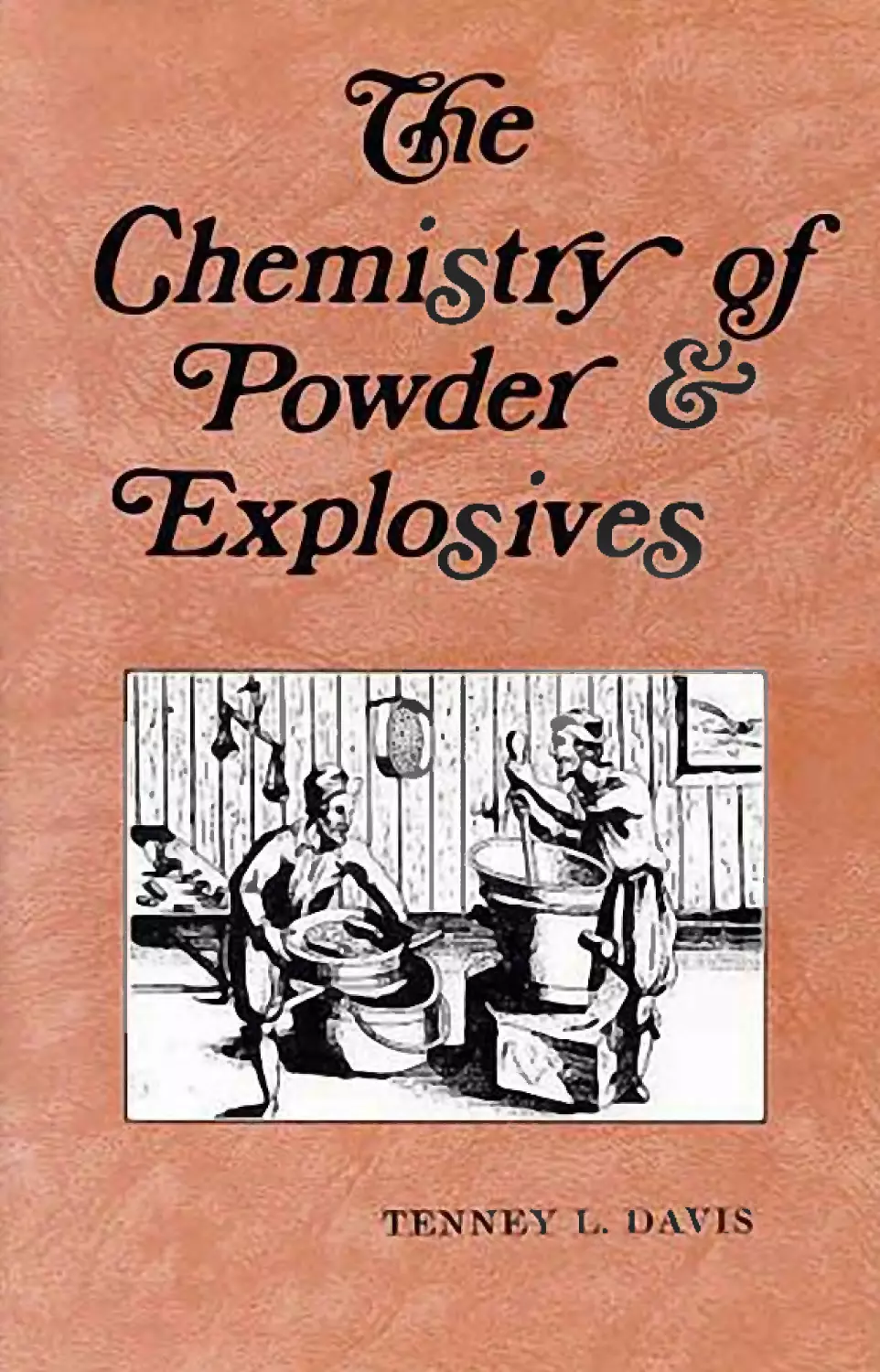


Автор: Davis T.L.
Теги: chemistry explosives materials science powder materials
Текст
.
.
e
. .1, · r.l .
I
, .
." r I
. I ...
.
. . II 1
.... ..
. I
. "
I" III
. I. ;I)
, I
I
-
L
.. I:'
"
.
- .
\ I
"'\..
T , I. I \, '
CHAPTER I
PROPERTIES OF EXPLOSIVES
Definition
An explosive is a material, either a pure single substance or
a mixture of substances, which is capable of producing an ex-
plosion by its own energy.
It seems unnecessary to define an explosion, for everyone
knows what it is-a loud noise and the sudden going away of
things from the place where they have been. Sometimes it may
only be the air in the neighborhood of the material or the gas
from the explosion which goes away. Our simple definition makes
mention of the one single attribute which all explosives possess.
It will be necessary to add other ideas to it if we wish to describe
the explosive properties of any particular substance. For exam-
ple, it is not proper to define an explosive as a substance, or a
mixture of substances, which is capable of undergoing a sudden
transformation with the production of heat and gas. The pro-
duction of heat alone by the inherent energy of the substance
which produces it will be enough to constitute the substance an
explosive. Cuprous acetylide explodes by decomposing into cop-
per and carbon and heat, no gas whatever, but Hie sudden heat
causes a sudden expansion of the air in the neighborhood, and
the result is an unequivocal explosion. All explosive substances
produce heat; nearly all of thcm produce gas. The change is in-
variably accompanied by the liberation of energy. The products
of the explosion represent a lower cnergy level than did the ex-
plosive before it had produced the explosion. Explosives com-
monly require some stimulus, like a blow or a spark, to provoke
them to liberate their energy, that is, to undergo the changp
which produces the explosion, but the stimulus which "sets off"
the explosive does not contribute to the energy of the explosion.
The various stimuli to which explosives respond and the manner;;
of their responses in producing explosions provide a convenient
basis for the classification of these interesting materials.
1
2
PROPERTIES OF EXPLOSIVES
Since we understand an explosive material to be one which is
capable of producing an explosion by its own energy, we have
opened the way to a consideration of diverse possibilities. An
explosive perfectly capable of producing an explosion may
liberate its energy without producing one. Black powder, for
example, may burn in the open air. An explosion may occur
without an explosive, that is, without any material which con-
tains intrinsically the energy needful to produce the explosion.
A steam boiler may explode because of the heat energy which
has been put into the water which it contains. But the energy is
not intrinsic to water, and water is not an explosive. Also, we
have explosives which do not themselves explode. The explosions
consist in the sudden ruptures of the containers which confine
them, as happens in a Chinese firecracker. Fire, traveling along
the fuse (note the spelling) reaches the black powder-mixture
of potassium nitrate, sulfur, and charcoal-which is wrapped
tightly within many layers of paper; the powder burns rapidly
and produces gas. It burns very rapidly, for the heat resulting
from the burning of the first portion cannot get away, but raises
the temperature of the next portion of powder, and a rise of tem-
perature of lOoC. more than doubles the velocity of a chemical
reaction. The temperature mounts rapidly; gas is produced
suddenly; an explosion ensues. The powder burns; the cracker
explodes. And in still other cases we have materials which them-
selves explode. The molecules undergo such a sudden trans-
formation with the liberation of heat, or of heat and gas, that
the effect is an explosion.
Classification of Explosives
I. Propellants or low explosives are combustible materials,
containing within themselves all oxygen needful for their com-
bustion, which burn but do not explode, and function by produc-
ing gas which produces an explosion. Examples: black powder,
smokeless powder. Explosives of this class differ widely among
themselves in the rate at which they deliver their energy. There
are slow powders and fast powders for different uses. The kick
of a !3hotgun is quite different from the persistent push against
the shoulder of a high-powered military rifle in which a slower-
burning and more powerful powder is used.
II. Primary explosives or initiators explode or detonate when
HIGH EXPLOSIVES
3
they are heated or subjected to shock. They do not burn; some-
time e they do not even contain the elements necessary for com-
bustion. The materials themselves explode, and the explosion re-
sults whether they are confined or not. They differ considerably
in their sensitivity to heat, in the amount of heat which they
give off, and in their brisance, that is, in the shock which they
produce when they explode. Not all of them are brisant enough
to initiate the explosion of a high explosive. Examples: mercury
fulminate, lead azide, the lead salts of picric acid and trinitro-
resorcinol, m-nitrophenyldiazonium perchlorate, tetracene, nitro-
gen sulfide, copper acetylide, fulminating gold, nitrosoguanidine,
mixtures of potassium chlorate with red phosphorus or with vari-
ous other substances, the tartarates and oxalates of mercury and
silver.
III. High explosives detonate under the influence of the
shock of the explosion of a suitable primary explosive. They do
not function by burning; in fact, not all of them are combustible,
but most of them can be ignited by a flame and in small amount
generally burn tranquilly and can be extinguished easily. If
heated to a high temperature by external heat or by their own
combustion, they sometimes explode. They differ from primary
explosives in not being exploded readily by heat or by shock, and
generally in being more brisant and powerful. They exert a
mechanical effect upon whatever is near them when they explode,
whether they are confined or not. Examples: dynamite, trinitro-
toluene, tetryl, picric acid, nitrocellulose, nitroglycerin, liquid
oxygen mixed with wood pulp, fuming nitric acid mixed with
nitrobenzene, compressed acetylene and cyanogen, ammonium
nitrate and perchlorate, nitroguanidine.
It is evident that we cannot describe a substance by saying
that it is "very explosive." We must specify whether it is sensi-
tive to fire and to shock, whether it is really powerful or merely
brisant, or both, whether it is fast or slow. Likewise, in the dis-
cussions in the present book, we must distinguish carefully be-
tween sensitivity, stability, and reactivity. A substance may be
extremely reactive chemically but perfectly stable in the absence
of anything with which it may react. A substance 'IIlay be ex-
ploded readily by a slight shock, but it may be stable if left to
itself. Another may require the shock of a powerful detonator
4
PROPERTIES OF EXPLOSIVES
to make it explode but may be subject to spontaneous decom-
position.
The three classes of explosive materials overlap somewhat, for
the behavior of a number of them is determined by the nature
of the stimuli to which they are subjected and by the manner
in which they are used. Black powder has probably never been
known, even in the hideous explosions which have sometimes
occurred at black powder mills, to do anything but burn.
Smokeless powder which is made from colloided nitrocellulose,
especially if it exists in a state of fine subdivision, is a vigorous
high explosive and may be detonated by means of a sufficiently
powerful initiator. In the gun it is lighted by a flame and func-
tions as a propellant. Nitroglycerin, trinitrotoluene, nitroguani-
dine, and other high explosives are used in admixture with
nitrocellulose in smokeless powders. Fulminate of mercury if
compressed very strongly becomes "dead pressed" and loses its
power to detonate from flame, but retains its power to burn, and
will detonate from the shock of the explosion of less highly com-
pressed mercury fulminate. Lead azide, however, always explodes
from shock, from fire, and from friction.
Some of the properties characteristic of explosives may be
demonstrated safely by experiment.
A sample of commercial black powder of moderately fine granulation,
say FFF, may be poured out in a narrow train, 6 inches or a foot lorig,
on a sheet of asbestos paper or a wooden board. When one end of the
train is ignited, the whole of it appears to burn at one time, for the
flame travels along it faster than the eye can follow. Commercial black
powder is an extremely intimate mixture; the rate of its burning is
evidence of the effect of intimacy of contact upon the rate of a chemical
reaction. The same materials, mixed together as intimately as it is
possible to mix them in the laboratory, will burn much more slowly.
Six parts by weight of potassium nitrate, one of sulfur (roll brim-
stone), and one of soft wood (willow) charcoal are powdered separately
and passed through a silk bolting-cloth. They are then mixed, ground
together in a mortar, and again passed through the cloth; and this
process is repeated. The resulting mixture, made into a train, burns
fairly rapidly but by no means in a single flash. The experiment is most
convincing if a train of commercial black powder leads into a train of
this laboratory powder, and the black powder is ignited by means of a
piece of black match leading from the end of the train and extending
beyond the edge of the surface on which the powder is placed. The
HIGH EXPLOSIVES
5
black match may be ignited easily by a flame, whereas black powder on
a flat surface is often surprisingly difficult to light.
Black match may be made conveniently by twisting three or four
trands of fine soft cotton twine together, impregnating the resulting
ord with a paste made by moistening meal powder 1 with water, wiping
off the excess of the paste, and drying while the cord is stretched over
a frame. A slower-burning black match may be made from the labora-
tory powder described above, and is satisfactory for experiments with
explosives. The effect of temperature on the rate of a chemical reaction
may be demonstrated strikingly by introducing a 12-inch length of black
match into a lO-inch glass or paper tube (which need not fit it tightly);
when the match is ignited, it burns in the open air at a moderate rate,
but, as soon as the fire reaches the point where the tube prevents the
escape of heat, the flame darts through the tube almost instantaneously,
and the gases generally shoot the burning match out of the tube.
Cuprous acetylide, of which only a very small quantity may be pre-
pared safely at one time, is procured by bubbling acetylene into an
ammoniacal solution of cuprous chloride. It precipitates as a brick-red
powder. The powder is collected on a small paper filter and washed with
water. About 0.1 gram of the material, stili moist, is transferred to a
small iron crucible--the rest of the cuprous acetylide ought to be de-
stroyed by dissolving in dilute nitric acid-and the crucible is placed
on a triangle over a small flame. As soon as the material has dried out,
it explodes, with a loud report, causing a dent in the bottom of the
crucible.
A 4-inch filter paper is folded as if for filtration, about gram of
FFF black powder' is introduced, a 3-inch piece of black match it> in-
serted, and the paper is twisted in such manner as to hold the powder
together in one place in contact with the end of the match. The black
match is lighted and the package is dropped, conveniently, into an
empty pail. The powder burns with a hissing sound, but there is no
explosion for the powder was not really confined. The same experiment
with about 1 gram of potassium picrate gives a loud explosion. All
metallic picrates are primary explosives, those of the alkali metals being
the least violent. Potassium picrate may be prepared by dissolving
potassium carbonate in a convenient amount of water, warming almost
t boiling, adding picric acid in small portions at a time as long as it
dIssolves with effervescence, cooling the solution, and collecting the
crystals and drying them by exposure to the air. For safety's sake,
1 Corning mill dust, the most finely divided and intimately incorporated
black powder which it is possible to procure. Lacking this, black sporting
powder may be ground up in small portions at a time in a porcelain
mortar.
6
PROPERTIES OF EXPLOSIVES
quantities of more than a few gram, ought to be kept under water, in
which the substance is only slightly soluble at ordinary temperatures.
About a gram of trinitrotoluene or of picric acid is heated in a por-
celain crucible. The substance first melts and gives off combustible
vapors which hurn when a flame is applied but go out when the flame
is removed. A small quantity of trinitrotoluene, say 0.1 gram, may
actually be sublimed if heated cautiously in a test tube. If heated
quickly and strongly, it decomposes or explodes mildly with a "zishing"
sound and with the liberation of soot.
One gram of powdered picric acid and as much by volume of litharge
(PbO) are mixed carefully on a piece of paper by turning the powders
over upon themselves (not by stirring). The mixture is then poured in
a small heap in the center of a clean iron sand-bath dish. This is set
upon a tripod, a lighted burner is placed beneath it, and the operator
retires to a distance. As soon as the picric acid melts and lead picrate
forms, the material explodes with an astonishing report. The dish is
badly dented or possibly punctured.
A Complete Round of Ammunition
The manner in which explosives of all three classes are brought
into use will be made clearer by a consideration of the things
Fuze
FIOURE 1. Diagram of an Assembled Round of High-Explosive Ammu-
nition. The picture is diagrammatic, for the purpose of illustrating the
functions of the various parts, and does not correspond exactly to any
particular piece of ammunition.
which happen when a round of H.E. (high-explosive) ammuni-
tion is fired. The brass cartridge case, the steel shell with its
copper driving band and the fuze screwed into its nose are repre-
sented diagrammatically in the accompanying sketch. Note the
spelling of fuze: a fuze is a device for initiating the explosion of
high-explosive shells or of bombs, shrapnel, mines, grenades, etc.;
a fuse is a device for communicating fire. In cases where the shell
is expected to penetrate armor plate or other obstruction, and
not to explode until after it has penetrated its target, the nose
A COMPLETE ROUND OF AMMUNITION
7
f the shell is pointed and of solid steel, and the fuze is screwed
? to the base of the shell-a base-detonating fuze. The fuze
lllhich we wish here to discuss is a point combination fuze, point
;ecause it is at the nose of the shell, and combination because it
is designed to explode the shell either after a definite interval of
flight or immediately on impact with the target.
The impact of the firing pin or trigger upon the primer cap in
the base of the cartridge case produces fire, a quick small spurt
of flame which sets fire to the black powder which is also within
the primer. This sets fire to the powder or, in the case of bagged
charges, to the igniter-and this produces a large hot flame which
sweeps out into the chamber of the gun or cartridge, sweeps
around the large grains of smokeless powder, and sets fire to them
all over their surface. In a typical case the primer cap contains
a mixture of mercury fulminate with antimony sulfide and potas-
sium chlorate. The fulminate explodes when the mixture is
crushed; it produces fire, and the other ingredients of the com-
position maintain the fire for a short interval. The igniter bag in
our diagram is a silk bag containing black powder which takes
fire readily and burns rapidly. The igniter and the bag contain-
ing the smokeless powder are made from silk because silk either
burns or goes out-and leaves no smoldering residue in the bar-
rel of the gun after the shot has been fired. For different guns
and among different nations the igniters are designed in a variety
of ways, many of which are described in the books which deal
with guns, gunnery, and ammunition. Sometimes the igniter
powder is contained in an integral part of the cartridge case. For
small arms no igniter is needed; the primer ignites the propellant.
For large guns no cartridge case is used; the projectile and the
pr?pelling charge are loaded from, the breech, the igniter bag
bemg sewed or tied to the base end of the bag which contains
the powder, and the primer being fitted in a hole in the breech-
block by which the gun is closed.
T e smokeless powder in our diagram is a dense, progressive-
bur llng, colloided straight nitrocellulose powder, in cylindrical
grams with one or with seven longitudinal perforations. The
fl.a e from the igniter lights the grains, both on the outer surfaces
which commence to burn inward and in the perforations which
c Iilmence to enlarge, burning outward. The burning at first is
s ow. As the pressure increases, the projectile starts to move.
8
PROPERTIES OF EXPLOSIVES
The rifling in the barrel of the gun bites into the soft COpper
driving band, imparting a rotation to the projectile, and the rate
of rotation increases as the projectile approaches the muzzle
As heat accumulates in the chamber of the gun, the powder burns
faster arid faster; gas and heat and pressure are produced for
some time at an accelerated rate, and the projectile acquires
acceleration continuously. It has its greatest velocity at the
moment when it leaves the muzzle. The greatest pressure, how.
ever, occurs at a point far back from the muzzle where the gun is
of correspondingly stronger construction than at its open end. The
duration of the burning of the powder depends upon its web thick-
ness, that is, upon the thickness between the single central
perforation and the sides of the cylindrical grain, or, in the
multiperforated powders, upon the thickness between the per-
forations. The powder, if properly designed, is burned com-
pletely at the moment when the projectile emerges from the
muzzle.
The combination fuze contains two primer caps, and devices
more or less free to move within the fuze, by which these may
be fired. When the shell startE. to move, everything within it
undergoes setback, and tends to lag because of its inertia. The
fuze contains a piece of metal with a point or firing pin on its
rearmost end, held in place by an almost complete ring set into
its sides and in the sides of the cylindrical space through which
it might otherwise move freely. This, with its primer cap, con-
stitutes the concussion element. The setback causes it to pull
through the ring; the pin strikes the cap; fire is produced and
communicates with a train of slow-burning black powder of spe-
cial composition (fuze powder) the length of which has been pre
vioosly adjusted by turning the time-train rings in the head of
the fuze. The powder train, in a typical case, may burn for any
particular interval up to 21 seconds, at the end of which time
the fire reaches a chamber or magazine which is filled with ordi-
nary black powder. This burns rapidly and produces a large
flame which strikes through to the detonrtor, containing mercury
fulmmate or lead azide, which explodes and causes the shell to
detonate while it is in flight. The head of the fuze may also be
adi.usted in such manner that the fire produced by the concussion
-element will finally burn to 11 dead end, and the shell in that case
A COMPLETE ROUND OF AMMUNITION
9
'n explode only in consequence of the action of the percussion
I ment when it hits the target.
e hen the shell strikes any object and loses velocity, every-
thing within it still tends to ove forward. The percussion ele-
ment consists of a metal cyhnder, free to move backward and
forward through a short distance, and of a primer cap, opposite
the forward end of the cylinder and set into the metal in such
fashion that the end of the cylinder cannot quite touch it. If this
end of the cylinder should carry a firing pin, then it would fire
the cap, and this might happen if the shell were dropped acci-
dentally-with unfortunate results. When the shell starts to move
in the gun, the cylinder lags back in the short space which is
allotted to it. The shell rotates during flight. Centrifugal force,
acting upon a mechanism within the cylinder, causes a firing pin
to rise up out of its forward end. The fuze becomes armed. When
the shell meets an obstacle, the cylinder rushes forward, the pin
strikes the cap, fire is produced and communicates directly to
the black powder magazine and to the detonator-and the shell
is exploded forthwith.
FIGURE 2. Cro ss Sectl ' on of a 155- . h E h
mm. Hlg - xpIosive S ell Loaded
with TNT.
. e high explosive in the shell must be so insensitive that it
::1 tolerate the shock of setback without exploding. Trinitro-
IIli ne (TNT) is generally considered to be satisfactory for all
I ary purposes, E'xcept for armor-piercing shells. The explosive
:U8\ be tightly packed within the shell. There must be no cavi-
th es , est the setback cause the explosive to move violently across
th: fa p and to explode prematurely while the shell is stiil within
deton:7: 1 of the .gun, or as is more likely, to pull away from the
".. . . l' and fall to be exploded bv it.
l rlDltrotolu h . h .
ene, w 1(' melts below the boiling point of water,
10
PROPERTIES OF EXPLOSIVES
is generally loaded by pouring the liquid explosive into the shell,
Since the liquid contracts when it freezes, and in order to pre.
vent cavities, the shell standing upon its base is supplied at it
open end with a paper funnel, like the neck of a bottle, and the
liquid TNT is poured until the shell and the paper funnel are
both fulL After the whole has cooled, the funnel and any TNT
which is in it are removed, and the space for the booster is bored
out with a drill. Cast TNT is not exploded by the explosion of
fulminate, which, however, does cause the explosion of granular
and compressed TNT. The explosion of granular TNT will ini-
tiate the explosion of cast TNT, and the granular material may
be used as a booster for that purpose. In practice, tetryl is gen-
erally preferred as a booster for military use. It is more easily
detonated than TNT, more brisant, and a better initiator.
Boosters are used even with high explosives which are detonated
by fulminate, for they make it possible to get along with smaller
quantities of this dangerous material.
Propagation of Explosion
When black powder burns, the first portion to receive the fire
undergoes a chemical reaction which results in the production of
hot gas. The gas, tending to expand in all directiOils from the
place where it is produced, warms the next portion of black pow-
der to the kindling temperature. This then takes fire and burns
with the production of more hot gas which raises the tempera-
ture of the next adjacent material. If the black powder is con-
fined, the pressure rises, and the heat, since it cannot escape,
is communicated more rapidly through the mass. Further, the
gas- and heat-producing chemical reaction, like any other chem-
ical reaction, doubles its rate for every 10 0 (approximate) rise
of temperature. In a confined space the combustion becomes ex-
tremely rapid, but it is still believed to be combustion in the sense
that it is a phenomenon dependent upon the transmission of heat.
The explosion of a primary explosive or of a high explosive,
on the other hand, is believed to be a phenomenon which is de-
pendent upon the transmission of pressure or, perhaps more prop-
erly, upon the transmission of shock. 2 Fire, friction, or shock,
2 The effects of static pressure and of the rate of production of the
pressure have not yet been studied much, nor is there information con-
cerning the pressures which occur within the mass of the explosive while
it is exploding.
DETONATING FUSE
11
ting upon, say, fulminate, in the first instance cause it to
a dergo a rapid chemical transformation which produces hot
u S and the transformation is so rapid that the advancing front
ga,
of the mass of hot gas amounts to a wave of pressure capable of
initiating by its shock the explosion of the next portion of ful-
minate. This explodes to furnish additional shock which explodes
the next adjacent portion of fulminate, and so on, the explosion
advancing through the mass with incredible quickness. In a
standard No.6 blasting cap the explosion proceeds with a veloc-
ity of about 3500 meters per second.
If a sufficient quantity of fulminate is exploded in contact with
trinitrotoluene, the shock induces the trinitrotoluene to explode,
producing a shock adequate to initiate the explosion of a further
portion. The explosive wave traverses the trinitrotoluene with a
velocity which is actually greater than the velocity of the initiat-
ing wave in the fulminate. Because this sort of thing happens,
the application of the principle of the booster is possible. If the
quantity of fulminate is not sufficient, the trinitrotoluene either
does not detonate at all or detonates incompletely and only part
way into its mass. For every high explosive there is a minimum
quantity of each primary explosive which is needed to secure its
certain and complete denotation. The best initiator for one high
explosive is not necessarily the best initiator for another. A high
explosive is generally not its own best initiator unless it happens
to be used under conditions in which it is exploding with its maxi-
mUm velocity of detonation.
Detonating Fuse
Detonating fuse consists of a narrow tube fiIied with high ex-
plosive. When an explosion is initiated at one end by means of
a detonator, the explosive wave travels along the fuse with a
high velocity and causes the detonation of other high explosives
which lie in its path. Detonating fuse is used for procuring the
almost simultaneous explosion of a number of charges.
Detonating fuse is called cordeau detonant in the French lan-
age, and cordeau has become the common American designa-
tion for it. Cordeau has been made from lead tubes filled with
t initrotoluene, from aluminum or block tin tubes filled with pic-
rIc acid, and from tubes of woven fabric filled with nitrocellulose
or with pentaerythrite tetranitrate (PETN). In this country the
Ensign-Bickford Company, at Sims bury, Connecticut, manufac-
12
PROPERTIES OF EXPLOSIVES
tures Cordeau-Bickford, a lead tube filled with TNT, and Prima-
cord-Bickford,3 a tube of waterproof textile filled with finely
powdered PETN. The cordeau is made by filling a large lead
pipe (about 1 inch in diameter) with molten TNT, allowing to
cool, and drawing down in the manner that wire is drawn. The
finished tube is tightly packed with finely divided crystalline
TNT. Cordeau-Bickford detonates with a velocity of about 5200
meters per second (17,056 feet or 3.23 miles), Prima cord-Bickford
with a velocity of about 6200 meters per second (20,350 feet or
3.85 miles). These are not the maximum velocities of detonation
of the explosives in question. The velocities would be greater if
the tubes were wider.
Detonating fuse is fired by means of a blasting cap held snugly
and firmly against its end by a union of thin copper tubing
crimped into place. Similarly, two ends are spliced by holding
them in contact within a coupling. The ends ought to touch each
other, or at least to be separated by not more than a very small
space, for the explosive wave of the detonating fuse cannot be
depended upon to throw its initiating power across a gap of much
more than 1fs inch.
When several charges are to be fired, a single main line of
detonating fuse is laid and branch lines to the several charges
are connected to it. The method by which a branch is connected
to a main line of cordeau is shown in Figures 3, 4, 5, 6, and 7.
The main line is not cut or bent. The end of the branch is slit in
two (with a special instrument designed for this purpose) and
is opened to form a V in the point of which the main line is laid-
and there it is held in place by the two halves of the slit branch
cordeau, still filled with TNT, wound around it in opposite direc-
tions. The connection is made in this manner in order that the
explosive wave, traveling along the main line, may strike the
3 These are not to be confused with Bickford fuse or safety fuse manu-
factured by the same company, which consists of a central thread sur-
rounded by a core of black powder enclosed within a tube of woven
threads, surrounded by various layers of textile, waterproof material,
sheathing, etc. This is miner's fuse, and is everywhere known as Bic:kford
fuse after the Englishman who invented the machine by which such fuse
was first woven. The most common variety burns with a velocity of about
1 foot per minute. When the fire reaches its end, a spurt of flame about
an inch long shoots out for igniting black powder or for firing a blasting
cap.
DETONATING FUSE
13
branch line squarely against the length of the column of TNT,
and so provoke its detonation. If the explosive wave were travel-
ing from the branch against the main line (as laid), it would
FJGURES 3, 4, 5, 6, and 7. Method of Connecting a Branch to a Main
Line of Cordeau. (Courtesy Ensign-Bickford Company.) FIGURE 3. Slit-
ting the Branch Line. FIGURE 4. The Slit End Open. FIGURE 5. The Main
Line in Place. FIGURE 6. Winding the Splice. FIGURE 7. The Finished
Junction.
strike aCross the column of TNT and would shatter it, but would
be less likely to make it explode. For connecting a branch line of
Prirnacord, it is satisfactory to make a half hitch of the end
around the main line.
A circle of detonating fuse around a tree will rapidly strip off
a belt of heavy bark, a device which is sometimes useful in the
14
PROPERTIES OF EXPLOSIVES
control of insect pests. If the detonating fuse is looped succes
sively around a few blocks of TNT or cartridges of dynamit41
and if these are strung around a large tree, the tree may be fellec
very quickly in an emergency. In military operations it may })j
desirable to "deny a terrain to the enemy" without occupying i
oneself, and the result may be accomplished by scattering mustar
gas over the area. For this purpose, perhaps during the night, I
long piece of Primacord may be laid through the area, 10ope4
here and there in circles upon which tin cans of mustard gaj
(actually a liquid) are placed. The whole may be fired, whe]
desired, by a single detonator, and the gas adequately dispersed
Velocity of Detonation
If the quantity of the primary explosive used to initiate th(
explosion of a high explosive is increased beyond the minimum
necessary for that result, the velocity with which the resultinl
explosion propagates itself through the high explosive is corre.
spondingly increased, until a certain optimum is reached, depend-
ing upon the physical state of the explosive, whether cast o.
powdered, whether compressed much or little, upon the width oJ
the column and the strength of the material which confines it
and of course upon the particular explosive which is used. BJI
proper adjustment of these conditions, by pressing the powdered
explosive to the optimum density (which must be determined b1
experiment) in steel tubes of sufficiently large diameter, and b)l
initiating the explosion with a large enough charge of dynamitE!
or other booster (itself exploded by a blasting cap), it is possiblE!
to secure the maximum velocity of detonation. This ultimata
maximum is of less interest to workers with explosives than the
maximum found while experimenting with paper cartridges, and
it is the latter maximum which is generally reported. The physical
state and density of the explosive, and the temperature at which
the determinations were made, must also be noted if the figures
for the velocity of detonation are to be reproducible.
Velocities of detonation were first measured by Berthelot and
Vieille,4 who worked first with gaseous explosives and later with
liquids and solids. They used a Boulenge chronograph the pre-
cision of which was such that they were obliged to employ long
· Berthelot, "Sur la force des matii res explosives," 2 vols., third edition,
Paris, 1883, Vol. 1, p. 133. Cf. Mem. poudres, 4, 7 (1891).
FIGURE 8. Pierre-Eugene Marcellin Berthelot (1827-1907) (Photo by P.
Nadar, Paris). Founder of thermochemistry and the science of explosives.
He synthesized acetylene and benzene from their elements, and alcohol
from ethylene, studied the polyatomic alcohols and acids, the fixation of
nitrogen, the chemistry of agriculture, and the history of Greek, Syriac,
Arabic, and medieval chemistry. He was a Senator of France, Minister
of Public Instruction, Minister of Foreign Affairs, and Secretary of the
Academy of Science , and is buried in the Pantheon at Paris.
16
PROPERTIES OF EXPLOSIVES
columns of the explosives. The Mettegang recorder now com-
monly used for these measurements is an instrument of greater
precisio and makes it possible to work with much shorter
cartridges of the explosive materials. This apparatus consists
essentially of a strong, well-turned and balanced, heavy cylinder
of steel which is rotated by an electric motor at a high but exactly
known velocity. The velocity of its smoked surface relative to a
platinum point which almost touches it may be as much as 100
meters per second. The explosive to be tested is loaded in a
cylindrical cartridge. At a known distance apart two thin copper
wires are passed through the explosive at right angles to the axis
of the cartridge. If the explosive has been cast, the wires are
bound tightly to its surface. Each of the wires is part of a closed
circuit through an inductance, so arranged that, when the circuit
is broken, a spark passes between the platinum point and the
steel drum of the chronograph. The spark makes a mark upon the
smoked surface. When the explosive is now fired by means of a
detonator at the end of the cartridge, first one and then the other
of the two wires is broken by the explosion, and two marks are
made on the rotating drum. The distance between these marks is
measured with a micrometer microscope. The duration of time
which corresponds to the movement of the surface of the rotating
drum through this distance is calculated, and this is the time
which, was required' for the detonation of the column of known
length of explosive which lay between the two wires. From this,
the velocity of detonation in meters per second is computed
easily.
Since a ehronograph is expensive and time-consuming to use,
the much simpler method of Dautriche,5 which depends upon a
comparison of the unknown with a standard previously measured
by the chronograph, finds wide application. Commercial cordeau
is remarkably uniform. An accurately measured length, say 2
meters, of cordeau of known velocity of detonation is taken, its
midpoint is marked, and its ends are inserted into the cartridge
of the explosive which is being tested, at a known distance apart,
like the copper wires in the absolute method (Figure 9). The
middle portion of the loop of cordeau is made straight and is laid
upon a sheet of lead (6-8 mm. thick), the marked midpoint being
G Mem. poudres, 14, 216 (1907): Compo rend., 143, 641 (1906).
VELOCITY OF DETON A TION
17
placed upon a line scratched in the lead plate at right angles to
the direction of the cordeau. When the detonator in the end of
the cartridge of explosive is fired, the explosive wave first en-
counters one end of the cordeau and initiates its explosion from
this end, then proceeds through the cartridge, encounters the
other end of the cordeau, and initiates its explosion from that
end. The explosive waves from the two ends cf the cordeau meet
one another and mark the point of their meeting by an extra-
deep, sharp furrow in the lead plate, perhaps by a hole punched
point where explosive waves meet
Mid point of cordeau
Cordeau
FIGURE 9. Dautriche Method of Measuring Velocity of Detonation. From
the point A the explosion proceeds in two directions: (1) along the
cordeau (of known velocity of detonation), and (2) through the cartridge
of explosive which is being tested and then along the cordeau. When the
two waves in the cordeau meet, they make a mark in the lead plate upon
which the cordeau is resting.
through it. The distance of this point is measured from the line
where the midpoint of the cordeau was placed. Call this distance
d. It is evident that, from the moment when the near end of the
cordeau started to detonate, one explosive wave traveled in
the cordeau for a distance equal to one-half the length of the
cordeau plus the distance d, while the other explosive wave, dur-
ing the same interval of time, traveled in the explosive under
examination a distance equal to the distance between the inserted
nds of cordeau, then in the cordeau a distance equal to one-half
Its length minus the distance d. The times required for the passage
of the explosive waves in the cordeau are calculated from the
known velocity of detonation of the cordeau used; thence the
time required for the detonation of the column of explosive which
18
PROPERTIES OF EXPLOSIVES
stood between the ends of the cordeau; thence the velocity of
detonation in meters per second.
Velocities of detonation have recently been measured by high-
speed photography of the explosions through a slit, and by other
devices in which the elapsed times are measured by means of a
cathode-ray oscillograph.
The Munroe Effect
The mark which explosive waves, traveling toward each other
on the same piece of cordeau, make at the point where they meet
is evidently due to the fact that they spread out sideways at the
point of their encounter. Their combined forces produce an effect
greater than either alone could give. The behavior of jets of
water, shot against each other under high pressure, supplies a
very good qualitative picture of the impact of explosive waves.
If the waves meet at an angle, the resultant wave, stronger than
either, goes off in a direction which could be predicted from a
consideration of the parallelogram of forces. This is the explana-
tion of the Munroe effect.
Charles Edward Munroe,6 while working at the Naval Torpedo
Station at Newport, discovered in 1888 that if a block of gun-
cotton with letters countersunk into its surface is detonated with
its lettered surface against a steel plate, the letters are indented
into the surface of the steel. Similarly, if the letters are raised
above the surface of the guncotton, by the detonation they are
reproduced in relief on the steel plate, embossed and raised above
the neighboring surface. In short, the greatest effects are pro-
duced on the steel plate at the points where the explos ve material
stands away from it, at the points precisely where explosive
waves from different directions meet and reinforce each other.
Munroe found that by increasing the depth of the concavity in
the explosive he was able to produce greater and greater effects
on the plate, until finally, with a charge which was pierced com-
pletely. through, he was able to puncture a hole through it.7 By
introducing lace, ferns, coins, etc., between the flat surface of a
6 For biographical notice by C. A. Browne, see J. Am. Chem. Soc., 61,
731 (1939).
7 Cf. article by Marshall, "The Detonation of Hollow Charges," J. Soc.
Chem. Ind., 29, 35 (1920).
FIGURE 10. Charles Edward Munroe (1849-1938). Leader in the develop-
ment of explosives in the United States. Invented indurite, a variety of
smokeless powder, and discovered the Munroe effect. Professor of chemis-
try at the U. S. Naval Academy, Annapolis, Maryland, 1874-1886; chemist
at the Naval Torpedo Station and Naval War College, Newport, Rhode
Island, 1886-1892; professor of chemistry at George Washington Univer-
sity, 1892-1917; and chief explosives chemist of the U. S. Bureau of Mines
in Washington, 1919-1933. Author and co-author of many very valuable
PUblications of the Bureau of Mines.
20
PROPERTIES OF EXPLOSIVES
block of explosive and pieces of armor plate, Munroe was able 1:4
secure embossed reproductions of these delicate materials. Sevi
eral fine examples of the Munroe effect, prepared by Munrol
himself, are preserved in a fire screen at the Cosmos Club iI
Washington.
The effect of hollowed charges appears to have been rediSj
covered, probably independently, by Egon Neumann, who claime
it as an original discovery, and its application in explosive tech.
nique was patented by the Westfalisch-Anhaltische Sprengstoff,
FIO. 11 FIO. 12
FIOURES 11 and 12. Munroe Effect. (Courtesy Trojan Powder Company)
FIGURE 11. Explosive Enclosed in Pasteboard Wrapper. Note that th.
letters incised into the surface of the explosive are in mirror writing, lik.
words set in type, in order that the printing may be normal. A steel pIaU
after a charge like that pictured was exploded against it, the incised S\ll"'l
face being next to the plate. FIGURE 12. A section of steel shafting afte!
a charge like that represented in FIGURE 11 had been exploded upon it.
the incised surface of the explosive being next to the steel.
A. G. in 1910. 8 Neumann, working with blocks of TNT having
conical indentations but not complete perforations, found that
such blocks blew holes through wrought-iron plates, whereas
solid blocks of greater actual weight only bent or dented them.
It has been recommended that torpedoes be loaded with charges
hollowed in their forward ends. Advantage is taken of the Munroe
effect in the routine blasting of oil wells, and, intentionally or
not, by every explosives engineer who initiates an explosion by
means of two or more electric blasting caps, fired simultaneously,
at different positions within the same charge.
S Ger. Pat. Anm. W. 36,269 (1910); Brit. Pat. 28,030 (1911). Neumann,
Z. angew. Chem., 2238 (1911); Z. ges. Schiess- u. Sprengstofjw., 183 (1914).
SENSITIVITY TESTS
21
sensitivity Tests
Among the important tests which are made on explosives are
the determinations of their sensitivity to impact and to tempera-
ture, that is, of the distance through which a falling weight
must drop upon them to cause them to explode or to inflame, and
of the temperatures at which they inflame, explode, or "puff"
spontaneously. At different places different machines and appa-
ratus are used, and the numerical results differ in consequence
from laboratory to laboratory.
For the falling weight or impact or drop test a 2-kilogram
weight is generally used. In a typical apparatus the explosive
undergoing the test is contained in a hole in a steel block, a steel
plunger or piston is pressed down firmly upon it, and it is directly
upon this plunger that the weight is dropped. A fresh sample is
taken each time, and material which has not exploded from a
single impact is discarded. A drop of 2 to 4 cm. will explode
mercury fulminate, one of about 70 to 80 cm. will cause the
inflammation of black powder, and one. of 60 to 180 cm. will cause
the explosion of TNT according to the physical state of the
sample.
For determining the temperature of ignition, a weighed amount
of the material is introduced into a copper capsule (a blasting
cap shell) and this is thrust into a bath of Wood's metal previ-
ously heated to a known temperature. If no explosion occurs
within 5 seconds (or other definite interval), the sample is re-
moved, the temperature of the bath is raised 50 (usually), and a
fresh sample in a fresh copper capsule is tried. Under these con-
ditions (that is, within a 5-second interval), 4F black powder
takes fire at 190 0 =i= 50, and 30-caliber straight nitrocellulose
smokeless powder at 315 0 =i= 50. In another method of carrying
out the test, the capsule containing the explosive is introduced
into the metal bath at 100 0 , the temperature is raised at a steady
and regulated rate, and the temperature at which the explosive
decomposition occurs is noted. When t e temperature is raised
more rapidly, the inflammation occurs at a higher temperature,
as indicated by the following table.!! The fact that explosives are
ll10re sensitive to shock and to friction when thev are warm is
doubtless due to the same ultimate causes. .
9 Van Duin, Dissertation, Utrecht, 1918, p. 89. The experiments were
carried out with O.l-gram samples in glass tubes.
22
PROPERTIES OF EXPLOSIVES
TEMPERATURE OF IGNITION
Heated from 100 0
at 20 0 per minute at 50 per minute
Trinitrotoluene.... . . . . . . . . . . . 321 0 304 0
Picric acid... . . . . . . . . . . . . . . . . 316 0 309 0
Tetryl. . . . . . . . . . . . . . . . . . . . . . 196 0 187 0
Hexanitrodiphenylamine. . . . . . 258 0 250 0
Hexanitrodiphenyl sulfide..... . 319 0 302 0
Hexanitrodiphenyl sulfone. . . . . 308 0 297 0
Substances like trinitrotoluene, pIcrIC acid, and tetryl, which
dre intrinsically stable at ordinary temperatures, decompose
slowly if they are heated for considerable periods of time at tern..
peratures below those at which they inflame. This, of course, ill
a matter of interest, but it is a property of all samples of the
substance, does not vary greatly between them, and is not mad,
the object of routine testing. Nitrocellulose and many nitri(l
esters, however, appear to be intrinsically unstable, subject to It
spontaneous decomposition which is generally slow but may be.
accelerated greatly by the presence of impurities in the sample.
For this reason, nitrocellulose and smokeless powder are regu-
larly subjected to stability tests for the purpose, not of establish-
ing facts concerning the explosive in question, but rather for
determining the quality of the particular sample. tO
10 The routine tests which are carried out on military explosives art:
described in U. S. War Department Technical Manual TM9-2900, "Mili-
tary Explosives." The testing of explosives for sensitivity, explosive power,
etc., is described in the Bulletins and Technical Papers of the U. S. Bureau
of Mines. The student of explosives is advised to secure from the Super-
intendent of Documents, Washington, D. C., a list of the publications of
the Bureau of Mines, and then to supply himself with as many as may
be of interest, for they are sold at very moderate prices. The followinlll
are especially recommended. Several of these are now no longer procur-
able from the Superintendent of Documents, but they may be found ill
many libraries.
Bull. 15. "Investigations of Explosives Used in Coal Mines," by Cia,,"
ence Hall, W. O. Snelling, and S. P. Howell.
Bull. 17. "A Primer on Explosives for Coal Miners," by Charles E.
Munroe and Clarence Hall.
Bull. 48. "The Selection of Explosives Used in Engineering and Mining
Operations," by Clarence Hall and Spencer P. Howell.
Bull. 59. "Investigations of Detonators and Electric Detonators," bY'
Clarence Hall and Spencer P. Howell.
Bull. 66. "Tests of Permissible Explosives," by Clarence Hall and Spen-
cer P. Howell.
TESTS OF EXPLOSIVE POWER AND BRISANCE 23
Tests of Explosive Power and Brisance
For estimating the total energy of an explosive, a test in the
manometric bomb probably supplies the most satisfactory single
indication. It should be remembered that total energy and actual
effectiveness are different matters. The effectiveness of an ex-
plosive depends in large part upon the rate at which its energy is
liberated.
The high pressures developed by explosions were first meas-
ured by means of the Rodman gauge, in which the pressure
caused a hardened-steel knife edge to penetrate into a disc of
soft copper. The depth of penetration was taken as a measure of
the pressure to which the apparatus had been subjected. This
gauge was improved by Nobel, who used a copper cylinder placed
between a fixed and a movable steel piston. Such crusher gauges
are at present used widely, both for measuring the maximum
pressures produced by explosions within the confined space of the
manometric bomb and for determining the pressures which exist
in the barrels of guns during the proof firing of powder. The
small copper cylinders are purchased in large and uniform lots,
their deformations under static pressures are determined and
plotted in a chart, and the assumption is made that the sudden
pressures resulting from explosions produce the same deforma-
tions as static pressures of the same magnitudes. Piezoelectric
gauges, in which the pressure on a tourmaline crystal or on discs
of quartz produces an electromotive force, have been used in
work with manometric bombs and for measuring the pressures
which exist in the chambers of guns. Other gauges, which depend
Bull. BO. "A Primer on Explosives for Metal Miners and Quarrymen,"
by Charles E. Munroe and Clarence Hall.
Bull. 346. "Physical Testing of Explosives at the Bureau of Mines Explo-
sives Experiment Station, Bruceton, Pa.," by Charles E. Munroe and J. E.
Tiffany.
Tech. Paper 125. "The Sand Test for Determining the Strength of De-
tonators," by C. G. Storm and W. C. Cope.
Tech. Paper 234. "Sensitiveness of Explosives to Frictional Impact," by
S. P. Howell.
On this subject the book "Testing Explosives" by C. E. Bichel, English
translation by A. Larnsen, London, 1905, will be found of value, as will
the book of Berthelot, already cited, and many. important papers in
emorial des poudres and Zeitschrift fur das gesamte Schiess- und Spreng-
8toffwesen.
24
PROPERTIES OF EXPLOSIVES
upon the change of electrical resistance of a conducting wire, are
beginning to find application.
The manometric bomb is strongly constructed of steel and has
a capacity which is known accurately. In order that' the pressure
resulting from the explosion may have real significance, the
density of loading, that. is, the number of grams of explosive per
cubic centimeter of volume, must also be reported. The pressures
produced by the same explosive in the same bomb are in general
not directly proportional to the density of loading. The tempera-
tures in- the different cases are certainly different, and the com-
positions of the hot gaseous mixtures depend upon the pressure"
which exist upon them and determine the conditions of the
equilibria between their components. The water in the gases can
be determined, their volume and pressure can be measured at
ordinary temperature, and the temperature of the explosion can
be calculated roughly if the assumptions are made that the gas
laws hold and that the composition of the cold gases is the same
as that of the hot. If the gases are analyzed, and our best
knowledge relative to the equilibria which exist between the com-
ponents is assumed to be valid for the whole temperature range,
then the temperature produced by the explosion can be calculated
with better approximation.
Other means of estimating and comparing the capacity of
explosives for doing useful work are supplied by the tests with the
ballistic pendulum ll and by the Trauzl and small lead block
tests. The first of these is useful for comparing a new commercial
explosive with one which is standard; the others give indications
which are of interest in describing both commercial explosives
and pure explosive substances.
In the Trauzl lead block test (often called simply the lead
block test) 10 grams of the explosive, wrapped in tinfoil and
stemmed with sand, is exploded by means of an electric detonator
in a cylindrical hole in the middle of a cylindrical block of lead,
and the enlargement of the cavity, measured by pouring in water
from a graduate and corrected for the enlargement which is
ascribable to the detonator alone, is reported. For the standard
test, the blocks are cast from chemically pure lead, 200 mm. in
height and 200 mm. in diameter, with a central hole made bv
the mold, 125 mm. deep and 25 mm. in diameter: The test is
11 U. S. Bur. Mines Bull. 15, pp. 79-82.
TESTS OF EXPLOSIVE POWER AKD BRISANCE 25
applicable only to explosives which detonate. Black powder and
other explosives which burn produce but little effect, for the gases
blowout the stemming and escape. The test is largely one of
brisance, but for explosives of substantially equal brisance it
gives some indication of their relative power. An explosive of
great brisance but little power will create an almost spherical
pocket at the bottom of the hole in the block, while one of less
brisance and greater power will enlarge the hole throughout its
, c __o o__tI E o.
FIGURE 13. Lead Block Tests (above), and Trauzl Tests (below). (Cour-
tesy U. S. Bureau of Mines.)
length and widen its throat at the top of the block. The form of
t e hole, then, as shown by sectioning the block, is not without
sIgnificance. The Trauzl test does not give reliable indications
with explosives which contain aluminum (such as ammonal) or
with others which produce very high temperatures, for the hot
gases erode the metal, and the results are high.
A small Trauzl block is used for testing commercial detonators.
t Another test, known as the small lead block test, is entirely a
-:r. t of brisance. As the test is conducted at the U. S. Bureau of
Ines,12 a lead cylinder 38 mm. in diameter and 64 mm. high is
set Upright upon a rigid steel support; a disc of annealed steel
II Ibid., p. 114.
26
PROPERTIES OF EXPLOSIVES
38 mm. in diameter and 6.4 mm. thick is placed upon it; a strip
of manila paper wide enough to extend beyond the top of the
composite cylinder and to form a container at its upper end is
wrapped and secured around it; 100 grams of explosive is placed
FmURE 14. Small Trauzl Tests of Detonators. (Courtesy Western Cartridge
Company.)
in this container and fired, without tamping, by means of an
electric detonator. The result is reported as the compression of
the lead block, that is, as the difference between its height before
and its height after the explosion. The steel disc receives the
force of the explosion and transmits it to the lead cylinder. With-
FmURE 15. Aluminum Plate and Lead Plate Tests of Detonators. (Courtesy
Atlas Powder Company.)
out it, the lead cylinder would be so much deformed that its
height could not be measured.
In the lead plate test of detonators, the detonator is fired while
standing upright on a plate of pure lead. Plates 2 to 6 mm. thick
are used, most commonly 3 mm. A good detonator makes a clean-
cut hole through the lead. The metal of the detonator case is
blown into small fragments which make fine and characteristic
markings on the lead plate radiating away from the place where
TESTS OF EXPLOSIVE POWER AND BRISANCE 27
the detonator stood. With a good detonator, the surface of the
lead plate ought to show no places where it has been torn roughly
FIGURE 16. Effect of Detonator on Lead Plate 10 em. Distant from Its End.
The diameter of the hole is about 1 ¥2 times the diameter of the detonator
which was fired. The lead has splashed up around the hole in much the
same fashion as placid water splashes when a pebble is dropped ipto it.
Note the numerous small splashes on the lead plate where it was struck
by fragments of the detonator casing.
by large fragments of the case. Similar tests are often carried out
with plates of aluminum.
CHAPTER II
BLACK POWDER
" The discovery that a mixture of potasf>ium nitrate, charcoal,
and sulfur is capable of doing useful mechanical work is one of
the most important chemical discoveries or inventions of all
time;' It is to be classed with the discovery or invention of pottery,
which occurred before the remote beginning of history, and with
that of the fixation of nitrogen by reason of which the ecology
of the human race will be different in the future from what it has
been throughout the time that is past. Three great discoveries
signalized the break-up of the Middle Ages: the discovery 01
America, which made available new foods and drugs, new natural
resources, and new land in which people might multiply, prosper,
and develop new cultures; the discovery of printing, which made
possible the rapid and cheap diffusion of knowledge; and the
discovery of the controllable force of gunpowder, which made
huge engineering achievements possible, gave access to coal and
to minerals within the earth, and brought on directly. the age of
iron and steel and with it the era of machines and of rapid trans-
portation and communication. It is difficult to judge which of
these three inventions has made the greatest difference to man-
kind.
I Black powder and similar mixtures were used in incendiary
compositions, and in pyrotechnic devices for amusement and foIl
war, long before there was any thought of applying their energy
usefully for the production of mechanical work:> The invention
of guns-and it seems to be this invention which is meant when
"the discovery of gunpowder" is mentioned-did not follow imme-
diately upon the discovery of the composition of black powder.
It is possible that other applications antedated it, that black
powder was used in petards for blowing down gateways, draw-
bridges, etc., or in simple operations of blasting, before it was
used for its ballistic effect.
2i
BOERHAA VE ON BLACK POWDER
29
Berthold Schwarz
The tradition that the composition of black powder was dis-
covered and that guns were invented about 1250 (or 1350 or even
later) by Berthold Schwarz, a monk of Freiburg i. Br., in Ger-
many, is perpetuated by a monument at that place. Constantin
Anklitzen assumed the name of Berthold when he joined the
Franciscan order, and was known by his confreres as der
schwarzer Berthold because of his interest in black magic. The
records of the Franciscan chapter in Freiburg were destroyed or
scattered before the Reformation, and there are no contempo-
raneous accounts of the alleged discovery. Concerning the absence
of documents, Oesper 1 says:
If he is a purely legendary inventor the answer is obvious.
However, history may have taken no interest in his doings
because guns were said to be execrable inventions and their
employment (except against the unbelievers) was decried as
destructive of manly valor and unworthy of an honorable
warrior. Berthold was reputed to have compounded powder
with Satan's blessing, and the clergy preached that as a co-
worker of the Evil One he was a renegade to his profession
and his name should be forgotten. There is a tradition that
he was imprisoned by his fellow monks, and some say he
made his diabolic ipvention while in prison. According to
another legend, Berthold blew himself up while demonstrat-
ing the power of his discovery; another states that he was
executed.-
The lovers of fine points may argue over Berthold's exist-
ence, but it can be historically established that Freiburg in
t4e fourteenth and fifteenth centuries was a flourishing cen-
ter for the casting of cannon and the training of gunners.
Boerhaave on Black Powder
Although black powder has done immeasurable good through
its civil uses, it has nevertheless been regarded as an evil dis-
COvery because of the easy and unsportsmanlike means which it
provides for the destruction of lifer Boerhaave, more than two
centuries ago, wrote in the modern spirit on the importance of
chemistry in war and condemned black powder 2 in a manner
10esper, J. Chem. Education, 16, 305-306 (1939).
L O! Boerhaave, "A New Method of Chemistry," etc., trans. Peter Shaw,
L on.don, 1753, Vol. I, pp. 189-191. The quoted passage corresponds to the
c tm .of Vol. I, pp. 99-101, of the first edition of Boerhaave's "EIementa
emlae," Leiden. 1732.
30
BLACK POWDER
similar to that in which some of our latest devices of warfare
have been decried in public print.
It were indeed to be wish'd that our art had been less in-
genious, in contriving means destructive to mankind; we
mean those instruments of war, which were unknown to the
ancients, and have made such havoc among the moderns.
But as men have always been bent on seeking each other's
destruction by continual wars; and as force, when brought
against us, can only be repelled by force; the chief support
of war, must, after money, be now sought in chemistry.
Roger Bacon, as early as the twelfth century,3 had found
out gunpowder, wherewith he imitated thunder and light-
ning; but that age was so happy as not to apply so extraor-
dinarv a discovery to the destruction of mankind. But two
ages afterwards, Barthol. Schwartz,4 a German monk and
chemist, happening by some accident to discover a prodigious
power of expanding in some of this powder which he had
made for medicinal uses, he apply'd it first in an iron barrel,
and soon after to the military art, and taught it to the
Venetians. The effect is, that the art of war has since that
time turned entirely on this one chemical invention; so that
the feeble boy may now kill the stoutest hero: Nor is there
anything, how vast and solid soever, can withstand it. By a
thorough acquaintance with the power of this powder, that
intelligent Dutch General Cohorn quite alter'd the whole art
of fighting; making such changes in the manner of fortifica-
tion, that places formerly held impregnable, now want de-
fenders. In effect, the power of gun-powder is still more to be
fear'd. I tremble to mention the stupendous force of another
3 Bacon lived in the thirteenth century; we quote the passage as it is
printed.
4 Shaw's footnote (op. cit., p. 190) states:
What evidently shews the ordinary account of its invention false, is,
that Schwartz is held to have first taught it to the Venetians in the year
1380; and that they first used it in the war against the Genoe.se, in a
place antiently called Fossa Caudeana., now Chioggia. For we find men-
tion of fire arms much earlier: Peter M essius, in his variae lectiones,
relates that Alphonsus XI. king of Castile used mortars against the
Moors, in a siege in 1348; and Don Pedro, bishop of Leon, in his chron-
icle, mentions the same to have been used above four hundred years
ago, by the people of Tunis, in a sea fight against the Moorish king of
Sevil. Du Cange adds, that there is mention made of this powder in
the registers of the chambers of accounts in France, as early as the
year 1338.
BOERHAA VE ON BLACK POWDER
31
powder, prepar'd of sulfur, nitre, and burnt lees of wine;5 to
say nothing of the well-known power of aurum fulminans.
Some person taking a quantity of fragrant oil, chemically
procured from spices, and mixing it with a liquor procured
from salt-petre, discover'd a thing far more powerful than
gun-powder itself; and which spontaneously kindles and
5 This is fulminating powder, made, according to Ure's "Dictionary of
Chemistry," first American edition, Philadelphia, 1821:
by triturating in a warm mortar, three parts by weight of nitre, two
of carbonate of potash, and one of flowers of sulfur. Its effects, when
fused in a ladle, and then set on fire, are very great. The whole of the
melted fluid explodes with an intolerable noise, and the ladle is com-
monly disfigured, as if it had received a strong blow downwards.
Samuel Guthrie, Jr. (cf. Archeion, 13, 11 ff. [1931]), manufactured and
sold in this country large quantities of a similar material. In a letter to
Benjamin Silliman dated September 12, 1831 (Am. J. Sci. Arts, 21, 288 ff.
[1832]), he says:
I send you two small phials of nitrated sulphuret of potash, or yellow
powder, as it is usually called in this country. . . . I have made some
hundred pounds of it, which were eagerly bought up by hunters and
sportsmen for priming fire arms, a purpose which it answered most
admirably; and, but for the happy introduction of powder for priming,
which is ignited by percussion, it would long since have gone into
extensive use.
With this preparation I have had much to do, and I doubt whether,
in" the whole circle of experimental philosophy, many cases can be found
involving dangers more appalling, or more difficult to be overcome,
than melting fulminating powder and saving the product, and reducing
the process to a business operation. I have had with it some eight or
ten tremendous explosions, and in one of them I received, full in my
face and eyes, the flame of a quarter of a pound of the composition,
just as it had become thoroughly melted.
The common proportions of 3 parts of nitre, 2 parts of carbonate of
potash and 1 part of sulphur, gave a powder three times quicker than
common black powder; but, by melting together 2 parts of nitre and 1
of carbonate of potash, and when the mass was cold adding to 4% parts
of It. 1 part of sulDhur-equal in the 100, to 54.54 dry nitre, 27.27 dry
carbonate of potash and 18.19 sulphur-a greatly superior composition
Was produced, burning no less than eight and one half times quicker
than the best common powder. The substances were intimately ground
together, and then melted to a waxy consistence, upon an iron plate of
one inch in thickness, heated over a muffled furnace, taking care to
knead the mass assiduously, and remO\'e the plate as often as the bot-
tom of the mass became pretty slippery.
By the previously melting together of the nitre and carbonate of
potash, a more intimate union of these substances was effected than
co ld possibly be made by mechanical means, or by the slight melting
'hhlCh was admissible in the after process; and by the slight melting of
t .e whole upon a thick iron plate, J was able to conduct the business
with facility and safety.
The melted mass, after being cold, is as hard and porous as pumice
stone, and is grained with difficulty; but there is a stage when it is
cooling in which it is very crumbly, and it should then be powdered
upo a board, with a small wooden cylinder, and put up hot, without
50rtmg the grains or even sifting out the flour.
32
BLACK POWDER
burns with great fierceness, without any application of fire.1)
I shall but just mention a fatal event which lately happen'd
in Germany, from an experiment made with balsam of sul-
phur terebinthinated, and confined in a close che ical vessel,
and thus exploded by fire; God grant that mortal men may
not be so ingenious at their own cost, as to pervert a profit-
able science any longer to such horrible uses. For this reason
I forbear to mention' several other matters far more horrible
and destructive, than any of those above rehearsed.
Greek Fire
Fire .and the sword have been associated with each other from
earliest times. The invention of Greek fire appears to have Con-
sisted of the addition of saltpeter to the combustible mixtures
already in use, and Greek fire is thus seen as the direct ancestor
both of black gunpowder and of pyrotechnic compositions.
The Byzantine historian, Theophanes the Confessor, narrates
that "Constantine [Constantine IV, surnamed Pogonatus, the
Bearded], being apprised of the designs of the unbelievers against
Constantinople, commanded large boats equipped with cauldrons
of fire (tubs or vats of fire) and fast-sailing galleys equipped
with siphons." The narrative refers to events which occurred in
the year 670, or possibly 672. It says for the next year: "At this
time Kallinikos, an architect (engineer) from Heliopolis of Syria,
came to the Byzantines and having prepared a sea fire (or marine
fire) set fire to the boats of the Arabs, and burned these with
their men aboard, and in this manner the Byzantines were
victorious and found (discovered) the marine fire."7 The Mos-
lem fleet was destroyed at Cyzicus by the use of this fire which
for several centuries afterwards continued to bring victory
to the Byzantines in their naval battles with the Moslems and
Russians.
Leo's Tactica, written about A.D. 900 for the generals of the
empire, tells something of the manner in which the Greek fire was
to be used in combat.
6 Shaw's footnote (op. cit., p. 191): "A drachm of compound spirit of
nitre being poured on half a drachm of oil of carraway seeds in vacuo;
the mixture immediately made a flash like gun-powder, and bUl'st the ex-
hausted receiver, which was a glass six inches wide, and eight inches deep."
7 Quoted by N. D. Cheronis, article entitled "Chemical Warfare in the
Middle Ages. KalIinikos's Prepared Fire," J. Chem. Education, 14, 360
(1937).
GREEK FIRE
33
And of the last two oarsmen in the bow, let the one be the
siphonator, and the other to cast the anchor into the sea.
. . . In any case, let him have in the bow the siphon covered
with copper, as usual, by means of which he shall shoot the
prepared fire upon the enemy. And above such siphon (let
there be) a false bottom of planks also surrounded by
boards, in which the warriors shall stand to meet the on-
coming foes. . . . On occasion [let there be] formations
immediately to the front [without maneuvers] so, whenever
there is need, to fall upon the enemy at the bow and set
fire to the ships by means of the fire of the siphons. . . .
Many very suitable contrivances were invented by the an-
cients and moderns, with regard to both the enemy's ships
and the warriors on them-such as at that time the prepared
[ire which is ejected (thrown) by means of siphons with a
roar and a lurid (burning) smoke and filling them [the
ships] with smoke. . . . They shall use also the other
method of small siphons thrown (i.e., directed) by hand from
behind iron shields and held [by the soldiers], which are
called hand siphons and have been recently manufactured
by Ollr state. For these can also throw (shoot) the prepared
[ire into the faces of the enemy.8
Leo also described the use of strepta, by which a liquid fire was
ejected, but he seemed to have been vague upon the details of
construction of the pieces and upon the force which propelled the
flame, and, like the majority of the Byzantine writers, he failed
to mention the secret ingredient, the saltpeter, upon which the
functioning of the fires undoubtedly depended, for their flames
could be directed downward as well as upward.
The Byzantines kept their secret well and for a long time, but
the Moslems finally learned about it and used the fire against
the Christians at the time of the Fifth Crusade. In the Sixth
Crusade the army of Saint Louis in Egypt was assailed with
incendiaries thrown from ballistae, with fire from tubes, and with
grenades of glass and metal, thrown by hand, which scattered fire
on bursting. Brock 9 thinks that the fire from tubes operated in
the manner of Roman candles. The charge, presumed to be a non-
homogeneous mixture of combustible materials with saltpeter,
"will, in certain proportions, if charged into a strong tube, give
intermittent bursts, projecting blazing'masses of the mixture to a
R Gheronis, ap. cit., p. 362.
9 A. St. H. Brock, "Pyrotechnics: the History and Art of Firework
Makin ," London, 1922. p. 15.
34
BLACK POWDER
considerable distance. The writer has seen this effect produced in
a steel mortar of 51;2 inthes diameter, the masses of composition
being thrown a distance of upwards of a hundred yards, a con-
siderable range in the days of close warfare." There is no reason
to believe that the fire tubes were guns.
Marcus Graecus'
In the celebrated book of Marcus Graecus, Liber ignium ad
comburendos hostes,l° Greek fire and other incendiaries are de-
scribed fully, as is also black powder and its use in rockets and
crackers. This worF was quoted by the Arabian physician, Mesue,
in the ninth ce'1tury, and was probably written during the eighth.
Greck fire is made as follows: take sulfur, tartar, sarco-
colla, pitch, melted saltpeter, petroleum oil, and oil of gum,
boil all these together, impregnate tow with the mixture, and
t.he material is ready to be set on fire. This fire cannot be
extinguished by urine, or by vinegar, or by sand. . . .
Flying fire (rockets) may be obtained in the following
manner: take one part of colophony, the same of sulfur, and
two parts of saltpeter. Dissolve the pulverized mixture in
linseed oil, or better in oil of lamium. Finally, the mixture is
placed in a reed or in a piece of wood which has been hol-
lowed out. When it is set on fire, it will fly in whatever direc-
tion one wishes, there to set everything on fire.
Another mixture corresponds more closely to the composition
of black powder. The author even specifies grapevine or willow
charcoal which, with the charcoal of black alder, are still the
preferred charcoals for making fuze powders and other grades
where slow burning is desired.
Take one pound of pure sulfur, two pounds of' grapevine
or willow charcoal, and six pounds of saltpeter. Grind these
three substances in a marble mortar in such manner as to
reduce them to a most subtle powder. After that, the powder
in desired quantity is put into an envelope for flying (a
rocket) or for making thunder (a cracker). Note that the
envelope for flying ought to be thin and long and well-filled
with the above-described powder tightly packed, while the
envelope for making thunder ought to be short and thick,
10 Book of fires for burning the enemy, reprinted in full by Hoefer,
"Histoire de Ia chimie," second edition, Paris, 1866,VoI. 1, pp. 517-524,
and discussed ibid., Vol. 1, p. 309.
ROGER BACON
35
only half filled with powder, and tightly tied up at both
ends with an iron wire. Note that a small hole ought to be
made in each envelope for the introduction of the match.
The match ought to be thin at both ends, thick in the mid-
dle, and filled with the above-described powder. The enve-
lope intended to fly in the air has as many thicknesses (ply)
as one pleases; that for making thunder, however, has a
great many.
Toward the end of the Liber ignium the author gives a slightly
different formula for the black powder to be used in rockets.
The composition of flying fire is threefold. The first com-
position may be made from saltpeter, sulfur, and linseed oil.
These ground up together and packed into a reed, and
lighted, will make it ascend in the air. Another flying fire
may be made from saltpeter, sulfur, and grapevine or wil-
low charcoal. These materials, mixed and introduced into a
papyrus tube, and ignited, will make it fly rapidly. And note
that one ought to take three times as much charcoal as sul-
fur and three times as much saltpeter as charcoal.
Roger Bacon
Roger Bacon appears to have been the first scholar in northern
Europe who was acquainted with the use of saltpeter in incen-
diary and explosive mixtures. Yet the passage in which he makes
specific mention of this important ingredient indicates that toy
firecrackers were already in use by the children of his day. In
the "Opus Majus," Sixth Part, On Experimental Science, he
writes:
For malta, which is a kind of bitumen and is plentiful in
this world, whe.n cast upon an armed man burns him up. The
Romans suffered severe loss of life from this in their con-
quests, as Pliny states in the second book of the Natural
History, and as the histories attest. Similarly yellow petro-
leum, that is, oil springing from the rock, burns up whatever
it meets if it is properly prepared. For a consuming fire is
produced by this which can be extinguished with difficulty;
for water cannot put it out. Certain inventions disturb the
hearing to such a degree that, if they are set off suddenly at
night with sufficient skill, neither city nor army can endure
them. No clap of thunder could compare with such noises.
Certain of these strike such terror to the sight that the
coruscations of the clouds disturb it incomparably less. . . .
We have an example of this in that toy of children which is
made in many parts of the world, namely an instrument as
36
BLACK POWDER
FIGURE 17. Roger Bacon (c. 1214-1292). Probably the first man in Latin
Europe to publish a description of black powder. He was acquainted with
rockets and firecrackers, but not with guns.
ROGER BACON
37
large as the human thumb. From the force of the salt called
saltpeter so horrible a sound is produced at. the bursting of
so small a thing, namely a small piece of parchment, that we
perceive it exceeds the roar of sharp thunder, and the flash
exceeds the greatest brilliancy of the lightning accompany-
ing the thunder. ll
A description in cypher of the composition of black powder in
the treatise "De nullitate magiae"12 which is ascribed to Roger
Bacon has attracted considerable attention. Whether Bacon wrote
the treatise or not, it is certain at any rate that the treatise dates
from about his time and certain, too, that much of the material
which it contains is to be found in the "Opus Majus." The author
describes many of the wonders of nature, mechanical, optical,
medicinal, etc., among them incendiary compositions and fire-
crackers.
We can prepare from saltpeter and other materials an ar-
tificial fire which will burn at whatever distance we please.
The same may be made from red petroleum and other things,
and from amber, and naphtha, and white petroleum, and
from similar materials. . . . Greek fire and many other com-
bustibles are closely akin to these mixtures. . . . For the
sound of thunder may be artificially produced in the air with
greater resulting horror than if it had been produced by nat-
ural causes. A moderate amount of proper material, of the
size of the thumb, will make a horrible sound and violent
coruscation.
Toward the end of the treatise the author announces his inten-
tion of writing obscurely upon a secret of the greatest importance,
and then proceeds to a seemingly incoherent discussion of some-
thing which he calls "the philosopher's egg." Yet a thoughtful
reading between the lines shows that the author is describing the
purification of "the stone of Tagus" (saltpeter), and that this
material is somehow to be used in conjunction with "certain parts
of burned shrubs or of willow" (charcoal) and with the "vapor of
pearl" (which is evidently sulfur in the language of the medieval
11 "The Opus Majus ,of Roger Bacon," trans. Robert Belle Burke, Uni.
versity of Pennsylvania Press, Philadelphia, 1928, Vol. 2, p. 629.
12 Cf. "Roger Bacon's Letter Concerning the Marvelous Power of Art
and of Nature and Concerning the Nullity of Magic," trans. Tenney L.
Davis, Easton, Pennsylvania, 1922.
38
BLACK POWDER
chemists). The often-discussed passage which contains the black
powder anagram is as follows:
Sed tamen salis petrae LVRV va PO VIR CAN VTRIET
sulphuris, et sic facies tonitruum et coruscatiomm." sic facies
artificium.
A few lines above the anagram, the author sets down the com-
position of black powder in another manner. "Take then of the
bones of Adam (charcoal) and of the Calx (sulfur), the same
weight of each; and there are six of the Petra I Stone (saltpeter)
and five of the Stone of Union." The Stone of Union is either
sulfur or charcoal, probably sulfur, but it doesn't matter for the
context has made it evident that only three components enter
into the composition. Of these, six parts of saltpeter are to be
taken, five each of the other two. The little problem in algebra
supplies a means of checking the solution t;"{ the anagram, and it
is evident that the passage ought to be react as follows:
Sed tamen salis petrae R. VI. PART. V. NOV. CORVLI.
ET V. sulphuris, et sic facies tonitruum et coruscationem." sic
facies artificium.
But, however, of saltpeter take six parts, five of young willow
(charcoal), and five of sulfur, and so you will make thunder
and lightning, and so you will turn the trick.
The 6:5:5 formula is not a very good one for the composition
of black powder for use in guns, but it probably gave a mixture
which produced astonishing results in rockets and firecrackers,
and it is not unlike the formulas of mixtures which are used in
certain pyrotechnic pieces at the present time.
Although Roger Bacon was not acquainted with guns or with
the use of black powder for accomplishing mechanical work, yet
he seems to have recognized the possibilities in the mixture, for
the treatise "On the Nullity of Magic" comes to an end with the
statement: "Whoever will rewrite this will have a key which
opens and no man shuts, and when he will shut, no man opens."13
13 Compare Revelations, 3: 7 and 8. "And to the angel of the church
in Philadelphia write: These things saith he that is holy, he that is true,
he that hath the key of David, he that openeth, and no man shutteth;
and shutteth, and no man openeth; I know thy works: behold, I have set
before thee an Open door, and no man can shut it."
DEVELOPMENT OF BLACK POWDER
39
Developmen t of Black Powder 14
Guns apparently first came into use shortly after the death of
Roger Bacon. A manuscript in the Asiatic Museum at Leningrad,
probably compiled about 1320 by Shems ed Din Mohammed,
shows tubes for shooting arrows and balls by means of powder.
In the library of Christ Church, Oxford, there is a manuscript
entitled "De officiis regum," written by Walter de Millemete in
1325, in which a drawing pictures a man applying a light to the
touch-hole of a bottle-shaped gun for firing a dart. On February
11, 1326, the Republic of Venice ordered iron bullets and metal
cannon for the defense of its castles and villages, and in 1338
cannon and powder were provided for the protection of the ports
of Harfleur and I'Heure against Edward III. Cannon were used
in 1342 by the Moors in the defense of Algeciras against Alphonso
XI of Castile, and in 1346 by the English at the battle of Crecy.
When guns began to be used, experiments were carried out for
determining the precise composition of the mixture which would
produce the best effect One notable study, made at Bruxelles
about 1560, led to the selection of a mixture containing saltpeter
75 per cent, charcoal 15.62 per cent, and sulfur 9.38 per cent.
A few of the formulas for black powder which have been used at
various times are calculated to a percentage basis and tabulated
below:
SALTPETER CHARCOAL SULFUR
8th century, Marcus Graecus. . . . . . . . . . . 66.66 22.22 11.11
8th century, Marcus Graecus. . . . . . . . . . . 69.22 23.07 7.69
c. 1252, Roger Bacon. ................. 37.50 31.25 31.25
1350, Arderne (laboratory recipe).. . .. .. . 66.6 22.2 11.1
1560, Whitehorne.. ................... 50.0 33.3 16.6
1560,Bruxellesstudies................. 75.0 15.62 9.38
1635,BritishGovernmentcontract...... 75.0 12.5 12.5
1781, Bishop Watson.................. 75.0 15.0 10.0
It is a remarkable fact, and one which indicates that the im-
provements in black powder have been largely in the methods
of manufacture, that the last three of these formulas .correspond
very closely to the composition of all potassium nitrate black
powder for military and sporting purposes which is used today.
Any considerable deviation from the 6: 1: 1 or 6: 1.2: 0.8 formulas
14 An interesting and well-documented account of the history of black
powder and of other explosives may be found in Molinari and Quartieri's
"Notizie sugli esplodenti in ItaIia," Milano, 1913.
40
BLACK POWDER
produces a powder which burns more slowly or produces less
vigorous effects, and diffcrcnt formulas are used for the com-
pounding of powders for blasting and for other special purposes.
In this country blasting powder is generally made from sodium
nitrate.
John Bate early in the seventeenth century understood the
individual functions of the three components of black powder
.... _: ..
.y-. ......-.....
:,
!,
1,\
,:
I
I'
,.
FIGuRE 18. Gunpowder ManufacllIl'f', Lon'ain, 1630. After the llIaterial
had been intimately ground together in the mortar, the mixture was
moistened with water, or with a solution of camphor in brandy, or with
other material, and formed into grains by rubbing through a sieve.
when he wrote: "The Saltpeter is the Soule, the Sulphur the Life,
and the Coales the Body of it."15 The saltpeter supplies the
oxygen for the combustion of the charcoal, but the sulfur is the
life, for this inflammable element catches the first fire, communi-
cates it throughout the mass, makes the powder quick, and gives
it vivacity.
Hard, compressed grains of black powder are not porous-the
sulfur appears to have colloidal properties and to fill completely
1 John Bate, "The Mysteries of Nature and Art," second pdition, Lon-
don, 1635, p. 95.
DEVELOPMENT OF BLACK POWDER
41
tbe spaces between the small particles of the other components-
and the grains are poor conductors of heat. When they are lighted,
they burn progressively from the surface. The area of the surface
of an ordinary grain decreases as the burning advances, the grain
becomes smaller and smaller, the rate of production of gas de-
creases, and the duration of the whole burning depends upon the
dimension of the original grain. Large powder grains which re-
quired more time for their burning were used in the larger guns.
Napoleon's army used roughly cubical grains 8 mm. thick in its
smaller field guns, and cubical or lozenge-shaped grains twice as
thick in some of its larger guns. Grains in the form of hexagonal
prisms were used later, and the further improvement was intro-
duced of a central hole through the grain in a direction parallel
to the sides of the prism. When these single-perforated hexagonal
prisms were lighted, the area of the outer surfaces decreased as
the burning advanced, but the area of the inner surfaces of the
holes actually increased, and a higher rate of production of gas
was maintained. Such powder, used in rifled guns, gave higher
velocities and greater range than had ever before been possible.
Two further important improvements were made: one, the use of
multiple perforations in the prismatic grain by means of which
the burning surface was made actually to increase as the burning
progressed, with a resultant acceleration in the rate of production
of the gases; and the other, the use of the slower-burning cocoa
powder which permitted improvements in gun design. These,
however, are purely of historical interest, for smokeless powder
has now entirely superseded black powder for use in guns.
If a propellent powder starts to burn slowly, the initial rise of
pressure in the gun is less and the construction of the breech end
of the gun need not be so strong and so heavy. If the powder
later produces gas at an accelerated rate, as it will do if its
burning surface is increasing, then the projectile, already moving
in the barrel, is able to take up the energy of the powder gases
more advantageously and a greater velocity is imparted to it.
The desired result is now secured by the use of progressive-
burning colloided smokeless powder. Cocoa powder was the most
successful form of black powder for use in rifled guns of long
range.
Cocoa powder or brown powder was made in single-perforated
42
BLACK POWDER
hexagonal or octagonal prisms which resembled pieces of milk
chocolate. A partially burned brown charcoal made from rye
straw was used. This had colloidal properties and flowed under
pressure, cemcnting the grains together, and made it possible to
manufacture powders which were slow burning because they con-
tained little sulfur 01' sometimes even none.( The compositions of
several typical cocoa powders are tabulated below:
BROWN
SALTPETER CHARCOAL SULFUR
England. . . . . . . . . 79
England. . . . . . . . . 77. 4
Germany. . . . . . . . . 78
Germany......... 80
France.... . . . . . . . 78
18
17.6
19
20
19
3
5
3
o
3
Cocoa powd('r was more s('nsitive to friction than ordinary black
powder. Samples were reported to have inflamed from shaking in
a canvas bag. Coeoa powder was used in the Spanish-American
war, 1898. When its use was discontinued, existing stocks were
destroyed, and single grains of the powder are now generally to
be seen only in museums/
Burning of Black Powder
Black powder burns to produce a white smoke. This, of course,
consists of extremely small particles of solid matter held tem-
porarily in suspension by the hot gases from the combustion.
Since the weight of these solids is equal to more than half of the
weight of the original powder, the superiority of smokeless pow-
der, which produces practically no smoke and practically 100 per
cent of its weight of hot gas, is immediately apparent.>- The
products of the burning of black powder have been studied by
a number of investigators, particularly by Noble and AbeI,16
who showed that the burning does not correspond to any simple
chemical reaction between stoichiometrical proportions of the
ingredients. Their experiments with RLG powder having the
percentage composition indicated below showed that this powder
burned to produce (average results) 42.98 per cent of its weight
of gases, 55.91 per cent solids, and 1.11 per cent water.
16 Noble and Abel, Phil. Trans., 1875, 49; 1880, 203; M em. poudres, I,
\93 (1882). See also Debus, Proc. Roy. Soc., 30, 198 (1880).
USES OF BLACK POWDER
43
Potassium nitrate..... . . . . . .. . . . . . . . . . .
Potassium sulfate. . . . . . . . . . . . . . . . . . . . . .
Sulfur. . . . . . . . . . . . . . . . . . . . . . . . . . . . . . . .
( Carbon...... 12.398 )
Ch al Hydrogen.... 0.401
arco Oxygen. . . . . . 1. 272 .....
Ash......... 0.215
Moisture. . . . . . . . . . . . . . . . . . . . . . . . . . . . .
74.430
0.133
10.093
14.286
1. 058
Their mean results from the analysis of the gaseous products
(percentage by volume) and of the solid products (percentage by
weight) are shown in the following tables.
Carbon dioxide. . .......... 49.29
Carbon monoxide. .......... 12.47
Nitrogen. . . . . . . . . . . . . . . . . .. 32.91
Hydrogen sulfide............ 2.65
Methane. . . . . . . . . . . . . . . . . " 0.43
Hydrogen.................. 2.19
Potassium carbonate. . . . . . .. 61.03
Pota. sium sulfate. . . . . . . . . .. 15.10
Potassium sulfide. . . . . . . . . .. 14.45
Potassium thiocyanate. . . . . . . 0.22
Potassium nitrate........... 0.27
Ammonium carbonate. . . . . . . 0.08
Sulfur. . . . . . . . . . . . . . . . . . . .. 8.74
Carbon. . . . . . . . . . . . . . . . . . .. 0 . 08
One gram of the powder in the state in which it was normally
used, that is, while containing 1.058 per cent of moisture, pro-
duced 718.1 calories and 271.3 cc. of permanent gas mcasured at
0 0 and 760 mm. One gram of the completely desiccatcd powder
gave 725.7 calories and 274.2 cc. These results indicate by cal-
culation that the explosion of the powder produces a temperature
of about 3880 0 .
Uses of Black Powder
Where smoke is no objection, black powder is probably the
best substance that we have for communicating fire and for pro-
ducing a quick hot flame, and it is for these purposes that it is
now principally used in the military art. Indeed, the fact that jts
flame is filled with finely divided solid material makes it more
efficient as an igniter for smokeless powder than smokeless
powder itself. Standard black powder (made approximately in
accordance with the 6: 1: 1 or the 6: 1.2: 0.8 formula) is used in
petards, as a base charge or expelling charge for shrapnel shells,
in saluting and blank fire charges, as the bursting charge of prac-
tice shells and bombs, as a propelling charge in certain pyro-
technic pieces, and, either with or without the admixture of other
substances which modify the rate of burning, in the time-train
44
BLACK POWDER
- ---- ..
..
FIGURE 19. Stamp Mill for Making Black Powder. (Courtesy National
Fireworks Company and the Boston Globe.) This mill, which makes
powder for use in the manufacture of fireworks, consists of a single block
of granite in which three deep cup-shaped ca\'ities have been cut. The
stamps which operate in these cups are supplied at their lower ends with
cylindrical blccks of wood, sections cut from the trunk of a hornbeam
tree. These are replaced when worn out. The powder from the mill is
called "meal powder" and is used as such in the manufacture of fireworks.
Also it is moistened slightly with water and rubbed through sieves to
form granular gunpowder for use in making rockets, Roman candles, aerial
bombshells, and other artifices.
MANUFACTURE
45
rings and in other parts of fuzes. Modified black powders, in
which the proportion of the ingredients does not approximate to
the standard formulas just mentioned, have been used for blast-
ing, especially in Europe, and have been adapted to special uses
in pyrotechny. Sodium nitrate powder, ammonpulver, and other
more remote modifications are discussed later in this chapter or
in the chapter on pyrotechnics.
Manufacture
During the eighteenth century, stamp mills (Figure 19) for
incorporating the ingredients of black powder largely superseded
the more primitive mortars operated by hand. The meal powder,
or pulverin as the French call it, was made into gunpowder by
moistening slightly and then pressing through sievesP The
powder grains were not uniform with one another either in their
composition or their density, and could not be expected to give
very uniform ballistic results. The use of a heavy wheel mill for
grinding and pressing the materials together, and the subsequent
pressing of the material into a hard cake which is broken up into
grains, represent a great advance in the art and produce hard
grains which are physically and ballistically uniform. ls . The
operations in the manufacture of black powder as it is carried out
at present are briefly as follows:
1. Mixing of the powdered materials is accomplished by hand
or mechanical blending while they are dampened with enough
water to prevent the formation of dust, or the powdered sulfur
and charcoal are stirred into a saturated solution of the requisite
amount of potassium nitrate at a temperature of about 130 0 , the
hot mass is spread out on the floor to cool, and the lumps are
broken up.
2. Incorporating or Milling. The usual wheel mill has wheels
which weigh 8 or 10 tons each. It takes a charge of 300 pounds of
17 The French still make pulverin, for the preparation of black match
and for use in pyrotechnics, by rolling the materials with balls, some of
lead and some of lignum vitae, in a barrel of hardwood. They also some-
times use this method for mixing the ingredients before they are incor-
porated more thoroughly in the wheel mill.
18 The black powder wheel mill is also used for reducing (under water)
deteriorated smokeless powder to a fine meal in order that it may be re-
worked or used in the compounding of commercial explosives, and for the
intimate incorporation of such explosives as the French schneiderite.
46
BLACK POWDER
the mixture. The wheels rotate for about 3 hours at a rate of
about 10 turns per minute. Edge runners turn back under the
tread of the wheels material which would otherwise work away
from the center of the mill. Considerable heat is produced during
the milling, and more water is added from time to time to replace
that which is lost by evaporation in order that the material may
always be moist. The "wheel cake" and "clinker" which result
from the milling are broken up into small pieces for the pressing.
FIGURE 20. Modern Wheel Mill for Making Black Powder. (Courtesy Atlas
Powder Company.) The large wheels weigh 10 tons each.
3. Pressing is done in a horizontal hydraulic press. Layers of
powder are built up by hand between plates of aluminum, and
the whole series of plates is pressed in one operation. The appa-
ratus is so designed that fragments of powder are free to fall out
at the edges of the plates, and only as much of the material
remains between them as will conveniently fill the space. An
effective pressure of about 1200 pounds per square inch is applied,
and the resulting press cakes are about % inch thick and 2 feet
square.
4. Corning or granulating is the most dangerous of the opera-
tions in the manufacture of black powder. The corning mill is
usually situated at a distance from the other buildings, is barri-
AN AL YSIS
47
caded, and is never approached while the machinery, controlled
from a distance, is in operation. The press cake is cracked or
gr&nulated between crusher rolls. Screens, shaken mechanically,
sepltrate the dust and the coarse pieces from the grains which are
of the right size for use. The coarse pieces pass between other
crusher rolls and over other screens, four sets of crusher rolls
being used. Corning mill dust is used in fuse powder and by the
makers of fireworks, who find it superior for certain purposes to
other kinds of meal powder.
5. Finishing. The granulated powder from the corning mill is
rounded or polished and made "bright" by tumbling in a re-
volving wooden cylinder or barrel. Sometimes it is dried at the
same time by forcing a stream of warm air through the barrel.
Or the polished powder is dried in wooden trays in a dry-house
at 40 0 . If a glazed powder is desired, the glaze is usually applied
before the final drying. To the polished powder, still warm from
the tumbling, a small amount of graphite is added, and the
tumbling is continued for a short time. Black powder of commerce
usually contains about 1 or 1.5 per cent moisture. If it contains
less than this, it has a tendency to take up moisture from the
air; if it contains much more, its efficiency is affected.
6. Grading. The powder is finally rescreened and separated
into the different grain sizes, C (coarse), CC, CCC, F (fine), FF
or 2F, 3F, 4F, etc. The word grade applied to black powder, refers
to the grain size, not to the quality.
Analysis 19
A powdered sample for analysis may be prepared safely by
grinding granulated black powder, in small portions at a time, in
a porcelain mortar. The powder may be passed through a 60-
mesh sieve and transferred quickly to a weighing bottle without
taking up an appreciable amount of moisture.
19 A test which from ancient times has been applied to black powder is
carried out by pouring a small sample onto a cold flat surface and setting
fire to it. A good powder ought to burn in a flash and leave no "pearls"
or residue of globules of fused salt. A solid residue indicates either that
the ingredients have not been well incorporated, or that the powder at
some time in its history has been wet (resulting in larger particles of salt-
peter than would be present in good powder, the same result a.s poor
incorporation), or that the powder at the time of the test t:ontains an
undue amount of moisture. .
48
BLACK POWDER
M oistllre is determined by drying in a desiccator over sulfuric
acid for 3 days, or by drying to constant weight at 60 0 or 70 0 , at
which temperature 2 hours is usually long enough.
For determining potassium nitrate, the weighed sample in a
Gooch crucible is washed with hot water until the washings no
longer give any test for nitrate,20 and the crucible with its con-
tents is dried to constant weight at 70 0 . The loss of weight is
equal to potassium nitrate plus moisture. In this determination,
as in the d termination of moistlll'e, rare must be taken not to
dry the sample too long, for there is danger that some of the
sulfur may be lost by volatilization.
Sulfur is determined as the further loss of weight on extraction
with carbon disulfide in a \Yiley extractor or other suitable
apparatus. After the extraction, the crucible ought to be allowed
to dry in the air away from flames until all the inflammable car-
bon disulfide has escaped. It is then dried in the oven to Con-
stancy of weight, and the residue is taken as charcoal. Ash is
determined by igniting the residue in the crucible until all carbon
has burned away. A high result for ash may indicate that the
water extraction during the determination of potassium nitrate
was not complete. The analytical results may be calculated on a
moisture-free basis for a closer approximation to the formula by
which the manufacturer prepared the powder.
Blasting Powder
The 6: 1: 1 and 6: 1.2 :08 formulas correspond to the quickest
and most vigorous of the black-powder compositions. A slower
and cheaper powder is desirable for blasting, and both these
desiderata are secured by a reduction in the amount of potassium
nitrate. For many years the French government has manufac-
tured and sold three kinds of blasting or mining powder, as
follows:
SALTPETER CHARCOAL SULFUR
Forte. . . . . . 72 15 13
Lente. . . . . 40 30 30
Ordinaire. . . 62 18 20
In the United States a large part of all black powder for blast-
20 A few drops, added to a few cubic centimeters of a solution of 1 gram
of diphenylamine in 100 cc. of concentrated sulfuric acid, give a blue color
if a trace of nitrate is present,
AMMONPULVER
49
ing is made from sodium nitrate. This salt is hygroscopic, but a
heavy graphite glaze produces a powder from it which is satis-
factory under a variety of climatic conditions. Analyses of sam-
ples of granulated American blasting powder have shown that the
compositions vary widely, sodium nitrate from 67.3 to 77.1 per
cent, charcoal from 9.4 to 14.3 per cent, and sulfur from 22.9 to
8.6 per cent. Perhaps sodium nitrate 73, charcoal 11, and sulfur
16 may be taken as average values.
Pellet powders, made from sodium nitrate, are finding exten-
sive use. These consist of cylindrical "pellets," 2 inches long,
wrapped in paraffined paper cartridges, 1%, 1%, 1 , 1%, and
2 inches in diameter, which resemble cartridges of dynamite. The
cartridges contain 2, 3, or 4 pellets which are perforated in the
direction of their axis with a %-inch hole for the insertion of a
squib or fuse for firing.
Ammonpulver
Propellent powder made from ammonium nitrate is about as
powerful as smokeless powder and has long had a limited use for
military purposes, particularly in Germany and Austria. The
Austrian army used Ammonpulver, among others, during the first
World War, and it is possible that the powder is now, or may be
at any time, in use.
Gans of Hamburg in 1885 patented 21 a powder which con-
tained no sulfur and was made from 40 to 45 per cent potassium
nitrate, 3.5 to 38 per cent ammonium nitrate, and 14 to 22 per
cent charcoal. This soon came into use under the name of Amid-
pulver, and was later improved by decreasing the proportion of
potassium nitrate. A typical improved Amidpulver, made from
potassium nitrate 14 per cent, ammonium nitrate 37 per cent, and
charcoal 49 per cent, gives a 'flashless discharge when fired in a
gun and only a moderate amount of smoke. Ammonpulver which
contains no potassium nitrate-in a typical example ammonium
nitrate 85 per cent and charcoal 15 per cent, or a similar mixture
containing in addition a small amount of aromatic nitro com-
pound-is flashless and gives at most only a thin bluish-gray
smoke which disappears rapidly. Rusch 22 has published data
21 Ger. Pat. 37,631.
2 Seewesen, January, 1909, cited by EscaIes, "AmmonsaIpeterspreng-
stoffe," Leipzig, 1909, p. 217.
50
BLACK POWDER
which show that the temperature of the gases from the burning
of ammonpulver (ammonium nitrate 80 to 90 per cent, charcoal
20 to 10 per cent) is below 900 0 , and that the ballistic effect is
approximately equal to that of ballistite containing one-third of
its weight of nitroglycerin.
Ammonpulver has the advantages of being cheap, powerful,
flashless, and smokeless. It is insensitive to shock and to friction,
and is more difficult to ignite than black powder. In use it re-
quires a strong igniter charge. It burns rapidly, and in gunnery
is"used in the form of single-perforated cylindrical grains usually
of a diameter nearly equal to that of the space within the
cartridge. It has the disadvantages that it is extremely hygro-
scopic and that it will not tolerate wide changes of temperature
without injury. The charges must be enclosed in cartridges which
are effectively sealed against the ingress of moisture from the air.
Ammonium nitrate has a transition point at 32.1 0 . If Ammon-
pulver is warmed above this temperature, the ammonium nitrate
which it contains undergoes a change of crystalline state; this
results in the crumbling of the large powder grains and conse-
quent high pressures and, perhaps, bursting of the gun if the
charge is fired. At the present time Ammonpulver appears to be
the only modification of black powder which has interesting possi-
bilities as a military propellant.
Other Related Propellent Explosives
Guanidine nitrate powders have not been exploited, but the
present availability of guanidine derivatives from the cyanamide
industry suggests possibilities. The salt is stable and non-
hygroscopic, and is a flashless explosive-cooler indeed than am-
monium nitrate. Escales 23 cites a German patent to Gans 24 for a
blasting powder made from potassium nitrate 40 to 60 per cent,
guanidine nitrate 48 to 24 per cent, and charcoal 12 to 16 per cent.
Two other powders, now no longer used, are mentioned here as
historically interesting examples of propellants made up in ac-
cordance with the same principle as black powder, namely, the
principle of mixing an oxidizing salt with a combustible material.
Raschig's white blasting powder was made by dissolving 65
parts of sodium nitrate and 35 parts of sodium cresol sulfonate
28 EscaIes, op. cit., p. 225.
24 Ger. Pat. 54,429.
OTHER PROPELLENT EXPLOSIVES
51
together in water, running the solution in a thin stream onto a
rotating and heated steel drum whereby the water was evap-
orated, and scraping the finished powder off from the other side
of the drum. It was cheap, and easy and safe to make, but was
hygroscopic. For use in mining, it was sold in waterproof paper
rartridges.
Poudre Brugere was made by grinding together 54 parts of
ammonium picrate and 46 parts of potassium nitrate in a black
powder wheel mill, and pressing and granulating, etc., as in the
manufacture of black powder. The hard grains were stable and
non-hygroscopic. The powder was used at one time in military
weapons. It was more powerful than black powder and gave less
smoke.
CHAPTER III
PYROTECHNICS
The early history of pyrotechnics and the early history of black
powder are the same narrative. Incendiary compositions con-
taining saltpeter, and generally sulfur, mixed with combustible
materials were used both for amusement and for purposes of wal'
They developed on the one hand into black powder, first used in
crackers for making a noise and later in guns for throwing '"
projectile, and on the other into pyrotechnic devices. The avail.,
a ble evidence indicates that fireworks probably developed first in
the Far East, possibly in India earlier than in China, and tha
they were based upon various compositions of potassium nitratej
sulfur, and charcoal, with the addition of iron filings, Coarse char-
coal, and realgar (As 2 S 2 ) to produce different visual effects. The
nature of the composition and the state of subdivision of its in-
gredients, determine the rate of burning and the appearance of
the flame. In Chinese fire, coarse particles of hard-wood charcoal
produce soft and lasting sparks; filings of cast iron produce
bright and scintillating ones. The original Bengal lights were
probably made more brilliant by the addition of realgar.
The manufacture of pyrotechnics from the Renaissance onward
has been conducted, and still is practiced in certain places, as a
household art or familiar craft. The artificer! needs patience and
skill and ingenuity for his work. For large-scale factory produc-
tion, the pyrotechnist has few problems in chemical engineering
but many in the control of craftsmanship. His work, like that of
the wood-carver or bookbinder, requires manual dexterity but
transcends artistry and becomes art by.the free play of the imag-
ination for the production of beauty. He knows the kinds of
effects, audible and visible, which he can get from his materials.
He knows "this as the graphic artist knows the appearance of his
1 In the French language the word arlificier means fireworks maker, and
artifice means a pyrotechnic device.
52
PYROTECHNIC MIXTURES
53
colors. His problem is twofold: the esthetic one of combining
these effects in a manner to produce a result which is pleasing,
and the wholly practical one of contriving devices-and the
means for the construction of device,s-which shall produce these
results. Like the graphic artist, he had but few colors at first, and
he created designs with those which he had-lights, fountains,
showers, Roman candles, rockets, etc. As new colors were dis-
covered, he applied them to the production of better examples of
the same or slightly modified designs. At the same time he intro-
duced factory methods, devised improvements in the construction
of his devices, better tools, faster and more powerful machinery,
and learned to conduct his operations with greater safety and
with vastly greater output, but the essential improvements in his
products since the beginning of the seventeenth century have been
largely because of the availability of new chemical materials.
Development of Pyrotechnic Mixtures
The use of antimony sulfide, Sb 2 S s , designated in the early
writings simply as antimony, along with the saltpeter, sulfur,
and charcoal, which were the standard ingredients of all pyro-
technic compositions, appears to have been introduced in the
early part of the seventeenth century. John Bate's "Book of Fire-
works," 1635, containing information derived from "the noted
Professors, as Mr. Malthus, Mr. Norton, and the French Authour,
Des Recreations Mathematiques,"2 mentions no mixtures which
contain antimony. Typical of his mixtures are the following.
Compositions for Starres. Take saltpeter one pound, brim-
stone half a pound, gunpowder foure ounces, this must be
bound up in paper or little ragges, and afterwards primed.
Another receipt for Starres. Take of saltpeter one pound,
gunpowder 'and brimston of each halfe a pound; these must
be mixed together, and of them make a paste, with a suf-
ficient quantity of oil of peter (petroleum), or else of faire
water; of this paste you shaJ make little balles, and roll
them in drie gunpowder dust; then dry them, and keepe them
for your occasions. 3
The iron scale which John Bate used in certain of his rocket
2 F. Malthus (Fran<;ois de Malthe), "Treatise of Artificial Fireworks,"
1629; Robert Norton, "The Gunner," 1628.
3 John Bate "The Mysteries of Nature and Art," London, 1635, Second
Part, p. lOi. '
54
PYROTECHNICS
; 1;;''' :'',' . .. ,', .
.........\..,... . -' . T ' H " . E
:21fi'.\.>"..... '. .' ..'
f S ECO NO' BOOKE .,'
",.. .... T eachirig moO: plainly, and witha!l
moO: e aaly, the compofing ofall
manna of Firc-wQrts for Tryumph
and Recreation.
- ,;...-- -""-
By I 0 H N B AT I.
' -
. - .:.r..,&tlf:..
P:::t;.-:.<\
"" \' ..
. 'u, rr
. ''ll,'It
U,,"f'
, ,,- 'u fA
f"ft "
I'" tf
, " ,"., fr'
'.',f" ','
:"", ,t ,
,."..,t
..,tt,. ",t.
, ,'. t_,
. r,tt' t..
'>, ..'. \ 1 iJ
, 1".... ,
,
FIGURE 21. Title Page of John Bate's "Book of Fireworks." A "green
man," such as might walk at the head of a proc('ssion, is shown scattering
sparks from a fire club. The construction of this device is described as
follows: "To make . . . you must fill diverse canes open at both ends (and
PYROTECHNIC MIXTURES
55
compositions probably produced no brilliant sparks but only
glowing globules of molten slag which gave the rocket a more
luminous tail. Hanzelet Lorrain 4 in 1630 showed a more advanced
knowledge of the art and gave every evidence of being acquainted
with it by his own experience. He described several mixtures
containing antimony sulfide and compositions, for balls of bril-
liant fire to be thrown from the hand, which contain orpiment
(As 2 S 3 ) and verdigris.
Stars of the only two compositions which are well ap-
proved. Take of powder (gunpowder) four ounces, of salt-
peter two ounces, of sulfur two ounces, of camphor half an
ounce, of steel filings two treseaux, of white amber half an
ounce, of antimony (sulfide) half an ounce, of (corrosive)
sublimate half an ounce. For double the efficacy it is neces-
sary to temper all these powders with gum agragante dis-
solved in brandy over hot cinders. When you see that the
gum is well swollen and fully ready. to mix with the said
brandy, it is necessary forthwith to mix them in a mortar
with the powder, the quicker the better, and then to cut up
the resulting paste into pieces. These stars are very beautiful
and very flowery. Note that it is necessary to put them to
dry in a pastry or baking oven after the bread has been
taken off of the hearth.
Second star composition. Take of saltpeter in fine and dry
flour ten ounces, of charcoal, of sulfur, of powder (gun-
powder), of antimony (sulfide), and of camphor each two
treseaux. Temper the whole with oil of turpentine, and make
it into a powdery (mealy) paste which you will put into
little cartridges; and you will load them in the same manner
as rockets [that is, by pounding in the charge]. When you
wish to use them, it is necessary to remove the paper wrap-
per and to cut them into pieces setting a little black match
(meche d'estoupin) in the middle (of each piece) through a
little hole which you will pierce there.
How fire balls are made so white that one can scarcely
look at them without being dazzled. Take a pound of sulfur,
three pounds of saltpeter, half a pound of gum arabic, four
ounces of orpiment: grind all together, and mix well by hand,
4 Hanzelet Lorrain, "La pyrotechnie," Pont a Mousson, 1630. The au-
thor's name is a pseudonym of Jean Appier.
of a foot long, or. more, or lesse, as you think fit) with a slow composition,
and binde them upon a stalie of four or five foot long; prime them so
that one being ended, another may begin: you may prime them with a
stouple or match (prepared as before). Make an osier basket about it with
a hole in the very top to fire it by, and it is done."
56
PYROTECHNICS
FIGURE 22. Seventeenth-Century Fireworks Display, Lorrain, 1630. Flam-
ing swords, shields and pikes, wheel of fire, rockets, stars, candles, serpents,
water fireworks. The sun and the moon which are pictured are presumably
aerial bombs, and the dragons are probably dragon rockets running on
ropes but may possibly be imaginative representations of serpents of fire.
The picture is convincing evidence that many of the varieties of fireworks
which are now used (in improved form) for display purposes were already
in use three centuries ai:!;o.
PYROTECHNIC MIXTURES
57
and moisten with brandy and make into a stiff paste into
which you will mix half a pound of ground glass, or of crys-
tal in small grains, not in powder, which you will pass
through a screen or sieve. Then, mixing well with the said
paste, you will form balls of it, of whatever size you please
and as round as you can make them, and then you will let
them dry. If you wish to have green fire, it is necessary
merely to add a little verdigris to the composition. This is a
very beautiful fire and thoroughly tested, and it needs no
other primer to fire it than the end of a lighted match, for,
as soon as the fire touches it, it inflames forthwith. It is
beautiful in saluting a prince or nobleman to have such
agreeable hand fire balls before setting off any other fire-
works. G
Audot, whose little book 6 we take to be representative of the
state of the art at the beginning of the nineteenth century, had
a slightly larger arsenal of materials.
Iron and steel filings. "They give white and red sparks. It is
necessary to choose those which are long and not rolled up, and
to separate them from any dirt. They are passed through two
sieves, in order to have two sizes, fine filings and coarse filings.
Those of steel are in all respects to be preferred. It is easy to
procure them from the artisans who work in iron and steel."
Ground and filed cast iron. "Cast iron is used in the fires which
are designated by the name of Chinese fire. Two kinds, fine and
Coarse. The cast iron is ground in a cast iron mortar with a cast
iron or steel pestle, and then sifted."
Red copper filings. "This gives greenish sparks."
Zinc filings "produce a beautiful blue color; it is a substance
very difficult to file."
Antimony (sulfide) "gives a blue flame. It is ground up and
passed through a screen of very fine silk."
Yellow amber. "Its color, when it burns, is yellow. It is used
only for the fire of lances. It is very common in the drug trade.
It ought to be ground and passed through a sieve."
Lampblack. "It gives a very red color to fire, and it gives rose
in certain compositions."
Yellow sand or gold powder. "It is used in suns where it pro-
duces golden yellow rays. It is a reddish yellow sand mixed with
Hanzelet Lorrain, op. cit., pp. 256-258.
6 Anon. .(L.-E. Audot), "L'art de faire, a peu de frais, Ies feux d'artifice,"
Paris, 1818.
58
PYROTECHNICS
little brilliant scales. The paperers sell it under the name of gold
powder. It is very common in Paris."7
Some of Audot's compositions are as follows:
Common fire: meal powder 16 parts, coarse and fine char-
coal 5 parts.
Chinese fire: meal powder 16 parts, cast iron 6 parts.
Brilliant fire: meal powder 16 parts, steel filings 4 parts.
Blue fire for cascades: meal powder 16 parts, saltpeter 8,
sulfur 12, and zinc filings 12 parts.
Fixed star: saltpeter 16 parts, sulfur 4, meal powder 4,
and antimony (sulfide) 2 parts.
Silver rain for a turning sun or fire wheel: meal powder
16 parts, saltpeter 1, sulfur 1, steel filings 5 parts.
Green fire for the same: meal powder 16 parts, copper fil-
ings 3 parts.
Chinese fire for the same: meal powder 16 parts, saltpeter
8, fine charcoal 3, sulfur 3, fine and coarse cast iron 10 parts.
Composition for lances. Yellow: saltpetcr 16 parts, meal
powder 16, sulfur 4, amber 4, and colophony 3 parts. Rose:
saltpeter 16 parts, lampblack 1, meal powder 3. White: salt-
peter 16 parts, sulfur 8, meal powder 4. Blue: saltpeter 16
parts, antimony (sulfide) 8, very fine zinc filings 4. Green:
saltpeter 16 parts, sulfur 6, verdigris 16, and antimony (sul-
fide) 6 parts.
Bengal flame: saltpeter 16 parts, sulfur 4, and antimony
(sulfide) 2 parts. This mixture was to be lighted by quick-
match and burned in small earthenware pots for general
illumination. s
The Ruggieri, father and son, contributed greatly to the de-
velopment of fireworks by introducing new, and often very elab-
orate, pieces for public display and by introducing new materials
into the compositions. They appear to have been among the first
who attempted to modify the colors of flames by the addition of
salts. The compositions which we have cited from Audot are
similar to some of those which the elder Ruggieri undoubtedly
used at an earlier time, and the younger Ruggieri, earlier than
Alldot's book, was using materials which Audot does not mention,
in particular, copper sulfate and ammonium chloride for the
green fire of the palm-tree set piece. The use of ammonium
chloride was a definite advance, for the chloride helps to volatilize
the copper and to produce a brighter color. But ammoninm
7 Audot, op. cit., pp. 15-19.
BAudot, op. cit., pp. 48, 49, 50, 52, 63, 64, 67.
PYROTECHNIC MIXTURES
59
chloride is somewhat hygroscopic and tends to cake, and it is
noW no longer used; indeed, the chloride is unnecessary in com-
positions which contain chlorate or perchlorate. In the Ruggieri
"we have two pyrotechnists who can be considered to represent
the best skill of France and Italy; in fact, it was Ruggieri whose
arrival in ;France from Italy in or about 1735 marked the great
advance in pyrotechny in the former country."9 The elder Rug-
gieri conducted a fireworks display at Versailles in 1739. In 1743
he exhibited for the first time, at the Theatre de la Comedie
Italienne and before the King, the passage of fire from a moving
to a fixed piece. "This ingenious contrivance at first astonished
the scientists of the day, who said when it was explained to them
that nothing could be more simple and that anyone could have
done it at once."lO In 1749 he visited England to conduct, with
Sarti, a fireworks display in Green Park in celebration of the
peace of Aix-la-Chapelle. The younger Ruggieri conducted many
public pyrotechnic exhibitions in France during the years 1800-
1820, and wrote a treatise on fireworks which was published both
in French and in German.
Potassium chlorate had been discovered, or at least prepared
in a state of purity, by Berthollet in 1786. It had been tried un-
successfully and with disastrous results in gunpowder. Forty
years elapsed before it began to be used in pyrotechnic mixtures,
where, with appropriate salts to color the flame, it yields the
brilliant and many-colored lights which are now familiar to us.
At present it is being superseded for certain purposes by the safer
perchlorate.
James Cutbush, acting professor of chemistry and mineralogy
at West Point, in .his posthumous "System of pyrotechny," 1825,
tells ll of the detonation of various chlorate mixtures and of-their
use for the artificial production of fire. "Besides the use of nitre
in pyrotechnical compositions, as it forms an essential part of all
9 A. St. H. Brock, "Pyrotechnics: The History. and Art of Fireworks
Making," London, 1922. This is R scholarly and handsome book, bounti-
fully illustrated, which contains excellent accounts both of the history of
fireworks and of present manufacturing practice. The author comes froIIl
several generations of fireworks makers.
10 Quoted by Brock, op. cit., p. 124.
11 James Cutbush, "A System of Pyrotechny, Comprehending the Theory
and Pradice, with the Application of Chemistry; Designed for Exhibition
and for War," Philadelphia, 1825, p. 22.
60
PYROTECHNICS
of them, there is another salt . . . that affords a variety of
amusing experiments. This salt is the hyperoxymuriate or chlorate
of potassa. Although it has neither been used for fire-works on an
extensive scale, nor does it enter into any of the compositions
usually made for exhibition, yet its effect is not the less amus-
ing." At a later place Cutbush says: "M. Ruggieri is of opinion,
that chlorate, or hyperoxymuriate of potassa may be employed
with advantage in the composition of rockets, but we have not
heard that it has been used. It is more powerful in its effects, and
probably for this reason he recommended it. This salt, mixed with
other substances, will produce the green /ire of the palm-tree, in
imitation of the Russian fire."12
Ruggieri's Russian fire, as his son later described it, consisted
of crystallized copper acetate 4 parts, copper sulfate 2 parts, and
ammonium chloride 1 part,13 all finely pulverized and mixed with
alcohol, and placed upon cotton wick attached to spikes upon the
thin metal pieces which were the leaves of the palm tree. The
resulting display would not be impressive according to modern
standards.
Cut bush also knew how to color the flame, for he says:
We are of opinion, that many of the nitrates might be ad-
vantageously employed in the manufacture of fj.re works.
Some, as nitrate of strontian, communicate a red color to
flame, as the flame of alcohol. Nitrate of lime also might be
used. . . . Muriate of strontian, mixed with alcohol, or
spirit of wine, will give a carmine-red flame. For this ex-
periment, one part of the muriate is added to three or four
parts of alcohol. Muriate of lime produces, with alcohol, an
orange-coloured flame. Nitrate of copper produces an emer-
ald-green flame. Common salt and nitre, with alcohol, give
a yellow flame.1 4
According to Brock, the use of chlorate in pyrotechnic mix-
tures, initiating the modern epoch in the art, first occurred about
1830. Lieut. Hippert of the Belgian artillery published at
Bruxelles in 1836 a French translation, "Pyrotechnie raisonnee,"
of a work by Prussian artillery Captain Moritz Meyer in which
one chapter is devoted to colored fires, and listed several com
12 Cutbush, op. cit., p. 77.
13 Ruggieri, "Handbtichlein der Lustfeuerwerkerei," second edition, Qued-
linburg and Leipzig, 1845, p. 142.
14 Cutbush, op. cit., pp. 8 and 20.
PYROTECHNIC MIXTURES
61
positions which contain potassium chlorate. Meyer states, inci-
dentally, that the English at that time used colored rockets for
signaling at sea and were able to produce ten distinguishable
shades. His descriptions of his compositions give one reason to
suspect that he had had little experience with them himself. The
first, a mixture of potassium chlorate and sugar, burns, he says,
with a red light; but the color is actually a bluish white.
A powder which burns with a green flame is obtained by
the addition of nitrate of baryta to chlorate of potash,
nitrate of potash, acetate of copper. A white flame is made
by the addition of sulfide of antimony, sulfide of arsenic,
camphor. Red by the mixture of lampblack, coal, bone ash,
mineral oxide of iron, nitrate of strontia, pumice stone, mica,
oxide of cobalt. Blue with ivory, bismuth, alum, zinc, copper
sulfate purified of its sea water [sic]. Yellow by amber, car-
bonate of soda, sulfate of soda, cinnabar. It is necessary in
order to make the colors come out well to animate the com-
bustion by adding chlorate of potash.1 5
Although Meyer's formulas are somewhat incoherent, they repre-
sent a definite advance. Equally significant with the use of
chlorate is his use of the nitrates of strontium and barium.
The second German edition of Ruggieri's book (we have not
Seen the first) contains a N achtrag or supplement which lists
nine compositions,16 of which four contain Kali oxym. or potas-
sium chlorate. These are: (1) for red fire, strontium nitrate 24
parts, sulfur 3, fine charcoal 1, and potassium chlorate 5; (2) for
green fire, barium carbonate 20 parts, sulfur 5, and potassium
chlorate 8 parts; (3) for green stars, barium carbonate 20 parts,
sulfur 5, and potassium chlorate 9 parts; and (4) for red lances,
strontil,lm carbonate 24 parts, sulfur 4, charcoal 1, and potassium
chlorate 4 parts. Ruggieri says:
The most important factor in the preparation of these
compositions is the fine grinding and careful mixing of the
several materials. Only when this is done is a beautiful flame
to be expected. And it is further to be noted that the potas-
sium chlorate, which occurs in certain of the compositions, is
to be wetted with spirit for the grinding in order to avoid
an explosion.
15 Brock, op. cit., pp. 145, 146.
16 Ruggieri, op. cit., pp. 147, 148.
62
PYROTECHNICS
The chlorate compositions recommended by Ruggieri would
undoubtedly give good colors, but are not altogether safe and
would probably explode if pounded into their cases. They could
be loaded with safety in an hydraulic press, and would probably
not explode if tamped carefully by hand.
F. M. Chertier, whose book "Nouvelles recherches sur les feux
d'artifice" was published at Paris in 1854, devotes most of his
attention to the subject of color, so successfully that, although
new materials have come into use since his time, Brock says that
"there can be no doubt that Chertier stands alone in the litera-
ture of pyrotechny and as a pioneer in the modern development
of the art."17 Tessier, in his "Chimie pyrotechnique ou traite
pratique des feux colores," first edition, Paris, 1859, second edi-
tion 1883, discusses the effect of individual chemicals upon the
colors of flames and gives excellent formulas for chlorate and for
non-chlorate compositions which correspond closely to present
practice. He used sulfur in many but not in all of his chlorate
mixtures. Pyrotechnists in France, with whom the present writer
talked during the first World War, considered Tessier's book a.. t
that time to be the best existing work on the subject of colored
fires-and this in spite of the fact that its author knew nothing
of the use of magnesium and aluminum. The spectroscopic study
of the colors produced by pure chemicals, and of the colors of
pyrotechnic devices which are best suited for particular effects, is
the latest of current developments.
Chlorate mixtures which contain sulfur give brighter flames
than those which lack it, and such mixtures are still used oCCa-
sionally in spite of their dangerous properties. The present tend-
ency, however, is toward chlorate mixtures which contain no
sulfur, or toward potassium nitrate mixtures (for stars, etc.)
which contain sulfur but no chlorate, or toward nitrates, such as
those of strontium and barium, which supply both color for the
flame and oxygen for the combustion and are used with mag-
nesium or aluminum to impart brilliancy. Magnesium was first
used for pyrotechnic purposes about 1865 and aluminum about
1894, both of them for the production of dazzling white light.
These metals were used in the com Jsitions of colored airplane
11 Brock, op. cit., p. 147. Chertier also published a pamphlet on colored
fires nearly thirty years earlier than the above-melltioned book.
COLORED LIGHTS
63
flares during the first World War, but their use in the colored
fires of general pyrotechny is largely a later development.
Tessier introduced the use of cryolite (AIN a3F 6) for the yel-
low coloring of stars, lances, and Bengal lights. In his second
edition he includes a chapter on the small pyrotechnic pieces
which are known as Japanese fireworks, giving formulas for them,
and another on the picrates, which he studied extensively. The
picrates of sodium, potassium, and ammonium crystallize in the
anhydrous condition. Those of barium, strontiu,m, calcium, mag-
nesium, zinc, iron, and copper are hygroscopic and contain con-
siderable water of crystallization which makes them unfit for use
in pyrotechnic compositions. Lead picrate, with 1 H 2 0, detonates
from firc and from shock, and its use in caps and primers was
patented in France in 1872. Potassium and sodium picrate def-
lagrate from flame, retaining that property when mixed with
other substances. Ammonium picrate detonates from fire and
from shock when in contact with potassium chlorate or lead
nitrate, but in the absence of these substances it has the spe(?ial
advantage for colored fires that the mixtures give but little smoke
and this without offensive odor. Tessier recommends ammonium
picrate compositions for producing colored lights in the theater
and in other places where smoke might be objectionable. "Indoor
fireworks" have been displaced in the theater by electric lighting
devices, but are still used for certain purposcs. Tessier's formulas,
which are excellent, are described later in the section on picrate
compositions.
Colored Lights
Colored light compositions are used in the form of a loose
powder, or are tamped into paper tubes in torches for" political
parades, for highway warnings, and for railway and marine sig-
nals, in Bengal lights, in airplane flares, and in lances for set
pieces, or are prepared in the form of compact pellets as stars for
Roman candles, rockets, and aerial bombs, or as stars to be shot
from a special pistol for signaling.
Colored fire compositions intended for burning in conical heaps
or in trains are sometimes sold in paper bags but more commonly
in boxes, llsually cylindrical, of pasteboard, turned wood, or
tinned iron. The mixtures are frequently burned in the boxes in
64
PYROTECHNICS
which they are sold. Compositions which contain no chlorate (or
perchlorate) are the oldest, and are still used where the most
brilliant colors are not necessary.
White Red I Pink Yellow
Pot88Sium nitrate. .... . 5 3 32 8 14 12 14 . .
Sulfur . .. . " . . . . . . . 2 1 13 i 2 4 5 5 4 3
Strontium nitrate. . . . . 18 48 36
Barium nitrate. . . . . ... . . . . . . . 36
Sodium oxalate. ...... . . . . . . . . . 6
Antimony metal. . . . . . . . . . . . . 1 12 . . . . . . . . . .
Antimony sulfide. . . . .... . 1 1 . . . . . . . . . .
Realgar. . . . . ....... . .... . . . . . 1 5 . . . .
Minium.... ... . ... . . . .. . . . . . 10 . . . . . .
Lampblack. . . ..... . ... . . . 1 . . ..
Charcoal. ... . ... . . . . . . . . . . . . . 4 1 . .
Red gum.. .. . ......... . . . . . . . .4 5
Dextrin. . . .. . .. . . . 1 . . . . 1 . .
The chlorate compositions listed below, which contain no sulfur,
burn rapidly with brilliant colors and have been recommended
for indoor and theatrical uses.
White Red Yellow Green
- - - -
Potll8Sium chlorate. . . . . . 12 1 6 2
Potll8Sium nitrate.... . . . 4 . . 6 . .
Strontium nitrate... . . . . . . 4 . . . .
Barium nitrate. . . . . . . . , . . . . . . 1
Barium carbonate. . . . . . . 1 . . . . . .
Sodium oxalate... . . . . . . . . . . 5 . .
Cane sugar. . . . . . . . . . . . 4 . . . . 1
Stearine. . . . . . . . . . . . . . . 1 . . . . . .
Shellac. . . . . . . . . . . . . . . . . , 1 3 . .
The following are brilliant, somewhat slower burning, and
suitable for outdoor use and general illumination. The smokes
from the compositions which contain calomel and Paris green are
poisonous. In mixing Paris green, care must be exercised not to
inhale the dust.
RAIL WAY FUSEES
65
Red Green Blue
Potassium chlorate. . 10 4 8 4 4 6 8 16
Strontium nitrate.. 40 10 16
Barium nitrate. 8 8 4 14
Paris green" 4 12
Shellac" ., 3 3 1
Stearine . 1 2
Red gum. 6 3 2
Calomel. 6 2
Sal ammoniac" 1 1
Copper ammonium chloride. 2
Fine sawdust. 6
Rosin. 1
LampblaGk . 1 1
Milk sugar. " 3
Railway Fusees (Truck Signal Lights)
Motor trucks are required by law to be equipped with red signal
lights for use as a warning in case an accident causes thpffi to
be stopped on the road at night without the use of their electric
lights. Similar lights are used for signaling on the railways. The
obvious requirement is that the signal should burn conspicuously
and for a long time. A. F. Clark recommends a mixture of:
PARTS
Strontium nitrate (100 mesh). . . . . . . . . .. 132
Potassium perchlorate (200 mesh) . . . . . . . 15
Prepared maple sawdust (20 mesh). . . . . . 20
Wood flour (200 mesh). . . . . . . . . . . . . . . . 1
Sulfur (200 mesh) . . . . . . . . . " . . . . . . . . . .. 25
The prepared maple sawdust is made by cooking with miner's
wax, 10 pounds of sawdust to 1 ounce of wax, in a steam-
jacketed kettle. The mixture is tamped" dry into a paper tube,
% inch in external diameter, 1/32 inch wall, and burns at the
rate of abou 1 inch per minute. The fusee is supplied at its base
with a pointed piece of wood or iron for setting it up in the
ground, and it burns best when set at an angle of about 45 0 . In
order to insure certain ignition, the top of the charge is covered
with a primer or starting fire, loaded while moistened with
66
PYROTECHNICS
alcohol, which consists of potassium chlorate 16 parts, barium
chlorate 8, red gum (gum yacca) 4, and powdered charcoal 1.
This is covered with a piece of paper on which is painted a
scratch mixture similar to that which composes the head of
a safety match. The top of the fusee is supplied with a cylindrical
paper cap, the end of which is coated with a material similar to
that with which the striking surface on the sides of a box of
safety matches is coated. To light the fusee, the cap is removed
and inverted, and its end or bottom is scratched against the mix-
ture on the top of the fusee.
Weingart 1S recommends the first four of the following composi-
tions for railway fusees; Faber 19 reports the fifth. Weingart's
mixtures are to be moistened with kerosene before they are
tamped into the tubes.
Potassium chlorate. . . . . . . . . . 12
Pota.ssium perchlorate. . . . 5
Strontium nitrate... . . . . . . . 48 36 ]6 36 72
Saltpeter. . . . . . . 12 ]4 4
Sulfur. . . . . . . . . . . . . . . . . . . . 5 4 5 5 10
Fine charcoal. . ........ . 4 1 1
Red gum. . . . . ........ . .. . 10 4 4
Dextrin ... . ........ . . . 1
Sawdust. . . . . . . . . . . . . . . . . . . . 2
Sawdust and grease. . . . . . . . 4
Calcium carbonate. . . . 1
Scratch Mixture
Typical scratch mixtures are the pair: (A) potassium chlorate
6, antimony sulfide 2, glue 1; and (B) powdered pyrolusite
( Mn0 2) 8, red phosphorus 10, glue 3, recommended by Weingart;
and the pair: (A) potassium chlorate 86, antimony sulfide 52,
dextrin 35; and (B) red phosphorus 9, fine sand 5, dextrin 4,
used with gum arabic as a binder, and recommended by A. F.
Clark.
Marine Signals
Other interesting signal lights, reported by Faber,2° are as
follows.
18 Weingart, "Dictionary and Manual of Fireworks," Boston, ]937, p. 61.
19 Faber, "Military Pyrotechnics," 3 voI8., Washington. ]919. Vol. I, p. 189.
20 Loc. cit.
PARADE TORCHES 67
MARINE FLARE TORCH PILOT'S BLUE LIGHT
Barium nitrate. . . . . . 16
Potassium nitrate. . . . 8
Potassium cWorate . . 46
Strontium carbonate.
Copper oxychloride. . 32
SuUur..... . . . . . . . . . 2 28
Red gum .. .. .. .. . .. 2
Shellac.. . . . .. .. .. .. 48
Calomel. . . . . . . . . . . 3
Parade Torches
Parade torches are made in various colors; they are of better
quality than railway fusees, burn with a deeper color and a
brighter light, and are generally made with more expensive com-
positions. Below are a few typical examples. Parade torches are
Red Green Purple Amber Blue
Strontium nitrate. . . .. . . . . . 16 5 9 . . 7 36 ..
Barium nitrate. ..... . . . . . 40 30 . . . . . .
Potassium chlorate.... 8 1 . . 11 . . . . . . . .
Pota.ssi urn perchlorate. . . . . . . . 2 . . 6 9 10 5
Sodium oxalate. . . . .. . . . . . . . . . 8 . .
Cupric oxide. . . . . .. . . . . . 6 . . . .
Paris green. . . . . .. . . . . . .. .. 2
Sal ammoniac. .. . . . . . . . . . . . 1 . . . . .. . .
Calomel. . . . . . . . . . . . . . . . . . . . . 3 .. 1
Sulfur.. . . . . . . . . . . . 2 3 5 3 . .
K.D. gum. . . . . . . . . . . 6 2 . . . . . .
Shellac. . . . ... . . . .,. . 3 . . . . . . .. 5 . .
Red gum. . . . . . . . . . . . . 1 1 . . . . .. .. . .
Dextrin. . . . . . . . . . . . . . . . . . . . . 1
equipped with wooden handles at the lower ends, and are sealed
at their upper ends with a piece of cloth or paper, pasted on,
through which a hole has been punched into the composition to a
depth of about 1 inch-and through this a piece of black match 2I
21 The match, prepared by dipping a few strands of cotton twine, twisted
together, into a paste of meal powder and allowing to dry while stretched
on a frame, is ca.I1ed black match by the pyrotechnists. When this is en-
closed in a paper tube, it burns almost instantaneously and is then known
as quickmatch. Such quickmatch is used for communicating fire in set
pieces, Catherine wheels, etc.
68
PYROTECHNICS
has been inserted and fixed in place by a blob of paste of meal
powder with gum-arabic water.
Aluminum and Magnesium Flares
When barium and strontium nitrates are used in colored lights,
these substances serve the twofold purpose of coloring the flamE'
and of supplying oxygen for its maintenance. The materials which
combine with the oxygen to yield the flame, in the compositions
which have been described, have been sulfur and carbonaceous
matter. If, now, part or all of these materials is substituted by
magnesium or aluminum powder or flakes, the resulting composi-
tion is one which burns with an intensely bright light. A mixture
of potassium perchlorate 7 parts, mixed aluminum powder and
flakes 5 parts, and powdered sulfur 2 parts burns with a brilliant
light having a lilac cast. A balanced mixture of barium and
strontium nitrates, that is, of green and red, gives a light which is
practically white. Such lights are used in parade torches and
signals, but are so bright as to be trying to the eyes. They find
important" use in aviation for signaling and for illuminating land-
ing fields and military objectives.
Magnesium is attacked fairly rapidly by moisture, and pyro-
technic mixtures containing this metal do not keep well unless
the particles of magnesium are first coated with a protecting
layer of linseed oil or similar material. Aluminum does not have
the same defect and is more widely used. An excellent magnesium
light, suitable for illumination, is described in a patent recently
granted to George J. Schladt. 2 ? It consists of a mixture of 36 to
40 per cent barium nitrate, 6 to 8 per cent strontium nitrate, 50
to 54 per cent flake magnesium coated with linseed oil, and 1 to 4
per cent of a mixture of linseed and castor oils.
The airplane wing-tip flares which were used for signaling
during the first World War are good examples 23 of aluminum
compositions. They were loaded in cylindrical paper Cases 4%
inches in length and lo/s inches in internal diameter. The white
light composition consisted of 77 parts of barium nitrate, 13 of
flake aluminum, and 5 of sulfur intimately mixed and secured by
a binder of shellac, and burned in the cases mentioned, for 1
22 U. S. Pat. 2,149,314, March 7, 1939.
23 Faber, op. cit., Vol. 2, pp. 223, 225-227.
LANCES
69
minute with an illumination of 22,000 candlepower. The red light
was made from 24 parts of strontium nitrate, 6 of flake aluminum,
and 6 of sulfur with a shellac binder and burned for 1 minute
with an illumination of 12,000 to 15,000 candlepower. The com-
positions were loaded into the cases by means of a pneumatic
press, and filled them to within 5/16 inch of the top. The charge
was then covered with a 1Js-inch layer of starting fire or first fire
composition, made from saltpeter 6 parts, sulfur 4, and charcoal
1, dampened with a solution of shellac in alcohol, and this, when
the device was used, was fired by an electric squib.
Lances
Lances are paper tubes, generally thin and of light construc-
tion, say, % to o/s inch in diameter and 2 to 3% inches long,
filled with colored fire composition, loaded by tamping, not by
ramming, and are used in set pieces, attached to wooden frame-
works, to outline the figure of a temple or palace, to represent a
flag, to spell words, etc. When set up, they are connected by
quickmatch (black match in a paper tube) and are thus lighted
as nearly simultaneously as may be. They are often charged in
such manner as to burn with a succession of color, in which
event the order of loading the various colors becomes important.
Green should not be next to white, for there is not sufficient con-
trast. And green should not burn after red, for the color of the
barium flame appears to one who has been watching the flame of
strontium to be a light and uninteresting blue. The order of
loading (the reverse of the order of burning) is generally white,
blue (or yellow or violet, green, red, white. In the tables on page
70 a number of lance compositions are listed, illustrative of
the various types and corresponding to considerable differences in
cost of manufacture.
Picrate Compositions
Ammonium picrate is used in the so-called indoor fireworks
which burn with but little smoke and without the production of
objectionable odor. On page 71 some of the compositions recom-
mended by Tessier 24 for Bengal lights are tabulated.
24 Gp. cit., second edition, pp. 383-396.
Potll8Bium chlorate. . . . . . ]0
Strontium nitrate. . . . . . .
Strontium carbonate. . . . . . . . . . . . . . . 3
Sulfur. . . . . . . . . . . . . . . . . . . . . . . . . . . . . . . .
Lampblack. . . . . . . . . . . . . . . . . . . . . . . . . . .
Shellac. . . . . . . . . . . . . . . . . . . . . . . . . . . . . .. 2
Paraffin. . . . . . . . . . . . . . . . . . . . . . . . . .
YELLOW Potassium perchlorate.... . . . . . . . . .
Potassium chlorate. ............ 8
Barium nitrate. . . . . . . . . . . . . . . . . .. ]
Sodium oxalate. . . . . . . . . . . . . . .
Sodium bicarbonate...... ... ... 2
Cryolite. . . . . . . . . . . . . . . . . . . . . .
Sulfur. . . . . . . . . . . . . . . . . . . . . . . . 4
Lampblack. . . . .. ...............
Shellac. . . . . . . . . . . . . . . . . . . . . . . . . .
70
WHITE
RED
GREEN
BLUE
LILAC
VIOLET
PYROTECHNICS
Potll8Bium nitrate.... 33
Antimony sulfide. .......... 5
Antimony metal. .. .........
Realgar........... .
Sulfur. . . . . . . ] 1
Meal pow del' . . . . . . . . . . . . . 2
2
1
5
9
2
8 11
1
3
]
2 3
6 36
54
2
13
2
]2
24
4 4
22
2 8
2
5
1
3
Potassium chlorate. . . . . . . . . . . . . 7
Barium nitrate. . . . . . . . . . . . . . . . '" 12 4 7
Barium chlorate.. . . . . . . . . . . . . . . " 9 5
Lampblack. . . . . . . . . . . . . . . . 1
Shellac. . . . . . . . . . . . . . . . . . . . 10 2
6
Potassium perchlorate.... . . . 16
Potassium chlorate. . . . . . . . . . . . 32
Copper oxychloride. . . . . . . . . . . . . . . . . . . .
Paris green. ......................... 6 10
Calomel. . . . . . . . . . . 1 6
Shellac. . . . . . . . . . . . . . . . . . . . . . . . . . . . . .. 1
Stearine. . . . . . . . . . . . . . . . . . . . . . . . . . . . . . 3
5
2
Potassium chlorate. . . . . . . . . . . . . . . . . . . . . . . . . . .. 26
Strontium sulfate. . . . . . . . . . . . . . . . . . . . . . . . . . . . . . .. 10
Basic copper sulfate. . . . . . . . . . . . . . . . . . . . . . . . . 6
Lead nitrate. .. .......................... 5
Sulfur. . . . . . . . . . . . . 4
Shellac. . . . . . . . . . . . . . . . . . 1
Stearine. . . . . . . . . . . . . . . . . . . . . . . . . ]
Potassium chlorate. . . . . . . . . . . . . . . . . 25
Strontium sulfate. . . . . . . . . . . . . . . . . . . . . . . . . . . . . . .. 20
Basic copper sulfate. . . . . . . . . . . . . . . . . . . . . . . . . . . . . . 1
Sulfur. . . . . . . . . . . . . . . . . . . . . . . . . . . . . . . . . . . . . . . . " 20
PICRA TE COMPOSITIONS
71
To be burned without compression, in the open, in trains or in
heaps:
! I Aurora
Red Green Yellow Whit
I
Ammonium picrate........ . . 5 10 8 5 10 20 5
Strontium nitrate. . . . . . . . .. . 25 40 . . . . 31 12 . .
Barium nitrate... . . . . . . . . . I . . . . 32 25 . . 58 30
Cryolite.. .. .. .. . ... . .. . . . . . ] . . . . 3 7 . .
Antimony metal. . . . .. . . . . . . . . . . . . . . . 5
Lampblack..... ... ..... . . . .1 1 2 1 . . 2 4 1
Paraffin. . . . . . . . . . . . . . . . . . . .1 1 I 1 1 1 1 2 1
e
To be compressed in paper cartridges, 25-30 mm. internal di-
ameter, to be burned in a horizontal position in order that the
residue may not interfere with the burning:
Red Green Aurora Yellow White
Ammonium picrate. . . ... . 1 20 5 5 11 20 20 24 6 5
Strontium nitrate. . . . . 1 60 . . . . . . 60 10 3 . . . .
Barium nitrate. . . . . . ... . . . 6 28 36 . . 60 20 4 30
Cryolite. . . . . . . . . . . . . . . . . . . . . . . . . . 7 7 4 . . . .
Calcium fluoride. . . . . . . . . . . 7 . . . . . . . . . . . . . . . .
Antimony metal. ........ . . . . . . . . . . . . . . . . . . 4
Antimony sulfide. . . . . . . . . . . . . . . . . . . . . . 3 1
Lampblack. . . .... . .... . . . 4 . . 1 1 4 4 . . . . 1
Paraffin. . . . . ........ . . . . . 2 . . 1 1 2 2 . . . . 1
Picric acid added in small quantities to colors deepens them
and increases their brilliancy without making them burn much
faster. Stars containing picric acid ought not to be used in aerial
shells, for they are likely to detonate either from the shock of
setback or later from being ignited in a confined space. Mixtures
which contain picric acid along with potassium chlorate or salts
of heavy metals are liable to detonate from shock.
Weingart2 5 lists two "smokeless tableau" fires which contain
picric acid, as follows:
'" 01'. cit., p. 60.
72
PYROTECHNICS
Red Green
Strontium nitrate. . . . . . . . . .
Barium nitrate. . . . . . . . . . . .
Picric acid. . . . . . . . . . . . . . . .
Charcoal. . . . . . . . . . . . . . . . .
Shellac. . . . . . . . . . . . . . . . . . .
8
5
2
1
4
2
1
The picric acid is to be dissolved in boiling water, the strontium
or barium nitrate added, the mixture stirred until cold, and the
solid matter collected and dried. The same author 26 gives picric
acid compositions for stars, "not suitable for shells," as follows:
Red Green
Strontium nitrate. . . . . 8
Strontium carbonate. . 3
Barium chlorate. . . . . 12
Potassium chlorate. . . 4 10 8
Picric acid. . . . . . . . . 1.5 1.5 2
Calomel. . . . . . . . . . . . . 6
Shellac. . . . . . . . . . . . . . 1.5 0.75 2
Fine charcoal. . . . . . . . 1 1
Lampblack. . . . . . . . . . . . 1.5
Dextrin. . . . . 0.5 0.75 0.5
Picrate Whistles
An intimate mixture of finely powdered dry potassium picrate
and potassium nitrate, in the proportion about 60/40, rammed
tightly into paper, or better, bamboo tubes from % to % inch in
diameter, burns with a loud whistling sound. The mixture is dan-
gerous, exploding from shock, and cannot be used safely in aerial
shells. Whistling rockets are made by attaching a tube of the
mixture to throutside of the case in such manner that it burns,
and whistles, during the flight-or by loading a small tube, say
% inch in diameter and 2% inches long, into the head of the
rocket to produce a whistle when the rocket bursts. The mixture
26 Op. cit., pp. 114, 115.
ROCKETS
73
is used in whistling firecrackers, "musical salutes," "whistling
whizzers," "whistling tornados," etc. The effect of a whistle as
an accompaniment to a change in the appearance of a burning
wheel is amusing. Whistles are perhaps most effective when six
or eight of them, varying in size from the small to the large, are
fired in series, the smallest caliber and the highest pitch being
first.
Non-Picrate Whistles
Non-picrate whistles, made from a mixture of 1 part powdered
gallic acid and 3 parts potassium chlorate, are considered to be
safer than those which contain picrate. The mixture is charged
into a lh-inch case, 5/16 inch in internal diameter. The case is
loaded on a I-inch spindle, and the finished whistle has a I-inch
length of empty tube which is necessary for the production or 'he
sound. Whistles of this sort, with charges of a chlorate or
perchlorate explosive at their ends, are used in "chasers,"
"whizzers," etc., which scoot along the ground while whistling and
finally explode with a loud report.
Rockets
The principle of the rocket and the details of its design were
worked out at an early date. Improvements have been in the
methods of manufacture and in the development of more brilliant
and more spectacular devices to load in the rocket head for dis-
play purposes. When rockets are made by hand, the present prac-
tice is still very much like that which is indicated by Figure 23.
The paper casing is mounted on a spindle shaped to form the
long conical cavity on the surface of which the propelling charge
will start to burn. The composition is rammed into the space sur-
rounding the spindle by means of perforated ram rods or drifts
pounded by a mallet. The base of the rocket is no longer choked
by crimping, but is choked by a perforated plug of clay. The
clay, dried from water and moistened lightly with crankcase oil,
is pounded or pressed into place, and forms a hard and stable
mass. The tubular paper cases of rockets, gerbs,27 etc., are now
often made by machinery, and the compositions are loaded into
them automatically or semi-automatically and pressed by hy-
draulic presses.
27 Pronounced jurbs.
74
PYROTECHNICS
John Bate and Hanzelet Lorrain understood that the heavier
rockets require compositions which burn more slowly.
It is necessary to havc compositions according to the
greatncss 01' thc littlcncss of thc l'Ol'kets, for that which is
propcr for the littlc ones is too violent for the large-because
the fire, being lighted in a large tube, lights a composition of
great amplitude, and burns a great quanUy of material,
.
FIGURE 23. Rocket, Lorrain, 1630. Substantially as rockets are made today.
After the propelling charge has burned completely and the rocket has
reached the height of its flight, the fire reaches the charge in the head
which bursts and throws out large and small stars, serpents and grass-
hoppers, or English firecrackers. The container, which is loaded into the
head of the rocket, is shown separately with several grasshoppers in the
lower right-hand corner of the picture.
and no geometric proportionality applies. Rockets intended
to contain an ounce or an ounce and a half should have the
following for their compositions.
Take of fine powder (gunpowder) passed through a screen
or very fine sieve four ounces, of soft charcoal one ounce,
and mix them well together. 2s
Otherwise. Of powder sieved and screened as above one
pound, of saltpeter one ounce and a half, of soft charcoal
23 The charcoal makes the powder burn more slowly, and produces a trail
of sparks when the rocket is fired.
ROCKETS
75
one ounce and a half. It does not matter what charcoal it is;
that of light wood is best, particularly of wood of the vine.
For rockets weighing two ounces. Take of the above-said
powder four ounces and a half, of saltpeter one ounce.
11. c;....o;,..
a.. 1
..Dr I
I
I
I t
i
!
( ' . '1j
. . . "l J!.
. \ \'0 f>Wn tptl.-.:t."""""
f 1 P:: : l !1uppoM
t [ , g... d.1.
'" I r ]\,..1>,
:. i' r' ,
f1lj I,. r=i"
1 / ' ! ! '-I
: d I .
t J t ! -: l
, . / f '
l ' ,1 "'1 II\; _ I
. H,, J -..,,+_ W _ -
: " :"
C yV ": ' C Y
........
XaJ,t-d .
, ' n 1 .1 br n
j b ......! l
. , j.
I t . i ]
H I ', . .... .... o' ; ;
I! '\ I
t ' \ : IJ ,.-...". ....: i
. : ' [ I ' a'
Ir IJ 1" . ..'" ,..."
'i t \-
lL.Jj
FIGURE 24. Details of Construction of Rocket and of Other Pieces, Audot,
1818. The rocket case, already crimped or constricted, is placed upon the
spindle (broche); the first portion of the propelling charge is introduced
and pounded firmly into place by means of a mallet and the longest of
the drifts pictured in the upper right-hand corner; another portion of the
charge is introduced, a shorter drift is used for tamping it, and so on until
the case is charged as shown at the extreme left. A tourbillion (table
rocket or artichoke) and a mine charged with serpents of fire are also
shown.
Otherwise for the same weight. Take powder two ounces,
of soft charcoal half an ounce.
Composition for rockets weighing from 4 to 8 ounces.
Take powder as above seventeen ounces, of saltpeter four
ounces, of soft charcoal four ounces.
76
PYROTECHNICS
Otherwise and very good. Of saltpeter ten ounces, of sul-
fur one ounce, of powder three ounces and a half, of charcoal
three ounces and a half.
To make them go up more suddenly. Take of powder ten
ounces, of saltpeter three ounces and a half, of sulfur one
ounce, of charcoal three ounces and a half.
For rockets weighing one pound. Take of powder one
pound, of soft charcoal two ounces, and of sulfur one ounce.
Othenm'se. Of saltpeter one pound four ounces, of sulfur
two ounces, of soft charcoal five ounces and a half.
For rockets weighing three pounds. Of saltpeter 30 ounces,
of charcoal 11 ounces, of sulfur 7 ounces and a half.
For rockets weighing four, five, six, and seven pounds. Of
soft charcoal ten pounds, of sulfur four pounds and a half,
of saltpeter thirty one pounds. 29
Present practice is illustrated by the specifications tabulated
below for I-ounce, 3-ounce, and 6-pound rockets as now manu-
factured by an American fireworks company. The diameter of
OUNCE OUNCE POUND
Size... .. . . . . . . . . . . . . . . . . . . . . . . . . . . . . . . . . . . . 1 3 6
I Saltpeter. . . . . . . . . . . . . 36 35 30
Sulfur. . . . . . . . . . . . . . . . 6 5 5
Composition of charge No.3 charcoaL.. . . . . . . . . 5 12
No.5 charcoal. . . . . . . . . 12
Charcoal dust. . . . . . . . . 7 17 12
INCH INCH INCH
Length of ca.se. . . . . . . . . . . . . . . . . . . . . . . . . . . . .
Outside diameter. . . . . . . . . . . . . . . . . . . . . . . .; . .
Inside diameter. . . . . . . . . . . . . . . . . . . . . . . . i. . .
Overall length of spindle. . . . . . . . . . . . . . . . . . . . .
Length of taper. . . . . . . . . . . . . . . . . . . . . . . . . . . .
Choke diameter. . . . . . . . . . . . . . . . . . . . . . . . . . . .
3
1/2
5/16
2 3/4
2 1/2.
5/32
4 1/4
11/16
7/16
13
23/8
1 1/2
12 3/4
12
3/4
4
3 23/32
1/4
the base of the spindle is, of course, the same as the inside diam-
eter of the case. That of the hemispherical tip of the spindle is
half the diameter of the choke, that is, half the diameter of the
hole in the clay plug at the base of the rocket. The clay rings
and plugs, formed into position by high pressure, actually make
grooves in the inner walls of the cases, and these grooves hold
them in place against the pressures which arise when the rockets
are used. The propelling charge is loaded in several successive
small portions by successive pressings. with hydraulic presses
29 Lorrain, op. cit., pp. 236-237.
ROCKETS
77
which handle a gross of the I-ounce or 3-ounce rockets at a time
but only three of the 6-pound size. The presses exert a total
pressure of 9 tons on the three spindles when the 6-pound rockets
are being loaded.
FIGURE 25. Loading Rockets by Means of an Hydraulic Press. (Courtesy
National Fireworks Company.)
Rockets of the smaller sizes, for use as toys, are closed at the
top with plugs of solid clay and are supplied with conical paper
caps. They produce the spectacle only of a trail of sparks streak-
ing skyward. Rockets are generally equipped with sticks to give
them balance and direct their flight and are then fired from a
trough or frame, but other rockets have recently come on the
market which are equipped with vanes and are fired from a level
surface while standing in a vertical position.
Large exhibition rockets are equipped with heads which con-
tain stars of various kinds (see below), parachutes, crackers (see
grasshoppers) , serpents (compare Figure 23), and so on. In these,
78
PYROTECHNICS
the clay plug which stands at the top Of the rocket case is
perforated, and directly below it there is a heading of composi-
tion which burns more slowly than the propelling charge. In a
typical example this is made from a mixture of saltpeter 24 parts,
sulfur 6, fine charcoal 4, willow charcoal dust 1112, and dextrin 2;
it is loaded while slightly moist, pressed, and allowed to dry
before the head of the rocket is loaded. When the rocket reaches
the top of its flight, the heading burns through, and its fire, by
means of several strands of black match which have been in-
serted in the perforation in the clay plug, passes into the head.
The head is filled with a mixture, say, of gunpowdcr, Roman
candle composition (see below), and stars. When the fire reaches
this mixture, the head blows open with a shower of sparks, and
the stars, which have becomc ignited, fall through the air, pro-
ducing their own specialized effects.
In another example, the head may contain a charge of gun-
powder and a silk or papcr parachute carrying a flare or a fes-
toon of lights or colored twinklers, the arrangement being such
that the powder blows the wooden head from the rocket, ejects
the parachute, and sets fire to the display material which it car-
ries. In order that the fire may not touch the parachute, the
materials which are to receive the fire (by match from the burst-
ing charge) are packed softly in cotton wool and the remaining
space is rammed with b!;1Il-.-
The very beautiful liquid fire effect is produced by equipment
which is fully assembled only at the moment when it is to be
used. The perforation in the clay plug at the top of the rocket is
filled with gunpowder, and this is covered with a layer of water-
proof cloth well sealed, separating it from the space in the empty
head. When the piece is to be fired, the pyrotechnist, having at
hand a can containing sticks of yellow phosphorus preserved
under water, removes the wooden head from thc rocket, empties
the water from the can of phosphorus, and dumps the phosphorus,
still wet, into the head case, replaces the wooden head, and fires.
The explosion of the gunpowder at the top of thc rocket's flight
tears through the layer of waterproof cloth, ignites the phos-
phorus, blows off the wooden head, and throws out the liquid fire.
A similar effect, with a yellow light, is obtained with metallic
sodium.
ROMAN CANDLES
79
Roman Candles
Roman candles are repeating guns which shoot projectiles of
colored fire and send out showers of glowing sparks between the
shots. To the pyrotechnists of the seventeenth century they were
known as "star pumps" 01' "pumps with stars."
FIGURE 26. Ramming Roman Candles. (Courtesy National Fireworks
Company.)
For the manufacture of Roman candles, gunpowder and stars
and a modified black powder mixture which is known as Roman
candle composition, or candle comp, are necessary. The candle
comp is made from:
PARTS
Saltpeter. . . . . . . . . . . . . . . . . . . . . . . 34 (200 mesh)
Sulfur. . . . . .. . . . . . . . . . . . . . . . .. . . 7 (200 mesh)
No.4 Charcoal (hardwood). . . . . .. 15 (about 24 mesh)
No.3 Charcoal (hardwood). . . . . . . 3 (about 16 mesh)
No.2 Charcoal (hardwood). . . . . . . 3 (about 12 mesh)
Dextrin. . . . . . . . . . . . . . . . . . . . . . . . . 1
80
PYROTECHNICS
The materials are mixed thoroughly, then moistened slightly and
rubbed for intimate mixture through a lO-mesh sieve, dried
quickly in shallow trays, and sifted through a lO-mesh sieve.
FIGURE 27. Matching a Battery of 10 Ball Roman Candles. (Courtesy
National Fireworks Company and the Boston Globe.)
Candle comp burns more slowly than bl ck powder and gives
luminous sparks. The case is a long, narrow, strong tube of paper
plugged at the bottom with clay. Next to the clay is a small
quantity of gunpowder (4F); on top of this is a star; and on
top of this a layer of candle compo The star is of such size that
it does not fit the tube tightly. It rests upon the gunpowder, and
STARS
81
the space between the star and the wall of the tube is partly filled
with candle compo When the three materials have been intro-
duced, they are rammed tightly into place. Then gunpowder, a
star, and candle comp again are loaded into the tube and rammed
down, and so on until the tube is charged. Damp candle comp,
with a piece of black match leading to it and into it, is loaded at
the top, pressed tightly into place, and allowed to dry. When a
Roman candle is lighted, the candle comp begins to burn and to
throw out a fountain of sparks. The fire soon reaches the star,
ignites it, and flashes along the side of the star to light the gun-
powder which blows the burning star, like a projectile, out of the
tube.
Stars
Stars are pellets of combustible material. Those which contain
neither aluminum nor magnesium nor Paris green have nothing
in their appearance to suggest even remotely the magic which is
in them. They are, however, the principal cause of the beauty of
aerial pyrotechnic displays.
The components of star composition are mixed intimately and
dampened uniformly with some solution which contains a binder,
perhaps with gum-arabic water, perhaps with water alone if the
composition contains dextrin, perhaps with alcohol if it contains
shellac. Several different methods are used for forming the stars.
To make cut stars, the damp mixture is spread out in a shallow
pan, pressed down evenly, cut into cubes, say % to % inch on
the side, allowed to dry, and broken apart. Because of their
corners, cut stars take fire very readily and are well suited for
use in rockets and small aerial bombshells. Cylindrical stars are
preferred for Roman candles.
For the preparation of a small number of stars, a star pump is
a convenient instrument. This consists of a brass tube with a
plunger which slides within it. The plunger has a handle and, on
its side, a peg which works within a slot in the side of the tube-
in such manner that it may be fixed in position to leave at the
open end of the tube a space equal to the size of the star which
it is desired to make. This space is then tightly packed with the
damp mixture; the plunger is turned so that the peg may move
through the longitudinal slot, and the handle is pushed to eject
the star.
82
PYROTECHNICS
For large-scale production, a star plate or star mold assembly
is best. This consists of three flat rectangular plates of hard wood
or metal, preferably aluminum. One has a perfectly smooth sur-
face. The second, which rests upon this, has many circular holes
of the size of thc stars which are desired. The damp mixture is
dumped upon this plate, rubbed, pressed, and packed into the
holes, and the surface of the plate is then wiped clean. The third
FIGURE 28. A Star Plate or Star Board in Use. (Courtesy National Fire-
works Company.)
plate is supplied with pegs, corresponding in number and position
to the holes of the second plate, the pegs being slightly narrower
than the holes and slightly longer than their depth. The second
plate is now placed above a tray into which the stars may fall,
and the stars are pushed out by putting the pegged plate upon
it. In certain conditions it may be possible to dispense with the
pegged plate and to push out the stars by means of a roller of soft
crepe rubber.
Box stars are less likely to crumble from shock, and are ac-
cordingly used in large aerial bombshells. They are also used for
festoons and for other aerial tableaux effects. Short pieces of
STARS
83
4-ply manila paper tubing, say % inch long and 1h inch in
diameter, are taken; pieces of black match long enough to pro-
trude from both ends of the tubes are inserted and held in this
position by the fingers while the tubes are pressed full of the
damp composition. Box stars require a longer drying than those
which are not covered.
White stars, except some of those which contain aluminum, are
generally made with potassium nitrate as the oxidizing agent.
Various white star compositions are tabulated below. The last
three are for white electric stars. The last formula, containing
perchlorate, was communicated by Allen F. Clark.
Potassium nitrate. . . . . . . . . . . . . . 70 28 180 20 42 14 28
Potassium perchlorate.... . . . . . . 30
Barium nitrate. . . . . . . . . . . . . . . . 5
Aluminum. . . . . . . . . . . . . . . . . . . . 3 5 22
Antimony sulfide. ....... ...... 20 10 3 7
Antimony metal. . . . . . . . . . . . . . . 5 40
Zinc dust.. . . . . . . . . . . . .. . .. .. . 6
Realgar. .................. .. 6 6
Meal powder. . . . . . . . . . . . . . . . . . 12 6 3
Sulfur. ... . . . . . . . . . . . . . . . . . . . . 20 8 50 6 23 8
Charcoal dust. . . . . . . . . . . . . . . . . 3
Dextrin. .................... . 3 1 6 1 1 1
Shellac.. . . . . . . .............. . 3
Stars which contain aluminum are known as electric stars be-
cause of the dazzling brilliancy of their light, which resembles
that of an electric arc. Stars which contain chlorate and sulfur
or antimony sulfide or arsenic sulfide or picric acid are dan-
gerous to mix, likely to explode if subjected to too sudden shock,
and unsafe for use in shells. They are used in rockets and Roman
candles. Perchlorate compositions, and chlorate compositions
without sulfur, sulfides, and picric acid, will tolerate considerable
shock and are used in aerial bombshells.
The following star compositions which contain both chlorate
and sulfur are among those recommended by Tessier. 30 Mixtures
which contain chlorate and sulfur have a tendency to "sour"
with the production of sulfuric acid after they have been wetted,
300p. cit., pp. 338, 343, 344, 345, 347, 349.
84
PYROTECHNICS
and to deteriorate, but the difficulty may be remedied by the
addition of an anti-acid, and some of these compositions do in-
FIGURE 29. Aluminum Stars from a Single Rocket.
deed contain carbonates or basic salts which act in that capacity.
Tessier recommends that the mixtures be made up while damp-
ened with small quantities of 35 per cent alcohol.
Red Lilac Lilac Mauve Violet Blue Green
- - -
Potassium chlorate. . . . . . . 167 17 17 56 24 48
Strontium carbonate. . . . . 54 9 9 . . . . ..
Strontium sulfate.. . . .. . . . . . . . . 16 . . . .
Barium nitrate. . . . . . . . . . . . . . . . '. . . 80
Copper oxychloride. . . . . . . . 2 4 . . . . . .
Basic copper sulfate... . . . .. . . . . 8 12 . .
Lead chloride. . . . . . . . . . . .. 1 1 3 2 10
Charcoal dust (poplar) . . . . . .. . . 3 . . . .
Sulfur... . . . . . . . . . . . . . . . 35 7 7 20 8 26
Dextrin. . ., . .. '" . .. .. . 7 1 1 3 1 3
Shellac. . . . . . . . . . . . . . . . . 16 .. ., . . . . 2
Lampblack............ . . . . . . . . . . . 2
STARS
85
\\' eingart 31 report:,; compositions for cut, pumped, or candle
stars which contain chlorate but no sulfur or sulfides, as follows:
Red I Blue Green I Yellow
I
Potassium chlorate....... .. .... 12 48 ! 48 12 32 16
Strontium nitrate. .. . . . . . . . . . . . 12 . . . . . . . . . .
Strontium carbonate. . . . . 8 . . . . . . . .
Barium nitrate. ...... . . . 16 12 12 . .
Paris green. . . . . . . . . . . . . . . . 18 . . . . . .
Calomel. . . . . . . . . . . . . . . . . . . . . . . . . . . . 1 . . . .
Sodium oxalate. . . . . . . . ....... . . . . . . . . . 2 7
Fine charcoal. . . ...... . .. . ... . 4 I 8 . . 4 8 1
Dextrin. . . . . . . . ......... . ... . 1 3 3 1 3 1
Shellac. . . . . . . . . .... . ........ . 2 6 10 2 6 3
I
For the following perchlorate star formulas the author is m-
dehtee! to Allen F. Clark.
Pot as
Potas
Bariu
Calci
Ntron
Copp
Hodiu
Calom
Sulfur
Lamp
Dextr
SheIla
I Amberl Green Violet
sium perchlorate. . 12 10 44 12 41
sium nitrate. .. 6
m perchlorate. 32 90
um carbon'ate. 12
tium oxalate. 1 I 9 3
oxalate. I 5
er i
m oxalate. 4
el. 3
14
black. 1
in. 1 6
c. 2 3 15 3
Illustrative of electric star compositions are the following;
those which contain potassium chlorate are reported by FaJ:>er,32
the others, containing perchlorate, were communicated by Allen
31 Op. cit., p. 114.
32 Op, cit., Vol. 1, p. 188.
86
PYROTECHNICS
I -
Red Gold Green Blue
Potassium perchlorate. . . . . . ..... . 12 . . . . . . 6 .. 14
Potassium chlorate. . . . . . . . . . . . . . 24 6 8 . . 32 . .
Barium perchlorate . ........ . . . . . . . . . . . 12 12 . . . .
Barium chlorate. . . . . . . . . . . . .. . . . 4 16 . . . . . .
Barium nitrate. .... . ..... . . . . . .. . . 16 . . ..
Strontium chlorate... . . .. . . . .. . . . 3 . . . . . . . . . .
Strontium carbonate. . ... . . . ., . 4 . . . . . . . . . .
Aluminum..... . . . .. . .... . . . . . . . 8 3 4 12 5 8 8 6
Sodium oxalate. . . . . . . . . . . . . . . . . . . . 2 . . . . . . "
Calcium carbonate.. . . . . . . ... . ., . .. . . . . . . . . . . 1
Magnesium carbonate. . . . . . ... . . . . . 1 . . . . . . . .
Paris green. . . . . . . . . .,. . .. . '" . . . . . . . . . . . 16 10
Calomel. ..... . . . ........... . . . . . . . . . . . 2
Fine charcoal. .. . . . . . . . 1 . . . . 3 . . . .
Dextrin. . . ... . .. . . . . . . . .., . 2 1 . . 2 . . 1 2 1
Red gum. . . .,. . . . ........ . . . . . . . 4 . . . . ..
Shellac. . . . . . . . . . . . . . ..... . . . 2 1 2 . . 1 2 1 2
F. Clark. The last-named authority has also supplied two for-
mulas for magnesium stars. The compositions are mixed while
Amber Green
Potll8Bium perchlorate. . . . . . .
Barium perchlorate. . . . . . . . .
Magnesium. ............. .
Sodium oxalate. .. . . . . . . . . . .
Lycopodium powder. . . . . . . .
Shellac. . . . . . . . . . . . . . . .. ..
4
1
2
12
2
1
2
dampened with alcohol which insures that the particles of mag-
nesium are covered with a protective layer of shellac.
Lampblack stars burn with a rather dull 'soft light. Discharged
in large number from a rocket or aerial shell, they produce
the beautiful willow-tree effect. They are made, according to
Allen F. Clark, by incorporating 3 pounds of lampblack, 4 pounds
of meal powder, and % pound of finely powdered antimony
sulfide with 2 ounces of shellac dissolved in alcohol.
Stars compounded out of what is essentially a modified black
STARS
87
powder mixture, given a yellowish or whitish color by the addi-
tion of appropriate materials, and used in rockets and shells' in
the same manner as lampblack stars, proQucc gold and silver
showers, or, if the stars are larger and fewer in r.umber, gold and
silver streamers. The following formulas are typical.
Gold Silver
Potassium nitrate..... . . . . . . . 16 10
Charcoal. . . . . . . . . . . . . . . . . . . 1 2
Sulfur. . . . . . . . . . . . . . . . . . . . . 4 3
Realgar. . . . . . . . . . . . . . . . . . . . 3
Sodium oxalate. . . . . . . . . . . . . . 8
Red gum.................. 1
Twinklers are stars which, when they fall through the air, burn
brightly and dully by turns. A shower of twinklers produces an
extraordinary effect. Weingart in a recent letter has kindly sent
the following formula for yellow twinklers:
Meal powder. . . . . . . . . . . . . . . . .. 24
Sodium oxalate. . . . . . . . . . . . . . . . 4
Antimony sulfide. . . . . . . . . . . . .. 3
Powdered aluminum, . . . . . . . . . 3
Dextrin .. .. .. .. .., ... 1
The materials are mixed intimately while dampened with water,
and the mixture is pumped into stars about % inch in diameter
and % inch long. The stars are dried promptly. They function
only when falling through the air. If lighted on the ground they
merely smolder, but when fired from rockets or shells are most
effective.
Spreader stars contain nearly two-thirds of their weight of
powdered zinc. The remaining one-third consists of material
necessary to maintain an active combustion. When they are
ignited, these stars burn brightly and throw off masses of burn-
ing zinc (greenish white flame) often to a distance of several feet.
WeingarV3 gives the two following formulas for spreader stars,
the first for "electric spreader stars," the second for "granite
stars," so called because of their appearance.
330 p . cit., p. 118.
88
PYROTECHNICS
Zinc dust. . . . . . . . . . . . . . . . . . . . . . . . . .. 72
Potassium nitrate. . . . . . . .
POtassiUlII chlorate. . . . . . . . . . . . . . .. 15
Potassium dichromate. . . . . . . 12
Granulated charcoal. . . . . 12
Fine charcoal. . . . . . . .
Sulfur. . . . . . . . . . . . . .
Dextrin. . . .
80
28
2
14
5
2
The first of these formulas is the more difficult to mix and the
more expensive. All its components except the charcoal are first
FiGURE 30. Spreader Stars from a Battery of Rockets.
mixed and dampened; the granulated charcoal, which must be
free from dust, is then mixed in, and the stars are formed with
a pump. They throw off two kinds of fire when they burn, masses
of brightly burning zinc and particles of glowing charcoal. Wein-
gart recommends that the second formula be made into cut stars
% inch on the side. Spreader stars because of the zinc which they
contain are much heavier than other stars. Rockets and aerial
bombs cannot carry as many of them.
GERBS
89
Gerbs
Gerbs produce jets of ornamental and brilliant fire and are
used in set pieces. They are rammed or pressed like rockets, on a
short nipple instead of a long spindle, find have only a slight
depression within the choke, not a long rcntrul cavity. They are
choked to about one-third the diameter of the tube. The simplest
gerbs contain only a modified black powder mixture, say meal
powder 4 parts, saltpeter 2, sulfur 1, and charcoal dust 1 or
mixed charcoal 2; and are used occasionally for contrast in
elaborate set pieces. Similar compo:ition is used for the starting
fire of steel gerbs which are more difficult to ignite. If antimony
sulfide is used in place of charcoal, as in the mixtures:
Meal powder. . . . . . . . 2 3
Saltpeter. . . . . . . . . . 8 8
Sulfur.. .. . . . . . . . . . . 3':'
Antimony sulfide. . . . . . . . .. 1 '1
the gerbs yield compact whitish flames and are used in star and
floral designs. Gold gerbs appropriately arranged produce the
sunburst effect. Colored gerbs are made by adding small cut
stars. In loading the tube, a scoopful of composition is introduced
and rammed down, then a few stars, then more composition
which is rammed down, and so on. Care must be exercised that
no stars containing chlorate are used with compositions which
contain sulfur, for an explosion might occur when the charge is
rammed. The following compositions are typical. The steel filings
Steel Colored Gold Colored
Steel Gold
Meal powder. .. . .. . " . . . . . 6 4 8 40 40
Potll8Sium nitrate. . . . . 2 . . 7 . . . .
Sulfur . . . . . . . . . . . . . . . 1 . . .. . .
Fine charcoal. . . . . 1 1 2 . . ..
Steel filings. . . . . 1 2 5 . . ..
Stars . ..... . . . . . 5 . . 5
Sodium oxalate. . . . . . . 6 6
Antimony sulfide. . . . . . . . . . . . . 8 9
Aluminum. . . . . . . 4 . .
Dextrin. . . . . . . . . .. . .. 4
90
PYROTECHNICS
must be protected from rusting by previous treatment with
paraffin or linseed oil.
Prismatic fountajf1s, floral bouquets, etc., are essentially col-
ored gerbs. Flower pots are supplied with wooden handles and
generally contain a modified black powder composition with
lampblack and sometimes with a small amount of granulated
black powder. In the charging of fountains and gerbs, a small
charge of gunpowder is often introduced first, next to the clay
plug which closes the bottom of the tube and before the first
scoopful of composition which is rammed or pressed. This makes
them finish with a report or bounce.
Fountains
Fountains are designed to stand upon the ground, either upon
a flat base or upon a pointed wooden stick. They are choked
slightly more than gerbs, and have heavier, stronger cases to
withstand the greater pressures which eject the fire to greater
distances.
The "Giant Steel Fountain" of Allen F. Clark is charged with
a mixture of saltpeter 5 parts (200 mesh), cast-iron turnings 1
part (8 to 40 mesh), and red gum 1 part (180 to 200 mesh). For
loading, the mixture is dampened with 50 per cent alcohol. The
case is a strong paper tube, 20 inches long, 4 inches in external
diameter, with walls 1 inch thick, made from Bird's hardware
paper. It is rolled on a machine lathe, the paper being passed
first through a heavy solution of dextrin and the excess of the
gum scraped off. The bottom of the case is closed with a 3-inch
plug of clay. The composition will stand tremendous pressures
without exploding, and it is loaded very solidly in order that it
may stay in place when the piece is burned. The charge is
rammed in with a wooden rammer actuated by short blows, as
heavy as the case will stand, from a 15-pound sledge. The top
is closed with a 3-inch clay plug. A %-inch hole is then bored
with an auger in the center of the top, and the hole is continued
into the charge to a total depth of 10 inches. The composition is
difficult to light, but the ignition is accomplished by a bundle
of six strands of black match insert Ad to the full depth of the
cavity and tied into place. This artifice produces a column of
scintillating fire, 100 feet or more in height, of the general shape
of a red cedar tree. It develops considerable sound, and ends sud-
WHEELS
91
denly with a terrifying roar at the moment of its maximum
splendor. If loaded at the hydraulic press with a tapered spindle
(as is necessary), it finishes its burning with a fountain which
grows smaller and smaller and finally fades out entirely.
Wheels
Driving tubes or drivers, attached to the periphery of a wheel
or to the sides of a square or hexagon of wood which is pivoted
FIGURE 31. Matching Display Wheels. (Courtesy National Fireworks
Company and the Boston Globe.)
at its center, by shooting out jets of fire, cause the device to
rotate and to produce various ornamental effects according to the
compositions with which they are loaded. 'When the fire reaches
the bottom of one driver, it is carried by quickmatch to the top
of the next. Drivers are loaded in the same manner as gerbs, the
compositions being varied slightly according to the size as is
done with rockets. A gross of the I-ounce and 2-ounce sizes in
present American practice is loaded at one time by the hydraulic
pres::;. Typical wheel turning compositions (Allen F. Clark) for
92
PYROTECHNICS
use in I-ounce and 2-ounce drivers are reported below, the first
for a charcoal spark effect, the second for an iron and steel effect.
The speed of the mixtures may be increased by increasing the
proportion of gunpowder.
Saltpeter (210 mesh)............. 10 46
Sulfur (200 mesh). . . . . .. 2 19
Meal powder. . . . . . . . . . 6
Charcoal dust...... 16
Charcoal (80 mesh) . 1
6F gunpowder. . . . . . . . . . 6
7F gunpowder. . . . . . . . . . . . 24
ClI8t-iron turnings (16 mesh). . 30
Dextrin. . . . . . . . . . . . . . . . .. .. 8
Wheels, gerbs, and colored fires are the parts out of which such
display pieces as the "Corona Cluster," "Sparkling Caprice,"
"Flying Dutchman," "Morning Glory," "Cuban Dragon," "Blaz-
ing Sun," and innumerable others are constructed.
Saxons
Saxons are strong paper tubes, plugged with clay at their mid-
dles and at both ends, and filled between the plugs with com-
position similar to that used in drivers. A lateral hole is bored
through the middle of the tube and through the central clay plug,
and it is around a nail, passed through this hole and driven into
a convenient support, that the artifice rotates. Other holes, at
right angles to this one, are bored from opposite sides near the
ends of the tube, just under the end plugs, through one wall of
the tube and into the composition but not through it. A piece of
black match in one of these holes ignites the composition. The
hot gases, sparks, etc., rushing from the hole cause the device
to turn upon its pivot. When the fire r aches the bottom of the
charge, it lights a piece of quickmatch, previously connected
through a hole at that point and glued to the outside of the
case, which carries the fire to the other half of the saxon.
Saxons are generally matched as described, the two halves
burning consecutively and rotating it in the same direction.
Sometimes they burn simultaneously, and sometimes one half
turns it in one direction and the other afterwards "causes the
rapid spinning to reverse amid a mad burst of sparks." Thi.,
effect "is very pleasing and is considered one of the best to be
obtained for so small an expenditure."
PINWHEELS
93
Pinwheels
To make pinwheels, manila or kraft paper tubes or pipes,
about 12 inches long and 3/16 inch in diameter, are needed. One
end is closed by twisting or folding over. The tubes are filled with
composition, the other ends are closed in the same way, and the
tubes are wrapped in a moist towel and set aside until they are
thoroughly flabby. In this condition they are passed between
rollcrs and flattened to the desired extent. Each tube is then
wound in an even spiral around the edge of a cardboard disc
which has a hole in its center for the pin, and the whole is
placed in a frame which prevents it from uncoiling. Four drops
of glue, at the four quarters of the circle, are then brushed on,
across the pipes and onto the center disc, and the device is al-
lowed to dry.
Weingart3 4 recommends for pinwheels the compositions which
are indicated below. The first of these produces both steel and
Meal powder. ....... . . . 10 8 2
Gunpowder (fine) . . . . . 8 5 8
Aluminum. . . . . . . . . . . . . 3
Saltpeter. . . . . . . . . . . . 14 4 16
Steel filings. . . . . . . . . . 6 6
Sulfur. . . . . . . . . . . . . . . 4 1 3
Charcoal. .......... . 3 1 8
charcoal effects, the second steel with much less of the charcoal,
the third aluminum and charcoal, and the fourth a circle merely
of lilac-colored fire.
Tessier thought highly of pinwheels (pastilles). They were, he
says,35
formerly among the artifices which were called table fire-
works, the use of which has wholly fallen away since the
immense apartments have disappeared which alone provided
places where these little pyrotechnic pieces might be burned
without too much inconvenience.
The manner of use of these pastilles. calls only for small
calibers; also their small dimensions make it possible to turn
them out at a low price, and the fireworks makers have
always continued to make them the object of current manu-
facture. But what they have neglected, they still neglect:
and that is, to seek to bring them to perfection. Those that
34 Gp. cit., p. 98.
35 Gp. cit., p. 393.
94
PYROTECHNICS
they confine themselves to making serve only for the amuse-
ment of children.
However, pastilles may become charming pieces of fire-
works, fit to refresh all eyes. They can be made to produce
.
iii
(t \ -
: . ----L . --.....,
./'
FIGURE 32. Pinwheels, Tessier, 1883. Wheels which show an inner circle
of colored fire. Plate 1 (above) pictures pinwheels which are intended to
be sold as completely consumable. The instrument represented at the
bottom of the plate is the ramrod fo tamping the charges in the pipes.
Plate 2 (below) represents pinwheels which are intended to be exhibited by
the pyrotechnist himself: the wooden parts are to be recovered and used
agam.
truly marvellous effects, considering the conditions imposed
by their size, effects all the more remarkable in as much as,
by the very reason of these same conditions, they have no
PINWHEELS
95
need of a vast theater in which to be fired. The least little
garden suffices for them. They burn under the very eye of
the spectator, who loses nothing of their splendor, whereas,
in general, large pieces of fireworks can be enjoyed only at
a distance from the place of firing. Finally, they have over
these last the advantage of their low price and the advan-
tage that they can be transported without embarrassment
and set in place at the moment of being fired.
Tessier describes ordinary pastilles, diamond pastilles, and
pastilles with colored fires. The shorter and more central tubes
(Figure 32), wound part way around discs 40 mm. in diameter,
hold the colored fire compositions. The longer tubes, forming the
larger circles around discs 72 mm. in diameter, are the turning
tubes. The latter, it will be seen, are so arranged that they burn
for a time before the fire reaches the colored compositions. "The
charging of the tubes is commenced, up to a height of about 17
cms., with the four compositions, Nos. 142,126, 128, and 129, in
the order named. The rest of the tube is charged entirely with
composition No. 149, or with No. 152, both of which produce
scintillating aureoles."36 The charges are tamped tightly in the
tubes by means of a long, thin ramrod and mallet. The com-
positions in question, designated by Tessier's own numbers, are
indicated below.
142 126 128 129 149 152
- - - - -
Meal powder. . . . . . . . . .. . 16 16 16 32 . . . .
Potassium nitrate. . . . . . . . . 1 1 1 4
Oak charcoal. . . . . . . . . . . 1 . . . .
Litharge. . . . . . . . . ... . . . 2 . . . . . .
Powdered mica. . . . . 2 . . .. . .
Antimony sulfide. . . . . . . . 5 . . . .
Plumbic powder No. t . . ., . . . . . . . . . 17 17
Cast-iron filings. . . . . . . . . . . . . . . 3 . .
Steel wool. . . . . .. .. 3
I
No. 142 is 'a composition for ordinary pastilles. Tessier says
that it produces "numerous sparks forming a feeble aureole. As
this composition is not lively, and as it is not able to make the
36 Ibid., p. 419.
96
PYROTECHNICS
pastilles turn conveniently, care is taken not to load more of
it than a length of 15 mm. in the tube."37
Nos. 126, 128, and 129 are also for ordinary pastilles. No. 126
"has not much force; it is incapable alone of making a pastille
turn with the necessary rapidity. Hence Care is taken in charg-
ing it to introduce only a small quantity into the tube." It burns
with a white flame "forming a crown, more or less lacy-edged,
from which rays and sparks are thrown OUt."38
The two compositions, Nos. 142 and 126, evidently burn while
the pastille is turning from the initial twirl given it by the hand.
When the fire reaches the next composition, No. 128, the pastille
accelerates by its own power. This gives "reddish rays, very
straight and very numerous," and No. 129 gives "a white flame
around the disc, and numerous and persistent sparks which fall
down forming a sort of cascade on each side of the pastille."39
Neither No. 128 nor 129 is bright enough to make much of
a show if the colored fire is also burning. When they burn to an
end, the fire is communicated to the colored composition; at the
same time the bright diamond composition, either No. 149 or 152,
commences to burn. No. 149 produces "a splendid aureole of
silver-white flowers. These flowers are less developed than those
produced by steel wool and make a different effect from the
latter."4o No. 152 produces a "splendid effect-no inflamed disc,
no reddish sparks-numerous jasmine flowers of all dimensions
forming a vast aureole of a striking white."41
Plumbic powder No. 1 is made from lead nitrate 12 parts,
potassium nitrate 2 parts, and black alder charcoal 3 parts. 42
The materials are powdered and mixed, and then rolled in a
wooden ball-mill with balls of hard lead (Pb 5, Sb 1) or brass or
bronze.
Tessier 43 gives credit to the earlier French pyrotechnist, Cher-
tier, for the introduction into pyrotechny of lead nitrate (which
had been used before his time only for the preparation of slow-
37 Ibid., p. 408.
38 Ibid., p. 403.
39 Ibid., p. 404.
40 Ibid., p. 411.
41 Ibid., p. 412.
42 Ibid., p. 281.
43 Gp. cit., p. 118.
MINES
97
match or fire wick), for the invention 44 of plumbic powder by
which a silver shower (pluie d'argent) is produced, and for orig-
inating 45 the idea of the diamond pastille with colored fires which
Chertier called the dahlia pastille but for the making of which
be did not give precise directions.
Mines
Mines are paper mortars-commonly strong paper tubes each
standing vertically on a wooden base into which it is countersunk
and glued-arranged to throw into the air a display of stars,
serpents, etc. They are often equipped with fountains, Roman
candles, etc., which make a display on the ground before the
final explosion occurs.
A serpent mine (pot a feu) is represented in Figure 24. This
starts with a steel fountain. When the fire has reached the bot-
tom of the fountain, it is carried by quickmatch to a charge of
gunpowder in the paper bag, a. Immediately above the paper
bag are the serpents. These are small paper tubes, rammed with
a mixture of meal powder, gunpowder, saltpeter, sulfur, and
mixed charcoal, crimped or plugged with clay at one end, sup-
plied with match (as in the diagram) or merely left open-ended
at the other. The lower, matched or open, ends of the serpents
take fire from the burning of the gunpowder, which also blows
them into the air where they dart and squirm about like little
tailless rockets leaving a trail of sparks. In Audot's diagram,
directly below the fountain and above the closed ends of the
serpents, is a mass of wadding. This tends to offer a slight re-
sistance to the force of the gunpowder, with the result that the
serpents receive the fire more surely and are shot farther into
the air before they begin to go their several ways.
Saucissons are constructed in the same way as serpents, but
are larger, and have, next to the closed end, a small charge of
gunpowder which makes them end with a bang. They are used
in mines and in rockets.
Mines which discharge serpents, stars, English crackers, etc.,
are often made by loading these materials into the same paper
bags which' contain the blowing charges of granulated gun-
powder. About two level teaspoonfuls of blowing powder is used
H Ibid., p. 281.
.5 Ibid., p, 414.
98
PYROTECHNICS
per ounce of stars. For making the bags, a board is taken which
has had holes borcd into it slightly smaller than the internal
diameter of the mine case and of a depth suited to the caliber of
the mine. A disc of tissue paper is placed over a hole and then
punched down into it. by a wooden punch or rod with slightly
rounded edges which fits rather loosely in the hole. This makes
a paper cup into which one end of the fuse is inserted, and
around it the stars and blowing charge. The edges of the paper
cup are then gathered together and tied with string or wire.
Mines are often made up with a single Roman candle, lacking
the plug of clay at the bottom, mounted in the center of the
mine case. The fuse leading from the charge in the paper bag
is thrust into the bottom of the Roman candle. A mine with a
large and short caf'(;, carrying a charge of tailed stars, serpents,
and English crackers, and having one Roman candle in its center
and four others, matched to burn simultaneously, attached to the
outside of the case, is known as a devil among the tailors.
Comets and Meteors
These are virtually mines which shoot a single large star: A
pumped star 1% inches in diameter is fired, for example, from
a tube or mortar 10 inches long and 1% inches in internal diam-
eter. A piece of quickmatch (wrapped black match) about 6
inches longer than the mortar is taken; an inch of black match
is made bare at one end, bent at right angles, and laid against
the base of the star; and the star, with the quickmatch lying
along its side, is then enclosed in the middle of a paper cylinder
by wrapping a strip, say 4 inches wide, of pasted tissue paper
around it. A half teaspoonful of granulated black powder is put
into the cup thus formed on the (bottom) side of the star where
the black match has been exposed, and the edges of the paper
cylinder are brought together over it and tied. The other (upper)
end of the paper cylinder is similarly tied around the quick-
match. In using this piece, and in using all others which are
lighted by quickmatch, care must be taken that a few inches
of the quickmatch have been opened and the black match exposed,
before the fire is set to it; otherwise it will be impossible to get
away quickly enough. This, of course, is already done in pieces
which are offer,ed for public sale.
Comets burn with a charcoal or lampblack effect, meteors with
COMETS AND METEORS
99
an electric one. The two comet star compositions given below are
due to Weingart;46 that of the green meteor to Allen F. Clark.
Comets I Green Meteor
6
4
2
6 3
1
3 1
3 1
2
1
1
Potassium nitrate.... . . . . .
Barium perchlorate. . .
Barium nitrate. . . . . .
Meal powder. . . . . . . . .
Sulfur. . . . . . . . . . . . .
Fine charcoal. . . . . . .
Antimony sulfide. . .
Lampblack. . . . . . . . .
Aluminum......... .
Dextrin. . . . . . . . . . . .
Some manufacturers apply the name of meteors to artifices
which are essentially large Roman candles, mounted on wooden
bases and shooting four, six, eight, and ten stars 1% inches in
diameter. They are loaded in the same way as Roman candles
except that a special device is used to insure the certain ignition
of the stars. Two pieces of black match at right angles to each
other are placed under the bottom of the star; the four ends are
turned up along the sides of the star and are cut off even with
the top of it. The match being held in this position, the star is
inserted into the top of the case and pushed down with a ram-
mer onto the propelling charge of gunpowder which has already
been introduced. Then coarse candle comp is put in, then gun-
powder, then another star in the same manner, and so on. The
black match at the side of the star keeps a space open between
the star and the walls of the tube, which space is only partly Qr
loosely filled with candle compo The black match acts as a quick-
match, insuring the early ignition of the propelling charge as
well as the sure ignition of the star. Electric stars, spreader stars,
and splitters are used in meteors. Splitter stars are made from
the same composition as snowball sparklers (see below); the
composition for stars, however, is moistened with much less water
than for sparklers. They split into bright fragments while shoot,
ing upward and burst at the top to produce a palm-tree effect.
46 Gp. cit., p. 121
100
PYROTECHNICS
Bombshells
Bombshells are shot from mortars by means of a charge of
black powder and burst high in the air with the production of
reports, flashes, showers, and other spectacular effects. The
smaller ones are shot from paper mortars; the larger, most com-
monly from mortars of iron. In the past they have often been
made in a spherical shape, wood or paper or metal hemispheres
pasted heavily over with paper, but now in this country they
are made almost exclusively in the form of cylinders. For the
same caliber, cylindrical bombshells will hold more stars or
other display material than spherical ones, and it is much easier
to contrive them in a manncr to procure multiple bursts. The
materials of construction are paper, paste, and string. The shells
Ilre supplied with Roman fuses timed to cause them to burst at
the top of their flight. The success and safety of bombshells de-
pend upon carefully constructed fuses.
Roman fuses are made by pounding the fuse powder as firmly
as is possible into hard, strong, tightly rolled paper tubes. These
are commonly made from Bird's hardware paper, pasted all over
before it is rolled, and arc dried carefully and thoroughly before
they are loaded with ramrod and mallet. "When a number of
these cases are rolled," says Weingart,47 "they must be dried in
the shade until they are as hard as wood and rattle when struck
together." He recommends the first of the following-listed com-
positions, the Vergnauds the others: 48
Potassium nitrate.. 2
Sulfur. . . . . . . . . . . . . . . 1
Meal powder..... 4
Antimony sulfide. . . . .. "
4
2
6
1
2
1
3
The length of the column of composition determines the duration
of the burning. The composition in the fuse must be as hard and
as firmly packed as possi ble; otherwise it will blow through into
the shell when in use and will cause a premature explosion.
Some manufacturers load the tubes and cut them afterwards with
a fine-tooth hack saw. Others prefer to cut them to the desired
lengths with a sharp knife while they are prevented from col-
lapsing by a brass rod through them, and afterwards to load
41 Ibid., p. 130.
48 A. D. and P. Vergnaud, "Nouveau manuel complet de l'artificier.
Pyrotechnie civile." (Ed., G. Petit) (Manuels Roret), Paris, 1906.
BOMBSHELLS
101
the short pieces separately. Different size tubes are often used
for the fuses of different size shells; those for a 4-inch shell
(that is, for a shell to be shot from a 4-inch mortar) are com-
monly made from tubes 5/16 inch in internal diameter and %
FIGURE 33. Bombshl'lls for 4- and 6-int'h Mortar" (Colll"tc y Xational
Fireworks Company and tlJl' Bo,<tun Glub,'.)
inch in external diameter. Fuses are generally attached to the
front end of the bombshell. The forward-pointing cnd of the
tube, which is outside the shell and receives the fire, is filled flush
with the composition. The other backward-pointing end, inside
the shell, is empty of composition for =}! inch of iti3 length; a
102
PYROTECHNICS
bundle of stiff 2-inch pieces of black match is inserted into this
space and is held in position by a rolled wrapper of paper, glued
to the fuse case and tied with a string near the ends of the
match, in order that it may not be dislodged by the shock of
setback. The match serves to bring the fire more satisfactorily
to the bursting charge within the shell.
The preparation of the bombshell is hand work which requires
much skill and deserves a fairly full description. We describe the
construction of a 4-inch shell to produce a single burst of stars.
A strip of bogus or news board paper is cut to the desired length
and is rolled tightly on a form without paste. When it is nearly
all rolled, a strip of medium-weight kraft paper, 4 inches wider
than the other strip, is rolled in and is rolled around the tube
several times and is pasted to hold it in position. Three circular
discs of pasteboard of the same diameter as the bogus tube (3%
inches) are taken, and a o/s-inch hole is punched in the center
of two of them. The fuse is inserted through the hole in one of
them and glued heavily on the inside. When this is thoroughly
dry, the disc is glued to one end of the bogus tube, the matched
end of the fuse being outside; the outer wrapper of kraft paper
is folded over carefully onto the disc, glued, and rubbed down
smoothly; and the second perforated disc is placed on top of it.
The shell case is now turned over, there being a hole in the
bench to receive the fuse, and it is filled with as many stars
(%-inch diameter, 112 inch long) as it will contain. A mixture of
2F gunpowder and candle comp is then added, shaken in, and
settled among the stars until the case is absolutely full. A disc
of pasteboard is placed over the stars and powder, pressed down
against the end of the bogus body and glued, and the outer
kraft paper wrapper is folded and glued over the end.
At this point the shell is allowed to dry thoroughly before it
is wound with strong jute twine. It is first wound lengthwise;
the twine is wrapped as tightly as possible and as firmly against
the fuse as may be; each time that it p sses the fuse the plane
of the winding is advanced by about 10 0 until 36 turns have
been laid on, and then 36 turns are wound around the sides of
the cylinder at right angles to the first winding. The shell is now
ready to be "pasted in." For this purpose, 50-pound kraft paper
is cut into strips of the desired dimensions, the length of the
strips being across the grain of the paper. A strip of this paper
BOMBSHELLS
103
is folded, rubbed, and twisted in paste until it is thoroughly im-
pregnated. It is then laid out on the bench and the shell is rolled
up in it. The cylinder is now stood upright, the fuse end at the
top, and the portion of the wet pasted kraft paper wrapper which
extends above the body of the shell is torn into strips about
% inch wide; these, one by one, are rubbed down carefully
and smoothly, one overlapping the other, upon the end of the shell
case. They extend up the fuse tube for about 1jz inch and are
pressed down firmly against it. The shell is now turned over,
the fused end resting against a tapered hole in the bench, and
a corresponding operation is performed upon the other end.
The body of the shell is now about 14 inch thick on the sides
of the cylinder, about o/s inch thick at the top end, and about
% inch at the base end. It is dried outdoors in the sun and
breeze, or in a well-ventilated dry-house at lOO°F., and, when
thoroughly dry, is ready to be supplied with the propelling or
blowing charge.
A piece of piped match (black match in a paper tube) is laid
along the side of the bombshell; both are rolled up without paste
in 4 thicknesses of 30-pound kraft paper wide enough to extend
about 4 inches beyond the ends of the cylinder, and the outer
wrapper is tied lightly in place by two strings encircling the
cylinder near the ends of the shell case. The cylinder is turned
bottom end up. About 3 inches of the paper pipe of the quick-
match is removed to expose the black match, a second piece of
black match is inserted into the end of the paper pipe, and the
pipe is tied with string to hold the match in place. The propelling
charge of 2F gunpowder is next introduced; the two inner layers
of the outer kraft paper wrapper are folded down upon it and
pressed firmly, then the two outer layers are pleated to the center
of the cylinder, tied, and trimmed close to the string. The cylin-
der is then turned to bring the fuse end uppermost. The end of
the fuse is scraped clean if it has been touchcd with paste. Two
pieces of black match are crossed over the end of the fuse, bent
down along the sides of the fuse tube, and tied in this position
with string. The piped match which leads to the blowing charge
is now laid down upon the end of the cylinder, up to the bottom
of the fuse tube, then bent up along the side of the fuse tube,
then bent across its end and down the other side, and then bent
104
PYROTECHNICS
back upon itself, and tied in this position. Before it is tied, a
small hole is made in the match pipe at the point where it passes
the end of the Roman fuse, and a piece of flat black match is
inserted. The two inner layers of the kraft paper wrapper are
now pleated around the base of the fuse and tied close to the
shell. The two outer layers are pleated and tied above the top
of the fuse, a 3-foot length of piped match extending from the
upper end of the package. A few inches of black match is now
bared at the end and an extra piece of black match is inserted
and tied in place by a string about 1 inch back from the end of
the pipe. The black match, for safety's sake, is then covered
with a piece of lance tube, closed at the end, which is to be
removcd after the shell has been placed in the mortar and is
ready for firing.
Maroons
Bombs which explode with a loud report, whether they are
intendcd for use on the ground or in the air, are known as
maroons. They are called marrons in French, a name which also
means large chestnuts in that language-and chestnuts some-
times explode while being roasted.
Maroons arc used for military purposes to disconcert the
')llemy by imitating the sounds of gunfire and shell bursts, and
have at times been part of the standard equipment of various
armies. A cubical pasteboard box filled with gunpowder is
wound in three directions with heavy twine, the successive turns
being laid close to one another; an end of miner's fuse is inserted
through a hole made by an awl, and the container, already very
strong, is made still stronger by dipping it into liquid glue and
allowing to dry.
For sharper reports, more closely resembling those of a high-
explosive shell, fulminating compositions containing chlorate are
used. With these, the necessity for a strong container is not so
great; the winding may be done with lighter twine, and the suc-
cessive turns of twine need not make the closest possible con-
tact. Faber reports two compositions, as follows:
Potassium chlorate 4
Sulfur. . . . . . . . . . . . . . . 1
Soft wood charcoal. 1
Antimony sulfide. . . .. ..
TOY CAPS
105
"It is to be noted," he says,49 "that, while the first formula
affords a composition of great strength, the second is still more
\'iolent. It is also of such susceptibility that extraordinary care
is rcquired in the handling of it, or a premature explosion may
rc u!t ."
Chlorate compositions are not safe for use in maroons. Black
pO\Y<ler is not noisy enough. Allen F. Clark has communicated
the following pcrchlorate formulas for rcports for maroons. For
Potassium perchlorate. .... 12
Sulfur... 8
Antimony sulfide.
Sawdust.
Rosin........ .
Fine charcoal. . . . . . . . . . . .
6
2
3
32
3
3
a flash report he uses a mixture of 3 parts of potassium perman-
ganate and 2 of aluminum.
Toy Caps
Toy caps are commonly made from red phosphorus and potas-
sium chlorate, a combination which is the most sensitive, dan-
gerous, and unpredictable of the many with \yhich the pyrotech-
nist has to deal. Their preparation ought under no conditions to
be attempted by an amateur. Powdered potassium chlorate 20
parts is made into a slurry with gum water. It is absolutely es-
sential that the chlorate should be wetted thoroughly before the
red phosphorus is mixed with it. Red phosphorus, 8 parts, is
mixed with powdered sulfur 1 part and precipitated calcium
carbonate 1 part, and the mixture is made into a slurry sepa-
rately with gum water, and this is stirrcd into the othcr until
thoroughly mixed. The porridge like m3Ss is then spotted on
paper, and a piece of pasted tissue paper is placed over thc
spotted surface in a manner to avoid the enclosure of any air
bubbles betwecn the two. This is important, for, unless the tissue
paper covers the spots snugly, the composition is likely to crum-
ble, to fall out, and to create new dangers. (A strip of caps, for
example, may explode between the fingers of a boy who is tear-
ing it.) The moist sheets of caps are piled up behyeen moist blan-
kets in a press, or with a board and weights on top of the pile,
and are pressed for an hour or so. They are then cut into strips
49 Gp. cit., Vol. 1, p. 166.
106
PYROTECHNICS
of caps which are dried, packaged, and sold for use in toy re-
peating pistols. Or they are cut in squares, one cap each, which
are not dried but are used while still moist for making Japanese
torpedoes (see below). The calcium carbonate in this mixture is
an anti-acid, which prevents it from deteriorating under the
influence of moisture during the rather long time which elapses,
especially in the manufacture of torpedoes, before it becomes
fully dry.
Mixtures of potassium chlorate and red phosphorus explode
from shock and from fire. They do not burn in an orderly fashion
as do black powder and most other pyrotechnic mixtures. No
scrap or waste ought ever to be allowed to accumulate in the
building where caps are made; it ought to be removed hourly,
whether moist or not, and taken to a distance and thrown upon
a fire which is burning actively.
Silver Torpedoes
These contain silver fulminate, a substance which is as sensi-
tive as the red phosphorus and chlorate mixture mentioned above,
but which, however, is somewhat more predictable. They are
made by the use of a torpedo board, that is, a board, say %
inch thick, through which %-inch holes have been bored. A
.2-inch square of tissue paper is placed over each hole and
punched into the hole to form a paper cup. A second board of
the same thickness, the gravel board, has 1f2-inch holes, bored
not quite through it, in number and position corresponding to
the holes in the torpedo board. Fine gravel, free from dust, is
poured upon it; the holes are filled, and the excess removed.
The torpedo board, filled with paper cups, is inverted and set
down upon the gravel board, the holes matching one another.
Then the two boards, held firmly together, are turned over and
set down upon the bench. The gravel falls down into the paper
cups, and the gravel board is removed. A small amount of silver
fulminate is now put, on top of the gravel, into each of the paper
cups. This is a dangerous operation, for the act of picking up
some of the fulminate with a scoop may cause the whole of it
to explode. The explosion will be accompanied by a loud noise,
by a flash of light, and by a tremendous local disturbance dam-
aging to whatever is in the immediate neighborhood of the ful-
JAPANESE TORPEDOES
107
minate but without effect upon objects which are even a few
inches away.
In one plant which the present writer has visited, the fulminate
destined to be loaded into the torpedoes rests in a small heap in
the center of a piece of thin rubber (dentist's dam) stretched
over a ring of metal which is attached to a piece of metal weigh-
ing about a pound. This is held in the worker's left hand, and a
scoop made from a quill, held in the right hand, is used to take
up the fulminate which goes into each torpedo. If the fulminate
explodes, it destroys the piece of stretched rubber-nothing else.
And the rubber, moreover, cushions it so that it is less likely to
explode anyway. The pound of metal is something which the
worker can hold much more steadily than the light-weight ring
with its rubber and fulminate, and it has inertia enough so that
it is not jarred from his hand if an explosion occurs. After the
fulminate has been introduced into the paper cups, the edges of
each cup are gathered together with one hand and twisted with
the thumb and forefinger of the other hand which have been
moistened with paste. This operation requires care, for the tor-
pedo is likely to explode in the fingers if it is twisted too tightly.
Torpedoes, whether silver, Japanese, or globe, ought to be
packed in sawdust for storage and shipment, and they ought not
to be stored in the same magazine or shipped in the same pack-
age with other fireworks. If a number of them are standing
together, the explosion of one of them for any reason is prac-
tically certain to explode the others. Unpacked torpedoes ou ht
not to be allowed to accumulate in the building in which they
are made.
Japanese Torpedoes
The so-called Japanese torpedoes appear to be an American
invention. They contain a paper cap placed between two masses
of gravel, and in general require to be thrown somewhat harder
than silver torpedoes to make them explode. The i'ame torpedo
board is used as in the manufacture of silver torpedocs, but a
gravel board which holds only about half as much gravel. After the
gravel has been put in the paper cups, a paper cap, still moist,
is placed on top of it, more gravel, substantially equal in amount
to that already in the cup, is added to each, and the tops are
twisted.
108
PYROTECHNICS
Globe Torpedoes o
Small cups of manila paper, about % inch in diameter and
% inch deep, are punched out by machine. They are such that
two of them may be fitted together to form a box. The requisite
amount of powdered potassium chlorate is first introduced into
the cups; then, on top of it and without mixing. the requisite
FIGL'RE 34. Manufacture of Globe Torpedoes. Introducing gravel ami
closing the paper capsules. (Courtesy National Fireworks Company and
the Boston Globe.)
amount, already mixed, of the other components of the flash ful-
minating mixture is added. These other components are anti-
mony sulfide, lampblack, and aluminum. Without disturbing the
white and black powders in the bottoms of the cups, workers
then fill the cups with clean coarse gravel and put other cups
down upon them to form closed % by % inch cylindrical boxes.
The little packages are put into a heated barrel, rotating at an
angle with the horizontal, and are tumbled together with a SOhl-
tion of water-glass. The solution' softens the paper (but later
50 U. S. Pats. 1,199,775, 1,467,755, 1,783,999.
RAIL WAY TORPEDOES
109
hardens it), and the packages assume a spherical shape. Small
discs of colored paper (punchlngs) are added a few at a time
until the globes are completely covered with them and have lost
all tendency to stick together. They are then emptied out of the
FIGl'RE 3:). -:\l:J\1ufactme of Globe Torpedoes. Remo,.ing the moist gpheres
from the' tumbling barrel. (Courtesy National Fireworks Company and the
Bostoll Globe.)
tumbler, dried in steam-heated ovens, and packed in wood shav-
ings for storage and shipment.
Railway Torpedoes
A railway torpedo consists of a flat tin box, of about an ounce
capacity, filled wlth a fulminating composition and having a strip
of lead, soldered to it, which may be bent in order to hold it in
place upon the railroad traek. It explodes when the first wheel
of the locomotive strikes it, and produces a signal which is audi-
ble to the engineer above the noise of the train. Railway tor-
110
PYROTECHNICS
pedoes were formerly filled with compositions containing chlorate
and red phosphorus, similar to those which are used in toy caps;
but these mixtures are dangerous and much more sensitive than
FIGURE 36. Packing Globe Torpedoes in Wood Shavings. (Courtesy National
Fireworks Company and the Boston Globe.)
is necessary. At present, safer perchlorate mixtures without
phosphorus are used. The following compositions (Allen F.
Clark) can be mixed dry and yield railway torpedoes which will
not explode from ordinary shock or an accidental fall.
Potassium perchlorate. . . . . . . 6 12
Antimony sulfide. . . . . . . . . . . . . . . 5 9
Sulfur. . . . . . . . . . . . . . . . . . . . . . . . . .. 1 3
CHINESE FIRECRACKERS
111
English Crackers or Grasshoppers
These devices are old; they were described by John Bate and
by Hanzelet Lorrain. English crackers are represented in the
lower right-corner of Figure 23, reproduced from Lorrain's book
of 1630. They are used in bombshells and, as Lorrain used them,
in rockets, where they jump about in the air producing a series
of flashes and explosions. Children shoot them on the ground
like firecrackers where their movements suggest the behavior of
grasshoppers.
English crackers are commonly loaded with granulated gun-
powder, tamped into paper pipes like those from which pin-
wheels are made. The loaded pipes are softened by moisture in
the same way, passed between rollers to make them flatter,
folded in frames, and, for the best results, tied each time they are
foldcd and then tied over the whole bundle. They are generally
supplied with black match for lighting. They produce as many
explosions as there are ligatures.
Chinese Firecrackers
Firecrackers have long been used in China for a variety of
rcremonial purposes. The houseboat dweller greets the morning
by setting off a bunch of firecrackers, for safety's sake in an iron
kettle with a cover over it, to keep all devils away from him
during the day. For their own use the Chinese insist upon fire-
rrackers made entirely of red paper, which leave nothing but red
fragments, for red is a color particularly offensive to the devils.
Firecrackers for export, however, are commonly made from tubes
of cheap, coarse, brown paper enclosed in colored wrappers.
Thirty years ago a considerable variety of Chinese firecrackers
was imported into this country. There were "Mandarin crackers,"
made entirely from red paper and tied at the ends with silk
thread; cheaper crackers plugged at the ends with clay (and
these never exploded as satisfactorily); "lady crackers," less
than an inch long, tied, and no thicker than a match stem; and
"cannon crackers," tied with striI).g, 6, 8, and 12 inches long,
made of brown paper with brilliant red wrappers. All these were
loaded with explosive mixtures of the general nature of black
powder, were equipped with fuses of tissue paper twisted around
black powder, and were sold, as Chinese firecrackers are now
sold, in bunches with their fuses braided together. The composi-
112
PYROTECHNICS
tion 4 parts potassium nitrate, 1 of charcoal, and 1 of sulfur has
been reported in Chinese firecrackers; more recently mixtures
containing both potassium nitrate and a small amount of potas-
sium chlorate have been used; and at present, when the importa-
tion of firecrackers over 1% inches in length is practicallyG! pro-
hibitE'd, flash powders containing aluminum and potassium
FIGURE 37. Chinese Firecrackers. Tying the Tubes into Bundles. (Courtesy
Wallace Clark.)
chlorate are commonly used, f r they give a sharper explosion
than black powder.
The Chinese firecracker industry formerly centered in Canton
but, since the Japanese occupation, has moved elsewhere, largely
to French Indo-China and Macao in Portuguese territory. Its
processes require great skill and manual dexterity, and have
long been a secret and a mystery to Europeans. So far as we
know, they had not been described in English print until Wein-
gart's book 52 published an account of the manufacture of clay-
plugged crackers based upon information received from the
manager of a fireworks company at Hong Kong. His account is
illustrated with three pen sketches, two of them of workmen
51 :Firecrackers not exceeding 1% inches in length and 5/16 inch in di-
ameter carry a duty of 8 cents per pound. For longer crackers the duty is
25 cents per pound, which practically prohibits their importation.
52 Gp. cit., pp. 166-170.
CHINESE FIRECRACKERS
113
carrying out manual operations and a third which shows some
of t he tools and instruments. The brief account which follows is
...
FIGURE 38. Crimping the Back End of the Tubes. (ComtC'sy Wallace Clark.)
based upon conversations with Wallace Clark of Chicago and
upon still and moving pictures which he took at a large factory
in French Indo-China in .TamH1r ', 1939.
FIGURE 9. Punching Hoks for Lo:ulinp:. (C0mt(' y Wallare Clark.)
The tubes for the firE'crarkE'l's are rolled and rut to length in
outlying villages, amI arC' hrought to the factory for loading.
114
PYROTECHNICS
They are tied in hexagonal bundles, Figure 37, each containing
1006 tubes. Since the twine tied tightly around the bundle
FIGURE 40. Loading. Filling the Tubes with Powder. (Courtesy Wallace
Clark.)
crushes the 6 tubes at the corners of the hexagon, and since these
are discarded, each bundle contains tubes for 1000 finished
crackers.
.
FIGURE 41. Fusing and Crimping. (Courtesy Wallace Clark.)
The back ends of the crackers are then crimped; Figure 38.
A bamboo stick is placed against the end of the tube and is
CHINESE FIRECRACKERS
115
struck a sharp blow; this forces some of the paper down into the
tube and closes it effectively. The operation, like all the other
FIGURE 42. Making the Fuse. (Courtesy Wallace Clark.)
operations in the manufacture of the crackers, is carried out
very rapidly.
FIGURE 43. Making the Crackers into Bunches by Braiding Fuses Together.
(Courtesy Wallace Clark.)
A sheet of paper is then pasted over the other side of the
hexagonal bundle of tubes, closing the ends which are later to
116
PYROTECHNICS
carry the fuses. When this is dry, holes corresponding to the tubes
are punched in the paper. The operation is carried out by young
girls who punch the holes four at a time by means. of four bam-
boo sticks held in one hand while they hold the bundle of tubes
steady with the other; Figure 39. The edges of the paper are
then bent slightly upward, giving it the form of a shallow saucer
with 1000 holes in its bottom. The powder for charging the
crackers is then introduced into this saucer, and the whole is
FIGURE 44. Wrapping the Bnhrhes. ( Courtesy Wallace Clark.)
shaken gently until all the tubcs are full; Figure 40. Then, by a
deft movement of the worker's hands and wrists, the excess pow-
der in the saucer, and a portion of the powder in each of the
tubes, is emptied out quickly, each of the tubes being left partly
full of powder with enough empty space at the top for the fuse
and the crimp. This operation, of all those in the manufacture,
is considered to be the one which requires the greatest skill. Day
after day the average consumption of powder per 1000 or per
100,000 crackers is remarkably constant.
The paper is then torn off from the hexagonal bundle, and the
fuses, cut to length, are put in place by on!') workman while an-
other with a pointed bamboo stick rapidly crimps the paper
around them; Figure 41. The fuse is made from narrow strips of
tissue paper about 2 feet long. While one end of the strip is
clamped to the bench and the other is held in the hand, the strip
SPARKLERS
117
is shaped by a motion of the worker's other hand into the form
of a trough which is then filled with a narrow train of powder,
and, by anoth r motion of the hand, the fingers being moistened,
is twisted into the finished fuse; Figure 42. This is set aside to
dry and is cut into lengths for use in the crackers. The fuses
of the finished crackers are braided or pleated together, Figure
43, making the crackers into bunches, and the bunches are
wrapped and labeled, Figure 44.
Flash Cracker Composition
Chinese firecrackers and American machine-made salutes are
loaded with compositions which contain powdered aluminum
and potassium chlorate or perchlorate. They produce a bright
flash and an extremely sharp report when they explode. The com-
positions listed below are typical. The first four in the table have
been used in Chinese firecrackers. For the last four the author
is indebted to Allen F. Clark.
Potassium perchlorate. . 6 7
Potassium chlorate. . . . . . . . . . . . 2 3 7
Potassium nitrate. . . . . . . . . . . . . . 5
Barium nitrate. . . . . . . . . . . . . . . . 3 1 4
Aluminum(finepowder)........l 421 5152
Sulfur. . . . . . . . . . . . . . . . . . . . . . . . 1 3 3 2 1 1
Antimony sulfide. . . . . . . . . . . . . . 1
The compositions which contain barium nitrate produce a green
flash, the others a white one. All of them burn with great rapid-
ity in the open. It is debatable whether the phenomenon of the
burning is not really an explosion, or would be one if the mate-
rial were not allowed to scatter while being burned. With the
exception of the third and the last, they are all fulminating ex-
plosives when confined. All the mixtures which contain sulfur
along with chlorate or perchlorate can be exploded on an iron
anvil by a moderately strong blow with an iron hammer.
Sparklers
Snowball sparklers (Allen F. Clark) are made from:
Potassium nitrate..... . . . . . . . . . .. 64
Barium nitrate. ....... ... 30
Suffur.. . . .. . . . .. . . . . . . '. 16
c;harcoaldust................... 16
Antimony sulfide. . . . . . . . . . . . . . .' 16
Fine aluminum powder........... 9
Dextrin. . . . . . . . . . . . . . . . . . . . . . .. 16
118
PYROTECHNICS
The ingredients are all powdered to pass a 200-210 mesh sieve.
The dry materials are mixed thoroughly and sifted, then mois-
tened little by little with water with thorough mixing until the
mixture attains the consistency of heavy molasses. Iron wires
(20 gauge) of convenient length are dipped in the mixture and
are hung up to dry for 24 hours. These are dipped a second time
for size, and allowed to dry for another 24 hours. The sparklers
burn with a bright white light and throw out "soft sparks" from
the charcoal and occasionally scintillating sparks from the burn-
ing of the iron wire.
Other mixtures which produce similar effects are as follows:
Potassium nitrate..... . . .. 64
Potassium perchlorate. . . . . 3 16
Barium nitrate. . . . . . . . . . . 6
Sulfur. . . . . . . . . . . . . . . . . .. 18 4
Lampblack. . . . . . . . . . . . . . 5
Redgum................4 4
Fine aluminum powder. . . . 6 6
Coarse aluminum powder. . 4
The first of these burns with a lilac-colored flame as contrasted
with the flame of the second which appears white. These com-
positions are applied by adding the intimately mixed dry in-
gredients to a liquid known as "black wax," procured by melting
together 3 pounds ohosin and 1 gallon of liquid roofing-paper tar.
The iron wires are dipped two or three times in the resulting
slurry, and allowed to dry between dips.
The use of iron and steel filings in the compositions produces
a more brilliant display of scintillating sparks. The following
formulas are typical. Water is used for applying the composi-
tions. The iron and steel filings which are used in these com-
Barium nitrate. . . . . . . . . . . . . . . 48 48
Potassium perchlorate. . . . . . . . . 6
Fine aluminum powder. . . . . . . . 7 7 1
Fine iron filings. . . ...... .... . 24 18
Fine steel filings. . . . . . . 9 12
Manganese dioxide. . . . . . . . . . . 2 1
Dextrin. ............ ....... . 12 12 2
Gliicose...... . .......... . 1
positions are coated, before the mixing, with paraffin or linseed
oil to protect them from rusting;.
PHARAOH'S SERPENTS
119
Wire Dips and Colored Fire Sticks
These devices are made in the same way as sparklers, by dip-
ping wires or twisted narrow strips of iron or thin sticks of wood,
and generally burn with a tranquil flame except for the sparks
that come from the burning of the iron wire or strip. Several
typical compositions are listed. Alcohol is used for applying the
Red Green White
-
Potassium chlorate. . . . . . . . . 2 3 . . . .
Potassium perchlorate. . . . . . . . . . . . 10
Strontium nitrate. ...... . 5 6 16 . . . .
Barium chlorate. ." . . . . . . . . . . . . 16 . .
Fine aluminum powder.... . . . . . . . . 7
Coarse aluminum powder. . . 6 . . 24 . .
Shellac. . ......... . . .. . 1 1 . . 3 . .
Red gum. . . . ... . . . . . 4 . . . .
Dextrin. . . . . . . . 3 . . 3
compositions which contain shellac; water, for applying the
others which contain dextrin.
Pharaoh's Serpents 53
Wohler in 1821 first reported the remarkable property of mer-
curous thiocyanate that it swells up when it is heated, "winding
out from itself at the same time worm-like procE'sses, to many
times its former bulk, of a very light material of the color of
graphite, with the evolution of carbon disulfide, nitrogen, and
mercury." Mercuric thiocyanate, which gives better snakes than
the mercurous compound, came early into use for this purpose in
pyrotechnic toys. When a heap or pellet of either of these com-
pounds is set on fire, it burns with an inconspicuous blue flame,
producing sulfur dioxide and mercury vapor. The resulting pale
brown or pale gray snake, if broken, is found to be much darker
in the interior, and evidently consists of paracyanogen and mer-
curic sulfide, the mercury having been burned and vaporized
from the outer layer.
Mercuric thiocyanate is prepared by adding a solution of
53 Cf. Davis, article entitled "Pyrotechnic Snakes," in J. Chern. Educa-
lion, 17, 268-270 (1940),
120
PYROTECHNICS
potassium, sodium, or ammonium thiocyanate to a solution of
mercuric nitrate, a ferric chloride or ferri@ alum indicator being
used to indicate by a red color when enough of the former solu-
tion has been added. This is necessary since mercuric thiocyanate
is soluble in an excess of either of the reagents by the interaction
of which it is produced. The precipitate is collected, washed,
dried, powdered, moistened with gum-arabic water in which a
little potassium nitrate is dissolved, and made into small pellets
by means of a device like a star board or by a pelleting machine.
The small pellets are known as Pharaoh's serpent's eggs.
Snakes-in-the-grass, volcano snakes, etc., depend upon the use
of ammonium dichromate. If this material in the form of a pow-
der is made into a conical heap, and a flame applied to the top
of it, a visible but not violent "combustion" proceeds through
the mass, which "boils up" to form a large volume of green mate-
rial resembling tea leaves.
(NH.hCr 2 07
) N 2 + 4H 2 0 + Cr 2 03
In practice, more flame is desired than ammonium dichromate
alone will give. Weingart 54 recommends a mixture of 2 parts of
ammonium dichromate with 1 of potassium nitrate and 1 of dex-
trin. Tinfoil cones are made from circles of tinfoil shaped on a
former, and are introduced by means of the former into conical
cavities in a block of wood; they are then about half filled with
the powdered mixture, a Pharaoh's serpent's egg is pressed in,
and the edges of the tinfoil are turned down upon it to form the
base of the cone.
'While the fumes from burning mercuric thiocyanate are offen-
sive because of their sulfur dioxide, the small amount of mercury
vapor which they contain probably presents no serious danger.
The possibility, however, that children may swallow the pellets,
with fatal consequences, is a real hazard. For this reason, the sale
of mercury snakes has been forbidden by law in many states,
and black non-mercury snakes, which are essentially non-poison-
ous, have come into general use.
Black Non-Mercury Snakes 55
These are used in the form of barrel snakes, hat snakes (black
MOp. cit., p. 152.
55 Davis, loco cit.
BLACK NON-MERCURY SNAKES
121
pellets affixed to black discs of pasteboard to form what look
like miniature broad-brimmed black hats), colored fire snak.es,
etc. The best which we have seen are prepared from naphthol
pitch by a process described by Weingart. 56 The naphthol pitch
is a by-product in the manufacture of f3-naphthol. The method
of "nitration by kneading" is so unusual that it appears worth
while to describe the process in detail.
Preparation of Black Non-Mercury Snakes. Thirty grams of pow-
dered naphthol pitch is mixed intimately with 6 grams of linseed oil,
and the material is chilled in a 200-cc. Pyrex beaker surrounded by
cracked ice. Twenty-one cubic centimeters of fuming nitric acid (d. 1.50)
is added in small portions, one drop at a time at first, and the material
is stirred over, kneaded, and kept thoroughly mixed at all times by
means of a porcelain spatula. The addition of each drop of acid, espe-
cially at the beginning of the process, causes an abundance of red
fumes, considerable heating, and some spattering. It is recommended
that goggles and rubber gloves be worn, and that the operation be
carried out in an efficient hood. The heat of the reaction causes the
material to assume a plastic condition, and the rate of addition of the
. acid ought to be so regulated that this condition is maintained. After
all the acid has been added, the dark brown, doughlike mass becomes
friable on cooling. It is broken up under water with the spatula, washed
thoroughly, and allowed to dry in the air. The product is ground up in
a porcelain mortar with 10.5 grams of picric acid, made into a moist
meal with gum-arabic water, pelleted, and dried. A pellet % inch long
and % inch in diameter gives a snake about 4 feet long, smooth-
skinned and glossy, with a luster like that of coke, elastic, and of
spongy texture within.
The oxidized linseed oil produced during the nitration appears
to play an important part in the formation of the snakes. If
naphthol pitch alone is nitrated, ground up with picric acid, and
made into pellets after moistening with linseed oil, the pellets
when fresh do not yield snakes, but do give snakes after they
have been kept for several months, during which time the linseed
oil oxidizes and hardens. Weingart states in a letter that he has
Qbtained satisfactory results by using, instead of naphthol pitch,
the material procured by melting together 60 parts of Syrian
asph3: lt and 40 of roofing pitch. Worked up in the regular way
this "yielded fairly good snakes which were improved by rubbing
56 Op. cit., p. 153.
122
PYROTECHNICS
the finished product up with a little stearine before forming into
pellets." The present writer has found that the substitution of
j3-naphthol for naphthol pitch yields fairly good snakes which,
however, are not so long and not so shiny, and are blacker and
covered with wartlike protuberances.
Smokes
Smoke shells and rockets are used to produce smoke clouds for
military signaling and, in daylight fireworks, for ornamental
effects. The shell case or rocket head is filled with a fine powder
of the desired color, which powdered material need not neces-
sarily be one which will tolerate heat, and this is dispersed in
the form of a colored cloud by the explosion of a small bag of
gunpowder placed as near to its center as may be. Artificial
vermilion (red), ultramarine (blue), Paris green, chrome yel-
low, chalk, and ivory black are among the materials which
have been used, but almost any material which has a bright
color when powdered and which does not cake together may be
employed.
Colored smokes strictly so called are produced by the burning,
in smoke pots or smoke cases, of pyrotechnic compositions which
contain colored substances capable of being sublimed without an
undue amount of decomposition. The substances are volatilized
by the heat of the burning compositions to form colored vapors
which quickly condense to form clouds of finely divided colored
dust. Colored smokes are used for military signaling, and recently
have found use in colored moving pictures. Red smokes, for ex-
ample, were used in the "Wizard of Oz." Colored smoke composi-
tions are commonly rammed lightly, not packed firmly, in cases,
say 1 inch in internal diameter and 4 inches long, both ends of
which are closed with plugs of clay or wood. Holes, % inch in
diameter, are bored through the case at intervals on a spiral line
around it; the topmost hole penetrates well into the composition
and is filled with starting fire material into which a piece of
black match, held in place by meal powder paste, is inserted.
According to Faber,57 the following-listed compositions were used
in American airplane smoke-signal grenades during the first
World War.
57 Op. cit., Vol. 1, p. 219.
SMOKES
123
I Red Yellow I Green I Blue
I i
Potassium chlorate . i ] 33 33 7
"\
Lactose. . . . . ] 24 26 5
Paranitraniline red. ., 3
Auramine. . . . I 34 15
Chrysoidine. . . 9
Indigo. . . . . . . ., 26 8
I
The following (Allen F. Clark) are illustrative of the perchlo-
rate colored smoke compositions which have come into use more
recently.
I
Red ,Green Blue
-I--
I
Potassium perchlorate. . . . . .
Antimony sulfide.
Rhodamine red. . . . . .
Malachite green.
Methylene blue. .
Gum arabic.
5
4
10
6
5
5
4
10
10
1
Many othcr dyestuffs may bc uscd. Paranitraniline Yellow gives
a canary yellow smoke, and Flaming Red B gives a erimsoll-
colored smoke by comparison with whieh the smoke from Para-
nitraniline Red appears to be scarlet. Nonc of the colored moke
compositions are adapted to indoor use. All thc smokes are un-
pleasant and unwholesome.
White smoke is produced by burning a mixtme of potassium
chlorate 3 parts, lactose 1, and finely powdered ammonium chlo-
ride 1. The smoke, which consists of fincly divided ammonium
chloride, is not poisonous, and has found some use in connection
with the study of problems in ventilation.
For use in trench warfare, for the purpose of obscuring the
situation from the sight of thc enemy, a very satisfactory dense
white or gray smoke is procured by burning a mixture of zine
dust and hexachloroethane. The mixture requires a strong start-
ing fire. The smoke consists largely of finely divided zinc chlo-
124
PYROTECHNICS
ride. For a grayer smoke naphthalene or anthracene is added to
the mixture. Torches for black smoke have also becn used,
charged with a mixture of potassium nitrate and sulfur with
rosin or pitch and generally with such additional ingrcdients as
sand, powdered chalk, or glue to modify thc rate of tbeir burning.
When shells are loaded with certain high explosives which pro-
duce no smoke (such as amatol), smoke boxes are gcnerally in-
serted in the charges in order that the artilleryman, by sceing
the smoke, may be able to judge the position and success of his
fire. These are cylindrical pasteboard boxes containing a mixturc
of arsenious oxide and red phosphorus, usually with a small
amount of stearine or paraffin.
CHAPTER IV
AROMA TIC NITRO COMPOUNDS
Aromatic nitro compounds are generally stable but are fre-
quently reactive, especially if they contain groups other than
nitro groups in the meta position with respect to one another.
As a class they constitute the most important of the military
high explosives. They are also used as components of smokeless
powder, in compound detonators, and in primer compositions.
Liquid nitro compounds, and the mixtures which are produced as
by-products from the manufacture of pure nitro compounds for
military purposes, are used in non-freezing dynamite and other
commercial explosives. The polynitro compounds are solvents for
nitrocellulose.
The nitro compounds are poisonous. Nitrobenzene, known also
as "oil of mirbane," is absorbed through the skin and by breath-
ing its vapors, and has been reported to cause death by the care-
less wearing of clothing upon which it had been spilled. The less
yolatile polynitro compounds, like trinitrotoluene, are absorbed
through the skin when handled, and may cause injury by the
inhalation of their dust or of their vapors when they are melted.
Minor TNT sickness may manifest itself by cyanosis, dermatitis,
nose bleeding, constipation, and giddiness; the severer form, by
toxic jaundice and aplastic anemia.! One of the nitro groups is
reduced in the body, and dinitrohydroxylaminotoluene may be
detected in the urine. Trinitrobenzene is more poisonous than
trinitrotoluene, which, in turn, is more poisonous than trinitroxy-
lene, alkyl groups in this series having the same effect as in the
1 J. W. Schereschewsky, "Trinitrotoluol, Practical Points in Its Safe
Handling," U. S. Pub. Health Service, Reprint 434 from Pub. Health Repts"
Nov. 16, 1917, pp. 1919-1926. C. Voegtlin, C. W. Hooper, and J. M. John-
son, "Trinitrotoluene Poisoning-Its :!\'ature, Diagnosis and Prevention,"
U. S. Pub. Health Service, Hyg. Lab. Bull. 126, 1920. A. Hamilton, "Trini-
trotoluene as an Industrial Poison," J. Ind. Hyg., 3, 102-119 (192}). A. L.
Leigh Silver, "Treatment and Prevention of Industrial Diseases in Filling
Factories," J. Roy. Army Al ed. Corps, July, 1938, pp. 87-96.
120
126
AROMATIC NITRO COMPOUNDS
phenols, cresol, xylenol, etc., where they reduce the toxicity of
the substances but increase their antiseptic strength.
In the manufacture of explosives the nitro groups are always
introduced by the direct action of nitric acid on the aromatic
substances. The simple reaction involves the production of water
and is promoted by the presence of sulfuric acid which thus
functions as a dehydrating agent. We shall later see cases in
which sulfuric acid is used as a means of hindering the introduc-
tion of nitro groups. In consequence of the reaction, the nitrogen
_. r --- O > O + HaO
_______J "-----/
atom of the nitro group becomes attached to the carbon atom of
the aromatic nucleus. Nitro groups attached to the nucleus,
unless ortho and para to other nitro groups, are not affected by
sulfuric acid as are nitro groups attached to oxygen (in nitric
esters) and to nitrogen (in nitroamines), or, ordinarily, by hydro-
lytic agents as are nitro groups attached to oxygen. Nitric acid
is a nitrating agent both at low and at elevated temperatures;
its vigor in this respect depends upon the concentration. But
it is an oxidizing agent even in fairly dilute solution, and becomes
more vigorous if the temperature is raised. Further, it decom-
poses when heated to produce nitrous acid, which is also a pow-
erful oxidizing agent and may reduce the yield of the desired
product. Nitrous acid present in the nitrating acid may also
result in the formation of nitrophenols from aromatic amincs.
Aromatic nitro compounds, such as TNT and picric acid, on
refluxing for some hours with nitric acid (d. 1.42) and then
distilling the mixture, yield appreciable quantities of tetranitro-
methane, formed by the rupture of the ring and the nitration of
the individval carbon atoms. The nitro group "strengthens" the
ring against attack by acid oxidizing agents, but makes it more
accessible to attack by alkaline ones. The polynitro compounds
are destroyed rapidly by warm alkaline permanganate yielding
oxalic acid. They combine with aniline, naphthylamine, etc., to
form brightly colored molecular compounds. All aromatic nitro
compounds giv.e colors, yellow, orange, red, even purple, with
alkaline reagents.
The position which the nitro group takes on entering the
aromatic nucleus and the ease with which the substitution is
accomplished depend upon the group or groups already present
EFFECT OF GROUPS ON FURTHER SUBSTITUTION 127
on the nucleus. We are accustomed to speak of the orienting or
directing effect of the groups already present and of their influ-
ence in promoting or inhibiting further substitution. The two
:;imple rules which summarize these effects ha,'e important im-
plications and wiele applications in the chemistry of aromatic
su bstances.
Effect of Groups on Further Substitution
1. ORIENTING EFFECT. The Modified Rule of Crum Brown and
Gibson. If the atom attached t{) the aromatic nucleus is attached
to some other atom by an unsaturated linkage (i.e., by any bond
whieh we commonly write as double or triple), then the next en-
tering group takes the meta position; otherwise it takes the ortho
and para positions.
The rule relieves us of the necessity for rcmembering which
groups orient meta and which ortho-para; we ma ' write them
down on demand, thus: the -N0 2 , -NO, -CO-, -COOH.
-CHO, -S02-0H, -CN groups orient meta; and the -NH 2 ,
-NHR, -NR 2 , -OH, -OR, -CH 3 , -CH 2 -CH 3 , -CI, -Br
groups orient ortho-para. It is necessary, however, to take note
of three or four exceptions, only one of which is important in thc
chemitStry of explosives, namely, that the azo group, -N=N-,
orients or tho-para ; the trichloromethyl group, -CCl 3 , meta;
that such conjugate systems as occur in cinnamic acid,
-CH=CH-CO-, orient ortho-para; and further that a large
excess of strong sulfuric acid reverses to a greater or less extent
the normal orienting effects of the mcthoxy and ethoxy groups,
of the amino group wholly and of the monosubstituted and di-
substituted amino groups in part.
In all discussions of the application of the rule we make refer-
ence to the principal products of the reaction; substitution occurs
for the ma:"t part in accordance with the rule, or with the excep-
tions, and i'mall amounts of other materials arc usually formed
as by-products. In the mononitration of toluene, for example,
about 96 pcr cent of the product is a mixture of 0- and p-nitro-
toluene, and about 4 per cent is the m-compound. Under the
influence of ortho-para orienting groups, substitution occurs in
the two positions without much preference for cithcr one, but it
appears to be the case that, when nitro groups are introduccd,
low tcmpNat11l'e favor the formation of p-compouncls. The effect
128
AROMATIC NITRO COMPOUNDS
of temperature on sulfonations appears to be exactly the op-
posite.
2. EASE OF SUBSTITUTION. Ortho-para orienting groups promote
substitution; meta orienting groups hinder it and make it morc
difficult. The rule may be stat€d otherwise: that substitution
under the influence of ortho-para orienting groups occurs under
less vigorous conditions of temperature, concentration of reagents,
etc., than it does with the unsubstituted aromatic hydrocarbon
itself; under the influence of meta orienting groups more vigorous
conditions than with the unsubstituted hydrocarbon are necessary
for its successful accomplishment. The rule may also be stated
that ortho-para substitution is easier than meta. In this last form
it fails to make comparison with substitution in the simple hydro-
carbon, but does point clearly to the implication, or corollary,
that the orienting effect of an ortho-para orienting group dom-
inates over that of one which orients meta. To the rule in any of
these forms, we must add that, when more than one group is
already present on the nucleus, the effect of the groups is additive.
Toluene nitrates more easily than benzene; aniline and phenol
more easily still. Higher temperature and stronger acid are
needed for the introduction of a second nitro group into benzene
than for the introduction of the first, for the second is introduced
under the influence of the meta-orienting first nitro group which
tends to mak further substitution more difficult. The inhibitory
effect of two nitro groups is so great that the nitration of dinitro-
benzene to the trinitro compound is extremely difficult. It is more
difficult to nitrate benzoic acid than to nitrate nitrobenzene. The
common experience of organic chemists indicates that the order
of the groups in promoting substitution is about as follows:
-0H> -NH 2 > -CH 3 > -Cl> -H> -N0 2 > -S02(OH)> -COOH
Anyone of these groups makes substitution easier than the
groups which are printed to the right of it.
Xylene nitrates more easily than tolucne. Two methyl groups
promote substitution more than one methyl group does, and this
appears to be true whether or not the methyl groups agrec among
themselves in respect to the positions which they activate. Al-
though a nitro group may be said to "activatc" a particular posi-
tion, inasmuch as it points to that position as the one in which
substitution will next occur, it nevertheless makes substitution
more difficult in that position, as well as in all other positions on
UTILIZA TIO OF COAL TAR
129
the nucleus. The nitroanilines are more difficult to nitrate than
aniline because of their inhibiting nitro group, and more easy to
nitrate than nitrobenzene because of their promoting amino group.
In 0- and p-nitroaniline the amino and nitro groups agree in
activating the same positions, and both substances yield 2,4,6-
trinitroaniline when they arc nitrated. In rn-nitroaniline, the
nitro group "activates" the 5-position, while the amino group
activates the 2-, 4-, and 6-positions. Nitration takes place under
the influence of the ortho-para-orienting a.mino group, and 2,3,4,6-
tetranitroaniline results.
Utilization of Coal Tar
The principal source of aromatic compounds is coal tar, pro-
duced as a by-product in the manufacture of coke. Gas tar, of
which much smaller quantities are produced, also contains these
same materiab. Aromatic hydrocarbons occur in nature in Borneo
and other petroleums, and they may be prepared artificially by
stripping hydrogen atoms from the cycloparaffins which occur in
Caucasus petroleum and elsewhere. They are also produced from
paraffin hydrocarbons by certain processes of cracking, and it is
to be expected that in the future aromatic compounds will be
produced in increasing quantity from petroleum which docs not
contain them in its natural state.
Coal yields about 6 per cent of its weight of tar. One tOll of tar
on distillation gives:
Light Oil-yielding about 32 lb. of benzene, 5 lb. of toluene, and 0.6
lb. of xylene,
Middle Oil-yielding about 40 lb. of phenol and cresob, and SO-l O
lb. of naphthalene.
Heavy Oil-yielding impure cresols ami other phenols.
Grecn Oil-yielding 10-40 lb. of anthracene.
Pitch-lOOO-1200 lb.
Naphthalene is the most abundant pure hydrocarbon obtained
from coal tar. It takes on three nitro groups readily, and four
under vigorous conditions, but ordinarily yields no product which
is suitable by itself for use as an explosive. Nitrated naphthalenes.
however, have been used in smokeless powder and, when mixed
with ammonium nitrate and other materials. in high explosive
for shells and for blasting.
The phenol-cresol fraction of coal tar yields phenol on distilla-
tion, which is convel'tible to picric acid, and the cresols. of which
130
AROMATIC NITRO COMPOUNDS
m-cresol is the only one which yields a trinitro derivative di-
rectly. Moreover, synthetic phenol from benzene, through chloro-
benzene by the Dow process, is purer and probably cheaper in
times of stress.
Of the hydrocarbons toluene is the only one which nitrates
sufficiently easily and yields a product which has the proper
physical and explosive properties. Trinitrotoluene is the most
widely used of the pure aromatic nitro compounds. It melts at
such temperature that it can be loaded by pouring. It is easily
and surely detonated, and is insensitive to shock, though not
insensitive enough to penetrate armor-plate without exploding
until afterwards. It is powerful and brisant, but less so than
trinitrobenzenc which would off6r certain advantages if it could
be procured in sufficient quantity.
Of the xylenes, the meta compound yields a trinitro derivative
more readily than toluene does, but trinitro-m-xylene (TNX)
melts somewhat higher than is desirable and is not quite power-
ful enough when used alone. It has been used in shells in mixtures
with TNT and with ammonium nitrate. The other xylenes yield
only dinitro derivatives by direct nitration. A mixture of 0- and
p-xylene may be converted into an explosive-an oily mixture of
a large number of isomers, which has been used in the composi-
tion of non-freezing dynamites-by chlorinating at an elevated
temperature in the presence of a catalyst (whereby chlorine is
substituted both in the side chain and on the nucleus), then
nitrating, then hydrolyzing (whereby both chlorines are replaced
by hydroxyl groups, the nuclear chlorine being activated by the
nitro groups), and finally nitrating once more.
CH 3 CH,-CI CH,-CI
I I I
(}H'_ (jH'_ NV:::-
I I
C1 CI
CH,--oH CH 2 --oN0 2
Ko' o 1 CH3 _---+ N02-ACH3
-NO, VNO.
6H 6H
UTILIZATIO OF COAL TAR
131
In each step several isomers are formed-only one of the possi-
bilities in each case is indicated above-and the ortho and para
compounds both go through similar series of reactions. The
product is too sensitive and in the wrong physical state (liquid)
for use as a military explosive. In short, for the manufacture of
FIGURE 45. Marius Marqueyrol, Inspecteur-General des Poudres, France.
1919. Author of many researches on aromatic nitro compounds, nitro-
('f'llulose, smokeless powder, stabilizers and stability, chlorate explosiYe ,
I'tc.-published for the most part in the Memorial des poudres and in the
Bulletin de la societe chimique de France.
military explosives toluene is the most valuable of the materials
which occur in coal tar.
In time of war the industries of a country strive to produce as
much toluene as possible. The effort results in the production also
of increased quantities of other aromatic hydrocarbons, particu-
larly of benzene, and these become cheaper and more abundant.
Every effort is made to utilize them profitably for military pur-
poses. As far as benzene is concerned, the problem has been
solved through chlorobenzene, which yields aniline and phcnol by
the Dow process, and hence picric acid, and which gives dinitro-
chlorobenzene on nitration which is readily convertible, as will
be described later, into picric acid and tetryl and several other
132
AROMA TIC NITRO COMPOUNDS
explosives that are quite as necessary as TNT for military
purposes.
Effects of Substituents on Explosive Strength
Bomb experiments show that trinitrobenzene is the most pow-
erful explosive among the nitrated aromatic hydrocarbons. One
methyl group, as in TNT, reduces its strength; two, as in TNX,
reduce it further; and three, as in trinitromesitylene, still further
yet. The amino and the hydroxyl groups have less effect than the
methyl group; indeed, two hydroxyl groups have less effect than
one methyl-and trinitroresorcinol is a stronger explosive than
TNT, though weaker than TNB. TNT is stronger than trinitro-
cresol, which differs from it in having an hydroxyl group. The
figures given below were determined by exploding the materials,
loaded at the density indicated, in a small bomb, and measuring
the pressure by means of a piston and obturator. Density oj
loading is grams of explosive per cubic centimeter of bomb
capacity.
Pressure: Kilograms
per square centi-
meter
Density of loading: 0.20 0.25 0.30
-
Trinitrobenzene.... . . . . . . . . . . . . 2205 3050 4105
Trinitrotoluene. ............ .. . 1840 2625 3675
Trinitro-m-xylene . . . . . . . . . . . . . . 1635 2340 2980
Trinitromesitylene. . . . . . . . . . . . . 1470 2200 2780
Trinitrophenol (picric acid). . . . . . 2150 3055 3865
Trinitroresorcinol (styphinic acid) 2080 2840 ... .
Trinitroaniline (picramide) . . . . . . 2080 2885 3940
Trinitro-m-cresol. . . . . . . . . . . .. . 1760 2480 3360
Trinitronaphthalene. . . . . . . . . . . . ... . 2045 2670
Similar inferences may be made from the results of lead block
tests. Fifteen grams of the explosives produced the expansions
indicated below, each figure representing the average from twenty
or more experiments:
MONO- AND DI-NITROBENZENE
133
Trinitrobenzene. . . .
Trinitrotoluene. .. .
Picric acid. . . . . . . . . . . .
Trinitrocresol. . . . . . . . . . .
Trinitronaphthalene. . . . .
.....480cc.
452 cc.
470 cc.
384 cc.
166 cc.
Mono- and Di-Nitrobenzene
Nitrobenzene is a pale yellow liquid, b.p. 208.0 0 , which is
poisonQus and has an almondlike odor closely resembling that of
benzaldehyde (which is not poisonous). It is used as a component
of certain Sprengel explosives and as a raw material for the
preparation of aniline and of intermediates for the manufacture
of dyestuffs and medicinals. Its preparation, familiar to every
student of organic chemistry, is described here in order that the
conditions for the substitution of one nitro group in benzene may
serve us more conveniently as a standard for judging the relative
ease and difficulty of the nitration of other substances.
Preparation of Nitrobenzene. One hundred and fifty grams of con-
centrated sulfuric acid (d. 1.84) and 100 grams of nitric acid (d. 1.42)
are mixed in a 500-cc. flask and cooled to room temperature, and 51
gramE of benzene is added in small portions at a time with frequent
shaking. Shaking at this point is especially necessary lest the reaction
suddenly become violent. If the temperature of the mixture rises above
50-60°, the addition of the benzene is interrupted and the mixture is
cooled at the tap. After all the benzene has been added, an air COD-
denser is attached to the flask and the material is heated in the water
bath for an hour at 60° (thermometer in the water). After cooling, the
nitrobenzene (upper layer) is separated from the spent acid, washed
once with water (the nitrobenzene is now the lower layer), then several
times with dilute sodium carbonate solution until it is free from acid,
then once more with water, dried with calcium chloride, and distilled
(not quite to dryness). The portion boiling at 206-208° is takeu as
nitrobenzene.
m-Dinitrobenzene, in accordance with the rule of Crum Brown
and Gibson, is the only product which results ordinarily from the
nitration of nitrobenzene. Small amounts of the ortho and para
compounds have been procured, along with the meta, from the
nitration of benz ne in the presence of mercuric nitrate. 2 Dinitro-
benzene has been used in high explosives for shells in mixtures
with more powerful explosives or with ammonium nitrate. Its use
2 Davis, J. Am. Chern. Soc., 43, 598 (1921).
134
AROMATIC NITRO COMPOUNDS
as a raw material for the manufacture of tetranitroaniline is now
no longer important.
Preparation of Dinitrobenze1U!. A mixture of 25 grams of concentrated
sulfuric acid (d. 1.84) and 15 grams of nitric acid (d. 1.52) is heated in
an open flask in the boiling water bath in the hood, and 10 grams of
nitrobenzene is added gradually during the course of half an hour. The
mixture is cooled somewhat;' and drowned in cold water. The dinitro-
benzene separates as a solid. It is crushed with water, washed with
water, and recrystallized from alcohol or from nitric acid. Dinitrobenzene
crystallizes from nitric acid in beautiful needles which are practically
colorless, m.p. 90°.
Trinitrobenzene
1,3,5-Trinitrobenzene (sym-trinitrobenzene, TNB) may be
prepared only with the greatest difficulty by the nitration of
m-dinitrobenzene. H epp 3 first prepared it by this method, and
Hepp and Lobry de Bruyn 4 improved the process, treating 60
grams of m-dinitrobenzene with a mixture of 1 kilo of fuming
sulfuric acid and 500 grams of nitric acid (d. 1.52) for 1 day at
100 0 and for 4 days at 110 0 . Claus and Becker 5 obtained trinitro-
benzene by the action of concentrated nitric acid on trinitro-
toluene. Trinitrobenzoic acid is formed first, and this substance
in the hot liquid loses carbon dioxide from its carboxyl group.
:COO: H
, N°'0 N o, >-No,VNo,
NO a NO a NO a
For commercial production the Griesheim Chem. Fabrik 6 is re-
ported to have used a process in which 1 part of TNT is heated
at 150-200 0 with a mixture of 5 parts of fuming nitric acid and
10 parts of concentrated sulfuric acid. In a process devised by
J. Meyer,7 picryl chloride (2,4,6-trinitrochlorobenzene) is re-
duced by means of copper powder in hot aqueous alcohol. The
reported details are 25 kilos of picryl chloride, 8 kilos of copper
8 BeT., g, 402 (1876); Ann., 215, 345 (1882).
· Rec. trav. chim., 13, 149 (1894).
5 BeT., 16, 1597 (1883).
6 Ger. Pat. 77,353, 77,559 (1893); 127,325 (1901).
T Ger. Pat. 234,726 (1909).
-A
NO, V NO,
TRINITROBENZENE
135
powder, 250 liters of 95 per cent alcohol, and 25 liters of water,
refluxed together for 2 hours and filtered hot; the TNB crystal-
lizes out in good yield when the liquid is cooled.
The. nitration of rn-dinitrobenzene is too expensive of acid and
of heat for practical application, and the yields are poor. Toluene
and chlorobenzene are nitrated more easily and more econom-
ically, and their trinitro compounds are feasible materials for the
preparation of TNB. Oxidation with nitrosulfuric acid has obvi-
ous disadvantages. The quickest, most convenient, and cheapest
method is probably that in which TNT is oxidized by means of
chromic acid in sulfuric acid solution.
Preparation of Trinitrobenzene. A mixture of 30 grams of purified
TNT and 300 cc. of concentrated sulfuric acid is introduced into a tall
beaker, which stand in an empty agateware basin, and the mixture is
stirred actively by means of an electric stirrer ,,'hile powdered sodium
dichromate (Na,Cr,O,.2H,O) is added in small portions at a ti e, care
being taken that no lumllS are formed and that none floats on the sur-
face of the liquid. The temperature of the liquid rises. When it has
reached 40°, cold water is poured into the basin and the addition of
dichromate is continued, with stirring, until 45 grams has been added,
the temperature being kept always between 40° and 50°. The mixture
is stirred for 2 hours longer at the same temperature, and is then al-
lowed to cool and to stand over night, in order that the trinitrobenzoic
acid may assume a coarser crystalline form and may be filtered off more
readily. The strongly acid liquid is filtered through an asbestos filter;
the solid material is rinsed Iyith cold \yater and transferred to a beaker
in which it is treated \yith warm water at 50° sufficient to dissolve all
soluble material. The warm solution is filtered, and boiled until no more
trinitrobenzene precipitates. The crystals of TNB growing in the hot
aqueous liquid often attain a length of several millimeters. When fil-
tered from the cooled liquid and rinsed with water, they are practically
pure, almost colorless or greenish yellow leaflets, m.p. 121-122°.
Trinitrobenzene is only moderately soluble in hot alcohol, more
readily in acetone, ether, and benzene. Like other polynitro
aromatic compounds it forms colored molecular compounds with
many aromatic hydrocarbons and organic bases. 8 The compound
8 Compare Hepp, AIIII., 215, 356 (1882); Slldborough, J. Chern. Soc., 75,
588 (1889); 79, 522 (1901); 83, 1334 (1903); 89, 583 (1906); 97, 773
(1910); 99, 209 (1911); 109, 1339 (1916); Sachs and Steinert, Ber., 37,
1745 (1904); };6lting and Sommerhoff, ibid., 39, 76 (1906); I{remann, ibid.,
39, 1022 (1906); Cillsa, Gazz. chim. ital., 43, 11, 91 (1913); Ciusa and
136
AROMATIC lTRO COMPOUNDS
with aniline is bright red; that with naphthalene, yellow. The
compounds with amines are beautifully crystalline substances,
procurable by warming the components together in alcohol, and
are formed generally in the molecular proportions 1 to 1, although
diphenylamine and quinoline form compounds in which two
molecules of TNB are combined with one of the base.
Trinitrobenzene gives red colors with ammonia and with aque-
ous alkalies. On standing in the cold with methyl alcoholic
sodium methylate, it yields 3,5-dinitroanisol by a metathetical
reaction. 9
NO,
A +CH,ON.
NO,VNO,
OCH 3
A + NoNO,
NO,VNO,
On boiling with alcoholic soda solution it undergoes a partial
reduction to form 3,3',5,5'-tetranitroazoxybenzene.1o
O- N
I 0
NO, NO,
The first product, however, of the reaction of methyl alcoholic
caustic alkali on TNB is a red crystalline addition product hav-
ing the empirical composition TNB-CH 3 0Nao!H 2 0, isolated by
Lobry de Bruyn and van Leent ll in 1895. The structure of this
substance has been discussed by Victor Meyer,12 by Angeli,13 by
Meisenheimer,H and by Schlenck,15 and is probably best repre-
sented by the formula which Meisenheimer suggested. It is thus
Vecchiotti, Atti accad. Lincei, 20, II, 377 (1911); 21, II, 161 (1912);
Sastry, J. Chem. Soc., 109, 270 (1916); Hammick and Sixsmith, J. Chem.
SOCo, 972 (1939).
9 Lobry de Bruyn, Rec. trav. chim., 9, 208 (1890).
10 Lobry de Bruyn and van Leent, ibid., 13, 148 (1894).
11 Ibid., 14, 150 (1895).
12 Ber., 29, 848 (1896) °
13 Gazz. chim. ital., 27, 11,366 (1897). Compare also Hantzsch and Kissel,
Ber., 32, 3137 (1899).
14 Ann., 323, 214,241 (1902).
15 Ber., 47. 473 (1914).
TRINITROBENZENE
137
ij / H OCR,
NO. " " NO. + CH,ONa N02 NOI
, )'
.:
" "'0---- ONa
\N'" N/
\ O '0
probably the product of the 1,6-addition of sodium methylate
to the conjugate system which runs through the ring and termi-
nates in the oxygen of the nitro group. Busch and KogeF6 have
prepared di- and tri-alcoholates of TNB, and Giua 17 hr 3 isolated
a compound of the empirical composition TNB'NaOH, to which
he ascribed a structure similar to that indicated above. All these
compounds when dry are dangerous primary cxplosives. They
are soluble in water, and the solutions after acidification contain
red, water-soluble acids which yield sparingly soluble salts with
copper and other heavy metals, and the salts are primary explo-
sives. The acids, evidently having the compositions TNB-CH 3 0H,
TNB.H 2 0, etc., have not been isolated in a statc of purity, and
are reported to decompose spontaneously in small part into TNB,
alcohol, water, etc., and in large part into oxalic acid, nitrous
fumes, and colored amorphous materlals which havc not been
identified. All the polynitro aromatic hydrocarbons rcact simi-
larly with alkali, and the use of alkali in any industrlal proccss
for their purification is bad practice and extremely hazardous.
Trinitrobenzene reacts with hydroxylamine in cold alcoho:
solution, picramide being formed by the direct introduction of an
amino group. is
NH.
I
NO' O NO. NO'- O NO.
+ NH 2 -OH -+ + H 2 0
I I
NO. NO.
Two or three nitro groups on the aromatic nucleus, particularly
those in the 2,4-, 2,6-, and 2,4,6-positions, have a strong effect in
increasing the chemical activity of the group or atom in the
16 Ber., 43, 1549 (1910),
17 Gazz. chim. ital., 45, II, 351 (1915).
18 Meisenheimer and Patzig, Ber., 39, 2534 (1906).
138
AROMATIC :\lTHO COMPolJXDS
I-position. Thus, the hydroxyl group of trinitrophenol is acidic,
and the substance is called picric acid. A chlorine atom in the
same position is like the chlorine of an acid chlpride (picryl
chloride), an amino group like the amino of an acid amide (tri-
nitroaniline is picramide), and a methoxy like the methoxy of an
ester (trinitroanisol has. the reactions of methyl picrate). In gen-
eral the picryl group affects the activity of the atom or group to
which it is attached in the same way that the acyl or R-CO-
group does. If the picryl group is attached to a carboxyl, the
carboxyi will be expected to lose CO 2 readily, as pyruvic acid,
CH 3 -CO-COOH, does when it is heated with dilute sulfuric
acid, and this indeed happens with the trinitrobenzoic acid from
which TNB is commonly prepared. TNB itself will be expected
to exhibit some of the properties of an aldehyde, of which the
aldehydic hydrogen atom is readily oxidized to an acidic hydroxyl
group, and it is in fact oxidized to picric acid by the action of
pofassium ferricyanide in mildly alkaline solution. 19 We shall see
mriny examples of the same principle throughout the chemistry of
the explosive aromatic nitro compounds.
Trinitrobenzene is less sensitive to impact than TNT, more
powerful, and more brisant. The detonation of a shell or bomb,
loaded with TNB, in the neighborhood of buildings or other
construction which it is desired to destroy, creates a more damag-
ing explosive wave than an explosion of TNT, and is more likely
to cause the collapse of walls, etc., which the shell or bomb has
failed to hit. Drop tests carried out with a 5-kilogram weight
falling upon several decigrams of each of the various explosives
contained in a small cup of iron (0.2 mm. thick), covered with a
small iron disc of the same thicknes , gave the following figures
for the distances through which the weight must fall to cause
explosion in 50 per cent of the trials.
CENTIMETERS
Trinitrobenzene. . . . . . , . . . . . . . . . . . . 150
Trinitrotoluene.... . . . . . . . . . . . . . . . . . . . . . no
Hexanitrodiphenylamine ammonium salt. . 75
Picric acid. . . . . . . . . . .. . . . . . . . . . . 65
Tetryl. . . . . . . . . . . . . . . . . . . 50
Hexanitrodiphenylamine. . . . . . . . 45
19 Hepp, Ann., 215, 344 (1882).
TRINITROBENZENE
139
According to Dautriche,20 the density of compressed pellets of
TNB is as follows:
PRESSURE: KILOS PER SQUARE CENTIMETER DENSITY
275 1.343
685 1.523
1375 1.620
2060 1.641
2750 1.654
3435 1.662
The greatest velocity of detonation for TNB which Dautriche
faund, namely 7347 meters per second, occurred when a column
of 10 pellets, 20 mm. in diameter and weighing 8 grams each,
density 1.641 or 1.662, was exploded in a paper cartridge by
means of an initiator of 0.5 gram of mercury fulminate and 80
grams of dynamite. The greatest which he found for TNT was
7140 meters per second, 10 similar pellets, density 1.60, in a
paper cartridge exploded by means of a primer of 0.5 gram of
fulminate and 25 grams of dynamite. The maximum value for
picric acid was 7800 meters per second; a column of pellets of the
same sort, density 1.71, exploded in a copper tube 20-22 mm. in
diameter, by means of a primer of 0.5 gram of fulminate and
80 grams of dynamite. The highest velocity with picric acid in
paper cartridges was 7645 meters per second with pellets of densi-
ties 1.73 and 1.74 and the same charge of initiator.
Velocity of detonation, other things being equal, depends upon
the physical state of the cxplosive and upon the nahire of the
envelope which contains it. For each explosive there is an op-
timum density at which it shows its highest velocity of detona-
tion. There is also for each cxplosive a minimum priming charge
necessary to insure its complete detonation, and larger charges
do not cause it to explode any faster. Figures for the velocity of
detonation are of little interest unless the density is reported or
unless the explosive is cast and is accordingly of a density
which, though perhaps unknown, is easily reproducible. The
cordeau of th following table 21 was loaded with TNT which was
subsequently pulverized ih situ during the drawing down of the
lead tu be:
20 M em. poudres, 16, 28 (1911-1912).
21 Desvergnes, M em. poudres, 19, 223 (1922).
140
AROMATIC XITRO COMPOUXDS
METERS PER SECOND
Cast trinitrobenzene..... . . . . . . . . . .. .. 7441
Cast tetryl. , , . . . . . . . . . , , . . . , , . . . . . . . 7229
Cast trinitrotoluene. . . , . . . . , . , 7028
Ca.5t picric acid. , , . . , . . , . . . . . , . , . . . . . 6777
Compresscu trinitrotoluene (d. 0.909) . . 4961
Compressed picric acid (d. 0.862). . . . . . 4835
Cordeau, . , . , . , , . , . , , , , , , . , . . . . . . . . . 6900
Nitration of Chlorobenzene
The nitration of chlorobenzene is easier than the nitration of
benzene and more difficult than the nitration of toluene. Trinitro-
chlorobenzene (picryl chloride) can be prepared on the plant
scale by the nitration of dinitrochlorobenzene, but the process is
expensive of acid and leads to but few valuable explosives 'which
cannot be procured more cheaply and more simply from dinitro-
chlorobenzene by other processes. Indeed, there are only two
important explosives, namely TNB and hexanitrobiphenyl, for
the preparation of which picryl chloride could be used advan-
tageously if it were available in large amounts. In the laboratory,
picryl chloride is best prepared by the action of phosphorus
pentachloride on picric acid.
During the early days of the first W odd War in Europe, elec-
trolytic processes for the production of caustic soda were yielding
in this country more chlorine than was needed by the chemical
industries, and it was necessary to dispose of the excess. The
pressure to produce toluene had made benzene cheap and
abundant. The chlorine, which would otherwise have become a
nuisance and a menace, was used for the chlorination of ben-
zene. Chlorobenzene and dichlorobenzene became available, and
dichlorobenzene since that time has been used extensively as an
insecticide and moth exterminator. Dinitrodichlorobenzene was
tried as an explosive under the name of parazol. When mixed
with TNT in high-explosive shells, it did not detonate completely,
but presented interesting possibilities because the unexploded
portion, atomized in the air, was a vigorous itch-producer and
lachrymator, and because the exploded portion yielded phosgene.
The chlorine atom of chlorobenzene is unreactive, and catalytic
processes 22 for replacing it by hydroxyl and amino groups had
22 Steam and silica gel to produce phenol from chlorobenzene, the Dow
process with steam and a copper salt catalyst, etc.
TRINITROTOLUENE
141
not yet been developed. In dinitrochlorobenzene, however, the
chlorine is active. The substance yields dinitrophenol readily by
hydrolysis, dinitroaniline by reaction with ammonia, dinitro-
illethylaniline more readily yet by reaction with methylamine.
These and similar materials may be nitrated to explosives, and
the third nitro group may be introduced on the nucleus much
more readily, after the chlorine has been replaced by a more
strongly ortho-para orienting group, than it may be before the
chlorine has been so replaced. Dinitrochlorobenzene thus has a
definite advantage over picryl chloride. It has the advantage also
over phenol, aniline, etc. (from chlorobenzene by catalytic proc-
esses), that explosives can be made from it which cannot be
made as simply or as economically from these materials. Tetryl
and hexanitrodiphenylamine are examples. The possibilities of
dinitrochlorobenzene in the explosives industry have not yet been
fully exploited.
Preparation of Dinitrochlorobenzene. One hundred grams of chloro-
benzene is added drop by drop to a mixture of 160 grams of nitric acid
(d. 1.50) and 340 grams of sulfuric acid (d. 1.84) while the mixture is
stirred mechanically. The temperature rises because of the heat of the
reaction, but is not allowed tv go above 50-55°. After all the chloro-
benzene has been added, the temperature is raised slowly to 95° and is
kept there for 2 hours longer while the stirring is continued. The upper
la.ver of light yellow liquid solidifies when cold. It is removed, broken
up under water, and rinsed. The spent acid, on dilution with water,
precipitates an additional quantity of dinitrochlorobenzene. All the
product is brought together, washed with cold water, then several times
with hot water while it is melted, and finally once more with cold water
under which it is crushed. Then it is drained and allowed to dry at ordi-
nary temperature. The product, melting at about 50°, consists largely
of 2,4-dinitrochlorobenzene, m.p. 53.4°, along with a small quantity of
the 2,6-dinitro compound, m.p. 87-88°. The two substances are equally
suitable for the manufacture of explosives. They yield the same trinitro
compound, and the same final products by reaction with methylamine,
aniline, etc., and subsequent nitration of the materials which are first
formed. Dinitrochlorobcnzene causes a severe itching of the skin, both
by contact with the solid material and by exposure to its vapors.
Trinitrotoluene (TNT, trotyl, tolite, triton, tritol, trilite, etc.)
When toluene is nitrated, about 96 per cent of the material
behaves in accordance with the rule of Crum Brown and Gibson.
142
AROMATIC NITRO COMPOUNDS
ON 6N
)
NO z NO z
In industrial practice the nitration is commonly carried out in
three stages, the spent acid from the trinitration being used for
the next dinitration, the spent acid from this being used for the
mononitration, and the spent acid from this either being fortified
FIGURE 46. TNT Manufacturing Building, Showing Barricades and Safety
Chutes. (Courtesy E. I. du Pont de Nemours and Company, Inc.)
for use again or going to the acid-recovery treatment. The prin-
cipal products of the first stage are 0- (b.p. 222.3 0 ) and p-nitro-
toluene (m.p. 51.9 0 ) in relative amounts which vary somewhat
according to the temperature at which the nitration is carried out.
During the dinitration, the para compound yields only 2,4-dinitro-
toluene (m.p. 70 0 ), while the ortho yields the 2,4- and the 2,6-
(m.p. 60.5 0 ). Both these in the trinitration yield 2,4,6-trinitro-
toluene or a-TNT. 2,4-Dinitrotoluene predominates in the
product of the dinitration, and crude TNT generally contains a
TRINITROTOLUENE
143
mall amount, perhaps 2 per cent, of this material which has
l' caped further nitration. The substance is stable and less reac-
tive even than a-TNT, and a small amount of it in the purified
TNT, if insufficient to lower the melting point materially, is not
regarded as an especially undesirable impurity. The principal
impurities arise from the m-nitrotoluene (b.p. 230-231 0 ) which is
formed to the extent of about 4 per cent in the product of the
mononitration. We omit discussion of other impurities, such as
the nitrated xylenes which might be present in consequence of
impurities in the toluene which was used, except to point out that
the same considerations apply to trinitro-m-xylene (TNX) as
apply to 2,4-dinitrotoluene-a little does no real harm-while the
nitro derivatives of 0- and p-xylene are likely to form oils and
are extremely undesirable. In m-nitrotoluene, the nitro group
inhibits further substitution, the methyl group promotes it, the
two groups disagree in respect to the positions which they acti-
vate, but substitution takes place under the orienting influence
of the methyl group.
O C H 3 N02
N02
)
N02
V- NO,
NO.
(J-
CR. / CR.
o · o NO.
N
N02 0 CR . . N AN
N0 2 VNO,
,B-TNT or 2,3,4-trinitrotoluene (m.p. 1120) is the principal
product of the nitration of m-nitrotoluene; y- TNT or 2,4,5-
trinitrotoluene (m.p. 1040) is present in smaller amount; and of
-TNT or 2,3,6-trinitrotoluene (m.p. 79.5 0 ), the formation of
0 3
NO.
NO z
N0 2
oy-
c-
144
AROMATIC NITRO COMPOUNDS
which is theoretically possible and is indicated above for that
reason, there is not more than a trace. 23 During the trinitration a
small amount of the a-TNT is oxidized to irinitrobenzoic acid,
finally appearing in the finished product in the form of TNB,
which, however, does no harm if it is present in small amount. At
the same time some of the material is destructively oxidized and
nitrated by the strong mixed acid to form tetranitromethane,
which is driven off with the steam during the subsequent boiling
and causes annoyance by its lachrymatory properties and un-
pleasant taste. The product of the trinitration is separated from
the spent acid while still molten, washed with boiling water until
free from acid, and grained-or, after less washing with hot
water, subjected to purification by means of sodium sulfite.
In this country the crude TNT, separated from the wash water,
is generally grained by running the liquid slowly onto the re-
frigerated surface of an iron vessel which surface is continually
scraped by mechanical means. In France the material is allowed
to cool slowly under water in broad and shallow wooden tubs,
while it is stirred slowly with mechanically actuated wooden
paddles. The cooling is slow, for the only loss of heat is by radia-
tion. The French process yields larger and flatter crystals, flaky,
often several millimeters in length. The crystallized crude TNT
is of about the color of brown sugar and feels greasy to the touch.
It consists of crystals of practically pure a-TNT coated with an
oily (low-melting) mixture of {3- and y-TNT, 2,4-dinitrotoluene,
and possibly TNB and TNX. It is suitable for many uses as an
explosive, but not for high-explosive shells. The oily mixture of
impurities segregates in the shell, and sooner or later exudes
through the thread by which the fuze is attached. The exudate is
disagreeable but not particularly dangerous. The difficulty is that
exudation leaves cavities within the mass of the charge, perhaps
a central cavity under the booster which may cause the shell to
fail to explode. There is also the possibility that the shock of
setback across a cavity in the rear of the charge may cause the
shell to explode prematurely while it is still within the barrel of
the gun.
The impurities may be largely removed from the crude TNT,
233,5-Dinitrotoluene, in which both nitro groups are meta to the methyl,
is probably not formed during the dinitration, and 11- and .-TNT, namely
3,4,5- and""2,3,5-trinitrotoluene, are Dot found among the final products of
the nitration of toluene.
TRINITROTOLUENE
145
with a corresponding improvement in the melting point and ap-
pearance of the material, by washing the crystals with a solvent.
On a plant scale, alcohol, benzene, solvent naphtha (mixed
xylenes), carbon tetrachloride, and concentrated sulfuric acid
have all been used. Among these, sulfuric acid removes dinitro-
toluene most readily, and organic solvents the f3- and y-TNT,
h i;' I.-
,\ ... ",.
. .
. .,1
. IJ
.'--
r
6'f'"
..
.
"
.'
"
,
.
f"#
I
.
I .
. .;
.
.. I
IF
"
-...
.
..
:t
...
.
....
J\
\}-'?
/I"
4
e
. 'I;. j
, . ,-.
, .
'"
Q
FIGURE 47. Commercial Sample of Purified TNT (25x).
but all of them dissolve away a portion of the a-TNT with result-
ing loss. The material dissolved by the sulfuric acid is recovered
by diluting with water. The organic solvents are recovered by
distillation, and the residues, dark brown liquids known as "TNT
oil," are used in the manufacture of non-freezing dynamite. The
best process of purification is that in which the crude TNT is
agitated with a warm solution of sodium sulfite. A 5 per cent
solution is used, as much by weight of the solution as there is of
the crude TNT. The sulfite leaves the a-TNT (and any TNB,
TNX, and 2,4-dinitrotoluene) unaffected, but reacts rapidly and
tOmpletely with the f3- and y-TNT to form red-colored materials
146
AROMATIC NITRO COMPOU DS
which are readily soluble in water. After the reaction, the purified
material is washed with water until the washings are colorless.
Muraour 24 believes the sulfite process for the purification of
TNT to be an American invention. At any rate the story of its
discovery presents an interesting example of the consequences of
working rightly wit a wrong hypothesis. The nitro group in the
m-position in {3- and y-TNT is ortho, or ortho and para, to two
other nitro groups, and accordingly is active chemically. It is
replaced by an amino group by the action of alcoholic ammonia
both in the hot 2 ;; and in the cold,2G and undergoes similar reac-
tions with hydrazine and with phenylhydrazine. It was hoped
that it would be reduced more readlly than the unactivated nitro
groups of a- or symmetrical TNT, and that the reduction products
could be washed away with warm water. Sodium polysulfide was
tried and did indeed raise the melting point, but the treated
material contained finely divided sulfur from which it could not
easily be freed, and the polysulfide was judged to be unsuitable.
In seeking for another reducing agent, the chemist bethought
himself of sodium sulfite, which, however, does not act in this
case as a reducing agent, and succeeded perfectly in removing
the {3- and y-TNT.
The reaction consists in the replacement of the nitro by a
sodium sulfonate group:
CH 3 CH 3
I I
O N02 +Na2s03 0 -N02
--+ + NaN0 2
N O 2 -80.---0 N a
I I
N0 2 N0 2
CH 3 CH 3
NO N0 10 1
V-N02 --+ -SO,.--ONa
I I
N0 2 N0 2
24 Bull. soc. chim., IV, 35, 367 (1924); Army Ordnance,S, 507 (1924).
25 Hepp, Ann., 215, 364 (1882).
"Giua, Atti accad. Lincei, 23, II, 484 (1914); Gazz. chim. ita/., 45, 1,
345 (1915).
and
TRINITROtOLUENE
141
The soluble sulfonates in the deep red solution, if they are thrown
into the sewer, represent a loss of about 4 per cent of all the
toluene-a serious loss in time of war-as well as a loss of many
pounds of nitro group nitrogen. The sulfonic acid group in these
:"ubstances, like the nitro group which it replaced, is ortho, or
ortho and para, to two nitro groups, and is active and still capable
of undergoing the same reactions as the original nitro group.
They may be converted into a useful explosive by reaction with
methylamine and the subsequent nitration of the resulting di-
nitrotolylmethylamines, both of which yield 2,4,6-trinitrotolyl-3-
methylnitramine or m-methyltetryl.
NO
V-SOa-ONa
NO,
> A-NO.;,.,
V-N(H CH 3
NO, NO, V NO,
I CH3
0 3 N'NOa
NOa NO,
') CH 3
N 1
'H
NO a
(\N
V-SOa-ONa
NOa
m-Methyltetryl, pale yellow, almost white, crystals from alcohol,
m.p. 102 0 , was prepared in 1884 by van Romburgh 27 by the nitra-
tion of dimethyl-m-toluidine, and its structure was demonstrated
fully in 1902 by Blanksma,28 who prepared it by the synthesis
indicated on the next page.
f3- and y- TNT lose their active nitro group by the action of
aqueous alkali and yield salts of dinitro-m-cresol.2 9 The inixed
dinitro-m-cresols which result may be nitrated to trinitro-m-
cresol, a valuable explosive. Their salts, like the picrates, are
primary explosives and sources of danger. [1- and y-TNT react
with lead oxide in alcohol to form lead dinitrocresolates, while
a-TNT under the same conditions remains unaffected.
In plant-scale manufacture, TNT is generally prepared by a
27 Rec. trav. chim., 3, 414 (1884).
28 Ibid., 21, 327 (1902).
29 Will, BeT., 47, 711 (1914); Copisarow, Chem. News, 112, 283 (1915).
148
AROMATIC NITRO COMPOUNDS
A' NO N
VH--- V-O CHa --- V-oCHa---
I
N0 2
. CH, CR a
NO -N02 Nor 6 N02
< CHa--- < CRa
-N -N
H I N0 2
N0 2 N0 2
three-stage process, but processes involving one and two nitra-
tions have also been used.
Preparation of Trinitrotolue1U! (Three Stages). A mixture of 294
grams of concentrated sulfuric acid (d. 1.84) and 147 grams of nitric
acid (d. 1.42) is added slowly from a dropping funnel to 100 grams of
toluene in a tall 6oo-cc. beaker, while the liquid is stirred vigorously
with an electric stirrer and its temperature is maintained at 30° to 40°
by running cold water in the vessel in which the beaker is standing.
The addition of acid will require from an hour to an hour and a half.
The stirring is then continued for half an hour longer without cooling;
the mIxture is allowed to stand over night in a separatory funnel; the
lower layer of spent acid is drawn off; and the crude mononitrotoluene
is weighed. One-half of it, corresponding to 50 grams of toluene, is taken
for the dinitration.
The mononitrotoluene (MNT) is dissolved in 109 grams of concen-
trated sulfuric acid (d. 1.84) while the mixture is cooled in running
water. The solution in a tall beaker is warmed to 50°, and a mixed acid,
composed of 54.5 grams each of nitric acid (d: 1.50) and sulfuric acid
(d. 1.84), is added slowly drop by drop from a dropping funnel while
the mixture is stirred mechanically. The heat generated by the reac-
tion raises the temperature, and the rate of addition of the acid is regu-
lated so that the temperature of the mixture lies always between 90°
and 100°. The addition of the acid will require about 1 hour. After the
acid has been added, the mixture is stirred for 2 hours longer at 90-100°
to complete the nitration. Two layers separate on standing. The upper
layer consists largely of dinitrotoluene (DNT), but probably contains
a certain amount of TNT. The trinitration in the laboratory is con-
veniently carried out without separating the DNT from the spent acid.
While the dinitration mixture is stirred actively at a temperature of
about 90°, 145 grams of fuming sulfuric acid (oleum containing 15 per
TRINITROTOLUENE
149
cent free SO.) is added slowly by pouring from a beaker. A mixed acid,
composed of 72,5 grams each of nitric acid (d. 1.50) and 15 per cent
oleum, is now added drop by drop with good agitation while the heat of
the reaction maintains the temperature at 100-115 0 . After about three-
quarters of the acid has been added, it will be found necessary to apply
external heat to maintain the temperature. After all the acid has been
added (during 1 Yz to 2 hours), the heating and stirring are continued
for 2 hours longer at 100-115 0 . After the material has stood over night,
the upper TNT layer will be found to have solidified to a hard cake, and
the lower layer of spent acid to be filled with crystals. The acid is fil-
tered through a Biichner funnel (without filter paper), and the cake is
broken up and washed with water on the same filter to remove excess
of acid. The spent ac'id contains considerable TNT in solution; this is
precipitated by pouring the acid into a large volume of water, filtered
off, rinsed with water, and added to the main batch. All the product is
washed three or four times by agitating it vigorously with hot water
under which it is melted. After the last washing, the TNT is granulated
by allowing it to cool slowly under hot water while the stirring is con-
tinued. The product, filtered off and dried at ordinary temperature, is
equal to a good commercial sample of crude TNT. It may be purified by
dissolving in warm alcohol at 60 0 and allowing to cool slowly, or it may
be purified by digesting with 5 times its weight of 5 per cent sodium
hydrogen sulfite solution at 90 0 for half an hour with vigorous stirring,
washing with hot water until the washings are colorless, and finally
granulating as before. The product of this last treatment is equal to a
good commercial sample of purified TNT. Pure a-TNT, m.p. 80.8 0 , may
be procured by recrystallizing this material once from nitric acid (d.
1.42) and once from alcohol.
Several of the molecular compounds of TNT with organic bases
are listed below. 30 TNT and diphenylamine give an orange-brown
color when warmed together or when moistened with alcohol, and
the formation of a labile molecular compound of the two' sub-
stances has been demonstrated. 31
The compound of TNT with potassium methylate is a dark red
powder which inflames or explodes when heated to 130-150 0 , and
has been reported to explode spontaneously on standing at ordi-
nary temperature. An aqueous solution of this compound, on the
addition of copper tetrammine nitrate, gives a brick-red precipi-
tate which, when dry, detonates violently at 120 0 . Pure TNT
30 See references under TNB.
31 Giua Gazz. chim. ital, 45, II, 357 (1915).
150
AROMATIC NITRO COMPOUNDS
MOLECULAR PROPORTIONS M.P.
TNT: Substance
DESCRIPTION
1 : 1
1 : 1
1 : 1
1 : 1
1 : 1
1 : 1
1 : 1
1 : 1
1 : 1
2: 1
1 : 1
3:2
1 : 1
e..................... 83-84 0
Dimethylaniline.. . . . . . . . . . . . .
o-Toluidine................. 53-55 0
m-Toluidine. . . . . . . . . . . . . . .. 62 3°
a-Naphthylamine... . . . . . . . .. 141.5 0
P-Naphthylamine.... . . . . . . " 113.5 0
P-Acetnaphthalide. .. . . . . . . ., 106 0
Benzyl-p-naphthylamine. . . . " 106.5 0
Dibenzyl-p-naphthylamine.... 108 0
Benzaldehydephenylhydrazone 84 0
2-Methylindole... . . . . . . . . . .. 110 0
Carbazole. . . . . . . . . . . . . . . . .. 160 0
Carbazole. . . . . . . . . . . . . . . . .. 140--200 0
Long brilliant red needles.
Violet needles.
Light red needles.
Light red needles.
Dark red needles.
Bright red prismatic needles.
Yellow needles.
Brilliant crimson needles.
Deep brick-red needles.
Dark red needles.
Yellow needles.
Yellow needles.
Dark yellow needles.
explodes or inflames when heated to about 230 0 , but Dupre32
found that the addition of solid caustic potash to TNT at 160 0
caused immediate inflammation or explosion. A mixture of pow-
dered solid caustic potash and powdered TNT inflames when
heated, either slowly or rapidly, to 80 0 . A similar mixture with
caustic soda inflames at 80 0 if heated rapidly, but may be he!1ted
to 200° without taking fire if the heating is slow. If a small
fragment of solid caustic potash is added to melted TNT at 100 0 ,
it becomes coated with a layer of reaction product and nothing
further happens. If a drop of alcohol, in which both TNT and
KOH are soluble, is now added, the material inflames within a
few seconds. Mixtures of TNT with potassium and sodium car-
bonate do not ignite when heated suddenly to 100 0 .
Since the methyl group of TNT is attached to a picryl group,
we should expect it in some respects to resemble the methyl group
of a ketone. Although acetone and other methyl ketones bromi-
nate with great ease, TNT does not brominate and may even be
recrystallized frpm bromine. The Ypethyl group of TNT, however,
behaves like the methyl group of acetone in certain condensation
reactions. In the presence of sodium carbonate TNT condenses
with p-nitrosodimethylaniline to form the dimethylaminoanilide
of trinitrobenzaldehyde,33 from which trinitrobenzaldehyde and
. N,N-dimethyl-p-diaminobenzene are produced readily by acid
hydrolysis.
82 "Twenty-eighth Annual Report of H. M. Inspector of Explosives," 1903,
p.26.
81 Sachs and Kempf, BeT., 35, 1222 (1902); Sachs and Everding, ibid.,
36, 999 (1903).
TRINITROTOLUENE
151
NO. CH
NO. ,__, NO.OCH=No- a
i H ", CH NO. I CHa
NO C"t __Q7N-o- CH a CHa
N CR. N 0 0
NO. NH.
If a drop of piperidine is added to a pasty mixture of TNT and
benzaldehyde, the heat of the reaction is sufficient to cause the
material to take fire. The same substances in alcohol or benzene
solution condense smoothly in the presence of piperidine to form
trinitrostilbene. 34
NO. )H NO.
No.Q-ci!!./9- f -Q N0.-c::>-CH=CH-Q
NO. \H H NO.
Preparation of Trinitrostilbe1U!. To 10 grams of TNT dissolved in 25
cc. of benzene in a l00-cc. round-bottom flask equipped with a reflux
condenser, 6 cc. of benzaldehyde and 0.5 cc. of piperidine are added,
and the mixture is refluxed on the water bath for half an hour. The
material, while still hot, is poured into a beaker and allowed to cool and
crystallize. The crystals, collected on a filter, are rinsed twice with alcohol
and recrystallized from a mixture of 2 volumes of alcohol and 1 of
benzene. Brilliant yellow glistening needles, m.p. 158°.
Trinitrotoluene, in addition to the usual reactions of a nitrated
hydrocarbon with alkali to form dangerous explosive materials,
has the property that its methyl group in the presence of alkali
condenses with aldehydic substances in reactions which pr.oduce
heat and which may cause fire. Aldehydic substances from the
action of nitrating acid on wood are always present where TNT
is being manufactured, and alkali of all kinds ought to be ex-
cluded rigorously from the premises.
Giua 35 reports that TNT may be distilled in vacuum without
the slightest tra.ce of decomposition. It boils at 210-212 0 at 10-20
mm. When heated for some time at 180-200 0 , or when exposed to
B4 Pfeiffer and Monath. BeT., 39, 1306 (1906); Ullmann and Geschwind,
ibid., 41, 2296 (1908).
35 Giua, "Chimica delle sostanze esp!osive," Milan, 1919, p. 248.
152
AROMATIC NITRO COMPOUNDS
sunlight 36 in open tubes, it undergoes a slow decomposition with
a consequent lowering of the melting point. Exposure to sunlight
in a vacuum in a sealed tube has much less effect. Verola 37 has
found that TNT shows no perceptible decomposition at 150 0 , but
that it evolves gas slowly and regularly at 180 0 . At ordinary
temperatures, and even at the temperatures of the tropics, it is
stable in light-proof and air-tight containers-as are in general
all the aromatic nitro explosives-and it does not require the
same surveillance in storage that nitrocellulose and smokeless
powder do.
The solubility38 of trinitrotoluene in various solvents is tabu-
lated below.
SOLUBILITY OF TRINITROTOLUENE
(Grams per 100 grams of solvent)
I
Temp. Water CCI, Ben- To\u- Ace- 95% CHCla Ether
zene ene tone Alcohol
- - -
0° 0.0100 0.20 13 28 .17 0.65 6 1.73
5° 0.0105 0.25 24 32 66 0.75 8.5 2.08
10° 0.0110 0.40 36 38 78 0.85 11 2.45
15° 0.0120 0.50 50 45 92 1. 07 15 2.85
20° 0.0130 0.65 67 55 109 1.23 19 3.29
25° 0.0150 0.82 88 67 132 1. 48 25 3.80
30° 0.0175 1.01 113 84 156 1.80 32.5 4.56
35° 0.0225 1.32 144 104 187 2.27 45 .. .
40° 0.0285 1. 75 180 130 228 2.92 66 .. .
45° 0.0360 2.37 225 163 279 3.70 101 .. .
50° 0.0475 3.23 284 208 346 4.61 150 .. .
55° 0.0570 4.55 361 272 449 6.08 218 .. .
60° 0,0675 6.90 478 367 600 8.30 302 .. .
65° 0.0775 11.40 665 525 843 11.40 442 .. .
70 0 0.0875 17.35 1024 826 1350 15.15 .. . .. .
75 0 0.0975 24.35 2028 1685 2678 19.50 .. . .. .
80 0 0.1075 .. . .. . . .. .. . .. . .. . .. .
85 0 0.1175 " . .. . .. . .. . " . " . .. .
90 0 0.1275 .. . .. . .. . " . . .. .. . " .
95 0 I O. 1375 .. . .. . .. . .. . .. . .. . .. .
100 0 0.1475 ... .. . .. . .. . .. . .. . .. .
16 Molinari and Quartieri, "Notizie sugli esplodenti III Italia," Milan,
1913, p. 157.
37 Mem. poudres, 16,40 (1911-1912).
3BTaylor and Rinkenbach, J. Am. Chern. Soc., 45, 44 (1923).
TRIXITROXYLENE
153
Dautriche found the density of powdered and compressed TNT
to be as follows:
PRESSURE: KILOS PER SQUARE CENTIMETER DENSITY
275 1.320
685 1.456
1375 1. 558
2060 1.584
2750 1.599
3435 1.602
4125 1.610
Trinitrotoluene was prepared by Wilbrand 39 in 1863 by the
nitration of toluene with mixed acid, and in 1870 by Beilstein
and Kuhlberg 40 by the nitration of 0- and p-nitrotoluene, and by
Tiemann 41 by the nitration of 2,4-dinitrotoluene. In 1891 Haus-
sermann 42 with the Oriesheim Chem. Fabrik undertook its manu-
facture on an industrial scale. After 1901 its use as a military
explosive soon became general among the great nations. In the
first Wodd War all of them were using it.
Trinitroxylene (TNX)
In m-xylene the two methyl groups agree III activating the
same positions, and this is the only one of the three isomeric
xylenes which can be nitrated satisfactorily to yield a trinitro
derivative. Since the three isomers occur in the same fraction of
coal tar and cannot readily be separated by distillation, it is
necessary to separate them by chemical means. When the mixed
xylenes are treated with about their own weight of 93 per cent
sulfuric acid for 5 hours at 50 0 , the o-xylene (b.p. 1440) and the
tn-xylene (b.p. 138.8 0 ) are converted into water-soluble sulfonic
acids, while the p-xylene (b.p. 138.5 0 ) is unaffected. The aqueous
phase is removed, diluted with water to about 52 per cent acidity
calculated as sulfuric acid, and then heated in an autoclave at
130 0 for 4 hours. The m-xylene sulfonic acid is converted to
m-xylene, which is removed. The o-xylene. sulfonic acid, which
remains in solution, may be converted into o-xylene by autoclav-
ing at a higher temperature. The nitration of m-xylene is con-
veniently carried out in three steps. The effect of the two methyl
39 Ann., 128, 178 (1863).
40 BeT., 3, 202 (1870).
41 BeT., 3, 217 (1870).
42Z. angew. Chern., 1891, p. 508; J. Soc. Chern. Ind., 1891, p. 1028.
154
AROMATIC NITRO COMPOUNDS
groups is so considerable that the introduction of the third nitro
group may be accomplished without the use of fuming sulfuric
acid. Pure TNX, large almost colorless needles from benzene,
melts at 182.3 0 .
Trinitroxylene is not powerful enough for use alone as a high
explosive, and it does not always communicate an initial detona-
tion throughout its mass. It is used in commercial dynamites, for
which purpose it does not require to be purified and may contain
an oily mixture of isomers and other nitrated xylenes. Its large
excess of carbon suggests that it may be used advantageously in
conjunction with an oxidizing agent. A mixture of 23 parts of
TNX and 77 parts of ammonium nitrate, ground intimately to-
gether in a black powder mill, has been used in high-explosive
shells. It was loaded by compression. Mixtures, about half and
half, of TNX with TNT and with picric acid are semi-solid when
warm and can be loaded by pouring. The eutectic of TNX and
TNT contains between 6 and 7 per cent of TNX and freezes at
73.5 0 . It is substantially as good an explosive as TNT. A mixture
of 10 parts TNX, 40 parts TNT, and 50 parts picric acid can be
melted readily under water. In explosives such as these the TNX
helps by lowering the melting point, but it also attenuates the
power of the more powerful high explosives with which it is
mixed. On the other hand, these mixtures take advantage of the
explosive power of TNX, such as that power is, and are them-
selves sufficiently powerful and satisfactory for many purposes-
while making use of a raw material, namely m-xylene, which is
not otherwise applicable for use in the manufacture of military
explosives.
Nitro Derivatives of Naphthalene
Naphthalene nitrates more readily than benzene, the first nitro
group taking the a-position which is ortho on one nucleus to the
side chain which the other nucleus constitutes. The second nitro
group takes one or another of the expected positions, either the
position meta to the nitro group already present or one of the
a-positions of the unsubstituted nucleus. The dinitration of
naphthalene in actual practice thus produces a mixture which
consists almost entirely of three isomers. Ten different isomeric
dinitronaphthalenes are possible, seven of which are derived from
a-nitronaphthalene, seven from ,B-nitronaphthalene, and four
NITRO DERIVATIVES OF NAPHTHALENE 155
from both the ct- and the ,a-compounds. After two nitro groups
have been introduced, conflicts of orienting tendencies arise and
polynitro compounds are formed, among others, in which nitro
groups occur ortho and para to one another. Only four nitro
groups can be introduced into naphthalene by direct nitration.
The mononitration of naphthalene takes place easily with a
mixed acid which contains only a slight excess of one equivalent
of HNO s .
a-
co 1
7 213-
6 3
5 4
For the di-, tri-, and tetranitrations increasingly stronger
acids and higher temperatures are necessary. In the tetranitration
oleum is commonly used and the reaction is carried out at 130 0 .
The nitration of ct-nitronaphthalene 43 (m.p. 59-60 0 ) yields a
mixture of ct- or 1,5-dinitronaphthalene (silky needles, m.p. 216 0 ),
,a- or 1,8-dinitronaphthalene (rhombic leaflets, m.p. 170-172 0 ),
and y- or 1,3-dinitronaphthalene (m.p. 144-145 0 ).
ex5 &5
I
N0 2
cO
)
NOt
c6-N
a- fJ- -y-
The commercial product of the dinitration melts at about 140 0 ,
and consists principally of the a- and ,a-compounds. The nitra-
tion of naphthalene at very low temperatures,44 -50 0 to -60 0 ,
.gives good yields of the y- compound, and some of this material
is undoubtedly present in the ordinary product.
The nitration of ct-dinitronaphthalene yields ct- or 1,3,5-tri-
nitronaphthalene (monoclinic crystals, m.p. .123 0 ), y- or 1,4,5-
43 Roussin, Compo rend., 52, 796 (1861); Dannstadter and Wickelhaus,
Ann., 152, 301 (1869); Aguiar, Ber., 2, 220 (1869); 3, 29 (1870); 5, 370
(1872); Beilstein and Kuhlberg, Ann., 169, 86 (1873); Beilstein and
Kurbatow, BeT., 13, 353 (1880); Ann., 202, 219, 224 (1880); Julius, Chern.
Ztg., 18, 180 (1894); Gassmann, BeT., 29, 1243, 1521 (1896); Friedlander,
ibid., 32, 3531 (1899).
44 Pictet, Compo 1'end., 116, 815 (1893).
156
AROMATIC NITRO COMPOUNDS
trinitronaphthalene (glistening plates, m.p. 147 0 ), and - or
1,2,5-trinitronaphthalene (m.p.112-113°). The nitration of ,8-dini-
tronaphthalene yields ,8- or 1,3,8-trinitronaphthalene (monoclinic
crystals, m.p. 218 0 ), and the same substance, along with some
ct-trinitronaphthalene, is formed by the nitration of y-dinitro-
naphthalene.
NO, NO,
cD cD NO'
I I I
NO, NO, NO,
p- -y- /j.
All these isomers occur in commercial trinitronaphthalene, known
as naphtite, which melts at about 110 0 .
The nitration of ct-, ,8-, and y-trinitronaphthalene yields y- or
1,3,5,8-tetranitronaphthaJene (glistening tetrahedrons, m.p. 194-
195 0 ). The nitration of the ,8-compound also yields ,8- or 1,3,6,8-
tetranitronaphthalene (m.p. 203 0 ), and that of the -trinitro
compound yields - or 1,2,5,8-tetranitronaphthalene (glistening
prisms which decompose at 270 0 without melting), a substance
which may be formed also by the introduction of a fourth nitro
group into y-trinitronaphthalene. The nitration of 1,5-dinitro-
naphthalene 45 yields ct-tetranitronaphthalene (rhombic crystals,
m.p. 2590) (perhaps 1,3,5,7 -tetranitronaphthalene), and this sub-
stance is also present in the crude product of the tetranitration,
which, however, consists largely of the ,8-, y-, and -isomers.
NO,
cD-NO.
O,
NO, NO,
CO-NO,
NO, NO, NO, 1'\0,
CO-NO, CO-NO,
I I
NO, NO,
.
The crude product is impure and irregular in its appearance; it is
commonly purified by recrystallization from glacial acetic acid
NO, NO,
I I
NW_NO.
45 Aguiar, BeT., 5, 374 (1872).
NITRO DERIVATIVES OF NAPHTHALENE 157
The purified material consists of fine needle crystals which melt
at about 220 0 and have the clean appearance of a pure substance
but actually consist of a mixture of isomers.
None of the nitrated naphthalenes is very sensitive to shock.
a-Nitronaphthalene is not an explosive at all and cannot be
detonated. Dinitronaphthalene begins to show a feeble capacity
for explosion, and trinitronaphthalene stands between dinitro-
benzene and dinitrotoluene in its explosive power. Tetranitro-
naphthalene is about as powerful as TNT, and distinctly less
sensitive to impact than that explosive. Venn in and Chesneau
report that the nitrated naphthalenes, charged in a manometric
bomb at a density of loading of 0.3, gave on firing the pressures
indicated below. 46
KILOS PER SQUARE CENTIMETER
Mononitronaphthalene. . . .
Dinitronaphthalene. . . . . . . .
Trinitronaphthalene..... . . .
Tetranitronaphthalene . . . . .
1208
2355
3275
3745
The nitrated naphthalenes are used in dynamites and safety ex-
plosives, in the Favier powders, grisounites, and naphtalites of
France, in the cheddites which contain chlorate, and for military
purposes to some extent in mixtures with ammonium nitrate or
with other aromatic nitro compounds. Street,47 who proposed
their use in cheddites, also suggested a fused mixture of mono-
nitronaphthalene and picric acid for use as a high explosive.
Schneiderite, used by France and by Italy and Russia in shells
during the first World War, consisted of 1 part dinitronaphthalene
and 7 parts ammonium nitrate, intimately incorporated together
by grinding in a black powder mill, and loaded by compression.
A mixture (MMN) of 3 parts mononitronaphthalene and' 7 parts
picric acid, fused together under water, was used in drop bombs
and was insensitive to the impact of a rifle bullet. A mixture
(MDN) of 1 part dinitronaphthalene and 4 parts picric acid
melts at about 105-110 0 ; it is more powerful than the preceding
and is also less sensitive to shock than picric acid alone. The
46 Vennin and Chesneau, " es poudres et explosifs et les mesures de
securite dans les mines de houille," Paris and Liege, 1914, p. 269.
47 Mon. Sci., 1898, p. 495.
158
AROMATIC NITRO COMPOUNDS
Germans used a mine explosive consisting of 56 per cent potas-
sium perchlorate, 32 per cent dinitrobenzene, and 12 per cent
dinitronaphthalene. 48 Their Tri-Trinal for small-caliber shells
was a compressed mixture of 2 parts of TNT (Tri) with 1 of
trinitronaphthalene (Trinal) , and was used with a booster of
compressed picric acid.
Trinitronaphthalene appears to be a genuine stabilizer for
nitrocellulose, a true inhibitor of its spontaneous decomposition.
Marqueyrol found that a nitrocellulose powder containing 10 per
cent of trinitronaphthalene is as stable as one which contains 2
per cent of diphenylamine. The trinitronaphthalene has the fur-
ther effect of reducing both the hygroscopicity and the tempera-
ture of combustion of the powder.
Hexani trobi phenyl
2,2',4,4',6,6'-Hexanitrobiphenyl was first prepared by Ullmann
and Bielecki 49 by boiling picryl chloride in nitrobenzene solution
with copper powder for a short time. The solvent is necessary in
order to moderate the reaction, for picryl chloride and copper
powder explode when heated alone to about 127 0 . Ullmann and
Bielecki also secured good yields of hexanitrobiphenyl by work-
ing in toluene solution, but found that a small quantity of tri-
nitrobenzene was formed (evidently in consequence of the pres-
ence of moisture). Hexanitrobiphenyl crystallizes from toluene in
light-yellow thick crystals which contain % molecule of toluene
of crystallization. It is insoluble in water, and slightly soluble in
alcohol, acetone, benzene, and toluene, m.p. 263 0 . It gives a yel-
low color with concentrated sulfuric acid, and a red with alcohol
to which a drop of ammonia water or aqueous caustic soda has
been added. It is neutral, of course, and chemically unreactive
toward metals, and is reported to be non-poisonous.
Hexanitrobiphenyl cannot 50 be prepared by the direct nitration
48 Naoum, "Schiess- und Sprengstoffe," Dresden and Leipzig, 1927, p. 62.
49 BeT., 34, 2174 (1901).
150 The effect may be steric, although there is evidence that the dinitro-
phenyl group has peculiar orienting and resonance effects. Rinkenbach and
Aaronson, J. Am. Chern. Soc., 52, 5040 (1930), report that sym-diphenyl-
ethane yields only very small amounts of hexanitrodiphenylethane under
the most favorable conditions of nitration.
PICRIC ACID
159
of biphenyl. The most vigorous nitration 01 that hydrocarbon
yields only 2,2',4,4' -tetranitrobiphenyl, yellOwish prisms from
benzene, m.p. 163 0 .
Jahn in a patent granted in 1918 51 state:3 that hexanitrobi-
phenyl is 1ibout 10 per cent superior to hexapitrodiphenylamine.
Fifty grams in the lead block produced a cavii'Y of 1810 cc., while
the same weight of hexanitrodiphenylamine produced one of 1630
cc. Under a pressure of 2500 atmospheres, it compresses to a
density of about 1.61.
Picric Acid (melinite, lyddite, perlite, shimol3 e , etc.)
The ortho-para orienting hydroxyl group of phenol promotes
nitration greatly and has the further effect that it "weakens" the
ring and makes it more susceptible to oxidation. Nitric acid at-
tacks phenol violently, oxidizing a portion {If it to oxalic acid,
and produces resinous by-products in adJition to a certain
amount of the expected nitro compounds. The carefully con-
trolled action of mixed acid on phenol gives 9 mixture of o-nitro-
phenol (yellow crystals, m.p. 45 0 , volatil with steam) and
p-nitrophenol (white crystals, m.p. 114 0 , not yolatile with steam),
but the yields are not very good. When the:3 e mononitrophenols
are once formed, their nitro groups "activate" the same positions
as the hydroxyls do, but the nitro groups also inhibit substitution,
and their further nitration may now be carrieJ. out more smoothly.
p-Nitrophenol yields 2,4-dinitrophenol (m.p. 114-115 0 ), and later
picric acid. o-Nitrophenol yields 2,4- and 2,6-dinitrophenol (m.p.
63-64 0 ), both of which may be nitrated to picric acid, but the
nitration of o-nitrophenol is invariably accompanied by losses
resulting from its volatility. The straightforward nitration of
phenol cannot be carried out successfully and with satisfying
yields In practice the phenol is sulfonated first, and the sulfonic
acid i then nitrated. The use of sulfuric avid (for the sulfona-
tion) in this process amounts to its use as jin inhibitor or mod-
erator of the nitration, for the meta orientin sulfonic acid group
at first slows down the introduction of nitrO groups until it is
itself finally replaced by one of them.
n U. S. Pat. 1,253,691 (1918).
160
AROMATIC NITRO COMPOUNDS
OH
OR / ON OR
ON :: NO'
SO,-OR No,-O-"O' NO,
S02-0H
The sulfonation of phenol at low temperatures produces the
o-sulfonic acid, and at high temperatures the p-sulfonic acid
along with more or less of the di- and even of the trisulfonic acids
according to the conditions of the reaction. All these substances
yield picric acid as the final product of the nitration. 32
Unless carefully regulated the production of picric acid from
phenol is accompanied by losses, either from oxidation of the
material with the production of red fumes which represent a loss
of fixed nitrogen or from over sulfonation and the loss of uncon-
verted water-soluble nitrated sulfonic acids in the mother liquors.
Olsen and Goldstein 33 have described a process which yields 220
parts of picric acid from 100 parts of phenol. In France, where
dinitrophenol was used during the first World War in mixtures
with picric acid which were loaded by pouring, Marqueyrol and
his associates 54 have worked out the details of a four-stage
process from the third stage of which dinitruphenol may be re-
moved if it is desired. The steps are: (1) sulfonation; (2) nitration
to the water-soluble mononitrosulfonic acid; (3) nitration to
dinitrophenol, which is insoluble in the mixture and separates out,
and to the dinitrosulfonic acid which remains in solution; and
(4) further nitration to convert either the soluble material or
both of the substances to picric acid. The process is economical
of acid and gives practically no red fumes, but the reported
yields are inferior to those reported by Olsen and Goldstein. The
52 cr. King, J. Chern. Soc., 119, 2105 (1921).
53 Olsen and Goldstein, Ind. Eng. Chern., 16, 66 (1924).
54 Marqueyrol and Loriette, Bull. 80C. chim., 25, 376 (1919); Marqueyrol
and Carre, ibid., 27, 195 (1920).
0-+0-+
S02-0H
PICRIC ACID
161
dinitrophenol as removed contains some picric acid, but this is of
no disadvantage because the material is to be mixed with picric
acid anyway for use as an explosive.
Preparation of Picric Acid (Standard Method). Twenty-five grams of
phenol and 25 grams of concentrated sulfuric acid (d. 1.84) in a round-
FIGURE 48. Commercial Sample of Picric Acid (25X).
bottom flask equipped with an air condenser are heated together for
6 hours in an oil bath at 120 0 . After the material has cooled, it is
diluted with 75 grams of 72 per cent sulfuric acid (d. 1.64). To the
resulting solution, in an Erlenmeyer flask in the hood, 175 cc. of 70 per
cent nitric acid (d. 1.42) is added slowly, a drop at a time, from a drop-
ping funnel. When all the nitric acid has been added and the vigorous
reaction has subsided, the mixture is heated for 2 hours on the steam
bath to complete the nitration. The next morning the picric acid will
be found to l1ave separated in crystals. These are transferred to a
porcelain filter, washed with small portions of water until the washings
are free from sulfate, and dried in the air. The crude product, which is
equal in quality to a good commercial sample, is purified by boiling it
162
AROMATIC NITRO COMPOUNDS
with water, in the proportion of 15 grams to the liter, filtering hot, and
allowing to cool slowly. The heavy droplets of brown oil which dissolve
only slowly during this boiling ought to be discarded. PUre picric acid
crystallizes from water in pale yellow flat needles, m.p. 122.5°. It may
be obtained in crystals which are almost white by recrystallizing from
aqueous hydrochloric acid.
The best process for the production of dinitrophenol is prob-
ably the autoclaving of dinitrochlorobenzene with aqueous caustic
soda. The product is obtained on acidification and is used as
such, or is nitrated to picric. acid for the commercial production
of that material by the so-called synthetic process.
The "catalytic rocess" for the production of picric acid di-
rectly from benzene in one step by the action of nitric acid in the
presence of mercuric nitrate has much theoretical interest and
has been applied, though not extensively, in plant-scale manufac-
ture. It yields about as much picric acid as is procurable from the
sam<.: weight of benzene by the roundabout method of sulfonating
the benzene, converting the benzene sulfonic acid into phenol,
and nitrating the phenol to picric acid-and the benzene which is
not converted to picric acid is for the most part recovered as suoh
or as nitrobenzene. The first mention of the process appears to be
in the patent of Wolffenstein and Boeters. 55
Preparation of Picric Acid (Catalytic Process). Two hundred grams
of benzene in a 2-liter round-bottom flasK equipped with a sealed-on
condenser is refluxed on the sand bath for 7 hours with 600 cc. of nitric
acid (d. 1.42) in which 10 grams of mercuric nitrate has been dissolved.
The material is then transferred to another flask and distilled with
steam. Benzene comes over, then nitrobenzene, then finally and slowly
a mixture of dinitrobenzene and dinitrophenol. The distillation is con-
tinued until all volatile matter has been removed. The liquid in the
flask is filtered hot and allowed to crystallize. If the picric acid is not
sufficiently pure, it is recrystallized from hot water.
Mercuric nitrate combines with benzene to form a deep-brown
or black addition compound, the probable structure of which is
indicated below. This material when warmed with nitric acid is
oxidized with the production of red fumes and the formation of
55 Wolffenstein and Boeters, Ger. Pat. 194,883 (1908); Ger. Pat. 214,04.5
(1909); Ramy, Brit. Pat. 125,461 (1918); MacDonald and Calvert, Brit.
Pats. 126,062, 126,084. 126,675, 126,676 (1918); Brewster. Brit. Pat. 131.403
(1919) .
PICRIC ACID
163
a yellow nitrophenolate of mercuric nitrate. By the continued
action of the acid this is nitrated to the trinitrophenolate and
decomposed with the formation of picric acid and the regenera-
tion of mercuric nitrate. 56
Q
The addition of mercuric nitrate is here written as a 1,4-addition,
but 1,2-addition would give the same final product, and there is
no evidence in the facts concerning benzene which enables us to
choose between the alternative hypotheses. Toluene yields tri-
nitro-m-cresol by a similar series of reactions, and it is clear that
the nitro group in the addition product of mercuric nitrate and
toluene has taken either the 2-, the 4-, or the 6-position, that is,
one or the other of the positions activated by the methyl group.
In the addition of mercuric nitrate to naphthalene, the nitro
group correspondingly may be supposed to go to the active
a-position. If the addition is 1,2-, the product on oxidation will
yield a derivative of f3-naphthol. If it is 1,4-, it will yield a
derivative of a-naphthol. The two possibilities are indicated below.
H N0 2 NO.
CO\i roO B
Q
o) -
6 N v
NO. NO.
cQ' - cQ:: cQ - N
Gentle treatment of naphthalene with nitric acid containing
mercuric nitrate yields, 2,4-dinitro-a-naphthol in conformity
with the belief that the first addition product is 1,4- as repre-
sented by the second of the above formulations.
Picric acid was obtained in 1771 by Woulff, who found that
56 Davis, Worrall, Drake, Helmkamp, and Young, J. Am. Chern. Soc., 43,
594 (1921); Davis, ibid., 44, 1588 (1922). Davis, U. S. Pat. 1,417,368 (1922).
164
AROMATIC NITRO COMPOUNDS
the action of nitric acid on indigo yielded a material which dyed
,;ilk yellow. Hausmann 57 isolated the substance in 1778, and
reported further studies upon it in 1788, noting particularly its
bitter taste. Welter 58 in 1799 obtained picric acid by the action of
nitric acid on silk, and the material came to be known generally
as "Welter's bitter." Its preparation from indigo, aloes, resin,
and other organic substances was studied by many chemists,
among them Fourcroy and Vauquelin, Chevreul, Liebig, Wohler,
Robiquet, Piria, Delalande, and Stenhouse. Its preparation from
oil of eucalyptus was suggested during the first W orld War. It
was given the name of acide picrique by Dumas; cf. Greek
7rIKPOf = bitter, old English puckery. Its relation to phenol was
demonstrated in 1841 by Laurent,59 who prepared it by the nitra-
tion of that substance, and its structure was proved fully by
Hepp,60 who procured it by the oxidation of sym-trinitrobenzene.
Picric acid is a strong acid; it decomposes carbonates and may
be titrated with bases by the use of sodium alizarine sulfonate
as an indicator. It is a fast yellow dye for silk and wool. It at-
tacks the common metals, exr,ept aluminum and tin, and produces
dangerously explosive salts. Cordeau Lheure, which was long
used extensively in France, was made by filling a tin pipe with
fused picric acid and later drawing down to the desired diameter.
It had the disadvantage that the metal suffered from the "tin
disease," became unduly brittle, and changed to its gray allo-
tropic modification. Picric acid and nitrophenols, when used in
ammunition, are not allowed to come in contact with the metal
parts. Shells which are to be loaded with these explosives are
first plated on the inside with tin or painted with asphaltum
varnish or Bakelite.
Dupre 61 in 1901 reported experiments which indicated that the
picrates of calcium, lead, and zinc, formed in situ from melted
picric acid are capable of initiating the explosion of that material.
Kast 62 fo.und that the dehydrated pic rates are more sensitive than
those which contain water of crystallization. The data tabulated
57 J. Phys. 32,165 (1788).
58 Ann. chim. phys., I, 29, 301 (1799).
59 Ann. chim. phys., III, 3, 221 (1841).
60 Hepp, lac. cit.
61 M em. poudres, 11, 92 (1901).
62 Z. yes. Schiess- u. Sprenystoffw., 6, 7, 31, 67 (1911). See also Will, ibid.,
1, 200 (1906); Silberrad and Phillips, J. Chem. Soc., 93, 474 (1908).
PICRIC ACID
165
below have been published recently by J. D. Hopper. 63 Explosion
temperature was determined as the temperature necessary to
cause ignition or explosion in exactly 5 seconds when a thin-
walled copper shell containing a few milligrams of the explosive
was dipped into a molten metal bath to a constant depth. The
minimum drop test was taken as the least distance through which
a 2-kilogram weight must fall, in a standard apparatus,64 to
produce detonation or ignition in one or more instances among ten
trials.
MINIMUM EXPLO-
DEGREE TEMPERA- DROP TEST SION
OF TURE OF 2-KILO TEMPERA-
HYDRA- DRYING, WEIGHT, TURE,
SUBSTANCE TION DC. INCHES DC.
Mercury fulminate..., . , . . Anhydrous 2 210
Tetryl. . . . . . . . . . . . . . . , . . Anhydrous 8 260
TNT. . . . . . . . . . , ' , . . . , , . Anhydrous 14 470
Picric acid, . . . . . . . . , . , . . , Anhydrous 14 320
Ammonium picrate. . . , . . . Anhydrous 17 320
Sodium picrate. . . . . . . . , . . 1 H 2 O 50 17 360
Sodium picrate. . . . . . . . , . . Anhydrous 150 15
Sodium dinitrophenolate . . I'H 2 O 100 16 370
Sodium dinitrophenolate . , Anhydrous 150 15
Copper picrate. . . . . . . . . . . 3 H 2 O 25 19 300
Copper picrate. . . . . . . , ' . , Anhydrous 150 12
Zinc picrate. . . . . . . . . " . , . , 6 H 2 O 25 34 310
Zinc picrate.... . . . , . . . . . , Anhydrous 150 12
Cadmium picrate. . . . . , . . . 8 H 2 O 25 35 340
Cadmium picrate. . , . . . , . . Anhydrous 150 12
Nickel picrate. . . . . . . . . . . . 6 H 2 O 25 26 390
Nickel picrate. . . . , , . . , . . . 100 9
Nickel picrate. . . . . . , . , . . . Anhydrous 150 4
Aluminum picrate. . . . . . , . 10 H 2 O 25 36 360
Aluminum picrate. . . . , . , . 2 H 2 O 80 16
Aluminum picrate. . . . . . . . 100 16
Chromium picrate. . . . . . . . 13 H 2 O 25 36 330
Chromium picrate. . . . , . . . 80 10
C romium picrate. . . . . . . . 1 H 2 O 100 8
Ferrous picrate... . . . . . . . . 8 H 2 O 25 36 310
Ferrous picrate... . . . . . . . . 100 14
Ferric picrate. . . . . . . . . . . . X H 2 O 25 36 295
Ferric picrate. . . . . . . . . . . . 80 8
Ferric picrate. . . . . . . . . . . . 100 7
Ferric picrate. . . . . , . . . . . . 150 6
63 J. Franklin Inst., 225, 219 (1938).
64H. S. Deck, Army Ordnaru;e, 7, 34 t1926).
166
AROMATIC NITRO COMPOUNDS
Cast picric acid has a density of about 1.64. The density of
pellets of compressed picric acid, according to Dautriche, IS as
follows.
PRESSURE: KILOS PER SQUARE CENTIMETER
275
685
1375
2060
2750
3435
4125
DENSITY
1. 315
1.480
1. 614
1.672
1. 714
1.731
1. 740
The use of picric acid as an explosive appears to have been
suggested first in 1867 by Borlinetto,65 who proposed a mixture of
picric acid 35 per cent, sodium nitrate 35 per cent, and potassium
chromate 30 per cent for use in mining. Sprengel in 1873 reported
that picric acid in conjunction with suitable oxidizing agents is
a powerful explosive. In 1885 Turpin 66 patented its use, both
compressed and cast, in blasting cartridges and in shells, and
shortly thereafter the French government adopted it under the
name of melinite. In 1888 Great Britain commenced to use it
under the name of lyddite. Cast charges require a booster, for
which purpose compressed picric acid or tetryl is generally used.
The loading of picric acid into shells by pouring is open to two
objections, which, however, are not insuperable, namely, the
rather high temperature of the melt and the fact that large
crystals are formed which may perhaps cause trouble on setback.
Both difficulties are met by adding to the picric acid another
explosive substance which lowers its melting point. Mixtures are
preferred which melt between 70 0 and 100 0 , above 70 0 in order
that.exudation may be less likely and below 100 0 in order that
the explosive may be melted by hot water. The mixtures are not
necessarily eutectics. Two of the favorite French explosives have
been DD 60/40, .which consists of 60 parts picric acid and 40
parts dinitrophenol; and cresylite 60/40, 60 parts trinitro-m-
cresol and 40 parts picric acid. Others are MDPC, picric acid
55 parts, dinitrophenol 35, and trinitro-m-cresollO; and MTTC,
which has the same composition as MDPC except that TNT is
used instead of dinitrophenol. All these mixtures melt between
66 Giua, op. cit., pp. 287, 296.
66 Fr. Pat. 167,512 (1885).
AMMONIUM PICRATE
167
800 and 90 0 and are prepared by putting the materials together
under water in wooden tanks and blowing in live steam. Thi
water is sometimes acidulated with sulfuric acid to insure the
removal of all metallic picrates. An explosive made by mixing
88 parts of picric acid with 12 parts of melted paraffin or stearic
acid, and then rolling and graining, gives a compact charge when
loaded by compression. It is nearly as powerful and brisant
as picric acid, and responds satisfactorily to the impulse
of the detonator, but is distinctly less sensitive to mechanical
shock.
Ammonium Picrate
Ammonium picrate is less sensitive to shock than picric acid. It
is not easily detonated by fulminate, but is commonly used with a
'J
.'
..
......';:f:
FIGURE 49. Commercial Sample of Ammonium Picrate (25x).
booster of powdered and compressed picric acid or tetryl. The
pure substance occurs in two forms, a stat form which is of a
168
AROMA TIC NITRO COMPOUNDS
bright lemon yellow color and a meta-stable form which is a
brilliant red. These differ slightly in their crystal angles but show
no detectable difference in their explosive properties. Thallium
picrate similarly exists in two forms.
Ammonium picrate is prepared by suspending picric acid in a con-
venient quantity of hot water, adding strong ammonia water until every-
thing goes into solution and a large excess of ammonia is present, and
allowing to cool. The crystals which separate are the red form. A dry
sample of this material in a stoppered bottle will remain without ap-
parent change for many years. In contact with its saturated aqueous
solution it changes to the yellow form during several months. The
yellow form of ammonium picrate is best procured by recrystallizing
the red form several times from water.
Pure ammonium picrate melts with decomposition at 265-271 o.
It is more soluble in warm alcohol than guanidine picrate is, and
more soluble in acetone than in alcohol. but it goes into solution
very slowly in alcohol and crystallizes out again very slowly
when the liquid is allowed to stand.
SOLUBILITY OF AMMONIUM PICRATE
(Grams per 100 cc. of solution)
Temperature, °C. Ethyl Acetate Ethyl Alcohol
o 0.290 0.515
10 0.300 0.690
20 0.338 0.850
30 0.380 1.050
40 0.420 1. 320
50 0.450 1. 890
60 0.500 2.165
70 0.540 2.760
80 0.560 3.620
Guanidine Picrate
Guanidine picrate is procured as a yellow, finely crystalline
precipitate by mixing warm solutions of guanidine nitrate and
ammonium picrate. It is even less sensitive to blow and to shock
than ammonium picrate; it is not detonated by fulminate and is
used with a picric acid booster. The pure material, recrystallized
from alcohol or from water, in both of which solvents it is spar-
ingly soluble, melts with decomposition at 318.5-319.5 0 .
TRINITROANlS0L AND TRINITROPHENETOL 169
SOLUBILITY OF GUANIDINE PICRATE
(Grams per 100 ce. of solution)
Temnerature, °C. Water Ethyl Alcohol Acetone
0 0.005 0.077 0.455
10 0.038 0.093 0.525
20 0.070 0.122 0.605
30 0.100 0.153 0.695
40 0.150 0.200 0.798
50 0.230 0.255 0.920
60 ... 0.350 0.321 1. 075
70 0.480 0.413
80 0.700 0.548
90 . .. 1. 010
100 .. 1. 380
Trinitrocresol (cfesylite)
This explosive is prepared from m-eresol by a process entirel r
similar to that by which picric acid is prepared from phenol. The
pure material is readily soluble in alcohol, ether, and acetone,
soluble in 449 parts of water at 20 0 and in -123 parts at 100 0 ,
yellow needles from water, m.p 107 0 . The ammonium sa't, which
is sparingly soluble in water, has been used in the composition of
certain ammonium nitrate explosives, and it was adopted by the
Austrian monarchy under the name of ecrasite as an explosive for
shells of large caliber.
Trinitroresorcinol (styphnic acid)
Resorcinol nitrates readily to the trinitro compound, yellow
prisms from water or alcohol, m.p. 175.5 0 . Styphnic acid is more
expensive and less powerful than picric acid. Liouville 67 found
that styphnic acid exploded in a manometric bomb, at a density
of loading of 0'.2, gave a pressure of 2260 kilos per sq. cm.,
whereas picric acid under the same conditions gave a pressure of
2350 kilos per sq. cm. It did not agglomerate to satisfB.ctory
pellets under a pressure of 3600 kilos per sq. cm. It is a fairly
strong dibasic acid, and its salts are notably more violent ex-
plosives than the picrates. Lead styphnate has been used to facili-
tate the ignition of lead azide in detonators.
Trinitroanisol and Trinitrophenetol
2,4,6-Trinitroanisol (2,4,6-trinitrophenyl methyl ether, methyl
picrate) has explosive properties comparable with those of picric
61 Mem. poudres, 9, 139 (1897-1898).
170
AROMA TIC NITRO COMPOUNDS
acid and trinitrocresol, but it contains no hydroxyl group and
does not attack metals readily with the formation of dangerously
explosive salts. In actual use, however, it reacts slowly with
moisture and yields some picric acid. It has been colloided with
nitrocellulose in the form of a strip powder, flash less and of low
hygroscopicity, but the powder in the course of time developed
enough picric acid to stain the fingers and to give a yellow solu-
tion with water. Its relatively low melting point, 67-68 0 , gives it
an advantage over picric acid for certain purposes. Methyl al-
cohol is needed for its synthesis, and the present availability of
this substance cheaply from high-pressure synthesis further
commends it. While anisol is an expensive raw material, and has
the further disadvantage that its direct nitration is dangerous,
trinitroanisol may be prepared, without it, economically anrl
easily from benzene through the lIse of dinitrochlorobenzene.
Trinitroanisol was prepared by Cahours 6s in 1849 by the direct
nitration of anisol, and the same process has been studied more
recently by Broadbent and Spane,u!J The strongly ortho-para
orienting Inethoxy group promotes substitution greatly, the first
products of the nitration are explosive, allrl the temperature of
the reaction mixture durIng the first stages ought never to be
allowed to rise above 0 0 . A small drop of anisol, or of phenetol
or other aromatic-aliphatic ether, added to 10 cc. of nitric acid
(d. 1.42) in a test tube and shaken, causes a remarkable series of
color changes; the liquid turns yellow, then green, then blue, and
finally reddish purple. A batch of anisol which was being nitrated
at ordinary temperature in the author's laboratory detonated
without warning and without provocation while showing a bluish-
purple color. Small pieces of the 2-liter flask which had contained
the mixture were propelled so violently that they punctured the
plate-glass windows of the la bora tory without, however, breaking
or cracking them.
Trinitroanisol may also be prepared by the interaction of
methyl iodide and silver picrate, and by the nitration of anisic
acid, during which the carboxyl group is lost, but the most con-
venient method appears to be that of Jackson 70 and his collabora-
tors by which a methoxy group is substituted for chlorine in a
nucleus already nitrated. A methyl alcohol solution of picryl
68 Ann., 69, 236 (1849).
69 Eighth Intern. Congr. Appl. Chern., 4, 15 (1912).
70 Am. Chern. J., 20, 448 (1898); 23, 294 (1901).
TRINITROANISOL AND TRINITROPHENETOL 171
chloride, treated with an excess of sodium methylate or of strong
caustic soda solution, turns dark red and deposits handsome
brilliant red crystals of the empirical composition, trinitro-
anisol'N aOCH 3 . The probable constitution of these crystals is
indicated below. On treatment with acid the substance yields
trinitroanisol.
,-------
N02 0 QL: N OCH3 N ij C 02+HCl N02 0 0CH 02
aOCH,>- ) +NaCI+ CH 3 0H
/ONa
N02 N NOs
O
The red material is sparingly soluble in alcohol and in water,
and is easily decomposed by aqueous acids. It is a primary ex-
plosive, stable to moderate heating but decomposing at 165 0 and
exploding violently when introduced into a flame. It is not altered
by dry air, but water decomposes it slowly to form first trinitro-
anisol and later picric acid. On boiling with ethyl alcohol, it yields
the sodium ethylate addition product of trinitrophenetol-an
interesting reaction analogous to the ester interchange in the
aliphatic series.
Preparation of Trinitroanisol. Thirty-five grams of picryl chloride is
dissolved in" 400 cc. of methyl alcohol with warming under reflux, and
the solution is allowed to cool to 30-35 0 . A solution of 23 grams of
sodium hydroxide in 35 cc. of water is added slowly through the con-
denser, while the liquid is cooled, if need be, to prevent it from boiling.
The mixture is allowed to stand for an hour or two. The red precipitate
is filtered off, washed with alcohol, and stirred up with water while
strong hydrochloric acid is added until all red color has disappeared.
The slightly yellowish, almost white, precipitate, washed with water for
the removal of sodium chloride, dried, and recrystallized from methyl
alcohol, yields pale yellow leaflets of trinitroanisol, m.p. 67-68 0 . From
anhydrous solvents the substance separates in crystals which are prac-
tically white.
Since the methoxy group exercises a greater effect in promoting
substitution than the chlorine atom does, it is to be expected that
dinitroanisol would take on a third nitro group more easily than
dinitrochlorobenzene (to form picryl chloride), and with less ex-
pense for acid and for heat. The reactions indicated below are
probably the best for the large-scale commercial production of
trinitroanisol.
172
AROMA TIC NITRO COMPOUNDS
OCH 3 OCH
NO, " ' = NOV:O,
N0 2
During thc first World War the Germans used a mixture of
trinitroanisol and hexanitrodiphenyl sulfide in bombs. 71
Trinitrophcnetol or ethyl picrate, m.p. 78 0 , is prepared by the
same methods as trinitroanisol. The explosive properties of the
two substances have becn studicd by Desparmets and Calinaud,
and by Desvergnes,i2 who has reported the results of the earlier
workers togethcr with data of his own and discussions of methods
of manufacturc and of the explosive properties of mixtures with
picric acid, ammonium nitrate, etc. Drop test with a 5-kilogram
weight wcre as follows:
CI
o
Cl
6 NO .
J0 2
nttration
CH,ONa
----+
----+
then arid
HEIGHT OF DROP, CENTIMETERS PER CENT EXPLOSION
Picric acid. . . . . . . . . 30 50
Trinitroanisol. 100 20
Trinitroanisol. . . . 110 30
Trinitrophenetol. . 100 10
Trinitrophenetol. 110 10
Velocities of detonation (densities not reported) were trinitro-
anisol 7640 meters per second, trinitrophenetol 6880, and, for
comparison, TNT 6880 meters per second. Pellets of the Com-
pressed explosives fired in the manometric bomb gave the results
tabulated below.
DENSITY OF
LOADING
Picric acid. . . . . 0.20
Picric acid........... 0.20
Picric acid........ 0.20
Trinitroanisol. . . 0.20
Trinitroanisol. . . . . 0.20
Trinitroanisol. . . . . 0.20
Trinitrophenetol. 0.20
Picric acid........ 0.25
Trinitroanisol. . . . 0.25
Trinitrophenetol. 0.25
Trinitrophenetol. . . . . . 0.30
71 Desvergnes, Mer/!. poudres, 19,283 (1922).
72 Ibid.
PRESSURE: KILOS PER
SQUARE CENTIMETER
2310
2350
2210
2222
2250
2145
1774
3230
2850
2490
3318
TETRANITROANILINE
173
Both trinitrotil1isol and trinitrophenetol were found to be as satis-
factory as compressed TNT for use as a booster charge in 75-mm.
shells loaded with schneiderite.
Trinitroaniline (picramide)
2,4,6- Trinitroaniline, orange-red crystals from alcohol, m.p.
186 0 , has but little interest as an explosive for the reason that
other more powerful and more valuable explosives may be pre-
pared from the same raw materials. It may be prepared by nitrat-
ing aniline in glacial acetic acid solution or by the use of mixed
nitric-sulfuric acid in which no large excess of sulfuric acid is
present. The presence of nitrous acid must be avoided, as this
attacks the amino group, replaces it by hydroxyl, and results in
the formation of picric acid. The nitration of aniline in the pres-
ence of a large amount of concentrated sulfuric acid yields
m-nitroaniline 73 and later the nitro compounds which are derived
from it.
Tetranitroaniline (TNA)
2,3,4,6- Tetranitroaniline, discovered by Flurscheim,74 has in-
teresting explosive properties but is such a reactive chemical
substance that, when all things are considered, it is unsuitable for
use. It was used to some extent during the first Wodd War and
was studied very thoroughly at that time.
Flurscheim prepared TNA by a one-stage nitration 75 of
m-nitroaniline sulfate, that substance being procured by the re-
duction of m-dinitrobenzene with sodium polysulfide. The nitra-
tion proceeds smoothly, and the entering. groups take the posi-
tions indicated by the strongly ortho-para orienting amino group.
The yield is about 120 per cent of the weight of the m-nitro-
aniline.
73 van Duin, Rec. trav. chim., 37, 111 (1917).
74 Chem. News, 1910, 218; Brit. Pats. 3224, 3907 (1910); Ger. Pats.
241,697, 243,079 (1912); U. S. Pat. 1,045,012 (1912); Z. yes. Schiess- u.
Sprenystoffw., 1913, 185; Mon. Sci., 1914, 490.
75 Other studies on the nitration: Stettbacher, Z. yes. Schiess- u. Spreng-
stoffw., 11, 114 (1916); van Duin, lac. cit. A laboratory method for the
preparation of TN A direct from aniline is described in Stettbacher's book,
op. cit., p. 201.
174
AROMATIC NITRO COMPOUNDS
NHs
. NoAN02
VNO.
02
Pure TNA, yellowish-brown or greenish-brown crystals from
acetone, melts with decomposition at about 210 0 and deflagrates
at about 226 0 . It is soluble in glacial acetic acid (1 part in 24 at
boiling temperature), readily in acetone (1 in 6 at boiling tem-
perature), and sparingly in benzene, ligroin, and chloroform. If
a small amount of water is added to an acetone solution of TNA
and the liquid is refluxed, the nitro group in the 3-position, hav-
ing other nitro groups ortho and para to it, is replaced rapidly
by hydroxyl. The resulting trinitroaminophenol, m.p. 176 0 , is
capable of attacking metals to form dangerous explosive salts
which are similar to the picrates. If TNA is boiled with aqueous
sodium carbonate or bicarbonate both the amino group and the
nitro group in the 3-position are hydrolyzed, and trinitro-
resorcinol is formed.
N0 2
O-NO.
6N
NH 2 NH 2 NH 2 OH
N0 2 ;:.H' N02A-N0 2 H, NoAN02 NoAN02
NH 2 ale. VN02 \)-oH H 2 0 \)-oH
I I I
N0 2 NH 2 N0 2
With alcoholic ammonia TNA yields trinitro-m-phenylenedi-
amine, m.p. 288 0 . Its nitro group in the 3-position reacts with
primary and secondary amines, with sodium acid sulfite, etc., in
the same way that the meta nitro groups of f3- and y-trinitro-
toluene do. Marqueyrol found that TNA is attacked rapidly by
boiling water, about half of it being converted into trinitro-
aminophenol, the other half being destroyed with the evolution
of gases, largely carbon dioxide and nitrogen along with smaller
quantities of carbon monoxide, hydrocyanic acid, and nitric oxide.
At 75 0 the reaction between water and TNA is complete after
4 days; at 60 0 it is about half complete after 7 days; at 40 0 it is
appreciable after 10 days. Any decomposition of this sort, of
course, is too much for an explosive intended for military use.
NO
TETRYL
17.')
TNA shows. about the same sensitivity as tetryl in the. drop
test. Lead block experiments have been reported which showerl
that 10 grams of TNA produced a net expansion of 430 cc., TNT
254 cc., picric acid 297 cc., tetryl 375 cc., guncotton 290 cc., and
75 per cent dynamite 300 CC. 76 Experiments with the manometric
bomb gave the results indicated below.
DENSITY OF PRESSURE: KILOS PER
LOADING SQUARE CENTIMETER
TNA............... 0.20 2356
TNA............... 0.25 3110
Tetryl. . . . . . . . . . . . . . 0 . 20 2423
Tetryl. . . . . . . . . . . . . . 0 . 25 3243
Since these data show that tetryl is slightly more powerful than
TNA, the superiority of TNA in the lead block test must be
interpreted as indicating that TNA has the higher velocity of
detonation.
Tetryl (tetralite, pyronite)
Tetryl or 2,4,6-trinitrophenylmethylnitramine was first de-
scribed by Michler and Meyer 77 in 1879, and was studied soon
thereafter by van Romburgh 78 and by Mertens. 79 Van Romburgh
proved its structure by synthesizing it from picryl chloride and
potassium methylnitramine.
_____, /CH a CH a NO.
ICI K.....N " N /
______J 'NOz
N NO' , N N
NO. NO.
In the early literature of the subject, and to some extent at pres-
ent, the substance is wrongly designated as tetranitromethyl-
aniline. It results from the nitration of monomethyl- and of
76 From the pamphlet "Tetra-Nitro-Aniline 'Flurscheim,''' Verona Chem-
ical Company, sole licensed manufacturers for the United States, North
Newark, New Jersey, 1917(?), p. 4. Giua, op. cit., p. 317, states that the
force of TN A measured in the lead block is 420 compared with picric
acid 297.
77 BeT., 12, 1792 (1879).
78 Rec. trav. chim., 2, 108 (1883); 8, 215 (18R9).
79 BeT., 19, 2126 (1886).
176
AROMATIC NITRO COMPOUNDS
dimethylaniline, and is prepared industrially by the nitration of
the latter. The course of the reactions is first the introduction of
two nitro groups in the nucleus, then the removal of one of the
.... .r... "h
,"Ii ' " .... . ... .. d.IAI .. . . .'. . ." . . .. ..... .. ' t
'fa. 1"#1'""" .." f* '
" .. . I J ' .' Ii." j
'. 'lJ,
? . . . ... ., It ," .""t. . ., .. t . . " .
. . . . . Jill ,.. J
J..y. ijAI:;': ;a
< lj t!;":
:,.\ ' . " ..... .. \ ...1 ' ". .'J' ......" . ::/
f." .,... .'
"'" "" .. " .,;.: . .
. ra.' ' . . ,
.. . W" " . ' '''.' . .tr f
" . . ' I..... . . ..-:' . .. ...
Jii.'i!-" f . . . .
. .... 'tt'
G t.
c'L-.. " ..
......-....
FIGURE 50. Commercial Sample of Tetryl (20X). Material crystallized in this
form pours easily and may be made into pellets by machinery.
methyl groups by oxidation, then the introduction of a third nitro
group in the nucleus, and finally the replacement of the ammo
hydrogen by a nitro group.
CH, CH, CH, CH, [ CH, :'COO:H ] CH, H CH, H CH, NO.
"N/ 'N/ 'N ru . "N/ "N/ "N/
o-o ON -ON ON VN
NO. NO. NO. NO. NO.
TETRYL
177
All the above-indicated intermediates have been isolated from
the reaction. The last step is interesting because it is a reversible
nitration. If tetryl is dissolved in concentrated (95 per cent)
sulfuric acid and allowed to stand, the nitro group on the nitrogen
is replaced by hydrogen, and nitric acid and trinitromethylaniline
(methylpicramide), m.p. 111.8-112.4 0 , are formed. 80 Tetryl ac-
cordingly gives up this nitro group, and only this one, in the
nitrometer. In the industrial preparation of tetryl, the usual
method is to dissolve the dimethylaniline in concentrated sulfuric
acid and then to carry out all the reactions in one stage. The
process has been the subject of many careful studies, among
which those of Langenscheidt,81 van Duin,82 Knowles,83 Wride,84
Desvergnes,85 and Bain 86 are especially to be noted. The crude
tetryl contains impurities which must be removed by boiling the
finely comminuted substance in water, and by dissolving the
crude material in benzene and filtering for the removal of in-
soluble materials. For the industrial crystallization of tetryl,
either acetone or benzene is commonly used.
Preparation of Tetryl. Twenty grams of dimethylaniline is dissolved
in 240 grams of concentrated sulfuric acid (d. 1.84), the temperature
being kept below 25°, and the solution is allowed to run from a separa-
tory funnel drop by drop into 160 grams of 80 per cent nitric acid
(d. 1.46), previously warmed to 55° or 60°, while this is stirred con-
tinuously and kept at a temperature between 65° and 70°. The addition
requires about an hour. After all has been added, the stirring is con-
tinued while the temperature of the mixture is maintained at 65° to 70°.
The material is allowed to cool; the solid matter is collpnted on an as-
bestos filter, washed with water, and boiled for an hour with 240 cc. of
water while further water is added from time to time to replace that
which boils away. The crude tetryl is filtered off, ground under water to
pass a 150-mesh sieve, and boiled twice for 4 hours each time with 12
times its weight of water. The solid is dried and treated with benzene
sufficient to dissolve all readily soluble material. The solution is filtered
and allowed to evaporate spontaneously, and the residue is recrystal-
80 Davis and Allen, J. Am. Chern. Soc., 46, 1063 (1924).
81 Z. ges. Schiess- u. Sprengstoffw., 7, 445 (1912).
82 Rec. trav. chim., 37, 111 (1917).
63J. Ind. Eng. Chern., 12,247 (1920).
84 Arms and Explosives, 1920, 6.
85 Mem. poudres, 19,217 (1922).
86 Army Ordnance, 6, 435 (1926).
178
AROMA TIC NITRO COMPOUNDS
lized from alcohol. Pure tetryl melts at about 129.4°; a good commer-
cial sample, at about 128.5°.
The nitration of aniline in the presence of a large amount of
strong sulfuric acid results wholly in the formation of m-nitro-
aniline, but the similar nitration of dimethylaniline gives prin-
cipally a mixture of the ortho- and para-derivatives. Mono-
methylaniline stands between aniline and dimethylaniline in
respect to the orienting effect of its amino group; it yields a
considerable amount of the m-nitro- compound-and dimethyl-
aniline is preferred for the preparation of tetryl. Commercial
dimethylaniline contains a certain amount of monomethylaniline,
from which it is extremely difficult to free it, and this in the
manufacture of tetryl is converted in part into 2,3,4,6-tetranitro-
phenylmethylnitramine, or m-nitrotetryl, pale yellow, almost
white, crystals from benzene, m.p. 146-147. 087
CH 3 H CH 3 H CH 3 N0 2 CH 3 N0 2
"-/ "-/ "-/ "-/
N N N N
A _ A _ Nerr\NO' ". Nerr\NO.
lJ lJ- N02 V N02 V>H
I I
N0 2 N0 2
No m-nitrotetryl is produced if pure dimethylaniline is used in
the usual process for the manufacture of tetryl. The amount of
this impurity in the usual process depends upon the amount of
monomethylaniline which may be present. A large excess of
sulfuric acid tends toward the production of m-nitro compounds,
but a reduction in the amount of sulfuric acid is not feasible for
this increases the amount of benzene-insoluble material. m-Nitro-
tetryl reacts with water, as TNA does; the nitro group in the
3-position is replaced by hydroxyl, and m-hydroxytetryl or
2,4,6-trinitro-3-methylnitraminophenol, yellow crystals from
water, m.p. 183 0 , is formed. This substance resembles picric acid
and forms explosive salts. It is readily soluble in water, and
87Van Romburgh, Rec. trav. chim., 8, 274 (1889). Van Romburgh and
Schepers, Versl. Kon. A kad. Wetenschapen, 22, 293 (1913), also prepared
this substance by the nitration of dimethylaniline (in 20 times its weight of
concentrated sulfuric acid).
'I'ETRYL
179
m-nitrotetryl is effectively removed from crude tetryl by boiling
the finely powdered solid with water.
Crude tetryl commonly contains a small quantity of amor-
phous-appearing, buff-colored material of high melting point
which is insoluble in benzene. The amount of this material is
increased by the presence of larger amounts of water in the
nitrating acid. Michler and Pattinson 88 found that tetramethyl-
benzidine is produced when dimethylaniline is heated with con-
centrated sulfuric acid. The same material is evidently formed
during the preparation of tetryl and gives rise to the three sub-
stances indicated below, which constitute the benzene-insoluble
impurity.
CH ) H3
CH 3 N N CH2
N0 2 N0 2
N0 2 N0 2
C';;)N{>Q-N<;H'
N0 2 NOt
II
:>N N<;:
2
III
These substances were prepared by Mertens 89 in 1886 by the
action of nitric acid on dimethylaniline (I, II, and III) and on
monomethylaniline (II and III). Van Romburgh 90 in the same
year proved them to be derivatives of benzidine, and at a much
later time 91 summarized the work which had been done upon
them and synthesized the substances in such manner as to prove
the position of the nitro groups.
B8 Ber., 14, 2161 (1881).
89 Loc. cit.
90 Rec. trav. chim., 5, 240 (1886).
91 [LJid., 41, 38 (1922).
180
AROMATIC NITRO COMPOUNDS
If the benzene-insoluble material from crude tetryl is di -
solved in hot fuming nitric acid and allowed to cool, glistening
yellow crystals are procured. These, recrystallized from nitric
acid and then from acetone with the addition of two volumes of
ligroin, yield cream-colored small crystals of the third of the
above-indicated substances, 3,3',5,5'-tetranitro-4,4' -di- (methyl-
nitramino) -biphenyl, or 3,3',5,5'-tetranitrodimethylbenzidinedini-
tramine. The material decomposes with foaming at 229-230 0 if
its temperature is raised at the rate of 6 0 per minute. If it is
heated more slowly, at 2 0 per minute, it melts partially and
decomposes at 222 0 with preliminary softening and darkening.
Like tetryl and other nitroamines, it gives a blue color with the
diphenylamine reagent. Although Willstatter and Kalk 92 have
found that monomethylaniline is not convertible into a benzidine
derivative by Michler's method, it is nevertheless true that the
benzene-insoluble by-products are produced during the prepara-
tion of tetryl from monomethylaniline, as indeed Mertens first
procured them by the action of nitric acid on that substance.
The usual process for th preparation of tetryl from dimethyl-
aniline has the disadvantage that the by-products, namely, the
m-nitrotetryl and the benzene-insoluble material, necessitate a
rather elaborate purification, and it has the further disadvantage
that one of the methyl groups of the dimethylaniline is destroyed
by oxidation (expense) with tHe production of red fumes (nui-
sance) and the consequent loss of valuable combined nitrogen.
All these disadvantages find their origin at points in the reaction
earlier than the formation of dinitromonomethylaniline. 2,4-
Dinitromonomethylaniline, orange-yellow crystals, m.p. 174 0 ,
nitrates smoothly to form tetryl without the production of
by-products or red fUmes. Synthetic methyl alcohol is now avail-
able cheaply and in a quantity which is limited only by the will
of the manuft\cturers to produce it. It reacts with ammonia (from
the fixation of nitrogen) at elevated temperatures in the presence
of a thorium oxide catalyst to form methylamine,93 and methyl-
amine reacts with dinitrochlorobenzene to form dinitromono-
methylaniline. There seems every reason to believe that tetryl in
the future will be manufactured chiefly, or wholly, from dinitro-
chloro benzene.
92 BeT., 37, 3771 (1904).
93 Davis and Elderfield, J. Am. Chern. Soc., SO, 1786 (928).
TETRYL
The solubility of tetryl in various solvents is tabulated below.
181
Tempera-
ture, DC.
Water
SOLUBILITY"' OF TETRYL
(Grams per 100 grams of solvent)
95% Carbon Chloro-
Alcohol TetracWoride form
0.320 0.007 0.28
0.366 0.011 0.33
0.425 0.015 0.39
0.496 0.020 0.47
0.563 0.025 0.57
0.65 0.031 0.68
0.76 0.039 0.79
0.91 0.048 0.97
1.12 0.058 1. 20
1.38 0.073 1.47
1. 72 0 :095 1. 78
2.13 0.124 2.23
2.64 0.154 2.65
3.33 0.193
4.23 0.241
5.33 0.297
Carbon
Disulfide
o . 0090
0.0120
0.0146
0.0177
0.0208
0.0244
o . 0296
0.0392
0.0557
0.0940
Ether
0.188
0.273
0.330
0.377
0.418
0.457
0.493
o 0.0050
5 0.0058
10 0.0065
15 0.0072
20 0.0075
25 0.0080
30 0.0085
35 0.0094
40 0.0110
45 0.0140
50 0.0195
55 0.0270
60 0.0350
65 0.0440
70 0 . 0535
75 0.0663
80 0.0810
85 O. 0980
90 0.1220
95 0.1518
100 O. 1842
Tetryl is hydrolyzed rapidly by boiling aqueous sodium car-
bonate to form sodium picrate, sodium nitrite, and methylamine
which escapes. It is not affected by prolonged boiling with dilute
sulfuric acid. It reacts with aniline in benzene solution at ordi-
nary temperature; red crystals of 2,4,6-trinitrodiphenylamine,
m.p. 179.5-180 0 , separate after the liquid has stood for a few
hours, and extraction of the liquid with water yields an aqueous
solution of methylnitramine.
N0 2 -----, N02
q /CHa Hi -c>-
NO. :N(T )N-Q >- N0 2 NH-Q
',NO, 'H
N0 2 ,_--I N02
By heating tetryl alone, Farmer 9j and Desvergnes 96 obtained
picric acid, and by heating tetryl in high-boiling solvents Mer-
94 Taylor and Rinkenbach, J. Am. Chern. Soc., 45, 104 (1923).
95J. Chern. Soc., 117, 1603 (1920).
96 Loc. cit.
..
]82
AROMA TIC NITRO COMPOUNDS
tens,06 van Romburgh,oa and Davis and Allen UG obtaincd methyl-
picramide. When refluxed in xylene solution, tetryl gives off
nitrous fumes and is converted into a tarlike mass from which
picric acid and methylpicramide may be isolatcd, along with a
third, unidentified, buff-colored finely crystalline substance which
melts at 240.5 0 . If pure tetryl is kept at 100 0 , it gives off nitrous
fumes and a small quantity of formaldehyde, and yields aftcr 40
days a mass which remains semi-liquid at ordinary tempcraturc.
By heating at 125 0 it is converted into a viscous liquid after
abotlt the same number of hours.
At ordinary temperatures tetryl appears to be perfectly stable.
Current methods of purification insure the absence of occluded
acid. It is more powerful and more brisant than TNT and picric
acid, though distinctly more sensitive to shock, and is probably
the best of all the common explosives for use in boosters and
reinforced detonators. Koehler 97 reports pressures in the mano-
metric bomb (density of loading = 0.3) and temperatures pro-
duced by the explosions, as follows:
PRESSURE: KILOS PER
SQUARE CENTIMETER TEMPERATURE,oC.
Tetryl. . . . . . . . .
Picric acid. .. '"
TNT..........
TNB..........
4684
3638
3749
3925
2911
2419
2060
2356
Aranaz 98 reports that the explosion of tetryl produces a tempera-
ture of 3339 0 . Tetryl is slightly more sensitive than picric acid,
and considerably more sensitive than TNT, in the drop test. Ex-
perimenting with a 5-kilogram weight, Koehler found that a
drop of 150 cm. caused the detonation of tetryl 10 times out of
10 trials, a drop of 100 cm. 9 times out of 10, of 50 cm. 5 times
out of 10, and of 40 cm. 3 times out of 10. Martin 90 has deter-
mined the minimum charges of various primary explosives neces-
sary for the detonation of TNT and tetryl. The explosives were
loaded into detonator capsules, and the initiators were com-
pressed upon them at a pressure of 1100 kilos per square centi-
meter.
97 Cited by Desvergnes, lac. cit.
98 Aranaz, "Les nuevas explosives," Madrid, 1911, cited by Desvergnes.
99 Martin, "Ueber Azide und Fulminate," Darmstadt, 1913, cited by Giua,
op. cit., p. 320.
BUTYL TETRYL
183
Mercuric fulminate. . . . . . . .
Silver fulminate. . . . . . . . . . .
Cadmium fulminate.......
Mercurous azide.... . . . . . . .
Silver azide. . . . . . . . . . . . . . .
Lead azide.. . . . . . . . .. .. . . .
Cadmium azide. . . . . . . . . . .
MINIMUM CHARGE FOR DETONATION OF
TNT Tetryl
0.36 0.29
0.095 0.02
0.11 0.008
0.145 0.045
0.07 0.02
0.09 0.025
0.04 0.01
With each of the initiators which was tried, tetryl was more easily
detonated than TNT. Taylor and Cope 100 have determined the
minimum charges of fulminate-chlorate (90: 10) necessary to
cause the complete detonation of various mixtures of TNT and
tetryl, as follows:
MIXTURE OF TNT-TETRYL WEIGHT OF INITIATOR, GRAMS
100 0
90 10
80 20
50 50
o 100
0.25
0.22
0.21
0.20
0.19
"Ethyl Tetryl." 2,4,6-Trinitrophenylethylnitramine
The ethyl analogue of tetryl was first prepared by van Rom-
burgh,lOl who procured it both by nitrating monoethylaniline and
by nitrating diethylaniline, and reported that it melts at 96 0 .
The present writer has found that the pure material, recrystal-
lized twice from nitric acid (d. 1.42) and once from alcohol,
melts at 94 0 . It is comparable to tetryl in its chemical reactions
and in its explosive properties.
"Butyl Tetryl." 2,4,6- Trinitrophenyl-n-butylnitramine
The n-butyl analogue of tetryp02 has been prepared by two
methods: (a) by condensing 2,4-dinitrochlorobenzene with
n-butylamine to form 2,4-dinitro-n-butylaniline,t°3 and by the
nitration of this product; and (b) by the nitration in one step of
n-butylaniline. The pure substance crystallizes from alcohol in
100 U. S. Bureau of Mines Technical Paper 145, Washington, 1916.
101 Rec. tmv. chim., 2, 111 (1883),
10? Davis, U. S. Pat. 1,607,059 (1926).
103 Pure 2,4-dinitro-n-butylaniline crystallizes from alcohol in deep yel-
low or orange needles, m.p. 92.5-93.0°.
]84
AROMATIC !\ITRO COMPOUNDS
lemon-yellow plates which melt at 97.5-98.0°. It is readily soluble
in benzene, ethyl acetate, alcohol and acetone, and is insoluble
in petroleum ether. It yields sodium picrate whf;n boiled with
sodium carbonate solution.
Butyl tetryl is suitable for use in boosters, reinforced detona-
tors, detonating fuse, primer caps, etc. For the detonation of 0.4
gram, it requires 0.19 gram of mercury fulminate. It has a
slightly greater shattering effect than TNT in the sand test and
shows about the same sensitivity as tetryl in the drop test. It
explodes spontaneously at 210 0 .
Hexani trod i phen y lamine
2,2',4,4',6,6'-Hexanitrodiphenylamine (hexil, hexite, hexamin,
etc.) is another explosive which can be prepared most conveniently
from dinitrochlorobenzene. Its ammonium "alt has been used
under the name of aurantia as a yeUow dye for silk and wool.
It has valuable explosive properties but is more poisonous than
nitroglycerin and attacks the skin, causing severe blisters which
resemble burns. Its dust is injurious to the mucous membranes
of the mouth, nose, and lungs. Mertens 104 in 1878 prepared hexa-
nitrodiphenylamine by the nitration of diphenylamine with fum-
ing nitric acid in concentrated sulfuric acid solution. Its behavior
as a pseudo-acid has been studied by Alexandrov 103 and by
Hantzsch and Opolski. 106 Hausermann 107 in 1891 reported upou
its explosive power as compared with trinitrotoluene, and a
patent granted in 1909 to Otto Freiherr von Schroetter 1oB de-
scribed an explosive consisting of 80 parts of hexanitrodiphenyl-
amine and 20 parts of trinitrotoluene. The large-scale preparation
by the direct nitration of diphenylamine was reported in 1910,109
and the process from dinitrochlorobenzene, originally described
in a patent to the Griesheim Chem. Fabrik,llo was reported by
104 Ber., 11,843 (1878). Austen, ibid., 7, 1249 (1874), reported the forma-
tion of the substance by the nitration of picryI-p-nitroaniline, and Gnehm,
ibid., 7, 1399 (1874), by the nitration of methyldiphenylamine.
105 J. RUBS. Phys. Chern. Soc., 39, 1391 (1907).
106 Ber., 41,1745 (1908).
101 Z. angew. Chern., 17,510 (1891).
10BU. S. Pat. 934,020 (1909).
109 Z. ges. Schie, s- 11., Spren(}stoffw., 5, 16 (1910).
110 Ger. Pat.. 86,295 (1895).
HEXANITRODIPHENYLAMINE
185
Carter 111 in 1913 and studied further by Hoffman and Dame 112
in 1919 and by Marshall ll3 in 1920.
NO. NO. NO.
C)-N <=>-NO. NO.-C>NH-b- NO .)
f:- NO. / NO. NO. I
Q-N-Q-NO. NO.-Q-NHONO.
NO. NO.
Dinitrochlorobenzene reacts with 2 equivalents of aniline, when
the materials are warmed together in the absence of solvent or
when they are stirred together vigorously with water 80-90 0 ,
to form dinitrodiphenylamine in practically quantitative yield,
along with 1 equivalent of aniline hydrochloride. The use of the
second molecule of aniline to combine with the hydrogen chlo-
ride involves unnecessary expense, and the same results may be
accomplished by means of some mineral alkali or acid-neutraliz-
ing substance like sodium acetate or sodium or calcium car-
bonate. The product, which is insoluble in water, separates in
bl'ight red needles. Pure 2,4-dinitrodiphenylamine, recrystallized
from alcohol or from benzene, melts at 156-157 0 . The crude
product is nitrated in one or in two stages to the hexanitro
compound.
Preparation of Hexanitrodiphenylamine (Two-Stage Nitration). Sev-
enty grams of aniline and 32 grams of precipitated calcium carbonate
are stirred up together with water in such manner as to form a homo-
geneous suspension, and the mixture is heated to about 60°. Dinitro-
chlorobenzene, 150 grams, previously melted, is poured in slowly in a
fine stream while the stirring is continued and the mixture is heated
gradually to about 90°, the rate of heating being regulated by the
progress of the reaction. The product is washed with hydrochloric acid
to free it from aniline and calcium carbonate, then with water until free
from chlorides, and dried in the oven at 100°.
Fifty grams of finely powdered dinitrodiphenylamine is added in
small portions at a time to 420 grams of nitric acid (d. 1.33), which is
stirred vigorously while the temperature is maintained at 50-60°. The
progress of the nitration is followed by observing the color change from
111 Z. ges. Schiess- u. Sprengstoffw., 8, 205, 251 (1913).
112 J. Am. Chern. Soc., 41, 1013 (1919).
113 J. Ind. Eng. Chern., 12, 336 (1920).
186
AROMATIC NITRO COMPOUNDS
the red of the dinitro compound to the yellow of the tetranitrodi-
phenylamine. After all has been added, the temperature is raised to
80-90° and kept there for 2 hours longer while the stirring, is continued.
After the mixture has cooled, the product is filtered off directly, washed
with water until free from acid, and dried in the air or in the oven at
100°.
Fifty grams of the tetranitrodiphenylamine is added slowly, with stir-
ring, during an hour, to a mixture of 250 grams of nitric acid (d. 1.50)
and 250 grams of sulfuric acid (d. 1.83). After all Jlas been added, the
mixture is allowed to stand for 3 hours at laboratory temperature, and
is then dr wned in ice water. The hexanitrodiphenylamine is filtered off,
washed thoroughly with water, dried in the air, and recrystallized from
acetone with the addition of petroleum ether.
Pure hexanitrodiphenylamine, small yellow needles, melts with
decomposition at 243.0-244.5 0 . It is insoluble in chloroform, spar-
ingly soluble in ether and in cold acetic acid, fairly soluble in
alcohol, and readily soluble in cold acetone and in warm acetic
and nitric acids.
Marshall 114 reports minimum priming charges of fulminate-
chlorate (90: 10) necessary for the complete detonation of the
indicated explosives to be as follows:
GRAMS
Hexanitrodiphenylamine. . . . . . . . . . .. O. 18
Tetryl. . . . . . . . . . . . . . . . . . . . . . . . . . .. O. 20
Tetranitroaniline. . . . . . . . . . . . . . . . . .. 0.20
Trinitrotoluene. . . . . . . . . . . . . . . . . . . .. 0.25
He found hexanitrodiphenylamine to be slightly less sensitive in
the drop test than tetryl and tetranitroaniline. When 1 pound of
the explosive was loaded into a 3.5-inch cubical box of cardboard
or tin and fired at with a U.S. Army rifle from a distance of 30
yards, hexanitrodiphenylamine gave no detonations in the card-
board boxes, and 7 detonations and 1 failure in tin; TNT gave
no detonation in cardboard, fire and detonation in tin; and tetryl
and tetranitroaniline gave detonations in every case with either
kind of container. Marshall reported the velocity of detonation
of hexanitrodiphenylamine to be 6898 meters per second at den-
sity 1.58, and 7150 meters per second at density 1.67. Pellets of
the explosive, mixed with 1 per cent of stearic acid, compressed
at 5000 pounds per square inch, had a density 1.43, at 10,000
114 Loc. cit.
HEXANITRODIPHENYL SULFONE
187
pounds per square inch, density 1.56; at 15,000 pounds per square
inch, density 1.59; and at 20,000 pounds per square inch, density
1.60. The pellets which showed the best homogeneity and the
least tendency to crumble were those of density 1.56.
Hexanitrodiphenyl Sulfide
N0 2
NO
Hexanitrodiphenyl sulfide (picryl sulfide) is formed by the
interaction of picryl chloride and sodium thiosulfate in alcohol
solution in the presence of magnesium carbonate,u5 It is sparingly
soluble in alcohol and ether, more readily in glacial acetic acid
and acetone, golden-yellow leaflets from alcohol-acetone, m.p.
234 0 . It does not stain the fingers yellow and is said to be non
poisonous. Its explosive properties are comparable to those of
hexanitrodiphenylamine. Its use in reinforced detonators has
been suggested, and the fact that its explosion produces sulfur
diaxide has commended it 116 for use in projectiles intended to
make closed spaces, such as casemates, holds of ships, etc., un-
tenable. During the first Wodd War the Germans used drop
bombs loaded with a mixture of equal parts of TNT and hexa-
nitrodiphenyl sulfide. l17
Hexanitrodiphenyl Sulfone
N0 2 NO.
N N
N0 2 N02
The action of nitric acid on hexanitrodiphenyl sulfide yields a
substance, faintly yellowish crystals, m.p. 307 0 , which Stett-
bacheI' believes to be the sulfone, not the peroxide as the patent 118
states, for the reason that it is stable at elevated temperatures
115 Ger. Pat. 275,037 (1912); Brit. Pat. 18,353 (1913).
116 Brit. Pat. 18,354 (1913).
117 Alfred Stettbacher, "Die Schiess- und Sprengstoffe," Leipzig, 1919,
p.206.
118 Ger. Pat. 269,826 (1913).
188
AROMATIC NITRO COMPOUNDS
and is less sensitive to shock than the sulfide. It IS a more
powerful explosive than hexanitrodiphenyl sulfide.
Hexanitro-oxanilide
N0 2 N0 2
NO NH-CO--cO-NH NO
N0 2 N0 2
This substance, m.p. 295-300 0 , results from the direct nitration
of oxanilide. l19 It is stable and about as powerful as TNT, and
is reported to explode with the production of a temperature which
is distinctly lower than that produced by many high explosives.
Hexanitrocarbanilide
N0 2 N0 2
N0.-Q-NH-CO-NH NO'
N0 2 N0 2
2,2',4,4',6,6'- Hexanitro- N ,N' -dipheny lurea (hexanitrocarbani-
lide or sym-dipicrylurea)l2o may be prepared by the nitration of
carbanilide (sym-diphenylurea) in one, in two, or in three stages.
It is of interest because of its explosive properties and because
it supplies one way in which benzene may be converted into an
explosive which is valuable both for military and for civil uses.
Carbanilide may be prepared by the interaction of aniline and
phosgene but is most conveniently and economically procured by
heating aniline and urea together at 160-165 0 .
Preparation of Hexanitrocarbanilide (Two Stages). Forty grams of
carbanilide is dissolved in 60 cc. of concentrated sulfuric acid (d. 1.84),
and the solution is added drop by drop during 4 hours to 96 cc. of nitric
acid (d. 1.51) while the mixture is stirred vigorously with a mechanical
stirrer and its temperature is maintained at 35° to 40°. After all has
been added, the stirring is continued and the temperature is raised to
60° during half an hour and maintained at 60° for another hour. The
mixture is cooled to room temperature, allowed to stand over night,
then treated with cracked ice and water, and filtered. The crude tetra-
119 Fr. Pat. 391,106.
120 Davis, U. S. Pat. 1,568,502 (1926).
HEXANITROAZOBENZENE
189
nitrocarbanilide is washed thoroughly with water and allowed to dry in
the air.
Ten grams of crude tetranitrocarbanilide is added to a mixture of 16
grams of concentrated sulfuric acid (d. 1.84) and 24 grams of nitric acid
(d. 1.51), and the material is heated on the steam bath for 1 hour with
constant stirring. The mixture, after cooling, is treated with cracked ice
and water, and filtered. The product, washed with 500 cc. of cold water,
then with 500 cc. of hot water, and dried in the air, is hexanitro-
carbanilide of satisfactory quality for use as an explosive.
Pure hexanitrocarbanilide crystallizes from acetone-ligroin in
pale yellow rosettes which soften and darken at 204 0 and melt
at 208-209° with decomposition. It yields picric acid when
warmed with dilute sulfuric acid, and trinitroaniline when boiled
'with strong ammonia water. A deep ruby-red color is developed
when hexanitrocarbanilide is allowed to stand at ordinary tem-
peratures in contact with strong ammonia water. Tetranitrocar-
banilide, dinitroaniline, trinitroaniline, picric arid, and dinitro-
phenol do not give this color.
Hexanitrocarbanilide is a brisant high explosive suitable for use
it?- boosters, reinforced detonators, detonating fuse, primer caps,
etc. For the detonation of 0.4 gram, it requires 0.19 gram of mer-
cury fulminate. It is slightly stronger than TNT in the sand test
and of about the same sensitivity as tetryl in the drop test. It
explodes spontaneously at 345 0 .
Hexani troazobenzenE!
Hexanitroazobenzene may be prepared from dinitrochloroben-
zene and hydrazine by the reactions indicated below:
H H
'N N/ N0 2 N0 2
N00QC 1 -1 tIi C)ON02 N02-D-N=NONOs
N02 N0 2 / NOs
NO,Q-NH-NH--QN02
N02 N0 2
The first of these reactions takes place in hot-water suspension
in the presence of sodium or calcium carbonate. The resulting
tetranitrohydrazobenzene is both nitrated and oxidized by the
mixed acid in the next step. Pure 2,2',4,4',6,6'-hexanitroazoben-
190
AROMATIC NITRO COMPOUNDS
zene crystallizes from acetone in handsome orange-colored
needles which melt at 215 0 . The explosive properties of the sub-
stance have not been reported in detail. The azo group makes it
more powerful and more brisant than hexanitrodiphenylamine.
The accessibility of the raw materials and the simplicity of its
preparation commenq it for use in boosters and compound
detonators.
CHAPTER V
NITRIC ESTERS
Nitric esters or organic nitrates contain the nitrate radical,
-O-N0 2 , attached to a carbon atom, or, 'to express the same
idea in a different way, they contain the nitro group, -N0 2 ,
attached to an oxygen atom which is attached to a carbon. In
nitro compounds, strictly so called, the nitro group is attached
directly to a carbon; in nitroamines or nitramines it is attached
to an amino nitrogen atom, that is, to a nitrogen which is at-
tached to a carbon. In the nitric esters and in the nitroamines
alike, a single atom stands between the nitro group and the
carbon atom of the organic molecule. Substances of the two
class s are alike in their most characteristic reaction, namely,
they are formed by the reversible nitration of alcohols and
amines respectively.
During the nitration of glycerin by the action of strong nitric
acid or of strong mixed acid upon it, nitro groups are introduced
in place of three of the hydrogen atoms of the original molecule.
There is therefore a certain propriety in thinking of the product
as a nitro compound, and a reasonable warrant for the common
practice of calling it by the name of trinitroglycerin or, more
commonly, of nitroglycerin. The hydrogen atoms which are re-
placed were attached to oxygen atoms; the product is really a
nitric ester, and its proper name is glyceryl trinitrate. Similarly,
the substances which are commonly called' nitroglycol, nitro-
starch, nitrosugar, nitrolactose, nitrocotton, etc., are actually
nitric esters.
The physical properties of the nitric esters resemble in a gen-
eral way the physical properties of the alcohols from which they
are derived. Thus, methyl and ethyl nitrate, like methyl and
ethyl alcohol, are volatile liquids; nitroglycerin is a viscous oil,
more viscous and less volatile than glycol dinitrate as glycerin
is more viscous and less volatile than glycol. Nitrocellulose from
191
192
KITRIC ESTERS
fibrous cellulose yields a tough and plastic colloid, but nitro-
starch remains from the evaporation of its solutions as a mass
which is brittle and friable.
Methyl Nitrate
Methyl nitrate is.a powerful explosive although its physical
properties are such that it is not of practical use, and it is of
interest only because it is the simplest of the nitric esters. Like
ethyl and n-propyl nitrates, it may be prepared by the careful
distillation of the alcohol with concentrated nitric acid (d. 1.42)
from which, however, the last traces of nitrous acid must first
have been removed by the addition of urea. It may also be pre-
pared by adding the alcohol to strong mixed acid at low tem-
perature, stirring, and separating and washing the product with-
out distillation, by a process similar to that which is used for the
preparation of nitroglycerin and nitroglycol except that the vola-
tility of the product requires the stirring to be done by mcchanical
means and not by compressed air. It is a colorless limpid liquid
somewhat less viscous than water, boiling point 65-66 0 , specific
gravity 1.2322 at 50, 1.2167 at 15 0 , and 1.2032 at 25 0 . Its vapors
have a strongly aromatic odor resembling that of chloroform, and
cause headache if they are inhaled. It dissolves collodion nitro-
cotton to form a jelly from which the methyl nitrate evaporates
readily.
Methyl nitrate has a slightly higher energy content than nitro-
glycerin and a slightly greater explosive effect. Naoum 1 reports
that 10 grams of methyl nitrate in the Trauzl test with water
tamping caused an cxpansion of 615 cc., while 10 grams of nitro-
glycerin under the same conditions gave 600 cc. Methyl nitrate
is very much more sensitive to initiation than nitroglycerin, a
fact which, like its higher velocity of detonation, is probably
associated with its lower viscosity. It is less sensitive than nitro-
glycerin to the mechanical shock of the drop test. In the small
lead block test, or lead block compression test, 100 grams of
methyl nitrate under slight confinement in a shell of sheet lead
1 mm. thick and tamped with thin cork plates, gave a compres-
1 Phokion Naoum, "Nitroglycerine and Nitroglycerine Explosives," trans.
E. M. Symmes, Baltimore, The Williams and Wilkins Company, 1928,
p.205.
METHYL NITRA TR
193
sion of 24.5 mm. while nitro glycol similarly gave 30 mm. and
nitroglycerin 18.5 mm.
Methyl nitrate is easily inflammable and burns in an open
dish with a large non-luminous flame. Its vapors explode when
heated to about 150 0 .
Berthelot 2 measured the velocity of detonation of methyl
nitrate in tubes of such small diameter that the maximum velocity
of detonation was not secured, but he was able to make certain
interesting inferences both as to the effect of the envelope and
as to the effect of the physical state of the explosive. Some of
his results are summarized in the table below. The data indicate
TUBE OF
Rubber, canvas covered
Glass 000000000
Glass
Glass
Britannia metal
Steel 0 0 0
Steel 00
VELOCITY
OF DETO-
INTERNAL EXTERNAL NATION,
DIAMETER, DIAMETER, METERS
MILLIMETERS MILLIMETERS PER SECOND
5
3
3
5
3
3
3
12
12
7
7
1206
15
15
1616
2482
2191
1890
1230
2084
2094
that with tubes of the same internal diameter the velocity of
detonation is greater in those cases in which the rupture of the
tube is more difficult; it is greater in the tubes which have thicker
walls and in the tubes "\vhoich are made of the stronger materials.
The extent to which the velocity of detonation builds up depends
in some measure upon the pressure which builds up before the
container is ruptured. By comparing these results with those from
other explosive substances, Berthelot was able to make further
inductions.
In fact, nitroglycerin in lead tubes 3 mm. internal diam-
eter gave velocities in the neighborhood of 1300 meters per
second, while dynamite in similar metallic tubes attained
2700 meters per second. This sets in evidence the influence of
the structure of the explosive substance upon the velocity of
propagation of the explosion, pure nitroglycerin, a viscous
liquid, transmitting the shock which determines the detona-
tion much more irregularly than the silica impregnated in
211Um. poudres, 4, 13 (1891); Ann. chim. phys., 23, 485 (1901).
194
NITRIC ESTERS
a uniform manner with the same liquid. Mica dynamite
according to my observations produces effccts which are still
more considerable, a fact which could bc forcseen from the
crystallinc structure of the mica, a substance which is less
deformable than amorphous silica.
This last induction is confirmcd by observations on nitro-
mannite, a crystalline solid which appcars by rcason of this
circumstance better suited than liquid methyl nitrate for
transmitting detonation. It has in fact given practically
constant velocities of 7700 meters per second in lead tubes
of 1..9 mm. internal diameter at a density of loading of 1.9.
Likewise picric acid, also crystalline, 6500 meters per
second. . . .
The influence of the structure of the explosive substance
on the course of the detonation being thus made evident, let
us cite new facts which show the effect due to the contain-
ing envelope. . . . Compressed guncotton at such densities
of loading as 1.0 and 1.27 in lead tubes 3.15 mm. internal
diameter gave velocities of 5400 meters per second, while
at a density of loading of practically one-half less (0.73) in
a lead tube 3 77 mm. internal diameter, a velocity of 3800
meters per second was observed-a difference which is evi-
dently due to the reduced continuity of the material. In
supple cordeau, slightly resistant, formed by a single strand
or braid, with a density of loading of 0.65, the velocity falls
even to 2400 meters per second. But the feeble resistance of
the envelope may be compensated by the mass of the explo-
sive which opposes itself, especially in the central portion of
the mass, to the instantaneous escape of the gas. Abel, in
fact, with cartridges of compressed guncotton, of ten times
the diameter of the above-mentioned cordeau, placed end to
end, in the open air, has observed velocities of 5300 to 6000
meters per second. 3
Other Alkyl Nitrates
Ethyl nitrate is a colorless liquid of agreeable odor, boiling
point 87 0 , specific gravity (15 0 /15 0 ) 1.1159 at 15 0 , and 1.1044
(25 0 /25 0 ) at 25 0 . It has a less favorable oxygen balance than
methyl nitrate, and is much less sensitive to initiation than the
latter substance. It has only about 48% of the energy content of
nitroglycerin, but its lower viscosity tends to give it a higher
initial velocity of detonation than nitroglycerin and it performs
about 58% as well as nitroglycerin in the sand test. 4 A No.8
3 Mem. poudres, 4, 18-19 (1891).
Naoum, op. cit., p. 207.
NITROGLYCERIN
195
blasting cap will not detonate ethyl nitrate unless the explosive
is tamped or confined. Mixed with fuller's earth in the proportion
70/30 or 60/40, it yields a brisant explosive which may be deto-
nated without confinement.
n-Propyl nitrate, like ethyl nitrate, can be prepared by mixing
the alcohol with nitric acid of density 1.42 or thereabouts, and
carefully distilling the mixture. Ethyl alcohol and n-propyl alco-
hol, which contain the methylene group, are easily oxidized; if
they are addcd to nitric acid of greater strength than density
1.42, or if they are added to strong mixed acid, they are likely
to react with explosive violence and the abundant production of
nitrous fumes, no matter how efficient the cooling. n-Propyl
nitrate has a pleasant ethereal odor, boiling point 110.5 0 , specific
gravity (15 0 /15 0 ) 1.0631 at 15 0 , and (25 0 /25 0 ) 1.0531 at 25 0 .
It is less sensitive to detonation than ethyl nitrate. Ten grams in
a Trauzl block, with water tamping and with a No.8 blasting
cap, detonated only partially and gave an expansion of 45 cc.,
or 15 cc. more than the cap alone, but 10 grams of it, mixed with
4 grams of fuller's earth to form a moist powder and exploded
wit a No.8 cap, gave a sharp explosion and a net expansion
of 230 cc. 5
Isopropyl nitrate, b.p. 101-102 0 , specific gravity 1.054 at 0 0 ,
1.036 at 19 0 , is preparcd by thc interaction of isopropyl iodide
and silver nitrate. The hydrogen atom which is attached in
isopropyl alcohol to the carbon atom carrying the hydroxyl group
is so easily oxidized that .it is not feasible to prepare the com-
pound by the action of nitric acid on thc alcohol.
Nitroglycerin (Olyceryl trinitrate, NO)
Nitroglycerin was first prepared late in the year 1846 or early
in 1847 by the Italian chemist, Ascanio Sobrero (1812-1888),
who was at the time professor of applied chemistry at the Uni-
versity of Torino. Sobrero had studied medicine in thc same city,
and in 1834 had been authorized to practice as a physician. After
that he studied with Pelouze in Paris and served as his assistant
in his private laboratory from 1840 to 1843. In 1843 he left Paris,
studied for several months "with Liebig at Oiessen, and returned
to Torino wherc he took up the duties of a teacher and in 1845
5 Ibid., p. 209.
196
NITRIC ESTERS
built and equipped a modest laboratory of his own. The earliest
printed account of nitroglycerin appears in a letter which Sobrero
wrote to Pelouze and which Pelouze caused to be published in
L'Institut of February 15, 1847. 6 In the same month Sobrero pre-
sented to the Academy of Torino a paper, Sopra alcuni nuovi
composti fulminanti ottenuti col mezzo dell'azione dell'acido
FIGURE 51. Ascanio Sobrero (1812-1888). First prepared nitroglycerin,
nitromannite, and nitro lactose, 1846-1847.
nitrico sulle sostanze organiche vegetali,7 in which he described
nitroglycerin, nitromannite, and nitrated lactose. Later in the
year he presented another paper, Sulla Glicerina Fulminante 0
Piroglycerina, before the chemistry section of the Ninth Italian
Scientific Congress at Venice. S
Sobrero found that, if concentrated nitric acid or strong mixed
acid is added to glycerin, a violent reaction ensues and red fumes
6 L'Institut, 15, 53 (1847).
7 Mem. Acad. Torino, [2] 10, 195 (1847).
8 Proc. Ninth !tal. Sci. Congr., 3, 105 (1848).
NITROGLYCERIN
197
are evolved, but that, if syrupy glycerin is added to a mixture of
two volumes of sulfuric acid (d. 1.84) and one volume of nitric
acid (d. 1.50) with stirring while the mixture is kept below 0 0 ,
then the results are entirely different, the glycerin dissolves, and
the solution when poured into water gives an oily precipitate of
nitroglycerin. He collected the oil, washed it with water until free
from acid, dried in a vacuum over sulfuric acid, and procured a
transparent liquid of the color and appearance of olive oil. (Pure
nitroglycerin is water-white.) Sobrero reported a value for the
density which is very close to that which is now generally ac-
cepted, observed the ready solubility of nitroglycerin in alcohol
and its reprecipitation by water, and reported a number of its
chemical reactions-its comportments with acid and with alkali,
that
It detonate" when brought into contact with metallic
potassium; and evolves oxides of nitrogen in contact with
phosphorus at 20 0 to 30°C., but at highcr temperaturcs it
ignites with an explosion. . . . When heated, nitroglycerin
decomposes. A rlrop heatcd on platinum foil ignites and
burns very fiercely. It has, however, the property of deto-
nating under certain circumstances with great violcnce. On
one occasion a small quantity of an ethcreal solution of
nitroglycerin was allowed to evaporate in a glass dish. The
residue of nitroglycerin was cNtainly not more than 2 or 3
centigrams. On heating the dish ovcr a spirit lamp a most
violent explosion resultE'd, anrl thc dish was broken to atoms.
. . . The safest plan for rlemonstrating the explosin' po\\"cr
of nitroglycerin is to place a drop upon a watch glat'8 anrl
detonate it by touching it with a picce of platinum wire
heated to low redness. Nitroglycerin has a sharp, s\\"cet,
aromatic taste. It, is advisable to take grcat care in tcsting
this property. A trace of nitroglycNin placerl upon the
tongue, but not swallowed, gins rise' to a most violcnt pul-
sating headache accompanied by great weakness of the
limbs.
For many years Sobrero kept in his laboratory anrl guarderl
jealously a samplc of the original nitroglycerin which hc had
prepared in 1847. In 1886 he washed this material with a dilute
solution of sodium bicarbonate anrl took it to the Nobcl-A vigliana
factory, of which he was a con;;ultant, \\"here he gave verbal
testimony of its authenticity and \\"here it has since been stored
198
NITRIC ESTERS
in one of the magazines. Molinari and Quartieri 9 in a book pub-
lished in 1913 state that the sample, consisting of about 200 cc.
under water in a bottle, was at that time unaltered and that
analyses gave values for nitrogen in the neighborhood of 18.35%,
close to the theoretical.
Sobrero seems originally to have thought more highly of the
solid crystalline nitromannite, which he thought might be used
in percussion caps, than of the liquid nitroglycerin, but a spon-
taneous explosion of 400 grams of the former substance in the
laboratory of the arsenal of Torino in 1853 and the extensive
damage which resulted caused him to lose interest in the mate-
rial. After Nobel's invention of dynamite and of the blasting cap
had made the use of nitroglycerin safe and practical, Sobrero
attempted in 1873 to establish a factory to be operated by Italian
capital for the manufacture of an explosive called melanina,
which was a kind of dynamite formed by absorbing nitroglycerin
in a mixture of powdered charcoal and the silicious earth of
Santa Fiora in Tuscany.1O The project did not succeed. Shortly
afterwards Sobrero accepted a position as consultant to the
Nobel-A vigliana factory, a position which paid a generous salary
during his life and a pension to his widow after his death. The
high regard in which he was held by the Nobel company is indi-
cated further by the bust of him which was unveiled in 1879 in
the A vigliana factory.
Glycerin (glycerol) is a by-product of soap manufacture. All
natural fats, whether of animal or vegetable origin, whether
solid like beef suet or liquid like olive oil, are glyceryl esters of
long-chain fatty acids containing an even number of carbon
atoms. When they are warmed with an aqueous solution of strong
alkali, they are saponified; soap, which is the alkali salt of the
acids of the fats, is formed, and glycerin is produced which
remains dissolved in the liquid. Glycerin is also formed from
fats by the action of steam; the fatty acids, insoluble in water
and generally of higher melting point than the fats, are formed
at the same time.
Glycerin is a viscous liquid, colorless and odorless when pure,
and possessing a sweet taste. It is hygroscopic, will absorb more
9 Molinari and Quartieri, "Notizie sugli Esplodenti in Italia," Milano,
1913, p. 15.
10 Ibid., p. 33.
NITROGLYCERIN
199
than half its own weight of moisture from the air, and does not
evaporate. Glycerin will solidify in a freezing mixture, and when
once frozen melts again at about 17 0 . It boils at atmospheric
pressure at 290 0 with slight decomposition, and is best purified by
distillation in vacuum. Its specific gravity is 1.265 at 15 0 . Per-
fectly pure and colorless glycerin yields a water-white nitro-
glycerin. Dynamite glycerin is a distilled product of high purity,
density 1.262 or higher, and contains at least 9970 of glycerin
and less than 170 of water. It varies in color from pale yellow to
dark brown, generally has a faint odor resembling that of burnt
sugar, and yields a nitroglycerin of a pale yellow or pale brown
color. The explosives makers consider a test nitration on a labora-
tory scale to be the surest way of estimating the quality of a
sample of dynamite glycerin.
Small amount!'! of glycerin arc produced during an ordinary
alcoholic fermentation, but the quantity is greatly increased if a
considerable amount of sodium sulfite is present. A commercial
process based upon this principle was developed and used in
Germany during the first World War, when the supply of glycerin
from fats was insufficient to fill the needs of the explosives manu-
facturers, and similar processes have been uscd to some extent
elsewhere and since that time. At the beginning of the second
World War an effort was made to increase the production of
whale oil for the manufacture of glycerin. Modern mcthods-
harpoons shot from guns, fast Diescl-propelled steel ships-re-
sulted immediately in a tremcndous slaughter of whales, and
whale oil again has become difficult to procure. Recent advances
in synthetic chemistry make it probable that glycerin in the
future will be prepared in large quantity from petroleum.
Cracking gas, which is produced when heavy petroleum is
cracked to produce gasoline, consists in large part of olefins, par-
ticularly ethylcne and propylene, and is being used morc and
more for the manufacture of such materials as glycol and gly-
cerin, glycol dinitratc and nitroglycerin, mustarrl gas, ethanola-
mine and pentryl. The olefins under ordinary conditions combine
with two atoms of chlorine, adding them readily to the unsatu-
rated linkage, and thcreafter rcaet with chlorine, no further. It
has been found that chlorine doe:,; not add to hot pl'Opylene in the
gas phase, but substitutes instead, one of the hydrogen atoms
of the methyl gl'Oup being replaccd and allyl chloride being
200
NITRIC ESTERS
formed. This at a lower temperature adds chlorine normally to
form 1,2,3-trichloropropane which gives glycerin on hydrolysis.
CHa CH 2 -Cl CH 2 -Cl CH 2 -0H CH 2 -ON0 2
6H --> 6H --> 6H-Cl --> 6H-OH --> 6H-ON02
II II I I I
CH 2 CH 2 CH 2 -Cl CH 2 -OH CH 2 -ON0 2
Nitroglycerin is formed and remains in solution if glycerin is
added to a large excess of strong nitric acid. Heat is evolved, and
FIGURE 52. Nitroglycerin Nitrating House. (Courtesy E. I. du Pont de
Nemours and Company, Inc,)
cooling is necessary. The nitroglycerin is thrown out as a heavy
oil when the solution is diluted with water. A further quantity
of the substance is procured by extracting the dilute acid liquors
with chloroform. Naoum 11 reports that 100 grams of glycerin
treated in this manner with 1000 grams of 99% nitric acid yields
207.2 grams of nitroglycerin analyzing 18.16% nitrogen (calc.
18.50% N) and containing a small amount of dinitroglycerin
(glyceryl dinitrate). The yield of the trinitrate may be improved
by the addition to the nitric acid of dehydrating agents such as
phosphorus pentoxide, calcium nitrate, or strong sulfuric acid.
11 Op. cit., pp. 25, 26.
NITROGLYCERIN
201
Thus, if 100 grams of glycerin is added ,yith cooling to a solution
of 150 grams of phosphorus pentoxide in the strongest nitric acid,
phosphoric acid precipitates as a heavy syrupy layer and the
supernatant acid liquid on dilution yields about 200 grams of
nitroglycerin. The yield is substantially the same if the glycerin
is first dissolved in the nitric acid alone and if the phosphorus
pentoxide is added after\mrds. One hundred grams of glycerin
in 500 grams of the strongest nitric acid, 400 grams of anhydrous
FIGURE 53. Nitroglycerin Nitrator. (Court!' y E. I. du Pont de Nemours
an'd Company, Inc.)
calcium nitrate being added and the mixture allowed to stand for
some hours, gives on drowning and purification 220 grams of'
nitroglycerin which contains about 10'/0 of glyceryl dinitrate.
All these mcthods are too expensiye, for the excess of nitric
acid is lost or has to be recovered from dilute solution. A process
in which the nitroglycerin comes out as a separate phase without
the spent acid being diluted is preferable-and it is inoeed true
that the addition of strong sulfuric acid to a solution of glycerin
in strong nitric acid completes the esterification and causes the
nitroglycerin to separate out. Since the strongest nitric acid is
expensive to manufacture, and since a mixture of less strong nitric
acid with oleum (sulfuric acid containing free sulfur trioxide)
202
NITRIC ESTERS
may be identical in all respects with a mixture of strong nitric
and strong sulfuric acids, glycerin is universally nitrated in com-
mercial practice by means of acid already mixed, and the nitro-
glycerin is procured by means of gravity separation of the phases.
One hundred parts by weight of glycerin yield 225 to 235 parts of
nitroglycerin.
One part of glycerin is nitrated with about 6 parts of mixed
acid, made up by the use of oleum and containing about 40.0%
FIGURE 54. Interior of Nitroglycerin Storage House. (Courtesy E. I. du
Pont de Nemours and Company, Inc.)
of nitric acid, 59.5% of sulfuric acid, and 0.5% of water. The
nitration in this country is carried out in cast iron or steel nitra-
tors, in Europe in nitrators of lead. The glycerin is commonly
added from a cock, controlled by hand, in a stream about the
size of a man's finger. The mixture is stirred by compressed air,
and the temperature is controlled carefully by means of brine
coils, there being usually two thermometers, one in the liquid,
one in the gas phase above it. In Great Britain the temperature
of the nitration mixture is not allowed to rise above 22°C., in
this country generally not above 25 0 . If the temperature for any
reason gets out of control, or if the workman sees red fumes
through the window in the nitrator, then the charge is dumped
NITROGLYCERIN
203
quickly into a drowning tank and the danger is averted. The
safety precautions which are everywhere exercised are such that
the explosion of a nitroglycerin plant is a rare occurrence. After
all the glycerin has been added to the nitrator, agitation and
cooling are continued until the temperature drops to about 15 0 ,
FIGURE 55. Nitroglycerin Buggy. (Courtesy Hercules Powder Company.)
For transporting nitroglycerin from the storage house to the house where
it is mixed with the other ingredients of dynamite. Note the absence of
valves and the use of wooden hose clamps as a safety p1'ecllution.
and the mixture is then run off to the separator where the nitro-
glycerin rises to the top. The spent acid contains 9 to 10 t /o of
nitric acid, 72 to 74% of sulfuric acid, and 16 to 18% of water.
The nitroglycerin from the separator contains about 10% of
its weight of dissolved acid (about 8% nitric and about 2%
sulfutic). Most of this is removed by a drou'ning wash r pre-
wash carried out, in Europe with water at about 15 0 , in this
204
NITRIC ESTERS
country with water at 38 0 to 43 0 , while the mixture is agitated
with compressed air. The higher temperature reduces the viscosity
of the nitroglycerin and increases greatly the efficiency of the
washing. The nitroglycerin is heavier than water and sinks
rapidly to the bottom. It is washed again with water, then with
sodium carbonate solution (2 or 3%), and then with water until
the washings give no color with phenolphthalein and the nitro-
glycerin itself is neutral to litmus paper. In this country the
nitroglycerin is sometimes given a final wash with a concentrated
solution of common salt. This reduces the moisture which is
suspended in it, to about the same extent as the filtration to
which it is commonly subjected in European practice. The nitro-
glycerin then goes to storage tanks in a heated building where
there is no danger of freezing. It has a milky appearance at first,
but this quickly disappears. After one day of storage it generally
contains not more than 0.3 or 0.4% of moisture, and this amount
does not interfere with its use for the manufacture of dynamite.
Pure nitroglycerin is odorless at ordinary temperatures, but has
a faint and characteristic odor at temperatures above 50 0 . Its
specific gravity is 1.6009 at 15 0 and 1.5910 at 25 0 . 12 It contracts
on freezing. Its vapor pressure has been reported by Marshall
and Peace 13 to be 0.00025 mm. at 20 0 , 0.00083 mm. at 30 0 ,
0.0024 at 40 0 , 0.0072 at 50 0 , 0.0188 at 60 0 , 0.043 at 70 0 , 0.098 at
80 0 , and 0.29 mm. at 93.3 0 . About 5 cc. of nitroglycerin passes
over with one liter of water in a steam distillation. Snelling and
Storm 14 heated nitroglycerin at atmospheric pressure in a dis-
tillation apparatus behind an adequate barricade. They reported
that
Nitroglycerin begins to decompose at temperatures as low
as 50 0 or 60°C. . . . At a temperature of about 135°C. the
decomposition of nitroglycerin is so rapid as to cause the
liquid to become of a strongly reddish color, owing to the
absorption of the nitrous fumes resulting from that which
is decomposed; and at a temperature of about 145°C. the
evolution of decomposition products is so rapid that, at
atmospheric pressures, ebullition begins, and the liquid
12 Perkin, J. Chern. Soc., 55, 685 (1879).
13 J. Soc. Chern. Ind., 109, 298 (1916).
14 U. S. Bur. Mines Tech. Paper 12, "The Behavior of Nitroglycerine
.When Heated," Washington, 1912.
NITROGLYCERIN
205
"boils" strongly. This "boiling" is due in part to the evolu-
tion of decomposition products (mainly oxides of nitrogen
and water vapor) and in part to the actual volatilization of
nitroglycerin itself.
FIGURE 56. C. G. Storm. Author of numerous articlps and governmpnt
publications on the properties, testing, and analysis of smokelpss powdt'r
and high explosives. Explosi\'es Chpmist at Navy Powdpr Works, 1901-
1909, at U. S. Bureau of Mines, 1909-1915; Direpting Chemist, Aptna
Explosives Company, 1915-1917; Major and Lieutpnant-Colonel, Orunan('p
Department, 1917-1919; Rpsparch Chpmist, Trojan Powupr Company,
1919; Chief Explosiv!'s Chemical Enginppr, Officc of the Chid of Orunan('e,
War Departmpnt, 1919-]942; since early ill 19-12, Tpdlllical Dirpetor,
National Fireworks, Inc.
. . . At temperaturcs bctwccn 145 0 and 215°C. th(' cbulli-
tion of nitroglycerin bccomcs more and I1H))'C yiolcnt; at
higher temperatures the amount of heat produced by thc
206
NITRIC ESTERS
decomposing liquid becomes proportionately greater, and at
about 218°C. nitroglycerin explodes. 15
When nitroglycerin is maintained at a temperature be-
tween 145 0 and 210 0 C., its decomposition goes on rapidly,
accompanied by much volatilization, and under these con-
ditions nitroglycerin may be readily distilled. The distillate
consists of nitroglycerin, nitric acid, water, and other decom-
position products. The residue that remains after heating
nitroglycerin under such conditions for some time probably
consists mainly of glycerin, with small amounts of dinitro-
glycerin, mononitroglycerin, and other decomposition prod-
ucts. These substances are far less explosive than ordinary
nitroglycerin, and accordingly by heating nitroglycerin
slowly it can be caused to "boil" away until the residue
consists of products that are practically non-explosive. In a
number of experiments nitroglycerin was thus heated, and
a copious residue was obtained. By carefully raising the
temperature this residue could be made to char without
explosion.
Belyaev and Yuzefovich 16 heated nitroglycerin and other ex-
plosives in vacuum; and procured the results summarized in the
following table. The fact that ignition temperatures are fairly
B.P.
B.P. B.P. (760 mm.)
(2 mm,) (50 mm.) MOST
EXPERI- EXPERI- PROBABLE IONITION
MENTAL, MENTAL, ' VALUE, TEMPER-
.C. .C. .C. ATURE, .C.
Methyl nitrate , . . . . . . . . 5 66
Glycol dinitrate 70 125 197=1:: 3 195-200
TNT . . "."" .,. 190 245-250 300 =I:: 10 295-300
Picric acid ... ,..-....., 195 255 325 =I:: 10 300-310
TNB ..... .., ...... ,... 175 250 315 =I:: 10
PETN . , . . , . . , . . . . . . . . . 160 180 200 =I:: 10 215
Nitroglycerin ........... 125 180 245 =I:: 5 200
close to probable boiling points indicates that high concentrations
of vapor exist at the moment when the substances ignite. The
authors point out that TNT, PETN, and picric acid neither
detonate nor burn in vacuum and suggest that this is probably
15 Munroe had found the "firing temperature" of nitroglycerin to be 203
to 205., J. Am. Chern. Soc., 12,57 (1890).
16 Compo rend. acado sci. U.S.S.R., 27, 133 (1940).
NITROGLYCERIN
207
because the boiling points in vacuum are considerably below the
ignition temperatures.
Nitroglycerin crystallizcs in two forms, a stablc form, dipyram-
idal rhombic crystals, which melt or freeze at 13.2-13.5 0 , and a
labile form, glassy-appearing triclinic crystals, m.p. 1.9-2.2 0 . It
does not freeze rcadily or quickly. Whcn cool cd rapidly, it
becomes more and morc viscous and finally assumcs the state
of a hard glassy mass, but this is not true frcezing, and the glassy
mass bccomes a liquid again at a tempcrature distinctly below
the mclting point of thc crystallinc substance. Nitroglycerin in
dynamite frcezcs in crystals if thc cxplosive is storcd for a con-
siderablc lcngth of timc at low temperatures, the form in which
it solidifies being dctcrmincd apparently by the nature of the
materials with which it is mixcd. 17 If liquid nitroglycerin is
cooled strongly"say to _20 0 or _60 0 , stirred with a glass rod,
and seeded with particles of one or the other form, thcn it crystal-
lizes in the form with which it has bccn seedcd. If the solid is
melted by warming, but not warmed more than a few degrees
above its melting point, it will on being cooled solidify in the
form, whether labile or stable, from which it had been melted.
If, however, it is warmed for some time at 50 0 , it loses all prefer-
ence for crystallizing in one form rather than in the other, and
now shows the usual phenomena of supercooling when it is
chilled. Crystals of the labile form may be preserved sensibly
unchanged for a week or two, but gradually lose their trans-
parency and change over to the stablc form. Crystals of the
stable form cannot be changed to the labilc form exccpt by melt-
ing, warming above the melting point, and seeding with the
labile form.
Nitroglycerin is miscible in all proportions at ordinary tem-
peratures with methyl alcohol, acetone, ethyl cthcr, ethyl acctate,
glacial acetic acid, bcnzene, toluene, nitrobenzcne, phcnol, chloro-
form, and ethylene chloridc, and with homologous nitric cstcrs
such as dinitroglycerin, dinitrochlorohydl'in, nitl'Oglycol, and tri-
mcthylcncglycol dinitratc. Absolute cthyl, pl'Opyl, i mpl'opyl, ami
amyl alcohols mix with nitriJglyccl'in in all pl'lIpllrtions if thcy
arc hot, but thcir solvent powcr falls off rapi(lly at lo\\"er tem-
peraturcs. Onc hundred grams of absolute cthyl alcohol dissolves
17 Hibbert, Z. ycs. Schicss- u. Sprcngsloffw., 9,83 (1914).
208
NITRIC ESTERS
37.5 grams of nitroglycerin at 0 0 , 54.0 grams at 20 0 . One hun-
dred grams of nitroglycerin on the other hand dissolves 3.4 grams
of ethyl alcohol at 0 0 , 5.5 grams at 20 0 .
Nitroglycerin dissolves aromatic nitro compounds, such as di-
nitrotoluene and trinitrotoluene, in all proportions when warm.
When the liquids are cooled, 100 grams of nitroglycerin at 20 0
still holds in solution 35 grams of DNT or 30 grams of TNT.
Both nitroglycerin and the polynitro aromatic compounds are
solvents or gelatinizing agents for nitrocellulose.
Nitroglycerin dissolves in concentrated sulfuric acid with the
liberation of its nitric acid, and may therefore be analyzed by
means of the nitrometer (see below).
Nitroglycerin is destroyed by boiling with alcoholic sodium or
potassium hydroxide, but glycerin is not formed; the reaction
appears to be in accordance with the following equation.
C a H 5 (ON0 2 )a + 5KOH -->
KNO a + 2KN0 2 + H-COOK + CH 3 -COOK + 3H 2 0
This however is not the whole story, for resinous products, oxalic
acid, and ammonia are also formed. If the reaction with caustic
alkali is carried out in the presence of thiophenol, some glycerin
is formed and the thiophenol is oxidized to diphenyl sulfide.
Alkali sulfides, K 2 S, KHS, and CaS, also yield glycerin.
Nitroglycerin vapors cause severe and persistent headache. A
workman who is exposed to them constantly soon acquires an
immunity. If he is transferred to another part of the plant, he
may retain his immunity by paying a short visit every few days
to the area in which the nitroglycerin is being used. Workmen
appear to suffer no ill effects from handling the explosive con-
tinually with the naked hands. Nitroglycerin relaxes the arteries,
and is used in medicine under the name of glonoin. Spirit of
glonoin is a 1 £fo solution of nitroglycerin in alcohol. The usual
dose for angina pectoris is one drop of this spirit taken in water,
or one lactose or dextrose pellet, containing 7ioo grain (0.0006
gram) of nitroglycerin, dissolved under the tongue.
Nitroglycerin is not easily inflammable. If a small quantity is
ignited, it burns with a slight crackling and a pale green flame-
and may be extinguished readily before all is burned. If a larger
amount is burned in such manner that the heat accumulates and
NITROGLYCERI
209
the temperature rises greatly, or if local overheating occurs as by
burning in an iron pot, then an explosion ensues. The explosion
of nitroglycerin by heat is conveniently demonstrated by heating
a stout steel plate to dull redness, removing the source of heat,
and allowing the nitroglycerin to fall drop by drop slowly onto
the plate while it is cooling. At first the drops assume the sphe-
roidal condition when they strike the plate and deflagrate or burn
with a flash, but when the plate cools somewhat each drop yields
a violent explosion.
Nitroglycerin is very sensitive to shock, and its sensitivity is
greater if it is warm. A drop of the liquid on a steel anvil, or a
drop absorbed by filter paper and the paper placed upon the
anvil, is detonated by the blow of a steel hammer. The shock
of iron triking against stone, or of porcelain against porcelain,
also explodes nitroglyrerin, that of bronze against bronze less
readily, and of wood against wood murh less so. Stc>ttbacher 18
reports drop tests with a 2-kilogram weight: merrury fulminate
4.5 cm., lead azide 9 em., nitroglycerin 10-12 cm., blasting gela-
tin 12-15 cm., and tetryl 30-35 em. He also reports the observa-
tions of Kast and Will and of Will that nitroglycerin at 90 0
requires only half as much drop to explode it as nitroglycerin at
ordinary temperature, while the frozen material requires about
three times as much.
Nitroglycerin and nitroglycerin explosives, like all other high
explosives, show different velorities of detonation under different
conditions of initiation and loading. They are sometimes de-
scribed as having low and high velocities of detonation. Berthelot
found for nitroglycerin a velocity of 1300 meters per second in
lead or tin tubes of 3 mm. internal diameter. Abello found 1525
meters per second in lead pipe 30 mm. internal diameter, while
Mettegang o found 2050 meters per second in iron pipes of the
same internal diameter. Comey and Holmes 1 working with pipes
of 25-37.5 mm. internal diameter found values varying from
1300-1500 to 8000-8500 meters per second, and, with especially
strong detonators, they regularly found velocities between 6700
18 Stettbacher, "Die Schiess- und Spl'engstoffp." Leipzig, 1919, p. 124.
19 Phil. Tralw., 156, 269 (1866); 157, 181 (1867).
20 Intemul. Cuugr., 2, 322 (1903).
21 Z. ges. Schiess- u. Spreugsluffw., 8, 306 (1913),
210
NITRIC ESTERS
and 7500 meters per second. Naoum 22 reports that blasting
gelatin (92-93% NG, 7-8% collodion nitrocotton) has a low
velocity of 1600-2000 meters per second and a high velocity of
about 8000. Blasting gelatin filled with air bubbles always shows
the higher velocity, while clear and transparent blasting gelatin
almost always shows the lower velocity of detonation. Frozen
dynamite is more difficult to initiate, but always detonates at the
high velocity.28
Certain properties of nitroglycerin and of other explosives,
reported by Brunswig/ 4 are tabulated below and compared in a
manner to show the relative power of the substances. The spe-
EXPLO- HEAT OF
SPECIFIC SION EXPLO- CHARAC-
VOLUME, TEMPER- SION, TERISTIC
LITERS ATURE, °C. CALORIES PRODUCT
Nitroglycerin "...... '" 712 3470 1580 1,125,000
Nitromannite 723 3430 1520 1,099,000
Blasting gelatin
(93% NG, 7% NC). , . . 710 3540 1640 1,164,000
75% Guhr dynamite. , , 628 3160 1290 810,000
Nitrocotton (13% N)". 859 2710 1100 945,000
Picric acid ,...,.....,'. 877 2430 810 710,000
Black powder , . . . . . . . . 285 2770 685 195,000
Ammonium nitrate "'" 937 2120 630 590,000
Mercury fulminate ",., 314 3530 410 129,000
cific volume is the volume, at 0 0 and 760 mm., of the gaseous
products of the explosion. This number multiplied by the heat
of explosion gives the characteristic product which Berthelot
considered to be a measure of the mechanical work performed
by the explosion. The mechanical work has also been estimated,
differently, in kilogram-meters by multiplying the heat of explo-
sion by 425, the mechanical equivalent of heat.
Naoum 25 reports the results of his own experiments with nitro-
glycerin and with other explosives in the Trauzl lead block test
(sand tamping), lO-gram samples, as shown below. The Trauzl test
is essentially a measure of brisance, but for explosives of similar
220 p . cit., p. 145.
23 Herlin, Z. (les. Schiess- u. Spren(lstoffw., 9, 401 (1914).
24 Brunswig, "Explosivstoffe," 1909, cited by Naoum, op. cit., p. 152.
250p. cit., p. 156.
NITROGLYCERIN
211
velocities of detonation it supplies a basis for the comparison of
their total energies.
EXPANSION,
CUBIC
C ;NTIMETERS
Nitroglycerin ,.,.................................... 550
Nitromannit.e """"., , , . , , . . . . . , . . . . . , . . , 560
Compressed gllncotton (13.2% N), , , , , , . , ' . , . . . . , . , . . 420
Blast.ing gdat.in """.""......................... 580
65% Gplat.in dynamite ",..."...................... 410
75% Guhr dynamite "",.,......".,.','..,..'..,.. 325
Th """".".".,...",.".,.,.,..,...,..,.,
Picric Iwid """,...,..,.".....,.,.,.,..,....., 300
Trinitrotolucne . , . . , . . . , . . . . . . . . , , . . , 285
Mercll1'Y fulminate ., , , . . , . . , . . , . . . . , . . 150
For scveral years after the discovcry of nitroglycerin, the
possibility of using it as an cxplosivc attrarted very little in-
tcrest. Indced, it first camc into usc as a medicine, and the first
scrious study on its preparation, after the work of Sobrero, ,,'as
made by J. E. dc Vrij, professor of chemistry in the Medical
Srhool at Rottcrdam, and publishcd in thc Dutch journal of
pharmacy, Tijdschrift voor U'etensch. pharm., in 1855. Thc next
significant work was donc by Alfrcd Nobel who in 1864
patentcd 2G improvemcnts both in thc proccss of manufacturing
nitroglyccrin and in thc mcthod of cxploding it. No liquid explo-
sive had bcen sucrcssful in practical usc. Nobel belicvcd that he
had solvcd thc diffirulty by taking advantage of thc property of
nitroglyccrin of cxploding from heat or from thc shock of an
cxplosion. A small glass vessel containing black powder was to
bc immcrscd in thc nitroglycerin and explodcd. Another method
was by thc local heat of an clcctric spark or of a wirc elertrirally
heated undcr the surfacc of thc nitroglycerin. And another wa::,
the percussion cap. Nobel uscd black powder first in glass bulbs,
later in hollow woodcn cylinders closed with cork stoppNS, then
a mixture of black powdcr and mcrcury fulminate, and later
fulminatc in small lead capsules and finally in thc ropper dl'to-
nators which are still in general use. The invention of thl' bla"ting
cap depcndcd upon thc disconry of thc phenol1lenon or initia-
tion, and signalized the beginning of a new era in the hi::,tory of
2 llrit. Pat. 1813 (1864).
212
NITRIC ESTERS
explosives. Blasting caps were used first for the safe and certain
explosion of the dangerous liquid nitroglycerin, but presently
they were found to be exactly what was needed for the explo-
sion of the safer and less sensitive dynamites which Nobel also
invented.
The first establishment for the manufacture of nitroglycerin in
industrial quantities was a laboratory set up by Alfred Nobel
and his father, Immanuel Nobel, probably in the autumn of
1863, near the latter's home at Heleneborg near Stockholm. An
explosion which occurred there in September, 1864, cost the life
of Alfred's younger brother, Emil, and of four other persons.
The manufacture of nitroglycerin was prohibited within the city
area, but the explosive was already in practical use for the tun-
nelling operations of the State Railway, and it was desirable to
continue its manufacture. The manufacture was removed to a
pontoon moored in Malar Lake and was continued there during
the late autumn of 1864 and during the following winter until
March, 1865, when it was transferred to a new factory, the first
real nitroglycerin factory in the world, at Winterwik near Stock-
holm. Later in the same year the Nobel company commenced
manufacturing nitroglycerin in Germany, at a plant near Ham-
burg, and within a few years was operating explosives factories
in the United States and in all the principal countries of Europe. 27
The first considerable engineering operation in the United
States to be accomplished by means of nitroglycerin was the
blasting out of the Hoosac tunnel in Massachusetts. The work
had been progressing slowly until George M. Mowbray,28 an
"operative chemist" of North Adams, was engaged to manufac-
ture nitroglycerin at the site of the work and to supervise its use.
Twenty-six feet of tunnel was driven during May, 1868, 21 during
June, 47 during July when the use of nitroglycerin commenced,
44 during August, and 51 feet during September. Mowbray
profited by the observation of W. P. Granger that frozen nitro-
glycerin could not be detonated, and accordingly transported his
27 Cf. Schlick and Sohlman, "The Life of Alfred Nobel," London, William
Heinemann, Ltd., 1929.
28 His experiences and methods are told in a very interesting manner in
his book, "Tri-Nitro-Glycerine, as Applied in the Hoosac Tunnel," third
edition, rewritten, New York and North Adams, 1874.
NITROGLYCERIN
213
material in safety in the frozen condition. 29 He described an
explosion which occurrcd in Deccmber, 1870, in which the life of
a foreman was lost, and another in :March, 1871, in which a large
amount of frozcn nitroglycerin failed to explode.
The new magazine had hardly been completed, and stored
with nitroglycerine, when, on Sunday morning, at half past
six o'clock, March twelfth, 1871, the neighborhood was star-
tled by anothcr explosion of sixteen hundred pounds of
nitroglycerine. The cause of this last explosion was continu-
ous overheating of the magazine. . . . The watchman con-
29 During the severe winter of 1867 and 1868, the Deerfield dam be-
came ob!;tl'Ucted with ice, and it was important that it should be cleared
out without delay. W. P. Granger, Esq., engineer in charge, determined
to attempt its removal by a blast of nitroglycerine. In order to appreciate
the following details, it must be borne in mind that the current litera-
ture of this explosive distinctly asserted that, when congealed, the slight-
est touch or jar was sufficient to explode nitroglycerine. Mr. Granger
desired me to prepare for him ten cartridges, and, as he had to carry
them in his sleigh from the west end of the tunnel to the east end or
Deerfield dam, a distance of nine miles over the mountain, he rt'qill'sted
them to be packed in such a way that they would not be affectt'd by
the inclement weather. I therefore caused the nitroglycerine to be
warmed up to ninety degrees, warmed the cartridges, and, after charging
them, packed them in a box wilh sawdust that had been heated to the
same temperature; the box was tied to the back of the sleil!;h, with a
buffalo robe thrown over it. In floundering across the didde where banks,
road, hedge and water comses were indistinguishable beneath the drifted
snow, horse, sleigh and rider were upset, the box of cartridges got loose,
and were spread indiscriminately over the snow. After rectifying t.his
mishap, picking up the various contents of the sleigh, and gpttinl!; rt'ady
to start again, it occurred to Mr. Granger to examine his cartridg<'s; 'his
feelinl!;s may be imagined when he discovered tl1!' nitrol!;ly<'C'rine frozC'n
solid. To have left them behind and proceeded to the dam, where minC'rs,
engineers and laborers were wailing to see this then much drC'adC'd C'x-
plosi\'e, would never do; so accepting the situation, he rC'placed thC'1ll in
the case, and, laying it between his feet, procepued on his wny, thinking
a heap but saying nothing. Arri\'ed, he forthwith attached fuse. exploder,
powder and some guncotton, and inserted the cartridl!;e in the ieI'. Lig:ht-
ing the fuse, he retired to a proper distancC' to watch the explosion.
Presently a sharp crack indicated that t.he fuse had done it$ work. and,
on proceeding to the hole drillpd in the icC', it was found that fmg:lllC'nts
of the copper cap were imbedded in the solid cylindC'r of eong:C'alC',1
nitroglycerine, which wns dri\'en throul!;h and out of the tin eartrid!!:e
into the anchor ice beneath, but not exploupd. A sC'eond IIttpmpt wns
attended with like results. Foiled in 'It.tC'mptinl!; to pxplodC' thC' froz('ll
nitroglycerine, Mr. Granger thawed the contC'nts of anothC'r (.artrid!!:e,
attached the fusC' and exploder as before; this time the C'xplosion was
entil'l ly successful. From that day I have nC'\'er transportpd nitro!!:I 'cE'l'ine
excej::t in a frozen condition, and to that lC'sson arC' we indpbtC'd for thC'
safe 'transmission of more than two hundred ,tnd fifty thousand poun,ls
of this explosive, 0\'1'1' the roug:hest roads of New Hampshirp, Vermont,
Massachusetts, New York, and t.lH' eoal and oil regions of Pennsylvania"
in spring wagons with our own teams.
Mowbray, op. cit., pp. 45-46.
214
NITRIC ESTERS
fessed he had neglected to examine the thermometer, made
his fire under the boiler, and gone to bed. . . . Fortunately,
this accident involved no damage to life or limb, whilst a
very instructive lesson was taught in the following circum-
stance: Within twelve feet of the magazine was a shed, six-
teen feet by eight, containing twelve fifty-pound cans of
congealed nitroglycerine ready for shipment. This shed was
utterly destroyed, the floor blasted to splinters, the joists
rent to fragments, the cans of congealed nitroglycerine driven
into the ground, the tin of which they were compo&Jed perfo-
rated, contorted, battered, and portions of tin and nitrogly-
cerine sliced off but not exploded. Now, this fact proves one
of two things: Either that the tri-nitroglycerine made by
the Mowbray process, differs from the German nitroglycerine
in its properties, or the statements printed in the foreign
journals, as quoted again and again, that nitroglycerine,
when congealed, is more dangerous than when in the fluid
state, are erroneous. 80
Mowbray used his nitroglycerin in the liquid state, either
loaded in cylindrical tin cannisters or cartridges, or poured
directly into the bore hole, and exploded it by means of electric
detonators. The electric detonators were operated by means of a
static electric machine which caused a spark to pass between
points of insulated wire; the spark set fire to a priming mixture
made from copper sulfide, copper phosphide, and potassium
chlorate; and this fired the detonating charge of 20 grains of
mercury fulminate contained in a copper capsule, the whole
being waterproofed with asphaltum varnish and insulated elec-
trically with gutta-percha. The devices were so sensitive that they
could be exploded by the static electricity which accumulated on
the body of a miner operating a compressed air drill, and they
required corresponding precautions in their use.
Liquid nitroglycerin is still used as an txplosive to a limited
extent, particularly in the blasting of oil wells, but its principal
use is in the manufacture of dynamite and of the propellants,
ballistite and cordite.
Dinitroglycerin (Glyceryl dinitrate)
Dinitroglycerin does not differ greatly from nitroglycerin in
its explosive properties. It is appreciably soluble in water, and
more expensive and more difficult to manufacture than nitrogly-
30 Ibid., pp. 44-45.
DINITROGL YCERIN
215
cerino It mixes with the latter substance in all proportions and
lowers its freezing point, and was formerly used in Germany in
such mixtures in non-freezing dynamites. It has now been super-
seded entirely for that purpose by dinitrochlorohydrin which is
insoluble in water, and cheaper and more convenient to manu-
facture.
Dinitroglycerin is never formed alone by the nitration of
glycerin but is always accompanied by the trinitrate or the
mononitrate or both. If the nitration is carried out in a manner
to give the best yields of the dinitrate, then considerable tri-
nitrate is formed: if the process is modified to reduce the yield
of trinitrate, then the yield of dinitrate is also reduced and some
mononitrate is formed. If 3 or 4 parts by weight of nitric acid is
added slowly to 1 part of glycerin, so that the glycerin or its
nitrated product is always in excess, then the dinitrate is the
principal product. If the order of mixing is reversed, so that the
glycerin dissolves first in the strong nitric acid, then the yield of
trinitrate is more considerable. Dinitroglycerin is formed if gly-
cerin is added to mixed acid which is low in nitric acid or high
in water, or which contains insufficient sulfuric acid for the nec-
essary dehydrating action. It is also one of the products of the
hydrolysis of nitroglycerin by cold concentrated (95%) sulfuric
acid, the trinitrate by this reagent being in part dissolved and in
part converted to the dinitrate, the mononitrate, and to glyceryl
sulfate according to the relative amount of sulfuric acid which is
t}sed. Dinitroglycerin is separated from its mixture with nitro-
glycerin and obtained pure by treating the oil with about 15 vol-
umes of water, separating the insoluble trinitrate, extracting the
aqueous solution with ether, washing the ether with dilute sodium
carbonate solution, and evaporating. The resulting dinitrogly-
cerin gives a poor heat test because of the peroxide which it
contains from the ether. Material which gives an excellent heat
test may be procured by evaporating the aqueous solution in
vacuum.
The dinitroglycerin obtained by the nitration of glycerin is a
colorless, odorless oil, more viscous and more volatile than nitro-
glycerin. It causes the same kind of a headache. It has a specific
gravity of 1.51 at 15 0 , boils at 146-148 0 at 15 mm. with only
slight decomposition, and solidifies at _40 0 to a glassy solid
which melts if the temperature is raised to _30°. It is readily
216
NITRIC ESTERS
soluble in alcohol, ether, acetone, and chloroform, somewhat less
soluble than nitroglycerin in benzene, and insoluble in carbon
tetrachloride and ligroin. It consists of a mixture of the two pos-
sible structural isomers, the 1,2- or a,,8-dinitrate, known also as
"dinitroglycerin F," and the 1,3- or a,a'-dinitrate or "dinitrogly-
cerin K." Both are uncrystallizable oils, and both are hygroscopic
and take up about 3% of their weight of moisture from the air
They are separated by virtue of the fact that'the a,a'-dinitrate
forms a hydrate 31 with one-third of a molecule of water,
C a H 6 0 7 N 2 + ¥:! H 2 0, water-clear prisms, m.p. 26 0 . No hydrate
of the a,,8-dinitrate has ever been isolated in the state of a crys-
talline solid. If a test portion of the moist mixture of the isomers
is mixed with fuller's earth and chilled strongly, it deposits
crystals; and if these are used for seeding the principal quantity
of the moist dinitroglycerin, then the hydrate of the a,a' -dinitrate
crystallizes out. It may be recrystallized from water, or from
alcohol, ether, or benzene without losing its water of crystalliza-
tion, but it yields the anhydrous a,a'-dinitrate if it is dried over
sulfuric acid or warmed in the air at 40 0 .
The chemical relationships between the mononitroglycerins and
dinitroglycerins supply all the evidence which is needed for infer-
ring the identities of the isomers. Of the two mononitrates, the
,8-compound obviously cannot yield any a,a'-dinitrate by nitra-
tion; it can yield only the a,,8-. That one of the two isomers
which yields only one dinitrate is therefore the ,8-mononitrate,
and the dinitrate which it yields is the a,,8-dinitrate. The
a-mononitrate on the other hand yields both the a,,8- and the
a,a'-dinitrates.
CH:-ONO:
I
a- CH-OH
I
CHc OH
CH 2 -ON0 2
I aP._
CH-ONO ,,...
I 2
CH 2 - OH rH2-0NO:
CH,
CH-ONO: 7 I .........0
I a,a'- CH 2
CH-OH
H:-ONO: Nltroalyc1de
CHcOH
I
R_ CH-ONO
,... I :
CH,-OH
81 Will, Ber., 41, 1113 (1908).
DINITROGLYCERIN
217
Both of the dinitroglycerins on treatment with 30% sodium
hydroxide solution at room temperature yield nitroglycide, and
this substance on boiling with water gives a-mononitroglycerin,
a series of reactions which demonstrates the identity of the last-
named compound.
Dinitroglycerin is a feeble acid and gives a wine-red color with
blue litmus, but none of its salts appear to have been isolated
and characterized. It does not decompose carbonates, but dis-
solves in caustic alkali solutions more readily than in water. One
hundred parts of water alonc dissolves about 8 parts at 15 0 and
about 10 parts at 50 0 .
Dinitroglycerin gelatinizes collodion nitro cotton rapidly at
ordinary temperature. The gel is sticky, less elastic, and more
easily deformed than a nitroglycerin gel. Unlike the latter it is
hygroscopic, and becomes softer and greasier from the absorption
of moisture from the air. Water dissolves out the dinitroglycerin
and leaves the nitrocellulose as a tough, stiff mass.
Dinitroglycerin has about the same sensitivity to initiation as
nitroglycerin, only slightly less sensitivity to shock, and offers
no marked advantages from the point of view of safety. It shows
a greater stability in the heat test, and a small amount can be
evaporated by heat without explosion or deflagration. It gives
off red fumes above 150 0 , and at 170 0 decomposes rapidly with
volatilization and some deflagration, or in larger quantities
shows a tendency to explode.
Naoum 32 reports that- a 10-gram sample of dinitroglycerin in
the Trauzl test with water tamping gave a net expansion of
about 500 cc., or 83.3% as much as the expansion (600 cc.) pro-
duced by 10 grams of nitroglycerin under the same conditions.
He points out that the ratio here is almost the same as the ratio
between the heats of explosion, and that in this case the Trauzl
test has supplied a fairly accurate measure of the relative energy
contents of the two explosives. In the small lead block test thc
effect of the g;reater brisance and higher velocity of detonation
of nitroglycerin becomes apparent; 100 grams of dinitroglycerin
gave a compression of 21 mm. while the same amount of nitro-
glycerin gave one of 30 mm.
320p. cit., p. 170.
218
NITRIC ESTERS
Mononitroglycerin (Glyceryl mononitrate)
Mononitroglyct:rin is a by-product in the preparation of dini-
troglycerin and is separated from the latter substance by its
greater solubility in water. It is usually obtained as a colorless
oil, density 1.417 at 15 0 , more viscous than dinittoglycerin and
less viscous than nitroglycerin. This oil is a mixture of the two
isomers which are crystalline when separate but show little tend-
ency to crystallize when they are mixed. a-Mononitroglycerin
when pure consists of colorless prisms, m.p. 58-59 0 , specific
gravity 1.53 at 15 0 ; it yields both of the dinitrates on nitration.
The ,B-compound crystallizes in dendrites and leaflets, m.p. 54 0 ,
and is more readily soluble in ether than the a-compound; it
yields only the a,,B-dinitrate on nitration. Both isomers boil at
155-160 0 at 15 mm.
Mononitroglycerin resembles glycerin in being very hygro-
scopic and miscible in all proportions with water and alcohol,
and in being only slightly soluble in ether, but it differs from
glycerin in being freely soluble in nitroglycerin. It does not form
a satisfactory gel with collodion cotton. Its aqueous solution
reacts neutral. It appears to be perfectly stable on moderate
heating, but decomposes to some extent at 170 0 , gives off gas,
and turns yellow.
Mononitroglycerin is insensitive to shock. In the form of oil
it is not detonated by a No.8 blasting cap in the Trauzl test.
If the oil is absorbed in fuller's earth, 10 grams gives a net expan-
sion of 75 cc. The crystalline material, however, detonates easily;
10 grams gives an expansion of 245 cc. It is interesting to com-
pare these results, reported by Namlm,sa with the results which
the same author reports for nitroglycide which is the anhydride
of mononitroglycerin. Ten grams of liquid nitroglycide with water
tamping and a No.8 detonator gave a net expansion of 430 cc.;
10 grams absorbed in fuller's earth, with sand tamping, gave
310 cc.; and 10 grams gelatinized with 5% collodion nitrocotton,
witb sand tamping, gave 395 cc.
Nitroglycide
This substance cannot be prepared by the nitration of glycide,
for the action of acids upon that substance opens the ethylene
33 Ibid., pp. 174, 177.
NITROGL YCIDE
219
oxide ring, and m(;monitroglycerin is formed. Nitroglycide was
first prepared by Naoum 3 in 1907 by shaking dinitroglycerin at
room temperature with a 3070 aqueous solution of sodium
hydroxide. The clear solution presently deposited a colorless
oil, and this, washed with water and dried in a desiccator, con-
stituted a practically quantitative yield of nitroglycide.
Nitroglycide is a very mobile liquid with a faint but pleasant
aromatic odor, specific gravity 1.332 at 20 0 . It does not freeze
at _20 0 . It boils at 94 0 at 20 mm., and with some decomposition
at 174-175 0 at atmospheric pressure. It is not hygroscopic but is
distinctly soluble in water, 5 g;rams in 100 cc. at 20 0 . Ether will
extract nitroglycide from the cool aqueous solution; if the solu-
tion is boiled, however, the nitroglycide is hydrated to mono-
nitroglycerin. Nitroglycide is miscible in all proportions with
alcohol, ether, acetone, ethyl acetate, and nitroglycerin. It gelat-
inizes collodion nitrocotton and even guncotton rapidly at ordi-
nary temperature. It explodes in contact with concentrated sul-
furic acid. If dissolved in dilute sulfuric acid and then treated
with strong sulfuric acid, it gives off nitric acid. It is converted
into dinitroglycerin and nitroglycerin by the action of nitric acid.
It dissolves in concentrated hydrochloric acid with the evolution
of considerable heat, and the solution on dilution ,,'ith ,yater
gives a precipitate of monochlorohydrin mononitrate. Nitrogly-
cide reduces ammoniacal silver nitrate slowly on gentle warming;
glycide reduces the same reagent in the cold.
When heated rapidly in a test tube nitroglyride explodes with
a sharp report at 195-200 0 . It is more easily detonated than
liquid nitroglycerin. Naoum believes that its great sensitivity
results mainly from the easy propagation of the wave of detona-
tion by a liquid of low viscosity.35 He points out further that
mononitroglycerin has 69.570 of the energy content (i.e., heat of
explosion) of nitroglycide, but as a crystal powder in the Trauzl
test it g;ives only about 6270 as much net expansion, whcnre it is
to be inferred that nitroglycide has the higher velority of detona-
tion. Nitroglycide has only 527(1 of the encrgy rontent of nitro-
glycerin, but produces 727(1 as murh effect in the Trauzl test. It
is therefore "relatively more brisant than mtroglycerin."
34 Ibid., p. 176.
3r.Ibid., p. 178.
220
NITRIC ESTERS
Dinitrochlorohydrin (Glycerin chlorohydrin dinitrate)
Among the various substances which may be used in admixture
with nitroglycerin for the purpose of lowering its freezing point,
dinitrochlorohydrin is preferred in Germany but has not found
favor in the United States. Since dinitrochlorohydrin is distinctly
safer to prepare than nitroglycerin, it is most commonly prepared
by itself, that is, by the nitration of chlorohydrin which is sub-
stantially pure and contains not more than a small amount of
glycerin. The product is used directly for the preparation of cer-
tain explosives, or it is mixed with nitroglycerin for the manu-
facture of non-freezing dynamites.
Chlorohydrin is prepared by autoclaving glycerin with con-
centrated hydrochloric acid or by treating it at moderate tem-
perature with sulfur chloride. In the former process, in order to
avoid the formation of dichlorohydrin, only enough hydrochloric
acid is used to convert about 750/0 of the glycerin. The product
is procured by a vacuum distillation. The monochlorohydrin t
which consists almost entirely of the a-compound, comes over
between 130 0 and 150 0 at 12-15 mm. and the unchanged glycerin
between 165 0 and 180 0 . It is nitrated with the same mixed acid
as is used for the preparation of nitroglycerin; less acid is needed
of course, less heat is produced, and the process is safer and more.
rapid. .
CH 2 -OH CH.-Cl
I I
CH-OH --> CH-OH
6H2-0H 6H2-0H
CH 2 -CI
I
----> CH-ON0 2
I
CH 2 -ON0 2
If a mixture of chlorohydrin and glycerin is nitrated, the result-
ing mixture of nitrates contains relatively more nitroglycerin
than the original mixture contained of glycerin, for the relative
increase of molecular weight during the nitration of glycerin is
greater.
Commercial dinitrochlorohydrin is usually yellowish or brown-
ish in color, specific gravity about 1.541 at 15 0 . It boils at atmos-
pheric pressure with decomposition at about 190 0 . It may be
distilled at 13 mm. at 121.5 0 , or at 10 mm. at 117.5 0 , but some
decomposition occurs for the distillate is acid to litmus.
Dinitrochlorohydrin is non-hygroscopic, distinctly more vola-
tile than nitroglycerin, and it has similar physiological effects. It
DINITROCHLOROHYDRIN
221
can be frozen only with great difficulty, shows a strong tendency
to supercool, and can be kept for a long time at _20 0 without
depositing crystals. The solubility of dinitrochlorohydrin and
nitroglycerin in each other is so great that only small quantities
of nitroglycerin can be frozen out from the mixtures, even after
seeding, at winter temperatures. A mixture of 75 parts of nitro-
glycerin and 25 parts of dinitrochlorohydrin is practically non-
freczing, and yields a dynamite which is not significantly less
strong than onc made from straight nitroglycerin.
Dinitrochlorohydrin does not take firc readily, and, if ignited,
burns rather slowly without detonating and with but little of the
sputtering which is characteristic of nitroglyccrin mixtures. "EYen
largcr quantities of pure dinitrochlorohydrin in tin cans burn
without explosion when in a fire, so that liquid dinitrochloro-
hydrin is pcrmitted on German railroads in tin cans holding
25 kg., as a safe explosive for limited freight service in the 200 kg.
class, while liquid nitroglycerin is absolutely excluded." 36 Di-
ni£rochlorohydrin is more stable toward shock than nitroglycerin.
Naoum, working with a pure sample, was not ablc to secure a
first-rate explosion in the drop test. 37 A 2-kilogram weight
dropped from a height of 40 cm. or more gavc a very slight
partial decomposition and a slight report, from a height of 75 cm.
Dr more, a somewhat more violent partial deflagration but in no
case a sharp report, and even a lO-kilogram weight dropped
from a height of 10 or 15 cm. gave a very weak partial decom-
position. The substance, howevcr, is detonated readily by fulmi-
nate. It gives in the Trauzl test a net expansion of 475 cc., or
790/0 of the 600-cc. expansion given by nitroglycerin, although its
heat of explosion is only about 71 % of the heat of explosion of
nitroglycerin.
Dinitrochlorohydrin produces hydrogcn chloride when it ex-
plodes. This would tend to make it unsuitable for use in mining
explosives were it not for the fact that the incorporation into the
explosives of potassium or sodium nitrate sufficient to form
chloride with the chlorine of the dinitrnchlorohydrin prcvents it
altogether-and this amount of the nitrate is usually present
anyway for other reasons.
3G Naollffi, ibid., p. 187.
37 Ibid., p. 188.
222
NITRIC ESTERS
Acetyldinitroglycerin (monoacetin dinitrate) and formyldi-
nitroglycerin (monoformin dinitrate) have been proposed by
Vender 38 for admixture with nitroglycerin in non-freezing dyna-
mite. The former substance may be prepared 39 by nitrating
monoacetin or by acetylating dinitroglycerin. The latter sub-
stance may be procured already mixed with nitroglycerin by
warming glycerin with oxalic acid, whereby monoformin (gly-
ceryl monoformate) is formed, and nitrating the resulting mix-
ture of monoformin and glycerin. Formyldinitroglycerin has
apparently not yet been isolated in the pure state. These sub-
stances are satisfactory explosives but are more expensive to
manufacture than dinitrochlorohydrin over which they possess
no distinct advantage, and they have not come into general use.
Tetranitrodiglycerin (Diglycerin tetranitrate)
If glycerin is heated with a small amount of concentrated
sulfuric acid, ether formation occurs, water splits out, and digly-
cerin and polyglycerin are formed. If the heating is carried out
in the absence of acids, and in such a way that the water which
is formed is allowed to escape while the higher-boiling materials
are condensed and returned, especially if a small amount of
alkali, say 0.5%, or of sodium sulfite is present as a catalyst,
then the prIncipal product is diglycerin and not more than a few
per cent of polyglycerin is formed. It is feasible for example to
convert glycerin into a mixture which consists of 50-60% di-
glycerin, 4-6% polyglycerin, and the remainder, 34-46%, un-
changed glycerin. The diglycerin is ordinarily not isolated in the
pure state. The mixture, either with or without the addition of
glycerin, is nitrated directly to form a mixture of tetranitro-
diglycerin and nitroglycerin which is used for the manufacture
of non-freezing dynamite.
Diglycerin when obtained pure by a vacuum distillation is a
water-white liquid, more viscous and more dense than glycerin,
sweet-tasting, very hygroscopic, b.p. 245-250 0 at 8 mm. It is
nitrated with the same mixed acid as glycerin, although a smaller
38 Z. ges. Schiess- u. Sprengstoffw., 2, 21 (1907). Fourth Internal. Congr.
2, 582 (1906).
39 Ger. Pat. 209,943 (1906); Brit. Pat. 9791 (1906); French Pat. 372,267
(1906); Swiss Pat. 50,836 (1910); U. S. Pat. 1,029,519 (1912),
NITROGLYCOL
223
amount is necessary. Salt solutions are always used for washing
the nitrated product, otherwise the separation of the phases is
extremely slow.
CH,-OR CH I-OR CH -ONO
I I I I ·
CR-OH CH-OR CR-ONO,
I --I I I
CR,OIH, CH ......... CHI.........
I I !II 0 )- 0
,," ;
CRr1 0H I CH/ CH./'
I __u I I I I
Cn-OH CH-OR CH-ONO.
I I I
CHI-OR CR,-OR CHI-ONO I
Tetranitrodiglycerin is a very viscous oil, non-hygroscopic, in-
soluble in water, and readily soluble in alcohol and in ether. It
has not been obtained in the crystalline state. It is not a good
gela.tinizing agent for collodion cotton when used alone. Its mix-
ture with nitroglycerin gelatinizes collodion cotton more slowly
than nitroglycerin alone but gives a satisfactory gel. It is less
sensitive to mechanical shock than nitroglycerin, about the same
as dinitroglycerin, but is readily exploded by fulminate. Accord-
ing to Naoum 40750/0 tetranitrodiglycerin guhr dynamite gave in
the Trauzl test a net expansion of 274 cc. or 85.6% of the expan-
sion (320 cc.) produced by 750/0 nitroglycerin guhr dynamite.
Nitfoglycol (Ethylene glycol dinitrate, ethylene dinitrate)
Nitroglycol first found favor in France as an ingredient of
non-freezing dynamites. It has many of the advantages of nitro-
glycerin and is safer to manufacture and handle. Its principal
disadvantage is its greater volatility. Formerly the greater cost
of procuring glycol, which is not as directly accessible as glycerin
but has to be produced by synthesis from ethylene, was an im-
pediment to its use, but new sources of ethylene and new methods
of synthesis have reduced its cost and increased its accessibility.
Ethylene was formerly procured from alcohol (itself produced
from raw material which was actually or potentially a foodstuff)
by warming with sulfuric acid, by passing the vapors over heated
coke impregnated with phosphoric acid, or by comparable meth-
ods. Ethylene combines with bromine to give ethylene dibromide,
400p. cit., p. 201.
224
NITRIC ESTERS
which yields glycol by hydrolysis, but bromine is expensive.
Ethylene also combines readily with chlorine, but, even if care
is exercised always to have the ethylene present in excess, sub-
stitution occurs, and tri- and tetrachloroethane are formed along
with the ethylene dichloride, and these do not yield glycol by
hydrolysis. Ethylene is now produced in large quantities during
the cracking of petroleum. Its comportment with, chlorine water
has been found to be much more satisfactory for purposes of
synthesis than its comportment with chlorine gas. Chlorine water
contains an equilibrium mixture of hydrogen chloride and hypo-
chlorous acid.
CI 2 + H 2 0 HCI + HOCI
Ethylene ::.Jds hypochlorous acid more readily than it adds either
moist chlorine or hydrogen chloride. Bubbled into chlorine water,
it is converted completely into ethylene chlorohydrin, and by the
hydrolysis of this substance glycol is obtained. Ethylene chloro-
hydrin is important also because of its reaction with ammonia
whereby mono-, di-, and triethanolamine are formed, substances
which are used in the arts and are not without interest. for the
explosives chemist. Ethylene may be oxidized catalytically in the
gas phase to ethylene oxide which reacts with water to form
glycol and with glycol to form diglycol which also is of interest
to the dynamite maker.
CH 2 -CI .:m,-OH
I I
./ CHI-OH CH,-OH
r HI /' Glycol
CHI
CHI........
I .........0
CHI
Glycol is a colorless liquid (bluer than water in thick layers),
syrupy, sweet tasting, less viscous than glycerin, specific gravity
1.1270 at 0 0 , 1.12015 at 10 0 , and 1.11320 at 20 0 Y It shows a
tendency to supercool but freezes at temperatures between _13 0
and -25 0 , and melts again at _11.5 0 . It boils at 197.2 0 at
atmospheric pressure. It is very hygroscopic, miscible in all pro-
CH 2 -OH
) I
CHI,
o
CH{
I
CH 2 -OH
Dlglycol
41 C. A. Taylor and W. H. Rinkenbach, Ind. Eny. Chem., 18, 676 (1926).
NITROGLYCOL
225
portions with water, alcohol, glycerin, acetone, and acetic acid,
and not miscible with benzene, chloroform, carbon disulfide, and
ether.
Nitroglycol is manufactured with the same mixed acid and
with the same apparatus as nitroglycerin. Somewhat more heat.
is produced by the nitration reaction, and, as glycol is less viscous
than glycerin, it is feasible to conduct the operation at a lower
temperature. The washing is done with cold water and with less
agitation by compI:essed air, and smaller amounts of wash water
are used than are used with nitroglycerin, for nitroglycol is
appreciably more volatile and more soluble in water. The tend-
ency of the partially washed product to undergo an acid-
catalyzed decomposition is less in the case of nitroglycol than
in the case of nitroglycerin.
Nitroglycol is a colorless liquid, only slightly more viscous
than water, specific gravity (X O /150) 1.5176 at 0 0 , 1.5033 at 10 0 ,
and 1.4890 at 20 0 . 42 It freezes at about -22.3 0 . Rinkenbach
reports the index of refraction of nitroglycol for white light to be
1.4452 at 22.3 0 , and that of a commercial sample of nitroglycerin
under the same conditions to be 1.4713. The same author reports
the vapor pressure of nitro glycol to bc 0.007 mm. of mercury at
0 0 and 0.0565 mm. at 22 0 , and points out that its vapor pressure
at 22 0 is approximately 150 timcs as great as the vapor pressure,
0.00037 mm., rcported by Peacc and Marshall 43 for nitroglycerin
at 22 0 . Nitroglycol produces a headache similar to that producer!.
by nitroglyccrin, but, corresponding to its greater volatility, the
headache is more violent and does not last so long. Nitroglycol
is non-hygroscopic. Its comportmcnt with organic solvents is
similar to that of nitroglycerin, but it is distinctly more soluble
in water than that substance. Naoum H reports that 1 liter of
water at 15 0 dissolves 6.2 grams of nitroglycol, at 20 0 6.8 grams
of nitroglycol or 1.8 grams of nitroglycerin, and at 50 0 9.2 grams
of nitroglycol.
Nitroglycol has a slightly larger energy content than nitro-
glycerin. In the Trauzl test with lO-gram samples and water
tamping, Naoum 45 found that nitroglycol gave a net expansion
42 Rinkenbach, Ind. Eng. Chern., 18, 1195 (1926).
43 Lac. cit.
44 Naoum, op. cit., p. 224.
41> Ibid., p. 227.
226
NITRIC ESTERS
of 650 cc. and nitreglycerin one of 590 cc. Nitroglycol, like nitro-
glycerin, burns with sputtering and explodes if local overheating
occurs, but nitroglycol and nitroglycol explosives in general burn
more quietly and show less tendency to explode from heat than
the corresponding nitroglycerin preparations. Nitroglycol ex-
plodes with a sharp report if heated rapidly to 215 0 . It is less
sensitive to mechanical shock than nitroglycerin. Naoum 46 re-
ports the height of drop necessary to cause explosion, with a
2-kilogram weight, as follows.
HEIGHT OF DROP, CENTIMETERS
Nitroglycol Nitroglycerin
Drop absorbed on filter paper.. .. ...... " .. 20-25 8-10
Blasting gelatin ........................... 25-30 12
Guhr dynamite ........................... 15 5
Rinkenbach 47 reports tests with a small drop machine having a
weight of 500 grams, nitroglycol 110 cm., nitroglycerin 70 cm.,
and a commercial mixture of nitroglycerin and nitropolyglycerin
90 cm.
Nitroglycol gelatinizes collodion cotton much faster than nitro-
glycerin and acts at ordinary temperatures, while nitroglycerin
requires to be warmed. The greater volatility of nitroglycol does
not affect its usefulness in gelatin dynamite, especially in tem-
perate climates, but renders it unsuitable for use during the warm
season of the year in ammonium nitrate explosives which contain
only a few per cent of the oily nitric ester. It is too volatile for
use in double-base smokeless powder, for its escape by evapora-
tion affects the ballistic properties. .
Dinitrodiglycol (Diethylene glycol dinitrate)
A study of the preparation and properties of dinitrodiglycol
was reported by Rinkenbach 48 in 1927 and a further study of the
nitration of diethylene glycol by Rinkenbach and Aaronson 49
in 1931. Dinitrodiglycol is a viscous, colorless, and odorless liquid,
specific gravity (X O /150) 1.4092 at 0 0 , 1.3969 at 10 0 , and 1.3846
at 20 0 , freezing point -11.5 0 . It is completely miscible at ordi-
nary temperatures with nitroglycerin, nitroglycol, ether, acetone,
46 Op. cit., p. 225.
47 Loc. cit.
48[00. Eng. Chem., 19, 925 (1927).
49[nd. Eng. Chem., 23, 160 (1931).
TRINITROPHENOXYETHYL NITRATE 227
methyl alcohol, chloroform, benzene, and gla'cial acetic acid. It
is immiscible, or only slightly soluble, in ethyl alcohol, carbon
tetrachloride, and carbon disulfide. It is slightly hygroscopic and
is soluble in water to the extent of about 4.1 grams per liter of
water at 24 0 . It can be ignited only with difficulty, and in small
quantity is not readily exploded by heat. It is less sensitive than
nitroglycol in the drop test. It is so insensitive to initiation that
it will not propagate its own detonation under conditions where
nitroglycol and nitroglycerin will do it. In 50/50 mixture how-
ever with either of these substances it detonates satisfactorily
"and shows an explosive effect but little less than that of either
of these compounds." It has a vapor pressure of about 0.007 mm.
of mercury at 22.4 0 , and produces headaches similar to those pro-
duced by nitroglycerin.
Trinitrophenoxyethyl Nitrate
Another explosive which is prep arable from glycol and which
may perhaps be of interest for special purposes in the future is
the ,B-2,4,6-trinitrophenoxyethyl nitrate described by Wasmer 60
in 1938. Glycol is converted into its monosodium derivative, and
this is made to react with dinitrochlorobenzene at 130 0 for the
production of ,B-dinitrophenoxyethyl alcohol which gives the ex-
plosive by nitration with mixed acid.
NO.
CH 2 -OH CH2-0 NO.
( 6H.-OH / H.-OH "" NO.
CH.-ON. CR.-a-<=:>- NO.
6H.-oH I NO.
CH.-ONO.
Trinitrophenoxyethyl nitrate is procured as a white powder, m.p.
104.5 0 , insoluble in water and rcadily solublc in acctone. It gelat-
inizes collodion nitrocotton, and is intermediatc between picric
acid and tetryl in its scnsitivity to mechanical shock.
50 Mem. poudres, 28, 171 (1938).
228
NITRIC ESTERS
Nitration of Ethylene
By passing ethylene into a mixture of concentrated nitric and
sulfuric acids Kekule 51 obtained an oil, specific gravity 1.47,
which broke down when distilled with steam to give glycollic
acid, oxalic acid, nitric oxide, and nitric acid. On reduction with
sodium amalgam it yielded glycol and ammonia among other
products. Wieland and Sakellarios 52 distilled the Kekule oil in
steam and then in vacuum, and obtained nitroglycol, b.p. 105 0
at 19 mm., and ,B-nitroethyl nitrate, b.p. 120-122 0 at 17 mm.
These two substances are evidently formed from ethylene by the
reactions indicated below.
CH 2 OH CH 2 -OH CH 2 -ON0 2
II +! --> I + HNO a --> H 2 0 + I
CH 2 N0 2 CH 2 -N0 2 CH -N02
tI-Nitroethyl nitrate
CH 2 CH 2 -ON0 2
II + 3HNO a --> HONO + H 2 0 + I
CH 2 CH 2 -ON0 2
Nitroglycol
A considerable amount of nitrous acid is present in the spent
acid. ,B-Nitroethyl nitrate is feebly acidic and dissolves in dilute
alkali solutions with a yellow color. It is not sufficiently stable
for use in commercial explosives. On digestion with warm water
or on slow distillation with steam it undergoes a decomposition
or sort of hydrolysis whereby nitrous acid and other materials
are produced. Numerous patents have been issued for processes of
procuring pure nitro glycol from the Kekule oil. One hundred
parts of the last-named material yield about 40 parts of nitro-
glycol, and the economic success of the r ocess depends upon the
recovery of valuable by-products fro the ,B-nitroethyl nitrate
which is destroyed.
Ohman 53 in Sweden has developed an ingenious electrolytic
process for the production of nitric esters direct from ethylene.
The discharge of the nitrate ion (NO;) at the anode liberates the
free nitrate radical (N0 3 ) which in part combines directly with
ethylene to form nitro glycol.
CH 2 CH 2 -ON0 2
I! + 2NO a --> I
CH 2 CH 2 -ON0 2
51 Ber., 2, 329 (1869).
52 BeT., 53, 201 (1920).
53 Z. Elektrochem., 42, 862 (1936); Svensk Kemisk Tid., 50. 84 (1938).
PENTRYL
229
Another portion of the free nitrate radical apparently reacts with
itself and with water as indicated below, and the oxygen which
becomes available enters into the reaction with the consequent
formation of d initrodi glycol.
{ 2N03 --> N 2 0. + [OJ
N 2 0. + H 2 0 ---> 2HN0 3
CH 2
II + [0] + 2N0 3
CH 2
-->
CH 2 -ON0 2
I
CH 2
"'0
/
CH 2
m2-0N02
A platinum gauze anode is used. It is immersed in an acetone
solution of calcium nitrate which is kept continuously saturated
with ethylene which is bubbled through in such manner that it
sweeps over the surface of the platinum gauze. An aluminum
cathode is used, in a catholyte consisting of a nitric acid solution
of calcium nitrate, and the cathode compartment is filled to a
higher level since the liquid moves into the anode compartment
as the electrolysis progresses. After the electrolysis, the cathode
liquid is fortified with nitric acid for use again. The anode liquid
is neutralized with slaked lime, and distilled in yacuum for the
recovery of the acetone, and the residue, after the removal of
calcium nitrate, washing, and drying, consists of a mixture of
nitroglycol and dinitrodiglycol and is known as Oxinite. Dyna-
mites made from Oxinite differ but little from those made from
nitroglycerin.
Pentryl
Pentryl, or 2,4,6-trinitrophenylnitraminoethyl nitrate, is an-
other explosive which is derived from ethylene. It is a nitric ester,
an aromatic nitro compound, and a nitroamine. The substance
was described in 1925 by Moran 5 who prepared it by the action
of mixed acid on 2,4-dinitrophenylethanolamine (large orange-
yellow crystals from alcohol, m.p. 92 0 ) procured by the inter-
action of dinitrochlorobenzene with ethanolamine. von HefZ later
prepared pentryl by the nitration of ,B-hydroxyethylaniline, a
material which is more commonly called phenylethanolamine and
is now available commercially in this country, and was granted
54 u. s. Pat. 1,560,427 (1925).
230
NITRIC ESTERS
British and German patents 55 for its use for certain military
purposes. The genesis of pentryl fro ethylene, through the inter-
mediacy both of ethanolamine and of phenylethanolamine, is
indicated below. The preparation and properties 'of pentryl have
( & ;- o H lI'-CH'-OH. N:: :; : ONO'
CH - C1 7 ("I
( 6H:-OH / NO.
H-N- CH Z-CH2"OH
CHI-NH I Q- NO
I nltrochlorobenzene I
CHI-OH
NO I
been studied extensively by LeRoy V. Clark 56 at the U. S. Bureau
of Mines. By the reaction of dinitrochlorobenzene in the presence
of sodium hydroxide with ethanolamine in alcohol solution at
70-80 0 he procured dinitrophenylethanolamine in 70% yield. The
alcohol solution was filtered for the removal of sodium chloride,
which was found to be mixed with a certain quantity of the
by-product tetranitrodiphenylethanolamine (lemon-yellow fine
powder, m.p. 222 0 ); it was then concentrated to about one-third
its volume, and deposited crystals of the product on cooling. This
material, dissolved in concentrated sulfuric acid and nitrated by
adding the solution to nitric acid and heating, gave pentryl in
yields of about 90%, minute cream-colored crystals from ben-
zene, m.p. 128°.
Clark reports that pentryl has an SOlute density of 1.82 and
an apparent density of only 0.45. Wh n compressed in a detonator
shell at a pressure of 3400 pounds er square inch, it has an
apparent density of 0.74. It is soluble to some extent in most of
the common organic solvents, and is very readily soluble in nitro-
glycerin. In the drop test with a 2-kilogram weight, 0.02 gram of
pentryl was exploded by a drop of 30 cm., a similar sample of
55 Brit. Pat. 367,713 (1930); Ger. Pat. 530,701 (1931).
56 Ind. Eng. Chern., 25, 1385 (1933).
PENTRYL
231
tetryl by one of 27.5 cm., and one of picric acid by a drop of
42.5 cm., while TNT was not exploded by a drop of 100 cm.
It is somewhat more sensitive to friction than tetryl, and much
more sensitive than picric acid and TNT. Pentryl explodes in
3 seconds at 235 0 .
The results of Clark's experiments to determine the minimum
amounts of primary explosive necessary to initiate the explosion
of pentryl and of other high explosives are tabulated below. For
MINIMUM INITIATING CHARGE (GRAMS) OF
Diazodi- Mercury
nitrophenol Fulminate
0.095 0.150
0.115 0225
0.163 0.240
0.075 0.165
0.110 0.225
0.075 0.165
0.085 0.175
0.075 0.165
Pentryl .....................
Picric acid .,................
TNT ..,........:...........
Tetryl ,.",..".............
Trinitroresorcinol ...........
Trinitrobenzaldehyde ,..,.,..
Tetranitroaniline .." '. . . , . . . .
Hexanitrodiphenylamine ,....
Lead Azide
0.025
0.12
0.16
0.03
0.075
0.05
0.05
0.05
the-purpose of these experiments a half-gram portion of the high
explosive was weighed into a No.8 detonator shell, a weighed
amount of primary explosive was introduced on top of it, and
both were compressed under a reenforcing capsule at a pressure
of 3400 pounds per square inch. Without the reenforcing capsule
diazo dinitrophenol did not cause detonation, and pentryl required
0.035 gram of lead azide and more than 0.4 gram of fulminate.
The results show that pentryl has about the same sensitivity to
initiation as tetryl and hexanitrodiphenylamine.
In the small Trauzl test pentryl caused an expansion of 15.8
cc., while the same weight of tetryl caused one of 13.8 cc., TNT
12.2 cc., and picric acid 12.4 cc. In the small lead block compres-
sion test, in which 50 grams of the explosive was exploded by
means of a detonator on top of a lead cylinder 64 mm. long, it
was found that pEmtryl produced a shortening of the block of
18.5 mm., tetryl 16.6 mm., picric acid 16.4 mm., TNT 14.8 mm.,
and diazodinitrophenol 10.5 mm. Determinations of velocity of
detonation made with half-meter lengths, the explosiyes being
contained in extra light lead tubing % inch internal diameter
and weighing 12 ounces to the foot, gave the following figures.
NITRIC ESTERS
DENSITY
Pentryl ................ 0.80
Tetryl ,........'......, 0.90
Picric acid ,.,......,... 0.98
TNT ,.,,'......', 0.90
VELOCITY OF
DETONATION
(Meters per second)
5000
5400
4970
4450
These are not however t,he maximum velocities of detonation of
the substances.
Hexanitrodiphenylaminoethyl Nitrate
This substance also has been studied by LeRoy V. Clark 57
who prepared it by the nitration with mixed acid of tetranitro-
diphenylethanolamine, a by-product from the preparation of
pen try I.
2 &NO'
NO z
NO NO'
..,-OR,-CU,-O H. d:O '-CH'-OH
NO.
NO.
NO.
NO.
NO.
He procured the pure substance in the form of pale yellow glis-
tening plates, m.p. 184 0 (corr.), precipitated from acetone solu-
tion by the addition of alcohol. Its explosive properties are not
widely different from those of pentryl. Its response to initiation
117 Ibid., 26, 554 (1934).
TRIMETHYLENE GLYCOL DlNITRATE 233
is about the same; it is slightly less sensitive to impact, about
7ro less effective in the sand test, and about 3ro more effective in
the small Trauzl test. In compound detonators it is somewhat
better than TNT and somewhat poorer than pentryl, tetryl, and
picric acid, as indicated by the lead plate test. When heated
rapidly, it ignites at 390-400 0 .
Trimethylene Glycol Dinitrate
Trimethylene glycol occurs in the glycerin which is produced
by fermentation. There is no harm in leaving it in glycerin which
is to be used for the manufacture of explosives. It may however
be separated by fractional distillation. When pure it is a color-
less, odorless, syrupy liquid, specific gravity (X O /40) 1.0526 at
180. It mixes with water in all proportions and boils at atmos-
pheric pressure at 211 0 without decomposition. At temperatures
above 15 0 or so, it is oxidized rapidly by nitric acid or by mixed
acid. It is accordingly nitrated at 0-10 0 under conditions similar
to those which are used in the preparation of ethyl nitrate and
other simple aliphatic nitric esters (except methyl nitrate).
CH.-OH
6H,
I
CR,-OR
CH,-ONO,
I
---> CH,
I
CH,-ONO,
Trimethylene glycol dinitrate is a water-white liquid, very
mobile, and scarcely more viscous than nitroglycol, specific
gravity (20 0 /40) 1.393 at 20 0 . It boils at 108 0 at 10 mm. without
decomposition. It is less volatile than nitroglycol and more vola-
tile than nitroglycerin. It has about the same solubility relation-
ships as nitroglycerin, and forms a good gelatin with collodion
nitrocotton. It causes headache by contact with the skin. When
heated slowly it takes fire with a puff and burns tranquilly or
decomposes at about 185 0 and deflagrates at about 225 0 . It is
much less sensitive to shock than nitroglycerin and is much more
stable in storage. Naoum 58 reports that a 1O-gram sample in the
Trauzl test with water tamping gave an expansion of 540 cc. or
about 90% of the expansion produced by nitroglycerin. The cal-
culated energy content of trimethylene glycol dinitr.ate is only
1i80p. cit., p. 235.
234
NITRIC ESTERS
about 77% of that of nitroglycerin, but the relatively greater
brisanc results from the low viscosity of the substance which
gives it a higher velocity of detonation. Naoum also reports that
a 93% trimethylene glycol dinitrate gelatin with 7% collodion
cotton gave an expansion of 470 cc. or about 80% as much as a
similar nitroglycerin gelatin.
Propylene Glyc;ol Dipitrate (Methylglycol dinitrate, methyl.
nitroglycol)
Propylene occurs ahmg with ethylene in cracking gas. Its use
as a raw material for the synthesis of glycerin has already been
mentioned in the section on nitroglycerin. It yields propylene
glycol when subjected to the same chemical processes as those
which are used for the preparation of glycol from ethylene. 59
Propylene glycol shows the same tendency toward oxidation
during nitration that trimethylene glycol does, but to a less
extent; noticeable decomposition occurs only above 30°.
CHa CHa CHa CHa
I HOCl I HOH I nitration I
CH --> CH-OH --> CH-OH --> CH-ON0 2
H2 6H CI 6H OH 6H N02
Propylene glycol dinitrate is a colorless liquid of characteristic
aromatic odor, more volatile and less viscous than trimethylene
glycol dinitrate with which it is isomeric. Its specific gravity
(20 0 /4 0 ) is 1.368 at 20 0 . It boils at 92 0 at 10 mm., and does not
freeze at -20 0 . Its solubilities, gelatinizing power, and explosive
properties are substantially the same as those of its isomer.
Indeed, Naoum 60 reports that it gave exactly the same expansion
as trimethylene glycol dinitrate in the Trauzl lead block test,
namely, 540 cc.
59 Symmes, in a footnote, p. 375, in his English translation of Naoum's
book, op. cit., cites U. S. patents 1,307,032, 1,307,033, 1,307,034, and 1,371,215
which describe a method for the manufacture of mixed ethylene and pro-
pylene glycols from cracking gas, satisfactory methods for the nitration of
the mixture and for the stabilization of the mixed nitric esters, and ex-
plosives made from the products "which practical tests in actual use showed
could not be frozen even at temperatures prevailing in winter along the
Canadian border, or _10. to _30. F."
600p. cit., p. 237.
NITROERYTHRITE
235
Butylene Glycol Dinitrate
Of the four isomeric butylene glycols, the 1,3-compound ap-
pears to be the only one which has attracted any interest as a
raw material for the preparation of explosives. Its dinitrate,
either alone or in admixture with nitroglycerin, has been pro-
posed for use in non-freezing dynamites. 61 The preparation of the
glycol from acetaldehyde has been suggested,62 the acetaldehyde
being condensed to aldol and the aldol reduced to glycol. Since
acetaldehyde is produced commercially by the catalyzed hydra-
tion of acetylene, then butylene glycol-1,3 can be procured by
synthesis from coke.
Coke CH CHa
I m I
CH CH-OH
CaC: (CHa / 6H:
I I
CHO CHO
CHa
I
CH-OH
I
>' CH
I :
CH:::-OH
CHa
I
CH-ONO.
) I
CH:
I
CH:-ONO.
Butylene glycol shows a strong tendency to oxidize during
nitration, and ought to be nitrated at a temperature of _50 or
rower. Butylene glycol dinitrate is a colorless liquid, intermediate
in volatility between nitroglycol and nitroglycerin, possessing a
specific gravity of 1.32 at 15 0 . It does not freeze at temperatures
as low as - 20 0 . It yields a good gelatin with collodion nitro-
cotton. It deflagrates feebly if heated suddenly. It is very insensi-
tive to mechanical shock but detonates easily by initiation.
Naoum 63 reports that a mixture of 75% butylene glycol dinitrate
and 25% kieselguhr gave about 240 cc. expansion in the Trauzl
test, and that a gelatin containing 90% butylene glycol dinitrate
and 100/0 collodion nitrocotton gave about 370 cc.
Nitroerythrite (Erythritol tetranitrate)
NO.-0-CH.-(CH-ON02k-CH.-ON02
i-Erythrite occurs in algae and in lichens. It is a white, crystal-
line, sweet-tasting substance, very readily soluble in water, m.p.
120 0 , b.p. 330 0 , specific gravity 1.59. The tetranitrate is prepared
61 U. S. Pats. 994,841 and 994,842 (1911).
62 U. S. Pat. 1,008,333 (1911).
630p. cit., p. 239.
236
NITRIC ESTERS
by dissolving erythrite in strong nitric acid with cooling, and then
precipitating by the addition of concentrated sulfuric acid. 64 It
crystallizes from alcohol in colorless plates, m.p. 61 0 . Its use as
an addition to smokeless powder has been suggestea,65 but it is
as powerful as nitroglycerin, and has the advantage over it that
it is a solid, and it would be suitable, if it were cheaper, for the
same uses as nitromannite.
Nitromannite (Mannitol hexanitrate)
NO.--o--CH 2 -(CH-0N0 2 ),-CH,-ONO,
d-Mannitol occurs fairly widely distributed in nature, particu-
larly in the Fraxinus ornus, the sap of which is manna. It may
also be procured by the reduction of d-mannose either electrolyti-
cally or by means of sodium amalgam, or along with d-sorbite
by the reduction of d-fructose. It may be nitrated satisfactorily
with the same mixed acid as is used for the nitration of glycerin,
or more conveniently, because the mass of crystals is so volumi-
nous, by dissolving in strong nitric acid and precipitating by the
addition of concentrated sulfuric acid.
Preparation of Nitromannite. Fifty grams of nitric acid (specific
gravity 1.51) is cooled thoroughly in a 3OO-cc. Erlemneyer pyrex flask
immersed in a freezing mixture of ice and salt. Ten grams of mannite
is then introduced in small portions at a time while the flask is tilted
from side to side and the contents is stirred gently with a thermometer,
care being taken that the temperature does not rise above 0 0 . After
all is dissolved, 100 grams of sulfuric acid (specific gravity 1.84) is
added slowly from a dropping funnel while the liquid is stirred and the
temperature is maintained below 0 0 . The porridge-like mass is filtered
on a sinter-glass filter, or on a Biichner funnel with a hardened filter
paper, washed with water, then with dilute sodium bicarbonate solu-
tion, then finally again with water. The crude product is dissolved in
boiling alcohol; the solution is filtered if need be, and On cooling de-
posits white needle crystals of nitromannite, m.p. 112-113 0 . A second
crop of crystals may be obtained by warming the alcoholic mother
liquors to boiling, adding water while still boiling until a turbidity
appears, and allowing to cool. Total yield about 23 grams.
Nitromannite is readily soluble in ether and in hot alcohol,
only slightly soluble in cold alcohol, and insoluble in water.
64 Stenhouse, Ann., 70, 226 (1849); 130, 302 (1864).
65 Ger. Pat. 110,289 (1898); Brit. Pat. 27,397 (1898).
NITROMANNITE
237
While its stability at ordinary temperatures is such that it can
be used commercially, at slightly elevated temperatures it is dis-
tinctly less stable than nitroglycerin. Nitroglycerin will tolerate
FIGURE 57. Nitromannite, Crystals from Alcohol (5X). (Courtesy Atlas
Powder Company.)
heating in a covered glass vessel for several days at 75 0 before
it begins to give off acid fumes; nitroglycol, methylglycol di-
nitrate, and trimethylene glycol dinitrate are more stable yet,
,/\ 1ft..
1,.. . J."
" 'f ..r'.' ': 'II
" ..
'. ) / "I . . -;, ."
, 4J' f. ' i' '1'f. ., 1
":y' '1,( " ......t , t ,
'* t it," 4
- ,. ".
FIGURE 58. Nitromannite, in Grained Form for Charging Detonators (5X).
(Courtesy Atlas Powder Company.)
but nitromannite decomposes after a few hours and evolves red
fumes. If a small quantity is heated, it decomposes at once at
about 150 0 with copious evolution of nitrous fumes but ordinarily
does not deflagrate. With larger samples deflagration occurs at
160-170 0 .
238
NITRIC ESTERS
Kast 66 has reported a velocity of detonation of 8260 meters
per second for nitromannite compressed to a density of 1.73 in a
column 12.8 mm. in diameter.
Nitromannite is about as sensitive as nitroglycerin to shock
and to friction. It detonates under a 4-cm. drop of a 2-kilogram
weight, and may be exploded readily on a concrete surface by a
blow of a carpenter's hammer. It is not fired by the spit of a
fuse, but is made to detonate by the flame of a match which
causes local overheating. It is almost, but not quite, a primary
explosive. It is used as the high-explosive charge in compound
detonators which contain the relatively safe diazodinitrophenol
as the primary explosive. A mixture of nitromannite and tetra-
cene is a powerful and brisant primary explosive which detonates
from moderate heat.
Nitrodulcite (Dulcitol hexanitrate)
Dulcite is obtained from Madagascar manna by extraction
with water and recrystallizing, large monoclinic prisms, m.p.
188 0 , less soluble than mannite. It may also be procured by the
action of sodium amalgam on aqueous solutions of lactose and
of d-galactose. Nitrodulcite, isomeric with nitromannite, crystal-
lizes from alcohol in needles which melt at 94-95 0 .
Nitrosorbite (Sorbitol hexanitrate)
d-Sorbite occurs in the berries of t.he mountain ash, but is more
readily procured by the electrolytic reduction of d-glucose. It
crystallizes with one molecule of water in small crystals which
lose their water when heated and melt at about 110 0 . Nitro-
sorbite, isomeric with nitromannite, exists as a viscous liquid and
has never been obtained in the crystalline state. It is used in non-
freezing dynamites.
Nitrated Sugar Mixtures
The sugars are polyhydric alcohols which contain an aldehyde
or a ketone group or a cyclic acetal or ketal arrangement within
the molecule. They yield nitric esters which are perhaps less
stable than the nitric esters of the simple polyhydric alcohols but
which probably owe part of their reputation for instability to the
66 Z. angew. Chem., 36, 74 (1923).
NITRA TED SUGAR MIXTURES
239
fact that they are difficult to purify. The nitrosugars resemble
the sugars from which they are derived in the respect that often
they do not crystallize rapidly and easily. When warmed gently,
they frequently soften and become sticky and resinous. In this
condition they retain within their masses traces of decomposition
products by which further decomposition is provoked; they can-
not be washed free from acid, and in the solid or semi-solid state
are impossible to stabilize. The stabilization however may be
accomplished easily if the nitrosugaf is in solution.
A mixture of nitrosucrose and nitroglycerin, prepared by ni.
trating a solution of 20 parts of cane sugar in 80 parts of glycerin,
or of 25 parts in 75, has been used in this cO\lntry under the
name of nitrohydrene. It is suitable for use in non-freezing dyna-
mites, and is cheaper than nitroglycerin to the extent that sugar
is cheaper than glycerin. The nitrated product is much more
viscous than nitroglycerin and forms emulsions readily. It re.
quires repeated washings with soda solution to insure a satisfac-
tory heat test, and then washings with concentrated salt solutions
to facilitate the separation of the phases. Nitrohydrene 80/20
(from 80 parts of glycerin and 20 parts of cane sugar) consists
of about 860/0 nitroglycerin and 14% nitrosucrose, and nitro-
hydrene 75/25 of about 820/0 nitroglycerin and 180/0 nitrosucrose.
Naoum 67 reports the following data. The stability of nitro-
Nitroglycerin ..............
Nitrohydrene 80/20 ........
Nitrohydrene 75/25 ........
SPECIFIC
GRAVITY AT
20.
1.596
1.605
1.612
LEAD BLOCK EXPANSION,
10-GRAM SAMPLE IN
GLASS TUBE
Sand Water
Tamping, Tamping,
ce. ee.
550
533
514
595
560
535
hydrene is distinctly poorer than that of nitroglycerin and ap-
pears to depend upon the proportion of nitrosucrose which it
contains, for nitrohydrene 75/25 gives a poorer heat test than
nitrohydrene 80/20 which contains less nitrosucrose. Naoum 68
points out that the wood meal, etc., which is contained in dyna-
mite made from nitrohydrene apparently acts as a stabilizer and
670p. cit., p. 253.
68 Ibid., p. 255.
240
NITRIC ESTERS
absorbs or reacts chemically with the first decomposition prod-
ucts and destroys them. He says:
Better still, are very small additions of diphenylamine, which
is admirably suited for the stabilization of smokeless powder,
since it readily takes up the nitrous acid. Nitrohydrene
80/20 or 75/25, Gontaining only 0.1 to 0.2 per cent of di-
phenylamine, was stored for seventy-five days at 55°C.
without undergoing decomposition. The samples merely
showed a coloration and became dark green, a phenomenon
which also occurred but to a less extent with a check sample
of' nitroglycerin containing the same quantity of diphenyl-
amine. After seventy-five days the nitroglycerin still had a
slight odor of diphenylamine, but the nitrohydrene smelled
slightly acid, somewhat like sour milk, but not like nitrous
or nitric acid.
Similar samples of 100 grams each of the above nitro-
hydrene containing 0.1 per cent diphenylamine have been
stored by the author for more than eight years in diffuse
daylight at room temperatures, about 20°C. So far they have
remained unchanged, have no acid odor, and show no signs
of decomposition. . . . From this it is evident that nitro-
sugar dissolved in nitroglycerin, although its stability does
not reach that of the latter, is sufficiently stable for practical
purposes, particularly in the presence of stabilizers.
The individual nitrosugars are stabilized similarly by diphenyl-
amine, and certain ones of them, specifically nitromaltose, nitro-
lactose, and nitrosucrose, have been able by means of that sub-
stance to find a limited industrial application.
Solutions of cane sugar in glycol, and of glucose and lactose in
glycerin, have been nitrated to produce mixtures of nitric esters
comparable to nitrohydrene.
Nitroarabinose (l-Arabinose tetranitrate), C 5 H 6 0(ON0 2 )4
Nitroarabinose is prepared,69 as indeed the highly nitrated
sugars in general may be prepared, by adding 00ncentrated sul-
furic acid drop by drop to a solution of the orresponding sugar
in concentrated nitric acid at 0 0 . It consists of colorless mono-
clinic crystals which melt at 85 0 and decompose at 120 0 . It is
readily soluble in alcohol, acetone, and acetic acid, and insoluble
in water and ligroin. It reduces Fehling's solution on warming.
It is but little stable above 50 0 , and is easily exploded by shock.
69 Will and Lenze, BeT., 31, 68 (1898).
NITROLACTOSE
241
Nitroglucose (d-Glucose pentanitrate), C 6 H 7 0(ON0 2 h
d-Glucose pentanitrate 69 is a colorless viscous syrup, insoluble
in water and in ligroin, readily soluble in alcohol. It becomes
hard at 0 0 . It is unstable above 50 0 , and if heated slowly to a
higher temperature decomposes rapidly at about 135 0 . It reduces
Fehling's solution. on warming. Glucosan trinitrate, C 6 H 7 0 2
(ON0 2 ) a, is produced by the nitration of a-glucosan and by the
action. for several days of mixed acid on d-glucose. It is readily
soluble in alcohol and insoluble in water. It has been obtained in
the form of aggregates or crusts of crystals which melted not
sharply at about 80 0 and which were probably not entirely free
from glucose pentanitrate.
Nitromannose (d-Mannose pentanitrate), C 6 H 7 0 (ON0 2 h
d-Mannose pentanitrate,69 transparent rhombic needles from
alcohol, melts at 81-82 0 and decomposes at about 124 0 . It is
soluble in alcohol and insoluble in water and reduces Fehling's
solution slowly on warming. It undergoes a rapid decomposition
if stQred at 50 0 .
Nitromaltose (Maltose octonitrate), C 12 H 14 0 a (ON0 2 ) 8
Maltose octonitrate/ 9 , 70 glistening needles from methyl alco-
hol, melts with decomposition at 164-165 0 . If heated quickly, it
puffs off at 170-180 0 . It decomposes slowly at 50 0 . If fused and
allowed to solidify, it has a specific gravity of 1.62. It is readily
soluble in methyl alcohol, acetone, and acetic acid, difficultly
soluble in ethyl alcohol, and insoluble in water. It reduces warm
Fehling's solution more rapidly than nitrosucrose.
Nitrolactose (Lactose octonitrate), C 12 H 14 0 a (ON0 2 )s
Lactose octonitrate,1!9, 7l monoclinic needles from methyl or
ethyl alcohol, melts at 145-146 0 with decomposition. Its specific
gravity is 1.684. It is readily soluble in methyl alcohol, hot ethyl
alcohol, acetone, and acetic acid, difficultly soluble in cold ethyl
alcohol, and insoluble in water. It reduces Fehling's solution on
warming.
70 Pictet and Vogel, Helv. Chim. Acta, 10, 588 (1927).
71 Oe, BeT., 15, 2238 (1882).
242
NITRIC ESTERS
Lactose hexanitrate, C lZ H 16 0 5 (ON0 2 ) 6, has been found in
the alcoholic mother liquors from the crystallization of the
octonitrate, white, amorphous material melting mJt sharply at
about 70 0 .
Crater 72 in 1934 described explosives containing nitrolactose,
one consisting, say, of ilitrolactose 25%, ammonium nitrate 650/0,
sodium nitrate 6%, and vegetable absorbent material 4%, an-
other made by treating wood pulp with an acetone solution of
nitrolactose and dinitrotoluene and containing about 78% nitro-
lactose, about 9% DNT, and about 130/0 wood pulp. For this use
the nitrolactose ought to be stabilized with diphenylamine.
Nitrosucrose (Sucrose octonitrate), C 12 H 14 0 3 (ON0 2 ) 8
The nitration of cane sugar 69, 73 yields sucrose octonitrate,
white glistening needles, which melt at 85.5 0 . If heated slowly,
nitrosucrose decomposes at about 135 0 and if heated rapidly de-
flagrates at about 170 0 . The fused and solidified material has a
specific gravity of 1.67. It is readily soluble in methyl alcohol,
ether, and nitrobenzene, difficultly soluble in ethyl alcohol and
benzene, and insoluble in water and in petroleum ether. It reduces
Fehling's solution on warming. It is relatively stable when pure.
Monasterski reports that it gives a feeble puff under a 20-cm.
drop of a 2-kilogram weight, a puff with one of 25 cm., and a
detonation with one of 30 cm. He states that samples of 10 grams
in the Trauzl test gave average net expansions of 296 cc.
Other Nitrosugars
The nitration of d-xylose 69 yields d-xylose tetra nitrate, C 5 H 6 0
(ON0 2 ) 4, an oily substance insoluble in water, and a crystalline
by-product, m.p. 141 0 , insoluble in water, which is evidently the
trinitrate, C 5 H 7 0 2 (ON0 2 )a. X ylosan dinitrate, C 5 H 6 0 2 (ON0 2 h,
has been prepared by the action of mixed acid on d-xylose. It
consists of little spherical crystal aggregates, soluble in alcohol
and melting at 75-80 0 .
l-Rhamnose tetranitrate,a9 C 6 H s O (ON0 2 )4, crystallizes in com-
pact short rhombs which melt with decomposition at 135 0 , It is
72 U. S. Pat. 1,945,344 (1934).
73 Hoffman and Hawse, J. Am. Chem. Soc., 41, 235 (1919"). Monasterski,
Z. ges. SChieS8- u. Sprengatoffw., 28, 349 (1933). Wyler, U. S. Pats. 2,081,161
(1938), 2,105,390 (1938), 2,165,435 (1939).
OTHER NITROSUGARS
243
readily soluble in acetone, acetic acid, and in methyl and ethyl
alcohol, and is relatively stable. It reduces Fehling's solution on
warming. l-Rhamnose trinitrate/ 4 C 6 H 9 0 2 (ON0 2 )a, results from
the action of mixed acid on l-rhamnose. It is a white amorphous
material, melting below 100 0 , readily soluble in alcohol and in.
soluble in water. It explodes feebly under a hammer blow.
a-M ethylglucoside tetranitrate,a° C 7 H 10 0 2 (ON0 2 )4, crystallizes
from alcohol in quadrilateral plates which melt at 49-50 0 and
decompose at 135 0 . It is more stable than the nitrate of the free
sugar. It .reduces Fehling's solution slowly on warming.
a-Methylmannoside tetranitrate,a° C 7 H lO 0 2 (ON0 2 )4, from the
nitration of d-a-methylmannoside, crystallizes in fine asbestos-
like needles which melt at 36 0 . It is relatively stable at 50 0 .
d-Galactose pentanitrate a, C 6 H 7 0 (ON0 2 h, from the nitration
of d-galactose 60 crystallizes in bundles of transparent needles
which melt at 115-116 0 and decompose at 126 0 . It is sparingly
soluble in alcohol. It decomposes slowly at 50 0 , and reduces
Fehling's solution slowly on warming. The alcoholic mother
liquors from the a-form yield d-galactose pentanitrate {J, trans-
parent monoclinic needles which melt at 72-73 0 and decompose
at 125 0 . This substance is readily soluble in alcohol, decomposes
rapidly at 50 0 , and reduces hot Fehling's solution. Galacto an
trinitrate, C 6 H 7 0 2 (ON0 2 ) 3, results from the action during several
days of mixed acid on d-galactose. It is deposited from alcohol
in crusts of small crystals.
Fructosan trinitrate a, C 6 H 7 0 2 (ON0 2 )a, is produced by the
action of mixed acid at 0-15 0 on d-fructose or on laevulosan,75
colorless, quickly effiuorescing needles from alcohol, which melt
at 139-140 0 and decompose at about 145 0 . It is readily soluble in
methyl and ethyl alcohol, acetic acid, and acetone, and insoluble
in water. It is relatively stable at 50 0 . It reduces hot Fehling's
solution. The alcoholic mother liquors from the a-form yield
fructosan trinitrate {J, crusts of white crystals which melt at
48-52 0 and decompose at 135 0 . The material decomposes slowly
at 50 0 . It reduces Fehling's solution rapidly on warming.
The action of mixed acid on d-sorbose at 15 0 yields sorbosan
trinitrate, C 6 H 7 0 2 (ON0 2 h, a crystalline substance which melts
not sharply at 40-45 0 .
74 Hlasiewetz and Pfaundler, Ann., 127, 362 (1863).
7liPictet and Reilly, Helv. Chim. Acta, 4, 613 (1921).
244
NITRIC ESTERS
d-a-Glucoheptose hexanitrate, C 7 H s O (ON0 2 ) 6, from the nitra-
tion of d-a-glucoheptose,a° crystallizes from alcohol in trans-
parent needles which melt at 100 0 . It reduces Fehling's solution
on warmmg.
Trehalose octonitrate, C 12 H 14 0 a (ON0 2 ) s, from the nitration of
trehalose,60 crystallizes from alcohol in birefringent pearly leaf-
lets which melt at'124° and decompose at 136 0 . It reduces
Fehling's solution on warming.
Raffinose hendecanitrate, ClsH210dON02) 11, from the nitra-
tion of raffinose,6o exists in the form of amorphous aggregates
which melt at 55-65 0 and qecompose at 136 0 . It reduces Fehling's
solution on warming. It decomposes rapidly when kept at 50 0 .
a-Tetraamylose octonitrate, [C 6 H s O a (ON0 2 h]4, from a-tetra-
amylose,76 crystallizes from acetic acid in fine glistening needles
which decompose at 204 0 . It is readily soluble in ethyl acetate,
amyl acetate, pyridine, and nitrobenzene, and sparingly soluble
or insoluble in alcohol, ether, benzene, and water. a-Diamylose
hexanitrate,76 [C 6 H 7 0 2 (ON0 2 )ah, prepared from a-diamylose or
as the final product of the nitration of tetraamylose, crystallizes
from acetone in plates which puff off at 206-207 0 . It is difficultly
soluble in acetic acid, and is reported to be but little stable. The
alcohol extract of the crude hexanitrate yields a certain amount
of the amorphous tetranitrate. 76 {3-Triamylose hexanitrfLte,r8
[CaHsOa (ON0 2 hh, is procured by dissolving either {3-triamylose
or {3-hexaamylose in strong nitric acid at 0 0 and adding con-
centrated sulfuric acid drop by drop, and extracting the crude
product with alcohol. It crystallizes from the alcoholic ex-
tract in aggregates of microscopic cubes, m.p. 203 0 . The residue
which is insoluble in hot alcohol is recrystallized from acetic
acid and yields crystalline crusts of {3-triamylose enneanitrate,78
[C 6 H 7 0 2 (ON0 2 )a]a, m.p. 198 0 .
Early History of Nitrated Carbohydrates
The history of modern explosives commenced with the dis-
coveries of nitroglycerin and of nitrocellulose. At about the time
that Sobrero first prepared nitroglycerin, Schonbein at Basel and
Bottger at Frankfort-on-the-Main independently of each other
nitrated cotton, perceived the possibilities in the product, and
76 Leibowitz and Silmann, BeT., 58, 1889 (1925).
EARLY HISTORY OF NITRATED CARBOHYDRATES 245
soon cooperated with each other to exploit its use in artillery.
Pelouze had nitrated paper at an earlier time, and the question
may indeed be raised whether he was not the first discoverer of
nitrocellulose. Before that, Braconnot, professor of chemistry at
Nancy, had prepared a nitric ester from starch. The principal
events in the early history of these substances are summarized
below. 71
1833. Braconnot 78 found that starch dissolved in concen-
trated nitric acid and that the liquid on dilution with water gave
a curdy precipitate of material which, after washing, dried out
to a white, pulverulent, tasteless, and neutral mass. The product
gave a brown color with a solution of iodine. It was not affected
by bromine. It did not dissolve in boiling water but softened to
a sticky mass. Dilute sulfuric acid did not affect it. Concentrated
sulfuric acid dissolved it, and the solution gave no precipitate if
it was diluted with water. The material, to which Braconnot
gave the name of xylo dine, dissolved in acetic acid very readily
on heating, and the solution, if evaporated slowly, gave a trans-
parent film which retained its transparency when placed in water.
Applied to paper or cloth it yielded a brilliant, varnish-like
coating which was impervious to water. Xylo'idine took fire very
readily. It carbonized and liquefied if heated upon a piece of
cardboard or heavy paper while the cardboard or paper, though
exposed directly to the heat, was not appreciably damaged. Saw-
dust, cotton, and linen yielded products which Braconnot con-
idered to be identical with the xylo'idine from starch.
1838. Pelouze 79 studied xylo'idine further. He found that if
starch was dissolved in concentrated nitric acid and if the solu-
tion was diluted immediately with water, xylo'idine precipitated
and the acid filtrate on evaporation yielded practically no residue.
If the solution of starch in nitric acid was allowed to stand before
being precipitated with water, then the amount of xylo'idine was
less. If it was allowed to stand for 2 days, or perhaps only for
some hours, the xylo'idine was entirely destroyed, a new acid was
formed, no precipitate appeared when the solution was diluted,
77 The papers which are cited in this connection have been published in
English in the book by George W. MacDonald, "Historical Papers on
Modem Explosives," Whittaker & Co., London and New York, 1912.
78 Ann. chim. phys., [2] 52, 290 (1833).
79 Campi. rend., 7, 713 (I838).
246
NITRIC ESTERS
and thc liquid on evaporation gave the new acid in the form of
a solid, white, non-crystalline, deliquescent mass of considerably
grcater weight than the starch which was taken for the experi-
mcnt. Neither carbon dioxide nor oxalic acid was produced
during thc reaction, but the new acid on long standing, or on
boiling, with nitric acid was convcrtcd to oxalic acid without the
formation of carbon dioxide. Pclouze considered xyloi'dine to be
a nitratc of starch. Hc observcd that it was readily combustible,
FIGURE 59. Theophile-Jules Pelouze (1807-1867). (CourteRY E. Ber!.)
Made many important contributions to organic and inorganic chemistry-
ethereal salts, the first nitrile, borneol, glyceryl tributyrate, pyroxylin,
impro\'ements in the manufacture of plate glass. He nitrated paper in
1838 and was thus probably the first to prepare nitrocellulose. Reproduced
from original in Kekule's portrait album.
that it ignited at a temperature of 180 0 and burned with very
considerable violence leaving practically no residue. The observa.
tion, he says, led him to make certain experiments which, he
believed, might have practical application in artillery. Paper,
dipped into nitric acid of specific gravity 1.5 and left there long
enough for the acid to penetrate into it (generally 2 or 3 min-
utes), removed, and washed thoroughly, gave a parchment-like
material which was impervious to moisture and was extremely
combustible. Pelouze had nitrocellulose in his hands, but evi-
dently did not recognize that the material, which had not changed
greatly in its physical form, was nevertheless nitrated through-
EARLY HISTORY OF NITRATED CARBOHYDRATES 247
out its mass, for he believed that the products which he obtained
from paper and from cotton and linen fabrics owed their n w
properties to the xyloi"dine which covered them.
1846. Schonbein announced his discovery of guncotton at a
meeting of the Society of Scientific Research at Basel on May 27,
1846. In an article, probably written in 1847 but published in the
Archives des sciences physiques et naturelles of 1846, he de-
scribed some of his experiences with the material and his efforts
FIGURE 60. Christian Friedrich Schonbein (1799-1868). (Courtesy E.
Berl.) Discovered guncotton, 1846. Discovered ozone, worked on hydrogen
peroxide, auto-oxidation, the passivity of iron, hydrosulfites, catalysts, and
prussic acid. Professor of Chemistry at Basel from 1829 until the time of
his death. He published more than 300 papers on chemical subjects.
Reproduced from original in Kekule's portrait album.
to put it to practical use and discussed the controversial question
of priority of discovery; he described the nitration of cane sugar
but deliberately refrained from telling how he had prepared his
nitrocellulose. He was led to perform the experiments by certain
theoretical speculations relative to ozone which he had discovered
a few years before. One volume of nitric acid (1.5) and 2 volumes
of sulfuric acid (1.85) were mixed and cooled to 0 0 , finely pow-
dered sugar was stirred in so as to form a paste, the stirring was
continued, and after a few minutes a viscous mass separated from
the acid liquid without the disengagement of gas. The pasty mass
was washed with boiling water until free from acid, and was
248
NITRIC ESTERS
dried at a low temperature. The product was brittle at low tem-
peratures, could be molded like jalap resin at slightly elevated
ones, was semi-fluid at 100 0 , and at high temperatures gave off
red fumes. When heated more strongly, it deflagrated suddenly
and with violence. Schonbein also experimented with other or-
ganic substances, and states that in experiments carried out
during December, 1845, and the first few months of 1846 he dis-
covered, one after another, all those substances about which so
much had lately been said in the French Academy. In March he
sent specimens of the new compounds, among them guncotton, to
several of his friends, notably, Faraday, Herschel, and Grove.
About the middle of April, 1846, Schonbein went to Wtirttem-
berg where he carried out experiments with guncotton at the
arsenal at Ludwigsburg in the presence of artillery officers and
at Stuttgart in the presence of the king. During May, June, and
July he experimented at Basel with small arms, mortars, and
cannon. On July 28 he fired for the first time a cannon which
was loaded with guncotton and with a projectile. Shortly after-
ward he used guncotton to blast rocks at Istein in the Grand
Duchy of Baden and to blow up some old walls in Basel.
In the middle of August Schonbein received news from Profes-
sor Bottger of Frankfort-on-the-Main that he too had succeeded
in preparing guncotton, and the names of the two men soon
became associated in connection with the discovery and utiliza-
tion of the material. There were, moreover, several other chemists
who at about the same time, or within a few months, also worked
out methods of preparing it. In a letter 80 to Schonbein dated
November 18, 1846, Berzelius congratulated him on the discovery
as interesting as it was important, and wrote, "Since Professor
Otto of Brunswick made known a method of preparing the gun-
cotton, this discovery has perhaps occupied a greater number of
inquisitive persons than any other chemical discovery ever did.
I have likewise engaged in experiments upon it."
In August Schonbein went to England where, with the help
of the engineer Richard Taylor of Falmouth, he carried out
experiments with guncotton in the mines of Cornwall. He also
demonstrated his material successfully with small arms and with
artillery at Woolwich, at Portsmouth, and before the British
80 MacDonald, op. cit., pp. 47, 48.
EARLY HISTORY OF NITRATED CARBOHYDRATES 249
Association. He did not apply for an English patent in his own
name but communicated his process to John Taylor of Adelphi,
Middlesex, who was granted English patent 11,407, dated October
8, 1846, for "Improvements in the Manufacture of Explosive
Compounds, communicated to me from a certain foreigner re-
siding abroad." 81 He entered into an agreement for three years
FIGURE 61. Rudolf Bottger (1806-1887). (Courtesy E. Berl.) Professor
at. Frankfort-on-the-Main. Discovered guncotton independently of Schon-
bein but somewhat later, in the same year, 1846. He also invented matches,
and made important studies on the poisoning of platinum catalysts.
Reproduced from original in Kekule's portrait album.
with Messrs. John Hall & Sons of Faversham that they should
have the sole right in England to manufacture guncotton by liis
process and in ret:urn should pay him one-third of the net profit
with a minimum of £1000 down and the same each year. The first
factory for the manufacture of guncotton was erected at Faver-
sham. On July 14, 1847, within less than a year, the factory was
destroyed by an explosion with the loss of twenty-one lives. After
this, Messrs. John Hall & Sons refused to continue the manu-
81 Ibid., pp. 42-44.
250
NITRIC ESTERS
facture. About the same time disastrous guncotton explosions
occurred at Vincenncs and at Le Bouchet, and these produced
such an unfavorable effect that no more guncotton was manu-
factured in England or in Francc for about sixteen years.
SchOnbein offered his process to the Deutscher Bund for
100,000 thalers, and a committee was formed to consider the
matter, Liebig represcnting the state of Hesse and Baron von
Lenk, who was sccretary, rcpresenting Austria. The committee
continued to sit until 1852 whcn it finally decided to take no
action. At the suggestion of von Lenk, Austria then acquircd the
process for 30,000 gulden.
1&46. Thc Comptes rendus of 1846 contains several papers on
the nitration of cellulose, which papers were presented to the
French Academy before the details of Schonbein's process were
yet known. Among these, the papers by Dumas and Pelouze are
especially interesting. Dumas 82 stated that certain details of the
manufacture of guncotton had already been published in Ger-
many. Professor Otto of Brunswick dipped the cotton for half a
minute in concentrated fuming nitric acid, pressed between two
pieces of glass, washed until free from acid, and afterwards dried.
The explosive property can be considerably increased by
several dippings, and I have found that a product of extreme
force is obtained after an immersion of 12 hours. A point of
extreme importance is the care which ought to be exercised
in washing the cotton. The last traces of acid are very diffi-
cult to remove, and should any remain it will be found that,
on drying, the substance smells strongly of oxides of nitrogen,
and when ignited also produces a strong acid smell. The best
test of a sample of guncotton is to ignite it upon a porcelain
plate. Should it burn slowly, leaving a residue upon the plate,
it must be considered as unsatisfactory. A good guncotton
burns very violently without leaving any. residue. It is also
of very great importance that when the guncotton is with-
drawn from the acid, it should be washed immediately in a
large quantity of water. Should small quantities of water be
used it will be found that the guncotton becomes very hot,
and that spots of a blue or green color are produced, which
are very difficult to remove, and the guncotton is very im-
pure.
Dr. Knopp of the University of Leipzig used a mixture of equal
parts of concentrated sulfuric and nitric acids, and immersed the
82 Compi. rend., 806 (1846); MacDonald, op. cit., pp. 15-17.
EARLY mSTORY OF NITRATED CARBOHYDRATES 251
cotton in it for several minutes at ordinary temperature. Dumas
stated that satisfactory guncotton could be obtained without
observing any grcat exactitudc in the proportion of the two acids
or in the duration of the immcrsion. Dr. Bley of Bernberg had
discovered that sawdust, trcated in the same way as cotton,
yielded an explosive which, he believed, might replace gunpowder
in firearms and in blasting.
1846. Pelouze 83 made clear distinction between xyloldine and
guncotton. "I shall call pyroxyline or pyroxyle the product of the
action of monohydrated nitric acid on cotton, paper, and ligneous
substances, when this action has taken place without having
caused the solution of the cellulose." Braconnot in 1833 had pre-
pared xyloldine from starch; Pelouze had prepared pyroxylin in
1838. He pointed out that xyloldine dissolves readily in strong
nitric acid and, in the course of a day, is destroyed by it and
converted to a deliquescent acid. Pyroxylin does not dissolve in
concentrated nitric acid. Xyloldine is very inflammable and
explodes when struck, but it leaves a considerable residue of
carbon when heated in a retort and may be analyzed like an
ordinary organic substance by heating with copper oxide. Py-
roxylin explodes when heated to 175 0 or 180 0 and cannot be
distilled destructively. Pelouze found that 100 parts of starch,
dissolved in nitric acid and precipitated immediately, yielded at
most 128 to 130 parts of xyloldine. One hundred parts of cotton
or paper, after a few minutes' or after several days' immersion in
concentrated nitric acid, yielded 168 to 170 parts of washed and
dried pyroxylin. The acid mothcr liquors, both from the nitration
of the starch and from the nitration of the cotton, contained not
more than mere traces of organic matter.
1846. Schonbein's process soon became known through the
publication of the English patent to John Taylor (cited above).
He carried out the nitration by means of a mixture of 1 volume
of strong nitric acid (1.45 to 1.5) and 3 volumes of strong sulfuric
acid (1.85). The cotton was immerscd in this acid at 50-6ifF. for
1 hour, and was then wash cd in a strcam of running water until
free from acid. It was prcsscd to remove as much water as pos-
sible, dipped in a very dilute solution of potassium carbonate
(1 ounce to the gallon), and again pressed as dryas possible.
S3lbid., 809, 892 (1846); MacDonald, op. cit., pp. 17-20.
252
NITRIC ESTERS
It was then rinsed with a very dilute solution of potassium nitrate
(1 ounce to the gallon). The patent states that "the use of this
solution appears to add strength to the compound, but the use
of this solution and also potassium carbonate are not essential
and may be dispensed with." The product is pressed, opened out,
and dried at 150°F., and when dried it is fit for use. The patent
also covers the possibility of using instead of cotton "other mat-
ters of vegetable origin and the possibility of carrying out the
nitration with nitric acid alone or with mixed acids of inferior
strength."
1846. Teschemacher 84 studied the preparation of guncotton
and demonstrated that no sulfuric acid is consumed by the re-
action.
1847. Gladstone 85 by exercising special precautions was able
to carry out combustion analyses of xyloldine and of pyroxylin
prepared according to the directions. of Schonbein. Nitrogen was
determined by the differential method. The pyroxylin was found
to contain 12.75% nitrogen and was thought to correspond to a
pentanitrate while the xyloldine corresponded more nearly to a
trinitrate.
1847. Crum 86 nitrated cotton until he could introduce no
further nitrogen into the molecule, and analyzed the product for
nitric acid by the method which is used in the nitrometer. His
result calculated as nitrogen gives a figure of 13.69%. It is inter
esting to note that Crum's cotton was "bleached by boiling in
caustic soda and put in a solution of bleaching powder; then
caustic soda again, and afterwards weak nitric acid. It was well
washed and beaten in a bag with water after each operation. . . .
The cotton, dried and carded after bleaching, was exposed in
parcels of 10 grains each for several hours to the heat of a steam
bath, and each parcel was immersed, while hot, into a 1 oz.
measure of the following mixture: Sulphuric acid (1.84) 1 meas-
ure, and 3 measures of pale lemon-colored nitric acid (1.517).
After one hour it was washed in successive portions of water
until no trace of acid remained, and was then dried in the open
air"-or, for analysis, was dried completely in a vacuum desic-
cator over sulfuric acid.
84 M em. of the Chem. Soc., 253 (1846); MacDonald, op. cit., pp. 28--31.
85 Ibid., 412 (1847); MacDonald, op. cit., pp. 31--41.
86 Proc. Phil. Soc. Glasgow, 163 (1847); MacDonald, op. cit., pp. 21-27.
EARLY HISTORY OF NITRATED CARBOHYDRATES 253
1852. The Austrian government acquired the use of SchOn-
bein's process (as mentioned above) and the Emperor of Austria
appointed a committee to investigate the use of guncotton for
military purposes. This committee, of which von Lenk was the
leading spirit, continued to function with some interruptions until
1865. In 1853 a factory was erected at Hirtenberg for the manu-
facture of guncotton by the method of von Lenk which involved
a more elaborate purification than Schonbein's original process.
The product was washed for 3 weeks, then boiled with dilute
potassium carbonate solution for 15 minutes, washed again for
several days, impregnated with water glass, and finally dried.
Von Lenk constructed 12-pounder guns which were shot with
guncotton cartridges, but they were much damaged by the firing.
About 1860 he tried bronze guns, which were less likely to burst
than iron ones, and with propelling charges of guncotton fired
from them shells which were filled with bursting charges of gun-
cotton. The shells often burst within the barrel, for the accelera-
tion produced by the propelling charge of guncotton was much
too sudden and shocking. They could be shot out without explod-
ing when a propelling charge of black gunpowder was used. On
July 20, 1863, the magazine at Hirtenberg exploded, and the
Austrian government thereupon decided to abandon the use of
guncotton as a propellent explosive. Von Lenk was permitted to
communicate his process to other nations. In 1862 and 1863, under
the name of Revy, he took out English patents to protect his
method of purification. 87 In 1863 he visited England and described
his process to a committee of the British Association. In the same
year Messrs. Prentice and Co. commenced the manufacture of
guncotton at Stowmarket by von Lenk's process, but an explo-
sion soon occurred at their establishment. In 1865 a guncotton
magazine at Steinfelder Heath, near' Vienna, exploded, and on
October 11 of that year the manufacture of guncotton in Austria
was officially forbidden.
1862. Tonkin's English patent 88 deserves our notice because
it mentions the pulping of guncotton-and it was the pulping of
guncotton, introduced later by Abel, which remedied in large
measure the difficulties of stability which had given guncotton
a bad repute and brought it back again to the favorable con-
87 Brit. Pats. 1090 (1862), 2720 (1863).
88 Brit. Pat. 320 (1862); MacDonald, op. cit., p. 44.
254
NITRIC ESTERS
sideration of the users of explosives. The patent describes the
nitration of the cotton with mixed acid, the washing with run-
ning water, the pressing, and the dipping in a very dilute solution
of potassium carbonate. "The fibre is then taken in the wet state
and converted into pulp in the same manner as is practiced by
paper-makers, by putting the fibre into a cylinder, having knives
revolving rapidly, working close to fixed knives." The patent
makes no claim to the pulping of guncotton, but only claims the
use of pulped guncotton in an explosive consisting of sodium
nitrate 65%, charcoal 16%, sulfur 16%, and guncotton pulp 3ro.
1865. Abel's patent 80 for "Improvements in the Preparation
and Treatment of Guncotton" claims the pulping and the press-
ing of it into sheets, discs, cylinders, and other forms and was
probably designed to cover the process of getting it into a state
where it would burn less violently in the gun. The compressed
blocks were an improvement over the yarn of von Lenk, but they
were still much too fast; they damaged the guns and were not
ballistically uniform in performance. The blocks of compressed
guncotton, however, have continued to find use in blasting. And
the outstanding advantage of Abel's pulping was that it con-
verted the guncotton into a state where the impurities were more
easily washed out of it, and resulted thereby in a great improve-
ment in stability.
1866-1867. Abel's "Researches on Guncotton" 00 demonstrated
that guncotton, after proper purification, is far more stable than
it had been thought to be. Moisture does not harm it, or exposure
to sunlight, and it decomposes only slowly at elevated tempera-
tures; the principal cause of its decomposition is acid, and this is
removed by the pulping. Abel wrote:
In reducing the material to a very fine state of division by
means of the ordinary beating and pulping machines, the
capillary power of the fibre is nearly destroyed, and the gun-
cotton is, for a considerable period, very violently agitated
in a large volume of water. It would be very difficult to
devise a more perfect cleansing process than that to which
the guncotton is submitted; and the natural result of its
application is that the material thus additionally purified
acquires considerably increased powers of resisting the de-
89 Brit. Pat. 1102 (1865); MacDonald, op. cit., pp. 45-46.
90 Loc. cit.
EARLY HISTORY OF NITRATED CARBOHYDRATES 255
structive effects of heat. Samples of the pulped guncotton,
even in the most porous conditions, have been found to resist
change perfectly upon long-continued exposure to tempera-
tures which developed marked symptoms of decomposition
in the guncotton purified only as usual. The pulping process
applied to guncotton affords, therefore, important additional
means of purifying the material, the value of which may be
further enhanced by employing a slightly alkaline water in
the pulping machine. The slIghtest change sustained by gun-
cotton is attended by the development of free acid, which,
if it accumulates in the material, even to a very trifling
extent, greatly promotes decomposition.
Numerous experimental data have been collected with re-
spect to the establishment and acceleration of decomposition
in guncotton by free acid whilst exposed to light or elevated
temperature. This acid is present either in the imperfectly
purified material or has been developed by decomposition of
guncotton or its organic impurities. Samples of guncotton
which, by exposure to elevated temperatures or for consider-
able periods to strong daylight, had sustained changes result-
ing in a considerable development of acid, have afterwards
been thoroughly purified by washing. When exposed to light
for months, and in some instances for two or three years
(up to the present time), they have undergone no further
change, while corresponding samples confined in close ves-
sels without being purified, have continued, in some in-
stances, to undergo decomposition, and the original substance
has been completely transformed into the products repeat-
edly spoken of.
Abel found that the guncotton regularly produced at Waltham
Abbey contained a small amount of material soluble in ether-
alcohol, an average amount of 1.620/0 in the guncotton which
was made by treating cotton with 18 times its weight of mixed
acid, and an average of 2.130/0 in the guncotton which was made
by the use of 10 parts of acid. "The employment of the higher
proportion of acid furnished results more nearly approaching per-
fection than those obtained when the guncotton was left in con-
tact with a smaller proportion of the acid mixture. As far as- can
be judged at present, however, from the general properties of
the products, the difference observed when the larger or the
smaller proportion of acid is used, is not of sufficient importance
to render necessary the consumption of the larger quantity of
acid in the manufacture." Abel was able to carry out satisfactory
combustion analyses, with the fQllowing average results:
256
J\ITRIC ESTERS
Material soluble in ether-alcohol, C 30.50%; H 2.91%; N 11.85%;
Material insoluble in ether-alcohol, C 24.15%; H 2.46%; N 13.83%.
He concluded that the different analytical results which had been
procured with different samples of guncotton resulted from the
samples containing different amounts of the ether-alcohol soluble
material, and judged that completely nitrated guncotton is the
trinitrate of cellulose, [C 6 H 7 0 2 (ON0 2 )a]n, as had been first sug-
gested by Crum. This substance contains theoretically 14.14%
nitrogen.
1868. E. A. Brown, assistant to Abel, discovered 91 that dry
compressed guncotton could be made to detonate very violently
by the explosion of a fulminate detonator such as Nobel had
already used for exploding nitroglycerin. Shortly afterwards he
made the further important discovery that wet guncotton could
be exploded by the explosion of a small quantity of dry gun-
cotton (the principle of the booster). This made it possible to
use large blocks of wet guncotton in naval mines with compara-
tive safety.
Nitrocellulose (NC)
Cellulose occurs everywhere in the vegetable kingdom; it is
wood fiber and cell wall, the structural material of all plants.
Cotton fiber is practically pure cellulose, but cellulose of equal
purity, satisfactory in all respects for the manufacture of explo-
sives and smokeless powder, may be produced from wood. Cellu-
lose and starch both yield glucose on hydrolysis, and the mole-
cules of both these substances are made up of anhydroglucose
units linked together.
H-C
H-t- OH I
H - -H 0
0 1
H-C
I
CH 2 -OH
91 Brit. Pat. 3115 (1868).
NITROCELLULOSE
257
The two substances differ in the configuration of the number 1
carbon atom. In cellulose this atom has the ,B-configuration;
2000 or 3000 anhydroglucose units are linked togetheI" in long,
straight, threadlike masses which are essentially one dimensional.
In starch the number 1 carbon atom has the a-configuration
which leads to spiral arrangements essentially three dimensional,
and the molecule contains not more than 25 or 30 anhydroglucose
units.
Cellulose contains 3 hydroxyl groups per anhydrQglucose unit,
and yields a trinitrate on complete nitration (14.14% N). An
absolutely complete nitration is difficult to secure, but a product
containing 13.75ro nitrogen may be produced commercially. If
the conditions of nitration, concentration of acid, temperature,
and duration of the reaction, are less severe, less nitrogen is intro-
duced, and products ranging all the way from a few per cent of
nitrogen upward, and differing widely in solubilities and viscosi-
ties, may be secured. In the cellulose nitrates which contain less
than enough nitrogen to correspond to the trinitrate, the nitrate
groups are believed to be distributed at random among the three
possible positions, and no definite structural formulas can be
assigned to the materials. Nor is it to be supposed that a sample
which may correspond in empirical composition to cellulose mono-
nitrate or dinitrate really represents a single chemical individual.
Collodion is a nitrocellulose which is soluble in ether-alcohol
and contains, according to the use for which it is destined, from
8%, more or less, of nitrogen to 12ro or thereabouts. The name of
pyroxylin is now generally applied to collodion of low nitrogen
content intended for use in pharmacy, in the making of lacquers
or of photographic film, or intended in general for industrial uses
outside of the explosives industry. In '1847 Maynard discovered
that nitrocellulose existed which was soluble in a mixture of ether
and alcohol although it would not dissolve in either of these
solvents taken singly.92 The discovery soon led to the invention
of collodion photography by Archer in 1851. Chardonnet's first
patent 93 for artificial silk was granted in 1884. Celluloid, made
by dissolving collodion nitrocellulose in camphor with the use of
92 After the material is dissolved, the solution may be diluted either
with alcohol or ", th ether without precipitating.
93 French Pat. 165,345 (1884).
258
NITRIC ESTERS
heat and pressure, was patented by J. W. and I. S. Hyatt 94 in
1870. Worden 95 states that collodion for the manufacture of cel-
luloid is -made by nitrating tissue paper with a mixed acid which
contains nitric acid 35.4%, sulfuric acid 44.7%, and water 19.9%.
Twenty-two pounds of acid are used per pound of paper. The
nitration is carried out at 55 0 for 30 minutes, and the product
contains 11.0-11.20/0 nitrogen. Ether-alcohol solutions of col-
lodion, to which camphor and castor oil have been added in
order that they may yield tough and flexible films on evapora-
tion, are used in pharmacy for the application of medicaments
to the skin in cases where prolonged action is desired. Two per
cent of salicylic acid, for example, in such a mixture makes a
"corn remover." Coll?dion for use with nitroglycerin to make
blasting gelatin is generally of higher nitrogen content. Here the
desideratum is that the jelly should be stiff, and the higher
nitrogen content tends in that direction, but the collodion dis-
solves in the nitroglycerin more slowly, and the product becomes
stiffer on prolonged storage, and less sensitive, and may cause
misfires. The nitrogen content of collodion for use in the manu-
facture of blasting explosives is generally between 11.5 and
12.0%. The official definition in England of collodion for this
purpose gives an upper limit of 12.3% nitrogen.
Two kinds of nitrocellulose were used in France at the time of
the first World War, coton-poudre No.1 (CP 1 ), insoluble in
ether-alcohol and containing about 13% nitrogen, and coton-
poudre No. 2 (CP 2 ), soluble in ether-alcohol and containing
about 12% nitrogen. 96 CP 1 thus contained a little less nitrogen
than the material which we are accustomed to call guncotton,
and CPi contained a little more than the material which we are
accustomed to call collodion. CP 1 and CP 2 were not respectively
wholly insoluble and wholly soluble in ether-alcohol; their com-:
positions were approximate, 'and CP 2 always contained a certain
amount of material soluble in alcohol alone. A mixture of CP 1
and CP 2 colloided with ether-alcohol was used for making pou-
94 U. S. Pat. 105,338 (1870).
95 /. Soc. Chem. Ind., 29, 540 (1910).
96 The French are accustomed to report their analyses of nitrocellulose,
not as per cent nitrogen, but as cubic centimeters of NO (produced in
the nitrometer and measured under standard conditions) per gram of sam-
ple. Per cent nitrogen times 15.96 equals number of cubic centimeters of
NO per gram of nitrocellulose.
NITROCELLULOSE
259
dre B. Either CP 1 with nitroglycerin and an acetone solvent or
both with nitroglycerin and an ether-alcohol solvent were used
for making ballistite, and both of them with nitroglycerin and
with non-volatile solvents were used in attenuated ballistite.
CP 2 was also used in France for the manufacture of blasting
gelatin.
Mendeleev studied the nitration of cellulose during the years
1891 to 1895 in an effort to prepare a nitrocellulose which should
have the largest content of nitrogen (and hence the greatest
explosive power) compatible with complete solubility in ether-
alcohol. He produced pyrocellulose containing 12.600/0 nitrogen.
Russia adopted a military smokeless powder made from pyro-
cellulose by colloiding with ether-alcohol, and the United States
in 1898 was using a similar powder in the Spanish-American War.
The word guncotton has about the same meaning in English
and in American usage, namely, nitrocellulose containing 13% or
more of nitrogen, usually 13.2-13.4%, insoluble in ether-alcohol
and soluble in acetone and in ethyl acetate. One American manu-
facturer prefers to call guncotton high-grade nitrocellulose.
Preparation of pyrocellulose. Equal volumes of sulfuric acid (1.84)
and nitric acid (1.42) are mixed by pouring the sulfuric acid with stir-
ring into the nitric acid, and the mixture is allowed to cool to room
temperature. Five grams of absorbent cotton, previously dried at 100 0
for 2 hours, is thrust quickly into 150 cc. of this mixed acid and allowed
to remain there for 30 minutes while it is stirred occasionally with a
glass rod. The cotton is removed, freed as much as possible from acid
by pressing against the side of the vessel, and introduced quickly into
a large beaker of cold water where it is stirred about in such manner
as to accomplish the prompt dilution of the acid with which it is satu-
rated. The product is washed thoroughly in running water, and boiled
for an hour with distilled water in a large beaker, then boiled three
times with fresh portions of distilled water for a half hour each time.
If the water from the last boiling shows the slightest trace of acidity to
litmus paper, the pyrocellulose ought to be rinsed and boiled once more
with distilled water. Finally, the excess of water is wrung out, and the
pyrocellulose is dried in a paper tray for 48 hours at room temperature.
Pyrocellulose is made commercially from purified cotton linters
or hull shavings or wood cellulose, most commonly by the me-
chanical dipper process. The thoroughly dry cellulose is intro-
duced into the mixed acid cuntained in an iron or stainless steel
260
XITRlC E:-;TER::;
nitrator which is equipped with two pad.dles revolving vertically
in opposite directions and designed to thrust the cotton quickly
under the surface of the acid. For 32 pound.s of cellulose a charge
of about 1500 pounds of mixed acid is used. This contains ap-
proximately 217rJ nitric acid, 63% sulfuric acid, and 1670 water.
It may contain abo a small amount, say 0.510, of nitrous acid,
NO:! or N 2 0 4 , which, however, is calculated as being equivalent
to a like amount of water and is not r ckoned as any part of the
nitrating total of actual nitric and sulfuric acids. The sulfuric
acid content of the nitrating acid is kept as constant as possible
in practice; the nitric acid content may vary somewhat, less than
1 %, however, for slightly more nitric acid is neccssary in warm
weather to offset the tendency toward denitration which exists
at that time. At the start the acid has a temperature of about
30 0 , the introduction of the cellulose requires about 4 minutes,
and the nitration is continued for 20 minutes longer while the
mixture is stirred mechanically with the paddles and the tem-
perature is kept between 30 0 and 34 0 . When the nitration is
complete, a valve in the bottom of the nitrator is opened and the
slurry is allowed to run into a centrifuge on the floor below.
Here the crude nitrocellulose is separated quickly from the spent
acid which is fortified for use again or, in part, goes to the acid
recovery plant. "'ringer fires are by no means uncommon, cspe-
cially on damp days, for the air which is sucked through the acid-
soaked material in the centrifuge gives up its moisture to the
strong acid and dilutes it with the development of considerable
heat. The nitrated product is forked through an orifice in the
bottom of the wringer and falls into an immersion basin below,
where it is drowned by being mixed rapidly with a swiftly moving
stream of water. Thence it proceeds on its way down the gun-
cotton line where it is stabilized or purified and then prepared for
shipment or for use.
The crude nitrocellulose contains certain amounts of cellulose
sulfate, of nitrate of oxycellulose, and possibly of some cellulose
nitrate which is less stable than the ordinary, all of which are
capable of being hydrolyzed by long-continued boiling with
slightly acidified water. Guncotton requires a longer stabilizing
boil than pyrocellulose. After the boiling the acid is washed off
and removed from the nitrocellulose, yielding a product which is
now stabilized because it contains neither free acid nor compo-
NITROCELLULOSE
261
nent materials which are prone to decompose with the formation
of acid.
The preliminary boiling or sour boiling is carried out in large
wooden tubs heated by means of steam. At the beginning the
nitrocellulose is boiled with water which contains 0.2570 to 0.5070
FIGURE 62. Nitrocellulose Fibers before Beating (132X). (Courtesy Western
Cartridge Company.)
of acidity calculated as sulfuric acid. The first boil lasts usually
for 16 hours during which time the acidity of the solution in-
creases. The increase is due largely to actual sulfuric acid. After
16 hours the steam is shut off, the solution is decanted from the
nitrocellulose, the tub is filled with fresh water, and the material
is boiled again for 8 hours. The boiling is repeated until each
tubful has been boiled for 40 hours with at least 4 changes of
water.
262
NITRIC ESTERS
The hollow fibers still contain an acid solution within them.
In order that this acid may be washed out, they are pulped or
broken up into short lengths by means of apparatus like that
which is used in the manufacture of paper. A Jordan mill cuts the
fibers off rather sharply, leaving square ends, but a beater tears
C cf"
FIGURE 63. Nitrocellulose Fibers after Beating (132X). (Courtesy Western
Cartridge Company.)
them, leaving ends which appear rough and shredded under the
microscope and which result on the whole in the better opening
up of the tubular fibers. The two machines are usually used in
series. A weak solution of sodium carbonate is added during the
pulping to neutralize the acid which is liberated. The pulping is
continued until the desired fineness has been attained as shown
by laboratory test.
NItROCELLULOSE
263
The pulped fibers still retain acid adsorbed or occluded on their
surface. This is removed by poaching the nitrocellulose, by boil-
ing it again, first for 4 hours with fresh water with or without
the addition of dilute sodium carbonate solution,97 then for 2
hours with water without addition of soda, then twice with water
for 1 hour each time. The material is then washed at least 8 times
by thorough agitation with cold water, and by decantation each
time of at least 40% of the liquid. After the washing, the mate-
rial undergoes screening, where it passes through apertures 0.022
inch in width, wringing, whereby its moisture content is reduced
to 26-280/0, and finally packing for shipment or for storage in
containers which are hermetically sealed.
Guncotton is made in substantially the same way as pyro-
cellulose except that a stronger mixed acid containing approxi-
mately 240/0 nitric acid, 67% sulfuric acid, and 9% water is used.
Long-fiber high-grade guncotton is usually manufactured by the
pot process and with the use of mixed acid which is nearly
anhydrous. Iron pots are generally used. For the nitration of
4 pounds of dry cotton, 140 pounds of acid is introduced into the
pot and the cotton is immersed in it, pressed down, and allowed
to digest for 20 or 30 minutes. The contents of several pots are
centrifuged at once, and the product is stabilized in the same way
as pyrocellulose except that it is not pulped.
There can be no doubt that, in the standard method of stabiliz-
ing nitrocellulose, there are, among the results which the poaching
accomplishes, at least some which would have been accomplished
much earlier during the boiling if the material at that time had
been pulped. This seems especially evident with respect to the
hydrolysis of easily hydrolyzed material adjacent to the inner
wall of the tubular fibers. Olsen,98 discussing the standard method,
has written, "The preliminary boiling tub treatment reduced the
acidity of the fibers and of the interstitial material, but the pulp-
ing process, by macerating these fibers, has set free an additional
amount of acid. It is, therefore, necessary to repurify the pyro-
cotton by boiling." He discovered that a marked reduction in
time and in cost could be secured by carrying out the pulping
operation prior to the hydrolyzir.g boils. If the pulping is done at
97 Not more than 10 gallons of sodium carbonate solution (1 pound per
gallon) for every 2000 pounds of nitrocellulose (dry weight).
98 U. S. Pat. 1,798,270 (1931).
264
NITRIC ESTERS
the outset, "less than half of the 16 hours sour boiling usually
employed will suffice for obtaining the desired degree of purity
when followed by alternating boils in fresh water and washes
with cold fresh water, again less than half of the amount of boil-
ing being sufficient." With less than 20 hours total time of
purification, he obtained results as good as are ordinarily pro-
cured by the 52 hours of the standard method.
c;:
. ': 1
FIGURE 64. Boiling Tubs for Purification of Nitrocellulose.
Olsen's quick stabilization process 99 is the result of further
thinking along this same line and represents an ingenious appli-
cation of a simple principle of colloid chemistry. After the nitro-
cellulose has been thoroughly pulped, and after the easily decom-
posed cellulose sulfate, etc., have been hydrolyzed, there remains
only the necessity for removing the acid which clingR to the fiber.
The acid, however, is adsorbed on the nitrocellulose, or bound to
it, in such manner that it is not easily washed away by water or
even by dilute soda solution; many boilings and washings are
necessary to remove it. Olsen has found that the acid is removed
rapidly and completely if the nitrocellulose is digested or washed
with a solution of some substance which is adsorbed by nitro-
99 U. S. Pat. 1,893,677 (1933).
NITROCELLULOSE
265
cellulose with greatet avidity than the acid is adsorbed, that is,
with a solution' of some substance which has, as he says, a greater
adhesion tension for nitrocellulose than the acid has. Such sub-
stances are aniline red, Bismarck brown, methyl orange,
FIGURE 65. Fred Olsen. Has done important work on c<!lIulose and has
made many improvements in detonating explosives, high explosives, and
smokeless powder; in particular, has invented processes for the quick
stabilization of nitrocellulose and for the production of ball-grain powder.
Chief of Chemical Research, Aetna Explosives Company, 1917-1919;
Chemical Adviser, Picatinny Arsenal, 1919-1 28; Technical Director,
Western Cartridge Company, 1929-.
m-phenylenediamine, urea, substituted ureas such as diethyldi-
phenylurea, and diphenylamine. A 0.50/0 solution of urea in water
may be used. A half-hour washing with a 0.50/0 solution of
diphenylamine in alcohol was more effective in producing stability
266
NITRIC ESTERS
than 20 hours of boiling with water. A solution of 0.1 gram of
Bismarck brown in 300 cc. of water gave better stabilization
of 30 grams of nitrocellulose in 1 hour than 10 boilings of 1 hour
each with sepatate 300-cc. portions of water.
Nitrocellulose, like all other nitric esters with the possible
exception of PETN,. is intrinsically unstable, even at ordinary
temperatures. Yet the decomposition of a thoroughly purified
sample is remarkably slow. Koehler and Marqueyrol 100 have
made a careful study of the decomposition of nitrocellulose at
various temperatures in the vacuum of a mercury pump. They
found that it evolved gas at the rate of about 0.7 cc. per gram
per day at 100 0 , 0.01 cc. per gram per day at 75 0 , and 0.0001 cc.
per gram per day at 40 0 .
A sample of CP I was freed from carbonate by digestion with
carbonated water and subsequent washing; it was dried thor-
oughly, and 35.132 grams of the material (analyzing 211.2 cc.
NO per gram) was heated in vacuum at 75 0 . The results are
summarized in the following table, where all gas volumes have
been reduced to 0 0 and 760 mm. The residual gas, insoluble both
DURATION OF HEATING
AT 75.
1st period (5 days)
2ud period (56 days)
3rd period (56 days)
4th period (56 days)
5th period (56 days)
6th period (56 days)
TOTAL
VOLUME,
CUBIC
CENTI-
METERS
2.25
17.29
18.25
18.34
18.19
18.3
CUBIC
CENTI-
METERS
PER GRAM
PER DAY
0.0128
0.0088
0.00927
0.0080
0.0079
0.0084
COMPOSITION OF GAS, %
NO CO. Residue
62.5 16.7 20.8
63.2 19.5 17.3
60.8 21.5 17.6
65.5 18.0 16.5
60.0 20.7 19.6
61.2 20.4 18.3
in ferrous sulfate and in caustic soda solution, was analyzed and
was found to consist approximately of 46% carbon monoxide,
18% nitrous oxide, 350/0 nitrogen, and a trace of hydrocarbons.
After 309 days of heating at 75°, the temperature of the oven
was reduced, and the same sample of nitrocellulose was' heated
in vacuum at 40 0 for 221 days. During this time it evolved a
total of 0.697 cc. of gas or 0.0001154 cc. per gram per day. The
same sample was then heated in vacuum at 100 0 , as follows.
100 Mem. poudres, 18, 101, 106 (1921).
NITROCELLULOSE
267
DURATION OF HEATING
AT 100 0
1st period (30 hrs.)
2nd period (8.5 hrs.)
3rd period (9 hrs.)
TOTAL
VOLUME,
CUBIC
CENTI-
'METERS
29.09
8.57
8.09
CUBIC
CENTI-
METERS
PER GRAM
PER DAY
0.662
0.689 l
0.614
COMPOSITION OF GAS, %
NO CO, Residue
51.9 24.1 24.0
68.1
17.6
14.3
The residual gas, neither NO nor CO 2 , was found to contain
about 64% of carbon monoxide, the remainder being nitrous
oxide and nitrogen with a trace of hydrocarbons. The nitrocellu-
lose left at the end of the experiment weighed 34.716 grams corre-
sponding to a loss of 1.24% of the weight of the original material.
It gave on analysis 209.9 cc. NO per gram corresponding to a
denitration per gram of 2.2 cc.
The gases from the decomposition of nitrocellulose in vacuum
contain nothing which attacks nitrocellulose. If the decompo-
sition occurs in air, the nitric oxide which is first produced
combines with oxygen to form nitrogen dioxide, and the red
fumes, which are acidic in the presence of moisture, attack the
nitrocellulose and promote its further decomposition. The decom-
position then, if it occurs in the presence of air or oxygen, is
self-catalyzed. The amount of nitric oxide which is produced
if the decomposition occurs in the absence of air, or the amount
of nitrogen dioxide which is produced in the first instance if the
?ecomposition occurs in the presence of air, is a function solely
of the mass of the sample. The extent to which the red fumes
attack the nitrocellulose depends, on the other hand, upon the
concentration of the gases and upon the area of the surface of
the sample which is accessible to their. attack. The greater the
density of loading of the sample, the greater will be the concen-
tration of the red fumes. For the same density of loading, the
finer the state of subdivision of the sample, the greater will be
the surface. Pellets of compressed nitrocellulose, heated in the air,
decompose more rapidly than the same nitrocellulose in a fluffier
condition. The pellets give a poorer heat test (see below) but
obviously consist of material which has the same stability. Like-
wise, nitrocellulose which has been dissolved in ether-alcohol and
precipitated by the addition of water, decomposes in the air more
268
NITRIC ESTERS
rapidly than the original, bulkier material. Straight nitrocellulose
powder always gives a better heat test than the nitrocellulose
from which it was made. If small grains and large grains of
smokeless powder are made from the same nitrocellulose, the
large grains will give the bettcr heat test.
In this country the most common heat tests which are made
regularly upon nitrocellulose and smokeless powder are the 65.5 0
KI starch test and the 134.5 0 methyl violet test. In the former
of these, five several portions of the material under test, differing
in their moisture content from nearly dry to thoroughly dry, are
heated in test tubes in a bath warmed by the vapors of boiling
methyl alcohol. Within each tube, a strip of potassium iodide
starch paper, spotted with a 50% aqueous solution of glycerin,
hangs from a hook of platinum wire a short distance above the
sample, the hook itself being supported from a glass rod through
a cork stopper. The tubes are examined constantly, and the time
needed for the first ,appearance of any color on the test paper in
anyone of the tubes is reported.
In the 134.5 0 methyl violet test, heavy glass test tubes about a
foot long are used. They are closed loosely at their upper ends
with perforated or notched cork stoppers, and are heated for
almost their whole length in a bath which is warmed by the
vapors of boiling xylene. Two tubes are used. The samples occupy
the lower 2 inches of the tubes, strips of methyl violet paper
are inserted and pushed down until their lower ends are about
1 inch above the samples, the tubes are heated and examined
every 5 minutes, and the times are noted which are necessary for
the test papers to be turned completely to a salmon-pink color,
for the first appearance of red fumes, and for explosion. The
explosion usually manifests itself by the audible popping of the
cork from the tube, but causes no other damage. A test similar
to this one, but operated at 120 0 , using blue litmus paper and
reporting the time necessary for the paper to be reddened com-
pletely, is sometimes used.
In the Bergmann-Junk test the number of cubic centimeters of
nitrogen dioxide produced by heating a 5-gram sample for 5 hours
at 132 0 is reported. The determination was originally made by
absorbing the gas in ferrous sulfate solution, liberating the nitric
oxide by warming, and measuring its volume. A method based
DETERMINATION OF NITROGEN
269
upon the absorption of the gas in caustic soda solution and the
titration of its acidity is now often used instead.
There are many other variations of the heat test. 101 They are
sometimes called stability tests, but most of them, it will be
noted, involve the self-catalyzed decomposition of the sample in
an atmosphere of air or of red fumes. They indicate the com-
parative stability only Of materials which are physically alike.
True indications of the stability of nitric esters are to be secured
only by studying the decomposition of the substances in vacuum.
For this purpose the 120 0 vacuum stability test is most gen-
erally preferred.
Ash in nitrocellulose is determined by gelatinizing the sample
with acetone which contains 5% of castor oil, setting fire to the
colloid, allowing it to burn tranquilly, and igniting the charred
residue to constancy of weight. It is sometimes determined as
sulfate by dissolving the sample in pure concentrated sulfuric
acid and igniting to constant weight.
Nitrogen in nitrocellulose is determined by means of the
nitrometer, an instrument of great usefulness to the chemist who
is working with nitric esters or with nitroamines.
Determination of Nitrogen
Nitric acid and organic and inorganic nitrates, and in general
all substances which contain free nitric acid or yield nitric acid
when they are treated with concentrated sulfuric acid, are an-
alyzed by means of the nitrometer. The method depends upon
the measurement of the volume of the nitric oxide which is pro-
duced when concentrated sulfuric acid acts upon the sample in
the presence of mercury. It is satisfactory also for the determina-
tion of nitro group nitrogen in certaIn nitroamines, in nitro-
guanidine and in tetryl but not in methylnitramine. It is not
satisfactory in the presence of mononitro aromatic compounds
or of other substances which are nitrated readily by a solution of
nitric acid in concentrated sulfuric acid.
101 U. S. War Department Technical Manual TM 9-2900 and the U. S.
Bureau of Mines Bullf'lills on t.he analysis of explosives describe the stand-
ard heat test.s in detail. "Explosives, Matches, and Fireworks" by Joseph
Reilly, N!'w York, D. Van Nostrand Company, Inc., 1938, pp. 71-83, de-
scribes about 40 different heat tests.
270
NITRIC ESTERS
Cold concentrated sulfuric acid does not attack mercury. Cold
nitric acid acts upon mercury to form mercurous nitrate with the
evolution of nitric oxide. If concentrated sulfuric acid is present,
mercurous nitrate cannot form, and the nitric acid is converted
by the mercury quantitatively into nitric oxide. The method
appears to have been .used for the first time by Walter Crum 102
who applied it at an early date to the analysis of guncotton.
FIGURES 66 and 67. Georg Lunge and His Nitrometer. Obverse and
reverse of commemorative bronze plaquette by Hans Frei in celebration
of Lunge's seventieth birthday.
He introduced ,the sample of guncotton into a eudiometer filled
with mercury and inverted in that liquid, and carried out the
reaction and measured the gas volume in the same eudiometer.
Since he was unable to separate the guncotton from the air
entangled with it, the measured gas volume was too large. The
true volume of nitric oxide was determined by admitting a solu-
tion of ferrous sulfate to the eudiometer and noting the volume
of gas which was absorbed.
The Lunge nitrometer is so designed that the nitrate or nitric
ester is dissolved first in cOIlcentrated sulfuric acid and the solu-
tion, without entrained gas, is afterwards admitted to the re-
102 Loc. cit.
DETERMINATION OF NITROGEN
271
action vessel. In the usual form of the instrument as used in
Europe, the gas from the reaction is measured in cubic centi-
meters at atmospheric pressure, the barometer and the thermom-
eter are read, and the weight of the mtrogen in the nitric oxide
and the percentage of nitrogen in the sample are calculated.
In the extremely ingenious DuPont nitrometer, a I-gram
sample is "Used for the analysis, and the gas is collected in a
measuring tube which has been graduated to read, at a certain
temperature and pressure, the correct percentage of nitrogen in
the I-gram sample. By means of a compensating bulb and level-
ing device, the gas in the mcasuring tube is brought to the volume
which it would occupy if it were confined at the temperature and
pressure at which the graduations are correct, and the percentage
of nitrogen is then read off directly. The DuPont nitrometer 103
was invented by Francis I. DuPont about 1896. It quickly came
into general use in the United States, and represents the form of
the nitrometer which is preferred and generally used in this coun-
try. Lunge in 1901 claimed that it differs in no significant respect
from the "gasvolumeter" or "five-part nitrometer" 104 which he
had described in 1890.
Calibration and Use of the DuPont Nitrometer. The five essential
parts of the DuPont nitrometer are illustrated m Figure 68. The gradu-
ations on the measuring bulb correspond to dry nitric oxide measured
at 20 0 and 760 mm., which nitric oxide contains the indicated number
of centigrams of nitrogen. Thus, the point marked 10 indicates the
volume which would be occupied under the standard conditions of tem-
perature and pressure by the quantity of dry nitric oxide which con-
tains 0.10 gram of nitrogen, that is, by the nitric oxide produced in
the nitrometer reaction from a I-gram sample of nitrate containing
10% nitrogen. The point marked 12 corresponds to 12/10 of this
volume, that marked 14 to 14/10, and so .on. And the tube reads cor-
rectly the per cent of nitrogen in a I-gram sample provided the gas is
measured at 20 0 and 760 mm.
In setting up the instrument, dry air is introduced into the com-
pensating bulb and the outlet at the upper end of the bulb is sealed.
Dry air is introduced into the mea uring bulb, the outlet is connected
to a sulfuric .acid manometer, and the mercury reservoir and the com-
pensating bulb are rai::;ed or lowered until the portions of air confined
103 Pitman, J. Soc. Chern. Ind., 19, 982 (1900).
104 Ibid., 9, 547 (1890); 20, 100 (1901).
272
NITRIC ESTERS
in both bulbs are at atmospheric pressure. The stopcock is closed, the
volume in the measuring bulb is read, thermometer and barometer are
noted, the volume which the air in the measuring bulb would occupy
at 20 0 and 760 mm. is calculated, and the mercury reservoir and the
bulbs are adjusted until the air in the measuring bulb occupies this
calculated volume and until the air in the compensating bulb is at
exactly the same pressure as that in the measuring bulb. A glass tube
Measuring
bulb
Reaction
bulb
Mercury
reservoir
Stopcock
Attention!
FIGURE 68. Du Pont Nitrometer.
bent twice at right angles and containing some water is used for level-
ing the mercury in the two bulbs. The position of the mercury in the
compensating bulb is now marked by means of a strip of paper glued
to the glass. Whenever in the future the gas in the compensating bulb is
again confined in this same volume, and whenever the nitric oxide in
the measuring bulb is confined at the same pressure as the gas in the
compensating bulb, then the nitric oxide will occupy the volume which
it would occupy if confined at 20° and 760 mm., and, if a I-gram
sample was taken for the analysis, the reading will indicate correctly
the nitrogen content. If a sample larger or smaller than 1 gram was
taken, then the reading is to be corrected accordingly.
NITROSTARCH
273
At the beginning of an analysis, the reaction bulb and the measuring
bulb and the- capillary tubes at the tops of the bulbs are completely
filled with mercury. A sample of about 1 gram of nitrocellulose is
weighed in a small weighing bottle, dried for an hour and a half at
100 0 , cooled in a desiccator, and weighed accurately. A little 95% sul-
furic acid is poured onto the nitrocellulose and the whole is washed
into the reaction bulb. The weighing bottle is rinsed out with several
small portions of sulfuric acid, the same acid is used for rinsing the
cup and is finally introduced into the reaction bulb, until altogether
about 20 cc. of acid has been used, care being taken that no air is
introduced. The mercury reservoir is lowered to give a reduced pres-
sure in the reaction bulb and the bulb is shaken gently, the stopcock
at its bottom being open, until the generation of gas has practically
ceased. The bulb is then raised until the level of the mercury drops
nearly to its lower shoulder, the stopcock is closed, and the bulb is
shaken vigorously for 3 'minutes. The cock is opened and the apparatus
is allowed to stand for several minutes. The mercury level is then ad-
justed as before, the cock is closed, and the shaking is repeated for
another 3 minutes. Finally the gas is transferred to the measuring bulb
and allowed to stand for about 20 minutes. The measuring bulb and
the compensating bulb are then adjusted in such fashion that the
mercury in both stands at the same level and that the mercury in
the compensating bulb stands at the point indicated by the paper strip.
The volume in the measuring bulb is then read. After each determina-
tion the reaction bulb is rinsed out twice with concentrated sulfuric
acid.
In practice it is convenient to standardize the nitrometer from time
to time by means of a sample of pure potassium nitrate (13.85% N)
or of nitrocellulose of known nitrogen content.
The nitrometer is dangerous to one who does not understand it fully.
The closing at the wrong time of the stopcock at the bottom of the
reaction bulb may result in the explosion of that vessel and the throw-
ing about of glass and of acid.
Nitrostarch
Nitrostarch 105 is manufactured and used in the United States,
but has not found favor in other countries. In all the early at-
tempts to manufacture nitrostarch, the starch was dissolved in
strong nitric acid and the nitric ester was precipitated by mixing
the solution with sulfuric acid or with the spent acid from some
105 The article by Urbanski and Hackel in Z. ges. Schiess- u. Sprengsloffw.,
3D, 98 (1935), is accompanied by an extensive bibliography.
274
NITRIC ESTERS
other nitration, as from the nitration, of glycerin. The product
resembled the xyloldine of Braconnot, showed a very poor stabil-
ity, and could not be stored or handled safely in the dry condition.
The pulverulent, dusty form of the dry material probably also
contributed to the disrepute into which it fell in Europe. In this
country starch is nitrated with mixed acid in which it does not
dissolve, and the product retains the appearance of ordinary
starc , as guncotton retains the appearance of cotton.
Cassava or tapioca starch was preferred at first, for it was
claimed that it contained less fat than corn starch and that the
"'6£t>
FIGURE 69. Nitrostarch Granules (about 30X). (Courtesy Trojan Powder
Company.)
granules, being. smaller than those of corn and potato starch,
permitted a more uniform nitration and a more efficient purifica-
tion. Since 1917 corn starch has been used in this country. The
starch is first freed from fats and from pectic acid by washing
with dilute caustic soda or ammonia solution and then with water,
and it is dried until it contains less than 0.5% of moisture. In
one process which produced a nitrostarch containing 12.75%
nitrogen, a mixed acid containing 38% of nitric acid and 6 2 910
of sulfuric acid was used, 800 pounds of the acid in a single
nitrator for 200 pounds of starch. The initial temperature of the
acid was 32 0 , the mixture was agitated by a mechanical stirrer
having a downward pitch, and the temperature during the nitra-
tion was kept between 38 0 and 40 0 . At the end of the nitration
NITROSTARCH
275
the contents of the nitratol'- was drowned in a small tub of water.
The product was purified entirely by cold-water washings, with-
out boiling. Ammonia was used to neutralize the acidity during
the preliminary washing, and it is probable that this use of
ammonia determined the stability of the product, perhaps be-
cause ammonia was preferentially adsorbed, instead of acid, by
the material of the nitrostarch granules. The product was dried
at 35-40 0 .
Nitrostarch gives no color with iodine. It is insoluble in water
and does not gelatinize to form a paste as starch does when it is
boiled with water. It is not notably hygroscopic, but may take
up 1 or 2% of moisture from a damp atmosphere. It is soluble in
acetone. The varieties of nitrostarch which are soluble in ether-
lcohol contain about the same amounts of nitrogen as the va-
rieties of nitrocellulose which dissolve in that mixed solvent.
Nitrostarch does not form a good film or tough colloid as nitro-
cellulose does.
During the first World War a Trojan explosive which con-
tained nitrostarch was used in trench mortar shells and in hand
and rifle grenades. 106 Its composition was as follows.
NOT LESS THAN
Nitrostarch """'" 23.0%
Ammonium nitrate ,. . . , , , . . . . 31.0
Sodium nitrate .,.'",......... 36.0
Charcoal ., , . , , , . . . , . . . , . . . . . . 1.5
Heavy. hydrocarbons .'........ 0.5
Anti-acid ....,.,...,........... 0.5
Diphenylamine ...,............ 0.2
Moisture , , , . . . . . . , . , . , . . . . .
NOT MORE THAN
27.0%
35.0
40.0
2.5
1.5
1.5
0.4
1.2
All the dope materials were first ground to the desired fineness
and dried, and then turned over in a large mixing barrel while
the dry nitrostarch was added. Trench mortar shells were loaded
by stemming, but the explosive was jarred into the grenades
through small funnel-shaped openings. Another nitrostarch explo-
sive, which was used only in grenades, was called Grenite and
consisted alIl}ost entirely of nitrostarch (about 97%) with small
amounts (about 1.5% each) of petroleum oil and of gum arabic.
It was made by spraying the dry materials with a solution of the
106 U. S. War Department Technical Manual TM 9-2900, p. 109.
276
NITRIC ESTERS
binder while the mixture was stirred in a rotary mixer. The
resulting granules were dried and screened, and yielded a free-
running explosive which could be loaded easily by machine.
Three United States patents 107 grant'ed in 1916 to Bronstein
and Waller describe several nitrostarch blasting explosives, of
which the following table reports typical examples. In actual use,
I II III IV V VI
l'iitrostarch ."""., 30.0% 39.0% 30.0%' 40.0% 40.0% 40,0%
Ammonium nitrate TNT
mixture .' -.. ,.... ....,.. 15.0 20.0 20.0
Sodium nitrate ...,..-..., . 46.8 37.25 58.0 37,7 34.7 17.7
Barium nitrate ." , 20.0 20.0 20.0
Carbonaceous material -. .. 3.0 5.0
Paraffin oil .. ......... ..". 0.7 0.75 0.5 0.8 0.8 0.8
Sulfur ......,.......,....,. 3.0 2.0 5.0 3.0
Calcium carbonate 1.5 1.0 1.5 1.5 1.5 1.5
these explosives would also contain a small amount of some
stabilizer, say 0.2% of diphenylamine or of urea.
Utilization of Formaldehyde
At the time of the first World War the methyl alcohol which
was needed for the preparation of tetryl was procured from the
distillation of wood. It was expensive and limited in amount.
Formaldehyde was produced then, as it is now, by the oxidation
of methyl alcohol, and a demand for it was a demand upon the
wood-distillation industry. Formaldehyde was the raw material
from which methylamine was produced commercially, and the
resulting methylamine could be used for the preparation of tetryl
by the alternative method from dinitrochlorobenzene. It was also
the raw material from which certain useful explosi"'es could be
prepared, but its high price and its origin in the wood-distillation
industry deprived the explosives in question of all but an aca-
demic interest. With the commercial production of synthetic
methyl alcohol, the same explosives are now procurable from a
raw material which is available in an amount limited only by the
will of the manufacturers to produce it.
Carbon monoxide and hydrogen, heated under pressure in the
presence of a suitable catalyst, combine to form methyl alcohol.
A mixture of zinc oxide and chromium oxide has been used as a
107 U. S. Pats. 1,188,244, 1,188,245, 1,188,246 (1916).
UTILIZATION OF FORMALDEHYDE
277
catalyst for the purpose. Carbon monoxide and hydrogen (equi-
molecular amounts of each) are produced as water gas when
steam is passed over hot coke.
C + H 2 0 --+ CO + H 2
Additional hydrogen, from the action of iron on steam or from
the electrolysis of water, is added to the water gas to provide the
mixture which is needed for the synthesis of methyl alcohol.
CO + 2H 2 --+ CHa-OH
It is evident that carbon dioxide may be used instead of the
monoxide if a correspondingly larger amount of hydrogen is also
used.
CO 2 + 3H2 --+ CHa-OH + H 2 0
Methyl alcohol in fact is made in this manner from the carbon
dioxide which results from certain industrial fermentations. When
methyl alcohol vapor 'is mixed with air and passed over an
initially heated catalyst of metallic copper or silver gauze, oxida-
tion occurs, sufficient heat is evolved to maintain the catalyst at
a bright red, and formaldehyde is formed.
H
2ClI,-OH + O. --+ 2H.0 + 2 H)C ==O
Of the several explosives which are preparable from formalde-
hyde, two are the most powerful and brisant of the solid high
explosives which are suitable for military use. One of these,
cyclotrimethylenetrinitramine or cyclonite, is a nitroamine and
is discussed in the chapter which is devoted to those substances.
The other, pentaerythrite tetranitrate or PETN, is a nitric ester.
Both may be prepared from coke and air.
Formaldehyde enters readily into cbmbination with substances
which add to its unsaturated carbonyl group. If a substance con-
taining an active hydrogen adds to formaldehyde or condenses
with it, the active hydrogen attaching itself to the oxygen of the
formaldehyde and the rest of the molecule attaching itself to the
carbon, the result is that the position originally occupied by the
active hydrogen is now occupied by a -CH;r-OH or methylol
group. Hydrogens which are active in condensation reactions are
those which are (%- to a carbonyl, a nitro, or a cyano group, etc.,
that is, they are attached to a carbon atom to which a carbonyl,
278
NITRIC ESTERS
a nitro, or a cyano group is also attached and are in general the
hydrogen atoms which are involved in the phenomena of tautom-
erism. The condensation of formaldehyde with acetaldehyde,
with nitromethane, with cyclopentanone, and with cyclohexanone
thus leads to polyhydric primary alcohols the nitric esters of
which are useful explosives.
Pentaerythrite Tetranitrate (PETN, penta, niperyth, penthrit)
Four equivalents of formaldehyde 'in warm aqueous solution
in the presence of calcium hydroxide react with one equiv-
alent of acetaldehyde to form pentaerythrite. Three of the four
react with the three a-hydrogens of the acetaldehyde, the fourth
acts as a reducing agent, converts the -CHO group to -CB: 2 -
OH, and is itself oxidized to formic acid.
}J
3 )C=O + CHa-CHO
./
v
1
OH
I
CH 2
I
HO- CH - C-CHO +
I I
CH 2
I
OH
OH
I
CH 2
I
H-COOH+ HO-CH-C-CH OH
2 I I
CH 2 PE
I
OH
H
"C=O
H/
ON0 1
I
CH 2
I
N0 2 - 0-CH 2 C- CH cONO I
I
CH 2 PETN
I
ON0 2
The name, pentaerythrite, indicates that the substance contains
five carbon atoms and (like erythrite) four hydroxyl groups. In
commercial practice 10 the reaction is carried out at 65-70 0 . After
2 hours at this temperature, the calcium is precipitated by means
of sulfuric acid, the mixture is filtered, and the filtrate is con-
centrated and crystallized by evaporation in vacuum. Penta-
lOS For the laboratory preparation see Or(J. Syntheses, 4, 53 (1912), John
Wiley & Sons, New York. Also Tollens and Wigand, Ann., 265, 316 (1891);
Rave and Tollens, ibid., 276, 58 (1893); Stettbacher, Z. (Jes. Schiess- u.
Spren(Jstoffw., 11, 182 (1916).
PENT AERYTHRITE TETRANITRA TE
279
erythrite crystallizes from water in white tetragonal crystals,
m.p. 253 0 . One part requires 18 parts of water at 15 0 for its
solution.
PETN may be prepared, according to Naoum/Do by adding
100 grams of finely powdered pentaerythrite to 400 cc. of nitric
acid (1.52) while the temperature is maintained between 25 0 and
30 0 by efficient cooling. Toward the end of the nitration a certain
amount of the tetranitrate crystallizes out. The separation of the
product is completed by the gradual addition of 400 cc. of con-
centrated sulfuric acid (1.84) while the stirring and cooling are
continued. The mixture is not drowned, but the crude PETN
(85-90% of the theory) is filtered off directly, and washed first
with 500/0 sulfuric acid and then with water. It still contains
some occluded acid and is purified, according to N aouin, by dis-
solving in hot acetone to which a little ammonium carbonate is
added, and filtering the hot solution into twice its volume of 900/0
alcohol by which the PETN is precipitated in fine needles.
Pentaerythrite may also be nitrated satisfactorily, and prob-
ably in better yield, without the use of sulfuric acid and with the
use of nitric acid from which the nitrous acid has been removed.
Preparation of Pentaerythrite Tetranitrate. Four hundred cc. of
strong white nitric acid-prepared by adding a little Urea to fuming
nitric acid, warming, a,nd blowing dry air through it until it is com-
pletely decolorized-is cooled in a 600-cc. beaker in a freezing mixture
of ice and salt. One hundred grams of pentaerythrite, ground to pass
a 50-mesh sieve, is added to the acid a little at a time with efficient.
stirring while the temperature is kept below 50. After all has been
added, the stirring and the cooling are continued for 15 minutes longer.
The mixture is then drowned in about 3 liters of cracked ice and water.
The crude' product, amounting to about 221 grams or 95% of the
theory, is filtered off, washed free from acid, digested for an hour with
a liter of hot 0.5% sodium carbonate solution, again filtered off and
washed, dried, and finally recrystallized from acetone. A good com-
mercial sample of PETN melts at 138.0-138.5 0 . T,he pure material
melts at 140.5-141.0 0 , short prismatic needles, insoluble in water, dif-
ficultly soluble in alcohol and ether.
Pentaerythrite tetranitrate is the most stable and the least
reactive of the explosive nitric esters. It shows no trace of decom-
position if stored for a very long time at 100 0 . While nitrocellulose
1090p. cit., p. 244.
280
NITRIC ESTERS
is destroyed within a few minutes by boiling with a 2.5% solu-
tion of caustic soda, PETN requires several hours for its com-
plete decomposition. Ammonium sulfide solution attacks PETN
slowly at 50 0 , and a boiling solution of ferrous chloride decom-
poses it fairly rapidly. It does not reduce Fehling's solution even
on boiling, and differs in this respect from erythrite tetranitrate.
PETN does not take fire from the spit of a fuse. If a small
quantity is submitted to the action of a flame, it melts and takes
fire and burns quietly with a slightly luminous flame without
smoke. Above 100 0 it begins to show appreciable volatility, and
at 140-145 0 , or at temperatures slightly above its melting point,
it shows red fumes within half an hour. It inflames spontaneously
at about 210 0 . It is relatively insensitive to friction but makes a
loud crackling when rubbed in a rough porcelain mortar. It may
be exploded readily by pounding with a carpenter's hammer on
a concrete floor. In the drop test it is detonated by a 20-cm. drop
of a 2-kilogram weight, sometimes by a drop of 10 or 15 cm.
Naoum 110 reports that 10 grams of PETN in the Trauzl test
with sand tamping gave a net expansion of about 500 CC., with
water tamping one of 560 cc. The same investigator 111 found a
veiocity of detonation of 5330 meters per second for the material,
only slightly compressed, at a density of loading of 0.85 in an
iron pipe 25 mm. in internal diameter. For PETN compressed to
a density of 1.62 Kast 112 found a velocity of detonation of 8000
meters per second.
PETN is extraordinarily sensitive to initiation. It is detonatCll
by 0.01 gram of lead azide, whereas tetryl requires 0.025 gram of
lead azide for its certain detonation. This sensitivity and its. great
brisance combine to make PETN exceptionally serviceable in
compound detonators.
Under high pressure powdered PETN agglomerates to a mass
which has the appearance of porcelain, but which, when broken
up into grains, is a very powerful smokeless powder functioning
satisfactorily with the primers which are commonly used in small
arms ammunition. The powder is hot and unduly erosive, but
cooler powders have been prepared by incorporating and com-
pressing PETN in binary or in ternary mixtures with TNT,
110 Ibid., p. 246.
111 Ibid., p. 247.
112Z. angew. Chem., 36, 74 (l1n3).
DIPENT AERYTHRITE HEXANITRA TE 281
nitroguanidine, and guanidine picrate. A mixture of PETN with
guanidine picrate is less sensitive to heat and to shock than
ordinary colloided smokeless powder, and is stable at all tempera-
tures which are likely to be encountered. PETN does not colloid
with nitrocellulose. It dissolves readily in warm trinitrotoluene,
and mixtures may be prepared which contain 65% or more of
PETN. The richer mixtures may be used as propellent powders.
The less-rich mixtures are brisant and powerful high explosives
comparable in their behavior and effects to TNB.
Stettbacher 113 in 1931 described several dynamite-like explo-
sives which contained both PETN and nitroglycerin. He called
them by the general name of Penthrinit, and described simple
penthrinit, gelatin penthrinit, and ammonpenthrinit. Naoum 114
later in the same year reported comparative tests of ammon-
penthrinit and gelatin dynamite, as follows.
AMMOKPENTHRINIT GEL. TIN DYNAMITE
Composition
PETN .,...............
Nitroglycerin
Collodion nitrocotton
Dinitrotoluene .,.."".......
Wood meal . , , , . . . . , . ,
Ammonium nitrate "..,.,.,.
Trauzl test (average)
Velocity of detonation (average)
At density of loading ,"
37%
10%
63%
2%
5%
48%
430 cc.
6600 meters per sec.
1.36
5%
30%
465 cc.
7025 meters per sec.
1.47
A Swiss patent of 1932 to Stettbachcr m covers the conversion
of PETN into a plastic mass by means of 10-30% of a fluid
nitric ester such as nitroglycerin or nitroglycol. It states that a
mixture of 80% PETN and 20% nitroglycerin is a plastic mass,
density 1.65, which does not separate' into its components and
which is suitable for loading shells and detonators. For the latter
purpose it is initiated with 0.04 gram of lead azide.
Dipentaerythrite Hexanitrate (Dipenta)
The formation of a certain amount of dipcntaerythrite is un-
avoidable during the preparation of pentaerythritc. It is nitrated
113 Z. ges. Schiess- u. Spre/!(Jstoffw., 26, 8, 39 (1931).
114 Ibid., 26, 42 (1931).
115 Swiss Pat. 137,476 (1932).
282
NITRIC ESTERS
along with the latter substance, and, unless a special purification
is made, remains in the PETN where its presence is undesirable
because of its lower stability.
OH
I
CH 2 CH 2
I ,_________, I
HO-CH 2 -C-CH 2 -:OH H:O-CH2-C- 7 CH2-0H
?H2 ---------- ?R2
OH OH
OR OH
I I
CH 2 CR 2
I I
HO-CH 2 - y - CH:- 0-CR 2 -,-CH 2- 0R
CH 2 CH 2
I I
/ OR OR
Dlpentaerythrlte
ONO:
I
CH 2 CH:
I I
N0 2 -O -CR:-C-CH:-O -CH 2 -C-CH 2 -ONO:
I I
CH 2 CH 2
I I
ON0 2 ONO:
Dlpentaerythrlte hexanltrate
OH
I
ONO:
I
Dipentaerythrite hexanitrate 116 is procured in the pure state
by the fractional crystallization from moist acetone of the crude
PETN which precipitates when the nitration mixture is drowned
in water, white crystals, m.p. 72 0 . The crystals have a specific
gravity of 1.630 at 15 0 , after being fused and solidified 1.613
at 15 0 . The substance is less sensitive to friction, less sensitive
to the mechanical shock of the drop test, and less sensitive to
temperature than PETN, but it is less stable and decomposes
much more rapidly at 100 0 .
Brun 117 reports measurements by the Dautriche method of the
116 Friederich and Briin, Ber., 63, 2861 (1930); Briin, Z. (les. Schiess- u.
Spren(lstofJw., 27, 71, 125, 156 (1932).
117 Ibid., 27, 126 (1932).
TRIMETHYLOLNITROMETHANE TRINITRATE 283
velocities of detonation of several explosives loaded in copper
tubes 10 mm. in diameter and compressed under a pressure of
EXPLOSIVE
DENSITY
VELOCITY OF
DETON ATION,
METERS PER
SECOND
Dipentaerythrite hexanitrate { 1.589 ..,.",.., 7370
.. " . .. " 1.589.. . . .. . ... 7450
Pcntaerythrite tetranitrate ,........., { 1.712 .......... 8340
1.712 .......... 8340
Tetryl ,.,.,.......................... { 1.682 ""...... 7 7530
1.682 .......... 440
Trinitrotoluene ..,......,......'..... { 1.615 ."....... 7 7 000
1.615 '...,....' 000
2500 kilograms per square centimeter. He also reports that a
10-gram sample of dipentaerythrite hexanitrate in the Trauzl
test gave a net expansion of 283 cc. (average of 2), and PETN
under the same conditions gave a net expansion of 378 cc. (aver-
age of 3).
Trimethylolnitromethane Trinitrate (Nitroisobutanetriol tri-
nitrate, nitroisobutylglycerin trinitrate, nib-glycerin trini-
trate) 118
This explosive was first described in 1912 by Hofwimmer 110
who prepared it by the condensation of three moleculcs of formal-
dehyde with one of nitromcthane in the presence of potassium
bicarbonate, and by the subsequent nitration of the product.
H
3 H)C=O
OH ONO,
I I -
CH 2 CH 2
I ' I
---> N0 2 -C-CII 2 -OH ---> N0 2 -C-CII,,-ON0 2
I I
CH, CII,
I I
011 ONO,
H
H_LN(:O
I "0
H
lIB The first two of these names are scientifically corrcct. Thc third is not
correct but is used widely. Thc trihydric alcohol from which the nitric
ester is derived is not an isobutylglycerin. In the abbrcviatcd form of this
name, the syllable, nib, stands for nitro-iso-butyl and is to be pronounce(l,
not spelled out like TNT and PETN.
119 Z. (jes. Schiess- u. Spren(jstofJw., 7, 43 (1912). Brit. Pat. 6447 (1924).
Stettbacher, Nitrocellulose, 5, 159, 181,203 (1935).
284
NITRIC ESTERS
At a time when the only practicable methods for the preparation
of nitromethane were the interaction of methyl iodide with silver
nitrite and the Kolbe reaction from chloracetic acid, the explosive
was far too expensive to merit consideration. The present cheap
and large scale production of nitromethane by the vapor-phase
nitration of methane and of ethane has altered the situation pro-
foundly. Trimethylolnitromethane trinitrate is an explosive which
can now be produced from coke, air, and natural gas. Nitro-
methane too has other interest for the manufacturer of explo-
sives. It may be used as a component of liquid explosives, and it
yields on reduction methylamine which is needed for the prepa-
ration of tetryl.
The crude trimethylolnitromethane from the condensation com-
monly contains a small amount of mono- and dimethylolnitro-
methane from reactions involving one and two molecules of
formaldehyde respectively. It is recrystallized from water to a
melting point of 150 0 , and is then nitrated. Stettbacher reports
that the pure substance after many recrystallizations melts at
164-165 0 . The nitration is carried out either with the same mixed
acid as is used for the nitration of glycerin (40% nitric acid,
60% sulfuric acid) or with very strong nitric acid, specific
gravity 1.52. If the trihydric alcohol has been purified before
nitration, there is but little tendency for the nitrate to form
emulsions during the washing, and the operation is carried out
in the same way as with nitroglycerin. In the laboratory prepara-
tion, the nitric ester is taken up in ether, neutralized with
ammonium carbonate, dried with anhydrous sodium sulfate, and
freed from solvent in a vacuum desiccator.
The explosive is procured as a yellow oil, more viscous than
nitroglycerin, density 1.68 at ordinary temperature. It has but
little tendency to crystallize at low temperatures. A freezing
point of -35 0 has been reported. It is very readily soluble in
ether and in acetone, readily soluble in alcohol, in benzene, and
in chloroform, and insoluble in ligroin. It is less solubie in water
and less volatile than nitroglycerin. Because it is less volatile, it
is slower to cause headaches, and for the same reason the head-
aches are slower to go away. It is distinctly inferior to nitro-
glycerin as a gelatinizing agent for collodion nitrocotton. The
nitro group attached directly to an aliphatic carbon atom ap-
pears to have an unfavorable effect on stability, for trimethylol-
NITROPENTANONE AND RELATED SFBSTAKCES 285
nitromethane trinitrate gives a poorer potassium iodide 65.5 0
heat test than nitroglycerin. Naoum 120 reports the data which
are tabulated below.
Trauzl test: 75% kieselguhr dynamite
93% blasting gelatin
Drop test, 2-kilogram weight
TRIMETHYLOL-
NITROMETHANE
TRINITRATE
325 cc.
580 CC.
6 cm.
NITRO-
GLYCt;Rl
305 cc.
600 cc.
2 cm.
Nitropentanone and Related Substances
Cyclopentanone and cyclohexanone contain four active hydro-
gen atoms and condense with formaldehyde to form substances
which contain four -CHr-OH groups. The latter may be
converted directly into explosive tetranitrates or they may be
reduced, the carbonyl groups yielding secondary alcohol groups,
and the products then may be nitrated to pentanitrates.
/CH 2 -OH
C
/' \ ..........CH 2 -OH
CH 2
I c=o
CH 2 I
/CH 2 -OH
CH / C
/ \ 2 .............CH 2 -OH
CHI 1
I C=O
C I
CHI /CH 2 -OH
C
/' \ .............CH 2 -OH
CH 2
I CH-OH
CH 2 I
/CH 2 -OH
C
'CH 2 -OH
/CH 2 -ON0 2
/C..........
/ \ CH2-0NOI
CH 2
I C=O
CH 2 I
/CH 2 -ON0 2
C.........
CH 2 -ONO I
'l'etramethylolcyc lopentanone
tetranltrate
/CHI-ONO I
/C..........
/ \ CH2-0NOI
CH 2
I CH-ON0 2
CHI I
/CH 2 -ON0 2
C.........
CH 2 -ONO I
Tetramethylolcyc lopelltanol
pentalllt... te
The explosives derived in this way from ryrlopentanone and eyclo-
hexanOlle were patented in 1929 by Friederich and FlickY' They
1200p. cit., p. 241.
121 Ger. Pat. 509,118 (1929).
286
NITRIC ESTERS
are less sensitive to mechanical shock than PETN, and three out
of four. of them have conveniently low melting points which
permit them to be loaded by pouring. Tetramethylolcyclopen-
tanone tetranitrate, called nitropentanone for short, melts at
74 o. Tetramethylolcyclopentanol pentanitrate is called nitro-
pentanol and melts at 92 0 . Tetramethylolcyclohexanone tetra-
nitrate, m.p. 66 0 , is called nitrohexanone, and tetramethylolcyclo-
hexanol pentanitrate, m.p. 122.5 0 , nitrohexanol. They are less
brisant than PETN. Wohler and Roth 122 have measured their
velocities of detonation at various densities of loading, as follows.
EXPLOSIVE
DENSITY OF
LOADING
VELOCITY OF DETONATION,
METERS PER SECOND
{ 1.59 ......... ....... 7940
Nitropentanone 1.44 ..............., 7170
.. . 1.30 ..... . ....... 6020
1.13 . . . . . . . . . . . . . 4630
1.57 .. .. .. . .. .... 7360
1.51 .................. 7b50
1.29 .................. 6100
Nitropentanol ....... 1.11. . . . . . . . . . . . . . . . " 5940
1.01 ................. 5800
0.91 ................. 5100
0.75 ................. 5060
{ 1.51 ................. 7740
Nitrohexanone ........ 1.42 ................. 7000
1.25 ................. 5710
{ 1.44 .............. '" 7670
Nitrohexanol . 1.28 .............. 6800
. .. . . ." 1.00 .............. 5820
0.81 ..............,... 5470,
122 Z. (les. Schiess- u. Spren(lstoffw., 29, 332-333 (I 934).
CHAPTER VI
SMOKELESS POWDER
An account of smokeless powder is, in its main outlines, an
account of the various means which have been used to regulate
the temperature and the rate of the burning of nitrocellulose.
After the degree of nitration of the nitrocellulose, other factors
which influence the character of the powder are the state of
aggregation of the nitrocellulose, whether colloided or in shreds,
the size and shape of the powder grains, and the nature of the
materials other than nitrocellulose which enter into its com-
position.
Bulk Powder
The first successful smokeless powder appears to have been
made by Captain Schultze of the Prussian Artillery in 1864. At
first he seems only to have impregnated little grains of wood
with potassium nitrate, but afterwards he purified the wood by
washing, boiling, and bleaching, then nitrated it, purified the
nitrated product by a method similar to that which had been
used by von Lenk, and finally impregnated the grains with
potassium nitrate alone or with a mixture of that salt and barium
nitrate.1 The physical structure of the wood and the fact that
it contained material which was not cellulose both tended to
make the nitrated product burn more slowly than guncotton. The
added nitrates further reduced the rate of burning, but Schultze's
powder was still to rapid for use in rifles. It found immediate
favor for use in shot guns. It was manufactured in Austria by a
firm which in 1870 and 1871 took out patents covering the partial
gelatinization of the powder by treatment with a mixture of ether
and alcohol. The improved powdcr was manufactured between
1872 and 1875 undcr the name of Collodin, but the Austrian gov-
1 Brit. Pat. 900 (1864).
287
288
SMOKELESS POWDER
ernment stopped its manufacture on the grounds that it infringed
the government's gunpowder monopoly. A company was formed
in England in 1868 to exploit Schultze's invention, a factory was
established at Eyeworth in the New Forest in 1869, and the
FIGURE 70. Shreddy Grains of Bulk Powder (25X). (Courtesy Western
Cartridge Company.)
methods of manufacture were later improv9d by Griffiths and
achieved great success. In 1883 Schultze enterlid into a partner-
ship in Germany and started a factory at Hetzbach in Hesse-
Darmstadt.
The next successful smokeless powder was invented 2 at the
works of the Explosives Company at Stowmarket in England. It
2 Brit. Pat. 619 (1882) to Walter F. Reid and D. Johnson.
BULK POWDER
289
was called E. C. powder (Explosives Company), and consisted of
nitrocotton mixed with potassium and barium nitrates with the
addition of coloring matter and small amounts of other organic
material. It was made into grains which were hardened by being
partially gelatinized with. ether-alcohol. A separate company was
organized to develop the invention, and the manufacture was
started at Green Street Green, near Dartford, in Kent.
Schultze powder and E. C. powder are known as bulk sporting
powders, either because they are loaded by bulk or because, for
the same bulk, they have about the same power as black powder.
Bulk powders burn quickly. They are used in shot guns, in hand
grenades, in blank cartridges, and occasionally in the igniter
charges which set fire to the dense colloided propellent powder
which is used in artillery.
Bulk powders are made in considerable variety, but they con-
sist always of nitrocellulose fibers which are stuck together but
are not completely colloided. Some contain little else but nitro-
cellulose; others contain, in addition to potassium and barium
nitrates, camphor, vaseline, paraffin, lampblack, starch, dextrine,
potassium dichromate or other oxidizing or deterrcnt salts, and
diphenylamine for stabilization, and are colored in a variety of
brilliant hues by means of coal-tar dyes. In the United States
bulk powders are manufactured by one or the other of two proc-
esses, either one of which, however, may be modified consider-
ably; the materials are incorporated under wooden wheels,
grained, and partially gelatinized, or the grains arc formed in a
still where a water suspension of pulped nitrocellulose is stirred
and heated with a second liquid, a solvent for nitrocellulose which
is volatile and immiscible with water.
Three typical bulk powders arc made up according to the
approximate formulas tabulated below. The nitrogen content of
Nitrocellulose ..,...... . . . . . . . . . . . . . . . .. 84.0
% N in nitrocellulose ................ 13.15
Potassium nitrate ....................... 7.5
Barium nib'ate .......................... 7.5
Starch ...............................,..
Paraffin oil .............................
Diphenylamine ......................... 1.0
87.0 89.0
12.90 12.90
6.0 6.0
2.0 3.0
1.0
4.0
1.0 1.0
the nitrocellulose is an average secured by mixing pyrocellulose
and guncotton. A batch usually amounts to 200 pounds, 100
290
SMOKELESS POWDER
pounds of water is added and about 90 grams of rosaniline or
some other, generally bright-colored, water-soluble dyestuff, and
the charge is incorporated by milling for about 45 minutes in a
wheel mill which is built like a black-powder mill but is smaller
and has light wooden wheels. The charge is then run through
a mechanical rubber, which consists of wooden blocks rubbing
with a reciprocating motion on a perforated zinc plate; the larger
lumps are broken up and the material is put into proper condition
for granulating. For this purpose about 50 pounds is placed in a
copper pan or "sweetie barrel" which is revolving in a vat of hot
water and is heated by that means. The pan rotates fairly
rapidly, say at about 15 r.p.m., and carries the powder up along
its sloping side to a point where it is scraped off by suitably
arranged wooden scrapers and falls back again. It thus receives
a rolling motion which has the effect of granulating the powder
into spherical grains. The operation requires about 40 minutes,
and its completion is indicated by the failure of the powder to
carry up on the pan because of the loss of moisture.
After it has been granulated, the powder is given a preliminary
screening with a 12-mesh sieve. The material which is retained
on the sieve is returned to the wheel mill. That which passes
through is hardened. It is put into a horizontal revolving cylinder
and a mixed solvent, consisting of about 1 part of acetone and
6 parts of alcohol, is added in the proportion of 1 gallon of solvent
to 15 pounds of powder. Acetone dissolves nitrocellulose, alcohol
does not; the mixed solvent swells and softens the fibers and
makes them stick together. The cylinder is rotated, while hot air
is blown through, until the solvent has been volatilized. During
this process the temperature is allowed to rise as high as 50 0
or 55 0 . The product, which consists of grains now more or less
completely agglutinated, is given a final screening. In a typical
case, the portion passed by a 12-mesh sieve and retained by a
50-mesh sieve is taken; it is given a final drying and is ready
for use.
In a typical example of the still process for the manufacture of
bulk sporting powder, 500 pounds of pulped nitrocellulose
(12.60% N) is placed in a vertical cast-iron still along with 700
gallons of water containing 20/0 of potassium nitrate and 60/0 of
barium nitrate dissolved in it. The material is mixed thoroughly
BULK POWDER
291
FIGURE 71. Sweetie Barrel. (Courtesy Western Cartridge Company.) The
moist and mixed ingredients of bulk powder, tumbled in this apparatus,
take on the form of grains. Similar equipment is used for sugar-coating
pills and for applying a deterrent coating or a graphite glaze to grains
of colloided smokeless powder.
292
SMOKELESS POWDER
and agitated actively by mechanical stirrers while 145 gallons of
mixed solvent (2 parts butyl acetate, 3 parts benzene) contain-
ing about 3 pounds of diphenylamine dissolved in it is pumped
in. The stirring is violent enough to break the solvent phase up
into many small droplets, and around each droplet a globular
cluster of nitrocellulose shreds builds up. The mixture is stirred
continuously and distilled in vacuum at a temperature of about
30 0 . The distillate is collected in a separating device in such man-
ner that the solvent is drawn off while the water is returned to
the still. At the end of the process the contents of the still consists
of water with potassium and barium nitrates in solution along
with granules of the wet but otherwise finished powder. The indi-
vidual grains of the powder are broken apart by a very violent
stirring, filtered off in a centrifuge, and dried. The finished powder
contains about 1 or 1.5% of potassium nitrate and about 3.50/0
of barium nitrate.
Early History of Colloided Powders
1884. The first smokeless powder which was satisfactory for
use in rifled guns was the dense, colloided poudre B,3 invented by
the French physicist, Paul Vieille, and adopted immediately for
the use of the French army and navy. It wa made by treating a
mixture of soluble and insoluble nitrocotton with ether-alcohol,
kneading to form a stiff jelly, rolling into thin sheets, cutting into
squares and drying, or, in later practice, extruding through a die
in the form of a strip, cutting to length, and drying. The results
of the first proof firing of this powder, made with a 65-mm.
cannon, were communicated to the Minister of Armaments on
December 23, 1884.
It was then established that the new processes would per-
mit the ballistic effect of black powder to be secured with the
same pressure and with the charge reduced to about a third,
and that the power of the arms could be increased notably,
with a slight reduction of the charge, while still keeping to
the ordinary pressures. The standard powder for the model
1886 rifle was determined in the early months of the year
1885. . . . The standard powder made possible an increase
of velocity of 100 meters per second for the same pressures.
3 Poudre blanche, white powder in contradistinction to poudre N, poudre
noire, black powder.
EARLY HISTORY OF COLLOIDED POWDERS 293
. This substitution has had the foreseen consequence of
suppressing, the smoke from the shooting..
The author of the note in the M €morial des poudres in which the
above-quoted public announcement was made concerning the new
powder was so impressed by the importance of the invention that
he concludes the note by saying:
It results from this that the adaptation to firearms of any
other explosive known at the present time would be able to
bring to the armament only a perfectioning of detail, and
that a new progress, comparable to that which has been
realized recently, cannot be made except by the discovery
of explosives of a type entirely different from those which
chemistry today puts at our disposition.
French powder for the military rifle consists of small square
flakes lightly glazed with graphite. The glazing serves to retard
slightly the rate of burning of the surface layer, and, more impor-
tant, it serves to make the powder electrically conducting and to
prevent the accumulation of a static charge during the blending
of small lots of the powder into a single, ballistic,ally uniform
large lot. For guns the powder consists of unglazed strips. The
squares and strips, ignited over their entire surfaces, burn for
lengths of time which depend upon their thicknesses, and they
retain, during the burning, surfaces which change but little in
area until at the end the grains are completely consumed.
1888. The second successful dense smokeless powder was the
ballistite which was invented by Alfred Nobel. 5 This was a stiff
gelatinous mixture of nitroglycerin and soluble nitrocellulose in
proportions varying between 1 to 2 and 2 to 1, prepared with
the use of a solvent which was later removed and recovered.
Nobel appears to have been led to the invention by thinking
about celluloid, for the patent specification states that the sub-
stitution of almost all the camphor in celluloid by nitroglycerin
yields a material which is suitable for use as a propellant. In the
method of manufacture first proposed, camlJhor was dissolved in
nitroglycerin, benzene was added, and then dry, pulped, soluble
nitrocellulose; the mixture was kneaded, the benzene was allowed
to evaporate, nd the material was rolled between warm rollers
4 Mem. poudres, 3, 11-12 (1890).
5 Brit. Pat. 1471 (1888).
294
SMOKELESS POWDER
to make it completely homogeneous. It was rolled into thin sheets
which were cut with a knife or scissors into the desired shape and
size. The use of nitrostarch instead of part of the nitrocellulose,
and the addition of pulverized chlorate or picrate in various pro-
portions, were also mentioned in the patent.
FIGURE 72. Paul Vieille (1854-1934). Inventor of poudre B, the fiJst
progressive-burning smokeless powder, 1884. Author of classic researches
on erosion. Secretary and later, as successor to Berthelot, President of
the French Powder and Explosives Commission.
1889. Nobel soon discovered 6 that the use of soluble nitro-
cellulose made it possible to manufacture ballistite without using
camphor or any other solvent. The nitroglycerin and soluble
nitrocellulose were brought together under water. As soon as the
nitroglycerin had been absorbed by the nitrocellulose, the mass
was heated to Oo to complete the gelatinization, and was then
rolled and cut up in the usual way. In an alternative process the
gelatinization was hastened by using more nitroglycerin than was
6 Brit. Pat. 9361 (1889).
EARLY HISTORY OF COLLOIDED POWDERS 295
desired in the powder, and the excess was removed by means of
75% methyl alcohol by which it was extracted while the nitro-
cellulose was unaffected by that solvent.
1889. Lundholm and Sayers 7 devised a better process of in-
corporating the materials. The nitroglycerin and the soluble nitro-
cellulose were brought together under hot water and stirred by
means of compressed air. The nitroglycerin presently gelatinized,
or dissolved in, the nitrocellulose. The doughlike mass was re-
moved, and passed between rollers heated to 50 0 or 60 0 whereby
the water was pressed out. The sheet was folded over and passed
through the rolls again, and the process was repeated until a
uniform colloid resulted. It was rolled to the desired thickness
and cut into squares which were generally glazed with graphite
and finally blended.
1889. At about the time that Vieille was developing poudre B,
the British government appointed a committee to investigate and
report upon a smokeless powder for the use of the British service.
Samples of ballistite and other smokeless powders were procured,
the patent specifications relative to them were studied, and the
decision was reached to use a powder which differed from Nobel's
ballistite in being made from insoluble nitrocellulose containing
more nitrogen than the soluble material which he used. The gun-
cotton and nitroglycerin were incorporated together by means of
acetone, mineral jelly (vaseline) was added, the colloid was
pressed through dies into the form of cords of circular or oval
cross section, and the acetone was evaporated off. The product
was called cordite. The experimental work in connection with its
development was done mostly in Abel's laboratory, and mostly
by Kellner who later succeeded Abel as War Department chemist.
Patents 8 in the names of Abel and Dewar, members of the com-
mittee, were taken out on behalf of the government in 1889, and
later in the same year the manufacture of cordite was commenced
at the royal gunpowder factory at Waltham Abbey.
The mineral jelly was added to cordite originally with the idea
that it would lubricate the barrel of the gun, but it seems to have
no such effect. Actually it is consumed during the combustion.
Because of it the powder gases contain a larger number of mols
7 Brit. Pat. 10,376 (1889).
8 Brit. Pats. 5614, 11,664 (1889).
296
SMOKELESS POWDER
at a lower temperature, and produce, with less erosion, substan-
tially the same ballistic effect as the same weight of powder made
up without mineral jelly. The original cordite Mk. I. contained
guncotton 37%, nitroglycerin 580/0, and mineral jelly 50/0. This
produced such serious erosion of the guns in the British South
African war that the composition was modified; the relative
amount of nitroglycerin was reduced for the purpose of making
it cooler. Cordite M. D. (modified) consists of guncotton 65%,
nitroglycerin 30%, and mineral jelly 5%.
Mineral jelly in cordite has a distinct stabilizing action. The
material is known to take up nitric oxide in the nitrometer and
to cause a falsely low nitrogen analysis if it is present in the
material which is being analyzed. o
Any distinction between cordite and ballistite which is based
upon the methods by which the materials are manufactured is
now no longer valid. Certain cordites are made without the use
of a volatile solvent. Ballistites are made from soluble and from
insoluble nitrocellulose, with and without the UHe of acetone,
ethyl acetate, or other volatile solvent. Cordite is the name of
the propellant which is used by the British armed forces. Bal-
listite, generally in flakes, sometimes in cords and in single-
perforated tubes, is the preferred military powder of Italy, Ger-
many, and the Scandinavian countries.
1891. Charles E. Munroe commenced investigations of smoke-
less powder at the Naval Torpedo Station, Newport, Rhode
Island, about 1886, and about 1891 invented indurite. This was
made from guncotton, freed from lower nitrates by washing with
methyl alcohol, and colloided with nitrobenzene. The colloid was
rolled to the desired thickness and cut into squares or strips
which were hardened or indurated by the action of hot water or
steam. M()st of the nitrobenzene was distilled out by this treat-
ment, and the colloid was left as a very hard and tough mass.
Indurite was manufactured which gave satisfactory tests in guns
ranging in caliber from the one-pounder to the six inch. lO
1895-1897. After Munroe's resignation from the Torpedo Sta-
tion, Lieutenant John B. Bernadou, U. S. Navy, took up the
9 U. S. BUT. Mines Bull. 96, "The Analysis of Permissible Explosives," by
C. u. Storm, Washington, 1916, p. 44.
10 Ballistic tests are reported in Munroe's interesting article on "The
Development of Smokeless Powder," J. Am. Chem. Soc., 18,819-846 (1896).
COLLOIDED NITROCELLULOSE POWDERS 297
work on smokeless powder and in 1895 patented a powder con-
sisting of a mixture of guncotton, collodion cotton, and potassium
nitrate, colloided with acetone, and in 1897 an improved powder
made from nitrocellulose alone colloided with ether-alcohol. The
nitrocellulose first used contained approximately 12.450/0 nitro-
gen, but this was later replaced by pyrocellulose, 12.600/0 nitrogen.
The powder was made in multiperforated cylindrical grains, and
was substantially the same as was used by the United States in
the first World War. Patents covering various improvements in
the manufacture of pyrocellulose powder were taken out in the
names of Lieutenant Bernadou and Captain Converse, U. S.
Navy, and were licensed or sold to private interests, the United
States government retaining the right to manufacture under
these patents powder for its own use.
1900-1907. About 1900 the Navy Department built the Naval
Powder Factory at Indian Head, Maryland. The plant was
capable of producing several thousand pounds of smokeless pow-
der per day, and was enlarged during the course of a few years
to a capacity of about 10,000 pounds daily. About 1907 the Ord-
nance Department, U. S. Army, built at Picatinny Arsenal,
Dover, New Jersey, a powder plant with a capacity of several
thousand pounds per day.
Classification of Colloided Nitrocellulose Powders
American pyrocellulose powder and French poudre Bare
straight nitrocellulose or single-base powders. They are made by
the use of a volatile solvent, generally ether-alcohol, which
solvent is removed wholly or in large part during the process of
manufacture. They are the simplest of colloided powders, the
pyrocellulose powder being really the simpler of the two, for. it is
made from one single kind of nitrocellulose. Modified forms of
these powders are made by incorporating into the colloid non-
volatile solvents (i.e. solvents which remain in the finished pow-
der) which may be either explosive or non- xplosive or by dis-
tributing throughout the colloid as a separate phase materials,
either explosive or non-explosive, which ffect the rate or the
temperature of the burning or the strength of the powder. Aro-
matic nitro compounds, such as DNT, TNX oil, etc., dissolve
nitrocellulose or are dissolved by it, and thus constitute them-
selves non-volatile solvents, but they are also explosives in their
298
SMOKELESS POWDER
own right, and a nitrocellulose powder which contains one of
them might, it would seem, be designated with propriety as a
double-base powder. This, however, is not in accordance with
prevailing usage. The name of double-base powder is reserved
for such powders as ballistite and cordite which contain nitro-
cellulose and nitroglycerin (or perhaps some substitute for nitro-
glycerin such as nitroglycol). Double-base powders are made both
with and without volatile solvent, and are also capable of being
modified in all of the ways in which a single base powder may
be modified. We have, therefore, colloided powder of various
kinds, as follows.
I. Nitrocellulose powder without nitroglycerin
a. with volatile solvent,
b. with non-explosive non-volatile solvent,
c. with explosive non-volatile solvent,
d. with non-explosive non-volatile non-solvent,
e. with explosive non-volatile non-solvent.
II. Nitrocellulose powder with nitroglycerin
a. with volatile solvent,
b. with non-explosive non-volatile solvent,
c. with explosive non-volatile solvent,
d. with non-explosive non-volatile non-solvent,
e. with explosive non-volatile non-solvent.
III. Coated and laminated powders the grains of which are
non-homogeneous combinations of the powders above classified.
This classification is offered, not in any belief that it clarifies a
matter which is otherwise difficult to understand, but because it
directs attention to the various possibilities and displays their
relationships to one another. Some of the possibilities correspond
to powders which are or have been used in this country or in
Europe, and which are sufficiently described for our present pur-
pose if they are mentioned specifically. Others will be discussed
at greater length in the sections, below, which are concerned with
the absorption of moisture, with gelatinizing agents, and with
flashless charges and flashless powder. All the possibilities are
actually exploited, though not always separately.
Cordite MD, it may be noted, is a double base powder made
with volatile solvent and containing a non-volatile, non-explosive
non-solvent, namely mineral jelly, and is classified in class II a d,
MANUFACTURE OF SINGLE-BASE POWDER 299
while a flashless ballistite of class II be is made by incorporating
centralite and bNX oil with nitroglycerin and nitrocellulose, and
one of class II b e by mixing centralite and nitroguanidine with
nitroglycerin and nitrocellulose. The nitroguanidine does not dis-
solve in the colloid but is distributed through it in a state of fine
subdivision. Ten or 15 parts of nitroguanidine incorporated with
90 or 85 parts of pyrocellulose colloided with ether-alcohol gives
a mixture which may be extruded through dies and yields a
powder (I a e) which is flashless. PETN is another substance,
insoluble in nitrocellulose colloids, which in the state of a fine
powder may be incorporated in single-base or in double-base
mixtures to yield powders (I a e and II a e) which are hotter
and more powerful than otherwise.
Manufacture of Single-Base Powder
The operations in the manufacture of smokeless powder from
pyrocellulose, briefly, are as follows.
1. Dehydrating. The pulped pyrocellulose contains about 25%
moisture when it arrives at the smokeless powder plant. Most of
this is squeezed out by pressing with a moderate pressure, say
250 pounds per square inch, for a few moments. The pressure is
then released, alcohol in an amount at least equal to the dry
weight of the pyrocellulose is forced into the mass by means of a
pump, and the pressure is increased to about 3500 pounds per
square inch. The process is managed in such fashion that the
resulting cylindrical block consists of pyrocellulose moistened
with exactly the amount of alcohol which is needed for the
formation of the colloid. The requisite amount of ether is added
later. The solvent consists altogether of 1 part by weight of
alcohol and 2 parts of ether, 105 pounds of the mixed solvent for
every 100 pounds of pyrocellulose if the colloid is to be made into
0.30-caliber powder, 100 parts if into powder of which the web
thickness is approximately 0.025 inch, and. 85 parts for powder
having a web thickness of 0.185 inch. The block is received in a
cannister of vulcanized fiber and is covered over in order that
loss of solvent. by evaporation may be reduced to a minimum.
From this point on, in fact, the material is kept and is moved
from one operation to another in covered cannisters at all times
except when it is being worked.
300
SMOKELESS POWDER
FIGURE 73. Smokeless Powder Manufacture. (Courtesy E. I. du Pont de
Nemours and Company. Inc.) Dehydrating Press. The nitrOCellulose comes
from the dehydrating press in the form of a cylindrical block, impregnated
with alcohol, ready for the mixer where ether is added and where it is
colloided.
MANUF ACTURE OF SINGLE-BASE POWDER 301
FIGURE 74. Smokeless Powder Manufacture. (Courtesy E. I. du Pont de
Nemours and Company, Inc.) Smokeless Powder Mixer-open to show
the crumbly, partially colloided material. In use, the apparatus is closed
tightly to prevent the loss of volatile solvent.
302
SMOKELESS POWDER
2. Mixing or incorporating. The compressed block from the
dehydrating press is broken up by hand against the blades of the
mixing machine. This is similar to the bread-mixing machines
which are used in large commercial bakeries, and consists of a
water-cooled steel box in which two shafts carrying curved blades
rotate in opposite directions and effectively knead the material.
The ether is added rapidly and mixed in as fast as possible.
Diphenylamine sufficient to constitute 0.9-1.1 % of the weight of
the finished powder is previously dissolved in the ether, and is
thus distributed uniformly throughout the colloid. The incor-
porated material has an appearance similar to that of a mass of
brown sugar which has been churned; it is soft enough to be
deformed between the fingers, and, when squeezed, welds together
in the form of a film or colloid.
3. Pressing. The loose and not yet completely colloided mate-
rial is pressed into a compact cylindrical mass by means of a
pressure of about 3500 pounds per square inch in the preliminary
blocking press. The preliminary block is then placed in the
macaroni press where it is pressed or strained through 1 12-mesh
steel plate, 2 sheets of 24-mesh and 1 sheet of 36-mesh steel wire
screen, and through the perforations in a heavy plate of brass
from which it emerges in wormlike pieces resembling macaroni.
A pressure of 3000 to 3500 pounds per square inch is commonly
used. The material drops directly into the cylinder of the final
blocking press, where it is squeezed into a compact cylindrical
block of the right size to fit the graining press. A pressure of
about 3500 pounds per square inch is maintained for 1 or 2 min-
utes, and completes the colloiding of the pyrocellulose. The final
block is dense, tough, elastic, light brown or amber colored, and
translucent.
4. Graining and cutting. The colloid is forced by an hydraulic
press through dies by which it is formed into single-perforated or
into multi perforated tubes. For the formation of a single-perfo-
rated tube, th€ plastic mass is forced in the die into the space
which surrounds a centrally fixed steel wire; it is then squeezed
past the wire through a circular hole and emerges in the form of
a tube. For the formation of a multi perforated tube, 7 such wires
are accurately spaced within the die. A pressure of 2500 to
3800 pounds per square inch is used. For small arms powder
the head of the press may contain as many as 36 dies, for large-
MANUFACTURE OF SINGLE-BASE POWDER 303
FIGURE 75. Smokeless Powder Manufacture. (Courtesy E. I. du Pont de
Nemours and Company, Inc.) Blocking Press.
304
SMOKELESS POWDER
caliber powder, such as that for the 16-inch gun, it usually con-
tains only one. The cord or rope of powder as it comes from the
press is passed over pulleys or through troughs to a rotary cutter
where it is cut into short cylinders about 2.1 to 2.5 times as long
as their diameters or it is coiled up in a fiber cannister in which
it is taken to another room for cutting. In France the colloid is
FIGURE 76. Smokeless Powder Manufacture. (Courtesy E. I. du Pont de
Nemours and Company, Inc.) Finishing Press. The colloid is extruded
in the form of a perforated cylinder which is later cut into pieces or
grains.
pressed through slots from which it emerges in the form of rib-
bons which are cut into strips of a length convenient for loading
into the gun for which the powder is intended.
5. Solvent recovery. The green powder contains a large amount
of ether and alcohol which presents a twofold problem: (1) the
recovery of as much of the valuable volatile solvent as is eco-
nomically feasible, and (2) the removal of the solvent to such an
extent that the finished powder will not be disposed either to give
off or to take up much volatile matter or moisture under changing
atmospheric conditions. For the recovery of the solvent, the pow-
MANUFACTURE OF SINGLE-BASE POWDER 305
del' is put into a closed system and warm air at 55-65 0 is circu-
lated through it; the air takes up the alcohol and ether from the
powder and deposits much of it again when it is passed through
a condenser. It is then heated and again passed through the
powder. In some European plants the air, after refrigeration, is
passed upward through an absorption tower down which cresol
or other suitable liquid is trickling. This removes the ether which
was not condensed out by the cooling, and the ether is recovered
from it by distillation. The whole process of solvent recovery
requires careful control, for the colloid on drying tends to form
a skin on its surface (the way a pot of glue does when drying)
and the skin tends to prevent the escape of volatile matter from
the interior of the powder grain.
6. Water-drying. Powder is now most commonly dried by the
rapid water-drying process whereby the formation of a skin upon
its surface is prevented and certain other advantages are gained.
Water at 65 0 is circulated throughout the powder. The water
causes the production of microscopic cracks and pores through
which the alcohol and ether escape more freely. These substances
leave the powder to dissolve in the water, and then the ether in
particular evaporates out from the water. When the volatile
solvent content of the powder is sufficiently reduced., the powder
grains are taken out and the water with which they are super-
ficially covered is removed in a dry-house or i a continuous
dryer at 55-65 0 . The finished powder contains 3.0 to 7.5% of
volatile solvent in the interior of the grain, the amount depending
upon the thickness of the web, and 0.9 to 1.4% of external
moisture, mostly water actually resident in the cracks or pores
of the surface. The amount of moisture which the powder thus
holds upon its surface is an important factor in maintaining its
ballistic stability under varying atmospheric conditions. The
amount ought to be such that there is no great tendency for the
moisture to evaporate off in dry weather, and such also that there
is no great tendency for the powder to take up moisture in damp
weather. The importance of surface moisture is so considerable
that the French powder makers, long before there was any
thought of using warm water to dry the powder, were accustomed
to submit it to a trempage or tempering by immersion in water
for several days. Later, periods of air-drying were alternated
306
SMOKELESS POWDER
with periods of trempage in warm water at temperatures some-
times as high as 80 0 .
Powder for small arms is generally glazed with graphite, by
which treatment its attitude toward the loss and absorption of
moisture is improved, and by which also it is made electrically
conducting so that it can be blended without danger from static
FIGURE 77. Smokeless Powder Blending Tower. The powder is blended
by being made to flow through troughs and bins. Lots as large as 50,000
pounds of rifle powder and 125,000 pounds of cannon powder have been
blended in this tower.
electricity and loaded satisfactorily by a volumetric method. The
powder is blended in order that large lots can be made up which
will be ballistically uniform, and hence that the proof firing, the
operations of loading, and the calculations of the artilleryman
may all be either simplified in kind or reduced in amount. Powdef
in short cylindrical grains, such as is used in the U ited States,
is particularly easy to blend, but the blending of strips, or of
long tubes or cords, is obviously difficult Of impracticable. The
finished powdef is stored and shipped in airtight boxes which
contain 110-150 pounds.
STABILIZERS
307
Stabilizers
The spontaneous decomposition of nitrocellulose in the air pro-
duces nitrous and nitric acids which promote a further decompo-
sition. If these products however are removed continuously, the
uncatalyzed decomposition is extremely slow, and smokeless pow-
FIGURE 78. Bernhart Troxler. (Greystone Studios, Inc.) Introduced many
innovations into the manufacture of smokeless powder and improved the
'design of equipment in such manner as to increase production while re-
ducing the hazard-the steam-air-dry process for double-base powder,
methods of coating, apparatus for solvent recovery, water drying, and air
drying of single-base p{}wder without transferring the powder during the
three operations. His whole professional life has been devoted to moke-
less powder, with the Laflin and Rand Powder Company until 1913, and
afterwards with the Hercules Powder Company from the time when that
company was organized and built its first smokeless powder line.
del' may be stabilized by the addition to it 'of a substance which
reacts with these acids and removes them, provided neither the
substance itself nor the products of its reaction with the acids
attacks the nitrocellulose.
Vieille suggested the use of amyl alcohol as a stabilizer, and
powder containing this material was used in France until 1911
308
SMOKELESS POWDER
when, in consequence of the disastrous explosion of the battleship
Jena in 1907 and of the battleship Liberte in 1911, both ascribed
to the spontaneous inflammation of the powder, and in conse-
quence of the researches of Marqueyrol, its use was discontinued
entirely. Indeed no powder containing amyl alcohol was manu-
factured in France after October, 1910. Freshly manufactured
poudre BAm smelled of amyl alcohol; the alcohol was converted
by the products of the decomposition into the nitrous and nitric
esters, and these soon broke down to produce red fumes anew and
evil-smelling valerianic acid. The presence of the latter in the
powder was easily detected, and Was taken as evidence that the
powder had become unstable. The Italians early used aniline as
a stabilizer for their military ballistite. This forms nitro deriva-
tives of aniline and of phenol, but it attacks nitrocellulose and
is now no longer used. As early as 1909, diphenylamine was being
used in the United States, in France, and in Germany, and, at
the present time, it is the most widely used stabilizer in smoke-
less powder. The centra lites (see below) also have a stabilizing
action in smokeless powder but are used primarily as non-volatile
solvents and deterrent coatings.
Calcium carbonate, either powdered limestone or precipitated
chalk, is used as an anti-acid in dynamite where it serves as. a
satisfactory stabilizer. Urea is used in dynamite and in celluloid.
It reacts with nitrous acid to produce nitrogen and carbon di-
oxide, and is unsuitable for use in smokeless powder because the
gas bubbles destroy the homogeneity of the colloid and affect the
rate of burning. The small gas bubbles however commend it for
use in celluloid, for they produce an appearance of whiteness and
counteract the yellowing of age.
In addition to the ability of certain substanl)es to combine with
the products of the decomposition of nitrocellulose, it is possible
that the same or other substances may have a positive or a nega-
tive catalytic effect and may hasten or retard the decomposition
by their presence. But it has not yet been made clear what types
of chemical substance hasten the decomposition or why they do
so. Nitrogen dioxide hastens it. Pyridine hastens it, and a powder
containing 2 or 3% of pyridine will inflame spontaneously if
heated for half an hour at 110°. Powders containing tetryl are
very unstable, while those containing 10% of trinitronaphthalene
(which does. not react with the products of decomposition) are as
stable as those containing 2% of diphenylamine (which does
react) .
In a series of researches extending over a period of 15 years
Marqueyrol ll has determined the effect of various substances,
particularly naphthalene, mononitronaphthalene, diphenylbenza-
mide, carbazol, diphenylamine, and diphenylnitrosamine, upon the
stability of smokeless powder at 110 0 , 75 0 , 60 0 , and 40°. Samples
of poudre BF 12 were made up containing different amounts of
each stabilizer, and were subjected to dry heat in open vessels
and in vessels closed with cork stoppers. Samples were removed
from time to time and the nitrogen content of their nitrocellulose
was determined. A sample of the powder was taken up in a
solvent, and precipitated in a granular state; the precipitate was
washed with cold chloroform until a fresh portion of chloroform
was no longer colored by 18 hours contact with it, and was dried,
and analyzed by the nitrometer. It was necessary to isolate the
pure nitrocellulose and to separate it from the stabilizer, for the
reason that otherwise the stabilizer would be nitrated in the
nitrometer and a low result for nitrogen would be secured. A
selected portion of Marqueyrol's results, from experiments car-
ried out by heating in open vessels, are shown in the tables on
Days of heating at 40°.... 0 387 843 1174 2991 3945 4016
Analysis:
no stabilizer ............
2% amyl alcohol ........
8%
1 % diphenylamine
2%
5%
10%
"
"
Days of heating at 60° ....
Analysis:
no stabilizer ...........
2% amyl alcohol ........
8%
1 % diphenylamine
2%
5%
10%
STABILIZERS
309
201.8 199.5 147.8
202.2 198.7 200.6 199.2 172.9
201.4 199.2 200.8 198.9 198.2
201.3 199.5 201.0 200.9 201.0
199.5 198.2 199.2 199.4 200.2
200.1 201.2 197.6
200.1 199.0 198.2
0 146 295 347 1059 2267 3935
201.8 146jj
202.2 197.4 147.2
201.4 197.3 198.3 159.5
201.3 197.6 200.0
199.5 196.1 198.3
200.1 196.0 185.7
200.1 192.3 173.0
11 M em. poudres, 23, 158 (1928).
12 F = Jusil, rifle.
310
Days of heating at 75°....
Analysis:
2% amyl alcohol ........
1 % diphenylamine
2% "
5% "
10% "
Days of heating at 75°....
Analysis:
1 % diphenylnitrosamine
2% "
10%
Days of heating at 75°....
Analysis:
2% amyl alcohol ........
1.25% carbazol .........
100/0 " . . . . . . . . .
Days of heating at 75°....
Analysis:
1.5% diphenylbenzamide
10%
1.5% mononitronaphtha-
lene ..................
10% mononitronaphtha-
lene ..................
1.5% naphthalene
10% "
SMOKELESS POWDER
o
86 231 312 516 652
667
203.1
201.3
199.5
200.1
200.1
191.4
196.0 198.0 1'90.9
194.7 198.1 192.1
192.8
184.2
186.2
175.9
o 55
146 312 419 493 749
200.4 197.9 198.4 199.2 197.5 198.2 194.0
200.0 201.5 198.3 198.5 197.6 171.5
201.5 195.3 194.1 193.0 190.6 187.3 184.3
o 60 85
108 197 377 633
200.9 198.9 196.9
200.6 199.4
200.3 198.7
199.1 182.8
197.7 198.2 193.0 190.2
o 31 50
62
87
227 556
200.2 199.3 186.1
200.2 198.1
200.3
202.4 199.8
202.0 198.1
202.3 200.2 194.8
201.8 199.2
193.0
199.1 200.2
pages 309-310, where the numbers representing analyses indicate
the nitrogen contents as usually reported in France, namely,
cubic centimeters of nitric oxide per gram of nitrocellulose. When
the numbers are printed in italics, the samples which were taken
for analysis were actively giving off red nitrous fumes.
Diphenylnitrosamine, which is always present in powders made
from diphenylamine, is decomposed at 110 0 , and that tempera-
ture therefore is not a suitable one for a study of the stability
of smokeless powder. At 75 0 diphenylnitrosamine attacks nitro-
cellulose less rapidly than diphenylamine itself, but this is not
true at lower temperatures (40 0 and 60 0 ) at which there is no
appreciable difference between the two substances. Carbazol at
110 0 is an excellent stabilizer but at 60 0 and 75 0 is so poor as to
TRANSFORMATIONS DURING AGING OF POWDER 311
deserve no further consideration. Ten per cent of diphenylamine
gives unstable smokeless powder. Powder containing 40% of
diphenylamine inflames spontaneously when heated in an open
vessel at 110 0 for an hour and a half. Diphenylamine attacks
nitrocellulose, but it does not attack it as rapidly as do the
products themselves of the decomposition of nitrocellulose in air;
and 1 or 2% of the substance, or even less, in smokell;)ss powder
is as good a stabilizer as has yet been found.
Transformations of Diphenylamine During Aging of Powder
Desmaroux,13 Marqueyrol and Muraour,14 and Marqueyrol and
Loriette 15 have studied the diphenylamine derivatives which give
a dark color to old powder, and have concluded that they are
produced by impurities in the ether which is used in the manu-
facture or by the oxidizing action of the air during drying and
storage. Their presence is not evidence that the powder has
decomposed, but indicates that a certain amount of the diphenyl-
amine has been consumed and that correspondingly less of it
remains available for use as a stabilizer.
The transformations of diphenylamine 16 in consequence of its
reaction with the products of the decomposition of nitrocellulose
are indicated by the following formulas. None of these substances
imparts any very deep color to the powder.
C)-NH-Q
1
Q-N(NO)-Q
NO, /
O-NH-C)-NO, NOrC)-NH-Q-NO,
NO, /
NO,-Q-NH-C)-NO,
13 M em. powires, 21, 238 (1924).
14 Ibid., 21, 259, 272 (1924).
15Ibid., 21, 277 (1924).
16 Davis and Ashdown, Ind. Eng. Chern., 17, 674 (1925).
312
SMOKELESS POWDER
The diphenylamine is converted first into diphenylnitrosamine
which is as good a stabilizer as diphenylamine itself. Since both
of these substances may be detected by simple tests upon an
alcoholic extract of a sample of the powder, the 'fitness of the
powder for continued storage and use may be easily demon-
strated. A strip of filter paper on which the alcoholic extract has
been allowed to evaporate is colored blue by a drop of ammonium
persulfate solution if unchanged diphenylamine is present. Like-
wise the extract; if it contains diphenylamine, is colored blue by
the addition of a few drops of a saturated aqueous solution of
ammonium persulfate. Since the alcoholic extract is often colored,
the test is best carried out by comparing the colors of two equal
portions of the extract, one with and one without the addition of
ammonium persulfate. Diphenylnitrosamine gives no color with
ammonium persulfate. One-tenth of a milligram of diphenylni-
trosamine imparts an intense blue color to a few cubic centi-
meters of cold concentrated sulfuric acid. It gives no color with
a cold 1 % alcoholic solution of a-naphthylamine, but an orange
color if the solution is heatedY None of the other diphenylamine
derivatives which occur in smokeless powder give these tests.
Diphenylnitrosamine rearranges under the influence of mineral
acids to form p-nitrosodiphenylamine. The latter substance is
evidently formed in smokeless powder and is oxidized and nitrated
by the products of the decomposition to form 2,4'- and 4,4'-
dinitrodiphenylamine. Davis and Ashdown 16 have isolated both
of these substances from old powder, and have also prepared 17
them by the nitration of diphenylnitrosamine in glacial acetic
acid solution. Both substances on further nitration yield 2,4,4'-
trinitrodiphenylamine, which represents the last stage in the
nitration of diphenylamine by the products of the decomposition
of smokeless powder. This material has been isolated from a
sample of U. S. pyrocellulose powder which was kept at 65 0 in
a glass-stoppered bottle for 240 days after the first appearance
of red fumes. The several nitro derivatives of diphenylamine may
be distinguished by color reactions with alcoholic solutions of
ammonia, sodium hydroxide, and sodium cyanide, and some in-
sight into the past history of the powder may be gained from
tests on the alcohol extract with these reagents, but their pres-
17 Davis and Ashdown, J. Am. Chem. Soc., 46, 1051 (1924).
ABSORPTION OF MOISTURE
313
ence is evidence of instability, and no powder in which the
diphenylnitrosamine is exhausted is suitable for further storage
and use.
Absorption of Moisture 18
Nitrocellulose itself is hygroscopic, but its tendency to take up
moisture is modified greatly by other substances with which it is
incorporated. Colloided with nitroglycerin in the absence of
solvent, it yields a product which shows no tendency to take up
moisture from a damp atmosphere. Colloided with ether-alcohol,
as in the case of the poudre B and the straight pyrocellulose
powders which were used in the first World War, it yields a
powder which is hygroscopic both because of the hygroscopicity
of the nitrocellulose itself and because of the hygroscopicity of
the alcohol and ether which it contains. In water-dried powder
the alcohol and ether of the surface layer have been largely
removed or replaced with water, the hygroscopicity of the sur-
face layer is reduced, and the interior of the grain is prevented
to a considerable extent from attracting to itself the moisture
which it would otherwise attract. In certain coated and progres-
sive burning powders, the surface layers are made up of material
of greatly reduced hygroscopicity and the interiors are rendered
inaccessible to atmospheric influences.
The tendency of straight nitrocellulose powder to take up
moisture and the effect of the absorbed moisture in reducing the
ballistic power of the powder are shown by the table below.
Period of exposure, hrs. ..... . . . . . . . 0 24 48 72 96
Total volatiles, 0/0 ... ............. 326 3.55 3.71 3.84 3.93
External moisture, 0/0 ............ . 1.02 1.15 1.40 1.47 1.57
Residual solvent, 0/0 ....a......... 224 2.40 2.31 2.37 2.35
Velocity, ft. per sec. .... .......... 1706.6 1699.0 1685.4 1680.4 1669.0
Pressure, lb. per sq. in. ....... ... 31,100 31,236 30,671 29,636 28,935
A sample of water-dried powder was exposed to an atmosphere
practically saturated with water vapor. Portions were removed
each day; one part was fired in the gun, and another part was
analyzed for total volatile matter (TV) and for volatile matter
driven off by an hour's heating at 100 0 (external moisture, EM).
18 Cf. Davis, Army Ordnance, 2, 9 (1921).
314
SMOKELESS POWDER
The amount of total volatile matter increased regularly during
the period of exposure, as did also the amount of volatile matter
resident at or near the surface of the powder grains. The amount
of volatile matter in the interior of the powder grains (residual
solvent, RS) did not alter materially during the experiment.
Total volatiles in po der is determined by dissolving the
sample in a solvent, precipitating in a porous and granular con-
dition, evaporating off the volatile matter, and drying the residue
to constant weight. External moisture is the amount of volatile
matter which is driven off by some convenient method of desic-
cation. The difference between the two is residual solvent, TV -
EM = RS, and is supposed to correspond to volatile matter resi-
dent within the interior of the grain and not accessible to desic-
cating influences. Various methods of determining external
moisture have been in use among the nations which use straight-
nitrocellulose powder and in the same nation among the manu-
facturers who produce it. At the time of the first World War, for
example, external moisture was determined in Russia by heating
the sample at 100 0 for 6 hours, in France by heating at 60 0 for
4 hours, and in the United States by heating at 60 0 in a vacuum
for 6 hours. These several methods, naturally, all give different
results for external moisture and consequently different results
for residual solvent.
There appears really to be no method by which true external
moisture may be determined, that is, no method by which only
the surface moisture is removed in such fashion that the residual
solvent in the powder is found to be the same both before and
after the powder has been allowed to take up moisture. Samples
of powder were taken and residual solvent was determined by
the several methods indicated in the next table. The samples
were exposed 2 weeks to an atmosphere practically saturated with
water vapor, and residual solvent was again determined as
before. The surprising result was secured in every case, as indi-
cated, that the amount of residual solvent was less after the
powder had been exposed to the moist atmosphere than it was
before it had been exposed. Yet the powder had taken up large
quantities of moisture during the exposure. It is clear that the
exposure to the moist atmosphere had made the volatile matter
of the interior of the grains more accessible to desiccating influ-
ABSORPTION OF MOISTURE
315
ences. Evidently the moisture had opened up the interior of the
grains, presumably by precipitating the nitrocellulose and pro-
ducing minute cracks and pores in the colloid. Verification of
this explanation is found in the effect of alcohol on colloided
pyrocellulose powder. The powder took up alcohol from an atmos-
phere saturated with alcohol vapor, but alcohol does not pre-
cipitate the colloid, it produces no cracks or pores, and in every
case residual solvent was found to be greater after the powder
had been exposed to alcohol vapor than it had been before such
exposure. The following table shows data for typical samples of
powder before and after exposures of 2 weeks to atmospheres
saturated respectively with water and with alcohol.
Exposure to Water Exposure to Alcohol
Method of Determining Residual solvent Residual solvent
External Moisture and
Residual Solvent Be- Differ- Be- Dift'er-
After After
fore ence fore ence
-
1 hr. at 100 0 in open oven. . 3.12 2.82 -0.30 2.41 4.57 +2.16
6 hrs. at 100 0 in open oven. . 2.81 2.36 - 0 .45 2.22 3.92 1-1 .70
6 hrs. at 55 0 in vacuum... . . 2.91 2.54 -0.37 2.27 4.10 +1.83
55 0 to constant weight in
open oven. . . . . . . . . . . . . . 3.00 2.72 -0.28 2.58 4.25 + 1. 67
Over sulfuric acid to con-
stant weight. . . . . . . . . . . . 2.95 2.39 -0.56 2.32 4.10 +1.78
Samples of pyrocellulose powder, varying in size from 0.30
caliber single-perforated to large multi perforated grains for the
lO-inch gun, were exposed to a moist atmosphere until they no
longer gained any weight. They were then desiccated by the
rather vigorous method of heating for 6 hours at 100°. All the
samples lost more weight than they had gained. As the exposures
to moisture and subsequent desiccations were repeated, the dif-
ferences between the weights gained by taking up moisture and
the weights lost by drying became less and less until finally the
powders on desicca;tion lost, within the precision of the experi-
ments, exactly the amounts of volatile matter which they had
taken up. At this point it was judged that all residual solvent ha.d
316
SMOKELESS POWDER
been driven out of the powder and that further treatment would
produce no additional cracks and pores in the grains. The gain
or loss (either one, for the two were equal) calculated as per cent
of the weight of the desiccated sample gave the apparent hygro-
scopicities listed below. Since all the powders were made from the
CALmER
0.30
75 mm.
4.7 inches
6 inches
10 inches
ApPARENT HYGROSCOPICITY, 0/0
3.00
2.75
2.42
2.41
2.11
same material, namely, straight pyrocellulose, the differences in
the apparent hygroscopicity are presumed to be caused by the
drying treatment not being vigorous enough to drive out all the
moisture from the interior of the grains of greater web thickness.
The drying, however, was so vigorous that the powders became
unstable after a few more repetitions of it. The losses on desicca-
tion became greater because of decomposition, and the gains on
exposure to moisture became greater because of the hygroscopic-
ity of the decomposition products.
Although hygroscopicity determined in this way is apparent
and not absolute, it supplies nevertheless an important means of
estimating the effects both of process of manufacture and of com-
position upon the attitude of the powder toward moisture. Thus,
samples of pyrocellulose powder for the 4.7-inch gun, all of them
being from the same batch and pressed through the same die, one
air-dried, one water-dried, one dried under benzene at 60 0 , and
one under ligroin at 60°, showed apparent hygroscopicities of
2.69%,2.64%,2.54%, and 2.61%, which are the same within the
experimental error. Milky grains 19 of 75-mm. powder showed an
apparent hygr<;,scopicity of 2.79%, compared with 2.75% for the
normal amber-colored grains. The experiment with this powder
was continued until considerable decomposition was evident; the
successive gains and losses were as follows, calculated as per cent
of the original weight of the sample.
19 Grains which had a milky appearance because of the precipitation of
the colloid during the water-dry treatment. This result follows if the grains
contain more than 7 or 7.50/0 of ether-alcohol when they are submitted to
water-drying.
CONTROL OF RATE OF BURNING
317
GAIN, 0/0
2.315
2.439
2.259
2.279
2.179
2.448
2.325
2.385
Loss, %
3.030
2.623
2.337
2.319
2.577
2.554
2.630
3.022
Experiments with 75-mm. powders, made from pyrocellulose
with the use of ether-alcohol and with various other substances
incorporated in the colloids, gave the following results for hygro-
scopicity. Hydrocellulose does not dissolve in the nitrocellulose
pyrocellulose with
5% hydrocellulose .................... 2.79%
100/0 crystalline DNX .................. 2.09%
10% DNX oil ......................... 1.990/0
10% crystalline DNT .................. 1.93%
15% " ". .. .. . .. . . . . .. .. .. 1.41%
20%" . . . . . . . . . . . . . . . . .. 1.230/0
250/0 " "..................1.06%
colloid, and does not affect its hygroscopicity. The aromatic nitro
compounds dissolve, and they have a marked effect in reducing
the absorption of moisture. They are explosive non-volatile sol-
vents and contribute to the energy of the powder.
Other non-volatile solvents which are not explosive are dis-
cussed below in the section on gelatinizing agents. These tend to
reduce the potential of the powder, but their action in this respect
is counteracted in practice by using guncotton in place of part or
all the nitrocellulose. The guncotton is colloided by the gelat-
inizing agent, either in the presence or in the absence of a vola-
tile solvent, and the resulting powder is non-hygroscopic and as
strong or stronger than straight pyrocellulose powder.
Control of Rate of Burning
Cordite is degressive burning, for its burning surface decreases
as the burning advances. Powder in strips, in flakes, and in single-
perforated tubes has a burning surface which is very nearly con-
stant if the size of the strips or flakes, or the length of the tubes,
is large relative to their thickness. Multiperforated grains are
progressive burning, for their burning surface actually increases
318
SMOKELESS POWDER
as the burning advances, and, other things in the gun being equal,
they produce gas at a rate which acccleratcs mo\'e rapidly and,
in consequence, gives a greater velocity to thc p\'ojectile.
A progressive burning strip ballistitc wa:; u,;rd'to somc extent
by the French in major calibcr guns dming the fir,;t World War.
It consisted of a central thick strip or slab of balli:;titc, 5070
FIGURE 79. Progressive Burning Colloided Smokeless Powder. 12-Inch
powder at different stages of its burning. A grain of 12-inch powder, such
as appears at the left, was loaded into a 75-mm. gun along with the usual
charge of 75-mm. powder (of the same form as the 12-inch grain but of
less web thickness). When the gun w,,"s fired, a layer of colloid having a
thickness equal to one-half the web of the 75-mm. powder was burned off
from every grain in the gun. This consumed the 75-mm. powder com-
pletely. The 12-inch grain was extinguished when thrown from the muzzle
of the gun; it was picked up from the ground-and is the second grain
in the above picture. The next grain was shot twice from a 75-mm. gun,
the last grain three times. After three shootings, the perforations are so
large that a fourth shooting would cause them to meet one another, and
the grain to fall apart, leaving slivers.
nitroglycerin and 50ro soluble nitrocellulose, made without vola-
tile solvent, and sandwiched between two thin strips of powder
made, without volatile solvent, from 50ro soluble nitrocellulose
and 50ro crystalline dinitrotoluene. The two compositions were
rolled to the desired thicknesses separately between warm rolls,
and were then combined into the laminated product by pressing
between warm rolls. The outer layers burned relatively slowly
with a temperature of about 1500 0 ; the inner slab burned rapidly
with a temperature of about 3000 0 .
CONTROL OF RATE OF BURNING
319
Progressive burning coated powders, usually flakes or single-
perforated short cylinders, are made by treating the grains with
a gelatinizing agent, or non-volatile, non-explosive solvent for
nitrocellulose, dissolved in a volatile liquid, generally benzene or
acetone, tumbling them together in a sweetie barrel or similar
device, and evaporating off the volatile liquid by warming while
the tumbling is continued. The material which is applied as a
coating is known in this country as a deterrent, in ngland as a
FIGURE 80. Cross Section and Longitudinal Section of a Grain of .50
Caliber Extruded Smokeless Powder, Deterrent Coated (25X). (Courtesy
Western Cartridge Company.)
moderant. At the time of the first World War sym-dimethyldi-
phenylurea was already used widely as a deterrent in rifle powder
intended for use in shooting matches and in military propellants
designed to produce especially high velocities. The substance was
called centralite because its use had been developed in Germany
at the Central War Laboratory at Spandau. The ethyl analog,
diethyldiphenylurea, at first known as ethyl centralite, is usually
called Centralite No.1 and has generally superseded the methyl
compound (or Centra lite No.2) for use in smokeless powder.
Although many other substances have been tried and have been
patented, this remains the most widely used of any. Butyl cen-
tralite is a better gelatinizing agent for nitrocellulose than either
320
SMOKELESS POWDER
the methyl or the ethyl compound, and is likely to find more
extensive use in the future.
Gelatinizing Agents
Gelatinizing agents, of which the centralites are examples, are
often incorporated in. colloided straight nitrocellulose and douWe-
base powders where they cause the materials to burn more slowly,
where they serve as flash reducing agents, and where they reduce
the tendency of the powders to take up moisture. They reduce
the amount of volatile solvent which is needed in the manufac-
ture of nitrocellulose powders, and facilitate the manufacture of
double-base powders without any volatile solvent at all. The
centra lites happen also to be effective stabilizers, but this is not
a general property of gelatinizing agents.
Marqueyrol and Florentin 20 have published a list of patents
for gelatinizing agents, esters, amides, urea derivatives, halogen
compounds, ketones, and alcohols, and have reported their study
of many of them with respect to their effectiveness on the CPl
and CP 2 , insoluble and soluble nitrocellulose respectively, which
were standard in the French service. To a weighed quantity of
the dry nitrocellulose a dilute solution of the gelatinizing agent
in 95% alcohol was added in portions of 1 cc. at a time, the alco-
hol was then evaporated at a temperature of 35-40 0 , more of the
alcohol solution was added, and the evaporation was repea ed
until gelatinization was complete. The results with the best gelat-
inizing agents are shown in the table below, where the numbers
Cp, (INSOLUBLE) cp, (SOLUBLE)
Ethyl sebacate ............................. 320
Dimethylphenyl-o-tolylurea ................. 260
Dimethyldiphenylurea ......................
Ethyl succinate ............................ 400
Ethyl phthalate ............................ 360
65
65
80
90
95
represent the amounts by weight of the several substances which
were needed for the complete gelatinization of 100 parts of the
nitrocellulose. Ninety parts of ethyl citrate or of benzyl benzoate
almost completely gelatinized 100 parts of CP 2 , 90 of ethyl malo-
nate incompletely, 90 of ethyl oxalate or of ethyl stearate more
incompletely, and 90 of ethyl acetoacetate or of ethyl ricinoleate
20Mem. powires, 18, 150,163 (1921).
GELATINIZING AGENTS
321
but very little. :Four hundred parts of triphenyl phosphate almost
completely gelatinized 100 parts of C P 1, and 400 of ethyl malo-
nate or of ethyl oxalate produced only incomplete gelatinization.
Marqueyrol and Florentin point out that the lower members
of the series of esters, the acetates, butyrates, valerates, etc., are
good solvents for nitrocellulose-ethyl and amyl acetate have
long been used for the purpose-but the higher members, the
stearates and oleates, gelatinize nitrocellulose but very little. To
the esters of the dibasic acids the opposite rule appears to apply;
the higher members are better than the lower. Acetone is a well-
known solvent both for soluble and for "insoluble" nitrocellulose,
but acetophenone gelatinizes even soluble nitrocellulose only
feebly.
Experiments by the present writer 21 with a variety of other
gelatinizing agents have shown that the amounts necessary to
produce complete gelatinization of pyrocellulose are different if
different solvents are used for applying them. In general they are
more effective in benzene than in alcohol, and more in alcohol
than in ligroin. Half-gram samples of dry pyrocellulose were
treated in 30-cc. beakers with known quantities of the gelatiniz-
ing agents dissolved in convenient volumes (15-30 cc.) of alcohol,
benzene, or ligroin. The volatile liquids were evaporated off
slowly at 60 0 , the residues were warmed at 60° for 10 minutes
longer (during which time a considerable improvement in the
gelatinization was generally observed), and were then examined
to determine their condition. If complete gelatinization had not
occurred, other experiments were carried out with fresh samples.
The results, summarized in the table on page 322, are accurate
to the nearest 1070. They support several conclusions. Sym-
dialkyl ureas are excellent gelatinizing agents for nitrocellulose,
and the property remains if additional aliphatic or aromatic
groups are introduced into the molecule. The heavier the alkyl
groups, the greater appears to be the gelatinizing power. Of the
aromatic substituted ureas, those in which there are less than
three aromatic groups appear to be without action. Among the
alkyl esters of sebacic and phthalic acids, those which contain
the heavier alkyl groups are generally the better gelatinizing
agents. The alkyl esters of aliphatic and of aromatic substituted
21 Davis, Ind. Eng. Chem., 14, 1140 (1922).
322
SMOKELESS POWDER
PARTS BY WEIGHT NECESSARY FOR THE COMPLETE GELATINIZATION OF
100 PARTS OF PYROCELLULOSE
Methylurea ................................
Ethyleneurea ...............................
Sym-dimethylurea :.........................
Sym-diethylurea ............................
Unsym-dimethylurea ........................
'I'etramethylurea ....... .... ..... '" ... .....
Benzylurea .................................
Sym-diphenylurea ..........................
Sym-di-p-tolylurea ..........................
Unsym-diphenylurea ........................
Triphenylurea ..............................
a,a-diphenyl-p-tolylurea ....................
Tetraphenylurea ............................ No action
with 160 parts
Ethyltriphenylurea ......................... 80
Sym-dimethyldiphenylurea .................. 70
Sym-diethyldiphenylurea ................... 70
Sym-di-n-butyldiphenylurea ................. 60
Unsym-dimethyldiphenylurea ............... 60
Carbamic acid ethyl ester .........,........ 140 80
Methylcarbamic acid ethyl ester. . '" ..... .. . 90 60
Ethylcarbamic acid ethyl ester .............. 90 60
Phenylcarbamic acid ethyl ester. . . . . . . . . . . . . 20 90
Phenylcarbamic acid phenyl ester ........... No action with 200 parts
Phenylcarbamic acid benzyl ester ........... No action with 100 parts
Diphenylcarbamic acid phenyl ester ......... 80 70
Methyl sebacate ........................... 80 70
Ethyl sebacate ............................. 80 50
Iso-amyl sebacate .......................... 70 95
Methyl phthalate .......................... 95 70
Ethyl phthalate ............................ 95 50
Iso-amyl phthalate.. ...... ... .............. 95 50
DNX oil ................................... 120 130
Trinitrotoluene ............................. 300
In In In
Alcohol Benzene Ligroin
No action with 100 parts
No action with 100 parts
60 70
50 50
No action with 100 parts
80
No action with 100 parts
No action with 100 parts
No action with 100 parts
No action with 100 parts
35
40
30
25
30
20
105
90
90
115
100
80
330
carbamic acids are excellent gelatinizing agents, but the aromatic
esters appear to be without action unless the total number of
aromatic groups is equal to three.
Flashless Charges and Flashless Powder
The discharge of a machine gun shootin,g mdinary charges of
smokeless powder produces bright flashes from the muzzle which
FLASHLESS CHARGES AND FLASHLESS POWDER 323
at night disclose the position of the gun to the enemy. When a
large gun is fired, there is a large and dazzlingly bright muzzle
flash, from a 12-inch gun for example a white-hot flame 150 feet
or more in length. The light from such a flame reflects from the
heavens at night and is visible for a distance of as much as 30
miles, much farther than the sound from the gun may be heard.
The enemy by the use of appropriate light-ranging apparatus
may determine the position of the flash, and may undertake to
bombard and destroy the battery from a great distance.
Smokeless powder, burning in the chamber of the gun at the
expense of its own combined oxygen, produces gas which con-
tains hydrogen, carbon monoxide, carbon dioxide, etc., and this
gas, being both hot and combustible, takes fire when it emerges
from the muzzle and comes into contact with the fresh oxygen
supply of the outer air. One part of the brilliancy of the flash is
the result of the emergent gas being already preheated, often to
a temperature at which it would be visible anyway, generally to a
point far above the temperature of its inflammation in air. In
thinking about this latter temperature, it is necessary to take
account of the fact that, other things being equal, a small cloud
of gas from a small gun loses its temperature more quickly and
becomes completely mixed with the air more rapidly than a large
cloud of gas from a large gun. The gas emerging from a small
gun would need to be hotter in the first place if it is to inflame
than gas of the same composition emerging from a large gun. It
is for this reason perhaps that it is easier to secure flashless dis-
charges with guns of small caliber (not over 6 inch) than with
those of major caliber.
There are four ways, distinguishably different in principle, by
which flashlessness has been secured, namely,
(1) by the addition to the charge of certain salts, particularly
potassium chloride or potassium hydrogen tartarate, or by the
use of powdered tin or of some other substance which, dispersed
throughout the gas from the powder, acts as an anti-oxidant and
prevents its inflammation; 22
(2) by incorporating carbonaceous material in the smokeless
powder, by which means the composition of the gas is altered and
22 Cf. Demougin, Mem. poudres, 25, 130 (1932-33); Fauveau and Le
Paire, ibid., 25, 142 (1932-33); Prettre, ibid., 25, 160, 169 (1932-33).
324
SMOKELESS POWDER
the number of mols of gas is actually increased while the tem-
perature is lowered;
(3) by incorporating in the powder a cool explosive, such as
ammonium nitrate, guanidine nitrate, or nitroguimidine, which
explodes or burns with the production of gas notably cooler than
the gas from the coml;mstion of ordinary smokeless powder; and
(4) by contriving the ignition of the powder, the acceleration
of its burning rate, and the design of the gun itself, any or all
these factors, in such fashion that the projectile takes up energy
from the powder gas more quickly and more effectively than is
ordinarily the case, and thereby lowers the temperature of the
gas to a point where the flash is extinguished.
The first of these methods is applicable to all calibers; the second
and the third are successful only with calibers of less than 6
inches; the fourth has not yet been sufficiently studied and
exploited. It is true, however, that an improved igniter, with the
same gun and with the same powder, may determine the differ-
ence between a flash and a flashless discharge.
The use of salts to produce flashlessness appears to derive from
an early observation of Dautriche that a small amount of black
powder, added to the smokeless powder charge of small-arms
ammunition, makes the discharge flashless. During the first World
War the French regularly loaded a part of their machine gun
ammunition with a propellant consisting of 9 parts of smokeless
powder and 1 of black powder.
The Germans in their cannon used anti-flash bags or Vorlage,
loaded at the base of the projectiles, between the projectiles and
the propelling charges. These consisted of two perforated discs of
artificial silk or cotton cloth sewed together in the form of
doughnut-shaped bags. The bags were filled with coarsely pul-
verized potassium chloride. The artillerymen were not informed
of the nature of the contents of the bags but were advised against
using any whose contents had hardened to a solid cake, and were
instructed in their tactical use as follows.
In firing with Vorlage, there is produced a red fire [a red
glow] at the muzzle and in front of the piece. The smoke is
colored red [by the glow]. This light however gives no re-
flection in the heavens. In fact it is visible and appreciable
at a distance only if the piece is placed in such a way that
FLASHLESS CHARGES AND FLASHLESS POWDER 325
the enemy can see its muzzle. In the daytime, Vorlage must
be used only when the weather is so dark that the flashes of
the shots without them are more visible than the clouds of
smoke which they produce. The opaqueness of the back-
ground against which the battery stands out or the obscurity
of the setting which surrounds it are also at times of a kind
to justify the use of Vorlage in the daytime.
The anti-flash bags reduced the range by 4.5 to 8%.
Fauveau and Le Paire 3 studied the anti-flash effect of potas-
sium chloride and of other salts and concluded that the lowering
of the temperature of the gas which undoubtedly results from
their volatilization and dissociation is insufficient to account for
the extinction of the flash. Prettre 24 found that the chlorides of
sodium and of lithium, and other alkali metal salts which are
volatile, had the same effect as potassium chloride. He found
that small amounts of potassium chloride, volatilized in mixtures
of carbon monoxide and air, had a powerful anti-oxidant action
and a correspondingly large effect in raising the temperature of
inflammation of the gas. Some of his results are shown in the
table below. He found that potassium chloride was without effect
MILLIGRAMS OF RCI
P ;R LITER
OF GASEOUS
MIXTURE
0.0. . .. . . . . .. . . . . .. . .
0.4................. .
0.5. . . . . . . . . . . .. . .. . .
0.7................. .
1.0................ ..
12..................
2.0. . . . . . . .. . . . .. . . . .
2.5. . . . . .. . . . . .. . .. . .
3.0. . . . . . . . . . .. . . . .. .
3.5. . .. . . . . . . . .. . . . ..
TEMPI>RATUR ; (OC.) OF INFLAMMATION OF Am
CONTAINING
44.1 % CO
657
750
24.80/0 CO
656
6720/0 CO
680
800
820
900
1020
730
810
790 850
810
890 950
1000
970
1010
upon the temperature of inflammation of mixtures of hydrogen
and air.
The French have used anti-flash bags (sachets antilueuTs)
filled with the crude potassium hydrogen tartarate (about 70%
23 Loc. cit.
24 Loc. cit.
326
SMOKELESS POWDER
pure) or argols which is a by-product of the wine industry. The
flat, circular, cotton bags containing the argols were assembled
along with the smokeless powder and black powder igniter in silk
cartridge bags to make up the complete charge. Since the anti-
flash material tended to reduce the ballistic effect of the charge,
it was necessary when firing flashless rounds to add an appoint
or additional quantity of smokeless powder. Thus, for ordinary
firing of the 155-mm. gun, the charge consisted of 10 kilograms
of poudre BM7 along with an igniter system containing a t'otal of
115 grams of black powder. For a fiashless round, 3 sachets con-
taining 500 grams of argols each were used and an additional
305 grams of smokeless powder to restore the ballistics to normal.
Another method of securing flashlessness was by the use of
pellets (pastilles) of a compressed intimate mixture of 4 parts of
potassium nitrate and 1 part of crystalline DNT. Pellets for use
in the 155-mm. gun weighed 1 gram each, and were about 2 mm.
thick and 15 mm. in diameter. Two or three hundred of these
were sewed up in a silk bag which was loaded into the gun along
with the bag containing the powder. The pellets burned with the
same" velocity as poudre B, and had but very little effect upon
the ballistics. They of course produced a certain amount of smoke
and the discharge gave a red glow from the muzzle of the gun.
Oxanilide functions well as an anti-flash agent if it is dis-
tributed throughout the powder charge, but not if it is loaded
into the gun in separate bags like the materials which have just
been mentioned. It is made into a thick paste with glue solution,
the paste is extruded in the form of little worms or pellets, and
these are dried. Pellets to the amount of 15% of the powder
charge produce flashlessness in the 6-inch gun, but the charge is
more difficult to light than ordinarily and requires a special
igniter.
Oxanilide and many other carbonaceous materials, incorpo-
rated in the grains of colloided powder, yield powders which are
flashless in guns of the smaller calibers and, in many cases, are
as powerful, weight for weight, as powders which contain none of
the inert, or at least non-explosive, ingredients. If nitrocellulose
burning in the gun produces 1 mol of carbon dioxide and a cer-
tain amount of other gaseous products, then nitrocellulose plus
1 mol of carbon under the same conditions will produce 2 mols of
FLASHLESS CHARGES AND FLASHLESS POWDER 327
carbon monoxide along with substantially the same amount of the
other gaseous products. There will be more gas and cooler gas.
A colloided powder made from pyrocellulose 85 parts and hydro-
cellulose 15 parts is flash less in the 75-mm. gun, and gives prac-
tically the same ballistic results a8 a hotter and more expensive
powder made from straight nitrocellulose. The strength of the
powder may be increased without affecting its flashlessness by
substituting part of the pyrocellulose by guncotton of a higher
nitrogen content.
Among the materials which have been incorporated into col-
loided powder for the purpose of reducing or extinguishing the
flash are (1) substances, such as starch, hydrocellulose, and
anthracene, which are insoluble in the colloid and are non-
explosive. They, of course, must exist in a state of fine subdivi-
sion to be suitable for this use. Other anti-flash agents are
(2) solid or liquid non-explosive substances, such as diethyldi-
phenylurea and dibutyl phthalate, which are solvents for nitro-
cellulose and dissolve in the colloid. They reduce the hygro-
scopicity of the powder and they reduce the amount of volatile
solvent which is needed for the manufacture. Still others are
(3) the explosive solid and liquid aromatic nitro compounds
which are solvents for nitrocellulose and are effective in reducing
both the flash and the hygroscopicity. All or any of the sub-
stances in these three classes may be used either in a straight
nitrocellulose or in a nitrocellulose-nitroglycerin powder. Several
flashless powders have been described in the section on the "Clas-
sification of Smokeless Powders." Many varieties have been
covered by numerous patents. We cite only a single example,23
for a smokeless, flashless, non-hygroscopic propellent powder
made from about 76-79% nitrocellulose (of at least 13% nitrogen
content), about 21-24% dinitrotoluene, and about 0.8-1.2% di-
phenylamine. During the first World War the French and the
Italians used a superattenuated ballistite, made without volatile
solvent, and containing enough aromatic dinitro compound (in
place of part of the nitroglycerin) to make it flashless. In a
typical case the powder was made from 30 parts CP h 30 CP2,
15 DNT, and 25 nitroglycerin.
25 U. S. Pat. 2,228,309 (1941), Ellsworth S. Goodyear.
328
SMOKELESS POWDER
Ball-Grain Powder
The process for the manufacture of ball-grain powder which
Olsen and his co-workers have devised 26 combines nicely with
Olsen's process for the quick stabilization of nitrocellulose to form
a sequence of operations by which a finished powder may be
produced more rapidly and more safely than by the usual process.
It supplies a convenient means of making up a powder which
contains non-volatile solvents throughout the mass of the grains
or deterrent or accelerant coatings upon their surface.
FIGURE 81. Ball Grains (Smokeless Powder) (3X). (Courtesy Western
Cartridge Company.)
Nitrocellulose, pulped and given a preliminary or sour boiling,
may be used directly without poaching. Deteriorated smokeless
powder, containing nitro derivatives of diphenylamine and acidic
decomposition products, may be reduced to a coarse powder under
water in a hammer mill, and may then be used. Whichever is
used, the first necessity is to stabilize it by complete removal of
the acid. For this purpose, the material in the presence of water
(which may contain a little chalk in suspension or urea in solu-
tion) is introduced into a still where it is dissolved with agitation
in ethyl acetate to form a heavy syrup or lacquer, and is treated
with some substance which is adsorbed by nitrocellulose more
readily than acid is adsorbed. It is a curious fact that nitrocellu-
lose is dissolved or dispersed by ethyl acetate much more readily
26 U. S. Pat. 2,027,114 (19,36), Olsen, Tibbitts, and Kerone; also U. S.
Pats. 2,111,075 (1938), 2,175,212 (1939), 2,206,916 (1940).
BALL-GRAIN POWDER
329
in the presence of water than when water is absent. Diphenyl-
amine is dissolved in the ethyl acetate before the latter is added
to the water and nitrocellulose in the still. At the same time,
centralite or DNT or any other substance which it may be desired
to incorporate in the powder is also dissolved and added. The
water phase and the lacquer are then stirred for 30 minutes by
which operation the nitrocellulose is stabilized. 27 Starch or gum
arabic solution to secure the requisite colloidal behavior is then
introduced into the still, the still is closed, the temperature is
raised so that the lacquer becomes less viscous, and the mixture
FIGURE 82. Cross Sedion of Ball Grain, Double Base, Deterrent Coated
(112X). (Courtesy Western Cartridge Company.)
under pressure is agitated vigorously until the lacquer is broken
up into small globules of the correct size. The pressure is then
reduced, and the ethyl acetate is distilled off and recovered. If
the distillation is carried out too rapidly, the grains are shaped
like kernels of popcorn. If it is carried out at such a rate that the
volatile solvent is evaporated from the surface of the globules no
faster than it moves from the interior to the surface, if the dis-
tillation is slow at first and more rapid afterwards, then smooth
ball grains are formed, dense and of homogeneous structure.
27 Diphenylamine in the presence of water thus has an action beyond
that which it has when it is added to the nitrocellulose gel (in the absence
of a separate water phase) during the manufacture of smokeless powder
by the usual process. Being preferentially adsorbed by the nitrocellulose, it
drives any acid which may be present out of the nitrocellulose and into
the water. After that it fulfils its usual function in the powder.
330
SMOKELESS POWDER
After the material has cooled, the powder grains are transferred
in a slurry to another still and are treated with an emulsion of
nitroglycerin dissolved in toluene, or of some other coating agent
dissolved in a solvent in which nitrocellulose itself is insoluble,
and the volatile solvent is distilled off, leaving the nitroglycerin
or other material deposited on the surface of the grains. As much
nitroglycerin as 15% of the weight of the powder may be applied
in this way. A coating of centralite may, if desired, be put on top
of it. The grains are sieved under water and are then dried for
use in shotguns. If the powder is to be used in rifles, it is passed
in a slurry between warm steel rollers by which all the grains are
reduced to thc same least dimension or web thickness. Previous
to the drying, all the operations in the manufacture of ball-grain
powder arc carried out under water, and are safe. After the dry-
ing, thc operations involve the same hazards, by no means in-
surmountable, as are involved in the ordinary process. The grains
are glazed with graphite and blended.
CHAPTER VII
DYNAMITE AND OTHER HIGH EXPLOSIVES
Invention of Dynamite
Dynamite and the fulminate blasting cap both resulted from
Alfred Nobel's effort to make nitroglycerin more safe and more
convenicnt to use. 1 Having discovered that nitroglycerin is ex-
ploded by the explosion of a small firecracker-like device filled
with black powder, he tried the effect of mixing the two materials,
and in 1863 was granted a patent 2 which covered the use of a
liquid explosive, such as nitroglycerin or methyl or ethyl nitrate,
in mixture with gunpowder in order to increase the effectiveness
of the latter. The amount of the liquid was limited by the re-
quirement that the mixtures should be dry and granular in char-
acter. The explosives were supposed to be actuated by fire, like
black powder, but the liquid tended to slow down the rate of
burning, and they were not notably successful. The same patent
also covered the possibility of substituting a part of the saltpeter
by nitroglycerin. Because this substance is insoluble in water and
non-hygroscopic, it acts as a protective covering for the salt and
J.I1akes the use of sodium nitrate possible in these mixtures.
Nobel's next patent,3 granted in 1864, related to improvements
in the manufacture of nitroglycerin and to the exploding of it by
heating or by means of a detonating charge. He continued his
experiments and in 1867 was granted a patent 4 for an explosive
prepared by mixing nitroglycerin with a suitable non-explosive,
porous absorbent such as charcoal or siliceous earth. The result-
ing material was much less sensitive to shock than nitroglycerin.
It was known as dynamite, and was manufactured and sold also
1 For an account of Nobel and his inventions see de Mosenthal, Jour.
Soc. Chem. Ind., 443 (1899).
2 Brit. Pat. 2359 (1863).
3 Brit. Pat. 1813 (1864).
4 Brit. Pat. 1345 (1867).
331
332 DYNAMITE AND OTHER HIGH EXPLOSIVES
under the name of Nobel's Safety Powder. The absorbent which
was finally chosen as being most satisfactory was diatomaceous
earth or kieselguhr (guhr or fuller's earth). Nobel believed that
dynamite could be exploded by a spark or by fire if it was con-
fined closely, but preferred to explode it under all conditions by
means of a special exploder or cap containing a strong charge of
FIGURE 83. Alfred Nobel (1833-1896). First manufactured and used nitro-
glycerin commercially, 1863; invented dynamite and the fulminate blasting
cap, 1867; straight dynamite, 1869; blasting gelatin and gelatin dynamite,
1875; and ballistite, 1888. He left the major part of his large fortune for
the endowment of prizes, now known as the Nobel Prizes, for notable
achievements in physics, in chemistry, in physiology and medicine, in
literature, and in the promotion of peace.
mercury fulminate, crimped tightly to the end of the fuse in order
that it might detonate more strcngly. He stated that the form
of the cap might be varied greatly but that its action depended
upon the sudden development of an intense pressure or shock.
Dynamite with an inactive base (guhr dynamite) is not manu-
factured commercially in this country. Small quantities are used
for experimental purposes where a standard of comparison is
needed in studies on the strength of various explosives.
INVENTION OF DYNAMITE
333
The next important event in the development of these explo-
sives was Nobel's invention of dynamite with an active base/ an
explosive in which the nitroglycerin was absorbed by a mixture
of materials which were themselves not explosive separately, such
as potassium, sodium, or ammonium nitrate mixed with wood
meal, charcoal, rosin, sugar, or starch. The nitroglycerin formed
a thin coating upon the particles of the solid materials, and
caused them to explode if a fulminate cap was used. The patent
suggested a mixture of barium nitrate 70 parts, rosin or char-
coal 10, and nitroglycerin 20, with or without the addition of
sulfur, as an example of the invention. Nitroglycerin alone was
evidently not enough to prevent the deliquescence of sodium and
ammonium nitrate in these mixtures, for a later patent 6 of
Nobel claimed the addition of small amounts of paraffin, ozo-
kerite, stearine, naphthalene, or of any similar substance which
is solid at ordinary temperatures and is of a fatty nature, as a
coating for the particles to prevent the absorption of moisture by
the explosive and the resulting danger from the exudation of
nitroglycerin.
Dynamite with an active base is manufactured and used ex-
tensively in this country and in Canada and Mexico. It is known
as straight dynamite, or simply as dynamite, presumably because
its entire substance contributes to the energy of its explosion.
The standard 40% straight dynamite which is used in compara-
tive tests at the U. S. Bureau of Mines contains 7 nitroglycerin
40%, sodium nitrate 4470, calcium carbonate (anti-acid) 170,
and wood pulp 15%. Since the time when this standard was
adopted, the usage of the term "straight" has altered somewhat
in consequence of changes in American manufacturing practice,
with the result that this standard material is now better desig-
nated as 40% straight nitroglycerin (straight) dynamite. This
name distinguishes it from 40% 1. f. or 40% low-freezing
(straight) dynamite which contains, instead of straight nitro-
glycerin, a mixture of nitric esters produced by nitrating a mix-
5 Brit. Pat. 442 (1869).
6 Brit. Pat. 1570 (1873).
7 C. A. Taylor and W. H. Rinkenbach, "Explosives. Their Materials,
Constitution, and Analysis," U. .s. Bur. Mille3 Bull. 219, Washington, 1923,
p. 133.
334 DYNAMITE AND OTHER HIGH EXPLOSIVES
ture of glycerin and glycol or of glycerin and sugar. Practically
all active-base dynamites now manufactured in the United States,
whether straight or ammonia or gelatin, are of this 1. f. variety.
American straight dynamites contain from 20 to 6070 of mixed
nitric esters absorbed on wood pulp and mixed with enough
sodium or potassium nitrate to maintain the oxygen balance and
to take care of the oxidation of part or occasionally of all the
wood pulp.
Judson powder is a special, low-grade dynamite in which 5 to
15% of nitroglycerin is used as a coating on a granular dope
made by mixing ground coal with sodium nitrate and sulfur,
warming the materials together until the sulfur is melted, form-
ing into grains which harden on cooling and are screened for size.
It is intermediate in power between black powder and ordinary
dynamite and is used principally for moving earth and soft rock
in railroad work.
Nobel's inventions of blasting gelatin and gelatin dynamite are
both covered by the same patent. s Seven or 8% of collodion cotton
dissolved in nitroglycerin converted it to a stiff jelly which was
suitable for use as a powerful high explosive. Solvents, such as
acetone, ether-alcohol, and nitrobenzene, facilitated the incor-
poration of the two substances in the cold, but Nobel reported
that collodion cotton dissolved readily in nitroglycerin without
additional solvent if the nitroglycerin was warmed gently on the
water bath. A cheaper explosive of less power could be made by
mixing the gelatinized nitroglycerin with black powder or with
mixtures composed of an oxidizing agent, such as a nitrate or
chlorate, and a combustible material, such as coal dust, sulfur,
sawdust, sugar, starch, or rosin. A typical gelatin dynamite con-
sists of nitroglycerin 62.5%, collodion cotton 2.570, saltpeter
27.0%, and wood meal 8%. A softer jelly is used for making
gelatin dynamite than is suitable for use by itself as a blasting
gelatin, and somewhat less collodion is used in proportion to the
amount of nitroglycerin.
All straight nitroglycerin explosives can be frozen. Straight
dynamite when frozen becomes less sensitive to shock and to
initiation, but blasting gelatin becomes slightly more sensitive.
8 Brit. Pat. 4179 (1875).
INVENTION OF AMMONIUM NITRATE EXPLOSIVES 335
When the explosives are afterwards thawed, the nitroglycerin
shows a tendency to exude.
Invention of Ammonium Nitrate Explosives
In 1867 two Swedish chemists, C. J. Ohlsson and J. H. Norrbin,
patented an explosive, called ammoniakkrut, which consisted of
ammonium nitrate either alone or in mixture with charcoal, saw-
dust, naphthalene, picric acid, nitroglycerin, or nitrobenzene.
Theoretical calculations had shown that large quantities of heat
and gas were given off by the explosions of these mixtures. The
proportions of the materials were selected in such manner that
all the carbon should be converted to carbon dioxide and all the
hydrogen to water. Some of these explosives were difficult to ignite
and to initiate, but the trouble was remedied by including some
nitroglycerin in their compositions and by firing them with ful-
minate detonators. They were used to some extent in Sweden.
Nobel purchased the invention from his fellow-countrymen early
in the 1870's, and soon afterwards took out another patent 9 in
connection with it, but still found that the hygroscopicity of the
ammonium nitrate created real difficulty. He was not able to deal
satisfactorily with the trouble until after the invention of gelatin
dynamite. In present manufacturing practice in this country the
tendency of the ammonium nitrate to take up water is counter-
acted by coating the particles with water-repelling substances,
oils, or metallic soaps.
In 1879 Nobel took out a Swedish patent for extra-dynamite
(ammon-gelatin-dynamit), one example of which was a fortified
gelatin dynamite consisting of nitroglycerin 71%, collodion 4%,
charcoal 2%, and ammonium nitrate 23%. Another contained
much less nitroglycerin, namely, 25%, along with collodion 1%,
charcoal 12%, and ammonium nitrate 62%, and was crumbly
and plastic between the fingers rather. than clearly gelatinous.
In these explosives, and in the ammonium nitrate permissible
explosives which contain still less nitroglycerin, it is supposed
that the nitroglycerin or the nitroglycerin jelly, which coats the
particles of ammonium nitrate, carries the explosive impulse
originating in the detonator, that this causes the ammonium
nitrate to decompose explosively to produce nitrogen and water
9 The above-cited Brit. Pat. 1570 (1873).
336 DYNAMITE AND OTHER HIGH EXPLOSIVES
and oxygen, the last named of which enters into a further ex-
plosive reaction with the charcoal or other combustible material.
Other explosive liquids or solids, such as liquid or solid DNT,
TNT, or TNX, nitroglycol, nitrostarch, or nitrocellulose, may be
used -to sensitize the ammonium nitrate and to make the mixture
more easily detonated by a blasting cap. Non-explosive com-
bustible materials, such as rosin, coal, sulfur, cereal meal, and
paraffin, also work as sensitizers for ammonium nitrate, and a
different hypothesis is required to explain their action.
Guhr Dynamite
Guhr dynamite is used rather widely in Europe. It is not hygro-
ropic. Liquid water however, brought into contact with it, is
absorbed by the kieselguhr and displaces the nitroglycerin which
eparates in the form of an oily liquid. The nitroglycerin thus set
free in a wet bore hole might easily seep away into a fissure in
the rock where it would later be exploded accidentally by a drill
or by the blow of a pick. Water does not cause the separation
of nitroglycerin from blasting gelatin or gelatin dynamite. It
tends to dissolve the soluble salts which are present in straight
dynamite and to liberate in the liquid state any nitroglycerin
with which they may be coated.
Guhr dynamite, made from 1 part of kieselguhr and 3 parts
of nitroglycerin, is not exploded by a blow of wood upon wood,
but is exploded by a blow of iron or other metal upon iron. In
the drop test it is exploded by the fall of a I-kilogram weight
through 12 to 15 cm., or by the fall of a 2-kilogram weight
through 7 cm. The frozen' material is less sensitive: a drop of
more than 1 meter of the kilogram weight or of at least 20 cm.
of the 2-kilogram weight is necessary to explode it. Frozen or
unfrozen it is exploded in a paper cartridge by the impact of a
bullet from a military rifle. A small sample will burn quietly in
the open, but will explode if it is lighted within a confined space.
A cartridge explodes if heated on a metal plate.
The velocity of detonation of guhr dynamite varies with the
density of loading and with the diameter of the charge, but does
not reach values equal to the maxima under best conditions for
nitroglycerin and blasting gelatin. Velocities of 6650 to 6800
meters per second, at a density of loading of 1.50 (the highest
GUHR DYNAMITE
337
which is practical) have been reported. Naoum/o working with
charges in an iron pipe 34 mm. in internal diameter and at a
density of loading of 1.30, found for nitroglycerin guhr dynamite
a velocity of detonation of 5650 meters per second, and, under
the same conditions, for nitroglycol guhr dynamite one of 6000
meters per second.
FIGURE 84. Determination of the Velocity of Detonation of Dynamite
by the Dautriche Method. (Courtesy Hercules Powder Company.) Com-
pare Figure 9, page 17.
Dynamites, like guhr dynamite and straight dynamite, which
contain nitroglycerin in the subdivided but liquid state communi-
cate explosion from cartridge to cartridge more readily, and in
general are more easy to initiate, than blasting gelatin and gela-
tin dynamite in which no liquid nitroglycerin is present. A car-
tridge of guhr dynamite 30 mm. in diameter will propagate its
explosion through a distance of 30 cm. to a similar cartridge.
10 Phokion Naoum, "Nitroglycerine and Nitroglycerine Explosives," trans.
E. M. Symmes, Baltimore, The Williams and Wilkins Company, 1928,
P.277.
338 DYNAMITE AND OTHER HIGH EXPLOSIVES
Straight Dynamite
Straight dynamite containing 60% or less of mixed nitric
esters-but not more because of the danger of exudation-is used
extensively in the United States, but has found little favor in
:FIGURE 85. Dynamite Manufacture. (Courtesy Hercules Powder Com-
pany.) Rubbing the dry ingredients of dynamite through a screen into
the bowl of a mixing machine.
Europe. It is made simply by mlXlng the explosive oil with
the absorbent materials; the resulting loose, moist-appearing or
greasy mass, from which oil ought not to exude under gentle
pressure, is put up in cartridges or cylinders wrapped in paraffined
paper and dipped into melted paraffin wax to seal them against
moisture.
The strength of straight nitroglycerin dynamite is expressed by
the per cent of nitroglycerin which it contains. Thus, "40%
straight nitroglycerin dynamite" contains 40% of nitroglycerin,
STRAIGHT DYNAMITE
339
but "4070 ammonia dynamite," "40% gelatin dynamite," etc.,
whatever their compositions may be, are supposed to have the
same strength or explosive force as 40% straight nitroglycerin
dynamite. Munroe and Hall ll in 1915 reported for typical
straight nitroglycerin dynamites the compositions which are
FIGURE 86. Dynamite Manufacture. (Courtesy Hercules Powder Com-
pany.) Hoppers underneath the mixing machine, showing the buggies
which carry the mixed dynamite to the packing machines.
shown in the following table. Although these dynamites are not
now manufactured commercially in the United States, their ex-
plosive properties, studied intensively at the U. S. Bureau of
STRENGTH
15% 20% 25% 30% 35% 40% 45% 50% 55% 60%
NitroglycerIn. . . . . . . 15 20 25 30 35 40 45 50 55 60
Combustible material 20 19 18 17 16 15 14 14 15 16
Sodium nitrate...... 64 60 56 52 48 44 40 35 29 23
Calcium or magne-
sium carbonate. . . 1 1 1 1 1 1 1 1 1 1
Mines and reported as a matter of interest, do not differ greatly
from those of the 1. f. dynamites by which they have been super-
seded in common use. The combustible material stated to be
used in these compositions consists of a mixture of wood pulp,
11 Charles E. Munroe and Clarence Hall, "A Primer on Explosives for
Metal Miners and Quarrymen," U. .s. BUT. Mines Bull. 80, Washington,
1915, p. 22.
340 DYNAMITE AND OTHER HIGH EXPLOSIVES
flour, and brimstone for the grades below 40ro strength, wood
pulp alone for the 40% and stronger. In commercial practice till
dope sometimes contains coarse combustible material, like riC4
hulls, sawdust, or bran, which makes the explosive more bulq
and has the effect of reducing the velocity of detonation. Tests
at the U. S. Bureau of Mines on standard straight dynamites ill
cartridges 114 inches in diameter showed for the 30% grade .
velocity of detonation of 4548 meters per second, for the 40r.
FIGURE 87. Dynamite Manufacture. (Courtesy Hercules Powder Com-
pany.) Dumping the mixed c!ynamite onto the conveyor belt which raises
it to the hopper of the semi-automatic packing machine.
grade 4688 meters per second, and for the 60% grade 6246 meterfl
per second. The 40% dynamite was exploded in one case out 0'
three by an ll-cm. drop of a 2-kilogram weight, in no case out
of five by a lO-cm. drop. Cartridges 114 inches in diameter and
8 inches long transmitted explosion from one to another through
a distance of 16 inches once in two trials, but not through a.
distance of 17 inches in three trials. The 40% dynamite gave a
small lead block compression of 16.0 mm., and an expansion
(average of three) in the Trauzl test of 278 CC. 12
12Clarence Hall, W. O. Snelling, and S.P. Howell, "Investigations of
Explosives Used in Coal Mines," U. S. BUT. Mines Bull. 15, Washington.
1912, pp. 171, 173.
STRAIGHT DYNAMITE
341
Munroe and Hall 13 also reported the following compositions
for typical ordinary and low-freezing ammonia dynamites, the
combustible material in each case being a mixture of wood pulp,
flour, and brimstone. Low-freezing dynamites at present in use
in this country contain nitro glycol or nitrosugar instead of the
above-mentioned nitrosubstitution compounds. In Europe dinitro-
chlorohydrin, tetranitrodiglycerin, and other nitric esters are
used.
Ordinary Low-Freezing
Strength
30% 35% 40% 50% 60% 30% 35% 40% 50% 60%
- - - - - - - - -
Nitroglycerin. .' . . . . . . . . . 15 20 22 27 35 13 17 17 21 27
Nitrosubstitution com-
pounds. . . . . . . . . . . . . . . . . . . . . . . . . 3 4 4 5 6
Ammonium nitrate. . . . . . . 15 15 20 25 30 15 15 20 25 30
Sodium nitrate. .. ..... . . 51 48 42 36 24 53 49 45 36 27
Combustible material. . . . 18 16 15 11 10 15 14 13 12 9
Calcium carbonate or zinc
oxide. . . . . . . . . . . . . . . . . 1 1 1 1 I 1 1 1 1 1 1
Three of the standard French ammonia dynamites, according
to Naoum,14 have the compositions and explosive properties listed
below.
Nitroglycerin ........................
Ammonium nitrate ..................
Sodium nitrate ......................
VVood or cereal meal...... ..........
Charcoal . . . . . . . . . . . . . . . . . . . . .
Lead block expansion ...............
Lead block crushing .................
Density .............................
40 20 22
45 75 75
5
10 5
3
400.0 ce. 335.0 cc. 330.0 cc.
22.0 mm. 15.5 mm. 16.0 mm.
1.38 1.20 1.33
Taylor and Rinkenbach 15 report typical analyses of American
ammonium nitrate dynamite (I below) and ammonium nitrate
sodium nitrate dynamite (II below). These formulas really repre-
sent ammonium nitrate permissible explosives, very close in their
130p. cit., p. 23. 150p. cit., pp. 136, 138.
14 Op. cit., p. 285.
342 DYXAl\UTE AND OTHER HIGH EXPLOSIVES
compositions to l\Ionohel (III below) which is permissible in
this country for usc in coal mines. Naoum 16 reports that this
Nitrojtly<,erin ....................................
Ammonium nit.rate ..............................
oc!ium nitrate ... . . . . . . . . . . . . . . . . . .
C:lrbonm'eous cOll1lmslibll' lIlall'rial 17 ............
Woo(1 meal......................................
Anti-ueid ........................................
Moisture ........................................
I II III
9.50 9.50 10.0
79.45 69.25 80.0
1020
9.75 9.65
10.0
0.40 0.50
0.90 0.90
l\Ionobel (density about 1.15) gives a lead block expansion of
about 350 cc. and a lead block crushing of 12 mm. He states that
FIGURE 88. Dynamite Manufucttlre. (Courtesy Hercules Powder Com-
pany.) Cartridges of dynamite ItS they come from the semi-automatic
packing machine.
Monobel belongs to the class of typical ammonium nitrate ex-
plosives rather than to the dynamites, and points out that no spe-
cific effect can be ascribed to the 10% nitroglycerin which it con-
tains, for an explosive containing only a small quantity, say 4%,
16 Gp. cit., p. 286.
17 The carbonaceous combustible material contains 0.40% grease or oil
which was added to the ammonium nitrate to counteract its hygroscopicity.
Note that the figures in the first two columns of the table represent results
of analyses; those in the third column represent the formula according to
which the explosive is mixed.
BLASTING GELATIN
343
of nitroglycerin, or none at all, will give essentially the same per-
formance. But the ammonium nitrate explosive with no nitro-
glycerin in it is safer to handle and more difficult to detonate.
Blasting Gelatin
Blasting gelatin exists as a yellowish, translucent, elastic mass
of density about 1.63. Strong pressure does not cause nitro-
glycerin to exude from it. Its surface is rendered milky by long
contact with water, but its explosive strength is unaffected. It is
less sensitive to shock, blows, and friction than nitroglycerin,
guhr dynamite, and straight dynamite, for its elasticity eMbles
it more readily to absorb the force of a blow, and a thin layer
explodes under a hammer more easily than a thick one. Blasting
gelatin freezes with difficulty. When frozen, it loses its elasticity
and flexibility, and becomes a hard, white mass. Unlike guhr
dynamite and straight dynamite, it is more sensitive to shock
when frozen than when in the soft and unfrozen state.
Unlike nitroglycerin, blasting gelatin takes fire easily from a
flame or from the spark of a fuse. Its combustion is rapid and
violent, and is accompanied by a hissing sound. If a large quan-
tity is burning, the combustion is likely to become an explosion,
and the same result is likely to follow if even a small quantity
of the frozen material is set on fire.
Pulverulent explosives 01' explosive mixtures are easier to initi-
ate and propagate detonation for a greater distance than liquid
explosives, especially viscous ones, and these are easier to deto-
nate and propagate more readily than colloids. The stiffer the
colloid the more difficult it becomes to initiate, until, with increas-
ingly large proportions of nitrocellulose in the nitroglycerin gel,
tough, horny colloids are formed, like ballistite and cordite,
which in sizable aggregates can be detonated only with difficulty.
Blasting gelatin is more difficult to detonate than any of the forms
of dynamite in which the nitroglycerin exists in the liquid state.
Naoum 1 reports that a freshly prepared blasting gelatin made
from 93 parts of nitroglycerin and 7 parts of collodion cotton is
exploded by a No.1 (the weakest) blasting cap and propagates
detonation even in 25-mm. cartridges across a gap of about 10
mm. A blasting gelatin containing 9% of collodion cotton re-
quires a No.4 blasting cap to make it explode and propagates
18 Gp. cit., p. 316.
344 DYNAMITE AND OTHER HIGH EXPLOSIVES
its explosion to an adjacent cartridge only when initiated by a
No.6 blasting cap.
Blasting gelatin and gelatin dynamite on keeping become less
sensitive to detonation, and, after long storage in a warm climate,
may even become incapable of being detonated. The effect has
been thought to be due to the small air bubbles which make
newly prepared blasting gelatin appear practically white but
which disappear when the material is kept in storage and be-
comes translucent and yellowish. But this cannot be the whole
cause of the effect, for the colloid becomes stiffer after keeping.
The loss of sensitivity is accompanied by a rapid dropping off in
the velocity of detonation and in the brisance. According to
N aoum/ 9 blasting gelatin containing 7% collodion cotton when
newly prepared gave a lead block expansion of 600 cc., after
2 days 580 cc., and one containing 9% collodion gave when freshly
made an expansion of 580 cc., after 2 days 545 cc.
Blasting gelatin under the most favorable conditions has a
velocity of detonation of about 8000 meters per second. In iron
pipes it attains this velocity only if its cross section exceeds
30 mm. in diameter, and it attains it only at a certain distance
away from the point of initiation, so that in the Dautriche
method where short lengths are used lower values are generally
obtained. In tubes of 20-25 mm. diameter, and with samples of a
sensitivity reduced either by storage or by an increased tough-
ness of the colloid, values as low as 2000-2500 meters per second
have been observed.
Gelatin Dynamite
Blasting gelatin is not used very widely in the United States;
the somewhat less powerful gelatin dynamite, or simply gelatin
as it is called, is much more popular. Gelatin dynamite is essen-
tially a straight dynamite in which a gel is used instead of the
liquid nitroglycerin or 1. f. mixture of nitric esters. It is a plastic
mass which can be kneaded and shaped. The gel contains between
2 and 5.4% collodion cotton, and is not tough and really elastic
iike blasting gelatin. Correspondingly it is initiated more easily
and has a higher velocity of detonation and better propagation.
The gel is prepared by mixing the nitroglycerin and collodion
cotton, allowing to stand at 40-45°C. for some hours or over
180p. cit., p. 322.
GELATIN DYNAMITE
345
night, and then incorporating mechanically with the dope mate-
rials which have been previously mixed together. Munroe and
Hall 20 in 1915 gave the compositions listed below as typical of
gelatin dynamites offered for sale at that time in this country.
Instead of straight nitroglycerin, 1. f. mixtures of nitric esters
are now used.
Nitroglycerin .................
Nitrocellulose ................
Sodium nitrate ... . . . . . . . . .
Combustible material 21 ......
Calcjum carbonate ...........
30%
23.0
0.7
62.3
13.0
1.0
STRENGTH
40% 50% 55%
33.0 42.0 46.0
1.0 1.5 1.7
52.0 45.5 42.3
13.0 10.0 9.0
1.0 1.0 1.0
60%
50.0
1.9
38.1
9.0
1.0
70%
60.0
2.4
29.6
7.0
1.0
35%
28.0
0.9
58.1
12.0
1.0
The three standard explosives which are used in Great Britain
are called respectively blasting gelatin, gelatin dynamite, and
Gelignite. Gelignite, let us note, is a variety of gelatin dynamite
as the latter term is used in this country. It is the most widely
used of the three and may indeed be regarded as the standard
explosive.
Nitroglycerin .................. 92
Collodion cotton ............... 8
Wood meal ...................
Potassium nitrate ..............
BLASTING
GELATIN
GELATIN
DYNAMITE
GELIGNITE
60
4
8
28
The gelatin dynamites most widely used in Germany contain
about 65 parts of gelatinized nitroglycerin and about 35 parts of
'dope or absorbent material. The dope for an explosive for do-
mestic use consists of 76.9% sodium nitrate, 22.6% wood meal,
and 0.5% chalk, and for one for export of 80% potassium nitrate,
19.570 wood meal, and 0.5% chalk. A weaker Gelignite II and
certain high-strength gelatin dynamites, as tabulated below, are
also manufactured for export.
75
5
5
15
GELIGNITE
II
Nitroglycerin .............. 47.5
Collodion cotton........... 2.5
Potassium nitrate .......... 37.5
Wood meal with chalk. . . . .. 3.5
Rye meal ................. 9.0
200p. cit., p. 23.
21 Wood pulp was used in the 60% and 70% grades. Flour, wood pulp,
and, in some examples, rosin and brimstone were used in the other grades.
HIGH-STRENGTH GELATIN DYNAMITE
80% 81 % 75%
75 75.8 70.4
5 5.2 4.6
15 15.2 19.3
5 3.8 5.7
346 DYNAMITE AND OTHER HIGH EXPLOSIVE
The gelatin dynamites manufactured in Belgium are called
Forcites. The reported compositions of several of them are tabu-
lated below. Forcite extra is an ammonia gelatin dynamite.
FOR-
CITE Su- FOR- FOR-
FOR- Su- PER FOR- CITE FOR- CITE
CITE PER- FOR- CIT ; No. CITE No.
EXTRA mURK CITE No.1 IP No.2 2P
Nit rogl."('('rin ............ . 64 64 64 49 49 36 36
Collodion cotton ..... ..... 3.5 3 3 2 2 3 2
So<lillm nitrat.e .......... . 24 36 35
Potassium nitrat.e ........ . 23 37 46
Ammonium nit.rat.e ...... . 25
Wood meal .............. . 6.5 8 9 13 11 11
Bran .................... . 14 15
Magnesium carbonate .... . 1 1
In France gclatin dynamites arc known by the names indicated
in the following table where the reported compositions of several
of thelll arc tabulated.
I c!> c!> C1)
C1) rn C1)
8 8 8 gj ""
8 S S -oJ ::3
0 0
0 '?o
'f
I.... C1) -< j:Q j:Q
2.E C1) f;<.<
-oJ C1)
's JJ ._ rn .- C1) C1) C1) C1) C1) -oJ
8 gj ] 1:1 1:1 1:1 8 :
oJ!:: -oJ :;:; :;:;
1:18, I:I oj oJ 8
S S :-Q; :-Q; :-Q; c3
A 0 0 0
- - - - - - -
Nitroglycerin. . . . . . . . . . 92-93 82-83 82-83 64 57.5 57 49 58
Collodion cotton... . . . . 8-7 6-5 6-5 3 2.5 3 2 2
Potassium nitrate. . . . . . " . 9-10 .. . . . 32.0 . . 36 28
Sodium nitrate. . . . . . . . .. . .. . 9-10 24 . . 34 . . . .
Wood meal. . . . . . . . . . . .. . 2-3 2-3 '8 8.0 6 10 9
Flour............... . . .. . .. .. . . . . . . . 3 3
Magnesium carbonate. . . " . .. . .. 1 . . . . . .
Permissible Explosives
The atmosphere of coal mines frequently contains enough
mcthane (fire damp) to make it explode from the flame of a
black powder or dynamite blast. Dust also produces an explosive
atmosphere, and it may happen, if dust is not already present,
PERMISSIBLE EXPLOSIVES
347
that one blast will stir up clouds of dust which the next blast will
cause to explode. Accidents from this cause became more and
more frequent as the industrial importance of coal increased
during the nineteenth century and as the mines were dug deeper
and contained more firc damp, until finally the various nations
which were producers of coal appointed commissions to study
and develop means of preventing them. The first of these was
appointed in France in 1877, the British commission in 1879, the
Prussian commission in 1881, and the Belgian and Austrian com-
missions at later dates. The Pittsburgh testing station of the
U. S. Geological Survey was officially opened and regular work
was commenced there on December 3, 1908, with the result that
the first American list of explosives permissible for use in gaseous
and dusty coal mines was issued May 15, 1909. On July 1, 1909,
the station was taken over by the U. S. Bureau of Mines,22 which,
since January 1, 1918, has conducted its tests at the Explosives
Experiment Station at Bruceton, not far from Pittsburgh, in
Pennsylvania.
Explosives which are approved for use in gaseous arid dusty
coal mines are known in this country as permissible explosives,
in England as permitted explosives, and are to be distinguished
from authorized explosives which conform to certain conditions
with respect to safety in handling, in transport, etc. Explosives
which are safe for use in coal mines are kno,,'n in France as
explosifs antigrisouteux, in Belgium as explosifs S. G. P. (securite,
grisou, poussiere) , in Germany, as schlagwettersichere Spreng-
stoffe while the adjective handhabungssichere is applied to those
which are safe in handling. Both kinds, permissible and author-
ized, are safety explosives, explosifs de surete, Sicherheitsspreng.:
stoffe.
A mixture of air and methane is explosive if the methane con-
tent lies between 5 and 14%. A mixture which contains 9.5j'c, of
methane, in which the oxygen exactly suffices for complete com-
bustion, is the one which explodes most violently, propagates the
explosion most easily, and produces the highest temperature. This
mixture ignites at about 650 0 to 700 0 . Since explosives in general
produce temperatures which are considerably above lOooo! explo-
22 A few of the interesting and important publications of the U. S. Bureau
of Mines are listed in the footnote, Vol. I, pp. 22-23.
348 DYNAMITE AND OTHER HIGH EXPLOSIVES
sive mixtures of methane and air would always be exploded by
them if it were not for the circumstance, discovered by Mallard
and Le Chatelier/ 3 that there is a certain delay or period of
induction before the gaseous mixture actually explodes. At 650 0
this amounts to about 10 seconds, at 1000 0 to about 1 second, and
at 2200 0 there is no appreciable delay and the explosion is pre-
sumed to follow instantaneously after the application of this tem-
perature however momentary. Mallard and Le Chatelier concluded
that an explosive having a temperature of explosion of 2200 0 or
higher would invariably ignite fire damp. The French commis-
sion which was studying these questions at first decided that the
essential characteristic of a permiSflible explosive should be that
its calculated temperature of explosion should be not greater than
2200 0 , and later designated a temperature of 1500 0 as the maxi-
mum for explosives permissible in coal seams and 1900 0 for those
intended to be used in the accompanying rock.
The flame which is produced by the explosion of a brisant
explosive is of extremely short duration, and its high temperature
continues only for a small fraction of a second, for the hot gases
by expanding and by doing work immediately commence to cool
themselves. If they are produced in the first place at a tempera-
ture below that of the instantaneous inflammation of fire damp,
they may be cooled to such an extent that they are not suffi-
ciently warm for a sufficiently long time to ignite fire damp at
all. Black powder, burning slowly, always ignites explosive gas
mixtures. But any high explosive may be made safe for use in
gaseous mines by the addition to it of materials which reduce the
initial temperature of the products of its explosion. Or, in cases
where this initial temperature is not too high, the same safety
may be secured by limiting the size of the charge and by firing
the shot in a well-tamped bore hole under such conditions that
the gases are obliged to do more mechanical work and are cooled
the more in consequence.
Permissible explosives may be divided into two principal
classes: (1) those which are and (2) those which are not based
upon a high explosive which is cool in itself, such as ammonium
nitrate, or guanidine nitrate, or nitroguanidine. The second class
may be subdivided further, according to composition, into as
23 Ann. Min., [8] 11,274 (1887).
PERMISSIBLE EXPLOSIVES
349
many classes as there are varieties in the compositions of high
explosives, or it may be subdivided, irrespective of composition,
according to the means which are used to reduce the explosion
temperature. Thus, an explosive containing nitroglycerin, nitro-
starch, chlorate or perchlorate, or tetranitronaphthalene, or an
explosive which is essentially black powder, may have its tem-
perature of explosion reduced by reason of the fact that (a) it
contains an excess of carbonaceous material, (b) it contains water
physically or chemically held in the mixture, or (c) it contains
volatile salts or substances which are decomposed by heat.
Ammonium nitrate may also be used as a means of lowering the
temperature of explosion, and thus defines another subdivision
(d) which corresponds to an overlapping of the two principal
classes, (a) and (b).
Ammonium nitrate, although it is often not regarded as an
explosive, may nevertheless be exploded by a suitable initiator.
On complete detonation. it decomposes in accordance with the
equation
2NH,N0 3 --> 4H 2 0 + 2N 2 + O 2
but the effect of feeble initiation is to cause decomposition in
another manner with the production of oxides of nitrogen. By
using a booster of 20-30 grams of Bellite (an explosive consisting
of a mixture of ammonium nitrate and dinitrobenzene) and a
detonator containing 1 gram of mercury fulminate, Lobry de
Bruyn 24 succeeded in detonating 180 grams of ammonium nitrate
compressed in a 8-cm. shell. The shell was broken into many
fragments. A detonator contaiaing 3 grams of mercury fulminate,
used without the booster of Bellite, produced only incomplete
detonation. Lheure 25 secured complete detonation of cartridges
of ammonium nitrate 26 loaded in bore holes in rock by means of
a trinitrotoluene detonating fuse which passed completely through
them.
The sensitiveness of ammonium nitrate to initiation is in-
creased by the addition to it of explosi\"e substances, such as
nitroglycerin, nitrocellulose, or aromatic nitro compounds, or of
24 Rec. trav. chim., 10, 127 (1891).
25 Ann. Min., [101 12, 169 (1907).
26 On the' explosibility of ammonium nitratE', see also Munroe, Chem.
]\;[ et. Eng., 26, 535 (1922); Cook, ibid., 31, 231 (1924); Sherrick, Armll
Ordnance, 4, 237, 329 (1924).
350 DYNAMITE AND OTHER HIGH EXPLOSIVES
non-explosive combustible materials, such as rosin, sulfur, char-
coal, flour, sugar, oil, or paraffin. Substances of the latter class
react with the oxygen which the ammonium nitrate would other-
wise liberate; they produce additional gas and heat, and increase
both the power of the explosive and the temperature of its explo-
sion. Pure ammonium nitrate has a temperature of explosion of
about 1120 0 to 1130 0 . Ammonium nitrate explosives permissible
in the United States generally produce instantaneous tempera-
tures between 1500 0 and 2000 0 .
Among the first permissible explosives developed in France
were certain ones of the Belgian Favier type which contained
no nitroglycerin and consisted essentially of ammonium nitrate,
sometimes with other nitrates, along with a combustible mate-
rial such as naphthalene or nitrated naphthalene or other aro-
matic nitro compounds. These explosives have remained the
favorites in France for use in coal mines. The method of manu-
facture is simple. The materials are ground together in a wheel
mill, and the mass is broken up, sifted, and packed in paraffined
paper cartridges. The compositions of the mixtures are those
which calculations show to give the desired temperatures of ex-
plosion. Grisou'P'ites roches, permissible for use in rock, have
temperatures of explosion between 1500 0 and 1900 0 ; Grisounites
couches, for use in coal, below 1500 0 . Several typical composi-
tions are listed below.
Grisou- Grisou- Grisou- Grisou- Grisou-
naphtalite- naphtalite- naphtalite- naphtalite- tetrylite-
roche couche
roche sa! p tree couche salp tree - couche
Ammonium
nitrate. . . . . . 91.5 86.5 95 90 88
Potassium
nitrate. . . . . . .. 5.0 . . 5 5
Dini tro-
naphthalene. 8.5 8.5 . . .. ..
Trini tro-
naphthalene. " . . 5 5 . .
Tetryl . . . . . . . . .. . . . . . . 7
PERMISSIBLE EXPLOSIVES
351
The French also have permissible explosives containing both
ammonium nitrate and nitroglycerin (gelatinized), with and with-
out saltpeter. These are called Grisou-dynamites or Grisoutines.
-
Grisou- Grisou- Grisou- Grisou-
dynamite- dynamite- dynamite- dynamite-
roche couche
roche salpetroo couche salpetroo
Nitroglycerin. . . . . . 29.0 29;0 12.0 12.0
Collodion cotton.... 1.0 1.0 0.5 0.5
Ammonium nitrate. 70.0 65.0 87.5 82.5
Potassium nitrate. .. .. 5.0 . . 5.0
The effect of ammonium nitrate in lowering the temperature
of explosion of nitroglycerin mixtures is nicely illustrated by the
data of Naoum 27 who ff'POrts that guhr dynamite (75% actual
nitroglycerin) gives a temperature of 2940 0 , a mixture of equal
amounts of guhr dynamite and ammonium nitrate 2090 0 , and a,
mixture of 1 part of guhr dynamite and 4 of ammonium ni-
trate 1468 0 .
In ammonium nitrate explosives in which the ingredients are
not intimately incorporated as they are in the Favier explosives,
but in which the granular particles retain their individual form,
the velocity of detonation may be regulated by the size of the
-nitrate grains. A relatively slow explosive for producing lump
coal is made with coarse-grained ammonium nitrate, and a faster
explosive for the procurement of coking coal is made with fine-
grained material.
The first explosives to be listed as permissible by the U. S.
Bureau of Mines were certain M onobels and Carbonites, and
Monobels are still among the most important of American per-
missibles. Monobels contain about 10% nitroglycerin, about 10%
carbonaceous material, wood pulp, flour, sawdust, etc., by the
physical properties of which the characteristics of the explosive
are somewhat modified, and about 80% ammonium nitrate of
which, however, a portion, say 10%, may be substituted by a
volatile salt such as sodium chloride.
27 {)p. cit., p. 403.
352 DYXAMITE AND OTHER HIGH EXPLOSIVES
In Europe the tendency is to use a smaller amount of nitro-
glycerin, say 4 to 6%, or, as in the Favier explosives, to omit it
altogether. Ammonium nitrate permissible explosives which con-
tain nitroglycerin may be divided broadly into two principal
classes, those of low ammonium nitrate content in which the
oxygen is balanced rather accurately against the carbonaceous
material and which are cooled by the inclusion of salts, and those
which have a high ammonium nitrate content but whose tem-
perature of explosion is low because of an incomplete utilization
of the oxygen by a relatively small amount of carbonaceous
material. Explosives of the latter class are more popular in Eng-
land and in Germany. Several examples of commercial explosives
of each sort are listed in the following table.
I II III IV V VI VII VIII
Ammonium nitrate ....... . 52.0 53.0 60.0 61.0 66.0 73.0 78.0 83.0
Potassium nitrate ......... . 21.0 2.8 5.0 7.0
Sodium nitrate . . . . . . . . . . . . 12.0 5.0 3.0
Bal'ium nitrate . . . . . . . . . . . . 2.0
N a or K chloride . . . . . . . . . . 21.0 20.5 22.0 15.0 8.0
Hydrated ammonium
ox ala te ......... . 16.0 19.0
Ammonium chloride . . . . . . . 6.0
Cereal or wood meal ..... .. 4.0 4.0 7.5 2.0 1.0 5.0 2.0
Glycerin ........... ....... 3.0
Powdered coal .. '" -... .... 4.0
Nitrotoluene .... ..... ...... 6.0 1.0
Dinitrotoluene .. '" ... ..... 5.0
Trinitrotoluene . . . . . . . . . . . . 6.0 2.0
Nitroglycerin . .... ......... 5.0 5.0 4.0 4.0 4.0 3.2 4.0 4.0
The Carbonites which are permissible are straight dynamites
whose temperatures of explosion are lowered by the excess of
carbon which they contain. As a class they merge, through the
Ammon-Carbonites, with the class of ammonium nitrate explo-
sives. The Carbonites, have the disadvantage that they produce
gases which contain carbon monoxide, and for that reason have
largely given way for use in coal mines to ammonium nitrate
permissibles which contain an excess of oxygen. Naoum 28 reports
th.e compositions and explosive characteristics of four German
Carbonites as follows.
28 Gp. cit., p. 401.
SPRENGEL EXPLOSIVES
353
Nitroglycerin ........................
potassium nitrate ....................
Sodium nitrate ......................
Barium nitrate ......................
Spent tan bark meal .................
Meal....................... ..... ....
potassium dichromate ...............
Sodium carbonate ...................
Heat of explosion, Cal./kg. . . . . . . . . . . . .
Temperature of explosion ............
Velocity of detonation, meters/sec. '"
Lead block expansion ................
0.5
576
1874 0
2443
235 cc.
I
25.0
30.5
II
25.0
34.0
III
25.0
IV
30.0
30.5
24.5
4.0
40.0
1.0
1.0
38.5
39.5
5.0
40.5
5.0
0.5
506
1561 0
2700
213 ec.
536
1666 0
3042
240 cc.
602
1639 0
2472
258 ce.
The salts which are most frequently used in permissible ex-
plosives are sodium chloride and potassium chloride, both of
which are volatile (the potassium chloride more readily so), am-
monium chloride and ammonium sulfate, which decompose to form
gases, and the hydrated salts, alum Al 2 (S04h' K 2 S0 4 . 24H 2 0;
ammonium alum Al2(S04)s' (NH4hS04'24H20; chrome alum
Cr2(S04)S.K2S04.24H20; aluminum sulfate Al2(S04)s.18H20;
ammonium oxalate (NH 4 ) 2C 2 0 4 ' H 2 0; blue vitriol CUS04' 5H 2 0;
borax Na2B407'lOH20: Epsom salt MgS0 4 '7H 2 0; Glauber's salt
Na2S04 'lOH 2 0; and gypsum CaS04' 2H 2 0, all of which give off
water, while the ammonium salts among them yield other volatile
products in addition. Hydrated sodium carbonate is not suitable
for use because it attacks both ammonium nitrate and nitro-
glycerin. 29
Sprengel Explosives
Explosives of a new type were introduced in 1871 by Hermann
Sprengel, the inventor of the mercury high-vacuum pump, who
patented 30 a whole series of mining explosives which were pre-
pared by mixing an oxidizing substance with a combustible one
"in such proportions that their mutual oxidation and de-oxidation
should be theoretically complete." The essential novelty of his
invention lay in the fact that the materials were mixed just before
the explosive was used, and the resultant explosive mixture was
29 C. G. Storm, "The Analysis of Permissible Explosives," U. S. BUT.
Mines Bull. g(), Washington, 1916.
80 Brit. Pats. 921, 2642 (1870.
354 DYNAMITE AND OTHER HIGH EXPLOSIVES
fired by means of a blasting cap. Among the oxidizing agents
which he mentioned Were potassium chlorate, strong nitric acid,
and liquid nitrogen dioxide; among the combustible materials
nitrobenzene, nitronaphthalene, carbon disulfide, petroleum, and
picric acid. 31 Strong nitric acid is an inconvenient and unpleasant
material to handle. It can eat through the copper capsule of a
blasting cap and cause the fulminate to explode. Yet several
explosives containing it have been patented, Oxonite, for example,
consisting of 58 parts of picric acid and 42 of fuming nitric acid,
and Hellhoffite, 28 parts of nitrobenzene and 72 of nitric acid.
These explosives are about as powerful as 70% dynamite, but
are distinctly more sensitive to shock and to blows. Hellhoffite
was somethnes absorbed on kieselguhr to form a plastic mass, but
it still had the disadvantage that it was intensely corrosive and
attacked paper, wood, and the common metals.
The peculiarities of the explosives recommended by Sprengel
so set them apart from all others that they define a class; explo-
sives which contain a large proportion of a liquid ingredient and
which are mixed in situ immediately before use are now known
as Sprengel explosives. They have had no success in England, for
the reason that the mixing of the ingredients has been held to
constitute manufacture within the meaning of the Explosives Act
of 1875 and as such could be carried out lawfully only on licensed
premises. Sprengel explosives have been used in the United States,
in France, and in Italy, and were introduced into Siberia and
China by American engineers when the first railroads were built
in those countries. Rack-a-rock, patented bY'S. R. Divine,82 is
particularly well known because it was used for blasting out Hell
Gate Channel in New York Harbor. On October 10, 1885, 240,399
pounds of it, along with 42,331 pounds of dynamite, was exploded
for that purpose in a single blast. It was prepared for use by
adding 21 parts of nitrobenzene to 79 parts of potassium chlorate
contained in water-tight copper cartridges.
31 Sprengel was aware in 1871 that picric acid alone could be detonated
by means of fulminate but realized also that more explosive force could
be had from it if it were mixed with an oxidizing agent. Picric acid alone
was evidently not used practically as an explosive until after Turpin in
1886 had proposed it as a bursting charge for shells.
32 Brit. Pats. 5584, 5596 (1881); 1461 (1882); 5624, 5625 (1883).
LIQUID OXYGEN EXPLOSIVES
355
The Promethees, authorized in France under the name of
explosijs 0 No.3, are prepared by dipping cartridges of a com-
pressed oxidizing mixture of potassium chlorate 80 to 95% and
manganese dioxide 5 to 20% into a liquid prepared by mixing ni-
trobenzene, turpentine, and naphtha in the proportions 50/20/30
or 60/15/25. The most serious disadvantage of these explosives
was an irregularity of behavior resulting from the circumstance
that different cartridges absorbed different quantities of the com-
bustible oil, generally between 8 and 13%, and that the absorp-
tion was uneven and sometimes caused incomplete detonation.
Similar explosives are those of Kirsanov, a mixture of 90 parts of
turpentine and 10 of phenol absorbed by a mixture of 80 parts
of potassium chlorate and 20 of manganese dioxide, and of
Fielder, a liquid containing 80 parts of nitrobenzene and 20 of
turpentine absorbed by a mixture of 70 parts of potassium
chlorate and 30 of potassium permanganate.
The Panclastites, proposed by Turpin in 1881, are made by
mixing liquid nitrogen dioxide with such combustible liquids as
carbon disulfide, nitrobenzene, nitrotoluene, or gasoline. They are
very sensitive to shock and must be handled with the greatest
caution after they have once been mixed. In the first World War
the French used certain ones of them, under the name of Anilites,
in small bombs which were dropped from airplanes for the pur-
pose of destroying personnel. The two liquids were enclosed in
separate compartments of the bomb, which therefore contained
no explosive and was safe while the airplane was carrying it.
When the bomb was released, a little propeller on its nose, actu-
ated by the passage through the air, opened a valve which
permitted the two liquids to mix in such fashion that the bomb
was then filled with a powerful high explosive which was so
sensitive that it needed no fuze but exploded immediately upon
impact with the target.
Liquid Oxygen Explosives
Liquid oxygen explosives were invented in 1895 by Linde who
had developed a successful machine for the liquefaction of gases.
The Oxyliquits, as he called them, prepared by impregnating
cartridges of porous combustible material with liquid Oxygen or
liquid air are members of the general class of Sprengel explosives,
and have the unusual advantage from the point of view of safety
356 DYXAMITE AND OTHER HIGH EXPLOSIVES
that they rapidly lose their explosiveness as they lose their liquid
oxygen by evaporation. If they have failed to fire in a borehole,
the workmen need have no fear of going into the place with a
pick or a drin after an hour or so has elapsed.
Liquid oxygen explosives often explode from flame or from the
spurt of spal'ks from a miner's fuse, and frequently need no
detonator, or, putting the matter otherwise, some of them are
themseh-es satisfactory detonators. Like other detonating explo-
sives, they may explode from shock. Liquid oxygen explosives
made from carbonized cork and from kieselguhr mixed with
petroleum were used in the blasting of the Simplon tunnel in
1899. The explosive which results when a cartridge of spongy
metallic aluminum absorbs liquid oxygen is of theoretical interest
because its explosion yields no gas; it yields only solid aluminum
oxide and heat, much heat, which causes the extremely rapid
gasification of the excess of liquid oxygen and it is this which
produces the explosive effect. Lampblack is the absorbent most
commonly used in this country.
Liquid oxygen explosives were at first made up from liquid air
more or less self-enriched by standing, the nitrogen (b.p. -195 0 )
evaporating faster than the oxygen (b.p. -183 0 ), but it was
later shown that much better results followed from the use of
pure liquid oxygen. Rice reports 33 that explosives made from
liquid oxygen and an absorbent of crude oil on kieselguhr mixed
with lampblack or wood pulp and enclosed in a cheesecloth bag
within a corrugated pasteboard insulator were 4 to 12% stronger
than 40% straight nitroglycerin dynamite in the standard Bureau
of Mines test with the ballistic pendulum. They had a velocity
of detonation of about 3000 meters per second. They caused the
ignition of fire damp and produced a flame which lasted for 7.125
milliseconds as compared with 0.342 for an average permissible
explosive (no permissible producing a flame of more thiu!1 milli-
second duration). The length of the flame was 2% times'that of
the flame of the average permissible. In the Trauzllead block an
explosive made up from a liquid air (i.e., a mixture of liquid
33 George S. Rice, "Development of Liquid Oxygen Explosives during
the War," U. S. Bur. Mines Tech. Paper 243, Washington, 1920, pp. 14-16.
Also, S. P. Howell, J. W. Paul, and J. L. Sherrick, "Progrpss of Investiga-
tions on Liquid Oxygen Explosives," U. S. Bur. Mines Tech. Paper 294,
Washington, 1923, pp. 33, 35, 51.
CHLORATE AND PERCHLORATE EXPLOSIVES 357
oxygen and liquid nitrogen) containing 33% of oxygen gave no
explosion; with 40% oxygen an enlargement of 9 cc.; with 50%
80 cc., with 55% 147 cc.; and with 98% oxygen an enlargement
of 384 cc., about 20% greater than the enlargement produced by
60% straight dynamite. The higher temperatures of explosion of
the liquid oxygen explosives cause them to give higher results in
the Trauzl test than correspond to their actual explosive power.
Liquid oxygen explosives are used in this country for open-cut
mining or strip mining, not underground, and are generally pre-
pared near the place where they are to be used. The cartridges
are commonly left in the "soaking box" for 30 minutes, and on
occasions have been transported in this box for several miles.
One of the most serious faults of liquid oxygen explosives is
the ease with which they inflame and the rapidity with which
they burn, amounting practically and in the majority of cases to
their exploding from fire. Denues 34 has found that treatment of
the granular carbonaceous absorbent with an aqueous solution
of phosphoric acid results in an explosive which is non-inflam-
mable by cigarettes, matches, and other igniting agents. Mono-
and diammonium phosphate, ammonium chloride, and phosphoric
acid were found to be suitable for fireproofing the canvas wrap-
pers. Liquid oxygen explosives made up from the fireproofed
absorbent are still capable of being detonated by a blasting cap.
Their strength, velocity of detonation, and length of life after
impregnation are slightly but not significantly shorter than those
of explosives made up from ordinary non-fireproofed absorbents
containing the same amount of moisture.
Chlorate and Perchlorate Explosives
The history of chlorate explosives goes back as f.ar as 1788
when Berthollet attempted to make a new and more powerful
gunpowder by incorporating in a stamp mill a mixture of potas-
sium chlorate with sulfur and charcoal. He used the materials in
the proportion 6/1/1. A party. had been organized to witness the
manufacture, M. and Mme. Lavoisier, Berthollet, the Commis-
saire M. de Chevraud and his daughter, the engineer M. Lefort,
and others. The mill was started, and the party went away for
34 A. R. T. Denues, "Fire Retardant Treatments of Liquid Oxygen
Explosives," U. S. Bur. Mines Bull. 429, Washington, 1940.
358 DYNAMITE AND OTHER HIGH EXPLOSIVES
breakfast. Lefort and Mlle. de Chevraud were the first to return.
The material exploded, throwing them to a considerable distance
and causing such injuries that they both died within a few
minutes. In 1849 the problem of chlorate gunpowder was again
attacked by Augendre vho invented a white powder made from
potassium chlorate 4 parts, cane sugar 1 part, and potassium
ferrocyanide 1 part. However, no satisfactory propellent powder
for use in guns has yet been made from chlorate. Chlorate
powders are used in toy salutes, maroons, etc., where a sharp
explosion accompanied by noise is desired, and chlorate is used
in primer compositions and in practical high explosives of the
Sprengel type (described above) and in the Cheddites and Silesia
explosives.
Many chlorate mixtures, particularly those which contain sul-
fur, sulfides, and picric acid, are extremely sensitive to blows and
to friction. In the Street explosives,. later called Cheddites be-
cause they were manufactured at Chedde in France, the chlorate
is phlegmatized by means of castor oil, a substance which appears
to have remarkable powers in this respect. The French Commis-
sion des Substances Explosives in 1897 commenced its first in-
vestigation of these explosives by a study of those which are
listed below, and concluded 35 that their sensitivity to shock is
I II III
Potassium chlorate ................ 75.0 74.6 80.0
Picronitronaphthalene .............. 20.0
Nitronaphthalene ............. .... 5.5 12.0
Starch ............................. 14.9
Castor oil ......................... 5.0 5.0 8.0
less than that of No.1 dynamite (75% guhr dynamite) and that
when exploded by a fulminate cap they show a cop.siderable
brisance which however is less than that of dynamite. Later
studies showed that the Cheddites had slightly more force than
No.1 dynamite, although they were markedly less brisant be-
cause of their lower velocity of detonation. After further experi-
mentation four Cheddites were approved for manufacture in
France, but the output of the Poudrerie de Vonges where they
were made consisted principally of Cheddites No.1 and No.4.
35 Mem. Poudres, 9, 144 (1897-1898); 11, 22 (1901); 12, 117, 122 (1903-
1904); 13, 144, 282 (1905-1906); 15, 135 (1909-1910); 16, 66 (1911-1912).
CHLORATE AND PERCHLORATE EXPLOSIVES 359
-
o No. 2
ONo.l o No. 1 Formula ONo.5
Formula Formula 60 bis M Cheddite
41 60 biB Cheddite No.1
No.4
,
Potassium chlorate. . . . . . . . . 80 80 79 ..
Sodium chlorate. . . . . . . . . . . . . . . . . . 79
Nitronaphthalene. .. . . . . . . . . 12 13 1 ..
Dinitrotoluene. . : . . . . . . . . . . . . 2 15 16
Castor oil.... . . . . . . . . . . . . . . 8 5 5 5
The Cheddites are manufactured by melting the nitro com-
pounds in the castor oil at 80 0 , adding little by little the pul-
"( 'lzed chlorate dried and still warm, and mixing thoroughly.
'rire mixture is emptied out onto a table, and rolled to a thin
layer which hardens on cooling and breaks up under the roller
and is then sifted and screened.
Sodium chlorate contains more oxygen than potassium chlorate,
but has the disadvantage of being hygroscopic. Neither salt
ought to be used in mixtures which contain ammonium nitrate
or ammonium perchlorate, for double decomposition might occur
with the formation of dangerous ammonium chlorate. Potassium
chlorate is one of the chlorates least soluble in water, potassium
perchlorate one of the least soluble of the perchlorates. The latter
salt is practically insoluble in alcohol. The perchlorates are in-
trinsically more stable and less reactive than the chlorates, and
are much safer in contact with combustible substances. Unlike
the chlorates they are not decomposed by hydrochloric acid, and
they do not yield an explosive gas when warmed with concen-
trated sulfuric acid. The perchlorates require a higher tempera-
ture for their decomposition than do the corresponding chlorates.
SoLUBILITY: '!ARTS PER 100 PARTS OF WATER
KCIO.
At 0° .......... 3.3
At 100° ......... 56.
NaCIO.
82.
204.
kCIO. NH.CIO.
0.7 12.4
18.7 88.2
Mixtures of aromatic nitro compounds with chlorate are dan-
gerously sensitive unless they are phlegmatized with castor oil
or a similar material, but there are other substances, such as
360 DYNAMITE AND OTHER HIGH EXPLOSIVES
rosin, animal and vegetable oils, and petroleum products, which
give mixtures which are not unduly sensitive to shock and friction
and may be handled with reasonable safety. Some of these, such
as Pyrodialyte 86 and the Steelites,87 were studied by the Commis-
sion des Substances Explosives. The former consisted of 85 parts
of potassium chlorate and 15 of rosin, 2 parts of alcohol being
used during the incorporation. The latter, invented by Everard
Steele of Chester, England, contained an oxidized rosin (residee
in French) which was made by treating a mixture of 90 parts of
colophony and 10 of starch with 42 Be nitric acid. After washing,
drying, and powdering, the residee was mixed with powdered
potassium chlorate, moistened with methyl alcohol, warmed, and
stirred gently while the alcohol was evaporated. Colliery Steel..:te
STEELITE
No.3
Potassium chlorate .............. 75
Residee :........................ 25
Aluminum .. . . . . . . . . . . . . . . . . . . . . .
Castor oil .......................
Moisture ...... . . . . . . . . . . . . . . . . .
STEELITE
No.5
83.33
16.67
5.00
STEELITE
No.7
87.50
12.50
COLLIERY
STEELlTE
72.5-75.5
23.5-26.5
0.5-1.0
0-1
passed the W oolwich test for safety explosives and was formerly
on the British permitted list but failed in the Rotherham test. In
Germany the Silesia explosives have been used to some extent.
Silesia No. .4 consists of 80 parts of potassium chlorate and 20 of
rosin, and Silesia IV 22, 70 parts of potassium chlorate, 8 of
rosin, and 22 of sodium chloride, is cooled by the addition of the
volatile salt and is on the permissible list.
The Sebomites,88 invented by Eugene Louis, contained animal
fat which was solid at ordinary temperature, and were inferior to
the Cheddites in their ability to transmit detonation. Explosifs P
(potasse) and S (soude)39 and the Minelites/o containing petro-
leum hydrocarbons, were studied in considerable detail by Dau-
triche, some of whose results for velocities of detonation are re-
ported in the table on pages 362-363 where they are compared with
36 Mem. Poudrea, 11,53 (1901).
37 Ibid., 15, 181 (1909-1910).
38 Ibid., 13, 280 (1905-1906); 15, 137 (1909-1910).
89 bid., 15, 212 (1909-1910).
40 Ibid., 16, 224 (1911-1912).
CHLORATE AND PERCHLORATE EXPLOSIVES 361
his results for Cheddite 60, fourth formula.4 1 His experimental
results 42 illustrate very clearly the principle that there is an
optimum density of loading at which the velocity of detonation
is greatest and that at higher densities the velocity drops and the
detonation is incomplete and poorly propagated. The Cheddite 60,
Potassium chlorate .............
Sodium chlorate . . . . . . . . . . . . . .
Heavy petroleum oil ...........
Vaseline .......................
Paraffin ........................
Pitch ....... .. . . . . . . . . . . . . . . .
EXPLOSIFS MINELITES
P S A B C
90 90 90 89
89
3
3 4
10 11 7 7 5
2
fourth formula, when ignited burns slowly with a smoky flame.
Explosifs P and S and the Minilites burn while the flame of a
Bunsen burner is played upon them but, in general. go out when
the flame is removed. Minelite B, under the designation 0 No.6
B, was used by the French during the first World War in grenades
and mines. A similar explosive containing 90 parts of sodium
chlorate instead of 90 of potassium chlorate was used in grenades
and in trench mortar bombs.
Chlorate explosives which contain aromatic nitro compounds
have higher velocities of detonation and are more brisant than
those whose carbonaceous material is merely combustible. The
addition of a small amount of nitroglycerin increases the velocity
of detonation still farther. Brisant chlorate explosives of this
sort were developed in Germany during the first World War and
were known as Koronit and Albit (Gesteinskoronit, Kohlen-
koronit, Wetteralbit, etc.). They found considerable use for a
time but have now been largely superseded by low-percentage
dynamites and by perchlorate explosives. Two of them, manu-
factured by the Dynamit A.-G., had according to Naoum 43 the
compositions and explosive characteristics which are indicated
41 The composition of this explosive was the same as that which is given
in the table on page 359 as that of 0 No.2, formula 60 bis M, or Cheddite
No.4.
42 In several cases Dautriche reported temperatures, but the velocity of
detonation appears to be unaffected by such temperature variations as
those between summer and winter.
43 Op. cit., p. 428.
362 DYNAMITE AND OTHER HIGH EXPLOSIVES
VELOCITY
DENSITY OF
IN TUBES OF DETONATION,
EXPLOSIVE OF DIAMETER LOADING M ./SEC.
0.62 2137
1.00 3044
1.05 3185
1.36 3621
Explosij P 20-22 mm. 1.48 3475
copper 1.54 Incomplete
0.99 2940
1.24 3457
1.45 3565
1.59 Incomplete
0.95 2752
1.30 3406
1.35 3340
Explosij P paper 29mm. 0.90 2688
1.21 3308
1.36 3259
1.41 Incomplete
0.88 2480
1.25 2915
0.81 2191
0.92 2457
Explosij S copper 20-22 mm. 1.33 2966
1.45 2940
1.54 2688
1.56 Incomplete
1.58 Incomplete
r D ' 2335
1.16 2443
Explosij S paper 29mm. 1.29 2443
1.39 Incomplete
1.47 Incomplete
['" 3099
Cheddite 60 1.62 2820
4th formula copper 20-22 mm. 0.84 2457
1.39 3045
1.48 3156
r 2774
Cheddite 60 29mm. 1.31 2915
4th formula paper 1.40 2843
1.50 Incomplete
CHLORATE AND PERCHLORATE EXPLOSIVES 363
0.87 2800
0.99 2930
1.17 3125
1.24 3235
1.38 Incomplete
1.52 Incomplete
Minelite A 20-22 mm. 0.89 2435
in powder copper 0.95 2835
1.20 3235
1.39 3125
1.45 Incomplete
0.87 2395
1.27 3355
1.39 Incomplete
r 2670
1.19 2835
Minelite A 29mm. 1.25 Incomplete
in powder pa per 1.28 Incomplete
1.19 2895
1.24 Incomplete
0.87 2150
1.12 2415
1.20 2550
1.29 3025
M inelite A 20-22 mm. 1.33 2480
in grains copper 1.35 Incomplete
1.30 2895
0.85 2100
l1.17 2415
1.27 2750
0.97 2350
1.07 2895
1.24 3235
1.33 3090
1.45 Incomplete
1.57 Im;omplete
Minelite B 20-22 mm. 1.00 2925
in powder copper 1.12 2925
1.26 3165
1.02 2585
1.14 2910
1.30 3180
1.41 Complete
1.38 3160
Minelite C f.28 3125
in powder copper 20-22 mm. 1.37 Incomplete
1.48 Incomplete
364 DYNAMITE AND OTHER HIGH EXPLOSIVES
below. It is interesting that the explosive which contained a small
amount of nitroglycerin was more brisant, as well as softer and
more plastic, and less sensitive to shock, to friction, and to initi-
ation than the drier explosive which contained no nitroglycerin.
It required a No. 3 blasting cap to explode it, but the material
which contained no nitroglycerin was exploded by a weak No. 1.
Sodium chlorate .......................
Vegetable meal ........................
Di- and trinitrotoluene .................
Paraffin ................................
Nitroglycerin ..........................
GESTEINS-
KORONIT
T1
72.0
1.0-2.0
20.0
3.0-4.0
3.0-4.0
1219.0
3265.0 0
5000.0
1.57
290.0 cc.
20.0 mm.
Heat of explosion, Cal./kg. .............
Temperature of explosion ,.............
Velocity of detonation, m./sec. ..........
Density of cartridge ....................
Lead block expansion ...................
Lead block crushing ....................
GESTEINS-
KORONIT
T2
75.0
1.0-2.0
20.0
3.0-4.0
1241.0
3300.0 0
4300 .0
'i.46
280.0 cc.
19.5 mm.
During the first World War when Germany needed to conserve
as mueh as possible its material for military explosives, blasting
explosives made from perchlorate came into extensive use. The
Germans had used in their trench mortar bombs an explosive,
called Perdit, which consisted of a mixture of potassium per-
chlorate 56%, with dinitrobenzene 32% and dinitronaphthalene
12%. After the War, the perchlorate recovered from these bombs
and that from the reserve stock came onto the market, and
perchlorate explosives, Perchlorit, Perchloratit, Persalit, Per-
koronit, etc., were used more widely than ever. The sale of these
explosives later ceased because the old supply of perchlorate
became exhausted and the new perchlorate was too high in price.
Each of these explosives required a No.3 cap for its initiation.
Perchlorate explosives in general are somewhat less sensitive to
initiation than chlorate explosives. A small amount of nitroglycerin
in perchlorate explosives plays ,a significant part in propagating
the explosive wave and is more important in these compositions
than it is in ammonium nitrate explosives. Naoum 44 reports the
following particulars concerning two of the Perkoronites.
44 Gp. cit., p. 430.
CHLORATE AND PERCHLORATE EXPLOSIVES 365
PERKORONIT A PERKORONIT B
potassium perchlorate ....................
Ammonium nitrate ......................
Di- and trinitrotoluene, vegetable meal. . . .
Nitroglycerin ............................
Heat of explosion, CaI./kg. ........,......
Temperature of explosion ................
Velocity of detonation, m./sec. ...........
Density of cartridge .....................
Lead block expansion ....................
Lead block crushing........ ......... .....
58
8
30
4
1170.0
3145.0°
5000.0
1.58
340.0 cc.
20.0 mm.
59
10
31
1160.0
3115.0°
4400.0
1.52
330.0 cc.
18.0 mm.
Potassium perchlorate and ammonium perchlorate permissible
explosives, cooled by means of common salt, ammonium oxalate,
etc., and containing either ammonium nitrate or alkali metal
nitrate with or without nitroglycerin, are used in England,
Belgium, and elsewhere. They possess no novel features beyond
the explosives already described. Explosives containing am-
monium perchlorate yield fumes which contain hydrogen chloride.
Potassium perchlorate produces potassium chloride.
Early in the history of these explosives the French Commission
des Substances Explosives published a report on two ammonium
perchlorate Cheddites. 45 The manufacture of these explosives,
I II
Ammonium perchlorate ............. 82 50
Sodium nitrate ..................... 30
Dinitrotoluene ..................... 13 15
Castor oil .......................... 5 5
however, was not approved for the reason that the use of castor
oil for phlegmatizing was found to be unnecessary. Number I
took fire easily and burned in an 18-mm. copper gutter at a rate
of 4.5 mm. per second, and produced a choking white smoke.
Cheddite 60, for comparison, burned irregularly in the copper
gutter, with a smoke which was generally. black, at a rate of
0.4-0.5 mm. per second. Number II took fire only with the great-
est difficulty, and did not maintain its own combustion. The
maximum velocities of detonation in zinc tubes 20 mm. in diam-
eter were about 4020 meters per second for No. I and about
3360 for No. II.
45 Mem. poudres, 14, 206 (1907-1908).
366 DYNAMITE AND OTHER HIGH EXPLOSIVES
The Commission published in the same report a number of
interesting observations on ammonium perchlorate. Pieces of cot-
ton cloth dipped into a solution of ammonium perchlorate and
dried were found to burn more rapidly than when similarly
treated with potassium chlorate and less rapidly than when
similarly treated with sodium chlorate. Ammonium perchlorate
inflamed in contact with a hot wire and burned vigorously with
the production of choking white fumes, but the combustion ceased
as soon as the hot wire was removed. Its sensitivity to shock, as
determined by the drop test, was about the same as that of picric
acid, but its sensitivity to initiation was distinctly less. A 50-cm.
drop of a 5-kilogram weight caused explosions in about 50% of
the trials. A cartridge, 16 cm. long and 26 mm. in diameter, was
filled with ammonium perchlorate gently tamped into place
(density of loading about 1.10) and was primed with a cartridge
of the same diameter containing 25 grams of powdered picric
acid (density of loading about 0.95) and placed in contact with
one end of it. When the picric acid booster was exploded, the
cartridge of perchlorate detonated only for about 20 mm. of its
length and produced merely a slight and decreasing furrow in .the
lead plate on which it was resting. When a booster of 75 grams of
picric acid was used, the detonation was propagated in the per-
chlorate for 35 mm. The temperature of explosion of ammonium
perchlorate was calculated to be 1084°.
The French used two ammonium perchlorate explosives during
the first World War.
I
Ammonium perchlorate ........... 86
Sodium nitrate ................... ..
Paraffin .......................... 14
II
61.5
30.0
8.5
The first of these was used in 75-mm. shells, the second in 58-mm.
trench mortar bombs.
Hydrazine perchlorate melts at 131-132 0 , burns tranquilly, and
explodes violently from shock.
Guanidine perchlorate is relatively stable to heat and to me-
chanical shock but possesses extraordinary explosive power and
sensitivity to initiation. Naoum 46 states that it gives a lead block
expansion of about 400 cc. and has a velocity of detonation of
about 6000 meters per second at a density of loading of 1.15.
46 Naoum, "Schiess- und Sprengstoffe," Dresden and Leipzig, 1927, p. 137.
AMMONIUM NITRATE MILI-TARY EXPLOSIVES 367
Ammonium Nitrate Military Explosives
The Schneiderite (Explosif S or Sc) which the French used
during the first World War in small and medium-size high-
explosive shells, especially in the 75 mm., was made by incorpo-
rating 7 parts of ammonium nitrate and 1 of dinitronaphthalene
in a wheel mill, and was loaded by compression. Other mixtures,
made in the same way, were used in place of Schneiderite or as a
substitute for it.
NX
Ammonium nitrate ......... 77
Sodium nitrate............. ..
Trinitrotoluene ...... . . . . . . . .
Trinitroxylene ............. 23
Dinitronaphthalene ......... . .
Trinitronaphthalene ........ . .
NT
70
NTN NDNT N2TN
80 85 50
30
30
5
10
20
20
Amatol, developed by the British during the first World War,
is made by mixing granulated ammonium nitrate with melted
trinitrotoluene, and pouring or extruding the mixture into the
shells where it solidifies. The booster cavity is afterwards drilled
out from the casting. The explosive can be cut with a hand saw.
It is insensitive to friction and is less sensitive to initiation and
more sensitive to impact than trinitrotoluene. It is hygroscopic,
and in the presence of moisture attacks copper, brass, and bronze.
Amatol is made up in various proportions of ammonium nitrate
to trinitrotoluene, such as 50/50, 60/40, and 80/20. The granu-
lated, dried, and sifted ammonium nitrate, warmed to about 90 0 ,
is added to melted trinitrotoluene at about 90 0 , and the warm
mixture, if 50/50 or 60/40, is ladled into the shells which have
been previously warmed somewhat in order that solidification
may not be too rapid, or, if 80/20, is stemmed or extruded into
the shells by means of a screw operating within a steel tube.
Synthetic ammonium nitrate is preferred for the preparation of
amatol. The pyridine which is generally present in gas liquor and
tar liquor ammonia remains in the ammonium nitrate which is
made from these liquors and causes frothing and the formation
of bubbles in the warm amatol-with the consequent probability
of cavitation in the charge. Thiocyanates which are often present
in ammonia from the same sources likewise cause frothing, and
phenols if present tend to promote exudation.
The velocity of detonation of TNT-ammonium nitrate mix-
tures decreases regularly with increasing amounts of ammonium
:I68 DYNAMITE AND OTHER HIGH EXPLOSIVES
nitrate, varying from about 6700 meters per seeond for TNT to
about 4500 meters per second for 80/20 amatol. The greater the
proportion of ammonium nitrate the less the brisance and th
greater the heaving power of the amatol. 50/50 Amatol does not
contain oxygen enough for the complete combustion of its tri.
nitrotoluene, and gives a smoke which is dark colored but less
black than the smoke from straight TNT. 80/20 Amatol is less
brisant than TNT. It gives an insignificant white smoke. Smoke
boxes are usually loaded with 80/20 amatol in order that the
artilleryman may observe the bursting of his shells. The best
smoke compositions for this purpose contain a large proportion
of aluminum and provide smoke by day and a brilliant flash of
light by night.
The name of ammonal is applied both to certain blasting explo-
sives which contain aluminum and to military explosives, based
upon ammonium nitrate, which contain this metal. Military am-
monals are brisant and powerful explosives which explode with
a bright flash. They are hygroscopic, but the flake aluminum
which they contain behaves somewhat in the manner of the
shingles on a roof and helps materially to exclude moisture. At
the beginning of the first World War the Germans were using
in major caliber shells an ammonal having the first of the com-
positions listed below. After the War had advanced and TNT
GERMAN
I
Ammonium nitrate . . . . . . . . . " 54
Trinitrotoluene ......:-. . . . " 30
Aluminum flakes ............ 16
Stearic acid .................
AMMONAL
II
72
12
16
FRENCH
AM MONAL
86
8
6
had become more scarce, ammonal of the second formula was
adopted. The French also used ammonal in major caliber shells
during the first World War. All three of the above-listed explo-
sives were loaded by compression. Experiments have been tried
with an ammonal containing ammonium thiocyanate; the mix'"'
ture was melted, and loaded by pouring but was found to be
unsatisfactory because of its rapid decomposition. AmmonaJ
yields a flame which is particularly hot, and consequently gives
an unduly high result in the Trauzl lead block test.
CHAPTER VIII
NITROAMINES AND RELATED SUBSTANCES
The nitroamines are substituted ammonias, substances in which
a nitro group is attached directly to a trivalent nitrogen atom.
They are prepared in general either by the nitration of a nitrogen
base or of one of its salts, or they are prepared by the splitting
off of water from the nitrate of the base by the action of con-
centrated sulfuric acid upon it. At present two nitroamines are
of particular interest to the explosives worker, namely, nitro-
guanidine and cyclotrimethy lenetrinitramine (cyclonite). Both
are produced from synthetic materials which have become avail-
able in large commercial quantities only since the first World
War, the first from cyanamide, the second from formaldehyde
from the oxidation of synthetic methyl alcohol.
Nitroamide (Nitroamine)
Nitroamide, the simplest of the nitroamines, is formed by the
action of dilute acid on potassium nitrocarbamate, which itself
results from the nitration of urethane and the subsequent. hy-
drolysis of the nitro ester by means of alcoholic potassium
hydroxide.
NHr-COOC 2 H 6 NOr-NH-COOK NH 2 -N0 2 + CO 2
/? /
NOr-NH-COOC 2 H 6 [NOr-NH-COOH]
Nitroamide is strongly acidic, a white crystalline substance, melt-
ing at 72-73° with decomposition, readily'soluble in water, alco-
hol, and ether, and insoluble in petroleum ether. It explodes on
contact with oncentrated sulfuric acid. The pure material de-
composes slowly on standing, forming nitrous oxide and water;
it cannot be preserved for more than a few days. When an
aqueous solution of nitroamide is warmed, gas bubbles begin to
369
370 NITROAMINES AND RELATED SUBSTANCES
come off at about 6 5°, and decomposition is complete after
boiling for a short time.
The solution which results when ammonium nitrate is dis-
solved in a large excess of concentrated sulfuric acid evidently
contains nitroamide. 1 If the solution is warmed directly, no nitric
acid distils from it but at about 150 0 it gives off nitrous oxide
which corresponds to the dehydration of the nitroamide by the
action of the strong acid. The nitroamide moreover, by the action
of the same acid, may be hydrated to yield nitric acid, slowly if
the solution is digested at 90° to 120 0 , under which conditions
the nitric acid distils out, and rapidly at ordinary temperature
in the nitrometer where mercury is present which reacts with the
nitric acid as fast as it is formed.
{ minus H20 ---> N 2 0
NH..HON0 2 minus H 2 0 ---> NH:z-N0 2 .
plus H 2 0 ---> NH. + HON0 2
The two reactions, hydration and dehydration, or, more exactly,
the formation of nitrous oxide and of nitric acid, are more or less
general reactions of the substituted nitroamines. The extent to
which one or the other Occurs depends largely upon the groups
which are present in the molecule. Thus, tetryl on treatment with
concentrated sulfuric acid forms nitric acid, and it gives up one
and only one of its nitro groups in the nitrometer, but the reac-
tion is not known by which nitrous oxide is eliminated from it.
Methylnitramine, on the other hand, gives nitrous oxide readily
enough but shows very little t ndency to produce nitric acid.
Solutions of nitrourea and nitroguanidine in concentrated sul-
furic acid contain actual nitroamide, and these substances give
up their nitro group nitrogen in the nitrometer. Nitroamide has
been isolated 2 both from an aqueous solution of nitrourea and
from a solution of the same substance in concentrated sulfuric
acid.
NHr-CO-NH-N0 2 ;::::= HNCO + NH 2 -N0 2
The reaction is reversible, for nitroamide in aqueous solution
combines with cyanic acid to form Ritrourea.
1 Davis and Abrams, J. Am. Chem. Soc., 47, 1043 (1925).
2Davis and Blanchard, J. Am. Chem. Soc., 51, 1790 (1929).
METHYLNITRAMINE
371
Methylnitramine
Methylnitramine is produced when aniline reacts with tetryl
in benzene solution, and when ammonia water or barium hydrox-
ide solution acts upon dinitrodimethyloxamide. The structure of
tetryl was first proved by its synthesis from picryl chloride and
the potassium salt of methylnitramine.
Methylnitramine is a strong monobasic acid, very readily
soluble in water, alcohol, chloroform, and benzene, less soluble
in ether, and sparingly soluble in petroleum ether. It crystallizes
from ether in flat needles which melt at 38°. It is not decomposed
by boiling in a.queous solution even in the presence of an excess
of alkali. On distillation it yields dimethylnitramine, m.p. 57 0 ,
methyl alcohol, nitrous oxide and other products. Methylnitra-
mine owes its acidity to the fact that it is tautomeric.
< H /0
CH:r-N ;:::= CH:r-N - N ,
N0 2 'OH
Dimethylnitramine, in which there is no hydrogen atom attached
to the atom which carries the nitro group, cannot tautomerize,
and is not acidic.
Methylnitramine decomposes explosively in contact with con-
centrated sulfuric acid: If the substance is dissolved in water, and
if concentrated sulfuric acid is added little by little until a con-
siderable concentration is built up, then the decomposition pro-
ceeds more moderately, nitrous oxide is given 'Off, and dimethyl
ether (from the methyl alcohol first formed) remains dissolved
in the sulfuric acid. The same production of nitrous oxide occurs
even in the nitrometer in the presence of mercury. If methyl-
nitramine and a small amount of phenol are dissolved together
in water, and if concentrated sulfuric acid is then added little by
little, a distinct yellow color shows that a trace of nitric acid has
been formed. The fact that methylnitramine gives a blue color
with the diphenylamine reagent shows the same thing.
Methylnitramine is conveniently prepared 3 by nitrating
methylurethane with absolute nitric acid, drowning in water,
neutralizing with sodium carbonate, extracting with ether, and
a Franchimont and Klobbie, Rec. trav. chim., 7, 354 (1887).
372 NITROAMINES AND RELATED SUBSTANCES
then passing ammonia gas into the ether solution of methyl-
ni trourethane..
H +- NH.
I
I
.
I
I
CH.-NH-COOC.H& CH.-N+-COOC.H 5 + NHa
O>" \
CHa-N-COOC.H/ CHa-NH-NO..NH a
O. / /H
CH.-N"
NO.
A white crystalline precipitate of the ammonium salt of methyl-
nitramine is deposited. This is dissolved in alcohol, and the
solution is boiled-whereby ammonia is driven off-and con-
centrated to a small volume. The product is procured by com-
pleting the evaporation in a vacuum desiccator over sulfuric acid.
The heavy metal salts of methy lnitramine are primary explo-
sives, but have not been investigated extensively.
Urea Nitrate
Although urea has the properties of an amide (carbamide)
rather than those of an amine, it nevertheless acts as a monoacid
base in forming salts among which the nitrate and the oxalate
are noteworthy because they are sparingly soluble in cold water,
particularly in the presence of. an excess of the corresponding
acid. The nitrate, white monoclinic prisms which melt at 152 0
with decomposition, is procured by adding an excess of nitric
acid (1.42) to a strong aqueous solution of urea. The yield is
increased if the mixture ie chilled and allowed to stand for a
time. Urea nitrate is stable and not deliquescent. It has interest
as a powerful and cool explosive, but suffers from the disadvan-
tage that it is corrosively acidic in the presence of moisture.
Pure urea is manufactured commercially by pumping ammonia
and carbon dioxide into an autoclave where they are heated
together under pressure while more of each gas is pumped in.
Ammonium carbamate is formed at first, this loses water from
its molecule to form urea, and the autoclave finally becomef;
NITROUREA
373
filled with a strong solution of urea which is drawn off and
crystallized.
2NH3 + CO 2 ---> NH 3 .HO-CO-NH 2 ---> H 2 0 + NH.--CO-NH 2
Urea is sometimes incorporated in blasting explosives for the
purpose of lowering the temperature of explosion. Its use as a
stabilizer has already been mentioned.
Nitrourea
Nitrourea is a cool but powerful explosive, and would be use-
ful if it were not for the fact that it tends to decompose spon-
taneously in the presence of moisture. The mechanism of its
reactions is the same as that of the reactions of nitroguanidine,
which differs from it in containing an >NH group where nitro-
urea contains a >CO, but the reactions of nitrourea are very
much more rapid. The nitro group promotes the urea dearrange-
ment, so that nitrourea when dissolved in water or when warmed
breaks down into cyanic acid and nitroamide much more readily
than urea breaks down under like conditions into cyanic acid
and ammonia. The imido group in place of the carbonyl hinders
it-; guanidine dearranges less readily than urea, and nitroguani-
dine is substantially as stable as urea itself.
Nitrourea is prepared by adding dry urea nitrate (200 grams)
in small portions at a time with gentle stirring to concentrated
sulfuric acid (1.84) (300 cc.) while the temperature of the mix-
ture is kept below 0 0 . The milky liquid ie poured without delay
into a mixture of ice and water (1 liter) , the finely divided white
precipitate is collected on a filter, sucked as dry as may be, and,
without washing, is immediately dissolved while still wet in boil-
ing alcohol. 4 The liquid on cooling deposits pearly leaflets of
nitrourea. It is chilled and filtered, and the crystals are rinsed
with cold alcohol and dried in the air. The product, which melts
at 146 0 to 153 0 with decomposition, is sufficiently pure for use
in synthesis, and may be preserved for several years unchanged
in hard glass bottles. If slightly moist nitrourea is allowed to
stand in contact with soft glass, that is, in contact with a trace
4 The product at this point contains acid enough to prevent it from
decomposing in boiling alcohol. For a second recrystallization it is unsafe
to heat the alcohol above 60°.
374 NITROAMINES AND RELATED SUBSTANCES
of alkali, it decomposes completely within a short time forming
water, ammonia, nitrous oxide, urea, biuret, cyanuric acid, etc.
Pure nitrourea, recrystallized from benzene, ether, or chloro-
form, in which solvents it is sparingly soluble, melts with decom-
position at 158.4-158.8°.
In water and in. hydrophilic solvents nitrourea dearranges
rapidly into cyanic acid and nitroamide. Alkalis promote the
reaction. If an aqueous solution of nitrourea is warmed, bubbles
of nitrous oxide begin to come off at about 60 0 . If it is allowed to
stand over night at room temperature, the nitrourea disappears
completely and the liquid is found to be a solution of cyanic acid.
Indeed, nitrourea is equivalent to cyanic acid for purposes of
synthesis. It reacts with alcohols to form carbamic esters
(urethanes) and with primary and second amines to form mono-
and unsym-di-substituted ureas.
Guanidine Nitrate
Guanidine nitrate is of interest to us both as an explosive itself
and a component of explosive mixtures, and as an intermediate
in the preparation of nitroguanidine. All other salts of guanidine
require strong mixed acid to convert them to nitroguanidine, but
the nitrate is converted by dissolving it in concentrated sulfuric
acid and pouring the solution into water.
Guanidine is a strong monoacid base, indistinguishable from
potassium hydroxide in an electrometric titration. There is con-
siderable evidence 5 which indicates that the charge of the guani-
donium ion resides upon its carbon atom.
NH.
I
NHr-C
H
Guanidine
NH.
I
+ H+ ;:::= NHr-C+
I
NH.
Guanidonium ion
Guanidine itself is crystalline, deliquescent, and strongly caustic,
and takes up carbon dioxide from the air.
Guanidine was first obtained by Strecker in 1861 by the oxida-
tion with hydrochloric acid and potassium chlorate of guanine
(a substance found in guano and closely related to uric acid).
&; Davis, Yelland, and Ma, J. Am. Chem. Soc., 59. 1993 (1937).
GUANIDINE NITRATE
375
Guanidine or its salts may be prepared, among other ways, by
the interaction. (1) of orthocarbonic ester or (2) of chloropicrin
1. CCI,.N0 2 + 3NH. ---> NH 2 -C(NH)-NH 2 + HN0 2 + 3HCI
2. C(OCJI.). + 3NH. ---> NH 2 -C(NH)-NH 2 + 4C 2 H.-OH
with aqueous ammonia at 150 0 , by the interaction (3) of carbon
tetrabromide with .alcoholic ammonia in a sealed tube at 100 0 ,
3. CBr. + 3NH. --> NH.-C(NH)-NH2 + 4HBr
by the interaction (4) of cyanogen iodide with alcoholic ammonia
in a sealed tube at 100 0 , whereby cyanamide and ammonium
iodide are formed first and then combine with one another to
4. I- C== N + 2NH. ---> NH 2 -C - N + NH..HI --->
NH.-C(NH)-NH 2 . HI
form guanidine iodide, by the combination (5) of cyanamide,
already prepared, with an ammonium salt by heating the mate-
rials with alcohol in a sealed tube at 100 0 , and (6) by heating
6. NH.NCS ;:::= NH. + HNCS NH 2 -CS-NH 2 ;:::= NH.- O=N + H.8
NH.NCS + NH.-C -N --> NH.-C(NH)-NH 2 .HNCS
ammonium thiocyanate at 170-190 0 for 20 hours, or until hydro-
gen sulfide no longer comes off, whereby the material is con-
verted into guanidine thiocyanate. The reaction depends upon
the fact that the ammonium thiocyanate is in part converted into
thiourea, and that this breaks down into hydrogen sulfide, which
escapes, and cyanamide which combines with the unchanged
ammonium thiocyanate to form the guanidine salt. The yield
from this proeess is excellent.
For many years guanidine thiocyanate was the most easily
prepared and the most commonly used of the salts of guanidine.
Other salts were made from it by metathetical reactions. Nitro-
guanidine, prepared from the thiocyanate by direct nitration with
mixed acids, was found to contain traces o.f sulfur compounds
which attacked nitrocellulose and affected the stability of smoke-
less powder, and this is one of the reasons why nitro guanidine
powders did not come into early use. Guanidine thiocyanate is
deliquescent. Strong solutions of it dissolve filter paper.
376 NITROAMINES AND RELATED SUBSTANCES
Cyanamide itself is not a suitable raw material for the prepa-
ration of guanidine salts, for it is difficult to prepare and to
purify, and it polymerizes on keeping. The evaporation of an.
aqueous solution of cyanamide yields the dimer, dicyandiamide,
and the heating, or even the long keeping, of the dry substance
produces the trimer, melamine.
NH,-C(NH)-NH-C - N
/ Dicyandiamide
/
NH,- C== N
Cyanamide
NH
II
C
/"".
NH NH
-> HN=6 6=NH
""./
NH
Melamine
Cyanamide, colorless crystals, m. p. 40 0 , is readily soluble in
water, alcohol, and ether. An aqueous solution of cyanamide gives
a black precipitate of copper cyanamide with ammoniacal copper
sulfate solution, and a yellow precipitate of silver cyanamide
with ammoniacal silver nitrate. The precipitates are almost
unique among the compounds of copper and silver in the resp.ect
that they are insoluble in ammonia water.
Before the development of the cyanamide process for the fixa-
tion of nitrogen, cyanamide was prepared by the interaction of
cyanogen chloride er bromide (from the action of the halogen
on potassium cyanide) with ammonia in water or ether solution.
KCN + Cl, --> KCl + Cl-CN
2NH. + Cl-CN --> NH.Cl + NH,-CN
If the reaction, say, with cyanogen chloride, is carried out in
ether solution, ammonium chloride precipitates and is filtered
off, and the cyanamide is procured as a syrup by allowing the
ether solution to evaporate spontaneously and later as crystals
by allowing the syrup to stand over sulfuric acid in a desiccator.
Cyanamide may also be prepared by removing the component
atoms of hydroger.. sulfide from thiourea by means of mercuric
oxide. Thionyl chloride effects the corresponding removal of water
from urea.
NH,-CS-NH 2 minus H 2 S (HgO) --> NH,-CN + HgS + H,O
NH.-co-NH 2 minus H20 (Cl,SO) --> NH,-CN + SO, + 2HCl
GUANIDINE NITRATE
377
The cyanamide process has made cyanamide and its derIva-
tives more easily available for commercial synthesis. Coke and
limestone are heated together in the electric furnace for the pro-
duction of calcium carbide. This substance, along with a small
amount of calcium chloride which acts as a catalyst, is then
heated at 800-1000 0 in a stream of nitrogen gas.
C
2CaCO. + 5C --> 2Ca<g + 3C0 2
C
Ca<g + N 2 --> CaNCN + C
The resulting dark-colored mixture of calcium cyanamide and
carbon is known as lime nitrogen (Kalkstickstoff) and is used in
fertilizers. If steam is passed through it, it yields ammonia.
CaNCN + 3H 2 0 (steam) --> CaC0 3 + 2NH.
Water, whether cool or warm, produces some cyanamide, which
is readily soluble, and some calcium hydrogen cyanamide, white,
microcrystalline, and sparingly soluble, but water plus acid for
the removal of the calcium (sulfuric acid, oxalic acid, or carbon
dioxide) yields a solution of cyanamide which is directly appli-
cable for use in certain reactions.
NH-CN
2CaNCN + 2H 2 0 --> Ca(OHh + Ca <
NH-CN
NH-CN
Cn/ + CO 2 + H 2 0 --> CaC0 3 + 2NH.-CN
"""-NH-CN
On hydrolysis with dilute sulfuric acid it yields urea. On treat-
ment with ammonium sulfide it prefers to react with the hydrqgen
sulfide part of the molecule to form thiourea, not with the am-
monia part to form guanidine, and the reaction is the commercial
source of many tons of thiourea for the rubber industry. On
evaporation for crystals, the solution yields dicyandiamide which
constitutes a convenient source for the preparation of guanidine
nitrate.
Dicyandiamide' crystallizes from water in handsome flat needles
or plates which melt at 208.0-208.1 0 and decompose if heated
slightly above the melting point. A saturated aqueous solution
contains-
378 NITROAMINES AND RELATED SUBSTANCES
TEMPERATURE, °C.
o
10
20
30
40
50
60
70
80
90
100
GRAMS
PER 100 CC.
OF SOLUTION
1.3
2.0
3.4
5.0
7.6
11.4
16.1
22.5
30.0
37.9
46.7
The preparation of guanidine nitrate from dicyandiamide by
the action of aqua regia has been patented,6 but the reaction
evidently depends solely upon the hydrolysis of the cyan group
and does not require the use of a vigorous oxidizing agent.
Marqueyrol and Loriette in a French patent of September 26,
1917, described a process for the preparation of nitroguanidine
direct .from dicyandiamide without the isolation of any inter-
mediate products. The process depends upon the hydrolysis of
the dicyandiamide by means of 61 % sulfuric acid to form guanyl-
urea or dicyandiamidine (sulfate) which is then further hydro
lyzed to form carbon dioxide, which escapes, and guanidine and
ammonia, which remain in the reaction mixture in the form of
sulfates.
NHr-C(NH)-NH-CN + H 2 0 _->
Dicyandiamide
N H r-C(NH)-NH-CO-NH 2 + H 2 0-->
Guanylurea
NH.-C(NH)-NH 2 + CO 2 + NH.
Guanidine
The guanidine sulfate, without removal from the mixture; is then
nitrated to nitroguanidine. 7 The process yields a nitro guanidine
which is suitable for use in nitrocellulose powder, but it suffers
from the disadvantages that the dicyandiamide, which corre-
sponds after all to two molecules of cyanamide, yields in theory
6 Ulpiani, Ger. Pat. 209,431 (1909).
7 The procedure, under conditions somewhat different from those de-
scribed in the patent, is illustrated by our process for the preparation of
P-nitroguanidine; see page 883.
GUANIDINE NITRATE
379
only one molecular equivalent of guanidine, that the actual yield
is considerably less than the theory because of the loss of guani-
dine by hydrolysis to carbon dioxide and ammonia, and that
the final nitration of the guanidine sulfate, which is carried out
in the presence of water and of ammonium sulfate, requires
strong and expensive mixed acid.
Werner and Bell B reported in 1920 that dicyandiamide heated
for 2 hours at 160 0 with 2;mols of ammonium thiocyanate gives
2 mols of guanidine thiocyanate in practically theoretical yield.
Ammonium thiocyanate commends itself for the reaction because
it is readily fusible. The facts suggest that another fusible am-
monium salt might work as well, ammonium nitrate melts at
about 170 0 , and, of all the salts of guanidine, the nitrate is the
one which is most desired for the preparation of nitroguanidine.
When dicyandiamide and 2 mols of ammonium nitrate are mixed
and warmed together at 160 0 , the mixture first melts to a color-
less liquid which contains biguanide (or guanylguanidine) ni-
trate, which presently begins to deposit crystals of guanidine
nitrate, and which after 2 hours at 160 0 solidifies completely to
a mass of that substance. 9 The yield is practically theoretical.
The reaction consists, first, in the addition of ammonia to the
cyan group of the dicyandiamide, then in the ammoniolytic split-
ting of the biguanide to form two molecules of guanidine.
NHr-C(NH)-NH-CN + NH,.HNO,--->
Dicyandiamide
NH2-C(NH)-NH-C(NH)-NH 2 .HNO, + NH,.HNO, --+
Biguanide nitrate
2NH 2 -C(NH)-NH 2 . HNO,
Gnanidine nitrate
The nitric acid of the original 2 mols of ammonium nitrate is
exactly sufficient for the formation of 2 mols of guanidine nitrate.
But the intermediate biguanide is a strong diacid base; the am-
monium nitrate involved in its formation supplies only one equiv-
alent of nitric acid; and there is a point during the early part
of the process when the biguanide mononitrate tends to attack
the unchanged ammonium nitrate and to liberate ammonia from
it. For this reason. the process works best if a small excess of
8 J. Chem. Soc., 118, 1133 (1920).
9 Davis, J. Am. Chem. Soc., 43, 2234 (1921); Davis, U. S. Pat. 1,440,063
(1922), French Pat. 539,125 (1922).
380 NITROAMINES AND RELATED SUBSTANCES
ammonium nitrate is used. The preparation may be carried out
by heating the materials together either in the dry state or in an
autoclave in the presence of water or of alcohol.
Guanidine nitrate is not deliquescent. It is readily soluble in
alcohol, very readily in water, and may be recrystallized from
either solvent. The pure material melts at 215-216 0 .
Preparation of Guanidine Nitrate. An intimate mixture of 210 graID!l
of dicyandiamide and 440 grams of ammonium nitrate is placed in a
1 liter round-bottom flask, and the flask is arranged for heating in an
oil bath which has a thermometer in the oil. The oil bath is warmed
until the thermometer indicates 160 0 , and the temperature is held at
this point for 2 hours. At the end of that time the flask is removed
and allowed to cool, and its contents is extracted on the steam batb
by warming with successive portions of water. The combined solution
i filtered while hot for the removal of white insoluble material (am-
meline and ammelide), concentrated to a volume of about a liter, and
allowed to crystallize. The mother liquors are concentrated to a volume
of about 250 cc. for a second crop, after the removal of which the
residual liquors are discarded. The crude guanidine nitrate may be
recrystallized by dissolving it in the least possible amount oJ boiling
water and allowing to cool, etc., or it may be dried thoroughly and
used directly for the preparation of nitroguanidine. A small amount
of ammonium nitrate in it does not interfere with its conversion to
nitroguanidine by the action of concentrated sulfuric acid.
N itroguanidine
Nitroguanidine exists in two forms. 1o The a-form invariably
results when guanidine nitrate is dissolved in concentrated sul-
furic and the solution is poured into water. It is the form which
is commonly used in the explosives industry. It crystallizes from
water in long, thin, flat, flexible, lustrous needles which are tough
and extremely difficult to pulverize; N a = 1.518, NIJ = a little
greater than 1.668, N'Y = greater than 1.768, double refraction
0.250. When a-nitroguanidine is decomposed by heat, a certain
amount of ,B-nitroguanidine is found among the products.
,B-Nitroguanidine is produced in variable amount, usually along
with some of the a-compound, by the nitration of the mixture
of guanidine sulfate and ammonium sulfate which results from
the hydrolysis of dicyandiamide by sulfuric acid. Conditions have
10 Davis, Ashdown, and Couch, J. Am. Chem. Soc., 47, 1063 (1925).
NITROGUANIDINE
381
been found, as described later, which have yielded exclusively
the .a-compound in more than thirty trials. It crystallizes from
water in fernlike clusters of small, thin, elongated plates; N a =
1.525, N ii not determined, N'Y = 1.710, double refraction 0.185.
It is converted into the a-compound by dissolving in concentrated
sulfuric acid and pouring the solution into water.
Both a- and .a-nitro guanidine, if dissolved in hot concentrated
nitric acid and allowed to crystallize, yield the same nitrate,
thick, rhomb-shaped prisms which melt at 147 0 with decomposi-
tion. The nitrate loses nitric acid slowly in the air, and gives
a-nitro guanidine when recrystallized from water. Similarly, both
forms recrystallized from strong hydrochloric acid yield a hydro-
chloride which crystallizes in needles. These lose hydrogen chlo-
ride rapidly in the air, and give a-nitroguanidine when recrystal-
lized from water. The two forms are alike in all their chemical
reactions, in their derivatives and color reactions.
Both forms of nitroguanidine melt at 232 0 if the temperature
is raised with moderate slowness, but by varying the rate of heat-
ing melting points varying between 220 0 and 250 0 may be
obtained.
Neither form can be converted into the other by solution in
water, and the two forms can be separated by fractional crystal-
lization from this solvent. They appear to differ slightly in their
solubility in water, the two solubility curves lying close together
but apparently crossing each other at about 25 0 , where the solu-
bility is about 4.4 grams per liter, and again at about 100 0 ,
where the solubility is about 82.5 grams per liter. Between these
temperatures the .a-form appears to be the more soluble.
Preparation of a-Nitroguanidine. Five hundred cc. of concentrated
sulfuric acid in a I-liter beaker is cooled by immersing the beaker in
cracked ice, and 400 grams of well-dried guanidine nitrate is added in
small portions at a time, while the mixture is stirred with a ther-
mometer and the temperature is not all.owed to rise above 10°. The
guanidine nitrate dissolves rapidly, with very little production of heat,
to form a milky solution. As soon as all crystals have disappeared,
the milky.liquid is poured into 3 liters of cracked ice and water, and
the mixture is allowed to stand with chilling until precipitation and
crystallization are complete. The product is collected on a filter, rinsed
with water for the removal of sulfuric acid, dissolved in boiling water
382 NITROAMINES AND RELATED SUBSTANCES
(about 4 liters), and allowed to crystallize by standing over night
Yield 300-310 grams, about 90% of the theory.
The rapid cooling of a solution of iX-nitroguanidine produces
small needles, which dry out to a fluffy mass but which are still
too coarse to be incorporated properly in colloided powder. Aq
FmuRE 89. a-Nitroguanidine (25X). Small crystals from the rapid eo olin,
of a hot aqueous solution.
extremely fine powder may be procured by the rapid cooling of
a mist or spray of hot nitroguanidine solution, either by spray-
ing it against a cooled surface from which the material is re-
moved continuously, or by allowing the spray to drop through
a tower up which a counter current of cold air is passing.
Preparation of f3-Nitroguanidine. Twenty-five cc. of 61 % aqueoUS
sulfuric acid is poured upon 20 grams of dicyandiamide contained in a
300-cc. round-bottom flask equipped with a reflux condenser. The mix.
ture warms up and froths considerably. After the first vigorous reac-
tion has subsided, the material is heated for 2 hours in an oil bath at
140 0 (thermometer in the oil). The reaction mass, chilled in a freenng
NITROGUANIDINE
383
mixture, is treated with ice-cold nitrating acid prepared by mlXIDg
20 cc. of fuming nitric acid (1.50) with 10 cC. of concentrated sulfuric
acid (1.84). After the evolution of red fumes has stopped, the mixture
is heated for 1 hour in the boiling-water bath, cooled, and drowned in
300 cc. of cracked ice and water. The precipitate, collected on a filter,
rinsed with water for the removal of acid, and recrystallized from
water, yields about 6 grams of ,B-nitroguanidine, about 25% of the
theory.
Saturated solutions of nitroguanidine in sulfuric acid of vari-
ous concentrations contain 11 the amounts indicated below.
NITROGUANIDINE (GRAMS) PER
100 CC.
at 0° at 25°
CONCENTRATION OF
SOLVENT SULFURIC ACID, 0/0
45 ........................ 5.8 10.9
40.................... 3A 8D
35 . . . . . . . . . . . . . . . . . . . . .. 2.0 5.2
30. . . . . . . . . . . . . . . . .. . . .. 1.3 2.9
25 . . . . . . . . . .. . . . . . . .. . . . .. 0.75 1.8
20. . . . . . . . . . . . . . . . . . . . . . . . .. 0.45 1.05
15. . . . . . . . . . .. . . .. . . .. . . . .. 0.30 0.55
o . . . . . . . . . . 0.12 0.42
Nitroguanidine on reduction is converted first into nitroso-
guanidine and then into aminoguanidine (or guany lhydrazine) .
The latter substance is used in the explosives. industry for the
preparation of tetracene. In organic chemical research it finds
use because of the fact that it reacts readily with aldehydes and
ketones to form products which yield crystalline and easily char-
acterized nitrates.
NO.-NH-C(NH)-NH. .............
Nltroguanldlne ,---, '"
/H:H'i-.
c __J yN-NH-C(NH)-NH.
9___!!J Amlnoguanldlne
CJCH=NH -NH -C(NH) -NH.
Benzalamlnoguanlillne
Preparation of BenZalaminoguanidine Nitrate (Benzaldehyde Guanyl-
hydrazone Nitrate). Twenty-six grams of zinc dust and lOA grams of
nitroguanidine are introduced into a 300-cc. Erlenmeyer flask, 150 Cc.
of Water is added, then 42 cc. of glacial acetic acid at such a rate that
the temperature of the mixture does not rise above 40 0 . The liquid at
first turns yellow because of the formation of nitrosoguanidine but
11 Davis, J. Am. Chem. Soc., 44, 868 (1922).
384 NITROAMINES AND RELATED SUBSTANCES
becomes colorless again when the reduction is complete. After all the
zinc has disappeared, 1 mol of concentrated nitric acid is added, thel\
1 mol of benzaldehyde, and the mixture is shaken and scratched to
facilitate the separation of the heavy granular precipitate of benzal-
aminoguanidine nitrate. The product, recrystallized from water or from
alcohol, melts when pure at 160.5 0 .
Nitroguanidine and nitrosoguanidine both give a blue color
with the diphenylamine reagent, and both give the tests described
below, but the difference in the physical properties of the sub-
stances is such that there is no likelihood of confusing them.
Tests for Nitroguanidine. To 0.01 gram of nitroguanidine in 4 cc. of
cold water 2 drops of saturated ferrous ammonium sulfate solution is
added, then 1 cc. of 6 N sodium hydroxide solution. The mixture is
allowed to stand for 2 minutes, and is filtered. The filtrate shows a
fuchsine color but fades to colorless on standing for half an hour. Larger
quantities of nitroguanidine give a stronger and more lasting color.
One-tenth gram of nitroguanidine is treated in a test tube with 5 cc.
of water and 1 cc. of 50% acetic acid, and the mixture is warmed at
40-50 0 until everything is dissolved. One gram of zinc dust is added,
and the mixture is set aside in a beaker of cold water for 15 minutes.
After filtering, 1 cc. of 6% copper sulfate solution is added. The solu-
tion becomes intensely blue, and, on boiling, gives off gas, becomes
turbid, and presently deposits a precipitate of metallic copper. If, in-
stead of the copper sulfate solution, 1 Cc. of a saturated solution of
silver acetate 12 is added, and the solution is boiled, then a precipitate
of metallic silver is formed.
Many of the reactions of nitroguanidine, particularly its de-
composition by heat and the reactions which occur in aqueous
and in sulfuric acid solutions, follow directly from its dearrange-
ment. l3 Nitroguanidine dearranges in two modes, as follows.
H
H/N-C(NH)
HNCNH NH 2 CN
Cyanamide
/N0 2 /N02
C(NH)-N :::::=:: NH 3 of; HNCN-N0 2 NC-N' H
H Nltrocyanamlde'
12 Two grams of silver acetate, 2 cc. of glacial acetic acid, diluted to
100 cc., warmed, filtered, and allowed to cool.
13 Davis and Abrams, Proc. Am. Acad. Arts and Sciences, 61, 437 (1926).
NITROGUANIDINE
385
A solution of nitro guanidine in concentrated sulfuric acid com-
ports itself as if the nitro guanidine had dearranged into nitro-
amide and cyanamide. When it is warmed, nitrous oxide contain-
ing a small amount of nitrogen comes off first (from the dehydra-
tion of the nitroamide) and carbon dioxide (from the hydrolysis
of the cyanamide) comes off later and more slowly. Long-
continued heating at an elevated temperature produces ammonia
and carbon dioxide quantitatively according to the equation,
NH 2 -C(NH)-NH-N0 2 + H 2 0 ___ N 2 0 + 2NH. + CO 2
The production of nitrous oxide is not exactly quantitative be-
cause of secondary reactions. A solution of nitroguanidine in
concentrated sulfuric acid, after standing for some time, no longer
gives a precipitate of nitroguanidine when it is diluted with
water.
A freshly prepared solution of nitro guanidine in concentrated
sulfuric acid contains no nitric acid, for none can be distilled out
of it, but it is ready to produce nitric acid (by the hydration of
the nitroamide) if some material is present which will react with
it. Thus, it gives up its nitro group quantitatively in the nitro-
meter, and it is a reagent for the nitration of such substances as
aniline, phenol, acet-p-toluide, and cinnamic acid which are con-
veniently nitrated in sulfuric acid solution.
In aqueous solution nitroguanidine dearranges in both of the
above-indicated modes, but the tendency toward dearrangement
is small unless an acceptor for the product of the dearrangement
is present. It results that nitro guanidine is relatively stable in
aqueous solution; after many boilings and recrystallizations the
same solution finally becomes ammoniacal. Ammonia, being alka-
line, tends to promote the decomposition of nitroamide in aqueous
solution. Also, because of its mass action effect, it tends to -inhibit
dearrangement in the second mode which produces ammonia. If
nitro guanidine is warmed with aqueous ammonia, the reaction is
slow. But, if it is warmed with water and a large excess of am-
monium carbonate, nitrous oxide comes off rapidly, the ammonia
combines with the cyanamide from the dearrangement, and
guanidine carbonate is formed in practically quantitative amount.
Preparation of Guanidine Carbonate from Nitroguanidine. Two hun-
dred and eight grams of nitroguanidine, 300 grams of ammonium car-
bonate, and 1 liter of water are heated together in a 2-liter flask in the
386 NITROAMINES AND RELATED SUBSTANCES
water bath. 'The flask is equipped with a reflux condenser and with a
thermometer dipping into the mixture. When the thermometer indicates
65-70°, nitrous oxide escapes rapidly, and it is necessary to shake the
flask occasionally to prevent the undissolved nitroguanidine from being
carried up into the neck. The temperature is raised as rapidly as may
be done without the reaction becoming too violent. After all the mate-
rial has gone into solution, the flask is removed from the water bath
and the contents boiled under reflux for 2 hours by the application of
a free flame. The liquid is then transferred to an evaporating dish and
evaporated to dryness on the steam or Water bath. During this process
all the remaining ammonium carbonate ought to be driven off. The
residue is taken up in the smallest possible amount of cold water,
filtered for the removal of a small amount of melamine, and the filtrate
is stirred up with twice its volume of 95% alcohol which causes the
precipitation of guanidine carbonate (while the traces of urea which
will have been formed remain in solution along with any ammonium
carbonate which may have survived the earlier treatment). The guani-
dine carbonate is filtered off, rinsed with alcohol, and dried. The filtrate
is evaporated to dryness, taken up in water, and precipitated with
alcohol for a second crop-total yield about 162 grams or 90% of the
theory. The product gives no color with the diphenylamine reagent; it
is free from nitrate and of a quality which would be extremely difficult
to procure by any process involving the double decomposition of guanI-
dine nitrate.
In the absence of ammonia and in the presence of a primary
aliphatic amine, nitroguanidine in aqueous solution dearranges
in the second of the above-indicated modes, ammonia is liberated,
and the nitrocyanamide combines with the amine to form an
alkylnitroguanidine.
HNCN-N0 2 + CH.--NH 2 --> CH;r-NH-C(NH)-NH-N0 2
Nitrocyanamide Methylnitroguanidine
The structure of the N-alkyl,N'-nitroguanidine is demonstrated
by the fact that it yields the amine and nitrous oxide on hy-
drolysis, indicating that the alkyl group and the nitro group are
attached to different nitrogen atoms.
CH.--NH-C(NH)-NH-N0 2 + H 2 0 -->
CH;r-NH 2 + NHs + N 2 0 + CO 2
The same N-alkyl,N'-nitroguanidines are produced by the nitra-
tion of the alkyl guanidines. 14
14 Davis and Elderfield, J. Am. Chem. Soc., 55, 731 (1933).
NITROGUANIDINE
387
Nitroguanidine, warmed with an aqueous solution of hydrazine,
yields N-amino,N'-nitroguanidine,t5 white crystals from water,
m. p. 182 0 . This substance explodes on an iron anvil if struck
with a heavy sledge hammer allowed to drop through a distance
of about 8 inches. It may perhaps have some interest as an
explosive.
Flashless colloided powder containing nitroguanidine produces
a considerable amount of gray smoke made up of solid materials
from the decomposition of the substance. The gases smell of
ammonia. The powder produces more smoke than the other flash-
less powders which are used in this country.
Nitroguanidine decomposes immediately upon melting and can-
not be obtained in the form of a liquid, as can urea, dicyandi-
amide, and other substances which commence to decompose when
heated a few degrees above their melting points. A small quantity
heated in a test tube yields ammonia, water vapor, a white subli-
mate in the upper part of the tube, and a yellow residue of mellon
which is but little affected if warmed to a bright red heat. The
products which are formed are precisely those which would be
predicted from the dearrangements,t6 namely, water and nitrous
oxide (from nitroamide), cyanamide, melamine (from the poly-
merization of cyanamide), ammonia, nitrous oxide again and
cyanic acid (from nitrocyanamide), cyanuric acid (from the
polymerization of cyanic acid), ammeline and ammelide (from
the co-polymerization of cyanic acid and cyanamide) and, from
the interaction and decomposition of these substances, carbon
dioxide, urea, melam, melem, mellon, nitrogen, prussic acid, cy-
anogen, and paracyanogen. All these substances have been de-
tected in, or isolated from, the products of the decomposition of
nitroguanidine by heat.
There is no doubt whatever that nitroguanidine is a cool ex-
plosive, but there appears to be a disagreement as to the tempera-
ture which it produces. A package of nitroguanidine, exploded at
night by means of a blasting cap, produces no visible flash. If
10 or 150/0 of the substance is incorporated in nitrocellulose
powder, it makes the powder flashless. Vieille 17 found that the
gases from the explosion of nitroguanidine were much less erosive
15 Phillips and Williams, J. Am. Chem. Soc., 50, 2465 (1928).
16 Davis and Abrams, Proc. Am. Acad. Arts and Sciences, 61, 443 (1926).
17 M em. poudres, 11, 195 (1901).
388 NITROAMINES AND RELATED SUBSTANCES
than those from other explosives of comparable force, and con-
sidered the fact to be in harmony with his general conclusion
that the hotter explosives are the more erosive. In his experiments
the explosions were made to take place in a steel bomb equipped
with a crusher gauge and with a removable, perforated, steel
plug through the perforation in which the hot gases from the
explosion were allowed to escape. They swept away, or eroded
off, a certain amount of the metal. The plug was weighed before
and after the experiment, its density had been determined, and
the number of cubic millimeters of metal lost was reported as a
measure of the erosion. Some of Vieille's results are indicated in
t.he following table.
PRES-
SURE
CHARGE (Kg/sq. EROSION
EXPLOSIVE (Grams) em.) EROSION PER GRAM FORCE
r 2403 20.3 5$)
3.50 2361 22.7 6.58
Poudre BF .......... 3.55 2224 24.7 6.96 6.4 9,600
3.55 2253 25.5 7.19
3.55 2143 20.1 5.66J
Cordite .... . 3.55 2500 64.2 18.1 10,000
1''' 2509 84.5 24>]
3.51 2370 83.2 23.7
Ballisti te VF ... 3.55 2542 90.2 25.4 24.3 10,000
3.55 2360 85.9 24.2
3.55 2416 84.5 23.8
Black military 10.00 2167 22.3 2.2 3,000
Black sporting 8.88 1958 40.0 4.5 3,000
Blasting gelatin 3.35 2458 105.0 31.4 10,000
Nitromannite .. 3.54 2361 83.5 23.6 10,000
Nitroguanidine 3.90 2019 8.8 2.3 9,000
These experiments 18 were carried out in a bomb of 17.8 cc. ca-
pacity, which corresponds, for the example cited, to a density
of loading of 0.219 for the nitroguanidine which was pulverulent
18 The cordite used in these experiments was made from 57% nitro-
glycerin, 5% vaseline, and 38% high nitration guncotton colloided with
acetone; the ballistite VF of equal amounts by weight of nitroglycerin and
high nitration guncotton colloided with ethyl acetate. The black military
powder was made from saltpeter 75, sulfur 10, and charcoal 15; the black
sporting powder from saltpeter 78, sulfur 10, and charcoal 12. The blasting
gelatin contained 94% nitroglycerin and 6% soluble nitrocotton.
NITROGUANIDINE
389
material "firmly agglomerated in a manner to facilitate the nat-
urally slow combustion of that substance."
An experiment with 18.11 grams nitroguanidine in a bomb of
75.0 cc. capacity (density of loading 0.241) showed an erosion
of 2.29 per gram of explosive.
The temperature (907 0 ) which Vieille accepted as the tempera-
ture produced by the explosion of nitroguanidine had been deter-
mined earlier by Patart 19 who published in 1904 an account of
manometric bomb experiments with guanidine nitrate and with
nitroguanidine. The explosives were agglomerated under a pres-
sure of 3600 kilograms per square centimeter, broken up into
grains 2 or 3 mm. in diameter, and fired in a bomb of 22 cc.
capacity. Some of Patart's experimental results are tabulated
below. Calculated from these data, Patart reported for guanidine
DENSITY OF
LoADING
PRESSURE, KILOGRAMS PER
SQU ARE CENTIMETER
Guanidine
Nitrate
0.15. . . . . . . . . . . .. . . .
1128 }
1. 8 1083
1556 }
1416 1486
2168 }
2028 2098
3068 1
2814 2941
3668
3730 3699
0.20. . . . . . . . . . . . . . . .
0.25. . .. . . . . . .. . . . . .
0.30. . . .. .. .. . . .. . . .
0.35. .. ., ... . .. . . . . .
Nitroguanidine
13M }
1584 1435
1416
2060 } 2091
2122
3092 } 3080
3068
4118 lt078
4038 r
nitrate, covolume 1.28, force 5834, and temperature of explosion
929 0 ; for nitroguanidine, covolume 1.60, force 7140, and tempera-
ture of explosion 907 0 . He appears to have felt that these calcu-
lated temperatures of explosion were low, for he terminated his
article by calling attention to the extraordinary values of the
covolume deduced from the pressures in the closed vessel, and
subpended a footnote:
It may be questioned whether the rapid incrcase of the
pressure with the density of loading, rather than being the
consequence of a constant reaction giving place to a con-
siderable covolume, is not due simply to the mode of de-
19 M em. poudrcs, 13, 153 (1905-1906).
390 NITROAMINES AND RELATED SUBSTANCES
composition being variable with the density of loading and
involving a more and more complete decomposition of the
explosive. Only an analysis of the gases produced by the
reaction can determine this point, as it also can determine
the actual temperature of the deflagration.
The later studies of Muraour and Aunis 20 have shown that
the temperature of explosion of nitroguanidine may be much
higher than Patart calculated, and have given probability to his
hypothesis that the density of loading has an effect upon the
mode of the explosive decomposition. These investigators found
that a platinum wire 0.20 mm. in diameter, introduced into the
bomb along with the nitroguanidine, was melted by the heat of
the explosion-a result which indicates a temperature of at least
1773°C. They pointed out that nitroguanidine, if compressed too
strongly, may take fire with difficulty and may undergo an in-
complete decomposition, and hence at low densities of loading
may produce unduly low pressures corresponding to a covolume
which is too large and to a temperature of explosion which is too
low. The pressure of 3600 kilograms per square centimeter, under
which Patart compressed his nitroguanidine, is much too high.
Nitroguanidine compressed under 650 kilograms per square centi-
meter, and fired in a manometric bomb of 22 cc. capacity, at a
density of loading of 0.2, and with a primer of 1 gram of black
powder, gave a pressure of 1737 kilograms per square centimeter;
compressed under 100 kilograms per square centimeter and fired
in the same way nitroguanidine gave a pressure of 1975 kilo-
grams per square centimeter, or a difference of 238 kilograms.
In an experiment with a bomb of 139 cc. capacity, density of
loading 0.2, Muraour and Aunis observed a pressure which, cor-
rection being made for various heat losses, corresponded to a
temperature of 1990°.
Assuming that nitroguanidine explodes to produce carbon di-
oxide, water, carbon monoxide, hydrogen, and nitrogen,21 assum-
ing that the equilibrium constant for the reaction, CO + H 2 0
CO 2 + H2, is 6, and that the molecular heat of formation at con-
20 Anrlales des Mines, 9, 178, 180 (1920); Compo rend., 190, 1389, 1547
(1930); M em. powires, 25, 91 (1932--1933).
21 This assumption however is not true, for powder which contains nitro-
guanidine produces a gray smoke consisting of solid decomposition products
and yields gases which smell of ammonia.
NITROSOGUANIDINE
391
stant volume of nitroguanidine is 17.9 Calories, and taking the
values of Nernst and W ohl for the specific heats of the various
gases, Muraour and Aunis calculated the following values for the
explosion of nitroguanidine, temperature 2098 0 , covolume 1.077,
force 9660, and pressure (at density of loading 0.20) 2463 kilo-
grams per square centimeter. They have also calculated the tem-
perature of explosion of ammonium nitrate 1125 0 / 2 of "explosive
NO" (ammonium nitrate 78.7, trinitrotoluene 21.3) 2970 0 , and of
explosive N4 (ammonium nitrate 90, potassium nitrate 5, trini-
tronaphthalene 5) 1725 0 , and have found by experiment that the
last named of these explosives, fired at a density of loading of
0.30, did not fuse a platinum wire (0.06-mm. diameter) which
had been introduced along with it into the bomb.
Nitroguanidine detonates completely under the influence of a
detonator containing 1.5 gram of fulminate. According to Pat art 23
40 grams exploded on a lead block 67 mm. in diameter produced
a shortening of 7 mm. Picric acid under the same conditions
produced a shortening of 10.5 mm., and Favier explosive (12%
dinitronaphthalene, 88% ammonium nitrate) one of 8 mm. Mura-
our and Aunis 24 experimented with nitro guanidine compressed
under 100 kilograms per square centimeter and with trinitro-
toluene compressed under 1000 kilograms per square centimeter,
in a manometric bomb of 22-cc. capacity and at densities of
loading of 0.13, 0.20, 0.25, and 0.30, and reported that the two
explosives gave the same pressures.
During the first World War the Germans used in trench mortar
bombs an explosive consisting of nitroguanidine 500/0, ammonium
nitrate, 30%, and paraffin 20%.
Nitrosoguanidine
Nitrosoguanidine is a cool and flashless primary explosive, very
much more gentle in its behavior than mercury fulminate and
lead azide. It is a pale yellow crystalline powder which explodes
on contact with concentrated sulfuric acid or on being heated in
a melting point tube at 165 0 . It explodes from the blow of a car-
22 The temperature of 1121 0 was calculated bv Hall, Snelling, and Howell,
"Investigations of Explosives Used in Coal Mines," u. S.Bur. Mines Bull.
15, Washington, 1912, p. 32.
23 M em. poudres, 13, 159 (1905-1906).
24 Ibid., 25, 92-93, footnote (1932-1933).
392 NITROAMINES AND RELATED SUBSTANCES
penter's hammer on a concrete block. Its sensitivity to shock, to
friction, and to temperature, and the fact that it decomposes
slowly in contact with water at ordinary temperatures, militate
against its use as a practical explosive. It may be kept indefinitely
in a stoppered bottle if it is dry.
The reactions of nitrosoguanidine in aqueous solution are simi-
lar to those of nitroguanidine except that nitrogen and nitrous
acid respectively are formed under conditions which correspond
to the formation of nitrous oxide and nitric acid from nitroguani-
dine. It dearranges principally as follows.
NH 2 -C(NH)-NH-NO;:::= NH 2 -NO + HNCNH ;:::= NHr-CN
If it is warmed in aqueous solution, the nitrosoamide breaks down
into water and nitrogen, and the cyanamide polymerizes to dicy-
andiamide. The evaporation of the solution yields crystals of the
latter substance. A eold aqueous solution of nitrosoguanidine
acidified with hydrochloric acid yields nitrous acid, and may be
used for the introduction of a nitroso group into dimethylaniline
or some similar ,substance which is soluble in the acidified aque-
ous liquid.
Preparation of Nitrosoguanidine. 25 Twenty-one grams of nitroguani-
dine, 11 grams of ammonium chloride, 18 grams of zinc dust, and
250 cc. of water in an 800-ce. beaker are stirred together mechanically
while external cooling is applied to prevent the temperature from rising
above 20-25°. After 2 hours or so the gray color of the zinc disappears,
the mixture is yellow, and on settling shows no crystals of nitroguani-
dine. The mixture is then cooled to 0 0 or below by surrounding the
beaker with a mixture of cracked ice and salt; it is filtered, and the
filtrate is discarded. The yellow residue, consisting of nitrosoguanidine
mixed with zinc oxide or hydroxide and basic zinc chloride, is extracted
with 4 successive portions of 250 oc. each of water at 65 0 . The com-
bined extracts, allowed to stand over night at 0 0 , deposit nitrosoguani-
dine which is collected, rinsed with water, and dried at 40 0 . Yield
8.0-9.2 grams, 45-52% of the theory.
The flashlessness of nitrosoguanidine may be demonstrated safely by
igniting about 0.5 gram of it on the back of the hand. The experiment
is most striking if carried out in a darkened room. The sample being
poured out in a conical heap on the back of the left hand, a match
held in the right hand is scratched and allowed to burn until the mate-
25 Davis and Rosenquist, J. Am. Chem. Soc., 59, 2114 (1937).
ETHYLENEDINITRAMINE
393
rial which composes the burnt head of the match has become thor-
oughly heated, it is extinguished by shaking, and the burnt head is
then touched to the heap of nitrosoguanidine. The nitrosoguanidine
explodes with a zishing sound and with a cloud of gray smoke, but
with no visible flash whatsoever. The place on the hand where the
nitrosoguanidine was fired will perhaps itch slightly, and the next day
will perhaps show a slight rash and peeling of the skin. There is no
sensation of being burned, and the explosion is so rapid that the hand
remains steady and ILlakes no reflex movement.
Ethylenedinitramine
Ethylenedinitramine, m.p. 174-176° with decomposition, is
produced when dinitroethyleneurea is refluxed with water/ 6 or it
FWURE 90. Ethylenedinitramine Crystals (60X).
may be prepared directly, without isolating this intermediate,
by the nitration of ethyleneurea with mixed acid.
26 Franchimont and Klobbie, Rec. trav. chim., 7, 17,244 (1887).
394 NITROAMINE:::; AND RELATED SUBSTANCES
C H 2-NH> -> CH NH-N02
Hz-NH CO CH2-N(N02» / 6H2-NH-N02
Ethyleneurea ! CO Ethylenedinitramine
CH 2 -N(N0 2 )
Dinitroethyleneurea
It is a dibasic acid and forms neutral salts, the silver salt a
pulverulent precipitate, the potassium salt needles from alcohol.
It is sparingly soluble in water, about 1 part in 200 at 25 0 , and
is not affected by refluxing with this solvent. On refluxing with
dilute sulfuric acid it gives nitrous oxide, acetaldehyde, and
glycol. Hale 7 has reported that it explodes spontaneously when
heated to 180 0 , in which respect it resembles mercury fulminate
and nitroglycerin, but that it corresponds in resistance to shock
more nearly to the relatively insensitive high explosives, like
TNT and picric acid, which are used as the bursting charges of
shells. He found that it is exploded by a lO-inch drop of a 2-
kilogram weight, the same as picric acid, and reported that it
withstands the standard 120 0 stability test as well as tetrvl.
Dini trodimethyloxamide
This substance was prepared by Franchimont 28 by dissolving
dimethyloxamide in very strong nitric acid (specific gravity
1.523) without cooling, allowing to stand, and pouring into water,
and by Thiele and Meyer 29 by dissolving dimethyloxamide in
crude nitric acid, adding fuming sulfuric acid to the chilled solu-
tion, and pouring onto ice. Dimethyloxamide is prepared readily
by the interaction of methylamine with an ester of oxalic acid.
COOR CO-NH-CH a CO-N(N0 2 )-CH a
I + 2NH 2 -CH. --> I --> I
COOR CO-NH-CH a CO-N(N0 2 )-CH a
Dimethyloxamide Dinitrodimethyloxamide
Dinitrodimethyloxamide is very slightly soluble in water, spar-
ingly in ether and chloroform, and soluble in alcohol from which
it crystallizes in needles which melt at 124 0 and decompose at a
higher temperature. By reduction with zinc and acetic acid in
alcohol solution it yields dimethyloxamide. It is not destroyed
by refluxing with concentrated hydrochloric acid. Concentrated
sulfuric acid splits off nitric acid, and the substance accordingly
27 U. S. Pat. 2,011,578 (1935).
28 Rec. trav. chim., 2, 96 (1882); 4, 197 (1884); 13, 311 (1893).
29 Ber., 29, 961 (1896).
DlNITRODlMETHYLSULF AMIDE
395
gives up its nitro group in the nitrometer. On treatment with an
excess of aqueous ammonia or on refluxing with a slight excess
of barium hydroxide solution, it yields the corresponding salt of
methylnitramine. Haid, Becker, and Dittmar 30 have reported
that dinitrodimethyloxamide, like PETN, tetryl, TNT, and picric
acid, gives no red fumes after 30 days at 100 0 while nitrocellulose
in their experiments gave red fumes after 36 hours and dipenta-
erythrite hexanitrate after 8 days.
Dinitrodimethyloxamide has interesting explosive properties,
but it is limited in its use because it develops an acidity when
wet with water. It has been reported 31 that 30 parts of dinitro-
dimethyloxamide and 70 parts of PETN yield a eutectic which
melts at 100 0 and can be poured as a homogeneous liquid. The
cast explosive has a velocity of detonation of 8500 meters per
second which is equal to that of PETN under the best condi-
tions. The further addition of dimethyl oxalate or of camphor 32
lowers the melting point still more and affects the brisance only
slightly but has a significant phlegmatizing action. A mixture of
PETN 60%, dinitrodimethyloxamide 30%, and dimethyl oxalate
10ro melts at 82 0 , and has, when cast, a velocity of detonation
of 7900 meters per second which is higher than the velocity of
detonation of cast picric acid.
Dinitrodimethylsulfamide
This substance was first prepared by Franchimont 33 by dis-
solving 1 part of dimethylsulfamide in 10 parts of the strongest
nitric acid, and drowning in water. Dimethylsulfamide is pre-
pared by the interaction of methylamine and sulfuryl chloride in
chilled absolute ether solution.
O X CI O )x NH-CHa ) O X N(N02)-CHa
# + 2NHr-CH a --> -->
o CI NH-CH a N(N02)-CH a
Dimethylsulfamide Dinitrodimethylsulfamide
Dinitrodimethylsulfamide is very slightly soluble in water, very
readily in hot alcohol, and moderately in chloroform and benzene.
Crystals from benzene, m.p. 90 0 . The vapor of the substance
30 Z. ges. Schiess- u. SprengstofJw., 30, 68 (1935).
31 Ger. Pat. 499,403, cited by Foulon, Z. ges. Schiess- u. SprengstofJw., 27,
191 (1932).
32 Ger. Pat. 505,852.
33 Rec. trav. chim., 3, 419 (1883).
396 NITROAMINES AND RELATED SUBSTANCES
explodes if heated to about 160 0 . Dinitrodimethy lsulfamide has
been suggested as an addition to PETN for the preparation of a
fusible explosive which can be loaded by pouring.
CyclotrimethylenetrinitramJne (Cyclonite, Hexogen, T4).
The name of cyclonite, given to this explosive by Clarence J.
Bain because of its cyclic structure and cyclonic nature, is the
one by which it is generally known in the United States. The
Germans call it H exogen, the Italians T 4.
FIGURE 91. George C. Hale. Has studied cyclonite, ethylenedinitramine,
and many other explosives. Author of numerous inventions and publica-
tions in the field of military powder and explosives. Chief Chemist, Pica-
tinny Arsenal, 1921-1929; Chief of the Chemical Department, Picatinny
Arsenal, 1929-.
Cyclonite, prepared by the nitration of hexamethylenetetra-
mine, is derived ultimately from no other raw materials than
coke, air, and water. It has about the same power and brisance
as PETN, and a velocity of detonation under the most favorable
conditions of about 8500 meters per second.
Hexamethylenetetramine, C 6 H I2 N 4 , is obtained in the form of
colorless, odorless, and practically tasteless crystals by the evapo-
CYCLOTRIMETHYLENETRINITRAMINE 397
/
CH 2 CH 2 CH 2
I
/N""
/CH 2 C
N N
CH:
ration of an aqueous solution of formaldehyde and ammonia.
It is used in medicine under the names of Methenamine, Hexa-
mine, Cystamine, Cystogen, and Urotropine, administered orally
as an antiseptic for the urinary tract, and in industry in the
manufacture of plastics and as an accelerator for the vulcaniza-
tion of rubber. It has feebly basic properties and forms a nitrate,
C(;HI N ' 2HNO:{, m.p. 165 0 , soluble in water, insoluble in alco-
hol, ether, chloroform, and acetone. The product, C a H 6 0()N G , pre-
pared by nitrating this nitrate and patented by Henning:H for
possible use in medicine, was actually cyclonite. Herz later
patented "" the same substance as an explosive compound, cyclo-
trimethylenetrinitramine, which he found could be prepared by
treating hexamethylenetetramine directly with strong nitric acid.
In his process the tetramine was added slowly in small portions
at a time to nitric acid (1.52) at a temperature of 20-30 0 . When
all was in solution, the liquid was warmed to 55 0 , allowed to
stand for a few minutes, cooled to 20 0 , and the product precipi-
tated by the addition of water. The nitration has been studied
further by Hale 36 who secured his best yield, 687<" in an experi-
ment in which 50 grams of hexamethylenetetramine was added
during 15 minutes to 550 grams of 1007(' nitric acid while the
temperature was not allowed to rise above 30 0 . The mixture was
then cooled to 0 0 , held there for 20 minutes, and drowned.
N0 2
I
/N"
+ 3HNO a CH 2 CH 2 + 3CHa0 + NHa
I I
N0 2 -N N-N0 2
""c£
HexamcthY lcnctetramlne
Cyclotl°huPUJyl(' ut.'tri II itrurnlne
The formaldehyde which is liberatl'd by the reaction tends to be
oxidized hy the nitric acid if the mixture i allowed to stand or is
warmed. It remains in the spent acid after drowning ami inter-
fen's with the recovery of nitric acid from it.
:\ Gel'., Pat. 104.280 (1899).
:I:; Brit. Pat. 145.791 (1920); IT. S. Pat. 1,402.693 (1922).
;!6 J. Am. C}WrII. .soc., 47, 2754 (1925).
398 NITROAMINE.'! AND RELATED SUBSTANCES
Cyclonite is a white crystalline solid, m.p. 202 0 . It is insoluble
in water, alcohol, ether, ethyl acetate, petroleum ether, and car-
bon tetrachloride, very slightly soluble in hot benzene, and solu-
ble 1 part in about 135 parts of boiling xylene. It is readily solu-
ble in hot aniline, phenol, ethyl benzoate, and nitrobenzene, from
all of which it crystallizes in needles. It is moderately soluble in
hot acetone, about 1 part in 8, and is conveniently recrystallized
from this solvent from which it is deposited in beautiful, trans-
parent, sparkling prisms. It dissolves very slowly in cold concen-
trated sulfuric acid, and the solution decomposes on standing. It
dissolves readily in warm nitric acid (1.42 or stronger) and sep-
arates only partially again when the liquid is cooled. The chemi-
cal reactions of cyclonite indicate that the cyclotrimethylenetri-
nitramine formula which Herz suggested for it is probably correct.
Cyclonite is hydrolyzed slowly when the finely powdered mate-
rial is boiled with dilute sulfuric acid or with dilute caustic soda
solution.
CJIeOeN e + 6H z O -> 3NHa + 3CH z O + 3HNO a
Quantitative experiments have shown that half of its nitrogen
appears as ammonia. If the hydrolysis is carried out in dilute
sulfuric acid solution, the formaldehyde is dxidized by the nitric
acid and nitrous acid is formed.
If cyclonite is dissolved in phenol at 100 0 and reduced by
means of sodium, it yields methylamine, nitrous acid, and prussic
acid. Finely powdered cyclonite, suspended in 80% alcohol and
treated with sodium amalgam, yields methylamine, ammonia, ni-
trous acid, and formaldehyde, a result which probably indicates
that both hydrolysis and reduction occur under these conditions.
When a large crystal of cyclonite is added to the diphenylamine
reagent, a blue color appears slowly on the surface of the crystal.
Powdered cyclonite gives within a few seconds a blue color which
rapidly becomes more intense. If cinnamic acid is dissolved in
concentrated sulfuric acid, and if finely powdered cyclonite is
added while the mixture is stirred, gas comes off at a moderate
rate, and the mixture, after standing over night and drowning,
gives a precipitate which contains a certain amount of p-nitro-
cinnamic acid.
In the drop test cyclonite is exploded by a 9-inch drop of a
2-kilogram weight. For the detonation of 0.4 gram, the explosive
CYCLOTRIMETHYLENETRINITRAMINE 399
requires 0.17 gram of mercury fulminate. It fails to detonate
when struck with a fiber shoe, and detonates when struck with a
steel shoe, in the standard frictional impact test of the U. S.
Bureau of Mines. In 5 seconds it fumes off at 290 0 , but at higher
temperatures, even as high as 360 0 , it does not detonate.
CHAPTER IX
PRIMARY EXPLOSIVES, DETONATORS, AND
PRIMERS
Primary explosives explode from shock, from friction, and from
heat. Thcy are used in primer where it is desired by means of
ho('k or friction to produce firc for the ignition of powder, and
they arc used in detonators where it is desired to produce shock
for the initiation of the explosion of high explosives. They are
also used in toy caps, toy torpedoes, and similar devices for the
making of noise. Indeed, certain primary explosives were used
for this latter purpose long before the history of modern high
explosives had yet commenced.
Discovery of Fulminating Compounds
Fulminating gold, silver, and platinum (Latin, fulmen, light-
ning flash, thunderbolt) are formed by precipitating solutions of
these metals with ammonia. They are perhaps nitrides or hy-
drated nitrides, or perhaps they contain hydrogen as well as
nitrogen and water of composition, but they contain no carbon
and must not be confused with the fulminates which are salts of
fulminic acid, HONC. They are dangerously sensitive, and are
not suited to practical Use.
Fulm£nat£ng gold is described in the writings of the pseudony-
mous Basil Valentine,t probably written by Johann Th6lde (or
Th6lden) of Hesse and actually published by him during the
years 1602-1604. The author called it Goldkalck, and prepared
it by di solving gold in an aqua regia made by dissolving sal
ammoniac in nitric acid, and then precipitating by the addition
of potassium carbonate solution. The powder was washed by
decantation 8 to 12 times, drained from water, and dried in the
air where no sunlight fell on it, "and not by any means over the
1 We find the dE' ('ription on page 289 of the econd part of the third
German edition of the collected writings of Basil Valentine, Hamburg, 1700.
400
DISCOVERY OF FULMINATING COMPOUNDS 401
fire, for, as soon as this powder takes up a very little heat or
warmth, it kindles forthwith, and does remarkably great damage,
when it explodes with such vehemence and might that no man
would be able to restrain it." The author also reported that warm
distilled vinegar converted the powder into a material which was
no longer explosive. The name of aurum fulminans was given to
the explosive by Beguinus who described its prepara.tion in his
Tyrocinium Chymicum, printed in 1608.
Fulminating gold precipitates when a solution of pure gold
chloride is treated with ammonia water. The method of prepara-
tion described by Basil Valentine succeeds because the sal am-
moniac used for the preparation of the aqua regia supplies the
necessary ammonia. If gold is dissolved in an aqua regia pre-
pared from nitric acid and common salt, and if the solution is
then treated with potassium carbonate, the resulting precipitate
has no explosive properties. Fulminating gold loses its explosive
properties rapidly if it is allowed to stand in contact with sulfur.
Fulminating gold was early used both for war and for enter-
tainment. The Dutch inventor and chemist, Cornelis Drebbel,
bcing in the service of the British Navy, devoted considerable
time to the preparation of fulminating gold and used his material
as a detonator in petards and torpedoes in the English expedition
against La Rochelle in 1628. Pepys, in his diary for November
11, 1663, reports a conversation with a Dr. Allen concerning
aurum fulrninans "of which a grain . . . put in a silver spoon
and fired, will give a blow like a musquett and strike a hole
through the silver spoon downward, without the least force up-
ward."
Fulminating silver was prepared in 1788 by Berthollet who
precipitated a solution of nitrate of silver by means of lime water,
dried the precipitated silver oxide, treated it with strong ammonia
water which converted it into a black powder, dccanted the
liquid, and left the powder to dry in the open air. Fulminating
silver is more sensitive to shock and friction than fulminating
gold. It explodes when touched; it must not be enclosed in a
bottle or transferred from place to place, but must be left in the
vessel, or better upon the paper, where it was allowed to dry.
The black material which deposits in a reagent bottle of am-
moniacal silver nitrate, and sometimes collects on the rim and
402 PRIMARY EXPLOSIVES, DETONATORS, AND PRIMERS
around the stopper, contains fulminating silver. Explosions are
reported to have been caused by the careless turning of the glass
stopper of a bottle containing this reagent. After a test (for alde.
hyde, for example) has been made with ammoniacal silver nitrate
solution, the liquid ought promptly to be washed down the sink,
and all insoluble matter left in the vessel ought to be dissolved
out with dilute nitric acid.
Fulminating platinum was first prepared by E. Davy, about
1825, by adding ammonia water to a solution of platinum sulfate,
boiling the precipitate with a solution of potash, washing, and
allowing to dry. It was exploded by heat, but not easily by per-
cussion or friction.
Fourcroy prepared a fulminating mercury by digesting red
oxide of mercury in ammonia water for 8 or 10 days. The mate-
rial became white and finally assumed the form of crystalline
scales. The dried product exploded loudly from fire, but under-
went a spontaneous decomposition when left to itself. At slightly
elevated temperatures it gave off ammonia and left a residue of
mercury oxide.
In the Journal de physique for 1779 the apothecary, Bayen,
described a fulminating mercurial preparation of another kind.
Thirty parts of precipitated, yellow oxide of mercury, washed
and dried, was mixed with 4 or 5 parts of sulfur; the mixture
exploded with violence when struck with a heavy hammer or
when heated on an iron plate. Other mixtures which react ex-
plosively when initiated by percussion have been studied more
recently/ metallic sodium or potassium in contact with the oxide
or the chloride of silver or of mercury or in contact with chloro-
form or carbon tetrachloride.
The explosion of chloroform in contact with an alkali metal may be
demonstrated by means of the apparatus illustrated in Figure 92.
About 0.3 gram of sodium or of potassium or of the liquid alloy of the
two is introduced into a thin-wall glass tube, or, better yet, is sealed
up in a small glass bulb, 6 to 8 mm. in diameter, which has a capillary
15 to 20 mm. in length. The tube or bulb containing the alkali metal
is placed in the bottom of a narrow test tube into which 1 or 2 cc. of
chloroform has already been introduced, and the apparatus is then
2 Staudinger, Z. Elektrochem., 31, 549 (1925); Davis and McLean, J. Am.
Chem. Soc., 60, 720 (1938).
DISCOVERY OF FULMINATING COMPOUNDS 403
ready for the experiment. Or, if it is desired to prepare in advance an
explosive capsule which can safely be kept as long as desired, then the
bulb is held in place at the bottom of the test tube by a collar of glass
(a section of glass tubing) sintered to the inner wall of the test tube,
and the top of the test tube is drawn down and sealed. When the pre-
pared test tube or capsule is dropped onto a concrete pavement from
Glass collar
Chloroform
Bulb
Alkali metal
Thin.wall
glass tube
Chloroform
FIGURE 92. Apparatus for Demonstrating the Explosion of Chloroform
with an Alkali Metal.
a he;ght of 6 feet, a loud explosion is produced accompanied by a
bright flash which is visible even in the direct sunlight. The chemical
reaction is as follows, each one of the three chlorine atoms of the
chloroform -reacting in a different manner.
Cl
CI Q I CI
6CHCIa + 6Na --+ 6NaCI + 6HCl +
CI Cl
I
Mercury fulminate appears to have been prepared for the first
time by Johann Kunckel von Lowenstern (1630-1703), the same
chemist who discovered phosphorus and applied the purple of
404 PRIMARY EXPLOSIVES, DETONATORS, A D PRIMERS
Cassius practically to the manufacture of ruby glass. In his post-
humous Laboratorium Chymicum he says: 3
Further evidence that mercury is cold is to be seen when
vou dissolve it in aqua fortis (nitric acid), evaporate the
solution to dryness, pour highly rectified spiritum vini (alco-
hol) over the residue, and then warm it slightly so that it
begins to dissolve. It commences to boil with amazing vigor.
If the glass is somewhat stopped up, it bursts into a thou-
sand pieces, and, in consequence, it must by no means be
stopped up. I once dissolved silver and mercury together in
aqua fortis and poured Over it an excess of spiritum vini, and
set the mixture to putrify in fimum equinum (horse manure)
after having stopped up the glass with mere sealing wax
only. When it happened a few days later that the manure
became a little warm, it made such a thunder-crack, with
the shattering of the glass, that the stable-servant imagined,
since I had put it in a box, either that someone had shot at
him through the window or that the Devil himself was active
in the stable. As soon as I heard this news, I was able easily
to see that the blame was mine, that it must have been my
glass. Now this was with silver and mercury, 2 loth of each.
Mercury does the same thing 4 alone, but silver not at all.
The preparation and properties of mercury fulminate were
described in much detail by Edward Howard 5 in 1800 in a paper
presented to the Royal Society of London. The method of prep-
aration which he found to be most satisfactory was as follows:
100 grains of mercury was dissolved by heating in 11h drams of
nitric acid (specific gravity 1.3), the solution was cooled and
added to 2 ounces of alcohol (specific gravity 0.849) in a glass
vessel, the mixture was warmed until effervescence commenced,
the reaction was allowed to proceed to completion, and the pre-
cipitate which formed was collected on a filter, washed with dis-
tilled water, and dried at a temperature not exceeding that of
the water bath. Howard found that the fulminate was exploded
by means of an electric spark or by concentrated sulfuric acid
brought into contact with it. When a few grains were placed on a
3 Kunckel, "Collegium Physico-Chymicum Experimentale, oder Labora-
torium Chymicum," ed. Engelleder, Hamburg, 1716, p. 213. Cf. Davis,
Army Ordrwnce, 7, 62 (1926).
4 Kunckel's meaning in the last sentence is evidently that mercury nitrate
reacts with alcohol on warming, and that silver nitrate does not react with
alcohol under the same conditions.
a Phil. Trans. Roy. Soc., 204 (800),
MERCURY FULMINATE
405
cold anvil and struck with a cold hammer, a very stunning dis-
agreeable noise was produced and the faces of the hammer and
anvil were indented. A few grains floated in a tinfoil capsule on
hot oil exploded at 368°F. (186.7°C.). When a mixture of fine-
and coarse-grain black powder was placed on top of a quantity
of fulminate and the fulminate was fired, the black powder was
blown about but it was not ignited and was recovered unchanged.
Howard also attempted by means of alcohol to produce fulminat-
ing compounds from gold, platinum, antimony, tin, copper, iron,
lead, nickel, bismuth, cobalt, arsenic, and manganese, but silver
was the only one of these metals with which he had any success.
Brugnatelli in 1802 worked out a satisfactory method for the
preparation of silver fulminate by pouring onto 100 grains of
powdered silver nitrate first an ounce of alcohol and then an
ounce of nitric acid. After the fulminate had precipitated, the
mixture was diluted with water to prevent it from dissolving
again and immediately filtered. Silver fulminate explodes more
easily from heat and from friction than mercury fulminate and
is more spectacular in its behavior. It quickly became an object
of amateur interest and public wonderment, one of the standard
exhibits of street fakirs and of mountebanks at fairs. Liebig, who
was born in 1803, saw a demonstration of silver fulminate in the
market place at Darmstadt when he was a boy. He watched the
process closely, recognized by its odor the alcohol which was
used, went hnme, and succeeded in preparing the substance for
himsclf. He retained his interest in it, and in 1823 carried out
studies on the fulminates in the laboratory of Gay-Lussac at
Paris.
Mercury Fulminate
The commercial preparation of mercury fulminate is carried
out by a process which is essentially the same as that which
Howard originally recommended. Five hundred or 600 grams of
mercury is used for each batch, the operation is practically on
the laboratory scale, and several batches are run at the same
time. Since the reaction produces considerable frothing, capacious
glass balloons are used. The fumes, which are poisonous and
inflammable, are passed through condensers, and the condensate,
which contains alcohol, acetaldehyde, ethyl nitrate, and ethyl
nitrite, is utilize.d by mixing it with the alcohol for the next batch.
406 PRIMARY EXPLOSIVES, DETONATORS, AND PRIMERS
Pure fulminate is white, but the commercial material is often
grayish in color. The color is improved if a small amount of
cupric chloride is added to the nitric acid solution of mercury
before it is poured into the alcohol in the balloon, but the result-
ing white fulminate is actually less pure than the unbleached
material.
Preparation of Mercury Fulminate. Five gram., of mercury is added
to 35 cc. of nitric acid (specific gravity 1.42) in a 100-cc. Erlenmeyer
FIGURE 93. Fulminate Manufacture. (Courtesy Atlas Powder Company.)
At left, flasks in which mercury is dissolved in nitric acid. At right,
balloons in which the reaction with alcohol Occurs.
flask, and the mixture is allowed to stand without shaking until the
mercury has gone into solution. The acid liquid is then poured into
50 cc. of 90% alcohol in a 500-cc. beaker in the hood. The temperature
of the mixture rises, a vigorous reaction commences, white fumes come
off, and crystals of fulminate Soon begin to precipitate. Red fumes
appear and the precipitation of the fulminate becomes more rapid,
then white fumes again as the reaction moderates. After about 20
minutes the reaction is over; water is added, and the crystals are
washed with water repeatedly by decantation until the washings are
no longer acid to litmus. The product consists of grayish-yellow crystals,
and corresponds to a good grade. of commercial fulminate. It may be
obtained white and entirely pure by dissolving in strong ammonia
MERCURY FULMINATE
407
water, filtering, and reprecipitating by the addition of 30% acetic acid.
The pure fulminate is filtered off, washed several times with cold water,
and stored under water, or, if a very small amount is desired for
experimental purposes, it is dried in a desiccator.
The chemical reactions in the preparation appear to be as
follows. (1) The alcohol is oxidized to acetaldehyde, and (2) the
nitrous acid which is formed attacks the acetaldehyde to form a
nitroso derivative which goes over to the more stable, tautomeric,
isonitroso form.
CH 2 -CHO
CHa-CH2-0H -> CHa-CHO --> I
NO
CH-CHO
-0H
Nitrosoacetaldehyde Isonitrosoacetaldehyde
(3) The isonitrosoacetaldehyde is oxidized to isonitrosoacetic
acid, and (4) this is nitrated by the nitrogen dioxide which is
present to form nitroisonitrosoacetic acid.
CH-CHO
II -->11
N-OH N-OH
N0 2
CH-COOH 6-COOH
--> -OH
Isonitrosoacetic acid Nitroisonitrosoacetic acid
(5) The nitroisonitrosoacetic acid loses carbon dioxide to form
formonitrolic acid which (6) decomposes further into nitrous
acid and fulminic acid, and (7) the fulminic acid reacts with the
mercury nitrate to form the spa".ingly soluble mercury fulminate
which precipitates.
NO.
I ,_ ____,
C-+COOiH
II ,----
N-OH
,-----,
:NOo: HONC
'T' I !
ciH:
II.-- I
N-OH Hg(ONC).
Formonltrollc acid
Mercury fulminate
Fulminate can be prepared from acetaldehyde instcad of from
alcohol, and from substances which are convertible into acetalde-
hyde, such as paraldehyde, metaldehyde, dimethyl- and diethyl-
acetal., Methyl alcohol, formaldehyde, propyl alcohol, butyralde-
hyde, glycol, and glyoxal do not yield fulminate. 6
Fulminate can, however, be prepared from a compound which
contains only one carbon atom. The sodium salt of nitromethane
gives with an aqueous solution of mercuric chloride at 0 0 a white
6 Wohler and Theodorovits, Ber., 38, 1345 (1905).
408 PRIMARY EXPLOSIVES, DETOXATORS, AND PRIMERS
precipitate of the mercuric salt of nitromethane which gradually
becomes yellow and which, digested with warm dilute hydro-
chloric acid, yields mercury fulminate. 7
.l.i 0
CH 2 =N 7
'ONa
,---------", r-----------
: r-- O, 10 ------. ,
) C:H 2 'f'N ---' '--- 'N=C!H 2 :
'-' 'OHgO/ ---,
/ONC
Hg
'ONC
Sodium fulminate, soluble in water, has a molecular weight which
corresponds s to the simple monomolecular formula, NaONC.
These facts, taken together with the fact that mercury fulminate
warmed with concentrated aqueous hydrochloric acid yields hy-
droxylamine and formic acid," prove that fulminic acid is the
oxime of carbon monoxide.
HO-N=C' + 2H.0 --+ HO-NH 2 + H-COOH
Mercury fulminate dissolves readily in an aqueous solution of
potassium cyanide to form a complex compound from which it
is reprecipitated by the addition of strong acid. It dissolves in
pyridine and precipitates again if the solution is poured into
water. A sodium thiosulfate solution dissolves mercury fulminate
with the formation of mercury tetrathionate and other inert
compounds, and this reagent is used both for the destruction of
fulminate and for its analysis. 10 The first reaction appears to be
as follows.
Hg(ONC). + 2Na.S"Oa + H 2 0 --+ HgS.O. + 2NaOH + NaCN + NaNCO
The cyanide and cyanate are salts of weak acids and are largely
hydrolyzed, and the solution, if it is titrated immediately, ap-
pea.rs to have developed four molecules of sodium hydroxide for
every molecule of mercury in the sample which was taken. If the
solution is allowed to stand, the alkalinity gradually decreases
because of a secondary reaction whereby sulfate and thiocyanate
are formed.
7 Nef, Ann., 280, 275 (1894); Jones, Am. Chem. J., 20, 33 (1898).
8 Wohler, Ber., 43, 754 (1910).
9 Carstenjen and Ehrenberg, J. prak. Chem., [2] 25, 232 (1883); Steiner,
Ber., 16, 1484,2419 (1883); Divers and Kawita, J. Chem. Soc., 45, 17 (1884).
10 Brownsdon, Chem. News, 89, 303 (1904); Philip, Z. (les. Schiess- u.
Spren(lstoffw., 7, 109, 156, 180, 198, 221 (1912); Taylor and Rinkenbach,
"Explosives, Their Materials, Constitution, and Analysis," U. S. Bureau 0/
Mines Bulletin 219, Washington, 1923, p. 62.
MERCURY FULMIlS"ATE
409
HgS.O, + NaCN + NaNCO + 2NaOH --+
HgSO. + Na 2 SO. + 2NaNCS + H 2 0
This reaction is restrained by a large excess of thiosulfate, and
even more effecti,'ely by potassium iodide. A modcl'ate excess of
thiosulfate is commonly used, and an amount of potassium iodide
FIGURE 94. Mercury Fulminate Cr . t:lls for Use ID Primer Compo,;ilioll
(30X).
equal to 10 times thc weight of the fulminatc, and the titration
for acidity (methyl orangc indicator) is madc as rapidly as pos-
sible. After that, the samc solution is titrated \\'ith iodinc (starch
indicator) to determinc thc amount of unu,;rd thiosulfatc and
hence, by anothcr method, the amount of ar!ual fulminate in the
sample, Speed is not csscntial in thc se ond titration, for the
iodine valuc docs not changc grcatly with timc as docs the alka-
Jinity, Blank dctcl'minations ought to be madc bel'au,;l' of the
410 PRIMARY EXPLOBIVES, DETONATORB, A;\JD PRIMERS
possibility that the iodide may contain iodate, and the apparent
analytical results ought to be corrected accordingly.
Mercury fulminate has a specific gravity of 4.45, but a mass
of the crystals when mercly shaken down has an apparent density
(gravimetric density) of about 1.75. In detonators the material
is usuaIJy compressed to a density of about 2.5, but densities as
high as 4.0 have been obtained by vigorous compression. Mercury
fulminate crystaJlizes from \yater in crystals which contain
H:l), from alcohol in crystals which arc anhydrous. One liter
of water at 12° dissolves 0.71 gram, at 49° 1.74 grams, and at
100° 7.7 grams.
:\lercury fulminate is uSlIaJly stored under water, or, where
there is danger of freezing, under a mixture of water and alcohol.
""hen wet it is not exploded by a :-park or by ordinary shock,
but care must be taken that no part of tIle individual sample
is allowed to dry out, for wet fulminate is exploded by the explo-
sion of dry fulminate. It is not appreciably affectcd by long
storage, either wet or dry, at moderate temperatures. At the tem-
perature of the tropics it slowly deterioratcs and loses its ability
to explodc. At 35°C. (95°F.) it becomcs completely inert aftcr
about 3 years, at 50°C. (122°F.) after about 10 months. The
heavy, dark-colored product of the deterioration of fulminate is
insoluble in sodium thiosulfate solution.
When loaded in commercial detonators mercury fulminate is
usually compressed under a pressure of about 3000 pounds per
square inch, and in that condition has a velocity of detonation
of about 4000 mctcrs per second, explodes from a spark, and, in
general, has about the same sensitivity to fire and to shock as
the loosely compressed material. When compressed under greater
and greater pressures, it gradually loscs its property of detonating
from fire. After being pressed at 25,000-30,000 pounds per square
inch, mercury fulminate becomes "dead pressed" and no longer
explodes from fire but merely burns. Dead-pressed fulminate
however is exploded by loosely pressed fulminate or other initial
detonating agent, and then shows a higher velocity of detonation
than whcn compressed at a lower density.
The temperature at which mercury fulminate explodes depends
upon the rate at which it is heated and'; to some extent, upon the
statc of subdivision of the sample. Wohler and Matter 11 experi-
11 Z. ges. Schiess- u. Sprengstoffw" 2, 181, 203, 244, 265 (1907).
MERCURY FULMINATE
411
mented with small particles of var-ious primary explosives, heated
in copper capsules in a bath of W<ood's metal. If a sample did not
explode within 20 seconds, the temperature of the bath was
raised 10 0 and a new sample w'as tried. The temperatures at
which explosions occurred were a:s follows.
Mercury fulminate ... .................
Sodium fulminate
Nitrogen sulfide
Benzenediazonium nitrate
Chlora totrimercuraldehyde
Silver azide ....
Basic mercury nitromethame ...........
190 0
150 0
190 0
90 0
130 0
290 0
160 0
In a later series of experiments VNohler and Martin 12 studied a
large number of fulminates and azides. The materials were in
the form of microcrystalline powrders, and all were compressed
under t}1e same pressure into pe llets weighing 0.02 gram. The
temperatures at which explosions occurred within 5 seconds were
as follows.
Mercury fulminate . . . . . . . . . , . . . . . .. 215 0
Silver fulminate .. . . . . . . . . . . . . . . . .. 170 0
Copper fulminate . . . . . . . . . . . . . . . . .. 205 0
Cadmium fulminate . . . . . . . . . . . . . . . . 215 0
Sodium fulminate . . . . . . , . . . . . . . . 215 0
Potassium fulminate . . . . . . . . . . . . . . . . 225 0
Thallium fulminate . . . . . . . . . . . . . . . 120 0
Cobalt azide . . . . . . . . . . . . . . . . 148 0
Barium azide . . . . . . . . . . . . . . . . . . 152 0
Calcium azide . . .. . . . . . . . . . . . . . . . .. 158 0
Strontium azide ......... ...... . . . . . . . . 169 0
Cuprous azide .................... 174 0
Nickel azide . . . . . .. .. . . . 200 0
Manganese azide ...................... 203 0
Lithium azide . . . . . . . . . . . . . . 245 0
Mercurous azide . . , . .' .' . . . . . . . . . . 281 0
Zinc azide . . . . .. . . . . . . . . . . . . . . 289 0
Cadmium azide 291 0
Silver azide 297 0
Lead azide .. 327 0
Wohler and Martin 13 in the same year also reported deter-
minations of the smallest amoumts of certain fulminates and
12 Z. angew. Chern., 30, 33 (1917).
13 Z. ges. 8chiess- 1{, 8prengsloffw., 12, 1, 18 (1917).
412 PRIMARY EXPLOSIVES, DETOXATORS, AXD PRIMERS
azides neccssary to cause the detonation of various high ex-
plosives.
SMALLEST AMOUNT Picric Trinitro- Trinitro- Trinitro-
(GRAMS) WIIlCH WILL Tetl'yl Acid toluene anisol xylene
CAUS ; DETONATION (W:
Cadmium IIzidl'. ...... . 0.01 0.02 0.04 0.1 . .
Silver. azidl'. . . . 0.02 0.035 0.07 0.26 0.25
Lead azide. .. . 0.025 0.025 0.09 0.28 . .
Cuprous azidc. . .. . 0.025 0.045 0.095 0.375 0.40
Mercurou azide. 0.045 0.075 0.145 0.55 0.50
Thallium azide. .. . 0.07 0.115 0.335 .. , , -
Silver fulminate. .. .. . 0.02 0.05 0,095 0.23 0.30
Cadmium fulminate. 0.008 0.05 0.11 0.26 0.35
Copper fulminate. . . 0.025 0.08 0.15 0.32 0.43
Mercury fulminate. . . . , 0,29 0.30 0,36 0.37 0.40
Thallium fulminate. . . . . 0.30 0.43 " . .. . . .
From these data it is apparent that mercury fulminate is by
no means the most efficient initiating agent among the fulminates
and azides. Sih-er fulminate is about 15 times as efficient as
mercury fulminate for exploding tctryl, but only about % as
efficient for exploding trinitroxylene. Mercury fulminate however
will tolerate a higher temperature, and is much less sensitive to
shock and friction, than silver fulminate. Lead azide, which has
about the same initiating power as silver fulminate, has an ex-
plosion tcmperature Inorc than 100 0 higher than that of mercury
fulminate. Many other interesting inferences are possiblc from
the data. Among them we ought especially to note that the order
of the several fulminatcs and azides with respect to their efficiency
in dctonating one explosivc is not always the same as their order
with respect to their cfficicncy in dctonating another.
Silver Fulminate
Silver fulminate is so sensitive and so dangcrous to handle
that it has not been uscd for practical purposes in blasting or
in the military art. It early found use in toys, in tricks, and in
such devices for entertainment as those which Christopher Grotz
described in 1818 in his book on "The Art of Making Fireworks,
Detonating Balls, &c."
DETONATORS
413
Amusements with Fulminating Silver.
Segars.
Are prepared by opening the smoking end, and inserting
a little of the silver; close it carefully up, and it is done.
Spiders.
A piece of cork cut into the shape of the body of a spider,
and a bit of thin wire for legs, will represent with tolerable
exactness this insect. Put a small quantity of the silver un-
derneath it; and on any female espying it, she will naturally
tread on it, to crush it, when it will make a loud report.
Silver fulminate is still used for similar purposes in practical
jokes, in toy torpedoes (see Vol. I, p. 106), and in the snaps or
pull-crackers which supply the noise for bon-boms, joy-boms,
and similar favors.
Silver fulminate is insoluble in nitric acid, and is decomposed
by hydrochloric acid. It darkens on exposure to light. One liter
of water at 13 0 dissolves 0.075 gram of the salt, and at 30 0
0.18 gram. The doublc fulminate of sih'er and potassium,
AgONC' KONC, is soluble in 8 parts of boiling water.
Detonators
The discovery of the phenomenon of initiation by Alfred Nobel
and the invention of the blasting cap 14 stand at the beginning
of the development of modern explosives, perhaps the most im-
portant discovery and invention in the history of the art. The
phenomenon has supplied a basis for the definition of high ex-
plosives, that is to say, of those explosi\'cs, whether sensitive ()\'
insensitive, which are incapable, without the invention. of being;
used safely and controllably or perhaps even of hcing used at all.
_ Nobel's experiments quickly led him to the forlll of the blasting
cap which is now in use, a cylindrical capsule, generally of copper
but sometimes of aluminum or zinc, filled for about half of its
length with a compressed charge of primary explosiYC. The charge
is fired either by an electric igniter or by a fuse, crimpe(l into place,
its end held firmly against the charge in order that the chances of
a misfire may be reduced. Its action depends upon the develop-
ment of an intense pressure or shock. Fulminate of mercury was
the only substance known at the time of Nobel's inHntion which
could be prepared and loaded for the purpose with reasonable
safety, and caps loaded with straight fulminate \vere the first to
H obpl, Brit. Pat. 1345 (1867).
414 PRIMARY EXPLOSIVES, DETONATORS, AND PRIMERS
b manufactured. The original fulminate detonators were num-
bered according to the amount of fulminate which they contained,
'Reenforcing
cap
Sulfur plug
Initiating
explosive
Tar plug (waterproof)
Wire bridge
Match head
sealed in fiber tube
Initiating explosive
High explosive
High explosive
FIGURE 95. Blasting Caps. Detonator crimped to miner's fUse. Compound
detonator. Compound electric detonator.
the same numbers being used throughout the world. The charges
of fulminate for the various sizes are shown in the following table,
Weight of Mercury External Dimensions of Capsule
Fulminate
Detonator
Grams Grains Diameter, mm. Length, mm.
No.1 0.30 4.6 5.5 16
No.2 0.40 6.2 5.5 22
No.3 0.54 8.3 5.5 26
No.4 0.65 10.0 6 28
No.5 0.80 12.3 6 30--32
No.6 1.00 15.4 6 35
No.7 1.50 23.1 6 40--45
No.8 2.00 30.9 6-7 50--55
along with the usual (but not universal) dimensions of the cylindri-
cal copper capsules. The same numbers are now applied to com-
mercial blasting caps of the same sizes, whatever the weights and
DETONATORS
415
characters of the charges. A No.6 cap, for example, is a cap of
the same size as one 'which contains 1 gram of straight fulminate.
No.6 caps of different manufacturers may differ in their power
FIGl:RE 96. Manufacture of Detonators. (Courtpsy He>rculcs Powder
Company.) Thc safe mixing of the primary e>xp]osi\'e charge for blasting
caps is aecomplishe>d mechani('ally be>hind a concrete barricade by lifting
slowly and tllen lowering filA one corner of the triangular rubber tray,
then the next lOomer, thpn the> ne>xt, and so on. In the background, the
rubber bowl or box in which tile mixed explosive is carried to the building
where it is loaded into caps.
416 PRIMARY EXPLOSIVES, DETONATORS, AND PRIMERS
as they differ in their composition. No.6, 7, and 8 caps are the
only ones which are manufactured regularly in the United States,
and the No.6 cap is the one which is most commonly used.
The fulminate in detonators was first modified by mixing it
with black powder, then with potassium nitrate, and later with
FIGURE 97. Manufacture of Detonators. (Courtpsy Hprcules Powdpr
Company.) Charging the capsules. Each of the holes in the upper steel
plate (charging plate) is of the right size to contain exactly enough
explosive for the charging of one detonator. The mixed explosive is
emptied onto the plate, the rubber-faced arm sweeps the material over
the charging plate filling all the holes and throwing the excess into the
box at the right. Under the charging plate is the thin indexing plate
which supplies a bottom to all the holes in the charging plate. The
detonator capsules, seen at the left, are placed under the indexing plate
and in line with the holes in the charging plate; the indexing plate is then
removed, the explosive falls down into the capsules, exactly the right
amount into ear:h, and is latcr pn:sst'd into place.
DETONATORS
417
potassium chlorate. 15 The chlorate mixtures soon attained com-
mercial importance in the United States, and by 1910 had largely
displaced straight fulminate. Detonators containing them domi-
nated the market until recently, and are now largely, but not yet
wholly, displaced by compound detonators in which use is made
of the principle of the hooster. Mixtures of fulminate and potas-
sium chlorate are distinctly more hygroscopic than straight ful-
minate, but are cheaper and slightly safer to handle and to load.
Weight for weight they make better detonators. Storm and Cope 16
in a series of experiments in the sand test bomb found that 80/20
fulminate-chlorate pulverizes more sand than the same weight
of the 90/10 mixture and that this pulverizes more than straight
fulminate. The results show that the sand test is an instrument of
considerable precision. A difference of o gram in the size of the
charge of fulminate generally caused a difference of more than 1
gram in the weight of sand which was pulverized.
WEIGHT OF SAND (GRAMS) PULVERIZED
FINER THAN 30-MESH BY
WEIGHT OF 90/10 80/20
CHARGE, Mercury Fulminate- Fulminate-
GRAMS Fu minate Chlorate Chlorate
2.0000 56.94 58.57 59.68
1.5000 47.71 51.11 52.54
1. ססoo 38.33 40.13 41.42
0.7500 29.65 32.30 34.28
0.5000 22.45 23.07 23.22
0.4000 17.91 17.90 18.13
0.3500 14.16 15.13 15.94
0.3250 12.20 12.90 13.13
0.3000 10.Q1 12.71 12.61
02500 8.84 9.57 11.94
0.2250 6.93 8.71 10.29
02000 5.48 8.33 9.44
Storm and Cope 17 also used the sand test to determine the
15 Detonators were manufactured abroad and sold for a time under
Nobel's patent, A. V. Newton (from A. Nobel, Paris), Brit. Pat. 16,919
(1887), covering the use, instead of fulminate, of a granulated mixture of
lead picrate, potassium picrate, and potassium chlorate, but the invention
apparently contributed little to the advance of the explosives art.
16 C. G. Storm and W. C. Cope, "The Sand Test for Determining the
Strength of Detonators," U. S. Bur. Mines Tech. Paper 125, Washington,
1916, p. 43.
17 Ibid., p. 59.
418 PRIMARY EXPLOSIVES, DETONATORS, AND PRIMERS
minimum amounts of fulminate and of the fulminate-chlorate
mixtures which were necessary to detonate several high explosives
in reenforced detonators. It is necessary to specify that the tests
were made with reenforced detonators, for the results would have
been quite different if reenforcing caps had not been used. In
an ordinary detonator TNA required 0.3125 gram of 80/20
fulminate-chlorate instead of the 0.1700 gram which was suf-
ficient when a reenforced detonator was used.
PRIMARY EXPLOSIVE
Mercury fulminate
90/10 Fulminate-chlorate
80/20 Fulminate-chlorate
MINIMUM INITIATING CHARGE
(GRAMS) NECESSARY FOR EXPLOSION
OF 0.4 GRAM OF
TN A Picric Acid
020 0.25
0.17 0.23
0.17 0.22
TNT
0.26
025
0.24
The reenforced detonators which were used in this work were
made by introducing the weighed charge of high explosive into
the detonator shell and the weighed charge of primary explosive
into the small reenforcing cap while the latter was held in a
cavity in a brass block which served to prevent the explosive
from falling through the hole in the end of the cap. The primary
explosive was then pressed down gently by means of a wooden
rod, the cap was filled by adding a sufficient quantity of the high
explosive from the detonator shell, this was similarly pressed
down, and the reenforcing cap was then removed from the brass
block and inserted carefully in the detonator shell with its per-
forated end upward. The detonator was then placed in a press
block, a plunger inserted, and the contents subjected to a pressure
of 200 atmospheres per square inch maintained for 1 minute.
The pressure expanded the reenforcing cap against the detonator
shell and fixed it firmly in place.
The minimum initiating charge was determil1ed as follows.
The amount of sand pulverized by a detonator loaded, say, with
TNT and with fulminate insufficient to explode the TNT was
determined. Another experiment with a slightly larger amount
of fulminate was tried. If this showed substantially the same
amount of sand pulverized, then the charge of fulminate was
increased still further, and so on, until a sudden large increase
DETONATORS
419
in the amount of sand pulverized showed that the TNT had
detonated. After this point had been reached, further increases
in the amount of fulminate caused only slight increases in the
amount of sand pulverized. The magnitude of the effoots, and the
definiteness of the results, are shown by the following data of
Storm and Cope. 18
PRIMARY EXPLOSIVE
Mercury fulminate
90/10 Fulminate-chlorate
80/20 Fulminate-chlorate
WEIGHT OF SAND (GRAMS) PULVERIZED FINER
THAN 30-MESH BY REENFORCED DETONATOR CON-
TAINING 0.40 GRAM TNT AND A PRIMING
CHARGE' (GRAMS) OF
0.3000 0,2800 0.2600 0.2500 0,2400 0.2300
34.70 33.00 13.55 12.60
31.50
30.00
32.70
32.00
33.55
34.05
34.35
34.42
34.70
["
(
(
34.45
34.67
34,07
35.07
33.80
32.95
13.20
13.90
34.40
34,60
34.60
33,80
34.85
16,80
Fulminate owes its success as an initiating agent primarily to
the fact that it explodes easily from fire-and it catches the fire
more readily than do lead azide and many another primary ex-
plosive-to the fact that it quickly attains its full velocity of
detonation within a very short length of material, and probably
also to the fact that the heavy mercury atom which it contains
e ables it to deliver an especially powerful blow. Its maximum
velocity of detonation is much lower than that of TNT and simi-
lar substances, and its power to initiate the dctonation of high
explosives is corrcspondingly lcss. Wohlcr 19 in 1900 patcntcd
detonators in which a main charge of TNT or other nitro com-
pound is initiated by a relatively small charge of fulminate.
18 Ibid., p. 55.
19 Brit. Pat. 21,065 (1900). For an account of Wuld('r' tl)('ory of initiation
see Z. (les. Schiess- u. Sprengstoffw., 6, 253 (1910 and Z. wigew. Chem., 24,
1111, 2089 (1911).
420 PRIMARY EXPLOSIVES, DETONATORS, AND PRIMERS
Detonators which thus make use of the principle of the booster
are known as compound detonators and are made both with and
without reenforcing caps. Some manufacturers insert the re-
enforcing cap with the perforated end down, others with the
perforated end Up.20
Not long after Curtius 21 had discovered and described hydra-
zoic (hydronitric) acid and its salts, Will and Lenze 22 experi-
mented with the azides (hydronitrides, hydrazotates) at the
military testing station at Spandau, but a fatal accident put an
end to their experiments and their results were kept secret by
the German war office. Wohler and Matter 23 later studied several
primary explosives in an effort to find a substitute for fulminate,
and in 1907, in ignorance of the earlier work of Will and Leuze,
published experiments which demonstrated the great effective-
ness of the azides. At about the same time, the first attempt to
use lead azide practically in the explosives industry was made
by F. Hyronimus in France who secured a patent 24 in February,
1907, for the use of lead azide in detonators, to replace either
wholly or in part the mercury fulminate which had theretofore
been used, and this whether or not the fulminate would ordinarily
be used alone or in conjunction with some other explosive sub-
stance such as picric acid or trinitrotoluene. In March of the
same year Wohler in Germany patented,25 as a substitute for
fulminate, the heavy metal salts of hydrazoic acid, "such as
silver and mercury azides." He pointed out, as the advantages
of these substances, that a smaller weight of them is necessary
to produce detonation than is necessary of mercury fulminate,
as, for example, that a No.8 blasting cap containing 2 grams of
mercury fulminate can be replaced, for use in detonating ex-
plosives, by a No.8 copper capsule containing 1 gram of picric
acid on top of which 0.023 gram of silver azide has been com-
20 In addition to its other functions, the reenforcing cap tends toward
greater safety by preventing actual contact between the primary explosive
and the squarely cut end of the miner's fuse to which the detonator is
crimped.
21 BeT., 23, 3023 (1890); ibid., 24, 3341 (1891).
22 Cf. Will, Z. (les. Schiess- u. Spren(lstoffw., 9, 52 (1914).
23 Lac. cit.
24 French Pat. 384,792 (February 14, 1907), Supplement No. 8872 (process
of manufacture), January 13, 1908.
25 Ger. Pat. 196,824 (March 2, 1907).
TESTING OF DETONATORS
421
pressed. In February of the next year W6h er was granted a
French patent 26 in which lead azide was specifically mentioned,
but the use of this substance had already been anticipated by
the patent of Hyronimus. Lead azide was soon afterwards manu-
factured commercially in Germany and in France, and com-
pound detonators containing this material were used fairly gen-
erally in Europe at the time of the first World War. A few years
later the manufacture of lead azide detonators was commenced
in the United States. In this country compound detonators having
a base charge of tetryl and primed with 80/20 fulminate-chlorate
or with lead azide have been superseded in part by detonators
loaded with a more powerful high-explosive charge of nitroman-
nite, PETN, or diazodinitrophenol and primed with lead azide,
alone or sensitized to flame by the addition of lead styphnate or
tetracene, or with diazodinitrophenol as the primary explosive.
Testing of Detonators
Among the tests which are used for determining the relative
efficiency of detonators,z7 the lead block or small Trauzl test, in
which the detonators are fired in holes drilled in lead blocks and
the resulting expansions of the holes are measured, and the lead
or aluminum plate test in which the detonators are stood upright
upon the plates and fired, and the character and extent of the
effects upon the plates are observed, have already been men-
tioned. 28 The first of these gives results hich are expressible by
numbers, and in that sense quantitative, and it is evident that
both methods may be applied, for example, to the determination
of the minimum amount of primary explosive necessary for the
initiation of a high explosive, for both show notably different
effects according as the high explosive explodes or not. Another
useful test is the determination of the maximum distance through
which the detonator is capable of initiating the explosion of some
standard material, say, a piece of cordeau loaded with TNT. In
the nail test,z9 a wire nail is fastened to the side of the detonator,
the detonator is fired, and the angle of the bend which the ex-
26 French Pat. 387,640 (February 28, 1908).
27 Clarence Hall and Spencer P. Howell, "Investigations of Detonators
and Electric Detonators," U. S. BUT. Mines Bull. 59, Washington, 1913.
28 Vol. I, p. 26.
29 Hall and Howell, op. cit., p. 25.
422 PRIMARY EXPLO IVE , DETONATORS, AND PRIMERS
plosion imparts to the nail is measured. The sand test, in which
the detonator is fired in the center of a mass of carefully screened
sand contained in a suitable bomb and the sand which has been
pulverized is screened off and weighed, is the most precise and
significant of the tests on detonators. It is a real test of brisance,
and its usefulness is not limited to the study of detonators but
may be extended to the study of high explosives as well. Thus,
FIGURE 98. U. S. Bureau of Mines Sand Test Bomb No. 1. (Courtesy
U. S. Bureau of Mines.) At left, assembled for making the test. At right,
disassembled showing the parts. Two covers, one with a single hole for
miner's fuse, the other with two holes for the two wires of an electric
detonator.
two explosives may be compared by loading equal amounts in
detonator shells, priming with equal amounts of the same initi-
ator, firing in the sand test bomb, and comparing the amounts
of sand pulverized.
The sand test was devised in 1910 by Walter O. Snelling, ex-
plosives chemist of the U. S. Bureau of Mines, who worked out
the technique of its operation and designed the standard Bureau
of Mines sand test bomb No.1 which was used in his own investi-
gations and in those of Storm and Cope. 30 Munroe and Taylor 31
30 Snelling, Proc. Eng. Soc. Western Pennsylvania, 28, 673 1912); Storm
and Cope, lac. cit.
31 C. E. Munroc and C. A. Taylor, "MethodR of Trsting Detonators,"
U. f). Bur. Mines Repls. of Invesliyatiuns 2558, Dcccmbcr, 1923.
TESTING OF DETONATORS
423
later recommended a bomb of larger diameter, Bureau of Mines
sand test bomb No.2, as being able to differentiate more exactly
between the diffcrcnt grades of detonators in commercial use. The
test grew out of an carlier test which Snelling had developed in
1908 for measuring the strength of detonating agents. Starting
FIGURE 99. Walter O. Snelling. (Metzger & Son.) Devised the sand test.
Has worked extensively with nitrostarch explosives and has patented many
improvements in military and in mining explosives. Chemist at the U. S.
Bureau of Mines, 1908-1916; Director of Research, Trojan Powder Com-
I;'any, 1917-.
with the thought that true explosives, when subjected to a suf-
ficiently strong initiating influence, detonate in such manner as
to set free more energy than that which had been applied to
them by the initiating charge, he tested several materials which
failed to be true explosives and, although decomposed by the
detonating agent, did not give off energy enough to continue their
Own decomposition and to propagate a detonation wave. Copper
oxalate was the best of the "near explosives" which he tried. He
424 PRIMARY EXPLOSIVES. DETO ATORS, AND PRIMERS
found it possible to measure the initiating effect of mercury ful-
minate and of other initial detonators by firing them in com-
positions consisting partly or wholly of copper oxalate, and then
by chemical means determining the amount of the oxalate which
had been decomposed. The experiments were carried out in a
small steel bomb, the detonator was placed in the middle of a
mass of oxalate or of oxalate composition, and sand was put in
on top to fill the bomb completely. The fact that part of the sand
was pulverized by the force of the explosion suggested that the
mechanical effect of the initiator might perhaps serve as an
approximate measure of the detonating efficiency; the oxalate
was omitted, the bomb was filled entirely with sand, and the sand
test was devised. Before Snelling left the Bureau of Mines in
1912 he had made about 40 tests on ordinary and electric deto-
nators. Storm and Cope extended the usefulness of the test and
applied it not only to the study of detonators but also to the
study of the materials out of which detonators are constructed,
both initial detonating agents and high explosives.
Lead Azide
Lead azide is a more efficient detonating agent than mercury
fulminate. It requires a higher temperature for its spontaneous
explosion, and it does not decompose on long continued storage
at moderately elevated temperatures. It cannot be dead-pressed
by any pressure which occurs in ordinary manufacturing opera-
tions. Lead azide pressed into place in a detonator capsule takes
the fire less readily, or explodes from spark less readily, than
mercury fulminate. For this reason the main initiating charge of
lead azide in a blasting cap is generally covered v,.ith a layer of
lead styphnate, or of styphnate-azide mixture or other sensitizer,
which explodes more easily, though less violently, from fire, and
serves to initiate the explosion of the azide.
Lead azide is not used in primers where it is desired to produce
fire or flame from impact. Fulminate mixtures and certain mix-
tures which contain no fulminate are preferred for this purpose.
Lead azide is used where it is desired to produce, either from
flame or from impact, an initiatory shock for the detonation of
a high explosive-in compound detonators as already described,
and in the detonators of artillery fuzes. For the latter purpose,
caps containing azide and tctryl (or other booster explosive) are
LEAD AZIDE
425
used; the azide is exploded by impact, and the tetryl communi-
cates the explosion to the booster or perhaps to the main charge
of the shell.
Lead azide is produced as a white precipitate by mixing a solu-
tion of sodium azide with a solution of lead acetate or lead ni-
trate. It is absolutely essential that the process should be carried
out in such manner that the precipitate consists of very small
particles. The sensitivity of lead azide to shock and to friction
increases rapidly as the size of the particles increases. Crystals
1 mm. in length are liable to explode spontaneously because of
the internal stresses within them. The U. S. Ordnance Depart-
ment specifications require that the lead azide shall contain no
needle-shaped crystals more than 0.1 mm. in length. Lead azide
is about as sensitive to impact when it is wet as when it is dry.
Dextrinated lead azide can apparently be stored safely under
water for long periods of time. The belief exists, however, that
crystalline "service azide" becomes more sensitive when stored
under v,-ater because of an increase in the size of the crystals.
The commercial preparation of lcad azide is carried out on
what is practically a laboratory scalc, 300 grams of product con-
stituting an ordinary single batch. There appear to be diverse
opinions as to the best method of precipitating lead azide in a
finely divided condition. According to one, fairly strong solutions
are mixed while a gentle agitation is maintained, and the precipi-
tate is removed promptly, and washed, and dried. According to
another, dilute solutions ought to be used, with extremely violent
agitation, and a longer time ought to be devotcd to the process.
The preparation is sometimes carried out by adding one solution
to the other in a nickel vessel, which has corrugated sides, and is
rotated around an axis which makes a considerable angle with
the vertical, thereby causing turbulence in the liquid. The pre-
cipitation is sometimcs carried out in the presence of dissolved
colloidal material, such as gelatin or dextrin, which tends to
prevent the formation of large crystals. Sometimes the lead azide
is precipitated on starch or wood pulp, either of which will take
up about 5 times its own weight of the material, and the impreg-
nated starch is worked up, say, by tumbling in a sweetie barrel
with a little dextrine, to form a free-flowing granular mass which
can conveniently be loaded into detonators, or the impregnated
wood pulp is converted into pasteboard which is cut into discs
426 PRIMARY EXPLOSIVES, DETONATORS, AND PRIMERS
for loading. A small amount of basic salt in the lead azide makes
it somewhat less sensitive to impact and slightly safer to handle,
but has no appreciable effect upon its efficacy as an initiator.
The ommercial preparation of the azides is carried out either
by the interaction of hydrazine with a nitrite or by the inter-
action of sodamide with nitrous oxide. The first of these methods
FIGURE 100. Technical Lcad Azide, 90-95% pure (75X). For use in deto-
nators. Precipitated in the presence of dextrin, it shows no crystal faces
under the microscope.
follows from the original work of Curtius,a2 the second from a
reaction discovered by Wisliscenus 33 in 1892 and later developed
for plant scale operation by Dennis and Browne. 34 Curtius first
prepared hydrazoic acid by the action of aqueous or alcoholic
alkali or ammonia on acyl azides prepared by the action of
nitrous acid on acyl hydrazides. The hydrazides are formed by
32 Lac. cit.; also J. prak. Chem., [2] 50, 275 (1894); Ber., 29, 759 (1896);
cf. survey by Darapsky in Z. gcs. Schiess- u. Sprengstoffw., 2, 41, 64 (1907).
33 Ber., 25, 2084 (1892).
34 Z. anorg. allgem. Chem.} 40, 68 (1904).
LEAD AZIDE
427
the interaction of hydrazine with esters just as the amides are
formed by the corresponding interaction of ammonia.
R-COOC,H, + NH,-NH, --+ C 2 H,OH + R-CO-NH-NH 2
Acyl hydrazide
R-CO-NH-NH 2 + HONO --+ 2H,0 + R-CO-N 3
Acyl azide
R-CO-N 3 + H 2 0 ____-+ R-COOH + HN 3
R-Co-N 3 + NH 3 -+ R-C0-NH 2 + HN 3
Hydrazojc acid
By acidifying the hydrolysis mixture with sulfuric acid and by
fractionating the product, Curti us procured anhydrous hydrazoic
as a colorless liquid which boils at 37 0 . Hydrazoic acid is in-
tensely poisonous and bad smelling. It is easily exploded by
flame, by a brisant explosive, or by contact with metallic mer-
cury. The anhydrous substance is extremely dangerous to handle,
but dilute solutions have been distilled without accident.
Angeli 35 obtained a white precipitate of insoluble silver azide
by mixing saturated solutions of silver nitrite and hydrazine sul-
fate and allowing to stand in the cold for a short time. Dennstedt
and G6hlich 36 later procured free hydrazoic acid by the inter-
action of hydrazine sulfate and potassium nitrite in aqueous
solution.
NH 2 -NH 2 . H 2 SO. + KONO --+ KHSO. + 2H 2 0 + HN 3
Hydrazine wHate
The yield from this reaction is greatest if the medium is alkaline,
for nitrous acid attacks hydrazoic acid oxidizing it with the liber-
ation of nitrogen. If hydrazine sulfate 37 is used in the mixture,
the resulting hydrazoic acid is not available for the preparation
of lead azide until it has becn distilled out of the solution. (Lead
ions added to the solution would cause the precipitation of lead
sulfate.) The reaction mixture may be acidified with sulfuric
acid, a little ammonium sulfate may be added in order that the
35 Rend. ace. Lincei, [5] 2, I, 599 (1893).
36 Chem.-Ztg., 21, 876 (1897).
37 Hydrazine is produced commercially by treating ammonia in aqueou
solution with sodium hypochlorite to form chloramine, NH2-Cl, and by
coupling this with another molecule of ammonia to form hydrazine and
hydrochloric acid. Sulfuric acid is added to the liquid, sparingly soluble
hydrazine sulfate crystallizes out, and it is in the form of this salt that
hydrazine generally occurs in commerce.
428 PRIMARY EXPLOSIVES, DET0NATORS, AND PRIMERS
ammonia may react with any unchanged nitrous acid which may
be present, and the hydrazoic acid may be distilled directly into
a solution of a soluble lead salt; but methods involving the dis-
tillation of hydrazoic acid present many dangers and have not
found favor for commercial production. The alternative is to
work with materials which contain no sulfate, and to isolate the
azide by precipitation from the solution, and it is by this method
that sodium azide (for the preparation of lead azide) is gen-
erally manufactured in this country and in England.
Hydrazine 38 reacts in alcohol solution with ethyl nitrite 39 and
caustic soda to form sodium azide which is sparingly soluble in
alcohol (0.315 gram in 100 grams of alcohol at 16 0 ) and pre-
cipitates out.
NH 2 -NH 2 + C.H.ONO + NaOH --> NaN 3 + C 2 H,OH + 2H 2 0
The sodium azide is filtered off, washed with alcohol, and dried.
It is soluble in water to the extent of 42 grams in 100 grams of
water at 18 0 . It is not explosive, and requires no particular pre-
caution in its handling.
Azide has been manufactured in France and in Germany by
the sodamide process. Metallic sodium is heated at about 300 0
while dry ammonia gas is bubbled through the molten material.
2Na + 2NH 3 --> 2NaNH. + H.
The sodamide which is formed remains liquid (m.p. 210 0 ) and
does not prevent contact between the remaining sodium and the
ammonia gas. The progress of the reaction is followed by pass-
ing the effluent gas through water which absorbs the ammonia
and allows the hydrogen to pass; if there is unabsorbed gas which
forIlls an explosive mixture with air, the reaction is not yet com-
plete. For the second step, the sodamide is introduced into a
nickel or nickel-lined, trough-shaped autoclave along the bottom
8 Hydrazine hydrate is actually used. It is an expensive reagent procured
by distilling hydrazine sulfate with caustic soda in a silver retort. It is
poisonous, corrosive, strongly basic, and attacks glass, cork, and rubber.
Pure hydrazine hydrate is a white crystalline solid which melts at 40° and
boils at 118°, but the usual commercial material is an 85% solution of the
hydrate in water.
39 It is necessary to use ethyl nitrite or other alcohol-soluble ;trous
est.er, inst.ead of sodium nit.rit.e, in order that advantage may be taken of a
solvent. from which the sodium azide will precipitate out.
LEAD AZIDE
429
of which there extends a horizontal shaft equipped with teeth.
The air in the apparatus is displaced with ammonia gas, the
autoclave is heated to about 230 0 , and nitrous oxide is passed in
while the horizontal stirrer is rotated. The nitrous oxide reacts
with one equivalent of sodamide to form sodium azide and water.
The water rcacts ,yith a second equivalent of sodamide to form
sodium hydroxide and ammonia.
NaNH2 + N,O --+ NaN, + H,o
NaNH2 + H 2 0 --+ NaOH + NH,
The reaction is complete when no more ammonia is evolved. The
product, which consists of an equimolecular mixture of sodium
hydroxide and sodium azide, may be taken up in water and
neutralized carefully with nitric acid, and the resulting solution
may be used directly for the preparation of lead azide, or the
product may be fractionally crystallized from water for the pro-
duction of sodium azide. The same material may be procured by
washing the product with warm alcohol which dissolves away the
sodium hydroxide.
The different methods by which hydrazoic acid and the azides
may be prepared indicate that the acid may properly be repre-
sented by anyone or by all of the following structural formulas.
N
H-R
N
H-N<
H-N=N==N
Hydrazoic acid is a weak acid; its ionization constant at 25 0 ,
1.9 X 10-S, is about the same as that of acetic acid at 25 0 ,
1.86 X 10- 5 . It dissolves zinc, iron, magesiull1, and aluminum,
forming azides with the evolution of hydrogen and the production
of a certain amount of ammonia. It attacks copper, siln'r, and
mercury, forming azideswithout evolving hydrogen, and is re-
duced in part to ammonia and sometimes to hydl'azinc and free
nitrogen. Its reaction with copper, for example, i" elo"ely an-
alogous to the reaction of nitric acid with that metal.
Cu + 3HN, --+ Cu(N')2 + N 2 + NIl,
3Cu + 8HNO, --+ 3Cu(NO')2 + 2NO + 4lLO
So also, like nitric acid, it oxidizes hydrogen sulfide with the
liberation of sulfur.
430 PRIMARY EXPLOSIVES, DETONATORS, AND PRIMERS
H 2 S + HN, --+ S + N 2 + NH,
3H 2 S + 2HNO, --+ 3S + 2NO + 4H 2 0
Mixed with hydrochloric acid it forms a liquid, comparable to
aqua regia, which is capable of dissolving platinum.
Pt + 2HN, + 4HCl --+ PtCI. + 2N 2 + 2NH,
3Pt + 4HNO, + 12HCl --+ 3PtCI. + 4NO + 8H 2 0
Hydrazoic acid and permanganate mutually reduce each other
with the evolution of a mixture of nitrogen and oxygen. The acid
and its salts give with ferric chloride solution a deep red colora-
tion, similar to that produced by thiocyanates, but the color is
discharged by hydrochloric acid.
The solubilities of the azides in general are similar to those of
the chlorides. Thus, silver azide is soluble in ammonia water and
insoluble in nitric acid. Lead azide, like lead chloride, is sparingly
soluble in cold water, but hot water dissolves enough of it so that
it crystallizes out when the solution is cooled. One hundred grams
of water at 18 0 dissolve 0.03 gram, at 80 0 0.09 gram.
The true density of lead azide is 4.8, but the loose powder has
an apparent density of about 1.2.
Lead azide is dissolved by an aqueous solution of ammonium
acetate, but it is not destroyed by it. The solution contains azide
ions and lead ions, the latter quantitatively precipitable as lead
chromate, PbCr04, by the addition of potassium dichromate solu-
tion. Lead azide in aqueous suspension is oxidized by ceric sulfate
with the quantitative production of nitrogen gas which may be
collected in an azotometer and used for the determination of the
azide radical.
Pb(N')2 + 2Ce(SO')2 --+ PbSO, + 3N 2 + C e 2(SO.),
Nitrous acid oxidizes hydrazoic acid with the evolution of nitro-
gen. A dilute solution of nitric or acetic acid, in which a little
sodium nitrite has been dissolved, dissolves and destroys lead
azide. Such a solution may conveniently be used for washing
floors, benches, etc., on which lead azide may have been spilled.
Silver Azide
Silver azide is a more efficient initiator than mercury fulminate,
and about as efficient as lead azide. It melts at 251 0 and decom-
poses rapidly above its melting point into silver and nitrogen. Its
SILVER AZIDE
431
temperature of spontaneous explosion varies somewhat according
to the method of heating, but is considerably higher than that of
mercury fulminate and slightly lower than that of lead azide.
Taylor and Rinkenbach 40 reported 273 0 . Its sensitivity to shock,
like that of lead azide, depends upon its state of subdivision.
FIGURE 101. William H. Rinkenbach. Has published many studies on the
physical, chemical, and explosive properties of pure high-explosive sub-
stances and primary explosives. Research Chemist, U. S. Bureau of Mines,
1919-1927; Assistant Chief Chemist, Picatinny Arsenal, 1927-1929; Chief
Chemist, 1929-.
Taylor and Rinkenbach prepared a "colloidal" silver azide which
required a 777-mm. drop of a 500-gram weight to cause detona-
tion. Mercury fulminate required a drop of 127 mm. According
to the same investigators 0.05 gram of silver azide was necessary
to cause the detonation of 0.4 gram of trinitrotoluene in a No.6
detonator capsule, whether the charge was confined by a reen-
forcing cap or not, as compared with 0.24 gram of mercury ful-
40 Army Ordrwnce, 5, 824 (1925).
432 PRIMARY EXPLOSIVES, DETONATORS, AND PRIMERS
minate when the charge was confined by a reenforcing cap and
0.37 gram when it was not confined. They also measured the
sand-crushing power of silver azide when loaded into No.6 deto-
nator capsules and compressed under a pressure of 1000 pounds
per square inch, and compared it with that of mercury fulminate,
with the results which are tabulated below. It thus appears that
WEIGHT OF
CHARGE. GRAMS
\VEIGHT OF SAND CRUSHED (GRAMS) BY
Silver Mercury
Azide Fulminate
0,05.
0.10
0.20
0.30
0,50.
0.75
1.00
1.4
3.3
6.8
]0.4
18.9
30.0
41.1
0.00
0.00
4.2
8,9
16.0
26.1
37.2
the sand-crushing power of silver azide is not as much greater
than the sand-crushing power of mercury fulminate as the differ-
ence in their initiatory powers would suggest. Storm and Cope H
in their studies on the sand test found that the powers of ful-
minate and of fulminate-chlorate mixtures to crush sand were
about proportional to the initiatory powers of these materials, but
the present evidence indicates that the law is not a general one.
Cyanuric Triazide
Cyanuric triazide/ 2 patented as a detonating explosive by
Erwin Ott in 1921, is prepared by adding powdered cyanuric
chloride, slowly with cooling and agitation, to a water solution
of slightly more than the equivalent quantity of sodium azide.
Cl N.
6 6
/'\- /'\-
N N N N
II I + 3NaN. --> II ! + 3NaCI
Cl-C C-Cl N.--C C-N.
"'-/ "'-/
N N
Cyan uric triazide
41 Loc. cit.
420tt, BeT., 54, 179 (1921); Ott, U. S. Pat. 1,390,378 (1921); Taylor and
Rinkenbach, U. S. Bur. Mines Repts. of Investigation 2513, August, 1923;
Kast and Haid, Z. angew. Chem., 38, 43 (1925).
CY ANDRIC TRIAZIDE
433
The best results are secured if pure and finely powdered cyanuric
chloride is used, yielding small crystals of pure cyanuric triazide
in the first instance, in such manner that no recrystallization,
which might convert them into large and more sensitive crystals,
is necessary. Cyanuric chloride, m.p. 146 0 , b.p. 190 0 , is prepared
by passing a stream of chlorine into a solution of hydrocyanic
acid in ether or chloroform or into liquid anhydrous hydrocyanic
acid exposed to sunlight. It is also formed by distilling cyanuric
acid with phosphorus pentachloride and by the polymerization of
cyanogen chloride, Cl-CN, after keeping in a sealed tube.
Cyanuric triazide is insoluble in water, slightly soluble in cold
alcohol, and readily soluble in acetone, benzene, chloroform,
ether, and hot alcohol. It melts at 94 0 , and decomposes when
heated above 100 0 . It may decompose completely without detona-
tion if it is heated slowly, but it detonates immediately from
flame or from suddcn heating. The melted material dissolves
TXT and other aromatic nitro compounds. Small crystals of
cyanuric triazide are more sensitive than small crystals of mer-
cury fulminate, and have exploded while being pressed into a
detonator capsule. Large crystals from fusion or from recrystal-
lization have detonated when broken by the pressure of a rubber
policeman. 43
Cyanuric triazide is not irritating to the skin, and has no poi-
sonous effects on rats and guinea pigs in fairly large doses. 43
Taylor and Rinkenbach have reported sand test data which
show that cyanuric triazide is much more brisant than mercury
fulminate. 43
0.050
0.100
0.200
0.400
0,600
0,800
1,000
WEIGHT OF SAND CRUSHED (GRAMS) BY
Cyanlll'ic "friazide Mercury Fulminate
2,6
4.8
12,2
33.2
54.4
68.9
78,6
3.8
12.2
20.1
28,2
36,8
WEIGHT OF EXPLOSIVE,
GRAM";
In conformity with these results are the findings of Kast and
Raid who reported that cyanuric triazide has a higher velocity of
detonation than mercury fulminate. They made their measure-
43 Taylor and Rinkenbach, loco cil., footnote 42.
434 PRIMARY EXPLOSIVES, DETONATORS, AND PRIMERS
ments on several primary explosives loaded into detonator cap-
sules 7.7 mm. in internal diameter and compressed to the densi-
ties which they usually have in commercial detonators.44
EXPLOSIVE DENSITY
Cyanuric triazide ..........,..".,...,... 1.15
Lead azide . . . . . . . . . . . . . . . . . . . .. 3.8
Mercury fulminate 3.3
Mixture: Hg(ONC), 85%, KCIO, 15%.... 3.1
Lead styphnate .... . . . . . . . . . . . . 2.6
VELOCITY OF
DETONATION,
METERS PER
SECOND
5545
4500
4490
4550
4900
Taylor and Rinkenbach found that cyanuric triazide is a more
efficient initiator of detonation than mercury fulminate. This
result cannot properly be inferred from its higher velocity of
detonation, for there is no direct correlation between that quality
and initiating efficiency. Lead azide is also a much more efficient
initiator than mercury fulminate but has about the same velocity
of detonation as that substance. The following results 43 were
secured by loading 0.4 gram of the high explosive into detonator
capsules, pressing down, adding an accurately weighed amount
of the initiator, covering with a short reenforcing cap, and press-
ing with a pressure of 200 atmospheres per square inch. The size
of the initiating charge was reduced until it was found that a
further reduction resulted in a failure of the high explosive to
detonate.
MINIMUM INITIATING CHARGE
(GRAMS) OF
Cyanuric Mercury
Triazide Fulminate
HIGH EXPLOSIVE
Trinitrotoluene ........,.......,...
Picric acid ........................
Tetryl . , . . , , . . . . . , . . .
Tetranitroaniline ..............
Ammonium picrate
0.10
0.05
0.04
0.09
0.15
0.26
0.21
0.24
020
0.85
Cyanuric triazide is slightly more hygroscopic and distinctly
more sensitive in the drop test than fulminate of mercury.44 It is
slightly volatile, and must be dried at as low a temperature as
possible, preferably in vacuum. 44 Detonators in which it is used
44 KaHt and Ibid, loco C'it., footnote 42.
CY ANDRIC TRIAZIDE 435
TEMPERATURE OF EXPLOSlON
When temperature
is raised 20 0 per
minute in In Iron Tube
Glass Iron Temp., Elapsed time,
EXPLOSIVE Tube Tube °C. seconds
Cyanuric triazide 206 0 205 0 200 40, 2
208 0 207 0 205 0,
Lead azide 338 0 337 0 335 12, 9
340 5, 7
345 7, 6
350 4, 5
355 0
360 0
Mercury fulminate 175 0 166 0 145 480, 331
150 275, 255
155 135, 165
160 64, 85
170 40, 35
180 15, 13
190 10, 8
195 8, 7
200 7, 8
205 5, 5
210 1, 3
215 0
Mixture: 168 0 169 0 145 370, 365
Hg(ONC)2850/0 171 0 170 0 150 210, 215
KCIO. 150/0 155 155, 145
160 125, 74
170 45, 50
180 23, 22
190 8, 8
195 7, 7
200 7, 8
205 7, 6
210 4, 3
215 0
Lead styphnate 276 0 275 0 250 90, 85
277 0 276 0 265 65, 45
275 0 270 0
436 PRIMARY EXPLOSIVES, DETONATORS, AXD PRIMERS
must be manufactured in such a way that they are effectively
sealed.
Kast and Haid have determined the temperatures at which
cyanuric triazide and certain other initiators explode spontane-
ously, both by raising the temperature of the samples at a con-
stant rate and by keeping the S'amples at constant temperatures
and noting the times which elapsed before they exploded. When
no measurable time elapsed, the temperature was "thc tempera-
ture of instantaneous explosion." Their data are especially inter-
esting because they show the rate of deterioration of the mate-
rials at various temperatures. 44
Trinitrotriazido benzene
1,3,5-Trinitro-2,4,6-triazidobenzene 45 is prepared from aniline
by the reactions indicated below.
;:' Cl--(l-CI N. N.
IJ NH2 j1f Y N0 2 NocyNO.
Cl CI/ CI N : ' ;';ci:_
CI CI
Aniline is chlorinated to form trichloroaniline. The amino group
is eliminated from this substance by means of the diazo reaction,
and the resulting sym-trichlorobenzene is nitrated. The nitration,
as described by Turek, is carried out by dissolving the material
in warm 321}'0 oleum, adding strong nitric acid, and hcating at
140-150 0 until no more trinitrotrichlorobenzene, m.p. 187 0 , pre-
cipitates out. The chlorine atoms of this substance are then
replaced by azido groups. This is accomplished by adding an
acetone solution of the trinitrotrichlorobenzene, or better, the
powdered substance alone, to an actively stirred solution of sodium
azide in moist alcohol. The precipitated trinitrotriazidobenzene
is filtered off, washed with alcohol and with water, and, after
drying, is sufficiently pure for technical purposes. It may be
45 Turek, Chimie et industne, 26, 781 (1931); Ger. Pat. 498,050; Brit.
Pat. 298,981. Muraour, Mem. artillerie Irani;., 18,895 (1939).
TRINITROTRIAZIDOBENZENE
437
purified further by dissolving in chloroform and allowing to cool,
greenish-yellow crystals, m.p. 131 0 with decomposition. It is de-
composed slowly by boiling in chloroform solution.
Trinitrotriazidobenzene is readily soluble in acetone, moder-
ately soluble in chloroform, sparingly in alcohol, and insoluble in
water. It is not hygroscopic, is stable toward moisture, and does
not attack iron, steel, copper, or brass in the presence of moisture.
It is not appreciably volatile at 35-50 0 . It darkens in color super-
ficially on exposure to the light. It decomposes on melting with
the evolution of nitrogen and the formation of hexanitroso-
benzene.
NO, NO
No Q I N, NO O NO
--> 3N 2 +
NO,- NO, NO I NO
N, NO
The same reaction occurs at lower temperatures: 0.6651}'0 of a
givCJl portion of the material decomposes in 3 years at 20 0 ,
2.431}'0 in 1 year at 35 0 , 0.651}'0 in 10 days at 50 0 , and 1001}'0
during 14 hours heating at 100 0 . The decomposition is not self-
catalyzed. The product, hexanitrosobenzene, m.p. 159 0 , is stable,
not hygroscopic, not a primary explosive, and is comparable to
tetryl in its explosive properties.
Trinitrotriazidobenzene, if ignited in the open, burns freely
with a greenish flame; enclosed in a tube and ignited, it deto-
nates with great brisance. It is less sensitive to shock and to
friction than mercury fulminate. It gives a drop test of 30 cm.,
but it may be made as sensitive as fulminate by mixing with
ground glass. The specific gravity of the crystalline material is
1.8054. Under a pressure of 3000 kilograms per square centi-
meter it yields blocks having a density of 1.7509, under 5000
kilograms per'square centimeter 1.7526. One gram of TNT com-
pressed in a No.8 detonator shell under a pressure of 500 kilo-
grams per square centimeter, with trinitrotriazidobenzene com-
pressed on top of it under 300 kilograms per square centimeter,
required 0.02 gram of the latter substance for complete detona-
tion. Tctryl under similar conditions required only 0.01 gram. Tri-
438 PRIMARY EXPLOSIVES, DETONATORS, AND PRIMERS
nitrotriazidobenzene may be dead-prcssed and in that condition
burns or puffs when it is ignited. It is a practical primary explo-
sive and is prepared for loading in the granular orm by mixing
the moist material with nitrocellulose, adding a small amount of
amyl acetate, kneading, rubbing through a sieve, and allowing
to dry.
In the Trauzl test, trinitrotriazidobenzene gives 90% as much
net expansion as PETN; tctryl givcs 7070, TNT 601}'0, mercury
fulminate 231}'0, and lead azide 161}'0. Used as a high explosive in
compound detonators and initiated with lead azide, trinitrotri-
azidobenzene is about as strong as PETN and is stronger than
tetryl.
Nitrogen Sulfide
Nitrogen sulfide was first prepared by Soubeiran in 1837 by the
action of ammonia on sulfur dichloride dissolved in benzene.
6SCI; + 16NH 3 --> N 4 S 4 + 2S + 12NH 4 Cl
It is conveniently prepared by dissolving 1 volume of sulfur
chloride in 8 or 10 volumes of carbon disulfide, cooling, and
passing in dry ammonia gas until the dark brown powdery pre-
cipitate which forms at first has dissolved and an orange-yellow
solution results which contains light-colored flocks of ammonium
chloride. These are filtered off and rinsed with carbon disulfide,
the solution is cvaporatcd to dryness, and the residue is extracted
with boiling carbon disulfide for the removal of sulfur. The un-
dissolved material is crude nitrogen sulfide. The hot extract on
cooling deposits a further quantity in the form of minute golden-
yellow crystals. The combined crude product is recrystallized
from carbon disulfide.
The same product is also produced by the action of ammonia
on disulfur dichloride in carbon disulfide, benzene, or ether
solution.
68"CI, + 16NH 3 --> N 4 S 4 + 8S + 12NH 4 CI
Nitrogen sulfide has a density of 2.22 at 15 0 . It is insoluble in
water, slightly soluble in alcohol and ether, somewhat more
soluble in carbon disulfide and benzene. It reacts slowly with
water at ordinary temperature with the formation of penta thionic
NITROGEN SULFIDE
439
acid, sulfur dioxide, free sulfur, and ammonia. 6 It melts with
sublimation at 178 0 , and explodes at a higher temperature which,
however, is variable according to the rate at which the substance
is heated. Berthelot found that it defiagrates at 207 0 or higher,
and remarked that this temperature is about the same as the
temperature of combustion of sulfur in the open air. Berthelot
and Vieille 7 studied the thermochemical properties of nitrogen
sulfide. Their data, recalculated to conform to our present notions
of atomic and molecular weight, show that the substance is
strongly endothermic and has a heat of formation of -138.8
Calories per mol. It detonates with vigor under a hammer blow,
but is less sensitive to shock and less violent in its effects than
mercury fulminate. Although its rate of acceleration is consider-
ably less than that of mercury fulminate, it has been recom-
mended as a filling for fuses, primers, and detonator caps, both
alone and in mixtures with oxidizing agents such as lead peroxide,
lead nitrate, and potassium chlorate. 8
Nitrogen selenide was first prepared by Espenschied 9 by the
action of ammonia gas on selenium chloride. His product was an
range-red, amorphous powder which exploded violently when
heated and was dangerous to handle. Verneuil 50 studied the sub-
stance further and supplied a sample of it to Berthelot and
Vieille 51 for thermochemical experiments. It detonates when
brought into contact with a drop of concentrated sulfuric acid
or when warmed to about 230 0 . It also detonates from friction,
from a very gentle blow of iron on iron, and from a slightly
stronger blow of wood on iron. It has a heat of formation of
-169.2 Calories per mol, and, with nitrogen sulfide, illustrates
the principle, as Berthelot pointed out, that in analogous series
(such as that of the halides and that of the oxides, sulfides, and
selenides) "the explosive character of the endothermic compounds
becomes more and more pronounced as the molecular weight
becomes larger."
40 Van Valkenburgh and Bailor, J. Am. Chem, Soc., 47, 2134 (1925).
47 Berthelot, "Sur la force des matieres explosives," 2 \'ols., third edition,
Paris, 1883, Vol. 1, p. 387.
48 Claessen, Brit. Pat. 6057 (1913); Carl, U. S. Pat. 2,127,106 (1938).
49 Ann., 113, 101 (1860).
50 Bull. soc. chim., [2] 38, 548 (1882).
51 Berthelot, op. cit., p. 389.
440 PRIMARY EXPLOSIVES, DETONATORS, AXD PRIMERS
Lead Styphnate (Lead trinitroresorcinate)
Lead styphnate is commonly prepared by adding a solution of
magnesium styphnate fi at 70 0 to a well-stirred sqlution of lead
acetate at 70°. A voluminous precipitate of the basic salt sepa-
rates. The mixture is stirred for 10 or 15 minutes; then dilute
nitric Ilcid is added with stirring to convert the basic to the
normal salt, and the stirring is continued while the temI,>erature
drops to about 30 0 . The product, which consists of reddish-brown,
short, rhombic crystals, is filtered off, washed with water, sieved
through silk, and dried.
Lead styphnate is a poor initiator, but it is easily ignited by
fire or by a static discharge. It is used as an ingredient of the
priming layer which causes lead azide to explode from a flash.
52 Prepared by adding magnesium oxide to a suspension of styphnic acid
in water until a clear solution results and only a very small portion of the
styphnic acid rf'malllS undissolved.
DlAZONIUM SALTS
441
A 0.05-gram sample of lead styphnate in a test tube in a bath
of Wood's metal heated at a rate of 20 0 pet minute explodes at
267-268 0 .
Wallbaum 53 determined the minimum charges of several pri-
mary explosives necessary for initiating the explosion of PETN.
In the first series of tests, the PETN (0.4 gram) was tamped
down or pressed loosely into copper capsules 6.2 mm. in inside
diameter, and weighed amounts of the priming charges were
pressed down loosely on top. The weights of the priming charges
were decreased until one failure occurred in 10 tests with the
same weight of chargc. In later series, the PETN was compressed
at 2000 kilograms per square centimeter. When the priming
charges were pressed loosely on the compressed PETN, consider-
ably larger amounts were generally necessary. One gram of lead
styphnate, however, was not able to initiate the explosion of the
compressed PETN. When the priming charges were pressed, on
top of the already compressed PETN, with pressures of 500,
1000, and 1500 kilograms per square centimeter, then it was
found that the tetracene and the fulminate were dead-pressed
but that the amounts of lead azide and silver azide which were
needed were practically the same as in the first series when both
the PETN and the priming charge were merely pressed loosely.
Wallbaum rcports the results which are tabulated below.
Pressure on PETN, kg. per sq. cm. 0 2000 2000 2000 2000
Pressure on initiator, kg. per sq. cm. 0 0 500 1000 1500
PRIMARY EXPLOSIVE MINIMUM INITIATING CHARGE, GRAMS
0.16
0.30
0.30
0.55
0.04
0.015
0.005
dead-pressed
Tetracene
Mercury fulminate (gray)
Mercury fulminate (white)
Lead styphnate - - - - .. ..-
Lead azide (technical) ..
Lead azide (pure) ..
Silver azide ...........-
0.250
0.330
0.340
No detonation with
0.170 0,05 0.05
0.100 0.01 0.01
0.110 0.005 0.005
"
1 g.
0.04
0.01
0.005
Diazonium Salts
Every student of organic chemistry has worked with diazonium
salts in solution. The substances arc commonly not isolated in
the solid state, for the dry materials are easily exploded by shock
and by friction, and numerous laboratory accidents have resulted
from their unintended crystallization and drying.
53 z. ges. Schiess- u. Spreng8tofJw., 34, 126, 161, 197 (1939).
442 PRIMARY EXPLOSIVES, DETONATORS, AND PRIMERS
The first volume of the Memorial des Poudres et Salpetres
contains a report by Berthelot and Vieille 54 on the properties of
benzenediazonium nitrate (diazobenzene nitrate). They prepared
the material by passing nitrous gas into a cooled aqueous solu-
tion of aniline nitrate, diluting with an equal volume of alcohol,
and precipitating in tlie form of white, voluminous flocks by the
addition of an excess of ether.
2CsH6-NH2 . HN0 3 + N 2 0 3 --+ 3H 2 0 + 2C s H 6 -N-N0 3
The product was washed with ether, pressed between pieces of
filter paper, and dried in a vacuum desiccator. In dry air and in
the dark it could be kept in good condition for many months.
In the daylight it rapidly turned pink, and on longer keeping,
especially in a moist atmosphere, it turned brown, took on an
odor of phenol, and finally became black and swelled up with
bubbles of gas.
Benzenediazonium nitrate detonates easily from the blow of a
hammer or from any rubbing which is at all energetic. It explodes
violently when heated to 90 0 . Its density at 15 0 is 1.37, but under
strong compression gently applied it assumes an apparent density
of 1.0. Its heat of formation is -47.4 Calories per m<tl, heat of
explosion 114.8 Calories per mol.
m-Nitrobenzenediazonium perchlorate was patented by Herz 55
in 1911, and is reported to have been used in compound detona-
tors with a high-explosive charge of nitromannite or other brisant
nitric ester. It explodes spontaneously when heated to about 154 0 .
It is sensitive to shock and to blow. Although it is very sparingly
soluble in water and is stabilized to some extent by the nitro
group on the nucleus, it is distinctly hygroscopic and is not
exempt from the instability which appears to be characteristic of
diazonium salts.
6N
N
-Cl04
+ HN + HOlD, - 2H,O + 6N
54 Mem. poudres, 1, 99 (1882-1883). Berthelot, op. cit., Vol. 2, p. 35.
55 Ger. Pat. 258,679 (1911).
DIAZO DINITROPHENOL
443
Preparation of m-Nitrobenzenediazonium Perchlorate. Half a gram
of m-nitroaniline is suspended in 5 cc. of water in a wide test tube, and
0.5 cc. of concentrated hydrochloric acid and 2.2 cc. of 20% perchloric
acid solution are added. After the nitraniline has dissolved, 15 cc. of
water is added and the solution is cooled by immersing the test tube
in a beaker filled with a slurry of cracked ice. One-quarter of a gram
of sodium nitrite dissolved in 1 or 2 cc. of water is added in 3 or 4
portions, the mixture being shaken after each addition or stirred with
a stirring rod the end of which is covered with a short piece of rubber
tubing. After standing in the cold for 5 minutes, the material is trans-
ferred to a filter, and the feltlike mass of pale yellow needles is washed
with cold water, with alcohol, and with ether. The product is dried in
several small portions on pieces of filter paper.
Diazodinitrophenol (DDNP, Dinol)
4,6- Dinitrobenzene-2-diazo-l-oxide, or diazodinitrophenol as it
is more commonly called, occupies a place of some importance in
the history of chemistry, for its discovery by Griess 56 led him
to undertake his classic researches on the diazonium compounds
and the diazo reaction. He prepared it by passing nitrous gas
into an alcoholic solution of picramic acid, but it is more con-
veniently prepared by carrying out the diazotization in aqueous
solution with sodium nitrite and hydrochloric acid.
OH OH O-N
Ni)-No, ..d" ,: NO NH, d;,.o",: Ni)-£
NO. N0 2 N0 2
Picric acid Picramic acid Diazodinitrophenol
Picramic acid, red needles, m. p. 169 0 , may be prepared by evap-
orating ammonium picrate in alcohol solution with ammonium
sulfide.
Preparation of Diazodinitrophenol. Ten grams of picramic acid is
suspended in 120 cc. of 5% hydrochloric acid in a beaker which stands
in a basin of ice water, and the mixture is stirred rapidly with a
mechanical stirrer. Sodium nitrite (3.6 grams) dissolved in 10 cc. of
water is added all at once, and the stirring is continued for 20 minutes.
The product is collected On a filter and washed thoroughly with ice
56 Ann., 106, 123 (1858), 113, 205 (1860),
444 PRIMARY EXPLOSIVES, DETONATORS, AND PRIMERS
water. The dark brown granular material may be used as such, or it
may be dissolved in hot acetone and precipitated by the addition of
a large volume of ice water to the rapidly agitated liquid, a treatment
which converts it into a brilliant yellow amorphous powder.
L. V. Clark,57 who has made an extensive study of the physical
and explosive properties of diazodinitrophenol, reports that it has
FIGURE 103. Diazodinitrophenol Crystals (90X).
a true density at 25 0 /4 0 of 1.63. Its appa.rent density after being
placed in a tube and tapped is only 0.27, but, when compressed
in a detonator capsule at a pressure of 3400 pounds per square
inch (239 kilograms per square centimeter), it has an apparent
density of 0.86. It is not dead-pressed by a pressure of 130,000
pounds per square inch (9139 kilograms per square centimeter).
It is soluble in nitrobenzene, acetone, aniline, pyridine, acetic
acid, strong hydrochloric acid, and nitroglycerin at ordinary tem-
peratures. Its solubility at 50 0 in 100 grams of solvent is: in
ethyl acetate 2.45 grams, in methyl alcohol 1.25 grams, in ethyl
57 Ind. Eng. Chern., 25, 663 (1933).
DIAZODINITROPHENOL
445
alcohol 2.43 grams, in benzene 0.23 gram, and III chloroform
0.11 gram.
Diazodinitrophenol is less sensitive to impact than mercury
fulminate and lead azide. Its sensitivity to friction is about the
same as that of lead azide, much less than that of mercury ful-
minate. It detonates when struck a sharp blow, but, if it is ignited
when it is unconfined, it burns with a quick flash, like nitro-
cellulose, even in quantities of several grams. This burning pro-
duces little or no local shock, and will not initiate the explosion
of a high explosive. Commercial detonators containing a high-
explosive charge of nitromannite and a primary explosive charge
of diazodinitrophenol explode if they are crimped to a piece of
miner's fuse and the fuse is lighted, but a spark falling into the
open end has been reported to cause only the flashing of the
diazodinitrophenol. Likewise, if an open cap of this sort falls
into a fire, the diazodinitrophenol may flash, the nitromannite
may later melt and run out and burn with a flash, and the deto-
nator may be destroyed without exploding. While it is not safe
to expect that this will always happen, it is an advantage of
iazodinitrophenol that it sometimes occurs.
Diazodinitrophenol is darkened rapidly by exposure to sun-
light. It does not react with water at ordinary temperatures, but
is desensitized by it. It is not exploded under water by a No.8
blasting cap.
Clark reports experiments with diazodinitrophenol, mercury
fulminate, and lead azide in which various weights of the explo-
sives were introduced into No. 8 detonator capsules, pressed
under reenforcing caps at 3400 pounds per square inch, and fireu
in the No.2 sand test bomb. His results, tabulated below, show
that diazodinitrophenol is much more powerful than mercury
fulminate and lead azide. Other experiments by Clark showed
WEIGHT (GRUIIS) OF SAND PULVERIZED
FIXER THA:'oI 30-MESH BY
Diazo-
dinitro-
phenol
9.1
19.3
36.2
54.3
72.1
90,(}
WEIGHT (GRAMS)
OF CHARGE
0.10. . .
0.20
0.40. .
0.60. .
0,80.
1.00.
Mercury
Fulminate
Lead Azide
3.5
7.2
14.2
21.5
28.7
36.0
3.1
6.5
17.0
27.5
38.0
48.4
446 PRIMARY EXPLOSIVES, DETONATORS, AND PRIMERS
that diazodinitrophenol in the sand test has about the same
strength as tetryl and hexanitrodiphenylamine.
Clark found that the initiatory power of diazodinitrophenol is
about twice that of mercury fulminate and slightly less than that
of lead a ide. His experiments were made with 0.5-gram charges
of the high explosives in No.8 detonator capsules, with reenforc-
ing caps, and with charges compressed under a pressure of 3400
pounds per square inch. He reported the results which are tabu-
lated below.
HIGH EXPLOSIVE
Picric acid ........".......
Trinitrotoluene .............
Tetryl ,...................
Trinitroresorcinol ....
Trinitrobenzaldehyde
Tetranitroimiline ...
Hexanitrodiphenylamine
0225
0.240
0.165
0.225
0.165
...., 0.175
0.165
MINIMUM INITIATING CHARGE
(GRAMS) OF
Mercury Diazo-
Fulminate dinitrophenol Lead Azide
0.115
0.163
0.075
0.110
0.075
0.085
0.075
0.12
0.16
0.03
0.075
0.05
0.05
0.05
One gram of diazodinitrophenol in a No.8 detonator capsule,
compressed under a reenforcing cap at a pressure of 3400 pounds
per square inch, and fired in a small Trauzl block, caused an
expansion of 25 cc. Mercury fulminate under the same conditions
caused an expansion of 8.1 cc., and lead azide one of 7.2 cc.
Clark determined the ignition temperature of diazodinitro-
phenol by dropping 0.02-gram portions of the material onto a
heated bath of molten metal and noting the times which elapsed
between the contacts with the hot metal and the explosions: 1
second at 200 0 ,2.5 seconds at 190 0 , 5 seconds at 185 0 , and 10.0
seconds at 180 0 . At 177 0 the material decomposed without an
explosion.
Tetracene
1-Guanyl-4-nitrosoaminoguanyltetrazene, called tetracene for
short, was first prepared by Hoffmann and Roth. 58 Hoffmann and
his co-workers 59 studied its chemical reactions and determined
58 BeT., 43, 682 (1910).
59 Hoffmann, Hock, and Roth, ibid., 43, 1087 (1910); Hoffmann and
Hock, ibid., 43, 1866 (1910), 44, 2946 (191l); Hoffmann, Hock, and Kirm-
reuther, Ann., 380, 131 (191l).
TETRACENE
447
its structure. It is formed by the action of nitrous acid on amino-
guanidine, or, more exactly, by the interaction of an aminoguani-
dine salt with sodium nitrite in the absence of free mineral acid.
L-' ,--,
NH 0- '............ ",." Hi #NH ,----------,
C-NH-N '-- HO}-N'\? H /.'N-C, N )!!_____!!QJ-NO
NH{ 'II --'-' ''''__: NH - "
-...__.' "H
Amlnoguanldlne
Nitrous I
W:ld/
NH INH
C-NH-NH-N=N-C + 3HO
NH{ 'NH-NH-NO I
Amlnoguanldlne
Nltroue
acId,
l-Guanyl-4.nltrosoamlnoguanyltetrazene
Tetracene is a colorless or pale yellow, fluffy material which is
practically insoluble in water, alcohol, ether, benzene, and carbon
tetrachloride. It has an apparent density of only 0.45, but yields
a pellet of density 1.05 when it is compressed under a pressure
of 3000 pounds per square inch. Tetracene forms explosive" salts,
among which the perchlorate is especially interesting. It is soluble
in strong hydrochloric acid; ether precipitates the hydrochloride
from the solution, and this on treatment with sodium acetate or
with ammonia gives tetracene again. With an excess of silver
nitrate it yields the double salt, CzH7NlOOAg.AgNOa'3HzO.
Tetracene is only slightly hygroscopic. It is stable at ordinary
temperatures both wet and dry, but is decomposed by boiling
water with the evolution of 2N 2 per molecule. On hydrolysis with
caustic soda it yields ammonia, cyanamide, and triazonitroso-
aminoguanidine which can be isolated in the form of a bright
blue precipitate of the explosive copper salt by the addition of
copper acetate to the alkaline solution. The copper salt on treat-
ment with acid yields tetrazolyl azide (5-azidotetrazole) .60
NHz-C(NH)- NH - NH - N=N- C(NH)- NH - NH - NO
( E NH -""" INH J
Na-C", ....- Na-C" +NHa+NRs-CN
\ NH-NH-NO NH-N=N-OH
Trlazonltrosoamlnoguanldlne
N-Cu-O IN-N
Na-C, I )0 Na-C, II
NH-N=N NH-N
Tetrazolyl azide
60 Cf. survey article by G. B. L. Smith, "The Chemistry of Aminogultni.
dine and Related Substances," Chem. Rev., 25, 214 (1939).
448 PRIMARY EXPLOSIVES, DETONATORS, AND PRIMERS
In the presence of mineral acids, sodium nitrite reacts in a
different manner with aminoguanidine, and guanyl azide is
formed.
NH
NH,-C(NH)-NH-NH, + HONO --+ N,-C( + 2H,O
NH,
GuanJ'1 azide
This substance forms salts with acids, and was first isolated in
the forIll of its nitrate. The nitrate is not detonated by shock but
undergoes a rapid decomposition with the production of light
when it is heated. The picrate and the perchlorate explode vio-
lently from heat and from shock. Guanyl azide is not decom-
posed by boiling water. On hydrolysis with strong alkali, it yields
the alkali metal salt of hydrazoic acid. It is hydrolyzed by am-
moniacal silver nitrate in the cold with the formation of silver
azide which remains in solution and of silver cyanamide which
appears as a yellow precipitate. By treatment with acids or weak
bases it is converted into 5-aminotetrazole.
N,_cI"NH _-+ NH,-cI"N-fI
- "'--NH, - "'--NH-N
5-Aminotetrazole
When the reaction between aminoguanidine and sodium nitrite
occurs in the presence of an excess of acetic acid, still another
product is formed, namely, l,3-ditetrazolyltriazine, the genesis
of which is easily understood from a consideration of the reac-
tions already mentioned. 5-Aminotetrazole is evidently formed
first; the amino group of one molecule of this substance is diazo-
tized by the action of the nitrous acid, and the resulting dia-
zonium salt in the acetic acid solution couples with a second
molecule of the aminotetrazole.
N-N",
II )C-NH, + HONO + CH,-COOH --+
N-NH
N-N
1! / C-N,-O-CO-CH, + H 2 0
N-NH
N-N "j"N-N
II / G-N 2 -O-CO-CH, + NH,-C, II --+
N-NH "NH-N
N-N "j"N-N
_NH/C-N=N-NH-C"'NH_ + CH 3 -COOH
l, - Ditetrazolyltriazine
TETRACENE
449
Preparation of Tetracene. Thirty-four grams of aminoguanidine bi-
carbonate, 2500 cc. of water, and 15.7 grams of glacial acetic acid are
brought together in a 3-liter flask, and the mixture is warmed on the
steam bath with occasional shaking until everything has gone into
solution. The solution is filtered if need be, and cooled to 30° at the
tap. Twenty-seven and sixth-tenths grams of solid sodium nitrite is
added. The flask is swirled to make it dissolve, and is set aside at room
temperature. After 3 or 4 hours, the flask is shaken to start precipita-
tion of the product. It is allowed to stand for about 20 hours longer
(22 to 24 hours altogether). The precipitate of tetracene is washed
several times by decantation, transferred to a filter, and washed thor-
oughly with water. The product is dried at room temperature and is
stored in a bottle which is closed by means of a cork or rubber stopper.
Tetracene explodes readily from flame without appreciable
noise but with the production of much black smoke. Rinkenbach
and Burton,61 who have made an extended study of the explosive
properties of tetracene, report that it explodes in 5 seconds at
160 0 (mercury fulminate 190 0 ). They found that it is slightly
more sensitive to impact than mercury fulminate; an 8-inch drop
of an 8-ounce weight was needed to explode it, a drop of 9-10
inches to explode fulminate.
The brisance of tetracene, if it is used alone and is fired by a
fuse, is greatest when the explosive is not compressed at all. Thus,
0.4 gram of tetracene, if uncompressed, crushed 13.1 grams of
sand in the sand test; if compressed under a pressure of 250
pounds per square inch, 9.2 grams; if under 500 pounds per square
inch, 7,5 grams; and, if under 3000 pounds per square inch, 2.0
grams. The data show the behavior of tetracene as it approaches
the condition of being dead-pressed.
In another series of experiments, Rinkenbach and Burton used
charges of 0.4 gram of tetracene, compressed under a pressure of
3000 pounds per square inch and initiated with varying amounts
of fulminate (loaded under the same pressure), and found that
the tetracene developed its maximum brisance (21.1 grams of
sand crushed) when initiated with 0.4 gram of fulminate. A com-
pound primer of 0.15 gram of tetryl initiated with 0.25 gram of
mercury fulminate caused 0.4 gram of tetracene to crush 22.6
grams, or substantially the same amount, of sand. It appears
61 Army Ordllance, 12, 120 (1931). See also Stettbacher, Nitrocellulo3e, 8,
141 (1936); Grottanelli, Chimica e industria, 18,232 (1936).
450 PRIMARY EXPLOSIVES, DETONATORS, AND PRIMERS
then that tetracene is more brisant-and presumably explodes
with a greater velocity of detonation-when initiated by ful-
minate or tetryl than when self-initiated by fire.
Tetracene is easily dead-pressed, its self-acceleration is low,
and it is not suitable for use alone as an initiating explosive.
FIGURE 104. Tetracene Crystals (150X).
It is as efficient as fulminate only if it is externally initiated.
It is used in detonators either initiated by another primary ex-
plosive and functioning as an intermediate booster or mixed with
another primary explosive to increase the sensitivity of the latter
to flame or heat. A recent patent 62 recommends the use of a
mixture of tetracene and lead azide in explosive rivets. Tetracene
is used in primer caps where as little as 20/0 in the composition
results in an improved uniformity of percussion sensitivity.
62 Brit. Pat. 528,299 (1940) to Dynamit-Aktien GeseIIschaft vorm. Alfred
N obe! & Co.
HEXAMETHYLENETRIPEROXIDEDIAMINE 451
Hexamethylenetriperoxidediamine (HMTD)
Hexamethylenetriperoxidediamine is the only organic peroxide
which has been considered seriously as an explosive. Its explosive
properties commend it, but it is too reactive chemically and too
unstable to be of practical use. It is most conveniently prepared
by treating hexamethylenetetramine with hydrogen peroxide in
the presence of citric acid which promotes the reaction by com-
bining with the ammonia which is liberated.
CH 2 -0-0-CH 2
/ "
C s H I2 N 4 + 3H 2 0 2 --+ N-CH 2 -O-O-CH 2 -N + 2NH a
" /
CH 2 -O-O-CH 2
Hexamethylenetriperoxidediamine
Preparation of Hexametltylenetrip6f'cxcide.diamine. Fourteen grams of
hexamethylenetetramine is dissolved in 45 grams of 30% hydrogen
peroxide solution which is stirred mechanically in a beaker standing in
a freezing mixture of cracked ice with water and a little salt. To the
solution 21 grams of powdered citric acid is added slowly in small
portions at a time while the stirring is continued and the temperature
of the mixture is kept at 0° or below. After all the citric acid has dis-
sofved, the mixture is stirred for 3 hours longer while its temperature
is kept at 0°. The cooling is then discontinued, the mixture is allowed
to stand for 2 hours at room temperature, and the white crystalline
product is filtered off, washed thoroughly with water, and rinsed with
alcohol in order that it may dry out more quickly at ordinary tempera-
tures.
Hexamethylenetriperoxidcdiamine is almost insoluble in water
and in the common organic solvents at room temperature. It
detonates when struck a sharp blow, but, when ignited, burns
with a flash like nitrocellulose. Taylor and Rinkeobach 63 found
its true density (20 0 /20 0 ) to be 1.57, its apparent density after
being placed in a tube and tapped 0.66, and its density after
being compressed in a detonator capsule under a pressure of 2500
pounds per square inch only 0.91. They found that it required a
3-cm. drop of a 2-kilogram weight to make it explode, but that
fulminate required a drop of only 0.25 em. In the sand test it
pulverized 21f2 to 3 times as much sand as mercury fulminate,
and slightly more sand than lead azide. It is not dead-pressed
by a pressure of 11,000 pounds per square inch. It is considerably
63 Army Ordnance,S, 463 (1924).
452 PRIMARY EXPLOSIVES, DETO ATORS, AXD PRIMERS
more effective than mercury fulminate as an initiator of detona-
tion. Taylor and Rinkenbach, \vorking with O.4-gram portions of
the high explosiycs and with varying weights. of the primary
explosives, compressed in detonator capsules under 'a pressure of
1000 pounds per square inch, found the minimum charges neces-
sary to produce detonation to be as indicated in the following
table.
MINIMUM INITIATING CHARGE
(GRAMS) OF
Hexamethylenetriper-
oxidediamine
With Without
Reenforc- Reenforc-
ing Cap ing Cap
0.08 0.10
0.05 0,06
0.05 0.06
0,30 0.30
0.05 0.05
0.13 0.15
0.08 0.10
0.05 0.05
0.08 0.10
HIGH EXPLOSIVE
Trinitrotoluene ................
Picric acid .....
Tetryl ..
Ammonium picrate ............
Tetranitroaniline . . . . . . . . . .
Guanidine picrate ......
Trinitroresorcinol . . . . . . . . . . . . .
Hexanitrodiphenylamine .... ...
Trinitrobenzaldehyde ...........
Fulminate
with
Reenforc-
ing Cap
0.26
021
0.24
0.8--0.9
0.20
0.30
0.20
Taylor and Rinkenbach found that 0.05-gram portions of hexa-
methylenetriperoxidediamine, pressed in No.8 detonator capsules
under a pressure of 1000 pounds per square inch and fired by
means of a black-powder fuse crimped in the usual way, caused
the detonation of ordinary 401}'0 nitroglycerin dynamite and of a
gelatin dynamite which had become insensitive after storage of
more than a year. The velocity of detonation of HMTD, loaded
at a density of 0.88 in a column 0.22 inch in diameter, was found
by the U. S. Bureau of Mines Explosives Testing Laboratory to
be 4511 meters per second.
A small quantity of HMTD decomposed without exploding
when dropped onto molten metal at 190 0 , but a small quantity
detonated instantly when dropped onto molten metal at 200 0 .
A 0.05-gram sample ignited in 3 seconds at 149 0 . At temperatures
which are only moderately elevated the explosive shows signs of
volatilizing and decomposing. Taylor and Rinkenbach report the
results of experiments in which samples on watch glasses were
heated in electric ovens at various temperatures, and weighed
and examined from time to time, as shown below. The sample
FRICTION PRIMERS
453
which had been heated at 60 0 showed no evidence of decomposi-
tion. The sample which had been heated at 75 0 was unchanged
in color but had a faint odor of methylamine and appeared
slightly moist. At 100 0 the substance gave off an amine odor.
The residue which remained after 24 hours of heating at 100 0
consisted of a colorless liquid and needle crystals which were
soluble in water.
0/0 WEIGHT LOST AT 60° 75° 100°
In 2 hrs. ......... . 0.10 0,25 325
In 8 hrs. . . . , . . . 0.35 0.60 29.60
In 24 hrs. . . , . . . . . . 0.50 1.30 67.95
In 48 hrs. ........... . 0.50 225
When hexamethylenetriperoxidediamine is boiled \vith water,
it disappears fairly rapidly, oxygen is given off, and the colorless
solution is found to contain ammonia, formaldehyde, ethylene
glycol, formic acid, and hexamethylenetetramine.
Friction Primers
Friction primers (friction tubes, friction igniters) are devices
for the production of fire by the friction of the thrust, either push
or pull, of a roughened rod or wire through a pellet of primer
composition. They are used for firing artillery in circumstances
where the propelling charge is loaded separately and is not en-
closed in a brass case supplied with a percussion primer. They
are sometimes crimped to an end of Bickford fuse for the purpose
of lighting it. They are sometimes used for lighting flares, etc.,
which are thrown overboard from airplanes. For this usc, thc
pull element of the primer is attachcd to the airplane by a length
of twine or wire which the weight of the falling flare first pulls
and then breaks off entirely.
The following tablc shows thrcc compositions which havc becn
widely used in friction primers for artillcry. All the materiab
Potassium chlorate .................. 2
Antimony sulfide . . . . . . . . . 1
Sulfur . . . .. ...
Meal powder
Ground glass ....".........
56.2
24.6
9.0
44.6
44,6
3.6
3.6
3.6
10,2
are in the powdcrcd condition cxcept in thc fir t mixture whcrc
half of the potassium chlorate is powdcred and half of it is granu-
454 PRIMARY EXPLOSIVES, DETONATORS, AND PRIMERS
lar. The first mixture is probably the best. The sulfur which is
contained in the second and third mixtures makes them more
sensitive, but also makes them prone to turn sour after they have
been wet-mixed, and these mixtures ought to be made up with
a small amount of anti-acid (calcium carbonate, trimethylamine,
etc., not mentioned in the table). All the mixtures are wet-mixed
with 5% gum arabic solution, loaded wet, and dried out in situ
to form pellets which do not crumble easily.
In a typical friction primer for an airplane flare, ignition is
secured by pulling a loop of braided wire coated with red phos-
phorus and shellac through a pellet, made from potassium chlo-
rate (14 parts) and charcoal (1.6 parts), hardened with dextrin
(0.3 part).
Percussion Primers
Percussion primers produce fire or flame from the impact of
the trigger or firing pin of a pistol, rifle, or cannon, or of the
inertia-operated device in a fuze which functions when the pro-
jectile starts on its flight (the so-called concussion element, the
primer of which is called a concussion primer) or of that which
functions when the projectile strikes its target (the percussion
element). A typical primer composition consists of a mixture of
mercury fulminate (a primary explosive which produces the first
explosion with heat and flame), antimony sulfide (a combustible
material which maintains the flame for a longer time), and potas-
sium chlorate (an oxidizing agent which supplies oxygen for the
combustion). Sometimes no single primary explosive substance
is present; the mixture itself is the primary explosive. Sometimes
the compositions contain explosives such as TNT, tetryl, or
PETN, which make them hotter, or ground glass which makes
them more sensitive to percussion. Hot particles of solid (glass
or heavy metal oxide) thrown out by a primer will set fire to
black powder over a considerable distance, but they will fall
onto smokeless powder without igniting it. The primers which
produce the hottest gas are best suited for use with smokeless
powder.
Primer compositions are usually mixed by hand on a glass-top
table by a workman wearing rubber gloves and working alone
in a small building remote from others. They are sometimes
mixed dry, but in this country more commonly wet, with water
PERCUSSION PRIMERS
455
or with water containing gum arabic or gum tragacanth, with
alcohol alone or with an alcohol solution of shellac. The caps are
loaded in much the same manner that blasting caps are loaded,
the mixture is prcssed down by machine and perhaps covered
,yith a disc of tinfoil, thc anvil is inserted and pressed into place
(unless the primer is to be used in a cartridge or fuze of which
the anvil is already an integral part), and the caps are finally
dried in a dry-house and stored in small magazines until needed
for loading.
,'::::,.;" /., ,..
Cross section
Top view (2 types)
FIGURE 105. Primer Cap for Small Arms Cartridge.
For many years the standard mixture in France for all caps
which were to be fired by the blow of a hammer was made from
2 parts of mercury fulminatc, 1 of antimony sulfide, and 1 of
saltpeter. This was mixed and loaded dry, and was considered
to be safer to handle than similar mixtures containing potassium
chlorate. Where a more sensitive primer was ncedcd, the standard
French composition for all concussion and pcrcussion primers
of fuzes was made from 5 parts of mcrcury fulminate and 9 parts
each of antimony sulfide and potassium chloratc.
All the compositions listed in the following table (gum or
shellac binder not included) have becn uscd, in small arms
primers or in fuze primers, by one or anothcr of thc grcat powers,
and they illustrate the wide variations in thc proportions of the
ingredients which are possible or desirablc according; to thc dcsign
of the device in which the primcr is used.
Mercury fulminate. 10,0 28.0 48.8 4 5 2 11.0 32 16.5 7 19.0
Potassium chlorate. 37.0 35.5 24.4 2 () 3 52.5 45 50.0 21 3:1.0
Antimony sulfide... 40.0 28.0 26.2 3 3 3 36.5 23 33.5 17 430
Sulfur ....... 25
Meal powder 2.5
Ground glass 13.0 8,5 5 . . 5
Ground coke 1
Tetryl 2
456 PRIMARY EXPLOSIVES, DETONATORS, AND PRIMERS
A non-fulminate primer composition is probably somewhat
safer to mix than one which contains fulminate. It contains no
single substance which is a primary explosive, only the primary
explosive mixture of the chlorate with the appropriate combusti-
ble material, or, more exactly, the explosive which exists at the
point of contact between particles of the two substances. For a
non-fulminate primer to perform properly, it is necessary that
the composition should be mixed thoroughly and very uniformly
in order that dissimilar particles may be found in contact with
each other beneath the point of the anvil and may be crushed
together by the blow of the trigger. It is not absolutely essential
that fulminate compositions should be mixed with the same uni-
formity. Even if no fulminate happens to lie beneath the point
of the anvil, the trigger blow sufficiently crushes the sensitive
material in the neighborhood to make it explode. For mechanical
reasons, the ingredients of primer composition ought not to be
pulverized too finely.64
Several non-fulminate primer compositions are listed below.
Potassium chlorate 50 50.54 67 60 53
Antimony sulfide . . 20 26.31 30 17
Lead thiocyanate 25
Lead peroxide .... . 25
Cuprous thiocyanatp 15 3
TNT . . . , . 5 5
Sulfur .. . 8.76 16 7
Charcoal ................... . 2
Ground glass 12,39
Shellac ............. . 2.00
Sulfur ought not to be used in any primer composition, whether
fulminate or non-fulminate, which contains chlorate unless an
anti-acid is present. In a moist atmosphere, the sulfuric acid,
which is inevitably present on the sulfur, attacks the chlorate,
liberating chlorine dioxide which further attacks the sulfur, pro-
ducing more sulfuric acid, and causing a self-catalyzed souring
which results first in the primer becoming slow in its response
to the trigger (hang fire) and later in its becoming inert (mis-
fire). It is evident that the presence of fulminate in the com-
position will tend to nullify the effect of the souring, and that it
64 Cf. Emile Monnin Chamot, "The Microscopy of Small Arms Primers,"
privately printed, Ithaca, New York, 1922.
PERCUSSION PRIMERS
457
is safest to avoid the use of sulfur with chlorate especially in
non-fulminate mixtures. The second of the above-listed com-
positions is an undesirable one in this respect. In the third and
fourth compositions, the cuprous thiocyanate serves both as a
combustible and as an anti-acid, and it helps, particularly in the
"-: ; . ! \: ': - ;. '; . \" j, ;, -
( _...:. _ ..,..\:::., _ a t.. \_",, , I
J ).'. f::\1\#.:*,\ :;-, J! s '. f:'¥: j , : f.
f''''
,...-,!.. J;.r
FIGURE 106, Longitudinal Sections of Military Rifle Ammunition of the
First World War. (Courtesy Emile Monnin Chamot.) The cartridge at
the bottom, French 9.0-mm. Lebel rifle, the one above it, German 7.9-mm.
Mauser, and the one above that, Canadian .30 caliber, all ha\.e anvils
of the Berdan type integrally one with the metal of the cartridge case.
third mixture, by supplying copper oxide which is a solid vehicle
for the transfer of heat. The first and the last of the above-listed
mixtures are the best. They contain no sulfur, and they contain
lead enough to supply plenty of solid particles of hot material.
Gunnery experts ascribe a large part of the erosion of shotgun
and rifle barrels to the action of the soluble salts which are pro-
duced from the materials of the primer compositions, particularly
458 PRIMARY -EXPLOSIVES, DETONATORS, AND PRIMERS
to the chlorides which come from the chlorate, and to the sulfates
which result from the combustion of the antimony sulfide. The
following table lists several non-chlorate, non-erosive primer
compositions. They contain no compounds of chlorine. They con
Mercury fulminate ,_..'....".. 36 40 25 20 39
Antimony sulfide .............., 20 25 15 20 9
Barium nitrate ,...'............ .. 25 25 40 41
Lead peroxide.... ....... .., .... .. 35 10
Lead chromate ,................ 40
Barium carbonate ...,.......,.. .. 6
Picric acid .."..............,.. .. 5
Powdered glass. , . . . . . , . . . . . . . . . . 4 4 6
Calcium silicide..,..,.......".. .. 10
tain either lead or barium or both, and both of these metals form
sulfates which are insoluble in water. Moreover, the soluble por-
tions of the residues from the primers which contain barium
nitrate are alkaline and are even capable of neutralizing any
acidity which might arise from the smokeless powder.
INDEX OF NAMES
A
Aaronson, 158, 226
Abel, 42, 194, 209, 253, 254, 255, 256,
295
Abrams, 370, 384, 387
Aguiar, 155, 156
Alexandroy, 184
Allen, 177, 182, 401
Alphonso XI, 30, 39
Angeli, 136, 427
Anklitzen, 29
Appier, 55
Aranaz, 182
Archer, 257
Ardeme, 39
Ashdown, 311, 312, 380
Atlas Powder Company, 26, 46, 237,
406
Audot, 57, 58, 75, 97
Augendre, 358
Aunis, 390, 391
Austen, 184
B
Bacon, 30, 35 II.
Bailor, 439
Bain, 177, 396
Bate, 40, 53, 54, 74, III
Bayen, 402
Becker, 134, 395
Beguinus, 401
Beilstein, 153, 155
Bell, 379
Belyaev, 206
Berl, 246, 247, 249
Bemadou, 296, 297
Berthelot, 14, 15, 23, 193, 209, 210,
294, 439, 442
Berthollet, 59, 357, 401
Berzelius, 248
Bichel, 23
Bickford, 12
Bielecki, 158
Blanchard, 370
Blanksma, 147
Bley, 251
Boerhaave, 29
Boeters, 162
Borlinetto, 166
Bottger, 244, 248, 249
Boulenge, 14
Braconnot, 245, 274
Brewster, 162
Broadbent, 170
Brock, 33, 59, 60, 61, 62
Bronstein, 276
Brown, 256
Browne, 18, 426
Brownsdon, 408
Brugere, 51
Brugnatelli, 405
Brun, 282
Brunswig, 210
Burke, 37
Burton, 449
Busch, 137
c
Cahours, 170
Calinaud, 172
Calvert, 162
Carl, 439
Carre, 160
Carstenjen, 408
Carter, 185
Cassius, 404.
Chamot, 456, 457
Chardonnet, 257
Cheronis, 32, 33
Chertier, 62, 96, fYl
Chesneau, 157
459
460
INDEX OF NAMES
Chevreul, 164
Ciusa, 135
Claessen, 439
Clark, 65, 66, 83, 85, 86, 90, 91, 99,
105, 110, 112, 113, 114, 115, 116,
117, 123, 230, 231, 232, 444, 445,
446
Claus, 134
Cohom, 30
Corney, 209
Constantine, 32
Converse, 297
Cook, 349
Cope, 23, 183, 417, 419, 422, 424, 432
Copisarow, 147
Couch, 380
Crater, 242
Crum, 252, 256, 270
Crum Brown, 127, 133
Curtius, 420, 426, 427
Cutbush, 59, 60
D
Dame, 185
Darapsky, 426
Darmstadter, 155
Dautriche, 16, 17, 139, 153, 166, 282,
324, 337, 344, 360, 361
David, 38
Davis, 37, 119, 120, 133, 163, 177,
180, 182, 183, 188, 311, 312, 313,
321, 370, 374, 379, 380, 383, 384,
386, 387, 392, 402, 40'1
Dav ', 402
de Bruyn, 134, 136, 349
de Cl1evraud, 357, 358
de Mosenthal, 331
de V rij, 211
Debus, 42
Deck, 165
Delalande, 164
Demougin, 323
Dennis, 426
Dennstedt, 427
Denues, 357
Desmaroux, 311
Desparmets, 172
Desvergnes, 139, 172, 177, 181, 182
Dewar, 295
Dittmar, 395
Divers, 408
Divine, 354
Don Pedro, 30
Drake, 163
Drebbel, 401
DuCange, 30
Du Pont, 271
Du Pont, E. I., de Nemours and
Company, 142, 200, 201, 202, 300,
301
Dumas, 164, 250, 251
Dupre, 150, 164
E
Ehrenberg, 408
Elderfield, 180, 386
Ensign-Bickford Company, 11, 13
Escales, 49, 50
Espenschied, 439
Everding, 150
F
Faber, 66, 68, 85, 104, 122
Faraday, 248
Farmer, 181
Faveau, 323, 325
Favier, 157, 350, 351, 352, 391
Fielder, 355
Flick, 285
Florentin, 320, 321
Flurscheim, 173
Foulon, 395
Fourcroy, 164, 402
Franchimont, 371, 393, 394, 395
Frei, 270
Friederich, 282, 285
Friedlander, 155
G
Gans, 49, 50
Gassmann, 155
Gay-Lussac, 405
INDEX OF NAMES
Ge, 241
Geschwind, 151
Gibson, 127, 133
Giua, 137, 146, 149, 151, 166, 175, 182
Gladstone, 252
Globe, 44, 80, 91, 101, 108, 109, llO
Gnehm, 184
Gohlich, 427
Goldstein, 160
Goodyear, 327
Granger, 212, 213
Griesheim, 134, 153, 184
Griess, 443
Griffiths, 288
Grottanelli, 449
Grotz, 412
Grove, 248
Guthrie, 31
H
Hackel, 273
IIaid, 395, 432, 433, 434, 436
Hale, 394, 396, 397
Hall, 22, 23, 249, 339, 340, 341, 345,
391, 421
Hamilton, 125
Hammick, 136
Hantzsch, 136, 184
Hausmann, 164
Haussermann, 153, 184
Hawse, 242
Helmkamp, 163
Henning, 397
Hepp, 134, 135, 138, 146, 164
Hercules Powder Company, 203,
307, 337, 338, 339, 340, 342, 415,
416
Herlin, 210
Herschel, 248
Herz, 397, 398, 442
Hibbert, 207
Hippert, 60
Hlasiewetz, 243
Hock, 446
IIoefer, 34
IIoffman, 185, 242
Hoffmann, 446
461
. Hofwimmer, 283
Holmes, 209
Hopper, 125, 165
Howard, 404, 405
Howell, 22, 23, 340, 356, 391, 421
Hyatt, 258
Hyronimus, 420, 421
J
Jackson, 125, 170
Jahn, 159
Johnson, 288
Jones, 408
Julius, 155
K
Kalk, 180
Kallinikos, 32
l(ast, 164, 209, 238, 280, 432, 433,
434, 436
Kawita, 408
Kekule, 228, 246, 247, 249
Kellner, 295
Kempf, 150
Kerone, 328
King, 160
Kirmreuther, 446
Kirsanov, 355
Kissel, 136
Klobbie, 371, 393
Knopp, 250
Knowles, 177
Koehler, 182, 266
Kogel, 137
Kremann, 135
Kuhlberg, 153, 155
Kunckel, 403, 404
Kurbatow, 155
L
Langenscheidt, 177
Lamsen, 23
Laurent, 164
Lavoisier, 357
Le Chatelier, 348
462
INDEX OF NAMES
N
Le Paire, 323, 325
Lefort, 357, 358
Leibowitz, 244
Lenze, 240, 420
Leo, 32, 33
Lheure, 164, 349
Liebig, 164, 195, 405
Linde, 355
Liouville, 169
Loriette, 311, 378
Lorrain, 40, 55, 56, 57, 74, 76, III
Louis, 360
Lundholm, 295
Lunge, 270, 271
M
Ma, 374
MacDonald, 162, 244, 248, 250, 251,
252, 253, 254
Mallard, 348
Malthus, 53
Marcus Graecus, 34, 39
Marqueyrol, 131, 158, 160, 174, 266,
308, 309, 311, 320, 321, 378
Marshall, 18, 185, 186, 204, 225
Martin, 182, 411
Matter, 410, 420
Maynard, 257
McLean, 402
Meisenheimer, 136, 137
Mendeleev, 259
Mertens, 175, 179, 182, 184
Messius, 30
Mesue, 34
Mettegang, 16, 209
Metzger, 423
Meyer, 60, 61, 134, 136, 175, 394
Michler, 175, 179, 180
Millemete, 39
Molinari, 39, 152, 198
Monasterski, 242
Monath, 151
Moran, 229
Mowbray, 212, 213, 214
Munroe, 18, 19, 20, 22, 23, 206, 296,
339, 341, 345, 349, 422
Muraour, 146, 311, 390, 391, 436
Naoum, 158, 192, 194, 200, 210, 217,
218, 219, 221, 223, 225, 226, 233,
234, 235, 239, 279, 280, 281, 285,
337, 341, 342, 343, 344, 351, 352,
361. 364, 366
National Fireworks, Inc., 44, 77, 79,
80, 82, 91, 101, 108, 109, 110, 205
Nef, 408
Nernst, 391
Neumann, 20
Newton, 417
Nobel, 23, 198, 211, 212, 256, 293,
294, 295, 331, 332, 333, 334, 335,
413, 417
Noble, 42
Nolting, 135
N orrbin, 335
Norton, 53
o
Oesper, 29
Ohlsson, 335
Ohman, 228
Olsen, 160, 263, 264, 265, 328
Opolski, 184
Ott, 432
Otto, 248, 250
P
Pat art, 389, 390, 391
Pattinson, 179
Patzig, 137
Paul, 356
Peace, 204, 225
Pelouze, 195, 196, 245, 246, 250, 251
Pepys, 401
Perkin, 204
Pfaundler, 243
Pfeiffer, 151
Philip, 408
Phillips, 164, 387
Pictet, 155, 241, 243
Piria, 164
Pitman, 271
INDEX OF NAMES
463
pliny, 35
Prentice and Co., 253
prettre. 323, 325
Q
Quartieri, 39, 152, 198
R
Ramy, 162
Raschig, 50
Rave, 278
Reid, 288
Reilly, 243, 269
Revelations, 38
Revy, 253
Rice, 356
Rinkenbach, 152, 158, 181, 224, 225,
226, 333, 341, 408, 431, 432, 433,
434, 449
Robiquet, 164
Rodman, 23
Rosenquist, 392
Roth, 446
Roussin, 155
Ruggieri, 58, 59, 60, 61, 62
Rusch, 49
s
Sachs, 135, 150
Saint Louis, 33
Sakellarios, 228
Sarti, 59
Sastry, 136
Sayers, 295
Schepers, 178
Schereschewsky, 125
Schladt, 68
Schlenck, 136
Schonbein, 244, 247, 248, 250, 251,
252
Schlick, 212
Schultze, 287, 288
Schwarz, 29, 30
Shaw, 29, 30, 32
Shems ed Din Mohammed, 39
Sherrick, 349, 356
Silberrad, 164
Silliman, 31
Silmann, 244
Silver, 125
Sixsmith, 136
Smith, 447
Snelling, 22, 204, 340, 391, 422, 423,
424
Sobrero, 195, 196, 197, 198, 211, 244
Sohlman, 212
Sommerhoff, 135
Soubeiran, 438
Sparre, 170
Sprengel, 166, 353, 354, 355
Staudinger, 402
Steele, 360
Steiner, 408
Steinert, 135
Stenhouse, 164, 236
Stettbacher, 173, 187, 209, 278, 281,
283, 284, 449
Storm, 23, 204, 205, 296, 353, 417,
419, 422, 424, 432
Strecker, 374
Street, 157, 358
Sudborough, 135
Symmes, 192, 234, 337
T
Taylor, 152, 181, 183, 224, 248, 249,
251, 333, 341, 408, 422, 431, 432,
433, 434, 451, 452
Teschemacher, 252
Tessier, 62, 63, 70, 83, 84, 93, 94, 95,
96
Theodorovits, 407
Theophanes, 32
Thiele, 394
Tholde, 400
Tibbits, 328
Tiemann, 153
Tiffany, 23
Tollens, 278
Tonkin, 253
Trojan Powder Company, 20, 205,
274, 423
Troxler, 307
464
INDEX OF NAMES
Turek, 436
Turpin, 166, 354, 355
U
UlJmann, 151, 158
UIpiani, 378
Urbanski, 273
Ure, 31
v
Valentine, 400, 401
van Duin, 21, 173, 177
van Leent, 136
van Romburgh, 147, 175, 178, 179,
182, 183
van Valkenburgh, 439
Vauquelin, 164
Vecchiotti, 136
Vender, 222
Vennin, 157
Vergnaud, 100
Verneuil, 439
Verola, 152
Vieille, 14, 292, 294, 295, 307, 387,
388, 3811, 439, 442
V oegtlin, 125
Vogel, 241
von Herz, 229, 397, 398, 442
von Lenk, 250, 253, 254, 287
w
Wallbaum, 441
Waller, 276
Wasmer, 227
Watson, 39
Weingart, 66, 71, 72, 85, 87, 88, 93,
99, 100, 112, 120, 121
Welter, 164
Werner, 379
Western Cartridge Company, 26,
261, 262, 265, 288, 291, 319, 328,
329
Whitehorne, 39
Wickelhaus, 155
Wieland, 228
Wigand, 278
Wilbrand, 153
Will, 147, 164, 209, 216, 240, 420
Williams, 387
Willstatter, 180
Wisliscenus, 426
W ohl, 391
Wohler, 119, 164, 407, 408, 410, 411,
419, 420, 421
Wolfenstein, 162
Worden, 258
W orral, 163
Woulff, 163
Wride, 177
Wyler, 242
Y
Yelland, 374
Young, 163
Yuzefovich, 206
INDEX OF SUBJECTS
A
Absorption of moisturE' by mokP-
1E':;s powder, 298, 313 ff.
AccE'lE'rant coating, 328
Acetaldehyde, 235, 278, 394, 405, 407
Acetic acid, solvent, 207, 225, 227,
240, 241, 243, 244, 245, 312, 444
Acetnaphthalide, 150
ACE'tone, 150
solnnt, 135, 152, 158, 169, 174,
177, 180, 184, 186, 189, 207, 216,
219, 225, 226, 227, 229, 232, 240,
241, 242, 243, 259, 269, 275, 279,
282, 284, 290, 295, 296, 297, 319,
321, 334, 388, 397, 398, 433, 436,
437, 444
Acetophenone, 321
Acet-p-toluide, 385
Acetyldinitroglycerin, 222
Acetylene, 3, 235
Aerial shells, 44, 56, 63, 81, 82, 83,
86, 87, 88, 100 ff., 111
Airplane flares, 63, 68, 69
Albit, 361
Alcohol, 60, 66, 69, 81, 84, 86, 90,
119, 134, 135, 150
ol\"E'nt, 135, 136, 145, 149, 152,
158, 168, 169, 181, 184, 185, 186,
187, 207, 208, 216, 218, 219, 225,
227, 230, 232, 236, 237, 238, 240,
241, 242, 243, 244, 258, 265, 279,
284, 290, 300, 304, 305, 311, 315,
321, 322, 359, 360, 369, 371, 372,
373, 376, 380, 394, 395, 397, 398,
404, 410, 428, 433, 436, 437, 445,
447
Alcoholic ammonia, 312, 375
Aldol, 235
Alkaline permanganate oxidation,
126
Alkylguanidine, 386
Alkylnitroguanidine, 386
Allyl chloride, 199
Alum, 61, 353
Aluminum, 25, 62, 68, 69, 81, 83,
86, 87, 89, 93, 99, 105, 108, 112,
117, 118, 119, 356, 360, 368, 429
Aluminum cordeau 11
Aluminum flares, 68
Aluminum picrate, 165
Aluminum plate test, 26, 27, 421
Aluminum stars, 84, 86
Aluminum sulfate, 353
Amatol, 124, 367
AmbE'r, 37, 55, 57, 58, 61
Amber stars, 85, 86
Amber torches, 67
Amidpulver, 49
Aminoguanidine, 383, 447, 448
Aminoguanidine bicarbonate, 449
Aminonit.roguanidine, 387
Aminotetrazole, 448
Ammelide, 387
Ammeline, 387
Ammonal, 25, 368
Ammon-carbonitE', 352
Ammonia alcoholic, 312, 375
Ammonia dynamite, 334, 339, 341,
342
Ammonia gE'latin dynamite, 346
Ammoniacal copper sulfate, 376
Ammoniacal silver nitra e, 219, 376,
401, 402, 448
Ammoniakkrut, 335
Ammonium acetate, 430
Ammonium alum, 353
Ammonium carbamate, 372
Ammonium carbonate, 279, 284,
385, 386
Ammonium chlorate, 359
Ammonium chloride, 58, 60, 65, 67,
123, 352, 353, 357, 392
465
466
INDEX OF SUBJECTS
Ammonium dichromate, 120
Ammonium iodide, 375
Ammonium methylnitramine, 372
Ammonium nitrate, 3, 49, 50, 129,
130, 133, 154, 157, 169, 172, 226,
242, 2 5, 276, 281, 324, 333, 335,
336, 348, 350, 352, 353, 365, 367,
368, 370, 379, 380, 391
effect of particle size on velocity
of detonation, 351
effect on temperature of explo-
sion of dynamite, 351
I'xplosibility of, 349
temperature of explosion of, 210,
350, 391
Ammonium nitrate explosives, 341,
342, 343, 346, 350, 351, 352, 359,
364
invention of, 335, 336
Ammonium nitrate military ex-
plosives, 367, 368, 391
Ammonium oxalate, 352, 353, 365
Ammonium perchlorate, 3, 359, 365,
366
Ammonium persulfate, 312
Ammonium phosphate, 357
Ammonium picrate, 51, 63, 70, 71,
167, 168, 443
in colored fires, 71
preparation of, 168
sensitivity to initiation, 434, 452
sensitivity to shock, 165
sensitivity to temperature, 165
Ammonium sulfate, 353, 379, 380
Ammonium sulfide, 280, 377, 443
Ammonium thiocyanate, 120, 367,
368, 375, 379
Ammonium trinitrocresolate, 169
Ammonpenthrinit, 281
Ammonpulver, 45, 49, 50
Ammunition, complete round of,
6 ff.
Amyl acetate, 244, 321, 438
Amyl alcohol, 207, 307, 308, 309, 310
Anagram, black powder, 38
Analysis of black powder, 47, 48
Angina pectoris, 208
AnilinE', 126, 128, 129, 131, 133, 136,
141, laO, 178, 181, 185, 188, 308,
371, 385, 398, 436, 444
Aniline nitrate, 442
Aniline red, 265
Anilite, 355
Anisic acid, 170
Anisol, 170
Anthracene, 124, 129, 327
Anti-acid, 84, 106, 275, 308, 333, 342,
454, 456, 457
Anti-flash agents, 327
Anti-flash bags, 324, 325
Antimony metal, 64, 69, 71, 83, 96
Antimony sulfide, 7, 53, 55, 57, 58,
61, 64, 66, 69, 11, 83, 86, 87, 89,
95, 99, 453, 4 4, 455, 456, 458
Antioxidant, 323, 325
Anvil, 455, 457
Arabinose tetranitrate, 240
Argols, 326
Armor-piercing shell, 9
Aromatic nitro compounds, 125 ff.,
208, 269, 297, 299, 317, 327, 341,
349, 350, 359, 361, 433
poisonous nature of, 125
Arsenic sulfide, 61, 83; see also
Realgar; Orpiment
Arsenious oxide, 124
Artifice, 52
Artificial silk, 257
Ash in black powder, 48
Asphalt, Syrian, 121
Attenuated ballistite, 259
Augendre's white powder, 358
Auramine, 123
Aurantia, 184
Aurora lights, 71
Aurum fulminans, 31, 401
Authorized explosives, 347
Azidotetrazole, 447
Azo group, 127
B
Ball-grain powder, 265, 328 ff.
Ballistic pendulum, 24
Ballistite, 50, 214, 259, 293, 294, 295,
296, 298, 308, 332, 343
INDEX OF SUBJECTS
BaIlistite, attenuated, 259
erosive action of, 388
flashless, 299
progressive burning, 318
superattenuated, 327
Bamboo, 72, 114, 116
Barium azide, 411
Barium carbonate, 61, 64, 458
Barium chlorate, 66, 70, 72, 86, 119
Barium nitrate, 61, 62, 64, 65, 67,
68, 70, 71, 72, 83, 84, 85, 86, 99,
117, 118, 276, 287, 289, 290, 292,
333, 352, 353, 458
Barium perchlorate, 85, 86, 99
Barium picrate, 63
Barrel snakes, 120
Base detonating fuze, 7
Beef suet, 198
Bellite, 349
Bengal flame, 58
Bengal lights, 52, 63, 70
Benzalaminoguanidine nitrate, prep-
aration of, 383, 384
Benzaldehyde, 133, 151, 384
Benzaldehyde guanylhydrazone Dl-
trate, 383, 384
Benzaldehyde phenylhydrazone, 150
Benzene, 129, 131, 133, 140, 154, 162
nitration of, 128, 133
solvent, 135, 145, 152, 154, 158,
174, 177, 181, 184, 185, 207, 216,
225, 227, 230, 282, 292, 293, 316,
319, 321, 322, 371, 374, 395, 398,
433, 438, 445, 447
Benzene addition compound with
mercuric nitrate, 162, 163
BeDzene-insoluble impurities ID
tetryl, 177, 178, 179, 180
Benzenediazonium nitrate, 442
temperature of explosion, 411
Benzidine, 179, 180
Benzoic acid, 128
Benzyl benzoate, 320
Benzylnaphthylamine, 150
Benzylurea, 322
Bergmann-Junk test, 268
Bickford fuse, 12
Biguanide, 379
467
Biphenyl, 159
Bismarck brown, 265" 266
Bismuth, 61
Bitumen, 35
Biuret, 374
Black match, 4, 5, 45, 55, 67, 69, 81,
83, 90, 92, 98, 99, 102, 103, 104,
111, 122
Black powder, 2, 4, 5, 7, 8, 10, 23,
28 II., 211, 253, 289, 326, 331, 334,
346, 348, 349, 390, 405, 416, 454
anagram, 38
analysis, 47, 48
burning of, 42
development of, 39 II.
erosive action of, 388
in flashless charges, 324
in pyrotechnics, 52, 55, 58, 74, 75,
76, 78, 80, 81, 90, 92, 93, 97, 99,
102, 103, 104, 105, 111, 112
manufacture, 40, 44, 45 II.
mill, 45, 46
modified compositions, 45, 87, 89,
90
temperature of explosion, 210
temperature of ignition, 21
uses of, 43
Black smoke, 124
Black snakes, 120, 121
Black wax, 118
Blasting caps, 195, 212, 331, 332, 336,
343, 357, 364, 413 II.; see also
Detonators
Blasting gelatin, 258, 259, 332, 334,
343, 344, 345
drop test of, 209, 226, 285
erosive action of, 388
temperature of explosion, 210
Trauzl test of, 211, 235, 285
velocity of detonation of, 210, 336
Blasting of Hoosac tunnel, 212
Blasting powder, 48, 49
Bleaching powder, 252
Blending of smokeless powder, 306
Blocking press, 303
Blowing charge, 103
Blue fire, 58, 61
Blue lances, 58, 70
468
INDEX OF SUBJECTS
Blue lights, 65
Blue smoke, 123
Blue stars, 84, 85, 86
Blue torches, 67
Blue vitriol, 353; see also Copper
sulfate
Boiling, sour, 264
stabilizing, 261 II.
Boiling points of explosives, 206
Bomb, erosion, 388, 389
manometric, 23, 24, 132, 157, 169,
172, 175, 182, 389, 390, 391
practice, 43
Bombs, explosive for, 138, 157, 172,
187, 355, 361, 364, 391
Bombshells; see Aerial shells
Bone ash, 61
Bones of Adam, 38
Booster, 10, 11, 14, 166, 167, 168,
173, 182, 190, 256, 417, 420, 424,
425, 450
Borax, 353
Boulenge chronograph, 14
Bounce, 90
Box stars, 82, 83
Bran, 340, 346
Brandy, 40, 55, 57
Brimstone; see Sulfur
Brisance, 3, 210, 217, 234, 238, 280,
344, 358, 368, 396, 422, 449
tests of, 23 II.
Brisant explosive, 219, 238, 277, 281,
286, 361, 364, 427, 433, 437, 442,
450
Brown charcoal, 42
Brown powder, 41
Bulk powder, 287 II.
Bullet impact test, 186
Burnt lees of wine, 31
Butyl acetate, 292
Butyl centralite, 319; see also Di-
butyldiphenylurea
Butyl tetryl, 183
Butylamine, 183
Butylaniline, 183
Butylene glycol, 235
Butylene glycol dinitrate, 235
Butyraldehyde, 407
C
CPt, CPo (coton-poudre), 258, 259,
266, 320, 321, 327
Cadmium azide, 183, 411, 412
Cadmium fulminate, 183, 411, 412
Cadmium picrate, 164
Calcium azide 411
Calcium carbide, 377
Calcium carbonate, 66, 86, 105, 106,
122, 124, 185, 189, 276, 308, 333,
339, 341, 345, 454
Calcium chloride (muriate), 60, 133
377 '
Calcium cyanamide, 377
Calcium fluoride, 7I
Calcium hydroxide, 278
Calcium nitrate 200 201 229
Calcium picrate: 63, '164 '
Calcium silicide, 458
Calcium sulfate, 353
Calomel, 64, 65, 67, 70, 72, 85, 86
Calx, 38
Camphor, 40, 55, 61, 257, 258, 289,
293, 294
Candle composition, 78, 79, 80, 81,
99, 102
Cane sugar, 64, 239, 240, 247, 333,
334, 350, 358
Caps, blasting, 195, 212, 331, 332,
336, 343, 357, 364
primer, 455
toy, 105, 106, 107, 400
Carbamic acid ethyl ester, 322
Carbamic esters (urethanes), 374
Carbamide, 372; see also Urea
Carbanilide, 188
Carbazol, 150
Carbohydrates, nitrated, 244 II.
Carbon dioxide, 277, 323, 326
Carbon disulfide, 48, 119, 225, 227,
354, 438
solvent, 181
Carbon monoxide, 276, 277, 323,
327, 352
oxime of, 408
temperature of inflammation of
air containing, 325
INDEX OF SUBJECTS
Carbon tetrabromide, 375
Carbon tetrachloride, explosion of,
with sodium, etc., 402, 403
solvent, 145, 152, 181, 216, 398, 447
Carbonite, 351, 352
Casemate, 187
Cast-iron filings, 52, 57, 58, 95
Cast-iron turnings, 90, 92
Castor oil, 68, 258, 269, 358, 359,
360, 365
Catalyst, 276, 277, 377
Catalytic process for picric acid,
162, 163
Cathode-ray oscillograph, 18
Cavities, 9, 10, 144
Celluloid, 257, 293, 308
Cellulose, 192, 256, 257, 259, 260,
265
sulfate, 260, 264
trinitrii,te, 257
Centralite, 299, 308, 319, 320, 329,
330
Cereal meal, 336, 341, 352, 353
Ceric sulfate, 430
Chalk; see Calcium carbonate
Charcoal, 2, 28, 34, 37, 38, 39, 40, 42,
4 4 4 W,5 53,m,OO,6
72, 74, 75, 76, 78, 79, 83, 84, 85,
86, 87, 88, 89, 92, 93, 95, 96, 97,
99, 104, 105, 112, 117, 198, 254,
275, 331, 333, 335, 336, 341, 350,
357, 388, 454, 456
brown, 42
Charcoal effect, 92, 93, 98
Cheddite, 157, 358, 359, 360, 361,
362, 365
Chinese crackers, 2, 111 ff.
Chinese fire, 52, 57, 58
Chloramine, 427
Chlorate; see Potassium chlorate
Chlorate explosives, 357 ff.
Chloratotrimercuraldehyde, 411
Chlorine, 199
Chlorine dioxide, 456
Chlorobenzene, 130, 131, 135, 140
nitra tion of, 140 ff.
469
Chloroform, explosion of, with
sodium, etc., 402, 403
solvent, 152, 174, 181, 186,200,207,
216, 225, 227, 284, 309, 371, 374,
394, 395, 397, 433, 437, 445
Chlorohydrin, 220
Chloropicrin, 375
Chrome alum, 353
Chrome yellow, 122
Chromic acid, 135
Chromium oxide, 276
Chromium picrate, 165
Chronograph, 14, 16
Chrysoidine, 123
Cinnabar, 61
Cinnamic acid, 127, 385, 398
Citric acid, 451
Classification of explosives, 2 ff.
Clay, 73, 76, 77, 78, 80, 90, 92, 111,
112
Clinker, 46
Coal, 61, 334, 336, 352
Coal dust, 334
Coal tar, 129
Coated powder, 298, 307, 313, 319,
328, 329
Cobalt azide, 411
Cobalt\ oxide, 61
Cocoa powder, 41, 42
Colliery Steelite, 360
Collodin, 287
Collodion (collodion nitrocotton),
192, 210, 217, 218, 219, 223, 226,
227, 233, 235, 257. 258, 281, 284,
297, 334, 335, 343, 344, 345, 346,
351
Colloided smokeless pQwder, 4, 7,
41, 170, 292 n-.
Colophony, 360; see also Rosin
Colored fire sticks, 119
Colored gerbs, 89
Colored lights, 63 ff.
Colored smokes, 122, 123
Colored stars, 84, 85, 36
Colored torches, 67
Combination fuze, 7, 9
Comets, 98, 99
Common fire, 58
470
INDEX OF SUBJECTS
Compound detonator, 280, 414, 417,
421, 424, 438, 442, 449
Concussion, 8, 454
Conjugate system, 137, 163
Cool explosive, 324, 348, 387, 392
Copper, 429
Copper acetate, 60, 61, 447
Copper acetylide, 1, 3, 5
Copper ammonium chloride, 65
Copper azide, 411, 412
Copper catalyst, 277
Copper chloride, 5, 406
basic; see Copper oxychloride
Copper cyanamide, 376
Copper filings, 57, 58
Copper fulminate, 411, 412
Copper nitrate, 60
Copper oxalate, 85, 423, 424
Copper oxide, 67, 451
Copper oxychloride, 67, 70, 84
Copper picrate, 63, 165
Copper powder, 134, 135, 158
Copper sulfate (blue vitriol), 58,
60, 61, 353, 384
basic, 70, 84
Copper tetrammine nitrate, 149
Copper thiocyanate, 456, 457
Cordeau, 11 Ii., 16, 17, 140, 194; see
also Detonating fuse
Cordeau Bickford, 12
Cordeau Lheure, 164
Cordite, 214, 295, 296, 298, 317, 343
erosive action of, 388
Cork, carbonized, 356
Com remover, 258
Coming mill, 46
Coming miIldust, 5, 47
Coton-poudre (CPt, CP2), 258, 259,
266, 320, 321, 327
Cotton, 245, 247, 251, 252, 254, 256,
260
Crackers, 34, 35, 36
Chinese, 2, III Ii.
English, 74, 97, 98, 111
Hash, 111, 117
lady, 111
mandarin, 111
Cracking, 129, 224
Cracking gas, 199, 234
Cresol, 129, 130, 169
Cresylite, 166, 169; see also Tri-
nitrocresol
Crimping, 113, 114
Crum Brown and Gibson, modified
rule, 127, 133, 141
Crusher g-auge, 23
Cryolite, 63, 70, 71
Crystal, 57
Cut stars, 81, 89
Cyanamide, 369, 375, 376, 377, 384,
385, 387, 392, 447
Cyanic acid, 370, 373, 374, 387
Cyanogen, 3, 387
Cyanogen bromide, 376
Cyanogen chloride, 376
Cyanogen iodide, 375
Cyanosis, 125
Cyanuric acid, 374, 387, 433
Cyanuric chloride, 432, 433
Cyanuric triazide, 432 Ii.
Cyclohexanone, 278, 285
Cyclonite, 277, 369, 396 Ii.
CycIoparaffins, 129
Cyclopentanone, 278, 285
Cyclotrimethylenetrinitramine (cy-
cIonite), 277, 369, 396 Ii.
Cystamine, 397; see also Hexa-
methylenetetramine
Cystogen, 397; see also Hexameth-
ylenetetramine
D
DD, explosive, 166
DDNP, 443; see also Diazodinitro-
phenol
DNT; /We Dinitrotoluene
DNX; see Dinitroxylene
Dead pressed explosive, 4, 410, 424,
438, 441, 44 ., 450, 451
Dearrangement, urea, 373, 384, 385,
386, 392
Decomposition by heat, 204, 206,
237, 266, 267, 452, 453
Decomposition in vacuum, 269
Definition of explosive, 1
INDEX OF SUBJECTS
Dehydrating press, 299, 300, 302
Density of loading, 24, 132, 169, 172,
175, 182, 267, 286, 337, 391
effect upon explosive decomposi-
tion, 390
optimum, 14, 139, 361, 362, 363
Dermatitis, 125
Deterrent, 291, 319, 328, 329
DetonatiBg fuse, 11 ff., 349; see also
Cordeau
Detonation, velocity of, 11, 12, 14 ff.,
17, 18, 139, 140, 172, 175, 192,
193, 194, 209, 210, 217, 231, 232,
234, 238, 280, 281, 283, 286, 336,
337, 340, 344, 351, 353, 356, 357,
361, 362, 363, 364, 365, 366, 395,
396, 410, 419, 434, 450, 452
Detonators, 211, 237, 256, 281, 335,
349, 356, 400, 413 ff., 426, 434,
439
compound, 125, 182, 183, 184, 187,
189, 190, 280, 414, 420, 421, 438,
442
electric, 214, 414, 424
manufacture of, 415, 416
reenforced, 414, 418, 420, 446, 452
sizes of, 414
testing of, 421 ff.
Devil among the tailors, 98
Dextrin, 64, 66, 67, 72, 78, 79, 81, 83,
84, 85, 86, 87, 88, 89, 92, 99, 117,
U8, 119, 120, 289, 425, 426, 454
Dextrose, 208
Diamylose, 244
hexanitrate, 244
tetranitrate, 244
Diatomaceous earth, 332; scc al..!)
Fuller's earth
Diazobenzene nitrate, 442
Diazodinitroph£'Dol, 238, 421, 443 ff.
minimum initiating charge, 231
small lead block test, 231
Diazonium salts, 441
Dibenzylnaphthylamine, 150
Dibutyl phthalate, 327
Dibutyldiphenylurea, 322
Didllorob('nwnp, 140
471
Dicyandiamide, 376, 377, 378, 379,
380, 392
solubility of, in water, 377
Dicyandiamidine, 378
Diethanolamine, 224
Diethylacetal, 40;>'
Diethylaniline, 183
Diethyldiphenylurea, 265, 319, 322,
327
Diethylene glycol dinitrate, 226
Diethylurea, 322
Diglycerin, 222
Digylcerin tetranitrate, 222
Diglycol, 224
Dimethyl oxalate, 395
Dimethylacetal, 407
Dimethylaniline, 150, 176, 177, 178,
179, 392
Dimethy Idiamonobenzene, 150
Dimethyldiphenylul'ea, 319, 320, 322
Dimethylnitramine, 371
Dimethyloxamide, 394
Dimethylphenyltolylurea, 320
Dimethylsulfamide, 395
Dimethyltoluidine, 147
Dimethylurea, 322
Dinitroaniline, 141, 189
Dinitroanisol, 136
Dinitrobenzene, 133, 135, 158, 349,
364
preparation of, 134
Dinitl'obenzene-diazo-oxidf', 443; S('('
also Diazodinit I'OphC'llol
Dinitl'obutylaniline, 183
Dinitl'oehloro!JpllzPllP, 131. 140, 141.
162, 170, 171, 172, 183, 184, 185,
189
l)J'pparation of, 141
use in synthpsis of pxplosi\'p , 131.
141, 162, 227, 229, 230, 276
Dinitl'ochlol'ohydl'ill, 207, 215, 2:W,
221, 341
Dinitrocrpsol, 147
Dinitl'odiglyeol, 226, 229
Dinitrodimethyloxamidp, 371, 394,
395
DiRitl'odiI'l]('t hylsulfan1idp. 395. 39(9
Di'llitl'odipla'nylamilli', 185, 312
472
INDEX OF SUBJECTS
Dinitroethyleneurea, 393
Dinitroglycerin, 200, 206, 207, 214ff.,
218, 219, 222
Dinitrohydroxylaminotoluene, 125
Dinitromethylaniline, 141, 180
Dinitronaphthaline, 155 ff., 350, 364,
367, 391
Dinitronaphthol, 163
Dinitrophenol, 141, 159, 160, 161,
162, 166, 189
Dinitrophenol sulfonic acid, 160
Dinitrophenoxyethyl alcohol, 227
Dinitrophenylethanolamine, 229, 230
Dinitrotoluene, 142, 145, 147, 208,
242, 281, 297, 317, 318, 326, 327,
329, 336, 352, 359, 364, 365
Dinitrotolylmethylamine, 147
Dinitroxylene, 299, 317, 322
Dinol, 443; see also Diazodinitro-
phenol
Dipenta; see Dipentaerythrite hexa-
nitrate
Dipentaerythrite, 281, 282
Dipentaerythrite hexanitrate, 281,
282, 283
decomposition by heat, 395
Diphenyl sulfide, 208
Diphenylamine, 48, 136, 158, 180,
184, 240, 242, 265, 275, 276, 289,
292, 308, 309, 310, 311, 312, 327,
328, 329
Diphenylamine derivatives formed
during aging of powder, 311
Diphenylamine reagent, 48, 371, 384,
386, 398
Diphenylbenzamide, 309, 310
Diphenylcarbamic acid phenyl es-
ter, 322
Diphenylnitrosamine, 309, 310, 311,
312, 313
Diphenyltolylurea, 322
Diphenylurea, 188, 322
Dipicrylurea, 188
Discovery of gunpowder, 28 ff.
Disulfur dichloride, 438
Ditetrazolyltriazine, 448
Ditolylurea, 322
Dope, 275, 334, 340, 345
Double-base smokeless powder, 226,
293, 294, 295, 296, 298, 299, 307,
320, 329
Dow process, 130, 131, 140
Drift, 73, 75
Drivers, 91, 92
Drop test, 21, 138, 165, 172, 175, 182,
184, 186, 189, 209, 221, 226, 227,
230, 231, 238, 242, 280, 282, 285,
336, 340, 366, 394, 398, 431, 434,
437, 449, 451
Drowning wash, 203
Dulcite, 238
Dulcitol hexanitrate, 238
Dynamite, 3, 14, 139, 154, 157, 175,
198, 203, 204, 207, 212, 214, 229,
308, 331 ff., 452
frozen, 210
manufacture of, 338, 339, 340, 342
non-freezing, 125, 130, 145, 215,
220, 222, 223, 238
velocity of detonation, 193, 210,
337
E
E. C. powder, 289
Ecrasite, 169
Effect of groups, orienting, 127, 155
on ease of substitution, 128, 159
on explosive strength, 132, 133
on toxicity, 125
Effect of temperature .on orienta-
tion, 127
Electric detonator, 214
Electric effect, 99
Electric spreader stars, 87, 88
Electric stars, 83, 85, 86, 99
English crackers, 74, 97, 98, 111
Epsom salt, 353; see also Magne-
sium sulfate
Erosion, 296, 388, 389, 457, 458
Erythrite, 235, 278
Erythritol tetranitrate, 235, 280
Ester interchange, 171
Ethanolamine, 199, 229, 230
INDEX OF SUBJECTS
Ether, solvent, 135, 152, 169, 181,
186, 187, 207, 216, 218, 219, 225,
226, 242, 279, 284, 300, 305, 311,
369, 371, 372, 374, 376, 394, 395,
397, 398, 433, 438, 447
Ether-alcohol, solvent, 255, 256, 257,
258, 259, 267, 275, 287, 289, 292,
297, 299, 302, 304, 313, 316, 317,
334, 376
Ethyl acetate, solvent, 168, 184, 207,
219, 244, 296, 321, 328, 329, 388,
398, 444
Ethyl acetoacetate, 320
Ethyl benzoate, 398
Ethyl centralite, 319
Ethyl citrate, 320
Ethyl malonate, 320, 321
Ethyl nitrate, 191, 192, 194, 195, 233,
331, 405
Ethyl nitrite, 405, 428
Ethyl oleate, 321
Ethyl oxalate, 320, 321
Ethyl phthalate, 320, 322
Ethyl picrate, 172
Ethyl ricinoleate, 320
Ethyl sebacate, 320, 322
Ethyl stearate, 320, 321
Ethyl succinate, 320
Ethyl tetryl, 183
Ethylaniline, 183
Ethylcarbamic acid ethyl ester, 322
Ethylene, 199, 223, 224, 229, 230, 234
nitration of, 228
Ethylene chloride, 207
Ethylene chlorohydrin, 224
Ethylene dinitrate, 223; see also Ni-
troglycol
Ethylene glycol dinitrate, 223; , ee
also Nitroglycol
Ethylene oxide, 224
Ethylene urea, 322, 393
Ethylenedinitramine, 393, 394, 396
Ethyltriphenylurea, 322
Eutectic, 154, 166
Explosifs NX, NT, NTN, NDNT,
N2TN, 367
ExploHif P, 360, 361. 362
473
Explosif S, 360, 361, 362, 367; see
also Schneiderite
Explosive, definition of, 1
Explosive N 4, 391
Explosive NO, 391
Explosive power, tests of, 23 ff.
Explosive wave, 11, 12, 13, 18, 138
External moisture, 305, 313, 314, 315
Extra-dynamite, 335
Exudation, 144, 335, 338
F
Fabric cordeau, 11
Falling weight test, 21
Fat, 198
Fatty acid, 198
Favier explosives, 157, 350, 351, 352,
391
Fehling's solution, 240, 241, 243, 244,
280
Fermentation, 199, 233
Ferric chloride, 430
Ferric picrate, 165
Ferrous ammonium sulfate. 384
Ferrous chloride, 280
Ferrous picrate, 165
Ferrous sulfate, 266, 268, 270
Festoon, 82
Finishing press, 304
Fire balls, 55
Fire damp, 346; see also Methane
Fire wheel, 58
Fire wick, 97
Firecrackers, 34, 35, 36,111, 112ff.
First. fire composition, 69
Fixed star, 58
Flaming Red B, 123
Flash crackers, 117
Flash powdpr, 112
Flash reducing agpnt", 320
Fhlsh \,PPOl't, 105
Flashless balIiHtitp. 299
FlaHhlpss ehargPH. 29S. :tn ff.
Flashless explosin'. 391. 392, 393
Flashlpss »o\\"d('I'. 49. 50, 170, 298.
299, 322 fT., 387
Flural 1>011(1111'1", 90
474
INDEX OF SUBJECTS
Flour, 340, 341, 345, 346, 350, 351
Flower pots, 90
Forcite, 346
Formaldehyde, 182, 278, 283, 284,
285, 369, 397, 398, 407, 453
utilization of, 276 ff.
Formic acid, 278, 408, 453
Formonitrolic acid, 407
Formyldinitroglycerin, 222
Fountains, 53, 90
Friction igniters, 453
Friction primers, 453
Friction tubes, 453
Frozen blasting gelatin, 343
Frozen dynamite, 210, 334, 336
Frozen nitroglycerin, 207, 212 ff.
Fructosan trinitrate, 243
Fructose, 236, 243
Fuller's earth, 195, 216, 218, 332, 336
Fulminate-chlorate, 183, 186, 417,
421, 432
density, 434
minimum initiating charge, 418
sand test of detonators contain-
ing, 417
temperature of explosion, 435
velocity of detonation, 434
Fulminating compositions, 109, 117
Fulminating compounds, discovery
of, 400 ff.
Fulminating gold, 3, 400, 401
Fulminating mercury, 402
Fulminating platinum, 400, 402
Fulminating powder, 31
Fulminating silver, 400, 401, 402
Fulminic acid, 400, 407, 408
Fuse, 2, 6, 47, 103, 111, 114, 115, 116,
117
Fuse powder, 100
Fuze, 6, 7, 8, 9, 45
G
Galactosan trinitrate, 243
Galactose, 238, 243
Galactose penta nitrate, 243
Galactose trinitrate, 243
Gallic add, 73
Gas tar, 129
Gasoline, 355
Gelatin, 425
Gelatin dynamite, 226, 332, 334, 335,
339, 344, 345, 346, 452
Trauzl test of, 211, 281
Gelatin penthrinit, 281
Gelatinizing agents for nitrocellu-
lose, 208, 217, 218, 219, 223, 226,
227, 233, 234, 235, 284, 287, 289,
294,295,317,319,320ff.
Gelignite, 345
Gerbs, 73, 89, 90, 91,92
Giant steel fountain, 90
Glauber's salt, 353; see also Sodium
sulfate
Glazed powder, 291, 293, 295, 306,
330
Glazing of black powder, 47, 49
Globe torpedoes, 108, 109
Glonoin, 208
Glucoheptose, 244
Glucoheptose hexanitrate, 244
Glucosan, 241
Glucosan trinitrate, 241
Glucose, 118, 238, 240, 241, 256
Glucose pentani-.rate, 241
Glue, 66, 124, 326
Glycerin, 191, 196, 197, 198 ff., 206,
220, 222, 225, 233, 234, 236, 240,
268, 334, 352
Glycerin chlorohydrin dinitrate; see
Dini trochlorohydrin
Glyceryl dinitrate, 200, 201, 214 ff.;
see also Dinitroglycerin
Glyceryl monoformate, 222
Glyceryl mononitrate, 215, 218; see
also Mononitroglycerin
Glyceryl trinitrate, 191, 195, 215;
see also Nitroglycerin
Glycol, 191, 199, 223, 224, 227, 228,
240, 334, 397, 407, 453
Glycol dinitrate, 191, 199; see also
Nitroglycol
boiling point of, 206
Glycollic acid, 228
Glyoxal, 407
Gold ehloridc, 401
INDEX OF SUBJECTS
Gold, fulminating, 3, 400, 401
Gold gerbs, 89
Gold powder, 57
Gold showers, 87
Gold stars, 86
Gold streamers, 87
Grades of black powder, 47
Granite stars, 87, 88
_Graphite, 49, 291, 293, 295, 306, 330
Grasshoppers, 74, 98, 111
Gravel, 106, lQ7, 108
Gravel board, 106, 107
Gray smoke, 123, 124
Greek fire, 32, 34, 37
Green fire, 57, 58, 60, 61, 71, 72
Green lances, 58, 70
Green lights, 64, 65, 71, 72
Green meteor, 99
Green smoke, 123
Green stars, 84, 85, 86
Green torches, 67
Grenade, 33
Grenade explosive, 275, 289, 361
Grenite, 275
Grisounite, 157, 350
Grisoutine, 351
Ground coke, 455
Ground glass, 57, 453, 454, 455, 456,
458
Guanidine, 373, 374, 377
Guanidine carbonate, preparation
of, 385, 386
Guanidine iodide, 375
Guanidine nitrate, 50, 168, 324, 348,
374 II., 381
preparation of, 380
temperature of explosion, 389
Guanidine perchlorate, 366
Guanidine picrate, 168, 169, 281
sensitivity to initiation, 452
Guanidine sulfate, 378, 379, 380
Guanidine thiocyanate, 375, 379
Guanidonium ion, 374
Guanine, 374
Guanyl azide, 448
Guanylguanidine, 379
Guanylhydrazine, 383
475
Guany lnitrosoaminoguanyltetrazene,
446; see also Tetracene
Guanylurea, 378
Guhr; see Fuller's earth
Guhr dynamite, 332, 343, 358
drop test, 226, 285, 336
properties of, 336, 337
temperature of explosion, 210, 351
Trauzl test of, 211, 223, 235, 285
Gum agragante, 55
Gum arabic, 55, 66, 68, 81, 120, 123,
275, 329, 454, 455
Gum, K. D. j 67
Gum, oil of, 34
red, 64, 65, 66, 67, 86, 87, 90, 118,
119
Gum tragacanth, 455
Gum yacca; see Red gum
Guncotton, 18, 175, 219, 247, 248,
249, 250, 251, 252, 253, 254, 255,
256, 258, 259, 263, 287, 289, 295,
296, 297, 317, 327, 388; see also
Nitrocellulose
analysis of, for nitrogen, 270
high-grade, 263
'frauzl test of, 211
velocity of detonation, 194
wet, 256
Gunpowder; see Black powder
Gypsum, 353; see also Calcium sul-
fate
H
HMTD, 451
Hang fire, 456
Hard lead, 96
Hat snakes, 120
IIeadache, 208, 215, 225, 227, 233, 284
Heat test, 268, 269, 285
Hellhoffite, 354
Hexaamylose, 244
IIexachloroethane, 123
Hexamethylenetetramine, 396, 397,
451, 453
Hexamethylenetetramine nitrate, 397
476
INDEX OF SUBJECTS
Hexamethylenetriperoxidediamine,
451, 452, 453
Hexamin, 184; see also Hexanitrodi-
phenylamine
Hexamine, 397; see also Hexameth-
ylenetetramine
Hexanitroazobenzene, 189
Hexanitrobiphenyl, 140, 158, 159
Hexanitrocarbanilide, 188
Hexanitrodiphenyl sulfide, 22, 172,
187
Hex8nitrodiphenyl sulfone, 22, 187
Hexanitrodiphenylamine, 141, 184 ff.,
190
ammonium salt, 138, 184
explosive powder, 159
preparation of, 185, 186
sand test of, 446
sensitivity to initiation, 231, 446,
452
sensitivity to shock, 138, 186
sensitivity to temperature, 22
velocity of detonation, 186
Hexanitrodiphenylaminoethyl m-
trate, 232
Hexanitrodiphenylurea, 188
Hexanitro-oxanilide, 188
Hexanitrosobenzene, 437
Hexil; see Hexanitrodiphenylamine
Hexite; see Hexanitrodiphenylamine
Hexogen, 396
High explosive, definition of, 3
High explosive shell, 9
Highway warnings, 63, 65
Hollowed charges, 20
Hull shavings, 259
Hydrazine, 146, 189, 387, 426, 427,
428, 429
Hydrazine hydrate, 428
Hydrazine perchlorate, 366
Hydrazine sulfate, 427
Hydrazoic acid, 420, 426, 427, 428,
4 .
Hydrazotates, 420
Hydrocarbons, heavy, 275; see also
Petroleum
Hydrocellulose, 317, 327
Hydrocyanic acid, 433; see also
Prussic acid
Hydrogen chloride, 221, 365
Hydrogen peroxide, 451
Hydronitric acid, 420
Hydroxyethylaniline, 229
Hydroxylamine, 137, 408
Hydroxytetryl, 178
Hygroscopicity of powder, 158, 170,
313 ff., 327
Hypochlorous acid, 224
I
Igniter, 7
Ignition temperature, 3, 21, 165, 189,
206, 446
Impact, sensitivity to, 21, 138, 157,
165, 168, 184
Incendiary compositions, 28, 35, 52
Indigo, 123, 164
Indoor fireworks, 70, 93
Indurite, 296
Inhibitory effect of groups, 128
Initiator, 2, 11
Iodine, 409
Iron, 429
Iron filings, 52, 57, 118
Iron oxide, 61
Iron picrate, 63, 165
Iron scale, 53
Iron wire, 118
Isoamyl phthalate, 322
Isoamyl sebacate, 322
Isonitroacetic acid, 407
Isonitrosoacetaldehyde, 407
Isopropyl alcohol, 207
Isopropyl nitrate, 195
Itching, 140, 141
Ivory, 61
I vory black, 122
J
Japanese fireworks, 63
Japanese torpedoes, 106, 107
Jets, 89
Judson powder, 334
K
INDEX OF SUBJECTS
477
KI starch test, 268, 285
Kekule oil, 228
Kerosene, 66
Kieselguhr, 23'5, 332, 354, 356; see
also Guhr; Fuller's earth
Koronit, 361
L
Lachrymator, 140, 144
Lactose, 65, 123, 208, 238, 240
Lactose Hexanitrate, 242
Lactose octonitrate, 241
Lady crackers, 111
Laevulosan, 243
Laminated powder, 298, 318
Lamium, oil of, 34
Lampblack, 57, 61, 64, 65, 70, 71, 72,
84, 85, 86, 90, 108, 118, 289, 356
Lampblack effect, 98
Lampblack stars, 86, 87
Lances, 57, 58, 63, 69
Lead acetate, 425, 440
Lead azide, 3, 4, 8, 169, 183, 209, 281,
391, 420, 421, 424ff., 431, 434,
440, 450
density, 430, 434
drop test, 209
efficiency as ini tia tor, 280
minimum initiating charge, 231,
412, 439, 441, 446
sand test of, 445, 451
sensitivity to fire, 419
temperature of explosion, 411, 435
Trauzl test of, 438, 446
velocity of detonation, 434
Lead chloride, 84
Lead chromate, 430, 458
Lead dinitrocresolate, 147
Lead nitrate, 63, 70, 96, 425, 439
Lead oxide, 147
Lead peroxide, 439, 456, 458
Lead picrate, 3,6, 63, 164,417
Lead styphnate, 3, 169, 421, 424, 440,
441
density, 434
Lead styphnate, temperature of ex-
plosion, 435
velocity of detonation, 434
Lead trinitroresorcinate, 440; see
also Lead styphnate
Lead thiocyanate, 456
Lead block compression test (lead
block crushing test), 24 ff., 192,
341, 342, 364, 365, 391, 421; see
also Small lead block test
Lead block expansion test (Trauzl
test), 24 ff., 132, 133, 159, 175,
192, 341, 342, 344, 353, 357, 364,
365, 366
Lead plate test, 26, 27, 233, 421
Ligroin, 216, 240, 241, 284, 316, 321,
322
Lilac fire, 93, 118
Lilac lances, 70
Lilac stars, 84
Lime nitrogen, 377
Linen, 245, 247
Linseed oil, 34, 35, 68, 90, 118,121
Linters, 259
Liquid explosives, 211, 214, 284, 343;
see also Sprengel explosives
Liquid fire, 33, 78
Liquid oxygen explosives, 355 ff.
Litharge, 6, 95
Lithium azide, 411
Lithium chloride, 325
Litmus, 204, 217, 220, 406
Loading, by compression, 167
by pouring, 130, 166
Low explosives; see Propcllants
Low-freezing (I. f.) dynamite, 333,
334, 339, 341
Lycopodium, 86
Lyddite, 159, 166; see also Picric
acid
M
MDN, explosive, 157
MDPC, explosive, 166
MMN, explosive, 157
MTTC, explosive, 166
Macaroni press, 302
478
INDEX OF SUBJECTS
Magnesium, 62, 81, 86, 429
Magnesium carbonate, 86, 187, 339,
346
Magnesium flares, 68
Magnesium oxide, 440
Magnesium picrate, 63
Magnesium stars, 86
Magnesium styphnate; 440
Magnesium sulfate, 353
Malachite green, 123
Maltose octonitrate, 241
Mandarin crackers, III
Manganese azide, 411
Manganese dioxide, 66, 108, 355; see
also Pyrolusite
Manna, 236, 238
Mannitol, 236
Mannose, 236
Mannose pentanitrate, 241
Manometric bomb, 23, 24, 132, 157,
169, 172, 175, 389, 390, 391
Marine flare torch, 67
Marine signals, 63, 66
Maroons, 104, 105, 358
Malta, 35
Match, 35, 97
Meal powder, 5, 44, 45, 58, 68, 69, 83,
86, 87, 89, 92, 93, 95, 97, 99, 100,
122, 435, 455
Melam, 387
Melamine, 376, 386, 387
Melanina, 198
Melem, 387
Melinite, 159, 166; see also Picric
acid
Mercury, 269, 270, 271, 272, 273, 370,
371, 404, 405, 406, 427, 429
Mercury azide, 183, 411, 412, 420
Mercury chloride, 402, 407
Mercury fulminate, 3, 4, 7, 8, 10, 11,
139, 165, 167, 168, 183, 184, 189,
209, 221, 223, 332, 349, 354, 391,
394, 399, 405 II., 413, 415, 416,
417, 418, 420, 424, 430, 431, 432,
433, 436, 439, 445, 450
analysis of, 408, 409
dead pressed, 410, 441
density, 434
Mercury fulminate, deterioration of,
410
discovery of, 403, 404, 405
drop test, 209, 431, 449, 451
in primer compositions, 454, 455,
456, 458
minimum initiating charge, 231,
412, 418, 419, 433, 434, 441, 446,
452
preparation of, 406, 407
sand test of, 417, 432, 445, 451
temperature of explosion, 210, 411,
435, 449
Trauzl test of, 211, 438, 446
velocity of detonation, 434
Mercury nitrate, 120, 133, 162, 163
Mercury oxalate, 3
Mercury oxide, 376, 402
Mercury sulfide, 119
Mercury tartarate, 3
Mercury tetrathionate, 408
Mercury thiocyanate, 119, 120
M eta-hydroxytetryl, 178
Metaldehyde, 407
M eta-nitrotetryl, 178, 179, 180
Meteors, 98, 99
Methane (fire damp), 346, 347, 348
Methenamine, 397; see also Hexa-
methylenetetramine
Methyl alcohol, 407
solvent, 207, 227, 241, 242, 243, 295,
296, 360, 444
synthetic, 276, 277, 369
Methyl nitrate, 191, 192 II., 194, 233,
331
boiling point of, 206
Methyl orange, 265, 409
Methyl phthalate, 322
Methyl picrate, 138, 169
Methyl sebacate, 322
Methyl violet test, 268
Methylamine, 141, 180, 181, 276,284,
386, 394, 395, 398, 453
Methylaniline, 175, 180
Methylcarbamic acid ethyl ester, 322
Methylene blue, 123
Methylene group, 195
INDEX OF SUBJECTS
Methylglucoside tetranitrate, 243
Methylglycol dinitrate, 234, 237
Methylindole, 150
Methylmannoside, 243
Methylmannoside tctranitrate, 243
Methylnitramine, 181, 269, 370, 371,
372, 395
Methylnitroglycol, 234
Metnylnitroguanidine, 386
Methylnitrourethane, 372
Methylol group, 277
Methylpicramide, 177, 182
Methyltetryl, 147
Methylurea, 322
Methylurethane, 371
Mettegang recorder, 16
Mica, 61, 95, 194
Mica dynamite, 194
Milk sugar; see Lactose
Milky grains, 316
Minelite, 360, 361, 363
Mineral jelly, 295, 296, 298; see also
Vaseline
Miner!s fuse, 12, 104
Miner's wax, 65
Mines, 75, 97, 98
naval, explosive for, 158
Minimum initiating charge, 139, 182,
183, 184, 189, 231, 412, 418, 421,
434, 441
Minium, 64
Misfire, 456
Moderant, 319
Moisture, absorption of, by smoke-
less powder, 313 ff.
Moisture, effect on ballistics, 313
Moisture in black powder, 47, 48
Molecular compounds, 126, 135, 149,
150
Monoacetic, 222
Monoacetin dinitrate, 222
Monobel, 342, 351
Monochlorohydrin mononitrate, 219
Monoethanolamine, 224; see also
Ethanolamine
Monoformin, 222
Monoformin dinitrate, 222
479
Mononitroglycerin, 206, 215, 216, 217,
218, 219
Multiperforated grains, 317, 318
Munroe effect, 18 ff.
Muriate of lime, 60
Mustard gas, 14, 199
N
NC, 256; see also Nitrocellulose
NG, 195; see also Nitroglycerin
Nail test of detonators, 421
Naphtha, 37, 355
solvent, 145
Naphthalene, 124, 129, 136, 154,309,
310, 333, 335, 350
addition compound with mercuric
nitrate, 163
nitrated, 129, 154 ff.
Naphthalite, 157
Naphthol, beta, 120, 121, 122
Naphthol pitch, 120, 121, 122
Naphthylamine, 126, 150, 312
Naphtite, 156
Nib-glycerin trinitrate; see Trimeth-
ylolnitromethane trinitrate
Nickel azide, 411
Nickel picrate, 165
Niperyth; see Pentaerythrite tetra-
ni tra te
Kipple, 89
Niter; see Potassium nitrate
Nitramines; see Nitroamines
Nitrated sulphuret of potash, 31
Nitrating total, 260
Nitration by kneading, 121
Nitric esters, 126, 191 ff., 229, 269,
278, 333, 334, 341, 344, 345, 442
Nitric oxide, 266, 267, 268, 269, 270,
271, 272
Nitro compounds, 191
Nitl'oamide, 369, 370, 373, 385, 387
Nitroamines, 126, 191,229,269,369 ff.
Nitroaniline, 129, 178, 443
Nitroaniline sulfate, 173
Nitroanilines, comparative ease of
nitration, 129
Nitroarabinose, 240
480
INDEX OF SUBJECTS
Nitrobenzene, 3, 125, 128, 133, 158,
207, 242, 244, 296, 334, 335, 354,
355, 398, 444
preparation of, 133
Nitrobenzenediazonium perchlorate,
442, 443
Nitrocellulose, 3, 4, 11, 21, 22, 125,
152,158,170, 191,245,246,256ff.,
275, 281, 289, 290, 292, 293, 294,
295, 297,.298, 299, 300, 313, 315,
318, 319, 320, 326, 327, 329, 330,
336, 343, 345, 349, 375, 388, 395,
438
decomposition in air, 307, 395
decomposition in presence of sta-
bilizers, 308, 309, 310, 311
decomposition in vacuum, 266,
267, 269
destroyed by caustic soda, 280
fibers, 261, 262
high-grade, 259; see also Guncot-
ton
stabilization of, 263 ff., 328
temperature of explosion, 210
Nitrocinnamic acid, 398
Nitrocotton; see Nitrocellulose
Nitrocyanamide, 384, 386, 387
Nitrodulcite, 238
Nitroerythrite, 235
Nitroethyl nitrate, 228
Nitrogen, determination of, in m"
trocellulose, 269 ff.
Nitrogen dioxide, 267, 354
Nitrogen selenide, 439
Nitrogen sulfide, 3, 438, 439
temperature of explosion, 411
Nitroglucose, 241
Nitroglycerin, 3, 4, 50, 184, 191,
195 ff., 218, 219, 220, 221, 222,
223, 230, 233, 235, 236, 237, 239,
256, 258, 259, 281, 284, 292, 294,
295, 296, 298, 299, 313, 318, 327,
330, 331, 332, 333, 334, 335, 336,
337, 338, 339, 341, 342, 343, 344,
345, 346, 349, 350, 351, 352, 353,
361, 364, 365, 388, 394, 444
action of heat on, 197,204 ff., 209,
226
Nitroglycerin, bOiling point, 206
drop test of, 285
frozen, 212 ff.
headache, 209
heat test, 285
index of refraction, 225
manufacture, 202 ff., 212
preparation, 200, 201
sensitivity to shock, 209, 217, 226
small lead block test., 217
solubility, 207, 208
specific gravity, 204
temperature of explosion, 210
temperature of ignition, 206
Trauzl test of, 211, 217, 226, 239,
285
two forms of, 207
vapor pressure, 204, 225
velocity of detonation, 192, 193,
194, 209, 210
Nitroglycide, 216, 217, 218, 219
Nitroglycol, 193, 207, 223 ff., 226,
228, 229, 233, 237, 281, 298, 336,
337, 341
Nitroguanidine, 3, 4, 269, 281, 299,
324, 348, 369, 370, 373, 374, 375,
378, 380 ff., 392
decomposition by heat, 387
erosive action of, 388
hydrochloride, 381
nitrate, 381
preparation of a-, 381, 382
preparation of fJ-, 383
solubility in sulfuric acid, 383
temperature of explosion, 388, 389,
390, 391
tests for, 384
Nitrohexanol, 286
Nitrohexanone, 286
Nitrohydrene, 239, 240
Nitroisobutanetriol trinitrate; see
Trimethylolnitromethane trini-
trate
Nitroisobutylglycerin trinitrate; see
Trimethylolnitromethane trini-
trate
Nitroisonitrosoacetic acid, 407
Nitrolactose, 196, 240, 241, 242
INDEX OF SUBJECTS
481
Nitromaltose, 240, 241
Nitromannite, 196, 198, 236 ff., 421,
442, 445
erosive action of, 388
temperature of explosion, 210
Trauzl test, 211
velocity of detonation, 194
Nitromannose, 241
Nitrometer, 177, 208, 269, 296, 309,
370, 371, 385, 395
Du Pont, 271 ff.
Lunge, 270, 271
Nitromethane, 278, 283, 284, 407
basic mercury salt, 411
Nitronaphthalene, 155 ff., 309, 310,
354, 358, 359
Nitropentanol, 286
Nitropentanone, 285, 286
Nitrophenol, 159
Nitropolyglycerin, 226
Nitroso group, introduction of 392
Nitrosoacetaldehyde, 407
Nitrosoamide, 392
Nitrosodimethylaniline, 150
Nitrosodiphenylamine, 312
Nitrosoguanidine, 3, 383, 384, 391,
392, 393
preparation of, 391
Nitrostarch, 192, 273 ff., 294, 336,
349, 423
Nitrosucrose, 239, 240, 241, 242
Nitrosugar, 239, 240, 242, 247, 248,
341
Nitrotetryl, 178, 179, 180
Nitrotoluene, 127, 142, 143, 147,352,
355
Nitrourea, 370, 373, 374
Nitrous acid, 192, 260, 279, 307, 308,
392, 398, 407, 427, 430, 447
Nitroxylene, 143, 153
Nobel's Safety Powder, 332
Non-freezing (n. f.) dynamite, 125,
130, 145, 215, 220, 222, 223, 234,
235, 238, 239
Non-hygroscopic powder, 317, 327.
Non-mercury snakes, 120, 121
N on-picrate whistles, 73
Non-volatile solvent, 297, 298, 299,
317,328
o
Oil, green, 129
heavy, 129
light, 129
middle, 129
Oil of carraway, 32
Oil of mirbane, 125
Oil of turpentine, 55
Olefines, 199
Oleum, 201, '202, 436
Olive oil, 198
Order of loading colors, 69
Orienting effect of groups, 127, 143,
155, 178
Orpiment, 55
Orthocarbonic ester, 375
Oxalic acid, 137, 159, 208, 222, 228,
246
Oxalic ester, 394
Oxanilide, 188, 326
Oxinite, 229
Oxonite, 354
Oxyliquit, 355
Ozokerite, 333
P
PETN; see Pentaerythrite tetrani-
trate
Palm tree effect, 99
Palm tree set piece, 58, 60
Panclastites, 355
Paper, nitrated, 245, 246, 247, 251
Paper caps, 105, 106, 107
Parachute, 78
Paracyanogen, 119, 387
Parade torches, 67
Paraffin, 70, 71, 90, 118, 124, 167,289,
333, 336, 338, 350, 361, 364, 366,
391
Paraffin oil, 276, 289; see also Hy-
drocarbons, heavy; also Petro-
leum
Paraldehyde, 407
482
INDEX OF SUBJECTS
Paranitranilin€ red, 123
Paranitranili.ne yellow, 123
Parazel, 140
Paris green, 64, 65, 6.7, 70, 81, 85, 86,
122
Pastilles, 93 II.
anti-flash, 326
dahlia, 97
diamonlil, 00, 97
ordinary, 95, 96
Pectic a(;id, 274
Pellet powder, 49
Penta; see Pentaerythrite tetrani-
trate
Pentaerythrite, 278, 279, 280
Pentaerythrite tetranitrate, 11, 12,
266, 277, 278 II., 286, 299, 395,
300, 421, 454
boiling point, 206
in smokeless powder, 280, 281
preparation of, 279
sensitivity to impact, 280
sensitivity to initiation, 28G, 441
sensitivity to temperattlre, 395
Trauzl test, 280, 283, 438
velocity of detoaation, 280, 283,
395
Pentathionic acid, 438
Penthrinit, 281
Penthrite; see Pentaerythrite tetra-
nitrate
Pentryl, 199, 229 II., 233
Perchlorate explosives, 357
Perchloric acid, 443
Percussion, It
mixtures sensitive to, 402
Percussion cap, 211
Percussion primer, 453, 454 II.
Percussion senBitivity, 450
Perdit, 364
Perforated gmihs, 41, 49
Perkoronit, 364, 365
Permissible explosives, 335, 341,
346 II.
Permitted explosives, 347
;I>etral stone, 38
Petroleum, 34, 35, 37, 53, 129, 199,
275, 354, 356, 300, 361
Petroleum ether, 242, 369, 371, 398
Pharaoh's serpents, 119, 120
Pharaoh's serpent's \!ggs, 120
Phenetol, 170
Phenol, 128, 129, 140, 141, 169, 207,
308, 355, 367, 371, 385, 398, 442
Phenol sulfonic acid, 160
Phenolphthalein, 204
Phenylcarbamic acid benzyl ester,
322
Phenylcarbamic acid ethyl ester, 322
Phenylcarbamic acid phenyl ester,
322
Phenylenediamine, 265
Phenylethanolamine, 229, 230
Phenylhydrazine, 146
Philosopher's egg, 37
Phlegmatization, 358, 365
Phosgene, 140, 188
Phosphoric acid, 357
Phosphorus, red, 3, 66, 105, 106, 110,
124, 454
yellow, 78, 197, 403
Phosphorus pentachloride, 140, 433
Phosphorus pentoxide, 200, 201
Picramic add, 443
Picramide, 132, 137, 138, 173
Picrate compositions, 70, 71, 72
Picrate whistles, 72
Picric acid, 3, 5, 22, 126, 129, 131,
138, 140, 154, 157, 158, 159 II.,
169, 170, 173, 178, 181, 182, 189,
233, 335, 354, 366, 394, 395, 420,
443, 458
boiling point, 206
drop test, 231
explosive power, 132, 133, 169, 172
in pyrotechnics, 71, 72, 83, 121
manufacture of, 160
preparation of, 161, 162
sensitivity to initiation, 231, 412.,
418, 434, 446, 452
sensitivity to shock, 138, 165, 172
sensitivity to temperature, 6, 22,
165
small lead block test, 231, 391
smokeless tableaux fire, 72
temperature of explQsion, 210
INDEX OF SUBJECTS
483
Picric acid, Trauzl test, 211, 231
uses of, 11, 164, 166, 167, 168
velocity of detonation, 139, 140,
194, 232
Picronaphthalene, 358
Picryl chloride, 134, 138, 140, 141,
158, 171, 187, 371
Picryl sulfide, 187
Picrylnitroaniline, 184
Piezoelectric gauge, 23
Pilot's blue light, 67
Pink lights, 64
Pinwheels, 93 II., 111
Pipe, 93, 94, 111
Piped match, 103
Piperidine, 151
Pitch, 34, 124, 361
coal tar, 129
naphthol, 121, 122
roofing, 121
Plastic explosive, 281
Platinum, 430
Platinum sulfate, 402
Plumbic powder, 95, 96, 97
Poaching, 263, 328
Point fuze, 7
Polyglycerin, 222
Potassium, 197, 402
Potassium bicarbonate, 283
Potassium carbonate, 5, 150, 251,
252, 253, 254, 400, 401
Potassium chlorate, 3, 7, 59, 60, 61,
62, 64, 65, 66, 67, 69, 70, 71, 72,
73, 84, 85, 86, 104, 105, 106, 108,
110, 112, 117, 119, 123, 183, 294,
334, 349, 354, 355, 357, 358, 359,
360, 366, 374, 416, 439, 453, 454,
455, 456, 458
Potassium chloride, 323, 324, 325,
352, 353
Potassium chromate, 166
Potassium cyanide, 376, 408
Potassium dichromate, 88, 289, 353,
430
Potassiu.m ethylenedinitramine, 394
Potassium ferrocyanide, 357
Potassium fulminate, 411
Potassium hydrogen tartarate, 323,
325
Potassium hydroxide, 150
Potassium iodate, 410
Potassium iodide, 268, 409
Potassium iodide heat test, 268, 285
Potassium nitrate, 2, 28, 31, 32, 33,
34, 35, 37, 38, 39, 40, 42, 45, 48,
49, 50, 51, 52, 53, 55, 58, 50, 61,
,6 6 M,6 7 7 7 7
78, 79, 83, 85, 87, 88, 89, 90, 92,
93, 95, 96, 97, 99, 100, 112, 117,
118, 120, 124, 221, 252, 287, 289,
290, 292, 297, 326, 331, 333, 334,
345, 346, 350, 351, 352, 353, 388,
391, 416, 455
Potassium nitrocarbamate, 369
Potassium perchlorate, 59, 65, 66,
67, 68, 70, 83, 85, 86, 105, 110,
117, 118, 119, 123, 158, 349, 359,
364, 363
Potassium permanganate, lOS, 355,
430
Potassium picrate, 5, 63, 72, 294, 417
Potassium thiocyanate, 120
Poudre B, 258, 292, 294, 295, 297,
308, 309, 313, 326
erosive actioIi of, 388
Poudre Brugere, 51
Poudre N, 292
Press cake, 47
Prewash, 203
Primacord-Bickford, 12, 13, 14
Primary explosives, 2, 3, 14, 137,372,
391, 400 II., 431
densities of, 434
velocities of detonation, 434
Primer cap, 8, 9, 455
Primer composition, 7, 65, 125, 358,
409, 453, 455, 456, 458
Primers, 400, 424, 439, 450, 453 ff.
concussion, 4M
non-erosive, 458
non-fulminate, 456, 457
percussion, 454 ff.
souri1'lg of, 456, 4-57
Prismatic fountain, 90
Prismatic grains, 41, 42
484
INDEX OF SUBJECTS
Progressive burning powder, 313,
317, 318, 319
Promethees, 355
Propagation of explosion, 10
Properties of explosives, 1 Ii.
Propyl alcohol, 207, 407
Propyl nitrate, 192, 195
Propylene, 199, 234
Propylene glycol dinitrate, 234
Prussic acid, 387, 398
Pull-crackers, 413
Pulping, 254, 262, 263
Pulverin, 45
Pumice, 61
Pumped stars, 99
Pumps with stars, 79
Purple of Cassius, 403, 404
Purple torches, 67
Pyridine, 244, 308, 367, 408, 444
Pyrocellulose, 259 Ii., 289, 297, 299,
312, 313, 315, 316', 317, 321, 322,
327
Pyrodialyte, 360
Pyrolusite (manganese dioxide), 66..
118
Pyronite, 175; see also Tetryl
Pyroxylin, 251, 252, 257
Pyruvic acid, 138
Q
Quick stabilization process, 264, 265,
66, 328
Quickmatch, 67, 69, 91, 92, 98
Quinoline, 136
R
Rack-a-rock, 354
Raffinose, 244
Raffinose hendecanitrate, 244
Railway fusees, 65
Railway torpedoes, 109, 110
Raschig's white blasting powder, 50
Rate of burning, 293
Reacti vity, 3
Realgar, 52, 64, 69, 83, 87
Red fire, 61, 64, 71, 72
Red gum, 64, 65, 66, 67, 86, 87, 90,
118, 119
Red lances, 69, 70
Red lights, 64, 65, 69,.71, 72
Red smoke, 122, 123
Red stars, 84, 85, 86
Red torches, 67
Reenforcing cap, 231, 414, 420, 432,
434, 446, 452
Residee, 360
Residual solvent, 313, 314, 315
Resorcinol, 169
Rhamnose, 243
Rhamnose tetranitrate, 242
Rhamnose trinitrate, 243
Rhodamine red, 123
Rice hulls, 340
Rivets, explosive, 450
Rocket, 34, 35, 44, 53, 56, 61, 63,
73 Ii., 83, 84, 86, 87, 88, 89, 111
Rocket composition, 74 Ii.
Rocket head, 74, 75, 77, 78, 122
Rocket specifications, 76
Rocket spindle, 73, 75
Rodman gauge, 23
Roman candle, 33, 44, 53, 56, 63,
79 Ii., 83, 97, 98, 99
Roman candle composition, 78, 79,
80, 81, 99, 102
Roman fuse, 100
Roofing paper, tar, 118
Roofing pitch, 121
Rosaniline, 290
Rose lances, 58
Rose stars, 85
Rosin, 333, 334, 336, 345, 350, 360
oxidized, 360; see also Residee
Rule of Crum Brown and Gibson,
modified, 127, 133, 141
Russian fire, 60
Rye meal, 345
s
Safety fuse, 12
Sal ammoniac, 65, 67, 400, 401; see
also Ammonium' chloride
Salicylic acid, 258
INDEX OF SUBJECTS
Salt, common (sodium chloride),
50, 204, 365
Saltpeter; see Potassium nitrate
Salutes, 117, 358
Sand, 66, 124
Sand test, 23, 184, 189, 194, 233, 417,
418, 419, 422, 423, 424, 432, 433,
445, 446, 449, 451
Sand test bomb, 422, 423
Sarcocolla, 34
Saucissons, 97, 98
Sawdust, 65, 66, 105, 251, 334, 335,
340, 351
Saxons, 92
Schneiderite, 45, 157, 173, 367
Scratch mixture, 66
Sebomite, 360
Selenium chloride, 439
Sensitivity, loss of, 344
Sensitivity to impact, 21, 138, 157,
165, 168, 184, 192, 209, 221, 226,
227, 230, 231, 233, 242, 280, 336,
354, 358, 366, 367, 394, 395, 398,
402, 437, 442, 445, 449, 451
Sensitivity to initiation, 182, 183,
184, 186, 192, 195, 217, 227, 231,
235, 280, 337, 343, 344, 349, 364,
366, 367, 398, 399, 412, 417, 419,
431, 437, 449
Sensitivity to shock, 3, 71, 72, 130,
157, 167, 168, 209, 217, 223, 233,
235, 238, 240, 282, 334, 343, 354,
355, 356, 364, 366, 392, 394, 410,
412, 425, 431, 439
Sensitivity to temperature, 3, 21,
165, 189, 193, 197, 217, 219, 226,
231, 233, 238, 280, 282, 366, 392,
394, 399, 405, 411, 412, 442, 449,
452
Sensitizer, 336, 424, 440
Serpent mine, 75, 97
Serpents, 56, 74, 75, 97, 98
Setback, 8, 9, 71, 144
Shellac, 64, 65, 67, 68, 69, 70, 72, 81,
83, 84, 85, 86, 119, 455, 456
Shells, aerial, 44, 56, 63, 81, 82, 83,
86, 87, 88, 100 ff., 111
485
Shells, explosive for, 9, 129, 130, 133,
138, 140, 154, 157, 158, 164, 166,
167, 173
Shimose, 159; see also Picric acid
Showers, 53
Shrapnel, 43
Silesia explosive, 358, 360
Silica, 193, 194
Silica gel, 140
Siliceous earth, 198, 331; see also
Fuller's earth
Silk, 7, 164, 326
Silver, 429
Silver acetate, 384
Silver azide, 183,420,427, 430ff., 448
minimum initiating charge, 412,
431, 441
temperature of explosion, 411
Silver catalyst, 277
Silver chloride, 402
Silver cyanamide, 376, 448
Silver ethylenedinitramine, 394
Silver fulminate, 106, 107, 183, 412,
413
preparation of, 405
temperature of explosion, 411, 412
Silver nitrate, 401, 404, 405, 447
Silver nitrite, 427
Silver oxalate, 3
Silver oxide, 401, 402
Silver picrate, 170
Silver potassium fulminate, 413
Silver rain, 58
Silver showers, 87, 97
Silver streamers, 87
Silver tartarate, 3
Silver torpedoes, 106, 107
Single-base powder, manufacture of,
299
Siphon, 33
Slowmatch, 97
Small lead block test (lead block
compression test, lead block
crushing test), 24, 25, 192, 217,
231, 341, 342
Smoke, black, 124
, colored, 122, 123
486
INDEX OF SUBJECTS
oke, gray, 123, 124
white, 123
SfIWke boxes, 124, 368
Smokeless powder, 2, 4, 7, 22, 41, 42,
49, 50, 125, 152, 236, 240, 265,
287fI., 375, 454
heat tests of, 268
temperature of ignition, 21
Smokeless tableaux ires, 71
Snakes, 119 Ii.
Snakes-in-the-grass, 120
Snowball sptIii"klers, 99, 117
Soap, 198
Sodamide, 426, 428, 429
Sodium, 78, 402, 428
Sodium acetate, 183, 447
Sedium azide, 42S, 428, 429, 432, 436
Sodium bicaroonate, 70, 174
SOOil1m carbonate, 61, 133, 150, 174,
181, 184, 185, 189, 262, 263, 353
Sodium chlorate, 339, 361, 364, 300
Sodium chloride, 50, 204, 325, 351,
352, 353
Sodium cresol sulfonate, 50
Sodium cyanide, 312, 408
Sodium dichromate, 135
Sodium fulminate, 408, 411
Sodium hydragen sulfite, 149, 174
Sodium hyd1'0xide, alcoholic, 312
Sodium Jllypochlorite, 427
SoGium Bitrate, 49, 50, J.!66, 221, 242,
254, 275, 27G, 331, 333, 3M, 339,
341, 3d, 34&, 346, 352, 353, 365,
366; ,Ms
SDat1:lm Bitrll:te powder, 45, 4j}
ISocl,ium MtI'ite, i8:1, 4ZS, 430, 443"
447, 4<$, 4tD
& Elxalate, 64, 68, 16, 85, 86,
i7,9i
'Sodium piol'ate, (jj, 165, 181, 184
&ditmt ysGlift&e; 1-16, 173
.&dium suifate, 81, 284, 3M, 408
. S1!tl'4i1'11e, 144, 1"43, 146, 199,
=
8.otiium thiocy!tnarte, 12!J, 468
SOdUtm thiEletl'lfa re,' :rs7, 408., 4'69,
416
Solvent recovery, 394, 305, 307
Somite. %36, 238
Sorbosan trinitrate, 243
Svrbose, 243 .
Sour boiling, 264, 328
Souring, 83
Sparklers, 117, 118, 119
SpliciRg of cordeau, 12, 13
Splitter stars, 9f)
Spreader stars, 87, 88, 99
Sprengel explosives, 133, 353 fl., 358
Stability, 3
affected by nitro groups, 284
Stability tests, 22, 269
Stabilization of nitrocellulose, 254,
255, 260, 261 ff.
Olsen's quick process, 2ti4, 2fi5,
266, 328, 329
Stabilizers, 158, 239, 240, 276, 289,
296, 307 ff., 320, 373
Stamp mill for black powder, 44
Star, 53, 55, 56, 62, 71, 72, 74, 78, 79,
80, 81 ff., 89, 97, 98, 102
Star mold, 82
Star plate, 82
Star pump, 79, 81, 88
Starch, 245, 246, 251, 256, 25;', 273,
274, 289, 327, 329, 333, 334, 358,
360, 409, 425
Iiitration of, 274, 275
Sta.rtmg fire, 65, I¥.t, 122, 123
Steam-air-dry process for C!l>oubie-
base powder, 3fi7
Stea.rie :wid, 365
SteruMRe,64, , 7&, 12Z, 124, 1 7,333
Steel effect, 9.2, 93
Steel fi!.mgliJ, 35, 57, 58, 89", 93; U8
Steel gerss, 89
'Steal wool, 95
Steelite, 360
Still proooss for making bulk f18W-
de'r, 289, 290
Stone of Tagus, 37
Stooe ef '(Jnicm, 38
StrMght dynamite, 332, 3&3, .33'4, ,
33S fr., 343, 352, 35&, 357
Street explesives, 358
INDEX OF Stm}ECTS
S.trQllgth of dynamite, 338, :laD, 341,
345
Strepta, 33
Sicrontium azide, 411
Stroatium carbonate, 61, 61, 00, 72,
84, 85, 86
Strontiam chIor.ate, 86
Strontium chlorid.e (muriate), 60
Strontium nitrate, 50, 61, 62, 64, 65,
66, 67, 68, 69, 71, 72, 85
trontium oxalate, 85
Strontium picrate, 63
Strontium sulfate, 70, 84
Styphnic acid, 169, 440
Sublimate, cerresive, 5li.
SuccessioR of color, 69
Sucr.ose octonitrate, 242
Sugar, cane, 61, 64,239, '240,247,333.,
334, 358, 358
Sugar, nitrated mixtures, 238 Ii.
Sulfur ( imstqne), 2, 28<, 31., 34, 35,
3:'1, 38, 39, 40, 42, 45, 48, 52, 53,
Q5, 58, 61, 62, 64, 65, 66, 67,68,
61t, 7'{), 76, 18, 79, 83, 84, 85, 87,
88, 89, 92, 93, 97; 99, 100, H14,
11)5, .112, 117, 118, 1 4, 254, 216,
a3R, , 336, 340, 341, 345, 350,
837., 358, 388, 41n, 400, 453, 4'54,
4tS, 4$, 457
SuH,yr chloride, 220; see o,lso Disu1-
fur dichloride'
Sulhw dichl€fride, 438
Sulfuryl chloride, 395
Sup€Tattenuated balIistite, 327
Swee ie barrel, 290, 291
T
'P.N , 1;3, 41r; Tetrani
.line
TNB, 134; 00'e also Trinitrobenzene
TNT, 141; se.e 11/80 Trinitrotornene
TNT oil, 145
'fNX, 153; se,e alse Trinitrexylera:e
T4., 396; see also CyciGnite
Table :tt1"eworJs,s, 93 .
TagltS, !;!tO$ 0£, S7
m
Thrt:u, 34
, Temperature of. exprosioo., 24, ta,
!j6, 182, ue, , ' 351,
Soa, 364; -S , 3H., -405; 41L.
424, 435,13fI"; 44.t. -.4
T1;Jmperature of i'gnhi ... .il),' 22,
165, 206, 44t1
Temperature of matioA of
carbon monoxJde-air mixtures,
325
Tetraamylose, 244
Tetraamylose octonitrate, 244
Tetracene, 3, 238, "3gg, 421, 4"41,
446 Ii.
Tetralite, 175; see also Tetryl
Tetramethylbenzidine, 179
Tetramethylolcyclohexanol pentani--
trMe, 286
Tet methylolcycIohexanone tetra-
nitrr!llte, 2iI:I ,
Tetrametl1ylolcyc1opentano1 pea-
tallitrate, 285, 86 -
. Tebamethykllcy.clopeRtaaoB:e .tet.-
x:aIDtrate., 285, 386
Te1iramethylurea,322
Tetranitrctanilme, 129, 134, 7, t73.
174, 17.5, 178, 181
sensi"hiV'tl¥ tt> initi n, 28;1, 41i:;.
4M, 446, 452
Te,trnnitroii, ,. enJene; 131
Tetra1ilitrobipbllIIYI, 100
Tetmn:it atbtun'1lde, t:89
'Je1;mnitr.orl 'rin, 2;11 -, 34(
Tetranitrodimethyibenzidinedin2tt&p
mine, 180 ' . .
Tetranitrodipbro;rlamin.e, 186
T9tran.itrodifl'OOn¥.lethAn .
.!1J2
T,E!tr&nitr tfr,a . 1.
T.etranitoomethaue, J5, }4
T F8II1itro.nre anH " 176 .
. TettanitronaphthaJeH..1i6, 1£',349
Tetr 1a&IthyW1!r ,
.178
Tet,raphenylut:e&, m
TetrMOlyi , 4R
488
INDEX OF SUBJECTS
Tetryl, 3, 22, 131, 141, 175 II., 184,
233, 269, 276, 284, 308, 350, 370,
371, 394, 395, 421, 424, 425, 437,
449, 450, 454, 455
drop test, 209, 231
explosive power, 175, 182
manufacture of, 176 II. .
preparation of, 177
reactions of, 177, 181, 182
sand test, 446
sensitivity to initiation, 183, 231,
280, 412, 434, 437, 446, 452
sensitivity to shock, 138, 165, 182,
186
sensitivity to temperature, 22, 165
small lead block test, 231
solubility, 181
Trauzl test, 2Il, 231, 438
uses of, 10, 166, 167
velocity of detonation, 140, 232,
283
Thallium azide, 412
Thallium fulminate, 4Il, 412
Thallium picrate, 168
Thionyl chloride, 376
Thiophenol, 208
Thiourea, 375, 376, 377
Thorium oxide, 180
Time-train rings, 6, 8, 45
Tin, powdered, 323
Tin cordeau, Il, 164
Tinfoil, 120
Tissue paper, nitrated, 258
Tolite, 141; see also Trinitrotoluene
Toluene, 127, 129, 130, 131, 135, 140
solvent, 158, 207, 330
Toluene addition compound with
mercuric nitrate, 163
Toluidine, 150
Torches, 63
Torpedo board, 106
Torpedoes, Globe, 107, 108, 109
Japanese, 106, 107
naval, 20, 401
railway, 109, 110
silver, 106, 107
toy, 400, 413
Total volatiles, 313, 314
Tourbillion, 75
Toxicity, 125, 184
Toy caps, 105, 106, 400
Transition of ammonium nitrate, 50
Trauzl test, 24 II., 192, 195, 210, 2Il,
217, 218, 219, 221, 223, 225, 226,
231, 233, 234, 235, 242, 280, 281,
283, 285, 340, 341, 342, 344, 353,
356, 357, 364, 365, 366, 368, 438,
446; see also Lead block com-
p ressi on test
Trehalose, 244
Trehalose octonitrate, 244
Trempage, 305, 306
Triamylose, 244
Triamylose enneanitrate, 244
Triamylose hexanitrate, 244
Triazonitrosoaminoguanidine, 447
Trichloroaniline, 436
Trichlorobenzene, 436
Trichloromethyl group, 127
Trick cigars, 413
Triethanolamine, 224
TriIite, 141; see also Trinitrotolu-
ene
Trimethylamine, 454
Trimethylene glycol, 233, 234
Trimethylene glycol dinitrate, 207,
233, ?34, 237
Trimethylolnitromethane trinitrate,
283, 284, 285
Trinal, 158
Trinitroaminophenol, 174
Trinitroaniline (picramide), 132, 137,
138, 173, 189
Trinitroanisol, 138, 169 II.
preparation of, 171
sensitivity to initiation, 412
Trinitrobenzaldehyde, 150
sensitivity to initiation, 446, 452
Trinitrobenzene, 125, 130, 134 II.,
144, 145, 158, 182, 281
boiling point, 206
explosive power, 132, 133
manufacture of, 134, 140
preparation of, 135
reactions of, 136 II.
INDEX OF SUBJECTS
Trinitrobenzene, sensitivity to im-
pact, 138
velocity of detonation, 139
Trinitrobenzoic acid, 134, 135, 138,
144
Trinit.rochlorobenzene (picryl chlo-
ride), 134, 140
Trinitrocresol, 147, 163, 166, 169, 170
explosh'e power, 132, 133
'\'elocity of detonation, 139, 140
Trinitrodiphenylamine, 181, 312
Trinitroglycerin, 191; see also Ni-
troglycerin
Trinitromesitylene, 132
Trinitromethylaniline, 177
Trinitronaphthalene, 132, 133, 155,
156, 157, 158, 308, 350, 367, 391
Trinitrophenetol, 169 II.
Trinitrophenol, see Picric acid
Trinitrophenoxyethyl nitrate, 227
Trinitrophenylbutylnitramine, 183
Trinitrophenylenediamine, 174
Trinitrophenylethylnitramine, 183
Trinitrophenylmethylnitramine, 175
Trini trophenylmethylnitraminophe-
nol, 178
Trinitrophenylnitraminoethyl ni-
trate (Pentryl), 229
Trinitroresorcinol, 132, 174; see also
Styphnic acid
sensitivity to initiation, 231, 446,
452
Trinitrostilbene, 151
Trinitrotoluene (TNT), 3, 4, 9, 10,
12, 13, 14, 20, 21, 22, 125, 126,
130, 134, 141 II., 154, 157, 158,
174, 175, 182, 183, 184, 187, 188,
189, 208, 233, 276, 280, 281, 322,
336, 352, 364, 365, 367, 368, 391,
394, 395, 420, 421, 433, 454, 456
boiling point, 206
density, 153
drop test, 231
explosive power, 132, 133
manufacture of, 142, 144, 145
oxidation of, 135
preparation of, 148, 149
489
Trinitrotoluene (TNT), reactions of,
150, 151, 152
sensitivity to initiation, 183, 231,
412, 418, 419, 431, 434, 437, 446,
452
sensitivity to shock, 10, 11, 21,
130, 138, 165, 186
scnsiti\'ity to temperature, 6, 22,
151, 152, 165
small lead block test, 231
solubility, 152
Trauzl test, 211, 231, 438
uses of, 9, 11, 12, 130, 166, 173
velocity of detonation, 11, 12,
14 II., 139, 140, 172, 232, 283, 368
Trinitrotolylmethylnitramine, 147
Trinitrotriazidobenzene, 436
Trinitrotrichlorobenzene, 436
Trinitroxylene, 125, 130, 143, 144,
145, 153, 154, 336, 367
explosive power, 132
sensitivity to initiation, 412
Triphenyl phosphate, 321
Triphenylurea, 322
Trit.ol, 141; see also Trinitrotoluene
Triton, 141 ; see also Trinitrotoluene
Tri-Trinal, 158
Trojan explosive, 275
Trotyl, 141; see also Trinitrotolu-
ene
Truck signal lights, 65
Turning sun, 58
Turpentine, 55, 355
Twinkler, 78, 87
U
Ultramarine, 122
Urea, 188, 192, 265, 276, 279, 308,
328, 372, 373, 374, 376, 377, 386,
387
substituted, 265, 319, 320, 321, 374
manufacture of, 372
Urea dearrangement, 373, 384, 385,
386, 392
Urea nitrate, 372, 373
Urethane, 369
490
INDEX OF SUBJECTS
Urotropine, 397; see also Hexa-
methylenetetramine
Utilization of coal tar, 129
Utilization of formaldehyde, 276 ff.
v
Valerianic acid, 308
Vapor of pearl, 37
Vaseline, 289, 295, 361, 388
Vegetable meal, 364
Velocity of detonation; see De-
tonation, velocity of
Verdigris, 55, 57
Vermilion, 122
Violet lances, 70
Violet stars, 84, 85
Viscosity, effect on explosive prop-
erties, 192, 194, 219, 223, 234
V.olatile solvent, 327
powder containing, 297, 298, 299,
317
recovery of, 304, 305, 307
Volcano snakes, 120
w
Water-dried powder, 313
Water-drying, 305, 306, 307, 316
Water fireworks, 56
Water gas, 277
Water glass, 108, 253
Web thickness, 8, 299
Whale oil, 199
Wheel cake, 46
Wheel mill, 45, 46, 51, 290
Wheels, pyrotechnic, 91, 92
Whistling fireworks, 72, 73
Whistling rockets, 72
White fire, 61, 64, 71, 118
White lances, 58, 69
White lights, 64, 68, 71
White powder, Augendre's, 358
Raschig's, 50
White smoke, 123
White stars, 83
Willow tree, 86
Wing-tip flares, 68
Wire dips, 119
Wood cellulose, 259
Wood distillation, 276
Wood fiber, 256
Wood meal (wood flour), 65, 239,
281, 333, 334, 341, 342, 345, 346,
352
Wood pulp, 3, 242, 333, 334, 339,
340, 341, 345, 351, 356, 425
X
Jeylene, 128, 129, 130, 153, 398
solvent, 182
Xylene sulfonic acid, 153
Jeyloidine, 245, 246, 247, 251, 252,
274
Xylosan dinitrate, 242
Xylose, 242
Xylose tetranitrate, 242
Xylose trinitrate, 242
Y
Yellow fire, 61, 71
Yellow lances, 58, 63, 70
Yellow lights, 64, 71, 78
Yellow powder, 31
Yellow sand, 57
Yellow smoke, 123
Yellow stars, 63, 85
Yellow twinkler, 87
Z
Zinc, 61, 429
Zinc azide, 411
Zinc chloride, 123
Zinc dust, 83, 87, 88, 383, 384, 392
Zinc filings, 57, 58
Zinc oxide, 276, 341
Zinc picrate, 63, 164, 165