/


Текст
Che
TERNS
TE
ee
eei)ee
is oe
a
\
a
=
>7—op)
|ep:
<
WITHDRAWN
TIMOTHY
G. PATITSAS
THE ETHICS
C8 Jel ANE
IENE
ST. NICHOLAS
PRESS
Copyright © 2019 by Timothy G. Patitsas
All Rights Reserved.
First Edition. 2020.
This book may not be reproduced in whole or in part (except copying permitted by
the U.S. Copyright law, and quotes by reviewers for the public press), without written permis-_
sion from the publisher.
St. Nicholas Press is an imprint of the Road to Emmaus
tion/St.
Nicholas Press publications
promotional
use. For information
may be purchased
on ordering,
Foundation.
in quantity
Road to Emmaus
for educational,
write or call: Road to Emmaus
Founda-
business, or
Foundation/St.
Nicholas Press.
Mailing address:
Phone and Fax:
St. Nicholas Press, PO Box 198, Maysville, MO 64469
(+1) 816-449-5231
Email:
Web:
stnicholaspress@gmail.com
wwwstnicholaspress.net
www.roadtoemmaus.net
ISBN: 978-1-63551-100-0
Library of Congress Control Number: 2019943423
The first three chapters of this book were published and copyrighted in earlier forms in Road to
Emmaus: AJournal of OrthodoxFaith and Culturebetween 2013 and 2015. “The Opposite of War
is Not Peace: Healing Trauma in The Iliad and in Orthodox Tradition,” Winter 2013, #52;
“A Feeling for Beauty: The Aesthetic Ground of Orthodox Ethics,” Spring 2014, #57; and
“Chastity and Empathy: Eros, Agape, and the Mystery of the Twofold Anointing,” Winter
2015, #60. Although significant content has been added to each of these chapters, their most
important arguments and discoveries were already present in these earlier versions.
Selection
reprinted
Selection
Random
Selection
reprinted
from Colm Liubheid, translator, Pyeudo-~Dionysius:
The CompleteWorkson page xvi is
with oral permission from Paulist Press. All rights reserved.
from Jane Jacobs, Systemsof Survwal on page 561 is reprinted with permission from
House. All rights reserved.
from Roy Rappaport, Ritual and Religionin theMaking of Humanity, on pages 715-17 is
with permission from ‘The Cambridge University Press. All rights reserved.
Printed in Malaysia (CTP-VVP)
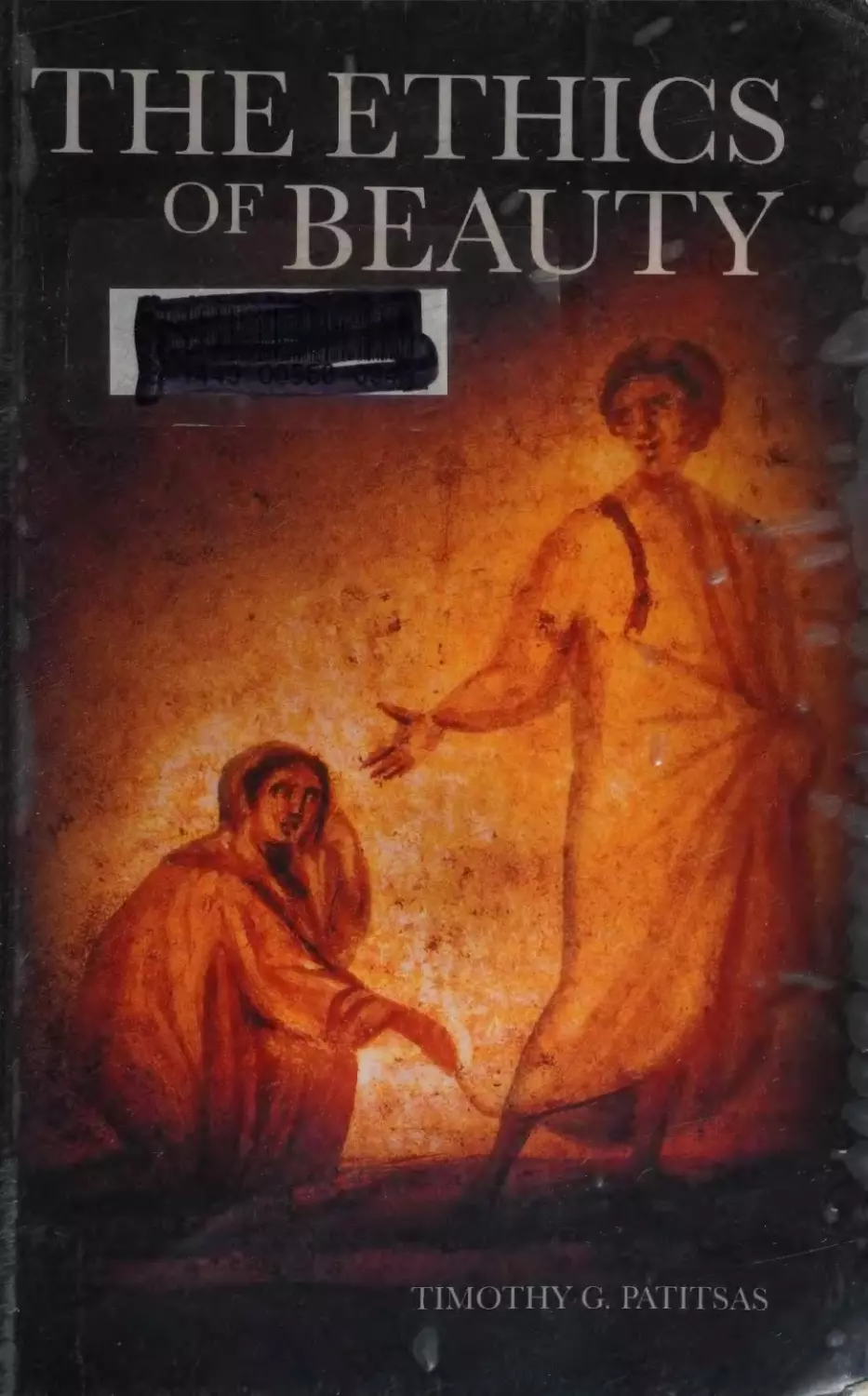
Front Gover:Christ healing the woman with the issue of blood. Catacomb of Marcellinus and Peter, Rome.
Photo courtesy Wikimedia Commons.
Layout and Cover: Bruce Petersen Art Direction & Design
For my mother
and
father
Digitized by the Internet Archive
in 2024
https://archive.org/details/ethicsofbeautyO000pati
Contents
Preface
How
to Read
This
Book
Acknowledgments
xi
Chapter One: The Opposite of War Is Not Peace
Healing Traumain theIhad and in OrthodoxTradition
I.
The
II.
After
Cost
of War
Combat
II. Afterword: Responding to Reader Comments
Chapter ‘Two:A Feeling for Beauty
The AestheticGroundof OrthodoxEthics
I. Attaining Freedom through Love for Beauty
II.
Creation’s
Origin
in Eros
AS
for the Beautiful
Chapter Three: Chastity and Empathy
Eros, Agape,and theMystery of the TwofoldAnointing
I. Chastity
II. Empathy
I. The Twofold Anointing
101
Chapter Four: Shame and Sacrifice
Rescuingthe Soulfrom theEmpire of Therapy
183
I.
II.
Ill.
IV.
NAHAS
Ethics as Therapy
The Triumph of the Therapeutic
Shame
The Soul in Orthodox Christianity
Chapter Five: Only Priests Can Marry
The Reconciliationof Men and Womenin Christ
I.
234
The Shape of Gender Reconciliation
If. Love for the Sexual Enemy
III.
Personhood
Chapter Six: The Mystical Architect
The Conceptionof the CrucifiedLogosin Art, Science,and Nature
I.
405
Motherhood
II. Logoi, Forms, and Patterns
IH. Hospitality
Chapter Seven: Beauty Will Save the World
SocialFustice, Judgment Day, and the Human
Need to Forgwe God
517
I. Symphonia: Fidelity to the Prophet-King
II. The Ancient View: Guardians and Traders in War and Peace
Ill. The Wedding of Christ andJerusalem
Chapter Eight: ‘The City as Liturgy
623
How Jane Jacobs UsedtheBeautifulScvenceof Complexityto Explain
Cities,and UnknowinglyReconciledScienceand Religion
I. Jane Jacobs, City Theorist
Il. ‘The Beautiful Science of Complexity
II. ‘The City is a Liturgy
IV. ‘TheGentle Reconciliation of Science and Religion
Epilogue: ‘The Joy of All Who Sorrow
725
Bibliographyby Chapter
731
Preface
This book attempts to recover a lost way of doing Ethics, one in
which love for Beauty played the central and the leading role.
What is attempted here is not only a description of this forgotten way but also a demonstration of what an aesthetic approach
to ethics might mean for everything from war, to psychotherapy, to
our identity as men and women, to the biology of conception, to
art, to social justice, and even for the reception within the academy
of the science of organic complexity.
But is there really a need for such an Ethics of Beauty?
Contemporary
Ethics is defined as “the rational investigation
of morality,” a description which is so spare and exact that surely
there could be no hidden bias lurking within it. It is only when this
definition 1s cast in terms of Socrates’ three transcendentals that its
ominous character becomes visible: at once we find Ethics identifying itself as the investigation of “the Good” by “the True” ... and
we realize that an entire Socratic transcendental,
“the Beautiful,”
has been invisibly barred from our consideration of what constitutes the best life.
Much of modern Ethics, following Spinoza and even Kant,
claims or at least implies that the investigation of the Good by the
True is the whole of ethics. Even seemingly “goodness-first” ethicists like utilitarians conform to this “truth-first” rule of doing Ethics as if it were at bottom a problem in logic.
When Beauty, or feeling, does dare enter into ethical deliberation nowadays, “she” is regarded as a temptress, a siren distracting
the rational mind. Reliance upon Beauty is taken as 7psofacto proof
of bias, cultural prejudice, or superficial romanticism.
But in discarding Beauty, Ethics itself risks becoming not only
unlovely but also an affront to loveliness, and it loses its power to
motivate the human soul except through the force of argument,
backed perhaps by the armed force of civil legal power.
I was never explicitly taught the Beautiful Way described and
employed in the present volume. It was in a process of fits and
THE
ETHICS
starts,
OF
BEAUTY
accidents
and
coincidences,
read
books
from
each
other
in unexpected
once
was — and
me, one element
unrelated
again
and
disciplines
ways,
could
that
in the chance
which
a dim
be — gradually
happening
somehow
vision
to
illumined
of what
Ethics
itself
before
gathered
at a time.
Only now that I have unexpectedly assembled some of the
pieces of it for myself have I become aware that an Ethics of Beauty has been present with me all along, often even within formal academic Ethics itself. I never noticed it, though, because its essence
had been only partly transposed into the truth-first language of academic ethics and philosophy. Indeed, Beauty’s presence in Ethics
is often deliberately hidden “for fear of the Greeks” —that is, out of
conformity to the prejudice against Beauty that eventually followed
the later Enlightenment’s use of a reductive and mechanistic version of Hellenism.
To be sure, there are limits and patterns
governing
the transpo-
sition of Beauty into Truth, such that it can never be mapped
fully
in the reductive way some would insist. It was never my desire to
write a truth-first book about the Beauty-first approach to ethics.
Beauty creates its own structure,
a form that may not be perfectly
linear and symmetrical, but which is still harmonious
and beneficial and, in its odd way, perfectly accurate. Through the surprising
order of the Beautiful,
reason participates
in and discloses living
mystery as mystery; that is, when it starts with an eros for the Beautiful, reason is able to announce to the world what mystery is: that
which interprets and changes us, just when we manage
with and interpret it.
to engage
‘To the extent that this book has entered into this lost way of
doing Ethics, I hope that the reader will find himself not only convinced by what is presented here, but actually renewed, released
from certain false constraints, and more fully alive.
The
above
is a brief
defense
before
my
fellow
ethicists
of
a
Beauty-first approach to moral life; let me now address another cohort, Christian theologians.
Preface
The
written
tradition
letters
and
books
sponse
to theophany.
the incarnate
pelled
that
would
The
Son
a response
of Christian
become
resurrection
of God
in action
shone
dogma
the New
began,
even
Testament,
and the crucifixion
out to the world
and
in the
as a re-
of Christ
all but com-
as well as in thought.
Since those first witnesses to God’s appearing were found to be
faithful and true by still other faithful and true witnesses, in a succession lasting from apostolic times until today, the theology of the
Christian community has ever remained a reflection upon Beauty.
It matters not whether we experience this revelation directly or if it
is conveyed to us by earlier or later witnesses. Either way, without its
first appearing, there is no basis for Christian theological reflection.
For example,
Western
God
Latin
before
theology
thereafter
it is sometimes
theology
deriving
the three
of the Greek
derived
worked
Fathers
the intellectual
stated
that in the patristic
from the concept
Persons
began
of the essence
of the Trinity,
with
concept
period,
the three
of
whereas
the
Persons
and
of the common
divine
essence.
But it is not at first a question of what object or concept or
even Person we contemplate but of whether we allow Christian
theology to be rooted in the gift of revelation rather than in speculation. Christian theology can only begin with God’s self-offering in
the Divine Economy. On this point, Protestants, as well as Roman
Catholics and Greek Orthodox, would broadly agree.
The theology of the Church did not begin with considerations
of intellectual method nor with concerns about the wider relevance
or usefulness of the Gospel message; Christian theology began with
Beauty rather than with Truth or Goodness. Similarly, Christian
Ethics must begin with what is Beautiful —namely, Christ’s self-revelation in his resurrection, crucifixion, and incarnation, whether
this appearing comes within history, creation, Scripture, or in the
Church, which is his body.
To be sure, theology also does not end at Beauty, for a faith that
refuses to unfold into the Goodness of a purified self-offering for
others will not save —and will be in no position to move yet further,
il.
THE
ETHICS
OF
to become
BEAUTY
itself
the Beautiful
Besides
es in mind
True
and
in consequence
a further
revelation
of
to the world.
ethicists
while
and
writing
theologians,
I have
had
two other
audienc-
this book.
One is the reader looking for a comprehensive summation of
the Orthodox Christian ethos. Growing up as a Greek Orthodox
Christian in the United States, I had always wondered about the
distinct “feel” of life in the Orthodox Church, quite unlike anything else in my childhood experience. The intangible quality of
spirit which makes Orthodoxy distinct from her many companion
Christianities is fascinating because this feeling of difference persists
even when the doctrines of other churches seem all but identical to
Orthodoxy, or when the outward forms of worship are in fact identical. Even in these cases, there exists some unmistakable “taste”
of Orthodox life, a fact which to me has always been a source of
puzzlement and wonder. The attempt to acquire an epistemology
that could describe and account for this intangible alterity has been
the pursuit of my life, in many ways.
The answer I was looking for is in large part to be found in the
preeminence of the Beautiful within the Orthodox ethos. The central text about Orthodox Christian prayer life, The Philokalia, itself
means “the love of the beautiful.” The Ethics of Beauty is best conceived as a prose companion to that spiritual collection —certainly
not on the same level as that classic text, but hopefully recognizably
in the same family. Where The Philokalia is an aid to the pursuit of
the Beautiful Way in prayer, The Ethics of Beauty is a discussion of
why the Beauty-first Way is preferable, and an examination of that
Way within as many areas of life as possible.
There
which
book
trauma
is yet one
commands
audience
my attention.
out of empathy
sufferers
more
for this
I was originally
for the community
or who
are their
allies
book
about
moved
of people
in recovery.
Beauty
to write
who
either
Ultimately,
this
are
it
Preface
is those who have encountered the very antithesis of Beauty, who
have endured the type of shocking and horrible experiences that
threaten to degrade and disintegrate our human identity, who must
be the judges of whether an “Ethics of Beauty” can be more than
a sly mockery of actual human life.
I would never have set out upon the journey that led me to the
The Ethics of Beauty had I not read Jonathan Shay’s observation in
his Achilles in Vietnamthat contemporary analytical psychotherapy
has been largely unable to heal the suffering of the soldiers afflicted most severely with post-traumatic stress disorder. I have slowly
come to see that another way to read Shay would be to say that the
initial focus of soul-healing must be on Beauty rather than on truth,
on a living vision of a loving and crucified God, rather than on an
autopsy of the broken self:
This is not to say that I have written a book about trauma
or
that every chapter in this rather long work has something to say
about trauma. In order to answer the questions I had about trauma’s healing, I was forced also to answer questions that I had had
all my life about what exactly is the Orthodox ethos. ‘These answers
might be of interest to any reader, and especially to those looking
for a renewed understanding
of Christian spirituality.
Still, it would
be wrong
tims as something
other
Imitating
St. Paul
this book
to “know
cified.”
perience
And
than
before
tried
“least
Christianity,
soul but most
among
that
that
who
address
is our
best
hope
aspired
—and him,
plausibly
if it is to be valid
and
vic-
of this book.
I have
but Christ
must
it is Christ,
especially
for trauma
heart
of Corinth,
you,
Ethics
of these”
to show
my concern
the very center.and
the people
nothing
is, I believe
of the
I have
Orthodox
human
That
to describe
for any
indeed
cru-
the exof us.
the Christ
in the healing
the souls of the victims
in
of
of any
of trauma.
It seems to me that the Christian Church has always understood that both the personal spiritual path and the path to social
justice are meant largely to trace this ancient Beauty to Goodness
to Truth trajectory, if they are to be truly life-giving. The fatal flaw
of soul-therapy since Freud, by contrast, has been its insistence that
Sa
ne
THE
ETHICS
OF
BEAUTY
truth and not beauty be our first concern; the repellant aspect of
today’s political ideologies is rooted in a similar insistence.
Contemporary American psychotherapy largely relies on what
I would call a truth-first method, but in fact no such method could
ever truly liberate man. To partly paraphrase and partly quote Lev
Shestov’s evaluation of the entirety of the Western philosophic project (excepting, in his view, Plotinus and, in part, Plato), rationalist
methods can only claim intellectual validity if they first posit a predictable, miracle-free, and self-contained universe. Only upon such
a fixed and settled basis can the philosopher (or in today’s case the
therapist, the most ubiquitous and successful type of philosopher
in our culture today) reliably exercise human reason to chart out
a predictable and stable ethic of human life. The original move of
philosophy, said Shestov, had therefore been the brutal subjugation
of the world and of the human being to blind, unfeeling Necessity.
Referring to the temptation and fall of Adam and Eve in the
Garden of Eden, Shestov went on to say that philosophy since Socrates had in effect chosen to cast its lot with the serpent rather than
with a personal God, by accepting that “the knowledge of Good and
Evil” is man’s best destiny and would make us the equivalent of gods.
‘lo make Shestov’s assessment of philosophy sting still more,
one now unavoidably hears within this cause of the fall of man in
Genesis ~ the desire to eat of the Tree of the Knowledge of Good
and Evil ~ our current definition of Ethics: “the rational investigation (the knowledge) of morality (of good and evil).” Far from being a guiding light, such a truth-first Ethics can easily increase our
blindness and our estrangement from God; it can easily become a
way towards death.
The knowledge of Good and Evil, no matter how systematically or thoroughly consumed, will by no means make us gods. Rather,
modern ethics, modern psychotherapy, and modern political ideologies all tend to produce not superhumans but pitiable slaves to
the rationalizations generated by our distorted human desires. In
order to gain control over the world, we have been too willing to
renounce essential aspects of our own freedom.
Vi.
Preface
The inability of truth-first methods to liberate the human person is apparent above all in contemporary therapy’s failure to heal
trauma, which is one reason why trauma therapy is the starting
point and the ending point of this book. Traumatic experiences
are themselves already a terrible force-feeding from the Tree of the
Knowledge of Good and Evil —no other ethical definition of such
horrible phenomena is more accurate —and are among the most
bitter and oppressive experiences of the human soul. Therapy as
we now generally conceive it seems to attempt a gentler repetition
of the same transgression, and to the extent that it does so, cannot
be trauma’s cure.
Christians should be extremely cautious about truth-first
ods whenever approaching issues of social justice or Ethics,
as when attempting to heal the broken-hearted.
When we
begin with Beauty, it is all too easy to miss the full complexity
methas well
do not
of hu-
man personhood and thus to diminish and dissect men and women
made in the image of God.
Truth-first methods can take the soul apart; they cannot put
it back together. But the trauma victim is that person par excellence
who does not require any further dismantling. He or she frequently
already subsists at an almost atomic level of disintegration, division, and excommunication.
What can further dissection offer such
a person?
Rationalist approaches to the soul tempt us because they promise easy understanding (truth) and effective action (utility, or goodness). In practice, however, they so often lead to tragic confusion
and wasted effort. Indeed, reductionist methods applied to any
living system may be examples of man’s perennial attempt to live
away from God, for they are often the attempt to substitute sure
though partial knowledge for a living relationship. Such an attempt
is the repetition of the primordial error of Adam and Eve.
Christians know all too well from dealing with our own temptations to replace the living God with either the idol of religion or
with our perfect ideas about God, that truth-first approaches quickly lead towards eternal death.
THE
ETHICS
OF
BEAUTY
Therefore,
in the healing of trauma,
in the ethical consideration
as in Christian
dogma,
as
of the best life, Beauty will be our first
concern.
“For I resolved to know nothingamong you, except Christ [that is,
the one whom we know to be the Anointed because He rose from
the dead, ascended, and is seated at the Father’s right hand] —and
him, crucified”(I Cor 2:2).
And if the ultimate trauma victim, Christ himself, cannot heal
this persistent pattern of separation which the trauma sufferer endures —if the Beauty of his resurrection cannot unfold into the
Goodness of a soul therapy that makes the person again whole, or
“true,” —then the Gospel would be “of no account” (Mk 7:13).
But Christ
rection
trauma,
does indeed unfold
as has been
And
can heal
shown
into
and
the radiant
the Goodness
in the lives of countless
beauty
of a perfect
people
from
of his resursoul therapy,
all ages.
so:
One Lord, one faith, one baptism in Christ Jesus, to the glory
of God the Father, by the grace of the All-Holy Spirit, both now
and
Vill.
ever
and
to the
ages
of ages.
Amen.
How
How
to Read
to Read
this
Book
this Book
Behind the writing of this book lie hundreds of conversations conducted over more than five years between myself (the author) and
the editor. Many of these discussions took place in person, others
by phone, and still others in writing. Although all of the material
in this collection began as interview-formatted essays which I wrote
while alone, even these earliest drafts were composed in the light of
these dialogues with my editor, Mother Nectaria McLees. Mother
Nectaria is also the editor of Road to Emmaus:A Journal of Orthodox
Faith and Culture,which is why the interviews are presented as a conversation between “RTE” (Road to Emmaus) and Dr. Patitsas.
The editor responded to my original drafts with comments, obJections, requests for clarification, and follow-up questions. Almost
always this meant that I returned to my writing desk to add still
more points of my own, which elicited further rounds of discussion
and revision. ‘The interview format was chosen precisely to give
room for and evidence of this unfolding process.
As a result of this dialogue form, however, the precise thesis of
a chapter will not always be clear at the outset of a topic. In these
conversations, meaning emerges through the natural give and take
of the discussion. This is not a mere artifice; for the most part, it
was only in the writing of the original interview-essays that I figured out exactly what I thought, what I wanted to say, aiid what I
believed was being overlooked by other commentators about the
important matters discussed in these pages.
Although I am a professional academic, this 1snot an academic
book. It casts its net too widely and its form is too nonlinear for the
narrowly-focused, richly-footnoted style which is the hallmark and
strength of research work. My conclusions are not so much presented as they are discovered and developed within the full view of the
reader, who can trace the process by which I followed hunches to
the conclusions that I reached.
At times, the deviation from academic structure may frustrate.
For example, although Beauty is the heart and soul of the entire
es
SAV
THE
ETHICS
OF
BEAUTY
book, it is not until Chapter Three that I managed to delineate for
myself what I think Beauty is. Similarly, I was not quite certain until
the very end whether brief discussions of complexity and information theories belonged here, but finally I concluded that they did.
This, in turn, required me to say something about the late urbanist
and economist, Jane Jacobs, whom I see as the most important proponent of a Beauty-first approach to science itself.
Mostly, however, I think that the natural way in which the discussions unfold here makes them easier to follow and more inviting.
The Ethics of Beauty presents a seamless worldview, one in which
love for what is beautiful guides human life, and the dialogue format allows these insights and intuitions to come forth in a humble,
unassuming sort of way. Also, interviews are ideal for presenting
difficult ideas and thorny topics without overwhelming the reader,
since they provide many natural breaks for the reader to sit back
and reflect before moving on.
Thus, the many little temporary confusions the reader may experience along the way, as important names and ideas are dropped
in profusion, are an intentional part of the book. The jokes, the
exclamations, the expressions of frustration, the musings, and the
author’s heartfelt cries —all of these were deliberately kept in the
final version so that the text would remain alive. The discussions
presented here meander, flow, and reverse course at times, just as
real conversations do, Probably the best way to read this book is in
measured doses (although some readers have kindly reported being
unable to put even the longer chapters down).
The eight interviews here cascade one upon another with a
gathering momentum. ‘Themes just hinted at in earlier interviews
are expanded and clarified as the book unfolds. Some ideas that are
mentioned in passing in earlier chapters will later turn out to be decisive keys to the book as a whole. Nevertheless, an attempt was also
made to keep each interview somewhat independent, understandable on its own. Thus, when key concepts from earlier chapters are
re-introduced, they typically receive some kind of brief summary.
How
As a contribution
claim
to be the
is designed
person
Even
my
last word
instead
in search
certain
ideas
unclear
has been
on any
word”
where
final
hope
as a catalyst
conclusion
is that
themes
or a “further
way of thinking
for the
the
sake
of brevity
have
been
reader
for his or her own
this
Book
The Ethics of Beauty doesn’t
of the many
of an alternative
places
‘The
thought,
to be a “first
to their
to remain.
to serious
to Read
will
further
it touches.
word”
about
for the
the world.
I don’t
deliberately
use
develop
allowed
whatever
thought
It
about
seems
what
presented.
In short, although these interviews never “took place” in the final
form gathered here, they are nevertheless very much the record of a
lively, dialogical, and interrogatory process that has lasted over years.
Xi.
THE
ETHICS
OF
BEAUTY
Acknowledgments
This book was born out of the experience of teaching Ethics to our
seminarians at Holy Cross Greek Orthodox School of Theology in
Brookline, Massachusetts, and in the light of three ongoing encounters with the broader life of the Christian Orthodox Church beyond
the campus of Holy Cross: twelve years of leading the school’s annual St. Helen’s Pilgrimage to Greece, Mount Athos, and the Ecumenical Patriarchate; my own many pilgrimages to Orthodox monasteries in the United States and around the world; and time spent
with my spiritual father, a married parish priest in Moscow, Russia.
The indispensable background for all of this was the normal course
of family, friendship, and Sunday parish involvement.
Organizing our school’s annual embassy of graduating students to the Ecumenical Patriarchate, coupled as it has often been
with the reunions of the alumni of Halki Theological School, has
had a lasting impact on my development as a theologian. I am very
grateful to have had this opportunity, and for the witness offered to
me by the Orthodox Christians of Turkey, in particular by His All
Holiness Ecumenical Patriarch Bartholomew I.
I could not have completed this book except for my father’s
hospitality during periods of summer writing in Greece. My dear
mother energetically encouraged and supported my education
from my earliest years until her passing in 2011. The members of
my extended family, from Samoa and Fiji, throughout the United
States, and in France, Germany, Russia, and Greece, also have given me their love and encouragement. As this is my first published
book, I want to mention that major funding for my doctoral education came from the late Aspasia Lemos, and from her daughter (my
aunt) Marigo Patitsas-Lemos.
The following friends read earlier drafts of this work and contributed feedback: Elyse Buffenbarger, Lukas Biihler, Alexandra
Drechsler, Jonathan Gardner, Andrew Gould, Theodore Nottingham, Thekla Raney-Kagaris, Rebecca Safley Clark, Maria Sanderson, Georgia Williams, and Steve Zabak. Two colleagues, Dr. Joel
Xi.
Acknowledgments
Kalvesmaki of Dumbarton Oaks Research Library and Dr. Robin
Darling Young of The Catholic University of America, also commented on the book as it neared its completion. Needless to say,
none of these readers is responsible for the final contents.
Dean James Skedros of Holy Cross granted me the sabbatical
semester in which the principal work for this book was undertaken.
I also thank our school’s president at that time, Fr. Nicholas Triantafilou, as well as His Eminence Archbishop Demetrios of America
for blessing this leave.
The prompting to write this book came from my editor, Mother Nectaria McLees, who during her student years at Holy Cross
became a close friend. The staff and many of the readers of her
magazine, Road to Emmaus: AJournal of OrthodoxFaith and Culture,encouraged me to publish with their responses to the earlier chapters.
Since I first discovered The Death and Life of GreatAmericanCities
in 1996, Jane Jacobs has been perhaps the single most important
thinker for my intellectual development. Our correspondence and
acquaintance from late 1999 until her passing in April of 2006 was
one of *the treasures of my life. As I say in the text of these interviews, she was not a religious person, nor do I try to make of her
an “anonymous Christian.” Nevertheless, I am grateful for the example of profound wonder and moral purity which guided her own
attempts to make sense of the world.
Rev. Dr. Stanley Harakas, the professor who established the
study of Ethics at Holy Cross, at the end of his career remarked
that he had reached a point in his academic work where he increasingly felt compelled to rely on a trans-rational category, “fittingness,” to demonstrate the validity of Orthodox ethical positions.
“Fittingness” is an aesthetic quality, I have since realized, and so
I hope that by beginning with Beauty, I am continuing precisely
where Fr. Harakas left off.
xii.
THE ETHICS
OF BEAUTY
From this Beauty comes the existence of everything,
each being exhibiting its own way of beauty.
For Beauty is the cause of harmony, of sympathy,
and of community.
Beauty unites all things and is the source of all things.
Beauty is the great creating cause which bestirs the world
and holds all things in existence by the longing inside
them to have Beauty.
And there it is ahead of all as Goal, as the Beloved,
as the Cause toward which all things move,
since it is the longing for Beauty which actually
brings them into being.
Beauty is a model to which they conform...
From the One, the Good, the Beautiful
the interrelationship
—
of all things in accordance
with capacity.
From the One, the Good, the Beautiful
the harmony
between
—
and the love which are formed
them but which do not obliterate
From the One, the Good, the Beautiful
the innate togetherness
identity.
—
of everything.
From the One, the Good, the Beautiful, also —
the intermingling of everything, the persistence of
things, the unceasing emergence of things...
~ St. Dionysios the Areopagite
DwineNames, 4.7
CHAPTER
ONE
THE
OPPOSITE
OF WAR IS
NG TTREAGE
Healing
and
‘Trauma
in the [had
in Orthodox
Tradition
[
mayseemoddthat an Ethics of Beautyshouldbeginwith thediscussion
of beauty’santithesisin war and in trauma, or with critiquesof just
war theoryand of our currentapproachto healingpsychologicallyafflicted
velerans.
However,whenI wasfirst interviewedbyRoad to EmmausJournal on
thesubjectof OrthodoxChristian viewsof war, my intentionwas not at all
to writean “Ethicsof Beauty.”Rather,mymain concernwasfor thevictims
of war trauma. Troubledby reportsthat our conventionalapproachesto the
healingof thewsouls werefailing, I offerededucatedguessesas to why this
mightbe so, and suggestedan alternatwepath towardsspiritual wholeness.
In thischapterI beginto discussthis otherapproachtohealingthepsychicwoundsof combat,at thesame timelayingout the veryancientChristian viewon war to whichit corresponded.This spiritual methodL termthe
Beauty-firstway,and it ts relevantnot onlyfor thosesufferingfrom trauma,
butfor anyoneconcernedwith humansouldevelopment.
I. THE
ROAD
TO EMMAUS:
professor
of war,
Christian?
you
but
have
do you
COST
It’s not
OF WAR
surprising
a theoretical
interest
also
topic
find
this
that
as a seminary
in the
Christian
compelling
as an
ethics
ethics
Orthodox
THE
ETHICS
OF
BEAUTY
DR. PATITSAS:As both an Orthodox Christian and as an American, yes. I was born and raised in the United States, with its huge
military —now slightly larger in terms of expenditure than that of
the next thirteen countries combined. I was raised to respect this
might, to be grateful for it, and to honor our soldiers. This may
sound strange, but the Fall of Saigon in 1975 made a huge impact
on me, even though I was not yet nine years old! I really felt that a
terrible tragedy had befallen not just the South Vietnamese, but the
world. By the age of 13 or 14, I understood with pain something
of the unique situation of Vietnam veterans upon their return to
society. This gives you some sense of how long I’ve been thinking
and even worrying about these types of issues.
And of course as Americans we are not only experiencing the
aftereffects of wars fought in the twentieth century, but already in
this new century we’ve been fighting in Somalia, Iraq, Afghanistan,
the Philippines, Pakistan, Yemen, and other places —sometimes
mainly with our drone strikes.
We may not think about it, but for centuries the Byzantines
waged similarly amorphous struggles against similar opponents, and
if this were widely known, many more people would wonder what
that civilization might have to teach us. The one book to draw this
comparison explicitly is Edward Luttwak’s The Grand Strategyof the
ByzantineEmpire.' Byzantinists have qualified portions of Luttwak’s
work, but, in the main, his arguments seem plausible to anyone who
knows Orthodox Christian theology and Byzantine history.”
In reading Luttwak, I was most impressed by two things about
the Byzantines. First, the great lengths they went to in order to
avoid actual combat engagement with their enemies. What we call
the Byzantine army was really the Christianized Roman army, the
most experienced army in history to that time, and yet their attitude
was, “Even if you are really powerful, in battle things can still go
terribly wrong.” They also knew that war is a morally questionable
| Edward Luttwak, The Grand Strategyof the ByzantineEmpire (Cambridge, MA: Belknap
Press of Harvard University Press, 2009)
2 For a highly regarded Byzantinist who largely supports Luttwak’s work, but with many
corrections and qualifications, see Anthony Kaldellis, “Edward N. Luttwak, The GrandStrategyof theByzantineEmpire”in the BrynMawr ClassicalReview2010.01.49.
2
The
Opposite
of War
Is Not
Peace
enterprise, and although they certainly fought wars, they also used
all sorts of negotiations and devices to avoid them.
War
RTE: What
else impressed
DR. PATITSAS: How
about
war
the ethics
might
cause
you
eastern
about
for war makes
cases
tion that
self-defense
the war
Orthodox
war inevitably
or to protect
the soul in some
incurred
Christians
not be morally
each thought
measure;
ambiguous.
A blessed
good,
therefore
an unqualified
in it is not a sin. Even
the
Luttwak?
and western
can in fact be part of a holy service
What
Evil
of war. For the West by the time of the Crusades,
in certain
participating
Is a Great
damages
innocents,
killing in war is not a sin but
that absolves
Byzantines
and
retained
the soul. Even
participation
in Old Testament
you of your sins.
was
an
older
in a just cause,
noin
in war still harms
terms,
“blood
guilt”
is
in battle.
And so I came to the realization that the Byzantine employment of religious rituals around war —inviting priests to bless troops
and weapons, to pray before battles —was not a blessing of warfare
as such (although they certainly prayed for victories, partly because
they saw them as the quickest route to peace). Rather the reverse:
the primary purpose of such prayers was to inoculate the soldier
against a particular kind of damage that could occur to his soul
during war —what we would refer to as traumatic stress.’ These acts
of blessing, still retained in Orthodox countries, are not to be understood as the Church pronouncing war good, but exist precisely
because she knows that war is always evil.
3 Or “moral injury,” or again, “blood guilt.” Alice Linsley, author of the “Just Genesis”
blog in which she applies anthropological research to the first book of the Bible, ina phone
call in May of 2015 pointed out that even most of the heroes in Genesis had direct experience of killing, or at least of war. They expressed their subsequent spiritual state in terms
of “blood guilt.” The leaders of Genesis knew from experience that a warrior, in order
to serve and save his people, would incur a spiritual cost. Even if “trauma” and PTSD
are somewhat culture-specific descriptions of part of the soldier’s burden, the difficulty of
living with having killed is universal. See my afterword to this chapter for a discussion of
“moral injury” as an alternative term for the spiritual impact of war.
THE
ETHICS
OF
BEAUTY
Let’s put this more intimately: these soldiers aren’t strangers to
us. They are our sons and daughters, our relatives. And, moreover,
they are not disposable —we want them back when this evil has
passed. So of course we don’t just send them into battle spiritually
defenseless. We give them every armor, so that when they experience the horror of war, it won’t destroy them spiritually, psychologically, or emotionally.
.
Again, the Byzantines
were not saying that war could be made
holy, but that its innate destructiveness
would overwhelm
us unless
we bind ourselves tightly to our ultimate holy values. For the Byzantines, that meant the cross of Christ, the Church. American
soldiers
also defend their psychic integrity
to their
by binding
most sacred values when they face combat.
themselves
Since we Americans
are influenced by Calvinism, that means above all that we interpret
battle in terms of “work”: it’s not “killing”; it’s “completing the
mission.”
Cartoonist
Gary Trudeau
quipped
that so many soldiers were describing
in the first Gulf War
their own involvement
with
the words, “I’ve got a job to do,” that the NBC News “theme”
for its
television coverage of the war should be amended
at War” to “America at Work.”
Other
supreme
the chaos
American
meaningful
we say of the enemy,
unavoidable
values
self-reliance,
Vietnam
might say, “He screwed
hem
him”;
duty, and we call upon
people”;
Peerer
are also called
and save the soldier’s
“Waste
and
from “America
to make
soul: cleanliness
discipline
of the weak
our soldiers
of his own fallen
upon
to “hurt
comrade
up”; and of course
—and
as an
those little
a soldier
in
sex, as in, “We
Up.
Clearly work, cleanliness, discipline of the errant, self-reliance,
and sex can be positive values, but they won’t safeguard your soul
in a time of trouble the way the cross of Christ will.
‘Today in the secular West, we are recovering some of the ancient understanding. For every war America has fought for which
we have data, we have sustained far more psychological casualties
than physical casualties. In his book, On Killing:The PsychologicalCost
of Learningto Kill in War and Society,David Grossman —a lieutenant
The
Opposite
of War
Is Not
Peace
colonel in the U.S. Army and a practicing psychologist —talks about
periods in World War II where the Army was discharging the psychologically wounded as fast as it could bring new soldiers in.t Gone
now is the old notion that because a war is “just” it is somehow not
going to hurt you. No serious person in the psychotherapeutic or
American military community accepts that at this point.
Maybe we will also persuade other Christians of the Orthodox
Christian view and maybe we won’t, but for now a major component of this Orthodox position has become both accepted psychological science and official U.S. policy. Although they don’t yet
know how to inoculate people psychologically against war or to
treat them once they have returned, everyone accepts that war always Causes some setback, or at least imposes some cost, spiritually
and psychologically.
Just War and Bad Moral Luck
RTE: How
and
how
fed into
much
much
of our
Orthodox
goes back
to the classical
is from
the
NewTestament
Greek
philosophy
that
also
Byzantium?
DR. PATITSAS:
In his Epistle
Orthodox
Christians
cooperate
with their divinely
In the narrative
Ignatius
view
to respect
of Christ’s
of Antioch,
to use violence,
soldiers
crucifixion
there is respect
A soldier
and there’s
St. Paul commands
and the government,
appointed
is what you have been appointed
to that necessity.
to the Romans,
mission
and to
to keep the peace.
and in the martyrdom
of St.
for the office of a soldier. “This
to do” —and even Pilate is reduced
is in a position
not much
where
he may be ordered
he can do about
it.
More positively, in Church hymnography we understand that
the timing of Christ’s incarnation was related to the fact that most
of the known world was then gathered into one polity by Caesar
Augustus. The Christian empire came to be seen as an image of
4 David Grossman, On Killing: The PsychologicalCost of Learning to Rill in War and in Society
(Boston: Little, Brown, 1995).
THE
ETHICS
God’s
there
OF
oneness
BEAUTY
— there
is one earthly
is one
God,
and
with
a Christian
emperor,
ruler.
And yet, the Church still maintained that killing is always wrong
and that Christians should not, if possible, get involved in these
things. We have many examples of those who practiced the absolute refusal to kill, including the Russian passion-bearers Boris and
Gleb. As the sons of Prince Vladimir the Great (958-1015), they
were raised and trained to battle, but as Christians, they wouldn't
fight to save themselves or their birthright. They knew that to do so
would simply unleash a wider circle of vengeance and hurt many
more people.
RTE: Do you have any thoughts
as to why the East and West di-
verged in their ideas of warfare?
Even before the schism, the West
constructed
their just war theory and then went on to develop the
idea of a Christian
holy war with the Crusades.
DR. PATITSAS:Just war theory provides a necessary checklist so that
our fighting will rise above the level of pure brigandage and murder.
For example, there must be a legitimate authority involved, and the
cause must be defensive or at least have a moral validity to it.°
But where does this go wrong? You know, once while I was
picking up my godson from elementary school, I overheard two
fathers speaking. Both were apparently well-educated professional
men. The first dad was very earnestly making the point that, if
something couldn't be avoided, if acting in some way was a part of
nature, then clearly that act could not be immoral. The other father wholeheartedly agreed. As men of the world, this made perfect
sense to them.
But of course
sufficient,
There
because
as Christians
nature
is a tragic dimension
the argument
itself is now subject
inherent
from nature
is in-
to fallen influences.
in our existence,
such that we
are often forced to do wrong things in order to survive or to protect
our children,
Rationalism,
however, lacks this appreciation
5 For a full list of just war criteria, see footnote 23 below.
for tragx
ia
The
edy, tries to talk itself out of what poetry,
so well: the world
to linear
is not what it should
Opposite
religion,
of War
Is Not
Peace
and music know
be, and life is not reducible
syllogisms.
Ethicists have a concept known as “moral luck” —that sometimes we are held blamable for our action or character, even though
we were powerless to act or be otherwise due to bad circumstance.
Rationalism hates luck, and ethical rationalism hates moral luck;
luck, if it exists, would frustrate logical reflection.
Well, war involves whole skeins of bad moral luck, and so any
attempt to create a perfect intellectual ethical system about it is going to drive you very quickly away from the tragic (and let’s face it,
sometimes tragi-comic) reality of actual war. It is going to lead you,
albeit in rational, logical steps, to completely absurd conclusions.
Jews, Greeks, and Romans:
Balancing Three Cultural Styles
RTE: If the West is more rational, more linear, how then would you
describe the East? Irrational? Ortherworldly?
DR. PATITSAS: Orthodox Christian Rome —Byzantium —aimed
for (and frequently achieved) a mature blend and balance of three
modes of being in this world. They had the mind of the Classical
and Hellenistic Greeks; they had the heart and personalism of the
Semitic world, of the Jews in particular; and they had the practical
rationality and organization of the Romans. And while the Greek
mind and the Jewish heart might both seem to us more important,
in fact it was the Roman body, the Roman system, that lent them
their primary cultural identity in Christ.
Some have argued
one aspect
taining
that further
of this triad,
the Greek
the»Semitic
respect
for intellect
for law and power. What Western
with time was one dimension
became
primary.
tee
NAVRENS
eat
West, Christians
personalism,
Gaglicilly
even while re-
and the Roman
Europe
lost
reverence
either lost or minimized
of the way of the heart. The intellect
THE
ETHICS
OF
BEAUTY
RTE: Yet the West has had mystical saints down to the present day.
DR. PATITSAS: Yes, of course. Ultimately, it is difficult to get the
balance of mind, heart, and body just right.
Wheneverthe balance
of an idea falls away from the heart and toward the mind, we have
taken to referring to it as “Western,” no matter where it transpires
geographically. Western Europe was once Orthodox; among Orthodox theologians today, the question of whether a new idea-is
consistent with the tradition, or has become “Western” because it
is somehow no longer mystical in the right way, is always an open
one. These terms are not nationalist or tribalist.
At some point, though, there did occur a slight separation between the mystics and the theologians of medieval Roman Catholic
Europe, a gap between the cloistered prayer of the heart and the
theology of the university scholars. The slightest such gap would be
fatal for truly Orthodox life. When the mind is no longer submitted
to the heart, it becomes irrational through an excess of rationalism,
while at the same time the heart becomes dull through an excess of
passion and imagination.
The unity of mind and heart, of a mind stationed in the heart
and focused on the Name of Christ, is far more than a matter
of having the right attitude. Rather, it is a hard-fought, spiritual
force-against-spiritual
force, bodily achievement. For this reason
the true Orthodox Christian must always be a Roman first, at least
in his élan.
Without experience or victory in this struggle, a university scholar like myself will arrive at the false conclusion that the intellectual
sins (pride in particular) are the primary sins, since the intellectual
power of the soul is itself higher than either the appetitive or the
incensive powers. But in the East the memory endured because the
practice was preserved ~ it is in the lowest part of the soul, in the
appetitive powers, where the battle will be won or lost. Sensuality ~ which in the context of the Jesus Prayer means chasing after
images, sensations (even holy ones), failing to keep the basic fasts of
the Church ~ is the gateway to all sin. Such self-love is the mother of
the passions; pride, merely her most developed and insidious child.
8
The
RTE:
But
how
does
knowing
this
affect
Opposite
ethical
of War
Is Not
deliberation
Peace
about
war?
DR. PATITSAS:
first place,
You can’t
nor even
with
do the ethics
your
heart,
of war with
if by heart
your
mind
we mean
in the
something
like the emotions.
Rather, starting with your body, in the light of your duty to
protect your loved ones who are forced by circumstance into combat, you must not deny your bodily instinct that they return from
war woundedand yet throughnofault of their own. They have changed
in some way, and many of them will struggle terribly in trying to
re-enter society. Everything begins with accepting these facts about
people whom we love.
Putting the intellectual sins first misses the point of everything,
because if on paper you can justify that a war is necessary, then supposedly these intellectual sins aren’t involved and participation in a
war won't hurt you. From our eastern, Orthodox perspective, just
to witness combat is already a terrible burden on the soul. Whereas
the mere fact that a particular war can be proved intellectually to be
the lesser of two evils —and therefore unavoidable, or perhaps even
preferable to not fighting —doesn’t in itself resolve the spiritual or
emotional wounds suffered in combat.
It is still
ages
and
cleansed,
in battle
individuals
passionate
as St. Basil
refrain
from
who
feelings,
the
Great
receiving
kill or at least
and
experience
it is individuals
says when
Holy
who
those
have
he has soldiers
Communion
for three
imto be
who
kill
years.
RTE: So you are saying that war remains evil, even when justified.
Is killing in war then murder?
DR. PATITSAS:Some early Christians called it that, but St. Basil the
Great did not agree, and his penance for a soldier is not the same as
the penance for a murderer. So, the motives outlined in the West’s
just war theory certainly do apply in the East as well, when you are
distinguishing types of killing according to logical criteria. Killing
in war is ethically distinct from murder. However, the fulfillment of
¢,
THE
ETHICS
OF
BEAUTY
the just war criteria is not sufficient to inoculate us absolutely and
completely from war’s evil; war still hurts us.
Achilles
in Vietnam
RTE: Then what do you think is the spiritual reason behind St.
Basil’s penance? Many people see it as a sort of punishment, but
perhaps it has more to do with healing.
DR. PATITSAS:Yes, St. Basil was concerned with healing. ‘Today,
our best thinker about war and the healing of the soul after war
is Jonathan Shay, an M.D., Ph.D. in clinical psychiatry, who wrote
Achillesin Vietnam:Combat Trauma and the Undoingof Character.®Shay
says that the Jad, our oldest western epic, was designed as therapy
for post-traumatic stress.’ It was written and recited to fulfill this
role, and it did so successfully. Simone Weil said that the /iad is also
the only epic in western history that doesn’t take sides between the
two warring parties.® It mourns the death of the Trojans as much as
it does of the Achaeans, the Greeks. Shay thinks that this may have
been because it was performed for and in order to heal descendants
of both sides.
Shay’s
combat
that
losers
point
veterans
war
is that
a culture
listening
is, as Simone
the
Jliad,
to the J/iad, was a culture
that
Weil
but also the winners.
rally complements
this older
than
Cultures
the Church.
that
says,
recited
something
‘The Orthodox
Greek
that
have
that
hurts
Christian
view. In a sense,
taken
the view,
that
had
its
still thought
not
only
the
position
natu-
this view
is older
“This
is for the
6 Jonathan Shay serves as Visiting Scholar-at-Large at the U.S. Naval War College
and holds the Chair of Ethics, Leadership, and Personnel Policy in the Office of
the US. Army, Deputy Chief of Staff for Personnel. In 2008-09 he was appointed to the Omar Bradley Chair of Strategic Leadership at the U.S. Army War College and Dickinson College. In 2007 he received the MacArthur “Genius Grant”
Fellowship to further support his work with trauma victims. Shay is the author of Achillesin
Vietnam:CombatTraumaand the Undoingof Character(NY: Maxwell MacMillan International,
1994) and OdysseusinAmerica:CombatTraumaand the Trialsof Homecoming(NY: Scribner, 2002).
7 Alexander Pope, trans., The Iliad of Homer(New York: Macmillan, 1965).
8 See Simone Weil, Jntimationsof ChristianityAmongtheAncientGreeks(Boston: Beacon Press,
1958) for her essay, “The Iliad, Poem of Might.”
10
The
Opposite
of War
Is Not
Peace
glory of Rome, the other guys deserve it, and let’s get on with it,”
tend to be cultures where off-duty soldiers spend a lot of time getting
drunk. They are self-medicating in some other, less effective way.’
RTE: Is the /had, then, an expression of remorse for the destruction
of war?
DR. PATITSAS:Yes, the Trojan War was a total disaster. The I/ad is
a celebration of the bravery of both sides —the youth, the strength,
the beauty —but the epic also tells us that these heroic men in fact
are all too weak to escape being trapped in this conflict. It is a profound text that already has (that, in a way, originates) this Orthodox
Christian view of war —that no one wins completely.
RTE: Would
you
call it a religious
text?
DR. PATITSAS:Fascinatingly, the entirety of the /iad occurs within a space marked by two profound desecrations of the classical
liturgical program, of the religious belief and observance of the
Trojan and Achaean peoples. As it opens, Agamemnon, one of
the Greek commanders, has offended Apollo’s priests by taking a
priest’s daughter as his concubine. As a result, plague has struck
his army. When the seers divine that Agamemnon must give the
woman back, he grudgingly does so —but instead takes Achilles’
war-prize, a maiden named Briseus whom Achilles loves.
Achilles then withdraws from battle in bitter protest and, without him, the Greeks begin to lose until his friend Patroclus puts
on Achilles’ armor and goes into battle pretending to be Achilles.
When Patroclus is killed, however, Achilles begins to suffer a complete breakdown, spiritually and mentally. He becomes a monster.
Where before he had always shown compassion to enemy prisoners, now there is no stopping him; he’s just a murderer. His murderous thirst for revenge is not slaked until he kills the Trojan hero
Hector, desecrates his corpse, and then himself is killed.
9 For a very brief look at this issue, see Matthew Gault, “The Problem of Drug-addicted
Soldiers is as Old as War,” on the respected War is Boring website, May 8, 2015; accessed on
August 8, 2017.
THE
ETHICS
OF
BEAUTY
While Agamemnon’s sacrilege opens the Jad, the hero Odysseus’ sacrilege ends the Trojan War itself: In fact, Odysseus ends not
only the war, but the entire Heroic Age because he is so very human
and because he intentionally subverts the ancient liturgy. In his case,
he does so not out of passion, but almost as an act of moral superiority over the capriciousness of the gods, who have caused the war
to drag on for a decade. So, he devises the Trojan Horse, which in
fact is not only a ruse aimed at his human opponents, but a deceptive liturgical offering. But because the sacral order is thus violated
and Troy destroyed, Odysseus will be punished for ten long years.
Nevertheless, this also says something good about Odysseus,
because although that old heroic world was somehow superhuman,
it was also therefore subhuman. The heroes were demi-gods, comic
book characters of superhuman strength and virtue and manliness,
but they lacked some humanizing element. Odysseus doesn’t. He’s
just a man who wants to get back to his wife, and by his action he
brings the ancient world to its end. He is really our first modern, the
first European. His only “super-powers” are devotion to home and
his amazing cleverness.
Odysseus is a precursor of Christ, Who also subverted the liturgy of His people.'’ When Christ was mistaken for a mere man and
crucified, He is hidden in plain view on the wood of the cross, just
as Odysseus is hidden within the wood of the ‘Trojan Horse. They
are both subverting liturgy (indeed, the Chief Priest who sentenced
Christ was entirely unaware that this was the liturgical act for which
he had been appointed) with the aim of making peace. If you take
the Greek gods as demons, or as simpler, more childlike versions of
the demons, then both heroes have tricked the demons. !!
10 Steve Zabak, who read this text in advance, pointed out that St. Paul seems to be making
some sort of connection between Odysseus and Christ, through his choice of words in the
opening lines of his Epistle to the Hebrews. For a meditation on what exactly that connection might be, and how strong the literary echoes are, see Jared Calaway, “Polutropos:
Much-Turned Speech in the Odyssey and Hebrews,” on his Antiquitopiablog, March 18,
2009. Accessed August 8, 2017.
11 ‘This idea of Christ’s
Nicholas
Constas,
“The
being
Last
hidden
upon
‘Temptation
the cross
of Satan:
in order
Divine
to trick
Deception
the demons
in Greek
is from
Patristic
Interpretations of the Passion Narrative,” in The Harvard TheologicalReview,vol. 97, no. 2
(April 2004), 139-163.
1
The
Opposite
of War
Is Not
Peace
There was something doubly brave in what Odysseus did. He
and his men could have been discovered inside the Trojan Horse and
wiped out, so in a sense they are dying; they are a part of the sacrificial object which they offer. It’s a liturgical death that they simulate.
Of course, we don’t depict the story like this. We depict them
as “clever guys,” but theirs was a culture saturated in ritual. They
knew what they were doing. They were both desperate and willing
to be damned, not just physically, but also spiritually, because they
had to end the damned horrible thing that is war.
The Widespread Reluctance to Kill
RTE: How does Jonathan Shay take all this? Does he also admire
Odysseus?
DR. PATITSAS: Yes. Shay’s first book 1sAchillesin Vietnam.His second
book is Odysseusin America: Combat Trauma and the Trials of Homecoming.
In his first book, Shay’s empathy and focus are with Achilles himself, and in the process Shay gives us this amazing corroboration of
the Orthodox Christian view that war may sometimes be the lesser
of two evils, but it still remains evil, and it is harmful to our souls.
A strain of research decades before Shay pointed in this direction. After World War II, S.L.A. Marshall, a U.S. army historian,'”
organized interviews with thousands of American soldiers who had
been on the front lines, actual infantry who were doing much of
the ground fighting in Europe and the Pacific. I can hardly believe
that this is true, but he and his team of combat historians found that
about 85% of trained soldiers would either not fire their weapons
in combat or, if they did fire, would aim high or wide so as to avoid
directly harming the enemy. Other historians subsequently found
this to be true not only for World War II for the Americans, but for
the other side, and in fact for any other war for which we have firm
casualty statistics. When ancient battles are reenacted, historians
12 S.L.A.
historian
Marshall:
who
authored
A commissioned
some
thirty
officer
books
and
about
U.S. Army
warfare.
World
War
I and
Korean
War
THE
ETHICS
OF
BEAUTY
find that the number of deaths that were actually generated would
have been many times higher, had all soldiers really sought to harm
their enemies. It also seems that soldiers’ nearly universal reluctance to kill was well-known to non-commissioned officers from the
time of the Roman legions until now. Historically, officers have had
to force their enlisted men to actually kill, or very little killing would
be happening in combat.
RTE: Amazing. So throughout history most soldiers would not kill?
DR. PATITSAS:Many soldiers feel that they are killing a part of
their own soul if they do kill, and when it comes right down to it,
most people would rather die physically than spiritually. ‘There are
a tiny minority of people who are psychopathic or sociopathic, and
there are also a minority of sane people who can kill in war or in
self-defense without much apparent damage to themselves, but that
is a very small percentage. David Grossman’s estimate of psychologically healthy soldiers who can kill without suffering spiritually is
very low ~ far less than the 15°%o
who will fire at all.
Grossman said that in studying Marshall’s numbers, he was
ashamed of American soldiers who didn’t take the chance to help
their cause, their nation, and their friends, but he was also proud
of them for this human response. As he points out, these non-firing
World War II soldiers were not cowards. In fact, they were exposing themselves to great danger, treating their fellow wounded, and
bringing in more ammunition under intense fire. They were doing
all these brave things ~ but they weren’t killing.
Grossman’s book is now required reading for new DEA and
FBI Agents, and, I think, non-commissioned officers in the U.S.
Army, because one of his findings is that many men won’t fire unless their commanding officer is right there forcing them to fire.
Meanwhile, Shay’s book has become very influential for classicists,
who now almost all agree with his premise about the Jliad’s therapeutic purpose. No scholar now feels that they can understand the
Lhad without Shay, but Achillesin Vietnamalso changed the way in
which the U.S, Army is organized and deployed.
14
The
RTE:
reluctance
army
wants
to find
a way
around
Is Not
this
Peace
human
to kill?
RTE: Have the firing percentages changed with the new conditioning?
DR. PATITSAS:They claim it has, but I see anecdotal evidence that
in a war like Vietnam, firing percentages rose when you couldn’t
see the enemy in jungle combat anyway. Snipers and infantry with
confirmed kills were still a small minority of even front-line troops.
If the percentages have risen, it might be because today’s soldiers
are farther from traditional Christianity ov because they are all volunteers.
Grossman also thinks that videos and computer games work exactly the way army conditioning now does. He says that through
these games, we are conditioning our young to kill but without any
of the social controls the army has in place. Conditioning that makes
people more apt to kill will only deepen the psychological trauma
and impact society as a whole, as we are seeing ever more clearly.
RTE: If Grossman
conditioned
Se
APES
SSN
the
of War
DR. PATITSAS: Yes and no. After Marshall’s WWII-era findings,
Grossman tells us that the U.S. Army went to a new method of
training, which was really as much psychological conditioning as
training, by having soldiers shoot at human-like shapes that pop up
at you, and so forth. Subsequent to this, the incidence of post-traumatic stress in Vietnam skyrocketed and hasn’t stopped yet. But
many of the changes in Army practice adopted from Shay are done
in order to lessen the psychological burden of war. It has this positive, prophylactic side as well.
The danger would be that we moderns would understand this
ancient and Orthodox view but then become worse than we were
before, by using it only —as you say —to kill more effectively and to
involve still more of our young people in killing.
oN
4
Ca
Because
Opposite
is saying
out of soldiers,
that our innate
respect
for life is being
how does this affect them as individuals?
THE
ETHICS
OF
BEAUTY
DR. PATITSAS:Grossman focuses on the moral cost of learning to
kill and of killing. Shay is looking at a related experience: When in
combat you have seen the violation of the moral order sanctioned by
your own chain of command, what does that do to your character?
In reading Shay, you tend to focus on moral violations that are
egregious —such as being ordered to endanger civilians —whereas
in reading Grossman you are reminded that sanctioned killing in a
justified war is itself a violation of human morality. Killing in war,
even in a situation where the enemy soldier is about to kill you, will
strike Marshall’s non-firing 85% as a violation of social morality.
The army perhaps didn’t do anything fer se that was a betrayal of
its own code, as was the case when Agamemnon wronged Achilles.
However, when a young pure-hearted person who perhaps grew
up as a Roman Catholic altar boy or as a devout Protestant sees
the reality of killing, he feels that the moral compact with which he
has been raised is broken. He has been betrayed by the society that
raised him, because it made him a soldier and told him to kill.
The
Berserk
State
Let me stress this point: Post-combat spiritual wounds are by no
means sufficient proof that someone has committed a violation of
the laws of war. All war is a violation of human morality, on a very
deep level. As the ancient Church taught, even when war is the lesser
of two evils, still it remains evil. A returning soldier will have to do
penance not because he is deserving of punishment, but because he
is deserving of forgiveness and cleansing from the realm of sin into
which his society sent him. He has faced a moral dilemma —either to
kill his enemy or allow his society to be ruined —and he has made the
wiser choice, perhaps. But he has entered a zone of blood and impurity and will need God's grace through the cleansing of confession.
Shay’s brilliance lies in describing what can happen when you
experience the violation of the social moral order. A chain of events
can be unleashed in your soul that culminates in “post-traumatic
stress.” What happens, says Shay, is that you may undergo a pro16
The
Opposite
of War
Is Not
Peace
gressive shrinking of the sphere of your concern for others, until
the circle includes no one ~ not even yourself.
RTE: What
would
that
look like?
DR. PATITSAS: Shay describes a phenomenon in war known as
“berserking,” in which a soldier undertakes desperately fearless actions but without regard really for his cause or even for the safety
of his brother soldiers. At that point, the trauma victim has moved
outside of human social relating; he is part animal, part god, and
feels himself to be such, as he exposes himself to danger even if it
compromises the mission —for example, by triggering an ambush
so as to maximize his own heroics before his unit is ready to defend
itself. This is the state to which Achilles fell when his moral order
began to unravel through his commander’s betrayal of what was
right.
Shay says that trauma always starts with the feeling that the
moral order has been betrayed. It’s not merely the carnage or the
killing that harms us.
To begin with, the soldier will experience the shrinking of his
moral horizon in positive terms —he would do anything for his
brothers, those in his own unit. He is fighting for his buddy. He
does not recognize that his deepening attachment to them may be
a sign that his attachment to the rest of humanity —including his
enemy —has weakened. But when this inner circle is violated —that
is, when the hell of war results in one of them, particularly a best
friend, dying —then the sphere of moral concern can become quite
narrow indeed. The person may eventually lose all interpersonal
connection, which culminates in the berserk state during which a
traumatized person attempts to destroy everything around him in
a god-like rage.
In
Greeks,
Patroclus.
Achilles’
but
case,
he
he remains
When
field
of concern
Achilles
would
defend
withdraws
attached
Patroclus
Achilles’
first
is killed
shrinks
or at least
from
the
army
of
the
to his company
and
to his friend
in the mix-up
that
follows,
even
show
more.
then
Prior
to these
events,
compassion
to the
enemy
17
THE
ETHICS
OF
BEAUTY
prisoners he took, but he now just slays them, ten or twelve at a
time, overcome with lust for blood in this berserk state.
This berserking is a kind of ecstasy ~ or rather, its parodic reversal. It is not communion with all men and with all things, but is rather the final death of communion. Berserking is, we Orthodox would
recognize at once, the very opposite of that which saves us —communion with God and others in liturgy. Shay doesn’t use the word
liturgy, of course, but he does show how this totalizing experience
leads to a cutting of communion and the unraveling of character.
War, for the berserker, has become an anti-liturgy, and of course,
many soldiers experience this in some lesser degree. As in liturgy, all
five senses are fully employed; a kind of divinization is experienced;
a letting go of earthly attachments occurs; there is a ritual of bloodletting. But the berserker, unlike other soldiers, undergoes all of it in
the service of annihilation of the self and the other.
Shielding the Soul from ‘Trauma
RTE: How has the U.S. Army used these insights in a good way, to
inoculate soldiers from this ex-communication?
DR. PATITSAS: Pm glad you called
Church
“excommunicates”
the soldier
or has even experienced
soldier
but rather
“staunching”
Eucharist
for re-entry
because
The
three
soldier
years,
Church
himself
I was so relieved
in combat
when
the
he has received.
until his soul can be
that the ban from
the
she is also limiting the ex-
bans the soldier
in these kinds of extreme
the traumatized
the ban permanent.
wound
but, by saying
than
killed
why the
She is not “punishing”
the spiritual
to society,
will last no more
~ particularly
has
a limit on Communion
lent of the excommunication.
chalice
Now you know
who
close combat.
She is not only imposing
purified
it that.
from the
cases —temporarily,
will be tempted
I understood
to make
this.'’
13 One of my students, Bryce Buffenbarger, reacted to the matter in this way: We are meant
to think of St. Basil’s three-year penance not as the minimum but as the maximum length
of excommunication. That is exactly my point: we are dealing here with a limit. Confession
is required, but the actual period of time without Holy Communion comes down to the
question of how best to heal the soul of the particular combat veteran before you.
18
The
Opposite
of War
Is Not
Peace
But back to the United States Army. Post-Shay, soldiers are rotated into and out of combat as part of the same unit with which
they train and will be debriefed afterwards. Unbelievably, in the
Vietnam War years, we had actually been rotating soldiers individually! The cutting of communion and of combat brotherhood
was built-in. It was a system custom-made to produce deep combat
trauma.
More could be done. For Shay our major remaining mistake is
the speed with which the bodies of dead soldiers are vanished out
of the combat theater. Grieving for brother soldiers must be more
prolonged, and more physical, if we are to heal properly.
By the way, Shay isn’t saying that every soldier or every soldier in
direct combat experiences trauma. It depends on factors that can’t
be predicted. But he is saying that when trauma occurs, it occurs in
these specific stages: almost always, the person first feels that something immoral is going on, and then comes this progressive shrinking of the social horizon. But we also have to remember that no
matter what a person did in war or in any situation, it’s not the end.
RTE: What
about
hood
or a plane
abuse
other
forms
of traumatic
stress
— say after
child-
crash?
DR. PATITSAS:Although Shay is very respectful of the uniqueness of
the combat experience, he believes that when trauma victims insist
that their own brand of trauma was uniquely horrible, that this itself
is a result of the trauma. One way of excommunicating ourselves is
to show that we have suffered as no other person ever has; if no one
can understand or share my suffering, then my godlike aloneness is
total. There is a danger, in trauma, of being seduced by this forbidden fruit, this access to ultimate isolation, that promises me an almost
godlike knowledge of good and evil. We could even become proud
of having suffered some evil in complete and divine aloneness.
In fact, though,
neglect
of an infant
studies
of the brain
or child can be as traumatizing
kinds of child abuse or adult trauma.
tain
SVs)
aspects
demonstrate
of the internal
connections
Trauma
within
that chronic
as more explicit
actually
rewires cer-
the brain.
Certain
19
THE
ETHICS
OF
BEAUTY
brain scans that map the trauma wound cannot really distinguish
people who have been attacked, assaulted, or just plain neglected.
In every case, communion has been profoundly broken, and the
brain and soul are deeply wounded. Shay believes there is also a
commonality in successful therapy, in that it relies not on the intellect but is based in new patterns of relating to the self and others.
RTE: This
is all so heart-wrenching.
DR. PATITSAS:
We
And
their
major
but
it can
also
what
Simone
who
their
him
We
outbursts
did
think,
because
friends
not
stayed
and
sacrifice
since
face
the
soldier
“The
him
“That
the
dangers
veterans.
war
can
destroy
character,
of Might.”
stronger
and
wiser
soldiers
feel
sake
intent.
As a society,
been
tested
But
involved
in the
than
that
of society,
in combat.”
in a way
I told
a victim
But
for the
he was ashamed
war.
combat
salvation
has
We
we haven't.
that
some
in protecting
of
right
the
man
they
have
that
there
we do respect
look
One
to still be suffering
him
to it?
are
Many
guy
react
who
at home.
been
that
students
is by definition
Empire
of self in that
he has
confessed
students
it. The
called
sanity
was a real
that.
refine
do your
to me is that
this will make
or woman
risked
have
reminder
Weil
circumstances
now
How
to
of my
traumatic
of the
their
up
men
who
country
also
feel ashamed.
An attack by armed
injustice presents
If we do not fight, the injustice
we will cross a line by shedding
us with a moral dilemma:
and evil may increase;
human
blood. Moral
if we do fight,
dilemmas
like that: most of us will not come out of them without
are
something
to repent of.
And we should see other victims of trauma with respect, as
well. At some point, we have to look up to the person who was
abandoned to an underfunded orphanage and rarely held for the
first three years of their life. Their whole life may now be nothing but suffering, and they can’t get well, but that person is more
than us in a way. Their identity with that ultimate
~ Christ, and him crucified ~ is different and perhaps
ours. Nevertheless,
20
trauma
victim
greater than
what Shay is after is not just the proud display
ol
<—
The
Opposite
of War
Is Not
Peace
of trauma scars but genuine healing, The Church would agree. After these disasters, the resurrection must be permitted to come.
Il. AFTER
‘The Opposite
COMBAT
of War Is not Peace
RTE: ‘Taking all this together —Shay’s work, Grossman’s meditations, your students’ responses, and your wider awareness that many
more people than just soldiers suffer the psychological wounds of
trauma, what have you come to?
DR. PATITSAS:Above all, this: that the opposite of war, or of any
kind of trauma, is not peace, and that it is bootless to try to find
peace after these events. Our psychology, with its excessive faith in
the therapeutic power of “getting it out,” has reduced the human
soul to a steam engine and emotional healing to an elaborate system of hydraulic adjustments —“venting” about sums it up. This
approach is reductive; there is something deeply wrong in it. Modern psychology has nearly destroyed friendship in this country —we
say too much, we analyze too much, and, worst of all, we do all this
“in cold blood.”
After trauma there can be no return to a category as neutral as
“peace.” The opposite of war is not peace, but liturgy —the cognitive, bodily, totalizing act that steadily increases communion, instead of cutting it. Liturgy is an act that purifies and knits the character together, whereas trauma unravels our character. In liturgy, I
give my life for my brother and sister, I renounce retaliation, and I
give my very body and blood for the life of the entire world.
It’s like that wonderful saying that you must “either get busy
living or get busy dying.” Well, sin and trauma keep us enormously
busy but slowly kill us, while liturgy keeps us busy and makes us
live again. Trauma is more than busyness —it can have a kind of
infinite effectiveness in excommunicating us, splitting us even from
our own selves. Liturgy, especially the Divine Liturgy of St. John
THE
ETHICS
OF
BEAUTY
Chrysostom, is the precise opposite; there, your communion and
integration just increase and overflow, and all is taken in and reconciled. For the trauma victim, there isn’t some third choice beyond
these two poles; you have to, best as you can, try to choose liturgy.
Moreover,
Orthodox
actual doxological
truth,
Christian
whereas
liturgy enacts and teaches
trauma
teaches
truth. War, then —like every form of trauma
you
you a heretical
experience
—has al-
ways been an anti-liturgy.
RTE: Then war is not just the opposite of liturgy, but it actually
enacts a false liturgy?
DR. PATITSAS:In any all-engulfing experience, you obtain a knowledge that totally overtakes you, but when such an experience includes
trauma, other effects are added, including the cuttingof communion,
the unraveling of character, and the learning of heretical truths. The
heresy taught by war is that a) my brother is not my life, but rather
the opposite of my life, and b) that God is not all-powerful, or at least
will not exercise that power in a loving way in my case.
Now, does my awareness
that this is a he mean that I myself
wouldn't fight to protect my own? I would, but I also must know
that ultimately it is not my enemy alone, but other dark powers who
lie behind his actions. I must therefore
part, misdirected.
recognize
this fighting as, in
And moreover, even in a fallen world, the enact-
ment of these partial truths is a deep tragedy.
As something of an aside, let mejust mention how in the arena
of sexual temptation we also see false truths being disclosed by very
intense experiences of seeming communion. Sexual activity outside
of marriage is still cognition (“knowing” the person, as Scripture
says), it’s still totalizing, but even at the moment that it’s supposed
to be the most intimate and ultimate experience, sexually immoral
acts can “flip” and become the cutting of communion. This is why
sexual addictions and promiscuity unravel our character, whereas
sex within marriage helps us to knit it together. Sex outside of marriage teaches us a kind of heretical truth, even about —especially
about ~ the goodness of sex itself, because people are left with these
22
The
awful aftershocks
everything
Opposite
of War
Is Not
Peace
of shame about their bodies and their desires;
is inverted.
Healing of Trauma
The point is that what we’ve “learned”
as trauma victims in any of
these traumatic experiences isn’t completely true, despite how real
it feels, because there is a partial, distorted truth transmitted to us in
the moment of trauma. ‘Trauma is practically the ultimate teacher;
few other experiences so powerfully form our view of the world.
And yet what it teaches us is mostly lies. To be sure, it has a part of
the truth, though, so the issue isn’t to erase it, because that would
be going too far in the other direction.
But the trauma victim is driven towards a point where their
only communion,
in a way, is with that false knowledge, that lie,
that says God is unloving and my fellow man is my enemy. Trauma
therefore imparts a kind of reverse gnosis. And this apples not only
to traumatized victims of war, but to any trauma sufferers, or to all
of the trauma that you or I may have experienced in our lives.
We can’t
expect
standing
of trauma.
standing
of trauma
array
of evidence
ten among
to equal
But now there
for the Church
around
ourselves
to have a “cheat
everything
the world
which
that
sheet,”
the Church
is an awful lot of fresh underto work with, a whole improved
to reflect
theologically.
to have Orthodox
Christian
to have all of the answers
in life can be explained
in its under-
so much
We say oftheology
already,
1s
because
better.
When we experience trauma, our very being is thrust away
from coherence and solidity and towards non-being —and this is
hell. But Christ’s liturgy can absorb any amount of chaos and bring
it back towards being.
°
14 Certain of our sexual desires are God-given, while others are a fallen form of these
God-given desires. In those cases where we become tired of resisting such fallen desires or
intellectually convinced that they are not wrong, the “heresy” or wrong belief about our
healthy sexual desires might then go in the other direction; no longer plagued by shame
over our sin, we become impudent, declare our sin to be righteousness, and rebel against
God or morality more openly.
23
THE ETHICSOF BEAUTY
Freud’s
Ambivalent
Impact
RTE: Do Shay’s observations on healing trauma apply to psychotherapy more generally?
DR. PATITSAS: To be frank,
psychotherapy
I think
in the modern
we are able to “master”
taught
us in the cases of trauma
priate
have much
West and that we will never
unless
in every psychotherapeutic
that we don’t
trauma.
victims
situation,
The
principles
will then
although
of a
get one
of healing
have to be used
of course
in appro-
ways.
Let me take a little detour, here: My mentor, the city-planner
Jane Jacobs (1916-2006), said that the clues to what problems are
piling up unsolved and will destroy a society are always to be found
in the sufferings of a society’s poor. Mother Theresa thought caring for the “poorest of the poor,” including especially the unborn,
was the gateway to social peace. Muhammad Yunus thought that
lending to the very poorest was the only hope for real economic
development.'” Paul Farmer based his approach to universal social
justice on serving the remotest and most medically deprived populations; among these, he identified women in childbirth as the most
vulnerable and set their welfare as the lynchpin of social progress. '°
And our own St. Silouan summed it all wp when he understood that
he must simply pray, “All these will be saved; only I shall be lost.”!”
‘To me, the witness of the twentieth century is unanimous: We will
find our answers in solidarity with those who are at the negative
apex of suffering and excommunication.
Well, among the poorest, the weakest, the most vulnerable person psychologically is the sufferer with PTSD. Not only are they ut15 See Muhammad Yunus, Banker to the Poor: Micro-lendingin the Battle Against World Poverty,
Ist ed. (NY: Public Affairs, 1999)
16 For the story of Dr. Paul Farmer, see Tracy Kidder, MountainsBeyondMountains, |st ed.
(NY: Random House, 2003). Dr. Farmer specializes in establishing hospitals offering a First
World
standard
of care
in areas
of the globe
where
there
are
almost
no medical
services
of any kind.
17 Saint
Christian
24
Silouan the Athonite
tradition.
(1866-1938)
was a hesychast
and
ascetic
of the Orthodox
The
Opposite
of War
Is Not
Peace
terly excommunicated, but all of their human energies are recruited
to the fundamental task of deepening and preserving that excommunication. You can’t threaten this person with hell; they already
live there, and they will fight with their last breath to remain there.
Shay is finding ways to re-commune these ultimately vulnerable people. I am arguing that Shay stands with this list of twentieth-century thinkers who discovered that the essential key to their
disciplines was to be found in what was thought to be the least likely
place. Shay discovered that for trauma victims, the older psychotherapeutic techniques of exposure, self-revelation, and self-analysis only dug them further in. That is why I say that we don’t yet have
a psychotherapy in the contemporary West: if our most common
approach, which is talk therapy, can’t heal trauma, it’s a sign that it
probably isn’t doing very much else correctly.
RTE: Then, out with Freud?
DR. PATITSAS: Freud’s
contribution
to a genuine
is extremely
ambivalent.
the recovery
of the way of the heart
as accurately
be interpreted
wanted
to kill the power
So on the one
what
he helps
is the
other
the moral
that
themselves
is always
not strictly
figure
in the Western
Nietzsche
and others
to the exclusion
of the aesthetic
however,
the “unconscious.”
Marx,
At least,
‘hat
rationalism
reason
of the West.
of the Enlightenment.
reason
itself.
Freud
grounded
reasonable
deploys
and
in modes
—in Freud’s
scientism
others
of relating
case, what
In this sense,
we can say that Freud
recovery
of the way of the heart.
sense
Like these
rationalist
these
—
movement
of the world.
Freud
that
heart.
is the death
for its understanding
revolutionaries,
to deconstruct
strate
Freud
West
sense
But he can just
as the final step of a rationalism
to kill — as do Darwin,
to rely upon
of the soul
as the first step toward
in the West.
of the mystical
hand,
Greek-Roman
intended
and
He can be taken
healing
demonthat
are
he termed
is the pivotal
Now, why was such a recovery even necessary? From the standpoint of Orthodox Christianity, we might say that the West had
became too Greek and insufficiently Jewish, the moment it lost the
v6)
THE
ETHICS
OF
BEAUTY
science of the human heart represented by the Jesus Prayer. When
Western monasticism began to focus on the intellectual sins over
the sensual sins, it in effect privileged the mind over the heart. Later, it would favor intellectually interesting categories like divine or
human nature over the mystery of the actual divine or human person. You can see that this last statement is a fair description of why
American psychotherapy feels somehow “off? to Orthodox Christian eyes. In therapy, the intellect barges too boldly and shamelessly
into the inner hearts of people.
Nevertheless,
Freud
identified
lightenment:
the fact that
non-rational
forces. In Christian
the heart
and personal
reason
the core vulnerability
itself
turns
terms,
communion,
the basic presuppositions
of its own rationality.
proved
and Marx,
the same.
non-rational
Darwin
factors
could come into being
had
out to be reliant
we would
the mind
before
on
say that without
cannot
too, showed
to be in place
of the En-
even preserve
Freud,
in his way,
how all sorts of
the human
mind
or start thinking.
In general, the discovery of the reliance of reason upon nonrational factors has not been taken well by the West. Without prayer
of the heart —without an alternative account of reason’s origin and
role —you are really in trouble. ‘The discovery that the “truth-first”
way isn’t working is driving the post-modernist West in a number
of contradictory directions —religious fundamentalism, nihilism,
hedonistic materialism, three-blind-mice scientism, gender dysmorphia, and, most especially, political messianism.
But, again, Freud and the others could also be taken in a very
positive way, as signposts that without the way of the heart, the other ways of science and of engineering
—the Greek and the Roman
are adrift, rudderless. ‘Through his idea of the unconscious, Freud
gives you back something like the Jewish heart —the non-rational
motivation for human action.
And yet, Freud doesn’t place the mind in the heart as does
Orthodoxy. Rather, he just tries to drag the heart into the mind,
which is what much of modern therapy does. And in this sense, he
only takes you halfway home. In fact, one could even say that Freud
26
The
Opposite
of War
Is Not
Peace
makes matters worse by rationally dissecting what is most sacred,
the inner chambers of our hearts. Shay found that for trauma victims, this approach was especially destructive, but the basic idea
applies to all of us.
A Much Deeper Integration of
Mind and Heart Is Necessary
And this is what Shay found: The merely intellectual retelling of
traumatic experiences by his veterans led to an epidemic of suicides among his patients. ‘That mentalist approach is always bad,
but the trauma sufferers are your poor, your canaries in the coal
mine. ‘hey are our best and first clue as to why modern psychotherapy is so flawed.
The trauma sufferer himself or herself seems at first to agree
with the conventional psychotherapeutic approach. They imagine
that through something like analytical talk therapy they will be able
to weep, cry, get it out, purge it all away. But Shay found that for
trauma it doesn’t work this way. Although the therapist might think,
“Wow, he really opened up to me today...”, the problem seems to
be that this talk therapy is only cognitive in a weak sense. It’s just
brain; it isn’t yet a restoration of communion.
As I said, initially, Shay and his predecessors tried the reflective
listening approach with their veteran patients, but they found it went
horribly wrong. For severe victims of trauma, it led to a rash of
suicides among the people who had been encouraged to talk about
what they had seen and experienced. Mere talking was not yet a
restoration of liturgical communion. Instead, it left them in total,
killing isolation. As I said before, trauma is a deep excommunication, but this also makes it the unraveling of your very being, which
is constituted only through interpersonal communion. The worst
thing that can possibly happen to a person who has been excommunicated in this ultimate way by trauma is to be treated in this cold
intellectual manner by their therapist.
a
THE
ETHICS
OF
BEAUTY
Only one kind of listening helps —listening in which the hearer is
deeply empathic. The trauma sufferer is isolated even from himself;
the therapist must actually feelfor him, until he can feel for himself.
RTE: But
we’ve
tell us the painful
What
is lacking
all listened
scenes
with
over
and
our
whole
hearts
over, but it doesn’t
to friends
seem
who
to help.
in our empathy?
DR. PATITSAS:I'll tell you how it’s done by the people who still
know how to do it. But they are a small vanishing breed these days.
What they seem to somehow do, and really it turns out to be
Christ acting in them, is that they take a// of your pain, all of your
isolation and trauma. They may do this through weeping where you
can’t, being outraged where you can’t. Or, they may do it through
a depth of inner life that I can scarcely imagine. What is crucial,
though, at this phase, is that their intention is not to change you,
to heal you, or even to help you, in a sense. Their only aim is to
suffer for you. Only then —and this may take years of close spiritual
friendship —does it begin to dawn on you that they are suffering
in your place, that they are taking on your burden. And then you
yourself will demand to take some of this burden back. But now
you will be ready.
But this process 1s, as I say, a vanishing
art.
RTE:This reminds me of Greek and Russian village life, where people really stop and listen to you.
DR. PATITSAS:Yes, they don’t listen “efficiently” like we do, getting so quickly to the main points and the actual root issue and the
“real heart” of the matter. Friendship cannot be done efficiently. So
when in the Greek village you try to go too fast and say your story
too completely and too all at once, they just won’t let you. They'll
stop you, and they'll try to make up what is lacking because of what
you've suffered, Because you're in a state of excommunication, they
will also try to re-commune you in any other way ~ through food
or touch. ‘The talking is limited, placed in proper proportion to the
28
The
Opposite
of War
Is Not
Peace
other paths to re-communion. You are not allowedto tell your story
Just yet. You are not silenced, but neither are you permitted to detach from yourself by treating your life like a story.
Shay points in the same direction. He says that what is needed
is not cognitive processing —a listener in a hurry to download all
your personal data, find a solution, and move on ~—
but a listener
who weeps where you can’t, a listener who feels your hurt in ways
that you can’t yet. And even before you get to this, Shay says we
need to establish good patterns of self-care for the person: a daily
routine, decent food, a job to go to, friendships.
Once the good patterns are in place, then comes the empathic
listening —which should be reflective not in the sense of providing a
more organized or intellectual retelling of your story, but reflective in
that the listener is touched without being overwhelmed, and then enfolds you into his own life, which is a life rooted completely in Christ.
And this is not about our “story” but about an unfolding adventure
which renders large parts of our pasts opaque: We can’t yet predict
what Christ is going to do with all that has gone before in our lives.
You don’t
want
to us. You
want
saying
much,
edge
too
what
mourning
whose
to be touched,
sees that
he’s seeing
with
to feel the
to be cold while
him.
emotions
trauma
and
you
in you,
the other
person
this guy, who
are
touched.
He
but he’s secretly
reveals
maybe
may
touched
That
is the aim of this therapeutic
that
he can’t
has placed
him
feel — to recommune
outside
of human
himself
even
not
isn’t
acknowl-
that
you
are
relationship:
the person
communion.
Of course, if an expression of empathy is overdone, then the
sufferer resolves, again, not to share. A look of “patient concern”
can be enough to let the sufferer know that our helper has cut themselves off from him or her, for such an expression of empathy could
only come from a person who feels themselves “well,” and the other person, “sick.” Our empathy for others should be an icon of
Christ’s empathy for us. It is not about the healer, in the end, but
about the mystery of Christ’s own crucifixion and resurrection."
18 In July of 2017 at a health clinic on the Greek island of Paros, I asked a physiotherapist
in her early twenties if my joint pain and general exhaustion were related to the fiery car
29
THE
ETHICS
OF
BEAUTY
RTE: You started our discussion by saying that the /iad actually
healed combat trauma. Is this how?
DR. PATITSAS:The Jad did this, according to Shay. It brought large
numbers of veterans together, who would have had varying degrees
of emotional wounds from war. The people hosting the recitation
created a safe space, with regular breaks for meals, rest, and so on.
And within this space, war’s survivors were taught by the poem to
love beauty again and to awaken within themselves their empathy
for all soldiers. The result, Shay postulates, was that the veterans
thus learned to practice a more complete empathy for themselves.
Think of how many of our own war movies today tell the story of war in terms of heroics and blood lust. But though the /lad
contains such elements, its larger message is a noble sorrow for the
soldiers whose lives are cut short, who experience bad leadership,
privation, homesickness, confusion, fear, and pain. ‘The poem was
recited to a group of veterans who felt all these emotions again, but
on behalf of Achilles, Ajax, Hector, Odysseus, and all the other warriors who in the story go through just what these later soldiers had
gone through. ‘The listeners are healed because in grieving for other,
heroic and ideal combat veterans, they learn to grieve for themselves.
The first step in healing, of course, is to remove the person from
further encounters with trauma-inducing events, but then we engage this social aspect. If there are very good relationships in your
life, then the bad relationships can be assimilated. In the Church,
crash I had been in six months before. I told her that I had not been the same emotionally
or physically since the accident (which, though frightening, was not extremely injurious; the
burns I suffered were mostly first degree).
Although Tdid want her perspective
on the effects of the accident (and I do think that some
of its effects lingered on), in fact one of the reasons I mentioned
it was that I wanted to see
how a person from an Orthodox
was quite isolated) would react.
culture
(indeed,
from a Greek
island
which
until
recently
Her reaction was textbook Beauty-first. She instantly, gently, and yet very firmly deflected
my attention from the past event, and at the same time somehow conveyed in her manner
and tone, deep love. Then, she quietly commanded that I not give any attention to such
memories, but instead focus on the positive beauty of my life since the accident. Once further positive experiences had multiplied, she said, this past event would become simply that
~ a single negative day in the sea of a generally very good life.
30
The
Opposite
of War
Is Not
Peace
if the person has a closeness to Christ, to Panaghia,!” to the saints,
as well as to other people, then little by little, other things can be
digested and find their place, because the person is not done. No
one is done, especially at age twenty-two or twenty-five. But there
have to be enough good patterns and relationships in place to help
these other negative things fit in. The forces re-communicating you
have to outweigh the forces ex-communicating you. Also, for those
who are helping, God’s grace has to be a living experience that is
transmitted, not just talked about.
The Jhad has no “truth” in it, no facts not clothed in a mystical
and sacramental glory. Rather, it is theophany in dark relief. The
hearer of the Iliad becomes Panaghia at the foot of the cross, gazing
upon Christ’s unjust crucifixion. For the fact is that all the men in
the /had die unjustly, Simone Weil tells us, in the sense that they are
all trapped within the same world of blind might where they must
kill or be killed. And the poetry, the language, and the spirituality
of the Jhad are all superb.
This beautiful story arouses our empathy for its warriors, for all
warriors, and for ourselves if we are warriors. And thus we become
true —we return to sanity. This is our program: Beauty, Goodness,
and finally ‘Truth.
A society that has such a means of therapy for traumatic stress
is going to recruit into its functioning self-awareness many restored
victims of such experiences. But these people are not like us, these
people are better than us because they’ve been through hells that,
God-willing we haven’t experienced. So now, when they receive this
healing and are transfigured, what they offer to the Church and society is really great. Now you have these people at your councils of
war, and this is what Shay says that the healing offered by the Lhad
leads to. You’ve got people who are healed from traumatic stress in
the council deciding, “Is this next war we are considering worth it?”
That’s not where we’re at now. How many of those in command
have faced what these people have faced?
19 In the Greek Orthodox tradition, Panaghia is a title ascribed to Mary, the mother of
Jesus Christ.
THE
ETHICS
OF
BEAUTY
From
the Jad
to Christ
What Shay is arguing is that the performance of the text was itself the therapeutic act for Ionian society,”” 700 years before Christ.
That act of listening to the recitation of the /iad from someone
who knew it by heart over days or weeks worked because it took
place in a communal setting among other veterans and it showed a
kind of universal compassion to all of the soldiers equally. Since in
the Iliad there are no good guys or bad guys, its performance helps
you to renounce resentment and villainization. It is the beginning
of reversing this excommunication of resentment —“the wind of
hate” that Grossman talks about. In the Jad, the wind of hate (the
spiritual shock of realizing that another human being hates you
enough to want to kill you) is itself the villain. It is a force and everyone is the victim of the empire of naked force.
RTE: So, to bring this amazing conversation to a close, can you
pull together Shay’s principles of healing trauma in the context of
Christ and the Church?
DR. PATITSAS: The first level of those who truly help is not only
listening but mourning with you. If the healer is able, he can go
further and take your traumatized life on his shoulders and carry it,
but this is much harder because you are often going to lash out at
the person who tries to bring you back into communion.
hate them before they are done loving you.
You may
Thus, with healers in the Church you will notice that there is
no visible “trying” to help you. The right hand does not know, as
Scripture says, what the left hand is doing. Everything is handled
with great subtlety.
In a sense
the
Christian
have to take on the burden
Christ
does
it. And
priest
or therapist
of the person
in fact,
if they
or friend
they are helping,
do it in a wrong
doesn’t
because
way, it could
20 Seven hundred years before Christ, “Ionia” referred to a network of Greek-speaking
city-states
located
on the
shores
of the
eastern
central
Aegean,
both
in the
areas
of Asia
Minor between and beyond Smyrna and Ephesus, and on what are today such islands as
Chios, Samos, Ikaria, and Naxos.
32
The
harm
them
what
Christ
riencing
from
both.
They
have
did on the cross.
there
— his torture
all of human
history
to let Christ
Opposite
of War
do it, and
that
It’s not only his trauma
and
past
crucifixion
and
Christ
Is Not
Peace
is exactly
is expe-
—but all of our trauma
still to come.
This is real divine justice: you’ve been traumatized and you
have, in a way, the right not only to not forgive, but to strike back
somehow. The striking back doesn’t accomplish anything, but that
impulse for self-defense is God-given, and Christ lets you do it to
him, if you must. This is also the mission of the priest. He goes into
a parish, he receives the chaos into himself and converts it into life.
If he is able to do this, it is because liturgy has become innate for
him. He is not just the priest, but he is also the victim because he is
going to take it from everyone.
The Anointing Stone
When you go to the Holy Sepulchre in Jerusalem, it’s an all-encompassing experience because Golgotha, the tomb of the Lord, and
the place where St. Helen found the cross are all under the same
roof at varying levels. But one thing you may not have heard about
is a stone slab near the entrance. This is the anointing stone. The
present one is from the fourteenth century, but it is located at the
traditional site where they anointed the Lord’s body after taking
him down from the cross.
All kinds of people have experienced
trauma
or read about
trauma and they think, “Where was God when those people were
suffering?” Our intellectual, rationalist conception of God is that
He is up in his remote perfection and we’re down here taking it
on the chin. But when you see that anointing stone, it is a visceral
experience. If you are a trauma sufferer yourself, you may feel, as
Shay says, “the overwhelming urge to weep, cry, vomit.” You feel
very much that Christ was the ultimate trauma victim, in particular
because He was so innocent
and took on his torture so willingly.
(But notice that the Orthodox Church does not replay these
events in a dramatic way; Holy Week is not a hyper-realistic passion
33
THE
ETHICS
OF
BEAUTY
play. For those who get it, the restrained way in which things are
said is enough; and for those who don’t get it ~ well, I hope they
never do. In film today, if they are going to show you some traumatic event, it’s a writing in flesh, almost a kind of pornography. ‘They
so spell out the traumatic event with music and camera angles that
they try to put you through it yourself. The only way they know to
tell you the story is to make you also suffer. That is not what Homer
or Holy Week is doing, but that’s what a passion play, or a certain
type of retelling of Christ’s life, can become.)
But when you see the anointing stone, it all suddenly hits you
and you wonder, “How can one person take that much?” There’s
even a message here for those wounded by rape, because on Holy
Thursday when we process with the cross we sing the antinomies, such as, “The One who hung the clouds... is wrapped in a
shroud....” But another one is, “The Son of a Virgin... is pierced by
a spear.” His body is violated and abused, but we don’t stop there.
The point of Christ’s suffering, of his liturgy, is that He can take all
of the chaos of the world —not just the chaos of non-being, but the
chaos of fully-formed being acting evilly. He can take all of that,
everything, and convert it into life. Now¢hatis liturgy, and that is the
opposite of the hell of war. I suppose that it is peace, also —but a
dynamic peace that is both hard won, and a free gift of grace.
34
The
Tit. AFTERWORD:
TO READER
RESPONDING
Since the first version
of this interview
Emmaus Journal in the Winter
Opposite
of War
Is Not
COMMENTS
was published
in Road to
of 2013, three main themes
emerged within the reactions of readers.
book as it unfolded after Chapter Three.
Peace
have
These have shaped this
Say More About Healing
The first response was more like a demand, or even an accusation,
and it came from combat veterans: “No other words about our experience have touched us as these have; not even in reading Shay or
Grossman directly did we see the import of their insights so compellingly. You therefore have a responsibility to say more about how
we can be healed. You cannot go as far as you have, without trying
to take this all the way.”
In ways either small or large throughout this book, I have tried
to respond to this challenge. However, in the end I could come up
with no particular recipes or techniques. Instead, all I could do was
to write the book that was given to me to write, with the hope that,
like the Ziad itself, encountering The Ethics of Beautyas a whole will
be a therapeutic act for those suffering from trauma. I do not offer
concrete advice, but, perhaps for some, a living encounter.
Moral Injury vs. PTSD
The second response came not from veterans but from practitioners
of trauma healing among veterans. It happens that therapists have
arrived empirically at an important distinction between trauma disorders, on the one hand, and the existence of a spiritual wound that
can be termed “moral injury,” on the other.”! Specifically, they note
EN
a
21 Chaplain (Maj.) Sean Levine, an Orthodox priest and U.S. Army chaplain, brought
AS
the “moral injury” concept to my attention, spelling out its usefulness for the Orthodox
Christian conception of war’s harm.
THE
ETHICS
OF
BEAUTY
that many soldiers do not have the persistent mobilization for danger associated with PTSD but still report the feeling that their souls
had been wounded by what they did, witnessed, or contributed to in
war. Unable to resolve this spiritual feeling, the soldiers were left, in
ways either small or large, incapacitated by their experience.
In other words, the treatment community has discovered that
a soldier needn’t be visibly, intrusively, “traumatized” in order to
feel a deep wound in his soul from what he has seen, experienced,
or done. Therapists themselves are noting that if every time a soldier confesses his soul wound from combat we then label him with
PTSD, that we will find ourselves recommending psychological
therapies and prescribing psychiatric medications when what is
needed is something like a religious ritual of purification and forgiveness. Somewhat at a loss as to how to respond, secular healers
are looking both to ancient cultures and to contemporary religion
for guidance about healing moral injury.
My approach,
to continue
psychological
it “PTSD.”
even in the revised interview
to include
harm,
the soul harm,
as well as the physical
within war’s impact
Some of my reasons
above, however,
is
and
on the soldier, and to label
for this decision
are described
in
the next few pages.
Moral Injury and Sin
Clearly, “moral injury” is close to the Orthodox Christian concept
of “sin,” because moral injury includes more than just what you
did wrong, It also involves the wrongs that you may have witnessed,
tacitly consented to, or even tried to stop others from doing but
couldn't. Just as an Orthodox Christian who accidentally killed a
pedestrian while driving would seek the sacrament of confession,
even if the pedestrian had been suicidal and purposely threw himself in front of his car, so too “moral injury” includes any participation
in moral
it must
be addressed.
36
wrong,
however
innocent.
The
wound
is real,
and
The
It is especially
therapists
soul
have
harm,
so the
relevant
found
a sense
discovery
Christian
evils, even
if it does
and
it may
still affects
that
and
Orthodox
though
that
for this interview,
even lawful
one’s
own
classification
view
that
not involve
include
Opposite
many
in other
killing
heart
— even
of valor
Peace
that
in war can inflict
deep
wounded.
injury”
when
the commission
acts
Is Not
words,
has been
of “moral
war
of War
and
confirms
the lesser
of war crimes,
virtue
And
the
of two
even
— is still evil
the soul.
CautionAboutSharpDistinctions
However, while the distinction between PTSD and moral injury
is helpful and important, it should not be pressed into an outright
division; trauma and moral injury are distinct but are probably not
completely separable. For example, in my understanding of therapists’ use of the moral injury concept, it almost seems that some
feel that “trauma” should be viewed as a physical phenomenon,
localizable to the brain or body, while “moral injury” describes a
wound to the soul that is more religious.
Therefore, a sharply divided formulation of the problem would
leave therapists out of a job: the doctors would be tasked to heal
the brain, and the priests or shamans would be brought in to cure
the soul, with the therapists having nothing to do. ‘The job of the
therapist, in my estimation, is to be a bridge between medicine,
religion, and philosophy/ ethics, with sufficient competency in each
area to recognize when to offer treatment himself, when to refer to
specialists in those disciplines, and when to effect a working alliance
with others. No formulation of the soldier’s situation that does not
respect the integrity of this three-fold task of the therapist, will allow therapy its potential due in healing.
As an Orthodox Christian theologian, meanwhile, I have always been taught that the wound of war affects both the body and
the soul. Having distinct names for the two aspects can be useful
only provided the point is not pushed too far. Too sharp a division
between the brain and the soul is not supported by actual human
ar
SAS
3H
THE
ETHICS
OF
BEAUTY
experience. In general, we must not separate the traumatic ugliness
of war from its spiritual badness. War’s violation of Beauty and its
violation of Goodness are of a piece. Moral injury cannot be completely separated from trauma, nor vice versa.
This is because the cosmos, while beautiful, is also good. ‘Therefore a traumatic event —a shocking event ~ is not only a marring of
that beauty, but also an affront to the moral order. In a car crash,
not only might your body and your vehicle be mutilated, but your
stable sense of the social and physical order around you ~ in other
words, your trust in the inherent goodness and “friendliness” of
that structure to you, in particular —is at least temporarily shaken.
This, too, constitutes a moral injury, whose severity or superficiality
depends on many factors, but which is nevertheless real.
Again, the cosmos is not only beautiful, it is also good. ‘Vherefore, its violation or destruction —even by natural forces —not only
says something about our bodily survival, but also impacts our soul’s
deep sense of justice. This is why even after a “non-moral” event
like the Christmas Day ‘Tsunami of 2004, some people questioned
the goodness —the morality —of God.
‘Toosharp a separation of trauma from moral injury would not,
therefore, correspond to the way we as human beings actually experience the world. To be human means to see almost everything
through the lens of both body and soul, both beauty and goodness,
both brain and heart. Plenty of trauma sufferers already experience
a false division between body and mind, and adding a further false
division of brain from soul into the mix will not help.
The Implicationsfor Recovery
‘Trauma reactions involve our ongoing participation —mentally, physically,and spiritually. They are not merely “brain disorders,” with the
brain now reduced to a biological organ within the human body.
Those of us afflicted with trauma may not be able to stop our
reactions ~ [ mean, we are not reacting to triggers or even spiraling
38
The
Opposite
of War
Is Not
Peace
out of control “on purpose” —but we do find these reactions corresponding with our inner soul states, with at least part of what we
sense to be the real moral order of the world. In fact, without even
realizing it, we actually feed these reactions, protect and intensify
them, precisely because they correspond to our deepest beliefs —
learned in the traumatic event itself —about the fundamental character of reality.
We should therefore expect patients to resist the “healing” of
their trauma so long as their souls remain morally injured. The persistence of trauma reactions makes the sufferer a prophet regarding
the moral outrage of what he or she has experienced. The trauma
sufferer is a warning sign to the rest of us and may even feel himself
a protector of others from the sort of events that traumatized him
or her. Their sensitivity to triggers means that trauma sufferers are
literally our first responders to certain kinds of physical or moral
mortal danger. Of course, their help may be at times irrational and,
in fact, unhelpful, and their first response unwarranted since the
danger they perceive has long since passed. Yet and still, they stand
as watchdogs, in a way that is nevertheless not completelydistorted,
and their reactions are not to be disrespected.
Again, in the absence of a realistic avenue for the healing of
the moral injury aspect of post-war psychic wounds, the accompanying biological-brain trauma reactions can be a certain kind of
safeguard, both for the person and for those around them.
Besides all of this, in the real world one can guess the painful
paradox that will unfold if we assign the bodies exclusively to the
doctors and the souls exclusively to the priests: ‘The priests, frustrated and confused by the fact that your trauma/moral injury is not
responding to their ministrations, will conclude that your problem
is medical. Meanwhile, the doctors, frustrated and confused by the
fact that your trauma/moral injury is not responding to their medications, will conclude that your problem is spiritual. The trauma
sufferer will fall through the cracks.
ENR
A
TAP
39
THE
ETHICS
OF
BEAUTY
Instead, both the doctor and the clergy will have to look at you
and say, “Your condition is both. And I am both. And by modeling
for you how to be both, I will help you to remember that you are
both. And this is close to the essence of your healing.” Of course,
the doctor and the clergy will differ in emphasis,
but woe to us and
to them if they adopt a sharp dualism.
In general, professional healers, whether doctors, nurses, or
clergy, should beware of anthropological divisions that lead in directions a theologian would call Nestorian (or which a philosopher
might term Cartesian). We should not separate the soul from the
body in a dualistic fashion.
I would guess that what therapists will eventually find as they
remain dedicated to an empirical resolution of this problem, is that
almost no one with a “moral injury” has avoided certain brain impacts as well, usually including something that looks at least faintly like “trauma.” And medical researchers will also find, if they
look a little more closely, that those who have been traumatized
almost always understand profound issues of morality to be at stake
in what they have suffered. The distinction between PTSD and
moral injury should take us to the point where we see the necessity
of both the moral and the physical elements of healing, but with
primary emphasis almost always on a third term, the “spiritual” —
a term that for Orthodox Christians should signify the union of
body and soul.
The union of soul and body is experienced in many places —
religion, of course ~ but also through music and through our most
ancient sense, our sense of smell.”? One reason why healing in the
Orthodox Christian Church has been effective for two thousand
years is that it employs both music and the sense of smell within a
sophisticated program addressing body and soul. A spiritual ther22 I refer to smell as “our most ancient sense” for three reasons. First, biologists believe that
the sense of smell evolved before the sense of sight or sound. Second, the sense of smell is
also deeply connected to pre-rational parts of our brain, as well as to memory. Smell can
bring us back to a long-ago experience with intense vividness. Thirdly, because smell is the
first sense which enables us to recognize our mothers, and therefore is connected with our
earliest ability to recognize where our true help and salvation lies.
40
The
Opposite
of War
Is Not
Peace
apy that does not access these two primary avenues of soul-body
integration will struggle to equal what goes on in the Church —even
before we mention the divine and uncreated grace of a loving God
in the mystery of the holy sacraments.
Therefore, while the distinction between moral injury and trauma is for therapists a major step towards the Orthodox Christian
understanding of the human impact of war, I would invite them
to come still farther. The idea that trauma is essentially a brain
disorder, while moral injury is exclusively an injury to the soul, does
not conform to the ancient Church’s understanding of the unity of
body and soul and, if pressed, would lead to bad results in therapy.
Contemporary
Rejection of the Just War Tradition
The third response among my readers was to make me aware of
recent Western commentators who have also grown suspicious of
the just war tradition, arguing that all wars are evil, and therefore
that there is no justification for war. Some are speaking out against
this tradition, and against war and militaries, much more strongly
than I have. They are neglecting the fact that the attempt by wartime leaders to adhere to just war standards is a necessary, even if
not sufficient, element of preventing the violations of themis which
can trigger spiritual harm in soldiers.”°
28
23 As we have said earlier in the chapter, just war theory elucidates principles according to
which a country may legitimately go to war without egregiously violating thems. Abiding
by these principles can lessen (but never completely eliminate) the spiritual harm of war
fighting. The final criterion, “The Duty of Military Competence,” is my own.
Jus ad bellum(The law for going to war)
1)Just Cause: To protect the weak, innocent, and in self-defense when the offense is
grave, certain, and lasting. 2) Last resort: Only if all non-violent remedies, diplomacy, and
negotiation fail to stop the injustice. 3) Right Intention: To stop injustice, not to realize
other goals of national interest. 4) Legitimate Authority: Only an established and recognized government can declare war. 5) Proportionality: Cannot perpetrate more harm than
the evil being stopped. 6) Prudence: Reasonable hope of success. 7) Duty of Beneficence:
To end extreme injustice towards other peoples (i.e. genocide). 8) Deterrence: To show
perpetrators that they will be thwarted, thus preventing further fighting,
Jus in bello(The law for fighting justly)
1) Discrimination: Non-combatants, wounded soldiers, and prisoners must be neither
harmed nor mistreated. 2) Proportionality: No force disproportional to attaining goal.
3) Duty of Military Competence: Officers must master diplomacy, negotiation, strategy,
4]
THE
ETHICS
OF
BEAUTY
As anti-war
writers
rejecting
not go too far. Yes, pacifism
first
possibility
the lesser
for the
and
Church.
weakness.
—is still a path
Not
and
everyone
Christian
to “restrain
the
tradition
But
tradition
(Rom
not lead
and
all statesmen
of the Church
rejection
as “laying
itself
13:4).
that
as-‘monsters.
on this difficult
one’s
life for
the way
for police
The
of mar-
and
soldiers
of the just
condemn
issue
as
to us in our human
A rejection
to extremes
are the
understood
down
to walk
allows
we should
of war
war,
that is also allowed
Scripture
evildoer”
tradition,
defensive
has the strength
should
murderers
war
the total
of two evils — understood
one’s friends”
tyrdom,
the just
war
all soldiers
original,
as
if implicit,
was a balanced
one.
Guilt-stricken soldiers often come to clergy or to healing professionals more than ready to execute themselves for the crime of
having killed in a lawful war.** The Church must be prepared not
only to offer forgiveness but to insist that the soldier may have simply chosen the lesser of two evils, was too young and inexperienced
to know better, or was following lawful orders. Besides, the Church
can, through her prayers for the dead, even offer the possibility of
reconciliation between a living soldier and his fallen enemy.
The
soldier
has
risked
people;
now,
let him
forgive,
and
let the
judge
and
a fallen
and
may
His
may
have
soul
forgiveness
soldier
executioner.
world
this wound
seek
his very
to save
from
the
renounce
his right
sin was a
result
well have
left scars
been
done
upon
him,
the
Only
lives
of
One
who
to serve
of being
out
these
can
as his own
caught
of love.
can
other
up in
Although
be healed,
in
this life or in the next.
I hope
that
for some,
this book
will be a small
part
of such
healing.
tactics, and use of offensive and defensive weaponry including non-violent alternatives, in
order to end conflict quickly, and with minimal damage.
Nevertheless, even killing in war that meets these criteria is morally momentous. It
involves great evil and impacts our souls in a way that requires repentance and divine
forgiveness.
24 A student,
desire
to return
Elyse
Buffenbarger,
the moral
order
pointed
to balance:
out
that
such
an impulse
may
my own eye, for the eye that
stem
I have
from
the
taken.
But
for Christians, such blood sacrifices would be ineffectual; it is Christ’s blood alone that can
pay sucha terrible price.
ae
The Opposite of War Is Not Peace
ge
7
oe
oe
_
=
_
—
-
w
_
CHAPTER
TWO
A FEELING
LORS BEAUING
‘The Aesthetic
Orthodox
Ground
Christian
of
Ethics
as
Hm
“The Oppositeof War Is Not Peace:Healing Traumain the
Iliadang in OrthodoxTradition,”we tracethecontemporary
difficultyin
healingtrauma to an earlydifferencebetweenEast and Westregardinghow
thehumansoul1smeantto bepurifiedand saved.OrthodoxChristianspiritualityhas alwaysfolloweda Beauty-firstpath unitingthemindwiththeheart,
ratherthan takingan approachfocusingon theintellectualpowersof thesoul.
The consistentfailure of analytical, or “truth-first,”methodsto resolve
severetrauma makes the trauma victima kind of canary in the coal mine:
What we seesharply in such casesabout the ineffectweness
of a certainapproach to soul healingts a warning to our entireculturethat we mustfind an
alternatepathfor the developmentof our souls.
This other way 1sa retracingof the sequenceby whichthe worldwas
originallycreated,accordingto St.. Dionysios
theAreopagiteand theFathers
whofollowed him: the beautifulappearingof Godovertheface of thedeep
kindledafiery erosin non-beingthat inflamedutwith thelongingto transcend
itsformless state. Overcomewith lovefor God’sbeautifultheophany,nonbeingwillinglyleftits nothingnessbehindand rushedtowardsthe Creator.In
this ecstaticrush towardsthedivine,all createdthingsbecamedifferentiated,
specific,concrete,real —and gloriouslyalwe.
Rather than attempting an intellectualdissectionof the heart, the
OrthodoxChristianpath of soul developmenttrains thepenitent tofall in
lovewith thesamedivineappearingthat oncedrew theworldintoexistence,
until a similar experienceoffresh life, clarity,and indwiduation1sexpen-
A,
~ enced and the person is born again.
A
RAS
S
aAY
ZLZ
45
THE
ETHICS
OF
BEAUTY
Intellectualexaminationof our hearts, by contrast, can thwart the
eroticdrivetowardsBeauty and leaveus imprisonedin the self, Toooften,
self-analysisleavesusfurther miredin thechaosout of whichtheworldwas
made,ratherthan catchingus up in an erosfor the Super-DwineGod.
OrthodoxChristian Ethics, a closesibling of Orthodoxsoul healing,
also beginswith Beauty.In this chapter,I try to showhow throughthasfocus
on Beauty,OrthodoxEthics resolvesa thornychallengein.secularethics,the
oppositionbetween“moral agency”and “moral luck.” Academicethicists
ask whether“morality”itself would still have any ultimate meaningif our
moral liveswerein largepart determinedby eventsbeyondour control.This
dilemmais resolvedin a surprisingway within thewordsof the JesusPrayer,
whichis so centralfor OrthodoxChristianspirituality.
Trauma victims,woundedby eventsthat wereentirelyor at leastpartly
outsidetheircontrol,find afterwardsthat ther moralagencyhas beenlastingly
diminished,as certainreactionsand responsestowardtheworldeludetheirconsciouscontrol.Thus, theyare thedoublevictimsof bad moral luck,and their
strugglefor healingis boundup with theirstruggleto regaintheirmoralagency.
Finally,it is appropriateto start a bookon OrthodoxChristianEthics
withthesubjectof traumabecausetheOrthodoxway is Beauty-furst,whilethe
traumaticeventin contrastis an experience
of anti-Beauty,of ugliness-first.To
livegovernedbytraumats to lve governedbyan experienceof ugliness,which
unlesswecan incorporatetheResurrectionintothisgruesomecrucifixion,cannot leadto health.Traumais theexactoppositeof Beauty-first:it is ugliness,
Jirst, middle,and last.
I. AT'TAINING
THROUGH
LOVE
FREEDOM
FOR
BEAUTY
Ethics and Aesthetics
|
«
RTE: We return today to follow up on our previous discussion, “The
Opposite of War Is Not Peace: Healing Trauma in the Jad and in
Orthodox ‘Tradition,” so that we can hear more of your insights
into recovery after trauma. Your desire to add aesthetics and beauty
to the discussion is even more intriguing, because it brings us to
46
A Feeling for Beauty
the question of spiritual as well as of psychological and emotional
health. Exactly how do Ethics and aesthetics relate?
DR. PATITSAS: Ethics, put very generally, is the contemplation of
what would be good to do in a particular situation —and of goodness itself, if possible. Aesthetics, by contrast, is the examination
of why certain things are considered beautiful or of the rules and
principles that underlie Beauty’s creation and appreciation.
In Orthodoxy, Ethics and aesthetics are closely related. Personally, I find Ethics much more exciting when it is also resolving
questions I’ve had all my life about the healing of the soul —and for
this we need to begin with Beauty (aesthetics) and only then follow
up with Goodness (ethics and morality). When I first began reading Jonathan Shay’s description of the failure of a certain kind of
widely used approach to healing trauma victims, I could see at once
that what was going wrong there wouldn’t just apply to combat veterans. Just because we may not be trauma victims, doesn’t mean we
can rely on a fundamentally flawed approach to soul development.
Whereas Orthodox Christian theology and soul healing call us
and encourage us to begin with Beauty, it is obvious, once we think
about it, that trauma has just the opposite effect: Trauma results
from a very powerful encounter with ugliness, especially if that ugliness strikes us as a kind of revelation, disclosing to us the vealtruth
about the world. Consequently, the Church will have much to say
about trauma and about why certain approaches to soul healing
will or won’t work.
So, I hope that these interviews will be life-saving not only for
trauma victims but for many people. The Beauty-first way represents an alternative and deeply sophisticated worldview that almost all of us cam relate to in part, once we've heard it, but which
we rarely find expressed coherently in one place.
Whatever
tours
we’ve been
of the way forward
I am trying
become
to describe
our response
through,
whoever
are to be found
here.
despite
WANIRNED
SA
oe
The
we are, the broad
con-
in the way of Beauty
that
of love for Beauty
can
practice
the circumstances
that have oppressed
THE
ETHICS
OF
BEAUTY
us —the events
free will, our
that
seem
in many
cases
to have
taken
away
“agency.”
Moral
Luck
and
Divine
Providence
RTE: Can we begin then with an idea from the previous
the ethical
our very
concept
of “moral
that luck could ever be central
in a divine providence
luck”?
interview:
How can Christians
believe
to moral life? Don’t we instead
that never permits
us to be tempted
trust
beyond
our strength?
DR. PATITSAS: Now, regarding moral luck: this is a technical term,
used in Ethics since about 1976 to describe what the ancient Greeks
called “tragedy.”! It is the idea that our character sometimes can
be determined by what happens to us; i.e., by circumstance.
Our
human moral agency is not so strong that it can overcome every
conceivable shock and influence thrown at us. Sometimes, human
character
turns bad owing to things beyond
our control.
“Moral
luck” is thus a way to raise the question of whether we truly possess
a meaningful freedom and true moral self-determination.
If the
right temptation
could bring any of us down, in what sense is one
person truly “good” and another
“bad”?
We all can relate to the idea that circumstances sometimes overwhelm our integrity. “Do not be deceived,” St. Paul says, “bad company corrupts good morals” (I Cor 15:33). Two such examples of
bad company could be being sent to the front lines of a shooting
war and growing up as the victim of neglect or abuse. Your moral
life may suffer in such circumstances, and if that has been the case
for you, the Orthodox Church is able to help. In fact, its whole life
is geared to just this, to helping and healing and saving.
RTE: How
idence,
unlike
then
which
“luck,”
do we relate
Christians
which
seems
these
understand
purely
circumstances
as innate
to divine
to our
prov-
tradition
—
pagan?
1 ‘Thomas Nagel, “Moral Luck,” in, Proceedingsof theAristotelianSocietySupplementary,vol. 50,
137-155, 1976 (Reprinted in Mortal Questions, Cambridge Univ. Press, 1991)
48
A Feeling for Beauty
DR. PATITSAS:Divine providence has operated most beautifully for
me in two relationships that are conveying to me a new way of
thinking about the healing of the soul and about my own moral
responsibility in the face of circumstance.
These two spiritual fathers have been a profound gift of God in
my life, but precisely because their help is so beyond what I could
have done for myself, I struggle very hard to cooperate with it, to
apply it, and not dishonor it. It isn’t anything I could have imagined or come up with on my own. To me it’s “out of left field,” so
to speak —completely unanticipated. It is God’s grace, but to me it
feels like pure luck: I’m quite sure I did nothing to deserve it.
RTE: So is moral luck just another way of saying divine providence?
DR. PATITSAS: Moral luck is divine providence, viewed through the
eyes and experience of someone who, like me, is spiritually undeveloped. It is divine providence in hazy outline, before it has come
into clear focus. But the idea of moral luck also includes the things
that God does not will for our life, but that He somehow permits in
a fallen world —tragedies and disasters of various kinds. And it includes things that we may understand as part of God’s providence
only once we have become sanctified —or even only once we have
received the heavenly reward for whatever crosses we have been
forced to carry in this life.
In a sense, through our spiritual work, we ourselves help convert such disasters from bad luck or tragedy into providence. Even
the act of forgiving changes the moral status of what has happened:
Christ said to the sinful woman, “Is there no one left to accuse you?
Then neither do I accuse you” (Jn 8:10-11). In other words, how
badly another person hurt me in my past is in part only discoverable in seeing whether or not I am able to recover spiritually from
that injury later on.
Boys on the playground know this ~ it’s one reason you shake
off the injury you receive in play, because to collapse from it is to
accuse the one who hurt you of something more serious than they
| perhaps intended. And even so, my spiritual recovery is an element
ae)
THE
ETHICS
OF
BEAUTY
easing my tormentor’s condemnation. By the same token, our refusal to recover may sometimes seem like our only recourse to justice, or this refusal is our revenge, or it is even our way of staying
in solidarity with others who have suffered like us —including our
“earlier selves,” which we may imagine ourselves to be protecting
by not growing forward.
These are complex webs, and as we prepare for the Judgment
we must beg one another for forgiveness. God forbid that any of us
face the Judgment while still owing such unpayable debts on what
we have done.to others. But might it be the case that many of us are
not only trauma sufferers, but also trauma perpetrators, through
our participation in the passions leading up to wars of every kind?
Much prayer is needed.
For all of these
term
“moral
ing trauma.
reasons,
luck” rather
I prefer
than
“divine
to use the technical
providence”
I don’t want to give the impression
when
ethical
discuss-
that God is to blame
for the evil in the world, nor accuse him of being capricious.
Synergy with God
RTE: And
how would
results
from
world
and
the chaos,
bad
moral
you differentiate
ignorance,
luck
that
between
bad
and
folly that
we find in the fallen
comes
from
the
moral
action
luck
of the
that
evil
2 >)
one:
DR. PATTTSAS:You can look at moral luck from another perspective, seeing it not as a thing in itself, but as a simple description of
the fact that we are weak, that we need the support of others, that
human personhood does not flourish in isolation. Certain invisible
powers are indeed relating to us with wholly malicious intent, and
they even use accidents and the weakness of those around us to further their aim of destroying us both physically and spiritually. We
call out to our guardian angels, the saints, and the Mother of God
to frustrate these attacks ~ to grant us good moral luck, so to speak.
A Feeling for Beauty
More prosaically, we can all relate to the idea that two persons in
life might take utterly divergent paths, seemingly with no otherworldly
interference, merely because different things happened to them
which were outside their control. And yet we can all also accept
that an utterly passive dependency on circumstance is something thal
needsto be overcome.As Orthodox Christians, we acknowledge something like “luck” in a fallen, chaotic world, so that we can assimilate
that chance into liturgy and thus render it meaningful, providential, and in some cases, ultimately life-giving. We recover our human
agency not through greater exertions of willpower but through participation in Christ’s liturgy; although willpower does figure as one
element within liturgy, it alone is not sufficient.
“Luck,” in the sense of brute randomness, is just a sign that
the world is still being created out of the watery deep of non-being
and chaos —and bad moral luck reminds us viscerally that we are
necessarily co-agents with God in that ongoing creation. That is,
we ve got to do something about it, or bad moral luck wz//drown us.
Ultmately, any kind of luck just says to us: pray without ceasing, for chaos and malice are still around us, and only the liturgy of
our Lord and Savior Jesus Christ on the cross can master them and
turn them into life. Liturgy is stronger than luck; it is stronger than
trauma. Christ’s voluntary Passion (his Liturgy) was the stake in the
heart of our subjection to bad moral circumstance.
The question that remains, though, 1show to assimilate Christ’s
liturgy within the conditions you face, to overcome your own challenges. Those challenges will include, as you say, outright evil; “Deliver us from evil,” the Church prays many times every day in the
Lord’s Prayer.
RTE: Wouldn’t believing in luck, like believing in fate, lead us to
inaction and passivity?
DR. PATITSAS:I hope that knowing how “lucky” we are —how blessed in positive ways (if we do see it as “luck,” as unmerited) ~ will
make us tremendously vigilant, resilient, and decisive. We won't let
THE
ETHICS
OF
BEAUTY
those good moments slip by, but rather will pounce on them like
mountain lions. The best advice I’ve ever received was from His Eminence Metropolitan Sotirios (Irambas) of Korea: “If you have a
good thought, you must do it at once!” Because, ultimately, that good
thought didn’t come from us —it was a theophany. Moral luck is another way to describe the centrality of synergy for our spiritual lives.
That’s why I thought to mention two of my spiritual teachers
when you asked about divine providence. I don’t want even to sleep
—J just want to run after the grace they share out so abundantly,
because I remember what things were like before they came along!
In the case of bad moral
“Well,
these
things
fine the whole
happen.
luck, thinking
of it as “luck”
I’m not to blame
for that.
of me, to the very last farthing
happened
fo me. Now
say about
it.” A child
the arms
of his mother.
let me run to Christ,
reacts
just
It doesn’t
says,
de-
of my soul. It is what
and
this way to harm,
see what
running
He has to
straight
into
But trauma is a bigger harm, sometimes even designed with
ultimately evil intent to collapse any distance between you and what
happened to you. We so belittle people for being “victims,” but hold
on. What they suffered may have been very cunningly designed to
render them utterly passive, an object. Obviously, it will take some
art to heal from this, and our piling on with rejection makes us an
accomplice to the evil inflicted upon them. Not to say that when
we are victimized we should give up. Rather, from the other side, in
trying to help the suffering, it takes rare spiritual skill not to blame
the victim while simultaneously holding out the hope that they can
overcome,
RTE: When (infrequently) someone refers to me as a “victim,” I
have a perverse sense of being robbed, as if a door had been shut
on my moving forward. Since calling someone a victim is an attempt to be empathetic, why would it ever feel wrong?
DR. PATITSAS:I suppose there are good and bad ways to be empathetic. Abad empathy skips a prior stage —the presentation of
beauty, which would arouse hope and movement. Bad empathy
A Feeling for Beauty
goes straight to a moral consideration of what happened and pronounces the victim blameless, perhaps even justified in not getting
up. It is like what we said in our last interview, that an intellectual
investigation of the morality of a particular war leaves untouched
the actual effect of being involved in that war. The problem with
bad empathy is that it doesn’t begin with beauty and respect for the
image of God in each person.
Personal Background
RTE: Can you tell us why you are personally concerned with this
issue of moral luck and trauma in general?
DR. PATITSAS:Well, because ?m an AmericanOrthodox Christian,
and thus I want to see more souls healed, more quickly (/aughs).No,
this actually is the case, which is obviously not totally positive. It’s
great that we Americans are so Roman —we are determined to
find a way, to solve the problem. But the wise and healthy soul is
not a hamburger to be mass-produced by the billions through the
application of some efficient technique! Such an attitude is part of
my dissatisfaction with our current American psychology.
Also, when I was in sixth grade in Kent, Ohio, and I first heard
that there was a secular, socially-revered organization that centralized God and catalyzed profound human transformation —Alcoholics Anonymous ~—
I was fascinated. I wanted to be an alcoholic,
so that my spiritual life could also be real, deep, and socially admired —in a way I thought was not always true for ordinary religious people. I even felt that traumatic experience was the key to
authenticity. Fortunately, God did not grant my wish! Traumatic experience can be a key to authenticity when it is assimilated through
Christ; outside of him, it can be just the opposite.
Christ
spirituality,
about
is my
per
focus
now,
anyway
se. But my focus
the lack of spiritual
doctors
— not
on Christ
in today’s
authenticity,
also makes
world.
nor
even
me troubled
THE
ETHICS
OF
BEAUTY
RTE: So you
are an American,
DR. PATITSAS: ...and
but also Greek...
German,
and very, very faintly Italian,
and
I would like to learn to be deeply at home in many other cultures,
too, but simply don’t have the time or strength —we all must live
where God has placed us.
Also when I was in high
moral
been
luck
born
but
certainly
culture
of noble
suffering,
compelling.
such a culture,
Eros:
The
that
I didn’t
have
the language
moral
luck
was
felt my bad
an African-American.
American
and
school,
had
a music,
That
a cohesive
and
I was too young
seemed
identity,
a way
not
of
to have
to me like the one
a proud
of life that
yet to see that
experience
were
America
coherent
itself
is
such a way of life.
Love
that
Makes
Us Renounce
Ourselves
But I tell my undergraduates that you can’t consider yourself educated unless you at least once have longed to have been born wholly
other culturally —to have been born in another time, language,
country, whatever. In fact, for many people, it’s reading the Tolkien
trilogy that first gives them that deep, erotic longing for a transcendent cultural otherness. His significance for education, for modern
Western civilization, is therefore deep.
Eros is the beginning of human moral life, and Beauty in art
and literature are oftentimes more effective than religion in awakening eros within us. Religion can just seem like God coming down
at us, scolding us, telling us to stay where we are, but just do better.
But real religion must awaken the movement in the other direction,
must make us come out of ourselves and move towards him, fall
in love with him. It’s about beginning an adventure, becoming a
pilgrim, an exile, a lover.
RTE: Why is eros the beginning of moral life? The ancient Greeks
used the term philosophically, but for westerners the term “erotic”
usually signifies unrestrained sensuality and a consuming selfishness.
Da
A Feeling for Beauty
DR. PATITSAS:By eros we mean the love that makes us forget ourselves entirely and run towards the other without any regard for
ourselves. Allan Bloom described eros as “love’s mad self-forgetting.” Eros is the beginning for us, because in fact religion doesn’t
begin with us; it begins with God. God’s initiative is primary. The
Gospel begins with his call, not our search, and what He calls us to
do is to fall in love with him first of all. Once we do, then the rest
begins to fall into place. All that I have to say today is contained in
this sequence, this “typicon.”
Hubris and Human Agency
But let’s go back to Greek tragedy, and to OedipusRex, the one play
in particular that helps us best understand the centrality of eros for
moral life. In the process, we may be able to say something more
about the healing of trauma.
Oedipus was the victim of bad moral luck. Events beyond his
control —his fate —meant that his very attempt to be moral and
to act morally went awry. Alcoholics can relate to this when they
discover that the more they exercise willpower against the desire
to drink, the deeper their addiction becomes. Many times, starting
with goodness —with the attempt to be good and to stop sinning —is
a recipe for moral disaster, as we shall see.
At Oedipus’ birth, a prophecy foretold that he would kill his
father; a later prophecy added that he would also marry his mother.
Despite the effort of others to avoid all this by leaving him to die
as an infant, and later, when he is a man, despite his own decision
to avoid this fate by fleeing the couple he thinks are his parents, the
unfolding of his life meant that the prophecy would be fulfilled.
At the root of bad moral luck, for the Greeks, was hubms,a kind
of pride by which we forget our place in the world. ‘The tragedians
warned that we might imagine that we can overcome our dependency on the gods and master our fate, but we cannot. Our human
agency is limited, circumscribed within the bounds set for it. To attempt to rise above this is to provoke the gods, and we then receive
THE
ETHICS
OF
BEAUTY
a just punishment. For Greek civilization, bad moral luck alwaysimplies that a person had somehow, through hubris,provoked the gods.”
While the Jdiadwas lumped in dismissively with the other tragedies by Plato, in fact, on one point the /lad and the philosophers
are in alliance against the tragedians. For both, man must be liberated from the passions of the gods. Plato attempted this liberation
through reason and recourse to a more rational God; Odysseus
attempted it more wisely, subverting pagan liturgy itself with the
offering of the Trojan Horse.
Homer
do more
trauma
achieves this liberation
than
attempt
represents
from fate, or “the gods,”
if he is to heal
actual
the loss of our freedom
combat
and
(he has to
trauma,
since
our imprisonment
2 In fact, though, thinking of “hubris” as “pride” may result from a bias within the truthfirst approach (the approach that begins with analytical reason rather than with eros) itself.
In reading a recent encyclical on the environment from His All Holiness Ecumenical Patriarch Bartholomew I of Constantinople, I noticed that in the living tradition of the Greek
language, hubris seems to signify not pride but rather a failure of the aesthetic sense; the
hubristic man is the man who cannot see that his life, his talents, and his virtue are mostly
gifts. He cannot see that these goods are a kind of theophany,evidence of divine good favor.
Rather, the hubristic man takes his life and virtue as a gwenupon which his mind and efforts
then go to work, charting out a “secular” and self-reliant path. According to this reading,
Oedipus’ primary sin is more like ingratitude than pride; he lacks an erotic connection to
the world, and thus returns to the chaos out of which he was born, even re-entering his
mother’s womb! His eros reaches no true “other”!
If hubris in fact had this aesthetic meaning in their plays, then the tragedians would
be doubly opposed to the Greek philosophers. On the one hand, the playwrights begin
with the aesthetic sense rather than with intellect and truth. And, on the other hand, they
despair of the human capacity ever to see with a completely whole and chaste eye exactly
what is required of man before the gods. ‘The poets think that vision is primary, but that
perfect vision often seems impossible.
Christians
dition
have
would
without
express
Christ
is that
life; this is exactly
the world
as it really
according
to pure
the danger
we can
why we need
is, and
vision,
without
of a vice like hubris by saying
neither
discern
a Savior.
his Blood
nor do what
Without
and
Christ’s
Body
inside
that
we must
Light,
our human
con-
do if we would
we would
of us, we could
never
see
not
act
anyway.
‘The philosophers, in contrast to the playwrights (and the Christians), thought that: a)
such a correct discernment was possible through unaided Reason; b) once known, this
better path could be followed; and c) man’s happiness did not include the possibility of
real freedom, anyway; intellect only promises the possibility of conformity to “Truth” —in
reality, to blind Necessity. ‘There is nothing tragic for the philosopher about the loss of a
freedom that was always an illusion. Thus, the philosophers lost their tragic consciousness
in three ways.
Authentic
trans-rational
art therefore will seem ridiculous
to the philosopher,
for art’s power lies in its
or pre-rational
reference
to Beauty. Today, the truth-first
view has advanced
to the point that there is no one left to make art; “graphic philosophy,” much of it of the
cynical school, predominates.
A Feeling for Beauty
by “fate”) by capturing the human condition more clearly than the
philosophers: Homer saw that we are trapped in a Necessity that
mars human dignity. He saw that “the gods” are part of the Necessity that enslaves us and makes us less than fully human.
Simone Weil wrote that the /liad was itself, however, the theophany in dark relief of the real God, Who is dispassionate, empathetic, and true.’ Only such a God could heal trauma because only a
God who neither compelled nor could be compelled could offer us
an escape from the “empire of might,” as she called it. Jesus Christ,
alone in all of human history, was a being truly free of compulsion
and thus of trauma.
The tragic plays, on the other hand, seem to say the opposite of
the had. They seem to say that we had best not transgress the limits
set by these capricious gods, that we cannot fight our luck. Only
the proud man challenges his fate. But Odysseus challenged it and
eventually did arrive home —he was freed from the trauma of the
war, 1n other words.
Martha Nussbaum’s The Fragility of Goodness:re and Ethics in
GreekTragedyand Philosophy’was the book that alerted ethicists to this
opposition between the playwrights and Plato and the philosophers
who followed him. In fact, Nussbaum locates the most important
fault-line within Greek civilization here, regarding the reality of
human moral freedom. Could our moral status be determined by
things that happen to us outside of our control, as the tragedians
believed? Or, would sufficient information and moral willpower in
every case be sufficient to help us choose the good, as Socrates and
later philosophers insisted? And, if we aren’t completely capable of
determining our own choices, do we really have “moral agency”;
that is, are we free, are we ultimately responsible and accountable?
Does it even make sense to praise good character, if it is always
partly accidental?
3 An excellent collection of her essays is /ntimations of Christianity AmongtheAncient Greeks(Boston: Beacon Press, 1958), which includes her famous essay, “The Iliad, Poem of Might.”
2
4 Martha C. Nussbaum, The Fragilityof Goodness:Luckand Ethics in GreekTragedyand Philosophy
(New York: Cambridge University Press, 2001).
THE
ETHICS
OF
BEAUTY
Although living more than 2600 years ago, Homer gives the
best argument that, in practice, we are heavily dependent on others
and on circumstance for our moral state. The tragedians expand
on this point, which is why, according to Nussbaum, Plato calls Homer, “the first of the tragedians.” But the philosophers push back
and argue that the intellectual life can save us from the gods in a
different way than just by avoiding the mistake of hubris. The intellect can be rightly trained and ordered through philosophy to
master the passions and achieve a liberated life wholly independent
of these absurd “gods” and wholly independent of the need to see
all our virtues and our very reason as themselves gifts.
Moral
Agency
and
thewie
RTE: Then
status
what
do Orthodox
is dependent
responsible
for our
on such
Christians
outside
forces?
believe?
And
That
our
if so, how
moral
are
we
actions?
DR. PATITSAS: According to our tradition, moral agency is quite
dynamic. We begin by acknowledging severe limitations on our
freedom, and then implore the exercise of God’s ultimate freedom
his ability to work miracles —to augment and purify our own free
will. And rather than using our current lack of freedom as a way to
justify our sinful actions, we take on the responsibility of even other
people’s sins, in order to see our own agency strengthened.
At the beginning, of course we want to throw off “the weight
of sin that clings so closely” (Heb 12:1); tragically, we can’t. It turns
out that we aren’t fully responsible, even for our most free-willed
choices and actions; our passions run so very deep. And yet we
wish we could be more responsible because we wish we could embrace Christ more consistently, overcome circumstance, and help
others. We want to overcome temptation and circumstance so that
we would no longer deny Christ, not even a little bit. Thus, for us
the problem is how to become moreresponsible, even if that means
A Feeling for Beauty
taking on a more developed sense of our own sin, not how to deny
responsibility when our agency has been compromised.
Our Savior shows us a miraculous way forward. He alone
shows us the path to become “free indeed” (Jn 8:36). That path is
the Cross, which is the real conquest of tragedy; philosophy cannot
equal the power of the Cross to restore human agency, although it
has its role in response to the Cross.
RTE: So, rather
childhood
sible?
than
that
trying
made
But wouldn’t
to avoid
responsibility
me do it” —we want
that
make
us more
— “It was my bad
to become
guilty
more
respon-
as well?
DR. PATITSAS: A rock is passive. A plant has some power to react
but within careful limits. An animal reacts but largely according to
instinct. We want to be human, and that means overcoming the
causes of our passivity. We want to acquire the agency which “the
99
6¢
gods,” “the fates,” the human passions, and other spiritual opponents all wish to deny us.
Better
and
to be free
sub-human.
paradox,
for how
but
and
Besides,
guilty
it is our
it is still reality:
we have
lived
— and
our
“fate”
destiny
thus
weep
— than
to be free.
is that
This
innocent
may
be a
we will be judged
our lives.
Christ shows us how to use the freedom we have (or, after a lifetime of sin, still have left) in order to become freer still ~ and more
innocent, too. But this becomes harder especially when, on the way
to adulthood or within young adulthood, trauma intervenes.
So, the simple Orthodox answer to moral luck is that, a) we
are subject to moral circumstance, in particular through the sinful
influences of those around us. We do lack perfect and complete
self-determination. But, b) if we are determined by others’ actions,
then so must they be determined in part by ours. In fact, others
may be sinning against us because of mistakes that we have made
towards them.
Therefore, c) couldit evenfollow that sometimesthosecausingus to sin
= are doingso becauseof the impact on themof our ownprior sins, whetherof
THE
ETHICS
OF
BEAUTY
commission or omission? In that
case,
dence
an element
on others
still contains
even
what
looks
of our
like our
own
depen-
freedom.
There are so many possible angles of interdependence and mutual influence at work in human action that we could never hope to
untangle them all. So, finally, d) Orthodoxy counsels us to repent
not only of our own sins but of the sins of the entire world. That
way, we address our responsibility more accurately, account for the
influence of anything that might weaken our moral agency, and
become free.
Again, only if we are willing to repent of the sins committed dy
others—since they also possess a limited moral freedom and we avein
part (perhaps in many cases the decisive part?) responsible for their
sins —can we ourselves become more fully free.
Moral Luck Is Completed at the Last Judgment
To be clearer about this: although I may not have contributed directly to the sin of the person hurting me, I probably have contributed to the general world atmosphere of sin, which in turn affected
this person. Of course, they are still free in some ultimate sense, but
we can only really see the full extent of their moral status when we
take out all the negative influences upon them put there by us and
by other outsiders.
‘Thus, it may be only at the Last Judgment that we see our freedom clearly and find out what exactly we have made with it. This
is because only there will we each receive that ultimate good moral
luck of seeing Christ face to face, the One crucified and resurrected
for our salvation. Only there can we see completely whether we
have cooperated with this grace or not because only there will we
enjoy a perfectly positive “moral luck.”
Do others
that
both
caused
cause
them
our own
us to sin? Yes, but let us repent
to cause
sin and
us to sin. That
of the sin caused
of the sin in us,
way, we become
free
of
in us by others.
The path to our freedom is the taking of responsibility for the
sins of others; there is no other path that actually works. In taking
60
A Feeling for Beauty
the
sins of the
entire
world
upon
ourselves,
we are freed
from
all
circumstance.
And this is precisely what the saints do. They have repented so
completely of all the lovelessness and harm committed by anyone,
anywhere in the world, that they not only overcome moral luck, but
they attain a deified agency; they can calm storms, heal the sick,
stop wars, freeze criminals in their tracks. A passionless saint is a
saint who is no longer determinedby passionate states in himself or in
others —nor by natural chaos nor by “luck.” And such a person is
not determined precisely because he is actively taking full responsibility for himself and for others.
“Have Mercy on Me, the Sinner”
This is why in the Jesus Prayer —“Lord Jesus Christ, Son of God,
have
mercy
on me, the sinner,”
we pronounce
ourselves
“the
sinner.”
RTE: Some variations of the Jesus Prayer don’t include “the sinner,”
or “a sinner” and, in fact, adding that can seem like a return to
focusing on oneself after reaching up to Christ in the first part of
the prayer. Wouldn’t pure prayer mean forgetting ourselves?
DR. PATITSAS:I would say that there are three levels, all important,
of what we might mean when we call ourselves “the sinner” in the
Jesus Prayer. The third of these levels will be especially significant
in helping us master the challenge of moral luck.
First, by calling ourselves “sinners,” we are simply confessing
our creatureliness, our total dependence on God. We were created
out of nothing, and our very existence is a result of God’s mercy
and love. Second, we are, indeed, sinners; we do bad things. No
man lives without sinning. Saint Paul, in fact, called himself “the
chief of sinners.” Of course, he meant in particular that he had
earlier persecuted the Church of Christ. But we all must admit that
the limitation
of our sinfulness has more to do with God’s mercy
2 than with our own good character. Thus, identifying ourselves as
_ “the
sinner”
is not unrealistic.
61
THE
ETHICS
OF
BEAUTY
But most importantly of all, by calling ourselves “the sinner,”
we willingly identify ourselves with Christ who “became sin” (II
Cor 5:21) for the life of the world. Christ’s expiation of our sin
consisted in his willingness to take all human sin upon himself. ‘The
result was that He conquered death, and was seated in glory at the
right hand of the Father. He was willing to die as if our sin were his
fault. It is this that makes him our Savior.’
Heaven
is the
place
lost for the salvation
so willing.
we share
how
calling
many
When
ourselves
him
would
that
readiness
sins we've
sinner”
may
not
willing
where
is what
to be
no one
is
we do when
have
much
ourselves
lower
than
his crucifixion,
to him.
On
the worst
Christ
when
the cross
He
as the Christ was the most
though
we must
to do with
committed.
moment,
revealed,
saved by his Cross,
“the
we are denying
his anointing
most perfectly
is the place
then
hurtful
become
Hell
sinner
actually
as the sinner,
has
to give his life for the life of the world.
the
we don’t make
be most
there
ourselves
ourselves
at the precise
everyone
of the other.
Pronouncing
in Christ’s
In fact,
where
in a hidden
try to unite
fashion.
ourselves
by seeing
— and
denying
such
a denial
“became
costly
sin” so
and
If we would
to him when
the
be
He
is on the cross.
5 These three meanings of “the sinner” in the Jesus Prayer correspond to the three stages
of the spiritual life, which we shall see later in this chapter and in Chapter Three. The
sense of “sinner” as being made ex nihilo is the Beauty stage, at which we acknowledge our
nothingness and run to Christ. Because this involves the renunciation of hubris and the clear
discernment of who we are and who God is, this is the aesthetic phase. “The sinner” as a
moral failure, of course, corresponds to the stage of Goodness, or morality as it is usually
understood. Finally, confessing ourselves as “the sinner” completes our journey through
discipleship to friendship with Christ; we are now willing to die for the world, to take on its
sin, just as He did. As we shall stress throughout this book, this sequence is not successive;
we don’t leave the earlier steps behind as we ascend. Rather, the sequence is an unfolding
because the later levels include and amplify the earlier ones. To be joined to Christ is not to
lose one’s independent, created identity.
62
A Feeling for Beauty
“Becoming Sin” as Christ Did
‘This is why our religious lives are so weak. We proclaim Christ as
King and Savior, but we aren’t willing to join him as the very thing
He became for us: the Person who, though sinless, bore the burden
of sin for the sake of man’s salvation.
In our American mentality which is influenced by a kind of
Calvinism, I suppose that terming oneself “the sinner” could imply “total depravity,” guilt, perhaps worthlessness. That would be
spiritually destructive. No, instead, we are “the sinner” not because
we are worthless but because “my brother is my life.” I want to take
the fall for him because I love him. That’s all; calling ourselves “the
sinner” has very little to do with how sinful we’ve actually been.
After all, Christ did it best!
Notice that on the cross Christ didn’t call us sinners, but instead He claimed that we were innocent, even as we crucified him.
“Forgive them, Father, for they know not what they do” (Lk 23:24).
There is only one “Sinner” in his universe at that point. I think
this will help us see in what way “the sinner” of the Jesus Prayer is
Christ himself; it isn’t referrmg only to you because you have done
wrong. It 1salso referring to Christ who, though blameless, was willing to let sinful human beings condemn and punish him asa sinner,
for the life of the world. You call yourself “the sinner” because He
is your Bridegroom and you want to be one with him, especially
there on the cross where He poured out his life for all mankind.
When you recite the Jesus Prayer, you unite yourself to him
who became sin for the life of the world. You join yourself to his
person by entering into his act of self-emptying love for the entire
world. This journey to perfect oneness with Christ is fulfilled when
you call yourself by his “assumed name” —the sinner. Don’t shy
away from this part of the prayer —it’s the answer to the first part,
the calling upon Christ for mercy.
Paradoxically, the mercy that we are asking for is exactly this: the
strength and the clean joy to do as He did, to empty ourselves to the
farthest extreme out of love for others. The mercy we ask for, you see,
63
THE
ETHICS
OF
BEAUTY
is nothing less than a share in Christ’s own anointing by his Father —
the descent of the Holy Spirit upon him. When that hits us, we find
ourselves overwhelmed by the sweet longing to do what Christ also
did in that anointing, which was to suffer for the life of the world.
We receive
the cross
rection
that
mercy
as we join
as well as in the
Resurrection.
The
this is St. Paul’s
whole
are inseparable;
Elder Sophrony
with
him
who
Cross
and
it on
the
Resur-
message.
said that the Jesus Prayer
two greatest commandments.
received
fulfills both of the
In this prayer, we love the Lord our
God with all our soul, our mind, and our strength, and we love our
neighbor as our self. The Jesus Prayer fulfills the second of the two
greatest commandments
when we pronounce
ourselves
of sinners,” because in so doing we pronounce
“the chief
ourselves “lost” and
everyone else “saved.”
We think
of Jesus
it’s called
received
prayer
the Holy
Him
poured
as Son,
himself
Christians
in imitation
But
being
as innocent
of the world
and
to rest
the Son
— as He would
the Confessor,
so that
this describes
He could
in order
being
himself,
within
that
as responsible.
make
in St. Paul
this gift passively.
Our
One
ourselves
of the Spirit
of the cosmos
we see already
saved
from
the Son
-
of Christ.
like the Anointed
on behalf
in that receiving
not to accept
to use our
ed, and
in order
is the “sinner,”
among
we long
from the Father
was created.
in an exchange.
of the Son’s
proceeding
For St. Maximos
saved”
it is a fractal
when
and when
alone
it has the name
—the “moment”
out for the creation
the way the world
Yes, Christ
is that
because
to the Father
Spirit,
later for its salvation.®
others,
Prayer”
in it. But the real reason
own primordial
upon
the “Jesus
No,
to “become
saved
us “the
the
like St. Paul
lost”
for still
is our being
we desire
anointing,
to offer
anointourselves
by seeing
In the Holy
ardor
Spirit,
others
that
is
6 Fractals are irregular, self-similar shapes which appear at many different scales within the
- same phenomenon; for example, the branches of a tree, or your body’s system of arteries
and blood vessels,at each scale within them, have the same rough pattern. Coastlines also
have a fractal shape, such that without some outside frame of reference it is impossible to
know whether a photograph from above is showing miles, or hundreds of miles, of the
coast. Clouds are fractally shaped, too, and thus pilots are taught not to estimate their
distance from clouds visually, but instead to use man-made landmarks or their instruments.
64
A Feeling for Beauty
to say, we thirst
lously.
for moral
We become
of the Creator
more
agency.
than
And
this thirst
free. We become
is granted,
sons and
miracudaughters
himself.
In the Orthodox Church we live so completely the Resurrection
that each time we are “lost” for another person, we feel a total fullness and an abundance of life in the Holy Spirit. It is not something
self-destructive to sacrifice for others but our joy and our resurrection. Even when he “keeps his mind in hell,” accepting himself as
“the one man lost” (to use the words of St. Silouan the Athonite),
the Orthodox Christian does not feel despair nor that he is earning
his own salvation. Rather, he knows that to be savedby Christ is to be
joined to Christin the Holy Spirit —and to Christ’sownself-offering
for the
salvationof theworld.We have a pentecostal certainty of grace and salvation in these moments of self-emptying for the salvation of others.
Thus, the Jesus Prayer reverses the whole problematic of moral
luck. We embrace our dependence upon others and upon circumstance because, guess what, wealsocontributeto thecircumstancesaffecting
everyoneelseand theentirecosmos.Seeing our total dependence does not
make us slaves, paradoxically. Rather, it gives us the dignity of sons
and daughters of God who help determine the fate of the cosmos.
So moral luck for an Orthodox Christian simply means that we
live and are meant to live perichoretically’just as the Father, Son, and
Holy Spirit do —to see that our life rests in others and their hfe rests
in us. And, like Christ, we are called to repent on behalf of all for
the sins they have committed.
:
Christ’s Reversal of Oedipus Rex
RTE: Can
Christ
we catch
another
in his own life compare
thread?
How
would
the path
to the one recommended
traced
by
by classical
antiquity?
7 The Greek word perichoresis—co-inherence ~ is used in Orthodox Christian Trinitarian
theology to describe the shared life and substance of the three Persons of the Holy Trinity.
When we apply this term to human life, we are attempting to describe the life of communion, the fact that we find our lives in and through one another.
*
Sarees
Ra
sy
ee
sath
1
xa
THE
ETHICS
OF
BEAUTY
DR. PATITSAS:Whereas Oedipus killed his father and married
his mother, Christ reverses this exactly by preserving his Mother’s
virginity and accepting his own death as the will of his heavenly
Father. Oedipus blinded himself at the conclusion of his terrible
path; Christ is revealed to be the Way, the Truth, and the Life.
This reverse parallel is so exact that you can see OedipusRex
as a prophecy of the kind of Savior the world needed: the Son
of a virgin, the obedient-unto-death regent of his Father, a perfect Teacher. Indeed, the Christian Gospel did liberate the classical
world from the gods worshipped by the priests, from the tragic human condition depicted by the playwrights, and from the realm of
Necessity posited by the philosophers."
Again, Christ kept his mother ever in virginity, and even in
childbirth preserved her wholeness. Then, He accepted death when
8 As I was completing the final draft of this book, a copy of Lev Shestow’s Athens and Jerusalem (New York: Simon and Schuster, 1968) was placed in my hands by a monk at I.M.
Xenofontos on the Holy Mountain. Shestov (1866-1938) was one of the four main founders
of existentialism, along with Kierkegaard, Heidegger, and Sartre. Although Shestov remains well known on the continent, in England and America he barely receives mention.
This is unfortunate, because for Christian existentialists Shestov should be more important
even than Kierkegaard.
As Shestov saw it, the aim of philosophy from Socrates onward {although Shestov excuses
Plotinus fully and Plato in part from these charges) had been to conceive of the universe
completely in terms of Necessity so that human reason could analyze the world without
impediment. By taking the world as a given, reason could guide us to a conformity to the
world’s structure ~ to an ethics ~ that would bring our highest possible happiness. But in order to arrive at a nature so completely settled, the philosophers had to be willing to renounce
both man’s freedom and the possibility of miracle —i.e., God’s freedom. Shestov finds this a
terrible price to pay for rational ethics.
We can thus see that Christ liberates the philosophers by smashing the terrible realm of
absolute Necessity, putting us instead on the road of Abrahamic faith in the reality of God’s
ongoing intervention in the world. But the price of freedom in Christ is the renunciation
of an air-tight rationalism, or of the truth-first way; i.e., freedom requires that we embrace
faith. What my writing is trying to show is how faith unfolds into both ethics and the use of a
purified, transfigured, reason.
‘ToShestov’s damning critique of philosophy could be added the observation that, just
as a truth-first philosophy enslaves man to the necessity of the world as a “given,” so a
truth-first psychotherapy will tend to enslave the soul to the “given” of its innumerable
complexes, which are discovered, enumerated, and carefully nurtured in therapy. Moreover, because a person with a traumatized condition already lives as a “slave” —in the
sense that when the traumatic flashback comes upon us it is seemingly inescapable and
it masters our best attempts to respond differently —a truth-first psychotherapy (the talk
therapy analysis that predominates in our contemporary American practice) will naturally
only worsen the trauma victim’s feeling of hopeless unfreedom. This must be whyJonathan
66
a
A Feeling for Beauty
it was the will of his Father.
preeminence
as Oedipus
was the Father’s
made
about
obedient
He did not jealously
react to his Father’s
did to that of his own father;
regent.
his life. Rather,
Christ
rather,
Christ
did not fight the prophecies
He was careful
to fulfill each and every
one of them.
Oedipus’s name even means “swollen foot,” for his father had
maimed his legs at birth as a preparatory step before killing him,
in order to protect his own kingship. But Scripture stresses that
Christ’s legs were untouched at his death (Jn 19:36),° and that his
death was as the beloved Son of his Father, not as a victim of his
Father’s jealousy.
Father Michael Meerson,'° who emigrated to the United States
after some daring exploits as a layman in the freedom underground
in the US.S.R. during the 1970s, once told me that when Christ
quotes the opening of Psalm 22, “My God, My God, why hast
Thou forsaken Me?,” He is expressing the theological meaning of
the entire psalm: even though I suffer unjustly, nevertheless, God
is Justified. So at the moment of his deepest darkness, Christ isn’t
blaming the Father, but rather exonerating him. He is acting in the
exact opposite way that Oedipus did.
Shay had observed that the talk-therapy approach so often provoked despair among his
most traumatized veterans. In the name of “healing,” they had been boxed in on everypide
by terrible, cold Necessity.
For Shestov, meanwhile, man’s choice remains the one given in the Garden of Eden:
whether to live by faith and relationship with the God of the Old and New Testaments, or
whether instead to “eat of the Tree of the Knowledge of Good and Evil” by trusting that
rationalist analysis will give us the status of gods.
But anyonecan seethat “trauma” consistspreciselyin a person’salreadyhavingbeenforce-fedthebitter
fruit of the Knowledgeof Goodand Evil. It defies all humanity to offer the trauma sufferer a
cold plate of more of the same, by insisting on a primarily analytical approach to their
experience.
Now that the Western da fouieuynonte truth-first approach to the soul and to theology
has come to control the pastoral formation of clergy across all American religions, and
from there invades the confessional and the pulpit, religious encounters, too, will cease to
liberate and will become deadening. The serpent offering the Knowledge of Good and Evil
has slipped in to the consciousness of the American Christian through this cold approach
to the soul.
9 I thank Prof. Olga Meerson for noting this contrast between Oedipus and Christ.
10 Michael Aksionov Meerson, author of The Trinity of Love in Modern Russian Theology
(Quincy, Illinojs: Franciscan Press, 1998).
THE
ETHICS
RTE: Would
OF
BEAUTY
a Greek
have
seen
Christ
in this way, as a clear
reversal
of Oedipus?
DR. PATITSAS:Not quite, because Christ reverses Oedipus in a second way also. And this is where things get really interesting, as we
begin to see the deeper pattern in the Orthodox way. Here is where
we will see why a primarily cognitive approach to healing trauma
not only doesn’t work but can’t work. In fact, it can’t work as the
primary tool for any meaningful soul-transformation, which is even
more of a bomb to drop in our culture —a culture which is so classically Greek, in the sense of being overly dependent on intellect,
that we Greek Orthodox can barely comprehend it.
To the Greek tragedians, Oedipus’s mistake —the human person’s mistake —begins in the mind, in the intellect; his hubris undid
him. Next, Oedipus encountered his father along the road, of course
not knowing him; the two argued, and he slew his father. Finally, he
journeys to his real home and unwittingly marries his mother.
Thus, all of his mistakes seem traceable to two intellectual
primary mistakes, pride and ignorance. Since pride is a form of
ignorance, the Greek tragedians aren't so different than the philosophers in this respect; both could be interpreted to mean that the
intellectual virtues of awareness and intelligence will be sufficient
to safeguard your soul. After pride, for Oedipus, came sins in the
realm of anger and, finally, in the realm of desire.
About Face: Reversing the Order of Battle
RTE: Don’t we agree? Surely the Orthodox Church gives first place
to the humility of her saints?
DR. PATTTSAS:Lars ‘Vhunberg writes in Microcosmand Mediator, his
book about St. Maximos the Confessor’s theology and anthropology, that we Orthodox don’t agree. In fact, he says that very early on,
by the fourth or fifth century, monasticism East and West differed
exactly on this point. In the West, the intellectual sins like pride
68
A Feeling for Beauty
were taken as primary and as the first line of spiritual defense. In
the East, the sensual sins were taken as primary; the battle should
be fought and won there.!!
The tradition of the Church often makes use of the idea that
the soul is tripartite —has three distinct sets of powers: the rational
or intellectual, by which we apprehend truth; the spirited or incensive powers, with which we hate evil and fight for the good; and the
desiring or appetitive powers, with which we desire what is good for
us because it is beautiful.
These powers can go wrong, can become fixated on the world
as an end in itself, and then we term them passions. Incensive, fighting powers gone wrong are then known as irascible passions; appetitive powers gone wrong are known as concupiscent passions.
Well, the idea in the West became that Oedipus fell into intellectual passions, then irascible ones, and finally concupiscent ones.
And this is held by many to show us the order of battle today.
RTE: It seems pretty logical. We all struggle with pride, and “pride
goeth before a fall.”
DR. PATITSAS:I thought it logical, too, but once a student pointed
out to me Thunberg’s remark about this essential difference between Orthodoxy and the West, I started asking around and looking around. —
:
Our Savior followed the path that we follow in the Orthodox
Church. First, He was born in virginity, preserved his mother from
the moment of his conception ever in virginity, and himself lived
a virginal life. Thus, He defeated the concupiscent passions, the
temptation to sensuality. Next, He faced the temptation to kingship,
the wrath of kings, and the sentencing to death. By bearing his
death without wrath, He conquers the irascible passions completely
and utterly.
ed
=
11 Lars Thunberg, MicrocosmandMediator: The TheologicalAnthropologyof LaximostheConfessor,
2nd ed. (Chicago: Open Court, 1995), 246.
THE
ETHICS
OF
BEAUTY
It is only at the very end, in the grave, that we depict Christ
when we describe his “extreme humility.” Victory over the passion
of pride comes last.
Similarly, in our own life: First we fast; then we give alms or are
otherwise reconciled with our enemies; and finally we are prepared
to pray in all perfection, to humble our minds in receiving the perfect vision of God’s glory.
i
RTE: And
when
you
looked
Christians
knew
about
around,
this “order
did
you
find
that
Orthodox
of battle’?
DR. PATITSAS:I discovered that in general we don’t seem to know
what Thunberg is talking about, when he says that in the Eastern
Christian tradition you fight the sensual sins first. To very much
oversimplify, we might react, “Wait, isn’t it the Roman Catholics
who think sex is sinful, while we Orthodox are all about humuility?” We either think Thunberg has it exactly backwards or that
he simply doesn’t make sense. I should have understood, based on
everything Pd been taught in seminary, but I certainly didn’t.
So I went to a monastery and asked the abbot. Not only did he
know what ‘Thunberg meant, he said that Thunberg’s point is a life
or death distinction for Orthodox. In fact, he started by saying that
the entire purpose of a monk’s life rests upon this precise distinction! I felt an immediate rush of gratitude, knowing that we live in
a Church where the inside knowledge of the fourth century is still
the most important knowledge of the twenty-first.
What the abbot said is that the purpose
mind in the heart,
to do so, the great
Any of us, when
focused
on the name ofJesus.
temptation
we try to pray, find that pictures
us from prayer.
take hold of us. Or, we are too hungry
one way or another
of Christ
70
the
our first battle
Christian
will find
When
will be from images
* minds, even holy ones, to distract
But
of a monk is to keep the
that
who
stands
he has
conquered
and sensations.
come
Feelings
into our
arise and
or tired or cold to pray. In
is with sensations
fast
he attempts
in
devotion
self-love,
and images.
to the
which
name
itself
is
A Feeling for Beauty
known as the “mother of the passions.” “As for pride,” the abbot
said, “it is a passion like the other passions. You can’t give it any
particular significance.”
Well, I know now that you can’t fight any of the passions head
on but must rather cut off their source, self-love, by falling in love
with Christ. You begin with chaste devotion to him. The Old Testament prophets had a lot to say about our eros for God being disrupted by adulterous attachments to many other things.
Unfortunately for puritan misinterpreters of this tradition, who
think you can cure bad eros through a kind of anorexia, the only
real cure for bad eros is good eros, and plenty of it.
And incidentally, this is why you can’t be the only referent of
“the sinner” in the Jesus Prayer; in that case, the prayer would leave
you enclosed within yourself, rather than promoting your ecstatic
union with Christ.
From
RTE:
Adam
So the abbot’s
short
and
Eve
answer
to the
sufficed
Good
to open
Thief
the door?
DR. PATITSAS: Yes, because I saw at once, even before the abbot
had finished speaking, that his answer puts the story of Adam and
Eve in a universal light. Eve represents the concupiscent passions
which desired the attractiveness of the fruit more than company
with Christ.'? Don’t I do the same thing, many times a day? Next,
Adam represents the irascible passions, seeking to cut himself off
from Eve and God to save his own life after the bitter taste of sensuality. This is what happens when he says, “The woman whom you
gave me, caused me to eat” (Gen 3:12). He sacrifices God and Eve
to save himself, says St. Silouan, by accusing them of a sin that was
known to be punishable
by death! And isn’t this what I do, when
I am filled with hatred for myself and for my own body, and even
blame God, after I have fallen into concupiscent sins?
ood
=_
7
12 The
Orthodox
Garden
was,
Christian
in fact,
company
tradition
with
holds
that
Adam
the pre-Incarnate
and
Eve’s company
Christ,
in a mystery
with
that
God
in the
we cannot
explain.
Ss
NSIS
AF
7\
THE
ETHICS
OF
BEAUTY
Finally, to prevent Adam and Eve from living forever in their
passionate state and growing irredeemably proud, God expels them
into the world outside paradise. Outside of his easy company, the
difficulties of life in a fallen world will prevent them from attaining
to a demonic level of pride and being lost forever.
If the abbot was right, then this is a drama that we each repeat many times a day. We are all taken away from focus on Christ
by sensuality, come to war with ourselves and others as a result,
and then are only spared from a demonic pride and total spiritual
destruction when God allows us to suffer —and accepts our repentance. Knowing that we do the same thing continually, we should
feel a lot more compassion for Adam and Eve!
Or look at the Epistle of James. “Why is there war among you?
Because of the passions of the flesh” (Jas 4:1). Concupiscence leads
on to irascibility, and then our deception grows.
Saint
Silouan
even
says that
if Adam
fice Eve and God to save himself,
Paradise
would
cent passions,
blame
God
and
others,
don’t
through
indulging
is the irascible
lash out and
grow
Saint
resentful,
Seraphim
confessor,
of that. At once
and say openly
nurse
of Sarov
executioners”
over our weakness.
But if you do even this, then allow the intellectual
the backstop
from
ones —at least don’t
we fall, “we are not to be our own
in self-hatred
to sacri-
So, if we fall into the concupis-
rage, reject your very self, lose all peace.
says that when
not tried
then the Fall and expulsion
have been averted!
our next backstop
had
humiliate
yourself
powers
to be
and run to your
what you have done and thought.
‘Thisis our Orthodox way, and however often we fall, we cannot
attack pride directly as our first priority. Rather, we return to the
front lines: our simple devotion to Christ, our fasting, our chastity,
and the sacred beauty of the icons. This is always the first order
of business, once the dust settles on the last spiritual battle. Your
spiritual father, the saints, Christ himself and his All-holy Mother
will move mountains for you ~ only don’t neglect your daily struggle
with images in prayer, your fasts, nor the many simple adventures
v2
A Feeling for Beauty
in chastity.
We think
are where
the battle
those
storms
But what
is what
if we don’t
~ like the thief
but they
will be won or lost.!°
RTE: I like this very much
itual
are the least of our obligations,
because
I see among
this calmness
the pious
have the time or energy
on the cross?
How
in the midst
in Orthodox
of spir-
countries.
left to fight our passions
was he the first to enter
Paradise?
DR. PATITSAS:First, he was somehow able to fall in love with Christ,
renouncing the vain outer appearance or image of things, rejecting
all the sensual evidence that obscured Christ’s glory. Instead, he
glimpsed Christ’s perfection and fell in love with him. This was the
Beauty stage.
He was thus prepared to take the next step, of Goodness. He
became able to defend Christ from the unjust judgment of the bad
thief, to stand up for Christ, to “fight” or contest for him. The thief
is so firmly anchored in Goodness at this moment that he speaks
with the perfect authority of a lawgiver about his own state, that
of his brother thief, that of Christ, and about the fittingness of the
punishment he endures. In fact, the thief speaks for all of sinful humanity in pronouncing himself worthy of punishment. He was able
to recognize goodness in the world and he enacted this goodness by
confessing Christ openly.
13 I have heard it remarked that vanity, rather than pride, was held by some Fathers to
be the primary sin, the cause of all falls. I would guess that the Fathers who say this are
not conceiving of vanity as an intellectual passion, as we do, but as a concupiscent one.
“Vanity” as the primary sin would, for these Fathers, mean the obsession with both inner
and outer appearances; that is, a falling into sensuality. We now tend to conceive of a vain
person as being obsessed with his own appearance in the eyes of others and “vanity” as a
complement to “pride,” but these particular Fathers must have seen vanity as describing a
running after sensuality and appearances in general. Vanity would have been the polar opposite of “unknowing,” in other words; or, it would have been another word for “self-love.”
Another common scriptural meaning of “vanity” —the fruitlessness of running after
fleeting this-worldly goods and pleasures —is similar to what I am surmising was the patristic meaning. Moreover, this carefulness around vanity should remind us of Plato’s analogy
of the cave, where all appearance was in fact deceptiveshadow. Thus, Plato is allied with
the general mind of the Fathers on this point, when read in a certain light, and is less a
rationalist than an ascetic. Shestov himself went so far as to defend Plato from the charge
of dualism, interpreting him to mean that it was a non-iconic interpretation of the world
E (here, I am paraphrasing Shestov quite liberally), not the world itself, from which Plato
~
wants
us to flee.
73
THE
ETHICS
OF
BEAUTY
And finally, he was willing to humble himself utterly, asking a
dying “criminal” for mercy. This confession of Truth guaranteed
his entrance into Paradise.
Worldly “Virtue”
In the Orthodox Christian approach to salvation, the sequence 1s
chastity (Beauty), empathy (Goodness), and humility (Truth). It is important, whenever possible, to pursue these three virtues in this order.
The world today is going with a version of the classical approach
of the Greek philosophers, which cannot work for the spiritual life.
Society tells you to start by attacking your pride. Humble yourself
by renouncing your claim to an intellectual hold on absolute truth.
In other words, embrace relativism. Second, work for world peace —
which should be easy once no one any longer holds passionately to
their own ideas about truth, the logic goes. Or at least wmagene
you
are working for world peace, perhaps by hating those who seem not
to be. As for the pleasures, the world says you can have as many as
you like, so long as you continue the prior renunciations of truth/
exclusivity and of self-defense/jealousy.
In other words, be a relativist; have a vague commitment to
passivity and peace; but above all don’t get involved in a long-term
Christian marriage in which things like chastity and exclusivity are
worth fighting for; do all this, and the world will be happy with you.
Our young people feel the pressure of this inversion very
strongly when they attempt to be chaste and virginal. Their friends
will respond, “Why? Do you think you are better than us?” That is,
the young person is accused of pride, an intellectual passion. “Are
you rejecting us by not joining in our hopeless fun? Are you separating yourself from us?” In other words, the young Christian is next
accused of enmity, an irascible passion. “Besides,” they say, “concupiscent passions are the least important of the three, and in fact
are a good thing.” If we fall for these lies, the result is predictable.
Such an approach is poison. We must spit it out at once.
14
A Feeling for Beauty
Il. GREATION’S
EROS
FOR
THE
St. Maximos
and
Christ’s
ORIGIN
IN
BEAUTIFUL
Beauty
in Creation
RTE: How does this approach to spiritual warfare reflect the cosmology you spoke of earlier?
DR. PATITSAS: We have already hinted at the answer. It started
with the original “Jesus Prayer.” “When” (we cannot use words
for time in these mysteries, except allegorically) the Father caused
his Spirit to proceed and rest upon his only begotten Son, the Son
“at once” became willing to share out his Life with the world —
a world which was then roused into existence through this very
shining out, this self-emptying of Christ in the Holy Spirit in obedience to the Father.
To put it another way, St. Maximos says that God was so good
that his goodness could not be contained within himself. It poured
forth “outside” himself in a cosmic ‘Theophany over against the face
of darkness. The appearing of this ultimate Beauty caused non-being to forget itself, to renounce itself, to leave behind its own “self”
(non-being), and come to be.'* All of creation is thus marked by this
eros, by this movement of doxology, liturgy, and love. Creation is a
movement of repentance out of chaos and into the light of existence.
Creation is repenting from its first moment, for repentancedoesnot
requiretheprerequisiteof sin. It sumply means that we put our attention
still more deeply upon Christ, to love him much more than we have
before.'° Of course, compared to that “more deeply,” the prior state
looks like sin, but this is partly relative.
14 This idea was brought into the theology of the Church by St. Dionysios the Areopagite;
See ‘DivineNames, 4.7.
15 That repentance does not depend on prior sin is obvious to the noble soul, Christian and
non-Christian alike. I had a Tae Kwon Do instructor who, each time before we sparred,
would make us bow and apologize to our opponent. “Sorry,” he would say, “is too late. You
must say sorry beforeyour mistake.” Analogously, repenting prior to sin or independentlyof
sin in everyday life partly just means asking, “How can I improve the situation in which
I find myself? How can I rouse myself from sloth and become a force for creativity and
love where I am?” This question does not imply the presence of existing sin, per se; or
Ts
THE
ETHICS
OF
BEAUTY
Thus, first comes the battle with concupiscent passions, which
we win by fasting —in other words, by falling in love with Beauty
itself and not with false beauty or with the chaos around us. But
what is real Beauty except Christ himself in his self-emptying love?
And so through Beauty we learn the Goodness of the Cross (that
is to say, Ethics), and we ourselves long to pour out our life for our
brothers, sisters, enemies, and all of creation. In order to contemplate this goodness, to be illumined, we must give alms. We are then
illumined in both senses: we contemplate correctly, and our light
“shines before men” (Mt 5:16).
Thus, we arrive at the knowledge of Truth and at a union with
the Truth, Who is the Logos of the Father. Here, we become our
true self. We participate in Truth by our very being, each according
to his own unique calling. We are genuine. ‘There is no longer any
“falseness” in us. This is what it means to arrive at Truth, although
various insights will surely follow as well.
Only in this three-fold movement do we come to be, for St.
Maximos says that every existing thing is created according to its
own particular logos, its own unique sharing in the ultimate Logos,
the ‘Truth who is the Son.
RTE: And
this movement
the beginning
of moral
toward
Christ
is why you said that
eros is
life?
DR. PATITSAS:Yes, and that was actually my point in bringing up
how ‘Tolkien helps us to experience the eros involved in falling in
love with other cultures and civilizations, or with something beautiful that can make us forget ourselves. Our lives only begin, our moral struggle only commences, once we've loved something enough to
want to leave ourselves behind. That can be painful —but ideally it’s
never worse than bittersweet.
rather, the prior state will only come to seem sinful in comparison with what we were able
to accomplish once we were ready to repent in the absence of sin. In fact, one reasonwe resist
improvementin our current weak states is that we don’t want to make our “prior” self look bad. The
cultivation of repentance in the absence of sin is characterized by the Greek term philotimo,
a term that we shall return to in Chapter Four. It describes the noble, or royal, soul.
76
A Feeling for Beauty
Adam and Eve, by contrast, failed in their pursuit of Beauty, fell
into a war with each other, and then were expelled from the Garden
because their pride threatened to become absolute and permanent.
Incidentally, a wise educator always trades in Beauty and Goodness before Truth.
The
Gates
of Truth
—The
Tomb
of Christ
RTE: How does this all relate to trauma? It seems that everything
you ve mentioned could be a help.
DR. PATITSAS:All I can really tell you about trauma is how I as an
Orthodox ethicist read Jonathan Shay, perhaps our culture’s best
expert on trauma.'° I am an ethicist, not a psychiatrist with daily
experience interacting with trauma victims. It may turn out that I
don’t know anything about how to heal trauma, and on that point
Pll let you and the reader judge for yourselves.
In fact, if the reports coming back from the field of mental
health were positive; if a MacArthur Genius Award-recipient like
Shay were not reporting that, in fact, we don’t know how to heal
trauma; if a recent issue of The New Yorkermagazine hadn’t spelled
out what an utter chaos of treatment approaches —many of them
already debunked in their approach by Shay, few of them empirically verified —are being currently employed across the Veterans
Administration to heal PTSD"; if I couldn’t see with my own eyes
how wrong we as a culture can go when it comes to comforting the
broken-hearted victims of bad circumstance —if all this were not
the case, then I would leave this to the experts.
But since it is, I will share what Orthodox Christianity, in my
limited understanding, might have to say about trauma. What is
crucial according to Orthodoxy is the “order of battle” in the spiritual life, the way that we conduct ourselves in the spiritual struggle.
16 See Footnote 5, Chapter 1.
2 17 David Finkel, “The Return: The Traumatized Veterans of Iran and Afghanistan,” The
~ New Yorker,September 9, 2013.
77
THE
ETHICS
OF
BEAUTY
This is an order that flows from the unique and almost unknown
(even among Orthodox) account of how the world was created that
we just now mentioned. Our anthropology of soul-healing 1sinseparable from our account of creation. Since so few know the second,
the first can easily go astray without our noticing.
Creation results from God’s self-emptying over the face of
non-being. God appears, He shines out, as Beauty. This Beauty is
so compelling that not even non-being can resist falling in love with
it. Overcome with eros, non-being renounces itself, repents of its
chaos and self-absorption, and arises into being. As it does so, it
“learns” to behave as the One it loves behaves —full of self-emptying Goodness for everything around it. Thus, everything that exists
is marked by a cruciform love —for God, as eros, and for all creation, as agape. In these two movements, rocks, stones, stars, plants,
animals, electrons —all of it —becomes what it 1s, becomes true.
That is how the world was, and still is being, created. And that
is the path that anyone who wishes to be born again (Jn 3:3) will
also have to follow.
RTE: People found the first interview not only helpful, but providential. So we accept your disclaimer about not being a healing
professional, and promise to judge for ourselves.
DR. PATITSAS:‘Thank you. Elder Porphyrios, who as of this very
day has been canonized and acclaimed a saint by the Holy Synod
of Constantinople, said it best. “No one ever became holy by fighting evil. We only become holy by falling in love with Christ.”!®
We said so much in our last interview
about
trauma,
but let’s
focus on what we said near the end. We talked about war in general, and trauma specifically, as an anti-liturgy. Whereas liturgy knits
our individual
promotes
character
communion
together
and integrates
and deepens
us; whereas
our connection
liturgy
to others
and
18 Saint Porphyrios (Bairaktaris) of Kapsokalyvia and Athens (1906-1991), canonized on
November 27, 2013. The greatest contemporary example of “Beauty-first,” St. Porphyrios’
discerning spiritual counsel can be read in Woundedby Love:The Life and Wisdomof Elder
Porphyrios(Evia Greece: Denise Harvey, 2005), 156.
78
A Feeling for Beauty
God and the whole of nature; and whereas liturgy teaches us the
profound truth of who God really is, and thus who we are and who
the world is ~ well, war and trauma reverse all this. They unravel
our character by breaking our connection to beauty, drive us from
close communion with others so that we don’t have the opportunity
to be good, and teach us lies about God, the world, and ourselves.
The healing of the soul begins with noticing God’s many theophanies and with falling in love with them. In other words, it begins with eros for Beauty. In renewing our love for authentic Beauty,
we are slowly cleansed of the ugly images of trauma and the false
images of worldly pleasures. Our character, unraveled by what we
have experienced, begins to be knit together and becomes whole
again. We begin to be “created” again.
After this we can discuss Goodness. By embracing what we find
within authentic Beauty —the crucified Savior and the Cross —we
attain Goodness and become good, and find our communion to
others restored. We do this through almsgiving, or empathy. We
contemplate Goodness through action as well as thought, and are
able to see any and all culpability we have for the state of the world —
but now in a spirit ready to embrace that culpability through repentance. With time we come to wish that we could be still more
culpable so that we could do something about it all. In other words,
the empathy that Shay so emphasized comes more and more into
play in this second stage.
Finally, through these two steps we are brought to the gates
of Truth, which is to say, to the tomb of Christ. And here we bow
down and accept our own humiliation in a spirit of surrender, finding ourselves resurrected and renewed. We begin to receive our
crown for what we have suffered, already in this life. We are, that
is, engraced.
79
THE
ETHICS
OF
BEAUTY
Why We Don’t Start with Truth
RTE: How
then
will this “order
of battle”
help
the trauma
victim?
DR. PATITSAS:I think it shows why the classical Greek approaches
contained in tragedy, philosophy, and our contemporary analytical
psychotherapy will not be sufficient; truth is not the first order of
business for the soul. Especially when it is not the truth of the self,
but simply the truth about certain events or impressions. Nor should
we try to begin with goodness; that attempt to do the right thing is
also doomed, as we see most clearly in the case of the addict. ‘This
is what makes their disease so distinctive.
Trauma represents a kind of paralysis within the irascible passions; addiction, a paralysis within the concupiscent passions, usually with a corresponding trauma wound, perhaps self-inflicted as
in the case of resentment.
But trauma signifies being trapped in this defensive crouch. It
is important to remember that this defensive posture of the traumatized person is not by any means the ultimate step of pride and
spiritual death. From that, it is hght years away in fact.
Rather, for the trauma sufferer, a concupiscent attachment to
something perceived as irrevocably lost has resulted in the irascible
event of a narrowing of all attachment, a war against all, including
finally one’s own self. Even the berserk state, which we mentioned
in the first chapter, is not yet the prideful state, although it mimics
it. But I assure you it is not. There is still so much hope there —the
berserker is still so very far from damnation.
So this freezing within the irascible passions must be addressed.
Addressing the Irascible Passions
First, the Beautiful: Shay says we begin when we take the trauma victim out of the ugly circumstances inflicting the trauma. We
bring them to good patterns of life, to friendships, to self-care. All
of this represents the return of Beauty to the life. Good Patterns —
80
A Feeling for Beauty
in the Christopher Alexander’? sense of Patterns in architecture,
but applicable to Patterns of action and self-care and relating —are
really nothing less than the Platonic Forms, the direct visitation of
Divine Beauty in our lives.”” These Patterns must be cultivated first.
Can we then see the Goodness within this Beauty? Do we see
the care being shown us by others as pure Goodness in our life, as
good moral luck, as a precious empathy coming at our benefactor’s
expense? ‘This is what I emphasized in the last interview. Some people know how to heal trauma, and if we meet them we will see that
they are the very opposite of a person inflicting trauma. In fact,
what they do is accept our abuse out of love for us. But they are only
able to mimic Christ so completely because they are well-practiced
at giving everything to Christ. It is He who is carrying you through
them. Such living saints are simultaneously afflicted yet free.
Shay knew that the /iad was the crucial text; so did Simone
Weil. I love the way that this text combines beauty and goodness,
art with empathy. In it, in its profound hearing, brother soldiers
came together for a week or so, to listen to a beauty that made them
forget themselves, in a safe context of hospitality and unity. Within that Beauty was Goodness, empathic love. As we said last time,
there are no enemies in the /liad, only noble soldiers, trapped in war
on both sides. Before such a monument of Beauty and Empathy, we
can safely weep, practicing empathy for others —and by extension
for ourselves.
You know, Truth isn’t really a “third moment.” If you have
Beauty and Goodness, Truth is right there, inside them both. ‘That
noble weeping in the hearing of the Jad is one of the moments that
you
are
most
alive
— most
true.
19 Christopher Alexander is Professor Emeritus of the University of California at Berkeley.
An architect noted for his remarkable theories of design, Alexander is the author of The
Timeless Way of Building (Oxford Univ. Press, 1979) and A Pattern Language (Oxford Univ.
Press, 1977). The Timeless Way has this mystical quality: it is abook about good design that
nevertheless frees the reader from vanity, in the sense that we defined vanity in Footnote 6,
above, as an obsession with the superficial look of things.
20 We will return to the subject of the Forms at length in Chapter Six. For now, let us just
= note that the Forms are the “typical” ways that things have of being beautiful, or good, or
= merely existing. In this present context, what I am calling for is the cultivation of such order,
_ when
possible,
to calm
the chaos
that
we feel inside.
81
THE
ETHICS
The
OF
BEAUTY
hell of the Trojan
by Odysseus’s
willingness
Trojan
I mean
have
Horse,
been
killed.
out his body
close to Christ.
That
to die upon
remember,
the wood
sounds
the wood
was their
yet still so far away. Thank
so much
like Christ,
of the cross. The
suffering
was put down
~ the wood
—for had he been discovered
This
upon
War, we must
inside,
who
Hellenes
—to have been
God for St. Paul!
of the
he would
stretched
were
very
so close and
°
RTE: And it seems that you are using “truth” in the sense of “genuineness,” rather than knowing the facts about things.
DR. PATITSAS:Yes! That genuineness is the real meat of truth.
Truths “about” things, and about people and ourselves, can foster
that killing isolation we spoke of last time.
But as we heal, we do arrive at certain truths about ourselves,
our enemies, our torturers, about God and life. These are manifold
and not to be treated lightly; let me just mention one. We come to
find that when we replay trauma tapes in our heads, we are actually
inflicting damage upon ourselves. We are getting ourselves stuck
more deeply in the mud. We are hurting ourselves. ‘This cannot be
known at first; we initially experience the flashback as a continuation of the attack, as something external, and in many senses it is.
But with time we learn to master this response, to develop some
space between the impulse and our cooperation with it. With time,
a person can even stop playing the tapes.
But that doesn’t mean you can intellectually talk someone out
of this replaying before having done the work of Beauty and Empathy and Genuineness; heavens, no. In some cases, such a rushed,
cold, forced approach to “healing” is the approach of a sociopath;
it can be a soul crime.
Anyway, a person who has advanced so far is still not “cured”
of trauma. So then why does it matter? Because he or she can then
return to square one —focusing on more beauty, more empathy,
more truth, without the distraction of these ugly tapes running on
the mind’s view screen. At that point, time begins to flow again;
82
A Feeling for Beauty
time is on your side, and you see more vividly what was hidden
though present before —hope.
At times, we will not be able to follow this order of battle. A
person may have an attack of pride, for example, or seek moral
guidance about a pressing question. We respond where we have to,
where the crisis hits us. But we always re-start with Beauty, with the
spiritual senses, with chastity and eros, because that is where it all
began when the world was first created, when we were first created.
What the Body Knows
RTE: Shay says that the truth-first approach could work with patients who have conditions less severe than trauma. Why is trauma
so much different a challenge to healing, other than the very shocking or overwhelming source event that produces it?
DR. PATITSAS:Because, as Bessel van der Kolk says in TheBodyKeeps
the Score:Brain, Mind, and Body in the Healing of Trauma, trauma is not
just a mental or emotional fact.’! Rather, it actually induces a rewiring of our brains. Moreover, it also recruits other systems in our
body into its preservation. Biologically, various bodily systems and
the brain are themselves the places where trauma is being “remembered” or stored. This makes healing more complex. The intellectual part of the brain is almost beside the point in attacking trauma.
Let me tell you a story that illustrates the mysterious ways in
which we know things. Back in 2003, I was asked to be the tenth
man in a pick-up basketball game. I had never seen any of the other players play basketball before. I just happened to enter the gym
when another player was needed; the game was about to begin in a
few seconds. Therefore, no more warming up was happening, and I
had no knowledge
of these men as athletes. I took my place on the
court, the ball was thrown in, and everyone started to move at once.
2a 21 Bessel van der Kolk, The BodyKeepstheScore:Brain, Mind, and Bodyin theHealingof Trauma
(NY: Viking Press, 2014).
83
THE
ETHICS
OF
BEAUTY
Hoping to get acclimated quickly to what I was dealing with,
I had positioned myself to observe the entire court. Well, within the
first five steps taken by each player, I saw in an overwhelming
flash
that I was in serious trouble. Of the ten players, at least two were
professional-level players, and two more were at a semi-pro level.
Within their first steps, I could see that the court sense and body
control of these four players were quantumly different than that
of anyone else on the court. In fact, these were the kind of guys
I almost never see on the basketball court unless I have paid to
get in. Afterwards I found out that one of them had played professionally overseas, another had played on the national team of
his communist country in the Olympics, and so on. But going into
the game I had no idea; these expert men were of all ages, so their
conditioning
was no tip off to what I was about to see.
Of course, there on the court, I was trying to react and adjust
and keep up with the game itself, but at the same time, my mind
was churning. What is the knowledge of how to play the game of
basketball that some people possess, such that this expertise is evident within even a fraction of the game? Where exactly in the body
or the brain of an expert athlete is that kind of information and
insight stored so that it shapes their every movement?
Last winter I was invited to a college hockey game at Boston
University, and the same thing happened. One player, known to be
destined for the NHL, was acting and reacting in some completely
different way from every other player on the ice, even when he wasn’t
near the puck, even when he was just standing there. He just looked
different, in some way you could hardly describe, at every moment
he was on the ice, no matter what he was doing. What is that knowledge of the game that he possessed? Where in his mind or body was
it stored? What was he actually doing differently than the others?
Moreover, do you think that a player like that could everunlearn
such knowledge, could ever be made to forget it? In forty years when
he skates with his grandkids, won’t it still be obvious who he is?
But in fact,
young
84
woman
all of us are like this in many
to fake being
a mother
ways.
if she has never
It is hard
had
for a
or adopt-
A Feeling for Beauty
ed a child of her own. She often lacks a subtle knowing, and when
you see her with a child, she allows some psychic distance between
her and the child that mothers never do. And in many other areas
of life, there are levels of knowing, acting, training, habits, and dispositions that are far below the cognitive brain —the simple brain
of rational analysis. The first month I came back from teaching
in South Korea, it was disorienting when I would see an American-born Korean woman standing on a street corner begin to walk.
Because nothing about her walking is like the way a woman raised
in Korea walks. All cultures are like this —they change us on levels
below even the so-called subconscious.
Well,
what if what the trauma
sufferer knows, he or she knows better than
almost anything
that you know with your conscious mind? Van der Kolk
that
neuroscience
cognitive
as it undergoes
trauma
into
knows
in their
of
brain
the
religious
about
them
the
chemical
were
then
that
most
of
far more
of God.
or to advise
Of
about
course,
profile,
their
actually
almost
and
accessed
trauma
I would
when
as if the
than
in that
sufferer
in various
with
our
I might
case
a
change
So the trauma
systems
never
at the brain
us that
can
person.
adrenal
us have
— tells
brain
hormonal
a different
and
looking
states
person’s
and
endocrine
practice,
the love
psychological
occurs,
a different
sufferer
heal
various
flashback
trauma
— the neuroscience
says
parts
weak
know
struggle
to
them!
Now, trauma is also stored in the parts of the brain that are accessible to rational analysis, says van der Kolk, but we must stress that
it is not only storedthere, nor mainly stored there. Rationally, you may be
able to observe your trauma, realize what caused it, understand how
much its continuation is harming you, and even recognize when you
are replaying it and how unsuitable this is. But because you cannot
change hardly any of this from the rational vantage point, the growing awareness of all this tragedy —of course! —will then coincide
with growing despair. You both see the dark situation more clearly
and become at the same time more convinced that change 1shopeless since rational awareness has no impact on fixing it. Van der Kolk
ial
7 is quite insistent on these points.
THE
ETHICS
OF
BEAUTY
The understanding of truth (of Necessity, if you are a secularist) does not produce a goodness, an ethics, that is of any use. Quite
the reverse; it makes all ethics seem impossible.
RTE: This does not sound encouraging because if the expert athlete
can never erase that extra something they know about their sport,
how can a trauma victim erase this bodily memory?
DR. PATITSAS:The stupendously intuitive athlete can’t ever forget
his hockey or his basketball, true enough. But perhaps because he is
so “natural” at one sport already, he might then be taught to fence?
Or to box?
That is why I said in our first talk that “the opposite of war is
not peace”; physical knowledge like this cannot be erased, but it can
often be assimilated into some even more sophisticated practice. It
may be that some trauma sufferers may never get anywhere trying to process complex trauma (i.e. developmental trauma”’) unless
they are also learning some new and more challenging skill, some
even deeper set of reactions. Only through grace can an even deeper level be accessed. And noetic prayer, the prayer of the heart, is
that ultimately sophisticated skill.
Meanwhile, the very primitive approach we often use now, of
talking and talking about traumatic experiences, actually involves a
reliving of the trauma in the synapses and chemicals of your brain —
which the talk therapist encourages, thinking that otherwise you
are detaching from your experience and “not dealing with it.” This
re-living then further intensifies the hold of these events over you
as you re-fire the neurons and chemical reactions that made them
so powerfully present in you to begin with. At least, this is what van
der Kolk reports.
22 Van der Kolk distinguishes between “simple trauma” induced by a single event, or by a
series of discrete events, from “complex trauma” generated by more sustained patterns of
traumatic experience, especially if it occurs in childhood or young adulthood. For example,
a pattern of sexual abuse over the course of childhood generates a traumatic profile in the
brain and body that is different from a single act in adulthood of sexual assault.
86
A Feeling for Beauty
Thus, talk therapy moves the trauma patient toward despair
and hell on three fronts: by a) increasing your rational awareness
of b) an increasingly bad configuration of your total brain and
body (the re-living through discussion is actually strengthening the
physical presence of the trauma in your brain) that c) cannot be
amended through the reasoning process you are being powerfully
conditioned to rely upon. For van der Kolk, the brain is actually
getting more and more steeped in the chaotic mess as you relive it.
Nevertheless, what the trauma sufferer knows so well, what he
knows perhaps best of all, is a lie. Well, not a lie exactly, but rather,
the “absolutization of a partial truth,” as I was taught to define
“heresy” by Fr. Emmanuel Clapsis, my dogmatics professor at Holy
Cross seminary. The thing the trauma sufferer knows most deeply
is actually a kernel of truth wrapped in an accretion of lies or some
subtle blend of truth and falsehood.
In general, American psychotherapy wants us to start by trusting
our feelings, by analyzing our feelings intellectually, and, through
the expression of our feelings in the light of reason, to commence
the route to health. Noneof this applies to the trauma sufferer when
his brain begins to enter its flashback profile. Instead, he has to
avoid the triggers that unlock these deceptive feelings and take active steps to counter-feel when they do arise. Expressing the feelings
generated by the flashback profile, especially with the wrong people, is a route to all sorts of problems. And the last thing you can do
is to trust such feelings indiscriminately.
No, theheart is deeperthan ourfeelings,and within our deepheart we will
find our conscienceitself tellingus to exerciseverygreat carewith theacceptance
and expressionof trauma-stylefeelings,evenin therapy.’ We are not meant
to relive these events, nor to induce others to do so. Our heart and
23 Steve Zabak, one of our proofreaders, called my attention to the Church’s version of
the Old Testament, the Septuagint, which makes this point beautifully in Jeremiah 17:9.
It reads, “A human heart is deeper than anything, and this heart is the essential core of a
human being; and so, who shall really know a man?” (Author’s translation.)
The
later
Masoretic
version
of the same
verse
is far less inspiring:
“The
heart
is deceitful
= above all things, and desperately wicked, and who shall know it?”
The next verse, Jeremiah
RASS
ARM
17:10, makes a further point, that the Lord alone knows men’s
87
THE
ETHICS
OF
BEAUTY
our feelings are in open warfare against each other when we do ~a
sign that we have entered the realm of the passions.
All of this, by the way, rules out some huge percentage of “serious films” these days, which so often revel in their capacity to mimic
trauma-inducing experience and to evoke the feeling of being traumatized within the viewer. The pornography of trauma has come
to dominate the film-making art.
:
Well, it’s not just Hollywood. So many people these days seems
to be trying to score points in an argument by inducing trauma in
their audience or referencing the absolute vantage point of their
own trauma experience. And the f-word is the most laconic way
of doing that, which is why it is gaining wider usage. But that tendency didn’t start with our degraded political and ethical debates;
it was inculcated in us by film after film glorifying the berserk state,
from “Deer Hunter” to “Rambo” to “Good Will Hunting” to “The
Horse Whisperer.”
And at the back of that is the berserk sins
we've committed against foreign civilians and the souls of our own
soldiers in our wars of the last century.
In many places within art and in education,
you run into this
notion that beauty 1sa lie, and this belief that trauma
experience
alone vouchsafe authentic
and traumatic
truth. I felt this, too, growing
up —that somehow only the person who had been a dramatic
ner had anything to teach me about spiritual life.
sin-
One other thing: have you noticed, really consciously thought
about, the fact that our American flag has been “footnoted”? In
so many official places, the flag can’t be flown ufiless the mournful
black flag commemorating POW’s and MIA’ is flown underneath
heartsand“triestheirreins,”andthusisableto do whatwecannot:accuratelyjudgeour
truestate,
“The reins”
van der Kolk
reins” signifies
and endocrine
is a biblical term which we might smirk at; really, it signifies what Bessel
also thinks is decisive for our understanding
of the human person. “The
the inner biology of feelings and attitudes which we identify with the adrenal
systems or with the autonomic nervous system. In other words, the biblical
conception of the human person, untouched by the Enlightenment’s biases, is more scientifically accurate than that used by much of contemporary psychology.
24 See the classic study by Kirby Ferrell, BerserkStylein AmericanCulture(NY: Palgrave Macmillan, 2011). In 2015, an updated edition of this work became availabie: The Psychology
of Abandon:BerserkStyleinAmericanCulture(Amherst, Massachusetts: Levellers Press, 2015)
88
A Feeling for Beauty
it. This footnote to our American flag was added by federal statute
in 1990, but the movement to adopt it grew out of our post-Vietnam
feeling that the American nation had not been able, had not even
tried, to “bring home” the very soldiers who actually live amongst
us. ‘he “prisoners” aren’t in some jungle encampment in Southeast
Asia —they’re right here, trapped in post-traumatic stress reactions
that our psychological science struggles to heal. Have I gone too far
by saying that we can’t heal war trauma? For heaven’s sake, we’ve
agreed as a nation to add a shadow to the American flag to express
that very belief!
Trauma Is an Anti- Theophany
RTE:
How
these
cases?
can
we think
of this
theologically?
What
is going
on in
DR. PATITSAS: According to the Beauty-first doctrine, both our
original creation and our salvation from death and sin begin with
theophany. ‘Tolive and to be healed both mean that we have been
drawn away from self-love and toward some positive vision of
Beauty. ‘Theophany sparks within us a dynamic motion towards
God, and this motion structures the very content of both being
and salvation. Faith —chaste and ardent eros ~ really is sufficient for
our salvation; containing within itself already the seeds of perfect
works/agape and true love for God and others!
Well, a traumatic experience exactly reverses the process by
which we were created and saved. The cause of our being traumatized is that we have beheld, whether briefly or for a prolonged period, some overwhelming vision of anti-Beauty, some naked ugliness.
This ugliness then becomes our guiding black hole —if we experience this hell more powerfully than the real Beauty and theophany
present in our lives. It is not just ugliness, death, or shock that causes
trauma but the sense that these experiences are actual anti-theophanies, that they actually reveal to us in an overpowering and ultimate
zsense the real shape of both God and being. Traumatic experience
THE
ETHICS
OF
BEAUTY
may seem more real than our saccharine religious experience,
for example.
When we see a real theophany, we naturally liturgize and experience both increasing inner coherence and social communion,
eros for the Beautiful arises in our heart, and we find our empathy
for others increasing almost immediately.
But when we behold traumatic events, we are frozen out of liturgy (we usually curse, in fact, so we see how literal this excommunication from liturgy is), and we experience both inner dissolution
and the loss of empathy that will result in social isolation. We lose
faith (eros) and find empathy (agape) difficult even years later when
we fall into those moments when the trauma reaction has been
triggered. All of this together makes me believe that, theologically,
traumatizing events are akin to an anti-theophany.
If we have encountered such an anti-theophany in that full
sense, then anti-Beauty may begin to draw us backward and down
towards the non-being from which we were created. ‘The traumatizing event or events form a new, negative attractor that pulls us
toward nihilism. In other words, in trauma we behave as if we have
beheld an anti-theophany and we go in the opposite direction that
creation does. We fall away from integrity, wholeness, peace, and
healing. ‘This is the opposite of being created and being saved; we
are progressively dismantled.
So there are really two reasons why we’ve begun this book on
Orthodox Christian Ethics with the subject of trauma. First, in trauma we find our lives organized around an experience of ugliness, the
polar opposite of the Beauty given to us in our relationship with God.
Second, the failure of analytical modes of therapy to cure
trauma shows us that a truth-first way of soul healing or soul development is not going to be sufficient for anyone. The excessive
rationalism about the soul, the naive Enlightenment faith in truthfirst approaches to the heart, are simply counter-indicated. Yes,
analytical modes can help in cases of milder shock, of milder trauma, because they can be sufficient to help us incorporate the ugliness into some larger hope and structure so that we still keep moving
90
A Feeling for Beauty
forward. But this requires that the person have some other, certainly-not-acquired-in-therapy, Beauty-first discipline within their
lives. And now that Enlightenment-style therapy has conquered the
American soul and even American religion so completely, where is
this trust in eros and respect for Beauty to come from?
Analytical modes of relating, meanwhile, are unlikely ever to be
the main answer in cases of severe trauma since they increase focus
on ugliness and neglect Beauty. Soul health for all of us requires a
program of actwelytaking steps not to focus on ugliness, and this is
doubly so for the trauma victim. We all need training to increase
our commitment to the Beauty-first way, a training which in the
Church we call “asceticism.”
Three
Crucifixions
Recently I read something which may apply here. In his theological
essay Ambiguum 53, St. Maximos the Confessor writes about the
three crucifixions on Golgotha: that of Christ, that of the unrepentant thief, and that of the good thief.” Since, as we said, the trauma
victim has been and is being crucified by his experience, the saint’s
explanations may show a way out.
Of the three crucifixions on Golgotha, says St. Maximos, that
of Christ was undeserved, yet received willingly. That of the bad
thief was the opposite; deserved, yet received with curses. The third
crucifixion, however, that of the good thief, begins as unwilling and
deserved, but then changes. The good thief comes to see that, despite his sin, it is Christ who is being crucified with him. And he
accepts his own crucifixion as deserved.
Now, this is not at all to say that we deserve to be traumatized
in the way the thief deserved his punishment! My point is not that
traumatic thingshappen becauseof our sin but that we must be carefulnot to
25 The “Ambigua” of St. Maximos the Confessor (580-662) are his treatments of ambiguous passages in the writings of St. Gregory the Theologian. See Saint Maximos Confessor,
£ On Difficultiesin the Church Fathers: The Ambigua, vol. I, in Dumbarton Oaks MedwvalLibrary.
= Nicholas Constas, editor and translator. (Cambridge: Harvard University Press, 2014).
9]
THE
ETHICS
OF
BEAUTY
add our own sin to them later. We must
involuntarily
fixions
endure
as weak
to the voluntary
strive
creatures
and blameless
to take
and
the crucifixions
assimilate
crucifixion
those
of Christ.
we
cruci-
We must
strive to suffer so blamelessly and innocently that we come to see not only that
we are suffering with Christ but that He is suffering with us, in us, and for us.
And through all of this comes peace. First, because should there
be any trace of sin in our response to the traumatic experience or experiences, our clinging to that sinful reaction will keep us imprisoned
in the trauma. Second, because in beholding Christ’s suffering with
us in such innocence, we may even forgive our tormentors as He did.
And
third,
similated
moral
that
ruin.
light
—that
for reasons
This
does
His
crucified
the
to the non-tragic
failure
Hosts.
since
because
Christ
our
not describe
traumatic
bears
control
does
us, our own
of the Resurrection
point
not
trauma
us, it now
shines
and
own
of Christ.
crucifixions
A tragic
of the “moral
and
traumatize
him.
is still real,
becomes
and
Resurrected
is as-
figure
luck”
we fail morally
the Crucified
death
it with
of our
crucifixion
is the whole
beyond
alongside
tragedy
concept,
come
to
Lord
of
Seeing
it is still hell,
a hell
is a
in which
him
but
the
consoles.
In the midst of his own crucifixion, the good thief sees that the
Savior of the world is dying with him, and for this reason, he allows
his own crucifixion to be transformed into something else. The good
thief is evenstill beingtraumatizedat that verymoment,but he catchessight
of Beautyand so is able to assimilatethe uglinessafflictinghim into his own
salvationand recovery.He sees Theophanyin the midst of anti-theophany.
RTE: What
do you think
became
of the bad
thief?
DR. PATTPSAS:It’s a good question and one which seems to have
concerned St. Maximos himself. Although at the beginning of Amhiguum53 the saint seems to accept that the bad thief was lost, by
the end of the discussion he proposes, rather, that the bad thief’s
not having responded after the good thief’s rebuke is proof that he
has humbly accepted the rebuke. His final silence is not defiance,
but rather represents peaceful submission. He, too, is saved by the
Theophany of Christ amidst trauma.
o2
A Feeling for Beauty
But St. Maximos also says that we could be condemned as the
bad thief is usually thought to be, if in our suffering we cannot
allow ourselves to see that the Word of righteousness
is suffering,
blamelessly, with us. This is a hard teaching, and for some of us it
may not be resolved before the Last Judgment.
Saint Maximos, at any rate, is speaking somewhat metaphorically here. He is telling us that this third type of crucifixion is the
one that we hope our own crucifixions will come to resemble; we
will never equal Christ’s absolutely blameless suffering. But this is
the question of healing for most of us who suffer trauma: how do
we move from the isolating and killing crucifixion of trauma to a
new possibility, which is the bearing of the aftereffects of trauma as
a life-giving co-crucifixion with Christ? The good thief somehow
beholds a theophany amidst his pain.
Might
encing
it not
us if we believed
involuntarily,
out of love,
and
help
for each
Christ
to save us from
other.
himself
that
took
the hell we are experi-
on voluntarily?
the hell we all have
We do believe
that
God
created
is suffering
He
did it
for ourselves
with
us in
our trauma.
Shay found that the truth-first approach to trauma was not
helping. Talk therapy easily increases our sense that the self is split,
thus intensifying our sense of lost agency. Analysis reminds us that
we are unable to control our own persons and our own identity.
We start to feel as if we were brain-damaged —which as trauma
sufferers we sort of are. We begin to think that if we could just go
berserk then at least we would feel some temporary wholeness and
integration.”° But we also know from past experience that the price
to be paid for such public nakedness is high, that in fact the price
increases with time, and that any relief is only temporary. There
has to be another
eS
—
#
out.
26 As K. Farrell says in his notes to BerserkStyle, “Berserk abandon is terrifying yet also alluring. It promises access to extraordinary resources by overthrowing inhibitions.” Exactly.
Farrell goes on to say, “Berserk style has shaped many areas of contemporary American
~ culture,
#
way
from
warfare
to politics
and
intimate
life.”
If true,
this would
be a bad
sign,
a sign
~ of barbarism.
93
THE
ETHICS
OF
BEAUTY
Seeing ourselves as suffering with Christ, seeing that He suffers
with us, reverses all of this. It stops the panic and reintegrates the
soul. In consenting to suffer with Christ as He consents to suffer
with us, we overcome all possible attacks and find our integrity being restored.
Faith, the Determined Memory of ‘Theophany
RTE: In your last interview you emphasized the helpful role of relatives, friends, and spiritual fathers.
DR. PATITSAS: What the existence of moral luck shows, in the end,
is that we don’t make sense morally until we receive a kind of ultimate
anointing by God’s grace. We need mercy, we need perfect mercy in
every possible dimension of our life, before it will become clear who
we really are. Before that point, it is possible that our sin is not really
our own doing.
On our own, before we’ve been “chosen,” it’s all a bit chaotic,
isn’t it? In a perfect world, we would all have that perfect anointing,
feel ourselves at every moment to be the apple of God’s eye. But
then, there would be less wiggle room when we fell; there would be
no excuse.
And in fact, at the Last Judgment we all wellhavethat much love
from God; we will be-anointed fully as little “christs.” Which is why
only then can we be really and accurately judged. There alone is
God's share of the synergy totally revealed to you in all its splendor
~ and you find out whether or not you have cooperated, even a little. It’s the Last Judgment because it’s the ultimate good moral luck,
and thus only there can we see what we have made of our freedom.
When you encounter something beautiful, even if it’s in a thirdhand re-telling of the cosmology and battle plan of the Fathers of
the Church, it means your luck has changed, ever so slightly, for the
better. If this account strikes you as beautiful, it’s a re-starting.
The ideal situation for a trauma sufferer would be to confess,
to be baptized, chrismated, to commune the Body and Blood of
A Feeling for Beauty
Christ, and to have a spiritual father who is a saint —as well as to
have whatever help medicine and doctors can provide. The saint
can give you back a space between you and the trauma which you
are suffering. They do this by invisibly absorbing your trauma and
showing you Beauty, by showing you God. This “arouses” you, gets
you moving forward and thus away from the frozen state, and is the
beginning of hope. It redeems you.
RTE: What
father?
if a trauma
Is there
sufferer
can’t
find the dreamed-for
spiritual
no hope?
DR. PATITSAS:Anything that tells you that there is no hope is the
returning presence of the evil force that initially traumatized you.
Like wolves, they are returning to hunt the wounded while they are
weak, to finish them off; the other side wants you to renounce hope
and die. Don’t give them the pleasure.
I am asking you personally: don’t dishonor the nobility of your
own suffering —even if it looks like your life is a disaster, a hell, a
void of meaninglessness, a failure to achieve anything. Forget it.
Believe me, that is all to your glory, and in time this will be revealed.
The only ones who should be ashamed of the wreckage that your
post-trauma life has become, are the ones who inflicted the trauma
upon you in the first place —or perhaps the forces behind them. You
Just run to Christ. He will get you in order. The disorder is probably
not as bad as you think.
Anything that says that a long delay in healing, the absence of
the longed-for saintly spiritual guide, is unbearable and a reason for
the madness of despair —well, this panic on top of panic is flowing
from your passions. Don’t listen to it.
All kinds of things are going on invisibly within us when we
pray, though outwardly nothing has changed and we feel only the
same. Although you mean everything to God, and He welcomes
your urgent cries, sometimes He may be arranging things with your
*= long-term interest in mind. And in the meantime, when you are
* being crucified by the trauma flashbacks, know that you are with
NA
SEER
Se
de)
oO
THE
ETHICS
OF
BEAUTY
God; you are his icon.”’ But your strength is also limited, and He
will descend.
RTE: This is comforting,
Further observations?
DR. PATITSAS:You know, I used to accept the whole faith vs. reason
conflict, the idea that some things you can figure out and others you
just accept. What I see now is so much different; not necessarily
completely opposed, but completely different.
Beginning with Beauty means beginning with feeling —not with
passionate emotions or opinions, but with purified feeling. | mean
a theological sensing, the innate ability we have to recognize theophany even in its hidden manifestations. In relying on that intuition, or in recognizing that within the Beautiful story of Christ is
goodness, and therefore almost certainly truth, we fall in love with
beauty and step out in faith toward it.”®
Is faith
land
and
tellectually
any
onto
different
than
a journey
but because
is just
the memory
wards
that
divine
eros?
of exile
he had
supernova
not because
received
of theophany,
Abraham
stepped
he worked
a theophany!
the continuing
when
it seems
out
it out
Perhaps
to launch
to have
of his
gone
infaith
out
to-
dark?
And when we find within Beauty the miracle of empathy, and
contemplate this Goodness by imitating it, we see that the first feeling is not left behind. Rather, it is amplified and becomes contemplation, a feeling that includes discursive thought, or a faith that is
expressed as reason. And finally our sense of truth is but an amplification of our sense of Beauty and our sense of Goodness or morality. ‘The three are just one clear channel, one pure stream, flowing
from feeling to contemplation to knowing Truth directly. This is why
27 One of my readers, Elyse Buffenbarger, took this phrase to mean that the trauma sufferer 1s an image that God
and kiss and honor,
himself
would
venerate,
an icon that
God
would
tenderly
caress
28 In Greek, what we are talking about here is the distinction between 0c
and aioSyaic,
both of which are legitimately translated by the word “feeling.” The first term, however,
connotes something more emotional, while the second in Greek usage describes the kind of
feeling that is already insight, something rational. Cf. Marcus Plested, The Macarian Legacy
(Oxford: Oxford University Press, 2004), 134-40.
96
A Feeling for Beauty
Orthodox theology looks the way it does, so pure and free, so elegant
and aesthetically satisfying, rather than cold, logical, and hard.
My first teacher in the doctoral program at Catholic University,
Prof. Eric Perl, was, I think, trying to teach me all this twenty years
ago, but only recently have I understood him a bit better.’ In his
book Theophany,he says that our aesthetic sense, our contemplative
sense or reason, and finally our mystical insight are the same power in us, but along a “continuum of cognition.” Your sense of the
beautiful is already an intellectual power, and your final knowing of
truth will still be a falling in love with the beautiful through feeling.
This is why Orthodox ascetic struggle, and Orthodox theology
and ethics, do not begin with intellect and truth, nor with the intellect investigating goodness. Or, they may temporarily begin there if
challenged to do so, but they will always return to their real beginning, which is Beauty, followed by Goodness, then the appropriation
of the self-revelation of God (his Truth). We begin with theophany,
then add correct praxis, and finally we investigate dogma.
Imagine an ethics that was nothing more than ‘Truth investigating Goodness, with no thought for Beauty? Who would even care
about what it discovered? But isn’t this exactly how we define Ethics
today?
Or, imagine a psychotherapy in which Truth investigates ‘Truth,
asking only whether what we feel is true, always seeming to denigrate
concern for Beauty and Empathy in the form of its very practice?
Can there even be a Truth without Goodness and Beauty? Well, this
isjust what we call “objectivity,” and it isjust a kind of hell.
3
29 Dr. Eric Perl, Professor of Philosophy at Loyola/Marymount University in Los Angeles, is the author of several works on classical and Christian philosophy and metaphysics,
including Theophany:The NeoplatonicPhilosophyof DionysiustheAreopagite(State Univ. of New
York Press, 2008).
atWB:
e.ak
h
97
THEETHICS
OFBEAUTY
Purification,
RTE: This
sequence
sounds
like the
of the Church
Illumination,
Deification
“purification,
illumination,
Fathers.
How
does
that
deification”
relate?
DR. PATITSAS:Yes, that is an ancient name for the Beauty-Goodness-Truth progression, although we must always beware of sequences if they are too discrete, with each stage too separate from the
others. And moreover, purification comes not from moral struggle,
but from ascetic struggle, which is the attempt to fall in love with
Christ and him alone, to be chaste, to energize our eros. And illumination is a contemplation not yet of theological truths, but of
goodness, of the empathy and compassion at the heart of beauty.
Thus to purify our reasoning, we emphasize not logic, but the giving of alms; only this will clarify our judgment about goodness and
render us illumined.
Deification is not separate from the others. To attain Eros (for
Beauty; the first commandment of Christ’s two greatest commandments; cf. Mt 22:36-40) and Agape (in practicing Goodness; the
second of these two commandments) is already to be deified. Or, we
must see that even the first rays of Beauty in our lives represent the
onset, incipient but real, of our deification.
We know the theologian
itis God speaking
to be deified because
with him, with one voice human
when he speaks,
and divine. He
is theologos because he has found his own logos in the Logos who is
Theos. This could be anyone.
Conclusion
RTE: A final word
to bring
it all home?
DR. PATTTSAS:We must not discount the role of doctors and medicine in healing trauma. But even they cannot succeed in defiance
of the ancient order: Beauty, including a life suffused with excellent
patterns of self-care; Goodness, and the steady practice of empathy; ‘Truth, but truth primarily in the sense of being just who we
98
A Feeling for Beauty
were
made
very
gingerly,
other
two
to be. Retelling
and
of the traumatic
never
out
of proportion
events
should
to our
progress
be done
in the
realms.
We all go wrong
self-defeating
from
response
this progression
to trauma
is one
in different
example
ways,
and
a
of that.
But we all can go right, too. We might fall in love with someone;
see in that person
imitate
their powerful
that compassion
toward
compassion
for us, and begin to
them and towards
all; and finally,
become willing to accept the truths necessary —and just those truths,
not rushing too fast in a cognitive way —that we need in order to be
true, to be our true selves.We will then look back upon that first vision
of that person’s beauty as the moment
when our lives started, when
we “came to be” out of a kind of nothing.
We will know for our-
selves what it means to be created ex nzhilo, and we will weep.
It doesn’t have to be marriage we are describing here. And it
doesn’t have to be a spiritual friend or a spiritual director. But it will
be someone in whom, for us, Christ becomes the Great Physician.
I asked a spiritual healer once, an Orthodox priest with the gift
of confessing thousands, “How do you do it? How do you take on
so many burdens and not become crushed?” And in fact, he is the
freest person I know. He answered very simply, “Everything 1sto be
given to God.” Have I seemed in our interview strident, rather than
ardent? But to fall in love with Beauty 1sreally just the opposite of a
straining for health, for clarity, for truth. It is rather an intoxication,
a liberation. I wish that genuine Orthodox Christian spirit to all of
you — and
to me,
too,
some
day!
xans
BRAVES
AAS
99
THEETHICS OF BEAUTY
CHAPTER
THREE
CHASTITY
AND EMPATHY
Eros, Agape, and the Mystery
of the Twofold Anointing
‘ie
God revealshimself,be it everso slightly,man canfind no stable
ground upon which to stand nor solid reasonfor which to commence
any action. The Beauty-firstapproachto Ethics and to lifenaturallyfollows
from the unavoidablerelianceof all creationupon God’sfree-willed selfdisclosure.
But amidst the many claims upon our attentionand affection,how are
we to developthe discernmentto know whetherwhat draws us ts genuine
Beauty and the action of God or if somethingelseis at work?And what
happens when, after a theophanicvisionhas ended,eatherthe memoryof
theophanystarts tofade or negatweoutsideinfluencesbeginto competefor
our loyalty?
Thesethreeearliestchallengesof spiritual life—discernment,constancy
to our calling,andfaithfulnessamidst temptation—all concernour response
to theophany.In the lightof theophany,thefirst human task is to refineour
eros,to strengthenit, and to stabilizeits orientationtoward Christ.
The Churchcails thisfirst stageof spiritual life “purification,”and it
has thisparadoxicalrequirement:on theonehand, wehaveto rouseourselves
and cultivateour desirefor Christ. We can’t remain lukewarm but must
insteadbecomegenuinelyhot. On the otherhand, we must become“cold”to
all worldlinessas wecleanseourerosof anythingself-interestedorfalse. Our
erosmust be whollyfor Christ.
In simplerterms,we needto developan erosthat 1ssimultaneouslyboth
* ardentand pure in itspursuit of theBeautiful. Wemust learn bothtofeast
and tofast —and to understandthat thesetwomomentsare inseparable;they
n
MAS
WARE
bOe)
Ne
ae
101
THE
ETHICS
OF
BEAUTY
conditioneach other.A pure and ardent eroswill then becomefor us both a
clearsenseof sight and an unwaveringfocus on Christ. Such an erosts the
heart of spiritual discernment.
Chastityis a goodgeneralnamefor the quality that erosattains in tts
entirely,when it overflowsbeforethe self-offeringand self-emptyingof the
Beautiful God in the midst of his creation.Chastity as a spiritual virtue
shouldalwayshavethisparadoxicalcharacterof beingbothpure and ardent.
The stageof spiritual life whichfollows purificationis termedby the
Church, “illumination.”Here, Chastitynaturally unfoldsinto empathy,or
almsgiving.The refinedsightgranted to us by Chastityglimpsesthe deep
contentwithinBeautiful Theophany:the ultimateGoodnessexercisedby the
Sonof Godin his voluntarycrucifixion.
SeeingHim as He is on thecross—extendedin theultimateGoodnessof
self-offeringlovefor theworld—weare caughtup in theverysameorientation
towardall of creation.We “contemplate”Goodnessnot throughtheoretical
reflectionbut by imitatingit in ourpractice.In otherwords,inspiredby the
lifeof crucifixion
found withinBeauty,we learn to offerour own livesfor the
lifeof theworld—and, likeChnst, we takethat lifeup again, now renewed
and transfigured.
All of this 1snot our owenachievementbut rather resultsfrom the twofold anointingwhichis alwaysgrantedto thosewhowill know Christ. This
uniqueanointingmakes us not onlypowerful “kings” but also sacrificial
“lambs.” The characteristicaction of the Holy Spirit,proceedingfrom the
Fatherin orderto restupontheSon, wsto bestowjust sucha paradoxicaland
trans-rationalexperienceof crucified-yet-resurrected
lovefor Godandfor the
world. This twofoldanointingwsour destiny,both now and in the endless
ageto come.
i
It is the Holy Spirit whoguides us along the Beauty-Goodness-Truth
continuumwith and towards Christ, so that, havinglovedboth beautyand
goodness,we mightbecometrue. As we do, we shine out unto the world as
beautiful.Weourselvesthenbecome“theophany”
for thosearoundus, ara
ingthemtowarderosfor God,in a processthat neverends.
102
Chastity and Empathy
I ORAS
RTE: One of the most confusing questions that we face today is
about chastity. For many, chastity seems naive or even disingenuous,
and is too often dismissed as false piety, a denial of the body, or even
as a judgment against those who are not chaste. What is the virtue
of chastity once we remove it from the wrappings of moralism?
DR. PATITSAS:Chastity 7sa tough issue. | struggle both to understand it and to live up to it. And failure in this realm can lead to a
general loss of self-confidence, especially for young people. I have
a lot of empathy for people struggling to be chaste, for people who
suffer when they fail, and even for people who don’t appear to be
struggling at all. Although these latter seem to be “getting away”
with a sinful life completely untroubled in their conscience, they, too,
are created in God’s image, and are worthy of something better.
Id like to start byjust saying a number of things, and then we
can discuss how they relate.
Christ Came to Conquer Death
Many theologians, especially the late Fr. John Romanides (19272001), have pointed out a difference in orientation between Orthodoxy and other Christian doctrines on the matter of what exactly
Christ came on earth to accomplish. Orthodoxy gives so much emphasis to the Resurrection and the conquest of death, and in fact to
the Paschal service itself: In comparison, Western Christianity seems
to focus more on the cross and the expiation of sins, while the celebration of the actual Resurrection has until recently been more
subdued.
And
cient
why is this?
Church’s
fall of Adam
hold
death.
that
sense
and
that
Orthodox
that
the first problem
Eve is death,
it is Christ’s
I think
The
death
in our time
Church
even
and
more
hews
in human
than
resurrection
many
closer
Christians
to the an-
life since
sin. Moreover,
the
we
éogether that
conquer
are starting
to move
103
THE
ETHICS
OF
BEAUTY
back to the Orthodox understanding of the Resurrection’s evangelical and catholic significance.
Still, though, in the West the theology about Christ’s salvific
work focuses mostly on the problem of how God in Christ managed simultaneously to punish us for and forgive us of our sin. ‘The
entire atonement is reduced to how Christ cancels our sin through
his death on the cross, with the Resurrection almost as an afterthought.
But, as we have said in our previous two interviews, Beauty fast:
first we experience Christ as the Resurrected One so that through
his beautiful theophany over against the face of the deep He can
draw us out of the death of non-being and chaos. In the holiness
of baptism, we dare to “put on Christ’s death” (cf. Rom 6:4) and
“take up his cross” (Lk 9:23) becausewe know him as the One who
conquered death.
Clothed with the crucified and resurrected Christ, we thus possess his power within us. Only after that, after receiving this gift
of his resurrection in baptism, will we have the grace to begin to
grapple with sin.
I think that this is why the icon of the Resurrection
hovering
above
the original
first repent
Hades
— for his conquest
‘Theophany
of death,
of death
over the abyss that
as it were,
and then
created
we repent
shows Christ
shines
out like
the world.
We
of sin.
Repent of Death
RTE: How do we repent of death, for which we are not necessarily
responsible?
DR. PATTTSAS:Sin is the sting of death, St. Paul tells us (I Cor 15:56).
So much of our sin and our temptation to sin comes from the fact
that we are terrified of death. And not just the death of losing our
biological life, but the fact that it feels like death when our wills are
frustrated, or each time that choosing one thing inevitably means
foregoing another, or when we are rejected, poor, or sick. We come
104
Chastity and Empathy
to these
moments
means
defying
Fear
God’s
of “death,”
God
of death,
sovereign
the serpent
end their
hurting
will, is the main
Adam
dependence
and
in his resurrection
as our
food.
ments
where
we seem
Now
to be “dying,”
grasping
this world
as the final word.
given
the death
we can look
to us a chaste
and freely
sin. This
on
is how
a way for them
we so fear. He granted
and gave his own divine-human
to impart
is an icon
of human
Eve —he promised
to conquer
Blood
world
driver
our life is so dependent
to
on God.
came
and the egotistical
—even if it
others.
or fear of the fact that
tricked
But Christ
a share
and
and we look for an escape
differently
with
vision
of the world
Instead,
of a heavenly
The
that
at all of these
Resurrection
because
we begin
world
Body and
eyes not clouded
at our survival.
mo-
by fear
begins
we no longer
to understand
has been
us
prepared
see
that the
for us
to us.
In a sense, the
is, there would be
of the gospel, had
we today actually
Resurrection comes before the Crucifixion. That
no Church and no gospel, no apostles or heralds
Christ not resurrected from the dead. Therefore,
“see” the Resurrection first. If Christ had not
risen, no one would be preaching
his cross.
Once we have accepted the fact that Christ has risen from the
dead, only then are we ready to see the Cross and to understand
that the Cross is our destiny as well. Because only in the light of the
Resurrection can we see the Cross as life-giving, as a dimension of
our future resurrection in transfigured form.
To give a mundane example: if my friend pays me a surprise
visit, the first thing I will see is his arrival at my door. Only then do I
know that he has left his home. Even though his arrival came second
in time to his departure, in my experience it actually comes first.
Even so, the Resurrection is “the Beautiful,” while the Cross is
“the Good” that we should only try to discover in the light of the
Resurrection, lest the Cross overwhelm us. Without the Resurrection, the Cross would be invisible, unable to be interpreted properly.
«
It should tell us something very important that when St. Paul
“first preached Christ in Athens, the Athenians thought he might be
4
105
THE
ETHICS
OF
BEAUTY
preaching a new god named “Anastasis” (Acts 17:16-2 1). It was really Christ’s resurrection that astounded everyone, whether Greek —
or Jew, and it really was the Resurrection that St. Paul emphasized
first of all in his preaching. Many of the prophets before Christ had
been martyred. But Christ alone rose from the dead and conquered
death; on the basis of his resurrection alone can we begin to both
master our temptations and not overreact in those moments when
our temptations master us.
Find
the Orthodox
Church
If sin —if morality —were the first order of business in our spiritual
lives, then the Cross alone would be sufficient for our salvation. But
if the conquest
of death received in baptism
comes first, then you
need, as we just said, the Cross and the Resurrection,
and you need
them inseparably; their unity is what we receive in Holy Baptism.
What Orthodox Christian has ever celebrated the night of the Resurrection
and not understood
Christ has vanquished
that the power of death is no more?
death; we know this empirically.
Anyway, this is part of what St. Elder Porphyrios meant when
he said that we “will never become holy by fighting evil,” and that,
rather, “we must first fall in love with Christ.”' “Beauty first” is another way of saying that first we receive Christ’s resurrection, his
victory over death, and only then do we begin our struggle to be
good, by standing firm against sin’s now undermined (although still
terrible) presence in the world. After embracing the Resurrection,
we struggle against sin on new terms, on terms advantageous for
our salvation. We have put on Christ in baptism, we are armed with
his sacramental grace, and our eyes are illumined by an uncreated
Light. Something deep has been renewed within our natures by the
baptismal washing, the chrismation by the Holy Spirit, and by the
partaking of Christ’s Body and Blood. We are a new creation.
1 Saint Porphyrios, Woundedby Love:The Life and Wisdomof Elder Porphyrios(Limni, Evia,
Greece: Denise Harvey, 2005), 156.
106
Chastity and Empathy
In the sin-first description of what Christ has done to save us,
Christianity may collapse into a moral system. We act as if being
good were our first order of business. The struggle with Chastity
then becomes destructive, precisely because it is so hard to win it
head-on and it can be so debilitating when we fail. I mean, people
are bruised not only in the normal way that corresponds to active
spiritual warfare with physical passions but from having picked up
the spiritual struggle by the wrong handle.
So although we think that Chastity is equivalent to sexual morality, in life we come to find that sexual immorality is really the
consequence of a failure to be chaste, rather than simply another
word for the loss of Chastity. If the eye is sound, then the whole
body will be full of light (Matt. 6:22); Chastity comes before sexual purity. Fighting sin is not our first order of business, but rather receiving Christ’s victory over death by entering the Orthodox
Church through her mysteries (the sacraments), because with that
victory comes a new power and fresh eyes.
Chastity includes a life lived, body and soul, in devoted eros’ to
the Ultimate Lover, the Incarnate Christ. While Chastity includes
the need to live that life with a view to concrete, practical, and
tumely decisions about the disposition of our God-given and blessed
2 In our first two interviews, we defined “eros” as the kind of love that responds to divine
Beauty by making a complete gift to the Beautiful of all that we have and are. Eros is
not a sexual love per se, even though it is a gift of the wholeself, soul and body alike. Allan
Bloom’s phrasing (see Footnote 7, below) is very good; he described “eros” as “love’s mad
self-forgetting.” “Agape,” meanwhile, we characterized as the love whose concern is the
brother or sister, or the creation.
It should be noted that there is an influential strain of thought that accuses eros of being
a selfish love, in contrast with agape, a supposedly more Christian form of love that thinks
only of the other. This is not at all the Orthodox Christian experience, for we understand
eros as the complete renunciationof self-love and thus a prerequisite of healthy agape. Nevertheless, agape can be considered as “higher,” not because it renounces eros, but because
it is the natural unfolding of eros.
Moreover, if eros for God includes a certain spiritual “pleasure” or blessing, this is not
a sign that we are being selfish. God’s blessing may be a sign that He is “well-pleased” in
us (Mt. 3:17). Should we refuse to be “well-pleased” in him? And thus while a wrong kind
of self-love is something negative, in Christ we do learn to honor and love ourselves in a
gnon-selfish way. I mean, a fallen self-love will drive me to overeat, but a proper lovefor myself
will help me to resist this temptation. Eros for Christ, meanwhile, may so fill me that I forget
‘to eat at all; here, too, we must be careful and show balance.
PORE
A
107
THE
ETHICS
OF
BEAUTY
sexual
powers,
power
and
Chastity
attention,
is first of all a dedication
of our
eros,
our
to Christ.
Chastity includes the proper use of our sexual powers, but it 1s
not limited to this; in fact, if we do limit Chastity to sexual purity, we
shall fail at both Chastity and at sexual purity.
If this is still not fully clear, please stick with me: this will be the
focus of our discussion.
Chastity Is a Special Kind of Eros:
The Sort of Eros That Is Also the Seed of Agape
RTE: So then, how does chastity work with eros?
DR. PATITSAS: Chastity is a special quality of eros. If we perfect the
energy of eros wisely, it will be available to empower
a monastic brotherhood
or sisterhood,
our union with
or with a husband
or wife —
but first of all with God. And through these choices, we will begin to
find our total place in society and in the world. Let me also just add
that even for monastics
Chastity is inseparable
from the mystery of
gender ~ the other great terror of our contemporary
culture.
The problem that the Church sees today is not firstly the prevalence of extramarital relations but the death of genuine eros.
Without an eros that has matured through the struggle for Chastity
and that has grappled wisely with the challenge of gender, no true
agape, no empathy, can arise. Sexual sin, which is exploitation of
our neighbor and of the bodies and minds God gave us, besets and
troubles us until we have acquired Chastity.
This is why Chastity is of life and death significance, not only
personally, but for our Church and for our civilization. Without
people whose sexuality is chaste, social justice in the home and in
society will be not only unattainable but unthinkable. For example,
what kind of world can we provide our children when we cannot
master our idolatries of sex, money, food, pleasure, luxury, and ten
thousand
each
108
other,
other
things
and weaken
which
occupy
our families?
our
eros,
set us at war
with
Chastity and Empathy
Of course, some people live a life of sin when young and then
discover this Chastity after they marry and feel that they have found
a better way. But the better way is shown by what they matured
into, not the childish habits they grew out of.
We can see clearly this link between chaste eros and selfless
agape in our poverty statistics. The greatest cause of poverty in
our nation is divorce and illegitimacy. Most American poverty occurs in families of single mothers, and in the case of sons, the lack
of a father in the home will account for the lion’s share of why a
young man ends up in jail or as a high school dropout. Next to
this, the gamut of other very real influences —racism, exploitation,
bad governance, faulty welfare policy —play only a contributing
role to poverty.’ When the blessing of eros unfolds into marriage or
monasticism, we can take care of each other. True eros, by which I
mean chaste eros, leads to agape.
For those of us who live lives of wealth and comfort, the importance of Chastity for social justice may seem like an abstraction.
But just read Theodore Dalrymple’s Life at theBottomto see the sexual predation that has befallen women and children in the British
underclass ever since sexual morality was jettisoned."
Eros itself; of course, begins with God and at his initiative. It is
a response within us that is provoked by his appearing. We do not
search for God, but rather, “the people who sat in darkness have
seen a great light, and for those who sat in the region and shadow
of death, light has dawned” (Mt 4:16). That is, we mustn’t take our
existence as a given, while imagining that God’s existence or love
might or might not be real; over time, all the evidence is the other
way round.°
3 In a typical year, the poverty rate among American families where both parents are
working full-time and both have at least a high school diploma, is marginal. See Myron
Magnet, TheDreamand theNightmare,the Sixties’Legacytothe Underclass(NY: W. Morrow, 1993).
#4 Theodore Dalrymple, Lifeat theBottom(Lanham, MD: Ivan R. Dee, 2003).
“5 Well, I realize that in fact this can seem like a terribly idealistic statement. It can take
“years of searching for God before we come to a point where God’s presence is direct, even
ee
4
ee
]
109
THE
ETHICS
OF
BEAUTY
Chastity is eros in its holy form. And Beauty is the light of
Chastity, the radiance enabling this holy form of eros, because
Beauty is the only thing that can make the eye chaste. Many people
experience this in a literal way: when they look upon an icon of the
Mother of God they at once become chaste, if only temporarily.
The pure eros, the divine eros for God and his life, is aroused within
them and they are whole.
The Completeness of the Virginal State
RTE: How
Chastity
do you
is, and
begin
if someone
I’m not sure
I’ve even
says,
seen
“I have
no idea
of what
it?”
DR. PATITSAS:We begin with positive appreciation, by seeing riches
where others see only poverty. As one of our theological students,
Andonis Prayannis, so insightfully remarked, to see abundance
where others see only lack is a practical apophaticism. I thought that
was brilliant, since we normally use the term “apophatic” for the
theology that describes what God is not,and Andonis was describing
a particular Christian who was able to see what “lack” is not —not
proof of God’s absence, nor even of real poverty!° Rather, poverty is
often the prerequisite for the riches of God’s kind presence.
A similar apophaticism is needed here. For the secular world,
sexual virginity is an empty state; a virgin is someone who isn’t
insistent, Only then will we remember (and perhaps even miss) the way God was present in
our earlier years through this salvific pain of his seeming absence.
But this doesn’t mean you could realize that fact cognitively at the time of your earlier
existential struggle, like reading an entry in the encyclopedia: “This utter misery you are
now feeling is in fact the surest sign that God is very close to you —so cheer up!” A normal
person would either respond, “Well, if that’s how it feels to be close to God, then perhaps
P'll look for fulfillment elsewhere,” or, “You make no sense. If right now misery is the sign
of God's presence, why would I cheer up, if it’s really him I want?”
6 The particular
lishes his medical
he unlocks
Christian
whom Andonis was praising
systems in precisely those places which
resources
hidden
within
both
his contributors
was Dr, Paul Farmer, who estabare the most poor. In the process,
and in the poor
people
of these
places. See ‘Tracy Kidder’s Mountains BeyondMountains: The Quest of Dr. Paul Farmer, a Man
Who WouldHeal the World(NY: Random House, 2003)
110
Chastity and Empathy
experiencing some fullness, some pleasure, something wonderful.
Chastity is a zero, a nothing. But you can’t build on nothing,
My mentor Jane Jacobs said of city design, “The hardest place
to start is where there’s nothing” —or, where people dismiss a troubled neighborhood as merely a slum, a ghetto.’ And of course, to
the city planners, bankers, and philanthropists who wrecked our
cities in the decades following World War II, the city indeed was
a nothing. They saw only ghettos, pollution, traffic, poverty, and
a jumbled mass of chaos. They did not start with love for cities,
neither with care for the fine social order existing also in the poorest neighborhoods, nor for the commerce and culture that already
existed there; look at the harm such planners then caused.
In the same way, people who mock sexual purity, or who just see
the innocence of childhood and early adolescence as a blank neutral
state, have no foundation upon which to build their mature attitude
toward sexuality, have only shifting ground upon which to construct
the “city” of an adult life, a stable family, and a just society.
In life we must always look into the poverty or the difficulty
confronting us and give thanks for the life that zspresent there, if
hidden; the rest will then have the chance to unfold in an organic
way, like a flower growing from a seed. Similarly, we must learn to
see within virginity a fullness that is destined to flower, perhaps into
marriage or monasticism or into a celibate life in the world; at any
rate, into a life of loving relationship with others.
Chaste
who
has
eros is the seed
experienced
pensable
beginning!
manage
to be chaste
might
unfold
The
more
transition
of pure
agape.
it in theniselves
This
is so clear
or in another.
It is a holy joy
and
a divine
in our younger
years,
to anyone
It is the indis-
potentiality.
our agape
If we
for our spouse
naturally.
is difficult,
all need social support
however,
and divine
from eros to agape,
and we
help to take that step. Nor should
“7 Tcommunicated regularly with Jane Jacobs, author of The Death and Life of GreatAmerican
ACities(NY: Random. House, 1961) and six other books about cities and their economies,
- from 2000 until her passing in 2006.
THE
ETHICS
OF
BEAUTY
we lose hope if we have fallen or even fall many times but rather be
always ready to start anew in trusting God. As our suffering increases, so does God’s grace, to paraphrase St. Paul (Rom 5:20).
Thankfully, we in the Church begin with our vision of the virginity of Christ and of his all-holy Mother. And so we can easily
understand that even a Chastity that does not include blessed sexual relations can be the greatest fullness, the greatest joy. We love the
Chastity of our saints, whether they are married or monastic; and,
if we are raised in the faith, we also have this positive experience
that purity and pure thoughts are not a burden, but a freedom.
They are not a “missing out” but a “partaking in” something divine
and awesome.
Selfish
Eros
Is Not
Eros
RTE: Now, can we retrace this wonderful
opposite
direction?
is synonymous
with a lack of Chastity, whereas
and what practical
DR. PATITSAS:
true
of romantic
only
for its one
gotten
a bad
eros for Christ
fulfillment
eros
side,
and
as well.
is both
contentment.
But we may
for the way
it fulfills
a self-forgetting
Analogously,
be tempted
us. This
and
this
to seek
is why
eros
is
eros
has
name.
it becomes
self-offering
you are saying that
and holiest eros. Why this disagreement,
In chaste eros, because
Christ,
and
steps can we take to be chaste?
Christian
ultimate
from the
Eros has such a bad name in our culture,
chaste eros is the strongest
it is the
view of Chastity
natural
our focus is so tenderly
and purely
to unfold this love and imitate
for the world through
agape. An unchaste
on
Christ’s
eros, on the
other hand, will not lead to pure empathy, because itis an incomplete
eros. Although
its concern
outwardly
remains
resembling
“love’s mad self-forgetting,”*
the self. It is a weak eros or even a fake eros —
8 Allan Bloom’s description of eros in his book, The Closingof theAmericanMind (NY: Simon
and Schuster, 1987), 122.
112
a
to
Chastity and Empathy
and
if it is fake,
love but
the
do not
beautiful
cerned
then
leave
and
by the fact
run
that
it is a form
our
of theft
selfishness
off with
it does
since
behind.
it or consume
not lead
into
we pretend
Rather,
to be in
we try to take
it. A false
eros
this willingness
is disto care
for the other.
Theft is the primordial sin: it is one description of what Adam
and Eve did at the Fall in taking the forbidden fruit. Rather than
continue the movement of eros out of non-being into the arms of
God, we try to pluck some blessing and return to the formless abyss
with it. In fact, the first parents in the Garden of Eden are symbolized by the two thieves between whom Christ was crucified. Theft
is the opposite of thanksgiving, of the Eucharistic liturgy that gives
us life. Moreover, thanksgiving is so much the opposite of stealing
that even ingratitude is a kind of theft. But to really be grateful for
the person with whom we are in love is to be willing to let go of
everyone else and to love only him or her.
Many times bad eros starts with forgetting one’s self, which
is good, but it never matures into agape. That is, it never comes
to include the genuine regard for the other because it is not willing to pay the full cost of loving. We may fall in love, but then we
stop ourselves for selfish reasons and so refuse to follow through.
At a certain point we simply discard the victim of our self-love.
Without agape, eros remains stunted, partial —finally it collapses
and isn’t even eros; the fire goes out and all that remains is the
original concern with the self: Such eros has never completely risen
above self-love.
Right now I am reading Sarah Ruden’s Paul Amongthe People,
a tough look at the depravity of classical culture and at St. Paul’s
message to that culture. The apostle’s concern was that sexual relations be mild, mutual, just, other-regarding, chaste, an act of agape
and not just of self-pleasing. This is what we are saying.
9 Sarah Ruden, Paul Amongthe People:The ApostleReinterpretedand Remaginedin His Own Time
(NY: Pantheon, 2010). This book contains some hard-to-read descriptions of ancient cruelty.
113
THE
ETHICS
OF
BEAUTY
For those
who
others,
care for the entire
and be physically
once,
yoked
feel eros
to remarry
time,”
say, “up
out of awareness
of a spouse
or from divorce.
er means
(I Cor
unto
to three
thousand
this eros into
death.
Ideally,
Of course,
person
this happens
though
Church
of the need
the full
of another
times,
since the Orthodox
twice
for ten
soul and body
with them
but we could
not at the same
death
we may
but only for this one can we translate
and permanent
only
will marry,
of course
allows
that
arises
monasticism
a person
from
the
is anoth-
7:7-8).
The Ideal as a Theophany
RTE: There
the ideal
person
the ideal
seem
to be two
is somehow
and
“we’re-all-in-this-together”
attainable.
oppressive;
is somehow
is unfolded
Although
kinds
untrue
of “moral
it leaves
or only
in the presence
no room
partially
of Christ
compassion
it is high,
ideals”
its very
that
idealism
in life. In one,
for the
true.
with
such
it seems
average
In the
other,
a brotherly
natural
and
consoles.
Since we are all imperfect, how can we see this chastity as a
liberation, rather than being weighed down with impossible moral
imperatives?
DR. PATITSAS:When we are younger and we face these things, our
shame over our falls is often mixed-up with anger at ourselves. We
think if we had tried harder we could have avoided the fall. But
these temptations turn out to be so intractable, that we eventually
come to accept our complete dependence on Christ. The passion
of vanity gives way to a calm acceptance of our creatureliness. In
this way we experience the beginning of peace, even before God
grants us victory over the temptation. Our struggle with temptation
can then unfold with more success.
But whenever we are called to teach, our proclamation of
goodness should be so wrapped in beauty as to console. This should
apply to our daily actions as well, and it is an art. Asermon or an
ethical text should not leave us feeling, “Why bother? It’s too late.”
114
Chastity and Empathy
I have found for myself that it is not virtue but rather sin that
really is the heavy thing. Especially over time it is sin that leads me
to despair; not the reminder that, yes, there is another way that I
can follow, if only I can access the miracle. Virtue carries with it a
lightness, even when the struggle to attain it is hard. Our virtues are
a sharing in Christ’s own life, and “his yoke is easy and his burden
is ight” (Mt 11:30). Though we struggle to attain virtue, we must
always see that success here remains largely a gift.
Sometimes people have a little motto which is meant to be consoling and liberating: “Orthodoxy is not about ethics; it’s about ontology.” Iam not fond of this saying. In fact, we need three things:
faithful eros, hopeful works of empathy (ethics), and true love.
Meanwhile, God’s uncreated grace, his own life, permeates us “ontologically” at every one of these three steps.
But what the people who say this mean is that salvation in the
Church comes not from moral perfection but rather from union
with Christ. If they also mean that we start with the gift of Theophany and Beauty and God’s Uncreated Energies conveyed to us in
baptism and in the mysteries (St. Paul’s term for the “sacraments”),
rather than with Goodness and moral effort, then they are right:
Beauty first.
And what does this ontological union with Christ look and feel
like? The simplest way to put it would be to recite the Beatitudes
(Mt 5:3-12), becausewhen Christ pronounces them thesesayings are autobiographical. “Blessed are you,” He says again and again in these verses, but, in fact, He is the “Blessed One,” the “Anointed One,” the
Christ. When the Beatitudes describe the “blessed” person, they are
describing Christ, and therefore they also describe what, as we share
in his life, we too will experience.
For when we are united with Christ through our chaste eros for
him, we begin to more than resemble him. We have “put on Christ,”
because He has given us a share in his very life and being. Our lives
thus begin to resemble his in their perfection, purity, and Chastity.
The general character of our lives becomes like his —priestly, liturgical, an offering of ourselves to God for the life of the world. We
Sea
PAN
SE
IN)
THE
ETHICS
OF
BEAUTY
then see how the commandments
can be the lightest burden
and
how freedom from sin is the ultimate freedom: “For freedom Christ
has set us free,” St. Paul writes (Gal 5:1). We see truly that, “It is
more blessed to give than to receive” (Acts 20:35). We walk as Christ
walked, we die as He died, we live as He lived —in grace and truth
and in “the peace that passeth understanding” (Phil 4:7).
What I am trying to say is that this is why we discuss Chastity in
such high terms: we are describing not ourselves when we describe
the virtues, but Christ. “Virtue ethics” should be mostly Christology, if we are doing it correctly. Extolling the virtues should drive us
into the arms of Christ for consolation and for liberation from the
crushing weight of sin and of continual regret and sadness. In the
embrace,
we will find that Christ grants us his own virtue.
Nevertheless,
sometimes
soled
and
uplifted,
even
I am
so ashamed
want
to try any more.
that
when
if also
I won’t
I look
a little
receive
At still other
times,
upon
this vision
ashamed.
the
But
other
times,
and
I don’t
is beyond
words.
consolation,
the vision
[am con-
I remember once arriving at a convent in the Dodecanese Islands in Greece with a priest-monk. I was there less than five minutes when I saw the faces of three nuns entering the divine services.
How can I describe what happened next? From their faces I understood at once that I had no spiritual life, that I had not even begunto
live a spiritual or Christian life. Not because they looked down at
me ~ they hadn’t even seen me. But theirfaces wereonfire with a purity, a sobriety, a maturity, a love, a strong joy —it was a theophany
worth more than all the words that I might ever say to our seminarians. And the whole experience was not only a judgment, but a
consolation, a revelation of hope.
What can I say? Should I pretend that such people don’t exist?
Should I pretend that my way is good enough? Should I pretend
that the most difficult gospel teachings are a kind of nice picture,
but not really a criterion for our judgment? Should I refuse to admit
that although I do not wish to become a monastic, still I do wish to
imitate the innocent freedom and purity of those nuns? The answer
116
Chastity and Empathy
is not
to roll over
and
go back
to sleep.
Whatever
the answer
is, it’s
not that.
Muildness
RTE: What
did you
do? What
in Confession
should
someone
do who
has already
fallen?
DR. PATITSAS: I texted my spiritual father another time, after some
kind of fall into sin —I can’t remember what, but it was something
that was the struggle of that moment.
I just typed, “I fell.”
And he texted back, instantly, “Get up.”
Yes, we can’t present the gospel in a way that seems like it’s only
for the perfect. But people aren’t made of sugar, either; they won’t
melt in the rain. If the confessor has mildness, the soul is saved.
There were years prior to that text saying, “Get up,” when my confessor offered only consolation to my sins. But if a spiritual guide
lacks mildness, the soul of even the person with only very small sins
to confess will become more self-reliant and harder. ‘The shame
that we experience in confession must be directed toward eros for
Christ, not toward increased self-reliance and self-obsessed moral
effort. It should be a shame that leads gently upward and outward
to worship, and not inward and downward to despair.
When the struggle besets us, we are to run to confession. In
the Orthodox tradition confession is not firstly a focus on sins and
morality, but a letting go of sin, the refusal to remain fixated upon
ourselves, and an embrace of Christ. It is not only a confession of
sin but is even more a confessionoffaith in Christ’s humanity and divinity and of our total dependence upon him. ‘Thus confession naturally leads us to commune the Body and Blood of Christ, to take
the divine strength to keep going, to know that all is forgiven and
that we are saved and loved. This is our medicine, and in this way,
Christ acts in us. Confession and Communion are a unity because
together they offer such perfect recommunion with Christ.
BAAPEPT
RAS
ANY
Sr
THE
ETHICS
And
that
OF
BEAUTY
guess
fall you
much
what
did
it hurts,
ence,
gain
and
infused
grace,
else besides
with
some
how
Chastity
insight
to avoid
divine
grace
isn’t a zero?
about
it the
how
next
and power,
sin
time.
Your
fall. In
operates,
how
Through
in a synergy
experi-
of effort
and
we arrive.
What does arriving look like or begin to look like? It looks like
a miraculous coincidence of effort and grace —being brought to a
point where our hardest trying is inseparablefrom, though unconfused
with, God acting in us. Amazingly, our own trying harder now
becomes one crucial part of the answer to our prayers for help,
whereas before our moral efforts often seemed to somehow make
us more obsessed with self, more self-reliant, and more prone to fall.
Now, your self-discipline becomes the Crucified One acting within
you; such a divine-human union of wills comes only through Holy
Communion, and with time. We do arrive at that point; there is no
more distance, we are saved. Of course, there will then be a longer
period, after we have been given to taste such a state, before it is
more stably “ours.”
Let me say something
was one
nun
most
gifted
next
world.
never
at that
once
drawn
such
kinds of stories
for a while
New Jerusalem.
118
times
ability.
Her
nuns.
ago
— who
voice
was
that
I prayed
nuns
at the chant
Her
and
was
from
there,
execution
was discernible
There
the
the
I could
stand
was
of the hymns
no attention
was
self.
lift us up; they accuse
that
many
its fruit
Dodecanese
earth!
which of the several
only
to her own
These
on
a miraculous
that
those
— this was years
chanter
yet in the
discern
the one with
was so mild
monastery
Byzantine
And
else about
are theophanies.
They
us of our sin so mildly
we seem
almost
to float
‘This is the way to console
both
chasten
and with
in our journey
ourselves
us and
so much
toward
hope
the
if we have fallen.
Chastity and Empathy
Christ Invents Chastity in Both its
Marital and Virginal Forms
RTE: Are chastity and virginity the same thing?
DR. PATITSAS:No. However, we also shouldn’t make the simplistic
distinction of saying that virginity is of the body while Chastity
means that the soul is full of light. When we discuss virginity in the
Church, we mean both a bodily state and a spiritual one. And when
we discuss Chastity, we apply the essence of virginity —purity of
intention, the refusal to be an idolater or an abuser of creation, the
proper use of all our powers —in describing the bodies and souls
of both virgins and of those who are married. In the Church, this
purity is firstly a gift and only then a matter for struggle.
Our Lord and Savior Jesus Christ invents Chastity in both its
marital form and in its virginal form. Before him marriage was, and
still today without him marriage often 1s,difficult or even impossible. (Incidentally, the divorce rate of those who worship every week
together in the Divine Liturgy is very low, so let us take courage.'”)
At the same time, before Christ adult virginity was an option for almost no one. Chastity in these two realms is among the first signs of
Christ’s in-breaking Kingdom, of the next world breaking through
here, for “in heaven they neither marry nor are given in marriage”
(Mk 12:25), while already in Christ, “the Kingdom of Heaven is
at hand’ (Mt 3:2). Paradoxically, the purity of heaven is needed for
marital relations to become life-giving and sustainable here on earth.
Christ invents Chastity by preserving the wholeness of his
mother physically during childbirth, spiritually during all that she
suffers for him, and also by blessing the wedding in Cana. He invents Chastity, in fact, by being the revelation of that Beauty in
whom and through whom all our powers and desires find their fulfillment; He himself is that Beauty, and especially He himself as
crucified, resurrected, ascended, and come again.
10 For divorce
among
Christians
in general
see: S. Feldhahn,
Good News About Marriage:
DebunkingDiscouragingMyths about Marriage and Divorce(Colorado Springs, CO: Multnomah
Books, 2014).
THE
ETHICS
OF
BEAUTY
Interestingly, when Christ establishes Christian marriage at the
wedding in Cana, in the very same moment He gives his Mother
the blessing to overcome the last attack on her Chastity, on her monastic purity; I am speaking about the attack on her heart and mind
presented by the sight of his crucifixion. It is not only marriage but
also monasticism that Christ blesses at Cana.
RTE: Why would seeing his crucifixion be an attack on her chastity?
DR. PATITSAS: We often fear the cross hidden within Beauty. When
that cross begins to become visible, this fear may cause us to betray
the Beautiful and act unchastely.
In Chapter Two, “A Feeling for Beauty,” we discussed how God
created the world in this mystical manner: a Theophany appeared
over the face of chaos and the watery deep, and this Theophany
was so beautiful that non-being itself fell in love with it. Eros for
this divine appearing moved so strongly within unformed matter
that it repented of its prior state of being neither well-formed nor
beautiful, dropped its “nets” (its pointless “concern” with itself),
and moved towards the Light, taking on being and thus beautiful
form in the process.
In other words, when our Savior says 1n first-century Palestine,
“The Kingdom of God is at hand” (Mk 1:15), and “Follow me”
(Mt 4:19), He is repeating the moment when He created the world,
when He summoned non-being to repent in the face of his appearing. And just as “Let there be Light,” in Genesis 1:3-4 leads to a
separation of darkness from light, so his gospel leads to a choice of
whether to stay in darkness or to walk in the light.
|
I suspect that the ‘Theophany that originally called the world
into being out of chaos was already the appearing of Christ and of
him “crucified” —that is, it was the Son of God himself in an attitude of victorious self-emptying love for the world Who appeared
120
Chastity and Empathy
before the face of unformed matter! “Let there be Light,” and, “his
light was the light of men” —and of every created thing. We don’t
know how or in what manner, but the Son of God really is “the
Lamb slain from beforethe foundation of the world” (Rev 13:8), and
his victorious self-offering was the Beauty that drew us into being.
I am not sure if I am alone in believing that the initial Theophany was a revelation of Christ crucified, or if this is established
patristic doctrine, or if this message lies hidden within the Fathers.
Of
God,
course,
but
this vision
a death-conquering
of this primordial
Resurrection
of Christ
Theophany
is the radiance
God.
crucified
And
as a vision
did not reveal
so we must
indeed
a dead
think
of the Resurrection!
of the Cross;
it is implied
in every
The
vi-
sion of the Cross.
But only the perfectly chaste can see this radiance always and in
every case, and even then, this deeper seeing does not annihilate the
tragic aspect of the crosses born so painfully by mere human beings
in a fallen world. Jesus wept for Lazarus, the gospel tells us (Jn 11:35).
The
Garden
of Eden
There is something else, though, that I believe. In the Garden of
Eden, Adam and Eve also saw Christ in his self-emptying love.
There was a section of the Garden that was forbidden to them —
they were told that it contained a forbidden fruit. And there, when
they transgressed its boundaries, they beheld Christ hanging upon
the cross. They were accustomed to conversing with Christ daily,
11 Saint Paul famously reminded the Corinthians that he had preached nothing but “Jesus
Christ, and him crucified” (I Cor 2:2). We must remember that Christians only knew Jesus
to be the Christ, the Chosen One, the Anointed One, for several concrete, specific reasons:
He had resurrected from the dead, had ascended into heaven, was seated at the mght hand
of the Father, had sent the Comforter, had performed miracles, had fulfilled the prophecies,
and had been accompanied throughout his life by various signs. The cross itself was not
initially the proof to them of his being the Messiah, except as they came to see that a) this
death fulfilled the Scriptures, b) the Messiah was the perfect blood offering for our sins, and
c) the cross was the instrument of the conquest of death. Therefore, when St Paul states
* this formula for his preaching, “Jesus Christ, and him crucified,” he is telling us that he
A preached first of all the Resurrection and power of the Messiah, while never leaving out
- the Crucifixion and the humiliations endured on our behalf.
THE
ETHICS
OF
but in that
shock
BEAUTY
forbidden
was what
place
broke
their
they saw Christ
faith
lose grace
~ the grace
that
And
is how
discovered
that
they were
they
no longer
dressed
and
had clothed
in a different
confidence
them
and
with
themselves
state.
made
Uncreated
to be naked,
‘This
them
Light.
because
in this Light.
Before they entered the secret realm of the Garden, they knew
Christ; I mean, they conversed directly with their Creator and the
Master of creation. But they did not know Christ crucified.They
were not yet meant to take that step from the “Resurrection” (the
understanding of the Son as all-victorious and divine) to the Cross
(his self-emptying love, his vulnerability, his granting to them of
their own freedom vis a vis his sovereignty).
They lost their Chastity —by being scandalized by Christ’s vulnerability, by turning their focus away from the crucified Christ and
looking instead to this world and to pleasure, to wisdom, to power,
to themselves, and even to dark powers, for the source of their existence. Adam and Eve turned, that is, to anything which seemed in
their limited understanding to possess an unbroken strength, unlike
their Creator whom they now saw crucified. After all, how could
they accept that the source of their life was a Creator who himself
hung dead upon a tree? ‘They were not yet ready for this vision
because they were still like children. In fact, after they were exiled
from the Garden they themselves probably forgot what they had
seen or could talk about it only in metaphors.
‘The serpent
deceived
that in trespassing
become
them
the forbidden
with a partial
section
He told them
of the Garden
they would
like God. However, he did not tell them that to become like God they
would have to die with
God.Such a total self-sacrifice
too much for them in their childlike
malicious,
knowing
resplendence
would
have been
state, so we can see how mock-
ing and cruel his words were. The enemy
angelic
truth.
was jealous
and insanely
that the dying Son was more lofty than his own
and power.
Saint Symeon the New Theologian tells us that Adam and Eve
were like children, that their friendship with Christ in the Garden
lasted just forty days from the moment they had been created until
122
Chastity and Empathy
they fell, and that when they fell they lost the Uncreated Light that
had been their original clothing. But it is just my own opinion that
what they had seen was Christ crucified, that the forbidden fruit
was a section of the Garden they were not permitted to enter —and
I could of course be wrong.
Mysterious Words at the Wedding in Cana
RTE: How do these events in the Garden relate to the purity of the
Virgin Mary? And how is monasticism blessed at the wedding of
Cana?
DR. PATITSAS:
At Cana
He
monasticism
also
blesses
encounter
with
readies
her
will behold
subtle
the “Tree
for the instant
him
crucified,
way, a way hidden
Christ
not
only
blesses
by preparing
of the Knowledge
on Golgotha
just
human
marriage,
his Mother
for her
of Good
and Evil.”
when,
as the New
as Eve did in Eden.
own
He
Eve, she
He does this in a
to us.
When she asks him to perform a miracle to bless the wedding,
He references a short verse from the Old ‘Testament, changing it
slightly. Christ does this in order to alert her, to reassure her, and,
perhaps, also to purify her understanding. He says, “Ti époi «ai
col, yovay odmWKET] Wpa pov” (Jn 2:4) —in English, something
like, “What (is it) to me and to you, Lady? My hour has not yet
come.” However, it is actually impossible to translate the first five
words of Christ to his mother; or at least, we can see that translators do not know what to do with these words.'* But what if Christ
is actually quoting an Old Testament verse in answer to his mother’s question? In that case, we could see what He was really saying,
12 Four English translations cover the possible variations in meaning of Christ’s words and
show the translator’s difficulty. KJV: Woman, what have I to do with thee?RSV: Woman,
what have you to do with me?NASB: Woman, what does that have to do with us? NLT. Dear
Woman, that’s not our problem (i.e., what do we have to do with 2f?)All four possibilities
“miss the fact that the five words are a paraphrase of the Septuagint Greek of I Kings 17:18,
“a passage read as one of the fifteen prophecies on Holy Saturday just after Christ's “hour”
“has indeed come, and has comewithoutharm to his Mother'sfaith, sincefrom themomentof Cana, at
-Jeast, He has beenpreparingherfor this challenge.
i
AEE
aeh
SAVES
ya
123
THE
ETHICS
OF
BEAUTY
I think that here in Cana, Christ is making a reference to a
story from I Kings 17. In that story, the only son of a pious widow
at Zarephath had died, even though she had taken a great risk in
offering hospitality to Elijah the prophet. She apparently held the
prophet responsible for not preventing this sad loss.
This widow blamed the death of her son on the prophet himself —or at least implied that for the good she was doing in hosting
Elijah, she deserved better treatment from him! “Ti époi xai coi,
avOpwre tod 8e08;” are her words to him (I Kings 17:18). In the
NIV, the widow’s plea is translated, “What do you have against me,
man of God?” In other words, she was asking him, “What have I
done to offend you? Is there some strife between us that I am not
aware of that would cause you to allow this to happen to me?”
Elijah humbly accepted the widow’s “judgment” and stretched
himself three times upon the boy, and by God’s power raised him
from the dead and restored him to his loving mother. This threefold prostration was an image of Christ’s three-day burial and resurrection from the dead.
So now here in Cana the real “GQv@pwrocg
tod Oeod,” turns
this saying of the pious widow back to another perfect “person
of God.” The Virgin Mary’s guardian Joseph is now deceased,
making her in the world’s eyes a widow, as was the woman in
I Kings 17. Of course, the Virgin Mary was not technically a widow, since we Orthodox do not believe that Panaghia ever married
Joseph. However, we do recognize that in Joseph’s death she had
lost a guardian and had become more vulnerable.
By paraphrasing this Old Testament passage when speaking to
his mother at Cana, Christ is thus hinting that if He performs the
“small” miracle she is requesting, it will commence a series of events
that will end in the death of his “widowed” mother’s only son! In
other words, I think that Christ is saying, “My Lady, do you wish that
I reveal my divinity to the world in this miracle, even though once
I do so, a sequence will unfold that will be difficult for us to bear?”
124
Chastity and Empathy
It seems wise to assume that both Christ and his Mother knew
the Holy Scriptures inside and out, and even that they may have
spoken to each other through scriptural quotations at times.!°
But as we said, Christ is not accusing his mother with these
words but rather preparing her to withstand her most painful moment, his future death. That is why He at once changes his emphasis and reassures her, “My hour is not yet come.” In the Gospel
of John the “my hour” of Christ always means the moment of his
glorification upon the cross. So Christ is reassuring her that He
can perform this miracle, and that she shouldn’t worry because the
hour of his full enthronement as king, his death upon the cross, is
not imminent; it is only eventual. Most of all, by quoting the passage from I Kings, Christ was telling her that she shouldn’t worry in
another sense —that when “his hour” does come, it will be followed
by his three-day resurrection!
And so, both warned and comforted, the Theotokos turns to
the servants and directs them to do whatever her son says. In a few
words Christ has conveyed so much meaning and love and nobility
and mildness, so much of his divinity and his humanity, He has so
thoroughly both reminded his mother of his vulnerability and simultaneously acted strongly to protect her, that she stands there like
Job after Job’s deeper vision of Christ; no further speech is possible.
In Christ’s few words, she has seen both his crucifixion and his resurrection, and his entire identity as the Messiah, the Son of God.
In other
pastoral,
of supreme
words,
and
their
Christ’s
purpose
temptation,
words
to his mother
is to prepare
which
her
she will face
in John
for her
when
own
2:3-5
are
moment
she sees her only
13 Perhaps Christ even said this one phrase in Greek, as Palestine had been a Greek possession for much of the three centuries from Alexander the Great until Pompey. Intelligent
and literate people in other eras and places have often known certain foreign languages, as
people outside English-speaking countries in our time know and occasionally drop words
or expressions in English. In many cultural contexts throughout history, limited recourse
to a particular foreign language has been a part of high-class speech. For a synopsis of the
use of the Greek Septuagint in first-century Palestine, see http://www.gotquestions.org/
septuagint.html
I always admired
the kids in my high
school
in Kent,
Ohio,
who
would
communicate
= entire paragraphs of shared meaning amongst themselves through a short quote from some
~ book they all knew and loved. This is what I think is happening between Christ and his
~mother in John 2:3-5.
THE
ETHICS
OF
BEAUTY
child hanging from the cross. By referencing this verse from Scripture, Christ is not accusing her, but reassuring her of the certainty
of his own resurrection. After all, the widow’s son was in fact raised
by Elijah from the dead. Christ is giving his mother courage for
what will follow in the chain of events starting with this first miracle.
Thus, when the New Eve later sees what the Old Eve saw —Christ
hanging upon the cross, upon the ultimate Tree of the Knowledge
of Good and Evil before which we are all tempted and shall all be
judged —she manages to bear this temptation, this attack upon her
Chastity —that is, upon her perfect devotion to Beauty, even in his
most difficult guise. I recently
read somewhere
tradition first put in writing by St. Maximos
that an early oral
the Confessor
held that
the Virgin Mary waited two nights at Christ’s tomb, that she never
left the tomb, and that she was the first to witness his resurrection.
Even though the water of our earthly love be changed to wine by Christ’s grace, our wedding is not complete without Christ’s
wedding: “My hour has not yet come” —the hour in which He
would be glorified, by receiving the twofold anointing of the Cross
and Resurrection in all its strength. When it comes, his death and
resurrection make Christian marriage possible. And because He
quoted Scripture in order to teach his mother there in Cana, she
endured with hope and she saw the Resurrection first. At Cana,
alongside marriage, the special Chastity of the hesychast, the monastic, is made possible too.
Eros
Becomes
to Carry
Difficult
the Cross
this Co-Crucifixion
When
Hidden
We See that
Within
Is the Essence
We are Meant
the Beautiful;
of Agape
I realize that it appears that I’ve changed the topic here, because
we think of Chastity as exclusively applying to the realm of sexuality. And here I go saying that the Crucifixion was an attack on the
Mother of God’s Chastity ~ an attack she negotiated successfully in
part because of her son’s words at a wedding in Cana.
126
Chastity and Empathy
Again, Chastity is the purified form of eros. But eros is not only
the first love, but also the first cognitive power, and therefore Chastity is a special quality of sight that is necessary if we would fix our
eyes upon theophany. Chastity is the unswerving love-filled gazing
upon Christ without any trace of selfishness.
But this devotion becomes difficult the moment “our eyes adJust” to the vision of Beauty, and we glimpse the Cross within the
picture of the Beautiful. It is as if we are in love with Beauty, but
once the Goodness within it —the Holy Cross —comes clearly into
focus as well, we falter in that vision; we avert our faces and head
in other directions. For the Mother of God, this vision of Christ’s
self-emptying love was experienced in the most direct way possible,
at Golgotha. To the sexually tempted person, on the other hand, it
is the crosses within the beauty of the other person which trip us
up; these crosses are manifold, but if we fail to carry them, we fall!
For example,
only to realize
at them
we see someone
who is so very beautiful
that they are not for us. Perhaps
at all. But how can we embrace
not possessing,
when
confronted
so we try to grasp greedily
to us,
it is not for us to look
the cross of not looking,
with such Beauty?
in lust and fantasy
of
We falter, and
and sentimental
hopes
that can waste years of our lives.
Faced
with a temptation,
we must look instead
er, can we imagine
what
Pentecost,
the outpouring
world?
before
In Panaghia’s
a horrible
that
her
divine.
away,
But
scene,
son
She
though
did
that
the
faced
the
temptation
none
ion,
with
noetic
him
as her beautiful
of
the
these
Beauty
of the Great
seemed
not
even
to face temptation
the Beauty
was
the outward
her
case,
a scene
to question
she
it meant
Son
to Christ.
of
in the age before
Comforter
of her Divine
to prove
God,
to despair,
circumstance
to look
onlookers
was
away,
of his miraculous
Her
of her
son was fading
eye remained
wavered,
the
Son led her to
his beauty
things.
eye she never
into
to random
that
Howev-
chaste,
not
to run
birth!
and
in the Crucifix-
she never
failed
to see
son.
“If the eye is sound, the whole body is full of light” (Mt 6:22).
~ When we first speak of Chastity, we aren’t yet speaking of sexual
“oe
Ne
THE
ETHICS
morality;
OF
BEAUTY
rather,
ers, including
we are speaking
our gendered
of the Son of God.
does not waver
physically
from
The
sexual
Chastity
this difficult
or in her heart.
Before
we first of all have to be faithful
The
Role
of the wholeness
ones,
in an undiminished
of Panaghia
vision
of all our powvision
at the cross is that
of Christ,
she
she does not flee
we can be faithful
to each
other,
to Christ.
of the Body
in Salvation
RTE: Once our powers are whole and the body is full of light, does
purity automatically follow?
DR. PATITSAS:This becomes a big question in our context, where
in the attempt to live by faith alone, some Christians have unwittingly tried to live by their minds and spirits alone. If your body
suddenly starts to express faith through the prompting of God himself, they will accuse you of trying to save yourself through good
works! The result is that we become like gnostics, acting as if our
spirits are the real us and our bodies are an accidental shell. Of
course, lately our brother Christians have learned with dismay the
very long-term consequences of their theology —people don’t even
anymore understand the proper connection between bodily gender
and marital love. Many live by a disembodied, genderless, faith.
The Church Fathers were wise. They said that the spiritual
struggle is with the body and for the body. And in fact, the Resurrection is precisely a sign that the body and the soul belong together.
Now, I know that, insulated by technology and comfort, I sometimes
become a functional gnostic, thinking of myself as a mind, and not
as a mind, heart, soul, and body. Let me give some examples.
It’s not always easy to live ascetically. I don’t like fasting —it
is inconvenient and uncomfortable, and because I have no culinary skill it is hard for me to fast and still work. I don’t like making
prostrations, because they are difficult and I don’t have the time.
I would rather sleep early than attend an all-night vigil. To preserve our bodily wholeness is also difficult and, in today’s world,
128
Chastity and Empathy
confusing, since sleeping together seems to have become almost an
expected part of the worldly version of courtship. When it is time
to pray the Jesus Prayer, I would rather wait until my commute to
work and listen to a spiritual audiobook, than stand in front of my
icon at home in the darkness of early morning.
But then I ask myself: If I don’t want to fast, nor make prostrations, nor stand in front of my icon corner nor attend vigils, nor
even light the charcoal and cense my house, and if the struggle for
Chastity seems to me like something wholly negative and not a positive achievement, if pilgrimage to holy places near and far is too
inconvenient and expensive, then what role exactly will my body
play in my spiritual life? Do I want a spiritual path and a salvation
that does not involve my body? Because if so, then my spirituality
may be gnostic or classically Greek, but it is no longer Christian.
If I allow my body no role whatsoever in my service to God,
let alone the central role it deserves and demands, then what is the
point in confessing faith in God Incarnate, of celebrating Christmas, of professing that Christ is risen bodily from the dead, of
hoping for my own bodily resurrection, of receiving the Body and
Blood of Christ, or even of being baptized? What would be the
point of reverencing our martyrs, the point of the bodily sufferings
of our Savior upon the cross, and of the millions upon millions of
Christian acts undertaken throughout history to heal and feed the
bodies of the poor, the sick, and the elderly? Despite all my own
personal emphasis on fitness and health care, apparently to me my
body matters only when it gets in the way of my real center —my
vanity, my ego, and my intellect.
If, like me, you don’t fast much, nor make prostrations, nor pray
in such a way that brings bodily fatigue, nor receive sufferings due
to illness or old age as a spiritual “medicine” from God, then let us
together ask ourselves what still remains of the apostolic faith that
is so centered on the incarnate body of the Word —and try to do
better. And if Chastity, too, is no longer meaningful to us, then let
2 us with piety and mildness reverence the God who became man
129
THE
ETHICS
OF
BEAUTY
through a virgin birth, and who himself remained a virgin, so that
He could restore us.
With the spiritual use of the body, with our willingness to be in
some small way co-crucified in our bodies for Christ, our Christian
belief can become more practical. For if we exclude the body from
any real role in our spiritual practice, we may sadly lose even our
hope for the body’s resurrection. So often, people who don’t fast
or struggle for sexual purity do lose respect for the bodies of their
beloved dead, a sign that they have lost any interest in their own
future bodily resurrection. We then have a disembodied faith for a
disembodied people.
Allow
me,
Church’s
most
Philokalia,
which
Jesus
And
Prayer
if I could,
precious
collection
means,
“love
is focused
the careful
ardent
to make
first
one
final
of texts
comment.
about
Christ
who
focus
on his name
in the prayer
eros for Christ.
In cultivating
the prayer,
tity before
the Beautiful,
tian life, always
and
prayer
for the Beautiful”?
on loving
Why
is the
called
The
It is because
the
is the
is our
Beautiful.
chaste
we cultivate
and this is the first step in Orthodox
and
ChasChris-
forever.
Il, EMPATHY
RTE: Your title today is “Chastity and Empathy.” How does empathy fit into our discussion?
DR. PATITSAS: We should
God
and love for our neighbor,
should
man
not think
see that
eros for Christ
and for all creation.
striving
for, while
as two separate
is the quality
is a nice term
fresh eyes. Since our eros is for the Crucified
urally
to a co-suffering
things.
is the seed of agape
Chastity
empathy
of eros and agape,
love —an empathy
or love for
Instead,
for our fellow
of eros that we are
to help us see agape
One,
we
with
it will lead us nat-
—for all those
around
us.
Christ’s primordial self-revelation, the one that drew the world
into being, is already his “taking on flesh.” He appears to the world
130
-*
Chastity and Empathy
and also in the world; i.e., He lends his being to creation, in a way.
And therefore our eros towards him will lead us into very concrete
decisions and actions about our bodies, about the bodies of the
people we love, and about creation. Chastity, if it is pure, will always lead us to empathy for the physical, concrete world around us,
including the bodies and souls of the people in it.
The Discarded Image'*
These days, however, we are trending in a different direction, inspired perhaps by the technology of virtual reality. We want to be
free of our bodies, to no longer be determined by them. We don’t
express Chastity with our bodies, because we so often behave as if
our bodies were the “vehicles” of our real selves, rather than inseparable from our core identity. Down this path lies certain danger.
This tendency to disembody the human person has even hijacked the women’s movement, leaving it seemingly unable to agree
that there is such a thing as “woman.” I mean, the movement has
become terrified of saying what is unique about women or of defining a woman as anything more than “a human being oppressed
by men,” for fear that any concrete discussion of the differences
between men and women will lead to the stereotyping and thus the
oppression of women. But then we are back at square zero: a woman is defined wholly in terms of what men do to her! ‘This larger
cultural drive toward the disembodiment of human identity now
tries to remove even marriage from a firm connection to gender.
Many theologians have traced this decoupling of the person
from the body to the Reformation, Descartes, and the Enlightenment. Since about that time, the thrust has been to strip the human
person of his or her basic nature, leaving only the intellect and the
will as the “real” human being. This of course is gnosticism, and it
is destructive
of both
men
and
women.
14 C.S. Lewis, in his The Discarded Image: An Introduction to Medieval and Renaissance Literature
(Cambridge: Cambridge University Press, 1964), discusses the older Western vision of the
- world
as an icon
and
laments
its loss.
—
A
Ae
131
THE
ETHICS
OF
BEAUTY
In fact, however,
ing of our “real
before
the denial
self”
from
the Reformation.
mental
theology
Luther
was born.
of basic
our bodies,
human
has roots
It is traceable
in the West
that
nature,
to new
began
the distanc-
hundreds
of years
emphases
centuries
in sacra-
before
Martin
The disconnection of human personhood from physical human nature actually began the moment we forgot that the reality of
our world depends on its being a sacrament, a symbol, of heavenly
realities. Because if the world is not an icon, then neither marriage,
nor gender, nor anything else about us is an icon. In that case, our
human form would be as arbitrary as the form of the world itself,
and chastity would no longer make sense.
Reality vs. Symbol
RTE: How
have
we arrived
DR. PATITSAS: What
blindness
at such
a discordant
would seem to be the first moment
about the world, and our human
a confusion
view?
bodies, 1s connected
whether
the Eucharist
was really Christ’s Body
and Blood or only symbolically so that a fatal disconnect
bodies and our identities
In the West,
was
centuries
tions
Church
cially
to
about the body of Christ himself. It was when theolo-
gians began debating
charist
of this
dealing
with
doctrinal
this
at the Council
defined
of the
periodically
at various
our
in the
Eu-
began to appear.
the manner
discussed
between
issue
sacramental
from
councils.
the
of ‘Trent,
where
ninth
The
culminated
change
many
for
the
to the
smaller
Roman
transubstantiation
sixteenth
-
resoluCatholic
was
offi-
in 1551.
What you can see from almost the first moment of these discussions, however, is the question of whether the change of the bread
and wine into the Body and Blood of Christ was to be considered
as
real or only as symbolic. Reading these disputes now, one senses the
outline of the much-later
estants on the Eucharist.
M2,
split between Roman
More importantly,
Catholics
and Prot-
one discerns something
Hs
ae”
Chastity and Empathy
similar to the philosophical opposition between nominalists and realists that began to take on its full force in Western European philosophy with William of Ockham in the 1300s —and which plagues us
still today. One feels already very early on, in other words, that the
West will have some trouble in holding on to the idea that our world
is real because it 1sa symbol, an icon, of heaven.
This requires a bit of explanation, and first of all let me say
that there seem to be very few voices at the outset in the ninth century who would balk at saying that the Eucharist is Christ’s Body
and Blood. A theologian like Paschasius Radbertus (786-860), who
wrote the first major Western treatise on the Eucharist and who is
a saint canonized by the Western Church, wanted to emphasize
the reality of the change effected in the prayers of consecration.
Somehow, his explanations of how this transformation happened
provoked other clerics to insist that the change had a spiritual, or
symbolic, dimension as well. Both Radbertus and his respondents
(and the Western Church more generally) were seeking an orthodox formulation that could convey why the real Body and Blood of
Christ still looks like bread and wine after the consecration —that is,
why it appears to us symbolically.
The issue for me —and the reason I bring it up in our discussion of the importance and goodness of the human body ~ is that
in these early theological discussions we see a struggle to capture
both the symbolic and the real aspects of the Body of Christ in the
Eucharistic mystery. Eventually, the larger problem of such a coincidence of opposites (that a sacrament is at once both real and symbolic) cannot be handled, and we have the emergence of full-blown
nominalism in William of Ockham. At that point, we begin to lose
both the world and the body as icons of eternal significance.
Now, what do we mean by nominalism,
There
are many aspects of the nominalist
and why is it important?
position,
but the main
one is just the denial that this created world is an icon of a heavenly
reality. Instead, nominalists hold this world’s form to be arbitrary, a
product of sheer divine will. As Orthodox, we still comfortably assert that the world is an icon of heaven, or is meant to be. But in the
ot
nv
ws)
*Ve
R
A
133
THE
ETHICS
OF
BEAUTY
West this union of the symbolic and the real became rather vexed.
Now, we have even developed this destructive iconoclasm around
gender, the human body, human sexuality, and so forth. Outside the
Church, we have come to think that we can simply posit whatever
reality we wish about these things.
The nominalist and the realist positions must be reconciled. We
must see that the reality of the world depends upon its being a symbol of heavenly realities. If creation is not a symbol of heaven, then
its essence, its substance, would be of little importance. For example,
if the world is just the arbitrary product of God’s will, then God
could have made some other world, or not have given us gender,
and so forth. And if the world’s form is arbitrary, then it is no longer
“good,” no longer beautiful and holy.
RTE: So what is the significance of these Eucharistic controversies in
the West, since they did try to express both the real and the symbolic
nature of the change occurring in the consecration?
DR. PATITSAS: The miracle of the Eucharist
is resistant to analytical
dissection. ‘he
more one tries to analyze it, the more that one-sided
(and therefore
dogmatically
incorrect)
explanations
loom on every
side. We know that there is a change of the bread and wine; we know
that this is a mystical change. We also know that after the consecration, the bread and wine have become
Bread of Life, despite perhaps
Christ, who alone is the real
not looking any different to our eyes.
But the Eucharist is the mystery of mysteries. It is the mystical
center of the Church, and as such it cannot be defined. Here, more
than anywhere else, the symbol conveys the highest reality —the reality of a change into the life-giving Body and Blood of Christ. We
cannot say much more than this. ‘The actual shape or the precise
structure of this transformation remains veiled to us.
Our larger intellectual issue, of whether the world is really an
icon of divine realities, or is instead arbitrarily designed, is simply
surpassed in our experience of the Eucharist. Here at the Mystical
Supper, we know that when the bread and wine become the Body
and Blood of Christ, we are seeing far more than an icon; we are
134
Chastity and Empathy
partaking
of the cup
even in heaven
of immortality.
we cannot
As Palamas
go past, or further
than,
would
later
say,
the chalice.
And this means that the mystical “symbolism” in the Eucharist —
the fact that even after the change our eyes see bread and wine rather than Chnist’s mystical Body and Blood —does not negate at all
the reality of the change. Above all, we must stress that “symbolic”
should not mean “fake,” but, rather, “the highest level of reality.”
15 Should we, then, adopt Fr. Alexander Schmemann’s language that the Eucharist is both
really bread and wine and really the Body and Blood of Christ? And indeed, that the bread
and wine only become fully bread and wine after the consecration? [As he implies in his
“Appendix Two” in For theLife of the World:Sacramentsand Orthodoxy(Crestwood: SVS Press,
1970) and again in his The Eucharist: Sacramentof theKingdom(Crestwood: SVS Press, 1987),
226.| I think that we cannot. Here, in the central Mystery of the Church, we must say
simply that after the change what we have is the true Body and Blood of Christ.
For this, we have precedent in Church history. When Pope St. Gregory VII of Rome
asked an esteemed monk for guidance on this issue just before the Roman council of 1078,
the elder prayed and was visited by the ‘Theotokos. He “received as an answer that nothing
more should be held or required on the real presence than what was found in the Holy
Scriptures, namely that the bread after consecration was the true body of Christ.” This
holy vision took place in the context of the Berengarian Controversy about the Eucharistic
transformation, which for Fr. Schmemann is a, if not the, central event in the decline of
Western sacramental theology.
Cf. https://www.ccel.org/ccel/schaff/hec4.1.xi.xxii.html;
namely, the Christian Classics Ethereal Library, “128. The Berengar Controversy.” Accessed October 20, 2017.
Schmemann’s position, by contrast, seems to be rather close to the Lutheran doctrine of
consubstantiation, according to which after the consecration the gifts are both still bread
and wine and yet now also the Body and Blood of Christ. By comparison, Trent’s phrasing
of the doctrine of transubstantiation is merely, from the Orthodox perspective, unfortunate, because it could be interpreted to mean that the gifts are only partly changed —that
the accidents are not changed while the substance is changed, and that therefore a split has
occurred between the inner and the outer reality of the elements of the offering. And that
is why, in the Orthodox Church generally, the teaching of Fr. Schmemann on this point is
received somewhat gingerly, while the Church has historically been willing to adopt the Latin term “transubstantiation,” so long as we drop the substance/accident explanation of it.
If the Roman Catholic Church had a doctrine of the uncreated light, and of the possibility of theosis (rather than of the beatific vision), then even this substance/accident phrasing of the meaning of transubstantiation would be of small consequence. In the end, it is
its potential inference that the divine and created realms are not fully unified that makes us
reject the substance /accident distinction in the description of the Eucharistic miracle. Father Georges Florovsky thought that the theological problem of the West was Nestorianism
~ that somehow Western Christian theology could not quite express the reality of the full
unity of God and man achieved in and by Christ. We wonder about this point in general
regarding the West, and so we are sensitive to it, here, in the substance/accident distinction.
To make this point just a little clearer, consider a contemporary Roman Catholic ex“planation
of transubstantiation:
“What appears to be bread and wine in every way (at
the
level of “accidents” or physical attributes ~ that is, what can be seen, touched, tasted,
“or measured) in fact is now the Body and Blood of Christ (at the level of “substance” or
THE
ETHICS
OF
BEAUTY
We know empirically that the change is “real” because in receiving it we experience a new life. We know empirically that sacraments
are “symbols,” in the sense that they employ material realities. And,
we know that symbols are not empty shells, but realities which participate in their archetypes. But we do not know the precise mystery
of how this change takes place in the Eucharist itself, the mystery of
mysteries.
The Western Church correctly discerned that to say the Eucharist is only a symbol and not really the Body and Blood of Christ,
is clearly heresy. But to phrase the question in this particular way 1s
a trap and has no good answer. Once you pit the symbolic agaist
the real, once you forget that this world is real only because it is the
symbol of the heavenly realm, then everything about the created
order becomes by definition arbitrary. If creation is not a symbol of
heaven, then its beauty and its goodness are no longer anchored in
an underlying and eternal truth. In fact, an arbitrary world is somehow not only “false,” but also neither beautiful nor good.
Instead,
the physical form of the world would just be the impo-
sition of a capricious
divine will. The world would be nothing
more
than a power play, in other words, a dead object of God’s creative
whim. And once we have the power (through
change the world to whatever
a “second
creation
book of revelation,”
will underlie
source was centuries
technology),
we can
suits us. The world is then no longer
no longer
the philosophy
an icon. This view of
of the Enlightenment,
before, in an accidental
tal theology at these councils held at Lateran
but its
turn within sacramenin the 1070s.!°
deepest reality).” 1 think that an Orthodox theologian might agree with this statement,
while amending its conclusion to read, “in fact is now the Body and Blood of Christ at every
level of reality; and that is what makes the Eucharist the mystery of mysteries...”
16 The biggest sign, for me, that the Great Schism of 1054 was indeed part of a deep spiritual wound to the West is the fact that just twenty-five years after this particular break with
the Orthodox, the Latin Church in this council at the Lateran can no longer sustain certain
crucial theological paradoxes. Moving forward, the entire next millennium for the West will
be marred by an irresolvable dispute between the Nominalists (for whom the sacrament is
merely symbolic) and the Realists (for whom the very reality of the sacrament means that
it is not a symbol at all). Today, the Nominalists are the deconstructionists, those who think
gender a mere social construct, etc., while the Realists are their conservative opponents.
136
Chastity and Empathy
Now, the Enlightenment was based on a major inconsistency,
as C.S. Lewis argued again and again in his Christian apologetics.
The secular philosophers of the seventeenth century still thought
rather naively that the human mind was, unlike the wider world,
somehow exempt from being a mere product of power. I mean, the
Enlightenment came to see creation as a mere artifact of the power
wielded by natural processes, and yet still believed that the mind
had access to godlike reason in an absolute sense and was therefore
capable of seeing truth in an ultimate sense.
As we said in Chapter One, Darwin, Marx, and Freud expose
the materialist positign as nonsense. Either the wholeworld, including our minds, has some ultimate significance, or our minds are also
a product of the natural forces of biological and social evolution,
and are therefore not capable of more than an instrumental, accidental grasp of ultimate truth. Thinkers like these who reveled in
this discovery may seem sinister to us (and they are, in part), but
they were right to show that the Enlightenment was based upon the
self-contradictory idea that we, alone of nature, were somehow not
part of nature.
RTE: Then, in what sense is the world itself a living symbol of the
heavenly realm rather than a dead object? For instance, is there an
“England in heaven,” of which the earthly England is an icon, as
C.S.
Lewis
once
wrote?
Politically, the Nominalists are the progressives, who intend to remake human nature itself,
and the Realists are the conservatives, who insist that this is impossible.
Faith
saved
clared”
grace
vs. Works
in the sense
by God
of God
is a closely
of having
to be saved.
in salvation
allied
false division;
Luther
our natures
transformed
The
Catholic
must
Roman
have
some
actual
argued
that
we are not “really”
but that the Christian
argument
effect
for “works”
on human
nature
is simply
responds
“de-
that the
or it isn’t real.
Orthodox Christian theology and philosophy are not trapped in this war between Necessity (Realism) and Freedom (Nominalism). As we shall see in a later interview, in Orthodoxy
freedom and necessity coincide, and go under the name of something higher: “Life.” When
Necessity and Freedom aren’t made by grace to coincide, Freedom comes to be defined as
the exercise of an arbitrary and capricious will, while Necessity is held to govern, in the
end, even God ~ who must conform to the logic of the theologians and the philosophers.
* The architect Christopher Alexander can help lead us out of this thorny thicket of
“Nominalists versus Realists. He is a practical Neoplatonist, in whose work Freedom and
“Necessity coincide within a true twofold anointing. We will come to him in Chapter Six.
THE
ETHICS
OF
BEAUTY
DR. PATITSAS:It is interesting that in trying to address this flaw in
Enlightenment thought (I mean, the idea that the human mind,
unlike the rest of the natural world, is godlike and not determined
by accidental and self-interested processes), C.S. Lewis went so
strongly in the Neoplatonist direction. Lewis was very much a person who thought that the world exists through its participation in
the divine life, and who also believed that the world is an image
of heavenly realities. Lewis’s whole literary and theological project
was to argue that if the world is not an icon, if our minds are not
made by God in the image of God’s own mind, then an ultimate
understanding of truth would be impossible, our minds themselves
would be nothing more than survival mechanisms. If our minds are
solely the products of blind evolution, then they would be able to
reason only by accident.
To use your example, there are at least two ways to think about
the basic fact that the world exists by participation in God. One is
to say that the earthly England is an icon of the heavenly England.
The other way 1sto say that the England below (or anything else in
this world) exists because God has imparted being to it, has given as
a gift certain heavenly attributes which, when mixed with creation,
look like England.
Either
wayof expressing
it is fine, but consider
stead from the divine perspective:
through
Christ,
a window,
the world and all of creation
a potential
thus the world’s order is not arbitrary,
He made
it good (Gen
the matter
window,
into heaven.
are,
And
for God made the world, and
1:31). But as we know, God alone
(Lk 18:19). If we meditate
in-
is good
on these two verses, we will see that the
world is an icon,
‘This vision of creation as heaven’s icon begins to be lost, albeit
with a glacial slowness, from the moment when, already in the eleventh century, a Western council pitted the real against the symbolic.
The opposite is the truth: the more symbolic we become —the more
we can say, “It is no longer I who live, but Christ who lives in me”
(Gal 2:20) —the more real we become, the more ourselves we become. This is Christian faith: that the world becomes real through an
138
Chastity and Empathy
ever-deepening infusion of God’s uncreated grace. We must therefore reject this awful vision of the world as something dead, as something stripped of divinity and separated from God, whether such a
misinterpretation of the world is perpetrated by the Enlightenment
or, almost six hundred years before, inadvertently by sacramental
theologians. As C.S. Lewis insisted, that way lies the abyss.
The
Natural
Law
as Icon
of the Logos
RTE: But by emphasizing the Natural Law, which holds that the
truth about God and morality is partly knowable through creation,
doesn’t the West retain an understanding that the world is an icon?
DR. PATITSAS: Saint Paul himself
learn about
God and our human
for us Orthodox,
the Natural
tells us in Romans
condition
through
| that we can
nature,
and so
Law is an icon of Christ the Logos. It is
an icon both in the sense of being a means of participating
and in the sense of being a foreshadowing,
in Christ
an image of the real,
divine law which will absorb and transfigure
the Natural
Law itself.
But as the West very slowly, over those eight hundred
more,
loses its sense of nature’s
comes
to seem a dead thing. It may still be true, it may still have
powerful
repercussions,
Law is beautiful?
is dead, if it is not
neither
that the Natural
or an
the Natural
Law,
Law not in order to com-
with God (who, by the way, remains
Law when He so chooses),
Law itself
a sacrament
is its inner principle,
any more alive. We now study the Natural
mune
the Natural
but how many are arguing
If nature
icon, then therefore
iconicity,
years or
free to transcend
but in order to put our human
this
intellect
in the driver’s
seat and in fact to dispense
come to prefer
a fixed Law over a free God, and the Law becomes
a truth
which
than leading
equivalent
can liberate
us to God.
with God entirely. We
us from God, or make us gods, rather
Studying
the Natural
Law becomes
of eating of the tree of the knowledge
For example,
against artificial
the greatest
strength
of a Natural
the
of good and evil.
Law argument
birth control is to be found in the refined Beauty of
BPA
AS
RSE
139
THE
ETHICS
OF
BEAUTY
the sort of spiritually mature marital relationship that could forego
its use, that could even accept to fast from sexual relations at certain
seasons. But the argument against contraception instead came to
seem merely an arbitrary statement flowing from the power of the
Latin Church, derived from its mastery of Truth. We have come to
read the Natural Law as Truth and Goodness ~ i.e., as “Teaching
Authority” —with Beauty in an ancillary position. Beauty has become like the oppressed wife who is forced to walk ten steps behind
her husband, Truth, and his favorite son, Goodness.
This is partly a stereotype and, in fact, a stereotype that many
Roman Catholic theologians are working against. But this caricature had enough grounding in reality that few modern people
could realize how much was at stake in the Latin Church’s recent
stances against birth control. And only now that the utility (1.e.,the
goodness) of the position that is skeptical of contraception is made
evident in the collapse of populations throughout the developed
world, and even now in the developing world, are we taking the
teaching seriously again.
A teaching, by the way, which was held universally (although
with a Beauty-first emphasis) in Orthodoxy also, until there was
wavering by a minority starting in the 1970s. Since the earliest decades, the Orthodox Church has been wary of birth control that
did not rely upon abstinence and the natural rhythm of fertility.'”
But when Beauty-first is lost in the West, the Natural Law flips
and becomes something onerous. When you are forced to defend
the Natural Law from a Truth-first or a Goodness-first perspective, it is all but impossible to both maintain the validity of a moral
teaching and yet still allow for the necessary pastoral exemptions
that a wise confessor would discern. If you put Truth or Goodness
ahead of Beauty, then to allow an exemption to the Natural Law
is to commit an act of logical inconsistency which places you upon
a slippery slope to its total unravelling. When the Natural Law is
17 Cf. ‘Tikhon Pino, “Contraception and the Orthodox Church: Contemporary Theology
and the Sources of Tradition” (paper presented to the Orthodox Ethics course at the Holy
Cross Greek Orthodox School of Theology, Brookline, MA, December, 2010).
140
Chastity and Empathy
approached in the wrong way, to permit an exception is to lose
the entire teaching. Whereas if you put Beauty first in teaching the
Natural Law, then the teaching remains as a shining theophany, an
inspiration and living guide, a Guardian Angel almost, evenfor those
tooweaktofollow it. Loving and respecting the unattainable Natural
Law transforms us from the inside out, even while we are as yet
unable to live up to it. Eventually, either we or our descendants will
have the strength and opportunity to follow the Church’s teaching
on contraception, is my belief.'®
Right? The Orthodox Church does not condone artificial contraception; her father confessors know empirically that its use usually doesimpact the spiritual state of a couple. But no one is rushing
to condemn those who use it, nor seeking to press a point that is
beyond the spiritual strength of the average person at this present
difficult moment. In that sense, the Church really does allow that
the use of contraception 1s “between the couple and their confessor.” And yet the standard remains unchanged and, in fact, beckons
enticingly to those who have ears to hear it.
Forgive
that
my
me, but I could
own
confessor,
first approach
Caves
from,
over
until
when
Natural
has
all at once
me. I laugh
tension
trained
to the
Monastery,
almost
through
Law
they
“enforce”
held
is such
sins
such
Law
Beauty-
of the
| could
Pskov
not
an absolute
a tremendous
the Natural
of the ways
in the
old masters
certain
no longer
there
immersion
by the
“overlooked”
because
you
laugh just now, thinking
release
part
power
of false
in a Beauty-first
way.
18 Why isn’t the Natural Law approach the perfect example of Beauty-first ethics? After all,
this approach takes God’s creation as a kind of theophany, and then discovers its principles
of Ethics within that, right? I think it is because Natural Law may start with a certain kind
of Beauty, but it is so anxious to strip that Beauty away and just get to the core principles of
Truth; from that Truth, it will then derive its “Goodness,” its law, never again returning to
Beauty. Remember: Beauty-first means that you unfold Beauty into Goodness, wethoutat all
leavingBeautybehind.And then, the Beauty and Goodness together make you True. Natural
Law as practiced in Roman Catholic moral theology seems to be more of what Shestov
most decried in secular philosophy: the taking of the world as Necessity rather than as Gift,
and then the derivation of ethical laws from that Necessity through unaided human reason.
Stripped of its primal Beauty, such a process then misunderstands what it might possibly
accomplish —the elucidation of a moral icon that can catalyze our participation in God’s
uncreated life in potentially unpredictable ways. Natural Law theology, in contrast, seems
to imagine
war
OAR
MASE
must
that
henceforth
it has
control
unlocked
our
the engineering
every
code
to the machine
of the world,
which
action.
14]
THE
ETHICS
OF
BEAUTY
In fact, you find that the cross imparted by the Natural Law literally
is “natural” —the easiest thing you could do, in the end!
Rebellion: What Happens When the Natural Law
Becomes a “Necessity” Governing Even God
It will help us to see that the Natural Law is living, is an icon, if we
call it by another name which C.S. Lewis uses for it in another of
his books, The Abolition of Man.'° There he calls the Natural Law
the “Dao” (or “Tao”). That sounds more accurate to our deadened
ears than the term “Natural Law,” which we nowadays hear as an
arbitrary imposition handed down from a scholastic, logic-chopping elite. No, the real Natural Law is what we understand the Dao
to be: a mysterious principle within created order, a principle that
is beautiful and good and true, and that imparts life. Our highest
joy is to live according to it. It is an icon of the Logos, of the Divine
Law, and of the Way.
However,
if the Natural
then why do the Protestant
animals
Law is this Dao,
Reformers
with their legs caught
pire? Precisely
because
a power,
Church
an intellectual
I mean,
revelation
with
no longer
in the West you can hear
very
of salvation
had
pushed
to escape.
resents
the defeat
RTE: How
itself.
Law had
a weapon
people
contact
From
a false distance
by a
speaking
rather
with
man
.
than
the
as the
humankind
and
God
of the gospel.
did the Reformers
make
their
escape,
of
Uncreated
as you put it?
19 C.S. Lewis, TheAbolitionofMan (London: Oxford University Press, 1943).
142
become
as icon.
such a system,
between
us the
wielded
still today
of salvation,
All real
out of the frame.
Such
Natural
saw even itself precisely
as if it were the “means”
has been
him.
sense of
of God granting
force to be obeyed,
the Church
event
Law Em-
the West had lost a full and proper
for communion
which
Logos,
tell us that they felt like wild
in the trap of the Natural
the world as an icon, as a second
opportunity
this beautiful
rep-
Chastity and Empathy
DR. PATITSAS: If nature is dead, if nature is not an icon, if it is just
the imposition of a tyrannical will, then let’s try to cut around it and
go straight to God —who will save us not through any transformation of our natures, but merely by Avswill to declare us arbitrarily
saved. We’ll get rid of the sacraments, we’ll jettison tradition, and
we'll even begin to cut ourselves free of human nature. That way
a person could be free of arbitrary church authority, and even free
from a world that itself seemed arbitrary. All this was the route
to free man and God from the iron grip of abstract intellectual
systems which were held to govern even divinity itself!
It is the ultimate irony that the Reformers were all such terrible
iconoclasts, that the Reformation leads to the greatest destruction
of art in European history, and that the Reformation has now morphed into this destruction of the body, of gender, and of marriage
~ when all along it was the very lack of a Beauty-first approach, of
the remembrance that the world and the Church were icons, that
had caused their crisis to begin with!
It didn’t happen all at once, but the trend in Protestant thought,
all the momentum, was to deny human nature entirely, and to place
the center of a person in his will —the same sort of will that in
God’s case could supposedly make any world He liked, or call any
sinner a saint if He wished, without bothering to actually transform
him.*° The entirety of the spiritual lite was reduced to the cultivation of a finely honed and tough willpower for God, which then
became misidentified with the “faith” of St. Paul.
But what
its source?
off (our
is a human
In effect,
fixed
human
the
will without
Reformers
nature)
any defined
were
willing
to get free of that
human
to chew
trap
nature
their
as
legs
of a non-iconic
20 This is, or appears to be, the position of Martin Luther: The sinner is not so much
changed, as he is simply declared saved by God’s omnipotent will. Calvin seems to reach
a similar conclusion from the other direction: you were already made by God either to be
condemned or to be saved, before you’d even heard the gospel. Again, in neither Protestant
father’s view is the real transformation thought to be effected by the sacraments of the
Church. Rather, God’s arbitrary will simply pronounces or creates the person to be saved
DAY or damned. This whimsical God is the only God, in the Protestant view, who retains his
freedom from Greek philosophical systems and is thus a worthy object of Hebraic biblical
faith. But St. Dionysios offers a better balance of nature and will, necessity and freedom,
which we are discussing throughout this book.
on
SARS
hr
ed
143
THE
ETHICS
OF
BEAUTY
Natural Law. But this turned out to be a path with no logical end, as
today people even surgically alter their gender, or try to, and claim
a right to disturb the natural order of marriage. They have tried to
free the human person completely from nature.
But
that
there
takes
human
is a better
both
human
hypostasis,
way,
a balanced
nature
and
Christian
human
will into
anthropology
the realm
of the
or person.
Well, this is a big topic, and I promise to come back to it later.
But the point for now is this: Christ came to save us as persons,which
means not just our wills or our intellects, but also our bodies and
our entire natures as well. Our bodies, and purity, and gender ~ all
of this functions as an icon with eternal significance. And they are
all beautiful, deeply and permanently beautiful, as well, since their
very reality is inseparable from their being symbols and disclosures
of heavenly life.
Reasons Why Chastity Has Become More Difficult
RTE: In our war
firstly
bodies.
not
with
Is that
and
trauma
our
what
minds
you
interviews
nor
mean
DR. PATTTSAS: I think so. Our
of creation
that
then
would
where
even when
God
has given
even
you
with
said
our
that
hearts,
we theologize
but
with
our
here?
bodies
are part of this wonderful
us. If the world
we find beauty?
And
were
why would
gift
not an icon,
beauty
matter
we did find it?
But what is more beautiful than the face of a truly chaste person? So we can see right away that the spiritual life for Orthodox
Christians is unthinkable without the radiant beauty of the sexually
pure. I mean, before we make any intellectual investigations about
it, we can see that the luminous virginity of the Mother of God is
the sinequa non for Orthodox life. We can’t imagine a way of life that
was not consonant with her chaste, majestic beauty, as being at all
ethically or theologically sound.
144
or
.=
Chastity and Empathy
You and I have discussed many times the absolute purity that
we have seen on the faces of chaste people. This Chastity will be
present even in a child who is pre-sexual, but only if that child is
spiritually pure; therefore, Chastity is not mainly about sex. And, of
course, we also know with sadness how the face of the person who
loses their purity often changes so completely. Before, they were
naive, but happy; now they are wise, in the sense that Adam and
Eve became wise, but they feel themselves naked of grace; they hide
from God in the cool of the evening night club. They may even
stop coming to church until they begin to recover their Chastity in
marriage and wish to raise pure children.
We wouldn’t need elaborate moral theologies if we could just
stop insisting on being so blind! The person who falls for the first
time enters a new realm of worry, anxiety, sorrow, sometimes bitterness. Their very appearance often changes. Anyone can see this
—anyone who is not blinded by twisted moral reasoning, that is.
And anyone can recover their hope by seeing the extent to which
repentance can utterly renew the face, the countenance that is the
window of our personhood.
Empathy: Engaging the Body in an Agape Based in Eros
However, the important transition from chaste eros to agape and
empathy takes art. Because it could be exactly out of empathy for
their beloved, and in attempting to celebrate the goodness of bodily
nature, that the young person might rebel against a gnostic antibody culture and consent to lose their virginity —not realizing,
meanwhile, the holiness of marriage. But eros and agape are not
different things. Agape is the amplificationof eros,and so love for our
spouse must include Chastity, not leave it behind, nor discard it as a
naive stepping stone to wisdom.
Sex outside of marriage may seem to be celebrating the body,
but so often it ends by destroying it, and always it mars it. It may be
undertaken as an attempt to show empathy for the beloved, but it
may not end that way, and always it implicates our beloved in mor145
THE
ETHICS
OF
BEAUTY
tal sin. As another
about
balance;
romance
with
one
of my students
in this case,
the attempt
once
told
me,
to balance
Orthodoxy
agape
with
1s
eros,
chastity.”
Our young people are not meant to face the transition from eros
to agape entirely alone, but today to face it alone would often be
an improvement. In fact, they may now face the transition in the
teeth of opposition to Chastity from the culture and deceived by the
abandonment ofa living belief in Chastity by those around them.
What if it turns out that young people today start out just as
interested in Chastity as their more religious forebears were but
that we adults have designed an economic, educational, moral, and
even urban system that makes young marriage all but impossible,
officially “irresponsible,” a kind of crime against society? Well, I
think this is exactly what we have done. The collapse of sexual purity among young people is but the punishment for the idolatry of the
older generations. It is bootless to moralize at the children without
also repenting ourselves.
So who has the greater
ism can
scarcely
we have
regained
recovered
blame?
parent
a pure
that
idealism,
the thread
child
are you suggesting
sary
a person
can
into
that
have
renounced
adulthood.
we may
of an Orthodox
RYE: ‘Then
before
We who
have
not
And
idealeven
if
yet completely
worldview.
an entire
social
change
is neces-
be chaste?
DR. PATITSAS:“Marriage is a social institution, and it works best in
the context of broad social support.” That is something my dissertation director, Robin Darling Young, once told me, and she was right.
Social organisms like nations and families and communities live and
die according to complex webs and pathways of interaction.
One feedback loop is that sexual immorality weakens marriage,
while in turn the weakening of marriage makes sexual morality
21 Actually,Orthodoxy is not really about “balance,” but about the grace-filled coinciding
of what to the world seem like irreconcilable
opposites.
also may look like the wild abandon
of the artist.
146
This
may look like balance,
but it
a)
ith
pe
Chastity and Empathy
harder to attain.” And when either is weakened, religious faith suffers, which then makes both morality and marriage even harder to
understand. Also, when there are few jobs, or when education is
organized as endless progress into impractical generalism, or when
welfare payments include cruel incentives not to marry and not to
work, we can then see what happens to the family —because since
1965 it has happened: 40% of American children are now born to
single mothers. Many times the parents of the child marry soon
after, which is very good. But for many marriage has become an
unaffordable “luxury good,” in the words of a recent book.”
Fighting Smart
RTE: Then
what
encouragement
do you offer to the young
who sees all this and says, “I want
everything
is arrayed
against
to follow the Christian
person
path,
but
me?”
DR. PATITSAS:We must not emphasize the obstacles we face, although they do exist, but rather the power of the Cross to conquer
all. I would say, “If you see that the course is hard and full of obstacles but still wish to succeed, then I have a counter-intuitive suggestion: run to your Heavenly Father, and accuse yourself for the
ways in which you have consciously or unconsciously participated
in sins against chastity. Of course you are not to blame for what
went before, but by going against the grain of selt-justification, by
taking the responsibility even for sins that did not originate with you,
you will become stronger. This is the shortcut to adulthood and you
will amaze the world by what you will accomplish.” ‘The fact is that
many of us among the older generation are praying exactly for this,
that you will do better than we did. In this, we too would be saved.
22 Mary Eberstadt’s How the WestReallyLost God(Philadelphia: Templeton Press, 2013) lays
out a web of feedback loops through which moral practice and belief influence each other
and is worth reading.
23 June Carbone & Naomi Cahn, Marnage Markets: How Inequalityis RemakingtheAmerican
Family(New York: Oxford University Press, 2014).
ewe
oe
—_—erm
>
147
THE
ETHICS
OF
BEAUTY
The world is only messed up because there’s something wrong
with us, with each of us. Since those who love us and those who live
alongside us put up with us and help carry the burden of our mistakes, let us do the same for them. When we are willing to repent —
cheerfully —for other people’s mistakes, we find ourselves liberated
from many of our own temptations. So, no, I don’t think that we
have lost agency, or the ability to do the right thing, in the area of
Chastity. We just have gained the possibility of even more heavenly
crowns from actually doing it!
RTE: You mentioned
preserving
our
chastity.
that
it is an art to move
Can
you
say more
into
about
relationship
while
this?
DR. PATITSAS:The world doesn’t understand and has lost hope
in the possibility of Chastity, partly because it seems impractical,
even unrealistic. How can someone expect to remain pure for the
many years until they are economically and educationally ready for
marriage? It seems impossible, and is it even important? You and I
have both heard young people say that they just wanted to “get it
over with” and lose their virginity. This doesn’t seem very erotic or
wonderful. It is as if we face an awesome and holy challenge, and
our only response, before we have even tried, is to ask where we can
turn in our weapons and surrender.
Moreover, people just don’t remember how to win the battle
with sexual temptation, and this we see acutely in the most destructive forms of sexual sin. hese temptations are like uninvited guests
that, if we let them in much at all, may soon claim our very identity for themselves. Since we've forgotten how to keep them at bay,
we've bitterly concluded that these temptations must be natural.
‘That is to say, we blame our Creator for their victory over us, and
after that we may even become full-blown blasphemers. Look, even
when we surrender to these alien forces, we aren’t happy to function as the “hosts” of such parasitical powers; a bitter estrangement
from God might arise in our breast, because we secretly blame him
for not delivering us from these sins.
148
Chastity and Empathy
In the case of same-sex attraction, in particular, the rules for
resisting the temptation are almost entirely different than those for
resisting temptation in general. To fight it in the way you fight many
other temptations will guarantee that its force only becomes stronger in you over time. But who is left to know these things, to show
these ways? And thus many have fallen and will continue to fall.
The tradition of successful spiritual combat still exists, though, and
is even being strengthened among some spiritual fathers.”!
Well, we weren’t meant to live in sin, and there is a royal part
of us that will always resent this slavery, however much we call it
freedom. And that resentment can spur us to a more concerted
search for a genuine spiritual doctor —but it may instead result in an
ever-growing desire to re-crucify Christ by opposing and destroying his Body, the Church. I wonder if this is why Elder Aimilianos
of Simonopetra Monastery said, “Wherever you see schism in the
Church, know that there is scandal (meaning, usually, sexual scandal) behind it.””
Some people who have lost their Chastity have wound up on
anti-depressants, or soon thereafter mutilate themselves with absurd tattoos and inappropriate piercings, or in some way act out
their sorrow by damaging their bodies further through promiscuity
and drug use or just smoking. And this sorrow is no small thing, for
although we were meant to be royal sons and daughters of God,
through our passions we have instead become enslaved to hostile
powers. This sorrow and these acts of self-mutilation and self-medication are in fact part of “the whole creation groaning for deliverance” in the Holy Spirit (cf: Rom 8:19-22). ‘They may be a kind of
proto-repentance, a cry going up that is honest and direct and can
be answered
if we will let it.
24 Some people who are facing same-sex attraction recommend the “Redeemed Lives”
program. They say that this kind approach comes close to the heart of how traditional
Christian morality liberates rather than suppresses our deepest identity.
25 Elder (Abbot) Aimilianos (b. 1934) is the re-founder of Simonopetra
Monastery,
Ormylia women’s monastery in Chalkidiki, and of monasticism in Meteora.
are
—ee,
of
149
THE ETHICSOF BEAUTY
Gnosticism
and
Economic
Fears
Another reason we have lost respect for bodily purity is that we
moderns have a tendency towards gnosticism, the belief system
which in the early years of the Church was the greatest competitor
with Christianity. Gnosticism privileges the mind and denigrates
the body; its first practitioners were intellectuals, false mystics, pagan Greeks —and not Jews.” And the gnostics often descended into
either licentiousness or self-mutilation when it came to sex. In e1ther case, they could not accept the significance of the body for
eternal salvation. The Jewish Christians knew that the teaching on
sexual purity would be almost too much for “the nations,” which is
why they insisted upon it up front, in the very first Apostolic Council (Acts 15:1-30).
But while we moderns are gnostics in our spiritual lives, our
economic science 1scomically materialistic. Despite every evidence
that economic development is mostly about innovation —that it 1s
centered in the “artist’s moment” wherein we discern the “logos”
in some thing or material or problem, and embody that insight or
principle so that it may be shared with others*’ —we remain terrified that the finitude of today’s resources must inevitably lead to the
lack of tomorrow’s bread. People are so terrified of overpopulation
that they try to break the link between sex and children by promoting only those uses of sex that will not lead to children. For these
sophisticates, lust is our only defense against starvation.
But I think
tity is that
another
reason
we in the Church
why
have
people
not
always
are
not
based
choosing
our
Chas-
instruction
26 When the Da VinciCodefilms and books came out, based loosely on the Gnostic gospels,
I asked myself the question: Isn’t it true that the actual Gospels were written byJews, from
Palestine, who knew Christ personally ~ or, if written by a Greek (St. Luke), by one who
knew the earliest Church and its Jewish leaders? And isn’t it also true that the later Gnostic
accounts of Christ’s life were almost all written by Greeks who'd never set foot in Palestine,
who lived a century or more after the actual events? For salvation “is from the Jews,” not
from Gnostic philosophers who have no idea what to do with either the body or with
sexuality. Greek Orthodoxy is distinctive among Christian faiths for its mature embrace
of Hellenism ~ that is, for an embrace of Hellenism
through the filter of a strong
emphasis on the unity of soul and body and on the way of the heart.
27 Cf. Jane Jacobs, The Economyof Cities(New York: Random House, 1969), 59-63.
150
Semitic
Chastity and Empathy
about Chastity on Beauty, but instead may base it on a goodness
divorced from Beauty; and goodness understood solely in bourgeois
worldly terms. “Sex outside of marriage is bad because you will get
a disease, drop out of school, and go on welfare. When what you
should do is not burden the healthcare system, become economically productive, and pay lots of taxes so the State can buy a shiny
new coat of armor.” Is this an ecclesial message or a public service
announcement?
Well, I shouldn’t overdo it here, because the concern with disease and poverty is an expression of the fact that fornication so
often leads to dissolution. And in the old days, before abortion and
birth control were so freely available, the Beauty of the Church’s
teaching lined up perfectly with the practical Goodness of making
it in the world; you couldn’t take sex outside of marriage and expect anything but poverty and humiliation.** Now that link between
practical life and morality seems to have been broken.
But some in the Church do really seem to be motivated by a
moralistic impulse that reduces Orthodoxy to concern with individual piety. In particular, I find it disturbing that some spiritual fathers
can be so bold in their direct contradiction of St. Paul’s command
that abstinence within marriage be only by mutual consent and for
a short period. For example, some even bless the husband or wife to
impose abstinence upon their unwilling spouse during Lent. This
is wrong not because “the church does not belong in the bedroom”
(for the marital union is an icon of Christ and the Church, and so
of course the Church blesses some things and not others), but because neither is the confessor to make alliances with the wife against
the husband, nor with the husband against the wife.
Instead let us try to inspire: marriage that unfolds from a pure
life is a tremendous adventure and an enormously counter-cultural
act. Few things will throw you more directly into maturity than a
Christian marriage when the entire world is screaming at you, not
to wait, but simply not to believein love.Few adventures are more dan28 So argues Ross Douthat
in his Bad Religion: How WeBecamea Nation of Heretics (New York:
MAGS
“er
Free Press, 201 2).
aeel
151
THE
ETHICS
OF
BEAUTY
gerous, more rewarding, or more of an inspiration to the Church
than a young marriage that follows on the successful fight for Chastity. And in contemplating entering into marriage, just as when you
are thinking of buying stock in a company, or in any of a thousand
other cases in life, once all the danger is gone, also gone is much of
the reward. If you have your parents’ blessing, then just jamp and
start reaping those rewards and facing those dangers together.
Also, we adults might try taking the main responsibility for the
loss of Chastity today, since we have designed our society so that
people sometimes reach adulthood with no real economic abilities,
shielded from reality, immature, and with no attention having been
given to the formation of their eternal souls. They may not even
know what the teachings of the Christian faith are in these matters,
or why they matter, or how to win the fight.
To sum
promote
up,
we
Christians
are
not
meant
to oppose
sex but
to
eros.
Il.
THE
TWOFOLD
ANOINTING
The Fractal of the Twofold Anointing
RTE: Let’s go back to your idea earlier in the chapter that to love
Beauty in the right way means that we consent to the cross that
we find within it. You implied, for example, that Adam and Eve
were able to love Christ as they walked with him day by day in the
Garden, but that they were overwhelmed when they saw him, in
some mysterious way, already crucified there within a forbidden
section of Eden.
Meanwhile, in your lectures you’ve emphasized that “Anointing
is always dual,” or that within any genuine anointing from God there
is both the Cross and the Resurrection. Are these ideas connected?
DR. PATTTSAS:Yes, and in two ways. First, within the Beauty of
God’s appearing, which can lift us up and exalt us, we will find
a call to Goodness, or a cross. Therefore, divine visions are not
Chastity and Empathy
all sweetness and light; they carry difficulty and responsibility with
them. Often, the visionary receives a sacred wound along with their
theophany, as did St. Paul himself.
But earlier,
of God
that
also within
has this twofold
it makes
us deny
too, has a cross
hidden
eros itself, we can see that
character.
ourselves,
within
Eros
leave
is sweet,
our
“old
the visitation
but it is so sweet
selves”
behind.
It,
it.
However, when eros leads on to the cross of agape, the unity
of the Cross with the Resurrection unfolds from the other angle.
In empathy, in co-suffering love (even should it be to the point of
martyrdom), there is always eventually a fullness, a completeness.
In loving another person self-sacrificially, we do feel some reassurance and joy.
Because this unity of Resurrection and Cross is found within
both eros and agape and also between them (seeing eros, for the
moment, as the Resurrection and agape as the Cross), we must admit that we are dealing here with a fractal. Indeed, I argued in my
dissertation that the entire universe is structured according to the
same fractal, the particular quality of unity between death and life
in Christ’s cross and resurrection.
In other words, the unity of Chastity and Empathy is intrinsic
to the structure of the universe. We cannot live except according to
this principle.
What Is the Twofold Anointing?
RTE: What
does
it mean
to say that
anointing
1s “dual”?
DR. PATITSAS:For Christians, it means that when a person is genuinely anointed by God’s Holy Spirit, he or she becomes both a
king and a sacrificial offering: the two states are inseparable. ‘To
be called out of non-being into being, for example, is for human
beings a great gift, and yet we must admit that it is an adventure
with many struggles also. To be elected president grants one many
privileges, but these are inseparable from the burdens of serving
Ze
BN
rye
aye
hans
CLOTS
los
THE
ETHICS
others
OF
BEAUTY
self-sacrificially.
it sorrows
and
To be married
and
other
Natural
about
told that such a duality
throughout
sacrificial
all ancient
religions.
It is a human
which
and his cross and resurrection.
Ancient
Greece
within
Indo-European,
Law as seen in many places,
in Christ
with
restrictions.
In fact I’ve been
understood
is a joy, but it also carries
put it so powerfully,
anointing
Near
truth
present
was
Eastern,
in the
finds its final expression
As the title of one novel
The Aing Must Die.”
But the example I received from the person who first taught me
about the twofold anointing was the anointing of animals before
ancient sacrifice. The anointing by the priests would seal the perfection, the unblemished state, of the bird or beast being offered.
This “christening” was given only after the priests had inspected
the animal for flaws and found it to be a perfect offering. But the
very moment that the priest anoints the offering as perfect, as “the
best,” he is in this same gesture also marking the animal for death.
We personally
may want
religion we only sacrifice
to be “the best,”
but, in fact, in true
“the king” of what exists; we give our very
best to God. The thing which is the best is also destined
its life for the renewal
in Christ,
counted
is exactly
worthy
of the cosmic
order. To be chosen,
like this, and thus to follow Christ
of eternal
and now for those around
to die, to give
anointed
is both to be
life and to be called to give our lives here
us. We receive a cross to carry at the same
time that we receive the foretaste
of our resurrection!
‘This is why in icons, Christ’s halo is unique. It includes the circle
of perfection as do the halos of the saints, but it also includes the
cross. While a saint-martyr may be depicted with the cross in his or
her hand, there is only one with a cross inside the halo: Christ, the
only perfectly anointed one! Incidentally, everyicon of Christ is an
icon of the entire Holy Trinity, for Christ is the express image of
the Father (Col 1:15) and his halo is the symbol of the Holy Spirit,
proceeding from the Father in order to rest upon the Son (Jn 1:33),*°
29 Mary Renault, The AingMust Die (New York: Pantheon Books, 1958).
30 Every Orthodox Christian icon of Christ is thus a presentation of the Orthodox doctrine
that the Holy Spirit proceeds from the Father in order to rest upon the Son. According to
Chastity and Empathy
Joining
the Resurrection
and the Cross
in Our
Lives
This idea that anointing is always dual applies to our eros as well.
If we have seen what is Beautiful, if we have sensed it and have fallen in love with it, this means that we have been anointed as “little
christs” —that we have been chosen by God precisely both to die
and to be reborn through our love for that Beauty. And so we know
a thing to be truly Beautiful because in the ecstasy of loving and
desiring it some self-denial arises. We forget ourselves, at least for
some moment. The depth of its beauty corresponds to the depth
of that self-denial.
The concern that the object of our eros should include the
Cross means that for Christians desire and Chastity are inseparable. ‘They are one thing, a single movement. Eros in Christ implies
Chastity. Fasting and feasting seem separate to us in our fallen state,
but they form a single twofold response to the Beautiful.
Living in Christ as we do, our cross and resurrection are not always sequential. Rather, we may experience them simultaneously, in
the ecstasy of at once living for our beloved and dying to ourselves.
This coincidence of the Cross and the Resurrection is what is so
uniquely characteristic of Orthodox art and Orthodox spirituality.
To fast is to feast chastely;
Christ
brings
fast chastely;
only what
you,
that
it is to so feast on Christ
nothing
it is to leave behind
is given to us in Christ.
else can tempt
you. To feast is to
every false beauty
Cross
and on what
and partake
and Resurrection
of
coincide.
Or in terms of eros, to fast is to be so overcome by eros that we
forget to eat. It is to be so intoxicated by the divine wine that you
cannot drink wine here. Thus, St. Paul cautions St. ‘Timothy to be
careful how he fasts, lest he damage his body (I Tim 5:23) —the
body which your Bridegroom desires!
Aristeides Papadakis, this formulation was the Trinitarian teaching developed by the Orthodox Fathers in response to the filioque. See his Crisis in Byzantium: The FiltoqueControversy
% in thePatriarchate of GregoryII of Cyprus (1283-1289) (Crestwood: SVS Press, 1997). I believe
ad
_
this is the best
4
the Holy Trinity: the Spirit proceeds from the Father in order to rest upon the Son. This,
for example, is the picture of Trinitarian life that we see at Christ’s baptism in the Jordan.
7
as
expression
of what
ee
we
PASSER
will ultimately
become
the universal
Christian
belief
in
THE
ETHICS
OF
BEAUTY
In terms of beauty, to fast is to leave behind every partial beauty
and all partial estimations of what is beautiful, and to love the ultmate beauty. What first drives us to fast is a vision of Christ’s Beauty.
Yes, many times this vision of his perfection will remind us of
our present, and we hope temporary, ugliness. And thus out of
mercy Christ proclaims, “Repent, for the kingdom of heaven is at
hand.” That is, He does not just show us the Kingdom, leaving us
with despair at our own unworthiness, but He also promises us that
repentance is possible and that He will help us to repent, since in
Christ repentance is not a “self-improvement program” but an act
of obedience
for whichHe himselfprovidesthemain energy.
Twofold Anointing in the Holy Trinity
RTE: Earlier you have emphasized this twofold character as a way
to know whether an anointing is genuine, and you've used the wellknown terms “joyful sorrow” or “bright sadness” —yappodAdmyin
Greek ~ as that special quality which marks the Orthodox Christian
aesthetic.
DR. PATITSAS: In my Ethics course lectures,
terms to the duality of any genuine
can tell whether
embraces
anointing,
I try to connect
these
and I argue that we
an action is truly ethical by the degree
to which it
both the Cross and the Resurrection.
The person who taught me that “anointing is always dual” —an
idea I'd never before heard, although it felt exactly right —was my
dissertation director and mentor, Robin Darling Young. She was
advising me at a crucial moment in my research about Orthodox
Holy Week. I was connecting what I was reading in Holy Week to
St. Gregory Palamas’ teaching about the Holy Trinity. He emphasized that the Holy Spirit proceeds from the Father in order to rest
upon the Son; earlier Orthodox Fathers had begun to speak the
same way, using the filioqueas a positive opportunity to clarify a position that both Orthodox and Roman Catholics would hopefully
recognize as correct. But St. Gregory Palamas also pointed specifi-
156
Chastity and Empathy
cally to the Gospel of John for a scriptural proof of this teaching. St
John the Baptist had been told that only him upon whom the Spirit
descended and remainedshould be recognized as the Christ, as the
truly anointed one (Jn 1:33).
I beheve that at Christ’s baptism in the River Jordan we see
the view of the Holy Trinity that all Christians will someday agree
upon: the Holy Spirit proceeds from the Father in order to rest
upon His Only Begotten Son. Well, when I said this, Robin responded rather cryptically, “But you must first of all remember that
anointing is always dual.” And then she went on to give those examples of ancient cultic sacrifice.
It’s awonderful idea, because a twofold anointing —an anointing that confers both a cross and a resurrection ~ explains so much
about the gospel, about iconography, about the way Orthodox
Christians conceive of faith and piety. The twofold anointing is the
joyful sorrow, the bright sadness, the sober ecstasy of our faith that
wejust mentioned. It is the clear measure of the Orthodox sense of
aesthetics; neither too light, nor too dark, nor a dull middle. Rather,
our sense of beauty bears a fullness and a clarity and a coinciding
of being both king and sacrificial lamb —a balance and coincidence
of opposites that is synonymous with Life itself, for only Christ the
Life-Giver achieves it fully.
By the way, in Greece the term I hear used more recently for
“bright sadness” is the Stavroanastasimo Ethos —the Gross-Resurrection Ethos. This is a beautiful way of expressing this coincidence of
the opposing aspects of the twofold anointing. For those of us who
know this coincidence from our experience of the Church’s life, it is
our most precious possession —which it should be, for it is the very
life of the Holy Spirit, bringing Christ to us.
From Beauty to Goodness
ad
RTE: Is a vision of Beauty always an anointing?
we
DR. PATITSAS:
Yes, very
much
so! And
it is also
true
that
in some
2
157
THE
ETHICS
OF
BEAUTY
cases the cross within this vision is easily carried,
we find Beauty’s cross all but impossible
so intense that it can wound,
reminder
of how unworthy
while in others
to carry. Some beauty
1s
for it startles us too greatly with its
we are of it. Saint Silouan
said of an
ecstasy granted to him that, if it had lasted even a second longer, he
would not have survived!
And some beauty that we see is not meant for us in particular, or
for us in the first place, so the cross of glorifying God, of giving everything back to God, can be overwhelming in that case. We would
so love to be the owners and occupants of that perfect house we
just visited! But instead, the blessing granted through this particular
unpossessable home is not for us to live in it, but just the assurance
that, “In My Father’s house are many mansions; if it were not so, I
would have told you. I go to prepare a place for you” (Jn 14:2). So, it
can take some really hard work to get there in our response to Beauty, to see everything beautiful truly as an icon and not as an idol, as
something leading upwards and not downwards.
If our first criterion of real Beauty is that we always find the
cross of Christ within it, then our second and twin criterion is that it
is at least within the realm of possibility that this beauty will inspire
within us an eros that is in fact chaste. Such a response is possible
when we see our Own spouse in privacy, but not when we invade
other couples’ privacy; I think you can see what I mean here. In a
healthy response to real Beauty, we experience a coincidence of the
two opposites of feasting and fasting.
‘These are then two simple rules for evaluating what appears to
be beautiful: Is the cross of Christ within it? And, is it possible to
love it chastely?
When
course
we urge
talking
about
eros ~ “love’s mad
exact same
each
moment
other
cultivating
self-forgetting”
that it brings
our lives. On the one hand,
exactly
other
158
to “begin
a pure
with
eros
— makes
a deep
beauty,”
for Christ.
us wild and
in the presence
we find that we “could
And
of Beauty
not be otherwise”
this
free at the
and unbreakable
who we are and are thus free of everything
hand,
we are of
order
to
we become
false; but on the
than
what
we
Chastity and Empathy
thus become. Although eros releases us from every false rule and
false imprisonment, it also makes us more specific, more concrete,
in a way. This is another example, and a lovely example, of the
twofold anointing, when in Christ we experience a wild abandon
that is also infinitely precise and ordered.
Pastors, parents, teachers —they may all be afraid of urging us
in the direction of cultivating eros. Part of the fear is wise and justified, for to give oneself wholly to this total love is to risk so much.
But if we do it right, if our eros is pure and for Christ, then it always
includes this cross, and it is chaste. And that is what keeps us stable,
what grounds us and prevents us from “going off the deep end.”
Coldness is not the answer to temptation, but the fire of Chastity.
Saint
dance
Paul
said
as much
of revelations
so all-encompassing
remind
with
me
that
a body
and
greatest
Weill,
saint
wouldn’t
and
I was
total,
still human!
limitations!
— And
need
be implying
of my eros
given
That
I was
to show
of that
was
in the flesh,
still a mortal
me,
quote,
abun-
for Christ
a thorn
too,
to rely on ‘non-saints’
some
of the
that
when
but
to
man
even
the
he is sick.”
I think
St. Paul
mind.
the twofold
es us into the second
the cross that
God,
for Beauty
cosmic
the ardor
I was
In other words,
upon
12: “Because
— because
will often
I may
in II Cor
comes
makes
liturgy
life and death.
as the Beautiful
step after Beauty,
within
but upon
character
others
of anointing
which
and upon
the whole
and poverty,
We see that Beauty
Resurrection
is the radiance
to become
beautiful
For in
not only
of nature.*'
implicated
of need
is the radiance
know for sure that if we are to gain this beauty
we have consented
is Goodness.
eros, we see our dependence
us see that we are radically
of self-offering
is what push-
Eros
in the great
and desire,
of
of the Good, just
of Christ
crucified.
We
it will be only because
in the same way that it is —
by living out the Cross!
- 31 This, too, is an approximation
of the quote about eros in Allan Bloom’s The Closingof the
American Mind, cited above. In editing this interview, it occurs to me that Bloom’s argument
must also be broadly allied to the Beauty-first approach, or he would not have defended
eros so strenuously.
ATES.
»APA)
159
THE
ETHICS
OF
BEAUTY
The Beautiful Art of Asceticism vs.
the Good Fight for Morality
Besides,
individual
cetic effort
the same
RTE: What
moral
as the bigger
as moral
effort
share
doesn’t
take us very far. We need
of things.
Ascetic
effort
as-
is not exactly
effort.
is the difference?
DR. PATITSAS: Look, for example,
at the issue of sexual morality.
Giving the moral advice, “Don’t do it,” no matter how many scare
tactics we put behind it, has no effect if we haven’t shown a young
person a real experience of Beauty and Chastity. Even the person
giving the advice has to possess Beauty and Chastity, or the moral
advice will be a dead letter. There
is nothing
in empty words to
draw them upwards towards Christ.
Jane Jacobs, the city-planner, said that you can’t directly fight
emptiness or poverty or blight in a city neighborhood. When you try
to, for example by knocking down bad buildings, the area often just
becomes more empty and the blight gets worse. You have to encourage, instead, the good things that are happening commercially or
culturally within a so-called slum. You have to find the life and feed it.
In spiritual terms, feed the good eros by pursuing beauty and
don’t fight the morality battle as your first priority. Or, as Christ said,
“The devil driven out finds his old house empty, so he comes back
with seven of his friends” (cf Mt 12:45). This is the message for our
time, for our struggle, and it is as true in spiritual life as it is in urban
planning, You almost never win by fighting many kinds of temptation head on. As we said when we opened this interview, death must
be conquered and hope reawakened before sin can be defeated. Let
Christ come and drive the demons away for you ~ that way no dangerous vacuum will follow, as it may in any of our self-help efforts.*?
32 And, of course, this again points to the strong connection between the sacraments of
Holy Communion and Confession; both are a turning to Christ and a touching of the hem
of his garment. Confession should be followed quickly by Communion, as a unity. In this
way, He will allow the power to go out of him, staunch our wounds, and fill us with himself,
160
Chastity and Empathy
Understood accurately, asceticism is about Beauty; it’s about
attempting to be the sort of artists who won’t betray what they have
seen of the beautiful. For example, we don’t fast in order to be
good, but rather so that our devotion, our eros for Christ’s Beauty,
will be absolute. Moral effort only matters when it expands that
ascetic effort into the arena of Goodness. Moral struggle has to be
an amplification of asceticism, never a substitute. It has to be the
working out of all that Beauty entails. In fasting, you love the Lord
your God with all your heart, soul, mind, and strength, and then
this unfolds into your ability to, like Christ, die for your brother as
if he were yourself, by “giving alms” in many senses of the term.
Fasting prepares you to serve others both because it leaves you with
more resources to give away and because it is an early training in
enduring hardship.
What
RTE: What
if we can’t
if We Can’t
fast due to medical
Fast?
or other
physical
reasons?
DR. PATITSAS:Yes, and how did I even get onto the topic of fasting,
you might ask. Fasting is how we purify eros, while feasting is how
we intensify it. The two only make sense together. And fasting and
feasting both involve the body, showing that the spiritual life involves
the total human person. Finally, fasting and feasting, although they
are the heart of this first stage of spiritual life because they help
us to develop Chastity, are also this good preparation to serve our
sister or brother. These practices also grant insight into your neighbor’s situation; as an ascetic yourself, you won't sentimentalize or
ignore their challenges.
But back to your question about whether to suspend the fasts
if you are sick. Spiritual fathers generally will say that you have not
done something bad in weakening your fasts in those cases —it may
often be even necessary and good. They also warn us to be careful
of a danger
from the other direction,
that when you do fast you
SAAS
A
SEP
161
THE
ETHICS
OF
BEAUTY
aren’t looking to Christ, but are only shoring up your own self-control, self-regard, and general sense of moral superiority.
Fasting may strengthen your willpower, but it also may exhaust
it. Therefore, what is important is that it gives you something deeper
than willpower: the firm habit of self-denial. ’'m told that in the
army there is a saying that you don’t “rise to the occasion” in combat
through a burst of willpower but that you “sink to the level of your
training.” Fasting is training for spiritual warfare and it prepares a
part of our minds and souls that is more basic than willpower.
Now, sometimes people react to the possibility of self-righteousness by stopping the fast completely. But the answer is to see that if
fasting and asceticism are about the Beautiful, then you must use
them to fall more deeply in love with Christ and not to fall more
deeply in love with your own moral excellence. Self-love is the defeat of eros, the mother of the passions, and fasting is meant to cure
us of the bad forms of self-love.
But if your moral struggle should ever betray the good eros
which is the foundation of morality, then you will have sawn off
the branch you are sitting on. This is what happens when we focus
on the evils of sexual immorality instead of first supporting the
movement towards Christian marriage and family, or towards monasticism; really, towards Christ. Our message becomes nihilistic.
“Don’t” is all we have to offer.
Sexual Sin Is Often a Result of the
Wrong Response to ‘Theophany
Saint Paul looks at sexual purity in both of these ways, as both the
right response to Beauty and as a struggle to preserve our moral
Goodness. But we only seem to remember the second and overall
much harder yay. Yes, sexual sin is something that can keep us from
God, which can lock us out of the heavenly kingdom: “[Although
they know] the righteous judgment of God ... [they] not only do the
same but also approve of those who practice them,” he says, referring
to homosexual acts in particular (Rom 1:32). And, “Neither fornica162
Chastity and Empathy
tors, nor idolaters, nor adulterers, nor homosexuals, nor sodomites,
nor thieves, nor covetous, nor drunkards, nor revilers, nor extortioners will inherit the kingdom of God” (I Cor 6:9). This is the ethical
side: temptation comes to every single one of us, and we must fight
against it.
But for St. Paul the other direction was more important, and
to me far more surprising. In the first chapter of Romans, St. Paul
says that sexual immorality isn’t so much a sin, as it is the punishment
for sin! It is the consequenceof a prior sin: sexual falls are the handing over of our lives and bodies to humiliation because we have
already sinned in another way. If we are having trouble in our own
battle with temptation, it may be because, although we struggle and
struggle to be good, we have skipped a prior step. This is such a wild
perspective on things!
Saint Paul describes the typical four-part sequence through
which we descend into sexual immorality. First, there is the revelation of Beauty —God’s Theophany. Second, is how we respond.
What if we fail to respond to Beauty in an orthodox liturgical way?
What if when we see the Beauty and self-revelation of God in nature or in the Church, we don’t give praise or repent? We may fail
to leave ourselves behind and entrust ourselves to this vision, this
Good News of Christ. We might not respond in faith and eros, in
other words.
Third, if we have failed to acknowledge Christ’s Beautiful Theophany and have not fallen in love with him with all that we are,
so that our very lives become a liturgy, we instead become idolatrous, says St. Paul. We worship created things, whether in the form
of idols or by becoming materialists. But another form of idolatry
could be obsession with our own moral perfection, when we regard
our virtue as our own achievement rather than as a gift and a fruit
of synergy with God!
Following
describes
idolatry,
a kind of mystery.
us to be turned
es
_—e
step in the sequence,
In a sense, it is God himself
over to sexual uncleanness,
so that in our humiliation
Sea
ee
as the fourth
we might
return
allowing
St. Paul
who allows
this out of love,
to him.
163
THEETHICS
OFBEAUTY
“You Don’t Become Holy by Fighting Evil”
So if we are going to defeat sexual sin, and while we are at it clear
up our confusion about what Chastity is, then we have to return
to Theophany, to Beauty. We have to fall in love with Christ more
deeply. This is what the Greek elder St. Porphyrios meant when he
said that “you don’t become holy by fighting evil” —he was reminding us of the first step of Christian life in St. Paul: doxology, which
Paul usually called “faith.” In other words, what St. Paul calls faith,
we are calling “chaste eros.”**
This is what St. Porphyrios called the “easy way”: struggle
ascetically first, and then struggle ethically. Struggle easily to be
faithful in your devotion to the One God —Father, Son and Holy
Spirit —by falling in love with God’s amazing beauty. Then, virtue
will be given to you, in large part.
So now we can see that
and
that
and
within
devotion
asceticism
is the
the bounds
to God.
asceticism
struggle
comes
of the
set for his art.
It is rejection
before
artist
Asceticism
of self-love
and
moral
to create
is Chastity
every
other
struggle,
honestly
in our
form
of
33 Since “faith” and “chaste-yet-ardent
eros” are the same thing, we can see that St. Paul’s
“we are saved by faith,” and St. Porphyrios’ “No one ever became holy by fighting evil;
instead, fall in love with Christ,” have the same meaning. And we can also see why “faith
without works is dead,” for our chaste eros/faith
1s for the Crucified One, and therefore
loving him always results in our having the living desire to be crucified with and for him.
‘Thus, true eros always unfolds into agape/ works. We then become true —that is, are saved,
and become the full human person we were called to be.
‘Taken together, this sequence shows us that the state of salvation is to liturgize; i.e., to
practice an eros of self-oflering to God that alone has the potential to unfold into the right
agape/service to our fellow man and the creation. As we are saved, our lives become liturgy.
Sull, “faith alone” is sufficient, for within true faith is already found the full kernel of
both agape/works and philia/friendship
with Christ. “Chastity and Empathy,” the title
of this chapter, could therefore also be written, “Faith and Works” —but with the understanding that works are an amplification orflowering offaith, not a substitute nor even exactly a
counterpartto faith, just as agape is an amplification of and a more developed form of eros.
But all of this can be taken another way. The Protestant rebellion against the TruthFirst Empire of Moral Duty was, in its way, a return to eros ~ faith —and thus to Beauty.
Although not a Beauty-/irst way (for it sometimes aims if possible to stop right at Beauty,
hiding there beyond the reach of the stormtroopers inhabiting the realms of moral goodness and dogmatic truth), it is recognizable to Orthodox Christians as far as it goes.
Our question to Evangelicals, though, is a difficult one: Do you resolve to know only
Christ? Or do you resolve to know only Christ, and him crucified?Because in the second case
~ the path
Christ
164
that St. Paul commands
(Mt 16:24).
~ faith must
unfold
into the desire
to be co-crucified
with
Chastity and Empathy
idolatry. In other words, we should struggle to keep our eye sound,
rather than focus on resisting the negative.
It is easy to conflate ascetic struggle with moral struggle because
we naturally feel guilty when we eat meat on a Friday, for example,
and so our lack of asceticism seems like merely a moral failure. But
we must preserve some distinction in our understanding: we fast
because we choose not to idolize food and instead to feast on our
vision of God, and to feast, in fact, on God’s very Body and Blood.
Asceticism is first of all for Beauty, and only then is amplified into a
struggle for Goodness.
If we take Scripture’s warning against sexual sin seriously, then
we have to accept the whole sequence that St. Paul describes in the
first chapter of Romans. We have to see that sexual immorality,
serious as it 1s,is usually a punishment for sin, even more than a sin
itself. And that our primary and initial battleground against such
sin 1sin the focus on theophany —Beauty First. This is what I meant
when [I said earlier in our discussion that sexual immorality is not
equivalent to the loss of Chastity but is rather the consequence of
losing Chastity —of losing our focus on theophany.
Saint Paul also shows us how to combine his two understandings of sexual purity, as being both a gift and an arena of struggle.
If the primary sin is the failure to respond to God’s self-revelation
with faith (that is, it is our failure to liturgize in an orthodox manner
and thus we instead become idolatrous), then St. Paul shows that
the unethical use of our bodies is also a sin against liturgy, for “your
bodies are the temples of the Holy Spirit” (I Cor 6:19). Sexual sin is
the failure to use our bodies liturgically; it is a kind of idolatry of the
flesh, a usurping of our own or another person’s flesh. It is a kind of
anti-Eucharist, a theft and an unlawful appropriation of something
not made by us, an underestimation of a gift belonging also to God.
If our lives really begin with God’s self-offering, and if it is his
will that we leave ourselves behind and run to him chastely in response, then the opposite of Chastity is not a rich erotic life; far
from it. The opposite of chaste and ardent eros for God is always
some version of the bad kind of se/f-love, or the total defeat of eros.
THE
ETHICS
OF
BEAUTY
Eros requires Chastity or else it pours itself out in dissipation and
leaves us trapped within ourselves. Chastity always means the forgetting of self and the discovery of the other.
At that point we can discuss agape, empathy, and being crucified together with Christ for the life of the world.
Imitate
Creation’s
Eros
for Christ
By taking the universe as a given, or as the “last word” on what is
out there, science inadvertently commits a kind of idolatry. They
have made a material thing (the material universe) the final reference point of human existence. But St. Paul tells us that idolatry,
or not seeing in God the real meaning of the world, leads to bad
problems in our sexual practice. We can see that this is happening
today.
The Enlightenment project did not intend to idolize the world.
Rather, it hoped to desacralize the world in order to berate man
from the power of religion. As we said, the first scientists attempted
to complete that western journey which so alarmed C.S. Lewis,
away from seeing the world as an icon. In a non-sacred world, reason was supposed to reign supreme and men would no longer serve
mythic powers or church officials, the philosophers of the Enlightenment promised.
But if there is no divinity beyond this world, then creation becomes the ultimate frame of reality. At that point, we are more
idolatrous than the pagans and the primitives ever were.
But this means that the Enlightenment, despite the fact that it
partly raises up nature and its wonder, was launched upon a negation of eros and beauty, of icon and theophany, and thus of freedom itself. It freed us from God and left us slaves to the world. Freedom from religion was purchased by making the world —and thus
eventually man as well, who is, after all, also a part of the world—a
fixed, predictable, un-free thing.
166
Chastity and Empathy
That is why we moderns only talk about two of the three Socratic transcendentals, truth and goodness. Truth, we call science,
and Goodness, we call technology or public policy. But there is no
room for aesthetics, for letting Beauty spark our souls into life. To
moderns, aesthetics is just opinion, prejudice, oppression. Beauty
tempts us, we moderns think, to do bad things.
And so Beauty is the only thing we moderns agree is ugly, because disagreement about it will divide us —especially Beauty that
rises to the level of theophany; vision is the only thing we moderns
agree cannot be seen, because it would undermine our rationalism;
eros is the only love we are denied, for it dislodges the self from its
position at the center of the world; and Chastity, by demonstrating
the iconicity of the cosmos, is seen as our greatest enemy, the thing
which must be minimized, ridiculed, and vilified.
RTE: Is the distrust of eros also based in the fear that love for the
beautiful, or theophany, will cripple our exercise of reason? Or, do
we fear beauty because it will make us look ugly in comparison?
DR. PATITSAS: Well, we do have to be careful. In earthly beauty there may well be elements of human sin. Some of these can
lead a person to reject the beauty itself. For example, the city of
St. Petersburg is a jewel of Russia, but so many tens of thousands
of indentured workers died in its construction in the early 1700s.
Knowing this, how do you not feel something tragic there? And
when the communists took power in Russia, of course they used
tragedies such as these as a reason to reject the beauty that the old
Empire
managed
had achieved.
It is often the case that the beauty we have
to achieve in a culture is bound up with our sin.
But yes, we might hate pure spiritual beauty and even try to
wreck it in others, simply because it does rebuke us for our falls.
Our culture, though, is not so troubled by its sin; it is so madly
pursuing power, that it can’t be so easily shamed. Chaste eros prom= ises freedom, but if it is truth a culture desires (and only such truth
that will enable us to exercise power in predictable ways), then eros
BREN
ESSE
167
THE
ETHICS
OF
BEAUTY
will only frighten us. And if we are willing to sacrifice even our freedom and humanity in order to acquire a different kind of power,
then we will pretend to find chastity ridiculous, since it implies that
the path to freedom is vulnerability.
I think that in the Epistle to the Ephesians St. Paul makes it very
clear that Chastity is a necessary preparation for marriage (Eph
5:1-33). In that epistle, he argues that in pursuing Chastity we are
training ourselves to see the world as icon, as gift. After that, we
can see our husband or wife as an icon, of either Christ or of the
Church. Our stage-one total eros for Christ, “Love the Lord your
God...,” is proper preparation for stage-two agape, “Love your
neighbor as yourself,” because loving that neighbor is inseparable
from understanding him or her to be an icon of Christ. Beauty first,
then Goodness.
And
then
we can
you love Christ
the Crucified
co-crucified
Goodness
might
see the real
so completely,
challenge
only then
that
to discover
Chastity
brings:
that since He is
One you must now fulfill this love by consenting
with him.
In that
as well as Beauty,
be too scared
next step of co-crucifixion
which
is what
makes
to be
you have
you ‘True. But we
to proceed.
Our main problem with the spiritual life these days is that “we
just don’t feel like it” —we lack eros. Aworld without true holiness is
good enough for us, so long as we have an abundance of the technological fruits of the Enlightenment.
RTE: How
do we overcome
our
complacency?
DR. PATTTSAS:Saint Seraphim of Sarov was asked what differentiates our age from the age of the apostles. He answered, “Only
one thing is missing: a firm resolve.” And this resolve comes from
gazing again and again at ultimate Beauty, especially in the lives of
the saints. This resolve is not “willpower” as we use that term today,
but a fiery love; it is, in fact, the bright fire of chaste eros, or faith.
Such a faith is sufficient to save us because it is the living seed of
true Christian liturgy.
168
Chastity and Empathy
RTE: We are often urged to use willpower to attain both spiritual
and material goals, but it can be very isolating. How does willpower
differ from a Beauty-driven resolve?
DR. PATITSAS: “Willpower” in the sense that it is used outside the
Church is aimed at goodness or truth. We know an effective way
to lose weight would be to eat differently, and so we struggle to be
good by dieting. We know that pornography is bad, so we disconnect the internet. ‘This is fine as far as it goes, but our main focus
ought to be outside ourselves, on Christ, or on the joy of healthy
foods and exercise, or on the chaste beauty of the Church services.
By making our bodies instruments of liturgy —in other words,
by loving the Lord your God with all your heart, all your soul, all
your mind, and all your strength —we arrive at total eros for God.
This all-consuming eros for Christ and the Holy Trinity is, as we
have said, Chastity. When this is realized, unclean desires will find
no place in us, will be pushed aside. Chastity only has meaning for
us Orthodox when we “begin with Beauty.” We are not to make
a display of our virtue for its own sake or to subsume it into some
worldly social purpose like “lowering the rate of teen pregnancy.”
Moreover, out of the first of the two greatest commandments
flows the second, “to love your neighbor as yourself.” Agape should
always be anchored in Chastity. ‘This is why, while we welcome good
done from anyone, we in the Church are cautious about love shown
in some name other than that of Christ. Out of eros for Christ
flows agape for our neighbor; out of Chastity, genuine empathy can
arise, be sustained, and be without blemish.
Otherwise, the same voices who speak for women’s rights will
denigrate men; or the same voices who will speak up for the child in
the womb will bless wars and invasions that result in the deaths of
other people’s children. Of course, people can love Christ ~ Perfect
Beauty and Goodness and Truth —in ways we don’t understand.
+ And we are ready to make common cause with anyone who does,
~ or even
tries
to, join
agape
to eros.
EAS
ASE
ANE
SS
169
THE
ETHICS
OF
BEAUTY
But let us be wary of do-gooders
who lack the consequent
wildness
who lack the erotic dimension,
of real persons.
We must learn, rather, from the creation. The famous Elder Aimilianos experienced a vision in which he saw that all created things —
rocks and trees and animals —are in fact continually reciting the
Jesus Prayer, by virtue of their very existence. They, too, exist erotically when they cry, “Lord Jesus Christ, Son of God, have mercy
on me!” for in praying this, they leave themselves behind and run to
him. And for them, also, this eros is amplified in agape, when they
conclude the prayer by identifying themselves as “the sinner!” —
in other words, as a creature made out of utter nothingness, yet also
wishing to join in the overflow of Christ’s self-emptying love for the
world! They, too, trace the path through Beauty to Goodness, and
in so doing arrive at their logos —that is, they exist, or become ‘True.
If the elder’s
was, then
the missing
vision
all of creation
was genuine,
prays
and I certainly
this way except
believe
that
for us! We alone
it
are
link.
Distinguishing Real from Apparent Beauty:
The Presence of the Holy Cross
RTE: Until now we’ve spoken about our response to Beauty as being
a chaste yet ardent eros, which is what you believe St. Paul meant
by “faith.” If from the beginning you had directly called Beauty
“the Gospel,” or “Theophany,” or “Our Lord and Savior Jesus
Christ,” I don’t think we would have been as challenged by the idea
of “Beauty first.” Having taken it from this slightly different angle,
the whole picture is new. And it reminds me of what the gospel is
supposed to evoke in us: delight, joy, and a desire to turn towards
Christ.
DR. PATITSAS:[really wanted to emphasize Beauty, to cast the gospel in this light because I feel that in denigrating Beauty, as we do
when we reduce all of life to science and technology —our culture’s
170
Chastity and Empathy
names for what are in fact only very limited pictures of Truth and
Goodness —we in the West are suffering, We are losing our respect
for the feminine. We are losing our sense of being at home in and
belonging to the world. We are making family life impossible, and
because we can’t worship properly or celebrate deeply, we are making Church membership as the Bride of Christ impossible. Millions
of people are lost in either legal or illegal drug use precisely because
we have lost our joy through these self-inflicted cultural wounds. We
often resemble robots, as we attempt to conform ourselves to this
picture of the world as a machine.
And I wanted to emphasize Beauty-first in solidarity with C.S.
Lewis, who devoted all of his novels and his theological writing to
this one point: that the world is beautiful because it reallyis an icon
of heavenly life. Lewis did not follow the decline of our Western
vision all the way back to its origins in the eleventh-century Lateran
councils that first separated the symbolic from the real.**However, he
did insist that we should try to trace the failure in Western Christian
theology back to its origins, or we would never really overcome it.
RTE: For those who feel that they have never deeply experienced the
Beauty you speak of; or seen real Chastity, or encountered Christ,
how does one start to take this first step? God can seem very far away.
DR. PATITSAS: He can, and then in his seeming
absence
we may
panic and make things worse. But, in fact, Christ is closer to us than
we are to our own selves.
Beginning with Beauty can be done very practically, in a simple
moment-to-moment
application. Although eros is actually a cognitive act and the first stage of reason, it operates in us like feeling
—but in the sense of intuition. Or, it operates like that certain knowing that we all possess, which goes beyond all opinions and emotions.2° So often Christ stands at the door and knocks (Rev 3:20) —I
mean, He imparts to us some spiritual prompting —but because we
34 See Fr. A. Schmemann,
“Appendix Two,” of. cil.
35 I learned this from Eric Perl in his Theophany:The NeoplatonicPhilosophyof Dionysiusthe
Areopagite(Albany, NY: State Univ. of New York Press, 2008).
>~
aS
Se
e
SAS
aR
LS
i
THE
ETHICS
OF
BEAUTY
don’t yet see a moral or logical dimension to this prompting (neither
Goodness nor Truth are as yet clearly in play), we don’t respond,
we don’t react. We are tragically cold to Beauty —we have not cultivated our intuition and our theological senses. And in the case of
these intuitions, by the time we find out whywe should have prayed
or helped or changed our course, it is often too late.
I think this is the meaning of the Parable of the Sower and the
seed that falls on different types of soil (Mt 13:1-23). This parable
isn’t only about whether or not we accept Jesus Christ as Our Lord
and Savior on the first hearing of the Good News. In reality, the
Sower continues to sow beautiful seeds of theophany within our
hearts on an hourly basis, such that even those outside the Church
have the divine law almost continually written on their hearts (Rom
2:13-15). But do we listen? Are our hearts ready to receive and bear
fruit in the most practical sense, by welcoming these promptings
and joining our own efforts to them?
God’s initiative in our spiritual life is always primary, and his
prompting in our hearts is a kind of theophany. ‘This inner prompting is in fact the uswalway that He speaks to us. And it is precisely
through our aesthetic sense that we can most immediately recognize these seeds as his action, and not as something else at work.
We learn what his prompting “feels like,” “tastes like” —as opposed
to when it is our own passions, dark forces, or just our emotions or
bodily feelings operating.
‘Thisis why “discernment” as a category of insight in Orthodoxy
is not about reading a crystal ball that shows the hidden states of others, the world, or ourselves. It’s not magic. Discernment just means
that our aesthetic sense is so refined by grace and asceticism, that we
know at once whichpromptings are from the Holy Spirit and which
ones aren't. Discernment, even for elders, is not about reading other
people so much as it is about reading the movements of the Spirit.
But for someone like me, while I am ignoring these small
promptings that are the actual encounter with Beauty in my life, I
am giving in to all kinds of “pleasures” and opinions and emotional
highs and lows that really aren’t Beauty at all. Isn’t it amazing how
Vie
Chastity and Empathy
just a glance at an icon can often wake us up from such temptations!
“Beauty First,” we have been saying, implies developing a healthy
Chastity. If we’re going to hear the “still, small voice of God,” we’ll
have to give no mind to (i.e., not direct our noustoward) the clamor
of our own passions, opinions, and prejudices. One problem I have
with contemporary psychology is that it encourages us to devote so
much attention and significance to that clamor.
Beginning with Beauty means that you start by cultivating and
not suppressing the divine eros at work within you. But eros toward
what? And so fasting is immediately part of eros —we’ve gotten so
attached to so many false beauties, or to true beauty but in false
—selfish —ways. The Church talks about fasting, almsgiving, and
prayer: This is our three-part psychotherapeutic program, and although to our dull ears it sounds pietistic and weak, in the interviews on trauma, and then on Beauty, we could begin to see the
awesome power of this sequence: cleanse your ability to appreciate
Beauty through fasting; contemplate Goodness by actually practicing empathy/almsgiving; and in noetic prayer steadily become one
with Christ, who is Truth.
Yes, our culture 1swary of beauty. It is afraid of being seduced.
But is it afraid of being seduced because it wants to be faithful to
God, as Eve failed to be in the Garden? Or is it afraid of being
seduced because it is afraid of that conversation with actual Beauty that will follow our fall into socially-accepted
but false beauties:
“Who told you that you were naked?” (Gen 3:11). I think our culture is afraid of Beauty because, while it can learn ‘Truth and it can
master Goodness, genuine Beauty will always render it vulnerable
and interdependent
with others and dependent
on God.
So, yes, we have scriptural warnings that false beauty can pull
us away from God. But falling in love with real Beauty is the sign
that we are on the way to ultimate truth or that we are ready to put
away our selfish desires and pursue something outside of ourselves.
Falling in love with Beauty is sometimes even the proof that we
_ are leaving “the world” behind entirely and are becoming ready to
dedicate
ourselves
RAIS
(OAR
to God
without
counting
the cost.
Ws
THE
ETHICS
OF
BEAUTY
An Eye for Beauty
RTE: Gan you repeat which guidelines we can use to distinguish
the Beauty that saves from the merely pleasurable sensation that
seduces?
DR. PATITSAS: At the heart of genuine Beauty we always find the
same Principle, the same Logos, the identical Someone: Christ; and
in fact, Christ crucified for the life of the world. I mean, within true
Beauty we always find the ultimate Goodness who is Christ in his
dying for us on the cross. So Christ crucified is our measure,
criterion, of whether or not what we see is truly Beautiful.
our
The ancient Greeks called the Beautiful “the radiance of the
Good.” Just so, all beauty is the radiance of Christ’s cross. Just read
some of the hymns for the feast of the Exaltation of the Holy Cross
on September 14th; I think, in fact, we do sing exactly this.*°
Let’s say that you tell me that this building, or this painting, or
this musical composition is beautiful. Then show me now Christ,
and him crucified, within it. I once thought this standard was too
high, too literal, to cover every form of beauty in music and painting and building, but the Austrian-English architect Christopher
Alexander, in The TimelessWayof Building,convinced me otherwise —
although he does not speak of Christ in literal terms, and may not
even be thinking of the historical Christ in what he says.*’
RTE: In The Timeless Way of Building and in his other writings, so
many people have found a reconnection to their innate ability to
recognize and create beauty. But before we speak about Alexander
and his ideas, can you say more about how Christ’s cross is present
in what we find truly Beautiful?
36 Exaposteilarion at Matins for the Feast of the Exaltation of the Holy Cross: “The Cross
is the guardian of the whole world; the Cross is the beauty of the Church. The Cross is the
might of kings; the Cross, angels’ glory; and wound to demons.”
37 Christopher Alexander, The TimelessWayof Building(New York: Oxford University Press,
1979).
174
Chastity and Empathy
DR. PATITSAS: This presence of the Cross can be relational —not
relative, but relational. I mean, my wife will remain beautiful to me
precisely because I am crowned to her. Through the sacrament of
marriage, my desire for her beauty includes Christ and his cross
of self-sacrificial love for her. It is possible, within limits, to find
someone else’s wife beautiful also, so long as an appreciation of her
beauty includes the cross of not desiring her in an improper way, the
cross of resisting sexual expressions of love for any beautiful person
who is not my wife, the cross of not acting in ways that might make
her husband jealous.*® This is how we are to understand the beauty
of someone who is not available to us through marriage.
If, however, we pass into sin, then we ourselves will have converted God-created Beauty into the wrong kind of beauty, into
something that negates the Cross. Stolen beauty turns bitter in our
mouths; it becomes ugly because we ourselves have attempted to
remove the Cross from within it.
The
other
senses.
seasons
of the
For
— shows
and
in the way
to become
us that
that
“priests,”
concelebrants
Therefore,
Holy
example,
of life — when
forth
Cross
the
ascetic
it is and
the
relates
his desire
of his eternal
isn’t
beauty
the thing
within
that
liturgy
of
calling
proper
a thing
to Christ
we join
Beauty
is relational
that
we respect
to eat,
exists
and
in
the
marry,
and
so
to the
degree
to his will for us
ourselves
with
him
as
for the life of the world.
the same object (food, for example) may be truly
beautiful if we eat it in a spiritual way, or at one season, and a
mere appearance of Beauty if we eat in a worldly way, or at the
wrong season. Moreover, how we relate to what we encounter also
partly determineswhether it is truly Beautiful. We are called to be cocreators with God of the world, and thus we ourselves will help to
determine whether a thing is formed ~ that is, whether it is truly
part of the “cosmos,” the Greek word that means both “created
order” and “beautiful thing.”
38 I don’t mean primarily physical beauty. Infidelity can also begin with admiration for the
beauty of the spirit or of the mind of someone beside our spouse. Locate the cross within
that beauty, and find a mature balance.
Se
SNA
OE
eer
existence
175
THE
ETHICS
OF
BEAUTY
How often do we see a holy person showing appreciation for
some overlooked person or place or even object, such that suddenly
its inner radiance is almost blindingly bright! This is the meaning
of proper “nationalism” in the Church, by the way, just that we
should love all nations equally —and yet also have some of the fervor of a partisan for each!
RTE: I’ve seen this with experienced spiritual fathers in Greece and
Russia who are able to to bring out the beauty of something that
before seemed rather ordinary.
DR. PATITSAS: Related
to this shifting presence
of beauty in a per-
son or place is the fact that if the cross is at the center of the thing
for which we feel eros, it will be because
it there. And if it is placed
is meant
to be confirmed
we are willing to embrace
either we or God have put
there by God, the presence
of a cross
by our assent to it; this happens
the part of loving something
when
beautiful
that involves the Cross, and not just the part that makes us feel like
“kings” and “lords”
in a worldly sense. Our calling
as Christians
may be to rule, to lead, but then it is also always the calling to rule
and lead at our own expense, as a friend at Georgetown
once put it.
So, yes, “Beauty First” means that we've got to distinguish between Real Beauty and merely apparent beauty. We need a threefold
spiritual development: of our discernment, of our artistic skill at ignoring false beauty, and of our passion (in the wonderful American
sense of passion, meaning “sustained and committed longing”) for
the really beautiful.
“Beauty” includes all that God has done throughout salvation
history, throughout the life of the Church, and in our own lives
up to now. “Beauty First” is another way of saying, “Pay attention
to theophany.” And where do you most readily find theophany?
The list is not brief, especially when you multiply the particular
instances of nature and good art, as well as liturgy, Holy Scripture,
pilgrimage, saints’ lives, hymnography, Church art and architecture
(indeed, all the ecclesiastical arts, including incense and vestment
making), family, friendships, romantic love, and so on. But do we
176
Chastity and Empathy
approach
them?
these
sources
have
we lost that
Or
RTE: How
as if they
do we cultivate
were
wonder
beautiful
from
and
fall in love with
our lives?
this?
DR. PATITSAS:‘This takes experience and training. And one form
of training comes from just being immersed in the Tradition.
‘Tradition is a record of prior theophany, of Beauty, and a living
Tradition is able to re-present that Beauty to us. As we enter that
current and learn to swim in it, we learn what is real Beauty and
what is false.
When
has
a child
above
up knowing
this will carry
is part
will save
adult
in the Church
all is an unshakable
He grows
This
is raised
the
world.”
of the memory
of how
the theological
a person
of what
sense
most
He
was
aesthetic
of the way
Dostoevsky
meant
talking
of attending
in a healthy
home
when
about
the
Presanctified
way, what
Orthodoxy
he
“tastes.”
of the Church,
and
if he is faithful
to it.
he said
saving
Liturgy
that
“Beauty
power
to an
as a child.
We start with eros and the willingness to fall in love but also
with the readiness to have our eros purified through fasting. When
we begin with Beauty, we make Chastity and Unknowing our first
allies and friends.
RTE: Is this “unknowing” the same as the willingness to be surprised?
C.S. Lewis seemed to be renouncing Enlightenment rationalism
when he called the account of his conversion, SurprisedbyFoy.”
DR. PATITSAS:“Unknowing” is another term for chaste yet ardent
eros or for the fasting that is also feasting —for faith. Therefore it
is very much an openness to surprise, the act of real listening —
but a listening balanced by an ability to ignore the clamor of the
world. Saint Mary of Egypt also “unknew” herself and turned to
the beauty of Christ.
39 C.S. Lewis, SurprisedbyJoy: The Shape of MyEarly Life(London: G. Bless, 1955).
MAR
Pee
177
THE
ETHICS
OF
BEAUTY
Afterword: The Practical Path to Agency through Eros
RTE: In our first two discussions you spoke about the concept of
“moral luck,” the idea that our character, for which we will be
praised or blamed, depends at least in part on factors outside our
control. Then you showed how Orthodoxy resolves the challenge of
true moral responsibility, of how we can be free and responsible even
though our lives are also a product of our times and environments.
How does moral luck relate to Beauty, Chastity, and marriage?
DR. PATITSAS:The term “moral luck” may be unfamiliar, but marriage is the perfect example of the practicality of the idea. People
fear the loss of control that will come with marriage, and some
marriages do end disastrously. But we all also know couples who
have more freedom, more financial success, and even more fun
than we do as single people precisely because they avemarried. In a
happy marriage people take the Orthodox path: rather than trying
to be free by escaping responsibility, they become freer still by accepting responsibility for the care and even the mistakes of others.
In the Orthodox way, you overcome moral luck —you attain
your full human agency, your capacity to act freely in the world —by
forgetting yourself, by taking on more responsibility than you have
to, by taking on the weaknesses of another, by seeing that the whole
world is a vibrant offering from God meant to be joined by us to the
body of Christ. In the secular world, you attain moral agency by
going in the opposite direction —by focusing more and more narrowly on yourself, by cutting off the weak and troubled around you,
by seeing the world as something dead that can be manipulated.
In short, in the Enlightenment you deny both eros and agape
and move straight to the truths of science, the usefulness of technology and of an ever increasing willpower, while all along denying
that Beauty even exists, so that you can be “free.” You may end
up helping many people along the way, and for this the rest of us
should be grateful, but this approach also always threatens to descend into inhuman permutations that cancel out all the good that
science and technology offer. Of this we have had too much proof.
178
Chastity and Empathy
And
of agency,
a world
whereas
your
particular
deny
both
state,
in a cold
the Church
cross,
eros and
will tend
and
agape
you
to see marriage
says, “No.
will attain
is like imprisoning
and
Move
real
eros as the loss
into
agency.”
yourself
the choice
of
Besides,
to
in the berserk
fury of isolation.
RTE: Could such an emphasis on eros make us impractical, or incapable of coping with the ordinary aspects of daily life?
DR. PATITSAS: Well, we are starting with love, the eros love, but
then we move on to expressing the agape by thinking how to make
this pursuit something sustainable in and for society. That is, having
seen our vision of the Beautiful, we then have sufficient motivation
to ask what sort of cross will be hidden within that. No good path
is broad; no Orthodox path is without crucifixion. If we can just
commit to carrying that particular cross, we will become Good and
at the same time the Beauty will be ours.
In a consumerist culture that is really hand-in-glove with this
Cartesian view —which believes that the world is not an icon, that
the world 1snot a gift, that it’s not bound up with a self-offering of
God to us —the erotic dimension is cut right out of creation. Creation is seen as just a dead object, a fixed thing. People are taught
to look at the world that way, at themselves that way, at their lovers
that way (by pornography, for example). Now people begin to feel
that eros itself is a sin, rather than the one thing that could deliver
them from our contemporary secular idolatry!
Now, of course, in an Orthodox Christian culture, parents are
also trying to be careful of whom their child will marry, to help
them make a practical decision, but that’s in a Christian culture
where there is a widespread rejection of materialism and reductionism. So, no, eros does not make us impractical.
We said before that, “The only cure for bad eros is good eros,
and plenty of it.” Well, this works in reverse, too. If you condemn
the healthy erotic impulse in your children, then what follows is that
people fall into sexual sin. If when your son or daughter falls in love
and wants to get married,
eer.
~<w
7
such
if you don’t bless them or haven't at all
179
THE
ETHICS
OF
BEAUTY
prepared them for that moment, if you manage even somehow to
prevent them by appealing for them to be reasonable and cold, then
they are less likely to remain on the Christian path.
Well, the young people sort of draw their own conclusions in that
case, and those are: “What the Church is asking me to do isn’t blessed
by my parents or really possible within my society anyway, so we have
to have sex when we can and get through college. Doing that, of
course, probably means it won’t work out permanently,
so later we'll
have sex with someone else.” Then that becomes the new way.
What the parents don’t see is the way many preceding generations of idolatry (to go back to our reference to Romans 1)
have led to the punishment of sexual sin being committed by their
children. We have idolized money or career or our particular educational system or whatever created thing, and God says, “Fine.
You want to live in those places, go ahead.” These things are all
necessary, but how much thought have we given to more creative
ways that would allow our young people to have both Chastity and
these other necessary things?
Although there are many factors to it, I think that one reason
behind the growth of homosexuality in America is that traditional
marriage seems impossible, so people prefer to pursue something
that seems safer because it does not promise children and it does
not involve the dreaded mysterious challenge of gender. Well, traditional marriage seems impossible because we have neglected Beauty and criminalized eros.
RTE: In Greece there is a saying, “Either marry young, or get tonsured young,” with the implication
But there
about
are some
Christians
who
that this will lead to a good life.
do neither.
What
can
you
say
this?
DR. PATTISAS:A single person in the world can be that good son
or daughter who provides solace to his or her parents in their old
age. In that way they resemble a married person, present for nieces
and nephews and providing invaluable help in their communities.
A single person in the world can also often give more attention to
180
Chastity and Empathy
the
Church,
middle
and
in that
way
they
resemble
a monastic.
It is often
a
state.
When St. Anthony the Great became the “first monastic” (as
he is often called) in Egypt in the early third century, his first act
was to get the advice of... more experienced monastics. Now, these
holy people were not technically monks or nuns, but they were people who lived unmarried in the world and yet also were dedicated
to God in prayer, almsgiving, fasting, and vigil. From the example
of St. Anthony’s life, therefore, we see that this third way of life is
highly blessed. It is the very wellspring of monastic life, in a way,
since celibates in the world were the earliest teachers of a saint who
is sometimes called the founder of monasticism.
RTE: So we have
that
freedom,
too?
DR. PATITSAS:Well, it’s not clear how much freedom we have in any
given situation. I mean, God’s providence circumscribes our choices
so that our life in him is truly synergistic. I spent my late teens and
early twenties trying to join the military but each time developed
problems with my health so that my entry was proscribed for a limited
time. I finally understood that God had other plans —although when
I got my Greek citizenship, I tried one last time to enlist somewhere
and was again denied, this time on account of my age!
Also, those who had the freedom to marry or become monastics while they were still young, but did neither, may regret to find
their choices narrowing later on. Finally, a person may wish to do
one or the other but simply must acknowledge that they can find
neither an appropriate spouse nor an appropriate monastery. Single life in the world is the hardest calling in a way because of its
uncertainty and ambiguity, but it can be so fruitful for society and
for the Church.
Salvation is interpersonal; it comes in community. But it is true
that some just know, from the beginning, that for them this communion will be best realized bya single life in the world. ‘There are
people with special callings.
SONS
WORE
18]
THE
ETHICS
OF BEAUTY
team
gbeo
a
re
7
Sit
CHAPTER
FOUR
SHAME
AND
SACRIFICE
Rescuing the Soul from
the Empire of Therapy
os
oldestpsychotherapyof the West,thepsychotherapythat in its inventing by Socratesfounded the West,1sthedisciplineof Ethics. WhenSocratesappheda relatwelystrictratonalism in ordertoanalyzeeverythingabout
the worldviewof his contemporaries,he did so with the aim of establishing
what utrs that makesthehumansoul trulyhealthyand alwe.For thenexttwo
mullennia,ethicalbehaviorand soulhealthwereconsideredto beof a prece.
Ethicists today,therefore,must not evadetheir responsibilityto evaluate
the mode of psychotherapythat has displacedtheir disciplineas Western
cwilrzation’sguide to the health of the soul —theprofessionaltherapeutic
approachwhichdescended
from Freud.
Thepower of Freudianinfluencetspartly dueto anothertrendin Western thought.Fromat leastthetimeof theGreatSchismof 1054, the Western
Europeanworldviewsteadilybecamemorebasedin an appreciationof sctencefirst learnedfrom the ancientGreeks,combinedwith a thirstfor effective
techniqueinheritedespecially
from theclassicalRomans.Ethics itself,though
morethan a millenniumolderthan thesplit betweenthe OrthodoxEast and
Roman CatholicWest,originallydevelopedthrougha similarcombinationof
emphases,promisingthat the rational investigationof the worldand of the
soul would delivera systeminfalliblypromotinghumanhappiness.The nfluenceof Christianityprovideda powerfulcorrectweto theseemphases.After
the Great Schismin the eleventhcentury,however,onecomponentof Jewish
influence,theso-calledway of theheart, was somewhateclipsedin the West.
To some,the arrival of Freudianpsychotherapyin the early twentieth
centuryseemedto reintroducethe way of the heart to a WesternEuropean
Ts
BARMAN
AREAS
183
THE
ETHICS
OF
BEAUTY
civilizationthat, despiteits devotionto SemiticChristianity,was increasingly
temptedto coveroverthe trans-rational dimensionsof human life with a
reductiverationalism.
However,Freud managed to achievethis return to the heart only in a
rough,distortedform. The therapythat descended
from him and whichrules
us todayinfact waversbetweena Semiticsideand a ClassicalGreek-Roman
side. On theonehand, it somehowpromisesto touchthedeepheart, but on the
otherhand, it cuts a truth-firstpath into the mostmysteriousinner chambers
of this heart in thesearchfor an effectwefix to emotionalsuffering
Moreover,contemporarytherapy’sattemptto bescientificabout theheart
isflawed evenin scientificterms.Secularpsychotherapywas born in the late
nineteenthcentury,at a time when only one of the threeessentialtypesof
scientificproblem-solvinghad beendiscovered.It will thereforebe necessary
for us to say a littleabout what the threekinds of scienceare and about the
tragediesthat inevitablyfollow when we apply earlier,simplermethodsof
scienceto complexentitieslikethehumansoul.
An Ethics of Beauty offersa third way to the healing of the soul, beyond both the reductiveapproach of philosophicalEthics and our current
misreadingof theheart as littlemorethan the “unconscious.”The Orthodox
Christian approachto soul healingand soul developmentstrikes a balance
betweenGreekrationalism,Roman method,and theJewish heart. According to theprinciplesof this approach,the spiritualfather is hesitant both to
analyzetheheart of thesprritualchildand to makeprescriptionsbasedupon
any kind of abstractsystem.
Instead,he is calledto shieldthepenitent’sheartfrom a wide array of
assaults.Theseattackscomefrominvisiblepowersandfrom humanpassions,
tobesure,but theyalsoincludethejudgmentslaunchedbythespiritual child’s
ownself-criticismand self-analysis.The spiritualguide teachesus to deflect
such destructivebarragesand to be cautiousabout placing too much hope
in self-knowledge,whilegently bringingthe soul’s
focus back to Beauty —
to Christ.
The ultimategoal of the Church’ssoul healingis that the soul should
become“orthodox,”and on this decisivepoint theBeauty-firstway diverges
irreconcilably
from boththe seculartruth-firstmodeof psychoanalysis,and
the rationalismof philosophicalEthics. For the Church, the healthyhuman soults characterizedby threeconcentricstatesof healthyshame,which
184
Shame
and
Sacrifice
we can term shyness,boldness,and glory. The soulpossessingsuchhealthy
shameswill naturally andjoyfully expresserosfor Godand agape towards
God’sicon,thehuman being.Fulfillingthesetwo loves,thesoulbecomestrue
and 1ssaved.
The soul is neverto be sacrificed,whichhas beenthe inevitableoutcome
of its coldanalysisusingtherulesof thereductivekindof science.Instead,the
healthysoulgwessacrifice,caughtup ecstaticallyin theliturgythat constitutes
all createdbeingin its emergence
from nothingnessin thepursuit of Christ.
The healthysoul, in otherwords,again and again tracesthat moment
whentheworldcameto beexnthilothroughfalling in lovewith theprimordial Theophanyof thevictoriousself-emptyingof theSonof God. The healthy
soul 1s,in this processof returningto Theophany,continuallyborn again
(fn 3:3), becomingeverand again aspure as a child—“forto suchas these
belongtheKingdomof Heaven” (Lk 18:16).
I. ETHICS
AS THERAPY
RTE: Dr. Patitsas, in our previous discussions you’ve sketched out
several crucial and underemphasized aspects of the Orthodox
soul-healing tradition. But you’ve also made some pointed comments about contemporary American psychotherapy, including
the statement that therapy has “all but destroyed friendship in this
country.” Because these remarks were made in passing during our
discussions of the ethics of war, trauma, or chastity, can you explain
them in more detail?
Would
scribe
you now
what
like and
obviously
PRO
RE
e
move
psychotherapy
how
this would
have strong
across
disciplinary
within
differ
feelings
an Orthodox
from
about
secular
boundaries
ethos
and
would
psychotherapy?
delook
You
this.
185
THE
ETHICS
OF
Ethics:
BEAUTY
The
Psychotherapy
that
Founded
the West
DR. PATITSAS:I’m not crossing any boundaries when I critique the
methods therapists or other moderns use to heal the soul. Ethics is
not only the oldest psychotherapy of the West, it is the psychotherapy that founded the West!
.
When Socrates used reason to analyze morality, religion, ee
politics, he had one ultimate question: What makes the human soul
truly healthy, truly alive, truly blessed, and truly happy?’ For most
of the 2,500 years since, the question of the soul and of its development and health was thought to be first of all the province of
philosophical or theological ethicists.
In other words, Socrates not only invented the West by giving
reason the pride of place in our approach to the world, but his
first example of how to use rational analysis in this way was in
his philosophical investigation of moral feelings and beliefs. ‘That is
why Ethics was felt to be the indispensable sou/-guidefor members of
European civilization.
In the Christian Church these ethicists, although certainly with
a different emphasis and approach than that of Socrates, were the
bishops, the spiritual mothers and fathers in the monasteries, the
holy lay men and women, the priests, and sometimes their wives. Although these men and women in Orthodoxy kept a Beauty-first way
quite different from that of Socrates, still they shared his assumption that an unethical life brought unhappiness. They also believed
that a life of holy communion with God and man, together with a
virtuous spiritual path, would calm and heal and develop the soul.
Further West these counselors may have at times counseled moral
effort, while in the East they would have begun with Beauty, but
both agreed that ethics was an important part of soul-healing,
So we ethicists (I mean, people like me who make our livings as
professional academics specializing in Ethics) should consider ourselves in something of a competition with therapists. We should
feel a responsibility to challenge therapists’ complete domination of
1 Peter Kreeft, The ModernScholar:Ethics: AFistory of Moral Thought(Recorded Books: 2003).
186
Shame
and
Sacrifice
Americans’ inner life. Ethicists should not cower behind academic
borders or give up their responsibility for the soul without a fight.
This is not to say that we don’t have something to learn from therapists as well, but certainly we also have something to teach.
Orthodox Christian ethicists, in particular, should know that
the old map of the soul —the one which described the three main
types of soul powers as being those of desire, of defense, and of
intellect —was formulated for therapeutic purposes. You can’t understand human motivations or heal them properly without this
knowledge of the soul’s three-part structure.
As proof of this tripartite structure, I offer the fact that Freud
himself ran aground on his inability to employ this old map of the
soul. He saw the reliance of conscious thought on the unconscious,
but when he went to map the unconscious, he couldn’t decide where
to locate its bottom, its final ground. He vacillated as to whether
what he called the soul’s “death instinct” or instead its deep sexual
desires were the final ground of the soul. But Orthodoxy remembers that there are ¢hree“final grounds” within the human soul: the
desiring (including the sexual) powers, the fighting powers (including the willingness to risk death), and the rational powers. So, at the
very beginning of modern therapy, we see that Freud was bumping
up against a science that was far older and much more sophisticated than he knew.
Anyway, even if some of my comments against therapy become
hyperbolic, that is only because the other side is crowding the plate.
I’m just brushing them back a little.
American Therapy Avoids Mentioning
Man’s End —The Judgment
RTE: Is the domination of inner life by secular psychology specifically an American problem? Freud, Adler, Jung, Piaget, Levin, and
Pavlov were all Europeans.
* DR. PATITSAS:I spend about two months a year in Europe teaching
SASS
ee
187
THE
ETHICS
and
OF
writing.
well.
My
BEAUTY
But that
impression,
consciousness
ropeans
is not
however,
is more
express
this
like we do. They
the liturgical
my home
alive
is that
there,
even
as, “Americans
are in a rush.”
way of life is more
culture
the
old
I don’t
Christian
in Protestant
don’t
But what
innate
and
know
know
liturgical
countries.
how
Europeans
it
Eu-
to enjoy
mean
life
is that
there.
Now, it is true that people are taken with therapy
in Europe,
too, and with the therapeutic culture, but whether there are larger
pockets of resistance within the culture there, I’m not sure. It is still
the case in most Orthodox cultures, at least, that no sane person
would consent to be the object of a “reflective listening” session.
They would not allow themselves
to be objectified
like that.
So my impression is that the therapeutic culture has gone farther in America. They liked it in Europe, but here we just show no
mercy with it.
In general, because we Americans are more of a blank slate in
terms of our connection to history, and because we are more welcoming to new ideas and are always ready to solve big problems,
we are in a somewhat perilous state. On the one hand, when some
good idea comes along, our entire country might become an “early
adopter” relative to the rest of the world. But we also sometimes
lack a filter; the membrane of the national body is porous. Read
Allan Bloom’s 1987 The Closingof theAmericanMind, for example, for
his analogy between America and Germany, on the one hand, and
Sparta and Athens, on the other.” Like Sparta, America won the
war, but German philosophical nihilism conquered the American
university, in the same way that Athenian culture conquered Greece
despite the Athenian military defeat. Through therapy, Bloom tells
us, German nihilism then invaded the American soul.
RTE:
Gan
certainly
we go back
true
that
today
to your
we don’t
earlier
think
point
for
of Ethics
a moment?
It is
as a soul therapy.
DR. PATTT'SAS:
Nor do we think of even religion as soul-therapy! It
so frequently happens that faith is quickly reduced to correct dogma
2 Allan Bloom, The Closingof theAmericanMind (New York: Simon and Schuster, 1987).
188
Shame
and
Sacrifice
or to outward moral perfection without our understanding how right
belief and right praxis affect the inner life. Meanwhile, what has replaced both religion and ethics as the ultimate healing for the soul?
The culture of therapy is now the main guidance for the soul
formation and self-reflection of almost all Americans —even those
who don’t see a therapist. We think in its terms, we speak to our
friends about their most intimate problems through its assumptions,
and we even judge our religious life according to whether it leaves
us fulfilled and balanced in psychotherapeutic terms. The total
dominance of this new mode is shocking.
Therapy as a cultural force teaches that our primary concern
should be neither sin nor death, neither the Last Judgment nor the
promise of life eternal, but rather the maintenance of an inner
equilibrium while we live the life that pleases us. Am I saying that
we Americans should abandon therapy wholesale, when so many
people have genuine issues that need expert semi-medical care?
Well, the vast majority of people are not in dire states of mental
illness but nevertheless look to therapy rather than to religious tradition for their soul development.
The mere fact of therapy’s total, unchallenged, and unexamined victory over American inner life should give us pause.
Think about this: No matter what type of mainline Christian
or Jewish faith you practice in America, at seminary your pastor,
priest, or rabbi was probably taught the practice of pastoral care
along lines that were broadly Freudian. ‘That alone has to tell you
that our theologians and ethicists have been asleep at the wheel:
Did their prior traditions all have nothingunique to say about soul
healing? Or, was everything that those unique traditions had to say
really so effortlessly compatible with reflective listening and the paid
intellectual analysis of subconscious motivations? And, do the professionally religious actually imagine that their doctrinal differences
over Scripture, revelation, mysteries, and tradition really matter to
anyone, when at the end of the day all 300 million of us are turning
* to Oprah and other talk show hosts for actual soul guidance?
189
THE
ETHICS
OF
BEAUTY
One of my older brothers, an Orthodox priest, was taking a
Clinical Pastoral Education course at a major city hospital, alongside
experienced ministers from twenty different religions and denominations. A facilitator had them going around the circle, with each minister relating how they would typically approach a parishioner facing
a terminal illness. The circle comes around to my brother, who says,
“In situations where the parishioner’s end is so close, I always begin
by talking about the death and resurrection of Christ.” Whereupon all the nineteen other ministers respond, “What? You talk about
theology with your people in pastoral situations?” As we said, today
American pastors from all traditions are tempted to follow the same
vacuous and a-theological approach to the care of the soul.
Some people are worried that ecumenism will lead to one syncretistic and humanistic religion, but, in terms of the pastoral care
offered by America’s mainline religions, such an outcome is already
in place, and this development had nothing to do with ecumenism.
The disruption in a genuine Christian ethos is evident from the
other direction, too. Almost all of the Church Fathers were pastors.
Once upon a time theology was being done mainly with a view to
spiritual guidance and soul formation. Now that we theologians are
being held prisoner in the universities, to what extent is that true?
And if it isn’t being done with the healing of the soul in mind, why
would theology even matter?
Freud never really wavered between whether he believed there
was a trans-rational ground to human life, or whether he would
instead continue to promote the basic secular program of the Enlightenment: ‘Toreduce every human being to a utility-maximizing
rational actor in a desacralized world.’ Freud’s basic ethos was individualistic, reductively analytical, and irreligious. How could any
3 The term “utility-maximizing rational actor” is used by economists and philosophers to
describe the person who seeks his own rational self-interest in order to lessen his sadness
and heighten his happiness (his “utility”). The effect of the term is a view of the individual
stripped of moral depth; such a person has not transcended self-love. Of course, if we were
to see that our real happiness is found in the twofold anointing by the Holy Spirit discussed
in our last interview, then the “maximization of utility” would require that we seek a fuller
mystical
desire
190
life in the Church,
to be persons,
that we seek to suffer
not mere
individuals.
for those
whom
we love. Then
we would
Shame
and
Sacrifice
Orthodox Christian, therapist or not, adopt the methods that have
descended from him without asking some rather pointed questions
about a soul therapy based on such a desacralized view of the world
and of the human being?
And, yes, | am aware that many therapists are trying hard to
leave behind ploddingly analytical models and reach the real heart
of a person —although I am just as aware that many therapists think
that is what they are doing, when they certainly aren’t. They are just
floating in outer space.
RTE: What about someone like Jonathan Shay, a therapist you’ve
spoken about in such positive terms?
DR. PATITSAS: Shay proves the point: The kind of therapy that I
would term “Freudian-Socratic”
—because it 1s a primarily analytical and mind-centered approach to the heart —could not heal
trauma. This is what drove Shay to remark that other cultures knew
better than ours how to heal the soul. ‘Thank God, concern for the
trauma victim may someday provoke a transformation in the entire
field of psychotherapy, led by certain trauma specialists themselves.
These practitioners are far more frustrated than I am with the state
of American therapy and for the same exact and really vexing reasons. Their assessments are far more blunt than mine.
Western psychotherapy is approaching a watershed moment
wherein it will be able to choose very explicitly those rare times
when it will use a truth-first, Cartesian approach, and the more frequent need to rely upon a Beauty-first, way of the heart approach.
Yes, I do think that there is a limited scope for the more analytical
method —provided you don’t confuse it with the heart-centered way,
and provided that you know which of the two is more important.
Some Orthodox Christians think that American therapy is already following the way of the heart just because it pays attention to
some of our deeper, hidden motivations —but it’s really not. If anything, it is having the opposite effect —tending to produce, as C.S.
= Lewis once said, “men without chests.” It is making us less erotic,
“A
and that
|aet
ak
OR.
re
ares
£
woah
is a tragedy
for the human
person
and for our civilization.
19]
THE ETHICSOF BEAUTY
Greek
As I have
icists
themselves
of moral
point
who
feeling”;
True”
remembers
the True,
Ethics,
discussions,
rational
investigating
that
in Socrates
and
of the third
Therapy
“Ethics”
is defined
investigation
of moral
this definition.
it occurred
for it means
the Good,
has become
Soul
no one disputes
disastrous,
“the
other
as “the
in teaching
tentially
than
said in our
vs. Semitic
to me that
that
“the
Ethics
Good.”
there
the Beautiful
were
And
by ethbelief
yet, at some
this definition
amounts
But
or
is po-
to little
of course
more
anyone
three Transcendentals
—will demand
to know
—
what
one.
The way of Orthodoxy, the way of “right glory,” is to begin by
giving glory to God’s Theophany (the Beautiful) and then to practice the Good glimpsed within that Theophany. Through this eros
which unfolds into agape, we participate in the True, and thus we
become true. Even the Ten Commandments were received within
a glorious theophany, a mountaintop vision and loving encounter
between God and Moses.
Outside the Orthodox Church, Ethics is done backwards, moying from the ‘True to the Good, and it is often done only part-way,
never managing or bothering to reach the Beautiful. This is all right
for certain purposes, especially in a secular society where reason is
the only thing we all recognize in common. But when this truth-first
approach occupies all of Ethics, it renders Ethics largely powerless
to move and thus heal the soul. That which does not stir the soul in
dynamic movement toward its deloscannot heal the soul.‘
In other words, we can see clearly the problem with Ethics today ~ it runs backwards, and it leaves out the Beautiful.
Well, isn’t it clear that the problem with American psychotherapy is that it makes exactly the same mistake? Therapy is so completely stuck in a mind-centered approach to the human person that
it, (00, amounts to the ‘True investigating the Good. Therapy heavily
emphasizes the aspect of the Good that includes utility, or the use4 Telos: The
192
purpose
for which
something
is created.
Shame
and
Sacrifice
fulness to the person’s emotional equilibrium of a particular set of
beliefs about the world, but the same broad pattern applies. Therapists are analyzing your moods and dispositions for their accuracy
(their truth) so that you can live life in a more satisfying (better) way.
The American therapist is trying to be Socrates, in other words:
asking questions that gently lead us along to insight; acting as
though all learning is actually remembering, a journey into the past
or the previous self; trusting that the soul will be healed once it can
process cognitively all that is really going on.° Socrates thought it
was impossible to knowingly do wrong —whereas St. Paul saw that,
“the very good that I would do, that I do not do”; in this alone you
can see why therapy today cannot be the main answer for a Christian person.° Therapy is broken, and, I will argue, it is harming the
human soul. It has not placed the Beautiful in the driver’s seat but
instead over-relies on Truth.’
5 For Socrates, even geometry was to be “remembered,” because he thought that the
human soul prior to its bodily birth had already beheld the Forms. Just so, today some
therapists even claim to bring us all the way back to the womb in the search for the causes
of our problems. But remembering a prior vision of perfection a /a Socrates is not at all
like trying to remember the chaos of your deepest childhood. So, on this point Socrates
actually resembles a Beauty-first practitioner, or at least allows for the potential priority of
this approach.
6 Why have we come to believe that the source of our problems —of our passions, in actuality —
lies in our pasts or in our deep childhoods? Well, because our passions are partly rooted in
the passion in which our parents conceived us. But our passions cannot be healed through
returning and analyzing the primordial chaos out of whieh we were formed; rather, renewed
vision of our /elos (in other words, of Christ himself) will turn these pasts into the elements
of a new creation.
Incidentally, Orthodox Christian legends recount that some holy saints were conceived
dispassionately by their loving parents; that is, the sexual union in which the saint was
conceived was entirely free of selfishness. This is not the case with the origin of every saint
by any means, but this does indicate a) the importance of this marital act for our children’s
souls, and, b) how our fallen passions can comefrom our childhoods, all the way back to the
moment of conception. So therapy is partly right in this instinct, but it applies the insight
in a counterproductive way, leading us to the contemplation of chaos and not out of it
towards contemplation of the Beautiful.
7 For Plato,
most
of what
wall
cave;
it isn’t
of the
reading
you
of Plato
gain
different
kind
PANTS
We should
ourselves
te
wave
ow
of vision,
be cautious
blinded
the
would
in therapy,
you learn
Forms
warn
the
in American
you
us that
more
a different
securely
the
behold
more
you
in analysis
accurate
would
would
just
but
the
and
be trapped
set of eyes, is needed
not to let our eyes “adjust”
forever...
therapy
in order
to the current
true
be the shadows
failen
world.
A proper
the self-knowledge
in the
cave.
to bring
state
on the
that
A completely
us out of the cave.
of soul —lest we find
THE
ETHICS
OF
BEAUTY
The therapist is so smugly confident that if he can expose your
lie, then you will be free. But this is naive. In actual fact, you need
your lies until you know Christ. Stripping yourself from the entirety
of your misconceptions about the world is not really possible all at
once; we see how wrong it is, for example, when people try to make
children grow up too fast. The answer to partial truth isn’t a violent
exposure to full truth; that would just spell the complete crippling
of our ability to believe in any truth whatsoever. When therapy
strips away your false constructs, it threatens to leave you naked —
and, much worse —shameless. Therapy can’t heal trauma because
so often therapy itself 1straumatizing.
A therapist lightly connected to Christianity might push back at
my critique by quoting Scripture, “Know the truth, and the truth will
make you free” (Jn 8:32). But truth is a person, not a collection of
facts; in fact, truth is aperson who cannot be known fully and meaningfully all in one moment of intellectual analysis. No real person
can be known like that. The truth which makes us free in Scripture is
a Person who appears to us first through theophany, as Beauty.
Of course,
secular
tors in the human
therapy
soul, and so it has certain
ties with the Beauty-first
tial principle
today does look at non-rational
way. ‘he
matter
the way of the mind even within
that it silences healthy
a desiccated
is complex,
is simple: ‘To the extent that therapy
way of the heart, it is much needed.
degree
apparent
rationalism,
commonalibut the essen-
returns
us to the
To the extent that it centralizes
the realm of the heart,
movements
its impact
fac-
of the heart
or to the
in favor of
is more than a little negative.
Yes, in some cases all the soul seems to need is clear intellectual
explanations
of what is happening
wise would be to damn
would
be pointless.
or happened
all of human
But “of many
reason
to it; to say other-
~ even this discussion
books there
is no end,”
and if
there is not some door for the soul beyond the way of the mind,
there is not contact
with the Logos who lives through
and a song that is sung in the silencing
healers
are leading
of the heart.
ea
A book
us to a sterile dead
like the one
you
of the mind,
if
crucifixion
then our soul
end. We need a true way
are reading
at this moment
Shame
is fine if it offers
a glimpse
of the divine
pursue
that
otherwise,
it is worse
tossed
aside.
life;
life and
than
emboldens
useless
and
and
Sacrifice
you
should
to
be
Orthodox Christian soul healing, while allowing for the possible
though certainly partial usefulness of this Socratic approach, concentrates its energies on a more Semitic path —a more “way of the
heart” path. Our approach is Beauty-first rather than Truth-first.
A wise confessor guides the mind not to analyze the heart but to a
profound stillness and silence of the mind within the heart. In this
way, the mind is humbled, and the mind and heart together behold
an even deeper vision of the free, personal, and loving Triune God.
Although the vision of this Beauty will certainly lead to greater
intellectual understanding of the self, it is sure also to render the
vast majority of a person’s possible current self-understanding obsolete, as the self is first forgotten in, and then miraculously transfigured by, the fire of divine love.
In this process, what the soul acquires above all is a love manifested in three successive, concentric waves of healthy shame,
which we can call shyness, boldness, and glory. ‘The soul ceases to
resemble a mechanism that can be analyzed or coldly dissected and
instead becomes a living, surprising, and free organism engaged in
the worship of God, empathy for others, and ceaseless doxology.
The more lively the soul, the more impotent will reductive analysis
be to explain its movements.
For trauma sufferers on the way to recovery, it will be the displacement of diseased shame by the strengthening of healthy
shame that will indicate the end of their sensation of excommunication and their re-entry into life-giving relationship with God and
other people. Just as the only cure for bad eros is good eros, so the
only lasting cure for unhealthy shame will be healthy shame.
Analysis, in contrast, threatens to rob you of your healthy, humanizing, shame. Because American therapy is an Enlightenment
science, it’s first task will always be to desacralize the world, your
soul included. It is sacredness that inspires shame, so the denizens
of a non-sacred world are, of course, shameless. The idea that the
_*2.
aa.”
195
THE
ETHICS
world
OF
BEAUTY
and your soul are not sacred
prove fatal for our salvation.
comes
aware
Even when
of this danger
very use of a truth-first
is a lie, which
and
method
contemporary
explicitly
almost
if we accept
therapy
will
be-
tries not to do this, its
guarantees
that this will be
a part of its effect.
The Threefold Way of the Heart
Orthodox Christian soul development and healing have always
been structured in a particular way: the task of the soul is to retrace consciously the steps by which creation itself first arose from
non-being into existence, took on form, and became beautiful.
When we begin Christian life in baptism, we are plunged into
water, returning to the watery chaos that symbolizes non-being.
This indicates that the way the cosmos itself was first created out of
nothing is exactly what is about to happen to us, now. Of course,
there is a major difference between our baptism and the creation of
the world, for in the meantime Christ has become incarnate in history. Therefore, the transformation of a Christian from “non-being”
into being will be even more radical.
In this Orthodox Christian way of the heart, God acts first —
I mean, his theophany does not depend on us but is his pure gift to
us. As the Bible says, “This is love: not that we loved God, but that
He loved us and sent his Son as a fragrant offering for our sins”
(I Jn 4:10). Theophany, including the Resurrection and the Crucifixion, is the starting point.
RTE: How
does
this work
in us?
DR. PATTPSAS:Starting with theophany means falling in love with
what is beautiful. Saint Porphyrios, the contemporary Greek spiritual father, expressed this by saying that we must cultivate our eros for
Christ, first of all. Or, as St. Paul said, “Whatsoever things are true,
whatsoever things are honest, whatsoever things are just, whatsoever
things are pure, whatsoever things are lovely, whatsoever things are
of good report; if there be any virtue, and if there be any praise,
196
Shame
and
Sacrifice
think on these things” (Phil 4:8). Or, showing the unavoidable necessity of the Beauty-first way more directly, “Whatever does not
proceed from faith [that is, from eros] is sin” (Rom 14:23).
A simple way to begin with theophany and beauty is to read
more saints lives. If the average person were looking for a way to
improve the health of his soul, it would be far more valuable to
devote fifteen minutes a day to a really good collection of the lives
of the saints, for example, than consuming almost any amount of
contemporary psychological literature. Lives of saints are theophanies; in fact, that’s why we consider some people to be saints in the
narrow sense of being uniquely holy —because they have followed
the threefold path of eros-agape-philia, have become beautiful, and
so reveal God to us clearly.
Practically speaking, theophany can mean many things, slightly
different for each of us. It could mean, for example, that we don’t
wait until we are “ready” to go to church but trust that just by showmg up, the Beauty there will begin to change our minds, enlighten
our souls. Another example I always try to give is the wise saying
that I once received, “If you have a good thought, you must do it
at once.” Inspiration is also theophany. Paying attention to God’s
promptings in our heart is a good way of beginning with Beauty,
with theophany.
If a person still protests, “But what about me? I have no such
inspirations and have seen no special visions.” Well, what is this
desire that you have for inspiration? That did not come from you,
but rather is a gift from God! Even if you are just sad that you don’t
have a spiritual father, this is already evidence of a theophany!
It is the beginning of God calling you forward. Now, by joining that
longing, that eros, to a concrete action of any positive kind, you will
be well on your way. You may feel like nothing has changed, but
your journey has begun, and in fact you will be travelling forward
at the speed of light!
After
theophany
must
come
the
human
response,
which
1s
* chaste eros, which we can also call, “love’s mad self-forgetting,” or
_ repentance, or asceticism, or faith, or our total self-offering to God.
A
~
aa>
wither?
ah
197
THE
ETHICS
OF
BEAUTY
These are all different words for the same thing, which is our response to God’s beautiful appearing, whether we discern that appearing in the world, in the gospel, in people around us, in our lives,
or in our hearts.
As eros prompts us to leave behind all that we have —including
an obsessive concern with our own failings, or even with self-knowledge and self-awareness, or even with truth when its role is wrongly
perceived —we learn to imitate Christ’s self-emptying love for the
world. That is, we amplify eros by embracing agape. We practice
self-sacrificial love for others and for the whole creation. The ardent
chastity of eros becomes the courageous and longsuffering almsgiving of agape.
Finally, through
practice
the consistent
of agape, we become
cultivation
of eros and the steady
true, we become
our true selves. ‘This
is the third step of the path, which can also be stated in this way:
the person
practices
who, based in a powerful
eros for Christ,
agape, also learns philia; that is, they become
Christ. Such a person may sometimes
when they do, it is because
longer “there”
consistently
friends with
feel God’s absence,
but often
they are so close to him that He is no
—no longer “over there,”
him is so total. At such moments,
Christ
because
their union with
is not absent,
but rather
has taken us to him on his own cross. Such an identification
of our goal in Orthodox
An
means
equivalent
to become
tic culture
means
term
to become
mistakenly
experience
friends
walked,
for us means
way of the Cross
of the most common
Church
helping
a person
198
Fathers,
whatever
ardent
on behalf
uses of the term
the poor, someone
the term
because
as being
True
theosis
you have walked
the cost,
It
gnos-
“theosis”
perfection.
and
the way
which
He
eros for the Triune
God
and
of all those
“theosis”
was to describe
who was philanthropos
as having
or deification.
in our contemporary
of spiritual
for example,
was described
hear
with Christ,
to walking,
the joyful
is “theosis,”
However,
are committed
which
soul healing.
for philia
like God.
we might
the individualistic
Christian
is part
achieved
around
among
someone
you. One
the earliest
who
was
like God was. Such
theosis.
Shame
and
Sacrifice
This is the threefold path of Orthodox soul development, or of
Orthodox soul maturity, by which the soul becomes healthy, vibrant,
and comely. The path is, Beauty; then, Beauty plus Goodness; then,
Beauty plus Goodness plus Truth. Or, eros; then, eros plus agape;
then, eros plus agape plus philia. Or, faith; then, faith plus empathic
works of hope; then, faith plus hope plus love perfected. The earlier
stages are not left behind but rather are unfolded, intensified.
There is no other path, although other paths might well serve
as ancillary aids, as helps, to this fundamental trajectory. A person
who follows this path again and again becomestrue more than they
“know the truth about” themselves and their inner life. The intellectual analysis of subconscious motivations 1s not_yetand not precisely
the way of the heart; beyond a certain point it rapidly becomes a
sterile substitute for the holy way. The way of the heart is far more
self-forgetting; it is a total focus on Christ within which we discover
both ourselves and the people around us.
The way of the heart means that again and again we are not
knocked off course by our sins or failings, nor by the temptations
that arise around us. It means that when we fall we do notpanic and
shift our primary focus to worldly pleasures, nor to moral effort, nor
to self-knowledge.
No, for no matter how dark the night of our own failure becomes, no matter how flattermg our own virtue seems, no matter
how brightly the promise of apparent self-knowledge seems to shine,
we always turn our focus to our first love —Christ, and him crucified
~ and practice small gestures of asceticism and even agape.
In American Christianity, however, the danger is that the person who is trying to be born again spiritually either will be beguiled
by the truth-first way of analytical therapy or will interpret religion
as being a goodness-first path of moral rather than ascetic effort.
Even asceticism becomes grim and joyless, a moral duty, rather
than the joyful joy of eros. So in critiquing what I see as therapy’s
truth-first emphasis, I am certainly not advising a shift to moralism,
= American Orthodox Christians can spend their whole lives bounc" ing fruitlessly between a truth-first and a goodness-first approach,
t.ARS
aah
Lak
yeh
nt
199
THE
ETHICS
OF
BEAUTY
finally becoming exhausted and concluding that the spiritual life
is hopeless. Approached by the wrong handle, it certainly is much
harder, but the Beauty-first way awaits!
A Preliminary Word on the Value of Healthy Shame
Besides
all this, we must
of the heart
is based
we in the secular
health
is inseparable
add
in our
world
a further
response
will find
from
healthy
twist.
Because
to theophany,
most
odd
the actual
way
the feature
that
is its insistence
that
soul
shame.
Proper shame is not easily defined, but we can begin by saying
that it is the glow of a worshipping and healthy human soul. Secularism, on the other hand, is the attempt to strip the world of all
religious meaning and to put man in God’s central place. Secularism tries to stop us from worshipping, and in order to do that it has
to stop us from feeling healthy shame. Shame and secularism are
mortal enemies.
When we see theophany, and especially as we develop and are
able to see it more clearly, we want to praise, to worship, to be pious, to have a holy and healthy respect for God and the Church.
All these responses grow out of a healthy shame. Healthy shame is
quite complex. Many of us get it wrong at first, but it is our most
personal energy, in a way, and therefore its development and cultivation are synonymous with our becoming our unique and true
selves. Healthy shame is the sine qua non of a spiritually developed
person! And this reverent shame is what inevitably grows through
the Beauty-first approach of focusing on Theophany rather than
on self-analysis or on our moral failings.
By way of contrast, the Truth-first approach to the heart tends
in practice to kill healthy shame; can anyone deny that our therapized culture is also a more shameless culture? In fact, the pride of
therapy seems to be its ability to erase all shame from the human
heart; this is supposed to mean that you are free and that you love
yourself properly and can deal with your issues without becoming
overly emotional. But the effect of losing our shame is dehumaniz200
Shame
and
Sacrifice
ing. ‘Truth-first approaches have the effect of making us irreverent
because they take for granted what they analyze. The secular knower is more than a god, because God at least loves and cares for what
He “analyzes.”
Beauty-first approaches always strengthen healthy shame.
‘Truth-first approaches always seem to blunt healthy shame. And
therefore the real goal of Orthodox Christian soul development is
that the soul become... orthodox. The soul only develops through
a correct and healthy response to God’s pure Theophany ~ that is,
by feeling the right kind of shame in the face of God’s glory. The
soul only lives and becomes pure by learning to give “right glory.”
When it does so, it itself becomes glorious in the right way. None of
this is possible unless the soul is brought face to face with the Beauuful, with God’s self-revelation —and even then the soul may need
very much guidance and prayer in order to leave behind unhealthy
shame and cultivate healthy shame.
The great hospital for the soul is liturgy because in liturgy we
are invited to fall in love with what is most Beautiful. Meanwhile,
through the mysteries of Church life, we are being strengthened
to experience the proper sort of shame, which is not a burden, but
the greatest freedom. “Save us, O Son of God, who did arise from
the dead, in that we sing to Thee, Allelua!’” This hymn that we sing at
every Divine Liturgy is telling us that only those who doxologize,
only those who react in healthy shame to God and to others and the
world, will be saved. This is the way of the heart, this is Beauty-first,
this is how we are saved, we remind ourselves at every Divine Liturgy. This is the “liturgical soteriology” of the Church; we are saved
by God as we glorify him in faith. “Faith” is eros, and eros is most
naturally expressed in the work of faith, the Liturgy for the life of
the world.
One
ment,
final
American
and of course
tinuously
a
general
comment.
therapy
it also takes
asks after
often
As a product
seems
soul health
the causes
of the
to take the world
as a “given.”
of bad mental
health
Enlightenas a “given,”
It therefore
con-
—whether
these
Fal
~ causes be physical, or someone else’s mistakes, or our misinterpre-
aate
iWAVES
S
wh,
201
THE
ETHICS
OF
BEAUTY
tation of events. But for Orthodoxy, following the core notions of
the best of biology and organic order, health 1snot a gwen; no, not at
all. Rather, healthis a gift which, when it comes, invites and demands
our cooperation. We have to train our souls and minds to receive
health and to practice it, to cultivate it. Having “issues,” or being
confused in your youth, is to be expected.
For Orthodoxy, the health of the soul is achallenging and complex task, a sacred mission, an adventure for the intrepid. It requires
a willing spirit, perhaps a trained guide, and that we follow an effective program. Soul health is not a given whose absence proves that
someone else has failed or betrayed us.
We can’t really have mental rest without the eros of faith and
without developing the virtues of agape. It is in using a// our powers
properly, it is in loving God and man in the right way, that we develop healthy shame and go forward.
RTE:
Then
to what
Semitic
way,
balance
there?
a Greek
extent
way,
is the
and
Orthodox
so forth?
way
What
an ethical
is the
blend
way,
a
or the
DR. PATITSAS: Orthodox Christians must fight for their salvation,
by gathering their concentration into an imageless prayer, that
represents the mind’s sabbath rest with the Savior in his life-giving
tomb. ‘They must engage the Greek mind, Roman spirit, and the
Jewish heart. This total path we would call our ethic, our ethos.
202
Shame
Il. THE
TRIUMPH
OF THE
and
Sacrifice
THERAPEUTIC
Having said, although very briefly, some of what Orthodox Christian soul development looks like, let me turn now to this imperious
culture of psychotherapy which has so beguiled us here in America.
If we have an insufficient idea of our own Christian tradition of soulhealing, then when we try to help our friends, we easily turn to a
style of thinking adopted from therapy. Even Christian ministers
are tempted to see the people in their congregations as “objects” of
their pastoral care rather than as disciples of Christ.
First of all, let me state that it isn’t just what goes on in a counselor’s office that I have in mind when I push back against therapy
but rather “therapy” as the cultural force that has largely replaced
religion and ethics in guiding the inner lives of Americans. Christian scholars are still reacting to the seminal work on this tectonic
shift in American spiritual consciousness, Philip Rieff’s 1966 The
Triumphof the Therapeuti.®
If every single therapist in America were to find Orthodox
Christian Jesus tomorrow, it would scarcely make a dent in the cultural mores spawned by therapy in the past. ‘These cultural attitudes
reverberate in everything from dating practices to corporate ethics
codes to the script writing of children’s cartoons. So, it is mainly
this therapeutic culture I am talking about, although of course I
also have quite specific concerns about the actual “truth-first” approach within the therapeutic session.
A most helpful book on these points is Ross Douthat’s Bad Religion;? many of us probably have the broad impression about our culture that he describes, but he states things very well. He shows that
in the 1960s many intellectuals believed that “religious man” would
soon give way to “political man/ideological
man.” Even though the
1950s, Douthat tells us, were the zenith of organized Christianity’s
appeal and influence in the United States, many observers came to
8 PhilipRieff,TheTriumph
of theTherapeutic:
Usesof FaithAfterFreud(London:Chatto&
_. Windus, 1966).
% 9 Ross Douthat, Bad Religion:How WeBecamea Nation of Heretics (New York: Free Press &
_ Simon and Schuster, 201 2).
203
THE
ETHICS
OF
BEAUTY
the conclusion that people would soon wake up to the fact that religion was really about social justice and that social justice could be
better handled through activism than religion. Thus, they predicted
that this heyday of church involvement would give way to increased
political action.
But Rieff went hard against the grain and predicted that “therapeutic man” would replace both the strong religious emphasis of
the 50s and the emerging social consciousness of the 60s. Rieff was
prescient, says Douthat: as traditional religious faith began to wane
in America in the early 1970s, people did not then become even
more politically active than they had been in the 1960s. Instead,
they turned inward and looked for mechanisms (including practices
and beliefs offered by Eastern religions) to adjust their souls to the
new worlds of sexual and financial freedom that were developing."®
A new “me” generation was spawned, the birth of which was midwifed by the self-regard training conducted in the therapist’s office.
What Rieff meant by the “triumph of the therapeutic” was not
that we would all go to therapy but that as a people we Americans
would abandon categories like sin and repentance and the Last
Judgment. Instead, we reinterpret our inner worlds and moral obligations such that the problems of sin and guilt are explained away
without any real cost to our self-fulfillment and pleasure. Was Rieff
not correct? No serious theologian can ignore this shift in the souls
of contemporary people.
10 Some churches followed the trajectory of what seemed by the late 1950s to be the future
of American faith, adjusting their preaching and practice away from judgment and dogma
and toward political progressivism. Although the basements of such churches may be occupied night after night by Twelve-Step meetings, this is not, in a surprising twist, evidence of
the rise of “therapeutic man.” There are sharp distinctions between therapy and work in a
“program” which make these two movements, in some ways, rivals or even adversaries. The
“anonymous” programs (AA, CA, DA, SA, etc.) are closer to the Beauty-first way than to
therapy, even though therapists are anxious to claim such programs’ success as vindication
of their own ethos.
204
Shame
and
Sacrifice
Accepting Medical Help
Let me stress that in attacking therapy, I am not talking about the
treatment of the mentally ill. Unless, that is, you accept Thomas
Merton’s prediction in the 1970s that our country “would soon become one vast lunatic asylum.”
Medicine certainly is needed in its place. We are not to reject
medical science but to challenge the replacement of Orthodox
Christian soul healing by a quasi-science, therapy, which in controlled studies is shown to be not much more effective than friendship at alleviating emotional suffering.
Both
world,
in the Orthodox
the false
notion
tions;
you will never
small
subset
world
that,
need
and
“Christ
medicines
of believers.
In some
deaths
a person
suicides
and
ological
imbalance.
when
in the Evangelical
Protestant
can
and
heal
your
or therapists,”
cases,
soul
has captured
this has even
has a bona
emoa
led to tragic
fide chemical
or bi-
Its crazy to deny a person medicines in favor of exorcisms or
home-grown or herbal remedies when a medical issue is indicated.
No; we must let mental health professionals handle these cases. We
must never be interpreted as denying people who need emergency
hospitalization or medicine their reliance on these helps.”
11 Incidentally,
a sober
Russia
spirit.
and
in a Hollywood
I offer
Greece
the example
culture
we have
of what
I have
no clear
learned
idea
as to how
to do exorcisms
of wise practice
on this matter
with
in
today.
First, most priests won’t themselves make the extremely rare determination that someone is possessed; these judgments are left to those very few priest-monks who have been
found to have a special charism in this area.
Second, priests rarely do exorcisms alone; rather, they do them in groups of two priests
or more, or the possessed person is taken to particular monasteries where such exorcisms
are done.
Third, the exorcism is not even necessarily done in the presence of the person who is
sick. In this way the matter does not become an occasion for histrionics, restraints, and
other problems we see in movies. In fact, in many cases, when a person is facing something
insidious, it is thought better not to inform them at all that an exorcism is being said. Taken
together, exorcism in a mature spiritual culture is not a dramatic matter, normally speaking.
* —Of course, far more common is the simple reading of prayers by a priest over a person
7 who is not possessed but who is being harassed by some sort of darkness. This latter is a
_practice that could be used in many situations.
2
£
@
205
THE
ETHICS
OF
BEAUTY
A Lengthy
Aside
on the Three
Kinds
of Science
But for most of us who aren’t mentally ill, American psychotherapy
feels reductive; i.e., it feels as if the therapist were reducing the vast
complexity of our inner life to some simplistic explanation. It feels
like an attack on our soul. Even when the therapist tries to avoid this,
something of this reductionism comes through and we recoil. It isn’t
just that their explanation of our behavior is reductive (for it may
not be), but something within the encounter can make me feel that
my soul is the cadaver and the therapist is the forensic pathologist.
RTE: Is reductionism in science always bad? Can’t it just be a simpler approach that allows you to deal with one topic at a time?
DR. PATITSAS:Reductionism has its place; but in dealing with living systems, it is not usually the primary place.
Reductionism is just one of the three main ways of doing science. In fact, I would like to make some very general remarks about
the way reductionism can either harm or help our understanding
of the world, depending on the situation.
The reason I would like to go off on this tangent is simple: people today often find therapy helpful but only to a certain point. The
answer is simple to explain, and I don’t want to linger on it for long.
It is that there are three kinds of science, reductionism being one
of them, and they all have their place. Reductive methods can be
useful when they are enfolded into a larger program.
RTE:Then why critique therapy as energetically as you have?
DR. PATTTSAS:Because when reductive methods run amok and
become the main approach to a living system, they might easily kill
what they analyze. ‘This is what happened to our cities, it has happened to our farming communities in America, and it often seems
to be happening to our souls. I am not trying to eliminate a formal
approach to healing the soul but to retool it along the lines of a more
sophisticated, non-reductive kind of science: organic complexity.
206
It will be better
kinds
of science
alarmed
a limited
are.'*
at what
appreciation,
place,
or it becomes
I promise
if I simply
Then
therapy
it will make
is doing
and even fondness,
and it needs
go on and
explain
sense
that
Shame
and
what
the three
I can be both
to us and yet still look upon
in certain
cases. But in brief,
to be very firmly
Sacrifice
it with
it has
put back in that place
destructive.
that we will come back to the Orthodox
Christian
approach to healing the soul and that I will say more about why I
distrust therapy. But we need to press the pause button and look at
the history of science itself, for just a moment.
A Bit of ScienceHistory
Freud himself was trained as a neurologist in the nineteenth century. Thus, he was schooled principally in what we would now call
“problems in simplicity,” the reductive two-variable approach to
science. You are looking in this kind of science for a single cause of
a specific effect, in other words. For example, when you change the
weight of an object, does that or does that not impact the speed at
which this object falls from a given height?
In Freud’s day, reductionism was equivalent to science itself because the other two kinds of science hadn’t been discovered yet. If
you couldn’t show the one final ground to which something was
reducible, then you hadn’t really explained anything about the subject you were studying, went the logic.
Once again, during Freud’s formative intellectual years reductionism —the explanation of one factor solely through the behavior
of another factor —was science, since neither complex statistical
12 Jane Jacobs presents the three main classes of scientific order in “The Kind of Problem
a City Is,” in The Death and Life of GreatAmericanCities(New York: Random House, 1961),
428-48. She, in turn, borrows her account from Warren Weaver, “A Quarter Century in the
Natural Sciences,” in The President’sReview,includingAQuarterCenturyin theNatural Sciencesby
Warren Weaver,from the RockefellerFoundationAnnual Report, 1958 (New York: The Rockefeller
Foundation, 1958), 7-15. Although to me it seems that Weaver's schema is theindispensable
« touchstone for understanding the after-history of the Enlightenment, I am aware of only
% one other writer who seems to see its pivotal significance —Steven Johnson, author of
% Femergence:
The ConnectedLivesofAnts, Brains, Cities,and Software (NewYork: Scribner, 2001).
207
THE
ETHICS
OF
BEAUTY
analysis nor a developed biology had as yet been discovered. Science was just “increase the mass, and the speed at which the object
falls does or does not increase” —two variables were in play; that
was all science could handle.
Science has moved well beyond this simplicity in the last 115
years. Although, in fact, it turns out to be incrediblydifficult to go
beyond two variables using rational analysis. And so from the years
1600 to 1900 science couldn’t do much more than that, despite laying the groundwork for more complexity through the development
of calculus, for example.”
Every child from elementary school will someday learn about
the main three different kinds of scientific problem that modern science is capable of handling. Nowadays, they aren’t clearly distineuished even in most universities. But knowing what all three kinds
of science are is one of the most important aids to understanding
the clash between the old Beauty-first hturgical way and the new
truth-first modern way.
To put it simply: science first learned to handle two-variable
problems. Then, starting in the twentieth century, science discovered how to handle billions of variables using statistical analysis.
Finally, about ninety years ago science finally began to see how to
look at organic problems, where there are a middle range of variables, and where, far more importantly, the “whole is greater than
the sum of its parts,” as in a living system.'*
13 ‘There is something called the “three-body problem” which arises when you try to use
classical Newtonian physics to predict the precise orbits of three celestial bodies. With just
one planet and one sun, you can do it with full precision. But it turns out that the moment
you add even one extra object, the orbits become “non-repeating” —which is a calm way of
saying that the orbits are literally impossibleto predict. Imagine that! Reductive science and
mathematics can’t predict with absolute precision the motion of the moon around the earth
under the influence
of the sun,
behavior
in exhaustive
detail.
but this same
science
aspires
to explain
individual
human
14 With “problems in simplicity” style science, we invented the telephone, the radio, the automobile, the airplane, and the diesel engine, for example. With “problems in disorganized
complexity” style science, we can plan a telephone exchange or stabilize a life insurance
company. With “organized complexity” science, real advances in medicine become possible
because an organic system is determined by metabolic processes that unfold in time; such
systems exhibit feedback in a way that non-living systems do not. Cf, Jacobs, Death and Life,
op.cit., 428-32.
208
Shame
For each of these kinds of problems,
ferent tactics of analysis.
and
science has to rely on dif-
All three types of science have their place,
but if you choose the wrong kind of science for the problem
studying,
But
then the smarter
again,
we do, then
utation,
since
And
with
methods
were
that,
were
thought
you sound,
we do need
see that
there
even
all three
kinds
reductionism
let me get back
and
to be most
or even
of science.
is rescued
lived
all of science
once
its bad
we
rep-
the best approach.
for whom
at a time
And
from
it is clearly
to Freud,
who
you are
the more wrong you will be.
are uses for which
available
Sacrifice
only
when
reductionist
such
methods
itself.
Freud kept vacillating as to whether it was the drive for sex or
the drive for conflict and death that was the single and ultimate
ground of the soul’s motivation. In other words, he waffled between the desiring powers and the fighting powers as being the final
ground to which all else in the soul should be reduced. But the soul
doesn’t have onefinal ground, unless that be its archetype, Christ.
Within itself the soul has three poles, three starting points —the
desiring powers, the fighting powers, and the intellectual powers.
We call this the tripartite soul. Every Orthodox Christian knows
that, or used to.
Reductive Explanations for Living Organisms
RTE: What good, then, did Freud accomplish?
DR. PATITSAS:On the good side, he was one of a constellation of
nineteenth-century thinkers who upset the applecart of the primary Latin mistake, the privileging of the intellect —a mistake that the
Enlightenment was designed to expand and make permanent until
it ran into people like Freud, Marx, Darwin, etc.
We mentioned
West on intellectual
fifth century
in our earlier
rather
to confusion
interviews
than
sensual
about
what
how the emphasis
in the
sins had led already
by the
a monk
was supposed
to be
209
THE
ETHICS
OF
BEAUTY
doing at prayer, for example.’ The theologian could easily become
detached from the ascetic life and the way of the heart, or the spiritual life itself could be seen as primarily an intellectual task.
In Freud’s case, he helped upend the hyper-rationalist order
that had produced him, by insisting that non-rational motivations
outside the conscious mind heavily determine human thinking. As I
emphasized in our first interview, he represents the return of something like the Semitic heart to a too-Greek and too-Roman Western
Europe.'® So far, so good, an Orthodox Christian might react; this
is why so many Orthodox are drawn to the therapeutic mindset
that derives from Freud.'’
But then Freud undoes his own insight by imagining that the
subconscious can be rationalized through intellectual analysis and a
kind of Cartesian mapping. Well, it can’t be; the soul is too intractable for that. And, moreover, it isn’t just any kind of rational analysis
of the soul that he conducts but this very primitive two-variable
analysis that we mentioned above.
15 See the first two chapters for the early disagreement as to whether sensual sins or intellectual sins were the first line of defense for the soul. If the sensual sins are the origins of
spiritual danger, then the use of the imagination in prayer must be extremely restricted,
for the nous (the mind in the heart) should focus entirely on God in imageless prayer.
If, on the other hand, the intellectual sins are the primary danger, as the West believed,
then such mental pictures might be encouraged as long as they are done for religious or
humble reasons, and monasticism steadily becomes more akin to the philosophical and
intellectual life than to the ascetic life. Religious life is then centered in the mind outside of
the heart, and even when exceptionally pious sentiments and ideas follow, they will strike
an Orthodox Christian as somehow dangerously off-track —although he or she may not be
able to say why.
16 In Chapters One and ‘Two we argued that the Latin West lost one leg of the Orthodox
Christian triad of the classical Greek mind, the Semitic heart, and the classical Roman
body; specifically, it steadily lost a feel for the way of the heart from the very moment it
concluded that the intellectual sins were the primary line of defense for the soul. Therefore,
Freud is both good, because in him the heart returns under the guise of the “unconscious,”
and bad, because this heart is then invaded, colonized, and denuded of life through Greek
analytical therapy and Roman social conformity. We need all three cultural styles, but we
need them in the right sequence and balance.
17 Orthodoxy is the most Semitic of the major Christian faiths, so the affinities between
Orthodox Christianity and Judaism are strong and sometimes surprising. For example, a
believing Jew will often know two essential elements of Christian dogma that some Western
Christians seem not to: that God’s glory (the shekinah) is uncreated; and that God’s Spirit
has at least a quasi-personal status.
210
Shame
and
Sacrifice
Freud’s explanations are reductive, that is to say, and this is why
therapy seems at once so powerfully persuasive and so shockingly
wrong; it’s quite confusing. But in fact any time a reductive science
tries to explain living order you get that combination of powerful persuasiveness and shocking wrongness. Reductive analysis can
only capture all of a living system if it first succeeds in killing the
organism it seeks to explain, thus rendering it inert, inorganic, dead
~ but, hey, at least now it can be mapped!
To see a larger-scale example of how two-variable reductive
analysis tends to mangle living organisms, consider that this is exactly how we almost killed our cities in America between 1949 and
1974. We applied a reductive style of urban planning in massive
acts of city demolition and rebuilding, even though a city is a living
organism. The result was vast suffering and bitter sorrow. And that
is the danger of therapy: In applying cognitive analysis to the soul,
it risks turning your living, breathing, complex heart into “the projects’: dysfunctional, surly, and hopeless —but simple and linear, too
(perhaps with a small patch of green grass for show), and in theory
fully understood and clear.
American therapy always wavers between these two emphases —
its Semitic side, whereby it represents the liberating return of the
way of the heart to our modern world, a huge breath of fresh air
and sanity, on the one hand; and its anti-Semitic Enlightenment
Greek and Roman side, on the other, in which our therapists are
essentially the Roman army occupying and oppressing first-century
Palestine, while maybe constructing a few Greek amphitheatres and
passing some good laws along the way. American therapy is trapped
in this ambivalence between its Semitic and anti-Semitic tendencies.
RTE: So, how would an “organic” psychotherapy differ from the
one
we use?
DR. PATITSAS: Oh, that’s simple. Now, we have a therapy that is
asking what the soul is made of; in other words, it is trying to discover the causes of why you think and feel the way you do. Therapists
THE
ETHICS
OF
BEAUTY
conceive of the soul as a mechanism,
a machine,
that can be taken
apart, checked out, corrected, and re-assembled.
That won’t work for the soul because the soul is alive. Instead,
you've got to ask, “What does a soul do? What inner processes are
intrinsic to a soul fulfilling its natural function? If the soul seems not
to be doing those things, how can we jump-start it, or re-catalyze it,
so that it does?”
What a soul does, of course, is get caught up in eros for God
and agape for our fellow man. And it is usually bootless to look for
the reasons why it isn’t caught up in eros and agape because to actually do those things takes a saint. They are really hard to do consistently. It’s not someone’s fault, per se, when they don’t happen.
It’s just par for the course in a fallen world, and we have to find the
motivation
and the techniques
that will get us back on track.
Poverty Has No Causes
We see a similar absurdity in our Cartesian and thus reductive
economic science, by the way. It is always looking for “causes of
poverty” (the “bad childhood” of an economy, to create an analogy relevant to this chapter!), instead of realizing that an organic
system like an economy can neither be taken apart like a machine,
nor planned, controlled, commanded, and finely mapped. A living
system must rather be pruned and cultivated to grow in new and
better directions. It’s the processes which generate wealth, whether
in a nation or in a soul, that should be scientists’ first concern, not
the “causes” of poverty.
It was my mentor Jane Jacobs who wrote, “Poverty has no causes; wealth has causes. Poverty is just evidence of the lack of the
causes of wealth.”'’ She was an economist, but this principle is true
spiritually as well.
18 Jane Jacobs, The Economyof Cities(New York: Vintage Books Edition, 1970), 120-21.
PA
Shame
and
Sacrifice
In fact, Jane Jacobs’ insight about material poverty is a modern rediscovery of the Orthodox Christian (and Neoplatonic) idea
that evil is meontic(from the Greek words for “non-being”). Evil is
lack, it is just the failure to love, since loving was, as the Beauty-first
way teaches, what made us consent to God’s creating us. It is being
loved and loving that made us come to be. Poverty and evil, by contrast, are the failure to exist fully and properly; they are parasitical.
They have no causes, per se.
The situation that describes material poverty, or that describes
evil in the world, also should govern our thinking about lacks in
our emotional equilibrium. In my own soul it is obvious that, yes,
negative elements in my past did influence my character. The other
cause 1sthat I have never bothered to cultivate enough eros towards
God the Father to become a full adult —something Jesus managed
to do by the age of twelve, by the way, despite growing up in a destabilizing environment of foreign occupation and terrorism.
Speaking for myself, I can say that the processes and patterns
and routines that I have cultivated most in my own life are not
religious ones but inner habits of self-pity and self-justification regarding challenges left by my past. And my time in therapy was not
even designed to train me in the good patterns, which are Beauty’s
presence in our lives, but to help me understand the bad patterns
and the sources of poverty in my past. Therapy often strengthened
the hold of those forces over me by turning my attention in the
wrong direction.
Let us jump back to another pole of our analogy, material poverty. Although we’ve said that poverty has no causes, to be completely fair, there are three ways in which we can think about the
sources of economic poverty. I'd like to say that poverty has three
“causes” which, though contradictingeach other,are neverthelessall true: 1)
injustice, such as when members of a religious, ethnic, or racial
group are denied basic economic or legal rights and thus cannot get
ahead financially; 2) “acts of God,” such as hurricanes or epidem= ics or wars; and, 3)...
sence
no cause whatsoever —poverty is just the ab-
of wealth-generating
processes. This final “cause” was Jane
213
THE
ETHICS
OF
BEAUTY
Jacobs’ main emphasis, although she took seriously the influence of
the other two, as well. This third point is the most crucial one, and
the starting point of the Beauty-first way.
Almost always, elements of all three causes of material poverty
are present; almost always, we focus on only one or at most two of
these causes when we confront material poverty (or sin), and this imbalance partly negates the efforts that we do make to heal poverty.
It is hard to balance all three ideas in our heads at once, since their
being, a) contradictory, yet b) all true, requires a transrational grasp
of life (i.e., wisdom), not the reductively analytical narrow-mindedness which decades of sitting in regimented classrooms —and,
sorry to say, church pews ~ tends to inculcate. A liturgical worship
can help to break us out of some of that reductive absurdity (despite the fact that today, some liturgical scholars are offended by this
very character of Orthodox liturgy, which to their linear analysis
seems merely messy or chaotic).
And, again, almost always, it is the third thing, the fact that
poverty has no causes, to which we must give the first and greatest
attention.
Let us jump back to the subject of our emotional poverties.
Those who are most wounded psychologically must be especially
protected and have it made safe for them to again pursue Beauty-first. They especially must be permitted to ignore certain causes, instead revitalizing the processes that will generate spiritual and
emotional wealth and dynamic equilibrium in their souls. The other
two causes of emotional poverty, injustice and bad luck, must take
a second place in our consideration if we are ever to become well.
Did our families
hurt
us? Perhaps.
and yet still true take on our childhood
that was going on, or at least when
near
to us, but perhaps
This
is the other
214
But the other
may be this: even while
we got a bit older,
we did not know
side of our spiritual
contradictory
how
poverty.
all
God was very
to approach
him.
I can say for myself,
Shame
and
Sacrifice
at least, that in the crises of childhood, I did not have the capacity
or usually even the thought to turn to God.!”
Of course
childhood
you could
sexual
abuse?”
He says that
the angel
ways
the face
before
and that it would
around
their
neck
ask, “Are you even blaming
the victim
But Christ
this question.
himself
of this little one who
of His Heavenly
be better
if their
and been
Father,
abuser
thrown
things
but have
look to what
their
effects,
generates
begun
health,
abused
pleading
in the sea than
to regain
spiritual
is being
is al-
for them,
had had a millstone
did. But for the rest of us, and even for those
such
answers
of
do what
tied
they
of us who did suffer
our health,
we will want
not at these
incidents
to
and
most of the time.
Sometimes reductive approaches can be ok, but only when they
are incorporated into the erotic drive for God. That must remain
primary. By way of analogy, we can see that when reductive and
statistical approaches became primary in the war against material
poverty, this resulted in hurting the poor, in the “sack” and destruction of our cities (as Jacobs said), in greater racial tension, and in
the destruction of poor families. Let us not rely on statistical and
reductive approaches to the poverty of the soul if we do not wish to
foster spiritual disaster.
Good
Secrets
RTE: How should a spiritual father use this understanding?
DR. PATITSAS:The soul healer (perhaps a “spiritual father”’)is to be
a safe harbor for the wounded soul, not a cold forensic pathologist
19 The sting of death is sin, and even before we are adults, we might almost kill to avoid
death. Saint George Karslidis of Drama, Greece (reposed 1959) was nearly starved to
death by his caretakers in childhood. Soon after the moment that his little sister did indeed
die, at the age of three, from this same episode of maltreatment, her grave was bathed in
uncreated light. Having in some hidden way conquered the fear of death and forgiven her
tormentors, this little girl apparently became very close to God. Moreover, her relics when
later exhumed showed additional signs that she had been spiritually perfected. See Herman
Middleton, Precious Vesselsof the Holy Spirit: The Livesand Counselsof ContemporaryElders of
IR
_. Greece(Vhessalonica,
Greece: Protecting
Veil Press, 2003), 177-87.
THE
ETHICS
OF
BEAUTY
dissecting every single one of our motivations and past experiences.
Confident through experience in the healing power of the sacraments, he takes an attitude of “unknowing” towards our pasts, and
he invisibly imparts to us the ability to adopt a similar attitude. With
time, the very brain chemistry of the victim is calmed. The past is
not erased, but it does become thepast, something that is neither
happening now nor controlling us now. We become, eventually,
regular old sinners like everyone else, more or less, and can repent
of those things for which we are responsible.
RTE: And what is your own relationship to therapy?
DR PATITSAS:As for my own relationship to therapy, I can say that
when I was younger I thrilled to it. After all, it is someone talking
about the person in a deeper way than just ordinary conversation.
Later on, I realized that there was something missing in it and that
many of its hidden assumptions (hidden even to therapists) are
quite damaging.
Today,
they
Freud
however,
some of my trusted
are also intense
and
Orthodox
the ancient
am describing
here.
But
that even in its innocent
make
the soul more
Church
friends
Christians,
carries
| am much
uses, the secular
so that
them
more
are therapists
past
careful
therapeutic
their
—but
blend
the faults
now. I know
approach
of
that
I
now
can
dull, less alive.
But in fact I go to such friends precisely because, as therapists,
they are interested in the soul, in the deeper motivations that are
at work in my students and myself and in themselves. Many times
they are the ones who are looking out for the way in which some
problem we face externally is almost entirely caused by our own
internal disposition towards it. ‘Thus, they remind me of the centrality of Beauty-first, that Imust empty my mind and heart of false
motivations by first falling in love more thoroughly with Christ.
Until we become full-on Orthodox Christian Romans (I am
referring here to the Byzantines, who saw themselves as Romans,
and who combined the three cultures of their world), we will often
be forced to rely on our current weak and ambiguous American
216
Shame
therapy,
in order
to correct
be so mind-centered.
our natural
But this in many
we should
instead
make
Orthodox
way to heal
more
Enlightenment
and
Sacrifice
tendency
cases is a devil’s bargain,
progress
in our understanding
to
and
of the
the soul.
Anyway, two things I don’t do: I don’t go to confession with anyone who really wants to hear my confession, especially if they are a
monk at a monastery to which I am making pilgrimage. Bad problems will result. And I don’t share my very deepest motivations with
therapists; there has to be something hidden between me and God
that only one other person —my confessor, if I actually happen to
have a good one, a non-analytical one —will know. But in that case,
this old-school confessor will himself be the one insisting that my
secrets not be discussed or mentioned unduly, nor before their time.
Our
with
whom
make
them.
Good
dignity
and
even
— a new
to God
exercise
secrets
caution
hurt
are, in fact,
says that
secret
to us and
Some
secrets
of Revelation
an essential
only
— we must
we share
human
Book
en such
known
worlds
us stronger.
of our
The
inner
(Rev
of our
us, but
how
other
an indispensable
basic
in Heaven
name
about
that
identity
each
and
secrets
marker
as humans.
of us will be giv-
for all eternity
will be
2:17).
Oprah and our modern therapists will just de in heaven, wanting to know what everyone else’s secret name is!
Ultimately, American psychotherapy is a product of the Enlightenment and thus is bound up with so many false presuppositions about the world —that the world and the soul can be explained
through a strictly materialistic account; that rational self-interest
should be the guiding principle of human behavior; that the center
of the person is the intellect; that shame 1salmost always unhealthy;
and so on.
The reality is quite different: the world is sacred; the center of a
man is his heart and not his mind; the heart is far deeper than our
feelings and emotions; in a real sense emotional and spintual poverty have no causes; and, in a way, the onlypurpose of soul guidance
* is to arouse eros and teach us a cult, i.e., a program
of self-offering.
217
THE
ETHICS
OF
BEAUTY
The fact is, one individual person is not a person. Therefore,
onlya rich relational life —not an obsessively self-analytical one —will
make us fully human. Furthermore, self-sacrifice is so important for
our soul’s well-being that we can even say that we are meant to be
priests, nothing more and nothing less. And finally, as persons and
as a society we are meant to glorify God and to become beautiful.
Ill.
RTE: What
role does
does
this mean
the healthy
of a combat
shame
SHAME
practically
for the trauma
you mention
above
have
sufferer?
What
in the healing
veteran?
DR. PATITSAS: If we can understand how shame goes awry during
a traumatic experience —and, man, does it ever— and if we can also
see what the Church does to help us recover healthy shame, then we
are at the beginning
of our answer.
The Church is a hospital that will provide you with uncreated
grace. By ushering in the mild advent of a consoling and healthy
shame, this grace will slowly displace the unhealthy shame that is
the brutal echo of your trauma. And the Church won’t re-traumatize you in the process, imagining that it would be wonderful
and more efficient to get in there and rip out all your unhealthy
shame in one go. We simply need to cooperate as gently as possible
with the advent of this healthy shame. If healing starts to come too
quickly, we may need to slow things down. We want an organic and
lasting transformation, not a fix.
But all of this takes a miracle —it may even take the miracle of
finding a true soul healer in the Beauty-first
place of miracles, not systems.
way. The Church
is a
But let us begin with the work of Jonathan Shay, whom we
discussed in our first two interviews for his work with traumatized
veterans of war. By beginning with him, we can put the Orthodox
mystical approach into language appropriate to our culture.
218
Shame
Achilles
and
and
Sacrifice
Priesthood
Shay asks a question: when Achilles “lost it” and went berserk, what
precisely did he lose?”? His humanity, his character, yes. But what
does that mean? What is lost when a person loses his humanity?
I don’t
Church
think
can.
anti-liturgy
In our
because
the cutting
We
that
Achilles
also
lost:
heard
at the
do was
his fellow
man
interviews
at war’s
bottom
lost
center
to make a
and
war
apex,
as well
war
all five human
God
and
it is specifically
with
as the
is a kind
of
senses
in
our fellow
as a berserker
point.
is a kind
and
his priesthood
of anti-liturgy
it becomes
clear
— he has
in fact
of an anti-liturgy.
sacrifice
question
we saw that
with
say that
that
this
it employs
Shay
is its negative
he has
answer
communion
the insight
the berserker
longer
earlier
can
of the way
stands
Combine
anti-priest
Shay
of life-giving
man.
les has
that
of himself
What
and
what
Achilles
to God
that
Achil-
become
could
an
no
for the life of
for the world.
Before the chain of events that destroyed his character occurred,
Shay says, Achilles was exactly capable of making such godly sacrifices of himself for others, even in the midst of war. In fact, Homer
tells us that Achilles excelled all other soldiers in this regard.
Priesthood is the core quality that we lose when we lose our
humanity. The reality that war is not entirelyevil (or is not perfectly
impervious to the exercise of virtue within its evil), we can see from
the fact that when we honor soldiers, we do so because of their
priesthood. No one in Arlington National Cemetery ever killed for
their country; no, they all “gave their lives for their country.”
And not only for our country but to liberate the captive oppressed in Europe, Asia, or the Middle East. We think our soldiers
more noble than those of other nations because we believe that our
warriors exercise this double priesthood on behalf of both their
own and foreign peoples. Don’t think I’m being ircnic or cynical;
20 Jonathan Shay, Achillesin Vietnam:Combat Traumaand the Undoingof Character(New York:
' Atheneum,
aR
eh
.‘
AS
NS
1994), 77-90.
PAW)
THE
ETHICS
OF
BEAUTY
I think that this is the motivation which usually drives Americans to
enlist in the military, especially in its more dangerous specialties.*!
What if, however, once in combat the soldier concludes that
this priestly drive is not motivating those who have sent him to war?
Things can become quite confused in his soul; Shay calls unjust
actions by wartime leaders, at any level in the chain of command,
a violation of themis,of “what’s right.””? Shay says this violation of
themisis the first step toward serious combat trauma among the soldiers under their command. Of course, as we said in Chapter One,
for many soldiers, the reality of killing will be enough to convince
them that they are caught up in the violation of themvs.
Risking Spiritual Injury for Our Sakes
Something else is coming to be understood in the treatment of
war trauma, although it isn’t expressed in the terms I will use here.
And I think it is a great insight and really something crucial. We
are remembering now that one element of a soldier’s priesthood
is a paradox —the wound of post-traumatic stress disorder comes
through a wounding of his priesthood, yes, but because of the way
this wound was received, it’s also the proof of priesthood. It’s one
more way that you’ve accepted to suffer on my behalf, American
Soldier, and I thank you and promise to stop wasting so much of
21 I was visiting my Dutch cousins in Holland in 2012, exercising the typical “non-ugly
American’ ’ apologxy for our interventionist foreign policy, but they stopped me right away.
“Wait a second,” they said, “If you weren’t the sort of people who enjoyed sacrificing for
others’ liberty, we in Holland wouldn’t be free right now. You are the only ones who are
willing to protect the little countries, and we are extremely grateful for that. We really
admire you.” So we are seen differently, in different parts of the world. Right now, in parts
of the former Yugoslavia, in parts of Ukraine, and in much of the Middle East, we are seen
in quite a different light, as troublemakers fomenting conflicts that kill thousands and drive
millions of people into exile, in order to keep our enemies off balance. But even if this is
partly the case (and I would guess that it is the case, but only partly), it’s certainly not our
soldiers who would be to blame but our statesmen. And in other places or at other times,
our statesmen, too, have operated with more clearly altruistic motives. Enough of politics,
though, for the moment.
22 In a democracy,
obliviousness
all citizens
to our soldiers’
fall somewhere
sacrifice
within
is a violation
this chain
of command.
of themis by us in our
Our
seeming
role as “wartime
leaders,” a violation which American soldiers have reported to be one element in their
feeling of betrayal and subsequent trauma.
220
Shame
the life that
condition
you won
for me. At any
but an honorable
one,
rate,
PTSD
is not
in this paradoxical
and
Sacrifice
a shameful
way.”°
I don’t remember whether Shay says this, but soldiers who call
the berserker “the best,” as he tells us, are probably in part saying
this very thing: some soldiers will sense that the berserker is “fighting hurt,” and fighting very hard while (psychologically) very very
hurt. And, guess what, this does indeed make him “the best,” even
if it also means that the berserker will need to be removed from
battle before he harms himself or his own comrades.
And this paradox is true of every trauma sufferer, that their humanity was wounded precisely through that part of them that was
most humane. We are a noble race, we humans, and we can find
the meaning and purification of that nobility in Christ.
Humanity Is Made in the Image of the High Priest
Anyway, despite the paradox of how trauma both demonstrates
and denies the priestly identity of a trauma sufferer, it turns out that
the losing of one’s priesthood is equivalent to the loss of one’s humanity; priesthood is an essential element of humanity. We aren’t
just created “in the image of God,” no; we are created in the image
of Him who is the express image of the Father —I mean, in the
image of Christ. Moreover, we are made in the image of Christ resurrected, but also crucified. Christ 1sa priest, He is thepriest, He 1s
the one whose whole mode of being in the world 1sto offer himself
and the world to God the Father in the Holy Spirit upon the cross,
for the life of that very world.
Do that too, however partially or humbly, and you have regained your humanity, also. You are a priest, and therefore have
come more closely to the likeness of Christ.
23 In June 2015 I had the honor of speaking on Shay’s and Grossman’s views on war at the
Aristotle University of Thessaloniki, Greece. This was an unforgettable experience because
the Iliad is taken very personally in Greece. For many people there, the interpretation of that
text is crucial for their own personal identity. There was a strong and articulate minority of
_, perhaps five percent of the hearers for whom Achilles’ berserking actions were seen as being
_ = deliberate.
~ service
For them,
of his comrades
the rage
of a berserker
that it remains
a noble
is directed
so squarely
and heroic
against
war itself
in the
act.
22]
THE
ETHICS
Any
OF
of us, if we have
emotional
ability
God
BEAUTY
cul de sac, are limited
to make
a pure
on behalf
Achilles
was?
Probably
this is why
that
do matter,
fulfill your
put
humanity
ly bold
in arms,
berserk
and
and
state,
before
and
to love God
Shame
desacralized
in terms
towards
the
gods.
this shows
of ourselves
extent
we are so limited
childhood
issues
you
and
others
self-sacrificially.
the
all
or can't
of Shame
are even
reason
At his worst,
his enemy,
can
—
and
either
that
to
that
that
ethos:
before
It is shamelessness
us three
in some
way, 1.€., in our
to the extreme
vs. the Passion
he lost his shame.
shameless
same
stuck
offering
Your
to the extent
the matter
was that
exact
But to some extent
overcome.
identity
contemporary
in the
or are
non-destructive
not.
especially
Healthy
character
Are we limited
we must
priestly
Or, we could
and
of others.
and
our
a poor
more
jarring
Achilles
lost
he became
his own
that
to
his
utter-
comrades
describes
the
things.”*
First, it tells us that close to the essence of our humanity is our
sense of shame. We have to be careful how we define shame, but the
point remains that to lose all healthy shame, is to risk losing one’s
soul. Second, it reminds us that man’s destiny 1sa liturgical one, for
liturgy is the proper expression of healthy shame. And third, the
identity between berserk and shameless shows us that to be healed
in our soul (especially of trauma, but also more generally) is to recover the proper kind and expression of shame. It is to become
“orthodox,” in other words —to give glory and see glory and feel
glory in the right way. You can’t be a priest if you have no shame.
Why is shame so necessary for a specifically human identity?
Well, we can see that a person with no shame has no antennae by
which they can relate to other human beings or to God. They are
just a wrecking ball. They have no receptors by which they can receive the relating being conveyed by God and by their fellow man.
They are blind and deaf. Thus, they are utterly excommunicated
24 In Achillesin Vietnam,Shay tells us that in the berserk state what is lost is “all restraint”;
see page 86. The berserker loses his mercy and his regard for all others.
222
Shame
and
Sacrifice
even when surrounded by those who love them; they have “left the
city.” They become, as Aristotle said of those who live outside the
city, either beasts or gods. They are not acting from their identity
as humans.
RTE: Then, what would shame look like in the life of a holy person,
since we think of saints as being more fully human than non-saints?
DR. PATITSAS:What distinguishes a holy person is the precise quality of their shame. They are dignified where they should be, humble where they should be, and reverent in just the right ways and at
the nght times, to put it in terms that Socrates or Aristotle might
recognize. Or, we could say that their shame is much stronger than
ours, and utterly transfigured, since its source is in the direct vision
of Christ in his self-emptying love.
Healthy shame limits but does not oppress. Indeed, it liberates
you by freeing you of neurotic or psychotic extremes, and it liberates your neighbor because they are no longer under attack by the
passivity or aggression emanating from your unhealthy shame.
American therapy, of course, sees itself in similar terms, as a
way to free us from unhealthy shame. But what is therapy replacing
unhealthy shame with? How does it define healthy shame? ‘This is
the core question for the health of the soul.
Is American therapy really in possession of an Orthodox understanding of healthy shame? “Right shame” in Orthodoxy is so
complex, so deep, and such a rich phenomenon that it is hardly likely that therapy has captured its insights. Only the uncreated grace
in the sacraments of the Church can create such a beautiful state.
RTE: Doesn’t therapy try to replace unhealthy shame with self-esteem?
DR. PATITSAS:Right, it may not even think there is such a thing as
healthy shame. At any rate, it is so busy promoting self-regard and,
ultimately, self-love, that it can’t possibly also teach us to look to the
* source of healthy shame outside ourselves.
223
THE
ETHICS
OF
BEAUTY
To replace the wrong kind of shame in us with the pure quality
of shame, soul therapy must bring us face to face both with God and
with other human beings who’ve seen what we’ve seen and yet have
done better than us —that would be, in one person, Jesus Christ. Or,
if you like, God and the saints.
Such healthy shame cannot be ideologically or analytically constructed any more than you could build a real city out of static
parts, while denying the underlying organic processes that generate
actual city order. Healthy shame is a fruit of deep organic processes; it is the glory upon the face of Moses when he descends from
Mt. Sinai. And we must also see Christ crucified, or else we will
never overcome our false ideas about what is and isn’t shameful.
Without seeing “the King of Glory” hanging from the cross, a person will never be able to understand those times when accepting to
be shamed by others is a necessary part of recetving God's glory.
Healthy shame is the power within awe, reverence, and wonder.
It is the engine that drives both worship and repentance, and it is
the power that makes us philanthropic, human, sane. It drives us
to love what is better than us, to hate what is unworthy of us, and
to care for all human beings irrespective of class, gender, race, religion, nation, or the level of their sexual sin, since shame reminds us
we are in no position to look down upon anyone. Healthy shame is
encapsulated in the beautifully untranslatable Greek word philotiumo,
which describes a disposition that, a) could not bear the shame of
doing even the tiniest thing wrong towards God or others, and b)
would be ashamed to count the cost of doing good.
Shame,
I think, is the broader
that
senses
man
in order
ing neither
our proper
overdone
of connection
closeness
to connect
limits
in our
nor underdone.”!
and of distance.
the healthy
224
conscience;
i.e., shame
relationships
Healthy
is related
Shame
of openness
the child before an understanding
how shame
for the energy
us with our neighbor;
and of privacy,
24 I have been asked
name
shame
with
God
and
“proper,”
mean-
is an energy
at once
and concealedness,
combines
and loving parent,
to the conscience.
is an attribute
of the soul
Healthy
of the conscience.
the freedom
of
of
with a virtual
shame
characterizes
Shame
and
Sacrifice
unthinkability in regards to committing sin. Shame is to our human
nature what the divine energies are to the divine essence. Or, rather, healthy shame gives a grace-filled character, even an uncreated
quality, to all of our human energies. With it, a person can be “naked and yet not ashamed,” as we were in the garden —but let me
return to this paradox later.
RTE: Then, does the experience of healthy shame also play out in
communities and nations?
DR. PATITSAS:Think how much the struggle for international human rights rests on the humanizing power of shame. All we have
to do is point out to the world that such and such country jails its
poets and writers or permits human traflicking or practices female
feticide, and the shame is often enough to provoke repentance —
or at least more caution in their future evil acts. And it’s also why
attempting to shame Russia for jailing the women who desecrated a
church got nowhere: the shamefulness of the women’s act was too
obvious to Russians for it to be possible to make the average Russian feel ashamed to punish it. But when President Reagan termed
the U.S.S.R. an “evil empire,” that bold pronouncement stung the
Soviet leadership deeply, we are told, and provoked a degree of
moral crisis that helped lead to the end of that empire.
To repeat, the identity between berserk and shameless shows us
how close shame is to being the essence of our humanity. Sensing
an identity between berserk and shameless tells us a second thing:
It reminds us that man’s destiny is a liturgical one, for liturgy is
the proper expression of healthy shame. Heaven itself is a city, the
New
Jerusalem,
where nothing but liturgy goes on, night and day,
forever. And people are happy there. In contrast, the berserker is an
anti-priest conducting an anti-liturgy.
And,
thirdly,
and
the
that
expression
identity
between
to be healed
of
shame.
in our
berserk
and
shameless
soul is to recover
It is to become
shows
the proper
“orthodox,”
us,
kind
in other
words; not as a confessional label, but as the best description of the
A healthy soul. Such a soul is what we want to have.
THE
ETHICS
OF
BEAUTY
RTE: How then does unhealthy shame impact liturgy?
DR.
PATITSAS:
became
in the case
priesthood,
itself
our
at how
shame
of healthy
terrible
of Achilles.
humanity,
is not the problem
eliminate
power
Look
The
impossible.
but distortions
but to drive
shame’s
complete
loss of all shame
This
shows
of shame.
out false shame
The
through
absence
makes
our
us that
shame
issue
is not to
the growing
shame.
During his berserk state, Achilles insults the gods while also
making blasphemous sacrificial offerings. Achilles is then literally
acting as a priest because he kills dozens of his captives as a terrible
human sacrifice to honor the dead Patroclus. However, this liturgy
is an offense to gods and men; 1.e., it is not “orthodox,” not an example of “right worship.” Rather, standing at the negative apogee
of the anti-liturgy of war, Achilles comes near to the negation of
human priesthood.
Orthodox Christian psychotherapy, both for the average person
and for the saint, must be built (has of course always been built)
around this particular human energy: shame. This shame is expressed and cultivated through an ever-deepening and ever more
natural expression of reverence. And that is why it is centered in the
divine services and not in a doctor’s office.
We all have healthy shame and unhealthy shame; unhealthy
shame we Orthodox could term the “passion” of shame, if we wish.
The goal of therapy should be to cure this power in the soul —to
make us ashamed where we ought to be but aren’t; to make us free
of shame where we are ashamed but shouldn’t be; to make us exactly as ashamed as we ought to be, no more and no less, in all areas.
Shame, priesthood, our humanity —they are inextricably bound
together. Our shame will have to be purified, cured, and healed if
our humanity is to be healed.
226
Shame
‘Three
Phases
of the Shame
that
and
Sacrifice
Saves
RTE: That is beautifully clear, yet shame does sometimes play a negative role, such as keeping us from going to confession or turning
for help. What then?
DR. PATITSAS: Well, this could even be partly the fault of the
confessor. These days, a healthy shame may itself restrain us from
confessing since the confessor may treat us in this truth-first, cold
Socratic way. When, in contrast, a confessor develops the reputation for really knowing the way of the heart, there are no shortage
of people willing to confess.
Of course, even when offered the opportunity to confess to a
saint, a person could still be shy; this modesty is an example of
healthy shame, and a wise confessor will find ways to help the person through this.
But other times, when we say we are ashamed to tell the priest,
this 1sjust a polite way of indicating that we are not yet ready to let
go of a particular sin. In that case, it is not healthy shame that is to
blame but its lack.
But if we can find a good confessor, and if shame still blocks
our path to the healing power of the sacrament, then we can pray
about this, and surely God will hear our prayers.
It is best to think about shame in traditional Orthodox Christian terms. Any feeling we have can either be healthy or can be
distorted; distorted versions of feelings we call “the passion” of that
particular emotion, especially when they become habits. “Be angry,
and sin not,” says St. Paul (Eph 4:26). When anger becomes sinful,
then it is the passion of anger at work. ‘The answer is not to destroy
healthy anger, but to heal the passion of anger so that healthy anger
can work a holy purpose.
Ever
classic
since
work
about
1989
Shame,”° and
when I
then
with
first read
Gershen
this feeling
Kaufmann’s
reinforced
through
26 Gershen Kaufman, Shame;The Powerof Caring(Cambridge, MA: Schenkman Publishing
Company, 1980). Also important for my thinking in the late 1980s was John Bradshaw, Healing
theShamethat Binds You(Deerfield Beach, Fla.: Health Communications, 1988).
By
THE
ETHICS
OF
BEAUTY
twelve-step work, which itself is so obviously about restoring a person to proper shame, I have believed that the drama of Orthodox Christian therapy is to heal the “passion of shame.” The goal
should not be for shame to disappear but rather that it be converted
from negative shame into healthy shame. The healed person is then
“orthodox,” or possessed of a healthy and right shame. Only the
advent of healthy shame can displace the unhealthy shame.
Recently, though, I have been challenging myself to be more
precise. After all, was Christ ashamed to be hung from the cross for
our salvation? Was Joseph in Egypt ashamed to leave behind even
his clothes and run from the temptation of Potiphar’s wife? And
what about the designation “King of Glory” for the icon of Christ
hanging from the cross? What does it tell us that in Christ the very
thing that was most shameful has now become glorious?
I now believe that healthy shame has three concentric phases,
or types, and that these phases trace the Beauty, Goodness, ‘Truth
continuum. Therefore, when Achilles lost all three aspects of
shame, his very existence, physically and spiritually, was endangered.”’ Remember, the three-fold path of eros-agape-philia is the
path by which we were created, so to fall off this path is to begin to
fade into non-being.
The first phase of healthy shame is chaste yet ardent eros; this is
the shame that prevents us from doing something ugly in the eyes of
God. It is shame at loving anything that is unworthy of God, shame
that we are directing our eros toward something that is not beautiful
in the real sense of beauty because we love real Beauty so much.
This is the beginning of true reverence.
Then
there comes the second
type of shame,
which
in some
ways reinforces the first shame, but in other ways seems to contradict
it. This is the shame at not doing good, and it is a shame so intense
that we are even willing to be embarrassed
in the eyes of the world
so long as we do not betray goodness. This makes us bold, forbearing
27 We have been saying all along that both being created and continuing to exist are synonymous with following the path of these three loves, of these three healthy shames. To
violate them intentionally is to risk one’s very existence.
228
Shame
and
Sacrifice
~ and, in a sense, “shameless” because we are willing to be rejected
by society as the cost of doing what is right. If the first shame is
chaste yet ardent eros, then the second is courageous yet longsuffering agape. This level of shame includes the first kind of shame,
but now it also adds doing good. Here, we are not afraid to appear
shameful in the eyes of the world in the course of working justice.
And finally comes the third healthy shame, the shame of the
fully-formed person. Here the other two kinds of shame coincide
completely and permanently, so that we experience the twofold
anointing at a higher fractal level and in a permanent way; permanent because such a paradoxical union of opposite types of shame
is finalized only at our death.
Awesomely, the name of this third kind of shame is ... glory.
A Death
Without
Shame
Part of what we are asking when we pray for “a death without
shame,” as we do in every Divine Liturgy, is for the grace to heed
the warnings given us by the first two kinds of goodshame,even under extreme duress. In this way, we will die zmglory or at least die
destined for glory. We pray not to be deprived of glory eternally.
Well, what is truly shameful? ‘To transgress the limits imposed for
us by the first two healthy shames. But if we do cultivate and honor
those first two kinds of shame all the way through our death, then we
shall also receive the third healthy shame, which is called “glory.” We
could then be said to have attained a death “without shame.”
The English here is confusing, so let’s try to clear up what is going on. If we lose either kind of healthy shame or transgress it (for
example, by eating of the forbidden fruit because we want to dare
to be like gods), then naturally we feel ashamed. This ashamedness
is something healthy; it is a sign that our healthy shame is still functioning. God designed us to feel this way so that after sin we would
repent. We feel ashamed when we have transgressed against chaste,
_ ardent eros (for example, by being drawn to impure things or by being
= cold to pure things) and also when we have transgressed against
220
THE
ETHICS
OF
BEAUTY
courageous, long-suffering agape (for example, by not sticking up
for our friends when they are unpopular).
But if we transgress either type of healthy shame at the moment
of our death (for example, by cursing God in our pain or by denying
Christ), then the danger is that we might have no time left to repent.
Of course, we can’t say for certain, as some say that time slows down
as we approach death and that even the person committing suicide
may repent utterly of his mistake before their soul leaves their body.
We must never lose hope for those who have gone before. But if
we die doing something shameful and don’t repent, then our being
“ashamed” might even last for all eternity, to no good effect.
So, in this prayer
for “a death
asking is for the strength
hour
of our end.
won't
necessarily
fended
earlier
This
not to transgress
does not mean
look shameful
the first two kinds
that
to others,
however.
life or have not really cultivated
them,
of death.
a difficult
‘Thus, the arch-heretic
followers
Arius,
shames
our manner
shame
through
what we are mainly
the healthy
of healthy
this to be corrected
heretical
unashamed,”
in the course
of our
then God may permit
or even shocking
presumed
of life had not been
a blessed
he died, as well. ‘Thus, an outwardly
part of the way God heals my soul so that
shameful
manner
by many
of his
to Chris-
one. However,
in this way God may have also given Arius a last moment
before
of death
If we have of-
to be holy, died in a way that indicated
tians that his course
at the
to repent
death
Iam not ashamed
may be
at the
Last Judgment.
Yet, we mustn’t be simplistic in these matters. Even people who
are saints or who have lived pure lives may die in great pain or
suffering. In that case, the final cross is simply an additional crown
sealing their perfection.
The Glory of Healthy
Shame
Another name for the first kind of shame, the shame that is ex-
pressed as eros toward God, is “unknowing,” and it makes us shy;
it looks like the blush. It means to “know nothingexcept Christ...”
230
Shame
It makes
us ascetics
also makes
us overlook
so focused
knowing
and
chaste
the sins of those
on the person,
means
and instead
who
in healthy
chaste. Vhis,
is made
to leave behind
to love persons,
first phase
visionaries.
first kind
around
love for objects
St. Paul
Un-
and for our passions,
to love Christ.
meant
we are
of Christ.
This
an eros that is simultaneously
is what
Sacrifice
of shame
us because
in the image
and especially
shame:
I submit,
This
and
is the
ardent yet
by “faith.”
Another name for the second kind of shame, the shame that is
willing to be humiliated rather than fail to serve others, is “one man
lost.” ‘This shame makes us simultaneously courageousyet also longsuffering. Here we amplify the first shame, so that we “know nothing
except Christ, and lum crucified”! Here we are “shameless” in doing
good because all our life is hid with Christ in God (Col 3:3), and we
are willing to be humiliated with him. We don’t care if the world
derides us or if we seem in their eyes to be lost, so long as we do
good. Hope is stronger.
At its extreme, this hope is so strong that even when we see no
hope, we are not tempted to despair. “Keep thy mind in hell, and
despair not,” was the divine command given to St. Silouan.” He
had already seen an ultimate theophany, the vision of the living
Christ, and in response the saint’s stage-one shame, his eros, was as
full as it could be. But it took many more years until that eros could
unfold fully into agape. And this happened only when his hope was
so perfected that his willingness to be “lost” for the salvation of
others was tested and found complete.
This
opposed.
clear
is why
One
ecstatic
makes
vision
ness in the midst
both
types
I say that
the first two types
us shy, while
of heaven;
the other
another
and
even
makes
1s sober-eyed
of hell. And yet somehow
of shame,
of shame
us bold.
and wary
we are meant
to take the matter
seem
to be
One
is
calm-
to cultivate
further.
The name for the third and most complete form of shame is
the most surprising: We can just call it, as we said above, “Glory”;
it makes us complete. In the coinciding of shyness and boldness, of
8
“298 St. Silouan the Athonite (1866-1938).
THE
ETHICS
the desire
OF
BEAUTY
for heaven
of love, we know
with
more
the readiness
deeply
now what
to risk even
it means
hell for the sake
to love.
That is why we depict this third kind of healthy shame only on
icons; I mean, the halo around the saints. The halo is a way of saying that this person has fulfilled irreversibly the goal of the Christian life, which is to acquire the Spirit of Peace, the Holy Spirit.
In other words, saints are those who have perfected holy shame at
all three fractal scales. Shame is conveyed to us, in all three forms,
through the descent of the Spirit who bears uncreated grace.
Or, we can say that the person possessed of healthy shame is
extremely careful not to offend the Holy Spirit, neither to do, nor to
omit, the slightest detail that would result in the loss of grace.
Examples of the Three Shames in the Holy Bible
The GadareneDemoniac
In Holy Scripture we can see these three phases drawn out in crucial encounters. The Gadarene demoniac is the closest thing in the
gospels to a berserker (Lk 8:26-39). He dwells far from the city, possessed by spirits and therefore godlike, in a sense, but also living like
an animal, without clothes, barely subsisting. His humanity is being
lost in this division between demonic and beast-like existence. The
demoniac is also like Job, in terms of being permitted by God an
ultimate testing at the hands of the adversary. Like Job, he cannot
be healed until he sees Christ face to face —until he sees Beauty.””
And this encounter rekindles the Gadarene demoniac’s chastity,
his devotion to the one God and not to a legion’sworth of demonic
“gods.” Even the demons within him see past all appearances to
Beauty and Theophany and confess Christ’s true identity! Thus,
when Christ casts out the many spirits which are ruling the man,
29 Job is a better example of the trauma sufferer than the demoniac, while the demoniac
is more like the berserker. The heart ofJob’s story is that he refuses to “berserk” —iLe., to
“curse God and die.” But he does experience the sudden, complete, and unjust loss of all
that he loves.
232
Shame
and
Sacrifice
this man is now found to be “clothed, and in his right mind.” In
other words, he has recovered his primary shame and thus his human identity.
‘To be found
description
lessness
Such
“clothed
of someone
who has recovered
and from a destructive
a person
in recovery
covered
his limitedness:
clothing
for protection.
that we are powerless
their
and in his right mind”
of others
has found
Or, for those
his limits,
shame-
and himself.
and has also redisbeings
we need
of us who are addicts,
need to be clothed
a program
others
as human
over our addictions,
working
from a terrible
towards
we are naked;
force and therefore
support
posture
is also an accurate
that we are naked
in a program
in order
we see
before
and in the
to survive.
In the case of the Gadarene demoniac, we see the coincidence
of the first kind of shame, when it is healthy, with spiritual recovery.
In recovering his first shame, the demoniac has recovered his human dignity and become sigle again; he is no longer half-animal,
half-god —a fair description of any of us when we are possessed by
our passions or when we suffer trauma flashbacks. We see here that
healthy shame, by delivering us from a false glory, begins to raise us
towards true glory.
Notice the reaction of the friends and family when a berserker
like the demoniac is healed: they ask his healer to depart at once.
This tells us a lot, you know, about why it is not so easy to overcome
PTSD, nor a correspondingly
difficult challenge in the realm of
concupiscent passions, such as same-sex attraction. The holy person who is able to heal same-sex attraction will in fact be driven
away, perhaps from our country itself.
To see the second kind of shame, the holy boldness, we might
notice that the healed demoniac now wants to leave his town and
become “stateless” a second time —in order that he might follow
Christ! Recovering chaste eros gave him the strength to live again
“outside the city,” but now in a holy way. Fools for Christ also have
this second kind of shame, the holy “shamelessness,”
because down
deep they are so perfectly chaste.
sa
xWaves
ERR
233
THE
ETHICS
OF
BEAUTY
Joseph in Egypt
Or look at the story of Joseph’s encounter
with Potiphar’s wife. Jo-
seph in Egypt was a slave and a victim of sexual advances, but
when the fallen lady grabs his cloak, he simply leaves it behind in
order to avoid sin. He was not ashamed to be naked, rather than sin
against chastity. In his case also, one shame —Joseph’s sexual purity,
his chaste and ardent eros, his faith —already held within it the seed
of the next shame —courageous and longsuffering agape, his dedication to justice, his hope. His nakedness here is not shameful but
rather counts to his glory. If the choice is between sin and shame in
the eyes of the world, then we must choose shame.
The Samaritan
Woman at the Well
The woman at the well also traced the three phases of good shame
through her encounter with Christ (Jn 4:6-42). Apparently not
chaste, she was not ashamed to do evil. But Christ cut off the unnatural boldness of her personal hfe and appeared as divine to
her, enkindling once again her chaste eros. In other words, she was
granted a theophany, and this helped her recover her first shame.
Immediately, the Samaritan Woman follows up this recovery of
chastity with a courageous agape and asks the God-man about the
deepest mysteries of worship, since these had pitted the Samaritans
against the Jews.She is becoming a bold peacemaker, in other words.
Hinally, she combines both shames, makes them coincide perfectly before her fellow villagers, when she repents of her sin before
them while also boldly proclaiming that Jesus is the Christ. She later
dies a martyr, a saint of the Church, thus sealing her in this third
kind of shame, which we called “glory.” In the Orthodox Church
she is known as St. Photini, and her memory is commemorated ev-
ery year on February 26th and again on the fifth Sunday following
the Resurrection.
Doe
Shame
and
Sacrifice
The Practical Importance of Teaching
Both Kinds of Healthy Shame
RTE: What about children who are shamed by their classmates for
healthy or innocent instincts, such as compassion for the weak, sexual innocence, or their faith in Christ? We usually try to tell them
not be ashamed of what is good. But should we instead show them
how this shame is to their glory?
DR. PATITSAS:I think that American cinema often does a good job
on one point. In a movie, the final glory of a visionary is shown
to be all the greater because of the rejection and humiliation that
they have undergone along the way. In some cases no one in particular 1sridiculing the striver, but the sacrifices they are making for
their principles or their art still lead them to places that are not as
glorious in the short term as what they would have had had they
compromised themselves. For example, they may give up a coveted
position, or wealth, or prestige.
The problem is this: if we don’t teach our children the necessity
of enduring the second kind of shame with dignity, then sooner or
later they will have to give up on the first kind of shame as well, and
betray their own virtue or what they believe. The first shame has
to unfold into the second, or it will not mature and become truly
virtuous. But “the nations” of eighth-graders can be quite cruel
when they rage (Ps 2:1) and can really gnash their teeth at us quite
convincingly.
We can show our children how, in Joseph’s case, his purity
and then nakedness led all the way to the third kind of shame, his
glorious enthronement. He became a type of both Christ crucified (once by his brothers and a second time by Potiphar and his
wife), and of Christ resurrected and sitting at God’s nght hand
(although for Joseph it is the right hand of Pharaoh).
Again, easy to say and hard to do. I recently heard the true story
of awoman who was deceived by distant relatives into sexual slavery
ina foreign country. When on her first day with her new “employer”
Pye)
THE
ETHICS
OF
BEAUTY
it dawned on her that no real job awaited her but that the cousins
whom she trusted had all along only intended tosell her into this
slavery, she immediately flung herself from an open third story window onto the streets of the foreign city below. She spent six months
in the hospital and struggled to get the government of her native
country to replace her passport, stolen by the satanic slavers, and
bring her home. They say that her body will never heal completely.
But we might
each
year
nakedness
avoiding
with
pray for women
the remembrance
and death
being
like this when
sentence,
ashamed
of Joseph,
which
were
in the eyes of God.
close to Christ;
they are his living icons.
heart
like this woman
for saints
life to somehow
hear
RTE: Do you have
DR. PATITSAS:
another
Our
cross ~ but still King,
Lord
Week
and
example
opens
as we remember
a necessary
Such
part
people
I sometimes
that they pray
his
of his
are very
even ask in my
who have not yet passed
my silent request
Shame
Holy
from
this
for me.
Philotimo
of the third
shame?
and
Savior Jesus
Christ,
dead
upon
still God,
still the One
to be Resurrected.
the
This third and ultimate shame includes the two lower levels
of shame —of reverent chastity before holiness, and of intrepid
defense of the good —but takes them all the way to the point of
death, and beyond. AsI said, we call it “Glory,” and it is the halo
on the saint. It is the Holy Spirit. We call Christ, in the icon of his
being dead on the cross, the King of Glory. The Holy Spirit proceeds from the Father in orderto restupontheSon, in timeanointinghim as
the Chnst.This resting of the Holy Spirit is the Sabbath rest of the
Father, and of the Son, and of the Holy Spirit.
‘Toremain perfectly chaste, while being wrongly accused of and
willingly suffering for the sin of someone who is not chaste: this is
the perfect coinciding of the two shames, and of course this is just
what Christ came to achieve and did achieve. And every Orthodox
Christian ascetic longs for the same fate as Christ: to sufferfor thesins
Shame
and
Sacrifice
of the worldyet withoutaddinganythingto the sum of that sin. Moreover,
this coinciding of the first two kinds of shame is so difficult and so
rare that it actually is something more. In fact, it is a third kind of
healthy shame that we can only call “glory.”
Saint Seraphim of Sarov said, “The goal of the Christian life
is the acquisition of the Holy Spirit” —in other words, a full twofold anointing by the Holy Spirit, received through both kinds of
healthy shame. ‘This acquisition would be our glory. This is why I
think that the central concern of Orthodox soul therapy is the cultivation of all three phases of healthy shame. These phases are the
sign of the Holy Spirit moving within us, carrying us from naturally
possessing the divine image to supernaturally attaining the divine
likeness of Christ. In the Holy Spirit, we long to be at once all-pure
and to take on the sin of others and die for the world. That is just
what holiness often feels like.
You can see, by the way, why the Greek word pfilotimo is so
important to a saint like Paisios of Mount Athos. Philotemois St.
Seraphim’s “acquisition of the Holy Spirit.” You can also see why
this word is so impossible to define exhaustively. Within it are contained a shy reverence, a fearless boldness, and a glorious fullness of
human identity, all at once. A person with philotimois truly a force
to be reckoned with. If you want social justice, fill your society with
people who cultivate this quality.
Achilles’
Lost
Priesthood
RTE: Earlier, you spoke of Achilles’ lost priesthood. How does his
path relate to the loss of healthy shame?
om
DR. PATITSAS:It took a while to figure that ene out, even though
Shay is pretty direct on this precise point, because I was just too
readily condemning Achilles as having “lost all shame.” (How unjust
of me; Achilles seems to have actually existed, and he was a noble
warrior.) I had to understand shame better before I could understand
such a rare person. He didn’t just “lose his shame.” Healthy shame
AS
ASN
BER
oats
+4
oh
217
THE
ETHICS
OF
BEAUTY
is complex, and losing it means directly opposite things in each of
the three phases we just mentioned. I now see that it would be more
accurate to say that Achilles’ shame was inverted rather than lost.
To Agamemnon, Achilles himself had counseled healthy
shame of the first type when he told the king to respect the gods, the
priests, and the holy things.” In fact, this fidelity to healthy shame
was what so angered the foolish Agamemnon that he took revenge
upon Achilles. But when Achilles goes astray, he is no longer shy
before the gods and religion but instead is shameless. He makes
blasphemous offerings of cruel human sacrifice and will not heed
the gods’ commands to stop his destructive acts. He is no longer shy
before divinity in the healthy human sense.
And, where Achilles should have not been ashamed —in doing
the good, in having done so much good for the Greeks and for his
enemies (he had always allowed his prisoners to be ransomed and
had respected the noble families of Troy) —he now “repents” of this
brave nobility. Instead, he is ashamed of the mercy he showed to
his enemies in the past. Again, his healthy shame has been inverted.
Finally, whereas until the point of his berserking Achilles had
been an anointed hero and champion, he instead became despised
even by his own allies. Achilles mars his kinship with the Crucified
One and becomes instead a crucifier of the innocent. He loses his
glory and becomes, instead, infamous.
Meeting Christ Crucified —in Us...
Achilles’
eating
les, the
berserking
is to the classical
of the forbidden
age
of the
hero
world
what
fruit was to the biblical
ends.
Innocence
was
Adam
world.*!
lost
and
After
in the
Eve’s
Achil-
Garden
30 The /had opens with a plague in the Greek camp, which has occurred because Agamemnon has violated the sanctity of a temple and its priest. Achilles rightly rebukes him
and, though Agamemnon repents and the plague ceases, he then takes revenge by seizing
Achilles’ honestly won prize and love, Briseis.
31 In Chapter Three, “Eros and Agape: Chastity, Empathy, and the Twofold Anointing,”
I related my pious belief that Adam and Eve’s “eating of the forbidden fruit” was a metaphor for their having entered a forbidden section of the Garden of Eden. There, they
238
Shame
and it is lost here for the same
Christ
crucified
reason:
has overwhelmed
and maturity
for this meeting,
the untimely
our hearts.
we need
and
Sacrifice
encounter
with
We need preparation
an apostle
who can present
it to us in love and in the light of the Resurrection.
A berserker loses his innocence, he unravels, when the crucifixion that he is forced to witness —in fact, to carry —overwhelms his
still-forming character. The PTSD sufferer’s vision of Christ crucified is especially tough because it is not at all external, but rather
it is within himself, through and in his own body, mind, and soul,
that he finds Christ being crucified. This is a profound and sacred
truth, I believe.
I do admire
the demonic
European,
the
“gods”
and
interview
across
Odysseus,
here
the
it just
Ionian
the war. He was human
so happens
Sea
that
to the
Cephalonian
Ithaca.
the [lad
are comic
book
tication.
Still,
I ike
seus’s cleverness.
island
yes,
more,
real
Having
and
fall from
defied
and
others
that
the other
Achilles’s
south
almost
believe
to
was
heroes
to Odysseus’
something
the gods,
to our
look
that
compared
the first
notes
I can
of Ithaca
I admit
characters
and
these
balcony,
peninsula
And,
them
in the very
as I add
on my family’s
both
ancient
civilization
end
in Greece
northwestern
the actual
and
who in the end finds his own way to defy
in
sophis-
is lost for Western
innocence
Classical
man
to Odysgoes on to
live by his wits.
Shame and Democracy
Shame is a royal emotion, in the Christian sense of royalty, because
in feeling it we find a coincidence of two opposites —equality and
natural hierarchy. For example, when overcome with grace during
a vigil in church, we are both more aware of our sinfulness and
beheld
Christ
world.”
This
lost faith
and
to this same
Vespers,
crucified
vision
thus
vision
since
was more
grace.
And
of Christ
but now with Christ
He
than
is “the
Lamb
they could
slain
bear.
Seeing
this is why in the daily
crucified
and
then
and without distorted
from
take
forms
prayer
before
the
it before
foundation
they were
of the Hours
rest “in the cool
of shame.
of the
ready,
we return
of the evening”
In fact, we ourselves
they
now
at
are
~% at Vespers clothed anew in the Uncreated Light, the “Gladsome Light.”
e339)
THE
ETHICS
OF
createdness
at such
selves
BEAUTY
and
times
yet closer
we both
as lower
than
But because
hierarchy,
ashamed,
healthy
then
that we most
healthy
oneness
makes
at other
with
times.
all men
us comfortable
that in democratic
we would
no one ever needs
Analogously,
and
see our-
with natural
America
like to dispense.
gently, in America
shame
is a
If no one is ever
to feel less or more
fear is the kind that puts
another.
shame,
shame
follows
with which
else. To put it more
or above
feel our
than
all.
it logically
disposition
to God
than
anyone
the kind of unhealthy
shame
one person
In fact, we may tend to mistake
just to be on the safe side and
too much
a// shame
“not judge”
lower
for unanyone
else, not even ourselves.
American therapy serves the American project of complete democracy just the way Transcendental Philosophy did in the context
of post-Revolutionary War New England, or Baptist Soul Conversion did on the early American frontier.” These earlier movements,
like the Empire of Therapy, in effect promoted the absolute identity
of the human soul with God. Therapy adds to this the idea that if
we are each loved by God just as we are, or if we even are gods just
as much as Christ was (as is held also by American religions like
Mormonism), why would we then ever feel ashamed, or shame?
RTE: ‘Then how do you see the conventional and more analytical
“truth-first” therapy handling shame?
DR. PATITSAS:When we meet a therapeutically reengineered person, our first reaction is often exactly right —we sense in some cases
that, like the berserker, they stand outside of the community by
being either too detached or too in our face. Either they are remote
observers of the situation or they become instantly too familiar and
invasive about our personal business, perhaps with a look of patient
concern as well.
32 According to Harold Bloom, in his TheAmericanReligion:The Emergenceof thePost-Christian
Nation (New York: Simon and Schuster, 1992)
240
Shame
and
Sacrifice
Their shame is off, somehow, yet they insist that we should
abandon our normal shame reaction of wanting to flee them and
instead submit to their brand of plastic shame. They both stride
like gods among us and at the same time they devour our souls
through their brazenness; they cannot find their bearings as normal
human beings. In this sense, though intending to serve the American democratic project of a shame-free non-hierarchical world, the
therapy process tends to create a self-anointed aristocracy who are
unsuited to the honest give and take of civil society.
To be charitable, psychotherapy here, as an Enlightenment science, tries to take out your organic, unhealthy shame and replace it
with something better. But the replacement it offers may not be the
shame flowing naturally from encounter with God, but a synthetic,
mentally-manufactured shame that is promoted as being less painful and intrusive on your freedom of movement. It’s hip replacement for the soul, and in ten years it will have to be redone, as our
society expands its definition of the things we should no longer feel
shame about.
To get real shame, you need a real encounter with the real God;
then, healthy, liberating shame Just flows naturally. It can’t be “assembled” by anyone, not even by a clergyman.
RTE: But we also can’t
it a commodity
that
manufacture
we can
order
an encounter
with
God.
Nor
is
online.
DR. PATITSAS:Well, that is why we try to get our liturgies nght. If
we do, they are the most natural schools of healthy shame. ‘That,
and the long versions of lives of saints. ‘Together, they go a long way
toward restoring our natural humanity.
Therapy Beyond the Therapist’s Office
To be more confrontational about the loss of shame in American
society today, American therapy has morphed into a larger cultural force, the one demonstrated in Philip RiefPs The Triumphof the
Therapeutic,that kills all healthy shame, leaving us in a state at once
AS
athe
Ae
a
24]
THE
ETHICS
OF
BEAUTY
superhuman
and subhuman.
the problem
but rather
is what
then
is diseased.
you
the form
and
ashamed
no longer
Christian
shame.
This
and
tells you that
the shame
of sex and
of euthanasia
in the realm
that
If you can just
will be healthy.
see it in the realm
It so often
that
that,
is madness,
abortion
of the intellect.
do. Therapy
you feel about
get over
promiscuity
The
things
as a cultural
your
sin
says,
lobotomy.
greed,
torture
sin is not
this attitude
spiritual
and
and
your
of murder
and
endless
We
in
war,
that
should
make
us
force
is the enemy
of
Since the purpose of the Enlightenment was to desacralize the
world, to render the world flat and scientific, then it should not
surprise us that the purpose of this broader therapeutic cultural
force is of course to root out the sacred from the soul, leaving it
similarly empty. If the world is not the icon of something holy, why
should we ever be ashamed? Why would we ever feel reverence or
repentance? Therapy is the Enlightenment applied to our inner life.
Two hundred years ago, the former President George Washington had his death hastened in part by the then-craze in American
medicine —bloodletting. ‘The idea was that bodily illness could be
cured by releasing blood from different parts of the body, in different amounts, depending on your condition. What is in fact almost
always the vitality of the person (our blood), America’s best doctors
somehow mistook for a harmful substance.
‘Loday,the leeches bleeding us are the vast army of “truth-first”
therapists and the ministers they've trained; the blood they take is
our sense of healthy shame, which is the main vitality of the soul,
precisely because it is the worshipping and philanthropic energy
of the soul; and the bloodletting happens in ten million talk shows,
entertainment commentaries, therapist’s sessions, “Christian” sermons, and in the private conversations of therapy-drunk Americans. Collectively, we are committing a slow-motion spiritual suicide on account of our pseudo-scientific therapy’s poor ability to
distinguish good shame from bad.
The privacy of the confessional is only partly aimed at the
priest, who can scarcely remember from one penitent to the next
2a?
Shame
and
Sacrifice
the precise details of identical passions, failures, sins, and scandals
he hears confessed —identical not only among penitents, but with
his own sins. Instead, the privacy of confession is aimed at the person repenting, who tells these things privately precisely so that he
may learn that sin is shameful, not to be repeated, and not to be
discussed too boldly or glibly or openly.
RTE: Yet, the secular attempt to rid us of shame hasn’t worked
either. People are constantly ashamed and, as you say, are even
ashamed to be themselves. Think about teenagers who commit
suicide because they have lost all sense of their infinite value. This
is even more apparent when you contrast this with cultures where
people are not self-conscious —non-therapy cultures where people
somehow stand more deeply and solidly inside themselves, without
the self-dissecting introspection.
DR. PATITSAS: Yes, there
over the world.
right
Shame
takes cultural
here is all mixed
are cultures
and subcultures
is a social emotion,
support.
up, a blend
Right
like that all
after all, and so to get it
now the support
we are getting
of good and bad.
At times it would even seem that we have taken out the healthy
shame, the real blood of the soul, and replaced it with a synthetic
solution of paralyzing shame about nonsense. Some therapists are
embalming your soul while you still live, and charging you $150 an
hour to do it. And, by denying the power of even our eventual death
to make us repent and feel shame, they promise us that we will live
in this deadened state forever. No wonder our films and television
these days are obsessed with zombies and the walking dead.
Many therapists seem, in effect, to teach us to live from our head
and not from our heart. When they do so, they are killing the voice
of our conscience. Does therapy so desacralize the world and the
soul that the human vocation to priesthood has become impossible?
RTE: But what if someone who reads this is benefitting from his
therapist’s guidance? Or has been fortunate enough to have a
* Christian therapist who has a healthy sense of shame himself? I
243
THE
ETHICS
OF
BEAUTY
have friends who believe that their sanity was saved by someone
who was willing to listen and give advice.
DR.
PATITSAS:
analysis
have
That’s
is sometimes
a cognitive
side,
called
helpful,
and
“a friend”
or
no matter
who
we do need
to think
“a mentor.”
it’s done
about
And
with.
yes,
We do
things.
But you just can’t let what you do in therapy spoil your fundamental orientation of reverence and unknowing, of justice and
boldness. Fundamentally, what healed you was the face of Christ in
that therapist. Another person was loving you in the best way they
knew how, given the blindness of the culture in which they were
raised.
For God’s sake, be careful! This is your one and only life, and we
will be judged. The Orthodox Christian in therapy might consider adding regular pilgrimage as a complementary way to become
whole, through the recovery of their deepest identity as children of
their loving Heavenly Father. They had better give some thought to
the cultivation of eros and of shame before God.
Therapy has claimed preeminent sacredness in our society.
Like its close cousin, consumer capitalism, it tends to dissolve every
other attachment in its path. However, that is no reason for the rest
of us to bow down uncritically before the supposed inevitably of its
triumph, even if it sometimes does do some good. And for some,
the endless visits are just a trap.
2ae
Shame
IV. THE
SOUL
IN ORTHODOX
Some
Alternatives
and
Sacrifice
CHRISTIANITY
to Failure
RTE: Previously you've said that Shay found that conventional cognitive therapy —talk, processing of memories, reflective listening
—was extremely destructive for his PY'SD veterans.
DR. PATITSAS:Yes, on top of everything we’ve said so far, comes
Shay’s experience that a naively analytical therapy which encouraged combat veterans to “get it all out there” led to the suicide of
his most vulnerable veterans. The vaunted “scientific neutrality” of
the truth-first method turned out to be a further infliction of the
very thing the soldiers were already dying from: isolation, excommunication, dehumanization, and objectification.
In war, our enemies are trying to objectify and dehumanize our
soldiers, to turn them into corpses or at least to destroy their subjectivity, their morale. There is no need for us to finish the job for them
upon our soldiers’ safe return by imposing upon them this horribly
objectifying analysis, just because they are having trouble adjusting
to life at home.
Using a reductive or statistical approach to the human person
is so risky. It is taking apart your soul as if it were a toaster, when
in fact it is not a toaster but a living thing.*’ The patient has to be
pretty strong for such “surgery” to not be very harmful, and even
then, I think we shouldn’t usually do it.
But in trauma cases, especially: for God’s sake, why should a
therapist re-emphasize a cognition divorced from empathy and
beauty, when the one thing a trauma sufferer has in superabundance
is an awareness of things other than goodness and beauty?! As for
reflective listening —it feels so awful to be on the receiving end of it,
even though it’s a perfectly Socratic practice and shows American
Therapy’s roots in an Enlightenment West that was creatively re-
%
33 Cf. Douglas A. Hall, The Cat and the Toaster:LivingSystemMimstry in a Technological
Age(Eugene, OR: Wipf and Stock, 2010). This book applies complexity science to pastoral ministry.
245
THE
ETHICS
OF
BEAUTY
newing its appropriation of the classical Greek tradition. But I don’t
want to cross mental swords with my confessor (I mean, to the extent
that my therapist is in a sense my confessor) when I am at my most
vulnerable. And isn’t the ability to understand someone else’s pain
without feeling it the very definition of a psychopath? Why in the
hell am I confessing to someone impersonating a psychopath, or to
someone who even might thrill in their ability to overlook my suffering and press on with their deconstruction of my soul?
Many people turn to the priest because they sense that something is wrong in the ethos of therapy; especially when a person is
young and more vulnerable, they realize that to submit to this ethos
completely would be to risk their soul. They sense that the process
is both shameless and likely to make them lose some aspect of their
healthy shame.
And yet the therapist alone claims to really know them and to
have an answer to their crisis. So, they come to the priest not just
for listening and prayer but because they genuinely want to know if
there is an alternative approach to soul healing consistent with the
ethos of the Church. They want, in other words, an elder who can
“bring forth a word” that will actually save them —from their own
sin, their own complexes ~ but also fromthe therapist,whom they often
see as the purveyor of an alien ethos which, although it may have
much to recommend it, seems not quite right and even potentially harmful. ‘They want their unhealthy shame to be replaced by a
stronger, bracing, healthy shame —not to lose shame entirely.
Bessel
van
der
Kolk
I have been criticized for expressing my suspicion that analytical
therapy is not appropriate for many trauma sufferers; the fear is
that my words will keep vulnerable people from getting the help
that they need. But Bessel van der Kolk, author of The BodyKeeps
theScore:Brain,Mind, and Bodyin theHealingof Traumaand one of the
246
Shame
preeminent
experts on trauma recovery,
field of psychotherapy
than I am.**
is far more
and
critical
Sacrifice
of his
Van der Kolk says that therapy in general objectifies the patient;
that the therapeutic community refuses to define trauma holistically and therefore misreads it; that pharmaceutical-based approaches
have taken over the field of psychotherapy; and, that therapists are
short-circuiting the emotional recovery of large numbers of patients
by so readily prescribing drugs. He has been working for more than
twenty years to get the classification of “complex trauma” added to
the DSM (the Diagnostic and Statistical Manual of Mental Disorders, which guides psychiatric diagnosis), and the reasons why his
proposal was not accepted in DSM-5 (made public in 2013) had
nothing to do with real patient well-being, in his opinion.* All the
evidence for this new diagnosis is on his side, and still no success.
As for a technique like EMDR (Eye Movement Desensitization
and Reprocessing Therapy), van der Kolk says it often works well
for simple trauma (trauma that comes from one awful incident) but
not so well for complex trauma (trauma that is more all-encompassing or that occurs while we are stll developing emotionally in
childhood or adolescence). ‘The overall feeling in van der Kolk’s
book is that therapy as a science would rather be Cartesian, precise,
and wrong than switch to something organic, complex, and helpful
to patients.
Van der Kolk’s book is not encouraging for defenders of therapy from my, admittedly amateur, critique.
Orthodox Christianity does have another way: the unconditional free love of a guide-confessor who is rooted in an unknowing
of himself or herself that is perfected in noetic prayer. ‘This unknowing is the precise opposite of what is offered by a therapist or
34 Bessel van der Kolk, The BodyKeepstheScore:Brain, Mind, and Bodyin theHealingof Trauma
(New York: Viking/Penguin, 2014).
35 “DSM-5 has hinted at symptoms of complex PTSD, but in the end has left them out of
the manual. DSM-5 continues to opt for a universal reaction to stress, as presented in the
diagnostic criteria.” Cf. James Phillips, in “PTSD in DSM-5: Understanding the Changes,”
September 25, 2015. Available online at psychiatrictimes.com, accessed on June 15, 2017.
20]
THE
ETHICS
OF
BEAUTY
spiritual father who is not only a big-time knower of himself but
who is anxious to analyze and know you, as well. An encounter
with a master of unknowing is the best way to inculcate proper
shame within someone, without making them feel ashamed in the
bad sense. We want to avoid further unhealthy shame, which would
only be a furtherance of the excommunication that trauma already
implies. There is a kind of infinite mildnessto a true elder that slowly lets the air out of every false shame afflicting us, while steadily
strengthening every holy shame within us.
Here I diverge from my main guide, Jonathan Shay. Shay is
careful to say that cognitive approaches don’t work with trauma
victims in particular, while I fear that these victims are really the
canaries in the coal mine: noneof us are meant to share our deepest
selves with people who respond with emotionless analysis.
“Well,”
have
our
move
imagine
harming
you
could
bodies
a tumor,
how
cut
say, “we aren’t
open,
it saves
we could
it. In general,
of theophany
and
eros.
our
apply
either,
but
life and
such
its own,
to be anesthetized
if that’s
we
are
an approach
self-examination
On
meant
what
grateful.”
to our
has its utility
we must
be careful
it takes
But
and
to reI can’t
soul without
in the context
with
it.
From the beginning of their helping us, an Orthodox soul healer 1sgiving everything to God, and God is healing silently and painlessly,through the presence of this saint.
A better medical analogy is this: before a surgeon cuts you open,
he first sterilizes everything that will come near you so that he doesn’t
accidentally wind up killing you through an infection. Now,
show me
the therapist who is giving equal thought to cleansing his own soul
through eros and agape, and I will give you my endorsement of your
going to him. Otherwise, you may pick up his “germs” at your most
vulnerable place and wind up worse. If he isn’t cleansing his soul,
even though he is acting calmly and analytically, the therapist can’t
help but be advising you out of his own passions.
248
Shame
and
Sacrifice
How Orthodoxy Does Influence Some
Contemporary Thinking about the Soul
RTE: Can you say something more about Orthodoxy having had a
psychotherapy of sorts long before Freud? We see it in places like
The Philokaha.
DR. PATITSAS: Yes, the Church has a psychotherapy dating to
Christ and to St. Paul, a tradition continued by the mystics and the
Fathers. ‘This approach is focused not so much on our subconscious
or on our family-of-origin issues but instead notes the mixed motivations that we all possess, our tangled web of positive and negative
devotions to God, to those we love, to our own passions, to the
things of this world, and so forth.
This realism
tivations
about
(see, for example,
of the Pharisees,
is continued
fathers
the lies we tell ourselves
the Samaritan
and numerous
within
other
the Orthodox
regarding
woman,
examples
system
our mo-
Christ’s
rebuke
from the gospels)
of soul care in the desert
and the elders.
In the sixth century, that approach was condensed in writings
like The Ladder of DivineAscentby St. John Climacus, but in fact it is
older and is found throughout desert and patristic literature.
This long Orthodox Christian tradition eventually does show
up in Western Europe and America through the vehicle of the great
Russian novelists of the nineteenth century. We can see the spiritual relevance of this Russian literary tradition in the more recent
writings of Metropolitan Anthony Bloom (1914-2003), for example,
whose spiritual books are loaded with dissections of the various stories we tell ourselves, the hidden motivations that are really driving us. Each lie is exposed gently, often humorously, so that healthy
shame can be re-kindled and drive us toward God and each other.
The
effect
the self, but
even
to lessen
the focus
. you have,”
of this
Christ
on our
kind
of analysis
obsession
endless
tells the
rich
with
is not
the self, and
rationalizations.
young
to increase
man;
“Go,
here
focus
on
in time
weakens
and
sell all that
this means
that
the
A
SNR
R
249
THE
ETHICS
OF
BEAUTY
whole of our self-knowledge
is stripped to three facts: I was created
ex nihilo; 1ama sinner; and, my destiny is union with the Resurrected Lord who gave his life for the life of the world.
Although this Orthodox Christian approach to psychology does
expose the half-truths we trust in, it is not a truth-first approach because the exposure of the false reasoning is simply an invitation to
renew our attention to theophany. Of these sorts of self-deception
there is no end —and no beginning, either. These false motivations
are just the fading echo of weakening eros and agape, and had our
mothers and fathers all been saints, we still would have generated
these insidious rationalizations for sin on our own. So the point of
this ancient Orthodox Christian therapy was never a more accurate
map of the self (although some improvement in our self-conception
will certainly be a byproduct) but rather a more chaste and ardent
eros for Christ.
This ancient tradition differs decisively from the tradition of
Freud because it never tries to reduce the human being to his or her
mind, as though any irrational motivation were false. No: love and
pure love are still the best motivations of all. And this ancient tradition, growing as it does from Christ and from the Hebrew Scripture’s emphasis on the heart, is expert at promoting a clean heart
and at strengthening the mghtirrational attachments (really, transrational, not irrational). So, rather than de-mythologize our motivations, Orthodox psychotherapy seeks to re-mythologize them, but
with a “myth” that is in fact an icon of eternal realities.
As I said, the patristic psychotherapeutic tradition shows up in
the Russian novelists in the form of a brilliant frankness about people’s motivations and self-deceptions. In both the desert and in the
monasteries of Holy Russia, this mindfulness teaches us the selfdeceptions of the mind; it teaches us our dependence on grace,
on the mysteries of the Church, and on forgiveness; our need for
checks and balances; the depths of the heart; the importance of
ignoring logesmotand of devoting ourselves to noetic prayer.”*°It does
36 Logismot:A technical term in Byzantine spirituality that can mean fruitless, even though
apparently rational, thoughts either self-generated or suggested by others.
Shame
and
Sacrifice
not trace most of our identity to our childhoods, perhaps because
people had different childhoods in those days. Saint John Climacus
himself was a monk by the age of fifteen.
C.S. Lewis follows this Russian-novelist/Orthodox
Church approach to the soul in The ScrewtapeLettersand elsewhere.*’ And although this approach looks pretty starkly at our false motivations
(and is backed up by the daily prayers of the Church, which also
prompt us to confess our confused motivations and hidden agendas
every morning and evening), it doesn’t lead to depression, because
the idea is never that you could be completely free of this mess by
trying harder.
Or rather, you try harder by warming your heart more and
more with eros for Christ. So, if you want, you can just laugh at
your crazy thoughts. This tradition shows us how ridiculous we all
can be. We are meant to find our true self in Christ, not in a better
map of our personal falls and passions.
RTE: It’s a temptation for new converts, especially those from
strict or punishing Christian traditions, to try to emotionally feel
what they are reading in such penitential prayers and then to be
depressed and morose about the sins enumerated there, or rather,
what they bleakly think of as their real spiritual condition.
DR. PATITSAS: Yes, we even think that we are supposed to feel bad,
maybe make a long face, as we pray such prayers. We are so convinced that guilt is the way to go, not shame. Oh, if only I had tried
harder, we say! Go ahead and try as hard as you want, you still
won't get anywhere!
Shame —healthy shame, not diseased or toxic shame ~ is the
way to go. Rather, let us acknowledge that we are created, we are
dependent, we are weak. We cannot live except through an endless
outpouring of divine mercy upon our troubled selves. Accept your
A 37 C.S.
Lewis, The Screwtape Letters (New York: Macmillan,
C
By
A
SAAR
re
1943).
nooo—
THE
ETHICS
OF
creatureliness,
BEAUTY
and then you can read these prayers
of confession
with some sighing, but not with dark despair.”
In this Orthodox Christian approach, seeing our false motivations exposed with loving mildness is supposed to inculcate a healthy
shame. We see how false we are, and we begin to pray noetically in
another sense. In fact, we can see what “noetic” prayer means in
this case: not the forced accession to a supreme mystical state but a
prayer said in complete dependence on God and in independence
from all false, created, helps and hopes. No images are allowed,
because “naked from the womb we came” (Job 1:21), and so must
our minds dare to flee worldly attachments, the Potiphar’s wife of
the passions, and run naked towards God.
Noetic prayer need not yet imply the perfection of the Jesus
Prayer but is simplyprayer that in somesmall way ts set against conscious
thought:“Lord, I know that even my asking for spiritual enlightenment is mostly a lie, as my motivations are so mixed. And I know
that even in this moment of repentance and during this precise
prayer, part of me is secretly thinking only of how wonderful I am
for being ‘so spiritual.’ Nevertheless, hear my words O Lord, di38 The same caution applies when we say that we overcome our own dependence on moral
luck by accepting responsibility for the sin of the entire human race. We mustn’t take on the
guilt of others, per se, but rather the proper shame. After all, | cannot exactly feel guilty for
most of what other people do; I didn’t do it, they did.
But I can feel sad when I see them fall, and in the spiritual mourning of my soul for
them, willingly repent on their behalf. This is not a false guilt, which would make me
neurotic and destroy me, but a healthy shame: “Lord, your creature is sinning, and I too
am a creature. Help us!”
‘This response is not based on actual guilt; in fact, it is usually only the relatively innocent
person who will take on this expression of healthy shame! To claim that all shame is toxic is
just a trope of the desacralizing Enlightenment-style thinking about the soul.
‘The secular approach also tells us that “guilt” is a better way than shame to think about
the soul because within guilt is the idea of something I can fix, something I can change.
This is such a dead-end street! Both shame and guilt have their place, but our moral agency
is both limited and limiting: I both cannot fix much of what I know I am guilty about, and
Lam not guilty about most of what I can fix. I mean, I am not guilty of your sin, but it is
so often the case that by loving you, I can make a decisive contribution to your being freed
from that sin, whereas my own bad habits simply ruin me despite my perfect awareness
of how they operate. Therefore, we can see that guilt is over-rated in our thinking today,
while shame is underrated. So many people seem to think that the antidote to toxic shame
will be guilt because then they can focus on what they can control; no, the antidote to toxic
shame is healthy shame, full stop. And to those who live the way of the Cross, the promise
of control solely through individual effort is revealed for what it is: an illusion.
202
Shame
and
Sacrifice
vorced from all the falseness with which I say them, and help me
to love you more and never to count the cost of loving you more —
whatever that might mean! And Lord, I am not closing my eyes as I
pray this, nor scrunching up my face and emotions with spirituality,
as if on my own I could change myself, or as if, having made this
awesome scrunchy-faced effort, it won’tbemyfault when you don’t answer this prayer for my renewal. Rather, I am genuinely accepting
that I don’t know what precisely would have to change in me for
me to love you more. This unknown change, which you do know, is
what I pray for. I pray against myself. Amen.”
I have been in twelve-step meetings where everyone has years
of sobriety in multiple programs, and you can hardly imagine
more joyful, peaceful, sane, and humorous gatherings. One after
the other, each person confesses their own absurdities, makes a fool
of themselves in front of the others, and without any trace of false
shame or guilt. “That’s just my disease talking, telling me these crazy thoughts,” each one notes. Contrast this with the somber atmosphere of the therapist’s office, where the disease is mistaken for the
self, where the client’s attempts to distance himself from his disease
are patiently and universally defeated by the “caring” therapist who
labels this desire to peel off sin a form of “denial,” or what have you!
The older system of Christian psychotherapy is inseparable
from shame and from worship and from God. You just will get nowhere until you pull God into the picture —and push yourself right
out of it! Self-knowledge attained through relationship with God
enervates your self-love; therapeutic self-knowledge often strengthens your self-love, your self-obsession, your isolation. It can make
you more mechanical, not less.
209
THE
ETHICS
OF
BEAUTY
Orthodox Christianity and American
Therapy —Friends or Enemies?
So our two main choices today are Orthodox Christian psychology
and Austrian psychology: in the first, the failings of the mind are
self-evident proof of our need for a Higher Power, for something
outside ourselves. In the second, the failings of the mind are selfevident proof of ourneed to think harder, more clearly, and to analyze
the source of these deceptive thoughts. American psychotherapy
trends much more towards the analytic style. The Twelve Steps
are more Orthodox, although today, due to the rise of therapy,
even people working a program sometimes become paranoid
about codependence. They may lose entirely the original Alcoholics Anonymous vision that they can only become well by helping
another addict. [ mean, AA was born through embracing a fully
Orthodox approach to bad moral luck; an alcoholic could only become well by attempting to help another alcoholic.
I think that “codependence,” this great terror for us, 1sjust our
modern term for “friendship,” but now turned into something pernicious and negative. Codependency is supposed to mean that we
have become addicted to the feelings or opinions of another person
or are enabling their destructive habits. But to a large extent, similar actions are a natural part of love.
“Loving your neighbor as yourself,” if it does have risks (and it
certainly does), cannot be corrected by “not loving your neighbor as
yourself.” And it cannot even be fixed by loving the friend more accurately. It can only be corrected by going in another direction entirely, by “loving the Lord your God with all your heart, soul, mind
and strength.” Chaste eros alone can form the impetus for the right
kind of agape towards those around us. Then, an unhealthy love of
neighbor will be replaced by a healthy one; and, incidentally, one
much warmer than we display nowadays, when our friends have
become disposable and interchangeable aids to our individualistic
self-actualization.
on
Shame
4
and
Sacrifice
You can’t cure codependency by “maintaining healthy boundaries,” unless these boundaries are naturally flowing from a positive
internal eros for Christ.
Earlier in this interview we reported Douthat’s saying that at
the heyday of organized Christianity in America in the early 1960s,
some thought that Religious Man would give way to Ideological
Man, in the form of a more politically active Christianity. That
happened for mainline Protestants, but with the result that the
numbers of their adherents crashed. Instead, says Douthat, Therapeutic Man arose to fill the void lett by Religious Man’s demise.
To Orthodox Christian eyes, it was hard to know whom to root
for. Since Orthodox Christianity was not about moralism or individualism to begin with, it couldn’t relate to Religious Man, an Enlightenment artifact of individualist salvation. Orthodoxy’s social
and ecclesial concern had always been central, so it cheered for
Ideological Man, even as it regretted the loss of potential transcendence signified by Religious Man’s demise. And, since Orthodoxy
had also always been about healing and therapy, the turn toward
Therapeutic Man would, a) not have enticed it to leave transcendence behind; and yet, b) would have seemed a welcome relief from
the pietistic side of Religious Man.
I mean, you can understand how an Orthodox Christian would
see the shift to Therapeutic Man as, “Hey, this is something we can
work with, a less moralistic and more healing-centered way.” In fact,
the rise of Therapeutic Manis a relief from this tremendous Western
rationalism around dogmatic differences which, when not arrived at
through a vision of uncreated hght and theophany anyway, and thus
having only a limited basis in empirical mystical experience, can be
exhausting and demoralizing. Also, therapy appears to offer a relief
from the wearying moralism and pietism of Religious Man. And
you can see how Orthodox Christians would say, “Yes, our faith never functioned as a penal system of rewards and punishments around
morality the way ‘religion’ does, but as healing for the soul.”
For these exact reasons, many Orthodox Christians welcomed
the rise of therapy in America over against “religion” but without
THE
ETHICS
OF
BEAUTY
really seeing the Enlightenment roots of American Therapy and
thus its ultimate incompatibility with a Beauty-first approach to the
soul. The question should have been: to what extent is the new
soul-healing allied to or opposed to the soul-healing of our own
Tradition? What elements within it can and can’t be used? Can a
truth-first approach to the soul be reconciled with a Beauty-first
one? If so, how, and in what way?
Those questions were rarely asked, and when asked, they were
asked by people who really didn’t know the old way.
To be sure, there
not to be truth-first.
motivations
is a sense
Its emphasis
seems
to take
American
on feelings
us past
soul. Or, as we put it earlier,
Greek-Roman
in which
therapy
and on our irrational
an intellectual
it wavers
seems
between
approach
a Semitic
to the
side and a
side.
But even here there are problems. An emphasis on our feelings
is nice if it means following our pure hearts, not so nice if it means
giving attention to misleading feelings or to our hearts in those moments when they are darkened by passions. ‘They say in Alcoholics
Anonymous that “feelings are not facts.” Well, Orthodoxy has a lot
to say about the ways such a statement is and isn’t true. And, in fact,
recently psychological research itself has begun to move away from
the analysis of feelings and towards the importance of cultivating
such emotional habits as love, gratitude, and compassion.
But if therapy
ourselves
other
traces
or our past, then
truth-first,
the very science
reductive
every
the whole
not complex,
is overdue
ment,
and Orthodox
Christians
gospel,
but simply
the wider
in order
sake.
to follow
about
into just an-
— which
today
is just
are so tired
areas of life because
it is
does not tell the full truth
back-to-nature
not wait around
get on with it! We don’t need
culture
for heaven’s
people
for its own
should
“truth”
devolves
science
in other
and therefore
life. Therapy
from
process
that even well-educated
about
happen
back to some
Enlightenment
of. ‘They are sick of this approach
not organic,
feeling
movefor this to
to ask permission
the brilliant
aspects
of the
Shame
and
Sacrifice
As for the humanistic emphasis of therapy, we can simply ask
if removing God from the conversation ever would have worked in
therapy? Not completely, that’s for sure. You can’t know yourself
until you see what you were supposed to have been. We are icons of
a divine being, and we can’t close our eyes about what we are really
meant to be and still hope to know ourselves.
Would an individualistic approach ever have worked? It will
never work: you aren’t going to feel more human until you’re in
more perfect communion with God and others. I don’t even like
the way the therapist sits across from me, pays attention to me, and
encourages me to pay attention to myself —I don’t really need that,
I do that well enough. I really need training in paying attention to
Christ and to others. And as for a truth-first approach? We are rational beings; it has a role —but not usually the primary role.
So, what is left that is good in therapy? The return of something, in the form of the unconscious, that at least suggests the existence of the heart. The compassion therapy shows in trying to
understand even the greatest sinner with respect and without judgment. Even its emphasis on our pasts, if we see in this emphasis an
affirmation of the fact that we hardly exist except as we are and
have been in relation with others.
But my response to anyone who might protest my criticism of
the Therapy Empire would be, “Why should I sit around and defend therapy from its own painfully obvious flaws and pernicious
effects, when secular psychological research itself 1smoving in directions that will completely undermine the current practice of
American psychotherapy?” Researchers are seeing that executive
function and willpower are extremelylimited in what they can do for
us. A truth-first analytical approach is often relatively ineffective
at helping us live better lives, they are finding, when compared to
inculcating the right “master emotions” and feelings —of love, grat-
itude, wonder, and compassion.”
ae
39 For example, David Desteno, “A Feeling of Control: How America Can Finally Learn
to Deal With Its Impulses,” in the online magazine PacificStandard, Sep 15, 2014. Desteno
argues for the cultivation of a range of what I would call “liturgical emotional habits,” in the
sense that these feelings are involved in praise and worship, a fact not noted by him.
257
THE
ETHICS
OF
BEAUTY
The science of psychology itself is now poised to arrive at a
Beauty-first approach. Everyone is fed up with this outdated nonsense describing the soul as a machine or a hydraulic system venting this and that. For God’s sake, the Age of Steam ended long ago,
and we need better metaphors. No one has time for that absurdity,
and we need to call people to something divinizing, not something
steam-engine-ifying.
RTE: What then about Orthodox therapists who believe they are
practicing Christian psychotherapy?
DR. PATITSAS:I am sure that they are helping people, just the way
a loving friend would help. So, of course, are many non-Orthodox
Christian therapists. It is even possible that at times what they do is
equal to what elders do because the attentive love of one person for
another can often overcome egregious faults in method. Parenting
itself shows us that!
But why should people who claim to be scientists cower and
tremble behind the justification of the partial good they do, rather
than boldly experimenting with newer and more ancient and more
accurate paradigms? At the least, I think, American therapists have
to consider fresh approaches that are based on helping their patients
cultivate emotions of gratitude, wonder, healthy shame, and worship. ‘hese are the best route for soul healing. Therapy is a science,
or claims to be, so let it develop and incorporate new discoveries.
Among experienced spiritual fathers in Russia today, for example, it is widely accepted that the practice of soul healing is almost
always acquired from within the millennia-long stream of earlier
generations of soul healers. If a therapist were to meet one of these
people and see no difference between their ethos and that of the
elder, then they should keep doing what they are doing.
I am not condemning, but I am predicting that a new way is
coming within therapy itself. This new way will be more Orthodox
in the sense of trying to achieve a more helpful balance between the
Socratic truth-first method and a Beauty-first sensibility.
258
Shame
and
Sacrifice
Beauty-First and Talking Backwards
RTE: Can
you give us an example
dox soul-healer
is different
from
of how
that
the ethos
of an American
of the Orthotherapist?
DR. PATITSAS: ‘The ancient-way therapist is fully and properly
clothed, for one thing. I mean, they aren’t so shamelessly in your
face, so naked of shame and proper limits within themselves, that
they feel free to transgress the patient’s boundaries with a million
investigative questions. Even when elders are blunt (which they may
well be), they aren’t forgetting their own limitedness. There is very
little of that bluff and bluster by which the American therapist affects this great confidence about what he knows of your inner life.
Does he or she do this because they are conducting reconnaissance
by fire, trying to provoke us through their boldness, or do they actually imagine that they know me within three sessions? When I
have been in therapy myself, I can never tell which it is. Elders,
meanwhile, are less like hot-shot surgeons or fighter pilots and more
like super-wise and patient older brothers.
Or, if elders are like surgeons, their main job is to transplant into
you some of their eros for Christ, while drawing off some of the
passions that are keeping you self-obsessed.
The subtle presuppositions within the Orthodox approach are
not trivial to discern. It took me years of monastic pilgrimage, for
example, before I realized that in Orthodox monasteries they tend
to “talk backwards” and “think backwards,” too. What I mean is
that in the world we use conversation to establish communion and
come closer to each other, to convey information. But when you
start every day in the Divine Liturgy, and not just in the Liturgy but
in profound noetic prayer within a Liturgy celebrated for the life
of the world, you already start out with the experience of intense
communion and friendship. You are nourished on the Body and
Blood of the Logos, and therefore information, too, will acquire a
different significance after that.
2O9
THE
ETHICS
OF
BEAUTY
At that point, your main use for language is not to “connect”
or share with others. In fact, among your first priorities is that your
words should not disturb the already existing communion amongst
us and within our hearts. You just try not to say anything that would
be unworthy of that communion because then you might see it slip
away.
In my brief monastic
stint in Greece,
I never could quite get
that right —I was too precious about it, for one thing. Noetic prayer
and communion are primarily gifts, and we cannot become paranoid that every chatterer coming to the monastery is going to knock
us off course. Many times the visitor feels free to chatter
because
their link to the noetic way is stronger than ours, not weaker.
RTE: So, is this backwards way of talking in a monastery another
example of Beauty-first? I mean, the monks or nuns start with this
free gift of communion, not with a rational pursuit of it. In other
words, they go to church.
DR. PATITSAS:Yes, it is one of the best empirical proofs of the
Beauty-first approach: start with the gift of theophany, not with
mental or ethical or scriptural gymnastics designed to earn the gift.
‘This is what St. Paul meant when he said that we are saved by the
gift of grace, through faith, for a life of good works (Eph 2:8-10):
First, theophany (the gift of grace); then, chaste eros (faith); then,
carrying the cross through empathy (for a life of good works). That
is, you move through Beauty into Goodness wethoutleaving Beauty
behind. At that point, you are “saved”; that is, you join the Logos
according to your own particular logos, are true, and permanently
exist. ‘he Fathers termed this same continuum being, well-being,
and ever-being.
The same principle applies to our thinking when we enter the
realm of noetic prayer. We aren’t then speculative in our thoughts,
but rather intuitive, direct. We just know the few simple things that
God has given us to know, and the rest we leave to God. Most of
us couldn’t do an hour of therapy twice a week with an Orthodox
elder for very long. What would he let us talk about? And most of
260
Shame
and
Sacrifice
us, probably, do not have that much to say about ourselves when
language is used in this “backwards,” Beauty-first, way.
Truth-first therapy (I mean, our contemporary rational approach to mapping each individual heart) will eventually flesh out
a super-vivid picture of the patient’s soul. But at that point the very
accuracy of this account is what will end up hindering us. The more
truth it contains, the more we forget that it’s not actually the real us.
To develop an accurate picture of a person, you need to paint an
icon; 1.e., you need to leave gaps, fractures, wounds, and spaces in
your depiction and in your rational account that allow for continual
surprise, mystery, freedom, theophany —and, for forgiveness. Therapy’s account of you becomes a super-accurate lie when it’s too
convincing, because each person is an icon —of the Son of God, a
mysterious figure that no amount of analysis can ever capture.
If you want to depict accurately someone who is an icon of
Christ, you are going to have to paint an icon. If you want to depict
a dead, unsacred object, a truth-first approach will do.
And anyway, the desire to build “the final and complete map of
you” is also based on a mistake within rationalism that postmodernism exposed already ten million times: the therapist isn’t just studying us, but he is already changing and forming us by everything he
does and says. He attempts to be detached in the interest of objectivity, but in therapy he is remaking you in his own image nonetheless. The more he examines you, the more he ought to-see his own
influence in your identity because this is exactly what is happening.
In therapy, my therapist is constantly bringing me back to what
he and I earlier discovered about me. He is forcing me, he thinks,
to deal with the truth about myself and confront it. In Orthodox
confession, the opposite applies: the Beauty-first confessor 1scontinually insisting that I desist from making or referring to such mental
maps of myself, and instead is asking me to return to the moment of
my original birth in Christ, my original creation, which occurred in
response to the vision of Christ, and of him crucified. The Orthodox soul healer is asking me to be born again, and again, and again,
2 and again —from within whatever I am experiencing. “Unless you
261
THE
ETHICS
OF
BEAUTY
become as children, you will not enter the kingdom of Heaven”
(Mt 18:3). Thus does the soul retrace the original path of creation.
Sex and
Revenge:
There
RTE: Isn’t there
some
es, their
or our habitual
causes,
benefit
Is More
to You
to self-knowledge
Than
about
That
our weakness-
failures?
DR. PATITSAS:Saint Porphyrios said, “The soul is so deep only God
can know it.” Of course it is good to have some awareness of the
traps that often tempt us. But if our relationship to Christ is actually vibrant, many times the picture of our self will be changing so
quickly that no map can keep up. That is why in Orthodox therapy
they don’t form the map of you but the map of the rationalizations
and falls that just absolutely everybodytends to fall into. This is why
Alcoholics Anonymous isn’t therapy, either. It’s more general in its
description of the soul’s weaknesses because by staying general we
can avoid the self-obsession (really, the self-love) that is the mother
of all the passions. ‘The map of typical mistakes that apply to everyone 1ssufficient; you can afford to leave your soul undisturbed in its
inner mystery.
Saint John the ‘Theologian reminds us that “God is greater than
our hearts,” so that at times even our conscience will not tell us the
full truth of our inner state (I Jn 3:20). And an awareness of our
faults is helpful mostly because it helps us fo ignore,with a subtle art,
both the faults and the enemy’s attempts to exploit them, so that
instead we turn to Christ. At least, this is my own experience. We
must remember St. Paul’s warning that the very good he knew, that
he could not do. The saints show the way around this, which is eros
for Christ.
The Enlightenment comes directly out of Scholastic theology
and the medieval notion that there is a nature that is all right on
its own, to which grace is then added. That is totally heretical, just
nuts. In Orthodoxy we think that no existing thing would exist for
even the tiniest moment were it not sustained by uncreated grace.
262
Shame
and
Sacrifice
The Enlightenment sciences (of which American psychology is
one) take the medieval notion of nature a step farther and say, “Ok,
let’s look only at the nature and leave grace to the clergy.”
Well, in Orthodox cosmology this wouldn’t make sense. We
won't completely understand anythingin nature unless we also see
it as an icon and as existing because God’s grace sustains and permeates it. So, to think that you can know your true self through
objective analysis and only afterwards turn to God is a category
mistake: thereis no suchself to beknown.Absent your purified communion with Christ, there are just the fading echoes of a self, clouded
and degraded by passions and demonic influences and complexes.
The only version of yourself that is actually knowable, because it
possesses a really stable essence, is the self that is firmly anchored
in Christ! And talking about that self usually seems to chase the
grace away.
Look, who do you imagine that you are? What is this “real self”
that you would know? You are an icon of Christ, and your identity
is only knowable in knowing him. And moreover, your identity 1sin
its deepest well mexhaustible since you are an icon of the God-man
himself: Such a self cannot be “known” in the way that the secular
world imagines knowing.
”
—_
Self-knowledge about our weaknesses may be necessary so that
we can make amends to others, so that we can realize whom we've
hurt, so that we can stop hurting the people around us. Such knowIedge is also helpful if we would have a good and honest confession.
But self-awareness alone won’t lead to transformation. To have
that, you have to unknowyourself by forgetting yourself and falling
in love with Christ. This art of becoming a child again, of having
the self-forgetfulness of an innocent child, is the art of spiritual life
in the Church, when that childlike innocence is then focused not on
toys or games but on the loving face of Christ.
Religious people, because they are putting morality first (goodness first), and therapeutic people, because they are putting truth
and analysis first, are both trying so hard to be adults, so hard to
be grown up and grim and take responsibility for things which are
aks
eh
\
ae
WA
aa
~s
263
THE
ETHICS
OF
BEAUTY
in fact none of their business. They are inventing causes and moralisms and concerns, fleshing out elaborate self-depictions, forming committees and establishing non-profits, but forgetting the one
thing needful —their right to be children of their Heavenly Father.
RTE: How does attaining
a more childlike
way we know other people,
mental maps or constructs
then? That
stance to God affect the
is, when
we stop forming
of others —the super-accurate
lie, as you
called it —but still want to know them better, how do we go about it?
DR. PATITSAS:There is a rhythm within Orthodoxy of knowing
and unknowing. This rhythm is mirrored in the bodily life by feasting and fasting, or by seasons when sexual relations among married
couples are either celebrated or not promoted. You aren’t meant
to know people through an all-at-once intellectual account of their
origins and motivations; or, you must balance such awarenesses by
periodically forgetting these insights, allowing room for mystery
and movement, for breath.
You know, during the six months I spent in a remote monastery on a Greek island, every day in church all I thought about
was sex and revenge (the concupiscent and irascible passions, of
course). For the first few weeks I could pray, but eventually the long
hours of boredom were just too much, and I was off in a million
directions, thinking about world military history or whatever for
the whole time I was in there. I absolutely could not shake the grip
of those fantastic thoughts from my head for the four hours a day I
stood in church. It was so bad, that leaving the services was actually
a relief many times. At the end of the six months, I came out of the
monastery and a very close friend commented, “You’ve changed
completely.” “How?” I asked —because I wanted to know what
she was seeing. “You are free of rancor.” And yet I would not have
described myself chiefly as a person of anger before, because I was
hiding that even from myself.
So, as we deepen our relationship to Christ we become better known to others and to ourselves, precisely because now there
is movement, there is change, there is the possibility of comparison.
264
Shame
and
Sacrifice
Under normal circumstances, one reason that you can’t “know”
yourself is the simple fact that there is only one of you, and so there
is nothing relevant to compare you with. Only as you mature and
grow can you or others come to see who you are. Without movement, without difference, there is no information. Meaningful, real
movement comes only with eros; nothing else makes it happen. So,
a static analysis is pointless.
‘The Free
Gifts
of God
RTE: Do you credit that freedom from anger to your practice of
noetic prayer during your time in the monastery?
DR. PATITSAS:
You must
be joking.
If I could
practice
noetic
prayer,
Td still be there.
However,
when we are in church
services for long vigils, the
background noise that normally masks our inner state is switched
off, and at first just the static of our passions comes through. Our
inner channel out here in the world may not be clear, but normally
we don’t notice because of the external noise in our life. And then,
there in church, we turn off that noise and find that we feel worse
than ever —but at least now the game is on!
Well, for an entire year (I spent the other six months in a different monastery), I lost that game every day, every time, and still
the grace and beauty in liturgy was enough to overcome all lack
of cognitive success or my failure at “noetic prayer,” if even that
is understood in a mechanistic way. I mean, noetic prayer is not a
technique, even if technique can accompany or aid its arrival, but a
falling in love with Christ. It’s the mind of Christ, and why any of
us is evergiven that is the greatest mystery of all.
And other people also said that I had changed completely,
despite my total failure at anything that could be considered my
own contribution to the path of spiritual development. You don’t
have to do anything, you can fail completely, and still be given some
of these gifts. It is arriving at a point of utter defeat, but a defeat
265
THE
ETHICS
OF
BEAUTY
reached at the feet of Christ, that helps you to live by faith. And at
that point, spiritual vanity and charismatic talents will be the last
thing on your mind.
If You Aren’t
Then
You’re
the Whole
Just
Part
Problem...
of the
Problem
I tell you one thing that happened during those six months, though.
I had been reflecting for years on a particular injustice that I was
suffering, really turning it around in my mind from every angle. Not
only out of resentment, but really asking God why He was allowing
this, had allowed me to suffer in that precise manner. And suddenly,
almost at the end of my monastic retreat, I saw the time when I was
in grade school, a particular incident, where I had allowed someone
else to suffer in precisely the same way for five minutes.
I felt God telling me that this years-long sorrow I was experiencing was in fact no different than my not having intervened for
five long minutes to help another child when I was less than twelve.
An incident “from my childhood” that I believed had “happened to
me” —because the event was in fact overwhelming and there were
teachers present, too, who might have helped —had actually been
a scene of moral responsibility on my part. I could have helped
but didn’t, and now was experiencing slowly what that other child’s
pain had been briefly. | am not saying that God had been punishing
me, but that He showed me that my former stance about my own
cross ~ that I was the aggrieved innocent —was a dangerous fiction,
since at other times I had hurt people in the exact same way. Once
I saw that, a way out opened.
You know, before that revelation in the monastery, I guess what
I really thought was that God loved me and that that meant that
the entire story of my life was about me. Other people’s minor mistakes towards me loomed large, while I acted as though even my
most morally criminal acts hardly mattered, to me or to the people
Pd betrayed, since I had acted under difficult circumstances. It was
sobering and shattering of a false kind of childhood to realize that
266
Shame
God
loved
me
do everything
chaos
and
and
within
lovelessness
that
He
had
my power
been
expecting
to overcome
from
me
and
Sacrifice
all along
within
to
whatever
I faced.
As I tell my students, transposing a great 60s saying into Orthodox terms, “If you are not the whole problem, then you’re just part
of the problem.”*° Eventually we do have to become adults, in other words. We must see not only what happened to us, but whom we
happened to. And it is important to see that this kind of adulthood
is inseparable from a recovery of our childlike status before God,
because genuine innocence should help us see more clearly that sin
is childish.
In Orthodox Christian therapy, we reactivate the priesthood
within a man or within a woman or within a child through the
sequence of Beauty, Goodness, and Truth. In Orthodox therapy
three to five hours per day of beauty are prescribed whenever possible (I mean, our physical presence in the divine services), and we
learn a mildness that is the opposite of our berserk culture of shock.
Protopriest Artemy Vladimirov, a confessor in Moscow, says that
mildness is the single biggest missing piece in both our monasteries
and in our parishes, for we have knowledge, patience, and zeal —but
we fail to express all of this with a mild heart. “Mildness” captures
the combination of boldness and shyness ~ healthy shame —if we
do it right. Philotemo,too, includes a kind of infinite mildness amidst
bright strength and joy.
In Orthodox therapy, we are taught to minimize the emphasis
given to the causes of spiritual and emotional poverty, in ourselves
and in others, and to instead refer everything to God. We promote
a rich relational life with God and man in Christ by seeing the best,
or at least hoping for the best, in everyone. We don’t analyze the
self to exhaustion but balance self-awareness with unknowing. I
40 Of course, the original saying was, “If you’re not part of the solution, you're part of
the problem.” But I think that the original saying’s heavy emphasis on busy activism is not
always helpful. People have a right to live their lives in peace.
Also, if we were to follow the rule, “First, do no harm,” then we would have to admit that
* much activism is worse than doing nothing, There are many poor people who would rather
= be left alone than be “helped” by arrogant outsiders.
267
THE
ETHICS
OF
BEAUTY
mean, even if I understood
myself and knew what was right to do,
I still wouldn’t do it!
Noetic prayer is the hardest work, the saints say. But they also
say that it is the sabbath rest of a mind grown weary with the world,
and that it is often received in repose from the attempt to “pray”
with one’s mind. So, let us rest, knowing that we are icons, and lean
more on Christ, our archetype. Only as we grow closer to him, will
we find out who we are.
The Church’s two millennia-long
experience is that the mind
becomes much healthier when it can take periodic rests from all
analysis,
from discursive
tions. These vacations
prayer,
reason,
and when the mind descends
has become
more
has received
firing powerfully
mind
rationaliza-
through
from such noetic
an icon of Christ’s
When
from
of the mind can be achieved
find that it has been “re-booted,”
weapon
and especially
noetic
prayer,
new default
we
settings,
and less a dangerous
yet wildly.
To Force
and
When
Not
To
RTE: So what does it mean when the Fathers (both patristic and
contemporary) say you must “force yourself” to pray? In the framework you are talking about, what kind of effort needs to be made,
and how does one rest in Christ while at the same time exerting
such effort?
DR. PATITSAS:‘Toeverything there is a season, says Holy Scripture
(Eccl 3:1). Although the Church Fathers who teach on prayer of the
heart often invoke the verse that says, “... the kingdom of heaven
suffereth violence, and the violent take it by force” (Mt 11:12), they
also often warn that forcing the spiritual life or prayer in the wrong
way or at the wrong time can lead to problems. The bad kind of
force can bring on spiritual delusion, madness, or just a cold and
judgmental heart.
Saint Porphyrios employed “violence” in his spiritual life in the
following sense: he did not coddle himself, he was not lazy, he did
268
Shame
and
Sacrifice
not indulge himself, and of course he took the monastic habit. But
he also taught that it was wrong to force prayer when it was not
coming. He counseled that it would be better to stop for a minute,
collect oneself, and warm up one’s heart by meditating on love for
God. Then, one could pray without injuring one’s soul or damaging one’s heart. He seems to have thought that we never outgrow
the need for a Beauty-first approach of beginning our session of
prayer with eros for theophany.
I would guess that in our own climate, where in general we
don’t have spiritual experts of the caliber of St. Porphyrios, that
the best “violence” is to insist madly on the Beauty-first approach.
Even when you are so angry and tired with your own sins or with
the state of the world that you want to descend into intellectual
analysis and moralistic striving, “Be still, and know that [God 1s]
God” (Ps 46:10). Avoid berserk gestures, however pious or rational
they look, for they invariably generate no end of trouble. Use the
gentle violence of insisting on the way of eros instead.
For example,
having
negotiated
which
nearly
come
church
focused
Now
we have
already
need
make
even
the
alistic
striving
with
divine
that
rest and
transformed,
to settle
a more
everything
and
there
more
may
prayed
not
with
in. We must
our
services
cuts
be a mistake
psychic
we can
energy
awareness
the
then
scene
others.
mystical
encounter
more
clever
more
time
in
producof a need
up.
our examina-
We don’t
of an individualistic
It can
be instead
that
will truly
about
for
by showing
try to balance
of God.
be-
of other
our
be much
bodies
to
ourselves
is, then
dynamic,
our
us off from
if we are a little
collect
even
after
or at home
on our sins or on the reactions
restful
is short,
of conscience
sabbath
more
(perhaps
at work
it would
our main
beautiful
service
we just
that
If instead
see how
in church
obstacles
us to conclude
will be both
to “pray”;
whatever
congregation.
and
If the
and
ourselves
at all), sometimes
in the
a moment
tion
caused
immediately
people
we find
traffic
to church
comes
tive.
when
want
to
morboth
leave
a
us
it.
Also, I have heard it said that sometimes we have what we think
are dry periods of prayer but which are really God’s giving us some
sant
w
y>
PAs
as
269
THE
ETHICS
OF
BEAUTY
other task to accomplish. Here again we must not worry but rather
understand that lack of inspiration in one area of spiritual endeavor may be God pulling us toward some other aspect of spiritual life.
A simple story from the life of Elder Amphilochios
(1889-1970)
gives us a memorable
example,
of Patmos
but I am sure that we
can all relate in our own way. He was trying to pray, and was in
fact in intense prayer, when an intrusive image of a young widow
in distress kept entering his mind. At first he tried to regain his concentration, but suddenly he realized that God was leading him. He
ran from his cell and down to the harbor
of Patmos island, where
a boat was leaving at that precise moment
for the island where the
woman in his vision resided. He jumped aboard, and upon arriving at the island (Ikaria), he hastened up from the harbor, asking if
anyone had seen her. He located
to throw herself
to her death.
her at the edge of a cliff, about
Her husband
before, and she was so distraught
had died some time
at the burdens
she faced, that she
could not go on. The saint was able to save her because he had given up his “prayer life” and followed the life God was showing him.
‘This is a dramatic
to see which
other
work
and which
of
our
in Christ,
failures
example,
failures
which
but as we grow
in prayer
need
are
to simply
have to be overcome
in prayer
opening
be ignored
through
“force.”
we come
us for
some
as we rest,
There
isn’t
one answer,
Noetic prayer is a gift, ultimately, and is best approached
through pilgrimage to places where the atmosphere of this prayer
is present. In such places we might catch its spirit, and we might
also learn how to continue it elsewhere in unobtrusive ways. Even
if we are in one place, in our homes or in our monastic cells, we
might think of the times set aside for noetic prayer as pilgrimages
where we shall wait until, if God wills, we receive the gift. Confessors, therapists, or others to whom we turn for spiritual guidance,
especially, should have this eft.
270
Shame
and
Sacrifice
Logismoi
At any rate, they should at least not be training their spiritual offspring to investigate every rationalization that pops into their heads,
granting such temptations significance, existence, and the central
role in their spiritual lives. Other terms for the empty ideas and
feelings that plague our minds are “thoughts” and “/ogesmoz.”
RTE: Logismozis a very common term in Greek Orthodox writings,
but it seldom appears in English translations. Can you give us an
example?
DR. PATITSAS: A simple one, but at my own expense. Once I was
standing in a bookstore in Seoul, Korea, and some salacious books
caught the corner of my eye. Here was the logesmosthat followed:
“Those are the sorts of books I shouldn’t be looking at; let me just go
closer to make sure I shouldn’t be looking at them.” Then, I laughed
at how “rational” a total lie could appear to my fallen mind.
By the end of most days, many such thoughtless thoughts have
passed through our minds and wounded, even if slightly, our hearts.
‘That is why we end the day with Compline, to unknow all such
rationalizations and know again our Savior “Jesus Christ, and him
crucified.” ‘The prayers of the Church are designed to help us pass
beyond the exhaustion and futility of mere thought, to the oasis of
noetic knowledge.
People who do not have the opportunity or cultural awareness
for Compline often watch the late night comedians’ monologues
instead. Comedy can have the same effect of robbing “thoughts”
of their power, showing that these impressive idols have feet of clay.
Late-night comedy, at least in some forms, functions as a kind of
weak substitute for Compline.
The goal of Christian therapy is recommunion with the
Church, not the cure of the individual, it has been said. It is an
open question to what extent only re-entering communion can cure
2 the individual
or, on the other hand, the extent to which some cure
- of the individual
is necessary
before
they can more fully re-enter
svy
gates:
\WARS
aah
2
27)
THE
ETHICS
OF
communion.
Church.
BEAUTY
But our
focus
is always
We will find ourselves
on Christ
and
as we leave ourselves
we also leave our psychotherapeutic
self-obsession
his Body,
behind,
the
and as
behind.
In Orthodoxy, it is expected that no one can fill, by themselves
and solely through mental work, gaps which were meant to be filled
in the unspoken loving embrace of others, such as our early families. That would be just impossible by definition.
Consider two ways that in Orthodoxy we deal with the problems we might have had with our families of origin. First, we address our fellows in the Church by family names such as “father,”
“sister,” “brother,” or “gherondissa.”*’ In other words, we allow
new relationships to heal the hurt of old ones, without necessarily
emphasizing analysis of what went wrong before.
And second, in many Orthodox Christian cultures we are encouraged to honor our parents by naming our children after them.
Some people find this oppressive because they want to be creative
with their children’s names. However, the custom seems designed
not only to honor the parents, but to liberate us from them, because
it makes the young married couple right away into “the parents of
their own parents.” It is aimed at the transfiguration of a relationship that is so powerful that it can easily become idolatrous. The
young parents can visualize every day that their own parents were
children once, too, in need of guidance and of help in growing up.
‘This naming practice both honors the parents and lessens any negative hold that they had on us.
Salvation by Faith Alone:
From Martin Luther to the Power of Positive Thinking
RTE:Something like the idea of logismoiwas addressed by American
self-help groups of the late twentieth century. These groups claimed
to be scientific about dealing with negative thoughts, insisting that
a person could employ rational tools outside of a religious frame41 “Gherondissa”
is Greek for “female
a simple nun of great wisdom,
272
elder,”
and it typically
describes
either
an abbess
or
Shame
and
Sacrifice
work to clear the mind and transform one’s “inner being.” These
approaches are still immensely popular, and range from secular
self-improvement literature to older, more complex religious-based
practices like Christian Science, and even include the exotic system
of Scientology.
DR. PATITSAS: These movements which focus on our inner disposition are interesting to an Orthodox Christian. They have hit
upon the vital relationship between the overcoming of “thoughts”
and the cultivation of a more potent moral agency. Americans have
made this connection especially since William James (1842-1910)
and his interpretation of religious experience as a special moment
of insight that could unlock new power and health in an individual. But even earlier, in Benjamin Franklin, we saw a non-religious
version of the idea that controlling one’s thoughts could lead to a
fuller life.
In Wiliam James’s account, it is sometimes unclear if the empowering “religious insight” is triggered by a genuine theophany,
or whether it is merely the individual’s own self-realization. ‘The
movements that you referred to above, however, almost certainly
don’t employ a true Beauty-first approach. That is, they reinforce
our attention upon ourselves rather than on theophany and so, by
definition, they lack eros.
Nevertheless, there is something positive in this concern for
“thoughts.” We are called by God to master inner temptations and
to actualize our human agency. The many volumes in the self-help
section of a bookstore are really aimed at helping us attain a more
complete self-determination, usually under the name of “effectiveness” or “success.” They represent, as does much of psychology,
the effort to overcome the slings and arrows flung at us by bad
moral luck.
The self-help impulse itself, which is what motivates this secular
concern with the logesmoi,begins when we say to ourselves, ““Technically speaking, I am free; I can determine my own fate. But why
don’t I, then? Why amI so often the victim of bad circumstance?
WARES
SOAS
wa
Te
abet,
273
THE
ETHICS
OF
BEAUTY
Why are my bad habits so impervious to my efforts to overcome
them?” So, this popular culture advice on cultivating better habits,
better thoughts, or even on acquiring virtue is, at bottom, advice
about liberty. We want to amplify our agency, to gain more power
over circumstance, and to become truly free.
Whereas, for the ancients, good habits mattered as a path to liberty and virtue, or better still as a path toward liberty, virtue, and finally God, for us the matter of habits and thoughts is usually focused
more squarely on agency, or freedom, for its own sake. Saint Paul
does say, “For freedom Christ has set us free; stand firm therefore
and do not submit again to a yoke of slavery” (Gal 5:1). But the freedom the apostle is preaching always has its aim in Christ-likeness.
But to get back to the matter of Jogesmoi,specifically: Prayer
and faith have always been central ways that Christians dealt with
“thoughts.” And we Orthodox, of course, know about this broader
issue of thoughts through the monastic tradition and teachings on
combating thoughts contained in works like The Philokalia.
As Americans, however, we might also trace our concern with
“thoughts” to the life of Martin Luther. At the beginning of the
modern period, Martin Luther broke with the Roman Catholic
Church precisely because he was having so much difficulty in resolving his own “thoughts.” While still aRoman Catholic priest, he
felt a growing anxiety around the idea that he might not be saved.
Any theological system or ethical practice of which he knew seemed
to leave a debilitating doubt on this point. Finally, he resolved to
vanquish all such “thoughts” through reliance on “faith.” In other
words, Martin Luther built his theology and later his church around
his personal necessity to conquer a particular logismosabout his own
salvation. And this is why mission work in the churches Luther fathered often begins by trying to inculcate a similar logismosin the
would-be convert ~a similar anxiety about one’s eternal salvation.
The American Evangelical solution to the spiritual life presupposes
a particular Lutheran problem —the problem of deep emotional
agitation about one’s eternal fate.
Pai:
Shame
and
Sacrifice
Luther was right to take the battle with logismotaway from philosophy and argument and toward faith because no truth-first system can ever completely defeat “thoughts”; logismoifind so much
fertile ground in any intellectual construct that we need the aid of
a meditation that silences the mind in order to find solid spiritual
ground. Indeed, the inadequacy of a “Socratic” approach to salvation is why I remain cautious about American psychotherapy; I
wonder if it doesn’t often entangle us still more deeply in various
logismoiby encouraging us to enter into conversation with them.
Martin Luther set out to reject both the truth-first emphasis of
the late medieval theologian and the goodness-first emphasis of the
late medieval preacher. Reliance on faith, he realized, would put
both dogma and morals into a lesser place. The interesting question is whether we can therefore describe Luther’s system as being
Beauty-first. After all, living faith among evangelical Protestants is
expressed through a focus on Scripture (in other words, on theophany) employed to combat “thoughts.” ‘This resembles what we
observe in Christ’s own temptations by Satan, just after his baptism
in the Jordan. Clearly, something very good is involved in this Evangelical approach to the spiritual life.
Is Reliance on Faith the Beauty-First Way?
The matter is tricky, however, and although Iamsympathetic to the
Evangelical witness, I think that on three points it differs from the
Beauty-first way as understood by the early Church. These three
points are all facets, in turn, of the idea that our faith ought to be
not only in Christ, but in Christ crucified.
First, there is the question of whether the approaches that have
followed Martin Luther are Beauty-first or merely “Beauty-only.”
There seems to be no way within the American Evangelical world
of talking about how Beauty must unfold into Goodness without
immediately stepping on the landmine of “works righteousness.”
The idea that faith has to unfold into self-sacrificial agape somehow
aath
%
we
e
et,
210
THE
ETHICS
OF
BEAUTY
raises doubts about salvation so severe, that we are forced to stay
stuck at step one, in “faith alone.” Obviously, there is something
wrong here, and something wrong with Luther’s approach to combating logismoi,if when we follow it we are unable to handle this basic and needed unfolding of eros into a life of self-sacrificial works.
After all, Christ himself did not preach
more complex
picture
of salvation
“faith alone,” but a rather
that also involved
repentance
and self-denial.”
Somehow, the scriptural command of Christ himself that the
Christian should pick up his cross and die daily remains a stumbling block to the very people who most emphasize relationship with
Christ and focus on his word. A truly Beauty-first faith would admit
that salvation may not dependonworks but that it is nevertheless constitutedbyand lookshikea life of faithful actions, faithful words, thoughts,
and prayers that render one’s whole existence a “work of faith” —a
liturgy. In that sense, failing to bear fruit in good works, failing to
liturgize, is a sign that one’s original faith has not found good ground,
and has therefore not been effective for one’s salvation.
A second problem with this “beauty-only” approach to salvation we saw earlier when we said that in the Jesus Prayer we long
to “become sin” as Christ did. Not in the sense of committing sins,
of course! No, not at all. Rather, because part of being saved is
becoming willing to be regarded by the world as “lost,” we may
experience a deep longing to give our lives for the life of the world.
We wish to be faithful to our leader, Christ, even unto death. The
faith to which a Christian is commanded is not just a faith in Christ
the resurrected and victorious Lord, but also a faith in Christ when
He was despised and rejected. Therefore, the way to silence logismoi
about our future salvation is not only to reassure ourselves that we
42 ‘This fact of Christ’s own preaching, of course, was noted by the Lutheran theologian
Dietrich Bonhoeffer in his The Cost of Discipleship(London: SCM Press, 1948). In Bonhoeffer’s description of what he calls “costly grace,” we can see that anointing must always be
twofold, as in the Orthodox Christian view, and that faith should flower into works of both
asceticism and agape. The gospel of what he called “cheap grace” was for Bonhoeffer the
death of Christianity, not its perfect fulfillment.
276
Shame
are
on the wining
Church
Savior
so much
whenever
team,
that
so to speak,
we would
we find
him
but
also to love
rather
“lose”
than
and
God
abandon
Sacrifice
and
his
our
on the cross.
Many commentators have worried that there remains something materialistic in American Christian faith; we want a Christ
who will do all of the suffering for us, leaving us to enjoy only a
sweet resurrection of wealth, health, and the earthly preeminence
of our American nation. This materialist emphasis is not only found
within the right-wing prosperity gospel but perhaps even more so in
its more respectable left-wing cousin, the social justice gospel and
its angry attempts to create a this-worldly utopia through social reform. Both of these visions are insufficiently familiar with the importance of “dying daily” as we follow Christ. A little morefaith is
needed by the Christian; enough faith to reject anxiety about the
world and even about our own salvation.
Thirdly, we see that the Evangelical approach to salvation is
presented as something static and individualistic. ‘To be saved is
thought to involve a stepping outside of time that grants us a personal insurance policy against all of our later sins and future betrayals of God. By contrast, in the early Church’s vision of salvation, to
be saved meant to be dynamically participating in two coinciding
movements: eros for God and agape for one’s neighbor.
In a sense, “faith in God alone” 1s sufficient 7f we understand
that the God in whom we have this faith became man and gave his
life for the life of the world. Therefore, if you really have faith in
him, and not just in your own glorious and guaranteed future in
heaven, you will also give your life for the life of the world. You will
walk along the path of both of the two greatest commandments
—
and not just of the first one by having “faith.” From the moment we
set out on this more complete
path of faith, we are saved.
For salvation is always a crucifixion of the self for the other,
with the “other” being both God (faith crucifies the self because
faith is an eros which involves an ecstatic self-forgetting and a trust
* in God) and man (whom we serve self-sacrificially through agape
~ at the cost even
of our
own
lives).
Since
the state
of salvation
is so
nN| ~I
THE
ETHICS
clearly
OF
an “ever-moving
could
I then
possess
God
conceive
in isolation
and
others?
far. You have
cause
BEAUTY
it can
rest”
of my salvation
outside
I mean,
to have
seem
—we see too clearly
of love
some
for God
as a static
of a set of developing
I don’t
want
confidence
like we do nothing
how we fall short
to press
in your
and
neighbor,
commodity
relationships
that
how
that
with
perspective
heavenly
but fail in those
I
future
too
be-
relationships
of the gospel.
These three points, all closely related to one another, leave us
with a question: what is more important to us, our own salvation
or our Lord and God and our neighbor? If we have genuine faith,
then we shall choose God and neighbor and launch out on an adventure of wild spiritual life and joy.
If we choose to remain focused on ourselves, then we shall find
ourselves on unstable ground, wanting to be certain about our eternal fate, but still feeling doubt. Then, in the face of this doubt, we
can either retreat more deeply into the self and choose the way of
self-help, worldly success, or even the post-Christian
cults; or, we
can look for some proof of our salvation in the next world, yet still
on the basis of the self, and remain ever hungry for new or strange
“spiritual” experiences.
‘Lothe extent that Protestantism is a genuinely Beauty-first approach to the life in Christ (and to a large extent it is), it will have to
face one more hurdle. Beauty-first puts God in the driver’s seat of
our religious life. What is required is actual experience of Christ in
the Holy Spirit. You need theophanies, or the whole process can’t
even get started.
Well, this creates a tension and a pressure. If we are honest
about it, we realize that we must wait upon the miracle of God’s
acting before we can get going in our spiritual life. But since we do
want to grow spiritually, we might feel a pressure to find more theophanies able to elicit actual eros. This could come about in a good
way, through the cultivation of gratitude and the meditation on
Scripture and the lives of saints —and by giving a careful attention
to our own quiet conscience. But we may also be tempted to manufacture such theophanies through mental gymnastics, through sen-
278
Shame
and
Sacrifice
timentality, or through employing whizz-bang techniques in music,
worship, and preaching.
RTE: Don’t we Orthodox also give care to art, music, and architecture in order to help the faithful prepare to experience God? And,
are you saying there are no genuine theophanies among Protestants?
DR. PATITSAS:
thodoxy,
enough
says that
even
There
are countless
to keep
the human
our world
conscience
real theophanies
as close to God
outside
of Or-
as it is. Saint
is a real message
from
Paul
God.
But a mature faith requires eventually joining oneself to the
Church, it requires leaving behind the milk of one’s childhood rehance on intellectual insights, emotions, or psychological manipulations, in order to receive the meat given in the theophanies of
the Church in the mysteriesof baptism, chrismation, confession, and
Holy Communion. Mature faith requires growing from the “baptism of John” into the “baptism of the Holy Spirit.” Christ is the
Word of God —we need to eat his Body and drink his Blood, or we
will “have no life in us.” Holy Scripture is the verbal icon of this
Word, and therefore Scripture does indeed have even a sacramental
power. But we are meant to be guided by Holy Scripture all the way
to the Communion chalice. This was a hard teaching when Christ
himself said it (Jn 6:52-59), and it remains hard today. But we finally have to take that step.
And as to your other point, about the Orthodox use of the arts
in worship, the Church has placed strict guidelines meant to ensure
that the arts are consonant with, not mechanically productive of,
mystical experience.
Yes, human religiosity does require a sort of guaranteed access
to theophany. But this cannot come through emotons or tricks. This
is why Roman Catholics, Orthodox, Lutherans, and even Luther
himself maintained a stress on the sacraments, which are God’s
guaranteed action in the Church. These “predictable theophanies”
which we find in the sacraments are meant by the Holy Spirit to
2 be granted to those who are within the Church. We do need such
_ predictable theophanies. Now, should they come about through the
ra
219
THE
ETHICS
OF
BEAUTY
latest pop music? Or, through the mysteries handed down by the
apostles themselves?
To summarize this whole section of our discussion, ever since
the time of Martin Luther this emphasis on controlling “thoughts”
has returned to the central place in the public religious consciousness in the West. To an extent, this is a return to the Beauty-first
way. Indeed, if we can focus on positive theophany and devote ourselves to the crosses we were meant to carry, we could begin to
experience our God-given freedom in a healthy way.
The Scientology Cult: Taking Square Aim at Logismoi
RTE: How would this need for theophany and reliance on faith play
out in the pseudo-sophisticated secular experiments in thought control, such as Scientology?
DR. PATITSAS:After the Reformation, the healthy religious concern with “thoughts” gets bound up with other, cultural and economic, factors. The rebirth of vital urban centers in Western Europe, the rise of capitalism, and the growth of technology together
spelled the death of the predictable feudal order. In its place arose
the necessity for each person to take an increased responsibility for
himself and the desire or even ambition to do so successfully, in
worldly terms. Even today, many of us in the West eventually come
to the point where we want to vanquish “thoughts” less out of love
for Christ than out of love for ourselves, and less out of hope in the
next world than out of an unhealthy passion for this one.
Positive thinking and the other movements you mentioned had
their precursors in the writings and sermons of Calvin himself.
Christianity was deployed as an aid to a bourgeois life; or rather, the
goodness of Christianity could be seen in the success it helped its
faithful adherents achieve. Methodism, aiming at the material and
moral uplifting of England’s urban poor, utilized the discipline of
the gospel to help the lower classes succeed within the new market
economy created by the Industrial Revolution. Mormonism arose
280
Shame
and
Sacrifice
in the nineteenth century in a burst of religious zeal, but its aim
was always the construction of a this-worldly kingdom prepared to
receive Christ as an earthly king. Even our twentieth-century fascination with meditation and Eastern religions was quickly subsumed
into the drive for a successful, efficacious life in this world. We use
yoga and meditation to cope with the stress of our overachieving
lifestyles.
By the time we get to the invention of Scientology in 1954, we
are many steps outside of a Christian consciousness. Even Mormonism, though its doctrine is technically speaking more akin to
gnosticism than Christianity, still tries to respect Christ. Scientology, however, does not even claim to be Christian; some say that it is
not even exactly a religion.”
But why, then, does Scientology find adherents? Precisely because it takes aim at the problem of Jogismotmuch more squarely,
much more comprehensively, and, above all, much more systematically than do most other religions. Scientology is explicit about
striving for freedom from intrusive thoughts, and it has even invented biofeedback machines and novel meditations to help achieve
this. In this, the Scientology cult is just one more interior application of the American experiment itself, which is to promote personal agency universally and democratically.
On this point, the overcoming of negative thoughts and of negative influences acting through our thoughts, Scientology vaguely
resembles certain emphases found within the Orthodox Church,
and thus it is on this point that most of its strength rests. Scientology also holds out the hope that our own increased agency will lead
to others’ being “saved.” There seem to be no “unconditionally
damned” in Scientology, a fact which is also encouraging.
cd
43 Although Mormonism is much more closely modeled on Christianity than Scientology
is, it is another faith with vast business holdings whose “spirituality” is centered in the cultivation of a quite specific and controlled mental outlook. Both of these religions see the self
as being all but equal to God, although in the Mormon case the equality of our nature with
God’s nature is a doctrinal position, not something expressed in worship or daily life. ‘There
is at least a family resemblance among these two American faiths. Tolstoy famously called
= Mormonism
=
“the
American
well with our national
desire
religion,”
to strengthen
by which
he seems
personal
agency
to have meant
and achieve
that
Mormonism
success
fit
in this world.
281
THE
ETHICS
OF
BEAUTY
We must be very wary of Scientology, however. People in this
spiritual group may be learning some habits about how to face
self-defeating thoughts, but they also seem to be brainwashing themselves. That is how they appear to outsiders, anyway. They don’t
seem at all like people who are overcoming “thoughts” through eros
and self-forgetting, in the process becoming more free and alive.
Let’s leave aside for the moment the fact that any spiritual practices conducted in a cult-like atmosphere may involve us in demonic energies —not because this is a small thing but because the pagan
ancients also were often tricked by demons and yet still did attain
good sometimes. Well, here in Scientology perhaps we do find some
good; the practice of Scientology does help a follower like the actor
Tom Cruise to inculcate certain disciplines and good works that
might put us to shame, and so I am loathe to criticize him. I would
very much like to have his good habits.
But Scientology rejects Christ, his divinity, and his saving death
and resurrection. The healing of this world requires the uncreated grace that the Church receives through the Orthodox Christian priesthood and the sacraments; our unaided human efforts
will never be enough, no matter how intense or enlightened these
efforts might be.
Orthodoxy also combats ogismot,and Orthodoxy also addresses the problem of how bad thoughts can fatally compromise our
moral agency. But Orthodoxy does so through Christ, and without
generating cultish tendencies. In particular, Orthodoxy is productive of a personality that is deeply free because it is complete. An
Orthodox saint looks and feels like a sort of fulfillment of human
life, rather than some distortion of our humanity which we tolerate
because certain compromises seem to be the price of success or
even of peace in this fallen world.
In Orthodoxy, you gain agency, or freedom, by admitting and
embracing your interconnectedness with Christ and others. This
sounds counterintuitive, but it works. In Scientology, by contrast,
you are supposed to gain this agency by separating yourself, by
282
Shame
and
Sacrifice
making yourself harder, more willful, and more hermetically sealed
from others. You change the world, but you first learn to stand outside and above the world. A scientologist is better than those he
helps, while a Christian is “worse.” In Christ, you change the world
from the vantage point of standing in “the lowest place” in the
world, at its center, in the life-giving tomb of Christ.
So, Scientology seems to some degree effective because, to a
greater extent than most Christian faiths and unlike American therapy, it understands that logismoiare a huge source of our problems
and are not meant to be investigated. In fact, Scientology despises
American therapy, which it regards as leading to passivity and to
getting trapped in the rabbit holes that logzsmoz
invariably bring. But
Scientology is a false doctrine because it just tries to double down
on the Enlightenment mistake according to which willpower, rationalism, science, and individualism become the great Archimedean
lever to move the world. And, absent divine grace, its very attempts
to overcome “thoughts” come to resemble self-hypnosis and not a
true awakening.
No, Christ is the one who saves the world, and his lever is his
death and his self-emptying and his resurrection; his standing point
is the tomb.
Friendship in America
RTE: Let’s go back again to your comment in the trauma interview
that therapy has threatened to destroy friendship in America. That
seems extreme. Can we start with your understanding of friendship?
DR. PATITSAS:Ok, seriously, therapists are the only ones left, in
a commercialized culture, who have the time and the willingness
to attend to your soul —although they won’t really listen and will
constantly try to jam your life into their preexisting categories.
Still, their at least partial willingness to care is not merely because
they are the only ones who have figured out a way to monetize
7listening in a culture where everything revolves around the bottom
283
THE
ETHICS
OF
BEAUTY
line. They really do care about your inner world; they are your only
friends, it turns out! And they do a good job of helping you clarify
some of your motivations without imposing any kind of teleological
reference point, which in a sense is all that they promise. So, truth
in advertising; good for them.
A school friend of mine, who is now a Metropolitan
bishop in
Albania, said that in his opinion there was almost no friendship
in America.
left
He said that once when one of his friends in Albania
needed him, he quit his job and moved to the friend’s city for six
months and lived through that crisis with his friend. Well, I don’t
know if you still see that here in America, but I know that in a rich
country like ours, economic pressures often trump friendship. And
I know that “it’s all good,” because,
“Well, too bad for them: Pve
got my life to live, too.”
Look, friendship is a higher good than self-realization or the
enostic fantasy of freedom from codependency. Friendship is the
highest good available to human beings. But what makes friendship
tricky is exactly the question of agency; 1.e., the extent to which we
should carry other people’s loads, neglect our own responsibilities,
and so forth. How do we balance committed loyalty to our friends
with also letting them know when they are in the wrong?
Sadly, therapy has created a situation where, a) we can’t tell our
friends to just shut up, and yet where, b) we also don’t back them to
the hilt, all the way, no matter how wrong they are, when they are in
trouble. We see all their problems as a lesson and an opportunity to
lecture, rather than as the reason why we are there in the first place.
In-your-face insight and distant “space” have trumped normal balance, loyalty, and warmth. That’s not friendship; it’sjust cold betrayal. Friendship is not a chess game between Cold War superpowers;
it’s being under the pile while playing for the same rugby team.
And the general richness of personality in America before
therapy was greater. It’s not political correctness, mainly, that’s to
blame but an approach to soul health that involves this odd form
of self-awareness that is even hard to describe. People are standing
next to themselves; they aren’t inside themselves anymore.
284
Shame
and
Sacrifice
The ‘TwelveSteps: Soul Health through Service
RTE: If we aren’t fortunate enough to have a fully conscious Orthodox therapist who is engaged in noetic prayer, where should we go
to find help outside the “empire of therapy”?
DR. PATITSAS:Well, we now tend to think of “help” as a service we
consume, whether from a therapist or from a priest. The troubled
person is a consumer looking for an outcome, a relief from distress.
The current model of therapy is economic, seeing you as a lone individual seeking to satisfy some need. “Getting better” is aproduct
that the sick person must be persuaded that he needs and that he
must shop for.
Part of what this means is that all the onus falls on the person
who is suffering. In the early days of Alcoholics Anonymous, they
put the shoe on the other, correct, foot. Those who had discovered
the AA society and were getting well felt a pressing obligation to
search for those who were still in the state of despair and drunkenness out of which they’d come. So there was this reversal where
you had an apostolic, missionary sense. ‘Those recovering were supposed to be in search of those who needed help.
If the sick person is understood to be in need of help and unable to take the initiative, then they can’t also be fully and independently to blame for not finding help; we can’t have it both ways,
no matter how Republican we want to be about it.
In the original Akron days of AA, when that little society was
just starting out, they would make a second, even nicer reversal.
When they went to the hospitals and mental institutions (which is
where you found alcoholics in the 1930s because AA hadn’t yet
made its huge impact) to offer their help, they phrased the offer
with some precision. They said, “I was told that you might have a
problem with alcohol. Well, I do have such a problem. And I have
found a method whereby I can stay sober, but it only works if I help
another alcoholic. Soyou wouldbesavingmy life,if you wouldjust giweme
7a half hour to tellyou about thisprogram.”
\wR
A
S
Pave
S
be
THE
ETHICS
OF
BEAUTY
Confession
as Communion
Now, is this admission of the helper’s needto help present within the
Empire of Therapy? Is this the message of those who style themselves spiritual fathers? Why are they so anxious to have us come to
confession, only then to bewail our intransigent refusal to improve
once we do come? Is their attitude that they need to offer their service of spiritual fatherhood for theirsalvation? Or is it rather that you
are lost and they are found? In that case they do need you, but they
also need you to be sick for their own ego validation.
Confession for a priest is not “helping,” but it is, rather, communion with his own flock. It is not only witnessing another person re-enter communion with Christ, but it is also for the priest
a deepening communion with Christ through Christ’s image, you
the penitent. Not because the priest wants to know more details of
your life, but because in his own self-emptying love for Christ, he is
nourished by souls who are also pouring out their hearts for Christ.
Thus, the event is for both him and us a holy and life-giving one.
I can tell you that it is very clear that the person to whom I
confess finds the act of my confessing salvific for both of us —not because he needs me to be sick, but because the grace coming through
him must be given away. His priestly identity is inseparable from
his offering consolation and encouragement. His greatest joy is to
give away what he has —whether you are sad or happy, struggling
or conquering. And he is in no rush to use terms like spiritual father
or spiritual child, nor is he in a hurry to give advice nor to choose
other people’s life paths. He is not interested in possessing you but in
witnessing your rebirth into greater freedom and dignity. Long term,
his goal is not “good” spiritual children at all, but, possibly, friends!
And why is this approach important? Because trauma, addiction, sin, unhealthy shame ~ they all have the same effect, which is
to cast us out of communion with the people we are trying to relate
to, to isolate us. We don’t usually need a commission of clergy to excommunicate us when we fall because we ourselves already feel it.
286
Shame
and
Sacrifice
But when I am treated as an individual consumer responsible
for my own healing, whether by a therapist or by a clergyman, then
that excommunication is underlined, intensified, and made more
permanent in my very attempt to overcome it through my turn to
such guides. And when the priest or therapist presents himself to
me as “healthy,” “saved,” “bearing with me patiently,” then in that
case revealing my soul to them is an act of self-destruction on my
part —one which I’ve risked many times because, what was the alternative? Who else was there to talk to?
But it never works. At the end of that kind of meeting the differential between us has only increased. ‘They have become even richer,
and I have become even poorer —even if I have gained some temporary emotional relief. ‘They are even more safely “in the church” or
“jn normal society,’ while my membership is even more provisional,
hanging tenuously from my supposed ability to not sin until the next
confession or to not act irrationally until my next therapy session.
No reconciliation has happened, only a deepening of my distance
from the church, or from “normal” society in the case of therapy.
And any cognitive gains in self-understanding attained in the meeting must be measured next to this deeper cognitive loss signified by
the fact that the society or church no longer “knows me” as its own.
War Trauma: Our Brother’s Keeper
Think of the sinner, the addict, and the trauma victim in this way,
as an essential limb of our body that has been severed through some
mishap or mistake. Now, who has the greater responsibility to reattach that limb? The severed foot, lying there and going grey as the
blood runs out of it? Or the entire rest of the body, still possessing
most of its functioning? The answer is obvious, and lecturing the
foot is cruel, pointless, and shows that the rest of the body actually
thinks that it can survive without that foot —so it is also an insane act.
Let me go back to war trauma
for a moment.
We as a society —
<you and I ~ sent more than two million of our strongest and bravest
8eYar
y
VT
aah
287
THE
ETHICS
OF
into harm’s
Twin
BEAUTY
way after
Towers
the choice
not right
here
9/11
in America.
of burning
that
because
free people
to death
should
People
we did not want
in those
or jumping
towers
to their
be put to that
to see another
were
deaths.
left with
It was
choice.
I know that not every one of our foreign policy actions previous to 9/11 was pure, and that the policies pursued afterwards
often spelled death for innocents in other places. My point is not
the policy but the suffering of the loyal soldier who said, “Twill risk
my life so that the people I love will be safe, and I will try to make
other countries safer from religious extremism or political tyranny,
as well.”
And if some hundreds of thousands of those who went off intending to prevent a replay of 9/11 now remain excommunicated
as PTSD sufferers —now are, figuratively-speaking, lying there, cut
off and severed from normal participation in the social body, from
normal participation in the body of their own marriages and families, how is that mostly ther fault? And why should we think of
it as mainly their responsibility to “get well”? That’s not how we
treat those physically wounded in war, so why should we treat those
spiritually wounded in that way? And until we stop thinking of it
that way, we as an American people won't get well, either, while our
returned soldiers lie there, bleeding out spiritually.
RTE: Since you’ve come back to the subject of trauma, how would
a therapist trained in an analytical approach move into a Beauty-first way?
DR. PATITSAS:‘There are therapeutic approaches, empirically verified as being more effective, for the treatment of PTSD. All of them
conform to one degree or another to the Beauty-Goodness-Truth
model. Therapists can hope and agitate that the better methods will
soon be the preferred and even standard methods employed at the
Veterans Administration.
For example, from what I can understand of it, Cognitive
Behavioral ‘Therapy (CBT) is not really “cognitive” at all, in the
sense of being analytical. Rather, it identifies those of our thought288
Shame
and
Sacrifice
patterns associated with the debilitating effects of trauma as being,
in effect, no more rational than logismot,encouraging the patient to
hang a “do not disturb” sign on those thoughts and instead practice
other, healthier, thought patterns. This sounds to me similar to the
unknowing associated with noetic prayer. In other words, despite
its name, CBT is the opposite of this too-Socratic, too-intellectual
therapy I have been deriding all along. It is an ally of the Beauty-first approach, not its opponent.
The “Cognitive” in Cognitive Behavioral Therapy is actually about unknowing the thoughts that accompany trauma flashbacks and trauma-related reactions and behaviors. But I cannot
“endorse” this method because that would be stepping beyond my
practical experience.
All I can tell my brothers and sisters in the counseling community is that a truth-first approach will have limited utility for all
their patients, and could even harm the trauma sufferer, whereas
the nght Beauty-first approach would bring better results, especially when dealing with trauma. It is up to the professionals working
with people’s souls to re-think their own Enlightenment biases and
go much farther still towards the light. I think they are only scratching the surface.
Maybe small societies composed entirely of combat veterans
and a few chosen friends —some of these might be friends from the
therapeutic or religious communities, some might be other trauma sufferers, some might be non-combat veterans —will develop
their own traditions about healing from combat trauma that will be
centered in drama, in beauty, in the ordinary tricks and habits by
which we recover, and in the experience that the way to recover is
to show empathy for other combat veterans. ‘The /iad works exactly
like that, giving the veteran the chance to show empathy for other
soldiers who lived before him.
And I hope that a diagnosis of PTSD will someday result in
receiving the Purple Heart; it is not something shameful, but rather
<a qualified honor.
289
THE
ETHICS
OF
BEAUTY
Honoring Our Parents
RTE: Until now, we’ve mostly talked about the difficulty of healing
war trauma. How about healing other kinds of trauma, such as
truly difficult childhoods?
DR. PATITSAS: I think that it would be similar in many respects;
in particular in the idea that trauma generates within us a toxic
shame. Therefore, trauma’s healing will have to be centered on the
cultivation of healthy shame. For example, the answer to the trauma of a bad childhood that can be so morally disorienting cannot
be for us to shamefully disrespect our parents. It can only be to find
a better, different father —the Heavenly
for us to find an additional,
the Church.
supplemental,
Father. And it can only be
mother
—Panaghia
and
We cannot trade one kind of bad shame for another
kind of bad shame and expect to get anywhere.
Insisting that we not humiliate our parents can be very hard if
their abuse or neglect was unimaginably painful. But I also know
that while the other way —of criticizing our parents even publicly —may seem to be necessary for a season as a means of survival,
it might make actual healing harder later on. If possible, we must
avoid disrespecting our parents. Publicly disrespecting our parents
is usually a berserk act. Not only is it crazy, in other words, but doing it makes you crazier still.
It’s quite risky to discover through the intellectual analysis of
your childhood that you were parented imperfectly. Far better
would be to so experience the perfection of your Heavenly Father’s
love for you, that you can see in your parents’ comparative imperfection not just a cause for sorrow. Your parents were only an icon
of this ultimate parenting, and knowing this helps us to see them
accurately.
And just as we don’t look at an icon that is not well painted
and become enraged at its imperfection, so we shouldn’t condemn
our parents. So often, when we “forgive” a poorly painted icon, we
290
come
to love
it more,
state
it manages
as we see how
to convey
infinite
through
even
Shame
and
Sacrifice
such
a humble
grace.
Since your parents are an icon, you see not their faults but their
limitedness; and you do not denigrate their love for its imperfection but elevate it to the eternal significance in which it imperfectly
participated.
Reverse
Osmosis
Of course, when we’re down, when we’re weak, then incidents and
memories from the past (whether involving our families or not) can
be enough to defeat us. They loom large in our memory and they
control our present feelings and reactions. It really seems as if they
were the most important information about us.
But the main answer in such cases is to ignore these thoughts
and complexes while we build up our strength. Once we reach a
point where we are strong enough, and where God’s grace is strong
enough within us, then the positive forces within will naturally repel
the dark power of these past events.
To give an analogy, after 9/11 the newly-formed Department
of Homeland Security advised Americans to defend their homes
from possible biological or chemical attack by choosing a room in
the house that could be sealed airtight. People bought tape and
clear plastic, and then sealed themselves in for a few minutes to
practice for such an awful eventuality.
Of course, what people discovered immediately is that the official governmental advice was terrible. They were literally suffocating themselves. This sealing-in couldn’t work as a solution to a
chemical or biological attack.
A better
countries
one
the strategy
window
device
answer
would
was quickly
for defense
of the home
suck
with
in air from
found.
from
a small
the
It was learned
poison
gas attacks
but powerful
dangerous
that
outside,
in some
was to fit
air filter.
and
This
in the
= process rid it of toxins.
Zoi
THE
ETHICS
OF
Then,
air pressure
BEAUTY
the filter
drawing
within
the entire
through
any of the unsealed
of clean
air into
clean
the house
air, protecting
in outside
home,
create
such that no bad
windows
gave
air would
or doors.
each
home
a positive
air could
In effect,
an invisible
enter
this rush
“shield”
of
the inhabitants.
That, by analogy, is what Elder Porphyrios meant when he said
that no one ever became holy by fighting evil, or what Jane Jacobs
meant when she said that you couldn’t “fight blight” in a ghetto as
if it were some sort of physical enemy. No, our first priority in all
such cases must be to feed the good, to strengthen what is positive
in the house (purified air), in the soul (eros for Christ and healthy
shame, generally), and in the city (the elements of complex urban
order that are working well), and then to let the power generated by
these dynamic forces ward off all harmful influences.
The
RTE: Thank
and
Shame
you. Will you summarize,
then,
DR. PATITSAS: Shay
comment.
Saint
concludes
Achilles in Vietnam with
He says something
therapy.
I sometimes
patients
are grateful.
knew better
than
how we are healed?
a surprising
like, “I like the American
see good
results,
But I can’t escape
and
method
of
I and
the
for this both
the sense that other
cultures
we do how to heal the soul.”
Well, what if Orthodox Christianity turns out to be one of
those cultures that knows better? In that case, we should treat our
own spiritual tradition with more curiosity and more respect. Setting forth the importance of Beauty-first, of healthy shame, and of
the limited utility of “truth” is my small contribution to that recoyery of our tradition.
I mentioned
had
been
trained
before
the
in seminary
story
not
of
the
Christian
to see the
ministers
relevance
who
of Christ’s
resurrection for their terminally ill patients. Imagine how far we
have fallen!
292
Shame
and
Sacrifice
For in actual fact, the individual can only occasionally be cured
through further reference to himself and his own feelings. Healing
is fostered when we are able to interpret our experience in the light
of our relationship to God. Or, to put it another way, when our
experience becomes consciously anchored in some archetype of ultimate value, then we begin to see the eternal significance of what
we have suffered. Until we can glimpse how our life relates to God’s
own life, we have a crisis of meaning. As the psychologist Carl Jung
once said, for a patient over forty years of age, there was never
more than one real problem —“What is my relationship to God?”
So you can see how the New Age return to gnosticism follows
the therapeutic culture as night follows day. Since no God is offered
in our culture’s process of soul-healing and soul-meaning, the person is forced to elevate /imself (the obsessive subject of American
psychotherapy) to the position of God.
One principle for real healing can be seen in the American
South, in the slave experience. Before 1865, all the feelings-focused
therapy in the world could not have changed the facts of the slave’s
life. But their relygioncould offer a meaningto a level of suffering that
would otherwise have driven people to despair, suicide, and madness. hat religion saved them by showing them an archetypal people who had also suffered and yet had been delivered. The Bible
showed them that they were like the Hebrew people in Egypt, that
one day a Moses would come to deliver them.
Seeing that the saints and the people of God are our spiritual
ancestors is one example of how to interpret your life theologically. Another is more general: that we try to balance any increase
in self-knowledge with an increase in knowledge about the saints
and about our archetype, Christ. We won’t really know ourselves
until we know the Person according to whose image we were made.
American therapy is like trying to correct a copy of the Mona Lisa
without ever looking at the Mona Lisa. Does this make sense?
For our individual lives to have meaning, they need to find a
-context that matters. Our nuclear family of origin can never be
290
THE
ETHICS
more
OF
than
one
functional
context
the
BEAUTY
sliver
of that
as we claim!
of our nation’s
economy
of God.
context,
We
need
story,
our
We need
in particular
to locate
Church’s
to turn
if it was
as dys-
our
lives
in the
larger
story,
and
most
of all in
to both
the
Bible
and
the
lives of the saints.
Cultivating
Christian
healthy
soul therapy
shame
because
er or father is to restore
lies near
of the fallen victim
in us again the power
love God and to love our neighbor
of health —is Christ,
Christ.
and him crucified.
not learned
it is Christ,
mothof sin.
and the skill to
at our own personal
Our destiny —the standard
Rather,
of Orthodox
the main goal of the spiritual
the priesthood
That would mean to unleash
the center
expense.
but it is not simply
The person
who has
how to make of his life an offering to God for the life of
the world will be neither
at peace nor spiritually
complete.
In other words, when we can no longer make any offering of
our lives to God for the life of the world, at that point precisely we
are in danger of losing our humanity. ‘his can be the berserker;
it can be the heroin addict; it can be the cruel intellectual in his
cold ivory tower; the moralizing uncompassionate preacher; it can
be the selfish rich. All alike have left behind both priesthood and
shame, and thus are seeing their own humanity slip away.
Is the recovery of shame and priesthood what therapy preaches? Or does it preach an ever-increasing recollection within the isolated self; an ever more elaborate web of mental rationalizations,
the dispensability of others, and an odd faith in a God who can
never invoke awe, shame, and wonder in our hearts? When it takes
away our unhealthy shame, what does it replace it with? And how
could any system based on rational self-interest (including capitalism and socialism) really convene a culture of friendship, raise a
people whose priesthood for one another was refined and reliable?
In meeting the saint, two things stand out inseparably: love and
healthy shame. Love for Christ, for the Church, for the fellow man,
for every leaf and blade of creation. And shame, evident in the
perfect respect for all and for themselves that the saint carries. In
the presence of the holy person you feel loved, and you also feel the
294
Shame
and Sacrifice
energy of shame arising within you in a renewed and proper form.
You recover your humanity. You again become embarrassed about
your sin, while also realizing that it isn’t really your true self. And
you gain again the wildness and freedom from vanity you had as a
child.
The saint is a person in whom coincide limits and no limits.
They are at once utterly aware of their dependence and createdness but have been given the license to swim in a limitless ocean of
divine
grace.
Se
UVa
toes
Der
WAN
WAY
NO
i<e)
on
THE
ETHICS
OF BEAUTY
CHAPTER
ONLY
CAN
FIVE
PRIESTS
MARRY
‘The Reconciliation
Men
and
Women
of
in Christ
ur concernin this chapter is the mysteryof gender,an issue which
has becomeincreasinglyvexedin our society.Anew way of consideringgender difference1sproposedwhich borrowselementsfrom both the
“left-wing”insistencethat thegendersare interchangeableand the “rightwing” assertionthat thegendersare complementary.This new way is chiasm, whereinmen and women,in embracingthe cross of Christ within
thewrbiologicallygwengenders,cometosymbolizeeachother'svocationwhile
experiencingthe transfigurationof theirown.
For Orthodoxtheology,troublesbetweenmen and women,andfrustrations with gender,can be tracedto the Fall in the Gardenof Eden. Infact,
Christ’smissionof reconciliationwas also intendedto heal this war betrween
thegendersthat beganwhenAdam and Evefirst betrayedeach other.In the
light of Christ’sdeath and resurrection,Christian marrage and Christian
monasticismare born, two ways wherebywe can experiencea_foretasteof the
eschatologicalgenderpeaceof theheavenlyweddingbanquet.
Finally, this chapterexaminesanothersplit: that betweenRoman Catholic and Protestantconceptionsof the humanperson. Webrieflyremarkon
the anthropologicalworkof DietrichBonhoeffer,whoattemptedto overcome
this rift and negotiatea middleway betweenthe Scyllaof Pelagianismand
the Charybdis of predestination.By reframinghis argumentin language
horrowedfrom patristic Christology,we can show how human nature,
human will, and humanpersonhoodare eachaffectedby God'ssavingwork
ain Christ.
ae
NR
|oTe
gis
te
237,
THEETHICSOFBEAUTY
I. THE
SHAPE
OF GENDER
RECONCILIATION
RTE: While our readers know you principally through these interviews, in Orthodox Russia and Greece it is your scholarly article,
“The Marriage of Priests: Towards an Orthodox Christian Theology of Gender,”! that is sometimes discussed. What readers find
most surprising about this article is the sheer elegance of its account
of Christian gender.
DR. PATITSAS:Even to me, the approach to gender presented in
that article seems like a work of art, like a revelation of beauty. It’s
beautiful because it is complete, simple, and yet contains these really liberating and consoling surprises that arise through the daring
embrace of self-sacrifice. You never get the feeling that the account
of gender in that article is suppressing some parts of the truth in
order to promote other parts. Its vision is majestic, in that way; it
has scope and depth.
When I go back today and read “The Marriage of Priests” article, almost fifteen years after having first thought about it all, I
sometimes find that passages within it take my breath away, even
though it is written in a kind of strict style that is anything but
elegant. I wrote it in that engineering, point-by-point format because I never had the feeling that I was figuring out its ideas, creating them or reasoning them out. Rather, in a single flash, while at
a typical Saturday evening vigil in the beautiful Russian Orthodox
church of St. John the Baptist in Washington, D.C., I saw the entire
thing. ‘The almost mathematical order in the article is an attempt to
avoid being overwhelmed by what I “saw.” I almost fell down when
the insight
and
came
to me because
this new
picture
was
so beautiful
sublime.
| “The Marriage of Priests: Towards an Orthodox Christian Theology of Gender,” published in St Vladimir'sTheologicalQuarterly,vol 51 (no. 1), 2007, 71-105. For my first work-up
of this vision of gender, see Chapter Six of “The King Returns to His City: An Interpretation of the Great Weck and Bright Week Cycle of the Orthodox Church,” Ph.D. diss.
The Catholic University of America, 2003. The Chapter is entitled, “Chiasm: Relations or
Genders and of Syndromes,” and parts of it were revised and became the published article.
298
Only Priests Can Marry
Not to say that this account is “revealed.” I am an obvious sinner, and those who know me would smile at the idea that I was normally a seer of anything but too much television. In Orthodoxy we
have a nice saying when it comes to mystical experiences: “Neither
accept nor reject.” In other words, neither be in a hurry to accept
that you were last night counted worthy to see a saint in a dream
nor be in a hurry to deny God’s ability to speak even through a
donkey like yourself. In my case, the wider Church will judge over
time if what I presented about gender is correct in its approach or
if it requires revision, or if it was simply a subconscious, emotional,
passionate (in the Byzantine sense of “passions” as distortions of
our healthy drives) attempt by a young and starving academic to
make sense of part of his dissertation work.
RTE: And
that is a process
Christians
Greek.
that
are gaining
Gan
evening
you provide
and
how
that is happening
access
to the article
a glimpse
it unfolded
of what
now, as more
in Russian
and
you perceived
as you wrote
about
Orthodox
Modern
in church
it?
DR. PATITSAS:My intuition, by the way, is that the vision of gender
in that article is right, and the beauty of it is precisely what makes
me think it’s right. As a Christian meditation about gender, “The
Marriage of Priests” article never separates Beauty from Goodness
from ‘Truth. It has mildness.
Why would the truth about the world created by a loving God
look unseemly or jarring? The world sees gender as a source of
oppression, as something ugly; the world is traumatized by gender,
because in responding to it wrongly, the world has indeed made it a
source of oppression. But that was not God’s intention.
The vision I saw was basically this: men and women alike are
called to the same three offices; that of priest (to offer sacrifice), that
of king (to lead and to fight), and that of prophet (to bring forth a
word of insight). What differs between the genders is that the primary calling among these three offices for women is the prophetic
office, while for men, it is the kingly office.
AS
AAA
PAR
ae
299
THE
ETHICS
OF
BEAUTY
What unites men and women, though, is that they are called
to fulfill their primary offices in a priestly way —that is, in a selfsacrificial way. They are charged to inscribe the cross of Christ within their primary gender offices, within their respective gender callings. Their first task is not, in a sense, to fulfill their gender calling,
but —a challenging paradox —to “crucify” that particular calling,
When they do so, three things happen. First, their primary office (prophecy for women, kingship for men) seems to be all but
wiped out as they become chiefly priests; in other words, their gender office dies, is humiliated, as it is offered sacrificially to God and
to each other. Second, their gender office is re-born in a transfigured and much higher form.
But the third point is the biggest surprise in what I understood,
and is the reason why what I saw seemed so beautiful that I was
filled with wonder. The real way that Christian gender is inverted
from the world’s is that in Christ each gender not only dies and is
reborn, but in beingreborncomesto a dynamicrestas thetruestsymbolnot of
its own lifebut of ttspartner’sroleand life.Men come to symbolize best
the feminine prophetic office, while women come to symbolize best
the masculine kingly office. ‘Thus both men and women experience
all three offices, but according to a Pattern or a Way that is unique
to each. ‘This is how the genders are deeply reconciled in Orthodox
life, in a loving act of mutual indwelling and self-offering.
The
In literature
Chiasm
from the Greek
when
each element
poetry
letter
is joined
the elements
of the a and b are inverted
canvas,
300
also occur
of two elements
a “chi-
Chi (X) that can be physically
traced
to its repetition,
have switched
you have a rhyme
connections
of the Gospel
and in art, we call the inversion
asm,”
occurrence
at the Heart
scheme
when
in painting,
or across the length
places.
like a-b-b-a,
since in their
In other
words,
in which
the place
they are repeated.
intertwining
of a novel or other
second
Such
elements
in
chiastic
across
work of literature.
a
Only Priests Can Marry
An artistic or even literary device like chiasm functions here in
this new way of talking about gender because Beauty is inseparable
from Goodness and Truth: any Orthodox account of the world is
always also an aesthetically coherent account. Here, the chiastic
inversion and reconciliation of the genders that occurs traces a pattern that is really gorgeous.
RTE: It strikes me that while our reflection in a mirror shows us ourselves accurately, as does a photograph, neither a photograph nor a
reflection is us; it’s just a projection, an image of us at that moment.
Whereas, in chiasm, the “image” of the original element we see is
actually the original but now in an expanded form. Is that right?
DR. PATITSAS: Yes. In chiasm, it is not a mere shadow but the thing
itself that appears in the new place. And, in addition, in chiasm the
thing itself in this new place is actually different, transfigured —it is
not a mere repetition of its earlier form.
Even in poetry,
when
place in the subsequent
if it is precisely
now carries
different
is the very
gospel
Athanasius
heart
of location
of sacramental
became
that readers
of the gospel
meaning
Christians
man
of Alexandria).
I think
shows up in a new
fas changed,
even
‘That identical
form
by virtue
of its reuse in a
context.
all, Orthodox
itself: God
tence.
that reoccurs.
a fuller or nuanced
essence
or meaning
line of verse, the element
the same word
or surprising
Above
the word
should
understand
that
life, of all Christian
so that
This
man
chiasm
might
is the
will see this basic
life, of the
become
gospel
theological
chiasm
God
in one
chiasm
(St.
sen-
at the
directly
and easily because
in this case the chiasm
in the sentence
is also the chiasm
of being,
There
is a “divine
called
chiasm
commerce”
— involved
in our
— one
name
taking
on God’s
of existence.
by which
divinity,
the
Fathers
while
He
takes on our humanity.
Aree
.st
bs
ae
301
THE
ETHICS
OF
BEAUTY
Let me draw it out, physically, so that people can see what we
mean:
God became man
so that
man might become god.
A person might think that the gender chiasm is simply a metaphor, a clever literary effect. Ok, they might say, it looks elegant,
but it’s not real. They might even say, if they do not feel what real
Beauty is, that the chiasm’s elegance is itself the proof that it is
not a worthy description of gender in Christ. When the beauty of
chastity is ridiculed in the name of sophistication and “liberation,”
the chaste beauty of the chiasm will be treated in the same way —as
an oppressive lie rather than a liberating truth. Chiasm is the mutual crucifixion of maleness and femaleness, though, and not some
idyllic fantasy.
These days, people have been fooled so many times by fake
beauty that they almost come to expect that truth should be expressed in ugly or traumatic ways. Well, they do have a point —
Christians are commanded to preach Christ, and him crucified, not
some fairy tale. But let us not go to the other extreme by forgetting
that the crucified Christ conquered death and is now seated at the
right hand of his Father in heaven. Within beauty there is a balance
between form and roughness, oftentimes. Is the chiasm “just ugly
enough” to be true, might be the question. Clearly, it is, because it
is centered wholly on the Cross!
The very essence of our relationship with God is a chiasm —
by his will, not ours. After all, in the Garden we wanted to simply
usurp God’s role and leave our own human place behind; much
as those who disturb marriage and gender today also want to denigrate their own role and take on that of the other gender, Christ
shows us a different way, a way based in self-sacrificial love and
not in the desire for power. We experience this exchange of places
precisely because we each honor and retain our own place, in a
wonderful paradox.
302
Only Priests Can Marry
Speaking of transfiguration, St. Maximos the Confessor was
very keen to remind us that our deiication is always and forever
God’s renewed hominification;that is, no one can be deified except
God again become incarnate, this time in the person being deified.
We actually see two things on Mt. Tabor in Christ’s Transfiguration:
God has become man, and human nature has become divinized.
Christ
is the
change
between
chiastic
exchange
without
chiasm
way
them,
nexus,
the
the
created
is the
because
for the other
epiphany
die
“for
examples
the
life of the
center
the
love always
world,”
this world
of
there
love;
who
was meant
is no
love
to make
to be a sacrament
a way
that
become
to have
of
we also become
see us.? When
we ourselves
ex-
in general,
the willingness
we come
life in such
of a chiastic
and,
means
that
life to those
point,
Uncreated,
definition
so completely
of ther
of what
and
very
to live our own unique
the
crucial
been
in Christ
the
very
we
best
in Christ.
Lars ‘Thunberg, a well-respected expositor of St. Maximos’ theology, says that all of the saint’s many theological concerns came
down to two themes: to show that the unity and diversity in Christ’s
two natures mutually conditioned each other; and that the deification of man always implies God’s ongoing incarnation. But both of
these concerns the saint resolves through chiasm. Notice, for example, that:
Without unity, there can be no diversity
(for on what common basis could
we then establish difference itself?)
while
Without diversity, there can be no unity
(for what would then be left to be unified?)
2 In 1994, neurologists in Italy first discovered “mirror neurons,” the parts of our brain
that are activated by what we see others doing, such that we are able to feel what another
person feels. This may be the physical neurological foundation of our ability to relate to
other human beings. Crucially, people who lack this ability not only cannot relate to other
human beings, but they also are unable, in some sense, to become human themselves. So
again, we see that in the chiasm —in my becoming you, and you, me ~ we become real.
aS
ev
Rh
oh,
303
THE
ETHICS
OF
BEAUTY
Chiasm, above all, is the defining structure of the Confessor’s
theology in the seventh century, although the saint does not explicitly use this term. And it applies, it turns out, here in gender as well.
My own gender article is merely an application of St. Maximos’
style of reasoning to one of the five tragic divisions that the saint
himself said that Christ intended to overcome —the enmity between men and women.°
The
Process
of Healthy
Grief
Is Chiastic
When we love, we become the symbol of what we love. ‘This is such
an essential point about the life in Christ that we should
not be
surprised to find it in the case of gender. Let me step outside the
realm of gender for amoment to show how love is always expressed
chiastically.
When we are mourning a lost loved one, don’t we always go
through a process where we see the dead loved one as still “alive,”
as having been uniquely real and permanent? And at the same
time don’t we always, at least for a time, see ourselves as “dead,”
as a kind of walking dead, or as not being as “substantial” as they
were? When I meditate on the departed generations in my home
parish of Akron, Ohio, my life in comparison seems insubstantial,
as if I have done nothing all my days but watch cartoons and eat
cocoa-pufls. ‘his chiasm within grief, wherein the dead one seems
truly alive while the living one experiences being “dead,” is the sign
of love and is even a confession of the Resurrection; in their death,
our loved ones have become more alive (we feel) than ever.
3 In fact, only in the light of “The Marriage of Priests” could I begin to understand St.
Maximos’ theological program. Although chiasm is also centrally present (though again
unnamed as such) in his predecessor, St. Dionysios, St. Maximos the Confessor uses chiasm
to resolve a wider variety of theological problems. Lars Thunberg has his own term for
chiasm —he translates
inversion.” Exactly!
304
what the saint himself calls the kaAn avtiotpopn
as “the blessed
Only Priests Gan Marry
The
Vietnam
Veterans
Memorial
There are few memorials that capture the basic chiasm of loving
grief to the extent that the Vietnam Veterans Memorial in Washington, D.C. does. The living visitor descends into the earth gradually, becoming “dead” as he does so, while those buried below the
earth, their names inscribed upon polished granite, gradually rise
above us as somehow eternally real, immutable, forever young, and
alive. Our death is their resurrection; although, in fact, they are
dead and we are alive.
The experience of this chiastic exchange has a unique capacity to unfreeze trauma, at least temporarily, making us able to release the bitterness of what Jonathan Shay called “thwarted grief.”
When we climb back out and emerge from the other side, we are
different people. Our union with the deceased is secure. Even the
shape of the Vietnam Veterans Memorial is one side of the Greek
letter Chi; the memorial literally draws you through a chiasm.
When we first fall in love and we and our beloved are safely
in each other’s arms, this chiasm again applies. We long for this
exchange of identity by which we become the epiphany of them
and they of us, though without losing our own identity. We long to
become an icon of them, in a sense.
Chiasm, in other words, is not just some literary device or trick.
It is actually part of the essential structure of love itself. It should
not surprise us to find a chiasm at work in healthy gender relations.
The Divine-Human Chiasm Is a Gift
Received through the Mysteries
In the basic
— God
new
became
about
become
about
chiasm
God
us, and
man
of the Christian
man
so that
is revealed:
gospel
man
He
might
loved
die for us as one
is also revealed:
that
that we mentioned
become
god — something
us so much
of us. And
his destiny
here
and
above
that
He
would
something
majesty
would
new
not
od
FA
be fulfilled
+
W
es
vas
until
he became
“god,”
had
become
a sharer
in God’s
305
THE
ETHICS
OF
BEAUTY
uncreated life. So your earlier observation is spot on —when we see
a chiasm, we are seeing far more than a mirrored repetition of each
element; it is more like a fulfillment through
a deep transfiguration.
Sacramental theology (in Orthodox Christianity our preferred
term for the sacraments is the “mysteries”) is nothing but the study
of chiasm; it’s ameditation on God’s condescension, his permitting
things “to be what they are not,” but without corrupting them or
ruining them in what they are. And He allows this, He orders it in
fact, because in his love for us He wants to become what He is not
—incarnate
in us. Yet at the same time, He will not cease to be what
He is, the transcendent
And
raments
who
we don’t just
for others
you really
God.
vecewe sacraments;
and
are until
we are meant
for the life of the world.
you
attain
of symbol.
We are meant
this world.
We are not fully real
You
this sacramental
to be the icons
until
of God,
to become sacdon’t
status,
become
this level
his epiphanies
we also become
in
“myth.”
Even so, in the gender chiasm a woman fulfills the manly role
in a moreparadigmatic way than he can, while destroying nothing of
her femininity. Likewise, a man fulfills the womanly role 7 a more
paradigmatic way than she can, while destroying nothingof his masculinity. We will give examples of this later, but this is the reason
why the Orthodox Christian sacramental priesthood will always be
reserved to men: it is the duty of men to become the icons of the
feminine office of motherhood by giving Christ’s Body and Blood
for Christ’s children, while womenare called to enact the masculine
role by standing guard and protecting the performance of the offering. Orthodox Christian priesthood is too feminine a role to also
be symbolizedby women, as I will explain in a moment. Similarly, the
foundation of a Christian society’s protection always must fall back
on the fortress of motherhood. It is too masculine a role for men
to make good icons of, in this rich sense of “icon” that Orthodoxy
uniquely preserves. You can’t symbolize what you already are.*
4 In the chiasm, male kings will, through grace and experience, learn to express a female
prophetic wisdom. Female prophets, meanwhile, will learn to express authority even while
practicing the nurturing and hospitality involved in “bringing forth a word.”
306
Only Priests Can Marry
Moreover, outside of grace, apart from God, these paradoxes are impossible to attain, and women and men alike may either
destroy themselves as women and men without bearing fruit or remain locked, seeds that never flower because they are unsure of
how to be planted, how to die, how to remain themselves while yet
becoming something totally other.
Yes, it’s clear that in discussing gender in terms of chiasm we
are approaching the central mystery of love rather than generating
an optical effect. I mean, in the gender chiasm the husband becomes the truest and best symbol of his wife and she, of him. It is
more like what has been said about the sacraments, that “they are
what they are not.” And moreover, in chiasm, in contrast to a photograph, the original doesn’t really become its truest self until it reoccurs in the place of its opposite. I mean, it’s the Virgin Mary who
This does not mean that women will necessarily become more “public,” however, as
they become more kingly. The general kingly calling of men means that as individuals they
tend to play out whatever talents they have in ways more visible to society. Meanwhile,
the general prophetic calling of women means that they may prefer to work more or less
behind the scenes, especially when they are confronted with the inability of some men to
understand the word they are bringing forth.
In other words, we human beings are operating on several levels at once, conducting
delicate balancing acts in our expressions of gender at each level. For example, a particular
man may not be drawn to kingly roles but will still face such duties whenever the interests
of his wife or children demand this. And a woman may be more gifted than the average
man in leadership and command but may still find herself inclined to “give way” if she sees
that the men around her cannot respect her in this role; alternatively, of course, she may
discover ways to express her authority that do protect the kingly calling of the men around
her. When a woman in authority sees the impulse in herself to give way entirely, she will
have to decide when to “lean in,” as a recent book puts it, by insisting on commanding, or
when to accept, as all warriors must, that discretion is sometimes the better part of valor.
Even so, there were Orthodox empresses in Byzantium and Russia, and pious queens
throughout the Christian world. They had to overrule the feminine tendency within themselves to follow men, for this was simply not how God had arranged their lives. But they
could not overrule their feminine calling so completely that they were seen as pretending
to be men. The different levels at which a human life operates must all be respected, in a
difficult dance. Even a Christian queen is going to base her political rule on her chastity
and modesty. When women try to rule or lead based purely upon a machismo or the latent
threat of violence, this almost never succeeds, once men are involved.
Men, precisely because they are more “public,” have already-developed codes of how
to handle this tension from their side. The very idea of chivalry is that the nurturing heart
of the knight should never be divorced from the hard outer shell of his warrior nature.
Conversely, the most sensitive man must still give the impression that to fight him would
simply be too much trouble ~ either physically, morally, or legally.
307
THE
ETHICS
OF
BEAUTY
is the Unconquerable
but Christ
General,
himself
shows
The
There
not any man;
us what
Inflection
she more
the masculine
Point
within
office
The
singer
skirt, for example,
time have a black
es the chiasm
to the left would
while
top and white
formed
of the picture
middle.
Well this chiasm
singer,
was the person
at the same
—whose
trac-
skirt across
the
also across
the
fan’s attention
on
skirt,
to focus the music
dress
top and black
would
top to white
top to black
the one in the middle
designing
sometimes
have a white
to the right
white
and black
acted
mean.
skirt. Your eye unconsciously
by linking
middle
the third
the singer
can
anyone
Chiasm
was a music trio in the late 1990s that would
chiastically.
than
mother,
it turns
out,
the costumes!
Chiasm always acts to focus our attention on what is at the inflection point. In the case of this chiasm of genders, what is squarely in the center is the priesthood of Christ, or rather the person of
Christ, crucified and resurrected. He is the inflection point because
it is his priesthood that draws men and women together —but then
his priesthood does even more than that. It turns men and women
inside-out so that they are more than united: they actually come to
symbolize each other. This is no mere “gender complementarity”
at work here!
Thus, you have a marriage of priests. By priests I mean the
man and the woman who each offer their gender self-sacrificially
to God at the site of Christ’s cross because in this self-sacrifice they
become firstly “priests.” Christian gender defeats and yet embraces
both the worldly concept that men and women are complementary
and the worldly concept that men and women are interchangeable.
Men and women are meant to be differentprecisely so that they can
experience that highest unitywhich can only come throughsymbolizing someonedifferentthan oneself.Vhis is a unity at a far higher plane
than mere interchangeability (which we wrongly call “equality,” for
if men and women were not distinct, then neither could men and
308
Only Priests Can Marry
women be equal —since in that case the words “men” and “women”
would themselves have no meaning). This unity is also at a far higher
plane than complementarity, a concept which is also partly correct
but which, again, when pressed too far becomes destructive.
But let us bracket
depth.
We should
this now, and
approach
we shall
this in a more
What
Struck
come
measured
to it all in greater
way.
Me
You asked about how the gender article was written. The background is that I had been thinking about our culture’s problems
with gender for many years, and had even written an entire,
never-published manuscript about it. And what happened to me
could happen to anyone, that when you have slowly gathered all
the pieces of a puzzle and then suddenly put them together for
the first time, you feel almost overcome. The mind does feel overwhelmed. Happening as it did in church, in a church founded by
two holy elders, St. John Maximovitch and Fr. Nicholas Pekatoras (1899-1996), the insight carried with it something more, some
sweetness of grace that I also felt; but, again, | am not claiming
divine inspiration. After all, perhaps the grace was just to be done
with the striving, to come up with a vision that someone else would
correct or perfect later.
I thank God that over many years I had become more committed to the lesson of my high school science and math teachers that
we should not trust proofs and theorems if they lack elegance. My
teachers had insisted that an account of the world that lacks Beauty
is probably no good and is probably not true. Why this should be
the case, I of course have been saying in all these interviews, but I
also know that it 7svery much part of modern science to insist that
proofs should be elegant wherever possible. If you think about it,
this is another way of saying that Beauty, Goodness, and ‘Truth
like to run together. It is certainly not always the case in math or
science, but it often 1s.
nS
ARTA
afver
309
THE
ETHICS
OF
BEAUTY
The gender chiasm is so elegant and powerful,
I feel that it has
to also be true. It shows that Christ has changed things so much that
we can almost talk about four genders; i.e., manhood and womanhood in their fallen, worldly form and then manhood
hood in their transfigured
Christian
On Double Standards,
and woman-
form.
and On Being Careful Not to
Pit the Feminine and the Masculine Types
of Shame Against Each Other
RTE: As we unfold
this, can we also discuss what has transpired
around gender, both in the Garden
first betrayed
one another
DR. PATITSAS:
rally if we return
about
the three
and in our recent culture?
Yes. We can
understand
to the question
kinds
of Eden when men and women
of healthy
gender
of culture
and
much
to our
more
natu-
discussion
shame.
If you remember, I had been mulling over the concept of
“shame” in connection to the health of the soul for many years,
when I saw Jonathan Shay describe Achilles’ loss of his humanity
in terms of having become shameless.° But when I set out’to write
this book, I finally noticed that there are really three different kinds
of shame and that each one can exist within us in either a healthy
form or in an unhealthy form. Because Orthodoxy means “right
glory,” it seems natural that the practice of Orthodox faith and life
would strengthen the three healthy shames within us. And of course
this is exactly what we find expressed in that penetrating word philotimo,which describes that majestic person who is modest, bold, and
unselfconscious in just the right mix. The perfected person is characterized by three concentric phases of healthy, all-glorious, shame.
5 In Chapter Three, “Chastity and Empathy: Eros, Agape, and the Mystery of the Twofold
Anointing,” and more extensively in Chapter Four, “Shame and Sacrifice: Rescuing the
Soul from the Empire of ‘Vherapy.”
6 My first encounter with the idea that shame can be either healthy or impaired came from
Gershen Kaufmann’s Shame:The Powerof Caring(Cambridge: Schenkman, 1985)
310
Only Priests Can Marry
We said that the first shame was chaste yet ardent eros, which we
also called “unknowing.” ‘The second shame was a courageous yet
longsuffering
agape, which we identified as the willingness to be the
“one man lost,” or to take the fall so that others might survive. And
the third type of healthy shame was, surprisingly, “glory,” or the coincidence unto our last limit of the first two kinds of shame, despite
the fact that, as we said, they tend to pull us in different directions.
I bring
kind
of
up
shame
the second
meant
men
shame
has
as more
to relate
and
women
in our
opposing
are meant
Seeing
own
seen
how
soul
to relate
souls,
artfully
the worship
and
in our
how
own
men
will then
even
personal
and
the
feminine
women
help
other.
of shame
spiritual
are
are
us to see how
In other
manage
first
and
the first two shames
to each
if we can
because
as more
not to pit the first two kinds
will tell us a lot about
through
our
of gender
been
masculine.
own
force
traditionally
within
if we are careful
other
in a discussion
words,
against
each
to relate
their
journey,
this
to be reconciled
of Christ.
The basic problematic 1sthis: outside of the Church, some people feel that in order to be courageous at the level of agape —to
be brave and “shameless” in the way directed by the second kind
of healthy shame —one must actively renounce the first kind of
healthy shame, of chaste devotion to the Holy Trinity. Some parents even encourage their children to disrespect the Church, lose
their purity, or at least to neglect the holy services, feeling that otherwise the young person will be captive to this first kind of healthy
shame and become weak and vulnerable in a difficult world. Such
parents’ intention is to toughen their children.’
But the two shames —shyness and boldness —needn’t be opposed. In fact, they shouldn’t be. In Mediterranean
and South
7 1 think that the felt opposition between the two kinds of shame will make sense to most
readers in an age when the paradoxes of Christian morality are less well understood but
will especially be recognizable to those who know spiritual and cultural life in Greece today.
The most personal spiritual decision for Greeks is the decision of how to relate to the two
different types of shame, of how to define a manifestation of shame as being healthy or
not, of determining whether or not the Church (really, a particular priest or bishop known
% to us) has gotten the proper handle on shame, and of how to balance the two kinds of
¥
311
Poa;
RN
e
THE
ETHICS
OF
BEAUTY
American cultures, we expect that a very “macho” man will still
be enormously sensitive; this is often true in the Southern states of
America, as well, where men are often more sentimental. But some
other cultures seem to pit strength against sensitivity so automatically that they aren’t even aware that they are doing so.
Our Orthodox Christian experience tells us that the first two
kinds of shame are not sequential, but rather concentric. The first
shame is meant to be a seed which flowers into the second, and
even into a third kind of shame (which I called “glory”). So pitting
them against each other is spiritually and emotionally dangerous.
We in the Church have found that when the first, pious kind of
shame is neglected, then the bravery displayed through
the second
kind of shame may become captive to cruel and sacrilegious powers. We can see this in tales of soldiers who liberate a captive city
only to savage its inhabitants, or in the romantic lives of men who
lose their natural awe of beautiful women only then to become serial abusers of women. In each case, the appropriate boldness, in the
absence of the appropriate piety, makes these men cruel.
In fact, in treating
second,
the first shame
we may find that
also being
chaste,
some
able and we fail at both.
or later
unfit
suffer
from
for military
killers”
often
essential
The
times
being
in our
who commit
complexes
the lotharios
out to be unable
when
energy
soldiers
psychological
service;
turn
at those
as if it were the enemy
of the
bold
requires
soul is not
atrocities
which
availsooner
render
them
who
style themselves
“lady
to marry
or to be good
fathers
to their children.
Alternately,
permit
the
chaste
if we get stuck
shame
at the first level of shame
of piety
to be rounded
out
and
into
do not
the
fear-
shame. ‘These are the questions that, spoken in whatever way, govern personal identity in
Greece today.
The persistence in modern Greece of a worship-based category like shame is due to the
fact that Greeks are not in general persuaded by the reductionism of the Enlightenment
or by the idea that “reason” is reducible to discursive reason. The Hellenism of the Enlightenment is a desiccated Hellenism, and actual Hellenes today sort of pick and choose
from it whatever they like. In particular, they have not yet been divested of their awareness
that getting shame right is the central human question. All of this is captured in this word,
philoumo,by which Greeks signal their conviction that healthy and proper shame is among
the highest human qualities.
312
Only Priests Can Marry
less agape of doing good, then we are no longer “a city on a hill,”
“a lamp on a lampstand.” We may feel full of light, but the world
around us remains as dark as ever. We may think ourselves pious,
but we are not fully alive and the world rightly rejects us.
RTE: Isn’t this also the meaning of the parable of the Unwise Virgins, who lack the oil of agape even though they are dedicated to
the Bridegroom?
DR. PATITSAS:
Oh,
their
fault
was,
although
their
lack
of oil was
meant
by that
However,
that
very
a lack
or which
shame
unknowing,
will make
guilt,
less”;
fear, and
clearly,
also true
cruelty
that
cess”
for
us.
cause
their
God
then
chaste
there
devotion
required
to teach
our children
hard, just to make
oe
—
that
of brave
the second.
strong;
I am quite
sure
of chaste
A false shame
into legal-
to God.
And
it 1s
to passive-aggressive
take
we need
to make
our
“suc-
never
grow
our decisions
thought-patterns
shame
keeps
them
bestuck
of shame.
eros is sincere
and
and represents
not to one’s own neuroses,
to its unfolding
to negate
them
that
authority
(the second
they
the self as “worth-
we might
fundamentalist
to Christ
of agape
with
as a proof
kind
what
subverted
or pleasing
true
said
the level
has been
will lead
of chaste
is no obstacle
in them
that
Fathers
knew
in false ways.
of the first kind
shame”
strengthen
first level,
obsession
into
Church
what
in mind.
“pious”
rely on some
But if the first shame
a truly
at the
of shame
exactly
in all directions.
It is even
driven
version
had
chastity
fear of the second
in a distorted
they
not be healthy
others.
are
I never
be a shame
we can always
Some
But
a diseased
at the first kind
up, that
of virtue.
a paradoxical
such
towards
the
a person
this would
understood
that
virtues
before
never
heard
be cautious
at this first level would
ism,
I have
I have
we must
a false
nice.
into the bold,
level of shame).
the first kind of shame
“shameless
We are not
in order
to
We don’t need to make our children
quite
the opposite,
I should
say.
Still, the unfolding of the more feminine shame ~ even if we
get it just right —into the more masculine shame is not guaranteed;
it requires effort and real skill. As we said, the transition from eros
aS
Wee
gate
eh
313
THE
ETHICS
OF
BEAUTY
to eros-plus-agape can be treacherous. And, of course, like St. Paul
we must all be willing to leave behind childish things. Responsibility is sometimes lonely, risks must be taken, and free choices must
be made.
More prosaically, it will not always be clear when we must waive
a fasting requirement or skip a church service in order to meet some
other holy responsibility. However, although we are not to waive the
traditions indiscriminately nor ridicule the Church, certainly times
often come when we have to make these decisions.
The Real Struggle
But those Christian parents who try to “toughen” their children
through belittling the first kind of shame, and the contemporary
pop culture which through many little vignettes ridiculing Christian
chastity aims to showcase the supposed lack of sophistication within purity, are both confused and doubly so.
For the primary competition in the healthy psyche is not between these two kinds of shame; not at all. Rather, the contest is
between chaste devotion to the Holy Trinity, on the one hand, and
obsessive devotion to the passions of one’s parents and society or to
our own neuroses and psychoses, on the other. ‘Vhis is the first test,
however unconsciously we may face it, and pitting the two shames
against each other merely obscures from view the primary task involved in growing up. Parents or educators (and mass culture is the
greatest educator of our children, and of all of us) who oppose the
two healthy shames to each other are putting their efforts in the
wrong direction and confusing the young in the process.
The actual drama that needs to play out is the one that we see
in Christ’s remaining behind in the Temple at age twelve. Here He
both perfects the first kind of shame through devotion to God the
Father by putting God above even his parents, and He also displays
a boldness before the Temple elders and before his holy mother and
his guardian Joseph (Lk 2:41-50).
314
Only Priests Can Marry
And as our Lord shows us by his own example in this case, this
unfolding of the journey is something that all of us must face to
some degree withoutour earthly parents and against “establishment”
opinion —whether that establishment appears to be quite hip as in
the case of either the Hollywood or the Rock Music Industrial Complexes, or is perfectly holy, as in the case of Christ’s own mother. A
certain loneliness is unavoidable in this transition between the two
types of shame. Our ability to face that loneliness is the sign that our
devotion to God has become mature and is ready thus to unfold.
When I see young people following their parents’ or the establishment’s promptings to earn their boldness (the second kind of
shame) by neglecting chastity and piety (the first kind of shame), I
believe that such young people are retreating, not advancing. They
are becoming more dependent on their parents and on the older
generation who run the mass media, at the precise moment when
this dependence must be cured, not through blind rebellion, nor
by learning to ridicule what their elders already so easily mock, but
through a revolutionary dependence on their Heavenly Father.
Stil, let us not be completely unkind to the parenting that seeks
to toughen children by depicting pious attachments as childish. ‘The
transition by which we discover the second kind of shame wzthinthe
first is not easy. I, too, sometimes find myself a prisoner of religious
legalism, lacking in manly boldness; then, when I try to be more
decisive, I fall down on the other side and become either spiritually
lax or insensitive to others. So the transition is not so straightforward, nor is it usually completed by the age of 12 (although it has
been completed rather early in the case of many saints, and some
cultures seem to do it better than others).
One last caveat: On top of all this, we must remember
that, yes,
there ave in fact people who pretend to be religious so that they may
take advantage of your son or daughter’s naive piety; and it can be
hard to warn the children
are the jaded
of this without
making them feel like we
old trolls who have lost all idealism
and that we are
moreover trying to corrupt their oh-so-shining young souls.
aS
"\are
.AY
THE
ETHICS
OF
BEAUTY
And should we even mention those who continually “warn”
the young person that almost every apparent good is really false
and unworthy of pious reverence so that, devoid of all shame and
defense, the young person can become the victim of this vampire’s
own passions? But let me not be too hard on certain of today’s
professors, either; they, too, are doing the best they can within the
impossible constraints of a truth-first approach to knowing.
If parents
feel that the son or daughter
from the cocoon
of childish
of course get creative
innocence
and desperate
shame”
in trying to catalyze
is for the parents
for the parents
—but now as older adults, without
to influence
or control
their young
will find that the transition
themselves.
Saint Porphyrios
is not emerging
by their late teens, they may
selves. But a better way, paradoxically,
their own eros for Christ,
butterfly
to perfect
to redouble
their own “first
trying in any special way
adult children.
is smoothed
that them-
In this way they
in their children
as well as in
says this, at least, and I trust him.
On Not Being a Cliché
One other thing: These last twelve years I have been responsible for
the St. Helen’s Pilgrimage, the annual journey of our seminarians
to Greece and Constantinople. In Greece we regularly run into this
same drama: some people assume that because the students are
future priests and pious, they must also be weak or be hiding behind piety and thus need to be shocked or scandalized in some way,
however small, to make them grow up.
Although these “liberators” have a point, for none of us on
the pilgrimage has perfected both kinds of shame, and we may all
indulge in false pietism at times, something else more interesting is
evident in these clashes: only a person who has bothof the first two
kinds of shame can have the third kind —can be truly noble. They
alone are the true icons of the “King of Glory.”
The rest of us, in trying to be sophisticated by abandoning the
first shame, or in trying to be safe by avoiding the second, come
across as ignoble. And we also come across as uneducated and in316
Only Priests Can Marry
tellectually unsophisticated, even though we may hold advanced
academic degrees, when we belittle either boldness in the world or
piety before the Holy ‘Trinity.
Shame
and
Gender
—A Second
Try!
Forgive me for so many digressions; let’s get back to the subject of
what the two types of shame teach us about relations between the
genders.
Since naturally the women are the priests of the home and
teach the first kind of careful shame, when the father (or even the
mother herself) later comes along and seeks to impart the “masculine” kind of shame by denigrating the “feminine” kind, it represents
an invisible “divorce” between the two parents and harms the souls
of the children. Such parents are teaching the child to denigrate
the feminine in general —a fatal lesson in any era but made even
worse in the coming age of emergence and organic order, when the
feminine side of life is rising again to its high role even in secular
accounts of the world’s order.
In fact, the version of this double standard about shame which
existed in the pagan world before Christ, and which St. Paul and
the Christian Church abolished, was the idea that women ought
to hold only the first kind of shame — be chaste, in other words
—while the men, in order to become fearless contributors in the
world, should hold only the second kind of shame.’ Many Romans
of St. Paul’s day even believed that men should use force, seduction, and trickery to sexually abuse minors, slaves of both genders,
and women generally. These humiliations of others then became
the subject of shameless boasting among pagan males, the proof
that they were strong men able to make their way in the world. In
general, pagan men were expected to respect only the second kind
of shame, 1.e., to show courage in their personal
relations, while at
a
=F,
8 Cf. Sarah Ruden, Paul Amongthe People:The ApostleReinterpretedand Reimaginedin las Own
~ Time (New York: Pantheon
SA
AAT
ta
Books, 2010).
THE
ETHICS
OF
BEAUTY
the same time usually preferring to marry women who followed only
the first kind of shame.
Such an evil and stupid approach to gender relations came to
an end with St. Emperor Constantine’s vision of the Goodness
present within all Beauty —the cross of Christ. He saw that true
worship and piety were never opposed to the service of others nor
to bravery in the world: “In this Sign (the Cross, which is a sign of
chaste holiness), Conquer! (Be bold in the world),” he was told. After that, men as well as women learned how to balance the first two
kinds of shame, and thus they finally gained the third: they became
“noble” in the deepest meaning of that term, and a Christian aristocracy steadily arose.
Some mock the long age of the Christian kings and queens,
seeing Christian monarchy as mere political oppression. ‘hose who
ridicule should also remember how ldberatingit was for everyonein
society to see, for the first time in history, both of the two kinds
of shame respected and practiced at the highest levels of society,
by those with power. ‘The nobility’s embrace of the Cross healed
gender relations and made romance possible. We could use more
of such noblesseobligeamong our cultural elites today.
Within
the honoring
the masculine
seeds
of the
brand
and women
tion
to God
makes
our
respecting
gender
of shame
reconciliation
men
careful
of both
is born
and
of both
peace a
by women
of men
in Christ
Father
the feminine
and
brand
and
women.
in our imitation
of shame
men
The
of shame,
were
the
reunion
of
of Christ’s
of his love for his fellow
kinds
alike
by both
and
man.
devoIt is the
genders,
that
reality.
‘The Spirit of Doxology
RTE: You speak of the first two shames as having a sort of gender.
What gender would the third shame, the spirit of doxology, be?
DR. PATITSAS:Well, there in doxology we see the unity of masculine and feminine shame, and so we understand another way that in
318
Only Priests Gan Marry
Christ, “there is neither male nor female.” This is not because we
lose our genders but because our gender difference no longer makes
us enemies once we have embraced the priesthood, i.e., the cross of
Christ. Through the Cross both men and women live out all three
othces of priest, prophet, and king, but they live them out in the sequence uniquely appropriate to each gender. And the inner lives of
men and women, through this proper relating to our bodily genders,
come to be more balanced and understandable to each other.’
Of course, whenever we speak of gender we are speaking of
icons and of fractals because the actual mystery of gender is rooted
in the relationship between Christ and his Church, an event which
we both live directly and yet also see only “through a mirror, darkly...” (I Gor 13:12). So we cannot exhaust entirely these subjects. We
see the mystery’s appearing and its many fractal icons across the long
history of the Church, and we reverently hand down also the ethical
limits that have been revealed as to our participation in this mystery.
For example, we may not feel sure why certain principles regarding
ordination or sexuality were emplaced, but until we do understand,
it is best that we treat these guidelines as if they stored a kind of data
that will someday be decoded by others more worthy than we.
Anyway, this is why I wanted to discuss shame at such length.
Each soul must negotiate the ascending sequence of chaste eros (the
feminine shame), courageous agape (the masculine shame), and noble glory (the reconciliation of these powers). Then, in our roles as
men and women, we play out this progression a second time. For
example, chastity and the “chaste eros” shame among women is
the first thing we may notice in a Christian society; it is the priestly
9 Is there
another
way
in which
to a true interchangeability?
the Virgin Mary remains
describe
a more
experience
here.
asked
a young
female,”
he just
children...”
In other
male
and
words,
nor
female
the verse
said,
there
from
“That’s
St. Paul
and
we return
in the next life than
words on this point.
that
“in Christ
easy! Because
in heaven
will be gender
in Christ
to be yes and no. No, because
in heaven
But yes, in that the Fathers of the Church
overcoming
of gender
difference
sure what to make of the Fathers’
about
laughed
is neither
The answer
seems
a woman,
for example.
thorough
I am not
monk
there
difference
in heaven
there
is neither
we can
When I
male
we will be as innocent
nor
as
but not with the strong
sexual
connotations
it has here. Let me just add one other thing: the loss of gender difference
Kadalso signifies
.
“oC the loss of sexual relations.
.
.
. a case for same-sex
One simply
cannot
build
sexual
-—
*
relations
from
BARS
aA
within
the authentic
Tradition
of the Christian
Orthodox
Church.
319
THE
ETHICS
OF
BEAUTY
expression of the prophetic office. And this Christian success by
women should naturally unfold into and support the “fearless
agape” shame among Christian men, which is the priestly expression of the kingly office. Taken together, this begins to make a marriage, and then a society, glorious and real.
I say “begins,” because the ancient wisdom among most peoples
of the world knew gendered marriage at not only two but in fact at
three fractal levels —in the soul; between men and women; and between “the King” and “the City,” i-e., between Rulers and People in
society. This third, social marriage was thought to take place under
the influence of the Priests, who as a social class held this particular
function of reconciliation. Today, artists and other cultural visionaries more or less fulfill this role of calling us to higher values.
Before about 1600 A.D., almost every society on earth accepted
the basic three-wedding cosmology. Everyone just knew that accomplishing these weddings ~ in the soul, in the family, and in society —was necessary before the world could be at peace.
Christians were the first to see clearly why it was all so, however. For they could see, through the eyes of St. Paul and of St. John
the ‘Theologian, that the Archetype which all things resemble when
they yearn towards Christ is the Heavenly Jerusalem, the priestly
marriage between Christ and his Bride, the Church.
It is just so great how often in the hymns accompanying Pascha, and in particular in the hymn “The Angel Cried,” we see the
Virgin, the soul, and the City (the New Jerusalem) all brought together and made equivalent in their need to be joined to Christ.
And because these three are brought together in a hymn, we are
also taught how the marriages are to be accomplished and how the
genders are meant to be reconciled. It is through Christian liturgy,
through Christian priesthood —through Christ’s liturgy —that each
of the three offices, in each of the three weddings, is respected, realized, and put into a rich harmony.
Wedding liturgy, notgender war, is the final human destiny.
320
Only Priests Can Marry
Kings and Prophets: The Hard Sayings
RTE: Will you say more about how the three offices of Prophet,
King, and especially Priest, relate to gender difference?
DR. PATITSAS: Christ has traditionally been viewed as a priest, a
king, and a prophet —perhaps not only for the obvious reason that
He fulfilled these offices but because these are the only three offices that in the Old Testament required an anointing. Christ is the
Anointed One, and so it is understood that He was in fact anointed
in order to fulfill these three particular roles.
I think the difference between men and women is related to the
sequence according to which they are meant to live out these three
offices. Men have an initial calling to kingship, which makes sense
in our ordinary experience. And women have an initial calling to
the prophetic office, which also makes sense to us.
So, really, the most surprising insight to me was not this sumple
correspondence, but the fact that priesthood is more a modality according to which the other two offices might be fulfilled, than a third
office of its own. In other words, a priestly king will be a self-sacrificing one, while a non-priestly king will be a tyrant and a thief. He will
pillage his people. Meanwhile, a priestly prophet will know primarily
persons, while a non-priestly prophet will be a fortuneteller, a witch,
or a scientist who uses reductive methods to the harm of living organisms. Non-priestly prophets insist on knowing things,rather than
take the risk of knowing personsor organic wholes, in other words.
Women differ from men, in that women have this unavoidable
responsibility to prioritize at first the prophetic office: to be knowers, seers, givers of counsel, inventors, and discoverers. Women are
the primordial originators of commercial life and of the crafts and
of agriculture. This was true in prehistory and it is very definitely
true in many parts of the world today. Women do most of the crafts,
much of the agriculture, and they predominate in the small markets
of Third World countries. In truly primitive economies, it may be
hard even to identify what at all men are contributing economically.
WARVRN
AAS
\0)
oyll
THE
ETHICS
OF
BEAUTY
In Christ, however, women learn to express this prophetic gift
in a way that is also priestly. They now become mystical “unknowers” —that is, they unknow facts, things, and attributes, discovering
how and when to look past them, to know instead persons. ‘They
thus become the special ministers to those in liminal states, such
as children, the dying, the sick, and those giving birth. In all these
cases, they are better able than men to unknow the facts of diminished or unrealized human dignity and thus to affirm and nourish
the personhood of vulnerable people. And women in their role as
priestly prophets can lead us away from cruel uses of knowledge
and towards humane uses. Scientists imitate priestly women when
they rise through reductive explanations of the world and embrace
the science of emergence and complexity."
In turn, men have this unavoidable responsibility to prioritize
at first the kingly office: to be leaders, commanders, warriors, and
protectors. We men feel the kingly calling naturally, but it then becomes wrapped up in our passions of lust, anger, and pride, or is
smothered by opposing passions of snark, cynicism, and self-deprecation. In Christ, men are taught never to suppress this kingly gift
but rather to live it strongly in a priestly way. They are to become
the “one man lost”; that is, to exercise these masculine gifts at their
own expense. ‘They have to hold the door for the woman, even if
she is strong and they are weak. ‘They have to be the sort of leaders
or warriors who are not controlled by revenge or ego, nor by despair and passivity.
Becoming the One Man Lost
What
I have in mind
man
ee
lost,”ae 1s a prayer
10 What
would
a scientist
when I say that
whose
Oe
clung
vocation
a man
must
to by St. Silouan
is one of the more
become
when
the “one
he faced
basic kinds of science
make
his
of
this? Surely, there is a vital need for the other two kinds of science! My point is that we need
both the “conquering”
ways of science and the cooperative
ways ~ a marriage
of the two,
not an obliteration
of one approach
caught up in our societal frustration
or the other, I admit, however, that it is hard not to get
with reductive
methods
since they are so often used to
denigrate and deny holistic approaches. We must be careful to validate all three approaches
to science in their right place, as mentioned in Chapter Four.
o22
Only Priests Can Marry
great trial, the fourteen-year period during which evil powers visibly accosted him every night. Indeed, these demonic spirits were so
brazen, they often appeared to him even during the daytime. Saint
Silouan checked these assaults and received the salvation of his soul
only when, in his mind’s eye, he could look upon the entire world
and say, “All these will be saved; only I shall be lost.” Considering
both those who loved him and those who troubled him, both holy
people and those tyrants who were just then committing some of
the greatest moral crimes in history, the saint cast himself as lower
than all others. In other words, St. Silouan looked upon the entire
expanse of human history and by saying, “All these will be saved,
only I shall be lost,” kept his mind in hell and despaired not.'!
It took me years to realize that, “All these will be saved; only I
shall be lost,” is St. Silouan’s concise way of saying what Our Savior Jesus Christ said upon the cross. “All these will be saved” —Father,
Jorewe them,for theyknow not what theydo (Lk 23:34); and “Only I shall
be lost” —My God,My God, why hast thouforsakenme?(Mk 15:34).
Even a brief meditation on Christian leadership will show us
that St. Silouan’s saying is also the perfect motto for anyone who
wants to fill the kingly role in a priestly way. I recommend that all
Christian men who have been asked to lead try repeating inwardly
the words, “All these will be saved, only I shall be lost.” It will calm
you and help you to forget yourself and focus on what you can do
right now to serve others.
But J don’trecommendat all that women adopt this particular saying, since they are not meant to live firstly in this way, but in another, equally priestly way. Women will pray in other ways and willjust
naturally turn out to have fulfilled the cailing of “one man lost,” as
is evident in the case of mothers who “die” for their children on a
daily basis, even though unknowing is the primary priestly act of
a mother and a woman. But a woman praying, “All these will be
saved, only I shall be lost,” may accidentally distance herself from
11 The full life story of the saint is available in Archimandrite Sophrony (Sakharov),
St, Silowanthe Athonite (Maldon, Essex: Patriarchal Stavropegic Monastery of Saint John
the Baptist, 1991).
Pyare
oS
-
THE
ETHICS
OF
BEAUTY
a healthy familiarity with her body and her gender, would be my
fear. It is too lonely a prayer, while the self-sacrifice of women is
instead usually meant to come in the context of very deep personal
relationships. And most women also need the support of those deep
relationships if they are to live self-sacrificially.
Becoming an Unknower
RTE: What then is the woman’s prayer that will render her prophetic office “priestly” in such a mystical way? How can she inscribe the
cross of Christ within her own gender calling?
DR. PATITSAS:A different hard saying seems to belong to women:
“T don’t know anything(that I might know Someone).” A caution,
though: “unknowing” things does not signify ignorance but rather
the prioritization of persons over their attributes. “Unknowing,”
doesn’t mean that you are unaware or incurious but that you insist
on not reducing people to the facts about them. ‘This is the call of
unknowing,although this prayer is more of a noetic stance, rather
than something a woman recites.
“ITdon’t know anything (that I might know Someone)” means
that when you see the person you love tortured and dying on a
cross, you still see that person as your
1ating outward appearances. This is
the cross, in that she confesses Christ
Life, despite his seeming degradation
Life. You look past the humilthe prayer of the Panaghia at
as her Son, her God, and her
and defeat.
It’s not that the facts don’t matter but that in priestly prophecy
(the first calling of Christian womanhood) all facts become joined
to and subordinated to persons, to the mystery of personhood. Love
makes us subordinate the mere facts we know about other people to
their personhood.
This calling of women explains why there are women who
actually marry convicted murderers on death row; they are able
to unknow all the terrible facts of what that person has done and
instead see their personhood. Women have this gift, that through
out
Only Priests Can Marry
their feminine unknowing they bring men to the point where they
can become priests, where men can become the “one man lost,”
rather than the berserk opposite. We see here how the first shame,
when practiced by women, unfolds into the ability of men to practice the second shame. Again, there is a sequence to the shames.
RTE: Couldn’t this unknowing become quite negative, as when a
woman stays with her abuser because she can see “more” in him
~—
more that perhaps is there but won’t manifest in time to prevent
him from harming her? It also sometimes happens that women go
too far and give too much to “save” people, trying to provide things
for that person that only Christ can provide. Obviously, this can’t
be right, either.
DR. PATITSAS: We are called to be as wise as serpents and gentle
as doves (Mt 10:16). In the case of Eve, she was not as wise as the
serpent, who was exploiting her feminine call to the prophetic office
in order to abuse her. There are serpents all around, and trust is to
be extended only to those men who are living out their version of the
gender “prayers” —men who are willing to die for their brides, in
other words. In discerning the true intentions of men, parental alliance can be very helpful, for our parents will not likely be swayed
by emotional
factors.
Incidentally, if Eve was outwitted by the serpent, Adam sinned
against gentleness when he blamed God and Eve for his own freely
made
decision
to sin.
What Happens When Husbands and Wives Enact
Not Their Own, but Their Spouse’s Hard Saying
But it is veryimportantthat weeachfocusfirst on thepriesthoodappropriateto
our owngender.
Because in families that are running out of control, the men are
the unknowers, and in the wrong way; they haven't a clue about the
od
inner lives of their wives and children. A world of oppression
wife, between
AS
RGA.
the children,
involving the children,
of the
all swirls around
325
THE
ETHICS
OF
BEAUTY
such men, and they are just oblivious. Well, our obliviousness as
men can also be our strength at times, because if both spouses are
equally sensitive, then situations can get out of hand. However, we
men must be oblivious in the right way. Men are not as sensitive as
women to certain kinds of connections, and this helps to dampen
volatility within the family; that is natural. But a man has to develop
a certain sly cleverness about the inner lives of his family, or there
will be no peace. His cluelessness should, with time, become mostly
pretense, a way to steer things correctly without embarrassing anyone or provoking reactions.
And at the same time, in sad families the women wrongly take
on the role of “one man lost” —of being bitter, unthanked martyrs.
They come to feel as if they alone are carrying the entire burden
of the family or of the marriage. They may even loudly proclaim
to all who will listen that they are fulfilling this masculine office
of the “one man lost.” But when they proclaim their kingship in
such a way, their subsequent cries for help are rarely answered because such a proclamation already sounds like the confession that
she is not willing to be helped. I mean, she is taking her glory in the
wrong role, and after that what can be done by anyone to help her?
If awoman wants to overcome the temptation to take the man’s
priesthood, she will have to be ready to see in God’s and her husband’s apparent silence to her pleas for help something more than
the uncaring disinterest of a powerful authority. Rather, she will
come to see that God is “absent” in these situations because He is
being crucified anew in the sufferings of those in them, and that
her husband may be “absent” due to what he is experiencing
in his
own humiliations, his own priesthood.
A woman’s faithfulness to
the Crucified One is what is at stake in these situations. She is facing
her own Eve-like temptation to eat of the Tree of the Knowledge
of Good and Evil. She is demanding a more effective god or a more
decisively helpful and aware husband than what has been given,
and then she herself is tempted to fulfill those roles.
Even when she is “fixing” the troubling situations that she faces,
a woman's focus ~ all of our focus, but women are the exemplars
326
Only Priests Can Marry
in this ~ has to be on nurturing the development of the good that
is present there, not on combatting the evil. Evil is meontic, and
to fight it directly is to war against shapeless, ever-shifting shadows. You thus exhaust your spirit and embitter your soul. Her warrior-role is to be taken up from the standpoint of motherhood.
But
These
I ask
matters
have
not done
“one
man
the
reader’s
are
quite
justice
lost”
and
forgiveness
subtle
and
in what
complex,
to all the nuances
“I know
persons,
and
in which
not things”
I have
said
I am
sure
here.
that
the two sayings
must
I
of
be applied.
Stull, there is a basic point that cannot be denied except at great
peril: not only do we have gender voles,but, more importantly, we
have gender-appropriate priesthoods. It is the gender-priesthoods
that make gender roles life-giving, rather than oppressive, to others
and to ourselves. And when we neglect these priesthoods, we suffer
as men and women, and our children suffer terribly.
In ourfallen states, men and womenmust consciouslyfight against the
temptationto enact the othergender’spriesthood.It comes too easily to a
man to be the unknower in his own family; he just wants some
peace when he comes home from work, and he cannot untangle
the general clamor of hurt feelings, sullen silences, or complaints
that greet him as he walks through the door. But his masculine gift
of insensitivity must be balanced by a hidden radar that tells him
exactly what are the true needs of all those in his family and the
right moments to fulfill them. Otherwise, he becomes irrelevant in
his own home. In fact, worse than irrelevant, he becomes a heavy
obstacle to the attempts of his family to find life despite his awful
spiritual absence looming over and blocking everything.
And it comes too easily to the woman to take on the entire burden of everything
in the home because
she loves to care. But the
more deeply she co-opts her husband’s calling to be the “one man
lost,” and the more consistently she neglects her own calling to be
an unknower,
her husband.
the more bitter she becomes and the less she respects
In her bitterness, she often resolves to double down
on this mistaken
approach
to her sacrificial calling in the family by
working even harder. The result of this mistake is that the more she
R
wR
ee
.SeEA
327
THE
ETHICS
OF
BEAUTY
does, the more she is resented for her martyrdom by both her husband and her children, and a downward spiral ensues as she neither
accepts help nor elicits cooperation.
As the Dad and the Mom alike abandon their gender priesthoods, the ship of the family founders, then begins to sink. Sensing
this, the children either act up or try to anesthetize their own feelings.
Rest assured that down the beckoningpath of assumingyour partner’s
genderpriesthoodwhile neglectingyour ownpriesthoodles family dissolution,
divorce,or at least a hard childhoodfor your childrenevenif in the midst of
materialabundance.Our proper gender ascetic callings in Christ will
cure us of the too-easy pleasure we take in fulfilling our spouse’s
role while not doing our own. We have to be priests, but according to the sequence of priesthood that has been appointed by God
himself, I believe.
We Christians Receive our Genders
According to the Logic of the ‘Twofold Anointing
RTE: What does it mean to say that the priestly calling temporarily
eclipses both of the two gender callings?
DR. PATITSAS:
An example
interview:
we honor
that
but as priests.
our
sent to causes
the voters
or of the leaders,
civilized
originated
at times,
then
in another
as warriors
the soldiers
in the sinful passions
that
our fallen
that others
death.
we should
not
cases when
in a Christian
of the soldier’s
we said
soldiers
we still believe
might
of
heroes
live. In
society, we emphasize
If this doesn’t
change
capture
the policies,
not
the symbolism.
this up because
it shows
in life is the priestly flavor
their
because
328
dimension
truth
I bring
than
that
society, and especially
the whole
praise
American
and gave their lives with the intent
the priestly
ridicule
be what
‘That is to say, even in those
have been
obeyed
would
actual
vocation
he is brilliant
us how so much
of what
or contribution.
but because
people
of all that we
are doing,
I don’t praise
he is self-sacrificial
rather
a scientist
in keeping
Only Priests Gan Marry
long hours, or because he accepted ridicule on the way to a new
breakthrough and thus saved countless lives, or was kicked out of
his position but persevered. And there are examples of this in every
career, that what we really admire is the priestly dimension of a
person’s journey. It is this priesthood that inspires us to give praise
and glory to a person because it combines the first two kinds of
healthy shame into something amazing. Professions and vocations
in themselves are nothing; without the “flavor” of Christian priesthood, the salt of a vocation is all but worthless.
Earlier, I asserted that in Christ there are really four genders,
depending on whether men and women are acting in priestly or in
selfish ways. Aman or woman exercising their office in a priestly
way is so radically transfigured from what he or she was before.
And the society around them will be deeply renewed when men
and women receive their gender callings according to the logic of
the twofold anointing.
The twofold anointing, if you remember, was this ancient idea
that to be anointed is to become both a “sovereign” and a “sacrificial victim.” Orthodox Christian anointing —the descent of the
Holy Spirit who brings Christ to and within us, making us little
christs —always takes on this paradoxical character. Thus, the Messiah zs aKing, and He sits at the Right Hand of the Father, and He
will come again in glory to judge both “the quick and the dead.”
But He zsequallyalso a lamb, a victim, an offering who will bear for
all eternity the marks of his crucifixion.
And this duality isjust as true of his prophetic office as it is of his
kingly office. Christ alone “reveals” the Logos —rather, zsthe Logos.
Yet He also claims not to know or, at least, not to be able to divulge,
the two things a Prophet was supposed to know above all else —the
time of the restoration of Israel and the time of his own Second
Coming! (Mt 24:36, Acts 1:7) And his mother imitates him in this
kind of prophecy, for although she brought forth the Logos more
than any prophet of the Old Testament ever did, she did it through
her ever virginity and her noetic purity. And all these things, “she
* pondered in her own heart,” never pronouncing them to the world.
a
TGA
SAS
329
THE
ETHICS
OF
BEAUTY
So, our gender callings cannot be received properly, except
they be received according to this paradoxical logic of the twofold
anointing. To be a man is to be not just the “head of the family” but
the king who diesand is resurrectedfor his family. And to be awoman is
not just to be the helpmate, the prophetic counselor, but an unknower
andyet thereforea mysticin as noetic a sense as she can muster.
If what distinguishes the genders is the priority they must give
among the callings to prophecy and kingship, then what unites
them again is that they both must turn to Christ, must allow Christ
to activate his priesthood within them inside of their respective callings. Whether as kings (the men) or as prophets (the women), they
mustfirst of all be priests. And therefore the calling of salvation in
Christ is different for men and women, but it is also identical.
Like so much else in genuine Christian faith, we find here a
mystery. We preach neither that the genders are interchangeable
nor that they are complementary. Instead, we preach that gender
is an icon. And this icon is actualized when we accept our gender
calling —and then promptly inscribe the Cross so deeply within it,
that this calling seems all but lost.
Liturgy and Order
RTE: And all of this while, within their souls, they are also following
the Beauty, Goodness, ‘Truth sequence? This rich picture of salvation seems complex, but perhaps that’s only because we need an
explanation for things that were once intuitive.
DR. PATTTSAS:We live in an age when science is at last coming to
grips with nonlinear order, with algorithms that generate order at
an infinity of fractal scales. Should we imagine that order within
Christ, within God, should be less rich than this? After all, God is
even greater than his creation.
If we insist on drawing the simplistic conclusion that, because
men and women both possess a tripartite soul, the spiritual tasks we
have been ordered to fulfill in our bodies and in marriage should
330
Only Priests Can Marry
also be indistinguishable, then how are we still worshipping the
actual God who has called us into every richness of life and into
mysteries beyond our understanding as well? Why should we reduce God’s creative power to the most basic kind of Enlightenment
science, which can only handle linear order?
Future generations will dismiss so much of what we now think
of as being “cutting edge” regarding gender, marriage, and spirituality, and they will conclude that it was quite the reverse, a holdover
from that Great Reduction which had persuaded us to trade the
appreciation of complex order for the most basic kinds of early science. They will see that our iconoclasm around gender and gender
roles was the last gasp of an Industrial-Age gnosticism that denigrated the organic, the natural body, and the feminine.
Just because it takes really hard effort to embrace actual life in all
its fullness does not mean that we should curse God and complain
that He has called us to this struggle. Gender, too, is an example of
the twofold anointing: Being born as a man or a woman involves
both a blessing and a cross, inseparably. It gives us certain joys but
then demands that we live these out self-sacrificially. ‘Trying to avoid
suffering by avoiding the cross of our gender leads to psychological
troubles in either ourselves or in the people around us.
Well, just as algorithms seem to be running in different parts
of nature and, in running, to generate the entire cosmos we see
around us, so in Christ we believe that it is the liturgical and repentant response of all creation to Theophany that underlies the
richness of the life in Christ. And when our doxological response
to Christ’s appearing plays out in our own lives and families and
cities, we then become a fractal profusion of further theophanies to
those around us. And this means, to be as precise as possible about
it, that we too become icons of the wedding liturgy in the Heavenly
Jerusalem, at these three levels —within our souls, in our bodies and
marriages, and in our societies.
This
will all happen
ture and instead
embrace
naturally
nature’s
if we can
but let go of fallen
felos —Christ.
The
na-
only way to halt
7 the appearing of the icon of the Heavenly Jerusalem (of gender and
AS
AS.
331
THE
ETHICS
OF
BEAUTY
marriage at all three of these scales, in other words) would be to kall
the algorithm; i.e., to stop liturgizing. But only those who liturgize
will be saved. As St. Paul says, “only he who believes and confesses,”
or, “only he who believes and is baptized,” is saved. The soteriology
of the Christian faith has always been a liturgical soteriology.
Monastic Life and the Three Weddings
RTE: But what of the monastic life, which seemingly does not fulfill
one —or even two —of these three marriages? I mean, monastics
don’t marry, and they usually don’t participate in worldly society.
DR. PATITSAS:Monastics, it is sometimes said, are called to replace
those angels who fell away from God in the archaic rebellion. Monastics live the angelic life, although still in this body. But if others
of us would renounce the direct bodily manifestations of the Heavenly wedding liturgy by not pursuing marriage, we must follow the
same path of sexual purity, not twist our bodies in directions not
intended by God.
Additionally, through their prayers and counsel, monastics do
contribute to the good ordering of civil society and to the well-being of other people’s marriages. Moreover, while they begin to
transcend gender in some senses, they never leave it entirely behind. ‘They fulfill the gender chiasm without marrying; they are not
sexless, genderless gnostics, but are saved as men or women. Male
monastics will still give this special emphasis to being the one man
lost, and female monastics will still give this emphasis to unknowing.
This is why the liturgical life even of monastics continues to
honor the reality of gender difference. Men are still needed at female monasteries as priests to celebrate the Divine Liturgy, while
the men
their
332
of Mount
attention
Athos
and
on the Theotokos.
of all monasteries
focus
so much
of
Only Priests Can Marry
Is Sexual
Differentiation
a Result
RTE: But let me press you further.
some contemporary
spiritual
fathers
in the way that we now experience
stated
that gender
we reconcile
was created
this view with
does the goodness
Some
of the Fall?
Church
Fathers
and even
write that sexual reproduction
it is not the ideal.
in anticipation
the holiness
Other
fathers
of the Fall. How do
of marriage,
and where
of the body come in?
DR. PATITSAS:In heaven there still will be a King and a City; there
will be the internal reconciliation of all our soul powers; and, above
all, everything we see will be part of the wedding banquet of the
Lamb. So, these three weddings exist even in heaven, although
heaven does not have sexual relations. Those energies are transposed to a higher, more fulfilling, plane.
Gender is an icon. Perhaps in heaven when we see Our Lord
“face to face,” some aspects of the artistic icons of him painted on
earth will look false, but only because a more rich and challenging
reality will supplant them. In the services of the Church, we don’t
lose our gender, but we instead find it transfigured.
Liturgy reveals so much about who we are. Look at the conundrum that two women “marrying,” for example, face when they
enact the actual ceremony. If they choose to dress identically at
their wedding, with both women wearing wedding dresses, then it
is obvious that what they have is not a union of opposites but an
improperly sexualized close friendship. But if they decide that one
partner will dress as a male, then again in their liturgical action they
prove that the fractal icon that is struggling to be born is in fact stillborn in their union. Absent the ritual, the problem remains hidden,
since a gay couple can just come across as two loving friends —and
what any two friends do behind closed doors in their own home is
not something we would normally ponder. But in liturgy, the fault
is made manifest.
The same when two men pretend to marry. Often, what we see
= are two men
—
Shes
S
aA
WA
&
who
look
and
dress
so identically
in the ceremony
that
THE
ETHICS
OF
it is clear
their
BEAUTY
that
basic
the weak
human
self-love.
that
it is as if they
But
to love is to leave
must
even
eros they
were
love our
Il. LOVE
I mean,
getting
the
are experiencing
they
married
self
behind.
have
cannot
come
to their
And
to look
own
to love
overcome
so alike
identical
all the
twin.
way,
we
enemy.
FOR THE
SEXUAL
ENEMY
The thing is, marital and sexual love in the form we have them here
on earth are meant to overcome a specific kind of enmity in the
world —the enmity between the genders, between men and women.
According to Christian Orthodox theology, the source of this strife
lies in what happened in the Garden of Eden itself, and one of the
main reasons we needed a Savior was to heal the rift between the
genders that started there.
To exclude the other gender from one’s marriage would be to
leave this task of reconciliation with one’s “enemy” undone. And
in fact, in the ight of increasing male-male marriage, more women
are left without partners; they have, in effect, been abandoned.
RTE: You mention the test of ritual in same-sex “marriages,” where
the religious ceremony reveals an underlying gap in the reality of
love. Do we see anything similar in marriages between men and
women?
DR. PATTTSAS: Well, while I don’t know any movie stars personally,
the tabloid
photos
tend to depict
the Hollywood
mony not as the union of a male person
as an alliance
cluded
that their human
an interlude
human
of two visually perfect
of consensual
natures,
persons present
and two human
in the marriage,
cere-
and a female person,
human
but
natures who have con-
wzlls can be temporarily
mutual
marriage
exploitation.
satisfied
through
So there
are two
wills, but there aren’t two human
somehow.
The gossip writers
seem
to think this is what we all aspire to, which may be why they write
it that way.
o0%
Only Priests Can Marry
While in same-sex unions we see the attempt to make sacred
a friendship that was not meant by God to be sexualized, in the
tabloid account of celebrity marriage we see an alliance of male
and female that will never become a friendship —until the divorce
is finalized, at least, when both publicists will release a statement
saying that the couple will “remain good friends.” The bodies are
perfect, the wills are ever-to-be-satisfied, but the person, the “face,”
is undeveloped, afraid to be unique or to become visible through a
priestly, self-sacrificial lifetime commitment. And this has been the
fate of marriage in some of the larger population. Marriage in such
cases no longer manages to join sexual attraction (eros) to practicality (goodness or agape) to permanent friendship (philia).
‘This is not to say that you should not marry until you have the
perfect friendship but rather to assert the reverse: trust that having
the attraction to your spouse’s beauty, and being inclined to practice the goodness of caring for them self-sacrificially, that God will
soon lead you to friendship; eros, and then agape, and then philia,
is the sequence.
I think some people are getting divorced the very moment they
begin to sense that they are about to be joined in this deeper, permanent way, as forever-loyal friends to someone who 1s also their
lover and their responsibility. Others are refusing to marry until
they are sure that the friendship that will follow the eros and agape
will be perfect; but this cannot be predicted or foreseen outside of
actual marriage. A friend is not an armchair that we test for its
comfort, but something we “win” by consistently enduring discomfort on our friend’s behalf. We make friends; we don’t shop for and
then “consume” them.
Same-sex marriage justifies itself to our society by arguing
for the backwards approach which we said is adopted outside the
Church, whereby you find Truth first (friendship); then argue for
the practical Goodness of any true friends being married (“I was
denied access to my gay lover’s intensive care unit bedside! Let us
marry so we can express agape!”); to be followed finally by the eros,
AS
A
Lees
bY
330
THE
ETHICS
OF
BEAUTY
the Beauty of a ritual blessing for sexual union —which of course is
not beautiful to the healthy eye.”*
The
heterosexual
is “friends
with
version
benefits”;
of this denial
it, too,
is the
of true
death
eros
of eros,
and
and
agape
it, too,
is
not beautiful.
You can’t put Beauty “last” and expect to wind up with anything
but ugliness. And to adopt the opposite of the human progression —to
exchange Beauty-Goodness- Truth, for Truth-Goodness-Beauty
—is
to make ourselves post-humans, super-humans, gods. ‘This temptation afflicts all of us who give in utterly to hedonistic pleasure, by
the way; we know everything and lose both our fear of God and our
shame. This is akin to the berserk state. And because homosexuality
so often involves or increases reservoirs of suppressed rage within
the prisoners of these inclinations, the increasing prevalence of its
practice will make our society more berserk with ttme. Meanwhile,
among heterosexuals, the “friends with benefits” approach just saps
all eros, makes our soul flat and empty. Such a soul, in turn, cannot
see the wrongness in same-sex unions.
The
Anti-Semitism
Outside
the Church
Well, first-century Greek-speaking and Latin-speaking Roman society across the Mediterranean also oscillated between berserk and
nihilistic, and for the same reason, which is that they had abused
sexual eros for so long. Therefore, it follows (although this may
sound surprising) that all that we are seeing going awry in sexuality today, stems from some odd “anti-semitism” in the West. The
West today can accept Greek science and Roman technology, but
it won't allow Semitic personalism, beauty, the sacredness of the
12 Incidentally, I find it hard to believe that in a truly Christian Orthodox society today,
there would be persecution of same-sex couples as we are told occur in incidents like these
in the ICU. If this is clearly the person’s closest friend, why should they be denied a visit at
such an important time? No one has appointed us to investigate their private sexual lives at
such a moment. Pronouncing the Church’s experience of the destructiveness of homosexual intercourse 1s not a license for a witch hunt against people who, though caught up in
this sin, may be surpassing us in other areas of virtue. But neither can we allow Christian
charity to be exploited by those who are defying nature, convention, and God. The Church
adopts a middle road which leaves all of us in a profound tension.
336
Only Priests Gan Marry
body, gender, and revelation. As we said in our first interview, Eastern Roman Orthodoxy balanced all three cultural visions and attempted to be complete.
I start again empirically. The Church agrees with almost all
human societies in thinking that we all have both a feminine and a
masculine side —our softer desiring powers and our harder fighting
powers. It is also our experience that as individuals we may wind up
on either side of the larger social wedding ~ that is, playing a more
kingly masculine role or amore feminine prophetic role in our jobs
and professions. However, the Church also has seen that when it
comes to sexuality, we shall have to live out what our bodies have
given to us. Here, we cannot be artificial and contrived, but must
be Calfornia-organic,
non-GMO, and locally grown. Our bodies
and sexualities are simply too important to our identity; they are
who we are.
And so despite the fact that our classical Roman side has always
despised the rights and bodies of women, and our classical Greek
side has, since perhaps Plato, been tempted to denigrate the body, we
are just going to have to walk the path appointed for us by the apostles at their first council and not adopt these fallen sexual practices
(Acts 15:28-29). We are going to have to give the body its full due.
RTE: Didn’t
existed
ih
you say earlier
together
in medieval
that the Roman-Greek-Semitic
Eastern
aspects
Christianity?
DR. PATITSAS:Right, of course. A friend of mine, a priest, is right
now being forced from his small Greek Orthodox parish precisely
because a tiny coterie of his parish council members have decided
that Christianity is “too Jewish.” The body, the sacraments, the sexual morality, the way of the heart, the creation of a new people —
they see it all for what it is, ahumbling corrective to the way of the
mind that their fantasy-version of classical Hellenism represented.
They want discussion, debate, ethical virtues for their own sake, abstract and remote gods —in a word, they want philosophy and Ethics, and Ethics of the Truth-first sort. They are the kind of people
who ridiculed St. Paul at the Areopagus in Acts 15. And they will
AE
HRS
SS
ooM
THE
ETHICS
OF
BEAUTY
never see that what they think of as Hellenism is even a distortion
of Hellenism itself —because the real thing remained liturgical and
bound up with beauty right until the later Enlightenment.
While
I’m sad about
one concerned
centrality
is getting
of the Semitic
the situation
in that
a good
at the honest
look
inheritance
parish,
at least
truth
every-
about
the
for the Church.
Not very many, but some Greeks today still feel this, still have
that sneaking suspicion that Christianity was a Jewish plot which
robbed Greece of its pristine ancient glory. Hey, mission work is
never-ending, and onereason why Greek Orthodox Christian leaders promote the value of Hellenism is precisely because, if we don’t
give this civilization the due it so richly deserves, some people will
check out of the Church entirely. Not that our pro-Hellenism is a
ruse —no, for in fact the Church has always promoted Hellenism,
Roman identity, and the “salvation that came from the Jews” as the
three indispensable elements of a Christian civilization.
RTE:What would that mean for, say, “Chinese Orthodoxy” in some
future mission? Must all peoples adopt these three cultures?
DR. PATITSAS:
mind,
has
and
in her
three
the way
a body,
each
had
all three
and
have
the way of the body,
of the heart
a mind,
cultural
ways
All cultures
and
ways.
since,
a heart.
But what
world
were
then
combine
the
after
The
ultimate
them
into
all, every
Romans,
the Church
human
Greeks,
being
and Jews
did was to take
examples
one
the way of the
of each
what
of these
civilization.
Once you do that, then you place yourself in a unique position
to understand, protect, appreciate, and nurture every culture on
earth. Someday I'll tell you the story, but although the old Halki
Theological School grads were more “Roman” than “Greek,” most
of them were also fluent in Turkish. What I sensed in them was that
the uniting of the pinnacle of the ways of body, mind, and heart,
made the Orthodox Romans ecumenically and discerningly open
to every possible human culture. It was quite obvious that the fusion
of the three pinnacle cultures had had this effect of openness to all.
338
Only Priests Can Marry
But let us get back to this issue of why Christianity, as an inheritor of the Jewish tradition, must defend the goodness of gender.
Look, Christianity is not a debating society but a revealed religion. In creating gender, God purposely tied us to our bodies, joined
us to the goodness of all of the physical creation, and He purposely
set us a deep, eternal challenge: that challenge is to face our existential dependence on someone outside of ourselves, someone even
opposed to us because their gender is so unlike ours, and to do this
with grace and not as an excuse to be constantly at war. And God
also opened the proper and holy way for that need to be fulfilled in
a pleasurable and satisfying way, full of contentment, in marriage.
And anyway, why should we renounce
so rich a salvation, just
because we are good Enlightenment
bourgeois who prefer linear,
tractable, controllable order and a life without existential discomfort? Of course it can be easier for many of us to relate as friends
to someone of our own gender, so same-sex relationships can seem
natural. But what do we think will save us: Christ, or the program
of modern liberal order? ‘The Cross, or the false comfort promised
by cursing the Holy Spirit’s bringing of that Cross into our lives?
Choose Christ, and we can have both God and the real benefits of
modernity. Choose the modern program, and we shall have neither.
Even knowing all this, I myself still struggle to choose life. So let
us pray, not condemn,
and be at peace.
The Liberating Surprise: The Symbol of Love
However, if you choose to receive your gender calling in a priestly
way, a further surprise awaits you. This surprise is the heart of the
Orthodox Christian vision of gender, in my opinion.
Many times in life, as we said, we can see that opposites can be
naturally joined or reconciled in a chiastic way. It 1sbest to give another example so that we can illustrate the surprise within “chiasm.”
Darkness and light are opposites. But there can come a light so
bright, that it blinds you —this light is the ultimate darkness, in a
way. Or there can come a darkness so deep that only within it can
ay
NS
ade
ye
309
THE
ETHICS
OF
BEAUTY
you
trace
the
light
your
from
the very
faintest
stars;
the
darkness
opens
eyes, in a way.
You see, a crossover occurs in chiasm. The light in these cases
just mentioned
becomes
a symbol of darkness,
and the darkness
becomes a symbol of light. If we write it this way, and connect the
same thing in its two opposing manifestations,
we see the Greek
letter “chi” formed.
In deepest Darkness, we often “see the Light”
while, by contrast,
In brightest Light, we often become Blind
There
tries
have
are many
the
strongest
have not necessarily
more
economically
ers, whether
examples
of this throughout
militaries?
Historically,
been
the greatest
creative
societies
these be the Old South
powers.
that defeat
life. Which
coun-
militarized
states
It is very
often
slave-holding
or the communist
the
pow-
nations.
But, on the other hand, which countries have had the strongest
economies? Frequently, it is those with the most self-disciplined rulers and the firmest rule of law. The flowering of Muslim civilization
proved this. In the very best of those times, a small minority of
Muslims exercised light control, a kind of firm justice, and reasonable taxation over predominantly Christian and Jewish populations.
But as Muslim oppression of non-Muslims steadily increased,
with the result that many more Christians and Jews converted in
order to save their children from being sold into slavery to pay punitive taxes, Muslim societies gradually became inert and their golden ages passed. ‘This history proves the point ~ self-disciplined and
Just governments often produce economic prosperity, while corrupt
and oppressive governments generate economic stagnation.
So, again we see a chiasm: strong economies lead to strong
governments in the form of strong militaries, while strong, just
governments are often the most important element in forming
strong economies,
340
Only Priests Can Marry
These chiasms show up all over the place, and at their best they
are really elegant in the way they reconcile opposites while keeping distinctiveness intact. I like them, too, because wherever they
appear they inscribe a Greek “chi” —the first letter of Xpiotd¢ —
across the world, showing how opposite things are bound together
in this chiastic way.
As I mentioned above, one Saturday night during a time when
I was thinking about gender and its relation to kingship, priesthood,
and prophecy, I entered a church in Washington, D.C. There, I noticed in the beautiful icons that while Adam is always at Christ’s right
and Eve at Christ’s left, at the cross and elsewhere this gets reversed.
Then, it is the Theotokos (the Virgin Mary) at Christ’s right hand,
and either St. John the Theologian or St. John the Baptist at his left.
If you could place one icon above the other, it would look like this:
At the Resurrection
Adam
with
Eve
Panaghia with St. John
at the Cross
So if you
the two
were
men
cally, with
the
to connect
the
to each
other,
cross
of Christ
two women
the lines
formed
at the center
to each
make
other,
a chiasm
and
then
artisti-
of the chiasm.
Well, who cares, right? It isjust an accident of art and probably
means nothing, you could say.
But to me, noticing this chiasm in the icons was electric. I realized at a flash that this artistic chiasm corresponds to the fact that
our gender callings are also to be chiastically inverted and unified.
Men would start out as kings but wind up symbolizing prophets; and
ye
Wav
bse]
Wen
341
THE
ETHICS
OF
BEAUTY
women would start out as prophets, but come to rest as the symbol
of kings. And this means that gender difference is preserved, while
at the same time the unity of all persons would be achieved through
their gender difference, if we would only come into Christ’s priesthood. This is another way that we can see that “in Christ there is
neither male nor female.”
The artistic chiasm of gender in the icons suggests a gender
chiasm that follows a four-step unfolding. First, our gender callings
to kingship (as men) or to prophesy (as women) make us different.
Second, when we accept our gender callings and, imitating priests,
inscribe Christ’s cross within them, it seems like we have lost our
genders entirely —we each move from our unique gendered vantage point into the middle, into Christ and his crucifixion. Men and
women both become priests and seem to lose their gender callings
because these callings are being “crucified” so completely.
Now comes a third step. In this step, these original
ings are resurrected
attain
Christian
and returned
manhood
gender
to us in a transfigured
or Christian
womanhood.
man is still strong,
but now also just and kind. The
an is still sensitive,
but now just and stronger.
call-
way. We
The Christian
Christian
wom-
Fourthly and finally, though, there is this additional surprise. At
the end of this chiastic gender transfiguration in Christ, we come to
rest as the symbol not of our own office or calling but as the symbol
of our partner’s office and calling. Aman, not a woman, is the ultimate prophet (St. John the Baptist). And a woman, not a man, is
the “invincible general,” the “fearsome protector” (the Theotokos).
Love Always Makes Us the Symbol of What We Love
The thing that filled me with such awe and happiness in the church
that night was this notion of symbol. I saw that in the Church’s
approach to gender, the cross and resurrection of Christ makes us
become the ultimate and perfect symbol —the best example, really
~ not of our own distinctiveness but actually of our opposite’s, of
our complement’s distinctiveness! Women, not men, are the ultigaz
Only Priests Can Marry
mate
symbols
the ultimate
of the
symbols
masculine
office!
of the feminine
And
men,
not women,
are
office!
Thus, the Orthodox Christian approach to gender is not that
men and women are interchangeable, nor simply that we are complementary, but something much deeper, richer, and more alive
than either the “left-wing” (men and women are interchangeable)
or the “right-wing” (men and women are complementary) option.
In Christ, we embrace our biologically-given genders, only at
once to surrender them to Christ and see them crucified. We then
regain them in a renewed and transfigured and living form, a form
that we could never have achieved on our own. We fulfill a gender
role not by conforming to an image or an external set of requirements but by following the path of crucifixion that is unique to our
gender. We do fulfill a gender role but without making our gender
either an idol or a mask.
And none of that is even the best part: in loving Christ we become the epiphany of our beloved, of our partner. We become
their very symbol to the world. In a Christian marriage, we are the
“theophany,” if you will, of our spouse.
We can see that aman who exercises his kingly masculinity in a
priestly way will quickly become the ultimate prophet, the ultimate
symbol of prophetic ministry. ‘Thus, St. John the Baptist is the ultimate prophet; men imitate him in that by becoming the “one man
lost,” they prophetically proclaim Christ. A warrior who lives his life
in a priestly, self-sacrificial way symbolizes not a king but a martyr,
a prophetic witness to love and to all that is good in his society. He
“oives his life for his country” —he feeds his country with his own
life, he nurses his country to life; the brave soldier is our mother.
And we can see that a woman who exercises her feminine prophetic ministry in a priestly way —in a personal and personally loyal
way —will quickly become the great guardian of the home, of the
society, and of the Church. And thus we call Panaghia, the Mother
of God, the “Invincible General.” And it really is the women who
exercise the warrior role in this way, who are the great fighters for
#6
% social justice.
=
AS
Ra
athe
LV
:apie
343
THE
ETHICS
OF
BEAUTY
Panaghia’s feminine priesthood helps us to enact our priesthood. Our Orthodox tradition shows both Christ enacting his ultimate priesthood and Panaghia responding to that by enacting a
priesthood appropriate to her gender. This is how we are all saved.
We can’t even imagine our consolation or salvation in this life without Panaghia’s priesthood. When we look at her icon, we understand her self-offering, her unknowing —in other words, her ever-virginity. This is also a mental and noetic ever-virginity, in that
she never engaged with even one sinful thought.
In sum, chiasm gives us a lovely, mysterious coinciding of sameness and difference. As Christians, we can accept both the idea that
the genders are complementary and the idea that they are interchangeable, provided only that we remember that both conclusions
are true. As I said, with the chiasm Christian gender gets interesting
and exciting.
RTE: Why then could Old Testament women be judges, and in a
traditional Christian culture act as empresses, ruling queens, or
nowadays, prime ministers; but still not be priests or bishops? If
they have fully partaken of Christ’s priesthood to the extent that
they symbolize the male kingship, why can they not be ordained?
And is there a masculine counterpart to this: a seemingly feminine
role that a man can take on in the world but not within the Church?
DR. PATTPSAS:I don’t think we are trying to put limits on men or
women and their roles. ‘The logic of the chiasm is just that, whatever we do, we not violate our core calling. Men do what they do as
protectors, in a masculine way; women must do whatever they do.as
nurturers, in particular of children, which is the most interesting way
of bringing forth a new “word,” a new person in the image of the
Word. It does seem, however, that somehow it is a greater challenge
for a woman to take on some leadership or fighting roles without
violating their core calling of prophecy and motherhood than it is
for a man to take on nurturing roles without violating his core of
protectiveness. ‘This is probably because woman’s primary calling is
more challenging, more all-encompassing, and more complex.
344
Only Priests Can Marry
The sacramental priesthood remains at its heart a transfiguration of the ancient offering of blood sacrifice for the remission of
sin and guilt. As such, it will always remain closed to women, who
are not called to shed blood, even in a mystical way.
The chiasm is not at all about swapping roles, but rather about
putting Christ at the heart of your own role. And it just so happens,
that, invisibly, without anyone much noticing it, you then come to
symbolize the other role. I mean “symbolize” in the proper Orthodox sense, of really “being what you aren’t,” and also of being able
to honestly convey to others something that you aren’t. You aren’t
playacting someone else’s role, but, by at first seeming to eschew
all roles, since you embrace the crucified form of your own role so
completely, you come to enact this beautiful chiasm.
Hence, if you try to usurp the other side’s role upon a foundation of renouncing or fleeing from your own role, you aren’t symbolizing anything. You would just be avoiding your cross. At that
point, anything you do is just not serious. It’s frivolous.
As for women empresses in Byzantium, this is a role which
women can fulfill, so long as they heavily emphasize the chastity,
or unknowing, of fulfilling their prophetic office in a priestly way.
If they come across as unchaste in any sense, no one will take them
seriously as leaders. I noticed this with Margaret Thatcher when
she was Prime Minister of England. Her unimpeachable chastity
removed all concern about her gender. Because in fact, both genders have their characteristic weaknesses, and the way to neutralize
these is to inscribe the cross of Christ completely within the genders, in the way that is an antidote to those weaknesses.
It’s not that women aren’t priests, let us emphasize, but that
women’s priesthood is exercised from within the prophetic office
rather than from within the kingly office. This means that they unknow things and know persons; i.e., they minister to persons who,
though perhaps weaker than themselves, through the female ministry to them, become stronger than the women. Well, the “weaker
persons” whom women were first called to minister to were men —
7 who could not be alone, who are existentially threatened when they
Oe
err
SAVER
345
THE
ETHICS
OF
BEAUTY
are separated from women. Even as a very prosaic statistical matter,
this is true: single, widowed, and divorced men in America, for example, have almost double the rate of mortality, from all causes, as
do married men of the same age. When women accept the role of
ordination, then they are no longer helpmates to men, but dispense
with men entirely.
The Athonite devotion to the Mother of God is the sign that,
even for monastics, “It is not good for man to be alone” (Gen 2:18).
Male celibacy and male ordained priesthood are unthinkable without reliance on the Virgin. When women abandon this role of helpmate and usurp men’s roles, men are lost.
When women try to be ordained as priests celebrating the Eucharist, their underlying foundation of chaste unknowing is somehow lost. Priesthood for men or women involves our whole self. In
this case, the Christian priest at the altar is meant to be an epiphany
of Christ’s dying for the people. Men are to become the “one man
lost,” while women are called to be chaste unknowers. In crossing
the boundary into the self-sacrifice of a man, awoman forsakes her
femininity rather than allowing it to unfold along the surprising
trajectory of the chiasm. It is a/lght from her original role as prophet
and helpmate when what is called for is something more difficult
than flight —the crucifixionofthose roles in unknowing.
The
Liturgy
The chiasm
Reverses
the Gender
of the Fallen
In the regular
bring forth the child from behind
multitude.
reconciliation
‘Therefore,
is achieved
this is my Blood,”
are what
a veil or prepare
at her breast.
346
who
the food for the
within the Divine Liturgy, gender
when men take on these feminine
is saying
to her child
voca-
of it, all of you,
are above all maternal statements.
the mother
serving
world, it is women
tions. “Take, eat, this is my Body,” and “Drink
words
World
then shows you why you don’t have women
at the altar in Orthodoxy.
assembled
Roles
I mean,
in her womb
these
and
Only Priests Can Marry
And so a man is tasked to symbolize these gestures, to enact
them publicly in liturgy. The women, in turn, stand guard while
this happens. And since the majority of churchgoers are women,
the male priesthood in practice is an icon of men serving the women who are protecting them.
If you upset these roles in the Church, you would upset the way
in which, starting from difference, we are united as we come to rest
as the truest symbols of our partner’s role and life. The Divine Liturgy is precisely the place where the gender roles are being inverted
from their fallen, oppressive form. ‘Totamper with this in the name
of extremely simplistic understandings of equality would be both
philistine and tragic for all concerned. You would have the frothy,
hight, superficial unity of collocated sameness while jettisoning the
deep, enduring, exhilarating unity of the chiastic crossover.
And that’s what love is, in one sentence: To make oneself the
symbol of one’s beloved; not the identical copy, not the mere partner, but the symbol,whereby a thing “7s what it isn’t.” A symbol remains itself, in fact becomes more itself, precisely through it’s coming to be something that it isn’t. This coinciding of opposites is the
essential core of love.
Snarky Male “Prophets”
RTE: And
the women’s
in what
instances
do men
have
to be careful
to not
usurp
roles?
DR. PATITSAS: Have you noticed how awful it is, how unconscionable it is, when men publicly criticize their wives, even their ex-wives?
I think that men can to some extent enact a priestly prophetic role
towards kings and rulers, but never toward a woman whom they
are sworn to protect. While it is embarrassing and improper when
a woman criticizes her husband in public, when a man does this to
his wife, it signifies the imminent death of the marriage. And all
men who have not yet lost their minds know this, and they never
RA
AP
347
THE
ETHICS
can
nor
against
OF
BEAUTY
do trust
their
other
wives
men
who
have
made
this false
“prophecy”
a habit.
Another and more common form of this improper taking on of
prophecy by men is this attitude of snark and cynicism which pervades and often dominates educated male culture today. This false
form of prophecy is the heterosexual corollary to the adoption of
homosexuality by other men. Men have become cold critics, with
the result that they have absolved themselves of the responsibility to
die for women or to stand up for what they believe. They can stand
detached, on the side, because after all they have skipped night to
the other pole of the chiasm and become prophets without first
becoming the “one man lost,” or so they imagine.
Not Gender Roles, but Gender Priesthoods
So, the Church does not stand on rigid gender roles per se, but rather on the firm necessity of inscribing the Cross within the gender
which we were given. You don’t have a gender volebut a gender
crucifixion—and you better not miss your appointment with this sacrificial altar, or you will be in danger of missing the whole point
of your life. But if you “make it to the altar,” this will produce a
chiastic crossover which at times requires a distinct separation, as in
the ordination of men and not women, and at other times produces
an apparent sameness, as when we see ruling women empresses in
Byzantium ~ an unimaginable phenomenon in pre-Christian Rome.
‘To flee from the gender or from our cross —to either reject our
gender or to fail to achieve the surprising symbolism —would leave
love absent from our little corner of the world. And it would replace
a living organic order with something dull and linear and rational
and
dead.
RTE: But wait, you and I have both remarked
priests
anliness
and
348
we met
behind,
visitors
in Sweden.
and
They
seemed
as a teacher
would.
had
not
on the female
left their
to be mothering
Is this because
essential
their
the
Lutheran
wom-
parishioners
Lutheran
un-
Only Priests Can Marry
derstanding of the ordained priesthood and the sacraments differs
from the Orthodox understanding? Perhaps because Lutheran
priests are more like ministers, it makes sense in that context?
DR. PATITSAS: The possibility of a revived female diaconate in
practice depends on broader cultural attitudes towards femininity,
In America, even our feminists seem to despise women. The female
Lutheran priests we've met abroad had developed and enriched their
femininity and their chastity through their service to the Church.
But you are right: a different, less biblical notion of priesthood
makes women clergy possible, but at some theological cost. Also, I
never saw any of these women priests serve at the altar, either, so
I don’t know how that would strike me. Outside of liturgy, these
women priests seemed to function in a role that was like a combination of an Orthodox nun and a deaconess. But this is something
that is already present and much respected in our Orthodox Christian Church, in the persons of Great Schema nuns and, especially,
of monastic abbesses.
The
How
A failure
the War
to enact
the
Saint
Maximos
the
great
divisions,
and
tween
men
other
words,
Our
and
the Garden
chiasm
the whole
of Eden.
says
came
believes
that
was
of the
becomes
reconciliation
to heal
five
the
be-
one
gender
war,
in
unstable.
men
and
women
since our first parents
And we also believe
of priestly
Christ
healing
order
separation
or inconsequential.
to be healed
Without
Church
Began
small
that
division
cosmic
in a tragic
in his ministry
first
the Genders
is nothing
Confessor
the
of Eden:
Between
women.'*
Orthodox
been locked
Garden
have
sinned
in
that Christ’s
veryfirst task
was to heal
this division
13 Lars Thunberg
translates the five divisions as follows: 1. Between the Uncreated
and the
Created; 2. Between the Visible and the Invisible Worlds; 3. Between Heaven and Earth;
4. Between Paradise and the Inhabited
Earth; 5. Between Men and Women. From the moS ment of his Incarnation,
Christ begins to turn these hard separations
into distinctions
de¢ signed to be united in relationship,
starting with the opposition
between men and women.
UES
AS
349
THE
ETHICS
OF
BEAUTY
between men and women. He does this through his first miracle at
the wedding in Cana and through his other “first miracle,” his birth
from a Virgin.
It’s nice to notice that while one “first miracle” is taken as a
blessing of virginity, and the other as a blessing of marriage, in fact,
according
to the Church
Fathers,
both
miracles
act to reconcile
men and women in Christ.
This rift originally started in the Garden of Eden, when Eve
did not enact her prophetic gift in a priestly way, but instead sought
a knowledge outside of personal relationship. Secretly from God
and from Adam, she entered into a research program that reduced
knowledge to an object, a shiny apple.
But, some saints say,Adam made things far worse and took the
gender war to an exponentially higher pitch when he failed to enact
his kingly responsibility in a priestly way —that is, at the cost of his
own life, if necessary.'* Adam was faced with a judgment of death;
“for in the day that you eat of it, you shall surely die,” the Lord
had already warned him (Gen 2:17). Therefore, once the fruit had
been eaten and the Lord was questioning the primary witnesses to
the transgression, Adam was in effect turning Eve and God over to
the judgment of death by blaming them for his transgression! (Gen
3:12). In effect, he was claiming that his Creator and his partner,
not he, deserved death for what had happened.
Notice how both of the healthy shames are being violated here.
Eve was bold where she should have been ashamed, curious where
she should have been faithful. But Adam was ashamed and afraid
where he should have been bold. Adam was supposed to (forgive
me for putting it this way) “stand up” to God byjust taking all the
blame for the sin he and Eve had committed, and in this way protecting Eve, Perhaps it was God’s will that Adam “defy” him in just
this way! Instead, Adam threatens to become a killer (to commit, in
fact, both uxoricide and deicide) by blaming Eve and God rather
than himself for a sin known to be punishable by death. He directly
14 The saint is St. Silouan the Athonite (1866-1938), who wrote that Adam’s sin was different
than, worse, and more consequential than Eve’s. See Sakharov, Saint Silouan theAthonite, op.cit.
350
Only Priests Can Marry
reverses
his calling
responsibility
to be a protector.
for his helper’s
mistake
And isn’t this what the Fathers
tion? Before
He should
have taken
as well as for his own.
say about
each of us in tempta-
the sin we are so bold and confident,
and just jump
to our destruction.
really shameless,
But once we have sinned,
ly we are too shy to go to confession
to a priest
mistake.
but at the wrong
the wrong
We enact
the right shames
all the
sudden-
and own up to our
times and in
sequence.
Why Only Males at the Holy Altar?
The fact that the ordained, liturgical Christian priesthood is reserved for men is perhaps above all attributable to this one fact —at
the Fall, at the first onset of sin, Adam offered God and Eve to
die in his place. After Christ through his incarnation, cross, and
resurrection reverses the enmity between the genders, He will finally grant Adam’s wish (the wish of all men under the sway of the
fighting passions) to offer others for sacrifice. However, Christ will
command men to offer this sacrifice in a surprising way, in a form
where the offering is now an act of love.
In the Christian priesthood, men will still offer God’s life for
the world, but they will offer God wath God and in obedienceto God;
they will offer God in a bloodless sacrifice; they will offer a God
who goes willingly to become a victim; they will offer a God who
has already risen from the dead for the life of the world; they will
offer a God whose desire had always beento be poured out for the life
of the world, long before Adam, in his petty cowardice, attempted
to impose this upon God; and, perhaps most of all, men will offer
themselves and not their wives as they are offering God, and thus
not make the offering of God out of fear or out of self-justification.
In Christ the New Adam, men now offer God as sacrificial victim
for their own sin and the sins of others but now out of their desire
to offer themselves as well for the life of the world.
od
“hood
In other words, where St. Paul saw women excluded
from theprieston account
AS
WN
Sy
of their
sinful
actions
that
led to the
Fall (I Tim
poll
THE
ETHICS
9:9-15),
men
OF
BEAUTY
we should
are bound to the priesthood
St. Silouan,
far worse)
was his attempt
now
also understand
on account
sinful
to “kill”
to offer a sacrifice
it to be even
actions
God,
that
and
of their
more
own
the case that
(in the eyes of
at the Fall. Adam’s
so the sons
will transform
greatest
of Adam
this sin into
sin
are bound
life.
I am not trying to reverse two thousand years of consensus in
Scripture and the Fathers that Eve’s role at the Fall was a major
reason why women are excluded from the sacramental priesthood.
Rather, I am trying to close a parenthesis, by showing that Adam’s
role at the Fall is an even more important reason why males are
bound inescapably to the priesthood.
Even
if you think
it is fictional
hood
but
still makes
women
too prone
for the denial
of men
that
the Genesis
account
is mythological
it is a paradigmatic
sense.
Men
are
to conversations
of women
for the priesthood
from
truth
too prone
with
— the
to brutal
smooth-tongued
the priesthood
and
the
—not that
male
priest-
violence,
and
serpents,
requirement
to not be necessary.
Origins of the Gender War, Continued
But let us return to our theme of the gender war and its origins.
Each gender calling is meant to be an anointing in a twofold way,
since we must receive the priestly cross within our gender calling. If
we are to be happy as men or as women, we will have to embrace
the cross meant for our given gender. The healthy shame appropriate to each gender is expressed through enacting the priestly calling
of that gender.
‘To be a man means that we accept again and again to be the
“one man lost”; 1.¢.,that we consent to give our lives for the women,
children, and others in our lives. And to be a woman means that we
embrace the cross of unknowing, of preferring persons over things,
of disregarding all the “proofs” of others’ unlovability, instead loving them for who they are in Christ. To be a priestly woman means
exactly not to do what Eve did, which was to believe a lie about God
and to disregard the welfare of Adam. In fact, Eve made a mockery
go2
Only Priests Can Marry
of the priesthood when she “took, ate, and then gave” to Adam.!° As
St. Paul tells us, this is amajor reason why the ordination of women
now naturally strikes us as so wrong (I Tim 2:9-15).
Somehow, whenever we enter the sacred space of the Church,
the gender callings are reversed, or inverted, through the leaven of
a healthy priestly consciousness. Normally, the women cook and
serve, but in Church liturgy the men take on these duties. Outside of
liturgy, the men are served, but in liturgy the women accept this role.
But as we said, when Adam does not act like a priestly king
—when he does not volunteer to die in order to save Eve; and,
moreover, when Eve does not act like a priestly prophet —when she
does not refuse the offer of a knowledge divorced from relationship
~ then, in those acts the two have betrayed each other, even to the
point of risking the other’s death. And from that point on, the genders are at war, pitted against each other, implacably hostile.
Most
of this
everything
“war
that
between
goes
women
What
was intended
to unite
other,
our awesome
sexual
very
positive
now
it so easily
many
ways,
exploit
each
Thus
turbation,
tion from
men and
force
sex has
other
and
rather
men”
attraction
that
toward
since
to further
turned
in sexual
us — our helpless
has flipped
serves
awry
alienate
to serve
is a result
Christ
came
to heal.
physical
need
for each
each
other
the Fall of Adam
us against
than
morality
us from
each
other
each
other.
each
and
—well,
and
Eve,
other.
caused
that
and
In very
us to
as an ethicist I try not to discuss pornography and masfornication and abortion, adultery and divorce, in isolathe larger Good News that Christ has come to reconcile
women. Christ has plundered these temptations of their
power over us.
By the way, notice how in each of these three pairs of sins, it is
the case that the passion of desire leads inevitably to the passion of
conflict —i.e., the failure to embrace Beauty chastely (through pornography, fornication, or adultery) invariably makes us not Good,
15 This priestly connotation of Eve’s act was pointed out to me by Rev. Fr. Calinic Berger,
- the author of Challengesof OrthodoxThoughtand Life (The Romanian Orthodox Episcopate
of America,
AS
AES
2011) in a personal
conversation
in 2003.
353
THE
ETHICS
OF
BEAUTY
makes us failures at empathy (in masturbation, abortion, or divorce).
All sexual sin to one degree or another is the same: the misuse of
our God-given sexual powers so that they become an instrument of
separation and harm between the genders and between persons,
rather than an instrument of sweet union and long-sought healing.
Nor, of course, do we confront these gender-war temptations as
lone individuals. Whole societies and ages will be vexed by particular sexual temptations. There are clearly larger forces and misdirections in our cultures that leave us all sexually vulnerable in the same
ways in a given cultural or historical setting. Right now, the malady
that has become much more prevalent is same-sex attraction, and
so we have even more reason to feel compassion for whomever has
been caught up in something that is not, obviously, mostly their own
fault. There has been an entire cultural shift that means more people
are tempted in this way and that fewer people know how to defend
themselves spiritually when this particular temptation comes.
We must not only repent for our own particular acts of sexual
sin —our sins against the God-given gift of gender and against the
other gender —but we must also repent of our contribution to the
larger forces that drive such things.
RTE: In Genesis
God
warns
Adam
and
Eve that,
as a result
of the
Fall, they will now find themselves in conflict. How does this relate
to the gender chiasm?
DR. PATITSAS:When God drives Adam and Eve from the Garden
of Eden after their sin (Gen. 3:23-24), He does pronounce ajudgment so that they can see what they have wrought, and so that they
can be prevented from worse sins against each other until Christ’s
coming. He punishes them out of love, however, and in order to
staunch the wound of gender separation. These judgments in Genesis, in other words, pit us against each other but also deepen our
dependence upon each other. They are a temporary measure for
the preservation of the human race until the coming of Christ.
354
Only Priests Gan Marry
In Genesis 3:14-24, God condemns the woman to suffer in
childbirth, to desire her husband, and yet to be ruled by him. God
condemns the man to rule in isolation, to labor, and to die. Thus,
though the man and the woman will now struggle to live side by
side, neither will it be the case that living apart will be much of an
option for them. And this is a burden God gives to men and women, but it is done by God with the hopeful intent of their eventual
reconciliation. By suffering together and because of each other, the
genders begin to regain their chastity. Each one is made more unavoidably dependent on the other, in other words, and thus some
will begin to eschew whatever leads them away from each other.
Ephesians 5:
Christ Reverses the Judgments of Genesis
But in Ephesians
gender
5, St. Paul describes what it looks like when this
war and the punishments
of Genesis
are overcome
by
Christ’s death and resurrection, and human life now becomes the
icon of the liturgy of the Jerusalem above. The subjection of the
woman pronounced
in Genesis becomes in Ephesians
a mutual sub-
jection of man and woman in service to one another. Moreover, this
new and mutual subjection is intended not as a curse but as an
act of loving worship towards a perfectly meek and humble Savior.
The man is the head of the wife as Christ is head of the Church;
that is, he will die for her —not “kill” her to save himself. Also, the
man, rather than reacting helplessly to any sins of his wife or accusing her before God or others, will himself wash and cleanse her of
sin by his own self-sacrifice. He no longer presents her sins to God
but instead
presents
her purity to himself
and to God; that is, he
regards her sins as being his fault, not hers; she is ever-blameless in
his eyes. The husband must, literally if necessary, wash his wife’s
sins with his own blood.
In turn, according to Ephesians 5, through Christ the woman respects her husband and makes her decisions in communion
AS
RATS
355
THE
ETHICS
OF
BEAUTY
with him. She sees him not as an obstacle
ing behind
his back to cut deals with serpents,
an icon or sacrament
She becomes
because
who will catalyze
an unknower,
her twofold
anointing
and the indispensable
as prophet.
In unknowing,
helpmate
to her husband.
All of this is described
sage as the direct
exiling
man
RTE: Might
antidote
and
woman
a man’s
her the de facto
5, and
to what
had
reliance
head
mystery
but
component
of
she becomes
She sees past the
God
we must
himself
see this pas-
pronounced
on his wife’s
prophetic
counsel
rooted
in chastity
and unknowing,
of that counsel.
attached
pressed
—though
to her hus-
‘That is, she will say a word, and a
it is not
its power will of course reverberate
the more without
her insistence.
at least sometimes,
unknowing
ken and all but forgotten.
If her
in love for
word to the wise will be sufficient. If the word is not received,
necessarily
make
of the household?
Beauty, then she will not always be so intensely
band’s reception
in
Eden.
DR. PATITSAS: Let me answer that from the other direction.
advice is genuinely
wise
reality of the person.
in Ephesians
from
with God.
of avoiding
is the unavoidable
to the inner and deeper
go-
but she sees him as
her communion
not as a means
she sees that unknowing
attributes
to her divinization,
A wise wife has mastered
all
the art of,
the very advice she is giving; it is spo-
Her husband’s
freedom
is thus respected.
Of course, if he’s falling asleep at the wheel, figuratively speaking, this is a different matter. She must become insistent in some
cases; in those emergency instances what she is unknowing is her
own self. She is risking herself because she sees the marriage will
not survive unless her warnings are heeded.
This may seem like a sexist ideal, but in Orthodoxy
this ideal also regarding
counsel
If an elder finds that his spiritual
filled words, then the consensus
356
given by our holiest
we find
confessors.
child resists his direct and Spiritis that the elder should
not insist.
Only Priests Can Marry
God may have other plans. Discernment is not a crystal ball, nor
a political program. It is a Spirit-filled event involving more than
one person.'°
But to go back to one of men’s faults for a second, because it is
such an unmanly fault: a man who publicly accuses, condemns, lists
the faults of, or exposes his wife is as wrong as a woman being an ordained priest. ‘They are mirror images of the same fault. There are
some things that don’t flip, since in the chiasm you don’t abandon
your original calling. So, awoman can give her life for her children,
but let us hope she need not do so for her husband;
and he should
try not to hide behind her when the bullets are flying. And, a man
accusing his wife has taken on a prophetic role toward her, which
he cannot do. He must present her to himself, to the Lord, and to
others as blameless,
St. Paul says —even if it costs him his life.
Christ did not denounce /zs bride publicly. He never denounced
any woman publicly that we know of. But He does denounce men
publicly. And at his crucifixion He doesn’t say, “Look what they have
done to me,” nor “Why, Father, did you give me such a bride?” Least
of all does He say, “Father, I had to get down off the cross and hurt
these people because You have given me an impossible task.”
Instead, in his suffering He asks for his bride to be forgiven by
God while at the same moment even denying that she has anything
to be forgiven for; He simply says, ““They know not what they do”
(ik 23:34).
16 A person might want his spiritual father to be a kind of magician who can conjure up
the truth. But if a guide’s word is really true, it will also be inspired (the Logos and the Holy
Spirit are never separated), and the spiritual child will probably feel peace when he hears
the counsel. “Where two or three are gathered together in my name, there am I in the
midst of them.” If the spiritual child does not feel peace at the spiritual guide’s words or
if the words are clearly contrary to the gospel, then the healthy spiritual child will hesitate
and resist. Of course, the question then arises, is our heart not feeling peace because the
guidance is wrong or because weare not right internally? There is not always an easy way to
know which is the case. This uncertainty can be a terrible burden, and so we may go to the
other extreme and start to question everything that even a saint teaches us. But eldership
= works best when we sce ourselves as entering into a synodia,a conciliar harmony, with our
~ elders. And a true guide will accept our “pushing back” in a spirit of gentleness and love.
&
abe
te
R
LP
wih!
397
THE ETHICSOF BEAUTY
The
Female
Priesthood
But the reason women can’t be ordained priests is expressible still
more simply: women can be priests, but priestly prophets. Whereas
presiding at a blood sacrifice (even if turning it into a self-sacrifice, as in Christian liturgy) is the action of a priestly king, which 1s
something reserved to men. Women have another priestly expression of their calling, which is to know. They are, through the cross
of unknowing, to turn this prophetic calling into its transfigured
form —namely, motherhood in every possible form, which redeems
human beings from the status of objects into full persons.
We must be careful of actions which are an offense against the
calling for which each person was created with a particular gender.
RTE: I know
you’ve
esis scholar.'’
What
read
my interview
do you
DR. PATITSAS: The
more
make
cultures
understood
life separated
Alice
Linsley,
the
Gen-
of her work?
I think
more my sense of the sacredness
with
about
what
of creation
the absolute
the
grows. She says that all
necessity
from the blood of sacrifice.
she has written,
of keeping
In order
the blood
to protect
of
wom-
en, men are called to bear the blood guilt that comes with the blood
of death;
they thus become
like “shields”
priestesses
did not ever kill the sacrifice.
American
households,
the woman
to women.
Even pagan
And even today
prepares
the turkey
in most
at Thanks-
giving, but at the table it is the man who carves it and serves it.
Alice Linsley tells us how absolute
the blood of life, which women
ly the menstrual
motherhood
blood
is this command
alone possess
and, by extension,
more generally),
ancient
world the practice
curred,
was understood
(this meant
the feminine
with the blood
of mixing
of death.
the bloods,
to have an occult
not to mix
originalpower
Even in the
when it rarely
dimension,
of
oc-
to be outside
17 Alice Linsley, “Stepping into the Stream: An Interview with Alice C. Linsley,” Road to
EmmausJournal, Vol. XI, No. | Winter, 2010 (#40)
Only Priests Can Marry
the parameters of what was permissible within civilization. Today,
we would recognize such a practice as simply demonic. Pagan
priestesses maintained rituals, guarded sacred hearths, and always
their role was constructive —almost never did it involve killing.
And this is not just an Indo-European idea. Linsley tells us that
worldwide all human religions resolved into two broad groups. In
one, priesthood and a blood sacrifice were central, while the other
type of religion was shamanistic. Well, it should tell us something
about the elemental structure of human and cosmic reality that a)
in none of the hundreds of cultures that practiced blood sacrifice
was there a female priesthood involved in shedding blood, and b)
even in shamanistic cultures that had no blood sacrifice custom,
women were prohibited from the role of killing, In fact, in shamanistic cultures, women were often excluded from even being present
while men were hunting nor could women be killed except at grave
spiritual risk to the perpetrator.
Native American cultures, for example, concurred with this
general shamanistic rule. ‘The legendary American combat commander David Hackworth tells us that one of his Native American
soldiers spared three female Viet Cong soldiers, even though they
were heavily armed and were in the process of tracking an American platoon. This man came from a culture that understood the
ancient prohibition against mixing the two bloods. “I was upset,”
the soldier said, “because they were women. In my society women
are held in high esteem. Women are earth, mother of man.” As a
result, he purposely fired high and wide, something which he had
not done
RTE: Then
before.'®
should
women
not be in combat?
DR. PATITSAS:Female combat soldiers are essential in counterinsurgency settings where relationships with the local people are the
whole point of the military presence. Moreover, women are doing
18 David Hackworth and Eilhys England, SteelMy Soldiers’Hearts: The Hopelessto Hardcore
* Transformationof 4th Battalion, 39th Infantry, United StatesArmy, Vietnam(New York: Rugged
4Land, 2002), 332-33.
ae
THE
ETHICS
OF
BEAUTY
great things in every branch of the service and in many cases raising
the overall level of their units through their special talents as women.
But
in general
combat
but
cosmic
order
our
focus
on the fact
that
that
course,
in the
injury
and
the rates
Men
have
to step
to national
reliance
don’t
take
to certain
available
of PT'SD
and
educational
RTE: But should
in our
the
and
rates
we
vio-
of physical
take
one
that
soldiers.
should
reason
are
return
to limit
has become
benefits
to the
who
for women
But
service
in
of death.
it would
settings.
current
our
that
a crucial
not
we
link
otherwise
system.
be limited
In Christ,
cross,
is what
career
Christians
cal considerations?
this
military
and
to women
higher
in combat
of those
the blood
are much
abilities
— an affront
expense
case,
carry
this step is that
risky
American
if that
women
be on women’s
at the
of life with
conscription
upon
itself
current
up
not
it is somehow
will right
late it — to mix the blood
Of
should
by these ancient
there is neither
cosmologi-
male nor female.
DR. PATITSAS: Well, St. Paul says that, but when Christ himself
was asked about marriage and sexual morality, He goes straight
back to the account of Genesis and God’s having created human
beings as male and female. In Christ’s discussion of marriage, St.
Paul’s “neither male nor female” is expressed much more understandably as, “the two shall become one flesh.” I think that this is
a better depiction of gender peace and gender reconciliation than
some vision that obliterates gender entirely.
So we have to use what our God and Savior says to clarify the
meaning intended by his apostle. We mustn’t be like those preachers (on television, they seem to be the majority of preachers) who
talk endlessly from the Epistles and the Old Testament while mostly
skipping over the Gospels themselves! And we can also see how for
2,000 years the Orthodox Church chose not to obliterate gender
distinctions but rather sanctified and defended them.
The point
of “there
the two are reconciled
aration.
360
‘This occurs
is neither
in Christ
either
male nor female”
without
through
confusion
marriage
in Christ
is that
and without
or through
chastity.
sepIn
Only Priests Can Marry
fact, perhaps we can apply all four of the Chalcedonian qualifiers
to human gender union, as the couple becomes “unconfusedly, unchangeably, indivisibly, and inseparably” united.
RTE: Gan we return again to your idea that each gender expresses
its priesthood uniquely, so that women are firstly prophets and men
are firstly kings? But in the Old Testament, both men and women
were prophets and both men and women were rulers. Later Christian history also shows prophetic men and ruling women. How did
that work?
DR. PATITSAS:The Old Testament realities are pointing to their
archetypes in the New Testament. There, Christ is the sole priest,
and all of prophecy ~ all bringing forth of a word —is revealed to
have been a foreshadowing of the most important human prophet,
the woman Panaghia.
Thereafter, in the Church, a new order is established. Men are
to celebrate the bloodless sacrifice, thus honoring their protective
natures while also dampening their fallen fixation on killing. At the
same time, women become uniquely cherished for their ability to
bring forth the icon of the Word, the human person —whether
through motherhood or through some other calling, even as they
are shielded from offering the sacrifice.
It is in this way that women in Byzantium could be empresses,
more often as regents for their young sons: their calling in such a
role is to infuse it with some extra dimension of motherhood and
protective grace. Nevertheless, within the liturgy of the Church itself, where the Church is at its most ideal, men do not kill and women do not investigate the mystery. The full transfiguration of gender
roles is most visible within worship itself, and from there radiates
out in lesser ways to heal and transfigure gender relations within
Christian
M
=
society as a whole.
I think that it is significant that even though women were empresses and could call Ecumenical Councils, there were still not
women priests in the liturgy. And paradoxically, it is also significant
that, in the light of Christ’s reconciliation of the genders, women
wire
AS
Nee
361
THE
ETHICS
OF
BEAUTY
could fulfill roles as leaders in society without betraying their femininity or their own core priesthood as nurturers of the Word. ‘The
first fact tells us that somehow the liturgical core of the faith, its
liturgy, is held to be more archetypal, more structured according
to a transfigured form of the ancient prohibition against the presence of women at blood sacrifice. The second fact tells us that this
very reversal —where men are now peacemakers in the liturgy and
bringers forth of Christ —will reverberate out into the wider society
in such a way that we have much more freedom regarding gender
roles than we did before Christ.
But this freedom comes with a caveat: the wider equality of the
genders in Christian society is based on the more dedicated fidelity
to the cross within Christian liturgy —and by liturgy I mean both
the actual services and the spiritual life as awhole. Absent that embrace of the twin gender crosses there, what I expect we shall find is
that in time the gender equality outside of liturgy will collapse and
revert to something destructive. This is already happening, in fact.
And in any case, in Christ we each have the roles of prophet, king,
and priest, although according to a different sequence.
Again, each person is different in how we experience our gender.
But the function of ritual is to safeguard and convey the kind of deep
cosmological information that a culture forgets at its mortal peril.
Why We Resist Our Gender Callings
RTE: Since the 1970s, we’ve seen a growing social trend in Europe
and North America towards denying our identities as men and
women, to the point that people surgically alter their bodies in the
hope of becoming the other gender. How has this come about?
DR. PATITSAS:There are a statistically very rare number of people
who are born with ambiguous physical characteristics, such that
hard choices are then required as to whether medical intervention
is appropriate, and so forth. Such people face a different kind of
situation.
362
Only Priests Can Marry
Gender is a physical reality, but what the gender chiasm tells us
is that it is also a personal and social task —a task at which we may
fail. All cultural expressions of gender are, at bottom, simply more
or less imperfect aids to enacting the gender chiasm in Christ. So
we may fail to complete the chiasm for lots of reasons, perhaps involving our own choices, or our relationship to our parents and our
family setting, or due to any confusion about gender in the culture
that we grow up in, or even due to our fallen biologies and the challenges these present us.
In a fallen world, almost all cultural constructions of gender will
be imperfect to some degree. Our own particular cultural tic since
around 1970 —the idea that gender has no basis in physical reality —
is yet another attempt to meet this universal challenge, and one that
is even worse than the imperfect cultural guides that preceded it.
Going all the way back to Sophocles’ Antigone,we can see that
gender is often felt as a burden which must be overcome. Because
the cultural guides to gender will always be imperfect, some percentage of us will live in tension and feel at mes oppressed by what
society or our families are telling us about gender. This is not only
the story of Antigonebut of many other works of literature. The
Church records people who felt similarly oppressed by their culture’s expectations around gender, but who found a way to receive
sanctity in Christ without destroying gender as the icon it is meant
to be. For us, we believe that the transcendence of gender begins
paradoxically in the embrace of our gender callings.
Sex-change operations have become just one more cultural
norm for dealing with the personal challenge of gender. But they
are a terrible pattern, an immoral mutilation of the human body.
They make the situation worse, and in about half the cases leave
the victim of such surgical malpractice (after all, the surgeons aren’t
altering your DNA, so in what sense have they really changed your
gender??) struggling with thoughts of suicide.”
19 The National Center for Transgender Equality and the National Gay and Lesbian Task
Force, October 2010, confirmed that 41% of transgender respondents reported attempting
suicide, compared to 1.6°%of the general population.
WAAPREE
AAP
TS
363
THE
ETHICS
OF
BEAUTY
Again, every society has guides to gender roles, ours being the
new unisex approach, and none of them is completely perfect.
Some come closer to being perfect. For example, I believe that there
is an amazing coinciding of liberation and femininity among women within some Orthodox Christian cultures, for example, and of
strength and tenderness among the men there. But none of these
cultural approaches can take away the importance of uncreated
grace in helping us to negotiate this challenge. When we turn any
of these guides into idols we are in danger of being given over to
sexual immorality, as St. Paul warns in Romans |. The women’s
movement in America felt that gender roles here had become idols
rather than guides.
Paradise
One
particular
escape
our
quence
tension
own
vs. the Inhabited
around
genders
— concerns
of the Fall, a second
unite.
I mean,
this division,
what
is at stake
world
have
had
we not been
second
division
This
are
our own genders.
calling
when
non-godly
woman,
crosses.
than
banished
around
they
we seek
our
conse-
to heal
and
Earth.
In
circumstances
were
of our
to
supposed
to
of Eden.
difficulty
with
the real cross of our gender
us is piling
we must
less than
came
the Garden
source
to carry
‘The obligations
we must fulfill under
in which
from
where
the Inhabited
what
is another
It is harder
Christ
and
is the way
one
less well-known
which
Paradise
so different
the world
— the
an even
division
the one between
in a fallen
been
gender
Earth
on top of us additional,
fulfill as a man
or as a
ideal conditions.
For example, we perhaps did not receive the perfect parenting
and mentoring we needed in order to take on these gender callings
in a lovely way. Moreover, our heads are stuffed with a lot of nonsense from our wider culture about who we are as men and women.
Spiritually, meanwhile, we find that we are undeveloped or out of
balance in either our male or female side internally. Thus, where
the cross of gender should rest upon our shoulders, we may have a
364
Only Priests Can Marry
“wound”
that
ing that
makes
us flinch
whenever
we even
think
of shoulder-
load.
If we sense personal difficulties, either in relating to the other
gender or to our own gender, this is the opportunity to renew our
relationship with Christ. This is also the time to understand that we
have a Heavenly Father who is anxious to make up in our souls and
psyches the missing pieces left over from our past.”°
As for the various wounds in our gender formation, the worst
thing that we can do is to panic about them or give up. Look, the
very fact that human fertility begins to decline after age thirty tells
you that biology and God did not intend for us to have sages or
saints for parents: either a couple will be young and perhaps unready to parent maturely, or they will be less fertile.
Mothers and fathers, as we have said, are icons of God’s care
for us —they are neither the perfect virtual reality 3-D god-droids we
demand them to be because we won’t admit our need for the actual
God, nor are they the forgeries we accuse them of being because
we think that we are God and deserve better. They are usually just
icons of a higher or lower artistic quality, sometimes even depending
on where in the birth order we fall within the same family. So every
single one of us is going to have to come to God for healing about
our relationship with our parents, and this will include healing in our
gender formation because mom and dad influence that so heavily.
Since
we can
women,
nor
we are
a man
have
to turn
op these
Pa
neglect
our
or our
deny
masculine
within
are male
and
our
bodily
complementary
to our Heavenly
powers
RTE: Then
neither
side
Father
us, and
female
identities
side (our feminine
if we are
and
a woman),
or as
side if
we will
ask him to heal and devel-
to our mother,
souls
as men
the Panaghia.
the same?
20 A good if simplistic book designed to help us overcome these misappropriations of
gender roles is John Gray’s Mars and Venuson a Date (New York: HarperCollins, 2009). It
contains practical examples of how a woman “unknows” when communicating with her
husband or boyfriend and how a man can become “lost” for his beloved. Despite its title,
- | think it is a mistake to imagine ourselves as too sophisticated for such elementary aids.
After all, marriage is collapsing and gender confounds us. We are indeed again beginners.
et
BAe
365
THE
ETHICS
OF
BEAUTY
DR. PATITSAS:
soul
— the
sense
men
Yes and
desiring,
and
the
how
intimate
Because
our
biologies
same
Fathers
emphasized
that
men
than
it would
We all have
fighting,
women
to forget
The
No.
and
are the same.
is the union
encode
who
pastoral
the
care
three
intellectual
of soul and
that
of
same
the
our
our
souls
soul
would
of
in this
be careful
body
souls
powers
— and
But we must
gender,
emphasized
the
never
in Orthodoxy.
will feel
different.
are the same
be
different
also
for
be for women.
Our gender identities cannot be enacted in the abstract, nor activated on the basis of isolated self-analysis, senceby definitiontheyare
relationalpowers.We really only learn to be comfortable as men and
women when we enter new and better relationships —with Chnist,
with our Heavenly Father, with the saints and Panaghia, with good
mentors, with new friends that God in his providence sends us.
For most of us, the main thing in gender formation is probably
to have good examples, good mentors. | remember in my younger
days an aunt back in Greece who, during an argument, picked up
a chair over her head and came at a man from her village who was
illegally and deviously attempting to confiscate a bit of her land.
Because she wasn’t berserk or dramatic or sentimental about it, her
very feminine strength settled a whole number of gender questions
for me. Nothing of her femininity was lost. And she won her point
without legal costs, too.
When faced with a person who has experienced a rupture in
their childhood formation, Western therapy focuses on the patient.
Through cognitive work, the gap is to be made up. In Orthodoxy,
the situation is understood quite differently. It is expected that no
one can, by themselves and solely through mental work, fill gaps
which were meant to be resolved in the unspoken loving embrace
of others. ‘That would be just impossible, by definition.
Rather,
if we are to be healed from a difficult childhood,
some better father and mother
then
must be found.
Meanwhile, back in the United States of Therapy, public conversation about gender roles is dominated by the sort of hypochondriac busybodies who always stand ready to collapse at the first
366
Only Priests Gan Marry
contact with the fresh air of an actual and unapologetic man or
woman. I am talking about the way every sign of lively gender in
our culture is now treated as evidence of gender oppression. As a
program of renewal, I would suggest cross-cultural pilgrimage.
I myself was surprised to discover in my travels the extent to
which the “ugly American” syndrome persists today, not because we
act insensitively when we go abroad but rather because we are sometimes cold and correct about the hottest and sweetest things —eros
and gender difference. People in more than one culture have told
me how they started by seeing Americans as the freest and most fun
people in the world, but in time were saddened by how controlled
and self-oppressed we were, how calculating and unable to connect.
Not in our terms, perhaps, where we may meet and marry other
“Lawyers in Love,” but by the standards of the non-Therapy World.
‘True enough, Americans can come across like robots, like some
new form of human being. Same-sex marriage is the ultimate expression of this—so far. What is going on with us in America, though,
is something more interesting than it at first appears. Americans are
such democrats —so committed to the idea that the privileges of
the elite should be shared with all, and without discomfort. Our
“robot-like” quality is actually a secular version of Orthodox soul
apatheva.Vhink of how remarkable it is to be so blasé about the fact
that your spouse has previously slept with other people. Normal
people don’t accept that without some pain; only saints and robots
can handle it totally calmly. But Americans, though neither, seem
to do it routinely. Another example would be this post-gender world
of homosexuality and transgenderism ~ it’s a worldly, partial, and
immoral version of the way that saints grow to overcome gender
limitations.
As Americans, we seem to be seeking happiness through a kind
of materialistic apatheia, attained through not having many children, not experiencing the pain of jealousy and loss, and so forth.
This approach to satisfying happiness will not work, even on its own
terms; as divorce and gay marriage have entered the vacuum left
2 by the decline of the Christian family, the incidence of childlessness
aAS
ARES
367
THE
ETHICS
OF
BEAUTY
and spousal abuse have only grown. But it will have enough highlight moments to carry on for at least a while.
These bad turns in public morality are earning the support of
some Christians —outwardly, the new gender order seems to be
an advance in love and tolerance. But in the Church, passionless
states coincide with fiery purity and limitless love, not with sexual
uncleanness and indifference to our own falls.
As we love God
that with a spouse,
we learn
divide
to carry
with
or in another
our gender
and the paradise
us by Christ.
for the Cross
itation
is the essential
and
way with
God
crosses.
resent
teaches
world
Ill.
in
in a particular
overcomes
participate
agents
the gender
such an “unjust”
for a life that
We become
life,
are overcome
our embodiment
point
as we share
in the monastic
divide
And we no longer
the genders.
are, and
In this way, both
us that accepting
starting
and all injustice.
war between
we have
vs. inhabited
We no longer
gender,
itations
all that
lim-
all lim-
in this harsh
of reconciliation.
PERSONHOOD
The ‘Tragic Divorce within Christian Anthropology:
Catholic Nature vs. Protestant Will
RTE: Orthodox participants in inter-Christian dialogue have said
that while the first century of ecumenical work aimed at finding an
acceptable common understanding of the Church, the second hundred years will focus on who the person is, or anthropology. Do you
think that gender will be part of these discussions?
DR. PATTITSAS: ‘his
is already
so. But in such theological
human
must be Christ;
we cannot
understand
the role and
368
meaning
the case, and will become
work,
our guide
He is the perfect
to what
man,
it means
then
to be
the New Adam.
what we see in him in any aspect,
of gender,
even more
If
including
we look also to the saints
Only Priests Can Marry
for clarification.
nature,
Because
we cannot
without
correct
a clear
understanding
our conclusions
about
of human
ethics.
Now, for our purposes in this interview, anthropology is important because many people are not sure where to “place” gender
itself, Is it part of our given nature or do we get to choose it? Is
same-sex attraction part of the God-given nature for some people?
Or, is the adventure of human freedom more complex than any of
those choices? Thus, a rich discussion of the human person belongs
in our discussion of gender.
RTE: The
very
definition
changing
lately,
doesn’t
of what
it means
to be human
seems
to be
it?
DR. PATITSAS: Ethics is said to be conducted based on conclusions
reached in three “prior” areas: anthropology, teleology, and epistemology. In other words, our ethical conclusions flow directly from
what we think the person is (anthropology); from what we think the
goal of human life is (teleology); and from the method we use to
make accurate moral determinations
(epistemology). If we change
our beliefs in any of these three areas, then we will have to change
our conclusions about what it is moral to do.
An
example
depend
partly
Christian
that
real
it. In that
case,
our
changed
both
(we will think
following
ously
change,
these
we think
we have
Scripture
criterion
ultimate
And
be whether
on whether
way, as Holy
God’s
about
would
used
insists,
of judgment
our
and
also
our
our
bodily
or whether
will have
of our bodies
changes,
our
includes
teleology
destiny)
that
our
sexuality
we think
the human
changed
(our
anthropology
about
will
in a
instead
only
as not essential
beliefs
salvation
spir-
thoughts
will
have
to our identity).
morality
will obvi-
too.”!
21 In these interviews I have been attacking first of all the issue of how we know, or of how
we approach ethical reasoning. I have been arguing that you can’t start by establishing reason and logic, and thengo on to investigate morality. You have to begin —even when doing
academic theology ~ in responding aesthetically, chastely, and with purified eros towards
Beauty, or theophany. Asceticism is therefore the first step of the intellectual life since it
trains us to love what is genuinely Beautiful.
I also think that you don’t come to know Goodness mainly through a truth-first approach.
Paradoxically, you contemplategoodness bygivingalms to thepoor—i.e., by showing empathy.
RN
<A
369
THE
ETHICS
OF
BEAUTY
So, how do ethicists
impression
is that
mid-1950s,
theologians
of the human
thropology
within
everyone
what
alongside
tailored
have
to base
human
at least
their
nature.
the
definition
Human
an-
general
and thus you rely upon
Natural
Law to tell
is universal
of the person.
moral
persons
A moral
as part
person
of God’s
is law-based
de-
in the human
the laws that seem to guide
on this account
for each person
until
to some
components
ethics
ethics
tended
to do. You look for what
all the other
and
Catholic
My very untutored
as if it were reducible
and you try to capture
those universal
person?
on the common
was handled
of humanity,
army,
Roman
might
person
scription
being,
see the human
rather
or follow
marches
undivided
than
being
therapeutically.
Protestant ethics reacted very negatively to this approach because in fact such a reduction does diminish, at least in part, human
freedom. Everyone is different, and so a mass production approach
to ethics can never capture all the situational and personal dimensions of the moral struggle. I am not saying that there are no fixed
moral standards, but just that, in addition to the Natural Law, there
is the adventure of moral development and even the necessity to
enter into moral challenges that are unique to us, that we voluntarily take on.
Soul development
our moral
standard
Law is a moving
itself teaches
will become
target
in actual
not Kill,” is a fixed standard,
us that as we grow spiritually,
more demanding,
Christian
practice.
but it is elevated
so the Natural
“Thou
Shalt
for saints, some of
There is an even stronger rationale to my critique of the truth-first way: wheneverwe
humans reason, we are not actually calculating like computers or logic machines. Rather, in
all human thinking an idea somehow “comes to us” (which in itself is a kind of theophany,
I would argue), and if the idea is pleasing to us at some level —somehow Beautiful, in other
words ~ we then investigate its usefulness (i.e., its Goodness) to solve a particular problem
or answer a particular question. And if it meets both criteria ~ if it is both pleasing and
effective ~ then we conclude that it is probably True. So, Beauty-firstis theprogressioninvolved
in the veryact of thinkingitself.
:
‘This, however, does not exonerate the truth-first way but rather demonstrates that it
involves a terrible confusion. If we are honest about what thinking is actually like, then it
will be obvious that to think more clearly, we will need to purify the primarycognitive faculty,
our aesthetic sense, by feasting and fasting in the context of celebrating God’s revel
“Thinking things through rationally” should parallel the act of thinking itself; not contradict it by cutting off the aesthetic and moral senses from the act of analysis.
370
Only Priests Can Marry
whom
come
to repent
a judgmental
thought
Meanwhile,
sometimes
The
peans
another
is lowered
a leaf
person
and who even see
as a kind of killing.
for soldiers
in combat
who
must kill to fulfill their duty.
whole
point
reducing
this second
Church’s
(which
theology
each
of the Protestant
out of the limitations
Catholic
liberation
tant
towards
the standard
to break
Roman
of even harming
had a
on freedom
theological
real political
will concoct
its own
system.
version
imposed
by the
this
as well), Protes-
of the human
human
except
was for Euro-
But to achieve
dimension,
of us to our individual
view has no fixed nature
Reformation
will. The
to choose
person,
person
in
and to be free.
Eventually, some branches of Protestant morality will become
based in the idea that any consensual act 1smoral; any act that does
not violate the human will, in other words, comes to be seen as
permissible, since the will is the real kernel of humanity. And then
the wider cultures influenced by this Reformation spirit continue
and intensify this anthropological tendency independently of Protestantism itself. Thus, a woman who is certain that she is not a
woman, despite her obvious nature, is held not to be awoman, and
so forth.
For Protestants, Will trumps Nature —a predictable reaction to
the fact that for the Roman Catholic Church, against which Protestants are reacting, Nature trumps Will.
A Vocation
of Reconciliation
When Protestant ethics looks to Scripture, it is in danger of repeating this mistake but now regarding the nature of God himself. In
emphasizing that the Holy Bible is God’s Word, the connotation
becomes that Scripture represents God’s somewhat arbitrary, in fact
implacable, will for the world. God’s word is God’s will, full stop.
You would think a scriptural theology would lead to a Natural Law
kind of reasoning, because the Bible shows you who God is and reveals insights about the world He made, but Protestant Bible study
doesn’t lead in that direction, and this emphasis on God’s power is
4
>)
mm
AYR
AAP
All
THE
ETHICS
OF
BEAUTY
why. The theophany that Protestants are serving is not one of ‘Truth
(as in the Roman Catholic case) but of Goodness.
Protestantism
conclusions
the way
against
wants
reached
in the
realm
to do this is to reinforce
the power
freedom
from
of settled
the Church,
a biblically-revealed
the Bible
into
ism not only
es God
to preserve
the
reduces
Tradition
to His will and
and
Law,
and
it feels
that
of the
Bible
over
Reason.
But
person
to earn
its
to subscribe
absoluteness.
other
intellectual
and
is prepared
of a certain
the human
from
absoluteness
Protestantism
book
freedom
of Natural
arbitrariness
the holy
our
It almost
religion.
to
turns
Protestant-
to his will but it also reduc-
His power.
Thus, one side of Western Christianity tends to reduce human
beings (and God, too) to their nature. The other side insists that,
no, nature does not control; it is free will that is determinative of
human identity, and God, by fs arbitrary will, might declare us
either saved or damned.
If we were reducible
could
make
judgments,
much
but
more
to our common
sweeping
this would
sion. The West originally
man
natures
because
them
rationally.
and the erasure
tend
and
toward
liked thinking
once
these
Natural
nature,
uniformity
in terms
give a wider
point
then
Law-based
and
of divine
were fixed, you could
‘This was Lev Shestov’s
of freedom
human
about
you
moral
oppresand hu-
investigate
how Necessity
scope to reason;
surprises,
from God or from us, have been ruled out in these “nature-centric”
systems.”
But if you decide instead to follow the Protestant reaction in
anthropology and conclude that we are reducible to our free will,
then such statements become impossible. Instead, you are left with
a lot of competing assertions about what is moral. Maybe even God
could change his mind and now bless what was formerly sinful. Each
person finds his own truth within or outside of Scripture. Since all
these individual moral differences can’t readily be resolved, even
by recourse to an inerrant Scripture, we declare a truce: morality
22 Lev Shestov, AthensandJerusalem (New York, Simon and Schuster, 1968), 61-71.
ie
Only Priests Gan Marry
is reduced to a contract that states, “If a behavior is consensual,
then it is moral.” Will trumps Nature. The Anglo-American Common Law tradition, with its presumption of limited government
and limited interference by outside parties in our personal business,
has now been hijacked by this trend, as well (I mean, its older basis
in Natural Law reasoning is being jettisoned in favor of the maximization of liberty).
And so these are the two poles of Western Christian ethics today: Nature and Will. Or, if you like, Tradition (the ways that have
worked for all humans and which are understandable expressions
of the Natural Law) versus Scripture (God’s infallible Will, interpreted by a wide array of free human wills). Orthodox Christians
in the West are hard pressed to decide which to follow, for both
elements of a human person are indispensable, and yet both are
somehow insufficient to the full picture of what we actually experience of ourselves through our life in Christ.
In most things, I feel that Orthodox Christianity in the West has
a vocation of reconciliation, a mission to reunite elements of life
that were thought by Roman Catholics and Protestants to be implacably opposed. For example, does salvation come through works or
through faith? Well, the tradition of the Church that received Holy
Scripture is that salvation results in, and even follows from, a coincidence of pure faith and loving works that we call “liturgy” —and
this liturgy is not even ours, but Christ’s, to which we are joined like
wild branches to a fruit-bearing tree. And this is just one of several
examples where the Orthodox position reconciles the division between Catholics and Protestants.
As the Christians of the West recover their older theological
traditions, they may see in the most ancient Church doctrines a
reconciliation of Protestant and Roman Catholic views. What looks
like contradiction is often paradox: conflicting views about God or
salvation may sometimes turn out to be, by God’s grace, held together in some larger frame. The ability to sustain paradox without
Rea
eS
8ARES
Ae
A
S
THE
ETHICS
OF
BEAUTY
descending into irrationality is a gift of God meant to be received
in communion with the universal Church.”
Law
and
Freedom
in the Realm
of Politics
Let me take this one step farther to help clarify things. The Roman
Catholic-Protestant split on the human person, or Nature vs. Will,
should remind us of another split. In politics we often question
whether a situation we are facing impacts all citizens in the same
way so that we should enact a law, or whether the matter is really to
be left to the free choice of individuals. For example, we do enforce
conformity regarding speeding on the freeway, but we don’t enforce
conformity about religious choice, since in the first case a settled
principle about the dangers of speeding covers the whole of human
nature, while, in the second, we respect freedom of conscience. So
much of political life is about deciding whether human nature in
a given case is sufficiently the same that legislation is justified or
whether, instead, the matter should be left to human free will.
But in fact, a person is more than law and more than freedom,
and even, in some mysterious way, more than a constellation of
both nature and will. We are persons.Precisely because politics only
deals in the either/or of the nature vs. will question, it leaves us
unsatisfied. Life can’t be reduced to politics because neither legislating nor not-legislating can capture the full mystery of the human
person. We long for something more, some more mysterious and
personal dimension of existence that goes beyond both nature and
will. And that more personal dimension is our personhood itself.
23 We Orthodox are fond of attacking the individualism spawned by the Enlightenment.
But what if we think of this individualism as the beginning of a Western attempt to return
to something like personalism, after centuries of an overly philosophical theology that pitted an abstract “human nature” against an equally abstract “divine nature”? Seen in this
light, individualism might really be getting things going in the right direction. And in turn,
individualism’s direct offspring, existentialism, is still not quite the Orthodox approach to
the person, but it was welcomed
twentieth
century.
Ore
by an array
of Orthodox
Christian
theologians
in the
Only Priests Can Marry
‘The Human Being
As an entry point to thinking about how personhood is distinct
from nature and will, we might remember what is often argued
about Roman Catholic vs. Orthodox Trinitarian theology. Allegedly, in the Latin Church, theology described God by starting with the
common divine nature of the three Persons, while in the Orthodox
Church God was described beginning with the Person —the word
for person is hypostasisin Greek —of the Father. The “nature” approach was more amenable to logical argumentation because in
thinking about God as “divine nature,” you have something which
will stay fixed while you analyze it. The person-first approach is
more dependent upon specific Christian revelation and the ascetic
response to ‘Theophany; it is harder to make an academic theology
when you start with the person.
Anyway, my point is that we all have a knowledge of and even
some practical experience using the three basic terms of anthropology: nature, will, and person. We get these terms and concepts from
both ‘Trinitarian theology and Christology.
Now, all three of these elements are closely related in the mystery
of being human, but the emphasis we choose to put on each term
will more or less determine the tone of our moral theology. And
for Orthodoxy, it is neither nature nor will that are quite the nght
starting point, but the person. This is tough to unpack, but let me try.
Nature
A human
person,
nature;
ture,
in and
and
of itself
so the term
But because
persons,
od
in a sense,
a particular
“personhood”
“person”
human
we could
is just
look
human
nature
counter
except as it meets
nature
doesn’t
itself
at the matter
but a kind of inferred
us through
instance
of human
is not
even
distinct
seem
very
special
cannot
exist outside
the other
substratum
a particular
from
at all.
particular
way around:
which
na-
what
we never
face, through
is
en-
an ac-
=
x
AE
ANA
.
2'Th
éu4
a
375
THE
ETHICS
OF
BEAUTY
tual brother
or sister, no two of whom
in this way, it is human
nature
that
are identically
seems
alike?
insubstantial
So taken
and
abstract!
Moreover, since persons cannot exist on their own, no matter
how human their nature, and since, in fact, persons always do require communion with other persons just to go on existing, human
nature is dependent not just upon personhood but on personhood
in communion with other persons.
Finally,
share
although
in that
person.
we all share
nature
according
“Humans”
mans”
can
humans,
can
possess
to the
climb
perfect
but I am not one
a common
Mt.
pitch,
human
unique
Everest,
but
way
but
I don’t.
nature,
that
I never
And
there
makes
will.
are
we all
us a
“Hufemale
of them.
The above observations about the relationship between nature
and person combine to say that, in practice, we have to start with
specific persons and with our own cross of being a particular person,
when we do moral theology. ‘Togive the theological analogy to this,
there is a world of difference in a secular setting between using the
term “God,” which can mean almost anything, and the name “Jesus
Christ,” which is both much more divisive and much more liberating.
Will
Now
let us look
human,
one
the
at the
human
other
“will.”
term
For one
describing
thing,
this
what
it means
term
has
more
to be
than
meaning.
First off, the concept
of “human
will” is closely allied in the
Church
1 Jal Fathers
\- Ape with
1 the > word
y, ‘a ee“energy,”
ecy 5)a term
what a human
nature
actually
ing breathing,
eating,
or whatever.
of St. Maximos
both a human
the
does, in a general
Confessor’s
will and a divine
that every nature,
every existence,
which
i
that
will of free choice
means
sort of way, includ-
For example,
argument
just
the primary
Christ
basis
possessed
is his observation
has its corresponding
movement.
Me
| fsa Orthodox theology, our first definition
eee
te must
When we use G6
“will”in
include this basis of “will” in the characteristic energy or activity of
a thing’s being. This isn’t “willing” as in deliberating and choosing;
Only Priests Can Marry
it’s more like our involuntary “will to survive,” than a faculty of
choice. Even plants and rocks have “wills” in that sense of involuntary patterns of action —we call a rock’s will its energy, or activity;
plants and rocks do the things that plants and rocks do. In the case
of rocks, that includes weighty matters like being heavy.
In fact, since we can’t know natures exceptas they act (for even
existing1ssomething a nature does,and thus existing is an energy or
“will” of a particular nature), then the will or activity of a thing
seems to be just a different word for nature! So at this point the
term “will” isn’t very impressive; it presents to us all that we can
see about a nature: that it exists and that it is a particular kind of
nature. But “will” is not otherwise readily distinct from nature.
Incidentally, the Church Fathers could not have conceived of
a will without a nature, since they saw wills as the activation of the
potential in a nature. A will without a nature would be like climbing
a ladder with no floor beneath you; or, it would be like trying to sing
without first having a throat, lungs, and vocal chords. In contrast,
we of late have thought that through the exercise of our wills we
could even choose to alter our nature —could change our gender,
for example. Well, the ancient world knew plenty about the practice
of surgically altering gender, as eunuchs were almost a third gender
for them, though the Church always regarded castration as wrong
and, if done voluntarily, as an act of self-mutilation.”
But there is also another meaning of “will,” as the faculty of
deliberation and choice. One of the things that humans can do 1s
to desire and to choose. In a limited way, animals have a bit of that,
also. With this, it looks like we are entering more radical ground,
and might be able to pick ourselves up by our bootstraps, so to
speak, and could even choose to alter our own natures.
24 Editor’s note: The Christian Roman Emperor Justinian criminalized castration in the
sixth century but continued to employ eunuchs in imperial posts. In other words, Roman
é,Law did not penalize those who had been forcibly injured in this way but nevertheless tried
" to protect the young from this same fate.
eee
OF
37,
THE ETHICS OF BEAUTY
Person
But there is more to this, since again will points to personhood.
Because in fact, human will, just ike human nature, can never exist
except as expressed in and by particular concrete human beings. It
is persons —each an unique instantiation of human nature —who
exercise the human will and who do so in ways that are at times
instinctual and automatic, at times deliberate, and at times the
forthright and pure expression of deepest yearning. And therefore
neither human will nor human nature can be considered as things
apart from specific human persons.
So, in one sense both human nature and human will are fictions,
or at least abstract categories dreamed up to make thinking about
human identity easier. What we actually encounter are billions of
human persons, and these persons each share distinctlyin the common human nature while also willing a) according to the unique
way that they share in the general attribute of human free will, b)
in the exercise of a freedom that may even be sinful at times, and c)
by the light of their personal identity.
While for the purpose of abstract analysis it would be nice to
start our ethics with the common human nature, and while we
might also want to disengage from thorny moral controversies by
leaving things to each person’s free will, in fact, a much deeper
challenge has been given to us: to see the complex way in which a
unique human person is both determined and free, both under the
law and beyond it. And this third way we describe as personhood,
a gift of grace. ‘Thus, the Orthodox position is a wise one, although
also a hard one to follow.
‘The ‘Triumph of the Will
Today, however, the Reformation has left the Protestant churches and entered ~ really, become —Western Civilization itself, Our
whole drive in Western culture is to enshrine our wills —through
more refined political programs and policies, through technology,
378
Only Priests Gan Marry
and through the religions that can serve these aims —in a place of
ultimate significance. Yet for all this emphasis on our freedom and
self-determination, we are not necessarily becoming more “personal,” if by personal we mean something unique and deep. If anything, we have become less able to relate to other persons, which is
the essential cornerstone of personal maturity. The will, in order to
reign free, would like to reduce other persons to their base natures,
paradoxically. Oy, if allowing them freedom, to reduce them to the
most minimal definition of that freedom, “consent.”
We call the elevation of the individual and selfish will to this
paramount status “democracy,” but more and more it will come to
resemble a berserk state, a self-deification through the collapse of
concern for anything other than the self. Democracy presupposes
citizenship, but we are constantly tempted to reduce our policy discussions to something more faceless —the supposed tragedy of any
frustration of our wills. Citizenship requires honor, a deep sense of
honor. Can honor survive the deadening of shame that therapy implies, or the worship of self that our public anthropology demands?
Today our common political and social program 1s the sef— a
paradox that either will open a window to the Church or will be
seen as the suicide pact of the human race. I mean, the fact that it
is necessarily a common project can lead us to see that we exist in
and through each other, in communion, or we can choose merely
to make a temporary alliance with others in order to expedite each
soul’s flight into gnostic aloneness and thus the abyss.
Losing Nature Means Losing Gender
Clearly, the “human nature” side of the divorce in anthropology —
the Roman Catholic side —has been thoroughly routed by the Protestant “will” side. As a society we can see no fixed human nature,
no fixed use of sexuality, and not even a stable definition of gender. For sophisticated Americans, “will” stands alone, with human
“nature”
operating only as a restraint that must be overcome. We
“don’t even call it “nature” anymore; we just call it “bias,” or “cul-
A
AAS
379
THE
ETHICS
OF
BEAUTY
tural prejudice,” or even “hate”! But we use these terms to refer to
anything fixed, anything received, anything that could make us find
sin shameful and unworthy by reminding us that there are limits to
our existence.
But to reject
shameless
all such limits is by definition
state of the tragic
with
God,
with
from
the berserk
others,
and
person
with
to be berserk.
who is rejecting
nature.
state will be the berserkers
And
It is the
all communion
the
main
sufferers
themselves.
The Cost of Discipleship
RTE: A few moments
estant
anthropology
anthropology
ago you said that, until very recently,
focused
on human
on human
nature.
will and Roman
Prot-
Catholic
Is this also changing?
DR. PATITSAS:I think it really is. Someone as important as Dietrich Bonhoeffer dealt directly with this division. His The Cost of
Discipleship? —as paradigmatic and respected a work of twentieth
century theology as there is —describes exactlythis impossible dilemma between will and nature in anthropology. He demonstrated that
neither nature nor will, nor their combination, cover the whole of
human personhood. Bonhoeffer doesn’t use these exact terms, but
this is the total meaning of what he is saying in that classic and wellknown text. Had he been able to phrase his thoughts in these patristic terms, his work would have clearly linked up with the teachings
of the Church Fathers and done even more to help heal the scars of
the Great Schism, the Reformation, and the Counter-Reformation.
Bonhoeffer is calling us back to a patristic anthropology.
Bonhoeffer re-classifies “faith” in personal rather than “will”
terms, but he does not manage to do the same for salvation, paradoxically. Yes, he overcomes the truth-first notion of “faith” as
merely a notional assent to the concept of “salvation through the
free gift of grace.” He does this by showing that genuine grace is
always “costly grace” (what we have called the twofold anointing)
25 Dietrich Bonhoefler, The Costof Discipleship(London: SCM Press, 1948).
380
Only Priests Gan Marry
oe
Aj
and by showing that assent to costly grace is neither from nature
nor from will but from the personalresponse to the surprise of being
called by Christ (what we have called eros in response to Theophany). For him, it is as persons that we are able to receive the cross
imparted to every Christian. So far, so good.
But Bonhoeffer’s discussion of salvation remains nevertheless
mired in the classic Zeno’s paradox of all Protestant and Roman
Catholic soteriology: If salvation is not predestined, if we play any
important role at all in our being saved, then have we not returned
to a salvation by our own works? But if we don’t play any role and
salvation is thus a gift completely insulated from every possible dimension of human weakness, then what sort of humanity has God
saved, in the end, but an apparently inert lump of clay? In that
case, the entire drama of salvation becomes farcical, the image of
Ged in man is lost, and problems of theodicy become alarming
and irresolvable: if we are not meaningfully free anyway, then why
indeed would God allow so much suffering in the world?
What sort of theological “calculus” can deliver Bonhoeffer and
the West from this conundrum? Only the soteriology of Athanasios, Dionysios, and of the Church Fathers: The “gap” between God
and man is overcome by the interpenetration of God’s uncreated
energies with human nature. This union occurred in Christ and
was then made available to us through the Incarnation’s resounding
through the sacraments of the Church.
Once man personallyconsents to the visitation of the Incarnate
Christ, then both his nature and his will begin to be transfigured,
healed, and, most crucially, man 1s now able to see his personal willing
for Godas bothafree act and as an act that 1swhollyfrom God.We live, in
other words, the paradoxical Christology of the Council of Chalcedon in the most intimate possible way: our willing for Christ and his
willing for us are united in a way that is unconfused, unchangeable,
indivisible, inseparable. Only this Christology and this “sequence”
of personal consent (faith, or eros) followed by natural transfiguration (Holy Baptism) and willing self-sacrifice (works of faith) can
overcome
wath
AS
the faith vs. works division of Western
Christianity.
THE ETHICSOF BEAUTY
Martin
Luther’s
Sleight
of Hand
Bonhoeffer was a Lutheran minister and, without knowing it, he
was reacting to a sleight of hand on the matter of Christian anthropology pulled off by Martin Luther himself. Luther appeared
to be arguing that our human nature is so sinful, so unlike God's
holy nature, that God has no interest in it. God wants only our persons, which He rescues not through an ontological, nature-to-nature sharing of uncreated grace through the sacraments but by an
arbitrary fiat: Divine will simply pronounces us saved while leaving
our natures just as sinful as before. What God really wants, Luther
says, is not our worthless natures but our persons.
This induced
a predictable
Roman
Catholic
reaction,
the
Counter-Reformation’s
attempt to attach the human person even
more decisively to human nature. The Western Church reacted to
Luther’s decoupling of person from nature by reinforcing the entire Natural Law edifice to the point of infallibility. The goal was
to make this system so intellectually solid and so “Necessary,” in
intellectual terms, that it would be inescapable. From the Council
of ‘Trent to the First Vatican Council in 1871, Rome sought to close
the last avenues of escape from the kingdom of Natural Law.
But Luther didn’t care; he was happy to have the Roman Catholic Church distracted by the consuming attempt to subject the human person to human
point, the more Luther
nature. The more they pressed on about that
and “real” Christians
back door of free will and grace. The Roman
both person
and nature;
is still all Protestants,
Westerners),
the Protestants
and especially
could escape out the
Catholics
wanted
post-Protestants
could have
the will, which
(all of us, as
think we need.
Recent developments, though, have begun to break this logjam.
First of all, by the early 1900s, the effects of the Counter-Reformation were being questioned in the Roman Catholic Church itself.
Theologians and faithful alike understood that the heavy emphasis
on philosophical system threatened to reduce the Church to a machine for salvation, Conservative Catholics may lament Vatican II,
382
Only Priests Gan Marry
but it was convened
in an attempt
of the mass production,
truth-first
to step back from the precipice
approach
to human
salvation.
And, in fact, something amazing has been happening. Over the
last century or so, all the major traditions in the West pushed back
against scholastic and abstract approaches to theology —against
approaches that were too “nature-centric” and philosophical, too
impervious to actual divine or human freedom. And, in fact, all major traditions have also moved to reposition the person, both divine
and human, at the center of faith. In addition to Bonhoeffer in the
Lutheran tradition, Pope John Paul I! moved Roman Catholic ethics towards a personalist approach. And we should mention Martin
Buber in Judaism, existentialism in philosophy, and Karl Barth for
biblical scholarship. All of these movements sought to raise the person into equal importance with categories like nature and will.
And of course, Fr. John Romanides, as well as contemporary
elders throughout Orthodoxy (the elders were always personalists),
and some other Orthodox philosophers also helped warn Orthodox Christian theological faculties from heading toward impersonal, academic accounts of spiritual life —just as St. Symeon the New
Theologian had also cautioned the Orthodox faithful with resounding effect in the eleventh century.” However, if contemporary Orthodox academic theology has seemed a latecomer to the personalist trend, this was largely because our theology was not caught in
the war between nature and will in the first place.
So, there is a lot of convergence
and room for hope.
In fact, just lately I have been reading the new edition and translation of The Ambiguaof St. Maximos the Confessor.*’ In Ambiguum 65, the saint applies his famous triad (of being, well-being, and
ever-being) in a way that all these contemporary anti-scholastics,
and Bonhoeffer in particular, would have applauded. Maximos says
that “being” concerns the common human nature; “well-being”
26 For St. Symeon’s significance, see Archbishop Basil Krivocheine, Jn the Light of Chnst:
St. SymeontheNew Theologian(Crestwood: SVS Press, 1986).
22 7 Nicholas Constas, editor and translator, OnDifficultiesin the ChurchFathers:TheAmbigua,in
Dumbarton OaksMedievalLibrary (Cambridge: Harvard University Press, 2014).
WS
AS
RAS
383
THE
ETHICS
OF
BEAUTY
requires choice, and thus involves the will in addition to the nature;
and “ever-being” brings us to eternal friendship with Christ, enfolding nature and will into a more permanent personal union with
Christ. So you see that the three terms of nature, will, and person
can be thought of as being related concentrically. We each, in fact,
must make a journey from nature, to will, to person in an unfolding
of our primordial response to God’s having called us into being.
All the anthropological categories are present within all the others.
RTE: Let me push back. For many people, the Roman Catholic
Church before Vatican II did not feel oppressive, it felt liberating
to stand on something so solid and sure. Whereas the move toward
personalism was sometimes done so awkwardly that it seemed superficial and sentimental, as if it was being done to be “relevant.”
DR. PATITSAS: There
are real tensions between
Law, and personalism.
One seems arbitrary;
free will, Natural
the next seems forced;
and the third can seem will-of-the-whisp. No merely human system
can balance them. When you have all three in a healthy way, this
is a miracle, a gift of divine grace. I wonder whether it can ever be
fully attained, in a deep and enduring way, outside the sacramental
communion of the Orthodox Christian Church.
However, I also think that although Western Christianity
may seem like a shambles (particularly to Roman Catholic eyes!),
this appearance is deceptive and hides the enduring grace and
strength within each denomination. (And of course our appearance
in their eyes is deceptive, as well.) We hope that whole Churches
will struggle through and return to the Orthodox faith, in time.
The only way through will be forward to an Orthodox Christian
anthropology. ‘The Orthodox way somehow works the miracle that
grants Law, Freedom, and Personalism each their full due, despite
the fact that they are in conflict.
384
Only Priests Can Marry
Dying for Christ
There is a problem with human nature in addition to the ones we’ve
mentioned above. It is something built-in: human nature is such
that unless we deny ourselves and follow Christ, we cannot exist in a
deep way. Human nature is not only incomplete without God, but,
more challengingly, it also needs to die in order to exist at all; as a
fixed or isolated thing, human nature has no future. This is because
our Archetype, the model according to which we were made, is not
only Christ, but Christ crucified.We need to live self-sacrificially —or
not live at all. In the Old Testament, this was expressed as the need
to live according to a particular code of holiness and by the notions
of exile and pilgrimage, whereby one’s life was dedicated to God
and set deeply apart from the world.
And
if this
is true
for human
will.
is so that
we can
co-crucifixion
tion
One
of human
nature,
the
of the main
reasons
we have human
freely
with
of the will itself,
consent
Christ!
doesn’t
But
to our
that
same
unavoidable
looks
very
much
goes
and
doubly
so
freedom,
inevitable
like the nega-
it?!
So there again, a merely human philosophy comes to a dead
end: nature is incomplete until it dies, while our free will is tragically
so bound up with protecting this mortally incomplete nature, that
it is not of much help in achieving the thing that will save us: to die
and be reborn with Christ. Therefore, neither of these elements of
the person (the nature and the will) can be a proper place to begin
a Christian ethics.
To be made in the image of God is a sign of highest dignity;
so high, in fact, that outside of Christ no human being can even be
said to fully exist, properly speaking.
To repeat, to be made in the image of God —of Christ —means
that we are made in the image of the Crucified One. However,
in the face of any real vision of Christ crucified, both nature and
will break down. The nature wants to live, not die; the will quivers
uselessly, unable to overcome this natural instinct. So, we are at an
impasse. Insisting that our personhood is reducible to either nature
aAE
v‘cArk
385
THE
ETHICS
OF
BEAUTY
or will —or in a last desperate
ture
of the Cross,
that
neither
will nor
In the
of Christ
to some
face
can
as we exist
without
us the
source
true
Life — and
is Beauty
with
us know
found
lying
we realize
we shall
our
that
have
in the
for the
person
we are
already
dead,
insofar
already
eros
and
grave.
alone
will.
But
if we can
it may
of our
“stepped
that
our
grave,
the source
find
eros
nature
there
will —we now
it is only
that
in the
and
adven-
use.
it is personal
of both
the inevitable
of nature
of death,
Christ:
himself
him,
help
to avoid
is of any real
fear
He is often
by the time
alliance
nature
of our
that
attempt
can
Christ
alone
is
see that
it
be the
case
Life is calling
outside
of the
show
that
us to die
boat”
and
be on our way to resurrection.
Tosucceedat this adventureof existence,what will be neededon ourpart
is not onlya nature and a will but first of all aface —a face that can see
God face to face, or at least can feel upon itself the healing rays of
Christ’s resurrection. What is needed is some capacity for eros, for
falling in love, some point where our childish nature and our foolish
will can be caught up into a personal adventure, rather than merely
being scolded, challenged to the breaking point, or humiliated.
Precisely
because
crete
in persons,
there
remains
natures
persons
know
even in our fallen
ing ourselves
needed
and
human
past
person,
as a person
natures.
nature
precisely
We need,
themselves
of nature
is not an indiwidual response
so that
wills are only
possibility
and
because
on some
What
is
but a
of Christ’s
and we come
we see the limitedness
level, to laugh
other,
situation
to the loveliness
and will alike are crucified
con-
of launch-
will alike.
to our existential
response
made
to live in each
state the divine
the limitations
personal and therefore interpersonal
and
alive
of our wills and
at ourselves.
Are You Saved?
RTE: Then
“know
Christ
is irritating,
386
how does the classic evangelical
as our Lord and Saviour”
yet it does seem to be about
question
work here?
knowing
of whether
When
a person.
asked
we
it
Only Priests Can Marry
DR. PATITSAS: Christ calls us into communion, into the Church.
The question about “knowing Christ as Lord and Savior,” in contrast, is meant to be, and is felt to be, intensely isolating. It is a
question that strips you of the dimension of your faith that is familial, social, even cultural. It is meant to posit you as a lone, naked
individual.
To a degree, this can be beneficial; we want our faith to mature
and become personal. But even in the tone of voice there is the implication that this isolated beginning point will also be the ending
point: your “inner assurance” in your isolated soul is all that there is
or ever will be. There will be no Church, no Body, no Blood to follow.
We heard the story recently about how parents in Sri Lanka reassured their frightened children during the civil war there. Whereas in our culture we would think to answer something like, “Don’t
worry; everything will be alright,” in this way attempting to assure
the child of his or her individual survival, in Sri Lanka mothers
would say, “If something happens and we die, we shall die together.
You will not be alone.””* I think this example illustrates a little of
how different cultures can be in their ordinary thinking.
By definition the modern person will tend to ask and answer that
question of salvation as if it were to occur outside of the Church;
i.e., outside of the natural bodily need for a sacramental grace that
will impact their physical nature and bodies. ‘They may also ask
it outside of the mystery of human communion. Even those who
have accepted Christ have often rejected both his incarnation and
his mission to establish his Church. Salvation for them becomes a
question of intellectual cognition, and then of willpower, where it
should really be a question about something as bodily as the blessing of marital union: to “know” the Lord is to marry him; that is,
to become part of his bride, the Church, through the mysteries of
Baptism and Holy Communion.
28 This anecdote is related in Chapter Two, “The Wave That Brought PTSD to Sri Lan= ka,” in Ethan Watters, Crazy Like Us: The Globalizationof theAmericanPsyche(New York: Free
= Press, 2010), 65-127.
4
387
THE
ETHICS
OF
BEAUTY
A lot of Christian
sumerism
and
uncreated grace
spirituality
individualism.
This
between
mains
There
Nestorian.’
divine
and
tion of human
God
and man,
and
Christian
of
or mutu-
spirituality
re-
interpenetration
human
if we remain
of con-
a doctrine
perichoresis,
dynamic
life or between
life is not possible
the service
absent
of actual
is no real
human
into
is because,
and thus the possibility
al interpenetration
between
has fallen
lives. Sanctifica-
apart
from
Christ.
To accept a disembodied Jesus is to renounce the real Jesus.
Why should a person accept Jesus but then renounce his Church,
refuse to obey his command to eat his Body and drink his Blood
(the only words in Scripture that an evangelical Christian will not
take literally), and live in an isolated spiritual individualism that is
the death of the soul? Should a person in such a state of separation
from Christ actually be so confident of their salvation?
Besides, there is an implicit scholasticism in the Evangelical approach. The preacher doesn’t begin with Beauty and Holy Scripture but with an intellectual attempt to create a dilemma, an anxiety, and a conundrum in the mind of his prospective convert. And
then the preacher proposes Christ as the intellectual answer to this
intellectual problem.
‘To submit
system,
dignity
one’s
this attack
in Christ.
Nevertheless,
soul
to this
of intellectual
‘There
while
kind
brute
is a better
from both
doesn’t
force,
abstract
intellectual
is unworthy
of your
way.
it is only as persons
and a will and are thus able to reflect
will are finite and mortal,
of blank
that
we possess
on the fact that
still the person
cannot
a nature
this nature
somehow
and
float away
the necessity of choice and the dependence on nature. Personalism
mean
that
we don’t
have
to make
decisions
or that
we can
disavow our natures. However, everything comes down to priorities
29 “Nestorian” as a term of theological criticism relates to the way the fourth-century
bishop Nestorius conceived of the unity of Christ’s humanity and divinity. According to this
hierarch, it was almost as if Christ were a union of two persons, one human and the other
divine, joined in one body. There was no real unity of the two natures of Christ. We use the
term “Nestorian” today to describe any lingering dualism in a theological argument, any
sense that God and the world remain tragically separated, apart.
388
Only Priests Can Marry
and to sequence. Try to fall in love with Christ in as childlike a way
as possible —and only then allow yourself to make a very rudimentary and even hasty choice for him, and quickly be bodily baptized,
chrismated, and communed into the Orthodox Church. This is the
way to go.
And
posed
that’s
what
to a human
cal combination
small
nature
it, has
these
as infants
bona
fide
or a human
begun
person
is someone
who,
and
who,
dying
Christ
and
for Christ.
categories.
gazing
But with
up at his pure
Christ
mechaniin however
Christ
with
is, as op-
some
in love with
are big adult
in his arms,
human
will or even
of the two. A person
a way, has fallen
realizes
Wills:
an actual
before
he even
Natures,
we must
begin
face.
Academically, this means that when we think about human beings, we prioritize neither nature nor will but person (hypostasisin
Greek). And in practical application, it means that we are saved
neither by forgiving ourselves (claiming that, after all, our nature
is weak), nor by works, nor by faith —if by either works or faith we
mean some action or decision on our part. Rather, our first goal will
not be salvation at all!
Our goal is Christ: to embrace Christ, to try to be with him.
The chaste eros, the healthy shame, the unknowing that arises in
our hearts when we first begin to live in Christ: this is not a “decision
for Christ”;
hood.”
It is the conception
And
invite
nature,
no word
so we personally
Christ
and
to receive
then
bury
exists for it except
of Christ
take
all that
them
our
within
wills
we have
with
him
perhaps
“mother-
our hearts.
and
natures
left of both
in the
in hand
and
freedom
and
life-giving
waters
of
the baptismal tomb.
A “Second Baptism” for Orthodox
Christians Entering Adulthood
RTE: Some
—-
infringement
Christians
go so far as to say that
of our free will. What
infant
is our response
baptism
is an
to that?
Ag
ab
389
THE
ETHICS
OF
BEAUTY
DR. PATITSAS:Yes, the persons who created us to begin with —who,
shockingly,broughtus out of non-beinginto beingwithout our consent—did
in fact take the next step and bring us to well-being, to the Church,
again without asking us.
But you
and
istence
in the
formed
us from
is conceived
ward
bodily
womb
Well,
that
with
it. Parents
their
baby
settled
conveyed
salvation.
show
told
— but
station
in life.
Another,
in the
more
would
is being
after
their
proving
that
received
of our
kind
of free assent
to this infant
mode
developed,
form
soul after
has “made
of decision-making
of choice
at a
Havcoop-
baptism
the uncreat-
within
developments
infant
at least
child’s
to-
be born.
it and
and
The
a person
in baptism.
welcome
exthat
drives
never
to be born,
bodies
thus
once
in and
happens
me that
significantly,
‘This is undeniable.
Christ”
and
in this mystery
another
kicks
we do “will”
our
processes
I mean,
life-form
analogous
we do “will”
biological
or the person
our souls
down
very real changes
rament
this tiny
have
very
of conception.
something
grace,
in a sense
the
in which
erate
The
through
development,
is a sense
ing received
that
the moment
and
level.
ed light
agree
as a zygote,
birth
So, there
I both
the soul.
this sac-
moment
of
a decision
for
appropriate
to its
follows later when
the child has grown.
However, let’s not try to show off our Orthodoxy by scandalizing our Protestant brothers on the matter of infant baptism. Historically, Orthodoxy did practice something that honored and answered the argument for adult-only baptism. And, let us bow to our
Catholic brothers and even term it an “adult confirmation.” I am
talking about the fact that in Orthodox societies, young adults were
typically either married or in a monastery by their mid-twenties, or
even earlier.
The need to make this choice as soon as he or she had achieved
a kind of “age of reason” gave the Christian a chance to make a mature, considered, and sacramental commitment to Christ that, like
baptism, involved a new way of life and a new public identity, And
like baptism, both marriage and monastic vows were accomplished
390
Only Priests Can Marry
through a sacramental transition achieved in a ritual infused with
uncreated grace.
The experience of our Church is that the ideal situation would
be infant baptism so that we would be raised with the protection
of grace, and in particular with the nourishment of the Body and
Blood of Christ, as full members of the Body of Christ (the Church).
Then, in our late teens or early twenties, we would make an adult
affirmation of what we received as infants, by re-committing our
lives to Christ in a public way that involves a mature choice about
hfe paths. Infant baptism should happen in the very first months of
our life; if possible, even at our forty-day churching. There should
be no artificially imposed spiritual starvation of our infant children;
when a priest is available, they should be baptized and communed.
‘Tous, it would be a mistake to not allow for bothinfant baptism
and this mature decision for Christ. In fact, for us, the mistake would
be to Amitthe adult ritual of accepting Christ to nothing more than
what is customarily required of children. Imean, we might say that
it’s not adult baptism being practiced in that part of Christianity
which excludes children but rather that they are taking the baptism
that the Church offers children and reserving it for adults. But if
we are adults, we need to go further and also make a sacramental
determination that includes offering the gift of our gender and of
our sexual powers, if we possibly can.
In Orthodox cultures, a person in their late teens or early twenties was expected to make a truly mature commitment to Christ by
also being sacramentally committed to a path of service to the Body
of Christ —apath that honored and respected their own personalbody
of Christ —ineither marriage or monasticism. Saint Paul reminds us
that “no one ever hates his own body” (Eph 5:29), but when we are
caught up in sexual sin, we do in fact go through periods of hating
our own bodies. In order to actually cherish our bodies properly, it
really helps to make a mature commitment to Christ that inscribes
the priestly vocation into our particular gender callings.
.
This is the liturgical path of salvation, and it applies to gender
“reconciliation when we fall in love and enact this “adult baptism” of
s
as
WARS
oth
yh
391
THE
ETHICS
OF
BEAUTY
marriage. One reason why infant baptism became so easily accepted in the early Christian Church was that society and the Church
were now expecting a “second baptism” for almost all young adults.
Marriage and Monasticism
RTE: I can’t let you go without your saying something about the
idea based on the gospel story of Martha and Mary, that monasticism is the higher way. Some even make it sound like marriage is
just a sop to our fallen natures.
DR. PATITSAS:I heard a much more pointed comparison between
marriage and monasticism from my former spiritual father, the
abbot of an Athonite monastery. He said that the monastic life is
like trying to traverse a wide and long desert valley full of bandits,
hungry predators, scorpions, quicksand, and other traps. | asked,
“Well, then, what is the married life?” “The same thing,” he answered, “only, at night.”
I like this description
in the world
attention
you have
didn’t
purposes
were
ried
need
many
so many
to the needs
St. Paul
because
sexuality
worked
the monastics.
times,
hospitality
that
or to Christ.
in many
they
explicit
you cannot
because
out
And
for solace,
to, and
cares
of the Church
denigrate
being
it is St. Paul’s
need
to have
someone
as the source
of new
This
is true.
see that
We who
about
But
God’s
are mar-
us ~ for financial
to worry
that
give as much
he could
ways.
point
support
and
show
monastics.
Is one higher? I think so, but I am not sure that we Americans
can ever really hear the word “higher” with anything but imperfect understanding. We are Jeflersonians, Rousseauians, who oppose social gradations on principle, whereas the Orthodox Church
invented the very word “hierarchy” itself, through the pen of St.
Dionysios the Areopagite.
The
story
kings
and
This
is true
302
of America
queens
both
and
is to take
make
in terms
what
it available
of politics
and
was once
to every
in terms
the province
man
and
of material
of
woman.
com-
Only Priests Gan Marry
forts. And from the standpoint
of health and material comfort, of
opportunities in travel and education, the average American does
live far better than the kings of two hundred years ago.
But America learned this equality from the Reformation and its
approach to the spiritual life. It is a cornerstone of the Protestant
movement since its birth that there should not be “first class” and
“second class” Christians.*” But in actual reality monastics do in fact
form a kind of aristocracy in the Church in many senses: they devote a greater proportion of their time to the finer points of Church
music, services, the arts, and so forth.*' Or, if you prefer, they have
also been called the “special forces” of the Church militant, since
their spiritual training tends to be more intense and well-organized.
So, what does “higher” mean? The whole body cannot be the
eye because then the eye itself would be weak and helpless. The
Church is a body with many members, many parts and organs. In a
true hierarchy, what is higher must serve what 1slower, must cover its
shame —not expose that shame and insult it and remind people of
its weaknesses! Does the brain spend all its time insulting the legs?
This would be contrary to the gospel. And in this way Christians are
bothdirectly equal andyet also hierarchically ordered. We all relate to
Christ both throughthe chain of hierarchy and directly,one to one.
Anyway, Christ himself already resolved this competition between marriage and monasticism. He was asked, “What is the greatest commandment?” And He answered, “To love the Lord your God
with all your heart, soul, mind, and strength” (Mt 22:37). This is clearly the monastic life, especially when we underline the bodily word
“strength.” And then Christ added, “And the second one is like it:
Love your neighbor as yourself.” ‘Tome, this is clearly marriage and
even the sexual union within marriage. “For the two shall become
one flesh,” two neighbors forming one self.
30 And this is why, in speaking to my own American audience in these interviews, I have
dared to articulate things that others have left unsaid. In our cultural setting, the complex
teachings will have to be taught more widely before we can simply believe.
31 I have in mind here the special occupations
in all ages. See Chapter Seven for the discussion
ee cial, the governing,
:
Se! or spiritual.
as
and the artistic
-"
PAVregnear
of “Guardians,”
the warriors
of the three parts of society:
and aristocrats
the commer-
THE
ETHICS
OF
BEAUTY
The marital embrace itself is this profound way of combining the absolute self-forgetting love of eros with the cherishing love
of agape. My body is no longer my own, for I have given all my
strength over to another; this is eros. But I must cherish the body
of my spouse with a tender, nourishing affection; this is agape. ‘The
marriage bed is beautiful empathy, it is almsgiving of a most sacred
kind, when we are pure in our hearts.
.
So one path is first, and the other path is equal to it, although
second. Of course, I know these two commandments have other
meanings besides describing monasticism and marriage. In fact, the
whole point of a previous interview was to say that everyChristian
is called both to eros and to agape, not that monks practice eros,
whereas married people practice agape. But I think we are within
our rights, at a ttme when people are troubled by this question, to
use these two commandments also in this way.
But when my students ask how two things can be equal even
though one is higher, I point to an American elder, the great Yogi
Berra. He was asked to describe the key to hitting well in baseball.
“Hitting,” he said, “is 90°%mental. And the other half is physical.”
If at this point the person is still troubled, if even Yogi Berra
can’t help them to be comfortable with the paradox of equality
within hierarchy, then I think it is because they are just trying to
cause trouble for the Church. No one is forcing you to choose one
or the other, so don’t complain just because the one you chose is
being labeled as “second.”
Eros vs. Self-Love
RTE: How then have marriage and monasticism come to be pitted
against each other?
DR. PATITSAS:As we know, one of the major tragedies of the twentieth century was the massacring or exiling of Orthodox Christians.
In Russia, the Balkans, Greece, Asia Minor, in the Middle East and
hel
Only Priests Can Marry
beyond,
tyred
tens
or driven
of millions
from
their
of Orthodox
Christians
were
either
mar-
homelands.
So, how can it be that, weakened as we are, our main emphasis
is not on repentance but on dissension? And yet the one-third of
one percent of all Orthodox Christians who today happen to live in
America sometimes speak as if the Church were a fixed thing, an institution to be taken for granted, rather than seeing that the Church
is the ulumate gift: it is Christ, crucified —if also resurrected.
Both Christian marriage and Christian monasticism are absolute eschatological miracles of God’s perfect uncreated grace. In
fact, we now see more clearly, as the world around us swoons and
becomes drunk with hatred and blasphemy, that Christian marriage and monasticism are both a kind of holy foolishness. They are
both foolishness for Christ.
In the case of the person who falls in love, that foolishness also
implies povertybecause you don’t wait to become a millionaire before you get married, you just jump in; and you don’t wait to have
kids, you just do it. So there’s the poverty. It’s chastitybecause you
are chaste towards all the people you don’t marry, plus marriage is
not mainly about sex. Many married couples struggle to still have
sex even though they do in fact love each other —just to find the
time or the energy or the privacy from their kids. So there’s the
chastity and the obedienceto each other, but more importantly the
obedience to eros itself: to the calling to love and to forget oneself.
While in the Church some foolishly imagine marriage and monasticism as opponents, those outside the Church recognize them
both for what they truly are: forms of ultimate freedom from slavery to the world. The world hates them both equally.
Monasticism operates in a way similar to marriage, in that when
it becomes the thing that you must have more than anything in the
world, you just do it. I think what spoils chastity in both monasticism and in marriage is this very worldly bourgeois kind of economic carefulness —that you should never give yourself completely
to anything because that’s not a wise risk. Or, “you should wait
APRESS
395
THE
until
ETHICS
OF
middle
BEAUTY
age
monasticism
before
— you
We do need
can
to think
carefulness
you
marry,”
serve
the Lord
practically,
that would
or “you
more
but there
destroy
both
shouldn’t
safely
of chaste
into
in the
world.”
kind
of selfish
is a certain
types
rush
and ardent
eros.
And at that point, chastity becomes both impossible and pointless. Impossible for most, because excessive waiting deprives you of
the social support found in marriage or in monasticism that is needed in order to remain chaste; and pointless, since chastity is a social
virtue, a relational virtue, not a “private” one. I mean, chastity is
not meant to make you as an individual virtuous or successful, but it
is rather the purified form of eros, the power that commences your
drive toward relatedness to others and to all of creation. Chastity is
a quality of eros, not a “spiritual” form of self-love.
I think the Church is emphasizing
the opposite of this individu-
al self-preservation. When we encourage either marriage or monasticism, what we are really talking about is the complete liberation
that comes through eros —freedom! So, the fallen world conspires
to present even these two erotic choices as the opposite of freedom
—as not erotic, as not a liberation. By “the fallen world,” I mean
even those who say, “Oh, marriage is just a concession to human
weakness. If you really love God, you will become a monastic.”
‘They try to force the person into it. They try to conquer their minds
into it. Or if you’re more in the Mormon school of religious worldliness: “Oh, it’s a sin not to be married.” “You must be married by
your nineteenth birthday...”
In both
nasticism
has
cases
or marriage,
converted
ness about
Church
it outwardly
success
are
says, “I’m
the
but
liberating
going
the
it’s actually
power
in this world
for a definition
really
looks
same
the
defeat
of eros
or in the next.
of chastity
to go for this!”
that
That’s
as Orthodox
into
of eros,
fear
maximizes
what
since
and
But really,
moit
carefulwe as the
eros,
that
we want.
When my students ask me what they should do with their life, I
always say, “There’s a shortage of truly happy people in this world;
your first calling is to add to that supply. So, what do you really feel?
Now let’s see if we can find a practical way for you to go after that.
396
Only Priests Can Marry
Our hope for you is that Christ becomes for you that thing, and that
eros for him will empower you to forget yourself so completely that
you can become happy by choosing the path that is perfect for you.”
Advising the Young Person
RTE: What if a person feels equally called to both paths?
DR. PATITSAS:Each person is different, but in general the joy of
life is not found in waiting around outside the party; you have to go
in. “Marriage 1sabout exchanging an infinity of possibilities for the
possibility of infinity,” I like to say. But you may, however, have to
work to find the people who can give you the inspiration and courage and wisdom to go into the party. Eros has to mature into agape.
Of course, I speak as someone who has reached middle age
without marrying or becoming a monastic, and so I can see that
there are both upsides and downsides to such waiting. So, I am not
condemning those who seem to have found a third way. With that
caveat, here are my observations, and I encourage you to use them
or discard them, as seems fitting to you.
“
If you are young, you are probably invited to several parties (the
different persons you might pursue a relationship with) and perhaps
to different kinds of parties (monasticism also entering the picture,
let us say), so how do we choose the right one? I really don’t know,
but you and I both know that within the parties themselves is true
life. Hanging around, or sampling from each —this can only go so
far before you start to become annoying to others and even to yourself. So you will have to make a decision.
I can only say: you probably do know the right thing to do. Not
necessarily, but probably. And, yes, the right thing to do might be
“none of the above”; some people do live out that other life of celibacy in the world, and live it well. But in forcing yourself to choose,
while asking for the prayers of others, the answer will be shown to
you. We aren’t meant to know “truth” in the abstract, as if we were
bloodlessly observing our lives from a distance. Making a decision,
A,
enn
2a,
397
THE
ETHICS
OF
BEAUTY
is what will concentrate your intuition and help you to see the path.
But let me also warn the young person about two realms of bad
advice that we run into as young American Orthodox Christians.
When you turn to others to talk about who you are and what to do,
you can easily find yourself bouncing back and forth between, on
the one hand, the sort of spiritual father who is thinking entirely
in terms of what sins you are committing and, on the other hand,
the type of psychologist-counselor (whether a professional or an acquaintance) who is thinking entirely in terms of helping you further
your self-knowledge.
The
one keeps you trapped
rality, and the other
ty realm
on your
in the realm
own,
and
the self-knowledge
with
God
and might
that
of Truth.
actually
will be much
of Goodness
into
the
your
help you decisively.
or you feel confused,
help.
Years
and mo-
If you can find the Beau-
is no problem;
will be folded
if you are in fact hesitating
two realms
in the realm
can pass,
moral
own
correction
relationship
But I think
neither
and
that,
of these
you won’t
see
any progress.
What you actually need is an attention to your person that ummediatelyplaces you before Beauty —the Father, the Son, and the
Holy Spirit —and enlists you in doing the small spiritual chores
which seem likea fitting offering of yourself to Beauty from within
your present state of weakness. Not huge changes, based on detailed self-knowledge; not self-changes, based on a model of the
Enlightenment individual self; and not even repentance, if by repentance we only mean trying harder morally. But falling in love
with Beauty as the first order of business, and then looking at these
other realms of moral struggle and self-knowledge solely from its
vantage point.
RTE: Practically then, how do we place ourselves before Beauty?
DR. PATITSAS:Well, my point is what we have been saying already
~ that a certain kind of moral advice or self-reflection can actually
try to usurp the primary place of Beauty in our soul, and thus,
however pious or scientific such approaches look, they will harm
398
Only Priests Can Marry
your soul. Any emphasis on Truth or Goodness may be just a distraction if it is not wedded to this first step of falling in love and
being inspired. An anxiety about choosing one path or the other, or
trying to see which one is “better” or “higher,” at some point just
gets in the way. You have to fall in love.
The spiritual guidance you are receiving should therefore be
helpingyou to fall in love with Christ, but even more than that, the
spiritual father is to treat your soul like a tender plant and help it to
unfold and grow, to share with it the light and warmth of the divine
Son. In this way, you will naturally find your own very unique path,
without force, without straining, without violence. I hope I am not
giving the impression that we should all be in a state of anxiety and
panic until we have either married or taken monastic vows.
My
own
has he offered
motivations.
come
spiritual
father
much
intellectual
He
is focused
to be similarly
is not
fixated
analysis
on Christ,
on my moral
of my character
and
trusts
that
faults
nor
or hidden
in time
I will
focused.
The big insight that following the Beauty-first approach has given me —after years of attempting the other two ways ~—
1sthe realization that, in fact, Iam not very much focused on Christ. Instead,
I am usually focused either on a struggle for virtue that is mostly my
own preening spiritual vanity, or on a struggle for self-knowledge
that is mostly an escape from knowing God and knowing others,
and that also happens to engender a despair in me that is total and
then becomes the perfect excuse to be lazy.
The feeling now growing
scribe in our cultural
in me is different
terms. I feel more ashamed
how I’m living, but less oppressed
some odd combination
indispensable
than ever about
than ever by my shame. It’s like
at myself, which I take to be an
part of eros; of seeing that my smallest actions are of
infinite seriousness,
also thinking
of laughing
and is hard to de-
which is crucial for both agape and eros; while
that my heavenly
Father is working it all out no matter
what I do. I can’t really think of these three opposite things at once,
though,
=
so I don’t even try. I just go back to Christ and to those who
bring me closer to Christ.
THE
ETHICS
OF
BEAUTY
We don’t choose monasticism or marriage, or any other path,
in order to “grow up,” but in order to preserve our childhood, our
childlike purity. Because we have found that in returning as adults
to the innocence of children, we are ready for these “holy foolish”
callings, and we stop trying to be wise, or good, or anything at all —
except simply alive and in love.
“The Kingdom of Heaven suffereth violence, and the violent
take it by force.” What does this mean? It means ignoring and not
panicking about all the violenceof passions and demons that inevitably assail you whenever you try to approach heaven and forcing
yourself to just focus on the one thing needful, which is heaven,
which is Christ. It means cultivating your eros and letting the world
fall away around you.
RTE: What would you say to baptized Christians who secretly fear
that their Christianity is a beautiful theory that they believe and act
out in their church life, but that they haven’t actually met Christ
himself and don’t know how to start that relationship.
DR. PATITSAS: Get around people who have met him, and just
keep gazing in the direction they are all looking until your eyes
adjust. ‘here won’t always be such people, which is good, because
you must also look for Christ directly, even when He seems far away.
There is a balance between the growing awareness of Christ within
yourself and your ability to evaluate those who offer themselves as
guides to Christ.
Your Heavenly Father is working directly in your soul in order
that you may soon attain a fuller and even infinitely full life. As for
the gaps and empty places in you that are preventing you from
choosing, that are drowning you in fear and indecision, these are
not nearly as substantial as you may think.
What is needed is a blend, first of the Orthodox liturgical way
that puts you in the pure and blessed presence of God’s Beauty; with
the moral struggle that we hear stressed from people both within
and outside the Church; with the slightest touch of the psychological
way, that shows you how you perhaps are not letting God help you
400
Only Priests Can Marry
as much
as He would
like to. But always,
we use our willpower,
that
the right
this blend
hand
mainly
wise people
we must
does
seem
not know
quite
comes
first. When
do so in a mild way, in a secret
in traditional
who
Beauty
what
the left is doing.
Orthodox
outside
countries
of traditional
way, so
I have
seen
but also in many
faith.
Starting with Beauty means starting with Christ —with his
Person, not with abstractions about morality or self-analysis. Remember that the union we confess with Christ in the Jesus Prayer
~ that He has become the sinner that you are ~ is real. Your body is
Christ’s body; this is the body to which you owe a timely and brave
decision for eros!
From
RTE: And
how
does
Chaos
this union
to Cosmos
with
Christ
bring
us back
around
to
gender?
DR. PATITSAS: Some of what we experience in ourselves is just
chaos, or the result of chaos in other people, or of chaos in our
circumstance. This certainly applies to gender and sex, for a lot
of our sexual desires and gender impulses are ultimately not very
meaningful, even though they might be quite strong.
But Christ came to bring a healthy and rich order to our lives,
to replace chaos with cosmos. In his new City, we experience gender peace.
For fifty years now, we in America have been constantly mdiculing the gender icon; we’ve been calling every icon an idol and
trying to smash it. But strength for men and softness for women are
necessary icons.
Your gender
idea that
“a man
role is is not only for you but also for others.
must be tough”
is not meant
This
only for your inner
life but also for your social life. You do put on a little bit of a show,
not in order
to be phony
or hypocritical,
man to be this way. And besides,
it is partly
but because
we all need a
the show is fun because
a show; you hold loosely
you realize
to it.
40]
THE
ETHICS
OF
BEAUTY
We are in a Trader age right now, an age where individualism
and self-pleasing and efficiency are held to be the highest values. In
a Guardian age you would be able to appreciate that prowess and
even ostentation can be essential virtues at times. A Trader age will
always denounce these virtues as hypocrisies, but sometimes they
aren’t. I will talk more about these approaches to life in another
chapter, but it is basically the divide between merchants and warriors, where the one stresses efficiency and honesty, and the other
prowess and display. And gender roles may “slow us down” as individuals, but they are invaluable ways to signal our love for others,
for the larger world.
Ritual and Display
One place where “display” clearly makes sense is in rituals. In society, interpersonally, and within our souls, it is liturgy which is responsible for turning chaos into order. This includes both the “hturgy”
of courtship and the liturgy of marriage. For others, it is the church
ritual of monastic tonsure. While for still others, the ritual is the daily routine of turning to Christ in ways large and small. And through
this liturgical conversion of chaos into meaning is born an ordered
approach both to sexual desire and to the mystery of gender.
Because men and women are endowed with differing emphases
in their experience of the two shames, which then are meant to be
reconciled, and because both shames are ultimately concerned with
worship, we can say that men and women can only be united, can
only marry if they consent to become offerers of themselves and the
world to God in worship. Only priests can marry because only within a proper and healthy shame can we be reconciled to each other.
All of the ancients thought that three kinds of marriage were
essential for human flourishing, and they were right: The marriage
within the soul, where the intellectual powers help the fighting powers and the desiring powers of the soul to reconcile; that between
man and woman, helped by Christ and by the monastics; and that
between the King and his City, through the prayers of the Church.
402
Only Priests Can Marry
They are each fractals of each other and icons of the marriage
between Christ and his Church, so that in fulfilling them we are
united to God in a fourth and eternal marriage.
So let us not give up on marriage, nor on the ancient cosmologies and teachings about gender.
AVR
403
=
ne
|
.
_
=
2 totes
‘"
bee th eo
7
x
Sard
pf.wet
*
' tea
aor
eee
-
SS
ge
1
ae
ee
>
a_i
—
.
4
<aas
=
yrm
CHAPTER
SIX
THE MYSTICAL
ARCHITECT
The Conception of the Crucified Logos
in Art, Science, and Nature
i:
jor Christ makes us participants in his offeringof himself to the
world. Since Christ 1sthe Logos,lovinghim so directlywill inevitably
makeus and our actionsmore“informational”—that is, moreconcrete,specif1, and meaningful.Thus, in lovingChrist,webecomemorecompleteand also
helptogeneratea refinedorderaroundus.At thecenterof our thoughtsabout
art, bwethicaldilemmas,and evensciencemust be this sensethat our vocation
as creatures1sto lovetheLogosand to offera vigilanthospitalityto his operathonin our les. Wemust bewillingfor Christto beborn in us.
The “mysticalarchitect” ChristopherAlexandersetsforth a theoryof
architecturewhich1salso basedin hospitalitytodwineinspirationand which
helpsus to comprehendthe ancientphilosophicaldoctrineof theForms in a
fully Christian way.In particular, Alexandershows us an elegantwaypast
thedilemmaof whetherGod “had to” createor whether,instead,thecreation
of the worldwas an almostarbitrary act.
Alexander’sdiscussionof Patterns which either do or don’thave life
providesa sophisticated
yetflexibleway to thinkaboutmoralquestionsmore
generally.A discussionof biologicalconceptionand of marriage therefore
follows. The emphasishereis on thoseavenuesof relatingto one’sspousein
a mannerthat modelsthesacredhospitalityof thesaints towardsGod.
RTE: Thank
you for this, our sixth interview.
loose ends from the previous conversations
There
are enticing
that Id like to return to,
such as an overview of the thought and work of the architect Chris%
topher
arte
.as
Alexander,
whom
you’ve mentioned
with such warmth.
405
THE
ETHICS
OF
BEAUTY
Readers have also asked that you say something about bioethics,
and specifically about the attempt to aid conception medically.
Finally, we’d like to know more about a comment you made last
time, that salvation is neither from faith nor from works but from
our participation in the liturgy of our Lord and Savior Jesus Christ.
These are very disparate questions, so where would you like to begin?
I. MOTHERHOOD
DR. PATITSAS: The three topics you’ve mentioned aren’t so different in one respect, since they all involve conception, as well as
the hospitality that will make conception possible. The Apostle
Paul himself clearly says that all that he does as an apostle is, “until
Christ be formed in you” (Gal 4:19). So, St. Paul sees each of us as
being meant to imitate the Theotokos, in somehow “giving birth”
to the Son of God, in ourselves and in others. This is a standard
that is daunting and sobering and encouraging all at once, but St.
Paul says that this is what is needed in order to be saved.
By the way, have you ever wondered if St. Paul knew Panaghia
personally, and if so whether her manifest perfection in Christian
life at all influenced his thinking? It would be interesting to reread
his epistles with that one question in mind. He must at least have
heard of her from others in the early Church. It’s wild to think about
things hikethat because we usually don’t make such connections.
And as for the counterpart to conception, which is the hospitality we must offer if we would “give birth” to something or someone:
well, showing welcome to visitors was one of the most important
cultural obligations for pre-moderns. In an odd way, this applies
to us today, as well: one reason we now find it so hard to practice
hospitality to family and friends is that so much of our time and
attention is already devoted to welcoming the inundating floods of
information and entertainment coming at us through the internet.
We are quite hospitable, although maybe not to people, or at least
not to people in person.
406
The Mystical Architect
The fact is, we all live our lives in the service of conception,
but
we may not be very discerning about to what and to whom we show
the hospitality that will inevitably lead to conception.
The Theotokos, Our Lady Panaghia
In our last interview, we mentioned “motherhood” as the term for
the way that wordlessly, beyond will and nature, Christ begins to
be born ineffably within our hearts. This “wordlessly” has a very
practical importance because when we struggle in ascetic and then
moral effort, we may not notice any visible progress. But the Holy
Spirit is still working within us, invisibly nurturing Christ’s presence in our hearts, transforming our ability and inclination to give
birth to Christ. Like a child being formed within a mother without
her having to design the child consciously, so does our maturity in
Christ unfold. A Christian, to mature, just has to “keep showing
up” to receive the Body and Blood of Christ and to accept the humiliations of each day, as best we can. We don’t have to get in there
and actually “construct” a new identity within ourselves, atom by
atom. And, in fact, if we try to, we will just spoil the formation of
the “new man” (Eph 4:24), and drive everyone around us crazy.
While to a certain kind of eye, Orthodox devotion to the ‘Theotokos seems pagan, or like an instance of “works righteousness,”
in fact, love for her cultivates the inner hospitality that will so help
us receive Christ and his salvation wholly and completely as gift.
The Birthgiver of God is both the proof and the refutation of
Luther’s “faith alone”: the proof, because she believes and “does”
nothing else; and the refutation, because there are degrees of faith,
and a faith as perfect as hers worked itself out through an entire lifetime of vigilance regarding to what and to whom hospitality would
be shown. Her level of vigilance, and thus her faith, was infinitely
far beyond that of Luther himself or of any other known person.
Vigilance around hospitality (what we have earlier called,
“Chastity,” or “asceticism”) is the work of faith, and it is at once
both hard and easy. It is easier if we hear the Holy Spirit prompting
PANS
x
uk
.
407
THE
ETHICS
OF
BEAUTY
us not to jump into some impossible situation involving people who
are determined not to be helped, to live by faith and avoid all that
confusion. Of course, at other times, the Holy Spirit may prompt
us to get up and go to a far-off land to serve Christ. But in both
cases, to show hospitality to the Spirit’s prompting will involve an
actual response on our part. Faith and works are only real —and
are only combined —when we show hospitality to the will of God.
This hospitality unleashes a liturgy within and among Christians
through which the Holy Spirit accomplishes Christ’s ongoing incarnation in the world.
We spoke of “chaste and ardent eros” as being the equivalent
of what St. Paul meant by “faith.” Eros is a good term for faith because it shows that faith is supposed to have an end in mind ~ loving
union with Christ and deep acceptance of his salvific power. If this
marriage of wills does not occur, then faith has been stillborn. But
if it has notyet occurred, then Christ is still “being formed in you”
(Gal 4:19), so let us not panic.
And anyway, in the Holy Spirit it is clear to what extent entering
the tomb of “faith alone” —of baptism —involves a loving respect for
the woman who understood that every single one of us is meant to
become a kind of tomb for Christ. Is that not what happens when we
invite Christ into our own particular “body of death” (Rom 7:24), so
that Our Lord can resurrect us? Saint Paul speaks of being buried
with Chnst in baptism, but Christ is also buried wethinus, when, still
trapped in sin, we must dare to receive him as Panaghia did. But dare
to receive him we must, so that He might be born again within us
and save us ~ by sparking /vs liturgy, his cross, his life within us.
Yes, if we would be born again as Christ commands us to be
(Jn 3:3), then we must allow him to be resurrected, or born again,
within us. Now, St. Paul uses the words, “formed within us” in
Galatians 4:19, but he uses these words in connection with the
“pains of childbirth,” so “resurrection” is a valid paraphrase for
being “born again.” For us to be born again, Christ must condescend to be born again within our hearts.
408
The Mystical Architect
RTE: Then,
stayed
can we revisit a section
with me? It’s an image
from our last interview
of birth
that has
beyond will and nature,
and
here is your quote:
Academically, this means that when we think about human
beings, we prioritize neither nature nor will but person (hypostasisin Greek). And in practical application, it means that
we are saved neither by forgiving ourselves —claiming that,
after all, our nature is weak; nor by works, nor by faith —
if by either works or faith we mean some action or decision
on our part. Rather, our first goal will not be salvation at all!
Our goal is Christ:
The chaste
to embrace
eros, the healthy
arises in our hearts
within
And
shame,
or the unknowing
that
for Christ”;
“motherhood.”
no word
this
exists for it ex-
It is the conception
of Christ
our hearts.
so we
hand
to try to be with him.
when we first begin to live in Christ:
is not yet a “decision
cept perhaps
Christ,
each
and
invite
of freedom
and
the life-giving
personally
Christ
to receive
of nature,
waters
take
and
our
all that
then
bury
of the baptismal
DR. PATITSAS: Thank
wills
and
natures
we have
them
in
left both
with
him
in
tomb.
you for mentioning
that passage.
me that in some places I’ve said that this unknowing
It reminds
or chaste eros
is what St. Paul called faith, while here I have called it motherhood.
These
two terms
seem to be closely linked.
today has come to mean
a blind acceptance
perceiving
blindness.
either an intellectual
of some dark mystery.
that which
is “full of light”
Eros exists at the beginning
nition”
that
already
the beginning
However,
Eric Perl spoke
about;'
of knowing,
the word faith
decision
for Christ or
But real faith is a vision
more
than
it is a form
of the “continuum
of
of cog-
thus, we can say that faith is
is a down-payment
on knowing,
| Eric Perl, “Chapter Six: The Continuum of Cognition,” in Theophany:The Neoplatonic
_Philosophyof DionysiustheAreopagite(Albany: State Univ. of New York Press, 2008).
As)
De
Wargo?
409
THE
ETHICS
OF
BEAUTY
Christ is born in our hearts “wordlessly.” This is how, in Orthodox hymns, we describe Christ’s conception in his mother’s womb —
the Word is conceived in some way that is beyondwords. But this is
true for all of us by analogy. It is not so much a decision of the will
that we make for Christ as it is a falling in love with him. We then
strengthen that love through the “easy way” of faith and asceticism,
and this then flowers and appears as the various crosses of agape or
empathy we bear in Christ’s name.
I like in the passage from the earlier interview the explicit bond
between salvation and motherhood, for this connection comes to us
both from St. Paul and from Christ. For example, Christ’s Parable
of the Sower (Lk 8:5-15) is a story of motherhood, in effect. It is a
parable of insemination, of a seed’s dependence upon finding good
ground (although we never hear it quite this way, and manage instead to moralize it and mangle it so that this gospel passage hangs
over our Christian journey as a kind of rococo warning sign). ‘The
issue in that parable is conceptionand how we might help Christ to be
born in us. This moment of the conception of Christ within us can’t
be merely an act of will nor merely the automatic result of some
natural process, for while our wills and natures precede it, they also
derive from it, are mystically constituted by it; it is eros for Christ
that in arising makes us be.
So when Orthodox Christians speak of “starting theology with
the person,” very often they mean starting theology also with this
particular person, with Panaghia.If you wish to become a theologian,
then look to her and see how to conceive and bring forth a divine
Word for the salvation of Israel. As we sing in her Akathist Hymn,
she is the “good ground” that bore fruit a hundredfold; the Parable
of the Sower should lead us to an appreciation of her more than of
any other human person! And she imitates the Logos in acting in
ways that are inexpressible. The vaunted “apophatic approach” of
Orthodox theology is not an end in itself. Rather, such unknowing
has a goal, it is dynamic. The “darkness” of apophaticism is meant
to be the fecund darkness of the womb, a place of maximum de-
410
The Mystical Architect
velopment and change, a place out of which a trans-rational Logos
can be born. Apophaticism 1snot the final word.
It is a sort
of staple
of Orthodox
son is not reducible to nature
what
this
rable from
the
ether.
would
human
And
tion
of nature
and
software
fact,
when
chanical
even
mean
since
and
free will.
yet personhood
is also
will.
— a nature
we as humans
or animalistic
this gives
more
does
than
robot
a will — but it will not
our
us a useful
actions.
insepa-
not float
a mere
can
per-
for me to see
is also
Personhood
act impersonally,
about
the human
personhood
A programmed
and
that
to will, but it was hard
in practice
nature
and
said that
nor
theology
have
in
combinahardware
be a person.
In
there
is something
me-
Some
theologians
have
three-word
definition
of sin, “to
act impersonally.”
Yes, our personhood
1sinseparable
from our human nature and
our free will. But isn’t it also the case that somehow, whenever
we
actually do relate personally to God and to others, we both are
“born again” in a renewed human nature with a fresh and free will,
and yet we also start to live in a way that transcends
that goes beyond our mere humanity?
mere being,
This is because when we love we become icons of Christ —icons
of the God who exists but who also is beyondbeing. Personhood is
thus mseparablefrom the particularity of human nature and unique
will, yet it is also something mysterious.
Only the Face Shows
Many years ago, a nun at Fr. Sophrony’s monastery in Essex told
me that when she was robed as a monastic for the first time, Fr.
Sophrony himself said, “You know, this is the most personal way to
dress.” She answered, “But Elder, every monastic has dressed in exactly this way for so many centuries. How could it be so personal?”
And he responded very beautifully, “Because only the face shows.”
It’s in that face-to-face encounter with Christ, and with his
mother, the saints, and our fellow man, that our personhood
Paves
a%an?
arises,
411
THE
and
ETHICS
OF
that
every
be gathered
what
BEAUTY
detail
up into
is meant
personal
turn
ture-will
alliance
of our
our
natures
personhood,
by asceticism
towards
and
but begins
made
— to gather
Christ.
An
to attain
wills
ascetic
has
the
personal.
chance
And
up all our powers
is no longer
the likeness
that
to
is
into
our
a mere
na-
of Christ.
Your nature and will may both prompt you to sleep with someone other than your spouse. But your personal regard for your
spouse and your realistic, if also wonderfully romantic, sense that
you actually exist only by virtue of your relationshiptoyour spousewill be
enough to save you from sinning. You realize that there would be no
“you” if you were to do that, that you would no longer de a person
if you were to betray this other person who is your spouse. That,
and not willpower, is what keeps you on the straight and narrow
path, and this kind of personal awareness is what will bring your
nature and your desires into a uniquely personal expression. Your
nature and your will are thus “gathered into” your unique personhood by these kinds of ascetic, faith-filled, erotic, and, in a word,
personal considerations.
We have to develop spiritually to the point that certain sins will
become “inconceivable.” You should already be giving all of your
hospitality to Christ, to your spouse, to others —until there is simply
no more room in you to give hospitality to the sort of dark suggestions that are coming from the abyss.
By contrast, what we call “sin” begins when we turn our powers
of thought, speech, will, or action not towards persons, and not
towards objects still considered in the light of their relationship to
persons, but blindly and impersonally towards objects in a way that
makes them idols. In sin, our natural powers slip the boundaries
of our personhood and run sort of pell-mell into the world; they
get away from us. Later on, when we come to our senses, we may
say, “What was I thinking? How could I have been so blind? How
could I have acted that way?” We literally can’t recognize our former selves, because we were acting impersonally —we were not
behaving as our unique selves.
gall
The Mystical Architect
This is why shame is so important. It is our most personal feeling
in a way, our most personal energy of relating to others and to God.
It’s as if all the other energies and drives we have are merely energies
of our nature, whereas shame doesn’t come into its own until all
those energies and our entire nature are drawn into our own persons. Healthy shame is the crowning glory among all our energies
and drives, the personal energy that renders all the other drives and
energies uniquely our own and truly human because truly our own.
When confronted directly with the person we have wronged, at
once shame arises to remind us that, even if all hell had raged against
us, perhaps we might have been free in at least the very slightest way
to have done otherwise. Shame makes us “super-human” —it helps
us overcome our fallen natures and weak wills —even as it makes
us comfortable being merely human, a limited human being who
doesn’t have to do it all. Healthy shame is thus the sign that we have
become one with the theanthropos,the God-man, Christ our Lord. It is
the sign that God “has made his face to shine upon us” (Num. 6:25).
RTE: Do you have another example of howa sinful act is an impersonal act?
DR. PATITSAS:Greed, for example. In living out this passion which
is so natural to our fallen natures, we must ignore the sufferings of a
thousand others who are starving now, of our spouses and children
whom we neglect, betray, or put at risk while we obsessively hunt
for excess. And we also must suppress our own shame about treating others badly, about acting in such a base way.
We are still acting when we act out of greed; or, we are still
responsible, at any rate. But we aren’t acting ourselves,we aren't really being who we are, we aren’t living out our unique personhood.
We've just become captive to some passion that looks the same no
matter who is expressing it; there is nothing personal in it.
We
odd
don’t
way, when
manifestation
-many
ishig
exercise
hospitality
we fall into
of this failure
passions
even
to our
such
to be hospitable
own
as these.
selves,
The
to ourselves
in some
visible
social
will be the
people suffering around us as we pursue greed.
arr}
“AVS
413
THE
ETHICS
OF
BEAUTY
Attaining Freedom Through Hospitality to Others
The human being is constituted by hospitality to other persons, and
by hospitality to theophany; that is, by communion. I mean, we
aren’t human until we open our hearts to other humans and to
God. The two great commandments, to love God and to love others, could be expressed in another way: show perfect hospitality to
God and to others. Or, in still another way, as: be yourself; be truly
human, since being human is something that arises only in relationship with God and with other human beings.
I once knew a non-religious hermit who had cultivated an experience of total isolation. Recently, the hermit of the North Woods
in Maine, when he was discovered
after decades
of never having
spoken to or been seen by another person, said the same thing as
my friend had, earlier: “I thought I would find my true self in absolute solitude, but instead I discovered that without others, I was
almost a nothing.” Isolation does work well for Christian hermits,
because they are already at a place where this can lead to deepening communion with God, and later, through noetic prayer, with
humanity and the entire cosmos. Alone, they received the entire
world and all generations past, present, and yet to come, into their
hearts. But a fallen isolation, an actual isolation that denies us all
communion, dismantles us completely.
So, of course, the model for human personhood
is not only
Christ, in whose image we are made, but also Panaghia, in whom
Christ took on flesh and then walked among us. Hospitality is primary in the human response to God because this welcoming is the
essential support we offer to conception. For it is not just Christ but
all those whom we love and whom we have granted space within us,
that we must allow to be born within us.”
In fact,
2 And
the people around us can’t come to be in any other way.
this is why certain
missionaries
and evangelists
in the modern
world
make
us so
uncomfortable
—we sense immediately
that in their hearts there is no genuine hospitality
for us, their would-be converts. We are marks, targets, rather than brothers and sisters.
a4
The Mystical Architect
So let us circle back to the basic topic of conception and how
it applies to all the themes you brought up: medical technology, of
course, can run us into all sorts of moral difficulties surrounding
conception. Oh, and we would also seem to be dealing with a type
of conception when an artist brings some dimension of Beauty into
being in order to remake the world. Also, the very act of thinking
involves conception, as our language itself tells us.
And all of this must turn us towards this great issue of our
hives—hospitality. Hospitality is more important than faith or works,
one could say provocatively; or rather, hospitality conceals so mildly
within itself the perfect synergy between true faith and true works
that we call liturgy, that it overcomes the five-century-long war between faith and works. Panaghia stands to us as a kind of priest, a
true mystic, and a worker of mysteries because her hospitality for
Christ at his conception and throughout his life meant that her life
was an angelic one, ministering day and night to the Holy One of
Israel, and a priestly one, because she so ministered for the benefit
of the people of Israel.
I tell my students that the serving tray 1s the foundation of human civilization, and I think that this is true. No home should be
without a nice one, and we should never just hand a guest a glass of
water when we could instead set even the simplest tray before them.
A serving tray is a kind of portable altar table, presaging the cultic
centers that will give birth to the first cities. Hospitality unifies faith
and works, trust and offering, and it is a liturgical act. When it is
offered with philotemo, we enter theosis.
Christ our God is a divine person who assumes human nature.
But Panaghia is the human person who best typifies the art of our
response to Christ, when she offers Christ that perfect hospitality
which most of us are so far from showing. Because of this, she too
can be described as Beauty, or at least as perfectly beautiful.
WARE
Ay
ANS
THE
ETHICS
OF
BEAUTY
Great Art and High Art
And as for the other topic you mentioned ~ the work of the great
designer Christopher Alexander —well, the very fact that you and
I both comfortably refer to him as “the mystical architect” tells us
that he is probably a good place to begin.
RTE: Yes. Do you remember where you acquired the habit of referring to him as the mystical architect?
DR. PATITSAS: That goes back to my one and only visit to Florence,
Italy, to the Uffizi. These vast “Offices” belonged to the Medicis
who, as you know, were the major
early sponsors
of the Italian
Renaissance.
The Offices are now the world’s greatest museum
Renaissance
art, arranged
of
chronologically.
While walking through the galleries with a traveling companion,
we turned to each other and said, “Did you notice how in the early
galleries, where the art had not yet developed past the style of the
Byzantine icon, we were constantly praying and even couldn’t help
but pray and repent? And do you notice how, since we've left that art
behind, even though the themes are religious and represent a much
more sophisticated offering to God, we aren’t praying anymore and
almost can’t pray?” Even though it’s great art, it also contains the
beginnings of Hollywood: special effects, photorealism, ‘Technicolor,
mistresses playing madonnas, and the whole humanistic catastrophe
of intense obsession with our own intellect and imagination.
As a complete aside, since I mentioned Hollywood: that wasn’t
the wholestory of Golden Age Hollywood, which also may have involved an attempt to capture the Eastern European Jewish memory
of court life of the Hapsburgs and of Holy Russia. The Jews who
founded the great Hollywood studios had been on the periphery of
this experience of royal life in the old countries, and they carried
something of that with them.
3 Neal Gabler, An Empireof Their Own: How theJews InventedHollywood(New York: CrownRandom House, 1988).
416
The Mystical Architect
New Martyr Grand Duchess Elizabeth should be the patron
saint of every Hollywood actress, right down to her difficulties
with marriage and adoptive motherhood. What was expressed as
“glamour” in Golden Age Hollywood was a memory of this European high court life —a royal life that itself was inspired by mystical
accounts of the opulence and grace of life in heaven. In a sense,
Orthodox Christian court life was an attempt to capture in art and
ceremony the experience of the Uncreated Light.
But let’s leave Burbank and return to Florence. There are exceptions within the Renaissance art displayed in the first half of the
chambers of the Uffizi: the paintings done by an artist who is both
an outsider and an insider to that movement, Leonardo da Vinci.
In him, you see an additional kind of artistic technique alongside
the astounding craft of the Renaissance. In a different way than
most of the others, he can invoke the holy and turn a painting
mside out, making it not a reaching up to God but God’s coming
down. I fell in love with Leonardo and, standing there, I began to
think of him as “the mystical engineer.”
Later on, when I saw that the writings of the architect Christopher Alexander made him a kind of St. Maximos the Confessor for
architects and artists, I just transposed the term “mystical engineer”
to him.
RTE: Before
great
ee
you
go on, why
art if it doesn’t
make
would
us pray
you
say that
or even
Renaissance
suppresses
Art is
prayer?
DR. PATITSAS: Since beauty is inseparable from goodness, every
attempt at beauty —every work of art —has the right to be judged
by and within the presuppositions of that art, according to its own
canon of goodness. And if it receives and works out those canons
faithfully and to a complex degree —if its goodness is intense and its
complexity more or less profound —then it is great art.
I grew up on the old Speed Racer cartoons, the first introduction from Japan of anime to America, and those were just amazing, but at their own level and directed at a six year old. I recently
happened to see the film Polar Expressand, although also aimed at
Ae
.‘ARGS?
417
THE
ETHICS
OF
BEAUTY
children, it is a story about theophany and the crosses that are inevitably hidden within theophany. So, even across the lower arts we
have plenty to appreciate.
We can then consider the question of whether a particular art is
not only great but also high, in the sense of being fitting for worship
—and if high, then how high? Not every great art belongs in liturgy;
this is self-evident. The Beauty of the highest art fulfills both of the
two conditions of Beauty —of bearing Christ crucified within it and
of evoking within us the mature and complete readiness also to be
so crucified. The Divine Liturgy of St. John Chrysostom is itself
the highest art, one of the highest products of human civilization.
In addition, high art always blends the two kinds of holy shame
in a very seamless way. It lifts us up and chastens us with such a mild
coincidence that we cannot separate the two differing movements.
By healing shame, the primary and most personal energy, high art
actually heals all of our energies, heals us of the passions that ordinarily make us potential crucifiers of Christ. Think of the way the
very highest art —a masterfully painted icon of the Theotokos —is
experienced in the Church as a gushing stream of healing. High art
joins us to Christ in his self-emptying love for the world —as we said,
within Beauty must be Goodness, must be Christ crucified. In high
art, Christ’s presence is more profound, even in those cases where
it is more hidden.
And we experience such art as liberation, as complete liberation. ‘This is because the higher the art, the more it will achieve its
effect without “remainder,” without leaving behind some negative
residue inside you as it achieves its positive contribution. For example, Simone Weil said that most epic dramas move the listener to be
nobler, but they do so through the device of making the audience
hate some villain. Whereas, the /liad, she said, does not achieve its
positive aims by using negative means. It is more pure and high.
It does not introduce a cheap dualism in order to accomplish its
purposes. Simone Weil considered the /liad to be the only true epic
of Western Civilization because it was the only one in which there
were no enemies, no villains, no moral shortcuts.
418
The Mystical Architect
This consideration applies more generally. For example, country music probably excites someof your passions (such as sentimentality) in order to strengthen your embrace of some other dimensions of dispassion (such as a spirit of long-suffering). It leaves a
“remainder”; its division throughout your being is not whole. To
utilize such songs —or any art of this lower level —within worship
itself would be to introduce emotional heresies into the faith. You
would be treating as holy and sacred one of the artistic aesthetics
that contains these misleading —though extremely difficult to avoid
~ trade-offs. Whereas, if in the services you have maintained a pure
liturgy, a solid foundation in truly high art, then outside of worship
you can filter out the bad in almost any lesser art and embrace that
art all but totally. The key to cultural renewal in any society 1sfor
our artists to dive completely into the liturgy and the noetic prayer
of the Church, and then do whatever they are moved to do in their
artistic lives.
Very few artists can create without leaving something false behind; the struggle to be a high artist is the struggle to be a saint. It is
the struggle to allow nothing false, nothing unreal to be conceived
within your work or within your heart. Artists should be like Christians: great rebels —against themselves!And both theologians and
preachers should aspire to this level of artistry in their teaching —to
not cure one passion by exciting some other passion in their poor
captive audiences.
Or, the difference between Holy Week and a passion play: a
passion play tells the story more succinctly, with more emotional
impact, but it also makes it a story, a drama. Orthodox Holy Week,
on the other hand, is a work of art that passes through but also
beyond all the usual devices and manipulations of scene, imagery,
plot, etc. It leaves you with no sense of having been put through
an emotional rollercoaster. It is not meant to be emotionally manipulative but, rather, emotionally transfiguring. As in the iad, in
Holy Week we see the Hero struggling against forces larger than the
merely human, and yet we are able to relate as well to the tempta* tions
and
falls of the villains.
=
WARTS
oy
ag
THE
ETHICS
OF
BEAUTY
But in Holy Week, we also come to see the protagonist’s
suf-
fering as the way that He identifies with us; it’s his art that 1s being
made in us.
Nevertheless,
I don’t know whether
it is true to say, as I hastily
did when I was in Florence, that some of the art of the Renaissance
suppresses prayer. Perhaps it invokes a different kind of mindfulness of God than that experienced
in noetic prayer. Or maybe, seen
rightly, it can evoke even that. I have not been back to Florence since
my years in Orthodox monasteries, nor am I an expert on the art
of the Renaissance. Perhaps Renaissance art is the beginning of abstract art, in the sense that intellect and truth from that point forward
come more and more to the fore in painting, until Beauty will be at
last completely
eclipsed by intellectual
disclosure. And maybe even
that movement can be holy in a foolish way, since this new art might
manage to show us that truth is always inseparable from beauty and
goodness, and thus that the Enlightenment’s
deep desire to separate
truth from beauty could not, by definition, succeed. I don’t know.
And besides: Fra Angelico! After we had noted our reaction to
the art of the Uffizi, my friend took me to see Angelico’s wall paintings in the painter’s own monastery in Florence. You cannot really
separate those paintings from icons.
One
world,
want
temptation
even
in its fallen
of us face,
state,
to lose it. It is natural
embracing
such
ural to wonder
promises
not take
never
most
and
prayer
can
to fear
nor even
“lose”
to the next.
the risk of renouncing
mature
noetic
one might
still be true
looks
like
this:
this
that
one
does
not
be so beautiful
one might
if, instead,
though,
that
have
prayer,
to realize
the entire
world.
all that
question,
some
our
in
It is nat-
this present
But if at least
very
that
world
of us do
society
can
endure.
Some good things in this world, compared to nothing, are almost
heaven; but compared toa full life in the Spirit, they only disappoint.
Of course, some people are granted both and need both and that
can be fine, too. We are not to be jealous if others seem to have both.
420
The Mystical Architect
But if I am going to have both, as I hope to, I would like more
da Vincis around to try to unite them, not just nervously juxtapose
them.
The Timeless Way of Liturgy
RTE: Then
Church
who
may
would
and
you
non-Church
not have
ry of his life and
heard
say that
Christopher
approaches?
of him,
Alexander
And,
truly
unites
for the sake of readers
can you start
with
a short
summa-
work?
DR. PATITSAS:Christopher Alexander was born in 1936 in Vienna, although he was raised in England. He was later a student of
mathematics at Cambridge, earned his doctorate in architecture
from Harvard, and in 1972 became the first person ever to receive
the gold medal for a dissertation in architecture from the American
Institute of Architects. He spent his academic career teaching architecture at Berkeley. One of his books, A Pattern Language,1s akind
of bible for architects, with its 240-plus patterns guiding the design
of everything from a door, to a doorway, to a house, a neighborhood, a city, and on to entire regions."
Alexander’s “pattern language” approach to creative order is
even more popular among several schools of computer programmers than it is among architects. The pattern-language approach
to programming is at the core of our anti-missile defenses, an architect of such systems once told me.?
4 Christopher Alexander, A Pattern Language(Oxford: Oxford University Press, 1977). He
also authored the classic text on architectural order, The TimelessWayof Building(Oxford:
Oxford University Press, 1979).
5 It was the computer
scientists
Kent Beck and Ward
Cunningham
who in 1987 proposed
applying Christopher Alexander’s pattern language approach to the architecture of buildings to the “architecture” of computer software. Their work, in turn, gained purchase when
the so-called “Gang of Four” published DesignPatterns:Elementsoe ReusableObject-Oriented
Softwarein 1994. (See Wikipedia article, “Software Design Pattern,” accessed December 2,
,, 2017.) Today, the pattern language approach to computer programming is so ubiquitous
2 that some reliance of missile defense systems on such patterns would be unavoidable.
421
THE
ETHICS
OF
BEAUTY
Alexander has always been both behind the times and ahead of
his time. Behind, because he sidestepped the entirety of the twentieth century’s ideas about what was supposed to make great architecture. He spent his career ignoring the assumptions behind the
Enlightenment while everyone else had accepted them; that is why
most architectural theorists ignore him.
But he has also been ahead of his time, thinking in terms of
nonlinear computer programming, paradigms for complex problem solving, and organic order —areas of inquiry and knowledge
that surpass the reductive approach to science and nature implied
in the truth-first approach to architecture.
Alexander attempted to unite natural science with theological
intuition through one of the great points of contact between Orthodox Christianity and the Enlightenment West: dedication to empirical evidence.
When, in the 1330s, St. Gregory Palamas had faced the most
persuasive and solid arguments against the possibility of seeing the
Uncreated Light with one’s created eyes, he responded, “Yes, your
argumentation is extremely persuasive —but we actually do see this
Light, and in fact hundreds of monastics see it. So the theory 1sjust
going to have to be re-done.” That is the way to theologize, with
our bodies placed at the center and theophany in the driver’s seat!
Modern science is based on the willingness to reject any theory
that cannot be verified empirically —and to the earliest modern
scientists, religion seemed to be devoid of actual experience. To
them, it was only an imaginary or theoretical construct. Of course,
if we can have no contact with uncreated grace, then the critics are
correct. Orthodoxy concurs with this Enlightenment assessment:
theology has got to be grounded in the continued experience of
miracle if it is to have any validity. If it has merely been devised in
a university, then it shouldbe rejected.
Well, Christopher Alexander found a way to test architectural
style empirically, as well: the latest fads are all so fine in theory, he
challenges, but why don’t they ever work in practice? Why don’t
they produce /wingstructure? And if you tell me —Alexander con422
The Mystical Architect
tinues —that the quality that I am describing as “living” is just an
opinion or a prejudice, then why, when I survey huge numbers of
people about its presence or absence in a building or city, is their
agreement so overwhelming about which buildings are living and
which are dead? These are important practical questions that no
amount of scholastic sophistry can silence. Right now our awful
buildings and our destructive town planning endure because the
sophists defending them are so persuasive and so well-connected to
financial power. But this cannot last forever.
Alexander is a gifted philosopher, an observer of the actual
constitution of the world, and this has given him a kind of Orthodox ethos. He is not literally an Orthodox Christian, for he was
born a Roman Catholic and at one point in his life he cultivated
Zen meditation. But “Zen Catholics” often seem to hold something
like our Orthodox mystical cosmology. I hope that more and more
people will read Alexander because he will help them to begin a
Beauty-first approach to the world.
RTE: And
how
did you first hear
of him?
DR. PATITSAS: When a very good friend in Virginia first told
me about another one of Alexander’s books, The Timeless Way of
Building, | assumed that no book could be as good as what she was
describing. But fifteen minutes of reading the book itself, and I
reached for the phone to call a colleague in academia. I then made
the extreme statement, “I was just given the book which our entire
educational careers have been a conspiracy to keep from us!” This
was not a wise introduction, of course, since my friend and I had
both worked quite hard on our educations until that point, and no
one likes to be told to start over! But I actually did start over after
reading The Timeless Way, and this present book is the result, fifteen
years later, of having done so.
bade
‘
Ns
423
THE ETHICS OF BEAUTY
The
RTE: Can
you
summarize
Quality
Without
The Timeless
a
Name
Way?
DR. PATITSAS:The TimelessWay starts with a kind of riddle: in the
buildings and places that we most love and that feel to us the most
alive, there is some quality that we cannot quite capture in words.
Something “extra” is going on there which we recognize as very
important, although we cannot name it.
Alexander then deepens the riddle: what if the undefinability
of this quality is the result not of its vagueness but of its astounding
specificity? This nameless quality is fooprecise for words, Alexander
says. He refers to this characteristic of good places as “the Quality without a Name,” and he goes on to argue that the search for
this quality is the fundamental search not only in building and in
the arts, but in every human life. We all are governed by an eros
for something ineffable which, when we find it, will give order and
meaning to our souls and lives.
Within the opening few pages of his book, in just a few short
words, Christopher Alexander prompts you to recognize that you do
know this quality that he is talking about, even if it is quite mysterious and can hardly be defined in any analytical way. And you must
admit that this quality is so important that it, and not intellectual
theories, has the right to judge art.
So, right there, our rationalist and reductive approach to life
Just evaporates; you wake up from it, as from a bad dream. There
are truths —the most important truths —that you know but that
reason Cannot capture; and, moreover, these truths are universally understood by the human soul without the aid of prior argumentation and demonstration. All at once, through this realization,
“truth-first” gives way to something more aesthetic. You are forced
to admit that your capacities for knowing are not reducible to your
capacities for thinking in a rationalist way, and that what you know
in this way has an objective quality to the extent that almost all
human beings know the same thing, when they allow themselves to
know in this way.
eae
The Mystical Architect
The Timeless Way is a mystical book. Everything Alexander
writes in it, he expresses so simply and without violence or contentiousness. For example, he points out that just a few simple habits or
patterns of action make up the bulk of what we do on most days of
our lives. And then he gently asks if the quality of each day doesn’t
come down to whether these routines are full of life or are, instead,
dead? kor example, just the simple decision to have our breakfast
on the veranda each fine morning, as opposed to inside, can give a
much richer quality to our lives.
From this notion of patterns of action, he moves on to patterns
in space — the characteristic relationships among elements that
make every architectural style its unique self. For example, until
less than a hundred years ago, windows in a building were almost
always oriented vertically, corresponding to the shape a person
makes when standing. Now we have a new pattern, the horizontal
picture-window, which teaches us to see the outdoors as a product
to be consumed through a television screen. This is not my idea,
but is one of the main observations about bad Patterns that comes
from the New Urbanist movement. They say there is something
psychologically debilitating about walking below ranks of picture
windows, and I know that I have felt this, as well.
Alexander says that if these patterns of relationship among the
elements within our architecture are dead, then it follows that the
buildings and towns made from them will also tend to be dead, no
matter how gifted the architect who is employing the bad patterns.
Well, open your eyes and look around: is the contemporary American built-environment
alive or dead? And yet, isn’t it obviously patterned, given that from coast to coast it has come to look almost exactly the same? So, something must be wrong with the underlying
patterns
themselves
rather than with the architects
or the planners
using these tools.
~*~
Alexander lists more than two hundred examples of good
patterns in urban design: “Four-Story Limit”; “Nine Per Cent
Parking”; “Parallel Roads”; “Sacred Sites”; “Access to Water”;
“Life-cycle”; “Activity Nodes”; “Promenade”; “Shopping Street”;
NJ
ot
vee
425
THE
ETHICS
OF
BEAUTY
“Night Life”; “Degrees of Publicness”; “Row Houses”; “Old
People Everywhere”; “University as a Marketplace”; “Market
of Many Shops”; “T Junctions”; “Network of Paths and Cars”;
“Raised Walk”; “Children in the City”; “Carnival”; “Small Public
Squares”; “Dancing in the Street”; “Holy Ground”; “Connected
Play”; “Public Outdoor Room.”
He lists still more within houses: “Intimacy Gradient”; “Staircase as a Stage”; “Common Areas at the Heart”; “The Flow
Through Rooms”; “Tapestry of Light and Dark”; “Couple’s
Realm”; “Children’s Realm”; “Sleeping to the East”; “Farmhouse
Kitchen”; “Private Terrace on the Street”; “Light on Two Sides of
Every Room”; “Bed Alcove”; “Windows Overlooking Life”; “Child
Caves”; “Secret Place”; “Filtered Light; “Garden Growing Wild.”
While you need to read his actual descriptions to see what they
mean, you can understand just by reading the names of these patterns that there is some deep thought in each of them as to what it
takes to build cities and homes in which human beings feel deeply
at home, and therefore deeply at ease and completely alive. Just
reading the list is somehow nourishing to the soul.
Each of these patterns works for different reasons. To go back
to the example of the windows, it’s fairly obvious that while it may
be nice to look out from a picture window, to look up or across at
a building with horizontal picture windows is just a soul-crushing,
sickening experience. ‘These buildings look like death, like naked
ego imposed upon the world. Such windows should be banned in
the interest of public mental health. And in places like Seaside,
Florida that adhere to the New Urbanism, picture windows are, in
fact, banned. ‘The whole point of these awful horizontal windows
is to objectify the person below. Picture windows reduce the world
to scenery porn.
Or, such windows reduce the world to a vision seen through
a
sniper’s scope. You don’t want to walk around in a city where there
are these cursed picture windows pointing down at you. It’s like
strolling along while someone points a gun at you. Normal people
don’t want to do it, even if the gun isn’t loaded.
426
The Mystical Architect
Those who object to such windows trace the problem to their
shape. ‘They say that when windows conform roughly to the shape
of a human being, then the person looking out from them is letting
himself be known as he knows others. There is acommunion there.
In sharp contrast, picture windows are Cartesian and objectifying.
Through them, the knower is not known.°
For Alexander,
without
a Name
good patterns,
a very central
will usually
including
be mediated
both patterns
chitectural
design.
not possess
this unnameable
desire.
thing to realize
And these patterns,
into
of action
our lives through
and patterns
of ar-
in turn, will either possess or
but essential
So it is to these patterns
is that the Quality
quality
which
all humans
that we must look.
Existence Through Participation in God’s Own Life
RTE: And what do you think this Quality without a Name really
is? What is it that we participate in, in those moments when we are
most
alive?
DR. PATITSAS: Patterns are like rituals, whether in time or in space.
What we are talking about in The Timeless Way is the difference
between good rituals and bad rituals —between orthodoxy and its
opposite.
The Quality Without a Name that arises in good Patterns, in
good ritual, isa gift of the twofold anointing, of the Holy Spirit;
that is why it can have a “bittersweet” quality, why the experience
of it can make us sad. The Quality without a Name is God’s uncreated glory, fed to us through the created world when we respond to
that world liturgically. It is the two kinds of opposing shame at the
moment when they coincide perfectly.
Now, the Quality Without a Name is not the Uncreated Light
itself but a reflection of the fact that every existing thing is sus6 This
is close
sponse
to God’s
.,
God creates,
<
it know
to the heart
Theophany,
He creates
him back.
God
of the Orthodox
his self-revelation,
by letting
it know
him.
Christian
idea
in an act that
of Creation
as arising
is also a self-offering.
God does not know
his world
without
in reWhat
letting
is not a voyeur.
404]
THE
ETHICS
OF
BEAUTY
tained by some hard-to-describe participation in God’s uncreated
grace. To be is to participate in something divine. So, although the
search for this quality can be termed, “the central search of every
human life,” to paraphrase Alexander, it is only when the Quality
Without a Name is transcended in the grace that Christ discloses in
the Mysteries (the “sacraments”) that this quality takes on a character that is more permanently salvific. At that point, we can say more
definitely in the words of St. Seraphim of Sarov that “the goal of
the Christian life is the acquisition of the Holy Spirit.”
That probably sounds obscure, so I should tell you what I have
in mind. Saint Maximos spoke of a continuum of beimg—something in which all creation shares; well-being—which 1sa higher state
of existence, given through the sacraments of the Church, and
which involves a much more immediate and intimate experience
of Christ; and ever-being—which is the condition granted at the Last
Judgment to those who are worthy. Well, the Quality Without a
Name, as wonderful as it is, seems to be only the presence of perfected being; the vision of Uncreated Light is much higher and
comes with well-being. It is even a foretaste of ever-being.
Every human being can sense the presence of this uncreated
grace in the form of simple being, if they allow themselves to. This
is why aesthetic considerations
are not mere matters of opinion
or taste but can rise to actual certainty, as Alexander found. But
I have heard that only those who are members of the Church
through sacramental action can see Uncreated Light with their created eyes. I think this limitation may exist, even if saying so seems
hurtful or exclusive.
I am pretty sure that Alexander’s Quality Without a Name is
the light of being, although “being” in the sense that being inevitably is a kind of image of God, and thus the Quality perhaps shimmers with something more than being. However, the Uncreated
Light at the level of well-being is still another level —it is akin to the
likeness to God, and we need to have the sacramental grace given
by Christ through his Church in order to see it.
428
The Mystical Architect
RTE: So, you are saying that the perfect garden wall attached to
a farmhouse in the south of France, to give an example from The
TimelessWay,reflects the presence of grace? In other words, that that
space’s participation in a true Pattern hints at something uncreated,
although this isn’t quite the same as seeing Uncreated Light? In
appreciating this perfection, how do we not slip into a quasi-pantheism or at least an overly aesthetic approach to the world that
distracts our attention from God?
DR. PATITSAS: All things that exist, bad and good, only do exist
because God’s uncreated energy, his grace, binds and fulfills and
sustains them. This is an insight given to us by St. Dionysios the
Areopagite. Nothing exists “on its own.” We are not deists, for we
do not believe that God created the world and then walked away
from it. God is not absent from his world. He is present everywhere,
sustaining all things through his uncreated grace.
But yow’re right; we are not pantheists, either, who believe that
the world in itself 7s God. The Church calls her icons the triumph
of Orthodoxy, because they show that in love, God became what
He wasn’t —a creature; while in God’s love we can become what we
can never be on our own ~ divine. In other words, the gospel message is that we are called to become divine by grace, never by nature. Creation is meant to be an icon, never an idol. If we were pantheists, we wouldn’t emphasize the reality of chiasm, of exchange.
So, all being participates in uncreated grace. Well, in the Church
a quantum increase in this experience and presence of grace is
thought to be necessary if we would be saved. This renewed participation is then vouchsafed by God through the Church herself. ‘To
understand that God’s grace operates outside the Church is not to
deny that salvation exists only within the Church, nor that many who
now seem outside the Church may be found at the Last Judgment
to have been inside. We should feel some degree of healthy anxiety
about our salvation —which pantheism does not allow.’
7 How
He
does
all this
discussion
of a world
imbued
with
divine
grace
differ
from
Neopla-
tonism, not to say pantheism? For one thing, the Christian revelation holds that a higher
level of participation in God is meant to be received through the body of Christ. ‘This
—*
NVR
.
EES
429
THE
ETHICS
OF
BEAUTY
But a foretaste of the Light does come through Beauty in the
created realm, and this is what Alexander is seeing —not the hight of
well-being but the light of simple being when it is truly anchored in
participation in God. We need those who can mediate such experiences to us through their design. Such is the high calling of the artist.
Let us return to these paradoxes
later, for they do have an order
of their own.
The Forms as Archetypal Patterns
Again and again, Alexander stresses one idea: the good Patterns,
whether of design or of action, are usually the key to this Quality
Without a Name.
The Patterns of The TimelessWay of Building are much like the
Platonic Forms. Or, in the terms of St. Maximos Confessor, they
are the logot,the archetypal ways that we participate in the Logos,
in Christ. The patterns can carry a certain glory, can disclose this
Quality Without a Name,because somehow they are a preliminary
mode by which Christ makes /zs life available to creation —when
you see a building, a room, or a city that possesses this ineffable
character, you really do sense that this Quality is of life or death
importance.
Remember that at the back of Orthodox Christian soul therapy
and development is a particular and paradoxical narrative about the
moment of Creation, which is not to be taken literally, but neither is
ita metaphor; rather, it is an icon at the back of which lies a mystery
that no language can capture completely. According to St. Dionysios
and St. Maximos, the ‘True God was so Good that He spilled over
involves not only the Eucharist now but the bodily incarnation, death, resurrection, and
ascension of Christ in time. So, Christianity is not a “spiritualizing” religion but one which
reaflirms the importance of creation.
Secondly,
the assimilation
of this grace
in ways that really
eternally (that save us) requires that we somehow
embrace
Christ with as much consciousness
as we can muster.
count,
the death
in ways that matter
and resurrection
of
We have to personally appropriate this grace which surrounds us, and to do that requires
not only baptism and the Eucharist but most probably some kind of cross. All of creation
must be inscribed
erential
430
status
with the Cross,
which
if it is to be delivered
is its temptation.
from
the self-contained
and
self-ref-
The Mystical Architect
“outside” himself. This appearing was so Beautiful that non-being
also left itself behind and entered being. So, being is a kind of surprising marriage between the Uncreated and that which arises ex
niulo. Existence is therefore a sort of tentative zone that only takes
on solidity when this marriage is secure. The world is a cosmos —a
beautiful structured order —only when the self-sharing of the Logos
is met by an appropriate receptivity; a hospitality, in other words.
Christopher Alexander stresses that an experience of actual
Beauty is not merely a matter of your private opinion, prejudice, or
emotion. I think this is because when you meet real Beauty, you are
in a real way partaking of Christ, who is the Logos —the Logos who
is the trans-rational ground of reason, and therefore the aesthetic
sense 1snot something which is opposed to reason. Not that we can
reduce what is beautiful to a propositional truth statement, for propositional truth statements themselves are at best icons of truth; they,
too, retain an aesthetic dimension —despite themselves, almost.
Reason zspart of Beauty. There are no “senseless acts of Beauty,’ Prof. Eric Perl used to tell us when we were his students, contradicting the bumper sticker that says, “Practice Random Acts of
Kindness and Senseless Acts of Beauty” —unless by “senseless” we
mean erotic, trans-rational,
so packed with sense, that we can’t describe such acts exhaustively in words.
Christopher Alexander conveys this certainty that the human
awareness of Beauty is not something irrational or sub-rational,
and that it is neither an opinion nor a prejudice. Alexander gives us
a toolbox through which to make our way in the world as practical
mystics. In The TimelessWay,you realize that the feeling for beauty
is at once both our szmplestintellectual act and —a point that we find
also in Prof. Perl’s writings —in some ways our /ughestintellectual act
since it involves an insight that cannot be reduced to any number
of prior rationalizations; there is a chiasm here, if you notice. And
so the feeling for beauty is pure iéellection,in a way.
The vision of the Quality Without a Name is pure intellection
of being, while seeing the Uncreated Light is pure intellection of
ever-being, of God’s energies.
43]
THE
ETHICS
OF
BEAUTY
If there were one non-religious book that I would recommend
be included in every Orthodox Christian school, it would be The
TimelessWay of Buildingbecause it is the most measured and practical argument for the older way of thinking, the Beauty-first lturgical way that preceded our linear modern gnostic way. You start
applying this book to the design of your home or to rethinking your
daily habits, and what you are making is a proto-repentance. You
acquire something closer to the mind that we find in the Church.
To go farther than that, you have to enter the Church.
It is hard to make all the arguments for Orthodoxy from within
Orthodoxy itself: You need impartial witnesses. You need allies from
outside the Church who've seen the vision and fallen in love with it.
My best witnesses for Orthodox Christianity are the people who've
never much heard of it —Grossman and Shay on war; Christopher
Alexander on beauty; C.S. Lewis on cosmology and gender.
I rely on all of them not only because they are impartial but
because by finding the Orthodox Christian principle with a type
of objectivity, they can help me overcome the blindness I suffer
as a “crib,” as someone born into the faith and needing help to
see how it would look to another culture, to another mind. I often
don’t fully appreciate the primal and universal importance of the
Orthodox Christian truths. Having ingested them since childhood,
I am loathe to impose what I mistake for my own tribal allegiances.
RTE: Why
“crib”
instead
of “cradle”
Orthodox?
DR. PATITSAS: Well, calling someone
implied
disparagement,
like an infamous
childish.
gang name;
like a label with some street cred.
I'd answer
432
“Crib,”
received
on the other
one’s
hand,
if I’m going to be labeled,
“Cool
Breeze,”
is another
an
’'d
name
to, but not “cradle.”
RTE: We'll remember
seminary
seems to carry
doesn’t it? It says that having
faith as a child, one remains
sounds
a “cradle”
classes?
that.
Do you include
The Timeless Way in your
The Mystical Architect
DR. PATITSAS:Only in an advanced course, “The Ethics of Beauty.” We read Alexander’s The TimelessWayagainst the treatment of
St. Dionysios the Areopagite in Eric Perl’s Theophany,against the
thought of St. Maximos the Confessor, against the life and words
of St. Elder Porphyrios in Woundedby Love.With this combination
you get the theology, the philosophy, the sanctity, and the practical
application all at once. They explain each other, and each one safeguards us from the pitfalls we mere mortals tend to fall into when
reading any of them in isolation.
For
way
example,
that
in a way
takes
you
away
that
takes
you
Alexander
But
years
and
course
from
out
as if he were
it’s not
an
of familiarity
thus
begin
at least
in some
I believe
that
with
in that
time,
easy
we don’t
Christ,
of your
ride.
before
Each
we can
to really understand
particulars
we are
meant
[’'m not in a rush
I don’t
and
daily
the last word
read
Neoplatonism
we don’t
work,
read
and
in a
Maximos
we don’t
read
on mysticism.
of
those
make
them.
quite
to understand
thinkers
will
full creative
Even
have
matters
to skip to the journey’s
us
use of them
now,
them
take
I’m
right,
sure
—
that
but since
like these
only
end.
When intellectual work is done by such stars at such a high
level, it won’t be possible to assimilate it all at once, no matter how
high our own I.Q, This has to be the case since the new understanding they give is really a “new mind” —the Greek word for repentance —and the mind must grow in mildness to really understand
such truths.
Besides, understanding any of them on their own shouldn't really be our aim. We have to make them talk to each other about the
practical spiritual and aesthetic questions that matter to us most.
The point of reading such philosophies and theologies is to find
them as aids to the abundant life that Christ wished for us. And that
really took, in my case, more than twenty years of periodic exposure.
Christopher Alexander turns out to be doing a couple of
things, though of course not explicitly, for which someone with
a background in Orthodox Christian theology will be desperate.. ly grateful. First, he provides an empirical proof for the existence
433
THE
ETHICS
OF
BEAUTY
of the Platonic Forms. The Forms were a central
feature
at the
very beginning of philosophy, in Plato’s account of the world, and
were used to explain how we are able to ever recognize anything in
our world. They answer the problem of how we are able to reconcile sameness and difference —in other words, why we know that a
horse is a horse, even though all the actual horses we ever see are
slightly different.
What Alexander does is to show how we also recognize these
same invariant Forms —Patterns, is his term —in architecture. In
fact, he shows you how the struggle of the architect is to remain
true to himself, while also descending into unknowing, into mystery,
leaving behind every prejudice, opinion, bias, every image and rationalization, until he can simply give birth to a living Pattern —a
living Form ~ in the place he is designing.
In the case of Alexander,
the Platonic
challenge
know” is reversed: instead of asking whether
of “how we
it is possible to know,
we are forced to admit that we just do know the difference
between
a “living” building and a “dead” one. Once you admit that, you are
ready to see that this difference
these Patterns
are invariant
has to do with Patterns,
and that
and yet never exactly the same.
Orthodoxy Is at Once the Most Image-less and
the Most Image-rich of the Christian Faiths
Orthodoxy
is at once
of the Christian
that
could
faiths.
if all you knew
almost
the most
image-rich
I will explain
of the Church
be enough
to convince
and
in a moment,
were
the most
image-less
but let me first say
this striking
paradox,
you that this is the true
that
Church.
“Image-rich,” because Orthodoxy, like Alexander, has an entire
approach of how to capture the Patterns of the saints and of Christ
in art. We believe that the world is theophany ~ or at least that the
world finds its meaning and purpose when it has been captured into
a mystical order (a sacramental order) and has therefore become
the vehicle for divine self-disclosure. The very triumph of Orthodoxy, we say, are the icons, the art of the Church. If you think about
AOA
The Mystical Architect
this, it is quite remarkable: Which other Christian denomination
holds up its art as being the triumph of Christianity itself?
But if Orthodoxy is the most image-rich of the Christian
faiths, its churches and monasteries adorned so richly as to take
one’s breath away, it is also the most, and the most stringently, “image-less.” No other Christian faith is both so concerned with the
practice of noetic prayer and so suspicious of the intellectual approach to theology, so insistent on God’s transcendence of all human ways of thought and depiction. There seems to be almost no
room for the imagination in Orthodoxy; to us, the imagination is
so often a drug, an escape, a virtual reality. It is so easy for human
beings to turn religion into a videogame, but Orthodoxy will not
abet this human impulse.
Why does Orthodoxy place such emphasis on the potential destructiveness of images when Orthodox faith is also on its way to render God visible in every corner of the creation? Becauseof motherhood:
because the act of conception belongs to women and not to men,
and therefore the creation of truly profound images ought to occur in
a space before and beyond the typical human initiative —and beyond
even the mind and its seeming power to create through imagination.
It is the heart of God’s mother that we have been speaking of
all along in this interview. I mean, because the image that we are
trying to give birth to is not a realistic photograph but an icon, a
living and miraculous participation in that which it presents, therefore we must give it actual flesh on its own terms.The presupposition
of Orthodox icons is noetic prayer —that the iconographer is able
to let go of all images, and allow a living form to be born through
his or her eyes and hands.
The problem with preconceived images when you are trying
to produce something beautiful in art or architecture is that these
images may lead you to a dead repetition of earlier instances of the
Form, rather than towards the creation of a living offering or to a
participation in the archetype of Beauty itself in just the way demanded by your concrete condition. Adhering slavishly to a blueprint, or even having one ahead of time, may mean that you wind
a
—
Z
435
THE
ETHICS
OF
BEAUTY
up with a cookie-cutter repetition. It usually means that what you
are making will not be truly and completely sensitive to the exact
situation in which it is being made.”
It’s aproblem you sometimes see in a live performer of music —
the artists may not always be listening to what they are doing, they
aren’t really a part of their own audience, too. The rush is on just to
execute the form, and so something personal is lost. Because what
you are actually after as an artist of any kind is a participation in the
Form that will be unique to you right now in this place and time —a
marriage of universality and particularity. And to do that, you have
to leave images and preconceptions behind, or at least hold onto
them in a more personal way.
That is why when a true iconographer copies an archetype, he
or she is so carefully devoted to the life of prayer. Something new
is being born here.
Alexander applies this same spirit to all of architecture and all
of art. He shows you the way these Patterns (architecture’s version
of the Forms) help turn chaos into order —how they impart Being,
in other words.
8 How can Alexander simultaneously encourage reliance on good Patterns (one kind of
image) while discouraging over-reliance on blueprints (another kind of image)? The answer
is that for Alexander, Patterns express the living relationships among elements in a specific
situation, while a static adherence to blueprints limits the ability of the builder to relate in
fine freedom to forces in the building that only become evident on site during construction.
In his best example, cited above, he reminds us that there is no blueprint for a hand
within your DNA; the perfection of your hand is inseparable from its uniqueness, which in
your DNA is expressed more like a sequential relationship of actions.
Consequently, building according to strict blueprints rather than Patterns may render
your final product more like a machine than like a living body.
‘Thus, in Alexander’s ideal world, the architect and the builder would be the same
person, and many elements of a building’s design would only be finalized on site, as the
building is erected.
Alexander’s point is born out in the experience ofJeffrey Carson, the great translator of
the Greek Nobel-Prize-winning poet Odysseus Elytis. Carson says that until very recently
on the island of Paros, peasants building their own homes could spend an entire day discussing exactly where to place a window or a door. What were they talking about all day,
specifically? Of course, they were bringing to mind every possible force in that situation,
until all were acknowledged, honestly accounted for, and beautifully harmonized. No preconceived blueprint can compete with this level of on-site adjustment.
Jeffrey Carson, while lamenting the loss of the intense aesthetic focus of life on Paros, is
far from despairing, For him, when such losses occur, the thing to do is simply to focus on
high culture and on beauty wherever it can be found. He is confident that the conditions
for amore widespread emphasis on art will someday return.
436
The Mystical Architect
IT. LOGOI, FORMS, AND PATTERNS
The Logoi as the Unique Way Christ Condescends
to Share His Being with Each Bit of Creation
RTE: The Forms still seem a little abstract. Can you give it another
go?
DR. PATITSAS: (Laughs) Ok, Pll try. For any bit of creation to take
on a specific form, it has to be sustained by Christ, by his will, his
love, and his power. But in his infinite mildness and goodness, our
Divine Physician knows exactly what every part of chaos —broken
and hurt chaos and non-being ~ needs in order to be whole, to be
real. And so He shares himself, offers his own body in a sense, to
each bit of non-being in just the way that each created thing is able
to accept him with a maximum of joy and gladness.
The logoi —a term coined by St. Maximos to describe the distinct inner principles of each created thing —are themselves not
“things” but rather are the particular ways that the Master kneels
down and washes the feet of his creation. They are not so much
“objects,” these logoi, as they are tropes, or modes, or mannerisms
through which Christ the Logos lends his life to the world.
Saint Maximos talks about how every created thing, literally
everything that exists, exists because it participates in the Logos, in
Christ. Christ is what gives to every being its being! In saying this,
the saint continues the Neoplatonic tradition as developed by St.
Dionysios the Areopagite.
But both saints also say that each thing participates differentlyin
Christ, or participates in Christ according to the particular aspect
of Christ in which it has been called to share. Each created thing
falls in love with a particular aspect of Christ’s self-offering. The
particular aspect of Christ’s self-offering which each thing loves, is
that thing’s particular logos, its “map” of what it must be.
Eros precedes,
or constitutes,
existence because every bit of cre-
2 ation finds the logos of its existence beautiful and so hearkens to it,
437
THE
ETHICS
OF
BEAUTY
and away from non-being.
Of course, no created thing can contain
all of Christ, and so it will only embrace one or a few aspects of
him; each bit of creation will have its own particular doorway upon
which Christ “knocks.”
Saint Maximos, as wejust said, uses the term logos, with a small
“],” for each thing’s specific and particular share of the self-offering
of the Logos. By this, the saint indicates that the identity of each
thing that exists is adimension or facet of the “big L” Logos, Christ
himself. Let us repeat, these logoi are not “things” themselves but
the particular love with which Christ condescends to each created
thing, so that each bit of creation will see in Christ’s limitless self-offering to the world, a Beautiful “personalized” invitation rather
than an overwhelming imposition.
It goes almost without saying that when something created participates in its logos —the unique aspect of Christ that imparts to
it its very existence —it takes on a quite concrete specificity. At that
point, it is just “this” and not “that.” We have remarked elsewhere
about the impressive realityof the saints, of saintly persons. When
I stand before a saint, I feel myself almost a shadow! So we can see
that these logoi which guide the concrete reality of things ave the
Forms, the Archetypes behind creation. They are the way in which
the forces in a situation are absorbed and balanced so that creation
can arise out of chaos.
This, in turn, tells us that the Forms are not pre-existing
but are more like sacraments
things
or modes of God’s self-disclosure
Christ. ‘Vhe fact that they are needed
by creation
in
in order to exist
does not at all impose a Necessity on God’s inner life. No, the Forms
are the miraculous
revelation
of God’s infinite freedom
to give to
each thing the being it desires.
Did God Have to Create?
As an aside, Orthodox Christian theologians these days are hampered by the fact that a false scandal has beset us regarding our
greatest theologian, St. Dionysios the Areopagite. He is the font of
438
The Mystical Architect
much
physics,
of what we have to say as Orthodox
and yet he is dismissed
a non-Christian,
by many
Christians
about
contemporary
meta-
thinkers
as
a Neoplatonist.
The controversy surrounding this great saint comes down to
this: if St. Dionysios is saying that 7twas a necessityfor God to create,
then in that case the saint would be saying that God is not trulyfree.
If so, the argument goes, the saint would be a Neoplatonist and
not truly a Christian theologian. The Neoplatonist system is felt by
some to make God’s act of creation so much a part of God’s identity that God is “required” to make the world. God is dependent
upon the world.
But if God wasfree to createor not create,then Dionysios is not a
Neoplatonist, in which case why does he bother expressing his total
system in terms that he borrows from the Neoplatonists?
Either way, the theology of St. Dionysios is thought to be suspect.
This entire controversy has an easy solution, in the end. In fact,
no other non-Chnistian philosopher was more careful to preserve
the freedom of God than Plotinus. Therefore, St. Dionysios also
respects the freedom of God becauseof his dependence upon Plotinus, not despite it. That’s why Lev Shestoyv,who more clearly than
anyone else sounded the alarm that philosophy seemed to require a
God who was not free (so that human reason could take the world
as a given, something fixed, and then analyze it), himself thought
that Plotinus was one of the very few philosophers who was innocent of this charge.
It’s just that God’s freedom is not expressed like human freedom, or like political freedom; God’s decisions are not lawless arbitrary choices made in the void. God’s freedom is rather the total
activation of his inner truth and goodness, of his divinity and his
love for the world.
Nevertheless, the more free God is, the more He appears concrete, fixed, and determined, in a wonderful paradox. Because his
free decision to make the world results in a specificity of the world
that is rooted in his providence. In the Incarnation, this paradox of
* freedom
and
determination
reaches
its climax
in Christ.
Do you
439
THE
ETHICS
want
Christ
sion
OF
BEAUTY
to see God’s
in the grave,
of his ultimate
freedom
in its ultimate
a corpse.
That
expression?
was a perfectly
Look
voluntary
upon
expres-
love.
So, in God, freedom and necessity coincide in a paradoxical
way that we call simply, “Life,” even when we look upon it in the
grave. And once again, we see here a chiasm, where the proof of
his freedom is found in his voluntary
assent to necessity, and the
proof of his good order is to be witnessed in his free overcoming
of
death in the Resurrection.
From Image to Likeness
RTE: If we human beings can only embrace our own particular
facet of the Logos, in what sense are we made in God’s image?
Wouldn’t that only be a partial image?
DR. PATITSAS:This is a good question, and it contains within itself two problems that need addressing. First, is Maximos implying
that all of creation is just as much “made in the image of God” as
human beings are? For him, no, not at all. Some additional participation has been given only to humans.
Second, if the uniqueness of every particular human being lies
in its sharing only in some few aspects of Christ’s full identity, can
we really be said to be made in his image? Well, even Christ himself took on flesh and lived in a particular time and place, taking
on a concrete identity. His hair was one color and not another, for
example. He therefore shows how we become human, which is by
starting with some particular set of limitations and then transcending these in the life of spiritual adventure.
Moreover, through your unique logos you connect to the Logos,
and through him to the logoi of all creation, as well. As you approach Christ, you are becoming more uniquely you, more particular. In loving Christ, you embrace all people and all creation, while
at the same time you also become more specific, so to speak. We call
440
The Mystical Architect
this growing from the image into the likeness, and again, here we
see a paradox, where the more concretely unique you become, the
more deeply you are connected to all of creation.
And think of Panaghia, in particular —she contained the whole
Christ —she is, n TAatUTEPATwVOVPAvey (the one more spacious
than the heavens) —which makes her the summation of all created
things and an even more important “mother of all living beings”
(Gen 3:20) than Eve was. And yet her personal uniqueness is not
drowned in her union with God but enhanced and made eternal.
She retains her identity as a mother and a woman, for example.
Patterns, Forms, and Logoi All Function Similarly
As we've said all along, for created
ness. And we said that
Truth
things it’s Beauty
is not really
a third
and then Goodmoment,
but if
you have the first two, then you have ‘Truth as well. And this is why:
in Beauty
consent
we love Christ
to be crucified
that point,
and him crucified,
with him for the life of the world.
we ae participating
are true, also —we come
meal
union
in our own unique
—we have attained
we
And
at
logos so that we
to exist. We have been baptized
and thus have put on Christ
through
while in Goodness
in Christ
our particular
logos
with the Logos.
All of creation does this, and this is the mystery of creation, its
hidden side. Every existing thing is following this cruciform pattern,
this path of loving God and loving neighbor, which is why when we
sin against God or others it is so painful to us. Becauseon the levelof
our existenceas souls and bodies,as humans,part of us is still lovingChrist
(eros)in the logosof himself whichHe givesuniquelyto us, and part of us is
still choosingto die with him (agape)for the lifeof the world. But when we
sin, suddenly our free will and minds and the fallen dimensions of
our nature begin simultaneously to head in the opposite direction.
Thus, when we sin, we ourselves are rending our very being by
simultaneously loving Christ at one level of our life and rejecting
him at another; and, we are in one way serving our neighbor and in
another trying to kill or objectify him. You can see, then, why con-
—*
rao
.We
44]
THE
ETHICS
OF
demnation
BEAUTY
at the Last Judgment would hurt so much. On the one
hand, so long as we exist, we are enacting
a path of love for God
and love for neighbor. But on the other hand, in hell we would also
have set our free will permanently against God and our brother.
We would therefore be tearing our own selves in two for all eternity.
This is how the invisible powers arrayed against Christ and
against the Church exist, in this agonizing state. They can’t repent,
even, which is why some desert Fathers would weep for the demons.
But let us concentrate
on the parts of the world which are notin
self-conscious rebellion against Christ. In its own unique way, every
created thingfulfills these two moments of both erotic self-renunciation for
Christ and agapic co-crucifixion with Christ, and thus every created thing is automatically also “friends” with Christ, sharing in and
even disclosing Christ according to its particular and unique logos. I
mean, even a rock somehow is moved by eros for Christ, “consents”
to suffer with Christ for the world, and thus discloses some hidden
truth of Christ. The rock has this “friendship” with Christ because
Christ does not hide from it the mystery of the rocklike aspects of
himself which He himself received from his Father.”
And that is why effective soul therapy is not truth-first.
did not assemble the world from pre-existing parts but rather
flowed towards
over-
drew non-being
into falling in
love with him. This is how the soul, too, was created,
and this is the
pattern
it, and in his Beauty
God
by which
the soul that has fallen or been
now be re-created,
to be set on a blessed
damaged
must
and noble trajectory
yet
again. ‘Truth follows, just flows, from our falling in love (eros) with
the resurrected
crucified
One
that
eros
and crucified
Lord and from our consenting
to be
with him (agape).
other
thought
is a selfish
I must
love
while
share:
agape
some
have
this
distorted
is an other-regarding
idea
love.
I
9 “Henceforth I call you not servants; for the servant knoweth not what his lord doeth: but
I have called you friends; for all things that I have heard of my Father I have made known
unto you” (Jn 15:15). What the rock knows in its friendship with the Logos is the very
mystery of rockiness. Indeed, every created thing, in its being what it is, attains it’s own
“friendship” with Christ. In reaching its particular logos, it becomes friends with the Logos.
I his is one reason why saints, who are also friends with Christ, are able to calm nature and
befriend animals.
ay,
The Mystical Architect
think we have addressed
peat that the Church
this in an earlier
ciation
The
agape
of others.
of self-love;
fallen world,
doesn’t
and self-renunciation
of Theophany;
ation on behalf
unfolds
Neither
and both
eros can
yet include
the created
other
self-love) because
it is not careful.
I mean,
don, for He is infinite
our renunciation
creature
relate to others,
rather
bear
side."
more
(although
selfish
is that
a) it
it is the very definiaban-
cannot
wonderful.
philosophy,
more careful.
Amere
of all our eros, and so when
into something
One reason
is that he promotes
so fear. Eros only seems selfish because
sial in Christian
and a “painful”
and become
so to speak.
the Areopagite
RTE: This sounds
that, in a
at first it is wholly for God, and b)
the strength
eros must unfold
that fears wildness
anointing
and He can take it. As we move on to agape,
more informed,
Dionysios
a twofold
we can love God with total reckless
must be refined
cannot
in
this eros into a self-renunci-
to some
tion of rejecting
Eros
love is selfish; both are the renun-
involve
seem
thinking.
of man or creation
will have both a “pleasurable”
reason
but let us now re-
does not share in this mistaken
is the total self-offering
the ight
chapter,
we
not less loving, but
why some reject St.
the eros which
they
it is more wild. But a people
truly be alive.
And yet, Plato’s Forms
are controver-
are they not?
DR. PATITSAS:Yes, because the Forms can seem like some weird
created thing, a demiurge floating between us and God that then
acts to create us. But that is not what they are at all. They are just
the logoi of St. Maximos —the way, unique to each of us, that we
participate in the Logos. They aren’t things but rather ways, paths,
or patterns. They are just what the uncreated and eternal Christ
looks like to us, from our very partial perspectives. “Behold, I stand
at the door and knock,” Christ says to us (Rev. 3:20a). And each bit
of creation has a different “door” that Christ knocks on, unique to
it. If we open this door, Christ grants us a share of his being: “If
y
10 As was argued in Chapter Three, lust amounts to a defeat of eros because a) it does not
truly involve the forgetting of the self, but rather its elevation to one’s sole concern, and b)
lust does not unfold into the empathetic serving of another person.
443
BATRA
THE
ETHICS
OF
BEAUTY
any man hear my voice, and open the door, I will come in to him,
and will sup with him, and he with me” (Rev 3:20b).
So, no, the Forms aren’t “eternal,” if by Forms we mean something created. But understood as logoi, the Forms are eternal because we then see that they are simply a share in Christ, a way of
sharing in Christ. The Forms are the iconic way He appears to us
in our created state. They are modes of God's self-disclosure to
creation. They are ways, tropes, as we said above, made possible by
his deepest eternal identity.
The main philosophical question about them has been whether these Forms existed independently
at some higher level of being, eternally, or whether we ourselves make them up as devices by
which to think about the world. Because if they do exist higher up,
they would seem like a kind of eternal intermediary
between us
and God, a demiurge, and in that case the Forms would seem to
limit God’s absolute freedom to create without intermediaries
and
block us from contact with God.
But if they don’texist in that way, “higher up,” then they seem
more like an unnecessary holdover from a more primitive account
of the world. Why bother with something that doesn’texist?We should
then be sure to avoid talking about the Forms, and avoid completely
the danger that they would lead us to a kind of polytheism.
Well, how can you resolve a question about the very being of
all that exists? We can’t see into such mysteries. But Alexander does
help us to resolve it, once you realize that what he calls the “Patterns” in architecture really just operate in the same way the Forms
do. He gives you empirical evidence that only through the Forms
can good buildings come into being, and therefore it follows that
the rest of the world also has its patterns, its ruling ways.
The Patterns/Forms don’t exist privately above the world, but
they are aspects of Christ the Logos, who is also the Archetypal
Form. We could say that the Logos is to the logoi, what Christ crucified is to “Christ crucified in us.” Or, in a third way to express the
same matter, the Logos is to the logoi what the ultimate Form (Christ
crucified) is to the many Forms (the ways in which Christ empties
waa
The Mystical Architect
himself for us, which are also the ways we join ourselves to that
self-emptying out of love for him and for the world). The Patterns/
Forms are ways in which Christ shares himself with the world, ways
He limits his self-disclosure so that we are not destroyed by meeting
his ultimate and full Being to a measure completely beyond what we
could take. They are condescensions of Christ towards the weakness
of non-being, by which He gives each bit of creation only the share
of him that it can bear. There are many Forms because Christ is
God, limitless and rich beyond imagination.!'
And, anyway, our emphasis about the Forms’ existence should
be the reverse of what we make it: WhethertheForms existor not is not the
problem;the challenge1sthat the world itself cannot besaid to exist unlessttparheipates in theseForms. The Forms don’t “exist” in that sense because
they are not something created to begin with. But they are patterns
and ways according to which Christ empties himself and enters the
realm of non-being, raising it up to existence. In the process, He too
enters the realm of existence, of being.””
So,
creation
no,
the
Forms
exist until
and
don’t
exist
independently.
unless
it hosts
one
or more
But
neither
of these
does
Forms
—
11 As we shall see in Chapter Eight, the relationship between the Form and the many Forms
is a hierarchy, but not the kind of hierarchy we usually imagine. Rather, we are dealing
here with the kind of nested hierarchies that our science today knows either as fractals, or
as nodes within networks. In a fractal hierarchy, the “parent” instance is repeated, but at
different scales and in ways that are perfectly suited to the time and place of the “daughter”
instances.
12 It has been noted by reader Georgia Williams that gender, too, seems to be a Form (or,
two Forms). If that is the case, then male and female are two blessed ways according to which
we are called to be human. This implies that a) a person who tried to erase every expression
of gender in themselves, or who was set on erasing the gender they have been given, would
be marring their own humanity. And this more or less fits with our experience, for even the
saints, who have left behind the sexual expressions of gender, are still male or female in
heaven; b) it can be quite hard to define in the abstract what makes a “man” or a “woman,”
because the Form of gender cannot be said to “exist” until it appears in actual men and
women, who are all so varied; yet, c) gender, though nebulous in one sense, will be hard as
a rock in another sense, since it is a manifestation (as all Forms are) of something that les
beyond existence itself, of something which is the basis for existence. Saint Paul in Ephesians
5:32 can therefore speak about marriage as reflective of a Great Mystery, the relationship
between Christ and the Church. We can no more dispose of the Forms of gender than we
could of the relationship between Christ and his Church. Finally, d) absent a relationship to
Christ, the human race may find its hold on gender, and therefore on its own full humanity,
becoming
quite tenuous. This is happening today, as the collapse of Christian sexual moral_ ity has led to the loss, for many, of the positive appreciation of gender.
445
THE
ETHICS
OF
BEAUTY
or, rather, until it walks the road of one or more of these patterns:
“T am the Way, the Truth, and the Life,” Christ said (Jn 14:6). Before that intersection of the Form with created matter —of Christ’s
humble self-offering with pure non-being
—neither Creation
nor the
Forms exists. It is only in the intersection of Form with pure, formless
matter that both the Forms and Creation enter into created existence.
Being is a marriage
between the beyond being and the ex nzhilo._
There is only one point upon which I would disagree with Prof.
Perl. He starts all his philosophical accounts from a single arch-principle, that of Parmenides (circa 500 B.C.). “To be, is to be intelligible,” said this ancient philosopher; 1.e.,existing things are coherent.
From this point, Prof: Perl is able to deduce and develop the entire
Neoplatonist program.
However, it is possible to express the matter more dynamically:
To be, is to be the intelligible icon of the Logos of the Father. Now,
this Logos is itself bothintelligible and beyond intelligibility (Christ is
both “the Existing One” and “the One Beyond Being”). Therefore,
while being is an intelligible icon (each thing is based in its logos),
that intelligibility is only meaningful because it discloses something
of the “beyond being,” of the “beyond intelligibility.”
Moreover, being’s participation in the Logos, which gives to being both its existence and its intelligibility, is not fixed, but grows or
fades with time as we approach or deny Christ. Therefore, our being itself lies somewhere on a dynamic continuum between non-being and perfect being, between un-intelligibility and intelligibility.
With these refinements, I think the danger that Neoplatonism
should supplant the theology of the Church is avoided.
The Forms are Ways According to which the
Logos Is “Crucified” for Creation —and through
which Creation Is “Crucified” to “the World”
The Forms are “Christ crucified,” because they are ways that, in
pouring
much
446
himself
of himself
out for us, Christ
as we each
for our
can bear.
salvation
In this sense,
reveals
only
He limits
as
him-
The Mystical Architect
self through
the Forms. At the same time, the Forms are “Christ
crucified” im us, because when we embrace them, we too become
that which we uniquely are, laying aside all that we could have beenor
might have beeninstead —I mean, to be created at all is to be created as
some specific thing, and therefore not as every other thing (if you
see what I mean). We “die” to all that we might have been, when
we become one actual thing.
The Forms are therefore a kind of Golgotha, the site of God
and man’s co-crucifixion, out of love, for the life of the world. Iam
describing the creation of rocks and insects as much as humans, but
in the human case we can see the matter more directly. A person
who tries to be what they aren’t meant to be is in danger of not
becoming anything at all, of not really existing as a concrete and
beautiful thing.
I don’t
in that
the
mean
case
conditional
simply
thing;
saying
that
“we”
we could
wouldn’t
“could
that
have
have
have
this is a death
and
existed
been”
fo be one thing
been
made
at all. Here
in that
that
every
because
I don’t
full-blown
is by definition
resurrection
differently,
intend
sense.
not to be every
created
thing
I am
other
em-
braces.
We can see this in an analogy from the world of courtship:
When married couples entrust their lives to each other, what they
are doing is trading an infinityof possibilitiesfor thepossibilityof infinity. Their being born to each other requires that they “die” to all
other possible spouses. So the Form of miarriage, just like the other
Forms, is Christ crucified within us and we co-crucified with him in
a way that will give us life.
Physicists working with Claude Shannon’s Information Theory
define creation in just this way, by noting that everything that is,
only is by virtue of its not being something else.'* The simplest bit
of “information,” the answer to a single yes/no question, coincides
with our understanding of the Forms as a kind of crucifixion which
is able to draw in chaos until the chaos becomes order. The confu13 Claude E. Shannon and Warren Weaver, The Mathematical Theoryof Communication(Ur= bana, IL: The University of Illinois Press, 1949).
447
THE
ETHICS
OF
BEAUTY
sions of chaos are harnessed by the Form into one specific type of
creaturely existence. At that point, we know that a thing is, in part
because we know for sure what it is not.
RTE: You have said that Christ enters being when He shares himself through the logoi, the Forms. But what does it mean when we
say that we believe God is “beyond being”?
DR. PATITSAS:It is very interesting that, according to the Orthodox
tradition, it is only when God “empties himself” for the life of the
world, that He actually takes on being. Before that, God 1snot the
“supreme being” but, in fact, beyond any conceivable categories
of Being whatsoever. According to Western Christian theology, the
essence of God is identical to his being. In the East, by contrast,
theologians recognize a paradox; according to his essence, God is
beyond any category like being or existence. It is only when God
“spills over” in love “outside himself” that He becomes the Supreme Being ~ a role He plays out of love, so that He can create us.
Incidentally, this is why “theosis” has had to be ruled out as a
possibility according to Western Christian theology. If God’s being
is his “highest and truest” self, then were God’s being to suffuse us,
we would know all that there is to know about God. We would in
fact be God in the most ultimate sense possible.
Only if God’s essence is even higher and totally other than his
“supreme being” could his being flow into us as a gift of grace, deifying us by grace but not making us God by nature. God is not, in
his essence, a being like us.
It is only when Christ does empty himself that He takes on
being. And this act of self-emptying is his primordial “crucifixion,”
as well as his primordial “incarnation,” in some way that we cannot
fully understand or describe. It is a crucifixion because it is an act
of kenosis, of self-emptying love.'* It is an incarnation, in a sense,
because He enters the realm of being for the first time, solely in
14 Rev 13:8 calls Christ “the Lamb slain from (or even, in some English translations, “before”) the foundation of the world” —a mysterious saying to which we have referred before,
in our discussion of the Garden of Eden.
448
The Mystical Architect
order to save us from non-being ~—
in other words, to create. And
He enters the realm of being in ten million manifold ways, so that
each bit of creation can find that rest in him which is all of him that
that particular part of creation can handle. We call Christ’s “logoi”
these myriad “ways” of his self-offering, “for in him we live and
move and have our being” (Acts 17:28).
It’s ust his tenderness and his mildness that makes him “divide”
himself in these ways, like the director of an orphanage who knows
each child so well that he becomes something slightly different to
each child, since he loves each child in its uniqueness and knows
exactly what each child needs and exactly how much of the director’s love it can receive. ‘These different ways according to which the
director loves the children, each of them inspired by such infinite
tenderness, are analogous to Christ’s logoi in creation, each one
suited to what every bit of creation is able to take and to what each
creation deeply needs.
And this is why on Christ’s halo in icons we write the words,
“The Existing One,” 1.e., “I Am.” He is the Father’s agent in Creation in this intimate way of imparting himself as “the being of
beings,” as St. Dionysios the Areopagite so beautifully wrote.'” He
must be the being of beings since, after all, He only takes on being
for the sake of all beings! And this is why a Christian glories in cre-
—
15 “It is the Life of the living, the being of beings, it is the Source and the Cause of all
life and of all being, for out of its goodness it commands all things to be and it keeps
them going.” Taken from St. Dionysius the Areopagite, The DivineNames 589C-D, in Colm
Luibheid and Paul Rorem, eds., Pseudo-Dionysius:The CompleteWorks(Mahwah, NJ: Paulist
Press, 1987), 51.
4a9
THE
ETHICS
OF
BEAUTY
ation and glorifies God in the natural world. Everywhere he looks,
the Christian sees Christ’s self-emptying love sustaining the world.
Comparing the Logoi to the Forms and to the Patterns
Christopher Alexander, as we said, shows that the Patterns in The
TimelessWay are the source of architectural order. This prompted
me to ask whether these rational principles are like the logoi and
whether we should therefore posit their participation in the Logos.
In fact, I recently learned that centuries before Socrates, the Greek
word “logos” had developed already to include in its meaning what
he and Plato would much later signify by the term “Form” (ezdos).'°
So the Forms of Plato are, by their very definition, roughly equivalent to St. Maximos’ logoi.
More wonderfully still, the Pattern-logoi employed by Christopher Alexander are quite clearly “crucified,” in the sense that they
can exist, they enter existence, Alexander tells us, only by receiving
into themselves and bearing ail the physical and even emotional
forces present in a particular building situation. The Patterns don’t
come into being until they have “gathered in” the entirety of the
tension between these many conflicting forces. The Patterns come
into being in a place, only when they have received into their “bodies” the entirety of the pressures present there. Only in this “consent” to “crucifixion” do the Patterns manage to become completely Passion-bearing and thus life-giving.
Well, the Patterns, I suppose, are always “willing,” but the architect may either not bother, or might not have enough ability to
pull it off, or is facing some external constraints on his work.
I should give an example here because this can sound abstract,
when in reality it is so concrete. In a Pattern that I like very much,
one called “South Facing Outdoors,” Alexander notes that a garden or porch built on the north side of a house, no matter how
16 Roy Rappaport, “Chapter Eleven: Truth and Order,” in Ritual and Religionin theMaking
of Humanity(Cambridge: Cambridge University Press, 1999), 344-370.
450
The Mystical Architect
lovely or well-designed, will almost always remain unused. One of
the forces present in the situation —in the northern hemisphere, the
movement of the sun’s warmth and light is present more intensely
on the south side of a house or garden ~ will always fight against the
placement of a porch or veranda on the north side.
But in some cases, it seems to be impossible to place the porch
on the south, and so the Form “South Facing Outdoors” is neglected
and the porch is placed somewhere else. The building is not fully
“crucified” by all the forces present —I mean, it neglects to bear the
weight of this one particular force (that people want to congregate
on the south side, not the north) into its being —and so the order that
is created is only partial. Such a house may not offer us solace.
Alexander himself thus shows how each of these Forms or Patterns is made present in the world only through its being crucified,
suspended, by all the forces present there. And yet, these crucified
Patterns are by this same act turning the chaos of the world into
real, life-giving order. The well-built house “dies” to the world, the
chaos of the world, and in this dying both comes alive and gives life.
Christopher Alexander does not say much of this explicitly. He
is not writing as a theologian and probably does not know the cosmology of St. Maximos the Confessor. I believe, however, that in
his arguments and demonstrations he proves the accuracy of that
cosmology. Alexander shows that each Pattern is not only the presence of order, but also that to achieve order, the Pattern must carry
within itself all the forces present in its situation. ‘Tome, this suggests
that these Patterns (logoi, in my eyes) are “crucified,” and that in this
crucifixion they become life-giving. Living structure is Alexander’s
highest concern, and this structure arises only when the “nailing
down” of the Pattern by every last force in its context is complete.
Alexander does not mean, however, that the building that is alive
should necessarily be flawless, in our ordinary understanding of that
term. The “imperfections” in living structure are not a rejection of
the Patterns, but, rather, signs that the edifice is straining to the point
of breaking to bear those Patterns. The Patterns are repeated not
» identically but fractally.
451
THE
ETHICS
OF
BEAUTY
Modernist buildings, by contrast, try to avoid this healthy
“shame” (the unavoidable imperfections within living structure) by
attaining a flashy geometric perfection. They do not bear the telltale inexactness and roughness of fractal structure.
The Patterns discerned by Alexander become visible in a place
only by a) being completely at the mercy of all the tensions in that
place, yet b) also being able to hold that tension together, in their
own “bodies,” thus conquering them and turning them into hfe.
The building elements that endure for any length of time only do so
if they manage to participate in one or more of these Pattern-logoi.
Only a building which “consents” to be crucified according to the
Pattern of its logos exists, in other words. There is no Resurrection
without the Crucifixion.
And thus, in attaining the Forms, buildings or natural things
are nourished by and sustained by some dimension of the Logos’
crucifixion for their sake yet also in and throughtheir “bodies.” ‘The
Forms are the modes by which creation embraces first eros for the
Logos and, simultaneously, agape for every other element of creation.'’ Agape is at work in part because, as they allow the Pattern
to be born in themselves, created things infused with Form are able
to offer solace to the world. It is only through this double movement
that they become true ~ in other words, that they exist.
RTE: Even
crucified
though
with
Christ,
we know
from
St. Paul
it’s not an easy idea
the
concept
for Christians
of being
who
are
17 In this sentence I have described the threefold way both as if it were sequential (eros
comes “first”) and as if it were concentric (eros and agape occur “simultaneously”).
My
defense of this confusion comes in two parts: a) the subject matter demands both descriptions and b) our Savior employs the same rhetorical device when treating this phenomenon.
That is, Christ describes the two greatest commandments
both sequentially (“the first and
greatest commandment”)
and concentrically (“and the second is like it”).
Christ’s incarnation
is the substance
of this paradoxical
relationship
between eros and
agape: since He is both God and man, love for God and love for neighbor are both fulfilled
in the single act of loving him; and, yet, Christ is a divine, not a human, person (i.e., He is
a divine person who assumed human nature).
Incidentally, this close relation between eros and agape helps make animal therapies
effective in the treatment of complex trauma. When presented with an innocent pet to
care for, the empathy and care I am moved to show to that animal (something like agape) is
instantly bound up with a pull out of myself (something like eros). ‘Together, this constitutes
the movement toward truth, toward wholeness.
452
The Mystical Architect
trying to recover from the “depravity, sin, and guilt” mentality that
has been a part of Western Christianity since the Reformation.
DR. PATITSAS: Before the Fall, before the first sin of Adam and
Eve, this co-crucifixion was not painful in the way that it is now.
Originally, it was the good pleasure of created things to pour out
their “lives” for one another, to share their being with other beings.
But since the entry of sin into the world, human beings face
exactly this reality that loving self-sacrificially can be painful, and
this is one reason why we cry out continually for God’s mercy! Yet
and still, this is also one more reason why God so continually does
show us his rich mercy. People don’t ask to be born into such harrowing circumstances as they are, where they have to be practically
superheroes just to preserve their own souls. God knows this, and
He is therefore merciful.
When in our own lives we attain our likeness to the Logos and
in this process are inevitably crucified, this crucifixion can be extremely hard to take. Moreover, it is not God’s will that we make this
self-sacrifice by force, unwillingly. His own crucifixion was voluntary,
and forced crucifixion was not the path originally ordained by God.
Rather, our forced sufferings are the tragic echo of two facts: a) that
Adam and Eve took on their vision of the Cross while they were still
too young and unready and b) in order to do so, “forced” their way
to the Cross by entering the portion of the Garden that was forbidden to them.’
But when we or creation become really true, the threefold way
of Beauty-Goodness-Truth
teaches us that even created things —
rocks, rivers, animals —must also, in truly existing, therefore also
necessarily have become friends with Christ. As his friends, all created things are therefore able to disclose some measure of Christ’s
secrets to us, if we will only listen. Having begun within, and remained within, eros and agape, created things also have attained
philia. And this is what the beauty of creation means —the “friends”
of Christ, knowing his secrets, share them with those “who have
eyes to see,” which is what accounts for the Beauty of the world.
453
THE
ETHICS
OF
BEAUTY
To put this in human
we then
find
the Crucified
that
terms,
we must
One.
And
allow
for co-crucifixion
with
then
can we be called
not just
trauma
can we be the true
or from
him
this consent
iness
only then
when
Christ
Christ’s
friends
we love Christ
to be incarnate
awakens
for the
life of the
as
or read-
world.
but his friends.
who
eros,
in us — but
in us agape,
disciples
of those
through
seek healing
Only
And
from
any issue.
It is the friends of Christ who are beautiful. The beauty they
radiate as they complete the threefold way and become further theophanies to the world, is some portion of the secrets that Christ, as
their friend, has whispered to them.
So this raises a question for those who would, as artists, create
something beautiful: Can the architect be chaste enough, if only
for a moment, to conceive such a divine logos, such a Pattern in
his work of building? Can the painter see past all that is, to the one
thing needful, just long enough to give that one thing the chance to
be born? Only in this way will the artist give life to some small corner of the world.
The one thing needful for that artist, of course, is not just Christ
the Logos, but the Logos as we in particular have been called to follow him, in the manner we have been given “to see the light” (to
paraphrase Abraham Lincoln). Our own peculiar manner of being
is our logos. It is all the share in the Logos that we can handle.
Exercising Care for This World Through
Liberation from the Cares of this World
We can see that the Pattern —the Platonic Form —once it is attained, is really a crucified logos: crucified, in that it bears suspended within its “body” all the physical and aesthetic forces in a given
situation; but still logos, because in doing so it imparts an order
that gives information and meaning to the situation. A well-realized architectural Pattern is like an appearing of the Holy Cross
within the world, and we run to that cross for shelter because in
the shade of the Cross we are protected from the withering heat of
454
The Mystical Architect
oppressive disorder, chaos, egotistical opinion, and vain obsession
with appearance. In the case of architecture, the realization of the
Patterns gives us life!
“Bear one another’s burdens, and so fulfill the Law of Christ”
(Gal 6:2). The Natural Law —the name we give to all Good Patterns, in whatever situation they are present —is the Crucified Logos, iconically alive in all things. In some cases, it may be better to
say that the Natural Law is simply the Cross, or agape, rather than
the actual person of Christ. But we can really see the “accomplishment of all things” (Acts 3:21) at every appearance of the Cross,
and this “accomplishing”
is no different than the creation of the
world itself. ‘Therefore it is to the “it is finished” of Christ upon the
cross that the architect and artist must look, if they would create
something truly complete. They must give birth to a crucified logos
if their art is to endure.
The
within
Cross
itself
the world,
liberates
the
entire
even
then
managing
care
of the
unto
and
can
tension
and
worst
that
therefore
is that
of this world
sorrow
violence
death
by introducing
of its life, for the Cross
world,”
the cares
the
to turn
world
us from
and
into
the
and
by absorbing
anxious
ugliness
striving
possible,
life. We, in turn,
Cross
instrument
save the world
within
which
from
every
of
and
are to take
situation
has overcome
“the
itself.
When an architect (and we must include here both the client
and the builder) captures a pattern in exacilythe way that it is meant
to be expressed in the particular and unique circumstances that
he faces, then he has become, and he has allowed his materials
to become, a God-bearer, for he is making room in this world for
the crucified Logos. The successful builder has introduced into the
world, in some small but infinitely significant way, the Cross —and
in so doing, he has overcome the sorrow and chaos of the world.
The wise team of designers has cared for the world, delivered it
from decay and destruction, by liberating it from the cares of the
world and therefore placing it in the consoling embrace of Christ
crucified. They have helped to place within this fallen world its oth-
HOD
THE
ETHICS
OF
BEAUTY
er-worldly telosin Christ God; not sacramentally, but to the extent
that such a thing is possible for the world outside of the life-giving
mysteries found within the Church.
The good architect may indeed give birth to a logos, but of
course he is not exactlylikethe Theotokos. He Aasturned his corner
of the world into a place where the act of creation, the incarnation
of the logoi —being —is happening. But only in the Church do the
next two levels of emergence/creation
transpire; namely, well-being and ever-being. There, through the sacraments, a quantum increase in the depth of the Logos’ presence is realized.
That is why “the Quality without aName” is not the Uncreated
Light but rather a bright shadow of that Light (if we could express
it in this paradoxical way); it is real being.In plain fact, buildings that
lack the Patterns aren’t quite “real”; they don’t exist completely.
They won't last for long, for one thing —they fall apart or in time are
rejected by their users and allowed to fall apart.
But still this wonderful and luminous quality is not well-being,
and it is not yet ever-being.It is not the Uncreated Light —although it
is an icon of that Light, since it may trigger within us an openness
to that Light!
RTE: Why
then
tical
— so vivid
taste
Beautiful
does
“The
and
landscapes
and
Quality
real
without
— when
towns,
art,
a Name”
it isn’t
and
the
nature
have
Uncreated
can
move
this mysLight?
you
to
the depths.
DR. PATTTSAS:Because wherever the Patterns are realized, Being
is realized —and there is something mystical in being itself, since all
creation is a foretaste of the personal incarnation of the Logos. All
creation takes its deepest being from Christ. Saint Dionysios the
Areopagite described God as “beyond being” and therefore able
to be “the being of beings.” Creation itself shines with the light of
theophany,
love of God
456
not because
for it and
it is God,
for us.
but because
it is suffused
with
the
The Mystical Architect
Symbols, Forms, and Sacraments
The Areopagite often speaks of “the symbols” when describing the
structure of creation in the Church —and by “symbols,” he means
the Mysteries, the sacraments. And these symbols/sacraments can
be understood as a kind of super-Form, because whereas ordinary
Forms impart being when we participate in them, the “symbols,”
1.e.,the Church sacraments, impart well-being and even ever-being,
This is why no ordinary soul-healer can equal the power of the
priesthood and of sacramental grace. The healer may nurture your
being, but your soul will feel incomplete until it receives well-being. And, at the end of our life, despite these ministrations by our
priests, our soul will still long to be with the Lord and his mother
more completely. No matter how much we experience this sacramental well-being, a time will come when we will desire to put off
even this, or rather to see it “swallowed up,” in order to accept the
ever-being granted to us in the next life.
The dynamism that the Lord imparts to creation is imparted
through the pull of his infinite Beauty, and this infinite pull gradually awakens an infinite push toward him on our part. This “push”
has an unfolding aim: non-being longs for being; being, in turn,
longs for the sacramental blessing of well-being; and well-being is
progressively filled with the desire to put off this earthly life and be
with the Lord in the state of ever-being. And then, even in heaven,
our eros will still never be satisfied. We will progress endlessly “from
glory to glory,” as St. Gregory of Nyssa tells us. Or, as C.S. Lewis
expressed this same idea, we will always desire to go “further up,
and further in.”'®
Christopher Alexander also understood this progressive quality
to human desire, for he says that once we have attained unto the
Quality without a Name, then even the Patterns can be dispensed
with. For then, we become the Pattern, or we become a new Pattern,
in a way; our participation in the Quality is even more immediate.
» 18 C.S. Lewis, The Chronicles of Narnia: The Last Battle (London: The Bodley Head, 1956).
—<
NAL
=Hare?
457
THE
ETHICS
OF
BEAUTY
And this higher vision can reverberate
best architecture
preserving
cannot
be reduced
the correct building
back into art —for even the
to a “precious”
Patterns;
innovation
attitude
about
is possible and
even necessary.
In the Church, we see this development when saints apparently
“suspend” the laws of the Church, the ways or patterns laid down
over the ages, because their approach to God is mediated by the
super-Forms directly.””
The sacraments of the Church (what I am calling these Super-Forms, or even Super-Patterns) share in what the ‘Theotokos
accomplished because, although the Incarnation of Christ is a onetime event, everything in the Church points to this event and participates in this radical change in the fortunes of the entire Creation.
In fact, by analogy, this unrepeatable Incarnation and Panaghia’s
role in it is also our surest guide for making art, as it teaches us exactly how we must approach the mystery of letting Christ be born
within us.
Of
course,
the ultimate
art is to live a life in Christ
“for
the life
of the world.”
‘The ‘Triumph of Orthodoxy; or, the Logoi as
Invitations to a Mystical Wedding with Christ
We say that the icons are the triumph of Orthodoxy, but why? Not
only because they depict the fact that Christ God became incarnate
man but also because they show that a merely human person, his
mother, could receive God into incarnate existence.
19 It seems to me that there is some hierarchy
lower than the Forms, which are lower than,
within the world of Forms. The Patterns are
perhaps, scientific laws. Sacraments,
mean-
while, are greater than all of them —but at a higher quantum
level entirely, Perhaps the
canons of the Church belong in the same realm as the sacraments,
not on an equal level,
but in that their concern
is the “way of salvation”
for the Christian
faithful.
Christ the Logos, meanwhile, whose self-sharing is the root of all these “ways” of being
(and of well-being, and of ever-being), remains free with respect to all of them. He can help
us make a bad Pattern in a building come alive; can redefine beauty when needed; and can
suspend scientific laws, as in his own Incarnation.
458
The Mystical Architect
They show, in other words, the possibility that human beings
can worship God in spirit and in truth (Jn 4:24) and, in so doing, become vehicles for God’s concrete and visible presence in this world.
I mean, icons show not only the triumph of God’s love for and
intervention in the world, but they show also the possibility that the
world could bear God, could be a fitting place for God to dwell.
Icons show us that a human person could bear the image of God,
could through eros and agape be filled with the fullness of healthy
shame (the glory) that enables them to attain the glorious likeness
of Christ. They show that while remaining still human, we can further God’s appearing in the world in our own persons. In icons,
we see that humans and creation can bear God’s glory when they
behave in an orthodox manner.
Icons are creation doing what creation does best —“capturing”
the invisible God in a mystical reflection. They are the triumph of
orthodoxybecause they demonstrate that correctly glorifying God has
the triumphal power to welcome God into the world, thus saving it.
The Patterns, the Forms, work in a similar way. They are God’s
interventions in the world, modes of the self-disclosure of Christ.
But at the same time, these interventions are not rude impositions;
they are more like invitations.”’ Like the gospel message itself, they
summon, not crush. The logoi of creation are the self-emptying of
the Logos in that they are his descending into the world, and also in
that they are the manifold ways that He offers himself to the world.
20 I formed this idea that the logoi are “invitations” from a theme in Jane Jacobs’ The
Nature of Economies(New York: Modern Library, 2000). For the inner principles (of natural
materials, processes, or even problems) the discerning of which is the basis of economic
innovation, Jacobs uses the term “messages,” even stating that these principles within creation are “invitations” for us to cooperate in the forming of a human-friendly cosmos —a
humane, prosperous, well-rounded economy.
Of course, neither Jacobs nor Christopher Alexander uses the term logoi, and neither
do they reference Plato’s Forms. But I think that these authors are all the more valuable to
us in that they are showing in an unforced, non-dogmatic way that these ancient concepts
are still of vital practical significance. And, to an extent, their insights about these themes
(for example, Jacobs’ implication that the inner principles of nature are like messages or invitations) significantly adds to our theological understanding of what the Fathers must have
meant. Of all the lovely aspects of this discussion, the idea that the logoi are invitationsto a
weddingfeast is one of the loveliest. (Ed. note: Perhaps the “wedding garments” symbolize
* our willingparticipation in our appointed logos.)
ba
459
THE
ETHICS
OF
BEAUTY
The Patterns arise into being only when these invitations have
been received by the realm of created matter. They are the evidence that creation (in the case of a house being built through
the skill of an architect) has responded correctly by giving “right
glory” to this condescension of God in the Forms. If the creation
consents to receive the logoi in their vulnerable self-offering, then
the world takes on form; both the world and the Forms/logoi come
to be —exist —at the same moment, in a mutual embrace and a sacred wedding. The logoi are the wedding invitations of Matthew’s
Gospel (Mt 22:1-14).
But, if the world does not dare to offer hospitality
to the Pat-
terns —does not manage to glorify God —then both the world and
the Forms remain outside of intelligible being. In the case of the
world, because it remains chaotic and at war with itself; in the case
of the Forms, because they somehow “hover” beyondcreated being,
remaining aspects of God’s uncreatedenergies that are still “hid with
Christ in God” (Col 3:3). Neither the Forms nor the world exist until
they both do, together, in a wedding embrace.
Again, in order for the creation to receive the Patterns, to show
hospitality to Christ’s condescension in his logoi, creation (and in
the case of paintings and buildings, the human artist or architect)
must consent to be crucified along with Christ. The world must
respond to these invitations not only in admiring eros but in co-suffering agape. ‘The building that would receive the Patterns must
be built in such a way that all the forces in its environment are accounted for and borne within its structure and design. The building
hosts the korms by bearing within itself all the forces that the Form
must “suffer” in order to appear there. This is the way a building is
“co-crucified” with and within the Pattern/Form/logos,
thus gaining its relative permanence.
In the case of the doorway to a home, the co-crucifixion is also
the “death” that, for example, the specific doorway “dies” to the
thousand other ways that it could be a doorway, but that would not
fully capture the Pattern in this particular place. The precise shape
and placement and materials used —all this precision, this fixing, all
460
The Mystical Architect
this “it must be exactly this and no other way,” this nailingdown,is of
course a crucifixion —until the doorway becomes so Good, so fully
carrying all the forces there, that it is True, and thus also radiantly
Beautiful to an extent that cannot be pictured before the door has
actually been built. This is not how we build doorways anymore.
RTE: Will the attempt to make the door of the building good then
inevitably make it beautiful? Haven’t you been saying all along that
we go the other way, from Beauty to Goodness to Truth?
DR. PATITSAS:One of the mistakes of our using the truth-first approach is that this approach belongs properly to Christ. He is the
Logos, the Truth, who consents to the Goodness of self-emptying,
and thus shines out radiantly as Beauty. For him, the progression is
Truth-Goodness-Beauty.
We ought to respond to this in the reverse: when we behold
this Beauty, we are born, and then strive to become Good by accepting to live self-sacrificially, and finally, with time, we manage
to become ‘True. We murror his progression, in other words, which
is what marks us as “good and faithful servants.” We ascend where
He has descended.”!
However, whenyou captureaform in art or architecture,bothprogressions
are happeningat once.You, going by your aesthetic feeling in response
to the Beautiful Form, are adjusting and adjusting until what you
make becomes good in the sense that it is faithfully and honestly
bearing every force at work in your painting; if you manage this, you
will have made a work of art that is true —1.e.,that will last forever.
But while you, the artist, are making these adjustments guided
by your aesthetic sense, at the very same time, from the other direction, the Form, the Truth —Christ —is condescending to shoulder
21 For Christ God, the order is truth-goodness-beauty; for us, his creation, the order is the
mirror image, of beauty-goodness-truth. Reader Georgia Williams has asked whether the
different gender callings of men and women spelled out in Chapter Five showa parallel to
this symmetry. That is, man is called to kingship, inscribes priesthood within his kingship,
and comes to rest as a symbol of the prophet. Awoman, meanwhile, is called to prophecy,
inscribes priesthood within that calling, and comes to rest as the symbol of the king.
Furthermore, she continued, a third pole on the parallel would be the way in which, in
the world of Neoplatonic hierarchies, the same rules apply. The higher levels of a hierarchy
“a
aes
SAVERS
461
THE
ETHICS
OF
BEAUTY
more and more of the forces of chaos present in the particular
artwork you are creating, That is, He is doing more and more Good
and beingmore and more Good in that work of art or building. Until, when the artist has allowed the Form to be completely Good, the
true building or painting at last radiantly appears, and in it Christ
shines out as the Beautiful.
So even as the artist proceeds in one direction, he or she is mystically met by Christ, rushing to meet him from the other direction,
rewarding the Prodigal’s return.
But if the artist tries to be “creative” in some false, egotistical,
exnihilo,and truth-first way, or if at the other extreme the artist looks
firstly to a pre-existing blueprint of Beauty which he intends to impose upon the world, then things won’t turn out so well. Rather,
he must be “stupidly” guided by his feeling for Beauty, or the building or painting won’t come alive. Once again a chiasm is at work,
for as God descends, we ascend, in a union that is also an exchange
of places.
The reality of all this is so beautiful and so sublime: it is not by
seeking to create a beautiful image but by falling wholly in love with
Beauty that we ourselves become Beautiful. In this, what we do and
make discloses both God’s and our own Beauty to the world. By
forgetting the world and ourselves, we help to save the world —and
we ourselves (or our art) become immortal.
unfold
into
the lower
ship of desire
man
and
is the enfolding
levels,
while
love. Woman
the lower
is therefore
or the embrace
levels
ascend
into
the manifestation
the higher
ones,
or the unfolding
in a relationof man,
and
of woman.
I think these are excellent insights, to which I would add two points. First, St. Paul
describes the following gender hierarchy: God the Father is the head of Christ, who is the
head of the man, who is the head of the woman. We should extend this to say that the
woman, in turn, is the head of the children, and the children, finally, are meant to crush
the head of the serpent. That is, the children are meant to crush sin, death, illness, and
the devil, while becoming forces for the victory of cosmos over chaos in the world. What
is mothering, in the end, but helping children to conquer all these negative forces by nurturing and teaching them to become good, healthy, spiritually pure, and complete adults?
Even in the act of nursing a sick child, the mother’s aim is that the child will vanquish the
illness and grow up to be an adult ~ that is, someone who is generating order in the face of
the waves of disorder thrown at us by life.
As for the reference to the Neoplatonic hierarchies, this is a nice image because it shows
why gender helps us to love, and how the mystery of marriage and gender enables a man
and a woman to play out the primordial ecstasy of creation.
462
The Mystical Architect
Patterns vs. Blueprints
RTE: How would that play out in the case of an iconographer
whose work often increases in beauty and value as it comes closer
to the original prototype? Surely that is looking to a pre-existing
image of Beauty?
DR. PATITSAS: ‘The purpose of a prototype in icon painting is to
prevent the icon painter from imposing his or her own ego, in the
form of his own mental picture, upon the wood. The process is designed, that is, so that the artist neither paints to his own blueprint
nor seeks to create ex nthilo. The Prototype used in icon painting
is itself a Pattern, a Form, which even if the final result seems to
mimic, has guided a living birth and not a dead repetition.
When a Pattern is followed in icon painting, the question becomes, can the iconographer receive that Pattern of the archetype
into the wood? When the iconographer first looks upon the original
blank wood, he should see nothing less than his own “cross,” a sacred, life-giving wood upon which his own ego and all his false images will be crucified, and upon which the world itself will be crucified to him —he will no longer be its slave. ‘This is icon painting.
as
A Pattern, an archetype, is something living; it trembles, it
sways with the passage of time. A blueprint, by contrast, is something fixed; it is suitable if you would guide the creation of a machine but not for the generation of a living organism. ‘The artist 1s
trying to give birth to a living being and so requires a living seed,
not a dead one.
When Christopher Alexander designs a building, he first draws
“clouds” of the rough shape and location of its elements, and is
careful not to crystallize any part of the structure with a final shape
even one moment before it is absolutely necessary to do so. When
he designs a porch for example, the early drawings are cloudlike,
and then as each additional Pattern is added to the project, the
clouds “condense,” thus revealing a more specific, but now living,
form. But even at the end of the design process, a cloudlike element
<4
’.Waves
463
THE
ETHICS
OF
BEAUTY
remains —final determinations
will have to be made on site, by the
builder himself during the process of construction. For Alexander,
the architect and the builder should be one person, if possible.”
In Orthodoxy, we even have our own equivalent to Christopher
Alexander’s APatternLanguage—entire volumes giving the Patterns for
each type and style and part of an icon. The most famous one is by
Dionysios of Fourna”’, and there is another by Photis Kontoglou.”*
So, a prototype in the icon painting process plays the role of
a theophany, a shining out of Beauty. And, in falling in love with
this Beauty, the painter takes it as his “spiritual father,” his guide
to that path of asceticism and self-purification which every artist
must pursue. The prototype is meant to be an aid to the denial of
his passionate individualism, promoting instead his truly personal
development. This is effective because by allowing himself to be led
by the prototype, the painter repents of the passions within himself
that would wreck his reception of the Form. He avoids the rock star
individualism of the this-worldly artist.
His prototype is an imageless image —an icon ~ already, so the
paradox is built-in, if you see what I mean; he is guided not by a
“blueprint” but by the ultimate expression of artistic pattern language, Christ Incarnate.
RTE:
‘Tradition
tells
us that
What
was his prototype?
St.
Luke
was
the
first
iconographer.
Mmrpna
perfected
the entire
patterned
response
er of God.
He had as his prototype
an invisible
God as visible
~ yet without
of Israel to God —the Moththe Person
limiting
who
had
disclosed
God to his visibility.
22 Of course, there may be other ways of designing. We are highlighting Alexander in this
chapter partly because he describes an are of emergence that we find also in the natural
world. In other words, in the history of creation, generalities steadily give birth to specificities, and these specificities in turn serve as the general framework for still further stages of
refinement, development, or emergence.
23 Dionysios of Fourna; trans. by Paul Hetherington,
Fourna(Oakwood Publications, 1990).
The Painter’sManual of Dionysiosof
24 Photis Kontoglou, Expressionof OrthodoxIconography(Ekfrasis Tis Orthodoxou Eikonografias)(Athens: Astir Publications, 1977)
464
The Mystical Architect
The level of artistry required to paint icons takes repentance;
that is, eros unfolding into agape. When an icon painter paints,
there is as much emphasis on revealing the image of God within
himself or herself as on painting it upon the wood before him. The
two images of God (within himself and upon the wood) arise at the
same moment, mutually reinforcing each other.
Christopher Alexander is saying the same thing in a different
way. For him, giving birth to a living form requires an act of repentance in the architect. This artistic repentance consists in forgetting
himself utterly, stripping himself naked of all affectation and inauthenticity. For Alexander, too, the prototype being looked to by the
ideal architect is not some ironclad law, but is the invisible Patterns
seeking to be born in the building he is making. The artist must
“look to the invisible,” if his art is to come alive!
The icon painter prays to the saint that he 1s attempting to depict because the most we can offer to the Forms and Patterns is
hospitality. Ultimately, it is up to the saint if he or she will consent
to become present in the work we are doing. To prepare for this, the
iconographer will undergo an inner process whereby the icon being painted will be something alive rather than a photocopy of the
prototype. In looking to the sacred prototype, the iconographer is
looking to the Form and also is being freed of his own notions and
images. The invitation offered by the Form is met by an invitation
of his own, a counter-offer, if you will, for the Form to take shape
within his art. And then he must wait for the saint or for the Lord
to “agree” to become visible in this art.
RTE: You say, “...if
we are
doing.”
the saint
Does
this
will consent
mean
the
to be incarnate
Forms
are
also
in the work
somehow
ani-
mate?
DR. PATITSAS: The Forms are sacramental, in one sense, for they
are mystical ways in which Christ discloses himself to all creation,
But because
Christ is the Way, the Truth, and the Life (Jn 14:6),
we can also say that the Forms are not only his self-offering to the
PIRES
ate
"
465
THE
ETHICS
OF
BEAUTY
world, the truth about the world, but that they are Christ himself
—not in his full substance but because they convey a partial share
in his life.
Scientific
Laws
Are
Forms
by a Different
Name
Does this Neoplatonic account seem too mythical? But it was originally formulated as an attempt to give a rational account of the
order found in the world. The ancients didn’t have a crucial part of
science, the scientific method. But they weretrying to give coherent
accounts of what they observed in the cosmos. And is their explanation really so different than our own creation story, the creation story
of our physicists?
Physical
scientists
beginning,
a moment
tists also believe
was
guided
cosmos.
control
nature,
vious
they
when
first moment,
laws
made
are not the same
the
study
into
that
natural
are
nature
every
dimension
scientists
are in fact utilizing
today
nothing.”
had
Our
a
scien-
of order
that
in a sense
pre-exist
the
visible
in nature,
but they
also
in that
way.
as the rest of nature
midwives
some
the universe
the unfolding
scientific
the
from
that
to be “from
to natural
sense,
capture
that
from
it came
laws are only
and
mathematicians
cannot
that
Scientific
born
when
according
In some
selves
of our day also believe
laws
that
of nature,
place
outside
of this puzzle,
talk about
one of our culture’s
and
are
of it. Our
but
universal
terms
physicists
themminds
I think
it’s ob-
scientific
for “the
and
laws,
Forms”!
And yet, the existence of scientific laws doesn’t annihilate our
freedom, even if they necessarily channel that freedom. Our entrepreneurs and inventors can only create a new technology or a new
device by cooperating with and balancing among these scientific
laws. Just as in the homes and cities described by Christopher Alexander, so also in a new technical product, the laws of nature are
somehow “captured,” made present, fully embodied. Knowing and
discovering scientific laws can thus be a gateway to freedom —not
submission to a sentence of slavery. Of course, we can also incarnate these laws of nature in ways that hurt or kill, but for Alexander
466
The Mystical Architect
this would only mean that we were behaving one-dimensionally.
We need to see that the Patterns include and even transcend the
lower-level Forms present in the scientific law in that they also apply
artistry and art and moral feeling.
For we are not saying that a building that is well-engineered has
somehow therefore captured all of the Forms. There are the Forms
as scientific laws, by which perhaps something destructive yet sturdy could be created. And then there are the Forms within art and
architecture, which are not only technically correct but which also
shimmer with this aura of pure being. They are not mere matter
but a cosmos; genesis has truly happened here.
I remember that when Wynton Marsalis taught a master class
in jazz, he had these very advanced students memorize and play the
greatest improvisational jazz compositions, really lengthy pieces,
note for note, even though this would seem contrary to the practice
of freedom that is synonymous with jazz. But this was not because
he wanted to kill his students’ freedom but rather because he wanted to refine that freedom, to let his students know how the freedom
of earlier, truly great, “canonical,” jazz musicians had felt in its
frank and full expression. He could have instead insisted that his
students simply “be creative,” but for most, that would have meant
throwing them back on their own self-generated, egotistical, and
less than genius expressions of improvisation. So, submission to the
canonical compositions was a subjection to necessity that taught
these budding artists what true freedom is and feels hike.
In this way, in this approach to teaching, what we can see is how
pure freedom has at the same time a kind of absolute inevitability,
a type of Necessitywithin it. The original musicians composed those
pieces as expressions of unrestricted liberty. Yet once they had done
so, a fellow jazz genius could see that these compositions had to
have been exactlyas they were, and not in the slightest way different
than what they had freely been made to be, in order to express what
they did and be as beautiful as they were.
This example of teaching by Wynton Marsalis is agood demon_~ Stration of the way in which law is needed to teach us freedom, and
467
THE
ETHICS
OF
BEAUTY
also of the way in which only freedom can give to law existence and
life. Without freedom, the law cannot “come into being,” cannot
become visible. And yet without law, there is no substance to the
product of freedom; its highest expression remains merely an arbitrary whim, a puff of smoke. Such one-dimensional freedom will
achieve nothing, will produce no new state of being. Only acts of
freedom which arise to ultimate significance —to a lawlike character —are truly inspiring. They demandour attention and our respect.
While in a truth-first approach law and freedom are continually
at war, in the Beauty of Christ this grinding conflict 1s overcome.
There is something more than law or freedom at stake, some other
dimension. And this, I think we have already said, is why St. Dionysios truly was both a Neoplatonist who believed that God “had
to” create, and a Christian theologian, who believed that God had
created in pure freedom.
Obedience
and
Freedom
as the Path
to a Unique
Personhood
Similarly, obedience in the spiritual life is not usually what we have
made it to be ~ a martial and military affair of blindly following a
command. Rather, we should normally translate the word “obedience” as fidelity, or faithfulness. Because when we are attempting to
be faithful to another person, or in expressing undying love to another person, we can see how law and freedom are unified by some
third force, some higher catalyzing power. A love that is stronger
than death is a love that is the highest law, the force to which all else
must submit ~ including obedience itself.
Therefore,
march
what is needed
like lemmings
who have never dared
in spiritual
off cliffs, especially
obedience
is not for us to
not in the service
of those
to live themselves.
Because isn’t it obvious, anyway, that in a genuinely loving relationship, at those moments when we must “break the rules” our
beloved has set forth because an unprecedented situation clearly
demands it, it obviously follows that in breaking the rule we still do
not break the relationship. Rather, we simply move forward from
468
The Mystical Architect
dependence
on the rules
on the person
the beloved
prayers
rule,
person
and
of what
closer
who
we are
become
to be rebuked,
Saint
as an excuse
RTE: And
is suddenly
the sole content
and
We are conscious
minds.
in disobeying,
in those
more faithful
obsessed
and
with
if we have
was very
to sin (Gal
yet Christ
immediate
At such moments
We have,
Paul
more
gave them.
doing
to them.
are positively
rectly.
hearts
to an even
obedient
inner
perhaps
clear
of our thoughts
only
freedom
~ and
makes
we must
to the person,
heart
and
of the magnitude
where
understood
that
of “disobedience,”
all of which
moments
their
dependence
break
a
not less. We
are willing
the situation
should
us
also
incor-
not be abused
5:13).
was obedient
unto
death.
DR. PATITSAS: After He double and triple-checked what God’s will
was, all night in his prayers at Gethsemane! Christ was obedient to a
Person, to his heavenly Father. And He was disobedient to the Law
as it had been distorted and misunderstood by fallen human beings.
We can’t exactly match our inner experience to that of Christ. But
when we have to “break a rule,” as in the episcopal practice of o7konomia, this is because we are passing from a simple rule up to the
Living Way himself: I think this 1s not hard to understand.
The canonical rule is like an icon, but sometimes we must
ourselves become the icon, as the hierarch does when he lives out
Christ’s crucified love in exercising oikonomia. This is a kind of “stepping down” into the world, as Chnist did. But at other times, amore
ordinary way must apply, of helping the person himself to become
“Christ crucified” by living out what the canons or ways imply. ‘The
canons are also Patterns, Forms, in other words, which transmit life.
They have this sacramental
dimension.
The tension between freedom and obedience that is always
present within authentic life is also at work when an icon is painted
from a prototype. One kind of dead law, a blueprint, is a product
of my own or another’s imagination, of someone’s ego, perhaps.
When attempting to perform a great piece of music, we may not
_always copy it note for note except
ame
‘MAS
when it is done as a practice
or
469
THE
ETHICS
OF
BEAUTY
a homage, like Marsalis’s students did. Even in classical music, an
expert will remark as to whether a performer is playing mechanically or in a living way.
So, painting according to a prototype involves us in a dying
with Christ because it is a joining of ourselves to a previous and
greater iconographer’s dying with Christ. In the case of the artist
or iconographer, this co-crucifixion is experienced as the death of
his passions; nothing of himself remains in the art, except what is
completely personal between him and others and Christ. Nothing
of his “general human nature” remains in the work, except that
part of this nature that is now completely caught up in an utterly
personal expression. This is a paradox —the work becomes fersonal
only if the ego is removed. And so, despite the copy’s fidelity to the
prototype through this “death,” some resurrection 1sgranted —this
new icon will be not only faithful to its prototype but also unique to
the life and skill of its painter.
RTE: Is being itself always personal? Is every bit of creation personal, in some sense?
DR. PATITSAS:
bit of nature
Christ
with
from
Paradise
In Paradise
there
Adam
was subservient
and
does
we often
wrestle
creation
to be more
before
with
our
Eve.
world
nature,
important
Only
the
Fall
than
that
to the personal
after
become
battle
it was
over
Every
communion
the
Fall and
an
impersonal
resources,
way.
our
of
expulsion
one,
or even
where
consider
God.
We are, since the Fall, afflicted with passions which are not submitted to our personal identity. ‘These passions drive us in impersonal directions, expressing nothing more than our common fallen
nature. But if we are able to re-capture the energies behind these
passions by reinscribing the Cross within the very last farthing of
our nature, then the powers they have distorted will become personal again. Then, “only the face shows,” as we said earlier,
470
The Mystical Architect
Information Is Always Physical: Making the Forms Exist
All of these insights are reinforced by something that Information
Theory tells us about information itself: Information Theory” does
not recognize anything as information until it is physical. This may
originally have been because the main inventor of Information Theory, Claude Shannon, was concerned with modeling communication across telephone wires. He wasn’t attempting to invent a metaphysics or a cosmology (although right from the beginning some
people saw that his work had such significance) but to test ways to
improve the quality and reliability of long-distance telephone calls.
Nevertheless, his insistence that “information” is always something embodied and concrete spares us from unhelpful abstraction.
Even so, Christopher Alexander insists that we not think we have
discovered a new Pattern about architecture until we have managed
actually to create this Pattern in the world, physically, at least once.
Moreover, Alexander insists that the continuing physical existence of a Pattern in a specific instance in a building or town is imperiled unless al/ the forces of chaos are accounted for in that situation where the Pattern is being embodied. Unacknowledged forces
—such as the fact that people simply don’t feel comfortable with
certain arrangements of their living spaces and cities —will tend to
leak out and destroy those elements of the Pattern which avein good
shape. For example, one reason really well-designed city neighborhoods become gentrified and even gaudy is that there are so many
25 In the 1940s, Claude Shannon invented Information Theory, a branch of mathematics
that describes communication as a special kind of entropy in which the relative unpredictability of a signal helps us predict whether it might carry meaning. Information therefore
exists along a continuum between two extremes: pure randomness and incessant homogeneity. For example, if you meet someone new at a party, if they a) speak gibberish or b)
drone on endlessly and predictably, you will realize that there is nothing to be learned and
move on. Somewhere in between chaos and repetition, a new signal holds the possibility
of actually having a message for us. It is worth noting that Information Theory leads to a
philosophical conclusion: namely, that a thing only exists by virtue of its not being other
things, and also by not being chaos. This is expressed with the little aphorism, “It from
Bit,” or Existence from Information. It is impossible not to think of the logoi when hearing
this saying, and of the way they balance diversity and unity in a stable shape. Claude E.
as
~ Shannon
and Warren
8
WAAR
i4ey
Weaver,
.
of. cil.
47]
THE
ETHICS
OF
BEAUTY
poorly-designed neighborhoods, and so people are “leaking out”
into the few worthwhile places, overwhelming them through their
very appreciation.
So, a well-executed Pattern —or Form, or logos —must account
for everything going on around it or soon fail. Apparently, this is
very hard to do even in nature. Landscapes are constantly shifting,
climates inevitably changing, and so forth. In fact, since scientists
anticipate the eventual heat death of the physical universe (the end
of all things through inexorable processes of universal decay), our
world itself can be seen to contain “Information” only tenuously.
The cosmos enjoys only a provisional existence; it cannot master all
the chaos roiling within it.
At the Fall of Adam
introduced
the Being
Christ
which
can order
lend
them
on the cross,
and
Eve,
is permanently
of all Forms,
can
and
the
all within
through
warfare
overcome
whether
Patterns
a fatal
artistic
and
himself
ones
Scientific
properly
in the
only
world
in Christ.
or scientific
Laws
and
any
totally.
As He is
ones,
real
was
only
stability,
He does
this
his resurrection.
The existence of a Pattern in a town or building will not be
even relatively stable unless the architect has really accounted for
every single one of the forces in the context where he is trying to establish his Pattern, and has brought each of these forces within the
body of the now-crucified Pattern. In other words, if the Pattern is
captured poorly, it won't last; it will collapse, it will disappear from
that place. But since Information Theory tells us that information
has to be physical in order to exist, then this collapse, this erosion
and washing away of what has been built, would mean that information was “departing” from this corner of the world. The loss of
a good Pattern is like a reverse incarnation, a receding of the Logos
present within that particular place. But this means, in turn, that
the world gets “dumber” when we can’t build according to good
Patterns. Our world, when designed poorly, does not inspire or
calm us, but leaves us struggling with feelings of meaninglessness.
472
The Mystical Architect
The Absence of Good Patterns
Makes Man a Stranger in the World
I can give you a simple example of the way certain “forces” in
the built environment are or are not accounted for. In the very
beautiful building where I work, the grand entrances were wisely
placed at the center of the structure, off of central brickways and
roadways, so that one could enter the building with dignity and
then calmly proceed up the central staircases to whatever part of
the building one desired.
But
with
another
located
time,
force
near
sion built
had
that
entrance
there
had
was
for — the
need
quiet
become
the workplace
and
to alter
because
means
that
set of central
So, these architectural
entrance
to have
was a need
setting
an additional
beautiful
accounted
side of the building,
in an institutional
ist where
most
to be
for a family
ple. Meanwhile,
opposite
the
privacy
the grand
the larger
we need
stairs
closed
for the
once
offices
this man-
of dozens
of peo-
entrance
on the
number
to locate
would
because
have
of visitors
a receptiongone.
make-do’s are logical in their own terms
and certainly do resolve certain forces, but they leave many other
forces in the situation unaccounted
for. Because now if we professors and staff come in at the second center entrance where the
reception area 1s located, we must then proceed all the way to the
far end of the building to find a staircase, climb the stairs, and then
march all the way back to the other side of the building to our offices. One of the forces present in this situation is our need to make
good use of our time, so instead we all use the less-welcoming far
entrances —we enter past the dumpster on one side, or over a muddy grassy knoll from the parking lot on the other.
*”
Now, we could recognize the Pattern trying to be born by examining the frustration felt by all who use the building, and then we
could either build the central staircase to the upper floors that was
never put in near the reception entrance, or we could put nice pavers along the goat path that some faculty have tried to wear into the
grass over the decades. But —operating by a blueprint mentality —
=
ater
wt,
as
SATAN
473
THE
ETHICS
OF
BEAUTY
we instead keep insisting on a pattern that is not real, and just keep
reseeding those paths with grass.
Since not all of the forces in the “entrance” Pattern are resolved
in the current configuration, none of these entrances is alive, and
none of this is stable, and none of it makes sense —in other words,
it is not “informational.”
That is, so long as major forces are unaccounted for, the Pattern-Form
of “Building Entrance”
is only
tentatively present, and logos (Information) remains unwelcome in
the experience of using these entrances. And so we who work there
absorb these unresolved tensions into our own psyches and bodies.
I purposefully give this example from my own workplace, precisely because the people I work with are all so welcoming and humble, and therefore I am happy. But still the fact that every morning
I enter work through a kind of furtive entrance, or over mud, or
after a long out-of-the way back and forth walk, is typical of life
everywhere in supposedly oh-so-convenient modernity, formed as
it is by the truth-first approach to buildings and to art. You see these
minor but telling assaults on human dignity in every corner of our
built environment.” Our buildings are not beautiful, they lack utility, they don’t promote human dignity, and we all secretly want to
destroy them —they are not true, they are not “saved,” and in some
decades will not be thought worth saving.
Only
In the
the
the appearance
case
Patterns
accounted
of buildings
are
captured
for and
of the Cross
and
cities,
so that
are allowed
sign. It’s almost
as if we have
fying the Form,
for “that
the
to allow
make
Cross
all the
to work
which
can
forces
upon
every
us feel welcome.
appears
in a situation
the shaping
force
is not assumed
only when
its “shot”
are
of the deat cruci-
will not be healed.”
26 There is a “best practice” way now being used on American university campuses that
resolves the muddy goat path problem: don’t put in any walkways between buildings, and
just wait to see where people naturally walk by how they wear out the grass. (Search Google
Images for, “desire paths,” to get an idea of what this looks like.) Then, put your pavers
there over the paths created by actual use, with the result that your paths will be more alive.
This way, there will be no conflict between ontology (the actual forces present within your
pedestrians and between your buildings) and ethics (what you are implying people must do,
based on where you have put the sidewalks). And you won’t have to ask people to keep off
the grass, because they won’t want to walk on it anyway.
474
The Mystical Architect
Anyway, I am not trying to make myself out to be a martyr
just because I have to walk a little; it is a small thing. But a Beauty-first culture is built on small things like this, as well as on the
bigger things, like human rights. It keeps both. And in so doing, it
promotes human dignity in ways that a truth-first approach, or a
utilitarian approach, never quite will.
Existence is paradoxical in that to be, a creature must bear the
twofold anointing. To exist, a thing must participate in a Form or a
whole series of Forms, and through that participation must carry in
some measure the crucifixion that its Form conveys to it —that the
Form “knows” because the Form is a mode of conveying the energy
of the Crucified One. Existing things won’t exist, won’t live, unless
they can bear the dying taught to them by the Pattern, and bear this
on an ongoing basis. The crucifixion of the Forms, as they bear all
the forces in a situation, and the resurrection of the Forms, as this
very bearing makes them glorious and real, are inseparable.
Bad art doesn’t die thoroughly enough; that’s why it never lives
completely, and why bad art is almost always eventually discarded
by posterity. Its novelty carries it for a little while, makes it seem like
information, but when this wears off, the lack of good Patterns and
deep information tells. Bad art from the past has historical significance, but it is not valued, it is not “canonical” (it does not itself
become a Form or Pattern guiding future art).
Good art, by contrast, carries all the forces in a situation and carries them completely, without remainder, without shirking anything.
Good art embraces and thus imitates the crucified Logos. Bad art
may bear the crucified Logos, if only in part; but in its partiality, in
its failure, it winds up also crucifying the Logos in yet other places, in
the places to where its failures “leak,” as Christopher Alexander says.
One of the places to which the chaos of bad architecture and bad
art leaks is into the souls of the people and cultures who behold it.
This
isn’t so abstract.
every
year,
many
of them
are
Jt
.
SWART
HG:
but
95%
Thousands
of them
will be around
disappear
of new pop
without
in a hundred
songs
a trace.
years?
are written
And
It is simply
how
not
475
THE
ETHICS
OF
BEAUTY
easy to say something profound; genius is rare. Authors of books
know this equally well!
The Pattern is nothing, in a sense, but a unique way that being
must allow itself to be crucified by all of the forces present in the
situation that the Pattern is meant to heal —and yet, only being
that conforms with these Patterns is stable, and only it exists. The
Forms are eternal —not because they have always existed but because in bearing their crucifixion, they disclose the “beyond time”
of Christ’s self-sacrificial love.
The Natural
Law is the same way. It, too, is a collection
terns that are fulfilled when all of the forces present
accounted
for, held in tension,
gos. To fulfill the Natural
ample,
Law around
always means a crucifixion,
become
incarnate
within
tion, in each fulfillment
another’s
burdens,
call the Natural
Christ,”
by our embrace
gender
in a situation
are
of the crucified
Lo-
and sexuality,
that you let the crucified
you. Bearing
of the Natural
all the tensions
Law, we as people
and so fulfill the law of Christ.”
Law, “the Law of Christ,”
of Pat-
for exChrist
in its situa“bear
one
But we could also
or even, “the Law, who is
for his Law is his Way —the way of the Crucified
One.
Emergence vs. Evolution
A hundred and fifty years ago, Darwin’s theory of evolution captured the imagination of the imperial age of Europe with its account of a brutal yet blind battlefield of random collisions supposedly generating information-rich, living order. Darwinian evolution
is best understood as a sort of early, crude name for what we now
call “emergence,” which signifies the way that in some corners of
our world entropy is overcome and order increases.
Strictly speaking,
mology
as to be meaningless,
tional materialistic
when
does
account
randomness
set of influences?
476
Darwinian
evolution
was so incomplete
even if it was our best attempt
of order’s
generate
order
increase
without
out of chaos.
some
a cosat a raSince
intervening
The Mystical Architect
‘Today we recognize the same process by which order increases, but from the proper perspective, as emergence. “Evolution” is
all about push and conflict. It was a martial myth appealing to a
Europe and America that had conquered the world but were still
unaware that they might soon be conquered back. But according to
emergence, the greater forces at work in the increasing order on this
planet have been pull and attraction and cooperation.
Chaos is chaos; it cannot produce order, except as occasionally in its randomness it may hit upon Christ’s logoi, fall in love
with them, find refuge in the shade of the cross they bear, and be
“captured” by them. A blind battlefield can generate order only
if, through the battle itself, information arises that permits some
of the combatants to escape the battle. This is the true meaning
of Darwinian “survival of the fittest” —some things, in flight from
death, manage to run into their logoi and thus transcend, if only
temporarily, the war that itself leads only to oblivion.
Knowing this, isn’t it surprising how many of the Christians who
are horrified by the theory of evolution are themselves relying upon
a “survival of the fittest” approach when it comes to the gospel?
They present the gospel, or the moral teaching that is inseparable
from it, as if they were weapons that should slay all other accounts
of the world, should humiliate all non-Christian accounts of right
and wrong. It would be better if; in a Beauty-first way, they were
to allow the gospel and its chaste life to attract those who are tired
of living under the sentence of death imposed by the destructive,
disordered desires that afflict all of us. They would then become
practitioners of emergence rather than of evolution.
If we are trying
as an irrefutable
however
to formulate
argument
implacably
heart
of that person
count
of the cosmos.
made
to those
their cooperation
Athy
FX
.AE
the Christian
that
opposed
position
can conquer
to God
on marriage
any person’s
or indifferent
mind,
to faith
is, then we have fallen into this evolutionist
But the Natural
who would
Law is more
live life abundantly;
with the crucified
Christ.
the
ac-
like an invitation
it is an invitation
The Christian
to
teaching
477
THE
ETHICS
OF
BEAUTY
on sexuality and what to do when you find your desires going in
diminishing directions is an invitation to co-crucifixion with Christ.
It is an invitation to die for the life of the world, not a law of logical
Necessity that can easily persuade all inquirers. It takes faith.
This is why the Resurrection
is more important
in a way. Until we begin to overcome
than the Cross,
our fear of death, have seen
the light of Pascha, we cannot possibly begin to bear the many crucifixions necessary in making our lives a living art. We have to look
to the Resurrection first, and then take up our cross.
To care tenderly for one’s corner of this world, “to nourish
it,
as one does his own body,” as St. Paul says in another context (Eph
5:29), one must consent to the incarnation of the crucified Christ
both in the little place that we live and within oneself. One must permit our part of the world to become an image of Christ resurrected
and yet still, though now joyfully, crucified, as we are all meant to
be. One must conceive a logos that is true because its truth bears
both beautifully
and usefully all the truths of the situation in which
it is placed.
Again,
to care
to be so crucified.
and
dare
for the world
One
to be exactly who
the architect-builder
our
must
crucifixion
must
and
In the execution
no existential
our
in this
leave
one
aside
existence.
must
all opinions
do. It is this exactness
Only
the
also consent
and
prejudices
Alexander
that
makes
Crucified
One
in building,
insists
up both
lives.
art, or morality,
have been taken, no easy reductions
been made for the sake of comfort,
it feels like fulfilling the Pattern
seems so very demanding
one
is, as Christopher
of a stable Pattern
shortcuts
way,
convenience,
or just because
would be the death
in this particular
have
of us since it
instance.
Facing the “crucifixion” of accounting for ail the forces in some
situations can indeed be simply too much for us; genius may be required. But art that endures does so by being comprehensive, by representing more than just some partial aspect of a story or situation.
RTE: Some people would see your urging that a person dare to be
exactly who he or she is as license to satisfy their desires.
478
The Mystical Architect
DR. PATITSAS: But for us as poor, weak human beings, desire will be
a form of accurate knowing only when, as chaste and ardent eros, it
induces us to renounce
self-love and to launch out towards Christ in
some way, shape, or form. It is only in the process of that journey that
we are meant to then discover these difficult commandments
and
become moved to practice them. We can’t be who we really are by
falling into sin, but rather we become true by consenting to our eros
for Christ. The freedom that eros grants is a freedom from death,
from sin, from self-love —and from meaninglessness
The
terfeit
greater
so-called
version
love others.
freedom
of this. Our
immersion
ing rejection
sexual
weak
in self-love,
of the Christian
This is readily
of recent
eros is often
and therefore
commandments
apparent
decades
and chaos.
is often a coun-
nothing
more
than
a
it leads to the increasthat teach
in our degraded
us how to
sexual morality.
Freedom in Christ leads to diversity, to the uniqueness of the
person. Sin leads in the opposite way.
Christianity vs. Neoplatonism
Let me now, in the light of all this, return to something I said before.
Please bear with a little repetition. I had mentioned how one of our
earliest and most important fonts of Orthodox Christian theology,
the mystical theologian St. Dionysios the Areopagite, has come to
be seen through the eyes of some scholars nowadays. When many
experts look at the work of St. Dionysios, they are divided as to
whether he is really a Neoplatonist philosopher masquerading as a
Christian theologian or whether he is really a Christian theologian
making use of Neoplatonist concepts.
The answer to the question hinges on one crucial issue: Does
St. Dionysios depict a God who “had to” create the world? If so,
the attribution of Necessity to God would make the Areopagite
a Neoplatonist, it is said. Or, does St. Dionysios believe that God
could have not created the world, or could have created some other
world? If God’s creation is described as arbitrary in this way, then
in that case, God preserves his distance from creation and remains
479
THE
ETHICS
“free.”
count
OF
This
BEAUTY
voluntarist
account
is alleged
to be the
Christian
ac-
of creation.
As we said earlier, however, a better approach is to reject all of
this as a false dilemma and to see that St. Dionysios is both a genuinely Christian theologian who safeguards the freedom of God vis
a vis his world and a philosopher in the tradition of Neoplatonism,
for whom God’s link to the creation is very deep, very organic. To
be sure, St. Dionysios developed the Neoplatonic tradition using
insights from Christian faith. But even within strict Neoplatonism,
properly understood, it is not the case that God is subject to necessity.” Indeed, the alleged conflict between these two traditions is
more apparent than real.
But in reading about creativity and creating in the works of
Christopher Alexander, I finally saw the matter more viscerally. I
could see why the same mystic might be taken by some as a proponent of God’s freedom and by others as arguing that God was
almost forced to create. It is very surprising, but these two opposite
forces of freedom and necessity must be combined when we think
about someone as “beyond” as God is. Freedom and necessity are
intellectual categories, and neither one can fully capture the mystery of God. In The TimelessWayof Building,you are presented with
a paradoxical coinciding of freedom and necessity within something that is higher than either of these terms: life itself.
As we've said elsewhere, Alexander observed that people and
places possessing the Quality Without a Name express a paradoxical
comceiding of the wildest freedom, the purest abandon, on the one
hand, and an utter freedom from falseness, on the other. In other
words, to be truly alive, to be truly free, is to be exactly and precisely
oneself—with nopossibilityof beingin any way differentthan what oneis.
The
“freedom”
of as a wild abandon,
saints
~ and
ness, there
ment
is no affectation,
is exactly
God creates
an immediacy
in wild animals,
who he “must”
27 Cf. Perl, Theophany,2-3.
480
in which
the world
that
too! And
no falseness
be. Only
is better
thought
we see in children,
in such
freedom,
— a person
such
at such
in this sense would
in the
wilda moa Chris-
a
The Mystical Architect
tian Neoplatonist
God
like St. Dionysios
is the Creator
He did create
but because
is not an esoteric
free when
ourselves
tioned
we have
He does create,
to obey
this topic just
fathers
when
comes
They
God’s
to some
sense,
~ not only because
I mean.
for example,
or when
ago, but it bears
obedience?
sense
could
can we be
in the Church?
that
be perfectly
or if the relationships
to” create.
if you see what
authority
people
ask if we must
name
“had
commandments
I enter
when
God
Obedience
In what
a few pages
not lost my freedom
elder.
and
matter.
in obedience
this question
that
—we can give him that
Freedom
This
allege
we find
We men-
repeating.
Have
A common
they
have
obedient
be more
form
found
to our
I
of
a real
spiritual
of a conversation.
But as we grow in Christ, the opposition between freedom and
obedience is itself transfigured and becomes something else —a vibrant and glorious fullness, a coinciding of these opposite terms.
Yes, you come to see that sometimes when your father in Christ is
asking you to do something, the only thing within you opposing him
is a sort of foolish childishness. (Not always, of course! We must
be wise.) But sometimes you also see that in obeying this difficult
command and putting to death the “old man” in you (who in fact
often acts like a spoiled, bratty child and not an “old man,” at all),
you will be fully free.
And
the coinciding
will know
many
the secret
times
that
himself
the
our future
Therefore,
that
name
liberates
and
yet only
ad
obedience,
VS
L
5Aoar
When
way. Not
to us by God
of God’s
should
we often
even
(Rev
of our freedom
movement
empirically,
You will recognize
-”
the other
given
obedience
reveal a “commandment”
yet again.
run
it will be the exercise
to the elder
shape
can
2:17).
that
see that
lives,
even
the
it is only obedience
of our freedom
~ a “this must be so” —about
this as an occurrence
then we have achieved
In fact,
reveals
will in our
elder
take.
the exercise
we have arrived
our
of the twofold
at this coinciding
the Form
that
God’s will.
anointing,
of freedom
of “Christ
can
and
(the Resur-
48]
THE
ETHICS
rected
One)
OF
BEAUTY
Crucified”
within
our souls
and
minds
and
bodies.
We
now exist “for the life of the world.”
After all, the Only-Begotten Son of God is the original bearer
of this paradoxical twofold anointing. “When” the Holy Spirit proceeded from the Father in order to rest upon the Son, the Son of
God himself lived out this union of obedience and ecstatic freedom.
In receiving his anointing from the Father, Christ “overflowed” himself and “gave himself” for the world; Scripture says that “through
Christ” the Father made the universe (Heb 1:2). Therefore, we find
within the creation of the world both the “Necessity” that is supposed to be the emphasis of the Neoplatonists (for Christ was given
to the world by his Father, and the world was created through his
obedience to the Father) and the “arbitrariness” within creation
that is supposed to be the mark of Christian theology (for Christ’s
overflowing was an ecstasy, a free self-offering). It is neither freedom
nor necessity that controls God’s creation of the world; or, rather,
both and more than both are at work, for the mystery of creation is
something which can never be fully defined —although it definitely
includes both freedom and necessity.
So what happens when a human artist fails to exercise his freedom as he “must”? When he fails, in other words, to achieve that
coinciding of freedom and obedience that marks true creativity?
Most probably, no deep Pattern or Form has occurred in his work
~no substantial incarnation, in other words, of a logos. But this is
not a trivial matter, for places where the Patterns don’t exist remain
in chaos. ‘hey may be dead places, or even killing places. They are
not alive and, far worse, they typically rob us and others of life.
This points to a profound paradox, that until we renounce “the
world” and all concern for the world, we cannot care for this world.
The wrong kind of concern given to mere opinion or prejudice or
even to an attempt to care for the world will itself destroy the act of
capturing the Pattern. Only by living in exile from this world can
we find our place within it and make it a place where others could
live. In the case of freedom and obedience, only by this strange
exile from the security both of blind following (necessity) and of
482
The Mystical Architect
arbitrary
self-determination
in whom
others
(freedom)
do we, too, become
persons
can find rest.
A spiritual father is not to oppress or command
but rather to be
a midwife who works with us until Christ be born in us, supporting
this miracle of new life which is our Christ-likeness (Gal 4:19). Here
again, the spiritual child is like the artist, learning over time to balance the dictates of the artistic canon with the necessity of the new
thing that God is calling him or her to do.
How great is Christopher Alexander! Here we have this ancient
and vexing question about the operation of freedom vs. the operation of determination in God’s creation of the world. Because we
can’t resolve this question, we remain scandalized by the very theologian, St. Dionysios, who is a crucial font of Orthodox Christian
theology. And then there, in The TimelessWay of Building,you find
this problem resolved just by looking at a mid-century anonymous
photograph of gypsy women dancing. You see in Alexander’s photos and buildings the perfect (as perfect as a person can bear it) coinciding of freedom and necessity, of freedom and obedience. And,
in bypassing this misunderstanding about the conflict between freedom and necessity, you are saved. Moreover, you regain your access
to the worldview and tradition of Orthodox Christian theology.
Whenever you meet a saint of the Church, you see this coinciding of freedom and necessity in an even more intense way than
in pure art. To quote the American Orthodox architect Andrew
Gould, “Any artist experiences a ‘need’ to create, so artists will have
no difficulty understanding this quality of God.”
And if such a person is your spiritual father, then you know that
he is making this happen in you, as well.
SP
NAAR
Se
ARR
g%
yu,
483
THE
ETHICS
OF
BEAUTY
If.
HOSPITALITY
The Super-Form of Marriage
In human biological conception, in the act of conceiving a child,
we also observe that the act of creation is at once an expression
of freedom and a compassionate willingness to be bound to specific circumstance. In bringing a new child into existence, parents
show an infinite care for the world by allowing another living icon
of Christ, a unique human person, to come to be within them;
the mother, of course, bears this especially. This conception occurs
through an act that is an ecstasy and a liberation from the cares
of this world, and yet which is also a crucifixion, a permanent fastening to one spot. I am talking both about the sexual act within
marriage, by which we so powerfully gain and yet lose our freedom,
and also about marriage itself.
Marriage is a God-given Pattern, a Super-Form or sacrament,
that allows us to care for the world by first hberating us from certain
of the cares of this world. In turn, it liberates us from these certain
cares —loneliness, hopelessness, the struggle for survival —by accounting for all the forces in the situations of human sexuality and
of family, social, and religious life, and then holding these forces in
an equipoised fullness. ‘To capture this Super-Form —to get married —is to participate not just in the rational logos but in a crucified
rational logos. Few people “in their right mind” get married; they
fall in love, first. And few people “in their right mind” conceive a
child. It is almost always the beautiful rational madness of eros that
drives us.
Of course,
the opposite
we could
also think
of a liberation:
of the conception
that now, with children,
so hard and always worry. And of course,
of a child
as
we must work
this is true in part.
In life,
we have been saying, freedom and necessity often coincide; another
example of the twofold anointing, it seems.
484
The Mystical Architect
But the greater worry, by far, is shown by those who wish to
conceive a child and cannot or by those who, against their will and
wishes, live entirely alone.
The problem with our current culture is that we are trying to
overcome the sorrows of this world —which include challenges presented by our sexual natures —by trying to avoid being fixed to
any particular place. Given that gender itself is a relational force,
ineluctably driving us toward and even pinning us to the opposite
gender for companionship and sexual relations, if we still want
to remain isolated “free agents,” lone nomads in this world, then
we will have to oppose gender itself. Or, occasionally, people try
to make a romantic alliance with someone of their own gender
in order to achieve this release from sorrow while avoiding certain
sacrifices.
But for the vast majority of people, there are really two main
Patterns, two Forms, two Mysterieswhereby we are granted a transfigured and fully en-gendered experience of our sexes. In them
both, gender is embraced. In both, we might be liberated from the
negative aspects of gender while also bearing all the tensions that
gender brings. ‘These two Forms are monasticism and marriage.
In the case of marriage, it is through our very union as male
and female that we receive our liberation from gender itself, to a
large degree. It is in the marital transfiguration of gender that we
experience the tremendous overcoming of all concerns imposed on
us by a fallen world. The point of gender difference is that only it
can help us to become “one flesh” with the other gender. This is
literallytrue, since the one flesh includes not only the complementarity of male-female anatomy, but also the “one flesh” of the child
potentially conceived in male-female sexual relations. And the “one
flesh” has this other aspect, that only by respecting male-female
difference and the necessity that marriage align one man and one
woman, can we show genuine love to our opposite gender, whether
we marry or not. No other path than the Christian one is complete-
ly loving of the other gender.
2
Sy
at
We)
Ae
485
THE
ETHICS
OF
Each
BEAUTY
of Us Must
Become
Mystical
Architects
RTE: Yes, that’s very good. Now can we widen the field a bit? From
what you are saying, we don’t just fall passively into line with the
Patterns, no matter how beautiful, good, and true they are. ‘There
is more freedom and struggle than that. So how do we reach them?
Surely our will is involved in our response, and once we have responded, I would imagine that we would attract others who glimpse
that particular wholeness in us.
DR. PATITSAS:Each of us must become mystical architects if we are
to overcome the destructive attacks levelled at us by a_fallenworld,
and show instead care for the beautifulworld God created. ‘The point
of raising children in the faith, or of training any adult in Orthodox
Christian faith, is not only so that they can learn Church history
and dogma and learn to practice good works. They must first of all
acquire the aesthetic sense, the “taste” of life in the Holy Spint.
We must convey to our children the praxis of mystical unknowing and the practical application of “imageless prayer” by
which alone their life can be delivered from control by vanities and
“thoughts.” And these vanities, which afflict us all, are legion —our
own passions, feelings, resentments, our opinions, false leads promoted by educators, cultural blind spots, and so on. These cannot
be overcome except by the art of dedication to Beauty. The young
Christian must learn this skill so that they can give birth to the crucified and resurrected logos in the situations that they face, and so
give life to others and to their world.
Christopher Alexander himself says that if our cities and towns
are to come alive, we will need to rely on builder-architects who can
apply the mystical process of capturing Patterns during the actual
construction of buildings, as well as during the design phase. And
he also says that more and more buildings will have to be designed
by their own users, with many more of us schooled in this mystical
Timeless Way. ‘The example he brings in support of this idea isJapan where, until at least the 1920s, every child was taught how to lay
486
The Mystical Architect
out their own home according to the particular Pattern Languages
which had developed from time out of mind in that country.”®
In Orthodox Christianity, it is no different. Every Orthodox
Christian should steadily acquire the taste of the Faith, a sense of
its aesthetic quality. And our actions should more and more come
to express this ethos. We are the mystical architects, or we must attempt to be, who will build a cosmosthat provides others with shelter
from chaos.
Iteration
Now, it is very useful and a big relief to learn that this birth of the
Patterns almost never happens except it happen iteratively —or so
Alexander tells us. Imean, we don’t usually get the Pattern perfect
the first time, but rather we make one attempt, see how it is going,
and try again, and again, and again. Normally, we allow the Patterns to arise through successive rounds of creativity. And we allow
the product of each round to become the starting point for the next
round. We try, we pause to reflect on what we have wrought, and
then we try again.
.
I think this is because we must constantly look to the theophany guiding us, rather than becoming so absorbed in our abstract
thought about the image we are trying to make. In the same way,
we look to Christ, rather than to constant evaluations of our own
spiritual progress, as we allow his likeness to appear within us.
This cyclical —or rather, spiral (because as we repeat the steps,
we are getting closer to our goal) —unfolding of the Patterns should
remind us of something else within our Orthodoxy: the daily, weekly, and annual cycle of prayer culminating regularly in the Divine
Liturgy itself. The birth of the Patterns and Forms requires liturgy
because it usually emerges steadily, like a child developing day by
28 Christopher Alexander, The TimelessWayof Building(New York: Oxford University Press,
1979), 230: “And in later traditional societies there are bricklayers, carpenters, plumbers —
but everyone still knows how to design. For example, in Japan even fifty years ago, every
zhild learned how to lay out a house, just as children learn football or tennis today. People
: 4aid out their houses for themselves, and then asked the local carpenter to build it for them.”
487
THE
ETHICS
OF
BEAUTY
day within its mother’s womb. Liturgy (that is, the general rhythm
of Orthodox Christian prayer and worship) combines linear progress with repeated return in order to trace a spiral. Liturgy provides
a matrix that is patterned and predictable while also remaining
open to something that is always “new” ~ the ultimate Otherness
and the unknown, which we encounter in God.
And, as we said above, the ultimate Patterns —the super-Patterns, the super-Forms —are the sacraments of the Church, “the
symbols” that St. Dionysios the Areopagite spoke of. This is why
it is wise to ask the Church’s blessing on our creative work: we incorporate our artistic hospitality to Beauty into the Church’s “super-hospitality” to Beauty.
RTE: How does this iterative character apply in the relationship
with a spiritual father?
DR. PATITSAS:Alexander gives this wonderful description of design, as we mentioned before. He says that as a designer lays out
a new home or building or what have you, he should at first draw
rough shapes. The principle is that the artist should apply only as
much specificity to each phase of design as is absolutely necessary.
Then, as subsequent sub-Patterns are brought in, the architect can
allow these rough shapes to gradually give way to a crystallized
form of the overall and earlier patterns.
Alexander says that an architect can follow a design process
that allows a building to unfold in much the same way that a new
child unfolds within its mother’s womb. Each part of the child’s
body only gradually acquires the full specificity that enables it to
function and which also makes it uniquely a part of this particular
person and no other. In ancient myth, it was held that the goddess
Athena was born whole from the head of Zeus, but human creativity normally should not follow such a divine pattern.
A wise spiritual father usually —though not always —will operate in the same way. ‘They will give you only the minimum of
spiritual direction necessary to help you through the stage of your
development where you currently are. They do not give you a truth488
The Mystical Architect
first final picture of yourself but rather a Beauty-first final picture
of your goal —Christ the Resurrected One, triumphant over death.
In contrast, we all know the types of advisers who “call out”
your spiritual destiny prematurely in order to show off their own
discernment. The harm they cause your soul is great; they are forcing open the petals of a flower, perhaps preventing it from ever
unfolding in a healthy way.
The Hospitality of Abraham
RTE: Will you give us an example of a living pattern?
DR. PATITSAS: Each time that I am in Moscow, I try to allocate at least one hour to standing or sitting in front of St.
Andrei Rublev’s icon, “The Hospitality of Abraham,” which
is safeguarded in the Tretyakov Gallery. This icon was originally painted for the Holy Trinity-St. Sergius Lavra in Sergiev Posad and for centuries was part of the icon screen in the
church which houses the tomb of St. Sergius of Radonezh.
In Orthodoxy, this Rublev icon is deservedly regarded as the icon
of the Holy Trinity. Although a huge city, Moscow 1soff the tourist
path for most people; so even though this is one of the greatest artworks in the world, you can more or less have the icon to yourself
on slow days.
There are many profound descriptions of this icon’s depiction
of the Holy Trinity. All I would add to them is that no photograph
of the icon that I had ever seen did more than suggest what it is like
in person. One reaction you have when you actually see it is a feeling of relief, that some unacknowledged worry or care inside you is
wiped away in its presence. This, to me, is still a surprising reaction.
I think this has to do with what Christopher Alexander says,
that when a Pattern is captured well, then no hidden forces are left
lurking within it, no subterranean
tensions causing worry. Everything is resolved in such a work of art. The Form of the painting
accepts all the forces in its situation.
FL
aRES
die
AVS
489
THE
ETHICS
OF
Somehow,
not
convey
by our
ness
BEAUTY
seeing
the Rublev
this liberation,
tired
souls.
in that
But you
painting,
craft,
you feel free. And
come
out,
to float
this
no
Trinity
Sabbath
icon
rest
feel it in person.
seductive
then
what
in a photograph
which
Since
or invasive
was false inside
does
is so longed-for
there
use
of
is no falsethe
artist’s
you also begins
to
away.
One of the things I began to notice over many visits to this
holy icon was a wonderful paradox. Rublev was a monastic, and
his icon is held to be our best depiction of the mystery of the Holy
Trinity. His is a painting that is perfectly suited to the highest human calling to noetic prayer. It was painted for the Holy TrinitySt. Sergius Lavra, as we just said, which because of its deep mystical
life is really the heart of Holy Russia. As a pilgrimage site, the tomb
of St. Sergius is second only to the Holy Sepulchre in its spiritual
radiance and power; visiting it, you practically become a hesychast
on the spot!
But Rublev’s Trinity is also our best iconographic depiction of
the mystery of human biological conception, for it is precisely in
order to grant the gift of a child that the Holy Trinity has come to
visit Abraham and Sarah. The Holy Trinity has come to announce
to Abraham that his and his wife’s prayers for a child were about to
be answered.
The Five Hospitalities of Marriage
Our best icon of the Holy Trinity, in other words, is also our best
icon of human conception, and the nexus of this surprising paradox is hospitality itself; Both monastic mysticism and marriage are
constituted by hospitality.
So, in Rublev’s “The Hospitality of Abraham,” we may reflect
upon the mystery of marriage and its relationship to hospitality,
as well as upon the mystery of ‘Trinitarian life and noetic mystical
prayer. Within the setting of the icon, I count at least five ways in
which a Christian marriage lives only by the exercise of hospitality.
First, in Rublev’s painting we see hospitality being offered to the
490
The Mystical Architect
Holy ‘Trinity,to its purity, presence, and creative power. This stabilizes a marriage and may also result in our becoming co-creators
with God through childbearing.
Second, we see the paradigm of hospitality to the stranger,
whether a saint, a guest, an angel, or God himself (Heb 13:2). This
sort of hospitality may also be connected to the miracles of conception and creation because so frequently, by sharing the little we
have with guests, we find that God blesses us with the paradox of
abundance amidst poverty.
Third, the icon imphes that special hospitality which is offered
within a marriage to one’s own spouse in their particularity and
uniqueness. ‘This kind of marital hospitality extends also to each
other’s emotional and bodily uniqueness, such that a deep peace
comes into the home. This total hospitality to the uniqueness of
one’s spouse is the mystery of monogamy.
Fourth, the icon sets out the hope that we might offer hospitality to our spouse’s gender, since it differs from ours. And this, too,
leads to creativity and peace; in marriage, through this hospitality
to the other gender, the gender war is overcome.
And fifthly, in childbearing, in the openness to receive children,
we offer hospitality to the next generation of young people, those
who will replace and succeed us.
In exercising
ples
tenderly
concern
and
each
these
care
for the world.
are liberated
instance
the fact
for
that
five modes
of hospitality,
the
by renouncing
world
We are liberated
for the proper
of hospitality,
we are each
use and
we realize
worth
from
more
we as married
our
the cares
enjoyment
our dignity
than
often
couexcessive
of this world
of this world.
as a human
the entire
In
soul,
world.
Hospitality combines eros and agape. It is a reaching out to
otherness (an eros) that is simultaneously a taking in, a reception, a
co-suffering empathy (an agape). Almsgiving, in the sense of offering
each of these five hospitalities, is the substance of marriage.
RTE: In our third interview you mentioned the Natural Law ap«proach to Ethics, and how it unfortunately can become a truth-first
ak
.AVENE
toll
THE
ETHICS
derivation
OF
BEAUTY
of ethical law from meditation
as “Necessity.”
What
that the purpose
on the world as a given,
do you think of the Natural
of sexual relations
Law argument
must always include
openness
to conception?
DR. PATITSAS: Well, “openness”
Orthodox
Church
certainly
is a rather
concept.
does not hold that sexual relations
tween a couple must cease if it is discovered
or the wife cannot
expansive
The
be-
that either the husband
create children.
But if we are trying to draw a sexual ethic from biological teleology, then certainly it must be remarked that a major physical
purpose of human sex is the unity of the couple. In other words,
evolutionary biologists believe that human sexual unions developed
to have a stronger “imprinting” effect upon the partners due to the
fact that our offspring are born so much more helpless, and remain
so for much longer than those of other species. Sex with a partner
makes us one with that partner for the protection of the children
that may be produced. Sex is meant to produce a closely allied pair
of parents so that they will both stick around to protect and nurture
their young for as long as possible. Statistically, this unitive purpose
of sex usually predominates over the procreative aspect, in the sense
that every sexual union imprints the partners upon each other’s five
senses and makes them one, while only about one in twenty natural unions is going to result in conception. Therefore, the biological
teleology of sex includes this unitive dimension, and even more so
once we accept that sex’s ultimate purpose is procreation.
In the Church, meanwhile, we see all of this spiritually. Even
when children are not biologically possible, the sexual act is part
of what makes the couple an icon of Christ and his Church. This
holy union is our archetype, and moreover there are other, spiritual
dimensions of fertility that arise naturally in the context of a loving
Christian marriage.
But let us add another “hospitality” of marriage to our understanding.
492
The Mystical Architect
And a Sixth Hospitality of Marriage...
The sixth and final hospitality, after which we may “rest,” is the
hospitality we offer to our son or daughter’s spouse, for “the prayers
of the parents are the foundations of a young family.” In seeing
our children properly married, the work of the parents is complete
~ although this completion may, in fact, involve an “ever-moving
rest,” as St. Maximos described life in God! For you will certainly
be needed to give more than your prayers to your children as they
begin to face the challenges involved in marriage.
We can look at the Beauty-Goodness-Truth progression according to this parallel that we have been discussing today, the progression of Being, Well-Being, and Ever-Being. Through chastity and
virginity —through our initial erotic harkening to Theophany —we
receive our being(really, we avoid a dissipation that can easily destroy
us). Then, as we enter adulthood, we choose the mode by which
we will be good —whether marriage or monasticism —in order to
exercise fearless agape. In taking this step, we receive our well-being
in the Church sacramentally, when we embrace the blessing of one
of these paths. Then, at the Last Judgment, if we have been chastely
erotic and boldly agapic, we attain our Lver-Beimg,our acceptance
into eternal life. We see how true we’ve been to our own logos, to the
Logos —to Christ crucified both within us and around us.
Using this sequence as a measure, we can see that failure at chastity and virginity will threaten our very being, our life itself. ‘This is
all the more evident today when the sexually-transmitted diseases
afflicting the promiscuous are more deadly. But the importance of
chastity for survival is also evident in the fact that sex out of wedlock
can lead to family responsibilities which we have no practical way to
carry, and thus our children may grow up in poverty. And the failure
at chastity, in turn, can make it harder to succeed at marriage or
monasticism afterwards, and thus to acquire well-being.
29 From the Greek Orthodox
Marriage
Service, before the crowning of the bride and
. groom: “Remember
also, Lord our God, the parents who have brought them up, for the
= prayers of the parents make firm the foundations
of households.”
as
SPR
ee
493
THE
ETHICS
OF
BEAUTY
Proper Orthodox hospitality, both giving it and receiving it, has
become something of a lost art in Orthodox Christian America.
When a friend of mine went off to a long-term missionary assignment, his home parish made no provision for him nor even made
mention of his upcoming departure, even though he had been an
important helper for years in that parish! Or, sometimes my students will tell me that they are off to visit a monastery, and I wish
them a nice trip, but I forget to offer a gift, together with a hist of
names to be given for prayer. We have forgotten some of the Patterns of hospitality.
Incidentally, there are important commonalities between Rublev’s Trinity and the icon of the Theotokos with Christ. Both icons
show the whole Trinity (because Christ is the express image of the
Father, and the Holy Spirit is present in every icon of Christ, resting
upon him in the symbol of his halo); both icons give evidence of a
miraculous conception; and both teach us of the crucial centrality
of hospitality for Christian faith: “Behold, I stand at the door and
knock...”
Oh, and one more thing: offering hospitality in all of these
ways, through all of these sub-Patterns, together makes us hospitable to the bigger Pattern of marriage itself. Exercising these five or
six hospitalities is what makes a marriage, what makes a relationship between a man and a woman a welcoming host to the blessing
of Marriage itself.
Promoting Conception Medically —A Living Pattern?
RTE: [like the fact that you’ve situated conception within this larger
theme of hospitality, creation, art, and mystery. The parents of a
child are artists, builders —mystics, too. So, to apply the Patterns to
a pressing contemporary issue, what would a mystical architect say
about m viro fertilization? Is it an act of art and of giving birth or a
technological imposition of human will upon the world? Does it take
place imagelessly or is it an act of creativity that comes from the ego?
494
The Mystical Architect
DR. PATITSAS:The issue is of course not the child nor the goodness
of having children. The issue is the process of IVF itself as a pattern
of conception and intimacy, and the sub-patterns within that larger
pattern: stimulating multiple ovulations through injecting the wife
with drugs; extracting eggs from her; the husband’s being asked to
simulate the sexual act in a lab setting, perhaps even alone; conception of the children in a glass dish; the doctor’s implantation of the
fertilized eggs in the wife’s womb; the permanent freezing or fiery
incineration of the unwanted zygotes when the couple rejects those
of their children that, though conceived, they have no space for; and
the involvement of outsiders at every stage of what is meant to be
the intimate, hidden, and divine process of conception.
Well,
are
any
of
these
Does even one of them
it confronts?
from
of this world?
leaks unresolved
tensions
us more
In whichever
desire
it almost
process
is [VF a process
Or, is IVF
guarantees
patterns?
in the situation
that is a liberation
an unstable
world,
pattern
causing
that
harm
up with the cares of this world?
comes finally to answer
in the IVF pattern
are at least the correct
really
living
all the forces present
way the Church
for children
themselves
into the surrounding
bound
tion of the “life” present
these
resolve
‘Taken as a whole,
the cares
and making
elements
questions.
Most
be the justification
the annihilation
the ques-
and its sub-patterns,
of all, how can the
for this process
of the “excess”
embryos
when
this
creates?
Most of us have been sold a bill of goods in our youth: about
education and about how long it should take; about how to prepare
for employment; about marriage, about the propriety of sex outside of marriage, and about what it takes to find “the one”; about
the importance of establishing a career before marriage or before
starting a family; about the role the older generation should play
in supporting us in our twenties; and about how difficult marriage
actually is, and so forth.
It can happen the other way, too —there are those who play
on our insecurities and try to deceive us into celibacy by painting
impossibly horrible pictures of what married life will be like. Well,
BS
ANA
495
THE
ETHICS
OF
BEAUTY
some marriages are presumably quite difficult, but if we don’t have
a real monastic calling, then these would-be pied pipers are introducing destructive delays into our lives and knocking us off our divinely-appointed course.
Well, this entire bill of goods comes due as we age and realize
that it can be getting steadily harder to conceive. For one bad reason
or another, whether because we have been caught up in the general gnosticism of our culture or out of a diseased piety, we realize
that we have followed, not God, but our own or someone else’s passions, and we cry bitter tears. Consequently, we turn to technology
to make up for our mistakes. So perhaps it is fortunate that thanks
to biomedical
technologies,
cost of errors that originated
Nevertheless,
not all younger adults are paying the full
not in them but in their larger society.
I would guess that the pattern
of artificial
ception does not resolve all the forces in the situation
and that it does leak problems
right. ‘The Church has numerous
into the patterns
con-
of infertulity,
to its left and its
reasons to counsel caution here —
and, for heaven’s sake, not even really to individuals but to an entire
society that is organized around individual self-fulfillment to the
exclusion of procreation.
How the Church Promotes Conception
RTE: ‘Then, how does the Church respond to the problem of childlessness?
DR. PATITSAS:First, the Church has never seen infertility merely
as a medical issue. In fact, infertility has been central to the divine
plan of salvation. God saves Israel and later the New Israel through
granting miraculous conception to infertile couples. So infertility is
of great concern to God, and Orthodox Christian cultures abound
with stories of divine intervention in conception.
Second, the Church believes that any Christian couple facing
infertility potentially finds themselves within a different, distinct, yet
496
The Mystical Architect
still very sacred Pattern. The delay in becoming a parent is not to
be taken as implacable disordered chaos but, instead, as just the
difficult tip of a holy iceberg. The couple is to see that failure to
conceive can itself become a holy Pattern —and then to learn what
the other elements in that Pattern are so that they can help make it
a lwingPattern in their own lives.
For one thing, through the permanent or temporary experience
of infertility, families are meant to be brought closer to God. There
are ways that we go about this, that in Christ we react to infertility
with prayer. These ways include repentance of all your past sins,
the undertaking of pilgrimages, solemn vows, and, in general, a
renewed relationship with Christ. The delay in pregnancy can also
give the couple the chance to examine and nourish their physical
health, which could be behind the delay. Above all, the delay can
bring the couple closer and render their marriage more Christ-centered. If you know that this is the Pattern by which Christians face
infertility, then your next steps become clearer.
Third, the Church is also cautious because the medical intervention to restore fertility might be made without repentance for
the acts and in some cases the failures to act that may have led
to the infertility to begin with. A good Pattern, says Christopher
Alexander, will actually diagnose and heal the ills in a situation,
including those ills caused by the failure to participate in the Forms
elsewhere and by others. We may have to repent not only for our
own sins but for the sins of others that have delayed our readiness
for marriage and childbearing.
Sometimes this repentance may be the necessary prerequisite
for the couple to become good parents. The infertilityin these cases
~ the inability to bear children —was never anything but God’s way
of helping the couple éobear childrenwell. Do we see that? If we rush
to subvert every lesson being taught to us by God, then dark forces
from our pasts will linger into the future rather than being repented
of and resolved here and now. These unresolved forces will then
hinder our ability to be good parents and impact our children.
ens
<
2eSAVE
k
497
THE
ETHICS
OF
BEAUTY
RTE: But what about those who desperately
follow the Church’s patterns,
DR. PATITSAS:
suffering
this and
I don’t
is very
other
ways
The
We
Lord
to what
try to
and still never conceive?
know.
deep.
long for children,
can
can’t
knows
know
that
every
mystery.
many
people
feel like a limitless
degree.
Such
suffer
in
But the Church is nevertheless cautious about our going to extreme lengths in order to conceive. People may be “sorrowful unto
death” about lacking children on one day, and the next day calmly
dispose of the “surplus zygotes” they have conceived. The Church
respects and celebrates the desire for parenthood, but this desire
must be an icon, not an idol. And some sorrows are so deep that
they can only be consoled in the next life, it would seem.
And
so, fourthly,
intervention
the
to create
surplus
leave
them
This
is not right.
question
aside
some
prior
stroy seven
heart
once
beings
the medical
of
~ the bad pattern
—is
many
repentance
in those
If in the process
or eight
in order
of our children
to our
realizing
prior
sins,
can this be from
to have
God?
of the bad patterns
we now
dispose
and
that
was being
sin led to the infertility.
and repair
eggs,
of life occurs,
intervention
medical
destruction
has all the children
without
how
this
to the willful
practice
this destruction
and
because
by fertilizing
the family
When
to God,
act of restoration
even
human
was set on, then
addition
leads
so the common
of whether
out recourse
is cautious
life so often
life. IVF is expensive,
to create
Church
then
it wants.
it raises
done
cases
of [VF
the
with-
where
we de-
the two that
How
our
can it be an
in our life? No —in
of human
life without
it.
Fifth, because this medical intervention and others like it disrupt or intrude upon the sacred intimacy of the couple, the Church
is again cautious. We would never promote that either a husband
or a wife should practice a detachment towards the body of their
spouse which has been consecrated to them, especially as regards
their sexual powers. Rather, we welcome each spouse to exercise
a jealous protection of their spouse’s person and body. ‘Thus, the
involvement of others in the act of procreation through IVF is not
498
The Mystical Architect
preferred and perhaps may someday be regarded in the Church as
proscribed, forbidden.
Sixth, to conceive a child —which is capturing the image of
Christ, a kind of Form-participation
itself —we must do so in a
Form-filled way. That is, to achieve good Patterns, you have to use
good sub-Patterns. This is why in the Church we even hear of parents who are careful in their sexual relations to conceive in a holy
way. For example, spiritual fathers have reported that it is better for
the soul of the child if the parents are not drunk on alcohol when
they create the child. Or, they say that a child who was conceived
on Good Friday would suffer some spiritual burden in his or her life.
And there are other, more refined discussions about what constitutes
a good Pattern of sexual union that I will leave for another time.
An issue like IVF will soon enough be taken up by the wider
Church. As the hierarchs have begun to meet more regularly, issues
like this will be more readily addressed. It would seem, though,
from the synodal statements to date by hierarchs in many Orthodox lands, that the weight of ‘Tradition is emerging against the [VF
practice, and either we will rule against it softly, in the form of caution, or through outright prohibition.
And the big lesson to take away would be the importance of
a wider cultural and social repentance that would make marriage
possible and central again for people in their twenties. ‘Today, it
is not family that is central but individual economic readiness (which
is not a totally bad thing) and individual ego fulfillment (which also
has its place). But since these now come without much thought for
family attached, we do face more obstacles in the attempt to have
children.
Our cultural priority is on the isolated self, not on the family.
A
SaTES
us
eek
alter
+.
499
THE
ETHICS
OF
BEAUTY
Hospitality to the Will of God
RTE: It’s a common claim that a woman’s body naturally passes
some percentage of normally conceived and fertilized ova before
they implant, without, of course, her ever knowing, and some IVF
advocates use this to justify discarding these “extra” zygotes conceived in the lab. Assuming this account of passing fertilized ova
is true, does this affect the ethical requirement that all the zygotes
conceived in this way must be implanted?
DR. PATITSAS:In fact, it happens that most of those children which
actually are implanted in the mother’s womb through IVF processes
do not “catch.” Therefore, let this be the approach taken by those
who would insist on using IVF, that over time they implant all of the
artificially conceived children into the mother’s womb, and let God
decide what happens next. For by taking the tny baby humans out
of the freezer and reintroducing them back into the tender warmth
of their mother’s womb, you at least bring back a “force” in your
pattern of conception that the normal IVF pattern partly excludes
~—
the mystery of God’s will, of divine providence. Without giving
God that chance, you just won't ever know. And by allowing all the
conceived children the chance to be born, you remove a bad force
from the IVF Pattern, the willingness to abandon our offspring.
Unless, of course, the entire IVF pattern is against God’s will.
It seems to me that the statements of both the Synod of Greece
and the Russian Church have taken this conclusion.*° IVF really
does take ~ has already taken —human conception outside of the
marital embrace, and thus opened the door to every other form of
“marriage.” In that case, there is no good answer to the question of
what to do with these embryos.
30 For the Russian Orthodox Church’s statement, see “The Basis of the Social Concept,”
available at: http://www.mospat.ru/en/documents/
social-concepts/xii/
For
the
Bioethics
Committee
of
the
Orthodox
Church
of
Greece’s
statement,
see:
http://www.bioethics.org.gr/en/03_frame.html
The Greek Orthodox Archdiocese of America’s position is at: http:// www.goarch.org/
ourfaith/7101
500
The Mystical Architect
Although yet and still, once you’ve crossed the Rubicon and
created life in the lab, you have to allow those children to be “held”
by their mother. But even then, if too many zygotes do implant,
the doctors will press you to abort some to save the others. This is
another reason why the Church is unlikely ever to become enthusiastic about this practice.
In other areas of life, Western culture has moved away from
reliance on artificial methods. For example, the elites in Western
society have taken a good long look at how our food is grown and
raised, and have concluded that some more natural approach is
necessary to our survival and flourishing as a human species. Similar reactions could well occur in the area of sexuality and conception in the coming decades.
Divine providence ~—
this is certainly a deep mystery, but we
should remember that according to the theology of our Orthodox
saints, God’s will is not some empty intention, but is equivalent to
his divine and uncreated energies. Our human will may come to
nothing, but his divine will has actual being. In fact, it is we who
only exist to the extent that we participate in God’s will, through
the embrace of his energies. Consequently, to frustrate the will of
God in our lives is to reject God’s very attempt to share his being
with us! But this is equivalent to renouncing our participation in his
uncreated life. In doing so, we endanger our own existence.
Moreover, there is an identity between God’s “ideas” for you
and his will for you, so that rejecting God’s will in a deep way would
mean that we no longer wish to be “thought of” by God: “I never
knew you,” are the terrible words of judgment heard in the gospel
warning (Mt 7:23). I think it is better to be known by God, even if
this means that we will be given a hard mission.
Eric Perl says that “thought-wills” would be a good term for
the divine energies of God, the uncreated energies that St. Gregory
Palamas and his fellow monks on Mt. Athos were experiencing.”!
These thought-wills are closely related to the Patterns, the Forms.
31 See Eric D. Perl, “St. Gregory Palamas and the Metaphysics of Creation,” in Dionysius
14 (1990): 105-130.
PA
THE
ETHICS
OF
BEAUTY
And so, we create something lasting —we participate in divine energies —when we manage to cooperate with God’s own will, his own
thoughts.
Something Very Serious Is Happening in IVF
The mystery of God’s will is what we face here in IVE. People undertake this process in order to create life. Their intention is not to
harm; at the most, they may regard the discarding of certain of the
fertilized eggs as merely mimicking natural processes of reproduction, where some zygotes never successfully implant in the womb.
But one of our students, himself a medical professional, had a
very interesting and moving take on what is going on with conception in the lab. The student, Demetrios Wilson, pointed out that
when we look upon a just-fertilized egg, a zygote in the glass petri
dish of znvitrofertilization, it seems to be almost a nothing. The organism is too tiny to be seen by the naked eye, and so it seems to be
of no significance, except for the significance that we might bestow
upon it. He went on to say that in his hospital, many researchers
think it of no moral consequence to destroy these human zygotes —
unless, however, someone intends to use them for research, at which
point they again become extremely valued.
But each of us, Demetrios pointed out, was at some point called
into being out of nothing —ex nihilo, as we say theologically. Moreover, each of us passed through a stage when we were just barelyon
this side of nothingness. And indeed, we were each called out of
nothing by the will of God, by his “conception” of us —his thinking of us and love for us. We were conceived as that zygote only
because we were simultaneously conceived in God’s thought and
intention.
Demetrios went on to argue that to crush those zygotes, to destroy those lives, is also to trample upon the will of God at a moment when He, too, is utterly vulnerable
dom in this case comes through
to our decisions. Our free-
God’s weakness,
his dependence
on our choice, and so to dispose of the zygotes or incinerate
502
them
The Mystical Architect
as being
providence
of no further
and
interest
will. These
to us is to strike
are such
serious
at God’s
uncreated
matters.
I would add that nothing seems to have changed when we destroy the human zygotes —except that we may wrongly believe that
we have in this way irrefutably proved that these cells were mere
“biological material” and not real human beings. But if human
beings are created in the image not only of Christ but of Christ
crucified, if the Theophany that called the world into existence was
Christ in his self-emptying love for the world, then killing these zygotes doesn’t negate their human identity but rather only confirms
it: we show them to be what we were meant to be, images of the
Crucified One.
But at the same time, in killing these very small and undeveloped humans, we show ourselvesto be not co-crucified with Christ —
and thus we call into question our own identity as human. We have
shown not that the zygotes possess a partial life, but have instead
called the meaning of owrown conception into question.
Stil, let us not despair. Let us trust in God’s mercy, for true Beauty 1sjust this: the face of Christ whom we crucified, still loving us!
Sins, intentional or accidental, can never exclude the possibility of a new beginning, of “a new creation” (II Cor 5:17) through
repentance, for it was repentance that has constituted us from the
very beginning, from the moment we were conceived, as we said in
Chapter Two. We discuss these grave matters never to condemn —
St. Paul counsels us to “judge nothing before the time” (I Cor 4:5)
—but to protect and to heal.
RTE: On the other hand, recourse to [VF might be avoided to begin
with, in many cases. There are allowable medical interventions for
infertility, such as procedures
that Roman Catholic researchers
come up with over the past thirty years to fulfill the natural
have
pat-
terns rather than to circumvent them. For example, the “Creighton
Model” seems to enjoy a higher success rate, at a far lower cost,
than
ra
‘A
ak
»: VES
aye
in vitro fertilization.
503
THE
ETHICS
OF
BEAUTY
DR. PATITSAS: A few years ago, the National
Health
Service in
Britain launched an advertising campaign to warn women that, if
they waited until after age thirty to attempt to conceive their first
child, they were more likely to face difficulties. The NHS was going
to have to fund the IVF and other expensive medical interventions
meant to cope with those difficulties, so for purely financial reasons
it wanted to inform its clientele not to delay conception.
Well, the campaign had to be discontinued; absurdly, it was felt
that mentioning bodily realities were an affront to women’s rights to
do exactly as they pleased with their bodies. Apparently, these days
my “right to my body” rests on the right not to understand, show
mercy to, or accept my body. So we do need reminders, and the folk
wisdom of other ages can be a lifesaver.
However, let us not become overly materialistic, nor overly “biological,” in our approach to marriage. So many times it seems as
if God is willing the delay in marriage and conception so that the
couple can mature and be better parents later. We aren't to become
excessive about these matters.
Wendell Berry and Kindly Use
RTE: As a final topic, could you speak about the ways in which hospitality and conception, along with your observations on architecture and the material world, might relate to our care for the earth?
DR. PATITSAS:Yes, and I would like to draw in one last great contemporary thinker who can give us some insight into this seemingly
esoteric idea of the Forms. I’m talking about Wendell Berry, an
agrarian essayist, poet, and novelist.* Millions of American readers
love him, and many people see him as being near the pinnacle of
American Christian literary culture today.
He, like Christopher Alexander, speaks of something which resembles the Platonic Forms, but he uses neither that term nor the
32Cf.,WendellBerry,TheUnsettling
ofAmerica:
Culture
andAgriculture
(SanFrancisco:Sierra
Club, 1977) and TheArt of the Commonplace:
TheAgrarianEssaysof WendellBerry(Berkeley, CA:
Jounterpoint Press, 2003).
:
504
The Mystical Architect
favored term of Alexander, the “Patterns.” The term that Wendell
Berry uses in his writings for the Forms is simply “the ways,” or “the
old ways” that people have anciently known, about how to care for
community, for each other, and for the land. But Berry’s “ways”
are like Alexander’s Patterns and Plato’s Forms in that they are an
ascetic and aesthetic principle that hold in tension ail the forces in a
situation, in order to give life.
Berry tells us that in the absence of a community
these ways are
hard to preserve and, even if remembered, are nearly impossible to
cultivate as well as we’d like. For many of us, the old Patterns are
lost and we cannot participate in them unless we link up with stillintact healthy communities. Berry also says that larger forces —
of global finance and of the administrative state —have come in and
scattered many of our small towns, small cities, and small farms. In
the suburbs to which the refugees from our destroyed cities and
farm communities have fled, new Patterns haltingly arise to fill the
many gaps left by the loss of the old Patterns. Berry’s account of
modern America is at times depressing, but ’m also intrigued by
the possibility of getting the old ways back.
In vitro fertilization, we can thus see, is a pattern that arose when
community, and in particular the Pattern of young marriage, collapsed; as we said above, people are in these predicaments not entirely through their own choices. Back when families would all but
determine the choice of a spouse for their children, many felt oppressed by this practice. Now, we have arrived at another extreme,
that of absolute romantic individualism. In consequence, we may
find ourselves oppressed in different ways, such as being unable to
have the children our hearts desire.
RTE: Is it possible to return to a healthier way?
DR. PATITSAS: Dislocations and troubles have been the rule in human history, and so we must show resilience and never succumb to
despair. Our ancestors dealt with much greater challenges than we
face, and they are looking down upon us now, and wishing us to
+ succeed
a
with
UP
WRT!
ours.
The
Patterns
— the
old ways
— were
discovered
505
THE
ETHICS
OF
BEAUTY
through much trial and error, as being the responses that made human life worth living. They can always be recovered again, if slowly.
One problem with reading Wendell Berry is that he’s so incredibly elegiac that you feel a kind of delicious sadness in reading
him. Alexander intends his work as a road map for the future, while
Berry comes across like he’s trying to convince you that the past was
better. Well, it may have been, but so what? Today is pretty great,
too, and the eternal Forms, the ways, can be learned again through
repentance and attention. The traditions have been broken, or at
least extremely marginalized, many times in history, and almost as
many times they have been pieced back together and recovered.
In the case of the icons, which were nearly lost to the Church
for a hundred and fifty years during iconoclasm in the East, the Patterns came back even stronger and more profoundly than before
the cataclysm. Icons after iconoclasm were theologically richer, and
better as art. Something similar may happen in another fifty years
with Christian marriage and the beautiful gift of gender, which are
the holy icons under direct attack in our day.
A Kind
of Sweet
Sadness
Is Inherent
in the Forms
It will help us not to despair if we know that while these eternal
Forms are handed down from generation to generation, their eternity doesn’t derive from their age, per se. The moment we capture
them, we enter something older than the beginning of time —we
enter Eternity Itself. So in trying to become “timeless” as counseled by The TimelessWayof Building,we mustn’t be mesmerized by
the past, looking back on what used to be until we nearly go blind
with sadness.
I think Wendell Berry’s lament involves a minor misperception.
The ways aren't sad mainly because they are slipping away. In any
age and even in the most ideal context, as Alexander points out,
there can be something “sad” even in a perfectly realized Pattern
or Form. ‘The Patterns not only bear but also convey the twofold
anointing that we spoke of in another interview. Or, to approximate
506
The Mystical Architect
Alexander’s words, their appearance in the world is poignant. To
think of them always involves us in some repentance which, in a
time-bound world, will include a twinge of sorrow.
In heaven there will be no sorrow, but there will be a calm
strength free of superficiality —and sorrow is naught but the taste
of this heavenly strength in a different mode, one that is at times
appropriate in our fallen world.
The
most perfectly
ness of death.
I mean,
two kinds of shame
ulate
us to their
are destined
courage
realized
Forms
they ennoble
we earlier
own possible
us, awaken
spoke about.
the strong-
in us both
painting
of the
The Forms even innoc-
later loss, for in this world
to pass, and a good
to accept
carry with them
or building
all things
gives us the
that.
Making Nature Personal
Stull, Wendell Berry is in many ways an excellent theologian, and
has a profound gift for showing us the practicality of Christian anthropology. According to Berry, the old ways —the living Patterns —
teach us that the “kindly use” of the land cannot be imposed remotely or impersonally. It is only a face, aperson who is present on
the spot and truly aware of all the forces at work in a place, who can
bring forth a Pattern that is responsive to every single force in that
situation. For Berry, only a person who lives on the land and works
the land will enter into a conversation and dialogue with that land.
Ideally, for Berry, farmers would actually work their land behind
draft animals when possible, and not from across the barrier of giant
machinery. For him, only this kind of personal presence can “cultivate” the land —can render it liturgical, dialogical, and human.
Well, this is exactly the same with spiritual life. Hearken back all
you want to some prior Golden Age in the Church, the fact is that
that “perfect” time was bought with the prayers, sweat, anxiety, and
blood of human saints who had no idea if God would answer their
prayers for the world during their own lifetime, or only after their
= death. The truly idyllic order is in practice a gut-wrenchingly perc
507
THE
ETHICS
OF
BEAUTY
sonal order, achieved through uncertainty, exertion, and even doubt.
But God does grant answers to such prayers. We are sure of this.
Berry at times seems despairing. He emphasizes that a lot of the
good that was present in American
society was unnecessarily
lost.
But he also shows us that Good Patterns of use —the ways —will
bring forth Good Patterns within land, community, and life. Land
that is taken care of by an actual person will itself become beautiful, a consolation to the person who visits or views or lives on it.
And this is the second appearance of the Forms in Berry’s writing:
not just the Beautiful Ways, but the fruit of those ways in the land,
and in people and in community.
We don’t all need to become farmers to experience this. Gardens and homes often have this exact feel, don’t they? The city and
village photographs in Alexander’s The Timeless Way have it too.
And when we see such places, we never forget them.
It is possible
to understand,
then,
as Christopher
Alexander
does, that man stands on the earth
as an artist, or a priest and a
prophet,
more than as a conqueror
or a producer-consumer.
Wendell
Berry, even more than Alexander,
that is taken care of properly
can become
a work of art. In the aggregate,
convinces
a garden,
And
us that land
a paradise,
and
entire regions can become a liber-
ation from the cares of this world, for as we work in them or just
drive through
them, our souls are nourished
thinks of examples
of such landscape
and fed by them. One
in every culture.
And in the
near future, I believe that our societies will learn these ways again
on a wider scale.
The Holy Significance of Private Property
Interestingly, using Wendell Berry’s writings, one can find a holy
significance in private property, in the following sense: For the land
to receive its logos, its care, its Pattern-Form, it must first be brought
within the concern and love of a particular “priest” —I mean, a
specific person who is acting out his or her God-given task of reconciliation. In the case of farmland, there needs to be an actual
508
The Mystical Architect
farmer. Private property can be distorted into a means to dominate
or consume the land, true enough. But as a means to “enhypostasize” the land —to bring land wholly within the realm of personal
relationship and relating —private property is an almost indispensable tool. Just as our natures and our wills must be personalized, so
in time will we personalize the world, when we become saints.
RTE: And how would this apply to monastics who renounce private
property? Also, can you say something about the term “enhypostasis”’?
DR. PATITSAS: We use the term “enhypostasize” theologically to
discuss how Christ, as a divine person, gathered his human nature
into his own person, which is to say, made it fully his own. That
is, Christ’s human nature did not come with a second, competing
human personhood;
no, Christ was one divine person, and his
particular human nature was instantiated within his divine personhood. This is what we mean, in the case of his incarnation, by
“enhypostasize.”
I would
analogously,
suggest
to describe
side a human
with
divine
that we could
person,
grace.
it will come
inside
especially
follows
a particularly
has to give his heart
before
the gathering
What
but also therefore
use the same term
and
when
that
is a holy
and the world
personhood
is infused
use of private
property,
his body
and
his mind
to that property,
that enhypostasizing
and care of a concrete
person,
the Pattern-Form
that will account
ent there
and thus manage
to make
the land beautiful,
and
to its own
nature.
There
learns
and practices
care, and who
This
certain
means
kinds
F
Ao
NARA
applies
private
these
property
is no one to
for all the forces
useful,
presstable
has to be a person
who
ways —of farming
and
the ways —the timeless
then
that
inner
of the land
there
discover
true
in-
personal use. Some person in particular
alive. Without
the concern
in of land
here, although
to the land
steadily
is a necessary
and carefully.
precondition
for
of care of the earth.
509
THE ETHICSOF BEAUTY
Helping
This
Wild
Nature
Become
is not to say that wild nature
er that
even the most
for — the foundation
the divine
quite
liturgy
fully
is not already
dramatic
landscape
of a small
within
a mountain
Still Wilder
beautiful,
benefits
chapel
and
the liturgy
— cries
out
for the celebration
it. As I tell my students,
until
from
but rath-
of
the mountain
is celebrated
isn’t
there.
The cultivated farmstead represents a different kind of liturgy,
for a well-tended farm signifies an intensification of our belonging in the world. We could imagine ourselves living stably in such
a place, while wild nature is by contrast beautiful but not always
welcoming. The well-looked-after homestead is a little taste of our
recovery from the exile to which we were banished when Adam and
Eve sinned. It is apromise of the “lasting city” which is to come.
Also, if we are going to actually build a chapel in a wild place,
then it has to fit in aesthetically there. The environmental and conservation movements, although valuable in themselves, are also a
rebuke to the builders and architects of the modern age, whose
poorly-designed buildings have managed to convince tens of millions of people around the world that ary human intervention in
nature must inevitably be disastrous, a scarring of beauty. Because
the majority of what we currently build is awful, people have no
sense of how a building or even a city could be part of nature.
We need
the land
that this is true.
But the land
order
to become
what
God’s
presence.
And
artists
who know
what
that
humans
belong
Of course,
of property
in order
also needs
it was meant
to be such
to the world,
need
us, it turns
a sacrament,
and
some monasteries
between
our
for food
the monastics
that
people
the world
have dispensed
themselves.
us in
sacrament
we need
We need
proves
out. It needs
to be —a complete
they are doing.
do this —as a teenager,
turned
to survive;
builders
and
who can show
belongs
to us.
with the concept
Some families
to their parents,
and the resulting
bond was very strong, In former times, some villages also managed
510
also
I had friends who had paying jobs, but who
over their entire paychecks
exercise farmland
of
ownership
in common
to
—to a degree. But the prop-
The Mystical Architect
erty was privateenough,at any rate, to allow a sense of ownership and
the practice of personal, rather than expert or merely formal, care.
Besides,
communal
in a monastery
we can think
land of a monastery
conceive
belongs
of the nuns or monks
thing separate
sounds
in Christ.
unctuous
social
prickly
bios,’ not a “community”
life. Such a oneness
Private
property,
we own, is similar
business
because
The term
when
it implies
individuals.
we apply
it
a Hobbesian
Amonastery
desiccated
“liv-
is a koinos
sense: it is one
hierarchy.
if we are exercising
to the privacy
“kindly
of procreation.
use”**! of the land
It is no one else’s
how the logos takes on flesh in our own land, is what Wen-
dell Berry
implies.
He doesn’t
nor that we can harm
despots
and weird
in our current,
demands
and
or mother
monastery
among
or abbot,
in a family, as not some-
to life in an Orthodox
contract
to its abbess
as children
from their father
ing in community”
that in a sense all of the
and tyrants
mean
that this use must be hidden,
the land if we please,
on our private
land is no one else’s business
property.
nor that we are to be
What
happens
on our
—because it 1s our business. For Berry, it is
our main business.
Moreover, it’s no else’s business in an additional fundamental
sense. Care for land is an occupation that no one but the owner can
do because only the owner will be involved, with all his powers and
all his personhood, in understanding and relating to that land. It is
his personhood that must cooperate to make Christ more embodied there. For Berry, caring tenderly for the land requires living on it
or near it so that you truly are aware of all the forces present there.
There exists a limit, for Berry, of how much property a person can
own before his relationship to it is no longer personal. In farming,
towards the extreme upper limit, he says, would be a farm of about
500 acres.
The same principle of privacy goes for raising children. As
much as others might contribute and pitch in, our children will
always be “none of their business,” since a child is designed to be
33 “Coenobia,”
is how this term is normally
transliterated.
Zz34Berry’s
term.
ui
THE
ETHICS
OF
BEAUTY
cared for primarily by his or her parents (biological or adoptive), not
by impersonal forces or institutions or drive-by busybodies. It is our
business as parents —meaning, our sacred life-and-death responsibility —to act as persons and to nurture personhood in our unique
children. There are good orphanages and other arrangements, but
at the end of the day, even these will only be good if they recognize
that it takes a person to nurture personhood in someone else.
And because Berry emphasizes the holy necessity not just of
a farmer but also of a farm family and a farm community, his account of the land is hypostatic in that fuller sense. It isn’t just that
a person must care for the land but that the farmer wll himself not
be a person unless he is in communionwith otherpersons of his own kind
—in his farm community and in the past of his community —by
having learned the ways they passed on. Berry thus shows that as
far as the land is concerned, “one farmer is no farmer,” just as the
ancient Church through Tertullian believed that “solus Christianus,
nullus Christianus.”It is the farm community that Berry cherishes, as
much as the farmer.
What has replaced the farm community, Berry tells us, is “the
machine” and “the mind of the machine,” and “farming experts”
who have been bought or beguiled or seduced or forced to serve
that “machine mind.”
In other words, what has replaced farming is the same truthfirst approach to the world that has such a disastrous effect when it
tries to fix the trauma victim through analytical psychotherapy. The
desiccation of our farming landscape is the mirror image of the
desiccation
of our
souls.
Wendell Berry is indeed a chief spokesman for the Beauty-first
way of life.
RTE: But you yourself are not an agrarian ~ or are you? Your greatest influence isJane Jacobs, who was the ultimate city theorist. She
often accuses people of romanticizing life on the farm.
DR. PATITSAS:Strictly as a social theorist, Jane Jacobs is beyond
both Berry and Alexander because she is handling a much wider
ol
The Mystical Architect
array
of social
est facility.
number
Her
and
“Form”
of forces
it can bear
civilizational
is much
and
forces
of social
stresses
and
doing
so with
life —the city —is truer
within
human
life and
the great-
because
the
the world
that
greater.
But this does not take away the good points that these others
make. Berry is looking at one problem in particular —the loss of the
farming community and its replacement by a truth-first approach
to nature and to community that has damaged much of the agrarian lifestyle in America. For some of the displaced farmers who have
been unable to find work in the non-farm economy, what has followed the destruction of the farm by big business, big government,
and big science is a welfare-and-meth lifestyle. Poor whites are now
the only demographic group in America whose life expectancy is
falling.
And the biggest consumers of government welfare are the agribusinesses, whose vaunted efficiency at farming apparently requires
about $150 billion a year in direct federal subsidies to keep afloat.
This enormous dependence of corporations on government welfare
is all the proof needed that our current Pattern of farming has zero
staying power. Kick out the props, and it’s unclear whether anything
of the current agrarian structure will remain. And in the meantime,
America’s farming and rural communities have been mostly lost.
By the way, one thing we can say about our national addiction to welfare in general is that it is further evidence that we have
lost the ancient ways. The ancient ways of production didn’t need
subsidies. They were self-sustaining. When we do offer charitable
support to people, we should support them in such a way that we
strengthen the Forms against the forces that try to prevent these
hallowed Patterns from coming to be. The point is not to create
artificial Forms that have no depth and no staying power, such as
our current farming system, or the new family model of a single,
never-married, mother living below the poverty line.
Anyway, the point of reading many authors is not to set up a
cage-fighting match among them. These three great minds —Alex_ander, Berry, and Jacobs —promote worldviews that interlock. In
SR)
By
De
G
>S
513
THE
ETHICS
OF
BEAUTY
the case of Christopher Alexander, his work in philosophy provides
the necessary context for what Jacobs does. In the case of Jane Jacobs, her social theory provides the indispensable context for what
Berry so beautifully does.
There is really only one element missing in the Berry vision,
without which his social ideas can never work. Jacobs alone shows
what is missing in his wonderful approach to the land, though she
is a true “city girl.” We are not meant to return to the Garden, and
according to Jacobs, farming turns out to be city work transplanted
into the countryside.
But let’s save our discussion of cities for later; it’s a rich topic.
514
CHAPTER
BEAUTY
SAVE THE
SEVEN
WILL
WORLD
Social Justice, Judgment Day, and
the Human Need to Forgive God
['
theirattemptstobeintellectuallyconsistent,truth-firstapproachestosocial
Justiceofferprescriptionsfor economicandpolitical lifethat are basedon
a singleand consistentset offirstprinciples.However,themanyunavoidable
paradoxesand contradictionsinherentwithin dynamicsystemssuchas economuesand societies
frustrate truth-firstapproachesto knowing
The Beauty-firstapproachtopoliticsand socialwelfare,bycontrast,beginswith themeditationon twotheophanes—thevisionof the Last Judgment
revealedby Christin Matthew 25 and thevisionof theHeavenlyJerusalem
describedby thebelovedapostlein theBookof Revelation.Thesetwovisions
are combinedin the Orthodoxritual of Holy Week,whichpushesus to enact
within our socialrelationshipsthesetwo visions’difficultyet gloriouspicture
of lifein the Cityof God. What emergesthroughthis Pattern of repentance
in the lightof Beauty,leadingto contemplationof the Goodthroughpractice,
wsa cic wonof Paradise. Christiancwilizationswill, like ther Heavenly
Archetype,steadilyemergeintothelikenessof ajoyful weddingliturgy.
Nevertheless,eventhe most lovingChristian social ordercannot “dry
everytear,”for it will not be until thefinal encounterwith Christ that all
trauma and injusticewill be rectifiedand transfiguredintoseedsof partictpation in Goa’seternalglory.
This ispartly because,for some,toforgweGodhimselffor thehellthat
theyhave enduredin this life will only bepossiblewhen theyhave beheld
directlythemysticalvisionwhichFoboncesaw, and whichalonecananswer
everydoubtof thetraumasufferer:
517
THE
ETHICS
OF
BEAUTY
FIDELITY
The
Now
I. SYMPHONIA:
TO THE PROPHET-KING
and
the Not
Yet of the Kingdom
RTE: Let’s begin today with the question of social justice. In some
of our discussions you’ve painted a very high picture of Eastern
Roman Orthodox civilization —centered in what we know as the
Byzantine Empire ~ as being the perfect blend of the Greek mind,
the Jewish heart, and the Roman body (that is, Roman law and
social organization). Can you explain what such an advanced society might teach us today about social justice, when we are used to
thinking in terms of party politics and scientific public policy?
DR. PATITSAS:Because it is a question people sometimes raise, let
me just say something about the terminology you mentioned. Western scholars first reduced Roman Orthodox civilization to the term
“Byzantine” only a hundred years after NewRome (Constantinople) had fallen to the Ottomans; the Eastern Romans themselves
certainly knew the ancient name of their city but, being Romans,
never adopted it as their core identity. It is as “Roman” that many
Orthodox Christians throughout the Eastern Mediterranean today
sll know themselves and their culture. |
I do feel a personal reverence for the civilization centered in
Constantinople, both because of my frequent pilgrimages to Istanbul (since 1928 the official term for the city; the Ottomans after 1453
referred to the city by many names, but still in many official contexts
as Aostantiniye)and because of the unforgettable impression made
1 Constantinople was founded in AD 325 by St. Constantine the Great, the first Roman
emperor to embrace Christianity. His official name for the city, Nova Roma Constantinopolitana, helps to explain why its inhabitants continued (and, if they are Christians, still continue) to consider themselves Romans of Constantinople. After 1453, when the Ottoman
‘Turks controlled the city, its formal name became Kostantiniye,or “Constantine’s Place.”
Istanbul, the present name, is probably a corruption of the Greek “eis tin polin,” or “to
the City” ~ confirming that “all roads once led to (New) Rome.” The term “Byzantine” for
Eastern Roman civilization, meanwhile, is of Western coinage and does not correspond to
the historical self-understanding of the people who lived in the sole capital of the Roman
Empire between 476 and 1453 AD.
518
Beauty Will Save the World
on me by the surviving alumni of the Halki Theological School —a
school which was forcibly closed in 1971 by the Turkish government.
But the Orthodox Christian Romans themselves (the Byzantines) felt that they were striving towards a social ideal, not that they
had ever completely possessed it. We don’t need to close our eyes to
their faults in order to look up to them.
One of the meanings contained within their distinctive political
philosophy —“symphonia” is the term often used to describe it —is
the idea of an earthly polity continually striving towards a kingdom
not of this world. It is hard for us to understand everything that
symphomaimplied to the Byzantines because this philosophy grew
out of a still older and nearly universal worldview which is now all
but lost to us. We mentioned that cosmology briefly in a previous
imterview; namely, that a true civilization is always a “marriage”
between rulers and people under the influence of love.’
The “ideal” Byzantine civilization lived within the vicissitudes
of history, and so it included all kinds of real-world difficulties, such
as nearly constant
foreign attack, many centuries of pressure to al-
ter the Orthodox Christian faith in order to win the support of the
West or to reconcile with the South (I mean, Egypt), an advanced
hospital system that nevertheless was helpless before the bubonic
plague, corruptions
and violent rivalries, and a small but steady
stream of their most elite citizens renouncing “the world” in order
to take on the monastic life. The Orthodox Christian Romans were
real people, struggling the best they could.
RTE: So, I notice that you personally prefer “Eastern Roman” over
“Byzantine”.
DR. PATITSAS: Since in Constantinople and throughout the Middle
East today Orthodox Christians still know themselves as “Romans,”
we have to use this term at times. In 2012, I was watching an Arabic
language television broadcast about the Holy Fire, and I could hear
2 See Chapter Five above, “Only Priests Can Marry: The Reconciliation of Men and
~~
Women in Christ,” (Section I, The Shape of Gender Reconciliation).
HY)
THE
ETHICS
OF
BEAUTY
the term “Roman”
being used quite frequently! And indeed, when
I first met the alumni of Halki, as I said above, I understood that
“Roman” was still an accurate description for the Orthodox culture
in Istanbul.’
But the term “Byzantine” through long use by excellent scholars
has also become honorable. In some ways the idea of Byzantium
very much clarifies, since we aren’t thinking of Julius Caesar when
we hear it, and in other ways it obscures —obscures the glory that
Orthodox Christian Rome had attained in the East, and obscures
the glorious personality that the bearers of the name “Roman” still
possess there. But language is sometimes imperfect like that; as long
as we know both terms, we should be fine.
Anyway, although symphoniaincluded an emphasis on the endless striving for the kingdom, we are not saying that the Byzantines
emphasized only the “not yet” of the kingdom. They, of course,
also emphasized —and this is part of what makes Orthodoxy so
distinct —that we do live the kingdom from now (Mt 4:17). In the
Church, we reallydo experience the fact that the Kingdom of Heavyen has already become present, even though we also await our hope
at the end of time. ‘This paradox has been termed “the now and the
not yet” of the Kingdom of Heaven. And if you lose the emphasis
on the fact that already“the Kingdom of Heaven is at hand,” then
you've defeated the very gospel itself and rendered Christ’s first
public words null and void! Christians don’t repent in order to get
to heaven; rather, we repent (and in the preaching of Christ we see
this clearly) because heaven has come upon us.
By the way, this clear emphasis on the “now” of the Kingdom
is one reason why the Orthodox Church has not been divided by
discussions about whether you “get to heaven” by faith or by works.
When people outside the Orthodox Church ask you whether you’re
3 Since 2007 I have been attending reunions of Halki Theological School alumni and
professors and, as strange as this may sound, I can never escape the impression that I am
meeting Greek-speaking Romans rather than Greeks —even though, since the forced closing of Halki, most of these men have come to reside in Greece. Their culture is different
than Greek culture (which I know fairly well), and in their mannerisms they remind me of
what Roman-era art suggests of Roman senators or noblemen.
520
Beauty Will Save the World
saved,
they
heaven?”
gospel:
often
mean,
“If you died
But for us, this question
the Kingdom
of Heaven
we like it or not! It’s not about
fact that the Kingdom
right
itself
sounds
is at hand here
our trying
has come
now, would
like a denial
and
to get there,
to us in Christ,
you go to
of the
now, whether
but about
the
so now how do we
react?
Besides, not only are we already in heaven, we are also all “going
to heaven” at the Last Judgment, whether we are in the Church or
not, have lived pure lives or not, in order to experience this meeting
either as salvation or as condemnation. The question of salvation
is not only a matter of getting God to notice us favorably, for He
already loves all of us. The question of salvation is really the question of how not to get crushed by the awesome purity and power of
the Kingdom, now and at the end of days, when it has the mind to
visit us. How should we react to the free and expensive gift of Trinitarian life being given to us now, so as to be ready to receive that
gift eternally? Well, there is no need to speculate: we see saints and
ordinary Christians experiencing heaven in a very deep way right
now; we can just go up and ask them “how it’s done.”
In a sense, the Orthodox Church is the mirror image of the
Christianities of Western Europe on the issue of the Kingdom’s
presence, and this will impact how we see the issue of social justice. Because we have the doctrine of uncreated grace and the experience of the Uncreated Light, we much more emphasize the full
presence of the Kingdom from now, within the Church,and can see
how this presence will radiate out to change every aspect of social
life. Nevertheless, regarding society,we are perhaps more careful not
to imagine that we could ever make this world a utopia; we don’t use
a term like “Christendom,” for example. “The poor you shall always
have with you,” Christ said (Mt 26:11). We await with fervent hope
that more complete redressing of all that is wrong with the world
which can only be accomplished by the Second Coming of Christ.
In fact, I would say that for Orthodoxy,
“not-yet” of the Kingdom
an acceptance
of the
is the condition for peace on earth. If we
2are trying to make this place too perfect, we turn it into a living hell.
SOUS
BY
xPAVE
521
THE
ETHICS
OF
BEAUTY
While, on the other hand, the acceptance
of the “now” of the King-
dom gives us the strength to receive the foretaste of Paradise very
richly and thus revolutionize our societies. We need both emphases.
Some Christianities, in contrast to Orthodoxy, seem to preach
to their own Christians aGod who may or may not someday return
to the world; but to the wider society, they seem to insist that we can
attain the immediate presence of the Kingdom of Heaven through
better public policy.
Balancing “Show” with “Go”
RTE: A criticism
of American
side
the
and
outside
liturgical
strong
services
culture
and
Church
our
of ministering
Orthodoxy
is that
inner
that
we are
spiritual
one
hears
so oriented
lives that
both
toward
we don’t
inour
have
a
to the poor.
DR. PATITSAS:I might have agreed with that some years ago. Growing up in America where there are so few Orthodox Christians and
having been taught that most foreign societies are, when compared to
America, somewhat inert in terms of their economic development,
we can create images in our mind of a conservative, reactive, somnolent Orthodoxy, either here or abroad, that serves only private piety.
But now having actually traveled annually to Greece and Russia and having lived in Greece for long stretches, I am aware of an
attitude that looks quite the opposite. Let me give you one example.
‘Ten percent
of the population
of Greece
War I. Most of these died from starvation
means
been
that the survivors
the first nation
Russia’s generals
vived if Greek
Soviet Union
percent
caused
an Axis power
resistance
had not delayed
was to be made
by the Yugoslavian
would
had
not have sur-
the Nazi invasion
reward
of the
—with ten
for having
saved
of a surrogate
inva-
Tito, who armed
Greek
the target
dictator
Greece
in that war. In fact,
by at least six weeks. After this suffering
lost ~ Greece’s
in World
by the war, which
weakened.
later stated that their country
cause
sion sponsored
Dez
to defeat
of the population
the Allied
were also terribly
perished
Beauty Will Save the World
communist guerillas. This plunged Greece into another five years
of civil war, which we know is the cruelest form of war. My saintly
father lived through this and saw the killing with his own eyes.
So, how did the Greek people react to ten years of war and
devastating social dislocation? Well, within a year of the end of the
final battles in 1949, Greece was a) sending fresh soldiers to fight and
die for the freedom of far-off South Korea and b) sending Christian
missionaries to Africa. Can you imagine what a basket case Greece
was after ten years of war, civil war, and foreign occupation? Imagine if 15 milhon Americans had died in World War II (ten percent
of our then population) rather than the 500,000 who did. And yet,
Greece immediately reached out to help others, fighting and winning the very first two battles in the Cold War —I mean, the Korean
War and, prior to that, her own struggle with foreign-backed communist insurgents.
I mean,
Greeks
have
annihilation
Nazis,
and
how
to stand
times
and
at the gates
— whether
or the
owe
many
Communists
from
for how
and
centuries
save Western
the Persians,
— before
many
the Arabs,
we admit
that
do the
civilization
the Turks,
we need
from
the
them
them?
It is so galling, so “ugly American” of people to disparage any
of the Orthodox old countries as glibly as we do, when we have no
idea of the crushing suffering every Orthodox society endured in
the twentieth century.
You know, just because someone is poorer than we are doesn’t
mean they might not be as good or better than we are. | remember
the first time I heard a starving Ethiopian peasant interviewed in
her native language during the famine there in the early 1980s, and
thinking, “Oh my gosh, they are a royal race! I will neverreach the
cultural and psychological level of such a person!” But, of course,
in our materialism we easily imagine that poorer societies are also
civilizationally more backward than richer ones.
Everywhere you go in Greece today you come across little associations that help the poor, help orphans, feed the hungry, support
foreign missions. Greece’s government, itself poor, has its own sub523
THE
ETHICS
OF
BEAUTY
stantial foreign aid program. If Greek philanthropy is still imperfect,
~ it’s more because they have gotten caught up in Western secularism
and “progress” than because their Orthodoxy is somehow deficient.
For example,
away
from
children’s
Asia
a few decades
ago
Orthodox
nuns
so that
formation.
But
in reality,
Minor
and
Constantinople
in the first place
and
perience
to raise
in how
who
had
Greek
the state
it was
who
had
cultivated
children
in dire
orphanages
were
alone
control
the
monastics
in
would
Orthodox
invented
the
seventeen
taken
orphanage
centuries
of ex-
circumstances!
Still, criticisms that contemporary Orthodox cultures are not
socially conscious should remind us to double-check that we are
indeed doing the right things. A friend of mine told me that when
she was considering becoming Orthodox, a colleague of hers at
the Library of Congress exclaimed, “The Orthodox? Why, they’re
all show and no go!” I wasn’t offended at all; I thought it was really funny! It’s sort of a natural criticism of the Beauty-first way, to
think that it isn’t having any real impact.
But then you read books like Timothy Schwartz’s Travestyin
Haiti‘ or William Easterly’s The Elusive Questfor Growth, and you can
see how too much “go” with too little “show” —too little emphasis
on the Beauty-first approach to human relationship —is even more
disastrous.
The End Is the Beginning
But let us begin our discussion
“at the end” is where
been arguing
through
purpose,
of social justice
it all started,
in all these chapters
our “beholding”
it turns
out.
at the end —since
I mean,
that we were originally
(even before
we have
created
we had eyes!) our goal, our
and that this initial vision was an event which so filled us
4 Travestyin Haiti: A TrueAccountof ChristianMissions, Orphanages,Fraud, FoodAid and Drug
Trafficking(Charleston, SC: BookSurge Publishing, 2008).
5 The ElusweQuestfor Growth:Economists’Adventures
and Misadventuresin the Tropics(Cambridge
Mass.: MIT Press, 2001).
;
524
Beauty Will Save the World
with desire that we wanted to exist and rushed toward the end appointed for us. So, it really was our end that made us begin.
This is a basic Neoplatonic idea that St. Maximos the Confessor likes very much. Since things are created for a purpose, their
end is actually the trigger for their very existence. Or, what first got
creation going was the primordial appearing of that perfect Beauty
that creation was destined to embrace —the anointed Son of God,
the triumph of self-sacrificial love.
This is a paradox —how could we have “seen” our destination
before we even had eyes? But let me give an example from everyday
life, in the form of a story told by one of our students, of the way
an “end” can be a “beginning,” of how a vision can be the thing
that opens our eyes from blindness. I was lecturing on this notion
that when newly created matter first “saw” (in some way we can’t
conceive) Christ in his self-emptying love for the world, this formless creation was aroused by the vision of Christ’s beauty, fell in love
with Christ, and started to move toward him, thus coming into a
defined state of being.
Well, after class a student told me that something like this paradox had actually occurred in her own life. She said that her parents
had been completely non-religious until she was about eight years
old, when they began attending the Orthodox Church. “Looking
back,” she said, “I can almost not imaginewhat I was doing or thinking before I first heard about God and the love of Jesus Christ. My
entire life before hearing about Christ had been just a passionate
obsession with dance and constant fighting with other little girls. I
can remember almost no other thoughts or feelings of my inner
world before that time.” In other words, the first encounter with
Christ was the beginning of her identity, of her humanity —in a
sense, of her personal existence.
Wonderfully, you see in this example that “theophany” is not
some impossible event but happened quite ordinarily in the life of a
little girl in Texas —and then changed everything for her.
And we have tried to give other everyday examples of this, of
that moment when falling in love with some person, some purpose,
525
THE
ETHICS
OF
BEAUTY
some perfection or ideal, really did mark the beginning of our lives.
For me, one such moment happened when I was kneeling in front
of the church at the Orthodox monastery in Essex, England, planting a tree, and I looked up to see Elder Sophrony (Sakharov, 18961993) for the first time. He was walking down the pathway towards
me, leaning on the arm of one of the nuns. I was 22 years old at
that time (he would have been about 92), and when I looked up at
his face, in my heart I immediately laughed with joy and relief and
said, “Oh! So that is what a human being looks like!” I suddenly was
certain that I had never seen what a human being actually was until
that moment —although such an idea had never before crossed my
mind! And from that moment my life took a different path, and
certain subsequent temptations have been easily “ignored” in the
light of the memory of his countenance.
It is so much the case that Christian spiritual life begins with the
vision of our end that I have sometimes wondered whether all Neoplatonic and patristic use of this description of creation’s beginning
is meant only as a metaphor for the philosopher or theologian’s
own personal spiritual life. ‘Vhat is to say, perhaps the philosophers
and the Fathers themselves experienced how a vision (of Christ,
or of the Uncreated Light, or of something holy) marked the real
“beginning” of their existence, in much the same way my student
did, and then simply applied this experience to creation by analogy.
I have concluded, though, that for the saints it wasn’t merely a
metaphor but rather that their personal re-birth was experienced so
strongly when they saw the Light, that they realized that this experience was an image, an icon, of the beginning of all things. Their
experience of being “born-again” (Jn 3:3)° was so deep that it gave
them a Job-like insight into the origins of the very universe. My
own experience in that garden in Essex, though enough to change
my life, was but a pale shadow compared to what the saints saw in
the Uncreated Light.
6 “Jesus answered and said unto him, Verily, verily, I say unto thee, Except a man be born
again, he cannot see the kingdom of God,” is the full verse. Perhaps what this means is that
our response to theophany must include a willingness to accept our former lives as being
a kind of nihil from which we will now be created anew, or the vision won’t be complete.
526
Beauty Will Save the World
Thus,
encounter
actually
while
with
I did not see the implication
holiness...
seen the cosmic
some
meaning
of the
for the cosmos
Church
Fathers
may
of my
have
itself!
RTE: What about those who haven’t had this revelation, at least
consciously? How can they progress?
DR. PATITSAS:We can pray for such a revelation. This is how Bill
Wilson founded Alcoholics Anonymous. He simply prayed for a
“spiritual awakening” —while being very careful never to entertain
an imagined picture of what such an awakening might look like.
This was his successful attempt at “imageless prayer.’ And God
visited him, after some time, and the rest of his struggle for sobriety
and to build the fellowship of AA was really just the working out of
that “primordial theophany” he had received in his hospital room.
Or, to be even more positive: if you are thinking to yourself,
“Aw, shucks, why can’t I have a vision!,” just know that even this
thought was not your own. It came to you from God. The desire
for theophany zsyour first theophany. Only don’t frustrate yourself
unduly. “Be stall, and know that Iam God” (Ps 46:10). A student of
mine just told me that a better translation of “stillness” in this verse
is leisure or sabbath rest. So we needn’t become anxious about it.
RTE: That’s reassuring, Can we return now to how we reach a truly
beautiful social justice?
DR. PATITSAS:As we said above, we really ought to begin our discussion about social justice at the end: we were created for Christ,
and it is toward him that we are all barrelling at the speed of light.
And we know that Christ will one day come to judge us. Incidentally, Muslims believe, too, that the “Prophet” Jesus will preside at
the Last Judgment. The Jewish tradition is that “the Messiah” will
judge humanity at the end of the world. And all three faiths believe
that this judgment will take place in the valley between Gethsemane and Jerusalem. So, one half of the world’s population is in
rough agreement about our end, at least.
OH
THE
ETHICS
OF
BEAUTY
Now, speaking of the Judgment... We should remind ourselves
that we already know the two commandments upon which “all the
Law and all the Prophets hang,” upon which we shall be judged.
These are 1) the complete devotion to God and 2) loving our neighbor as ourselves (Mt 22:35-40). And we know, as well, that when
Christ comes in his glory to judge us, He will ask six things: I was
hungry; did you feed me? I was thirsty; did you give me to drink? I
was naked; did you clothe me? I was sick; did you visit me? I was a
stranger; did you welcome me? I was in prison; did you console me?
All of this is straightforward and well known to all of us. Nevertheless, three aids to the understanding of our ultimate end long
eluded me.
‘To Love
Christ
the Two
Greatest
Is to Fulfill
both
of
Commandments
The first aid is the relationship between the two greatest commandments and the person of Jesus Christ. Because we are commanded
to love God with all our heart, soul, mind, and strength, and are
also commanded to love our neighbor, our fellow human beings, as
ourselves, it is proper that we should therefore place a special focus
on that one unique person who 1sbothour God and our neighbor: I
mean, of course, Jesus Christ. Only in loving Christ do we directly
fulfill both of the two greatest commandments because only He is
fully God and fully man.
This is what Christ means when He says that all the Law and
the Prophets are contained in these two commands —He means
that the Law and the Prophets all pointed to him, to Christ, and to
his divine-human nature! Devotion to Christ is therefore the simplest touchstone for a perfect and balanced life, and the fulfillment
of the Old Law, the prophecies,sand of human destiny.
Secondly, we can then see how this relates to the criteria of the
Last Judgment, as described by Christ himself in Matthew 25. The
six questions, of how we treat the hungry, the thirsty, the naked, the
Beauty Will Save the World
prisoner, the stranger, the sick among our fellow man, are all taken
as referring to Christ God. If you love your fellow man (the least of
these my brethren), then you have loved Christ (who is fully human),
and thus you have loved God (for Christ is God). Your reward for
this will be eternal life with God. However, if we don’tlove our fellow
man, then we have not loved Christ, and therefore we have neglected God. So, there again we see the convergence within Christ’s own
person of the commands to love God and love neighbor.
In other words, once we see that the two greatest commandments meet within Christ’s own divine-human
self, we then can
also see that the the six questions at the Last Judgment do not at
all reveal a differentstandard of judgment than that given in the two
greatest commandments.
Rather, the six questions just expand the
meaning of those two commandments,
once you realize that Christ
is fully man and fully God and that He has identified himself in
particular with “the least of these.” Don’t love the poor, and you’ve
betrayed Christ, and thus failed at the two commandments
that
matter most.
A third important point about the Judgment was harder to discern, but it relates directly to the issue of trauma and whether it
is even possible for it to be healed. I didn’t see this third point until one of my theological students, Dr. James Guba, pointed it out
in class. In the story of the Last Judgment, all of humanity asks,
“When did we see you hungry, thirsty, naked, sick, a stranger, and a
prisoner?” Christ answers, “In the least of these my brethren.” But,
Dr. Guba pointed out, there really is another time when we do see
Christ exactlyfitting these six descriptions: at his crucifixion. ‘There
on Golgotha, Christ is a prisoner, a stranger, physically suffering,
naked, thirsty, and hungry ~ all the states included in the criteria of
the Last Judgment in Matthew 25.
Thus, the prophecy of the Last-Judgment that Christ gives us in
Matthew 25 in fact tells us that his own crucifixion is the moment
of judgment for the entire human race! The six questions do not
merely point us towards the poor but toward the mystery of the
529
THE
ETHICS
OF
BEAUTY
God-man crucified. And thus, through these six questions, we are
being told that, Christin his voluntarycrucifixionwill bethestandardfor the
judgmentof the world!
To put this another way, when Christ poses the six questions
to be asked of us at the Last Judgment, He is actually, in a humble
way, saying that our reaction to him, whenever we find him crucified, is what will reveal the state of our souls and determine our
eternal destiny. And thus it is before the Holy Cross that we will be
judged, that we are alreadyall being judged.
How we react to Christ crucified —this is what judges us. And,
in fact, when Christ teaches us the two greatest commandments, He
actually says that all the Law and the Prophets “hang” on these two
commandments! So He really was, in stressing those two short precepts, in a hidden way not only pronouncing his own full divinity and
full humanity, but He was also teaching us that the entire Old Covenant had pointed to his incarnation and to his coming crucifixion.’
In the Gospel of Matthew, Christ says of the Last Judgment,
“When the Son of Man comes zmhis glory to judge the world...”
Well, what if in this one instance the term “glory” functions in St.
Matthew’s Gospel just as it usually does in the Gospel according to
St. John? What if the “glory” in which Christ comes at the end of
the world is the full and undeniable revelation of his crucified love
for the world?
And
should
it then
still surprise
will judge
us at the end
beginning
of time:
entire
world?
we were
than
created,
and
we have
7 Moreover,
Christ
made
530
fulfilled
Christ
gives a “new”
in the image
we have
the appearing
of the world”
the goal
that
shows us elsewhere
commandment
of Christ
and
that
(Rey
that
of the Lamb
we love one
crucified.
that
us at the
for the
drew
another
other
purpose.
slain
13:8) is what
Our
“from
be-
tells us whether
us into
how much to love the crucified
of him
created
can be nothing
fulfilled
originally
—that
the vision
such love is the end for which
our judgment
of whether
that
love of the Son of God
and express
therefore
to embrace
fore the foundation
is the vision
the self-emptying
‘To embrace
the revelation
willingness
of time
us to realize
being.
person.
In John
as He has loved
13:34,
us. We are
~
Beauty Will Save the World
An Ancient
‘Tradition
about
the Six Psalms
of Orthros
There is a custom in the Orthros/Matins
service that we are not
supposed to walk around, bow, or even make the sign of the cross
during the reading of the entire Hexapsalmos —the Six Psalms. We
aren't to make our cross even during the middle when we recite,
“Glory to the Father, and to the Son, and to the Holy Spirit.”
A monastic tradition says that this is because these are the six
psalms that will be read at the Last Judgment. And in as little time
as it takes for the angel to read these six psalms, the tradition continues, all the people from all of history will be sorted out, the sheep
from the goats, and placed at either the right hand or the left hand
of Christ. During that time of final sorting, no more movement
under our own power will be possible, no protests or acts of repentance, nor even making the sign of the cross will be permitted. We
will be immobilized, awaiting God’s judgment and determination;
our time for action of any kind will have passed.
After the Last Judgment, a new and deeper adventure will begin for those counted worthy. And even in the service of Orthros,
on Sunday in particular, the Hexapsalmos is followed immediately
with the first announcement of the Resurrection: “God is the Lord
and has revealed himself to us!” In other words, we begin to enter
the Kingdom.
But why should this tradition at Orthros be true? Why would
those six psalms in particular be the ones read at the final Judgment
of the world? The answer 1sbecause each one of them is a confession of the thoughts of the God-man upon the cross. ‘Vhese Psalms
judge us because they reveal the end for which we were created:
Jesus Christ, and him crucified.
The earliest and still the most important prayerbook of the
‘Church is the psalter, of course. The psalms are attributed to the
Prophytanax—the Prophet-King —for, like Christ, King David ful-
filled a prophetic as well as a kingly office. And while we may read
the psalms as expressing the inner world of King David, in actuality
they are prophetic books, too: The mystery that they often reveal is
Oil
THE
ETHICS
OF
BEAUTY
the inner life of the Messiah at various points during his ministry on
earth. David mystically saw the inward life of Christ and shared it
with us. When we pray the psalms, some of them
don’t just petition or ask God as outsiders to God’s
into and take on “the mind of Christ” (I Cor 2:16;
privileged to think Christ’s thoughts when we pray
in particular, we
life. No, we enter
Phil 2:5). We are
the Psalter! ‘That
is why it is the essential prayer book of the Church.
You know, Harold Bloom, the eminent scholar at Yale, wrote
once that in the entire Hebrew Bible, only of David is it said that
“God loved him.’ And think now, in the light of what we have just
said, what gifts were given to David because he was loved by God:
David was granted
to live the inner world of Christ and even to
share in the sufferings of Christ upon the cross. What a prophecy
David gave us! It is not just announcing
that the Messiah will come
or what the Messiah will accomplish, but a prophecy that declares
the actual inner life and thoughts of that Messiah. Of how many of
the prophets
can this be said?!
So, this tradition about these six psalms being read at the Last
Judgment teaches us that what we will behold there at the end of
time, or understand fully for the first time, is the vision that once
created the world and that once created each of us. At the Judgment we reach our fedos,the end that by being so beautiful, began
us. We see “Christ, and him crucified.” For the first time, we shall
understand perfectly his love and self-offering upon the cross. In
seeing again, but now more clearly, our Archetype, our first love,
the pattern-way-form-logos”
according to which we were meant to
exist, we will know for certain whether anything within us remains
that could conform to that way of love.
8 In his The AmericanReligion:The Emergenceof thePost-Christan Nation (New York: Simon and
Schuster, 1992).
9 See Chapter Six above, “The Mystical Architect” for the argument that the Forms are
the logoi of Creation.
932
Beauty Will Save the World
Avoiding the Unforgivable Sin
Let us weave in one more strand about the aim and end of human
existence. Elsewhere in the Gospel of St. Matthew, Christ says that
there is only one unforgivable sin, which is to blaspheme the Holy
Spirit. Of course, when I was eight years old and read that for the
first me, my thoughts immediately went in some silly direction and
ITasked my older brother if I had thus permanently lost my salvation.
But the Gospel writer himself probably had something else in
mind. Saint Matthew uses the word “blaspheme” only two other
times in his Gospel, the last time being when the passersby who beheld Christ hanging from the cross wagged their heads and “blasphemed.” Those mocking him even said that Christ should come
down from the cross and save himself. In other words, at what is
Christ’s moment of glory, the moment where the Holy Spirit fully
anoints him as messiah, the moment where Christ’s infinite sacrificial love for them is revealed and they are being saved, their only
response is to mock and to curse!
How many times has that happened in my own life, by the way,
that the very thing God has sent in order to help me, the very act
of his self-emptying Theophany for me, appeared to me in such a
difficult guise that I actually swore!
In fact, Iwonder if almost all the time when we curse over some
difficulty that this is in fact what we are doing? Not to say that cussing is the unforgivable sin, but certainly if we curse everyblessing that
holds a grain of difficulty, such that our entire disposition and our
entire way of life becomes opposed to the Crucified One, what appeal would a heaven guarded by the cross still hold for us? ‘Through
this continual cursing, we would by then have become total thieves,
ungrateful, blasphemers in our deepest souls. We would find no place
in the eternal thanksgiving Eucharist of the Crucified One.
And not just our own crosses but when we behold the crosses borne by the “least of these,” when we behold Christ crucified
around us, do we bless or do we in fact curse? Do we embrace the
Down Syndrome child as not only a cross but also a blessing, or
533
THE
ETHICS
OF
BEAUTY
do we undertake medical tests that could potentially harm even
a healthy child in the womb, just so that we might detect Christ
being crucified in a special-needs child and abort him before he
can breathe his first breath? When we behold any suffering person,
do we see that their suffering is a special anointing that we might,
through empathy, also be privileged to share in? Or, do we see their
suffering only as a curse and seek to run from it as fast as possible?
At the moment of our own worst crucifixions, when we are
driven to the deepest despair, can we still cling to the Anointed One
or are we tempted to blaspheme the difficult twofold anointing that
we are receiving in the Holy Spirit,'’ and even reach the terrible
point where we wish that we could end our lives rather than go on
being anointed in this way?
Then, to top it all off, what happens when just a few hours
after having contemplated such self-destructive thoughts, | am approached bya shifty beggar, whose affect suggests criminal intent?
Do I remember Christ at that moment, or has the beggar’s sin
thrown me back into a place where I would be willing even to harm
another person in order to survive?
Such is the instability of our reaction to the adventure of life
in Christ! We long for an anointing but curse it when it comes. We
wish for a theophany but without the cross that it is based in. We
find our lives so difficult that they seem unbearable but are still
willing to hurt others to survive. We have not found the middle way
of patiently and gratefully bearing the twofold anointing that the
Holy Spirit brings, and so we lose the chance to live stably within
the Spirit’s visitation, to find grace and God’s good favor increasing
steadily, permeating our hearts, bodies, and minds.
10 See Chapter Three above, “Chastity and Empathy: Eros, Agape, and the Mystery of
the Twofold Anointing.”
534
Beauty Will Save the World
Acquire the Spirit of Peace
We are not stable in our reception of the anointing that the Holy
Spirit brings, in other words. We have not “agquired” the Holy
Spirit, as St. Seraphim of Sarov said we ought to, but instead are
like leaves blown in the wind of grace’s arriving and “departing.”
What we cannot admit is that this suffering, this humiliation that
the poor or the disabled undergoes, or that we ourselves undergo in
our dark trials, may well be or can becomean aspectof our anointingby the
Holy Spirit. If we turn away in shame, or curse, or mock when we see
others suffering, then we have begun to blaspheme the Holy Spirit.
If, on the other hand, we hasten to show empathy, to share in the
other person’s suffering —and, in fact, to have compassion also for
our own selves when we are humiliated —then in that case we will
share, too, in the consoling and ennobling side of this anointing.
‘To repeat St. Seraphim, “The goal of the Christian life is the
acquisitionof the Holy Spirit” —not its mere reception. The Holy
Spirit is given freely to all, but can we hold on to the Spirit? Since
Pentecost, the Uncreated Light of God 1sshed abroad in the world
without limit, but our eyes are not prepared to see it.
Saint Seraphim was saying that we are called to be the stable
and trusting children of our Heavenly Father, gratefully receiving
from the Lord’s hand whatever He sends us. The warning about
blasphemy of the Holy Spirit is of a piece with the Two Greatest
Commandments, that we love God and neighbor, and also with the
warnings of the Last Judgment. What the Holy Spirit brings to us is
Christ the God-man himself, in his difficult twofold anointing upon
the cross.
It was this vision of Christ crucified —for his crucifixion is an
inescapable aspect of his anointing by the Holy Spirit —and it was
the love that we felt when we first saw him there on the cross, that
together long ago created the world, that once created each of us. I
mean, even at the moment of our conception‘in the wombs of our
mothers, it was by somehow beholding
Christ in his,self-emptying
love that we were drawn into existence.
535
THE
ETHICS
OF
BEAUTY
But, having lost this first love, we are now unworthy
of it. At
our beginning, we were willing to be crucified with Christ —that
is, we were willing to bear the hardships of the adventure of life!
“We didn’t ask to be born,” we say; but at some level, we did ask.
We always, at a biological level at least, consented to existence, as
the zygote underwent cell division and kept moving and struggling
and striving toward life —and our bodies are us, too. So, yes, we did
ask and we still do ask with everybeat of our heart to be born and to have
the chance to meet the struggles of life.
And
yet later
on, after
we therefore
had
cify Christ
so that
own,
or even
of being
away,
so much
come
done
so much
to lose, we were
not
willing
we now
Once
we saw more
of the Crucified
the adventure
more
lose what
to idolize.
in the image
to escape
had
more
we would
had
made
God
and
even
regarded
One,
of freedom
for us and
to cruas our
fully
the cost
we wanted
to run
existence.
We have rejected the twofold anointing in our own lives, and
in the lives of the poor. We have rejected the working of the Holy
Spirit.
And
judge
thus
again,
us, wherever
we see that
we find
that
it is the vision
of the Cross
that
will
Cross.
Responding to Christ in Need
RTE: How then would you answer someone who says that the real
heart of Christianity lies in fulfilling the Lord’s injunctions to feed
the hungry, clothe the naked, visit the sick and imprisoned, wal that
going to church and praying is just too easy?
DR. PATTITSAS: Helping
and
Christ
at times
also
crucified
to consent
in ourselves
but
of Christ.
that
unfolds
This
from
when
victorious.
to be co-crucified
sake
536
is not enough.
This
with
And
we
are
to see in the poor,
poor,
is Beauty-first.
the poor
is the Almsgiving,
Beauty.
We have
and
a theophany:
And
as the poor
or Empathy,
we have
for the
or Goodness
if we do this consistently,
then
we
Beauty Will Save the World
shall
be ‘True — we shall
be saved,
and
we shall
befriend
the poor
in
a real way.
As we help the poor, who are being crucified by the world, we
helpers also have to crucify ourselves fo the world. We have to give
to and accompany those around us in such a way that we, too, are
trading the vanities of this fallen world for life in the Kingdom.
This may not happen as much when we adopt the social cause
of the moment or divert all our helping efforts into making our chosen cause politically popular. Paul Farmer, co-founder of Partners
in Health, started his medical philanthropy in a setting of complete
environmental and social desolation; so did Mother Teresa. Their
genius was to resolve to add just one ingredient to their impossible
situations: love. In starting a home to comfort the terminally ill as
they lay dying, Mother Teresa wasn’t impacting any metrics of social well-being, per se, but she was liberating the poor and herself
from “the world” and its killing dominion over our souls. People
might still die, she realized, but they would die loving and being
loved, and thus they would depart having conquered the world.
All of that is not the same as trying to be good by “helping”
someone who, unlike us, 1spoor, by throwing a few coins their way.
And we very much need to expand our concept of poverty to include emotional and spiritual poverty because so many in the rich
countries are literally dying from conditions stemming from their
loneliness, boredom, and inner emptiness, as St. Paisios the Hagiorite (1924-1994) said."
As for its being easy to go to church —well, our bishops and
priests want us to come to church so that they can minister to us in
our hunger, thirst, nakedness, and imprisonment. Philanthropy cuts
both ways. In church we are also “the least of these.” And we have
to obey those set in authority over us, so let’s go to church! We need
it! We are poor, too, and this is how we are being helped!
-
11 Sometimes literally dying: towards the end of her own life, Jane Jacobs was very sorrowful
and troubled by accounts of the elderly who had perished in the 1994 Chicago heat wave.
Some had so few social connections that, out of fear, they wouldn’t even open their doors to
the social workers who came to save them from the heat. See her account in Dark AgeAhead
(New York: Random House, 2004), 81-87.
A
O37
THE
ETHICS
OF
BEAUTY
Besides, it’s not at all easy to go to church, or else everyone
would be doing it. It’s very hard to go to church. Sometimes, it’s
more than hard —it can seem like the very door of the church
is
closed to us, perhaps because of some inner disposition we are nurturing or on account of the habits we keep. At least, I can see that
making time for chapel here on campus is something that sometimes I just can’t do, no matter how hard I try, whereas other times
it comes very easily, and I seem to be carried there effortlessly.
Most of all, the services and sacraments and teachings in church
are the primary
way that the Church
feeds the hungry, gives drink
to the thirsty, heals the sick, clothes the naked, welcomes the stranger, and liberates the prisoner —all these commands of Matthew 25
that will determine
our eternal
fate. I would rather
a short life, and a priest’s absolution
prosperous
life outside
have baptism,
on my deathbed,
than a long
the grace of the sacraments.
If we don’t
believe this, then why go to church at all? Why honor the young
martyrs who never enjoyed the things of this world? If we don’t
believe that church services are an answer and in many cases the
best answer to the six questions of the Last Judgment, then we need
to take a deep breath and reconsider.
RTE: This
is true,
but
don’t
the
Church
Fathers
usually
view
this
gospel quote literally, as a command to physically feed, clothe,
and visit?
DR. PATITSAS: Yes, of course.
hundreds
But we now live in a society
where
of billions of dollars are spent in this way, with very mixed
results. Often,
we can see in social justice
quite empty, or even contrary
movements
a spirit that is
to the gospel.
Our response to Christ’s call to minister to the poor has to be
quite discerning, quite rich. It should be, in fact, “fractal,” meaning
that it should take place at many different scales, and that within
each scale of helping we should find the same crucial elements of
doxology, repentance, asceticism, love for Beauty, and empathy.!”
12 “A fractal is a never-ending
pattern.
self-similar across different scales. Fractal
538
Fractals
patterns
are infinitely
are extremely
complex
familiar,
patterns
that are
since nature is full
Beauty Will Save the World
Let me explain further why our response to Christ must be fractal whenever we find him hungry, thirsty, naked, sick, imprisoned,
or a stranger. I mean, that a) this response should take place at several levels, and that b) within each of these levels we should find all
the other levels, all the other ways of serving Christ, in a complex,
abundant, and beautiful way. For example, not only social work but
also motherhood, the church services, missionary work, and other
acts all fulfill this gospel command to love the poor. But it is also
crucial that within each type of philanthropy, we should be able
to discern the other important types of philanthropy. For example,
within motherhood we can clearly see a kind of social work, a liturgy, and a missionary endeavor. This should always be the case:
in all of the ways of serving the poor, we should find discernible all
the other ways.
RTE: Would
that
life situation
—perhaps
contact
those
with
DR. PATITSAS:
chast
who
also
apply
if we are in a monastery
we are invalids
—where
or in another
we didn’t
have
much
in need?
Yes, I have
lives in utter
come
solitude
to see that
is bound
even
up with
the life of a hesyhelping
the poor.
My first clue as to how a life of the Jesus Prayer ministers to the
“least of these” came through a puzzle that lasted many years for
me. Father Sophrony Sakharov (whom we mentioned earlier) talks
about how important it is for a monastic to “keep the commandments.” But he seems usually not to specify which commandments
he has in mind; he seems to be speaking about the commandments
in general. Finally, I saw that he had wntten somewhere that he
meant in particular the two greatest commandments: the monastic
must, as part of everything else he or she does, seek to love God
perfectly and to love his neighbor as himself.
of fractals. For instance: trees, rivers, coastlines, mountains,
. etc.” From “What are Fractals?,” on the fractalfoundation.org
clouds, seashells, hurricanes,
website.
THE
ETHICS
OF
BEAUTY
But then my question was, well, how does the monastic keep
these two commandments, especially in that he does not live a life of
social service in the world? It turns out that Fr. Sophrony in yet another place insists that the struggle for noetic prayer is itself the strugele both to love God perfectly and to love our neighbor as ourselves.
First, because most especially in noetic prayer is “all our heart,
soul, mind, and strength” really given to Our Lord; this is something we can all say from experience. In fact, such moments of total
spiritual devotion to the Lord strike us as “noetic,” even if we aren't
literally reciting the words of the prayer when we have them. But,
secondly, only in noetic prayer does our identification with the world
become so complete that we really do “love our neighbor as our own
self’ Even marriage and motherhood cannot quite equal noetic
prayer for this unity on the spiritual plane, in Fr. Sophrony’s opinion.
Thus, the Jesus Prayer really does prepare us for the Judgment.
Through this prayer, we do fulfill all the injunctions of Matthew 25.
Noetic Hospitality
Forgive me for another diversion, but something must also be said
about the practical service monastics offer to the world, in addition to
their prayers. When I was a young man making pilgrimage to Mount
Athos, people would discourage me from going, complaining, “Why
are they up there thinking of themselves, when they should be down
here helping us? We are the ones who need help.”
But then you eventually realize that a large Athonite monastery can host more than 30,000 visitors per year.'* Not all of these
pilgrims stay overnight, and not all of them even take a meal at
the monastery. But still, a community of 120 monastics receiving
30,000 visitors a year is equivalent to a family of five people receiv-
13 These are the numbers I received whenI visited the monastery of Vatopedi on the Holy
Mountain in 2012. During my annual pilgrimages to the Holy Mountain on behalf of my
seminary, I sometimes am surrounded by so many more pilgrims than monastics that at
times I can hardly find even one person wearing black robes.
540
Beauty Will Save the World
ing 1,250 visitors a year.'*’,The monks at least have to greet them,
make them coffee and the other three traditional gifts of Athonite
welcome (a loukoumi sweet, a shot of tsipouro, and a glass of water), and clean up after them. And all this because St. Paul, thinking
of Abraham by the Oaks of Mamre, commands all Christians to be
scrupulous in showing hospitality (Heb 13:2).
So, this isjust the obvious social outreach of the monastery. But
then comes the fact that people are going crazy down here in the
commercialized and over-regulated world of contemporary society, and a monastic retreat might be the only thing that saves their
sanity and their soul., Many of those pilgrims travel to the Holy
Mountain to pour out their most difficult problems, things they can
tell to no one else on earth except a trusted confessor.
But in noetic prayer, the monastic (it is usually monastics, although not always) goes well beyond the physical and spiritual hospitality the monastery offers. In noetic prayer, a Christian reaches
out and heals the world by receiving the world into himself as he
offers himself to Christ. AChristian praying in this way can stop
wars, heal the sick, and do so much else. If our sole focus were the
results of our philanthropic efforts, we would arm a few of our
philanthropists with komboskinis’?rather than degrees in social work,
and redeploy them to a life of prayer.
RTE: You’re going to catch some flack on this one. Many people
_ believe that we accomplish more for society by sending our young
people
to be doctors
and
DR. PATITSAS:
The
times
rational
the
most
social
problems
course
workers
down
here
is prayer
than
cloistered
monastics.
are so complex
rather
than
that
many
any particular
14 To be fair, we might only count the adult members of the family; so, 500 visitors a
year coming to a home, if there are two parents and three children in the family of five.
Incidentally, one of the biggest practical advantages of any monastic community is its high
ratio of adults to children. Few families in the world match these ratios, and so families
cannot usually give as much attention to the difficult points of Christian civilization that
even a medium-sized monastery does: calligraphy, iconography, woodcarving, customs of ~
hospitality, copying and preservation of manuscripts, care for precious relics, keeping the
full cycle of services, specialized forms of social work, and so forth.
oe
15 A komboskiniis an Orthodox prayer rope, used especially when praying the Jesus Prayer.
=
541
THE
ETHICS
OF
BEAUTY
social action. Besides, what percentage of physical maladies in the
developed world have as their real cause, “the patient failed to live
an ascetic life”? And without the monastic example, could we do
that? One could argue that failure to keep the fasts and make prostrations is now among the leading causes of death among adults
in the developed world. Meanwhile, failure to confess, pray, and
commune
is a leading cause of our psychological
ailments.
Also, what percentage of poverty and social pathology in America is caused by the simple fact that we haven’t bothered to support
marriage in the right way? But how can most of us keep faithful
marriages, if at least a few of us don’t renounce marriage entirely?
In practice, marriage needs the prayers and examples of the monastics. I don’t know why, but it does.
In many ways our world is better off than ever before, while in
other ways it seems worse. Did you know that mghtnow morethan 150
millionwomenare missingfrom theworldbecauseof the widespreadpracticeof
sex-selectwe
abortionoverthe last fifty years?Apparently, for decades now,
parents in many countries have been testing the gender of their baby
in the womb and, if it is a girl, ending its development because they
want a boy instead.'° How can we read such facts and not be almost crushed by the cruelty of human sin? But prayer, especially the
imageless prayer of the Orthodox Church, changes everything; the
very rules of the game are altered by its practice.
But my point was not to disparage social work nor any other
calling. My plea is that we see instead that we need ail the different responses to the appearing of Christ in the suffering person.
We can’t belittle any of the healthy ways of life, including the life
of noetic prayer. And a person who pits one against the other —
like people who claim that it is easy to go to church, although they
themselves never do go to church (or even couldgo to church, perhaps because they are so angry at “the Church”) is only going to introduce a lot of confusion when they give advice. They seem to be
16WhenI waslivingoverseasin onesuchcountry,| remembera womanquotedin the
newspapers who had aborted five of her daughters because they were not boys. Upon
finally reaching her goal of having a son, she simply stated, “I feel that I have plucked a
star from the sky.”
one
Beauty Will Save the World
saying something significant but, in fact, are only burdening others
with their own inner dramas.
Motherhood, Mission, Marriage
We must also look at motherhood as a way in which some women
fulfill the six questions of the Last Judgment. Since the 1970s, and
still now, people blame mothers for all our environmental and social problems. Not because they have children out of wedlock —no,
this is fine in the eyes of a world that is so threatened by chastity
~ but because they have children at all. Supposedly, overpopulation
threatens our planet. So they say women should “help the poor” by
foregoing motherhood.
But if you think about it, when were any of us ever more hungry, thirsty, naked, physically vulnerable, a stranger, a prisoner, than
when we were in our mother’s wombs? Who is more naked than a
person at the moment of his or her conception, when they possess
only the barest thread of physical form? Is there anyone who fulfills
the tasks of Matthew 25 more perfectly than a mother? And yet, in
all the sermons on Matthew 25, who ever mentions mothers? Saint
Paul promoted celibacy, but of mothers he says simply that if they
persevere in faith and holiness they will be saved (I Tim 2:15). The
perfection of their care for Christ is indisputable for him.
Furthermore, now that population growth in every single developed country (except Israel, the United States, and perhaps Russia)
has collapsed, there will be no one left to pay for the social welfare
of the sick and the old and to pay for schools and infrastructure for
the wider society. The great Elon Musk, the most inspiring and gifted entrepreneur/engineer
of our day, says that world populations
are collapsing so quickly that the future will be dominated by the
elderly and robots.
So, the Church services, monastic hospitality, noetic prayer,
motherhood — these are all wonderful ways to answer these six
questions that Christ will ask us at the Last Judgment. Each of them
is real, to the point, perfect.
THE
ETHICS
OF
BEAUTY
And let us hasten to add mission work. Is the sharing of the
gospel not also a deliverance
for the person imprisoned
in sin and
unbelief, who lives life as a stranger to Trinitarian life, hungry and
thirsty for the Body and Blood of Christ, spiritually sick and naked
of the grace of baptism and chrismation? Why should we not include mission work as an answer to Matthew 25, as well? When I
was on mission in Korea, I remember asking a Korean university
student if she didn’t find it a cultural imposition to have Christianity
brought to her country. She answered, “Don’t be absurd! Buddhism
came to Korea from China, and the Chinese got it from India —and
all those prior cultural impositions occurred just to bring us the
Buddha —who wasn’t even God!”
Of course, to answer the six questions of Matthew 25, we must
count actual charitable work, too. And the Church has always excelled in this labor. It was the Church that invented the orphanage, the medical hospital, the home for the elderly, and other social
institutions. The idea of the welfare state, on the other hand, was
invented not by Bismarck in the nineteenth century but by Julian
the Apostate in the fourth, who hoped that if he could commandeer the Church’s invention —care for the poor —for the Roman
Empire, then he might break the appeal of the Church and return
Roman society to paganism. Even in modern Greece, there was a
cruel drive to take orphanage work away from monastic sisters and
give it to the State, as we said. This is a perennial and darker side of
government welfare, that it is often motivated by a fear that some
loyalty of the citizens will remain toward a higher authority than
the state could ever claim.
But let us now add to our list of real ways to respond
six questions
of Matthew
that we mentioned
25, some of the hospitalities
in another
discussion:
the welcome
marriage
to God, to our spouse,
to the gender
children,
and to visitors. All of this, too, is caring
to the
of marriage
we show in
of our spouse,
for people
to our
at their
most vulnerable.
Here isa telling statistic: it has been claimed that 75% of the
millions of foreign students studying in the United States complete
544
Beauty Will Save the World
their studies
here without
can home.’’
We spend
chance
to welcome
billions
in Washington,
were exempt
from
own lifetime.
the hospitality
like students
during
ascetic
on foreign
aid but miss our
he or she is under
saintly
(1899-1997)
elder
used
requirements
and demands.
was a student
a tremendous
when
The
all fasting
so full of challenges
myself
home.
D.C.
seen the inside of an Ameri-
of dollars
the stranger
stress and so far from
toras
ever having
so much
Fr. Nicholas
to say that
because
I liked his saying
their
Pekastudents
lives are
this because
I
the days that I knew him. But he was
himself,
and a worker
So let us not underestimate
we show within
our home§
of miracles
even in his
the saving importance
to hard-pressed
of
people
and others.
And, finally, in our list of ways to answer the call of Matthew
25, we can note that the Byzantines honored the work of the trades
and commerce, and of government officials, as also contributing to
the good ordering of society and to society’s ability to take care of
all its people, and especially of its vulnerable. Someone has to invent
and make the things we wish to share with people; and, of course,
a country with undefended borders and no real laws is naked in a
fatal way.
The
Fractal
Character
of the Response
to Christ
Crucified
All in all, I count eight beautiful ways that we react with perfect
love to the presence of Christ in the crucified poor. ‘These ways are:
the services of the Church; noetic prayer; monastic charity; motherhood; mission work; social or philanthropic work; all the hospitalities of marriage; and our vocations in the world. I am sure that
there are others, although some of them fit within these first eight.
For example, teaching our children is either a vocation, or it is an
aspect of motherhood; theologians/bishops
who “rightly divide the
word of the truth”
are the heart of both mission and the divine
services; and so forth.
ol
17 According to the Christian non-profit International Students, Inc. Cf: http://www.
isionline.org/GetInvolved.aspx Accessed December 4, 2017.
weet
mA
545
THE
ETHICS
OF
BEAUTY
Here is what I want to stress: in a healthy society, in a healthy
Church, we shall find all eight of these main responses to the
poor honored and promoted and practiced. And moreover, if
any one of these eight is missing, this may be a sign that each
of the ones we are still doing is somehow suspect; the good that
we do witness may not be organic, not fractal, if parts of it
are absent.
As an example, a society that cannot praise God properly may
talk a good game about helping the poor, but if we scratch the surface we will find that its care for the poor is somehow amiss. In the
communist case, “helping the poor” somehow always manages to
make everybody poor, for example. A church with no mission work
probably isn’t feeling much devotion to its divine services. A society
that humiliates its poor will soon enough find motherhood disparaged and its birth rates dropping.
There is something else which is even more wonderful: when
the response to Christ is whole and genuine, we will find w2thineach
of the eight responses to the poor all of the other seven responses!
This “nesting” of the eight ways within each other is what gives our
social concern a properly fractal, an organic and alive, character.
For example,
within
motherhood
work, as it is from their mothers
great
saints learned
welcomes
we so clearly
and grandmothers
that so many
their faith; we see hospitality,
as the mother
the child at every stage, no matter
life; we see care for the poor, as the mother
care to strangers
see mission
how difficult,
so naturally
of its
extends
her
and because her own children are so infinitely poor without
her, we see religious
ritual, as she lights the kandili before
at home and leads the family to prayer;
learns the great art of unknowing
even if she has never even heard
the icons
we see noetic prayer,
in her constant
reliance
of the Jesus Prayer;
as she
on God,
and so on.
Again and again, we see that within any of these eight ways of
helping the poor, the other seven are present.
546
Beauty Will Save the World
Noetic Prayer and Helping the Poor
This next example of all the other seven ways being present in any
one of them I like even better —although you will have to supply
your own stories from the lives of saints and elders that you have
read. Within the life of mystical prayer, also, we can see hospitality, Christian mission, protection against foreign invasion and civil
strife, provision for the material needs of others, and a rapture that
draws the whole world into a divine service to God in Christ. This
last is the reason why sometimes the very hills around an ascetic
begin to give offa myrrh-like fragrance.
A noetic prayer
broader social and
something odd, as
would be a kind of
not an ecclesialevent
ramifications.
that did not ripple out mystically into such
environmental
effects would reveal itself as
something un-Christian.
Such an asceticism
yoga for the production of spiritual idividuals,
with intense social, cosmic,and even environmental
That is why, even in our day, we hear so many stories of elders
at prayer, who in the moment of most intense mystical noesispassed
physically to places of need and offered physical help. An example
from the life of Elder Paisios will help me to illustrate. One day in
the 1970s, a father arrived at Mt. Athos with his young child and
began searching the monasteries for a particular monk. It seems
that just the month before, the child had wandered into the street
and into the path of an oncoming truck. However, at the last moment, a monk had appeared out of nowhere, pushing the child to
the ground and saving its life; the monk then immediately vanished.
The good father had the thought to scour the Holy Mountain untl
the child should recognize his protector —which he promptly did the
moment he saw Elder Paisios. But many, many such events involving either St. Paisios or St. Porphyrios, whom we mentioned in an
earlier interview, occurred during their lifetimes. These saints were
somehow in two places at once.
Another acquaintance of ours was pulled from the rubble of
a collapsed building in the United States by a monk who at that
547
THE
ETHICS
moment
OF
BEAUTY
was celebrating
his feast day on the Holy Mountain.
monk, in fact, has never visited America,
The
and it was only after his
miraculous rescue of her that this woman first heard of him, met
him —and then became a nun, taking the feminine version of the
elder’s name as her monastic name.'”
A different friend of mine, a Ministry
of Justice
official in the
former Soviet bloc, had been visited in Moscow by his elder towards
the very end of the Soviet years, at a moment when my friend was
in great despair. The visit surprised my friend very much, for his elder was at that time confined under house arrest hundreds
of miles
away. My friend offered tea and cookies to the elder, which he accepted, and they visited for over an hour. But afterwards,
my friend
could not say for sure how the whole thing had happened.
perhaps
imagined
weakened,
the entire encounter?
Had he
Years later, as the USSR
my friend was able to see his elder again in person in the
regular way, and ask if the mystical visit had been real, and the elder
confirmed
in a miraculous
way that it had been."
An American friend was often visited in his youth by a distant
relative, acontemporary spiritual father who as of this writing is still
living. ‘These visits would occur after the boy had received Communion, and in the context of large family gatherings at the home
on Sunday afternoons. But this elder, too, the boy would grow up
to learn, had never actually travelled to America! The visits were
miracles in the life of a boy who would grow up to become a priest.
Many
other
evidences
and
social
such
tales as mythological
etic prayer
concern,
as somehow
but,
exist
of
of this
course,
a/so then
selfish
the
link
between
same
people
go on to condemn
or self-concerned.
Well
noetic
prayer
who
dismiss
the life of noif you
make
18 Many years later, | happened to meet the architect who had designed the building that
had collapsed. Its failure occurred through no fault of his own, for it was a cost-saving
shortcut by the builders that led to the disaster. Although he is not Orthodox, when I told
him of the miracle, he was completely unsurprised. He said that he also felt something
spiritual happening that night as he rushed to the tragic scene with many others in order to
rescue whomever he could.
19 The Russian elder was Hieromonk Nikolai (Gurianov) of St. Nicholas Church on the island of ‘Talabsk (Zalit) in Pskoy-Chudskoye Lake, who reposed in 2002. He was among the
three or four acknowledged holy elders still living when the Soviet Union collapsed in 1989.
548
Beauty Will Save the World
an a prion decision
clusion
that
conclusion
to dismiss
noetic
prayer
all the evidence
has
no social
demolishing
effect,
how
your
valid
con-
will that
be?
The Nesting of the Eight Responses
This nesting of each of the responses to Christ’s suffering within the
other seven tells us that we are dealing with something healthy, organic, and almost automatic —a fractal flowering or unfolding of orthodox response to God’s revelation in the crucifixion and resurrection of Christ. We must choose between monasticism and marriage,
to be sure — and perhaps choose one of the career paths. These
choices are significant, of course. But if we stay close to Christ, we
will also find that the choices we left behind all somehow re-appear,
return, but now in a form appropriate to the path we have chosen.
The parent will renounce monasticism, and then keep many allnight vigils with a sick child. ‘The warrior will renounce social work,
and then find himself giving his life for his friend. ‘he mother will
renounce making a difference in the world, only to realize that she
has made the ultimate difference. Or, she will continue her career
and, though fearing that she 1sfailing as a mother, will in fact inspire
her children with a pure love for the world and the ability to nurture
others.
Fractals, we must remember, are not consciously “made” but
rather are generatedby some hidden algorithm, some responsive unfolding. To love Christ is to guarantee that we somehow fulfill all
of these things He requires. Eros provides the cnergy for all this
glorious unfolding.
And
thus,
doxology
and
every
creature,
somehow
care.
And
from
him
chastised
we can
see that
a theophany.
leaf
and
in his humility
so we praise
all of life becomes
We see God
blade
He
God
to all of the creation
Fr. Sophrony,
in Christ
enthroned
of grass,
also
and
by conveying
around
in his younger
the
us. Saint
years,
everywhere,
yet understand
asks for our
both
kind
welcome
mercy
Silouan
a
in
that
and
we receive
once
even
for the way he was cut-
“oN
c
549
THE
ETHICS
OF
BEAUTY
ting down branches to keep a forest path clear; St. Silouan thought
it had been done without pity.
Creation remains creation, but it now functions as an icon of
Christ in his twofold anointing as both resurrected king and sacrificial victim. The world becomes for us a giant procession; each part
of the world becomes part of a liturgy for the lifeof the restof theworld
~a liturgy for God in Christ, in other words, for He is our Life, and
the world moves for him!
.
So these
two tests help
us to gauge
or measure
the health
our local church
—we must see all eight of these responses
in need
and
ought
present
functioning
to be able to find, within
the other
to Christ
well in our communities,
any of these
eight
of
responses,
and we
all of
seven.”
For example, overseas mission work that was not aimed at the
future moment when “Christ be born in you” —a mission that did
not also function as a “motherhood” by encouraging local churches
to slowly become self-sustaining —would be suspect. Such a mission
might create religious clones or political allies, but it would not be
in keeping with the genuine ethos of the Church. A mission that did
not engender noetic prayer and monasticism in its new place would
be suspect; it would also be a partial gospel and would not manifest
the otherworldliness and immediacy of the Kingdom of Heaven in
the way that monasticism does. Without local monasticism, the new
local church would always be dependent on “outside supplies” of
sanctity and inspiration. And what would we say of a mission that
failed to include care for the hungry, sick, lonely, and imprisoned
people living there? Or of a mission shat did not engender the immediate giving of such care within the new local church?
20 Of course, monastic communities like those on Mount Athos do not have biological
motherhood. However, motherhood is respected and pro oted in at least two ways on
the Holy Mountain. First, many pilgrims to Mount Athos come to ask divine help for
the conception of children. And second, the Mother of God herself is so nurturing and
loving to the visitors and monastics, and the monastics are so conscious of her motherly
nature and living presence, that everyone feels the beauty and centrality of this vocation
of motherhood.
550
Beauty Will Save the World
‘The Best Way
It is natural and not to be a cause for distress when representatives of each of these eight ways sometimes imagine that their way,
in particular, is all that matters, or is really the best way to serve
Christ. Saint Paul recognizes a genuine hierarchy among the callings within the Church, and he even encourages a healthy competition —while still praising all the offices and insisting that the
Church, like a physical body, needs a differentiation of vocations
(I Cor 12). But in our defense and marketing of our own way to
answer the call of Matthew 25, we must also remind ourselves that,
“He who would be the greatest of all must also be the servant of
all” (Mt 23:11). And how can we serve the church if we imagine
that only we avethe Church? Better to praise all of the ways that we
aren;t doing, and, when it comes to discussing our own way, simply
use it to praise God.
And, in keeping with good fractal order, we must remember
the constant possibility of surprise. A friend reversed her parish’s
long-standing policy that only children of “members in good standing” and who regularly attended Sunday School could join the parish Greek dance troupe. In a poor city where more than half of
the children were born out of wedlock, this policy had been counterproductive. After the change in policy, the dance troupe tripled
in size, including many children who had no relationship to the
Church or to Greek culture, and several of thesé children gretv up
to join the Church. So this simple hospitality contained more effective mission work than one hundred radio ads.
Or, who would have thought that the death of a “table server” —
the proto-martyr and deacon, St. Stephen —would play a pivotal
role in the conversion of-the greatest missionary, St. Paul?
When ‘the Holy Spirit is moving, life becomes unpredictable
like that. It becomes fractal; and more than fractal; that is, fractals
are a part of nature, but in the Spirit we enter the realm of the supernatural. Each of the excellent ways of ministering to Christ in
the least of these his brethren
is present within all the other ways. If
THE
ETHICS
OF
BEAUTY
this is not the case, or if some of these ways are being neglected or
disparaged, then this is a clue that something deeper in our life in
Christ may still be dormant. Our eros for Christ could be somehow
lacking, and we must look to him, rekindle our zeal, and follow the
promptings
that He gives us.
A healthy Christian community will in time generate all of these
eight ways and others besides —or in time generate none of them.
Each one, when it contains all the others within it, is “enough,” is
enough to save the world. And all of them, if they are healthy, are
generated in this “pull” way —by our falling in love with Christ, and
him crucified —rather than simply being conjured into existence by
some social engineer or church planner. Saint John of Kronstadt
spent seventeen years in his city celebrating the liturgy daily and
ministering to all before he took even the first step to organize his
charity work formally. Wouldn’t some of our contemporary activists have rushed to condemn him during those early years for not
undertaking bigger programs? But he knew what he was doing.
These
eight
ways
them
in our
them
for the purposes
fellow
courage
lives,
missionaries
others
RTE: Although
has particularly
are fractal
and
— let us be careful
let us be careful
of effective
or social
to separate
when
sermonizing
workers
them
that
not
to separate
we do separate
or to encourage
or monastics,
we do
our
not
en-
in éherr lives.
we can’t separate
nourished you?
them,
which of these responses
DR. PATTPSAS:I benefit most from hospitality in the homes of my
friends, and even more from the special hospitality given in monasteries where noetic prayer is practiced. So am happy when my
students who are inclined toward marriage or monasticism are able
with their parents’ blessing to answer those callings.
But my special
weakest
about
and
most
heart
is for those
who
vulnerable
ideas
about
the
the life of civilizations,
when
those
ideas
artists, especially architects and musicians.
they mean the most to me.
ays
show
hospitality
to the
life in Christ,
are true.
Oh,
and
and
I suppose at the moment
Beauty Will Save the World
IsJustice Social?
RTE: What of the term “social justice” itself? Some churches discuss it so frequently that, as you said, we might feel like our Orthodox Church is somehow lacking. On the other hand, an American
Christian talk-show host recently encouraged his listeners to leave
any church that so much as mentions the term “social justice,” so
bound up with socialist causes has the term become. How do we do
real charity, and how, as Orthodox Christians, can we escape from
the left/right categories?
DR. PATITSAS:The talk show host probably got the idea that “‘social justice” is a pernicious term from Friedrich Hayek (1899-1992),
the Austrian economist who was the great champion of bottom-up
approaches to economic organization.*' For Hayek and his followers, only transactions between individuals can be classified as moral
or immoral; society is not a “person,” and therefore there exists no
social morality, per se, good or bad. I mean, Hayck has a point —
how exactly do we hold “society” in the aggregate accountable for
the individual actions of its members?
But to accept this view without qualification we would have to
ignore the biblical and Church witness of judgments being visited
upon entire peoples for the actions of their leaders or of a significant portion of their members. Although I appreciate Hayek’s intent, which was to emphasize individual responsibility, still as Christians we do have an obligation to consider and improve the broad
moral tenor of our society. Venerating the Old Testament prophets
as we do, we know that the society as a whole will be judged for
the actions of her individual members. Moral luck means that we
have to tend to the broad moral tenor of our society because it will
impact each of us.
Of
God
course,
over
the
as we see in Abraham’s
fate
of Sodom,
this works
attempt
positively,
to negotiate
too.
with
We believe
21 Friedrich Hayek: Author of such books as The Road to Serfdom(1944); Indwidualismand
EconomicOrder(1944); and, most tellingly for our purposes here, The Mirage of SocialJustice
(vol. III in Law, Legislation,and Liberty, 1976).
THE
ETHICS
OF
BEAUTY
that a few saints among us are often enough to preserve us from the
just punishment that we may deserve, giving us time to repent.
But, in general, we in the Church must be careful when we
tread on grounds of politics or policy. The Church is so much older
than the modern form of the struggle between “right” and “left.”
The Church remembers
some things the modern world has forgot-
ten, like the universal political philosophy that must underlie every
civilization. So the Church knows ways that are more “iconic,” that
make room for mystery and miracle even within political organization, and which also are more faithful to the actual permanent
features of life in community.
As for those
who
attack
the Orthodox
more on social issues, we should
Orthodox
Christians
the total population
percent.
remember
in America
here;
Church
a few things.
represent
we may
The idea that we should
denominations
be closer
be bossing
coherent
social ethical
for much
longer
and groups
traditions,
First, active
at most one percent
to one third
around
as to social policy is a bit funny, and it wouldn’t
by other
for not doing
who happen
of
of one
everyone
else
be taken very kindly
to have their own
and who have worked
harder
and
on social issues in America.
Second, until twenty years ago, the majority of our members
were first- or second-generation immigrants struggling to maintain
their faith after having been politically or economically displaced
from native lands that they would never have left willingly. For a
long time, the Orthodox in America were themselvesthe poor. Of
course, the larger churches in traditionally Orthodox countries
such as Greece, Eastern Europe, and Russia are often the first avenue of social assistance in those countries, but here in America we
lack the numbers and the resources.
Stull, Orthodoxy is the carrier of very ancient and deep ideas,
some of which were either forgotten in the Western Dark Ages or
were erased later in the Enlightenment. In particular, the old universal approach to politics, which we should discuss next, provides
the best answer that I have ever heard, from = tradition, to the
question about social justice.
ononeS
Beauty Will Save the World
If. THE
ANCIENT
TRADERS
VIEW:
IN WAR
GUARDIANS
AND
AND
PEACE
In the old way of thinking, social justice had two distinct —and
in fact conflicting —meanings, and yet people accepted that you
needed both understandings of social justice or else you would fail
to maintain a civilized order. Moreover, the balance between these
two conflicting approaches was felt to be very difficult to achieve;
it would always take a certain art, a bit of luck, plus a healthy dose
of divine intervention to pull it off. A third “presence” in life and
society was thought to be necessary, in other words, simply to reconcile the first two ways. You couldn’t just so easily find someone
to blame when society was troubled, as we manage to, because this
third force was felt to be a pure gift. Even the wisest policy makers
couldn’t guarantee its operation.
I guess we would dismiss the pre-moderns as superstitious, but
they were right on in admitting how ravehealthy political order actually is. There is an element of mystery as to why such peace is
attained by some societies and not by others.
The first of the two main approaches to “social justice” was simply the idea that people in society should get their just desserts: criminals should be caught and forced to confront what they’d done, and
punished neither excessively nor with a craven timidity. People who
work hard and play fair shouldn’t wind up as the servants of people
who never try, or who manage to cheat big. Talent and effort and virtue should be recognized and rewarded. People should respect their
elders, and the laws of society should be fair, honorable, and not malevolent or wrongly burdensome. Society should be peaceable, not
caught up in pointless foreign wars, and the government should be
chaste in its appetites, sophisticated in its diplomacy, and humble in
its total approach to ruling the polity. The government should serve
the people honorably and in truth.
In this first approach
to social justice, what is emphasized
is the
“Justice” involved when you get the fair results of your individual
actions, and the sort of world where everyone has the opportunity
THE
ETHICS
OF
BEAUTY
to live a life unmolested by cheats, criminals, and tyrants. While the
conservative followers of Hayek might not prefer the term “social
justice,” they do very much want to live in a “just society,” defined
in the terms I’ve described above and they might be willing to label
such a society as “just” or even ideal.
A second approach to social justice turns the question around.
This approach asks not about fair opportunity, but about fair outcome in cases when human moral agency is compromised. Because
if outcomes are always skewed in favor of one race or class of people, then can it really be that the opportunities are equitable? Or
perhaps some people in a society are in a better position to achieve
worldly success? In general, this approach to social justice is worried more about the final distribution of the benefits of society and
about the fact that, owing either to simple moral luck or to social
biases, some people are losing through fault that is not their own.
In other words, in the first approach to social justice, we assume
that everyone possesses perfect moral agency, whereas in the second, we acknowledge that many do not.
In early Christian times, the special groups lacking complete
self-determination would have been those who were too sick to
work, disabled, widowed, orphaned, or were even enslaved, rather
than racial or ethnic minorities (although, even in the Book of Acts,
there is a dispute between Greeks and Jews about cultural discrimination).
‘Today,this approach would also look at the fact that members
of some classes or ethnicities face systemic obstacles —whether
placed there by government or by private parties —such that their
individual effort is less likely to be rewarded and more likely to be
frustrated. Are we really content with a “just desserts” approach to
social justice if it leaves certain groups to suffer?
In this second approach to social justice, we try to address
the underlying inequalities that are beyond people’s control. How
might we take on the burdens of others, since after all we are aware
of our own dependence on the good moral luck that we have received? ‘The question of the second kind of social justice results
556
Beauty Will Save the World
from the fact that, if we are not hubristic but instead grateful, we
all have to admit that we are benefitting from gifts we didn’t earn.
The old solution to this was for the rulers of society to attempt to
purchase the allegiance of everyone in society by granting them all
some benefits.
And this is roughly how we use the term “social justice” most
often today. We not only want to make sure that everyone has a
chance, but we want to see good outcomes for everyone. Moreover, we want to see something like an equal outcome, even in cases
where people don’t deserve it, strictly speaking.
Right away, you can see that the two approaches to social justice
are in conflict. In one, you get what you deserve. In the other, we
recognize that this will not be enough; the strong will have to sacrifice and help the weak. Furthermore, we can see that this second
definition of social justice is more welcome to the ears of people on
the left, whereas the first is more welcome to the ears of people on
the right. It’s not completely a right vs. left thing, but largely it is.
Our personal preference for one or the other meaning of social
justice can also have a geographical or cultural origin. The Anglo-American tradition was all for the “just desserts” approach to
social order, partly because people in England and America recognized that only a powerful central state could enforce equal outcomes, which would spell danger for liberty itself. Meanwhile, the
emphasis within continental Europe has been on the equal outcomes approach to social justice that we as Americans, since the
presidency of Franklin Roosevelt in particular, have also come to
think essential.
RTE: Isn’t this second approach what we most often think of as
being the real meaning of Christian social justice? After all, “Bear
one another’s burdens, and so fulfill the law of Christ,” says St. Paul
in Galatians.
DR. PATITSAS: Well, if we manage
to fulfill the first vision of a
just society, then we have also, through our own strenuous work,
lifted a great burden from the shoulders of our fellow man. Who
557
THE
ETHICS
OF
BEAUTY
would choose to live in a lawless environment, harassed by militarized police, his meager wages garnished to fund people who refuse
to work, his grandparents’ pension stolen by high-flying financial
cheats, only then to be drafted and sent off to die in a misbegotten
foreign war? Yet to defeat all these evils takes tremendous sacrifice
and virtue from our rulers. So, both of these social justice visions
have been addressed insistently by the Holy Scripture and the Fathers of the Church.
The reason that today we have come to think of “social justice”
entirely in terms of the second, charitable emphasis is precisely because so much in our society already is well-ordered. Not everything,
as today we still see speculation and front-running on Wall Street, for
example, but to a larger degree than in many other societies. And not
for everyone, because many of the poor inhabit communities where
crime is rampant and simple order is hard to come by.
Really, both of these two social justice visions are Christian in
the eyes of the Orthodox Church throughout history. We need both.
Guardians
and Traders,
in Brief
RTE: Did the ancients deal with categories like the political right
and left?
DR. PATTTSAS:‘The version of right vs. left that the ancients faced
was just the universal fact that every human society must rely upon
the two distinct visions of social justice, and be able to employ the
distinct and opposing sets of social ethical principles and values that
correspond to these two visions of society. There exist two entirely
different sets of moral worldviews, and what makes everything complicated is that you will need both if you want to have a civilization.
Let us say more
we have
to at least
of the needed
convinced
posed,
oOoroe)
and
that
that
kinds
about
hint
this later
at how
of social
demanding
justice.
the two sets of social
you needed
in the
both,
interview,
it can
I mean,
ethical
that
they
but
be to attain
the ancients
values
openly
for now
were
both
were
deeply
said that
so
op-
only
a
Beauty Will Save the World
miracle could bring them into harmony. This helped them to avoid
hubris;they thought that civilization was a miracle, a gift of the gods.
Jane Jacobs, however, wasn’t a social historian and didn’t start
with the distant past. Instead, she set herself to reading through the
newspapers of her own day, asking which social values are routinely
excoriated, which ones praised, and in what particular social contexts. Over about twelve years, she sorted and sifted through the lists
of social virtues that she’d made until she saw that society is composed of two rival, almost fatally opposed, tribes of virtue loyalists.
One tribe of value-loyalists she called the Guardians, and the
other tribe, the Traders. ‘The Guardians have the vital task of protecting and administering territory, while the Traders are the producers and merchants. The two different sets of virtues —what she
calls the two “ethical syndromes” —form coherent communities
that resemble tribes because within each syndrome the ethical virtues make sense to all the participants, but neither tribe can really
respect the ethical mores of the other tribe. For example, Guardians adhere to tradition, while Traders pursue innovation —and
often both of these tribes secretly or openly despise the other side
for being either too flighty (the Guardian view of Traders) or too
stodgy (the Trader view of Guardians).
But that is just one example. Each syndrome has at least ten
or twenty of its own unique moral values, and each of these values is considered by the other side to be literally zmmoral. Among
the values Jacobs listed as being appropriate for commercial life,
for example, were “collaborate easily with strangers; shun force;
respect contracts; compete; be frugal; use initiative and enterprise;
and, invest for productive purposes.” In order to produce a culture
of merchants who can seize their opportunities and generate prosperity, these values have to be enshrined and raised to an all but
absolute level within the ‘Trader syndrome.
Guardians, meanwhile, will succeed at their tasks of defense
and protection only if they reject these very values, even find them
morally repugnant. Guardians have their own, differing, set of social ethical values. These principles are necessary for the work of
559
THE
ETHICS
OF
BEAUTY
governing and defending territory. These include commands like
“shun trading; exert prowess; be ostentatious; be obedient and disciplined; adhere to tradition; be fatalistic,” and others.
And again, it seems to be a part of each syndrome that its members secretly or openly regard the other set of virtues as being, in
fact, not moral at all. Guardians tend to regard Trader values as
wrong —as perhaps weak or squishy or self-serving, and ‘Traders
tend to regard Guardian values as wrong ~ as pigheaded, wasteful,
dense, and violent.
We may have heard of the syndromes from our reading of medieval history —the notion that there were merchants and noblemen and that their interests frequently clashed. But what we might
still have missed is the ethical core of each way of life. The two
syndromes are actually two competing and irreconcilable visions
of what constitutes social justice —not just two different sets of financial interests or occupations. When we read about warriors and
merchants in France in the 1400s, we may see that, yes, their jobs
were different but not notice that, more importantly, their ethicswere
naturally differentand diametricallyopposed.
Jane Jacobs thought that what is actually going on is this: a civilization, she said, has to solve two fundamental problems —the
problem of provision, production, and prosperity, on the one hand,
but also the problem of governing, policing, and defending itself,
on the other.
In the course of solving these problems, the people who’ve
volunteered or been drafted to do these two broad kinds of work
develop radically differing sets of values. This happens naturally,
bubbling up from the bottom. Youjust see that to do that task, you
have to cultivate the suitable type of values. The sense of morality
appropriate to each is existentially and emprically necessary. You
can’t have entrepreneurs who are inefficient or not frugal, and you
can’t have soldiers who are in it for the money or disobey authority.
Let me stress: these virtues
are not abstract
but existential:
you don’t keep them, you will fail at your task, full stop.
if
Beauty Will Save the World
The Guardian*
Moral Syndrome
The Trader
Moral Syndrome
Work: Protecting, acquiring,
exploiting, administering,
or controlling territories.
Work: ‘Trading, producing
Shun trading
Shun
Exert
Come to voluntary agreements
prowess
Be obedient and disciplined
Adhere to tradition
Respect hierarchy
Be loyal
for trade, science.
force
Be honest
Be ostentatious
Collaborate easily with
strangers and aliens
Compete
Respect contracts
Use initiative and enterprise
Be open to inventiveness
and novelty
Dispense largesse
Be efficient
Be exclusive
Promote
Take
vengeance
Deceive
Make
Show
for the sake
rich
of the task
use of leisure
fortitude
‘Treasure
honor
and
convenience
Dissent
Be fatalistic
comfort
for the sake
of the task
Invest for productive purposes
Be industrious
Be thrifty
Be optimistic
We might add:
use time lavishly —go slow
labor episodically
tempted to self-aggrandizement
remain stoic
have
faith!
Temptation: do your duty!
use time sparingly —go fast
labor consistently
tempted to self-pleasing
express feelings
have hope!
Temptation: give me my rights!
*Main body of both columns from J. Jacobs, Systemsof Survival: ADialogueon theMoral Foundationsof Commerceand Politics(NY: Random House, 1992), 215; subsections are my own.
561
THE ETHICSOF BEAUTY
A Third
Way
But, as anyone can see, these two sets of values are implacably opposed. They even generate two radically opposed senses of what social justice is. This is adilemma: you need both syndromes, but their
values are at war. So, we reach a dead end very quickly —except,
Jacobs tells us, people improvised a way through.
The solution to the deadlock comes from the arising of a third
way of looking at society and the world. Jacobs liked to call it simply the “third force.” This third way wasn’t really about survival
in this world at all, Jacobs thought, but was suzgeneris.She said we
might possibly call this third way by such names as love, or art, or
gift. But in any case, the third way wasn’t about making a living but
about something else entirely. Love, she said, is what can bring two
necessary, and necessarily conflicting, social justice visions into a
harmony.
Jacobs’ total argument about Guardians and Traders and their
needing recourse to a third force amounted to a rediscovery of the
ancient political philosophy of mankind. The ancients didn’t have a
“third way” that could eliminatethe differences between the Guardian Left and the Trader Right, but rather they invoked a miraculous
power that could help people in society to respect both syndromes
and bring them together with love.
So the ancients weren’t as dumb as they looked. At any rate,
they weren’t as dumb as we are! For we seem to think that you
could run a whole society with just one or the other set of the two
main syndrome values. I mean, it’s clear that North Korea is a
purely Guardian society, resolving everything through obedience
and force, while in America we've got millions of libertarians or anarchists who think you could dispense with the Guardians entirely,
turning everything over to free enterprise. So, the ancients didn’t
have that monomaniacal myopia that sophisticated intellectuals in
the modern world have developed.
Let us now return briefly to our two opposing but necessary
senses of whether social justice should be defined as “just desserts”
562
Beauty Will Save the World
or as “equal outcomes.” It’s clear enough that you need both visions
operating in your society, but how? Remember that great dictum
from Mount Athos, “Be easy on others and hard on yourself.” In an
ideal society, we would blame only ourselves for our own setbacks,
in the sense of cheerfully looking for every opportunity to take the
responsibility to better our fates (even if we know, in fact, that other
people are to blame for holding us down). But we would also be very
compassionate towards others, in remembering the burdensome influences that are pushing them towards failure.
But society is not ideal because almost every person in it is
subject to the passions, and then the passions of each individual
combine across society in various ways and cause great harm. And
thus, many times when we promote responsibility and emphasize
“tough love” in the right-wing sort of way, we seem to lose compassion. And later on, when we try to exercise compassion as good
social democrats, we wind up promoting licentiousness and self-indulgence, with the result that we destroy the character of the very
people we wanted to help.
We want to have it both ways in America: to “fight injustice”
with a deep and even sentimental sense that we are very nobly battling oppressive forces, but at the same time to believe that anyone
can succeed if they try. In a fallen world, however, this coincidence
of what are in fact opposites —showing compassion and promoting
responsibility —is often hard to come by. I think that in fact it is
impossiblesimultaneously to promote responsibility and compassion
unlessdivine grace and love come to our aid.
Thus the one-sided emphasis on the second approach to social
justice, the welfare-state approach, has caused a decline in responsibility and, paradoxically, damages the equality of outcome that it
claims to seek. The record of the War on Poverty is very mixed; not
wholly negative, but certainly the successes are mixed up with very
great harms inflicted upon the poor. Of course, we can all point to
times in our lives where a little bit of unmerited mercy has been the
thing that finally helped us to develop and become more responsible; somehow, though, you can’t build social policy on this insight.
563
THE
ETHICS
OF
BEAUTY
You can’t square the circle of promoting bothresponsibility and
compassion, except through love and uncreated grace. And paradoxes like that are the emphasis of the third approach to social justice: a society that is well-ordered, that balances the first two kinds
of social justice specifically becauseit looks first of all beyond society,
to God and to the Heavenly Jerusalem.
In this third approach to social justice, you are very much impressed when people show mature responsibility and thus become
successful, however you also remember that the successful person
always did benefit from at least somegood luck. But in this third
approach you also don’t make a fetish of compassion, since compassion without responsibility would be like giving your child too
much candy. Isn’t struggle and hardship, figuring things out on our
own, even living on a low income, often so much better than having
someone else tear open our “cocoon” before we are ready to fly?
This —the remembering of our ultimate dependence upon
God; the reminding us that we are judged by an other-worldly standard; the learning to ask God’s help in achieving and then balancing the first two kinds of justice —is the Church’s contribution to
social justice, even more significant than its emphasis on helping the
poor. And this is why the Church will always be needed, no matter
how much charity the political parties distribute to the poor. For
even as they do so, they will have difficulty promoting the love that
is the key ingredient of a healthy society; worldly concerns of power and fear will naturally overwhelm these good impulses.
Look, sometimes helping the poor is just a worldly thing disguised as a Christian thing. It can be the Traders just buying the
silence of the poor or trying to make them better customers; it can
be the Guardians, who claim to love the poor, but who distribute
benefits only because it brings them votes or shores up social stability ~ never mind if the charity program actually makes the poor
poorer, for that will only make these unfortunates even more dependent
on the “benevolent”
leaders
in their party
or government.
Beauty Will Save the World
The Concertof SocialJustices
RTE: Does this third type of social justice —remembering our dependence upon God, with its emphasis on love and grace —take
precedence over the other two? And speaking of a “third force,”
did Jane Jacobs believe in God?
DR. PATITSAS:
husband
did
did raise
believe
biological
She
in love
did
their
and
not
believe
children
that
love
in God,
although
in the Episcopal
was
more
she and
Church.
important
her
But she
than
mere
survival.
Incidentally, today some Orthodox Christian theologians exonerate Western atheists by saying, “Let us not judge. What if we had
to choose between atheism, on the one hand, and the vindictive
God of Calvinism or the Necessary God of the scholastic theologians, on the other? We ourselves would be hard pressed to choose.”
My point is, we can’t easily evaluate other people’s atheism until we
see whether the “god” they were rejecting was some man-made
idol, and perhaps a hideous idol at that. God will decide, in the end,
who of us believed in him and who didn't.
Anyway, as to whether
the third force takes precedence over the
other two, I don’t know if that is the way to express it. I think that
maybe sometimes it does need to come first, but it would be more
accurate to say that it always acts to /eaven the other two approaches to social life. Love is the salt that gives the two syndromes their
flavor, as much as it is something outside the syndromes entirely.
This is a necessary paradox, that love cannot be love if it merely renounces all worldly occupations, but yet it also can’t save them if it
doesn’t, in a way, disdain them. I mean, love transfigures Guardians
and Traders;
it doesn’t annihilate
them.
Love helps us to think about enforcing law and order, for example, without leaving certain parts of town feeling like the police
are an occupying foreign army. Or, love can help us to think about
providing homes for the poor, yet without taking away their dignity
565
THE
ETHICS
OF
BEAUTY
by forcing them to prove that they have no job in order to remain
in those homes. Love can help a business to think about putting
customers first, while not pushing its own employees to the point of
desperation and humiliation.
If we want to exercise this leavening influence through the third
force, we will need radical Christian empathy —empathy that leaves
the other person stronger and us weaker —not an empathy that
assuages our guilt but leaves the people we were helping worse off
than before. This real empathy is impossible to achieve unless we
pray, or at least benefit from someone else’s praying for us. It takes
clear-mindedness and wisdom.
What is required in order to have a civilization is a concertof the
two social justices under the influence of love. Love is what makes
it possible for us to balance the two opposing main kinds of social
justice into one social harmony. This is why the Byzantines called
their social and political theory “symphonia” —they were after a
concert, a musical and artistic balance and proportion of the merchant approach and the warrior approach to social order.
Keep in mind this fact: since at least 800 B.C., the ancient
Greeks had believed that training in music was one of the capstones
and necessary culminations of a child’s formal education. For them,
a person ignorant of music was not ready to be a citizen because he
had not yet developed the sophisticated feel for complex order that
real civilization requires. Beauty not only came first for such societies, 1t also came last. Only a beautiful person —beautiful in speech,
thought, manner ~ could take his place in society, and only a person
trained to appreciate beauty could see that civilization itself was a
concert of different social justices. You had to be an artist before you
could develop a feel for the art of combining the two approaches to
social order into some larger composition.
The
Third
Force Alone
Can
Purify
Our
Motivations
We have to think very carefully about when to employ which of
these two sets of virtues. Public policy in itself is complicated but
onnD(=p)
Beauty Will Save the World
becomes much more so when we can’t see which syndrome we
ought to be relying upon.
As a general point, we all might admit that it zspossible to start
out with good intentions, to try to help another person, but then to
make things worse by our attempts to be charitable. This happens
in foreign policy; we jump in to protect one side in a foreign country, forgetting that they, too, have weaknesses and that their persecutors, too, have virtues. It has happened in our massive economic
development aid to the Third World; this aid does some temporary
good, and also very much harm, while developing very little.””
It also was the case that Urban Renewal and the War on Poyerty in America began with good intentions and led to very bad
results. These efforts fed so many, but they destroyed our inner cities and the families of the poor, setting back by many decades the
goal of racial reconciliation. Welfare to the poor even became a
justification for legalizing abortion, as a way to limit the costs of
welfare! We loved the poor so much that we would help them, we
said, but then when that help became burdensome we hoped that
they would kill their children. And this reasoning unfolded among
progressives without any right-wing involvement!
So, if we really want to answer the call to help, we have to be as
“wise as serpents” in order to avoid “destroying the villages we are
trying to save,” to use a line favored by critics of the Vietnam War.
This is not easy. Urban renewal in America, which was Federal
policy from 1948 to 1973, destroyed more than 2,000 of our city
neighborhoods, 1,700 of which were populated by African Americans, in order precisely to “save” these neighborhoods.” Residents
of the ghetto termed Urban Renewal, “Negro Removal” —and this
was a policy enacted by racial progressives!
The
balance
don’t also hurt
ulous
of helping
them
intervention.
another
takes experience,
Abroad,
several
person
in such
intelligence,
books
from
a way that
we
and even miracAfrican
economists
22 William Easterly, of. cit.
23 Mindy Thompson Fullilove, Root Shock:How TearingUp CityNeighborhoodsHurts America,
and What WeCan Do AboutIt (New York: One World/Ballantine, 2004).
THE
ETHICS
OF
BEAUTY
in places like Kenya have beggedthat we would semplystop sendingforeign aid, so distorting is the effect of aid on their countries.”
Those 2,000 American neighborhoods were destroyed in part
to make work for unionized labor and to generate profits for the
banks who funded the construction. And the constellation of interests pushing foreign aid is similarly bipartisan, a true miracle of
cooperation among capitalist bankers, workers, and Christian religious people coming together to destroy foreign economies.
RTE: But that sounds like a type of symphonia of Traders,
Guard-
ians, and religion.
DR. PATITSAS:Which is why it has had such staying power, persisting for decades in policy despite doing real harm. I think the answer
is that we have to think and really repent, in order to see what the
net effect of our philanthropy 1s.
What
would
late twentieth
also insisted
your
ment
I leave
my spouse
to be sterilized.
gifts of clothing
“I was naked,
threw
“I was in prison,
an essential
to treat
own
land
through
with
the result
you welcomed
that
your
for this food
—but when
clean
rose, you pressured
you clothed
my economy
complicated
advanced
and you agitated
link between
— but you
could
and
me”
produce
our
— but
at all,
cut off the develop-
skills. “I was sick and you healed
we had more
was not cost-effective
to qualify
and
us out of work
of our entrepreneurial
~ but not when
in order
of my country
was the one thing
in the
and you fed me”
and you gave me drink”
the population
since clothing
of our philanthropy
“I was hungry,
“I was thirsty,
meant
women
say of so much
century?
that
assistance.
water
Christ
illnesses,
disease
the government
heavy-handed
dictatorship
me” ~ but what
interference
wanted
country.
—but you broke
and the people
flourished.
I really
since you said it
in my poor
for my release”
me”
within
my
in my country,
“I was a stranger,
and
was for you to permit
24 Dimbasa Moyo and Niall Ferguson, Dead Aid: WhyAid is Not Workingand How There is a
Better Wayfor Africa(New York: Farrar, Straus, & Giroux, 2009). Also, William Easterly, The
WhiteMan’s Burden:Whythe West'sEffortstoAid the RestHave DoneSoMuch Ill and So Little Good
(New York: Penguin, 2006).
568
Beauty Will Save the World
my country
to sell to yours
so that we would
not have to become
exiles in your land just to find a job.
More of this goes on than you would think. When our friends
Andrew and Georgia Williams founded the Russian Orphan Opportunity Fund (ROOP), their first act was to visit twenty orphanages near Moscow and make a survey. “What sort of help do you
need? If we were to help you in the way that addressed your hardest
burden, what would that look like? What would you need us to do?”
The reaction they got from orphanage directors was uttershock.Dozens of foreign and domestic organizations had already offered their
help, noneof those charities had asked what the orphanages needed,
and all of them had attached specific strings and demands to their
offers of help. Had the orphanages accepted such help, they would
have spent all their time fulfilling the outside organizations’ goals
and then filling out the paperwork to prove that they had done so.”
Philanthropy can become harder when the gap between the
rich and the poor becomes wider. Without noticing, we can, through
our very charity, trample the dignity of those whom we claim to
serve. We are elephants; they are ants.
Room for Righteous Anger?
RTE: We see a tremendous amount of anger by social justice advocates today. Is this a righteous anger? Should we Christians share
more
of it?
DR. PATITSAS:Righteous anger is necessary and appropriate, but
somehow these days what we get is its opposite —self-righteous anger. Politicians lead the way on this, since they are expected to be
actors who can energize their supporters by exhibiting a continual
sense of outrage and by teaching people how good it feels to be
self-righteously angry. And, of course, the entire machine of Hollywood propaganda has trained Americans in how to cultivate and
luxuriate in such feelings of self-righteousness.
25 Lamon the board of ROOF To become a regular donor to the Russian Orphan Op_portunity Fund, go to their website: http://eng.roofnet.org
A
569
THE
ETHICS
OF
BEAUTY
In general, I don’t think that social justice anger today is righteous, and I don’t think we should be trying to cultivate anger in
any case. Not because anger is always wrong or because outrageous
things aren’t happening, but because we are wandering in a kind
of darkness about the proper relationship between the gospel and
social improvement, to the point that only a striving for passionless
love will help us.
Moreover, we live in a culture that since the 1970s has had very
strong berserk tendencies, so for the time being we should be very
cautious about our anger. Getting outraged often contributes to the
further poisoning of the political atmosphere and loses us the grace
we need to strike these very difficult balances among the three types
of social justice. We have come to enjoy certain berserk states of
outrage and retribution but, as we said in Chapter One, gods and
beasts must live “outside the city.” Politics is for mere humans, while
self-righteous anger is appropriate for petulant gods, and righteous
anger, for divinely anointed prophets. Just try to do and say what is
right with as much love and patience as you can muster.
And we should be careful from the other direction, to not fall
into a cold passivity. We should be careful about a false kind of
patience, created simply by not saying the difficult truths because
we think we will anger others. With discernment and love, we must
overcome this fear and speak frankly to one another.
Giving Both Syndromes Their Due
According to the rationalist view of the world that the West has
been saddled with since the Enlightenment, you should be able to
work out an entire social system intellectually from a single set of
first propositions. ‘This type of ideological consistency is exactly
what pre-moderns thought you shouldn’tstrive for in your political
philosophy ~ in reality, you needed two opposing sets of logical approaches to the world, and only love and divine intervention could
square the circle and give you both.
Ty
Beauty Will Save the World
Right and Left each have slightly less than half of the full picture of reality, but each is spending more time trying to be logically consistent, hoping to solve all problems based on their partial
outlook, than they spend on actually helping. This is where their
anger comes from: “Look,” they both say, “my position is logically
self-consistent, so only a fool or someone of ill will could see it some
other way.” They rely upon their fellow tribal loyalists to confirm
their sanity, and then return to shouting at and ridiculing the members of the other tribe.
The old vision of society, the very ancient vision, was more sophisticated. For example, within itself, the “just desserts” approach
is rational and logical. But if you push that logic too far, it becomes
absurd. Should children have to pay for their own food, or should
their parents charge them for each hug they give? Similarly, within
itself, the “equal outcomes” approach is rational, but when pushed
to its extreme, it also becomes destructive. Should it be the case that
a person who makes sacrifices and tries hard achieves a not much
better result than someone who doesn’t even try? Only love can
sustain and yet reconcile these two opposing approaches. Only love
can make real civilization possible, in other words.
In debates on television, very smart people try to impose one or
the other logical approach to social justice. They accuse each other
of being irrational, or willfully obtuse, or malicious. Both sides act
as if a sinele set of social ethical values would be enough to build
the entire social order. But it never works; social order is too complex. And when we, as a culture, insist that the world is a simpler
place than it really is, the proponents of the first meaning of social
justice (who might be called “conservatives”) and the proponents
of the second meaning of social justice (progressives) are forced to
spend most of their energy trying to convince themselves and others that the othermeaningof socialjustice doesn’tevenexist!
Meanwhile, the proponents of the third meaning of social justice —the Christian approach, the love approach —have had their
minds largely captured by one or the other of the first two mean-
yi |
THE
ETHICS
OF
BEAUTY
ings. Instead of being the leaven who could civilize and then reconcile the other two ways, we Christians have become just clones
of one or the other worldly approach. But both of these first two
approaches to justice are concerned with a kingdom of és world.
Christians must approach each of them very gingerly.
We Christians
have sometimes
lost our otherworldly
focus. But
without this dimension, we will never reconcile the first two perspectives, and we will see our society descend into a kind of civil
war. When “the salt has lost its flavor,” the third voice, love, may be
terribly absent.
Jane Jacobs, who rediscovered this older view that society was
a wedding between the first two types of social justice, thought that
the needed alliance could never be achieved except through love,
or asa kind of gift —a gift from where, she did not say. As ’ve mentioned, Jacobs was a self-identified atheist; perhaps you could even
say that, in a sense, she was an agnostic. So if an agnostic is able
to see that politics won’t succeed without love and gift and, really,
miracles, what excuse would a Christian social theorist have for not
seeing that? And yet, even they are convinced that the right policy
will solve all problems. For a Christian not to centralize love and
mystery in discussions of social order would be madness.
PhilotimoIs a Blendof AllThree Typesof SocialJustice
And
yet the blend
between
not only
difficult,
sion and
responsibility
effort.
was
middle-aged,
‘This student
obedience.
One
was later
who was much
Well,
two
but easy, as well.
an effortless
already
the
younger
approaches
The
balance
can be achieved
within
of my students
came
after
ordained
and
this is what
who
asked
happened,
between
compas-
to seminary
success
an almost
is
through
when
in the
as an assistant
of him
and
justice
the Church
considerable
and served
to social
he
world.
to a priest
monastic
it is wonderful.
There was a beggar, the sort of professional storyteller about
his woes and needs whom we have all met, who was constantly
hanging around the church where the two priests served. He was
572
Beauty Will Save the World
always asking for help, creating tales about why he needed help
and where the money they had already given him had gone, and
so forth. The successful and responsible person —my student —naturally balked at submitting to this transparent manipulation and
sought the younger priest’s blessing to send the beggar elsewhere.
But the younger, senior-in-rank priest kept insisting that the bad
behavior of the beggar was a result of the fact that no one had ever
loved him in a truly Christ-like, selfless way. Many had given charity, but no one had loved him. Again and again, the presiding priest
corrected his older protégé, until he practically had him washing
the feet of the poverty-stricken man.
And what happened was that this poor but manipulative man
was indeed transfigured through the experience of unconditional
love and divine grace that he received from the newly ordained
priest. Seeing a successful person serve him with such genuine love,
changed him. He joined the Church. He took a simple job and
found a place to live. He himself began to help the poor.
What had happened is simply that the newly ordained priest
learned and practiced philotemo,°° and this spirit was contagious; the
poor man learned it, too. As the priest recovered his healthy shame,
so did the beggar.
As an aside, some have asked if a Christian society could avoid
usury, or charging interest for loans, entirely. Well, if we were to
wonder what an economy without interest on loans would look like,
this would be it: the recipients of help would feel themselves indebted out of philotimo and would pay back the help with interest
anyway ~—
as well as paying it forward to others.
So, in Christ we are not content either with showing pity (like
the Left) nor with giving exhortations to try harder (like the Right),
but we have some higher standard, that of love and uncreated
grace which can touch the heart. Because it was the newly ordained
26 Philotimo is this spirit
that
combines
the two opposing
kinds
of shame
that we discussed
at
length in Chapter Four. On the one hand, philotimois a shyness about doing evil and therefore
encourages self-responsibility; and on the other, it is a boldness in doing good and drives us
toward an almost reckless generosity to others. In this second step, we even blame ourselves
for others’ mistakes. We said that these two shames combine to produce a state of glory.
973
THE
ETHICS
OF
BEAUTY
priest who also gained his humanity in this exchange, as well as the
beggar whom he helped. And this is the essential core of Christian
philanthropy: that both the helper and the helped gain their dignity
and humanity —their salvation —in the exchange.
So much comes down to the spirit in which we give. If we would
genuinely minister to Christ crucified, it cannot be through an act
of “charity” that crucifies the poor man still further by humiliating
or rejecting him —but which quiets our conscience because on paper it looks like an act of social kindness!
I asked a friend in the missions if there was really such a difference between aid that the poor in his country received from foreign
governments
and aid given through
the Church.
In his particular
mission country, at least, he said that people felt as if foreign government
aid was distributed
in such a way that it violated
souls and stole their dignity. They took it, but they endured
their
this soul
violence only for the sake of their hungry children.
How
opposite
the story
His
of the monk
answer
trample
allow
was
it into
himself
mentioned.
than
the
who
to take
the dust
Orthodox
was
are. Give
an army
Christian
asked
what
off his exorasson,
under
to be trampled
Similarly,
they
er than
from
his feet.
under
to serve
me ten men
of social
the
it means
hurl
In other
foot
poor,
way!
like
we
like this newly
I remember
to be a monk.
it to the
ground,
and
words,
a monk
must
priest
I just
the
must
new
become
ordained
priest
poorer
rath-
critics!
But don’t misunderstand me: by no means amI arguing against
government aid for the poor. The Byzantines, and Orthodox princes in other lands, all felt that a very primary responsibility of government was care for the poor. As far as I know, this conception
of politics began with the Church. But that does not resolve these
other questions of in what spirit this help is given, in whose name,
and with what skill?
Every society needs both the “mercy” and the “justice” types
of social justice. Moreover, every society also needs representatives
of a kingdom not of this world who aren’t,in a sense,concernedwith
justice at all. Because we aren’t aware of this complexity, because we
974
Beauty Will Save the World
won't recognize this dilemma, the proponents of each type of social
justice spend their time trying to prove that the other type doesn’t
even exist, as I said. And sometimes we Christians have become extremely bitter promoters of one or the other of the two this-worldly
visions of social justice, rather than studying the super hard path of
co-crucifixion with Christ.
The third approach to social life —the Christian vision in which
we turn more deeply to Christ for his miraculous grace —this is
the spirit that should leaven the other two. It isn’t so much a third
view of society but a priestly approach which leavens the other two
approaches. The two worldly approaches are also necessary and
have so much to offer, but without the leaven of the third force,
they are lost.
Discernment
RTE: Practically then, how do we help without also hurting?
DR. PATITSAS: Christ demonstrated how to help the poor in his
every encounter, and yet look how impossible it is to classify what
his approach exactly was!
Many times Christ offered forgiveness of sins, when what
seemed called for was healing. At times He offered praise, although
mission work seemed to be on order, as in the case of the gentile Roman soldier who asked healing for his servant. On other occasions
He simply raised the very dead —a category of philanthropy that no
army of social workers could ever manage. At times, Christ seemed
to be alone with the poor person, although in the midst of a crowd
of people who also felt they needed him. At other times, He seems
to delay in helping the poor in order to shame the rich. ‘The widow
who gave her last farthing to the poor, meanwhile, He seems not to
help at all, but rather He urges the rest of us to be more like her,
even inviting us to see that poverty such as hers can be a great blessing in the eyes of God when, from within it, we remember to bless
God back. And in addition to all this, our Savior prophesies that we
oD
THE
ETHICS
OF
BEAUTY
will always have the poor with us —and we can see why, for the poor
are his icons, and Christ has promised that He “will never leave us
nor forsake us” (Deut 31:6). Poverty is relative, too, which means
that even were we to raise all to a higher level, it would persist; it
is not principally bad social policy that is responsible for poverty’s
persistence.
We can, if we like, go back and reread
holding
in our minds
least of these.”
the words of Christ
We may be surprised
in Matthew
25 about
by how unconventional
unpredictable
and divine is Christ’s
You cannot
put him in a box (although
us to put him in a “box”
all of the gospels
approach
to suffering,
while
“the
and
if we do.
in his love for us He allowed
. . . temporarily!)
Our Savior was all-knowing. Unlike us, He always knew in every situation exactly what to do, whereas we have to try, experiment, and guess. Even those saints who “just know” how to help,
themselves went through earlier periods of trial-and-error, when
they simply were finding their way. I asked a contemporary elder
what had been the key to his own gift of discernment. He is a saint
still with us, whom we have seen perform miracles, but he humbly
answered that the crucial key to discernment was “experience” and
gave several examples of his earlier mistakes. But Christ’s will in the
Gospels was always perfect and was always illumined.
Friendship with the Poor
For us, it can be quite difficult conceptually to balance the first two
types of social justice ~ to help the poor while also raising them
higher. And, when we do find those few things that would really
make a difference, it can almost kill us to do them, although they
are so simple!
For example,
when you leave the house and enter your city,
have you thought
already to have a few very small coins ready to
hand, so that you can then look with love and kindness
on at least
some
of conver-
576
of the beggars
and even engage
them
in a moment
Beauty Will Save the World
sation? Perhaps you can even pause long enough to share with them
that you, too, are struggling and ask for their prayers? I know that
if Iam “surprised” each time that I see a beggar and then have to
go digging around for my wallet, imagining it might be stolen in the
crowd as I fumble through my cash, I just don’t bother.
But in Athens, where I am spending my sabbatical, I am approached by beggars every day, since the country is in the midst of
an economic recession far worse than our own Great Depression.
So, why amI acting so surprised when I see a beggar, and why am I
so unready? In fact, I am just being obtuse, even though in my mind
I rationalize my lack of readiness in the moment by imagining the
beggar is probably unworthy of help, although this country is in the
midst of very trying times from which almost no one is escaping.
For another example, does any Orthodox Christian society today observe the major feast days of the Church as holidays from
work, or at least as half-days off of work, as all European societies
did until the Reformation? ‘The most direct path to relieving people
of the stress and anxiety of our hectic pace of life would be for us
to spend at least part of these major feast days away from work
and in church. Or, when we come face to face with the poor in our
own parish or family, do we know how to help without humiliating?
We may not.
This is the path to social peace, to friendship with our “adversary” (Mt 5:25), the poor, who will haul us before the Final Court in
just a few short years when we die. Our brief lifetime on earth is but
a journey to the court, to our own trial, and we are urged to make
peace with our accuser beforewe arrive (Mt 5:25). Our “accuser”
will be the poor in any form, the icon of Christ crucified, because
the act of a rich person pouring himself out to help the poor is the
telos,the standard we were made to live up to. ‘The primordial ‘Theophany which drew the world into existence was the shining out of
Christ’s self-emptying
love for the world.
Any person, rich or poor, whose life in the world exhibits the
twofold anointing, which is their share in Christ’s original anointing
_ by the Holy Spirit, is our judge. The Spirit who proceeds from the
OTT
THE
ETHICS
OF
BEAUTY
Father in order to rest upon the Son, making him both King and
Lamb, is moving in such people in an analogical way.
The first kind of social justice (“good order” and “just desserts”)
has so much to recommend it. But if it is all we have, then it leads
to this awful coldness. It is shocking and sad when the government
cannot guarantee the safety of its citizens on public streets; this
should never be the case. But what sort of odd spirit has led to the
frightening militarization of our police? Why has one entire political party, the Republicans, more or less abdicated its responsibility
to fight for the poor in the general election campaigns? If they have
better ideas about philanthropy, let them stress them loudly and repeatedly. They always tell us that without competition things won’t
improve, but then they don’t even bother to compete on what is the
central issue for the future of our country, the incorporation of the
growing underclass into the middle class.
The destruction of our cities and of the families of our urban
poor has been entirely self-inflicted; no foreign air force bombed
our cities, although by the end of Urban Renewal it looked like it in
many places. It was not ordinary racism but a poisoned philanthropy that produced those results. It was a philanthropy that erased
responsibility, on the one hand, and that was not conducted in a
Christ-like spirit of humility, on the other. It was only one leg of the
“tripod” of social justice.
Wise attention, creative and spiritually-free attention, has to be
given to social policy and not just to self-protection, as some Republicans would have it, or to self-justification, as some Democrats seem
to maintain. Well, this is a harsh attack on both sides, and unjust
to the many good people making huge sacrifices to do good —so I
apologize for my hyperbole.
RTE: Then is it a mistake for us to align ourselves with political
parties?
DR. PATITSAS: Somehow,
can’t help but identify
alliance
c
578
God has designed
more
us so that some of us
with one particular
side of the social
and some of us with the other. It seems to be part of God’s
Beauty Will Save the World
plan for social life that there will exist partisans and strong spokesmen for both approaches. But then, we are supposed to go on to
discover that many of the people we love see things in the opposite
way, and turn to God for guidance on our reconciliation.
Does this mean we don’t need to organize to support the syndromes? No. Today’s political parties are analogous to the great
social castes of earlier history. Some parties push worker’s rights;
some push the need for free enterprise and the role of the merchants; others push for the need for state-backed philanthropy; and
others, for a kind of perfect standard of universal love and peace.
Because God himself has designed society to function in this
“marriage-like” way, as an alliance of the two syndromes under the
influence of love, we will always need the corresponding political
differences. We can’t dispense with Right or Left any more than we
could dispense with the third force and uncreated grace.
But let Christ leaven your heart with his grace, and let him,
through you, leaven the actual policies of your party. The old vision,
the vision of society as a wedding, teaches us that all three poles must
be respected and honored —the Right, the Left, and the Church.
In this regard, I take to heart the beautiful example set by Orthodox Christians in Lebanon today, a country where almost every
single one of the religions has both its own political party and its own
armed militia. (Now there’s an example of religious people standing
up for social justice, for you; no hiding in the pews for them!)
Every religion has its own party and army, that 1s, except for
one religion: the Orthodox. And, amazingly, they can be found
working and serving in the political parties of ail the other religions,
including even that of Hezbollah! So this tells us something important. It tells us that to be an Orthodox Christian is to be utterly free
of this world, even as we care so desperately about this world and
the people in it.
And we must also remember that the representatives of the
third way, the spokesmen for the Kingdom and in particular the
clergy, will also be fallible human beings. So the other two sides
_ —the this-worldly parties of Right and Left —should also not just
579
THE
ETHICS
OF
BEAUTY
roll over for whatever religious people claim is the third way! ‘They
should challenge us. I am really serious when I say that we do need
all threeapproaches.
The City as Wedding Liturgy
The argument
against
the Republican
approach
is that “a lone
Christian is no Christian —solus Christianus nullus Christianus.” Persons, to become persons, need communion and lots and lots of free
grace and love from others. No man is an island, and we are all
the recipients of our parents’ “welfare,” at least. We all do live by
positive moral luck.
The argument against the Democratic approach is that “for
freedom Christ has set you free” —you have got to insist that people
can be, are, and are meant to be largely in control of their own
fates. If you see all of society as nothing but differing classes of
victims, then what is left of citizenship? Calling everyone a victim
is like calling everyone a slave, and then placing the whole country
under the trusteeship of some elite class of policy makers. How can
this vision inspire anyone?
‘The two political impulses each do have an element of the truth,
but they also conflict and so they easily become, as I said, locked in a
deadly struggle. And it is bootless to try to reduce them to some other, third set of social ethical principles —as if we were some far-seeing visionary who could dispense with the way God made the world,
when really all we are is rather mushy-minded. We need elements of
each of these two approaches even though they are in conflict, and
we need for them to be leavened by the third approach, the way of
love; we need a wedding miracle, in other words.
Of the three types of social justice —the individual “just desserts” approach (justice); the social “structural inequality approach”
(mercy); and the Church’s way, wherein we wash another person’s
feet (love) ~ we in the Church should put most of our emphasis
on the third way, on the way that cherishes the image of Christ in
the person.
580
Beauty Will Save the World
The first approach
is heavily emphasized
within our American
Protestant culture and concerns the free will of the individual; it
is the older American approach, and it is beautiful. The second
approach we owe largely to Roman Catholic and Jewish influence,
and it concerns the common human nature we each possess; it, too,
has become an honored
part of the American
tradition,
and it is,
of course, also beautiful. These are both good, and we need them
both. We must honor those who fight for each.
But we are Orthodox Christians; let us bring to the fight for the
poor and social justice the uniqueness of our own Tradition, of our
own experience in the mystical way of Christ. This third approach
can be the “little leaven that leavens the whole loaf” (Gal 5:9). It is
the way that we turn almost any social situation into something just,
holy, and peaceful. It is more personal.
Even in concentration camps in the U.S.S.R., imprisoned priests
were able to practice this holy way of social justice so that those
around them experienced paradise. It isn’t only policy that is needed for salvation of the poor.
Or, consider how well-intentioned policies, if just slightly misguided, can wreak havoc. While in America our government housing projects for the poor became the locus of deep social pathology, In some communist countries the government housing projects,
through a tiny change in the rules, were quite humane and healthy.
These outwardly cold, aesthetically inhuman, and seemingly inhospitable concrete block flats were often a true refuge of humane living (in Moscow, for example). Families live there for generations, as
do their neighbors, which gives them their stability.
Meanwhile, because our American “tough love” approach was
that any family whose income slightly increased must move out to
make way for those who were still poorer, our housing projects became dangerous and hopeless. Federal policy itself meant the continued destruction of the stable communities trying to form there.
Perfect policy is not enough, for man shall not live by policy alone,
but without grace we cannot even make a halfway decent policy.
THE
ETHICS
OF
BEAUTY
Besides, why not just give the poor their houses, provided they
have over some period of time lived in them responsibly, held down
a fulltime job, and paid the utilities? This would be more like homesteading, the system that settled America’s frontier. If a farmer
lived on the land and improved it for five years, it was his, free and
clear. If only we had handled government housing with as much
common sense!
As a general rule, our aim should be to replace welfare with
approaches that mirror homesteading. We have to give the poor the
dignity of an independent share, not inflict upon them the wound
of permanent dependency. The G.I. Bill or charter schools, for example, instill human capital and leave people free to use this capital
as they see fit.
The Marriage of Left and Right
Let us reiterate what we have said until now, but add a new dimension: until the Enlightenment, most civilizations viewed society as
a weddingbetween two distinct social ethical syndromes or “castes”;
we have also been calling them “tribes.”
One tribe was concerned with governance, while also arguing
for equality of outcome because they wanted to have a wide “buyin” from people for the overall social order. The other tribe was concerned with production and trade, and took the individual view that
above-average skill and initiative should be generously rewarded.
Moreover, because these castes were then, as now, necessarily in
conflict about their highest values —equality vs. freedom, is how we
would phrase it today ~everyone knew that you would need some
third force to help the two tribes reconcile and “marry.” This third
force was supplied by religion. Or, in the civilizational wedding between the king and his people, it was the priests who presided.”’
27 I said, “until the Enlightenment,” but even the French Revolution of 1789, despite
its cruelty and despite its being the pivotal event within the birth of aggressive atheistic
secularism, marched under the banner of the ancient “social wedding,” with the slogan,
“Liberté, Egalite, Fraternité.” ‘The ancient political philosophy was so present in people’s
582
Beauty Will Save the World
What we are saying is that this marriage of the two ethical syndromes is what you get from a Beauty-first vision of political life,
both because it is a vision vouchsafed to us by tradition and because
it is an approach to political life that frustrates every intellectual system. In a truth-first approach, the wedding approach to social life
is rejected for two reasons. First, the older approach explicitly relies
on a miracle ~ the third force. It tells you from the get-go that civilization is not merely a human achievement. Second, the “wedding”
vision gives equal respect to two opposing ethical syndromes that
simply cannot both be explained from a single set of intellectual
first principles. Real social order is nonlinear.
Again, I myself learned about these castes through the city
planner and economist Jane Jacobs. In 1992, she published Systems
of Survival: ADialogue on the Moral Foundationsof Commerceand Politics, which argued that every civilization exists at the nexus of two
differing, and in fact conflicting, sets of social ethical values.” She
termed the government caste the “Guardians” and the commercial/merchant caste she dubbed the “Traders.”
And then, as we said earlier, she argued that because
always need both of the conflicting ethical models in order
a real civilization, and because they will necessarily be in
it logically follows that there will have to be a “third force”
she also called art, gift, or love —in order for us to reconcile
you will
to have
conflict,
—which
them.”
minds that it at least had to be accounted for: only love (even if Fraternité/“brotherhood”
does not capture every aspect of what love is) can unite the opposing ideals of Trader
Liberté and Guardian solidarity/Egalité.
This slogan, although a clear holdover from the medieval political philosophy we are
discussing here, animates French national discourse and education still today, such that
French schoolchildren as young as six are taught its vital importance to social welfare.
28 Jane Jacobs, Systemsof Survwal,op.cit.
29 As I will mention in just amoment, all human relationships apparently involve a balance
of these three types of activity. For example, not only is society as a whole tripartite (Guardian, Trader, Third Force), but so is the soul (consisting of the fighting or spirited powers,
the desiring powers, and the intellectual powers), and so also is the family (father, mother,
*
and Christ to reconcile them). This reoccurrence of an identical, though irregular, shape at
three scales leads us to believe that we are dealing here with a fractal.
at
583
THE
ETHICS
OF
BEAUTY
In the medieval period, the Guardians were called the Warriors
or the Aristocrats; the Traders were called the Merchants; and the
third force was exercised by the Clergy. But in one form or another,
under one name or another, everycivilization exists through the cooperation of the same two syndromes, under the influence of the third
force, which is love or inspiration, and which traditionally was symbolized by the priests or some other form of the religious classes.™
In fact, it seems that this three-part structure is the universal
and permanent anatomy of human societies at everyscale, from the
family, to the company, to the school, to the nation. At every level
of social coherence, you will need the rules people (Guardians), the
innovation people (Traders), and the inspiration people (the artists,
clergy, or third force).”!
30 Reader Georgia Williams remarked that, “In the American political system we structurally replaced the third force with something which is publicly defined, at least, as something
a lot poorer —‘checks and balances.’ I was taught that we have checks and balances because
you can’t trust any one branch of government too much. Maybe this is why France and
America developed so differently in the end. Did we Americans actually enshrine lack of
trust where the third force used to be?” This could be true. However, in the American
system it is the judges, with their “monastic” robes, who are granted the role of referring
to timeless and eternal absolutes which ought to guide the entire society to higher ideals.
Georgia’s point is partly correct, though, because the American Constitution is a product
of the Enlightenment and therefore attempts to engineer the state as a sort of “machine”
for rehable governance. It therefore a) attempts to “capture” the third force within the
courts, while also b) planning to make the third force’s reliance on other-worldly ideals
obsolete by pitting self-interests against each other in the form of “checks and balances.”
In theory, we could have criminals in all three branches of government, but liberty would
survive as their passions drove them to fight against each other.
31 A genius of the United States Constitution was to treat the government itself as a tripartite
fractal of necessarily tripartite society. In other words, within the Guardian realm of the Federal
Government itself, you clearly delineate the Guardian again (the Executive Branch, or the President as the Commander in Chief and enforcer of Federal law); the Trader (the Senate and to
some extent the House); and the “third force” (the Judicial Branch).
The Judicial Branch comes to resemble a third force rather than a Guardian institution in the
Anglo-American tradition because of our “common law” tradition of “judge-made law” which
demands that its judicial custodians continually ponder the paradoxes, unknowables, and even
tier in his duty to society, as anyone who revels in the study of this law’s organic emergence can
attest. Contrast this with the European continent's approach to law, which attempts to produce a
once and for all time resolution of social imponderables.
Since the three nodes of Guardian, Trader, and Third Force exist within any society, clearly
reproducing them within the American government itself was thought to be the best way to
clarify and stabilize governance ~ which it has.
The tripartite fractal then appears a third time, within the regulatory agencies of the Executive Branch itself. Each agency under the President has its own divisions devoted to enforcement
(Guardian), rule-making (Trader), and even their own internal courts and judges (Third Force).
This fractal and tripartite organization of American governance is one of our greatest strengths.
584
Beauty Will Save the World
If the ancients were right in thinking that this tripartite social
structure is inherent to every civilization, then we won’t get far if
we ignore it. Indeed, I would assert that it is elaborate folly to think
about politics when you haven’t “beheld” the unavoidable core
structure of social life vouchsafed to us by the Beauty-first way. Our
ignorance of this basic “being” of society is one reason why since
the Enhghtenment domestic political disagreements have frequently devolved into violent civil wars. The social body is constantly regarding one or more of its three vital organs as a foreign transplant
or an infection, and trying to expel or eliminate it!
I am thinking about the 1930s Soviet murder of the “kulaks,”
the term for those who tried to remain independent farmers and
traders in the midst of collectivization, or who simply had had the
bad luck to achieve prosperity in those difficult times. The Guardlan approach to economic life could not abide the existence of this
other syndrome, this other caste of people. And of course fascism,
which elevated Guardian values of war and sacrifice to ultimate
significance, naturally came to see the Jewish Trading classes as
weak and therefore an existential threat to the new fighting identity
being established.”
32 As to our unique political philosophy, until very recently Anglo-Americans were supposed to be the “hobbits” in both governmental and world affairs; i.e., the sort of people
who perceive that in great crusades lie the possibilities of great evils and great confusions,
and who prefer the peace that comes with contentment and “good enough.” In the twentieth century, in particular, it was the European continent whose political enthusiasms led
to two world wars, communist tyrannies, fascisms, and now, in a sad parody of all that, the
mess of the German-dominated European Union and in particular the euro. The drive for
abstract social perfection has produced misery —which we Anglo-Americans suspect will
always be the case. “My kingdom is not of this world; if it were, my followers would fight”
(Jn 18:36). Apparently, in fact, all we would do is fight!
In law, meanwhile, Anglo-American judges are supposed to resemble Orthodox bishops,
who believe that mysteries should be defined to the absolute minimum level required for
peace in the Church (or, analogously for common law judges, for peace in the actual case
at hand). Anything much more should be left undefined. This minimalism within the common law tradition could be an echo of the spiritual influence of Byzantium upon England,
and upon Great Britain and Ireland more generally.
As we can see in our own day, those Americans who most reject the Anglo-American
view that a society that tries to be too perfect will wind up a tyranny, will look especially to
the courts to “usher in the kingdom,” precisely because our courts function in this Third
™Force way. Our political progressives are more continental than Anglo-American in their
% conception of how much paradise can reasonably be expected upon this earth (not that
585
THE ETHICSOF BEAUTY
Communists
vs. Fascists
Incidentally, American conservatives today cannot understand the
historically deep antipathy between communists and fascists, when
both are socialists and both tend toward aggressive foreign policies.
They both seek to organize their economies to some extent upon
Guardian lines. Conservatives keep trying to show voters how communists and fascists are ultimately the same. But an awareness of
the syndromes makes all the difference to our understanding.
Fascists are hypertrophied Guardians, whose values are courage
in war, social homogeneity, and sacrifice, which is why they so feared
the foreignness and wealth of “international Jewry.” Communists,
meanwhile, at least begin by pursuing an ideal of internationalism,
post-racialism, and material abundance. They are a cruel idealization of the Trader ideal, the materialism of which they learned from
capitalists during the Industrial Revolution.
Thus, the Jewsof Europe, who had been denied most Guardian
roles in European society and were instead confined to commercial
work, sympathized with the communists but not with the fascists.
And this is also why communists and fascists were mortal enemies
~ their enmity typifies this “great divorce” between Guardians and
‘Traders which marks the present age.**
Ages of Caste Preeminence
‘Twenty-one years after Jacobs wrote Systems—a book that has
stayed continuously in print, being read by a large population that
they are always wrong, by any means!). When their political activism inevitably hits the
wall of general American ambivalence toward utopia, they turn to both the courts and
to religion (either formally or by themselves attracting a devotion that displaces religious
belief) to attain their aims.
33 Winston Churchill made Peter F. Drucker’s The End of EconomicMan: A Study of theNew
Totalitananism(NY:John Day Co, 1939) required reading for British officers in World War
I. But as is obvious from the title, it is a book that inoculates one principally against the
fascists’ hatred of ‘Traders. Communism, on the other hand, is a sort of Trader heresy; far
from calling for the “end of economic man,” communism elevates him to the pinnacle of
importance. The communist society is supposed to be one of peace and abundant consumption.
586
Beauty Will Save the World
apparently does not include political philosophers themselves —
Jacobs’ work on social ethics was corroborated by David Priestland,
a professor of history at Oxford, in his 2013 Merchant, Soldie; Sage:
A Fhistoryof the Worldin Three Castes.**But although Priestland states
more historically the argument that society is inevitably tripartite,
and with a much more sensitive nuance about all the possible ways
that the three syndromes can interact (principally, he points out that
the symbiosis among the three is usually somewhat unequal, with
one or another of the castes predominating), he never mentions
Jacobs.” So, the field of recovering the ancient and universal political philosophy for today’s world is really wide open to anyone who
wants to claim it.
With the Enlightenment, intellectuals tossed into the trash can
so-called “mythologies” about social weddings between kings and
cities, word pictures about society as a liturgy, a dialogue, and an
encounter, and then junked all emphasis on the permanent dependence of society on an irrational force like love. But, again, sometimes the ancients were pretty smart. And it is ten million times
more rational to see that society is complex, and that it will only
work if we all try to love each other, than to imagine that you could
program people and policy like a machine.”°
34 David Priestland, Merchant, Soldier,Sage: AHistory of the Worldin Three Castes (New York:
Penguin Press, 2013).
35 Moreover, Priestland gives heavy emphasis to a “fourth caste,” the peasants or workers,
who represent a kind of swing vote; the Traders, Guardians, and Priests compete for the
peasants and workers’ loyalties, in his view.
36 Within the last year, I have come across other major contemporary works recovering
the three essential components of the social organism. John Kenneth Galbraith’s TheAnatomyof Power (Boston: Houghton Mifflin, 1983) identifies the three foundational sources of
social power, as being organization [Guardians], property [Traders], and personality [the
charisma of the third force]. Kenneth E. Boulding’s Three Faces of Power (Newbury Park:
SAGE Publications, 1990) says that social cohesion derives from the careful wielding of
Destructive Power [Guardians], Economic Power [Traders], and Integrative Power [third
force]. Finally, the title of David M. Lampton’s The ThreeFacesof ChinesePower:Might, Money,
and Minds (Berkeley: UC Press, 2008) suggests the influence of Boulding and offers an indication of how a rediscovery of the classic social triad would be of some practical use today.
% Incidentally, I exclude from consideration a host of titles in the vein of Hans Morgenthau’s
ck
IAS
gives
La
587
THE ETHICS OF BEAUTY
Freak
States
RTE: So, every society is meant to be a wedding? You did say in our
gender interview that where grace was operating, three marriages
would appear. We discussed the one within the soul and the one
within the family, and now this is the third?
DR. PATITSAS: Yes. And look how bizarro are the societies that
openly reject the social wedding.
You have
North
“civilization.”
mitted.
No
All men
six years!
only
lives through
there
serve
in which
or dissent
ten years
is constant,
exports
are
is no third
and
offer
force
no
in the
weapons
Guardians
army
is endured
and
permitted
slave
oil or loans
in North
except
that
are
all women
serve
fatalistically.
The
labor.
or what
which
whole
is per-
who,
Korea
the
of any kind
— and
of its neighbors
her leaders
culture
the
or innovation
and
the intimidation
threats,
of religion,
and
trade
Hunger
country’s
Korean
Korea,
North
Korea
to quiet
North
have
— not
the
you.
even
State
And
a trace
approves
commands.
Thisisn’t civilization, but a hyper-rational, Enlightenment-based
(after all, it is a Marxist country) intellectually-consistent lunacy.
You barely had such one-sidedness anywhere in the world before
the Enlightenment tried to replace love with logic. A rationalist age
turns out to be also the maddest age, as G.K. Chesterton warned.
It is hard to think of a single freak-state of comparable distortion on the ‘Trader/Commercial
side of the spectrum because
a “state” by definition has at least some element of the Guardian
sphere, such as laws and police. But since just before the Reformation, the thrust of Western civilization has been to emphasize more
and more the ‘Trader values of individuality, comfort, and dissent,
classic national security primer, Politics AmongNations:The Strugglefor Power and Peace, 7th ed.
(New York: McGraw Hill, 2005) because such books tend to list so many sources of power
and do not really group them according to the three central elements in social life.
To reiterate: Since none of the four main books listed above (by Jacobs, Priestland, Galbraith, and Boulding) are much aware of the other three, the way is wide open for someone
to formulate a genuinely Orthodox Christian approach to political theory suitable for today
by studying and integrating them in the light of Orthodox Christian history and theology.
588
Beauty Will Save the World
and increasingly to classify Guardian values of loyalty, long-suffering, and obedience as pathological. This is partly the Protestant
rebellion against the authority of the Roman Catholic Church, but
it goes much beyond that conflict.
So I think that the world of the television talk shows, rather
than any actual country, is the Trader counterpart to the hell of
North Korea. The talk shows trap us in a different kind of misery,
in which no one respects their parents or is loyal to their spouse,
and everyone is drowning in their individual emotions and in their
pursuit of individual satisfaction, without the life raft of divine
Law, ethical duty, or the saving possibility of punishment. Being
only ‘Traders, the denizens of these shows have lost the fear of God,
and this leads to hell.*’
Christina Andresen, a friend and former student, once pointed
out that we are all taught in school about the two extremist versions of the syndromes. Our two best books about possible future
dystopias are George Orwell’s 1984and Aldous Huxley’s BraveNew
World.In the first, fear and war reign supreme, and Guardian values
take the place of the third force. In the second book, pleasure and
production have become the highest values for society. So, those
are your two possible hells, the Guardian version or the ‘Trader version, and even our current educational system manages to warn us
against both.
In an overdone Guardian world like North Korea, the state is
continually inventing enemies and casting people out of society,
much like Orwell warned; the social liturgy in such a place is twisted and lives by human sacrifice, both figurative and literal. In the
talk shows, you may take a soft path toward an analogous result:
you presume that anyone with a moral claim on you is your enemy,
and yet the only reason that you aren’t excommunicated is that
there is no society left from which you might be cast out. We are all
alreadyexcommunicated: we are individuals.
Sa
37 As Americans we may have trouble hearing this, but many people in other countries
view our country as the bizarro Trader counterpart to North Korea’s ludicrously outlandish
Guardianism. We appear to be obsessed with consumption, we push sexual license as a
matter of state policy, we generate a cornucopia of disruptive technologies, and our foreign
policy often seems, to them, to be either opportunistic or unprincipled.
GARE
Alte
Dave
a©Xe
589
THE
ETHICS
OF
BEAUTY
A More Perfect Liturgy as the Aim of Philanthropy
Let us follow
this thread:
riches in coldness
communicate
of heart
we have
and ignoring
us from the Church
we have said that on the other
of social life. Society
poverty
and refuses
sends the message
from communion
to help us. Society
possessing
will ex-
from society. And
and need and sickness
our exclusion
us, that we are not part of it, if it ignores
nerability
that
the cries of others
—and, indeed,
hand,
can also lead to our marginalization,
arena
said elsewhere
from
the main
that it doesn’t
us in our moment
want
of vul-
thus cuts us off, casts us
with it.
RTE: Isn’t some degree of poverty self-inflicted? And what happens
when the poor are engaging in destructive habits or even living comfortably on the largesse of others?
DR. PATITSAS:Many of us live in some form or degree of poverty,
whether economic (lack of money), spiritual (lack of grace, inadequate access to the sacraments, etc.), physical (poor health), social
(exclusion from the full range of normal relationships), or emotional (lack of strong marriages, friendships, and families). Even if these
poverties are often partly self-inflicted, in fact, the most industrious
person will also rely on good luck to escape them all. None of us
can completely escape the reliance on good moral luck; there is
always some element of outside involvement in our success as well
as in our failures.
This does not mean that we should give up responsibility. Rather, as we said in Chapter Two, the reality of moral luck means that
we should take responsibility both for ourselves and for others, in
a way that is helpful to us and to them. It is love that will tell us
whether solidarity or self-reliance is the correct path.
These days, of course, it has gotten harder to see what is really going on with poverty. Capitalism has been so successful that
even quite poor people can dress well and be well-fed. Meanwhile,
families with two jobs and college degrees can be continually at the
Beauty Will Save the World
financial breaking point, especially if there is even one sick child in
the home. We can’t judge by appearances alone.
Many of us who should be saving money while also giving generously are unable to do so, simply because we can’t imagine disrupting the exact pattern of consumption that we grew up with,
even when we don’t have the money for it. All around us swirl problems with financial management, with addictions to consumption,
with lack of virtue, with social and regulatory policies that discourage us from creating wealth, all of which together make the whole
situation quite clouded.
As a result of our failures to conduct ourselves in a Christian
way, whether personally, financially, or in our relationships, we have
come to believe that we can neither help others nor right ourselves.
Instead, we remain locked within our own mini-dramas of struggle
and failure, and experience neither the self-possession of the disciplined nor the deep connections to family and neighborhood that
could protect us. We tend to be happy, to a degree, but we aren’t
always very wise, and even our spiritual wealth may be brittle, a few
setbacks away from total collapse.
So the issue of philanthropy is really the twin issues of re-communing the suffering poor, including the emotionally and spiritually
and socially poor, and of re-communing the selfish rich, including
the emotionally and spiritually and socially rich, all in the interest of
activating a true “work of the entirepeople,” an honest liturgy.Even
those who are spiritually rich —who live lives of virtue and grace —at
times may forget to suffer with, rather than look down upon, those
who are far from God (although in this realm, at least, the failure to
share will result much more quickly in our own impoverishment).
All of us are rich or poor, in one way or another, at different
times. The presence of want and pain —the appearing of the Cross
~in the world reveals not one but two vulnerable
groups: those rich
who neglect Lazarus, and Lazarus himself, the poor man at the gate
(Lk 16:19-31). The sorrow existing in this world reveals one group
—the poor ~ to be potentially marginalized in this life, and another
59]
THE
ETHICS
OF
BEAUTY
group ~ the rich —to be potentially marginalized in the next. This
dislocation, this failure to lturgize together, portends profound social and ecclesial injury. And thus poverty of every kind can be a
flash of lightning that illumines the level of communion, both with
the Church and with society, enjoyed by each person.
To go back to our first point: by “rich” I mean not just the
financially rich, and by “poor” I don’t mean just those who suffer
from the second kind of social injustice, the failure to share equally
in the goods of this world. Also to be considered as “poor” should
be those who are cut off from the basic social justice of public safety, who live in neighborhoods where crime is rampant and police
brutality is not unheard of. And therefore, also to be considered as
“rich” should be those who can take such basic security for granted
and can’t even imagine what the alternate situation would be like.
Please
that
keep
which
focuses
properly
earned
spective
captured
those
and
who
of the
on equal
outcomes
two
kinds
outcomes
force.
participation
remember
of social
justice
in mind
and
which
focuses
that
~ as well as the need
in the third
are denied
we should
are failing
both
We should
in either
as well those
to give or to receive
whose
on
for this other
think
form
—
per-
of the poor
of social
poverty
as
justice,
is that
they
love.
In helping ~ whether by combating poverty or by combating
lawlessness ~ we regain our communion with Christ and with his
body, the Church. Helping the poor is this prophetic act by which
we unknow the outward difference between ourselves and the one
suffering, willingly seeing only the treasure of our common humanity, our respective personhoods, and our being made in the image of Christ. And if we manage to achieve such a chaste eye by
comprehending our own and the other’s humanity, then our whole
body and our whole social body will be full of light. God will make
his light to shine upon us, upon our countenances, and both we and
the sufferer will recover our humanity.
As an example, I attend a parish in Athens whose front steps,
like many in Greece, are occupied by Roma (Gypsy) beggars. Their
presence used to bother me because the Roma whom I see in other
ou2
Beauty Will Save the World
parts of Greece can act aggressively or with a seeming disregard for
the people who help them. Moreover, it is unclear whether they are
really poor or whether they have simply chosen begging as a route
to a certain income. But here in my new parish in this particular
part of Athens, I can see that there is a genuine family relationship
among the parishioners and the beggars, a mutual regard, a kindness. There is even a generosity from the beggars towards us “rich”
in the form of their kindness and offers of help, and I realize that
so much of this is just because the people in this parish, unlike me,
have never had hobgoblins in their head that every poor person is
learning dependency or is ready to attack them. So the steps of this
church sometimes feel like a gateway to Paradise.
Marriage through Divorce?
To be achieved at a social level, this same communion of rich and
poor requires a wedding between the realms of commerce and the
state, but always under the influence of authentic love. Civilization
is not just a liturgy, acommon work of all the people, but specifically a weddingliturgy. It is a festival of love in which the distinctiveness
of the Guardian and Trader tribes is neither obliterated nor exaggerated, but transfigured.
Every civilization must reconcile the two basic kinds of social
justice (Right and Left) under the influence of love ~ or else it will
collapse. But while all Christian societies until very recently knew
this and could strive for this marriage quite consciously, today we
have tried a new approach to achieving the social wedding: divorce
proceedings. We think the way to achieve reconciliation of the two
conflicting approaches to social justice is not to honor each and
celebrate each under the influence of love, but rather to have them
constantly insult and belittle each other, form political parties dedicated to erasing each other, and to have each constantly threaten
to create an entire society that would be able to dispense with their
need
for the other.
THE
ETHICS
OF
BEAUTY
Our “adversarial” approach to politics is borrowed from the
adversarial approach to civil and criminal justice invented in Anglo-American law, which at election time is transposed into party
politics. We in England and America believe that you get the best
outcome in the courts if you have each side argue its case strenuously and to the limit. This makes a lot of sense; its origin is in
a very “Byzantine” awareness of the weakness of human nature,
which the English took to imply the necessity for many checks and
balances within society.*®However, when this adversarial approach
leaves the courts and enters society, it can threaten civil war if people aren’t also aware that our political arguments are, on one level,
a game —a ritual —meant to be played with joy.
The Church must therefore stand outside the political process
of elections and parties, and demonstrate to all parties the way of
love and reconciliation. She must correct both approaches to social
justice where they need it, and remind them both of their dependence upon each other and of their unavoidable need for love, miracles, and grace. Because now that we conduct the social wedding
liturgy as if it were a divorce proceeding, many people have grown
disgusted with politics altogether; they are checking out of the liturgy, out of civil society. They don’t see what is really going on, and
they only find it painful.
38 See Eamon Duty, The Strippingof the Altars:TraditionalReligionin England, 1400-1580 (New
Haven: Yale University Press, 1992) for background to the idea that the British Isles were
the place in Western Europe where the spiritual ethos was most “Byzantine.” Politics there
therefore trended away from utopian ideals and toward a practical iconicityof the kingdom.
If we understand that the Kingdom of Heaven is present now, but also that it is never
entirely so, then we are blessed to a) be cautious about political programs that promise to
“wipe away every tear” and b) celebrate instead the perfection found within imperfection.
This is the principle of icon painting, in a way: icons aren’t meant to be photorealistic in
their accuracy, but when we accept the fact that they don’t “capture” God, they do indeed
become vehicles of divine grace. Even so, the old Anglo-American political mindset was
to see that this world could never be utopia and yet also to see that fact as a paradoxical
opportunity to experience a kind of heaven on earth. They thought that by accepting the
grace-bearing potential of ordinary encounters and even objects, you could open the door
to an experience of deep spiritual contentment.
O94
Beauty Will Save the World
UI. THE WEDDING OF CHRIST
ANDJERUSALEM
The Chiasm between Left and Right
To put it another way, every culture has recognized a need for balance between a more feminine emphasis on mutuality and cooperation (the Trader respect for free contract) and a more masculine
emphasis on law, authority, and obedience (the Guardian mandate
for social solidarity). Not just social life, but all life, was felt to exist
at the coincidence of these two opposites. As we said, marriage
brings life at three levels —the soul, the family, and society.
In a culture like China, where Taoism represents the softer, less
authoritarian approach, almost all of the practitioners of that faith
also subscribe to other religions and cultural systems that are harder, rules-based, and more inflexible. Chinese culture itself is heavily
Confucian in its social relating, as are the parts of Asia that were
influenced by China. Thus, a balance between the masculine and
feminine ways of relating arises organically.
Moreover, most cultures also understood that there was a certain chiastic quality inherent in these two approaches to social
justice. I mean, it is the feminine, Trader approach that, although
beginning with the concept of cooperation, ends up requiring rather strict adherence to principle, such as in legal enforcement of
freely concluded contracts. While it is the Guardian approach that,
although beginning with force and strength, very quickly realizes
the need for benevolence in the interest of “team” solidarity, either
within the army or within the nation as a whole. And therefore —to
continue the Chinese example —the ideal Guardian and government form of social justice would be ren, a spirit of benevolence and
humaneness that cannot bear to see others suffer. Meanwhile, the
ideal Trader, commercial form of justice isyz, a feeling for justice
that is also a loathing for the disruption of principle.”
39 See Ping-Cheung Lo and Sumner B. Twiss, ChineseJust WarEthics: Ongin,Development,and
Dissent (Oxford: Routledge, 2015), 8-9.
a%
ei
ah
SAAS
THE
ETHICS
OF
BEAUTY
RTE: It is interesting that you speak about the way of social solidarity being more Guardian, since we think of Guardian-warriors as
males, though American male voters tend to prefer solutions that
emphasize competition and free consent.
DR. PATITSAS: Yes, it is very interesting
how certain
cross-overs
occur in the social wedding.
It is chiastic
Guardians
—if we recall Chapter
become
rious Traders
the spokesmen
are the spokesmen
surate with our actual
Five —because
for compassion,
for order
effort and abilities.
the forceful
while the luxu-
and outcomes
commen-
Or, as Jane Jacobs
wrote
in The Death and Life of Great American Cities, it is the small business
owners
crime
who hate crime
even more
wedding,
and social disorder
than the police
and the necessarily
a universal
within
human
the most — they hate
hate it. But the need for a social
chiastic
character
of that wedding,
is
life.
Every society on earth is therefore a better or worse symbiosis
between the two types of social ethical value systems. In the Indo-European and Semitic traditions until after the Middle Ages,
this was captured in the idea that every city was a kind of “wedding” between a masculine King and his bride, the feminine City.
The Civic Wedding of Holy Week ...
RTE: And
beyond
where
the mouf
would
that
we see this in Orthodox
the Church
is the bride
Christian
of Christ?
theology,
.
DR. PATITSAS:Our corroboration as Orthodox Christians for the
ancient view of political life, the view being recovered by Jacobs
and Priestland, is truly hidden in plain sight —right in the centerof
everythingwe do as OrthodoxChristians. 1am talking about Holy Week,
Pascha, and Bright Week.
After I read Systemsof Survival and The Death and Life of Great
Amencan Cites, 1 asked Robin Darling Young, my dissertation director, if I could make my work a study of Jane Jacobs and the
Beauty Will Save the World
idea that cities can usefully be understood as liturgies. But Robin
just thought a moment and said, “The title of your dissertation
will be, “he King Returns to His City: An Interpretation of the
Great Week and Bright Week Cycle of the Orthodox Church.’ You
will demonstrate how this theme of ‘the city as liturgy’ is present
in this currently-performed patristic text.” In other words, she was
asking me to pursue my interests in Jacobs through a careful reading of the Church’s most important annual social assembly. Then
she added, “Oh, and you will go to Patmos for Holy Week, to see
where the Revelation of the Heavenly Jerusalem as a City-Liturgy
was received.”
It was she who pointed out to me that Holy Week is the paradigmatic example of this ancient political vision because it is the
encounter between the King and his holy city, Jerusalem.
The Week starts off in just the way that the ancient cultures
expected an encounter between a king and his city should start off.
Christ wins a tremendous battle against a deadly toe —in this case,
death itself —by raising Lazarus after he was four days in the tomb
and in fact had already started to decompose. ‘This is so unprecedented that Christ is described in the hymns of that day as, “slashing open the belly of Hades.” The next day, Christ enters his city to
be greeted as a conquering hero by throngs of people. He ascends
the Temple Mount, where by rights He should have been met by
the religious leaders who would be prepared to crown him as king,
“marrying” him to the city. So far, this is exactly the ancient pattern
of political life.*”
But here on the Temple Mount, the ancient pattern is disrupted, and things begin to go astray. There is no one to greet the people’s defender and hero, no one to welcome the liberator to his
rightful throne.
40 Holy Week, like the Evangelist John and unlike Matthew, Mark, and Luke, separates
Christ’s Palm Sunday entrance from his cleansing of the Temple. This is probably because
both texts wish to emphasize that Christ’s kingdom is not of this world. Thus, the Gospel
reading of Palm Sunday Orthros, although taken from one of the Synoptic Gospels, simply
skips over the verses describing Christ’s ascent to and cleansing of the temple. One thus
«receives the odd impression that Christ entered the city to great adulation, only to turn
“inexplicably and leave it at once.
BRASS
THE
ETHICS
OF
BEAUTY
Instead, Christ finds that the temple has become a “den of
thieves” (Mt 21:13). It is no longer a “house of prayer,” and there is
neither a priest nor a prophet ready to anoint him. So his coronation
is frustrated, delayed. In the pagan versions of the coronation rite,
the new king would sleep in the city upon his coronation, since it
was his and the city’s “wedding night.” Christ instead descends from
the temple, and ~ a crucial fact given the old coronation program —
Christ will never spend a single night within Jerusalem itself”
Events unfold which seem to doom Christ, but which, in fact,
He himself understands and controls. Rather than being crowned
king of the earthly Israel, He will serve as the Priest of a new liturgy, a new offering —his own voluntary crucifixion. And, most
shockingly of all, through his priesthood He himself will preside at
the wedding of the Jewish people not to himself, but to the Emperor Caesar! This union is pronounced by the mobs at his trial who
say “We have no King but Caesar” (Jn 19:15). We also read that
from the moment of Christ’s crucifixion and trial, Pilate and Herod
went from being enemies to being friends. This marriage of Jews
and Gentiles then becomes the cultural context of the Church. By
marrying the Jews to Caesar, Christ paves the way for the arrival of
St. Emperor Constantine.
Christ dies and then “sleeps” outside the city, at Golgotha. His
tomb will be his “bridal chamber,” so that he does not marry the
earthly Jerusalem. Rather, through his death He both founds and
marries the Heavenly Jerusalem.
... 18 a Civic
Wedding
Like No Other
In our gender interview, we said that in most societies three distinct weddings, fractals of each other, were regarded as necessary
for human flourishing: the wedding between man and woman; the
wedding within the soul between desiring and fighting powers; and,
the social wedding of the king and the people.
41 Jacques Ellul, TheMeaningof theCity(William B. Eerdmans Publishing, Grand Rapids
1993),
;
é
598
Beauty Will Save the World
Holy Week expresses a miraculous version of that third marriage, the social marriage which was the deep political philosophy
of the human race. Christ the King goes on to become the servant
of all. The people of the NewJerusalem learn (they are taught in
Holy Week itself) not merely to receive their king as their liberator,
but to die with him. They answer his crucifixion with a crucifixion
of their own, expressed in chaste faithfulness to him and the renunciation of material things and appearances. Everything we said in
our talk on gender about the virtues of men and women transfers,
by analogy, here to the Guardian king and the Trader city, and then
becomes the model for civilized societies and our own Christian
rulers and Christian merchants.
In Holy Week, greed 1s specifically classified as the sin which,
more than any other, led the human race to crucify its Savior; this is
a rebuke to the Trader, commercial class. And the disciples are told
that if they would lead, i.e., become good Guardians, they must do
so not in the way of the Gentiles (Lk 22:25-26) but by washing the
feet of all, and even by becoming the “one man lost.” Christ’s difficult example limits and controls the Guardian, ruler class.
Remember next spring, when you are participating in Holy
Week, that the hymns of Holy Week condemning both greed and
selfish political ambition were chanted for centuries in Hagia Sophia,
just a few feet away from both the Emperor and from the richest
merchants of .a wealthy superpower. And then, notice that it is not
just “the Jews”’ who are depicted as the culprits but “the nations,”
that is, the Greeks (in other words, idol-worshippers) who did not
yet understand that the Logos was a person who had taken on flesh.
And note that it is Roman soldiers, obeying lawful Romanorders, who
actually kill God. Finally, remember that all of this is being chanted
and enacted just a few yards from the highest elites of Greek-speaking commercial society, and next to the Roman Emperor himself.
42 Holy Week’s use of the term “the Jews” follows the practice of the Gospel of John,
which uses the term not to describe a race but to designate the city leaders of Jerusalem,
rivals to the real King of Jerusalem.
a%
OA
are.
de
AEN
599
THE
ETHICS
OF
BEAUTY
Here, in particular, to use the term “Byzantine” to describe
this society —a term no one worshipping in Hagia Sophia would
have understood — would be to erase the revolutionary social
impact of the Holy Week observance on that civilization. All
three of its constituentcultures—Jewish, Greek, and Roman —were condemnedin the crucifixionof Christ. All three stood condemnedto deathfor
having killed God. And all three were resurrected by the Holy
Spirit in the Christian Church as something new, something
civilized. We shouldn’t misinterpret the hymns as being antiSemitic —none of us, and no culture, will escape Judgment Day.
The
that
observance
leavens
the whole
of the Orthodox
observance
them
mystical
— and
loaf”
Church.
transfigures
and ‘Traders
turns
of Holy
thus becomes
“the
5:6) in the
social
(I Cor
Through
grace,
the two castes,
the three
all towards
Week
major
a new direction
poetry,
and
the two tribes
civilizations
of service,
little leaven
ethical
life
ritual,
the
— Guardians
of that
tme,
and
self-sacrifice,
and
life.
Through this two-week ritual (if we include both Passion Week
and Bright Week), set in the context of the nine weeks of preparation before Palm Sunday and the eight weeks of celebration after
Bright Week,* the transfiguration of Guardians and Traders in
Holy Week becomes the political program of the Orthodox Christian Church. Nineteen of the fifty-two weeks of the year —37% of
the year ~ are directly organized around these events, which further
emphasizes the political meaning encoded within them. Whether
we are living under a democracy, an empire, or even a dictatorship,
the Guardians must rule at their own expense and must, like Christ,
be willing to sacrifice or even die for the people. And whether our
economic system is based in farming, trade, or venture capitalism,
43 Larrive at a total of eight weeks aflerBright Week by counting through not only the Feast
of All Saints, but also to the next Sunday’s feast, that of All Local Saints. For example, in
the country of Georgia, this latter feast is celebrated as “All Saints of Georgia”; in Russia, as
“AllSaints of Russia.” In America, the commemoration includes saints such as St. Herman
of Alaska, St. John Maximovitch, St. Raphael of Brooklyn, and others. This celebration of
all local saints made a truly lasting impression when I happened to be on the Holy Mountain for its observance. ‘The sheer number of saints “local” to Mount Athos is astounding,
600
Beauty Will Save the World
Traders must renounce greed and practice unknowing; they must
always put persons ahead of economic considerations.
Symphonia
as a Double
Movement
of Reconciliation
RTE: How did this view of Guardians and Traders play out in Byzantium, and would it have interfaced with the Byzantine political
concept of symphoniayou mentioned earlier?
DR. PATITSAS:Let me turn that question around. I think we moderns don’t and can’t know what symphoniareally meant unless we
have the work of Jacobs in Systemsof Surowal and of Priestland in
Merchant, Soldier,Sage foremost in our minds. The ancients and the
medievals took everything in those books for granted; it was the
way that everyone thought. We don’t carry the correct assumptions
about the universal elements within ancient political life, so we
make up other ideas about what symphoniamight have meant. We
tend to think of symphoniaas the description of an alliance between
a Patriarch (who today is no longer as powerful) and an Emperor
(who has had no successor for almost 600 years). ‘To us, symphonia
therefore represents a dead letter, avanished system reconciling two
social elements, both of which no longer exist.
Symphoniahas even been described as “the Church whispering
into the Emperor’s ear,” as if there were only two real centers of
power in Byzantine society, the Roman Government and the Chnistian Orthodox Church. Byzantine historians have tended to look at
symphoniamainly in terms of those two power centers, but just by the
numbers, they represent only a tiny minority of the total population.
This description would leave out all of what we would call simply
“the people” —an oversight which the ancients would have considered not only ridiculous, but fatal.**And it ignores the common polit44 A recent
book
argues
for the
“Romanness”
of Byzantium
and
also for the dependence
of Byzantine emperors upon the will of their people. See Anthony Kaldellis, The Byzantine
Republic:Peopleand PowerinNew Rome(Cambridge: Harvard University Press, 2015). Kaldellis makes
“that
cannot
a strong
argument
be too one-sided
that political
order
is an alliance
between
rulers
and people
if it is to survive.
601
THE
ETHICS
OF
BEAUTY
ical philosophy of the Semitic, classical, and medieval worlds, whereby the king or emperor was the “husband” of his people, his city.
What symphoniareally represented was a double movement of
reconciliation.
On the one hand, the Church stood as the third force marrying
the Emperor to the people, to his City, to his Empire. Thus, the
Church blessed the new emperors and later conducted the rites of
coronation, for example. And the Church insists that the emperor care for all his people by establishing hospitals and orphanages
and providing for the poor. At the same time, the Church exhorted
the rich, and citizens in general, to support the imperial commonwealth, to conduct themselves worthily, and to also care for the destitute. So in the first place, symphoniameans that the Church stands
as the “sponsor” of the marriage of City and Emperor which forms
the kingdom of this world.
But the Church goes well beyond this. In a second act of reconciliation, she insists on attempting to conform the entire social
realm —the this-worldly marriage of Emperor and People, or of
Guardians and Traders —to the heavenlywedding liturgy, the New
Jerusalem, which is the ideal social realm. In this second movement,
the city here is helped to conform to the City above;or, if not conform, at least somehow to become fragrant with the divine aroma
of the perfect liturgy enacted in the New Jerusalem. That is, the
Orthodox Church prompts this earthly marriage between emperor
and commonwealth to look always towards the other world, where
Christ marries the New
Jerusalem, the Church.
It was this second meaning of symphoniathat made and should
sul make the Church such a powerful catalyst for social reform:
pagan Roman entertainment, philanthropy, war, commerce, slavery, sexual hedonism, the widespread habit by pre-Christian Romans of killing off most of their female infants, the execution of
murderers, the treatment of criminals and orphans and refugees
~ in Christian Rome, all of this had to be either transfigured or
abolished, as the Church continually insisted that the earthly city
602
4
Beauty Will Save the World
must measure itself against the standard of the heavenly city. And
none of it was ever good enough for the Church; she insisted upon
perfection, she always wanted more! The Orthodox Church could
not be satisfied with social progress because she was not interested
in utopia, but in the Judgment.
As for the Church’s pressure on the emperor regarding doctrine
and other religious matters (a violation, to us moderns, of the sacred separation of church and state!), this was no different than the
very ancient notion believed, throughout the entire world, that the
liturgy of a city must be pure and orthodox or the city would lose
divine favor and collapse. Political order had always beenthe concern
of everyancient religion, howeverthey defined their orthodoxy. The
ancients had always believed that only a pure religion and pure
rites and correct beliefs could invoke God’s blessing —or the gods’
blessings —and prevent the dissolution of a city. That was how the
Ihad opened, for example: The priest of Apollo had been insulted,
and so plague struck the army of the Danaans. Sure, the Byzantine
emperors at times resented the Church’s insistence on Orthodoxy
whenever it complicated their relationships with their subjects or
with their potential allies, but as products of that older culture, they
would also have welcomed it, expected it, and hoped for material
success from obeying that priestly and prophetic counsel.
Holy Week as a City-Founding Rite
RTE: Is this wonderfully integrated view of symphoniain the Byzantine sources, or is it something you’ve come to through your ethical
and political studies?
DR. PATITSAS:I admit to being, as far as I know, alone in this view
of symphoniaas being a double or cruciform movement of reconciliation —between rulers and people, and between earthly city and
heavenly city —and I admit that it is simply my most intelligent
zuess as to what symphoniaactually meant. Also, I haven’t read all
APRN
603
THE
ETHICS
OF
BEAUTY
the sources out there in Byzantine studies (and in fact there aren’t
many Byzantine sources dealing with political theory to begin with);
perhaps this idea has been discovered by others already.
But Holy Week, which was the central religious observance of
Byzantium, certainly is structured in exactly this way. Here, on a
text that I know fairly well from having done my dissertation about
it, I can speak with a certain confidence.
I am not a Byzantinist, but if almost no political philosopher today speaks the old universal political language of society as a wedding liturgy; if I can count on one hand the scholarly books that,
very dimly, have begun to see the three universal elements within
power (at least within social power); and, if our whole culture has
forgotten this vision, then it stands to reason that the subset of political philosophers who are Byzantinists wouldn’t know what to look
for, either. They would have to read Jacobs and Priestland and the
others I mentioned first, and then return to their source texts with
new eyes. At that point, the political philosophy of the Christian
Roman Empire in the East could begin to be filled in. If they are
also reading Holy Week hymns for social messages, I am guessing
they would make quick work of the matter.
I think what Byzantinists will someday come to see is that Holy
Week itself was in effect the constitution of the Eastern Roman
Empire. Anthony Kaldellis tells us that the Byzantines didn’t have a
constitution and that we shouldn’t expect to find one, given that the
political order there was more traditional and ritualistic.* I think,
rather, that the constitution of the Orthodox Christian Romans is
hiding right there, in plain sight, in the two-week traditional ritual
observance of Holy Week. I think this is so for many reasons.
First, all the cities of the ancient world had annual celebrations
in which they commemorated the events of their founding. Such cities were celebrating, literally, how they had first been “constituted,”
and by doing so, they were also proclaiming the standards and the
45 Kaldellis, The ByzantineRepublic,op.cit.
604
Beauty Will Save the World
principles, the highest values and protocols, which had to be respected in order for each particular city to avoid descent into anarchy.*°
Second, think of what a perfect constitution Holy Week would
make. For an entire week, you are plunged into an analysis of the
sins of the whole society: the people betray their true king; the financially savvy turn out to be traitors; the fickle mob proclaims
Christ king and just days later shifts and chooses a murderer, Barabbas; the earthly kings are craven cowards; the priests betray God
and condemn him to death; the soldiers murder God. Therefore,
you have a ritual cycle in which every part of the social order is
forced to look in a mirror at its own worst potential faults.
Third, Rome in particular is humiliated in the Holy Week
observance. It is the Roman governor who is too afraid to do the
right thing, and lawful Roman orders which execute the most innocent man who ever lived. We make so much of how “the Jews”
are portrayed in Holy Week because we forget that this ritual was
46 The historian of ancient city liturgies, Fustel de Coulanges, writes, “The day on which
men began to commit them [the laws] to writing [previously, they had been sung!], they
consigned them to the sacred books, to the rituals, among prayers and ceremonies. Varro
cites an ancient law of the city of Tusculum, and adds that he read it in the sacred books
of that city. Dionysius of Halicarnassus, who had consulted the original documents, says
that before the time of the Decemvirs [in the fifth to third centuries BC] all the written
laws at Rome were to be found in the books of the priests. Later the laws were removed
from the rituals, and were written by themselves; but the custom of depositing them in a
temple continued, and priests had the care of them.” Cf. pp 390-91 of Numa Denis Fustel
De Coulanges, The Ancient City: AStudyon theReligion,Laws, and Institutionsof Greeceand Rome
(Baltimore: Johns Hopkins University Press, 1980); originally published in Paris: Durand,
1854, as La CitéAntique.
In other words, in ancient culture, secular law originally had a religious context. Ritual
was where you went to look for the laws —for the guiding principles of public conduct.
In Holy Week’s case, such public principles are in a sense deeply buried; that is why we
don’t think of Holy Week as a political text. But in another sense, the public principles of
Holy Week lie right at the surface, for the entire Week is the story of the perfect king in his
attempt to found the perfect city.
It is in this general historical context of law and liturgy’s intimate connection that we
should at least ask whether the Holy Week ritual could ever have functioned as, in effect,
the constitution of New Rome. The commemoration of the founding of Rome, as well as
of New Rome (both of which were celebrated annually in Constantinople), lasted one day
apiece. Holy Week and Bright Week rituals and readings, by contrast, already by the early
400s occupied a full two weeks of the civil calendar. Since the laws of the ancients were
indeed originally sung, perhaps the citizens of New Rome would have understood Holy
_.Week as having an authority superseding that of secular law and as providing the final and
-Ancontrovertible model for the Christian exercise of public power.
SAS
wien
ARS
ae
RS
ata?
wD
605
THE
ETHICS
OF
BEAUTY
performed by and for Romans, who also come out terribly in the
events of Holy Week. Imagine that throughout the history of the
Orthodox Christian Roman Empire, the official religion is teaching
the people that the worst, most dastardly thing a crowd of people
can say is “We have no king but Caesar!” Holy Week is teaching this
at mass public ceremonies, right in the presence of Caesar himself;
it’s astoundingly seditious. All of this together puts the markers and
the limits on what Christian Roman governance can do, and on
what loyalty the Roman people do and don’t owe to Caesar.
Fourth, in Holy Week you are presented with what an ideal king
and an ideal city would look like. You see the true King washing his
disciples’ feet, and the Mother of God in faithfulness to her King
no matter how many earthly setbacks and failures He suffers. This
is your constitution because it tells you how each part of society is
supposed to behave in order to have a truly blessed public order.
In this light, the repentance of the apostles who abandoned Christ
gives hope to society, and the Roman soldier at the cross who confesses Christ’s divinity —a powerful act of repentance for his role in
these events —places limits on what is acceptable even in the context of military obedience.
Finally, in what way would a pre-printing press society have
benefitted more from a written constitution confined to a parchment in a library than from a two-week long interactive, deeply
immersive ritual that conveyed the society’s highest principles, both
religious and political, and imprinted these values in the deepest
possible way on every member of society? Of course it would be
better to create a way to live out, teach, remember, and enact the
highest values of the society for two straight weeks than to have it
locked up in a single document that only the literate and wealthy
would have access to!
606
Beauty Will Save the World
Symphonia at Harvard
But although these musings are strictly my own, I do have one other
highly significant point of contact with my conclusion about symphoma: the greatest Orthodox social activist of the twentieth century —Aleksandr Solzhenitsyn. In 1978, he was invited to give the
commencement address at Harvard. His words were so divisive and
confrontational that literally no two commentators could agree on
what he had actually meant! They could only agree, largely, that he
was wrong ~—
and that there was something deeply wrong with the
Orthodox Christian culture that had produced him!*’
But in that address in the late 1970s, Solzhenitsyn was in fact
saying the following to the West and, in particular, to America:
during the Middle Ages, Western Europe took the Guardian side
too far. It placed too much emphasis on martial obedience and duty.
Then, with the Reformation and the Enlightenment, Trader values
began coming on stronger and stronger in the West.
Now, the West has science, it has commerce,
it has comfort —
all the good ‘Trader things. But in its reaction against its Medieval
past, the West has neglected the Guardian values of courage and
of long-suffering loyalty. And so (Solzhenitsyn continues) the West
is in danger from this grave threat that has arisen from the Soviet
Union. I am not asking the West to deny the Trader side, he says,
but to balance it with the Guardian side. Then, in his final words of
the address, the great Nobel Prize winner went on to say that this
47 Ronald Berman, ed., Solzhenitsynat Harvard: The Address, TwelveEarly Responses,Six Later
Responses(Washington: Ethics and Public Policy Center, 1980). When I read this book at
the age of eighteen in Fr. James Schall’s Political Philosophy course at the Georgetown
University School of Foreign Service, it was a mild shock to my self-conception. It was
the first time in my life that I realized the extent to which the Orthodox Christianity that I
cherished and had been nurtured in could appear as something negative and even sinister
to the eyes of both secular and religious Americans. In a sense, my writing The Ethics of
Beauty —my attempt to get to the bottom of what makes Orthodox Christian civilization
distinct —is the direct outgrowth of Fr. Schall’s assigning this reading during my first semester at Georgetown. Also, while I know that justifiable criticism is levelled at Orthodox
who glibly contrast their ethos with that of “the West,” I have seen that there can exist a
genuine antipathy and condescension in the other direction. As an American Orthodox
“Christian, both movements trouble me, and this book is an attempt to prepare the ground
_-for reconciliation.
)
607
THE
ETHICS
OF
BEAUTY
balance between Guardian and Trader is not enough: we need to
remember something greater than both ~ the spiritual life.
This was Solzhenitsyn’s message at Harvard, and in the light of
all that we have just said, we can easily recognize his remarks as a
perfect example of the Byzantine political philosophy of symphonia,
exactly as I have surmised it to have been. No doubt about it. That
is how an Orthodox Christian social activist like Solzhenitsyn would
naturally think, I now realize, just from living life in the Holy Spirit.
Solzhenitsyn was speaking fourteen years before Jane Jacobs’
Systemsof Survivaland thirty-six years ahead of David Priestland;
we should count him as the first of five modern political philosophers to recover this older vision.**He doesn’t use any of the particular terms these other authors would, and he never mentions
the term symphonia.But I did read Jacobs, and let me tell you that
the correspondence between Pennsylvania Yankee complexity theorist Jacobs, and Russian Orthodox Christian Nobel-prize-winning
novelist and mystical apologist for the Russian people Solzhenitsyn,
could not be more complete. On this point, the correspondence is
one-to-one. In his commencement address, Solzhenitsyn was simply too far behind and too far ahead of his time.
If you speak from this ancient political philosophy of the city as
a wedding liturgy today, of course, no one will know what you are
talking about. And that is precisely what happened to Solzhenitsyn.
Even some of the most respected American critics dismissed his
speech as the ravings of a bearded, anti-rational lunatic. They said
that his speech proved that Orthodox Christianity would always be
irreconcilable with truth, reason, and Western civilization.
But Solzhenitsyn was simply saying that the social weddinghad
broken down in the West by becoming too centered on the Trader values of dissent and comfort and individual freedom, and that
therefore the Western sou!would also have trouble maintaining the
wedding of things like self-interest (the desiring, or feminine, energies) with courage (the fighting, or masculine, energies). Is this an
48 The other four, as referenced individually in various footnotes throughout this chapter,
are John Kenneth Galbraith, Jane Jacobs, Kenneth Boulding, and David Priestland.
608
Beauty Will Save the World
extreme position? Or is it simply the most plausible interpretation
of our situation, if you accept the common view held by all mankind until about 400 years ago?
What he didn’t mention in the Harvard Commencement
Address, but which we now know, is that as the social wedding and the
wedding within the soul were both weakening, the third wedding,
the one between men and women, would also begin to totter. And
this we see now in fornication, divorce, and same-sex unions. The
three ancient marriages that constituted the cosmos in the eyes of
the entire human race for most of its history are all under siege.
Sooner or later, the neglected pole in each of the three weddings —the soul, the family, and society —always exacts its revenge.
Some of the Guardian Popes suddenly began acting like illicit Traders and sellingindulgences for profit, and their entire Natural Law
social system began to crumble. ‘Today, the Trader world stresses
free “consent,” but many feel that capitalism and the free market
are really a harsh oppression. And within the political realm, we see
Trader technology becoming the instrument for the perfection of
state control and coercion.
What Holy Week and symphonia both agree on is that in order to
have true social peace, true overarching social justice in both of its
meanings, the Guardians and the Traders —Governments and Commerce —will each have to embrace
self-sacrificial love. The Cross is,
as we sing in the apolytikion of September 14th, our weapon against
the barbarians because it is the necessary and indispensable weapon
against the barbarism in our own hearts first. We, primarily, are “the
barbarians” whom we call upon the Cross to civilize in this hymn!
We can’t have a civilized order, safe and prosperous, until both our
leaders and our ordinary
ings and embrace
citizens inscribe the cross within their call-
Christian
love, or something
very close to it.”
49 I add the caveat “or very close to it” for two reasons: first, a society may not be explicitly
Christian but still practice self-sacrificial love; second, even a society trying very hard to be
Christian
will never do more than approach the ideal of Christian love. Therefore, both
- the nativist and the nihilist should exercise charity in their evaluation of human civilization.
609
THE
ETHICS
OF
BEAUTY
There is one exception where it appears that we can have social
peace, albeit perverted, even while promoting selfish Guardians and
ereedy Traders. At the end of the world, in the Book of Revelation,
we see an alliance of utterly corrupt kings and utterly corrupt merchants, who have settled into an arrangement of mutual exploitation. This is an alliance, we might say, of unrepentant“tax collectors
and prostitutes” (Mt 21:31b), rather than a healthy marriage.
But
let us remember
of tax-collectors
these
worst
hope
always.
examples
What
RTE:
who
Can
and
you
are neither
that
Christ
prostitutes,
even
of Guardian
Poverty
describe
successful
Means
how
this
Guardians
did
not
spurn
as he saved
them
and
Trader
values.
and
How
to Solve
vision
nor
would
the
work
company
from
living
So let us have
It
for
the
poor,
‘Traders?
DR. PATITSAS:Christians are meant to be the light of the world
(Mt 5:14). That is, they are meant to become that theophany, that
vision of Beauty, which will help to save the world by calling it out
of darkness. ‘They are to be this light not only by acting philanthropically but by developing philanthropy in new directions as the
need arises and as God prompts. Saint Basil invented the concepts
of the hospital and the orphanage, for example, and a St. Basil of
today would certainly be equally creative.”
But this description of Christian life needs to be expanded because when we talk about philanthropy, there can still arise within
our minds this dangerous though hidden enmity toward the poor,
50 Jacobs pointed out how much good used to be done by the old for-profit boarding
houses in urban settings. In a boarding house, a widow would lease the individual rooms
in her home as though they were apartments but would also provide at least one meal
a day to the residents. Such establishments were forced out of existence by zoning laws
in the interest of “cleaning up” neighborhoods from the presence of unattached males
(almost always a potential danger for criminal, or at least rowdy, behavior, it’s true). Jacobs
said that the demise of such houses contributed directly to homelessness and panhandling.
We see a glimpse of the boarding house as an important and useful type of household in
nineteenth-century London, for example, in the fact that a fictional character like Sherlock
Holmes was depicted as living in such an arrangement with John Watson.
610
Beauty Will Save the World
in which
the poor
are very much
initiative.
We have got to phrase
the objects of our concern
the matter
with more
and our
subtlety.
If social life is really meant to resemble a liturgy, as I believe that
Jane Jacobs herself showed in both the case of urban life and of
economic life, then the main problem of the poor person cannot be
reduced to material want. Rather, the problem is that they have been
excommunicated from some dimension of social life, that they are
excluded from this liturgy. They don’t have a place in it.
In terms of the economic liturgy, a proper and full place comes
only when a person gains a share of actual working capital within a
functioning economy.’' Handouts and welfare become, after a temporary crisis has passed, a mark of excommunication rather than a
means towards reconciliation and unity.
In general, the poor require two things to escape poverty. First,
they need access to the civic liturgy, or to a full participation in its
markets, its legal systems, and its cultural life. It has been said that to
prosper, the poor must have access to markets. But it would be better
and more accurate to say that they require “full participation in a
developing czy, rather than just in ‘markets.’” Because if we just say
“markets,” we are repeating the distortion of a one-sided ‘Traderism.
Second, the poor require “ready access to the sacrificial object”
—1.e.,they need access to working capital and the possibility of engaging in public service. In these two ways, a person is restored to a
place of more complete belonging and full citizenship.
But in order to attain a genuine degree of creativity about poverty, and in order to help in such a way that we don’t excommunicate the poor further by choosing ridiculously counter-productive
ways to help them, we actually have to be Christians. I mean, we
have to have some vision that lies beyond this world. In order to
make this world better and solve the sort of problems that will arrive
51 This raises the issue of lending money at interest and whether that practice constitutes
the biblically forbidden practice of usury, even if the rates of interest are not punitive. I am
not sure about this in the abstract, but I do know the spiritual quality to which “interest”
corresponds ~ philotimo.Philotimo drives the person who receives a gift to pay the gift back,
_with generous interest, even absent any external compulsion.
a
611
THE
ETHICS
OF
BEAUTY
tomorrow,
we can’t
can’t have
our minds
about
this world,
be closed-minded
in the worst
enclosed within this fallen
we have
to think
beyond
way possible;
world.
we
To see the truth
this world.
What Is the Meaning of Life?
It’s like the question, “What is the meaning of life?” Well, what
was the meaning of the last book you just read? If the book had a
meaning, it’s because the contents pointed to something biggerthan
and beyondthat book, and because this something bigger was also
present in some form within the book.
“The meaning of life” should be answered with a similar simplicity: if this life has a meaning, then this life must share in something beyondthis life that is also present wethinthis life. For us, that
something is asomeone: Christ the Incarnate Son of God, crucified
and resurrected. Christ is “the very being of beings””’ —He is within
this world, through his incarnation, and yet He is the God beyond
all being; He is beyond this world. ‘The very logic of the question,
“What is the meaning of life?” shows that only the God-man can be
its answer, for only He is truly both within life and beyond life.
But if the salt has lost its flavor —if we in the Church
imagine
that social justice
to social solidarity,
bination
unbearable.
say, judging
our embrace
will become
by the numbers
Unless we stand outside
the striving
or
and selfish comof Ameri-
that our own society has already
within it, unless we renounce
through
to just desserts
—then in that case, our societies
would
cans on antidepressants,
something
either
or even to some materialistic
of the two’
living hells. Some
can be reduced
come to
become
of society as well as
for a materialistic
of an eschaton that is both already
utopia
present
and
52 ‘Taken from St. Dionysius the Areopagite, The DivineNames (589C-D) in Colm Luibheid
and Paul Rorem, eds., Pseudo-Dionysius:The CompleteWorks(Mahwah, NJ: Paulist Press,
1987), 51.
53 In the Book
of Revelation
we see a reconciliation
end times, but in the form of a wedding
I noted
612
above.
that excludes
of Guardian
and
Trader
God and is at enmity
during
with God,
the
as
Beauty Will Save the World
always to be hoped for, we will never experience Paradise, in this
life or in the next.
The Church does not only minister to the crucified Christ in the
persons of the poor ~ 1.e., to all of us, for indeed all of us are poor
and are in need of the Church’s divine compassion —the Church
is also marned to the crucified Christ, whose death at Golgotha is a
permanent sign of the limitedness and provisional nature of every this-worldly attempt at social justice. The Church, therefore,
manages to improve the world without ever being captured by the
temptation to idolize or trust in this world. And neither do we idolize either of the two basic syndromes and their particular values,”
for we Christians are first of all to be the sign of that third force.”
What this means in practice is that the poor are for us an icon,
not an idol. Not only do we not objectify them, we also do not romanticize them or idealize them, and we do not forget that their
Master, Christ, sees in them a royal dignity.
Above
and
ask
nion
with
whom
all, we are the poor,
each
other’s
Christ,
we rescue
prayers.
in the hopes
from
exile,
and
We
that
we simply
invite
through
we too may
wash
each
each
other
into
the intercession
be similarly
other’s
feet
commuof those
delivered.
54 I found a surprising example of how “this-worldly” social justice is limited while going through the Youtube channel “MedalOfHonorBook.”
In my watching, it seemed that
about a third of the Medal of Honor winners interviewed had experienced an encounter
with an enemy soldier in which they showed compassion and let the enemy escape, rather
than doing their sworn duty to kill. In each of these cases, the decisive engagement in which
the Medal of Honor winner earned his award followed just days or weeks later. (The most
famous special forces soldier of all time, Col. Robert L. Howard, actually spared the life of
a particular enemy soldier within the battle that earned him his Medal of Honor.)
It was spiritually evident that their prior compassion had unlocked the grace of their
later bravery against others of the enemy, and that it also lay behind the protection from
danger they received during these climactic battles. Now, this was not a “formula,” by any
means; the other two-thirds reported no such incident.
Also, many of these Medal of Honor winners expressed the sense that in killing their enemies they had killed a brother, and some winners also had countenances like elders. In the
latter case, this was gained through their grief over the deaths of their enemies, balanced by
the understanding that they had been right to choose the lesser of two evils in some cases.
None had won their medal by berserking.
55 And this, rather than any insincerity in his belief, is why St. Constantine delayed baptism
until his deathbed. In doing so, he sought to express that, whatever good he might do as
the “Chief Guardian” (Roman Emperor), his priestly offering to Christ would have still
om cater importance.
z
4eer
613
THE
ETHICS
OF
BEAUTY
SocialJusticein the Church
In our last interview’s discussion of the Forms, which we also called
the Patterns
or the Ways, we talked about how a Form isn’t really.
present in a place until you manage to account for all of the forces
in that particular place. To capture a Form, you cannot deal in
partial truths; you have to be completely
honest about what’s going
on and what needs to happen. The logoi, the Forms, are fractals
of the Incarnate Logos, the Crucified One, and so to be real they
must take into their bodies all the forces present within their setting,
rather than seek to escape their appointed
crucifixion.
Just so, the realization of the Form of the Heavenly Jerusalem
in the Church and in society starts to become more real when we
include all of the peoples of the world, as much as we can. “Social
justice,” if it is to capture the form “Justice” —if it 1sitself to avoid
being unjust, as “social justice” movements themselves now many
times seems to be —must include every one of the three differing
and even opposing understandings of what social justice should be:
just desserts, equal outcomes, and other-worldly love. It must include them all, and it must find a Pattern whereby all three are present, in the right way and at the right time and in the right union.
As we said, this Pattern, this incarnation of the Heavenly Jerusalem within society here on earth, the Byzantines called symphonia.
Symphoniawas the Christian transfiguration of the ancient political
philosophy. It is still central to the Church’s social teaching and is
re-taught to us every year in the very heart of the Church calendar
at Pascha, since Holy Week is an encounter between a Guardian
King and a ‘Trader City (a city that was undone by, of course, greed
and cowardice). What Holy Week shows is how kings should behave in Christ, and how cities should also behave in the light of
Christ. The “Liberation Theology” of the Orthodox Church —the
new vision of social peace ~ is right at the center of our gathering
as the Church,performed in Holy Week.
Symphoniamight be ridiculed by modern historians as blessing
despotic theocracy, when in fact it is the very jewel that we need in
614
Beauty Will Save the World
order
to avoid
it shows
of
political
us what
social
Christ’s
justice
love can
to heaven
collapse
and
civil war.
moderns
miss — that
and
though
that
reconcile
and
we need
these
are
transfigure
or else find life on earth
We need
becoming
it because
two distinct
implacably
them.
visions
opposed,
We need
to look
hell.
The Being, Well-Being, and Ever-Being of Society
We can apply to all societies the progression that St. Maximos
named as the concentric stages of creation: being; then, well-being;
and finally, ever-being. We are meant to behold three successive
visions of the Crucified One, and each vision grants us a different
level of being.
Our personal being and the world’s being came through the
Primordial ‘Theophany, which was already Christ in his self-emptying love for the world. We fell in love with his appearing and moved
out of non-being into doxology, liturgy, and existence.
Well-being comes when we accept the earthly ministry of
Christ, his crucifixion outside the gates of Jerusalem, through embracing the sacramental life of the Church in all our powers, including in the proper and blessed disposition of our sexual powers.
And ever-being will be granted to the worthy at the Last
Judgment, when we see “the Son of Man coming in his glory”
(Mt 23:51). We will see, that is, Christ crucified and yet also triumphant. This third and final vision of Beauty will reveal the disposition of our hearts and determine whether the love we received in
the first two visions has found good soil within us.
Our social ethic must be also governed by these same three encounters with the triumphant, self-sacrificial love of Christ. Like all
creation, our societies must be liturgical and complex or they won’t
long exist —they won’t have being.Our social ethic must be ecclesial
and sacramental, and here we receive the gift of wedl-beimg.
Finally, our approach to social life must be eschatological and civilized,
which brings us to the gates of ever-being.
| ;
615
THE ETHICS OF BEAUTY
A Final
RTE: Before
talk.
Can
Note:
you
the
finish,
we say that
DR. PATITSAS:
range
throughout
injury
God
Responds
tell us about
humans
Although
of interests,
moral
How
I really
inflicted
must
our
When
the
have
upon
had
title you’ve
forgive
interviews
We Judge
for this
God?
have
covered
this matter
soldiers
chosen
Him
at the
such
of trauma
back
of my
a wide
and
of
mind
all of them.
I think I said somewhere that the Gadarene Demoniac was a
kind of berserker, but that Job is abetter example of the man who
is afHicted by trauma, although he does not berserk. Job lost everything, and in such a violent and unpredictable way.
Job’s “friends,” meanwhile, the ones who urged him to “curse
God and die” (Job 2:9), could even be looked upon as the healthy
parts of his own body and soul, which look upon the ruin his traumatized life has become and urge him to end his own life. They are
the personification of those thoughts which insist that ending our
life is the only logical response, in strictly this-worldly terms, to the
total failure of our earthly hopes and prospects. At least, I think that
to commit suicide can be to “curse God and die,” don’t you agree?
And it can certainly seem like the only rational course of action
when all seems irrevocably lost.
Job endures and endures his sorrow, and he does not curse God.
But finally he does accuseGod, he does call God to account for what
He has permitted Job to undergo. And then a miracle happens:
God appears, so that despite all Job’s trauma, God (really, Christ,
according to our Orthodox tradition) feststhejustice of eventhe trauma
viclim’saccusationsagainst God. Christ shows Job the expanse of His
own wisdom and divine care for the entire world, the degree of our
dependence on him, and the futility of using our limited minds to
understand divine providence itself. God somehow has the right to
judge even the victim of trauma.
But this initial vision and these unassailable words of truth do
not heal Job. Neither the truth nor the goodness of God is enough
to make Job whole or to restore his relationship with God.
616
Beauty Will Save the World
Trauma victims, I think, might know what I am talking about:
even should they understand the “reasons” for what they suffered
or even if they manage to find the strength to accept rationally
God’s perfect providence, prerogative, and power to restore, still
they might not forgive God. After all, did they ask to be born? And
were they created just to suffer, like some kind of plaything for fate
and for God himself? Is life really so insignificant here below that
the most absurd and painful path should be so easily “made up for”
in the next life?
But this failure to forgive God for what we have suffered, however we may justify it, could be sufficient to keep us outside the gates
of heaven. What I mean is not that God will condemn us for it, but
something worse. Even if offered heaven, some people have promised that they will decline to accept it because they will reject and
condemn God for the suffering He has allowed on earth. Recently,
one of my very favorite British actors made this precise claim, that
having seen so much hell permitted by God here on earth, he would
not be interested in heaven. This famous man said that if he were
to meet God, he would accuse God of being capricious and cruel,
and he would reject God’s offer of heaven.
I remember a saying among some Vietnam veterans when I was
a kid in the late 1970s: “When I die, I know I’m going to heaven,
because I’ve served my time in hell.” But as I just said, for the trauma victim, the matter can play out in just the opposite way. Having
endured hell here, they may tell God that He can just go on and
keep his heaven, over there. This is in fact exactly the argument that
Dostoyevsky’s Ivan Karamazov makes to Justify his atheism. Not all
of heaven, he says, is worth one infant having been tortured or murdered here below. Many people claim to feel this way, but perhaps the
trauma victim at the beginning of his recovery, most understandably.
Well, we should not encourage such thoughts, in ourselves or in
others. To do so is to play with fire. Too easily, our genuine outrage
over the suffering of the world morphs into a self-satisfied smugness
toward God. Even Abraham, who begged God to spare Sodom and
«Gomorrah if fiftyrighteous men there could be found (Gen 18:16-33),
617
THE
ETHICS
OF
BEAUTY
stopped his increasing claims against God at ten righteous men. We
should be careful not to imagine that we can judge God.
Christ’s Tender Mercy
And yet, see the compassion of Christ himself when faced with the
judgment levelled at him by the trauma victim. Christ does something more for Job, the paradigmatic victim of traumatic loss, than
simply justify his divine righteousness and goodness. Christ does
more than display his infinite knowledge of truth and existence.
Christ does something beyond what we can imagine. He does not
only play the “I am God and I know more” card, or even the “Well
done, thou good and faithful servant” card.
Rather, Christ appears directly to Job in the only form which
can save and heal Job, the only form that can heal the trauma victim: Christ reveals himself to be the ultimate victim of trauma, and
a willing victim at that.
What Job saw, I believe, and what healed him, was a direct
mystical vision of Christ crucified, in all its meaning and profound
significance,
At the
still bear
carry
Last Judgment,
this
some
trace
or suffered
upon
that
here
itself,
God
resentment
that
of this wish
on this earth,
even
does
many
though
of us — very
I have
described
to accuse
God
for what
we know
that
many
of us? — may
above.
for what
this human
it is also
race
our
That
is, we
we have
seen
has inflicted
own
fault
and
love us.
And so I believe that all of us, and trauma victims especially,
will be not only judged but also healed at the Last Judgment. Not
just forgiven and saved but healed, set free, so that we can enter into
the joy of our Lord ~ so that we can forgive God as He is forgiving
us. And that healing will come because at the end of time we will
see exactly what Job saw: we will see Christ crucified to the final
measure for us, by us, because of us, but, most of all, inside of us
whenweweresuffering
618
Beauty Will Save the World
When
all those
seen
Christ
that
moment
remainder,
wishes
in the
“least
almost
none
ourselves.
And
also for you to find
to yourself,
pure
present
obsessions
of
these,”
own
least
of forgiveness
life, too,
with justice
ever
it is in you,
“the
that
you
and
truth,
Judgment
it may
of us have
as well as to the poor,
consolation
for your
at the last
and
must
also
been
and
of these
that
claim
never
be because
completely,
in your
wishes
compassion.
without
Christ
And
you to offer
it is
the
It is for yourself,
lay down
if you would
until
life, that
his brethren.”
Christ
to have
your
life and
your
be saved.
Since Christ crucified is the Pattern according
to which we were
made, until that final vision we won’t truly reach our end or become
ourselves. We haven’t until then reached our goal. Only there and
in the light of that vision of Christ can we bejudged.
“Beauty will save the world,” said Dostoevsky, although he
knew full well that sensuousness could entrap and devour us. At
the Last Judgment, the actual Beauty that will save the world will
be nothing less than the ultimate revelation of Christ and of him
crucified. Such Beauty will save us because it will wipe away any
trace of estrangement we have acquired towards God through the
trauma in our lives; it will enable us to “forgive” God. It is that vision that will judge but also heal us, and open the door to heaven
from within our deepest hearts.
At least, I think some trauma sufferers would agree that nothing
less than such a vision would suffice, if they were to develop even a
desire for heaven.
Eros towards Christ means loving Christ in the least of these;
agape means doing so at our own expense. Some measure of this,
and then we may begin to experience philia —true friendship with
Christ. And friendship with Christ means that at the end of all
things you will “become” Christ —not as his copy but as his icon, as
his sacrament, as his mystery to the world around you.
How can we say that we are saved by “faith alone” when all that
we have discussed today talks of good works for the poor? Because
in serving others we are merely confessing with all our power that
619
THE
ETHICS
OF
BEAUTY
we, too, take our identity from the Crucified One; that we, too, wait
with him in the tomb for the resurrection. Christian works are “unworks”; we renounce relying on our food, on our money, on our
self-justification for our salvation, and just give all these things to
Christ in the person of the poor.
Not only by faith alone, and not just by these few verses from
Scripture alone, are we saved —but truly alone, through faith in
Christ joining him in the grave, on behalf of the entire suffering
human race. This is where we want to be. If you think about it, the
Good Thief managed this upon the cross. Whole civilizations have
managed it, too. So can ours.
RTE: Forgive one last question. Should an Orthodox Christian try
to “make the world a better place” —in other words, try “to change
the world?” Or, should we rather live “a quiet life in peace” (I Thess
4:11), as St. Paul said?
DR. PATITSAS: If the world is an image and a symbol of heaven,
then our task is to help it grow from the image of heaven into the
likeness of heaven. And just as the icon painter takes wood and
gradually “uncovers” Christ or the saint who is to appear there, so
we must take the world and “bring out” the appearing of Christ
within it.
Now,
as the iconographer
the image
of Christ
becomes
in his own
person.
same
one on wood,
time:
A social
as
both
amovement
so much
the
‘Thus
should
of helping
in the world
arrogance,
620
activist
does
and
clearer
not only in the wood
two
icons
and
one in the artist
think
Christ
in their
self-righteous
of our social
so, he is also repenting,
activism.
are
being
so that
but with-
“uncovered”
at the
himself.
of his or her task in the same
to become
more
vivid
way,
and present
own hearts.
In this way, we cut off the
anger,
the
I think
and
impatience
that
mar
this is the way of the saints.
~Beauty WillSavethe World
Z,
ee
¥
_
Ca
= = ——
ae
Zz
<=
—
en
wr
a
‘THE
ETHICS
OF
BEAUTY
CHAPTER
PELE CPEY
EIGHT
ASIATURGY
How Jane Jacobs Used the
Beautiful Science of Complexity
to Explain Cities and Unknowingly
Reconciled Science and Religion
n thischapter,weprovideapowerfulscientificcorroboration
for theBeautyjust way. The scienceof organiccomplexitypresents us with a new
cosmology,a prcture of the world as a beautifulandfitting order.Our introductionto this newsciencewill be throughthe lifeand workof oneof its
earliestproponents,the late city theoristJane Jacobs.Jacobs discoveredthat
this newkind of sciencewas beingdevelopedand was an optionfor her own
work,just as she was reactingto the disastrousimpactof “truth-first”and
“coodness-first”approachesto ling cityorder
Althoughthischapterdoesnotdealwiththesubjectof indwidualtrauma,
utdoesexplainFaneJacobs’ effortson behalf of thehundredsof American
cutteswhichhad beencruellywoundedby theapplicationof simplisticforms
of scientificorderto urbanplanning. Consequently,the chapter1smeant to
remforceour confidencein theBeauty-firstvisionwhichalonecan delwerour
soulsas wellas our citiesfrom disintegration,excommunication,
and theloss
of meaning
Moreover,it couldbe said that, for Jacobs,the cityis a kind of liturgy,
a matrixfor life-generating
processeswhichare the oppositeof eventswhich
producetrauma.
Finally, becausethe “liturgical”city whichJacobs describesis also an
instanceof organicallycomplexorder,in her workwefind ourselveson the
cusp of a new and therapeuticreconciliationbetweenscienceand religion.
Religionat its bestgeneratescomplex,healthyintegrationwithinand between
humanbeings;and sciencecan nowseein religiona testamenttotheliturgical
nature of organicallycomplexorder.
arnt
en
RAS
°
623
THE
ETHICS
OF
BEAUTY
I. JANEJACOBS,
CITYTHEORIST
ChristandtheCity
RTE: Dr. Patitsas, please say something about the main idea of your
doctoral dissertation, which is that ordinary human cities can be
understood as “liturgies”? What do you mean by liturgies in this
case, and how does looking at cities as if they were liturgies help us
to understand city life? Also, how did Jane Jacobs’ book The Death
and Life of GreatAmerican Cities, which is not a religious book, give
you such inspiration that you felt that with it you could understand
Orthodox Christian Holy Week much more deeply?
DR. PATITSAS:Once, as I was giving some books about economics
by Jane Jacobs to my Holy Cross classmate, His Eminence Metropolitan John of Korge in Albania, I exclaimed, “Forgive me, Your
Eminence, they are more secular than spiritual.” I said this because
I was suddenly afraid that in his deep prayer life, he would not be
interested in reading about worldly affairs.
But Metropolitan John responded at once, “No, Tim —many
times such books are more spiritual than the ones that claim to be
spiritual.” I wanted him to have those books because Albania was at
that time re-entering the world economy ~ a challenge which, if mishandled, can erode the cultural supports of a nation’s spiritual life.
I will tell you why JaneJacobs’ books helped me to understand
Holy Week: that entire week enfolds us into an encounter between
Christ the King and his city, Jerusalem. This meeting then results in
the founding of a new city ~the NewJerusalem, the Church. Thus,
Holy Week gives us all kinds of clues about how we can get along
in ordinary human cities.
One
of these
the irreducible
clues
we mentioned
fact of human
political
in a previous
interview,!
life is its resemblance
that
to a
| In detail, in Chapter Seven above, “Beauty Will Save the World: Social Justice, Judgment
Day, and the Human Need to Forgive God,” but also mentioned briefly in Chapter Five,
“Only Priests Can Marry: The Reconciliation of Men and Women in Christ.”
624
The City as Liturgy
“wedding” of two complementary, but often opposed, social-ethical
approaches to the world. Jane Jacobs called these modes Guardians
and ‘Traders, while in the Middle Ages they were described as “those
who fight” and “those who work.” These modes are represented in
Holy Week by Christ the King and the people of Jerusalem, respectively. The rituals and readings of Orthodox Holy Week, Pascha,
and Bright Week depict —as did most of the liturgies of the ancient
world that commemorated and re-enacted the founding of a city —
a marriage between a king and his city.
So, the more you know about the interaction between Guardians and ‘Traders in general, the more Holy Week in particular will
make sense to you. The reverse is even more true: the more you
see the spiritual essence of Holy Week, the more you will see how
rulers and merchants in any society might either go awry or succeed in their relating with each other and with God. The annual
celebration of Holy Week gives you both the inspiration for and the
Pattern of a just social order.
Another point about Holy Week that we mentioned in the same
interview was that when the Christians of Constantinople prayed
the services leading up to Pascha, they could see vividly how their
own three constituent cultures —Roman, Greek, and Semitic —had
been condemned through the role each played in the execution of
the Messiah. For two of those cultures, this was more obvious —the
Jewish High Priest had pronounced the sentence of death upon
the Messiah, and the Romans had carried out that sentence with a
cruel zeal.
But the Greeks, too, were confounded in their intellectual pride,
when the rational logos which they worshipped turned out to be
an actual person who took on flesh, lived as we do, and allowed
himself to be murdered. Greek philosophy had for centuries been
insisting that the mythic tales of personal, miracle-working,
and
incarnate gods were childish fabrications. Those intellectuals who
met St. Paul at the Areopagus in Athens were scandalized by Paul’s
gospel because it was so concrete, bodily, and historical. It seemed a
return to the fables of the childhood
ak.
SSAVES
of the Greek race.
THE
ETHICS
OF
BEAUTY
All three of Byzantium’s core civilizations thus “died” in the
mystery of Christ’s death. But all three were then resurrected
and transfigured in the Orthodox Christian Church. The Church
thus showed its miraculous capacity to safeguard all of civilization
when she purified these cultures of their destructive sides, and even
brought them into harmony despite their mutual suspicion.
So how do I get from Holy Week to Jane Jacobs? Well, since
Jane Jacobs’ books are the best descriptions of city order ever produced, it follows that reading them alongside a city-centered and
city-founding mystical rite like Holy Week will be an exercise in
mutual illumination between Holy Week, on the one hand, and the
drama of human civilization more generally, on the other. That, at
any rate, is what I spent five hundred pages arguing in my disserta-
tion —so I hope I was right!?
And, of course, cities hold a special place for Christians, since
only we and the Jews believe that heaven itself will be a city; all
other world religions conceive of Paradise as something like a garden.’ The Orthodox Church has always been deeply involved in city
life, whether Jerusalem or the New
Jerusalem,
whether Rome or the
New Rome ~ or through the diocesan sees being based in important
urban settlements. ‘Vheword “pagan” means country dweller, since
those far from cities were the last to adopt the new Christian faith.*
It may sound too obvious to mention, but the word “civilization” comes from the fact that a more developed and complex human life is possible in cities. Therefore, Jane Jacobs’ books about urban genesis and form are of significance for all human civilization
2 TimothyPatitsas,Bal
Bl
nxKingReturnsto HisCity:AnInterpretationof theGreatWeek
oe
Cycleof theOrthodoxChurch”(PhDdiss.,The CatholicUniversityof
3 From Jacques Ellul, The Meaningof the City (GrandRapids: Wm. B. Eerdmans Publishing
Co., 1970).
4 More recently, scholars have argued that the Latin word “paganus” also signified “civilian,” as in, “one not enrolled in the army.” In other words, the Church, beginning with
‘Tertullian, classified non-Christians as “pagans” because they had not yet enlisted in the
Christian fight for virtue and salvation, It seems likely, though, that to many Christian ears,
since the Church grew first in urban centers, the other connotation of “pagan” also seemed
fitting, I think this is a case where
invalidate
our older one.
626
our newer
understanding
of a term
does
not completely
The City as Liturgy
because she has intuited the universal structures within all urban
life. No list of the “great books” of human culture can be complete
without her three or four main works. I don’t know anyone else
recommending her as strongly as I do just yet, but with time I think
more academics will see her central importance. Cities are the apex
of human social organization; Jane Jacobs is the single best expositor of city genesis and form. She cannot be ignored.
What Is a City?
Jacobs demonstrated the two essential facts about life in cities that
make cities completely different from all other forms of human association. One is that, in cities, you are surrounded by strangers;
most of the people you see on a daily basis on the streets are not
family, friends, nor even your acquaintances. They may not be of
your tribe, ethnicity, race, or religion, nor even speak the same language as you do. But although the great mass of people in a city are
completely anonymous to us, somehow together we make this really complex and fine-grained social order that is far more sophisticated than what is produced in less challenging human settlements
where people can consciously coordinate their actions.
The second essential fact about cities is just as important. In
cities, new work is continuously being invented and developed on
the basis of older kinds of work. In rural areas, the work being
done stays the’same or changes only slowly; kinds of work, knowhow, and crafts may even be lost as time passes. But cities are places
where innovation and new work are a constant.
This second fact about cities is so important, Jacobs says, that
any place where innovation remains constant cannot help but become a city. And any city where the processes of innovation die out,
no matter how great a point of wealth or size it has reached, will
steadily whither, until barely even the city’s ruins remain.
These two features —being surrounded by strangers and constant innovation —together give us a concise and powerful under-
627
THE
ETHICS
OF
BEAUTY
standing of why cities are inseparable from civilization: our abilities
to cooperate and to innovate are centered there, are only fully realized there. Without
cities, we wouldn’t be human
in the way we
now know we can be.
In Holy Week, even the enemies of Christ come together in the
city to accomplish a purpose greater than —and in fact the opposite
of —what they intended. In their sin, they unwittingly accomplish
God’s ultimate purposes for the salvation of the human race. Christ
wasn’t just surrounded by strangers during his passion but by foreign occupiers, religious sell-outs, traitorous friends, and murderers.
But in him, all this apparent chaos comes together and founds a
new city, the Church.
The “innovation” accomplished in Holy Week, the “new work”
invented by Christ, is to love our enemies, even as they murder us.
This “new work” calls for the steady nurturing of our life in the
Holy Spirit, until Christ be born in us.
The cross-fertilization between politics, Holy Week, and Jane
Jacobs’ discoveries reverberates in many ways from these two central facts of cooperation and innovation.
bb)
RTE: How was Jane Jacobs able to penetrate so deeply into the universal principles of urban order?
DR. PATITSAS:Well, she was a genius; this always helps! Second,
she was living in what was perhaps the greatest city in the history of
the world to that time, New York City before its astounding productive powers began to fade. This helped her to love cities, to luxuriate
in their fascinating creativity and deep variety.
And, thirdly, because Jacobs happened to have become aware
of a new kind of science that was just being discovered: the science
of complexity, which is really the science of living things, as opposed
to the Enlightenment science which preferred to think in terms of
dead machines because they are controllable and predictable.
RTE: Some of us are not naturally drawn to subjects like the complex science of city planning. Can you build a bridge reintroducing
628
The City as Liturgy
Mrs. Jacobs so that we can see how she and these other topics relate
to a broader Christian audience?
DR. PATITSAS: Well, I also needed someone to take me by the hand
and show me an easy way into the understanding
of organically
complex urban order, which is part of what I want to pass on to my
readers in this interview. If I had not had The Death and Life of Great
American Cities as my own first introduction
would never have understood
to complexity
theory, I
the idea of what is also called “sys-
tems thinking,” nor would I have known how to think about what
makes some city neighborhoods
so vibrant or some economies so
prosperous.
“Complex systems” are just those systems where the whole is
literally greater than the sum of its parts. This describes anything
that lives, including animals, plants, human beings, and the many
different types of human societies. Really, what complexity does is
to take you past looking at machines, which are assembled from
separate parts, so that you can study living beings, where the parts
are generated by the organism itself through some larger life process; it is really this invisible process that is the soul of a living thing.
To prepare for our discussion of complexity, though, I would
like to relate two simple stories about people. One story is about
how the sister of Jacobs’ grandmother was given an Orthodox icon
while teaching school in Alaska in the early 1900s, and the other
story is what happened when, in 2000, I gave Jane Jacobs an icon
in conscious imitation of that earlier gift.” I think these two stories
will be a nice way for an Orthodox Christian or anyone else who
respects the art of holy icons to start thinking about Jacobs and her
discoveries in city life and complex order.
5 I gave Jane Jacobs the icon at a private reception in her honor held by the Canadian Embassy on November
10, 2000, the night before she was to receive the Vincent
Scully Prize
from The National Building Museum in Washington, D.C.. If you are curious, you can
see the icon itself,perched onJacobs’ desk, at 1:30of the video “Jane JacobsOn Writing,”
Syiewableat https://www.youtube.com/watch?v=nlhX30QkmOE
629
THE ETHICSOF BEAUTY
A Schoolteacher
in Old
Alaska
In 1904, the great-aunt of Mrs. Jacobs, Hannah Breece, was sent
by the U.S. Government to the District of Alaska as a schoolteacher, a mission she fulfilled until 1918.° In the summer of 1911, she
was teaching the children of the southern Alaskan village of Nondalton. In gratitude, the people in that village presented Hannah
Breece with their most precious possession, a beautiful icon.’
This gift was presented to her at the close of a “vigil” observed
by these Alaskan villagers in their parish church on the Feast of the
Dormition of the Mother of God.* There was no priest or reader
in this community and no one there could read the liturgical books,
so the service consisted of the whole village assembling in church
and then standing in reverent silence for two straight hours. ‘This
reverence is a testimony to the strong faith of the Alaskan people
and to the love of the missionaries who planted this faith.
However,
the gift to Miss Breece
ing, a small “cross”
local language,
heated
younger
argument
involved
as well as a “resurrection.”
but she could
was breaking
men of Nondalton,
a true twofold
She didn’t
see that after the church
out between
speak
service
the older
and that it was about
anoint-
men
the
a very
and the
her!
6 “The District of Alaska” was not formally organized as “The U.S. Territory of Alaska”
until 1912, although it of course had belonged to the United States since 1867. Alaska
acquired its statehood formally on January 3, 1959.
7 The church where this happened was located near the summer fishing camp of the village of Nondalton in the vicinity of Lake Tliamna. In 1918, Ms. Breece retired to Oregon.
Knowing that her grand-niece Jane Jacobs planned to become a writer, a few years later
Ms. Breece entrusted Jane with the diary she’d kept during those Alaskan years, asking that
it someday be turned into a book. Jacobs waited many decades, until the early 1990s, to
fulfill this charge, by which time she had not only the confidence as a writer, but also the
time and funds for the additional research on location in Alaska that the proper telling of
her great aunt’s story required. The resulting book is entitled, A Schoolteacherin Old Alaska:
The Storyof Hannah Breece(NY: Random House, 1995). When I was in Alaska in 2006, I was
told that this book was required reading for all new Alaskan public school teachers from
the lower forty-eight states.
8 This would have been on August 15th according to the “Old” or Julian Calendar, which
even today is followed by the 110 parishes of the Russian Orthodox Diocese of Alaska.
While the liturgical books would have been in both Slavonic and in the native language
many of the adults of this village were at that time illiterate.
630
The City as Liturgy
There she was, inside an Orthodox chapel in remote Alaska,
miles away from any other European person, while the native people
were engaged in a vehement disagreement about her in a language
she did not understand. She later wrote about that moment in her
journal, saying, “I felt very much alone, far from my own people.”
And yet, that nadir of her Alaskan adventure was followed by
her being given the villagers’ most precious possession, an icon sent
all the way from Russia. The argument, it turned out, had been
between the older men, who were grateful to Miss Breece but who
also thought that she might ridicule the icon as they had seen other non-Orthodox do, and the younger men, who argued that she
could be trusted with this special gift. Eventually, a compromise
was reached, and the older men agreed to give her the icon, on the
condition that she promise to treat it with respect.
In other words, out of one of her darker moments in Alaska,
Hannah Breece received this theophany. I would even say that the
eift of this icon was a visitation from the Mother of God, a sign
of the protection of Panaghia, especially since it came exactly at
the midpoint of Miss Breece’s fourteen-year-long mission of teaching Alaskan children and was given on the Feast of the Mother of
God’s Dormition.
Jane Jacobs Saves the Enlightenment from Itself
Well, Hannah Breece’s grand-niece, the great urbanist Jane Jacobs,
can teach all of us to read the world more beautifully, especially if
we are Orthodox Christians, by describing the inner nature of cities
through the new science of complexity. As I will try to argue at some
point in this interview, what Jacobs shows us is nothing less than a
cosmic liturgy going on all around us, in both nature and in society,
In Jane Jacobs’ work, the Enlightenment’s virtues —and it is the
Enlightenment that invented modern science ~ are maintained and
extended, even as many of that movement's flaws are healed and
surpassed. The glory of the Enlightenment had been its passion to
zsee logos everywhere; 1.e., its belief that reason would be richly re631
THE
ETHICS
warded
OF
BEAUTY
in its thirst
it also insisted
the only kinds
that
to understand
certain
of order
very
the world.
simple
kinds
Its major
of rational
flaw was that
order
were
in the world.
Moreover, inspired perhaps by Descartes, the Enlightenment
posited a kind of gnosticism, according to which humans were
thought to exist somehow outsideof nature. Forgetting that we, too,
are part of this world, the idea was that humans would be able,
through rational analysis, to dissect and control the world without
any unforeseen impacts on themselves.’
I would even say that the logos the Enlightenment expected to
find in nature was not a crucified and resurrected logos but an inert
logos, because it was a logos that often did not inspire mercy for our
fellow man.!° The Enlightenment invented an approach to science
that has left us, over time, tragically cold to beauty.
Still, Jane Jacob’s work does more to seal the Enlightenment
than to negate it. This was because she had happened to learn that
a post-Enlightenment science had been discovered already —the science of biology and complex order. She presents this additional
approach to reason that returns humanity to its proper place within
nature. ‘hat way, you can use the “colder” science of the Enlightenment when studying non-living systems but needn’t make a mess
by applying it to living ones.
Moreover, right there in the pages of The Death and Life of Great
AmericanCities,she said that this new science requires —on scientific
grounds ~ that scientists be motivated by love for what they study
and that they be restrained by pity and compassion for anything
they try to improve.
9 In Chapter Five above, I argued that in the Modern period we have believed that we
could liberate humanity from all constraint by using our wills to conquer and re-create our
natures. In the case of the Enlightenment, the human will is reduced to human reason, and
through genetics, this reason will soon attempt to recreate human nature itself.
10 Lam not capitalizing “logos” here because I am referring to the many logoi of creation.
As we said in Chapter Six, these principles within creation share in the crucifixion and
resurrection of the Logos and are not just fixed rational principles. In art and architecture
it is the artist who must take care that the logoi be employed in a living way. And, it would
seem, the more science advances in organically complex directions, the more our scientists
will need to see themselves as being also artists.
632
The City as Liturgy
Only the lover can truly understand an organic system, Jacobs
tells us. And thus, through the new science of organic complexity,
love returns to the center of the scientific enterprise after having
been exiled for centuries by the drive for cold objectivity.
The reductive aspects of the Enlightenment vision live on
still, many times, in ways that alienate us from the world and from
each other. But that vision is broken where we most need it to be
whole —in formulating a strong response to another impulse, the
branch of postmodernism that rejects reason and science entirely
and preaches a soft nihilism. Jacobs is able to save science from the
deconstructionists, and even to show how science might possibly be
reconciled with religion, because she first chastens Enlightenment
science where it had grabbed things by the wrong handle.
The
Forces
Theotokos
that
Threaten
But now let us go on to my second
Mrs. Jacobs,
in a deliberate
to her grandmother’s
Holds
Back
the
Civilization
story, of the icon that I gave to
attempt
to imitate
the earlier
gift made
sister in Alaska.
Mrs. Jacobs of course was not an Orthodox Christian, nor
was she a Christian, nor even a believer in the divine. In a private
conversation with me at her home, she once said that she was an
atheist, perhaps with a slight openness to being an agnostic. Yet
she wrote her last two books with the icon of Panaghia I gave her
practically on top of her typewriter —the same typewriter on which
she had written all of her other books.
One of these two books, entitled Dark Age Ahead,'' was about
how some civilizations decline and disappear and about all that is
lost when a civilization dies. She feared that we might be witnessing
the decline of our own North American European civilization.
41 Jane Jacobs, Dark AgeAhead (New York: Random House, 2004).
633
THE
ETHICS
OF
BEAUTY
I called Mrs. Jacobs when she was still writing this book and
still wrestling with its themes in a creative way. She told me how
dismayed she was to see the gathering threats to civilization, but
then she said something I will never forget. She said in a very serious tone, “That icon you gave me, it’s on the side of the right. And
I don’t mean the political right. Imean that whateverforce is trying to
destroycwilization,that iconts against it.” The moment she said this, she
caught herself; I think she realized that she had stated the matter
in terms that were too religious for her taste. After only a second’s
pause, she continued, “J mean, whoeverpainted that icon understoodthe
forces tryingto bringdown ciwilization,and how to blockthem.”
This is just the single wisest thing that I have ever heard said
about icons. You know, I grew up Greek Orthodox, and so I gradually came to understand the Mother of God as the protectress of
the Church, of Mount Athos, and of Constantinople, the Queen of
Cities. I was taught to turn to the Mother of God in my own crises.
But I had never seen that the Panaghia and her icons were this great
force holding the powers of anti-civilization at bay on behalf of everyone, in every civilization. In contrast to me, Jane Jacobs, although
being an avowed agnostic who maintained no religious practice or
affhation once her children had grown, understood at once the true
meaning of an icon of Panaghia for the world. My own interpretation had been parochial ~ in actual fact, my understanding had been
uncivilized and unloving, because it was too narrow.
So you see, spiritual insight can come from unexpected places;
in fact, it often does. That's the whole point of theophany as being
a gift rather than a result of our efforts.
But this story also explains why Iam so glad to give an interview
about Mrs. Jacobs’ work oncities. Justimagine a person who could
have such a natural and unlettered spiritual insight about icons and
the Virgin Mary but who had also reinvented urban planning, reconceived economic science, and regrounded political philosophy
~ and who had done all this by incorporating the insights of the
cutting-edge science of complexity a full forty or more years ahead
634
The City as Liturgy
of anyone else. Wouldn’t you hope that someday everyOrthodox
social ethicist, professional or amateur, would be reading her?
Millions of readers love the work of Jane Jacobs. Her ideas are
of universal significance. I’m convinced that our civilization won’t
have much of a future unless we either adopt her ideas or reinvent
them for ourselves, which would be very hard to do. Many challenges confront us, and to face them we need a new economic science,
a better understanding of urban order, a more sober yet also more
joyful account of politics, and a richly inspiring reconciliation between science and religion. All of this Jacobs gives us to one extent
or another.
A lot of people nowadays curse Descartes and the Enlightenment. They see in them only the cause of human alienation from
nature, of rampant environmental degradation, of oppressive patriarchy, and of exploitation. In the period since World War II, people
like the Bohemians, the hippies, and the New Agers have pushed
back at the reductive tendencies within the modern approach to
life. However, we must be very careful in our criticism of the Enlightenment revolution in human thinking.
Many anti-Cartesians seem unwilling to admit all the good that
came out of the great movements for science launched in the Enlightenment. If some of these postmodernists and various NewAge
people had their way, we would lose science itself. Consequently, we
must respond to them by showing how science is already able, on
its own, to leave its overemphasis on reductionist and mechanistic
models behind.
Jane Jacobs saves the Enlightenment because, although she was
an early complexity theorist and a true holist, she also made the most
convincing arguments for the goodness of reductionist techniques.
She had the most coherent rationale for when such reductions should
and shouldn’t be applied. Reductionism isn’t bad in and of itself.
However, there is one point on which we Orthodox Christians
are in full agreement with the anti-modernists.
In an age that is
discovering
the phenomenon
of complex
emergence,
in an age
when we see more and more clearly the maternal character of de635
THE
ETHICS
OF
BEAUTY
velopmental processes in persons, in economies, and in nature, it is
essential that we see how anything that disparages the feminine (including, at times, feminism itself) will bring us to absolute disaster.
As Orthodox Christians, our practice since ancient times is that
we always come back to the Orthodox icon’s picture of the mother
holding her child, we always return to this vision of a chaste unknower who conceived the Logos and then was crucified with him,
in her way, in order to remain faithful to that Logos. What was
perhaps the greatest civilization that ever existed —Greek-speaking
Rome in all of its Orthodox Christian glory —chose, after Christ,
to look to this Mother and Child, to this one image, throughout its
more than thousand-year long battle with the internal and external
forces that try to destroy civilization. Jane Jacobs made me realize
that ztwas as if theyhad put everythingthehuman racehad everlearnedabout
the importanceandfragility of cwilization, and about how to defendcwilrzation,into thoseworksof art. We, too, must cooperate with and call upon
the Mother of God if we are to preserve and extend civilization.
That icon, finally, is the key to our destiny in the centuries to
come ~ if God grants such a long future to the human race.
The Biography of Jane Jacobs
RTE:
Mrs.
Jacobs
Now
that
you
encounters
has
have
with
DR. PATITSAS:
given
icons,
Much
all that
she was not
appear
to put
kind
of
words
and
But I would
ry unfolded
Cartesian
us two
stories
else can
more,
although
in her
Christian.”
be happy
to this point
about
you
What
and the ancient
or her
about
her
family’s
life?
to emphasize
theist.
she
that
she became
conversations.
her
make
importance
to say more
our
tell us about
I want
nor
of the things
where
of
or even a
mouth
her crucial
modernity
in so many
what
some
to establish
up
a Christian
“anonymous
her writings,
suflice
come
her
gave
first of
I don’t
out
want
to
to be some
to the
world
in
she said to me in person,
to human
civilization.
her because
a bridge
appreciation
her life sto-
figure
of organic
between
order.
The City as Liturgy
She was born Jane Butzner in Scranton, Pennsylvania in May
of 1916. Her father was a physician and an “early adopter” of the
automobile, which he used to make house calls. It was he who insisted that his children pursue formal education but that they also
learn a trade. Jane’s trade was obtained during an eighteen-month
stenography and secretarial program after high school which she
then utilized while working for a newspaper in Scranton.
At age 19, she and her sister set out to find their fortunes in the
most dynamic metropolis in the history of the world, New York
City. Almost as soon as she got to New York City in the midst of
the Great Depression, Jacobs began submitting freelance articles
to magazines like Vogue,always about the intricate order and life in
the city’s diverse neighborhoods. An article might show the hidden
side of the Diamond District or of the Flower District, for example.
She married Robert Jacobs, an architect, in 1944 and raised
three children at 555 Hudson Street in Greenwich Village.
All told, from 1935 to 1968 Jane Jacobs lived, worked, wrote,
and raised a family in New York City. ‘That is to say, she lived from
age 19 to age 52 in New York, and that city is really responsible for
her adult identity.
She and her family then emigrated to Canada, where she continued to write for almost another forty years, until her passing in
April of 2006, a month before her ninetieth birthday. In total, she
wrote about eight books, almost all about cities and the organic
structure behind and within urban order and city economies.
RTE:How did she move from freelance journalism to writing books?
DR. PATITSAS:Well, in the early 1950s, her work began to take on
a growing seriousness. By then, Jacobs was an associate editor at
ArchitecturalForummagazine. As the junior person on staff there, she
was assigned to cover the new housing projects and urban highways
which were the core of an ambitious program to renew America’s
cities. AFederal law, the Housing Act of 1949, had been passed,
through which America would unintentionally wound, in some cas-
637
THE
ETHICS
OF
BEAUTY
es seemingly fatally, her own great urban centers, and this law was
just then beginning to show its real, damaging effects.
Urban Renewal was a great tragedy for America; I can’t help
but think of it as a sin, of our own choosing, that God permitted us
to commit because of what we had done to innocents in the cities
of Germany and especially of Japan in World War I. Over the
twenty-five years that the 1949 Housing Act was the law, more than
2,000 American city neighborhoods in over 300 cities were leveled
to the ground in order to be rebuilt as simplistic parodies of their
former complex order. This was done in the name of fighting poverty and wiping out slums.
Today, we don’t have a clear idea of the ambitious
utopian
hubris behind
American
Urban
Renewal,
scale and
but the belief
was that, with enough money and public commitment,
every slum
in the country could be replaced by gleaming, immaculate “cities
of the future.” All that it would take would be the application of
rational
scientific principles,
a ruthless willingness
to evict millions
of poor citizens from their homes, the cold-hearted
decision to cast
their communities to the winds, and the determination
to dispossess
tens of thousands of small business owners (principally in minority communities) with zero compensation.
What could possibly go
wrong with such a well-intentioned
plan?!
Jacobs reported on what we now know as “the housing projects” (or, simply, “the projects”) and on all the other bad patterns
of urban renewal: expressways knifing through cities; gargantuan
convention centers squatting sloppily and blindly in downtowns;
cultural centers walled-off from their larger city contexts and “unable to support a single bookstore”; housing centers for the poor
completely cut off from any urban context; and other blights on real
city order. In the early 1950s, these kinds of projects were still shiny,
new, and had not yet taken on that glower of menace or malicious
neglect that they later did. Nevertheless, Jacobs saw at once that the
gap between the glorious visions of the planners and the inhumane
reality of what they were building could not be bridged.
638
The City as Liturgy
To use that wonderful heuristic from architect Christopher Alexander, the city planners who ruled during the 1950s and 1960s
started with a vain image, a blueprint, of what city life should be
like, and then imposed that dead image upon the life that really did
exist in those cities, destroying it in the process. The blueprint approach may be appropriate to the simpler kinds of scientific order
but not to living cities. And these planners were not interested in the
least in the actual forces in the neighborhoods they obliterated, nor
in the actual forces of life that struggled on in the projects created
by their brutal destruction of the old urban order. Consequently,
their planning did not give birth to an eternal Form,” but rather
attempted to create something that would be pretty by virtue of its
conformity to abstract intellect.
‘To the Urban Renewal planners, the old Patterns of city order
seemed chaotic, disordered. ‘The order of the old neighborhoods
was deep, but it was nonlinear and organic, and Enlightenment science couldn’t cope with it. The Urban Renewal idea was that cities
should look more like machines, or wind-up toys.
There was a conceptual confusion at work, too. Many of the
people living in cities in the 1930s and 40s had been denied access
to basic working capital and homeowner’s loans. But in the planner’s minds, the slums were downtrodden because of their adherence to the messy, living, ancient Patterns of city design —and not
because the residents there had been denied all access to working
capital, usually due to racial or ethnic discrimination. Wiping out
the slums would therefore only be possible, the planners successfully argued, if a single master planner took total control over an
entire neighborhood and stamped out all the bad uses of freedom.
12 Rome is known as “the Eternal City,” and when you visit Rome you feel the absolute
rightness of that title. But it is neither its antiquity nor its future alone that justify this designation, but also the fact that very few cities on earth have so completely and consistently
captured living Patterns in all three types of human architecture —Guardian/Governmental/Civic; Trader/Private/Commercial;
and, Third Force/Cultural/Religious —as well as
in the linkages between and among buildings, for as long as Rome has. Vista after vista in
Rome glows with the “self-maintaining fire” that Christopher Alexander said described
The Quality Without a Name. This is a large part of what you are seeing when you “see”
-#the eternal nature of Rome.
639
THE
ETHICS
OF
BEAUTY
Christopher Alexander tells us that the Patterns in a city come
to life when everyone in the city can contribute their dreams and talents to their creation and upkeep. The absence of meaningful participation by a broad cross-section of owners and residents due to
racial or ethnic discrimination in the banking system is therefore the
actual mechanism by which “slums” are created. People are barred
from contributing to the formation of city order where they live, and
so the neighborhood looks disordered. The obvious answer would
have been to remove the barriers to home loans and self-employment in the slums, and then let the people take care of themselves.
When great masses of people cannot contribute to the development of their urban order except in a very constrained way, then
their joint project —the city itself —of course will look broken. But the
urban planners’ answer in the 1950s was to make the orginal fault
absolute: now, an even tinier elite, the planners, would control completely the city’s shape and destiny, cutting off everyone from participating! Predictably, the result of this was that “the projects” created
by the idealists were infinitely more brutal than the ghettos had been.
Any Orthodox Christian theologian reflecting on the actual
facts about a city’s dependence on broad public access to working capital would immediately recognize the actual issue at work in
poor neighborhoods: what “creates” the evil of a slum is an absence
of “liturgy.” Without full access to jobs and capital among all its
citizens, a city cannot be the true “work of the people” that occurs
when average people are able to access capital and have the right
to solve the problems and pursue the dreams that define their own
lives and places. Racism, discrimination more generally, and much
of what is called “central planning” are terrible sins against liturgy,
as well as against persons, for they wrongly excommunicate millions
of people created in the image of God from participation in the
joint labor by which a city is continually re-created and maintained.
Lewis Mumford, the city theorist whose writings had captured
the imagination of the planning elites up until Jacobs came along,
had described the great American mega-city as a “necropolis.” He
coined this term not only because he could not fully appreciate the
640
The City as Liturgy
living order within the apparent chaos of urban life, but also because he postulated the ancient origins of all cities to be not liturgy, but rather the ancient human desire to live near the tombs
of one’s ancestors. Therefore, he tended to see the living, organic
order of the cities as if it were indistinguishable from death and
decay. Mumford’s writings were broadly aligned to the Urban Renewal ideal, but they were based in a view of the city that found
any association with death “unclean” and which aimed to build the
deathless, antiseptic super-city of the future.
As it turned out, it was aesthetes like Mumford and the modernist planners themselves who not only built projects that had no life
from an artistic perspective but whose “projects” became the epicenters of actual murder and violent assault, contributing mightily
to the meteoric rise in felony crime in our cities. The failure of these
housing projects radiated out and further injured ethnic and race
relations in America, as well. In other words, it was the Cartesians,
not the pattern-using citizens, who built cities of death.
Because Jacobs could see that poor citizens actually preferred
their old neighborhoods; that the order in the old neighborhoods
was more sophisticated, safe, and intellectually complex than that
found in the vast empty “open spaces” of the rebuilt city; that the
new city neighborhoods were destroying human community and
generating social pathology; and, that the planners were too in love
with their own, rather dull, creativity to notice the brutal harm their
mighty intellects were inflicting, in about 1957 or so she began to
speak out."
Jane Jacobs quickly came to the conclusion that the Enlightenment-style science then used in urban planning in America and
Great Britain had not only been a practical disaster but that this
13 Do the Cartesian “great minds” who destroyed rich, organic city order in favor of
something more scholarly, precise, and dead have their analogues in many of those recent
scholars who would reform the Christian liturgy, whether in the Protestant, Roman Cathslic, or Orthodox Christian worlds? Like the city planners of modernism, the liturgical
-eformers have the weight of a certain kind of IQ and of a certain kind of science on their
vide; they are well-informed specialists, sanctioned by the academy.
But, in actuality, the order these liturgical reformers have generated, and would generate still more widely if permitted, is a less complex, less humane, and certainly less infor-
641
THE
ETHICS
OF
BEAUTY
science was based on intellectually mistaken theoretical underpinnings. What was being accomplished by Urban Renewal, Jacobs
said, was not the rebuilding of America’s cities but their “sack” and
their destruction.
The thinkers of the Enlightenment wanted a fixed and miracle-free universe so that science could operate without guidance
from religion, which they saw as superstition. But living systems
~ complex and organic systems —live through cycles of death and
life and, in some way that even science should recognize, are always
muraculous.
In fact, the attempt to make the living world into a machine,
an antiseptic and deathless mechanism, blew back and made the
period since 1600 one of the deadliest in all of human history: mass
trans-continental
slavery; the decimation of indigenous peoples in
the Western hemisphere; world wars; fascist concentration camps;
communist gulags; the use of chemical and atomic weapons —the
list goes on. While most of these horrors had existed to some degree
and on some scale since the Fall of Adam and Eve, science and the
scientific mind just scale them up exponentially. The imposition of
dull, inear order upon a complex world is not a neutral project.
The Backlash Against European
Culture Must Not Go ‘TooFar
RTE: Your examples sound as if the evil of the modern age is mostly
a European problem.
DR. PATITSAS:
some
world’s
typical
You
academic
problems?
mean,
because
for whom
I’m
beginning
Eurocentrism
But this goes back
to sound
like
is the root of all the
to my point
in our
very
first
mation-rich order than that present in the seemingly imperfect and chaotic liturgies they
denigrate.
Armed with the knowledge of every detail of liturgical development, these specialists
lack only two things: the awareness that science itself has left behind the reductive style of
rationalism which they have been taught is the whole of science, and a sophisticated feel for
the beauty within the apparent chaos of organic systems. Everything about their training
teaches them to miss the real order within what they study.
642
The City as Liturgy
interview, that the integration of body, mind, and heart is not at
all trivial. It is very hard to achieve. The Byzantines, I believe, can
give us better guidance than either conflict theory or contemporary
social justice movements.
Of course, Orthodox Christianity is not alone in critiquing the
great hegemonic force of certain modernist Western European
ideas. But I think that we Orthodox do have some unique insights
into both the problems and the solutions. I hope that we are better
positioned to admire and respect the West, even when we believe
that it needs to refine some of its mistaken beliefs.
With or without racism, the larger challenges will still remain:
how do we integrate mind, heart, and body? How do we blend linear, machine-style order (which is needed) with nonlinear, organic
order (which is needed even more)?
What particular balance of mind and heart and body will be
struck in America, and will it be a good balance, a sophisticated and
life-giving balance? Or, will it descend into barbarism? These are
the questions which every civilization must answer, whatever the
relationships among its people.
For sure, my point is not that evil has some racial or cultural
focus. When [I’m at academic conferences and I hear the sessions
attacking “whiteness” and cultural colonialism, I get the sense that it
all really comes down to questions which I believe only Byzantium
can help us résolve: Is it possible bothto pursue the way of the heart
preserved in non-Western cultures and to keep a complex and rigorous intellectual tradition as in the modern West? Will the victory of
linear modernity mean the obliteration of all cultural difference, especially within the economically weaker segments of society whose
wisdom and worldviews are thankfully not defined by the great
reductive, linear intellectual movements of the past four hundred
years? Racial discrimination is just one aspect of this challenge.
However, when opposing reductive modes of thought, contemporary opponents of the West swerve to the other extreme. In the
name of preserving
cultural distinctiveness, we hold up theologians
Zor poets or musicians or architects who just aren’t very good. Fleeing
643
THE
ETHICS
Cartesian
abandon
OF
BEAUTY
reductionism
the basic
tenets
because
it seems
of rational
too “white,”
discourse
and
we then
also
aesthetics.
The task of integration requires that we combine the way of
the heart with the way of the mind; the Orthodox Christians of
Constantinople perfected this art. I say “art,” but in fact it really is a
gift of the Holy Spirit, wherever it happens. Outside of grace, there
is only war. Look at what has sometimes happened to religious architecture in America, for example; tragic declines in quality are
matched by the inability of people to even notice how bad it all is.
This insensitivity is a sign of a civilization entering an eclipse.
Yet and still, Ijoin some of these voices from the cultural margins who critique our culture to say this: a certain kind of scientific
mind is so contemptuous of faith and religion, of the heart, the
body, the feminine, and the other; it feels itself so superior to everything it describes as “primitive”
or “irrational.”
But hasn’t it been science itself which has enabled killing and
oppression at a pace and a scale never before possible? Why should
these scientists look down their noses at the churches and temples
because of “religious violence”? We weren't the ones who invented hydrogen bombs and biological weapons and all the rest of it.
That’s entirely on them. And so often the inventors of the technologies of mass destruction or oppression weren't particularly motivated by nationalism or hatred; they just enjoyed inventing, and it was
in war work that the scientific funding was to be found.
Clearly, the way of the mind cannot be lost. But neither can
it survive without the way of the heart. Jane Jacobs, by showing
how to combine mechanistic, linear order with organic order, is
indispensable to this balance. She is the sort of thinker whom the
Roman Orthodox would have understood implicitly. We Orthodox
living in the West (and by now almost the whole world is more or
less “the West”) will have to turn to her for help. This is my point.
644
The City as Liturgy
The
Death
and
Life of Great
American
Cities
About 1957, Jacobs gave a speech in New York City arguing that
what city renewal was building was worse than what it had replaced. ‘This speech became an article in Forbesmagazine, and then
the Rockefeller Foundation offered Jacobs a fellowship to turn her
views into a book. That book, TheDeath and Lifeof Great AmericanCitves,caused a firestorm. Brilliant and passionate, it was not only a cry
for social justice on behalf of the millions of people being displaced
or disrupted by urban renewal (who were typically poor and often
black), but an attack on the validity of the actual science guiding
the whole enterprise. She was determined to reinvent the science
of urban order, and in this jewel of planning literature, she did precisely that. But she was also the prophet of a new kind of science, a
living systems science that clearly contravened the presuppositions
of the older Enlightenment approaches to reason.
The Death and Life of Great American Cities has been called the
single best book ever written about urban planning, the one book
more than any other that unlocks the way that neighborhood order
in a city functions through both the built environment and through
human relationship. It is a classic of American English prose, as
well, just the most readable and enjoyable non-fiction book you can
imagine.
So
many
she was
people
thrust
and
the leader
of the
is even
ert Moses,
became
the person
masterminding
from
movement
being
Jacobs
had
to save lower
leveled
in the Greater
destructive
for a planned
of the effort
New
urban
written
She became
Manhattan’s
expressway.
to to frustrate
York City
renewal
that
Conservation
one of its founders.
the symbol
all these
what
of the Architectural
considered
successful
Village
She therefore
with
to the forefront
Movement
Greenwich
agreed
area
who
Robwas
schemes.
Robert Moses was a figure who at one time headed more than
twenty different governmental and quasi-governmental bodies concerned with demolishing and rebuilding the New York City met~ropolitan
area into the cold, lifeless Urban Renewal ideal, and his
645
THE
ETHICS
power
Thanks
OF
BEAUTY
was all but unchecked
to Jacobs,
of his destructive
tum in his great
for the first time
plans
beaten
reaction
by a bunch
was halted;
city-destroying
It will help our story
to his first defeat
by either
officials
in more
than
he never
recovered
or citizens.
twelve
years,
one
his momen-
efforts.
if we mention
at the hands
elected
of Jacobs
. . . of mothers!”
Moses’
and
sputtering
her
allies:
reaction
“I’ve been
In the light of Jane Jacobs’
to the icon I gave her, I would
say that he had no idea
later
how
true that was.
Jacobs joined protests against the Vietnam War," while also
working on a second book, The Economyof Cities (1969). But after
she’d been arrested several times while protesting, and with her two
sons approaching draft age, her husband Robert Jacobs accepted
a position as an architect in Toronto and announced to his family
that he was moving them to Canada.
Sadly, Jane Jacobs’ departure deprived New York City of the
person who best understood that city’s order, at a time when twenty
further years of intensifying decline in the city’s fortunes were set
to begin. I have also been told that many of Jane Jacobs’ former
friends among the intellectual leaders in New York City, the brilhant lights who might have continued to push her still-unfolding
ideas into the mainstream of American public awareness, somehow never forgave her for, in their view, abandoning this country.
For whatever reason, her voice never became the central voice in
American economic theory that it deserved to be.
But Jacobs’ departure to Canada was significant in a positive
way. No sooner had she arrived in Toronto than she learned that
urban planners there (apparently infected by the latest fads in bad
urban planning theory that had swept England and America) intended to destroy the entirety of that lovely city by imposing a vast
spaghetti-maze of urban expressways. Jacobs took the reins of the
14 Vietnam veterans reading this book might wonder how I would react to her opposition
to this war. In brief, I believe that the preservation of South Vietnamese independence
was a cause worth fighting for. The country’s borders were so long, however, that it was
militarily impossible to defend them while Cambodian and Laotian territory were being
traversed and even occupied by the North Vietnamese army.
646
The City as Liturgy
foundering protest movement and saved Toronto ~ a city today regarded as so beautiful that many film directors who wish to depict
American cities choose to shoot there, on its unruined streets and in
its still-intact neighborhoods,
rather than in any city in the United
States itself.
Jacobs wrote more books after her emigration to Canada: Cities
and the Wealthof Nations in 1984; Systemsof Survwal in 1992; A School
Teacherin Old Alaska: The Story of Hannah Breecein 1995, which we
mentioned earlier; The Nature of Economiesin 2000; and, Dark Age
Ahead in 2004. At her passing, a final book was in process, tentatively entitled ANew Hypothesis, conceived in response to my dissertation’s claim that her total insights about economies had amounted
to a rediscovery of economic science itself.'
At a minimum you could describe Jane Jacobs’ achievements in
the following terms: she was a founder of the Architectural Conservation Movement; she saved two cities —lower West Side Manhattan and all of ‘Toronto —from complete evisceration by expressways; she wrote the best book ever written about urban planning,
TheDeath and Life of GreatAmericanCities;and, she penned significant
meditations about the way to improve economic science. ‘Toall of
this you could add that, starting in 1961 in Death and Life and until
her last unpublished book, she was an early employer of something
called complexity theory (also known as the science of organic
complexity or “systems thinking”) in looking at both urban order
and economic science. I think these of her achievements anyone
could agree on.
But as significant as these are, they do not exhaust her contributions; there are other accomplishments, as well. Death and Life is also
15 In Chapter Eight of my dissertation, “The Future of Economic Science: Liturgical and
Complex,” in “The King Returns to His City: An Interpretation of the Great Week and
Bright Week Cycle of the Orthodox Church,” of. cit. in Footnote 2. It was reading this
chapter that sparked Jane Jacobs to attempt A New Hypothesis,a final summary of her economic work, she told me by phone. Sadly, the completion of this book was prevented by
her passing on April 25, 2006.
For a fragment of this unpublished work, see “Uncovering the Economy: ANew Hy* pothesis; Excerpt from an Unpublished Work, 2004,” in S. Zipp and N. Storring, VitalLittle
Plans: The Short Worksof Jane Jacobs(New York: Random House, 2016), 406-31.
647
THE
ETHICS
OF
BEAUTY
a brief against racial injustice, since 1,700 of the 2,100 American
neighborhoods dynamited to rubble between 1949 and 1974 were
African-American
neighborhoods, and in all those places not only
homes but also businesses, churches, stores, and cultural centers
were obliterated with little or no compensation to their owners.'°
Racial relations in America today could recover from this blow far
faster if we could consciously address the harm that Urban Renewal caused.
Also, Jane Jacobs didn’t just offer critiques of economic science
but, by the end of her life, had discovered an entirely new perspective on the discipline. I believe we will one day recognize Jane
Jacobs alongside Adam Smith and perhaps Friedrich Hayek, as one
of the two or three primary founders of economic science. Additionally, she effectively marks the end of the Enlightenment by both
afhrming the good that it had achieved while also showing that the
new and more sophisticated science of organic complexity had relegated the old reductionist approaches to a subordinate, although
still legitimate and useful, role.
Oh, and one other thing: Jane Jacobs laid the necessary groundwork for the reconciliation of science with religion.
Jacobs’ Achievements
RTE: Can you tell us how Jane Jacobs joins Adam Smith as the
co-founder of economic science? And how she reconciles science
with religion?
DR. PATITSAS:It took me a long time to recognize these additional
accomplishments because a lot of it was not intentional on her part,
nor even recognized by Jacobs herself. Some of what I see her as
having accomplished is implicit rather than explicit in her work.
Certain things ~ like her reconciliation of science with religion, or
16 See Mindy Thompson Fullilove, RootShock:How TearingUp CityNeighborhoods
Hurts America, and What WeCanDo AboutIt (New York: One World/Ballantine, 2004)
648
The City as Liturgy
her defending, while also surpassing, the Enlightenment, or even
that she succeeded in rediscovering economic science —were aspects of her work that might have been apparent to any American
Orthodox Christian theologian reading her work, though they
seem not to have been noticed by her.
You
tions
will
see what
and
concerns
that
in America
might
bring
discerned
her
additional
I mean
as we go on,
a person
raised
to Jacobs’
work
but
the
as an Orthodox
were
crucial
ques-
Christian
the key to my having
contributions.
I sometimes like to think that anyone who had an M.Div. from
the Holy Cross Greek Orthodox School of Theology in Brookline,
Massachusetts and had read Jane Jacobs would have seen what I
saw —and that perhaps no one who didn’t have that background,
would have! I don’t mean this literally but rather as a way of describing just how “natural” these insights flowed together for me
as an American Orthodox Christian once I had begun to discover
them. And, to be honest, if there was some unique genius on my
part involved, it was surely also “genius” in the classical sense of
“divine inspiration,” as well. It was a magical time in my life, when
I noticed all these extra meanings within Jane Jacobs’ work.
Jacobs was negotiating a boundary between two different ways
of looking at the world, between different definitions of what it
means to know something —between linear and nonlinear order,
principally. But this boundary is familiar territory to any Orthodox
Christian in the West.
So, even if someone else with my background might not have
been able to discover what I’m about to tell you, still these findings
are not hard to understand once they’ve been pointed out to you. I
don’t want readers to be intimidated before I’ve even had a chance to
explain. It’s really not that hard, or I wouldn’t have noticed it, either!
—*
Besides, by far the biggest obstacle to convincing others of Jacobs’ three additional achievements —regarding complexity science,
economics, and religion ~ is not at all their difficulty but rather just
that the people who do love her books can’t believe so much further
richness might still be present in them. Her greatest achievements
NS
aE
A
M
F
. YATAGNS
aX
649
THE
ETHICS
are hidden
OF
BEAUTY
behind
her other already dazzling
achievements,
if you
see what I mean.
For example, the radical significance of her use of complexity theory escapes almost everyone, including the people who love
Death and Life for the great urban planning book that it is. They
don’t really appreciate how astounding its final chapter is, where
she announces that what her book has been doing is reinventing
urban planning in terms of the newly discovered science of organic
complexity, the close cousin of chaos theory. But just reflect on the
fact that most social scientists have not even started to reconceive
their fields in terms of complexity theory while Jane Jacobs did so
explicitly and with perfect mastery —in 1961! The famous “butterfly
effect” of chaos theory, for example, wasn’t discovered by Edward
Lorenz until 1963, two years after Jacobs took the new science by
the reins and rode it to a complete reinvention of her entire field!"”
It’s almost disorienting that a person could be as far ahead of her
time as she was. It’s as if Jane Jacobs was a time-traveller from the
future, sent back to guide us.
RTE: Did Mrs. Jacobs’ economic
ideas also figure in your disserta-
tion, and did she ever have the chance
to read it?
DR. PATITSAS:‘They are central to my dissertation. And in fact I
presented them in a systematic form that she hadn’t worked out
herself. You see, the re-founding of economic science wasn’t even
Jacobs’ goal. All her economic work was written in a spirit of, “I
hope that someday we will have a true science of economics because
so many of the core assumptions accepted by economists today are
clearly wrong. | wonder who will manage to make that new science,
where that new science will come from? In the meantime, I will add
my insights about where we have been getting things wrong.”
17 ‘The “butterfly effect” describes the “sensitive dependence
on initial conditions”
of chaotic systems. For example, a tiny local difference in the weather in one place on Day One,
will by Day Six lead to completely
different end states in the weather on the other side of
the world. ‘Thus the cliche that a butterfly flapping its wings in one part of the world will
make the difference in whether or not a storm forms on the other side of the world in one
week’s time,
650
The City as Liturgy
When she read my dissertation and its argument that she had
already joined or supplanted Adam Smith as the founder of economic science, she was stunned. I will never forget my meeting with
her in late June or early July of 2004, on the front porch of her
home in the Spadina neighborhood of Toronto. She looked at me
and said, “The first thing I have to ask you is, How didyou do whatyou
did?” She said this with so much gratitude and intensity and wonder
that I was shocked. In my mind, I had merely summarized the economic discoveries of my heroine and made some new connections
among them. Later on, in 2010, I saw a much deeper unity to her
writing about economies —but let us handle that another time, for
we can’t do everything in one interview!
But
Jacobs
mist.
future
my point
herself
She
hadn’t
thought
reinvention
One of
attempting
dissertation,
cycle.'* But
is that
until
realized
she’d just
she read
how
made
my dissertation,
far she’d
contributions
travelled
even
Mrs.
as an econo-
to someone
else’s
of the science.
the last things she told me before she died was that in
to summarize her economic insights in response to my
she had discovered the real meaning of the business
this, together with the definition of “economic devel-
opment,” which she also discovered, are the two greatest puzzles in
all of contemporary
economics. And she alone managed to figure
out both.
18 Jacobs’ discovery of the meaning of development comes 1mtwo parts; first, in The Economyof Cities and, second, in Citiesand the Wealthof Nations. In the earher work, “economic
development” is defined as the “bringing forth of new work upon the basis of older work,
in the context of many others doing the same.”
In Cities and the Wealth, this definition is extended to say that this process must happen in
cities which are in “networks of volatile trade with other cities at similar levels of development.” As she put it, “backward cities need each other,” because trading with each other
gives them practice in replacing imports with local production.
Meanwhile, her discovery of the meaning of the business cycle (which, as far as I know,
neither she nor her heirs ever published) is that it is an epiphenomenon of the stages of
city “refueling,” a concept Jacobs’ laid out in The Economyof Cities,in Citiesand the Wealthof
Nations, and finally in The Nature of Economies.At each stage, different pressures upon prices
and employment arise.
Re-fueling is the process by which cities:
1. generate
*
new exports
as well as the support-work
behind
export
work.
2. replace some of their existing imports with their own local production.
3. in consequence, shift up to the purchase of more sophisticated imports than they
could formerly afford. (Footnote continues on next page)
yA
soy
7Davee
651
THE
ETHICS
OF
BEAUTY
As for the insight that the science of the Enlightenment had
been surpassed in a very natural way by the discovery of organized
complexity, and as for her laying the basis for the reconciliation
of science and religion —those things were already right there in
The Death and Life of Great American Cities, in 1961. However, they
remained either unnoticed or underemphasized by everyone, including her, until I happened to see first the one, in about 2000,
and then we both separately saw the other, soon after. She didn’t
consciously attempt to cap the epoch of the Enlightenment; it just
happened that she did.
Ul. THE
BEAUTIFUL
SCIENCE
OF COMPLEXITY
Warren Weaver, Ph.D. (1894-1978)
These two achievements of Jane Jacobs, the scientific one concerning the Enlightenment and the theological one helping to reconcile science with religion, flowed from a serendipitous event that
occurred in 1958 while Jacobs was completing The Death and Lie
of GreatAmericanCitieswith the support of the Rockefeller Foundation. An eminent scientist named Warren Weaver, the director of
research in natural sciences at Rockefeller, was just stepping down
after a tenure of almost thirty years. Weaver’s departing address
was a report summarizing the revolutionary discovery of organic
complexity that he had helped to catalyze while at the foundation,
and this report made a major impact on the thinking of Jacobs.
... 4, the city then enters
a more
inert phase,
as it casts about
for new export
work and
new local work supporting these exports, which may take some time to develop.
These more sophisticated imports are the “new fuel” of the city organism (thus, “re-fucling”), since they provide the possibility of new avenues of learning and import replacement. In Jacobs’ theory, imports are among the greatest assets of a city.
‘The business cycle tracks the phases of this process of (1) export generation (a step which
could occur either quietly or in a great “boom” of growth); (2) import replacing (the most
expansive step, when both employment and prices are rising together), (3) import shifting,
and (4) the interval untl the process can begin again (often a rather downtime economically
when prices fall and unemployment rises). The business cycle is thus not a sign of policy
failure but a natural and necessary organic process.
The City as Liturgy
Warren Weaver, after taking over the direction of natural science research at the Rockefeller Foundation in 1932, had pushed
the foundation to fund lines of inquiry that would quickly lead to
the great twentieth-century advances in medical science and biology. It will help us understand the seriousness with which Weaver’s
contemporaries took him as a scientist if we know that he co-authored the first book ever published on Information Theory, together with Claude Shannon (1916-2001), who was the formulator
of Information Theory and one of the most significant scientific
minds, after Einstein, of the entire twentieth century.'®
Through the medical and biological research he funded, Warren Weaver had been at the center of a scientific revolution that
remains underemphasized, although this revolution affects our lives
on a daily basis. I am talking about the scientific recognition of the
special properties of organically complex systems.
Defined simply, in complex systems a whole is greater than the
sum of its parts. In other words, in such systems the mechanistic
and reductive approach of Enlightenment
science doesn’t work
because the ongoing organic processes within such systems are as
important to them as their fixed parts, their anatomy. You can’t
take apart an organic system, see what the parts are made of, and
then put it back together in the way you could a machine. And
even if you could, until you understood the dynamic processes in a
complex system (it’s metabolism, one could say), you wouldn’t have
understood much of anything anyway.
One scientist of such systems put it clearly: “The behavior of
a [complex] system cannot be known just by knowing the elements
of which a [complex] system is made.”*° Nor, I would add, just by
knowing the elements plus the laws of physics which “must” govern
them; i.e., as would be true in the case of a machine of some kind. In
a living system, something more is going on.
19 We will return to and define Information Theory below in “III. The City is a Liturgy.”
20 Donella Meadows, in Thinking in Systems:A Primer (White River Junction, Vermont:
x Chelsea Green Pub., 2008). Meadows describes complex systems as, “a set of things —
= people, cells, molecules, or whatever —interconnected in such a way that they produce
SSIS
5PAA
653
THE
ETHICS
OF
Another
BEAUTY
book
describes
tem and a mechanical
one as being
and a toaster.2! It is clear
apart
how white
to take
apart
more
that
and reassembled
matter
without
your
than
be appropriate
sometimes
serious
two things
harm
I think
your
to kill it but
sys-
between
a cat
cannot be taken
glasses.
~ no
In fact,
also to understand
it
we can all see that it is not scientific
with the same
to inert
a complex
to its functioning
lab coat nor how thick
before.
a living system
between
like the difference
one of these
the cat is not only
poorly
to treat
this difference
machines.
rational
Rather,
techniques
that would
it is malicious
and
cruel,
even an act of madness.
Warren Weaver, as I said, oriented
ology, medicine, Information
research funding toward bi-
Theory, and other related areas for al-
most three decades at the Rockefeller
Foundation.
this research led to the quiet revolution
I mentioned
ago: the discovery of this new kind of natural
anistic and nonlinear
‘Taken together,
just a moment
order,
a non-mech-
order. Yes, this new type of “cosmos”
still be studied rationally, but only provided
an entire set of alternative
could
that you had mastered
scientific techniques.
This discovery of an additional, third, kind of natural order
alongside two other simpler kinds of order which previously had
been discovered by the Enlightenment (which I will describe in just
a minute) is what “seals” the Enlightenment. The existence of this
new Classof scientific problems marks a limit that the simpler kinds
of science ~ Enlightenment science —cannot trespass, or else they
become destructive, inhumane, and, in fact, unscientific.
However,
something
ing and
discovery
we must
positive
not
only
also
see this
for the simpler
as its limitation
of this new
science
alternative
kind
Enlightenment
or rebuke.
curtails
the
of science
modes
Precisely
reach
of the
as
of think-
because
the
Enlighten-
their own pattern of behavior over time ... the [complex] system’s response to [outside]
forces is characteristic of itself, and that response is seldom simple in the real world. . .The
[complex] system, to a large extent, causes its own behavior! An outside event may unleash
that behavior, but the same outside event applied to a different [complex] system is likely
to produce a different result...”
Systems Lens.”
All quotes are from the first chapter, “Introduction:
The
21 See Douglas A. Hall, The Cat and the Toaster:LivingSystemsMinistry in a Technological
Age
(Eugene, Oregon: Wipf & Stock, 2010).
654
The City as Liturgy
ment into areas where it doesn’t belong, it protects the Enlightenment methods from being rejected wholesale —which is, of course,
what has happened whenever the simpler approach has been used
inappropriately and destructively. This third kind of science, the
science of organic complexity (which is related to both chaos theory and the concept of “emergence”), marks the moment when the
Enhghtenment surpasses itself by discovering its own successor.”
RTE: Can
you
describe
the first two kinds
of science
for us?
DR. PATITSAS:Each scientific approach is simply described in The
Death and Life itself, and in a moment I will apply those summaries
to our purposes.
However, let me just interject that the great surprise, the reason
that I wanted to do this interview as a part of The Ethics of Beauty,is
that it turns out that the organically complex approach to science is
very much the Beauty-first approach to thinking scientifically. This,
I think, will help resolve a question that many readers have had all
along in this book; namely, what exactly is the role of reason when
we approach the world through the lens of beauty and gratitude,
rather than through the prism of cold analysis?
Furthermore, one of the most astounding things to me about all
of this is the almost too-easy reconciliation of science and religion
that flows from the artful use of the science of organic complexity.
It turns out that, when you look at the world in the Beauty-first
way, the first thing you will notice is that the world of complex order looks and feels completely “liturgical.” A Beauty-first approach
always means focusing on theophany and starting to doxologize,
so this should not surprise us. But the degree to which the world
through the eyes of complexity science looks like a cosmic liturgy is
Just astonishing, as we shall shortly see.
22 An observant reader might ask where quantum
into this scheme
of three
types of science.
Dr. Arnold
theory and quantum
E. Sikkema,
mechanics fits
a quantum
physicist
at
Trinity Western University in Vancouver, Canada, recently told me that his field is actuzally a surprising mix of the last two kinds of science, probability/statistics and organized
complexity.
THE
ETHICS
OF
BEAUTY
Let us move on, then, to our description
science. In the first kind of science,
of the three kinds of
we look at cause and effect, or
causation. In the second kind of science, we look at probability, or statistical patterns. And in the third kind of science, we examine organic
processes, or ling interrelationships.
The
First
Kind
of Science:
Problems
in Simplicity
In Chapter Four, I mentioned the 1958 address by Warren Weaver
at the Rockefeller Foundation in which he summarized the history
of science in a way that influenced Jane Jacobs so profoundly.” Although we paraphrased this address in that chapter, I want to do
so again here with more thoroughness because Weaver's account is
really the most necessary tool if we are to understand how contemporary science can be reconciled with the ancient wisdom traditions. Reading Weaver’s address was the serendipitous event in Jane
Jacobs’ writing of Death and Life that | mentioned just now.
From roughly 1600 to 1900 A.D., science learned how to handle problems with only two variables; at that point, reductionism —
reducing the behavior of one variable to its dependence upon a single other factor —was science. Scientists in this period perfected the
asking and answering of questions such as, “How does increasing
the pressure on a gas affect its volume?” Or, “If we drop two balls
from an identical height, with the only difference between them
being their mass, will the speed at which they fall differ?”
This level of complexity was all that science could handle for
its first three hundred years, but it was enough to give us a great
increase in our understanding of the world. Weaver points out that
even this simplistic level of science made possible numerous useful
technologies and the Industrial Revolution itself.
23 ‘Toremind the reader, Jane Jacobs presents the three main classes of scientific order in,
“The Kind of Problem a City Is,” the final chapter of The Death and Life of GreatAmerican
Cities(New York: Random House, 1961), 428-48, She, in turn, borrows her account from
Warren Weaver, “A Quarter Century in the Natural Sciences,” in The President’sReview,
includingAQuarter Centuryin theNatural Sciencesby Warren Weaver,
from the RockefellerFoundation
Annual Report,1958 (New York: The Rockefeller Foundation, 1958), 7-15.
656
The City as Liturgy
What Happens If You Apply This
Kind of Science to Living Systems?
Let me interpose at once, though, and say that this “problems in
simplicity” approach can become destructive and is termed “reductionist” when it is applied to organically complex living systems.
For example, it turns out that sending free food to starving areas of
a foreign country (a simple two-variable approach: “hunger” equals
“send food”) often increasesstarvation in the place being helped. Locally-produced food cannot compete in price with the free food,
and so farmers themselves begin to go hungry and leave the land,
causing local food production to drop.**Or, trying to reduce the entire complexity of childhood development solely to discipline —or
solely to mercy —misses the complex and interacting needs within a
child’s soul and will therefore inhibit the child’s maturation. Many
problems do not have simple two-variable solutions.
We can see that it 1s reductionist —although scientific in one
sense, still it is not accurate —to say that a starving country’s problem is lack of food and that therefore sending food will solve the
problem. It was through a similarly low level of sophistication that
Urban Planning science wounded our American cities. Plans based
on two-variable thinking about things like the relationship between
acreage of park land and total population of a city, or about the
relationship between efficiency of traffic and road width, justified
wiping out entire neighborhoods that, though poor, nevertheless
possessed a richly complex and mature order.
The reason Urban Renewal spelled a Dark Age for American
cities (and, in many ways, for American civilization) is that it involved the systematic substitution of simple, two-variable order
in city neighborhoods that until then had been characterized by
organically complex, multi-variable order. For Bostonians, this difference in scientific sophistication is the difference between the old
24 See Timothy T. Schwartz, Travestyin Haiti: ATrueAccountof ChristianMissions, Orphanages,
2 Fraud, FoodAid and Drug Trafficking(Charleston: BookSurge Publishing, 2008).
m
{ats
wy
As
657
THE
ETHICS
European
OF
BEAUTY
order and feel of our beloved Italian North End, on the
one hand, and our City Hall and its plaza, on the other.
There are numerous examples in all American cities of this
“dumbing down” of neighborhoods. After you’ve read Jacobs, you
walk through a typical American downtown and see where the lush
urban order has been denuded, stripped, simplified way past the
point of stupidity —all in the name of science! Urban Renewal
represented not only a dumbing down of cities but also the triumph
of dumb interpretations of their order and functioning over more
information-rich and clever understandings; our cultural ideas of
science had not yet advanced to the point where planners could
understand organic and complex order. Even today, our urban
planners have not caught up with the discoveries being made by
complexity theorists.
However, Weaver’s point, and Jacobs agreed with him, was also
that we mustn’t go to extremes. In many situations two-variable science zsexactlywhat is needed.Many useful inventions and technologies
resulted from a science no more sophisticated than the “problems
in simplicity” approach; Weaver mentions the radio, the telephone,
the diesel engine, and hydroelectric power plants as examples of
technologies designed using the first kind of science.
Moreover, many times even in living systems we seek a binary,
or simple, outcome: ‘The patient will either live or he will die; the
infection that is causing a stomach ulcer will either be defeated or
it won't.
Reductionism,
in Warren
Weaver’s
wonderful
account
of the
three kinds of science, is seen for what it is: only one of three ways
to analyze
the world, all of which are needed,
but needed
in differ-
ent settings.
The Second Kind of Science:
Problems in Disorganized Complexity
Weaver's account of science history continued: In the early 1900s
a second kind of scientific problem, involving many more than two
658
The City as Liturgy
variables, was discovered. We are talking about statistical analysis,
which mathematicians developed in order to handle huge numbers
of variables and their interactions.
These sorts of puzzles Weaver termed “problems in disorganized complexity.” In other words, scientific analysis learned to
use millions of bits of information to work out averages and became able to predict the future of great chaotic systems by using
probability. ‘Thus, today a good health statistician can ask you ten
questions about your health habits and then predict with a known
degree of certainty your probable life expectancy.
But this does not mean that you necessarilywill die the moment
that your statistically-appointed
hour has come! Nor, in and of itself, can the statistical probability tell you any biological reason why
being obese will harm you. There is a kind of cloudiness to statistical analysis which must be refined through other means.
That is why, even though Weaver is careful to emphasize the
usefulness of this second kind of science for understanding and
predicting the behavior of all sorts of systems, he stresses that this
kind of science has a narrow and particular place. He mentions
that the design of a telephone exchange requires understanding the
probable behaviors of a huge number of telephone users. So does
planning bya life insurance company. Statistical studies are a valid
form of science, even if their genuinely useful results suffer from
certain constraints.
So far, both these kinds of science —problems in simplicity and
problems in disorganized complexity —are discoveries of an Enlightenment-style approach to science. That is, both approaches reinforce the basic Cartesian assumptions of the Enlightenment: that
the world is knowable by human reason; that objective knowledge
(“objective” in the sense that the knower is not really involved in
changing what he studies nor is he being changed by it) is actually
possible; that the best kind of knower is one who is free from emo‘ional influence of any kind; that knowing is not a moral (concerned
with the Good) or an aesthetic (concerned with the Beautiful) enter_prise but strictly a logical one (concerned only with the True); that
eu
DA
659
THE
ETHICS
OF
the scientist
knowing
BEAUTY
can and should
it from a
knowledge
critical
stand
outside
distance;
is to augment
human
that
power
the world he is studying,
the purpose
of scientific
and
over nature;
control
and so forth.
All of these presuppositions are the core of the Enlightenment
worldview. With the first two kinds of science, they all still apply;
you can still hold onto your belief that “man is the measure of all
things.” With these kinds of science, you can still believe that the
world is a mechanical toy, a dead thing. With simplicity and probability, you even seem to have drained the world of its mystery, its
sacredness. You imagine yourself free of superstition, totally superior to the “savage” mind.
This notion of the world as a machine which we can take apart
is the very approach to the world that lay holists (not yet getting to
biologists and ecologists themselves) reject. Whether these holists
be organic gardeners, alternative healers, or post-modernists, they
do not think that the truth about the world can be known so clearly
or so “cleanly.” Holists of various stripes also think that knowing is
always a moral enterprise, and perhaps even an aesthetic one.
All of these protesters against reductionism correctly discern
limits to and problems with the Enlightenment kind of knowing.
But what not enough of them seem to realize is that by 1961 one
corner of science itself, biology, had already reached many of their
conclusions and was finding a way past these limitations within the
modern approach to science.
Before
scientists,
assumed
science,
660
I mention
these
that
first two kinds
to be equivalent
all that
other
way, I must
of scientific
to science
they believe
their
itself.
profession
say that
even
problem-solving
It is all that
they
has to offer.
for some
are still
know
of
The City as Liturgy
The Third Kind of Science:
Problems in Organized Complexity
By 1930, science had made amazing progress using only the “problems in simplicity” and the “problems in disorganized complexity” approaches. ‘The world and man’s relationship to it were being
transformed.
However, the fields of medicine and biology had meanwhile
remained stagnant. Until that late date, says Weaver, medical science and the life sciences in general lagged far behind the “hard
sciences” like physics, inorganic chemistry, and math. It has even
been said that it was not until sometime in the 1920s when, for the
first time in human history, going to a doctor was more likely to
help you than to harm you!”
This, Weaver says, was because it wasn’t until after 1932 that
scientists clearly understood that there was an additional, third class
of scientific order, a third kind of scientific problem, which is operative in all living systems. This third type of problem is the “problem
in organized complexity,” or simply “complexity.”
In this third kind of problem,
of variables
variables
back loops
— not just
are related
through
and connections,
in these cases the whole
Whenever
we are talking
cell, or about
about
two, and
deals with a middle
not tens of millions.
complex
webs
is indeed
greater
about
the inner
to the organs
systems
range
These
and pathways,
so that we can scientifically
a cell’s relation
how all the organ
science
few
feed-
state that
than the sum of its parts.
behavior
of an organic
of which
it is a part,
in a body interact
to preserve
or
our
25 Of course, this would depend on the doctor, the ailment, and the general level of medical knowledge within a culture. The Orthodox Christian Romans in Constantinople and
Asia Minor, who in the 300s A.D. invented the hospital, certainly enjoyed some medical
success or they would not have made hospitals a cornerstone of their urban life for the next
1100 years. See Timothy Miller, The Birth of the Hospital in the Byzantine Empire (Baltimore:
Johns Hopkins University Press, 1997).
Others might read this statement about doctors no longer harming us, meanwhile, and
protest that twenty-first century medicine remains insufficiently organic, and that it, too,
under
the guise of “industrial medicine”) sometimes causes harm. But at least we have
“Aurned a decisive corner, and we will go even farther in the years to come.
661
THE
ETHICS
OF
BEAUTY
life, we are not employing reductive or statistical science but have
instead entered the realm of problems in organized complexity.
With this third kind of science, we can discuss any system that
is not a machine but which is, rather, literally or figuratively “alive.”
For example, we might look at the way a religion adapts to cultural
developments around it and changes over time; the way an economy or a city maintains itself and adjusts to new shocks; the patterns
and pathways whereby a person is able to produce meaning and
attain robust psychological health not only despite, but in fact because of, the shocks and insults of life.
In other words, we use this third kind of science whenever we
are no longer talking about machines or the random movements of
imaginary particles but about actual living organisms. And this is
why it is only during the 1930s that Western science starts to make
real strides and gains in medical and biological knowledge because,
before then, we were often using the wrong Aindof science when we
studied living order.
Incidentally, it is obvious that our contemporary pop-therapy
culture remains largely rooted in the pre-1932 era, is it not? Our
reductive psychoanalytic methods would be appropriate to toasters, but they have too often seemed to “kill the cat” of the human
conscience, to refer to our analogy above. As I argued in Chapter
Four, looking for the “causes” of our emotional poverty the same
way your car mechanic tries to figure out why your car’s check-engine light is coming on is not respectful to the true majesty of the
human soul.
Teaching to Beauty
RTE: What
does
Specifically,
how does
living organism
this mean
than
for those
recognizing
a machine
of us who
a system
aren’t
as being
help us to understand
scientists?
more
like a
it and deal
with it? And how would this help us theologize about the world or
find its meaning?
662
The City as Liturgy
DR. PATITSAS:‘The third kind of science re-introduces the importance of relationship into our approach to the world. The world
isn’t just made up of dead objects but is composed of webs of relationships that even include us. The world actually reacts to our
presence and even works on us. And with this type of science the
world’s operation becomes again mysterious; life and living order
are not as simple as a toy. So, I find that this science helps us to think
again about the world as an icon of some transcendent reality.
More
prosaically,
kinds of scientific
our Cartesian
ation.
Because
knowing
order
the
difference
helps us to decide
hats or our holistic
between
whether
the
we should
hats when facing a particular
three
don
situ-
in life you will need to wear both hats but at different
times, or for different
aspects
of the same problem.
For example, in keeping discipline in a school classroom, an
elementary school teacher needs a full range of responses, from
direct rewards and punishments of the children (problems in simplicity), to an awareness of which moments or days are on average
harder for students and where the discipline must then be adjusted (this would be utilizing a statistical or problems in disorganized
complexity approach), to the comprehension of the relationships
among the students and the workings of their inner hearts (problems in organized complexity).
My schoolteacher sister used to spend part of every day with her
eighth-grade students talking about their home lives before she even
tried to teach a lesson. Life, death, family, meaning, the soul, their
futures —it was all discussed in the light of what they were expenencing at home. When I asked her why she felt comfortable “throwing away” a chunk of each day’s lesson time, she laughed and said,
“Because otherwise nothingwould be learned for the entireday.” ‘The
challenges these particular students faced at home were too daunting to imagine that doubling down on discipline would have maintained their level of attention. The issue was the metabolic pathways
af you will) of the heart, mind, and soul by which students construct
meaning out of the stressors and chaos of life.
663
THE
ETHICS
OF
BEAUTY
But she also knew how to entice, too, when that was required,
by promising interesting rewards for good behavior, and of course
she knew just how to threaten in a way that made a student feel even
more respected and loved. Nor did she choose to collapse the problem into a statistical one by saying, “Oh, they are from poor homes
and have unsettled family lives; I should lower my standards.”
Above all, what she did was to focus on the students’ own power and responsibility to develop their immortal souls so that they
could live a beautiful life. She always held out the possibility that a
beautiful life lay ahead of them, if they could just learn how. That is
why she began each day by catalyzing the processes through which
her students could attend to life and find meaning amidst exposure
to violence, instability, or, sadly, even murder. And she talked freely
about God.
Tactics for Understanding Organic Complexity
When we know that a system is organically complex, we can change
our approach to it in concrete ways. At the end of Death and Life,
Jacobs listed the special research tactics needed when studying any
living system, whether it is a city or a soul.” They are simple enough
to understand, although employing them can be hard.
(1) First, in such systems you have to reason inductively rather than deductively. ‘That is, you have to reason from general impressions down to patterns that slowly become evident within these
impressions, and then you analyze further down to the specific processes that might be generating these discovered patterns.
In living systems, you cannot build your understanding out
from first principles as if you were assembling a machine. This is
because the behavior of the whole is not easily traceable, especially
not at first, to a few simple factors.
So you have to kind of sit quietly with an organic system until
it “lets you know” what it’s really about. People who are good with
26Jacobs, Death and Life,440-443.
664
The City as Liturgy
animals
know
that each
that you have
Living
to cooperate
systems
themselves
with
will let you know
is an essential
(2) A second
attention
parts
involved.
what
sustains
the parts
has its own unique
that
in order
what’s
tactic
part
them
all, the processes
in existence,
were created
to reveal
way. In these systems,
of your scientific
even
and
the animal.
will seem
apparatus.
in the case of living systems
to the processes
After
personality
to tame
what,
to you, if you listen in an inductive
your intuition
to pay
animal
more
than
are what
and still other
is that you have
to the concrete
created
the parts,
processes
are what
for.
Remember that when you studied the cell in high school biology, you had to learn the metabolic pathways that connect everything? Well, what are the metabolic pathways in the living situations
you face at home, at work, or at church? What is the actual chain of
interactions which determine your relationships with other people?
When teaching, for example, the most brilliant lecture will not be
received by most students unless there is an appropriate introduction to it. Learning is an organic process that requires appropriate
catalysts, and cannot be reduced to the blunt download of data
from one mind to another.
Through its metabolic pathways, a living organism responds to
information in the world around it, and certain of its internal systems in response create information that still other internal systems
will react to. Until recently, machines haven’t been able to do that;
even when they do so now, it is through feedback loops that are fairly
simple. Processes, therefore, are of the essence in complex systems.
(3) Thirdly, Jacobs stated that in studying living things (as opposed to machines), you had to pay attention to “unaverage clues,”
by which she meant the tiny indicators that tell you more than all
the statistics in the world about how some living system is functioning. You should look for such easy-to-miss signs that will disclose
how an entire process is unfolding, in other words.”
27 People who love a machine such as a car or a motorbike might also insist that paying
attention to “unaverage clues” is an important tactic for understanding such devices. Inter_fstingly, the sort of people who feel this way are often the sort of people who have come to
think of their car or bike almost as if it were alive and not merely a machine.
THE
ETHICS
OF
BEAUTY
In your body, one of many unaverage clues would be your Vitamin C levels. As a percentage of a human’s total body weight, the
difference between healthy and unhealthy amounts of Vitamin C is
statistically insignificant, way less than a rounding error on the bathroom scale. But its presence or absence in those miniscule amounts
is the difference between health and sickness. “Gross weight” does
not equal “significance” in a living system. In a biological system,
significance is not reducible to statistical preponderance.
An unaverage clue which Jacobs cited was the closing time of
the stores of a retail chain in different neighborhoods within the
same city. If one branch stays open a lot later, it’s a safe bet that this
particular part of town is lively and safe at night.
I once
heard
an Armenian
starting
businesses
in remote
average
clue” was the presence
If he came
to a remote
restaurant
existed,
nomically
hopeless;
Greek
would
Armenian
than
locations
part
of the country
if it had
businessman,
statistical
any business
a simple
in
his “un-
of a Greek-owned
diner.
and found
that
that no Greek
the area
was eco-
life at all, an enterprising
restaurant
this was his unaverage
analysis
specialized
say that
sign to him
started
who
of America
or absence
it was a sure
have already
any official
entrepreneur
of a local
clue,
there.
For this
more
reliable
economy.
(4) But Jacobs then proposed something much more radical
than these three tactics, which was that in studying organic systems,
it was a scientificfact that_you would neverunderstandsuch systemsif you
didn’tfirst lovethem!This, as much as anything else about the new
science, tells us that it is a post-Enlightenment science.
Jacobs’ logic was that living systems are so complex, so alive,
that you almost have to “win their trust,” or at least have to give
patient, sympathetic attention to them, before you will ever come
to see their surprising rational structure. This importance of love is
very odd for a scientific method, and it is one more way that problems in organic complexity reverse the assumptions behind the first
two kinds of science. Cold objectivity is no aid to the science of
complex systems, Jacobs insisted.
666
The City as Liturgy
The way I put it to my students is that organic systems cannot
be understood or known unless we somehow let them “know us
back.” For example, you won’t know a particular city until it has
claimed you for itself, has changed you. This is not a principle of
Enlightenment science by any means, but Jacobs says that in organic systems this is what you have to do. You have to love what you are
studying, and you have to let it “know” you. You have to let this organic phenomenon you are studying impart to you a new intuition,
a new faculty of awareness, appropriate specifically to it.
Soul Healing as a Complex Science
To go back to one of the main interests of this book ~ the finding of
fresh approaches to the healing of trauma —my knowledge of organic complexity makes me suspicious of the talking and thinking
approach offered by contemporary psychotherapy. When the therapist sits there like a wall and never reveals himself to the patient, he
is apparently unaware of what Jane Jacobs is telling us: scientifically
speaking,no complexlyorderedsystemcan be knownby an impartialobserver.
Therapists are trying so hard to be scientific, but are they using the
nightkind of science? Or are they trying to exercise the cold objectivity appropriate to the first two types of science? If they are using
the wrong kind of science, then it is unlikely their conclusions about
us will be accurate.
When we express our souls in the deepest way, we need a loving response. We need to feel that we are not isolated individuals
but persons in a loving relationship. Now, I grant that the therapist
expresses his or her love precisely by listening so intently, but something more than this type of listening is usually needed. We usually
do need to see that the outrage or delight we experienced is registering deeply within another person. In fact, we need to see that
what we felt or still feel is also registering with God.
(However, could a healer ever convey such divine compassion
‘o a sufferer, unless they themselves were very close to God?)
667
THE
ETHICS
OF
BEAUTY
This issue of letting yourself be known by those whom you
would know comes down to empathy and vulnerability, and how
do we do that? Well, empathy and vulnerability — co-suffering
love —are expressed in quite distinct ways by saintly people. They
don’t necessarily speak about their own feelings when responding
to your confession, and they usually won’t weep or dramatize their
reactions. But in some hidden way, “noetically,” they do make your
problem their own. Their openness to you is total, and while you
may know nothing about their personal life, you understand that
not one thing of importance has been hidden from you, either.
Moreover, since they are at the same time open to God, they
become a doorway, or a window, or an icon between you and God.
They are not trying to change you or fix you; you are not a dead
object upon which they are operating.
Finally, because spiritual guidance is being conducted in the
context of the mysteries (sacraments) of the Church, there is less
pressure for them to persuade you of some new intellectual understanding or alternative approach to life as the answer to your
supposedly self-inflicted problems; both the helper and helped are
waiting for God to work, invisibly.
I think that in secular therapy, even when it is done well, there is
some unconscious
pressure to make the patient better. The confessor,
by contrast, sees that you and he are in the same fight, and that you
and he are equally in need of divine grace to come out right. And
the confessor is confident that this grace is already at work in both
of you. The therapist, meanwhile, might sometimes be straining at
the bit to fix you and inform you of your misperceptions
about life.
So, the confessor doesn’t fight against you nor try to change you
~ rather, he fights with you and for you against some other real force
that is trying to drag all of us down. This is a force confessors know
from hard experience better than their penitent does, so they don’t
have this notion that “Oh, I am relatively fine, while this person is
quite dysfunctional.” Rather, they see that you are under the same
attack as they are. ‘Thus, without saying anything, they have already
revealed their deepest struggle to you, their greatest vulnerability,
668
The City as Liturgy
through the fact that they are treating you as a co-sufferer. Their
non-panicked response to your crisis is not a professional technique,
but the result of the fact that they believe themselves to be, in some
ways, worse off than you are.
The elder’s transparency
ance upon the mysteries
by his virtue
sentative
comes
down to his or her calm reli-
of the Church.
nor even by his insight
It is neither
by his skill nor
that he is able to be a repre-
of God and an ally, but by his own childlike
upon the Church
dependence
and upon Christ.
Loving and Being Loved —the Ancient Epistemology
One of my dreams is that someday every discipline in our universities would be accustomed to presenting their insights in accord
with the Warren Weaver report’s summary of the three kinds of
science. Even the discipline of English Literature, just to name one
example, is using reductive, statistical, and holistic methodologies.”®
However, there is at least one discipline in the university that
made the shift to an approach resembling organic complexity. At a
certain point in the history of the science of cultural anthropology,
the relationship between researcher and subject was changed radically. The result is that today, the doctoral student still goes out to
some far-away culture for dissertation research, but now he or she
doesn’t just stand aside and take notes in an impartial and uninvolved way. Rather, the researcher learns the local language, joins
himself to the life of the tribe, makes himself open to what is happening there in all details, is actually initiated into the tribe, and
then through inductive reasoning describes the processes behind
these behavioral patterns in terms appropriate to living systems.”
28 Cf. T. Patitsas, “Organic Complexity and the Healing of Our Epistemology,” in J.T.
Chirban, ed., Holistic Healing in Byzantium (Brookline: Holy Cross Orthodox Press, 2010),
297-310.
29 Perhaps the most famous practitioner of this approach was the late Clifford Geertz,
author of The Interpretationof Cultures(New York: Basic Books, 1973). His significance for
anthropology is precisely that he helps to shift the language of ethnography and religious
studies away from reductive or even general “statistical” categories and towards more inductive ones. However, not even Geertz explicitly employs the language of organic comam
669
THE
ETHICS
OF
BEAUTY
In other words, they allow what they are studying to know
them, even as they know it. They resolve to love, or at least deeply
respect, what they are studying.
Anthropologists don’t explicitly identify this approach with the
science of organized complexity —which is too bad, because if they
did, and if many social sciences did use that term when that is the
kind of science they have stumbled into doing, then we would be
getting somewhere as a university culture. It would be clear to everyone that we are on the cusp of a scientific revolution for all disciplines, a universal passage into the liberating study of complex
order everywhere it exists. We would have a “university” again, as
opposed to the collection of rival “hermit kingdoms” we've got in
the academy today, within which almost no academic specialty talks
to any other academic specialty.
Two last points about tactics for understanding complex systems: (5) this can take a lot of time, and (6) you probably will need
a mentor. Jacobs herself found mentors who unfolded New York
City’s hidden order for her, and she spent years living there, developing her awareness of what they'd shown her. The same will
be true for us, whenever we study complex systems: we will need
patience, and we should look for a guide.
By the way, I think some of Jacobs’ mentors were clergymen in
New York who worked on the streets directly with the poor.
RTE: It seems foreign to modern thought that, all of a sudden, love
and empathy are essential to the scientific toolkit. That is the most
revolutionary thing you've said about this new science.
DR. PATTTSAS:‘The reliance on love in studying a complex system
looks mystical, but in fact it may have a rather simple explanation.
plexity, such that the shift he makes seems “personal” to him or perhaps to his discipline,
rather than part of a development in epistemology occurring simultaneously in many
disciplines. Roy Rappaport’s Ritual and Religionin theMakingof Humanity (Cambridge: Cambridge University Press, 1999) comes much closer to defining anthropology as a science
of complex human order. This is why Rappaport was able to assert general principles
about human anthropology, rather than merely contributing to an improved method of
observation, as did Geertz.
670
The City as Liturgy
We have cognitive capacities far beyond our conscious, rational
minds. It is said that only about thirty percent of our brains are
specifically “human”; the rest of our brains we have in common
with lower primates or even lower animals.
We would never have survived for so long as a human race if
our puny rational intellects were all we had to go on. That is to say,
in the whole of our brains, bodies, and souls, we possess acomplex
apparatus for intuiting and discerning the structure of the organic
complex order around us (which happens to be the actual character
of order in a living world) and so, by definition, the entirety of this
apparatus needs to be tapped in order to understand complex systems. Loving involves a more expansive use of the mind.
Additionally,
toolkit
because
in our minds
and a freedom
it may
when
and
be that
love is part
we love there
brains
that
occurs
unleashes
from fear that makes
of the new cognitive
some
hormonal
an openness
knowledge
change
to fine detail
of complex
systems
possible.
Or perhaps the matter is quite mystical, and living systems will
only share themselves to those who love them, at least on some
level. C.S. Lewis famously said that knowing what a star is made of
doesn’t tell us what it is. There is a spiritual dimension to nature, he
argued. I would agree, at least in the basic sense that every created being came into existence through falling in love with Beautiful
Theophany, as we’ve been arguing all along.
So, you see, right there in Chapter 22 of The Death and Life of
GreatAmerican Cities, the chapter on “What Kind of a Problem a
City Is,” the Enlightenment does die, if only of natural causes, even
as its achievements are preserved, though now in their proper place.
The Enlightenment’s ruling moment passes because the critical distance, dissection, objectification, and lovelessness of the Enlightenment mood are revealed as not being equivalent to science itself but
as being permissible only for its first two, simpler, kinds of problem
solving.
A third kind of science is brought forth, applied by Jacobs to
show why the Enlightenment approach to urban planning had been
oe
Ht
:WARS
671
THE
ETHICS
OF
BEAUTY
such an utter disaster, despite being perfectly rational in terms of
the first two kinds of science. Everything was done scientifically by
Urban Renewal, but the result was the “witless murder” of American cities. The more we committed to the wrong kind of science,
the dumber were our interpretations of city life; we couldn’t see the
forest for the trees.
Anew kind of sciencewas needed.
Resistance
to the Third
Type
of Science
Once you have all three kinds of science sitting in front of you, it’s
crystal clear that each has its particular
you the confidence
to admit
place. Knowing
this gives
that some uses of the first two kinds
of science are hopelessly, tragically
unscientific.
Moreover,
sudden you can think about the world in more sophisticated
whenever
all of a
ways
you need to.
You might find, for instance, that although science and religion
are distinct, still in the area of complex order they have much to
discuss: the fact that religions themselves are organically complex,
or the fact that the development within nature observed by science
has no permanence (for “emergence” is ephemeral) unless we can
also discuss categories like the Resurrection and eternity...
But Jacobs’ Death and Life was initially criticized as being itself
unscientific; the great urbanist who preceded her, Lewis Mumford,
called her work a “home remedy” approach to urban order. And
recently, a Nobel Prize winner in economics damned her writing
about
economies
as “good, if amateur, work.” He thought he was
being generous, but if she is the only economist describing economies fully in terms of this new organically complex science, then it
would be the Nobel Prize winner, not Jacobs, who is the “amateur.”
Since modern science grew up in the three centuries from 1600
to 1932 by inventing only the first two, more inert, kinds of science,
some social scientists and scientists still believe that these two approaches are all of science. And as a result, they may bristle when
they confront dynamic, nonlinear order. It has become natural to
some scientists to want things to be just one thing, to insist that ob672
The City as Liturgy
jects be static and fixed and dissectable. But actual living order is
complex and dynamic and organic, and in a living system a single
variable may have many different meanings, depending on which of
its relationships we are studying. And when you dissect a living system, you may not understand it better afterwards but rather worse,
since you may well have killed it in the process of studying it.
It would seem today, getting on towards sixty years after the
publication of the Warren Weaver report, that a large number of
scientists and especially of social scientists never got the memo
about the existence of this third type of scientific order. As a result,
they still equate science with massive statistical analysis, to be followed by a few reductive explanations. That is, they think science is
nothing more than problems in disorganized complexity, followed
by problems in simplicity.
That describes, for example, the majority of our current economic science ~ a science which every few decades since 1900 has
led Western civilization to the brink of cataclysmic collapse. We
make economic policy through a statistical analysis that handles bilhons of points of data, which we then use to generate two-variable
oversimplifications about the way either tax cuts or government
spending will lead to economic growth. Is that really all we’ve got
in the way of tools for economic policy? But since an economy, like
other living systems, really is organically complex, such scholars are
literally not dealing with the reality of life —and they are claiming
science as their justification for their willful blindness, besides. It’s
just outrageous.
Well, some scientists may not even care to learn about organic
complexity. Science sometimes seems to be five percent about understanding and 95% about power. The goal is not really knowledge but technology. Or, by generating reductive explanations to
keep our sense of mystery and wonder at bay, scientists hope at a
minimum to keep us from turning to religious belief, which they regard as a dangerous superstition. And the first two kinds of science
do in fact preserve the illusion of distance and control, which is why
« they are loved by the Enlightenment types. When you study actual
é
673
THE
ETHICS
OF
BEAUTY
life, however, that distance between knower and known collapses
and, moreover, control is really hard to achieve. Look at the fact
that we can’t cure HIV, for example, despite the billions of research
dollars being spent on its study over many decades.
It isjust so puzzling that we have not had explicit emphasis on organized complexity in our schooling or in the public understanding
of science. The existence of problems in organized complexity was
a published fact no later than 1958 because of the Weaver report.”
Somehow, though, in the years since, we’ve heard far more about
several close relatives of organic complexity which are appropriate to
non-living systems. We’ve heard about chaos theory, which concerns
turbulent systems; about emergence, which occurs even in very basic
physical systems and is evident in something as simple as the way
that water about to boil sets up convection patterns; and we've heard
about self-organized criticality, which affects even sandpiles.
But what we don’t hear about is the fact that it’s the doctors,
not the physicists, who are at the forefront of organic complexity
science; we don’t seem to appreciate the special character of biological science, and the need to apply its lessons more widely.”
Jacobs put a very big nail through the attempt to explain away
organic order, burying the Cartesian conceit right there in Death and
Life.As I said, she argued that it was almost impossible to know any
organic system if you didn’t also love that organic system. She drew
this conclusion empirically: The great urban planning simplifiers,
those who had committed the “witless murder” of our cities, also
30 Is the Warren Weaver report really a crucial turning point in the history of human
knowing, an event of epochal significance? I can find only one ally besides Jacobs who
might think so: Steven Johnson, author of Emergence:The ConnectedLivesof Ants, Brains, Cities,
and Software(New York: Scribner, 2001). Sadly, he also seems to have discovered Weaver
only through Jacobs’ Death and Life.
31 Itis odd that medical schools do not embrace Weaver’s account of science history because doctors are actually our most able practitioners
of the third, most interesting, kind
of science. If Weaver's account is correct, then physicians replace physicists at the apex
of the modern university. Yet American doctors sometimes bristle with a kind of arrogant
inferiority, in which their patient becomes their enemy since he is the reason that the doctor
is unable to exercise his science in a cold, linear, and reductive way, like a “real” scientist, a
practitioner of the hard sciences, is supposed to. It’s as if some American doctors aspire to
be essentially car mechanics for the body.
674
The City as Liturgy
all happened to hate cities, to deeply dislike them. The people who
understood cities’ deeper order, meanwhile, had first loved cities
and reveled in their complexity.
From this observation, Jacobs constructed a hypothesis as to
why, in the case of organic systems, cold Cartesian objectivity
would make knowing impossible: To understand an organic system you had to befriend it. If you wanted to notice the “unaverage
clues” that would tip you off to its deeper order, you would have to
devote your time to it, make yourself vulnerable, and really try to
love what you were studying.
Although not a religious person, Jacobs puts love back into the
scientific project, to repeat myself from earlier, and no one has really ever parried that thrust, probably because it is Just too damn
wounding for the kind of mind that wants to be not scientific but
two-thirds scientific. I mean, shouldn’t science be the attempt
to describe the natural world as faithfully as possible? Ecologists
complain that Christianity sees man as the “king” and subduer of
creation, but isn’t it science that has really attempted to bend the
world absolutely to its whims? What theologian ever produced poison bombs or radiation bombs? Did we in the Church ever cause
the entire global climate to change the way the engineers of the
Industrial Revolution have?
In a culture
as exercising
become
think)
we often
still define
the first two kinds
of science,
“tough
but
reduces
variable.
that.
where
our
for us. We want
favorite
the behavior
Statistics
Science
accomplice
issues”
kind of science
of one variable
is tolerated
for us is about
to our
desire
being
rational
all kinds
so badly
is the
of living
technology.
two-variable
to flip a switch
as a necessary
For many,
and
have
things
to be scientific
to its dependence
but only
exclusively
type
(we
that
on a second
accomplice
science
things
to
is a mere
our way.””
*
32 In his 1943 work The Abolitionof Man (London: Oxford University Press), C.S Lewis
noted that the same era that generated the birth of modern science (the sixteenth and
seventeenth centuries) was also obsessed with alchemy. It was as if, he thought, the real
motivation behind science was an almost occult desire for human control over the world,
rather than knowledge itself. Both science and alchemy were trying to bring off a kind of
“practical gnosticism” —aiming to achieve not an escape from the world through esoteric
insight but control of the world through the unlocking of its secrets.
2
675
THE
ETHICS
OF
BEAUTY
Only in the “problems in simplicity” approach do we completely attain what the Enlightenment types seem to really want,
which is not insight or knowledge but control. Ah, to be young and
scientific in the eighteenth century, when all seemed amenable to
analytic dissection and technological manipulation, and man really
did seem to be the measure of all things! Too bad for these types
that probability, relativity, and especially biology had to come along
and re-introduce nonlinear order, beauty, the interrelatedness of all
things, and the centrality of love for any kind of real understanding
of the world.
But some scientists and social scientists, Jacobs among them, far
from being threatened by an approach to science that is different
than what modern science was used to, can celebrate it. Ironically, in previous epochs of human history, organic complexity, and
Beauty-first intuitive knowledge (the third kind of science) were all
that they had, in a sense. They just followed their intuition and
befriended the world as best they could. So, we have flipped our
situation completely from theirs. The ancients had some degree of
the third kind of science but not much of the first two; we have
reversed this. What the ancients knew, we can’t see; what we see,
they never knew.
It is true that “systems thinking” introduces something new to
us moderns. In this new approach, you have to love and befriend
and give time to what you would understand. But the two simpler
kinds of science still have their place.
Many times that is still the first place; but no longer always first,
nor are we any longer forced to use only thesetwo kinds of science.
The Enlightenment ends in the pages of The Death and Life of Great
AmericanCities,replaced not by postmodern despair, multi-cultural
relativism, or the nihilistic multiplication of meaninglessness, but
by something far more rich and mysterious —life itself, the living
and developing cosmos.
676
The City as Liturgy
Information
and
the Three
Kinds
of Scientific
Problems
RTE: Dr. Patitsas, thank you for giving us such a clear explanation
of complexity theory. Now, can you explain the importance of Information Theory, which you’ve also mentioned, and tell us how
this fits into your earlier explanations of Orthodox world-view and
creation?
DR.
PATITSAS:
For
Information
Theory
way
of the
in each
described
above.
ancients
understood,
kinds
ship
of science
among
needs
the
to clarify,
understanding
our
purposes,
is that
three
Once
in their
and
three
and
how
know
this,
own
way
us poised
can
to each
is what
about
in a different
we’ve
see how
of course,
a bit of Information
will leave
to know
problem-solving
you
them
of science
thing
is present
of scientific
to relate
types
main
“information”
kinds
you
the
even
the
a bit of all three
other.
our
Theory
on the threshold
The
own
relation-
civilization
will help.
Such
of wisdom.
Specialists in this theory ask us to think of information, in the
technical sense of the term, as existing somewhere along a continuum between random chaos or white noise, at one extreme, and
absolute homogeneity and cookie-cutter sameness, on the other.
As a matter of Information Theory, neither one of these extremes
qualifies as information, since in neither case can we discern a meaningful differencewithin our surroundings.
When being subjected to pure chaos or to absolute repetition,
you aren’t learning anything new and therefore you aren’t experiencing information. You can’t orient yourself, either, by what either
of these two extremes show you; it’s not a “world” you are discerning but some version, almost, of “non-being” when you meet either
chaos or absolute sameness.
To make sense of our surroundings,
information.
The differences
we need to detect actual
within our impressions
can’t be abso-
lute and infinite as is the case in situations of chaos, nor can they
be utterly absent as in cases of mind-numbing
repetition. What we
need
is “variation
on a base
of sameness.”
es
a
677
THE
ETHICS
OF
BEAUTY
That, by the way, is exactly what a trauma sufferer lacks —his
recurring trauma flashbacks make his life a monotonyof chaos,which
would be the worst of all possible worlds, in terms of information.
Orthodox Christian liturgy, by contrast, is the precise opposite: the
ultimate example of variation upon a base of sameness. It is literally soaked in information.
I remember Jane Jacobs describing a lengthy walkway in a government housing project somewhere in lower Manhattan. Each
section of the promenade was identical to every other section, so
that the more a person walked, the more they had the feeling that
they had no idea where they were! In fact, the effect was spiritual
because this bad architecture of cookie-cutter sameness was taking
you utterly out of the sense that you lived in a cosmos, a beautiful
and good order. The ordered repetition was actually an instance of
disorder; the “plan” of the architect had produced a built environment without any information.
Fifteen-year-olds may experience a similar feeling in high
school. ‘The more the days pass and the more they go through their
identical daily routines, the less they can discern themselves as actually “moving” anywhere. Although they are learning information
in their classes, they may feel that they are not experiencing information at a larger scale, at the scale of their actual lives. This drives
them somewhat mad, and it confuses parents, who have forgotten
that certain periods in our youth can feel endless in this way.
Information theorists are able to make another point. Any existing thing, by virtue of its being that particular thing and not something else, is an instance of “information” along this continuum
between pure chaos and absolute repetition. Even when two atoms
are identical, for example, they aren’t in the same place at the exact
same time; there remains some difference within the sameness.
Therefore, for Information Theory you can look at the creation
of the world as a process where information and existence arise
together, at the same exact moment. Only “informed” things exist,
technically speaking. Information Theory even generated the saying, “It from Bit” or, nothing exists except it also be conceivable as
678
The City as Liturgy
information.*’ An existing thing can almost always be thought of as
distinctly some “this,” and not as some “not this.”
So Information Theory carries insights that seem to correspond
quite closely to St. Maximos’ doctrine of the logoi. For Maximos, a
thing exists only by its participation in the Logos, or by virtue of being “informed” by the Logos; it has to be “informed” by the source
of all information, Christ. All created things are different, for St.
Maximos, because all things participate in this Logos according to
their own unique logos. But all created things are not udéerlydifferent, since they all have acommon root in the same Logos, in Christ.
Oh, and if you remember from Chapter Six, we found that
our mystical architect Christopher Alexander was making the same
point about the balance between difference and sameness. He said
that architects had to a) use the same and eternal architectural Patterns, but they also had to b) work like crazy to tailor each Pattern
until it fit exactly and precisely in the unique circumstances where it
was being used. Without this balanced use of Patterns, you have either architectural chaos or an undifferentiated sameness that 1sjust
killing. You don’t have a “world,” a beautiful and good structured
order, but rather a chaos of disagreement or an ennui of repetition.
Therefore, we can see three thinkers —Jane Jacobs, St. Maximos, and Christopher Alexander —who all have similar instincts
about what makes a world and about what makes something meaningful and informational.
The Origins of Information Theory
RTE: Then,
where
how
does
DR.
PATITSAS:
before
it work
I answer.
did modern
with
Thank
Information
the three
you
for
I am interested
kinds
Theory
come
from
and
of science?
asking.
An
in the
three
interjection,
kinds
however,
of science
and
33 See James Gleick, The Information:A History, a Theory, aFlood (New York: Vintage Books,
2011).
679
THE
ETHICS
OF
BEAUTY
in the role of information in each for a number of reasons. This
framework will tell us what is going wrong with our therapy of the
human soul. It will give us an additional argument for a Beauty-first
approach to life, and it will help us to understand why the things
that we are sure we know when we are suffering from trauma can
be at times so prescient and at other times wholly inaccurate.
Information Theory started out in two places, in fact: in America with Claude Shannon and in Russia with Andrey Kolmogorov.**It was initiated as a mathematical theory of communication,
in
Shannon’s case, when he was a scientist at the old AT&T. In those
days, “Ma Bell” was the only telephone company for the entire
United States and had the resources to fund pure science research
at an impressive scale.
Claude Shannon actually coined the term for the smallest possible unit of information, the “bit.” He did this already in the research paper where he first laid out his mathematical theory of communication. The “bit” is defined as the smallest possible amount of
information, and it is just the answer to a simple yes or no question.
Now,
mation
saying
doesn’t
over
the world
how
much
wider
that
a “bit”
tell you two other
is contained
of a window
context
is the
in which
smallest
things
in a particular
that
possible
~ neither
how
unit
of infor-
much
power
bit of information,
bit of information
will open
nor
into
the
it is found.
In dealing with the three kinds of science, I have found that we
need to keep these three things in mind: the quantity of information
present in a solution or situation, i.e., how many bits of information
are present there; how potent that information is, in terms of how
much power acting upon it will give you over the world; and, thirdly, the quality the information has, or the depth of the glimpse that
it gives you into the workings of a larger context.
Quantity, potency, and quality are three quite distinct measures
to keep in mind when we are learning new information. They also
34 Andrey Kolmogorov (1903-1987): Russian mathematician who made significant contributions to algorithmic information theory.
680
The City as Liturgy
will help us to distinguish the three kinds of science —simplicity,
disorganized complexity, and organized complexity.
All of this will then help us to think about what kinds of soul
therapy might help us to becomeinformation —to become more ordered, specific, and real, rather than chaotic or clichéd. As we go
on, we will bring these topics back to our main concern: the Beautyfirst approach not only to life, but to life and the soul together.
Information within Problems in Simplicity
Let me go straight back to our first type of science, the two-variable
problem. In this type of problem, we are looking for very simple
cause and effect relationships. Initially, this was all that science really wanted: to master relationships of causation and thus gain control over the world in a seemingly “magical” way.
In terms of their quantityof information, though, such problems
are not impressive. By definition, knowing the dependency of one
factor upon another only answers a single yes/no question; the first
variable either does or does not depend on the second variable.
Thus, at their simplest points, such problems contain only one “bit”
of information and are therefore “information-poor.”
The potencyof the information gained in solving such problems,
however, can be extremely high. Knowing the dependency of one
thing upon another helps you accomplish a lot. For example, knowing whether or not this one switch will power down your whole
house, even if you don’t know why, is powerful information. We can
think of many such examples where one bit of insight gives you a
lever to move mountains.
Finally, such two-variable problems may or may not give you
much insight into the larger working of their contexts, even when
they are packed with enormous informational power. I would have
to know a lot more about electricity and wiring before the bit of information about this one switch gives me much insight. Therefore,
the information contained in problems in simplicity is not of very
« high quality.
oK
681
VANES
THE
ETHICS
OF
BEAUTY
In short, in problems in simplicity you deal with low-volume,
high-potency, but often poor-quality information. Therefore, if
your science specializes in only this kind of problem solving, your
view of the world will be quite impoverished, even as it gains you
huge power over the world. Such a combination of power and
blindness obviously can be very dangerous.
Information within Problems of Disorganized Complexity
In our second type of science, the statistical or disorganized complexity approach, you have millions of bits of information. You are
studying all kinds of movements and collisions, and the quantity
of information about these interactions is astronomically high. For
example, the IRS and the Federal Reserve have a seemingly infinite
amount of data about the day-to-day and even moment-to-moment fluctuations in the U.S. economy. The guantity of information
available to any study that relies on this data is hard to even imagine. You need powerful computers
to handle it all.
However, the potency of all this information tends to be low
for any particular application. In the case of random collisions in
physics, a great mass of data is probably not of very high potency;
that is, it doesn’t necessarily tell you anything about how to influence these patterns. ‘he information is not powerful until you can
perform some analysis of it that enables you to convert the whole
picture into the simpler reductive approach of our first kind of science, Without that key, understanding problems in disorganized
complexity leaves you able to describe patterns of events but unable, except through blunt instruments, to influence them. That is
one reason why, although we have all this data about our economy,
policy makers can’t really influence it except in very broad terms.
Also usually low in the initial phase of a statistical study is the
qualityof information gained. In the case of the random collisions
among particles we mentioned above, a great mass of data doesn’t
necessarily tell you anything about the processes producing all those
682
The City as Liturgy
collisions. One reason why the medical advice we get about diet is
so confused and changes so frequently is that it is based on these
massive data crunches. Statistical correlations between the various
things we might eat and how long we might live tend to tell us very
little unless we can unlock the underlying metabolic pathways by
which the body reacts to the food we eat. Again, you have to look
elsewhere than statistical science for that, or else use this statistical
kind of problem solving as a stepping stone to get to the other kinds
of problem solving. In other words, the information presented by
statistical patterns tends to be not only impotent, but it is not of
very high quality.
In statistical situations you run into a high volume of information, but it is of low potency and of questionable quality. This is
why, despite all our computing power, people cannot really predict
the future movements of the stock market from studying all its past
movements. hey have access to unlimited data, but without some
heuristic key (some way of decoding it all) the mass of information
is neither potent nor of high quality.
Before I move on to the subject of information within the third
kind of science, let us repeat a point raised in the beginning of our
talk. Many scientists apparently believe that problems in simplicity
and problems in disorganized complexity are the only two kinds of
science. They start with statistics and get a high quantity of information. Then they apply reductionist analysis, looking to convert
that high quantity into high potency.
But what they never acquire in using these two approaches, because neither of these sciences offers it, is any real quality in their
information. Their view of the world is over-simplified.
Information
within Problems of Organized Complexity
In the third kind of science, you come to organic pathways and
organisms.
Here, the quantity of information
lies in a middle range
between the first two. You have far more than two variables, but far
683
THE
ETHICS
OF
BEAUTY
less than millions. You may only have a few hundred variables, and
you slowly try to answer questions about their interrelationship,
adding a few bits of information at a time.
The potencyof information in such problems is also in the midrange because usually you cannot control an entire system from
one variable for very long without damaging the system. Now, understanding an organic system properly does, of course, generate
potency of a simplistic kind if you are looking to destroy that living
system. In that case, you look for pressure points that will halt all
its organic processes. But this kind of information only exists in
one direction, in living systems; that is, there are no magic pressure
points to restore a long-dead organism to life, and few to ensure its
healthy growth.
The good news in living systems, though, it that any accurate
information here will be of the highest quality.When you do figure
something out in an organically complex system, you have begun
to figure out the basic metabolism, the organic pathways generating
and sustaining the living structure. You are answering questions at
a sort of mystical edge, in a way, because you are learning just the
way things really are.
In summary, in living systems the information to be discovered
is at the middle-level in potency and quantity, but it will be of extremely high quality. Such information imparts to you a level of understanding close to what the ancients would have called “wisdom.”
Applying the Three Kinds of Science
A good example of these three types of information is found in
the raising of children. ‘The moment you have “reduced” a child to
one fact (perhaps an interest in music, or an ability to dance, or a
failure to be assertive) the child will either notice this and change or
will experience a kind of soul death. The very people they trusted
to love them have instead labelled them and thus “frozen” them.
Children resist all reductions of their souls, even positive ones. And,
if they do accept such reductions, perhaps to please you or to please
684
The City as Liturgy
their own passions, they are creating problems that will have to be
resolved later. The patterns of our interactions with our children
do not number in the millions —probably there are ten or twenty
that map an entire day, at any given age. Moreover, once you win
the trust of a child, even the few insights gained into the workings
of their souls do not put you in the position to control or fix or
change them; these insights are not potent in that way.
However, if we are doing it right, our actions toward the child will
be of a high quality, and our respect for quality information about
our children is part of what will make them feel that they are surrounded by human beings, not machines or robots. Organic insight
may also give you the chance to nurture the child and help it grow.
Of course, at some point they may be ready to fly on their own, too.
Summary of Science and Information
So, these are our three choices:
In two-variableproblemsthe information you get is of low quantity,
high potency, but probably of a low quality. ‘Tackling these kinds of
problems gives you the science of causation, or cause and effect.
In statisticalproblemsthe information to be found is of high quantity, low potency, and even of low quality. Yes, through reductive
analysis you may later flip it into something quite potent, but in
itself the information is not potent and not of high quality. Tackling these kinds of problems gives you the science of probability, or
statistical patterns.
In organicsystemsyou have mid-quantity, mid-potency, but very
high quality information. This is the science of life, or of systems
that exhibit dynamic interrelationships.
Why does making this informational perspective clear in this
way matter to us? Science is about knowing, and this rating of the
information present within what you know shows you exactly how
powerfully,how broadly,and how wellyou know something.
No
three
culture
kinds
until
of science,
ours
but
has
most
ever
had
did realize
a conscious
the
sense
distinction
of
the
between
685
THE
ETHICS
OF
BEAUTY
wisdom, where you know a little but what you know is of a high
quality, on the one hand, and a mere being informed, where you
might know a little or a lot, but had not discerned the quality of
what you knew. Have we forgotten this basic difference between the
wise man and the well-informed
fool?”
Even in Science There Is a Beauty-First Approach
RTE: I think I get your argument that “wisdom” is equivalent to a
Beauty-first approach to deep matters of ethics and the soul. But
is complexity really equivalent to a Beauty-first approach to the
natural world?
DR. PATITSAS:Yes, and that is why I wanted to conclude our conversations on this note. Prioritizing for high quality, low quantity
information is the Beauty-first approach to science because aesthetic quality really does have a cognitive significance in living systems.
Health has a certain “look”; some doctors can almost guess your
ailment by your appearance or, at any rate, by their noticing the
right unaverage clues in your lab results. This is why we can speak
rationally about the “art” of medicine. What people call “intuition”
is really more like a sophisticated aesthetic sense about the rich
35 How should we characterize the intellectual contribution of Nassim Nicholas Taleb,
author of The Black Swan: The Impact of the Highly Improbable, 2nd ed. (New York: Random House ‘Trade Paperbacks, 2010) and of several other books, since Taleb argues that
a better application of statistics and probability will in fact allow us to avoid the pitfalls of
high-quantity, low-quality information? But ‘Taleb is the exception who demonstrates the
rule; his entire project is a life or death struggle to demonstrate that statistical information
will remain low-quality unless we can visualize the organically complex system with which
probability must contend. Now, he also believes that we can then devise ways to work
around the limitations of the second type of science, in order to account for the unique
structures of living systems. But I would say that the Black Swan effect, in particular, can
be better explained in terms of fractals than with mathematical equations. What Taleb is
arguing here is that because organically complex systems are constituted by fractal hierarchies, a “one-dimensional,” “fractal-blind” statistical theory will tend to overcount and
magnify the high-probability, low-impact events. Taleb, in effect, turns statistics “on its
side,” showing that complex systems, their events all seemingly within one dimension from
one perspective, in fact occur across multiple dimensions. Moreover, Taleb reminds us that
the less probable events and features will tend to be of a much higher scale, and therefore
can overwhelm all of the safeguards that conventional statistics has taught us will be sufficient to ensure our safety.
686
The City as Liturgy
meaning of what is going on in a complex and dynamic situation.
Intuition means having an eye for complex relationships in living
systems.
In an organically complex system, the information you gather
is of a high quality because it gives you an insight into the “big picture.” It shows you in one glance the quality of the whole shape as
it unfolds over time.
In contrast, knowing lots of facts or even systems of facts is a
kind of truth-first approach to science. It makes you informed but
not necessarily aware, not awake. Lastly, knowing a few decisive bits
of information is more like a goodness-first,or “utility,” approach to
science. It gives you useful knowledge.
‘Tome, this is the most surprising discovery of all of our interviews: that even in science a Beauty-first approach is often to be
preferred over a truth-first approach, and that we already have such
a Beauty-first method ready to be called upon in enlisting science in
the healing of our world. Who would have thought!
Beauty-First and Financial Investing
RTE: Then
all three
and
please
of these
quality
give us a real-world
types
of science
of the information
scenario
and
within
in which
we can see
how the quantity,
them
tells us which
potency,
science
to use.
DR. PATITSAS:I was very surprised to discover that the three main
approaches to stock market investing can be divided almost exactly
into these three approaches to science, and that the strengths and
weaknesses of these three basic types of investing are best demonstrated in terms of the quantity, potency, and quality of information
present in each. In the process of figuring this out, I was happy to
see how love and beauty give you all kinds of intellectual advantages, even in making your living.
I will start with the second kind of science.
687
THE
ETHICS
OF
BEAUTY
Statistical Investing: Tracking Every Change in the Market
Most stock market investors are using a statistical/disorganized
complexity approach focusing on huge amounts of information.
They are making their decisions based on stock market prices and
on the vast storehouse of stock market or economic data that could
influence particular stock prices. They are forever phoning their clients with new information that they promise will determine where
the price of a particular stock is headed.
Despite the huge fund of data which they monitor, even the
best investors who use this approach, really smart people using advanced computing power, rarely are able to beat the return achieved
by buying into a broad index fund that tracks the value of the market as a whole! Essentially, taking the advice of most investment
managers is just a gamble, and not a very good one at that.
Why are they so impotent in their predictions? Because they are
using the statistical or disorganized complexity approach to science,
which has a high quantity of information and thus is complicated
enough to occupy these great intellects (and to make them sound
very well-informed to their clients), but the information they are
using is not of a highquality,and moreover is not really predictive; it
lacks power. But as I said, by relying on such a high volume of data,
they can easily intimidate their investors, who feel that they could
never on their own figure such things out.
Causation in Investing: Derivatives
Other investors start with statistics but sift through the data to structure derivatives, which are the equivalent of narrow two-variable
relationships. For example, when inflation rises, then the price of
gold will also rise by a particular amount. Or, when oil prices go
up, so will the products of companies that make plastics, perhaps.
So, this approach has /essdata (once you’ve found the two-variable relationships hidden in the initial mountains of data) and also
it has much morepotent data. You just want to find a very straight688
The City as Liturgy
forward one-to-one relationship that will tell you exactly what and
when to buy and sell. This is the holy grail for derivatives investors:
a little information with extreme potency.
But the problem with this simplicity or two-variable approach is
that it doesn’t tell you anything for sure about the underlying economy or about the businesses in the economy. Because it is reductive,
it 1snot high quality information. It has made many people very rich,
but their insight is powerless whenever the entire system shifts beneath their feet, which will periodically happen.
The American banking crash of 2008-09 was caused by exceptionally gifted analysts betting on these two-variable derivatives, but
forgetting that the information provided by these derivatives was low
quality information and contained only a very poor glimpse into the
larger economic forces at work. When those larger forces turned
unfavorable all at once, trillions of dollars in derivatives investments
declined steeply in value. All along, the derivatives traders had been
in reality flying blind because the qualityof their information was so
low. But that wasn’t evident until the larger shift came.
This approach remains extremely attractive, however, because
derivatives’ origins in advanced statistical complexity meant that
the very potent two-variable relationships within the mountains
of data were hidden to all but the few mathematical geniuses who
specialized in the study of the financial markets. ‘They were modern-day alchemists who had discovered a secret code that enabled
them to turn mountains of market data “lead” into literal gold. But
the information was, as I said, of very low quality; no economic
future could be built upon such shifting sands.
RTE: But they must have been making a profit or they wouldn’t
have continued working with derivatives, night?
DR. PATITSAS: With that approach you can make enormous
amounts of money very quickly; no other approach is sopotent.‘That
is the point of this whole discussion, that “simplicity” approaches
are fantastically effective. But their potency lasts only so long as the
underlying and more basic forces in the economy remain stable.
689
THE
ETHICS
OF
BEAUTY
The derivatives themselves actually give you very poor quality clues
as to what those real forces are doing ~ until it’s too late, and many
of your prior gains have been wiped out.
Whenever we see over-reliance on “simplicity” science, it’s a little bit like watching a bully picking on someone weaker. But the bully is not noticing that a reaction is building up which will eventually
result in his being soundly thrashed! So long as the tipping point
has not yet come, the bully seems to be the king of the world. But
when the bill comes due, he has to run for help to anyone he can.
My point is not that these traders were bullies but that there
was something parasitical about their approach to profit. So long
as deeper forces were favorable, they could benefit from a very reductive and narrow-minded approach to the actual, real economy
of people making their livings. When a bully picks on someone, it’s
a simple two-variable calculation: I press my advantage at some
very narrow point; I get what I want. But the real life of the other
person is so much deeper, and eventually, as I said, the bill always
comes due. It came due with a vengeance on these traders and
their banks in late 2008, such that our entire economy, caught up
in their schemes, was nearly wrecked. Neither markets nor people
will remain understandable as problems in simplicity for very long.
You know, I lke understanding
ing insightful
for its own sake, and I like tell-
real-life stories. But these topics about
Information
and the three kinds of science really are life and death for our entire
civilization.
We have to know what we are knowing, when we know.
‘The more complex
our civilization
becomes,
the more deliberate
we have to be about knowing.
Information
theory, applied in this simple way to the three kinds
of science, tells us quite clearly how to relate to what we know. That
is, this discussion
is important
place in it. Without
because
this awareness,
it tells us how much trust to
we are liable to put our faith in
people who lack wisdom.
I know these are new ideas, but it will prove so useful to put the
matter directly in terms of the quantity, potency, and quality of
information that are actually possible within each kind of science.
The City as Liturg
Organic Beauty in Investing: The Value Investor
The third way of doing stocks is the Warren Buffett approach, the
organic complexity approach.” Here, your first step is to ignore
information about derivative relationships and to ignore with even
more determination the minute-to-minute movements in stock
market prices. Your first step is to ignore most information.
It is actually the case that in Warren Buffett’s approach to investing, his highestpriority 1sand his biggesteffortgoestoward “unknowing”
most of the verymarketand stockdata that everyoneelsefinds central.He is
very open about this and about the effort it takes him to ignore what
everyone else thinks “informational” and insightful. However, think
how inexplicable this emphasis on ignoring large quantities of information 1s,except when viewed in terms of the three types of science,
and through an awareness of the quality of information available in
each type. Why should the first task of our most successful investor
have been to ignore most of the data available?
Well, we can say it quite simply: because despite its high volume
or, if you can ferret out these derivatives, its enormous potency, the
qualityof the information focused on in the other two approaches to
investing is really low —just awful. So instead, Buffett selects a very
few businesses, regards each one asa living organism, and studies a
limited amount of moderately powerful but extremelyrichdata about
that business.
And, just as Jacobs told us about organic systems, Buffett uses
“unaverage clues.” Buffett often says that he knows within the first
five minutes of a new proposal whether the offer is worthwhile
or
not.
RTE: In what way is Buffett’s “unknowing” analogous to the spiritual “unknowing” you spoke of in the interviews on shame and
healing, and later on gender?
36 For Buffett’s philosophy and worldview in his own words, see Warren Buffett, Berkshire
Hathaway: Letters to Shareholders, 1965-2014 (Mountain View, CA: Explorist Productions,
“« 2()15).
691
THE
ETHICS
OF
BEAUTY
DR. PATITSAS:It is a fairly exact analogy. The priestly prophet unknows facts and instead knows persons. Scientists of organic complexity unknow great masses of statistical data so that instead they
will have the chance to know biological wholes, living wholes —the
“persons” of the non-human world. Buffett, in his turn, unknows
stock prices and instead knows the companies and their leaders personally, conceiving of them both as life forms with specific moral
characters.
.
In this approach
it’s called
term
the “value
results,
everyone
at all potent
other
value
term.
of the stock
investors;
forever.
would
term,
Buffett
never
that
chosen
to
even if it is not
buys,
But he can’t
he buys
to
predict
the
try to, unlke
the
approaches.’
give him any power
term
invent;
the best long-
you have
is far less “potent”
it doesn’t
or even to avoid short
and
When
didn’t
the information
information
two investment
that his information
you have
in the longer
or even
of the other
Buffett
able to unknow
for prediction
for years
Warren
approach),
to. The
in the shorter
the stock
practitioners
admits
investor”
else is reacting
near-term
(which
if you are indeed
follow is suitable
hold
to stocks
than
He himself
that studied
for short
term
by
gains
losses.
In fact, because he really becomes a partner, in effect, in the
firms he buys, it doesn’t give him any “power” at all, except to live
and die by whatever his new partners will experience. In the value
investor approach, you actually “are known by” the company you
37 From time to time, Warren Buffett also stumbles across simple two-variable derivative-style relationships, but he usually won't let himself base investment decisions upon
them. Based on low quality information, they are, in the end, just gambles, even if in
normal times quite safe ones, And Buffett isn’t gambling (or speculating); he’s investing, in
the sense that he is lending his money to companies whose future prospects he is willing to
share, good or bad.
Now, in addition to such derivatives, he also notices unaverage clues, and these he does
act upon because they are high quality information, whereas derivatives, though more powerful, are low quality information.
One
ments
of his favorite
do not sell heavily
unaverage
when
clues
is the sales figure
bad economic
times
for men’s
are imminent
underwear.
These
gar-
or persistent.
When
their
sales numbers suddenly return to normal, Buffett regards it as a sign that an economic
recovery is taking place.
692
The City as Liturgy
study because you become a co-owner of it. You becomethe company in the value-investing approach.”
But Buffett consistently doubles the market-rate of return —and
has done so for sixty years.*”
Anyway, all of this is to say that the third kind of science is the
approach to science that deals with the highest quality information.
Moreover, because this kind of science focuses on wholes and processes rather than on parts, it is also the Beauty-first approach to
science. It is not concerned with amassing mountains of data for
their own sake nor with finding magic keys for control, but it simply
regards what it studies as beautiful and worthy of understanding for
its own sake and on its own terms. When you study living systems,
“reasons” almost don’t come into play; life is amystery, and the way
it 1s,is the way it 1s.You are touching the edge of God’s revelation
in creation.
Furthermore, as we can see from Buflett’s success, the third
kind of science is the one that must regulate and order the other
two. This third kind is the science that Jane Jacobs utilized to reinvent urban planning (a fact missed by all) as well as economics
(a fact ignored by all). In this complexity approach, you know the
38 There is a religious reason why some people prefer value investing: they think that the
other two forms of investing are “speculation” driven by greed and are therefore ipsofacto
sinful! Since Max Weber, it has been well-known that Calvinist morality sparked capitalism’s rise, but here it was a number of “Calvinist” businessmen (Warren Buffett, his allies,
and his earliest investors) whose emphasis on a Beauty-first approach to the management
of money guided an unprecedented generation of wealth! For example, as Buffett himself
describes his decision not to intervene in the management of the companies he owns, each
CEO must be left to work on “his painting”; i.e., Buffett conceives of the firm as a work of
art, a living work of art.
This raises the ironic fact that for “goodness-first” reasons, many Christians hit upon an
organic, Beauty-first approach to investing. They espouse what is, in effect, an “investing as
communion” approach to wealth.
39 A couple of people have asked me why, if I’m so smart, I don’t invest like Buffett does?
First, I happened to notice something very elementary about the quantity, potency, and quality of information across the three approaches to science and investing; such a simple discovery is not proof that I am smart. Second, I don’t lovebusiness, and Jacobs is very clear that
you will never understand an organic system that you don’t love. These insights aren’t magic.
I do love the Orthodox Christian faith —and yet I’m quite sure that I haven’t yet understood even that perfectly correctly! But at least, because I love it, with the help of others I
might someday understand it better. Buffett, having lived through the Great Depression,
_, thought that the best thing he could do with his life was to give his investors a safe harbor
= for their hard-earned savings. He was right.
693
THE
ETHICS
OF
BEAUTY
wholes as well as the rhythm that produces
er than bunches of disassembled
and sustains them, rath-
parts.
RTE: We’ve said a lot about science and about information theory.
Before we go on, can you say something about why all of this would
be important to a theologian or to someone struggling to heal souls?
Specifically, when some types of therapy require us to be purveyors
of “information” about ourselves.
DR.
PATITSAS:
What
that
we should
become
we
should
ourselves.
get
The
we
are
after
“information”
so bogged
down
difference
has a coherence,
clearly
is outside
the person
who
constantly
mistaking
from
outside
focuses
forces
host
of information
tion
— to become
ourselves,
these
a peace,
of themselves
their
passions,
for their
real
meaningful
selves.
ourselves,
and
their
of
any
rather
information
two is that
and
— God
on self-knowledge
about
therapy
in learning
between
is information,
on what
in soul
than
the
freedom
and
others.
memories,
We will have
is
that
“about”
the person
in a pathological
if we wish
kind
who
to focus
Whereas
way
is
or suggestions
to renounce
to become
a
informa-
real.
I mean this theologically, because as we conform more closely to Christ the Logos, we ourselves shall be more concrete, more
specific, more unique, and more meaningful. We shall attain our
logos, as icons of the Logos. And I mean this emotionally, since as
we mature, our inner states should become more developed, more
clear, and more stable. We aren’t any longer to be tossed to and fro
by the winds of our passions, our bad habits, or the memories of
our troubled pasts. We are someone in particular; we are not shifty.
And I mean it also in terms of healing trauma, because our trauma
reactions are forever pushing us in directions that don’t make sense
for our current circumstances. They may be a telling clue about
some past event, but they aren’t appropriate to where we are now,
and they don’t allow us the peace to be who we are really meant
to be. Persistent mobilization for trauma and danger keep us from
existing comfortably in our skin, and they prevent us from being
694
The City as Liturgy
“accurate.” We aren’t really “informed” in a proper way, so long as
trauma reigns in our hearts and minds.
And the key to all of this flight away from facts about ourselves
and towards simply becoming a beautiful revelation of God’s life on
earth, the key to the way that we become “information” and attain
our own unique logos, is our relationship with Christ and others,
normally structured through liturgy. Trauma excommunicates; liturgy communicates, communes, and confirms our being.
LP
THE
Cily-AS
LEE@RGY
A Ballet in Many Movements
RTE: My original question was, in what way are cities like liturgies?
Can we go back to that now? And, how does what we’vejust discussed
about science and information relate to the “city-liturgy” concept?
DR. PATITSAS:Jane Jacobs’ discovery was that cities and their
economies are examples of organically complex order. You can’t
rely solely on the simpler kinds of science to plan urban or economic life without grave results. ‘The information that a city planner or
an economic policy advisor requires has to be of a much higher
quality than what you get from reductive or statistical approaches.
Well, liturgies are also examples of complex organic order. And
the center of economic life, the city, looks very much like a kind
of liturgy. The close identity of these three phenomena —complex
order, cities, and liturgies —gives you an entirely new and inspiring
cosmology. It will help us to look at the cosmos as truly “beautiful”
(the meaning of the Greek term, “cosmos,” from which we also get
the word “cosmetics,” for example) if we see the identity of organic
complexity with liturgy. This identity is most visible in cities.
RTE: What made you feel that you had discovered Jane Jacobs as a
kind of “urban liturgist,” and what does liturgy mean in this context?
695
THE
ETHICS
OF
BEAUTY
DR. PATITSAS:Here, let’s further clarify both “city” and “liturgy.”
As we mentioned before, Jacobs defined “cities” in terms of
two characteristics: cities are those human settlements where you
are mostly surrounded by strangers, and where new work is being brought forth on the basis of older work, over and over again.
These two criteria are what matters when we call a settlement a
city, whether the place we are discussing has a few hundred people
or many millions, is very rich or very poor, has existed for millennia
or just now came into being. These are the indispensable elements
that make a space a city.
By “liturgy,” too, I intend something very specific. Liturgy is the
public, mass-participation version of ritual, and rituals are actions
or speech that, although freely undertaken, follow a form or pattern
not entirely determined by us."®Rituals were either handed down
to us by “the ancient ones” —1.e.,by earlier generations; or, they are
copied from heavenly archetypes. It was thought that sacred rituals ultimately derive from an inspiration given to a particular holy
person; for example, Abraham received the command to institute
circumcision, and Isaiah saw a vision of heavenly worship which inspired both Christians and Jews. As we see in the Eucharist, sacred
public rituals seem valid because they have their source in God.
Similarly, in the city we may be free regarding where we go
and what we do, but still the basic patterns of life in the city are
largely set for us. ‘These patterns include what language we can get
away with speaking in our daily interactions, how we might earn
our livings, the safe range of religious or political views we can express, what times of day we might shop, eat, or work, the roads or
subways we take on our daily commute, and what sorts of foods we
can buy and stores we can shop at.
Even when we try to be completely original in these things, we
almost always find that our paths are smoothed by others who have
40 Roy Rappaport defined “ritual” as “the performance of more or less invariant sequences of formal acts and utterances not entirely encoded by the performers,” on p 24 of Ritual
and Religion,see note 29. He also observed that religious liturgies require a plausible claim
of antiquity or they will not be taken seriously.
696
i
The City as Liturgy
gone before, who are being creative in the same way, or who are
forging a path that we then follow, at least in part.
Thus, life in the city falls into broad, common patterns that we
may influence but which also always influence us. We must partake
at least somehow of the broad, repetitive yet always varied patterns
of social life if we want to play any part at all in a society. Our life
in cities is “liturgical” in this sense.
‘To see even better how cities are, in fact, liturgies, we can just
notice that the city exists because of what we all do together there.
The city is acommon project generated by many people working,
however tensely or tangentially, together. And this cooperation happens through the living patterns by which we interact.
Cities are a “work of the people” —the literal meaning of the
term “liturgy” in Greek —in being created by the actions, plans,
talents, desires, dreams, and efforts of many people all working together. ‘Together, we fund the basic infrastructure of roads, schools,
and government that we all require. But we are able to do this because we all follow, or at least enough of us follow, the same broad
patterns of life.
Moreover, out of our daily interactions arise spaces and patterns
that then shelter or encourage still more human flourishing. Jane
Jacobs noted that even in something like shopping, our actions “pool
up” and support each other. Stores tend to be more diverse in cities
than elsewhere because when people congregate in large numbers
they can support establishments that serve their less frequent shopping needs, which makes possible more variety. This variety then
draws in customers from further away, supporting yet more variety.
Here again, the city is a work of the people, as we work together
unconsciously to make our city interesting and rich in opportunity.
However, what happens in a city is not just coordination but
emergence. If we come to a city, we don’t just bring our existing
identity to the cooperation, but also the synergy at work in a city
offers us new possibilities, and we quickly become something more
(hopefully not less, though that can happen, too) than what we were
before we entered the urban mix. We are then able, in turn, to offer
697
PYAAR
THE
ETHICS
OF
BEAUTY
this more developed
self within the common
tion, discover new avenues of development,
matrix of coordinabring this new self to
enrich the whole, and repeat the process again."
Cities are a whole
greater than the sum of their parts —in other words, a living organism, not a mere machine. Since this is exactly our experience of life
in the Church and of Christian
ritual, it is additional
confirmation
that it is safe to think of cities as “liturgies.”
But urban order turns out to be more analogous to liturgical
order than in just the simple fact that both are “a work of the people.” Part of the title of Jane Jacobs’ very first book, The Death and
Life of GreatAmericanCities,was what triggered my identification of
cities with liturgies. Cities resemble liturgies in their processions,
their sacredness, and even in terms of their reliance upon various
kinds of “deaths.” After many years of reading her books, suddenly
in a flash I understood that for Jacobs the city was in many different
senses a kind of liturgy, and that therefore our liturgical theology
would offer a whole set of practical applications to social life.
Jacobs
coined the term,
“the ballet of the city street,”
which
is one of the most-loved of her observations about cities, to show
how a crucial component of urban life is an interlocking system
of human
processions
through
space and time.* In order to show
41 One of the most important effects of this cooperation is the space it gives to those not
explicitly involved in producing the order, to flourish through it —in particular, children.
This raises the classic ethical issue of the “free-rider problem,” where the efforts of some
create an opportunity in which others who have not sacrificed as much may benefit. Jacobs
would say, however, that in cities, we all both pull the load and enjoy certain free-rider
benefits. I don’t think she saw this as a major problem.
Orthodoxy, incidentally, handles the free-rider problem as follows: Those who sacrifice
take honor in the generosity they have shown, and those who are pulled along in their wake,
out of gratitude, long to someday also be so generous. This creates an unending chain in
which everyonebeginsas a “tree-rider,” but no oneends that way. We are again talking, that is,
about the virtue of philotimo.This approach to the problem works through the grace of the
Holy Spirit.
We might also think about ‘Trinitarian theology, since the original “free rider,” is —excuse
me for putting the matter in this way ~ the Son of God, Who is “true God from true God.”
The Son, in his turn, becomes the ultimate self-giver, “dying for us while we were yet sinners”
(Rom 5:38). ‘Thus, free-riding is not a “problem” but a tension intrinsic to divine life and to
the adventure of reality.
42 This description of the ballet of the street begins on page 50 in the Vintage Books Edition
(December 1992) of TheDeath and Lifeof GreatAmericanCities,in the last few pages of Chapter
‘Two,which is entitled, “The Uses of Sidewalks: Safety.”
698
The City as Liturgy
how city liveliness and safety depend on complex pathways of interaction and mutual support among people using the streets, she
described in detail the precise rhythm which occurred on her particular block in lower Manhattan on a daily basis, hour by hour
from about four a.m. until after midnight.
The rhythm of daily life on that street as people came and went,
as stores opened and closed, as traffic ebbed and flowed, formed a
basic pattern that was never identical on any two days. The “processions and returns” of city life, its basic “liturgy” in this other
sense of liturgy as “ordered and patterned movements through
space and time,” are a major part of what turns the chaos of urban
life into a stable, life-giving system. These predictable movements
make a street safe, interesting, and commercially viable throughout
such a broad stretch of the day that crime and other uncivilized
behaviors are pushed out, she said.
“Continual variation upon a base of sameness” is one hallmark
of liturgy, and this exactly describes life onJacobs’ street in Greenwich Village, as it does life on all lively urban streets. The daily balance between newness and form in our patterns of movement is a
balance between freedom and necessity that adds up to “life.” This
balance is what enables so many unique people to come together
and live in mutual peace, with all the differing life paths we choose
reinforcing each other, supporting each other, sparking the best in
each other —rather than collapsing into conflict.
It was through these patterns of movement that the many
strangers on Jacobs’ street in 1960 were working together as one
body to support safety, commerce, and civilization. ‘The first meaning of liturgy (the common work of the people in a city) is dependent
upon this second, more explicitly ritualistic, meaning of liturgy (the
interconnected patterns of procession and return, movement and
behavior, through which we coordinate our efforts very naturally).
For example, if you do not have large numbers of people on a
city’s streets at almost all times of day, those streets begin to become
unsafe (orfeel unsafe, which Jacobs reminds us has much the same
« deadening effect on commerce and spirit as those streets actually
699
THE
ETHICS
OF
BEAUTY
beingunsafe). Lack of safety, in turn, then freezes the cooperation
and coordination among the citizens of the city.
The third sense in which cities are liturgies is the fact that cities
are a matrix for the development of human personhood, just as
most religious liturgies are supposed to be. We often say that “a lone
Christian is no Christian” because without relationship to others,
no human being can become fully human. In cities, the patterns of
cooperation help us to “invest our lives in a number of significant
relationships”*’ from the very close to the very distant, which enables our individual uniqueness to flourish.
Jacobs noted this fact about cities, that they multiply both the
number and the kind of relationships available to us, and that they
also provide us with privacy and anonymity from unwanted relationships; something that we cannot find in more inert settlements
like villages. Privacy is actually an important part of Christian personhood because privacy affords us the opportunity to transcend
our merely natural connections to tribe or place. Privacy is part of
our becoming more than just what our human nature gives us; it is
essential for our development.
In that balance we all must strike between nature, will, and person in our practical spiritual development, cities are supposed to
help us learn to coordinate our wills with others’ desires, while allowing us to “enhypostasize” our natures and wills alike by making
relationships with others ‘hemost important fact about us (far more
important than accidents of genetics and birth, for example).
43 Jacobs, Death and Life, 136. “Statistical people are a fiction for many reasons, one of
which is that they are treated as if infinitely interchangeable. Real people are unique, they
invest years of their lives in significant relationships with other unique people, and are not
interchangeable in the least. Severed from their relationships, they are destroyed as effective
social beings ~ sometimes for a little while, sometimes forever.”
44 ‘Tertullian
is the recorded
tianus,” which
also counts
originator
as a succinct
to nature, will, nor even to a combination
absent personal
relationship
to others.
of the expression,
statement
“Solus Christianus,
of why the human
of the two: our natures
person
nullus Chris-
is not reducible
and wills are both
useless
45: This s isisone
onereason
attraction arises
in cities,
citi as do other reli-i
rei whyy same-sex
same-sex attraction
arises more often in
giously proscribed uses of sexuality, for in the city we come closer to transcending our belonging to nature and to the natural order. Christian experience, ancient and modern alike,
however, teaches us to expect such temptations in cities, but also to remember that even in
700
The City as Liturgy
The personal development and differentiation that can only occur through relations of interdependence are a major purpose and
characteristic of cities as well as of liturgies. In cities more than in
villages, we can see the paradox that our freedom and creativity are
a necessary part of the fixed patterns that support a stable order.
Of course, you can also see —and there are enough biblical
examples to prove it —how this cooperation in cities can go terribly awry, and how cities can become the place where we band
together with others who share our fallen natures and passions in
order to promote the most unnatural of human conduct (all the
while calling this “personal,” although in fact it is the death of our
personhood) in defiant opposition to God and others. But I trust
that, in the long run, the greater rationality of faith in Christ and
the lightness of the burden given us by Christ (when compared to
sin, since our Savior said, “my yoke is easy and my burden is light”)
will always remain a beacon for those seeking the highest possible
civilization.
Time
and
Death
in Cities
Yet and still, none of what we have said so far quite comes to the
deepest meaning of this odd title, The Death and Life of Great Amencan Cities.Within a few months of noticing the title’s suggestion of
something much more explicitly liturgical, I sent a letter to Mrs.
Jacobs herself which commenced our friendship. And what I said
was that, according to her writings, cities were sites where order was
growing out of a cycle in which “death was embraced early and
often,” in the interests of promoting life. This is the fourth sense in
which cities are liturgies.
Just walking down a street implies a kind of “death,” since you
must leave one place behind in order to be present in another. But
the most important deaths in cities are really the trial and error, the
eal
cities and despite the awesome power of technology, many natural limits remain for our
protection. Life in cities often drives human reflection in gnostic, disembodied directions.
Our goal, instead, should be to take up nature into a more personal life, not achieve our
personhood at the cost of marring nature.
3
es.
701
ARS
THE
ETHICS
OF
BEAUTY
risks and sacrifices made in trying to start a business, reform a government, build a family, and so on. A city where all these death-defying offerings are being made, and being made by as many free
people as possible, is actually a giant liturgy in which our time, treasure, and talents are the precious sacrificial object."°
Mrs. Jacobs loved my interpretation of her work, actually
thanked me for “teaching her” what her own work had meant. So
we have not only the logic of our arguments for this “lturgical”
description of cities but the voice of an almost ultimate authority
on urban order, as well.
Time is the crucial factor in cities, Jacobs had written. Time is
sacrificed, because time is dedicated, in every significant enterprise
and relationship. But the passage of time guarantees, eventually,
death. Now in fact, any living organism lives only by managing the
continuous death and birth within itself of its own cells, and any
species faces the same dilemma at a higher fractal scale, as individual members come and go, but the species lives on. Only by accepting and managing death does anything ever live.
But this “living on” is possible only because the Patterns —which
can be either the processes, the metabolic pathways, or the species
characteristics of a living organism —continue across time though
46 Cities have been liturgies in a very dark way, as well. They have often been centered not
on self-sacrifice but on human sacrifice. Many cities, for example, have been built through
slave labor and the forced deaths of thousands of people. Moreover, Jacobs noted that
even absent the dimension of political oppression, for most of human history cities have
depended on rural in-migration for their existence, since, while the quality of life in cities is
higher, so also is human mortality due to disease and natural disaster. This changed briefly
with early twenticth-century advances in public sanitation so that cities were no longer
“people-eaters.” But the advent of wartime bombing and legalized abortion may have
reversed this balance. I specifically remember a point where one in three conceptions in my
hometown of Akron, Ohio was reported to be ended by abortion.
In point of fact, while cities may be ontologically liturgical, many times their corresponding religious liturgical programs have been quasi-demonic, or at least passionate. However,
this is not sufficient reason to flee from cities, for wherever we go, we shall face challenges.
Christ himself said that when weeds (bad liturgies) have been sown among the good crops
(good liturgies), it is almost impossible to tear up the bad without destroying the good (Mt
13:24-30). We must stay where we have been called and do our best. However, different
kinds of watchfulness are needed in the two settings. The monastic fathers contrasted the
desert, where you face demonic temptations directly, with the city, where these are concealed behind idols.
702
ns
The City as Liturgy
the individual parts die. These processes, this metabolic order, these
distinguishing
of a species.
elements are as important
as the individual members
So it is that all living things live by mastering cycles of death
and life. Every living thing lives only because it has a knack for this
basic liturgical program of the passage through death to life, again
and again. More than for any other reason, cities resemble liturgies because of their easy familiarity with death and resurrection at
many fractal scales.
In contrast, the anti-cities that American Cartesian planners
were building between the late 1940s and the early 1980s were all
built on a directly-opposed approach to time and change and social
cooperation. ‘The planners tried to freeze time and change as a way
to lock out death and decay. They wanted to annihilate the slums
and replace them with an antiseptic perfection, built at one go, and
fixed for all time. They aimed at an isolated, motionless, egocentric
form of city order that was supposed to be born perfect in the mind
of the planner, imposed on everyone else, and thereafter never
change. But that “deathless” approach only guaranteed that these
planned settlements would have no real life in them.”
Such planned cities not only feel dead, but their actual disorder (which is directly related to their being planned for superficial
visual order) sparked an environment of crime and homicide; they
became cities of actual death. In a real city, wonder, surprise, risk,
sacrifice, disappointment, uncertainty, messiness, and the passing
of time all mark the continuous transition between death and life,
between what we know and what we will learn, between who we
are and who we are able to become, between the plans we make
and what actually happens. And by working death and the passage
of time naturally into their life processes, cities become alive.
47 Roman cities, though usually built on strict grid patterns, had all of Jane Jacobs’ four
generators of city diversity (mixed primary uses; short blocks; buildings of varying ages;
density), except perhaps for short blocks in certain monumental corridors.
SaaS
baal
=PRN
703
THE
ETHICS
OF
BEAUTY
Again, cities are places of wonder and surprise. ‘They are scenes
where we practice an openness to the unknown in our relationships,
in our educations, in our cultural lives, and in our work. Cities are
far more likely to be places where we meet new religions, as well. In
all of this, we “die” to our old understandings of reality and awake
to something new.
This opening of a window into the unknown is the fifth way in
which cities are like liturgies, because religious liturgies are sites of
concourse between human beings and higher or novel sources of
intelligence. The very purpose of liturgies is to access or even create
new information; cities fulfill the same role. This openness to the
radical unknown ina city is not yet an openness to God, but it is the
this-worldly equivalent of it.
Actually, in some cases it is exactlythesameas an openness to God,
since the surprises of relationship and new religions may be what
help us to develop at our deepest level. And so there is something
radically different in the fortunes of a city when Orthodox Christian liturgies are being celebrated there. A door has been opened
that can then leaven the entire loaf of that city’s urban liturgy, to
mix metaphors with abandon!
Let me summarize and list the first five ways in which cities are
usefully understood as liturgies: 1)They are a “work of the people.”
2) ‘They are generated and maintained through archetypally-patterned movements in space and time. 3) Cities are a matrix for
the development of human personhood. 4) They are movements
through death to hfe again, and again, and again. 5) They are sites
where we are open to new information, to the absolute unknown,
and often even to God.
704
The City as Liturgy
Converting Chaos into Order: Externally and Internally
Sixthly and finally, I would like to point out that cities, like liturgies, perform an “analog-to-digital conversion” function. That is,
they convert continuous, unstable, fleeting, or hard to define states,
into stable, digital (yes/no), clearly defined, and dependable ones.*®
They take what is vague and make it specific. In generating this
specificity, liturgies produce something that can be recognized as
information by other members of the community.
My favorite example of liturgy performing this “analog to digital conversion” function is when the many shades of love between a
couple are, through the very existence of the marriage ritual, converted into a simple state; that is, either the two lovers are “married” or they are “not married.” The waves of love and affection
will rise and fall through various degrees of intensity, but the ritually-produced digital state is harder to undo, and besides it is a status
that is publicly understandable.
To better answer your question from a little while ago about
therapy and the issues of complexity, information, and their relation to our inner life, let me point out that all these elements do become relevant. Liturgies and rituals perform the function of turning inner states into outer ones. They do it so well that we hardly
notice it. But without these ritual conversions of analog fluctuation
or of outright chaos into “digital” coherence and predictability, a
common life of any kind would be impossible. Without rituals, we
would have far less concrete information about who others are or
what they intend.
For Christians, it is through the dramatics of baptism, confession, Holy Communion, and attendance at the various church services that the chaos of our inner lives is converted into well-ordered
48 Rappaport’s Ritual and Religion,cited in note 29, is the source for the analog-to-digital
conversion
function
of ritual,
and
that
this is a ste
gua non for communication;
see pp 86-89.
Rappaport emphasizes that ritual serves this function not only for human beings but for other
animals and even other phyla! Analog-to-digital conversion is similar to emergence itself,
~ whereby things progress from inchoate states to coherent ones.
705
THE
ETHICS
OF
BEAUTY
and even sanctified states of being. Orthodox
helps us to find a stable, reliable identity.
Contemporary
psychotherapy,
by contrast,
Christian liturgy
tends to unravel this
“digital” state of coherence to the extent that it puts too much of our
attention on our inner chaos. A person’s infinitely fluctuating and
cloudy inner world becomes decisive for his self-conception.
‘Then,
if a day comes when we feel that we don’t love our spouse any more,
we may even conclude that the ritual is what’s mistaken, and want
to reverse it by getting a divorce. In our minds, ritual commitments
have come to be seen as oppressive to the freedom that will supposedly be granted by a return to the formless abyss. But you can’t be
free unless you possess the basic form of existence itself —and rituals
are what produce the foundation
of basic existence.
Jacobs described city streets as the place where the drama
between barbarism and civilization must be acted out again and
again. This happens when our many clashing and amorphous desires are converted through stable city patterns into something that
has permanence and clarity.
In other words, in cities people are converted from pure potentiality into the particularity of a stable culture, which then makes
them able to communicate and cooperate with others. A stable order that feels and looks quite solid is produced in cities out of the
chaos of many human passions, natural threats, and so forth. This
solidity is partly illusory, but then so are most products of emergence
in the social or even the natural world. But the solidity of a marriage
or a religious conversion is certainly more sure when it is supported
by ritual than not. Overall, in cities as in liturgies, it is the patterns
that turn fluctuation and chaos into a stable identity.
The Hlusion of Life’s Fragility
A particular kind of nihilist loves to revel in exposing the fragility
of ritually-derived systems of order. They will tell you that your
church or your family or your nation amount to a thin veneer of
order concealing great injustice or suffering. However, such smart
706
The City as Liturgy
alecks forget that the fragility of social phenomena is, in turn, an
illusion of its own. After all, don’t flowers and plants, though individually so weak, have the ability to crack boulders and bring down
buildings? In fact, living rituals and religious customs, as well as
biological life, have endured time beyond mind, while mountains
have worn away, seas have vanished, and plains have arisen in their
place. A loving family can absorb much chaos and yet still be the
single greatest force for life, in our life.
The most accurate way to look at this question of the seeming
fragility of ritual and ritually produced order is to say that civilization, marriage, and spiritual life remain solid only to the extent that
they extend and deepen the liturgies that brought them into being
in the first place —not that their seeming solidity is a fiction.” Quite
the contrary; in reality, it is onlyliturgical states that are stable and
solid. “Things” in themselves are neitherfragile nor solid —except as
the processes which created and still go on creating them are either
resilient —able to digest shocks and insults —or not. And thus the
divine Son’s liturgy of the Cross and Resurrection is the only guarantor of solidity in this or any possible world.
In cities, the confused,
chaotic
“barbarians”
that need to be
changed into something solid and civilized are all of us, to one extent
or another. This transformation happens with the support of others
and as we support others, respect others, and learn from our interactions with others in the patterned repetition of city interactions.
The pressures of urban life can, if we approach them prayerfully,
also help convert the wide range of our inner feelings into dependable states of service, responsibility, sophistication, open-mindedness, and cooperation. In cities, we may have all kinds of crazy ideas
and opinions, but their expression generally must take into account
public sensibilities and the love we cultivate for those who disagree
with us. There are always opportunities to refine what we think.
49 “Civilization, marriage, and spiritual life” —our three marriages from Chapter Seven.
As we saw there, cities are not only liturgies, but in fact also wedding liturgies between the
Guardian and Trader syndromes.
707
THE
ETHICS
OF
BEAUTY
City vs. Country
RTE: This is a remarkable
view of city life, but what about those
who prefer country life, including
many monastics,
most hermits,
and farmers?
DR. PATITSAS:Ok, that is an interesting question. Clearly, we get
the word “civilization” from cities, so we can’t deny that something
special is happening there. But there are a couple of qualifications
to our love for cities that we can add.
There is a definite value in being close to nature —although, as
Jane Jacobs always pointed out, trying to turn a city into a suburban
facsimile of nature is disastrous for cities and nature alike.
One thing that should make Christians ambivalent about cities
is that we regard our main citizenship as being in the City Above,
the Heavenly Jerusalem. The paradox for us is that it might take
occasionally getting out of an earthly city and into the countryside
to slough off some of the dangerous idolatry that inevitably coexists
with liturgy in the cities of this fallen world. We should take the
steps necessary to strive for a more direct heavenly “urbanism.”
Second, today’s country dwellers are often the refugees or orphaned tribes cast off from more developed cities of the past. In
that case, their very rural isolation may keep them closer to certain
ways and traditions they inherited from distant urban ancestors.
‘That is, by living in the countryside away from contemporary cities,
they can stay faithful to certain values or ways that their mother cities had long ago. If those lost mother cities were more civilized than
the contemporary
cities now available to these cultural orphans,
then leaving behind their rural homes will be a mixed blessing. In
that case, staying out of the available “lesser” cities may keep them
more civilized, to some extent.
RTE: Did the ancients
also see cities
as liturgies?
DR. PATITSAS:After I noticed that in TheDeathandLifeof Great Amerwan Citiesthe cities look just like giant liturgies, I was introduced to
708
The City as Liturgy
that greatest of texts about ancient religion, Fustel de Coulanges’
The Ancient City.” On every page, you can see that cities of the classical world lived and breathed through ritual observance. In other
words, in those cities the link between cities and liturgies was explicit.
How did a young man in ancient Athens become a citizen? By
being initiated into the particular liturgy of Athens on the Acropolis at the age of eighteen. Why were women excluded from citizenship in the classical Greek world? Because the city liturgy of Athens
revolved around blood sacrifice, and our forebears thought it extremely unwise to mix the “blood of life,” which women possessed,
with the “blood of death” handled by men in sacrifice and war.”!
In other words, originally citizenship was simply another term for
the right to participate in the liturgy of a given city. Even the word
for being “just” in Ancient Greek originally meant “qualified to
worship.” ‘This shows us that ancient cities themselves emerged out
of a kind of ritual field where everything that was public and civic
was done religiously and ritually.
Every public detail of the ancient polis was steeped in ritual practice. Even within the home, family identity revolved around daily
religious rituals. Not only are all cities liturgies in the sense of being
patterned and repetitive cycles of death and life, but even before cities were born, human beings apparently lived together in settlements
whose common life was structured through religious ritual. Liturgies
are what gave birth to cities, while cities in their turn are liturgies in
a different —in some ways shallower, in some ways deeper ~ sense.
50 Numa Denis Fustel De Coulanges, TheAncientCity: AStudyon theReligion,Laws, and Institutionsof Greeceand Rome(Baltimore: John Hopkins University Press, 1980); originally published
in Paris: Durand, 1854, as La Cité Antique.
*
§
51 Alice Linsley, “Stepping into the Stream: An Interview with Alice C. Linsley,” Road to
EmmausJournal, Vol. X1, No. 1: Winter, 2010 (#40).
709
THE
ETHICS
OF
BEAUTY
IV. THE
GENTLE
OF SCIENCE
RECONCILIATION
AND
RELIGION
So, we start with the historical fact that ancient cities organized
their civic life liturgically. The city and its liturgy were one thing.
And then we jump forward to the work of Jane Jacobs, and we
see that cities with no explicitly religious character nevertheless still
behave in ways that look liturgical. Is all of this a coincidence, or
could something deeper be at work?
The science of organic complexity bridges this gap.
Cities are organically complex systems —and, in fact, they are
among the most intricate of all human complex systems. Cities are
also usefully described as “liturgies” in the very ordinary senses that
we have depicted above. I mean, I am not getting religious here. I
am just saying that when you look at how a city functions in view
of its organically complex nature, you can’t help but see that all its
features look and act like liturgy in the five or six ways that we just
finished discussing.
So far, this may not be impressive; perhaps it’s just coincidence
that the more organically complex cities are, the more they look
like liturgies. But it does open a super intriguing possibility. What if
other complex systems also look like liturgies, although perhaps less
explicitly than cities do? In that case, even though we may not be
religious, we might be forced to admit that science is demonstrating that ad//complex order is in some measure liturgical. We aren’t
that far off from saying that an accurate scientific description of the
world is that it resembles a cosmic liturgy.
It is crucial to remember that cities are not swigenerisin being
complex systems; they aren’t the only problems in organic complexity that exist throughout nature. Almost everything in the world
obeys the laws of either complexity or of complexity’s close cousins,
emergence and chaos. ‘Therefore, if cities organically and without
anyone directing them behave like liturgies, will we find this also in
other complex systems?
710
The City as Liturgy
When I finally dared to ask myself the outlandish question of
whether science was discovering, in scientific terms, that the whole
world resembles a vast liturgy, I quickly came to see that all along
the great chain of emergence, from atoms to biological organisms
to religions, emergent entities only exist by adopting patterns that
look “liturgical” in certain qualified but nevertheless very real ways.
And
thus
resembles
the
science
of complexity
a vast liturgical
does reveal
a cosmos
that
program.
RTE: So who discovered this reconciliation of science with religion,
you or Jane Jacobs?
DR. PATITSAS: I think she saw it first, or at least glimpsed it. She then
hinted at it to me in the vaguest of ways. I went back to The Nature of
Economies,the book she had just written, without having any idea of
what she was hinting at, and that is when I saw it for myself.
But it was several years before I dared to ask her about it directly, during one of my visits to her home in ‘Toronto, and by then she
was much more reserved about this deep correspondence between
natural order and liturgical order. After all, to admit this correspondence is to enter into something like a “proof” of religion, and Mrs.
Jacobs was a scientist, not a theologian.
The
clear
feeling
reconciliation
between
ing, “This
big that
could
we had
conclusion.
indulge
better
and religion
take every
We should
tions running
her work:
science
very well be true.
in wishful
This
I got in our one open
precaution
about
we can do disprove
it. It could
is exactly
the method
look at many
that Jane Jacobs
different
sources;
liked to use in all
allow yourself
discredit
those patterns
until you are forced to accept
It was in my first letter
as if they
more
it and not
away with us.”
patterns;
was
to such a
easily be our imagina-
the underlying
» this
this
it is a fact so
not to rush
discover
cities
about
was as if she were say-
But if it is true,
do everything
thinking
discussion
were
like
but then try as hard as you can to
to her that
liturgies.
an identity
to slowly
I said that
In her
than
letter
like
back,
a mere
them.
she had
described
she agreed
analogy
that
or meta-
711
THE
ETHICS
OF
BEAUTY
phor. Then, her hint to me, the sign to me that there was something
even bigger that I had missed, was just her comment that in reading my connection of cities to liturgies she was “startled by how I
had expressed so clearly what she had just been groping for” in her
then-forthcoming book The Nature of Economies.”
Well, that book is about neither cities nor liturgies, so what
could she have meant? I only had that one comment of hers to rely
on, that I had grasped something she was groping for in that book.
It took me two readings of The Nature of Economiesbefore I saw it.
In the book, she was describing
make us most natural,
which behavioral
most at home in nature,
habits would
and most able to
arrange our economic life in a prosperous and productive way.
And those habits all amounted to some primitive version of the
religious, ethical, and liturgical impulses. It was such impulses that
would make us at home in nature,
she said, and prevent
us from
ruining the environment.
She arrived at this conclusion by asking which behaviors prevented animals from exploiting to extinction the resources available
to them. Why don’t cheetahs kill to the limit of their possible prey?
Why don’t cats hunt all the available mice in their every waking
moment? Why don’t elephants trample down their habitat as they
feed and wander?
Jacobs looked at what such animals did instead with their ample
“downtime.” Animals, instead of “maximizing their productivity”
and in so doing exploiting their ecosystems to depletion, instead
socialized, groomed, played, rested, went swimming.
52 The final paragraphs of this letter to me (dated February 12, 2000), read in part: “Next
month, Modern Library is publishing my latest book, The Natweof Economies.Reading your
letter, I was startled to realize how aptly your insights express just what I’ve been groping for.
By this tme you must be aware that my answer to your question about whether I think cities
can usefully be understood as manifestations of liturgy is Yes. I think that’s a splendid idea
and as you say, “really” so, not merely as an analogy. I might add that you are so much the
best interpreter of my work that I’m aware of, that you are actually showing me what my own
books mean in a way I hadn’t grasped! Furthermore, in such an important and central way. I
hope that when your thesis is finished you’ll send me a copy. And again, thank you more than
I can say for your enlightening, astonishing letter. Sincerely, Jane Jacobs.” The full text can be
found in T. Patitsas, “The City as Liturgy: An Orthodox Theologian Corresponds with Jane
Jacobs About a Gentle Reconciliation of Science and Religion,” in Legacyof Achievement:
Met-
(ies
The City as Liturgy
‘ToJacobs, all of this suggested that fitness for survival always had
two faces: competitive success at feeding and breeding, but also cooperative success at living symbiotically within their environments.
‘Toher, this suggested that our standard accounts of evolution, written
by men, were skewed in the direction of a “masculine” Guardian view
of the world. Because such views overemphasized warfare and underemphasized “feminine” Trader cooperation, they were therefore
incomplete.
So, Jacobs asked herself, what would represent what she called
the feminine side of evolution — the drive to cooperation and
self-limitation —in the case of our human species? As she put it in
The Nature of Economies,“What could possibly have restrained our
species?” —1.e.,from destroying our own ecosystems. Her best guess
included seven traits listed in the book: the capacity for aesthetic appreciation (beauty first, yet again!); fear of retribution for transgressions (the power of the good and of the true in one go!); the capacity
to feel awe, expressed as veneration (fear of retribution and awe are,
obviously, the second and first kinds of healthy shame which we
mentioned in Chapter Four);”’ our linguistic capacities, or the ability
to persuade ourselves and others to limit destructive behaviors (the
necessity for logos); our abilities to correct our interaction with the
world through tinkering and innovating (discovering the logo in nature); and, our sense of morality (our reverence for the good).
All of this, Jacobs realized in reading my letter, added up to the
dim outlines of religion, of religious life, and of liturgy itself.
So, this is one aspect of the reconciliation of science with religion: it is through the religious impulse that we integrate our primary powers and point them in directions that are friendly to nature.
Meanwhile, pushing us in the other direction will be our intellects
and our pride, gnostically driving us to regard ourselves as something set over nature, conquering, abusing, or abandoning it.
ropolitan
Methodios
ofBoston,
FestalVolume
ofthe25thAnnwersary
ofhisConsecration
totheEpiscopate,
(1982-2007),
ed.Rev.GeorgeD.Dragas(Columbia,
MO:NewRome
Press,2010),845-46.
53 Jacobs also says that, “One aspect of awe —the veneration of places because they’re holy
~has shifted in part to veneration of places because they have significant historic, aesthetic,
* or ecological value.” TheNature of Economus,128-129.
(Pils)
THE
ETHICS
OF
BEAUTY
And this is why the criticism that environmentalism has become
a religious faith is not decisive. Yes, environmentalism is a religion.
The human religious impulse is our best bet for the marshaling of
human energies to preserve and respect the planet. If environmentalism is incomplete on its own, this just tells us that we will have to
rely upon real religion to achieve environmentalism’s stated aim of
saving the ecosystem.
Where Science and Religion Meet
In any case, the real reconciliation of science and religion, the meat
of it, can be summed up like this: First of all, cities are liturgies. No,
the identity is not total, but it is far more than a metaphor. Rather,
organic order and self-organization in urban life look exactly like a
liturgy. Cities cycle through death and life, trial and error, procession and return. They also summon concerted human attention
and effort in the attempt to remain open to the absolute unknown
for the preservation and furthering of human flourishing and human emergence.
Secondly, cities are not sw?generis in terms of their type of order.
I mean, cities are but one of a huge number of examples of complex order in nature. We find emergence in the creation of the universe from the earliest moments of existence, and all along through
the chain of biological evolution.
This leads any rational person to the third point: If we can,
broadly-speaking, describe cities (which, if they are healthy, are organically complex organisms) as liturgies, then is it possible to use a
similar description for all the other many instances of organic order? Do other life forms also attain and maintain their organic order
through patterned repetition, cycling repeatedly through death to
life, do they pass through uncertainty and openness to knowing, etc?
Well, the answer there is mixed, but it is mixed in a very instructive way. All organic order in the universe looks liturgical to one
degree or another.
I mean, even electrons
in a kind of procession
714
and return,
spin around
the nucleus
a motion of death and life, in a
The City as Liturgy
way. ‘That’s significant, but perhaps not very impressive.
But here is a fact that is impressive: The moredevelopednature
becomes and the further along the evolutionary spectrum it lies, the
moreutlookslike liturgy.The cycle of day to night, the seasons passing and returning, a plant’s death and life cycle, and so forth, are
already a proto-liturgy. Animals, too, exhibit ritual behavior. But
political orders, cities, families, and societies are explicitly dependent upon ritual.
Not only does order increase through liturgical processes in the
natural world, but the more order develops and the more sophisticated the cosmos becomes, the more liturgical the processes creating the world look.
Roy Rappaport, Anthropologist of Ritual and Religion
Again, it isn’t just animals who exhibit ritual behavior. One of my
favorite pieces of evidence for this liturgical or “ritualistic” view
of all natural order is the following quote from the anthropologist
Roy Rappaport. He first defines ritual, and then he talks about its
ubiquity in living nature:
I take the term “ritual” to denote the performance of more
or less invariant sequences of formal acts and utterances not
entirely encoded by the performers. This definition, being
extremely terse, demands elaboration and discussion. Before discussing its specific features (performance, formality,
invariance, inclusion of both acts and utterances, encoding
by other than the performers), several general comments
are in order.
First, this definition encompasses much more than religious
behavior. Psychiatrists, for instance, have used “ritual” rather similarly conceived, or the closely related if not synonymous term “ceremony,” to refer both to the pathological
stereotyped behaviors of some neurotics (Freud 1907), and
WD
THE
ETHICS
OF
BEAUTY
to certain conventional, repetitive but nevertheless adaptive
interactions between people (Erikson 1966: 337). In sociology and anthropology “ritual” and “ceremony” may designate.a large range of social events, not all of which are religious, or may denote the formal aspects of such events...,
and application...of the term has not been restricted to human phenomena. Ethologists have used it, virtually interchangeably with “display,” to designate behavior they have
observed not only among other mammals but also among
reptiles, birds, fish and even members of other phyla....
[Rappaport continues.../ One may ask whether we observe,
in the use of a common term by anthropologists, theologians, psychiatrists and ethologists, nothing more than a
label stretched to cover phenomena of such diversity that
little is gained from attending to whatever similarities may
prevail among them, or whether the use of a single term
for such widely differing phenomena as the courtship dance
of fiddler crabs (Crane 1966) and the Roman Mass recognizes significant commonalities underlying their undoubted
differences. Surely, some of the differences among instances of the general class “ritual” are both obvious and important. No one would be hard pressed to distinguish the
genuflections of Catholic priests from the gyrations of impassioned crustacea, and it would be absurd to regard the
former as no more than a mere complexification of the latter, or to minimize their differences in any other way. At the
beginning, however, it may be more useful to attend to what
is common to a class, or possible class, as vague or vacuous
as these resemblances may seem, than to emphasize what
may distinguish its members from each other, as striking
as these differences may be. Prior attention to similarities
does not preclude subsequent attention to differences, and
it may help to place those differences in proper perspective.
By noting first the ways in which religious and other rituals
716
The City as Liturgy
resemble each other it may be possible to distinguish them
from each other more clearly later, and distinguishing religious from other ritual will be helpful in fashioning conceptions of the sacred, the numinous and the holy.
Our definition, then, encompasses not only human rituals,
but also those stylized displays reported by ethologists to
occur among the birds, the beasts and even the insects.”
Clearly, as you proceed from the spinning of electrons around
nuclei, up to star systems, seasons, plants, and animals, you find
that emergent order looks more and more patterned, cyclical, and
ritualistic. At last you come to human life and to the apex of human
life, the city. And there, you see that organic, natural order looks
exactlylike liturgy.
Therefore, the answer to whether all organically emergent systems and organisms are “liturgical” is a qualified “yes,” but the qualification pushes the identity rather than undermines it. Because the
higher the level of development in nature, the more literally do organically complex systems look like liturgies. It’s much like asking
whether a man’s seven children are biologically his own and having
someone respond, “Well, we can see the physical resemblance very
clearly in the older ones, whereas in the newborn infant it is hard to
tell.” Anyone can see that this qualified “yes” as to his resemblance
to his children is stronger becauseit is qualified: the more the children
develop, the more they look like him physically; they are heskids.
And this is what we can now say of Darwinian evolution,
the further along the evolutionary spectrum it travels, the more
turgical” things appear. Therefore, it is not wrong to at least
who the “father” of that creation might be. Well, let’s not rush
answer, but at least the question has now become a valid one.
that
“liask
our
=, 54 Rappaport, op.cil., 24-25.
A
TAGE
re
THE
ETHICS
OF
BEAUTY
So, you see, it isn’t just human cities that resemble liturgies. In
fact, everyinstanceof organiclife, of organicorder,can broadly be termed
liturgical.
Meanwhile, there is a form of human development that is, in a
sense, beyond even cities; at any rate, it can outlast any particular
city. This form of human development, moreover, in the aggregate
has had more impact on human emergence than any other human
social organization, including even cities. That development, of
course, would be religion.
When looking at the religions of the world, what we are seeing
is the absolute pinnacle of human social organization. And what do
we find within religions themselves? Well, that religions, even more
than cities, derive their identity, their function, their existence, their
persistence, their self-maintenance, and their self-organization,
from and through ritual.
If we accept homo sapiens as the apex of evolution,
see that all of evolution
priesthood
has been pointing
then we can
to, in the end, human
within nature.
A Reconciliation, Not a Conquest
So far, it looks like the world exists by being “liturgical” and that,
in fact, the more sophisticated and developed any piece of cosmic
order is, the more blatantly that part of the world resembles liturgy.
And it would also seem that “liturgy” —aka, “ritual” —is far bigger
than religion. Liturgy is just the way that our cosmos happens to
exist, whether we like it or not.
This is not yet a reconciliation between science and religion.
One could argue that religions have evolved like all emergent organisms, and therefore they follow the universal cosmic laws of existence. So we don’t yet have a reconciliation between science and
religion, but things are starting to look mighty suspicious, at any rate.
The key to achieving the reconciliation is what you look at next.
The fourth step is to turn the matter around. So far I’ve been
claiming to discern liturgy, dimly or clearly, everywhere that com718
The City as Liturgy
plex emergence, or something like it, appears in nature. In other words, Pve been asking what religion sees when it looks at the
new science of organic complexity. And the answer is, “To religious
eyes, science is obviously discovering a cosmic liturgy. The sciences
of emergence and complex order are discovering the ubiquity of
ritual order.”
But now let’s put the science of organic complexity in the driver’s seat and ask what it sees when it looks at religion, and in particular at religious ritual. For Rappaport, the answer was simple
enough: It is clear to objective scientific eyes that ritual in religion is
the matrix through which human emergence has unfolded. Liturgy
is the way in which chaos 1sconverted to order, within religions and
within human identity more generally.
And it is scientifically clear, too, that all of religion, not just
religious ritual, functions in this way, as a matrix whereby chaotic forces are turned into information, nothingness into existence,
death into life. Moreover, we must admit that human identity until
very recently always emerged through the matrix of religious ritual
and religion. Even Socrates was religious, and so were the early
scientists of the Enlightenment.
This is the thesis of Rappaport’s book, Ritual and Religionin the
Making of Humanity. In the title, he means “making” literally, that
what we call “humanity” is a productof ritual and religion. Rappaport is no pious fool; he rather strikes me as a hard-bitten agnostic
anthropologist who knew what he was doing in his discipline. But
humanity, for him, emerged through religion and ritual.
There is no fifth step: religion and science are now reconciled.
a) religion believes that science has discovered a cosmic liturgy. b)
science understands that religion, through its ritual character, is the
organically complex system which produced human existence out
of chaos.
This is as far as the reconciliation
can be safely pushed. No, the
one has not conquered the other —and, anyway, that would not be a
reconciliation but the onset of a permanent
and religion.
So, no, we haven't
enmity between
science
at all proven that the cosmos ts a
719
Ny
THE
ETHICS
OF
BEAUTY
liturgy, any more than we can prove that religion is nothingbut a further and very developed form of organic emergence.
But what we have achieved is a reconciliation. From the standpoint of religion, we can now say, and still be totally scientific, that
the cosmos highly resembles a vast liturgy. In fact, it seems that we
are part of some vast cosmic ritual order. From the standpoint of
science, we can now say with no offense to religion that religion is
yet another instance of biological, organic emergence, a complexly ordered system that in its arising has managed to defeat chaos,
conquer death at least in some measure, and harness the passage
of time in the production of increasing order, like other complexly
ordered systems always have. Religions are alive. Many endure for
centuries. And these living organisms have typically served to promote human emergence, even if imperfectly.
After
the Reconciliation
At this point in the Reconciliation, we are welcome to find other
things to disagree about.
For example, science ought to ask whether, having seen erganic religion’s close resemblance to other forms of chaos-defeating
emergence, science itself couldn’t attempt the conscious design of
non-religious ritual social forms that accomplish the same tasks,
such as the state, political parties, or major sports teams. Why not
design our own complex ritual order, as we do in armies and in
governments? ‘This is exactly, of course, what many of those who
oppose religion have argued for the last two hundred years or more.
So far, the attempt to create artificial social life has resulted in
increasingly bloody wars and increasingly oppressive state control,
even reaching the point of outright genocides. The attempt is not
going well, it’s plain to see, because scientifically it’s almost impossible to design artificial life. Also, unlike nations, which have some
basis in the organic order of blood or language, the modern technocratic state is a Frankenstein, a dead man walking. Divorce it
from national sentiment, and it will fall to pieces.
720
The City as Liturgy
Science can also, as it already does, interrogate religion for its
actual effect on human emergence, and science can claim to be
more organic and alive than certain kinds of religion which seem
to limit, distort, or crush human dignity.
But the game can now be played in both directions. Religion
will now have penetrating questions of its own to ask of science.
Since religion appears to be an organic product of emergence, how
can any rational person justify the scientific animosity against religion? Isn’t it the place of science to respect and even venerate all
natural order? Why does this one instance of natural organic emergence alone earn the blind hatred of science?
Is it possible that the scientific opposition to religion is just another example of the way in which Old Enlightenment Science
prefers dead linear order to living nonlinear order? Why this preference for dead knowability over the uncertain chance for living
participation in mystery? Such a preference would seem perverse
by any human standard. Isn’t scientists’ fear of organically complex
religion just a result of the fact that modern science’s true aim is
control and not knowledge —that science itself often isn’t actually
scientific, in other words?
Also, why has science, free of all superstition and claiming to be
completely rational, been unable to design a non-lethal alternative
to religion, in terms of an organically complex social organism? If
scientists respond that they have so succeeded, in the form of the
scientific community itself, then religion can respond, “Yes, there
you have succeeded —but only to the extent that you consistently
rely upon the falsifiable hypothesis and not on untestable theories
or stale ideologies. You claim to reject Christianity, you say that it
is amyth, butyour own communitylies onlybythedeathand resurrectionof
thewordenacted through the ritual of testing falsifiable hypotheses.”
So I believe that we now have scientific evidence, if you care to
see it, that the world is a cosmic liturgy. And you've also got scientific evidence, if you care to see it, that religious liturgies are one more
instance
of organic order in the cosmos.
72]
THE
ETHICS
OF
BEAUTY
Within this tension, science and religion appear to be reconciled. Not that one has conquered the other, as we have said, but
that you have two perspectives on their relation, and both of them
say the same thing about this relation, but in their own language.
Science sees organic self-organization and complexity everywhere,
including in religion and especially in cities and in religious liturgies. And religion notices that the whole cosmos seems to exist only
by virtue of the operation of various liturgical patterns.
But this organic account of the cosmos is just what the Beauty-first account of creation would have taught us to expect. To this
day, to this hour, Christ is still appearing to all that is. His beauty
is still stirring non-being and being alike into eros for him. ‘The
creation still moves towards Christ and moves to share the life it
receives from him with the creation around it. The whole world
has fallen into eros with Christ and is imitating his ecstatic and
self-emptying love by acting liturgically.
You see now what I mean by reconciliation
hgion. ‘They now exist in harmony
conquer
with each other;
they do not
each other. We are not to reduce one to the other.
RTE: This
is incredible.
I think
I need
DR. PATITSAS: Wild times, ain’t they?
a sophistication
had a millennium
antibiotics,
learning
of science with re-
a drink.
Iam so glad to see the rise of
equal, in our terms, to what the Christian
ago ~ and with air conditioning,
Romans
electric cars, and
to boot! I’m so glad to be alive in this age, with science
what it is learning.
We couldn’t all be luckier.
Of course, things could still go horribly wrong for the world
and the human race. One thing I think a lot about is the threat
posed to Western civilization by bad economic science. Unless we
drag our economic science out of the gutter of a wrongly applied
reductionism, we will be too distracted by social chaos and decline
to enjoy this perfect moment. Also, Artificial Intelligence looms
menacingly. ‘There will always be new mountains to climb.
722
The City as Liturgy
RTE: Didn’t you start by saying that Jane Jacobs wrote a book warning us not to fall into a dark age with an icon of Panaghia next to
her typewriter?
DR. PATITSAS:Yes, and I had better find a nice icon right away as I
now write my own book on Jane Jacobs’ paradigm shift in economic theory. Thank you for that reminder of strong hope!
ns
THE
ETHICS
OF
BEAUTY
EPILOGUE
THE JOY OF ALL
WHO SORROW
hen thesoul abides in the loveof God—howgoodand gracious
andfestwe all things are! But evenwith God’slove,sorrows
continueand the greater the love, thegreater the sorrow.Never by a
singlethoughtdid theMother of God sin, nor did she everlosegrace,
yet vast wereher sorrows; when she stoodat thefoot of the crossher
grief was as boundlessas the oceanand her soulknewtormentincomparably worsethanAdam’swhenhe was drivenfrom paradise, in that
themeasureof her lovewas beyondcomparegreaterthan thelovewhich
Adamfelt whenhe was inparadise. That sheremainedalivewas only
becausethe Lord’smightsustainedher,for it was His desirethat she
should beholdHis Resurrection,and lwe on after His Ascensionto be
the comfortandjoy of theApostlesand the new Christianpeoples.'
St. Silouan
the Athonite
Although this book began with a consideration of the issue of trauma, it by now has passed through an entire galaxy of subjects and
themes. I believe that the reader who took up this book looking for
answers on the issue of trauma will have found something of value
in each chapter, and yet I want to circle around to the topic again
because in my own mind so much seems clearer in the light of the
many other discussions we have had until now.
Not all negative experiences are traumatizing. On a daily basis,
we endure slights and injustices either small or great without any
long-term impact on our ability to feel, to think, or to relate peace-
1 St. Silouanthe Athonite,in Sat Silouan
theAthonite,
ed. byArchimandrite
Sophrony
(Sakharov), trans. Rosemary Edmonds (Essex:Stavropegic Monastery of St. Johnthe Baptist,
1991), 309.
rea
THE
ETHICS
OF
BEAUTY
fully with those around us. We even lose loved ones in the normal
course of life without automatically feeling a fundamental worsening in our disposition towards the world. Usually, the dynamic organic processes by which soul equilibrium is maintained are
enough to absorb these intrusions and protect our hearts.
A traumatic experience, by contrast, is a bad event or pattern
of events that carries with it a force tending toward, or even seeming to reach the level of, a religious or mystical revelation. Such an
experience is not just something awful that happens but something
awful that seems to reveal, as if for the first time, that the truest and
deepest character of the world is profoundly negative. ‘Traumatic
experiences are events which seem to pull back the veil on our everyday order, proving that life’s beauty is only skin-deep, exposing
the “fact” that beneath the world’s beautiful surface les a fundamentally cruel, meaningless, brutal, or amoral chaos.
Traumatic experiences, in other words, are anti-theophanies.
If they are to reveal their false “truth” about the world and
about God quickly, such experiences must be particularly ugly or
surprising. If they are to do so more slowly (for, as we now know,
chronic neglect can be as traumatizing to a child as sudden horror),
then it is not ugliness but an apparently meaningless monotony of
pain or abandonment that will be trauma’s most effective guise.
A tour of combat, an abusive childhood, and certain other
life situations are distinct among traumatic experiences, however,
in that they “hit us coming and going”; they combine the abrupt
shock of hell with the slow, indifferent terror of being buried alive.
It has been
observed
tizing
for one person
more
stable
attitude
and
character
and response
that the same
yet can
for another.
might
insulate
lead
This
experience
can be trauma-
to greater
integration
raises
us from
the
hope
the painful
that
effects
and
our
of
such experiences.
On the other hand, though,
the catalogue
hoods
726
of horrors
even the briefest consideration
that have filled some percentage
over the long history
of the human
race brings
of
of childus to the
re
Epilogue
realization that there are almost certainly limits to the idea that it is
“up to us” whether an experience will be traumatizing or not. Our
best studies of war also confirm that some psychological damage
from prolonged exposure to heavy combat is almost always a matter of “when,” not “if.” Sufficiently traumatic experiences are able
to overwhelm human agency.
But even
ourselves
have
the
have
been
the
if it is true
from
trauma
strong
desire
same
desire,
only
if possible,
least
some
of the “slings
sustained
damage
words,
both
to treat
and
are limits
Those
more
to our
race
to prevent
psychic
who
been
we
would
resilience
arrows
would
like
the trauma
to those
also
so that
implied
we
traumatized
endure
in trauma.
the
who
to know
fortune”
to acquire
do
share
like
we can
of outrageous
character
to protect
nevertheless
integration
have
so. And
our
and
to our ability
it is happening,
to restore
to build
we as a human
there
while
traumatized.
how,
the
that
at
without
In other
art
of how
wound.
Precisely here in the desire for prevention and treatment, however, a dilemma arises: not to hold out the possibility that a person
can through their own thoughts and actions begin to assimilate or
even become inoculated against trauma would be a condemnation
to permanent exile, a prison sentence. Is there really nothing left of
my freedom after a traumatic experience that I could use to dig my
way out from my captivity to debilitating trauma reactions?
But yet it is the very character of trauma, as I said above, that
it is not merely something bad that happens but an experience with
a seemingly mystical force, the revelation of an apparently ultimate
truth about the world and even about God. To hope for the impermanence of the trauma wound is therefore to contest the ultimate validity of the “truth” disclosed by the traumatic event itself.
It is also, therefore, to question the judgment of the trauma victim
about the force of what has happened to them, and so would seem
like a further injury to an already wounded person.
If we ignore the claim to ultimate validity asserted by the traumatic event itself, by denying the apparent permanence of its ef-
THE
ETHICS
OF
BEAUTY
fect, how will the victims of trauma ever feel truly heard —and
thus, paradoxically, have the possibility of reintegration within their
community?
i
What are we to make of this dilemma? How are we to give
trauma its “due” as something experienced as revelatory withoutremaining forever the objects of its workings?
Three things need to be said. First, it is largely accidental which
sorts of experiences are likely to be traumatizing to a particular
person. At any rate, it seems not to be something that we can predict ahead of time.
Second, it is not entirely accidental. Some development based
in our still-existing limited freedom might prepare us to see or endure certain things without a total loss of our psychic integrity, and
even to recover that integrity if it has been taken from us.
Third, though, and above all, comes a specifically Christian —
perhaps even specifically Orthodox Christian —point about trauma: it would take a superhuman chastity to handle literally any
event without being traumatized. The capacity to handle anything,
to endure any outrage, injustice, violation, or shock without suffering the destruction of our characters would require the gift of
unmerited divine grace wedded to the purest possible eros for God.
We would have to be the sort of person for whom “unknowing”
things and knowing persons was a perfected art.
‘This brings us to the Virgin Mary, the Mother of God, whom
Orthodox Christians also know as the Theotokos (the God-bearer).
The Mother of God faced what should have been the ultimately traumatizing experience when she witnessed the torture and
cruel murder of the person who was not only her only Son but
also her God. Yet she lived through this without sustaining a moral
injury and without her heart becoming divided against itself. She
was a human person, and yet in the face of a supreme trial that
provided a glimpse into the drama of divine life itself, her character
remained whole.
We have said elsewhere, inspired by Shestov’s critique of truthfirst intellectual systems, that to be exposed to traumatic experience
728
Epilogue
is to be force-fed
Evil.
from
It is to lose grace
the
and
Tree
to find
of the
Knowledge
oneself
“naked.”
of
Good
and
Now, the hymns of our Church state that the Mother of God
also faced the Tree of the Knowledge of Good and Evil, which for
her was the sight of the crucifixion of her Son upon the “tree” of
the cross. However, we believe that, unique among human persons,
she refused to eat of that bitter fruit. Asword pierced her heart and
she nearly died of grief. But still she did not philosophize or speculate or doubt, she did not curse or “mourn like an unbeliever” (I
Thess 4:13). Instead, she confessed the Crucified One as both “my
Son and my God.”
It therefore stands to reason that the Virgin Mary may have
something to show us about how to endure, without the loss of our
integrity, experiences which are meant to traumatize us. More than
showing us, she has some powerful and consoling help to give us.
According to the Orthodox Christian tradition, the grief of the
Mother of God was uniquely vast, both because her beloved, her
Son, was unique and also because there was nothing partial in her
love for her child. In the tradition of the Orthodox Church, not
only did a sword pierce the heart of the Mother of God (Lk 2:35)
but also her grief was so great that it took a special miracle from
her Son so that she did not die of grief: And yet she lived on to
behold the Resurrection despite the encounter with this ultimately
traumatic vision.
You may remember Jane Jacobs’ penetrating remark that,
“Whatever is trying to destroy civilization, that icon is against it.”
Whether through sin or through trauma or through cold indifference, whether through our own fault or someone else’s, many of us
are beset by forces trying to “destroy civilization” —the sane and
moral and beautiful order of a pure heart. We need the Theotokos
and we need her icon so that we can belong again in society.
Timothy Patitsas
November 1, 2016
Brookline, Massachusetts
129
THE
730
ETHICS
OF
BEAUTY
BIBLIOGRAPHY
BY CHAPTER
Chapter One
The Opposite of War Is Not Peace:
Healing ‘Trauma in the Jad and in Orthodox Tradition
Calaway, Jared. “Polutropos: Much-Turned Speech in the Odyssey
and Hebrews.” Antequitopiablog, March 18, 2009. Accessed February 16, 2018. http://antiquitopia.blogspot.com/2009/03/polutropos-much-turned-speech-in. html
Constas, Nicholas. “The Last Temptation of Satan: Divine Deception in Greek Patristic Interpretations of the Passion Narrative,” in
The Harvard TheologicalReview,Vol. 97, No. 2 (April 2004), 139-163.
Gault, Matthew. “The Problem of Drug-addicted Soldiers is as Old
as War.” War is Boring blog, May 8, 2015. Accessed on August 8,
2017. https://medium.com/war-is-boring/the-problem-of-drugaddicted-soldiers-is-as-old-as-war-5e3c5955f828
Grossman, Dave. On Combat: The Psychologyand Physwlogyof Deadly
Conflictin War and Peace. 2nd ed. Illinois: PPCT Research Publications, 2007.
. On Killing: The PsychologicalCostof Learningto Rill in War
and in Society.Boston: Little, Brown, 1995.
Kaldellis, Anthony. “Edward N. Luttwak, The Grand Strategyof the
ByzantineEmpire,” in Bryn Mawr ClassicalReview.2010.01.49.
Kidder, Tracy. Mountains Beyond Mountains: The Quest of Dr Paul
Farmer, aMan Who WouldHeal the World. NewYork: Random House,
2003.
731
THE
ETHICS
OF
BEAUTY
Luttwak, Edward. The Grand Strategyof the ByzantineEmpire. Cambridge, Mass.: Belknap Press of Harvard University Press, 2009.
Pope, Alexander, trans. The Iliad of Homer. New York: Macmillan,
1965.
Shay, Jonathan. Achillesin Vietnam:CombatTrauma and the Undoingof
Character.New York: Maxwell MacMillan International, 1994.
. Odysseusin America:Combat Trauma and the Trals of Homecoming.NY: Scribner, 2002.
Weil, Simone. “The Iliad, Poem of Might,” in Jntemationsof ChristianityAmongtheAncientGreeks.Boston: Beacon Press, 1958.
Yunus, Muhammad. Banker to the Poor: Micro-Lending in the Battle
Against WorldPoverty.\st ed. NY: Public Affairs, 1999.
Chapter ‘Two
A Feeling for Beauty:
The Aesthetic Ground of Orthodox Ethics
Alexander, Christopher. The TimelessWayof Building Oxford: Oxford University Press, 1979.
Dionysios, Areopagite, Saint. The Worksof Dionysiusthe Areopagite.
‘Translated by Parker, John. London: Aeterna Press, 2014.
Ferrell, Kirby. BerserkStyle in American Culture. New York: Palgrave
Macmillan, 2011. For an updated version of this work, see his The
Psychologyof Abandon:BerserkStylein AmericanCulture.Amherst, Massachusetts: Levellers Press, 2015.
Finkel, David. “The Return: The Traumatized Veterans of Iran
and Afghanistan,” The New Yorker,September 9, 2013.
732
Bibliography by Chapter
Maximos, Confessor, Saint. On Difficultiesin the ChurchFathers: The
Ambigua, Vol. II, in Dumbarton Oaks Medieval Library. Nicholas
Constas, editor and translator. Cambridge: Harvard University
Press, 2014.
Meerson, Michael Aksionov. The Trinity of Lovein Modern Russian
Theology:The LoveParadigm and the Retrievalof WesternMedievalLove
Mysticismin Modern Russian Trinitarian Thought(fromSolovyovto Bulgakov).Quincy, Ulinois: Franciscan Press, 1998.
Negel, ‘Thomas. “Moral Luck,” in Proceedingsof theAristotelianSociety
Supplementary,Vol. 50, pp. 137-155, 1976. Reprinted in Mortal Questions,Cambridge: Cambridge Univ. Press, 1991.
Nussbaum, Martha C. The Fragility of Goodness:Luck and Ethics in
GreekTragedyand Philosophy.New York: Cambridge University Press,
2001.
. CultwatingHumanity:A ClassicalDefenseof Reformin Liberal
Education. Cambridge, Mass: Harvard University Press, 1997.
Perl, Eric. Theophany:TheNeoplatonicPhilosophyofDionysiustheAreopagite.
Albany, NY: State Univ. of New York Press, 2008.
Plested, Marcus. The Macarian Legacy:The Place of Macarius-Symeonin
theEastern Christian Tradition.Oxford: Oxford University Press, 2004.
Porphyrios, Saint. WoundedbyLove:The Lifeand Wisdomof Elder Porphyros. Limni, Evia, Greece: Denise Harvey [Publisher], 2005.
Shay, Jonathan. Achillesin Vietnam:Combat Trauma and the Undoingof
Character.New York: Maxwell MacMillan International, 1994.
. Odysseusin America: Combat Trauma and the Trials of Homecoming.NY: Scribner, 2002.
733
THE
ETHICS
OF
BEAUTY
Shestov, Lev. Athens and Jerusalem. New York: Simon and Schuster,
1968.
Sophocles. The OedipusPlays of Sophocles;Oedipusthe King, Ocdipusat
Colonus,Antigone.In a new translationbyPaul Roche.New York: American Library, 1958.
Thunberg, Lars. Microcosmand Mediator: The TheologicalAnthropology
of Maximosthe Confessor,2nd ed. Chicago: Open Court, 1995.
Tolkien, J.R.R. The Fellowshipof theRing: beingthefirst part of The Lord
of theRings.George Allen and Unwin, London, 1954.
. The Two Towers:beingthesecondpart of The Lordof theRings.
George Allen and Unwin, London, 1954.
. The Return of theRing: beingthe thirdpart of The Lord of the
Rings.George Allen and Unwin, London, 1955.
Van der Kolk, Bessel. The BodyReepstheScore:Brain, Mind, and Bodyin
theHealingof Trauma.New York: Viking/ Penguin, 2014.
Weil, Simone. “The Iliad, Poem of Might,” in Jntimationsof ChristianityAmongtheAncientGreeks.Boston: Beacon Press, 1958.
Chapter Three
Chastity and Empathy:
Eros, Agape, and the Twofold Anointing
Alexander, Christopher. The TimelessWayof Building Oxford: Oxford University Press, 1979.
Bergner, Mario. SettingLovein Order:Hope and Healingfor theHomosexual. Ada, MI: Baker Books, 1995.
734
Bibliography by Chapter
Bloom, Allan. The Closing of the American Mind. New York: Simon
and Schuster, 1987.
Carbone, June and Cahn, Naomi. Marriage Markets: How Inequality
wsRemakingtheAmericanFamily.New York: Oxford University Press,
2014.
Dalrymple, Theodore. Lifeat theBottom.Lanham, MD: Ivan R. Dee,
2003.
Douthat, Ross. Bad Religion:How WeBecamea Nation of Heretics. New
York Pree Press, 2012:
Eberstadt, Mary. How the WestReally Lost God. Philadelphia: Templeton Press, 2013.
Feldhahn, Shaunti. GoodNews AboutMarnage: DebunkingDiscouraging
Myths about MarnageandDworce.Colorado Springs, GO: Multnomah
Books, 2014.
Jacobs, Jane. The Death and Life of GreatAmerican Cities. New York:
Random House, 1961.
. The Economyof Cities.New York: Random House, 1969.
Kidder, Tracy. Mountains Beyond Mountains: The Quest of Dr. Paul
Farmer, aMan Who WouldHeal the World.New York: Random House,
2003.
Lewis, Clives Staples. The DiscardedImage:An Introductionto Medieval
and RenaissanceLiterature.Cambridge: Cambridge University Press,
1964.
. The Abolitionof Man. London: Oxford University Press,
1943.
735
THE
ETHICS
OF
BEAUTY
. SurprisedbyJoy: The Shape of My Early Life. London: G.
Bless, 1955.
Magnet, Myron. The Dream and theNightmare: The Sixties’Legacyto the
Underclass.New York: W. Morrow, 1993.
Papadakis, Aristeides. Crisis in Byzantium: The Filioque Controversyin
the Patriarchateof GregoryII of Cyprus (1283-1289). Crestwood, NY:
SV» Press, 1997.
Patitsas, Timothy G. “The King Returns to His City: An Interpretation of the Great Week and Bright Week Cycle of the Orthodox
Church,” Ph.D. diss., The Catholic University of America, 2003.
Perl, Eric. Theophany:The NeoplatonicPhilosophyof DionysiustheAreopagite.Albany, NY: State Univ. of New York Press, 2008.
Porphyrios, Saint. WoundedbyLove:The Lifeand Wisdomof Elder Porphyros. Limni, Evia, Greece: Denise Harvey, 2005.
Renault, Mary. The AingMust Die. New York: Pantheon, 1958.
Ruden, Sarah. Paul Amongthe People:The ApostleReinterpretedand Reumaginedin His Own Time. New York: Pantheon, 2010.
Schaff, Philip. “he Berengar Controversy,” in History of the Christan Ghurch. NewYork: Charles Scribner’s Sons, 1910.
Schmemann, Alexander. “Appendix Two,” in For theLifeof the World.
Crestwood, NY: SVS Press, 1970.
. The Eucharist: Sacramentof the Kingdom.Crestwood, NY:
SVS Press, 1987.
736
Bibliography by Chapter
Chapter Four
Shame and Sacrifice:
Rescuing the Soul from the Empire of Therapy
American Psychiatric Association. Diagnosticand StatisticalManual of
Mental Disorders:DSM-V-Tk. Washington, DC: American Psychiatric Association, 2013.
Bloom, Allan. The Closing of the American Mind. New York: Simon
and Schuster, 1987.
Bloom, Harold. The AmericanReligion:The Emergenceof thePost-ChristzanNation. NewYork: Simon and Schuster, 1992.
Bradshaw, John. Healing the Shame that Binds You.Deerfield Beach,
FL: Health Communications,
1988.
Climacus, John, Saint. Trans. Fr. Lazarus Moore. The Ladder of DivineAscent.Boston: Holy Transfiguration Monastery, 1978.
Desteno, David. “A Feeling of Control: How America Can Finally
Learn to Deal With Its Impulses,” in the online magazine Pacific
Standard, Sep 15, 2014. Accessed on Mar 8, 2016.
Douthat, Ross. Bad Religion: How WeBecame a Nation of Heretics. New
York: Free Press & Simon and Schuster, 2012.
Hall, Douglas A. The Cat and the Toaster:LivingSystemMinistry in a
Technological
Age.Eugene, OR: Wipf and Stock, 2010.
Jacobs, Jane. “The Kind of Problem a City Is,” in TheDeath and Life
of Great AmericanCities. NewYork: Random House, 1961; 428-48.
. The Economyof Cities.New York: Random House, 1969.
To
THE
ETHICS
OF
BEAUTY
Johnson, Steven. Emergence:The ConnectedLives of Ants, Brains, Cites,
and Software.New York: Scribner, 2001.
Kaufman, Gershen. Shame: The Power of Caring Cambridge, MA:
Schenkman Publishing Company, 1980.
Kreeft, Peter. The Modern Scholar:Ethics: AHistory of Moral Thought.
Recorded Books: 2003.
Lewis, Clives Staples. The ScrewtapeLetters.London: G. Bles, 1942.
Middleton, Herman. Precious Vesselsof the Holy Spirit: The Lives and
Counselsof ContemporaryElders of Greece.Vhessalonica: Protecting Veil
Press, 2003.
Palmer, Gerrard, & Ware, Kallistos, translators. The Philokalia: The
CompleteTextCompiledbySt. Nekodimosof theHoly Mountain and St. Makanwsof Corinth.London: Faber & Faber, 1983-1986.
Pope, Alexander, trans. The Iliad of Homer, New York: Macmillan,
1965.
Rieff, Philip. The Trumph of the Therapeutic:Usesof Faith After Freud.
Wilmington, DE: Intercollegiate Studies Institute, 2006.
Sakharov, Sophrony. S¢.StlowantheAthonite.Maldon, Essex: Patriarchal Stavropegic Monastery of Saint John the Baptist, 1991.
Shay, Jonathan. Achillesin Vietnam: CombatTrauma and the Undoingof
Character.New York: Atheneum, 1994.
Van der Kolk, Bessel. The BodyKeepstheScore:Brain, Mind, and Bodyin
theHealingof Trauma.New York: Viking/Penguin, 2014.
738
Bibliography by Chapter
Weaver, Warren. “A Quarter Century in the Natural Sciences,” in
The President'sReview,includingAQuarterCenturyin theNatural Sciencesby
Warren Weaver,
from theRockefellerFoundationAnnual Report, 1958.New
York: The Rockefeller Foundation, 1958; 7-15.
Chapter Five
Only Priests Can Marry:
The Reconciliation of Men and Women in Christ
Berger, Calinic. Challengesof OrthodoxThoughtand Life. Detroit: The
Romanian Orthodox Episcopate of America, 2011.
Bonhoeffer, Dietrich. The Cost of Discipleship.London: SCM Press,
1948.
Chapman, Gary. The Fie LoveLanguages.Chicago: Northfield Publishers, 1992.
Freud, Sigmund. Moses and Monotheism. London: ‘The Hogarth
Riess 939,
Gray, John. Mars and Venuson a Date. New York: HarperCollins,
2009.
Hackworth, David, and England, Eilhys. SteelMy Soldiers’Hearts:
The Hopelessto HardcoreTransformationof U.S.Army,4th Battalion,3 9th
Infantry.New York: Rugged Land, 2002.
Kaufmann,Gershen.Shame:ThePower
ofCaringCambridge:Schenkman, 1985.
Krivocheine, Basil. In the Light of Christ: St. SymeontheNew Theologian (949-1022: Life,Spirituality,Doctrine).Crestwood, NY: SVS Press,
1986.
ecg
tae.
RENE
739
THE
ETHICS
OF
BEAUTY
Linsley, Alice. “Stepping into the Stream: An Interview with Alice
C. Linsley,” Road to EmmausJournal, Vol. XI, No. 1, Winter, 2010
(#40).
Luther, Martin. Martin Luther: Selectionsfrom His Writing Edited by
John Dillenberger. Garden City, NY: Doubleday, 1961.
Maximos, Confessor, Saint. On Difficultiesin the Church Fathers: The
Ambigua,in Dumbarton Oaks Medieval Library. Nicholas Constas,
editor and translator. Cambridge: Harvard University Press, 2014.
Patitsas, Timothy G. “Chiasm: Relations of Genders and of
Syndromes,” Chapter Six of “The King Returns to His City:
An Interpretation of the Great Week and Bright Week Cycle of
the Orthodox Church,” Ph.D. diss., The Catholic University of
America, 2003.
. “The Marriage of Priests: Towards an Orthodox Christian Theology of Gender,” in St. Vladimir’sTheologicalQuarterly,Vol.
51 (No. 1), 2007, 71-105.
Perl, Eric. Theophany:TheNeoplatonic
PhilosophyofDionysiustheAreopagite.
Albany, NY: State Univ. of New York Press, 2008.
Romanides, John. An Outline of OrthodoxPatristic Dogmatics.Edited
and translated by Fr. George Dragas. Rollinsford, NH: Orthodox
Research
Institute,
2004.
Ruden, Sarah. Paul Amongthe People:The ApostleReinterpretedand Reimaginedin his Own Time.New York: Pantheon Books, 2010.
Shestov, Ley. Athensand Jerusalem. New York: Simon and Schuster,
1968.
740
Bibliography by Chapter
Sophocles. The OedipusPlays of Sophocles;OedipustheKing, Oedipusat
Colonus,Antigone.In a new translationbyPaul Roche.New York: American Library, 1958.
Thunberg, Lars. Microcosmand Mediator: The TheologicalAnthropology
of Maximosthe Confessor.2nd ed. Chicago: Open Court, 1995.
Watters, Ethan. “The Wave That Brought PTSD to Sri Lanka,”
Chapter ‘Twoin CrazyLike Us: The Globalizationof theAmericanPsyche.
New York: Free Press, 2010; 65-127.
Chapter Six
The Mystical Architect:
The Conception of the Crucified Logos
in Art, Science, and Nature
Alexander, Christopher. A Pattern Language.Oxford University Press,
ci 7.
. The TimelessWayof Building Oxford University Press, 1979.
Berry, Wendell. The Unsettlingof America:Cultureand Agriculture.San
Francisco: Sierra Club, 1977.
. The Art of the Commonplace:The Agrarian Essays of Wendell
Berry.Berkeley, CA: Counterpoint Press, 2003.
Dionysios, Areopagite, Saint. The Worksof Dionysiusthe Areopagite.
Translated byJohn Parker. London: Aeterna Press, 2014.
Dionysios, of Fourna. The Painter’sManual of Dionysiosof Fourna.
Translated by Paul Hetherington. Oakwood Publications, 1990.
Gabler, Neal. An Empire of Their Own: How theJews InventedHollywood.New York: Crown-Random House, 1988.
74)
THE
ETHICS
OF
BEAUTY
Gamma, E.; Helm, R.; Johnson, R.; Vlissides, J. Design Patterns:
Elements of Reusable Object-OrientedSoftware. Reading, Mass.: Addison-Wesley Professional, 1994.
Jacobs, Jane. The Nature of Economies.New York: Modern Library,
2000.
Kontoglou, Photis. Expressionof OrthodoxIconography(Ekfrasis Tis
OrthodoxouExkonografias),two volumes. Athens: Astir Publications,
LOie
Lewis, Clives Staples. The Chroniclesof Narnia: The Last Battle. London: The Bodley Head, 1956.
Luibheid, Colm & Rorem, Paul, eds. The Dwine Names, in PseudoDionysius:The CompleteWorks.Mahwah, NJ: Paulist Press, 1987.
Maximos, Confessor, Saint. On Difficultiesin the Church Fathers: The
Ambigua,in Dumbarton Oaks Medieval Library. Nicholas Constas,
editor and translator. Cambridge: Harvard University Press, 2014.
Perl, Eric. “St. Gregory Palamas and the Metaphysics of Creation,”
in Dionysius,Vol. 14 (1990): 105-130.
. Theophany:The NeoplatonicPhilosophyof DionysiustheAreopagite.New York: State Univ. of New York Press, 2008.
Porphyrios, Saint. Woundedby Love:The Lifeand Wisdomof Elder Porphyros. Limni, Evia, Greece: Denise Harvey [Publisher], 2005.
Rappaport, Roy. Ritual and Religionin theMaking of Humanity.Cambridge: Cambridge University Press, 1999.
Shannon, Claude & Weaver, Warren. The Mathematical Theory of
Communication.
Urbana: University of Illinois Press, 1949.
742
Bibliography by Chapter
Thunberg, Lars. Microcosmand Mediator: The TheologicalAnthropology
of Maximos the Confessor.2nd ed. Chicago: Open Court, 1995.
Weil, Simone. “The Iliad, Poem of Might,” in Jntimationsof Christianity AmongtheAncientGreeks.Boston: Beacon Press, 1958.
Chapter Seven
Beauty Will Save the World:
Judgment Day, Social Justice, and
the Human Need to Forgive God
Berman, Ronald, ed., Solzhenitsynat Harvard: TheAddress,TwelveEarlyResponses,SixLater Responses.Washington: Ethics and Public Policy
Center, 1980.
Bloom, Harold. The AmericanReligion: The Emergenceof thePost-Chrnstran Nation. NewYork: Simon and Schuster, 1992.
Boulding, Kenneth E. Three Faces of Power.Newbury Park: SAGE
Publications, 1990.
Butler, Eamonn. Hayek: His Contributionto the Political and Economic
Thoughtof Our Time.London: ‘Temple Smith, 1983.
Coulanges, Numa Denis Fustel De. The Ancient City: A Study on
the Religion, Laws, and Institutions of Greeceand Rome. Baltimore:
John Hopkins University Press, 1980. Originally published in Paris:
Durand, 1854, as La CitéAntique.
Drucker, Peter F. The End of EconomicMan: A Studyof theNew Totaltarianism.New York: John Day Co, 1939.
Duffy, Eamon. The Strippingof theAltars: TraditionalReligionin England,
1400-1580. New Haven: Yale University Press, 1992.
743
THE
ETHICS
OF
BEAUTY
Easterly, William. The ElusiveQuestfor Growth: Economists’Adventures
and Misadventuresin the Tropics.Cambridge, MA: MIT Press, 2001.
. The White Man’s Burden:
Why the West’s Efforts to Aid the Rest
Have Done So Much Ill and So Little Good.
Ellul,Jacques.
NewYork:
Penguin,
2006.
The Meaning of the City. Grand Rapids: Wilham B.
Eerdmans Publishing, 1993.
Fullilove, Mindy Thompson. Root Shock:How Tearing Up CityNeoghborhoodsHurts America,and What We Can Do About It. New York: One
World/Ballantine, 2004.
Galbraith, JohnKenneth. TheAnatomy
of Power.Boston:Houghton
Mifflin,1983.
Hayek, Friedrich. Individualismand EconomicOrder.Chicago: University of Chicago Press, 1948.
. The Mirage of SocialJustice. Chicago: University of Chicago Press, 1976.
. The Road to Serfdom.London: G. Routledge and Sons,
1944.
Jacobs, Jane. Systemsof Survival: ADialogueon theMoral Foundationsof
Commerceand Politics.New York: Random House, 1992.
. Dark AgeAhead. New York: Random House, 2004.
Kaldellis, Anthony. The Byzantine Republic:Peopleand Power in New
Rome.Gambridge: Harvard University Press, 2015.
Kidder, ‘Tracy.Mountains BeyondMountains: The Quest of Paul Farmer
theMan Who WouldCurethe World.New York: Random House, 2003.
744
Bibliography by Chapter
Lampton, David M. The ThreeFaces of ChinesePower:Might, Money,
and Minds. Berkeley: UC Press, 2008.
Luibheid, Colm & Rorem, Paul, eds. TheDivineNamesin Pseudo-Dionysius: The CompleteWorks.Mahwah, NJ: Paulist Press, 1987.
Lo, Ping-Cheung, and Twiss, Sumner B. ChineseJust WarEthics: Origin,Development,and Dissent. Oxford: Routledge, 2015.
Morgenthau, Hans. PoliticsAmongNations: The Strugglefor Powerand
Peace.7th ed. New York: McGraw Hill, 2005.
Moyo, Dimbasa, and Ferguson, Niall. Dead Aid: WhyAid 1sNot Working and How Thereis a Better Wayfor Africa. New York: Farrar, Straus,
& Giroux, 2009.
Priestland, David. Merchant,Soldier,Sage: AHistory of the Worldin Three
Castes. NewYork: Penguin Press, 2013.
Schwartz, Timothy. Travestyin Haiti: ATrueAccountof Chrstian Missions,Orphanages,Fraud, FoodAid and Drug TraffickingCharleston, SC:
BookSurge Publishing, 2008.
Wilson, Bill. AlcoholicsAnonymous:The Story of How Many Thousands
of Men and WomenHave Recovered
from Alcoholism.2nd ed. New York:
Alcoholics Anonymous Pub., 1955.
Chapter Eight
The City as Liturgy: HowJane Jacobs Used the
Beautiful Science of Complexity to Explain Cities,
and Unknowingly Reconciled Science and Religion
Alexander, Christopher. The TimelessWayof Building Oxford University Press, 1979.
745
THE
ETHICS
OF
BEAUTY
Breece, Hannah. A Schoolteacherin Old Alaska: The Story of Hannah
Breece.Edited and with an introduction by Jane Jacobs. New York:
Random House, 1995.
Buffet, Warren. BerkshireHathaway: Letters to Shareholders, 1965-201 4.
Mountain
View, CA: Explorist Productions,
2015.
Coulanges, Numa Denis Fustel De. The Ancient City: AStudy on the
Religion, Laws, and Institutions of Greeceand Rome. Baltimore: John
Hopkins University Press, 1980. Originally published in Paris: Durand, 1854, as La CitéAntique.
Ellul, Jacques. TheMeaningof theCity.Grand Rapids: Wm. B. Eerdmans Publishing Co., 1970.
Fullilove, Mindy Thompson. Root Shock:How TearingUp CityNeighborhoodsHurts America,and What WeCan Do AboutIt. NewYork: One
World/ Ballantine, 2004.
Geertz, Clifford. The Interpretationof Cultures: SelectedEssays. New
York: Basic Books, 1973.
Gleick,James.Chaos:
Makinga NewScience.
NewYork:Viking,1987.
. The Information:A History, a Theory, a Flood. New York:
Vintage Books, 2011.
Hall, Douglas A. The Cat and the Toaster:Lwing SystemsMinistry in a
Technological
Age.Eugene, Oregon: Wipf & Stock, 2010.
Jacobs, Jane. Dark AgeAhead. New York: Random House, 2004.
. TheDeath and Lifeof Great AmericanCities.New York: Random House, 1961.
746
. The Economyof Cities.New York: Random House, 1969.
. The Nature of Economies.New York: Modern Library,
2000.
. Systemsof Survwal:A Dialogue on the Moral Foundationsof
Commerceand Politics.New York: Random House, 1992.
. “Uncovering the Economy: A New Hypothesis; Excerpt
from an Unpublished Work, 2004,” in S. Zipp and N. Storring,
VitalLittle Plans: The Short Worksof Jane Jacobs. New York: Random
House, 2016; 406-31.
Johnson, Steven. Emergence:The ConnectedLwes of Ants, Brains, Cities,
and Software.New York: Scribner, 2001.
Lewis, Clives Staples. The Abolitionof Man. London: Oxford University Press, 1943.
Linsley, Alice. “Stepping into the Stream: An Interview with Alice
C. Linsley,” Road to EmmausJournal, Vol. XI, No. 1, Winter, 2010
(#40).
Meadows, Donella. Thinkingin Systems:APrimer.White River Junction, VT: Chelsea Green Pub., 2008.
Miller, Timothy. The Birth of theHospital in theByzantineEmpire.Baltimore: Johns Hopkins University Press, 1997.
Patitsas, Timothy G. “The City as Liturgy: An Orthodox ‘Theologian Corresponds with Jane Jacobs About a Gentle Reconciliation of Science and Religion,” in Legacyof Achievement:Metropolitan
Methodios of Boston, Festal Volumeof the 25th Annwersaryof his Consecrationto the Episcopate,(1982-2007), ed. Rev. George D. Dragas.
Columbia, MO: NewRome Press, 2010.
el
THE
ETHICS
OF
BEAUTY
. “The King Returns to His City: An Interpretation of
the Great Week and Bright Week Cycle of the Orthodox Church,”
Ph.D. diss., The Catholic University of America, 2003.
. “Organic Complexity and the Healing of Our Epistemology,” in J.T. Chirban, ed., Holistic Healing in Byzantium. Brookline:
Holy Cross Orthodox Press, 2010.
Rappaport, Roy. Ritual and Religionin theMaking of Humanity. Cambridge: Cambridge University Press, 1999.
Schwartz, Timothy. Travestyin Haiti: A TrueAccountof Christian Missions, Orphanages,Fraud, FoodAid and Drug TraffickingCharleston, SC:
BookSurge Publishing, 2008.
Shannon, Claude E. and Warren Weaver: The Mathematical Theory of Communication. Urbana, IL: The University of Ilhnois Press,
1949.
Taleb, Nassim Nicholas. The Black Swan: The Impact of the Highly
Improbable.2nd ed. NewYork: Random House ‘Trade Paperbacks,
2010.
Weaver, Warren. “A Quarter Century in the Natural Sciences,” in
The President’sReview,includingAQuarterCenturyin theNatural Sciencesby
WarrenWeaver,fromtheRockefellerFoundationAnnual Report, 1958. New
York: ‘The Rockefeller Foundation, 1958; 7-15.
748
THE ETHICS
OFBEAUTY
Chaste
and&dent
eros
fortheBeautiful
1sthe
fast| |
taskofhuman
life,
and
falling
inlove
withBeauty—
ts thebeginningof everyadventurethat matters...
+
The original task of Ethics was to guide us to the most just and ©
meaningful life possible. Today, ethicists define their discipline more .
narrowly as “the rational investigation of morality.” This reduces
Ethics to an examination of the Good by the True, tacitly suppressing
_ the deep human need for the Beautiful.
In The Ethics ofBeauty, Orthodox Christian theologian Timothy
Patitsas first considers Beauty’s opposite, the dark events that traumatize victims of war and other ugly circumstances, and then invites us
to rediscover the older Beauty-first approach to moral-reasoning and
the integrity ef the soul.
‘Coveringtopics ranging from creationto politicaltheory to the
_ Jesus Prayer, including war, psychology, trauma, chastity, healthy -shame, gender, marriage, hospitality, art, architecture, theology,
economics, urban planning, and complexity theory, The Ethics of
Beautylays out aworldview in which Beauty, Goodness, and Truth are
recognized as indispensable elements of the best pele
human life.
TimothyPatitsasteachesEthicsat Holy CrossGreekOrthodoxSchoolof Theology in Brookline,Massachusetts.His doctoralthesisin SystematicTheologyat The
CatholicUniversityof Americaeae
OrthodoxHoly ee as.a city-foundingritual.
StNicholas
Press
51-100-0
ISBN
|
Cover by Bruce Petersen
A
}
Ll
11000