/


























































Текст
                    PLUS

Essential resources, expert insights,
brilliant tips, inspiration & ideas

£9.99

CREATING THE PERFECT ENGLISH HOME

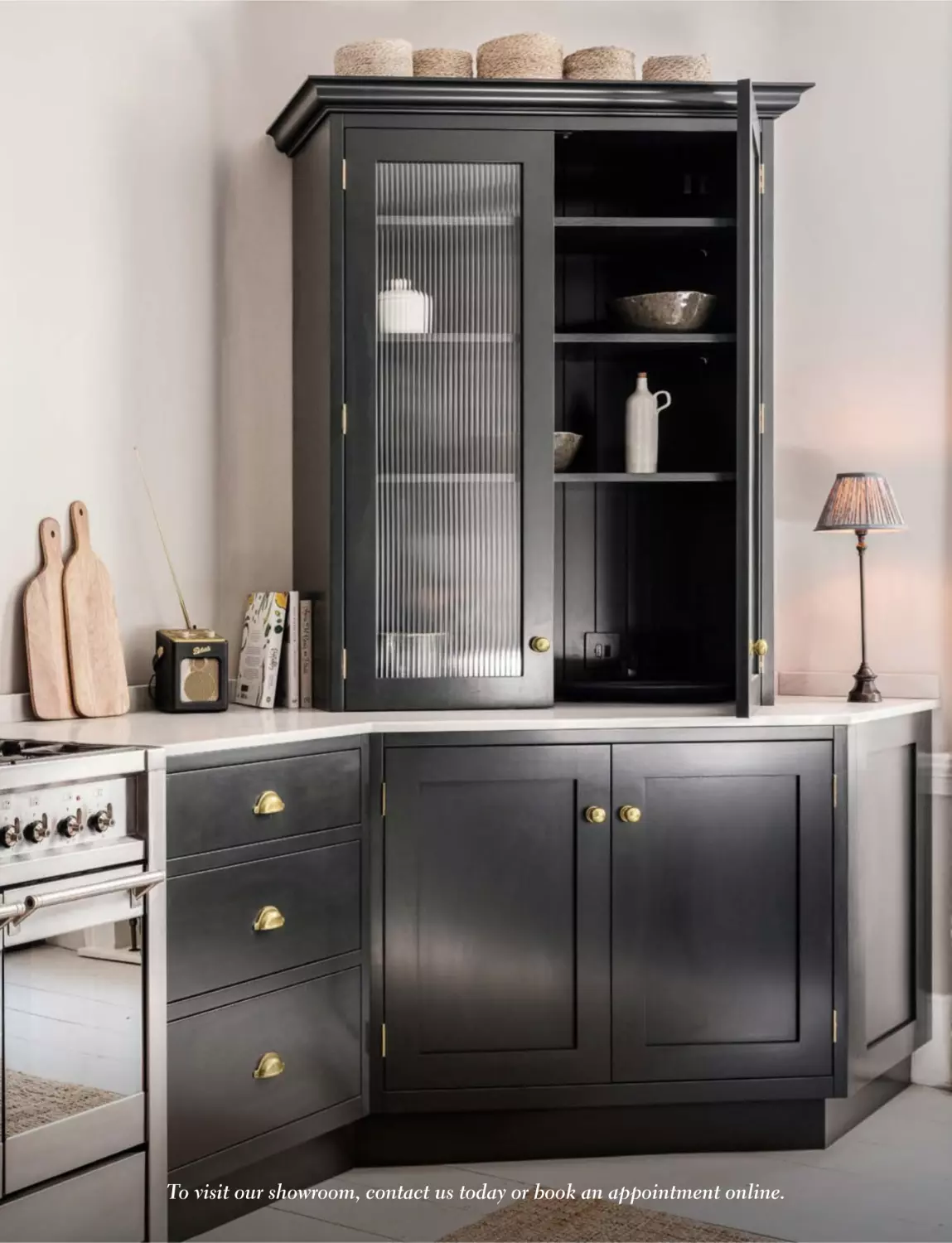
To visit our showroom, contact us today or book an appointment online.

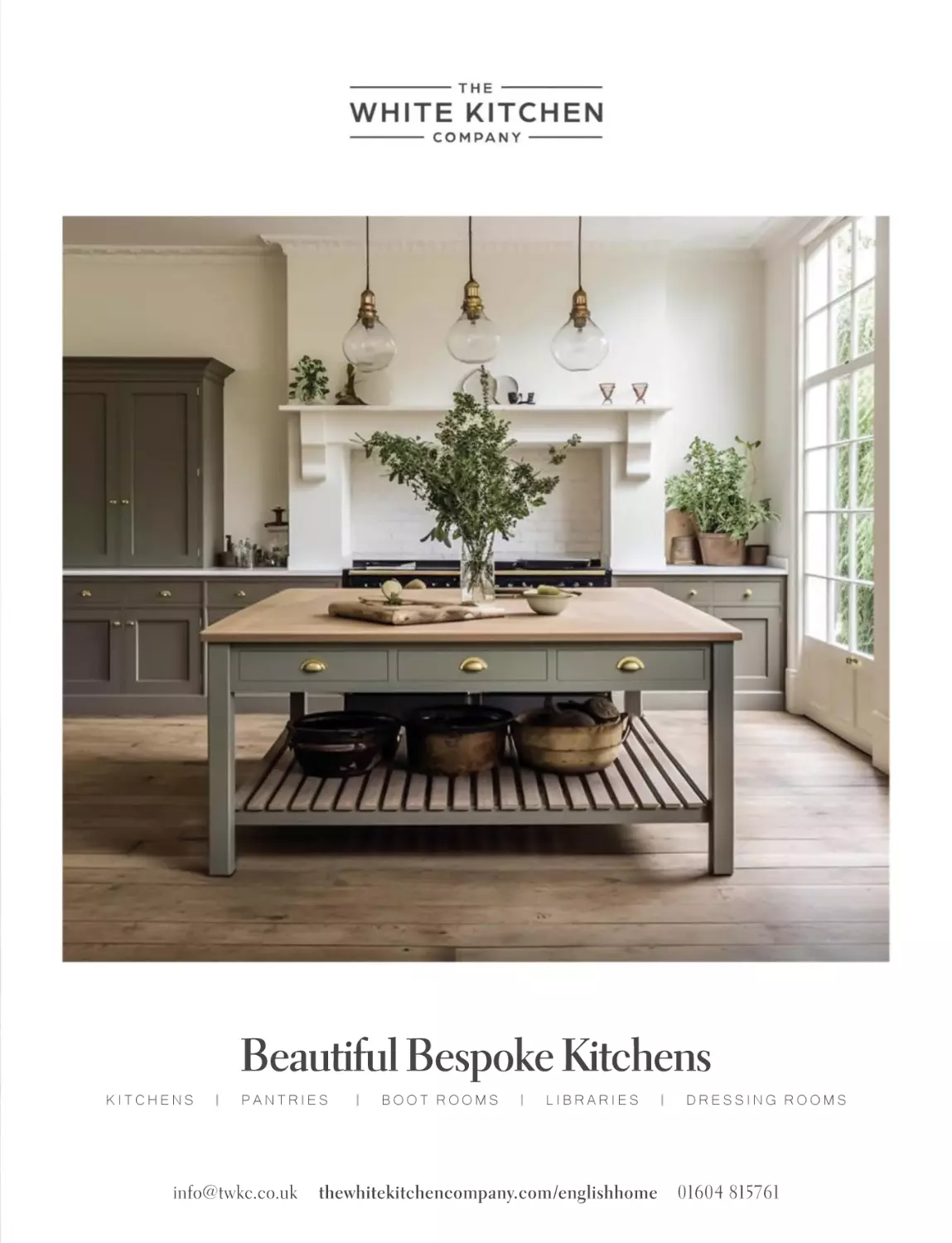
Beautiful Bespoke Kitchens
KITCHENS

PANTRIES

info@twkc.co.uk

BOOT ROOMS

LIBRARIES

thewhitekitchencompany.com/englishhome

DRESSING ROOMS

01604 815761

2024 INTERIOR DESIGN GUIDE
FROM THE ENGLISH HOME MAGAZINE

98

22
Planning

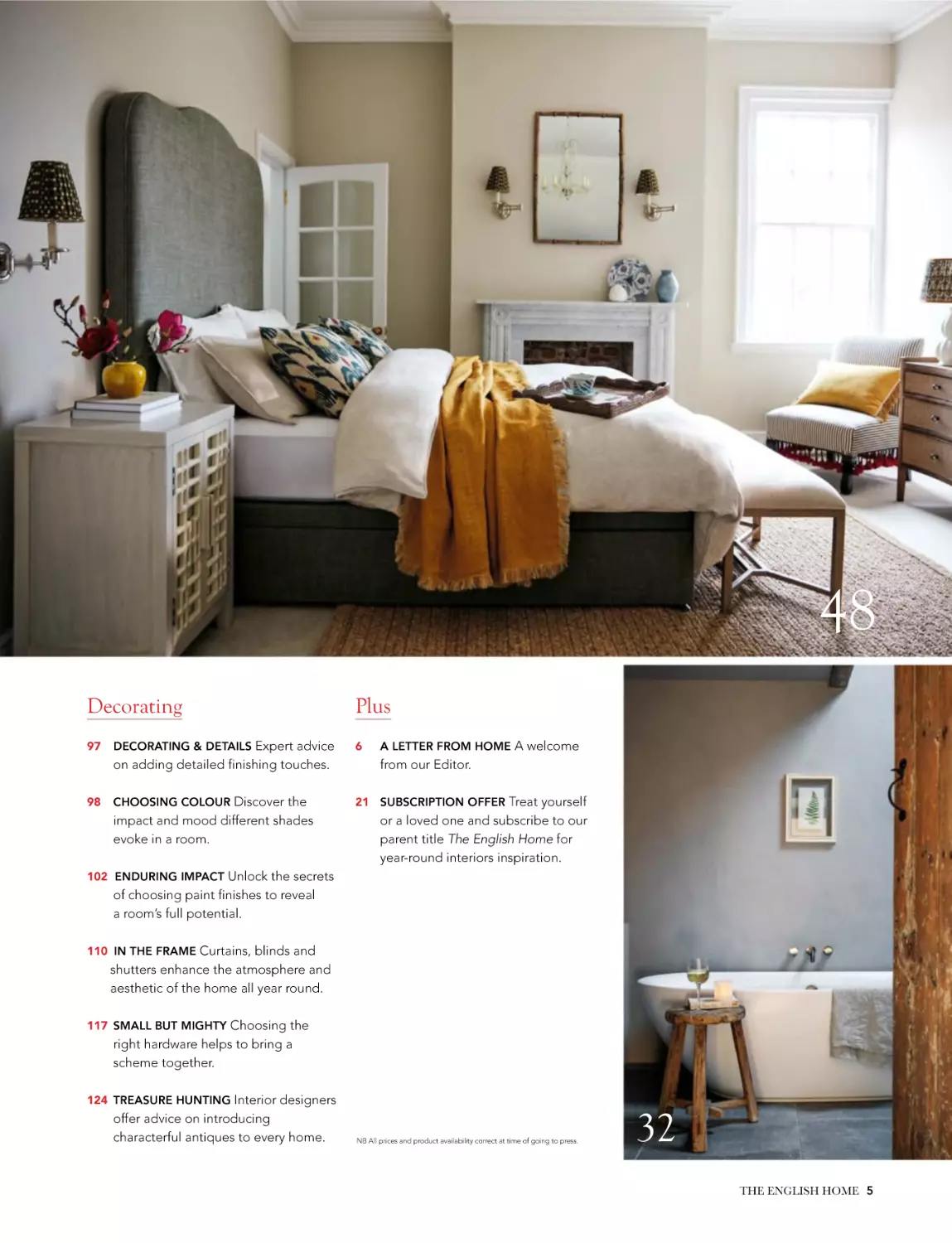
48

designing a calming bedroom for a
perfect night’s sleep.

11 PLANNING A SCHEME Consider the

elements carefully before decorating
to achieve desired results.

56

65

ON SOLID GROUND Timeless and
durable, hard flooring in all its forms
offers classic charm.

71

PATTERN PERFECTION Add layers of

22 KITCHEN EVOLUTION From subtle

updates to a full redesign, function
and style are fundamental to every
kitchen’s design.
32

80
4 THE ENGLISH HOME

interest to interiors with sumptuous
patterned rugs.

BATHROOMS MADE BEAUTIFUL

Thoughtful changes and alterations
to transform every bathroom into
a stylish sanctuary.
40

HYBRID WORKING Create a flexible

working space that pairs practicality
and beauty.

12 COMFORT & STYLE Inviting sitting

room ideas whether hosting,
unwinding or spending quality time.

SLEEP SUCCESS Expert tips on

80

UTILITARIAN BEAUTY Design utility

and boot room areas that add
function while honouring
a home’s aesthetic.

GUIDING LIGHT Simple steps to

creating well-placed, ambient lighting
in every room.

89

DESIGNS FOR LIFE OUTDOORS Curate

beautiful garden spaces for dining,
entertaining and relaxing.

48
Decorating
97

DECORATING & DETAILS Expert advice

on adding detailed finishing touches.
98

CHOOSING COLOUR Discover the

impact and mood different shades
evoke in a room.

Plus
6

A LETTER FROM HOME A welcome

from our Editor.
21 SUBSCRIPTION OFFER Treat yourself

or a loved one and subscribe to our
parent title The English Home for
year-round interiors inspiration.

102 ENDURING IMPACT Unlock the secrets

of choosing paint finishes to reveal
a room’s full potential.
110 IN THE FRAME Curtains, blinds and

shutters enhance the atmosphere and
aesthetic of the home all year round.
117 SMALL BUT MIGHTY Choosing the

right hardware helps to bring a
scheme together.
124 TREASURE HUNTING Interior designers

offer advice on introducing
characterful antiques to every home.

NB All prices and product availability correct at time of going to press.

32
THE ENGLISH HOME 5

A letter from home

W

hether redesigning a specific room or taking on
the challenge of renovating a whole home, the
process can be as daunting as it is exciting without
guidance. At The English Home, we understand that
expert advice and just the right edit of options is what’s needed to
give you the confidence to achieve the best results. As fleeting
fashions for interiors flood the internet and mistakes can be costly,
this year’s Interior Design is a comprehensive guide to creating a
timeless home for contemporary lifestyles. Full of insights from
leading industry names, interior designers and absolute experts in
specific fields, it’s designed to equip you to create an interior that
reflects your unique personality, style and lifestyle, resulting in a
scheme to love and enjoy for years to come.
Within these pages you’ll find inspiration and ideas for planning
and decorating the major rooms of classic homes, specific and
detailed decorating advice, along with new ideas for creating spaces
to reflect the way you want to live today.
Whether you’re tackling a small area of your home or an entire
project, its a valuable resource and tool to keep and refer to time
and time again.
As we send this issue to press, I feel it should perhaps also come
with a warning – Interior Design could spark a new-found desire to
overhaul rooms you previously thought fine! As our homes evolve as
we do, and are never really ‘complete’, however, there’s never a rush
to decorate all in one go – enjoy adding those layers over time.

Samantha Scott-Jeffries, Editor

FOR READERS IN THE USA AND CANADA
The English Home tries, where possible, to ensure featured items
can be bought by readers in the US and in Canada.
TIME DIFFERENCE British Time is five hours
ahead of Eastern Standard Time in the US
and Canada.
POSTING TO THE UK The current rate to post
a letter or postcard via air to the UK from the
US starts at US$1.50, depending on weight and
size. From Canada, the rate is C$3.06 for letters
and cards of 30g or less. Check with your local
post office for other rates.
CURRENCY At the time of going to press
the exchange rate is US$1.21/C$1.66 to
£1 sterling. Please be aware this will fluctuate
on a daily basis.

6 THE ENGLISH HOME

EDITORIAL LISTING Prices listed are correct
at the time of going to press but will be
subject to change as this is an annual
publication. Always check the item suits your
requirements before ordering.
ADVERTISING Some UK advertisers may not
be able to ship to the US or Canada because
of practical considerations or customs
regulations. Please enquire direct to
individual advertisers.
CUSTOMER SERVICE Any queries should be
directed to our subscription offices in the US
and Canada as listed to the right.

Facebook at facebook.com@theenglishhome
Instagram at instagram.com@englishhomemag

SUBSCRIPTION OFFICES

NEWS DISTRIBUTION

USA
The English Home,
PO Box 37518, Boone,
IA 50037-0518, USA
Tel 1-866-926-0260
ehmcustserv@cdsfulfillment.com

USA & CANADA
CMG, LLC/155 Village Blvd,
3rd Floor, Princeton,
NJ 08540, USA

CANADA
The English Home, 1415 Janette
Avenue, Windsor, ON N8X 1Z1, Canada
Tel 1-866-926-0260
Canadian GST number:
87211 8922 RT0001 ehmcustserv@
cdsfulfillment.com
SUBSCRIPTION RATES
USA US$39.75 (6 issues).
Canada C$49.75 (6 issues). Includes
GST/postage surcharge.
ADVERTISING OFFICES
The English Home,
The Chelsea Magazine Company Ltd,
111 Buckingham Palace Road, London
SW1W 0DT
Tel +44 (0)20-7349-3700
laurna.barry@chelsea
magazines.com

BACK ISSUES
North America $7.99;
Rest of World £6.25
Contact: thebritainshop.com
USA PUBLICATION DETAILS
THE ENGLISH HOME (ISSN 1468-0238)
(USPS 018-446)
is published bi-monthly
by The Chelsea Magazine Company Ltd,
111 Buckingham Palace Road, London
SW1W 0DT
Distributed in the US by:
NPS Media Group,
2 Enterprise Drive, Suite 420, Shelton,
CT 06484, USA
Periodicals postage paid at Shelton, CT
and additional mailing offices.
POSTMASTER: Send address changes
to THE ENGLISH HOME, PO Box 37518,
Boone, IA 50037-0518, USA

PORTRAIT GRANT SCOTT

Follow us on X (formerly Twitter) @englishhometeam
Pinterest at pinterest.com/theenglishhome

ARTISAN ABODE

Created and Curated by Interior Design Studio Artisans and Artists
artisanabode.co.uk

artisansandartists.co.uk

CONTACT US
Editorial 020 7349 3700
The English Home
111 Buckingham Palace Road
London SW1W 0DT
Email theenglishhome@chelseamagazines.com
Website theenglishhome.co.uk
Advertising/Publishing 020 7349 3700
The Chelsea Magazine Company Ltd
Email info@chelseamagazines.com

COVER PHOTOGRAPH © JAMES HARE

NORTH AMERICAN & CANADIAN READERS
PLEASE REFER TO ADDITIONAL DETAILS ON PREVIOUS PAGE
EDITORIAL
Editor Samantha Scott-Jeffries
Managing Editor Sarah Feeley
Art Editors Claire Hicks, Rebecca Stead
Acting Art Editor Andrea Lynch
Sub Editor Lea Tacey
Decorating Editor Katy Mclean
Features Editor Suzanna Le Grove
Editor-at-Large Kate Freud
Houses Researcher Charlotte Dunford
Acting Editorial Assistant Molly Malsom
Contributing Writer Laura Sutherland

ADVERTISING
Group Sales Director Catherine Chapman
078796 44768; catherine.chapman@chelseamagazines.com
Head of Sales Operations Jodie Green
Group Advertising Manager Ashley Leat
Advertisement Manager Laurna Barry
07470 813435; laurna.barry@chelseamagazines.com
Senior Sales Executive Tabitha Tully
07707 167728; tabitha.tully@chelseamagazines.com
Advertising Production 01202 472781; allpointsmedia.co.uk

NORTH AMERICAN ADVERTISING CONTACTS
Michel Manzo mmanzo@manzomediagroup.com
Office – 610-527-7047; Cell – 215-470-7075
Kim Richards krichards@manzomediagroup.com
Office – 610-527-7047; Cell – 610-812-8251
PUBLISHING
Managing Director James Dobson
Chief Financial Officer Vicki Gavin
Publisher Caroline Paton-Philip
Subscriptions Marketing Manager Alex Havell
Publishing Executive Annabelle Lee

PRODUCTION

Beautiful flooring,
designed to last
Over 100 designs | Expert advice

Reprographics Manager Neil Puttnam
Printing William Gibbons Ltd
THE ENGLISH HOME (UK EDITION) ISSN 1468-0238 (PRINT)
THE ENGLISH HOME (UK EDITION) ISSN 2397-7086 (ONLINE)

Did you know you can manage your subscription online? Oversee your print
and digital subscriptions online today simply by signing up at www.
subscription.co.uk/chelsea/Solo/. Stay up to date with the latest issues,
update your personal details, and even renew your subscription with just a
click of a button.

20,000m 2 of stock | Express delivery
SHOWROOM
20 Smugglers Way, Wandsworth,
London, SW18 1EG
020 8871 9771

w w w.naturalwoodfloor.co.uk

8 THE ENGLISH HOME

The Professional
Publishers Association
Member

© The Chelsea Magazine Company Ltd 2024, part of the Telegraph Media Group. All rights reserved. Text
and pictures are copyright restricted and must not be reproduced without permission of the publishers. The
information in The English Home has been published in good faith and every effort has been made to ensure
its accuracy. However, where appropriate, you are advised to check prices, opening times and dates, etc, before
making final arrangements. All liability for loss, disappointment, negligence or damage caused by reliance on the
information within this publication is hereby excluded. The opinions expressed by the contributors of The English
Home are not necessarily those of the publisher. www.chelseamagazines.com: Publisher of Artists & Illustrators,
Baby, BRITAIN, Classic Boat, Cruise & Travel, Discover Britain, The English Garden, Independent School Parent
and associated guides, Little London, The London Magazine, Racecar Engineering, Sailing Today with Yachts &
Yachting, Scotland Magazine and Wedding Ideas.

A Sofa for Every Space

BRI D G M A N .C O. U K

Sit back, snuggle up and sink into the extraordinary comfort of Bridgman’s new
premium sofa collections. From the softness of each cushion to the finish of every
fabric, you'll never find furniture quite like it.

020 8804 7474

Visit one of our seven beautiful showrooms or our website to discover our complete
catalogue of award-winning furniture designs.

C H E LT E N H A M

ENFIELD

WINCHESTER

OLD AMERSHAM
W I L M S LO W

R OYA L T U N B R I D G E W E L L S

WA LTO N - O N -T H A M E S

PLANNING A SCHEME
Our expert guides to ensuring all elements are carefully considered from the outset

FEATURE KATY MCLEAN

HAND IN HAND
Practical details and pretty touches should be partners
from the start when renovating or decorating.
Considering everything from colour palettes and
patterns through to the textures and finishes will
ensure a picture perfect aesthetic. Planning
practicalities such as wiring for lamps will also pay
dividends, as will giving serious thought to how a
space will be used, and measuring furniture,
to ensure a smooth flow and useable layout,
where everything is in just the right place.
Pomona upholstered ottoman, £1,995;
Talasa tray, £160, both Oka
THE ENGLISH HOME 11

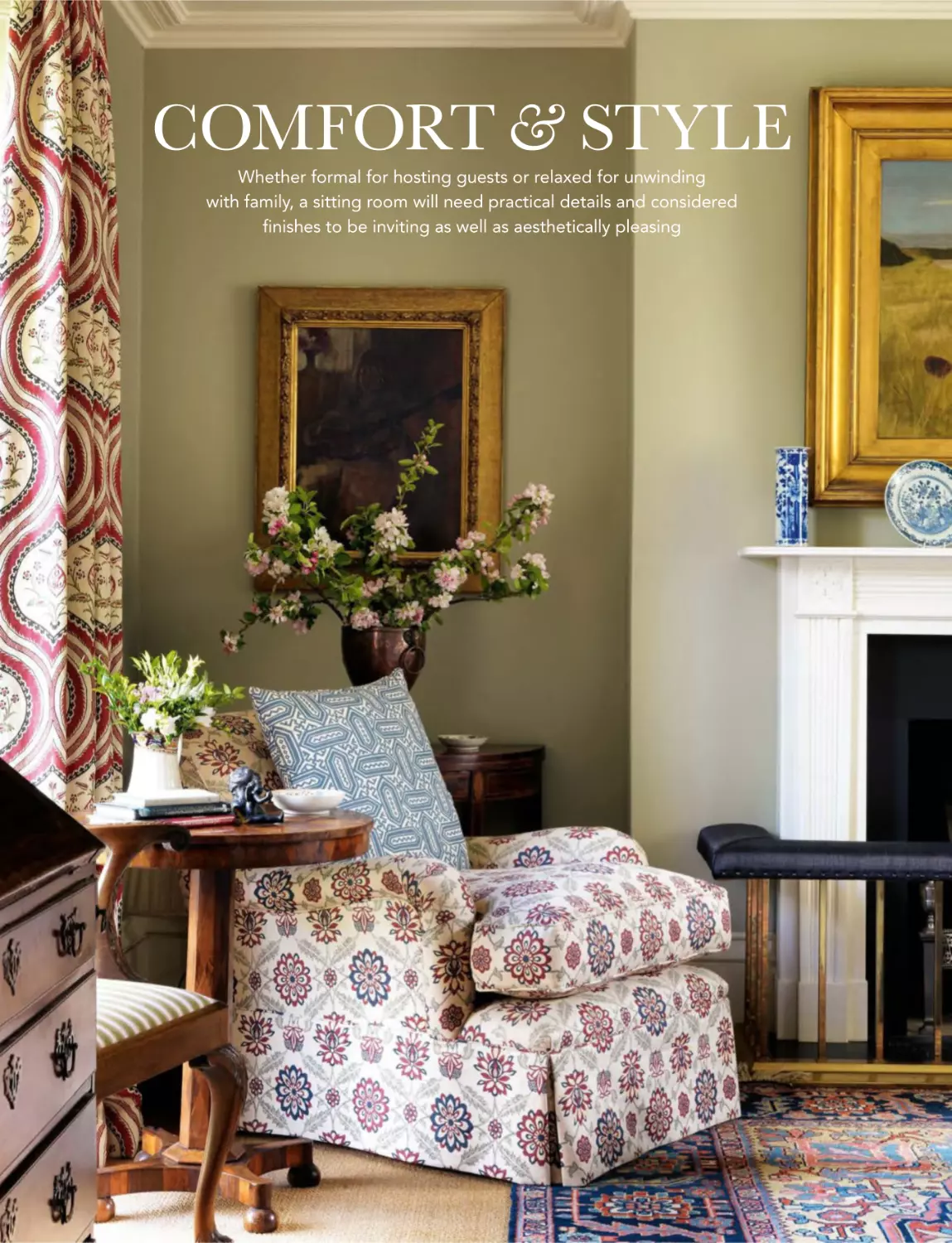
COMFORT & STYLE
Whether formal for hosting guests or relaxed for unwinding
with family, a sitting room will need practical details and considered
finishes to be inviting as well as aesthetically pleasing

PLANNING
Sitting rooms
THIS PAGE Calm cream
and blue sets the scene
in this drawing room.
Chic pencil-pleat curtains
give window treatments
a more formal tone.
Blinds and chairs,
Asscher, Blue Haze,
£80 a metre; curtains,
Connaught Silk, Whisper
White and Vista, £69 a
metre, all James Hare
OPPOSITE A smart
armchair provides a
comfortable spot by
Armchair, William
Yeoward; fabric, Robert
Kime; room design by
Vanessa Macdonald at
Melissa Wyndham.

THE ENGLISH HOME 13

Smart & elegant
Larger houses may have the flexibility to include a formal drawing
room – a space where conversation is prioritised over watching
television. Here, a fireplace might form the focal point around
which to arrange furniture, perhaps two large sofas and a couple
of armchairs. Choose sofas that seat three comfortably and have
tailored upholstery, perhaps with button-back detailing and piping,
and position them so guests can socialise comfortably. Position side
tables so that drinks are within easy reach, and table and floor lamps
to provide soft pools of light around the room. If there is space,
create areas to sit – an armchair and lamp for reading or window
seats for taking in views of the garden. Dress windows with fulllength pooling curtains accessorised with elegant tie-backs for an
extra flourish.
LEFT A stool is a
handy extra that
to a period space.
Justin stool, Robert
Langford; fabric,
Gloria, Rose Ancien,
£132 a metre,
Manuel Canovas at
Colefax and Fowler

BELOW LEFT A
well-stocked bar in
a sitting room will
keep conversation,
Wow!House drawing
room design
by Vanessa
Macdonald for
Melissa Wyndham

BELOW RIGHT Add
a touch of opulence
with impressively
ornate tie-backs to
match sumptuously
embroidered
full-length curtains.
Hampton Embroidery
in Tapestry, £279 a
metre, Zoffany

PLANNING
Sitting rooms

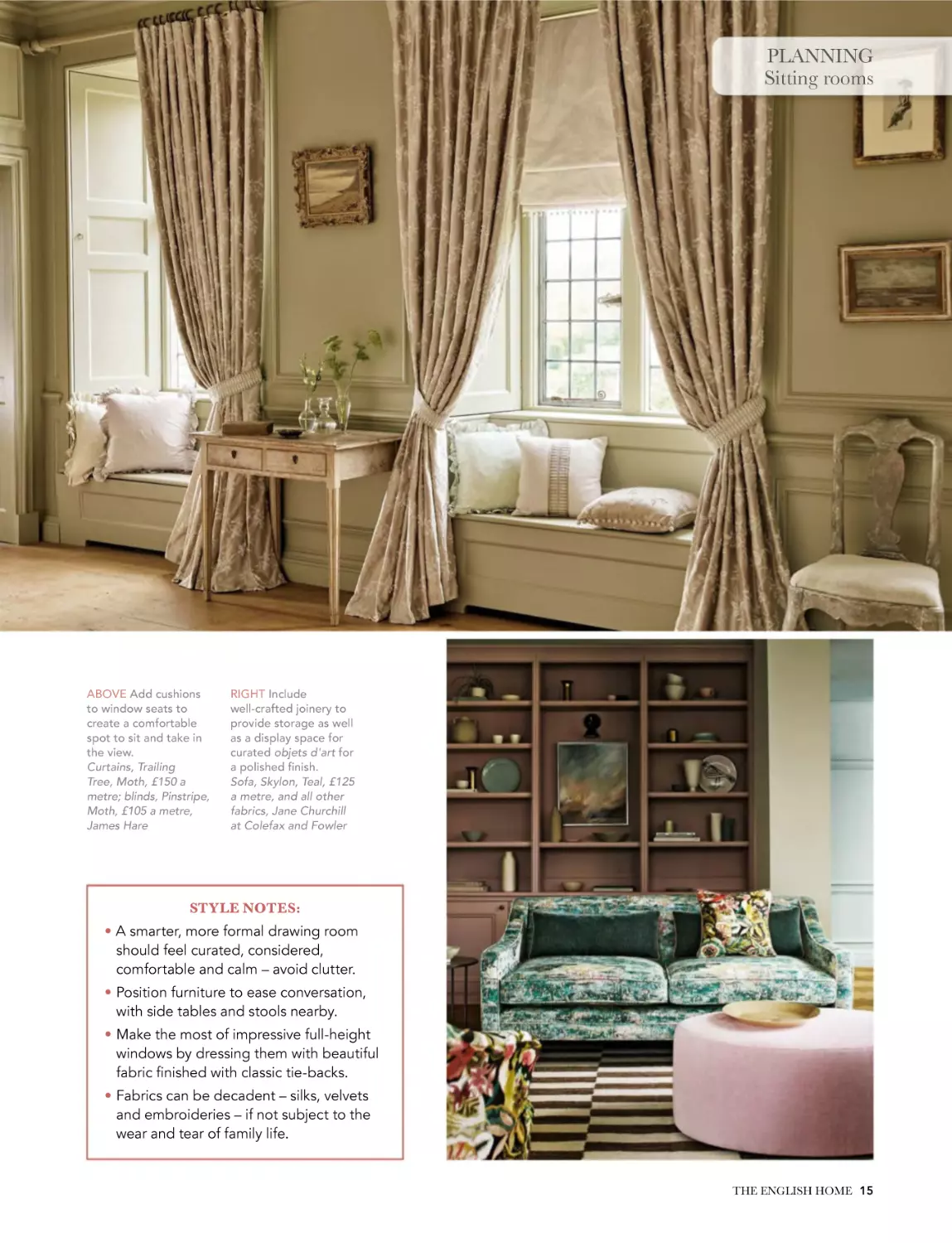
ABOVE Add cushions
to window seats to
create a comfortable
spot to sit and take in
the view.
Curtains, Trailing
Tree, Moth, £150 a
metre; blinds, Pinstripe,
Moth, £105 a metre,
James Hare

RIGHT Include
well-crafted joinery to
provide storage as well
as a display space for
curated objets d'art for
Sofa, Skylon, Teal, £125
a metre, and all other
fabrics, Jane Churchill
at Colefax and Fowler

STYLE NOTES:
• A smarter, more formal drawing room
should feel curated, considered,
comfortable and calm – avoid clutter.
• Position furniture to ease conversation,
with side tables and stools nearby.
• Make the most of impressive full-height
windows by dressing them with beautiful
fabric finished with classic tie-backs.
• Fabrics can be decadent – silks, velvets
and embroideries – if not subject to the
wear and tear of family life.

THE ENGLISH HOME 15

PLANNING
Sitting rooms

Relaxed & soothing
For a smaller sitting room or snug, create a sanctuary in which to
relax with family. This might include pets too, so choose furnishings
that are accordingly practical such as loose covers that can be
removed and washed. Sofas can be less tailored and formal and have
more give so they are comfortable for lounging on. Choose rugs
made of natural fibres that are hardwearing yet cosy or sumptuously
soft for added comfort. While a television might provide a focal
point for furniture in this type of space, consider, too, creating
a quiet spot for curling up with a book or magazine, with a table
nearby for a cup of tea. Bring additional character, comfort and
charm with the addition of assorted scatter cushions and an eclectic
arrangement of much-loved pieces combined with newer additions.

ABOVE LEFT A
gently harmonised
palette perfectly
unites old with new.
Curtain, Langley,
£179 a metre with
Sherborne Gingham
lining, £59 a metre,
GP & J Baker

ABOVE RIGHT Mix
and match fabrics
for an inviting,
relaxed look.
Sofa, Irene, Spice,
£105 a metre; and
all other fabrics,
William Yeoward at
Designers Guild

RIGHT Cushions
with a frilly or
imbues an interior
with charm.
Candy Stripe cotton
and frilled linen
cushions, £60 each,
Sorbet Living

THE ENGLISH HOME 17

PLANNING
Sitting Rooms

• Loose covers make things easier to clean,
but consider harder-wearing fabric
choices for upholstery too.
• Loosen up the look with lots of cushions,
with ruffles or frills to add charm.
• Mix old and new, as well as layering
pattern and colour for an evolved feel.

18 THE ENGLISH HOME

ABOVE Opt for a deep

LEFT

Cushions, Casper in Green,
£231.01 a metre, Sarah
Vanrenen for Penny
Morrison. Interior design by
Sarah Vanrenen

Wallpaper, Emery's Willow,
Chrysanthemum Pink, £109
a roll, Morris & Co

FEATURE KATY MCLEAN PHOTOGRAPHS P12 (VANESSA MACDONALD AT MELISSA WYNDHAM) © SIMON BROWN;
P14 (VANESSA MACDONALD AT MELISSA WYNDHAM) © JAMES MCDONALD; P17 (SORBET LIVING) © SARAH BUTTON;
P18 (SARAH VANRENEN) © MIKE GARLICK; (MORRIS & CO) © ANDY GORE

STYLE NOTES:
• Make comfort a priority when choosing
furniture and fabrics.

PARTNER FEATURE

BRIDGMAN

LUXE HERITAGE
For almost five decades, Bridgman has been bringing harmony and happiness
to the home through the unrivalled style and quality of its furniture

20 THE ENGLISH HOME

there are standout pieces which will be loved for years to
come. New for 2024, the Best of British sofa range joins
the mix. Handmade in the UK, using the finest materials
and innovative upholstery techniques, it is defined by
generous proportions and indulgent comfort, each piece
is available with fast delivery for the utmost convenience.
The company continues to promise to provide the
very best service, quality and experience possible. The
Bridgman catalogue now offers award-winning furniture
and accessories that marry the beauty of its luxury design
heritage with the promise of exciting innovations for the
modern home. From the felt pads lining each chair’s feet
to the plush softness of each seat, Bridgman has taken
care of every detail, so all that is left for its customers to
do is relax.
Visit one of Bridgman’s beautiful showrooms or head
to bridgman.co.uk to see, feel and sit on its furniture and to
order a free premium swatch sample box.

ABOVE LEFT
The sculptural
Portofino dining
table makes for
a captivating
centrepiece.
TOP RIGHT Relax
in mid-century
style with the chic
Sandringham sofa
and armchair.

FEATURE LAURA SUTHERLAND

F

rom the start, family has been the beating heart of
Bridgman. Over three generations, the family-run
business has designed and produced furniture
that marries comfort, quality and style to
transform the way that families spend their time at home.
Today, Bridgman looks to Italy for its design precision
and exquisite artisanship. The company’s expert furniture
makers have crafted a collection of truly sophisticated
dining tables and chairs. Drawing inspiration from
the warmth and natural elegance of wood, each piece
combines minimalist style with polished substance. The
result is a revelation, embodied by sculptural statement
designs, each of which is unique.
Bridgman’s award-winning sofa collections are an
eclectic mix of global furniture identities. Featuring the
clean lines of Scandinavian design, the retro curves of
reimagined 20th-century classics and sectional seating
that reflects the contemporary demand for modularity,

£5.50
ONLY
£2 AN
ISSUE

3 ISSUES OF
THE ENGLISH HOME MAGAZINE
FOR ONLY £6
Celebrate the essence of English style with a subscription
to The English Home magazine. Try your first 3 issues
for only £6 and receive every issue straight to your door.
ENJOY OUR FANTASTIC SUBSCRIBER BENEFITS

+

England’s most enchanting
houses to country houses

+

advice from leading
interior designers

+ Discover the very best

and craftsmanship

+

with free delivery direct
to your home
+ Pay only £2 an issue
when you subscribe*

As an overseas customer, you
can enjoy one of these great
subscription options:
USA An annual subscription
for $19.95 - saving 58%
Canada An annual subscription
for $29.95
Rest of World An annual
subscription for £72.95

TWO EASY WAYS TO SUBSCRIBE

UK
Rest of World
and quote code CENHID24 or

USA & CANADA call 1-866-926-0260 and quote code KND4SA
UK Customers
US and Canada Customers Subscriptions include 6 issues per year.

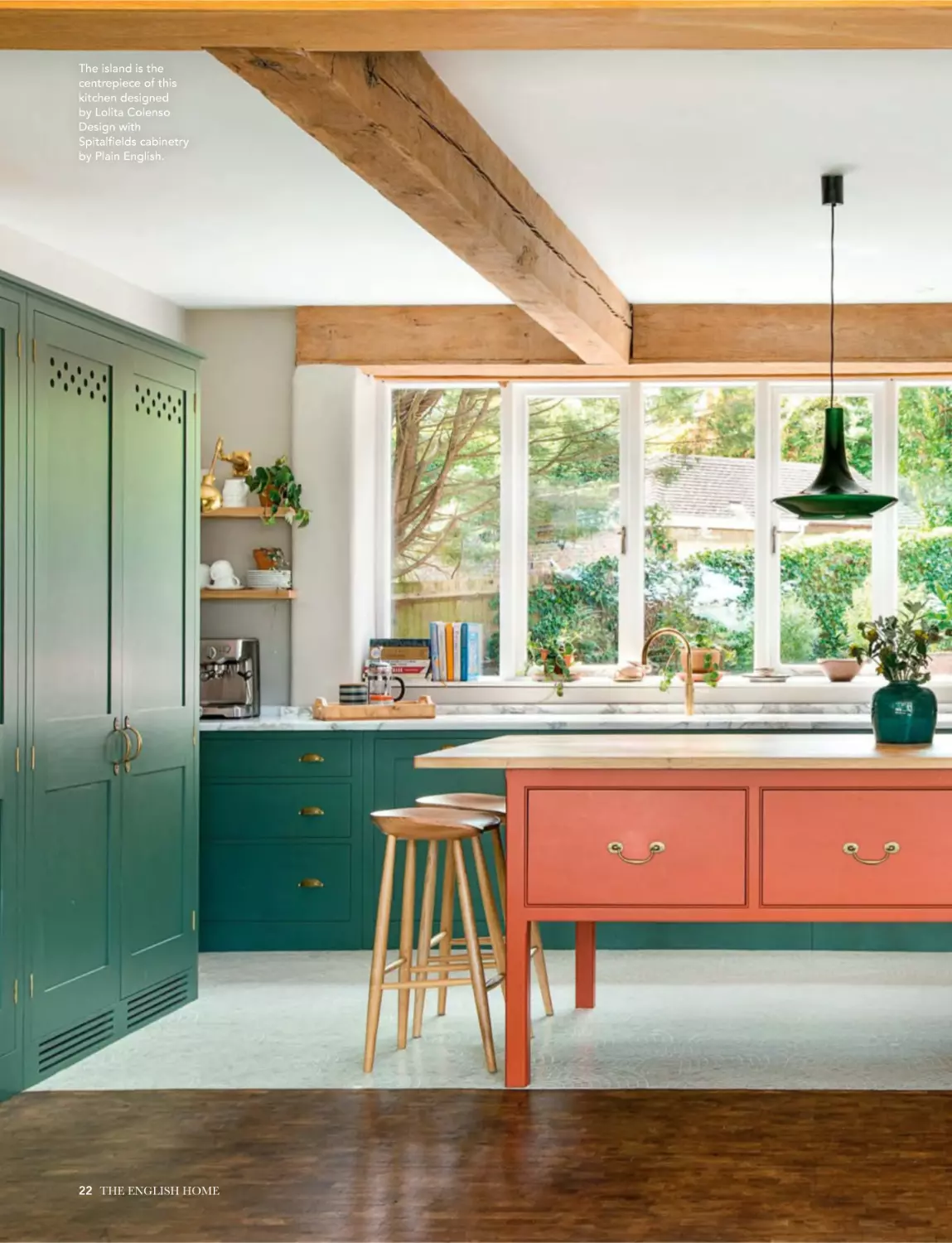
The island is the
centrepiece of this
kitchen designed
by Lolita Colenso
Design with
Spitalfields cabinetry
by Plain English.

22 THE ENGLISH HOME

PLANNING
Kitchens

O

ften the heart and the hardest
working space of the home, a
kitchen needs to work practically
and be a pleasure to use
aesthetically. Commissioning a replacement can
solve functional problems and introduce flair,
and kitchen designers can help analyse what
works and what requires altering for specific

needs, from transforming functionality by
changing the layout, lighting and technology to
streamlining the design to enhance the feel of
the space. Alternatively, a smaller transformation
that makes a big difference may be possible
simply with changes to areas such as surfaces,
hardware and storage. Here we consider a range
of different options, as our experts explain.
THE ENGLISH HOME 23

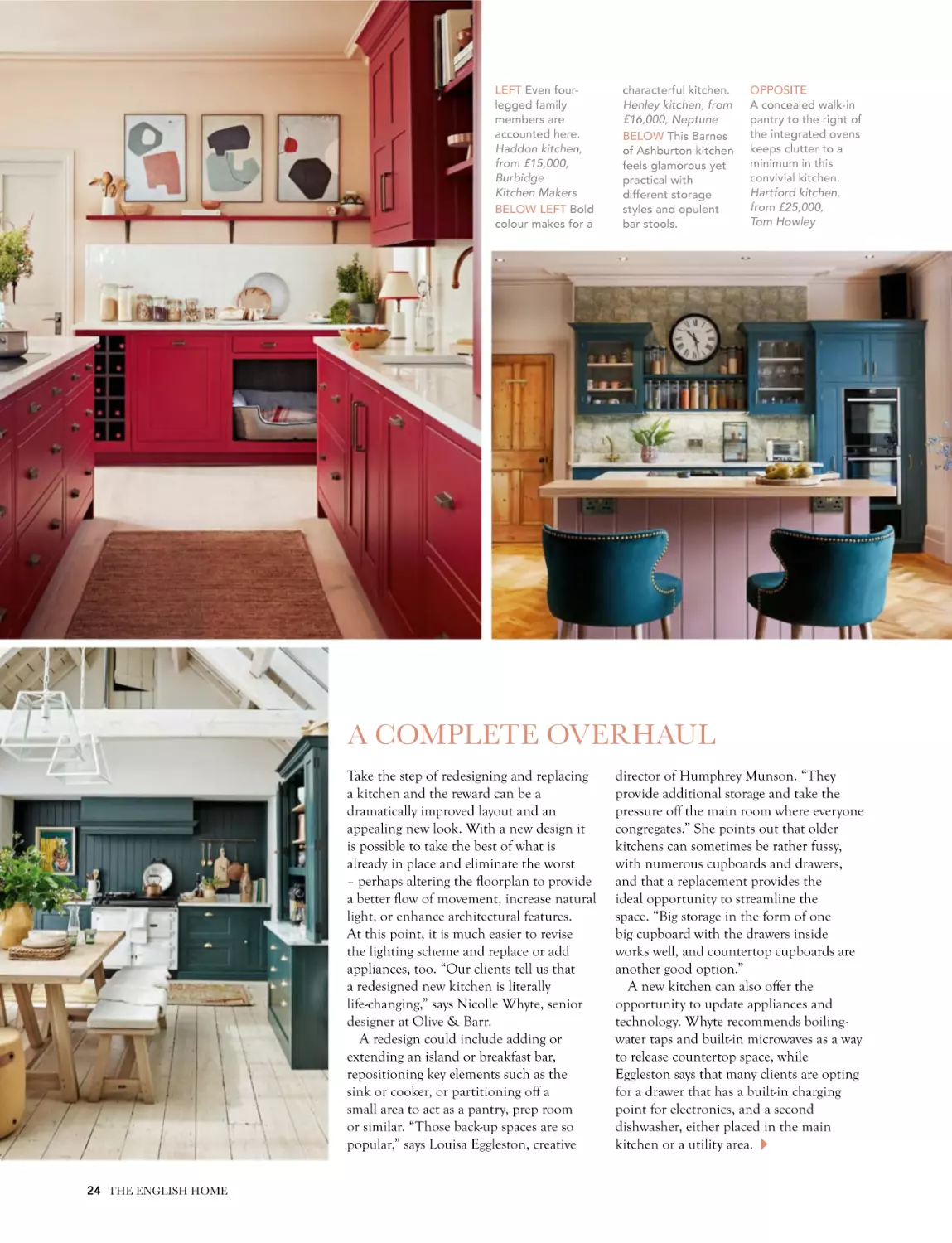
LEFT Even fourlegged family
members are
accounted here.
Haddon kitchen,
from £15,000,
Burbidge
Kitchen Makers
BELOW LEFT Bold
colour makes for a

characterful kitchen.
Henley kitchen, from
£16,000, Neptune
BELOW This Barnes
of Ashburton kitchen
feels glamorous yet
practical with
different storage
styles and opulent
bar stools.

OPPOSITE
A concealed walk-in
pantry to the right of
the integrated ovens
keeps clutter to a
minimum in this
convivial kitchen.
Hartford kitchen,
from £25,000,
Tom Howley

A COMPLETE OVERHAUL
Take the step of redesigning and replacing
a kitchen and the reward can be a
dramatically improved layout and an
appealing new look. With a new design it
is possible to take the best of what is
already in place and eliminate the worst
– perhaps altering the floorplan to provide
a better flow of movement, increase natural
light, or enhance architectural features.
At this point, it is much easier to revise
the lighting scheme and replace or add
appliances, too. “Our clients tell us that
a redesigned new kitchen is literally
life-changing,” says Nicolle Whyte, senior
designer at Olive & Barr.
A redesign could include adding or
extending an island or breakfast bar,
repositioning key elements such as the
sink or cooker, or partitioning off a
small area to act as a pantry, prep room
or similar. “Those back-up spaces are so
popular,” says Louisa Eggleston, creative
24 THE ENGLISH HOME

director of Humphrey Munson. “They
provide additional storage and take the
pressure off the main room where everyone
congregates.” She points out that older
kitchens can sometimes be rather fussy,
with numerous cupboards and drawers,
and that a replacement provides the
ideal opportunity to streamline the
space. “Big storage in the form of one
big cupboard with the drawers inside
works well, and countertop cupboards are
another good option.”
A new kitchen can also offer the
opportunity to update appliances and
technology. Whyte recommends boilingwater taps and built-in microwaves as a way
to release countertop space, while
Eggleston says that many clients are opting
for a drawer that has a built-in charging
point for electronics, and a second
dishwasher, either placed in the main
kitchen or a utility area.

PLANNING
Kitchens

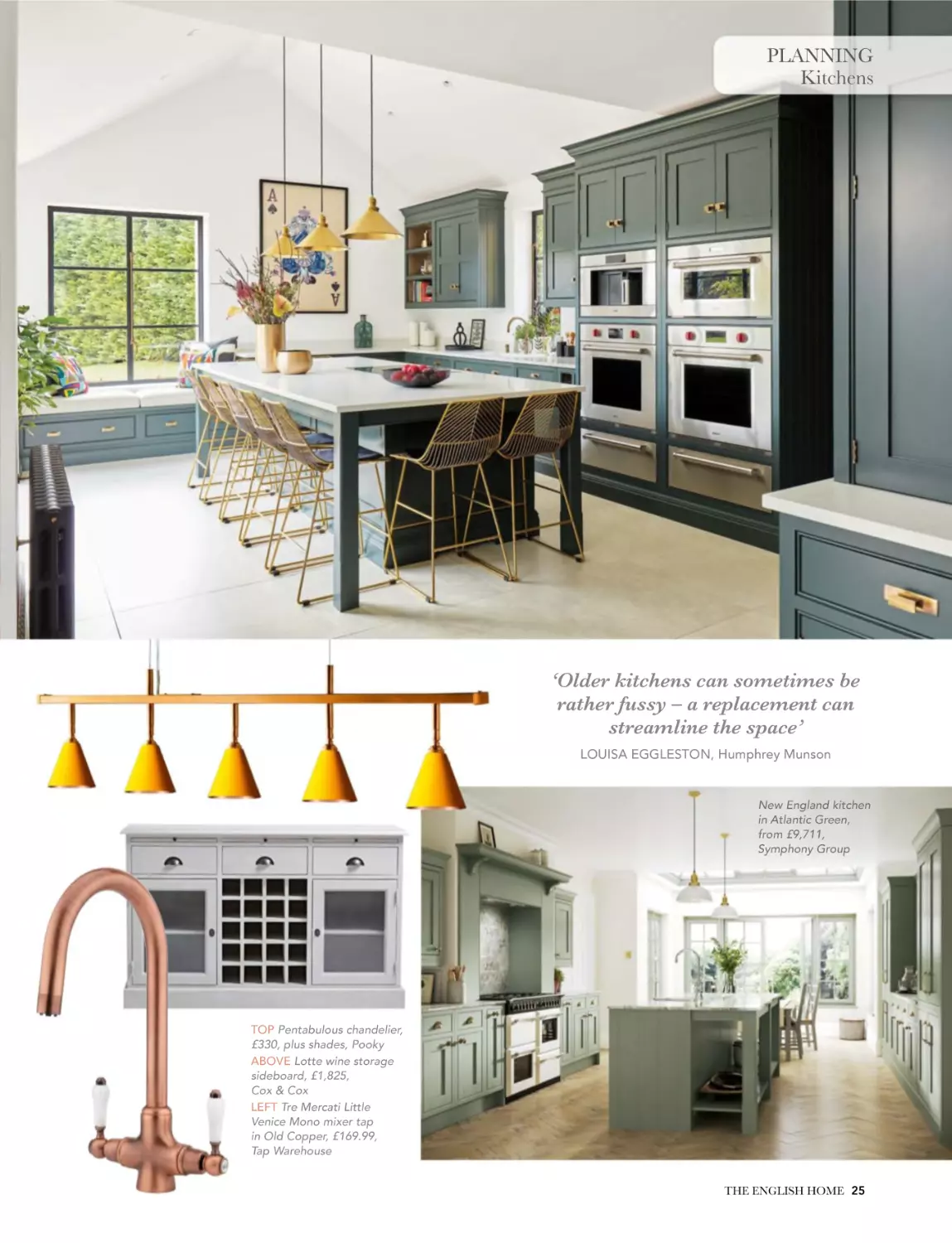
‘Older kitchens can sometimes be
rather fussy – a replacement can
streamline the space’
LOUISA EGGLESTON, Humphrey Munson

New England kitchen
in Atlantic Green,
from £9,711,
Symphony Group

TOP Pentabulous chandelier,
£330, plus shades, Pooky
ABOVE Lotte wine storage
sideboard, £1,825,
Cox & Cox
LEFT Tre Mercati Little
Venice Mono mixer tap
in Old Copper, £169.99,
Tap Warehouse
THE ENGLISH HOME 25

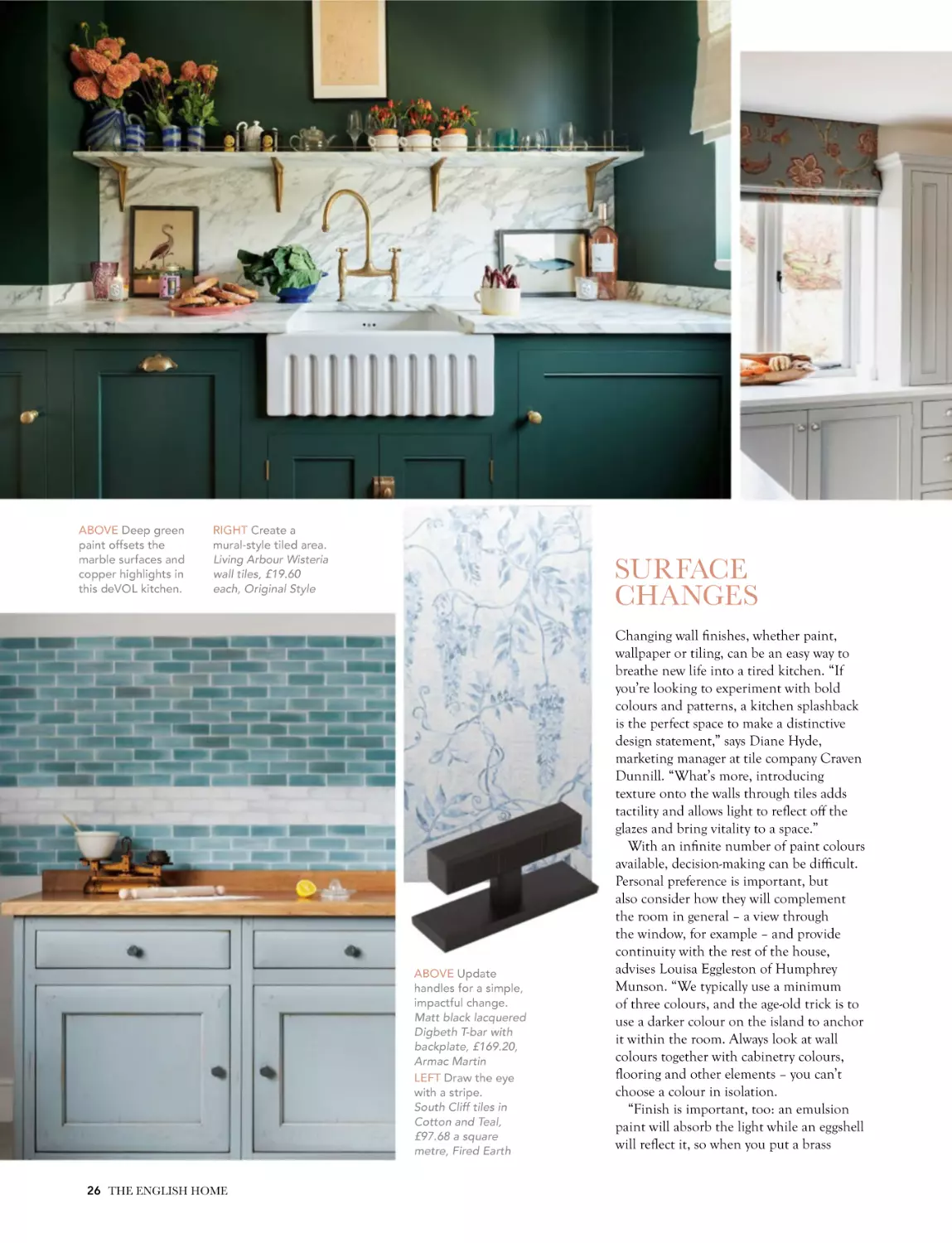
ABOVE Deep green
paint offsets the
marble surfaces and
copper highlights in
this deVOL kitchen.

RIGHT Create a
mural-style tiled area.
Living Arbour Wisteria
wall tiles, £19.60
each, Original Style

SURFACE
CHANGES

ABOVE Update
handles for a simple,
impactful change.
Matt black lacquered
Digbeth T-bar with
backplate, £169.20,
Armac Martin
LEFT Draw the eye
with a stripe.
South Cliff tiles in
Cotton and Teal,
£97.68 a square
metre, Fired Earth
26 THE ENGLISH HOME

Changing wall finishes, whether paint,
wallpaper or tiling, can be an easy way to
breathe new life into a tired kitchen. “If
you’re looking to experiment with bold
colours and patterns, a kitchen splashback
is the perfect space to make a distinctive
design statement,” says Diane Hyde,
marketing manager at tile company Craven
Dunnill. “What’s more, introducing
texture onto the walls through tiles adds
tactility and allows light to reflect off the
glazes and bring vitality to a space.”
With an infinite number of paint colours
available, decision-making can be difficult.
Personal preference is important, but
also consider how they will complement
the room in general – a view through
the window, for example – and provide
continuity with the rest of the house,
advises Louisa Eggleston of Humphrey
Munson. “We typically use a minimum
of three colours, and the age-old trick is to
use a darker colour on the island to anchor
it within the room. Always look at wall
colours together with cabinetry colours,
flooring and other elements – you can’t
choose a colour in isolation.
“Finish is important, too: an emulsion
paint will absorb the light while an eggshell
will reflect it, so when you put a brass

PLANNING
Kitchens
‘Introducing texture onto the
walls through tiles adds tactility
glazes and bring vitality to a space’
DIANE HYDE, Craven Dunnill
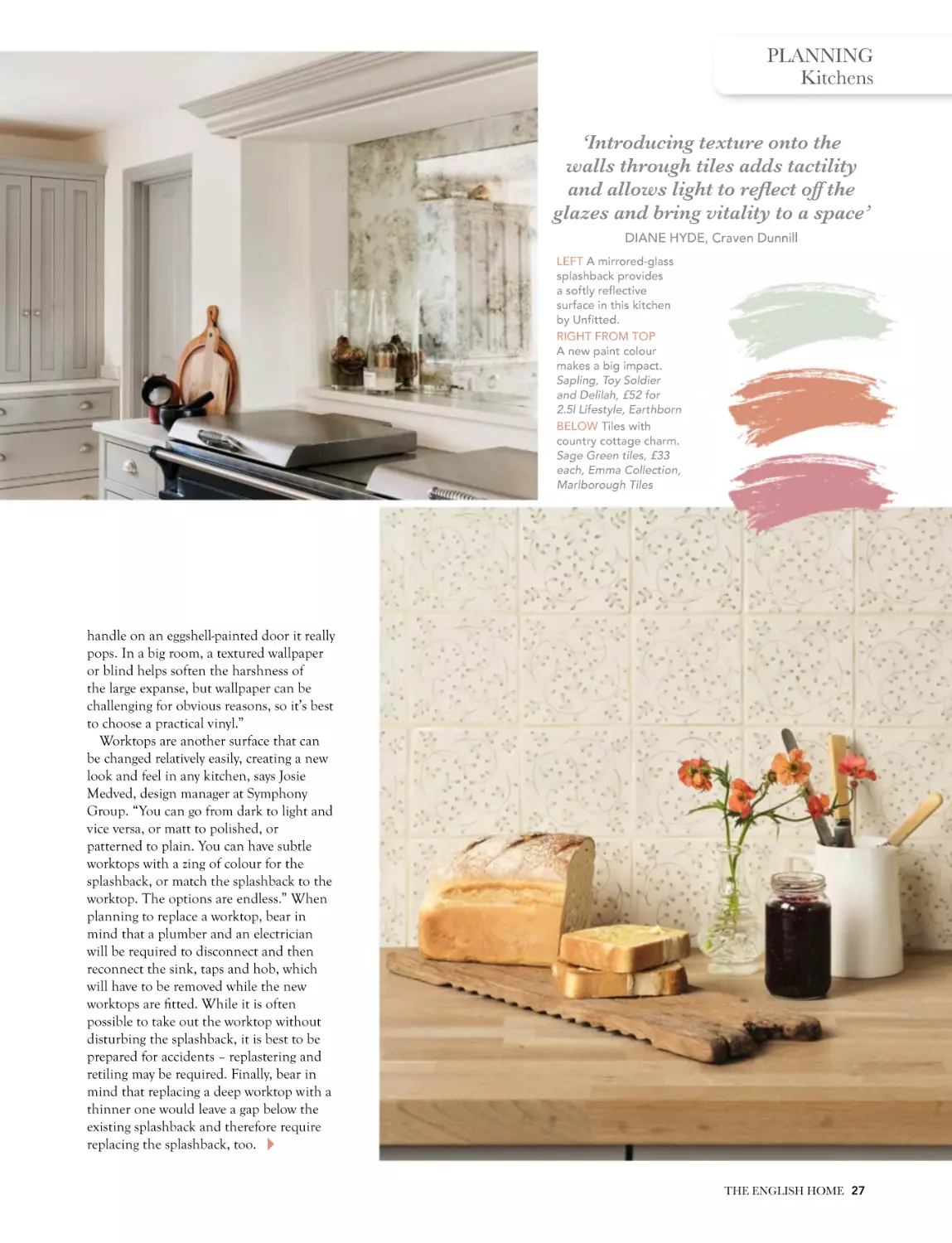
LEFT A mirrored-glass
splashback provides
a softly reflective
surface in this kitchen
by Unfitted.
RIGHT FROM TOP
A new paint colour
makes a big impact.
Sapling, Toy Soldier
and Delilah, £52 for
2.5l Lifestyle, Earthborn
BELOW Tiles with
country cottage charm.
Sage Green tiles, £33
each, Emma Collection,
Marlborough Tiles

handle on an eggshell-painted door it really
pops. In a big room, a textured wallpaper
or blind helps soften the harshness of
the large expanse, but wallpaper can be
challenging for obvious reasons, so it’s best
to choose a practical vinyl.”
Worktops are another surface that can
be changed relatively easily, creating a new
look and feel in any kitchen, says Josie
Medved, design manager at Symphony
Group. “You can go from dark to light and
vice versa, or matt to polished, or
patterned to plain. You can have subtle
worktops with a zing of colour for the
splashback, or match the splashback to the
worktop. The options are endless.” When
planning to replace a worktop, bear in
mind that a plumber and an electrician
will be required to disconnect and then
reconnect the sink, taps and hob, which
will have to be removed while the new
worktops are fitted. While it is often
possible to take out the worktop without
disturbing the splashback, it is best to be
prepared for accidents – replastering and
retiling may be required. Finally, bear in
mind that replacing a deep worktop with a
thinner one would leave a gap below the
existing splashback and therefore require
replacing the splashback, too.
THE ENGLISH HOME 27

PLANNING
Kitchens

STORAGE
UPDATES
“There are two key things to focus on
when incorporating extra storage without
a complete overhaul: creating more
space, and making what’s existing more
efficient,” explains Alice Hood, senior
design consultant at Roundhouse. One
way to create additional storage space is
to commission built-in cupboards that
either replicate or complement the existing
kitchen; another is to add new or antique
freestanding pieces such as dressers,
cupboards, chests of drawers, butcher’s
blocks, larders, trolleys or plate racks.
Henriette von Stockhausen of VSP Interiors
is an advocate of adding an island, or even
two. “Whether it’s a chef’s table with deep
drawers for cutlery and napkins and open
shelves underneath for bowls and other
pretty items, or a full island with dishwasher
and fridges, it can be customised to a
person’s specific needs. Adding an island
not only creates more storage space but also
something visually interesting, especially if it
looks like an antique.”
If removing and replacing wall cabinets
is an option, or if there is a gap into which
they can be fitted, Both Whyte and Hood
recommend cabinets that stretch right to
the ceiling, with higher spaces used for
long-term storage, perhaps accessed via a
ABOVE Every bit of
space was needed
for storage in this
kitchen, so
Roundhouse Design
developed an
existing spice-rack
design to create a
tall, shallow rack that
serves the nearby
hob and is also a
feature in the room.
LEFT In this scheme
by Pippa Paton, a
vintage butcher’s
block has been
raised on steel legs
and used to extend
the worktop and
add character.
CLOCKWISE FROM TOP Utensil rail kit, £36.35,
Rothley; Natural Elements eco-friendly canister,
£7.99, Kitchen Craft; Arbroath jute basket, from
£22, Neptune; Fitted larder cupboard, £2,315,
The White Kitchen Company
THE ENGLISH HOME 29

PLANNING
Kitchens

SMALL CHANGE, BIG DIFFERENCE
Altering just a few key elements
of a kitchen can make a dramatic
impact, says Kim Whinnett,
director at Barnes of Ashburton.
Lighting

“It is relatively hassle-free to change kitchen lighting,
though redecorating will be necessary if you move
place, and you will never know the alterations have
happened. Spotlights tend to age, so updating them
will make a big difference, while adding low-hanging
pendants over a breakfast bar is another way of breathing
new life into the scheme.”

Cabinet Furniture

vice versa, the holes will be in the wrong place. In this
case, choosing a replacement with a backplate can be
in the doors or drawers, sand them, and touch in with
matching paint – providing a blank canvas to start over.
marvellous against deep colours, while chrome has a
more modern look.”

Taps

‘Adding an island not only creates
more storage but also something
visually interesting, especially if
it looks like an antique’
HENRIETTE VON STOCKHAUSEN, VSP Interiors

ladder rail. “Replacing shallow wall cabinets
for a slightly deeper version to gain extra
volume can also make a real difference,”
adds Hood. Alternatively, rarely used
items could be moved out of the kitchen
entirely. “A dresser in the dining room,
particularly where it is open-plan to the
kitchen, provides a lot of kitchen storage,”
says Whyte.
In terms of making existing storage
more efficient, options include extra
shelves, racks, caddies and a range of
manufacturers’ devices for awkward
corners. Whyte is a big fan of seeking out
space for small details. “Spice racks stop
small things being lost at the back of a
cupboard and can be used for so many
types of container,” she says. “A good
place to add them is inside the door of the
under-sink cupboard. Cutlery inserts are
the same – they hold all kinds of things and
can be a huge help with organisation.”
30 THE ENGLISH HOME

ABOVE In this
kitchen by Henriette
von Stockhausen of
VSP Interiors and
bespoke specialist
Artichoke, a
professional stove
with induction hobs
is set into an arched
alcove, and a pair of
hefty wooden
preparation tables
sit below four-arm
chandeliers from
Circa Lighting.
RIGHT A Shaker-style
kitchen by Naked
Kitchens includes
dramatic wall lights
and a boiling water
tap in antique brass.

“Changing an old tap is straightforward, even if you want
stone masons and carpenters have the tools to drill
another hole in the worktop, while if you have a spare tap
hole you can use it for a soap dispenser, boiling-water tap
tap works really well with aged-brass cabinet handles.”

Switches
age, and changing them is simple for an electrician. While
it is possible to match new metal switch plates with other
elements within the room, consider where you are buying
– they can vary dramatically.”

FEATURE KATHERINE SORRELL PHOTOGRAPHS (LOLITA COLENSO) © ALEX MAGUIRE; (BURBIDGE) © JON DAY; (BARNES
OF ASHBURTON) © PAUL RYAN-GOFF; (FIRED EARTH) © JONATHAN WARNER; (UNFITTED) © GEORGIA DE LOTZ
PHOTOGRAPHY; (PIPPA PATON) © PAUL CRAIG; (VSP) © PAUL MASSEY; (ROUNDHOUSE) © MARY WADSWORTH

“The easiest way to change cabinet furniture is to choose

Beautifully crafted

HAND-MADE
timber windows & doors

49 local showrooms nationwide we can provide the perfect environment

Whether your home is a country cottage, a Victorian semi, a modern

With

townhouse or a converted barn, we have a range of traditional and

to browse the many options available.

contemporary timber windows and doors that will complement it perfectly.
The Timber Windows service is delivered with care by knowledgeable local
Our collection has been carefully and sensitively tailored to complement the

specialists whose reputation is built on providing an attentive service from initial

English home. Unlike timber windows of old, our products will not twist,

enquiry to the completion of your project.

will not rot and require very little maintenance. High levels of insulation and
Please do get in touch to receive expert advice and to see how beautiful timber
windows and doors really can enhance the value & beauty of your home.
AMERSHAM
BATTERSEA
BIRMINGHAM (HARBORNE)
BLANDFORD
BOURNEMOUTH
BRISTOL (CLIFTON)
BURY ST EDMUNDS
CARDIFF
CARMARTHEN

CATERHAM
CHANNEL ISLANDS
CHELTENHAM
CIRENCESTER
COLCHESTER
DENBIGH
DULWICH
ESHER

GUILDFORD
HARROGATE
HARTLEY WINTNEY
HEATHFIELD
HENLEY-ON-THAMES
HEREFORD
HONITON
HORNDEAN

T: 0800 030 2000

HORSHAM
INGATESTONE
IVYBRIDGE (COMING SOON)
KNUTSFORD
LEAMINGTON SPA
LINCOLN
MAIDSTONE
MORETON-IN-MARSH

NOTTINGHAM
OLNEY
OXFORD
REIGATE
RIPLEY
SAFFRON WALDEN
SALISBURY
SHEFFIELD

SHREWSBURY
STAMFORD
SUNNINGDALE
ST ALBANS
TEDDINGTON
TUNBRIDGE WELLS
WINCHESTER
WOODBRIDGE

www.timberwindows.com/eh

BATHROOMS
made BEAUTIFUL
From simple to complex, there are a variety of ways to update this most important
of spaces, making it a pleasure to use and refresh both body and soul

32 THE ENGLISH HOME

PLANNING
Bathrooms

M

ore than just a space for washing and bathing, a
bathroom is a sanctuary and most likely to be the
first and last place to be used in the home, so it
needs to be both a refreshing and relaxing
environment, delivering practicality and style. If the family
bathroom, en suite or shower room needs refreshing, rather than
a complete overhaul, a clever update or two can transform it into a
thing of beauty. From the more complex, such as a new bath or
changing the tiles, to the more simple, perhaps a different window
treatment or additional lighting, we look at ways to make a
bathroom more uplifting.

Decorative tiles
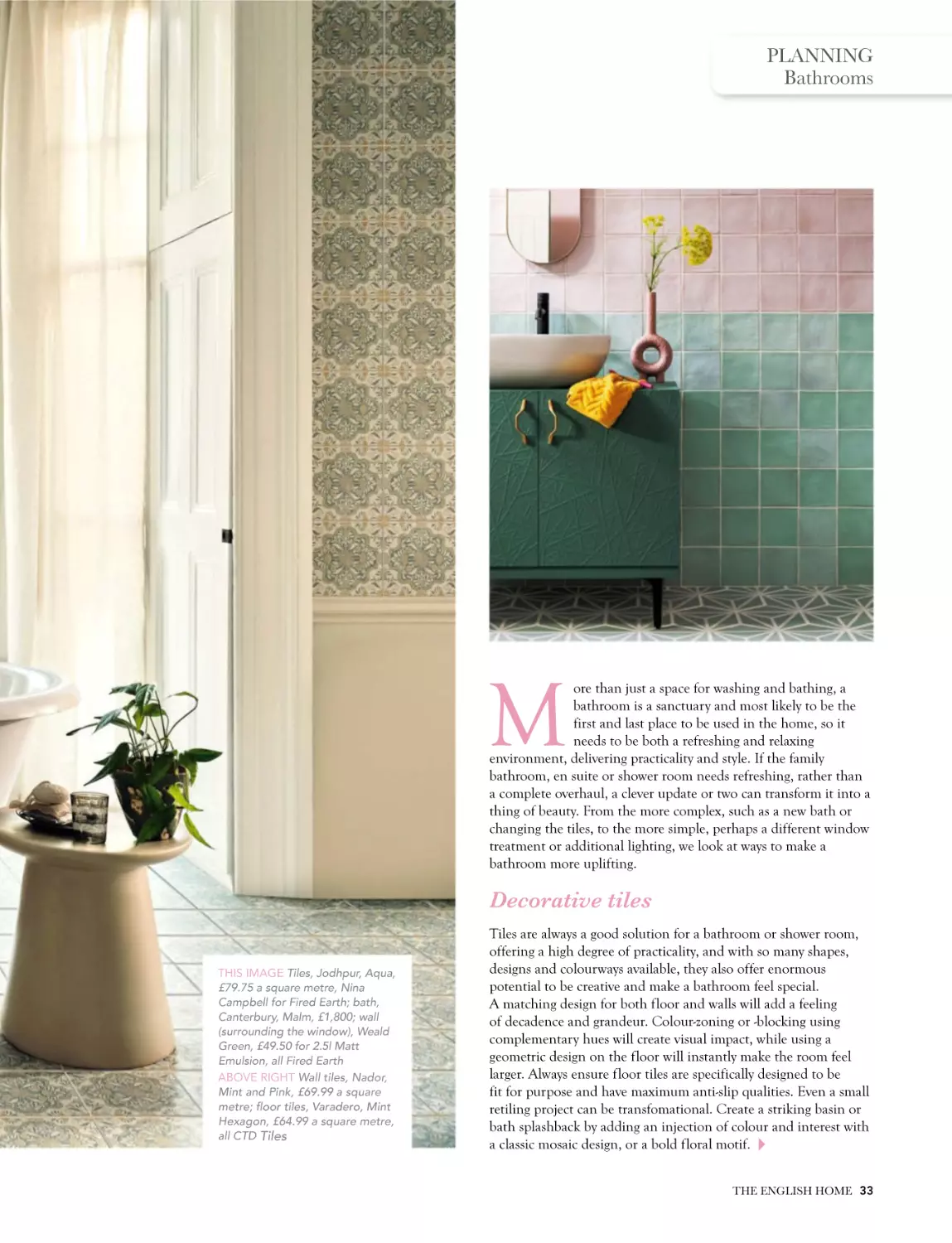
THIS IMAGE Tiles, Jodhpur, Aqua,
£79.75 a square metre, Nina
Campbell for Fired Earth; bath,
Canterbury, Malm, £1,800; wall
(surrounding the window), Weald
Green, £49.50 for 2.5l Matt
Emulsion, all Fired Earth
ABOVE RIGHT Wall tiles, Nador,
Mint and Pink, £69.99 a square
Hexagon, £64.99 a square metre,
all CTD Tiles

Tiles are always a good solution for a bathroom or shower room,
offering a high degree of practicality, and with so many shapes,
designs and colourways available, they also offer enormous
potential to be creative and make a bathroom feel special.
A matching design for both floor and walls will add a feeling
of decadence and grandeur. Colour-zoning or -blocking using
complementary hues will create visual impact, while using a
geometric design on the floor will instantly make the room feel
larger. Always ensure floor tiles are specifically designed to be
fit for purpose and have maximum anti-slip qualities. Even a small
retiling project can be transfomational. Create a striking basin or
bath splashback by adding an injection of colour and interest with
a classic mosaic design, or a bold floral motif.
THE ENGLISH HOME 33

Colour wash
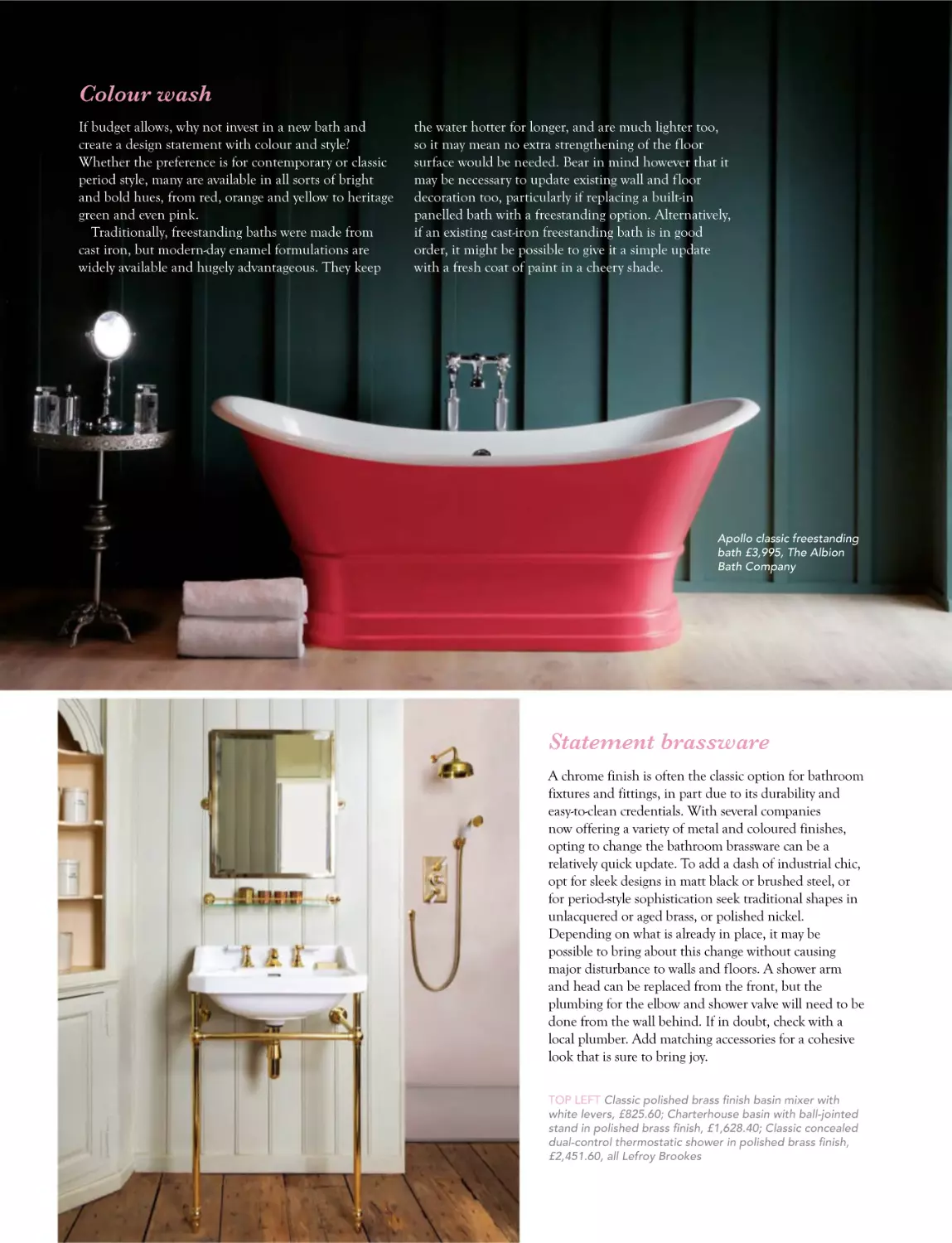
If budget allows, why not invest in a new bath and
create a design statement with colour and style?
Whether the preference is for contemporary or classic
period style, many are available in all sorts of bright
and bold hues, from red, orange and yellow to heritage
green and even pink.
Traditionally, freestanding baths were made from
cast iron, but modern-day enamel formulations are
widely available and hugely advantageous. They keep

the water hotter for longer, and are much lighter too,
so it may mean no extra strengthening of the floor
surface would be needed. Bear in mind however that it
may be necessary to update existing wall and floor
decoration too, particularly if replacing a built-in
panelled bath with a freestanding option. Alternatively,
if an existing cast-iron freestanding bath is in good
order, it might be possible to give it a simple update
with a fresh coat of paint in a cheery shade.

Statement brassware
A chrome finish is often the classic option for bathroom
fixtures and fittings, in part due to its durability and
easy-to-clean credentials. With several companies
now offering a variety of metal and coloured finishes,
opting to change the bathroom brassware can be a
relatively quick update. To add a dash of industrial chic,
opt for sleek designs in matt black or brushed steel, or
for period-style sophistication seek traditional shapes in
unlacquered or aged brass, or polished nickel.
Depending on what is already in place, it may be
possible to bring about this change without causing
major disturbance to walls and floors. A shower arm
and head can be replaced from the front, but the
plumbing for the elbow and shower valve will need to be
done from the wall behind. If in doubt, check with a
local plumber. Add matching accessories for a cohesive
look that is sure to bring joy.
TOP LEFT

PLANNING
Bathrooms

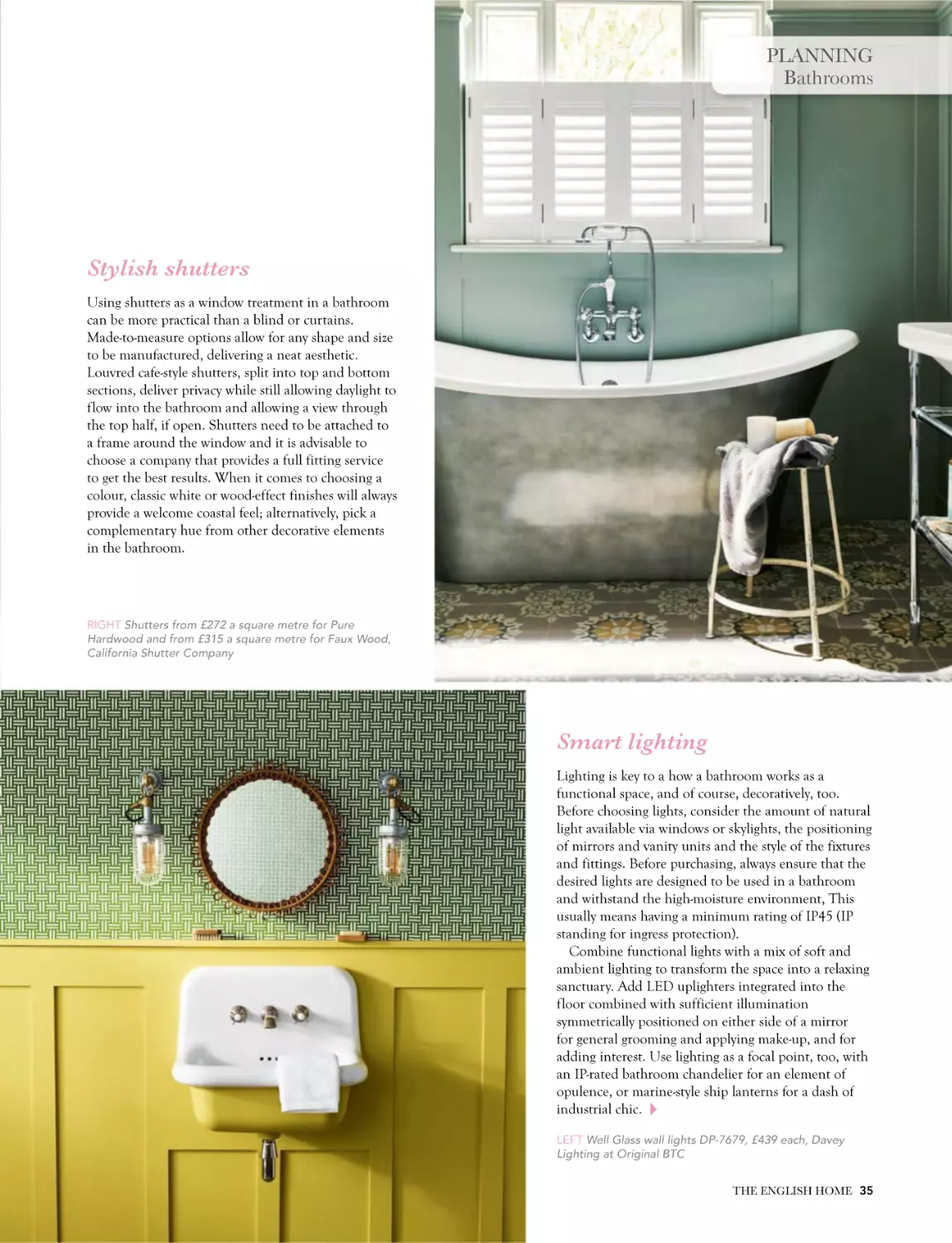
Stylish shutters
Using shutters as a window treatment in a bathroom
can be more practical than a blind or curtains.
Made-to-measure options allow for any shape and size
to be manufactured, delivering a neat aesthetic.
Louvred cafe-style shutters, split into top and bottom
sections, deliver privacy while still allowing daylight to
flow into the bathroom and allowing a view through
the top half, if open. Shutters need to be attached to
a frame around the window and it is advisable to
choose a company that provides a full fitting service
to get the best results. When it comes to choosing a
colour, classic white or wood-effect finishes will always
provide a welcome coastal feel; alternatively, pick a
complementary hue from other decorative elements
in the bathroom.

RIGHT Shutters from £272 a square metre for Pure
Hardwood and from £315 a square metre for Faux Wood,
California Shutter Company

Smart lighting
Lighting is key to a how a bathroom works as a
functional space, and of course, decoratively, too.
Before choosing lights, consider the amount of natural
light available via windows or skylights, the positioning
of mirrors and vanity units and the style of the fixtures
and fittings. Before purchasing, always ensure that the
desired lights are designed to be used in a bathroom
and withstand the high-moisture environment, This
usually means having a minimum rating of IP45 (IP
standing for ingress protection).
Combine functional lights with a mix of soft and
ambient lighting to transform the space into a relaxing
sanctuary. Add LED uplighters integrated into the
floor combined with sufficient illumination
symmetrically positioned on either side of a mirror
for general grooming and applying make-up, and for
adding interest. Use lighting as a focal point, too, with
an IP-rated bathroom chandelier for an element of
opulence, or marine-style ship lanterns for a dash of
industrial chic.
LEFT Well Glass wall lights DP-7679, £439 each, Davey
Lighting at Original BTC
THE ENGLISH HOME 35

Radiators have the ability to transform a space with
models that range from traditional column styles
to contemporary panel, coil, spring or tubular
designs. Choose small or large, freestanding or
wall-mounted and in a wealth of finishes and
colours, from metal and cast iron to monochrome
or vivid hues. Remember to position any radiator
away from key splash areas such as the bath, shower
or basin to eliminate the risks associated with
electrical appliances and water. If space allows, add a
radiator topped with a handy shelf for storing folded
towels and keeping them nice and warm. Consider
a dual-fuel radiator that can be switched to work from
the central heating system or the electricity in the
home to enable a ready supply of warm, dry towels all
year round, even in summer when the heating is off in
the rest of the house.
LEFT Brenton Etna 1200mm x 500mm Brushed Brass
heated towel rail, £249.99, Only Radiators

One of the easiest ways to give a bathroom a
decadent update is with wallpaper, and it does
not necessarily have to be costly. Bathrooms and
cloakrooms can be the best rooms in the house to
let loose and line the walls with a truly striking
wallpaper. A bold, colourful design can quickly
transform the mood from austere to joyous. Source
wallpapers that are specifically made to withstand
the moisture and excess steam content of a
bathroom, and designs that can cleverly give an
illusion of space. Large, ornate patterns can make
the most diminutive of spaces feel big by adding
depth. Use a floral or leafy design that connects the
bathroom with a view of the garden, or an Arts and
Crafts or Victorian pattern as a celebration of a
property’s period heritage.

RIGHT Wallpaper, Macaw, Vivid Yellow £124 a roll, V&A
Decorative Wallpapers collection, 1838 Wallcoverings

36 THE ENGLISH HOME

PLANNING
Bathrooms

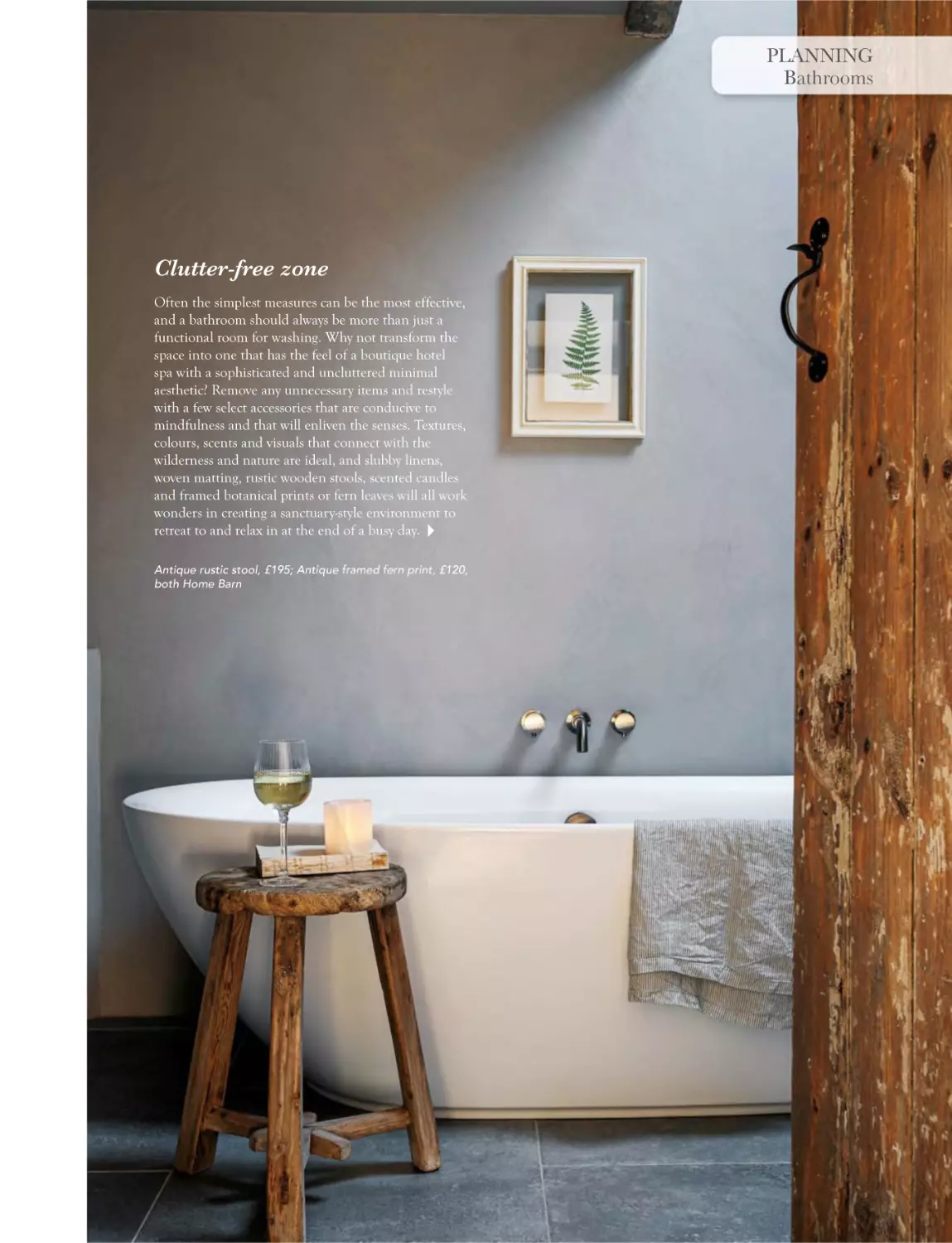
Clutter-free zone
Often the simplest measures can be the most effective,
and a bathroom should always be more than just a
functional room for washing. Why not transform the
space into one that has the feel of a boutique hotel
spa with a sophisticated and uncluttered minimal
aesthetic? Remove any unnecessary items and restyle
with a few select accessories that are conducive to
mindfulness and that will enliven the senses. Textures,
colours, scents and visuals that connect with the
wilderness and nature are ideal, and slubby linens,
woven matting, rustic wooden stools, scented candles
and framed botanical prints or fern leaves will all work
wonders in creating a sanctuary-style environment to
retreat to and relax in at the end of a busy day.
Antique rustic stool, £195; Antique framed fern print, £120,
both Home Barn

PLANNING
Bathrooms

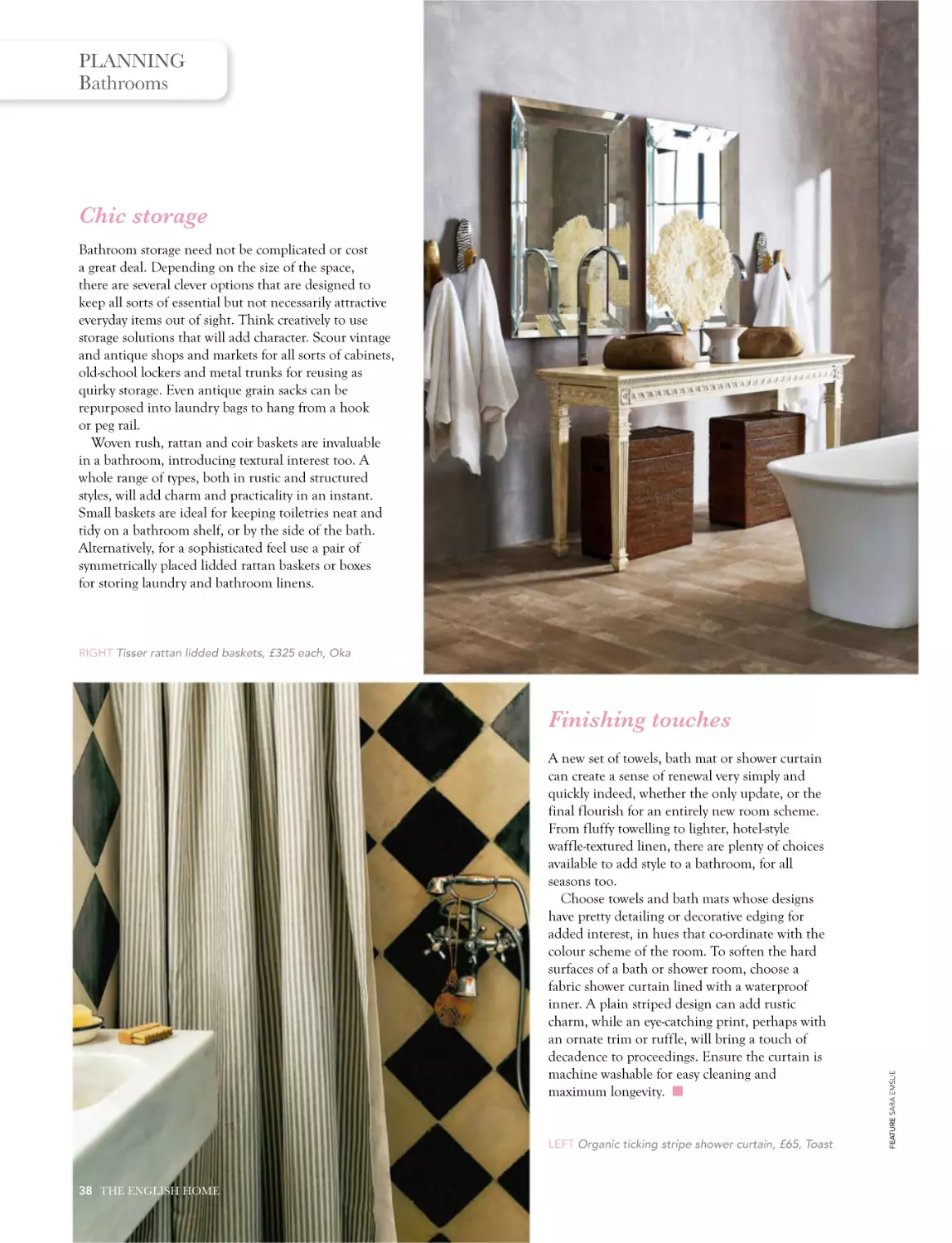
Chic storage
Bathroom storage need not be complicated or cost
a great deal. Depending on the size of the space,
there are several clever options that are designed to
keep all sorts of essential but not necessarily attractive
everyday items out of sight. Think creatively to use
storage solutions that will add character. Scour vintage
and antique shops and markets for all sorts of cabinets,
old-school lockers and metal trunks for reusing as
quirky storage. Even antique grain sacks can be
repurposed into laundry bags to hang from a hook
or peg rail.
Woven rush, rattan and coir baskets are invaluable
in a bathroom, introducing textural interest too. A
whole range of types, both in rustic and structured
styles, will add charm and practicality in an instant.
Small baskets are ideal for keeping toiletries neat and
tidy on a bathroom shelf, or by the side of the bath.
Alternatively, for a sophisticated feel use a pair of
symmetrically placed lidded rattan baskets or boxes
for storing laundry and bathroom linens.

RIGHT Tisser rattan lidded baskets, £325 each, Oka

A new set of towels, bath mat or shower curtain
can create a sense of renewal very simply and
quickly indeed, whether the only update, or the
final flourish for an entirely new room scheme.
From fluffy towelling to lighter, hotel-style
waffle-textured linen, there are plenty of choices
available to add style to a bathroom, for all
seasons too.
Choose towels and bath mats whose designs
have pretty detailing or decorative edging for
added interest, in hues that co-ordinate with the
colour scheme of the room. To soften the hard
surfaces of a bath or shower room, choose a
fabric shower curtain lined with a waterproof
inner. A plain striped design can add rustic
charm, while an eye-catching print, perhaps with
an ornate trim or ruffle, will bring a touch of
decadence to proceedings. Ensure the curtain is
machine washable for easy cleaning and
maximum longevity.

LEFT Organic ticking stripe shower curtain, £65, Toast

38 THE ENGLISH HOME

FEATURE SARA EMSLIE

Finishing touches

Guiding
LIGHT
As one of the most important decorating
decisions, it is essential to consider
placement and style of lighting carefully
when updating interiors

I

t is hard to over-emphasise how important a well-lit room is to
our daily lives, whether for completing everyday tasks or creating
an inviting ambience. Achieving this requires careful planning
to ensure lights are correctly sited for their purpose and to
create a layered effect that can be altered as the mood dictates.
Here industry creators and innovators impart their expert advice
on realising a practical as well as aesthetically pleasing scheme.

40 THE ENGLISH HOME

PLANNING
Lighting

Add to a symmetrical
kitchen layout with a
trio of pendants.
Lights, Slate Grey
Classic Traditional,
£545 each, Curiousa;
kitchen, Martin Moore
OPPOSITE Assess
how the kitchen
island and pendant
shades will work
visually when
viewed together.
Constance shade,
Stone, £44; cone
pendant fitting kit,
£46, Pooky

THE
THEENGLISH
ENGLISHHOME
HOME4141

HANG IT ALL
ABOVE Pendant
lights above a table
create an inviting
atmosphere for
all occasions.
Original 1227 midi
wide brass pendant
in Elephant Grey,
£209, Anglepoise

42 THE ENGLISH HOME

Elegance and symmetry each play their part in
drawing the eye to ceiling lighting, whether in classic
or traditional form. Used individually or placed as
a series, pendants and lanterns create rhythm and
flow in pleasing harmony – not least in spaces such
as kitchen entertaining areas, where, Harriet Daniels,
founder and CEO of Tigermoth Lighting, explains,
“They should add decorative interest during the day,
and atmosphere at night.”
Daniels also suggests selecting uniform designs
for each specific area which, “can work really well to
simultaneously denote different zones.” She advises
using complementary styles above a dining table
to offset a trio of kitchen island pendants in the
same space.
With this in mind, the height at which pendants
are hung is key for islands and tables. “We often
recommend 75cm–90cm clearance between the
bottom of the shade and the top of the surface, as this
usually equates to eye level,” says Esther Patterson,
designer and director at Curiousa. Note that heightadjustable pendant lights allow for flexibility and
versatility after installation.

When grouping pendant lights, the often-cited
guidance of opting for odd numbers works well
to please the eye. In a hallway, for example, where
sometimes narrow areas may require a fuller wash of
light, odd numbers of lights can be cleverly capitalised
on with a judicious use of materials says Lee Lovett,
founder and designer at The Soho Lighting Company:
“In hallways glass pendants are perfect on account
of your eye passing through to the interior beyond,”
she says, “plus, they’re also highly effective at lighting
small spaces.”
To select the right style of traditional pendant
for a period property, Sheena Lawrence, co-founder
of Jim Lawrence, suggests looking back in time.
“Would this area of a room feature candlelight, oil,
or gas lamps? Allow yourself to be led by the history
of your home or seek new-to-you-ideas from the
period you are taking inspiration from.” For a
modern aesthetic, Lawrence adds that pared-back
designs give the same output but with an angular
silhouette, while contemporary glass “looks elegant
in modern homes”, particularly with a sleek track for
up-to-date styling.

PLANNING
Lighting

ABOVE LEFT Make a
statement with an
eye-catching pendant
and lampshades.
Bodkin five-light
pendant, bespoke in
a combination of 12
paint colours and five
special paints for this
range, £426; pleated
gathered shades,
from £116.40 each,
David Hunt Lighting
ABOVE RIGHT
Hanging lights at
different heights
creates a focal point
above this table.
Lights, Opulent
Optics, £475 each,
Rothschild & Bickers
LEFT Eye-level large
clear glass pendants
work perfectly with a
low ceiling and
expansive island.
Walcot pendant,
£184.33, Jim
Lawrence Lighting

SURFACE APPEAL
Creating interest and atmosphere, wall lights add
layers of texture and detail. “Always consider the
purpose of the light,” says Jana Durisova, creative
director at Beaumont & Fletcher. “Where there are
high ceilings, for example, we recommend a tall wall
light for scale, while in an area such as a hallway, be
sure to consider how far the fitting projects from the
wall – placement above shoulder height means it’s
far less likely to get knocked.”
Practical considerations can open new avenues.
Installing hardwired wall lights will often require
rewiring, and therefore redecorating, whereas opting
for plug-and-cable models means simply attaching
them to the wall and plugging them in. Try making a
design feature of the flex, advises Hollie Moreland,
creative director at David Hunt Lighting, who suggests
44 THE ENGLISH HOME

that “a woven, braided cable in a contrast or coordinating colour” can provide a neat counterpoint
or matching feature compared to the wall behind.
For bathrooms, look for lights with an IP44 rating to
ensure they are safe and suitable for environments
prone to moisture. In bedrooms, articulated-arm wall
lights provide directional light for reading and an
uncluttered bedside table.
“When choosing between classic or contemporary,
it is important not to feel hidebound by the period
of the property,” says Alastair Hepher, director of
Charles Edwards, who suggests playing with materials
and finishes to achieve a fitting look. “Nickel will add
a crisp, clean feel and add a contemporary twist to
classic designs, while brass and bronze can be used to
create a traditional and warm ambience,” he adds.

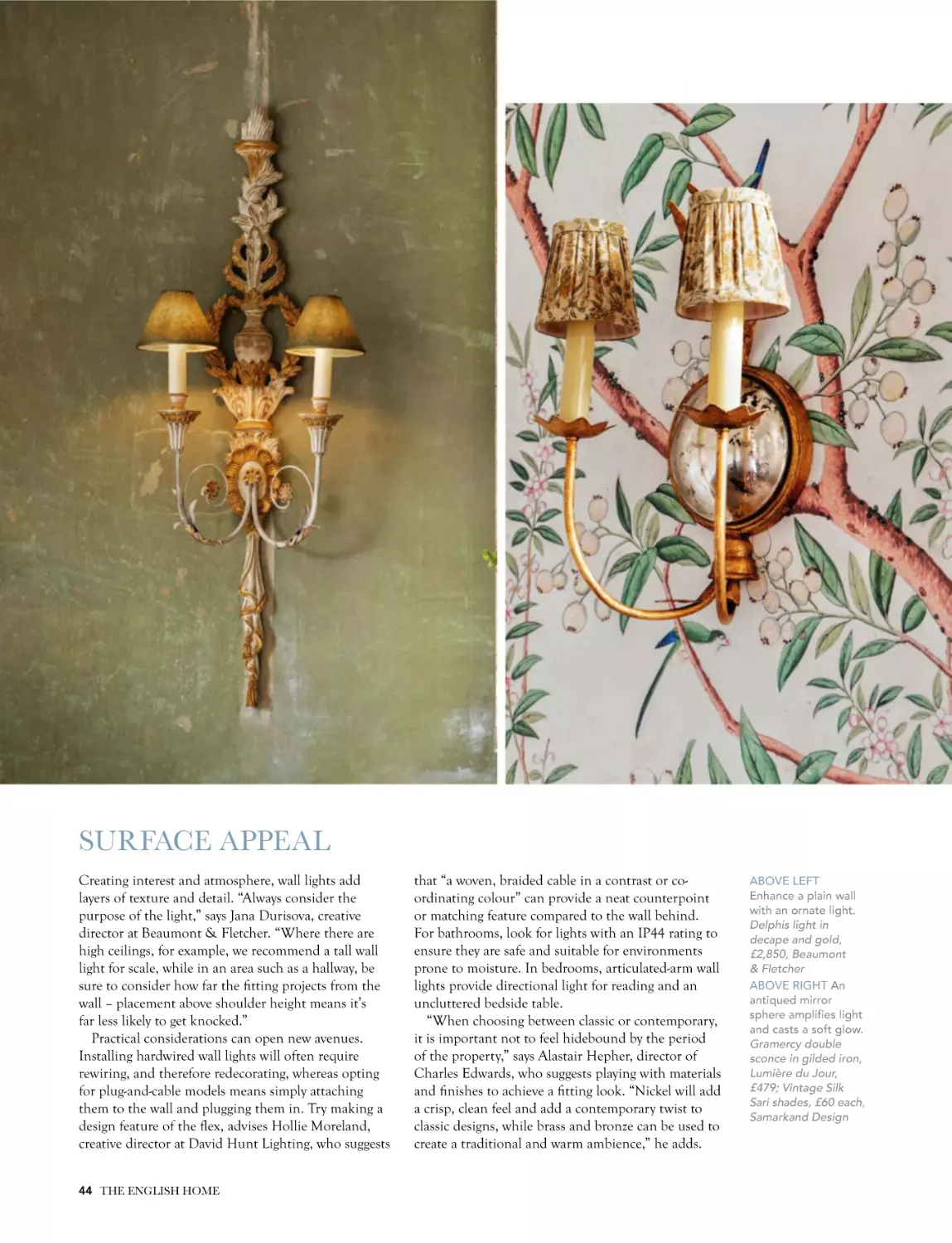
ABOVE LEFT
Enhance a plain wall
with an ornate light.
Delphis light in
decape and gold,
£2,850, Beaumont
& Fletcher
ABOVE RIGHT An
antiqued mirror
sphere amplifies light
and casts a soft glow.
Gramercy double
sconce in gilded iron,
Lumière du Jour,
£479; Vintage Silk
Sari shades, £60 each,
Samarkand Design

PLANNING
Lighting

EYE ON THE TASK
Whether for a desk, kitchen preparation area or
reading, choosing the right task lighting begins
with considering any site-specific needs, along
with how and when the light will be used so
the resulting scheme responds accordingly. For
reading and home office spaces, hinged-arm,
extendable floor and table lamps that can be
adjusted to direct light where it is needed are
the best options. For kitchen tasks or ancillary
spaces that require total shadow-free lighting, see
solutions such as tailored under-cupboard sources.
Sally Storey, design director of John Cullen
Lighting, advises, “For a traditional look, try
individual spots to create scallops of light onto the
surface below or, for a contemporary take, a linear
LED strip works well to highlight the space.”
Showcasing displays or artwork with accent
lighting draws attention to treasured items and
can also provide additional ambience. “Picture
lighting will not only illuminate, but also casts
out borrowed light into the rest of the room,
creating atmosphere and tone,” outlines Simon
Wallis-Smith, director and head designer at Fritz
Fryer. He also suggests offsetting classic light
forms with contemporary artwork (and vice
versa) to create interest – for example, overhead
picture lights lend a traditional touch, while
spot uplighters can create shafts of focus on
individual works or shelving displays.

ABOVE Floor lamps
with lights at angles
provide sharp focus
for reading.
lamp, £2,250;
Copernicus wall light,
£785, shades for both
wall light as seen
here, £135 each,
Bella Figura
LEFT Avoid the glare
of spotlights and
opt for lighting that
offers a diffused
glow suitable for
kitchen tasks.
Hector bone-china
pleat ceiling light,
£199, Original BTC
FAR LEFT Hinged
arms allow for
directional lighting.
Hanson library wall
light, £148.05, Jim
Lawrence Lighting

THE ENGLISH HOME 45

PLANNING
Lighting

Whether seeking to install a traditional chandelier
or a more contemporary sculptural form, statement
lighting brings impactful design to any space. Key to its
success, says designer Kate Wilkins of Kate and Sam
Lighting, is the joyful permission “to be guided simply
by choosing something you love”.
Wilkins continues, “Statement lighting is an
‘add-on’ to the fabric of a building, so whether
opting for traditional or ultra-modern be mindful of
how the light it produces will add to the ambience.
Ensure the proportions you have in mind work in your
chosen space – hanging a balloon from the ceiling is
an easy way to check heights, as clearance distance is
context-dependent.”
In transitional spaces with tall ceilings, such as
stairwells and double-height areas, statement pieces
can often be appreciated from different angles
throughout the day. If this is the case, all sightlines
should be a guiding force to ensure the light’s design
can be appreciated from every angle.
Smaller rooms can also benefit from a dramatic style
of statement lighting. “Dining spaces, for example,
46 THE ENGLISH HOME

benefit from modern, minimalist forms to layer
the room with boundless light,” says designer Tom
Raffield. “Choosing a wooden fixture will not only
fill the space, but it will also add texture to make it
feel homely and welcoming. If your entire space is
calling out for enhanced illumination, exposed
bulbs will suit.”
If opting for a traditional chandelier, Lucy Vaughan,
founder of Vaughan, advises always installing them
on a separate dimmer circuit and looking beyond
obvious settings such as dining rooms and hallways;
“Chandeliers look fabulous hung in multiples in
corridors and can give gravitas and impact to small
rooms such as dressing rooms and boot rooms.”
In terms of dimensions, “It’s all down to personal
preference,” says Connor Prestwood, interior design
specialist at Dowsing & Reynolds. “Some like an
oversized exaggerated statement light, whereas others
prefer a more minimal look. I would usually suggest
going slightly bigger than you think you need – it’s
easy to play it safe, when actually the opposite really
elevates the space.”

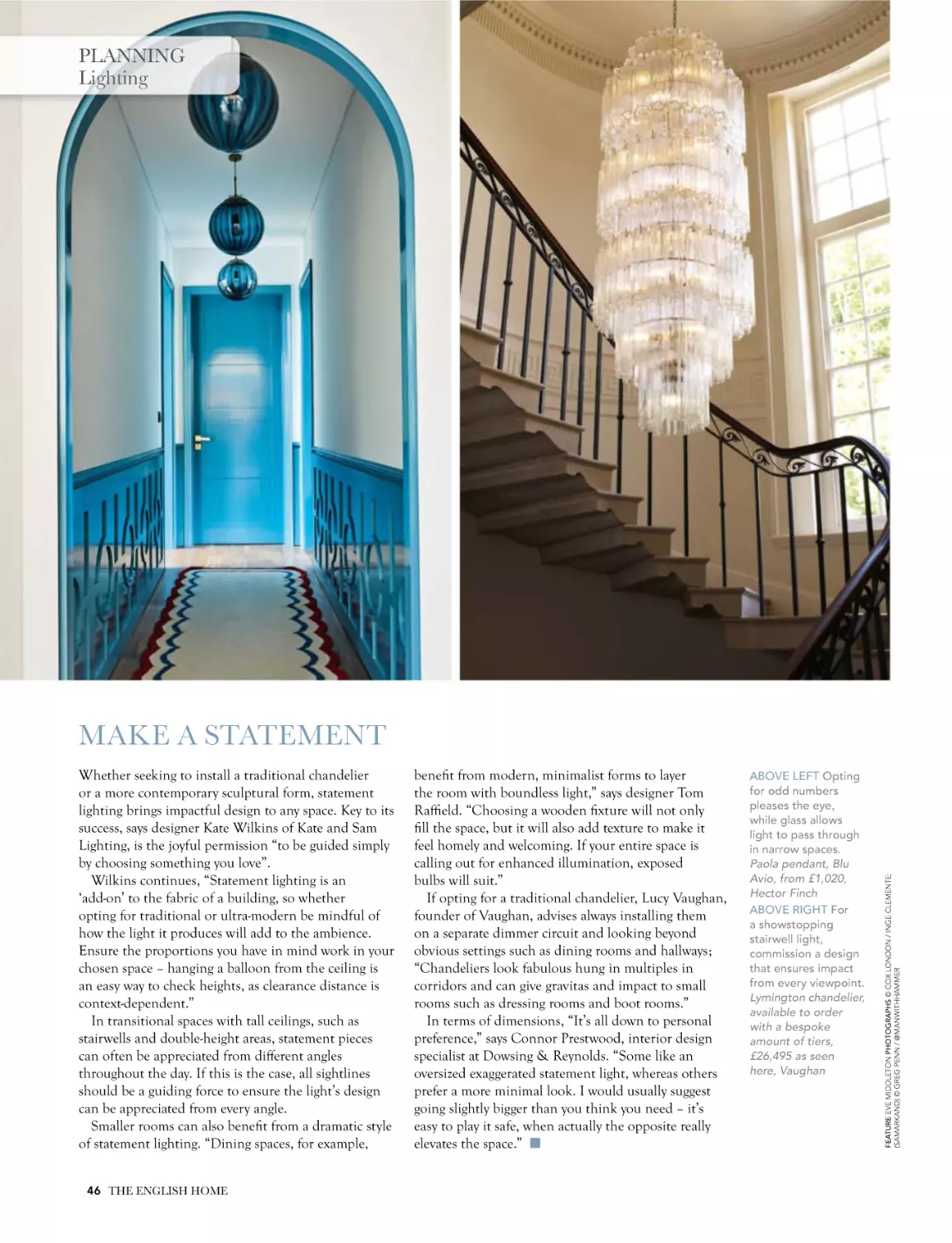
ABOVE LEFT Opting
for odd numbers
pleases the eye,
while glass allows
light to pass through
in narrow spaces.
Paola pendant, Blu
Avio, from £1,020,
Hector Finch
ABOVE RIGHT For
a showstopping
stairwell light,
commission a design
that ensures impact
from every viewpoint.
Lymington chandelier,
available to order
with a bespoke
amount of tiers,
£26,495 as seen
here, Vaughan

FEATURE EVE MIDDLETON PHOTOGRAPHS © COX LONDON / INGE CLEMENTE;
(SAMARKAND) © GREG PENN / @MANWITHHAMMER

MAKE A STATEMENT

Hardware | Switches & Sockets | Lighting
c or st on .c o m

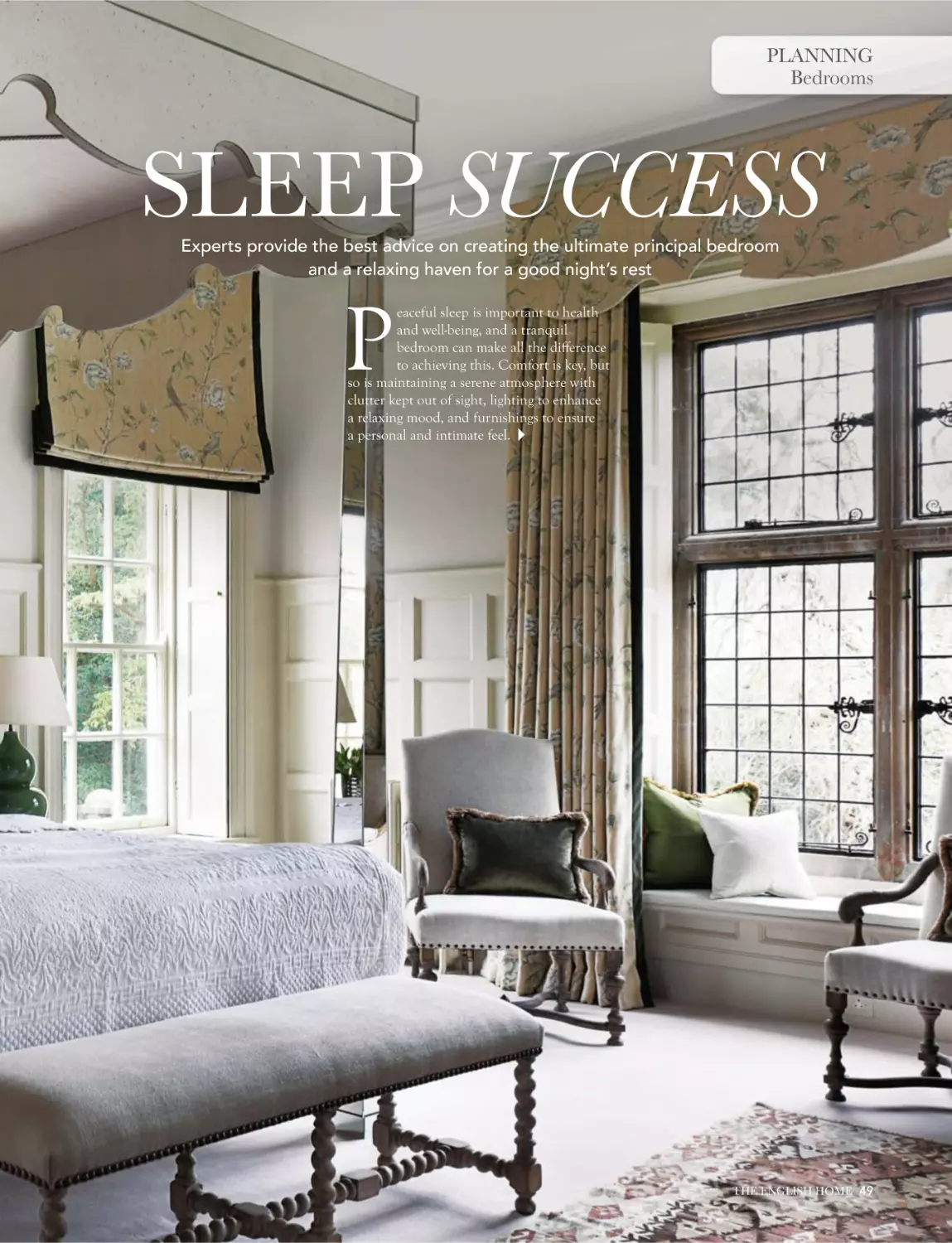
A bespoke, mirrored
four-poster bed
makes a grand
design statement, as
shown in this design
by VSP Interiors.

48 THE ENGLISH HOME

PLANNING
Bedrooms

SLEEP SUCCESS
Experts provide the best advice on creating the ultimate principal bedroom
and a relaxing haven for a good night’s rest

P

eaceful sleep is important to health
and well-being, and a tranquil
bedroom can make all the difference
to achieving this. Comfort is key, but
so is maintaining a serene atmosphere with
clutter kept out of sight, lighting to enhance
a relaxing mood, and furnishings to ensure
a personal and intimate feel.

THE ENGLISH HOME 49

BED FIRST
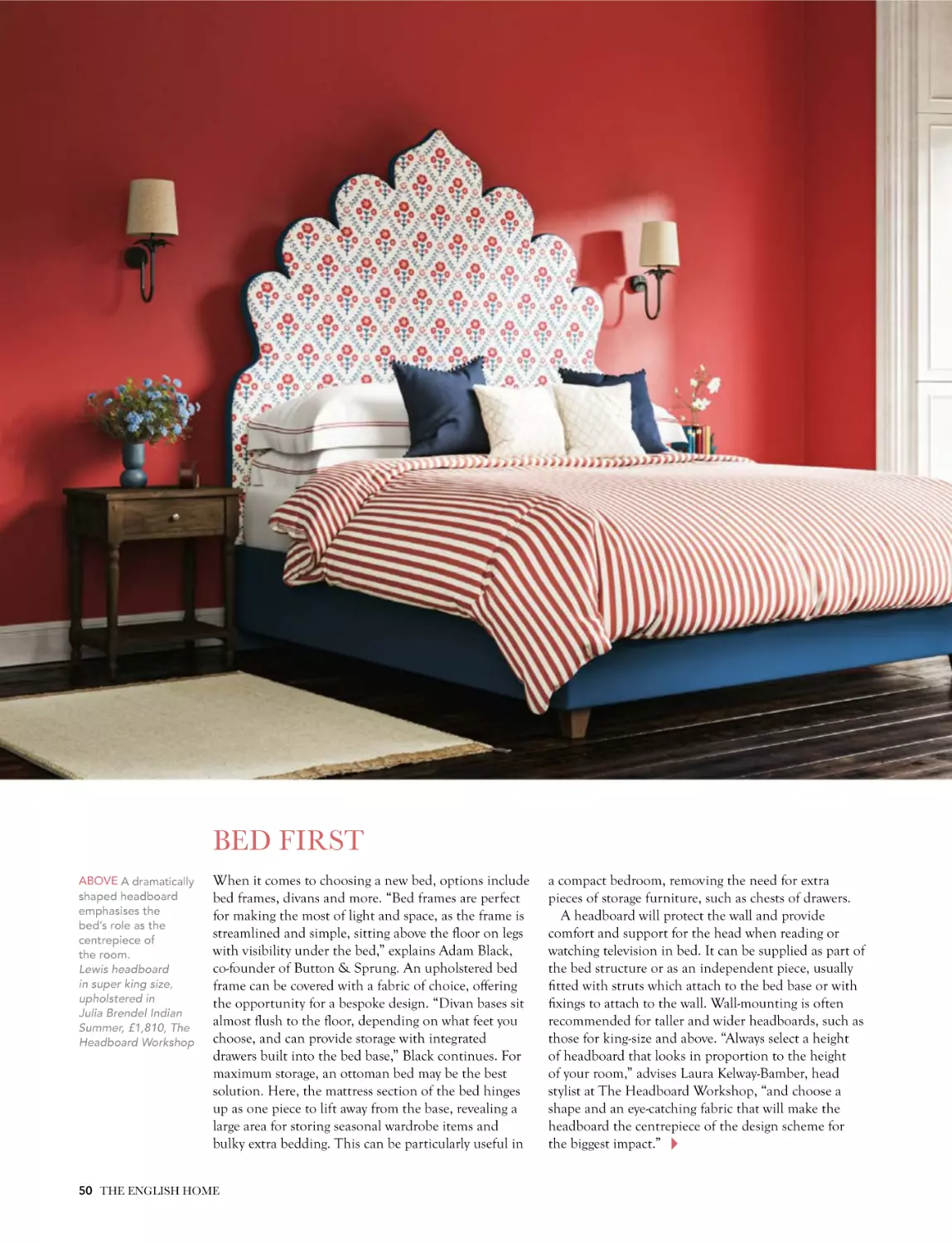
ABOVE A dramatically
shaped headboard
emphasises the
bed’s role as the
centrepiece of
the room.
Lewis headboard
in super king size,
upholstered in
Julia Brendel Indian
Summer, £1,810, The
Headboard Workshop

When it comes to choosing a new bed, options include
bed frames, divans and more. “Bed frames are perfect
for making the most of light and space, as the frame is
streamlined and simple, sitting above the floor on legs
with visibility under the bed,” explains Adam Black,
co-founder of Button & Sprung. An upholstered bed
frame can be covered with a fabric of choice, offering
the opportunity for a bespoke design. “Divan bases sit
almost flush to the floor, depending on what feet you
choose, and can provide storage with integrated
drawers built into the bed base,” Black continues. For
maximum storage, an ottoman bed may be the best
solution. Here, the mattress section of the bed hinges
up as one piece to lift away from the base, revealing a
large area for storing seasonal wardrobe items and
bulky extra bedding. This can be particularly useful in

50 THE ENGLISH HOME

a compact bedroom, removing the need for extra
pieces of storage furniture, such as chests of drawers.
A headboard will protect the wall and provide
comfort and support for the head when reading or
watching television in bed. It can be supplied as part of
the bed structure or as an independent piece, usually
fitted with struts which attach to the bed base or with
fixings to attach to the wall. Wall-mounting is often
recommended for taller and wider headboards, such as
those for king-size and above. “Always select a height
of headboard that looks in proportion to the height
of your room,” advises Laura Kelway-Bamber, head
stylist at The Headboard Workshop, “and choose a
shape and an eye-catching fabric that will make the
headboard the centrepiece of the design scheme for
the biggest impact.”

PLANNING
Bedrooms

ABOVE RIGHT Brass
beds date back to
the Victorian era and
remain popular,
thanks to their classic
style, easy
maintenance and
long-lasting qualities.
Bertie bed, from
£1,555 for a double,
Wrought Iron and
Brass Bed Company
RIGHT Classic toile
de Juoy fabric adds
fresh personality to
this pretty bedroom.
Toile Liberté
bed, from £1,495
for a double,
French Bedroom

BEAUTIFUL LIGHTING
AND ACCESSORIES
“Ambient (general) lighting is the primary source that
creates the mood for the whole room, ideally casting a
uniform overall glow,” explains Irene Gunter, founder
of Gunter & Co. “Avoid harsh lights which are not
ideal just before you drift off to sleep. Instead, aim
for lighting that creates a soothing atmosphere that’s
inviting and comforting.” One of the most popular
choices for ambient lighting is a decorative chandelier
or statement pendant, transforming a bedroom into a
luxurious and elegant space, but be careful to choose
an appropriate size: too small and it can be dwarfed
by the size of the room, or too large, and it can
overwhelm the space. “As a general rule, the diameter
of your pendant or chandelier should be approximately
one-third of the width of the bed,” Gunter adds.
Downlights are another option for ambient lighting.
“Avoid putting them in a grid formation or directly
above your pillows,” advises Gunter. “Instead, use your
furniture as a guide. For example, install downlights
so that they wash light down the front of wardrobes or
chests of drawers to highlight the beauty of the wood.”
Task lighting is another layer of illumination that
is vital in a bedroom, providing light for reading and
applying make-up. “Bedside lamps are key for reading,
as well as to inject a soothing glow that will help you
relax, and are a great way to frame and add symmetry
to a bed,” notes Gunter. Wall-mounted reading lights
are a good solution if space is limited, and batteryoperated wall lights, such as those by GloWall, are a
neat solution if there is no electrical wiring in place.
Smaller pendant lights can be suspended from the
ceiling above a bedside table. “To allow space for a pile
of books or a carafe of water, I always recommend at
least 30cm between the bottom of the pendant and the
top of the bedside table,” Gunter says. Accent lighting,
such as picture and LED lights, can be used to illuminate
beautiful pictures or decorative displays on shelves.
Finally, remember to add accessories. A rug can feel
luxurious underfoot, cushions and throws can add
texture and colour, and pictures can enhance a dreamy
mood. “Each accessory and carefully selected piece
within the room contributes to enhancing the overall
ambience,” says Beazley. “The result is a harmonious
and welcoming bedroom design.”
ABOVE LEFT Bespoke joinery by Otta Design includes
a dressing table with a hairdryer drawer between twin
wardrobes for maximum storage.
LEFT Layers of colour and texture add interest.
Fluted side table in Alba, £1,250, Georgie
Wykeham Designs
OPPOSITE TOP Wall-mounted reading lights and niches
replace the need for bedside tables in this compact
bedroom design by Gunter & Co.
OPPOSITE BOTTOM Blending soft upholstered curves
with warm natural oak softens the room aesthetic.
Heybrook bed, from £2,930, and mattress, from £1,260,
both for a double, Naturalmat

52 THE ENGLISH HOME

PLANNING
Bedrooms

GETTING COMFORTABLE
Mark Tremlett, founder of
Naturalmat, offers advice on
selecting the best mattress for
a restful night’s sleep

• UK bed sizes as specified by the
National Bed Federation include
single (90cm x 190cm), small double
(120cm x 190cm), double (135cm x
190cm), king (150cm x 200cm) and
super king (180cm x 200cm), but not
all beds conform to standard sizing,
so check before buying. A queen
(160cm x 200cm) is a good choice for
those who want a larger mattress than
a king, but do not have room for a
super king. The extra-large emperor
(200cm x 200cm) is ideal for spacious
bedrooms and for a couple who want
plenty of room to stretch out.
• Take time to test mattresses
properly to find the comfort and
support needed. Mattress tensions
vary from soft to firm and the choice is
personal. If buying with a partner,
ensure both parties are comfortable.
Zip-and-link mattresses with different
tensions on either side can be a great
option for different preferences.
• Mattresses vary in construction and
materials. A sprung mattress has a
coil-based support system with fabric
layered on top to create a soft
comfort layer, and pocket springs
individually enclosed within their own
fabric pockets to only respond to
pressure in that area. They tend to
have a more traditional, bouncy feel,
in contrast to layered natural fibre
mattresses, which have a firmer,
denser feel. It is proven that sleeping
on natural materials that allow your
body to regulate its temperature can
improve sleep, boosting health and
well-being. If you are considering a
foam mattress, they can act as a buffer
to airflow.

ABOVE Make use
of an empty corner
with a compact
slipper chair.
Tarma armless chair
in Soft Charcoal,
£1,495, Oka

Good storage is essential for creating the optimum
calm environment. “Because the principal bedroom
generally requires the most storage for clothes, bespoke
fitted wardrobes often make the best solution to
maximise available space,” advises interior designer
Ali Johnson of Otta Design. “This also offers the
opportunity to design internal shelves, hanging
space, shoe storage and drawers for jewellery and
watches to suit individual requirements.” Integrated
lighting will make it easy to see the contents of the
cupboards and drawers.
Freestanding furniture, however, allows for the
inclusion of antique pieces and investment items
which can be moved from house to house over
the years. A stand-alone armoire, elegant dressing

54 THE ENGLISH HOME

table, chic bedside tables and chests of drawers
are all practical pieces which can also add character
to the room. Choose pieces in proportion to the
size of the room, and to adjacent furniture. “When
it comes to bedside tables, the ideal scenario is that
they match the height of the mattress top, but there is
no strict rule,” advises Holly Beazley, creative director
of Elicyon. “If the bedside table is slightly lower
than the bed, we might select a slimmer table lamp
to lighten the appearance of the table and maintain
visual balance.”
In a larger bedroom, furniture can be used to zone
the layout, from a dressing area with wardrobes to a
relaxation spot complete with comfortable armchair
for reading or chatting on the phone.”

FEATURE AMELIA THORPE PHOTOGRAPHS (MARK TREMLETT
PORTRAIT) © GRAEME ROBERTSON; (GUNTER & CO) © MARK
BOLTON; (NATURALMAT BED) © JON DAY; (ELICYON © PATRICK
WILLIAMSON; (SIMS HILDITCH) © CHRISTOPHER HORWOOD

ESSENTIAL FURNISHINGS

PLANNING
Bedrooms

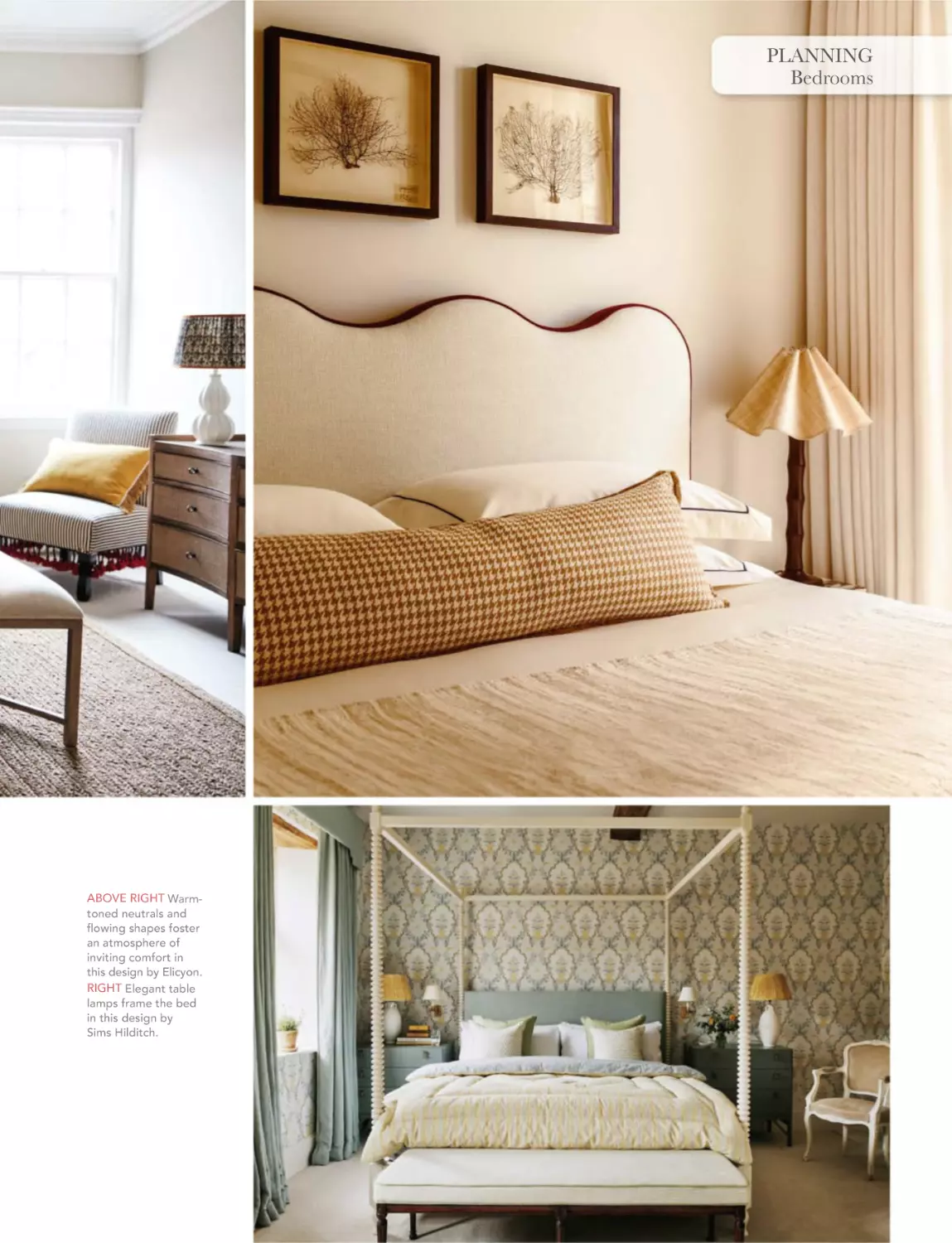
ABOVE RIGHT Warmtoned neutrals and

RIGHT

Hybrid WORKING
Leading designers demonstrate how to create a home workspace within another
room, creating two – or sometimes more – beautifully functional spaces in one
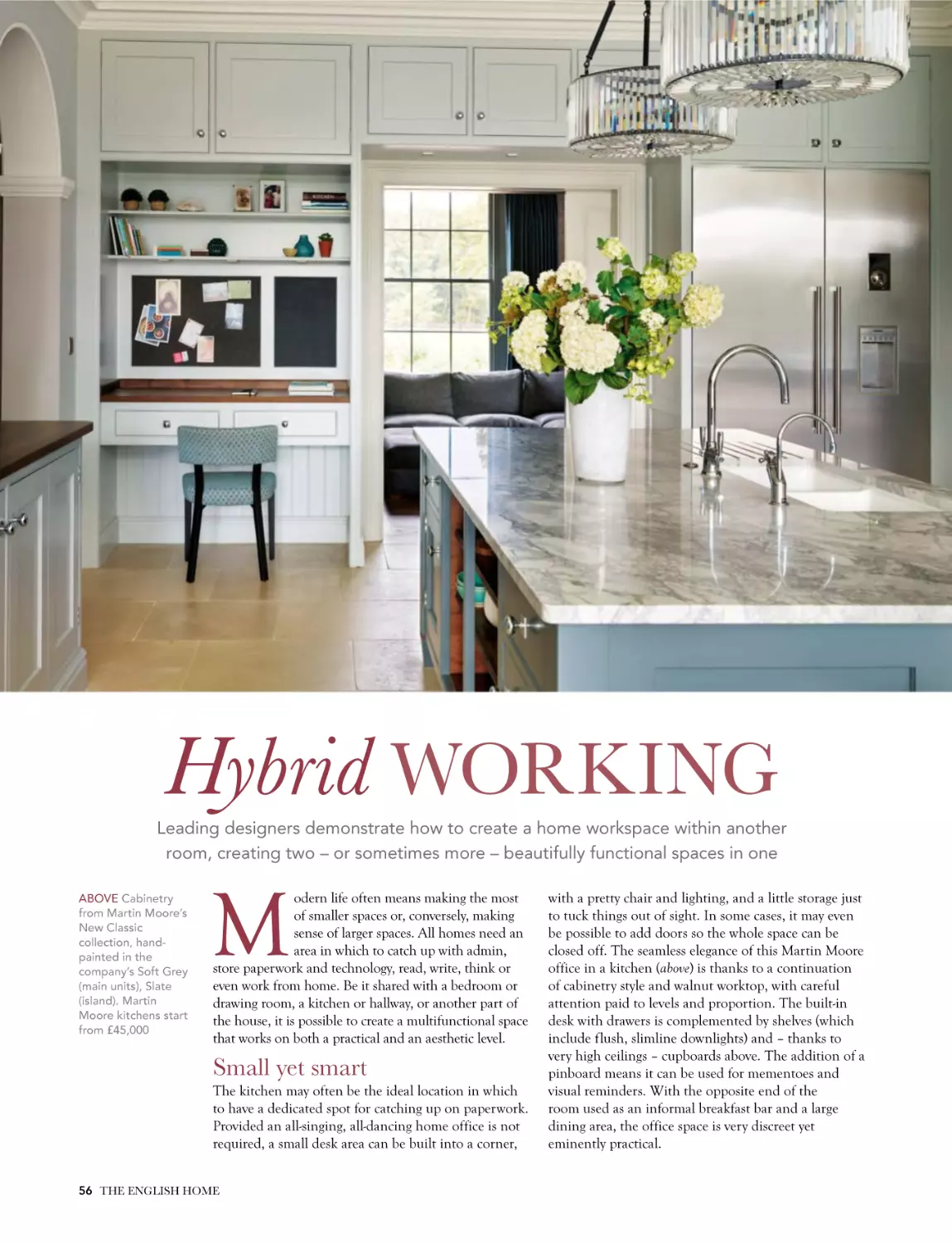
ABOVE Cabinetry
from Martin Moore’s
New Classic
collection, handpainted in the
company’s Soft Grey
(main units), Slate
(island). Martin
Moore kitchens start
from £45,000

M

odern life often means making the most
of smaller spaces or, conversely, making
sense of larger spaces. All homes need an
area in which to catch up with admin,
store paperwork and technology, read, write, think or
even work from home. Be it shared with a bedroom or
drawing room, a kitchen or hallway, or another part of
the house, it is possible to create a multifunctional space
that works on both a practical and an aesthetic level.

Small yet smart
The kitchen may often be the ideal location in which
to have a dedicated spot for catching up on paperwork.
Provided an all-singing, all-dancing home office is not
required, a small desk area can be built into a corner,
56 THE ENGLISH HOME

with a pretty chair and lighting, and a little storage just
to tuck things out of sight. In some cases, it may even
be possible to add doors so the whole space can be
closed off. The seamless elegance of this Martin Moore
office in a kitchen (above) is thanks to a continuation
of cabinetry style and walnut worktop, with careful
attention paid to levels and proportion. The built-in
desk with drawers is complemented by shelves (which
include flush, slimline downlights) and – thanks to
very high ceilings – cupboards above. The addition of a
pinboard means it can be used for mementoes and
visual reminders. With the opposite end of the
room used as an informal breakfast bar and a large
dining area, the office space is very discreet yet
eminently practical.

PLANNING

Cohesive scheme
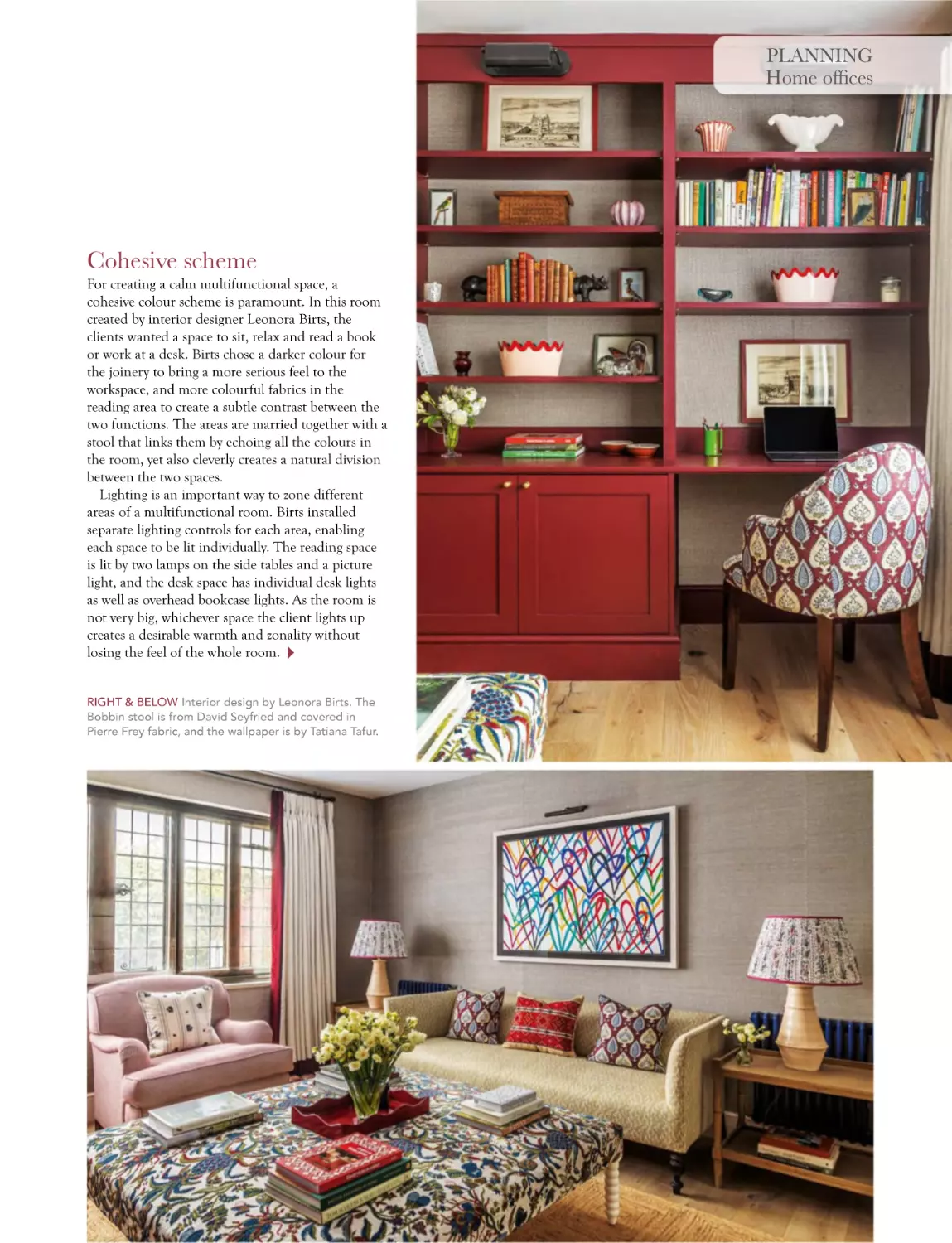
For creating a calm multifunctional space, a
cohesive colour scheme is paramount. In this room
created by interior designer Leonora Birts, the
clients wanted a space to sit, relax and read a book
or work at a desk. Birts chose a darker colour for
the joinery to bring a more serious feel to the
workspace, and more colourful fabrics in the
reading area to create a subtle contrast between the
two functions. The areas are married together with a
stool that links them by echoing all the colours in
the room, yet also cleverly creates a natural division
between the two spaces.
Lighting is an important way to zone different
areas of a multifunctional room. Birts installed
separate lighting controls for each area, enabling
each space to be lit individually. The reading space
is lit by two lamps on the side tables and a picture
light, and the desk space has individual desk lights
as well as overhead bookcase lights. As the room is
not very big, whichever space the client lights up
creates a desirable warmth and zonality without
losing the feel of the whole room.
RIGHT & BELOW Interior design by Leonora Birts. The
Bobbin stool is from David Seyfried and covered in
Pierre Frey fabric, and the wallpaper is by Tatiana Tafur.

PLANNING

It can make sense to set up an administrative area in a
bedroom – and perhaps more so in a principal, as
guest rooms will be out of bounds when occupied – as
long as it is separate from the main area. In order not
to disturb a calm and restful atmosphere with the
clutter of technology and paperwork, and for mental
health, it is essential that workspaces can be closed off.
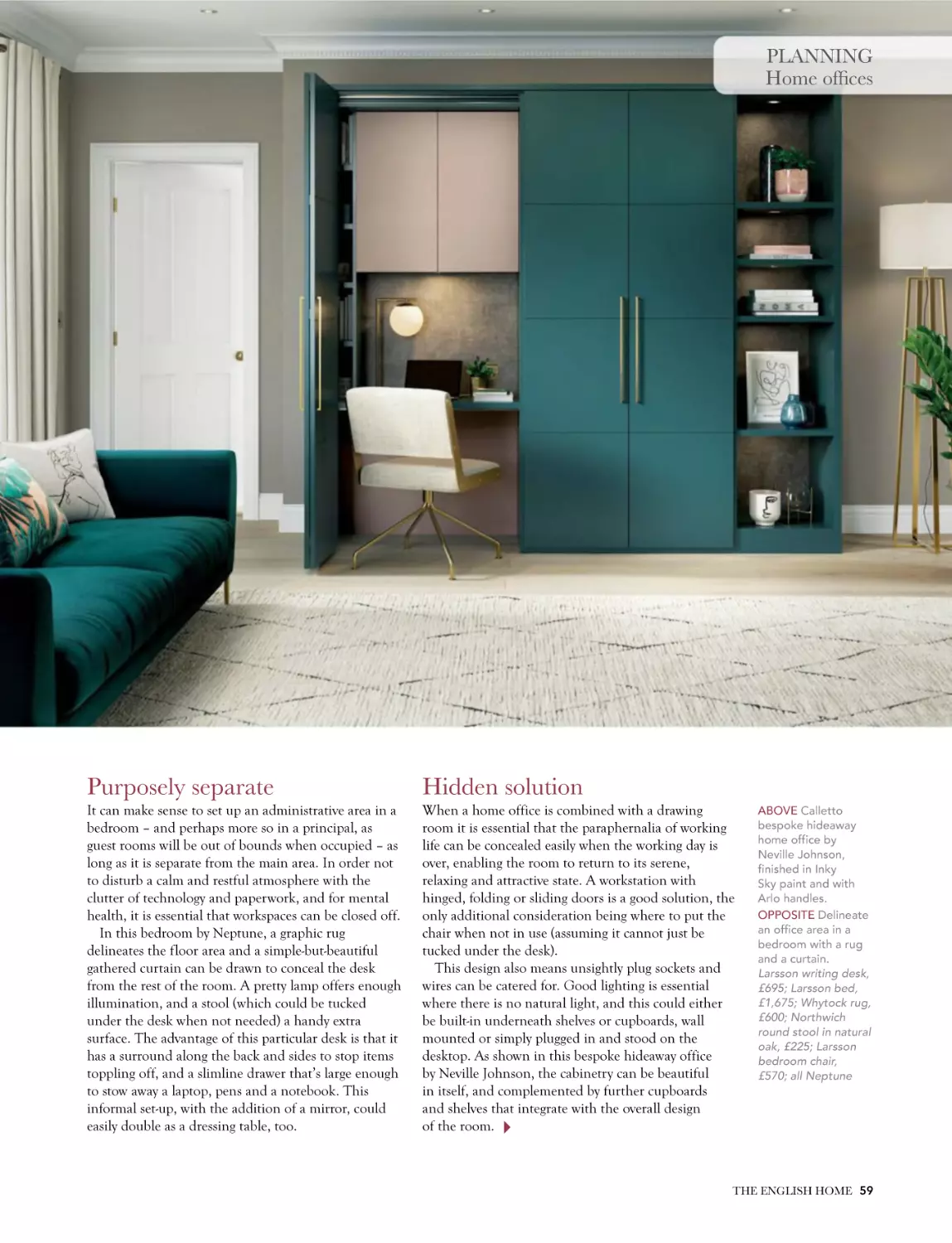
In this bedroom by Neptune, a graphic rug
delineates the floor area and a simple-but-beautiful
gathered curtain can be drawn to conceal the desk
from the rest of the room. A pretty lamp offers enough
illumination, and a stool (which could be tucked
under the desk when not needed) a handy extra
surface. The advantage of this particular desk is that it
has a surround along the back and sides to stop items
toppling off, and a slimline drawer that’s large enough
to stow away a laptop, pens and a notebook. This
informal set-up, with the addition of a mirror, could
easily double as a dressing table, too.

When a home office is combined with a drawing
room it is essential that the paraphernalia of working
life can be concealed easily when the working day is
over, enabling the room to return to its serene,
relaxing and attractive state. A workstation with
hinged, folding or sliding doors is a good solution, the
only additional consideration being where to put the
chair when not in use (assuming it cannot just be
tucked under the desk).
This design also means unsightly plug sockets and
wires can be catered for. Good lighting is essential
where there is no natural light, and this could either
be built-in underneath shelves or cupboards, wall
mounted or simply plugged in and stood on the
desktop. As shown in this bespoke hideaway office
by Neville Johnson, the cabinetry can be beautiful
in itself, and complemented by further cupboards
and shelves that integrate with the overall design
of the room.

ABOVE Calletto
bespoke hideaway
home office by
Neville Johnson,
finished in Inky
Sky paint and with
Arlo handles.
OPPOSITE Delineate
an office area in a
bedroom with a rug
and a curtain.
Larsson writing desk,
£695; Larsson bed,
£1,675; Whytock rug,
£600; Northwich
round stool in natural
oak, £225; Larsson
bedroom chair,
£570; all Neptune

THE ENGLISH HOME 59

Well-planned layout
Today’s kitchens must often satisfy many more
requirements than simply being a place in which to
cook efficiently. In this open-plan design by The White
Kitchen Company, for example, the room encompasses
not only a run of cabinets that incorporates a fridge/
freezer, integrated ovens and a worktop pantry, but
also a breakfast bar at a bespoke island, an office and
– at the opposite end of the room – a home bar and a
snug with a wall-mounted TV.
Fitting so many functions into one space is all about
a clever floorplan, which here includes angles and
curves for flow and a softer look, and positioning the
desk in the corner to provide natural light and allow
for a deep space on which to place a large computer
monitor. Storage designed for the smallest detail is
essential, too, and in this room it includes office
drawers and cupboards, wall-mounted shelves, tall,
thin bookshelves and even blanket cupboards below
the built-in seating.
BELOW & LEFT Shaker kitchen cabinets hand-painted in
Little Greene’s Slaked Lime Mid, with hardware by Buster +
Punch, The White Kitchen Company

FEATURE SARA EMSLIE PHOTOGRAPHS (LEONORA BIRTS) © JONATHAN BOND; (THORP) © RICHARD POWERS

PLANNING

ABOVE Here a space
has been cleverly
carved out to provide
a home office leading
off a dressing room
in a central London
townhouse designed
by Thorp.

When a home working space is combined with
another room, but does not need to be completely
concealed, it may still help to have some kind of
division. A screen, a bookshelf or some partial
walling, for example, could separate the two areas
visually without completely closing them off from
each other.
In this case, a room-within-a-room designed by
Thorp, the home office forms the end of an enfilade
of rooms, leading off the dressing room and looking

out onto the garden. Solid doors would have blocked
off too much natural light, so slender, mostly glazed
walls demarcate the change of use, coupled with a
change of wall colour and the use of natural rather
than painted wood. That said, the overall feel is still
complementary, thanks to the use of pale tones and
joinery that matches in proportions. The office
itself is full of light, with a generous desk that runs
around three sides and space to display photographs
on the walls.
THE ENGLISH HOME 61

ARTISANS AND ARTISTS

BESPOKE INTERIORS
Whatever the size of the project, interior design studio
Artisans and Artists can help make a home beautiful

W

hether a home improvement plan
involves a multi-room refurbishment,
new kitchen cabinetry, reupholstering
a favourite chair or a simple seasonal
cushion refresh, Artisans and Artists brings together
its diverse range of interior services, design resources
and international contacts to help create a wholly
original vision for a space.
Passionate about research, artisan talents and
creating personal, timeless interiors, the Devon-based
team is adept at relating to its clients and their ways of
life. Established in 2009, Artisans and Artists is the
result of co-founders Susan Folwell and Robert Allen’s
rich and varied experiences. Having spent 20 years
running her own international marketing
communications agency – with specialisms in concept
development and graphic design – while gaining

62 THE ENGLISH HOME

experience in property development, Susan’s working
background more than prepared her for a career in
interior design. Twinned with a lifestyle that has
involved extensive travel and spells spent living in Asia,
the Far East, Europe and North Africa, it is easy to see
what has fuelled her design studio’s global inspiration.
Today, overseas trips often turn into homewaresourcing excursions. Meanwhile, mathematician,
chartered accountant and finance director Robert
brought his extensive project management experience
to the business, before expanding his skill set to
include spatial planning, 3D computer-generated
models and video production of room layouts, which
are employed to help clients fully appreciate the
studio’s interior design proposals.
In Artisans and Artists’ hefty contacts book,
prospective clients will find the very best flooring,

FEATURE LAURA SUTHERLAND

PARTNER FEATURE

lighting, bathroom and kitchen fitting suppliers.
Meanwhile, the design studio’s extensive library of
pattern books is one of the largest in the region,
holding the latest patterns, prints and weaves from
world-leading wallpaper and fabric houses, such as
Pierre Frey, Colefax and Fowler, Nobilis, Osborne &
Little, Romo, Mark Alexander, Nina Campbell, Lewis
& Wood and Ralph Lauren. Alongside these high-end
names, the studio is also a stockist of premium-quality
paint brands like Paint & Paper Library, Farrow &
Ball, Designers Guild and Little Greene.
The company’s long-term relationships with notable
interior and decor suppliers are complemented by its
commitment to working with talented craftspeople
both in the UK and overseas. “Working with
craftspeople and the very best tradespeople is very
important to us,” Susan explains. “We source from all
around the world to offer soulful interior pieces, and
we produce items in-house, working with local
craftspeople, including carpenters, French polishers,
seamstresses and upholsterers, many of whom we’ve
worked with for more than a decade.” The result is a
creative curation of meaningful influences.
With such a comprehensive cache of experience and
a richly eclectic spectrum of resources, the result of
each bespoke project is a unique meeting of the client’s
aesthetic, their home’s spirit and the design studio’s
interpretation of these aspects. Artisans and Artists’

commissions have included listed manor houses,
waterfront luxury apartments, farmhouses, country
estates, period cottages, new-builds and mid-20th
century properties. Based on the edge of Dartmoor,
the company has had the privilege of working on a
number of moorland and coastal homes, and is
particularly adept at adapting large country houses for
modern living. Frequently mixing old and new, the
combination of traditional antiques and contemporary
furnishing creates a supremely comfortable interior
with depth and soul.
However, if looking for inspiration for a self-led
interiors project, the Bovey Tracey retail showroom
Artisan Abode – which sits next to the design studio
– is home to Artisans and Artists’ eclectic vision. Here,
antique meets modern and east meets west, with
luxury interiors brands sitting alongside one-off finds
from far-flung spots around the globe. As well as home
furnishings, antiques, art, wallpaper, fabrics, lighting
and flooring, there is a home fragrance collection,
oriental rug department and faux floristry. Customers
can pop in to discuss their ambitious vision over a
coffee in the cocktail bar-themed private meeting area,
before seeking advice on colour schemes in the Paint
Studio. This is truly a design destination that will help
bring a project to life.

OPPOSITE This is
the Great Hall of
a Listed Medieval
Manor house which
Artisans and Artists
refurbished, interior
designed and
furnished for clients.
TOP LEFT The
bespoke kitchen in
a period property
in Devon – Fortuny
lighting and an
antique holy water
font were sourced
to complement the
bespoke cabinetry.
ABOVE LEFT One
of a pair of carved
giltwood chandeliers
which the company
had made for
the Great Hall
shown opposite.
ABOVE RIGHT Part
of the Artisan Abode
retail showroom
which adjoins the
Artisans and Artists
design studio.

artisansandartists.co.uk; artisanabode.co.uk

THE ENGLISH HOME 63

BRITISH LEATHER GOODS
www.ettinger.co.uk

PLANNING

On Solid

GROUND

Practical and enduring, hard flooring remains a staple of the
English home, thanks to its characterful charm, timeless
versatility and increasingly eco-friendly credentials

A

esthetically pleasing and often sustainable, today’s hard-flooring choices range
from resilient stone and tactile timber to handcrafted tiles, reclaimed surfaces
and manmade alternatives. The right material can create an important
backdrop to interiors, old and new, by effortlessly blending both form and
function. Moreover, a capacity to reflect a property’s unique style and character – through
well-considered textures, patterns and finishes – makes these solid surfaces a perennial
choice when it comes to the classic home.
Herringbone and chevron laying patterns add decorative appeal to timber flooring.
Prime Grade Oak chevron flooring, from £145 a square metre, Trunk
THE ENGLISH HOME 65

SUSTAINABLE DESIGN
Hard-flooring favourites and even modern-day
alternatives offer longevity and style, and, when
sourced responsibly, should also have minimal
environmental impact.
Reclaimed ceramics, encaustics, terracotta, stone
and timber are the ultimate waste-free eco-option
when looking for authenticity or rarer items. “There
really is nothing more atmospheric than a wonderful
antique floor rescued from an old building, renovated
and relaid in a new location,” says Jason Cherrington,
director at Lapicida. “Look for dealers that are signed
up to the Salvo Code in order to guarantee
provenance,” cautions Sara Morel, chief executive
officer at Salvo. Be generous when calculating wastage,
as stock may be limited and ordering more of the same
may not be possible.
For those preferring to buy new stone or timber
flooring, the origins of quarried stone and the
extraction practices can be checked via the Ethical
Stone Register, and timber, advises Peter Keane,
director of The Natural Wood Floor Company,
should be FSC or PEFC-certified to ensure it is
sourced from sustainably managed forests. Likewise,
fast-growing and renewable cork or bamboo flooring
can prove an excellent ethical alternative.
Favouring British or European suppliers should also
help reduce any product’s carbon footprint. As should
sourcing from companies involved in sustainable
manufacturing, or selecting low-impact, handcrafted
ceramic, encaustic or terracotta tiles, made using
naturally sourced, sustainable materials.
ABOVE RIGHT Using
reclaimed timber can give a
space a truly bespoke look.
Reclaimed Weathered Barn
Oak flooring, from £144.50
a sqm, The Main Company
RIGHT Home-grown FSC
timber is highly sustainable.

Galion English Oak hard wax
oiled planks, £POA, Ted Todd
BELOW Made from recycled
stone, these floor tiles have
a tumbled finish for to lend
a worn surface texture.
Reform tiles, £250 a square
metre, Ca’Pietra

PLANNING

CLASSIC GOOD LOOKS
Variance in texture, hue and patina helps accentuate
the classic patterning used in timber and stone.
In the case of stone, size and style can be exploited
through the use of ready-made laying patterns that
create informal, relaxed designs and contrasting
textures. When seeking formal finishes, opt for designs
that echo classic chequerboards or wood-associated
herringbone or basketweaves. To up the ante, choose
book-matched marbles and grandiose inlays or borders.
Although, Cherrington cautions, “Fitting stone is a
specialist job, especially if the floor incorporates
patterns or design features.”
In terms of wood, “Parquet remains as popular as
ever, with many opting for herringbone and chevrons,”
says Natalie Mudd, creative director at The Wood
Flooring Co. Decorative Parquet de Versailles can
provide a more ornate look, along with intricate
marquetry. Cross-cut blocks can also be laid cut edge
up for an equally striking finish.
For lovers of colour and pattern, Victorian encaustics
and geometrics feature in many an urban hallway.
Craven Dunnill Jackfield crafts authentic, archived
encaustics, and it is also worth considering Original
Style’s Victorian geometrics. For a maintenance-free
option, see Amtico’s replicas. Time-honoured mosaics
present a decorative alternative to tiles, and are
routinely fashioned from stone, ceramic, porcelain or
glass. Buy prepared sheets for easy installation.

ABOVE Popular
herringbone and
chevron laying
patterns add
decorative appeal.
Dark Oak
Quintessential
parquet engineered
block flooring,
£87.32 a square
metre, also available
in matching planks,
Broadleaf Timber
RIGHT Popularised
in the 19th century,
geometric tiles
can create
infinite patterns.
Lindisfarne with
Melbourne Victorian
Geometric floor tiles,
£262.55 a square
metre, Original Style

THE ENGLISH HOME 67

NATURAL SELECTION
Characterful stone and timber have been the
traditionalist’s choice for centuries, and when
professionally installed and correctly sealed, only
improve with age.
When it comes to naturally resilient stone flooring,
limestone is a popular choice, closely followed by
marble, travertine and slate. In terms of format, John
Forde, founder of Beswick Stone suggests, “Large
flagstones for those wishing to reinstate original
character.” Look to calibrated, honed or polished stone
to instill sophisticated formality. Mandarin Stone’s
Louisa Morgan advises specifying “tumbled or riven
finishes that accentuate shape and surface for a more
aged pastoral patina.”
Where timber is to be chosen, oak flooring remains
a popular all-rounder, but consider other hardwoods,
too, such as beech or ash, and even the softwood pine.
Whatever the choice, solid boards are the authentic
option here, and can be sanded and refinished as
required over time. However, engineered floors may
prove more practical, “as their multi-layer core
guarantees a robust and stable surface,” says Keane.
Who also recommends, “prime grades for a
sophisticated knot-free finish and natural grades for a
more relaxed, traditional aesthetic.” Robert Walsh,
owner of Ted Todd, also champions the rise of, “visible
signs of handcrafting, such as saw marks and random
distressing, along with brushed finishes that highlight
the grain.” While Natalie Mudd, creative director at
The Wood Flooring Company, prefers “oil or wax
finishes over more durable matt lacquer, for a natural
aesthetic.”

68 THE ENGLISH HOME

ABOVE LEFT
High-quality
porcelain tiles
replicate timber or
stone authentically.
Elements Wood
Fume Plank porcelain
tiles, £82.80 a square
metre, Lapicida
ABOVE A worn
textured surface
evokes the timeless
quality of a centuriesold stone floor.
Worn Grey
Limestone tiles, from
£49.50 a square
metre, Floors of
Stone. The Real
Shaker kitchen, from
£18,000, deVOL
LEFT Engineered oak
provides a durable
and resilient surface.
Oak clear lacquered
engineered boards,
£78.50 a square
metre, The Natural
Wood Floor Company

PLANNING

EXPERT SOURCEBOOK
• “Robust European
white oak can prove a
superior choice for

FEATURE PAULA WOODS PHOTOGRAPHS TRUNK © GEORGE KOROSSY. THE MAIN COMPANY) © CHRIS SNOOK

where it is often

MODERN OUTLOOK
For those looking to character boards, a host of specialist finishes
are on offer – with the latest firing, fuming and baking all imparting
a distinctive dark, rich colouring and texture. By contrast, rectified,
precision-cut, semi-precious stone or faux tiles imbue a sophisticated,
decorative aesthetic, along with an almost seamless finish. Whereas
seekers of supreme practicality, may wish to consider concrete, resin
or terrazzo poured floors, which work surprisingly well in more
serviceable areas of older homes.
When it comes to pattern, Cherrington points to bespoke
services, such as Lapicida’s, “For the creation of unique stone
designs, that can embrace everything from historic inlay and mosaic
crafts to hi-tech laser and water jet cutting.” Similarly, threedimensional-effect timber parquetry may appear modernist, but still
has roots in the past. For those preferring colour, Keane suggests,
“Adding coloured oils or lacquer to unsealed wood blocks.” Highly
ornate Moroccan or Mediterranean encaustics bring instant
personality and depth to the home, as do bold geometrics.
Finally, don’t just consider finishes in isolation. Decorative tiles,
for example, can be applied as a rug, inserted within contrasting
designs or materials. Furthermore, tiles or timber can successfully
defy convention and be used across both walls and floors.

LEFT The latest bold graphics on ceramics and encaustics offer
geometric arrangements from symmetrical stripes to random forms.
Alalpardo porcelain tiles, £74.70 a square metre, Bert & May at
Fired Earth
BELOW Flamboyant reclaimed or handmade Mediterranean encaustic
designs are a less formal alternative to classic Victorian laying patterns.
Reclaimed Spanish encaustic tiles, around £200 a square metre,
Maitland & Poate

Silk Road Rugs
estway arm, ishop utton, ristol BS39 5XP

silkroad-rugs.co.uk |

01275 319950 | info@silkroad-rugs.co.uk

DECORATING
Pattern

PATTERN
PERFECTION

Whether traditional motifs, dramatic artistic designs or understated tonal
styles and textures, patterned carpets and rugs create endless possibilities
when looking to unleash the decorative potential of a room

TIMELESS PATTERNS
Decorative designs have adorned floors for centuries
and a well-scaled, traditional-inspired patterned carpet
or rug will prove a versatile and enduring choice.
Timeless styles can provide a generous expanse of
pattern to instantly add depth and personality to a room
without overpowering it. Jodie Hatton, design manager
at Brintons, advises, “Any scheme should start from the
floor up, with the carpet or rug being the basis for all
design choices.” Specific colours can then be picked out

to use on walls, accessories and soft furnishings. Keep
it tonal when looking to create a calming, tranquil
ambience, or pick up on complementary shades where
more vibrancy and contrast are required.
In terms of scale, small, detailed patterns are often
suited to smaller spaces, whereas large-scale designs
can add warmth to generously proportioned rooms.
However, if there is to be other pattern within the
room, varying the scale will provide a more pleasing

ABOVE The result of a
collaboration between
Liberty and The Rug
Company, this
hand-knotted silk rug
features a tapestry of
flora and fauna.
Milo rug, from
£5,470, Liberty x
The Rug Company

THE ENGLISH HOME 71

ABOVE This 100%
undyed wool carpet
with cut-and-loop pile
brings threedimensional structure
to the sitting room.
Plato woven
wilton carpet,
£92.99 a square
metre, Brintons
LEFT Neutral tones
can help draw
attention to
interesting
textures and
directional patterns.
Aperture II
Parchment, handknotted, £9,366.55,
Tai Ping

result. It also pays to avoid replicating
carpet designs elsewhere, as this can be
overwhelming. Rather, opt for a mix-andmatch approach, such as florals and
geometrics or stripes. After all, the pairing
of patterns has long been a quintessential
feature of the English home.
A rug is the easiest way to add pattern to
any room and “a vintage rug will instantly
inject authenticity of colour and design”,
according to the experts at London House
Rugs. Whereas Hatton points to “the
practicality of patterned carpet for higher
traffic areas”. Classic stripes and warm,
welcoming tartans or plaids are hallway and
sitting room staples, yet can work equally
well in bedrooms, where subtler shades will
prove restful yet impactful. Traditional
florals, sprigs, birds, butterflies and oriental
motifs tend to be popular in bedrooms and
living areas. However, regular spots or Art
Deco and classical-inspired geometrics can
offer a fresher approach and work in all
areas. For continuity, selecting a single
patterned theme across adjoining rooms or
opting for a mix of patterns and plains is
preferable. “Sticking to a similar colour
palette will ensure a smooth transition from
one room to another,” says Hatton.

DECORATING
Pattern

SUBTLE INTEREST
Pared-back neutral patterns and textural
finishes offer a restrained introduction to
decorative flooring while still increasing a
room’s aesthetic depth. Calming, classic base
notes of greige, beige or cream have become
popular, and designs in these warm, versatile
shades set the stage for all types of schemes.
For those keen to keep it classic, decorative
woven-wool mixes, selected in a palette of
neutrals and earth tones, offer a softer aspect
to contrast patterns or motifs. Tone-on-tone
florals, sprigs and damasks are the traditional
choice for lighter bedrooms and living areas.
“Timeless stripes add interest and impact
without dominating any space,” Alexandra
Hindle, marketing manager at Cormar
Carpet Company, suggests. “In terms
of scale, a subtlety in contrast allows for
experimentation, so consider upscaling when
it comes to statement rugs.”
Alternatively, Anjana Sethia, founder of
Flock, says, “Textured carpet is an excellent
way of introducing pattern, as the graduated
effect of varying pile heights allows for even
quite striking patterns, such as a zig-zag or
wave.” These textural designs also provide a
grounding base for different colours, textures

ABOVE LEFT Artist
and designer Helen
Amy Murray created
a scalloped motif that
is hand-carved to
highlight the
shimmering silk fabric
on this rug.
Scales Pearl, from
£6,140 (1.83 x 1.22m)
or £2,750 a square
metre, Helen
Amy Murray x The
Rug Company
ABOVE RIGHT This
flatweave is ideal to
bring delicate pattern
to high-traffic areas.
Alpine Frosted Peaks,
£115 a square metre,
Crucial Trading
RIGHT Consider
a wool flatweave
for textured
warmth underfoot.
Mokka wool
flatweave, £57.55
a square metre,
Alternative Flooring

THE ENGLISH HOME 73

and patterns elsewhere in the room, allowing
for individuality of design. Whereas a neutral
palette combining plains and patterns will
ensure consistency throughout the home,
subtle patterning should be considered if
seeking a more eclectic and colourful
mixed aesthetic.
Look to cut-pile designs to create distinct
sculptural surfaces, and woven fibres that
encompass varying heights, sizes and
thicknesses for unique, three-dimensional
effects. In busier areas, consider more robust
textural twists and loops in caramel tones
that can withstand the rigours of everyday
wear and tear.
Durable wool mixes and stain-resistant
synthetics will also prove beneficial, as will
carpets or rugs crafted from hardwearing,
natural plant fibres. “Sisal, seagrass and coir
boast a significant number of herringbone
and cross-hatch weaves, both intricate
or chunky, that introduce great texture
underfoot,” advises Guy Gibbon, managing
director at Sisal & Seagrass.

CREATIVE FLAIR
ABOVE Custom
designs offer ultimate
scale and colour
tufted or knotted
custom rug in 100%
wool, from £300 per
sqm, Iconic Rugs
LEFT Rug designer

Moorish by Rapture
& Wright standard
from £995. Bespoke
hand-knotted wool
and art silk option,
£810 a square metre,
Amy Kent
OPPOSITE For an

of classic
Modern Herringbone
hand-knotted wool
and bamboo silk rug,
from £4,557,
Jennifer Manners

74 THE ENGLISH HOME

With confidence in choosing colourful and
patterned flooring seeing a resurgence in
recent years, carpets and rugs have become a
canvas for creativity and innovative design.
Fresh interpretations of old favourites,
abstracts and designer collaborations lead
the way and these, in the right hands, are
akin to introducing works of art to a room,
setting a strong, yet relatable, design tone.
Dynamic, quirky and artistic designs
bring character and personality to a scheme
and can work surprisingly well in period
homes, mainly due to many graphic and
painterly designs having their roots in the
past. In fact, as rug designer Amy Kent
points out, “despite desiring a modern
look, many homeowners remain inherently
classic in their tastes,” which makes designs
with timeless connotations, such as florals
or geometrics, highly desirable. “A perfect
example is our Floral Ogee, as it remains
flowery without being chintzy and the
colouring soft but not traditional,” adds
Kent. The design is one of several artistic
collaborations by Kent and fellow creatives.
Brands such as Floor Story, The Rug
Company and Alternative Flooring also
partner with established designers, artists
and emerging talent to bring a new sense
of creativity, freshness and unique artistry
to the floor.
Of course, introducing any bold
design is a brave decision. While graphic

DECORATING
Pattern

DECORATING
Pattern

STEP UP TO PATTERN
Andy Guard, creative director at Roger Oates
Design, provides key advice for selecting
pattered stair runners
• As hallways, stairs and landings link spaces, a stair
runner takes colour and texture through the house, and
is the perfect place to introduce pattern and colours to
draw upon in other areas.
• It is better to choose flooring first as it is far easier to
match paint colours to flooring than the other way
around. In terms of impact, rich colours are dramatic
and make a statement, while neutrals are calming and
create an airy feeling of spaciousness. Bear in mind
that softer patterns and fine multicolour stripes may
appear neutral from afar, but individual colours can be
picked out for paint and accessories.
• Landings present many opportunities, so ask about
runners with complementary pairs – which can
work effectively together to unite hall, stair and
landing areas.
• Stripes are versatile as they work with wooden floors,
tessellated tiles and even floral wallpaper. Bolder
designs with generously sized patterns are a more
contemporary option, while subtle fine lines can be
more classic.
• Small details, such as the direction of stripes, can have
a big impact as they change our perception of the
space – stripes running along a hallway make it appear
longer, while stripes running across a small space or
narrow landing make it appear wider.

BOLD CARPETS AND RUGS

monochromes can prove a less daunting
option, Hatton points out that more
heavily patterned designs “will withstand
room renovations for years to come due to
different colours and design details that can
be carried through to the wider scheme.”
It is vital to look to room proportion and
scale a rug or carpet accordingly, and adhere
to the same colour palette throughout a
space to ensure cohesion. Popular pairings
include neutral walls that allow patterned
flooring to sing in a bedroom or drawing
room, and bolder accents that inject drama
in a dining room or library.
For the adventurous, Lorna Haigh,
creative brand leader at Alternative
Flooring, suggests, “experimenting with
pattern and scale by using a large-scale
statement on the floor and smaller designs
on furnishings, or vice versa.” Which
according to Kent, “is often the only way a
rug won’t look lost or insipid in an existing
room full of pattern and colour.”

76 THE ENGLISH HOME

Louis De Poortere

FEATURE PAULA WOODS PHOTOGRAPHS (BRINTONS) © JON DAY
PHOTOGRAPHY; (JENNIFER MANNERS) © JAKE FITZJONES

ABOVE A vibrant
twist on tartan
designed by art
student Sophie
Anne Campbell.
Quirky Tartan, 80%
wool, 20% nylon,
woven carpet,
£134.30 a square
metre, Alternative
Flooring

CLOCKWISE FROM TOP LEFT
Havana Geo carpet, 80% wool, 20% nylon carpet, £92 a square
metre, Axminster Carpets
Moon Leaf wool, tencel or silk rugs and carpeting by Jacaranda
Adam Panache, 80% wool, 20% nylon, twist stripe carpet, £74
a square metre, John Lewis & Partners

Ironwork Door Canopies

catalogue available

01225 851577

www.garden-requisites.co.uk

THE ENGLISH HOME 77

RUGS OF PETWORTH

DREAM WEAVERS
A visit to a rug store like no other, in Petworth, West Sussex

W

alking into Rugs of Petworth, it is
hard to not be struck by a captivating
combination of beautiful handmade
rugs, an infectious passion for this
ancient craft, and a refreshingly modern boutique
retail experience. This is a rug store like no other.
Tastefully arranged layers of beautifully patterned
rugs invite you to immerse yourself in a world of handcrafted excellence. Each and every piece is handpicked
by founder Alex Rees, who discovered his passion
for handmade rugs more than 20 years ago. From

78 THE ENGLISH HOME

the very beginning, Rugs of Petworth has taken great
care to ethically and diligently source rugs, and works
with highly skilful artisans across Turkey, Pakistan,
Afghanistan and India.
Contemporary and airy, the immaculate store
reflects Rugs of Petworth’s endeavour to present an
ancient craft in a modern, 21st-century environment.
Making the most of the spacious showroom, the vast
selection of rugs is organised by size to make browsing
easier, from very small sizes right up to the largest
carpets displayed in their full glory.

FEATURE LAURA SUTHERLAND

PARTNER FEATURE

The collections include styles ranging from
traditional, contemporary, rustic, and their signature
‘modern classic’ look, which brings together the
authentic appeal of traditional rug designs and fresh
colours; perfect for modern furnishing schemes.
Whatever size or style of rug your room needs,
you’re certain to find something beautifully suited.
Fittingly, the elegant showroom sits nestled
amongst a number of antique stores and independent
boutiques in the heart of Petworth, adding to the
market town’s reputation as an interiors shopping
destination. Just a stone’s throw from the 700 acre
deer park and National Trust property, Petworth is a
wonderful visitor destination.
Inside the store, modern technology is put to
excellent use, seamlessly integrating the website and
showroom experience. iPads stationed around the
space help you to browse and narrow down the search,
and the friendly, experienced staff are always on hand,
happy to ‘have a dig’ into the rugs stacks to show you
all the possible options.

The staff here are present and attentive, yet also
allow you to browse in peace, offering as much or
little assistance as you need. Their deep respect for,
and knowledge of, every stage of the weaving process
– from the grazing sheep, to the wool spinning and
dyeing, weaving, washing and finishing – is evident as
they explain about the origins of the rugs on display.
The exceptional customer service also extends
into your home. Understanding that this is the best
place to choose a large rug, Rugs of Petworth offers a
home appointment service available anywhere in the
mainland UK for sizes over 12' x 9'. A member of the
team will visit, lay out a shortlisted selection of carpets
and can advise on which styles work best.
The website is excellently tailored to customers living
further afield, providing everything you need to choose
the perfect rug for your home. The full rug inventory
is kept up to date, and there are options for virtual
home appointments and a room visualiser tool.
To view the full collection of handmade rugs and for
all enquiries, visit rugsofpetworth.co.uk

OPPOSITE
CLOCKWISE
FROM FAR LEFT
Founder Alex Rees
has built strong
relationships with
talented artisans
around the world.
Rugs of Petworth’s
respect for every
production stage
is reflected in
the showroom.
Ghazni Kazak rugs,
such as this design
woven in Afghanistan,
are one of Rugs of
Petworth’s key styles.
ABOVE The Golden
Square showroom in
Petworth displays
rugs of every shape,
size and colour.

THE ENGLISH HOME 79

Attention to
functional details,
such as a drain built
into the floor and
hooks for everyone’s
outerwear, makes this
serene boot room,
designed by VSP
Interiors, work
efficiently while being
easy to keep tidy.

80 THE ENGLISH HOME

PLANNING
Utility rooms

These useful spaces can be tailored to the exact
needs of every member of the house and help
make daily life run more smoothly

F

rom dealing with laundry to storing muddy boots and snipping
flowers from the garden, ‘behind-the-scenes’ rooms are the secret
workhorses of the home, offering practical solutions that make
life easier and helping keep other spaces clear of dirt and clutter.
Thoughtful design is key, so that every element works hard and makes the
most of available space, as our experts explain.

UTILITY ROOMS

ABOVE This large
scullery by The White
Kitchen Company has
extra-tall storage
cupboards (painted in
Dark Brunswick
Green by Little
Greene), a bespoke
and a hidden pantry
– plus a quiet space
for a snack while
admiring the views.
LEFT Bespoke joinery
ensures that large
laundry equipment
can be stored
efficiently out of
sight. Here, the
washing machine and
tumble dryer are
stacked to save vital
space. Bespoke
fittings, as seen
here, are available
to commission,
from £35,000,
Roundhouse Design.

82 THE ENGLISH HOME

“A utility room is a perfect place to mix
humble style, cool simplicity, and proper
function,” says Helen Parker, creative director
of deVOL Kitchens. “Stick to things that are
original, fit for purpose and good quality. We
love the idea of natural stone or marble for a
sink, for example. Although it may not stay
perfect, it’s happy to be knocked, stained and
marked – that’s the real purpose of a working
room. Don’t put up pictures or ornaments
out, just let the room and what you use it for
dictate its decoration.”
For all-purpose utility rooms, laundry
rooms and rooms where dogs may eat and
sleep, a robust, durable and easy-to-clean
floor is one of the main considerations.
Richard Rench, managing director of
Unfitted Kitchens, says that natural stone,
with a non-slip surface, is always a good
choice, and recommends large tiles for
an unfussy look and dark grout so as not
to show the dirt. A drain built into the
floor may even be a good idea. “Tile the
whole floor from wall to wall, not just to
the fronts of the cupboards,” he adds. “It
provides a proper waterproof area in case
of leaks or spills.”
Mike Fetherston, design director of
Hetherington Newman, recommends stone
or hard-wearing ceramic tiles and slate floors,
perhaps with a washable runner or rug for
softness. As for worktops, he prefers to use
non-absorbent granite, composite stone or

PLANNING
Utility rooms

even polished concrete, with upstands to
protect the junction with the wall. He also
points out that ventilation is important,
whether an opening window or a stable door,
and that an extractor fan may be necessary to
comply with Building Regulations.
Good light should be provided over
working areas, especially the sink, avoiding
dangling flexes or arms that protrude too far
from the wall. Heating, too, is vital, especially
for laundry or dogs that sleep in a bed on the
floor. Underfloor heating provides constant,
gentle heat and does away with the need for
radiators. Drying laundry can take up a great
deal of space and, where ceiling height allows,
a good solution is a pulley-operated wooden
clothes rack. Another way to make the space
work harder is to mount the tumble dryer
above the washing machine. Adding a pullout shelf (many stacking kits incorporate
these), makes loading the machines easier.
As for storage, the experts prefer to keep
cupboard doors to a minimum for ease of
use, especially of appliances, though a tall
cupboard for the ironing board and vacuum
cleaner may be a priority, says cabinetmaker
Charlie Kingham. Fetherston points out
that cupboards can be made bespoke to
suit whatever is being stored, whether pet
treats, clothes pegs or hanging clothes, and
designed to maximise space. “If there is
enough room a large cupboard with doors,
sub-divided inside with shelves and drawers,
is always good so things can be hidden
away,” he says.

ABOVE LEFT
Designed with
modern family living
in mind, this large,
multi-purpose room
by Humphrey
Munson has durable
and includes plenty
of open and
concealed storage,
a dog shower, a dog
bed and a deep sink.
ABOVE RIGHT A soft
colourway imbues
this laundry room
with an airy mood,
with Classic cabinets
in Pale Ochre.
Utility room
from £15,000,
Martin Moore
RIGHT Patterned tiles
provide a practical
and decorative floor.
Odyssey Grande
Vogue tiles, £140.05
a square metre,
Original Style

THE ENGLISH HOME 83

LEFT Space
permitting, a built-in
seating area provides
comfort and keeps
muddy outerwear
contained in one area.
Interior design by
Sims Hilditch.

BOTTOM LEFT Each
family member has
their own area in this
combined laundry
and boot room by
Hetherington Newman,
painted in Farrow &
Ball’s Bancha.

BELOW This
hard-working boot
room by Christopher
Peters features an
abundance of hanging
space, shoe storage,
and personalised
family cupboards.

OPPOSITE TOP LEFT
Built-in bench
seating, a wall-to-wall
hat shelf and
convenient boot
drawers make this
boot room by Barnes
of Ashburton a highly
OPPOSITE
TOP RIGHT
Rich paint colours not
only add a decorative
backdrop to a boot
room, they can also
be practical in terms
of not showing up
dirt easily and being
easy to touch up
every so often.
Boot and utility
rooms from £5,000,
Olive and Barr
OPPOSITE BOTTOM
Keep coats and hats
neatly hidden with
freestanding storage.
Chester single
wardrobe in Dove
Grey, £699, The
Cotswold Company

84 THE ENGLISH HOME

FEATURE KATHERINE SORRELL PHOTOGRAPHS (THE WHITE KITCHEN COMPANY) © PANAYIS CHRYSOVERGIS UK; (HUMPHREY MUNSON)
© PAUL CRAIG; (SIMS HILDITCH) © SIMON BROWN; (CHRISTOPHER PETERS) © MARK HARDY; (HETHERINGTON NEWMAN) © ADRIAN
LAMBERT; (BARNES OF ASHTON) © PAUL RYAN-GOFF; (COTSWOLD COMPANY) © JON DAY PHOTOGRAPHY

PLANNING
Utility rooms

BOOT ROOMS
Many of the principles that guide the
design of a utility or laundry room apply
equally to boot rooms, where mud is
likely to be tracked in from outside and
suitable storage for everyone’s outdoor
wear must be arranged for ease of use. A
robust, easy-to-clean floor and worktop,
good lighting and some form of heating
are all necessities. “We normally put in
a small radiator or a plug-in greenhouse
heater under the welly rack,” says Kingham.
“They’re low-consumption but help to dry
boots out and make them slightly warm
when you put them on.” Rench advises
a built-in mat well to trap dirt inside the
external door, recessed to be level with
the hard flooring and as wide as possible.
And Fetherston likes to add a hand-held
vacuum cleaner, perhaps one that charges
while mounted on the wall. “It can easily
deal with any mud or muck straight away,”
he says. Panelling the lower walls provides
protection and gives the opportunity for
subtle decorative refinement, Fetherson
adds. “Wallpaper above can be fun,

provided it is not in a humid area.” He also
advises simple window treatments, such
as shutters or roller blinds, which can add
colour without being overly obtrusive and
are easier to keep clean than curtains.
In terms of overall design, where space
allows, it is ideal to provide separate
storage for each individual member of
the household – perhaps labelled with an
initial letter. A bench seat could have a
leather, wipe-clean or washable-fabric seat
pad, space below for shoes and boots (with
or without baskets), hooks above for coats
and a high shelf for hats or anything else.
While Fetherston advises that stained
wood can be more durable than paint,
choosing a good quality, highly pigmented
paint in a wipeable finish, such as eggshell,
will stand the test of time and offers the
opportunity to introduce interesting
colour to this contained space. “Bold
colour choices are perfect for boot rooms,
especially darker colours, which add style
to the decor while staying practical and
durable,” says Kingham.
THE ENGLISH HOME 85

CHARNWOOD

ETERNAL FLAME
Combining modern ease, reduced emissions and a sophisticated
minimalist aesthetic, Charnwood’s latest stove models offer
heightened heating efficiency to suit any living space

I

f seduced by the traditional allure of a cosy,
authentic fire experience while also longing for a
modern, convenient and eco-friendly heating
source, Charnwood’s wood-burning stoves will
bring warmth – and a clear conscience – to the home.
For more than 50 years, the family-run company has
passionately honed the art of this timeless pleasure
from its Isle of Wight headquarters, crafting stoves
which effortlessly merge stylish design with efficiency,
low-maintenance requirements and cleanliness –
resulting in the perfect models for urban and rural
living alike. Characterised by minimalist elegance,

86 THE ENGLISH HOME

Charnwood stoves seamlessly integrate into any
interior, with user-friendly features including a
cool-to-the-touch handle and single air control.
Meticulously crafted from cast iron and plate steel,
Charnwood stoves boast ceramic-glass picture
windows, offering up a mesmerising view of the
dancing flames within. The company’s exhaustive
range of sizes ensures that there is a model of suitable
proportions for both snug, intimate rooms and
expansive open-plan layouts. Most notably,
Charnwood’s latest designs elevate its commitment to
environmental consciousness and clean combustion.

PARTNER FEATURE

FEATURE LAURA SUTHERLAND

LEFT The C-Five stove
is fire-brick lined, and
meets the Clean Air
Act requirements for
smoke control
exemption.
TOP RIGHT The Haven,
Charnwood’s new
release, is a log-

burning range cooker
designed to fit with
open-plan living.
BOTTOM RIGHT The
largest model in the
Cove range, the Cove
3 stove’s tall curved
door offers a
spectacular fire view.

Earning the prestigious five-star Clear Skies rating
for most of its models, Charnwood aligns with the
Europe-wide Ecodesign standard implemented in
2022. This ultimately translates to minimal emissions
and particulates, alongside heightened efficiency.
Even more impressively, the new stove designs
outperform older models by 80 to 84 per cent.
The marked contrast in fuel consumption and heat
output underscores the superiority of modern stoves.
This year, Charnwood introduces the Haven
cook stove – a log-burning range cooker designed
to align with the popularity of cohesive open-plan
living, combining cooking, dining and relaxation.
Operating at 90 per cent efficiency, this design
provides an impressive fire view and can reach
cooking temperature within just 20 minutes. It
operates autonomously, independent of gas, oil or
electricity – a valuable quality amid an unpredictable
energy situation.
Looking ahead, the company’s forthcoming appcontrolled stove will intelligently monitor and optimise
the fire, ensuring peak efficiency and even notifying
the user when it is time to add another log.
Furthermore, by embracing the efficiency of its
wood-burning stoves Charnwood significantly reduces
the need for supplementary heating methods. These
superior models also liberate owners from reliance
on major energy utilities. As global energy stability
concerns persist, the certainty of warmth during
potential supply interruptions becomes an
invaluable assurance.
As of January 2022, all new stoves installed in the
UK have been required to adhere to the Ecodesign
standard. This translates to a demand for efficiencies
above 75 per cent, and exceptionally low emissions.
Charnwood stoves not only comply with these
requirements but often surpass them by up to 50 per
cent. To ensure optimal efficiency and cleanliness from
a model, be sure to burn well-seasoned wood with a
moisture content below 20 per cent.
By marrying ecological advantages with welcoming
warmth, Charnwood’s innovative stove collection is
an even more enticing prospect than ever before.
Available through 180 stockists nationwide,
the ideal model for each living space awaits. For
further information, call 01983 537780 or
visit charnwood.com

THE ENGLISH HOME 87

British Craftsmanship for America’s Gardens
Handmade in Britain | International Delivery Available | Please Request A Brochure

The only bespoke swing and bench maker endorsed by the RHS

sittingspiritually.co.uk +44 (0)1297 443084

Please scan to
request our brochure

® The Royal Horticultural Society. The Royal Horticultural Society, and its logo, are trade marks of The Royal Horticultural Society (Registered Charity No 222879/SC038262) and used under licence from RHS Enterprises Limited.

PLANNING
Outdoor Living

Designs for life
OUTDOORS

Create special areas in the garden for ultimate comfort whether for a coffee break,
a leisurely lunch, relaxing in the sun or an evening with friends and family

M

ake the most of lighter, warmer days by
spending time outside entertaining
family and friends or simply relaxing
with a book and cup of coffee. Designate
dining, drinks and lounging areas in the garden
according to where the sun shines throughout the day
to ensure furniture is sited appropriately. For each

purpose, it is essential to choose the right furniture
and accessories to suit the location, as well as making
sure these chime with the style of the house and sit
well within their setting. Remember to add inspiring
details and luxurious touches to enhance the comfort
and enjoyment for everyone of each precious hour
spent in the garden.

ABOVE Armchairs
are the most
comfortable option
for leisurely lunches.
Mayfair oval dining
table with eight
dining armchairs,
£3,699, Bridgman

THE ENGLISH HOME 89

Breakfast al fresco

TOP Outdoor cushions
can be made bespoke.
Sarah Vanrenen Aztec
Geo fabric, £198.66 a
metre, Penny Morrison;
limited edition chair,

90 THE ENGLISH HOME

£1,200, Sarah Vanrenen
ABOVE Find a shady
spot for coffee. This
furniture is a sustainable
choice, as it is made
from recycled

aluminium, and Oxley’s
buy-back scheme means
it can be recycled again
if a change is required.
Rissington two-seater
set, £2,385, Oxley’s

Sitting outside with a coffee is a lovely way to start the
day. Whether it is alone or with a family member or
friend, this moment of quiet reflection can be achieved
with a simple bistro table and chair set or a bench
laden with cushions next to a side table. For a plush
sense of comfort, opt for an outdoor sofa or an
armchair beside a coffee table. This is the perfect
opportunity to get the morning sun before it is too hot
and make the most of areas of the garden that will be
in direct sunlight later in the day. Find a suitable
location for quiet contemplation such as next to a
water feature, pond or flower bed of scented blooms.
When it comes to the materials for the furniture,
cast-iron copes easily with our changeable British
weather while a breathable mesh base keeps cushions
well ventilated and dry. Outdoor cushions made from
coconut coir, natural latex, lambswool or cotton and
upholstered in water repellent fabric can be left
outdoors when a light shower occurs.

PLANNING
Outdoor Living

Et lantur. Em lanis
mo que rernatust,
sintestiae cum simus
FMus et voluptas
dolorro comnimo
tempos sit, nis mi,

ELEVATING ELEMENTS
Set the scene in a beautiful spot
that appeals to all the senses
• Create the feeling of a private room
with scented flowers growing over
an arch and a mirror within view
• Relax next to the soothing sound of
a small water feature and add a
garden mattress for a comfy repose
BELOW Create a
focal point with a
strong whalebone
arch for climbers.
Whitby arch, £430.99,
Forest Garden

RIGHT Add reflective
surfaces for added
light and space.
Salisbury metal
mirror, £109.99,
Gardenesque

A side table is a particularly useful addition with
metal being one of the more popular options. “Easy to
clean and weather-resistant, this material promises to
stay looking beautiful all year long,” says Alex
Tolofson, co-director at Nöa & Nani. “Offering
versatility through portability, it is best used on a patio
for true stability and function. Choose a table which
matches the outdoor seating to ensure the garden is
cohesive. Townhouse gardens tend to be on the smaller
side, so by pairing items together in a similar colour
palette, it helps to make the space appear larger rather
than busy and cluttered.”
ABOVE Made from steel
and all-weather ‘rattan’, this
sofa and matching armchair
includes three showerproof
scatter cushions.
Weybourne Driftwood
three-seater sofa, £1,095,
and armchair, £495;

Rander ceramic stool,
£225, all Oka
TOP RIGHT Provide
softness underfoot with
astylish outdoor rug.
Dove Grey Juno waterresistant outdoor rug,
from £85, Weaver Green

Simply add water
and switch on for
sensory sounds.
Solis water feature
with light display,
£249.99, Ivyline

RIGHT Recline in style.
Bouquet de Fleurs garden mattress,
£220, Birdie Fortescue
THE ENGLISH HOME 91

Sunny dining

TOP A metal pergola
creates a sleek
designated dining area.
Southwold traditional

92 THE ENGLISH HOME

pergola, from £3,295,
Harrod Horticultural
ABOVE Enjoy lunch long
into the afternoon, even

if it turns chilly, with
table, £949, Danetti

A leisurely lunch outdoors is a wonderful way to break
up the day. A large table will be flexible enough for all
sizes of gatherings, from a small family lunch to a large
group of friends. “Whether you choose a traditional
dining set or something modular, look for furniture
with glides on the chair and table legs to prevent
scratches on paving slabs and adjustable feet for stability
on any uneven surfaces,” advises Francesca Hadland,
styling expert for Bridgman. “If you opt for a modular
set, pair it with an adjustable table to transform your
space from lounging to dining in an instant.”
Positioning also needs to be taken into consideration,
as Hadland adds, “Patios are the natural choice for a
luxurious al fresco lunch. With most patio areas sitting
directly behind the home, you won’t have to walk too far
when bringing refreshments to and from the kitchen.”
Furniture placed in an area that sees the most sun
during midday will ensure that everyone is warm but it
is important to provide shade with a parasol or pergola,
as this will protect guests as well as the food. Dressing
the table is also key to making the occasion as
memorable as possible. Homeware and lifestyle
designer Sophie Allport recommends connecting the
table setting with its surroundings. “Choose colours
that complement the nature around you,” she explains.
“Whether that is flowers or blossoming trees, tie in
these colours through your linens and candles and add
splashes of colour through florals picked from the
garden. You don’t want to overpower the table, so keep
it simple with a white or gingham tablecloth that gives a
blank canvas to create elegance that will delight friends
and family and offer a calming space.”

PLANNING
Outdoor Living

ELEVATING ELEMENTS
Invest in pieces to create a
luxurious space for dining outside
• Heighten the anticipation of
eating outside with an outdoor
kitchen or a built-in pizza oven
• Add panache with a firepit in the
middle of the table and a drinks
trolley for effortless service

ABOVE Keep
guests warm.
Monterey firepit
table (with sofa
and two benches),
£5,489; griddles,
£266, Bramblecrest

Protection from
the sun is vital.
Three-metre
sail shade
with stand,
£349, Dobbies

BELOW Selfservice drinks.
Marina outdoor
trolley, £2,655,
Indian Ocean

ABOVE Create an outdoor
kitchen with a handy surface
for food preparation.
Lundhs Royal worksurface,
from £680 a square metre,
Lundhs Real Stone

Choose a statement marble
for an outdoor cooking area.
Calacatta Viola Estramoz
marble, from £600 a square
metre, Cullifords

TOP Dress the table to
complement its surroundings.
Table runner, £43.50; side
plate, £11.50; stoneware
nibbles bowl, £11.50, all
Sophie Allport

ABOVE For classic country
with a colourful twist, mix and
match different dinnerware.
Ribbed woven runner, £9.50,
and all other tableware,
Marks & Spencer

THE ENGLISH HOME 93

Summer lounging
Relaxing with a book or taking an afternoon nap
should ideally be enjoyed in a quiet area with a
comfortable daybed, lounger or sofa to stretch out on.
This applies to lounging on the lawn, next to the pool
or simply on a patio or decked area close to the house.
A piece of furniture that is easily moveable means it
can be positioned in or out of the sun according to the
time of day. Materials to look for include weather-proof
woven rope, as it is resistant to mould, mildew and
bacteria as well as being resistant to rubbing and stains,
including sun cream. Aluminium is also strong and
hardwearing, while water-repellent and UV-resistant
cushions will cope with all climates.
“There are lots of things to consider when creating
an outdoor lounging area,” suggests Sue Jones,
co-founder of Oka. “I see it as an extension of the
home, so try setting it up as you would your sitting
room, with plenty of seating in the way of sofas and
armchairs, a table or two for trays of drinks and
candles, and don’t forget a few outdoor cushions to
add a bit of pattern and colour. If you want to create
a spot that feels intimate and cosy, add a few potted
plants or trees around the seating area – it will help
to make it feel more private and inviting.”

ABOVE Modular
sofas are perfect for
relaxing as seating
can be altered.
Tresco six-seater
modular sofa,
£4,075, Neptune
RIGHT Choose
seating with
sumptuous cushions
for time spent with
family or friends.
Two-seater armchair,
armchairs and stools,
£11,700; Sandstone
coffee table, £2,560,
all The Heveningham
Collection

LEFT Choose an
eye-catching print.
Lexham parasol, £1,200,
East London Parasol
Company

ELEVATING ELEMENTS
Take resting in the garden to an
indulgent level and lounge in style
• Relax in shaded comfort in a
lavish overhead-design daybed
or beneath an elegant parasol
• Make sure guests are entertained
with a handy sidetable for drinks
and a garden game or two

LEFT A folding
table is easy to
set up for drinks.
Alkerton folding
table, £97.99,
Made to Last

94 THE ENGLISH HOME

Retreat in a
cocooning daybed.
Maze tulip rattan
daybed, £999,
Cuckooland

BELOW Partake
in a gentle game
of croquet.
Sussex croquet
set, £159.99,
Jaques of London

Take the daybed to the next
level with a canopied design.
Tribu Pavilion daybed, £10,940,
Go Modern

PLANNING
Outdoor Living

Drinks after dark
Enjoying evenings in the garden is all about heat and
light. Guests need to feel warm so as well as having
plenty of cosy blankets on hand, consider a table with
a built-in firepit or a separate firepit or chiminea. “A
firepit can bring some welcome warmth and
atmosphere,” says Simon Temprell, interior design
manager at Neptune, “and it will extend the summer
season into the cooler months so you get as much use
out of your outdoor room as possible.”
For garden illumination, solar lighting is energysaving while a string of festoon lights – hung across the
trees in a courtyard or over a wooden pergola – looks
so pretty. Exterior sockets will allow for more
permanent solutions so consider investing in this if
you are planning on regular outdoor entertaining. A
bar is also a wonderful way of making a night of it
whether for casual drinks or a special celebration.
Keeping the action close to the house also ensures
that guests do not have far to go if they need to pop
inside and there are many ways of elevating an area
into a welcoming space. “Outdoor rugs can help to
soften the feel and offer an opportunity to bring in
some colour, along with throws and cushions,” adds
Temprell. “A large coffee table can be used for casual
dining, or if there is room, create a secondary space for
a dining table and chairs or benches. Outdoor rooms
are the ideal way to extend the home, especially if
linked by colour or style.”

Turin lounge set,
£1,550, Cox & Cox

FEATURE HAYLEY GILBERT AND SUZANNA LE GROVE PHOTOGRAPHS (OKA) © DAMIAN RUSSELL; (LUNDHS) © MORTEN RAKKE;
(CULLIFORDS) © ALEXANDRE ZVEIGER; (LIGHTS4FUN) © OLIVER PERROTT; (HOOLE SEATON FIREPIT) © BRITT WILLOUGHBY DYER

ELEVATING ELEMENTS
Paper lanterns,
festoons and candles
all from Lights4fun

• Entertain guests with an outdoor
projector area and serve drinks
and nibbles in refined tableware
• Instil a cosy mood arranging seats
around a classic firepit or fireplace
and installing smart outdoor lights
BELOW
The Freestyle portable
projector, £499,
Samsung at John
Lewis & Partners

ABOVE
Hoole Seaton firepit,
£219.99, Gardenesque
FAR LEFT
Quintiesse Pearson
wall lantern, £177.65,
Moonlight Design
LEFT
Veloce wine glasses,
£62.50 for two, Riedel
THE ENGLISH HOME 95

PARTNER FEATURE
Exuding
contemporary
elegance, the
Monaco dining
table with
matching
armchairs is
ideal for al
fresco hosting.

BRIDGMAN

FOR ALL SEASONS

B

ridgman has revolutionised how we spend time
in our gardens. The family-run company’s Best of
British lines, designed in the UK, are made to
elevate at-home outdoor leisure in every season,
and ensure elegance and durability for years to come,
from the largest rattan dining set to the smallest footstool.
After over six years of testing, developing and refining,
Bridgman has launched its exclusive 100 per cent
waterproof cushions, resistant to stains, spillages and
sudden showers.
Bridgman’s high-quality, low-maintenance rattan
ranges include the mid-market Mayfair collection, which
offers excellent value without compromising on quality,
and the All Seasons ranges, including the best-selling
Kensington collection, handwoven by specialist craftsmen
from the finest synthetic rattan in Europe, resulting in
a high-quality finish and quality. Elegant additions to
any outdoor space, its ranges are available in an array of
contemporary and traditional styles.

96 THE ENGLISH HOME

The company’s dedication to furniture to suit every
season has most recently led to the development of
its revolutionary rope collections. Inspired by luxury
yachts, the sophisticated Monaco and Cannes ranges are
handcrafted using UV-resistant premium polyethylene
rope, beautifully woven for a minimalist look and paired
with chic waterproof cushions for modern al fresco living.
In 2024, two exciting collections will join Bridgman’s
award-winning catalogue. The first, a limited-edition
woven-rope Barcelona daybed, was inspired by the
materials, craftsmanship and style of Spanish design.
The second, Tropez, is the brand’s first mixed-materials
range, pairing teak with rope. The company will also be
refreshing its popular perennial collections with neutral
cushion colours, offering customers even more choice
when it comes to curating their garden paradise.
Visit one of Bridgman’s beautiful showrooms to see, feel
and sit on the furniture or visit bridgman.co.uk to order a
free premium swatch sample box.

FEATURE LAURA SUTHERLAND

Using its 45 years of garden-furniture expertise, Bridgman offers a host
of elegant lounging and dining options for relaxing outdoors, come rain or shine

DECORATING & DETAILS
Expert advice on the finishing touches from paints and curtains to antiques and accessories

FEATURE KATY MCLEAN

ALL IN THE DETAIL
The most succesful decorating has a relaxed,
uncontrived aesthetic that belies the careful
consideration of each and every element. From
paint colour to a trim on a cushion, each detail
matters in creating a balanced, evolved look.
Sitting room by Annie Sloan
THE ENGLISH HOME 97

Choosing
COLOUR

Cultural historian and colour expert Kassia St Clair advises on
selecting the right colours for enhancing the way we live

I

magine living in a world denuded
of colour: no bright punches of
yellow, pink or red. No soothing
off-whites, nor rich, dramatic
evergreens or sang bleus. Such a place
would be dull and bare indeed. The
shades, hues and tones that surround
us have an incredible power over our
moods and we can use them like a tool
to enhance the way we live. Much of
this impact is individual – one person’s
ideal palette is another’s migraine-inwaiting. Still, there are broad cultural
associations we can draw upon in
order to harness the power of colour
in our homes.
98 THE ENGLISH HOME

YELLOWS

Sunshine, daffodils, pineapples and sandy beaches. While yellow’s traditional
connotations were not always quite so positive – during the 1890s, for example,
it was linked with subversion, decadence and illicit, even dangerous, pleasures
– today the slice of the spectrum slung between pale primrose, lemon drop
and deep ochre feels quite the opposite. We tend to think of yellow as happy,
optimistic and energised: the colour equivalent of a shot of espresso. This
makes it a natural choice for spaces in which we want to feel inspired and alert:
kitchens, offices and sitting rooms. Colour is a personal choice above all else,
so if acidic shades are relaxing, or a bedroom is desired to be a more energising
space, by all means, break out the yellow.
ABOVE LEFT Energising yellow is
ideal for a sunny kitchen.
Giallo, £54.50 for 2.5l Absolute Matt
Emulsion, Little Greene

ABOVE RIGHT Deep reds are
the ultimate statement hue.
Barbed Berry, £59 for 2.5l Chalky
Matt, Morris & Co

DECORATING
Choosing Colour

GREENS

While green is most commonly associated with the
natural world – recycling logos, ‘green’ policies and
political parties – it is not always so good. Naïve people
are referred to as green, and it is also the colour of
money, greed, envy and, in popular culture, poison.
Historically, it was also a very difficult colour: there
are relatively few naturally green pigments, especially
bright ones. This is why green enjoyed popularity
in the mid- to late-1800s when a cheap, synthetic

pigment was discovered that could easily be applied to
wallpaper and textiles. Morris & Co wallpapers, with
their scrolling curlicues of foliage, recall this period.
Today green is having a renaissance, thanks both
to our desire to bring the outdoors in, and a renewed
interest in bold, foliage-rich prints and patterns. Tones
drawn from nature are soothing and easy to live with,
while jungle, jewel or evergreen shades can be either
cosy or dramatic, as desired.

Popular greens are easy to live
with in all shades of the spectrum,
from pale and fresh to deep
and opulent.
Huntsman Green, £59 for 2.5l True
Matt Emulsion, Zoffany

DECORATING
Choosing Colour

REDS AND PINKS

Few colours have as deep a hold on the human
psyche as red. This, after all, is the colour of
blood, rage, passion and seduction. Archaeologists
long ago discovered that many otherwise entirely
unrelated cultures prized red pigments, using them
to decorate their dwellings, themselves or sprinkle
liberally over their dead. Today, there is some
evidence that we respond intuitively to this part
of the spectrum. Competitors in various sports
who wear red have been shown to have a slight
advantage, for example. This may help explain why
red is the hue to use to make a statement.
Pale reds – otherwise known as pinks – are
having a moment in interiors, with more brands
than ever before having them in their colour
cards. Great news for dyed-in-the-wool pinklovers. A word of caution: do not be tempted to
copy a scheme seen in another’s home without
testing it where it is to be used first. From lighting
conditions to the tone of the floor, colours will
look very different in different rooms.
ABOVE LEFT Blues bring chic freshness.
Cupboards in Trumpet, £72 for 2.5l
Eggshell No17, Earthborn Paints
ABOVE RIGHT Tasteful neutrals can be
smart and elegant for a clean look.
Fabric from Jane Churchill

100 THE ENGLISH HOME

BLUES

Surveys conducted since the Second World War reveal that blue is the world’s
favourite colour, so it is probably not surprising that it is an interior mainstay.
Thought of as a trustworthy colour – an association that dates back to the
widespread use of indigo dye in official uniforms.
Nautical themes, ticking stripes, practical, cosy and chic navy furnishings
all make use of blue’s reputation for formality to help bring a buttoned-up
freshness to rooms. Pale- to mid-blues – sometimes dismissed as cold or
unwelcoming – work well in all sorts of contexts too, from kitchen cabinetry
to living rooms and from bathrooms to bedrooms. They look wonderful
paired with white and neutrals, but they can also play well with greens, yellows
and reds for those seeking a bolder palette.

NEUTRALS

In a world in which success is often measured by the ability to grab attention,
neutrals get a bad rap. Beige, grey, cream, greige, off-white – those pallid
tones that dominate paint charts even if they do not sit at the top of many
Instagram feeds – are often thought of as the palette of those who are ‘afraid
of colour’, a condition to be coaxed out of at all costs.
However, there are also a lot of very good reasons why neutrals are considered
timeless: they play well with each other and bolder hues, they are soothing,
providing a refuge from the saturation of our screens and the world outside, and
they tend to be broadly inoffensive. It may never be possible to fall passionately
in love with a palette of tasteful greiges, but it is unlikely that a violent antipathy
for it will be developed either. This, for the record, is not something that can be
guaranteed from vibrant schemes beloved of algorithms. So, while it is true that
a neutral home is unlikely to set the world on fire, perhaps there is a supreme
kind of comfort in realising that there is no need for it to do so.

JULIETTE O DESIGNS

exquisite
room
accessories
baskets
tissues
jardinières
.. just too
good to hide

EX
OR 2
C
DE
d J5
n
a
St
BEAUTIFULLY DESIGNED
100% SUSTAINABLE FABRIC
www.julietteodesigns.co.uk

+44 (0) 20 3744 2384
info@musthavebins.co.uk

musthavebins.co.uk

STYLISH RETREATS IN THE UK’S HOTTEST LOCATIONS

From cosying up fireside in a country cottage, to stargazing from a dreamy
hot tub at your clifftop hideaway, escape the everyday and seek the magic

boutique-retreats.co.uk

of a staycation with Boutique Retreats. With over 260 luxury abodes to
choose from, uncover our curated collection of luxury retreats, set in

+44 (0)1872 553 491

unique locations across the UK. We know how good getaways should be.

enquiries@boutique-retreats.co.uk

THE ENGLISH HOME 101

Deep colours have a rich, velvet
Mysterious, Regal Select Matte, £29
for 0.94l, Benjamin Moore

102 THE ENGLISH HOME

DECORATING
Paint Finishes

ENDURING
IMPACT
With myriad paint finishes available, it can be difficult to know
which is the best to choose and why. Understanding the benefits
and practicalities of each type will help unlock a room’s full
potential and achieve desirable as well as durable results

THE ENGLISH HOME 103

FLAT AND MATT

For most, emulsion paint is the premier choice for
walls, with matt or flat finishes dominating the market.
Water-based matt paints are easy to apply and, as Rob
Green, founder of Coat Paints, explains, “Because they
don’t reflect any light, they won’t highlight any
imperfections, so you get a flawless finish on walls.”
A sheen spectrum is used to describe the finish of a
paint: “Most flat finish emulsions have a percentage of
sheen between 4% and 7%. The more sheen in the
finish, the less opacity, so you lose some of the hiding
power required to disguise some of those lumps and
bumps on your walls,” explains Simon Temprell,
interior design manager at Neptune. A lot of top-end
paints offer just 3% or even 2% sheen for an almost
completely matt appearance. The benefits of this are
not only hiding imperfections on surfaces but also a
lovely soft texture. “The overall texture of a matt finish
will lend a luxurious touch to many interior spaces
offering an almost chalky appearance which in turn
will help to soften bolder colours,” adds Helen Shaw,
director of marketing at Benjamin Moore.

NATURAL CONSIDERATIONS

ABOVE

Tuscan Pink, £59 for
2.5l True Matt
Emulsion, Zoffany

P

aint is the most economical and practical
way to completely transform a room, as
well as being relatively easy to maintain.
While choosing a colour is often the first
port of call – and we have advice on doing so on
page 98 – the type of paint finish can have an
impact on the finished look and how the paint
performs, so should be carefully considered, too.
The different terms and names used on tins of
paint can be mind-boggling, with variations on
flat, matt, eggshell, satin, silk and gloss used, along
with a host of special ingredients that give the
paint a certain performance factor. Here we get
expert advice on why paint finishes matter, what
they mean, and how they impact the colour, look,
and longevity of a paint.

104 THE ENGLISH HOME

Water-based matt emulsions are practical and easy to
apply, and produce a deep chalky texture, though this
can mean they are hard to wipe clean. “Matt finishes
are technically quite tricky to create and to make
high-performance. While technology has advanced,
and we can achieve durable, Class 1 finishes – like
our 1829 Chalky Emulsion – they do remain less
hardwearing than higher sheen finishes,” says Jessica
Plateo, marketing manager at Craig & Rose. “This can
mean they are often better suited to low-traffic areas.”
That said, new technologies and ingredients mean
there are options that offer wipeable, and even
scrubbable practicality, for those that would like a soft,
velvet finish in a hallway, for example. “Our new Dead
Flat finish has a scrub rating of Class 1 and is both
washable and wipeable, meaning you can introduce a
matt finish to some of the most demanding areas of
your home,” says Patrick O’Donnell, brand
ambassador for Farrow & Ball.
“Our Marble Matt Emulsion is a great option for
kitchen walls and high-traffic areas in general,” adds
Dominic Myland, CEO of Mylands. “Hardwearing and
made with crushed Carrara marble, this luxurious
finish is actually scrubbable, so is easy to clean and
touch up if necessary.”
Other paint companies offering matt emulsions
suitable for high-traffic areas include Little Greene,
whose Intelligent Matt, as its creative director,
Ruth Mottershead, explains, “is child-safe and a
perfect choice for kitchens and bathrooms as it
has a completely washable finish.”

DECORATING
Paint Finishes

SHEEN LEVELS
Helen Shaw, director of marketing
at Benjamin Moore says, “There is
how to name sheen levels, so the
between manufacturers. Put simply,
off a painted surface, resulting in
gloss, or a lack thereof.”
These sheen levels correspond
to common paint terms:

Edith’s Eye & Pique in Intelligent
Eggshell, £75.50 for 2.5l;
Wormwood in Absolute Matt
Emulsion, £54.50 for 2.5l,
all Little Greene

20% to 40% – satin or silk paint, a

‘Eggshell is perfect for painting
furniture as it has a durable

LIME WASH

“I’ve been working with eco lime
wash, one of the most natural
paints, since 1996.
Lime wash is the oldest form of
paint, made with lime water and
linseed oil as a binder. Limestone
is ground down and heated at a
very high temperature, then
cured and cooled in water; the
longer it is in the water the
thicker the paint. Our lime
washes are cured for around a

106 THE ENGLISH HOME

year and so only need two coats
for coverage. The lime wash must
be applied to a semi-wet surface
to help the paint absorb.
What I love most is you apply it
by brush in a criss-cross method
and it dries in a subtle, mottled
effect. It’s a natural paint effect
that doesn’t involve techniques
such as rag-rolling and stippling
for this beautiful variation. Lime
wash has such a lovely texture

that absorbs all the light, and
deep colours are softened by the
lime. It is such a velvety, powder
wonderful in strong colours.
Due to the nature of the paint,
you can’t wash or wipe it. I have
it everywhere in my house except
the hallway, and it lasts a long
marks can add to the character

Aldwych dressing table
in Old Rose, £65 for
2.5l Eggshell, Neptune

Shelf outer, Jonquil in
Water-based Gloss,
£85 for 2.5l; shelf
inner, Malahide in
Water-based Eggshell,
£85, for 2.5l, both
Edward Bulmer
Natural Paint

DECORATING
Paint Finishes

SOFT SHEEN

A practical option for areas that might need to be
wiped clean or for woodwork and kitchen cabinetry
is an eggshell or satin finish. “It’s not really known
exactly how the term ‘eggshell’ originated, and it
is now used fairly loosely, covering a gloss level
anywhere between 10% and 40% (though most
of this range is ‘satin’),” says Edward Bulmer of
Edward Bulmer Natural Paint. Within this range of
sheen level, paints might be described as eggshell,
satin or silk.
Sarah Lloyd at Valspar Paint cautions that this
level of sheen can mean slight imperfections
are highlighted. “Eggshell finishes reflect small,
delicate amounts of light just like, you guessed it, an
eggshell. Silk finishes are easier to clean and so are
well suited for walls, while satin finishes are often
available in wood and metal paint and suitable for
skirtings and door frames.”
Rob Green, co-founder of Coat Paints, adds,
“The glossier the paint, the more light it reflects,
so brush or roller marks are more likely to show

up, as well as any imperfections on the wall. A top
tip is to use a foam roller head to help achieve a
more flawless finish with a soft sheen or silk paint.”
Aesthetically, opting for a low- to mid-sheen level
can be pleasing, and helpful for adding dimension
to a scheme. “The luminous look of a semi-gloss
paint is perfectly suited to highlight the
architectural details of your home and create
dimension on millwork, trim, and doors,” advises
Helen Shaw of Benjamin Moore.
On a practical level, an eggshell finish is perfect
for cabinetry and furniture. At Neptune, Simon
Temprell reveals they only offer a flat emulsion and
an eggshell finish, as the options achieve the
Neptune aesthetic. “Eggshell can be used on walls
where flat emulsion would be unsuitable, such as
bathrooms or areas around the kitchen sink,” he
says. “It is also perfect for painting furniture. We
recommend an eggshell finish for all cabinetry
because it has a durable finish that is easy to clean,
with a soft sheen that isn’t too shiny.”

Blue Clay in Waterbased Eggshell, £69
for 2.5l, Sanderson

‘High-gloss interiors are a great
way to enhance colour within
a space, particularly one
with little light’
DOMINIC MYLAND, MYLANDS

FULL GLOSS

Traditionally, an oil base has been used to achieve the
highly reflective finish in gloss paint, which, while
attractive, can be trickier to apply and result in longer
drying times. Today, a number of vegetable-oil or waterbased gloss paints are available that overcome these
issues, as Ruth Mottershead explains: “Gloss paints
have changed. While the traditional oil-based finishes
are still available, ours now use naturally occurring
vegetable oils to reduce solvent use. We also offer a
water-based alternative, which delivers the same high
gloss level of 85%.”
Dominic Myland notes, “Whereas people would
previously only use gloss paint for high-traffic areas
and woodwork liable to scuffs and scrapes because
of its durability, this is no longer the case. High-gloss
interiors are particularly popular at the moment and
are a great way to enhance the colour within a space
– particularly in rooms with little light. The reflective
sheen intensifies the colour and bounces light
around the room.”
108 THE ENGLISH HOME

ABOVE LEFT A full
gloss not only offers
practicality on lower
walls but makes a
dramatic feature with
the same colour used
above in matt.
Inchyra Blue in
Modern Emulsion,
£59 for 2.5l, and Full
Gloss £31 for 750ml,
Farrow & Ball
ABOVE RIGHT
Experiment with
colours in the same
playful look.
Soft Fern, Blue
Danube, Coral Gables
and Decorator's
White, all in Regal
Select Matte,
£29 for 0.94l,
Benjamin Moore

Though gloss may exaggerate any flaws, it can be
used on walls for creative and dramatic effect.
Preparation is key for the smoothest finish, as Myland
explains: “Using the recommended undercoat or
primer and making sure surfaces are clear of dirt and
dust, and filling any holes or cracks before painting,
allows for a seamless application of each coat.”

MIX AND MATCH

With walls fully prepared, a range of finishes can be
deployed to create an interesting and layered scheme,
simply using paint. As Helen Shaw at Benjamin Moore
elucidates, “Used correctly, there is nothing like opting
for a gloss when you’re looking to add drama and high
impact to a room.” Claire Vallis, creative director at
Sanderson Design Group goes on to suggest, “Gloss,
when used with bright, saturated tones, can create a
dramatic statement and can add intensity to a scheme.
Adding gloss to a door or panel in an otherwise matt
or low-sheen room can introduce a fantastic pop of
colour while adding depth and texture to a space.”

DECORATING
Paint Finishes

Jessica Clayworth, lead designer at Morris & Co,
advocates a softer approach, simply using a sheen on
woodwork. “If you are looking to make a feature of
particularly great woodwork then adding a subtle
sheen with our water-based Acrylic Eggshell can make
more of an impact and allow it to sing, creating a lovely
frame for a room.”

COLOUR DRENCHING

FEATURE KATY MCLEAN PHOTOGRAPHS (EDWARD BULMER NATURAL PAINT) © MATT CLAYTON; (FARROW & BALL) © JAMES MERRELL

Using a single colour across walls, woodwork, and
architectural features, is a popular choice and thanks
to hardwearing matt finishes, can be done using a
single finish across all surfaces. Head of creative at
Earthborn Paints, Cathryn Sanders, advocates this
approach: “Drenching walls and architectural features
in a single matt colour can help to elevate a small
room making it instantly feel bigger. As light is not
reflected off the different surfaces, your eyes aren’t
drawn to them giving the illusion of a larger room.”
Lead designer at Zoffany, Peter Gomez, suggests two
other options: “One would be to accent architectural
features like skirting boards or architraves by using a
different finish such as eggshell or gloss paint, which
contrasts with matt walls. Another way of colour
drenching is to use different strengths of the same
colour within the same scheme, applying different
finishes on opposing walls, for example.”

MULTI-TEXTURAL WALLS

Different properties of finishes can be used to create
striking designs or to add a more practical, wipeable
finish. Andy Greenall, creative director of Paint &
Paper Library advises: “I love to see finishes used
in surprising ways. The same colour set side by side in
contrasting finishes will create a contemporary
moment in a traditional space. While the colour won’t
differ, it will behave differently in different finishes,
reflecting or absorbing light depending on the sheen
level. This allows for the juxtaposing of our chalky
Architects’ Matt with our high-sheen Architects’ Gloss
to create a step change in finish that can be used to
great effect from a splashback in a kitchen to a faux
dado rail or a design statement in any space.”

SHADES OF COLOUR

It is worth noting that while the colour will be the
same, different finishes can make the same colour
register differently. “The hue should stay consistent
across different finishes of paint,” Vallis notes, “but
different finishes can increase the strength of a hue,
and subsequently make the colour feel more intense
and present.”
As a rule of thumb, a matt finish will make colours
more intense and gloss will brighten them. “When
light is directed from an angle, it is minimised by flat

‘The overall texture of a matt finish will lend
a luxurious touch and an almost chalky
appearance, in turn softening bolder colours’
HELEN SHAW, BENJAMIN MOORE

ABOVE Paint multiple
surfaces in the same
smart, seamless look.
Egerton Place in
Marble Matt
Emulsion, £61 for
2.5l, Mylands

finishes, hence all colours look more vibrant and
deeper, dark colours especially so,” says Jessica Plateo.
Gomez adds, “Shinier paint finishes are generally more
reflective, which means a room’s light sources often
affect how colours look on the wall. If you are using
shinier finishes, bear in mind strong light sources can
reflect on close proximity walls.”
Mixed finishes can be combined for practicality as
well as aesthetics. Sanders suggests, “For a modern
twist that looks good and is convenient too, try
painting the top half of your wall in an ultra-matt
paint and the bottom half in the same hue but with a
higher sheen level. This not only looks great but will
make it easy to wipe away any dirty marks from the
knocks and scrapes we tend to see on the lower parts
of our walls.” So, use different finishes to benefit the
longevity and appeal of a scheme, adding character,
extra dimension and texture with just a lick of paint.
THE ENGLISH HOME 109

Stiff, castellated pelmets
complete this formal scheme.
Curtains, Flores fabric, £112
a metre, Colefax and Fowler

110 THE ENGLISH HOME

DECORATING
Window treatments

In the frame

W

Curtain, blind and shutter treatments to enhance
both home and lifestyle all year round

ell-considered window dressings are
essential to the comfort and style of
any home. Integral to the success
of the interiors as well as the exterior
appearance of a house, they have practical value, too.
Used on their own or in combination, curtains, blinds
and shutters can enhance a beautiful aspect and
provide privacy from the outside world. They can help
block draughts and make rooms feel cosy during the

winter months, while in summer they can provide full
control of natural light as it changes throughout the
day. The perfect window dressing for a room will
combine aesthetic and practical demands and take
into account its architecture, decor and purpose.
In recent years, questions of sustainability have
entered the debate as energy conservation,
sustainability and waste minimisation have become
more urgent concerns. Juggling these priorities has

ABOVE A ruched
blind can soften
the effect of the
severe architecture.
Blind, Red Hamble
cotton, £160 a
metre, Fermoie

THE ENGLISH HOME 111

made the process of creating beautiful window treatments
a little more complicated, the design industry has risen to
the challenge.

High style, low impact

ABOVE The sunburst design of
these shutters is a beautiful solution
to the curved shape. Bespoke
hardwood shutters from £329 a
square metre, Shutterly Fabulous

BELOW An ornate gilded pelmet
adds a touch of grandeur to this
charming country bedroom.
Lilac on Oyster fabric and wallpaper,
£POA, Bennison

The suggestion of a link between protecting the
environment and designing window treatments might seem
tenuous, but considering that a significant amount of heat
from homes is lost through windows, it seems prudent to
minimise environmental impact.
In newer extensions, kitchens, bathrooms or other
functional areas of the home, modern purpose-made
energy-saving options can be the answer. “Our range of
thermal pleated blinds have honeycomb pockets which trap
the air and form a thermal barrier between the room and
the window, keeping the room warm and the cold out,”
says Natasha Painter of specialist online supplier
Blinds2Go. Ideal for patio doors and larger windows, they
filter the sun on warmer days, pull up discreetly when not
needed and can form part of a layered treatment.
When choosing furnishing fabrics with a low
environmental impact, consider sustainable and
biodegradable natural fibres such as wool, linen and
responsibly produced cotton. Other alternatives are textiles
made of cotton and wool recycled from the manufacturing
industry, as well as synthetic textiles produced from recycled
plastics. Kirkby Design, Designers Guild, Linwood and The
Pure Edit are among the brands offering these.
Reducing waste and consumption has always been a sure
way to protect the environment and designers like Georgina
Cave of Cave Interiors often come up with creative and
appealing ways to refresh or extend the life of a much-loved
fabric. “Reusing vintage floral textiles in combination with
new plains or stripes adds a twist to our curtain designs and
works especially well in a period setting,” she says.

Classic good looks

Dressing windows to enhance period interiors does not
always demand strictly authentic style. Often, more
relaxed alternatives can deliver an informal, liveable effect
while losing none of a room’s traditional character. The
means of hanging the curtains and the style of heading
will have a major influence on the finished effect. “I’m
not one for overelaborate drapes,” says Henriette von
Stockhausen of VSP Interiors, “but I adore antique brass
curtain poles with beautiful finials, and caped curtain
headings with a fringed detail that create the layered look
some traditional homes need.” A caped heading,
sometimes known as an attached valance, consists of a
deep frill joined to the top edge of the curtain. Unlike a
fixed pelmet or valance, it opens with the curtains to
allow maximum daylight into the room.
Pelmets can be a divisive topic when it comes to
designing window dressings. Soft or stiffened, tailored or
frilled, straight or shaped, they make a definite statement
and set the tone for the scheme. “Generally, pelmets
create a traditional look,” says Sarah Vanrenen of
Vanrenen GW Designs. “Whether or not they are
appropriate depends on the height of the room and how
much space there is above the window.” Placed above
112 THE ENGLISH HOME

DECORATING
Window treatments

Striped curtains in a
relaxed style are perfect
for a summery bedroom.
Made For Me made-tomeasure curtains in
Sleeper Stripe Cotton
Radish, from £349,
Tori Murphy

THE ENGLISH HOME 113

the window, they can make it appear taller and allow light
to enter freely; positioned lower down, they can improve
the proportions of tall, narrow windows.
Charu Gandhi of Elicyon has a fuss-free approach when
designing window dressings for classic homes and allows
the architecture to take precedence. “I focus on simple,
chic and streamlined solutions that enhance the features
of a period window rather than detracting from it,” she
says. Classic tailoring is a tool she uses to great effect. “We
prefer to use heavier fabrics, such as wool, for our window
coverings as they tend to hang better in taller rooms while
keeping their shape.” Sticking to classic colours and
textures and adding a contrasting or toning band along
the leading edge completes the elegant effect.

Keep it simple

Shutters and blinds may offer the ultimate problemsolving window treatments. Shutters can exclude light,
protect privacy, and improve the security and kerb appeal
of a property, and, in the case of original fittings,
authenticate a room’s period style. Blinds are the first
choice for small or awkward windows, they will also cover
skylights and dormers in attic rooms with ease. In
diminutive kitchens and bathrooms, blinds can provide
much-needed texture and colour to alleviate an overriding
sense of functionality.
Blinds add value to multi-layered window designs, where
they can introduce a plain colour or lively pattern for
contrast, or be the working element in a partnership with
non-closing dress curtains. Made up in a fabric to match
the main curtains in a room, they can cover oddly sized or
positioned windows to create a more coherent scheme.
Sometimes their role is simply to complete an
arrangement. “Where curtains alone might feel a little
formal, cotton blinds can be just enough to add a soft
touch,” says Tori Murphy, whose Made For Me made-tomeasure service can produce curtains and blinds from her
range of fabrics in around two weeks.

RIGHT Full-length curtains and a softly pleated blind unite
the two halves of a kitchen and dining room designed by
VSP Interiors.

10 FINE WINDOW ACCESSORIES
1 Acrylic tassel tie back,
£15, John Lewis
2 Plume brass curtain
embrace, £14.54, The
Victorian Emporium
3 Fluted Glass Ball finial
in antique brass, £51.50,
Jim Lawrence
4 Leaf curtain finial, Pewter,
£45, Grace & Glory Home
5 Antique Copper curtain
pole kit Orb Finial,
£41.60, Rothley
6 Barnwood wooden curtain
pole (shown with Ives finial),
114 THE ENGLISH HOME

custom painting available
from £80, Byron & Byron
7 Made-to-measure curtain
pole with Curl finial, from
£107 for 1m, Nigel Tyas
8 Classical Urn finial in
wood or resin and a choice
of finishes, from £182.16,
McKinney & Co
9 Tudor Rose Brass Curtain
Holdback, from £18.16,
The Victorian Emporium
10 Saisons Interlink
border, £74 per metre,
Samuel & Sons

4

2
1

3

DECORATING
Window treatments
TEMPERATURE CONTROL
Janie Money of Sibyl Colefax &
John Fowler shares her tried and
trusted ideas for traditional
window treatments that minimise
heat loss:
• Original windows with beautiful
thin glazing and frames that
may have warped over time can
make period homes harder to
keep warm in winter. Combat
this with curtains and Roman
blinds that are lined and
interlined. Curtains made with
a ‘return’ back to the wall at the
outer edges stop draughts
coming in from the sides.
• I always put radiators under
windows to enable as much
wall space in a room as possible.
By hanging Roman blinds as well
as curtains at the windows, the
blinds can be let down to reduce
heat loss at night while the
curtains are left open allowing
the radiators to emit heat.
A blind hung at
the front of a
window seat neatly
drops down clear
of the cushions
when closed.
Blind in Foret,
£85 a metre,
trimmed with
Trianon Bauble,
£46 a metre, both
Nina Campbell at
Osborne & Little

FEATURE MAGGIE STEVENSON PHOTOGRAPHS BENNISON © KEN
SPARKES. NIGEL TYAS © CHARLOTTE ELIZABETH; MCKINNEY & CO
© SIMON WEST. NINA CAMPBELL © JON DAY PHOTOGRAPHS

5

8

• Pelmets can retain heat by
preventing some of the warm
air in the room cooling against
the window glazing. However, in
my view, the choice of pelmets
versus poles or covered laths
and fascias should be based
on the aesthetics of the
particular window.
• Traditional shutters are
invaluable for both warmth and
security. If the originals have
been removed or painted into
their shutter cases, it pays
dividends to reinstate them.

9

6

10
7

THE ENGLISH HOME 115

of cleaning your Range
former glory.
With our nationwide

Specialist

Why not put the sparkle back into your range?
Call 07815 475856
email stuart4snc@aol.com
www.specialistrangecleaners.com

Range

Cleaners
Previously known as AGACLEAN

DECORATING
Details

SMALL BUT

MIGHTY

Small in size but huge in importance, many
hardware items make a vital difference to the way
we experience our homes. We explore how best
to choose these unsung heroes of the interior

Well-chosen taps should not only
function beautifully, but also
enhance the room’s overall design.
Henley Cabinets in Sage, from
£14,000, Neptune
THE ENGLISH HOME 117

LEFROY

ABOVE LEFT
This bathroom by
Charlotte Heather
Interiors employs
brassware from
Samuel Heath.
ABOVE RIGHT
A silver nickel finish
remains a timeless
choice in a bathroom.
Classic bath/shower
mixer with
standpipes in silver
nickel, £2,354,
Lefroy Brooks
LEFT Mix kitchen
handle shapes and
sizes in the same
finish for ultimate
practicality and a
cohesive look.
Merrick cabinet
handle, from £85.20;
Cotswold cup pull,
from £37.20, all in
polished brass
unlacquered finish,
Armac Martin

118 THE ENGLISH HOME

R

enowned designer Charles Eames said:
“The details are not the details. They make
the design.” In other words, even the tiniest
element of an interior scheme is important,
including the fittings, however small and perhaps
overlooked, that are in regular use. As Felicity Lincoln
of Willow & Stone says: “Items used multiple times a
day impact how you feel about everyday tasks, like
opening a door, turning a light on and hanging up
your coat and bag. These small items are often the
ones that bring you the most pleasure.”
The satisfying feel of a good-quality door knob, the
solid click of a superior light switch, the easy turn of a
beautiful tap: this is practical necessity combined with
a positive tactile interaction, a combination of form
and function that needs to be just right. As such, it is
well worth researching these pieces carefully.
When renovating, it may be a long-term investment
to replace bathroom and kitchen fittings, switches and
sockets, door furniture and even such innocuous items
as shelves, hanging rails and hooks. As Lee Lovett of
The Soho Lighting Company adds: “I think switches
and sockets, cabinetry and hardware are incredibly
important, and how they flow through the house
needs to be really deliberate.”

DECORATING
Details

TAPS AND BRASSWARE
The performance of taps and other brassware in the
bathroom, kitchen and utility room is vital, and it is
particularly worth investing in those items which have
moving parts, as they are the most likely to suffer
problems if not well made. Pure brass is highly durable,
says Martyn Whieldon, of Fulham Brass, as well as a
pleasure to use. Check whether the brass is cut with
cheaper metals such as aluminium or steel, which
reduces cost but impacts quality, and whether internal
parts are made of metal or plastic. Whieldon
recommends careful research of materials and
manufacturing processes on retailers’ websites and
social media, or by talking to sales staff.
Matching metals in a kitchen or bathroom can prove
difficult, as taps, handles and switches are not always
available in exactly the same finishes. It is best to keep
all cabinetry one type and all kitchen fixtures another
type – perhaps not too similar, so that the contrast
looks intentional. Some designers recommend using
the same level of sheen, and maintaining either a
warm or cool palette. “Blending your finishes is really
popular and a chance to demonstrate your design
flair,” says Lovett.

CLOCKWISE FROM
ABOVE LEFT
For the ultimate in
convenience choose
a boiling-water and
mixer tap combined.
Fusion Round all-inone tap in gold, from
£2,020, Quooker
Add flair with flowershaped tap handles.
Bibury three-hole
basin mixer in
polished nickel, from
£1,914, Marc Newson
x Drummonds
Brassware in silver
lends a contemporary
touch to a shakerstyle kitchen.
Kitchen from £15,000;
Perrin & Rowe taps in
polished nickel plate,
all Naked Kitchens

HANDLES, KNOBS
AND PULLS
ABOVE Enliven a
neutral scheme with
hardware that stands
out and adds that
all-important
finishing touch.
Bakes cabinet
handles, from £54
each, in burnished
brass, Armac Martin.
Kitchen by Kate
Feather Design
LEFT Consider a
textured finish to
add eye-catching
interest to handles.
Brass furniture knobs,
£39 for two; brass
furniture knobs with
plates, £75 for two,
Buster + Punch
at Nest

120 THE ENGLISH HOME

First impressions count, and the choice of front-door
furniture may make or break a property’s exterior.
Coming inside, changing the knobs or handles of
interior doors can be transformative, whether to
improve function, suit the period of the house or
simply create an arresting look. The same goes for
the knobs, pulls and handles used on furniture and
cabinetry – especially in the kitchen, where such
hardware is close together in one space.
Experts recommend choosing door furniture in
person rather than from an online retailer. “If you can
visit a shop and feel and hold pieces, it can really help
make your decision,” says Felicity Lincoln. “You are
much more likely to pick a door handle, tap or hook if
it feels weighty, robust, comfortable to hold and use,
and when you can see the finish up close. If buying
online, finding out what the item is made from can
determine its longevity. Look at reviews, and possibly
where the product is made. To some extent, price is
also a guide. Buy well, buy once.”
The extent to which such hardware should be
co-ordinated is an individual choice. “You can match
materials and styles throughout the house, but I feel
this isn’t essential,” Lincoln adds. “As long as there is
harmony within the home, you can choose the finish
or style according to the room.”

DECORATING
Details

EIGHT OF THE BEST
HANDLES AND KNOBS
Elevate performance and character with
distinctive door and furniture handles

1
2

3
4

5

6

ABOVE Cup pull handles invest a
timeless undertone in this modern
classic kitchen’s design.
Kitchen design by The
White Kitchen Company

7

8
1 Grove pull handle,
large, antique brass,
£11, Rowen & Wren
2 Knurled Staten
cabinet knob, from
£13.69, Courtyard
Architectural Hardware
3 Josephine Precioso
doorknob in brass
and cristalle, £310,
Haute Déco
4 Classic Real Pewter
drawer pull, £17.89,
The Period Ironmonger

5 Retro Half-Moon pull
handles in antique
brass, £301.30 each,
Henry Blake Hardware
6 Padstow forged-steel
lever handle with
square rose, £99.20,
Stonebridge Forge
7 Capital cabinet knob,
from £36.24, Croft
Architectural Hardware
8 White Crackle door
knob on polished chrome
rose, £47.90, M.Marcus

BELOW A kitchen island offers a
chance to vary hardware designs
and contrast finishes elsewhere.
Kitchen design by
Barnes of Ashburton

DECORATING
Details

Lee Lovett points out that we probably interact with
light switches and sockets more than any other
individual item within the home. As well as being
beautifully designed, they must be functionally
superior, too, she says.
Fortunately, more choices are available than ever
before, with a wide range of materials and styles that
can complement any style of property. Lovett also
recommends physically engaging with an item before
buying, if possible, and checking that ‘brass’ actually
means brass and not just brass-coloured. If electrical
items have been made outside of the UK, Lovett says
a good indication of quality is if they have been
hand-finished here: “Then you know it’s had a
meticulous eye over it.”
Another small but important improvement when it
comes to lighting is to replace frayed, worn or plastic
cable with beautiful, braided flex cable. These are
available in a wide range of colours, and can also be
employed to add a subtle but delightful point of
interest within a room; it is usually a quick and easy
job for a qualified electrician.
122 THE ENGLISH HOME

CLOCKWISE FROM
TOP LEFT
Consider if switch
plates should be
raised or flush.
Polished chrome
dimming toggle,
£42, Soho Lighting
A visible cable adds
a modern twist.
Bubble lamp with
Rosewater shade,
£105, Loaf
Unlacquered brass
keeps its shine with
frequent polishing.
Unlacquered brass
two-gang rotary
dimmer, from £60.63,
Forbes & Lomax
Capture authentic
heritage style.
Oval dimmer and Oval
toggle switches in
heirloom brass, £100
each, deVOL

FEATURE KATHERINE SORRELL PHOTOGRAPHS (ARMAC MARTIN) © HANDOVERAGENCY.COM, BIRGIT MONS;
(BUSTER & PUNCH) © GRAHAM ATKINS-MARTIN; (THE WHITE KITCHEN COMPANY) © PANAYIS CHRYSOVERGIS,
ANDREW HATFIELD; (BARNES OF ASHBURTON) © PAUL RYAN-GOFF; (SOHO LIGHTING) © DARREN NEWBERY/
RESONATE STUDIO; (FORBES & LOMAX) © RICHARD FAIRCLOUGH

LIGHT SWITCHES,
SOCKETS AND CABLES

Treasure HUNTING
Interior designers reveal their secrets to finding, displaying and
combining antiques to bring character and interest to schemes

MAX ROLLITT

Interior designer, antiques
dealer & furniture maker
When creating a scheme do
you have specific items in
mind, and what do you do
if you can’t find them?
I always approach a room first
by sketching a furniture layout.
At this point I’m mostly
thinking about how the room
will be used and proportions
of scale, but sometimes a
particular style or shape will
come to mind. This gives me
my ‘shopping list’, as such,
while the rest of the scheme
takes shape. I’m rarely wedded
to anything too specific because
the joy of antiques is not
knowing what you’ll find – this
does require time, flexibility,
and imagination, though.
Why is it better to try and find
that perfect antique piece,
rather than a reproduction
or new piece?
There is absolutely a time and a
place for both, but what’s
special about antiques is the
story they bring with them;
they’ve lived a life already. Most
often we’ve only got clues – in
the form of marks, patination or
old repairs – with which to
weave that story, but it’s one
that will always be rooted in
124 THE ENGLISH HOME

humanity. Antiques were also
designed and made to be
repairable, so they sit naturally
within the circular economy.
This principle, of making things
that can be repaired, is one that
I’ve carried through to the Max
Rollitt Bespoke range [above].
It’s important to preserve
traditional skills and make will
stand the test of time.
How do you display an
ever-growing collection?
As our lives evolve, so should
our homes, in order to keep up
with our changing needs and
circumstances. I’d advocate
making the most of what you’ve
got at any given time – use it,
display it, enjoy it for what it is,
and then celebrate it again
when you’ve found the next
piece of the puzzle.

DECORATING
Antiques

GUY GOODFELLOW

Guy Goodfellow Interiors
& Architectural Design
Can you recommend any
particular periods or styles?
Good, simple Georgian and
early Victorian furniture can be
remarkably good value. French
furniture like Louis XVI chests
of drawers and elegant elbow
chairs can also be affordable,
particularly if you’re happy with

early 20th-century copies. The
feeling of age and charm that
comes from a piece of only 100
years old is amazing. A
wonderful term, ‘Hollywood
Regency’, is applied to furniture
in the English style made in the
Twenties through to the Sixties
and which can be useable and
good value. French Provincial
works very well in English
country interiors. A specialist in
this field is Brownrigg in
Tetbury, and Hugh Leuchars.
While being eminently suitable,
it creates an unexpected feel to
English interiors, adding a little
glamour without pretention.
How do you successfully
mix periods, styles and
contemporary pieces?
It is important to mix styles and
periods to avoid your home

looking like a museum for a
catalogue sweep! Contemporary
pieces or mid-century classics give
an edge to your interior. Not just
for the sake of it, though; the
best of every decade survives and
can be beautiful; the dross of
each decade should be avoided.
Where are your favourite shops
for antiques hunting?
Guinevere on the King’s Road
offers extraordinary inspiration.
Also along the King’s Road,
Julia Boston has glamourous,
very high quality pieces.
Another great resource is The
Decorative Art Fair, Battersea
for fun, collectable items, very
well presented, with a range of
pricing. The stands are well
curated enabling the collector
to get a feeling how each item
could be used or displayed.
THE ENGLISH HOME 125

CHARU GANDHI

Founder & director,
Elicyon
What has been your favourite
ever antique find?
The mid-century studio screen
in the reception room [below]
of the Westminster Penthouse
at The Broadway was such a
special find. We used it to
help detract from the large
structural column in the
corner of the room and it
adds lots of personality to
the space. I particularly like
its handcrafted look, as it is
a lovely contrast against the
modern architecture.
Where are your favourite
shops for antique hunting?
When it comes to sourcing
antiques, Tetbury in

Gloucestershire is a fantastic
place for finding unique pieces.
The entire high street is filled
with wonderful shops at both
ends of the scale. My personal
favourites are Brownrigg and
Lorfords, the latter of which
we used a lot for our recently
completed project at The
Broadway in Westminster,
where some of the antiques for
the Westminster Penthouse
[below] helped to create an air
of heritage in what is otherwise
a very contemporary space.
Should one buy antiques
that might need repairs
and restoration?
Yes. We frequently repair or
restore antique pieces for
projects when we find furniture
that could use a little updating.
We particularly like finding
antique and vintage chairs that
have a great shape to them.
Then we select the new fabrics
and trims that will give them
a new lease of life, which is
a really enjoyable part of the
process. Working with
upholsterers is great and they
can do wonders by restoring
pieces that were once old
and tired.

FLORA SOAMES

Founder, Flora Soames
Where are your favourite
shops for antique hunting?
The Decorative Collective is a
great online first stop where
established British dealers
display their stock. There is a
comprehensive catalogue and
when you’ve got gaps to fill,
it’s a great place to get your
eye in, as well as to buy.
The Decorative Art Fair in
London is much the same.
I also use my local antique
dealer, Patrick Macintosh in
Sherborne, as a go-to for more
robust pieces.

If you have a specific item in
mind, do you keep searching
or can you compromise?
In some scenarios there is a
very specific fit in terms of
period and/or aesthetic. In
these instances, the process
of finding the right thing is a
rewarding one. With an open
mind, hopefully you can find
the right thing and, with a bit
of leeway one way or another,
that means it never feels like
a compromise.
Other than for investment
or value, why else do you
buy antiques?
Every antique has a story to
tell and, more often than not,
has been painstakingly made
by someone with a specific
skill. As a country with a rich
heritage in craftsmanship, this
is something we should
champion in restoring and
living with antiques, as much
as commissioning bespoke
British-crafted pieces today.

DECORATING
Antiques

ANNABELLE
HOLLAND

Creative director, Anbôise
Other than value or
investment, why else do
you buy antiques?
There are so many reasons for
using antiques, the fact that
they can be valuable perhaps
being the least important in my
opinion. Antiques often have
their own unique history and
story to tell, so you can add
a sense of character which is
hard to achieve if you just use
modern furniture. Using
antiques is also a way of
preserving cultural heritage,
and family history, if using
heirlooms. When you buy
antique furniture, you are
preserving a piece of history.

Are antiques a sustainable
decorating choice?
Antiques are absolutely a
sustainable and eco-friendly
option. Antiques were crafted
to last and often made with
high-quality materials. This
means that, unlike a lot of
modern, mass-produced
furniture, they can withstand the
test of time and continue to be
used for many years without
needing to be replaced.
How do you combine old
with new?
Incorporating antiques into
contemporary interiors is
central to our style at Anbôise.
In my opinion, the key is to
strike a balance between old
and new. A room that is too
heavy on antiques can feel
rather severe, while a space that
only has modern furniture can
feel cold and characterless.
The best way to achieve a
balance is by using antiques as
accent pieces. Antique textiles
such as tapestries, and in
particular rugs, are also a very
effective way to incorporate
antiques into contemporary
interior design.
THE ENGLISH HOME 127

JOANNA WOOD

Founder, Joanna Wood
Where are your favourite
shops for antiques hunting?
I love the sale room. We keep
a good eye on auctions like
Dreweatts in Newbury and
Bonhams. Auctions and sales
are great for affordable but
useable pieces from a wide
spectrum of periods and styles.
We have just launched JW
Antiques as part of the Joanna
Wood shop. Everything is
sourced by my daughter Hattie
and I from all over the country,
and lots of the pieces have been
given the loving restorative
touch. [Chairs shown bottom
right are restored pieces from
JW Antiques.]
When can antiques be
repurposed for modern life?
We often alter, adjust, restore,
change or paint antique pieces
of furniture. We’ve adjusted
chests of drawers to be vanity
units in bathrooms and altered
side tables to become
cloakroom units. Building a
chest into a wardrobe for
storage; using an armoire as a
bar or TV cabinet, considering
these sorts of adjustments is a
good way of shopping for
128 THE ENGLISH HOME

antiques and provides you with
a unique piece of furniture that
you might not have been able
to budget for otherwise.
Only last week, I bought two
console tables. We’ve cut them
down and painted them to
create ‘new’ tables and they’re
about to have custom marble
tops fitted that will look a
million dollars.
Do you have any other tips for
‘upcycling’ antiques?
I’m never scared of repairs or
restoration. It’s a clever way of
shopping for antiques as so
many people are too nervous
of restoring furniture. We are
always painting, polishing,
reupholstering and repairing.
There are so many lovely things
out there so it’s always good to
restore, renew and recycle.
Some of my favourite
transformations are:
1. An antique bureau turned
into a bookcase in a
principal bedroom.
2. An antique chest chopped
in half and made into a
cloakroom unit with a
custom marble top, with
an antique mirror above.
3. A pair of matching antique
washstands with new marble,
and mirrors with concealed
medicine cabinets above.
4. An antique chest of drawers
restored and polished for
hallway storage in a cottage.
Do you have particular pieces
you always look out for?
The best finds are the
unexpected ones, so I (try to)
always have an open mind
when I go shopping.

DECORATING
Antiques
modern table, a set of 18thcentury English chairs, a
contemporary cupboard and
an antique French or Italian
pendant light.

VANESSA
MACDONALD

FEATURE KATY MCLEAN PHOTOGRAPHS MAX ROLLITT - PORTRAIT © ALUN CALLENDER; SITTING ROOM © TOM MANNION. GUY GOODFELLOW
- PORTRAIT © ROBERT BARBER; SITTING ROOM © SIMON UPTON. VANESSA MCDONALD – DINING ROOM © BRITTANY AMBRIDGE. WILL FISHER ©
SIMON UPTON. SAMANTHA TODHUNTER - PORTRAIT & LIFESTYLE © JONATHAN BOND PHOTOGRAPHY

Creative director,
Melissa Wyndham
Is it ok to mix styles and
periods of antiques and how
do you do so successfully?
Absolutely. We mix periods
of antiques all the time and
very often incorporate
contemporary pieces too.
Using antiques all from the
same period is far too
prescriptive, you have to mix
periods to create interest. I love
the combination of an antique
table, a contemporary lamp, a
modern British picture, a
mixture of prints and plains
and an antique carpet. It’s
classic yet current. This is easily
achieved in a dining room
where you could use a painted,

Where are your favourite
shops for antiques hunting?
Tarquin Bilgen has great taste,
and his selection of both old
and new lamps is wonderful.
Adam Calvert Bentley always
has something unusual that
still looks at home in a country
house. Dean Antiques – Dean
has a great eye and his chests of
drawers and cupboards are
particularly good. Robert
Stephenson Carpets has the
best selection of antique and
Swedish carpets.
What is your favourite ever
antique find?
A set of 12 George II painted
elbow chairs of Chinese
inspiration with latticework
backs and infills to under
the arms, made for King’s
Nympton, Devon in 1754 (the
original invoice still exists). We
bought them for the dining
room of our New York project
and they came from Edward
Hurst [as seen below].

WILL FISHER

Founder, Jamb
Are there any specific pieces,
periods or styles you always
look out for?
I have always loved the
combination of a marbletopped console table with a
beautifully scaled mirror above.
It’s like a set piece that never
gets dull. It allows you to not
only collect objects to carefully
assemble on top of the table
but scatter them between the
legs on the floor below.
What is your favourite ever
antique find?
That’s a super hard question as
I love all my children equally!
It’s a fascinating subject, I have
things I regret not buying over
the years, and even they create a
sense of loss. My favourite item
at the moment has to be our
Palladian table, once owned by
Hugh Hefner. It encompasses
everything I love about English

furniture of that period.
Elegant yet masculine, standing
on exquisitely carved paw feet
centred by a lion’s mask. Not
only is the gilded and painted
finish exquisite but it retains
an original 18th-century Breche
Violette marble top that is to
die for.
Should one buy pieces in need
of repair or restoration?
Leave it to those who know
would be my advice.
Restoration is fraught with
danger. One can easily buy a
romantic wreck and end up
with a sanitised, soulless box.
Other than for investment or
value, why buy antiques?
Antiques add a quiet ambience
to a room. Choose things with
charm and surface. Interiors
need items with history; things
handled; things treasured, but
not necessarily for their value.
It’s extraordinary the joy simple
things can bring.
THE ENGLISH HOME 129

PARTNER FEATURE

BISCA

A STEP
ABOVE
When it comes to designing a bespoke
flight of stairs that is the perfect fit for a
home, staircase specialist Bisca will
provide the right solution

A

A recycled timber
staircase made from
lock gates brings
together old and new
in a Northumberland
barn conversion.

This reclaimed Vodka
oak cantilever
staircase with curved
banister contributes
to the open, spacious
feel of this hall layout.

130 THE ENGLISH HOME

longside enabling us to travel between floors in the
home, a staircase can be a thing of real beauty. And
a bespoke staircase can completely transform a
space, creating an instant and lasting impression.
Commissioning a staircase is not likely to happen on a regular
basis and can be a daunting task. Which is why it is a good idea
to consult staircase specialist Bisca early in the planning stages of
a house build or refurbishment. Bisca can advise on all aspects
from design to installation and provide a high-concept design
which includes layout schematics, sketched visuals, samples and
a budget cost based on the choice of materials.
Function, direction of traffic, and how the overall space will
be used are all things to consider. As Richard McLane, Bisca’s
founder and design director, says: “The staircase layout and
proportion should be designed in relation to the space available.”
Hallways and stairwells are the most frequently used areas in a
home, so it is important to get it right. The available space might
suit a helical, curved, cantilevered or straight staircase, while a
balustrade made in glass combined with open treads may help
maximise natural light, or a beautifully forged bronze upright
can become a statement feature in the home. The staircase
specialist can guide you through the design and layout options,
working out the best and most efficient solution to integrate
your new designed-to-fit staircase into your home.
Many different materials can be used as part of a bespoke
design, but Bisca emphasises that it is important to understand
that 60 per cent of a successful design is about the staircase itself,
while the other 40 per cent is about how it integrates with the
rest of the home. As well as the look and quality of the materials,
think about the role that they play in the design, for example,
timber treads have different support requirements from stone
treads; glass balustrades and forged uprights perform different
structural functions. With so many options available, the advice
of Bisca’s team of designers and craftsmen will be invaluable.
All Bisca staircases are built in the company’s own workshop
by a dedicated team of skilled craftspeople, who combine
traditional disciplines including blacksmithing, cabinet making
and leatherwork with precision engineering. Commissioning
a bespoke staircase by Bisca not only flies the flag for British
craftsmanship, it is also an investment in a timeless design that
will add considerable value to your home. To view the full scope
of the company’s innovative design, visit bisca.co.uk.

Thoughtful design, built to last a lifetime.

Kitchens Furniture Accessories Lighting Paint Design services
neptune.com