/






Текст
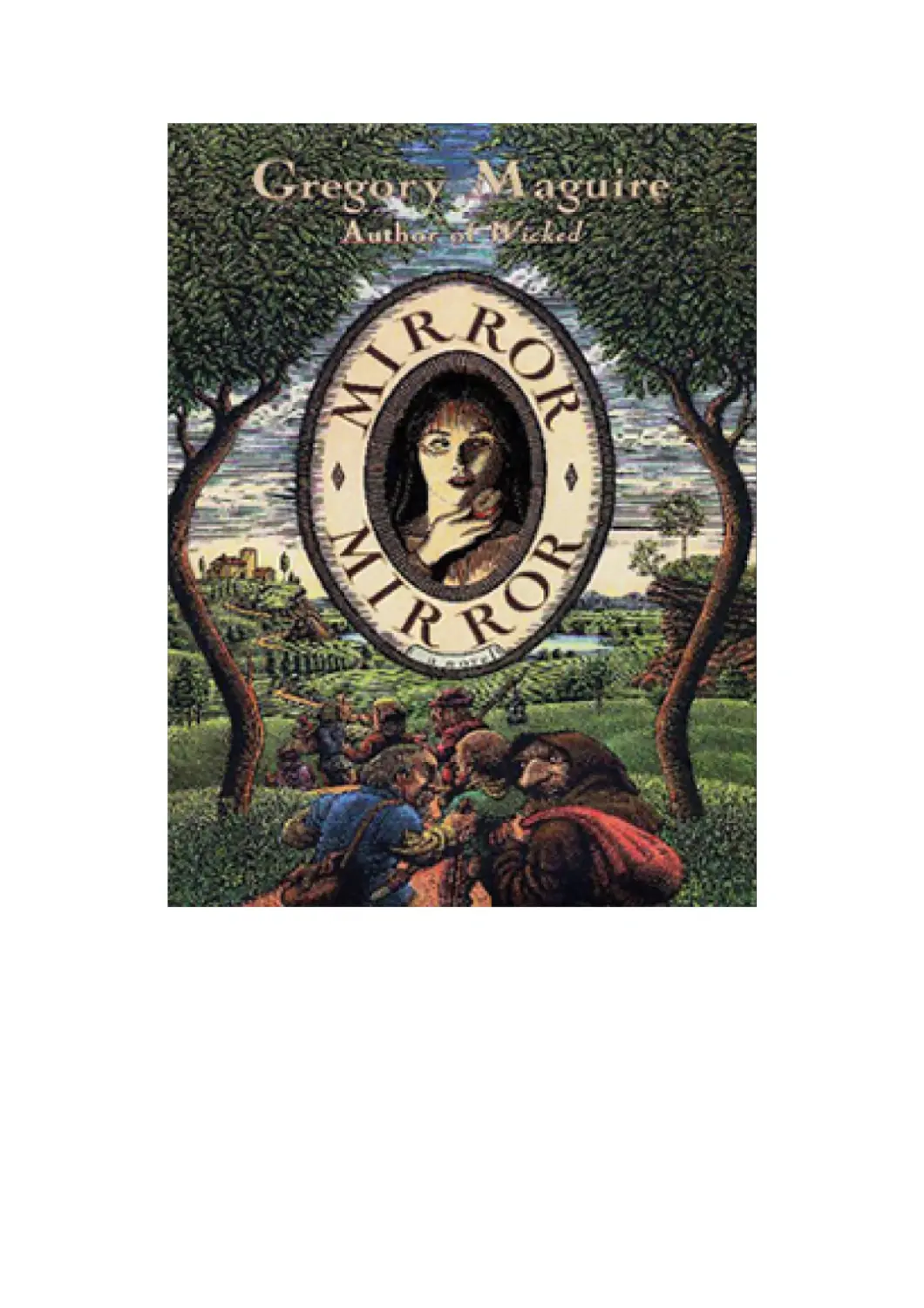
                    MIRROR
MIRROR

Gregory Maguire

For
Jane Langton,
Jill Paton Walsh,
and
John Rowe Townsend

Se non è vero è ben trovato.
Even if it’s not true, it’s a good invention.

Contents

E-Book Extra: “Little Snow White” by the Brothers Grimm
(read the original version of the classic fairy tale)
Mirror mirror on the wall…
Epigraphs
The roofs of Montefiore

1502
The name of the world
Lago Verde
What they told her, what she saw
Don’t leave, don’t follow
A pack of dirty thieves
Trouble and his sister
I am a girl who did no wrong
Cesare
Lucrezia
I am a woman who slept with my father the Pope
What I saw then
I am a rock whose hands have appetites
A moment ago
A stroll in the country
Under the twists of thornbank
What lies in the mirror Prince Dschem’s secret
The three eyes of God
The vision in San Francesco

1506
Bianca awake
Shades of rock
I am a gooseboy or am I a goose
Mirrormirror
I am a hunter who cannot kill
Bring me her heart carved from her chest
Interview with an assassin
A walk in the woods
The heart of the woods

I am a rock and my brothers are rocks
Seven

1512
The dwarves
A hole in the world
The beast in the wall
Al-iksir
Vicente
Mirror mirror
The return of the prodigal
Beware beware
The figure in the clearing
Interviews
An ivory comb, my dear
I am a girl who did little wrong
She wakes once more
A bodice, my darling
Two bites from the Apple
The oval window
I am a woman who killed for love
Reflections
Vigil

1519
Thaïs
Fire and ivy
The heart of the matter
Montefiore
Note
Acknowledgments
About the Author
Also by Gregory Maguire
Credits
Copyright
About the Publisher

Little Snow White
by the Brothers Grimm
The original version of the classic Grimm’s Fairy Tale
Translated by L.L. Weedon
E-Book Extra: “Little Snow White” by the Brothers Grimm

E-Book Extra
Little Snow White: The original version
of the classic Grimm’s Fairy Tale,
translated by L.L. Weedon.

L

in the winter-time,
when the snowflakes were falling like little white feathers
from the sky, a beautiful Queen sat beside her window, which
was framed in black ebony, and stitched. As she worked, she
looked sometimes at the falling snow, and so it happened that
she pricked her finger with her needle, so that three drops of
blood fell upon the snow. How pretty the red blood looked
upon the dazzling white! The Queen said to herself as she saw
it, “Ah me! If only I had a dear little child as white as the
snow, as rosy as the blood, and with hair as black as the ebony
window-frame.”
ONG, LONG AGO,

Soon afterwards a little daughter came to her, who was white
as snow, rosy as the blood, and whose hair was as black as
ebony — so she was called “Little Snow-White.”
But alas! When the little one came, the good Queen died.
A year passed away, and the King took another wife. She was
very beautiful, but so proud and haughty that she could not
bear to be surpassed in beauty by anyone. She possessed a
wonderful mirror which could answer her when she stood
before it and said —
“Mirror, mirror upon the wall, Who is the fairest of
all?”
The mirror answered —
“Thou, O Queen, art the fairest of all,”
and the Queen was contented, because she knew the mirror
could speak nothing but the truth.
But as time passed on, Little Snow-White grew more and more
beautiful, until when she was seven years old, she was as

lovely as the bright day, and still more lovely than the Queen
herself, so that when the lady one day asked her mirror —
“Mirror, mirror upon the wall, Who is the fairest fair of
all?”
it answered —
“O Lady Queen, though fair ye be, Snow-White is
fairer far to see.”
The Queen was horrified, and from that moment envy and
pride grew in her heart like rank weeds, until one day she
called a huntsman and said “Take the child away into the
woods and kill her, for I can no longer bear the sight of her.
And when you return bring with you her heart, that I may
know you have obeyed my will.”
The huntsman dared not disobey, so he led Snow-White out
into the woods and placed an arrow in his bow to pierce her
innocent heart, but the little maid begged him to spare her life,
and the child’s beauty touched his heart with pity, so that he
bade her run away.
Then as a young wild boar came rushing by, he killed it, took
out its heart, and carried it home to the Queen.
Poor little Snow-White was now all alone in the wild wood,
and so frightened was she that she trembled at every leaf that
rustled. So she began to run, and ran on and on until she came
to a little house, where she went in to rest.
In the little house everything she saw was tiny, but more
dainty and clean than words can tell.
Upon a white-covered table stood seven little plates and upon
each plate lay a little spoon, besides which there were seven
knives and forks and seven little goblets. Against the wall, and
side by side, stood seven little beds covered with snow-white
sheets.
Snow-White was so hungry and thirsty that she took a little
food from each of the seven plates, and drank a few drops of
wine from each goblet, for she did not wish to take everything
away from one. Then, because she was so tired, she crept into
one bed after the other, seeking for rest, but one was too long,

another too short, and so on, until she came to the seventh,
which suited her exactly; so she said her prayers and soon fell
fast asleep.
When night fell the masters of the little house came home.
They were seven dwarfs, who worked with a pick-axe and
spade, searching for cooper and gold in the heart of the
mountains.
They lit their seven candles and then saw that someone had
been to visit them. The first said, “Who has been sitting on my
chair?”
The second said, “Who has been eating from my plate?”
The third, “Who has taken a piece of my bread?”
The fourth, “Who has taken some of my vegetables?”
The fifth, “Who has been using my fork?”
The sixth, “Who has been cutting with my knife?”
The seventh, “Who has been drinking out of my goblet?”
The first looked round and saw that his bed was rumpled, so
he said, “Who has been getting into my bed?”
Then the others looked round and each one cried, “Someone
has been on my bed too?”
But the seventh saw little Snow-White lying asleep in his bed,
and called the others to come and look at her; and they cried
aloud with surprise, and fetched their seven little candles, so
that they might see her the better, and they were so pleased
with her beauty that they let her sleep on all night.
When the sun rose Snow-White awoke, and, oh! How
frightened she was when she saw the seven little dwarfs. But
they were very friendly, and asked what her name was. “My
name is Snow-White,” she answered.
“And how did you come to get into our house?” questioned the
dwarfs.
Then she told them how her cruel step-mother had intended
her to be killed, but how the huntsman had spared her life and
she had run on until she reached the little house. And the

dwarfs said, “If you will take care of our house, cook for us,
and make the beds, wash, mend, and knit, and keep everything
neat and clean, then you may stay with us altogether and you
shall want for nothing.”
“With all my heart,” answered Snow-White; and so she stayed.
She kept the house neat and clean for the dwarfs, who went off
early in the morning to search for copper and gold in the
mountains, and who expected their meal to be standing ready
for them when they returned at night.
All day long Snow-White was alone, and the good little dwarfs
warned her to be careful to let no one into the house. “For,”
said they, “your step-mother will soon discover that you are
living here.”
The Queen, believing, of course, that Snow-White was dead,
and that therefore she was again the most beautiful lady in the
land, went to her mirror, and said“Mirror, mirror upon the wall, Who is the fairest fair of
all?”
Then the mirror answered —
“O Lady Queen, though fair ye be, Snow-White is
fairer far to see. Over the hills and far away, She
dwells with seven dwarfs to-day.”
How angry she was, for she knew that the mirror spoke the
truth, and that the huntsman must have deceived her. She
thought and thought how she might kill Snow-White, for she
knew she would have neither rest nor peace until she really
was the most beautiful lady in the land. At length she decided
what to do. She painted her face and dressed herself like an old
pedlar-woman, so that no one could recognize her, and in this
disguise she climbed the seven mountains that lay between her
and the dwarfs’ house, and knocked at their door and cried,
“Good wares to sell — very cheap to — day!”
Snow-White peeped from the window and said, “Good day,
good-wife, and what are your wares?”
“All sorts of pretty things, my dear,” answered the woman.
“Silken laces of every colour,” and she held up a bright-

coloured one, made of plaited silks.
“Surely I might let this honest old woman come in?” thought
Snow-White, and unbolted the door and bought the pretty lace.
“Dear, dear, what a figure you are, child,” said the old woman;
“come, let me lace you properly for once.”
Snow-White had no suspicious thoughts, so she placed herself
in front of the old woman that she might fasten her dress with
the new silk lace. But in less than no time the wicked creature
had laced her so tightly that she could not breathe, but fell
down upon the ground as though she were dead. “Now,” said
the Queen, “I am once more the most beautiful lady in the
land,” and she went away.
When the dwarfs came home they were very grieved to find
their dear little Snow-White lying upon the ground as though
she were dead. They lifted her gently and, seeing that she was
too tightly laced, they cut the silken cord, when she drew a
long breath and then gradually came back to life.
When the dwarfs heard all that had happened they said, “The
pedlar-woman was certainly the wicked Queen. Now, take care
in future that you open the door to none when we are not with
you.”
The wicked Queen had no sooner reached home than she went
to her mirror, and said“Mirror, mirror upon the wall, Who is the fairest fair of
all?”
And the mirror answered as before —
“O Lady Queen, though fair ye be, Snow-White is
fairer far to see. Over the hills and far away, She
dwells with seven dwarfs to-day.”
The blood rushed to her face as she heard these words, for she
knew that Snow-White must have come to life again.
“But I will manage to put an end to her yet,” she said, and
then, by means of her magic, she made a poisonous comb.
Again she disguised herself, climbed the seven mountains, and
knocked at the door of the seven dwarfs’ cottage, crying,

“Good wares to sell — very cheap today!”
Snow-White looked out of the window and said, “Go away,
good woman, for I dare not let you in.”
“Surely you can look at my goods,” answered the woman, and
held up the poisonous comb, which pleased Snow-White so
well that she opened the door and bought it.
“Come, let me comb your hair in the newest way,” said the
woman, and the poor unsuspicious child let her have her way,
but no sooner did the comb touch her hair than the poison
began to work, and she fell fainting to the ground.
“There, you model of beauty,” said the wicked woman, as she
went away, “you are done for at last!”
But fortunately it was almost time for the dwarfs to come
home, and as soon as they came in and found Snow-White
lying upon the ground they guessed that her wicked stepmother had been there again, and set to work to find out what
was wrong.
They soon saw the poisonous comb, and drew it out, and
almost immediately Snow-White began to recover, and told
them what had happened.
Once more they warned her to be on her guard, and to open
the door to no one.
When the Queen reached home, she went straight to the mirror
and said —
“Mirror, mirror on the wall, Who is the fairest fair of
all?”
And the mirror answered“O Lady Queen, though fair ye be, Snow-White is
fairer far to see. Over the hills and far away, She
dwells with seven dwarfs to-day.”
When the Queen heard these words she shook with rage.
“Snow-White shall die,” she cried, “even if it costs me my
own life to manage it.”

She went into a secret chamber, where no one else ever
entered, and there she made a poisonous apple, and then she
painted her face and disguised herself as a peasant woman, and
climbed the seven mountains and went to the dwarfs’ house.
She knocked at the door. Snow-White put her head out of the
window, and said, “I must not let anyone in; the seven dwarfs
have forbidden me to do so.”
“It’s all the same to me,” answered the peasant woman; “I
shall soon get rid of these fine apples. But before I go I’ll
make you a present of one.”
“Oh! No,” said Snow-White, “for I must not take it.”
“Surely you are not afraid of poison?” said the woman. “See, I
will cut one in two: the rosy cheek you shall take, and the
white cheek I will eat myself.”
Now, the apple had been so cleverly made that only the rosecheeked side contained the poison. Snow-White longed for the
delicious-looking fruit, and when she saw that the woman ate
half of it, she thought there could be no danger, and stretched
out her hand and took the other part. But no sooner had she
tasted it than she fell down dead.
The wicked Queen laughed aloud with joy as she gazed at her.
“White as snow, red as blood, black as ebony,” she said, “this
time the dwarfs cannot awaken you.”
And she went straight home and asked her mirror —
“Mirror, mirror upon the wall, Who is the fairest fair of
all?”
And at length it answered —
“Thou, O Queen, art fairest of all!”
So her envious heart had peace — at least, so much peace as
an envious heart can have.
When the little dwarfs came home at night they found SnowWhite lying upon the ground. No breath came from her parted
lips, for she was dead. They lifted her tenderly and sought for
some poisonous object which might have caused the mischief,
unlaced her frock, combed her hair, and washed her with wine

and water, but all in vain — dead she was and dead she
remained. They laid her upon a bier, and all seven of them sat
round about it, and wept as though their hearts would break,
for three whole days.
When the time came that she should be laid in the ground they
could not bear to part from her. Her pretty cheeks were still
rosy red, and she looked just as though she were still living.
“We cannot hide her away in the dark earth,” said the dwarfs,
and so they made a transparent coffin of shining glass, and laid
her in it, and wrote her name upon it in letters of gold; also
they wrote that she was a King’s daughter. Then they placed
the coffin upon the mountain-top, and took it in turns to watch
beside it. And all the animals came and wept for Snow-White,
first an owl, then a raven, and then a little dove.
For a long, long time little Snow-White lay in the coffin, but
her form did not wither; she only looked as though she slept,
for she was still as white as snow, as red as blood, and as black
as ebony.
It chanced that a King’s son came into the wood, and went to
the dwarfs’ house, meaning to spend the night there. He saw
the coffin upon the mountain-top, with little Snow-White lying
within it, and he read the words that were written upon it in
letters of gold.
And he said to the dwarfs, “If you will but let me have the
coffin, you may ask of me what you will, and I will give it to
you.”
But the dwarfs answered, “We would not sell it for all the gold
in the world.”
Then said the Prince, “Let me have it as a gift, I pray you, for I
cannot live without seeing little Snow-White, and I will prize
your gift as the dearest of my possessions.”
The good little dwarfs pitied him when they heard these
words, and so gave him the coffin. The King’s son then bade
his servants place it upon their shoulders and carry it away, but
as they went they stumbled over the stump of a tree, and the
violent shaking shook the piece of poisonous apple which had

lodged in Snow-White’s throat out again, so that she opened
her eyes, raised the lid of the coffin, and sat up, alive once
more.
“Where am I?” she cried, and the happy Prince answered,
“Thou art with me, dearest.”
Then he told her all that had happened, and how he loved her
better than the whole world, and begged her to go with him to
his father’s palace and be his wife. Snow-White consented,
and went with him, and the wedding was celebrated with great
splendour and magnificence.
Little Snow-White’s wicked step-mother was bidden to the
feast, and when she had arrayed herself in her most beautiful
garments, she stood before her mirror, and said —
“Mirror, mirror upon the wall, Who is the fairest fair of
all?”
And the mirror answered —
“O Lady Queen, though fair ye be, The young Queen is
fairer to see.”
Oh! How angry the wicked woman was then, and so terrified,
too, that she scarcely knew what to do. At first she thought she
would not go to the wedding at all, but then she felt that she
could not rest until she had seen the young Queen. No sooner
did she enter the palace than she recognized little Snow-White,
and could not move for terror.
Then a pair of red-hot iron shoes was brought into the room
with tongs and set before her, and these she was forced to put
on and to dance in them until she could dance no longer, but
fell down dead, and that was the end of her.
THE END

© Grimm’s Fairy Tales. Translated by L.L. Weedon. London:
Ernest Nister, [1898], pp. 9-20.

I am a girl who did no wrong
I am a woman who slept with my father the Pope
I am a rock whose hands have appetites
I am a hunter who cannot kill
I am a mercenary with the French disease
I am a girl who lived among stones
I am a woman who poisoned my enemies
I am a rock and my brothers are rocks
I am a cleric who trafficked in curses
I am a gooseboy or am I a goose
I am a girl who did little wrong
I am a gooseboy or am I a boy
I am a farmer who stole something sacred
I am a monster who let the child go
I am a dog with an unlikely past
I am a hunter who followed the coffin
I am a girl who did something wrong
I am the other side of snow
I am a mirror a mirror am I

Mirror mirror on the wall
Who is the fairest one of all

D

say that I am both your father and your lover?
Let the world, that heap of vermin as ridiculous as they
are feeble-minded, believe the most absurd tales about
the mighty! You must know that for those destined to
dominate others, the ordinary rules of life are turned
upside down and duty acquires an entirely new meaning.
Good and evil are carried off to a higher, different
plane… .
O PEOPLE

Remember this. Walk straight ahead. Do only what you
like, as long as it is of some use to you. Leave hesitation
and scruples to small minds, to plebeians and
subordinates. One consideration alone is worthy of you—
the elevation of the House of Borgia, the elevation of
yourself.
—Alexander VI’s speech to Lucrezia Borgia, from Arthur de Gobineau’s Scènes
historiques de la Renaissance (1877), as quoted in The Borgias by Ivan Cloulas
(1989)

O

some Lombard masons working near the cloister
of Sta. Maria Nuova just off the Via Appia had opened a
sarcophagus and found the body of a young Roman
woman of about fifteen, so well preserved that it seemed
alive. A crowd had gathered around and admired the
girl’s rosy skin, her half-open lips revealing very white
teeth, her ears, her black lashes, dark, wide-open eyes,
and beautiful hair, done in a knot …
NE DAY

—The Borgias, ibid.

The roofs of Montefiore

F

arable river lands to the
south, the approach to Montefiore appears a sequence of
relaxed hills. In the late spring, when the puckers of red poppy
blossom are scattered against the green of the season, it can
look like so much washing, like mounds of Persian silk and
Florentine brocade lightly tossed in heaps. Each successive
rise takes on a new color, indefinably more fervent, an aspect
of distance and time stained by the shadows of clouds, or
bleached when the sun takes a certain position.
ROM THE

But the traveler on foot or in a hobble-wheeled peasant cart, or
even on horseback, learns the truth of the terrain. The ascent is
steeper than it looks from below. And the rutted track traverses
in long switchbacks to accommodate for the severity of the
grade and the crosscutting ravines. So the trip takes many
more hours than the view suggests. The red-tiled roofs of
Montefiore come into sight, promisingly, and then they
disappear again as hills loom up and forests close in.
Often I have traveled the road to Montefiore in memory.
Today I travel it in true time, true dust, true air. When the track
lends me height enough, I can glimpse the villa’s red roofs
above the ranks of poplars, across the intervening valleys. But
I can’t tell if the house is peopled with my friends and my
family, or with rogues who have murdered the servants in their
beds. I can’t tell if the walls below the roofline are scorched
with smoke, or if the doors are marked with an ashy cross to
suggest that plague has come to gnaw the living into their
mortal rest, their last gritty blanket shoveled over their heads.
But I have come out of one death, the one whose walls were
glass; I have awakened into a second life dearer for being both
unpromised and undeserved. Anyone who walks from her own
grave relies on the unexpected. Anyone who walks from her

own grave knows that death is more patient than Gesù Cristo.
Death can afford to wait.
But now the track turns again, and my view momentarily spins
back along the slopes I’ve climbed so far. My eye traces the
foothills already gained, considers the alphabet of light that
spells its unreadable words on the surface of the river. My eye
also moves along the past, to my early misapprehensions
committed to memory on this isolated outcropping.
The eye is always caught by light, but shadows have more to
say.
Rest. Breathe in, breathe out. No one can harm you further
than death could do. When rested, you must go on; you must
find out the truth about Montefiore. Granted a second life, you
must find in it more meaning than you could ever determine in
your first.

• 1502 •

The name of the world

T

was called Montefiore,
as far as she knew, and from her aerie on every side all the
world descended.
HE WORLD

Like any child, she looked out and across rather than in. She
was more familiar with the vistas, the promising valleys with
their hidden hamlets, the scope of the future arranged in terms
of hills and light.
Once a small dragon had become trapped in the bird-snaring
nets slung in the uccellare. Bianca watched as the cook’s
adolescent grandson tried to cut it down and release it. Her
eyes were fixed on the creature, the stray impossibility of it,
not on the spinney in which it was caught. How it twitched, its
webbed claws a pearly chalcedony, its eyes frantic and
unblinking. (Despite the boy’s efforts, it died, and his
grandmother flayed it for skin with which to patch the kitchen
bellows.)
Bianca regarded visitors to Montefiore with fierce attention:
emissaries of the world. But the bones of her home—the house
itself—remained as familiar and unregarded as her own
fingernails.
Montefiore was larger than a farmer’s villa but not so
imposing as a castle. Too far from anywhere important to
serve as a casale—a country house—it crowned an upthrust
shoulder of land, so its fortifications were natural. On all sides,
the steepness of the slope was a deterrent to invaders, and
anyway, Montefiore wasn’t large enough to interest the
condottieri who led their small armies along the riverbank on
one campaign or another.
Had Bianca an adult eye, she might have guessed from its
mismatched roofs and inconsistent architectural details that

many owners had lived here before her family arrived, shaping
the space with a disregard for symmetry or loveliness. When
its masters had had money, they’d made attempts to drill a
little grandeur into the old stone hull, like crisp starched lace
tied under the wet chins of a drooling nonna. A recently
completed interior courtyard, handsomely done with columns
and vaults in the revived archaic style, provided relief from the
roaring breeze.
Except for the courtyard, though, most attempts at
improvement had been abandoned in mideffort. Some
windows were fitted with glass, but in most windows, squares
of linen had been nailed to the shutter moldings, pale light
conferring a sense of height and volume to the dark rooms.
Along one retaining wall, a loggia ran unevenly, its walls inset
with terrazzo putti whose faces had become bubonic with the
remains of insect cocoons. For half a century the chapel had
stood with a roof beam and naked struts, the old cladding and
tiles having been swept away in an arrogant gale. When the
January tramontana blustered in, the geese sometimes
sheltered there from the wind, though they seldom took
communion.
Fortunately too inaccessible to garrison an army, Montefiore
was nonetheless valuable as a lookout. From time to time in its
history it had been commandeered for its prospects. On a clear
day one imagined one could glimpse the sea.
What child does not feel itself perched at the center of
creation? Before catechisms can instill a proper humility, small
children know the truth that their own existence has caused the
world to bloom into being. The particular geography of home
always charms, but the geography of Montefiore was
unarguably pastoral. The arrangement of Tuscan and Umbrian
vistas, draped from the very threshold of home through
diminishing folds to the horizons, taught soft blues and browns
to Bianca de Nevada. That was what they were there for; this
brown, that blue; this here, that there.
These moments, more or less, had their flashing existence,
circa 1500 anno Domini, though the name of a year means
little to one who doesn’t yet know the name of corruption.

Lago Verde

T

the grapes to harvest,
the sweeter first olives and the richer late ones, and the second
cutting of hay to manage before an early frost sapped it of life.
But the weather, this year, was benign, and the agricultural
operations around Montefiore were conducted without delay,
each in its time. Therefore, the cook’s augury of chicken livers
predicting success, Vicente de Nevada organized a corpus of
laborers to continue work on ditch digging at the far end of the
green lake.
HERE WERE

Still considered an unacceptable landlord—for the Spanish
slant to his otherwise serviceable Italian—de Nevada was
tolerated but not admired. Well, he was new in the district still,
only these few years, having arrived from the suspicious
unknown with a motherless child and a writ of occupancy
sealed in a plum-colored wax. He was a quiet man and a gentle
one, and his passions, as far as the locals observed, didn’t
show in a manly, obvious way upon his face; so he wasn’t
admired. Who could take the time to study a man whose face
was the same in winter or summer, in prayer or labor, on
feastday or, presumably, at an auto-da-fé in his homeland,
Spain? No, Vicente wasn’t admired, but he was tolerated: he
saw to it that the sick were tended, the dead blessed by the
priest attached to Montefiore, and the wheat shared out and the
apples in their time, and the joiner paid for his labors when a
coffin had to be built.
Vicente de Nevada loved his small holding, and since the
weather was cooperating and the work crew needed
encouragement, he pulled off his shirt and got hip-deep in the
swampy water at the lake’s draining edge. He helped to
unsettle boulders that had rolled into the mud back in the time
of Potiphar.

“Go on, assist the good man, you lazy cleric,” said Primavera
Vecchia, the cook.
“It wouldn’t be seemly,” said Fra Ludovico calmly. “If you
think he needs help, do it yourself.”
“I’m watching the child.”
“Leave her in my watch.”
“What a mistake that would be. She’d wander up to her nose
in the green water and drown before your eyes, while you
tiptoed around squealing for an angel to come to her aide. I’d
no more leave her in your care than I would my own soul.”
“Hmmmph,” said Fra Ludovico. “I’ve never been persuaded
you had much of a soul. More like a little damp anchovy stuck
between your breasts, trying to breathe. That’s what you smell
like, anyway.”
The small girl balanced on the margin of the moment, toes in
the water and heels in the mud. She was thinking that from the
house, the small lake did look green, because regular flooding
made the poplars stand knee-deep in water. But from here, on
site, with the sun sliding westward, the water looked silvered,
and there were flicking scales of sky blue and white as well as
poplar green and an uncertain black.
The reflections speckled her pale skin. She stopped to ruck her
tunic a few inches higher. It was tied in a knot in back, with a
vague hope of keeping it dry, but its hem was dripping.
Bianca was interested in everyone’s splashing. She had
listened carefully about the plan to irrigate a field farther along
the slope by draining this wetland above. Her father grunted,
holding the small of his back, sweating between the
shoulderblades. In formal and courteous words he encouraged
the workers. They grunted in mockery, equal parts affection
and brave disrespect.
He was the world to her, more than the house was, even.
He felt her looking, and with his unvarying expression he
turned and waved. It was that, and that alone, that kept the
workers at their task. They would have preferred him on the
bank, supervising, upbraiding them. But a man who would

pause to wave at his daughter, even if his face didn’t change—
well, that was a gesture they could read. All together now, and
lift. Lift.
What did they know of how he cuddled her and protected her,
of how he sat by her cot at night so she could sleep, of how
quickly he started when a bad dream woke her? What did they
know of the disagreements he had had with Primavera, who
wanted to take the child to her pallet in the kitchen? They
knew nothing of any of this.
She wanted to walk across the water to him, to run on its
mosaic of reflections, for even across this glassy space she
missed him. She cried out, selfish thing—don’t disturb the
man while he tries to shrink a lake—but her voice came out as
a laugh across the water, no more precise than the call of a
bird. He waved again.
“Come here, bambina, your behind is mucky,” said Primavera,
pulling herself off the rotting log on which she had sat.
“You’ve left a dent in this log,” observed Fra Ludovico kindly.
Bianca skipped on along the lake edge, making the old cook
cross, and, with pins in her shins, she hobbled after.
“Papà, Papà,” babbled Bianca.
“Don’t come down this way,” said her father. “We don’t know
which is the keystone boulder. When we’ve shifted the right
one, the rest will give way, and the force of the water might be
strong. Primavera, aren’t you minding her?”
“I am, but she must mind me first,” said the cook.
Fra Ludovico snapped out of the attitude of prayer he’d been
affecting and strode forward. He passed the cook, kicking up a
spray of dirt with his sandal, smirked, and swooped Bianca up
out of harm’s way.
“Leave her be, I’m capable,” snorted Primavera.
“And lift,” said Vicente, “and lift,” and the crucial boulder
behaved. There was a suck of stone from mud, a small
cataract. The men fell back, laughing, to see a waterworks
succeed, at least for the moment. The pull wasn’t strong

enough to endanger anyone, but Primavera, heading for
Bianca, trod on an apron of sand as it shifted, and she sat down
suddenly, up to her apron strings in water. The laborers jeered,
and with her deft tongue she cursed them imaginatively. Fra
Ludovico all but pranced past, holding Bianca like a boon.
The priest set her down and she ran to her father, across a
shallow puddle left by the lake as it receded. She skidded and
fell forward onto her hands and knees, as wet as Primavera,
and laughing.
Vicente de Nevada swept forward and slipped his hands under
his daughter’s armpits. “You’re a mucky mess, and will sleep
in the barn with the pigs,” he said. “What’s this, though?”
He handed Bianca back to the priest and said, “Now stay out
of the water, Bianca, it’s unhealthy.”
Then he felt the puddle with his palms, and then his fingertips.
He pried a slightly bowled edge of puddle up into the air. Or
that’s what it looked like.
Water ran off it.
“You’ve unearthed a shard of the pagan past,” said Fra
Ludovico. “A Roman shield?”
“I’ve unlaked it, not unearthed it,” said Vicente.
“The lid of a large cauldron,” said Primavera, huffing.
The workers drew near, but in a huddle. They wanted to see
and they didn’t want to see.
“It’s a mirror,” said de Nevada wonderingly.
He took it back to Montefiore and had it cleaned, and a
beautiful frame carved for it.
But what was it doing in Lago Verde? That was the question
on everyone’s mind, then, and for many years after.
“I’d guess that someone smuggled it out of Florence, to rescue
it from the bonfires of Savonarola,” said Fra Ludovico.
“Maybe then he suffered fiery hemorrhoids, thought better of
his vanity, and pitched it in the lake as he passed. We ought to
have left it there.”

“Have I admitted aloud to you something I have long
suspected?” said Primavera. “You’re a fool. No one passes this
lake but to approach or leave Montefiore, and I’ve lived here
since before mirrors were invented. I’d have known if this
thing had a human owner. No, it’s a creation of the water
nymphs. I don’t like it one bit. We ought to put it back.”
“I’m not a fool,” said the priest, “but though it pains me to say
it, for once I agree with you. We ought to toss it back in the
deep.”
“It’s just a mirror,” said Don Vicente de Nevada to his little
girl, holding her in his arms high enough so she could see
herself, and she could see him too, loving her. “Can you see
yourself? What do you see?”
“I see Bianca,” she said, “and I see Papà.”
He smiled.
“Where is Mamma?” she said, and craned her head this way
and that, as if to peer beyond the mirror’s ornate frame, around
the frame’s edges, into the watery recesses just out of view.
Vicente de Nevada neither scowled nor winced. Evenly he
answered her, as he always had. “You can’t see your mother;
she is dead. This isn’t a window to heaven. This is just a
mirror.”
He didn’t look for his wife there, nor was he the type of man
to look at himself. Happiness now sometimes meant turning
away from what one remembered of earlier, better happiness.
When he did look, he saw the view reflected from the mirror,
the view out the salone’s windows, of Toscana and Umbria in
fallow beauty, seductively ready for the next invading army.
But Bianca always thought of it as a curved sheaf of lake,
pleasingly cut from water and hung on the wall.

What they told her, what she saw

P

had once had
sex with a squid. On washdays in high summer you could still
see the marks like a row of puckered bumps that the squid’s
passionate hold had left on her skin. They began beneath her
right breast, circled around her ample hip, and closed in on her
cloistered area.
RIMAVERA VECCHIA

“What were you doing with a squid?” asked Bianca.
“Everything a squid could manage to do,” said the cook.
“Once you lose your husband to the wars, let me tell you, you
become a fishwife in more ways than one.”
“What wars?”
“One or the other of them, I forget. I’m too old to remember
what my feet look like, how can I remember my husband? Eat
up your supper.”
Primavera was older than Gesù, or so she said. She knew how
the world worked. She said: “You, my child, were conceived
in a snowy dale. The forests had lost their leaves, and the
trunks of the trees had gone black with the wet of snow. I
know this because of how white-and-black you are, that skin,
that hair. Eat up that bread, haven’t I told you already, before
the mice get it.”
“What does conceived mean?”
Fra Ludovico wandered into the kitchen just then, sniffing for
a shingle of ham. Primavera said, “It means thought up.”
“Are you corrupting the child?” asked the priest.
“I’m telling her of her origins.”

Fra Ludovico sat down at the table as if a symposium on the
subject had been called. He said: “In the year of Our Lord
1495, on a bright autumn afternoon of stubborn winds and
warm rain that smelled unpleasantly of salted cod and violets,
the dark-tressed María Inés, originally of Navarre, gave you
life. After her difficult miscarriages, you were her first child to
come to term, and your mother lived long enough to name you
Bianca and seal her devotion with a kiss on your bloodied
hairless scalp.
“Oh, the love she had for you,” said Fra Ludovico. “I
performed the christening with one hand and anointed the
forehead of the corpse with the other. And then your saintly
mother flew to heaven and became an angel. Now be a saint
like your mother, will you, and fetch me a sip of wine to go
with this ham. I’ve a twinge.”
Primavera, when the girl had gone: “You simple oaf, don’t lie
to her.”
“Hush, you suppurating old boil of a peasant.”
“You weren’t present at the mother’s death, and you know it.
You’re a priest, you aren’t supposed to lie.”
“I’m a priest, I know better than most when a lie is permitted. I
would have performed the rites had I happened to be in the
vicinity. You know I would.”
Bianca returned with the wine. The priest toasted his nemesis.
“May you choke on your godless superstitions and spend
eternity in coals up to your squid marks. Amen.”
“Bianca, the kitchen fire is failing, and I left the kindling on a
cloth at the bottom of the steps. Can you bring it to the
hearth?” asked Primavera. The girl, biddable enough, went off.
“I know you’re an old fool,” said the cook, “but really, I’m
surprised you would lie to the girl.”
“My lie is a slender thing. It serves a purpose. Bianca should
see that her birth ushered her mother into heavenly bliss. Isn’t
it true enough? And isn’t it good for her to consider?”
Primavera: For all you know María Inés was a harlot. She may
be writhing in hell or removing an ocean with the lid of an

acorn in purgatory. How can you promise Bianca her mother is
in heaven?
Fra Ludovico: The stories of heaven belong in the heads of
children. If, as children grow, the stories evaporate?—oh well.
They leave behind a residue of hope that changes how children
behave.
Primavera: That stinks more than your chamber pot.
And are you going to heaven or hell, do you think, with your
heathen tricks and legerdemain?
I’m not going to die at all, just to spite the architects of the
worlds.
Fra Ludovico crossed himself and ate some more ham.
Bianca de Nevada returned with the kindling and helped
Primavera stoke the fire. She didn’t ask more about her
mother: What was there to say? But Fra Ludovico, warmed by
the wine and the fire, talked about an arterial system of grace
that webbed together human affairs. When he left, Primavera
raked the embers again.
“Look, child,” she said. “Is this a kitchen fire or is it the fires
of hell?”
“There is a pot on a chain for our broad beans,” said Bianca. “I
don’t know if hell has such a pot.”
“Is your mother a dead woman or is she a broad bean?”
This was a harder question to answer. Once a mother started
being dead, and was planted in the ground, what was to say
she didn’t emerge, eventually, as a broad bean? “I’m not sure,”
said Bianca.
Primavera said, “You’re young enough to be ignorant, but you
are not a fool like some I know. Of course your mother isn’t a
broad bean.”
“They say you are an onion,” said Bianca, snuggling toward
Primavera’s lap.
“That only refers to my distinctive and refreshing odor. Now,
listen to me. When your mother died, she died. Maybe the

saints came and put her in a sack and took her to visit with
Saint Peter. Or maybe the worms broke their Lenten fast to
chew on her delicious lips. Nobody knows, but what’s done is
done, and your job is to be clever and not to listen to nonsense.
Do you understand me?”
“How do I know what is nonsense and what isn’t?”
“If you’re ever in doubt, throw a pepper up in the air. If it fails
to come down, you have gone mad, so don’t trust in anything.”
She made a supper out of peppers and broad beans, illustrating
her point obscurely. Bianca ate heartily though she wasn’t sure
she understood the lesson.
She would ask her father, though, when he returned.
When Don Vicente arrived home a few days later, some latest
necessary negotiation with the Papal legates having broken off
unsatisfactorily, Bianca greeted him with the question. But
Papà, is Mamma an angel or is she a broad bean?
For once Vicente was in no mood. “Who puts a notion like that
in your mind?”
He fired the corrupt old matron, but Primavera refused to leave
the kitchen. “It would take me half a day to walk to the village,
and you’d just have to send for me again when you changed
your mind, and my hips aren’t what they were.”
“They never were anything much like hips,” sniffed Fra
Ludovico in passing. But Primavera’s point carried the
argument, and Vicente relented.
Is Mamma dead? Is she really dead? Or is she an angel, or a
bean, or something else?
“I’m surrounded by simpletons,” said Vicente.
But he remembered his daughter’s birth—in a nook in a tavern
on the road from Rome, when María Inés’s water broke
without warning. The baby came twisted and ought to have
died, but the mother died instead. For a payment of florins her
corpse was allowed to share a churchyard grave with a local
merchant who conveniently had died the same day. (The
merchant had been a widower and his dead wife wouldn’t

know he was buried with another woman until purgatory,
when everything was too late to change anyway.)
Whether Vicente began at once to love Bianca in place of her
dead mother or whether he had to learn not to despise her for
causing his wife to bleed to death, Bianca lived a lifetime
without finding out. Fra Ludovico was wrong: Truth is as
evanescent as lies, and dissolves in time. But as a father will,
Vicente had taken Bianca in his arms, and he continued on the
road through Spadina toward Spoleto.
Except for that which pertained to the confusing and
contradictory legend of her birth, Bianca de Nevada had been
told little about María Inés de Castedo y Nevada. The
flattering characteristics that memorialize the person who dies
too young aren’t altogether convincing. María Inés had been a
saint, an angel, a paragon. But Bianca had to wonder. Had her
mother never thrown a stone at a cat, or peed in the vegetable
garden, or stuck out her tongue at the Archbishop of
Pamplona? On these matters neither Primavera nor Fra
Ludovico would comment.
So Bianca came to consider her mother something like the
stark unsmiling icon of the Virgin that Fra Ludovico kept
propped up on a shelf in his cell. In the severe older style,
unpopular these days, the piece showed judging black eyes,
lips pursed as if reserving a mother’s kiss for someone more
worthy than Bianca.
“Papà?” said Bianca, the question mark carried in the set of
her small shoulders. “Where is Mamma now?”
He couldn’t answer her inquiry. He held her instead and
walked to the steeper side of the mount, where the wind raced
up the east face of the slope with such speed that it could carry
a piglet from a barnyard below and brain it against one of
Montefiore’s protruding roof beams.
Vicente regarded his Bianca. Of her beauty there was no
doubt, and no description would serve. But the name was
correct. Bianca, a name referring to the polished whiteness of
her skin, almost a marble from the Carrara region; and de
Nevada, the father’s family name, betraying his own humble

status in the outlands of Aragon, but pertinent here: of the
snowy slopes.
And Bianca saw her father too, his wavy chestnut hair
standing almost straight up in the wind. She couldn’t see her
mother in him, but she could see something that she guessed
he might have learned from poor dead María Inés: a habit of
love. So maybe growling Fra Ludovico was right about the
contagious quality of blessings in human affairs.

Don’t leave, don’t follow

C

AN’T I

go with you? I’ll be still

and say my prayers.”
Her exposure to other girls limited, Bianca nonetheless had
learned to sulk prettily enough. It didn’t work, though. Her
father wouldn’t let her off the property. She could go no
farther than the orchards and the higher of the hay meadows.
Only as far as the bridge, and onto it, but not across it.
“The weather is terrible,” he said, and shivered, though it was
high summer and the goats sat panting in the shadows, too
tired to bleat. “Beyond the bridge a dreadful snow falls. My
beard crusts over and in minutes my cloak is stiff as a cuirass.
I can’t turn at the waist. If you were walking behind me and
you fell and called my name, I wouldn’t hear you: plugs of ice
form in my ears.”
“You would always hear me,” she said, laughing. “You hear
me when I wake up to go in the night, though my water is less
than a spoonful.”
He tried again. “I tell you, the world is a terrible place to be. I
don’t want you to come with me until you’re older, for if
something happened to me, what would become of you?”
“What could happen to you?” she asked.
“Well, a tree might fall on my head and turn my brains into
whisked eggs.”
His drollery was ineffectual. “Papà, really.”
“Look,” he told her, “here at Montefiore, Fra Ludovico and
Primavera Vecchia can keep you safe. But should anything
ever happen to me, you are not to come looking.”

“I don’t understand why.” She lowered her chin and glared at
him with a severity uncommon in a child.
“Because anything that could happen to me could happen to
you. If I was in trouble somehow, it would be a comfort to
know you were safe here, and not getting into mischief on my
behalf. I lost your mother, through no fault of my own.” His
voice was stern. “I won’t lose you too, nor even waste my time
worrying about it, providing you obey me.”
“You go and come, and go and come, and nothing ever
happens to you.”
“I go and come, and play my games, and stroke my beard and
nod my head and hold my tongue, all to keep us safely
overlooked up here. These are boisterous times, and too many
men are greedy for everything. You stay here. You give me
your word?”
She wouldn’t.
“Bianca,” he said, “this bridge on which we stand. Up there is
Lago Verde, and the stream runs out, beneath this bridge, to
water our lower fields, and eventually to join the other rivulets
and power the mill at the edge of the village. You can see the
noisy stream, the rushes, the wrens at their work, the hills
beyond. But what don’t you see?”
“I don’t see why you have to leave again,” she said.
He snapped at her, “You don’t see men thieving for riches.
You don’t see the cavalry or the foot soldiers. You don’t
see”—here he lowered his voice, trying another approach
—“you don’t see the ornery creatures who live under the
bridge.”
She looked at him with suspicion and mock contempt, but he
could tell he had found his weapon.
“If you come down here alone, a little slip of a thing as you
are, one of them will leap from their damp burrow and snatch
you away. And then I’ll come home, and cry, Bianca, Bianca!
And you’ll be gone, and no one to tell me where you went. But
I’ll know, Bianca. I’ll know. You disobeyed your father.”
“What do they look like?” she asked.

“Scarier than Primavera,” he said. “I don’t want to terrify you,
so that’s all I’ll say. Now kiss me, and let me be on my way.”
She kissed him and let him go. And, more or less, she believed
him that the weather in the world was brutal. Every time he
came home, it took longer and longer for him to shake off the
frozen look on his face, and thaw at the sight of her. Then,
when summer had passed and the autumn rushed goldenly in,
he was gone again, and this time for a long time—more than a
week. Long enough for the staff to relax into mild disbehavior.
“The wall by the back stairs wants a coat of lime wash,” said
one of the maids. Someone had been drawing instructional
diagrams for the others and the male figure looked rather too
much like a naked Fra Ludovico for anyone’s comfort.
“You’re lucky the old fool doesn’t take this staircase,”
muttered Primavera. “He’d collapse in mortification and brain
himself on the stone landing, and go on to swell the
community of souls in heaven and bore them eternally. No,
Bianca, you are forbidden to go look. When the time comes to
tell you the glorious nonsense of sex, I’ll do it with the help of
a carrot and a soft loaf of bread folded in two.”
“I know about sex,” said Bianca. “I’ve seen the ram and the
ewe.”
“And what precisely can you see about the romance between
the ram and the ewe?”
Very little, as it turned out. But Bianca was crafty enough to
disguise her ignorance and wouldn’t say.
The girl had all too few amusements, sequestered as she was.
The gooseboy was friendly but vague, and preferred the
company of geese. The servant girls from the village thought
Bianca was too young for her friendship to be worth
cultivating. So needling Primavera or Fra Ludovico was one of
Bianca’s rare entertainments. At lunch:
“I want to see the funny drawings. Why can’t I?”
“What funny drawings?” asked Fra Ludovico.
“Someone has sketched schemes of sex between whores and
morons,” said Primavera.

“Only a moron would have sex with a whore,” said Fra
Ludovico. “Bianca, I forbid you to examine these diagrams.
You would weep with fright and grief.”
“I can see her laughing herself sick,” said Primavera. “Or
getting ideas. Usually, for the sake of honesty, I have to chop
the carrot in half so as not to get a young girl’s hopes up.” A
pause. “There’s really nothing to compare to a squid.”
“I see a horse,” cried the gooseboy, who frequently cried what
he saw, though most often it was shapes in the clouds. But
today he was right, and Don Vicente would arrive by nightfall.
Fra Ludovico posted himself in a chamber to pray that Don
Vicente might bring good news to their windswept perch,
though he would never elaborate the nature of the hopes he
had; his was too lofty a station for him to descend to common
gossip. “You don’t know what you pray about,” snorted
Primavera, “that’s why you won’t tell us. You pray for a
reason to pray, that’s all. And it doesn’t come.”
“It’ll come soon enough,” said Fra Ludovico bitterly. “I’ve
been to Rome, after all; I know how quickly peace concludes.”
“If I fell asleep into my grave now, I’d have nothing to think
about but the children war has taken from me,” snapped
Primavera. “No one survives in times of war unless they make
war their home. How did I get so old and wise, but for
welcoming war into my house and making friends with him?
Better to befriend the enemy and hang on. Something worse
might come along, which might be amusing or might not.”
“Something worse always comes along. That’s what I’m
praying about.”
Primavera left to supervise the preparation of the evening
meal. Bianca followed her and mooned about the kitchen,
getting underfoot and upsetting a pot of broth, till Primavera
scolded her and sent her off.
Fra Ludovico, to Bianca’s knock, replied yawnily, “I’m deep
in prayer, child. Go away.”
She threw stones in the well, but the well didn’t throw them
back, and she went to the top of the back staircase, where the

local girls had begun covering the offending images with lime
wash.
“What is that supposed to be?” she asked, pointing.
The girls had no use for her. Had she been the sister of one of
them, they might have been kind; but they were always
serving, and had few advantages, and the pleasure of
sisterhood among them was more luxurious than the appeal of
being kind to a younger child. And the girls could see that as
the lone child of the local landholder, Bianca was far more
likely to attract a desirable husband than they, which made
them less than sympathetic to her loneliness.
So the drawings they were covering up were especially
galling, and they had to choose their strategy of cruelty. In the
end the puddle of soapy water on the top step did their work
for them. Down she went, three steps at a time, while the girls
laughed.
“Nobody pushed her,” they agreed, affronted, when Primavera
arrived.
Bianca bled a little and cried, but she cried less than she bled,
and then she stopped bleeding, and went to wait for her father
in the apple orchard.
The orchard was gently terraced into four broad earthwork
steps, each one lined with a double row of trees. The time of
apples was nearly here; the first windfalls were jeweling the
ground with carmine and green. Bianca knew her father, who
was kind to his animals, would bring his mare here, once she’d
been unsaddled and watered. He would let her take advantage
of a few apples.
Bianca didn’t fret but sat quietly in the verdant shade of the
top level. She couldn’t see through the descending boughs, but
she would hear the mare nicker and stamp, and she would run
down with arms outstretched, gaining speed on each of the
four slopes.
It was closing on evening by the time he arrived. She ran to
him. “Papà,” she cried, for more-than-a-week had seemed to

her little-less-than-a-year. She didn’t mean to complain of her
fall, only to show him who she was, in case he’d forgotten.
But he turned and saw her, and shrugged away the mare’s
nuzzling head. He didn’t notice his daughter’s bruise or the
scab. Which seemed odd. He said merely, “What a fledge of
your mother you are, and ever more so,” and he took her hand
in his as he hurried her toward the house. He didn’t ask her
about what had happened while he was gone. He had
something on his mind.
The sun was a stout ball of glowing blood in the haze of thin
clouds, and then broke through. The stones of Montefiore were
copper butter. The windows that had glass winked blindingly
back at the sun. Everything in the world had an eye and could
watch. From beyond, the hoofs of another horse rang out.
She shuddered with a child’s pleasurable shiver of fear. She
wanted her father to stop, hold her, attend to her. “Something
is watching us,” she murmured. He thought she meant the
moon, rising over the house on the other side, a silver sentinel,
and she did. But she meant something dark as well as bright,
and in that she was correct.

A pack of dirty thieves

is what they called us. They had no better words for it, not
knowing whether we were beasts or men. We knew no better
than they did what we were, for we had little language of our
own—no names, back then, few habits of civilized living. But
we didn’t steal. Dirty vagabonds, the lot of us, back then, but
not thieves.
Back then, I say, meaning a past moment I can postulate must
have existed, but can’t in truth remember for itself.
We might have become more human—sooner than we did, if
indeed we ever have—did we move according to the rhythms
of human beings.
We hear the bells of the chapel on the blossom-scented winds
of May, and we realize it’s time to pray. If we are to be human
we must pray as humans do. So we put down our tools and
scour the muck from our nails, for we have learned you must
not come to chapel smelling of corpses and shit and gold and
blood and the juice of whores. We scrub and arrange what
passes for our clothes, and mat down our manes to look more
like human hair, and we tuck our cloven feet into sacks of soft
leather called boots, and we traipse to the chapel to pray.
And when we arrive the candles are dark, the doors are closed
and bolted, the crowds of faithful are snoring their lusty
dreams under every swaybacked rooftop in the village. We
think, oh, so this isn’t the time to pray, then. And we go home,
trying not to laugh at the dreams of humans, which are draped
like tattered clouds above their homes until the sunlight
bleaches them invisible. As we trudge home, the snow
crunches under our feet, the icicles dangle like white marble
fringe on the pines. Time moves differently for us.

This happens again and again. After some decades I think—I
think it was I who thought this, though the notion of an I is
still a confusing one—I think this: When humans hear the
bells of faith, they are there at once. When dwarves hear it,
they arrive too late.
But our lives are longer than human lives. Just yesterday
Primavera Vecchia was slipping off the lap of her grandmother
and landing in the basket of onions and pissing on them. They
made a better soup for it, those onions. Today Primavera is
hairy of chin and tomorrow no one will remember who she
was.
Our lives are more secret too. Humans shorten their lives by
gossip, and dwarves can barely talk. Speaking uses us up,
speeds us up. Without prayer, that act of confession for merely
existing, one might live forever and not know it.
I was in the shadows on the night of the copper moon. I had
been following her father to lay a bargain at his door, to spend
my words in the hope of an exchange, to negotiate for the
return of what we’d lost. But he was frightened of the coming
dark and spurred his tired horse up the last slope before I could
trudge into his path and confront him.
So I followed behind, and heard what I saw, and saw what I
heard. As he and the girl-thing came down from the orchards,
the moon and sun both witnessing, a horseman arrived on a
stallion, caparisoned in black and red, and said, “Have you
readied the house? He’s here.”

Trouble and his sister

I

shadows, I watched Don
Vicente de Nevada hand his daughter to the housemistress and
begin to shout orders. Some associate was on the road,
following along behind with an entourage that included a
noblewoman. They were making their way up the slopes at a
slower pace, but would arrive in an hour or so.
N THE

If the bedding was rank with disuse, it must be aired at once.
Mulberry twigs scattered under the bedsteads, to draw the
fleas from the mattresses. Flowers gathered for the tables,
floors swept, pastries prepared, wine decanted. Everyone at
Montefiore must come directly to receive instructions. Is there
asparagus in the ground, or has it gone by?
They ran to their work, as humans will, with vigorous
shortsightedness. As if the presence of a fresh pastry can
change how the world works. As if flowers might interrupt the
flow of slow ire, or a better bottle of wine halt in its path the
progress of verdigris upon a bronze statue of a horse and rider
in some town square.
But I sat in the shrubs, biding my time and chewing the
haunch of some boar that had crossed my path. I enjoy the
spasmodic tics of human endeavor, the aimless urgency, the
pride of it. The superbia. Hurrying feet, muttered curses, cross
remarks sent winging about the estate. The child fled to keep
out of the way, and hunched on the bottom step of the outer
staircase, hugging her knees to herself.
I could make out the very lashes on her inky eyes, you see, I
could smell her very purity.
Vicente was tersely chiding a maid about the unsavory state
his better attire seemed to be in. From the kitchen, Primavera’s
voice rang with impatience. Fra Ludovico kept himself safely

out of the way, polishing the ornamental candlesticks to be
used at Mass. So Bianca happened to be alone when the
entourage rounded the last steep curve in the road and drew
abreast along the stone wall that shored up the gardens
hanging above. The urchin stood there with her chin dropped,
studying the roof of the palanquin, until the mounted soldier
said, “Run and tell the lord of the house we have arrived.”
“Who is it?” said Bianca, a reasonable enough question, as the
man was only one, and we implied a pair at least.
“The Duc de Valentinois and his sister.”
A pale hand appeared in a seam of velvet drapes, as if
considering whether or not to open them to the light. My eye
fell on the jewel, an irregularly faceted ruby of uncertain
clarity but with striking purple depths.
“Oh,” said Bianca, “a friend to play with.”
Then the hand disappeared—perhaps the sister had caught a
glimpse of Bianca, or had realized that a voice so youthful
wasn’t worth the effort of attending. The brother apparently
knew his sister well and waved the bearers on. Sweating and
grunting, the attendants pressed forward until the equipage had
been lifted up the last rise to the villa’s front door, and set
down on a length of tapestry laid out for the purpose.
“De Nevada. You rascal, we’re here,” shouted the man.
“You’ll leave us languishing like a fishmonger and his prize
salmon out here?”
The attendants stood back. As Vicente rushed out, in a robe of
charcoal blue, the curtains in the palanquin parted and the
sister emerged, blinking as if she’d just woken from a sleep.
Bianca moved forward from the shadows to see.

I am a girl
who did no wrong

I am a girl who did no wrong.
I walked this side of Gesù when I could.
I kept an angel in my apron pocket.
I do not think it did me any good.

Cesare

T

was a young brute, one
of those handsome men who knock mountains to one side in
order to clear the view. Primavera was both smitten and on her
guard. She saw how his feet gripped the ground as he
dismounted, as if his boots were filled with bronze feet, as if
he were in the act of being cast already as his own statue. His
dark eyes were tigers, prowling to strike at threats.
HE MAN

“Vicente,” he said, “a basin of water for the face, a basin of
wine. There are plans to arrange tonight, and little enough
time.”
“That man has a storm of beauty in his face,” said Primavera,
backstairs. “He looks as if he could easily wrestle any squid
out of the water.”
“He is a monster sinner,” said Fra Ludovico, fussing at his
vestments. “Don’t you know who it is? It’s Cesare Borgia, the
son of the Spanish Pope. To plot a vendetta, no doubt, to lay
waste to more of our homeland. Is he requisitioning troops
again?”
“His campaigns cost me the lives of both my sons,” said
Prima-vera. “They were fools to allow themselves to be
conscripted, but they were my fools. I hope Don Vicente is
cannier than they were, rest their souls.”
“He’s a guest of our master,” said Fra Ludovico. “Don’t get
any ideas about dishing up vengeance or anything foolish like
that, or we’ll all be slaughtered in our beds before morning.”
“I like a man who wears his implement so prominently,” said
one of the maids. “It makes my work easier.” She rubbed her
bosom as if polishing a knob of furniture.

“I like a man who needs forgiveness so obviously,” said Fra
Ludovico primly. “It makes my work clearer.”
“He’s a young one, to have taken so many lives in war,” said
Primavera. “Lives of his soldiers, lives of his enemies. Now,
what cruel nonsense does his handsome head plot with our
good master? Bianca, take this salver of cheese and fruit
upstairs. Bianca! Where is the child?”

Lucrezia

I

the air, I needed freshness
on my skin. I needed to see what was to be seen. I didn’t wait
for the hand of my brother to prompt me from the carriage. I,
the daughter of a pope, I, who had been the governatrice of
Spoleto at the age of nineteen, I never waited for prompting.
NEEDED

“Vicente. The comfort of reacquaintance.” I used our common
Iberian tongue, toying with his Christian name as a courtesan
teases a drunken courtier, with malice and pleasure at once.
“Vicente, before you are seduced into intrigues of state by my
brother, be so good as to favor me with your welcome.”
I awaited a kiss but accepted his hand. It’s best to acquiesce to
custom, at least when one is in the country. Avoiding his eyes,
I trained my attention on the child instead, feigning an interest
I didn’t possess.
“Who are you, who looks on a Borgia with impunity?” I said,
though the child had hidden her eyes behind her father’s legs. I
could examine Vicente’s form while pretending to play findthe-child. A tiresome pretense, but even a young Borgia had to
observe some proprieties, as scurrilous spies are always
lurking about to report on our deeds and misdeeds.
“Bianca,” murmured her father, “surely you remember my
Bianca?”
“I haven’t taken her measure before,” I answered. “She was a
shit-smeared froglet the last time I was by. Why, she’s turning
into a person.”
“They do, you know,” said Vicente.
“Let me see the cherubina, then,” I said. “Come to Lucrezia,
child.”

The child was wary. She didn’t obey me until her father
nudged her forward.
And we looked at each other, that girl and I. She out of
childish curiosity and caution, I out of the need to have
something to talk to her father about. I had no native interest in
this child. I attest to that now. I would have been happy never
to see her again. She was no more than a saucer of spoiled
milk to me.
Though she had her beauty, I’ll grant you that. She curved,
rushlike, against her father’s well-turned calf. She had the face
of a new blossom, a freshness and paleness one could imagine
some sorcerer growing in a moonlit garden. Her hair was
pinned up in a womanly fashion, despite her youth, and its
blackness, under a net of simple unornamented cord, had a
steepness to it, a depth. Odd how such things strike one. Her
eyes were hidden from me; she wouldn’t look up. Her skin
was white as snow.

I am a woman who slept with my
father the Pope

I am a woman who slept with my father the Pope.
They say I did, at least, and so does he.
And who am I to make of the Pope a liar,
And who is he to make a liar of me?

What I saw then

S

us are born many times.
Some are born only once. Primavera says that some are born
dead and live their whole lives without knowing it.
OME OF

I can’t say much about earlier childhood memories. One
knows things with a complicated and unreliable conviction.
The sky-blue sky is as blue as the sky. White beans in a brown
pot are more delicious than milk. The purr of cats and the
claws of cats are not the same thing. One can’t remember how
one learned to breathe, at least the first time.
But then one is born anew, usually at the moment that the
breath begins again after it has been held.
I released the air of my lungs, and breathed again, and looked
at my father’s visitor. And I remember her with a vividness
that strikes me, to this day, as preternatural. But surely this is
true of all children?—that one day they come upon an
awareness of themselves, of their own knowing, and in that
moment they shuck their animal natures off and begin to hoard
the treasury of knowledge that will make them capable of grief
and remorse as well as pity and love?
In looking at Lucrezia Borgia, I was aware of myself looking:
I was aware of myself. I was a dark twist of child hiding
behind my father, and she was a coil of effervescent flame in
the reception yard before the safehold of Montefiore.
She peered at me (I know to say this now) with the eyes of a
child. For all her grandeur and hauteur she wasn’t as grown up
as she thought. She had other things on her mind, and she
wasn’t good at disguising her boredom. So I had an
uninterrupted access to her, and saw the woman called the
flower of her time, the Roman lily.

Lucrezia bit her lower lip, pretending to play with me, though
I knew she was playing at something else. She tucked her
small chin into her embroidered collar, then cocked her head
and looked at me slantwise. She was displaying all her best
angles—to her brother, to my father, to slack-jawed Fra
Ludovico in the background for all I knew. She had the
smooth forehead of a pale squash, and her hair spilled out of
her bindings with liberty and energy. It was as yellow and
crimped as dried tendrils of runner bean at the end of season.
She loved herself, that much was sure. I didn’t have a
vocabulary for beauty at the time. But she was bewitching: and
I knew it right then, that moment too. In knowing that much, I
began to grow up.

I am a rock whose hands have appetites

I am a rock whose hands have appetites.
I am a rock whose appetites have hands.
I am a thing unresolved into courteous shapeliness.
I am a creature excluded from limbo and hell,
A thing of which heaven prefers to stay well unaware.
Neither pet, nor beast of the fields, or beast of the woods,
Nor idiot kept, more or less, in the warmth of the hearth
For the sometime amusement of humans and sarcastic angels.
Nothing exists but it rests on me, at the start,
At the end; but I keep to myself, as no one will have me.

A moment ago

I watch the affairs of men from the penumbral sanctuary.
It is 1502. Vicente, the widower, tries to keep a low profile in
his aerie. Lucrezia Borgia, with her hair newly dyed, is on her
way from Rome to Ferrara. At twenty-one she is married for
the third time, to Alfonso D’Este. Her father, wicked Pope
Alexander VI, has only a year to live. Machiavelli won’t
publish The Prince for a decade yet, but he is busy scrutinizing
the life and pursuits of that splendid soldier, Lucrezia’s
brother, Cesare Borgia. The discovery of Española by some
adventurer put out from the court of Their Catholic Majesties,
Isabella and Ferdinand, means that the whole planet goes into
a fierce wobble: tides sweep up into the front doors of St.
Mark’s in Venice, earthquakes rock the Levant, pyramids are
lost again in sandstorms, as every chin in Europe turns away
from Byzantium and toward Lisboa and Castile. The East is
about to sink into the dust of mystery—again—as the light of
reason blinds the west. “The world is coming to its senses, as
if awakening out of a deep sleep,” says Erasmus. And Bianca
de Nevada, seven years old, aware of none of it, equally
unaware of me, watches and listens to the people standing on
the grass before her.

A stroll in the country

T

caskets were
unloaded, and Don Vicente kept trying to urge the guests in the
door, but Cesare was too jittery to be housed, and he walked
up and down in the forecourt, talking his political predictions
aloud.
RUNKS, PROVISIONS,

“It’s been a few years now since that viper, Savonarola, was
put to death, and Florence regains her strength and vanity by
the minute. He burned the vanities, but he couldn’t burn out
the high regard Florentines have for themselves. And for that
he was immolated. What a pure, savage end for him.”
Don Vicente, who had known something of roasting of
conversos by Torquemada in Spain, flinched at the flippancy.
But he stood like a Roman legionnaire, his fine shoulders
thrown back. “We can discuss things over a libation,” he said
soothingly. “Welcome, my lord.” His grip on Cesare’s forearm
strengthened—in this case the handshake betraying its Roman
origins: to assess whether a man might have a knife hidden
beneath the sleeve of his tunic.
“There are strategies to consider,” said Cesare, confirming
Vicente’s worries, but the famous sister yawned ostentatiously
and pulled at her brother’s tunic.
“Later for all that, later,” she said. “I’ve spent a good part of
these hours behind curtained views. We’ve been on the road
from Rome three days already. I need to stretch and to see
something. Don Vicente, let me ask for your arm. I’m faint as
a dowager who has taken Madeira at noon.” She looked about
as faint as a lightning bolt. “Conduct a tour for me; show me
some rural interest. Take me for a stroll. Show me something,
anything. The views. The geese. Yes, show me the geese.”

“I can loan you the arm of Fra Ludovico,” said Vicente. Fra
Ludovico looked terrified and began to busy himself with his
sleeves.
“My father is the Pope of the universal Church,” said
Lucrezia. “I have more spiritual companionship than I can
bear. Leave Fra Ludovico to his hours. My brother can spare
you for a while, Don Vicente. I insist, Cesare, I will have my
exercise.”
“Very well; I’ll stay and pose questions of state to the de
Nevada daughter,” said Cesare, pointing at Bianca and making
her nervous.
Vicente had no choice but to be courteous. “A stroll, then,” he
said to la Borgia, and to his daughter, “but you, come with me.
The Duc de Valentinois has no interest in talking to an infant.
He is only being kind.”
Bianca fled to her father’s side. “Oh, we are to be a walking
nursery?” said Lucrezia. “Very well then. I ought to have
brought my own babe, Rodrigo. He is four. Beware the cliff
edge, my babe; a childish foot can make a misstep and the
rocks below—you see them?—look sharp and unwelcoming.”
Bianca ran ahead of her father and the noblewoman. She was
glad to be out of harm’s way, since harm seemed coiled in the
military man left behind in the courtyard of Montefiore.
The path, this side of the bluff, sloped down in a gentle zigzag
to some outbuildings: a croft, a lean-to for the shepherds; the
diminished Lago Verde beside a vigorous and well-pruned
olive orchard. The walls were littered with the leavings of
goats, who liked to leap over any obstacle. And below, the
bridge that Bianca was forbidden to cross.
Though she was prohibited from the world beyond the farm,
she loved to hear the noise of village life scraping beyond her
confines. As she fell asleep, on nights when the wind was still,
she could sometimes hear tenants singing, joking, building
their cooking fires and banking their sleeping fires, leaping up
at threats real or imagined. They were safety to her, the
vinemaster, the gooseboy, the shepherd, the ostler, the hunter,
the smith, the girls who did floor washing and laundry, and the

lads who organized the haying and cured the hams and pressed
the olives and then cleaned the stones and pressed the grapes
when they were ripe. Life on a farm was a universe in itself,
but, since the cows had long since been moved out of the bier
in the ground floor of Montefiore, Bianca felt she had only a
distant relationship with the contadini who came and went to
work, and who thrived on the farm’s yield.
“The news from Rome,” said Vicente after a time, to avert
attention from the expressive pressure of la Borgia’s arm upon
his.
“Oh, Rome,” said Lucrezia, “my brother will call it a circus of
toadies, my father a nest of vipers. To a noblewoman it’s all
private chambers. We women work by gossip and innuendo. A
man is a cock in armor, a ridiculous proposition; a woman is a
hen in veils. Less vivid to see but no less ridiculous to
consider. But indulge my appetite for a view, Don Vicente.
That long line of hills there—is that Cortona?”
“Nothing like Cortona,” said Vicente. “Nowhere near it.”
“Understanding how the land chooses to spread itself about
isn’t my strength. What I long for is the sea. Can we glimpse it
from here?”
“We can’t. We’re as inland as we can be, between the Adriatic
and the Tyrrhenian Seas.”
Above a crumbling bank by the side of the path Lucrezia
found an old stone sill that had been set upon an ancient
protruding root. It would make a good seat. She tried to lever
herself up, but her gown kept catching on the fringe of smaller
exposed roots. She pouted meaningfully, and Vicente, who
didn’t care to touch her, obligingly came forward. He gripped
her by the waist as if she were hardly lighter than his daughter,
and he set her down. His hands stayed on her waist to secure
her there.
“I can see everything,” said his guest. “Goats and geese, hills
and meadows, vines and laborers, the gooseboy and the
gamekeeper. It does my heart good.” She sighed, and Vicente,
who found her canny and alarming, relaxed a little. Though so

often after an effect—and who wasn’t?—she had a reservoir of
genuine feeling, it seemed.
“Cesare would give you the news from Rome in one manner,”
she said, continuing the conversation from before, “and I
another. You know his motto—Aut Caesar, aut nihil—either
Caesar or nothing. Well, I tire of it. He has his game to run,
and I mine. The old pepper can’t keep on forever, you know,
and when he goes, the fight to succeed him will be intense.”
Vicente raised an eyebrow.
“My father,” she said curtly. “My dear father. The most
roundly defamed Bishop of Rome in the history of our holy
Church. You know what lies the Orsini spread about him? The
infessura. It’s no secret that people credit the so-called infans
Romanus as being the fruit of a monstrous union between my
father and me. And the august Bishop of Rome allows such
nonsense to circulate. He believes it unnerves his enemies to
think him capable of such wickedness. He doesn’t think of the
cost to my reputation.”
“I can have no opinion about such matters; I’m a country
farmer—”
“The things they report. Simony and nepotism the least of it.
They whisper about whores taken on the floors of the ducal
apartments. Whores stripped of their clothes and required to
pick up chestnuts with their nether lips, while bishops make
ready the available crozier for penetration.”
“My child is present,” said Vicente desperately. “She is a
young girl, and even more innocent than most.”
Lucrezia breathed in and out in sudden anger, and muttered,
almost under her breath, “They weren’t chestnuts, anyway,
they were jewels.” But it wasn’t clear to Vicente whether she
was jesting or not.
“The truth,” she went on, “the truth, dear sir, is that I’m a
young woman, and these times frighten me. Do you remember
a few years back, when a monster was dug up from the mud of
the banks of the Tiber? It was huge and deformed; it had the
head of a woman and its behind was bearded. The peasants of

Rome went mad for fear that God was signaling the end of
civilization. At the close of the third set of five hundred years
since Gesù’s birth. But I think civilization isn’t ending, just
changing. And the power to change it belongs in the hands of
the mighty.”
She held out her hand, a pretty delicate thing, pale as pounded
leather.
“I don’t know why you are speaking to me of this,” said
Vicente.
“I like to speak in the language of my father,” she said simply.
“Cesare prefers the Italian tongue as spoken in Rome, and I
hear more of sacred Latin than my ears can bear. At home we
sang to ourselves as we spoke, in that tone of Spanish that
evokes blood oranges and tenor lutes. You give me a greater
pleasure than you realize. You provide for me a
comprehending ear for this secret familiar tongue we share.”
Vicente nodded, indicating he saw it as a duty and an honor
both.
After a long pause, she said, “He will not be the lord of all
Italy if he does not concentrate his attentions. He must dismiss
the distractions from his mind. You will have to help him in
that. It is what I ask on his behalf, before he asks it.”
“I am happy to provide the succor of my home for a rest and a
respite, a distraction from the campaigns,” he said.
She studied the workings of the farm before her. “How are the
geese?” she asked. “I trust the boy saves them from the foxes
in the hills?”
“The boy does well enough,” said Vicente. “A goose does not
ask much of life, after all.”
“No,” she admitted. “Those who ask much are more likely
disappointed. We should all be as simple as the goose.”
“Well, the boy is good to them,” said Vicente softly.
“There’s merit in that, I suppose,” she replied.

Under the twists of thornbank

where I took my rest, I heard them speak. The coquettish wife
and the widower. I heard them go on, about the puling
exercises of the Holy Father, the gonfalonier of Florence, the
vengeful evicted Medici, the breakaway state of Pisa, the
interest of Spain and France in the Kingdom of Naples, the
security of Venice, Il Moro of Milan. They talked in large
concentric circles, as if any of it mattered: as if Cesare Borgia,
Duc de Valentinois, has the power to sink roots in Romagna.
Like other mortals, he’ll die before Romagna knows he has
been born.
I was more interested in the beast pulled from the mud of the
Tiber. How had the Tiber conspired to lose her grip on one of
its own sinews? What keeps a river in its banks but the spirits
of the drowned, the titans and Nereids, whose time has passed,
and who in shame and righteous humility cover themselves
with their watery blanket?
What did it say about the movement of time, about what was
about to happen, that I could understand the hummingbird spin
of human voices?
I might have gone back to my brothers then and there. But I let
them stay where they were, and waited to learn what next I
could learn. I followed the distinguished woman and the
hilltop farmer when they left the spectacle of geese and pond
and millworks. I emerged, more a shadow of a rock than a
rock itself, and accompanied them unawares. I was there when
Donna Borgia saw the looking glass for the first time.
The thing about a mirror is this: The one who stares into it is
condemned to consider the world from her own perspective.
Even a bowed mirror works primarily by engaging the eyes,
and she who centers herself in its surface is unlikely to notice
anyone in the background who lacks a certain status,

distinction. Or height. Like a dwarf, for instance. Or a young
child.

What lies in the mirror

T

a lovely looking glass,” I
said to Don Vicente. “It’s only as lovely as what it reflects,” he
answered, though his courtliness was studied and heavy.
HIS IS

With more care to amuse, he continued, “We found it in a
shallow end of the lake you pass on your way up the hill. How
it got there is a mystery, but it can’t have been there long; there
is nothing warped or rotted about it.”
“Clearly it must be a mirror from the workshop of the devil,” I
said. “Does it have a message for us?”
“Fra Ludovico won’t even come in this room,” said Don
Vicente. “He is even more superstitious than his old crony and
foe, the cook.”
“Looking glass, what do you see?” I murmured. My neck was
as white as the swans of Castelfiore and I breathed deeply, to
cause the exposed area of my clavicle to lift and promote my
breasts. “Do you see the corrupted heart of a sinner or the soul
of a saint in the making?”
“I suppose it only sees what you show it,” said Don Vicente.
“Shall I show it more?”
He didn’t look at me. He looked in the mirror instead. “Who is
the fairest of all?” he whispered. Did he mean to compare the
pair of us, the Lucrezia who stood in the mirror and the
Lucrezia who stood before it? A mirrored image has no
cologne to seduce; is purer for that. While I had dabbed myself
with attar of Persian roses.
He drew in his breath, and I knew that the work I had managed
poorly in the farmyard was conducted better before a looking
glass.

“My sister,” said Cesare at the door, in admiration. “Will you
never learn to govern your clothing?”

Prince Dschem’s secret

S

put out by Primavera
and her helpers, and the better of the wine casks tapped, and
tapers lit. Fra Ludovico was requested first to pray and then to
sing, and then to shut up and go away.
UPPER WAS

At length, Primavera and the staff were excused too. When
they tarried in the antechamber giggling and picking over
scraps, Cesare took it upon himself to yell them down the
stairs. He waited until he heard the door slam shut. “Go bolt
it,” he said to his host. When that was done, Cesare refilled his
goblet with wine and said, “We’re here on a mission. Let my
sister explain the matter while I dine. Then I’ll make a
proposal.”
Lucrezia made a face and pretended to yawn, though Vicente
could see she was crucially involved. “Do I talk, dear brother,
about the peninsular wars? About your ambitions for a duchy
in Italy? About what you’ve done right, and what you’ve
failed to manage yet?”
“Don’t fiddle with me. You know your task. Talk about the
Turk, Lucrezia.”
I will offer succor, thought Vicente. This is my table, my food,
my wine. This is what is wanted, the distraction. I’ll listen as a
host ought.
La Borgia took a sip of her watered wine. “I don’t know what
you follow of the workings of the world,” she said to Vicente.
“You’re a farmer; you’re occupied with your own patria, your
house of Montefiore. How much do you notice of the
condottieri that pass within your sight? You’re no fool, and the
view from Montefiore is generous. But your concerns are of
the farm, not of the state.”

“That’s true enough,” he said, “a farm is all I can manage.”
“It takes a strong man to deal with the scheming Sforzas of
Milan, the Medici struggling for Florence, the Doge of the
Serene Republic of Venice, the Orsini and the Colonna and the
d’Este clans, to say nothing of us blameless Borgias.” She
laughed; she liked the game of chess as played by
principalities. “While you’ve been breeding your pigs and
clearing your land, we’ve struggled with the ambitious French
King as he headed to annex the Kingdom of Naples. Oh, Don
Vicente, the alliances shift by the week. The murders are
epidemic. Mercy, the men who are declared dead before they
have been diagnosed with illness! The reputations we lose
between lunch and dinner.”
“How attractive to see a woman pursue ladylike pleasures,”
said Cesare over a hank of pork. “Get to the Turk.”
“We’re a practical family when we’re in public,” said
Lucrezia. “We’re known for our sensible alliances and our deft
way with poison. Is it a reputation we don’t deserve? No one
takes the time to refute it. Gossip serves its own purposes.
“Beyond our shores on many sides live the Moor, as you may
know. And the Caliphs to the east are the wisest and shrewdest
among them. There is a king, the son of Mahomet II, named
Bayezid. Do you know of him?”
Vicente shook his head. Lucrezia was correct in her
assessment of his concerns. After his evacuation from Spain
and his wanderings, his had learned to be a local heart.
“When Mahomet II died, Bayezid succeeded to the throne.
Bayezid had a younger brother named Dschem, who even as a
lad without whiskers cut a fine figure. Prince Dschem
possessed his own appetite for power. He objected to his
brother’s rule and was duly crushed, but he escaped to Rhodes.
There, the canny Governor-Knight handed him over to my
father’s predecessor in the Holy See, and when my father was
elevated to the Papacy he took charge of the Prince.”
“As a prisoner of war?” asked Vicente.

“As a prominent houseguest who was too amusing to be
allowed to return home,” interpolated Cesare.
“The Sultan Bayezid wanted his brother barred from
Constantinople,” said Lucrezia. “Sensibly enough. If the
brother remained in Rome as a hostage of sorts, the Sultan
could be expected to postpone mounting an attack against the
West—after all, his brother might be endangered. And the
Sultan even sent Innocent II the spear of the centurion
Longinus—the very spear that pierced the body of Gesù Cristo
—as a gesture of homage regarding Rome’s power and
beliefs.”
“This was all to prevent the West from mounting another
crusade for the reconquering of Jerusalem,” said Cesare. “But
you drag it out so, Lucrezia.”
“You’ve given me my task; I’ll tell it as I like. Anyway, make
your dinner last, it’s better for your bowels,” she said. “Seven
years back—1495, it was, I think—Charles VIII of France
came into Rome on his way to Naples and then, it was said, on
to the Holy Land. My father tried to hold him back, but Rome
is ungovernable at the best of times, and the Pope and Cesare
were forced to retreat to the Castel Sant’Angelo.”
“Rape and plunder and extortion, murder and mayhem,” said
Cesare. “Quite a party. It was fun.”
“But a section of the wall of the castle collapsed, and
Alexander VI had to negotiate his way to safety—and to
restore the Papacy, of course, too.”
“He sold me to Charles, that devil,” said Cesare through a
mouthful of goose breast. He spoke without irritation, indeed
with some respect.
“Charles had the upper hand,” said Lucrezia soothingly. “That
day anyway. He left Rome with Cesare as a hostage and with
Prince Dschem. The Prince would serve to protect Charles—
what Ottoman army would attack Charles if he had the
Sultan’s own brother in custody?”
“You said the Sultan didn’t care for his brother.”

“Dschem was worth more alive than dead; he helped
neutralize the warmongers. It was a convenient equation for
everyone. At any rate, Charles’s army passed unimpeded
through the Papal States, as agreed. There were nineteen carts
lugging trunks of treasures, and a retinue of Turkish onlookers,
and Cesare.”
Cesare began to snort through his nose with laughter,
remembering.
Lucrezia explained. “Oh, the King of France was bested,
though. All it took was a bribe, not even a large one; and two
of the carts were allowed to disappear and return to Rome, and
only later was it discovered that the seventeen remaining carts
were heaped with nothing but mud and stone.”
“I escaped a few days later,” said Cesare. He belched with
gusto and held his side. “I had a good laugh with His Holiness
when I got back to Rome.”
“What matters is Prince Dschem,” said Lucrezia. “He knew
that the prison of my father’s household had been a protection
for him, and life would become rough for him now. Maybe
some Turkish seer told him how little time he had left.”
“I’ve finished what I want,” said Cesare, dashing the plate to
the floor in impatience. “All the trekking about, it’s a bore.
Lucrezia, there’s only one thing on my mind: if you won’t get
to it, I will.”
Lucrezia looked intently at her brother, but her hand, hidden
out of his sight on one side of her chair, gestured to Vicente:
Listen to this.
Cesare’s voice became hushed and hurried. He leaned forward
in a conspiratorial manner. “Prince Dschem knew that from a
position of weakness our father nonetheless had made the
better bargain. The Prince knew the Borgias would always be
stronger and smarter than our enemies. Dschem bartered for
his life. While we were hostages, he knew I would try to
escape, and he begged me to free him when I did. He paid me
in advance for his rescue.”

“What could he pay with?” said Vicente, another coin of
homage spent as courteous interest.
“Ah, the meat of it,” said Cesare. “Bayezid had been paying
forty thousand ducats annually to Rome to keep Prince
Dschem safe, healthy, and far away from the Sultan’s court.
But the funds were paid directly to my father, and to Innocent
II before him. Dschem had nothing with which to bargain
except a story, and that he paid me in full.”
“The story,” said Lucrezia, “of the holy fruit of wisdom.”
Vicente picked up a pear on a silver plate and offered it to her.
Her girlish ebullience was cloaked, though as a strategy or a
cue to deep feeling, Vicente couldn’t tell. He tried to assemble
an expression of similar mystery, protecting himself against a
danger he couldn’t yet identify.
“I can’t make merry on this subject,” Lucrezia said. “Too
much hangs in the balance for us. For us all. Listen well.”
“We told you that Bayezid had recovered the spear of
Longinus, one of the most holy relics in Christendom,” said
Cesare. His voice had lost its rasp and become silken with
well-harnessed energy. “But Prince Dschem offered news of
something older. Something more perfect. So desirable that its
very existence had been kept hidden for centuries. A sprig of
the Tree of Knowledge, out of the very orchard of Eden from
which our kind has sprung.”
Vicente said, “You’re talking of an emblem …”
“A living sprig,” said Cesare. “Do you understand what this
means?”
Vicente leaned forward and clasped his hands together,
thinking of what to say. “I’m not gifted with faith as rich as
yours. I struggle to comprehend. How do you know Prince
Dschem wasn’t just inventing a fancy with which to turn your
head, to cause you to help him escape?”
“My brother has a receptive mind,” said Lucrezia dryly. “One
wouldn’t think the mightiest soldier in central Italy would be
taken by tales of magic, but that is one of the secrets of his
strength. He listens to everything.”

“I’m not a fool,” said Cesare. “I’d known Prince Dschem for a
good deal of my life. He understood that as a prisoner of
Charles VIII, his life was at grave risk, and he was ready to
spend the most valuable asset he possessed. He told me that
the scion of the ancient tree, since the holy times, has been
covered with beaten silver. But it still bears three fruits. And
they are living. They are perfect. They are Apples with an
aspect of the eternal about them. They don’t decay. They have
never decayed in a thousand years.”
“Where is this treasure?” said Vicente.
“Prince Dschem told me,” said Cesare. “And then I left.
Without him.”
“He died a month later, in Naples,” said Lucrezia flatly. “Our
detractors in Rome say he was poisoned with a particular
slow-acting powder that only we Borgias know how to
produce.”
“I see,” said Vicente.
“Our father tried to sell his body back to his brother,” said
Lucrezia. “One can always use a little extra money in the
Vatican coffers.”
“And now we come to the reason for our visit,” said Cesare. “I
want you to go collect the sacred fruit of Eden and bring it to
me.”
Vicente shot a look at Lucrezia and gave a soft laugh. “Oh,
you credit me with more bravery than I deserve. And more
naïveté. I have no interests in traveling abroad, nor in leaving
my motherless child here. I have a farm to oversee, my
friends. Even if I believed the story of Prince Dschem, and I
knew there was a branch of the Tree of Knowledge still
flourishing—and in this dark life I fear there isn’t—I possess
too little faith to be entrusted with such a magnificent quest.”
He wagged his head with an acknowledgment of their
confidence in him, though when he refilled their glasses the
stream of wine wavered as his hand trembled.
“I have been making my way about the country this season,”
said Cesare conversationally. “You know I have been busy

removing from power the various arrogant lords of Romagna.
I’m looking to consolidate my power before my father dies.
I’m building a temporal base for the sacred power of Rome.
Therefore, I’m conscripting the heads of households for my
army. You would be useless in an army, but I would take you if
I had to.”
“It would leave my household undefended, and my daughter
—” said Vicente. “I’m a countryman, Don Cesare.”
The use of a common title with the Duc de Valentinois was a
bold move. Overly familiar. The room grew uncomfortably
still.
“Were you to undertake the task I set out for you,” said Cesare,
“I would put a protective restriction upon your property for
however long your journey might take, be it months or years.
If you refuse my petition, I’ll have you anyway for my army,
and leave your house to fall down the hill with disuse. Either
way, you leave tomorrow morning.”
Vicente looked from one Borgia to the other. “Is this the price
you exact for my hospitality?” he sputtered. “I’ve given you
my loyalty time and again. I’ve opened my doors to you and
killed the fatted calf.”
“Always kill the fatted calf, lest it grow to become a cow, and
produce in its time a bull who will gore you,” said Cesare.
“What will it be?”
Lucrezia had turned her face to the wall at this point.
“I am being cut out of my own life,” said Vicente
despondently.
“The Prince had his supporters in Constantinople,” continued
Cesare, as if Vicente had just acceded to his request. “They
knew that centuries ago the Apples had been removed from a
garden in Babylon. They had been hidden in a treasury near
the Agia Sophia. From abroad, Prince Dschem organized a
theft, and he had proof that the theft was successful. But the
Apples were apprehended by pirates off the Levant, and they
fetched up on the shores of Agion Oros, the Holy Mountain,
that spit of land in the Aegean east of Thessaly. There the relic

is hidden in one of the ancient monasteries. It’s said no
females can go on to the Holy Mountain; the governors of
Agion Oros allow only male students. Idiorrhythmic monks or
cenobites.”
Vicente made a desperate face. “Hermits, on their own in the
wilderness, and cloistered brothers in community,” explained
Cesare. “They don’t answer to Rome, nor to the Eastern
patriarch. They live in their own holy time, fools for God. It’s
likely they don’t even know what they have, but they treasure
it for its beauty.”
“I speak no Greek,” said Vicente. “I can’t chant to adore an
Eastern Christ.”
“They are waiting for you,” said Cesare. “The Apples are
waiting.”
“I can’t go overseas.”
“Go over land, through the Venetian marches, through Illyria,
through Thessaly,” said Cesare. “I’ll secure you passage,
funds, horses, and translators.”
“How am I to manage wrestling a relic from a horde of rabid
monks?”
“You’ll make a most graceful thief.” Cesare began to yawn. “If
not, you’ll make a clumsy conscript and find yourself
positioned in the front rank. Now I’ve concluded my request.
I’m turning to my bed.” He stood and left the room without
thanks, without permission, without waiting to hear which of
his offers would be accepted.
Vicente turned to Lucrezia. “You asked me to hear him out, to
pay some attention. And you reward me with this sentence of
exile from my home? Who will protect my daughter?”
“Oh, that,” said Lucrezia Borgia. “Don’t worry about that. I
shall look in on her from time to time. Montefiore is about
halfway between Rome and Ferrara. You know I like to stop
here. So I’ll take her under my wing. I’ll treat her as if she
were my very own.”
“Lucrezia,” said Vicente. He had only one strategy. He stood
and went to her and knelt before her. She was a woman of

appetites and she had dallied with him by the thornbank. He
held his hands out shoulder height, palms out, leaving himself
defenseless, opening himself to her.
She didn’t buckle. She said with the crispness of a prelate
issuing a penance, “His mind is too full of fancy, Vicente. It
was always like that. He is more devout and superstitious than
your cook and your cleric taken together. He won’t succeed in
his military campaigns if he continues to moon on about this
relic. He needs to discharge an agent to accomplish his goal so
he can turn his attention to the truly pressing matters. You are
the necessary distraction; now he can consolidate his
campaign in the Romagna and build up the Borgias to be the
kings of Italy.”
Then she got up and walked away too, and Vicente was left
alone, all alone, but for the dread about how his life was to
change, and for the dwarf who sat hunched and more or less
invisible in a shadowy corner of the piano nobile. The dwarf
had tried to speak about recovering what had been lost, but
Vicente’s attention had been diverted. Though the dwarf knew
little about time, he was learning about timing, and he’d
missed his chance. Not today. Maybe next day.

The three eyes of God

A

before sunrise Fra
Ludovico lighted the torches in the stable yard. He yawned,
for he’d been awake all night, praying out of a nameless sense
of dread. He wouldn’t put it beyond Cesare Borgia to conscript
a priest if his numbers were low. And Fra Ludovico deplored
visitors of stature anyway. They always expected to make their
morning devotions before it was properly morning.
N HOUR

In vestments that could have done with an airing he readied
the roofless chapel at Montefiore for the celebration of the
Eucharist. With a large flat leaf from a patch of marrows, he
picked up the most obvious of the goat droppings. Then he
dragged some benches onto the grass and, for the Duke, a priedieu.
Cesare and two bodyguards appeared first. The Duc de
Valentinois sank to his knees and groaned, in piety or
excitement or to deliver himself of gas. At a dirty look from
the priest the bodyguards left their halberds leaning against a
pillar, just out of reach. “Even the doves in the barn rafters
don’t wake up for morning Mass,” Fra Ludovico muttered.
“Why should these assassins bother?”
Because they need the grace the more, he knew. That was why.
As he set out the implements for the sacrament, he studied the
Borgia. A man in his pinkest health, halfway through his
twenties or so, the priest guessed. The rugged appeal of a
knight-at-arms. In his bed Cesare could have any guest he
wanted, Fra Ludovico surmised; and rumor had it that he was
generous in his affections and catholic in his tastes. Fra
Ludovico, who found that sharing his cell with the Holy Spirit
was a bit too close for comfort sometimes, was surprised to
notice that his wariness of the Duke was coupled with

curiosity. A rogue with a passion for prayer. See how he
furrowed his brow in devotion, how the sweat drew hot lines
down his forehead. Fra Ludovico had to look away in order to
concentrate on his sacred business.
Rumor backstairs had it that Cesare was continuing to drum up
an army for more Romagnese operations, or perhaps an
invasion of Florence. The strategies of a Borgia were hard to
guess. The Duke had many intentions, some of which
contradicted the others. It was none of Fra Ludovico’s concern
—so he believed, and so he prayed fervently it would remain.
His routines at the altar had grown casual, and he found reason
—liturgical or otherwise—to keep turning his eye to the small
and dangerous congregation. He was intoning the introit in his
ragged Latin when Lucrezia appeared. As was befitting for a
woman at prayer, she’d covered her face in a fine veil that
looked to be of Flanders lace. The stories he’d heard tell, of
Lucrezia and a girlfriend hiding in the pulpit at the Basilica of
Saint Peter’s in Rome, and making catcalls at Pope Alexander
while he elevated the monstrance. And the sycophants and
toadies and bum lickers grinning at the girl’s libertine ways in
Christendom’s second holiest site. Though she had the
appearance of glory too; he had to admit it. Even behind that
veil, he could see evidence of the hair that Primavera swore
was stained blond with the juice of lemons. The scandal.
Beautiful, though.
She had her own road to travel. But Lucrezia had come just
this far with her brother, and from here she would continue
north without him. She was married, after all! And on her way
to Ferrara. Her slender form showed little evidence of the
childbearing she’d done—there was Rodrigo, somewhere, and
then rumors of an infans Romanus—the child of the Pope and
his daughter—who had been spirited away in obscurity.
A hussy, though a highborn one. She wore her traveling gown
so tight, so fitting on her well-sprung form; it could scarcely
be comfortable. She’d continue north through the Papal States
to Bologna, and travel then by canal to the Castello Estense in
the duchy of Ferrara, there to join her husband, Alfonso

d’Este. May she go in safety, thought Fra Ludovico. May her
brother go in safety. May they go soon.
Vicente de Nevada appeared then, and Primavera with a
peasant look of vengeance, scowling openly at the noble
guests. She led young Bianca by the hand. Fra Ludovico
straightened his spine and raised his voice. He began the
reading of the Acts of the Apostles—chapter 5. “If this counsel
or this work be of men, it will come to naught: But if it be of
God, ye can’t overthrow it.”
Fra Ludovico was a simple man, a devout one, and he took his
vocation seriously. He liked the message of the reading and
said those verses again, this time in Italian, to make sure that
the Borgias took note of what God was saying to them today.
He addressed the crucifix behind the altar, and when he turned
around toward the penitents again, he saw the stolid Vicente
weeping openly, and Bianca struggling out of Primavera’s
arms to go to him. “Shhh,” scolded Primavera, casting Fra
Ludovico an apologetic glance. But Bianca wouldn’t be
consoled. She wrestled free. She pitched herself against the
master of Montefiore and stroked his black beard. “Papà,” she
murmured, as if she knew what must lie ahead for them.
“Papà, don’t leave me. Papà, don’t.”
“Get her out of here,” roared Cesare, “I’m trying to pray, damn
it.”
“I’ll take her,” said Lucrezia. She hadn’t bothered to open her
gradual anyway. “Come to me, cherubina.”
“Don’t bother yourself,” huffed Primavera, but she could get
off the bench only with difficulty, as her arthritis was worst in
the morning. By the time she struggled to her feet, Lucrezia
Borgia had whipped Bianca into her arms and was hurrying up
the nave with her.
“Stop, I’ll manage her.” Primavera’s voice was like a bellows
in a foundry, thunder trying to whisper.
“Silence,” roared Cesare.
“I’ll read from the Gospel of the Evangelist Saint Mark,” said
Fra Ludovico. “Everyone listen.” But no one did. Bodyguards,

nursemaid, Borgias, and the master of the house had all left the
chapel mostly in fits of weeping and shouting. Fra Ludovico
paused to try to collect some semblance of religious calm. But
he found himself shouting out the open doors at them all:
“If this work be of men, it will come to naught.”
The dispersals were brief. Up on his stallion leaped the Duc de
Valentinois, Cesare Borgia, devotions behind him and the
rapture of conquest ahead. Let Lucrezia to her marriage and
her affairs, let Vicente to his mission, to achieve the mightiest
token of God left in the world or to fail. It was in their hands
now. For Cesare, back to his friend Niccolò Machiavelli, back
to the summoning of armies and the conquest of states, back to
the pleasures of Rome rotting in the summer sun. In the
balance of his thighs against the horse, in the heft of his strong
backside in the saddle, his eyes sweeping over the hills in the
vaporish dawn, he felt himself imperious, invincible. Despite
the cold, his cock poked inside his garments. Morning Mass
always did this to him, and it was a good way to start a day of
bloody bullying.
He left without good-byes to his sister or his host, his thoughts
on the road ahead.
“He has provided you a purse for your needs,” said Lucrezia to
Vicente.
“He said a guard, a translator. The protection of my
household,” said Vicente. “That was his promise. You heard
it.”
“Would your daughter not be safer in a convent?” said
Lucrezia.
“A child should have a parent and a home,” said Vicente.
“I had a pope and a palace,” Lucrezia countered. “I had no
mother to speak of; the sisters of some tired order or other
could do good work to care for your child.”
“Cesare may break his promises,” said Vicente coldly, “but I
will hold you to yours, Lucrezia Borgia. You are no goose.
You know I mean it.”

He had her. She said, “I will keep my word, then. I will see
that your household is maintained and your child protected.”
“You take a good deal on yourself for your brother,” said
Vicente, trying to disguise his contempt.
Lucrezia drew herself up, unsure whether this was a
compliment or not. “Don’t double back in a week and hope to
escape Cesare’s notice. He’d only hack your daughter to
pieces and send you on your way again.”
“I’m on a fool’s errand,” said Vicente, “which will cost me my
life.”
“Look,” said Lucrezia. She unlatched her gradual and
beckoned Bianca forward to see. The illuminated pages fell
open and the sudden sun made of the vellum a blinding platter.
But even in all that shining, as if the very words of God were
singing in light, there was a sequence of brighter shapes, like
three drops of fire.
Vicente had to shade his eyes to see. He could barely tolerate
the glare. They were ovate in shape, like the slits of skin that
pucker about our eyes, and they seemed to blink like eyes too.
“They are three silver leaves from the branch of the Tree of
Knowledge,” said Lucrezia. “They were sent to Prince
Dschem as proof that his campaign had worked, at least at
first. They will have to serve as whatever proof you need,
Vicente de Nevada.”
“You don’t believe there is a Tree of Knowledge,” said
Vicente, “and I don’t either.”
“I believe you have to go looking,” she said. “Maybe you’ll
grow faith enough to find what the world has kept hidden all
these centuries. Now, keep the memory of these in your heart
and you won’t fail for courage. Go on your way, and come
back to us soon, and change the course of history.”
“They look like small silver mirrors,” said Bianca.
“That’s all they look like,” said Vicente. “The half-folded
leaves of an olive tree in winter are as silver as this, and more
useful.”

Inside the chapel, struck by a resonant glory, Fra Ludovico
began to sing the Credo in unum Deo.
“Take her away; I can’t bear this,” said Vicente. He wrapped
himself in his cloak. While Primavera and Lucrezia Borgia
snatched at Bianca’s limbs, and she twisted and almost
escaped, her father tucked the page of scribbled notes into his
sleeve and mounted his steed. He turned the mare’s head away
from the chapel doors and toward the smoky blue horizon of
the north. He was halfway down the road at a clip, scattering
the gossiping geese on their way to the millpond and giving
the gooseboy a morning’s labor to collect them, when Bianca
broke free and began to follow.
The mare kicked up dust, and green growth cloaked the road
as it turned into the woods. Her father had crossed the bridge.
He was hidden from her, as he left her in her childhood forever
and disappeared into a quest. She followed him as far as the
bridge—right to the middle of it—the very middle. And went
no farther.

The vision in San Francesco

I

absence of his beloved
María Inés—an absence whose pang changed in character but
grew no weaker as the years passed—Vicente de Nevada
found himself ever more readily spooning his daughter up to
his breastplate with a seemly devotion.
N THE

His taking leave of her, therefore, cut him as deeply as it did
her. He had the more capable constitution, and he could make
of his backbone a ridge of steel, and manage not to turn
around, nor to turn back, though her sobs echoed behind him.
He breathed through his mouth to keep from crying out in
reply. His nostrils clogged effeminately.
His hard-earned house, his precarious foothold, Montefiore,
hovered in his thoughts. He didn’t swing his shoulders to
watch its roofs become lost in the green tide of uprushing
foliage. Through all of Cesare Borgia’s cutthroat campaigns to
subdue the petty dukes of the Papal States, Vicente de Nevada
had managed to stay out of it. He hadn’t ducked from
commitment to a cause, but he had learned by virtue of his
foreigner status that it was sensible to keep one’s mouth shut
when opinions were being catapulted about in a drunken rage.
Therefore he suffered gall of a bitter sort, to be wrested at last
from his home for a different kind of campaign.
I’m not religious enough to believe in the assistance of angels,
he thought, using the edge of a sleeve to catch the runoff from
his sinuses. Were angels available to come to my aid, I’d
scarcely recognize them. They’d be smart to move on to
campaigns where their assistance might be put to better use.
I’m not overly religious, but perhaps the Duc de Valentinois, a
master in so many things, has selected his agent wisely. For if
I can’t be easily comforted by the notion of celestial helpers,

nor can I read dark meanings into the writhings of
coincidence. I can’t turn back merely because my spirits are
low. Human spirits sink, that is what they do. I must just press
on and go where I’m told and do what I can and expect
nothing, neither help nor praise.
And to protect my child, my Bianca, my dove with the
cautious eyes, I must leave her to the whims of the world.
There is no hope for her if I refuse; there is no trickery I could
effect that Cesare and Lucrezia between them couldn’t undo,
or work against my favor.
What Cesare was capable of! His brutality was legendary, but
legend is often just bombast, intended for effect. In Rome he
had impressed his lovers of both sexes as a torero, bringing the
enraged bull to a bloody end. In Florence the Borgias were
pilloried, and Montefiore was near enough to Florence—on
the border of the Toscana vineyards and olive groves—to pick
up echoes of the latest rank opinions of Cesare. But in the long
diagonal swath of duchies and strongholds that made up the
Papal States, from Rome to the southwest up to northeasterly
Rimini on the coast of the purple Adriatic, and then inland to
Bologna, the roar of Cesare the Bull was fearfully deafening.
Eschewing the golden raiment of some princes, he entered his
conquered cities dressed in black, escorted by a retinue of a
hundred black-clad soldiers. A Gonfalonier and CaptainGeneral of the Church, a murderous hot-blooded assassin, a
vigilant general able to endure the merciless tides of fate, what
wouldn’t he do if he discovered Vicente had betrayed him?
Cesare would murder his own mother if it might secure for
him a better cut of meat at dinner.
No, there was nothing for Vicente to do but swing his steps
toward the north and pretend at hope. And perhaps his
sacrifice would convince the Fates or the saints or Fortuna or
whoever held sway over human affairs to tender some mercy
in his direction and deliver to him the impossible hidden
branch from the Tree of Knowledge.
He would go north. He would. Just not immediately.

That he was a skeptic in matters of faith didn’t mean he was a
fool. The irreverence and the upset in Fra Ludovico’s chapel
had unnerved Vicente, and he wouldn’t undertake an
impossible mission on behalf of his child’s welfare without
applying for holy protection. One needn’t rely on the
intercession of the saints, but nor should one appear to be
uninterested in their favors, especially in what amounted to a
sort of indentured thief’s holy pilgrimage.
So Vicente, with heavy heart, took himself to the nearest place
for succor and for supplies, the walled city of Arezzo.
He was late in arriving and had to bed with a band of soldiers
outside the walls, for the city gates had closed for the night.
The food was simple and the wine watered, but he slept
without fear of brigands. He had dressed as a peasant, and the
purse supplied by Lucrezia was well hidden on his person.
He heard mutterings against Cesare and ignored them; he
heard soldiers praying to the spirit of Savonarola, and
marveled anew at the belief that Italians sustained in the
survival of the spirit after death.
In the morning, when the doors had been opened and the
livestock driven out to grazing fields, Vicente joined the
throng of peasants doing their common business in the sunny
campi and the shadowy alleys. He made his way up the
sloping city streets to where the city’s main churches hunched
under their impressive roofs and steeples.
The church of San Francesco seemed the quieter today, and
there Vicente took up a post. Uncomfortable with Latin
prayers, he petitioned for guidance and expected none. He was
a poseur. Do I work with the intrigue of a Borgia, he asked,
since I have unwillingly become the sinister arm of Cesare, or
do I bring to this task my own cool head and sense of fair
play? Do I march into this private battle with my daughter’s
face stitched in the mind’s eye, or to conserve my strength do I
retire thoughts of her until I return, if ever I should?
A monk with a rasping cough prostrated himself on the stone
floor nearby and began to moan for release of a sort Vicente

guessed might not be entirely pietistic. Vicente moved away,
moved forward toward the altar.
Someone was working on the floor of the square sanctuary,
refitting pieces of tiling, and several candelabra on their own
iron stems were planted like trees of light, to help the mason
see. Vicente’s eye was drawn to the walls, which had been
ornamented with ranks of frescoed paintings. The colors were
gaudy and not to Vicente’s liking; the images seemed the story
of a common people, without the glow of hammered gold to
signify the sacred. But he found himself studying the images
as if for clues on what to do, how to behave. Perhaps, even,
why—why bother to go forward at all, when all he loved was
being left behind.
“It’s a story of the Church,” said the mason after a while, in a
rural accent Vicente had to work to understand.
“Everything is a story of the Church,” said Vicente cautiously.
It didn’t do to be rude to anyone, especially in a house of God.
“No, no, you mistake my meaning,” said the mason. “I’ve
been here for days and the good brothers have read it to me.
The walls are divided into panels, do you see?—and if you
follow along and look from here to here, and then drop your
eyes and look again, a story is told scene by scene. It’s the
truth about the Cross of Gesù. Can you make it out? There at
the top, our father Adam is dying, and the Tree of Life is
figured. It’s from that tree that the Cross was cut. After the
death of Our Lord, the Cross was lost, but then it was found,
and some descendant of our brother Lazarus, being dragged
along to his grave, was raised from the dead. Raised up.”
The mason grinned; what teeth he had were brown. “I love
that notion. I would relish the raising of my brother, Severino,
so that I could explain the better why I murdered him in the
first place, and then do it again.”
Vicente said, “Do you believe in such stories?”
The mason said, “I believe in the floor. I put it in place and I
walk on it. Faith is a floor. If you don’t work at making it for
yourself, you have nothing to walk on.”

Vicente didn’t want to enter a discussion about faith. He
looked at the painting of the Tree of Knowledge.
“Even the mighty Valentino, bull of the Borgias, came here to
pray,” said the mason. “The decorations are not all that old—
within my father’s lifetime, I think—and they have their own
lure. I’ve heard tell that Cesare prayed here. When the
mightiest of Roman families still relies on the floor of faith,
what does that tell you?”
“That his father is the Pope,” said Vicente noncommittally.
“His father didn’t paint this wall of faith, nor pay for it,” said
the mason. “Take of it what you will. Even the Turkish infidel,
friend to the Borgia, gaped at its beauty, they say. Its beauty
makes one believe.”
What I believe, thought Vicente, is that Cesare Borgia came
here, to pray and to plan his campaigns, and that Prince
Dschem accompanied him. I believe that the Prince noticed
Cesare’s interest in the story picture here. I believe he used
this story to his own advantage at the very end of his life, to
try to secure his own rescue. He invented a fable to appeal to
Cesare’s superstitious nature, and now I’m chained to it.
But then what of those three silver eyes of God in Lucrezia
Borgia’s gradual? Very special work by Byzantine craftsmen?
Or something more?
I’ll take of it what I can, thought Vicente. He looked at a
square of wall in which a king was sleeping against soft
pillows as an angel descended in rosy light over the
undefended shoulders and unwitting expression of guards
inadequate to their task. How lucky to have a seraphic
assistant. But if I’m to have a vision, I must make it myself.
I’m neither a sleeping king nor a working mason, and a farmer
has little use of floors.
He looked at the painted scenes some more. He saw a city in
terra-cotta here, a prophet there. Three men hoisted the vertical
post of the cross, and the forward man put such muscle into
the task that his genitals had become loose from their bindings
and hung in undignified view. The horses were ready to stamp
and snort, and one could almost smell their shit. The lances

raised in battle were a thicket of strokes against a defeated sky.
Here was an angel in an annunciation—why would no angel
ever announce a message to Vicente? Here was a battle in
terrible crowded circumstance—a battle as conducted on a
loggia!—and here was Lazarus again, looking well rested
enough. Here was a dwarf with his hand on his hip. Learning a
new stature as he gazed soberly upon the cross.
It’s all we can do, thought Vicente, to look, and invent our own
stature, and see if we can measure up to it. Faith may cloud
our eyes or open them; who can say?—but it’s up to us to
invent our intentions, and live up to them, or fail at the duty.
I intend to save my daughter, he said to himself. With faith or
against it, that is what I intend. I have no papal father, like
Cesare, no army behind me, no coffers to plunder. I have only
my sense of that Borgia family, and the way that they turn,
they turn; they always turn. If I’m not back quickly, and
successfully, they will turn, against my Bianca if they can’t
reach me.
What miserable leverage Vicente had over Lucrezia would
count for nothing in a contest with her brother. There was no
angel available to guard Bianca, and Vicente required
protection more rigorous than a groveling priest and a cursing
cook could provide. Cesare lived by love and war. Since
Vicente couldn’t woo the man he’d have to pose a threat.
Would that he had access to his own army of conscripts!
Well, who’s to say he didn’t? He looked at the armies in the
painting again and thought: I’ll borrow you or your kin.
He began to devise a protection, to invent in fiction what his
luckless life had never provided him. A family, an army, a
threat. Now: out to the campo, and surely in one of the narrow
vicoli he could find a scribe for hire who could lend him a
quill and ink, vellum and wax? And see that an epistle be
delivered? Vicente would use the best of his coin to ensure the
best product, and live on scavengings, and walk instead of
ride, and do without lodging at inns. His trip would take
longer, but, please God, his daughter would be safer.

Please God, that is, should there be such an Element in the
heavens.
He turned toward the task and walked out of the door, alone.
The mason shrugged and went back to his work. He repaired
the work of fifteen centuries before him as best he could. A
floor of faith wasn’t impervious to the effects of age.
The mason might have seen a shadow on the floor, had he had
faith of a different sort. Indeed, he rubbed his eyes and decided
he was tired, for though the candles in the iron trees seemed to
burn as brightly as before, he was no longer as clear-eyed as
he had been when he started an hour or two ago. In truth, the
dwarf was there, lingering. He could catch up to Vicente in a
moment. He wasn’t much good as an angel and he didn’t know
why he was compelled to accompany the man on his quest.
But the dwarf planted his feet on the floor of the church and
gazed upon Piero della Francesca’s painting of a dwarf
witnessing a holy moment in the cycle of the True Cross.
Scarcely fifteen feet away, a Lazarus was ready to rub his
shoulders and work out the kinks in his muscles. The dwarf in
the painting was looking at the Cross, but he was also looking
across the span of holy painted space at the man raised from
the dead.
Dwarves made of rock have no capacity for faith, but that
doesn’t mean they have no appetite for it. Staring at the dwarf
painted into the plaster, the other dwarf, the eighth dwarf, shed
a richer shadow, and the mason, cursing mildly at what age
was doing to his eyes, went to take his lunch early.

• 1506 •

Bianca awake

A

had come up from the
south, a tarantella of wind and surging smells. Apple trees lost
their limbs, and the cow byre its roof, and the cows could be
heard singing in plainsong throughout the night. By morning
the roads were slick with the fallen fruit of olive trees and
smelled like a fine breakfast.
STORM

Fra Ludovico had had a vision in the middle of the night. He
had thought it was dyspepsia at first, as he had met with a
sausage of suspicious vintage, and his stomach had been
shouting at him. But despite bouts of digestive grief Fra
Ludovico had kept sinking into a velvety somnolence, pitched
between sleep and a wakesome drowsing, and in that state of
half-here-half-there, he had seen the girl stepping on clouds of
carven ivory, for all the world like Saint Catherine of Siena in
her mortal stoles and immortal graces. But she stepped toward
a cliff edge and seemed not to realize it; and though the priest
tried to cry out, his voice—with the persistent laryngitis that
afflicted him in dreams—was feeble. Too small a thread of
warning spun out. She didn’t hear. She walked on at her own
pace toward a danger.
He stood, relieved his bladder, picked a shred of gristle from
his teeth, and noticed, in the yard below, that visitors had
arrived under cover of darkness. Sometime between midnight
and dawn, during the hours pertinent to the sanguine humor.
The prelate was feeling his age. The years following the
departure of his master hadn’t been easy. First, Lucrezia
Borgia had dismissed the overseer that Don Vicente had
assigned to watch after things. Dismissed or removed from the
district, it was unclear which, but in any case the hapless local
governor was gone as gone. Fra Ludovico had little practice in
standing up to strong beautiful women—not for nothing had

he fled into the skirts of the Church instead of the more
profane variety—but for all his timidity, his fondness for the
true daughter of the house prevailed. He wouldn’t leave
Bianca alone to suffer at the hands of la Borgia, now the
Duchessa de Ferrara. If suffer it would be: and he thought it
would.
Well, who could doubt it, really? As far off the public way as
Montefiore was, the rumors from Rome arrived, nonetheless.
The glamorous Lucrezia, married first to Giovanni Sforza of
Milan, didn’t demur when her powerful father and brother
declared Sforza to be impotent. The courts opined: virga
intacta. End of marriage—naturally: Sforza had proven too
unimportant a match for the Borgias’ expanding ambitions.
And what about the rumors that Cesare had dared murder a
Spaniard whose amorous interest in his sister rivaled his own?
Was Perotto Calderon’s corpse found bobbing in the Tiber?
Well, whose corpse, given enough time, wasn’t?
In the way of things, Lucrezia had made a second marriage, to
Alfonso of Aragon, Duc de Bisceglie, of the family of the
King of Naples. All lutes and sonnets and garlands of posies,
right? And Lucrezia was said to care for him, in her limited
way, and to care for the notion of living by the sea even more.
But a seasoned garroter broke into the house one night—bad
luck, wasn’t it?—and Lucrezia once again found herself free to
marry to her family’s advantage. In his professional capacity
Fra Ludovico cherished the sacrament of matrimony as a
spiritual union, but he knew that in this time of internecine
struggles it wasn’t uncommon for a man or a woman to marry
several times over. It took a highly cultured woman to manage
to marry more advantageously each time her husband, through
murder or carelessness or the decisions of the courts, happened
to be disposed of.
All powerful families have their detractors. Fra Ludovico had
no way of knowing which reports were true and which were
slanderous gossip circulated by the competitive Roman
families or by the vengeful Sforzas, whose reputation had been
besmirched. Over the past few years Fra Ludovico had
carefully remade himself from a solemn cleric into a harmless,
beneficent idiot. It was a charade of witlessness designed to

protect his position. And so carefully conceived. He knew, for
instance, that Lucrezia Borgia had a delicate constitution and
rank odors offended her. So whenever she was in residence, he
would be sure to traipse through the ripest of cow muck and
track it in onto Montefiore’s clean, straw-strewn floors. He
spilt milk on his garments and left it there to sour. When she
confronted him in his disgrace, he affected a beatific smile and
quoted Scipture in a raggle-taggle Latin. Omnia alterans, he
would say in response to any criticism. She was educated
classically, better than he was, but he needn’t worry about
getting his references straight. His errors served to illustrate
his general befuddlement.
With Primavera aging ever more decrepitly, Fra Ludovico felt
he had to take larger responsibility. He liked to think, in his
careful campaign, that he was cannier than a Borgia. Helpfully,
his strategies also afforded him extra hours of napping and
woolgathering, which conserved his strength for what he
feared might be mortal combat someday.
Of course, Primavera did most of the work of caring for
Bianca. The girl slept on a rush pallet next to Primavera’s and
helped with the household chores. The local maids came less
often, as there was little entertaining to speak of, and Bianca
and Primavera managed whatever domestic work was
required.
As to the farmwork—such was the awe in which the Borgias
were held that the contadini kept to their schedule of tasks
without much supervision. Yearly the olive trees were cut back
just far enough to allow a bird to pass through the main
branches without its wing tips brushing the leaves. During the
spring, the fields were planted on the seventeenth day after the
full moon. Now that Lago Verde had a better channel for
drainage, worries about mal aria—bad air—could be
countered by a more conscientious attention to the letting out
and the stopping up of the water flow.
Beyond, tenant farmers harvested the apples and grapes and
olives, and hayed when haying was on, and slaughtered a
spring lamb or two and an autumn hog, and a goose for the
Christmas season. One could hardly have imagined a landlord

was needed, so practiced were olive trees and ewes and
meadows and apple orchards at producing, without instruction,
their signature offerings. Or maybe the threat of Lucrezia
Borgia’s inevitable return bullied the farm into behaving itself:
that’s what Primavera said.
Bianca lived in her house like a child on an island—not quite
alone, but a priest and a cook for company weren’t enough,
either. She was about eleven years old now. She begrudged the
sacrifice she’d been required to make, but she wasn’t a fool:
she could tell that showing contempt to Primavera or Fra
Ludovico would be misdirected. She misbehaved mildly, as
was fitting for her age.
She dreamed of leaving, but she had too little exposure to the
world to imagine where to go. And her father had made her
promise. Would the terms of that promise ever expire? What if
she were as old as—oh, a village maiden, or la Borgia, or
Primavera even, and her father had never come back? Would
she be bound to live and die on the hilltop all because she’d
once given her word?
The notion of disobedience occurs, in time, to everyone. One
summer day when the sky featured blazing, portent
cloudscapes, Bianca decided she had to leave Montefiore, she
had to break her promise and run away. If she could do
nothing else, she’d begin a pilgrimage to find out what had
happened to her father: to rescue him if she could, to mourn
and pray over his grave if she must.
She got as far as the bridge at the bottom of the property,
where the cultivation ended and the woods began, on slopes
descending too steeply for agriculture.
She paced noisily on the well-worn boards to the middle of the
bridge. She would gain the other side today, and her thumping
was to drum courage in her.
She stopped, though; the echo of her footsteps seemed a
warning. She remembered her father’s story about a
mudcreature below the bridge. She leaned on the stone railings
to look. “Have you something to say to me?” she said. “If

you’re going to protest, at least do it in person so I can try to
argue you down.”
The fact that the mudcreature didn’t speak didn’t mean it
wasn’t there, of course. Silence can be tactical. Even God used
silence as a strategy.
She looked. She peered further, both into the shadows and into
the surface of the stream. The water today was high, but
running slowly, and the surface reflective, trees and sky and
rocks shivered into interlacing tendrils of green and blue and
brown. It was so easy to imagine what might lurk beneath the
gloss of the reflected world, a gnarled, hairy hand flexing to
grab her ankle.
“Gesù,” she said, disgusted at herself. She couldn’t make
herself pass. Not yet. Sometime when the bridge wouldn’t
thump at her, when the water wouldn’t wink at her: then she
would cross it. But today—and in several other tries that
summer—she failed, and kept failing. Was it her promise to
her father that waited under the bridge, with its hairy hand?
A Borgia entourage had arrived in the dark. A small one, only
four horses. Lucrezia made her breakfast from the house stores
and supplies she carried with her. Currants from Corinth, bread
in honey, a glass of wine imported from Crete. She made a
lazy inspection of the farm—the accounts, the state of the
orchards, the gooseboy and his geese, the buildings and
outbuildings, and in the evening she came to a conclusion. She
decided that Bianca no longer needed a nurse, and Primavera
could be let go.
“Go where?” said the cook, grinning as toothily as her teeth
would allow.
“Go. Retire. Haven’t you some feeble spawn to take you in?
They’ve foisted you off on us for far too long. Go back to
them and require that they obey the Fourth Commandment,
and honor you, whether you deserve it or no.”
“There’s no one,” said Primavera.
“No one who will admit to it,” murmured Lucrezia. “Who
could blame them?”

“I lost both sons to Cesare’s wars,” said Primavera pointedly.
“The ill-fated attack on Forlì wasn’t good for our family line.
They were stupid and cloddish but they were my sons, and
they’re gone. My only grandson is a hunter, and seeing what
conscription did to his father and uncle, he keeps out of the
way of the condottieri. He lives by his wits, no place special,
and I can’t go roost in a tree with him. I haven’t got the hips
for it. I should mention that he has no interest in displaying his
handsome head on a stake on the walls of some castle Cesare
wants to occupy, and therefore the lad uses his head, unlike
others in his family.”
“So he’s off and gone,” mused Lucrezia, in a pleasant
threatening way.
Primavera was on her mettle. “As it happens, he’s here today;
when I saw that you’d arrived in the nighttime I sent for him,
so he could provide us some meat for the table. He’s here to
protect me should I need it.”
“You’re not listening,” said Lucrezia. “Go throw yourself on
the mercies of the almshouse. Throw yourself off the precipice
behind the apple orchard. I don’t care. Just stuff your personal
items in the cleft of your bosom and take yourself elsewhere.”
“My knees won’t manage the slope anymore,” said Primavera.
“I have to stay at Montefiore because I can’t maneuver myself
down the hill.”
“Shall I arrange to have you rolled out in a barrel?”
“I’m sure you could,” said Primavera. “There are some wine
casks in the village large enough. But you’d have to get them
up here first. Now, will there be anything else, Donna
Lucrezia? I’ve the girl’s supper to get.”
“Send her to me,” said Lucrezia.
“She has her supper to eat,” said Primavera. “I’ll send her to
you when she’s fed.”
“You won’t correct me, “ said Lucrezia. “You won’t dare.”
“I beg your forgiveness with all my heart, and trust in your
legendary mercy,” said Primavera dryly. She took herself off
to the kitchen, histrionically wheezing on the stairs.

From the piano nobile Lucrezia listened to the sounds of
cooking below. Primavera called Bianca to come clean her
hands and wipe her face. Then she bellowed for Fra Ludovico
to come bless the damned meal before it got cold. When the
meal was over, Primavera bullied Bianca out of the rags and
aprons of her everyday wear and into better clothes, and
rubbed the Sign of the Cross on her forehead and pressed a
leaf of basil into her collar. Then Bianca was released to
become the audience of the de facto mistress of Montefiore,
Lucrezia Borgia, Duchessa de Ferrara.
She held herself to one side of the door before she entered.
She wasn’t a saint stepping on ivory clouds, no matter how Fra
Ludovico dreamed of her. Nor was she quite the bambina that
Primavera remembered. She was at that age of halfling, that
moment of sheerest youth that drives elders wild. She was
Susanna at her ablutions, the more beautiful in her allure
because the more innocent of it. Her bosom hadn’t swollen
yet. She was as sleek as a kouros oiled for the games of
wrestling in old Athens or Sparta, which Hellenic sculptors
had memorialized in marble to emblemize human potential.
One had been dug up in Ravenna recently and Lucrezia had
bought it for her palazzo.
“Come in,” said Lucrezia Borgia.
Bianca stepped into the room. When her trips between Ferrara
and Rome allowed it, Lucrezia Borgia stopped to supervise the
development of Bianca’s poise and manners. Bianca couldn’t
quite remember the arrangement by which she’d come to be a
ward of the Duchessa, but it had to do with her father’s
departure, so Bianca had cultivated a habit of caution.
Still, Lucrezia was so glamorous, so civilized, and spoke in
such a dulcet hush. Bianca had to lean close to hear, and closer
still. “Come in, come in! Forward into the lamplight. The
room is gloomy. I take it the old onion has fed you your
supper?”
Bianca nodded.
“Turn, so I might look upon you,” she said. “And see how God
has formed you in these months since my last examination.

What sort of vestment is that robe; does the peasant nonna
think you are a giantess?”
Primavera had wrapped Bianca in a crimson cloak far too large
for her.
“This robe belonged to my mother,” said Bianca. “That’s what
my father used to say.” Feeling a fool, she shucked off the
heavy garment, and laid it in folds carefully over the arm of a
chair. Then she turned back to Lucrezia. She held her
shoulders high but tucked her chin into the collar of her dress.
Her eyes stayed trained upon the patterned carpet of red and
blue that Lucrezia preferred to walk upon instead of to hang
against the cold stone walls of the house for warmth.
“You chose to wear a green like a Frankish bottle of may wine,
and a white cascade of lace through the collar,” said Lucrezia.
“Primavera chooses my clothes,” murmured Bianca. “I don’t
care about what I wear.”
“Nonetheless, you’re well clad. Clever fingers have stitched
that bodice to show you off well. But you don’t observe the
sumptuary laws. You are above your station. And the redness
of that huge cloak! A laugh. Still, you’re a pretty enough child,
Bianca.”
Pretty enough for what, thought Bianca, but she said nothing.
“Attend to me when I speak, my girl,” said Lucrezia. “It
offends me for you to ignore my remarks.”
“I’m here to do your bidding,” said Bianca, as evenly as she
could given that her knees, as usual, were knocking. “But I
don’t know what you wish.”
“You will be a woman one day,” said Lucrezia. “You need
guidance in the womanly arts of conversation, negotiation,
deception, prayer, and the management of a private purse.
Please, take your place in this chair. I will have a few words
with you as a mother might do with a daughter.”
Bianca sat, and the silence was profound and grew somewhat
tense, as if Lucrezia was studying her and finding her wanting.
Perhaps she was intended to speak? “I know little about Donna

Lucrezia,” Bianca said at last. “I don’t know if you have a
daughter.”
“I have you,” said Lucrezia, “which is as close as I come.
There are other children, boys, here and there; and at a
masquerade ball at Lent the sad miscarriage of my new child
began. I’m bereft. This causes me to move from place to
place.”
She looked less bereft than bored. Bianca felt her skin prickle.
“The loss of a child must be a pitiful thing,” she said
guardedly, but with feeling too, as she couldn’t help but think
about the loss of her father, and how such a condition became
constant, like an appendage or a tumor. Hello, this is I, and
these my arms and legs, which are useful, and this
inconvenient hump is my sorrow, which is less than useful, but
I’ve learned how to hump it about with me, so pay it no mind.
“I should have liked a daughter,” said Lucrezia, “but perhaps
it’s for the best.” She turned and gazed at the mirror that hung
over the mantel ledge. When she continued, it was in a voice
as if she were speaking to herself, to control her passions: the
undertones trembled. “When my father died three years ago,
and the triple crown of Rome passed first to Pius III, the
House of Borgia was protected, and Cesare’s career as the
temporal arm of the Papal States in Italy seemed secure. But
the new prelate saw fit to live only the month, and no amount
of judicious payment could effect another election that favored
our line, so under the reign of Julius II, we have been hounded.
Hounded! And much of our family’s wealth has been
appropriated. They say Cesare has been secreted out of the
country, hoping to appeal to the King of France for the rights
to the duchy of Valentinois.”
Bianca heard the cautionary phrasing. “They say this? Is it
true?”
Her question brought Lucrezia sharply back. “You aren’t as
empty-headed as you appear,” she said. “Did I bring myself to
murmur in your presence? Oh, I did, but no matter, for you are
as bound to this crop of house on this old Etruscan hill as your
feeble nursemaid is. Don’t look in the corner of the room, my
dear, but someone is here, secretly and without defenses.”

Despite herself, Bianca’s head swiveled, and she saw that a
mattress had been set up in the shadows. Coverlets were
mounded upon it. A man was just then propping himself up on
his elbow, blinking.
For an unholy instant she thought it might be her father, and
she started with an expression of joy.
“Such a welcome,” said the man—Cesare Borgia, for it was he
—and Bianca fell back, chastened. Cesare had seen the
involuntary gasp of a smile, the hopeful eyes, and he worked
himself out of his stupor and sat up. “Who is this young thing
then?”
“I told you. She’s the child of Don Vicente de Nevada. She’s
the only one of the family left behind, now that the mother is
dead this past decade, and the father lost on your fool’s
errand.”
Lost? Lost?
“You said she was a child,” said Cesare, watching Bianca
appreciatively. “You said she was still bound in a baby’s
apron.”
“Well, she’s grown then,” said Lucrezia crossly. “I forgot that
children grow.”
“What a natural mother you are.” He looked at Bianca with an
expression of sweetness. “Come here, then, my dove. Sit
beside me.”
His sister snapped at him. “We’re after something other than
succor. Cesare, remember your aims.”
“There’s more than one way to tease a secret out of a young
thing,” he said. “A soldier can be hung in a cage in the sun till
he confesses, or he can be wooed into submission if he’s pretty
enough. Come here, come here, my little mouse.”
Bianca knew enough not to come forward. “A mouse doesn’t
accept invitations from a cat,” she said politely. “A mouse
wouldn’t know how to converse with a cat.”
“She’s got the trim of your sails!” Lucrezia hooted with
unprincipled glee.

“I’m not well,” said Cesare, “I need some tending. Be a good
girl.”
Bianca wasn’t a reticent child when it came to pirouetting
about the farm buildings. She played with the gooseboy and
teased her old nursemaid, and endured Fra Ludovico’s tender
smiles and muttered benisons. But she thought that the man
who smiled at her from a half-raised position was less cat than
panther. Clearly he wasn’t well, and hadn’t been for some
time. He must have paid for his adventures with a burden of
infirmity taxing his soldier’s body. The skin fell on his cheeks
and his hair had no gloss. But the panther inside Cesare’s
exhausted form was still healthy and handsome. It was the
panther that frightened Bianca. She stayed where she was.
Some small trinket on the desk snapped in Lucrezia’s hand—
perhaps a comb made of tortoiseshell. She flung its pieces in a
glittering handful at the mirror, and the tines clicked like
toenails against the glass. “Brother, you’re hounded like a fox,
and as near to cornered as you have yet been. You’re broken
down with the ailment that killed our father, or some version
of the French disease calculated to rot your nose off your face.
You’ve squandered the strength you commanded. Don’t bring
this desperate campaign down to a seduction.”
“I’ll find out what we need to know,” he said to his sister. “In
my weakened form I can still break your neck, Donna
Lucrezia, should I decide.”
But Bianca could tell that Lucrezia held sway over her brother.
He brought himself up to a sitting position, steadying himself
on the cot with both hands like an aged man. The panther in
him retreated, though it seemed to Bianca perhaps more
dangerous for it to be hidden. She had a sense of being awake
to peril in a way she had never known, and only because of
how Lucrezia and Cesare spoke with each other. A peril as
evident in their courtesy as in their sharpness.
“State your business to her, now that I’m awake enough to
listen,” he said.
“Very well,” Lucrezia answered. “Bianca, will you sit?”

“I’d rather stand,” she said. Children didn’t regularly sit in the
presence of their betters—primarily so that they could get a
head start should they have to run for safety.
“Sit,” said Cesare. Bianca sat, though on the very edge of the
stool he had indicated. Her heels drummed on the floor.
“I’ve made it my business to oversee affairs at Montefiore,”
said Lucrezia in a formal tone, as if addressing an assembly of
princes of the Church. “I’ve been tireless in turning over the
papers involved in your father’s ownership of this
establishment. There are tithes to be paid to the Church, there
are costs to the guards who patrol the valley below and keep
you safe from invasion and pillage. All this I’ve done out of
love for your father.”
I doubt that, Bianca thought. In what ways could you love my
father? For one thing, he’s been missing for half my life.
“It turns out that some time ago, blithering Fra Ludovico had a
letter from Don Vicente. It was secreted into his book of
devotions, and when confronted with its presence he didn’t
seem to know what it meant. The first part was in Italian, and
directed the cleric to maintain the letter in a safe place and
present it to you when you were older. The letter then
continued in Spanish. It was addressed to you. Have you read
it?”
“I’m schooled in my letters,” Bianca admitted, “but not so that
I can read in the language of my grandsires.”
“I thought not,” said Lucrezia smugly. “Shall I read it to you,
translating as I go?”
“If it’s a letter from my father to me, perhaps I should wait
until I’ve learned enough Spanish to read it for myself.”
“How ungrateful,” snapped Lucrezia. “I can understand how
Fra Ludovico might have erred, in that he has become a
halfwit; but for a young person you seem to have a head on
your shoulders. Fra Ludovico understands no more Spanish
than you do. Suppose the letter were a request for help?
Suppose your father has fallen into the hands of brigands, or is
wasting in an Ottoman prison? Suppose he knows a way you

could help release him? Would you have him wait another six
months until I could find a tutor for you, and then another six
months beyond that until you’d learned enough to attempt a
translation? Your father’s face might have become mantled
with mildew by that time.”
Bianca flushed, knowing this could be true. Her lungs kicked
in her, as if she were underwater; her vision watered and
caused the room to stew. “If you must, then.”
“I don’t offer because I must. It’s nothing to me,” said
Lucrezia. “You must petition courteously if you require my
services.”
“Sister,” growled Cesare, but she cocked her wrist at him as if
to say This is my hand to play; let me do it as I like.
“Please, Donna Borgia,” said Bianca then, wringing her hands
together. “I most humbly entreat you to read my father’s letter
aloud.”
“Very well,” said Lucrezia. “Since you’ve asked so nicely.”
She unfolded an uneven scrap of parchment that had become
creased from being stored between the leaves of a breviary.
“So it begins, Most beloved Bianca,” she said.
“I write in haste to put down a few details of your family
of which you, as a child, have not been made aware. My
work in the service of Il Valentino takes me far from you,
and I must serve my Duke or risk upsetting what remains
of our happy life as a traveling family who has found a
welcoming home in the hinterlands of central Italy.
“I cannot know what fate will befall me as I march to a
most unpredictable goal. However, should I fail to return
before you have reached your maturity, I want you to
know that there is help for you abroad. If famine or
plague or the danger of war threatens your safety at
Montefiore, you should make all haste to your mother’s
family home in Navarre. There a treasury is reserved for
our family’s use, and petition can be made to draw upon
it once you have reached your womanly estate.

“If, however, news should come to the Castedo family of
Navarre or to my kin, the de Nevada family in Aragon,
that harm has befallen you, don’t worry: our cousins will
mount an expedition and pitch battle against your
enemies. Those countrymen of ours, the Borgias, have
talents in intrigue that they didn’t invent wholecloth. The
de Nevadas and Castedos could match them in cunning
and outstrip them in cruelty. So let these words give you
some comfort, that though I’ve become a simple farmer
in Italy, there are impressive resources at my call—and at
yours. Apply to the reigning Bishop of Navarre for help,
and he will not fail you.
“I’ve arranged passage cross country to Città di Castello,
and I start as much before dawn as a crowing cockerel
can wake me. I do this with the knowledge that every step
advancing me toward my goal is a step I will be eager to
retrace to come home to you. Be good, my sweet Bianca,
and keep your father in your prayers and in your heart. Be
mindful that only love could make me leave you, and if
the Love that governs our days is merciful, it will be love
that returns us to each other too. If not in these days of
our lives, then in the long golden day without sunset, in
heaven.”
Lucrezia cleared her throat. “How very tender. Your father’s
humor is melancholic as well as phlegmatic.”
Bianca couldn’t speak for the tears in her throat. After all these
years, to hear her father’s words. Papà! Though unschooled in
treachery, she knew enough to guess that the Borgias wouldn’t
hesitate to fabricate a letter from her father if they thought they
could gain by it. But this was her father’s voice, without
compromise, without doubt. The rawness of his grief at parting
from her brought her own loneliness back to her, and she wept
silently but openly, as if he had only left that morning, and all
the intervening years that had passed so far were yet to be
endured. And who knew how many were left, before the
reunion in heaven or on this wretched earth?
“How recently has this arrived?” asked Bianca. “May I go ask
Fra Ludovico?”

“He’s dotty as a dormouse,” said Lucrezia. “I asked him the
same question and he answered, tomorrow, or the week after,
I’m not sure.”
“But do you have any word from my father?” Suddenly she
was emboldened to ask. “On your behalf he left on a
campaign: what you have heard?”
“Nothing, but silence means nothing in itself,” said Lucrezia,
turning a common viperous thought of Bianca’s into a posy.
“Do you have knowledge of this Navarrese Bishop?” said
Cesare.
“You ask me questions and you don’t answer mine,” she said.
“Let me suppose you didn’t hear what I said. Do you have
knowledge of this Navarrese Bishop?”
“I don’t know a Tuscan cock from an Umbrian hen,” said
Bianca desperately.
“What is meant, herein, by ‘womanly estate’?” mused
Lucrezia.
“He must mean that a dowry or a debt to be discharged can be
effected when Bianca comes to marrying age, of course,” said
Cesare. “How old are you, little mouse?”
“She is a child still, with the chest of a boy,” scoffed Lucrezia.
“You were engaged to be married when you were eleven,”
Cesare reminded his sister. “That disgusting cherubino from
Valencia.”
“I was the daughter of Cardinal Rodrigo Borgia,” she snapped.
“I’d have been engaged in utero, had it benefited the family
fortunes, as you know very well. Despite Vicente’s implication
of wealth and connections, the de Nevada family is neither
powerful nor clever. This letter may be a ruse to confound us.”
“We weren’t meant to see it,” said Cesare.
“Of course we were. It’s written in Spanish. Who else at
Montefiore would have been able to read it?”
“It’s written in Spanish to keep news of the family wealth
away from prying eyes. Else the threat of kidnapping and

ransom might apply.”
“Let me think. It could be a ploy. On the other hand, the threat
of retaliation by loyal cousins … I never knew de Nevada
well, but he didn’t seem the scheming sort. Was he clever
enough to plan a strategic defense of his daughter like this?”
“Was he?” Bianca was affronted. “You mean is he.” She didn’t
know or care whether her father was clever; she cared that he
still was.
“The first rule of success, my dear sister, a rule you should
have mastered by now, is not to underestimate the deviousness
of your enemies.”
“Oh, but who is an enemy?” asked Bianca, meaning it
rhetorically: Certainly not us: we’ve given our father’s years to
some campaign of yours! Some years, but not a life.
“You’re not an enemy, you’re a bother. We’ve learned nothing
from you. Run on now, and take the ridiculous cloak with
you.”
“Oh, let the mouse stay,” said Cesare.

Shades of rock

T

peeled slowly off, one
by one, or perhaps dozens at a time. Vicente had lost the
ability to read time from the spatter of light the high window
allowed to trail across the wall of his cell. Some days he
couldn’t imagine whether it was starlight or sunlight, and other
days—or nights—he felt that each individual stone was
outlined with a pressure of silver edging, as if its crystals were
yearning to make useful luminescence for him.
HE YEARS

He knew that some days must be wintry, for a fine snow
managed to filter in through the slitted aperture, and failed to
melt for hours on end, but lay like the ghost of a carpet for him
to regard. His fingers ached and stung, and then lost feeling.
Other days he might catch the sharp sweet smell of a newly
cut meadow. He was most aware in the spring, for once a year
the monks butchered a lamb, likely for the paschal celebration,
and in a matter of hours what started as the stench of searing
flesh and bubbling blood became the aroma of choicest meat.
Always, there were the sounds of bells, as the monasteries
across the rough forested hills of Agion Oros tolled their times
to God and signaled news of their continued existence to one
another.
Occasionally the sound of winds, or of distant birds of the sea,
spiraled down to his celibate ears.
Once he heard a donkey bray, and he laughed for a while, at
the gait of its voice picking its ungainly way through the air.
Never, though, did he hear the monks at prayer or at chant.
Indeed, he rarely saw more than two of them at a time.
Whenever the door of his prison opened, two new monks
brought in his food, or clean clothes occasionally, and
swapped a fresh empty bucket for the stinking fly-struck

bucket of shit he had prepared for them. Maybe the monks
were on a rotation, but there were too many of them for
Vicente to identify by sight or voice. They all wore black
robes, and the black hair on their chins raveled halfway down
their chests identically. Every now and then one might smile a
bit more kindly than the others, as he delivered bread and
vegetables in broth, or a pastry with pistachios and honey, or a
flagon of cool welcome water. But Vicente had not learned
enough Greek to be able to converse. Besides, the monks were
either living under vows of silence or, without a woman
leading them in the arts of conversation, they had lost the
capacity to chatter.
Whatever the unit of measure, hours or days or years, too
many had passed since Vicente had left the high sanctuary of
Montefiore in search of the branch from the Tree of
Knowledge. The days on the farm in central Italy glowed in
his memory with a rosy impossibility: Certainly olive trees
could never have held such silvery light in their leaves, of an
April morning; sheep had never lowed like lullabies, had they?
And there had never been a María Inés, she of the delicate
lemon flower scent, the alabaster breasts, the smile that
broadened when she threw her head back in laughter. Of the
haven she might have provided in the marriage bed, Vicente
was certain he was imagining it from delirium born of
loneliness. He was no longer convinced that woman could
possibly have been created so accessible, so responsive, so
convenient: even God couldn’t have imagined such a
perfection.
Vicente’s recollection of his wife’s sex was clouded in his
eyes, perhaps because his own sex, these years, had no
memory of itself; he resentfully carried nothing but a small
cold snail between his thighs, useless but for a dribbly piss. He
wouldn’t be surprised one day to wake up and learn that what
had once passed as his genitals had crawled away in the
middle of the night to bury themselves in a hole somewhere
and rot in peace.
He wished that he and his wife had had children. How much
more possible it might be to endure the passage of eternity if
he knew that María Inés had born him a son or a daughter, or

several. What a refreshing picture, to imagine somewhere in
Italy or Spain a crowd of de Nevada children, cavorting in
sunlight. But he knew that this couldn’t have happened, for the
hole in his heart around the notion of children was so severely
black that he couldn’t even venture to consider the subject
directly. He could only deduce a full and permanent loss in
this matter.
But perhaps God had selected him for this assignment: to live
a half-death in a holy prison on a holy mountain, among
masculine people and creatures and flies and rocks. (Where
the spring lamb might come from every year, in a population
said to be entirely of rams, was a holy mystery.)
Vicente had followed what guidance had been given him, long
ago, and he had worked his way through the Papal States,
north by Ferrara, up into the Venetian marches, and then by
boat across the Adriatic to Dalmatia. For protection from
brigands, he’d met up with a caravan of merchants, and
proceeded to Montenegro, Rumelia.
By quick degrees the world had grown more barbarian in its
inhospitable strangeness. When he ventured beyond the
reaches of his adopted tongue, he occasionally could find a
tradesman or a sailor with enough Spanish to indicate where
he was, but once he left the coast and began the overland trek
through Macedonia and Thessaly he had little to trust in but
his wits. He avoided wolves and thieves in the wilderness; he
swam through a flash flood without drowning. Once he
considered murder, when he got so hungry he thought his
stomach would begin to digest his own heart for nourishment,
but God forbade murder. Believing less in God than in God’s
laws, he went hungry until the hunger was slaked by Fortune,
who gave of her excess a handful of nuts or a slow-running
chicken.
The landscape became harsher. Deep forests alternated with
stony hardscrabble slopes from which the ancient pagan
Greeks had harvested their fulsome stories and upon which
their descendants seemed to be dying of starvation. By and by,
as those weeks of travel passed in the wheeling pinions of
categorizable hours—dusk, dawn, and the hundred

permutations between, how lovely, how luxurious, how fatally
addictive, the passage of daily light—Vicente moved further
into the realm of strange myth, away from the cycles of his
adopted patria, his farm and home, and toward the strained
attenuated life of mad monks and wild fire-breathing boars and
the goal of the fruit of the Garden of Eden.
And he’d found what he was sent to find, and been discovered
in the process, and tossed like a bug into a hole, and he waited
to die, and wanted to die, and he didn’t die. So was there a
God or wasn’t there?
He took out his recollections from time to time, revered them
as private landscapes to which he could repair. The spread of
his holdings at Montefiore, the far more distant Aragon of his
childhood, these sites were available at will. How kind, the
thought of a slope of pink and white blossoming almond
groves in an Aragonese spring! But his memories seemed
unpopulated. So he relied for mental exercise and diversion on
the recalling of his approach and apprehension at Teophilos.
As Cesare Borgia had said, the long promontory of Agion
Oros was almost an island. Using a sack of florins, the value
of which Greek peasants easily recognized, Vicente de Nevada
had induced a pair of brothers with a fishing boat to set out
from Ouranopolis and take him down the west side of the
peninsula. For a day they drifted and fished. The brothers
cared little for their passenger’s intentions—they threw bread
at him, and a fleece when a wind came up, but generally they
were happy enough to do their work and ignore his presence.
Vicente spent his time making a mental chart of the shoreline.
He noted the monasteries that cropped up on the sheer cliffs,
like honey-colored hives generated spontaneously out of their
stone foundations. He tried to memorize the pattern of
mountains that loomed beyond.
When it seemed the brothers had caught enough to merit their
efforts, they began to try to turn the vessel about, hauling on
ropes to trim the sails. The fishing boat refused to cooperate.
By the glowering expressions of the fishermen, Vicente grew
alarmed. He could tell they thought the boat was bewitched.
The darker it grew, the more resistance the boat developed,

until at last the brothers had had enough. They fell upon
Vicente and tossed him into the sea.
Though he was surprised, he was hardly disappointed, as he
had come this far in order to go farther. So he struck out for
land, and with backward glances saw the brothers bringing the
boat around without further difficulty.
It hadn’t been a difficult swim, even for someone whose
experience of water was limited to duck ponds, sluggish rivers,
and Lago Verde. The northern Aegean seemed warm to him,
though what did he know of the source of its currents? Across
its peacock-feather waters and past the islands of the Sporades
and the Cyclades, and beyond the hump of Crete with its
minotaur’s maze, the sands of the Saharas were said to stretch.
Perhaps the hot breath of Africa leaned heavily on the water.
Or maybe his passage was charmed. In any event, he made it
ashore without mishap. There was a landing and a rude dock
of sorts, but no soul about.
He couldn’t light a fire, having no tinder or spark, so to warm
himself he began immediately to find his way up the slopes,
through gray scrub, gnarled aromatic stuntpine, grasses with
gritted edges that cut and stung. He wasn’t long in the
wilderness, circling about to get a good look at the nearest
monastery, when he came across what must have been a
roadside shrine of some sort. Here hung a tin icon of a figure
of indeterminate gender, and a clay cup supplied with a lump
of wax: a votive. Protected from the weather in a tin box
beneath the ledge he found a helpful flint and tinder, and so
within a few minutes Vicente had made himself a small fire
and driven the worst of the chill from his bones.
He had said a prayer for the safety of someone, but María Inés
was already dead, and he couldn’t now remember for whom
he’d been praying, nor, for that matter, to whom, either.
He learned to his delight that the natural defenses of Agion
Oros were so considerable that the monks were casual about
barring the monastery gates at night. Furthermore, during the
day, the gates stood open and often unguarded, as the monks in
silent procession went to their labors in orchards, fields, and
pastures. From nooks and hides, Vicente spent several days

watching the monks at their work. Once he saw a donkey
pestered with horseflies, and knew that if donkeys and
horseflies behaved here as elsewhere, rain was coming. They
did. A cloudburst sent up a screen, and in slashing rain Vicente
gained access to the courtyard through gates no one had
stopped to close.
The next day he found a cloak on a peg, set aside for use in
inclement weather by whichever monk most needed it. Though
his new beard didn’t fringe and frazzle in the same way of
Byzantine priests and acolytes, he made his cautious
explorations. Vicente never heard a human voice raised in
anything but apparent prayer until the day an ancient patriarch
came across him with his hand on the door of the monastery’s
treasury. The old man had shrieked like a woman, and monks
appeared from nowhere, fierce as crows, to settle down upon
Vicente and protect what was inside. Down into the dungeon
he had been thrown.
Memories began to drift and become unsettled in his mind.
Sometimes he said aloud—“Cesare, Duc de Valentinois, I
came so much closer to achieving your quest than you thought
I might.”
He said it. “Cesare, this hand nearly touched the fruit of the
Garden of Eden.”
He said, “The stem was warm to the touch, like stone in a
sunny garden, though the door was closed and locked and I
had to smash the hinge with a boulder. Did I? Didn’t I?”
He rolled on his side and groaned. He said, “There are things
I’ve forgotten, and that’s a mercy, but nobody remembers them
on my behalf.” And in a flood of self-pity, he said, “The very
stones of the world are as deaf as God, and God is as deaf as
His stones. Will no one remember me, since I cannot
remember myself?”
The stones must not have been as deaf as he imagined, for they
answered, “God keeps His own counsel, but the stone hears
you.”
He didn’t make a further remark, for to converse with the
stones of his prison must be a sign of his mental collapse and

maybe good Brother Death would show up at last. It was about
time.

I am a gooseboy or am I a goose

I am a gooseboy or am I a goose
The margin that separates us is loose

Mirrormirror

B

tell what they
wanted, why they were pestering her so with questions. Did
they want there to be a huge dowry available for her in Spain?
Was Cesare after a new fund with which to rebuild an army?
Or were they worried that their appropriation of her father’s
house would bring trouble? Bianca knew little of the Orsini or
the Colonna families of Rome, the Sforzas of Milan or the
Medici of Florence. She did know their names, though, and
their enmity toward Cesare Borgia was particular and public.
Surely, in hiding from his many Italian enemies, the last thing
he was worried about was a vengeful distant Spanish clan?
Bianca wasn’t sure her relatives even existed. She’d never
heard of them before—but then, four years ago, her father
would have been unlikely to discuss matters of family
relations with her.
IANCA COULDN’T

Lucrezia drew a deep breath and leaned forward, and was
about to embark upon a new line of questioning, when a
ridiculous gabble sounded from the barnyard beyond, and the
peal of boyish shrieking. Lucrezia’s head pivoted.
“Primavera,” she bellowed. “What is that bother?”
The only sound, at first, was of the nursemaid’s uncontrolled
laughter.
“Primavera.”
Up from below at last came the old woman’s reply, clearly
uttered with difficulty, as the laughter beneath it threatened to
break through. “The geese have cornered the gooseboy in the
pig’s trough,” she said. “Oh, it’s too good. He is hopping up
and down and they are pecking his legs.”

Lucrezia whipped herself from her chair. “Crezia,” said
Cesare.
“I won’t have it,” she said, and left the room.
Cesare rolled his eyes heavenward and made a holy gesture.
“She is as kind as a saint,” he said to Bianca. “Saint
Bathsheba, Saint Salome, anyway.”
“May I go now?” asked Bianca.
“Oh, stay the while,” said Cesare lazily, “the Scourge of the
Apennines will take her time to rescue a useless gooseboy,
won’t she, while her own beloved brother languishes on his
rack of torment.”
Bianca said, “The gooseboy tends to get himself in a muddle.
Perhaps I should go help your sister? Primavera moves too
slowly to be of use, and Fra Ludovico is more scared of the
geese than the gooseboy is.”
“Let her take care of the cretin. You can amuse me. What do
you know of the world, little mouse?”
She didn’t want to talk to him, but then, what harm could
come to her from a man who couldn’t get off his pallet? “I’ve
my small view of the world,” she told him. “I seldom leave the
farm—only once or twice to the village at the ford of the river
a few miles on, and then only with my father. Years ago. This
is world enough for me, up here. I play with the birds. I climb
the apple trees. I used to try to make friends with the servant
girls, but since my father left, they have gone away too.
Primavera feeds me, and when he remembers, Fra Ludovico
sees that I keep to my devotions. I’ve learned a few letters and
I can write my name, some modest sentences. I can swim; the
gooseboy taught me how. I milk the cows when the farmer is
too drunk to come up the hill to do it. I collect the eggs and
help pull beans from their runners and tomatoes from their
vines. I help Primavera move the potted lemon trees into the
limonaia for the winter. In the summer I pick oleander,
lavender bells, and fennel for the shrine in the chapel wall. I
watch the moon in its swelling and its subsiding.”

He looked at her as if she were reciting the most intimate of
love sonnets. “What a treasure your ignorance is,” he said.
“Come sit by me.”
“I’m shy,” she said.
“I’m safe, I’m the brother of your guardian,” he said. “Shall I
tell you of the world?”
She held her tongue, and pulled her stool forward a few
inches, but still kept a distance from where Cesare was leaning
his chin in his hand.
“What do you care of my battles, my successful campaigns,
my reversals of fortune?” he said. “I’m old enough to be your
father. By the time you were even born I was on my way to
being ruler of half Italy. And I would have given the Holy
Roman Emperor a good thwacking, and I might have taken on
the bully king of France, who has no business in Italy. In
another few months, had my father not died … Well, it might
yet happen, my sweet mouse. Wait and see.
“But the world wags on. Had my esteemed father, Alexander
VI, not died three years ago, I’d be lying on sheets of gold
with docile girls and lusty boys eight times prettier than you
are, instead of suffering here with my own unobliging wounds.
And sickness I carry with me in my gut. It stings. I need a
distraction. Come here.”
“Please, Don Borgia. Your sister will have a hard time with the
gooseboy. I’m afraid he’s little more than a fool, but he likes
me and trusts me. Let me go see to him, and release the
Duchessa to keep you company. I’m not fit to entertain you. I
know so little of the world of which you speak.”
“The world grows and shrinks at once,” said Cesare. “Is this a
function of my being wise beyond my years, or is the age in
which we live contorting itself with confounding knowledge?
In this year of our Lord 1506, the Genoese navigator
Columbus has died. Do you know of him? He was the one
who brought back the news of Española, an island of Cathay
so far across the cold Atlantic sea it might as well be Dante’s
Malebolge. The Moor has been driven from Granada, and the
Jew from much of Spain, and Their Catholic Majesties

Ferdinand and Isabella cast their eyes on their western
prospects, and the canny Lisboans too. I’ll go back to Navarre
and find your dowry and claim it, and if it is enough for a
single horse and a suit of mail, or if it helps to raise an army, I
will not be stayed from my destiny. Come here, I say.”
Rehearsing the future for the world seemed to energize him.
She might never have the chance for such an audience again.
Even if she wanted to flee—what might she learn, with care?
She drew herself just a few inches forward and said, “Please, I
know nothing of the world, except my father is lost in it. Do
you know if he is alive? Do you know where he went, or
why?”
“I know where, and I know why. To buy me a miracle.” He
closed his eyes, as if his internal pain was mounting. “I could
use a miracle now.” He opened his eyes again. They were
swimming in tears. “Come, sit by my side, let me tell you what
I suspect of your father’s whereabouts.”
What she might learn, what she might lose. It was another
bridge to cross, and she was struck immobile in the middle.
“It’s time for my prayers,” she said at last.
“I’ll teach you how to pray for mercy.” With a movement
more forceful than she thought him capable of, he reached out
and grabbed her wrist and pulled her toward him. Her heart
suddenly a blue onion in her chest, cold and layered and
stinging in its own juices, she struggled. With one hand he
encircled both her small wrists, and clamped them onto his
thigh, forcing her to a kneeling position between his knees.
She could hear her voice warble, a mockery of a song; she
couldn’t make it form words, just an obbligato wail like a reed
flute on a single high note.
Bianca heard the Duchess of Ferrara at the threshold of her
father’s salone, and a voice like a storm came down between
Bianca and Il Valentino. “Cesare, has the French disease made
you mad? Release her at once.”
“Come and join me in my devotions, dear sister,” he growled.
Lucrezia Borgia picked up the first thing she could grasp—a
piece of faience—and she hurled it. Her aim was wild. The

vase struck the mirror over the mantelpiece. The mirror was
unharmed, but the vase’s earthenware slivers scattered with
force. Bianca saw the blood spring like black gum on his
forearm. He let her go so he could sweep shards off the top of
his thigh, and this cut the side of his hand.
“Will you take a child to marry and bed her without benefit of
a dowry?” asked Lucrezia icily. “Are you entirely insane?”
“I’m insane and I’m still a man,” he said to her, “and as you
know well, my chill and beautiful spouse Charlotte is the sister
of the king of Navarre and therefore lives too far away to be of
wifely use to me—and has done so for seven years. I’m
practically unmarried.”
“I won’t be bedded or married, either one,” said Bianca, but
the Borgias had turned their attention and their contempt upon
each other, and neither noticed or cared what she’d said.
Cesare’s voice was hard as iron. “And have you forgotten your
infatuation for your powerful brother now he has lost stature in
the eyes of the world? Now that he skulks under cover of
darkness plotting useless campaigns of revenge? Allow me
some comfort, sweet sister.”
“She is too small. You would only bruise her,” said Lucrezia.
“I’m talking about my comfort, not hers.”
“Get out of here,” said Lucrezia to Bianca. “How dare you
linger and taunt my brother like that. Have you no shame? I
suppose you haven’t, without a womanly woman to raise you
correctly. The attitudes of a peasant, courtesy of your
Primavera. Go.”
“How’s your gooseboy?” said Cesare tauntingly to his sister.
Bianca fled.
She fell on the stairs, not from fear, but because she realized
that blood was running off her temple. Shards from the vase
must have struck her too. For a moment she couldn’t see. As
she crouched there, trying to wipe her eyes clear of blood, she
heard nothing at all, and then the sound of slippers brushing a
few steps across the floor. Was Lucrezia Borgia approaching

her brother to slap him or to kiss him, or to whisper something
in his ear?
Bianca heard the Duchessa’s voice, a few tones lower than that
in which she usually spoke. A voice of false solemnity and
genuine menace.
“Mirror, mirror on the wall, who among us is fairest of all?”
she said.
Bianca straightened up and listened, as if the mirror might
answer. If it did, it was in a pitch too cerebral or too hushed for
Bianca to hear. In any event, Cesare either mocked his sister or
echoed the mirror’s answer when he said, “Well, it’s not you,
sister. It’s that little mouse child, the daughter of our agent de
Nevada. Doesn’t that just make your Borgia blood boil.
What’ll you do about that?”
Lucrezia laughed, a houndish laugh, almost a baying. “You
have so little power over me now, brother duke,” she said, and
though her words were rough, her tone was intimate and
cajoling. “The heyday of the Borgias is over almost before it’s
begun. I’ll watch you rot in a grave before the decade is out,
I’ll wager. But I’ll be damned if I see you casting glances at a
child young enough to be your daughter.”
“You’re jealous because she’s lovelier than you,” he said.
“You always were a jealous type. I still adore you, Crezia.
Come here. Come to Cesare.”
Bianca tumbled down the stairs, blood in her eyes or no.

I am a hunter who cannot kill

I am a hunter who cannot kill.
The yearling unicorn haunts with taunting eyes,
Ready to lay its sacrificial head
Between my quivering thighs,
Asking the clemency of death
So it can yield
The song for which it lived.
But I am a man whose heart is stiff as stone.
Let unicorns and maidens plead for mercy,
For the wisdom death reveals, for a right of passage
Through the gates of horn to the sacred city,
To Gesù on its steps, to incorruptible parents
Restored from the grave and waiting with opened arms.
I will not grant that privilege to any.
I don’t possess credentials bright enough
To vouchsafe anyone passage to paradise.

Bring me her heart carved from her chest

T

salone was silent. Cesare had
summoned Fra Ludovico to help him hobble down the stairs.
Looking for the mouse? Looking for confession and penance?
Cesare was a man of superstitions—he had believed in Prince
Dschem’s fairy tale of the Tree of Knowledge, he believed in
the mercy of the Church. He lit votives to Gesù and the
Madonna, to Pan, to his hero Alexander the Great, and to
Fortuna, all on the same altar. He played at prophecy with a
volume of Virgil, opening it at random to read aloud the poet’s
antique opinion on the decision of the moment.
HE

Lucrezia sat and absently covered her lap with the red cloak
that Bianca de Nevada had left behind. As she stroked it, and
the day’s shadows began to gather, she fell into a reverie.
Perhaps it was seeded by the afternoon with the little girl.
Thoughts of her own girlhood at that same age—and later—
came rising up.
She didn’t often revisit her past, for the future offered more
succor.
As a child, she’d been as good as orphaned. Well, when your
father is the Pope and your mother his mistress, and your
nursemaids cardinals well placed in the Curia, even small
domestic details of your childhood tend to seem freighted with
portent.
After her father was elevated to the throne of Peter, the
Vatican’s apartments and offices were as crowded as alleys on
market day. The commodities on sale were pardons, favors,
indulgences to shorten purgatorial jail sentences. Who in those
crowded bazaars of the faith might have provided the
companionship a girl might need? Not even the solemn sisters

who oversaw the housecleaning of Christendom’s most
magnificent palace to Christ.
All this had begun when Lucrezia was the age that Bianca was
now—about eleven. The previous Pope, Innocent VIII, had
taken ill. His doctors had bled three young boys as a
propitiatory offering, to no avail. Innocent VIII had died. So
had all three boys. On a sacrifice of their blood, her father,
Cardinal Rodrigo Borgia, had been elected to the Papal See,
and Lucrezia was removed from the care of her mother,
Vannozza.
A famous Roman courtesan, Vannozza had spent her years as
Cardinal Borgia’s mistress established conveniently near to his
palace on the Piazza Pizzo de Merlo. She’d conducted her
business with equal parts of hauteur and circumspection. She’d
protested at the removal from her household of her older son,
Cesare, whose career was being thrashed out by his father;
she’d wept piteously when deprived of Lucrezia. But what
rights are left to any mother when a father has made up his
mind?—and since this father was newly elected Pope of the
Roman church, Vannozza was required to bear her grief in
silence as best she could. She didn’t refuse the Pope company
when he required it, but she bridled—Lucrezia later realized,
she must have bridled—that the Pope’s newest mistress, the
clamorously attractive Giulia Farnese, was given part
responsibility for the raising of Vannozza’s own Lucrezia.
Lucrezia had taken leave of her mother casually, mockingly.
Well, her robust and homely father was in his ascendancy, and
court life seemed more alluring than learning the arts of
needlework at her mother’s elbow. Lucrezia had been fattened
on the notion of Borgia supremacy, after all, and her mother
wasn’t a Borgia—not even by marriage. With difficulty
Lucrezia managed to choke back her impulse to correct her
mother’s comportment—as Lucrezia left to take up her proper
place in the Vatican palace, Vannozza’s tears and handwringing weren’t suitable gestures at all—and besides, the girl
didn’t envision what a profound change it would be. The
distance to Vannozza’s door was, mathematically, exactly as
far as the distance from it. Surely?

As it turned out, such measurements aren’t entirely governed
by the laws of mathematics. The laws of politics and one’s
personal humors alter the equation.
And Lucrezia, impressed with Giulia Farnese’s beauty, was
cowed by it. Giulia was her own age, nearly, and her father’s
lover. The paradox of that!
Before state affairs and court life began to restrict her liberty,
the young Lucrezia haunted the servants’ quarters in the
Pope’s fortress, the Castel Sant’Angelo. She exchanged her
silks and furs for her handmaiden’s broadcloth tunic and
slipped out a window, and played tricks on fishermen
struggling to find dinner in the filthy Tiber. To see how it felt,
she’d laid down with shepherds in fields striped with the
shadows of poplars. She’d wandered incognita—the daughter
of a pope—giving free kisses among the tombstones and
cypresses on the Capitoline Hill. In matters amorous, Lucrezia
was finding herself talented. Too soon, her beauty became
unique. Before long she couldn’t show her face inside or out
of Saint Peter’s Basilica without being recognized.
Study came easily to her. She spoke four languages well.
Without much effort she could hear in the rhythm of foreign
tongues a certain implied meaning, even when vocabulary and
the nuances of grammar escaped her. For a child with spotty
tutoring, she engaged in her own private trivium: not grammar,
dialectic, rhetoric, the traditional roster of subjects, but
glamour, intrigue, and power. She followed the affairs of the
court of the Pope with closer attention than most bishops.
Once, when the Pope was indisposed, she even had managed
the affairs of the Church for a short while, until she was
prohibited by cardinals from signing a papal document with
the question “Ubi est penna vestra?”—meaning not only
Where is your pen? but also Where is your penis?
But she’d enjoyed governing, when the time arrived to try it.
She’d spent those few months in 1498, when she was scarcely
eigh-teen, as governatrice of Spoleto. Five long months there,
married to one man, Alfonso of Aragon, and in love with
another who would no longer have her. She was pregnant with
the child who would be named Rodrigo, after her father, and

she was saddled with the other one, the mortal mistake in her
arms, the one who cried piteously at night, who wouldn’t be
thrown over the edge of the aqueduct, all because of the
meddlesome de Nevada …
Adult as she could be by now, at the age of twenty-six, she sat
before the mirror and studied her face within it. Had so much
happened in such a short time? In seven years? Vicente de
Nevada, having learned of her residency there, had made his
way to Spoleto, on the Umbrian flank of the Apennines. He
had gone to hear Mass at the duomo. He had ventured forward
and caught Lucrezia at the conclusions of the Sacrament.
She’d been praying in front of Fra Filippo Lippi’s fresco, in
which the Virgin hovers in robes of white and gold before God
the Patriarch, who sets a crown of surpassing glory upon her
head. Lucrezia had been jealous, not of the Virgin’s beauty, but
of her crown.
“I beg to speak with the Donna Borgia,” said Vicente, in
Spanish, and from her impious thoughts she had been torn, for
the consolation of hearing the family tongue.
De Nevada asked for the governatrice’s intercession with her
brother Cesare. De Nevada had a motherless child, and his
profession was agriculture; might Cesare, out of feeling for a
fellow Iberian, secure the immigrant a position, perhaps even a
small landholding?
“Put the child in an orphanage till she’s older, and send her to
be a nun when she’s ready,” decreed Lucrezia. “Neither my
brother nor I have property we hand out for the asking. If you
need work, Cesare is always looking for condottieri. A
mercenary earns good pay and can usually find a war to fight.
Besides, I don’t oversee my brothers’ rare administrations of
mercy.”
Something in de Nevada’s expression—his refusal to consider
farming the child out—made her feel a modest pity, though.
She invited him to visit her in the castle. That afternoon, from
a rampart, she watched the father and daughter make their way
up the slope and be admitted to the interior courtyard.

There, despite a chill in the air, Lucrezia greeted them. She
had dismissed her retinue of attendants and chaperones, and
her husband was off hunting for the day. To prove her own
motherliness, and as a badge of respectability, she kept the
Punishment on her hip. He was docile enough until it proved
inconvenient—his usual way.
She had arranged a table to be set with Castilian lace, and
platters of fresh fruit and decanters of wine were at the ready.
Vicente had the young girl by the hand. The young Bianca.
The child must have been three years old or so. Good-looking
in her way, considering how lumpy and irregular children’s
faces could be. The dark hair, the skin so white. Pale eyes, the
color of water, set wide, and cunningly large, the way
children’s eyes so often seem. The child was preternaturally
self-possessed. She didn’t join the other urchins playing chase
and seek games among the arches. She didn’t interrupt her
father, pull at his sleeves, nor did she whine or fuss. She stood
with both feet planted, her little stomach a smooth shallow
bowl beneath the pleats of her green-black tunic. And while
she stood and watched, too well behaved for belief, Lucrezia’s
own Punishment thrashed in her arms, threatening to
unbalance her onto the cobbles, maybe endanger the child
growing within her.
“Let me help you,” said Vicente, a capable father. She
despised him for having the nerve to assist without leave. But
he had a natural touch, and the squirming toddler settled, and
she hated Vicente for that talent too.
They exchanged a few remarks about life in Iberia, in Italy,
about the weather and the church services in Spoleto. She
asked why he had left his homeland in the first place. That
might have been all. But Vicente had touched Lucrezia
somehow, in some way she didn’t know—perhaps as a speaker
of Spanish he reminded her of her brother, whose company
she missed so? It was hard to say. And when the weather grew
sharply colder, and a sudden squall fell like white nets around
them, she found herself extending the hospitality of the castle
to this newcomer. Spend a few nights, she had said; make your
beds here. Until the snow lets up, at least. Little hope, really,

of my finding you a foothold of property, but I can find you a
bed and a meal.
That night, before Alfonso had approached her chamber to
take his due as a husband, the Punishment squalled worse than
ever. The wet nurses couldn’t calm him down, and she
wouldn’t let them take him away for fear they would kill him
before she had a chance. She would rather do the job herself so
she could ensure that blame fell safely elsewhere. She’d
thought it through often enough, hadn’t she? And here was de
Nevada, a man of no apparent connections, presenting himself
as a likely candidate. Fortune smiled on her, for once! She
could accuse him and imprison him before morning, and no
one would come forward to speak on his behalf.
Long after midnight, she wrapped a bunting around the
sleeping child’s mouth to muffle any sudden cries, and she
carried him down the steps of the courtyard and exited the
palace by a side door. (She had seen that the guard would be
deeply asleep thanks to a helpful powder in his evening ale.)
She made her way across the brow of the mount, to where the
bridge, stepping in Gothic arches on top of a Roman aqueduct,
began its lofty walk from the castle, across the gorge carved
out by the Tessino River, to the monastery on Monte Luco, the
far side of the valley.
Even in the scatter of snow, her step was swift but sure, for she
had taken the air and the views from the bridge many times
before. It was guarded at the far end, she knew. But the near
end was desolate. Not even a viper could swarm up the steep
legs of the arches.
She went to where she judged the halfway point must be. She
lay down the Punishment to unwrap him, to send him naked to
his Maker, and good riddance—when, a whisper on snow, she
heard a footstep or two coming from the direction of the
castle, though no one could have seen her leave.
She turned and peered. A mist had come up on the valley’s
western slope. If her pursuer was hidden from her, she must
also still be hidden from him.

She hadn’t bargained at working hastily. Perverse to the last,
the child chose this moment to wake. He kept writhing as she
leaned against the edge of the rampart and readied herself to
pitch the weight mightily, to clear the wide ledge in an arc and
ensure fatality. She couldn’t get a firm enough footing. Damn.
He seemed to have an animal’s instinct for what was
happening.
Perhaps she would have to bash his head in first to reduce his
form to dead weight. She gasped with the effort and drew her
son back, prepared to batter the wall with his skull—and then
the sound of nearer footsteps, a whisper becoming a rhythm
through the rising mist.
It was Vicente. The one figured to stand as a culprit was
interfering instead. He was aghast. He threw himself between
her swinging arm and the wall, so the baby thumped
hideously, but not damagingly, against his chest. “Are you
mad?” hissed Vicente. “My lady Lucrezia.”
She slumped against the far wall with the back of her hand
against her mouth. “Who are you? Where am I?” she
quavered, working for time in which to gather her thoughts.
“You don’t know what you are doing,” he said. “Come, take
my arm, and I’ll walk you to safety.”
It wasn’t hard to appear besotted with sleep, for she was dizzy
with fright. If anyone were to learn what she had been about to
do … Even for a Borgia, the slaughter of a child was extreme.
By the time they had reached the castle side of the aqueduct,
however, she’d prepared a defense and a strategy.
“I’m slow to wake,” she said. “I suffer from fits of
sleepwalking. It’s all as a dream, a horrid dream. Do me the
honor of keeping my fretful condition a matter private between
us. How lucky you were to come wake me and avert disaster.”
He saw her in the morning. At a table in the solar, he sat down
with the young woman and her husband as they broke their
fast. His little girl sat on his lap. The Punishment had been
sequestered far enough away so his morning screams couldn’t
be heard.

“I hope you slept well,” said Lucrezia’s hapless husband.
“Only so-so,” answered Vicente, studying the bread in his
hands. “I had much on my mind and kept turning. I’m scarcely
sure what I should do next. Donna Borgia,” he continued,
looking her in the eyes, “I await your advice.”
“I’ve been thinking,” said Lucrezia hastily, “about your
predicament. I believe with a little attention, Cesare or I may
yet be able to find you a small estate, conferrable upon certain
conditions.”
“I thought you considered that impossible,” said Alfonso de
Bisceglie, surprised at his wife.
“I couldn’t sleep either, and I put my mind to the task.” Her
answer was brisk and the topic of conversation changed.
Thus had Vicente come into possession of Montefiore, after
Lucrezia, privately, had had the previous owner smothered, to
ensure the premises were available for new occupants.
Learning from her panic, Lucrezia had dismissed the
Punishment from her life thoroughly as she had dismissed
herself from her mother’s. In due course, she had given birth
to Rodrigo, of more honorable lineage, of better disposition
and capabilities than the Punishment. To protect him she had
him raised far from herself too. There was reason, in his
legitimacy, to worry about his prospects, and she wouldn’t see
him besmirched by too close an association with her.
She looked at the mirror as these days, seven years past,
reframed themselves. It was almost as if she could see the hills
around Spoleto, dotted with ilex, lulled by the morose remarks
of sheep. The palm trees, the threads of waterfall on the far
slope of the canyon … She had never been able to guess why
Vicente de Nevada had been awake and clever or bold enough
to follow his royal hostess out of a dark guarded castle and
across a mist-shrouded bridge. He had been certain enough of
himself to leave his little girl behind, dozing under her
blankets. And she had not been screaming through the night,
with the pains of teething, of colic, of general disapproval of
the world.

That same good little girl, now swaying her boyish hips at
Cesare.
The Duchessa couldn’t bear what she had seen. Cesare was as
good as dying—Lucrezia was no fool—and still the lecherous
bastard had found the girl child alluring. Her own brother, the
tenderest swift soldier ever to enter her bed—groping at a
child. In a seizure of ire she gripped her stomacher and tore it.
Good that he had bullied the priest off somewhere—probably
to a local church with a real roof, so Cesare could take the
sacrament in some sort of comfort. He enjoyed the penance
almost as much as the sin. It didn’t matter where he had gone.
He had left her, that much was clear. He was gone for good.
Sweeping up in a tempest of silks and ermine, before she knew
what she was about, she pitched herself toward the door.
“Primavera,” she commanded. “Where are you? Someone, get
that old cow up here. Isn’t it true that she has a grandson who
is a hunter? Primavera. He will come and have an audience
with me, as soon as he can wash the blood off his hands.
Primavera. Does no one listen when I call?”
Primavera was out at the well, rinsing Bianca’s face. She heard
Lucrezia Borgia bellow. Primavera’s lips set more firmly
together. When, at last, she heeded the summons and stood to
obey, her ankles shook.

Interview with an assassin

Y

appreciate the reward?” She
looked down at the soft purse of coins in her hands and shifted
it gently back and forth, to make the musical remark of the
money within more alluring. He wasn’t used to being in the
house, at least not farther than the kitchen. He stood as if
before a magistrate and looked her in the eye. “Enough to ask
about the service required.”
OU

“Take the child from the house, deep into the woods, far
beyond where anyone might find her.”
“There are woods enough to lose a child in.”
“I want her more than lost. I want her life.”
“The woods will take her life.”
“I want you to take her life.”
“She has seriously offended.”
“It’s not your place to ask why. Nor are you to find yourself
capable of remembering this interview. You are a hunter. Wait
until night has begun to fall, and take her life however you
must.”
“You trust a lot to a man you don’t know.”
“You have an aged grandmother in my employ. You will want
her to see her final days in comfort, not—otherwise.”
“I’ve no one else but an aged grandmother. My father and his
brother were both killed in the bombardment of Forlì, and my
mother died of grief soon thereafter.”
“What is your name?”
“I’m the hunter.”

“What does your grandmother call you?”
“Obedient.”
“Fair enough. Do as I say. Bring me her heart carved from her
chest.”
Ranuccio lifted his bearded chin.
“I don’t want her to survive, to call on relatives from across
the sea to avenge her abandonment. Make good my request
and you shall have this purse, and your silly grandmother shall
sleep on her own straw pallet until the end of her days.” She
threw the purse on the table. “Her natural days.”
He picked up the purse and weighed it in his hands and didn’t
speak at first. It was as if he’d never come across coin before.
They both heard the sound of his nonna’s voice calling the
chickens in. It was an old voice, and the only one left he knew.
He said, “I can hope to commit a murder and to eliminate a
child. I can decide not to ask questions about your reasons.”
“Can you also manage to forget that we have ever discussed
any of this?”
“Any of what?” he said, and smiled for the first time.

A walk in the woods

B

eaten already, but she
sat in the kitchen helping Primavera prepare a meal for the
Borgias. It felt safe there—well, safer than anywhere else.
Primavera was scowling and cursing protectively. “What is
that monstrous bitch up to, that your face is covered with
blood?” she’d said.
IANCA HAD

There wasn’t anything to say, because Bianca could hardly
describe what had happened, or why. “It was an accident,” she
insisted.
“You were standing like a docile sweet orphan and a vase flew
into your head by accident?”
“I’m not an orphan.”
“Of course not, and a vase isn’t a bird with silver wings either.
The blood in your eyes, mercy. I should tell you about blood.”
“Please, Primavera, not that again. I know about that.”
Upstairs, Lucrezia had picked up a lute and tuned it. The
familiar melody that skittered down the stairwell was lopsided,
its syncopation the result, perhaps, of a snapped string not yet
replaced. Primavera didn’t talk over the sound of the music.
She supervised a joint of pork bound in strings, and took from
a hook in the chimney stack a parcel of olives she’d been
smoking. Sharply, her worry showing, she told Bianca to stir
the white beans simmering in a pot suspended from a chain in
the kitchen fireplace.
Bianca’s eyes were cleared of blood. She was glad to have
something common to do—stir the beans—and already she
felt better. She was afraid that the presence of blood was going
to bring Primavera around to discussing her favorite topic, the
imminent arrival of a young woman’s menses. Bianca was

neither skittish of her female development nor eager for it. But
Primavera, sensitive to her own desiccation, found no more
enjoyable a topic than the rehearsal of what the monthly
complaint was like. The cramps, the mess, the induction into a
life of fecundity and danger.
Tonight Primavera restrained herself. She felt the atmosphere
curdle and pause. The house had a musty air, as if an
atmosphere of grief was leaching through the stones from an
underground source. No obvious message in the beans or the
clouds. Ranuccio had bought her a chicken and wrung its
neck, and after she finished cutting it she’d spill its liver and
see what mischief was afoot.
What was the source of the sour miasma? Had a rat died
beneath the floor joists, and was it extruding its malodorous
juices? Or was the spirit of the house’s previous owner making
itself felt? When she wasn’t being a superstitious seer,
Primavera was a realist. Her grasp, increasingly, was on the
present. If the ghost of the former landlord was bent on
causing their skin to crawl, he was doing it effectively, but he
was still no more than a ghost, and in any contest, the quick
overcrowded the dead in all geographies but the churchyard
and the spiraling corridors of hell.
Or might it be a more recent arrival, the ghost of Vicente de
Nevada himself? Perhaps, months ago and far away, he’d met
his end and his ghost had taken its time returning to the family
home.
Primavera knew it didn’t do to turn a blind eye on such things.
She descended to the cold keep below the stairs to get a dip of
oil. Intestines spilled in augury should then be cooked and
eaten, for the sake of economy as well as spitting at the fates.
Below steps, she heard a gasp from the kitchen. It took her a
minute to turn—she’d put on a few pounds lately. She needed
to step down a level or two and find room to negotiate her bulk
on a flat bit of flooring rather than to risk twisting on a stair.
By the time she returned to the kitchen, she saw the stool on
which Bianca had been sitting, overturned in a clumsy way.
The spoon for stirring the beans was on the floor.

Bianca had made no protest when Primavera’s grandson
entered the kitchen, picked up a heel of bread with one hand
and grabbed her own forearm with the other. He shoved the
food in his mouth and yanked her from her seat roughly; she
was dangling like a newly caught trout. She kicked not out of
alarm but with an instinct for balance.
Then Ranuccio barreled out the door, knocking the crown of
Bianca’s skull on the stone doorframe, and she was abstracted
with swimming sparks of pain. By the time she could focus
her eyes through her distress and register something
discernible, she was outside—this is the meadow, now this is
the lower meadow, and Montefiore is retreating above me, like
a storm cloud in reverse. Its low wings and barns close their
arms against the bulk of the main house, its red roofline lowers
like a furrowed brow.
The house became richer, more obtuse, a red-brown rose
growing in reverse, back toward secret potent bud.
She saw the gooseboy who stood gaping at the side of the
road, adrift in his snowy cackling blanket of friends. She tried
to utter a Help me! or a What? or a Come now!, but all she
could manage was a strangled sort of duck quack. He waved
his hand and smiled at her—they were hardly friends, Bianca
and the gooseboy, just people who lived on the same hill,
basically—and then he and his downy companions had been
swallowed up in the arms of apple trees, which in turn became
an apron of apple trees sweeping in a single tide away from
her. She was past Lago Verde and up to the bridge her father
had forbidden her to cross.
There Ranuccio stopped. Was he going to throw her over the
side? Or did he somehow know about her father’s prohibition?
But no—he was fishing with one hand inside his shirt. He
came up with a sack of coins. He tossed them in the water. He
was distracting the mudcreature! Must be so. He continued
down the other side of the bridge, and she was being hustled
away from Montefiore without further assault. As if this
assault weren’t enough.
Montefiore was becoming the dense irretrievable past, the
dead childhood, dead, cold dead on its slab, and no mercy

existed in the world or out of it to slap it back to life again.
Ranuccio wasn’t a giant, though; not a mudcreature, not an
ogre from some comic hearthside tale. He was a strong man
and a big one, but he was only a man, and she was after all
eleven; she ought to be able to figure this out.
She hadn’t seen him often. Occasionally when the weather was
harshest he would show up and share some food with his
grandmother—either bring her some treat, a brace of pheasants
or rabbits, sometimes a haunch of venison or a slithery set of
steaks cut from the flanks of a boar. Primavera would prepare
the meat; she was no stranger to the benisons of wild garlic,
lemon, and black peppercorns from the East. But though
Ranuccio and his grandmother shared a grief—the death of the
generation between them—they seemed to have no other
common language. In the years in which Bianca de Nevada
had come to be aware of Ranuccio, his arrivals and
disappearances had been conducted in an almost conspiratorial
silence.
Thumping against his side—for even as slight as she was, she
had some weight, and so in time his muscles ached—she
twisted and finally caught enough breath, and enough sense, to
begin to complain. She yelped her confusion at first, and, her
breath ignited, she began to wail, and to try to twist her arm
free so she could beat against his side. “Where are you taking
me?” she said. “Where are we going?”
The promontory for which Montefiore was named leaned
above them, and the house was lost in its leafy opacity.
“Where is my home?” she demanded, more frantically.
“Where are we going?”
“A walk in the woods,” he said.
“I’m not allowed to go alone into the woods.”
“You aren’t alone.” He set her down and jabbed her playfully
in the side with one hand, though with his other he continued
to keep her wrist in a circling grip stronger, she imagined, than
iron shackles could possibly be.
“The dark is coming on, and Primavera will worry.”

“The old smelly goose mother knows what this is about. Don’t
worry about her.”
“But she didn’t say a word to me. She would have told me—”
“She didn’t want to alarm you. She wanted it to be a surprise.”
Bianca stood still to consider this. There was so much unclear
about how adults behaved, and Primavera, it was sure, was
more quixotic and fickle in her behavior than most.
“What is your intention?” said Bianca, as firmly as her
quavering voice would allow.
“Let’s walk a while together and learn our intentions.”
“If you let go of my hand, I can walk more comfortably.”
“If I let go of your hand, you will run away.”
“I will not run away.”
“You will run away. I know children, and when they are scared
they are foolish as hens. They bolt at the first chance they get.
I tell you, there is little reason to be scared.” From a leather
pouch slung on a strip of leather around his waist he picked a
dagger with a handle of worn antler.
She shrunk from him as best she could, as if she could shed
her own hand and leave it there in his grip. Her underskirt had
gone damp.
“What use is that knife to you here?”
“To protect us in the woods,” he said. “Do you see that it’s
getting dark?”
“I don’t see as much as I would like.”
“Because it’s getting dark.” But the light in the sky was ample
enough to shine on the silvered blade, making it stand out
against the blue-black undergrowth. They poked deeper into
the woods, and the sky darkened now as the canopy of trees
closed above them.
“If I let you go, you will run,” he said again, many minutes
later, when the dark was no longer considering a visit but had
moved in for the night. The only light was the luminescence of

late summer bugs, the stripe of silver along the blade, and the
wet in Ranuccio’s eyes. She could smell from her own body a
sour moisture, the reek of her body’s fear.
“If you let me go,” she said, and faltered.
“… you will run,” he said, completing her sentence.
And then she understood him. She stopped and stood still. He
let her go. He raised his knife. He held the handle with one
hand. With the fingers of his other hand he gripped the point
of the very sharp blade teasingly. A single drop of black blood
stood out on his thumb.
She gave a genuflection that she didn’t know he could see, and
then she turned and walked carefully away, into the dark.

The heart of the woods

R

until the sound of
the girl’s progress had become swallowed up in the back-andforth of wind through leaves. Now there was the creak of an
oak limb, now a silence through which a distant stream could
be heard to murmur. Now a rush of wind again—and
ANUCCIO WAITED

and—the world had sealed over, had healed itself of the girl’s
presence, as if she had never lived. Had even forgotten her
absence. Even he, used to hearing a beetle pause and inspect
itself under a fallen log, was dizzy with the mystery of how
fully she had been taken away.
What was her name, even?
He stopped to rest, leaning against a boulder. He hugged
himself for warmth. What was to be done now? For the
beautiful Donna Lucrezia had requested the child’s heart as
proof of her death. Ranuccio didn’t understand the root of
Lucrezia’s malice, but he was clear on this: she wouldn’t rest
until she was certain her campaign had been carried out as
requested. So there was the matter of the heart to consider.
Ranuccio’s nonna was a fabulist, a pagan oracle, equally
conversant with the saints and angels as she was with the
crooks, shimmies, elves, and frostlings of local renown. Her
wisdom hadn’t prevented the death of her sons in battle. So to
avoid a similar fate, Ranuccio had taken to hunting in the
forests that still surged like seas around outlying farms and
past tillage and orchards.
But, looking for something different by which to rule his
depopulated life, he had also been drawn to the lures of Siena,
and Arezzo, and even, two or three times, to the diadem of
central Italy, Florence. And, though he had little language in
which to cast his understanding, Ranuccio nonetheless found

himself sympathetic to the sweet sound of discourse, to
reason’s steady footfall from thought to thought, from
proposition to proof, from thesis to antithesis, from the raw
clever act of characterizing the world to the more serene bliss
of categorizing it. Pico della Mirandola, a convert of
Savonarola’s, had laid it out so clearly: A dog must always
behave like a dog, and an angel could not but behave
angelically.
The world was wilderness on one side, full of twisting oak
trees dropping their penile acorns, of wolves with ruddy jaws.
Even the vines of ivy would reach their small dry-clawed
hands up the inside of your calf and thigh if you lingered too
long. And on the other side—the side Florence ruled over—it
was rolled and leveled paradise, with cypresses and laurels
trained to march in arithmetical arrangements, and gravel
walks raked so purely that even the robins knew not to hunt
for worms there, lest the symmetry be spoiled. Classical
statues preened on cornerstone plinths, proposing by the
perfection of their forms a range of states of being so sublime
that Ranuccio had never had the temerity to ask for a glossary
of their qualities.
But Florence, and the legislated and unspoken regulae that
governed its civic life, both appealed to Ranuccio and made
him mute before his superstitious grandmother. Love and grief
had bound them, and mutual hunger allowed them to sit down
and share what the skill of the hunter and the skill of the cook
could contrive between them to put on the table. But
conversation had not been their habit.
He had never told her, for instance, about the time he had
come across a unicorn in a glade. He knew the lore about
unicorns—that they only ever approached maidens, and in no
conceivable way had Ranuccio ever been a maiden. But lore
was only lore, a system of thinking decayed from some more
ancient, blurry hypothesis, deteriorating toward a superstitious
tic or ridiculous custom.
He had been up to see Fra Tomasso, his confessor, a crippled
Franciscan who had retired to an oratory carved out of a cave.
The friar lived there with a beaky merlin that perched most

days inside the awesome dried skull of a Cyclops. It seemed
that Ranuccio was the friar’s sole disciple, and only an
occasional one at that.
Fra Tomasso had bled him for health, and heard his confession
(fornication, avarice, contempt for the name of the Lord, that
sort of incidental sin), and fed him a scupperful of oil that
purged his bowels in a sudden and unpleasant way. So, on the
way down from the oratory, feeling hollowed and pardoned
and ready to sin again, he had been pleased to come across a
small but steep, slightly sulfurous waterfall he’d not seen
before.
Ranuccio had shed his clothes and plunged into the pool
beneath the waterfall with a cheery abandon, the more
delicious for being so rare. When he emerged, cleaned outside
now as well as, in every way that could be managed, within,
he had staggered into the grove to find his clothes, and naked
as Adam in Eden, he had startled the unicorn, who turned its
head.
The unicorn, by virtue of its characteristic utensil, was
presumed always to be male, but Ranuccio found himself
unwilling to look and see. What did it matter? In any event
there was a radiance, that radiance that stories occasionally
remember to tell, and Ranuccio was blinded by the sense of
being visited by light itself. Perhaps, in the creature’s
presence, Ranuccio’s own maleness was unmade, or his
maidenness called forth. Or some other mystical transaction,
too confounding in its airy whiteness to name.
He knelt before the beast, and it seemed to Ranuccio that the
unicorn hesitated. The hunter felt a stiff heat throb from its
flanks, as if its suspicion could take on a thermal aspect. But
Ranuccio put his hands down on his own thighs, turning his
thumbs outward to reveal his open palms. He lowered his
eyes. He heard the ground tremble, as hoof after hoof was set
delicately down—in perfect synchronization, mountains a
continent away were crumbling one by one. The creature
brought its bath of light forward, and the great horn came near.
Ranuccio could see ripples of gray-white line, fine as
spiderweb, tracing through the ivorylike shaft, as if proof that

the horn grew through minute accretion like anything else in
this natural world. Then the unicorn set its horn into his lap. At
once, Ranuccio’s eyes spilled with bruising tears and his cock
trembled and released its scatter of milky pearl. Ranuccio was
as fully emptied, as fully hollow, as it was possible for a
grown human male to be, and the unicorn turned its head and
looked upon the shattered possibility of a man, and made its
request.
The creature wanted to complete its life, to sing the song that
gave its life meaning. It ought to have died naturally, and its
song issued out of it in true time. But the world was changing.
What had once been a dragon in a net was now just a bird born
wrong, changed accidentally in its egg. Chicken livers could
not tell the future precisely enough to prevent the death in war
of a parent and an uncle. The unicorn had outlived its age. It
was dog and angel both—damn Pico to hell—and there was no
place for that much mystery in the world anymore.
How could he deny the unicorn its death? Was it commonplace
mercy or superior cowardice? But he could, and he did: he
might be naked as Adam, but he couldn’t be as pure. Adam
and Eve named the world between them, but Ranuccio wanted
no knowledge unshared by his species. He would turn aside
from the sacred Temptation and, in the consequence of it, risk
the removal of the need for a Savior to redeem his other
mundane sins.
How he communicated this to the creature, he didn’t know.
Did the creature pull back its horn? Did the hunter swoon? He
was dressed, and singing a long ridiculous song about a Knight
Templar, almost home by dusk, when he came back to his
senses and remembered what had happened in the glade by the
waterfall.
Ranuccio never spoke of it to a soul. He didn’t confess it to
Fra Tomasso in later conversations.
What the exchange had done for him—to him—became
evident only in time. He was a hunter, a castaway in the
shrinking forests of late medieval Italy, and, single-minded
and uneducated, he’d been bred and raised to hunt and kill for
food. And now he couldn’t perform the duty without a certain

cost to his spirit. He did kill, of course—it was that or die of
starvation. He used arrows and traps, snares and cudgels; he
netted when he needed. Once he even experimented with a
short rifle, though the gunpowder stank and the noise seemed
to rip the very trees out of the ground.
But he didn’t kill without dread and shame, realizing that the
lower creatures, the deer and fowl and boar, the rabbits, the
wild pigs, all resisted, all preferred their lives to their deaths.
The unicorn had offered its life, had petitioned for its death,
and he’d failed, as a professional hunter, to oblige. He might
learn, in the afterlife, whether his failure was a virtue or a
fault, but in the meantime he suffered with not knowing.
And wondering, all along, in the crusty margins between
dreaming and waking, if the unicorn was still waiting, or if it
had found a more capable murderer.
He hadn’t been able to murder the child, either, but he found a
young buck and ably brought him down. The deer’s hind legs
crushed in unnatural position beneath him, Ranuccio straddled
the powerful neck and pulled the head back, and readied
himself for the reckoning that the creature would do with his
eyes.
The deer didn’t do as he ought. He didn’t fight or thrash, he
didn’t stiffen at the threat of the knife’s wild bite. It was as if
he too had met the unicorn in the woods and had learned about
this moment.
It was as if—in a wild fantasy, he grappled to understand—it
was as if the buck were as good as the girl’s mother, that
reportedly beautiful María Inés, so intent on the life of her
abandoned child that she would die a second time to help the
hunter build an alibi, to buy the child time and safety. The
mere sex of the creature didn’t alter the mercy or the value of
the sacrifice.
“Thank you,” he murmured, and slit the deer’s throat.
“The heart of the woods,” he said to Lucrezia when, the next
morning, he handed her the wooden casket she had requested.

I am a rock and my brothers are rocks

I am a rock and my brothers are rocks
And our family name is patience.
Grinding our lunch can take most of a decade.
Step soft, we’re a beach: step firmly, a landslide.
At the head of the sky is a burning stone,
A circlet of stars, a mirroring moon, an eye of blinding gold.
At the bottom of every sky is a world;
At the foot of its forested mountains, always a stream.
We aren’t the gold nor the blue nor the slope.
We aren’t the stream nor the sound of its rushing.
We are the bed on which the world rests,
Its criminal patience, its bleak stupid patience.

Seven

was less than we were used to being. We had once been the
number one more than seven, we clots in the earth’s arteries.
But the noisy one left and maybe for need of him we were
stricken with attention. When we were only seven, there was
something wrong.
It was a matter of balance. There is a smug assurance among
pairs, a possibility of completion that other creatures lack. We
knew enough of the world of beasts and men to see how males
burrow and females furrow, but the comfort of pairing isn’t
critically dependent on that exercise.
We lived without the caw and twitch of sex, or to date we had.
Unaware of parents but for the mothering hills and the
smothering sky, we made do with what we knew: each other.
We had no names. We couldn’t count until one of us left, and
then we learned to count to seven, and to figure out odd from
even. With a departed companion, there was a looseness to our
group. There was a way in which we were incomplete, and,
perhaps, more alert because of that hunger.
The human mind—we have come to observe—tricks out
distinctions in principles of opposition. A man more foul will
likely be less benign. A woman with a greedy belly may also
be mean with her widow’s mite. The way a man slakes his
thirst and a woman slakes her thirst are not identical, for they
thirst for different things.
Perhaps that is why humans rely on the mirror, to get beyond
the simple me-you, handsome-hideous, menacing-merciful. In
a mirror, humans see that the other one is also them: the two
are the same, one one. The menace accompanies the mercy.
The transcendent cohabits with the corrupt. What stirring lives
humans have managed to live, knowing this of themselves!
And so we had made a mirror, and in our foolishness lost it,

and the one who set out to reclaim it had never returned. Back
into our unexamined selves we slunk, until she arrived at our
door.
To say we were pairs is to propose, to the human mind, a
system of marriages among brothers, as if 3 and 4 were one
unit together in all things, as if 3 and 4 gave to each other
something denied to 5 or 2. This isn’t the case. To say we were
pairs isn’t to propose an intimacy or a singularity among our
pairings. It’s merely to say that we functioned, loosely, as
teams of two, and it hardly mattered whether it was 1 or 7 on
the other side of the table or the other end of the long saw or
the other edge of the pillow. Indeed, until recently, we
wouldn’t have known to identify 1 from 7, or 4 from 6, or a
pillow from a saw. In our efficiency we were blind.
But one of us left, and we eventually noticed that he was gone.
There wasn’t enough of us to go around. It wasn’t 7 who was
abandoned, nor any other one of us. It was the all of us, and
then we learned to count to seven, and saw that we ought to
have been able to count to the next number up, the seven plus
one. But we couldn’t, for that one was gone. In his absence,
we remembered once again our incompleteness.
We were shorn, softly and without pain, of our assurance. We
noticed what was wrong. We began to notice one another.
The appetite for noticing having been awakened, we were
ready to notice the girl who fell, faint from hunger and cold, at
our threshold.
She might not have known it for a threshold at first. We have
our clandestine ways. It might have looked to her like a log
decom-posing in the forest or a ledge of gray granite outcrop.
It’s never easy to see through the eyes of humans and guess
what they think they are seeing.
But we saw her, in our bumbling unsatisfied way. We took her
in. We dragged her over the threshold, aware, some of us for
the first time, of the fringed pattern of muscled digits at the
ends of our arms that, for lack of a better word, might as well
be called hands. We used our hands—hands. Hah—and we

carried her into the smokelight, the better to look upon her
form.
We didn’t call her Bianca de Nevada, we didn’t say, “Wake up,
Bianca de Nevada.” We didn’t know that was what she was
called. We hardly knew, I think, that people had names.
But we cast our glances sidelong, to see if she was our missing
one.
She seemed not to be, unless he had changed a good deal.
She had hair of graven black lines, fine lines, each distinct but
with like inclination; they spread upon the pillow in a soft fan
that moved as her head moved. The brows on her face were
pale as the underside of a dragon’s gullet. Indeed, there was
something of the look of a corpse about her, though we’ve
come to realize this is true of all humans. They begin to die
with their first infant’s wail. But it was truer of her, because of
the tone of her skin.
Her limbs were long enough to have uncoiled from their
embryonic spasm. Her lower trunk was clad in a skirt the color
of dried moss, and her torso in a tunic of meadowlark brown.
Her hands—far more clever than ours, more completely
cloven into separate fingers—lay back on the pillow, curled
slightly like the legs of a crawfish, and the tenderness of her
palms was enough to make us weep, though we couldn’t say
why, and I daresay to this day none of us would try to explain.
We didn’t discuss her or touch her, but we drew to her chin a
blanket of webweed, for though we’re accustomed to the damp
and the dark, we know human beings learn what we know
only when they have died and been consigned to the soil.
For her comfort we kept away the mealworms and sliceworms
and the dung beetles. One of us—none could say who, for we
didn’t yet distinguish ourselves one from the other—sat near
her shoulder and brushed decay away.
We had nothing better to do but sit and keep watch over her
until she had finished her rest. It was likely that she slept three,
perhaps four years, before she stirred.

When her eyelids did flutter, we became shy, as if caught in a
common sin, though without the individual soul to save or
lose, we were as incapable of sin as a scorpion.
She breathed in and out several times, and sat up. Her hair, we
were interested to note, had become longer while she slept,
and as she blinked her eyes, she caught her hair in the crook of
her arm and shielded her bosom with it. (Her tunic had fallen
away into separate threads and couldn’t behave as a tunic any
longer.)
“Good Savior,” she said, “preserve me from this dream.”
We blinked; as none of us considered ourselves the Good
Savior we didn’t think it proper to reply.
“Who are you?” she asked.
This was a remark more likely dedicated to our family, but the
one who was gone—the one that, plus seven, had made us
whole—was the one among us who was oldest and most
capable of language. We worked our throats to find words
within, with little success.
“I’m Bianca de Nevada,” she told us. “I’m the daughter of
Vicente and María de Nevada of Montefiore, on the edge of
Toscana heading toward Umbria. I’ve never seen your sort
before. Who are you?”
The question occasionally invents the answer. We heard her
words, and saw her pallor, and perceived that Bianca meant
white. So names were characteristics, then, and we chose from
among the characteristics of stone to invent ourselves, out of
charity.
“Stone can’t see,” said one of us, blinking. “So call me
Blindeye.”
“My limbs are like stone, so I’m Lame,” said another. “Or
maybe Gimpy.”
“Stone can’t taste, so I’m Tasteless.”
“No more can stone smell, so I might be No-Nose, but if I
could smell, I would smell Bitter. So call me Bitter and have
done with it.”

“I didn’t quite hear the question; stone is hard of hearing. So
you can call me Deaf-to-the-World, thank you for asking.”
“I’m Heartless, for I can’t feel,” said the red-bearded one, with
a reluctant sigh.
The seventh didn’t answer for a moment. When we looked at
him, he said, “Stone can’t speak, so I’m Mute, Mute; always
was Mute, always will be Mute. MuteMuteMute. Why do you
even bother to ask? Why do you bother me so?”
MuteMuteMute, it seemed, would have liked very much to
talk, and was therefore irritable at being reminded of his
debility.
But in the naming of ourselves for the first time, we felt the
absence of our missing brother more strongly than ever. “And
then,” one of us answered, “there is the departed one of us,
who has more sense and more senses than the rest.”
“And his name?” asked Bianca.
“Next,” someone said, and we others thought about it, then
nodded.
This is how we were born. She sat amidst us, more or less
naked as a human baby, looking, but it was we older brothers
—older than trees, older than wind, older than choice—who
were born in her presence. Blindeye, Heartless, Gimpy, Deafto-the-World, MuteMuteMute, Bitter, and Tasteless:
incomplete sections of each other, beginning our lumbering
life of individuality—
—beginning our lumbering lives.

• 1512 •

The dwarves

S

of small pains. The
chamber had a musty aspect, as of a catacomb or an ossuary.
She couldn’t tell where the light originated. There were no
apparent windows, there was no suggestion of sunlight, even
behind panels of wood or draping folds of carpet. Yet she
could see—she blinked—and the room swam into a cooler,
more decisive focus.
TIRRING, AWARE

She sensed the arbitrary, the conditional. Only when she tried
to tell herself what it was did it settle down, the way telling a
dream makes a dream gain its legs and lose its mystery. The
space was nothing like a room … and as the word room is
spoken, even to deny a likeness, the nonroom-like space
becomes more like a room, regardless.
There was a space that became more like a room as she
considered it. The long stone on which she sat seemed, on
reflection, to straighten its angles, as if tending to think itself a
bed; and then, belatedly, it grew or acquired bedposts of a sort,
which became more nicely carved the more Bianca thought
about it.
Her clothes had fallen and rotted off her, nothing less than that
—and she was naked beneath the slightly clammy sheet. Was
it linen?—yes, a fine linen, and look at that embroidery
stitching itself as she watched, making the complicated turn
around the corner, and the small white rosettes blooming at
intervals!
How peculiar to be naked, she with her lifelong shyness about
her form. It was distracting. It therefore took her some time to
register the conversation she seemed to be having with other
matters of business in the room—bits of furniture, were they,
or seven boulders arranged randomly?

No, boulders don’t speak, except in dreams.
The muscles of her neck ached and she urgently needed to
urinate, not uncommon in a dream. So dreaming or not, she
began to stretch and to draw the sheet around her, as modestly
as she could. The sheet fed straps forward over her shoulders
that bit where they ought, forming a yoke and bib and gown
that allowed her to move with modesty. Then she stood and
found a porcelain vessel for peeing into, and squatted above it.
One never pees in a dream, one only needs to. So what did it
mean, that she could?
Only when she had finished and pushed her hair back from her
forehead—the hair that fell now almost to her waist—did the
opinionated rocks begin to shift. Had the rocks been speaking
to her? She had a sense that they had: what an odd dream this
was being. She couldn’t see them well at all. It was as if they
drank the light in the room and emitted it as darkness, a kind
of cloaking smudginess. She felt she was looking through a
glass clouded with soot. She couldn’t make her eyes work
correctly, rub them as she might. The creatures were neither
naked nor clothed, so far as she could tell, only rather roughly
cast. They had a look of—how to put it—character. She
thought of the way an outcropping on a ridge will resemble,
suddenly, a crouching dog, or an angel’s flexing wing, and
once you have noticed it you can never pass by it unaware
again.
How the edge of this boulder resembled the jutting brow of a
scowling man.
A very small scowling man, but a man nonetheless, not a
child. Nothing childlike at all.
And this one had a flared hump to one side that looked like a
misshapen shoulder, drawn back; one could finish the thought
of the boulder and imagine the swelling some inches down as
a hand on a hip.
And this other, on her other side. A sense of its straining.
It was uncomfortable; she was surrounded by granite forms
imitating creatures. It made her feel preyed upon.

She stood again, height being all she had against them. A
painful tenderness in her groin, from where she had urinated.
She groaned without caution.
She wanted to leave them, to train her eyes more carefully
upon the walls of this chamber, and notice them into clarity: a
wall of polished planks, of ruddy brick, of rusticated stones?—
something to identify. Anything. Nothing would clarify unless
she worked at it. She moved forward again, to leave the
standing circle around her, and noticed—how had she missed
it before?—that her fingernails had gone long and witchlike,
ivory scythes splintered at the ends, capable of ripping skin.
Her toenails curled like tusks, and nestled into one another like
the overlapping segments of a flattish, chambered shell.
She felt she’d died and been buried, and was being restored to
life, to a new life, as an animal. She was one step shy of being
human now. Her breasts, though modestly sheathed in her
gown of bedding, moved of their own new weight, and
brushed against the cloth bib. The tender tips of her breasts
blistered with a curious sort of pain, and she shook, from her
elbows to her spine. The convulsion drew the cloth against her
breasts again. She exhaled with a spasm of her cheeks and
tongue, releasing a wordless sound of surprise.
Braised, tormented—the whole world leaning upon her in the
form of a bedsheet fingering her skin—she stepped back, as if
her sleep were still waiting for her on the bed, like body
warmth left in the mattress for a few moments after you arise.
As if she could subside back into sleep safely, and wake up
some other time, some other way.
Then the convulsion, which had had a teasing aspect as well as
a frightening one, took a deeper bite of her body, lower down,
and the soft pain of her groin sharpened. As if in her sleep
she’d been impregnated by a wolf, and a young wolf cub was
scrabbling at her interior to bite its own exit passage. She sank
to her knees, her arms crooked behind and her elbows pressing
down into the mattress. She flung her head backward and
clenched her fists. Her knees hit the floor and lifted and hit the
floor again. Like a bellows her thighs worked back and forth.

“Mamma,” she said, “Mamma. Gesù Cristo. Mamma,
Mamma.” Then her words gave way to mere syllables,
lengthening inchoate sounds.
She voided her interior. The blood rolled and splashed, and
bits of matter tore embery fingers against her insides.
Whatever Primavera had predicted, it wasn’t anything like
this. Bianca waited for the blood to take a face, for its airy
bubbles to sit and wink like eyes, or for a form to slither out of
her on its sluice of organic juices and devour her. She closed
her eyes to protect herself from seeing whatever it would be,
and she rocked more exhaustedly from side to side. Her legs
were slick, her buttocks and her heels slick, and she fell,
almost fainting, as if she couldn’t endure such loss of blood
without a loss of breath or even life. She found herself rolled
against one of the boulders, and then another. They were
moving, they were closing in on her, like the stones of her
tomb come to do their job, and her blood lapped against their
roots and splashed their sides. She swooned.
When she came to consciousness—the same or another sort,
she couldn’t tell—the room had taken its own measure and
settled down some.
There was no direct source of light, no oil lamps or hearth
fires, no sunlight bleeding along the edges of a shuttered
window. No windows at all. But the space had volume and
there was even some color, of a sandy, ochre-tinged sort.
She pulled herself to her feet and looked about. Along the
edges of what she could perceive ran ranks of stone boxes, all
large enough to contain human remains. Sarcophagi, she
guessed, with carvings on the front and sides, and statues of
smaller-than-life-size figures reclining on the lids.
It might have been horrifying, but it wasn’t. It was nice not to
feel alone. The long front panels illustrated scenes of war,
naked Romans battling with naked Etruscans. The bas-relief
was so heightened it almost looked as if the figures were going
to detach from the stone. Greek letters, less regular than the
human proportions, spelled captions she couldn’t read.

The portrait sculptures up top were carved in an identical
position. All the figures reared up on one elbow, pivoting on a
hip, as if watching her. But their facial features had been
eroded by age, and it wasn’t easy to tell if they were male or
female. They held shallow cups for celebration, and coins or
wine were deposited within. She found it easy to accept a
raised stone dish from a cheery effigy and drink a swallow of
wine. Though open to the air of the tomb for a thousand years
or two, the wine had aged well and was delicious.
Here were knives with handles of bone. Here, on the floor, bits
of Roman glass. Here, an anomaly: a figure of Proserpina, her
composure calm and unthreatening. She held one hand on her
breast, as if feeling her own pulse, and her other hand was held
out, offering a stone apple to the dead. It’s not so bad, she
seemed to say; half a life in the sun, half a life in the earth:
I’ve learned to manage quite well. Call me Persephone and
feed me a persimmon; call me Proserpina and hand me an
apple. Whatever I have I share.
Her smile was sweet and eroded. Around her stood doublehandled vases in black glaze, no doubt containing the ashes of
the dead. It was a calm cinerarium. The only unpleasantness
was a faint smell of pietra fetida—that stone with a faint reek
of sulfur.
She couldn’t tell what the floor was like, as she couldn’t see
much of it, except where her blood had splashed and dried
gummily.
Standing amid the sarcophagi lurked the random uncarved
boulders. She hunted about until she found a bucket that stood
beneath a pump. Working the pump for what seemed hours,
hoping that the hollow retching sound below indicated suction
and water, she was rewarded at last with a gush of dusty water
that quickly turned pure and cold, almost icy. She filled the
bucket nearly to the brim and carried it to the side of the bed,
and she began to scrub at the floor, to erase evidence of her
blood flow.
She dabbed where she had to, where the blood reached, and as
her eyes fell upon the first of the boulders, she remembered
she had seen them vaguely featured with human

characteristics. Now, though they remained still, she had an
even stronger sense of presence. She mopped the blood
gingerly, as if cleaning wounds, first from one and then
another, and when she was done the bucket of water had gone
red. She couldn’t find a drain in which to slop it, and there was
no door to the chamber—just walls and a floor. No windows,
no door, no further world.
She sat back on her heels and looked the nearest boulder in the
eye sockets, and said, “Well, forgive me my trespasses, then.”
“Ah, we forgive you who trespass against us,” said the
boulder.
“I do beg your mercy,” she said.
“Don’t tire yourself. Mercy isn’t something we concern
ourselves with.” The boulder was blushing to life, filling in its
outlines with a rough musculature. A clothed, bearded
obstinacy became slowly apparent—more or less like a man,
though rather less than more. Not merely because of its
stature, but also because it retained in its fixed expression
something of the rock. It had eyes that didn’t move in its skull,
but its skull could swivel on its torso (there seemed no neck),
and the head moved back and forth, surveying things, almost
as if it were waking up just as she had.
“Gesù,” she said. “Preserve me from this dream. Who are
you?”
The boulders spoke—the others first—naming their
incapacities, naming their attributes as stone. Blind, deaf,
mute, and lame; lacking in smell, lacking in the ability to
savor. The one nearest her, the one who seemed most like a
figure, said, “I am Heartless, for I cannot feel.” With the
severe expression of an owl he turned his head and glared at
her.
“Heartless,” she said, nodding, as if able at least to understand
this much.
“And our departed partner is named Next,” said Heartless.
She didn’t know what he meant. She was busy trying to
understand that he was really speaking. She wasn’t sure she

could see his lips move, but perhaps the beard and untrimmed
mustaches concealed motion.
The other stone senses shifted, like heavy creatures in swiftly
flowing water: ponderously, thoughtfully, so as not to lose
their balance. She couldn’t be sure of their sexes—male or
female, or whether they had sexes at all. But Heartless seemed
the most finished in form, perhaps because he stood the
nearest, and he was clearly male, anyway, from his overly
bristling eyebrows to the pouching groin.
“I’m bewildered,” she said. “Talking to a stone. How can this
be?”
Heartless shrugged.
“How long have I been asleep here?” she said.
“It’s not long.”
“I’ve become a mature person. But I only remember falling in
the forest.”
“You fell at our door.”
“Luck—?”
“Design.”
“Why?”
“You could be safe here.”
“How did you know I would fall at your threshold, though? As
I recall it, nothing was chasing me. I had fled a hunter, I’d
been told not to return to my home. The night was a terror, the
woods scrabbling their twig fingers—but how in all the world
could I fall right where you planned?”
“We planned to be where you fell. It isn’t the same thing.”
“But how did you know?”
Again, he shrugged.
“How much time have I slept here? There are chores to do,”
she said, straightening up. “If not chores at the farm, then
surely, chores here.”
“You approve of our arrangements?” he said brightly.

“Not as gloomy as I’d have imagined. But how long have I
been here? I am older—my arms feel like paddles, my breasts
turn at their own speed, my legs are monstrously long. Look at
these nails. It’ll take days to file them down.”
“You’ve been here long enough to grow, I suppose,” he said
without interest.
“I’m here four years, or five, certainly. Or six?”
“I don’t know.”
“And what have you been doing in all those years?”
“Waiting. Waiting for you to wake up.”
“Standing here around me? For years? What did you do all
that time?”
“To the extent we are capable,” he said with a slight grin, “we
were thinking.”
“What do you think, then?” she demanded of him.
He considered. “Slow thoughts.”
The others came forward a little. They were like small children
with decrepit faces. Their heads were large, noses bulbous and
raw, beards tattered, or patchy, or bushy as broom. There was a
family resemblance of a sort, but only a little variety in the
stitching on a sleeve, the color of a cloak. One had a full set of
very black teeth inset with gold bands—an arresting sight.
“What do you want of me?” she said.
Heartless made a sign, dotting the air with a series of poking
motions, as if writing something with his finger. “Once we
wanted to change into something more human than we are.
Now we only want our brother back. Without him, we shift,
we adjust. We need to know where he is.”
“I have nothing to do with your brother,” she said.
“Perhaps you do,” he answered. “He went to your father to
propose a bargain, and when your father left, our brother went
with him. We guess that your guardian, la Donna Borgia, can
tell us where he is.”

She had forgotten about her father, about Lucrezia. She had
forgotten about the world beyond the room. It hurt her head to
think of it.
“How does la Borgia know where your brother is? You’re
speaking nonsense.”
“I’m speaking truth,” he answered. “Your guardian now stands
before our looking glass. We want it back. We want to look in
it and see our brother. We don’t want to change any more. We
change before your eyes.” It was true. The lips were more red,
the fingers more divided; the beard looked less like carved
granite and more like human hair. “We want to be whole and
alone, and she has divided us into segments, as if we were lost
individuals, the way humans are. We aren’t humans.”
“You are dwarves,” she said, asking more than stating. He
turned his head.
“We want our looking glass.”

A hole in the world

T

to pass in a more
customary fashion, which is to say that Bianca grew to be able
to see better. The dwarves left her alone. At first she would
sleep and wake fitfully, but in time more regularly. The
befurred darkness overhead looked less like the inside of a
marsupial pouch and more like a ceiling, with carved rafters,
and a chandelier made of four stag skulls, with full racks
intertwining, and candles set in their forking branches.
IME BEGAN

Though Proserpina remained to smile vacantly ahead, the
accoutrements of the tomb seemed to be disappearing. Were
the dwarves smartening things up while she was asleep?
Providing a more habitable space for her? Or was she
organizing it herself, out of interior boredom and memory?
In time, the walls of the chamber became paneled halfway up
with a wormholed chestnut sadly in need of oiling. Above the
chair rail the walls were sheathed in a sort of green stone with
a pale black striation, and nooks and shelves and crannies were
cut in them any which way. There were long, deep shelves,
suitable for salvers or shields to be slotted in, and cubbies
large enough for nothing more than a mug, a ring, a pair of
gloves. But the shelves were too high for the dwarves, for they
were all empty.
The floor was littered with rags, ladles, cooking pots, boots,
axes, gems, urns, swords, pelts, skeletons of small animals,
bundles of dried vegetables, hooded cloaks, blankets sour with
mildew, locked books, calcified turds, platters, coils of rope,
candles, censers, colorfully glazed storage pots sealed with
wax, belt buckles, pearls, lilies in bloom from their tubers,
eggs, keys on an iron ring, several cats, bedding, and corked
vials carved from ivory.

There was still no door, no window, and she couldn’t say
whether the dwarves disappeared or reappeared in the middle
of the air, or if they just went and stood behind the bits of
furniture for hours on end. It was almost as if they had some
way of cloaking their access to the exit. As Bianca’s thinking
grew sharper, she thought: Maybe they project themselves
forward or backward, so that some semblance of them lingers
in the air after the essence has already removed itself. At any
rate, there was always a murkiness in their aspect.
At the beginning the dwarves seemed to have interchangeable
attributes. She couldn’t keep them straight. The one with a red
beard and a monk’s tonsure at breakfast seemed, at lunch, to
have a red beard but a full head of curly white hair, and the
monk’s tonsure was now being sported by the dwarf with the
black teeth. Their voices were hard to track because only one
of them ever seemed to speak at a time. Perhaps it was that
they all had the same voice except the one who had said,
crisply, that he was MuteMuteMute. But after a while it began
to seem as if things were solidifying. As an exercise to prove
herself canny, Bianca tried to catalog the dwarves’ attributes,
and the harder she tried, the more the attributes seemed to stay
put.
Heartless was the one who most often took the voice. He
seemed to have a certain patience for Bianca. It wasn’t the
patience of a dog, or of the vacant gooseboy, or of Primavera
even; it was a patience with no expectation of a reward.
Bianca grew to like the times when Heartless was there and
the others, in their mysterious way, gone. He sat near her and
ran fingers through his red beard, clearing it of pebbles, grit,
sand.
She’d found a pot and underneath it, with some effort, she had
located a fire. Though she couldn’t see a flue, the smoke from
a healthy fire slithered elsewhere, somehow, and occasionally
the pot was helpfully filled with cold water. So she could boil
vegetables and leaves and scraps of meat. If she looked to the
right or the left, and concentrated, she could find a table, and
more often than not it was heaped with whatever she needed—
a candle snuffer, a stole for warmth, a cut of lamb and a heap
of onions, a tankard of warm milk.

Though she tried, she couldn’t find a key to fit in some door
that she might locate one day.
But she found her memories, bit by bit, working backward.
She remembered Ranuccio, the hunter, and his abduction of
her from the kitchen. She remembered him without remorse or
contempt. Indeed, as he was the last person she saw before her
long, dreamless sleep, she remembered him well, as if she had
known him well. The long chin, the neat beard, the feel of his
hand around her wrist. Four, five, six years later, she could still
feel the heat and the pressure of his palm and his fingers
against her.
She remembered Primavera next. Primavera. It was as if
Prima-vera were a huge egg of a woman, a moon, bowling
along in the corridors of the house. Bianca felt a wealth of
fondness toward the old woman, who seemed to have been
present at the birth of the universe and grown old long before
the first drops of the Flood burst from God’s vengeful clouds.
Of the others, she was less sure. She remembered Fra
Ludovico a little, his blustery ways, his off-key singing. How
he disguised his bravery as foolishness.
And then there was her father. She’d never forgotten him, ever,
but he was so far behind her now. She’d been, what, six, seven
when he left? And now she must be seventeen. Vicente de
Nevada, who had left her to—to what? To follow some
woman? To find his fortunes? To be rid of the burden? If she
knew herself better, she’d know whether she could forgive him
or not.
What was she, really? What had she become? What did it
mean to be a girl, or a new woman, imprisoned on the crest of
a lonely hill, imprisoned in a room without a window or door?
She found herself dubious about basic personal matters—
whether, for instance, she preferred peaches to figs, or the
music of harps to the music of lutes. How could she be such a
cipher? How could there be so little of her to know? And here
she was, older and mature, but now as good as dead, with no
one but ambulatory stones to talk to.

There had been other children at Montefiore, surely? In trying
to picture them, she wasn’t sure if she was inventing them as
effectively as, an hour ago, she’d come up with a fresh
camisole.
She remembered a lad with an expression of permanent
surprise on his face; that grass was green when he went out of
doors seemed to come as a pleasant shock every time. He
waded about the world with a gabbling hedge of orange beaks
and downy flowers—the geese. She remembered geese. So he
must be the gooseboy. Sweet dim thing.
She remembered the maids of the kitchen, who might have
been her friends but for their rural ways. Though Bianca had
slopped pigs and gathered olives and helped boil the tallow
and hang out the laundry, she hadn’t been a candidate for their
friendship.
So she had been lonely. Yes, now she could see it. Lonely, in
part because she hadn’t been a rural farmhand. She had been
the daughter of the house.
Montefiore.
She remembered it with a heady pleasure. The chapel without
its roof, the steep walls on the house’s cliff side, the way the
house otherwise sagged comfortably down toward the
approaching slope, its red roofs like plums drying in the sun. If
she was the daughter of the house, the house was her real
parent. The only one that had lasted. “I want to see
Montefiore,” she said to the principal dwarf, Heartless.
“You are bitten with the usual human rage of wanting,” replied
the dwarf, munching on a bone that looked unsettlingly like a
human digit.
“Nonetheless,” she said, “I am human, or used to be, and I
don’t see any shame in it. I want to see the place I come from.”
“Don’t we give you all that you need?”
“I have clothes, I have a book of devotions to read and a small
Spanish guitar to play. I have food of exactly the quality and
variety I can imagine but no finer, nothing to delight me by its
novelty. If I am to be restricted to the apprehension of

anything I’ve known in my previous life, then let it at least
include memory. I want to see Montefiore again.”
“Aren’t you happy here?” asked the dwarf, a bit morosely.
And then more slyly, “Were you ever happy there?”
“I was something there,” she said. “Aware of something sad,
but real. Living on the forward edge of any ordinary day.
Things happened. I don’t know how to answer your question
about happiness. Happiness doesn’t signify. Can you give me
what I ask?”
She didn’t understand the equation by which her needs were
met; at times she believed she was making the dwarves up
herself. But Heartless, whose red beard seemed more and more
likely to sit on his face and not wander off to someone else’s,
finished his meal. He pushed the bone to one side and belched,
and got down off his stool. He walked to the middle of the
room and said, “Were you to get what you want, poor thing,
you wouldn’t want it. Isn’t the wanting richer?”
“I don’t know what is richer,” she said. “It’s not a question that
interests me.”
“Then pick me up and help me, and you deal with your
concerns as you must.”
She didn’t want to touch him. She hadn’t touched any of them
since the day she washed her menstrual blood from their stone
feet. She was afraid he’d change in her arms. But he stood
there with rude dignity, glaring, and she had no choice. She
stood and approached him, and reached down and picked him
up under the arms. She grunted with the effort. He was a
boulder, after all.
“Turn my face toward the wall,” he said.
She did, with some trouble, and when she had cradled his seat
in her braced arms, she leaned closer to the wall, which today
seemed a hairy web of roots and skittering stones, and soil
falling in soft dry fans upon the granite floor.
Heartless reached out and twisted aside two protruding tree
roots with as little fuss as if they were made of softened wax.
He poked them into gentle swags. In the space between them,

framed like a window, he put out his left hand and smoothed
the dirt. Then, having removed a stone or two and eaten them,
he leaned forward and breathed on the rude circle he had
implied with his hands.
The air turned silvery, a vertical plaque of fog. Again
Heartless pushed forward his hands and smoothed it. He patted
it down till the air was still and gray as a slice of ice cut from a
frozen lake. He breathed again. With an expression suggesting
he regretted her appetite for the past, he gestured at Bianca de
Nevada.
“Go ahead, then. Look, if you must.”

The beast in the wall

V

ICENTE PRACTICED

remembering the

tricks that weather could play on the eyes.
—How fog could shroud the features of a person, making
them seem, at a distance, little more than the suggestion of a
human.
—How the sky could glow with pale-colored ribbons after a
rainstorm.
—One night the moon had bloomed over the plains with the
color of the juice of a blood orange.
—One day the moon had swaggered up to the sun and
punched it in the eye, and the world had gone midnight at
midday. Birds had lost their bearing and smashed against the
walls of the kitchen garden, and Primavera had made a stew of
them.
In the absence of any real weather in the dungeon, Vicente
designed days, months, whole seasons in his mind. But how
odd, wasn’t it, that the crispest memories were of aberrations.
The snow in April, that one year, when icicles formed on the
clematis blossoms. The year it thundered at midnight,
Christmas Eve, aborting the service. Was that 1500, when all
of Europe was readying to be overrun by hellish vermin, in
preparation for the doom of time? But whatever had been
borne that frightful year had skittered away without much
damage, smothered by the smooth round of normal days. And
it was ordinary days—the lazy passing of sun over the
orchards, hour by hour—
It didn’t do to consider how much he missed them. He just
imagined them and let them drift away.

Since he couldn’t be getting younger, he must be aging. As his
muscle tone went, so, perhaps, his mind. He therefore wasn’t
as surprised as he might have been to notice one day that a
portion of the wall seemed to be bowing. Perhaps it was a sort
of erosion. He had been in here an awfully long time, after all.
For a while the wall just seemed to swell, like a bubo, though
mercifully free of that certain rankness. Finally (after hours, or
days, or weeks? Who could say?) the growth detached, and an
accretion of boulder stood on its own single footing. Vicente,
when he could pull himself to his feet, found he could walk
around it. The place from which it had been evacuated seemed
a deeper pocket than such a stone would require.
He sat and looked at it, on and off. Indefinitely. It seemed at
times to have the character of a creature, though he knew if he
began befriending random boulders, his final mental collapse
was near. The stone had no face, which was the confounding
part. Four legs clumped closely together, more or less the same
shape, each lumpy with a bit of knee, slightly splayed at floor
level to suggest a padded foot. The legs terminated above in a
domed and sloping brow.
There was no mouth, or none he could be sure of. An orifice
puckered at one side, off center, though it might as easily be an
anus as a mouth, or an ear. Or just a beauty mark of sorts. The
stone didn’t radiate menace, though in a way Vicente would
have welcomed even menace, to vary his days.
Then one evening (he still could tell day from night, mostly,
thanks to the high window), the thing suddenly shook itself
violently, like something belabored with a whip, and
straightened up. Its lumpy brow elevated slightly, with a
bestial sort of intelligence. Though there were no discernible
sensory organs, Vicente had the impression he was being
observed.
He began to speak in Spanish—most of his thoughts had
reverted to the tongue of his mother. As well as he could
remember, he told the thing how he had come to be here. The
act of speaking brought words back to his tongue and thoughts
to his head. Fra Ludovico. Fra Ludovico, for instance, of all
ridiculous men! He’d been a figure of some ridicule, but how

nice to find him around in the memory, capable of being
mentioned.
The creature stretched its legs and shrugged its headless
shoulders. A fruity, indecent odor emerged from somewhere,
but it didn’t last long and at least it smelled warm. And that
was something.
Vicente said, “I’ve come to this miserable scrag-end of the
world to find the food that fed the beginning of our race. I’ve
come to find the fruit of the Tree of Knowledge.”
The creature betrayed no surprise at this, though perhaps it
didn’t understand Spanish. Or perhaps it had no way to
demonstrate surprise except by curling its sort-of-toes, which
it did from time to time expressively.
Vicente was undaunted by the creature’s taciturn nature. He
found that he was standing and swinging his arms with
exhilaration as he recalled the excitement of seeing Montefiore
for the first time. His lord and tyrant, that scandalous Cesare
Borgia, had seen to it that Vicente was accompanied to the
new home with a small party of mercenaries sporting the
Borgia pennant and equipped with an iron-spiked battering
ram. “In any event, there was no opposition to my taking
possession of Montefiore,” said Vicente. “I came upon a place
in mild disrepair, with sullen and uncommunicative contadini
and house servants more or less attached to the property. They
resented us at first. But they were won over. They took us in,
and as time passed …”
He paused and looked at the stone beast, and several things
happened at once.
“My Bianca, my sweetest Bianca. María Inés was dead, but
she left me Bianca.”
As Vicente spoke her name, the beast straightened up for a
moment, alert and, it even seemed, respectful. If it is courteous
to bow before royalty, it is courteous to honor the humble who
deserve it. The behavior of the stone beast—its rough brow
elevated—gave Vicente de Nevada his first experience of
acknowledgment in years. A response to something he said.

“Bianca de Nevada,” said Vicente. “My daughter.”
He had come here, those years earlier, as a way to protect her.
He was to have secured the limb of a tree, history’s most
ancient tree, out of duty toward her. He had forgotten. He had
let his imprisonment overwhelm his memory and his duty, not
to il Valentino but to his daughter.
“I need to leave,” he said to the beast. “I need to claim that
talisman and return. I can’t tell if I’ve been gone for a year or a
decade, but I’ve been gone too long. Let us finish this job,
then, and away to Italy.”
The stone beast lowered its brow and turned (by which action
Vicente decided the lower beveled side was the front, and the
higher side approximated a cranial hump rising behind). It
began to crunch its way into the hole from which it had been
disgorged. A sound of scrunching and grinding. Small dry
streams of sand and pulverized gravel spat out. The beast
didn’t merely reclaim its stone womb, though. It kept going,
apparently. To judge by the noise, the creature was burrowing
through rock. In its wake was a tunnel.
In his prime Vicente couldn’t have fit through such a narrow
passage. But he had wasted into a reptilian slip of a thing.
Having nothing to claim as his possession, he began to make
his escape from the dungeon cell of Teophilos.
The stone beast carved out a sharply angled turn. It started to
burrow upward. The detritus slipped down and backward and
hit Vicente in the face. With every passing moment of effort,
Vicente felt a bit more awake. He was aware of his breathing.
Of the trembling inefficiency of his muscles. Of the sand in his
lungs. He was aware that his flesh hung on his arms like
rotting cotton cloth, and that his clothes were encumbering as
a winding sheet. But his mind felt sharper and sharper. He
began to feel affection for the stone beast, and to think the
simple thoughts that he had once had for his hunting dogs.
Good dog, he thought. Good boy. You have a nose I don’t
have, and eyes that can see through stone. Apparently. Good
boy. And on we go.

When the beast had made another soft turn and begun to rise
again, scrabbling, eating, bullying the rock aside—Vicente
couldn’t imagine how it was done—it occurred to him that
they were following a path within the thick walls of the
monastery itself. They were twisting around the soft curves of
the building’s grand and massive salient. They were following
the straight line of the wall of an interior chamber. They might
emerge any minute in a wine cellar, a laundry room, a chamber
for storing herbs and root vegetables, an apothecary.
The stone beast paused at last and made a final exertion, and
then pushed through. Vicente followed into a well of light that
burned like pitch against his eyes.
It was probably a mercy that he cried in pain, for his tears
moistened, cleansing his eyes of grit. The outlines of lighted
things shivered. In time, he could sit up and look about
himself, and clutch his knees in astonishment. He had
forgotten how convincing the world could look, how sure of
itself: its outlines and edges; its gradations, recessions,
protrusions; its startling and vulgar colors.
They had come into a room of prayer, with four high windows
in a cupola overhead, shafting hot broiled light yellowly down
from the sides of a high thin dome. Cristo Pantocrator was
figured in gold leaf upon a wall, staring with massive cold
love and patience. The Paraclete was opposite, serrated tips of
fire crowning its head, seven olive branches in one claw and
seven laurel bows in the other. Between the two, on an altar,
stood a tabernacle. The corners were pillars of solid Persian
lapis lazuli. The lintels and struts were knobbed with dusty
jewels. Each wall was a piece of glass about as large as a
man’s chest. Inside, resting on a golden armature specially
carved to support the thing in a natural arc, was displayed the
bough of the tree of Eden, with silver leaves, and three wellformed Apples in their first blush of ripeness.
Vicente felt little by way of awe. Whether the artifact was an
object of profound theological implication or an exquisite
work of art didn’t matter. The whole room, with its motes of
dust dancing slowly in the shafts of possessive light, seemed
miracle enough. Gesù Cristo Himself, waving from beyond the

glass, couldn’t have made Vicente feel more staggered, joyous,
alive.
The stone beast put out its two forward limbs. Easily it
balanced on its hind ones and reared up. It raised its digitless
arms and laid them with a soft clipping sound against one of
the glass facades. It knows, thought Vicente, why I’ve come
here. It’s been dispatched, or it has dispatched itself, to be my
guide. Was it a calcified angel of some sort, or a friendly stone
dog? No matter. It did the duty of friendship. It raked its limbs
gently across the glass. The tips of its limbs, where there ought
to be paws, or hands, puckered and settled. One limb gently
swept the glass out of the air, into a ball, as neatly as a film of
morning hoarfrost can be scooped up and rounded.
Then the creature fell back. The bough stood ready for taking.
It wasn’t the beast’s job to take it. It was Vicente’s, and he
knew it.
Tremblingly he reached in and detached the bough from its
stand. He held it with no more reverence than he had held
Bianca, when she had been a spray of eternity in his arms.
Perfection of bone, breath, and blossom.
Vicente set the artifact on the floor while he looked around for
a sack or a casket in which to carry it. He didn’t need to
bother. With its strange limbs the beast secreted the thing
somewhere in the folds of its stone form. It disappeared,
harbored in stone.
They turned and left the treasury. From a distance Vicente
could hear the soft keening of monks at prayer. Possibly they
were on duty, guarding the doors. He wished them well and
was sorry for their loss.
Back into the flank of the wall they crawled. The stone beast
had to go first, being able to intuit the way somehow, and
Vicente to follow. Since Vicente couldn’t rebuild the wall
behind him, their mode of escape would be obvious. Who
knew how long it would be before an alarm was raised and a
party dispatched to reclaim the stolen relic? Perhaps quite a
while, Vicente thought, and hoped, and, yes, prayed. Perhaps
the monks looked in on their most precious possession only on

the highest of high holy days, or on the ascension of a new
bishop or prelate.
Or perhaps they checked on it on the hour; it was impossible
to know.
The stone beast burrowed. Vicente followed. They traced a
long tunneled route through stone as cold as ice. In time they
emerged on a beach of broken shale. All about them burned
stars, making a spangled mess in the sweet black sky.

Al-iksir

T

poem of my dear
Pietro Bembo, smuggled into my chambers when the dreadful
Duca de Ferrara is away, and I tremble before unfolding the
page. It might be anything. It might say anything. It might
contain the secret that will make me more alive. I open the
page. It’s a poem, it’s a thing of beauty, it’s a testament of
love, it is everything a woman could want. It isn’t enough.
HE SLIGHTEST

I can hear the legend they make of my life already. I can hear
the scoundrels practicing their slanders and half-truths about
my vices. Donna Lucrezia, they say, in voices falsely honeyed:
a patroness of the arts, a whore of Babylon, a murderess and a
communicant, a mother and a mistress, a daughter and a
Diana. They exaggerate my romances. They miss the point.
Gossip serves some purpose. May their purposes fail in the
end.
Sometimes I dream of the water. I saw the sea in Naples, of
course, and I am no stranger to views of our cold alexandrine
Adriatic, of the more limpidly turquoise Tyrrhenian Sea. But
I’ve not sailed out beyond the sight of land, out between the
slipping thumbs of waves and the shapely varnished disc of
the heavens. I’ve never been beyond reach of father or brother
or husband or lover. I should like not to turn my back on my
life, but I would be grateful for an escape from the tyranny of
family.
I was in Ferrara when I heard that Cesare had died in Navarre.
Died as a common soldier, fighting naked in a senseless
campaign, one morning before dawn. He still thought he might
regain some foothold of power from his wife, or threaten the
family de Nevada until they came up with an army or funds to
hire one. I took to my chamber. For a month I relived our
childhoods. By day I honored our family devotion through my

penances of grief and guilt. By night I remembered our crimes
of love in dreams that came without cost or consequence, the
only regret being to awake from them.
I loved my brother. He had held my hand during the
investiture of our father into the See of Rome. I admired his
ambition and his cruelty. I collaborated with him in campaigns
against the world, against our father, against our respective
spouses. He could look at me and make me smoke with need
just by angling a glance in my direction from beneath a single
raised eyebrow. My insides felt as if singed and sanctified with
frankincense from Araby.
What more does one ask of life, really, but to stagger from
moment to moment with a reason to wake and wait for the
next reason to wake? This Cesare had given me, and this, in
dying, he took from me.
His death occurred perhaps a year after I had sent that child
out to the forest. In that vicious year nothing had gone right—
perhaps as a punishment to me, perhaps just as proof of how
callous the world could be. Cesare’s career being ended,
horribly, I had my third husband, Alfonso d’Este, Duca de
Ferrara, as an occasional visitor to my bed; and Ariosto to sing
me his epic romances; and to tease me with sonnets, Pietro
Bembo. But it was with the death of Cesare that my world
began to end too. For what could my husband, my lovers
manage to mean to me?
With what ferocity did I push my court into diversions,
though. Masques and balls, operas and recitations, feats of
valor and feats of humiliation, lectures on alchemy, lectures on
theology, lectures on the art of lecturing. And from each
distraction I learned two things. There was always some small
nugget to please or perplex me, accompanied by the larger and
tired knowledge that nuggets of pleasure couldn’t alter fate nor
massage the broken heart into working properly again.
Niccolò Machiavelli would come and talk to me about Cesare.
We drank wine in tall red goblets. We remembered Cesare’s
ambitions, his strengths, his loves. I think Machiavelli loved
Cesare as much as he admired him, though I think he rightly
feared him more than anything else. We talked about Florence,

about the Republic; we remembered Savonarola and the
bonfire, and how sad that the Medici themselves hadn’t been
included among the baubles to be scorched.
Machiavelli would leave. Darling Bembo would come, the
love, and try to disarm my grief with the attention of his hand,
his sex, his nibbling lips. The coy code names we had, the
pretense at pretenses. As if my husband knew nothing, or, if
knowing, as if he might care at all.
But I had a mind as well as a heart, and a curiosity as well as
an ambition. And I paid attention. Ferrara has its university—
perhaps not on a par with Bologna or Paris, Württemberg or
Oxford, but it attracts eager students. Once, eager to try a
student again, I cloaked myself beyond recognition and
slipped into the galleries. It happened that an alchemist was
speaking in the scholarly language of Latin, and it had been
too long since I’d heard the Latin of Rome, of my childhood. I
listened with grave joy as a slip of a thing, a lad, asked
questions about the Elixir of Life.
“Elixir,” said the sage, “is derived from a term of the Moor—
al-iksir, though they steal that root word from the Greek
xieron, meaning a dry and powdery substance. A tincture.” I
listened with keener interest. The Borgia family has always
had a fondness for what can be accomplished by the judicious
application of a particular tincture in a particular glass of wine.
The young lad persisted and asked questions about quicksilver.
One of the three elements on which the universe is based, said
the lecturer. In days long gone by, wealthy Spanish families
used it to coat a shallow basin, large enough for bathing in.
Not just in Spain, I wanted to say. Perhaps remembering
stories of his grandfather, Pope Alexander VI had such a basin
created in the gardens at Tremante. A sumptuous afternoon
was to be had, as the sun heated the water. One could shuck
one’s heavy clothes and step in, as if descending into a mirror.
The many times I sported myself therein, heedless of opinion.
Cesare with me once or twice, more often than not my father
looking on …

A foolish notion, continued the lecturer, as quicksilver has
many dangerous effects upon our species. It can provoke
drooling, and lassitude, and lapsing into a mental state of sharp
terror, in which one can believe that conspiracies against one
are being whispered in every quarter.
A Borgia doesn’t need to bathe in a quicksilver pool to believe
this, for it is always true and always has been.
“The more common term is mercury,” continued the
alchemist, “and the mineral is derived from cinnabar. The
celestial body that we call Mercury is red, as the poison of
quicksilver. The lost chapter of The Secret of Secrets by
Rhazes, the Persian alchemist, concerned itself with the bodies
of the world—the metals, stones, and salts—and the volatile
liquids, or spirits. Though Rhazes couldn’t complete the
transmutation of base metals into gold, as the Emir of
Khorassan had required, and was fatally thumped on the head
with his own Secret of Secrets, there is much we learned about
how the world is arranged, in its secret inclinations.”
I listened, for secret inclinations are of abiding interest to a
woman. In sometimes being able to determine the secret
inclinations of others, woman has her signal advantage over
man. I left with instructions to my attendant to summon the
curious student.
In due course he presented himself at court and, without
tedious delay, in my bed. He wasn’t personally possessed of
any Secret of Secrets, to my mind, and my attempt at spiritual
corruption was an uncharacteristic failure. I couldn’t induce in
the young man anything approaching physical ecstasy. Oddly
beardless, perhaps he was deficient in the manly properties.
But he did chatter engagingly about the nature of quicksilver,
and I learned from him much that would prove useful. He
styled himself Paracelsus, though in his adoring letter of
thanks and apology he signed his name Theo. Bombast von
Hohenheim.
I gave what I could, in those years, and waited out my days.
My father was gone, my dear brother was gone, and who was
there to promote? My husband would always be an Este, not a
Borgia. My young Rodrigo was being raised apart from me, as

I in my day was raised apart from my mother. I had one
miscarriage after another, and nothing worthwhile to occupy
my time. I even considered becoming devout, in some
benighted homage to Cesare’s flares of faith.
Then at the age of thirteen Rodrigo died. We’d lived apart for
eight years, and he died apart from me. I had imagined,
eventually, he would grow old enough to deserve my
company, strong enough of character not to be corrupted by
me. I was anticipating that day with joy. It wasn’t to be.
So more and more often I took to repairing to Montefiore. It
pleased me for its obscurity. There, without courtiers to
entertain or ignore, I pretended at being the widow of a farmer,
and nothing more. I sat at the window and watched the
laborers at their jobs. I berated the ancient Primavera, who no
longer saucily answered back. I invented false confessions for
Fra Ludovico. (“Father, there were three beautiful brothers,
each untutored in love, and their own father dead from the
famine, so how were they to learn with no whore to teach
them? Out of the mercy for which I am so well known, I took
them to my bed, Father, at the same time, and in the following
way …”) I enjoyed trying to talk him into an occasion of sin
beneath his robes.
I was in the salone one afternoon, considering the range of
alembics, the crucibles of ground minerals, and herbs I had
Primavera gather by the roadside. A dog began to bark in the
field beyond, and there was something urgent in its barking.
Sometimes a cinghiale will lurch from the woods and stray too
near the farm, and I always had the gooseboy on my mind, for
he was slow of wit and liable to wander into the jaws of a wild
boar without noticing. I stood and looked out the window to
see the commotion.
Primavera was spinning in the sun, and squinting, for her eyes
were no longer strong. The gooseboy was slack-jawed—as
usual, no surprise. Fra Ludovico had fallen to his knees as if
beholding an apparition. He needed Latin for the moment:
“Ecce homo.” But it wasn’t Cristo Himself stopping for lunch
at Montefiore, but Vicente de Nevada, trudging up the sloping

road, accompanied by something that looked from this
distance like a dog without a head.
I admit that my days had not been filled with surprise of late,
and what is life without surprise? I had never expected to see
Don Vicente again. I had not expected that someone would
need to tell him that, despite his sacrifices, his daughter was
dead.
I stepped to the mirror and passed a hand over my hair, and
then tore from my scalp a circlet of pearls, to appear more
common. I bound my stomacher with quick hard pulls of the
cords.
I hurried down the flight of steps from the door of the salone
to the terrace below the loggia. I stood with my hands on both
my cheeks, to appear as I truly felt: terrified and overjoyed.

Vicente

H

Donna Lucrezia appear, in
a black cloud of silks paneled with gold brocade, like a
thunderstorm slotted with stripes of lightning. He had to catch
his breath, for the years in a dank dungeon had done their
mischief in his lungs, and there were certain exercises he’d
never undertake again. The last few miles, the soft approach
up and down the succession of hills, slowly rising toward
Montefiore’s red roofs, had seemed to take longer than the
weeks and weeks between Ouranopolis and Venice. But there
was the famous Borgia, more beautiful than ever. More
beautiful than any fishwife of the Adriatic or courtesan of the
Doge. More beautiful than anyone but his Bianca.
E SAW

The stone beast hung back, skulking in his shadow. On the
shores of Agion Oros, once the sun had opened its Cyclops
eye again, the beast had seemed less marmoreal. Its limbs took
on the snapping energy of a puppy’s, and its aspect was
marginally more animal. So Vicente began to think of the
creature as an improperly made dog, one with a faceless knob
that passed for a head. The companion had certainly helped
him obtain passage in every instance, as no one wanted to be
bitten by a stone dog that had no mouth.
Lucrezia Borgia met him at the bottom step. She held her
hands out at last. Her fingers touching his were like lilies set
against burned twigs.
“Welcome to Montefiore,” she said. Not Welcome home, he
noticed, but here were Fra Ludovico and Primavera to do that.
He didn’t turn to them yet. He could hardly get his breath. He
hoped before he would need to ask, a shutter would fly open, a
voice would ring out. Her hands would lift in the air in the

gesture of surrender to the impossibility he knew he was
manifesting: that, after all this time, he had come back.
But the day kept its secrets. The house teased him. His
retainers and his unexpected houseguest waited for him to
speak. With difficulty he discharged a clutch of phlegm and
found his words. “Donna Lucrezia. My house is yours.” He
couldn’t continue with the formal language, though. He
couldn’t afford to spend his breath in pleasantries. “My
daughter. Where is my daughter?”
“Oh, there’s much to tell you,” she answered, “but we won’t
speak out here. You need to change those hideous rags. Come
in, my friend. I’ll decant some—”
“Primavera?” he said. “What is the state of affairs here?”
Primavera kept silent. He pressed her to explain, but she
spilled tears down the netted wrinkles of her cheeks, and
shook her head.
“Primavera,” he demanded. His voice was a croak, a whisper.
Fra Ludovico said, “She can’t answer your questions, Don
Vicente. She doesn’t have the faculties.”
“Has she lost her mind?”
“She has lost her tongue, in some accident or feat of
vengeance. It was ripped from her mouth. She could never
write, as you might remember, so there’s no way to learn what
happened to her.”
With some surprise, Lucrezia said to the priest, “You’ve
become coherent with the return of your employer. I haven’t
heard you make so much sense in years. Your tongue will have
to come out next.”
“I have no idea if what I say is true, of course,” continued Fra
Ludovico hastily. “For all I know, Primavera slept with the
famous squid again and in a dangerous moment of passion
swallowed her own tongue.”
“What nonsense is going on here? Where is Bianca?”
“Vicente.” Lucrezia laid her hand on his sleeve. “I’ll tell you
what I know, but not here, not in front of them. You don’t

understand about Fra Ludovico. In your absence he’s gone
mad and he gabbles like a lunatic.”
“Where is she?” Vicente turned around and around, and the
stone dog followed him in stone circles.
“Here’s gabbing like a lunatic for you, my lady,” said the
priest. “No one keeps news of a child from her parent. Don
Vicente, listen: by force of will or by the will of force, Bianca
made her escape from this prison. We don’t know where she is
or what has become of her. I pray for her departed soul daily.”
He made to comfort Vicente, but the weakened man twisted
and sat down on the ground, his legs giving up.
“You’ve been a comfort, clearly,” said Lucrezia icily. “Escort
him to the piano nobile, you two. I’ll prepare a restorative for
him.”
When he had come to his senses some, he dried his face and
looked about. The stone dog was sitting on its hind limbs
alertly. Lucrezia reigned from behind a table of inlaid marble.
Three candles, nearly invisible in the strong daylight, shifted
their slender flames.
“I’d hoped to tell you news you could rejoice in,” she began.
He didn’t speak. But he turned and looked at Lucrezia.
Though his lungs were enfeebled after his years in prison, his
eyes seemed fine. He had learned that he hadn’t tired of
looking at things. Even now his eyes were greedy. The
beautiful Borgia woman lifted her slender neck to be looked
at. Her chin had the tight articulation of a well-made lady’s
silk slipper. He could imagine burying his damp eyes into that
proffered hollow. But his years of celibacy stayed his mind
from considering any pleasure more fervent than consolation.
His visions of Bianca—memories of her in this room—were of
a child who didn’t yet come up to his lowest rib. If he had seen
his girl as a young woman on the road five miles out, he
passed her without knowing. Would he know her again if he
found her?
He said at last, “Let’s finish the business first. I’ve brought
Cesare the token he hired me to find.”

She rolled her eyes. “Cesare isn’t in a position to care, so you
can save your breath. I’m not the desperate man grasping at
straws that he was. I have no interest in sham and trickery.”
“You supported him in his command of me to this task, Donna
Lucrezia.”
“It was his strategy to follow every hope, however fantastic or
mundane. It gave him peace. And what calmed him calmed us
all. As you remember. But whatever deceit you’ve concocted
to abuse us with, it isn’t worth my time nor your breath, which
I see must be husbanded.”
“Nonetheless. I’ve accomplished the task with which I was
charged.”
“Then you’ve done my family a great service. Thank you.”
“In exchange for my undertaking Cesare’s assignment, he was
to keep my home and my family safe. He’s broken his
agreement. I’ll have my words with him, and see how he can
help to find my daughter.”
“You’ll have to find him first. In the afterlife.”
He gaped. “Murder?”
“Of course. That’s the only way Borgias agree to die.”
He lowered his eyes to the stone dog. “I’ve been away so
long,” he muttered, “too long, for sure. I don’t even know
what year it is, nor who rules the states of Italy.”
Mincingly she said, “There is a della Rovere in the Vatican. As
Julius II. He pretends to do good. He is of no interest to the
Borgia enterprises. Florence has its Gonfalonier for life, and
the Doge of Venice is a certain Leonardo Loredan.”
“That much I know,” said Vicente. He paused to cough. “I’ve
had an audience.”
She raised a plucked eyebrow.
“I stopped to beg access to the Doge’s treasury—for
permission to lodge safely there the artifact I stole,” he said.
“Please, Don Vicente. You’re not well. You don’t need to
spend your breath on such lies. For one thing, a gentleman

farmer wouldn’t dare to approach the Doge of Venice.”
“I dared approach you, once upon a time.”
“For another, it’s a crude ploy to pretend you found something
Prince Dschem doubtlessly invented in a desperate moment.”
“I did indeed. I found the branch of the Tree of Knowledge,
and with such a credential I bartered for an audience with the
Doge. Duchessa, I had had many years to think about the
negotiations between your family and mine. I found that I
didn’t trust your brother to take possession of the entire
artifact. I needed something to bargain with in the event he
threatened me or my family. And wasn’t I wise? He who took
a good deal of my life from me, and in the interim lost track of
my daughter’s whereabouts—what right had he to this thing of
unequaled magnificence?”
“So the Doge has the supposed relic of Eden.”
He said, “I left one Apple from the branch. I retained two of
them for bargaining with.”
“Is that so? Let me see it.”
“I’ll remind you, respectfully, that I went on Cesare’s
bidding.”
“I am his sister and his widow and his heir. Let me see it.”
“You don’t even believe it exists.”
“Convert me.”
From his traveling sack he withdrew the few items of clothes
he had acquired on his return journey. Within them, settled as
lightly and safely as a walnut meat in a shell, reposed the
sacred bough. He took it and lifted it with both hands. The
stem shone as brightly silver as if a servant had only just
finished buffing it, and the silver leaves shimmered delicately
in an invisible wind from another climate. The two Apples
remaining smelled of rosy sweetness, though from where the
third had been plucked, a blemish of black tarnish knobbed.
Lucrezia Borgia lowered herself to her knees and made the
Sign of the Cross. “Upon the wood of this same tree was our
Lord crucified,” she said.

“The tree is silver,” said Vicente.
“That is its aspect to our sight. It’s not silver, though; how
could a silver tree support Apples in an eternal state of perfect
ripeness? This is no artifact, but proof adequate for the revival
of a failing faith.”
“One has to have faith first in order for it to be revived,” he
said. “I am through with this thing, whatever it is. I want no
more to do with it. How did Cesare die?”
“I wish his body were here,” she said. “He is buried in
Navarre, they tell me. He was looking for the de Nevada
family to raise up an army on his behalf.”
“There is no de Nevada family in Navarre, or none that would
recognize this wandering cousin,” said Vicente coldly.
“You wrote to Fra Ludovico—?”
“I wrote lies for the purpose of protecting my daughter.
Apparently it wasn’t enough. Now you must tell me, Donna
Borgia. I don’t have any interest in sacred matters. I want to
know how my daughter died.”
“She went off into the woods on her own and she never
returned,” said Lucrezia. “Primavera’s grandson found her
body at the foot of a cliff. He buried her in an unmarked grave
in the forest.”
“I will see him now. Ranuccio, is that it? Do I remember?
Ranuccio. Where is he?”
“You may not see him,” said Lucrezia. “He disappeared from
the region shortly thereafter. I believe he was caught poaching
a pig from the barns of Don Mercutio down the valley, and
rumor has it he was done in as a pig might be done in.” After a
pause. “I mean, on a spit.”
Vicente said, “Why was my daughter wandering alone in the
woods? She was a timid sort.”
“She changed,” said Lucrezia. “She became brazen and
feckless. I couldn’t stop her, though I did my best. I hope you
appreciate my efforts. Primavera was no use at all, you know,
and Fra Ludovico has become a simpleton. His spiritual

warnings made no difference. As best I could, with the
obligations of my marriage and my life at the court of Ferrara,
I have stood in your stead as a parent, Vicente.” She raised
herself to her feet and held the bough in her arm as if cradling
an infant. “I’ve done what you asked of me, what you begged
of me. But I couldn’t wander into her soul and make her love
me or respect me. In the end she was a willful child, like most.
Her ending was likely inevitable.”
Vicente de Nevada stood too. He had to crush an inclination to
beg pardon and leave the room, as the room was his, the house
was his, even the sad history of what had happened to his
daughter, whatever it was, belonged to him, not to Lucrezia
Borgia. But unless she walked out of the room first, he would
be ceding to her the right to the house, and this he was
unwilling to do.
“Tell me about your dog,” she said, smiling at him. She put
down the sacred bough and picked up a small pearl-handled
knife.
“The dog doesn’t figure in this story of grief. It has no name,”
he said.
“It?” she said. “Not he or she? Poor thing. Come here, poor
deformed thing.”
The creature came forward warily.
Lucrezia turned and neatly sliced from one of the Apples a
clean wedge. The juice beaded up on the knife. The moonwhite flesh was flushed with pink and pale green and yellow.
She held the knife down with the Apple slice on it, and for this
supreme honor the beast found reason and means to develop a
mouth. A hole in its top opened, more or less mouthlike, and a
helpful tongue leaped out and gathered the Apple.
“I adore feeding the hungry, just as the Scriptures tell us.” Her
words were tender but their delivery flat: she displayed an
alchemist’s skeptical curiosity over a trial of elements.
The creature sat back and looked up at Lucrezia. It occurred to
Vicente that it now had eyes, and lids that could blink. It
blinked its stony lids. One dry tear broke from each duct and

rolled to the terrazzo floor, there to shatter into a clot of dust
and gravel. An improbable smell of rue.
“It would seem you are telling the truth,” she said. “This really
is the Apple of knowledge. It will give tongue even to the
rock.”
The beast turned to Vicente and put its head between Vicente’s
knees. With its new tongue it licked Vicente’s hands.
Then the thing straightened up, like a little monkey, its
forelimbs pivoting outward. On its hind legs it took a step or
two. Lucrezia said, “Honor to God, the thing is walking.” She
backed up a step, and picked up the knife again. “Vicente.”
The beast paid her no attention. With one of its forelimbs it
reached forward and the stubby hoof was cloven in three. It
helped itself to the rest of the Apple that Lucrezia Borgia had
offered it. “Vicente,” she said, “what license.”
Vicente made no move. Confident as a three-year-old and
about as tall, the stone beast walked on its hind legs, up to the
hearth. Today’s fire was laid but unlit. The beast knocked the
brush aside and shuffled through yesterday’s ashes to the back
wall of the fireplace. It leaned its head and its shoulders—
there was no denying they were now shoulders—into the wall.
It disappeared into the stone as neatly as a corpse is swallowed
by a flooded quarry.
Vicente was stirred by the audacity of the stone dog. Its
disappearance after all these weeks was a bracing shock.
Whatever had rescued him from the dungeon in Agion Oros
had exacted its price and gone away. Had it been traveling
beside him, invisible, incognito, in the Greek fishing vessel?
Its stone weight interfering with the boat’s maneuverability?
No proof of that. Who knows how long the stone had been
with him, and in how many guises. Now it was gone.
He was bereaved further, this time for a stone.
The world seemed a punishing sleeve of bright changing lights
and dark moods. Flawed and regrettable, the presence of it
nonetheless clawed at one, claiming one’s attention. “Get out,”

he said to the Duchessa de Ferrara, hardly believing his
temerity. “Get out of my house at once.”
If Lucrezia Borgia was shaken, she didn’t show it. She put her
white knuckles against the desktop and leaned across to him.
“In my own time and in my own way, and not before. I owe
you nothing.”
“You owe me my daughter’s life,” he said. “Will you pay me
with your own?” He pushed the table with his hip,
ineffectually; his hands strangled air.
She was frightened, though, and fell back. The bough with one
remaining Apple slipped from her grasp and rolled along the
hem of her garment. “If you kill me you’ll never even learn
where your daughter’s body is buried. You won’t know where
to have Fra Ludovico sing her the last rites, which I could tell
you even now.”
“No one will sing you last rites. No one in Italy will weep
when you die, and the name Lucrezia will fall out of a fashion
for a thousand years.” But her parry had worked. His hands,
hungry for resis-tance to overcome, paused.
“You are a father without a child,” she said. “I am a child
without a father. Surely we can understand each other’s grief?
In days to come it will not seem so hard.”
He looked at her as if the concept of days to come was
impossible to decipher. Then his hands opened, palms
outward. “There is no way to live without her,” he said.
“You must make your confession to Fra Ludovico,” she
replied. “Custom says God can speak even through the flute of
a madman when forgiveness is required. Don’t presume to
know what your life may become now until you have yourself
absolved of your sins.”
He spat at her display of piety. She made a wincing smile and
said, “I am as practiced at accepting absolution as I am at
sinning with ever greater relish the next time. If you’re going
to murder me, Don Vicente de Nevada, do it in a state of
grace, anyway, for a more illustrious contrast of effects. Cesare
always mentioned the satisfaction of it.”

He looked sideways at her. She had dismissed him, and now
faced the mirror. “I must see to my hair,” she spoke, almost to
herself, in the way of certain women. She scooped up the
single fruit on its silvery bough and held it alongside her face.
It was such a feminine gesture, it brought back to him María
Inés, and his child, Bianca, who would never become a
woman. He turned to shutter his eyes, and followed the empty
passage out into the empty world.

Mirror mirror

O

our need we patronize our
artists, we flirt with our poets, we petition our architects: Give
us your lusty colorful world. Signal to us a state of being more
richly steeped in purpose and satisfaction than our own.
UT OF

Thanks to our artists, we pretend well, living under canopies
of painted clouds and painted gods, in halls of marble floors
across which the sung Masses paint hope in deep impasti of
echo. We make of the hollow world a fuller, messier, prettier
place, but all our inventions can’t create the one thing we
require: to deserve any fond attention we might accidentally
receive, to receive any fond attention we don’t in the course of
things deserve. We are never enough to ourselves because we
can never be enough to another. Any one of us walks into any
room and reminds its occupant that we are not the one they
most want to see. We are never the one. We are never enough.
The holy find this some mincing proof of God. Damn them.
There was de Nevada, mourning the death of his daughter, and
why shouldn’t he? But he came into the room and brought
back the treasure we never believed he could achieve—that I
doubted the existence of—and he also brought back to me the
brusque male fact of my brother, and how dead he is. How I
can never walk into the room again and have him mean
something to me, even in his drunken lechery with other
women; I can never even suffer the pain of knowing I’ve not
quite caught his attention. There is no longer a Cesare Borgia
with attention to catch. Don Vicente’s return brings it all up to
me again; the phlegmatic humor rises in me and slashes hotly
in my windpipe.
I lay the remaining Apple on its silver branch and turn to the
mirror. The light has shifted somewhat and I almost feel

visited—beside myself. It’s no doubt the effect of seeing that
stone creature dissolve into the stonework of the fireplace, like
a louse burrowing into the skin. It makes me feel that any wall
or floor could shift its reliable shape and blurt forth into a
creature again, as if the house were possessed of a stone ghoul.
Uncomfortable. One would never be alone again, even in one’s
boudoir.
“Mirror, mirror,” I spoke aloud, to steady my nerves, “who is
the fairest of us all?”
I thought of my father, the great Pope Alexander VI, and how
he had played at being the prelate of the Church of Rome.
How he had had testicles of the sons of his enemies removed
and gilded and returned to their owners in caskets beautifully
inscribed with erotic carvings, to mock them. Yet he had also
had baskets of overflow from our banquets brought out to
those suffering from plague and famine on the banks of the
Tiber just below Rome. What was fair in the use of power?
Cesare’s friend Niccolò Machiavelli would have sharp praise
for the man who used power to his best advantage. But
Machiavelli didn’t consider the moral fairness in a ruler to be
worthy of mention.
And who asks women to be fair, anyway, unless they do ask
themselves?
I had sent Bianca away to be murdered, those long years ago.
It seemed hard to remember. But my Cesare had cast his
attention her way—he who had so little time left—and indeed,
that was the last time we met in this life. A cock to every hen
who staggered into his house, whether she was his equal or no.
I couldn’t have that happen. Not for his sake; not for hers. Was
murder the right alternative? Ah well, too late to decide
otherwise now.
I looked upon myself the way I did when I was an adolescent.
When life beckoned from the horizon. I could only imagine
growing more beautiful, more powerful, more responsive to
life’s beneficence and squalor. Back then, the figure who
would look back at me in the looking glass was potent with
mystery, more arresting than I could imagine actually seeming
to anyone.

Now, the venerable Apple nodded perfectly against my cheek.
Beside its immortal perfection I looked wan, a fishwife, a
sister to old Primavera. I could see the thin struts of my
shoulders making a yoke under my skin, and my neck arose
from a shallow well. My eyes had fallen prey to a snare of
webbed lines, too fine to be visible to anyone across the room
—but what do we ever want but for someone to come nearer?
And then all our imperfections are magnified.
I put my head to one side, criticizing my aging beauty. “Who
is fairer?” I begged the mirror to lie and say “No one; you are
beautiful as a legend.” I knew it wouldn’t lie. But I didn’t
expect it to speak, either.
It spoke in the language of mirrors, not of words. A mist crept
over the skin of the glass. Mistaking it for my hot breath upon
it, I leaned forward to smear the fog away with my hand, to
see some further truth, something consoling, that I hadn’t yet
thought or imagined.
But when my hand reached out, I felt for an instant something
other than the cold touch of glass. I cawed a sound of alarm.
Before I fell to the floor, twitching with disbelief, I saw the
child again. Bianca de Nevada. In my delusion she was no
longer dead. She had a grave and magnificent expression. I
can’t explain it. Puzzled curiosity. A raging patience. An
articulate simplicity. A womanliness.
Or perhaps it was that she seemed like one who didn’t worry
about what it meant never to be enough. The absence of such a
care on her brow filled her with an unearthly beauty that I
could neither achieve nor abide.

The return of the prodigal

T

of mist gave onto a
room Bianca remembered, though for a moment she thought it
was empty. By leaning near she could see beyond the margin
—it was more like looking through a window than into a
painting, for as her angle changed, more came into view. That
was when she saw the woman on the floor.
HE CIRCLE

Bianca couldn’t tell if she was weeping or—could it be?—
thrashing in laughter. She rolled over and over, and her limbs
seemed unfamiliar with each other. A white worm of spittle
drooped from her lower lip. On the floor nearby lay a branch
of an apple tree with a single fruit attached.
The woman there on the floor is convulsing, thought Bianca,
and her heart moved cautiously. She reached out her hand,
forgetting for a moment that she was entombed in a room
without exits. Her hand met a barrier of hard air and couldn’t
penetrate it.
As she regarded it further, she recognized the floor of the
salone of Montefiore, its shiny waxed bricks laid in
herringbone. The woman who suffers is someone I know. It’s
the woman at whose word my father left me; the woman who
looked in upon my childhood with slight but steady interest.
It took Bianca a while longer to remember the name of
Lucrezia Borgia. Borgia! With the reclamation of that single
word, a tide of memories surged forward, and each small
wavelet made her older and fiercer, but also more amazed and
incredulous.
How she could think, these years later, of bits of childhood
things that she hadn’t realized she was taking in. She had the
whole of Italy in her mind—murkily, but there it was, a long
pennant of a land, with so much to know, so much to

appreciate. The shallow hills of rusty scrub in the south, and
white villages around tourmaline harbors; and sweep after
sweep of wheat and rape and olive, and gnarled nap of
grapevine halfway up the slope of every river valley. The blue
distances of the lower Apennines, the wind-twisted cypresses
and the fierce patriotic pines; the sheep in a panic in the fold,
the fox on the prowl in the hen yard. Everywhere, the ruins of
Roman temples, like ancient discarded teeth of the long dead
giants of the past. The polished glory of the states today, of
Florence preening, of Milan preening, of Venice curled up
knee-deep in the waves, of Rome too vain to preen. Siena,
Lucca, and then Savoy, and the lakes of the Dolomites,
splashes of blue and gold whenever you looked, except in
snowstorms, when they went white and silver instead.
She saw all this, she saw the land with an encompassing
catalogic clarity, though she had scarcely ever been off the hill
at Montefiore, at least not in her living memory. She saw the
dozen duomi like so many pepper pots on a table linen painted
italia. She saw the separate characters of the seas and knew
that the northern Adriatic swelled with different and more
insidious force than the southern Tyrrhenian. She saw the
remains of the Etruscans and the Athenians and the
Phoenicians and the Egyptians and the Cretans and the
Visigoths and the Franks, like so many spices scattered into a
meat pie. She saw the roads spoking from Rome, a vast
asymmetrical wheel. She saw Mithrais in his lair, and Jupiter
broadly speaking to Neptune, thundercloud to wine-dark wave.
She watched Romulus and Remus suckle from the wolf and
then, when their appetites grew more human, eat her. She saw
the bishops and the pagan priests and the soothsayers and
seers, all much the same man, and she saw much the same
woman nearby, watching and helping and performing her little
anonymous sabotages. (She looked like Primavera, small and
gnarled, an onion left in the root cellar too long, and gone a
little soft.) She saw Christ wait in Sicily to be recognized. She
saw Saint Peter crucified in Rome, and Savonarola roasted in
Florence. She saw the rivers tie themselves in knots of blue,
the clouds spell the names of popes in the sky, the rocks pick
themselves up and rearrange themselves, and she saw
Vesuvius and Aetna lose their tempers.

But it was Lucrezia Borgia that she cared about, Lucrezia
Borgia who was as enmeshed in all this particularity as she
herself was. The woman was now sitting on the floor with her
legs stretched straight out in front of her. Then she opened her
legs slightly and threw back her head and closed her eyes. Her
pelvis lifted from the floor and she shuddered.
Bianca had often seen Fra Ludovico at prayer, and knew that
his mutterings could grow so intense that he often forgot he
wasn’t alone. (Well, he wasn’t; God was around somewhere.)
Now, since Lucrezia Borgia couldn’t know she was being
observed, Bianca felt sordid. She dropped her gaze and looked
away. When she looked back—yes, as she’d feared; the
window was gone. A matted bit of old cloth hung in its place,
a tattered moth-eaten tapestry with a picture of a unicorn
picked out in dirty white wool, and a hunter peering from a
thicket.
She became impatient; the world of Montefiore had sprung up
like a tang in her mouth, like a hexed appetite, and she would
have more of it. “Heartless,” she called, “where are you?”
She looked about. The creatures were there, doing something.
Making a meal of some sort. Uselessly. “Can’t you scrape a
carrot, even?” she said. “Give me that.” Bianca had scraped
few enough carrots in her childhood, but her hands were
human hands and could invent a way to do it more efficiently
than the dwarves.
They looked at her with baleful gloom, as if scraping carrots
efficiently was their chief ambition in life.
She thought of several niggling things to say to the seven of
them, but as she was sorting out which one, she realized with a
start that she was clear that they were seven. She could count
them now. “Martedì, mercoledì, giovedì, venerdì,” she said to
the four on one side; “sabato, domenica, lunedì,” she said to
the others. “What are you doing here all at once?” They jostled
like small children, eager and untroubled by sentiment,
watching a cook wring the neck of a chicken.
“What are you doing?” said MuteMuteMute.

“I’ll make you a meal,” she said. “Why not? I need things,
though, things to cook with.” She realized that though she’d
eaten—occasionally—the sight of that apple in Lucrezia
Borgia’s lap had made her hungry as hell. Hungry not to eat,
but to feed someone.
Suddenly she became happy. “Things to cook with?”
MuteMuteMute and Tasteless brought her a large earthenware
jug that she recognized as a ghirarium, a storage jug for
dormice. She lifted the lid and saw that skeletons of dormice
were splayed on the ramps molded against the inside walls.
“You’ll have to do better than this, men,” she said.
They became lively with the game of it. A bloody haunch of
venison from a drawer, a splash of melted butter in the heel of
a shoe. Eighteen ropes of garlic. A damp heap of hairy borage
leaves. Four dried peas. A handful of pine needles and acorns,
which she set aside as a garnish. Two giant potatoes, each one
as large as the head of—was it Gimpy?—who carried them,
one under each arm. A pot of fish eyes like buttons, all still
damp and intelligent. Laboriously she lined the fish eyes up
along a shelf, like the serving dishes for a party of sea horses,
and the eyes followed her as she moved around the table.
She’d serve them to Blindeye and see if they helped.
The room came into crisper focus as she worked, and a smell
like real food began to fill the space. The dwarves took to
tussling on the floor and singing mean songs about one
another, and asking repeatedly when the meal would be ready.
“When it’s ready,” she answered, stirring.
“Bowls,” she said at last. “We need bowls.”
They stopped their capering and looked at her.
“Well, wash your hands and get your bowls,” she said.
They looked; they all had, more or less, hands.
“There’s a pump in the corner; use it,” she told them. She
pointed. By now she knew, yes, there it would be, and there it
was.
They washed and splashed and plugged the pipe with their
fingers to spray one another. They found bowls somewhere

and brought them to the table. Bianca could locate no spoons,
but soup could be drunk from a deep bowl. She used the first
bowl as a ladle for the others. When she had supplied each of
them with a meal, she found a small stool and sat down with
them.
“Let us thank God for our blessings,” she said.
“What blessings are those?” asked Bitter.
“Ourselves, one another, food, and bowls, and God,” she
answered. “Come now, fellows.” She made the holy hand
gesture and dropped her eyes, and began to mumble in Latin.
The dwarves watched her closely and did as she did, though
they had no Latin to speak of, and mumbled nonsense instead.
When they were halfway through with their meal, a bubble of
stone began to form in the floor near Bianca’s feet. She
watched with curiosity as it swelled in a manner oddly
organic. “The floor’s calving,” she remarked, and so it
seemed; before her, in a minute or two, stood another dwarf,
who looked less human than the others. He stood on two feet,
tentatively, though his arms seemed not entirely convinced
they were arms. He wore a tunic of sorts to cover his
nakedness.
The dwarves looked at him as if surprised, as if unfamiliar
with him. Yet he seemed to be something less than an invader.
He seemed to know where he was. He looked at Bianca and
nodded, as if there was something about her presence that was
satisfying.
He spoke. The language was guttural, the accents dark and
shapely. The seven dwarves flinched. Deaf-to-the-World said,
“It’s growling at us.”
“It wants some of our supper,” said Tasteless. “It’s a fool; the
supper’s awful. Who calls this food?”
“Besides, there’s not enough to go around,” said
MuteMuteMute, which was hardly true; the pot was still
nearly full. But the newcomer dwarf seemed to need a bone
upon which to gnaw, or a scatter of pebbles on the floor, like
seed thrown to the fowl.

The newcomer spoke again, more urgently. The resident
dwarves leaned forward, as if trying to understand, but their
patience was slim, and one after another they went back to
their soup.
The newcomer came forward and pounded on the table. The
dwarves smiled at him as one might smile at a child saying
something innocent and stupid. But the soup seemed
powerfully good, all of a sudden. They sucked at the marrow
from the bones, they splashed the broth, they poked whole
onions with their spoons so that onion sleeve gave birth to
smaller slimmer onion baby, and onion baby regurgitated
onion sleeve again, and so on.
“Behave,” said Bianca.
The newcomer growled like a dog. He made his throaty
remarks again and again, more and more desperately. The
seven dwarves began to make fun of him, to imitate his
succulent murmurings and mime his anguished expressions.
“Oh, it wants to be loved,” said Bitter. “What a hopeless thing
it is.”
The visitor straightened up as if a new thought had occurred to
him, and he brought out of an inner pouch a nice enough
apple, from which one thick slice had been taken.
“Oh, something sweet for after the soup,” said Bianca. “And
I’ve been thinking about apples. Well, you’re kind enough to
offer this, whoever you are.”
She found a knife when she put her hand out for one, and she
gripped its ivory handle firmly. When offered it, she took the
apple, and she saw that the slice that had been taken out was
roughly an eighth. She divided the remaining fruit—rare
wonderful fruit!—into seven other segments. She offered a
slice, one after the next, to the seven dwarves.
Each dwarf accepted the fruit. Each one took a piece in his
dirty hand, and regarded it the way Fra Ludovico considered
the Holy Host. Each one partook of the offering, for good or
ill.

Bianca sat back, bemused, affectionate, interested. The chair
was suddenly comfortable; it had cushions, and a small stool
for her feet, carved in the Roman style.
The dwarves made little display of their satisfaction or their
regret at the sweet, though they didn’t clamor for more nor
immediately push away from the table. Gimpy folded his arms
across his stout chest and achieved a look of reflection.
Heartless stroked his beard—he was the red beard!—and
began fishing through his pockets as if for a pipe.
MuteMuteMute smiled and began to hum a melody Bianca
almost thought she remembered: a sprightly, cogwork melody
with no apparent beginning or end. Deaf-to-the-World took up
the knife and began to play with a splinter from the edge of the
table, teasing it into a form of some sort. Tasteless sprayed a
glorious smile in everyone’s direction and began to snore.
Bitter scowled at his brother’s laxness and pounded one stubby
finger on the table, as if rehearsing arguments internally so to
be ready to drive points home when the conversation began in
earnest. And Blindeye turned his head and looked at Bianca as
if he had never seen her before. When she caught his eye, she
smiled, but he ducked his chin and lowered his eyes, suddenly
mortified at his temerity.
The whole party seemed sprightlier, more vigorous. Bianca
felt like dancing. But the newcomer would have none of it.
“Brothers,” he barked, and Bianca was surprised that such
were the improved spirits in the room that she could
understand the language now. “Brothers,” he said again,
snapping, “I’ve returned, and you have forgotten who I am to
you?”
The dwarves snapped out of their several reveries and games,
and turned to him. “You petition for our attention,” said
Heartless.
“I am your kin,” said the newcomer. He straightened up, and
either the dwarves had grown more like him during the meal,
or he more like them, for they seemed familial now, in look as
well as language. “Do you forget me?”
“Well, yes,” said Heartless. “Actually.”

“I am—” He paused, as if not quite having sorted it out for
himself. “I am Nextday, you cretinous lumpheads.”
They may never have heard the name before, and indeed
Nextday seemed surprised by it himself, but somehow the
concept made sense to them. The dwarves looked at Nextday
with more careful, judging expressions.
“I was one of you before I left,” said Nextday, “and you’ve
forgotten I was ever here. So I come back to claim my moment
with you. Let us go to our work, now we are fed, and see what
of the world can be seen.”
She could sense the change. The dwarves were full of purpose.
They pushed back their chairs and went to cupboards and
found cloaks and boots, and put them on. The whole room
snapped into being. A wardrobe bolted into a corner, a bench
popped along the wall; the floor brought forth a woven carpet,
rather a nice one too, in golds and greens. The vague piles of
mess retreated into darker corners, as if cowed by firmer
intentions.
“Come,” said Nextday, “there is a lot to do yet, before night
has fallen.”
“Take me with you!” said Bianca.
She knew she could go, now, because for the first time there
was a door, a wooden-slatted door with stout iron hinges and a
bolt and a lock besides. The door had a small hinged window
of real glass, and the strangest yellow soup stewed on either
side of the glass in an acidic, shrill sort of way. It took
Bianca’s breath quite away when she realized it was nothing
but sunlight.
She followed the dwarves out the door.

Beware beware

F

while they stood blinking.
Bianca couldn’t tell what season it was, if any; the gentle rise
on which the door gave was unkempt and confused. Wild rose
blossoms, given over to the blowsiest excess, reclined on
hoops bowed with ridges of snow. Spring ferns uncurled their
tender heads in a runaway patch of autumnal gourds. The air
had a glazed, unnatural quality, as if steeped in the air of
something violently alcoholic. Undertones both of dry rot and
damp decay. Bianca felt herself swim in her clothes, and eager
to be out of them.
OR A

The dwarves seemed to have forgotten her. Nextday stood on a
rock so he could be seen, and addressed his brethren. In the air
his language was harder to follow. They were speaking about
the mirror.
“What mirror is this?” said Bianca, pushing forward,
reminding them that she was there.
Nextday said, “It isn’t your concern, nor should it be.”
“But I may be able to help.”
“You aren’t able to find your way through a draped doorway
into the next room, or you’d have left our home long ago,”
snarled Bitter. But Nextday continued for her benefit in a
vernacular she could more easily follow. “I’ll remind us all
what we are after, and let the world have at us if it must. We’re
the ones who made the mirror; we’re to be the ones to reclaim
it, if it’s to do no harm.”
Bianca had a thrilling sense of possibility similar to the sense a
mirror gave: of otherness and familiarity at once.
“Tell me about the mirror,” she said.

Nextday considered her request. He said, “I’ve been learning
much in these days. To speak of something, I find, can help
clarify it in one’s own mind. Therefore I’ll tell you what I
know, and perhaps I’ll learn something in how I put my
knowledge forward.”
“Or perhaps I’ll reply with something you don’t yet know,”
said Bianca helpfully.
“Thrills unbounded,” observed Bitter in a low voice.
“I hope she speaks better than she cooks,” said Tasteless. “I
didn’t care for that stew at all, did you?”
“Be quiet,” said Heartless. “She can hear as well as speak.”
“Stay on the matter,” said Bianca, unflustered. “The mirror.”
“We are a race more stalwart, more stubborn, than yours,” said
Nextday. “We’ve spent arcs of years thinking a single thought.
But in our vast and tedious life, we’ve come to realize that
what divides us from the quixotic human race is the quality of
quickness. Cut to the quick, they say; the quick and the dead,
they say: They mean life, liveliness, when they say the quick.
And we see that if we’re to benefit at all from our neighbors
here—the human herd—we must quicken.
“So, being adept at all things having to do with the earth—the
soil, the mines, the precious stones and metals, the juice of
lava—we found it easy to ferret out the secrets of the
Venetians. We blew a quantity of glass and shaped it into a
shallow bowl, and painted the inner skin with a coat made of
tin and quicksilver. We made for ourselves a mirror that could
look like an eye into a room, so we could watch how humans
look at themselves, and learn by their example how to look at
ourselves.”
“A clever trick,” said Bianca, “and possibly a mean one.”
“Minerals have no morals, and we are little more than
ambulatory stacks of minerals. We weren’t stymied by
reservations. But we suffered a setback. To ready the mirror,
we left it out in the air so its shape could fix, and it could
adjust to the code of the world in which humans live, and not
to our code. Then to cure it we submerged it in a bath of water.

But it sank, and we couldn’t see it. It had become invisible to
us.”
“Lago Verde,” said Bianca.
“We watched it being reclaimed. From a distance we saw that
it worked, well enough. But quicksilver is strong enough stuff
when found in nature, and stronger still when dwarves work
with it. It corrupts the mind, and confounds the separate
humors. It can make humans suspicious of cabals in every
crowd, of treason at every turn. It causes tremors and drooling.
It’s a dangerous substance to humans.”
“Can’t you just steal it back? To protect the humans who
found it, if nothing else?” said Bianca.
Nextday said, “Humans can steal all kinds of things; perhaps
that is what makes them change and shift and thrive so.
Dwarves can’t steal.”
“But you told me that minerals have no morals,” she said. “If
you can’t steal, perhaps you are made of more than minerals.”
“Cleverness is unbecoming in a corpse,” sneered
MuteMuteMute.
“And you stole the secret of glassmaking from the Venetians,”
she pointed out.
“Is this a court of judicial law? Are we on trial?” said Lame.
“Goodness, I’d have worn something more attractive.”
“If it’s a question of donation, let me just give you the mirror,”
said the girl. “It’s as simple as that, surely? If my father is
dead, then the house is mine, and I’ll have nothing in the
house that doesn’t rightly belong to me.”
Nextday looked at her with a quiet sort of consolation. He
didn’t offer an opinion about whether her father was dead or
not. He only remarked, “The house isn’t quite yours. And we
don’t steal.”
“What do you do, then?” she said. “Where do you go? What is
your task?”
Nextday said, “I am going to take my kin to Arezzo, to see the
fresco in the choir. Someone has painted a dwarf on the wall

there, a creature of dignity and intelligence, calmly interacting
with the family of man. Perhaps he is both a dwarf and a
human being; this is something of which we have not heard.
We are too long underground. Now we’ve awakened, now
we’ve eaten—”
“If you can call that food. Pfaaah,” muttered Tasteless.
“—now we are above, and more solid in new forms than we
expected.” Nextday looked about at the small men in tunics
and leggings, hoods and boots. “We must pass in the world
and see how we fare. Perhaps, though it had hardly begun, the
time for the mirror is done, and now it’s time to look with our
own eyes.”
He blinked sadly at Bianca. “Can we leave you safely here?”
“Of course,” she said.
“You are not to run off,” he told her. “Donna Borgia would see
that you were killed again.”
“I have not died yet,” she said, laughing.
“No,” he said. “All but that, but not that, no.”
With that he began to lead his brothers away. Heartless came
up and pressed his hand to hers, but then hurried after his kind.
Such was the increased corporeality of the tribe that she could
see them leaving, and waving at her, and hear them when they
were gone, tramping softly in the impossible season. When
their boots no longer thudded upon the rock or skittered stones
on the pebbley path, she could hear them hissing musically
through their lips, like infants walking down the lane to greet
the goat in his pen or the fowl pecking for breakfast along the
verges.
She sat down and looked around her. The exterior of the
dwarves’ home had the aspect of a hummock at first, little
more than a mound of grass on the side of a hill, but as she
looked it shrugged off its green roof and grew scales of
pantiles. The sloping sides of the dwelling straightened
themselves up and became timbered, and the windows made
an effort to line themselves up on something of a parallel, to
be more pleasing. The hill dropped some bulk behind, and

what remained looked more like a cottage, more or less
freestanding, with a chimney of stone and chipped brick, and a
smell from within of mushrooms, sage, and Parma cheese.
“Not such an ugly grave,” she said to herself, “not an ossuary,
not a churchyard; no, quite respectable.”
Respectable, but lonely, after a while. The sun went behind a
cloud and the more wintry aspects of the garden seemed to
dominate.
Then, when she was just about to give up and go inside, she
heard a noise in the brambles, and she called out, “Who is
there?” She turned to see a figure make its way across the
clearing.

The figure in the clearing

I

WASN’T

looking to find you,” said

the figure. “Are you a goose?”
“I know you,” said Bianca.
“All my geese know me,” he said proudly.
“I’m not a goose,” she said. “But I know you just the same.”
He bit the corner of a fingernail.
“You’re the gooseboy,” she told him.
“I know,” he replied. “I’m looking for the lost goose.”
“I am lost, in a sense,” she said, and she began to laugh, “and
in a sense I am a goose—but not the one you’re looking for.”
“Can you help me find her?” he said. “The house is full of
hunger, and they will have a goose upon the table.”
“Do you remember me?” she said.
“Not if you weren’t with the other geese.”
“I was, sometimes.”
He looked at her sideways. “I’ve never met a spirit of the
woods before,” he said. “Primavera used to say that the wood
spirits are as old as Roman times and I must beware hags and
graybeards. You don’t look much like a hag.”
“Nor a graybeard.” She was teasing him, but that she had
always done. “Do you really not know who I am?”
“Neither goose nor dryad. Some saint with loosened
garments?” He saw that her tunic was unlaced. She put her
hands to her breasts and covered them.

“Not a saint,” she said and sighed. “I never lived enough to
have the chance to become a saint. Saints have to endure trials,
and I was too innocent even for a trial.”
“How do you know me?”
“You are the gooseboy from Montefiore.” But she didn’t know
his name. Had she ever known his name? He was too simple to
need a name, just the gooseboy, or, addressed directly, Boy.
As she had grown and changed, so had he. A young man now,
he was somewhat stooped of shoulder, as if practicing to be a
codger. One leg seemed shorter than the other, or withered;
anyway, it kept itself slightly arched behind, looking a bit like
a high-spirited colt’s rear leg. Without much success his
cheeks and lips were trying to grow a beard. His chin was
stronger than it had been, though his eyes were still jittery with
caution.
“I am your friend,” she said.
“If I’ve learned anything from the kitchen tales that Primavera
used to tell, it’s that the likes of me are to beware of friends
like you,” he answered. “Maidens of unusual friendliness, that
sort of thing.”
“Don’t be a fool,” she said. He flinched and retreated.
“I am only looking for my lost goose, nothing more.”
“I’m sorry. I didn’t mean that. I merely mean this: don’t you
recognize me? I am your friend from long ago. Bianca, who
played with you in the road below the house.”
His eyes looked more hooded than ever. “Bianca died years
ago. Are you her spirit?”
“I didn’t die,” she said. “I just—went away.”
“What do you want with me?”
She shrugged. “To help you find your goose, I suppose. What
else does a friend want, but the same thing?”
“If you aren’t going to ensnare me into your wicked bed,” he
said, sounding faintly disappointed, “you may as well help me

find my goose. Have you seen her? It’s the one with the long
neck.”
“Don’t they all have long necks?”
“Well—yes, now that you mention it.”
“Where are the other geese, while you look for the lost
goose?”
“With themselves, of course.”
“Safe?”
“As safe as geese can get. Which isn’t very safe, I admit; after
all, I keep them together and free of the fox only so they might
end up roasting on the spit.”
She said, “I’ll help you find her. Where are you looking?”
“Here and there.” He indicated to the left, to the right, broadly
and without fuss. She looked around, and began to take in the
world again.
Beyond the clearing, there was no correction to the world. The
trees had a certain snap to them, a self-assurance, that was
offensive at first. They didn’t shrug themselves into more
respectable shapes, more graceful curves; those limbs that
were ragged with disease or hollowed by the boring of insects
stayed ragged, insouciant. As she ventured a few steps farther,
the rocks and stones jabbed her tender soles, and a fly pestered
her about the ears. The air grew colder again by degrees and
wouldn’t warm as she might have preferred it to. It was, in
short, the real world.
She took his hand and they walked together, he with his
lopsided lope, she gingerly, to protect her feet. It was bizarre
and even cruel, in a way, to see the world insist on being itself,
with so little regard for them. Coming upon an ungainly
promontory, they had to scramble around it, as it neither
retreated nor developed convenient footholds for their use.
Balsam pitch smeared against her gown, rubbing a gummy
mark in it. Her breasts were cold and the tips of her breasts
stiffened uncomfortably. She ought to have willed herself
some decent clothes, but she hadn’t remembered the world to
be so unaccommodating.

“I don’t know your name,” she said.
“I am the gooseboy,” he told her fondly, as if to have heard
that she could forget was proof enough that they had once
known one another.
“But your other name,” she said. “I’ve a name. Bianca. Bianca
de Nevada.” It felt odd in her mouth. “Didn’t you have another
name?”
“Michelotto,” he said. “Nothing more.”
“Michelotto.” She found herself smiling. “I think we were
friends once.”
“I think so too.” He said it out of a passion to please, not from
conviction.
They skirted a stand of slender trees with slender trunks like
the legs of fawns, and bodices of white leaf.
“How many geese have you?” she asked.
“Seven,” he said, “or eight.”
“Seven when one is missing, eight when one is found?”
“Seven or eight.”
“Well, there they are, then.” They had come to a gentle dip
from which a spring burbled; a vernal pool shimmered with
the reflection of a gaggle of geese. White curvets upon green
water. “Four, five, six—seven.”
“Seven!” he said. “That’s the right number, I think. So she’s
come back.”
“She came back while you were looking the other way.”
“That’s often the way you find someone who is lost,” he said.
He smiled at her as if he were competent, just for a moment,
and his gaze looked clear and friendly. In all her childhood she
hadn’t thought of him as much more than a goose himself, and
the realization caused her grief.
“Come back with me,” he said. “They will be happy to see
you.”
“Who is there?” she asked.

“Donna Borgia, for one.” He paused as if trying to remember
the others.
Her fear was profound, though she didn’t know why. She
pulled back and said, “You are trying to lure me back!”
“I am looking for my goose, nothing more,” he said. “You
must believe me.”
“Play with your geese, gooseboy,” she said, and pushed him
on the shoulder. He stumbled and fell to one knee, and while
he maneuvered and huffed to find his balance, she fled.
It wasn’t hard to find the dwarves’ cottage. While she was
gone, while she had ventured into the world, it had solidified
more. A rich moss adhered to one wall. The door was now
lime-washed and opened in two segments, like the door of a
byre. A concavity shaped like a shell at the top, perhaps a
shrine, was set in the side wall. She went to look. Within stood
no Virgin with open hands, no carpenter with a Child on his
shoulders, as she might have expected to see. Instead, a
crudely carved stone tree with a coil of serpent wrapped
around its base. A single apple, outsize, weighed down one
branch. The serpent ignored the apple. Though its head was
turned toward Bianca, its fangs were weathered into stumps.

Interviews

V

Fra Ludovico in the
little yard behind his cell, where he was keeping watch over a
kettle. He was boiling up berries and bark, which Vicente
remembered was the basis of some unsavory potion famous
for the stupor it induced. The foul smell was comforting in its
familiarity.
ICENTE FOUND

“Are you the mad priest or the quiet sage today? Be the
coherent one, if you can; I have to hear someone making some
sense.”
Fra Ludovico seemed less interested in conversing with
Vicente than in governing the flame and making sure sediment
didn’t scorch on the bottom of the pot and ruin the batch. But
he said, “Sit, sit, my friend,” and Vicente squatted, upwind of
the drift of vapors.
“I left you in charge,” he began.
“You didn’t leave me in charge,” said Fra Ludovico. “In
charge of la Borgia? I can’t even get up on a donkey anymore
without a ladder, a hoist, and a week of fasting. The notion of
asking me to govern a Borgia! But I did my part nonetheless,
you know.”
“Yes. You played the part of a blithering fool. What for?”
“A canny disguise. So I might be considered harmless, and not
need to be disposed of. So I might protect my position and
protect your daughter.”
“But you didn’t protect her.”
“I did what I could. If you’re going to blame me for the way
things happen in human affairs, you’re wasting your breath.

Have a drink instead. It isn’t ready but it’ll burn your tongue
and stop your nonsense.”
Vicente asked Fra Ludovico for more information about the
disappearance of Bianca. He wanted a more certain sense of
when the disaster had happened. The old priest—for by now
he was old—shook his head and tried to remember. “It was
close to the time that Primavera’s grandson disappeared,” he
said at last. “And she will know exactly when that was. She
will know,” he added, “though she won’t say, of course. She
can’t.”
“But how many years ago? Your cheek has gone hoary, and I
can’t escape the sad eyes of Primavera. I gather I’ve been
away about a decade, but when in that span of years did
Bianca disappear? And what prompted it?”
“I measure time by the seasons of the Church,” began Fra
Ludovico, “and every year begins anew, with Advent; it’s the
same year, over and over, indistinguishable one from another
—”
“I’ll turn you out on your fat old behind, you pious fool—”
“About six years, more or less.”
This was clearer but hardly a comfort. “But why? What
happened? How had she changed?”
“She changed only as every child changes, no more, no less. I
appreciate your sorrow, but you must understand: Had I seen
signs that she intended to flee I would have intercepted her.
She was still docile enough, still a timid child in her way.
Well, you’d never let her meander—”
Vicente gave him a look. “I’ll say what I will,” said the priest.
“I blame you no more than I blame myself, Don Vicente; facts
are as they are. You rarely took her as far as the village.”
“She was a child.”
“And she grew up while you were gone. Or began to,
anyway.”
“Was she threatened here? Soldiers sniffing around?”

“We enjoyed the customary blight of daily life. We delighted
in tedium.”
Vicente could sit no longer. He strode back and forth, stroking
his beard. “Have you blessed what you can of her spirit? In the
event she has died? Have you performed the offices of the
dead?”
“She was blameless,” said Fra Ludovico. “About that you can
rest assured. I’m no theologian, Don Vicente, but I can’t bring
myself to worry for the state of her soul in the afterlife. She
was too pure a child to need serious pardoning.” He stirred
more vigorously. “Besides, I used to note that you didn’t take
much stock in my feeble efforts.”
“Who are you to deny a child spiritual benefit because her
father is a doubter?” Vicente overturned the pot, scalding the
priest’s bare toes. Fra Ludovico yipped in pain and irritation.
“Are you a pope, to determine who deserves forgiveness for
their sins? You have no right to deny my child sanctity. You
have no way to see into her heart.”
“You’ve been changed by your adventures, I see. I suppose I
might as well get used to it. Now look. I have my convictions.
Maybe they are born of a little too much liqueur in the colder
days, but they are convictions just the same. And I don’t sense
that Bianca has departed this life.”
“What are you saying?”
“Nothing more than what I’ve already said. No hunting dogs
have found her body in the woods. Villagers, whose gossip
and conjecture often signifies, have been as mystified as we at
Montefiore are. Primavera insisted on augury after augury,
trying to learn the truth, and she could read no sign of Bianca’s
demise in any entrails. That was when the old sow could still
speak, of course, though her tongue became detached shortly
thereafter.”
“For blasphemy?”
“If she’d been subject to that punishment for blasphemy, she’d
have been mute since she was three.” He continued. “Maybe
Bianca escaped over the hills to Ravenna. Maybe she found a

little convent somewhere and offered herself to Christ. In any
case, I’ve more to do than say the Mass of the Dead for a
healthy young girl who lights out on her own.”
Vicente hugged his elbows. “You didn’t go after her.”
“Maybe she went after you,” said Fra Ludovico, scowling at
the hickory bark and sanguine berry slopped on the ground.
“She was growing up, you know; she couldn’t help it. You
can’t fix a child in time.”
“If I find her corpse, or hear word of her death, you will bless
her spirit?”
“I bless her spirit daily. I’ll bless yours too, if you take to
wandering the woods and fields looking for evidence. And I’ll
not say the Mass of the Dead until I know one or the other of
you have died.”
Vicente had to smile despite himself—weakly, affectionately.
“You’re as superstitious as Primavera, in your own way,” he
said.
“Now that’s blasphemy.”
Vicente wandered through the airy chapel and out into the
stable yard. The gooseboy was settling his flock behind their
brambly hedge, and fixing what passed for a gate with a twist
of moldy rope.
“You never know which goose you will lose and which goose
you will find,” he was muttering to himself.
“Fidelio,” said Vicente. “Fidelio, is it? Or Paolo? I can’t
remember.”
“Michelotto. Everyone seems to want to know today.”
“In your wanderings, lad, have you come across anyone who
could tell me the whereabouts of Bianca? Your friend from
those years back—you must remember her? With the skin so
fair, and the black, black hair—”
The gooseboy twisted his face as if trying to remember. He
opened his mouth to speak, but another voice cut through the
air first, calling him away from Vicente. Lucrezia Borgia stood
at a window, her beautiful hair falling to one side, an ivory

comb in her hand. “Michelotto,” she called. “Michelotto, my
boy. It’s time to brush my hair. Come and give your poor
mother some attention.”
The gooseboy shrugged at Vicente and raised his eyebrows,
and went to do as he was told.
Vicente made his way at last to the kitchen. He found
Primavera squatting upon a stool in the middle of the floor,
sifting through a bowl of lentils. When she came upon an
occasional stone, it went skipping out the door into the
lettuces.
He didn’t know what he was after, nor could he bear to plague
the old nonna with questions when she had no way to answer.
But he sat down on a bench along the wall, and she put aside
her work and looked at him with eyes gone nearly glassy with
milky film. She reached out and held his hands. She squeezed
them again and again, as if there was a signal in the pattern of
her grasp, but he could read it no better than he could read the
comments of clouds scrawled against the sky.

An ivory comb, my dear

T

in the mirror was
accurate. The girl was alive. Any day she might come forward
to stake her claim on the future and tell the truth about what
had happened.
HE PREMONITION

“You’re certain it was she?” said Lucrezia.
Michelotto had his hands on her head, playing with her hair,
plaiting it. She slapped his wrist and said, “You odd thing,
listen to me! How could you know it was she?”
By the time the answer to Vicente’s question about the
whereabouts of Bianca had surfaced in the gooseboy’s brain,
he was no longer speaking to Vicente but to his mother. She
got the benefit of the information instead. Michelotto, though,
couldn’t remember how the conversation had come up, nor
what proof he had to offer her that Bianca still lived. “There
was a house,” he finally said, “not as far away as all that, but
one I never saw before.”
“Could you find it again?”
“If it wanted to be found, I suppose.”
She was gripped with a desire to smash his skull with a heft of
marble. He lived to mock her all her days, but he was the one
person she couldn’t be seen to kill. He was too thoroughly a
Borgia. Would she had managed it when he was a toddler,
would she had been able to throw him off the aqueduct at
Spoleto! But Michelotto was her son and nephew both. In the
years following the death of her father, her brother, and her
son Rodrigo, and with the collapse of the romance of her
marriage, she had come to cling to Michelotto, despite all his
fancifulness. And she had begun to feel fond of him. Because
she could expect nothing of the Punishment—not even that he

bear the family name—she had found a way to love him
without stint or mercy.
This didn’t keep her from wanting, on a regular basis, to brain
him.
“We will walk,” she said, “this very day, we will walk for a
while, and you will suggest a path to take. This way, that way?
Whichever way you think best. Just give me a moment”—she
was thinking quickly—“that I might ready myself. Put up my
hair.” She held the ivory comb in one hand and considered the
various recipes at her disposal. “Go downstairs now,
Michelotto, and speak to no one. Wait for me on the steps and
I’ll be with you in a trice.”
Michelotto did as he was told. He sat on the bottom step of the
outside staircase and played with a kitten as, nearby, Vicente
cut himself a staff. Michelotto watched the wheezing man
begin, with effort, to scale down the steepest slope behind
Montefiore. He couldn’t guess why Vicente would be risking
the integrity of his limbs in such an exercise. He didn’t bother
to guess.
Vicente thought: Perhaps Bianca had gone sleepwalking and
fell from a window, and her corpse has laid buried in
undergrowth at the foot of the bluff? Or perhaps she was
pushed by hands accustomed to murder? In any case, one had
to start looking somewhere.
The comb was a lovely Spanish piece that had belonged to
some courtesan of her father’s—perhaps her own mother, for
that matter. It was carved with an expressive burst of orange
blossoms. The rack of pins curved inward for better purchase.
It wasn’t difficult to coat the tines with a lethal substance that
dried quickly and would liquefy again when it came in contact
with blood. Now: how to disguise herself. She thought at last
of the vestibule of the chapel, where Fra Ludovico hung old
garments for use while gardening. She found a cloak and
draped it close upon her face, pushing her own hair back so its
luxuriance and color wouldn’t give her away. Then she
smeared her face with soot from the inside of the fireplace,

and surveyed herself in the mirror over the mantel. She looked
agreeably like Primavera’s older sister.
The sun was bowling down the sky, and the yard clear of
laborers but for Michelotto, who took a bad start when he saw
the old hag coming down the steps. “Shhh, my boy, it’s a
masquerade game!” she cawed, trying out an appropriate
voice. “As when we wear metal casques at carnival, nothing
more.”
“You terrify me. I don’t like a masquerade.”
“Oh, I’ll let you wander home alone then, when you have
shown me what I need to see.”
She wasn’t sure the light would last, nor that Michelotto would
be able to find a path at all, daylight or not. But he had the idea
to bring a goose along and give it instructions. The goose
seemed disinclined to assist in the exercise. But after a good
swift kick in her downy behind, she focused her attentions and
began to waddle down the road.
Lucrezia found something liberating in the disguise she’d
taken on, and she enjoyed hobbling and sighing as if she were
really a healthily farting old dame instead of a lithe and
beautiful thirty-two. Michelotto kept a good distance from her.
Across the bridge and along a ways, and before long the goose
left the track.
“Is this the way?” asked Lucrezia.
“She thinks it is,” said Michelotto.
“What do you remember of where you were?”
“I can’t say for sure that we were here. Or that we weren’t.”
“You sweet cunning idiot. I’ll have Primavera bake you your
own private tart if you lead me correctly.”
“An apple tart?”
She glared at him. “A goose tart, of course. Are we still true?”
“Are we?” he asked her.

The goose paused. The gloom was thickening in the
underbrush, and a wind twitched the canopy of leaves high
above. “There’s the pool in which we found the goose,” said
Michelotto at last, unhappily, honestly, for he wasn’t quite
capable of guile. “Look, she heads for it. The house was just
up that slope and around the copse of trees with white leaves.”
“Very well,” said Lucrezia. “Now you may take your
ladygoose home. I will proceed alone.”
“You’ll get lost coming back,” he said. “The dark is falling.”
“I see in the dark,” she answered. Her eyes swam with a
silvery light; Michelotto couldn’t tell if she had bewitched
herself or if it was merely a trick of the dusk. “Now off with
you, friend, and leave me to my work. I intend to pay a social
call.”
“I would like to see her again,” he ventured.
“If you would like to see anything again,” she answered, “I
suggest you heed my advice. Good-bye.”
He wouldn’t leave and she wouldn’t go on with him in tow. At
last she stooped and found a small, sharp rock. With a
steadiness of hand that surprised all three of them, she pitched
the missile at the goose. It drove into the back of the goose’s
head and a small flower of blood bloomed on the white scalp.
She honked her irritation and rage and with an explosive
clatter of her powerful wings she lifted out of the pool. “Your
goose is gone,” said Lucrezia. “You are the gooseboy. So find
her.”
Tending geese was his life. He knew no obligation more
pressing. So Michelotto lit out after the goose. She was smart
enough, Lucrezia observed, to head back in the direction of
Montefiore, so there was no need to worry about Michelotto’s
getting lost in the woods at night.
She followed the imprecise directions, and they proved precise
enough. Before long she discovered a cottage in the woods,
with a lit wick sitting in a stone basin of oil at the window. The
cottage was improbable, and Lucrezia puzzled about it as she
drew nearer. There were no fields, no byres for sheep or cows,

no orchards nearby, no rutted track for the approach of a farm
cart. The thing had grown up in the middle of the woods like a
toadstool in the rain.
Yet there was glass in the window, real glass—small circlets
and lozenges set in a grid of lead, and a splash of color here
and there. A bit of shapely ferro battuto ornamenting the
roofline in a festive scroll, that looked from here like the iron
letters of a very foreign alphabet. A smell of roasting venison,
with autumn gourds and onions, hung in the air. And then—
she leaned forward to assess it—the sound of a lute being
plucked in a desultory and unpracticed manner, as if someone
had nothing else to do but try to make music while the meal
finished cooking.
“A meal for a mendicant,” called Lucrezia in a small voice, to
try it out, and then lowered her voice and roughened it up. “A
meal for a wandering monk, who will bless this house.”
The music stopped. Lucrezia had reached the door, and she
thumped on it. “There must be a good wife at home, preparing
the evening meal. I beg for mercy.” She drew the shawl down
upon her face so that nothing but her chin might show.
The door opened. Bianca de Nevada, exactly as word had had
it.
Lucrezia flinched and flushed. Simple rage—that Bianca de
Nevada should somehow have escaped the death sentence
issued years earlier? Or rage supplanted by pleasure, that the
girl lived still, to be killed again. Another chance. The Borgia
blood quickened.
And the cause? It would take an Ariosto to unravel the root of
her guile. Any murder, even suicide—especially suicide,
perhaps—is an attempt to stop the future from happening.
Though Lucrezia Borgia knew herself to be as comfortable as
a well-born woman could wish, with influence, romance,
fame, and luxury, she couldn’t stop the future without Cesare
from unrolling. Every day, every hour, both she and the world
further adjusted to soldiering on without him. On the day that
Cesare, secretly and in pain, had made his last assignation with
his sister, at the mountain retreat of Montefiore, he had grown

distracted by the beauty of Bianca de Nevada. He was leaving
not just for Spain, but forever, but he left Lucrezia an hour or
two earlier than he needed, by noticing Bianca.
Lucrezia couldn’t murder to bring Cesare back. She wasn’t
Zeus, to cause Phaëthon to stop driving the chariot of bright
Helios: she couldn’t halt the daily chariot of crushing light and
rushing time. But she could murder to stop the innocent virago
—the only seriously dangerous kind—from living and thriving
when Cesare couldn’t.
“Mercy,” Lucrezia repeated.
“I’ve been alone such a long time,” said the girl child, in a
voice of surprise at itself, a voice that leaned toward
womanliness, “and now the world repopulates itself in my
direction.”
“Forgive the world its intrusions, if you can,” said Lucrezia,
husking her own voice in a masculine manner as best she
could. “The wandering hermit such as I makes effort to avoid
the snares of the devil, so often hooked and crooked into the
words and doings of humankind. But even I become hungry,
and I must eat if I am to pray for our salvation. You tempt me
with aromas of dinner. May I come in and share a meal with
you?”
“This isn’t my home, and I’ve no permission to welcome a
guest,” said Bianca. “But I won’t turn you away hungry. I’ll
give you a bite, and you can bring news of the world to me.
Can you tell me much of the doings of the day?”
“You need to know whether the wheat is sewn in the fields yet,
or the sow has had her spring litter? Or are you more
interested in the status of Pope Julius the II’s campaign against
Bologna? Or the latest fashions from the court of Louis XII of
arrogant France?”
“I scarcely know what to ask,” she said. “Can you tell me of
Montefiore?”
“I don’t know the place. I avoid towns and estates where I can,
preferring to take my meal with the small farmholder and the
vagabonds of the woods. But by the aroma of it, you eat more

agreeably than most tenants. Where do you get your fulsome
table, here in the middle of nowhere?”
Bianca de Nevada said, “Let me cut you from the heel of the
joint, where the meat is cooked already, and spoon you some
marrows and carrots and the like. I’ll pass you a plate through
the window.” And so, in a minute, she did, and Lucrezia took
the offering with a fine and sudden hunger. Primavera with all
the produce of Montefiore, and the hunters and poachers and
snarers at her disposal, hardly could prepare a meal as
sumptuous as this. But Lucrezia couldn’t bother with food,
however enticing.
“I can’t pay you for your kindness,” said Lucrezia. “What coin
I collect is dedicated to relieving the suffering of the poor.”
“My needs are supplied,” said Bianca. “Your company is
payment enough.”
“Let me hunt in my cloak for a token of my gratitude then,”
said Lucrezia. “A monk is often thrust trinkets by blushing
gentlewomen who confess the sins of their boudoirs to his
holy ear. But we have no use of such finery, and they weigh
down the hems of our garments as well as our souls. You have
a face as beautiful as the evening; you will be ornamented as
you deserve.”
Bianca cast her eye down, unused to compliments from men,
even monks. She didn’t ask for the gift, and had not yet found
words to decline it, when Lucrezia fastened her grip around
the comb and raised it high.
“May it bring you much happiness,” she said and drove the
ivory implement down into the back of the girl’s lowered head.
She felt the tines scrape and then dig into the scalp, as fully as
that stone had driven into the skull of the goose. Bianca de
Nevada gasped and her hands fluttered like two doves in the
gloaming. She fell against the casement of the window, then
slumped back inside the cottage, lost in shadows. Lucrezia
flung the plate of food, uneaten, in the window over the girl’s
corpse, and made her way with haste back up the hill and
toward Montefiore.

I am a girl who did little wrong

I am a girl who did little wrong.
I courted loneliness to be my lover.
I spoke in tongues to insensible rocks, pretending
Only I their natures could discover.
Each of us wishes more than the world can offer.
The hermit his coffin, the prince his princely coffer.
To thirst for solitude while the carnival rages
Is the curse of fools or the saintly goal of sages.
Neither a simpleton nor a saint, I suffer
The attentions of my coldly unvarying lover.

She wakes once more

T

HE DWARVES

were around her,

snuffling like colts.
“We leave you alone,” they said, more or less in one voice,
“and provide you a window upon the wicked world, and your
vanity betrays you. There is nothing but grief out there!
Haven’t you learned this yet?”
She sat up and felt the back of her head, where blood had
matted.
“Have you been to Arezzo and back?” she said. They shook
their heads.
“The farther we got from you, the less sure we seemed of
ourselves,” said Heartless sadly. “Your kind imagination of us
—as individuals, with names, of all things—has begun to seem
a kind of nourishment. Without your regard, our initiative was
sapped.”
“You must get that mirror back and regard yourselves,” she
told them. “Oh, my head hurts so.”
“It would have hurt you worse until it couldn’t hurt you
further, had we not come back.” Heartless held out the ivory
comb. Several of its tines had broken off, and among those
that remained was a residue of blood and dried matter and
threads of her raven black hair. “A serried rank of small
poisoned stiletti,” he said.
Still, it was a beautiful thing, even with broken tines.
She steadied herself with a hand to her temple, and then said,
“You are too kind, and too … too …” She wanted to say little,
but that would have been repaying their kindness with rude
honesty; she thought too incomplete, but that also seemed

uncharitable. And too attentive was wrong. Without their
attention, she would be dead.
She didn’t finish her sentence. They helped her to her feet.
Across the room—and didn’t the venison smell wonderful!
Where had that come from?—she saw the silvery fog in the
wall, the oval through which she had once seen Montefiore.
She walked over to it and put up her hand to her head, and
held the ivory comb gingerly in place, taking care not to
scrape her scalp with it.
She didn’t know if it was herself she was seeing. The
reflection was imprecise, varnished with mist; but there was a
woman’s face therein, and as its lips moved, so Bianca moved
hers, as if under a spell. “Mirror, mirror,” she said. “What is to
become of us?”
“What is to become of you, if you don’t take care?”
complained Gimpy.
“We won’t be here forever to guide your every step,” snapped
Deaf-to-the-World.
“As if we have nothing better to do,” added MuteMuteMute.
“We have nothing better to do, damn the fact,” observed Bitter,
“but that still doesn’t mean we want to do it.”
“We will be here forever,” said Heartless. “That’s the truth of
it. But you, dear Bianca …”
He didn’t finish his sentence, just stood looking at her fondly.
“You must take the mirror back,” said Bianca. “What are you
waiting for? You want to be human enough, you have to learn
to steal. What was the first act of disobedience but a theft? Let
me come with you, I’ll lead you as a band of rogues. The
robber queen! I like the notion.”
“It isn’t safe for you yet,” said Nextday.
“You’re less than men,” she said. “How do you know what’s
safe for me?”
They had protected her and she had shamed them. Bitter made
a rude gesture before the others could stop him. “We’ll go as

far as the bridge anyway,” said Nextday decisively. “We’ll
look to see what we can.”
“I ask your pardon for my crude remarks,” she said, but they
paid no attention to her.

A bodice, my darling

S

mirror revealed that the
girl had survived, and the comb clasped to her temple lent a
further beauty against her black hair.
O THE

Lucrezia discharged her lady-in-waiting and took to the
dressing room herself. With abandon she rooted through
trunks and leathern satchels and the armadio in the corner
until she located what she was seeking. There had been a
masquerade at New Year’s, in January of 1503, when the
guests and revelers all cavorted behind masques shaped
crudely like human genitals. She had found the affair
sumptuously corrupt, and had kept several of the masks for
their comic or aphrodisiacal effect. She dug up the most
objectionable and, making sure the door to the hallway was
shut and bolted, she affixed the creation to her head by means
of a pair of leather straps.
It looked crude and terrifying, and she was satisfied. If her turn
as a holy fool had not worked, let her make more of a mockery
of things.
She could hardly sleep that night, in anticipation, and she
arose long before dawn. Even Vicente, who slept poorly, could
be heard through the door still moaning in his dreams. She
took a torch from the stable. A horse stamped and whinnied—
then nothing but silence. She left the house behind in green
moonlight.
How long had Cesare been dead?—three years, four, and her
father only a year or more than that? Since then she had turned
into a monster—look at her, a fiend sneaking through the
fields beyond Montefiore with a lecherous disguise hidden
under the skirt of her tunic. She felt the very blood in her heels
pound, and she had to run along the road, the papier-mâché

genitals hidden under her apron slapping her again and again
in the groin, mocking her failure as a mother, her loss as a
sister.
This time it was early morning when she came to the cottage.
As before, an enticing aroma suffused the mysterious clearing,
something of eggs and cheese, onions and herbs, and the nutty
snap of breakfast ale. How could there be eggs and cheese
here, without the cackle of hens or the barracking opinions of
a goat?
Extinguishing her torch in a ditch, she paused behind a stand
of hawthorne. It had blushed into fuller leaf since her last visit
and gave her enough protection to listen for the sound of
voices. And, to be sure, she was wise to wait, for she heard a
clamor of unfinished male voices. Then, ridiculously, the
bottom half of the severed door opened, and out came
creatures that she hesitated to call dwarves, though what else
could they be?
Lucrezia Borgia had dwarves in her court at Ferrara. Dwarves
were a mischievous and important presence in royal society,
serving as confidantes, jesters, aides-de-camp, and chaperones.
Generally they possessed expressions of profound gravity,
whatever their social station or native intelligence; there was
something dignified about how their solid, full-size heads sat
without remorse or apology upon bodies that had to work
harder than most to manage an outsize world. The tendency of
dwarf legs to bow, of dwarf hands to be clumsy at small work
—managing broth in a soup spoon, the hilarity!—oh, oh, that
was a common enough cause of low humor. But even the
cheeriest and most self-deprecating dwarf, capering like an
imp, couldn’t shuck off a self-possession, which left audiences
somewhat uneasy, even while holding their sides from the pain
of laughter.
These small men who departed from the cottage in the woods
were a different breed of dwarf, from a different race, perhaps,
though what little she could see of their faces suggested they
were swarthy, bearded, compact, like dwarves. It was
something else; it was that the shortened torsos and small legs
were proportioned differently—neither better nor worse, just

differently. These dwarves—six, seven, eight, she lost count—
seemed more like children still forming their milk teeth. Their
rib cages were not barrels but slender butter churns. They
talked with one another in a language she couldn’t make out—
it seemed to be a Romish language, full of slanting vowels and
surprising stops and starts. But the small men were gone soon,
traipsing away from her, and the clearing took on a fresher
bloom, as if they swept away with them the last miasma of
night.
She removed her apron and affixed her indecent headdress.
Then she hurried to the door and pounded upon the closed
upper half. Her legs were swathed in leggings, like the tight,
flattering crimson apparel that Florentine youths wore, making
codpieces a boast, an escutcheon, rounding buttocks to seem
as fervent and inviting as a courtesan’s cleavage. She could
stand like a man—hadn’t she admired enough men in her time,
and learned their pendulums by heart?—and she had an airy
tunic to disguise her breasts, which anyway were bound flat in
lengths of cotton.
The girl called, “You’ve forgotten something, how kind to
knock, but I’m just here with my meal—” and came to the
door, expecting a returning dwarf. She must have seen the
male legs, for her sentence stopped, but then she was drawn by
courage or curiosity to swing open the top half of the door, and
she stood face-to-face with the obscene reveler.
Lucrezia Borgia marveled at how musical a girl’s scream
could sound. She tossed her head like a horse as it nickers, and
the thread-haired scrotum and the half-erect member
(cheesecloth wrapped around a length of toweling) flopped
menacingly down over her nose.
The girl couldn’t speak and couldn’t breathe. Lucrezia
advanced upon her into the room, and put her hand as roughly
upon the girl’s waist as she could manage. She pushed Bianca
against a post in the middle of the room, and flipped the girl’s
long apron up, as if intending to forage between the girl’s legs.
But instead she caught the corners of the apron and pulled
them back around the post, and she ducked behind and tied the
corners together, so the girl was caught, at least momentarily,

tied like Saint Sebastian at the pillar, and in nearly as
lusciously fainting a state.
Lucrezia wheeled about again. Her eyes in this cottage worked
poorly; was it the mask, or did the light bleed improperly from
the lamps? She found she could make out little of the
furnishings. There was nothing with which to attack the girl—
no poker from the fireplace, no conveniently clawed kitchen
implement. Only a few carved stone tables, or were they
sarcophagi?—and a statue of someone very like Proserpina in
a sitting position, munificently holding out an apple.
The woman turned back and looked at Bianca. The tightened
apron around the girl’s rib cage had pushed up her small
breasts and made them prominent. With a roar Lucrezia
pushed her masqued face against the girl, rubbing, and the girl
sagged against the post, which now looked like a stalagmite in
some cave.
Lucrezia didn’t want to leave with the job incomplete this
time, but she thought she heard a sound. A sound, surely? The
tramp of small feet? Were those creatures coming back? She
wouldn’t be caught here by a tribe of midgets. Or was that the
roar of time in her ears, had she been here longer than she
ought? The girl’s pale skin was whiter than before—was it
cadaverous! Perhaps. Lucrezia fled, praying it might be so.

Two bites from the Apple

B

mirror wouldn’t let her
alone. Try as she might, shroud it in black lace from Seville,
blow out the candles in the room, close her eyes—the mirror
still gripped her. At last she could take no more, and she
positioned herself in front of its harsh eye, and demanded the
truth of it.
UT THE

She no longer knew, nor even cared to question, whether the
shapes revealed therein were phantasms of her mind or
whether there was a magic at work. She wiped the spittle from
her chin—she was chewing her own lips from rage and
frustration—and saw the dwarves reviving the young woman
once again. They loosened the makeshift bodice formed by the
tied apron. They settled her upon the floor and rubbed her
wrists with oil of lemon flowers. She could smell the tang of
coastal fruit through the looking glass, and she gashed her
wrist against the side of the ornate frame, wanting to beat the
offending scene out of the bowed mirror. But the mirror would
have none of it; it showed her Bianca de Nevada until it was
through. It showed how young she became, when refreshed by
the dwarves; how the color stole back into her cheeks, and her
anthracite hair bloomed more luxurious than ever, and her
limbs, flexing for circulation, the more perfect and admirable
than ever. And her life more hers than ever.
Lucrezia watched as the dwarves presented the girl with a
small leather sack drawn closed with a cord. The girl opened it
and a splash of water flowered in her lap. She withdrew a
handful of coins, which she set aside, in a bowl held up by a
reclining statue. Lucrezia felt a scalding of gorge in her gullet.
So she fell back, at last, to the tradition perfected by her
ancestors. What a library of recipes they’d amassed—poisons

that had killed cardinals and princes, dukes and their wives,
inconvenient lovers overstaying their welcome.
When Cesare had abducted Caterina Sforza at Forlì, he’d
wrested from her the secrets of her signal achievement, a
veleno attermine, which promised perfect sleep. But Lucrezia
Borgia would improve upon this unfailingly reliable
decoction. She’d assure her own ascendancy while dooming
the durable child to death at last. She’d use the last Apple
brought from Agion Oros, use it for her redemption and
Bianca’s downfall at the same time. The same fruit that killed
Bianca would give Lucrezia mastery unfathomable. Perhaps
even the wisdom to adjust the mistakes of time, to correct the
past.
She had seen what a bite of the Apple had done to the stonefaced beast. A mere slice of it had given the creature a mouth,
an upright posture, the talent to pass through stone. What
might it do for a person more magnificently human than most?
The mirror, maddening one minute, was helpful the next.
Lucrezia began to realize that it alerted her when the dwarves
were ready to leave. They would begin to appear in garb more
clearly like human garments. They constructed a clumsy box
with wheels and shafts, and practiced hauling it about. They
were on a campaign of some sort. What were they up to? No
mind, never mind; enough that they were gone.
She couldn’t guess the colloquy the dwarves engaged in:
whether to behave as their kind didn’t behave, to leave behind
the morally neutral state of their natures and commit a more
human act. Lucrezia didn’t associate the stone dog to whom
she’d offered the Apple and the dwarves who had gone on to
eat the rest of it. She was an unwitting Eve. But now they were
on their own. They would take the mirror, without permission,
and damn the cost. They wanted to keep Bianca safe.
She wouldn’t be a crone this time, nor play the role of a
waggish courtier. She would face the child in finery. She had
Primavera wring the juice from ten lemons and work it into
her fair hair. If Bianca, stars glowing in the highlights of her

midnight hair, would preen as Hecate, Lucrezia would pounce
as Aurora. She sat on the top step of the flight above the
loggia, turning her tresses in the strengthening sun. Summer
would be here before long; she would reign as the goddess of
dawn. The peacocks screamed at the competition; she threw
her head back and answered them.
The time came at last. She plucked the Apple from the silver
stem—the second of the reported three, the third said by
Vicente to be hidden in the treasury of the Doge.
The Apple sat in a bronze dish like something pagan. Had
Lucrezia a more fanciful mind she would have supposed it to
be humming at a level just below the threshold of the human
ear to comprehend. But fancy was for servants and infants, and
poison was the real work at hand. She set about with the tools
of her trade to re-create, in the darkest way she could, al-iksir.
Roots of mandrake, a knife with a handle made from human
pelvis carved into obscene figures, a mortar and pestle for the
mashing of savorless mushrooms, a drop of Fra Ludovico’s
communion wine for perversion, an alembic, a small fire
underneath it in which she fed scraps of human hair, bits of the
girl’s old childhood garments, a letter from María Inés to
Vicente, feathers of geese, and a live mouse she’d caught by
overturning a water bucket. (The mouse escaped with a singed
tail.) But the crucial ingredient of choice was quicksilver,
crushed and refined in a crucible, then reduced into a more
docile and transparent state through the private alchemy for
which her family was known.
She varnished one half of the Apple with the poison—the half
toward which the last remaining silver leaf pointed, like a
trembling needle. The tight, unwithering red skin of the holy
fruit took the application sympathetically; indeed, only by the
closest peering could she see the faint line that marked the
edge of the brushwork.
One side, holy improvement; the other, an instant death.
The world was so easy to face with a tool like this in her hand.
She dressed carefully, finely, in the richest gown she happened
to have on hand, and tied ropes of pearls about her waist and

looped other strands of pearls through her hair. Then she flung
open Vicente’s wardrobe and pulled from a hook a crimson
cloak that had belonged to María Inés de Castedo y Nevada.
Lucrezia didn’t know if Bianca would recognize the garment,
but it felt superb to dress herself in it. The fit was perfect.
She swept through the salone, startling Primavera, who was
just getting around to opening the wooden panels at the
windows. The old woman crossed herself and followed as fast
as her legs allowed.
Lucrezia flung open the door onto the loggia. Fra Ludovico
was carting armloads of brilliant yellow ginestra to the
roofless chapel. “Looks like our Duchessa is off to market,” he
said, but at a second glance he added, “and she intends to buy
the market. Where on earth are you going?” Her look was so
venomous and straitened that without delay he flung down the
blossoms in two intersecting lines, making a yellow cross on
the ground. It didn’t hold her back. She trod upon it and kept
going.
Appearing at the corner of the house, Vicente was on his way
to continue his search. Daily he was making ever wider
circuits out from the house, and one day he knew he would not
come back. Now he gasped and fell into a fit of catarrh, raising
his staff against her. That very cloak. “Villain,” he said, or
tried to, his voice merely a throttle of phlegm in his throat.
“Bother,” she answered, distractedly. “Who can tell me where
Michelotto is?”
Vicente wouldn’t and Fra Ludovico wouldn’t and Primavera
Vecchia couldn’t even if she wanted to. Lucrezia found her son
by herself, loitering in the sheepfold at the bottom of the slope.
She proposed that he escort her into the woods for a walk. She
was eager to see the rural springtime flowers. She would have
company, and a young man’s arm, as she didn’t want to slip
into a bog or tread upon a snake.
“You are too lovely to walk in the woods,” he said cautiously.
“Then let the woods improve themselves as I pass by.”

The cottage came into view. Michelotto seemed surprised to
find it; perhaps he didn’t remember having seen it before? Or
who might live within? No matter. Lucrezia paused at the edge
of the clearing and said, “Let’s pause, have a bite to eat, you
and I.”
She withdrew from an inner pocket of the cloak a portion of
cheese, a small loaf of bread, and the Apple, which was
wrapped in a coppery silk cloth for safekeeping.
“I don’t care for bread or cheese,” said Michelotto, “though
the Apple looks fine enough.”
“The Apple isn’t for you,” she said. “But isn’t it appetizing?”
She held it up, and her own hunger for it began to gnaw at her.
The air in the clearing fell still, and the bees about the
doorway of the dwarves’ cottage seemed to cease their noisy
commerce with flowers.
“Please,” he said. “I rarely ask you for anything.”
“Eat the bread if you’re hungry,” she said again. “The Apple is
for another.”
“Who?” he asked, and she realized that, just possibly, he didn’t
see the cottage before them. What a liability a slanted mind
was.
At last, cursing mildly below his breath, he grabbed the bread
and broke a segment off, and fitted a hunk of cheese upon it,
and ate the two together, his eyes on the Apple all the while. It
took little enough time for his eyes to grow heavy, as she knew
they must. Still, waiting, she was almost driven mad herself by
the rosy scent of the Apple.
Then Michelotto stretched, and yawned happily, and fell to the
ground, heavy as lead. She waited a minute or two, and shook
him roughly, but her labors over the bread had proved
effective. He didn’t stir. Had she a mind to, she could have
sliced his heart out of his chest and held it up for review, and
he would never have awakened until the sedation wore off.
How helpful to have a talent for cooking.
She got up and walked to the door of the dwarves’ cottage, and
rapped upon it with impertinence.

“I am told not to open the door to anyone,” came the voice of
Bianca de Nevada from within.
“And a sensible precaution, in these times,” said Lucrezia
Borgia in her own voice. “I hear tell of men abusing the lonely
maidens in their cow stalls and convent cells around here. But
I’m a friend of your family’s, and I’m in sorest need. You may
remember me or you may not; you may think of me well or ill;
it doesn’t bother me. But my companion has fallen ill, and I
want a scupper of water to revive him.”
She could hear Bianca pause.
“There is water in every stream,” she said.
“I don’t have the time, and I don’t want to leave him alone
here. Rogues roam the countryside in these perilous times.
Weren’t you bothered by someone yourself, recently? For the
love of mercy, Bianca, open the door and at least pass me a
flask of water; I ask for nothing more than that.”
Such small charity couldn’t be denied a traveler in need,
Lucrezia knew, and Bianca was forced to open the top half of
the door.
“Oh,” she cried as Lucrezia had known she must. “Not you,
no,” and she went to slam the panel shut. But Lucrezia nudged
an elbow in and stopped her, and pointed wanly at her son,
ensnaring the girl’s attention through her instinct for good
works.
“Michelotto, Michelotto. What has happened. I’ll fetch water
—”
She disappeared for a moment and brought back a small
earthenware flagon.
Lucrezia accepted the water without comment and crossed to
the body of the boy, which looked convincingly crumpled and
lifeless. She knew that water would revive him shortly. She
had only a handful of instants in which to finish her task.
Gently she raised his head onto her lap and used a finger to
work his mouth open. She dribbled a little water onto his
tongue. Some of it trickled out the corners of his mouth,

making him seem more like his slack-jawed self, even though
comatose.
“Is he recovering?” asked Bianca. She hadn’t come outside.
She’d been well warned by those dwarves. But her hands
twisted at the top of the locked lower portion of the door,
worrying.
“He may, in time,” said Lucrezia. “I’m glad I remembered you
were here, Bianca de Nevada. I had heard about it, but hardly
believed it.”
“Who knew such a thing?” said Bianca warily.
“Your father.”
Bianca drove the heels of both hands into the sockets of her
eyes. Her spine shook and her garment slipped off one
shoulder. “Don’t speak to me of my father,” she said, when she
could talk. “He made it his career to leave me, when I needed
him. He took his instruction from you and your brother, when
he might have stood up to you. He might have taken me with
him. You lie to me, you old woman.”
Lucrezia Borgia couldn’t be moved by the sentiment, nor
could she forgive the insult. Old woman. Old. But she smiled
with the wiles of a thousand years, and said, “A child will rail
against the inevitable, and then, as an adult, will learn that the
inevitable can be avoided. My dear, you are marooned in a
magical grave, a tumulus of ancient embittered spirits, and you
refuse to emerge, out of fear and horror of the world, and of
me. But I am atoning for having borrowed your father from
you. I’ve come to withdraw you from your grave, to restore
you to life and to your father. Vicente de Nevada has come
back to Montefiore. He’s there now. He has sent me here to
collect you. He has sent his proof.”
She unfolded from the sepal-like corners of the cloth the
magnificent Apple. “Here is what he has found for us, the
treasure he was dispatched to collect all those years ago.
Though we need it no longer, it retains its holy magic. It will
release you the rest of the way into your life, and you can
come with me. When Michelotto awakes we will, the three of
us, return to Montefiore, and reunite you with your father.”

Lucrezia had been speaking without design, by instinct, but
she could see by the widening of the girl’s eyes that she had
put into words some silly belief the girl held. “I don’t know
why I should trust you,” Bianca said at last, but her chin
yearned forward, out of her tomb, and her voice was soft. She
was still so young, so foolish. Petty ignorance has its charm, to
be sure.
“I’ll show you I mean you no harm,” said Lucrezia. “Your
father brought this holiest of sacred totems for Cesare, but it
can do him no good; he is dead, and his corpse rots in a
graveyard in Navarre. But let it do you good, and me besides.
Look, I will show you it’s safe; I will eat some of it myself.”
She held it up in the sun, and turned the leaf so it pointed
toward Bianca de Nevada. Then she slaked her own hunger
with a single bite from the unvarnished side of the holy fruit.
She couldn’t say how she felt; she had seldom had words for
happiness. Happiness was a cruel hoax, usually, eclipsing
momentarily the true sour nature of the world. Yet now she
had a moment of rankest hope, that perhaps beneath the
shining aspect of the world there was a dark richness, a vein of
clarifying joy. She waited for the giubilo immenso to pass, for
that is the nature of visions; they slam to a close and then, my
dears, that is that. Better not to have had them at all. But the
moment lingered until it wasn’t a moment, or she was inside
the moment in a way so full it had infinite riches to it, aspects
of immortality her usual apprehension denied her …
Like the sun coming out unexpectedly on a prospect of lagoon,
lighting the surface of the water on fire with white, and
someone like Cesare coming forward on the quay.
Michelotto burbled behind her insensibly, and she knew that
time was passing, she knew it must be, though she couldn’t
feel it. She smiled more genuinely than she expected to, and
held out the Apple to Bianca de Nevada.
“Oh, you try too,” she said.
The girl held the fruit in both hands and trained her eyes upon
Lucrezia. “You are known for your poison,” she said, “but if
God would will it, I would rather be removed from a world in

which you can lie to me so.” She bit from the side, the silver
leaf trembling. Michelotto sat up suddenly and retched all over
himself. Bianca dropped the Apple and her eyes slid up into
her skull.

The oval window

W

be the highest of holy
days or the day a comet smites a granary, the farm chores
always need to be done. Despite the shock of seeing Lucrezia
Borgia in glamorous dudgeon, the household had gotten on
with its day. Fra Ludovico and Primavera were down in the
fields, Fra Ludovico to perform a blessing over the spring
planting, Primavera to supply some pastries and ale to the
contadini. No longer interested in his estate, Vicente had taken
a small bark onto the mirrored surface of Lago Verde, and he
stirred at the muddy bottom of the water, trying to dislodge
any corpse he might find.
HETHER IT

Montefiore had stood undefended.
So the dwarves had come in, without invitation, and made
their way with some effort up the flight of steps to the piano
nobile and through the door. It wasn’t their noses so much as
their ears that turned their steps leftward beyond the entrance
hall, because the glass made a sound of rippling, a kind of
crystalline lapping. They could hear it sag. They weren’t so far
beyond their earlier selves that they had lost that capacity.
There it was. The mirror waited for them. They still had a
choice.
Getting it down from the wall was harder, though, than it
looked. Nextday decided at last to enter the wall and unhook it
from behind, and let the other dwarves wait before the
fireplace and catch it. But he couldn’t enter the wall; it
resisted, a convincing otherness, separate from him. He felt as
if he couldn’t breathe for an instant, and the dread was full and
interesting in itself; he rather liked it. But the job was neither
to panic nor to observe how to avoid panic, but to get the

mirror. So at last they pulled a table over from the center of the
room and scrambled onto it.
In the end, they managed all right, and the mirror was removed
from the place it had hung the past decade or two—a mere
breath in their long life, but a painful breath, a held breath; and
they felt coarser, richer, more devious, more themselves, to
have it back among them.
Nextday found a length of fabric to blind the mirror’s eye.
They carried it out as miners will carry a fallen brother, among
them; there was something corpselike about the slight bulge of
the glass beneath the shroud. It was stored in the wheelbarrow,
and Gimpy, the roundest among them, got in with it, to
cushion it with the softness of his belly.
They began to sing, merrily for them, as they made their way
from Montefiore. A rooster crowed, a dog or two barked
tympanically; the winds contributed atonal sostenuti. It felt
good to be unformed, ready, capable of possibility.
No one saw them come or go.
In time, they reached their lair, which to them had never
looked like a cottage, nor hardly a cave, but was still home,
with all the musty coprolitic warmth and personality of home.
The glamour of the mirror, even behind its shroud,
commanded their attention, and they were well into their
fourth or fifth argument about how and where the splendor
should be set, and in what ways to revel about its recovery,
when they finally stumbled upon the body of Bianca and took
her for dead.
They began to weep and curse. Not for love of her,
particularly, but because their transaction had been
compromised. The mirror had come at too stiff a price, and
while they had it, it wasn’t free and clear. So Nextday tore the
shroud off the mirror and they looked at themselves therein.
They were seven or eight or nine small men, bleeding
obstinately toward some kind of humanity, stuck in a process
of change that they could no longer vary. They might have
used their mirror as an escape hatch, to ask it the single correct
question, the only question a mirror ever cares about: not who

did I used to be, nor who am I now, but who am I to become?
—for the secret act of light that fires a mirror is this: A
mirror’s image is always forward of the truth by an instant or
so. While a question is formulating—Who is the fairest of us
all, say, or How many crow’s feet can I pretend not to have
today? or Is this the face of a murderer?—the mirror always
knows the answer before the question is asked.
The dwarves had hobbled out of their stony natures partly by
accident and somewhat by design, but they had hoped, at last,
to be able to choose whether to consider the experiment a
failed one, and if so, to retreat into their lost selves, and
subside, insensate, insensible even. But now they couldn’t
empty their pockets of memory, of irritation, of regret or
conundrum, of paradox or paradise. They were trapped by the
laws of their own devising.
Feeling the old moments silting away, Nextday took his allbut-human hands and put them upon the bowed glass of the
mirror. He was able at least to remove the glass from the
poisonous quicksilver behind it. However, he could no longer
absorb the constituent parts of glass into his skin. He was left
with a long oval of glass that could reflect nothing—a long
anonymous shield, barren of deceit. The looking glass, clear
enough now, without the looking aspect.
Putting the glass down, he huffed and ejected a knob of
mucus, and his back bent over. He looked as if he would vomit
with grief, but he didn’t. He dropped his head lower and
scratched in the ground for something, and his tail hung in
dejection.
The others set about to construct a coffin for Bianca de
Nevada, and partly from sorrow—for their sadness
strengthened as they began to recognize their castaway status
—and partly for punishment, they set the glass from the mirror
into the lid of the coffin, so the girl’s beautiful form could
decompose as they watched, and as it rotted, their own
indictment and incarceration would be more fully nailed upon
them too.

I am a woman who killed for love

I am a woman who killed for love.
I am a woman who killed for lack of love.
The mirror declares that the twin accusations are equal.
I am the black dove who pecks at the coffin
Wanting to manage a more reliable insult,
To chew her eyes from their sockets, say, to wring
The hair from her head, to desecrate the silk
Of her unblemished skin in the way that birds do best.

Reflections

T

no Apple left, for when
she fell, the Apple rolled into the door behind her. I didn’t
think to try to reclaim it until I was thirty or forty feet away,
hustling that sluggish goose of a gooseboy up the slope. When
I turned back, uncertain, I saw that the house had disappeared.
There was simply a tumulus in a glade. Shadows of blue and
granite. Traces of winter’s snow lingered in long striations,
like the thin fingers of ancient women who refuse to clasp
their hands in prayer and decently die. There was no door, no
smoking chimney, and all I could smell was leaf rot and mold,
and the wet earth waking up again.
HERE WAS

Michelotto, small miracle of contradictions, was chattier as we
came closer to Montefiore, and began to ask about the cottage
in the forest. I hadn’t thought he noticed it, or remembered it
at all if he did notice it, but he seemed clarified in mind. As if
his episode in a coma had given his feeble mind a better rest
than it was used to getting. “A girl lived there,” he said. “And
I spoke to her.”
“Oh, yes,” I said, “I’m sure there was. When you were little
you used to speak to the geese, and you claimed they spoke to
you too.”
“They did,” he said. “They told me many things that I didn’t
understand.”
“Fascinating and marvelous. What secrets do geese know?”
“Who they like and who they dislike. Among the other geese, I
mean.”
“I see. A hierarchy among the gaggle. I’m sure that was
spellbinding to listen to. Look sharp, you clot, you’re
trampling in the mud.”

“They also mentioned who they liked among the humans.
They didn’t care much for you, for instance.”
“Well, I cared for them dearly, especially when braised with
red wine and currants from Corinth.”
“They said you will listen to no one but yourself.”
“Well, you listen to the geese and the wind and the farting of
frogs; you do the hard work for me.”
“They said you would listen to them someday.”
“Have they anything interesting to tell me?”
“I don’t know,” he said, but in a complicated tone, as if he
might have meant I don’t know if they do, but he might also
have meant I don’t know whether you will find it interesting,
but others would.
“It was Bianca,” he then said. “Bianca de Nevada, who used to
live with us.”
“Is that so.” But I didn’t care to speak about Bianca, nor to
allow the memory to take hold in his usually incurious shell of
a mind. So I took his hand, and I let my middle finger trail
across the center of his palm, as faintly as I could manage
given we were lighting out cross-country. He took a swig of
breath, being startled in a new direction, and my efforts were
fruitful. I turned to smile at him and said, “You have grown to
such a man, my Michelotto. If we knew each other better I
might be a better mother to you.”
In this light vein I dragged him away from the subject of
Bianca and turned several keys in that ill-regulated apparatus
of a human being that had not been turned before. Raising a
child is hard work, I’ve found; and this is why I’ve seldom
kept myself to the task. But moment by moment, as a
responsible parent is able, one must help the young fledgling
to encounter more adult arenas of engagement.
The house was still empty. The pagan rites that attended the
sowing of the fields were well under way and, I understood,
would last into the night, when a bonfire of last year’s rubbish
would announce the satisfactory preparation of this year’s
crops. I pulled Michelotto into the house and tutted him for the

barnyard smell. “You are old enough to perfume yourself with
something more redolent than goose shit,” I said. “Oh, it falls
to me, I see, to teach you how to clean yourself up for a
woman. Take off those filthy clothes and throw them out the
window to be burned. Your days as a gooseboy are over, my
dear.”
I was busy watching him, though he seemed wary enough—
and that was a good thing; it suggested he hadn’t been initiated
into the holy mysteries of sex by the sluts and bored soldiers’
widows in the hamlet below.
I have always liked to watch a man remove his clothes. The
faint modesty that all men evince—once or twice in one’s
career with them anyway—makes their bodies the more
beautiful to behold, when at last the tunic is hauled over the
shoulders and the loin wrapping is untucked and kicked away.
I made to give him a semblance of privacy, and turned to fuss
over the heating water. But there was the mirror in which I
would glimpse his handsome form, because mirrors don’t lie
about men, only women.
It was then that I saw the mirror was gone. Michelotto’s
emergence from the clothes of his childhood had distracted
me. I wailed from a rage I didn’t understand. Maybe it was
simply that I’d been denied the right to hear from the mirror
that she was dead. It was all I would have wanted, to look at
the mirror and see nothing but myself.
Michelotto worried himself over me, and came forward to
calm me in my distress. I suppose I was keening, and it made
him uncomfortable. He didn’t know what he was doing.
Anyway, there was no mirror to see.

Vigil

H

out in the forest, higher up
than usual, and the plains of Umbria stretched below in their
pulsing washes of green and gold, brown and blue, beyond. He
looked to the west, to see if he could find the roofs of
Montefiore glinting in the noon sun, but the trees, on the
slopes where he guessed his house should be, had come into
the full leaf of late spring.
E WAS

He came upon the casket first. Its top was clear as water. He
looked down at it, and wiped away a scattering of spring
pollen. The smeared powder gave the glass a greenish tinge,
and for a minute he felt he was looking into a box of ice, or the
clearest river water, for the figure inside seemed to float in a
current. Then he realized this was merely a trick of the glass,
the way that glass plays with and distorts light.
He wasn’t surprised to see that the figure resembled his
daughter, Bianca, for in the months and years since his escape
from Agion Oros, most of the people of the world reminded
him of her one way or another, either by startling contrast or
by painful similarity. He had never seen a corpse in a glasstopped coffin, and that was surprise enough for the day. That
the corpse should imitate his daughter seemed only fitting;
what other more crucial business had a corpse to attend to,
when you come right down to it?
He hauled part of a fallen tree trunk to a convenient place and
settled himself upon it. He had nothing better to do; he had
been able to decide no other course for his life to take. He
hadn’t been able to return for any length of time to a
Montefiore without Bianca, and the rest of the world lacked
savor. So he came and went, an itinerant on a quest without
shape. He didn’t mind resting for a while, keeping an eye on
the figure in a coffin.

He rested, and couldn’t decide to move on. In the hours or
days that followed, he began, slowly, to realize that he wasn’t
alone. Seven small men and a rather large dog began to be
seen about the coffin. He couldn’t always tell when they came
or went, but he had a sense that even when he couldn’t see
them, one of them was always present. They didn’t talk to
him, but from time to time they bowed and shuffled in his
direction.
The dog came up and put its head in Vicente’s lap. He
scratched it behind the ears, courteously enough, but in time
he shooed the mongrel away. He had never liked dogs much.

• 1519 •

Thaïs

T

had shunted past, and
life had never resumed in the way it ought to have done. When
she was thirty-three, Lucrezia Borgia d’Este ordered an
inventory of her ornaments. Rosaries, enameled buckles,
hundreds of pearls, broaches of finely wrought silver, clasps
and combs beyond figuring. And a single stem as if from an
apple tree, made in what appeared to be the finest silver,
though in three places where rubies as large as apples might
once have hung, dots of black tarnish proved resistant to any
means of removal.
HE YEARS

In 1514 Lucrezia suffered terrible wounds with the birth of
Alessandro, who entered the world with a huge head. It was a
mercy that he died a year or so later. Anyway, he was survived
by his new sister, Eleonora, and was replaced by another son a
year later. Lucrezia paid a call on one of her favorite lovers,
Francesco Gonzaga, to find him supine and withered, attended
by several greyhounds and a pet dwarf upholstered in brocade.
She showed him her new baby—named Francesco—but she
wondered if she had named the baby precipitously, for
Francesco Gonzaga was troubled by the French pox. Though
he was being treated with mercury, taken internally, he seemed
in danger of losing his handsome nose to rot. He wasn’t
interested in her new baby. She didn’t visit the sick man again.
Another new pope was elevated, in time. This one cast his lot
with the resurgent Medici. The campaigns in northern and
central Italy swept back and forth with the usual shifting of
allegiances, granting of concessions, revocations of treaty,
accusations of betrayal. The winds from the north, the
tramontana and the sirocco, had anyone the nose to detect it,
carried the first whiffs of Protestant objection to papal vice and

corruption. In 1517 Martin Luther nailed the ninety-five theses
on the door of Wittenberg Castle Church. Strong stuff.
In Lucrezia’s repose at the Belvedere on an island in the Po
near the Castel Tedaldo, intimates and prospective lovers and
her husband discussed these matters over the fine strong broth
known as chocolate, the beans for which the Genoese
navigator had discovered fifteen years earlier in the spice
islands in the seas weeks west of Lisbon. The sun seemed as
secure in the sky as ever. It wasn’t, though.
Lucrezia became qualmish about everlasting life, which, as her
energies began to fail her, was of increasing concern. How had
her obsession with an ignorant farm girl brought her to such
grief? How had she squandered the very Apples of Eden—if
such, indeed, they were—on an act of revenge and hatred? The
convents and hospitals she had founded, the pious works
tediously entered into and sometimes completed—these works
of mercy seemed insufficient when posted against her crimes.
Acedia chief among them.
Pregnant for the eleventh time in 1518, she spent her autumn
nourishing the fetus with pastries, sugared fruits, honey by the
spoonful, roasted nuts seasoned with salt from the Venetian
suppliers at Cervia. She grew plumper than usual and feared
that the next baby would have the same large head as
Alessandro, or even larger, and that the force of its passage
would split her asunder.
Within a matter of months she lost not only Francesco
Gonzaga, as expected, but also her mother. Lucrezia had never
been close to Vannozza Cattanei, and so the shock she
experienced at the news of her mother’s death was unexpected.
She found herself lighting candles in chapels whose
adornments she had commissioned but whose doors she had
seldom darkened. She remembered leaving her mawkish
mother when she was only eleven, and the mean-spirited glee
she’d felt about it. She recalled succumbing to the lure of
Vatican Rome, the mobs, the ceremonial parades, the glints of
color, the pageantry of power—how drab all that seemed,
considered now against the tears her mother had bothered to
shed at Lucrezia’s breezy departure.

As Lucrezia’s confinement neared the end, she removed
herself to Belriguardo, one of her luoghi de delizie, pavilions
of delight. It wasn’t a score of miles from Ferrara, but when
she arrived and inspected the frescoed chambers, the cloistered
gardens, the choice meals laid out to tempt her appetite, she
turned away. She decided she would go to Montefiore instead,
and settle in to give birth there, and pretend to be the widow of
a farmer, with another kind of life.
She lay beneath sumptuous trappings of cobalt blue and gold,
tossing and turning in her sheets of silvery silk. The physician
would not allow her to travel. She was too near to term, she
had had too many problems in the past. I have had problems in
the past, she replied in her own mind, and they all center
around my appetite to know everything.
Had she been a farmer’s wife—had she been Vicente’s wife!—
instead of the daughter of a pope, she might have had humbler
tastes. She dashed the wine upon the floor and asked for clear
mountain water instead. She laughed at the sight of the hefty
haunches of the chambermaid who had to wipe up the mess.
I saw one bite of the Apple turn a headless dog into a squat
man-cub, she remembered, a creature who took the Apple
when offered and left with it into the chimney wall. I nibbled
one small bite myself—and it hasn’t changed me dramatically.
I have had no immunity from illness or sorrow, and I hear the
doctors murmur in the antechamber. Maybe I needed more of
the thing—with my wretched past, one small bite was too
little. I need more.
Then she raised herself up on an elbow and recalled that one
Apple remained. It was in the protection of the Doge of
Venice, someone who had professed, from a distance, an
admiration for Lucrezia Borgia. That was sensible enough, for
Venice was within striking distance of Ferrara, scarcely a day’s
travel if the roads were good, the brigands busy elsewhere, and
the weather helpful.
She had always meant to return to Venice, and now she
realized it wasn’t Montefiore but Venice that called her. The
final Apple would heal her, would kill the child within her
womb if such were needed. It would grant her some measure

of fuller life than she, even with all her advantages of beauty
and birthright, had ever managed.
She called upon the midwives, the surgeon, her confessor, and,
an afterthought, her husband, and declared her intentions to
take a retinue to Venice. The heat of the summer was almost
upon them, she said, and the breezes off the Adriatic would
calm her, would sing her new baby through the canal on easing
tides.
“Yes,” said Alfonso, looking down his strong hooked nose at
her, eager to be elsewhere. He glanced at the confessor and
made a motion: Confer the appropriate blessings and
administer the sacrament of Extreme Unction. If she continues
to fail, we’ll petition the Pope to send a more senior prelate, as
befits her station.
She tried to flail at them, to rip the dressings of her bedstead.
Alfonso patted the pillow and blessed her mildly and without
conviction, and withdrew his hand before she could bite it.
Her labor pangs began shortly thereafter, and the death knells
sounded on her horizon. They weren’t immediate but they
were imminent; they were nextday. She wouldn’t give in,
though, until she had risen from her bed and made her way
through the watery highways of Venice, to greet the Doge at
his palazzo and bargain or beg or steal that Apple that rightly
belonged to her.
Decades earlier, some hack of a poet seeking to make a
reputation of his own by sullying hers had called her a Thaïs.
He’d embellished beyond recognition her appetite for venom,
lust, and vengeance. A Thaïs, a Roman harridan, a maenad, a
murderess, a corrupt and unforgivable harpy. Once she had
laughed in delight at the sound of her fierce reputation. But
she wouldn’t be unforgivable; she would see to that. She
would find the final Apple and lunge at it before it was too
late. Learning all there was to know at last, she would find a
good reason to forgive herself her random sins and wellcloaked crimes, and ensure she would be forgiven in the
afterlife as well.
She was thirty-nine.

Fire and ivy

S

we all are in the maw of
time, the dwarves learned to age, and discovered a new variety
of patience, one that required effort. Around the glass-lidded
coffin they kept their vigil, even after the eyesight of Vicente
de Nevada began to fail, and his memory to falter, and he
returned to the hilltop bier with infrequency, and then not at
all.
TUCK AS

Springs came and went, interspersed with sequences of
summer, autumn, and winter, in a regular pattern that, the
dwarves decided, wasn’t all that hard to follow. Their beards
grew longer and grayer, and Gimpy showed up once with a
pair of black scissors.
“Where did you get those?” asked Deaf-to-the-World.
“I bargained for them from a shoemaker,” he replied. “I did
hard labor for a week, tanning leather in a foul warehouse, and
for my efforts I was repaid with this implement.”
“What is it for?”
“Our beards are growing into the soil. Haven’t you noticed?”
Gimpy wandered about the clearing and snipped off the beards
at waist height. Indeed, some of the dwarves had been rooting
in the soil. The dog alone seemed impervious to hair growth,
or maybe it was that he shed.
“What else are scissors good for?” asked Heartless.
“Oh, well,” said MuteMuteMute, looking around. “I suppose
we could cut back the ivy growing over the coffin.”
No one could not think of a reason to protest, not even Bitter,
so the dwarves, enjoying the mobility they hadn’t realized
they’d been lacking, gathered about the bier. Deaf-to-the-

World, Tasteless, Heartless, Blindeye, and Bitter clutched
handfuls of ivy and hauled it back. Gimpy and MuteMuteMute
took turns snipping. Once they’d been accustomed to
breathing through solid stone, and now they found gardening
strenuous work. Well, they were aging too. Tasteless was
losing his black-and-gold teeth, one by one, and Blindeye
complained that white smears were beginning to cloud his
vision.
When they had finished, they laid to one side a pile of dead
ivy the size of a small house.
Midsummer day was approaching, 1519, and more of the
world’s timelessness was evaporating by the hour.
MuteMuteMute fished from his pocket a tin box with a hot
coal inside, and used the coal to light the older, browner parts
of ivy. Within a short time the burning vines became a beacon
on the hill, and they smoked all day, until by sunset they had
attracted attention.
The gooseboy, Michelotto, came thrashing through the
summer growth. He was still a gooseboy, though he was
twenty-two now. His shoulders were less hunched. Perhaps
due to having enjoyed a hearty if belated introduction to the
joys of the flesh, Michelotto was pleased that his right leg no
longer trailed. Indeed, he was a specimen of surprising beauty.
He had Lucrezia’s aquiline nose and shapely chin, and his eyes
were a liquid gray, water in a pewter goblet.
“You make a fire to call me here?” he asked.
Away from the farms and villages, the dwarves were rarely
addressed by a human. It took their ears a short time to
remember how to decipher syllables.
“We make a fire to burn the ivy,” said Heartless.
“Oh, but look,” said Michelotto. “It doesn’t seem to be
burning.”
Michelotto seemed to be right. Anyway, he was more human
than they, so the dwarves paid attention. They could see that
the fire was burning. The leaves of the ivy seemed green as
ever, though perhaps it was merely that they hadn’t burned

long enough. Leave it to a human to fiddle over such minute
distinctions as burned or not burned in a matter of so few
moments.
Michelotto went down on his knees before the coffin and
leaned across it. He breathed on the glass and rubbed it with
his hand.
“Is the box full of someone?” he asked. “I can’t rub away the
mist.”
Stoneheart said, “She waits in our time, while we have moved
on into hers.”
“It’s a maiden, then,” said Michelotto, more or less
approvingly. The dwarves nodded.
Michelotto pressed his hands against the lid and felt as if for a
spring lock release. “But the glass is very pure,” he said. “I
can’t see what is inside, for something like breath clouds the
inside of the glass. But the breath makes a silvery beaded
backing, and the oval glass does the work of a mirror. Try as I
might, all I can see is myself.”
“That is ever the trouble with human beings,” snapped Bitter.
The other dwarves looked at him with surprise. “Well, what of
yourself do you see?” he continued, “if you must go on about
it so?”
“Not very much,” said Michelotto, “and that’s the sorry truth.
There’s not all that much of me to see.” He smiled at himself,
though, forgivingly, and with a touch of his mother’s selfadmiration.
“May I open the box and view the corpse?” said Michelotto
after a while. “Are these the remains of a saint, like Lucy of
Narni? Perhaps a necessary holiness would be conferred upon
me, and my mental slowness would be corrected. I’m surer of
thought than I used to be, but even so, I could do with any
blessing.”
“She has the innocence of a saint,” said Gimpy, “but she’s only
a young woman who has slipped sideways a few feet, into
another realm.”

“Still, I’d like to have her blessing, even if she is dead. Will
the body stink after all this time?”
“Little offends us,” said Tasteless, shrugging.
“Is it time?” asked Heartless. “Is it time already? We have
been here only since morning, surely! I’ve hardly had a chance
to contemplate.”
He lifted his nose and sniffed and listened. Several tears
tracked into his beard, which was now more white than red.
“The old threat is hearing the knell of bells calling for a
funeral Mass,” he said. “The next danger may be kneeling here
before us, for all I know. The only way to be kept from danger
is to be kept dead, and all we decided to do was to try to keep
her from the one who would destroy her then. Let life go
ahead and destroy her now, in a new and novel way. We have
no right to forbid it.”
Michelotto took this as permission to continue, and with more
dedicated efforts, he worked at the clasps and hasps that
secured the lid to the coffin. The dwarves didn’t help. They
stood back. Deaf-to-the-World backed into the fiery mountain
of ivy, and yelped.
Michelotto laughed—silly little men!—and wrestled the lid, at
last, away.
He leaned over and looked at Bianca de Nevada, and his
breath stung in his chest.
“She hasn’t changed a day,” he said. “And I remember her
now, and the fate that befell her. She was my friend, my
Bianca, my good true friend. How has she come to rest like a
painted marble beauty in this box of wood and glass?”
“Your mother took every step she could manage to destroy
her,” said Blindeye. “Here she lies, though, rich as rain. Isn’t
she delicate?”
Michelotto leaned over the box. The girl was unblemished and
incorruptible. Her hair had grown in the box, and made for her
a sort of black pool of netting, in which her pale face and her
pale hands floated. The clothes in which she’d been put to rest
may have rotted away; it was impossible to tell, for the hair

covered her as respectably as a nun’s habit. Her eyes were
closed, but the face appeared unsunken, unblanched. She
looked as if she were asleep.
“May I kiss her?” he asked.
“No, no. No, Michelotto.”
The gooseboy turned to argue with the dwarf, who had
professed to be excused from responsibility, to find that it
wasn’t the dwarf speaking. It wasn’t any of them. It was
someone else, pressing through a clot of undergrowth.
The dwarves thought it was Vicente, for he was the only one,
besides them, who had come to sit with the girl. It had been
some years since he’d shown up, and they had presumed his
bad lungs, bad legs, bad eyes, had gotten the better of him at
last, and death had allowed him some peace that life had
withheld from him. But Vicente could only have gotten older,
that much they were sure of, and this was a younger man, one
they had never seen.
Michelotto had seen him before, but he couldn’t remember his
name. They hadn’t known each other well. But he remembered
the stride. The face was older, the beard and the temples
flecked with early silver. The eyes were like knotholes into a
deep and complicated tree.
“I came upon her just as you did, but held back, hardly
believing my eyes,” he said. “Neither that she was there at all,
nor that you opened the casket. But in any case, she’s not there
for you to kiss.”
“Who are you to say?” asked Michelotto.
“The one who put her here,” he answered. “Not knowing what
I was doing.”
“I had heard you were slaughtered like a pig,” said Michelotto.
“I just disappeared. That’s all.”
Heartless drove his thick fingers into his beard and fished out,
one after the other, a stack of florins. “These,” he said to
Ranuccio, “I believe are yours.”

“I didn’t want them before and I don’t want them now. Give
them to the poor,” said Ranuccio.
“Ah, I’m poor enough,” said Heartless, and put them back in
his beard. “You were the one who brought her to us. Did you
know that?”
“I don’t know where she’s been, nor, hardly, where I’ve been.
And I’ve never seen you in my life.”
Ranuccio Vecchia had confessed his deed in the forest not to
Fra Tomasso, but to his grandmother, Primavera, who hadn’t
been able to keep her tongue still, and for her gossip had lost
it. To protect what was left of Primavera’s life, he’d
disappeared from the district. He housed himself, for his
penance, under the tutelage of the abbot at Cirocenia, reading
what could be found of the Alexandrine and Coptic monks and
the desert fathers.
The abbot has released him at last, divining that it was time for
him to request forgiveness of the girl’s father. Ranuccio had
been making his way to Montefiore across the spines of the
hills, trying to avoid the temptation of villages and farms. The
smoke on a promontory attracted his attention as he
approached, though. It was in his path, so he decided to steal
up and peer at what was happening.
“It is hardly possible that the Signorina de Nevada lies here in
perfection,” he admitted. “Perhaps I’ve died, and my soul
makes its last perambulation about the world, to face its sins
and to accept its punishment.
“I might have kissed her in the forest, but she was a child, and
it would have been a kiss of Judas, leaving her to her fate,”
said Ranuccio. “And so, Michelotto, as far as I can determine,
you have no right to interfere. A kiss now cannot kill her
further.” He knelt at the coffin’s edge and put his hands
beneath Bianca’s shoulders, and pulled her up a few inches.
Her head fell softly back and her mouth opened. The teeth
were pearls and the breath, if breath it could be called, smelled
thinly of apple blossoms. Ranuccio put his mouth to hers and
apologized.

The heart of the matter

S

HE WOULD

have what she wanted,

at last.
She passed without impediment into the mouth of the Grand
Canal, and the gondolier silently worked the boat between the
cliff faces of Venetian palazzi and scuole, churches and
shopfronts. The dawn sky was a clever silver, not unlike the
water, and it felt as if she were slipping away between sheets
of purest silver silk. She leaned back in an ecstasy of release.
The fullness of knowledge she had always craved was within
reach.
Rome and Ferrara had often been at war with Venice, or at
least worried about Venetian interests in the north of the
peninsula, but who could not love that principality built on
blocks of water, its buildings fringed with Moorish fretwork
and stone lace? Its marble facades had a grandeur and dignity
that no duomo in Italy could imitate, streaked as they were by
the reflective play of sunlight or moonlight upon the canals.
It was odd, she thought, to arrive in a busy municipality like
Venice and find it empty. It must be one of the innumerable
saints’ days. Or perhaps an invasion had come from the sea,
and the armies and the merchants and the beggars and friars
and painters had gone lurching toward the Lido to watch the
battle. Uncharacteristically, the approach from the south had
been left unguarded, and while dozens of gondolas tipped
smilingly by, and hundreds of dark windows were unshuttered,
no citizen gazed across the water at Lucrezia. No shy girl
looked down from a cloistered aerie to spy the Duchessa de
Ferrara. No awkward new-bearded soldier, distracted by her
beauty, tripped upon his halberd and plunged into the canal, to
the roaring laughter of his companions.

It was like lying between sheets of mirror, that was it: the
water reflecting the high scoured-kettle gray of the sky, the sky
rippling with ribbons of light tossed back by the shallow tidal
canals.
She knew the city enough to recognize the gentle S curve of
the Grand Canal. She recognized the Albergo del Leon
Bianco, its asymmetric arched doorways at gondola level like
so many separate mouths into which a corpse might slip. What
did the Venetians do with their dead, when there was no place
to bury them? She had known this once but couldn’t recall the
answer.
Slavs, Mamluks, Levantine and Spanish Jews, Africans,
Greeks—the city of a thousand nationalities, its canals like a
sieve allowing Asia and Africa to flow into Europe, and
Europe to flow out—how could Venice be empty today? And
silent. The crash of barter, that noise louder than war, was
silent today, as if it were the Nativity. But no bells tolled, and
the church steps were empty of the unwashed hoping for alms.
She passed under the Rialto bridge, which was as clear of
crowds as if plague had wiped its bloody bottom on both
approaches. The Grand Canal made its last turn south and
sliced east again, toward the Bacino di San Marco and the
Doge’s palace. San Giorgio Maggiore, like a virtual headland
of religious reassurance, mounted its domes in the light that
seemed dustier than common sense might allow. The details
were less firm, though the light was still strong.
And the gondola made its single ceaseless step beyond the
Punta della Dogana, to where the water widened with the
merge of the Giudecca Canal, and the greatest piazza in
Europe spun wheelingly to her left, and the winged sentry
opened its mouth and roared from the top of its pillar.
But we stop here, she said, or meant to say, though her words
didn’t reverberate in the air. We go to the Doge, to reclaim
what is ours. Have you forgotten your instruction? We are not
to head toward the open water. Are you mad?
Her mind began to race, though in a slow heavy way. With
effort she brought herself to an elbow and managed to turn

around. The gondolier must be woolgathering; he needed a
sharp reminder.
She gasped, or tried to gasp, but her lungs gave forth no air,
and no sound. She clutched the hem of her robe, as if to rend
her garment and her skin if necessary, to expose her lungs to
air. They must need it. She couldn’t breathe without air. What
nonsense was this? Her hand was caught in a rosary of greysilver pearls.
You must deliver me to the Apple, she cried.
The gondolier paid her no mind. He kept plying the waters
with his pike. In the stiffer breeze blowing in from the open
sea to the southeast, the cloak that he wore against the
morning chill pushed back from both sides, just as she had
tried, but failed, to do with her own garment. His hood fell
back.
The gondolier raised his rack of horns. The hide on his chest
was sliced open, and through the aperture a small cavern was
revealed, about the size of the cavity that his heart must have
once required. He had no heart, though. Within his chest
burned the final Apple, a delicate condensation beginning to
form upon it as the cold wind strengthened off the most
endless sea.

Montefiore

O

have traveled the road to
Montefiore in memory. Today I travel it in true time, true dust,
true air. When the track lends me height enough, I can glimpse
the villa’s red roofs above the various ranks of poplars, cedars
of Lebanon, pines, across the intervening valleys.
FTEN I

Ranuccio doesn’t say much. A habit of silence still obtains
from his days in the abbey. But he tries to break it, naming the
things of the world for me as if I have lost language. Perhaps I
have. By cataloging the road we introduce the world to each
other. Newborns in a new world.
But when I ask after my father—or Cesare—or Lucrezia—or
garrulous Primavera—or sweet dim Michelotto, and why we
left him weeping in that circle of stones on the hill—or vain
and frightened Fra Ludovico—Ranuccio has no answers. He
will only squeeze my hand. He will not let go—he won’t let
go! Not unless I need to escape into the bushes to relieve and
cleanse myself.
I won’t let go of him, either, for reasons I don’t yet understand.
But there is time. Again, there is time. It rushes like a cloud of
insects, an aeration of instants fluttering up from fissures in the
ground, against my face; I brush them to see through them,
beyond; but I try to see them as well, the instants. Each leaf,
whether she be like her sister or not. Each creak of the brother
timbers of the world. Each moment of rot and blossom, by
turns and simultaneous, and the world in colossal panorama
behind, ninety billion instants flying up like snow blown in my
face.
We turn at the bottom of the final slope. The world seems
emptier than it once did, as if the Four Horsemen have done
their job too well, and I have lived on into an afterlife. But no

afterlife could smell as sweet as goose shit, could ring with
nonsense hammering as of someone most mundanely fixing a
warped window casement just out of sight.
We begin to rise. I am hardly equal to the task, after my long
rest. Ranuccio would carry me, but I refuse the offer. We pass
a flooded field. We cross a stone bridge. We study a green lake
for its secrets. I stop to rest on a rock wall I had forgotten—
how dear even simple rocks can be. A bit of thornbank I
remember from long ago, wilder now, overgrown, grips with
all its might to its life.
I see a priest in a soutane and a straw hat against the sun,
making wide gestures in the roofless chapel, preaching, for all
I can tell, to a gaggle of geese. I see a stout figure on a low
stool in the kitchen garden, pulling up radicchio and flecking
the dirt off it with a vigorous motion. I see a figure beside her
helping—man, woman, I cannot tell—who puts one hand to a
hip, and straightens up.
The hand goes up to the eyes, shading them, to study me as I
approach out of the shouting light. Then both hands go up, the
gesture, in all the dark places that we humans live, of
surrender. He suffers what is inevitable. He surrenders to the
impossible. He can’t get breath at first, but then he does. He
calls my name.

Note
I’ve taken certain liberties with the life stories of historical
figures Cesare Borgia and Lucrezia Borgia. I’ve omitted
details that didn’t serve (the other Borgia siblings, for
instance). The Borgia involvement with a de Nevada family is
fictional. However, I have used selected scraps of history to
lend credence to the narrative.
The glamour of the Borgias rests on the rumors of incest,
poisonings, adultery, conspiracy, murder, striking physical
beauty, vigorous sexual appetites, hedonism, nepotism, and
papal fallibility of the most egregious sort. That the Borgia
family is also credited occasionally with bouts of wise and just
governance, with art patronage, with interest in the scientific
developments of their day, makes less good copy.
Bayezid did send the spear of Longinus, or something
purported to be such, to Rome, which suggests that artifacts
with biblical credentials, whatever their provenance or their
imputed spiritual pizzazz, had some political value.
Prince Dschem was believed to have been murdered through a
slow-acting poison administered by Cesare before the Bull of
the Borgias escaped from the custody of Charles VIII.
Paracelsus spent time at the university in Ferrara while
Lucrezia was Duchessa there. It’s unlikely she ever attended
lectures, but she was said to have a lively mind about all
manner of things and, like many highborn women of her day,
took license to do as she liked whenever she could get away
with it.
A bridge on an aqueduct spans the gorge beside the castle at
Spoleto, where Lucrezia, at the age of nineteen and newly
married for the second time, was governatrice.
During the High Renaissance, the medical use of mercury (to
treat syphilis among other ailments) was accompanied by the
growing awareness of a side effect of what we might now call
paranoia. And grand Spanish families a few generations earlier
did bathe in pools coated with mercury. I have imagined the

transplanted Borgias might have brought that old custom to
Rome with them.
The identification of Cesare Borgia as the model for
Machiavelli’s The Prince is well known. And Lucrezia
Borgia’s coloring of her hair with lemon juice was a venial sin
at best. The most egregious examples of corruption in the
Vatican aren’t my invention, though some of them may well
have been exaggerated, the result of a public relations
campaign that plagued the Borgias while they were in power
and besmirched them further when they lost it.
The Borgia family reputation hasn’t been helped by Victor
Hugo’s sensational Lucrèce Borgia, the basis of the Donizetti
opera. However, Montserrat Caballé comes closer than anyone
else to redeeming Lucrezia Borgia’s reputation as an amoral
murderess simply by singing the aria “Com’e bello!” in a
voice of silvery purity. (A recording of her 1965 performance
is available on cassette or compact disc.) Recent biographies
of Lucrezia and the Borgia family by Rachel Erlanger, Ivan
Cloulas, and others will supply more information for readers
interested in separating verifiable fact from fiction—either
mine or that promulgated by the Borgias’ enemies.
May I be excused for embroidering upon the history of a
dynasty whose career has already entered into legend? Cesare
Borgia might have had my head for it, and Alexander VI
recommended the eventual disposition of my soul, but I like to
hope that Lucrezia Borgia, who commissioned Ariosto’s
Orlando Furioso, would have understood some of the licenses
I’ve been bold enough to take.
And wherever they are, those Borgias, may they rest in peace.

Acknowledgments
With thanks:
to Jane Langton, Jill Paton Walsh, and John Rowe
Townsend; roaming about Lucignano, Arezzo, Siena, and
Cortona together gave me a golden week to remember;
to Mei-Mei Ellerman for opening Il Vallone to us;
to Mary Norris for her companionship in Spoleto;
to Ann, Sid, and Heather Seamans for company in
Castiglione del Lago, and to Anna Tapay for hospitality
at Villa Elianna;
to Paolo Chiocchetti for help in Florence;
to Joseph Maguire for helpful conversations about the
possible effects on dwarves of having an eighth sibling;
to Andy Newman for tending to the most pertinent
matters at home while I traveled to the Concord Public
Library and to Tuscany;
to the reliable crew at HarperCollins: Judith Regan,
Cassie Jones, Jennifer Suitor, and Carl Raymond;
to William Reiss of John Hawkins and Associates;
to David Groff for literary counsel;
to Douglas Smith for the particular magic of the jacket art
and interior decorations.

About the Author
Gregory Maguire’s novels — Wicked: The Life and Times of
the Wicked Witch of the West; Confessions of an Ugly
Stepsister; Lost, a ghost story; and Mirror Mirror have earned
him rave reviews and a dedicated literary following and
appeared on bestseller lists nationwide. All are published by
HarperCollins e-books as special features-loaded e-book
editions.
Gregory Maguire received his doctorate at Tufts University
and has served as an artist-in-residence at the Blue Mountain
Center, the Isabella Stewart Gardner Museum, and the
Hambidge Center. He lives near Boston, Massachusetts. Please
visit www.gregorymaguire.com.

ALSO BY GREGORY MAGUIRE

Wicked
Confessions of an Ugly Stepsister
Lost

Credits
Jacket illustration by Douglas Smith

Copyright
. Copyright © 2003 by Gregory Maguire.All rights
reserved under International and Pan-American Copyright
Conventions. By payment of the required fees, you have been
granted the non-exclusive, non-transferable right to access and
read the text of this e-book on-screen. No part of this text may
be reproduced, transmitted, down-loaded, decompiled, reverse
engineered, or stored in or introduced into any information
storage and retrieval system, in any form or by any means,
whether electronic or mechanical, now known or hereinafter
invented, without the express written permission of
HarperCollins e-books.
MIRROR MIRROR

EPub © Edition OCTOBER 2003 ISBN: 9780061748042
FIRST EDITION

10 9 8 7 6 5 4 3 2 1

About the Publisher
Australia
HarperCollins Publishers (Australia) Pty. Ltd.
25 Ryde Road (PO Box 321)
Pymble, NSW 2073, Australia
http://www.harpercollinsebooks.com.au
Canada
HarperCollins Canada
2 Bloor Street East - 20th Floor
Toronto, ON, M4W 1A8, Canada
http://www.harpercollinsebooks.ca
New Zealand
HarperCollinsPublishers (New Zealand) Limited
P.O. Box 1
Auckland, New Zealand
http://www.harpercollinsebooks.co.nz
United Kingdom
HarperCollins Publishers Ltd.
77-85 Fulham Palace Road
London, W6 8JB, UK
http://www.harpercollinsebooks.co.uk
United States
HarperCollins Publishers Inc.
10 East 53rd Street
New York, NY 10022
http://www.harpercollinsebooks.com