/












Текст
                    Applied Optimal Control

Applzed Optzmal Control
OPTIMIZATION, ESTIMATION, AND CONTROL
Arthur E. Bryson, Jr. Yu-Chi Ho
Stanford University ° Harvard University
.-»""°-I," nv-_ //I/I 1'
uv"-_ f f
...--"""*--, ,. 1/1 ¢’,,
,.-»' ' 3 /’ ,"
.._..~ f /I /'I ,f‘
¢ l / /I f
.--"" ’ ’ /'
..--"" 1, /I /I 1'
.»"‘..‘ I / /I /Z /'
,,' ~ / / rr
/I //' 1/ ,
I / ,’ lf'
‘,¢°" I I/ If if
ffff’ If // ff/ ' ff/f
*'{, - f",
, v
, ,/°
,ff 1' / I / ,¢',
I / /
1' I '// /II .//
»’/I ,/'/ //// /// /I ___.»""*'
/',/ ,frf // / .-»"".-”
/" / ’
1 / / / A
ff i 1/I I/ "
If // __ ¢¢"'¢-'I'
//I 7/ ¢»"'.-"¢-
; /' ‘,¢v
fr’ Z! -"___,-nl
/I ___ , ""
“ REVISED PRINTING
Taylor & Francis y
Taylor & Francis Group
New York London
Taylor EI Francis is an imprint of the
Taylor Sr Francis Group, an informa business

To Harvard University its high standards, and its
great tradition of seeking the truth, and to our _
teachers, colleagues, and students who have all
taught and inspired us.
Published in 1975 by Published in Great Britain by
Taylor & Francis Group Taylor & Francis Group
270 Madison Avenue 2 Park Square
New York, NY 10016 Milton Park, Abingdon
Oxon OX14 4R.N
© 1975 by Taylor & Francis Group, LLC
No claim to original U.S. Government works '
Printed in the United States of America on acid-free paper
201918171615 14131211 10 9
International Standard Book Number-10: 0-89116-228-3 (Softcover)
International Standard Book Number-13: 978-0-89116-228-5 (Softcover)
Library of Congress catalog number: 75-16114
This book contains infonnation obtained from authentic and highly regarded sources. Reprinted material is
quoted with permission, and sources are indicated. A wide variety of references are listed. Reasonable efforts
have been made to publish reliable data and information, but the author and the publisher cannot assume
responsibility for the validity of all materials or for the consequences of their use.
No part of this book may be reprinted, reproduced, transmitted, or utilized in any form by any electronic,
mechanical, or other means, now known or hereafter invented, including photocopying, microfilming, and
recording, or in any information storage or retrieval system, without written permission from the. publishers.
Trademark Notice: Product or corporate names may be trademarks or registered trademarks, and are used only '
for identification and explanation without intent to iniiingel
Library of Congress Cataloging-in-Publication Data
Catalog record is available from the Library of Congress
Visit the Taylor & Francis Web site at _
http://www.taylorandfrancis.com

Preface to Revised Prmtzng
After publication of the original Ginn and Company edition, we
accumulated a large number of modifications, including corrections
of typographical errors and misprints, some minor improvements in
clarity and other changes in graphical illustrations as a result of errata
accumulated from such sources as students, teachers and other
readers.
We are happy to have Hemisphere Publishing Corporation continue
publication of our book and are grateful for the support and fine
reception our colleagues have given it.
A. E. B.
Y.-C. H.

Preface
This text is intended for use at the senior-graduate level for uni-
versity courses on the analysis and design of dynamic systems and
for independent study by engineers and applied mathematicians.
An elementary knowledge of mechanics and ordinary differential
equations is presumed. Some acquaintance wi_th matrix algebra and
the properties of linear systems is desirable, but the required fa-
miliarity can be obtained by studying the two appendices. The book
grew out of a set of lecture notes for a Harvard University summer
school program on optimization of dynamic systems given in 1963.
These notes were rewritten and extended for graduate courses given
at Harvard from 1963 to 1968 and at M.I.T. in 1966.
The book is concerned with the analysis and design of complicated
dynamic systems. Particular emphasis is placed on determining the
“best” way to guide and/or control such systems. Over the “past
twenty-live years, a great body of knowledge has been built up on the
subject of feedback control systems for linear, time-invariant dynamic
~ systems. This knowledge plays an important role in our technology,
and almost every engineering school recognizes this fact by teaching
courses in this area. However, many dynamic systems-such as aero-
space systems - are nonlinear and/or time-varying, and the techniques
for analysis and design of linear, time-invariant systems are, in gen-
eral, not applicable to these more complicated systems.
The appearance of practical, high-speed digital computers in the
1950’s provided an essential tool for dealing with nonlinear and time-
varying systems. Engineers were quick to take advantage of these
remarkable computers to do extensive cut-and-try design work on
paper instead of in the development laboratory. In many instances,
particularly when designing guidance and control systems, it became
clear that a more systematic approach was desirable, This led to a
renewed interest in an old subject, the calculus of variations, and to

the discovery of an interesting extension of this subject, dynamic
programming. The application of these techniques to deterministic,
nonlinear and time-varying systems forms the basis of Chapters 1
through 9.
The first part of the book assumes precise knowledgeof the struc-
ture and parameters of the dynamic systems investigated and precise
measurements for feedback control. In practice, such precise knowl-
edge is seldom available. Thus, it is important to be able to predict
the sens_itivity of controlled systems to random _fluctuations in the
environment and in the measurement system. Chapters 10 through
14 are concerned with this topic, starting with a review of the funda-
mentals of probability and random processes and proceeding to the
design of the “best” control system, on the average, using noisy
measurements and taking into account random perturbations of the
system by the environment.
Our main objective has been to produce useful results which can
be easily translated into digital computer programs. Several versions
of the book in the form of lecture notes have been scrutinized by our
competent and critical students and colleagues, and we therefore
hope that most of the errors have been caught. However, we take
responsibility for any that may still exist.
This book can be, and has been, used for both one-semester and two-
semester courses in modern control theory. It can also be taught in
either the deterministic-stochastic or the introductory-advanced
sequence. The logical dependence of various chapters as well as the
breakdown of chapters into semester-long parts are shown at
the end of the table of contents.
The exercises form an integral part of the text. They e'ither illus-
trate the subject matter covered or extend it and in some cases con-
stitute a semi-research problem. Serious students should pursue
them with diligence.
The authors are indebted to many persons for material. Special
thanks go to john V. Breakwell, Henry ]. Kelley, R. E. Kalman,
George E. Leitmann, Placido Cicala, Colin C. Blaydon, Sheldon
Baron, Rangasami L.- Kashyap, Walter F. Denham, Stuart E. Dreyfus,
Donald E. Iohansen, Robert C. K. Lee, Stephen R. McReynolds,
jason L. Speyer, Kevin S. Tait, Laurie ]. Henrikson, Raman Mehra,
Mukund Desai, Robert Behn, and David _lacobson for papers and/or
discussions.
We are also indebted to Marion Remillard, Sandra Nagy, and Skippi
Torrance for typing the successive versions of the manuscript.
A. E. B.
~ Y.-C. H.

Contents
1. Parameter optimization problems
1.1 Problems without constraints ` 1
1.2 Problems with equality constraints; necessary conditions
for a stationary point 2
1.3 Problems with equality constraints; sufficient conditions
for a local minimum 9
1.4 Neighboring optimum solutions and the interpretation of the
Lagrange multipliers 18
1.5 Numerical solution by a lirst-order gradient method 19
1.6 Numerical solution by a second-order gradient method 21
1.7 Problems with inequality constraints 24
1.8 Linear programming problems 29
1.9 Numerical solution of problems with inequality constraints 36
1.10 The penalty function method 39
2. Optimization problems for dynamic systems
2.1 Single-stage systems 42
2.2 Multistage systems; no terminal constraints, fixed number
of stages 43
' 2.3 Continuous systems; no terminal constraints, fixed
terminal time _ 47
2.4 Continuous systems; some state Variables specilied at a
lixed terminal time 55
2.5 Continuous systems with functions of the state variables
prescribed at a fixed terminal time 65
2.6 Multistage systems; functions of the state variables specilied
at the terminal stage 69

2.7 Continuous systems; some state variables specified at an
unspecilied tenninal time (including minimum-time
problems) 71
2.8 Continuous systems; functions of the state variables 87
specified at an unspecified terminal time, including _
minimum-time problems)
3. Optimization problems for dynamic systems °°
with path constraints
3.1 Integral constraints 90
3.2 Control variable equality constraints 95
3.3 Equality constraints on functions of the control and
state variables 99
3.4 Equality constraints on functions of the state variables 100
3.5 Interior-point constraints 101
3.6 Discontinuities in the system equations at interior points 104
3.7 Discontinuities in the state variables at interior points 106
3.8 Inequality constraints on the control variables 108
3.9 Linear optimization problems; “bang-bang” control 110
3.10 Inequality constraints on functions of the control
and state variables 117
3.11 Inequality constraints on functions of the state variables 117
3.12 The separate computation of arcs in problems with state
variable inequality constraints 124
3.13 Corner conditions 125
4. Optimal feedback control
4.1 The extremal field approach 128
4.2 Dynamic programming; the partial differential equation for
the optimal return function 131
4.3 Reducing the dimension of the state space by use of
dimensionless variables 141
5. Linear systems with quadratic criteria.°
linear feedback -
5.1 Terminal controllers and regulators; introduction 148
5.2 Terminal controllers; quadratic penalty function on
terminal error ~ 148
5.3 Terminal controllers; zero terminal error and controllability 158
5.4 Regulators and stability 167

6. Neighboring extremals and the second variation
6.1 Neighboring extremal paths (Hnal time specified) 177
6.2 Determination of neighboring extremal paths by the
backward sweep method ° 179
6.3 Sufficient conditions for a local minimum 181
6.4 Perturbation feedback control (iinal time specified) 193
6.5 Neighboring extremal paths with Iinal time unspecified 197
6.6 Determination of neighboring extremal paths by the backward
sweep method with linal time unspecified 199
6.7 Suflicient conditions for a local minimum with final time '
unspecified 201
6.8 Perturbation feedback control with final time unspecified 202
6.9 Suflicient conditions for a strong minimum 205
6.10 A multistage version of the backward sweep 208
6.11 Sufficient conditions for a local minimum for multistage
systems 211
7. Numerical solution of optimal programming and
control problems
7.1 Introduction 212
7.2 Extremal field methods; dynamic programming 214
7.3 Neighboring extremal algorithms - 214
7.4 First-order gradient algorithms 221
7.5 Second-order gradient algorithms 223
7.6 A quasilinearization algorithm 234
7.7 A second-order gradient algorithm for multistage systems 236
7.8 A conjugate-gradient algorithm 237
7,9 Problems with inequality constraints on the control variables 240
7.10 Problems with inequality constraints on the state variables 242
7.11 Mathemetical programming approach 243
8. Singular solutions of optimization and
control problems '
8.1 Introduction 246
8.2 Singularsolutions of optimization problems for linear
dynamic systems with quadratic criteria 247
8.3 Singular solutions of optimization problems for
nonlinear dynamic systems 252

8.4 A generalized convexity condition for singular arcs 257
8.5 Conditions at a junction 261
8.6 A resource allocation problem involving inequality
constraints and singular arcs 262
9. Diferential games
9.1 Discrete games 271
9.2 Continuous games 274
9.3 gDifferential games 277
9.4 Linear-quadratic pursuit-evasion games 282
9.5 A minimax-time intercept problem with bounded controls 289
9.6 A discussion of differential games 293
10. Some concepts of probability
10.1 Discrete-valued random scalars 296
10.2 Discrete-valued random vectors 297
10.3 Correlation,-independence, and conditional probabilities 299
10.4 Continuous-valued random variables 300
10.5 Common probability mass functions 303
10.6 Common probability density functions 306
10.7 Gaussian density function for a random vector 309
'51 . Introduction to random processes
11.1 Random sequences and the markov property 315
11.2 Gauss-markov random sequences 320
11.3 Random processes and the markov property 326
11.4 Gauss-markov random processes 328
11.5 Approximation of a gauss-markov process by a
gauss-markov sequence 342
11.6 State variables and the markov property 344
11.7 Processes with independent increments 346
12. Optimal filtering and prediction
12. 1 Introduction 348
12.2 Estimation of parameters, using weighted least-squares 349
12,3 Optimal Hltering for single-stage linear transitions 359
12.4 Optimal filtering and prediction for linear multistage
processes 360

12.5 Optimal Hltering for continuous linear dynamic systems
with continuous measurements 364
12.6 Optimal Eltering for nonlinear dynamic processes 373
12.7 'Estimation of parameters using a Bayesian approach 377
12.8 Bayesian approach to optimal filtering and prediction for
multistage systems 382
12.9 Detection of gaussian signal in noise 388
13. Optimal smoothing and interpolation
13.1 Optimal smoothing for single-stage transitions 390
13.2 Optimal smoothing for multistage processes 393
13.3 Optimal smoothing and interpolation for continuous processes 395
13.4 Optimal smoothing for nonlinear _dynamic processes 400
13.5 Sequentially-correlated measurement noise- 400
13.6 Time-correlated measurement noise 405_
14. Optimal feedback control in the presence
of uncertainty
14.1 Introduction ' 408
' 14.2 Continuous linear systems with white process noise and
perfect knowledge of the state 408
14.3 Continuous linear systems with process and measurements
containing additive white noise; the certainty-equivalence
principle 414
14.4 Average behavior of an optimally controlled system 416
14.5 Synthesis of regulators for stationary linear systems with
stationary additive white noise 418
14.6 Synthesis of terminal controllers for linear systems with
. additive white noise 422
14.7 Multistage linear systems with additive purely random
noise; the discrete certainty-equivalence principle 428
14.8 Optimum feedback control for nonlinear systems with additive
white noise 432
Appenclix A -Some basic mathematical facts
A1 Introduction 0 438
A2 Notation 438
A3 Matrix algebra and geometrical concepts 441
A4 Elements of ordinary diH`erential equations 448

Appendix B -Properties of linear systems
B1 Linear algebraic equations 455
B2 Controllability _ 455
B3 Observability _ 457
B4 Stability 458
B5 Canonical transformations ' _ 459
References 462
M ultiple-choice examination 467
Index 477
LOGICAL DEPENDENCE OF CHAPTERS
Appendices A Bt B Deterministic Part = Chapters 1-9
i 110 Stochastic Part = Chapters 10-14
3 l 1 Introductory Part = Chapter 1 through Section 5
\ Chapter 2 through Section 3
J, 2 11 Chapters 4, 5(excluding Section 3)
/ Chapter 7 through Section 2
3 l 1, Chapters 10-12
4 12 -> 13 Advanced Part = Remainder of book
1 if
9<-5 ---> 14 _
1, _
6
i .
7

Parameter optimization problems
1.1 Problems without constraints '
The simplest class of parameter optimization problems involves find-
ing the values of m parameters ul, . , um that minimize a perform-
ance index which is a function of these parameters,
L(ul, _ _ . ,um).
For convenience, we shall use a more compact nomenclature; let
ul
u = - = decision vector (1.1.1)
um _ -
and write the performance index then as
° L(u) _ (1.1.2)
If there are no constraints on possible values of u and if the function
L(u) has first and second partial derivatives everywhere, necessary
conditions for a minimum are
35 = 0, (1.1.3) _
Bu
by which we mean that BL/ou. = 0 , i = 1, . _ _ ,m , and
62L >
- e -_ 0 , 1.1.4
ou” ( )
by which we mean that the (m >< m)-matrix whose components 'are f
62L/Bai Bai must be positive semideiinite, i.e., have eigenvalues that
are zero or positive.
All points that satisfy (1.1.3) are called stationary points.
Suficient conditions for a local minimum are (1.1.3) and

2 Parameter Optimization Problems ° Ch. 1
62L
-- 0 - 1.1.5
y au, > , < >
that is, all the eigenvalues must be positive. “
If (1.1.3) is satisfied but 62L/Bu” = 0 , that is, the determinant of the
matrix is zero (meaning that one or more of its eigenvalues is zero),
additional information is needed to establish whether or not the point
is a minimum. Such a point is called a singular point. Note that, if L
is a linear function of u, then 62L/Bu” = 0 everywhere, and, in general,
a minimum does not exist.
Examples for L = L(u1,u2).
(a) minimum: both eigenvalues of 32L/dui Buj > 0
1,- 1 u
L ' [“1”2] l-1, 4l lull
U2
QV ,I
fl sf;-0
D L-1
L==4 '
Figure 1.1.1. A minimum point.
(b) saddlepoint: one positive eigenvalue, one negative eigenvalue of
821./Bu, Buj
-1,1 u
L ' [“'“2] l ml l..;l
(c) singular point: one positive eigenvalue, one zero eigenvalue
L = (ul - u§)(u, - 3u§).
1.2 Problems with equality constraints;
necessary conditions for a stationary point '
A more general class of parameter optimization problems involves
Ending the values of m decision parameters ul, . . . , um that minimize

Sec. 1.2 ° Problems with Equality Constraints 3
U2
` L=4
L=l _ _
\,` L=o
\\ \\ L_ I
I \ ,¢"'- _ _
I \ ¢*' /`L= -4 u
° ¢;,,»' \` 5 1
\"5
L=o
Figure 1.1.2. A saddle point.
U2 L=0
1/ L= "1
I
"¢*
' L=0
L= l L=l '
-_--> u,
I°`~
\
_ \
. \
\
Figure 1.1.3. A singular point.
a performance index which is a scalar function of n + rn parameters,
L(x1,. _ .xn;u1,. . .um),
where the n state parameters xl, . . . , xn are determined by the deci-
sion parameters through a set of n constraint relations,
)§(x1,...,xn;u1,...,um)=O, .
- fn(xl,...,xn;u1,...,um)=0.
For convenience, we shall again use a more compact nomenclature.
Let 1

4 Parameter Optimization Problems ° Ch. 1
u1 xl
u = ~ = decision vector , x = ° = state vector ,
um xn ' _
E
f = ° = constraint vector.
fn
In this nomenclature, the problem may be stated as follows.
Find the decision vector u that minimizes
L(x,u) , (1.2. 1)
where the state vector x is determined by the decision vector through
the constraint relations I
f(x,u) = 0 (n equations) . (12.2)
For a given parameter optimization problem, the choice of which
parameters to designate as decision parameters is not unique; it is
only a matter of convenience to make a distinction between decision
and state parameters. However, the choice must be such thatu deter-
mines x through the constraint relations (1.2.2).
If the relations (1.2.1) and (1.22) are linear in both x and u, then, in
general, a minimum does not exist. Inequality constraints on the mag-
nitudes of x and/or u are necessary to make the problem meaningful;
such problems, treated in later sections of this chapter, are called
linear programming problems if the inequality constraints are also
linear in x and u.
In the Hrst part of this chapter we shall discuss problems that have
some nonlinearity in (1.2.1) and (1.2.2). Of course, the presence of
nonlinearity does not, in itself, insure that a minimum exists.
A stationary point is one where clL = O , for arbitrary du, while
holding cl_f= O (letting dx change as it will). Now we have
dL = Ll, dx + Lu du , (1.2.3)
cl_f=f_,dx-I-j; du. (1.2.4)
When we require that df= 0, then, if _fr is nonsingular (and it should
be if u determines x from (1.2.2)), (1.2.4) may be solved for dx
dx = -fjfu du . (1.2.5)
Substituting (1.25) into (1.2.3) yields

Sec. 1.2 ° Problems with Equality Constraints 5
_ dL = (Lu - Ll,f__j1fu)du . (1.2.6)
Hence, if dL is to be zero for arbitrary du, it is necessary that
Lu - L_, f ,j1fu = 0 (m equations) . (1.2.7)
These m equations together with the n equations (1.2.2), determine
the m quantities u and the n _quantities x at stationary points. Note that
(1.2.7) represents the partial derivative of L with respect to u, holding
f constant, whereas Lu represents the partial derivative of L with
respect to u, holding x constant.
Another (equivalent) approach to Equation (1.2.7) is to notice that
(1.2.3) and (1.2.4), with dL = 0, djf:-= 0 , must be consistent linear
equations in dx and du at a stationary point. If they are consistent,
we should be able to find a set of n constants Al, . . . , An such that
1|
015
L + A - = O, 1.2.8
I U q i Q f an ( )
where
yT = (xl, . . . , x,,, ul, . . . Um) (1.2.9)
that is, a linear combination of rows of fy must equal L,,. 1 For con-
venience, let
A1
` >t= - and M'-=[>\,,...,>t,_].
An
Then we may write (l.2.8) and (1.2.9) as
_ LI + Aff: = 0 (n equations), (1.2.10)
Lu + Aff; = 0 (m equations). (1.2.11)
Equation (1.2.10) may be solved for AT (since fr must be nonsingular):
AT = -Lr(f3_)“‘ , (12.12)
which, in turn, may be substituted into (1.2.11) to yield (1.2.7).
fMore generally, consistency requires that the mnk of the [(n + 1) X (n + m)]-matrix
L- L
lf...1..] ,
be less than (n + 1).

6 Parameter Optimization Problems ° Ch. 1
The interpretation of A may be inferred from (1.2.3) and (1.2.4) by
placing du = 0 and eliminating dx
*KT = L_1_(f1_)-1 = ; `
that is, the A’s are partial derivatives of L with respect to fl holding u
constant, letting x change as required. This will have a special sig-
nificance in optimization problems with inequality constraints (Sec-
tion 1.7).
Still another (equivalent) approach, which we shall use many times
throughout the remainder of the book, is to “adjoin” the constraints
(1.2.2) to the perfonnance index (1.2.1) by a set of n “undetermined
multipliers," Al, . . . , An ,° as follows: '
H (x,u,A) = L(x,u) + if A,f;(x,u) = L(x,u) + A"f(x,u). (1.2.13)
f=1
Suppose we have chosen some nominal values of u and determined
the corresponding values of x from (1.2.2) so that L = H _ Differential
changes in H due to diiterential changes in x and u are given by
H BH
d J- __ . ..
H axdx+ au du (1214)
Since we are interested in how H (and, hence, L) changes as the con-
trol vector u changes, it is convenient to choose the A vector so that
BH BL af BL af -'
;...__ = __ ’I‘__ ,__ T = _ ____ __
6x 6x +A 6x Og* ax (ax) ’ (1215)
which is, of course, the same as (1.2. 12).
Since x was found from (1.2.2), it follows that
dz, = dH =- -9-"Lau _ (1-.2.16)
Bu
Jilghus, 6161/Bu is the gradient of L with respect to u while holding
x,u = . _
At a stationary point in the u-space, dL vanishes for arbitrary du;
this can happen only if
BH 6L Bf
-- E -- T-- = . .2. 17
6u 6u + A au 0 (1 )
Thus, necessary conditions for a stationary value of L(x,u) are
_f(x,u) = 0; __ (1.2.18)
'The constants A,, . . . , A, are often referred to as Lagrange multipliers.

' gem » Problems with Equality Constraints W r 7
_Q-§= 0, (1.2.19)
' BH where H = L(x,u) + )\’Qf(x,u) ,
5; = 0 , (1.2.20)
which are 2n + m equations for the 2n + m quantities x, A, and u.
Example 1. Find the scalar parameter u that yields a stationary value of
1 x2 ui*
L = -(- + -) ,
_ 2 a” 192
with the linear constraint
f(x,u) = x + my# c = 0 ,
where x is a scalar parameterand a, b, m, and c are constants.
The curves of constant L are ellipses, with L increasing with the
size of the ellipse, whereas x + mu - c = 0 is a Hxed straight line.
_ . x
L = constant +mu - c = 0
curves _ - -
\ u) for minimum L
*_ ,,.
`
Figure 1.2.1. Example of minimization subject to a constraint.
Clearly, the minimum value of L satisfying the constraint is obtained
when the ellipse is just tangent to the straight line. Analytically, the
H function is
1 x2 u”
H = -<- -> -
2 az + bg +A(x+mu c),
and necessary conditions for a stationary value are `
6H x 6H u
+ - =0, --=- >t=0, --=-- =0.
x mu c ax 02+ au b2+)tm
These three equations for the three unknowns, x, u, A, have a simple
unique solution:

8 Parameter Optimization Problems ° Ch. 1
a2c bzmc L c
=”=7-'n» “=T-T';» ’~= ";-Ta
a+mb a+mb a+mb
and the minimum value of L is thus given by °
02
= L =-----_ »
'I ""“ 2(a2 + m2b2)
Note that -A = 6]/éo E 3]/6f.
Example 2. Maximum steady _rate of climb for aircraft. The net force
on an aircraft maintaining a steady rate of climb must be zero. If we
choose force components parallel and perpendicular to the flight
path (see Figure 1.2.2), this requires that
j;(V,y,a) = Tcos (cz + e) - D - mg siny = 0 ,
f;(V,'y,a)=Tsin(a+e)+L-mgcos'y=0, '
where -
V = velocity,
'y = Hight path angle to horizontal,
a = angle-of-attack,
m = mass of aircraft, _
g = gravitational force per unit mass,
e = angle between thrust axis and zero-lift axis,
and, at a given altitude,
L = L(V,a) = lift force,
D = D(V,a) = drag force,
T = T(V) = thrust of engine. '
Zero-lift axis
L
Q /\ Flight path (parallel
# _ .Y V to velocity vector)
_ Horizontal ----*-- -§ Q .f" '- """"°
U
D , /'
T
4/ mg
Figure 1.2.2. Force equilibrium of climbing aircraft.
The rate of climb is simply

Sec. 1.3 ° Problems with Equality Constraints 9
l V sin 'y . '
° We choose V and 'y as state parameters and an as the control parameter
Since, at a given altitude, a choice of or determines V, y from the two
force equilibrium relations.
The H function is
H = Vsi.n'y + }\,(Tcos (a + e) - D - mg siny)
+ 7\.,(Tsin(a + e) + L - mgcosy).
Hence, the necessary conditions for a stationary value of rate of climb
are:
fl = T(V) cos (a + e) - D(V,a) - mg sin 'y = O ,
jg = T(V) sin (az + e) - L(V,a) - m.g"cos 'y = 0 ,
gg-= siny + }\l[-33005 (a + e) --gg] + }\2[-3-ésin (oz +-é) +3-3] = 0 ,
BH __ V _ __ 0
-5jy-- cosy- A, mgcosq/+ Azmgsrny- ,
-QL]-= )\l[-Tsin(a+ e) --QP-] + l\2[Tcos(a+ e) +iI4] =O.
6a Ba Ba
These five equations for the live unknowns, V, ~y, a, Jil , and A2 , will,
in general, have to be solved numerically for realistic lift, drag, and
thrust functions.
1.3 Problems with equality constraints;
sufficient conditions for a local minimum
_To second order, the differential changes of L(x,u) and f(x,u) away
from a nominal point (x,u) are
dx .1 L L dx
L=L,L()- T, T( ’ ), 1.3.1
ff <1 f»> d.. +2<dx do L;;’,Lj;‘ d.. < >
~ dv -L f f<f »f><d°‘>
df- <f.,1i.>q(dy + 2 (dx ,du > fi; ,fx du , <1.s.2>+
where
_ _‘?_ 132. T -1 §_L.;)T
L“’"-6u(6x) ’ L"""`_6x(6x ’ etc'
1~This equation must be interpreted as applying to each component of jf

10 Parameter Optimization Problems ° Ch. 1
If we multiply (1.3.2) by AT , determined from. Equation (1.2.19),
where (HI = O) , and add the result to (1.3.1), we obtain
_ dx L T ,.(H ,H )(dx)_ ,.'
dL _ <o,H,> (du) + 2 (dx ,du ) , du A df, (1.3.3)
where
H = L(x,u) + }\5"(x,u). (1.3.4)
Let us assume that the nominal point (x,u) satisfies the constraints
f(x,u) = 0. We wish to examine the behavior of L(x,u) in an infinitesi-
mal neighborhood of this nominal point, keeping f(x,u) = 0 to second
order. ~
If we place df = 0 in (1.3.2), we can write for dx
dx = -ff,,‘f,, du + second and higher-order terms in (1-3-5)
components of du and dx.
Now, if the nominal point is a stationary point, then Hu = 0 , and
(1.3.3) becomes, with df= O ,
1 _ _
dL = -auf[-mfr)-1 ,1] Eff 'Hel [ f=='f"] du <1.s.e>
2 u I ur ’ Hun I
+ third and higher-order terms in components
° of du and dx .
It follows that
62L
(311-;)f = Hun _ Hu¢f.;l-lllz 'fZ(fD_1 Hzu Hxxf;-I-fl: ’
=0
Thus, sujicient conditions for a local minimum are the stationarity
conditions (1.2.18) through (12.20) and the positive-dejiniteness of
the matrix in (1.3.7). Clearly, a necessary condition for a local mini-
mum is that the matrix in (1.3.7) be positive semidejinite. Note that
(1.3.6) could have been obtained directly by considering the aug-
mented criterion H to second order while considering the constraint
f = 0 to first order only.
Furthermore, it is not necessary that HW be positive semidefinite.
Example. Find the scalar quantity u that minimizes
_L i _fi
L _ 2 (a2 + bi)
with the quadratic constraint
_flx,u)=c-xu=0,

Sec. 1.3 ° Problems with Equality Constraints 11
where x is a scalar parameter and a, b, and c are positive constants.
The curves of constant L are ellipses, with L increasing with the size
of the ellipse, whereas c - xu = O is a hyperbola with two branches.
x _
1 xu=C
L=constant
curves \ l( (x, u) for Lmgn
I "
‘W u
L increasing
xu=c _
Figure 1.3.1. Example of minimization subject to a nonlinear
constraint. _
The minimum value of L satisfying the constraint is obtained when
the ellipse is just tangent to the hyperbola. Analytically, the H func-
tion is _
1 x2 u’ ' '
H = -(- + -) it - ,
2 (12 bz + (c xu)
and necessary conditions for a stationary value are
6H x EDH u
- =0, --=--it =0, --=--it =0. -
C xu 6x az u Bu b2 x
Using these relations, we find that
/ac /bc 1 o
:j-_ ---’ :i ---’ A:--, =---_
x b u a ab I "'"' ab
The sufficient condition (1.3.7) for this problem is
_L _L_ _.Q
a a2 ’ ab b 4
_ ._ ’ = -_ > 0 ’ '
( b _; ; i 1 If
ab ’ b’
which is clearly satisiied. Note that there are two points at which the
same minimum value of L occurs. Note, also, that
it = 51-.
60

12 H Parameter Optimization Problems ° Ch. 1
Problem 1. Find the point nearest the origin on the line
x+2y+3z=1O, x-y+2z=1,
where x, y, z are rectangular coordinates; i.e., minimize l
L=f+¢+& ”
subject to the two linear constraints..
Problem 2. Find the rectangle of maximum perimeter that can be in-
scribed in an ellipse; i.e., maximize
P = 4(x + y)
with the constraint
2 2
gg + 95; = 1 _
Problem 3. Find the rectangular parallelopiped of maximum volume'
that can be contained in a given ellipsoid; i.e., maximize '
V = 8xyz
with the constraint
x2 2 Z2
;+%+§=L
_li'9_l2l§__I'l:l__€-. Quadratic performance index with linear constraints.
Show that the control vector u that minimizes the nonnegative defi-
nite quadratic fonn _ __
L = lx"Qx + lu"Ru ,
2 2
with the linear constraints 1
f(x,u)=x+ Gu+c=0,
is
u = -(R + G"'QG)"G"Qo.
Show, also? that the minimum value of L is
I = Lmm = 'ic' (Q _ QG(R + GTQG)"G"Q) C
and that °
A = (Q - QG(R + G"QG)'1GTQ)c
E(Q'1 + GR'1GT)'1c if Q" exists# ~» fi;
_ x = -(I - G(R + GTQG)'1G"Q) o . Jef 2/‘gif

Seo. 1.3 » Problems with Equality Constraints 13
Note, also, that
' 1 Ar =
Bc `
/Problem 5. Sail setting and heading for maximum upwind velocity.
__,..,----1"" . . _ . . `
A simplilied model of a sailboat moving at constant velocity is shown
in Figure 1.3.2.
Keel force, K ~
Dfag . W 'll
D 0 ..f....~ . V
s 'l
a' ,Sail force, s
Figure 1.3.2. Force equilibrium of sailboat.
The sailboat’s velocity relative to the water is V, at an angle il: to
the wind, which is blowing with velocity W relative to the water.
The sail is set at an angle 6 to the centerline of the boat, and the aero-
dynamic force S is assumed to act normal to the sail. The hydro-
dynamic force on the hull is resolved into components perpendicular
to the centerline K and parallel to the centerline D. The magnitude
of S is assumed to vary with the square of the relative wind, V, , and
the si_ne of the sail angle of attack, az
` S = C,V§ sin a ,
where C, is a constant and V, and or are as defined in Figure 1.3.2.
The drag is assumed to vary with the square of the boat velocity, V:
D = C2V2 ,
where C2 is a constant. Forequilibrium of forces parallel to the
centerline, we have
D = S sin 0 . _
Show that: (a) For given 111, maximum V is obtained when a -20.
(b) The maximum velocity for up = 180° (running before the wind) is
Wy./(1 + p.) and is obtained when 0 = 90° , where p.” = C,/C2 . (c) The
maximum upwind velocity, V cos nb, is equal to Wu/4 and is ob-
tained when the sail setting and the heading are chosen to be
iThis is known as the "matrix inversion lemma." See Section 12.2 for discussion of
its importance.

14 Parameter Optimization Problems ° Ch. 1
0 5 [(n+2)2 + 4]'1/2 , up 2 45° _
Assume for this part of the problem that a and 6 are small angles so
thatsinaEa,sin6§0,cosa§1,cos0E1. °
Problem 6. Angle of attack and bank angle for maximum lateral range
"T`§lidél_ A quasisteady approximation for gliding turns of a low-speed
(subsonic) glider, made with constant angle of attack and constant
bank angle, gives lateral gliding range, yf, as
yf= r(1 - cos ,C-If) ,
where
r = = radius of the helix,
a smo-
zo a sin o'
= ---- = H 1 h d' l ,
BJ, Z Sin _Y COS _Y na ea mg ang e
'y = tan“[(a + gf?) sec 0] = gliding helix angle,
and
a = 1161; a = angle of attack, d . . _
U = bank angle ( ec1s1on parameters),
zo = initial altitude,
Z = -;?én%- = characteristic length (5 10 ft for typical sailplane),
lu
8 = 2(r;CDo/CLa)‘/2 = minimum drag to lift ratio (E 310' for typical sail-
plane),
11 = elliciency factor (0 < 1; < 1).
' z
Zo
/' "
Ji' /'
» /
ll'
J' f H
I/
Figure 1.3.3. Geometry of flight path for lateral turn.

' Sec. 1.3 ° Problems with Equality Constraints 15
,§é1
Show that the maximum value of gf for a' given zo is obtained when we
' have ` _
Bf __ B; '
tan - - ,
2 2 1 + <4n;/a>
which may be regarded as a transcendental equation for ,Bf as a func-
tion of§ = za// . The corresponding values of o', a, and 'y are obtained
from
tano'=E§- a=-_-it 'y=2o¢cosa'.
1, ’ 2\/cos 2 o' ’
Assume that tx, y, 6 are << 1. ‘
[NOTE 1. Within this same approximation, the maximum value of xf
for given zo is `
@=%M
and is obtained with
a=(1/2)8, o'=0$tan'y=8.]
[NOTE 2: Further definition of symbols: W
m = mass of glider, V = velocity,
p = density ofthe atmosphere (approximated 4 ° `
as constant in this problem),
C,_a = lift coeflicient slope,
CD0 =§ zero-lift drag coeilicient
S = reference area for coeflicients,
Lift=C,_a&£;3-S , Drag= (CDo+1;C,_ &2)“%S.]
;lil:_Q_blBQfl 7. Maximum steady rate of climb for an aircraft. For the
4 problem stated in Example 2 of Section 1.2, End the maximum steady
rate of climb at sea level and at altitudes of 10,000 ft, 20,000 ft, 30,000
ft, and 40,000 ft for an airplane with weight mg = 34,000 lbs and wing
area S = 530 ftz. The lift, drag, and thrust characteristics are given
below:
V2 ` V2
L=cL ai-s, D= (C, +f,c,_ a2)-P-S.
a 2 o az 2
Here CLG, CD0 , and 1; are functions of Mach number M E V/c , as
shown in Figures 1.3.4 and 1.3.5; c = speed of sound and p = density
of the air, both of which are functions of altitude, that is, c = c(h) ,
p = p(h) . These functions are given in Table 1.3.1. The thrust, T,

16 Parameter Optimization Problems ° Ch. 1
at full throttle, is a function of Mach number and altitude, as shown in
Figure 1.3.5. Use e = 3°. .
3.2 '
______ c»=¢».+»CL.¢=
__ ___ “L” "~°°“
2.4 if i
Ch 1__hS_____ 1_0
mllpinuglll
_, -¢”_h!____ "
_ - ______-
, __________ 0
0 .8 1.6 2.4 3.2 4.0
Mach number, M
Figure 1.3.4. Drag and lift coefficients as function of Mach
number.
p Find, also, the altitude at which the maximum rate of climb is zero.
This is called the “ceiling” of the airplane.
Table 1.3.1. Air density and speed of sound variation with altitude
Altitude ~h, Speed of sound ~C, Air density ~p,
ft ft/sec slugs/ft’
0 1,116 2?-.377 X 10"‘
5,000 1,097 2.043
10,000 1.077 1~755
15,000 1,057 1.496
20,000 - 1.037 1265
25,000 1,016 1,065
30,000 994.7 ' 889.3
36,090 968. 1 706. 1
40,000 968. 1 585. 1
45,000 968.1 460.1
50,000 968.1 361.8
55,000 968.1 284.5
60,000 968. 1 223.8
70,000 ~ 968.1 138.4
80,000 968. 1 85.56
82.020 968. 1 77.64
90,000 984.2 51.5.1
100,000 1,004 31.38

Sec. 1.3 ° Problems with Equality Constraints 17
1.6 _ `
Statlc sea level thrust= 23,500 lb
' ` Specific fuel consumption -grit/T=.29>< l0'3
lb sec°1 per lb of thrust ~
§ L2 l5,0?0 fr
§ 25,000 ft
jf 36,039 ft
0 7 V
.2 ~
E 8 A ft
Q o
.2
'.§
jg 55,000 fr
"‘ .4 0
V r 00,000 0
_ 75,000 ft
_____,,.,»"‘ Y ' 82,021 ft
:2If::::-12, 1000000 ff
0 °“ 5£::2' -ll
_ 0 1.0 2.0 3.0 4.0
Mach number
_ Figure 1.3.5. Thrust as function of Mach number and altitude
at full throttle.
Problem 8. Minimum fuel turn at constant altitude. A steady tum
(V = 0 , 1‘ = 0) at constant altitude is described by
V2
(CDO + 'QCLG &2)£j)--S = T (drag = thrust),
_ PV” _ _ ' . HT '
mg = C,_a aTS (cos o') (wenght - vertlcal component o 1 t),
_ 2
mVB = C La ci-%‘LS (sin o~) (turn rate -‘== horizontal component
" of lift),
where

18 Parameter Optimization Problems ° Ch. 1
Zz = angle-of-attacl<,} d . _
_ ec1s1on parameters
cr . bank angle
and the rest of the symbols are as defined in Problem 6. '
Find cr 2 na and o' to minimize the fuel in making a turn from B = Bo
to /3 = /3, where fuel is proportional to ' l
‘ 5 Td T
J Q. L’rd¢=L’-§~‘iE§</2,-n.,>;
that is, minimize
T (CDO + nCLa EF) mV
Ts' ` C,_a a sin 0-
subject to mg = C La fT:(?..Vi) S cos cr.
2
ANSWER. as = (\/?372)5 , 0' = cos"(1/\/1:25 = 54.7° ,
where 8 = 2 \/r|C,,o/C,_a .
Note that this implies V = \/2gl/8 ,-1% = (\/522) (1/6) and T = 2mg 6 ,
where / =
CLapS
1.4. Neighboring optimum solutions and the
interpretation ot the Lagrange multipliers ~
Occasionally we wish to Hnd how the optimum solution changes if
some of the constants in the constraint equations are changed by small
amounts. .
Let us suppose that the constraints (1.22) are increased by infini-
tesimal amounts so that we have f(x,u) = df, where df is an infinitesi-
mal constant vector. Then, assuming that the values of x and u for
the minimal solution will be changed by infinitesimal amounts dx
and du, we have, from (1.2.19), (1.2.20), (1.2.18),
~dH§=H_u_dx+H_mdu +f§d}\=0, (1.4.1)
dH§` = Hur dx + HW du +f§'dJ\ = 0 , (1.4.2)
_ df =f_,_ dx +L du , (1.4.3)
where the partial derivatives are evaluated at the point corresponding
to the original optimum solution.
The 2n + m relations (1.4.1), (1.4.2), and (1.4.3) detennine the
2n + m parameters dx, du, and dk. Since fr must be nonsingular for
du to determine dx, it follows from (1.4.3) and (1.4.1) that

' .Sec. ° Numerical Solution by a F ifst-Order Gradient Method 19
l dx =f;1 df-fglj; du , (1.4.4)
' ` dx = -(fp-1<H,, dx + Hn du). (1.4.5)
Substituting these relations into (1.4.2) and solving for du yields
du = -Cdf, (1.4.6)
where °
_ a2L _I 1' T -1 -1 7
C - W [Hur -fu(_f_,_.) Hu.]f1. , (1.4. )
f=o _
and (62L/3142) :G is as defined in Equation (1.3.7). Thus, the exist-
ence of neighboring optimum solutions is guaranteed if the original
stationary point was a local minimurn_;_ that is, if (621,/6u2b=0 > 0.
By substituting (1.4.4) into (1.3.3)f' with Hu = 0 , we obtain dL cor-
rect to second order. If, in addition, we substitute the expression for
du from (1.4.6) into (1.3.3), we have, after some manipulation,
dL = -AT df+ (1/2) df"[f_§"Hmf_;‘ - CTLWC] df+ - ° ° , (1.4.8)
where '
- 52L
L <-> »
uu aug f=n
which is given by (1.3.'7). __
Thus, we have '
aLmin
-l = -AT , 1.4.9
, af < >
I 55- 'TH "-CTL C u (1410)
afz “fr rm-fx uu ' ' ’
1.5 Numerical solution by a first-order gradient methodt
Unless the relations for L(x,u) and f(x,u) in Section 1.2 are quite
simple, numerical methods must be used to determine the values of u
that minimize H. A straightforward numerical method, in common
use for many years, is that of steepest descent for finding minima (or
steepest ascent for finding maxima). _ -
Steepest descent or gradient methods are characterized by iterative
algorithms for improving estimates of the control parameters, u, so
as to come closer to satisfying the stationarity conditions 6H/ou = O .
The steps in using the gradient method are as follows:
{Grateful acknowledgment is made to Walter F. Denham for his assistance in writing
this section.

20 Parameter Optimization Problems ° Ch. 1
(a) Guess a set of values for u.
(b) Determine the values of x from f(x,u) = 0.
(c) Determine the values of A from AT = - (6L/6x)(6f/6x)" .
(d) Determine the values of BH/Bu = (6L/Em) + X"(6f/éu), which,
in general, will not be zero. .
(e) Interpreting BH/Bu as a gradient vector, change the estimates
of u by amounts Au = -K(6H/5u)" , where K is a positive scalar
constant. The predicted change in the criterion, Aj, is thus
i-K(6H/6u)(6H/6u)". (The “-” is replaced by a “+” if a maxi-
mum is being sought.)
(f) Repeat steps (a) through (f), using the revised estimates of u,
until (6H/8u)(6H/6u)T is very small.
There are many variations of this approach, and we will consider one
of them in the next section. Graphically, the gradient method (for
Ending a maximum) is a hill-climbing technique in the u-space; if u
is a two-component vector, we can show contours of constant] in the
u-plane (see Figure I.5.1). Starting with an initial guess of u, a se-
quence of changes Au is made. At each step, Au is in the direction
of the gradient GH/Bu whose magnitude gives the steepest slope at
that point on the hill. The choice of K, which determines the magni-
tude of Au, involves judging the extent of nonlinearity so that the
linearized prediction will be reasonably accurate, while at the same
time trying to keep the number of steps in the sequence from becom-
ing excessive. K should almost always be varied in the sequence.
"2 /Initial guess
'Q 4 Contours of
constant J
_ ' U1 l
Figure 1.5.1. Typical numerical procedure for first-order
gradient method.
Usually this will be done to decrease the magnitude of Au when it is
thought the minimum (or maximum) is near. As Figure 1.5.1 suggests,
it is easy to overshoot the extremal point. In problems of higher di-
mension, the geometrical concept of hypersurfaces of constant] in
the u-hyperspace provides valuable insight.

' 'Sec. 1.6 ° Numerical Solution by a Second-Order Gradient Method 21
“Gradient methods usually show substantial improvements in the
. first few iterations but have poor convergence characteristics as the
optimal solution is approached. Secondforder gradient methods that
use the “curvature” as well as the “slope” at the nominal point are
' 'discussed in the next section; they have excellent convergence
characteristics as the optimal solution is approached but may have
starting difficulties associated with picking a “convex” nominal
solutionfl `
1.6 Numerical solution by a second-order gradient method
Second-order gradient methodstl use information on the curvature
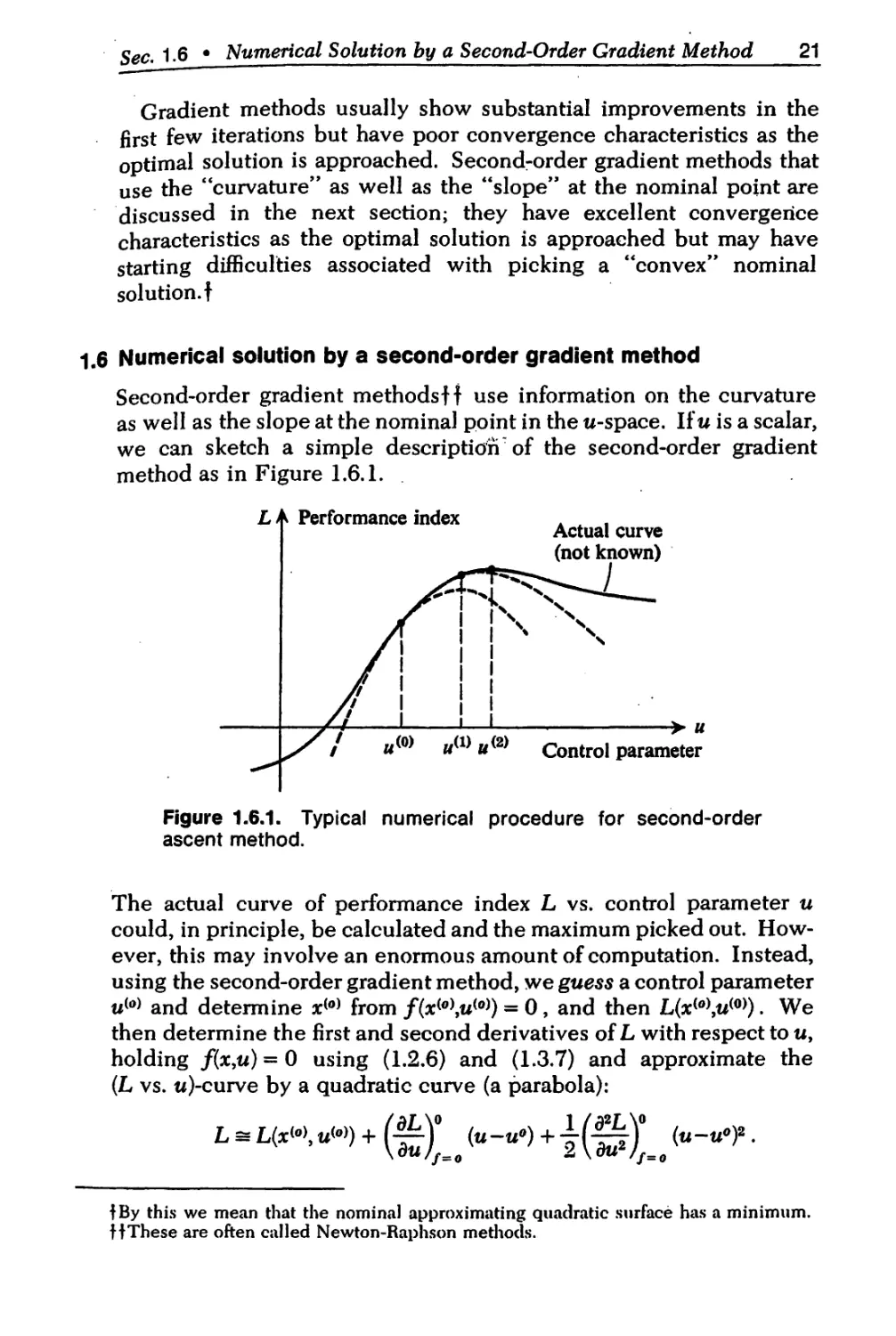
as well as the slope at the nominal point in the u-space. Ifu is a scalar,
we can sketch a simple descriptidfifof the second-order gradient
method as in Figure 1.6.1. _ .
L Performance index
Actual curve
(not kjiown) '
Q"
l l"\ $\\
_ | I i s \\
1 1 |
/ I l I . »
, I
u
1' uw) Um 14(2) Control parameter
Figure 1.6.1. Typical numerical procedure for second-order
ascent method.
The actual curve of performance index L vs. control parameter u
could, in principle, be calculated and the maximum picked out. How-
ever, this may involve an enormous amount of computation. Instead,
using the second-order gradient method, we guess a control parameter
u"’l and determine x‘°) from f(x‘°’,u‘°’) = 0 , and then L(x‘°),u‘°)). We
then determine the first and second derivatives of L with respect to u,
holding f(x,u) = 0 using (1.2.6) and (1.3.7) and approximate the
(L vs. u)-curve by a quadratic curve (a parabola):
__ BL ° 1 62L °
L = L(x‘°), u‘°l) + (E-)f=o (u -u°) + -§(T3-u;)f=o (u-u°)2 .
iBy this we mean that the nominal approximating quadratic surface has a minimum.
HThese are often called Newton-Raphson methods.

22 Parameter Optimization Problems ° Ch. 1
The value of u that yields the maximum of this approximate curve is
then easily determined; call it ul” . This value is taken as an improved
guess and the process is repeated. In Figure 1.6.1 it is apparent that
two steps in the iterative procedure already yield a good approxima-
tion to the maximizing value of u. In more complicated problems,
more steps may be required. Also, if the initial guess ul” is' too far
away from the maximizing value, we may find that (62L/3u2)}'=o > 0;
i.e., the curvature has the wrong sign. In this case, the method fails
completely; note, however, that the first-order gradient method may
still converge. -
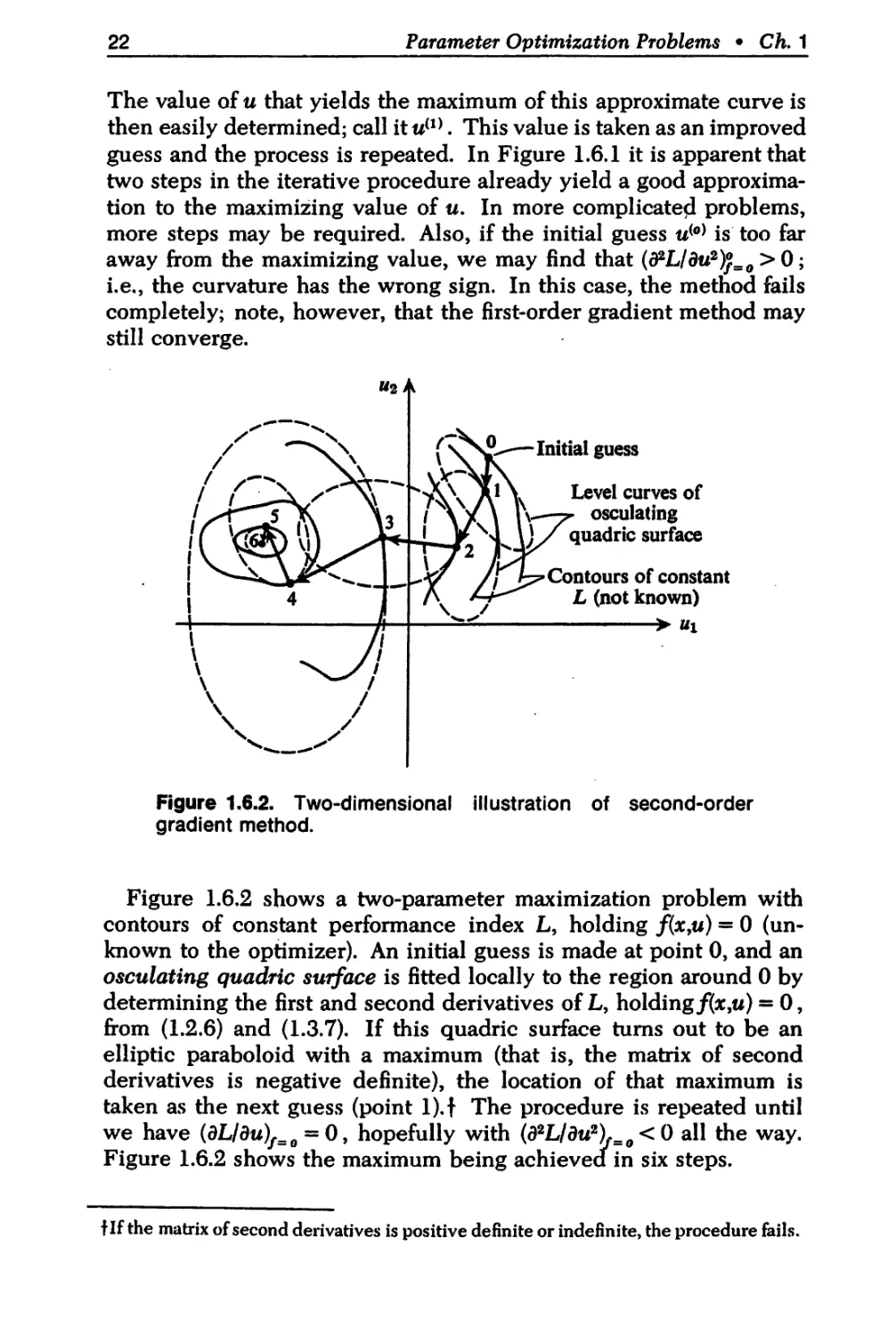
. "2
/// \\\ { °/-- Initial guess
_-` \ _` mf-
// 1/ ' \ /’ dl\ 7\\ \ Level curves of
I ~ - 3 1 \ osculating
f QB | 2\ } quadric surface
I
_ I r \`_ l Contours of constant _
| 4 \`/ L (not known)
\ 1 "1
\ I l
\ I _
\\ //
\ / .
\\ /f
Figure 1.6.2. Two-dimensional illustration of second-order
gradient method.
Figure 1.6.2 shows a two-parameter maximization problem with
contours of constant performance index L, holding f(x,u) = 0 (un-
known to the optimizer). An initial guess is made at point 0, and an
osculating quadric surface is fitted locally to the region around 0 by
determining the first and second derivatives of L, holding _flx,u) = O ,
from (1.2.6) and (1.3.7). If this quadric surface turns out to be an
elliptic paraboloid with a maximum (that is, the matrix of second
derivatives is negative definite), the location of that maximum is
taken as the next guess (point 1).f The procedure is repeated until
we have (GL/6u)f= 0 = 0 , hopefully with (62L/6142) = 0 < 0 all the way.
Figure 1.6.2 shows the maximum being achievedf in six steps.
flf the matrix of second derivatives is positive definite or indelinite, the procedure fails.

Q-, ec £6 . Numerical Solution by a Second-Order Gradient Method 23
f y ,I The constraint relations f(x,u) = O are often so complicated that
if numerical methods are needed just to determine x, given u. In this
Case 3 Slightly more general version of the second-order gradient
method may be used. Recall that necessary conditions for a stationary
*i value of L(x,u) are
HI = 0 , (1.62)
» ' Hu = 0 ,
f = 0 , where H (x,u,)\) = L(x,u) + }\'f(x,u). (1.6.4)
_ The steps in the generalized second-order gradient method are:
(a) Guess a set of values for x, u, and A; call them x°, u°, and M.
(b) Detetmline the values of "
H a,(x",u°,N’) = Hg , (1.6.5)
Hu(x°,u°,}\°) = Hg , (1.6.6)
_ f<x°.u°> =f°. <1.6.v>
(c) Linearize the relations (1.6.2i), (1.6.3), and (1.6.4) about x°,~u°,
and M:
H_‘{.+H§_xdx+H§.u du + (f§',)° dk = 0, (1.6.8)
Hg + H33 dx + Hg” du -|¢ (f§)° dx = 0 ,' (1.6.9)
f° +fgdx +fg du = 0. (1.6.10)
(d)` Solve Equations (1.6.8), (1.6.9), and (1.6. 10) for dx, du, and dh in
_» terms of H; , HQ , andf°i ,
(e) Repeat (a) through (d), using, as improved guesses,
__ x'=x°+dx, u‘=u°+du, }J=)\°+d>».
The process is repeated until the necessary conditions (1.6.2), (1.6.3),
and (1.6.4) are satisfied to the desired degree of accuracy.
If the method converges at all, it may converge on a minimum, a
maximum, or a saddle point. To determine which of these it is, we
must examine the curvature matrix given in Equation (1.3.7). If the
matrix is positive definite, the point is a minimum; if the matrix is
negative definite, the point is a maximum; if the matrix is not singular
but is neither positive definite nor negative definite, the point _is a
saddle point; if the matrix is singular, we do not know the nature of the
point without going to higher derivatives.
ilf values of Hg, H3 , f° are such that dx, du, dA obtained from step (d) are very large
then eH§ , eH§ , ef” may be used instead, where 0 < e < 1.

24 Parameter Optimization Problems ° Ch. 1
Problem. Another variant of the second-order gradient method would be
to guess only x and u, determining A from H _,B = 0. Work out the pro-
cedure for this variant. _
1.7 Problems with inequality constraints ‘ `
Parameter optimization problems involving inequality constraints
require extension of the methods treated in the previous sections. _ An
important class of problems of this type involves minimizing
_ _ L(y) (I.7.1)
subject to
f(y) E 0 , (1.72)
where, in general, f and y are vectors of dilferent dimensionj
` Consider Hrst the case in which y and f are scalars. There are two
possibilities for the optimal value of y, y° : f(y°) < 0 or f(y°) = 0. In
the former case, the constraint is not effective and can be ignored.
The situation remains the same as in Section 1.1. In the latter case,
consider small perturbations about y°; if L(y°) is a minimum, then we
have
l dz. =-35| dy? o (1.7L3)
21°
for all admissible values of dy, which must satisfy
8 _
clf=-`£dyE0. (I.7.4)
all
In order that Equations (1.7.3) and (1.7.4) be consistent, it is clearly
necessary that either
. BL af 6L
sgn-=-sgn- or -=0.
39 39 39
These two possibilities may be expressed in one relation as
BL 6
-+A-f=0, AZO. (1.7.5)
all 39
{Such problems, referred to as nonlinear programming problems, have been treated
extensively in the_ technical literature. We give onl_y brief treatment in this section.
We will not distinguish _between state and control variables as was done in Section 1.2.
Indeed, in many nonlinear programming problems, the dimension off is greater than
t|1e_clli;1-tension of y, so that it is not possible to decompose y into state and decision
Varla GS.

Sec. 1.7 ° Problems with Inequality Constraints 25
The two situations are shown geometrically in Figures 1.7.1(a) and (b).
L l L -
\ K->f(y)<0 l">f(y)<0
\
\`r l Lfy)
I
_ l\J_(y) ,,,|
I I "' I
y0 ' y y0 y
(a) (b)
Figure 1.7.1. One-dimensional illllstration of two possible types
of minimum with inequality constraints.
The _two cases may be treated analytically by adjoining (1.7.2) to
(1.7.1): -
H (yJ\) = I-(y) + >~f(y)- (1-7-6)
The necessary conditions become
5-Ii = 0 7 - (1.7.7)
ay
and
, f(y) 5 0 , (1.7.8)
where
5' 0 f(y> = 0.
A ’ 1.7.9
l= 0. fly) < 0- ( )
When y is a vector but _f is still a scalar, Equations (1.7.3), (1.7.4),
and (1.7.5) remain applicable if we interpret the symbols in vector
notation. We should interpret conclusion (1.7.5) to mean
BL af . . . _ . . .
-5; parallel to -5; and pointing in opposite directions. (1.7.10)
The necessity of (1.7.10) is easily established by contradiction.
Let us suppose that (1.7.10) is not true as illustrated in two dimensions
in Figure 1.7.2. Then the cross-hatched region represents a region _of
admissible y which will yield smaller L.
This and the other situation (namely, when f(y°) < 0) again can be

26 Parameter Optimization Problems ° Ch. 1
.72 Q!
ay =0
I .‘v'O;§;§ I
_Q;L_ L=const
By
' }’1
Figure 1.7.2. Two-dimensional illustration showing the neces-
sity of Equation (1.7.10).
summarized by the necessary conditions stated by (1.7.7), (1.7.8),
and (1.7.9). '
In the more general case, when f itself is. a vector, we can still
employ (1.7.4) and (1.7.5),_ noting that (if/6g is now a matrix. If only
one component of f is effective, the problem is the same as that just
treated. If two components off are effective, the situation, in two
dimensions, is as shown in Figure 1.7.3.
.Va af’ gil _
-5- J'
y f2='0
__,,.» L=constant
' """"-M’ f1='0
f QL
01'
Yi
Figure 1.7.3. Two-dimensional illustration of minimization
subject to two inequality constraints.
It is clear that, if y° is to be an optimal point on f; = = 0, then
BL/6y must lie between the negative gradients of ji and j;.} Analyti-
cally, this means that 6L/6y can be expressed as a negative linear com-
bination of Eij;/By and tif;/By. In general, when q components are
effective at a boundary optimal point, we must have
6L 3 6
-+A,-5'-+---+>1q-f1=o (1.7.11)
by 6y 6y
iliecall the parallelogram construction of a resultant from two components.

Seo. 1.7 ° Problems with Inequality Constraints 27
or p
' aL- a
--+ )\Tl= 0, (1.7.12)
By By
where _
“ 20 Hw=0
>.{ ’ » 1.7.13 1
= 0. f<y) < 0. ( )
Hence, as in Section 1.2, we may define a quantity H E L + Aff and
write (1.7.12) as BH/6y = 0. Equations (1.7.12) and (1.7.13) are nec-
cessary conditions for minimality. For a maximum, the sign of A
must be changed in (1.7.13). In words, the gradient of L with respect
to y at a minimum must be pointedgin such a way that decrease of L
can only come by violating the constraints.
Let us suppose that y hasp components and that n components of
the inequality constraint are "effective," that is, _
_f;(y)=0, i=1,. . _ ,n. (1.7.14)-
The “ineffective” constraints, j}(y) < 0, i= n + 1,. . . , may be dis-
regarded. It is clear that p 2 n . Next, take n of the components of y
_ and call them x; let the remaining p - n components be called u; that
is,
y"= (xv. - -.x,,';u,,- ~ .,u,,_,,)é(x".`iF)-
The choice must be such that
` j;(x,u) = 0 , i= 1,. . . ,n (1.7.15)
detemiines x when u is given. Then suficient conditions for a local
minimum of L(y) , with f(y)E 0 , are given in Section 1.3, to which
we must add the condition that A, , . . . , An all be positive.1 The latter
condition is easily interpreted from Equation (1.4.8) since -A, is
equal to (BL/6j;)u , which must be negative' (that is, dL > 0 for dj; < 0).
Example. Consider L(yl,y2) with j;(y,,y2)S0, i= 1,2, and suppose the
level curves are as shown in Figure 1.7.4.
It is clear that < 0 is “ineffective” and L = 0. From Figure 1.7.4,
we have -
6L 6 '
"-+A,-';=0, }\l>0;
Hy By
tEquation (1.7.1-3) is understood, of course, to be in the component-by-component
SETI C.
IF; a precise statement, see G. McCormick, "Second Order Suflicient Conditions for
Constrained Minimum,” SIAM journal on Appl. Math., Vol. 15, No. 3, May 1967.

28 Parameter Optimization Problems ° Ch. 1
y2 fl=0
` f2=0 _
Q ‘ Adrnissible ,
h>0 region
, _ ,I
fa '
_ 6y
L=constant
Figure 1.7.4. Example of minimization subject to inequality
constraints.
that is, grad L is parallel and in the opposite direction to grad fl .
Also, the “curvature” of L along L = 0 is such that L increases on
fl = O away from the minimum; to show this analytically, we may let
yi = x and yz = u . Then we have
jQ(x,u) = O ¢ x , given u,
and, from (1.3.7),'we can compute (EFL/6u2)_f1= 0 which, as we can see
from Figure 1.7.4, is positive.
Equations (1.7.12) and (1.7.13) are the essence of the Kuhn-Tucker
Theorem in nonlinear programming. The precise statement of the
condition requires the assumption of the so-called “constraint quali-
Hcation” on the set _f(y) E 0 (Kuhn-Tucker, p. 483). This qualification
is designed to rule out geometric situations as shown in Figure 1.7.5.
At the minimum point we see that (y,,y2) = (1,0) and (8L/oy) is not
equal to any finite linear combination (aj,/ay) , (tif,/By).
_ 2 L=' "J'1
r Admissible region ~
, ~ (aft/0?)
f2= "J'2=‘0 '
'f / I '~-'H yl
(01-/ay) ¢
(61%/fir)
f1=‘}’2"(l"J'1)3="0 /
Figure 1.7.5. Example of Kuhn-Tucker constraints qualification.

Sec. 1.8 ° Linear Programming Problems 29
Another approach to sufliciency is the saddle-point theorem of
nonlinear programming. It is more elegant (but usually harder to
apply) than the conditions given above since it does _not require the
arbitrary separation of y into x and u. Consider the function H (y,}\) =
` L + Aff. Suppose that it is possible to find y° and N’ such that they
constitute a saddle point for H; that is,
H (y°,)t) E H (y°,A°) E H (y,}\°) (1.7.16)
for all A 2 0 and f(y) S 0 . Then we may conclude that y° is a minimum
point for L(y) subject to f(y)E 0 , regardless of the nature of L and _ff
Problem 1. Prove the saddle-point theorem. [HINT: The left-hand
inequality in (1.7.16) implies that )\§?j?§(y°) = 0 for all i.]
Problem 2. Aircraft cruise condition for minimum fuel consumption.
For the airplane described in Example 2, Section 1.2, and in Prob-
lem 7, Section 1.3, find the steady level-flight ('y = O) condition for
minimum fuel consumption per unit distance. Assume constant
specific fuel consumption, 0 = .29 >< 10'3 lb sec" per lb of thrust, so
that fuel consumption per unit distance is given by
T _
I = if 2 _
where
` Tm3X(V»h)
and T,,,ax(V,h) is as given graphically in Problem 7, Section 1.3.
The constraint equations are
L-mg+Tsin(a+e)=0, D-Tcos(a+e)=O,
where L= L(V,h,a) , D = D(V,h,a) are as given in Problem 7, Sec-
tion 1.3.
Problem 3. Write out a mathematical proof of the geometrical argument
of Figure 1.7.2. In particular, show why AZ 0 _
1.8 Linear programming problems 1
If both the performance index and the inequality constraints are
linear functions of y, the problem is called a linear programming
problem. Clearly, in this case, the minimum, if it exists, must occur on
the boundary since the curvature of L is zero everywhere. Let the
problem be to choose y to minimize P

30 Parameter Optimization Problems ° Ch. ‘I
_ L = b"y , (1.8.1)
subject to '
A"y+ 050, (1.8.2)
where y is an n-vector and o is an m-vector, m > n _ If Alis of rank n
and bl' is not collinear with any of the rows of AT or any negative linear
combinations of n + 1 rows of AT, the minimum, if it exists, must occur
at a point determined by the simultaneous satisfaction of n of the
constraints A"y + o = 0 . This result is not surprising to anyone with
geometric intuition; it is the fundamental theorem of linear program-
ming. °
Example 1. Minimize L = -5y, - y, subject to
ff,=3y,+y2-1250, j;=y,-2y?-250,
Figure 1.8.1 shows the admissible region, with contours of constant L.
.Va
LT° \/L='°19i°
\ fs= ° l
\\ " l Minimum
\ .Hao 'r,
Ad - -bl \`\ f4=0 ln gfadfzi
mnssn e ~ - _grad L
region \ fs=0 A _
1 j§=0 _
.I f ,A\ _,I
\
\ \ Brad fs
Figure 1.8.1; Solution of the linear programming problem of
Example 1.
Obviously, the minimum occurs at pointA, where we have 3y, + yn, -
12= Oandyl -2y2 - 2 = 0=`;~y, = 34-5r,y2 =9r$>L,,,,,, = -19%,and
grad L can be expressed as a negative linear combination of n (but not
n - 1) rows of A"' (namely, grad ff, and grad jg), as is obvious from Fig-
ure 1.8.1. _ '
The implication of the fundamental theorem of linear programming
for the numerical solution of linear programming problems is clear.
Take n constraints at a time and treat them as equalities. Solving the
equalities yields one solution (assuming admissibility), which is

Sec. 1.8 ° Linear Programming Problems 31
either optimal or nonoptimal. In the latter case, we can discard one
~ of the Constraints and, substituting another, repeat the process with
the requirement that the new solution- be admissible and better.
Since there are only a finite number of such possibilities, this process
must eventually arrive at the optimal combination (if it exists). The
method that accomplishes this is known as the simplex method. We
shall say more about this in the next section.
Problem. Show that the necessary conditions for a maximum of
_ L = c"A ,
subject to
_ Ax+b=0,sm:0, _
are simply (1.8.2) of the minimization problem discussed in this sec-
tion. These two problems are called cluals of each other.
Example 2. A blending problem. There are many blending problems
that involve finding the cheapest mixture of several materials that
contains at least a certain fraction of specified ingredients. A typical
problem is to find the cheapest mixture of several feeds that contains
' at least certain specified amounts of nutrients (proteins, fats, vitamins,
etc.).f Suppose that we are considering a mixture of _three feeds and
we have three inequality specifications on nutrients. Table 1.8.1,
below, shows the fraction of each of the three nutrients contained in
each of the three feeds and the cost per unit amount of each of the
three feeds.
` _ Table 1.8.1
_ Fraction of nutrient
~ in each feed
Feed 1 2 3 cost 0
1 .06 .02 .09 15
_ 2 .03 .04 .05 12
3 .04 .OI .03 8
Our problem is to find the cheapest mixture of the three feeds such
that the fraction of nutrients one, two, three in the mixture is greater
than or equal to .04, .02, and .07, respectively. '
Let FJ = the fraction of feed j in the mixture, where j = 1,2, or 3;
these are the quantities we are trying to find (our design parameters).
fOther blending problems occur in mixing fuel oils and fertilizers.

32 Parameter Optimization Problems ° Ch. 1
Let N, = fraction of nutrienti in the mixture, where i = 1,2, or 3; then
we have
Nf="'uF1+"szFz+"iaFa» u
where nij = fraction of nutrient i in feed j (the data given in Table
1.8.1). For this problem we have N12 .04, N2 2 .02, N3 Z .O7.
Let C = cost per unit amount of the mixture and cj = cost per unit
amount of feed j (also given in Table 1.8.1). Then we have
C = o,F, +o2F, + c3F,,.
Of course, the fractions of the three feeds in the mixture must add up
to one:
F I + F 2 + F3 = 1 .
The problem, then, is to find the two quantities F1 and F2 (using F3 =
1 - F I - F2) to minimize C and satisfy the' inequalitiesj _
Niili, i=1,2,3, OEFJEI, j=1,2 ,
where N, is the minimum allowable fraction of nutrient i in the mix-
ture.
We draw a graph, using Fl and F2 as coordinates (see Figure 1.8.§2).
The inequalities are shown as lines with arrows perpendicular to
them pointing in the “allowable” directions. In this problem, the
inequalities are
(a) N, = .06F, + .03F2 + .04(1-F1-F2)2 .04 or' 2Fl - F2 20;
(b) N2 = .02Fl + .04F2 + .01(1-Fl-F2)? .02 or F1 + 3F2 2 1;
(c) N3 = .09F1 + .05F2 + .03(1-F,-F2)Z .07 or 3F, + F2 2 2;
(d) F3=1-F,-F220 or Fl+F2E1;
(6) (lf Fl E 1 ;
(f) 05 F, E 1 . ' 0
Note that the inequality F3 = 1 - F, - F2 _‘E 1 or F, + F2 Z O is redun-
dant since we have F , Z 0 and F2 Z 0_. Which of the other inequalities
are redundant? (See the graph, Figure 1.8.2.) The feasible region
is the region in the graph where all of the inequalities are satisfied;
it is clearly marked in Figure 1.8.2 and is surrounded by extra-heavy
lines.
The lines of constant cost are given by setting C = different con-
stants in
C = 15F1+ 1:2172 + 8(1-F,-F2) or C = 8 +`7F, + 4F2 ._
fgeveralbof thesg ténrn out to be redundant; i.e., other inequalities automatically cause
tem to esatis e _

Sec. 1.8 ° Linear Programming Problems 33
F2
_ 0_5 ` C=]2%
\
Q C=15
~ I-'feasible
N region
0 ` F1
o 0.5 1
Figure 1.8.2. Solution of the linear programming problem of
Example 2.
From Figure 1.8.2 it is clear that the _cheapest feefible solution is one
that occurs at the corner where N2 = N2 and N3 = N., _ F rom_above, this
requires that
F,+3F_,=l, 3Fl+F2=2. _
These are two linear equations in two unknowns (F 1' and F2); they are
easily solved to yield
~ F I = and F2 = if .
The amount of feed number three is obtained by substituting the
results above into F3 = 1 - F, - F2 . This yields
F 3 = rl-.
The minimum cost is given by
C = 15(%) + 12(%) + 8(%) = 12% per unit amount of mixture.
The amount of nutrient one is above the minimum required fraction:
N, = .06(%) + .03(%) + .O4(~}) = .05125 > .04.
Notice, also, that the most expensive feasible solution is to use feed
number one all by itself.
Example 3. A transportation planning problem. A grain dealer owns
50,000 bushels of wheat in Grand Forks, North Dakota, and 40,000
bushels in Chicago. He has sold 20,000 bushels to -a customer in
Denver, 36,000 bushels to a customer in Miami, and the remaining

34 g Parameter Optimization Problems ° Ch. 1
34,000 bushels to a customer in New York. He wishes to determine
the minimum-cost shipping schedule, given the following 'freight
rates in cents per bushel: _
Table 1.8.2 . v
= @
D El
1
Different modes of shipment cause the rates not to be proportional
to the distance between the cities. For convenience, we can combine
our data into a table, leaving space for the answer, as follows:
' _ Table 1.8.3
Destination
Denver New York
Chicago 40,000
H I-
The figure in the upper right-hand corner of each squareis the freight
rate between the two cities.
Our problem is to find a nonnegative amount in each of the six
squares so that (a) the amounts in the first row add up to 50,000 and the
amounts in the second row add up to 40,000; (b) the amounts in the
first, second, and third columns add up to 20,000, 36,000, and 34,000,
respectively; (c) the total freight cost is a minimum; this cost is ob-
tained by multiplying the amount in each square by the rate in the
upper right-hand comer and adding these numbers together.
This problem is a little bit like a crossword puzzle, only harder,
since it is not sutlicient just to get the rows and columns to add up
properly (a feasible solution); we must, in addition, minimize the total
cost. By “cut and try” we might be able to find the solution. How-
ever, a systematic approach is apt to take less time, and, for problems
with more shipping points and more destinations, a systematic ap-
proach (an algorithm) and a computer are essential.

Sec. 1.8 ° Linear Programming Problems 35
Suppo-se we designate the amount from Grand Forks to Denver as
“x” in thousands of bushels. _Then, clearly, the amount from Chicago
to Denver must be 20 - x (see Table 1.8.4). Similarly, let us designate
the amount shipped from Grand Forks to Miami as “y”; then the
amount from Chicago to Miami must be 36 - y . Now the amount
from Grand Forks to New York must be 50 - x - y , and the amount
from Chicago to New York must be 40 - (20-x) - (36-y) =
x + y - 16. (We automatically satisfy the requirement that the total
shipped to New York be 34,000 since the total amount sold equals the
amount owned.)
W Table 1.8.4 W
I1 T
We have reduced the number of unknowns to two, x and y, which
must satisfy six inequalities: _
l xZ0, y20, 50-x-yZ0, 20-x?:0,
36-y20, x+y-16.20.
We can conveniently plot all these inequalities on an (x versus y)-
graph as in Figure 1.8.3. Again, as in the previous section, there is a
feasible region where all the inequalities are satisfied. .
Next, we calculate the cost in terms of x and ya
C = 1000/ 100 X [42x + 55y + 60(50-x-y) + 36(20-x) + 47(36-y)
+ 51(x+y-16)] ,
or ' I
C = 45,960 - sox - 10y° (in dollars).
Lines of constant cost are shown in Figure 1.8.3 as dashed lines;
clearly, the feasible solution with minimum cost is at x = 20 , y_= 30
in Figure 1.8.3. This minimum cost solution is shown in Table 1.8.5.
Note that no wheat should be shipped from Chicago to Denver,
even though such shipment would involve the lowest rate per bushel.

36 Parameter Optimization Problems ° Ch. 1
J'
. ` .
\ _
\
4° 1
\\ ' .-
\\` I
\` x>0 E
a xi Feasible region' \\‘/ C.-=45’060
, x+y-1s>o x<20 \`
_ \ \
" >o "
‘\rfC=45,800 J' ‘.
_ x
0 ‘\ 10 20
Figure 1.8.3. Solution to minimum cost shipping problem.
0 Table 1.8.5
E E
' 50
|-
The difference between the best and the worst feasible solutions
is only $740 out of about $45,000. However, this 1.6% difference
could be a substantial per cent of the profit involved in the sales.
1.9 Numerical solution of problems with inequality constraints
Numerical solution of optimization problems with inequality con-
straints is one of the major concerns of the Held of “mathematical
programming.” Numerous texts exist on the subject (e.g., Zoutendijk),
and we shall describe only the main features of the “method of
feasible directions” or “gradient projection method.” This method
is divided into two separate but related steps:
STEP 1. Finding a feasible solution. With reference to Section 1.7,
locating a value of y such that f(y)E 0 is often not a trivial task. In
problems with equality constraints, such as those treated in Sections
1.5 and 1.6, finding a feasible solution is usually straightforward since
there are more variables (x and u) than there are constraint equations

Sec. 1.9 ° Numerical Solution of Problems 37
(f(x,u) = O). In problems with inequality constraints, there are often
more constraint equations (components of f) than variables (com-
ponents of y). Finding a feasible solution may be approached by
guessing a value for y, then considering a small perturbation, dy,
which will change f according to
_ af
d = -d . (1.9.1)
f ay y
If certain components of f(y) are greater than zero, i.e., not feasible,
we require a dy such that the corresponding components of df are
less than zero. In other words, f(y + dy) should be an improvement
toward a feasible solution, that is,
~ F dy E-0, (1.92)
where F contains only rows of Bf/By corresponding to infeasible
values of The 'problem is thus reduced to Ending feasible solutions
- to successive linear inequalities (instead of nonlinear inequalities).
STEP 2. Finding a feasible improvement. If a feasible y can be
found, the next step is to find a dy which is not only feasible but
which also improves the performance index; that is, we must have
f(y + dy)E O and L(y + dy) < L(y). This gives rise to another set of
linear inequalities like (1.9.2) above:
i S
ay
_ ._._ dyEHdyE0. (1.93)
if
t ' ay
Example. Quadratic performance index with linear inequality con-
straints. Minimize
_ 2 2
4 _
subject to
3y|+2y2-650, -y,>0, y2>0.
A sketch of the admissible region with contours of constant L is shown
in Figure 1.9.1. If we guess yi = y, ==_°§° to start with, we find that
t aff. , _.Pi 211. = _,
éy, 4 ’ By,
Since we are minimizing, the greatest improvement will be in the
direction of the negative gradient that is shown at A(y, = y, = 5). We

38 Parameter Optimization Problems ° Ch. 1
P2
3 /3y1+2y2-6=0
Admissible region `
2 » _fContours of constant 'L
¢"'-__ I __""\
’ "in,-:.._"`\ \\\
/‘_ "`\ `\ i ~
1 ` |I,=,q/ /) 1|
I **" /Z
0 "M, yi
0 1 2 3 4
Figure 1.9.1. Solution of the quadratic programming problem
of preceding example.
proceed in that direction until we reach a minimum (which may be on
a boundary). In this case we reach a minimum at point B in the in-
terior of the admissible region. Following the direction of the nega-
tive gradient at B, we reach point C on the constraint 3y, + Zy, -
6 = 0. Here the negative gradient points out of the admissible
region, so we take the component of the negative gradient along the
constraint boundary, which is up in this case. Moving along the
constraint, we Hnally arrive at the minimum at D, where the negative
gradient points out of the admissible region and is perpendicular to
the boundary. ~
As discussed in Section 1.8, linear programming problems have
gained a great importance in recent years. Thus, it seems worthwhile
to discuss briefly the special procedures applicable to them. Consider
again the problem of minimizing
` L = bfy (1.9.4)
subject to
A"y-I-cE0,l ` (1.9.5)
where y is an n-vector, AT is an (rn X n)-matrix, m > n . We know that
the minimum must occur at a point intersection of n hyperplanesf
whose normals are in the direction of rows of AT . We start the solu-
tion, then, by selecting n equations out of (1.9.5) and solving them
{There are abnormal situations in which the minimum lies on an “edge” rather than
at a "point"; see conditions specified in Section 1.8 for a “point” solution.

Sec. ‘i.10 ° The Penalty Function Method ' 39
(set equal to zero). If this point is feasible, we then examine the n
. “edges” leading away from this point (formed by the intersection of
the n sets of n-1 hyperplanes we have chosen); these_“edges” will
have directions, away from the point, of e’, e2,. . ., e" , where ef is a
unit n-vector along the ith edge. The gradient of L is simply b" , so
we consider the projection of the edge directions on bf; that is, we
consider the scalar products b"ei ,i = 1, _ . . , n. If all the scalar prod-
ucts are positive, it is not possible to move along any edge to obtain
an improvement (i.e., a smaller value of L); we have the optimal
solution. On the other hand, if some of the scalar products are nega-
tive, let us choose the one with the largest magnitude and move along
the corresponding edge until we encounter another constraint. This
new constraint and the n - 1 old constraints that form the “edge”
determine a new point at which the'”value of L is necessarily smaller
since we moved along a projected gradient href < 0. The process is
then repeated over and over until a point is found at which we have
all b"e‘ > 0; that is, no improvement is possible. This is the basis of
the simplex algorithm proposed by Dantzig (1963), which uses,
essentially, a method of feasible directions.
Problem. Perform one step of the above-described process for Example 2
of Section 1.8. Why are we allowed to move as far as the next con-
straint boundary during each step of the simplex method?
1.10 Tlie penalty function method
Another method for the handling of equality constraints as well as
inequality constraints is the so-called penalty function method. The
idea is quite simple. Suppose we wish to minimize L(y) subject to
f<y) = 0. (1.10.1)
Instead of solving the desired problem directly, we consider the mini-
mization of
` 'E = L(y) + KI|f(y)l|” (1.10-2)
subject to no constraints, where K is very large.i If L attains a mini-
mum at y°, it is reasonable to expect that _
f(y‘*> -- 0 " (1.10.3)
and -
L(y°) == L(y°) , (1-10-4)
i()ther functions of f(y) that are zero when f(y) = 0 and positive when _f(y) ¢ 0 are, of
course, possible. '

40 Parameter Optimization Problems ° Ch. 1
where y° is the value of y that minimizes L subject to f(y) = 0. In
fact, it is possible to show that, in some cases,
_ Lim y* -> y° , Lim L(y°)-> L(y°). ‘ (1.1O.5)
Computationally, the penalty function method is appealing and has
been used both in parameter optimization problems and in function
optimization problems (see Chapters 2, 3, and 4).
Nevertheless, it is important to note that, in practice, the penalty
function method occasionally does not come very close to the proper
limit indicated in (1.1O.5). One reason for this is as follows: The
augmented performance index (1.10.2), with large K, has a long nar-
row “valley” containing the point y* at the “bottom” (see Figure
1.10.1). Gradient procedures for Ending this point tend to go back and
forth, from one side of the narrow valley to the other side, instead of
down the “long” direction of the valley. Even worse, if K is very
large, the “width” of the valley becomes comparable to the numerical
accuracy of the computation, and the gradient procedure breaks down
completely. _
Another potential source of difiiculty is the creation of artificial
minima that are not present in the original problem. _
Example. 'Find y, and y, to minimize E
L = (yi _ 2)2 + yi
subject to y, = 0. Now, this is a trivial problem with the obvious
answer yi = yz = 0. However, if we use the penalty function ap-
proach, we minimize `
- 2 2 1 4K
2 ic -->/--ei -~
(yi )+y2-l-Ky] y2+ yl
Contours of constant Z are ellipses with centers at y, = (2/1 + K),
y, = 0 and semi-afes in a ratio of \/ 1 + K. Figure 1.10.1 shows con-
tours of constant L for K = 35. Note the long “valley” created by the
penalty function.
Inequality constraints can also be handled by the penalty function
method. Suppose that, instead of (1.10.1), we have
f(y) 5 0 . (1.10.6)
Then we may consider minimizing
Z = L(y) + K[f(y>]2 1[f(y)l , (1-10-7)

lggg. 1.10 ° The Penalty Function Method 41
y2 '
_ 3 _ i
2
` Contours gf
f constantL
1 I Mininlum
of L
Ml
J'
-1 ill' 1 _ I
1 _| I
_ _ X2 K-= 35,
L=(J'1'°2)’+J’22+K}’12
-3
Figure 1.10.1 Cost contours created by penalty functions in the
preceding example.
where 1(f) is the unit step function defined as
l ° 1, f > 0 ,
1(f> _ lo; f< 0_ (1.10.8)
The use of penalty functions is often quite helpful during the initial
stages of numerical computation on problems with complex con-
straints.

Optimization problems
for dynamic systems
2.1 Single-stage systems
As an introduction to multistage systems, let us consider the simplest
nontrivial multistage system, namely, the single-stage system.
A system is initially in a known state described by x(0), an n-
dimensional state vector. 'Choice of an m-dimensional control vector
14(0) determines a transition to a state described by x(1) through the
relation
1(1) =f°[x(0), u(0)] , (2-1_-1)
which is shown schematically in Figure 2.1.1.
u(0) ` -
D x(0) x(l)
Figure 2.1.1. Flow chart for a single-stage system.
We wish to choose u(0) to minimize a performance index of the form
J = d>[x(1)] + L°[x(0) ,u(0)] - (211-2)
This is a parameter optimization problem with equality constraints,
exactly like the ones considered in Section 1.2. We shall treat it in the
same way, differing only slightly in our choice of an H-function; we
adjoin the constraints (2.1.1) to (2.1.2) with undetermined multipliers
Ml):
f = <i>[x(1)] + L°[x(0) , u(0)] + 1\"(1){f°[x(0) ,u(0)] - x(1)} - (2-1-3)
42 '

Sec. 2.2 ° Multistage Systems 43
Now, let
H” = L°[x(O) , u(0)] + )\"(1)f°[x(0) , u(0)] , (2.1.4)
I so that (2.1.3) may be written as
f = fb[x(1)] + H°[x(0) . 14(0) , I\(1)] - 1\"(1)x(1)- (2-1.5)
Next, consider infinitesimal changes in fdue to infinitesimal changes
in u(O) , x(1) , and x(0) :
- 641 6H° GH”
d = [__ - T 1 ] -_ -_ _ . _
] axu) A( ) dx(1)+ Bum) du(0) + axw) dx(0) (2 1 6)
An expedient choice of Ml) is apparent from (2.1.6); to avoid deter-
mining dx(1) in terms of du'(0) by diiterentiating (2.1.1), we choose
T = _-__ 2.1.7
A (1) ax ( 1) _ ( )
As a result of this choice, (2.1.6) becomes
-___ 6H° 6H°
cl] - --‘3u(0) du(0) + --axm) dx(0) _ (2.1.8)
Thus BH”/6u(0) is the gradient of] with respect to u(0) , holding x(0)
constant and satisfying (2.1.1), and 6H°/6x(O) is the gradient of] with
respect to x(O) , holding u(O) constant and satisfying (2.1.1). If x(0)
is given, we have dx(O) = 0. _
Clearly, a stationary value of] and, hence, ], for given values of
x(0) , will be obtained if '
6H° __ 9
auw) - 0. (...1.9)
'Note that (2.1.1), (2.1.7), and (2.1.9) constitute n + n + m equations for
determining the n + n + m quantities x(1) , 1(1) , and u(0).
2.2 Multistage systems; no terminal constraints,
fixed number of stages
Optimal programming problems for multistage systems are also
parameter optimization problems. Consider the multistage system
described by the nonlinear difference equations:
x(i + 1) =f‘[x(i) ,u(i)l; 16(0) given , i= 0,. . . ,N - 1, (2.2.1)
which is nothing but a sequential set of equality constraints, where
x(i) , a sequence of n-vectors, is determined by u(i) , a sequence of
m-vectors. This is shown schematically in Figure 2.2.1.

44 Optimization Problems for Dynamic Systems ° Ch. 2
u(0) u(l) u(N-l)
I l `x(l) l x(2) x(N-I) l
xr., ._... __. _. ......... .__, .rm
Figure 2.2.1. Flow chart for a multistage system.
Consider a performance index of the form
N-
1 = ¢rx<N>1 + 2' Lfrx<f> . mm. <2.2.2>
:=o
The problem is to find the sequence u(i) that minimizes (or mafi-
mizes) ]. Adjoin the system equations (2.2.1) to _I with a multiplier
sequence Mi) :
_ N- .
1 = ¢lx<N>1 + 2' [Lf[x<f> ,u<f>1 + vu + 1){f‘[x(i) ,nun - xu + lm _
f=° _ (22.3)
For convenience, define a scalar sequence Hi :
H* = L‘[x(i) , u(i)] + }\"(i + 1)f‘[x(i) , u(i)] , i=0, . . _ , N- 1 _ (22.4)
Also, change indices of summation on the last term in (2.2.3), obtain-
ing
f= ¢[x(N)] - WN) xav) + Nj' [Hf - >.f<`¢> rep] + H<». (2.25)
f=1 -
Now consider differential changes in _Tdue to differential changes in
u('i) :
rs- T 1 "c'u-M” fi ~ -W 1
I ax(N) . A (N) dx(N) + i; axw It (z) dx(z) + aaa) du(z)
y + g(’g;dx<o> + 3-‘§’g;du<o>. (22.6)
It would be tedious to determine the differential changes dx(i) pro-
duced by a given du(i) sequence, so we choose the multiplier se-
quence }\(i) so that we have _
>t"(') aHi-0 U')- aU+M"+1 afi '-0 N 1
Z 6x(i)_ é (z _6x(i) (z )6x(i)(’ 2- "°°’ _ ’
(2.2.7)
with boundary conditions _

Sec. 2.2 ° Multistage Systems 45
<94>
T = '__'i_ .n »
_ A (N) ax(N). (9 2 8)
Equation (2.2.6) then becomes '
d]`= Nj' --‘l-Iiduu) + mo) dx<o> _ (22.9)
_ ,=., 6u(i)
Thus, 6H‘/6u(i) is the gradient of] with respect to u(i) while holding
x(O) constant and satisfying (2.2.1), and }\7`(O) = 6H°/6x(0) is the gradi-
ent of] with respect to x(0) while holding u(i) constant and satisfying
(2.2.1). If x(0) is given, we have dx(0) = 0.
For an extremum, dj' must be zero for arbitrary du(i) ; this can only
happen if we have _
aHi . _J _
aaa)-O, z-0,...,N 1. (2.2.10)
In summary, to find a control vector sequence u(i) that produces a
stationary value of the performance index ], we must solve the follow-
ing difference equations:
~ x(i +~ 1) =ff[x(i) , u(i)] , _ (2.2.11)
aff T I- aLi ]T
A ' = -- ' --- , 2.2.12
(Z) l 6x(i)l MZ + 1) + |_6x(i) __ ( )
where u(i) is determined by seeking a stationary point of H i , which
requires that we have
aHf GL* aff 1
_.___ = ___ 1' ' .___ = ° = __
aaa) auw +A (z+ 1) aaa) 0, 1 0,. _ _,N 1. (22.13)
The boundary conditions for (2.2.11) and (2.2.12) are split; i.e., some
are given for i = O , and some are given for i = N
x(O) given (22.14)
Bcp T
AN = . 2.2.15
( ) (MN) (
Such problems are called two-point boundary-value problems, and
they are sometimes rather diflicult to solve, even with a high-speed
computer. Notice that the difference equations (2.2.11) and (2.2.12)
are coupled since u(i) depends on Mi) through (2.2.13), and the co-
eflicients of (2.2.12) depend, in general, on x(i) and u(i).
In order that _I be a local minimum, not only must we have
BH*/6u(i)=0, but, in addition, the second-order expression for cl]

46 Optimization Problems for Dynamic Systems ° Ch. 2
with the constraint (2.2.1) must be nonnegative for all (iniinitesimal)
values of du(i) ; that is, we must have d] ?. 0 , where (from (2.2.3))
_ _L __ _"”_ ‘f’ _ , 1 `
‘U ` 2 d"T(N) 6x(N) ax(N) MN) I
a2Hi a2Hi dxu)
1”“‘ . . 6 (')6 (') ’ 0 (70 (')
J' 21; [dxw ’ dum] x $2111 z x ;2H? ‘_ lduwll ° (22.16)
6u(i) 6x(i) ’ 6u(i) 6u(i)
The values of dx(i) are detennined by the sequence du(i) from the
differential of (2.2.1).
dx(i + 1) = dx(i) + du(i) , dx(0) = O. (2.2.17)
6x(i) 6u(i)
Methods for checking this criterion are given in Chapter 6.
Example. Quadratic performance index with linear system- equations.
Find the control vector sequence u(i) , i = 0,. . . , N - 1 that minimizes
the quadratic fonn
1 = ~1xf<N>A<N> fav) + "f 1af<i>A<f> su) + -tu"(i) Bu) uw] , <2.2.18>
i=0
where A(i) and B(i) are given positive definite matrices, with the
linear system equations
x(i + 1) = <1>(i)x(i) + l`(i)u(i) , x(0) given . (2.2.19)
SOLUTION. The H ‘ sequence for the problem is
H* = tx"(i)A<1) 21(1) + §~uT(i) Bu) ua) + mi + 1) [<1><i) xu) + l`(i) um] ,
(22.20)
where
vu) = we + 1)<I>(i) + x1'<¢)A(i) and nav) = xf<N)A<N). (22.21)
A stationary value of H ‘ with respect to u(i) will occur where we have
-551% = wa) Bu) + va + 1) l`(i) = o, (22.22)
=`7 u(i) = -[B(i)]'°1 I"’(i) )1(i + 1). (2.2.23)
Hence, we obtain U
x(i + 1) = <I>(i) x(i) - l`(i) [B(i)]”1 1""(i) Mi + 1); (2.2.24)
A(i) = <I>"(i))1(i + 1) + A(i) x(i); i = 0, . _ . ,N - 1 , (2.2.25)

Sec. 2.3 ° Continuous Systems I 47
with boundary conditions A(N) = A(N)x(N) and x(0) given. These are
_ coupled sets of linear difference equations with two-point boundary
values; the solution to this boundary-value problem yields the mini-
mizing sequence u(i) from (2.2.23).
Problem 1. Show that the two-point boundary-value problem of the
Example can be solved by placing
Mi) = S(i)x(i)
and determining S(i) from the backward recursive relations:
su) = <DT(i)M(i 4 1)<I>(i) + Aa), _ N 1 0
Mu + 1) = [S'1(i + 1) + l`(i)B'1(i)lf`fli)]°‘; ' " ' ’° ' " ’
or p li
M(i + 1) E S(i + 1) - S(i + 1)l`(i) [B(i)
+ l`T(i)S(i + 1)l`(i)]-1 l`T(i)S(i + 1) ,
where -
S (N) = A(N) . y
Having determined S(i) , i = N - 1, . . . , 0 , from the relations above,
we obtain
x(i + 1) = [I + l" (i)B"(i) 1" "`(i)S(i + 1)]_" ¢1>(i)x(i) , ":i:(0)speci1ied.
This is known as the sweep method for solving a linear two-point
boundary-value problem. (For more on this method see Sections 6.10
and 6.11.) '
Problem 2. Consider the problem of this section as a parameter opti-
_mization problem of Section. 1.2 where x denotes the vector with
component vectors x( 1), _ . . , x(N) , u the vector with component vec-
tors u(0),. . .,u(N - 1), and f the vector with component vectors
x(1) -f° , x(2) -f', . . .,x(N) -f”" . Show that the necessary condi-
tions of Section 1.2 reduces to that of Equations (2.2.11)-(2.2.15).
2.3 .Continuous systems; no terminal constraints, fixed terminal time
Optimal programming 1 roblems for continuous systems are problems
in the calculus of variations. They may be considered as limiting
cases of optimal programmingproblems for multistage systems in
which the time increment between steps becomes small compared to
times of interest. Actually, the reverse procedure is more common
today; continuous systems are approximated by multistage systems

48 Optimization Problems for Dynamic Systems ° Ch. 2
for solution on digital computers. Consider the system described by.
the following nonlinear differential equations:
at =f[x(t) ,u(t) , t] ; x(to) given, tai ti tf, ` (2.3.1)
where x(t) , an n-vector function, is determined by u(t) , an m-vector
function. Consider a performance index-(scalar) of the form
I
_] = ¢[x(tf) , tf] + ffL[x(t) , u(t) , t] dt. ' (23.2)
to
The problem is to find the functions u(t) that minimize (or maxi-
mize)]. Adjoin the system differential equations (2.3.1) to ] with
multiplier functions )\(t) :
_ 1 .
J = <P[x(t,) , ff] + ff[L[x(t) ,u(t) , t] + >~"(t){f[x(t) , u(t) , tl - i}] dt-
‘° (2..3.3)
For convenience, define a scalar function H (the Hamiltonian), as
follows:
H[x(t) ,u(t) , Mt) , tl = L[r(t) , u(t) , t] + h"(t>f[x(t) ,u(t) , t] . (2.3.4)
Also, integrate the last term on the right side of (2.3.3) by parts,
yielding .
T= <p[x<f,> , 12,1 - A"(t,)x(t,) + 1~'"<¢,,> x<f.,>
+ fq{H[x(t) , um , r] + mt) x<¢>}d¢. (2.35)
to
Now consider the variation in] due to variations in the control vector
u(t) for fixed times to and tf, ~
-= i92__ 1) ] 1° 7 .‘lI1I_ ° ) £11 1
8] [(ax A ax (=tj+ [A 5x]¢=¢o‘l' Lo ax 'l' KT 831+ au 611 dt.
_ (2.3.6)
It would be tedious to determine the variations 8x(t) produced by a
given 8u(t), so we choose the multiplier functions Mt) to cause the
coefficients of 8x in (2.3.6) to vanish:
~ _ _Qfi _ il; Q
AT- - ax - - ax AT ax , (2.3.7)
with boundary conditions
___.fl°_ ° _
_ AT(tf) - axaf). (2.3.8)
Equation (2.3.6) then becomes

Sec. 2.3 ° Continuous Systems a 49
_ aj: >a°<¢,> sx<¢_,> + f"-gl-gan di. (23.9)
_ ro
Thus, X"(to) is the gradient of _I with respect to variations in the initial
conditions, while holding u(t) constant and satisfying (2.3.1). The
functions Mt) are also called influence functions on] of variations in
x(t) since to is arbitrary. The functions BH/Bu are called impulse re-
sponse functions since each component of BH/Bu represents the vari-
ation in] due to a unit impulse (Dirac function) in the corresponding
component of Su at time t, while holding x(to) constant and satisfy-
ing (:2.3.1). _
For an extremum, 6] must be zero for arbitrary 8u(t); this can only
happen if
GH h.:-if""3 ‘
T951-TO, toftftf. (2..3.1O)
Equations (2.3.'7), (2.3.8), and (2.3.10) are known as the Euler-
Lagrange equations in the calculus of variations.
In summary, to Find a control vector function u(t) that produces a
stationary value of the performance index ], we must solve the follow-
ing differential equations: `
:ir =f(x,u,t) , (2.3.11)
- 6 T L T
it = - (lr) it - (L) , ° (23.12)
3x Bx °
where u(t) is determined by
GH a f T aL T 9
T3-1;--0 OI’ (au) lvl-(au) -O. ($3.13)
.The boundary conditions for (:2..3.11) and (23.12) are split; i.e., some
are given for t = to , and some are given for t = tj:
x(to) 2 given, (2.3.14)
_ if - 9
>.<¢,> _ ( ax . <__s_1s>
Thus, as in the multistage system optimal programming problems,
we are faced with a two-point boundary-value problem. _
A jirst integral of the boundary-value problem exists if L and f are
not explicit functions of the time t, since we have
H=H,+H,i+H,,a+Xff
=- H, + Hua + (H, + Xf)f
=m+ma

50 Optimization Problems for Dynamic Systems ° Ch. 2
If L and f (hence, H) are not explicit functions of t and u(t) is an
optimal program (that is, BH/Bu = 0) , then we have
H = O or H = constant on the optimal trajectory . (2.3.16)
In order that _I be a local minimum, not only must we have
BH/6u = 0 but, in addition, the second-order expression for 81, hold-
ing it - f= 0 , must be nonnegative for all values (infinitesimal) of Su ;
that is, we have 1 ~ »
1 62¢p A
= - a f--5 ]
6] 2[x axz xg?
1 I __a@’;i 5, (2.3.17)
f x ’ x u
+-52.-L) [8x',6uT] a2H a2H Su dt?.0,
Bu 6x ’ au”
where 8(:i: -f) = 0 , or
cl af Gf
-- =-- - = 2. _
dt (Sx) ax 6x + au Su , 8x(to) 0. ( 3 18)
Equation (2.3.18) determines 8x(t) in terms of 6u(t) , but in a compli-
cated way. We will have more to say about this second -variation in
Chapter 6.
Example 1. Hamilton’s principle in mechanics. The motion of a con-
servative system, from time to to tj is such that the integral
9
I = I L(u,q) dt (2.3.19)
to
has a stationary value, where
L = T(a,q) - V(q) = the Lagrangian ofthe system,
T = kinetic energy of the system,
_ V = potential energy of the system, (2.3.20)
q = generalized coordinate vector (state of system),
u = £1 = generalized velocity vector.
The Hamiltonian is then
H = L + va _+ (2.3.21)1
Consequently, the Euler-Lagrange equations are
Hn mechanics, H is defined as -L + Vu , and the vector A is usually called p, where p
is the generalized momentum vector.

Sec. 2.3 ° Continuous Systems 2 51
- 6H BL
AT = --~ = - *_ , (2.3.22)
` aa 30
0 = 35- = 3 +V. (2.3.23)
Bu Bu
Combining these last two vector equations, we have
d (BL) BL
-- --° - -- = 0 2.3.24
dt aq 6q ’ ( )
which are Lagrange’s equations of motion for a 'conservative system.
If L is not an explicit function of time, a first integral of the motion
is H = constant:
H = L - in = T - Qu = const. (23.25)
0u _ Bu
Now T is a homogeneous quadratic form in u, so that we have
_ 91” = 2r. (23.26)
au
Hence, we have
1 -H = T + V = const; (2.3.27)
that is, the kinetic plus potential energy is constant during the motion.
Example 2. Variational principle for nonconseroative mechanical sys-
temsj The motion of a nonconservative,mechanical system from time
to to tf is such that
9 U ~
8 T(u,q) dt + Q"(q) 6 q dt = 0 , (2.3.28)
ro so
where
86] = Su , (2.3.29)
and Q(q) is the generalized force vector. Q(q) is del-ined by the fact
that the work done on the system by these generalized forces is given
by the (path-dependent) line integral
Q _
W= lf ’Qf(q)dq. (23.30)
Q0 .
The second term in (2.3.28) is the time integral of the virtual work;
note that it is not 6112 Wdt, which prevents us from defining a Ham-
fSee C. Lanczos, The Variational Principle of Mechanics. Toronto, Canada: Univer-
sity of Toronto Press, 1949, Chapter 5.

.52 Optimization Problems for Dynamic Systems ° Ch. 2
iltonian for nonconservative systems. However, we can adjoin the
constraint (2.3.29) to Equation (2.3.28) with a Lagrange multiplier
vector, as follows: _ `
fy [-(2814 + §l8q + QT Sq + )\T(8u - Sin] dt =-3 0. (2.3.31)
,U Bu 6q 2
Integrating the last tenn by parts, we have
ff [(i‘I- + rf) su + (91 + QT + if) Sq] dt = 0 _ (2.3.32)
,o 6u Bq
As usual, we choose Mt) to make the coeflicient of 8q vanish:
- BT
AT = -- - T. 2.3.33
,Q Q < >
Since u is arbitrary, the integral can vanish only if we have
M = - 31. (23.34)
Bu
~ Combining (23.33) and (2.3.34) to eliminate A, we obtain
d (ET) 6T T `
-- - - - = , 2.3.35
dt 66; 6q Q ( )
which are Lagrange’s equations of motion for a nonconservative
mechanical system.
Example 3. Minimum-drag nose shape in hypersonic flow." The pres-
sure drag of a body of revolution at zero angle of attack in hypersonic
flow is given quite accurately by the expression
~ I
D = -27:-q I Cp(0)1' dr, (2.3.36)
J.'=0
where
q = dynamic pressure, '
x = axial distance from point of maximum radius,
r = r(x) == radius of body,
5% = -tan 6 (see Figure 2.3.1) _ (2.3.37)
Cp = {2 S312 6 = pressure coeflicient (Newtonian (2.3.38)
' ’ ' approximation),f
lThis was the first problem ever solved in the calculus of variations; it was set up and
solved in 1686 by Isaac Newton, whose model of aerodynamic forces happens to be
very good at hypersonic speeds but not very good at subsonic speeds.

Seo. 2.3 ° Continuous Systems 53
Z = length of body,
r(0)' = a = maximum radius of body, `
f o
Flow
'T' <"'
~ a
l ,_
I
Figure 2.3.1. Nomenclature for analyzing minimum-drag nose
Shape. si"'i?
The problem is to find r(x)‘to minimize D for given values of q, K,
and a.
Let
-u = -tan 6 = -41 (2.3.39)
dx
be the control variable, and allow for the possibility of a blunt tip by
writing (23.36) in the form y _
D 1 ’ ru” A
4_n_q - 2 [r(/)]2 + L 1 _*_ “Z dx. - (2.3.40)
The Hamiltonian of the system is, therefore,
ru”
= -_ - . 2.3.41
H 1 _'_ az + A( u) ( )
The Euler-Lagrange equations are 4
dk HH ui*
-- = - - = - -- . .42
dx 61' 1 + u” ’ (2 3 )
_ 6H _ ru2(3 + 112)
O - au - (1 _'_ u2)2 A . (2.3.43)
Now the lirst term on the right-hand s-ide of (2.3.40) is a function' of
r(/). According to (2.3.8), the optimal value of r(/) is such that
A(/) = r(f) _ (23.44)
Since r(0) = a is specified, MO) is not specified. Thus, the two
boundary conditions for the second-order system of differential equa-
tions (23.37) and (2.3.42) are (2.3.44) and r(0) = a .
_ Instead of trying to solve (2.3.43) for u in terms of A, substituting

54 Optimization Problems for Dynamic Systems ° Ch. 2
into (2.3.37) and (23.42) and integrating, we can take advantage of
the fact that the Hamiltonian in (2.3.41) is not an explicit function
of x, so that H = constant is an integral of the system. Eliminating )\`
between (2.3.41) and (2.3.43) gives
21113 _ '
H - (1 _‘_ u2)2 - const. (2.3.45)
Eliminating MZ) between (2.3.43) and (2.3.44) yields
2(3 + uz)
f [1-i--] = 0, 2.3.46
f( ) (1 + ug), F? g ( )
which is satisfied by r(/) = 0 , or
u(/) = 1. (2.3.47)
Using (2.3.47) in (2.3.45) at x = Z , we Hnd that
-H = jig! . (23.48)
Using (2.3.45) and (2.3.48), we have the radius ofthe body in terms
of the slope u,
1° _ (1 + u2)2 '
TM) - 4113 _ (2.3.49)
From (23.37) and (2.3.39), we have A
_4£._ _.L
dr u
or -
K - x 1 d (1 + u2)2
TV) - ‘IT U du 4u3 du _ (2.3.50)
Equation (2.3.5O) can be integrated in terms of simple functions:
f " 1 _ 1. __§_ _L _ l _ l
r(/) _ 4 (4114 + u” 4 login) ° (2351)
Equations (2.3.49) and (2.3.51) are parametric equations for the
optimum body shape. The tip radius r(/) and the slope ua at x = 0
must be obtained by solution of the transcendental equations
a (1 + u§)2
rw) - ‘lug , (2.3.52)
_(_ _ _L _§_ _L _ 1 _ ._L)
r(/) _ 4 (4143 + u§ 4 log un ° ' (2353)

Sec. 2.4 ° Continuous. Systems 55
Figure 2.3.2 shows some of these shapes for fixed a and several values
- of /. -
'The minimum-drag coeilicient is given by
l C = = -ie--(3 + 1Ou2 + 1'Zu“ + 2u‘ + 4u“ logi) . (23.54)
D q1ra2 (1 + u§)2 ° ° “ ° uo
As al/ -> 0 , it is easily shown that
/_ 3/4
L_. , (23.55)
a /
27 (a )2 a '
-- - -- 0. 2.3.56
Cf’ 16 f ’ f " ( )
__ a = I
7 I a I
f'f r=1
Gas l Cp=0.l00 CD=.330
_.). -___-_1-._._..-.-l- - ,
flow
Figure 2.3.2. Minimum-drag bodies of revolution in hypersonic
flow for several fineness ratios.
2.4 'Continuous systems; some state variables specified at a
_ fixed terminal time
Suppose that, in the optimization problem defined in Section 2.3,
we wish to constrain some of the components of the state vector x(t)
to have prescribed values at t = tj. Section 2.3 applies up to and
including (2.3.7). Now, if x, (the ith component of the vector x)
is prescribed at t = tf, it follows that admissible variations must pro-
duce 8x,(tf) = O in (2.3.6). Thus, it is not necessary that [(6¢/6x,) -
A§`],= 0 = 0 . Essentially, we have traded this latter boundary condition
for another, namely, x,(t_,) given, so that the boundary-value problem
(2.3.11)-(2.3.15) still has 2n boundary conditions.
Similarly, if xk is not prescribed at t = to , it does not follow that
8x,,(to) = 0; in fact, there will be an optimum value for x,,(to) and it

56 Optimization Problems for Dynamic Systems ° Ch. 2
will be such that 8] = 0 for arbitrary small variations of x,,(t0) around
this value. For this to be the case, we choose
A,,(to) = 0 , ` (2.4.1)
which simply says that the influence of small changes in x,,(to) on
_I is zero. Again we have simply traded one boundary condition,
x,,(to) given, for another, (2.4.1). Boundary conditions like (2.4.1)
are sometimes called “natural boundary conditions.”
However, the necessary condition (2.3.13), BH/&u = 0 , needs ad-
ditional justiHcation for the problem with terminal constraints. In
Section 2.3, we derived it under the ass_umption that 8u(t) , to < t < tf
is arbitrary. In the present case, 8u(t) is not completely arbitrary; the
set of admissible 6u(t) is restricted by the constraints
8x,(tf) = o, f= 1,. . .,q, (2.42)
where we define “admissible” 8u(t) , generally, as those 8u(t) which
satisfy all constraints of the problem, for example, (2.4.2).
Now, it is still possible to determine influence functions for the
performance index exactly as in Section 2.3. In this section we shall
designate these influence functions with a superscript ‘fI.” However,
since x,(tf) for i= 1,. . . ,q are specified, it is consistent to regard
¢ = ¢[xq+l , . . . ,xn]‘=€r.
Thus (cf., Equations (2.3.7) through (2.3.9), we have (for 8x(to) = 0)
_ 9 BL ( ) af
af - [ au + wx ,u]w<¢>4f, <2.4.4>
where
_ af 1' 6L 1'
u»_.=_ _..._ m___ 2__
A (ax) A (Gx) ( 45)
' 0 ; = 1, . . . , q
uw =
Aj <1:,) ; j=q+1’___’n_ (2.4.6)
J t=9_
Suppose that, instead of] = ¢[x(tf)] + L(x,u,t) dt , the perform-
ance index was _I = xi(tf); i.e., the ith component of the state vector at
the final time. We could then determine influence functions for x,(tf)
by specializing the relations above; we would put ¢ = x,(tf) and
L(x,u,t)=0. We shall designate these influence functions with a
superscript “i.” Analogous to Equations (2.4.4), (2.4.5), and (2.4.6),
we have . ~

Sec. 2.4 ° Continuous Systems 57
6
_ 5x,(tf) = fq()\“’)"-];8u(t)dt , (2.4.7)
to 6u
where I
. Bf T _
>~“>=-(-) Mn ..
. ax ' (2 4 8)
~ . 0; i ¢j ,
)\_§" (tf) = _ _ _ (2.4.9)
1; z=J, _1=1,...,n
We could, in fact, determine q sets of such influence functions for
i-fl 1,. . _ , q (see Appendix A4).
We shall now construct a 6u(t) history that decreases ], i.e., pro-
duces 6] < O , and satisfies the q terrriinal constraints (2.4.2). Multiply
each of the q equations in (2.4.7) by an undetermined constant, vi , and
add the resulting equations to (2.4.4):
aj + v,8x, (rf) = f" F5 + [iw + »,x<f>]1°3’-i} Su dt .i (2.4.10)
- to Bu &u
Now choose '
n Su = -k{(%)T [iw + vw] + (-‘;%)T}, (2.4.11)
where k is a positive scalar constant, and substitute this expression
into (2.4.1O), as follows:
` ¢ 6 T T 2
sf + »,ax,<¢,> = -k I fu(-f) (iw + »,x<f>> + (_) dt < 0, (2.4.12)
¢,, Bu Gu
which is negative unless the integrand vanishes over the whole inte-
gration interval.
Next, we determine the v,’s so as to satisfy the terminal constraints
(2.4.2). Substituting (2.4.11) into (2.4.7), we have `
._ _ lf f af af T < i <°>
0-51, (t,)- -f<L [Milf au Han) (M + vim )+ au dt
f.af aff aL" f.af6f”.
0=f (1) Au) ] Ala) 'r.__.(..._) Mndt’
¢,,[A]6u Bu + Bu dt-H/’¢,,[ ]6u 6u
flfiepeated indices indicate summation over the range of that index, for example:
1 y.,8x, E iz ,u.,5x,.

58 Optimization Problems for Dynamic Systems ° Ch. 2
from which the appropriate choice of the vi’s is -
v = -Q"g , (2.4.13)-
where Q is a (q X q) matrix and g is a q-component vector:
QU = f"<>.<f»)ff;,gw>df, i,j=1,. . . ,q, (2.4.14)
fo
9 Bf Bf T BL 1'
..= wr- - w - - '=1,...,. ..1
g. in > ..l<..>s +<..>1d»~ 1 Q 5»
The existence of the inverse of Q is the controllability condition (see
Appendix B2 and Section 5.3). If Q" does not exist, it is not possible
to control the system with u(t) to satisfy one or more of the terminal
conditions.
We have thus constructed a 5u(t) history that decreases the per-
formance index and satisfies the terminal constraints (2.4.2); that is,
8u(t) is admissible and improving. From (:?..4.12) the only case in
which we cannot decrease the performance index is when
6L af
__ ui m 1~___ = - <
au + [A + vix ] au 0, to__t5 tf. (2.4.16)
If (2.4.16) is satisfied, we have a stationary solution that satisfies the
terminal constraints. Now, since the influence equations (2.4.5),
(2.4.6), (2.4.8), and (2.4.9) are linear, the necessary condition (2.4.16)
may be written as .
95- = o, <2.4. 17)
Bu .
where
H = L(x,u,t) + J\"(t)f(x,u,t) , (2.4.18)
and
I Vj _i = 1, . . . , Q ,
- _ _ __ ’ (2.4.19)
AT.. , j=q+1’..”n_
Bxj my
The development in this section represents the fundamental approach
to the modern calculus of variations. By construction, we arrive at the
equation Q
8 9' BH
] = Hu(t)6u(t) dt , where Hu(t) = E , (2.4.20)
to
and the Hamiltonian is defined in terms of the multiplier functions
Mt) and multipliers v. We then show that, unless we have Hu(t) E 0 ,

Sec, 2.4 ° Continuous Systems 59
it is always possible (assuming controllability; that is, Q" exists) to
_ choose. v such that 8u(t) as given by (2.4.11) is ADMISSIBLE and IM-
PROVING.‘l _
Hu may be interpreted as a function-space gradient of the perform-
ance index with respect to the control variable u(t), while holding
Hxed the terminal values of xi , i = 1, . . . , q and satisfying the system
of differential equations.
Example. Maximum velocity transfer to a rectilinear path. Consider a
particle of mass m, acted upon by a thrust force of magnitude ma. We
assume planar motion and use an inertial coordinate system x,y to
locate the particle; the velocity components of the particle are u,v.
The thrust-direction angle B(t) is the control variable for the system
(see Figure 2.4.1). The equations ofhdotion are
'u = a cos B ,
il = a sin ,B ,
_ i = U .
Q = U 2
y a ~
B 1 v Trajectory
m -___ .1
- ll
X
Figure 2.4.1. Nomenclature for planar motion with thrust accel-
eration = a.
where the thrust acceleration, a, is assumed to be a known function
of time. The equations for the influence functions are particularly
Simple:
x,,=->.,, x,,=->.,, ;,=o, >;,=o. -
These relations are easily integrated to yield
tFor our purposes in this section, this “first-order" demonstration of the necessity of
(2.4.l7) is adequate. A more rigorous "second-order” demonstration is given in Sec-
tion 6.3, w-here it is shown that the concept of “normality” is really what is needed,
rather than “control lability. "

A,,=-c,t+c3, )\,,=-c2t+c4, 2\,__=c,, )\y=c2,
where c, , 02, as , 04 are constants.
If we wish to extremalize a function of the end 'conditions only, then
we have L E 0 , and the Hamiltonian of the system is I
H = Ana cos,B + Ava sin,8 + Arn + Ayv, l
which is constant for an optimal path if a is constant.
The optimality condition is
3-H-= -Au sinB+ )\,,_cosB=_O.
613 _
Thus, the optimal control law is
tanB=ltl= -c2t+c_, ’
Au -clt + ca
which is often referred to as the “bilinear tangent law.”
We wish to transfer the particle to a path parallel to the x-axis, a
distance h away, in a giventime T, arriving with the maximum value
of u( T). We do not care what the Enal x coordinate is (see Figure 2.4.2).
J'
G
t= T
-T u(T)
B
--- -- h
x _
t=0
l Figure 2.4.2. Nomenclature for transfer to a rectilinear path.
Thus, the boundary conditions for the problem are
u(0) = 0 , A,,(T) = 1 ;
11(0) = 0 , v(T) = 0 , )\,,(T) = vp;
1(0) = 0 . >\,_.(T) =-' 0 ;
' y<0>=0, y<T>=h,>~,<r>=»,.

Sec. 2.4 ° Continuous-Systems ` 61
where vv and vy are constants to be determined so that v(T) = O ,
y(T) = h . -
With Aa, = O , it follows that Au = 1 throughout the. flight, so the
optimal control law becomes a “linear tangent law”:
tanB= tanB0 -ct, where tanB0 = vv+ vyT,c= vu.
For constant-thrust acceleration, a, the differential equations are
readily integrated with the linear tangent law, using B as the inde-
pendent variable instead of t, to obtain
a tan B0 + sec B0 _
u = -10g-“*'--" . _
c tan B + sec B r
U ¢,i""7
v=;-(secBo-secB), ~
a A tan B0 + sec Bo)
= - - - t l ------ ,
x 02 (SeCB° Seng ang og tanB + secB
y = -Q-Q;-5 [(tan B0 -F tan B) sec Bo - (sec Bo - sec B) tan B
t _ log tan Bo + sec Bo] .
tan B + sec B
The constants B0 andc (and, hence, vy and vu) are determined by the
two final boundary conditions v = 0 , _y = h. These relations are im-
plicit _and may be put into the form
_‘££=_;_ __ ,,,g§=_E9_”:3%/2 ,,,,.,.,0,
aT” sin B0 sec B0 - tan Bo
2tanB0 it t (1 2t)
_ g = --_ = - - _
T an B an Bo T
Clearly, the one dimensionless quantity, h/aT” , determines B0 ,
which, in turn, determines c. The maximum velocity uma, and the
final value of x are then determined from
uma, = 2x[ = log sec Bo + tan B0 /2 tan B0 . _ '
aT aT” sec B0 - tan Bo
These relations are shown on Figures 2.4.3 and 2.4.4. Note, also, that
2 tan B
v,= -¢ran,a,, vy =-5,-i.

62 Optimization Problems for Dynamic Systems ° Ch. 2
900
B0=90°
60 5o=75°/ '
30 0 I
B0=45
0
Ho = 0
1 -30
-60
-90 _
0 .2 .4 .6 .8 1.0
1/ T
Flgure 2.4.3. Thrust-angle programs for maximum velocity
transfer to a rectilinear path.
1.0
U""“‘/"T '
.8 v`
.6
A I
.2
~ 0
0 30° 60° 90°
50
Figure 2.4.4. Maximum final velocity (U,,,,,,) vs. initial thrust
angle (Bo). and B0 as a function of 4h/aT2.
Problem 1. Consider an approximation to the optimal thmst-direction
program in the example on pp. 59-62:
B, , 0 <t <1-,
2
B = T
-/3| , E- < t < T ,

Seo. 2.4 ° Continuous Systems 63
17
l where /3, is a constant. Note that this program gives o(T) = 0. Find B,
. 50 that y(T) = h and determine u(T) , x(T) . Compare u(T) with uma,
in the example for a given h/aT” . _
_ ANSWER
. _ 4h g _ 1 T2
Sln B, - ZF , u(T) - (IT COS 13, » x(T) - '50 COS B, .
problem 2. Airplane path in a wind to enclose maximum area in a
given time. An airplane has a Hxed velocity V with respect to the air,
and the wind velocity, u, is constant. Find the closed curve (as pro-
jected on the ground) the airplane should Hy to enclose the maximum
area in a given time T.
The equations of motion are "'
sk=Vcos9+u, y=Vsin0,
where we have chosen the x-axis to be in the direction of the wind.
If the airplane Hi-es a closed curve, the area enclosed is given by
A =3§yax=f'yxd¢.
_ _ 0
ANSWER. The closed curve is an ellipse of eccentricity e=u/V,
minor axis parallel to the wind, and the maximum area enclosed is
VZT2 ( u2 )3/2
- A = -- 1 - - .
411' V2
J’
*P T
-> a
u
-> x
. é . _
*-P
V
Figure 2.4.5. Airplane path in a wind to enclose maximum area
in a given time.

-64 Optimization Problems for Dynamic Systems ° Ch. 2
Problem 3. Minimum surface of revolution connecting two coaxial
circular loops. Given two coaxial circular loops, of radius a which
are a distance 2/ apart, find the surface of revolution containing the'
two loops with minimum area. (This is the shape a soap film would
take if stretched between two rings.) [HINT: Choose cylindrical
coordinates r,x as shown in Figure 2.4.6. The annular element of
area is ' '
dA = 2rrr\/ (dr)2 + (dx)2 ,
so the problem is to find u(x) to minimize the integral.
A=2»n-If r\/1 +u2dx,
-I
where
d' - d - f -
-5-u _ an r(f)-a,r(- )-a.
fr
a .
. x
|~ 1 -|»-1-I .
Figure 2.4.6. Minimum-area surface of revolution connecting
two coaxial circular loops.
ANSWER. For 0 < il < .528, the minimizing curve is
r = H cosh-13 , where; is determined by? -1% = coshé .
This equation has two solutions for 0 <//a < .663 and no solution
for //a > .663. For //a > .528 , the minimizing curve is r= U; i.e.
two discs, each with area ara” . The minimum area is given by
2rra2(tanh-Z + l sechz , 0 < f < .528 ,
A _ H H H a
mill _ K I
21702 , I > .528 . ` `

Sec. 2.5 ° Continuous Systems 65
}’
, _ _ y=cosh},LI
_ 0 .L
Two solutions -\ 7 ` 7 H
_ ' y=~. é F? (limiting case)
' L
H
Figure 2.4.7. Solution of the minimum surface of revolution
problem.
Problem 4. Find the minimum surfacbmof revolution connecting two
coaxial circular loops a distance Z apart, where one loop has radius a
and the other loop has radius b < a . For each given value of bla ,
show that a limiting value of //a < (Z/a)|,,,, exists beyond which the
minimum surface is 1° = 0; that is, two flat discs within the circular
loops. `
2.5 Continuous systems with functions of the state variables
prescribed at a fixed terminal time '
In some problems we are interested in constrainingfunctions of the
terminal state to have prescribed values: tha-t is, we have
_ . :lr[x(tf),tf] = 0 (q equations), (2.5.1)
where tl: is a q-vector (qEn- 1ifL=O, qfn ifL¢0).
As in the previous section, we adjoin (2.5.1) to the performance
index by a multiplier vector v (a q-vector), also adjoining the system
equations as in Section 2.3:
I
J = ¢[x(t,).t,] + v’ ~l1[x(t,),t,l + V{L[x(t).u(t),t] + V (f -'ill dt- (2-5.2)
to
If we deline
<11 = ¢ + v" up , (25.3)
the development of Section 2.3 applies here without change. How-
ever, the final expressions for the necessary conditions for a stationary
value of ] satisfying (2.5.1) must be interpreted in a manner similar
to that of Section 2.4; that is, we have a set of parameters, v, which
must be chosen to_satisfy the q equations (2.5.1).t In summary, nec-
essary conditions for] to have a stationary value are
lA controllability argument regarding the variations 6u(t) can be made, similar to the
one made in Section 2.4, to justify (2.5.6).

66 Optimization Problems for Dynamic Systems ° Ch. 2
at = f(x,u,t) (n differential equations) , (2.5.4)
_ 1' 6L 1' `
A = A - (n differential equations), (2.5.5)
6x 6x
HH T a " BL T -
(-) = A +(-) = 0 - (m algebraic equations), (2.5.6)
6\u Bu Bu
x,,(to) given or )\,_,(to) = 0 k = 1,. . . ,n
` (n boundary conditions), (2.5.7)
6 3
)\"(tf) = + VT-Q) (n boundary conditions), (2-53)
6x 6x ,=__,f
tl:[x(t_,),tf] = 0 (q side conditions). (2.5.9)
The stationarity conditions (2.5.6) determine the m-vector u(t) . The
Zn differential equations (2.5.4) and (2.5.5), with the 2n boundary
conditions (2.5.7) and (2.5.8), form a two-point boundary-value prob-
lem with q parameters v to be found in (2.5.8) so that the q side con-
ditions (2.5.9) are satisfied.
Example. Maximum radius orbit transfer in a given time. Given a
constant-thrust rocket engine, T = thrust, operating for a given length
of time, t , we wish to find the thrust-direction history, 4>(t) , to trans-
fer a rocéet vehicle from a given initial circular orbit to the largest
possible circular orbit. The nomenclature i-s defined in Figure 2.5.1,
below.
///',"*-_;""`\\`
,/ ¢ Spacecraft `\\
// u 14. __ \
/ v \
/ \\
t-t v "'-'__ "`\ Final \\
f f' `\ orbit -)\
\ \
\\ \\
r n \ \
r(5f)
Attracting
/ center
t =0
Figure 2.5.1. Maximum radius orbit transfer in a given time (or
minimum time for a given final radius).

Seo. 2.5 ° Continuous Systems 67
1- = radial distance of spacecraft from attracting center
u = radial component of velocity i
0 = tangential component of velocity _
m = mass of spacecraft, m = fuel consumption rate (constant)
4; = thrust direction angle '
y, = gravitational constant of attracting center
Using this nomenclature, the problem may be stated as:
Find ¢(t) to maximize 1'(tf) subject to
i' = u , (2.5.10)
2 ‘ `
a=i_i+_LSf_llL’ _ (2_5_11)
1° 12 mo - Imlt
1>= --'i'i+l:€£Si:4L, (25.12)
. r mo - |m|t
and
_ ' r(0) =ro , (2.5.13)
u(0) = 0 , (25.14)
' /u
= T 3 (2»5»
ala, =' u(t_,) = O, (2.5.16)
F'
= t - --=0. 2.5.17
_ ~r». »< ,> \/ mf) < >
The Hamiltonian is, therefore,
H = ,ru ., ,u(_fi_1»_,._1;f;Q_) ., ,v(_;»;>_.,_l;;<;_)
_ r 12 mo - |m|t 1° mo - |m|t
and
<1> = fu > + »,u<9> + v2[v(tf) - ,/-'=‘-].
f .r(t_,)
Thus, the necessary conditions (2.5.5), (2.5.6), and (2.5.9) become
- 02 211. _ uv '
*f = "~»('°w + if) ° *»('§°)~ ‘2°5°18’
. Xu = _Ar + Avg- , (2.5.19)
gy = _Mfg + Avg., (25.20)

68 Optimization Problems for Dynamic Systems ° Ch. 2
_ Aucos ,,s1n¢> mo_|m|t an¢-Av, ..
"0-( cp A ° ) T =`7t -A" (2521)
>.<¢)-1+-l- "L s (2522)
f .f 2[1.(tf)]3/2 ’ I U ° '
A~u(tf) = pl s
_ }\v(tf) = 1/2 . (2.5.24)
The six_ differential equations (2.5.10), (2.5.11), (2.5. 12), (2.5.18),
(2.5.19), and (2.5.20) are to be solved subject to the six boundary con-
ditions (2.5.13), (2.5. 14), (2.5.15), (2.5.22), (2.5.23), and (2.5.24), with
the choice of ul and v2 available to satisfy the additional two boundary
conditions (2.5.16) and (2.5.17). The control ¢(t) is detennined in
terms of Au and Av from (2.5.21).
Minimum-time low-thrust orbit transfer;
thrust constant at 0.85,
initial spacecraft weight, l0,000 lb, '
fuel consumption 12.9 Ib per day
/'/I "`\\ _ '
\\
\ .
1"-_"\ \\
/ /’/ \\\ . \\
// // \ \
/ / \ `
/I / ‘
,,Mars ,L_ Earth \‘
I orbit | orbit |
| , Sun _L
s ~ 0 0.5 1.0 1.5
Trip time= |93 days;
thrust direction shown every 19.3 days
Figure 2.5.2. A particular minimum-time low-thrust orbit transi-
fer path. _
2 A numerical solution of this problem for
T/mo f
---= .1405, ° \/'Tf/T=0.533, -L-= 3.32
pl/ri lml /J f , /-1_,o/#_
has been given by Kopp and McGill.{ Interpreted for a 10,000-lb
iSee A. V. Balakrishnan and L. W. Neustadt (eds.), Computing Methods in Optimiza-
tion Problems. New York: Academic Press, 1964.

Sec. 2.6 ° Multistage Systems 69
spacecraft moving out from the earth’s orbit, the thrust would be
- 0.85 lb,'the fuel consumption 12.9 lb/day, and the trip time 193 days.
The optimal thrust direction _and the resulting trajectory are shown
in Figure 2.5.2. Note that the radial component of thrust is outward
for the first half (roughly) of the flight, and inward for the second half.
2.6 Multistage systems; functions ofthe state variables specified
at the terminal stage
Multistage systems, while of importance in their own right, have
gained a special significance because of the use. of digital computers
to solve continuous problems. For numerical solution -on a digital
computer, the continuous optimization problems of Sections 2.3 to
2.5 must be converted to multistage*optimization problems. Proper
multistage formulation of such problems contributes significantly to
the speed of convergence of iterative numerical solution procedures.
The following is a multistage version of the problems treated in
Section 2.5. It differs _from Section 2.2 only in the inclusion of termi-
nal constraints. Find the sequence u(0),. . .,u(N - 1) to minimize
N-
1 = ¢ix<N>1 + 2' Lfix<¢>.~<f>1 <2.6.1>
y r=o
subject to the constraints ' ' n q _
x(i + 1) =f*[x(i),u(i)] , ` (2.6.2)
_ mb[x(N)] = 0 , (2.6.3)
where x is an n-vector, u is an m-vector, and nb is a q-vector function,
q E n .
As in Section 2.2, we adjoin Equation (2.6.2) to] with a multiplier
sequence Mi) and, in addition, we adjoin ,Equation (2.6.3) with a set
ofq multipliers (1/,,. . . , vq) Q 1/T:
_ N- '
1 = ¢>ix<N>1 + v"1!f[x(N)] + 2' {Lfrx<¢>,~<¢>1
+ Wi + 1)[f‘[x(i).u(i)]~ - r(i + 1)]} -- (2-6-4)
For convenience, define a scalar sequ_ence H* and a scalar function
CD, as follows:
Hf = Lf[x(i>,u<e>] + me + 1>f[x(a>,u<e>] , (2.65)
<11 = ¢»[x(N)] + 1/T \l1[x(N)] . (2.6.6)
Also, change indices of summation on the last term_ in .(2.6.4),
yielding

70 Optimization Problems for Dynamic Systems ° Ch. 2
i= <1>[x<N)] - mv) xuv) + Nj' [Hi - mi) x(¢)1 + H°. y<2.e.1)
:=|
Now consider differential changes inf due to differential changes
in u(i) : "
_caan @;ff__..] - -}
df __ [ax(N) >.f<N)] dxav) + I; {[axm A (1) dx(z) + Mi) du(z)
BH” 6H°
+ axw) dx(0) + Bum) du(0). (2.6.8)
The coeflicients multiplying dx(i)(i = 0,. _ . , n) vanish if we choose
the multiplier sequence Mi) so that we have
8H‘
A’ ' - --° = 0 , - . .
(2) mi) (2 6 9)
or
aL* i aff
M"=--- AT' 1-, '=0,...,N-1, 2.6.9
M 6x(i) + (' + ) axe) ' ( al
with boundary conditions
6<I> t '
I\"(N) - ax(N) , (2.6.10)
or
0¢ all'
}\"(N) - ax(N) + v"ax(N) _ (2.6.10a)
Equation (2.6.8) then becomes
- N-I aHi
dj = A"(0) dx(0) + -é-du(i). (2.6.11)
_ a=o aulz)
Thus BH*/6u(i) is the gradient of f with respect to u(i) while hold-
gig x(0) constant and satisfying (2.6.2), and >J'(0) is the gradient of
j with respect to x(0) while holding u(i) constant and satisfying (2.6.2).
If x(0) is given, we have dx$0) f 0 .
For a_ stationary value of] , d] must be zero for admissible du(i). If
u(i) is unconstrained and H* is differentiable with respect to u(i) and
the problem is “normal”, this can happen only ifl
BH* _
aaa) - O, (2.6.12)
{'See Sections 5.3 and 6.3 for the argument conceming “normality” which relates to the
existence of neighboring optimal paths. -

" 5¢¢. 2.7 ° Continuous Systems _ _ 71
or
1 *___ = :_ _ _ _ ’ 4 . _ _ _
I S av -I-J\"(‘+1)afl 0 ' 0 N 1 2 2
2 1 9 ( 61 3)
S In summary, to find a control-vector sequence u(i) that produces a
stationary value of the performance index j, we must solve the “two-
point boundary-value problem” defined by (2.6.2), (2.6.3)} (2.6.9),_
(2.6.10), and (2.6.12).
These equations constitute (2n +m) N + n + p equations for
as many unknowns: x(0), . . _ ,x(N) where x is an n-vector;
u(0), . . .,u(N - 1) , where u is an m-vector; Mo),M1),. . .,MN) ,
where A is an n-vector; and v, a p-vector.
,To solve (2.6.2) and (2.6.9a) together sequentially in the forward
direction, using (2.6.12a) to determine u(i) , it is necessary to solve
(2.6.9a) for Mi + 1) in terms of Mi) and x(i) :
aLf aff -1
AT ~ = [rf ° --fl . 2.6.13
(' J' 1) (‘) asa) arm ( )
The inverse of 3f‘/8x(i) exists since it is, essentially, the linearized
transition-matrix# however, the computation of this inverse is time~
consumingj _The alternative of sequential backward solution offers
no improvement since (2.6.2), (2.6.9a), and (2.6.12a) would have to be
viewed as a set of implicit equations for x(i) , Mi) ,_ and u(i) , given
x(i + 1),Mi + 1),u(i+1).
2.7 Continuous systems; some state variables specified at an
unspecified terminal time (including minimum-time problems)
This is almost the same set of problems as in Section 2.4, with the
important difference that the terminal time, tj, is not specified. It
is convenient to regard tf as a control parameter to be chosen in addi-
tion to the control functions, u(t) , so as to minimize the performance
index and satisfy the constraints. We shall show that the same nec-
essary conditions apply as in Section 2.4, but, in addition, the follow-
ing condition must be satisfied by the optimal choice of the terminal
time, if:
(Qf+Mf+L) -=0. '
at by
As in Section 2.3, we adjoin the system differential equations to the
performance index, as follows:
, #See Appendix A3.
_ IThe computation of the inverse is circumverted in the algorithm given in Section 7.7.

72 Optimization Problems for Dynamic Systems ° Ch. 2
1 = ¢[x(¢,>,¢,] + f"[L<x,u,¢) + A"(t)f(x,u,t) - mr] dt. (2.7.1)
fo
The diferential of (2.7.1), taking into account differential changes in
the terminal time, tf, is ' `
a¢ a¢ 9 al. af ' r
d=<-d -d> fu- f->
] at .t,+ ax x “V+ (L),=9dt,+ to ax + A ax 8x
' BL a '
+ (- + M'-il) Su - Vox] dt. (2.7.2)
_ au Bu
Integrating (2.7.2) by parts and collectingterms gives
_ 0 £41 ._
df _ + L) dtf+ ax dxlatf [vsx],=, + wax1,=,o
Qf 8L af _ BL af
+ 'Lo + AT'-5; XT) 532 + KT au) 811] di' . (2.73)
Now 8x, the variation in x, means “for time held fixed,” so dx, the
differential in x, may be written (see Figure 2.7.1)
dx(tf) = 8x(tf) + ai:(tf) dtf. (2.7.4)
x
I .idly
g, ' dX(ff)
Nominal path 5x (gf)
Neighboring path) dt;
t
tg I ff |:f'l'dff
Figure 2.7.1. Relationship between dx (Q), 6x(tf), and dt,
From (2.7.4), we have 8x(tf) = dx(tf) - i(tf) dtf; substituting this into
(2.7.3) and collecting terms gives
dj = + L + me) dt! + (iii - if) dx] + mio) axe )
Bx ,= gf °
~ * lf. if - EQ af
+ L, Kax + X' ax + )\T)5x + + AT au)5u] dt. (2.75)

Sec. 2.7 ° Continuous Systems 73
Now, as in Section 2.4, we consider that
x,(tf); i = 1,. . . , q are specified, (2.7.6)
and, hence, it is consistent to consider cp to be a function only of the
unspecified state variables:
-¢> = ¢[x,<¢,>,¢,] , j = q + 1,. . . ,n. (2.71)
Next, we choose the functions Mt) -2 )\‘J’(t) to make the coeflicients of
5x(t) , and dx(tf) vanish in (2.7.5)
- 6L 7' 6f T _
hm - -‘ -° KU’ , (2.7.8)
O’ ;-i~"~vj=1»°~°»q»
Mn = ° °
Juf) , j=q+1,...,n.
J ¢=y
This choice of Mt) leaves_ (2.7.5) in the form
a¢ ` U HL (J) T af }
= -_ - - 2.7.10
df (at +L+f~»,,<11)t=vd¢,+L, {au +[>t 1 au sudz, < >
'where we have placed' 8x(to) = 0 since x(to) is given.
Now, as in Section 2.4, let us consider the change in x,(tf) ,
i== 1,. _ _ , q for arbitrary 8u(t) . Using the concept of iniiuence (ad-
joint) functions (see Appendix A3) we have
. _ ‘f - Ji _
dx, af) _ 151: 9 gz¢,+ Io [>.1=><¢>]f au 8u dt, (2.7.11)
where
` i _ L3-1 T i
q iw.. - (ax) iw, (2.7.12)
1 _ 1 , i = ,
>t;f><¢,> _ {0’ i #_ (2.7.13)
Note that Equation (2.7.11) may be regarded as a special case of
(:?..7.10) by replacing ¢ with xi and placing L = O.
We will now construct a 8u(t) history and select a value for dt,
that produces dj < 0 , and satisfies dxi(tf) = 0,i = 1, . . . ,q . Multiply
each of the q equations (2.7.11) by an undetermined constant, vi , and
add the resulting equations to (2.7.10)
dj + 11, dx,<¢,; = + L + [>t<»=]ff+ 1, L) dt,
‘=fr
9' BL 6f °
+ Lo [55 + (iw + »,11~>>f3;-] Su dt. (2.7.14)

74 Optimization Problems for Dynamic Systems ° Ch. 2
Now choose
dtf= ¥kl + L + [IU-"]"_f+ 1/ij;} , - (2.7.15)`
~ ‘=‘f _
Su = -k2[(§u5’-)T + (f§’5)T()(<J> + »,i<f>)], ' (2.7.16)
where ki and kz are positive constants; substituting (2.7.15) and
(2.7.16) into (2.7.14) yields
__ "¢’ 2
dj + v, dx,(tf) - -ki at + L + (MJ>)’f+ vig
_kg (j|)g3+ (W + 250, (2,-1.17)
which is negative unless the squared terms are identically zero.
Next, we determine the vi’s so as to satisfy the terminal constraints
(2.7.11) with dxi(tf) = 0 , i = 1, . . . , q . Substitute (2.7.15) and (2.7.16)
into (2.7.11):
0 = -k1{j;[¢>,+ L +(1\‘~”)ff+ vjf}]}¢=&
-lt, f“(i<f»)f,g[L;~ + fg()(<-'> + vjAU’)] at , (2.7.'18)
fo
or
o = _k1{j;[¢t + L + (AU))Tf]}t= 9 -kz f“(>_<»)TL[L; + f;i<~'>J dt
‘o
- {1<,<1215>,=i + ki f"wf>>ff..f.c M” dt} ==,»
, to
from which the appropriate choice of v is
k ._
v= -[Q+-iS] l(g+-lir), (2.7.19)
k2 /cz .
where
I
Q” = ff(A(:))1~£‘j~£)((f)dt , 56 = (f;j})t=9,
to
gi = IV (A(i))Tfu[L: .|_f§)((J)] dt , ri = _'_ L + (}\(.|l)Tf]}t=€f_
to
‘ From (2.7.17), the only case in which we cannot decrease the per-
formance index is when
“ ° (¢, + L + (1w»)ff+ »j,§),=9 = o, (2.7.20)

Sec. 2.7 » Continuous Systems 75
Lu + (Aw + v,It“’)"fu = 0; to < t < tf. (2.7.21)
If (2.7.20), (2.7.21) obtain, we have a stationary solution that satisfies
the terminal constraints.
Using (2.7.20) in (2.7. 18), we see that the vi's for a stationary solution
are independent of ki/lc, and are given by
v = -Q‘1g . (2.7.22)
Thus, as in the fixed-terminal-time case, the existence ofthe inverse
of Q is the controllability condition. Since the influence equations
are linear, the necessary conditions (2.7 .20)-(2.7.21) may be written
as
<¢, + H),=¢~= o, (2.7.23)
GH _'
-E' - 0; to < t < tj., (2.7.24)
where _
H = L + Aff, (2.'7.25)
. BH BL 6
` J\T= ----= --- Afl, (2.7.26)
6x 6x 6x
vjs .j=1a°'°»qs I
- }`f(tf) = , j = q +1,. . . ,n. (237-27)
Bxj my _
We may regard the v,’s, i= 1,. . .,q , as control parameters that
control the terminal values of xi , i'= 1,. . . ,q , which must have the
specilied values for an admissible path. Similarly, tf is a control
parameter that controls the terminal value of dx, +H , which must
vanish for a stationary path. -
Conceptually, the problem of unspecified terminal time can always
be approached as a series of optimization problems with lixedtermi-
nal time. In other words, we consider the terminal time tf as an addi-
tional control parameter and solve a series of identical optimization
problems, as in Section 2.4, with different values of tf. The particular
value of tj that yields the minimal value of] for the series of op-
timization problems must be the solution to the problem with un-
specified terminal time. Thus, we can expect that all necessary
conditions derived in Section 2.4 hold. There must also be one
additional condition that determines the optimal value 'of tf, and this
is (2.7.23).

_76 Optimization Problems for Dynamic Systems ° Ch. 2
Problem 1. Consider
- 3
1= <I>(x(tf),tf)+ f L(x,u,t)dt _
0
and tf as a control parameter. What is the variation of] due to a vari-
ation of tj. when all optimality conditions in Section 2.4 are to be
satisfied? From this, derive the condition .
i -93 = <-H<¢,>
dtf
directly. [I-IINT:
- 6<I> dx 6<I>
dj - ax dtdtf+ ati dtf+ Ldtf.]
MIMMUM-TIME SOLU'I`IONS. In many problems, the perfonnance
index of interest is the elapsed time to transfer the system from its
initial state to a specified state. In this case, we may place
41 = 0 , L = 1 , (2.7.28)
which implies that
] = tr - to . (2.7.29)
The minimum-time control program is obtained, then, by solving
the two-point boundary-value problem: -
ai = f(x,u,t); x(to) giveni (n initial conditions), (2.7.30)
_ )i= -(f )T}\; x.(t)specified; j= 1,. . . ,q;
' r ’ f (2.7.31)
2\j(tf) = 0 ,j = q + 1, . . . , n (n terminal conditions),
_ O = ffk (m optimality conditions), (2.7.32)
(A"f),=& = --1. _ (2.7.33)
Note that there are 2n boundary conditions for the 2n differential
equations (2.7.30)-(2.7.31), m optimality conditions (2.7.32) for the
m control variables, u, and one transversality condition (2.7.33) for
the terminal time, tf. The unspecified values of Aj(tf) ,j = 1,. . . ,q ,
which we have called vj above, are part of the solution.
Note, also, that at least one state variable must be specified at t ¢ to
and at t = tf or the minimum-time problem makes no sense.
flf xj(to) is not specified, we have AJ(to) = 0 .

Sec. 2.7 ° Continuous Systems ~ 77
Example 1. Minimum-time paths through a region of position-
. dependent vector velocity (Zermelo’s problem).t A ship must travel
through a region of strong currents. The magnitude and direction of
the currents are known as functions of position:
u =u(x,y) and v = o(x,y) ,
where (x,y) are rectangular coordinates .and (u,o) are the velocity
components of the current in the x and y directions, respectively. The
magnitude of the ship’s velocity relative to the water is V, a constant.
The problem is to steer the ship in such a way as to minimize the time
necessary to go from a point A to a point B.
The equations of motion are
at = V cos 0 ft;.=.u(x,y) , (2.7.34)
y = V sin 6 + v(x,y) , (2.7.35)
where 0 is the heading angle of the ship’s axis relative to the (Hxed)
coordinate axes, and (x,y) represents the position ofthe ship.
The Hamiltonian of the system is
H = }\$(V cos 0 + u) + }»y(V sin 0 + U) + 1 , (2.7.36)
So the Euler-Lagrange equations are
- BH au 60 _
1t=---=-A-->.-, ._
""` 6x °"’ 6x 1' 6x ~ (2 7 37)
- 6H Bu Bc i
_ A =---=-it ---A-, 2.7.38)
" 39 “` ay ” ay (
‘ BH Ay
0=--=V(-Ar sin0+}\ cos6),$tan0=-_ (2.7.39)
ao 1' is
Since the Hamiltonian (27.36) is not an explicit function of time,
H = constant is an integral of the system. Furthermore, since we are
minimizing time, this constant must be 0. We may solve (2.7.36) and
(2.7.39) for Am and Ay : ~
A = , (2.7.40)
‘T V-I-ucos9+vs1n0
>. =____‘;§i£JLT__._ (21.41)
” V+ucos0+vs1n0 -
fFor another derivation, using vector notation, see Section 3.2, Example 2, which
treats the problem in three dimensions (e.g., for an aircraft in a region of strong winds).

78 Optimization Problems for Dynamic Systems ° Ch. 2
We may now substitute (2.7.40) and (2.7.41) into either (2.7.37) or
(2.7.38) (or demand consistency between H, = 0 , H, = 0) to obtain
- av . Bu dv Bu
=°2- ------ 20-_ ..
0 sm 0 ax + s1n0cos0 (ax ay) cos ay (2 742)
This equation, solved simultaneously with (2.7.34) and (2.7.35), will
give the desired minimum time paths; in order to go through a par-
ticular point B, starting at a point A, we must pick the correct value
of 0 _
Not; that, if u and v are constant, (2.7.42) indicates that 0 = const;
that is, the minimum-time paths are straight lines.
ANALOG TO SNELL’S LAW. If we have u = u(y) , v = 1.>(y) , then
(2.7.37) becomes
XI = 0 Q Ar = const. (2.7.43)
Equation (2.7.40) is then _
cos 0 _
V + u(y) cos 0 + v(y) sin 9 ` °°"St’ (2144)
which is directly analogous to Snell’s Law in optics since it (im-
plicitly) gives the ship's heading, 0, in terms of the local current
velocities.
Special case: linear variation of current velocity. If we have
u = -V(y/h) , v = O , and we wish to End the minimum-time path from
a certain point xo , yo to the origin (0,0) then we may use (2.7.44) to
express the optimal heading angle, 0, in terms of the final heading
angle, 0f, and the presenty coordinate, as follows:
cos 6 cos 0
.________i = .___£ = t
v _ v<y/h> COS 6 v °°”S am’
6 _ cos 0, (2-7-45)
` COS _ 1 + (y/ll) cos (lf °
It is convenient to use 0 as the independent variable instead of t.
From (2.7.45), we already have y(0) ,
%= sec 0 - sec 6f. (2.7.46)
Equation (2.7.42) becomes
dt h V(t - t)
.__ = ._ 2 _...Ll = _ _
da V sec 0? h tan 0 tan 0f, (2.7 47)
where tf- t is the time to go to the origin.

Sec. 2.7 ° Continuous Systems 79
Finally, (2.7.34), using (2.7.46) and (2.7.-47), becomes
nv o V a - e
if = l-ggl = -h(s'ec 0 + sec HI sec” 9 - sec” 0) ,
do - (V/h) cos” 0
e (2.7.-48)
which may be integrated to give
-E = -é[sec 6f(tan 0, - tan 6) - tan 0 (sec 0). - sec 0)
+1 tan0E+ sec0[] -2 749
` Og tan0+sec6 ` (" )
Now, let us suppose that we want to End the minimum-time path from
xo/h = 3.66 , yo/h = -1.86 to the origiii? Equations (2.7.46) and (2.7 .49)
are implicit equations for 00 and Hf, where 00 is the value of 0 at the
initial point, as follows:
-1.86 = sec 00 - sec Gf, (2.7.50)
3.66 = -5 [sec 6f(tan 0f - tan 00) - tan 60 (sec 0, - sec 00)
+ sin h‘1 (tan Of) - sin h'1 (tan 0o)] . (2.7.51)
The solution to these equations is
00 = 105° , 0f= 240° . _ _
From (2.7.47), the time to go from the initial point to the origin is
Z
" I
_ I 1 _ _`
ll 0 .
-2 -1 1 z V \ 1 g 3 4 s ,,
Current Final Current I Z
p°'“t Resultant _
_I V velocity _
Ship’s I
velocity
relative Inifial
__ 2 to water DOIN
Flgufe 2.7.2. A minimum-time path through a region of linearly
increasing current.

80 Optimization Problems for Dynamic Systems ° Ch. 2
V t - t
-Lil = 5.46 . ,
Figure 2.7.2 shows the optimal path with the ship’s_heading (the`
control function in this problem) indicated at several points along the
path. ,
Problem 2. Minimum-time paths through a' region of position-
dependent velocity magnitude. A particle must travel through a
region in which its instantaneous velocity magnitude is given as
function of position, V = V(x,y) , where (x,y) are rectangular coordi-
nates. We wish to find the minimum-time path from a point in the
(x,y)-plane to the origin (0,0). The equations of motion are
at = V(x,y) cos 6 , y = V(x,y) sin 6 ,
where 6 is the angle between the x-axis and the direction of the path;
in this case, 6 is the “control variable.”
Show that, along a minimum-time path, 6(t) must satisfy the differ-
ential equation
6=-Qy-sin6--Q-Kcos6. '
6x 6y
Note that 6(0) and the final time tj. are determined by requiring x(tf) =
y(tf) = 0. If V= const, the minimum-time paths are straight lines
6 = 0) .
Problem 3. Fe1mat’s principle states that the paths of light rays are
extremal time paths; they are usually minimum-time paths but they
are occasionally only local minima, and, in some cases, they are
merely stationary but not minimizing. The index of refraction, n,
is defined as the ratio of the speed of light in a vacuum, c, to the local
speed of light, V(x,y):
n = ._l__
V(x,y)
Changing independent variables from t to distance along the path,
s, where ds = Vdt , show that:
d (ndx) 'Bn cl( dy) Bn
- -_ = -, - n- = -. .
ds ds ax ds ds ay
Problem 4. Consider a special case of Problem 2, in which the velocity
is a function of only one coordinate, V= V(y). Show that, in this
case, an integral of the optimal path is
-gi = const.
V(y) _
This is known as Snell’s Law, originating in optics.

Sec. 2.7 ° Continuous Systems 81
Problem 5. Consider a special case of Problem 4, in which V is a linear
_ function of y, as follows: _
Q V = V1(1 + ; V! , h constants.
Show that the minimum-time paths to the origin are arcs of circles
whose centers lie on the line y = -h .
Problem 6. The classical brachistochrone problem# A bead slides on
a frictionless wire between two points A and B in a constant-gravity
Held. The bead has an initial velocity Vo at point A. What is the shape
of the wire that will produce a minimum-time path between the two
points? t `4!__,_¥
The two points and the gravity vector determine a vertical plane.
Let the y-axis point downward and the origin be at point A (see Fig-
ure 2.7.3).
A _
_ x
-r' .
0 s
I le V i3 "
y _
_ Figure 2.7.3. The brachistochrone problem.
Since the wire puts a force on the bead only at right angles to its
velocity, the system is conservative; i.e., the total energy is constant:
V2 V2
-5- ay =-5 or V = (Vi + 2-gy)"2 = V(y)-
The velocity components are, thus,
:t=V(y)cos0, y=V(y)sin0.
The problem is to find 6(t) so as to minimize the time in going from'A
to B. Note that this is a special case of Problem 4; i.e., it is a Fermatis
problem for a minimum-time path through a region of position-
dependent velocity.
Show that the paths are cycloids, i.e., paths generated by a point
lCalled the “brachistochrone” (Creek for “shortest time”) problem by john Bernoulli,
who proposed it in 1696.

82 Optimization Problems for Dynamic Systems ° Ch. 2
on a circle rolling without slipping in a horizontal direction, and that
0 = constant. . °
Problem 7. (Courtesy T. N. Edelbaum). Find the path of minimum time
connecting two points on the surface of the earth through a tunnel in
the earth. The tunnel is assumed to be evacuated, gravity is the pro-
pelling force on the particle, and friction is negligible. Note that the
gravitational force per unit mass inside the earth is directed radially
toward the center of the earth and increases linearly with radius from
zero at the center.
ANSWER. The paths are hypocycloids, i.e., curves generated by a
point on a small circle rolling without slipping on the inside of the
earth’s surface.
Problem 8. Thrust-direction programming with negligible external
forces. This is one of the simplest problems, of some practical in-
terest, in optimal programming. As such, it is useful for Hxing ideas.t
Consider a particle of mass m, acted upon by a thrust force of magni-
tude ma. .Assume planar motion and use an inertial coordinate system
x,y to locate the particle; the velocity components of the particle are
u,v _ The thrust-direction angle B(t) is the control variable for the sys-
tem (see Figure :2..4.1). The equations of motion are
i¢=acosB, 1J=asinB, at=u, y=v,
where the thrust acceleration, a, is assumed to be a known function
of time. If we wish to 'extremalize a function of the end conditions
only or minimize the time, show that the optimal control law is
-c t + c
» tan B = --3-A , _
-clt + ca
where cl , cz , ca , c, are constants. This is often referred to as the
“bilinear tangent law.”
Problem 9. Minimum-time orbit injection (g = 0). We wish to transfer
the particle of Problem 8 to a path a distance h away, arriving with a
velocity of U parallel to the path in the least time; we do not care what
the final x-coordinate is (see Figure 2.42).
Thus, the boundary conditions for the problem are
u(0)=0, u(T)= U, v(0)=0, v(T)=0, x(0)=0,
1\,(T)=0. y(0)=0. y(T)= 71.
(Ana cos ,B + Ava sinB),=,. = -1.
#See Example, Section 2.4. r

Sec. 2.7 ° Continuous Systems l 83
Since x(T) is unspecified, we have A3 = cl = 0 , and the optimal con-
trol law becomes a “linear tangent law”:
c_, cz
tan B = tan B0 - ct , where tan Bo = 2- , c = Z- (see Problem 8).
3 3
For constant-thrust acceleration, a, and using B as the independent
variable instead of t, show that
a tan B + sec B a
= -l ---‘L_-2 , = - - sec ),
ll c og tanB+secB U 0(SecB° B
a I ta + sec
x=;;(secB0-secB-tanBlog ), A
sw
y = EE; [(tan Bo - tan B) sec B0 - (sec B0 - sec B) tan B
tan Bo + sec B0
- log----- ,
tan B + sec B
cos B U sin B t
"~='7*» *=»="7*"(1'2'f)» *==°»
A 2 sin B0
” _ aT ’ _
- _ 1.25
1.20
90°
1.15
60
1.10
50
30
1.05
0 1.00
0 .5 1.0 .5 0 0 .5 1.0 .5 0
, 4ah/ U 2 U 2/4ah 4ah/ U 2 U 2/4ah
Figure 2.7.4. Initial thrust angle (Bo) and minimum time (T,,,,,,) as
a function of 4ah/U2 for minimum-time transfer to a rectilinear
path.

84 Optimization Problems for Dynamic Systems ° Ch. 2
where the constants Bo and c, as well as the final (minimum) time, T,
are determined by the three final boundary conditions v = 0 , u = U-,
y = h. Show that these relations may be put into the form `
4ah tan Bn sec Bo - logtan [(1r/4) + (1/2) Bo]
U’ _ {l0gtan [(rr/4) + (1/2) 130] }’ ’
aT tan B0
U _ logtan [(rr/4) + (1/2)Bo] ’ .
cT= 2tan/30;"‘»tan[3 = (1 tanpo.
Clearly, the one dimensionless quantity, 4ah/U’ determines Bo and,
hence, also aT/U. These relationships are shown in Figure 2.7.4.
Thrust-direction programs for various values of B0 are shown in
Figure 2.4.3. _
Problem 10. Minimum-time interception of a nonmaneuvering target
(g = 0) _ Using the same equations of motion as in Problem 8, find the
- thrust-direction angle history, B(t) , to go to the origin, x = y = 0 , in
minimum time, starting from a given initial point, xo,yo , with initial
velocity uo,vo . Assume constant-thrust acceleration a. Note that the
linal velocity is not specilied, so this is an interception problem.
Problem 11. Minimum-time rendezvous with a nonmaneuvering target
(g = 0). This is the same as Problem 10 except that the linal velocity is
specified to be zero; that is, we have uf = vf = 0 . This is a rendezvous
problem. Note that the “bilinear tangent law” can be put into the
form of a “linear tangent law”:
tan (0 - ac) = tan (0f- az) + c(T- t),
where oz , Of, and c are parameters.
Problem 12. Thrust-direction programming in a constant gravitational
field. If we align the y-axis in the opposite direction to the gravita-
tional force, the only change from Problem 8 (without gravitational
force) is in the vertical acceleration:
~ 1:3 = a sin ,B - g ,
where g is the acceleration due to gravity. Show that the equations
for the influence functions are unchanged, so that .the “bilinear
tangent law" is still the optimal law.

Sec. 2.7 ° Continuous Systems 85
problem 13. Minimum-time orbit injection (g = constant). Show that
_ the only change from Problem 8 (with g = 0) is the addition of a term
-gt to the vertical velocity 0, and a term -égtz to the vertical height,
y. For the case of constant-thrust acceleration a, there are three quan-
B tities to be determined: the initial thrust-direction angle, B0 ; the final
thrust-direction angle, Bf; and the minimum time, T. Show that the
three equations available for determining them are
vf= 0=g-(secB0 - secBf) - gT,
gf = h # ig [(tan Bo - tan Bf) sec B0 - (sec B0 - sec Bf) tan Bf
ta + sec 1
_ an Bf sec Bf
a t + sec
f c tan Bf + sec BJ.
where I
' tan - tan
C= , tanB=tanBo-ct.
Eliminating c and T among these equations, derive the following two
equations in the two unknowns Bo and Bf:
_ a tan B0 - tan Bf
g _ secBo - secB_,’
2ah 3 tan B + sec B
TP- = [tan Bo sec Bf - tan Bf sec B0 - log ]
[ tan B0 + sec BUT
i + l<»g---- .
tan Bf + sec Bf
with ~
_ aT tan B0 + sec Bo]
U - (tan B” _ tan pf)/[log tan pf-I* seC BI O .
Clearly, the quantities ah/U2 and a/g determine B0 , Bf , aT/ U , and cT.
Numerical Example. Figure 2.7.5 shows two example trajectories with
a/g = 3 , calculated for lunar takeoffs, using the constant g approxima-
tion. The moon’s surface gravity is 5.3 ft sec'2, and the radius of the
moon is 938 nautical miles. Minimum-time ascent paths. are shown

86 Optimization Problems for Dynamic Systems ° Ch. 2
for h = 100 nautical miles and h = 50,000 ft, the final velocity be-
ing circular-satellite velocity in the Hrst case and slightly higher than
circular-satellite velocity in the second case. The fcharacteristic
velocity,” AVC , required is simply aT for a = constant. For compari-
son, the impulsive injection into a 100 n mi orbit (Hohman transfer)
requires a characteristic velocity of 5,780 ft sec°‘ (5,640 at the moon’s
surface and 140 ft sec" at apolune). The velocity at the end of the
50,000-ft ascent is such that the spacecraft will coast to 100 n mi on
the other side of the moon; there, an injection impulse of 464 ft sec’1 is
required to put it into circular orbit at h = 100 n mi making the total
AVc = 6,584 ft sec‘1 . Note that the lunar surface is approximated as a
parabola, which significantly extends the usefulness of the constant g
approximation.
Obviously, the minimum-time “soft-landing” path with constant a
(with down-range not speciiied) is the same as the minimum-time
orbit-injection path run backwards.
100-NM circuIa1; _>________________ ._.-.._ -. _
-"" so
r= sos sec _ .
AK,= 8l00 ft sec'1 60
Nautical
` 50900 ff miles
/ perilune of 40
_ 4 synchronous
/ T = 384 sec transfer
AV=6l20 ft sec'1 orb” \ 20
0 _ - ` _ 40 20 0
140 li0 190 80 60 Lunar surface lv g=.5_3 ft Sec-z
180 ' Nautical miles
Figure 2.7.5. Minimum-time lunar take-offs (or landings) with
constant-thrust ,acceleration = 15.9 ft sec-2 (thrust direction
shown every tenth of total time).
Problem 14. (a) In the two-dimensional xt-plane, determine the extre-
mal curve of stationary length which starts on the circle x2 + t2 - 1 5' 0
and terminates on the line t = T = 2 _
(b) Solve the same problem as (a) but consider tht the termination is
on the line --x + t = 2\/5.
[NOTE: Parts (a) and (b) are NOT to be solved by inspection.]

Sec. '2.8 ° Continuous Systems 87
g_3 Continuous systems; functions of the state variables
. specified at an unspecified terminal time,
including minimum-time problemst
- We again consider the performance index
I
~ 1 = ¢[x<¢,>,¢,] + ff L[x(t),u(t),t] df. (23.1)
to
We adjoin the constraints
nI:[x(tf),tf] = 0 (nb a q-vector function) (2.82)
and the system differential equations
92: = f[x(t),u(t),t],M to given (2.8.3)
to the performance index with Lagrange multipliers v and Mt) , as
follows: '
1 = [¢ + »r¢1,=y + fi {L(x,u,t) + >.f[f<x,u,¢> -_ in dt. <2.s.4>
. to
The Hamiltonian is delined as
H = L(x,u,t) + A"(t)f(x,u,t). (2.8.5)
The diferential of (2.8.4), taking into account differential changes in
the terminal time, tj., is - g
df = ((?l+ L)dt +@dx)
s - 6t ox wg
'l' 6x"l"iIi'8U" dt"Ll¢=¢ dtb,
to Bx Bu 0
-where
(IJ = ¢ + I/Trl: . (2.8.7)
Integrating by parts and using 8x = dx - at dt , we have
d] = (gl + L + M’ dt,+ [(-Q2 - AT) dx] + (Af 8x),=,
at ,= 9 ax by °
'l' ft! 'l' 8x 'l' dt’ Ll, =¢ dt, .
,O 6x Bu 0
We now choose the functions Mt) to make the coefficients of 8x(t),
dx(tf) , and dtf vanish (if tf is not prescribed): s
H _ V. Breakwell, “The Optimization of Trajectories,” SIAM journal, Vol. 7, 1959.

88 Optimization Problems for Dynamic Systems ° Ch. 2
_ BH af BL
"=---=- "--- _
A Bac A Bx Bx~’ ( 89?
a<I> S a a '
mf) = (--) = (3 + wi) , (2.s.1o>
Bx ,=9 Bx Bx ,=,f ,
B<I> B d<1>
(---+L+}\":i:) =(- +L) =O, (2.8.11)
Bt p by dt ,gg
where
d<IJ B<I> Bd! _
-- = - + -x _
dt Bt Bx
As a result of this choice of Mt) , (2.8.8) is simplified to
if BH `
d] = -£614 dt + M'(t0) dx (to) - H(to) dia . (2.8.12)
to
Clearly, as before, }J'(to) is the influence vector on ] of changes in
initial conditions 6x(to) , while BH/Bu is a set of impulse-response
functions indicating how] would change as a result of unit impu-lses
in the controls at any point in the interval to 5 ti tf.
For a stationary value of ], clearly, we have .
B BH af BL `
--= "- --=O, tftft, 2.8.13
Bu A Bu + Bu ° f ( ll
and if a component xk(to) is not specified, we have )\k(to) = 0 .
For minimum time, tf - to , we may let ¢[x(tf)tf] = 0 and L = 1 , so
that condition (2.8.11) becomes
d<I>
(- + 1) = 0. (2.8.14)
dt ,=,f
As in Section 2.6, the q constants v must be determined to satisfy
the terminal constraints (2.8.2). The condition (2.8.14) is the extra
condition needed to determine the Hnal time tf.
In summary, a set of necessary conditions for] to have a stationary
value is
ic = f(x,u,t) _ (2.8.15)
. BH T B 7' BL T
A = - = - (lr) it - (_) (2.8.16)
Bx Bx Bx
{An argument regarding admissibility, similar to the one made in Section 2.7, must be
made to justify (2.8.13).

Sec. 2.8 ° Continuous Systems 89
o-(aH)T- (il-’i)T1\+(i3f“-)T (28 17
“ _ 6u __ 6u Bu ` ° )
x,,(to) given, or )\k(to) = 0 (2-8-18)
3 5 7'
Mt ) = (-if + wi) <2.s.19>
~ f 6x 6x My
Q = [32 + ,,,~i'i + (EL, ,,1~i"i)f+ L] = 0 (23.20)
at at ax ax ,=,f
, |p[x(¢f)tf] = 0 (2.8.21)
The optimality condition (2.8.17) determines the m-vector u(t). The
solution to the 2n differential equations (2.8.15) and (2.8.16) and the
choice of the q + 1 parameters 1/ and t are determined by the
211 + 1 + q boundary conditions (2.8.18)--&.8.21). Needless to say,
this boundary-value problem is, in general, not very easy to solve.
_ Notice, however, that if we were to specify v instead of nfl, and tf
instead of Q, (2.8.-18) and (2.8.19) provide 2n boundary conditions for
a fixed-terminal-time, two-point boundary-value problem of order 2n.
By changing values of v and tf , it may be possible to bring up and .Q to
zero at t = tf (see Chapter 7, Section 3).

Optzmtzatton problems for dynamzc
systems with path constramts
Introduction I
In Chapter 2 we discussed optimization problems for nonlinear
dynamic systems with end-point constraints; i.e., functions of the
state variables were prescribed at the terminal point and the state
variables were prescribed at the initial point. In this chapter we are
going to consider problems with path constraints, i.e., constraints
that apply at intermediate points or over the whole path, to S t5 tj,
rather than just at the end points. We shall first consider equality
constraints and then inequality constraints.
3.1 Integral constraints# _
Consider the optimal programming problems of Sections 2.5 and 2.8
with the additional constraint that a certain integral must have sa
specified value along the optimal path, such as '
I
xn+1(tf) = ffN(x,u,t) dt , (3.1.1)
to
where N is a given scalar function.
' One straightforward way to handle this problem is to add another
system equation, namely,
at” I = N(x,u,t) , (3.1.2)
with boundary conditions
xn + l(to) = 0 and x,H_ ,(tf) prescribed. (3.1.3)
tThese are also called “isoperimetric constraints” in the calculus of variations; the
reason is clear from Example 1, one of the first solved problems of this type.
90

Sec. 3.1 ° Integral_Constraints 91
Let pr. be the influence function associated with xn+l . The varia-
- tional Hamiltonian of the augmented system is then
H=L+Mf+y;N. (3.1.4)
r The Euler-Lagrange equations then become
_ _ 6H BL 6 6N
}J'=---=---M'-5-f-y.--, (3.1.5)
6x 6x 6.x 6x
BH 6L 6 6N
0=-=-+A"-i+p.-, (3.1.6)
au aa 6u 6a
il = --ii = O Q p. = constant. (3.1.7)
axn+1 d_!_,__; _
Here p. is the influence number of xn + 1 on ], that is,
,, , _L_
axn+1
Now Equations (3.1.6) and (3.1.1) may be regarded as m + 1 equations
for determining the m-component control vector u(t) and the single
constant p.. In effect, we have adjoined N(x,u,t) to the variational
Hamiltonian with a constant Lagrange multiplier p..
Example 1. Maximum area with given perimeter. Given a rope of
length P connected to each end of a straight line of length 2a < P,
End the shape of the rope necessary to enclose the maximum area
between the rope and the straight line. Using the coordinate system
shown in Figure 3.1.1, the problem is to find 6(x) to maximize
y t
l Wx) Rope of length P
x
-a 0 a
Figure 3.1.1. Maximum area with a given perimeter.
- 0
A =f ydx , (3.1.8)
_a -
holding the perimeter (length of the rope) constant; that is, with

92 Optimization Problems with Path Constraints °' Ch. 3
P=f" secodx, (3.1.9>
where » V
-Q! = tan 0 .° ’ (3.1.10)
dx
The Hamiltonian of the system is, therefore,
H=y+}ttan6+p.sec6, (3.1.11)
and the Euler¢Lagrange equations are
-Q= --QE-= -1$}t= -x+o, where c=constant, (3.1.12)
dx By
0=§5%I-=p,tan9sec0+Asec26;‘»sin6=-il-. (3.1.13)
Eliminating A between (3.1.12) and (3.1.13) gives
- x=;.a.sin0+c. (3.1.14)
Since H is not an explicit function of x, H = constant is an integral
of the optimal solution. Eliminating A between (3.1.11) and (351,133)
gives _
y = -/.L cos 0 + H , where H = constant. (3.1.15)
The perimeter is given by substituting (3.1.14) into (3.1.9):
B dx B
P= sec0-d6=p. d0=p.(0B - 64). (3.1.16)
A do A
To evaluate the Hve unknowns c, H, ,u., 0A , and 63 , we have the con-
dition (3.1.16) and the four boundary conditions
x(6A) = -a , x(9B) = a , y(0A) = 0 , y(6B) = O. (3.1.17)
The solution is easily obtained as _
C=0» H=` » P-'='£&» 6A=a» 03="`a»
(31.18)
where a is determined by the transcendental equation
sina _ 22
a _ P ’
‘This formulation assumes -‘rr/2 < 0 < -rr/2, which is the case only if P < fra.

Sec. 3.1 ° Integral Constraints ' ' 93
In summary, we have
x = --1?-sin 0,. y =-E-~(cos 0 - cos a).;
2oz 2a
' P cos a )2 P? ~
2+ +--- =-_ (3.1.20
_ x (y 2a 4a2 ° )
which is the equation. of a circular arc with center at x = 0 and y =
-(P cos or/201) , and radius P/2a.
Example. 2. Shape of a liquid drop on a horizontal surface. A liquid
drop on a horizontal surface assumes an axially symmetric shape that
minimizes the sum of the liquid's potential energy in the earth’s
gravitational Held plus the liquid’s surface energy:
E=f=a~m2z%df+L°=0U2»m§-f_-df, (3.1.21)
where' °
'y = gravitational force per unit volume,
z = z(r) is the equation of the surface (see Figure 3.1.2.),
o' = surface energy per unit area (the surface tension),
i ds = V (dz)2 + (dr)¢ = differential element of arclength.
. ~ z
__ 2=20)
= “ } r2 =x2 +}'2
u"'°---'__--'L__‘_/__" .-
f" l / Q! `\`
____;__;J¢_'1____1___ y
//
/
0 lv/
I
Figure 3.1.2. Shape of a liquid drop. on a horizontal surface. `
The volume of the liquid in the drop is fixed, ~ '
- ~ V=fo 1rr2%~dr, (3.1.22)
,.=,, dr

94 Optimization Problems with Path Constraints ° Ch. 3
and the contact angle CY is given, where
= -tana. _ (31.23)
Z=0 _
The Hamiltonian for the problem is » A
H = 21ro~r V 1 + u2 - frr'yr2zu + ku + }.L7T1‘2U , (3.1.24)
where
dz
dr - u . (3.1.25)
The Euler-Lagrange equations are, therefore,
dh _ BH _
dr - az - iryrzu , (3.1.26)
0 = gil é 2wUr - 'n"yr2z + + part” . (3.1.27)
Eliminating A between these two equations and using (3125), we
obtain the nonlinear second-order differential equation for the droplet
shape:
zu zr _Y M
--i--+---;---- =--, 3.1.28
[1 + (z')2]3/2 r[1 + (z )2]‘/2 UZ cr ( )
which must be solved with the boundary conditions
z'(0) = 0 , z' (a) = -tan a , z(a) = 0 , (3.1.29)
and pr. is determined so that the volume equals the specified amount.
Note that the extra boundary condition in (31.29) is used to deter-
mine the unknown radius a.
For a << 1 , (3.1.28) can be linearized to obtain
z"+-LZ'-lz= -5-, (3.1.3(l)
_ r o- 0'
which has the solution
z =i+AIo(\/-Z1-)+ B1<_,(\/lf), (3.1.31)
'y o' 0'
where Io and Ko are Bessel functions of order zero with imaginary
argument, and /J., A, B are constants that must be chosen to satisfy
(3.1.29) and the volume constraint (3.1.22).

Sec. 3.2 ° Control Variable Equality Constraints 95
Problem 1. Maximum volume with given surface area. Given an area
- of canvas, A, to build a tent, find the shape of the canvas necessary
to cover a circular floor area of radius a(1ra2 < A) with maximum vol-
ume inside the tent. Assume the shape is axially symmetric.
` (ANSWER. It is a spherical segment.)
Z
z=z(r)
| Canvas of area A
. l f==x==+y»
/"dl,--__,l4;;-7_"`\\
/
/
a J
I
Figure 3.1.3. Maximum volume with a given surface area.
3.2 Control variable equality constraints
Again we consider the general optimal programming problems of
Sections 2.5 and 2.8, this time with the control variable equality
constraint
C(u,t) = O , (3.2.1)
where u(t) is the rn-component control vector, 77122, and C is a
scalarfunction. Clearly, we must have mi 2 for the problem to be
'interesting since for m = 1 the constraint (3.2.1) determines u(t)
completely and there is no optimization problem left. In the case
in which we have m Z 2 , the effect of the constraint (3.2.l) is simply
to reduce the freedom of choice of the control variables u. One pos-
sible method of handling this situation is to eliminate one of the
control variables through (.'3.2.1) and require that the minimization
condition be satisfied with respect to the rest of the control variables
that are now free. All other conditions apply without change. Another
possible method is to adjoin (32.1) to the variational Hamiltonian
with a Lagrange multiplier p.(t) , as follows:
H = L + A'}`+ p.C _ (3.2.2)
The only change this brings about is in the optimality conditions,

96 Optimization Problems with Path Constraints ° Ch. 3
SH BL T df BC (3 9 3
0»=sa=:'m+’~7»°'t7+/#am ~--l
which, together with (3.2..1), represent m + 1 conditions for determin-
ing the m component vector u(t) and the scalar function p.(t) .
Example. Minimum-time paths through a three-dimensional region of
position-dependent vector velocityi An aircraft must travel through
a region of strong winds. The magnitude and direction of the wind
velocity are known as functions of position, w = w(r) , and the magni-
tude of the aircraft’s velocity, relative to the air, is V, a constant.
The problem is to program the aircraft’s heading in such a way as to
minimize the time to go from a point A to a point B. The total velocity
relative to the ground is
ii = V12 + w , (3.:2.4)
where 11 is the direction of the aircraft’s' axis, a unit vector:
11-a=1. “ (3.25)
' ll
V12
Flgure 3.2.1. Vector addition of airplane velocity relative to air
and wind velocity.
The Hamiltonian of the system is
°H=1t-<va+w>+,l<1-a-a>+1, (32.6)
so the Euler-Lagrange equations are
. BH
A = -- = - V(A ~ w) , (32.7)
Br _ _
GH _ .
0=-T=Vh-2 . 3.2.8
_ au tw ( )
To satisfy (3.2.5), the multiplier function p.(t) must be chosen as
Hn two dimensions this is called the ship routing problem, or Zermelo’s Problem; see
Example in Section 2.7.

Sec. 3.2 ° Control Variable Equality Constraints 97
. A
- 2p.= 1-VIA] ¢»u= -_L---. (32.9)
. _ - |A|
For the minimum-time problem, we must have H =-0 ; using (3.:?..9)
. in (3.:?..6), it is clear that the negative sign in (32.9) must be used; that
ig, we must have
a = -X, where X =-5-. (3.:?..10)
Ill
In other words, the velocity vector should point in the opposite direc-
tion of the position influence vector, A. '
If we use (`3.2.10) in (3.2.4), the following differential equations
define the desired minimum-time paths:
f = W , (3.:?..11)
A= -V(A-w)=-(A-V)w-AX (VXW)- (3-2-12)
The direction of A at point A must be chosen so that the path goes
` through point B._The magnitude of A must be chosen to make the
Hamiltonian zero in order that A be the influence vector on Hnal time
as indicated in (3.2.10). Since the Hamiltonian is independent of t,
_ it is constant over the path; from (3.2.6) and (3.2.10), this condition
yields .
A = --z-, (32.13)
I I V - A ~ w
which may be used as a check on the solution obtained from (32.11)
and (3.2.12).
If the wind velocity Held is irrotational; i.e., ifV >< w = 0 , then we
obtain w = Vqi , where cb = ¢>(r,t). In this case, the perturbation equa-
tions for r are identical, except for a minus sign, to the equations for
A. The perturbation equations are said to be selfladjoint in this case.{
gi-(Sr) = (ar - v>v¢, (32.14)
d
-(A) = - (A - V)V¢. (32.15)
dt
Problem 1. Minimum-time paths through a three-dimensional region
of position-dependent velocity magnitudel A particle must travel
through a region in which its instantaneous velocity magnitude is
lNote that the clefinition of "self-adjoint" for i'= Fx is not equivalent to that for
(d"x/dt") + a,(d""x/dt”"') + - - - + anx = () , even though the clelinitions for “adjoint”
are equivalent.
IThe corresponding problem in two dimensions is treated in Problem 2, Section 2.7.

98 Optimization Problems with Path Constraints ° Ch. 3
given as a function of position, V = V(r) , where r is the position vector.
_We wish to End the minimum-»time path from a point A to a point B in
this three-dimensional space. Each individual path' may be gen-`
erated by
1* = V(r)12 , ' .
where 12 is a unit vector,
12 ~ 12 = 1 .
Show that the minimum-time paths are generated by
. A 1 - .
u = --, A(B)| =-, A = IAIVV, r(A),r(B) given .
|»~| ' v<B>
or
= ... LVV _
dt V2 dt V
Problem 2. M inimum-time paths through a three-dimensional region
of position-dependent forcesi Consider the three-dimensional mo-
tion of a point mass acted upon by forces that 'depend onposition r
and not on velocity v. (The inclusion of forces dependent on both r
and v is a simple extension of this problem, see the referenced) The
equations of motion are
v = a(t)12 + F(r,t) ,p
1* = v ,
where 12, the control vector, is a unit vector:
12 ~ 12 = 1 ,
and the thrust acceleration a(t) is presumed given. Here F(r,t) is the
acceleration due to position-dependent forces; F may be an explicit
function of the time due to motion of gravitating bodies.
Show that
. 5 = _.lla
lvl
where
X= -(P°V)F-PX (VXF). l3= -R;
[-a|p|+p-F+A-v+1],=v=O;
1'Tl1is example is adapted from Burton D. Fried. Space Technology, H. S. Seifert (ed.),
New York: Wiley, 1959, Chapter 4.

Sec. 3.3 ° Equality Constraints and State Variables 99
that is, A = position influence vector, p = velocity influence vector.
- Note that, for conservative force fields, we have V X F = 0 ;"> F =
V¢ , where ¢> = ¢(r,t). In this case the perturbation .equations (for
5v and Sr) are identical, except for a minus sign, to the equations for
` A and p respectively:
-4-(Sv) = <61-~ vm. -4-<sr> = av. 1'-<1Q= -<p - v>v¢>,
dt (lt dt
cl
- = -x.
dt(p)
The perturbation equations are said to be self-adjoint in this case. The
second-order equations for Sr and p, obtained by eliminating Sv and
A, are identical: y afar
ion = or - v>v¢, -‘i<p> = <p - v>v¢.
» dt2 dt2 ~ -
This implies that, if a transition matrix is found for 8r,6v, it is then
immediately known for p and A. This is useful on coasting arcs of
space-vehicle trajectories.
Problem 3. , Consider the linear dynamic system that is self-adjoint,
that is, _
i-'=F`x+u and, F=-FT."
Determine u(t) subject to the constraint ||u||2 = 1 such 'that x(T) = 0 ,
where T is a minimum. Find the feedback solution; i.e., express u(t)
explicitly as a function of x and t. [HINT: See M. Athans, P. L. F alb,
and R. T. Lacoss. C “Time, Fuel, and Energy Optimal Control of N orm-
Invariant Systems,” Trans. of IEEE on Automatic Control AC-8, 3,
»]uly 1963.] `
3.3 Equality constraints on functions ot thecontrol and state variables
Again we consider the general programming problem of Sections 2.5
and 2.7, this time with ‘the equality constraints
C(x,u,t) = 0_, (3.3.1)
where Cu if 0 for any u._ Following procedures identical to those in
Section 3.2, we adjoin (3.3.1) to the variational Hamiltonian to form
the new augmented Hamiltonian,
H = A’f+ L + p.C . (3.32)
In addition to the change in the optimality condition,

100 Optimization Problems with Path Constraints ° Ch. 3
6H
() = E =1)\T_f;| + Lu + p,Cu , (3.3.3)
_ we have the modified Euler equations, °
_ XT = -Ha, = -Aff: - LI - p.C1_. J (3-3-4)
All other equations remain the same; Equations (3.3.1) and (3.3.3) are
1 + in equations for the 1 + m quantities y. and u. The new feature is
the appearance of the term p.(6C/ax) in (3.3.4).
If C(x,u,t) = 0 had been a vector function with fewer components
than u, Equations (3.3.2), (3.3.3), and (3.3.4) would remain applicable
if we replace /.LC , p.Cu , p.C_r by y."C , y."Cu , and #TCI , respectively.
3.4 Equality constraints on functions ot the state variables I
If the constraint function has no explicit dependence on the control
variables, an additional complexity occurs. Consider such a constraint:
S(x,t) = 0. (3.4.l)
If this constraint is to apply for all to S t E tf , its time derivative along
the path must vanish; i.e., we must have
dS HS BS GS BS '
-=--+-'=-+- , ,t =0. 3.4.2
dt at ax” at axf(x“) ( )
Now (3.42) may or may not have explicit dependence on u. If it does,
(3.42) plays the role of a control-variable constraint of the type (3.3.1).
However, we must either eliminate one component of x in terms of
the remaining n - 1 components using (3.4.1)_ on; add ,(3.4.1) as a
boundary condition at t = to or t = tf .f
If (3.42) does not explicitly involve u," we may take another time
derivative and substitute at = _f (x,u,t) ; this procedure obviously can be
repeated until, finally, some explicit dependence on u does occur. If
this occurs on th_e qth time derivative, we shall call this a qth-order
state variable equality constraint. In this case, the qth total time
derivative of (3.4.1) plays the role of a control variable constraint of
the type (3.3.1):
n A A dqs
SW (x,u,t) = () where SW* = --. (3.4.3)
dtq
In addition, we must either eliminate q components of x in terms of
the remaining n - q components, using the q relations
lThe constraint (3.4.1) could be acljoinecl directly to the Hamiltonian function with the
resulting necessary conditions differently stated but equivalent to those derived here.
See Chang and Dreyfus.

Sec. 3.5 ° Interior-Point Constraints ~ 101
S(x,t) .
f = 0, s (3.4.'4>
gm-1>{x’t)
or add (3.4.4) asa set of boundary conditions at t = to (or t = tf).
As a computational alternative, it is possible to use an integral
penalty function to satisfy the constraints approximately (see Sec-
tion 1.9). In this cas`e we may use the augmented performance index,
. ___ T
f=J+1<f [S(x,t)]”dt. _
o .
where K is a large number. This prdcedure may produce numerical
difficulties, as discussed in Section 1.9, and requires that K-> 0° to
satisfy (3.4.1). °
3.5 Interior-point constraints _
Suppose that, with the general optimal programming _problem of
_ Section 2.8, we have a set of interior boundary conditions,
__ N[x(¢,);t,l = O, - (3~5-1)
where tl is some intermediate time, to < tl < tf, and N is a q-com-
ponent vector function. We now have a three-point boundary-value
problem instead of a two-point boundary-value problem.
Now (3.5.1) represents a set of terminal constraints for the part of
the path from t = to to t = tl . If we let tl- signify just before t, and
tl+ signify just after t, , we mayinterpret the influence functions and
the Hamiltonian at t = tl+ as follows:
_ _ _ 6 _
_ )\"(t, +) = -l- , (3.52)
6x(tl)
5
H(tl+) = --4,-. (3.5.3)
_ . 6t|
It follows from (2.8.1()) and (2.8.11) and Equations (3.52) and (3.5.3)
that `
r9N
Ut-=>t"t+ + T-=---, 3.5.4
<,> <,> 7T(.)x(tl) < >
‘ H(t, -> = H(t,+) - nf (3.55)
_ 1 _

102 Optimization Problems with Path Constraints ° Ch. 3
where ir is a q-component vector of constant Lagrange multipliers,
determined so that the q conditions (3.5.1) are satisfied. Equation
(3.5.5) determines the time t,. Note that (3.5.4) and _(3.5.5) imply
discontinuities in the influence functions A and the Hamiltonian H at
t = tl . The state variables are continuous; i.e., we have x(tl-) =
x(t +).
The extension to several interior points where boundary conditions
must be met is straightforward. However, Ending solutions to such
_problems is, in general, quite involved. The method of steepest
descent may be used to solve such problems numerically.
Another approach to Equations (3.5.4) and (3.5.5), which is in-
structive, was given by Denham. The interior-point constraints,
(3.5.1), are adjoined to the performance index by a set of multipliers
ir, in the same way that the terminal point constraints \p[x(tf),tf] were
adjoined by multipliers v in Section 2.5. The first variation of the
augmented performance index is, then,
si = a<<1> + 11-TN) + 's f°'<H - mr) dt _ (355)
to
Splitting the integral into fig’ -I4 12+ and integrating by parts (allowing
for possible discontinuities in A at t = tl), we have
8_7 = i26x| + #Tig-.dt, + ir’--QU* dx - 1\"8x|£f - A"8x|t1_
ax t: if at] ax(t1) ‘I+ to
+ (H - M`i:)| dt, - (H - A"1t)| dt,
f=fl* f=fl+
+ ff KRT + gi) ax + ily-Su] dt. (3-5-7)
to 6x au
We now make use of the relations '
T 8x(tl-) + ia,-) dz, ,
dx(tl) = (3.5.8)
8x(¢,+) + i(t,+) dt, ,
which are illustrated (for x a scalar) in Figure 3.5.1. l
Using (3.5.8) to eliminate 8x(t, -) and 8x(t, +) in (3.5.7), and re-
grouping terms, yields
- BCD
8]= (E-AT)8xlt=v+ XI'(tl.|.)._}`T(tl...).|."T dx(tl) _
+ Hu -_ _ fill 5
1 ) H(t|'l’)+ 77 at dt, + l\T5x
1 ¢=z,,

Sec. 3.5 ° Interior-Point Constraints _ _ 103
x Nix. r)=0
_ ~ _ V //,/
_ A/’ ax<f.+>
dX(!1°) f 8 ( _ )
Neighboring ___,,..» “' ____ X ft’ _
path §¢,¢¢ » v
I Nominal '
path / _ _ _
I ` df]
i ¢= z, °
Figure 3.5.1. Relationships among _the differential dx. the varia-
tions 6x, and dt. =i"`°"‘
I _ U
+ ff KM + Q-Ii) 6x + grin] dt. (35.9)
,G ox 611
Now, let us choose Mt, -) and H (t,-) to cause the coeflicients of dir(t,)
and dt, to vanish, yielding (3.5.4) and (3.5.5), and let us choose 11' to
satisfy (3.5.1).
A controllability argument similar to the one in Section 2.7, regard-
ing admissible variations, must be used here to justify placing the
coeflicient of 8u(t) equal to zero in (3.5.9) since 8u(t)'is not arbitrary
but must produce dx(t,) and dt, consi-stent with
N- BN
~ dN=-'L-dt +--d f =o. 3.5.10
. “_ , ax(t_) X( ,) ( )
Problem 1. Interior quadratic penalty functions. In guidance prob-
lems with noise, exact satisfaction of interior-point (or terminal-
point) constraints is not possible. A useful alternative is to place a
quadratic penalty on deviations from the desired interior-point con-
straints; i.e., place
I
J = <I>[x(tf),tf] +é <Nfs,N>|,=,l + ff (H - iff) dt,
lo
where S, is a positive delinite (q X q)-matrix, chosen by the optimizer.
Show that this technique requires the 'following jump in A at t = tl :
- N 6N
vi- =>.f¢+ +Nfs -3-, Ht- =H¢+ -NTS --_
Problem 2. Minimum efort interception of two targets (Norbutas).
Determine the acceleration program a(t) that minimizes

104 Optimization Problems with Path Constraints ° - (Th. 3
9°
] -#jg L a2 dt ,
subject to the constraints _ '
I ~i=v, o=a J
and ~
x(0)=0,v(0)=0, ~ x(tl)=x,, x(tf)=0,
where xl , tl ,and tf are given with 0 < tl < tf. g
Problem 3. Minimum-time intercept passing through an intermediate
point. Determine the thrust direction program 0(t) that minimizes the
time to go from dc = () , y = 0 to x = xf , y -i 0 subject tothe constraints
1ft=GCOS0, 5c=u, i>=asin0, y=v
and. _
x(0)= 0,y(0)= 0, u(0)= 01(0) =0, x(t,)= I, , y(f,)= y, ,
ap=», mp=o,
where a . xl , and xl, are given and 0 < tl < tf.
3.6 Discontinuities in the system equations at Interior points
Suppose that one set of system eouations,
it =f“’ (x,u,t) , A (3.6.1)
applies for t < tl , where t, is specified by
:[a‘1’[x(tl),tl] = 0, i (3.6.2)
andanother set of system equations applies for t > t, ,f namely,
si: = fm (x,u,t) . _ (3.6.3)
Equation (8.62) is essentially an interior boundary condition as in
Section 3.5. The necessary conditions (3.5.4)-(3.55) apply, with the
obvious extension that we_ have
I-1(1)(tl'_) = H121 (E+) _ [,,<n]rQégf ,
where I (354)
H‘1’= L + )\"_f“’ , - H‘2’ = L + A"f‘2’.
#For example, an aircraft before. and after takeolf or landing. _

Sec. 3.6 ° Disoontinuities in System Equations at Interior Points 105
If we have fl” = fm and milf" is scalar, 1/‘U = 0 is the only solution, and
_ t = tl is°of no special significance.
Example. Ship routing with discontinuous’ current. Referring to Ex-
ample 1, Section 2.7, suppose that the current is such that we have
U = 0 and H
_ u :__ {€V , y > h , _
0 , y < h , where V = speed of ship relative to water.
We seek a minimum-time path from x = y = 0 to x = ah , y = (1 + b)h.
Z /
h W,”
" (a, |+b)
n ,si
/
/ ac
_ I °"' ' " "*""‘°”-
|
1
_ | _
|
@_:
0 -£
Current h
0+ is the control angle and ar is the path angle."
Figure 3.6.1. Ship routing with discontinuous current.
Now Ar and Ay are constant in both regions (y < h , y >h), but a
disco_ntinuity occurs at y - h = tbl" = 0. From (3.5.4), we obtain
AIU'-) = X_r(t,+) + 0 , )\y(t,-) = )\y(tl+) + vm.
Applying (3.6.4) above requires that we have
1+}\_r(t,-)Vcos0(tl-)+)\y(tl-)Vsin6(t,-)= 1 '
+ >\_,,(tl+) [V cos 6`(tl+) + eV] + }\y(t,+) V sin 0 (tl+) = 0.
From optimality we have 1
A (t - A t +
tan0(tl-)=-"`LL-Z; tan0(tl+)=--yi-L-l. _
A1-(t|°_) ' xJ»(t|'_)
From continuity ofthe path we have x(t,-) = x(t,+) = xl and y(tl-) =
y(t,+) = h . The path, therefore, is made up of two connected straight
lines, so we have
tan 0_ = it-, ---Sin 0+ = --bk = tan or
_ xi cos 0++e ah-xl

106 Optimization Problems with Path Constraints ° Ch. 3
These equations in 8 unknowns are readily solved. Eliminating the
Ns, 1/‘U , and xl yields 2 equations in the 2 unknowns 6_ and 0 + : _
sec0_=sec0+-e, ctn0-=a-b(ctn0++ecsc0.,.).
3.7 Discontinuities in the state variables at Interior points
In some problems there will be discontinuities in the state variables
as well as discontinuities of the system equations at interior points.
Furthermore, the performance index and the constraints may be func-
tions of the state and/or time at several discrete points rather than at
only one point. A general class of such problems involves choosing
u(t) to minimize
J = d>[r(¢., -) , x(t,,+),. . .,x(f~-),x(t,,,+) ; t,,,- - - JN]
N z--
+ 2 f' L<f>[x(i),u(t),t]dt (3.7.1)
i=1 fi-1+ '
subject to constraints
i=f“’(x,u,t); t,_, < i< ti, i= 1,. _ . ,N, (3.7.2)
1l1‘j’[x(t,,-),x(t,,+),- - »,x(t,,,-),x(¢,,+); tot' _ -JN] = 0, (3:13)
J = 0, . . . ,N ;
where x(ti-) signifies the state vector just before t = ti ,and x(ti+)
signifies the state vector just after t = ti _
Necessary conditions for a minimum are derived by adjoining
i (3.72) and (3.7.3) to (3.7.1) by Lagrange multiplier functions Mt) and
constant Lagrange multipliers vw , respectively:
_ N N _
1 = ¢ + 2 [vffiliapw + E I” [Lw + >a‘f<f> - xfx] dt. (3.7.4)
_ j=0 f=l ¢i..,l+
As in previous sections, it is convenient to define
' N
<I> Q- da + E [1/U’]"\pU’ , (3.7.5)
j=o
HW Q U" + }Jf“’; i = 1,. . . ,N . (3.7.6)
The first variation of (3.7.4), using the usual integration by parts,
is then
- N BCP 6(1) 349
d = [-df. +--dx - --
J 5; éti ' 6x(t,-) (tf ) + 6x(ti+) dx (t‘+)
N
+ 2 {[H“’ - )\"ic],=_,i_ dti - [HW - )tT:i:]t=¢i_l+ dti_l}
f=n

Sec. 3.7 » Discontinuities in State Variables at Interior Points 107
+ i H-Afaxlti' + V- KRT + 3-Iii) 6x + 35284 dt} _
1:1 ,i_1_, ,i_l+ 3x Bu
. _ _ , . . (3.7.7)
Eliminating 6x(tii) from (3.7.7) usmg the relations
dx(t,:) = 8x(ti-1.-) + a2(t,¢) dt, (3.7.8)
and regrouping ~terms, we have
¢1j= Q [iql + H10 (¢ -) - H<f+»> (¢.+)] dt.
11:0 1* I I
N __QQ_ _ 1' __ :I _ N-I 1|
+ [ax(ti_) 1 (r, ) dx(t, )+ axw) + >a"(¢,+) dx(t,+)
N fi' ~ 6H“’) 6H‘?Z ]
T -- .7.9
+i§L_l+[(1 + ax ’6x+ an Su df, (3 )
where it is to be noted that HW) = H‘”+” Q 0.
Now, let us choose Mt) to satisfy
>;T= --fig-'23, ¢,_,+ < ¢< z,-, i=1,. _ .,N, (3.7.10)
6<I>
.- =---~ °= ...,N, ._
M'(¢1 ) ax(ti_) , z 1, (3 7 11)
6<I>
T' =__-ii' O: °°°:| _hula ..
7\ (2+) ax(ti_|_) , 2 0, N (3 7 12)
and let us choose ti (i = 0, . . _ ,N) to satisfy
all + H<f> (r,-) - 1-1<f+1> (¢,+) = 0, e= o, . _ _ ,N, (3.7.13)
where it is again noted that HW’ = H‘”+" Q, O . If ti is specified, the
corresponding relation in (3.7.13) is, of course, not necessary since
dt, == 0 in (3.7.9). Similarly, if x(to+) is specified, we have dx(to+) = 0
in (3.7.9), and Equation (3.7. 12), with i = 0 , is not necessary.
We must also choose 1/U’ to satisfy the constraints uhm = 0 in (3.7.13).
Again, a controllability argument must be made to justify setting
3-'fl = o 3 (3.7.1-4)
Bu _ '
in (3.'7.9) since 8u(t) is not arbitrary but must produce dx(t,-) , dx(ti+) ,
dt, consistent with
_ N 5¢,(j> 5,l,(j) 5¢,(_i)
4 »= [__ _ _-_ __ -_ ]=
""’ 2, at, dt' J’ 6x(t,-) Mt' )+ 6x(t,+) d“(‘f+l 0' (3.7.15)
j = 0, . . . ,N .

108 Optimization Problems with Path Constraints ° Ch. 3
Equations (3.7.1O), (3.7.11), (3.7.12), and (3.7.14) are the Euler-_
Lagrange necessary conditions, and (3.7.13) is a set of necessary
transversality conditions. _ _
3.8 Inequality constraints on the control variables ’
Suppose that, instead of the equality constraint (3.2.1), we have the
corresponding inequality constraint
C(u,t) 5 0 . (3.8.1)
If we define H ° = )\"`f+ L , then, from Equation (2.3.9), we have
aj = FH; Su dt g ff 8H°(x,)\,u,t) dr, (3.82)
to , to
where
AT = -)\’)§, - L, , A"(tf) = ¢1_|,= 9 , (3.8.3)
where we have assumed that the problem is Hxed time and no termi-
nal constraints. F or u(t) to be minimizing, we must have 812 0 for
all admissible 8u(t) . This implies that we have 8H° Z 0 for all t and all
admissible 8u(t). Hence, at all points on C = O the optimal u has the
property that
8H°=H:8uZ0, 8C=Cu8u50. (3.8.4)
Another way of stating (3.8.4) is to say that SH” must be nonimproving
over the set of possible 8u. Actually, a much stronger statement, “H°
must be minimized over the set of all possible u,” is true; this compact
statement is due to McShane (1939) and Pontryagin (1962) and is
known as the “Minimum Principle.”t A rigorous justification of the
statement, taking into account strong variations and terminal con-
straints is given in Pontryagin (1962). The argument above considers
only the case without terminal constraints.
Another approach to Equations (3.8.4) has already been discussed
in Section 1.7. If we define '
H = vf+ L + mc , ` (3.85)
the necessarycondition on H is
_ Hu = Lu + ATL + y,"Cu = 0 , (3.8.6)
which is the same as (3.2.3) with the additional requirement that
#In the Russian literature, it is called the “Maximum Principle" because of a different
sign convention used in defining the variational _Hamiltonian H ‘_

Sec. 3.8 ° Inequality Constraints on Control Variables 109
H 2 0, o = 0;
_ _ u{=0’ C < 0_ (3.8.7)
The positivity of the multiplier when we have C = 0 can be inter-
preted as the requirement that the gradient H: Q ATL; + Lu be such
that improvement can only come by violating the constraints.
The decision -to use H or H ° is a matter of taste. Translation from
one to the other is easy and should not cause any confusion.
In solving a particular problem, constrained and unconstrained arcs
must be pieced together to satisfy all the necessary conditions. At
the junction points of constrained and unconstrained arcs, the control,
u, may or may not be continuous; if it is discontinuous, the point is
called a corner. (The nomenclature arises from the discontinuity in
the time derivatives of some, or all`,..rof the state variables.) Corners
may occur at any point, but they are more likely to occur at junction
points than in the middle of unconstrained arcs (see Section 3.12).
There seem to be no a priori methods for determining the existence
of corners. If u(t) is continuous across a junction point, it follows
from the continuity of A, BH/6a , and H that p.(t) is continuous across
the junction point. '
Example. Minimizing terminal norm subject to soft and hard con-
straintst We have
a2 1 r * '
1=;||x<r>||2+-5] ||u||2d¢. <s.s.s>
0 _
~ ai: = g(t)u ; g(t) given function of time; (3.8.9)
` |u(t)| 5 1 . ` I (38.10)
The Hamiltonian is ~ _
H = é ||u||2 + Ugu + /.il(u - 1) + p.2(-u - 1), (3.8.11)
if = -H, = 0, Mr) = MT) = ¢==x(T), (33.12)
> 0 , u = -1 ,
H; = u + a2g(t)x(_T) =>. = 0 , -1 < u < 1 , (3.8.13)
< 0 , u = 1 . _
In view of the interpretation of H: , we have
‘ugpt = -Sat[a2g(t)x(T)] , (3.8. 14)
where
iD. W. Tufts and D. A. Schnidman, “Optimum Waveform Subject to Both Energy and
Scalar Value Constraints,” Proc. IEEE, Vol. 52, Sept. 1964, pp. 1002- 1007.

110 Optimization Problems with Path Constraints ° Ch. 3
_ a , |cz| < 1
Saud) _ lsgn a, |a| 2- 1 s A
and x(T) is computed from the implicit equations '
T _
tm = xo - f ga) sai[a2g<¢>x<r>] dr. ° (sais)
fo
If solution of (3.8.15) leads to um as shown in Figure 3.8.1,
“opt (fl
1
‘ ‘ '
-1 _ ' '
Figure 3.8.1. Typical optimal-control history subject to satura-
tion and energy constraints.
then we have
“iw = {-(1 + a2g(t)xiT)) , tl _'E t5 tg ,
O , other times ,
#vw = [(-1 + a2g(t)xtT)) , _ta ‘E t E t4 ,
0 , other times , _
and
1 + a2g(t)x(T) = 0 at t = tl and t2 ,
-1 + a2g(t)x(T) = 0 at t = ta and t4 . `
nw
#1 (F)
Hz (fl
_ t
Figure 3.8.2. Typical multiplier histories for optimization prob-
lem with saturation and energy constraints.
3.9 Linear optimization problems; “bang-bang” control
An interesting special case of Section 3.8 is the case in which the
performance index and the constraints are linear in the state and con-
trol variables. In general, no minimum will exist for such problems

Sec. 3.9 ° Linear Optimization Problems 111
unless inequality constraints on the state and/or control variables
- are specified. If the inequality constraints are linear and are placed
only on the control variables, it is reasonable to expect that the
minimal solution, if it exists, will always require the control vari-
ables to be at one point or another of the boundary of the feasible
control region. _(See Section 1.8_ on “linear programming” for the
comparable situation in parameter optimization problems.) In gen-
eral, one or more changes in control will occur during the time of
operation of the system; thus the name “bang-bang” control, since
the controls move suddenly from one point on the boundary of the
feasible control region to another point on the boundary.
We shall consider only the minimum-time problem and limit our
discussion to the case in which then, control vector has only one
component; that is, u is a scalar. The system equations are
JZ: = F (t)x + g(t)u § x(0) = x°(x an n-vector) , ~ (3.9.1)
and the (scalar) control variable is bounded:
- - 1 _‘E u(t) S 1 . (3.92)
The problem is to lind u(t) to bring the system to
` x(tf) = o (3.93)
in minimum time; that is, tf is .to be minimized. Since the problem
is linear, Equation (3.9.3) is not as special as it might appear; trans-
ferring the system from any initial state to any linal state may be put
in this form by placing the origin of the state vector at the desired
final state# .
Using the H ° formulation of Section 3.8, we have, for this problem,
H° = )\"(Fx + gu) + 1 . (3.9.4)
Clearly, to minimize H ° with respect to u, taking into account (3.9.2),
we have
_ 1 , Vg < 0 , _
ua) _ {__1 ’ Mg > 0_ (3.95)
The quantity Mg is, for obvious reasons, called the “switching func-
tion.” The transversality condition (2.7.33) is, simply,
[)\"(Fx + gu) + 1],,Q,f = 0 . (3.9.6)
The equations for the influence functions are
XT = -+I\"F. (3.9.7)
flf the linal state lies on a manifold rather than being a point, the methods of Sec-
tion 2.8, in addition to those of Section 3.8, may be used.

112 Optimization Problems with Path Constraints ° Ch. 3
Equations (3.9.1) and (3.9,7) are to be integrated together with u(t)f
determined by (3.9.5), boundary conditions x(0) = x” , x(tf) = 0 ; tf
is determined by (3.9.6). _
Example. Double integrator system. We have ,
:icl=x2,' i2=u, -1Eu(t)E1.
For this very simple system, the influence equations are readily
solved:
hi = 0, QV, = const,
A, = -A1 L_, = AQ + A1(tf - t) , AQ = const.
Hence, the “switching function” is
_ +`1 , A, < 0,
Mg _ )t2(t) , where u - {_1 ’ A; > 0 .
The transversality condition (3.9.6), with x,(tf) = x2(tf) = 0 , yields
` A2(tf)u(tf) = - 1 ,
which, together with the bang-bang control law, implies either
}t,(tf) = 1 , u(tf) = -1 _
or
_ 1\__,(tf) = -1, u(tf) = +1 . _
Since the switching function is a linear function of time to go, it can
change sign, at most, only once. Therefore, going backward in time
from tf, with u = +1 or u = -1 , locates the switching curve in the
state space: _
u = -1 u = +1
x,=t,-r x,=r-if
(i "' tl’ (f "' f )’
,I = ___»;é___ ,I =_;r_
=> xl = -gi xl = +-E;
This switching curve is made up of two parabolas in the x1',x2 space
(see Figure 3.9.1).
If, by chance, the initial state lies on the_ switching curve, then we
have u = il accordingly as we have xl 2 0 . If, as in most cases, the

' Sec. 3.9 ° Linear Optimization Problems 113
x2
. _u= _I " `/Typical path
/'I "\
. 1 \ \ -D `\
/ _ l* \
1 \
4 _ \
` \ 7 I X1
\\ Contour of /I
\ constant If ` ` ,/
u=+l-" `\` /' Switching
‘\` _ curve
" ` .41--';f;’
Typical path 1 u: +1
Figure_3.9.1. State space trajectories and switching curves for
second-order “bang-bang" example.
initial state is not on the switching curve, then u = 1:1 must be chosen
to move the system toward the switching curve. By inspection, it is
apparent that, above the switching curve, we have u = -1 and below,
we have u = +I; typical paths (also parabolas) are shown in Fig-
ure 3.9.1. The control law may be written as
{+1, x§ sgn x2< -2xl or x§ sgnarz = -2x1, x, >0;
ug
-1 , x§ sgn x2 > -2x1 or x§ sgn x2 = -2x1 , xl_< 0.
The contours of constant time-to-go, tf, are given by
(xz - tf)2 = 4[x, + (tf/:2)] if x, +é x2|x2| > 0;
(xz + rip = 4[-xl + (rg/2>] if x, + 5 x2|x,| < 0 . ~
One such contour is shown in Figure 3.9.1. Note the discontinuity in
slope of this contour at the switching curve. Since
Bt Bt
Al = -_L , A2 = l, _
(ix. y - 6x2
it follows that A = is a vector normal to contours of constant tj,
8
except on the switching curve where the normal is undefined.
In a more general development, we let
Mtn) = 17

114 Optimization Problems with Path Constraints ° Ch. 3
and write
Mt) = <I>T(to _t)'n , (3.9.8)
where <I>(t,1') is the fundamental matrix of (3.9.1). Substituting (3.9.8)
into (3.95) and (3.9.1), we have .-
x(5) = 0 = <I>(t, ,t.,)x,, - f<I>(t, ,'r)g('r)Sg11[g"(f)<l>"(t.,.'r)11]df
fo
or
xo = L” <1><¢, ,f>g<-f> sgn [g<f>f<1>f<¢o ,-f)-0] df. <s.9.9>
0
The two-point boundary~value problem is essentially that of Ending
an “n” to satisfy Equation (3.9.9) for a given xo. If we Hx tf and vary
“n,” the integral in (3.9.9) takes on those values of xo which can be
brought to 0 in the time tf - ta by a control which satisfies all the
necessary conditions; i.e., we generate contours of constant tf- to as
in Figure 3.9.1.
Numerically, Equation (3.9.9) suggests the following computa-
tional procedure:
(a) Guess an “vp” and compute 11% 2 nf' _|`§5<I>(to ,'r)g sgn [g"<I>"(to ,1')'n] dr
by integration until some to. such that it is equal to 1;"xo. This tf is,
in general, less than the optimal Otherwise this implies that
there exists a u(t)° and a ty and 1;° such that, for t} < tf,
0
nf * <I>(t,, ,f>g<f> sgn r.<.<1'<»f><1>f'<¢., ,f>»°J df
0
= ff' If <I>(t., ,'r)g('r) San [g’(f)<l>"(t., :r)11l df , (3»9-10)
fo
which is a contradiction, since the right-hand side of (3.9.10) is in-
creasing at the-maximal rate.
(b) Change n so that cu is brought closer to xo ; for example, let
6'r;=e(xo-cu), e>O.
(c) Repeat (a) until to-> tj; from below.
The above scheme is essentially a successive approximation
method in 'q (see N eustadt). The success of such a method is depend-
ent on continuity of 17 with respect to xo. Thus, we might expect
computational difliculties for xo near or on a switching curve (see
Figure 3.9.1).
If the system (a) with u = 0 is unstable, there will certainly be re-
gions ofthe x(0) space where the bounded control, g(t)u , is simply not

Sec. 3.9 ° Linear Optimization Problems 115
large enough to overcome the terms, F (t)x; that is, it is impossible to
- bring the system to x = 0.
Similarly, if the system (a) is not completely controllable, it will, in
general, be impossible to bring the system to x = 0.
problem 1. Formulate the discrete version of the linear minimum-time
problem (use scalar control for simplicity) and show that the assump-
tions on stability and controllability are directly concern-ed with the
solubility of the linear equation Au = b for some specified A and b
(see Equation (3.9.9)).
Problem 2. For the discrete system _
xl (t + 1) 1 1 xl (t) 1/2
= + u(t) ,
x2(t-l-1) 0 1 x2(t) ' 1 1 _
ltlullfli .¢=0»1»2»~--»
illustrate in two dimensions the region of (xl (O),x2 (0))-space which
can be brought to the origin in one, two, three, and four steps (see
Problem 3).
Problem 3. The analogous continuous system is
xl 0 1 xl 0“ _ ~-
= + u, |u(t)|51, t0=O.
x2 0 O x2 1
Calculate the regions in xo-space for t = 1,2,3, and 4. Compare this
with Problem 2.
Problem 4. Consider the problem of minimizing
“ J = l|x(t,)||”
for the system
ri: = Fx + Gu , x(0) = xo , tf given,
with constraints
|u(t)| 5 1 .
Show that the optimal control for ],,,i,, >-O is bang-bang. What is the
analog of Figure 3.9.1 in this case?
Problem 5. Undamped oscillator with bounded oontroli
x,=x2, x2=-x,+u; -1Eu(t)‘E1.
#See Bushaw.

116 Optimization Problems with Path Constraints ° Ch. 3
For this system, the general solution for the influence equation is.
easily found, as follows:
)l1=)\2, X2=-Air->}\l=a1cos(T-t)+blsin(T-t);
}\2=a1sin(T- t)- blcos(T-t).
Hence, the “switching function” is
ATG = JLZ(t) ,
and the transversality condition (3.9.6) is
ILZu(T) + 1 = 0 , i
which, together with the constraint on u(t), indicates that
)\2(T) = il , which implies bl = il .
Sketch the switching curves and the contours of constant time-to-go
in the state space (x,x2-space).
Problem 6. second-order system is governed by
ai: = v , fb = u ,
where x,o are scalar state variables and u is a bounded scalar control
variable: _
-lfufl.
Given x(0) = xo , 0(0) = vo , and tf, the problem is to End u(t) to
minimize
if
J = |u(t)| df
0 _
with specified terminal conditions
x(tf) = 0 , o(t,) = 0.
Consider only the case vo E 0 , xo 2 --$113 , and assume tf> (tf)m,,, ,
where (tf),,,i,, is the minimum time to bring the state from (xl, ,o0) to
(0,0) with --15 uf 1 .
Show that the control for this case is “bang-zero-bang”; that is
- 1 ; 0 S t < tl ,
u = 0 ; tl 5 t < £2 ,
+ 1 ; #2 S t E tj. ,
where the switching times are given by

Sec. 3.11 ° Inequality Constraints on Functions of State Variables 117
t, 1
. ~ = 5 [tf + vo-T \/ (tf - o0)2 - (4x0 -|- 2v§)]
r, t
_ and
_ tf?. oo + \/4x0 + 203 = (tf),,,,,, _
3.10 Inequality constraints on functions ot
the control and state variables
Instead of the equality constraint (3.3.1), suppose that we have the
corresponding inequality constraint,
C(x,u,t) _ (3.10.1)
This problem is handled in the same way as the problem in Sec-
tion 3.8. We deline
_ H = L + }\Tf+ /.LC , (3.10.:2)
where -
> 0, C = 0 ,
p. - (3.10.3)
= 0 , C < 0 ,
and the Euler-Lagrange equations become _
_ -LI-)\’fa_-p|.C_1_ , C = 0 ,
AT = -HI -E (3.10.4)
~ -Ll,-Mfr, C < 0.
Note the term ;.a.C1_ in (3.10.4), which does not occur in the problems
treated in Section 3.8. The condition determining u(t) is
_ Hu E Lu + ATL + /.r.Cu = O. (3.10.5)
For C < 0 , we have p. = 0 , and (3.10.5) determines u(t). For C = O ,
Equations (3.10.1) and (3.10.5) together determine u(t) and p.(t); p.(t)
is needed for (3.10.4).
In solving a particular problem, constrained and unconstrained arcs
must be pieced together to satisfy the necessary conditions. As in
Section 3.8, the junction points may or may not be "corners," i._e.,
places where the control vector is discontinuous.
3.11 Inequality constraints on functions ofthe state variables
Instead of the state variable equality constraint (3.4.1), suppose that
we have the corresponding inequality constraint,

118 Optimization Problems with Path Constraints ° Ch. 3
S(x,t)50. (3.11.1)
For simplicity, we shall take S and u to be scalars. .
As in Section 3.4, we take successive total time derivatives of
(3.11.1) and substitute f (x,u,t) for ic, until we obtain an expression that
is explicitly dependent on u. If q time derivatives are’required, we
shall call (3.11.1) a qth-order state variable inequality constraint.
Now S“l’(x,u,t) , the qth total time derivative of S, plays the same role
as C(x,u,t) in Section 3.10. The Hamiltonian is
H = L + )\’f+ p.S“1l, (3.11.2)
where
SW’ = 0 on the constraint boundary, S = 0 , (3.11.3)
p. = 0 off the constraint boundary, S < 0. (3.11.4)
The Euler-Lagrange equations are identical to (3.10.4) and (3.10.5),
with SW’ substituted for C.
A necessary condition for the influence function ;.¢(t), as in Sec-
tion 3.1O, is
p.(t) 2 0 on S = O , if minimizing] . (3.11.5)
Since control of S(x,t) is obtained only by changing its qth time
derivative, no Finite control will keep the system on the constraint
boundary if the path entering onto the constraint boundary does not
meet the following “tangency” constraints:
S(x,t)
5m(x’t)
N<x,¢> _Q f = 0. <3.11.6)
S(|1'l)(x’t) _
Obviously, these same tangency constraints apply to the path leaving
the constraint boundary( ~
Equations (3.11.6) fonn a set of interior boundary conditions such
as we considered in Section 3.5. Consequently, the influence func-
tions Mt) are, in general, discontinuous at junction points between
constrained and unconstrained arcs.
For convenience, we may arbitrarily pick the entry point instead
of the exit point as the place to satisfy these interior boundary con-
ditions.{ Thus the J\’s and H are discontinuous at the entry point,
t = t, , and continuous at the exit point.
lA discussion of the lack of uniqueness of Mt) on S = 0 is given in Bryson, Denham,
and Dreyfus (1963), Appendix B.

Seo. 3.11 ° Inequality Constraints on Functions of State Variables 119
If we call the q quantities in (3.l1.6) a vector N(x,t), the “jump con-
- ditions" at the entry point are given directly by (3.5.4) and (3.5.5).
As in Section 3.8, the entry and exit points may or may not be
“corners,” i.e., places where the control vector is discontinuous.
' Note that the control variable inequality constraint is a special
case of the state variable inequality constraint in which q = 0 . Since
no N-vector exists in this case, there are no discontinuities in the Ns
or H at t = t, .
Other approaches to problems with state variable constraints in-
volve (a) reducing the number of state variables from n to n - q on
constrained arcs or (b) adjoining S(x,t) directly to the Hamiltonian
instead of S"?’(x,u,t) .i i
Example 1. A brachistoohrone problerllllvith a first-order state variable
inequality constraint. Given _
it = (2gy)‘/2 cos 'y , Q = (2gy)‘/2 sin y , x(0) = y(0) = 0 ,
0 _ 5 x
E
~ P
c F '
y y=x tan 0+h--5>”»’>>,,/>))/vb) 6
Figure 3.11.1. A brachistochrone problem with a state variable
inequality constraint.
where x is horizontal distance, y is vertical distance (positive down-
ward), g is the acceleration due to gravity, and 'y is path angle to the
horizontal (see Figure 3.11.1), find y(t) to minimize the time to reach
x = Z with the constraint that y < x tan 0 + h , with 9 and h constant.
This is a problem with a lirst-order state variable inequality con-
straint, since S = y - x tan 6 - h 5 0 does not contain the control vari-
able -y, and S = (2gy)'/2 sec 0 sin ('y - 9) does contain the control vari-
able. On S=0,S=0implies thatq/=6. ~
The solution to the unconstrained problem, h/t” > (2/1r){1 -
[(1r/2) - 0] tan 6} , is as follows:
1See J. L. Speyer and A. E. Bryson, jr., “Optimal Programming Problems with’ a
Bounded State Space,” AIAA journal, Vol. 6, 1968.

120 Optimization Problems with Path Constraints ° Ch. 3
1/2 _
'y(t) = ji- - wt , where cu = ;
x_2 sin2wt y__2_2 °
/`¢r(°’t 2 z'~ffS"‘ "”’,
tf = (3-'gy/2 = minimum final time ;
Aa, = -w/g , ky = -gem wt , where dtf = (Ax 8x + Ay 6y);
H = Ari: + Aug + 1 = variational Hamiltonian = 0 .
The solution to the constrained problem, h// < (2/rr){1 - [(rr/2) - 6]
tan 0} , is _
Q-wit, loftftl,
t =
V() 9, tlftftw
<02 (tf- t), :ZS rf rf,
where _
(g 6 - (rr/2) + ctn 0)1/2 (g 0 + ctn 0 )‘/2
(9 = -i-i--1-- , _ = -i--- ,
1 2 hcma w’ 2/+hcm0
_ (rr/2) - 0 `
tl-T, tf-t2=6/cuz,
/ /
tf= [-3-M + hctn 6) (0 + ctn 0)]12 - [-géiictn 6(0 -§+ ctn H)]12
= minimum final time,
)\1_(t1-) - 1\r(t1+)= -po tan 0 , }\y(t1-) - )\y(tl+) = 1.1.0 ,
where no = (ctn 0/g) (012 - wi) . Note that no-> 0 and tl -> t2 as h// ->
(2/rr) {1 _ [(rr/2) - 0] tan 0} 1
H=1\,,x+1\yg+ 1=0; ofrfzf.
Figure 3.11.2 shows the solutions for tan 0 = é for several values of
h// . _
Example 2. A minimum-energy problem with a second-order state vari-
able inequality constraintj
lThis example was suggested by john V. Breakwell. 1

' Sec, 3.11 ° Inequality Constraints on Functions of State Variables 121
x/I
- 0 .2 .4 .6 .8 1.0
0 _
\ l /I
.1 /
\ /
_ \ h _ /
_ 7-0 //
.2 \\_ //
\ h / tf
\ '=»l / --= 1.221
.3 \\ I f/ \/‘lrl/3'
1 \ h /'
I 4 \\ '[=.2 ' / 1 ~
` \ / 1.038
\\ fl- _
-5 g '-~§*””"’ I .004
_6 Unconstrained path \ 1 I-000
§ 2 .284
.7
Figure l3.11.2. Constrained brachistochrone problem with
tan 0 = 2 for several values h/I.
Given _
1:7 = a ,
_ 12: = v ,
0(0) = -o(1)=1,
26(0) = x(1) = 0 ,
Hnd a(t) in Oftf 1 to minimize
] =-é fl a2 dt ,
0
with the constraint that we have x(t)S K . This is a problem with a
second-order state variable inequality constraint, since S = x - / and
S= 0 do not explicitly contain the control variable a(t), whereas
S = a(t) does explicitly contain the control variable. _ _
_ The solution to the unconstrained problem, (Z 2 qi) , is now obtained.
E = ia” ; E(0) -= 0. Then E(1) must be minimized. The Euler-
Lagrange equations are
Xvé-Ar, )\_1_=O, XE=0, Av=-A__l_t+const; A_I_=const,
)\E=const=1; a=-Av. p
The solution is easily obtained as

122 Optimization Problems with Path Constraints ° Ch. 3
a=-2, o=1-2t, x=t(1-t)§(x),,,a,¢=1l;, A,,=-a=2,
AI=0, ]=2, H=A_ri+Avi>+AEE=-2.
The solution with constraint, £5 / S 3* , is obtained as followszl
a_{-8(1-3/)+24(1-4/)t, ,()StE%,
_ -8(1-3/)+24(1-4/)(1-t), -Q-<t<1;
v={1-8<1-3/)¢+12(1-4/>z=, Oftf-5-,
-1+8(1-3/)(1-t)-12(1-4/)(1-t)2, -}<t<1,
x={t-4(1-3/)t2+4(1-4/)t3, Oftfé,
1-t-4(1-3/)(1-t)2+4(1-4/)(1-t)f‘, 5-<t<1;
Av = -a-> )\v(% -) - Av(~é +) = 0(§ = O not used here);
}`={24(1-4/), Oftf-E,
“` -24(1-4/), éftfl.
Note that
1~,<~i-> - x,e+> = 48(1- 4/>,
]=2+6(1-4/)2,
H=-8(1-6/)2.
The solution with constraint, O < / 5 fl- , is
2 t “
3/(1 M), osifa/,
a= 0, 3/itil-3/,
--i(1-if-5) 143/Etfl
3/ t3/ ’ ’
(1-fl) osisaf
3/ ’ ’
0: O, 3/Etfl-3/,
-(1-il-if 1-3/51:51,
3/ ’
_ _ t 3
/[1-(1--5-?)], 0St:<.3/,
x: f’
/[1-(1--L;£)3]. 1-3/stil;
3/
2 t
-- --- 05 E3/,
A = 3/(1 3/)' t
v ;?‘_(1_.!_:_£) 3/<t<1
3/ 3/ ’ _ _ °
{By symmetry, the constrained problem can be viewed as two identical unconstrained
problems with terminal conditions only.

Sec. 3.11 ° Inequality on Functions of State Variables 123
Note that >.,,<s/-> - >.,,<s/+> = (4/3/2) <-é - f) =
' A ={2/9/2. 0EtS3/>
I -2/9/2, 3/Stf 1.
t Note that >tI<3/-> - Aa,(3/+) = 4/9/2:
- ] = 4/9/ , H = 0.
Figure 3.11.3 shows the solutions for various values of /. A most
interesting feature of these solutions is the fact that the optimal path
touches the constraint boundary at only one point for a finite range of
f values of the constraint parameter (gl-E K E é) , and only one of the in-
fluence functions, Ax , is discontinuous. For 0 < Z < é- , the path stays
on the constraint boundary for a Hnite time, and both Av and Aa, are
l discontinuous. This behavior seemsito be typical of a second-order
state variable inequality constraint.
'28 | Unconstrained
12% (parabola)
_24 .L
_20 V ,L_ ` | MCS. gil 5%
16
° V / \\ `
x / / \ Bifurcated cubic
I2 A i | arcs. I < al
l y /I \\ \ l
/ \ _
.08
.04
/ \
0
0 .2 .4 t .6 .8 1.0 _ _
Figure 3.11.3. A constrained minimum-energy problem for
several values of /.
Problem. (Suggested by Walter F. -Denham.) Let
i,=x,, x(0)>0} . _ x(tf)=0,
xl = u ; x;(0) specified, éuf) = 0 ’
|u|E1, -x2EV>0.

124 Optimization Problems with Path Constraints ° Ch. 3
Determine u(t) to minimize tf, assuming that initial conditions are
such that solutions exist for the problem.
3.12 The separate computation of arcs in problems with
state variable inequality constraints ’
Separate computation of the unconstrained arcs is possible in prob-
lems with state variable inequality constraints if they contain only
one constrained arc in the middle, and the contribution of the con-
strained arc to the performance index depends only on the entry and
exit values of one variable (t or one component of x). By definition,
the contribution of the constrained arc to the performance index is
l
A](t,,t2) =f 2 L(x,u,z) dt .» (3.12.1)
tl
If the integral in 3.12.1 is a function of its end points only
AJ(t,.t,) = g(x,(t,)) - g(x(ti)) (3.12-2)
or
A] (15, Jz) = 302) - g(¢,) , (3-12-3)
the two unconstrained arcs in the intervals tai ti tl and t2 E ti tj
may be determined independently of each other.
To show this, write the performance index as
I
J = ¢<x<i,>,¢,> + ffL(x,u,t) df=1, + 12, (3.12.4)
fo
where _
Z
1, = f ‘ L<x,u,f> dt - g<x<¢.>>. <3.12.5>
to
J, = ¢<x(¢,>,¢,> + fi L(x,u,t) at + g<x<¢,». <3.12.e>
_ (2
The performance indexes ji and jg and the interior point constraints,
Equation (3.11.6), at the times tl and ta , do not depend on each other,
so the corresponding unconstrained arcs may be determined sep-
arately.
Example 1. The bounded brachistochrone problem of Example 1,
Section 3.11. In this example, the final time, tf, is to be minimized.
We may write tj as
r >
:fl Q-= r, +f“2 @+ if- t,.
o x .r(t|) x

Sec. 3.13 ° Corner Conditions 125
On the constrained arc, we have 'y = 0 , and y = x tan 9 + h , hence we
_ obtain - _
;p(l2) dx _ frllzl dx '
_ Lal, cos 7/ V2 gy ml, cos 0 \/2g(x tan 6 + h) `
9
' = W;-csc 0 [‘\/x(t2) tan 0 + h - \/x(t,) tan 6 + li]
and, therefore, _ 1
], = tl - \/2y(tl)/g csc0 , ]2 = tj- t2 + \/2y(t2)/g csc 0 _
The solution must be tested, of course, to insure that y(t2)Ey(t1).
Example 2. The minimum-fuel probleiii’ of Example 2, Section 3.11.
In this example the separation is immediately obvious: since a = 0 on
the constraint boundary. Thus,
1 tl 1 ff
_] =-I a2dt, .=-I azdt.
l 2 0 .lg 2 (2
Here, the solution must be tested to insure that tl 5 t2 .
, _ Further discussion and a numerical example are given in Speyer,
Mehra, and Bryson (1968).
3.13 Corner conditions
In optimal control problems, especially those involving inequality
constraints on the control and/or state variables, we may encounter
discontinuous changes in the control variable or, in other words, dis-
continuous changes in the slope ofthe state variable trajectory. These
places of discontinuity are called corners. The purpose of this section
is to summarize the conditions that must hold at these corners.
Let us denote by t' the time just before the corner, and by t+ ,
immediately after. Then we have: '
(i) for problems without path constraints and problems with con-
trol variable inequality constraints,
}\(t') = )\(t+) , (3.13.1)
H(t°) = H(¢+) , <3.1s.2>
Hu(t‘) = Hu(t+) ; (3.13.3)
(ii) for problems with state variable inequality constraints, at an
entry point,
}\"(t') = J\"(tf) + 11-"NI , (3.13.4)

126 Optimization Problems with Path Constraints ° Ch. 3
H(t') = H(t+) - n"`N, , (3.13.5)
Hu(t') = Hu(t+) , (3.13.6).
where N(x,t) = 0 are the q constraints S(x,t) = O , S(x,t) =' 0 ,_ _ . , SW" U
(xt) = 0- _.
At an exit point, the same conditions as in (3.13.1) through (3.13.3)
hold.
A problem that demonstrates the existence of corners without
necessarily encountering an inequality constraint is as follows:
Consider'
] = f”[u-1(7) - (u(1') - a(1'))2] dr, (3.13.7)
fo
it = u , x(t0) = xo , ;f(tf) = xy , (3.13.8)
where a('r) is a known time function. The Hamiltonian and the Euler
equations are
X = 0 ;*» A = constant, (3.l3.9)
° H=}\u-(u-a)2+u4, (3.13.1O)
H,,=0=4u3-2u+(A+2a). (3.13.l1)
Equation (3.13.11) will, in general, have three solutions for u. It is
entirely possible to choose a(t) such that immediately before, during,
and after a speciiic instant t the graphs of H vs. u appear as illustrated
in Figures 3.13.1a, b, and c.
H011 IND] H(!“’)1
u f
U1 U1 U2
(a) (b) ' (C)
Figure 3.13.1. A possible behavior of H vs. u just before, at, and
after a corner.
In this case, u will jump from the value ul to uz at t. A comer results.
Problem 1. Show that (3.13.l) through (3.l3.3) reduce to the Weier-
strass-Erdmann Corner Conditions: `
Fi| =Ff| » (3.13.7)
1' 1+

Sec. 3.13 ° Comer Conditions 127
i (F - icFi_)!_ = (F - :i:Fi_)z+ (3.13.8)
I for the problem of minimizing ] = fTF(x,i,t) dt.
o
Problem 2. Describe the situation in which an optimal trajectory leaves
a constraint boundary with continuous control u( t).

Optimal feedback control
4.1 The extremal field approach
Up to this point, we have studied problems of optimal programming
which the control engineer would call optimal “open loop” control.
We have aimed at obtaining the optimal control functionl, u(t), start-
ing from one given initial state, x(to), at the time to and proceeding
to a terminal hypersurface defined by the terminal constraints
\I1[x(f,),t,] = 0.
Now, any point directly on the optimal path between (x(to),t0) and
the terminal hypersurface is a possible “initial” point for the same
optimal control functions; we may think of each point (x(t),t) on this
optimal path as being associated with the optimal control vector u(t)
at that point. However, if we wish to lind the optimal control func-
tions to take the system to the same terminal hypersurface from a
point not directly on the optimal path from (x(t0),to), we must solve
another optimal programming problem starting from this new point.
It often happens in automatic control problems that we would like
to know the optimal control functions u(t) from a great many different
initial points to a given terminal hypersurface, since we may not
know where the system will start from or when it will start. To cover
this situation we must calculate a family of optimal paths so that all
of the possible initial points are on, or at least very close to, one of
our calculated optimal paths. In the literature on the calculus of
variations, such a family is called a field of extremals.
In general, only one optimal path to the terminal hypersurface will
pass through a given point (x(t),t), and a unique optimal control
vector u°(t) is then associated with each point.I Hence, we may write
u° = u°(x,t) . (4.1.1)
lTo be more precise, we have considered some first-order necessary conditions that
may determine the optimal u(t); in Chapter 6 we will discuss suficient conditions for
u(t) to be optimal.
1In Chapter 6 we will consider what happens in the unusual circumstance in which
more than one extremal passes through a given point.
128

Sec. 4.1 ° The Extremal Field Approach 1 129
This is the optimal feedback control law; i.e., the control vector is
given as a function of the present state x(t) and the present time t.l
In Figure 4.1.1, a sketch of a system with only one state variable x,
is shown, giving the optimal paths and a set of contours of constant
values of u°. Note that the terminal “hypersurtace," :l1(x,t)=0, is
in this case simply a curve in the x,t-plane.
x \\ Terminal curve
I/ //""\ \ 1/(x, I)=0
I /
,_ Optimal paths _
1 | l
| I l
\ | 1 } I
l l l / l l
Contours of
I constant u°
r
I
Figure 4.1.1. A family of optimal paths and contours of constant
optimal control u°.
Associated with starting from a point (x,t) and proceeding optimally
to the terminal hypersurface, there is a unique optimal value of the
performance index, ]°. We may therefore regard ]° as a function of
the initial point, that is,
]° = ]°(x,t). (4.1.:2)
This is the optimal return function. For the one-dimensional case,
contours of constant ]° may be sketched on the x,t-plane as in Fig-
ure 4.1.2.
The contours of constant ]° are like “wave fronts,” and the optimal
paths are like “rays.” However, in general, the rays are not orthogonal
to the wave fronts; in optics, they are orthogonal because r is pro-
portional to A (see Problem 2, Section 2.7, and Problem 1, Section 3.2).
One aspect of the classical Hamiltonglacobi theory is concerned
with finding the partial differential equation satisfied by the optimal
retum function ]°(x,t). There is also a (vector) partial differential
equation satisfied by the optimal control functions u°(x,t). Bellman
has generalized the Hamilton-Jacobi theory to include multistage
lSuch a feedback control scheme is often called an explicit guidance scheme.

130 Optimal Feedback Control _° Ch. 4
x ` Terminal curve
\l1(x, t)=0
" f , Contours of
"I constant J °
Figure 4.1.2. A family of optimal paths and contours of constant
optimal return function J".
systems and combinatorial problems and he calls this overall theory
dynamic programming. This approach is discussed in the next sec-
tion of this chapter.
Stationary systems. If the system, the performance index, and the
constraints are not explicit functions of the time, and if the terminal
time is unspecified, the optimal control functions, the optimal return
function, and the time-to-go are not explicit functions of time; i.e.,
we have _ -
u° = u°(x) , (4.1.3)
1° =]°(r) , (4-1-4)
T° = T°(x). (4.1.5)
We will call such systems stationary systemsj
Example. A simple -stationary system was discussed in Example 1 of
Section 2.7, where a minimum-time path was found from a given
initial point to the origin for a particle moving through a region with
linear variation in current velocity. Now, it is quite simple to generate
a Held of extremals for this problem, using the parametric equations
developed there: -
U
-I = sec 0 - sec HI, (4.1.6)
{~For minimum-time problems in which it is “time-to-go" that is being minimized, the
optimal return function is identical with the time-to-go.

Sec. 4.2 ° Dynamic Programming 131
x 1
_ .E = TZ- [sec 6f (tan Hf - tan 0) - 'tan 0 (sec 61, - sec 6)
- (4.1.7)
tan 0f + sec 0]
.1.g____.._],
tan 6 + sec 0
' V(tf - t)
---V-= tan9 - tan HI. (4.1.8)
Extremal paths are generated by picking a constant value of 01, and
plotting x,y varying with 6 in (4.1.6), (4.1.7). Contours of constant
performance index [V(tf - t)/h] and contours of constant control angle
6 are then easily obtained as “cross-plots”; this is done in Figures
4.1.4 and 4.1.3, respectively. -arf#
Problem. Make plots similar to Figures 4.1.3 and 4.1.4 for the minimum-
time problem of Section 2.7, Problem 5.
4.2 Dynamic programming; the partial differential equation for the
optimal return function
Consider the general control problem discussed in Section 2.7 for an
arbitrary initial point (x,t). The performance index is
J =<.»[x<g>.g1 +f”Lrx<f>.u<f>.f1d»-. <4.2.1>
I
and the system equations are
at = f (x,u,t) , (4.2.2)
with terminal boundary conditions
' mp[x(tf),tf] = 0. (42.3)
The optimal return function, defined in (4.1.2), is given symbol-
ically by
. l
1° (mt) = ’;‘(’3 {¢>[x(t,).t,] + ff L[x.u,r] df} , (4-2-4)
I
with the boundary condition _ -
]° (x,t) = <p(x,t) on the hypersurface \p(x,t) = 0 . (42.5)
Let us assume that ]°(x,t) exists, is continuous, and possesses con-
tinuous Hrst and second partial derivatives at all points of interest in
the x,t-space. ~
Now suppose that the system starts at (x,t) and proceeds for a short

;§fi
=»~|~= o ‘__ N
\ ‘ \
\ \\ \ \\ \\ \ \\
\ \ \ \ '
_ \ \\ \ \ \ \
\ \ \ \ ‘ \
\ \ \ \o \ \
\ ° \ 3 \\°© \
\ \Qo \°\p_‘
\ \ \ \\ \ ° \ c
\ \°“ \ \\% \ \ \ \ 5
\ \ \ °:;
\\ \ 9 \ \ \° g
\\° \\\ \\\ \ \\ \\`€-rf; 5
<55 \\ \ \== "5 Q
\ \ _c Ui
\ \ \ \ :°:.' C
\\ \\ I \ 5 gi
°0 \ \ .c -5
9:3 \ \ Ei '°
\ “ \\ \ \ °' 3
\ _ \\ \\ \ _Q-f.
\\\ \\\ \\ \ \ E 3
\ » \\ " \ 3? E'
\\ O \\ \ \\#. E g
°=f~\ 2 \ \ 3; =
°<f’\;\\ "“\\ \\ \\ 0 \\ z*§
°\ °%\\ °‘2\\ ° \\ \\ % \ ‘Q 3
` \ en ‘" \ \ %\ \ \ Q S
\ \ \ \ ‘Q \ \ 2 C
\ \ ° \ \ :| 92
‘ '\ \ \ ?~\ \ \\ \ 2° 5
\ \ \ \ \ \ \ \\ IL o
\ \ \\ \ \ \ \
` \\ \ \\ \ \\ \\
\ \ \ `
\ \ \ \ \\ \\ \
\ \
x \ \ \ \ \
\ ` \ \ \ \
\ ‘ \ \ \
‘ \ \ \\ \ \\
\ \ \ \ \\ \
\ \ \ \ \ \

0. _
; :EE __,_=_.,;[ I | I
'T'
0|
| 'RIA
Al-= ,__
N -no ¢ | (T
'fi
\
lf! \
6|
/"_"
rcé \\\ <1-
"||
T :
,bl-= .9
"' -_ .E
5' f" 5
, >
'~= F6
-Q Q .E
1-1, 6' “
Q Ei
rn/ A '_' (gag
Es
K ' W
\ lx Eg
‘ ~ _ ._o
‘IIY \ ~ => To
\\ £2
EEZ
r
... 5E
, | .8
~ '52
‘if
"‘ 55
' 95
i.|.o
i 'T
Q
I
I 'fi
‘ |

134 Optimal Feedback Control ° Ch. 4
tim.e At using a control u(t), which is not the optimal control. In view
of (4.2.2), the system will proceed to the new point,
[x + f(x,u,t)At,t + At] _ ' (4.2.6)
Now, supposing optimal control is used from this point onwards,
the return function is then given to lirst order by
\ ]°(x + f(x,u,t)At,t + At) + L(x,u,t)At Q ]'(x,t). (4.2.7)
Now, clearly, since nonoptimal control was used in the interval t to
(t + At) , we have
J°(x,¢) 5 ]1(x,t) _ . (42.8)
The equality sign in (4.2.8) will obtain only if we choose u(t) in the
interval t to t + At so as to minimize the right-hand side of (4.2.8):
1°(x,¢) = my U° [x + f(x,u,t)At,t + Af] + L(x,u,t)At} _ (42.9)
In view of our continuity and differentiability assumptions about ]° ,
we may expand the right-hand side of (42.9) in a Taylor series about
x,t , as follows:
o _ ffllfl o 61° 61° '
.I (IJ) - u ] (x,t) +3?f(x,u,t)At + -(_;At + L(x,u,t)At . (4.:2.10)
Since ]° and, hence 61°/6t do not explicitly depend on u, (4.:?..10) may
be written by passing to the limit as At-> 0 :°
31° min 51° 1
--= L ,, - ,, . 4.2.11
at u [(xut)+ax_f(xut) ( )
In Section 2.3 we showed that the Lagrange multipliers Mt) were
influence functions; i.e., small changes in the initial conditions dx,
and small changes in the initial time dt, produce small changes in the
performance index d] according to
d]° = M‘(t) dx - H(¢)dt, (42.12)
where
I-I(x,}\,u,t) = L(x,u,t) + )\’f(x,u,t)-. (42.13)
Clearly, (42.12) implies that
6 ° 5 °
ATE-L (on the optimal trajectory), H E ---L. (4.2.14)
6x ot
'F or ajustilication of interchanging the minimization and limit operation, see Berltovitz
and Dreyfus.

Sec. 4.2 ° Dynamic Programming 135
Using (4.3.13), Equation (4.2.11) may be written as
a]° A a]°
6 --- = H°( ,--,¢), 4.2.15
Bt x 8x ( l
where ~
ale ' B10
s H°( ,--Jr) = ml" H( ,-, ,t).
x ax u x ax u (4 16)
Equation (4.2.15) or (4.2.11) is called the Hamilton-_lacobi-Bellman
Equation; it is a lirst-order nonlinear partial differential equation and
it must be solved with the boundary cbfndition (4.2.5).
Equation (42.16) states that u° is the value of u that minimizes
globally the Hamiltonian H(x,8]°/ 6x,u,t) , holding x,6_l°/ax, and t
constant; this is another statement of the Minimum Principlej If
there are no bounds on x and u, it follows from our differentiability
assumptions and (42.16) that u° must be such that we have
aH BL a]° a
-E-+--i=O, (42.17)
Bu Bu 0x Bu
82H _-
---E 0 ” (4.2. 18)
6112
for all _t 5 tf; that is, every component of the vector BH/Bu must vanish
and c')2H/Bu” must be a nonnegative-definite matrix. Equation (42.18)
is known as the Legendre-Clebsch condition in the calculus of vari-
ations.I
One of the most effective ways to solve the nonlinear partial dif-
ferential equations (4.2.15) is by the “method of characteristics,”§
which amounts to finding a “field of extremals” as in Section 4.1,_
using the calculus of variations.
Hn the USSR and much of the classic literature, H is defined with the opposite sign,
so that, to minimize j, one must maximize H. Thus it is called the Pontryagin Maxi-
mum Principle in the USSR. To be precise, the minimum condition derived this way
is part of a suflicient condition (i.e., if we can solve (42.15) and (4.2.16), then u from
(4.2..16) is the optimal control), while the Pontryagin Maximum Principle is derived
directly as a necessary condition in the spirit of Chapters 2 and 3. For more connection
between dynamic programming and variational calculus, see Section 6.3 and Dreyfus
(1965).
I Note that (4.2.17) and (4.2.18) are local versions of the condition (4.2.16), which is a
global result in the control space. (See Section 6.9 for another discussion of (4.2`.l6)
via the Weierstrass necessary condition.)
§R. Courant and D. Hilbert, Methoden der mathematischen Physik. Berlin: Springer,
1937, Vol. II, Chapter 2.

136 Optimal Feedback Control ° Ch. 4
The great drawback of dynamic programming is, as Bellman him-
self calls it, the “curse of dimensionality.” Even recording the solu-
tion to a moderately complicated problem involves an enormous
amount of storage. If we want only one optimal path from a known
initial point, it is wasteful and tedious to find a whole,F1eld of ex-
tremals; if we need feedback, a perturbation feedback scheme is often
quite adequate (see Chapter 6, Neighboring Extremals and the Sec-
ond Variation).
Derioation of the Euler-Lagrange equations from the Hamilton-
jaoobi equation. Consider a particular optimal path and its as-
sociated optimal control function. Then we have
dA" cl 6]° 62]° 62]°
--E- - =-12+--_ 4.2.19
dt dt (6x) 6x2 6x6t ( )
Partial differentiation of (4.2.15) with respect to x, considering
u° = u°(x,t) , gives `
62° 6L 6L6u° 62° 6° 6 »6 6u°
_L._.__.ff.L..L(_.1i...1i_)-0_ tm,
6x6t 6x 6u 6x 6x2 6x 6x 6u 6x
Now the coeflicient of 6u°/6x in (4.2.20) vanishes on an optimal path
according to (4.2.17).t Using (42.20) in (4.2.19), then, we obtain
cl)\T 6 6L
--= - Viv---, (4.2.21)
dt 6x 6x
which, along with (4.2.17), are the Euler-Lagrange equations.
Furthermore, the fact that ]° is equal to d> on ml: = 0 implies that
there exists a vector 1/ such that
6 ° 6 6
-LI = (3 + if-li) gg wif). (4.2.22)
6x t 6x 4 6x ,gt
_ f f
In words, the change in cost due to admissible change in state (that
is, club = 0) is given by a linear combination of the gradient of cb with
respect to state and the gradients of nl: (constraints) with respect to
state (see Section 1.2).
Combinatorial problems. Dynamic programming is especially
useful in solving multistage optimization problems in which there
are only a small number of possible choices of the control at each
iWhen there are inequality constraints on the control variable, it can be shown (e.g.,
by defining a modified Hamiltonian as in Chapter 3 or see Kalman (1963) or Dreyfus
(1965)) that the term (Lu + ]§fu)u_§ still vanishes.

~ Sec. 4.2 ° Dynamic Programming 137
stage and in which no derivative information is available. Consider a
simple example with only two possible choices of control at each
stage. We would like to find the path from A to B in Figure 4.2.1,
I0 7 _
° 6 8
5 I0
A ' I B
Figure 4.2.1. A minimum-time combinatorial problem. Num-
bers are times to travel legs of grid.
traveling only to the right (either up-right or down-right at each
corner), such that the sum ofthe numbers on the segments along this
path is a minimum. If we consider these numbers to be travel _times,
we are looking for the minimum-time path.
There are 20 possible routes from A to B, traveling only to the right.
It would be tedious to try out all 20 routes. Instead of starting atA
and trying different routes to B, we work backward from B to find the
minimum-time routes to B from each of the 15 corners on the grid,
as indicated on Figure 4.2.2.
25
' ,, ,la
l /I I \ \\
' - _ ' //’ \\!g
»f ~» i
'
Q 20 `
` 27
Figure 4.2.2. Dynamic programming solution to the problem of
Figure 4.2.1.

138 Optimal Feedback Control ° Ch. 4
The Hrst step backward can be taken either up or down. In Fig-
ure 4.2.3 we have placed the time figures (10 and 11) near these two
corners, and we have indicated by a small arrow the direction from
these corners to the end point, B.
10
Q B
ll
Figure 4.2.3. First step in dynamic programming solution to the `
problem of Figure 4.2.1.
Now let us examine the minimum time from the corner marked
with an “x” in Figure 4.2.3 to the terminal point, B. Two paths are
possible: one through the “10” corner, which would take 16 units of
time (6 + 10); and the other through the “11” corner, which would
take 18 units of time (7 + 11). Clearly, the faster path passes through
the “10” corner, so we replace the “ac” by a “16” and draw an arrow
pointing from that corner to the “10” corner. '
This same procedure is repeated over and over for new corners
lying to the left of corners that have already been labeled by their
shortest times to B. Finally, we have the minimum-time values for
every corner, shown in Figure 4.2.2, and the better direction to follow
in leaving each corner.
The shortest-time path can now be traced from A to B by moving
always in the direction indicated by the arrows; this route is shown
on Figure 4.2.2 by a dotted line and takes 40 units of time. Note that
we had to find only 15 numbers using this algorithm instead of com-
puting the time for each ofthe 20 possible paths. The savings in com-
putation are more impressive as the number of segments on a side
increases:
Segments on a side 3 4 5 6 7 n
Possible routes 20 70 252 724 2632 (2n)!/n!n!
Computations 15 24 35 48 63 (n + 1)’ - 1

Sec. 4.2 ° Dynamic Programming 139
l We also have a useful by-product, namely the minimum-time routes
- from each of the corners to B.
. problem 1. Solve the “minimum distance in the plane” problem by
the dynamic programming method, and identify the optimal return
function and the feedback control function.
Problem 2. In the five-by-five grid shown in Figure 4.2.4, find the
minimum-time path from A to B moving only to the right. There are
. 70 possible routes, but you need to calculate only 24 numbers.
6 10
9 7
13 6
10 9
A I I I B
Figure 4.2.4. Grid for Problem 2. Numbers are times to travel
legs of grid.
Problem 3. Find the maximum-time path from A to B for the grid of
'Figure 4.2.4, still moving only to the right.
Problem 4. Some of the airlines flying the North Atlantic now use com-
puters to find minimum-time jet-flight paths, taking into account
the strong winds that usually occur at jet cruising altitudes and the
restrictions on possible routes imposed by air traffic control. Savings
on the order of 15 minutes on the nominal 7-hour flight are obtained
this way. A grid of “checkpoints” is selected and all routes must
consist of generally east-west straight-line segments between check-
points. A simplified version of such a grid is shown in Figure 4.2.5.
Imagine that point A is New York and point M is London. Check-
points B through L are points above the ocean, located by giving their
longitude and latitude. Using wind data collected by “weather
ships," the flight planner computes the time to fly each segment. In

140 Optimal Feedback Control » Ch. 4
practice, there are many more checkpoints than are shown in Fig-
ure 4.2.5, so a computer solution is essential. For the times (in min-
utes) given on the Figure, use the dynamic programming algorithm to
find the minimum-time route.
E .
lOl 103
B J
43 ;
A 'v 104 M
102 '°4 -
@ L
Figure 4.2.5. Grid for Problem 4. Numbers are times to travel
legs of grid.
Problem 5. The dynamic programming algorithm developed in the
example can also be used on irregular patterns with more than two
choices at some corners, as in Figure 4.2.6. Find the minimum-time
path from corner 12 to corner 1, moving only to the right.
o S
5 9
3
W
4 6
9 s
as 4 8 6
I0 6 l 0
ff* _
Figure 4.2.6. Grid for Problem 5. Numbers are times to travel
legs of grid.
Problem 6. Consider the following routing problem, as illustrated in
Figure 4.2.7. ~

Sec. 4.3 ° Reducing the Dimension of the State Space 141
\ ° \ | ‘
_ g 3 l 3 9 l 4 l ®
l |
E 3 3 E Surface S
®
l 9 2 =
I
A B
= = @
l I 5 l
| : : ®
{ r l
I 1 l . 2
Level O Level l Level 2 Level 3 Level 4
Figure 4.2.7. Grid for Problem 6. 'lNumbers are costs to travel
legs of grid. .
We wish to proceed along a path from level O successively to level 4,
with the cost for each leg ofthe path given by the number associated
with that particular segment. The total cost is measured by the sum
of the cost of each segment and the terminal cost associated with
each position of level 4.
I (a) Find the minimal-cost path from point A to level 4.
(b) Find the minimal-cost path from point A to point B.
(c) Find the minimal-cost path from level 0 to level 4. -
(d) Find the minimal-cost path from point A to the surface S, as-
_suming 0 terminal costs on S.
(e){ Solve (a) with the added consideration that, each time we
change directions at a given level, one additional unit of cost
is added to the cost ofthe segment following. What is different
about this problem? .
` (f) What is the analog of ]°(x,t) _,_ u° = k(x,t) , x,u,t, Rx,u. t) , q5(x(t_,) ,
tf) , L(x,u,t) , and \{1(x(tf) ,tf) in this problem?
Problem 7. Find the minimum time and the minimum-time path from
point A to point B, moving only to the right. The time to travel be-
tween points is shown on each segment of Figure 4.2.8.
4.3 Reducing the dimension of the state space by
use of dimensionless variables
One difliculty in using fields of extremals for optimal feedback
control is the large amount of memory storage required for even
iProblem suggested by S. Dreyfus.

142 Optimal Feedback Control ° Ch. 4
5 o
l 8 _
_ ,
l
\
A 0 .
W 5 ,
O
0 0 3
5 0
' 4
Figure 4.2.8. Grid for Problem 7. Numbers are times to travel
legs of grid.
V moderately complicated systems. In some problems it is possible to
reduce the amount of memory storage by noticing that the control
depends only on certain dimensionless groupings of the state vari-
ables. This is best illustrated by examples.
Example 1. A brachistochrone problem. Find the feedback law
7 = 'y(V,x,y) to yield minimum-time paths from an arbitrary state'
V,x.y to the wall x = 0 , where
V=gsin~y, (4.3.1)
_ at -j= -V cos 7 , (4.32)
y = V sin 7 , (4.3.3)
_ and V = velocity, g = gravitational force per unit mass. _
x
__ ___ lr. y)
'Y
8'
' V
.V
Figure 4.3.1. Nomenclature for a brachistochrone problem.
The first thing we notice is that final y is not specified and y does
not enter into the equation for V and nt. Hence, the feedback law is
independent of y:

Sec.'4.3 ° Reducing the Dimensions of the State Space H 143
-
Y = 7(V,x) - (4-3-4)
° Now, 'y is dimensionless (an angle), so we must be able to find di-
mensionless groupings of the variables and the parameter g on the
_ right-hand side of Equation (4.3.4). In fact, there is only one such
dimensionless grouping, gx/V2 ; hence, we know that
° _ _ . _gg
'y - function of V2. (4.35)
Similarly, the minimum time-to-go, Q - t , and the change in y, y - yf ,
where yf is the final value of y, are given by y
g(t - t) ex '
--L--= function of -, (4-3-5)
V ~s‘r°¢ V2 -
y -»y ex
--L = function of -. (4-3-7)
x V2.
Problem 1.1 Using the results of Problem 6, Section 2.7, show that the
functions (4.3.5), (4.3.6), and (4.3.7) of Example 1 are given implicitly
by
V . _
_ 'y = cos" I (VIIS .the final velocity) ,
f __ `
g(tf- t) _ (rr/2) - sin'1 (V/Vf)
_ V (V/V,)` ’
91" U _ V2 1)
x 2gx V2 '
_ where (V/Vf) is the solution to the transcendental equation
Zgx V! 71' V
W = T/_'° V 1 - V2/Vf + (Vj/V)2(72-- S111 IZ) .
Plot a graph of 'y, [g(tf - t)/V] , and (y - yf/x) vs. (2gx/V2).
Example 2. Thrust-direction programming for rendezvous (g 7= 0 ,
a = constant). A spacecraft wishes to-rendezvous in minimum time
with another (nonmaneuvering) spacecraft, using constant-thrust ac-
celeration, a, and controllable thrust direction, B. Using a coordinate
system with origin at the target spacecraft (see Figure 4.3.:2.), the
f(See ]. L. Speyer, Tech. Report 492, Div. Engineering and Appl. Physics, Harvard
University, December 1965.)

144 Optimal Feedback Control ° Ch. 4
problem is to find the feedback law, B i {3(V,'y,r,o') , that takes the
pursuing spacecraft to 1° == V = 0 in minimum time, where
V = o cos (y + 13) , - (4.3.8)
V(‘j/ - o') = -a sin ('y + B) , (4.3.9)
1* = -V cos 'y , (4.3.10)
` fef=VSiny. (4.3.11)
V Pursuer
7 _
,_ B
a `
Target 6 '
Figure 4.3.2. Nomenclature for minimum-time rendezvous _
problem.
The Hrst thing we notice is that Hnal rr is not specified, and cr does
not enter into the equations of motion for V, jf, and i', so the feedback
law must be independent of o'. Next we recognize that B is dimen-
sionless (an angle), so we must be able to find dimensionless group-
ings of V, r, and the parameter a. (Note that 'y is already dimension-
less.) In fact, again, there is only one such dimensionless grouping,
ar/V2 . Hence, we know that
/3 = function of $5 and 'y. (4.3.12)
Similarly, the minimum time to go, tf - t , and the change in 0, of - o'
(where of = Hnal value of 0) are given by
a(tf - t) ar
-`;- = function of -‘Z and 7 , (4.3.13)
I V2 ~y _ . .
cr - o' - function of fl and (4 3 14)
This problem was solved by Bryson,t and the results are shown in
Figures 4.3.3 and 4.3.4. The analysis is not diflicult but it is somewhat
tedious. p
tn. E. Bryson. “Nonlinear Feedback Solution for Minimum Time Rendezvous with
Constant Thrust Acceleration,” 16th Int. Astro. Congress, Athens, Greece, Sept. 1965
(also Report 478, Div. Engineering and Appl. Physics, Harvard University, _Iuly 15,
1965).

Sec. 4.3 ° Reducing the Dimension of the State Space 145
~ K ea L
Q N Q
Nl” O ~A|~
on - <r N
a 0 Q: Q Q V1 Q Q 1 0
‘é= 3 3
°° E.”
II ` ‘°
Q. A '~ F U
o
'Z-a Q 2
Z2 ,__ u
u g <11 ,
\\ 3
”’*`“`A\ 'E
3 \ o
3 ' \\ 3
|| \ c
Q \ 2, ‘JI
---_L_ \ N .c
"';_ " \ ? 4-9
_ \ 3
o \\ \ P' fl
Q \_ \ Q
" \ \ C
\ ' Q? °°~
I »' 55
'OI'
_ 0 _
'Q \ I .2
_ ui U
|| ' 5 ~,;;
Q1 ta as E
| 'fl E
k *U
=‘ 3
., _ .9 o
2 ll. O
II
____ __ m
K 2
2,
O gf /
n /’ °-i
01 _ _ Q
o

146 Optimal Feedback Control ° Ch. 4
Q °! ‘IZ ‘Q °'2 1-I °2 *Q ‘Z "i C>‘é,
®
I 'T'
I
_ | 3
‘-' I I A
§° \\ I T ;
k :_ E-‘ \ IE'
\ I o
\ I 3 _,_
Q \ I "' O
\ \ Q
'Q' \ Q \ 3
3 fn. wr ‘ :_
g ;\ Qu \ 8
vi \ [l,|k \ 1 E
II \ v ° IU
N "` \ Q ‘ S 10
*S T A \' \ '_' ‘E
Q* n 5 \ ' ‘I 3-
6] YI!
|| || ° \\ I\ g’
5; \ I I ”
2; I ga I I E `
I o 2
_ ` _ I g Q,
§§ `;` \ .E
? . EIL
.E 6
~f§ ?’
I E8
0 G)
Sf S 35
All #E
T; I I gg
f- f I .QS
E' // | ! ll. Q
V I
I ‘é
/ | | M
I I
,f I I |
I I I || _
| | I'
| I \ I |
I Q ’ I '
| -' _' c

Sec. 4.3 ° Reducing the Dimension of the State Space 147
Problem 2. With reference to Example 1, consider the brachistochrone
problem with terminal conditions x = y = 0. (Reverse the direction
of the y-axis.) Show that the feedback law is of the form
(Zgx ac)
' 'Y = *Z* »
and find the implicit equations necessary to calculate this function
and the dimensionless time to go, [g(t_, -- t)/V] .
Problem 3. With reference to Example 2, show that the feedback law
for minimum-time interception of a target at r= 0, with g= O,
a == constant, may be put into the form
B-"B(v2 "’)’ i
and find the implicit' equations necessary to calculate this function
and the dimensionless time to go, [a(tf - t)l/V. (See G. Smuck, M.Sc.
Thesis, M.I.T., ]une, 1966.)
Problem 4.} Show that the feedback law for minimum-time injection
into orbit, with g = constant, a = constant, may be put into the form
(\/_‘Zag v ) _ _
B-3 uf-u “uf-u ’
where _ °
uf = final (orbital) velocity,
yf = 0 = linal (orbital) altitude,
_ of = 0 = final vertical velocity.
x
a
B iv
. lg
-- --bl
(x.y) u -
}'
Figure 4.3.5. Nomenclature for minimum-time injection into
orbit problem.
l(See D. Winlield, Tech. Report 507, Div. Engineering and Appl. Physics, Harvard
University, july 1966.) `

Linear systems with quadratic
criteria: linear feedback _
5.1 Terminal controllers and regulators; introduction _
Only rarely is it feasible to solve the Hamilton-Jacobi-Bellman partial
differential equation for a nonlinear system of any practical signifi-
cance, and, hence, the development of “exact” explicit feedback
guidance and control schemes for nonlinear systems is usually out
of reach. However, as mentioned in Chapter 4, perturbation guidance
schemes, which involve only those extremal paths in the immediate
neighborhood of a nominal extremal path, appear, in many cases, to
be feasible. We shall show in Chapter 6 that the perturbation guid#
ance approach leads to a discussion of time-varying linear systems
with quadratic performance criteria.
Many systems that we wish to control are already adequately de-
scribed by linear dynamic models. In this case, it is possible to
synthesize very satisfactory linear feedback controllers by the proper
choice of quadratic performance criteria and quadratic constraints.
We shall distinguish between terminal controllers and regulators.
A terminal controller is designed to bring a system close to desired
conditions at a terminal time (which may or may not be specified)
while exhibiting acceptable behavior on the way. A regulator is
designed to keep a stationary system within an acceptable deviation
from a reference condition using acceptable amounts of control.
5.2 Terminal controllers; quadratic penalty function on terminal error
Given a time-varyinglinear system of the form g
at = F (t) x + G(t)u , x = n-component state vector , (5.2.1)
u = rn-component control vector ,
we desire to bring it from an initial state x(to) to a terminal state,
148

Sec. 5.2 ° Terminal Controllers 149
_ x(tf) E 0 , tf = terminal time , (5.22)
' using “acceptable” levels of control u(t) and not exceeding “accept-
able” levels of the state on the way. `
One way to do this is to minimize a performance index made up ofa
quadratic form in the terminal state plus an integral of quadratic forms
in the state and the control:
] = é(xTSfx),=,f + 1%-fy(xTAx + uTBu) dt , (5.:2.3)
where S f and A(t) are positive semideiinite matrices and B is a positive
definite matrix.} An appropriate choice of these matrices must be
made to obtain “acceptable” levels of x(tf), x(t), and u(t); for example
one might choose these matrices to tgesdiagonal with
1/(Sf)“ = maximum acceptable value of [x¢(t,)]2
1/Aff = (tf - to) X maximum acceptable value of [x,(t)]2
1/Bu = (tf - to) X maximum acceptable value of [u,(t)]2
Using the methods of Chapter 2 (the methods of Chapter 4 can also
be used here; see_last part of this section), the control u(t) that mini-
mizes (52.3) will be obtained by solving (5.2.1) simultaneously with
the Euler-Lagrange equations,
- 6H ' '
AT = -E; )\(tf) = Sfx(tf) ; (52.4)
f 0 = 9-T-L, s (52.5)
_ Bu
where T
. H = éxTAx + %uTB~u + AT(Fx + Gu) . (5.2.6)
Performing the differentiations indicated in (5.2.-4) and (5.2.5), we
have _
A = -Ax - FTA , (5.2.4')
0 = Bu + GTA 3 u = -B"GTA. (5.2.5’)
Substituting (5.2.5’) into (5.2.1) and repeating (5.2..4'), we have a
linear two-point boundary-value problem:
= [ F , -GB"GT] [Jr] ; x(to) given, (52.7)
A -A , -FT A ; A(tf) = Sfx(tf). (5.:?..8)
lA more general expression is considered in Problem 4 of this section.

150 Linear Systems with Quadratic Criteria ° Ch. 5
Since the problem is linear and the differential equations and the
terminal boundary conditions are homogeneous, it is clear that both
x(t) and Mt) are proportional to x(to). __
We shall now discuss two ways of solving this boundary-value
problem. ,
Solution by transition matrix. One way to solve (5.2.7), (5.2.8), is
by linear superposition. We determine a set of n linearly-independent
solutions to the 2n differential equations,
x“’(t) and )t‘f’(t) , i = 1, . . . , n ,
each solution satisfying the terminal boundary condition; that is, we
have
;\u>(tf) _.= gfxm(tf) _
A convenient way to do this is to determine unit solutions, where
_ 1, °= °, _
xwtf) = lo , ssl ; A-fm(tf) = (Sf)1¢'
Let these n solutions (i = 1, . . _ , n) be arranged in columns, giving
rise to two (n x n) transition matrices, X (t) and A(t) , where
s Xj,(t) = x}"(t), Aj,(t) = J\§”(t) , (5.2.9)
and
X(tf) = I = unit matrix, A(tf) = Sf. (5.2.1O)
Then, by superposition, if we knew x(t_,) , we could write the solu-
tion as
x(t) = X (t)x(tf) , (5.2.11)
Mt) = A(t)x(tf). (5.2.12)
Now, at t = ta , we can invert Equation (5.2.11) to find x(tf) in tenns
of the given data, x(to) :
x(tf) = [X(to)]°"x(t0). (5.2.13)
Substituting (52.13) into (52.11) and (5.2.1:2.), we have.
x(t) = X (t) [X (to)]"1x(to) , (52.14)
_ ` Mt) = A(t)[X(to)]'1x(to) . (5.2.15)
Substituting (5.2.15) into (5.2.5') gives
u(t) = -C(t,to)x(to) , (5.2.16)
where the gain matrix C(t,to) is given by

Sec. 5.2 ° Terminal Controllers 151
C(t,to) = [B(t)]"GT(t) A(t) [X(to)]"‘. (5.2.17)
` Now (5.2. 16) may be regarded- as a sampled-data feedback law, where
to is the most recent sample time. '
If a continuous determination of the state, x, is made, the most
recent sample time is the current time, that is, to E t , and (5.2.16)
becomes a continuous feedback law,
u(t) = -C(t)x(t) , (52.18)
where the time-varying gain matrix C (t) is given by
C(t) == [B(t)]'1 GT(t) A(t)[X(t)]°' . (5.2.19)
The solution for Mt) in this case may be written, from (5.2.15), as
Mt) = s<¢i)*£(¢), (52.20)
where '
S(t) = A(t) [X(t)]'1 _ (52.21)
Solution by the sweep method. In some problems, particularly
those involving dissipation, the numerical determination of the unit
solution matrices X(t) and A(t) of Equations (5.2.11) and (5.2.12) may
become quite ditlicult because of the different growth rates of the
unit solutions; i.e., accuracy will be lost because of the change in
size of elements of X(t) and A(t)by different orders of magnitude over
the time interval to to tf. In this case, as' well as in other cases, it may
be useful to use the sweep method of solution.i (See Chapter 7
and Kalman (Reference 9), 1966).
The idea of the sweep method is contained in Equations (5.2.20)
and (5.2.21). Instead of determining the unit solution matrices X(t)
and A(t) , we determine S(t) E A(t)(X(t))'1 directly. We may think of
this as generating a boundary condition for (5.2.7) and (5.2.8) equiva-
lent to the terminal condition Mtf) = Sfx(tf) , but at earlier times; in
effect, the coellicients of the terminal condition are “swept” backward
to the initial time. Then, since x(to) is known, Mtn) may be computed
from Mtv) = S(t0)x(to) , and (5.2.7) and (5.2.8) may be integrated for-
ward once as an initial-value problem.
Substituting (52.20) into (5.2.8) yields
Sx + Sat = -Ax - F"Sx . (52.22)
Next, substituting if from (5.2.7) into (52.22) and using (52.20)
again, we have
lSee I. M. Gelfand and S. V. Fomin, Calculus of Variations. Englewood Cliffs, N.].:
Prentice-Hall, 1963, Chapter 6.

Linear Systems with Quadratic Criteria ° Ch. 5
(S + SF + FTS - SGB'1G"S + A) x = O. (5.2.23)
Since x(t) ¢ 0 , Equation (5.2.23) requires that
, _(t f $.3;'.3»\§¢.»_§: n ` s = -SF -FTS + SGB-Icfs - A. ` (52.24)
F' the terminal boundary condition in Equation (52.8) it is
clear that
S (tl) = Sf. (5.2.25)
Equation (5.2.24) is a matrix Riocati equation since it contains a
quadratic term in S. `
Since Sf is symmetric and Equation (5.2.24) is symmetric, it is clear
that S is a symmetric matrix. _
Equation (5.2.24) must be integrated (or “swept”) backward from
the terminal time t = tf to the initial time t = to ; it is then possible to
determine )\(to) from (5.2.20), as follows:
Mto) = S(to)x(to) , (5.2.26)
which may be regarded as the equivalent of the terminal boundary
condition in (5.2.8)_at an earlier time. If desired, the solution to (5.2.7)
and (52.8) can then be found by forward integration since Mtn) and
x(to) are both known.
However, we are often interested mainly in the continuous feed-
back law for terminal control, which is determined from (5.2.5') and
(5.2.20) once S (t) has been found, as follows:
= _.C ,
u<f> <¢>f(¢>T (5.,,__27)
CU) = [B(t)l G (USU)-
Dynamic programming interpretation. Still a third way to ap-
proach the solution of the linear-quadratic problem_(5.2.1) and (5.2.3)
is by the Hamilton-Jacobi-Bellman partial differential equation,
which in this case becomes
_Qin mi" Q L _ _
at _ ,, { ax (Fx + cu) + 2 (x"Ax + Jaw), <5.;>..2.s>
with the terminal boundary condition _
]°(x,tf) = if x"S}x . (52.29)
The minimization of the Hamiltonian over u in Equation (5.2.28) is,
of course, -the same as in Equation (5.2.6) and leads to Equation
(5.2.5) where ATE 61°/6x on an optimal trajectory; substituting this
into (5.2.28), one obtains
61° 31° 1 1 61° 61° T
--=--F -- 1' --(--) -1 T(-) _ 5.2.30
Bt 6x x+2xAx 2 6x GB G Fix ( )

Sec. 5.2 ° Terminal Controllers 153
This is a nonlinear partial differential equation of First order. It
happens to have a product solution of the form
]° = é- xl' S(t)x'. (5.2.31)
Substituting (52.31) into (5.2.30), we have
O =.1i-xT[S + SF + FTS - SGB'1G"S + A] x , (5..‘2..32)
which, since it must hold for all x, implies Equation (5.2.24).
Thus the “sweep method” and dynamic programming are one and
the same thing for linear-quadratic problems. Equation (52.31) gives
us another interpretation of the meaning of S (t); that is,iz x’ S (t)x is the
optimal return function (minimum value of] starting at time t with
state vector x).
Example 1. A simple _first-order linear system with quadratic criteria.
Given
at = u with x(t0) , to , and tf specified; x, u scalar variables,
_I = éc[x(tf)]2 + é f 9112 dt ; c scalar constant.
‘o
Find u(t;to) to minimize _I .
SOLUTION. - ~ `
H = ul- u2 + Au (A a scalar),
' X?--QI-=0$>A=const,
0x y
-315 = u + A = 0 ¢ u = -A for optimality,
}t(tf) = cx(tf) (boundary condition),
x(t.,)
x(t) - [Cx(§~)](¢ t,,) + x(t,,)=>x(t,) - 1 + c(tf_ to),
__ __J_l_ _
u(t,ta) - (1/C) _*_ tr _ to x(to) (a sampled data feedback control lavv).
If to = t, we have
u(t) = - Ti-E;-_Z-; x(t) (a continuous-data feedback
C f control law)
Note that x(tf) -> 0 as e -> °° .

154 Linear Systems with Quadratic Criteria ° Ch. 5
Example 2. A simple intercept (or rendezvous) problemi
Given _
6 = alt) a = 0 2 -
1 0 0 0 1 ‘f
}=-[Iva/ll' +-f 2dt. .
2 0 02 y my 2 t a
C1 , 02 , tf constants.
Find a(o,y,t) to minimize _I _ `
SOLUTION.
aw = -A,,<¢> vm - 1\,,(t)l»/(t) ;
1/cz + 1/cl (t - t)2 + 1/3 (t - t)"
A = ,
" D(tf - t)
A _ 1/c1(t[- t) + 1/2 (t[- t)2
1' ` D(tf - t) ’
where
1 1 1 1
D(tf- t)= [';;+'§(tf- 03] [E+ ff- tl -Z(tf- t)“.
COMMENTS. If 02 -> 0 , then y(tf) is not controlled, and we have .
1
A = ------ » A =
" (1/c,)+tf-t " O’
_ v(t)
_ ia- ---*-Vl)+tf_t],
which is “velocity-to-be-gained” control.
If we have 0, -> 0 , v(tf) is not controlled and
A = (t,- t)2 A = if- t
" 1/c,+~}(t,-t)=*’ 1' 1/c2+%(tf-t)3°
If cl -> 0 and cz-> °° , then y(tf)-> 0 , and .
au) = _3[ v(t) + 4/(t) ].
if - t (if - ¢)2
Let V = closing velocity along the line of sight, and let
o' E = the line-of-sight angle.
Then
a = -3Vb° ,
{Additional discussion of this problem is given on pages 280 and 424.

Sec. 5.2 ° Terminal Controllers 155
._L_ `_ Target
Lvm
|<---- R= Vo,-r) --»|
Figure- 5.2.1. Nomenclature for intercept and rendezvous
example. '
which is “proportional navigation” leading to a perfect intercept,
y(tf) == 0.
If both cl and 02 -> 0° , then we ha\ge¢v(tf)-> 0 , y(tf)-> 0 , and
4 2
a(t)= ---2£Q---§-!@- or a= -V(4o'+--2-),
if-t (rf-t)2 if-t
which is a modified fonn of proportional navigation leading to a
“perfect” rendezvous, y(tf) = v(tf) = 0.
Note that if v(tf) and y(tf) in] are replaced by v(tf) -- vd and y(t_,) - yd ,
the feedback law is
l ¢1(t)= -/\,,(t)[v(t) - vd] - Ay(¢)[y(i) - yd] ~
Also note that v, y, and a may be replaced by three-dimensional
vectors v, r, and a, and the three-dimensional intercept (or rendez-
vous) solutions are obtained. In this case, only the two components
perpendicular to the line of sight can be given the angle o- interpre-
tation.
Problem 1. For one more method of solving the general linear-quadratic
control problem, consider the following: Let u=Kx, where K(t)
now plays the role of control variables to be determined. Use the
variational techniques of Chapter 2 to derive the results of this sec-
tion. A useful identity to know
'rrou-ac) = Tr<cAB> = Tr(BCA), gl? = AB .
Problem 2. F irst-order system. Given the first-order linear system with
quadratic criterion
at = -ax + bu ; x(to) given,
1 1 ‘
J = §ctx<¢,>J2 + -5 ff ru<¢>12 dt,
to

156 Linear Systems with Quadratic Criteria ° Ch. 5
where x, u are scalar variables and a, b, c are scalar constants, show
that the sampled-data and continuous feedback control laws for
minimum] are, respectively, . _
e pl- (t -t)-a(t -t)]
u(t’to) = _b x(té) ’
(1/0) + (192/2a){1 - exp[-:2a(tf- t0)]}
[-2 (f - t)] ~
as = _,,.____‘1’f2_;'_f_______.<,>.
(1/c) + (192/2a){1 - exp[-2a(tf- t)]}
F indexpressions for x(t) and Mt) for the sampled-data case and for
S(t) in the continuous case. '
Show also that x(tf)-> 0 as c-> 0° _
Problem 3. Second-order system. Given '
£2 = -w2x, + u ,
:il = x2 ; x,(to) , x2(to) given;
1 1 U
]=-c(x (t))2 +--I u2dt.
2 ‘ f 2 ,D
Show that the sampled-data and continuous feedback control laws
that minimize _I are, respectively,
u(t;to) = _ [4w2 cos w(tf - to)] x|(to) + [4ai sin w(tf - to)] x2(t0) Sin (buf _ t) ’
4co3/C + 2cu(tf - to) - sm 2w(tf - to)
ua) = _ [4w2 cos w(tf - t)] xl (t) + [405 sin w (tl. - t)] x2 (t) Sin w (ti _ t) ’
40:3/C + 2a» (tj. - t) - Sin :Zan (tj. - t)
and that the terminal value of xl is
(t ) _ xl(t,,) cos w(t[ - to) + x(t,,) sin an (t,- to)/w
‘I f " 1 + (c/4w3) [2w(tf - fo) - sin 2w(tf - ion '
Note that, for c-> °° , x,(tf)-5 0 and the feedback gains -> °° as t-> tf.
Note that the continuous-data feedback gains, while negative near
t = tf, alternate in sign for increasing values of cu (tj - t).
Problem 4. More general quadratic performance index. Given the
linear system and quadratic criterion
at = F (t)x + G(t)u
:L T if? ,_ T [A(t) ,N(-t)] [xiid
J 2 lx Sfx)‘=U+ 2 ,O lx ’“) NT(t) , Bm u ‘°

Sec. 5.2 ° Terminal Controllers _ .157
Show that the continuous feedback control law that minimizes] is
u u(t) = -B‘1 (NT + GTS) x(t) ,
where
S = -S(F - GB°°1NT)- (F - GB'1NT)TS + S GB°1GTS - (A - NB'1NT)
= -SF - FTS + (SG + N) B'1(NT + GTS) -A ; S(tf) = Sf
and, hence, it is equivalent to the problem ic = (F - GB'1NT)x + Gu
with
1 1 6° A -NB'1NT 0 x
J =§(x1'Sfx)¢=9_+'§};o (xT,uT)[ 0, B] dt.
Problem 5. Symplectio character of transition matrices for optimum
linear-quadratic system. For the problem of Equations (52.7) and
(5.2.8), consider the partitioned transition matrix <IJ(t,to) , where
[raw] = [<1>,,<¢.»,> ,<1>,,<¢.f,>] [x<¢,,>]
Mt) <D,,.(t.t,,) , ‘I’M(f.fo) Mio) '
Show that <I>(t,to) is symplectic, that is, fI>T(t,t0)]<I>(t,to)=] , where
] = [_(; fi' , and this implies that
<I>T (tr) -<I>T (tt )]
-1 = M( 9 a A a . _
(D (t’t°) l-<l’{_,. (Liz) . ‘Ii (Liz) '
Note that this is useful in numerical solutions.
Problem A simple first-order system is governed by
T 22: = u for 0 S t _‘E tf ,
where both x and u are soalars. A continuous, but not very accurate,
measurement of x(t) is made over the interval; call it z(t). We believe
that the initial condition x(0) was equal to zero and that u(t) was equal
to zero, but we are not certain of either.
To esti_mate x(t) for 05 ti tf, we decide to make a “least square
lit” in the sense that we want the x(t) that minimizes the following
quadratic form: °
_L [x(0)]2 (Z -902] -
1-2---p +2 0 q +---'_ dt,
where p, q, and r are (scalar) constants chosen so as to express our
relative confidence in our estimates of x(O), u(t), and the measurement
z(t), respectively.
Develop a procedure for finding the x(t) that minimizes ], given
z(t), p, q, r, and tj (see Chapter 13).

158 Linear Systems with Quadratic Criteria ° Ch. 5
5.3 Terminal controllers; zero terminal error and controllability
Suppose that we wish to design a terminal controller that would bring
certain components of x(tf) exactly to zero instead of approximately
to zero.i
xi(tf)=0, i=1,...,q, whereqfn. (5.3.1)
We can do this by using Equations (5.2.7) and (5.2.8) with
i 0 , i af j ,
Si,(t,)= °°, f=-if, ifq,
0 9 2 =J 2 i > q .I
However, this approach runs into difliculties (infinite boundary con-
ditions) in attempting to integrate Equation (5.2.24) in Section 5.2.
These difliculties can be circumvented (see Problem 1 ) but, instead,
we might reformulate the problem of Section 5.2 as follows: Find u(t)
to minimize
1 5'
] = E (x"Ax + uTBu) dt (5.3.2)
to
subject to the terminal constraints (5.3.1) and the constraints
at = F (t)x + G(t)u , (5.3.3)
x(to) given. _ (5.3.4)
This problem is a special case of the problems treated in Sec-
tions 2.4 and 2.5.
The constraints (5.3.1) may be adjoined to (5.32) by multipliers
(1/l,. . .,vq)=1/T:
f= Q »_x,<¢ > + lf” (xTAx + wsu; dt _ (5.35)
i_=l I f 2 to
The Euler-Lagrange equations for this problem are easily found to be
'=- _ . =v`; j=1>°°'»qv°
>. Ax Fo., 25(5) {d; j=q+ 1” _ _,M (53.6)
u = -B“1GT}\. (5.3.7)
Substituting (53.7) into (5.3.3), we have the two-point boundary-
value problem
lA more general terminal constraint is considered in Problem 1 of this section.
IBY this we mean that x" Six = ’ Zig’

Seo. 5.3 ° Terminal Controllers 159
_ [F , -GB'1G"] [ac] _ (5.3.8)
_ A _ -A ,-FT A ’ (5.3.9)
x(to) given, ~ (5.3.10)
.(¢)=o. °= 1,. . ., ;
x f ° q (5.3.11)
_ )ti(tf)=0, i=q+1,...,n.
Solution by transition matrix. The two-point boundary-value
problem (5.3.8) through (5.3.11) may be solved by finding a set of n
unit solutions to Equations (5.3.8) and (5.3.9), where all unit solutions
satisfy (5.3.11) and the ith unit solution (denoted x“’(t),M*’(t)) satisfies
).;f>(¢,) = ¢= 1,. _ .,q; (5.3.12)
1 ’ . . , -.g3:""¢` _
i ._ > 7' :J v ~ _
x§’(t_,)-{0’ _ Hd’ z-q+1,...,n. (5.3.13)
The general solution may then be written as
x(t) = X (t)p, , (5.3.14)
Mr) = A(¢),1 ,f (53.15)
where
5 Xi, =-_ x}f’(t) , (53.16)
Aj, = )t;f>(¢); if = 1,. . _ ,n ; (53.17)
/.LT = [1/1, . . . , vq , xq+1(tf), . . g. ,xn(tf)]. (5.3.18)
Clearly, at t = to , if X(to) is nonsingular, we can solve (5.3.14) for
p. in terms of x(to) :
1.1. = [X (to)]‘1x(to) _ (5.3.19)
This yields Mt) and, hence, u(t) by substituting (5.3.19) into (5.3.15)
and the resulting expression into (5.3.7):
u(t) = -C(t,to)x(to) , ` (53.20)
C(t,to) = B“'GT A(t)[X(t0)]" . (5.3.21)
Equations (53.20) and (53.21) appear exactly like (52.16) and (5.2.17)
of Section 5.2, but the boundary conditions on the unit solutions A(t)
and X (t) are diferent. ~
If we go to the limit of continuous data so that to-> t , we run into
some practical difficulties, since X(tf) is singular, meaning that
the feedback gains C(t)-> O0 as t-> tf. This is understandable since
#Note that these are not the same unit solutions X(t) and A(t) as in Section 5.2.

160 Linear Systems with Quadratic Criteria ° Ch. 5
we are insisting that we have zero terminal error, Equation (5.3.1). As
we shall see in later chapters, C(t)-> °0 as t-> tf is not acceptable
when there is noise (uncertainty) in the data or in the process, since,
in general, it would require infinite values of the control u(t) as
t-> if. __
Solution by the sweep method. The two-point boundary value
problem (5.3.8) through (5.3.11) may also be solved by the sweep
method, which, as pointed out in Section 5.2, usually has advantages
for numerical solution over the transition matrix method. However,
we must extend the sweep method, as presented in Section 5.2, to
handle the linear terminal constraints (5.3.11). To do this, it is con-
venient to replace the n boundary conditions (5.3.11) by the n bound-
ary conditions
_ D.; i=1,...,q, 99
>.,(ff) (Ox i=q+1’___’n’ <5.s.....>
and then to postulate the specified boundary values [xl . . .xq],=,f as
linear functions of x(to) and (vi , _ _ . , vq), as follows:
nb = U(to)x(to) + Q(to)v ’ (5.3.23)
where
‘DT = (xl, » . . ,xq)t=9_,
vf = Q... » . .1~.>.-,» <5_3_25>
From the linearity of (5.3.8) through (5.3.11), it is clear that )\(to) is a
linear function of x(to) and mf: or, equivalently, of x(t,,) and v:
Mio) = S(to) x(to) + R(to) v . (5_3_25)
Now any time, ti tf is a possible “initial time,” so we may write
(5.3.23) and (5.3.26) ast
Mt) = S (t) x(t) + R(t) v , (5.3.27)
gb = U(t) x(t) + Q(t) v. (53.28)
Since these relations must be valid at t = tf, it is clear that we must
have
#This method is not always foolproof, sincc S,R may not exist while the solution to the
problem exists. See Section 6.3 and Example 2.

Sec. 5.3 ° Terminal Controllers ` 161
S(tf) = 0 , _ (5.3.29)
` Gd( 1, z=_f, i=1,...,n,
U_i(t ) = Hi_(t ) = = { _ _ _ (5.3.30)
J f lf Bxitgq 0, z¢_1, j=1,...,q;
Q(tf) = 0. (5.3.31)
Now, as in Section 5.2, we substitute (5.3.27) into (5.3.9), treating
v as a constant vector:
Sx + Sx + Rv = -Ax - F"(Sx + Rv). (5.3.32)
Substituting x from (5.3.8) into (53.32) and again using (5.3.27) to
eliminate A yields
Sx + s(Fx - GB-1Gf(Sx + Hz/)) + Rv (A + F"S)x - Fray. (53.33)
However, (53.33) must be true for any x and v, so the coefficients of
x and v must vanish:
S + SF + FTS + A - SGB-IGTS = 0; S(tf) = 0, (5.3.34)
. 5.1, _
R + (FT - sc;B-ICT) 1-1 = 0, R"(tf) = (E) (53.35)
' =9°
Next, differentiate (53.28) with respect to time, treating up and v as
constant vectors:
0 = Ux + Ui + Qu. (5.3.36)
Substitute x from (5.3.8) into (5.3.36) and use (5.3.27) to eliminate A:
0 = Ux + U(Fx - GB“G"`(Sx + Rv)) + Q1/. (53.37)
However, (5.3.37) must be true for any x and v, so the coeiiicients of
x and v must vanish:
U + U(F - GB"G"S) = 0 , (5.3.38)
Q - UGB"GTR = 0. (5.3.39)
Examination of (53.35) and (5.3.38) and the boundary conditions
(5.3.30) shows that
UU) E HT(t)- (5.3.40)
Hence, (5.3.39) may be written as

162 Linear Systems with Quadratic Criteria ° Ch. 5
Q = RTGB-'Gf'R. Q<t,> = 0- (5.3.41)
Equation (5.3.34) is the same matrix Riccati equation obtained in
Section 5.2, but the boundary condition is diferent. Equation (5.3.35)
is a linear matrix differential equation with coeflicients depending on
S, and (5.3.41) is simply a quadrature. All three matrix equations
(5.3.34), (5.3.35), and (5.3.41) may be integrated backwards to yield
S(t) , R(t) , and Q(t) . Note that Q S 0 since Q Z 0 and Q(tf) = 0.
At some particular initial time t = to , if Q(to) is nonsingular, (53.28)
may be solved for v: .
P = lQ(f,,)l“ [lil - H"(¢,,) r(t,)l - (5.3.42)
If Q(to) is singular, the optimization problem (5.3.1) through (5.3.4)
is said to be abnormal; no neighboring minimum solutions exist in
this case. `
If the problem is not abnormal, values of v from (5.3.42) may be
substituted into (5.3.27) to Hnd Mto) :
Mtn) = (S - RQ* R"),=,o x(to) + (RQ'1),=,o¢¢. (5.3.43)
Having Mtn) from (5.3.43), we could, if we wished, integrate (5.33)
and (5.3.9) forward as an initial-value problem. Alternatively, if we
stored S(t) and R(t) when solving (5.3.34) and (5.3.35), we need only
integrate (5.3.8) forward, using (5.3.27) to evaluate Mt), which, in
turn, requires v from (5.3.42).
However, we are usually more interested in optimal feedback laws
as in (5.3.20), Thus, we could evaluate v, as in (5.3.42), at several
intermediate times to produce a sampled-data feedback law, or we
could evaluate v continuously to produce a continuous feedback law.
From (5.2.5') and (5.3.43), with to = t , we have
u(t) = -C(t)x(t) - D(t) up , (5.3.44)
where _
C = B”1GT(S - RQ'°‘R7') , (5.3.45)
D = B"G"RQ" _ (5.3.46)
In contrast to (5.3.20), this feedback law shows explicit dependence
on the specified terminal values of [x,(tf),. . . ,xq(tf)] = npr. If up = O ,
it is the same as the continuous version of (5.3.20), i.e., where to is

Sec. 5.3 ° Terminal Controllers 163
replaced by t. Referring to (5.3.22), v = 0 corresponds to the case of no
terminal constraints. From (5,323) and (5.3.40), the resulting value of
lb for v = 0 is ,
J; = R"(to)x(¢_,)
that is, R"(t0)x(to) is the predicted value of Ill if] is minimized with no
terminal constraints. Using this interpretation, (5.3.44) can be written
as
u(t) = -B-=Gf°sx(¢> - B-IGTHQ-iw, - li). (55445)
Minimum integral square control. A special case of interest is
when A = 0 in the performance index (5.3.2).' We are then simply
minimizing the integral of a quadratic form in the control:
.art---;
_ 1 9 T
] - (u Bu) dt , (5.3.47)
to
still subject to the constraints (5.3.1), (5.3.3), and (5.3.4). The Riccati
equation (5.3.34), with A = 0 , has the simple solution '
S(t) = 0. (5.3.48)
This implies that u = 0 is the solution to the problem with no terminal
constraints (that is, ] = 0). __
Equations (53.35) and (5.3.41) become, simply, 'T
~ . arp _
R + FTB = o, RT(tf) = (-5) , (55.49)
f=v
Qu) = -f“<1=zfcB-1cfR>d¢. (53.50)
l
The continuous feedback control can then be written as
u(t) = -D(t)[ll' - H"(t)x(t)] , l (5.3.51`)
where
D = B“’G"RQ_" . (53.52)
Note that the preclicted value of np, if no control is used at all from t
to tj, is given by
J; = RT(t)x(t) , (53.53)
so that (5.3.51) may also be written as

164 Linear Systems with Quadratic Criteria ° Ch. 5
UU) = -D(t)[\l/ - lll(t)] - (5-354)
Controllability (see also Appendix B). It is straightforward to
show that the minimum value of the performance index (53.47) is
fm... = t 013 - W <-Q~=> 013 - ¢'>|.=,,. <5.3.55>
where ml: is given by (5.3.53).
Clearly, if Q(to)_ is singular, jmin = 0° , and, from (5.3.51), u(to) = 00 .
The system is said to be uncontrollable in the reduced sense if Q(t)
is singular for any t between to and tr.
A system that is controllable for q = n is called completely control-
lable since all components of the terminal state may then be con-
trolled.
For a stationary system (F, G constant matrices), the criterion for
complete controllability may be expressed as
Rank(G, FG, F2G, . . . , F""G) = n. (5.3.56)
If the matrix F has distinct eigenvalues (real or complex) and the
linear transformation y= Tx is such that D = TFT" is a diagonal
matrix, the system equations become
y = Dy + TGu. (5.3.57)
Clearly, if TG has any zero rows, the corresponding component of y
_ is not affected by any of the control components and the system is not
completely controllable.
Another way a system may become uncontrollable is for the D-
matrix in (53.57) to have identical diagonal terms. Consider
y,=Ay,-I-u, y2=)\y2+2u;
the linear combination :Zyl - yg cannot be affected by the control u.
These conclusions about controllability are not affected by the
choice of B so long as it is positive definite; one could choose B to be
the identity matrix. Thus . . .
Example. Two penclulums, coupled by a spring, are to be controlled by
two equal and opposite forces u which are applied to the pendulum
bobs as shown. The equations of motion are:
m/2 5, = -ka2(6, - 62) - mg! 01 - u ,
mf” 192 = -ka2(02 - 01) - mg/ 62 + u.

Sec. 5.3 ° Terminal Controllers 165
k
C 0 O I lvl I if
I
01 02 L
u .
» as 4- -> *F*
m U m.
Figure 5.3.1_. Example of uncontrollable system.
.dit--»'-5 .
The diagonalization of this system can be done by inspection;
simply add and subtract the two equations
Q, = -gr-yl , m/2 i]2= -(2ka2+mg/)y2-2u,
where _
y,=0l+02, y2=0|-02.
Clearly, there is no control over the symmetric mode of vibration
yi =t= 0 , so the system is not completely controllable..-~
Note that, if one of the forces were eliminated (or made unequal to
the other force), the system would be completely controllable.
Problem 1. More general performance index and terminal constraint.
Find u(t) to minimize
_ L V T .,. A(t) ,N(t)] [ax]
~ 1' 2 (" ’“ ’lNf<f>,B<¢> u dt’
with the constraints
ic = F(t)x + G(t)u , x(to) given;
ml: = M x(tf) , where 111, a q-vector, and M, a (q >< n)-matrix,
are given, _ q E n.
ANSWER. ` l
u = -B"[N" + G""(S - HQ" R")]x - B" G' RQ" nl:
on
u = -B“(NT + G"S)x - B" GT RQ" (cb - ilu) ,

166 _ Linear Systems with Quadratic Criteria ° Ch. 5
where
S=-SF-FTS-A+(SG-t-N)B"(N"+GTS), S(tf)=0;
R = -(Fr - (sc + N) B-1 cfm, R(tf) = Mr, `
Q = RT GB" GTR , Q(tf) = 0; "
and
' Jmin = 'Hxrsx 'l' ` ‘NT ('Q_l)(lE' ' ll’)]¢=¢o »
where ml; = RT(to)x(to) is the predicted value of up if] is minimized with
no terminal constraints.
lf[Q§l_Q_I;f\___2. Show that the Riccati equation (5.2.24) with A = 0 , may be
" written as a linear differential equation for S" :
% (S") = FS" + S" F’ - GB" GT.
Even for S "(tf) = 0 (that is, Sf-> 00) , this matrix equation may be inte-
grated backwards. Show that the solution may be expressed in terms
of the R(t)-matrix (when we have q = n) defined by Equations (5.3.49)
as
` [S(t)]" = [R"(t)]" [Sf + IFR" GB" GTR dt] [R(t)]"
I
(see Kalman, Ho, and Narendra, 1963; Appendix B2).
Problem 3. Let F and Gnbe constant matrices. Show that the condition
S"(t) > 0 is equivalent to
Rank(G,FG,F2G,. _ . ,F""G) = n.
[I-IINT: DiH`erentiate <I>(t,r) and apply the Cayley-Hamilton theorem.]
Problem 4. Show that the predicted terminal state, defined in Equation
(5.3.53), is changed by the use of control according to
\lr= H"`Gu ,
where R is given by Equation (53.49) and ¢}(t0) = R"(to)x(to).
Problem 5. The simple second-order system
i+x=u
has a control u(t) , where both x and u are scalar quantities. Find u(t)
to bring the system from x(O) = xo , ;i:(0) = vo to x(tf) = i(tf) = 0 with a
minimum value of - 4

Sec. 5.4 ° Regulators and Stability 167
1 _
_ l = 7; rf u2 dt.
_ ~ “ 0
Useful fact: A particular solution of at + at = A sin t + B cos t is
xp =‘%Btsint -%Atcost.
ANSWER. _ 1
u = ----g--[sin (t - t)sint - t sint
tf - sin2 tf f f f
_ - cos (tf- t) sin_tf+ tfcos t] _
5.4 Regulators and stability _W
A regulator is a feedback controller designed to keep a stationary sys-
tem within an acceptable deviation from a reference conditionusing
acceptable amounts of control. The disturbances to the system are
often unpredictable, i.e., random. In later chapters we will treat the
statistical behavior of regulated systems in the presence of random
forcing functions. In this section we will consider only deterministic
initial disturbances, that is, x(to) ¢ 0, and no forcing functionsj
“ For a stationary system (F, G constant matrices), let the matrices A
_and B in the performance index of (5.2.3) be constant, and consider the
case tf - to -> 0° . Examining the Riccati equation forthe matrix S(t) in
(5.2.24), it is possible that a steady, Enite solution exists as t
S = O = -SF - FTS + SGB" GTS -A# S(t)-> S” as tf- t-> °<>. (5.4.1)
If so, the feedback gain matrix of (52.27) is constant:
C -> C” = B'1 GT S". ' (5.4.2)'
~ Furthermore, from (5.2.31), the optimal return function is given by
]°,,,,,, = ji; xT(to) S° x(to) as tr - to-> oo , (5.4.3)
which is independent of time. Tfhus if a steady-statejinite solution S” ,
of (5.4.1) exists and is positive definite, clearly x(t) and u(t) are
bounded (never become infinite), and
u(t) = -C" x(t) * (5.4.4)
is an asymptotically stable regulator (see Problem 1).
In general, solution of the quadratic Equations (5.4.1), will produce
more than one value for the steady state S. The extraneous roots can
lSince tn is arbitrary, the method is, of course, applicable to any disturbance in state
that occurs during the control interval by whatever agent it is produced.

168 Linear Systems with Quadratic Criteria ° Ch. 5
usually be eliminated by the requirement that S > 0. However,
another approach is to integrate the differential Equations (5.4.1)
backwards with boundary conditions Sf= 0 until S = O. In this case
Kalman (1961) has shown that S(t)-> S" . This is a valuable technique
for synthesizing regulators. .
Example 1. Regulator for a _hrst-order system. Given the first-order
system
i=-lx+u,
T .
synthesize a regulator that will keep x near zero.
SOLUTION. If we aim to keep x2 below xfn = const, using u2 below
uf" = constant, we-might try the performance index
'r
J=lf’<ax2 +bu2>d¢, where a=-Q-, b =-é-.
. 2 la xm um
The corresponding Riccati equation is
e S = +-2-S - a + E-_
r b
In.steady state, we have _
S2 +%_’ls - ab = o:>s = -<11/T) if \/(192/72) + ab.
Since S must be positive, only the “+” is acceptable. So we have
/b2 b [ / 1 U 1]
S = -- - - = - - - - - t .
° 1_2+ab 1_=¢u(t) T2+b T x()
Example 2. Regulator for a third-order system (a roll attitude regulator
for a missile). We wish to design a feedback controller for a missile,
using hydraulic-powered ailerons that will keep the roll attitude d>
close to zero, while staying within the physical limits of aileron
deflection 8 and aileron deflection rate 6. A sketch of the system (Fig-
ure 5.4.1) and the equations of motion are given below:
. 1 .
6=u, cb=--w+-Q6+(noise), ¢>=w,
- r 1-
where
r = roll-time constant, Q = aileron effectiveness, ~

Sec. 5.4 ° Regulators and Stability 169
u = command signal to aileron actuators,
H cv = roll angular velocity.
5 .
¢>
6
I ._é11»-1;
Figure 5.4.1. Nomenclature for controlling roll altitude of a
missile. ~ '
Using quadratic synthesis, we shall minimize the performance index
1 9 4>2 52 ui’
]= lim -I (-+-+-)dt,
tr"‘°"’°° 2 to (pg 55 ug
where
qbo = maximum desired value of <15 ,J
80 = maximum available value of 8 ,
ua = maximum available value of u.
The steady-state matrix Riccati equation is
0 = -SF - FTS + SGB"G"S - A ,
where
0 0 0 1 SH sm S",
F= Q-i0 , G=() , S=S,_, S,,_, S_,., ,
1- 1- ' " "
0 1 0 0 Sw S23 S33 _
1' `
Eg 0 0
1
B=7, A= 0 0 0 ,
ua
1
() 0 -
415

170 Linear Systems with Quadratic Criteria ° Ch. 5
and the control law is given by
6
u = -B“G"Sx-E -u§[Sn,Sl2,S,3] w . '
¢>
Substitution into the Biccati equation yields the six equations
1 S .
0: `2S12'g'§+“§S¥1’ 0=_;,!-é`_Sl3_€_S22+u§SllSl2’
2S..
0=_;.£`°2S23 +”§Si2» 0: _-S23€-+u§SllSl3’
0 - S23 S 2 ._ 1 2 2
`T` 33+u0Sl2Sl3’ 0' _-(l-;3_+u0Sl3°
0
By straightforward manipulation, these equations may be reduced
to solving a single quartic equation for cr E uoSn :
ll ll -1 ; » i ii vii# 1'-D U i' i il?
o_4+4U3+4(1u§r2)0_2 4(2Q+1)+1 4
uor uf;-2 252 uor qbouo 8§_ 62 8§u§r’
_ _§Q_ = 0 I
¢°“3f’
where
Su=i> S12=l_(U2_é_)’ Sl3=__]-L_’ S22=lT_’
u0 ag u0¢0 Q¢0
rz 0' u
S22 = (S23 ` ugslzl = Sas = '6J;_+ Ri-S12 °
We are, of course, interested only in positive real values of o'.
Numerical case. Suppose that r = 1 sec, Q= 10 sec" , ua = rr rad
sec“ , 80 = rr/12 rad, dia = 11'/180 rad. The quartic equation then
becomes ° '
0" + 1.2720-" - 28.302 - 4820 + 59.4 = 0 ,
which has only two positive real roots, o' = 8.55 and o' = .12. Using
the smaller root makes S33 < 0 , so the larger root is the one we want.
This gives
2 1
C, = up = 26.9 Sec-1 , cz = 345-(02 - -) = 28.9,
2Q 8§
u
C =-l= 180 "_
3 (bo __ sec

Sec. 5.4 ° Regulators and Stability 171
Problem 1. Consider the general problem of this section with the
addition-al assumption that (Ff,G) represents a controllable system.
Show that in this case with A > 0 , it is possible to establish an upper
bound to the integral
, ' 9` i
1 = 'ESP f tillxlli + allullsdt
- zufzscf zo
and that the limit of] as (tf- to)-> 0° converges. Furthermore, show
that the optimal cost] = %||x(t0)|[§0 is a Lyapunov function (see Appen-
dix B4), which, in turn, implies that the controlled system oi: = (F-
GB” GT S0)x is asymptotically stable.
It is worthwhile to point out that optimality does not necessarily
imply stability. Certain criterion funpctions may, in fact, force the
control to destabilize the system. Thus, an important problem in-
the qualitatice theory of optimal control is to investigate the rela-
tionship between the criterion and the properties of the controlled
system. The development of this section can be further extended to
yield results along this line (Kalman, 1960, 1961, and 1964).
Problem 2. Take a controllable, stationary, and stable linear system
at = Fx + Gu A _
with the constraint ||u||2 S 1 . Leti llxlli be a Lyapunov function for the
above equation with u = O. Now choose the control law to minimize
the derivative of the Lyapunov function. Show that this control law
y is also_optimal for some criterion of the the type in Problem 1.
Problem 3. Longitudinal autopilot to maintain small vertical accelera-
tion. The longitudinal perturbations of an airplane in horizontal
cruising Hight are reasonably well described by the second-order
system l
d=--éa+q, é]=-cof(a-QS),
Zero lift
axis
a.,+a *L
° ¢ d V
3? "‘
5 +0 Horizontal
D at _{=0_a
Figure 5.4.2. Nomenclature for controlling longitudinal motions
of an aircraft. '

172 Linear Systems with Quadratic Criteria ° Ch. 5
where
of = perturbation from cruise angle of attack, ac , I
q = 9, and 6 is the perturbation from cruise pitch angle of the
zero-lift axis, ac , ,
M 1/2
_ wo = (- = undamped pitch natural frequency,
-M
Q = Ti- = elevator effectiveness,
C
mV . . . ' . i ‘
'r = T = lifting time constant, 8 = elevator deflection.
(a) Determine the steady-state regulator gains C1 and C2 , where
8 = -Cla - Czq ,
to minimize
I 82 2 2
]= lim ff|;§+%+5;i|dt.
t,'°ta-rss to 0 ao qc
(b) For the controlled system, plot contours of constant damping
ratio C on a graph of Q80/ao.
Note that such an autopilot will not maintain horizontal flight (i.e.,
zero vertical velocity or 'y = 0). ~
Problem 4. Longitudinal autopilot to maintain small vertical velocity.
With reference to Problem 3, add the equation
6 = q
to the 'perturbation equations to produce a third-order system.
Set up the equations to determine the steady-state regulator gains
C1 , C2 , and C3 , where
8 = -Cla - C2q - C30,
to minimize
J = um f”[3+Ql‘i'f-] at
t’_‘°-N' to 83 712;
Note that such an autopilot will maintain nearly horizontal flight but
will not maintain constant altitude.
Problem 5. Longitudinal autopilot to maintain constant altitude. With
reference to Problem 4, add the equation

Sec. 5.4 ° Regulators and Stability 173
lic = V(0 - a)
to the perturbation equations to produce a fourth-order system, where
h = perturbation from desired altitude. `
Set up the equations to determine the steady-state regulator gains
Cl , C2 , C3 , and' C4 , where
° 6=-Cla-Czq-C36-C4h, -
to minimize
I 82 h2
_ ]=' lim If-(7+-;)dt.
t’_'t°*’m to 80 ho
Problem 6. Lateral autopilot to mairgtain heading and roll attitude.
The roll, yaw, sideslip motions of an airplane (the “lateral” motions)
are coupled together but are almost negligibly coupled to the pitch,
plunge motions (the “longitudinal” motions). The perturbation equa-
tions of lateral motion (a fifth-order system) are
~ . Y g
= _L __
B + T + V ¢ 9
_ I n n n T#
f+';rif) =';§-B+;-L1'+?l19 +'£.'5r,
zz zz zz zz 22 V __
_ In _ /P /B /r _ /50 _
p+*r=--p+--,B+--r+--60,
_ h III' III' II-T ITT ITT '
fb = P,
J# = r.
_where
,B = sideslip angle, rl: = yaw angle, r = yaw angular velocity,
da = roll angle, p = roll angular velocity,
8, = rudder deflection, Sa = aileron deflection (see Figure 5.4.3).
Set up the equations to determine the ten steady-state regulator
gains Crt, _ . , CT5 and Cal, . ., C65 , where
_ _ B '
r
[af] = _ [C"1’C"2’C":s’C'-|’C"s 1 p ,
Sa Cal ,Cahn ’C(|3 ,CQ ,Cas ¢
_ . _ ‘lf
to minimize
_ 82 82 + ‘2 2
J = llm
2' ‘fr 2 22, 22, fi ¢>2

174 Linear Systems with Quadratic Criteria ° Ch. 5
if
Desired V _
iiight Xjll3 T
direction #1 `
6g WT '
\ s \ / Wind
Q\' (random) \
-- _
/ \ Top view
Z .v
Rear view
Figure 5.4.3. Nomenclature for controlling lateral motions of
an aircraft. _ y
For an airplane weighing 100,000 lb, flying at 30,000 ft altitude at
500 mph, typical values of the coeflicients are
YB "5 /s l
-_ = -.0297 sec'1 , -4 = +.379 sec“2 , --3 = + 1.580 sec" ,
mv Izz III
ZB /P /r
'- = -1.17 sec`2 , -_ = -.790 sec" , - = .129 sec" ,
III III Ira*
nB up nr
T = .379 sec'2 , -2- = -.0125 sec" , Y- = -.0096 sec" ,
zz ZZ Z2
I I
5 = .0438 sec-1, lf- = -.0423, -fi = -.106.
V _ Izz III
Using these numerical values and
8ro=8ao=€o=¢o= 1*
use a computer program (e.g., the RIAS Automatic Synthesis Program
(ASP)) to Hndthe feedback gains on a digital computer. Determine
the eigenvalues and eigenvectors (mode shapes) for the controlled
and the uncontrolled systems (see Chapter 14, Section 14.2, Prob-
lem 1).
ANSWER. Numerical computations by R. K. Mehra gave

Sec. 5.4 ° Regulators and Stability 175
° .3
~ = _ [.317, 1.01, .o69, .O76, 551] " _
so .177,.388,.737,1.03,.834 Z
- *lf
Problem 7. Linear feedback to follow a desired output. The output of a
time-varying linear system,
:it = F(t)x + G(t)u ,
is a linear combination of the components of the state
y = M (Dx , _
where x is an n-component state veéfir, u is an m-component control
vector, and y is a p-component output vector. 1
_ Using an integral quadratic penalty function, show how to deter-
mine C(t) and w(t) in a control law of the form
_ u = -C(t)x + w(t)
that will cause the system to follow, rather closely, a desired output
y(t) over the interval tai ti tf, with reasonable amounts of control.
ANSWER. Choose
_I = é-ftf[(y - Mx)"A(y -`Mx) + uf Bu] dt.
to
Then. we have '
C = B"G"S , w = -B"G"g,
where '
S = -SF - FTS + SGB"G"S - MTAM , S(tf) = 0;
g = -(FT - SGB"G")g + M"Ay , g(tf) = O.
Problem 8. An inhomogeneous linear-quadratic optimization problem
(V. Garber). Find u(t) to minimize
] = é(x"Sfx),=¢f + -$19 (xTAx + ul' Bu) dt , '-
subject to the constraints
32 = F(t)x + G(t)u + C(t) , x(to) given.
ANSWER. We have
u(t) = -B'1G"(Sx + k),

176 Linear Systems with Quadratic Criteria ° Ch. 5
where
S = -SF - FTS + SGB"GTS - A; Sltf) = Sf;
l<=(SGB°‘GT-F")k-SC, /<U5_f)‘-=0- `
Problem 9. Solution of a general linear two-point boundary-value
problem (G. B. Rybicki and P. D. Usher). Consider the linear two-
point boundary-value problem
- at = F(t)x + w(t) , Ax(to) = a , Bx(tf) = 19 ,
where x is an n-vector, a is an (n - k)-vector, b is a k-vector, and F (t) ,
w(t) , A, B, a, and b are given.
(a) Show that a forward sweep solution may be obtained by letting
1 t Ax(t) = S(t) Bx(t) + m(t) ,
where
S=C|S-SC4-SC3S+C2, S(to).=0;.
rn = (Cl - SC3)m + (A - SB)w , m(to) = a;
and
I 1 _
91:95 = 5 Fu) i '
C3!C,, B B
Note that S is an (n - k >< k)-matrix, while m is an (n - k)-vector.
Integrating the differential equations for S and m forward generates
a family of solutions that satisfies the initial conditions. At t= tj.,
we have
Ax(tf) = S(tf)b + m(tf) , Bx(tf) = b ,
which are n equations for -x(t_,). Having x(tf) ,the original equations
may be integrated backwards to obtain the desired solution.
(b)Obviouslya similar procedure could be used for a backward sweep
solution by letting Bx(t) = QAx(t) + n(t) .

Neighboring extremals and " ~
the second variation
6.1 Neighboring extremal paths (final time specified)
Let us suppose that we have determidletd a control vector function u(t)
that meets all the Hrst-order necessary conditions for the Bolza prob-
lem of Section 2.5. That is, we have
i =.f(x>uat) 9 _
I xr = -5, (6.12)
ax
_ QE
0 5 au , _ (6.1.3)
x(to) specified, tf specified, i l (6.1.4)
5¢ 5\l'
_ >.f(;,) _ (E + if ax Ly, (61.5)
~J1[x(t,)] = 0, (6-1-6)
where the performance index is _
1 = ¢[x(tf)] + f’fL[x(i),u(¢),¢1 dt. (6.1.7)
to
The augmented performance index is
T= ¢[x(¢,)] + v"z(1[x(tf)] + f“[H(x,u,)t,¢) - mr] di, (61.8)
to
where _ - _
H = L + Aff. (6.1.9)
Next, let us consider small perturbations from this extremal path
produced by small perturbations in the initial state 8x(to) and in the
° 177

178 Neighboring Extremals and the Second Variation ° Ch. 6
terminal conditions 8:11. We expect that such perturbations will give
rise to perturbations 5x(t) , 8}\(t) , 8u(t) , dv governed by linearizing
(6.1.1) through (6.1.6) around the extremal path: _
Sat =fI6x +f;, Su , (6.1.10)
SX = -Hm_8x -f_§6J\ - HM Su; (Hn 9. 5% (H,)") , (6_1,11)
O = Hu1_5x +fZ6}\ + HW 6u , (6.1.12)
8x(to) specified, (6.1.13)
8A(tf) = [(¢__m_ + (v"\b1_)_1_) 6x + n,l:_1,'dv],=,f, (6.1.14)
Sol: = [npr 6x],=9. (6.1.15)
Alternatively, we may consider an expansion of the performance
criterion and constraints to second order (since all first-order terms.
vanish about a trajectory that satisfies (6.1.1) through (6.1.9))._ As
pointed out in Section 1.3, this may be accomplished by expanding
the augmented criterion to second order and all the constraints to
first order. Thus we have
- 1
621 = 5 [axf<¢_., + <»f¢.>,> and ,
1 v H H 8x _
+ 2 [axfsw] [HZ HZ] [aulda (64.16)
subject to
8x =f1_ 8x +fu 8u , (6.1.17)
8x(to) specified, (6. 1.18)
8111 = (mba, 6x),=9 , where 811: is specified. _ (6.1.19)
Since we are interested in_a neighboring extremal path, we must
determine 8u(t) such that 62] is minimized subject to (6.1.17) through
(6.1.19). This problem is of the linear-quadratic type that we have
solved in detail in Chapter 5. Defining the multipliers as SA and
dv (with obvious forethought), we find the associated two-point
boundary-value problem to be given precisely by Equations (6.1.10)
through (6.1.15).
Equations (6.1.10) through (6.1.15) represent a linear two-point
boundary-value problem since the coefiicients are evaluated on the
extremal path. Provided that Huu(t) is nonsingular for to S t5 tj , we
may solve (6.1.12) for 6u(t) in terms of 8A(t) and 5x(t) :
6u(t) = -H511 (Hu__,_8x + f,'f6A) . (6.1.20)

Sec. 6.2 ° Determination of Neighboring Extremal Paths 179
Substituting (6.1.20) into (6.1.10) and (6.1.11), we have
` ax = A(t)8x - 1-3(1) ax, (6.1.21)
ax = -Co) ax - A"(t)81\ , (61.22)
where
' A(t) = fr - fuH;,}HuI , (6.1.23)
B(t) =fuH;,}f§' , (6.1.24)
C(t) = HN - HmH;,}Hu1_ . (6.1.25)
We may regard the “forcing” perturbations in this two-point
boundary-value problem as 8x(to) and dv (instead of 6x(to) and 6111);
we must then find the correct dv to ..y~.i-eld the desired 8:11.
6.2 Determination of neighboring extremal paths
by the backward sweep method
The sweep method for linear-quadratic problems was introduced in
Section 5.2. The extension to problems containing cross-product
terms in x and u in the integrand of the performance index was con-
sidered in Problem 4 of Section 5.2. The extension to handle linear
terminal constraints was given in Section 5.3. A slight further exten-
sion is needed to handle nonlinear terminal constraints of the form
(6.1.6).f As in Section 5.3, we seek solutions of (6,122) and (6.1.19)
in the form
' 5J\(t) = S(t) 6x(t) + R(t) dv , (6.2.1)
arp = R"(t) 5x(r) + Q(t) dv , (62.2)
where dv and 811| are constant infinitesimal vectors and S (t) , R(t) , and
Q(t) are matrix functions. Clearly these matrices must be such that
(6.1.14) and (6.1.15) are satisfied, i.e., that `
5(9) = l¢,., + (1'Tll1==).1~l,=5,, (5-2-3)
H<¢,> = w»;1,,,,. v <6.2.4>
Q(tf) = O. (6.2.5)
Now differentiate (6.2.1) and (6.2.2) with respect to time, treating
dv and Smlras constants:
a>1=sax+sax+Rd», (6-2.6)
0 = RT 6x + RT 811: + Q dv. (6-2-7)
fSee also Problem 1 of Section 5.3. '

180 Neighboring Extremals and the Second Variation ° Ch. 6
Using (6.2.1) in (6.1.21) gives
ax = (A - BS) ax - BR dv. (6.2-8)
Equating (6.2.6) to (6.1.22) and using (6.2.1) and (6.2.8) to eliminate
692: and SA, we have ,
(-C - ATS - SA + SBS - S)8x - [(AT - SB)R + R] dv = 0. (6.2.9)
In a similar manner, substituting (62.8) into (6.2.7), we obtain
[RT + R"(A - BS)] 6x + (-RTBR + Q) dv = 0. (6.2. 10)
If we view (6.2.9) and (6.2.1O) as identities, valid for arbitrary 8x and
dv, it follows that the coeflicients of 8x and dv must vanish:
S=-SA-A"S+SBS-C, or S=-Sf,-f§S-Hn
+ (Sf, + H§¢)H;,}(Hu_ +f§S) , (6.2.11)
H = -(AT - SB)R , (6.2.12)
Q = RTBR. ' (6.2.13)
The boundary conditions for these matrix differential equations
are given in (6.2.3), (6.2.4), and (6.2.5). If these differential equa-
tions are integrated backward from t = tf, the relations (6.2.1) and
(6.2.2) represent boundary conditions equivalent to the terminal
boundary conditions (6.1.14) and (6.1.15) at earlier times; thus, we are
“sweeping” the terminal boundary conditions backward to earlier
times.
Having integrated (6.2.11) through (62.13) backward all the way
to the initial time t = to , we may solve (6.2.2) at t = to for the required
dv to produce the desired 8111: r
p dv = Q“'(to) [sp - R"(to) emo); . (az. 14)
Note that the existence of dv for all Sub depends on the nonsingularity
of Q(to) . (cf. Section 5.3.)
Having these values of dv, we could substitute them into (6.2.1)
at t = to to find 8)\(to) :
5A(to) = [S(to) - R(to) Q"(to) R"(to)] 8x(to) + R(to) Q"(to) 811; . (6.2.15)
Then we could find 6x(t) and 6A(t) by integrating (6.1.21) and (6.1.22)
forward as an initial-value problem, using desired 8x(to) and the re-
quired 6)\(to) from (6.2.15).
Alternatively, if we stored S (t) and R(t) on the backward sweep, we
could simply integrate (6.2.8) forward, using dv from (6.2. 14). This
would yield 8x(t) and we could obtain 8}\(t) from (6.2.1).
Still another alternative, if we stored S (t) and R(t) on the backward

Sec. 6.3 ° Suficient Conditions for a Local Minimum 181
sweep, would be to regard (6.1.20) as a linear feedback law. Substi-
tuting (6.2.1) into (6.l.2O) gives
6u(t) = -Hg; [(H,,,_ + f§`S) 5x + f,{R dv] , (62.16)
which could be used with (6.1.10) and (62.14) to determine 8x(t).
Now, dv in (62.14) was evaluated at t= to. Thinking in terms of
feedback laws, as in (6.2.16), we see that we could evaluate dv at
several intermediate times in the manner of a sampled-data feedback
law or we could evaluate it continuously in the manner of a
continuous-data feedback law. If we evaluate dv continuously,
(6.2.16), using dv from (62.14) with to replaced by t, becomes
8u(t) = -Hg; {[Hux + f§`(S - RQ"R"`)] 6x + f§'RQ" 8|,b}
E --Al(t)8x - A,(z)s¢. (62.17)
This is a continuous linear feedback law that will produce desired
small changes in the terminal conditions 8:11, while minimizing _I of
(6.1.7); hence, we call it a neighboring optimum feedback law.
Problem 1. Consider the dynamic system
i= (F+GK)x, -x(0) =xo,
where x is a scalar variable, K is a scalar control variable, and we have
the criterion
1 = éx2(T)S,. + é fTx2<¢> (Q + 1<n1<) dt,
where F, G, ST, R, Q are given scalars. Write down the necessary
conditions for the first variations to vanish and solve the resultant
' two-point boundary-value problem. Note that this problem is derived
from the usual linear-quadratic problem with the added assumption
that u = Kx .
6.3 Sufficient conditions for a local minimum
In this section we shall show that neighboring stationary paths exist
(in a weak sense; that is, 6x and Su are small) if _
H,,,(¢) > 0 for gf is rf, (6.3.1)
Q(t) < 0 for to E t < tf, (63.2)
S(t) - R(t)Q"(t)RT(t) finite for to E t < tf. (6.3.3)
ln the calculus of variations these conditions are called (i) the con-
vexity condition (or strengthened Legendre-Clebsch condition),

182 Neighboring Extremals and the Second Variation ° Ch. 6
(ii) the normality condition, and (iii) the condition that no conjugate
points exist on the path (Jacobi condition).
Equations (6.3.1), (63.3) and the necessary conditions given by
Equations (6.1.1) through (6.1.9) in Section 6.1 form a set of .sujicient
conditions for the trajectory _Q be a local minimum. To see this, let us
consider the expansion of 82] in (6.1.16) once again:
87 =-Q-l8xf<¢,, + =»w»,,>ax1,,,,
(6.3.4)
1 ff HN HM ax
+ 2 £0 [8x" 8u"`] [Hu HW] [Su] dt. '
If we can show that 62f > 0 for all 8u(t) af 0 , we have essentially es-
tablished the minimality of the trajectory in question)
Now add to (6.3.4) the identically zero quantityl
o = [<ax1°¢; - aw dv],=q + ff {¢1»»fnf<f¢ 6x + J; .su - an
to
` + %6x"S(fa,8x +f;, Bu - 6at)} dt,
where dv, R, and S are quantities yet to be specified. Integrating the
terms dv"RT 81% and 8x"S 51% by parts, we obtain
aj = [axf<¢N + irq,” _ s) 6x],= 9 + a»f[<.¢., - nf) 8x _ a.;.1,=g p
+ [6x"S ax],=,o + [axfa dv],= ,O + -5- f”{2 dv? (RT + mfr) 6x
to
+ 2 dv"RT)Q 8u + 8x"S 8x + 2(8x'j;_ + 8u’f¢) S 8x
H N H _ru 8x
+ [8x"8u"] [Hu HW] df. (6.35)
The integral in (6.3.5), when expanded, becomes
1 . ' .
i EI? [8x"(S + Sf: +f§`S + Hn) 8x + 6u"Huu Su + 8x"(R +f§`.R) dv
to `
+ dvT(R"‘ + Rffz) 8x + 8xT(Hru + Sfu) Su + 8u"(Hu_, + f§S) ax
+ dv"R’j;, Su + 8u’Qf,fR dv] dt .
Now let us choose
S + Sf! +f§`,S + Hn = (Hn + Sf;‘)H;l} (Hur +f§S) ,
s<f,> = <¢»,, + <»f¢,>,>,=.,. <6.s.6>
{This is called the “accessory minimum problem" in the classical literature.
1This proof is due to S. R. McReynolds, Ph.D Thesis, Harvard University, 1966.

Sec. 6.3 ° Suficient Conditions for a Local Minimum 183
R +f§B - (Hn + Sf;')H;,}f§R = 0, R(t,) = rpg (6.3.7)
and dehne 2 i
Q = R"`_f;, H;,}f§R , Q(tf) = O; (6.3.8)
that is, S, H, and Q satisfy Equations (6.2.11), (6.2.12), and (6.2.13) of
Section 6.2. Then the integral of 62] in (63.4) can be written as a
perfect square;
52] = é (6xTS 5x),= to + (8x"R dv)¢= to - (Biff dv) + -5- dvTQ(to) dv
+ F||<H,,u>-1 HHN + f§'S) 6x + fga dv] + su||§,uu dt 2. <s.3.9>
Now, choosing dv to satisfy Equation (62.14) or (6.2.2), we finally
reduce this to '
52] = [-3 sms - HQ-IRT) 6x +‘s</,TQ-IR 8x - é wo-\s4,],=,o
+ f2||<H,,u)-1 UH,” + f;°<s - RQ"'R2`)) 6x +f;‘aQ-1 5411+ su||§,W di.
1 (0
“ (63.10)
If we compare two trajectories with the same initial and terminal con-
ditions, 5x(to) = 0 and Sip = 0 , then it is clear that 62] > 0 unless 5u(t)
is chosen so as to make the integrand in (6.3.1O) vanish:
sua) = -Hg; (Hur + f§(S - RQ"R")) ax far all :_ (63.11)
For 6x(to) = 0 and 81,0 = 0 , (6.3.11~) indicates that 6u(t) = 0 provided
that (6.3.1), (6.3.2), and (6.3.3) are satisfied. This means that 52] > 0 for
any nonzero 6u(t) , when 8x(to) = 0 , 51,1 = 0; that is, u(t) produces a
local minimum.
Furthermore, if the feedback law, Equation (6.2.17) is used when
8x(to) sf 0, Bull# 0, the change in the performance index to second
order as given by Equation (6.3.1O) is,
8]= }\"(to)5x(to) f- v7'8~,b
1 [S - RQ"R2`, RTQ*'] [8x(t )]
_ 6 T o
+ 2[ x (t°)’8d'T] Q"R , 'QA ¢=r,, aff' ’
showing that the partial derivatives of ]°[x(to),mI1] are - _
ajo T 610 T 6216
_-= i-=- ’ "IRT,
ax 2 ’ ago V ax2 Q
_ 3210 T A 3210 _ _l
axai/f`RQ’ a¢2 ` Q'
It can also be shown that a second~order necessary condition for a

184 Neighboring Extremals and the Second Variations ° Ch. 6
minimum is the weakened version of (6.3.1) (see also Chapter 4,
Section 2):
Huu(t) Z O for to S t _‘E tf. ~ (6.3.12)i
This convexity condition is easily understood from Chapter 4,
where it was shown that u(t) is determined by minimizing the Hamil-
tonian H with respect to u, holding x, A, and t fixed. For a smooth H _
with no constraints on u, this requires that
Hu = 0 , HW Z 0 .
y An interpretation of the normality condition (6.3.2) is obtained from
(6.2.14). Small changes 811: can be produced by small changes dv only
if Q(t) is nonsingular over to 5 t < tf. If Hun > 0 , it follows from
(6.3.8) that Q Z 0. Since Q(tf) = 0 , it then follows that Q(t) E O.
If S - RQ"R"-r O0 at t = t' where tai t' < tf, it is necessary that
certain linear combinations of 6x(t') be zero; i.e., the set of possible
perturbations is restricted to a dimension less than n, the number of
state variables. This means that 02]"/8x2-> 0° at t = t’ . In fact, the paths
will not be minimizing if continued for t < t' . (See Examples 1 and 2
and Problems 1 and 2 of this section.) Note that S ->°° does not neces-
sarily imply that S - RQ"H"->°° (see Example 2).
Example 1. Shortest path between a point and a great circle on a
sphere. To Find the shortest path between a point 0. and a great circle,
choose a coordinate system with origin at O and let the great circle
be the meridian da = 41, (0 is latitude, ¢ is longitude (see Figure 6.3.1).
North pole
i s Meridian
H ¢=¢>1
Figure 6.3.1. Nomenclature for shortest path between a point
and a great circle on a sphere.
{Classically, this is called a first-order necessary condition; see M. Hestenes, Calculus
of Variations and Optimal Control Theory. New York: Wiley, 1967, p. 252.

Sec. 6.3 ° Sujicient Conditions for a Local Minimum 185
.The element of distance, ds, on the surface of the sphere is
' as = [f==<do>2 + f== cos? e<d¢>21»/2 ,
where 1° = radius of the sphere. Thus, the problem is to End u(¢) to
minimize
_ ' ¢
] = I ' (u2 + cos2 6)‘/2 dgb , -
0
where
-gg = u and 6(0) = 0.
It is straightforward to show that ig; 0 , 6 = 0 satisfies the first-order
necessary conditions, so let us consider paths neighboring to this
one. Expanding the performance index to second order yields
]_ <6
sjej-¢1-£5f'(u2-02)d¢.
-' o
The Hamiltonian for this accessory minimum problem is, therefore,
H=-5-(u2-62)+J\u,
and the Euler-Lagrange equations are
dh GH -
_ = -_ = 6 A = 0 , ~
d¢ 9
. 0 = El- = u + A _
Bu _
Eliminating lt and u, with d6/dqb = u , we have
d20 do
--+ o=o, o(o>=o, =o.
d¢2 ¢=¢|
Now 6 = A sin cb satisfies the differential equation and 6(0) = 0 , but
we must also have '
d6`)
(_ = A cos qS = 0 ,
d¢ ¢=¢| I l
which is satislied only by A = 0 if q5l < 1:-/2 , but is satisfied by anyA if
da, = n'/2 ._ For fb, = n'/2 , note that
fr/
8] (Azcoszda -A2 sin2q'>)d¢ = ().
0
Point () is said to be a focal point or a conjugate point to dm, = ar/2 for
this problem. `

186 Neighboring Extremals and the Second Variations ° Ch. 6
An alternate method is to use the Hiccati equation approach. Here,
we have F=0, G= 1,H6,= -1, H6u=O, Huu= 1, so the Riccati
equation is, simply, _
dS
E5=S2+]-9 i
The solution is easily obtained as
S = -tan (¢1 - da).
Clearly, we see that S--> °° when cial - q'>-> ir/2; that is, a conjugate
point occurs at ¢>1 - gb = ir/2. The neighboring optimum feedback
law is
Su = [tan (cpl - <_b)] 80.
Note that the feedback gain is positive for OE ¢1 - qb E fn-/2.
Example 2. Shortest path between two points on a sphere. This is
nearly the same problem as Example 1 except for the terminal
boundary condition. If we place the other point at 0 = 0 , dz = d>l ,
then we have
0(¢l) = 0 (instead of )\(¢1) = O).
Again, we Hnd that 6 = A sin qS satisfies the Euler-Lagrange equations
for the accessory minimum problem and 0(0) = 0 , but we must also
have
0(¢l) = A sind>1 = 0 ,
which is satisfied only by A = 0 if ¢1 < ir but is _satisfied by any A if
dx, = ir. Point 0 is a conjugate point to 6 = 0 , cb = ir and we have
8] =-;-rr(A2cos2¢ -A2sin2¢»)d4> = 0;
0
that is, there is an infinite number of paths between the two points
with equal performance index (other great circles).
For 411 > ir , u = 0 ,' 0 = 0 is not even a local minimum, even though
it satisfies the Hrst-order necessary conditions. We can show this by
trying the neighboring path,
6 = A sin nf- ,
4%
` which yields
1 '51 A2772 Q 77 A2
5]='°f (--cos” -A2 ` 2l)=-- 2- 2
2 0 _ ¢I ¢l U 4¢l (¢l W )9

Sec. 6.3 ° Suficient Conditions fora Local Minimum 187
which can be made as much less than zero as we wish by increasing A.
The Riccati equation approach here involves the auxiliary quan-
tities R and Q since we have a terminal .boundary condition:
dS dR
___ = S2 1 1 S = ; -i = 1 R = ;
dqa + (¢>,) 0 dt# SH (¢,) 1
_ dQ
-_ = 32. Q( )= 0-
d¢ "’\
The solutions are easily obtained for OE ¢>, - fp < 'rr/2:
S = -tar1(<1‘>, -fb), R=SeC(¢>, -cb), Q= -fan(¢>, -¢).
implying that S - RQ" RT = ctn (d>, - gb) and R"Q"' =- csc (qS, - fb) . The
neighboring optimum feedback law-,,i\s¢-therefore
Su = - [Ctrl (<i>1.~ 40160 + [CSC (dh - ¢>)]§60f-
Although S, R, and Q do not even exist for da, - ¢ Z fr/2 , S - RQ“'RT
does exist for O5 dal - cp < fr. Clearly, we have S - RQ“R"`-> °° as
qbl - qi-> ir ; that is, a conjugate point occurs at dm, - qb = rr. Note that
S->°° at¢, -¢=»rr/2,butS-RQ"RTdoes not->°° at¢, -d>=1r/2.
Note also that the same result would have been obtained without
_ the auxiliary quantities R and Q if we had used S(¢>l) = 0° instead of
S(¢,) = O with the Riccati equation. .
Example 3. Minimum-time paths 'with '
velocity magnitude V(y) = Vo\/ 1 + (y2/112).
From Problems 2 through 5, Section 2.7, the minimum-time paths
Hom the origin are given by
ai:=Vo\/1+(y2/h2)cos0, x(0)= 0,
_ g=Vo\/1+(y2/h2)sin0, y(0)=0,
. V l y
9=-4--- 0, 00 =0,
112 \/'_1 + <y2'F> °‘” ‘ l °
and a first integral of this set is given by Snell’s Law,
cos 0 cos 00 t ~
----i-- = _- = cons .
Vo\/1 + (y2//12) Vo '
Using the Hrst integral, we can express y/h in .terms of 0:
y _ \/cos20 - cos20o
h _ cos 90 ' » _
Using above in Equations for at and 9 we obtain

188 Neighboring Extremals and the Second Variations ° Ch. 6
' dx _ h cos26 sec 00
£19 Vcos26 - cos26o ’
Q -_= ______£_____ 1
d6 Vo\/ cos20 - cos26o ° .
These latter equations can be integrated in terms of standard elliptic
integrals: i
-if = sec 0o[E(0o,l;-) - E(0o,¢)] ,
' V t 11'
-LL = F(@,,.;) - F<0.,¢>.
where
_ _ sin 6
Sm 4) _ sin 60 ’
F ¢’ da _ . . . . I
(6o,d>) = -_-T-TT - incomplete elliptic integral
7 . .
° V 1 Sm 90 Sm Q' ofthe First kind,
¢» _
E(6o,¢) = I \/1 - sin20o sin2a da = incomplete elliptic integral
° of the second kind.
These integrals are tabulated, for example, in jahnke and Emde,
pp. 61-72. We may express y/h in terms of da as follows:
. h 0 _ .
-2 = tan 9 cos cb
Figure 6.3.2 shows some of the minimum-time paths (the “rays”)
and some of the contours of constant Vat/h (the “wavefronts"). Note
the conjugate point at x/h= rr , y=0; y=0 is a minimum-time path
for 0 < xf/h < 'rr but not for xf/h > frr.
Note that the contours of constant Vat/h on the Hgure develop an
infinite curvature at the conjugate point (that is, 62]/By’-> °°). Fur-
thermore, on y = 0 beyond the conjugate point (x/h > ir) , the contours
of constant Vot/h have a discontinuity in slope going from y < 0 to
y > 0. (See also Problem 3.)
Problem 1. Let Q"(t) exist for toSt< tf but let S -RQ"’RT-> °C- at
t = t, (i.e., a conjugate point at t,). Show that:
(i) It is possible to lind a distinct neighboring trajectory from tl to tf
that satislles -

Sec. 6.3 ° Sujicient Conditions fo'raLocal Minimum 189
4 _ 60=90° \ 0»=75° ,
*'\` /
\\\ \` - I/ /
\ Vo’ :2.5 3_0// // //
2 "\ \
L \£.5 / 60° /;// / // 3.5 ////
/
" 1.0 ’/ / /Zo
l ` / // ` /'
// /’/
V é‘ // /ff 4.5
. Z/
0 _411EHi;,V f
“\ \i'Aw_? \5 \\`Q 7 x
_ ¢Q\Conjugat€ point `\\\ /I
\ \ \
/ \ \ \ \\
// I \ \ \\ \ \\
/ _ \ \
/ \ \ \ \
/ | \\ \ \
/ | \ \ \
// I \ \\
_,,f / \ _
/ \ \
Figure 6.3.2. Minimum-time paths for velocity magnitude
v= vo \/1+ (y/h)2.
8\l1=d:_r6x=0, 8a&=f_z_8x+j;l8u,
SA = -ff5A - HN 6x - HM Su ,
au = ¢H,;,; [HW +17 (S - RQ-1RT)] ax,
and '
8x(tl) = 0. _
This is shown pictorially in Figure 6.3.3. _
(ii) The integral _ - '
1 ‘f T T H H [Snr] _L ,.
Zi] [Ex :Su ] [HZHZ] Su dt+ 2 (5x SV5x)¢=v-0
on the conjugate path. Hence, cost of A B C = cost ofA B D.
(iii) From (ii), argue that the cost of going from A to D without

190 Neighboring Extremals and the Second Variations ° Ch. 6
Conjugate path D Surface of 6\b=0
ax<f)=o W
A B au<:>=o}`f’°"‘
I =!0 1' = I1 C
I =l'_f
Figure 6;3.3. Conjugate point and path.
passing through B is less than the cost of A B D _ Hence, nonexistence
of conjugate point in to < t < tf is necessary for minimality. [HINT:
Consider the path A E B F D (see Figure 6.3.4), where E -> B ,
F -> B .]
D
F 1
A E B C'
Figure 6.3.4. Conjugate path and nonoptimality.
Problem 2. What part of the dynamic programming derivation in
Section 4.2, Chapter 4, breaks down when a conjugate point exists
at tl 1° What part ofthe transition matrix solution method of Section 5.3
breaks down?
Problem 3. Example 3 in Section 6.3 may also be posed as minimizing
__l_]'“'f[ 1+u2 ]1/2
s J V., . 1 + <y2/h2> dx’
subject to
dy
'(?=u, y(0)=O, y(xf)=0.
For y << h and u << 1 , the performance index may be approximated
as
1 2
f'frfL+Wf$'(“” '°'i§'2')“"~
0 0 0
Show that a conjugate point exists at x = 11h , y = 0 for this approxi-
mation to the original problem.

Sec. 6.3 ° Sujicient Conditions for a Local Minimum 191
Problem 4. For example 2 in Section 6.3, show that the minimum-
distance paths (great circles) through 6 = dz = 0 are given by the one-
parameter family .
tan 0 = tan 0m sin d> ,
where
2 I2
u= :L-cos0<-Q-Q-1)l ,
cos 6m
6m = maximum value of 0 on the great circle.
Problem 5. Find the minimum-time paths from x = 1 , y = 0 in a
medium in which the velocity magnitgnde is given by V = 1 + x2 + y” .
In particular, show that x = -1 , y JO’ is a conjugate point to x = 1 ,
y = O. [HINT: Use polar coordinates, x = rcos 0 , y = rsin 0 .]
Problem 6. Buckling ofa column. The equilibrium-deflected shape of
a column is such that it minimizes
z
]=I [-E-Lu” -P(1-cos0)]ds,
0 2
where
d9 n °
2; = U = Cl11‘V3.l1ur€,
P = load on column, _
l E = modulus of elasticity,
I = second moment of cross-sectional area_about
neutral axis, .
_ tan 0 = slope of neutral axis,
K = length ofcolumn,
s = distance along neutral axis of column.
The column in Figure 6.3.5 has 6(0) = 0(/) = 0.
- I
_ P
Figure 6.3.5. Buckling of a column.

192 Neighboring Extremals and the Second Variations ° Ch. 6
Find the shape of such a column for EI and P constant, with Z as an
increasing parameter. Note that, if y = deflection of neut1'al axis from
straight, then _
d
2% = sin 0 . »
In particular, show that u = 0 = y = 0 is the only solution until J’
reaches a certain length; for lengths greater than this, 0 ¢ 0 is mini-
mizing.
Problem 7. Inside a sphere of radius R, the velocity magnitude is given
by V= Vo/ V2 - (12/R2) . Show that a plane wave moving through a
medium with speed Vo and then impinging on the sphere will be
focused down to a point on the opposite surface of the sphere (see
Figure 6.3.6).
This is called a “Luneberg Lens,” useful in optics and radar ap-
plications. ,
Y Sphere
Plane l
Q M
outside
SP'=°f° L
Figure 6.3.6. Luneberg Lens.
Problem 8. (a) Show that the Sturm-Liouville problem,
_i[ Q] _ __ - _
dt r(t) dt + q(t)x - 0 , x(0) - 0 , ax(tf) + r(tf)x(tf) - O
(all quantities are scalars), may be interpreted as finding the mini-
mum of -
_ 1 2 1 9
_I - -§a[x(tf)] + E [r(t)u2 - q(t)x2] dt ,
0
where :i:= u,x(0)= 0.
(b) For r and q positive constants and o = 0 , show that u = O is the
only solution if tf<'n'/2[\/1'/q] and that an infinite number of solu-
tions, all yielding] = 0 , exist if tf = 'rr/2[ \/1'/q] .

Sec. 6.4 ~ Perturbation Feedback Control ` 193
Problem 9. Verify the expression for 8] immediately following Equa-
tion (6.3.11). _
6.4 Perturbation feedback control (final time specilied)
For systems with three or more state variables, the computation, and
even the storage, of nonlinear optimum feedback laws,i as in Chap-
ter 4, becomes increasingly plagued by the quantity of numbers to
handle. For practical purposes, we are forced to consider perturba-
tion feedback control, i.e., control in the vicinity of a nominal path.
If an optimum nominal path is used, the feedback gains determined
in Section 6.2 yield neighboring optimum paths. In Section 6.1 it
was shown that this type of feedback control is identical to the linear
feedback control discussed in Chapte`r’5, where the weighting factors
in the quadratic performance index are the second partial derivatives
of the variational Hamiltonian, Equation (6.1.16), and the linear sys-
tem equations are the linear perturbation equations around the nomi-
nal optimum path, Equation (6.1.17).I Figure 6.4.1 shows a block
Revised '
terminal
Nominal l
terminal siloigtle
condition 'g _
control
r 170) + _
_
Nominal
trajectory A 1 (0
_ .fm storage g
` ““” @ "‘"
+ .
1(1) 6
Observable
Sensors quantities Physical
and _ system _
estimator - x=f(x, u, t)
A Figure 6.4.1. Neighboring optimum feedback control.
lThese are also called “explicit guidance laws,” “closed-loop feedback laws,” or
"dynamic programming solutions.”
IThis interpretation partially answers the criticism that quadratic criteria are often
arbitrary and artificial.

194 Neighboring Extremals and the Second Variations ° Ch. 6
diagram of the neighboring optimum feedback control scheme based
on Equation (6.2.17). a
Example. Perturbation guidance for injection into orbit with .maximum
velocity. Using the approximation of constant gravitational force per
unit mass, we consider the problem of thrust-direction control to
place a rocket vehicle at a given altitude at at given time with zero
vertical _velocity and maximum horizontal velocity (see Figure 6.4.2
for nomenclature). The problem is “reciprocal” to Problem 13 of
y Flight path
2.5. ..
___#_ T ’ " 1
g T h
I
L_-_ x. --4
A Figure 6.4.2. Nomenclature for injection into orbit.
Section 2.7, where time was minimized for a given final horizontal
velocity; the nominal is detennined by solving the Hrst two equations
of that problem for ,Bo and Bf, assuming Hnal time, T, as given and
a as constant. Then the thrust-direction history ,8(t) is given by
tan [3 = tan ,Bo + (tan /3, - tan [30)§,- .
The trajectory is then given by 1 I
1b=asin,8-g, v(0)=0; y=o, y(0)=0,
and the performance index by
' 1'
] = a I cos B dt.
0
The neighboring extremals are given by (62.11) through (62.13) with
boundary conditions (6.2.3) through (6.2.5). In this case, we have
\,b,=v, »,l12=y-h; H=acosB+}\v(asinB-g)+)\yv;
)\v=v,+-1/2(T-t)=tanB, }\y=l/2;
Hn_=0, HB__r=0, HBB=-acosp-1\vasinB=-asecB;
_ a cos ,B _ 0 0 _ __
fh [ 0 j|9 C"0a
1 0 ~
B = - 3 = '
acos/3[0 Ol, _S 0.

Sec. 6.4 ° Perturbation Feedback Control 195
Hence, we have
l 311: _R2|5 `R11(T) :I R11 = 1 >
Ifl|2`_`_R225 R|2(T)=0 => Rl2:T_t’
321: O 5 R2l(T) = 0 R21= O ’
R22 = 0 5 R22(T) = 1 R22 = 1 3
- Qu = '0C0S3,3; Q,,(T)=0, '
Q12 = _a(T _ C053 B ; = 0 >
Q22 = -a(T - t)2 cosi* B ; Q22(T) = 0 . 2
However, we have = -v2 cos” B and (tan B - 1/2)/1/2 = .T - t , hence,
it follows that _ '
.2221-:lg
dQ11 ='q‘C0Sl3d»3» Q11 =i<SiHB- Sin/3f)»
V2 V2
a a 1 - cos (B - B)
dQ,2 =E(tan/3 - v,)cos/3dB, Qu ='1E , '
a a sin B - sin B
dQ22 = (tan B - 1/l)2 COS B dB , Q22 =
tan B + sec B
+ log#-“*"*-_'il ;
_ tan B2 + sec Bf
i » '8“l
Qq _ ’ Where D = QUQ22 _ ’ _
_ 1 T t [ g22»_g12]
_ _ ’ _ _ 12 ’ 1
HQ 2 ~ L.. 1-Te
= [Q22 _ (T _ t)Q|2 ’ (T _ t)Ql1 _ Qlzjl
_Q12 > Q11 D
Finally, the neighboring optimum feedback law is given by
cos” B _
56 = TlQ,2 '_ _` t)Q|2 a _ t)Q|| __ Qu]
Svf - 60 ]
l6y, - [(T - t) Sv + Sy] `
Figure 6.4.3 shows a maximum velocity path for a/g = 3 , and
(211/aT2) = .258 , and Figure 6.4.4 shows the neighboring optimum
feedback gains associated with the path for Sof = Syf = 0. Also needed
would be the nominal time histories v°(t) , y°(t) , and B°(t) .

196 Neighboring Extremols ond the Second Variation ° Ch. 6
1.0 ,_--». 4
P?-|
-2 .8
\
A / _
6 1 L =.
E °5 _/ T °6
2'
0
0 .5 1.0 1.5 2.0 2.5 3.0
Range.x/h
Figure 6.4.3. Maximum final horizontal velocity path for
a/g = 3, 2h/aT” = 258.
400
= em ____m>
200 asm mme, +K2<f>a,.,
. _ 100
40 “Kg l
20
_KI
° 10 '
4
2
1
0 .2 .4 _.6 .8 1.0
I/T
Figure 6.4.4. Time history of feedback gains for a/g=3.
2h/aT2 = .258.

Sec. 6.5 ° Neighboring Extremal Paths with Final Time Unspecified 197
Problem. Minimum efort control (final time specified). A nominal path
u(t)=>x(t) satisfies end conditions ¢[x(tf)] = 0 at a specified final
time tf. F ind the perturbation control law that meets slightly differ-
ent end conditions zp[x(tf)] = dui: and minimizes the perturbation effort
E=-5§f”(au>'fBau df,
' z
where
B (t) = a positive definite matrix.
ANSWER.
8u(t) = - B"f,'fRQ" (dup - RT Sx) ,
where “"`“i '
. arp 1' _
H = -f;;H. H<¢,> = (5) ; Q = H’f..B°’fZR. Q<¢,> = 0.
l=9~ `
6.5 Neighboring extremal paths with final time unspecified
If the final time, tf, is determined implicitly, rather than explicitly,
by the terminal constraints, as in Section 2.7, an extension of the
methods presented in Sections 6.1 through 6.4 is.necessary. The
nominal optimum solution must satisfy the additional necessary
condition (2.7.23):
Q(x,u,v,t)|,=, 9_(i?- + L) = 0 , (5-5-1)
_ f- dt mf
where _
' <I> fb
¢l>=d>(x,t)+vTlIl(x,t), 56%)-=§é-?+-ggi.
This scalar equation determines the additional unknown param-
eter, lf.
Perturbation of the necessary conditions (6.1.5), (6.1.6), and (6.5.1)
must take into account the perturbation in the final time, dtf: _
_ 6 BCD' T 6 T 6 643 7'
dA(tf) = l-(-) dx + (-5"-) dv + _(_) dt] »
8x 6x ax Bt 6x f my (6_5_2)
alll all'
dr, _ [ ax dx + at drfltw, (6.5.3)

"198 Neighboring Extremals and the Second Variations ° Ch. 6
0-[md +dTd¢+&dt] 1 (654)
__ ax x vdt at ft=q. ..
Now, for computation we need 8A(tf) rather than d}\(tf) , and 8x rather
than dx. Hence, we substitute ,
dwf) = 8}\(tf) + Mtf) dxf, (6.5.5)
dx(tf) = 5x(tf) + ai:(t_,) dtf , » (6.5.6)
into (6.5.2) to obtain
_ 6249 -EN! " cl 6<I> T _
5A(tf) - 'E;'°5x + dv -I' ( dt (ax ) lx) dtf. (65.7)
Next, by using (6.1.2) and (6.1.5), we can establish that
d BCD 7' - 69 "'
- _ - -E _ . 6.5.8
dt (Hx) A (ox ) ( )
Substituting (6.5.8) into (6.5.7), and (65.6) into (65.3) and (6.5.4),
we have, finally,
a2<I> arp 1' an T
s - - -- .5.9
mf) ax2 ’(ax) ’<ax) wtf) (6 )
6111 dub
d = i 'i' 9 . . 0
_ lb ax , O , dt dv (65.1)
6 an d T do
0 - , - dz, (65.11)
6x dt dt my
where
df! BQ BQ dll! 6111 alll
x d¢`at+axf’ d¢'a¢+axf°
Equations (6.1.10) through (6.1.13) plus' (6.5.9) through (6.5.11)
represent a linear two-point boundary-value problem for a neighbor-
ing extremal with small changes in initial conditions, 8x(to) , and/or
small changes in the terminal conditions, dip. These changes, 6x(t,,)
and dnl; will, in general, produce small changes 6x(tf) , dv, and dtf.
The problem may be solved, in principle, by linear superposition, as
in Section 5.3. However, an extension of the sweep method, pre-
sented in the next section, appears to offer greater stability for nu-
merical computation.
Another derivation of the boundary conditions (6.5.9) through
tNote that (60/Bu) E (6H/Gu) = 0. 6 . c

Sec. 6.6 ° Determination of Neighboring Extremal Paths 199
(6.5.11) is possible through the careful expansion of the augmented
performance criterion as described below Equation (6.1.15) for fixed
final time (see Breakwell and Ho, 1965)._
A great improvement in the effectiveness of perturbation control is
made if the feedback gains are indexed by time-to-go rather than
clock time. This requires that an estimate of time to go be made dur-
ing operation of the system; this can be done by using Equation
(6.6.15) of the next section. Further discussion and numerical ex-
amples are presented in Speyer and Bryson (1968).
6.6 Determination of neighboring extremal paths by the
backward sweep method with tinal time unspecified
The extension of the sweep method‘*(l§eyond Section 6.2) needed to
handle unspecified final time starts by observing the symmetry of the
coeilicient matrix in (6.5.9-6.5.11). This motivates the substitution
( 8)\(t) S(t) , R(t) , m(t) 8x(t) (6.6.1)
dnb = R"(t) ,Q(t) , n(t) dv . (6.62)
_ df) m"(t) , nT(t) , a(t) dtf (6.6.3)
Next, differentiate (6.6.1) through (6.6.3) with respect to time, using
the fact that dup, dv, and dt, are constants, and d.Q= 0' :'
at S , R , rn 8x S (6.6.4)
` 0 = RT ,Q ,a dv + RT [ax]. (6.6.5)
0 rn", nf ci dt, mf' (6.6.6)
The perturbation equations are still as given by (6.1.21) through
(6.1.25). Substituting the expressions for Bic and SA from (6.1.2.1) and
(6,122) into (6.6.4) through (6.6.6) and using (6.6.1) to eliminate Sit,
we have '
0 S+SA+A"S-SBS+C,I?+(AT-~SB)R,rn+(AT-SB)m
0 = RT+R"(A-BS), Q-RTBR, n-R"Bm
0 6 mf + mT(A - BS), n’ - m"BR , in - mTBm _
8x(t) (6.6.7)
. dv .
dt!
If equations (6.6.7) are to be identities, true for all 5x(t) , dv, dtf,
and if (6.5.9) through (6.5.11) are to be true at t= tf, we must have

200 Neighboring Extremals and the Second Variations ° Ch. 6
. 6243
S = -SA - ATS + SBS - c, S(tf) = ; (66.8)
_ at f=v
. aw T "
R = -(Af _ sam. H<t,> -= (-) ; (66-9)
~ 6x ,=,f .
Q = mga, Q(tf) = 0; (6.6. 10)
. ‘ BQ T
m = -(AT - SB)m , m(tf) = '_' ; (6.6.11)
Bx ,=9 -
d
6 = nfam , n(tf) = (1) (6.6.12)
dt My
it = m"Bm , a(tf) = . 1 (6.6.13)
- dt my
Equation (6.6.8) is a matrix Riccati equation, whereas (6.6.9) and
(6.6.11) are linear matrix equations, and (6.6.10), (6.6.12), and (6.6.13)
are simply quadratures. Note that (6.6.8) through (66.10) are identical
to (6.2.11) through (6.2.13).
If these equations are integrated backward from tf to to , we can use
(6.6.2) and (6.6.3), evaluated at t = to , to determine dv and dtf in tenns
of 8x(t0) and dgb, as follows:
dv = [@"(d¢ - li’ 8x)],=,o , - (6.6. 14)
dt, = _ [(-"li _ -'io-1af)6x + Bio-1a.),] , (66.15)
a a oz ,=__,o
where ' '
5: Q -l‘1l§, (6.6.16)
or
S E= B -3-ni. (66.17)
a
Since we have dv and dtf from (6.6.14) and (6.6.15), 8A(to) can be
determined from (6.6.1):
5A(1:o) = [(§ - 'E Q-1'I¥T)8x + R 6-1 drp],=,o , (6.6. 18)
where
S’ = S - -"1-"3 (6.6.19)
oz
Now, with 6x(to) and 5I\(t0) from (6.6.l8), the perturbation equations

Sec. 6.7 ° Sujicient Conditions for a Local Minimum 201
(6.1.2.1) and (6.1.22) may be integrated forward once to determine the
neighboring optimum solution.
If (di)/dt),__=v if 0 , (6.5.11) may be solved for dtf in terms of 6x(tf)
and dv.
df! " 60 dnl: T
“‘f° ll?) ld” "5;°i" " (iii) “"ll,=,,~ ‘W-0)
This may be used in (6.5.9) and (6.5.1()) to obtain.
62<I> 60 T df! ‘I 69 .
mf) = an “ (555) (El Ti?
6 d df) -1 6
d,,, l__i(___) £3
6x dt _dt 6x
6i,bT 607' d0"1di1i"
- _ -- - - 6.6.21
(ax) -(ax) (di) (dt) wtf) ( )
6 __4_~i(r1_fi_)-i(_@)“‘
dt dt dt Ev dv (6,622)
A simpler backward sweep isthen possible:
8}\(t) §(i) ,F(i) 6x(t) (66.23)
' dnb _ §T(t),§(t) dv l (6.6.24)
It is easily verified that §, li §, satisfy the same differential equa-
tions as S, R, Q in (6.6.8) through (6.6.1O); the difference lies in the
terminal boundaryconditions that are obtained from (6.6.21) and
(6.6.22).
6.1 Sufficient conditions for a incai minimum wiih
final time unspecified
The existence of neighboring minimal paths when the final time is
unspecified depends on three conditions (as in Section 6.3) with
Hxed final time;
HW(t) >0 6 for 1:05 if if, (6.7.1)
©`(i) < O,a(t) > 0 for #05 i < if, (6.72)
and

202 Neighboring Extremals and the Second Variations ° Ch. 6
'§(t) - `E(t)[D`(t)]-I `ET(t) finite for to S t < ff, (6.7.3)
where Q E Fare as delined in (6.6.16), (6.6.17), and (6.6.19). These
are, again, the convexity condition, the normality condition, and the
no-conjugate-point condition, respectively.
Suflicient conditions for a weak local minimum are the‘Hrst-order
necessary conditions (6.1.1) through (6.1.6), (6.5.1), and the second-
order conditions (6.7.1), (6.7.2), and (6.7.3). Second-order necessary
conditions for a minimum are weakened versions of (6.7.1) and
(6.7.3):
Huu(t) Z O , to E t 5 tf , (6.7.4)i
S' - ft§'1§T linite, to < t < ff. (6.7.5)
Q(t) S 0, a(t) S 0 (6.7.6)
6.8 Perturbation ieedback control with final time unspeciiied
The perturbation feedback control law for a neighboring optimum
path is obtained by substituting (6.6.18) into (6.1.20):
6u(t) = -H,j,}[(I-Im, +f§(§- §§°1-flT)) 8x +f§` l':lQ_" dnb] , (6.8.1)
which is of the same form as (6.2.17). In addition, it will often prove
desirable to predict the change in the linal time from (6.6.15): _
' dt, = - - io-1 af) 8x - io-1 da. (6.82)
a Of a
If the problem has no explicit dependence on-time, then time to go,
tf - t , is really the important time, and the gains in (6.8.1) should be
“keyed” to tf- t rather than t. A first-order correction of tf using
(6.82) should, in most cases, be adequate for changing the time of
applying gains in (6.8.1). This latter condition avoids the problem
of “running out of gains" if actual tf > nominal tf.
Example. Perturbation guidance for atmospheric entry.I Figure 6.8.1
shows an example of a perturbation guidance problem. The problem
was to design guidance logic for an entry glider to guide it to hori-
zontal Hight (~y = 0) and a specilied altitude (h = 250,000 ft in this
case), while minimizing the energy loss due to aerodynamic drag
(i.e., maximizing Fmal velocity). First the nominal optimum path
was computed from the nominal entry conditions (Vo = 36,000 ft
sec°’ , -yo = --7.5°, ho = 400,000 ft), and this nominal path (V,,°,,,(t),
'y,,,,,,,(t) , h,,0,,,(t)) , with its associated control history a,,,,,,,(t) , was
tSee remark associated with Equation (6.3.l:?.). I
INumerical computation for this example was done by j. Speyer based on data in Ref-
erence 2 of Chapter 6.

Sec. 6.8 ~ Perturbation Feedback Control 203
_ Angle of attack
_ Zero lift axis (Q
Velocity. V ‘x `
Horizontal 7
Flight-path :
' angle in = altitude
_ l
CY =¢-Ynom' C1(V" Vnom)"' C2 ('Y"'li1om )`C3 (h '“hnom)»
7 numbers at 24 sample times ;I700 bits
(nominal flight time=240 secs)
Figure 6.8.1. Perturbation guidanpe of an entry glider to hori-
zontal flight at a specified altitude(
stored at 10-second intervals along the 240 sec nominal path. Next,
the perturbation feedback gains C,(t), C2(t), and C,,(t) were com-
puted and stored. _ A simulation was then made on the digital compu-
ter to see how well the guidance scheme behaved in the presence
of initial condition deviations; Figures 6.8.2 and 6.8.3 show velocity-
versus-altitude plots of the closed-loop trajectories for deviations of
i.6° in entry angle and 11000 ft sec°' in entry velocity, respectively.
The guidance scheme behaved very well and, in fact, came very
close to guiding the vehicle on the appropriate neighboring optimal
path.
400 _ Nominal /
' Performance index: minimum energy loss ¢rl¢l’Y angle
350 (i.e. max. linal velocity) ‘r(!o) = -7-5° _
Terminal conditions: altitude =250,000 ft,
' Q.: horizontal flight-path angle
§ soo 7
6
3 I
.5 zso - ` - v<¢0>=-s.9°
zoo ` " '
" |§ "< U |
,j 7
i
150
28 30 32 34 36
Velocity, |000 ft sec“1
` Figure 6.8.2. Entry angle perturbations.

204 Neighboring Extremals and the Second Variations ° Ch. 6
400 . . .
Perfomance index: minimum energy loss
350 (i.e. max. terminal velocity) _
Terminal conditions: altitude =250,000 ft, I I I
gg horizontal flight-path angle * » *
é 300 I
0.
'S
_E 250 . . 0 [I/(f0)=37,000
2 ` Nominal I
~ ` I/(ro) = 36,000 /
200 ` ‘\ /I
_ >___‘~l__ I'
""°"”'°°° _
150
28 30 32 34 36
Velocity, |000 ft sec'1
Figure 6.8.3. Entry velocity perturbations.
Problem 1. Minimum-efort control with final time unspecified. A
nominal path u(t) =>x(t) satisl-ies end conditions ila[x(t ),tf] = 0 at the
nominal final time tf. Find the perturbation control law that will
cause the system to meet slightly different end conditions, if/[x(tf),tf] =
dal: , with minimum perturbation effort. We have
1 9 ,_
E=- (Su) B8udt,
2 ¢
where
B(t) = positive definite matrix.
ANSWER.
-- - mmf'
8u(t) = - B"f§`pRQ" [dup - RT 8x] - B'1f§-Z-8x ,
where .
. an T
H = -fm, H00 = (-) ;
ax ,=v
Q = H028-‘fin , Qltf) = 0.
m = -fin, m<t,> = (Q) i ‘
. ax ,W

Sec. 6.9 ° Sufici ent Condition for a Strong Minimum 205
. dw
i n = arfua-lfgm, n(tf) = ,
dt ,=,f
de = mTf;,B"f§`m , a(tf) = ;
. ,= V
and ~
d _ mn" _ nn’
Q=1/Tag, R=R--, Q=Q----.
~ a or
Problem 2. Perturbation guidance for minimum time orbit injections.
Find the neighboring optimum feedback law for the problem given in
Section 2.7, Problem 13. For hints, s,ee Example, Section 6.4.
6.9 Sufficient conditions for a stron minimum
9
In our discussions so far, we have used
I
aj = ffn, Su at + o<||au||2,||sx||2>, (6.9. 1)
lo
where the variations Su are “weak” variations, i.e., suiiiciently small
that higher-order terms l|3x||2 , ||8u||2 are negligible. However, this may
not be valid when we consider arbitrary variations' in u that only
assure negligible ||8x||2 . This is the “strong” variationj It will be
desirable to consider an exact formula for 8] directly comparing two
controls u‘(t) and u°(t). To do this, let us define
_ ]1(x,t) = Cost of starting the system in state x at a time t
using the control u‘(x,t) ,
_ ]°(x,t) = Cost of starting the system in state x at time t
using the control u°(x,t) , which is optimal.
We shall assume that both u* and u° are admissible controls. Now, by
the usual dynamic programming arguments,I we immediately get the
partial differential equations for _Il and ]° as
J) +J§,flx,u‘,t) + L(x,u',t) = 0, ]1(x(t,),r,) = ¢(x(t,),t,), (6.92)
J? +J?.f(x.u°.t) + L(x.u°,t) = 0; ]°(x(tf),tf) = <i>(x(g).t,), (6.93)
tMore precisely, strong variations only bound the magnitude oi`8x, while weak varia-
tions bound both the magnitude of 8x and the magnitude of the derivative of Sx.
1The existence of solutions of (6.92) and (6.9.3) is tantamount to the assumption that a
Heli of extreniials exists for the optimization problem and that no conjugate points exist
in t e interva to - t, (see Section 6.3, Problem 2).

206 Neighboring Extremals with Second Variations ° Ch. 6
where we have assumed for convenience that ¢(x(t,),t,) includes a
penalty function to reflect the presence of terminal constraints ap = 0
if needed. Now let 5] EP - ]° , and subtract (6.9.3) from (6.9.2):
]}._]?+];fl_.]gfo +Ll_L0=0, ._
ff "ff + (]l.°']§.)f‘ +J§.(f‘ "f°) + (U _ U) = 0,
d _
-58] = -[]_‘§,(f‘ -f°) + (Ll - L°)] = -8H(x,]§_,u‘,u°,t) , (6.9.4)
where the time derivative is taken along path (1). Integrating both
sides of (6.9.4) and noting that 6][x(tf),tf] = 0 , we get
8](x,t)= I 8H(x, ]§,u1,u°,t) dt. (6-9-5)l
Déllll (1)
Thus, a suflicient condition for a strong minimum (in addition to other
conditions, implicitly assumed in connection with (6.9.2) and (6.9.3)
is
SH = H (x.]§..u‘,t) - H (r.]§,u°,t) > 0, for all t andu' ¢ u°. (6.9.6)
This is the so-called strengthened Weierstrass condition; that is,
u° minimizes the Hamiltonian along the optimal trajectory. Further-
more, using the mean value theorem, we can write '
BH = (_I_2,fuo + Luo) (ul - u°) + -§||u‘ - u°||§,W|0 (6.9.7)
where HW is evaluated at some point uf' < 6'<u‘ . Since we have
Hu = O on an optimal trajectory, we may replace (6.9.7) by
HW > 0 for all x , u in the neighborhood ofa” , x° . (6.9.8)
In other words, the strengthened convexity (Legendre-Clebsch)
condition holds not only on the optimal trajectory but also in a
neighborhood around the optimal trajectory. Furthermore, it turns
out that (6.9.6) or (6.9.8), with the strict inequality sign replaced
by “Z,” is also necessary for the optimality of the control u°(t) (as was
shown in Chapter 4 via the dynamic programming method).
To summarize, we have the following conditions for the optimality
of a variational problem (assuming the problem is normal; see Sec-
tion 6.3, Equation (6.3.2)):
NECESSARY CONDITION I. Euler Equations: °
X"=-Hr, Hu=0, `
and associated transversality conditions.
ildea for this derivation due to Dr. R. E. Kalman.

Seo. 6.9 ° Sujicient Condition for a Strong Minimum _ 207
NECESSARY CONDITION II. Legendre-Clebsch condition:
` . HW E: 0.
NECESSARY CONDITION III. Weierstrass condition:
8H (x,]g,u1,u°,t) Z 0 . _
NECESSARY CONDITION IV. Nonexistence of conjugate point in
(t ,t,) .
oCondition-s I, II, and IV are necessary for weak minimum, while III
is necessary for strong minimum. By strengthening II and III to
strict inequalities and closing the interval in IV, that is, [t,,,t,] ,we get
suflicient conditions; '
Example. Problem with a weak but not gagtrong minimum. (From S. E.
Dreyfus, Dynamic Programming and the Calculus of Variations.
New York: Academic Press, I965.) Consider
;=f'u=d¢, x=u, x<o>=o, x<1>= 1.
0
The Hrst-order necessary condition yields
H=}tu+u3, X=O, )\(I)=v=)\(t), H,,=}\+3u2,
C u = V -v/3 ,
implying that the straight line," x = t, is an extremal. Furthermore,
we have HMI" = I > 0 , and the conjugate-point condition can
be shown to be satisfied also. Then we have a weak local minimum.
On the other hand, on the optimal trajectory, we have 8H = uf’ -
I - 3(u - 1) = (u - 1)2 (u + 2), which is negative for u < 2 (or H is not
at an absolute minimum). Thus the Weierstrass condition is violated.
A curve that yields a smaller value of] than 1 but involves a discon-
tinuity in the slope of x (i.e., strong variation) is shown in Figure 6.9.1.
. x
I
nl
E t
|- 0.1 5 1
5
Figure 6.9.1. Problem with a weak, not a strong, minimum.

208 Neighboring Extremals with Second Variations ° Ch. 6
This example also illustrates the necessity of the Weierstrass con-
dition. For another example illustrating the need for considering the
minimum of H instead of merely verifying Hun > 0 , see the example in
Section 3.12.
6.10 A multistage version of the backward sweepi
_A backward-sweep method is presented in this section for determin-
ing neighboring extremal solutions for multistage problems of the
type considered in Section 2.6. We assume that a nominal solution is
available that satisfies all of the first-order necessary conditions
(2.6.2), (2.6.3), (2.6.9), (2.6.10), and (2.6.12) of Section 2.6, which are
linearized about the nominal solution:
dx(i + 1) =f_§_dx(i) +ff,du(i) , i= 0,. _ . ,N - 1 , `(6.10.1)
dx(0) specified, (6.1O.2)
d:b(N) = cpl, dx(N) specified, (6.1O.3)
dm) = Hg, dx(i) + (f§_)Td>.(i + 1) + Hjmdnu) , i= 0, . _ . ,N - 1,
(6.10.-4)
d)\(N) = fI>_.n, dx(N) + gb; dv , (6.1O.5) _
O = HQ" du(i) + H§1.dx(i) + (_ff,)"d)\(i + 1) , i = 0,. . . ,N -1,
(6.10.6)
i afi i a2Hi 6
fr” 6x(i) ’ H” _ 6x(i) 6u(i) ’ etc'
Equations (6.1O.1) through (6.10.6) constitute a linear two-point
boundary-value problem for dx(i) , d)\(i) , du(i) , and dv , since the co-
efficients are evaluated on the nominal solution. In principle, one
can solve it by the discrete analog of the transition matrix method used
in Section 5.2, but again, this may present formidable numerical
difficulties if the system is dissipative.
The discrete analog of the sweep method used in Section 6.2 gen-
erates a sequence of relations equivalent to (6.10.3) and (6.10.5) of
the fonn
q d)\(i) = S(i) dx(i) + R(i) dv , (6.1O.7)
dnb = R"(i) dx(i) + Q(i) dv . (6.10.8)
gThis)section is based on the Harvard University. Ph.D. Thesis of S. R. McReynolds
1966 .

Sec. 6.10 ° A Multistage Version of the_Backward Sweep 209
Assuming that (6.10.7) and (6.10.8) are known for i= k + 1, Equa-
tions (6.10.1) through (6.1O.6) can be used to obtain equivalent rela-
tions for i = k as follows: _ .
STEP 1. Substitute (6.10.1), with i= k , into (6.1O.7) and 6.10.8,
with i = k + 1 :
d>t(k + 1) = s<k + 1) [fi dak) + ff; dum] + mk + 1>d», (6.1o.9>
dll: = R"(k + 1) lff. dx(k) +f§ du(k)] + Q(k + 1) dv . (6.10.10)
STEP 2. Place k=i in (6.10.9) and substitute the expression for
d)\(i + 1) into (6.10.4) and (6.10.6):
d}\(i) = [HQ + (f§.)TS(i + 1)f}l dx(i) +.4[H§-., + (f§)T3(i + 1)fi]du(i)
_ +(f§)TR(i+1)dv, (6.10.11)
0 = [Han + (fj‘)" S(i + 1)fi] du(i) + [I-1*m_+ (fj,)" S(i + 1)f§] dx(i)
+(f§)TR(i+1)dv . (6.10.1:?.)
STEP 3. Assuming that the coefiicient of du(i) in (6.10.12) is non-
singular, Equation (6.10.1:?.) may be solved for du(i) : -
du(i) = - [Z,m(i)]°‘ [ZW_(i) dx(i) + Zm,(i) dv] , (6.10.13)
where _ P-
Zuu(i) = HQ" + (f§)TS(ii+ 1)f; , (6.10.14)
_ Zu_r(i) = HL! + (f{;)" S(i + 1)f§.= [Z1_u(i)]T, (6.1O.15)
_ ZW(i) = (f§)’ R(i + 1) = [ZW(i)]". (6.10.16)
STEP 4. Equation (6.10.13) is now used to eliminate du(i) from
(6.10.11) and (6.10.10):
d2\(i) = {Z.,_,(i) - Z_,,,(i) [Z,,,,(i)]" Z,,_,.(f)} dx(i) E
+ {z,,,<i> - z,,,<f> tz.,.,<f>1-= L., wi dv, ‘6°‘°°17’
dw = {Z,,,(i) _ Z,,,,(i) [Z,,,,(i)l" Z,,,(il} dx(il
_ + {Q(£ + 1) - ZW(i) [Z,m(£)]°‘ZW(i)} dv , (6.1O.18)
where _ E ~
Z_n(i) = Hfrr + (f_§)TS(i + 1) f§_, (6.l0.1€~))
Zn(i) = (j;)"R(i + 1) = [Zu_(i)]". (6.10.20)
STEP 5. For (6.10.17) and (6.10.18) to be equivalent to (6.10.7) and
(6.l0.8), the coeflicients must be equal:

210 Neighboring Extremals and the Second Variations ° Ch. 6
S(i) = (f§)" S(i + 1)f§.+ HSL - lH§_,,+ (fL)"S(i + 1)f§,lT [Hin
+ (fy S(i + 1)ff,l;’ [HL + (fly S(i + 1)f§], (51021)
RU) = {f§--f§lH§lu + (fZ)"S(i + 1)f§}l" [HL-
+(ff,)TS(i+1)f§_]}"H(i+ 1); (6.10.22)
Q(i) = Q(i + 1) - [RU + 1)Tf§[HL,,
+ (f l)TS(i + 1)ff,l"(fi)" B(i + 1)- (5_10_23)
These are the discrete analogs of (6.2.11) through (6.2.13). For
another version, see Problem in this section.
The relations (6.1O.21) through (6.1O.23) may be regarded as re-
cursive relations, and S(i) , R(i) , and Q(i) may be calculated sequen-
tially, in descending order, from i=N - 1 to i= 0, starting with
boundary conditions obtained from (6.10.3) and (6.10.5):
S(N) = <I>_m,(N) , (6.1O.24)
RW) = {ll{,.lx(N)llT» ~ (6.10.25)
Q(N) = 0. (6.10.26)
Improved values of v and u(i) can then be obtained by adding dv
and du(i) to the values on the previous nominal, where, from (6.1O.8),
dv = [Q(())]" [dill - R"`(()) dx(())] , (6.10.27)
and du(i) is given in (6.10.13), using (6.1O.27). These improved values
of v and u(i) can be used to produce a new nominal that will come
closer to satisfying the boundary conditions on x(0) and \lg[aQ(t )] .
As in Section 6.2, improved values of v and u(i) could be tbund at
every stage in the_manner of a sampled-data feedback law:
dv = [Q(i)]“1 [dull - R"(i) dx(i)] , (6.10.28)
du(i) = -lZL,,l" [{HZ_,. + (f§})" [S(i + 1)f§, `
- Ra + 1> Q-lw RT(i)l} dx(i) + (f:})TH(i + 1> Q-lm dm .
(6.1O.29)
Equation (6.10.29) is the neighboring optimum feedback law, which
will produce desired changes in the terminal conditions, duh , given
the present deviation from the nominal optimum path, dx(i) , while
minimizing ].

Seo." 6.11 ° Suficient Conditions for a Local Minimum '211
Problem. For the case where S(i) is nonsingular, use the matrix inversion
lemma (see Section 1.3, Problem 4, and Section 12.2) to show that the
recursion relations, (6.10.21) through (6.10.23), may be written as
Sli) = AT(i){l5(i + 1)]" + B(i)}" AU) + C'(i),
R(i) =AT(i) [I + S(i + 1)B(i)]" R(i + 1) ,
Q(i) = Q(i + 1) - RT(i + 1)B(i) [I + S(i + 1)B(i)]'1R(i + 1),
where
Ali) =f§~“f,§(H§,,,)"Hf,,. , y B(i) =f§,(HL,,)" (fill.
CU) = H21 °' H§}u(HI1..>”‘ His- S
(See Problem, Section 2.2, for the case with no terminal constraints.)
»x1‘*=@
6.11 Sufficient conditions tor a local minimum tor multistage systems
In the previous section, the existence of a neighboring minimal path
depended on three conditions: _
` Z§,u=H§u+(f;)"S(i+1)f§,>O, (6.11.1>
S Q(i) < 0, (6.11.2)
l S(i+1)f§,- R(i+1)Q°‘(i)RT(i)Hnite; i= 0, . . _,N - 1. (6.11.3)
These are the analogous conditions to the convexity, normality, and
conjugate-point conditions discussed in Section 6.3. Note that the
convexity condition is not simply HW > O , as it was in the continuous-
timecase. In other words, it is not necessary that H even be a local
minimum for minimality. The discrete minimum (maximum) princi-
ple is not true without additional qualifications. This is because, in
discrete systems, the finite step size prevents us from making vari-
_ations with arbitrary amplitude, while we must do so to establish the
minimality of H. Equation (6.11.3) is, in a sense, redundant since, for
Hnite Q, the equations for S, Rfcannot become infinite in a Hnite num-
ber of steps.

N umerzcal solution of optzmal
programmzng and control problems
7.1 Introduction
Unless the system equations, the performance index, and the con-
straints arequite simple, we must employ numerical methods to
solve optimal programming and cont1'ol problems. However, the
amount of numerical computation required for even a relatively sim-
ple problem is forbidding if it must be done by hand. This is why the
calculus of variations found very little use in engineering and applied
science until quite recently. The development of economical, high-
speed computers in the mid-1950's has dramatically changed this
situation. It is now possible to solve complicated optimal program-
ming and control problems in a reasonable length of time and at a
reasonable cost. - '-
High-speed computers solve initial-value problems for sets of dif-
ferential equations very readily. However, as we have seen, optimal
programming and control problems are at least two-point boundary-
value problems and, in some cases, multipoint boundary-value prob-
lems (e.g., when there are interior point constraints or state variable
inequality constraints). Finding solutions to these nonlinear two-
point boundary-value problems is, in many cases, not a trivial exten-
sion of finding solutions to initial-value (one-point boundary-value)
problems. I
The nonlinear two-point boundary-value problem encountered in
a large class of optimal programming problems was summarized in
Section 2.8. The problem is to find
(a) the n state variables, x(t) ,
(b) the n influence functions, Mt) ,
_(c) the m control variables, u(t) , _
to satisfy, simultaneously,
212 '

Sec. 7.1 ° Introduction 213
(i) the n system difierential equations (involving x, u),
(ii) the n influence (adjoint, Euler-Lagrange) differential equations
(involving A, x, u), ' _
(iii) the m optimality conditions (involving A, x, u),
(iv) the initial and final boundary conditions (involving x, A).
All numerical m_ethods for the solution of such problems necessarily
involve either flooding or iterative procedures.
Flooding (or dynamic programming), as applied to two-point
boundary-value problems, can be described as a process of generating
many solutions satisfying the specified boundary conditions at one
end, using the unspecified boundary conditions as parameters. If
the correct range of parameters is chosen, some of the solutions
will pass through (or near) the desired boundary conditions at the
other end. '
At the present time, all 'the proposed iterative procedures use
“successive linearization.” A nominal solution is chosen that satisfies
none, one, two, or three of the four conditions (i) through (iv) above;
then this nominal_ solution is modified by successive linearization so
that the remaining ,conditions are also satisfied. Only three of the
fifteen possible approaches have been used extensively so far,
namely, the three shown in Table 7.1.1. l
Table 7.1.1 Iterative Procedures g _ '
Nominal Solution Satisfies:
_ (i) (ii) (iii) (iv)
System Influence Optimality ° Boundary
equations equations conditions _ conditions
Neighboring
extremal methods Yes Yes Yes No
Gradient methods Yes Yes No No
Quasilinearization
methods No _ No Yes Yes or No
When using neighboring extremal methods and quasilinearization
methods, we must solve a succession of linear twovpoint boundary-
value problems. Such problems can be solved by (a) finding the
transition matrix between unspecified boundary conditions at one end
and specified boundary conditions at the other end, or by (b) “sweep-
ing” the boundary conditions from one end point to the other end
point, which involves solving a matrix Riccati equation (see Sections
6.2 and 6.6).
For all three classes of iterative procedures, it is possible to handle

214 Numerical Solutions of Optimization Problems ° Ch. 7
terminal constraints either by (a) gradient projection (linear penalty
functions) or by (b) nonlinear (usually quadratic) penalty functions.
7.2 Extremal field methods;`dynamic programming
One method of solving optimal programming problems is systemati-
cally to choose values for the unspecified initial (or terminal) con-
ditions and compute the corresponding optimal solutions from the
initial (or terminal) point. Computation continues until the region of
the state space in and around the opposite point is so well covered
with optimal solutions that it is possible to interpolate the desired
optimal solution. Clearly, this is one way of solving the Hamilton-
jacobi-Bellman (H]B) equation in a certain domain of the state space
(by the method of “characteristics”)f and it would be useful for gen-
erating the optimal .nonlinear feedback law for terminal control if
all the optimal paths were computed backward from the terminal
hypersurface. Relatively simple examples of nonlinear optimal feed-
back control schemes computed in this way were given in Sections 4.1
and 4.3. -
Another possibility is to solve the H]B partial differential equation
directly, starting at the tenninal hypersurface. This is the procedure
called dynamic programming, discussed in Chapter 4. For problems
with more than two or three state variables, this procedure is not feasi-
ble even on the larger present-day computers. Even storing the an-
swer (the whole extremal field) for a problem, with three or more state
variables usually requires an impractically large amount of space.
7.3 Neighboring extremal algorithms
Introduction
These methods are characterized by iterative algorithms for improv-
ing estimates of the unspecified initial (or terminal) conditions so as
to satisfy the specihed terminal (or initial) conditions.
The main difficulty with these methods is getting started; i.e., find-
ing a first estimate of the unspecified conditions at one end that pro-
duces a solution reasonably close to the specified conditions at the
other end. The reason for this peculiar difficulty is that extremal solu-
tions are often very sensitive to small changes in the unspecified
boundary conditions. This extraordinary sensitivity is a direct result
of the nature of the Euler-Lagrange equations, which, as we have seen
fR. Courant and D. Hilbert, Methods of Mathematical Physics, Vol. II, New York:
Interscience, 1962, Chapter 2. '

Sec. 7.3 ° Neighboring Extremal Algorithms 215
in Chapter 2, are influence function equations. They are, in fact,
adjoint differential equations to the linear perturbation system equa-
tions, where the linearization' is made about an extremal path. If
the fundamental solutions to the linear perturbation system equations
decrease in magnitude with increasing time, the fiindamental solu-
tions ofthe adjoint (Euler-Lagrange) equations increase in magnitude
with increasing time. Thus, the solutions x(t) and Mt) of the differen-
tial equations tend to become widely different in orders of magnitude
as the integration proceeds in either direction. Since the number of
significant digits that can be carried in a computer is limitedregard-
less of whether fixed-point or floating-point arithmetic operations are
used, the different growth of x(t) and Mt) contributes greatly to the
loss of accuracy.j One manifestation of this problem is that transition
matrix solutions become ill-conditidfied as the elements take on
widely different ranges of value.1 Since inversion of the transition
matrix is necessarily part of the numerical method, the resultant ac-
curacy is very poor. Another aspect of the same problem is the fact
that small errors in guessing the influence functions at the initial time
may produce enormous errors in the influence functions at the termi-
nal time. This will be especially noticeable in highly dissipative
systems, such as systems with friction or drag. Since the system equa-
tions and the Euler-Lagrange equations are coupled together, it is
not unusual for the numerical integration, with poorly guessed initial
conditions, to produce “wild” trajectories in the state space. These
trajectories may be so wild that values of x(t) and/or Mt) exceed the
numerical range of the computer!
In view of this starting difficulty, the direct integration method is
usually practical only for finding neighboring extremal solutions after
one extremal solution is obtained by some other method, such as a
gradient method.
Some state variables specified at a fixed terminal time.
To set forth the basic ideas of this method, we consider first the rela-
tively simple class of problems treated in Section 2.4: Find u(t) to~
minimize
1 = ¢[x(tf)] + fi L[x(t),u(t),t] dr, (7.3.1)
to _
where ~
ii: = f(x,u,t) , (7.32)
x(to) is specified, (7.3.-3)
iSee Kalman (1965).
I Large values all appear to be equal and small values become zero.

216 Numerical Solution of Optimization Problems ° Ch. 7
xl(tf) - x{
\,b[x(tf)] = ° = 0 , x{,. . . ,xg speciiied, (7.3.4)
x¢1(tf) _ xi 1
to,tf specified. (7.3.5)
F irst-order necessary conditions for an extremal solution are
_ T L T .
A = - (fic) A - (L) , (7.3.e)
_ 6x 6x
Aj(¢,) = (fill) , j= q + 1,. . .,n, (7.3.7)
éxj my _
6 T 6L T
0 = (Ji) A + (_) _ (7.3.8)
Bu 6u
The differential equations (7.3.2) and (7.3.6) are to be solved with the
n initial conditions (7.3.3) and the n final conditions (7.3.4) plus
(7.3.7), using (7.3.8) to determine u(t). There are n unspecified ini-
tial conditions, Mto) , and n unspecified terminal conditions,
[A,(¢,),. . _ ,A,<f,), x,,,<f,>, .. .,x,(¢,)J .
A Transition-Matrix Algorithm. This class of problems may be treated
as follows:
STEP (a). Guess the n unspecified initial conditions, Mtn) . (Alter-
natively, guess the n unspecified final conditions with obvious modifi-
cations to the succeeding steps.)
STEP (b). Integrate (73.2) and (7.3.6) forward from to to tf, using
(7.3.8) to determine u(t).
STEP (c). Record x1(tf),. . . ,xq(tf),}\q+1(tf),. _ . ,}»n(tf).
STEP (d). Determine the (n >< n) transition matrix [6)u.(tf)/3)L(t0)] ,
where
6xl(tf)
8x (t) 6)u.(t)
8 = Q f =____i_ .
Mtf) 8Aq+,(tf) 67\(to) 5Mt°)
6An(tf)

Sec. 7.3 ° Neighboring Extremal Algorithms 217
(See two methods for doing this below.)
STEP (e). Choose 8/.a.(tf) so as to bring the next solution closer to
desired values of p.(tf) . For example," one might choose 8y.(tf) =
-e[y.(tf)- /.:.f],0 <e5 1.
STEP (f). With _chosen values of 8/.a.(tf) from Step (e), invert the transi-
tion matrix of Step (d) to find 5}t(to) :
6#(#,) "
5"“°’ lax<f,>l swf"
STEP (g). U_sing A(to),,,,,,, = )\(to).,,d + 8)t(t0), repeat Steps (a) through
(f) until /.L(tf) has the specified values to the desired accuracy.
If the changes 6y.(tf) in Step (e) arefttfo large, the iterative procedure
may not converge. One way to check “size” is to compare y.(tf),,,,,., -
y.(tf),,|d with desired 8y.(tf) ; if they differ by more than, say, 10 to 20%,
Step (e) should be repeated with smaller valuesof 8p.(tf) .
The transition matrix in Step (d) above may be found in two differ-
ent ways: (1) direct numerical differentiation, and (2) determination
of unit solutions for the linear perturbation equations.
Direct numerical diferentiation requires n additional integrations
of the nonlinear system (7.3.2) and (7.3.6) using (7.3.8). On each of
these integrations, one of components i\,(to) is changed by a small
amount from the original guess in Step (a). The nl quantities 6/.|.(tf)
are recorded for each integration and divided by 8}ti(to). In this way
the transition matrix [3;.i(tf)/62\(to)] is found. The difliculty with this
straightforward approach is the following: If 6)\,(to) is chosen too small,
truncation error in integrating the nonlinear differential equations
makes the determination of 8/.i(tf) very inaccurate; if 8Ai(to) is chosen
too large, the linearity assumption will not be valid.
Determination of unit solutions requires n integrations of the 2nth-
order linear perturbation equations (6.1.21) and (6.1.22). On each of
these integrations, one of the components of 5}\(to) is placed equal to
unity, with all the other components zero and 6x(to) = 0 . This method
is more accurate than direct numerical differentiation, but it requires
additional computer programming. Furthermore, it may still produce
an ill-conditioned transition matrix if unit solutions differ widely_in
numerical magnitude; the inversion required in Step (f) is then very
inaccurate. f
A Backward-Sweep Algorithm. An effective way around the dif-
ficulty of an ill-conditioned transition matrix is offered by the follow-
ing adaptation of the sweep method discussed in Section 6.2:
{See Problem 5, Section 5.2 for a way around the inversion of ill-conditioned matrices.

218 Numerical Solution of Optimization Problems ° Ch. 7
STEP (a). Estimate the q parameters v" = [}~l(t),. . .,}\q(t)] and the
n - q unspecified terminal state variables [xq+l&f),. . . ,xn(tf)] _ 1
STEP (b). Integrate ('7.3.2) and (7.3.6) backward from tf to to using
(7.3.8) to determine u(t) , with boundary conditions (7.3.4), (7.3.7),
and the estimated quantities in Step (a). ‘
STEP (c). Simultaneously with Step (b), integrate (6.2.11) through
(62.13) backward with boundary conditions (62.3) through (6.2.5),
which in this case are
S(t,) = d>_,,,_.|,=9 , Q(tf) = 0 , and
_ 1 , i =.i ,
R'5(tf)-l0, iaéj; i=1,...,n, j=1,...,q.
STEP (d). Record x(to) , Mtn) , and (S - R"Q‘1R),=¢o . Choose 8x(to) to
come closer to the specified values of x(to). Then, from (6.2.15), we
have 8}\(to) = (S - RTQ"1R)¢=¢o5x(to).
STEP (e). Integrate the perturbation equations (6.1.21) and (6.1.22)
forward with boundary conditions 8x(to) and 5A(to) from Step (d).
Record dvT = [8)\l(tf),. _ . , 6)\q(tf)] and [8xq+l(tf),. . . , 8xn(tf)] . _
STEP (f). Using vw., = 1/old + dv and ` (xi(tf)),,ew = [xi(t )],,|d + 8x,(tf) ,
i= q + 1,. . . , n , repeat Steps (a) through (f) until x(to) has the speci-
fied values to the desired accuracy.
Functions of the state variables specified at an_ unspecified terminal
time.
We now consider the more general problem of finding u(t) to
minimize
1 = ¢[x(tf),tf] + f“L[x(¢>,u<¢>,¢] dt (performance index), (13.9)
‘o
where
at ='f(x,u,t) (n equations). (7.3.10)
x(to) = x° ; ta and x” specified (n initial conditions), (7.3.11)
\l:[x(tf),tf] = O (q terminal conditions). (7.3.12)
The terminal time, tf, is determined implicitly by the terminal con-
ditions (7.3.12).
F irst-order necessary conditions for an extremal solution are
x = - (QI-Y, (7.3.13)
ax
0 = if, <7.3. 14)
_ Bu '

Sec. 7.3 ° Neighboring Extremal Algorithms 2 219
_ wr > = (99) , (7f3-15)
. fn ax t=¢f ~ 1
_ do
Q[x,u,v,t],=t = (-- + L) = o, (7.3.16)
f l=(f ~
where _ )
<1><x,»,¢> = ¢»<x,¢> + va/f<x,r> , ~‘§‘f-1 = § + %f§f.
The Zn diH`erential equations (7.3.10) and (7.3.13) must be solved, and
the q + 1 parameters v and tf must be determined to satisfy the n
initial conditions (7.3.11) and the q + n + 1 terminal conditions
(7.3.12), (7.3.15), and (7.3.16), using g(nZ,;3.14) to determine u(t).
A Transition-Matrix Algorithm. The following procedure may be
used. ~ n
STEP (a). Guess the n terminal conditions x(tf) , the q parameters v,
and the terminal time tf.
STEP (b). Determine zp[x(tf),tf] , and )\(tf) , Q[x(tf),u(tf),v,1}] from
(7.3.15) and (7.3.16); u(tf) must be determined from (7.3.14) evaluated
at t = tf, using Mtf) and x(tf).
STEP (c). Integrate (7.3.10) and (7.3.13) backward from tf to to , us-
ing (7.3.14) to determine u(t) , and using the terminal conditions x(tf) ,
Mtf) from Steps (a) and (b).
STEP _(d). Record x(to). _
STEP' (e). Find the [(n + q + 1) >< (n + q + 1)] transition matrix
<3[x(¢o),~l/,111
6[x(t,),v,t,] '
where
8x(to) 8x(t)
dn 6 [x(tf)>Va tfll dtf E
STEP (f). Choose values of 5x(to) , dnl: , and di) so as to bring the next
solution closer to the desired values of x(to) , ml; = 0 , and Q = 0 . For
example, one might choose _
8x(to) x(to) - xf'
dlp = -e ¢¢[x(tf),tf] , 0 < ef 1.
40 0[r(t,),t,]
STEP (g). With chosen values of 8x(to) , dill, and df). from Step (f),
invert the transition matrix of Step (e) to find 5x(tf) , dv , and dtf.

220 Numerical Solution of Optimization Problems ° Ch. 7
STEP (h). Using
x(tf) x(tf) clx(tf)
v = v + dv , `
t new t old dtf :
repeat Steps (a) through (h) until x(t0) = x° , m1:[x(t ),tf] = 0 , and
0[x(3),u(tf),v,tf] = 0 to the desired accuracy. Note that ¢lx(tf) = 8x(tf) +
at(t) t . “ .
if thi: changes in Step (f) are too large, the iterative procedure will
not converge. One way to avoid this is to compare the actual changes
in x(to) , np, and 0 with desired changes; if they differ by more than,
say, 10 to 20%, Step (h) should be repeated with smaller values of
6x(to) , dlp , and dll _
The transition matrix in Step (e) may be found in two different ways:
(1) direct numerical differentiation and (2) determination of unit solu-
tions for the linear perturbation equations. '
Direct numerical differentiation requires n + q + 11 additional
backward integrations of the nonlinear system (7.3.10) and (7.3.13)
using (7.3.24). On each of these integrations, one of the components
of x(tf) , v, and tf is changed by a small amount from the original guess
in Step (a). The n + q + 1 quantities 6x(to) , dnl: , and dll are recorded
for each choice and divided by the change from the original guess.
In this way the transition matrix in Step (e) can be found. The
difficulty with this straightforward approach is the same as that men-
tioned in the previous section. '
Determination of unit solutions requires n + q + 1 backward inte-
grations of the 2nth-order linear perturbation equations (6.1.21) and
(6122). On each of these integrations, one of the components of
[8x(tf),dv,dt] is placed equal to unity with all the other components
zero. The determination of 8A(tf) , clap , and cl() is made by considering
the first-order perturbations of the terminal conditions (7.3.15),
(7.3.12), and (73.16) which were given in (65.9) through (6.5.11).
Equations (6.5.10) and (6.5.11) form part of the transition matrix in
Sie-p (e), whereas {6x(to)/6[x(tf),v,tf]} must be found by integrating the
p rlurbation equations backwards n + q + 1 times with 8}\(tf) obtained
from (6.5.9) for unit values of 5x(tf) , dv , and cltf. While this method
is more accurate than direct numerical differentiation, it obviously
requires more computer programming and is prone to the same diffi-
culties as described in the previous section.
Note that a necessary condition for a minimum is
(52) z o. (7.3.17)
dt My _

Seo. 7.4 ° First-Order Gradient Algorithms 221
If the inequality holds in Equation (7.3.17), we may solve (65.11) for
dt! in terms of 8x(tf) and dv and substitute the result into (6.5.9) and
(6.5.1O); in- this case, only rr + q unit solutions need be ,found to deter-
mine the transition matrix.
A Backward-Sweep Algorithm. One of the possible difficulties with
the transition-matrix approach is that suflicient numerical accuracy
may not be attainable even with the technique of Ending unit solu-
tions for the linear perturbation equations. This is particularly true
for dissipative systems, for reasons mentioned earlier in this section.
Usually, an effective way to avoid this difliculty is to use the follow-
ing adaptation of the backward-sweep approacht presented in Sec-
tion 6.6:
STEPS (a), (b), and (c). Same as in the°~fTransition-Matrix Algorithm.
STEP (d). Simultaneously with Step (c), integrate (6.6.8) through
(6.6. 13) with boundary conditions given there.
STEP (e). Record x, A, S, R, Q, m, n, a at t = to . Choose 8x(to) , dub ,
and di) as in Step (f) of the Transition Matrix Algorithm. Then, from
(6.6.14), (6.6.15), and (6.6.18), determine dv ,dt_,., and 8»\(to). Record
dv and dtf. r
STEP (f). Integrate the perturbation equations (6.1.21) and (6.1.22)
forward with boundary conditions 5x(to) and 8)\(to). Record dx(tf) =
8x(tf) + :i:(tf) dtf. P
STEP (g). Using
° x(tf) x(tf) dx(tf)
v = v + dv ,
tf new tf old dtf
repeat Steps (a) through (g) until x(t0) = x° , :p[x(tf),tf] = 0 , and
.Q[x(t,),u(tf),v,tf] = 0 to the desired accuracy.
7.4 First-order gradient algorithms '
Introduction
Gradient methods were developed to surmount the “initial guess"
diiliculty associated with direct integration methods (see Introduction
of Section 7.3). They are characterized by iterative algorithms for
improving estimates of the control histories, u(t) , so as to come closer
to satisfying the optimality conditions and the boundary conditions.
lThc reason for this is that there is less chance ofdifference in growth in the elements
of S(t) than in X(t) and A(t) , used in the transition matrix algorithm.

222 Numerical Solution of Optimization Problems ° Ch. 7
First-order gradient methods usually show great improvements in
the first few iterations but have poor convergence characteristics as
the optimal solution is approached. Second-order gradient methods,
discussed in the next section, have excellent convergence character-
istics as the optimal solution is approached but may have starting
difficulties associated with picking a “convex” nominal solution.
Problems with Some State Variables Specified at a Fixed Terminal
Time s
Consider the same class of problem treated under this heading in
Section 7.3. A first-order gradient algorithm for solving this class of
problems is presented below:
STEP (a). Estimate a set of control variable histories, u(t) .
STEP (b). Integrate the system equations ic = f(x,u,t) forward with
the specified initial conditions x(to) and the control variable histories
from Step (a). Record x(t) , u(t) , and \i:[x(tf)] .
'STEP (c). Determine an n-vector of influence functions p(t), and
an (n X q) matrix of influence functions, R(t) , by backward integra-
tion of the influence equations, using the x(tf) obtained_ in Step (b) to
determine the boundary conditions.
We have -
0 i= 1, . . . , ,
,,=_(1)f _(if. (,,__ M, "
ax p ax ’ mf- i=q+1,...,n,
axf f=(f
_ 6 T 1, '=’, i=1,...,n,
R= -(i) H; a_.<¢,>={ f i .
6x 'J 0, z¢_1, _1=1,...,q.
STEP (d). Simultaneously with Step (c), compute the following
integrals: ' ~
¢ Eif aj T _
1 = ffm'-W-1 (_) _ -
wi to au au Hdt [(Q >< fl) matrlxl,
I =I7' =f£f( rlaf -1(.‘!)T _
Jw -ii td p au + au W au Rdt (q row vector) ,
5' af 6L af T aL 1'
I =f < f-+->W»»i<-> <->
JJ to P au au au p + au dt (scalar),
where W is an (m X m) positive-definite matrix (see comments
below).

Sec. 7.4 ° First-Order Gradient Algorithms 223
STEP (e). Choose values of 84| to cause the next nominal solution to
be closer to the desired values ii1[x(tf)] = 0. For example, one might
choose 8:11 = -e1[:[x(tf)] , 0 < ef 1 . Then determine v from v =
'l:I¢,¢:l-l(6'~p + I¢J) ° `
STEP (f). Repeat Steps (a) through (f), using an improved estimate
of u(t) , where -
6L T af T
0 sum - -[ww] '[-5+ ip<¢>+ H<¢>»1 au] _
Stop when i,(:[x(tf)] = 0 and I _, J - I _,¢I_Q§I¢ J = 0 to the desired degree of
accuracy.
Comments on the algorithm. This algorithm is based on the in-
Huence functions introduced in Section 2.4. The quantities p(t) and
R(t) predict how changes in the control histories, 5u(t) , will change
the performance index and the q terminal conditions \,b"§[x1(tf),. . . ,
xq(tf)] :
9 af aL
-5 = T- -) s z , . ,
1 au-l-au u()dt (741)
6x1
» I 6
8lfl£ . = ffR"`-f;8u(t)dt. (7.42)
,O au s -
8x My
Backward integration of the influence equations in Step (c) is un-
ooupled from the system equations [except for determination of
é)_H6x and 6L/6x] , which makes the integration quite stable numeri-
cally, for reasons mentioned in Section 7.2.
' Since (7.4.1) and (7.42) are linearized relations, there is no mini-
mum for 8] subject to constraints on the size of 84: . A mathematically
simple device for creating a minimum is to add a quadratic integral
penalty function in 8u(t) to (7.4.1):
1 9 T
81| = 6] +-5 (Bu) W8u dt , (7-4-3)
-4 to _
where W(t) is an arbitrary (m >< m) positive-definite weighting matrix.
The minimization of 8], subject to constraints (7.4.2), where Sub is
specilied, is a linear-quadratic optimization problem of the type
discussed in Section 5.3. It is readily solved by adjoining (7.4.2) to
('7.4.3) with constant Lagrange multipliers v :

224 Numerical Solution of Optimization Problems ° Ch. 7
.__ ‘ 6
aj = 811 + VT [ ff af-’iau<¢) dt - sp] _ (74.4)
to ~ Bu
If we neglect the change in coefHcients,i the Hrst variation of (7.4.4)
is given by :
_ ‘ 6L 6
8(8]) = L: + (19 + R1/)"-2% + (5u)" W] 8(8u) dt ,
from which it is clear that a minimum in aj occurs if
BL af T
Su _ -W 1 [-5; + (p + avyg;-] _ (7.4.5)
Substituting (7.4.5) into (7.4.2.), we Hnd that
511: = -IW --Iwv , (7.4.6)
where IW and IW are as defined in Step (d), above. If IW is non-
singular, we can solve (7.4.6) for the required values of v : _
v = -[IW]'1(6\l: + IW) . (7.4.7)
The predicted change in 5] can be found by substituting (7.4.5) and
(7,-4.7) into (7.4.1) :
aj = -<1_,J - 1_,_,,1.,;d;1_,L,> + 1_,¢1;¢ arp, (7~4»8)'
where I _, J is as defined in Step (d) above.
As the optimum solution is approached and 5:/1 = 0 , it is clear from
(7.4.8), (7.4.7), and (7.4.5) that
T 1” - 1,_h1|,;; IW->0, (14.9)
»-> -15) IW, (7.4.10)
6L af < <
au + (p + Rv)T au -> 0 for to _ t _ tf. (7.4.11)
Note that (7.4.11) may be interpreted as (BH/Bu) , where
H Q L(x,u,t) + }\"f(x,u,t) , (7.4.12)
Mt) = p(t) + R(t)v . (7.4.13)
Equation (7.4.13) is useful for estimating Mt) to Hnd solutions by the
methods of S_ections 7.3, 7.5, and 7.6.
The choice of the weighting matrix in Step (d) should be made to
limit the size of the Hrst step in the algorithm. This may be done by
comparing actual 811: and 8] with the predicted values from (7.4.6)
}The change in coeflicients is taken into account in Sections 7.3 and 7.5.

Sec. 7.4 ° First-Order Gradient Algorithms 225
and (7.4.8); if there is too large a discrepancy, W should be increased;
if there is too small a discrepancy, it is possible to take larger steps,
and W should be reduced. After a satisfactory first step, W may be
maintained as is through subsequent iterations. In view of (6.1.16),
a very satisfactory value ofW is e(62H/6112) , where () < e S 1 , provided
that (62171/6u2) is positive definite.
Problems with functions of the state variables specified at an un-
specified terminal time.
Consider the same class of problems treated under this heading in
Section 7.3. The steps in a first-order gradient algorithm are outlined
below:
STEP (a). Estimate a set of control variable histories u(t) and a termi-
nal time tf.
STEP (b). Integrate the system equations lorward with the specified
initial conditions using u(t) and tf from Step (a):
I :it = f(x,u,t) , x(to) specified.
Record x(t) , u(t) ,|[:[x(tj.),tf] , [(d¢/dt) + L],=U , and (dip/dt), gg .
STEP (c). Determine an n-vector of influence functions p(t) , and an
(n >< q)~matrix of inliuence functions, R(t) , by backward integration
ofthe clifferential equations
~ <if>“‘ si » e>
_ p' ax 7° ax’ pf ax,=,f’ P
_ 6 7' 5
1-i= -(-L) R, R<¢,>=(-3) .
6x 6x ,=,f
STEP (d). Identical to Step (d) in previous algorithm.
STEP (e). Identical to Step (e) in previous algorithm, except that alll
is replaced by dub and
1 dnl: di): " “' I dqb dill
=»» +~<->i id 1 ~<- L><~>i
" la bar dz "’+"~"b dt+ dr
where b is a scalar weighting factor (see _comment below). `
STEP (f). Repeat Steps (a) through (e) using improved estimates of
u(t) and tf obtained by adding 8u(t) and dtf to the previous estimates
of u(t) and tf, where
P 6L 6 T
8u(t) = - [W(t)]°' [- + (p + Rv)"-L] ,
_ Bu au

226 Numerical Solution of Optimization Problems ° Ch. 7
1 deb dnb
dtf"_b(d¢ +"T dt +L),=9` '
Stop when |h[x(tf),t] = O , [(d<,b/dt) + 1/7' (dnl:/dt) + L),=¢f= 0 and I J J -
I Nlmld, J = 0 to the desired degree of accuracy. ,
Comments on the algorithm. This algorithm is based on the influ-
ence functions p(t) and R(t) introduced in Section 2.7, where
d¢ if BL T af)
= _ - - 8 cl , 7.4.14
dj (dt + L)t=tfdtf+ (au + p au ua) 1: < )
dip V Bf
dll! - ('E)r=9_Cltf + Lo (RT au) 6u(t) dt . (14.15)
Quadratic penalty functions in 6u(t) and dtf are added to (7.4.14`),
and (7.4.15) is adjoined to (7.4.14) with multipliers v :
di= dy + §b<d¢,>2 + f”-§<s..>1~wsu at
cl r ‘
+ »f[(i) dt + ff(HT-Q-Ji) Bu drl, (14.16)
dt 1:9 f ,O Bu
where b is an arbitrary positive constant and W(t) is an arbitrary
_(m >< m) positive-definite matrix.
Neglecting the change in the coefHcients,i the Hrst variation of
(7.4.16) is
d¢ dlll
d(df) _ [E + L + VTE? + 1, d¢,Lgd<d¢,> 7
‘ 6L
+ ffl- + (p + avril; +<au>fw] sou) dr, (7.4.17)
,D au 6u
from which it is clear that a minimum in df occurs if .
L 1°
5u(t) = -W'1 + (p + Rv)"§£-5| , '(7.4.18)
1 dq5 dnb
dtf__ _Z-|:'cE+ vT-5+ L:|t=£r. (74.19)
Substituting (7.4.18) and (7.4.19) into (7.4.15), we find that
1 di, dip ap "
dip _ b dt ) (E + yr? + L)Ltf- (IW + IW v), (14.20)
{The change in coeflicients is taken into account in Sections 7.3 and 7.5.

Sec. 7.4 ° First-Order Gradient Algorithms 227
where IW and IW; are as defined in Step (d). If IW+ (1/b)(d\ia/dt)
(dub/dt)T is nonsingular, we can solve (7.4.2O) for the required values
of v: l
1
1 dlp id), T -1 1 d¢ dw
= - ' -- l- -- -- - . . .
" [I¢~"+ b dt gddl [d“'+I~”-"` 19 (dt +L)(dt>] (7421)
The predicted change in d] can be found by substituting (74.18)
and (7.4.19) into (7-.4.14):
1 d d d
dj = - 5 [(£ + L) (Eg + 12% + LH - <1_,_, - 1_,, V), (74.22)
' ¢=!f
where IU is as defined in Step (d). M*
As the optimum solution is approacl‘ie`d, it follows from (7.4.18) and
(7.4.19) that -2 _
BL 3
- + (p + R1/)"--j-;-> 0 for to E t E tf, (7 .4.23)
éu Bu
_ d ci
<73 + pri- + L) -> 0. (7.4.24)
f=v
If, in addition, d\f:= 0, Equation (7.4.25) may be used in (7.4.20)
and then (7.4.22) to show that
v-> -Iliilw , (74.25)
_ 4 IJJ - l_w1_,j¢}I¢_,-> 0, (7.4.26)
Note that (74.23) and (7.4.24) may be interpreted as (6H/611) and
Q, where
y H Q L + Alf, (7.4.27)
Mt) = p(t) + R(t)v. (7.4.28)
Equation (7,-4.28) is useful for estimating Mt) to find solutions by the
methods of Sections 7.3, 7.5, and 7.6. 2
The choice of the weighting constant b and the weighting matrix
W(t) in Step (d) should be made to limit the size of the first step in the
algorithm. This may be done by comparing actual dnl: and dj with the
predicted values from (7.4.20) and (7.4.22); if there is too large a dis-
crepancy, b and W should be increased; if there is too small a
discrepancy, it is possible to take larger steps, and b and W should be
reduced. _
Min-H Algorithms. A number of “min¢H” first-order gradient algo-
rithms have been proposed. One ofthe most recent is due to Gottlieb

228 Numerical Solution of Optimization Problems ° Ch. 7
(l967)t where reference to previous work is also given. See also
H. Halkin, Method of Convex Ascent, pp. 211-239 of Balakrishnan
and N eustadt (1964). In this algorithm the control is determined by
minimizing H, as defined in Equations (7.4.2'7) and (7.4.28), with
respect to the control u, holding x and A fixed. This permits large
changes in u and appears to accelerate the convergence of the algo-
rithm near the optimum.
Problem. Consider
r
J = ¢»<x<r>.r> + f L<x.~.¢> df.
to
at = f(x,u,t) ,x(to) = xo given, T fixed,
and a given control u“)(t) which is claimed to minimize _I (at least
relatively).
(a) Write out (do not derive) a detailed step-by-step flow chart (in-
cluding all necessary computational steps that must be followed
by you or a computer) which will prove or disprove this claim. If
the procedure in certain cases is not known in the literature, then
say so.
(b) Let A
1 1 T " . .
] = -5 x3(T) + 3 u2(t) dt , x = u , x(O) = 2 (x, u scalars) ,
-' 0
and u‘1’(t) = -2 , OE ti T= 1 _ Is u“*(t) optimal? If not, find a
u‘2’(t) which is better by carrying out either one step of the first-
order gradient method or any other method treated in this chapter.
(c) Find a u°(t) for (b) which is at least a weak minimizing control
[i.e., it must pass nearly all tests in (a)].
7.5 Second-order gradient algorithms
Introduction
As discussed in the introduction of Section 7.4, First-order gradient
algorithms show great improvements in the first few iterations
but have poor convergence characteristics as the optimal solu-
tion is approached. Second-order gradient algorithms require the
nominal solution to be “convex” [(62H/6u2) > O over the whole time
period for a minimization problem; (62H/6112) < O for a maximization
tR. G. Gottlieb, “Rapid Convergence to Optimum Solutions using a Min-H Strategy,”
AIAA jour., Vol.-5, No. 2, pp. 322-329, February 1967.

Sec. 7.5 ° Second-Order Gradient Algorithms 229
problem]. It is sometimes difficult to pick a convex nominal-solution;
in such cases, one may be able to use iirst-order gradient methods to
improve the nominal solution to the point where it is convex. Note
that the first-order gradient algorithm described in the previous
section provides its own convexity by choice ofa positive-definite W
matrix and a positive constant b (negative W and b for a maximiza-
tion problem). '
Problems with functions of the state variables specified at an un-
specified terminal time, including minimum-time problems.
We again consider the class of problems described under this heading
in Section 7.3. As in that section, we shall describe two approaches
to the solution: the transition-matrix#approach and the backward-
sweep approach. ~ `*"'T"
A Transition-Matrix Algorithms# This approach proceeds as follows:
STEP (a). Guess a set of control variablehistories, u(t) , and a termi-
nal time, tf.
STEP (b). Integrate the system equations at = f(x,u,t) forward with
the specified initial conditions x(to) and the guessed control vari-
able histories to the guessed Iinal time tf. Record x(t), u(t), and
¢[x<¢,>.f,1 _ U
STEP (c). Guess a set of multipliers v, with the con_straint that they
make
6.0 d d
_ =-0, where Q=l+v"-i+L.
Bu tif dt dt
Record (2(tf). -
STEP (d). Detennine an n-vector of influence functions, Mt), by
backward integration of y
_ BL 6 6 6
Ar: _;._AT_;f._, )\1'(tf)=(i_|_ pri.) _
ax 6x t 6x 3x gg
Record Hu(t) = Lu + Alf; .
STEP (e). Simultaneously with Step (d), determine n + q + 1 homo-
geneous solutions and one particular solution to the perturbation
equations. »
[ax] = [ A , -B ] [ax] + vw <v.5.1>
Sh -C , -AT BA w(t) ’ (7.52)
{See I-I. ]. Kelley, R. Kopp, and C. Moyer, “A Trajectory Optimization Technique
Based on the Second Variation," in Progress in Astronautics, Vol. 14. New York: Aca-
demic Press, 1964.

230 Numerical Solution of Optimization Problems ° Ch. 7
where A, B, C are as given in (61.23) through (6.1.25), and
vu) = - f,,H;,} 8H§, (7-5.3)
wo) = HMI-1; 5115, <7-5.4)
and 8Hu(t) is chosen to bring Hu(t) closer to zero; e.g., SH" i= -eHu ,
O < e E 1 .
n + q + 1 unit solutions must be found for these equations with
5Hu(t)= O. The particular solution must be found for 8Hu(t)¢O,
with 8x(tf)= 0,dv= 0,dtf= 0:
8x(t) 8x(t ) 8x‘P’(t)
:mm dv f J, _ (7_5_5)
8}\(t) dtf 8MP*(t)
STEP (f). Choose values of 5x(to) , dnb , and df! so as to bring the next
solution closer to the desired values of x(to) , nb, and 0 = 0. For ex-
ample, one might choose
6x(to) x(to) - x°
dnl: = -e mp[x(tf),tf] , () < ef 1 . (75.6)
cl() Q[x(tf),tf]
STEP (g). Using the chosen values of 5x(t0) , dnl: , and df) with the
expression for 8x(to) from (7.5.5), and the expressions for dll: and df!
from the terminal boundary conditions, determine 8x(tf), dv, and
dtf from
8 6x(to) 6x(t0) 6x(to) )
~ --- _-_ _-_ p
"ltd ax<¢,> ’ at ’ at, wtf) 8” "9 (7.5.7)
~ all' dll'
d = *_ , , “i d 0 . .1 .
ll: axaf) () dt! v + (7 5 8)
Q
do 1- , (-‘gf in- dt 0 (75.9)
6x(tf) dtf dtf
STEP (h). The desired change in u(t) is then given by n
62H --1 7
» 8u(t) = - [-8H1'(t) + Hua, 8x + Hu, Sk] , (7.5.10)
where 6x(t) , ~8A(t) are obtained from Step (e), using 8x(tf) , dv , dtf
from Step (g). The desired changes in tj and v are given by dt, and dv
from Step (g).
STEP (i). The procedure is repeated over andover, letting e gradu-
ally become one and (6H/Bu) = 0 , |p[x(tf),tf] = 0 , Q[x(tf),tf] = 0 , and
x(to) = x° to the desired accuracy.

Sec. 7.$ ° Second-Order Gradient Algorithms l 231
Comments onthe algorithm. This algorithm may be interpreted as
the result of solving the following linear-quadratic problem:
Minimize '
_ _ ff 1 ff HHH 8x
6] - .lla SH" Su dt + 2 L) [6x" 8u"] [Hur HZ] [Su] dt
+ -5 (sxf<1>_,,sx>& + <<i> + L>,fd¢,,
subject to A
592 = L_ 8x + f; Su , 8x(to) specified,
dnl: = :hr dx + np, dtf , -addr specified,
df! = (lx dx + Q, dtf , df) specified.
Here, SH” is the specified change in Hu . If we let -8Hu = Hu , then
8] is the expansion of] to second order along a nominal trajectory.
A Backward-Sweep Algorithm. The procedure is the same as in the
transition matrix approach except for Steps (e) and (g). Instead of
finding n + q + 1 homogeneous solutions and one particular solution
to the second-order influence equations, we “sweep” the terminal
boundary conditions for the second-order influence equations back-
ward to the initial time, to , taking into account the fact' that the differ-
ential equations are not homogeneous; that is, 6Hu(t)=l=0. This is
done by introducing a nonhomogeneous version of (6.6.1) through
(6.6.3): _
6A(t) S(t) , R(t) , m(t) 8x(t) h(t) (7.5.11)
dll: = RT(t) , Q(t) , n(t) dv + g(t) _ (7.5.12)
df) mT(t) , n"(t) , a(t) dtf ` (t) (7.5.13)
These latter relations are now differentiated with respect to time,
noting that dal: , df! , dv , and dtf are constants: _
si s 13 m axe) s i A (7.5.14)
0 = RT Q :iz dv + RT [512] + g _ (7.5.15)
_ 0 mf ara dz, m (75.16)
Now the perturbation equations (7.5.1) and (7.5.2) are used to elimi-
nate SA and 81% from (7.5.1-4) through (7.5.16), and (7.5.11) is used to
eliminate BA. The result is _ _
() S+SA+A"S-SBS+C,Il+(AT-SB)R,m+(AT--SB)m
0 = ~ ,Q-RTBR ,fi-R"Bm _
6 . . . . ’ d _ m1‘Bm

232 Numerical Solution of Optimization Problems ° Ch. 7
8x(t) li + (AT - SB)h + Sv + w (7-5-17)
7 dv + g _ Brush _ v> - <7.5.18>
dtf 13 - m"`(Bh - 0) (7-5-19)
If Equations (7.5.17) through (7.5.19) are to be identities, true for all
5x(t) , dv , and dtf, and if Equations (7.5.11) through (7.5.13) are to be
true at t = tf , we must have' (6.6.8) through (6.6.13) plus the additional
relations
li = -(AT - SB)h - Sv - w , h(tf) = 0 , (75.20)
g = R"`(Bh - 0) , g(tf) = 0 , (7.5.21)
B = m"(Bh - 1.2) , ,B(tf) = 0. (75.22)
The set of equations for S , Q, R, m, n, oz, h, g, and B must be inte-
grated backward from t= tj. to t = ta. Then Equations (7.5.12) and
(7.5. 13) may be used at t = to to determine dv and dtf in terms of 5x(ta) ,
dup , and df! :
at _ 6-flat _g _ 'ar 6x _ -fain _ gs] , (75.23)
z=¢,,
_1 _ _ __ ___
dtf = + 11.7°Q"RT) 51 + 1‘|.TQ" °° g)
'r"-1
_ (1 + -'LQ-1) (do _ ml , (75.24)
g of r=r,,
where and are as defined in (6.6.16) and (6.6.17).
Having these values of dv and dt , we can substitute them into
(7.5.11) to obtain 8}\(to) in terms of8x(lf0) and integrate the differential
equations (7.5.1) and (7.5.2) forward once to obtain 8u(t) and 8x(tf) ,
since .
__@i)'[_.- ia. Q
5u(t) (W 6Hu(t) + Mx x + am” sr _ <7.5...5>
This brings us back to Step (h) in the transition-matrix algorithm.
One advantage of the sweep procedure over the transition-matrix
procedure is greater numerical accuracy. The unit solutions of the
second-order influence equations may differ by orders of magnitude,
producing a transition matrix that is ill-conditioned. This results in
inaccurate determination of 6x(tf) , dv , and dtf in (7.5.7) through
(7.5.9). Usually no such difliculty occurs for the sweep procedure.
Another advantage is the somewhat greater ease in generating leed-
back gains for neighboring optimal trajectories, and the implicit
checks of the convexity, normality, and conjugate-point conditions
(see Section 6.3).
Differential dynamic programming. Another version of the back-

Sec. 7.5 ° Second-Order Gradient Algorithms 233
ward-sweep algorithm has been proposed by Jacobson (1968);l he
calls it '“diH`erential dynamic programming” (DDP). In DDP, the
Hamiltonian is first minimized with respect to u, holding x and A
fixed, yielding an improved control u°. Then variations in x and A
and the corresponding further variations in u away trom u° are con-
sidered; a second-order expansion in 6x and Bu is minimized with
respect to Bu , giving rise to a linear feedback 8u = -C (t) 8x . The new
control on the next iteration is then u° - C(t)8x _ This isa refinement
ofthe “min-H" algorithms discussed in Section 7.4. It permits large
changes in u and overcomes the difficulty ofrionconvex nominal solu-
tions that may occur with the backward sweep algorithm.
]acobson’s algorithm also includes a “step-size adjustment method”
that appears quite attractive; if an iteration yields no improvement
in performance (or results in too li1rge*“i`i`"cl1z1nge in x from the nominal),
it is repeated, using “improved” control only in a time period
tl 5 tif tf, where tl > to. The iteration is repeated and the time t, is
increased until some improvement in] is achieved (or the changes in
x are sufficiently small); tl is then decreased in subsequent iterations
until tl = to. '
Problem 1. For the fixed-terminal~time case, show that the first-order
' gradient procedure is a special case of the second-order gradient
procedure one does the following things:
(a) Approximate `
H;r=()’ Hu:=()’ Huu=W’ ¢.r.rlt=!f=¢.r.rlt=!f:0‘
(b) Set nominal values of v = 0.
(c) Identify Mt) as p(t) , and -5Hu(t) as the nominal value of
af BL
. H t =-1 7'-+--.
"( ) p Su Flu
In particular, show that
S(t) = 0 , R(t) for both methods is identical,
w(t) = () , h(t) = 0 ,
ow = 1,,<f>. gm = -1_,,_,<¢>_. _
Problem 2. If an admissible nominal solution very close to the optimal
solution is available, show that the sweep procedure of Section 7.5
il). Il. _Ia<.-obson. "New Second Order and First Order Algorithms for Determining
Optimal Control: A l)iH`ercntial Dynamic Programming Approach," _l. Optimization
Theory and Appl., December |968 (to appear).

234 Numerical Solution of Optimization Problems ° Ch. 7
can 'be used to obtain the optimal solution in one iteration, using
v = O as the prior estimate. Note .that this implies that
af 6L a¢ a=¢>
an on = - (if--+-), v'<f>= (-) . s<¢>= (--) ,o
“ _ au 6u f ax ,mf f ox” 1:9
and
Vnew = '[Q(t0)l_l gan) a }\(tlnew = Aa) 'l' R(t)Vnew + + S(t)8x(tl a
8u(t) = -H;,}[ff,`}\ + LL' + Hur 8x +f§(S 6x + Huw., + h)]
= -H,;,}[(Hu_r6x +f,f>t,,e,, + L§)] .
If the nominal is optimal, then we have ~
l (Hu)new=f£l\new+L£=0» to-it-Stfa
which, with 8x(to) = 0 , implies that 8u(t) = O , to E ti tf.
7.6 A quasilinearization algorithm S
Introduction '
Asoutlined in Section 7.1, one variation of quasilinearization involves
choosing nominal functions for x(t) and Mt) that satisfy as many ofthe
boundary conditions as possible. The nominal control vector, u(t),
is then determined by use of the optimality conditions. The system
equations and the influence equations are linearized about the nomi-
nal and a succession of nonhomogeneous, linear two-point boundary-
value problems are solved to modify the solution until it satisfies the
system and influence equations to the desired accuracy.
These methods are attractive for several reasons. First, it is often
easier to guess nominal-state-variable histories than nominal-control-
variable histories. Second, these methods converge rapidly near the
optimum solution (just as the second-order gradient methods do).
Problems with some state variables specified at a fixed terminal time
We consider the problems described under this heading in Section 7.3
to describe the method. For a nonsingular problem, u(t) is deter-
mined from x(t) and Mt) by (7.3.8): '
ifl = 0 as u = u(x,i,¢>, (7.6.1)
Bu -
thus, the system equations and the influence equations may be writ-
ten. as
S i =f(x,>~,t) (fl equations), (16.2)

Sec. 7.6 ° A Quasilinearization Algorithm 235
X = g(x,)t,t) (n equations), (7.6.3)
and the boundary conditions (7.3.3), (7.3.4), and (7.3.7) may be written
as
x(to) specified _ (n equations), (7.6.4)
- h[x(tf),)\(tf)] = O (n equations). (7.6.5)
Equations (7 .6.2) through (7.6.5) constitute a nonlinear two-point
boundary-value problem for x(t) , Mt).
Let x“’(t) and )\‘*l(t) be the values of x(t) and Mt) on the ith iteration,
and let us assume that they do not satisfy any of the relations (7.62)
through (7.6.5). Thus, we seek values of x“+"(t) and )\“+"(t) that
come closer to satisfying (7.6.:?.) throvugh (7.6.5); i.e., we would like
to have
,gn n _f[xu+ |)’)`(i+'l)’t] gm 1f[x(i),A(i)] (7_6_6)
)\u+ n _ glxll-P |»’}\u+ HJ] *_ (1 _ 6) Am _ g[x(il’Au)] (7_5_7)
x“+ f’(t”) - xtto) _ x‘"(t0) - x(t0) ’ (7.6.8)
h[x“ + "(tf),}J' + "(tf)] h[x"’(tf),A‘"(tj.)] (76.9)
where 0 < e-S 1 _
In order to accomplish (7.6.6) through (7.6.9), we linearize the left-
hand sides about x“’(t) and A“’(t) ; i.e., we let
x“+ 'l(t) == x‘”(t) + 6x(t) , (7.6.10)
Mi* "(t) = )\“’(t) + 5A(t). (7.6.11)
Substituting (7.6.1O) and (7.6.11) into (7.6.6) through (7.6.9) and re-
taining only Hrst-order terms in the Taylor expansion of the left-hand
sides, we have
d af of 'ri rm ri
- -- -- ' - * ' 7.6.12
dt (5x) ax 6x (M 5A x _f [x ,A ] ( )
d fig 6g _ _ 5 5
50320 -Egéx - SX-SA _:_ _e M l - g[x‘ *,A‘ ’] (7.6.13)
5x(to) x“’(t0) - x(t0) (7-6-14)
_‘fl _‘lil u n 6 15
(ax 6x + ax s>.)t=(f hfx ><¢,>,>u <rf>] <7. ._. )
Equations (7.6.12) through (7.6.15) constitute a nonhomogeneous
linear two-point boundary-value problem for 8x(t) , 5A(t) , which may
be solved by transition-matrix or sweep methods as in Section 17.5.
As successive iterations are made, e should gradually be increased
to one. If the method converges, it will do so quadratically similar to
other second-order methods.

236 Numerical Solution of Optimization Problems ° Ch. 7
Problems with functions of the state variables specified at an un-
specified terminal time, including minimum-time problems.
For these problems, not only must one guess x(t) and Mt), but also
v and tf. Improvements dv and cltf must be found in a manner similar
to that of Section 7.5. '
7.7 A second-order gradient algorithm for multistage systemsi
As mentioned in Section 2.6, proper multistage formulation of con-
tinuous problems contributes signilicantly to the speed of con-
vergence of iterative computations. In this section, a backward-sweep
algorithm analogous to the one presented in Section 7.5 for contin-
uous systems is presented. A transition-matrix algorithm could also
be used in some cases, but is not presented here. Only the case with
a fixed number of stages is considered, as in Sections 2.6 and 6.10.
The _difference between this section and Section 6.10 is that the
initial nominal does not have to satisfy the optimality conditions
6H‘/Gum = 0.
A Backward-Sweep Algorithm. Consider the class of problems de-
scribed in Section 2.6. The backward-sweep algorithm consists of the
following steps:
STEP (a). Estimate a sequence of control vectors u(i) and solve the
system equations
x(i + 1) =ff[x(i),u(i)] , x(0) specified, ` i = 0,. . .,N - 1 ,
sequentially in ascending order of the index. Record x(i) , u(i) , and
4flx(N)l _
STEP (b). Estimate a set of multipliers v, and solve the first-order
influence equations
Wi) = L_; + 1\"(i + 1)fi_,_, >J`(N) = [¢>_,_ + v"tp1_]a,=,_(_,.,, i= N - 1,
i=N-1,. ..,(),
sequentially in descending order of the index, evaluating the coeffi-
cients on the nominal path of Step (a). Record HL == LL + )t"`(i + 1)
Simultaneously, solve the following second-order influence equations
sequentially in descending order of the index:
Sli) = Znifl r Zniil ZZN) Zu..~(i)4 SUV? = WN + ”"~1'"l.~=..<.»»;
Hia =f;1=1<f + 1> - Z_,.,,(i)Z;,}(i)f{}R(i + 1); H<N> = t~z»3,'1,.-,.,.,.
#This section is based on the Ph.D. Thesis of S. R. Mclieynolds, Harvard University,
Cambridge, Massachusetts, 1966. -

Sec. 7.8 ° A Conjugate-Gradient Algorithm 237
Q(i) = QU + 1) - HW + 1) (fL)’Z;,}(i)f{QH(i + 1); Q(N) = 0;
h(i) =f§,h(i + 1) - Zl_u(i)Z,j,}(i) [f;h(i + 1) - dHf,]; h(N) = 0;
g(i) = g(i + 1) - H"<i + 1) (fL)" Z;,1(i) [fi hli + 1) - 41111 ; g(N) = 0;
where Zu, Zn, ZW are as delined in (6;1O.19), (6.10.15), and (6.10. 14),
and dHf, = -el-If, , 0 < e E 1 . Record Z,j,}(i) Zu1,(i), Z,j,f(i) ff H(i + 1) ,
Z;,f(i) [fi h(i + 1) - dHf,] , Q(0) , and g(()) .
STEP (c). Choose values ofdzp to cause the next nominal solution to
be closer to the desired values of ¢b[x(N)] = 0. For example, we
' might choose
do = -e:p[x(N)] , #WJ < 6 5 1 .
Then determine and record dv from
_ dv = ' [Q(0)l" [dill ' g(0)l -
STEP (d). Repeat Steps (a) through (c), using improved values for
u(i) and v obtained by adding du(i) and dv to the values ofu(i) and von
the previous nominal, where
' du(i) = -Z,j1}(i)[Zu_r(i)dx(i)+f;R(i+ 1) dv + fi h(i + 1) - dH;],
and dx(i) = x(i),,,,,,.-x(i),,,f,. Stop when ~,b[x(N)] and Hgjare zero to the
desired accuracy.
Comments on the algorithm. The only part of the algorithm that
requires furtherexplanation beyond that given in Section 6.1() is the
handling of the nonhomogeneous terms involving dHj _ This re-
quires a nonhomogeneous version of (6.10.7) and (6.1O.8):
~ [d}\(i)] = [S(i) ,H(i):| [dx(i)] _'_ Vz(i)]
dnl' R"(i) , Q(i) dv €(i) _
Proceeding as in Section 6.10, it is straightforward to show that the
sequences h(i) and g(i) are determined by the recursive relations
given in Step (b) above. Note that h(i + 1) occurs in du(i) of Step (d)
and g(0) occurs in dv of Step (c).
7.8 A conjugate-gradient algorithm
Let u be the vector of parameters or functions that is to be chosen to
optimize a criterion _I (u) _ Ifu“’ denotes the value ofu at the ith itera-
tion, the algorithms discussed in earlier sections can be placed in one
of the following two categories:

238 Numerical Solution of Optimization Problems ° Ch. 7
F irst-order methods
Aug) Q u(i+ 1) - gli) = _€Uu)u=uw
where e is chosen according to some constraints on the size of Au
step. -
S econd-order methods
Au“’ = u“+ "~- u“’ = - ([],,,,l"]2),,=..m
Some of the advantages and disadvantages of the two categories are
described in Table 7.8.1.
Table 7.8.1 Types of Algorithms
Advantages Disadvantages
First-order Useful for starting solution. Slow convergence near
methods Simplicity in computing ju optimum
Second-order Fast convergence near Must compute 15; , which
methods optimum is quite involved, particularly
l if u is a function (that is,
w dimensions)
Initial jg; may not exist or
bear any relationship to
value near optimum;
divergence of algorithm may
result
The conjugate-gradient method attempts to combine the advantages
of both methods while eliminating their disadvantages. Initially, the
algorithm behaves like a lirst-order method but, as iteration proceeds,
it behaves more like a second-order method. At no time, however, is
it necessary to compute jg; _ There are several versions of this algo-
rithm, but they are all built around two key ideas. First, a sequence
of directions, p,,p2, . . . , pn is generated which has the orthogonality
or conjugate property with respect to ju" ; that is, we have
[pfjuupj] = 0 , i #j _ (7.8.1)
Second, a sequence of one-dimensional searches is made along each
of the conjugate directions to find the optimum 'in that direction. The
optimum point along one direction serves as the starting point for the
search in the next direction:

Sec. 7.8 ° A Conjugate-Gradient Algorithm 239
where
' ai = arg- min](u"’ - aipi). ` (7.8.3)
This is shown pictorially in Figure 7.8.1.
` I Contours of constant performance index
Search direction in conjugate
gradient method at point B
. Direction of negative gradient
at point B (J, to AB)
-_ ' ___ _J}.\\l=e-y-
A _
Figure 7.8.1. Conjugate gradient directions in two-dimensional
minimization for a quadratic surface.
If the criterion -is quadratic, so that _Inu in (7.8.1) is constant and
positive_ definite, the directions p,,. . .,pn form a set of orthogonal,
linearly-independent basis vectors in the optimization space (we
assume u is an n-vector here). We have _
uw* U = um - 2 aipi. (7.8.4)
i= l _
Because of the orthogonality of the p,'s, it can be shown that the
separate determination of the a’s is equivalent to simultaneous deter-
mination. In other words, ul” + 1) will yield the exact minimum if] is
quadratic. For detailed justilication of these statements, see Beckman,
1960.
The flow diagram of one version of the conjugate-gradient method
is shown in Figure 7.8.2.
When applying the algorithm to nonlinear criteria other than quad-
ratic, finite convergence is no longer assured. However, if the cri-
terion near the optimum is reasonably approximated by a quadratic
function, rapid convergence can still be expected. _
For extension of this method to control problems see Lasdon,
_ Warren, and Mitter, Trans. IEEE-GAC, Vol. 12, 1967, pp. 132-138.
Problem. For the algorithm statedabove, with ] = §(u - 17)"A(u - ii) , ver-
ify Equation (7.8.1), and show that
8 Of. =],,(i)P, IMAP,-

240 Numerical Solution of Optimization Problems ° Ch. 7
Guess um and determine jum
i,//®
||],,@>||’ _ -
Determine pi = ] (0 + -'-'E pi-I for l Z 2
“ llfuri-ull _
pi = _[uw for i = 1 '
l
Determine the scalar ai by one-dimensional search to minimize
» ](U“’ _ flip.)
c 1
u(i+1> = uw _ aipi
l
.lu(a+1) 5 0? _
Yes I No
Stop Go to ®, replacinil
i there by i + 1
Figure 7.8.2. Flow diagram of a conjugate-gradient algorithm.
7.9 Problems with inequality constraints on the control variables
The algorithms discussed so far in this chapter apply to problems
in which there are no inequality constraints on the control and/or
state variables. Thus they apply only to problems in which the per-
formance index and/or the system equations are nonlinear. Linear
optimal programming problems must have control and/or state vari-
able constraints to be well posed; for such problems the solution is
always on a constraint boundary, so the numerical problem is one of
determining when to switch from one constraint boundary to another
and which one to switch to (if there are more than two constraint
boundaries). For 'nonlinear problems with control and/or state
variable constraints, part of the solution may be on the constraint
boundaries (constrained arcs) and part may be inside the constraint
boundaries (unconstrained arcs).
Integral penalty functions. The simplest, but not necessarily the
most effective, approach to solving such problems is to use integral
penalty functions. If the inequality constraint
C(x,u,t) E O (7.9.1)
is specified for toftf tf, the performance index, ], may be aug-
mented as follows: `

Sec. 7.9 ° Inequality Constraints on the Control Variables ' 241
... ¢
, J = J + ,i ff[c<x,..,¢>1=» 1<c> di, (7.9.2)
_fo
where `
_ 0 C < 0 , (7 9 3)
_ llc) " l1 C > 0.
By suitable choice of the constant u (positive if] is to be minimized,
negative if _I is to be maximized), the constraint (7.9.1) may be satisfied
approximately. In general, the larger \p.| is- taken, the smaller will
be the value of the integral in (7.9.2). However, if |p.| is taken too
large, the iterative algorithms discussed in Sections 7.3 through 7.8
will tend to concentrate more on satisfying the constraint than on
minimizing (or maximizing) the original performance index, ]. As
a result, convergence to a satisfactory solution is very slow. (See
Section 1.10 for the analogous situation in parameter optimization
problems.) y
joining together constrained and unconstrained arcs. 'A more
effective approach to solving such problems is to join together con-
strained and unconstrained arcs, making use of the necessary condi-
tions described in Sections 3.10 and 3.11. Unlike the integral penalty
function approach, this approach is capable of finding the exact solu-
tion and uses less computer time. However, one must guess before-
hand the sequence of constrained and unconstrainedarcs, and the
computer programming is more complicated.
To describe the approach, we consider a fairly general example.
Find u(t) to minimize
V _
1=¢[x<¢,>] + f L<x,u,¢>dt <7.9.4>
to
subject to
at = f(x,u,t) , x(to) specified , tf specified , (7.9.5)
and
C (x,u,t) E 0 , (7.9.6)
where both C and u are scalar functions. Suppose that we have reason
to believe that the optimal trajectory is made up of three arcs, as
follows:
(a) Unconstrained arc (C < 0) for t, _‘E t E tl , I
(b) Constrained arc (C = O) for tl E t5 t2 ,
(c) Unconstrained arc (C < 0) for t2 E t S tf.

242 Numerical Solution of Optimization Problems ° Ch. 7
However, we do not know, a priori, the values of x(t,),t1 ,x(t2),
and t2 . We assume that a nominal trajectory (nonoptimal) can be
found that satisfies the constraints (7.9.5) and (7.9.6). We then attempt
to Hnd a small change from the nominal control program, 6u(t) , to
decrease] and still satisfy the constraints. A first-order gradient pro-
cedure like the one described in Section 7.3 may be used, with the
modifications (see Section 3.10) that on C = 0 we have
C (x,u,t) = 0 3 u(x,t) , (7.9.7)
XT = -LI - )\Tf_r - p.Cr , _ (7.9.8)
where '
p. = -C51 (Lu + Alfa) 2 0 . (7 .9.9)
The time t, is determined as the time at which C = 0 , whereas t2 is
determined as the time at which y. = 0 and is turning negativej Note
that 1.4. > 0 on C = 0 is a necessary condition. The control may be
discontinuous at tl and/or t2 if H has two or more minima with respect
to u; however, H must be continuous at tl and tz. The algorithm
becomes a split-interval algorithm, where 8u= -eHu on the un-
constrained arcs and Equations (7.9.8) and (7.9.9) are used to compute
Mt) across the constrained arc, noting that Mt) is continuous at tl
and tz. For further discussion, see Bryson, Denham, and Dreyfus
(1963), and Denham and Bryson (1964).
7.10 Problems with inequality constraints on the state variables
The discussion and the integral penalty function method presented
in Section 7.9 apply to this case also. However, the joining to-
gether of constrained and unconstrained arcs using a first-order
gradient algorithm is more complicated because, in general, the
influence functions, Mt), are discontinuous at the entry and exit
points of any constrained arc. These discontinuities occur because
unconstrained arcs must be tangent to constrained arcs at their
juncture points, giving interior point constraints (see Section 3.11).
If the constraint is
S(x,t) E O , (7.10.1)
then on constrained arcs (S = 0) , Equations (7.9.7) through (7.9.9)
apply if we replace C(x,u,t) by S"1’(x,u,t). As in Section 7.9, the
algorithm may be regarded as a split-interval algorithm, with the
{This is the .usual case. However, a more complicated behavior may result at the exit
point t2 with p.(t2) ¢ 0 (see e.g., Section 8.6).

Sec. 7.11 ° Mathematical Programming Approach 243
added complication that it deals with a multipoint boundary-value
problem. For further discussion, see Bryson, Denham, and Dreyfus
(1963), and Denham and Bryson (1964),
Some problems with state variable inequality constraints may be
split into two _completely uncoupled two-point boundary-value prob-
lems. This is a great simplilication; it is treated in Speyer, Mehra, and
Bryson (1968) (see Section 3.12).
7.11 Mathematical programming approach
If we accept the fact that most optimal control problems must be
solved numerically using a digital computer, one can always regard
the determination of u(t) , to 5 ti t astgquivalent to the determination
of u(0),u(1),. . .,u(N- 1), the disfiréte equivalent of u(t). Thus,
consider the system . p
x(i + 1) =f‘[x(i),u(i)] , (7.11.1)
the constraints '
Cf[x(i),u(i)] E O, i = 0,1,. . . ,N - 1, (7.11.2)
and the criterion function
N-l
] = [x(N)] + E L‘[x(i),u(i)] _ _ (7.11.3)
i=0 "
Now (according to Section 1.7) let
- y’= [x(1),- . .,x(N);u(0).. _ .,u(N- 1)1 , L(y) =]-
W l t
e may e r(1)-f°[x(0).u(0)]
f(y) = __fN_l[x(N " 1)au(N '
C°[x(0).u(0)] °
rxav- 1>.~av -1>1 y
The problem has now been reduced to that of Section 1.7; i.e.,
determine y_ such that L(y) is minimized subject to _f(y)S 0. If we
apply the necessary conditions (1.7.12) and (1.7.13) to the above
equation, the usual necessary condition for discrete-time optimal
control problems results. Clearly, more complicated discrete opti-
mization problems can be similarly converted and their correspond-

244 Numerical Solution of Optimization Problems ° Ch. 7
ing necessary conditions derived from the basic equations (1.7. 12)
and (1.7. 13). Once they have been determined, numerical solutions
consist of successively finding a u(i) sequence which satisfies the
necessary conditions. The two steps outlined in Section 1.9, namely,
finding a feasible solution and finding a feasible direction of improve-
ment, may be easy or difficult, depending on the problem and the
method of discretization or parametrization.
Example. Minimum terminal error control
Let fhe system be
x(i + 1) = <I>(i)x(i) + d(i)u(i) , i= 0,. . .,N - 1 , (7.11.4)
the constraint
. u(i) - 1 S 0 ,
|“(')l < 1<;-gl-1-u(i)f0; ¢= o,. . .,N- 1. (7115)
the criterion _
J = il|x(N)||”- (7-11-6)
Since any u(i) sequence satisfying (7.11.5) is a feasible sequence, the
first part of the numerical solution is trivial. Now define
H °(i) = )\"(i + 1)[<l>(i)x(i) + cl(i)u(i)] (7.11.7)
and
)\T(i) = }J'(i + 1)CI>"(i); AT(n) = x"(n) _ (7.11.8)
It then follows, by the usual reasoning, that
6] 6H°(i) _ _
--=--= M' 1 d _ 1.9
6u(i) 6u(i) (Z + ) (1) (7 1 )
if we ignore the constraint (7.11.5). Hence, a feasible improvement
would be given by the vector
1 - u(i), -3-I`%f 0,
vu) = sg, (7.11.10)
-1 -u(i), E-Lw>0,
which simply indicates the direction of the vertex of the hypercube
|u(i)| S 1 in the solution space that lies in the same quadrant as the
gradient [6H“(i)/&u(i)]. This is always a feasible direction, since a
feasible solution must always lie in or on the hypercube. How far
to proceed along the feasible direction to get the maximum improve-
ment can either be determined by a one-dimensional search or
analytically expressed as ' -

Sec. 7.11 ° Mathematical Programming Approach 245
8u(i) = ao(i) , (7.11.l1)
where l -
__ x(N)""Kvli) ]
i °‘ Satlv(e)f‘I<1’1<v(¢)
and .
K=[<I>(N-1),...,<I>(1)d(O)- - ~ <I>(N -1)d(N- 2) ~ - ' d(N-1)].
Note that in this case, because the components of constraint,
Equation (7.11.5), are uncoupled (i.e., choice of u(i) does not affect
u(j) for isé j) , the feasible improvement direction is- easy to find.
When the constraint involves state variables, this is no longer true.
The problem becomes considerably ffalrder.

S zngular solutions of optimization and
control problems
8.1 Introduction
In some optimization problems, extremal arcs (Hu = O) occur on
which the matrix HW is singular. Such arcs are called singular arcs;
they satisfy the necessary condition on convexity [Equation (6.3.12)]
but not the strengthened condition [Equation (6.3.1)]; that is, HW is
only semidejinite. Additional tests are needed to determine if a singu-
lar arc is optimizing or not.
We shall discuss only the case in which the Hamiltonian is linear
in one or more of the control variables (but nonlinear in one or more
of the state variables), since this appears to be the most common
case in which singular arcs are encountered in applications. For
such systems, the coeflicient of the linear control term in H vanishes
identically on a singular arc; thus, the control is not determined in
terms of the state and adjoint variables, x and lt, by the necessary
condition Hu = 0 (or minimizing H) along the singular arc. Instead,
the control is determined by the requirement that the coeilicient of
these linear terms remain zero on the singular arc; i.e., the time
derivatives of Hu must be zero.
Recently, an additional necessary condition, analogous to the con-
vexity condition [Equation (6.3.12)], has been derived for singular
arcs) For a minimum problem with a single control variable (u is
a scalar) it is easily stated:
au dt "" ”’°'° °°
<-1)~-9-[(-il-)2"°H ]>o k=01 2. . (811)
Conditions analogous to the “no-conjugate-point condition” [Equa-
tion (6.3.3)] have not as yet been developed for singular arcs; hence,
tTait (1965); Kelley, Kopp, and Moyer (1966); and Robbins (1965).
246 ‘

Sec. 8.2 °_ Singular Solutions for Linear Dynamic Systems 247
no sufficient conditions for optimality of singular arcs are available.
Equation (8.1.1) is derived in _Section 8.4 for the case k = 1 _
8.2 Singular solutions of optimization problems for linear dynamic
systems with quadratic criteria .
Consider the terminal control problem of Section 5.2 with B(t) = O.
The performance index is then quadratic in the state, x, but inde-
pendent of the control, u:
S 1 1 v ,_ , _
j == -5-xT(tf)Sfx(tf) + 5- _ x (t)A(t)x(t) dt. (8.2..1)
¢-I -Il to
We assume that Sf and A(t) are positiyve semidefinite. The system
equations are linear:
nk = F (t)x + G(t)u , x(t0) , to , tf given. (8.2.2)
Therefore, the Hamiltonian is linear in u:
' H = %xTAx + )tl(Fx + Gu) , (82.3)
:QQ-Ii=}\"G where X= -FTA-Ax Mt)-Sx(t)
au ’ > f ' f f °
(82.4)
If u is bounded, the minimum of H with respect to' u may occur on
the boundary (as it must in problems linear in the control and the
state; see Section 3.9). A necessary condition, then, is that °
ATG Bu Z O (8.2.5)
for all admissible variations Su .
However, it may be possible to Find intervals where a function u(t)
inside the bounded region will yield a Mt) such that ,
ill = MG = 0, ' (82.6)
~ Bu
that is, a stationary solution. Such arcs are called singular arcs, and
they may or may not be minimizing.
If u is unbounded, the system can be moved instantaneously _to
certain other states by the use of impulses in the control. Such
impulses do not affect the performance index. Thus, if it is possible
to move the system to x = O by an impulse, this obviously minimizes ],
since then ] = 0 l If this is not possible, an impulse may be used to
move the system to a minimizing singular arc, then travel along the
singular arc until a state is reached from which an impulse will take
the system to x= 0 (or, less restrictively, to a state x(tf), where

248 Singular Solutions of Optimization and Control Problems ° Ch. 8
x"(tf)S x(tf) = O if Sf is only semidelinite). In any case, note that
(8.2.6)f does not supply information directl, for the determination of
such controls. _
Example 1. Autonomous linear system of second order with ,one con-
trol variable, quadratic performance index in state variables only/.1
A special case of the above, with two state variables and one control
variable, is
I I
1 = lffxf di, (8.2.7)
2 o
where
rt, = x2 + u , £2 = -u ; (xl , x2 , u are scalar functions); (8..‘2..8)
x1(0), x2(0) , tf given, xl(tf) = x2(tf) =- O .
This problem is linear in u but nonlinear in xl through the per-
formance index. The Hamiltonian is
H = l\1(x2 + u) + Az(-u) + éxf , (82.9)
where
- BH - BH
A =--=- , A, =---=-A. 8.22.10
1 ax! _ xl I axz I ( )
Singular arcs must be such that _
BH
E=)L1*l\,=0 (82.11)
for a finite interval of time. During this interval, then, we have
d (BH) - -
-- =)\- =0, 8.2.12
dt Bu 1 K’ ( )
E 3 -xl + A, = 0. ’
Since H is not an explicit function of t, it must be constant for an
optimal solution:
H = %x§ + )\1x2 + (A, - l\.,)u = const. (82.13)
On a singular arc then, using (BH/Bu) = (cl/dt)/(BH/Bu) = 0 , we have
H = ~%x§ + xlxz = const, (8.2. 14)
tThis is similar to an example treated by C." D. Johnson and ]. E.” Gibson, “Singular
Solutions in Problems of Optimal Control,” IEEE Trans. Automatic Control, january
1963.

Sec. 8.2 ° Singular Solutions for Linear Dynamic Systems 249
which represents a one-parameter family of singular arcs (hyperbolas)
in the (x,x2)-space (see Figure 8.2.1).
X2 l
\ \ \ \ \
\ \ \ | \
\ \ \ \ I \ \
\ \\\ _ \ \ 1 \ \
\\ `\\ \\ \\ ° \\ \\
\ l mf \ \ \ xl
\ \ \
\ . \ \
H = const <0 \ /' \\ \
(singular arcs) \ y§ \ ¢=0.|.
\ \
Figure 8.2.1. 'Optimal path involving a singular arc for Ex- S
ample 1.
If we also use
d2 6H . ~ -- _
= -xl + Al = 0 , (82.15)
it follows that
-Q-u-q=0,
or `
__ u = -(xl + xz) , (82.16)
which is a linear feedback-control law, applicable on singular arcs.
Note that
6 cl” (61-I) `
---_ - = 8.2.17
Bu dt2 6u 1 > 0 ’ ( )
so that the generalized convexity condition mentioned in Section 8,1
is satisfied. '
For unbounded u, it is clear that the state may be shifted along
lines of constant xl + x2 instantaneously by the use of Dirac function
impulses in u; positive impulses move the state down and right (see
Figure 8.2.1), while negative impulses move the state up and left.
Such motions have no eject on the performance index directly, since
u(t) does not enter into the criterion function.

250 Singular Solutions of Optimization and Control Problems ° Ch. 8
On a singular arc, using (8.2.16), we have
ai:l=-*xl-(xl+xl), :i:l+xl=0,
i2=xl+x2, il-x2=xl,
22) xl = (const) e"; '(8.2.18)
that is, the magnitude of xl decreases exponentially with time; the
arrows in Figure 8.2.1 indicate the direction of motion along the two
branches of the singular arc. Thus, a typical extremal solution (see
Figure 8.2.1) involves an initial impulse to move the state to the
singular arc (at t = O+) , then motion along the singular arc until the
line xl + xl = 0 is reached, then another impulse to move the state
to the origin. The fact that the state must arrive at xl + xl = 0 at t = tf
determines the value of the constant H, which picks out the particular
singular arc in the one-parameter family of possible arcs.l It is
straightforward to show that
T H = -202-ffi-5 0 (82.19)
(1 - e‘2‘f)2 ’
where
c = xl(0) + x2(0) .1
It is also straightforward to show that
2c -c
0+ =---, _ 0+ =---, 8.2.20
"J ) 1- e-2r ’°=( ) fanh tf l l
xl (t) = xl(0+)e" , x2(t) = xl (0+) sinh t + x2(0+)e‘ . (8.2.21)
If u is bounded then, instead of using Dirac function impulses, we
must use the maximum or minimum values of u to get onto and off the
singular arc; this was the problem treated by johnson and Gibson
for tf-> w . The possible optimal solution thus involves a combina-
tion of bang-bang control and linear feedback control (singular arcs).
Example 2. General stationary linearsystem, quadratic performance
index in state variables only _
_I = -1' (x"S x) + lf"x1~Ax dt (8.2.22)
2 f ‘=9 2 0 ’
1Of course, to prove optimality one has to compare this with the possibility of using
impulse-different singular arc-impulse combinations that may arrive at the origin before
t and remain there. The :c value will be larger for the latter case but integrated over a
slhorter time interval. See Problem in this section.
Iln johnson and Gibson's problem we have tl-> °° , so that H -> 0. The singular arcs
are then degenerate hyperbolas, namely, the two lines xl + 21, = 0 and xl = 0 .

Sec. 8.2 ° Singular Solutions for Linear Dynamic Systems 251
oi: = Fx + Gu ; x(O) , tf given,
A, , G, constant matrices, x an n-vector, u an m-vector.
(8.2.23)
H = fl- xTAx + }\T(Fx + Gu) = const for optimal solution
_ (1 equation), (82.24)
where
XT = -ATF - x"A , J\(tf) = Sfx(tf) , (82.25)
On singular arcs, we must have:
6H .
-5; = ATG = 0 equations), (8.2.26)
cl 6H -T - .
-5 5; = A G = -(ATF + x"A)G = O (m equations), (8.2.27)
dz 3H_ 'TFC -1'- _'r 1° rr TT -0
;l'§`E-“lt _-:XAG-(l\F+xA)FG-(IF +1.&G)AG- ,
2? u = -(G"AG)" G"[(AF- F "A)x - F TF TA] , (8.2.28)
' :> GTAG must be nonsingular.
Now (8.2.24), (8.2.26), and (82.27) represent 2m + I equations in A
and x which define the locus of possible singular arcs in the :?.n di-
mensional (x,)\) space. Equation (82.28) is the linear feedback law
that obtains on a singular arc. The generalized convexity condition
_.L i(§_£)’] _ T
au [ dp au - G AG 2 0 (82.29)
is satisfied if A is positive semideiinite. For a more detailed treat-
ment of this problem see Johnson and Wonham (1964).
Problem. The system in Example 1 is completely controllable and hence
can be moved to the origin in an arbitrarily short time, again by using
arbitrarily large control; for example,
mm, of¢<A, `
u(f) ={u(A). A5 t<2A ,
O , 2A E t < tf ,
will take the system to the origin in time 2A , where A -> 0 . Show that
such control is not as good as the singular control, despite the fact that
the criterion does not include u. `

252 Singular Solutions of Optimization and Control Problems ° Ch. 8
8.3 Singular solutions of optimization problems for nonlinear
dynamic systems _ '
In the previous section we restricted our attention to cases in which
the Hamiltonian was linear in the control variables and quadratic in
the state variables. In this section we shall relax the restriction on the
type of nonlinearity of the Hamiltonian in the state variables, but we
shall continue to assume th-at the Hamiltonian is linear in the control
variables.i We shall treat the problem of minimizing
¢>[=r(t,)] (83.1)
subject to the constraints l
if =f(x) + glxlu , to E ti tf , x(to) given, (8.3.2)
‘l‘lx(f_f)l = 0 , (8.3.3)
where x is an n-vector, u is a soalar,i and up is a q-vector.
The Hamiltonian is linear in u and is assumed to be nonlinear in x:
H = )\"[_f(x) + g(x)u] . (8.3.4)
Necessary conditions for a stationary solution include
Hu = Vg = O; (8.3.5)
XT = '°ll\T(f, 'l' g,u)] , 7\T(f,) = (ffl, + 1’Tll',.),=9- (8-3-6)
Now (8.3.5) does not directly determine u(x,}\) , since u does not
appear in the equation. Nonetheless, it may be possible to End u(t)
over a finite time period so that (8.3.5) is satisfied; if this is possible,
it follows that
%(Hu) = Hg + Xfg = (}.Tg1_)at + Xfg = 0 . (8.3.7)
Substituting (8.32) and (8.3.6) into (8.3.7) yields
d _
-5 (Hu) = Wg.) (f + su) - [>~"(f,. + g,.u)]g = >\’q(x) = 0, where
» Q(x) = g,f-f,g- (8-3-8)
Note that the terms in u cancelled out of (8.3.8), so that (8.3.8) does
not determine u(x,A) any more than (8.3.5) did. Hence, we try again
to find some relations that determine u by differentiating (8.3.8) with
respect to time: i
}This is not the most general case but includes most of the important cases that have
appeared in applications to date.
IThis is not a serious restriction since the developments in this and the following sec-
tion apply individually to components of u in the vector case.

Sec. 8.3 ° Singular Solutions for Nonlinear Dynamic Systems 253
dz r- 'r 1' 'r
3;;(H,,>_= A Q + A Q = A a,(f+ eu) - A (f, + g,,u)q
= A"`(qrf - frq) + AT(qa_g - g1,q)u ¥= 0. (8.3.9)
"Now, provided that we have AT(qrg - grq) sf 0 [see (8.1.1)], Equa-
tion (8.‘3.9) cloesdetermine u:
A’(¢1,f- fxq)
u = --.T--1. (8.3.10)
The control law (8.3.10) maintains the stationarity condition (8.3.5)
if (8.3.5) and (8.3.8) were satisfied at the beginning (or the end) of
the singular arc. This is reminiscent of the state variable inequality
constraint of Section 3.11. Thus, sinigular arcs (with a scalar control
variable) are not possible at all points of the 2n-dimensional (x,A)-
space; they are restricted, via (8.35) and (8.3.7), to a hypersurface of
dimension 2n - 2 , called a singular surface. For stationary systems
with unspecified terminal time, the singular surface is of dimension
2n - 3 since the Hamiltonian is zero over the whole time period:
H=A"(f+gu)=0,
_ or, using (8.3.5), '
H = A’f= 0. (8.3.11)
For stationary systems with unspecilied terminal time and n = 3,
Equations (8.3.5), (8.3.8), and (83.11) are linear and homogeneous in
A, , A2 , A3 . Consistency among these equations requires the vanishing
of the determinant of the coeilicients of Al , A2 , and A3 . This yields a
relation that defines a singular surface in the state space (see sound-
ing rocket example below).
Example. Thrust program for maximum altitude of a sounding rocket.i
A simple version of the problem can be stated as follows: Given a
single-stage rocket vehicle with a fixed amount of propellant, how
should the thrust be programmed to maximize the Hnal altitude? The
equations of motion are
15 = (1/m) [F(t) - D(o,h)l "' 8 , (8.3.12)
{This famous problem was proposed by R. H. Goddard in 1919 and formulated clearly
by G. Hamel “Uber eine mit dem Problem der Rakete Zusammenhéingende Aufgabe
der Variationsrechnung," ZAMM, Vol. 7, No. 6, 1927, pp. 451-452. H. S. Tsien and
R. C. Evans gave an important special solution: “Optimum Thrust Programming for a
Sounding Rocl<et,'f Amer. Rocket Soc. ]., Vol. 21, No. 5, 1951, pp. 99- 107; a complete
report was given by B. Carfinkel, “A Solution of the Goddard Problem,” SIAM ].
Control, Vol. 1, No. 3, pp. 349-368.

254 Singular Solutions of Optimization and Control Problems ° Ch. 8
li = v , (83.13)
4 Th = -(1/C) F(t) , (3-3-14)
where
v = vertical velocity, ' .
h = altitude,
m = mass of vehicle,
F = thrust, the control variable,
D = drag, a given function of v and h,
g = gravity force per unit mass (taken as constant here for simplicity),
'c = specific impulse (impulse per unit mass of fuel bumed).
The problem is to find F (t) to maximize h(tf) with
0(0) = 0 , h(0) = 0 , m(0) given, m(tf) given , (8.3.15)
0 _‘S F(t) E F max . '(8.3.16)
Since we are maximizing h, and not specifying v(tf) , we have
J\,,(tf) = 1 , )tv(tf) = 0. (8.3.17)
The Hamiltonian is
o F - D F
H = Av(-V - g) + Aho - Am; , (8.3.18)
which is linear in the control variable F (t). The problem is stationary,
so H is constant for an optimal path; since the final time is not speci-
fied, the constant must be zero: ' I
H(t) = 0. (8.3.19)
The equations for the influence functions are
- 1 BD
= -- - _ 8.3.20
_ lv lv m 60 A” ' ( )
- 1 BD
= -- 8. .21
A” lv rn 6h ’ ( 3 )
H im = >.,f3;9l. (83.22)
m
The maximum of H with respect to F is given by maximizing
(Li _ 5).
rn o
which has three possible solutions: '

Seo. 8.3 ° Singular Solutions for Nonlinear Dynamic Systems 255
lt A I
_ F = Fm, if J -~ -'5 > 0 , (83.23)
m c
‘ AT) Am A ~
0 < F < Fmax it -TE - T = 0 (slngular arc), (8.3.24)
- A A
F=O if _ -3--"-L<0. (8.3.25)
m c
On a singular arc, we have
I = CA” - mhm = O. (88.26)
If I is zero, clearly we have l = O also on a singular arc. Differentiat-
ing (8.3.26) and substituting (8.3.14)\,._(,8.3.20), (8.3.22), and (8.3.26),
we have '
(@- + Q) ». - msn = 0. (83.27)
01.2 c "
Similarly we have l' = 0 on a singular arc. Diliferentiating (8.3.27) and
substituting from (8.3.12) through (8.3.14), (8.3.2()) through (8.3.22),
(8.3.26), and (8.3.27), we obtain
_ _________z_"______ _ S ill)
F _ D + mg + D + 2o(6D/Bo) + c2(02D/602) l g(D + C rio
_ @__ 2___._.__.a2D] 8 98
+ c(c v) ah vc avah , ( .3.... )
where Avucancelled out of both sides of (8.3.28). Thus (8.3.28) is a
nonlinear feedback law for the thrust on singular arcs.
The locus of possible singular arcs is defined in the state space by
requiring consistency among Equations (8.3. 19), (8.3.26), and (8.3.27):
S LQ _ ,, _ .15 S
m S » > C
C Y 0 9 -_m 1 0 ’
6D D
5? +7 »'"'» 0
or ~ n
D+mg-ED-v-QQ=0, (83.29)
c 60
which is a surface in the state space, i.e., the (v,h,m)-space.
If D(o,h) is monotonic in both 0 and h (and it usually is), the solu-
tion usually contains only three arcs:

256 Singular Solutions of Optimization and Control Problems ° Ch. 8
(a) F = Fm, until (8.3.29) is satisfied;
(b) Singular arc using the feedback law (8.3.28) until m = m(tf) ;
(c)F=Ountilo=O. -
The solution could be described as “bang-singular-bang,’f which is
the same as the solution of Example 1 in Section 8.2. Note that
m = m(tf) could be reached on the maximum thrust arc (a) before
(8.3.29) was satisfied, so that no singular arc would appear in the solu-
tion. This is exactly what happens if D = O (no atmosphere) for
(8.3.29) then reduces to m = 0.
The case considered by Tsien and Evans was
D: _;,,o,,2CDSe...,. $2 :_-QQ,
3” U (83.30)
62112 §Q___ __5”D __ .Q
6o2_v2’ ah- 'BD' 6h6v_ 280°
The singular surface is then
` mg = (1 + QD. (8.3.31)
The nonlinear feedback law on the singular arc is _
F=D 2)__1__ __2
+mg+1+4(o/o)+2(o2/02) g 1+o 211 (833)
Tsien and Evans also had no upper limit on F; that is, F max-> 0° . As
a result, an impulse (instantaneous burning of part of the propellant)
is indicated at t = 0 of suflicient magnitude to bring the vehicle to the
critical surface (8.3.31). Note that me”’° is constant during an impulse.
Equation (8.3.32) is then used until the remainder of the propellant
is consumed, followed by a coasting arc to maximum altitude.
Problem 1. Another approach to the problem of singular arcs is to elimi-
nate the control variable and change state variables in such a way
that one of the original state variables becomes a control variable.
In the sounding rocket example of this section, the equations of
motion are . °
(a) Eliminate the control variable F (t) and choose h and me”/" as
new state variables. Show that this leaves o(t) as a control
variable. ~
(b) State the first-order necessary conditions for maximum altitude,
using these new variables.

Sec. 8.4 ° A Generalized Conoexity Condition for Singular Arcs ° 257
(c) State the convexity (Legendre-Clebsch) condition, using these
new variables.
(d) Discuss how you think' this approach could be used to deter-
mine the entire trajectory if 05. F(t) 5 Fm, _
Problem 2. Consider the problem
] = gb[x(tf)] , ic = Fx + Gu ; |u(t)| E 1 , tf specified.”
Show that, if (F,G) is controllable and ¢>,_(,f) ¢ 0, then singular arcs
cannot exist. [HINT: See Appendix B2.]
Problem 3. Thrust, angle-ojiattaok, and bank-angle programs for mini-
mum fuel turn of a jet (or rocket) _airplane at constant altitude
(see Problem 8, Section 1.3, for qifféfsisteady version and nomen-
clature). The equations of motion are .
mV = -CDOQS - nC,_aE2qS + T(t) , mg = C,_aoz'qS cos o- ,
mv;-z _-= c,,§£qs sin U, m = -Qi,
where
cj =.§pV’S . l
We wish to determine T(t) , Z(t) , o'(t) to maximize' m(tf) for given
values of B(tf) - B(to) and m(to). Show that, on optimizing singular
arcs, o' and V are determined by:
` 4 4
tan2o'=1+(-Y-) , (3+el)/(1+e-Y->=sec2o',
Vo Vo Vo Vo
where `
l V - Qg/ f ---Zmn 6 - " \/'ncno " (Z)
0 _ 6 ’ _ CLQDS , _ d GLU L min
V
and e =
Note that a and T are then detennined from the equations of motion.
8.4 A generalized convexity condition for singular arcsi
A necessary condition for minimality, discussed in Section 6.3, is
the convexity condition
fThis section is based on the Ph.'D. Thesis of K. Tait, Harvard University, 1965.

258 Singular Solutions of Optimization and Control Problems ° Ch. 8
HW 2 0. (8~4-1)
For singular ares, Hu" = 0 , so condition (8.4.1) is satisfied but yields
little information. A more useful necessary condition, mentioned in
the introduction to this chapter, can be derived, which looks very
much like Equation (8.4.1), namely, l
_ 6 do )2"(
-"- - -- _ = ,,.... 8.4.2
(1>au[(dt au >o, k 0,12 < >
We shall now proceed to derive (8.42) for the case k = 1. To do
this we refer back to Section 6.1, where the second variation of the
performance index was given:
8
62] = é [8xT<I>1__r 8x]y + 5 L? [6x", 8u] dt » (3-4-3)
with constraints
ax = HM 8x + HM au, axon) = 0 ; t (8.4.4>
BX = -Hn SA - H M 5x - HN Su , 8}\(tf) = [CDN 5x]q . (8.4.5)
Consider the identically zero integral obtained by integrating (8.4.5)
as follows:
é _Lv (SXT + 8X’fa_ + 8uHu + 5x"Hm_) 8x dt E 0 . _
Integrating the first term by parts gives
0 = [av 8x]?+ if [-av ax + (6}\TfI + auHu_, + sxfH_n) ax] dt.
0 to
Substituting for 812: from (8.4.4) and using 6x(t0) = 0 , 6)r"`(tf) = [5x"`<I>N]g
give - _
0 1 ,. 1 v T
= E [Sx GDN 8x]%+ t [-SA HM Su + Suflu 8x
° + 8x"`Hm_ ax] dr. (8.4.6)
Subtracting Equation (8.4.6) from Equation (8.4.3), we have
52] = -3 fl (axfH_m + WH," + suH,u> Su dt. (8.47)
to
By straightforward differentiation and substitution from (8.4.4) and
(8.4.5), it can be shown that
-3; war, + WHA, + sunny = w<H,,>,_ + w<H,,>, + au<H,>,, <8.4.8>

Sec. 8.4 ° A Generalized Convexity Condition for Singular Arcs 259
-3-lf; <sxfH_,_,, + a>.fH,,, + suH,,,> = axf'<H,>,, + sv<H,,>, + au<H,,>,, _ <s.4.9>
Now we may integrate (8.4.7) by parts, using (8.4.8), to obtain
1 r . _ _
521 = - 5 If [sx1'<H,,>,, + s>.f<H,>, + su<H,,>,,] su,<¢> at
` + [(ax1'H,,_, + a>t1‘H,,, + 5uHuu)8u1]g , (84.10)
where
su,<¢> = 1' sum dt. ' <s.4.11>
Similarly, we may integrate (8.4.10) by parts, using (8.4.8) and (8.4.9),
to obtain “ii”
52; = L [sxf<H,,>,_ + a>tf<H,>, + au<H,,>,,] su,<¢> dt + é[<sxfH_,,,
+ SATHM + 8nHuu)8u1]g-72L[(8x"(Hu)_,, + 8}\"(Hu),` + 8u(I-lu)u) 5u2]f; ,
(8.4.12)
where
5u2(t) = f'au,(¢)d¢. (8.4.13)
. ,U
Note that the integrand in Equation (8.4.12.) is very similar to the inte-
grand in (8.-4.7). The term analogous to 8u"Huu Su is 8u"(Hu)u 8142 . In
the nonsingular case, the convexity condition HW Z O is necessary for
a minimum, since the term can always be made dominant by choosing
Bu to be a positive impulse followed immediately by a negative im-
pulse.. Let us try this same special variation here for the singular case
Hu = HW = 0. It is clear that, again, all terms can be neglected in
(8.4. 10), since all 8x and SA are effectively zero as a result of the double
impulse and (Hu)u = O from (8.3.7). On the other hand, we have,_for
Su, , 8142 , and Su , the situation _in Figure 8.4.1. If we consider (Hu)u
constant during the period of variation of Su in Figure 8.4.1, it is
clear that '
if
f <au au,> dt < 0. <s.4.14>
Io _ `
Thus, in order to assure that 82120 for this special variation, it is
necessary that -
(I3lu)u E O . (8.4.15)
It may happen that Hu is independent of u, or, more generally, that

260 Singular Solutions of Optimization and Control Problems ° Ch. 8
Bu _
r
6141 : _
r
I
5112 =
I
Figure 8.4.1. Special variation in u(t) used in deriving general-
ized convexity condition (k = 1).
cl ‘ .
(-)H,,=o, z=O,1,...,m-1 <s.4.16>
clt
and °
(it-)"' (Hu) = a(x,)\) + b<x,>.>u . <s.4.17)
The procedure to be followed for the solution of such problems is
conceptually the same as in the case above, where m = 2 . The follow-
ing facts can be shown [(see Tait (1965); Kelley, Kopp, and Moyer
(1966); Robbins (1966)]:
(i) The variable m is always even. We shall call the problem a
singular problem of order m if it fulfills (8.4.16) and (8.4.17).
(ii) The singular surface in the (x - A)-space in this case is of di-
mension 2n - m .
(iii) The generalization of (8.4.15) is
Q 6 cl"
< 1>2 au (dtm Hu) 2 o. (8.4.18)
Note that the singularity property is invariant with respect to a
one-to-one transformation of the control variable. Suppose that we
consider u _= h(v); then, in the transformed system, we have
(6/60) H(x,)t,h(o)) = Huh” = 0 ,
(62/602) H(x,}\,h(v)) = Huuhf, + Hahn, = 0

Sec. 8.5 ° Conditions at a junction 261
and, furthermore,
° d -- d
__ = H _ =
dt Hv uh, + Hu dt hp 0,
d2 ._ . . . _ .. ..
_d§Hv = Huhv + Huhv + Huhv + Huhv = Huhv ’
and, hence,
3 .. 5 ._
2.__ = ..._
kv Bu (Hu) Bo (H")
a d2 ) ( a d2 “ )
--~ = _ -----H .
=> sg" (av dt2 H” gg" au dt” “
-.,=~==r
Problem. Let 11 = h(u)v , where o is now the control variable, and
I
J = ¢<==<r,>.r,> + ffL(v) dr.
Show that this does not change the character of the singular problem.
8.5 Conditions at a junction
When one considers the joining of a nonsingular arc to a singular
arc, or vice versa, an additional necessary condition _of similar appear-
ance to (8.4.18) can be derived. We proceed as follows:
Suppose that an optimal x(t) joins a singular surface at t = tg ; then,
from previous discussions (Section 8.3), we have
s Hu(t2) = 0, Hu(t,) = 0 ,
and
" H,,(t,) = >~T(q,f-fra) + >~T(q,.g - g_,.q)u-
For t < t2 and t2 - t very small, we may expand Hu in Taylor series as
S H,,<¢> =- H,,(t,) - H,,<¢,> (t, - ¢> + if Hula) (ff, - 02 - - - °,
= -i [>~’(q,.f-f,.a) + N"(a,g - g,q)u] tt, - tl” + ~ ° -- _
Since, at t, the trajectory is by definition nonsingular, u(t) must be at
a constraint boundary, and Hu(t) at 0. If'u(t) is at the upper constraint
boundary (Q Hu(t) < 0) , we have
+ A'T(q_rg _ g,1'q)‘ul.lPP9l':| < 0 '
Similarly ifu is at u,,,,,,,,, , we have
l>~"(q,.f~f,.Q) + Wars - g,q)ur°we.l > 0. (8-5-2)

262 Singular Solutions of Optimization and Control Problems ° Ch. 8
Taking the difference of the above two expressions, we arrive at the
necessary condition that, for transition to be possible from both con-
straint boundaries, .
3 d2 6H
V( _ ._=____(.__)| f 0, _ (85.3)
qrg grq) au dt” au junction time 1
If the order of the singularity m is higher than two, this argument is
straightforwardly extended, using (8.-4.17), to yield
3-(-5-fig-'°'-)| 5 0, m = 4,6,. . .. (85.4)
au dtm au Junction time
The junction phenomenon in singular problems is quite complex.
For another possible form of joining nonsingular and singular arcs for
which the solution “chatters” at infinite frequency onto a singular arc,
see Kelley, Kopp, and Moyer (1966), p. 84, and johnson (1965).
Problem. Show that: ~
(i) If m/2 is odd, a discontinuity in control from an optimal non-
singular arc to a singular arc at t = t2 is permitted.
(ii) If m/2 is even, discontinuity in control at a junction point is not
permitted. [HINT: Compare (8.5.4) with (8.4.18).]
8.6 A resource allocation problem involving inequality constraints
and singular arcs _
Having discussed inequality constraints in Chapter 3 and singular
arcs in this chapter, it seems appropriate at this point to present an
example that fully utilizes the theories involved.
Problem formulation. In a simplified model of resource planning
for a national economy, there are two state variables of interest:
r = total capital/total number of workers (represented by buildings,
machines, land, etc.),
. w = number of employed workers/total number of workers (the em-
ployment rate).
The output (gross national product) per employed worker, ji is a func-
tion of capital per employed worker, r/w : `
f(r/w) = output/ employed worker,
with the properties f(a) > 0 , (cljlda) 5 0 , (d’j7da2) < 0 , for a E.” 0 . The
output per capita, wf, is divided three ways by the choice of two con-
trol variables, s and e, where '
s = fraction of wf invested in capital improvement,
e = fraction of wf devoted to training of workers (education),

Sec. 8.6 ° A Resource Allocation Problem 263
1 - s - e = fraction of wf left for consumption.
The relationships among r, w, s, and e are:
r = swjlr/w) - (n + 8)r , r(to) = ro , (8.61)
_ e
w = wf(r/w) - (n + ;.¢)w , w(to) = wo , (86.2)
where
n = rate of growth of labor force,
5 = rate of depreciation of capital,
y. = rate of mortality or retirement of workers,
d = training cost/worker.
The inequality constraints on the stalleland control variables, for all t,
are: -
1Zs+e, (86%
SEO, eZ0, (8.6.4)
w E 1 , (8.6.5)
w E.” 0. (8.6.6)
It turns out that w > O for the problem we consider below, so (8.66)
will be omitted henceforth. _
A reasonable criterion of performance can be taken as
I
- ] = ff(1 - s - e)wf(r/w) exp (-yt) dt , (8.6.7)
to
where
-y = interest rate;
that is, we wish to maximize the overall consumption over the plan-
ning period from to 'to tf. The term exp(-yt) indicates that consump-
tion now is valued more highly than consumption later. ‘
This is a problem with control and state variable inequality con-
straints in which the control variables enter into the system equation
and criterion linearly (implying possible singular arcs).
SOLUTION AND ANALYSIS. Following the practice established in pre-
vious chapters, we define the Hamiltonianj
’rWe could have defined the Hamiltonian by adjoining the control variable inequality
constraints (8.6.3) and (8.6.4), in which case, we would require Hu = 0 even when we
are off the state variable constraint (8.6.5)._ However, it was felt that direct maximiza-
tion of the Hamiltonian in (8.6.8) offers more insight in this case.

264 Singular Solutions of Optimization and Control Problems ° Ch. 8
H(r,w,}\,,)\w,s,e,n,t) = (1 - s - e)wf exp (-yt) + ltrlswf - in + 8)r]
+ ot., + m [-3 wf- <» + f»>w]_. <8.6.s>
where ,
E O w = 1
= ’ ’ .6.
In lo , w < 1 , (8 9)
and where w - 1 S 0 plays the role of S(x,t) E O in Chapter 3, which
is a Hrst-order state variable inequality constraint in this case. We
shall consider the case w < 1 first, then the case w = 1 .
Case where w < 1. Since the Hamiltonian is linear in s and e, its
maximization can be studied through examination of the gradient:
A
He = wf(j’- - exp(--yt)), <s.6.1o)
Hs = wf(l\,_ - exp(-~yt)). (8.6.11)
Ceometrically, there are seven subcases concerning the direction of
grad H in the solution space. This is illustrated in Figure 8.6.1.
S
/
" 1 I Admissible region of control
. . o defined by <s.e.3) and (8.6.4)
H
F ' Grad H = [ 8]
/ H9
/
/
4 . ._, e
l |
A
C _ E ' t
Figure 8.6.1. Control space illustration of constraints and
possible directions of Grad H when w < 1.
(i) CASE A: He>Hs$~(}\w/d)>A,. It is clear that the Hamil-
tonian is maximized by our choosing e = 1 and s = 0. The
resultant system and Euler equations are
_ _ . f ~
r--(n+5)r, w= E--(n+p,)w,
X,=-H,=-I-%>tw+(n+6)>.,_, s

Sec. 8.6 ° A Resource Allocation Problem 265
‘
where prime denotes differentiation with respect to the argu-
ment. _
(ii) CASE B. _ Hs > He=>Ar > (Aw/d)=>s =1 and e = 0, and the
system and Euler equations can be similarly determined.
(iii) CASE C. Hs < 0 , He < OQ A, < exp(-yt) , (Aw/cl) < exp (-yt)
=> s = 0 , and e = 0 with the corresponding equations of motion.
(iv) CASE D. Hs = He > Oi (Aw/d) = }\,:>s + e =1. This is an
interesting singular case. The maximization of H yielded one
equation for the two control vglgiables s and e. Following the
recipe established in earlier sélctions of this chapter, we differ-
entiate the defining -singular equation A, - (Aw/cl) = O with
respect to time twice. This results in
(f-(r/w)f')-df'+(8-p.)d=0, (8.6.12)
f(sw - e(1'/d)) - (5 - y.)_r = 0. (8.6.13)
Solving (8.6.13) and s + e_= 1 together, we get
- a - d a - `
S: wf ( Mr’ e=f(f/ )+( Mr’ (8514)
f(w + (r/d)) f(w + (r/d))
`from which the resultant motion can be determined. It is easily
verified for this case that the singular arc is a straight line going
through the origin of the state space.
(v) CASE E. Hs < O, He = 03 s = 0, Aw = dexp(-yt) . This case
is singular in the control variable e. Differentiating Aw- cl
exp(--yt) = O twice, we have
[f_ ff] = (1, + ,, + wa, (85.15)
3 = _‘@ _ (3516)
s f _ '
(vi) CASE F. Hs == 0andHe < 0=}e = 0, Ar = exp(-yt)
For this singular case, we obtain
f'-=(n+5+y), (8.6.17)
5 _
. = Lili. ee. 18)
f w

266 Singular Solutions of Optimization and Control Problems ° Ch. 8
Note that, depending on the relative magnitude of ri and 8,
one of the two cases above cannot be sustained due to the con-
straints (8.6.4). In either case, the resultant motions are straight
lines through the origin of the state space. Henceforth, we
shall assume p. > 8 _ ,
(vii) CASE G. Hs = 0 , He = Oi A, = exp(-yt) and Aw = dexp( -yt) _
Differentiation of these two relationships leads to (8.6.15) and
(8.6.17), which, in general, can be satislied only for different
values of r/w. Hence, we conclude that this doubly singular
case can not be sustained.
Case where w = 1. If the trajectory remains on w = 1 , it is clear
that we must have ub = O , which implies
+ d
e = ff-fl-_ _ (8.6.19)
f
Furthermore, we have
A +
He = -H’-C# - exp<~yr> = 0, (8.6.20)
which not only determines 17 but also implies
A _
-i - exp(-yt) 2 0 (since 1; E 0) , (86.21)
meaning that further improvement would be possible if the con-
straint w 5 1 were removed. The value for s is determined according
to the sign of Hs. There are three subcases, which are shown in
Figure 8.6.2. -
S
%-w Sl reiiected in the control space
,§2_Hs
IH. -(11/d)l= jf -exp (-rr) 2:0
0
s, _. e
. i 0
[(11 +u)d]/f
Figure 8.6.2. Control space illustration of constraints and
possible directions of Grad H when w = 1 _

Sec. 8.6 ° A Resource Allocation Problem 267
(viii) CASE (1). HS >0¢s = 1 - e= [f- (n+)u.)d/f];
(ix) 'CASE (2). Hs < o:> S: 0;
(x) CASE (3). Hs = O. This is another singular case resulting in
s = [(n + ii) r]b", (8.6.22)
which, together with (8.6.19), leads to i' = 0 , ub = 0 , an equi-
_librium point! This completes the catalog of possible cases.
Corner conditions, terminal conditions, and transition sequences.
The remaining problem is to determine the sequence of cases (i.e.,
to piece together a path in the state space) that satisfies the given
initial conditions
r(O) = ro , ttjlllj) = wo , (86.23)
intermediate corner conditions, and the terminal conditions. The
corner conditions occur at the time of entry, tl , onto the constraint
boundary w = 1 _ They are [see (3.13.4) and (3.13.5)]
`w(t,) = 1 and H(z;) = H(t;“), p (85.24)
I\w(tf) = )\w(t;`)_ + rr , (8.6.25)
)\,(tf) = A,_(tf). I _ (8.6.26)
Two sets of terminal conditions are considered. __ -
Terminal state and time fixed. Here we have
r(tf) = rf , w(tf) = w,. , (8.6.27)
which implies that
>t,(tf) = vr = constant to be determined, (8628)
)\w(tf) = vw = constant to be determined.
Terminal time infnite and states free. 'ln this case we have
}\r(°°) = 0 , J\w(°°) = 0 . (8.6.29)
It is readily verified that this case can be realized only by the equi-
librium case, Case (3), since the A, and Aw equations are homogeneous
and asymptotically stable. This is a standard result for models of
optimal saving. _ _ '
- Finally, the possible transitions from case to case must be con-
sidered. The fact that both He and Hs are continuous functions of
time (except at the entry corner tl) helps to eliminate certain transi-
tion sequences. Figure 8.6.3 shows the various possible transitions.
One type of transition, that of getting off the constraint w = 1, de-
serves further discussion. Referring to Figure 8.6.2 once again, we

268 SingularSolutions of Optimization andControIProblems ° Ch.8
E D
F C' '
Transitional statesz/ __
not sustainable \
G B
<11 A
(2) (3)
Figure 8.6.3. Possible transitions between cases.
note that the transition from Case (1) to Case B occurs whenever
we have
A, - exp(-yt) > ,
implying that a discontinuity in 17 is possible at an exit corner. On
the other hand, transition from Cases (2) and (3) to Cases E and C can
take place only when '
W) = d exp(-Yi) - >~,,,(t)
is turning positive.
For the infinite-time, free-terminal-state problem, possible se-
quences that are economically meaningful and that satisfy all the con-
ditions are `
_ B.-}>D->1->3 or A->1->3
A or A -> 2 -> 3
or A -> 3 -> .
The trajectory in state space is shown in Figure 8.6.4.
Optimality ofthe extremals and numerical results. There are three
possible approaches to the establishment of the optimality of the
extremals discussed above. One approach would use arguments
based on the concavity of the system and the criterion function and
show that the stationary extremals are maximizing. A second ap-
proach would involve checking the Jacobi (conjugate-point) condition
and the Weierstrass condition along the extremals. A third approach
would be to attempt a numerical solution of the problem, using dy-

Sec. 8.6 ° A Resource Allocation Problem 269
w
° . . (1) (3) (2)
i \ A A .4
I'
Figure 8.6.4. State space trajectories of the economic plan-
ning example.
namic programming. This is the particular approach chosen for this
problem in view of the analytical" complications and the two-
dimensional nature of the problem.
A straightforward dynamic-programming solution was carried out
for
_f(1'/w)=(1'/w)°‘; _ a=0.3; n=.03, /.a.=.15, 5=.05,
' 'y = .05 , cl = 2.
The range and quantization of variables involved is
.5 E w(t) E 1 (10 divisions), .8 ‘S w(tf) E 1 ,
0 S 1'(t) E 4 (40 divisions), 1'(tf) = 4 ,. ~°
5 E ti 15 = tf _ (30 divisions). "
F irst-order difference approximations are used for the system differen-
tial equations.
A typical trajectory is shown in Figure 8.6.5. It is clear from in-
' spection that it agrees well with the qualitative trajectory obtained
in Figure 8.6.4. ~
Problem 1. Assuming f> 0 , f' > 0 , and f" < 0 , show that the general-
ized Legendre-Clebsch condition (6/3u)(d2/clt2)HuZ 0 is satisfied for
cases D, E, and F. [HINT: Case D can be reduced to one variable by
eliminating e through the use of the s + e = 1 equation.] y
Problem 2. Let at = u\/;- nx and _
T .
] = maxf (1 - u) \/gdt , |u| E 1 , x,u scalar.
“ o
(i) Show that this problem has a singular solution
(ii) Now consider 11 = o , where o is the control variable and
T
e 1=maxf [<1-u>\/I-~,L»2]d¢.
” o

270 Singular Solutions of Optimization and Control Problems ° Ch. 8
w(1)i
Trajectory re_mained here Terminal surface
t0=5 yr from t=1I.0 through t= l3.0 at tf=l5 yr
E
0.5
1.0 2.0 3.0 4.0
r(t)
Figure 8.6.5. Numerical example of an optimal trajectory for
the economic planning problem.
Show that this problem still possesses the singular character even
though HW < 0 .
One interpretation of the above problem is
x = capital goods/population, \/;= output/capital goods,
u = fraction of output devoted to reinvestment in capital
goods,
(1 - u) \/;= consumption/population, v = rate of change of u ,
n = depreciation constant for capital goods/population.

Dzlferentzal games '
9.1 Discrete games
Elementary game theory is concernlell with discrete optimization
problems involving two players with conHicting interests. In a typical
matrix game there are two players, u and v, and a selection of strate-
gies, u,,i=1,2,. _ _ ,m; and vj,j =1,:2,. . .,n, for each player. For
each pair of strategies there is a corresponding payoi'1`,] = LU. Player
u attempts to minimize the payoff, while v attempts to maximize it.
This is a “perfect information game” in the sense that each player
has all the information above and that each player knows the other
player’s choice of strategies. Now, if v (the maximizer) plays Hrst,
he should obviously pick the column with the largest minimum, since
he knows u will subsequently pick the row with the minimum. Simi-
larly, if u (the minimizer) plays _Hrst, he should pick the row with
the smallest maximum, since he knows v will subsequently pick the
column with the maximum. An example of a 2 x 2 game is shown in
Figure 9.1.1.
U, 02 <- v is maximizing
ul L12 = 7 <- row with smaller maximum
"2 = 9
u is/‘minimizing ‘Y-» column with larger minimum
Figure 9.1.1. A simple discrete game.
The optimal choices for the game of Figure 9.1.1 are ul and v2 , with
the payoff 7, regardless of whoiplays first; i.e., we have
max min LU = 7 = min max LU
0, ul ul 0,
(v plays first) (u plays Hrst)
271

272 Diferential _Games ° Ch. 9
or
L(u1,vj) E L(u1,v2) S L(ui,v2) .
The choice ul , 02 is called the minimax solution of the game.
However, the choice is not always so simple; suppose that the value
of Ln is changed from 2 to 11, as in Figure 9.1.2.
v, oz <- vis maximizing
~» L»- = 11
L2» = 5
7 _
u is minimizing
Figure 9.1.2. A discrete game where order of play makes a
difference.
Then we have 1
max min LU = 7 E min max LU = 9.
' U 1| ' U U
(v plays first) (u plays first)
If 0 (the maximizer) plays first, he should pick v2 , since this is the
column with the larger minimum, namely, 7. If u (the minimizer)
plays first, he should pick uz , since this is the row with the smaller
maximum, namely, 9. Thus, it makes a difference who plays first.
This dilemma may be resolved by having each side make a random
selection of strategies on each play according to some jixedprobabil-
IW- TIHIS, if 0 plays a fixed choice while u uses a random choice, the
expected payoff for various probability mixes of ul and u, is as shown
in Figure 9.1.3(a) [and similarly for v“in Figure 9.1.3(b)].
11 v1 fixed 11 ul fixed
i 8 ‘4 8
7 1
5 5
(a) (b)
Figure 9.1.3. Illustrations of the minimax solution of the discrete
game of Figure 9.1.2.

Sec. 9.1 ° Discrete Games ` 273
I In Figure 9.1.3(a), if u plays any probability mix other than half of
the time ul , half of the time ua , v can obtain a higher average payoff
by playing the fixed strategy indicated by the solid line. Similarly,
we see that v must play the probability mix one-quarter of the-time
vi , three-quarters of the time 02 to realize maximal expected payoff.
It is no accident that
E[min max LU] = 8 = E[max min LU] ,
P Q P fl
where the expectation and optimization are taken over the two prob-
ability mixes p and q. This is the essence ofthe celebrated minimax
principle of Von Neumann and Morganstern, which says that, by ran-
domization, the difference between minimax and maximin can be
equalized on an expected value basisxrr _
Problem 1. Find the minimax solution for the following payoff matrix,
Figure 9.1.4, where u is minimizing and v is maximizing.
B 0| U2 va
“» ln
“~
I Figure 9.1.4. Game matrix for Problem 1.
Problem 2. (a) Consider the typical path-cost problem of dynamic pro-
gramming (see Chapter 4, Section 4.2).
I I
I I 5 @
I I
: 8 Q
I
,$ ®
E :
= = _® '
I 2 3
Figure 9.1.5. Path-cost grid for Problem 2.
Let player u (minimizing) control decisions at level 2 and player v
(maximizing) control level 1. Compute the minimax cost of the
game that corresponds to the case of u announcing his strategies

274 Diferential Games ° Ch. 9
Hrst. Also compute the maximin cost and show that it is less than
the minimax cost.
(b) Reduce this two-stage game to a matrix game, as described in
this section.
Problem 3. (a) Consider the path problem shown in Figure 9.1.6.
3
2 » 4|
s
6
$ Q _
1 I 4
I
A 2 Q
B 3 .
A 4
B .
Figure 9.1.6. Path-cost grid for Problem 3.
There are two players, A and B, taking tums alternately in choos-l
ing the path at each step. Player A controls steps 1 and 3 and
wishes to maximize the total cost of the path, while player B con-
trols steps 2 and 4 and wishes to minimize. Determine the
optimal cost and strategy at all junction points, in particular
the starting point.
(b) Solve the same problem with this added complication. At each
decision point the player has a choice:
(i) Choose the path deterministically but pay an additional cost
of 2 units (i.e., for player A, 2 units are to be subtracted from
his optimal cost; for player B, 2 units are to be added to his
optimal cost).
(ii) Flip an unbiased coin and let it decide the choice of the path.
Determine the optimal expected cost and the strategy (determi-
nistic or random) at each point.
9.2 Continuous games
If the choices of u and 0 are continuous instead of discrete, there must
be a continuous payoff function, L(u,v), instead of a payoff matrix
LU-. We look for a pair of choices, u° , 0° , such that
L(u°,v) E L(u°,v°) E L(u,v°) ; for all u,v . (9.2.1)

Sec. 9.2 ° Continuous Games 275
Following Section 1.1, we claim that necessary conditions for u"
and 0° are _
BL BL `
'* = 0 _- = ° . .
au , av 0 , (9 2 2)
_f2il;> £9l< . _
_ auz _ 0 , 602 _ 0 , (9.2.3)
and suflicient conditions are (9.2.2) and (9.2.3) with the equalities
changed to inequalities. Any u° , 0° satisfying the suflicient conditions
is called a game-theoretic saddle point. It should be pointed out that
(9.2.2) and (9.2.3) are not equivalent to the usual conditions for a
calculus saddle point, which are _
99-=.o, 135'-=o, i (9.2.2')
Gu 60
_a=;@__QE;_ zo 92 .
_ ilu” 602 6u 60 _ ’ ( ` B)
as the following examples show.
Example 1. Consider the case
]=L(u,v)==fz(u2-v2); ' -lfufl; -15051,
-‘35=o, 9-If-=o=>u°=o, v°=o,
_ _ Bu 60
62L_ _§_Q,___ 32L£l:____( 62L)2___
&u2_1>0’ 602- 1<0’ 6u2~6o2 Buév _ 1<O`
This is both a game-theoretic and a calculus saddle point.
7 I U a
1
R A 9
_ I 4 6 6 , A u .
I l
_| ' A »
~ Figure 9.2.1. Saddle point geometry for Example 1.

276 Diferential Games ° Ch. 9
Example 2. Consider the case '
n L=u2-3uv+2v2; -lfufl; '15v51,
az. BL 0 L
au "O’ av "0;“°'0’ U `0’ .
2 2 2 2 -
-ig;-g-L? - = -1 < 0;‘> calculus saddle point (as shown in
" 3” “ ” Figure 9.2..2>,
62L . .
but -£5 = 4 <lI 0 :> not a game-theoretic saddle point.
v
7 1 _
7 "
sf @
f /
Figure 9.2.2. Saddle point geometry for Example 2.
In fact, we can verify
max [min L(u,v)] = max [-io” with u = iév] = 0 with
1. u . U = 0 ;
min [max L(u,v)] = min [u2 + 3|u| ll- 2 withv = -sgn u] = 2
H U " with u = O ;
that is, max min L < min max L.
On the other hand, if we write L = u2 - 3uo + 202 = if (2u - 3v)2 - -.}v2,
then u” = 0 , 0° = O is a game-theoretic saddle point in the (2u - 30) -
v coordinate system. The dillerence between the two types of saddle
points arises because of the cross-product terms in the payoff func-
tion L(u,v). If 62L/6u6v = 0 , the two types of saddle points are
equivalent. Such problems are called separable problems, and
minumaxvL always equals maxvminuL in separable problems. In
later sections, this separability condition is always assumed to hold
when minimaximizing functions of two sets of variables. Conse-
quently, we do not consider the possibility of mixed or random
strategies to equalize the difference between' minimax and maximin.

Sec. 9.3 ° Diferential Games 277
Problem. Verify that L = uv has both a game-theoretic and a calculus
saddle point. _
9.3 Differential gamesi
The natural extension of the material in Sections 9.1 and 9.2 to the
dynamic case yields what is known as differential games.I In the
present context we visualize a general setup as follows: Given the
dynamic system
, at = _f(x,u,v,t) , x(to) = xo , (9.3.1)
the terminal constraints
il:(x(tf),tf)~»-‘é”iO , (9.3.2)
and the performance criterion `
I
_] = ¢(x(t_,),tf) + ffL(x,u,v,t) dt. (9.3.3)
to
find u° and 0° such that
' ](u",v)."5](u°,o°) 5 ](u,v°) _ (9.3.4)
f If we examine the arguments of Chapter 2, we find that the deriva-
tion of Hrst-order necessary conditions depends only. on the station-
arity and not on the maximization or minimization of ]. It is natural
to expect that necessary conditions for the minimax problem posed
above_ can be obtained in exactly the same way to yield
H = }Jf+ L , (9.3.5)
XT = -H I , }\T(tf) = <I>r(q) , (9.3.6)
Hu = 0 , HU = 0 , (9.3.7)
_ or
H” = max min H. (9.3.7')
U fl
While a straightforward application of (9.3.5) through (9.3.7) often
yields useful results (see Section 9.4), several precautions should be
observed. First of all, Equations (9.3.7) or (9.3.7') involve the mini-
maximization of a function of u and v. Based on the discussion of
Section 9.2, we know that a game-theoretic saddle point generally
iThe theory of differential games was created by Isaacs concurrently with but inde-
pendent of the development of control theory. See Isaacs (1965) and Ho (1965).
IAnother natural extension would be sequential or multistage games. These are not
discussed here in this brief coverage.

278 Diferential Games ° Ch. 9
does not exist unless we explicitly assume that H is separable.
Fortunately, for most applications, we have fEj;(x,u,t)+j;(x,v,t)
and LE L1(x,u,t)+ L2(x,v,t) , which we shall assume henceforth.
However, it should be noted that separability of H generally does
not imply separability of ], which is the item of our real interest.
The validity of the latter is diflicult to check and most of the time
simply not true. For example, let ] = x2(3) + 2§=0 [u(i)2 - v(i)2] and
the dynamics be x(i + 1) = x(i) + u(i) + o(i) . Direct substitution will
show that] is not separable (u(i)v(j) terms), while H is separable for
this problem. This means, in general, that solutions obtained from
solving the two-point boundary-value problem of Equations (9.3.5)
through (9.3.7) may not satisfy the saddle-point condition _of (9.3.4).
This, however, does not completely destroy the usefulness of the
calculus of variations approach since, in many control situations, one
is willing to take the position that one side will play first. For ex-
ample, in “worst case designs,” we assume that nature is perverse
enough to determine the worst v(t) ; but we do not assume that nature
is perverse enough to actually change v(t) as the game evolves. In
other words, we are implicitly assuming in our worst case design that
nature plays first by announcing v"(t) ahead of time. Thus, the
answers maximin or minimax, while not equal, may still be useful.
The second point is related to the interpretation of u° and 0° in
(9.3.4) as open-loop or closed-loop strategies. While it is clear that,
in the deterministic one-sided control problem, there is no difference
between open- and closed-loop control, the situation is different in
the game case.
A simple example illustrates this point. Consider a two-dimen-
sional pursuit problem involving simple kinematics with the square
of the tenninal miss distance at a fixed final time, tf, as the criterion
(see Figure 9.3.1).
.V
2_4 = u,
_ £4 =Uy
“v” player iB =v,
_ _ . / 5,3 =vy
' x
/A B
“u” player
Figure 9.3.1. A simple pursuit-evasion game in two dimensions.
The constraints are E 1 and ||v||2 S lf. By inspection, we have

Sec. 9.3 ° Diferential Games 279
Q u _ 1
, u°<¢> - - [0] , <9.s.8>
»°<f> A = <9.3.9>
='.. 0 7
and ](u°,o°) = [tf_- (xB(0) + °§tf)]2.i In feedback form, we have
xB _ xA
u°<¢> = ” “B ` "ff + (UB ` “Al” = k,,(x,t) <9.a.s'>
ya _ yA
(xg _ xA)2 + (yg _ yA)2 '
and, similarly, _ Gb
,_,o(t) = %u°(O) = kv(x,t) _ (9.3.9')
It is obvious that o"(t) = ['§] is optimal whether or not u°(t) is gen-
erated by (9.3.8) or (9.3.8') or any other process, provided that yB(0) -
y A(0) = 0 and xB(O)_ - x 14(0) > 0. On the other hand, it is not at all clear
that u°(t) = [5] will be optimal if v°(t) is generated by the feedback
process of (9.3.9’) with the same initial conditions. In fact, by simple
construction, one can show that u°(t) = [5] will guarantee a value for
] E [tf- (xB(O) + %tf)]2 only if the control interval tff xB(O) - xA(0) _
Even so, the value of the criterion using u°(t) = [5]___will be larger
than that which could be obtained if (9.3.8') were used when U does
not play optimally.
Mathematically, this phenomenon is explained by the fact that the
second inequality in (9.3.4) can be viewed in two ways:
m(§§1][~u;v°(t)] = ][u°(t;x,,J,,);v°(t)l , (9-3.10)
a m<§}1]['uJ<,,(x,f)] =][u°(#;x,,,to);k,,(x,¢)l- (9.3-10')
Equations (93.10) and (9.3.1Of) constitute two diferent one-sided
control problems from the viewpoint of u. Equation (9.3.10') is a
much more stringent type of optimality. It means that u” must be
optimal against an opponent whose control v(t) is produced in a
feedback fashion; that is, v can immediately take advantage of any
nonoptimal play made by u. The optimal control u°(t) , if any, ob-
tained from (9.3.10) and (9.3.10’) are generally different (see Section
9.4 for more explicit results).
Thus, a general procedure for solving differential games consists
essentially of two steps:
fWe assume that capture doesnot occur in tf.

280 Diferential Games ° Ch. 9
(i) Solve for u° and 0° via the two-point boundary-value problem
(tpbvp) [Equations (9.3.1), (9.3.2), (9.3.5) through (9.3.7)] or
via dynamic programming (see Problem, this section).
(ii) Verify the inequalities in (9.3.4) separately by solving two one-
sided problems, using u° and 0° in open- or closed-loop form.
It should be emphasized that the verification in (ii) is necessary to
establish the saddle-point property of the solution. Existence of a
solution to (i) does not generally imply that a saddle point is reached,
as should be clear from the above discussions. The verification step
(ii) yields various second-order necessary conditions, which are ex-
pected. We have
H§u20, Hf,vS0, (9.3.11)
or
= mill] mal? H(x$A‘9u3v9t) 7
no conjugate point for the problem
](u°,v°) = min ](u,v°) ,
_ 0°(f;x J ), _
where U” - {kv(x’t§ ’ 0 (9.3.12)
and
no conjugate point for the problem
](u°,v°) = max](u°.v),
_ U°(f;x J ),
where u° - {ku(x,t‘; _ 0 (9.3.13)
Finally, to establish the saddle point, we must show that u°,v° in
(93.12) and (9.3.13) are the same.
Example. Minimax terminal miss with bounded acceleration. In a
pursuit-evasion game, the pursuer’s control is his acceleration,
ap(t), normal to the initial line of sight (ILOS) to the evader. The
evader’s control is his acceleration, ae(t) , also normal to the_ILOS.
The relative velocity along the ILOS is such that the normal time of
closest approach is tf. If v(t) is the relative velocity normal to the
ILOS, and y(t) is the relative displacement normal to the ILOS, the
equations of motion aret
tThis is a differential game version of Example 2, Section 5.2, with bounded accelera-
tion instead of a quadratic penalty on acceleration.

Sec. 9.3 ° Diferential Games 281
1:7 = up - ae , v(t0) = vo ; (9.3.14)
' y = U, y(to) = 0. (93.15)
The pursuer wishes to minimize the terminal miss,|y(tf)'|, whereas the
evader wishes to maximize it, so the performance index may be taken
as
J = i[y(t,>]”- (9-3. 16)
The accelerations of the pursuer and the evader are limited:
. gzj § ZS: ,’} where aim > am _
The solution proceeds by first forminghthe Hamiltonian
H = >.v(q,, - .13 lf >.y U _ (93.19)
The adjoint equations are then
xv = -Ay, 11v(t,) = 0, (93.20)
y ' xy = 0, 1y(¢,) = y(tf), (93.21)
and the optimality conditions are
ap(t) = -apm sgn Av , (9.3.22)
ae(t) = -am sgn Av . .- (93.23)
The adjoint equations are easily integrated to yield
. A,__(t) = (tf - t)y(tf) , (93.24)
_ }ty(t) = y(tf) = const. (93.25)
It is therefore clear that
. sgn )\v(t) == sgn 1/(tf) = const. 2 (93.26)
Substituting (93.26) into (9.3.22) and (93.23) and those equations
into (9.3.14) and (9.3.15) yields a simple set of differential equations
whose solution may be written as
y(tf) = vo(tf - to) - 1fr(apm - am) (tf - to)2 sgn y(tf) , (93.27)
which is a relation for determining y(tf). Thus, we have -
2v , 20
Jf(¢,- ¢o)2 - (am - aem)] if > 1
1/(nf) = I 2 _ 200 . 200 _
_@(¢f- to) - (am - aem)] 1f EXE; < -1.
(93.28)

232 Diferential Games ° Ch. 9
However, no solution of (9.3.27) exists for
21:
-1 <¢---L---< 1. - (93.29)
(tf - to) (am - am)
In fact, for this range of initial conditions, it is always possible for the
pursuer to bring the terminal miss to zero, i.e., to make y(tf) = O. He
can do this, for example, by choosing ap(t) in such a way that
' 2
0 (f) = 0 uf) + -3@. (93.30)
P ’ ff - t
Problem 1. Verify the saddle point property of the solution (9.3.22),
(9.3.23), and (9.3.28) in the example above.
Problem 2. Show the validity of the equation
l -jf = min max H(x,]_‘;,v,u,t) ,
which is the analog of Equation (4.2.13) in Chapter 4, Section 4.2.
9.4 Linear-quadratic pursuit-evasion gamesi
Consider two dynamic systems,
ip = Fpxp + Cpu , xp(to) given , U (9.4.1)
at, = F exe + Geo , xe(to) given , (9.4.2)
» where the subscripts p and e stand for the pursuer and the evader,
respectively, and where the matrices F P, F 8 , Gp, and Ge have the
usual definition associated with general linear systems. The pursuer
uses the control u(t) to attempt capture of the evader; the evader uses
control v(t) to attempt to avoid capture..
A particularly simple game for such a linear system has as objective
the minimization of the final miss by the pursuer and the maximiza-
tion of the final miss by the evader, where the miss is delined as a
weighted quadratic form:
||xp(tf) - x,_,(tf)||j,.A _ (9.4.3)
To make the game meaningful, however, we must also put some limit
on the control variables. A simple limitation is an integral quadratic
constraint:
iS. Baron, Ph.D. Thesis, Harvard University, 1965. `

Sec. 9.4 ° Linear-Quadratic Pursuit-Evasion Games 283
0'
p f nun; at 5 Ep, (9.44)
to P
If 2 d < l
t ||”||,,e t - Ev (9.4.5)
where Ep>o,`R,_>o and Ep, Ee are positive constants. For sim-
plicity, we have also assumed a Hxed Bnal time, tl. _
Clearly, both pursuer and evader will use all the control they can
in the case of finite minimax terminal miss, so the constraints (9.4.4)
and (9.4.5) will be equalities. Adjoining these constraints to the per-
formance index (9.4.3) yields
1 = §\|x,,<f,> - f.<¢,>||3.,~,, + é figtlllullii, - Ilvllifel dr, <9.4.6>
0
where Hp = cpflp , Re = cj, , and cp , ce are positive constants to be
determined so as to satisfy (9.4.4) and (9.4.5) as equalities. Note that
the second constraint, (9.4.5), was subtracted from (9.4.3), since the
evader is attempting to maximize (9.4.3).
Introducing the definition
aEp(t) Q <I>p(tf,t)xp(t) , (9.4.7)
nEe(t) Q <I>e(tf,t)xe(t) , (9.4.8)
zu) Q A<f,,<¢> - f.<¢)). ° i <9.4.9)
where <I>p(t ,t) and <l>e(tf,t) are the fundamental matrices for F P and F e ,
respectivelfy, we find that the problem may be expressed more com-
pactly as
1 ,_ min mvax {é||z<¢f)||2 + is E[||u||§,p - Ilvllge] d¢}, (94.10)
where l
2 = ?(t)u - Z(t)v, (9.4.11)
and -
5”(t) = A<I>p(tf,t)Gp(t) , ' 2’(t) = AfI>e(tf,t)Ge(t) ,
2(5) = zo Q: A[<D,,(t,,t0)x,,(¢o) - <I>,(t,,t,)x,(z,,)] _ (9.4.12)
Necessary conditions for a stationary solution are
X = 0; Mg) = z(tf), <9.4.13)
Hu = 0 :> u = -Rig' WA = -Rzj' ?"`;z(tf) (9.4.14)
H, = 0 => 0 = -Hg' ZTA = -Ry éff mf), (94.15)

284 Diferential Games ° Ch. 9
where .
H = é(u"Rpu - vTReu) + )\T[9”(t)u - é”(t)o] _
The two-point boundary-value problem of Equations (9.4.11) and
(9.4.13) through (9.4.15) is linear and very simple. An instructive way
to solve it is to use the backward-sweep method discussed in Sec-
tions 6.2 and 6.3. We define a matrix S (t) by
Mt) = S (t)z(t). (9.4.16)
Since, in this problem, X = 0 from (9.4.13), it follows from (9.4.11)
that _
Sz + S[?(t)u - é»”(t)v] = O. (9.4.l7)
Using (9.4.14) and (9.4.15) with (9.4.16), we may express u and 0 in
terms of zz
u = -R;'9”`Sz , v = -R;'<%"Sg. (9.4.18)
Substituting (9.4.18) into (9.4.17), it is apparent that S (t) must satisfy
S = S [9’R,j'9"”` - é»’R;'&"]S (9.4.19)
or
i(s-1>= -an-'W + sa-1 sf,
dt ” e
and, from (9.4.13), the boundary condition for S is _
S(tf) = I . (9.4.20)
Integrating (9.4.19) with (9.4.20) gives
S"(t) = I + Mp(tf,t) - Me(tf,t) , (9.4.21)
where
` M,,<¢,,¢> = f”_¢»><¢>R,;1<¢>@1~<¢>d¢ , (94.22)
I
M,<¢,,¢> = f”s<¢>R;1<¢>s~f<¢> dt _ g <9.4.2s>
, . _
Now, Equations (9.4.18) are feedback strategies for u and v in terms
of the current state. The matrices in (9.4.:?.:?.) and (94.23) are the re-
duced controllability matrices of the components of the pursuit and
evasion systems that are picked out by A (see Section 5.3). For verifi-
cation of the saddle-point condition [step (ii), Section. 9.3], we con-
sider two auxiliary problems:

Sec. 9.4 ° Linear-Quadratic Pursuit-Evasion Games 285
_ mgvf {;;-||z<@>||2 ff; <||u||f., - ||»||f., > d¢}
subject to 2 = .@(t)u -4 Z`(t)v (Pl)
and u = -R;‘9”`Sz ,
where S is as given by (9.4.19).
I
min {§||z(t,)||2 + § ’ <||~||?.,, - ||»||f.,> dt) I
subject to 2 = 9”(t)u - é’(t)v I (P2)
and v = -R;‘é"'Sz ,
where S is as given by (9.4. 19).
When u = -R1j'§”"Sz and 12 ; --R;‘E¢” Sz are substituted into the cri-
teria of (Pl) and (P2), respectively, both problems reduce to the
standard one-sided linear-quadratic problems of Chapter 5. For
problem (Pl) we lind that
v = -R;'%’TS“’z ,
where
Sm = S‘".9”R§,"9”`S + S9’R]j'.9”"S"_’ - S.@R,j'?TS - S“’¢‘5l‘i;‘r`3”'S‘",
' S(1)(tf)= 1;
and for (P2) we find that _
` u = -n519>s<2>z,
where
Sl” = -S<%’R;‘é“"S‘2’ - S‘2’é»”R;'Z`T S + S‘2’§”RJj'?S‘2l + Sé’R;'é”"S , ~
S‘2’(tf) = I .
Note that Sl" E Sm = S [Equation (9.4.19)] since S“)(tf) = S‘2’(tf) =
S (t ) . Hence, we have verified that the feedback strategies (94.18) do,
indeed, constitute a saddle point for the minimax problem.
Now we may also attempt to verify the optimality of u° and 19° con-
sidered as open-loop strategies. Problems (P3) and (P4) then result.
8
max {,,l|1z<»;>|f2+ lf’ <n~||f. - Ilvlli > df}
v .4 2 to P ' e
subject to 1 = 9’(t)u + é”(t)v (PS3)
and u = -H1j'.9”(t)S(to)z(t0) , a time function .

286 - Diferential Games ° Ch. 9
. 1 1 Cr _ _
my {-§l|z<t,)|I” + 5 0 <|\¢»|\f.,, - ||v||f., > ful
subject to 2 = §"(t)u + é"(t)v ` (P4)
and v = -R;‘é?(t)S(to)z(to) , a time function.
Problems (P3) and (P4) are linear-quadratic one-sided optimization
problems with the added complications that known input functions
u°(t) or v°(t) are present. The solutions are again straightforward.
We have, for (P3),
v(t) = -H;‘?(¢)[S“”(¢)Z(¢) + @(f)l ,
where
d = S‘3’§”R;'?"S(to)z(t0) - S‘3’<‘!R;‘%"" a , a(tf) = 0 ,
gm = ._S(3)gR;lg'1`S(3) ’ S(s>(tf) = 1 ,
and, for (P4),
u(t) = -R;'§’(t)[S“"(t)z(t) + b(t)]
and
In = -S“)€5R;'é"S(to)z(t0) + S“”.§”R;‘.@"b , b(tf) = 0 ,
Sm = 3<4>_@R;|g>rS<4) , -g<4>(tf) = [_
Note that Sm# Sl" and SW ¢ Sm. These are, explicitly, cases of
Equations (9.3.10) and (9.3.10'), discussed in Section 9.3. Based on
our knowledge of the Riccati equation (see Section 6.3), the follow-
ing statements are self-evident:
(i) If Sm = Sm = S is finite for to E t5 tf, the feedback strate-
gies (9.4.14) and (9.4.15) constitute a saddle point for _I with ]° =
'i'||2(t,,)|l§(,o, -
(ii) The open-loop strategy u°(t) = -R;‘9"(t)S(to)zo is optimal only if
Sm remains finite. SQ’ will always blow up if to - tf is too long and
$R;'&»" > 0. -
(iii) The open-loop strategy v°(t) = -R;‘(t)S(to)zo is always optimal
since SW < °° always.
Statements (ii) and (iii) are assertions for the general class of linear-
quadratic problems analogous to those made for the simple example
in Section 9.3. Statement (i) can be given a further interpretation.
From (9.4.21) we see that S finite implies that
[I + Mp(tf,t) - Me(t_,,t)] > 0 , to S t E tf. U (9.4.24)
Since Mp and Me are controllability matrices for the pursuer and the

Sec. 9.4 ° Linear-Quadratic Pursuit-Evasion Games 287
evader, respectively, Equation (9.4.2O) says that saddle point is
ensured if Mp > M e or the pursuer is more controllable than the
evader. _
As the amount of control energy in (9.4.4) and (9.45) becomes very
large, it is interesting to see how the terminal miss behaves. Clearly,
the adjoining constants cp and ce tend to zero [see (9.4.6)] as Ep and
Ee tend to infinity. This, in turn, means that Mp-> Q0 , Me-> °°; if
Mp - Me-> oo , then S(t)-> 0 , t-> tj. [see (9.4.2.1)]. From the fact that
]° = Q-||z(to)||§.(,o, , (9.4. 10) and ce , cp->0§imply that the terminal miss
tends to zero. Thus, the pursuer must be more controllable than the
evader. T
Example. Guidance law for target intarception. A special casei of
the class of problems treated abovetvcan be formulated as follows:
The equations of motion in space for an interceptor and a target are
vp=fp+ap, 1‘p=vp, ve=fe+ae, l:e=Ve, (94.25)
` where
v = velocity ofa body in three dimensions,
r = position vector of a body in three dimensions,
f = gravitational force per unit mass exerted on the body,
a = control acceleration ofa body.
We assume that the position difference between the 'pursuer and the
evader is small enough that fp E fe . Hence, if we are only interested
in the difference rp(t) - re(t) , the effect of the external forces can be
ignored. Now consider the criterion
b ' 1 ff
1 = 5 [r,,<¢,> - f,<¢,>1 - lr,,<¢,> - 1-,<¢,>1 + 5 [c;‘(ap - a,,> - c;1<a. - a,>1 dt,
. (9.4.26)
where cp and ce are constants related to the energy of the pursuer
and the evader, respectively. Applying the results of this section, it
can be directly verified that Equations (9.4.14) and (9.4.15) become, in
this case,
-C (f - I) lr (f) - r (t)+ (V (1) - V (f))(t - t)]
3 = , (9_4_27)
” (1/b) + (0, - ve) [(t, - t)"/3] _
%=&%. naw)
Cp
We note immediately that:
tThis is the differential game analog of Example 2, Chapter 5, Section 5.2. Coordinate-
free vector notation in three-space is used here.

288 Diferential Games ° Ch. 9
(i) If cp > ce , the feedback-control gain is always of one sign.
(ii) If cp < ce , the feedback gain will change sign at
5+ (cp - Ce) [af - t)3/3] = 0 ' (9.4.29)
for tf sufficiently large.
But Equation (9.4.29) is simply the conjugate-point condition (9.4.25)
of this section specialized for this problem. Hence, for case (ii),
Equation (9.4.27) is no longer optimal for large tf. This fact is, of
course, obvious to start with, particularly in the case in which b = 0° .
In that case, interception is not possible when cp < ce (see Mp < M e) .
Assuming (i) and letting b = 0° , the control strategy for the pursuer
simplifies to
-3
=--i--- t- t+ t- t t-t. 9.4.30
a. [1 _ (CM, (tf__ U, [r,<> »,<> <v,,< >_ ve( >><, >1 < >
Let the pursuer and the target be on a nominal collision course with
range R and closing velocity V = R/(tf - t). Let xp - xe represent the
lateral deviation from the collision course as shown in Figure 9.4.1.
Line of sight angle _
xp -x, E
" Nomimn line of sight
T R= V ty-0 T
Pursuer Evader
Figure 9.4.1. Proportional navigation guidance.
Then the lateral control acceleration to be applied by the pursuer
according to (9.4.30) is
` 3 .
l t l=----V , 9.4.31
a(aera) [1__(Ce/Cp” o' ( )
which is simply proportional navigation with the effective navigation
constant Ke = 3/ [ 1 - (ce/cp)] . From experience, it has been found that
the best value for Ke ranges from 3 to 5 (Ramo and Puckett, 1959).{
In view of Equation (9.4.28), we see that the value of 3 corresponds to
the case in which the target is not maneuverable (ce = 0) , while the
value of 5 co1'responds to (ce/cp) = § .
iS. Ramo and A. Pucket, Guided Missile Engineering. New York: McGraw-Hill, 1959,
pp. 176-180. -

Sec. 9.5 ° A Minirnax-Time Intercept Problem 289
Problem 1. Verify the results of (Pl) and (P2).
Problem 2. Verify the results of (P3) and (P4).
Problem 3. Consider the more general linear-quadratic minimax
problem, _
1 1 if A O 0
0 0 -C v
it=Fx+ Gu+ Dv, Rfx(tf) =O.
Assuming that B > O , C > 0 , derive the abnormality and conjugate-
point conditions for the problem. gc.,
ANSWER. _
S - RQ"RT linite;
Q<0 or Q>O; toSt<tf,
where 9
S = -SF - FTS - A + S(GB"'G"' - DC"D")S , S(t_,) = Sf;
RT = -RTF + R"(GB"G" - DC"D")S , R(tf) = Rf;
Q = +RT(GB"GT - DC"DT)R , Q(tf) = 0 .
9.5 A minimax-time intercept problem with bounded controls
The problem considered here is a game analog of the “bang-bang”
control problem in Section 3.9. There are two systems with bounded
controls:
ip = Fpxp + gpu , |u|51, (9.5.1)
sie = Fexe + geo , lvl S 1 . . (9.52)
The 17 system (pursuer) wishes to intercept the e system (evader) in
minimum time, whereas the e system attempts to maximize the time of
intercept. Let the condition for intercept be
_ Axp(tf) = Axe(t}) , (95.3)
where A = row vector. This scalar intercept condition deHnes the
final time, tf, implicitly. Using the nomenclature of Section 9.4,
we define the scalar quantity zz
A z Q-__ A[<I>p(tf,t)xp(t) - <I>e(tf,t)xe(t)] . (9.5.4)

290 Diferential Games ° Ch. 9
Then (9.5.1) and (95.2) reduce to the scalar equation .
i = p(t)u - e(t)v , (9.5.5)
where
p(t). = A<I>p(tJ.,t)gp , e(t) = A<De(tf.,t)ge . " (9.5.6)
Introducing the Hamiltonian function
, H (z,u,o,}\,t) = )t[p(t)u - e(t)v] + 1 , (95.7)
the necessary conditionst for stationarity according to Section 9.3
become
X = -Hz = 0 , (9.5.8)
Mtf) = v , (9.5.9)
H(z,u°,v°,1\,t) = mai: H (z,u,v,1\,t) , (9.5. 10)
which implies that
u°(i) = -SgI1(vP(t)), (9-5-11)
v°(t) = -sgn(ve(t)) . (9.5.12)
Substituting (9.5.11) and (9.5.12) into (9.5.5), with the requirement
that z(tf) = 0 , we get
z<f,,.¢,> = sgn » f?Q<t,,t)dt. where Q<¢,.¢> = |p<¢>| - |@<f>|.
to
(9.5.13)
The smallest value of tj. that satisfies Equation (9.5.13) then qualifies
as a possible minimax time to intercept. Since every term of the scalar
equation (9.5.13) is either known or can be precomputed, the deter-
mination of tf and the sign of v can be made very quickly. Conse-
quently, the optimal control action u°(t) and o°(t) for the p and e sys-
tems can be found in tenns of z(to). Equations (9.5.11) and (95.12)
are, effectively, feedback strategies. If a multidimensional intercept
is required, we have more than one Equation (9.5.13) to solve for tf
and the signs of the vector v, but the concept is essentially the same.
' In fact, mostof the results in' Section 3.9 for the one-sided problem
can be extended to the present problem.
Problem 1. Consider the minimax time-to-rendezvous problem with
an uncooperative opponent; that is,
fThere is actually another condition, H(§) = -<I>, = 0 , which, however, we shall not
need, since only the sign of )\(tf) is important. -

Sec. 9.5 ° A Minimax-Time Intercept Problem 291
of = u , |u| E a ,
_ ~ g1]=o, -_|o|Sb;" a>b.
Derive the feedback minimax strategies 'for both u and o.
Problem 2. (See S. Baron, Ph.D. Thesis, Harvard University, 1966,
Chapter 5, Section 5.) Consider the pursuit-evasion problem de-
fined by '
at = u - o (x denotes the predicted miss), |u| ‘E 1 , . |o| S 1 ,
I
Ivo” dtf cp , fin” dtf ce , ] = %||x(§)||’-’.
0 0
It is clear that max 12,9 u2 dt = max _l;,Qjbo2 dt = (tf - to) é B . Thus we
shall assume cp and oe E B. `" `
(i) In the case in which capture is impossible, show that
fra” dt=cp and ftfv2dt=C¢ '
_ o o
under optimal play.
(ii) Show that, if ce < B/3 , then o(t) < 1 for all tunder optimal play.
n (iii) For x(to) as 0 , B/3 E cp S B , oe ‘E B/3 , determine the optimal u
and v strategies as well as the surface separating the region of
capture and noncapture in (x(to) , op , oe)-space."
We adopt the convention in the case of capture that the pursuer will
only use the minimum Lyn” dt to effect capture. (This renders the
optimal u strategy unique.) t
ANSWER TO (iii). We have that
(1_§)”=i[1_2[i+ ,/in
B 3 B2 3B
is the capture surface and
u = linear control when é + \/fi El ,
B 3B 3
u = sat control = - sat{3[1 - + \/_Ci Md/2} °
B 3B
Z 02 1
wh - + \/-i > -_
en B2 3B 3
Problem 3. (Suggested by E. Gilbert, University of Michigan.) Let the
equations of motion of the pursuer and evader be “

292 Diferential Games ° Ch. 9
1,1 =-2-U, _x,, <¢,>= -11;
5:81 = x,__., , xg, (fo) = 1 ; `
£62 = _xel 'I' 0 a xg) '= 0; "
_where E 1 , |1J| E 1. Let the condition for intercept be
xp1(t) = xel(t) , xe2(t) = 0 .
Show that the minimax capture time does not exist but can bemade as
close to 211' as possible. ~
x82
. xel I
xpl
Flgure 9.5.1. State space trajectories of Problem 3.
Problem 4. (See Isaacs, pp. 28, 273.) Ina planar minimax intercept-
time problem, the pursuer and the evader have constant velocity
magnitudes, Vp and Ve , respectively (Vp > Ve) _ The evader has direct
control of the direction of his velocity, whereas the pursuer has con-
trol over his lateral acceleration, which is bounded. The pursuer thus
has a minimum radius of turn, R.
In a coordinate frame centered in the pursuer (see Figure 9.5.2)
with y~axis always kept parallel to the pursuer’s velocity vector, the
relative position of the evader is (x,y) , where
x=vSin¢-V-‘Lu °-V -V +V-’i ~ -1< <1
8 PR , y- ecosub P pRu, _u_ _
Here up is the evader’s control (unbounded) and u is the pursuer's
control (bounded, |u| E 1) .
The intercept time, tj., is determined by
(xi + y”),=5, = /2 ,°
and the initial conditions x(O) , y(0) are specified. Show that the
minimax strategies (under some conditions) are

Sec. 9.6 ° A Discussion of Diferential Games 293
I
_ Y ¢ I 'Q
_ _ ,
' ---(x. Y) evader
0
_ i Line-of-sight
Vp '
Pursuer
i x
I ,§***r
_ \Capture radius '
Figure 9.5.2. Nomenclature for Problem 4.
l x _ V
u = -sgn(6 ' 41), where 0 = tan" YJ-; nl: = -R2 sgn(6 - gb) ,
and that these strategies give rise to a one-parameter (zbf) family of
extremal paths given parametrically (parameter 111) by__
V
x = [K - -xi-R011 - ¢»f)]sin up + R[1 - cos(ml1 - ¢1f)] ,
_ P
V€ ¢
y = [f --Rolf - ¢,>]<:<>s~f» + H sm on - ~xf,>.
Vp
R
tf- t _
[HINT: Note that Ai, -l- A5 = const.]
9.6 A discussion of differential games _
The previous sections demonstrated that the usual variational tech-
niques can be applied to solve two-sided optimization problems.
Some general remarks on such problems are appropriate at this point.
(i) In an optimization problem with an unpredictable forcing func-
tion or parameter, it is natural to attempt to model the unknown
as a random process, and then to End the control to 'minimize the
expected value of the performance index, as will be done in

294 Diferential Games ° Ch. 9
Chapter 14. However, it may happen that so little is known about
the statistics of the forcing function or the parameter that an
adequate stochastic formulation is not available. In this case, a
conservative control design can be made assuming the worst
possible forcing function; i.e., we assume the forcing function
to be manipulated by an intelligent adversary who is trying to
maximize whatever we are trying to minimize. This is another
way of replacing a stochastic problem by a deterministic one.
(The usual way is to work with the mean and covariance of the
state variables, which are deterministically related as in Chapters
11 through 14. For example, the problems discussed in previous
sections can be formulated as stochastic problems in which the
action of the evader is considered to be a random process.)
(ii) There is another aspect of differential games that makes them
operationally different from the usual optimal control problems.
For example, consider the one-sided optimal control problem of
bringing the first component of a linear dynamic system to zero
in minimal time. Such a problem is simple to solve and not very
interesting. However, its differential game analogue may be
quite interesting, and yet, as has been demonstrated, it is no more
diflicult to solve. In this sense, most differential game problems
are easier, since they take place in lower-dimensional space (one,
two, or three). Mainly for this reason, Isaacs (1965) was able to
solve many interesting problems and illustrate their feedback
strategies graphically.
(iii) On the other hand, the introduction of an opposing control vari-
able also results in complications. First of all, in game problems
we must consider feedback strategies or, what is equivalent,
continuous real-time solution of open-loop strategies. The prob-
lem of open-loop differential games is not too useful from a
practical viewpoint (see, however, the discussion in Section 9.3).
Hence, one _either solves a problem completely or not at all. It
also may not be sound to consider linearized feedback strategies
around some open-loop nominal as we have done for the usual
control problem. This is because the opponent may choose a
strategy (open- or closed-loop, not necessarily optimal) such that
it can induce a control through our linearized feedback strategy
that will cause us to deviate significantly from the nominal. In
such a case, we will no longer be able to claim any local minimax
property of the controller.
(iv) The presence of the opposing control also brings about a richness
of the behavior of the systems under minimax control. We have
seen in Section 9.4 how conjugate points arise naturally. In
fact, questions such as existence (see Problem 3, Section 9.5),

Sec. 9.6 ° A Discussion of Diferential Games 295
uniqueness (two distinct strategies leading to same cost), singu-
larity (Hu identically zero) of solutions are the rule rather than
the exception in differential games. _A large part of the effort in
the solution of a game is the identification and determination of
the regions and surfaces governing these situations [see Isaacs
(1965) and Problem 2, Section 9.5].
(v) Finally, one' may consider the very natural and interesting exten-
sions of problems of this chapter to cases where there are random
effects and/or where the interests of the players are not directly
opposite; i.e., stochastic differential games and nonzero sum dif-
ferential games. Relatively little is known about such problems
at present. We shall not pursue them here [see, however, Ho
(1966), Behn and Ho (1968), and Starr and Ho (1969)].f
_'i£"fT
fY. C. Ho, “Optimal Terminal Maneuver 6: Evasion Strategy," SIAM ]. Control, Vol. 4,
No. 3, 1966; R. Behn and Y. C. Ho, “On a Class of Stochastic Differential Games,”
Trans. Automatic Control IEEE, june 1968; A. Starr and Y. C. Ho, “Nonzero Sum Dif-
ferential Cames,” J. Optimization Theory and Applications, 1969 (to appear).

Some concepts of probability
10.1 Discrete-valued random scalars
Almost everyone has some intuitive notions about a random scalar
quantity and the probabilities associated with it. A common example
is the outcome of the throw of a die; the probability of a 1, 2, 3, 4, 5, or
6 occurring on the throw is exactly the same for each possibility,
_ called elementary or disjoint events. For a “loaded” die, some out-
comes are more likely than others. If the die is thrown N times and
Nj denotes the number of times of the occurrence of the jth value, it
is intuitively reasonable to define the probability of the event j as
M
p(j) = lim-_ (1O.1.1)
N->=° N ° .
The compound event, “either j or k occurs on a given throw of the
die,” is often of interest and has associated with it the probability that
N. + N
po or k) = lim . (1O.1.2)
It is clear, from the above definitions, that a probability function p(j)
satisfies
Ofptilf 1 , _ EDU) = 1, PU Or lf) = 10(1) + P(l<)- (10-1-3)
.i
A discrete-valued random scalar, x, is defined as a discrete-valued
function x(j) with the probability of occurrence of the jth value of
x given by p(j) . p(j) is called the probability mass function of the
random variable x(j). It is customary to drop the explicit indication
of x( j) as a function of j. We write x and p(x) whenever this would not
result in an ambiguity. Thus, to characterize a discrete random vari-
able x, the probability mass function p(x) must be specified. The
random variable x may be characterized approximately by specifying
a finite number of moments of p(j). The first two moments are:
296

Sec. 10.2 ° Discrete-Valued Random Vectors 297
(i) The mean of x (first moment of p(x)) ,
T f a 2 x<f>i»<f). (10-1-4)
.i
(ii) The variance of x (second central moment of p(x)) ,
_ U2 = 2 uw - f>= pw. <1o.1.5>
.i
where o- is also known as the standard deviation of x.
If p(x) is considered as a distribution of discrete masses on a
-straight line, then :E and o- represent the location of the center of
mass and the radius of gyration about the center of mass, respectively.
Obviously, this is the origin of the terminology “mass function”
for p(x). *WLT
The “expected value” of a, function of x is defined as
E[f(x)] Q 2f(x(i))n(j)- <10_1.e>
.i
Clearly, from (10.l.4) and (1O.1.5), the mean is the expected value of x
and the variance is the expected value of (x - :E)2 . Note that the ex-
pected value operator is a linear operator.
10.2 Discrete-valued random vectors _
A random vector is a vector whose components are scalar random
variables as described in Section 10.1. Let us consider a random
vector x with components xi ,i = 1,2,. . . , n. If each component of
the vector can take on a discrete set of values x,(j,) , where ji =
' l,2,. . .,m, , clearly there are mlm, ° ~ - mn possible vectors. For a
complete characterization of the random vector, the joint probability
mass function p( jl, jz, . . . ,jn) must be specified. Here, p( ji, j2,. . . ,jn)
is the probability that xl has its jlth value, and x2 has its jzth value, _ . . ,
and xn has its jnth value. The function p( jl, jz, . . . ,jn) is often written
as p(xl,x2,. . . ,xn) when this will not result in any ambiguity. If one is
interested in only one of the components of the random vector,
say, x, , the marginal probability mass function is given by
mg mn (1O.2.1)
= E ° ° ° E p(j|)j2»~ ° ° »jn)° `
_f2= I jn = I
Here, p(j,) is the probability of a compound event, that xl takes on its
jlth value while x2,. _ . ,xn take on any possible values. Thus, a ran-
dom variable may represent the outcome of an elementary event or a
compound event, depending on the underlying space of events. More
generally, we have

298 Some Concepts of Probability ° Ch. 10
mi + l mn
D(j,,-~-,j,)= 2 ._ . 2 p(jl,...,jn). (10-2-2)
jf + l= I fn: 1
The marginal probability functions are sullicient to characterize
individual components or groups of components of x. However, to
characterize x completely, we must specify p(x,,. . . ,xm).
As in the scalar case, it is possible to characterize x approximately
by specifying moments of p(x):
(i) The mean of x
*Ml t
4- . O l 9
x _Q E(x) g E . . . E - p(_1,,_12,. _ .,_7n). (10.2.3)
j] = I ju: 1 °
19.0.7
(ii) The covariance of x. Instead of the single variance associated
with a random scalar, a random vector has n variances and
n(n - 1)/2 quantities called covariances associated with it. The
covariance matrix, P, is defined as
(xl - il)2,. . ., (xl - fl) (xn - in)
PgE(x-:E)(x-x)T=E - °
(xn - fn) (xl - f1),. . ., (xn - x'n)2
m, mn (xl - £1)2,. . ., (xl - il) (xn - fn) _ _ _
_ p(_1,,_72,...,_1n).
f1=' ff' <x,, - fn) (1, * i,).- . ..(x,, - f,,)” (10.2.4)
where it is understood that the expectation operator E applies to each
element of the matrix. The terms on the diagonal of the P matrix are
the variances of the components, and the off-diagonal elements are the
covariances. Note that the matrix is symmetric, so that there are only
n(n + 1)/2 distinct quantities.
Example. Consider a vector with two components x_= . The first
component can take on only two values, xl(1) = 3 , 1:32) = 4. The
second component has three possible values, x2(1) = O, x2(2) = -1 ,
x2(3) = 2 . Thus, there are six possible elementary events or vectors.
Suppose that the probabilities of these vectors are '
v(1,1) = .1. v(1.2) = -2. v(1.3) = .3;
p(2,1) = .2 , p(2,2) = .1 , p(2,3) = .1 .

Sec. 10.3 ° Correlation, Independence, Conditional Probabilities 299
The expected value of the vector is then
° x _ 3 _ 3 - 3 4 4 4
EM _ .1[0] + .2[_1] + .BM + .2[0] + .1[__1] + .1[2]
[’E'l=l‘°"“l
SE, .5 `
The variances and covariances are given by
E[(x, - Q” , (xl -I i,) (x, -jig]
(1, - x,) (x, - x,) , (x, - x,,)”
-.4 -.4 --.4
= .1 -. -. .; - - . . -
[15] l 4, 51+ 9[_1_5][ .4, 1 5] + 3[ 1.51 [ .4,1.5]
+_2[ [_6’__5] _ +g.1[f;‘§] [.e,-1.51 +.1[1'§] [.6,1.5] _
or
_ P=[ .240,-- .101
-.10 , 1.650 '
It may be verified directly that the P-matrix in this case is positive
definite.
Problem. Show that any covariance matrix is at least"`positive semi-
definite. [HINT: See Appendix A3.]
10.3 Correlation, independence, and conditional probabilities
We have seen in the previous section that, if one deals with more than
one random variable at a time, it is not suflicient to know just the mar-
ginal probability functions ofthe individual random variables. When
we are characterizing random variables approximately, this fact mani-
fests itself in the off-diagonal covariance terms in the P-matrix. If
we have PU at 0 for i¢ j , we say that the random variables xi and xj
are correlated. In the more general case, we say that random variables
xl, . _ _ , xn are dependent if knowledge ofp(x1),p(x2), . . _ , p(xn) does not
determine p(x,, . . . ,xn) completely. If, on the other hand,
n(x ,. . . ,x,,) = Mx )n<x_»> ° ° ~r>(x,.) °
’ _ ' ' (1O.3.1)
for all possible values of x,, . . . ,xn ,
the random variables are said to be independent. Note that pairwise
independence of x,, . . . , xn does not imply independencei On the
iSee, for example, F eller, Vol. I, p. 126. .

300 Some Concepts of Probability ° Ch. 10
other hand, pairwise independence is suflicient to ensure no correla-
tion, i.e., a diagonal P-matrix. Note, also, that lack of correlation does
not imply independence. _
Let two random vectors x and y be dependent. Given the fact thatx
has taken on a particular value, we should be able to predict the value
of y better than if this information were not available. In this connec-
tion, it is useful to introduce the concept of a conditional probability
mass function,
29(!//x) =-_ -A-Qc-2 for p(x) ¢ 0 , (10.3.2)
Mx)
where p(y/x) is the probability of y, conditioned on a given value of x.
The conditional mean and conditional covariance are defined in a
manner similar to Equations (1O.2.3) and (10.2.4). The joint prob-
ability mass function is simply replaced by the conditional probability
mass function. Note, however, that the conditional mean and covari-
ance are not constants but random variables, since they are functions
of the conditioning random variable x. Also, since p(y,x) 2 p(x/y)p(y) ,
we have
P(x/y)P(y)
P(!//x) Mx) . _ (10.3.i3)
This is known as the Bayes Formula. In (10.3.3) we can regard p(y)
as the prior probability of y without knowledge of x, while p(y/x) is
the posterior probability of y given the fact that x has a certain value.
If x and y are independent, (10.3.3) reduces to p(y/x) = p(y) , which
implies that knowledge of x does not contribute to the prediction of y.
This, of course, is the intuitive basis for independence.
10.4 Continuous-valued random variables -
For the purposes of this book, the concepts described in Sections
10.1, 10.2, and 10.3 can be extended in a straightforward manner to
continuous-valued random vectors.i The function p(x,,x,, . _ . , x,,)
becomes a probability density function, where p(x,,. . . , xn)
dx,,. . . , clxn is the probability that the value of the random vec-
tor x will lie in the diiferential volume clx,, . . _ , dx" with center at
(xl, . . . ,xn). Thus, we have
fx p(x,,...,xn)clx,°~-clxn=1. (10.4.1)
fThere are various technical conditions and additional assumptions that must b‘e im-
posed to make the extension to the continuous case rigorous. For a readable account
see Parzen (1960) and (1962). `

Sec. 10.4 ° Continuous-Valued Random Variables 301
The expected value of the vector is defined as
' x, _ - xl
E(x)=fm - - -for - p(xl,. . .,xn)dx,- - -dxn= - =x`. (10.4.2)
~ xl( ill
The variances and covariances of the vector are given by
(it, - f,)2, _ _ .(xl - fl) (xn - fn)
P=Er<x-f><x-f>f1=f°°---f°° -
(§¢,T- x1)(xn - in) , . . . (xn - x'n)2 ,
` _ p(x,,. . .xn)dxl - ~ - dxn. (10.4.3)
In short, to End expected values for discrete-valued (continuous-
valued) random variables, probability mass (density) functions are
used with summations (integrals) over all possible values of the ran-
dom variables.
A mass function can be represented by a density function through
the use of Dirac delta functions:
pdenslty(x) = [pmass(x(j))] alx "' -
Transformations of density functions. If x is a random vector with
density function p(x) and y = f(x) is a one-to-one transformation that
is everywhere differentiable, it can be shown that the density function
of y isgiven by f '
p(y) = p(x) I] |-1 with x = f “’(y) , (1O.4.5)
where I] I is the determinant of the Jacobian matrix] whose elements
are
Lk = tif;/6x,,. (1O.4.6)
This is readily shown by considering corresponding differential vol-
umes in the x and y spaces.
The distribution function. Another useful probability function is
the distribution function, P(x).f
P(xl,x2, . . _ , xn) = probability that the sample value ~
of the Hrst component is less than
or equal to xl, . _ . . and the sample
value of the nth is less than or
equal to xn .
‘lThere should be no confusion between this symbol and the covariance matrix P,
since these two quantities usually appear in different contexts.

302 g Some Concepts of Probability ° Ch. 10
Obvious properties of a distribution function are
P(-°°) = 9 »
P(+<=°) = 1 ,
P(x) is nondecreasing for increasing values of each component,
P(x) may be discontinuous.
When P(x) is continuous and possesses a derivative, we have
5"P(x)
-_--- = . , . , 10.4.4
6xl6x2~ ~ -ax" p(x"x*’ x") ( )
and
fri - ~ -fI"p(§l,. . .,§n)d¢fl ° - -d§n=P(xl,. . .,xn). (10.4.5)
We will not have occasion to use distribution functions very often in
this book.
Problem 1. If x is a two-dimensional vector with density function
p(x,,x2) and y =f(x,,x2) is a unique transformation from (x,,x.l)-space
to the scalar y-space, show that the density function of y is given by
|[(<9J75x ldr ] - [(6 /61) ll
p<y> = f p<x.,x.> .
f ~ ~/'ff/a`x,'>' + (6J70x?)”
where fl- is a line integral along the y = const contour in the (x,x2)-
space. `
Problem 2. Let x be a scalar random variable and let y be a scalar quan-
tity such that -
y = ax? (note double-valued mapping y -> x) .
(a) If p(x) = ;_-\%exp[--£4 , show that the probability density of
y is given by '
1 y ] >
_-'-' --'-' , - 0 ,
' 19(9) ={o'\/Qnray expl 2002 y
0 , y < 0 .
(b) Show, also, that
_ E(y) 2 1? = wt, Ely - 91” = 2a2<f“,

Sec. 10.5 ° Common Probability Mass Functions 303
1 y
ff<- Vw _ »
c P(y)={e ff 24 "’>°
0 , y < 0 ; distribution function.
Firoblem 3. Let x be a scalar random variable and let y be a scalar such
that _
y = ax + bxz .
If i
Mx) =-L-expl--if-l.
o'\/211' 20-2
show the probability density of y is given by
1 1<y+a2+a y+a)]
--1-l-~ ex -- - - - - --
ax/2»ff(a2 + 4by) P 20-2 b 2192 b Vb 4192
1 y a2 a y az a2
”(y)` J' e"plf'.=é§(`l5`+ 2b2 ` b V19 J' 4b2)ll’ "2 4b’
a” -
() , y < 4b .
10.5 Common probability mass functions 'l
Uniform mass function. The simplest mass function for a random
scalar ~is the uniform distribution, where all possible values are equi-
probable. If there are N possible values ofx, namely, x(1),. . . , x(N) ,
then
P(j)=‘1%', j=1,. _ .,N. (10.5.1)
Obviously, we have
N
E p(j) = 1 , _ (1O.5.2)
j=n
_ _ _ 1 N .
x - E(x) --17 2 x(_7) , (10.5.3)
.i=l '
_ 1 N . _
E(x - x)2 = -- 2 (x(_7) - x)2. (10.5.4)
N F,
Binomial mass function. Let p be the probability that a certain
event will occur on every trial. The probability of this event not

304 Some Concepts of Probability ° Ch. 10
occurring is 1 - p . In n successive trials, the probability of the event
not occurring on any of the trials is
e P., = (1 - n)"> ° (10-5-5)
The probability of the event happening exactly once in__ n trials is
p, = np(1 - p)"' 1 , (10.5.6)
since it could happen on each of the n trials, and the probability of
its happening on any specific trial and not on all the others is
p(1 - p)"°1 _ Similarly, the probability of the event happening exactly
k times in n trials is
l
pk = 7@f°7(§'n’°(1 - p)“"‘ (10-5-7)
since nl/kl(n - k)! is the number of ways that n distinct items can be
taken k at a time. Direct computation yields the mean and variance
of the random variable, k (the number of times that a certain event will
occur in n trials):
Eat) = kpk = np, <1o.5.s>
/.-=o
E(k - np)2 = 5: (k - np)2p,_. = np(1 - p). (10.5.9)
k=0
A quick way of summarizing the above results is to define a generating
function of the random variable k by _
n l
G(t)=(t+ »= -l‘=- t »-ff, =1- . 10.5.10
P Q) A; ku” _ k), (12 lkq Q P ( )
The coefficient of t" is pk. The generating function G(t) of a random
variable has the properties G(1) = 1 , (d/dt)G(t)|,=, = E(k) , G"(1) +
G'(1) - (G'(1))2 = var(k) , which frequently-provides a quick way to
compute the mean and variance.
Example 1. The probability of rolling a 1 on each throw of a die is % .
The probability of rolling exactly _k 1’s in n successive throws is
--"’ (ilk (§)""°
' kl(n - k)! 6 6 `
Suppose that n = 6; then we have
po = .335 ,
p, = .401 ,
p, = .201 ,
pa = .053 ,

Sec. 10.5 ~ Common Probability Mass Functions 305
` p, = .008 , `
' p5 = .0006, _
ps = .00002 , l
' and E(k)=1, E(k-1)2=%. '
Poisson mass function. Consider the binomial mass function with n
_ very large and p very small. In fact, let p = y./n , where p. is the aver-
~ age number of times that the event occurred in n trials. The
generating function becomes
t Tl Tl
. (i-+ 1- i) =- [1 + L”-(t - D] . (10.5.11)
n n n
As n-> 0° , this expression tends to e““'1’ , which may be written
on ' t /C
fr# 2 (1O.5.12)
1 /.-=<» k~
Thus, the probability of an event happening exactly k times in a great
many trials, when it happens /.L times on the average, is
Mk
Pk = ';<Te'“ . (10.5.13)
Instead of considering events occurring during a great many trials,
we may consider events occurring during a given___length of time.
Thus, pk , above, is the probability of an event happening exactly k
times in a given time interval when it happens y. times on the average
in this interval.
Example 2. The average number of cars passing a certain point in a
unit time is pr.; (y.t)’° e'“‘/k! is the probability that exactly k cars will
pass that point in the time t.
' We may also think of pk , above, as the probability that exactly k
objects will occupy a certain space when, on the average, p. objects
occupy that space.
Example 3. In sowing grass seed, we spread p. seeds per unit area on
the average; (,uA)’° e"”‘/kl is the probability that exactly k seeds will
fall on an area A. _
Problem 1. Show that the mean of the Poisson mass function is p. and
that the variance is also p..
Problem 2. If we could actually count the number of molecules in a
given volume of air at one atmosphere pressure and a temperature of
68°F, how small could we take a sample cubic volume before the

306 Some Concepts of Probability ° Ch. 10
standard deviation in density would exceed one-thousandth of the
mean density? Assume that the number of particles in a given volume
V is a random variable with a Poisson distribution; that is,
(u»V)" _
_ . pk = 77 2 “V _-
is the probability of Ending exactly k particles in the volume V,
where .there are /J. particles per unit volume on the average. For air
at 68°F and one atmosphere pressure, p.= 2.7 >< 1019 particles per
cubic centimeter.
ANSWER. The sample would be a cube with side equal to
3.3 >< 10'5 cm.
10.6 Common probability density functions
Uniform density function. _The simplest density function for a random
scalar is the uniform distribution:
-L b - if x E b + 2
c ’ 2 2 ’
p(x) = C C
0, x>b+'§,x<b""E. _
Obviously, we have
f°°p(x) dx = 1, (10.6.2)
E(x) = b , (10.6.3)
E(x - b)2 = C2/ 12 . (10.6.4)
' Mx)
I
I b |<-- § ->|
I
C
L EE-
' x
Figure 10.6.1. The uniform density function.
Gaussian density function for a random scalar. Perhaps the most
common distribution for a random scalar is the gaussian distribution:

Sec. 10.6 ° Common Probability Density Functions 307
_ l _ (x - aE)2 `
It is easily shown that 1
l _ f" pe) dx = 1, (10.66)
E(x) = it' , (10.6.7)
E(x - i:`)2 = 02 , (10.68)
Mx)
I/\/E U
I K .
0
Figure 10.6.2. The gaussian density function.
The justification for representing many Complicated phenomena by
gaussian density functions lies in the central limit theoremj which
states that, if x is the sum of N independent random quantities having
nonidentical density functions, then x tends to have a gaussian density
function as N -> 0° (see Problems 1 and 2). The probability that x lies
between :E - gf and :E + § is given by
i"+E 1 ` 5
p(x) dx = --- I e'“’/202) dt
L_; (2fr)”20 -e
~ fl\/_U
=-‘L f 2 2-~= an Q erflf/\/50) _ (10-6»9)
\/fr? 0 _
Tables of this “normal probability integral" or “error function” are
found in many places. Of particular interest are the values for .f = cr ,
20' , and 30 , given below:
iSee, for example, Cramer (1946), p. 317.

303 Some Concepts of Probability ° Ch. 10
5 Value
0' 1 .683
20' .955 `
30' .997
The “three sigma” (3o°) value is often used in practical problems as
virtually the upper bound on the variation from the mean, since the
probability that x lies between -30' and +30 is .997. Analogous to the
concept of a generating function for the mass function, a character-
istic function for the density function of a random variable is defined
by
M.<fv>eE<ef=»> = f” ef»fp<x>dx, f= \/-1. (10-6-10)
which is just the Fourier transform of the density function. It can be
easily verified that
d"M (ju)
E(x“) = (“.i)"_-L'| (10.6.11)
dv" ,,=0
Problem 1. Using the results of Problem 1, Section 10.4, consider the
case in which xl and x2 are independent random scalars, each uni-
formly distributed on the interval (-rl nl). With y = xl + x, , show
that
1 - Iyl Iyl <11
p< >={ ’ ~
y o, |y| > 1.
P(J')
1
J'
-l l
Figure 10.6.3. Density function of the sum of two uniformly
distributed random variables.
Problem 2. Using the results 'of Problem 1 (and Problem 1 of Section
10.4 again), consider the case in which xl , x2 , and x3 are independent
random scalars, each uniformly distributed on the interval (-'lf,'l).
Withy=x1+x2+x3,showthat ~ ..

Sec. 10.7 ° Gaussian Density Function for a Random Vector 309
%'!»l2» Oflylfim
‘ 1v(y)= i<%-|yI)”- =t5|y|f§,
0. - lyl ?-’ '2-
My)
' 1.0
I J’
-1.5 -1.0 -.5 .5 1.0 1.5
Function 10.6.4. Density functiontoif the sum of three uniformly
distributed random variables.
Note that p(y) is tending toward a gaussian distribution, as indicated
by the central limit theorem.
Problem 3. Show that the characteristic function of a gaussian random
variable is
. _ _ . _ 0202
M_,_(_1o)-exp[_7vx--E-].
10.7 Gaussian density function for a random vector
If x is a random n-vector, where the components can take on a con-
tinuous set of values, the most common probability density en-
countered in practice, and certainly the most important for this book,
is the gaussian or normal distributionzt
1 1 _ _
p(x) = exp[- (x - x)"P"(x - x)] . (1O.7.1)
It can be shown thati
fx .. .V pwdxl. . .dxn = 1, (1()_7t2)
E(x) = i = mean value of vector, (10.7.3)
E [x - JE) (x - i)"] = P = covariance matrix of vector, (10.7.4)
TA convenient shorthand notation tor this is “x is N(f,P) ."
IRaiffa and Schlaifer (l961),.pp. 246-251. i '

310 Some Concepts of Probability ° Ch. 10
where |P| is the determinant of P, P“‘ is the matrix inverse of P.
Note that p(x) is completely characterized by giving only f and P.
If P is a diagonal matrix, then x - :E has components that are statis-
tically independent, since p(x) may then be factored into a product
of n scalar normal distributions. In other words, if the components
of a gaussian random vector are uncorrelated, they are statistically
independent. By virtue of its deiinition, P is a nonnegative definite
matrix; i.e., it has positive (or zero) eigenvalues. Hence, by an
orthogonal transformation, S,
y = S(x - 12), (10.7.5)
it is always possible to diagonalize P. Another way of saying this is
that the hypersurfaces of constant likelihood (constant values of prob-
ability density) in the x-space are hyperellipsoids, and, by a rotation
of axes, it is possible to use the principal axes of these hyperellipsoids
as coordinate axes.
We are often interested in the probability that x lies inside the
hyperellipsoid:
(x - aE)"P'1(x - QE) = l” , (10~7-6)
where l is a constant. By transforming to principal axes, this expres-
sion becomes '
2 2 2
-Q!-§+!§-+-~~+%'§=l2. (10.71)
U1 U2 n
By another transformation, zi = (yi/o',) , this expression becomes the
equation for a hypersphere in n dimensions:
z? + z§ + - ° - + zf, = r2. (1O.7.8)
The probability of finding z inside this hypersphere is
-i-exp --L[z2+~--+z2] dz dz (1079)
V <21f>~f2 2 1 ~ ~' °°
where the integration is carried out over the volume V of the hyper-
sphere, r, where
r2=z§+z§+~-~+z§. (10.7.10)
In the z space IPI = 1 , since all the variances are unity and all co-
variances are zero. Thus the probability of finding x inside the hyper-
ellipsoid (x - i)TP"(x - i) = l2 is -
[-L] ‘e»p(- -1.2) fr.; df <10.1.11>
(21r)"/2 0 2 ’

Sec. 10.7 ° Gaussian Density Function for a Random Vector 311
where f(r) dr is the spherically symmetric volume element in an n-
dimensional space. For n = 1,2,3, this probability is given by
n .-= 1 : \/2/arflexp(--§-1'2)dr = erf(l/\/23 ,
0
n = 2 : fl exp(- %r2)r dr = 1 - exp(- -H2) , (10.7.12)
- 0
n = 3 : \/2/1rflexp(- pl-r2)r2 dr = erf(l/\/Q - \/2/1rlexp(- -H2) .
0
Of particular interest are the values for l= 1,2,3 :
___;_____§...,____
n/l 1 2 3
1 1683 .955 .997
2 .394 .865 .989
3 .200 .739 .971
These are often called the one-, two-, or three-sigma probabilities.
Example. Consider a normally distributed two-dimensional vector with
:E = 0 and 1
P=[P,,P,2]=F,1]_ _.
P12 P 22 1 > 1
The eigenvalues of this covariance matrix are given by
4 - 02 , 1 _
ll , 1 - 02| _ O
or _
0*-5o'2+3=0, =$o'§=4.30, o'§=.70,
and the eigenvectors are proportional to
.30 ’ -3.30 ° _
l 1 l l 1 l
The likelihood ellipses ~ _
4 , 1 '1 x _
""”‘2) ll , 1l lxll ' 'Z
are shown in Figure 10.7.1 for l = 1,2,3. The probability of finding x
inside the l= 1 ellipse is .394, inside the l= 2 ellipse is .865, and
inside the l= 3 ellipse is .989.

312 Some Concepts of Probability ° Ch. 10
X2
4
I-=3 _
A 1 xl
-4
Figure 10.7.1. Likelihood ellipses for the example of two di-
mensional gaussian random vectors.
An important property of gaussian random vectors. The remaining
part of this book depends heavily on one important property of
gaussian random vectors; that is, a linear combination of gaussian
random vectors is also a gaussian random vector. Stated analytically,
if x is a gaussian random vector with mean :E and covariance Pr , and
y = Ax + b where A is a constant matrix and b is a constant vector,
then y is a gaussian random vector with mean y and covariance Pu ,
where ~
Q = Ai + b , (10.7.13)
` Pu = AP_tA". _ (10.7.14)
The relations (1O.7.13) and (10.7.14) follow very simply from the
definition of expected values:
g=E<y>=f°° -~°f(Ax+ b)p(x)dx,- ~ ~dx,_
=Af° ~ - -fxp(x)dx,,. ..,dxn+bfm ° ~ -fp(x)dx, - - -dx"
= Ai + b ,
and h

Sec. 10.7 ° Gaussian Density Function for a Random Vector 313
Py = Elty - a> <y - mf] = - [Aa 4 f> <x - f>°'Afp<x>dx.- ~ ~dx.
= AP,,Af . -
To show that y is a gaussian random vector is also quite simple if A
is a nonsingular matrix.t The probability that y lies in a certain region
of the y-space, Ry , is equal to the probability that x lies in the corre-
sponding region RI of the x-space, that is, we have
L -° ~fp(y)dy, - - °dy,, =‘L ° ~ °fp(x)dx, - ~ ~dxn. (10.7.15)
y 1' '
Changing variables of integration in the right-hand integral, using
dx, - ~ - dxn = |AA"Lf1!2 dy, - ~ ° dy" , (10.7.16)
gives the result _
|(AA")|"""’
)= AAT -1/2 =-_-___ ><
My I I r>(x) (2n_),,,,|l,x|,,, ,
@Xp{- (y - Q)"(A")TP;‘A"(y - Q)} with x = A"(y - b)
or
()=-;-ex -l< - ->fP~1< = ~> (10 7 17)
P y (2W),,,,|Py|,,, D 2 y y ,, y y . . .
which was to be shown.
Problem 1. Deline the joint characteristic function of a random vector
analogous to (10.6.10) via the use of multidimensional Fourier trans-
qform, and show that, for gaussian x,
Mr(jv) = exp( jvTnE - =i~v"Pv) . _
(See Davenport and Root, Introduction to Random Signals and Noise,
McGraw-Hill, 1958, p. 153.)
Problem 2. Prove (1O.7.13) and (10.7.14) for arbitrary A by using the
result of Problem 1 (see Cramer (1946), p. 312). -
Problem If b is a gaussian random vector independent of x, with
mean b and covariance Pb , show that Equations (10.7. 13) and (10.7. 14)
are modified to
#F or a proof of the case in which A is singular, try Problem 2 or see Cramer (1946).

314 Some Concepts of Probability ° Ch. 10
E(y) = Ai + I5 , cov(y) = Pu = APIAT + Pb .
[HINT: Consider the vector [§].]
Problem 4. Let v be a three-dimensional gaussian random vector with
rectangular components v, , 02 , and va with zero mean, and suppose
that the components are uncdrrelated and have equal variances, o'2 .
Show that the probability density function for the magnitude of v is
< > <2>"2°= < °” >
pu _ 11' oaexp 202 ’
where v = (13% + v§ + o§)‘/2 is, by definition, nonnegative. [HINT:
Change to spherical coordinates. In the kinetic theory of gases,
p(v) is called the Maxwell-Boltzmann density function, where v is
the velocity magnitude of molecules and o'2 = (kT/m) , with T = tem-
perature, k= Boltzmann’s const, m= mass of a molecule. In sta-
tistics, p(v) is called the “chi-squared” density function for n = 3;
obviously, it can be extended to any number of dimensions.

I ntroductzon to random processes
11.1 Random sequences and the markov property
A random sequence is a collectiorrnof continuous-valued random
variables (scalar or vector) indexed by a discrete-valued parameter
such as `
x(0),x(1),x(2),- - . ,x(N)-
F or convenience, the values of the index parameter are usually taken
as integers and, in applications, often symbolize units of time or
distance.l
Examples of vector random sequences are quite common: (a) The
velocity of the wind (magnitude and direction) at successive time
instants at some Hxed location; (b) the position and velocity of the
mass center of a vehicle at evenly-spaced time intervals; (c) the shear,
bending moment; slope, and deflection at a set of points along a beam
at a given instant of time; (d) amplitude and phase of a radio wave at
different instants.
To describe a random sequence completely, the joint probability
density function
r P[x(N).x(N - 1),- . .,x(0)]
of all elements in the sequence must be specified. In general, this
involves an enormous amount of information. Fortunately, most
_ random sequences encountered in applications have a special prop-
erty that makes them simpler to specify than the most general random
sequence; this is the markov property.
Markov sequences. A random sequence x(k) , k= 0,1,. . . ,N 'is
said to be markovian if
tUnfortunately, the nomenclature above is identical to that for the N values ofa
discrete-valued random vector. However, it is usually clear which interpretation is
meant from the context in which the symbols are used. _
A 315

316 Introduction to Random Processes ° Ch. 11
p[x(k + 1)/x(k),x(k - 1),. . . ,x(0)] = p[x(k + 1)/x(k)] (11.1.1)
for all k; that is, the probabilitydensity function of x(k + 1) depends
only on knowledge of x(k) and not on x(k- l), l= 1,2,. . .. The
knowledge of x(k) that is required can be either deterministic [exact
value of x(l<) known] or probabilistic (p[x(k)] known).’ In words,
the markov property implies that a knowledge of the present sepa-’
rates the past and the future.
The joint probability density function of a markov random sequence
can be described completely by specifying the initial density function
p[x(0)] and the transition density functions p[x(k + 1)/x(k)] _ This is
easily seen as follows :° _
P[r(N),x(N - 1),- - -,r(0)] = P[x(N)/x(N - 1),- - - .r(0)]
p[x(N - 1), . . .,x(0)] (11.1.2)
= P[x(N)/x(N - 1),- _ -,x(0)]
P[x(N - 1)/r(N - 2),- - -,x(0)] ° ° °r1[x(1)/x(0)l1J[x(0)l-
From (11.1.1), however, this last expression may be simplilied to
P[x(N),- - - .x(0)l = P[x(N)/r(N - 1)]P[x(N - 1)/1r(N °° 2)] ' ° °
P[x(1)/x(0)]P[x(0)]; (11-1-3)
that is, the joint probability density function is equal to the product
of the transition density functions and the initial density function.
Purely random sequences. If p[x(k + 1)/x(k)] = p[x(k + 1)] for all
possible values of k, the sequence is said to be a purelyrandom
sequence.
The successive outcomes of spinning a balanced wheel, and letting
friction gradually bring it to a stop, form a purely random sequence.
The outcome of a spin is the distance measured clockwise along the
perimeter of the wheel from a reference line on the wheel to a fixed
line not on the wheel (see Figure 11.1.1). The probability density
Reference line, on wheel
Fixed line, not on wheel
Figure 11.1.1. Spinning wheel as an example ofa purely random
sequence. _

Sec. 11.1 ° Random Sequences and the Markov Property 317
function of the outcome is uniform and does not depend on previous
spins. If we always use the same wheel, the successive outcomes
form a stationary purely random sequence. Suppose, however, that
we have many wheels of different diameters and we change wheels
after each spin; the successive outcomes now form a nonstationary
purely random sequence.f The probability density function of the
outcome is still uniform on each spin, but it is a different constant
on each spin.
The cumulative score for the wheel-spinning game is not a purely
random sequence, since it depends on the previous score; the cumu-
lative score is, in fact, a markov sequence. A slight generalization of
the cumulative score is the scalar markov sequence xl (k) , where
x,(k + 1) = c(k)x1(k¢)>s-|- w(k) , ~ (11.1.4)
w(k) is a scalar purely random sequence and c(k) is a known sequence
(c = 1 in the cumulative score).
The generality of markov sequences. The markov property may
seem restrictive as presented above. For example, if Equation (11. 1.4)
is replaced by a scalar second-order difference equation
x,(k + 1) = c,(k)x,(k) + c2(k)x,(k - 1) + w(k) , (11.1.5)
where w(k) is a purely random markov sequence and c,(k) and c2(k)
are known sequences, clearly the sequence x,(k) is__not markovian.
However, we can make it into a component of' a vector markov se-
quence using the state vector [galil] , where x2(k + 1) = x,(k) , since
xl(k + D] :__ [c (lc) ,c_ (k)][x (k)] [1] _
lx,(k + 1) '1 , 'oy x;(k) J' 0 wlkl’
that is, the two-component vector [_~'_§_§§,'§ 13] depends only on a knowl-
edge of [§}§§_€§] , the previous elemenf in the sequence, and the purely
random sequence w(k).
Ceneralizing the above procedure, we see that, given any vec-
tor random sequence that depends on the _finite past, in the sense of
(11.1.5) we can always convert it to an equivalent markov random
sequence by properly enlarging the state vector. Thus, markov ran-
dom sequences with finite dimensional state vectors include, in this
sense, all random sequences between the two extreme cases, namely,
the purely random sequence and the random sequence that depends
on the infinite past. Consequently, markov random sequences can
be used to represent a great variety of physical phenomena. For this
fA1ternatively, we could use the same wheel but change the unit of distance measure-
ment along the perimeter after each spin. '

318 Introduction to Random Processes ° Ch. 11
reason, we shall henceforth restrict our study of random sequences to
markov random sequences. ~
Markov chains. If the quantity x in a markov sequence is a discrete-
oalued random vector with a finite number of possible values, the
markov sequence is usually called a markov chain. Most of the dis-
cussion above applies to markov chains, except that a probability
transition matrix is required instead of a transition density function
and the other probability density functions are replaced by probabil-
ity mass functions.
A markov chain may be used as an approximation to a scalar
continuous-valued markov sequence. The probability transition
matrix (see Problem 3 of this section) is a discrete approximation to
p[x(t + 1)/x(t)] , the transition density function of the two variables
x(t + 1) and x(t). The probability vector at each instant is a discrete
approximation to the density function p[x(t)] _
An example of a purely random chain is the successive spinning of
a wheel whose circumference is marked off into a Enite number, N,
of equal lengths and each length is given an integer number from 1 to
N. The outcome of the spin is then one of these numbers. The proba-
bility mass function is uniform and equal to 1/N ; it does not depend
on previous spins.
Problem 1. Consider the markov sequence generated by keeping the
cumulative score of a game like the wheel-spinning game, where
s(k + 1) = s(k) + w(k) ; s(0) = O ,
and s(k) is the score after the kth spin and w(k) is a purely random
sequence with a uniform density function equal to 1/N in the range
(0,N) . Show that the mean and variance of the score are given by
s(k) = k-Qi, E[.g<k> - §<1<>]2 = k-55.
~ :.. 1:2
Show, also, that the density function for s(k) tends toward a gaussian
distribution as k increases (see Problems 1 and 2 of Section 10.6).
Problem 2. Consider the markov chain generated by keeping the cumu-
lative score of a game like the wheel-spinning game as in Problem 1.
except that w(k) is a purely 'random chain with possible values 1,2
.. . ,N , with a uniform mass function equal to 1/N . Show that the
mean and variance are given by
§<1<>= kg E[s<k> -P.-§<1<>]2 = kl"%l.

Seo. 11.1 ° Random Sequences and the Markov Property 319
Problem 3. Suppose that we characterize the weather in a certain rain
forest by only three states: State 1 is cloudy, state 2. is rainy, and
state 3 is sunny. The daily weather then .forms a markov chain. The
probability-transition diagram, as observed over a long period, is
shown in Figure 11.1.2.
°6( T ).7
I . . 2
Cloudy Rainy
.2 » l . 5
xr*
C 5, ) Sunny ' _
.3
Figure 11.1.2. Probability-transition diagram of day-to-day
weather changes in a rain forest (Problem 3).
By this we imply the probability transition matrix,
_ pl(k + 1) .6 .3 .2 p,(k)
p2(k + 1) = .3 .7 .5 p2(k) . 1
p3(k + 1) .1 0.3 p3(k) -
Show that a stationary probability _mass function exists (as k-> °°) for
this system, with pl = .42 ,pz = .52 , ps = .06. `
Given that a certain day is sunny (pa = 1 , pl = p2 == 0) , predict the
weather for the next few days. . _
Problem 4. A fair coin is tossed many times successively. Find the
probability of tossing heads on the sixth toss and the seventh toss
without having tossed two successive heads previously. [HlNT. This
is a markov chain with three states: State 1 is tails, state 2 is heads,
state 3 is the second successive head Without two successive heads
having been tossed previously.]
The probability-transition diagram is shown in Figure 1 1.1.3, and the
initial mass function is p1(1) = p2(1) = ir , p3(1) = O _ The problem asks
for p3(7). Note that no stationary mass function existsfor this sys-
tem. Why?

320 Introduction to Random Processes ° Ch. 11
L r
2
I _ 4-""'__- ` ,
Tails é Heads
1.
2
; Two successive heads
Figure 11.1.3. Probability-transition diagram of coin tossing
problem.
11.2 Gauss-markov random sequences
A gauss-markov random sequence is a marlcov random sequence
with the added restriction that p[x(k)] and p[x(k + 1)/x(k)] are gaussian
probability density functions for all k.
The density function p[x(k)] of a gauss-markov random sequence is,
_ therefore, completely described by giving two deterministic se-
quences, the mean-value vector :E(k) = E[x(k)] and the covariance ma-
trix X(k) = E{[x(k) - :E(k)] [x(k) - it(k)]"} .
Many natural and man-made dynamic phenomena may be approxi-
mated quite accurately by gauss-markov random sequences. In
addition, it is often expedient to approximate a nongaussian markov
random sequence by a gauss-markov random sequence because of
the limited statistical knowledge available concerning the actual
sequence. _
Since linear transformations of a gaussian vector preserve its
gaussian character (see Section 10.7), a gauss-markov random se-
quence can always be represented by the state vector of a multi-
stage linear dynamic system forced by a gaussian purely random
_ sequence in which the initial state vector is gaussian:
x(k + 1) = <I>(k)x(k) + I`(k)w(k) , (11.2.1)
where
x is an n-vector, w is an m-vector ,
_ E[w(k)] = 'u3(k) , (11.22)
E{[w(k)-'u7(k)][w(/)-E(/)]T} = {""‘§j ,'§;f§; (11-2.3)

Sec. 11.2 ° Gauss-Markov Random Sequences 321
E [x(())] = sE(()) , (11.2.4)
E1[x(0) - f(0)l 11(0) " f(0)lT} = X(0) , (11.2.5)
E{[x(0) - aE(0)][w(k) - EJ'(k)]"} = 0. (11.2..6)
A block diagram representation is shown in Figure 11.2.1.
x (0) gaussian
w(k) x(k+ 1) One x(k)
delay
Gaussian GSUSS-
purely markov
random 1'3l1d0m
sequence Sequemre
Figure 11.2.1: Representation of a gauss-markov sequence.
The initial state is gaussian with mean value f(0) and covariance
X(0) _ The transition density function p[x(k + 1)/x(k)] is gaussian with
mean value <I>(k)x(k) + I`(k)'E(k) and covariance I`(k)X(k)l`T(k) .1
1 1/ 1 =___;__._..
"M " ) "‘ H <2ff>~/2|r<k>><<1<>rf'<1<>I1/2
exp {= %[x(k + 1) - <1><1<>x<1<> - I`(k)i5(k)]"
. [['(k)X(k)1"T(k)]-1 [x(k + 1) - fI>(k)x(k) - l`(k)`z75(k)]}.
The relations for determining the sequences i(k) and X(k) are read-1
ily found from the data of Equations (11.2.1) through (11.2.6). Taking
the expected value of (11.2.1), we have
f(k + 1) = <I>(k)sE(k) + I`(k)Tv'(k) , 13(0) and `1.`6(k) given . (11.2.7)
Subtracting (11.2..7) from (11.2.1), we have _
x(k + 1) - £(k + 1) = <l>(k)[x(k) - sE(k)] -I4 I`(k)[w(k) -Tv`(k)] . (11.2.8)
Multiplying (11.2.8) by its transpose and then taking the expected
value of both sides yields
llf l`xl"" is singular, some linear combinations of components of x(k + 1) are known
exactly, given x(k) .

322 Introduction to Random Processes ° Ch. 11
X(lc + 1) = <IJ(k)X(l<)<1>7'(lc) + 1"(lc)X(lc)1"7`(k) , X(0) and X(lc) given,
' _ (11.2.9)
where we have used the relation J
E[x(k) - aE(k)] [w(k) - ?I:(k)]T = 0 , (11.2.10)
which results from the purely random character of w(k).
Equations (11.2.7) and (11.2.9) are linear difference equations for
the mean value vector and covariance matrix. Note that they are not
coupled and, hence, the sequences i(k) and X(k) may be calculated
separately. They completely specify the evolution of the density
function p[x(k)]. Pictorially, the one-dimensional case is shown in
Figure 11.2.2 [see example of Equation (11.2.2O)]. One of the princi-
pal results of the study of stochastic processes is the quantitative
statement of Figure 11.22, e.g., Equations (11.2.7) and (11.2.9).
_ P(x(k))
p(x(())) P(x(|))
k
/
k
1 - C xi/f)
0
x(I)
` 1(0)
Figure 11.2.2. Evolution of the probability density of a random
sequence.
Correlation matrix of a gauss-markov random sequence. The corre-
lation matrix of a random sequence x(k) is defined as
C(k/) Q-_ E{[x(k) - f(l<)l [x(f) °- f(f)lT} - (11-2-11)i
Hn some places, the correlation matrix is defined as E[x(k)x"(/)] = C°_. Clearly, we
have C = C’ - i(k):E"(f) .

Sec. 11.2 ° Gauss-Markov Random Sequences 323
It is a determin`istic double sequence of matrices, since it depends on
two indexing parameters, k and (_ The covariance matrix sequence is,
of course, a special case of (11.2.11): _
X(k) E C(k,k). l (11.2.1:2)
Using Equation (11.2.1) and the transition matrix <I>(k + /,k) =
<I>(k + Z - 1). . .`<I>(k), the value of x(k + /) may be expressed in
terms of x(k) and the sequence w(n) , n = k,. . . , k + Z - 1 :
x<k + /> = <1><1< + /,k>x<1<> + '"§'<1><k + /,n + 1>r<n>w<n>, (11.2.13)
n=r.- -
where <I>(m,m) = I = unit matrix. Subtracting mean values, postmulti-
plying by [x(k) - f(k)]T, and taking the expected value of (11.2.13)
gives “Q °`
c<k + /,k> = <l>(k + /,k>x<k> ~¢'"_§_f' <r><k + /,n + 1>r<n)
r "=" E{[w(11)°' i5(n)l [x(k) - f(k)l"}-
However, we have E {[w(n) - E(n)] [x(k) - i(k)]T = 0 for n = k, . ,
k + K - 1 , since w(n) is a purely random sequence. Therefore, the
correlation matrix of a gauss-markov random sequence is given simply
C(k + /,k) =<I>(k + ¢",k)X(k) '; /' =1,2,..., (11.2.14)
where°X(k) can be found from (11.2.9).
From the definition of C(k + /,k) in Equation (11.2.11), it is evident
that
c(k,k + f) =X(k)<I>T(k + ak) ; f = 1,2,. . _ _ (11.2.15)
Subtracting mean values, postmultiplying by [w(k) -"13(k)]"l"7’(k) ,
and taking the expected value of (11.2.13) gives the cross-correlation
between output and input of a gauss-markov random sequence:
E{[x(k + /> - ak + />1 [w<k> - n'<1<>1"P"<1<>}
= {<l>(k + f,k + 1>r<k)X<k>rf(k>, / = 1,2,. . ., <11-2-16)
0, f=0,-1,-2,....
The relations (11.2.16) or (11.2.15) may be used experimentally to
End components of the transition matrix for an unknown linear sys-

324 Introduction to Random Processes ° Ch. 11
tem. To find all components of <I> from (11.2.16), it is necessary that
(1`X1"`)'1 exist.{
Statistically stationary sequences. If we have <I>(k + f,k) = CD(/) ,
l`(¢”) = 1" = constant matrix, and X(k) = X = constant matrix, it is possi-
ble that X(k) -f> X , a constant matrix, as k--> 0° (see. Problem 2, Appen-
dix B4). The correlation matrix and the cross-correlation above also
become stationary in this case; that is, C(k + /,k)--> C(/). From
(11.:2.14), (11.2.15), and (11.2.16), we have, for Z = 0,1,2, . . . ,
C(/) = <I>(f)X , (11.2.17)
C(-/) = X<I>"(¢”); - (11.2.18)
E{[x(k+/)-aE(k+/)] __){<1>(!- 1)f`Xl""`, /= 1,2,. . .,
[w(k) - E5(k)]"l"`(k)} 0 , Z = 0,-1,-:2,. . . .
(11.2.19)
A _yirst-order gauss-markov sequence. Consider the special case of
Equation (11.2.1), where x(k) is a scalar, CID = a = const. and l` = 1 :
x(k + 1) = ax(k) + w(k) ; E[w(k)] = O ,
_ q , k = / ,
E[w(k)w(/)] - {O , k ge K ’ (11.2.20)
E[x(0)] = O , E[x(O)]2 = X0 (all quantities scalars). (11.2.:'2.1)
The transition matrix is a scalar, <I>(k + /,k) = a ’ :
:» X(k + 1) = a2X(k) + q; x(o) = X, _ (11222)
The solution of this difference equation is .
1 - az”
X(k) = a2"°X0 + q--r . (11.2.23)
1 - ai -
From (11.2.14), (11.2.15), and (11.2.16), then, we have
I 1 - a2"'
s “ l“”‘-"~»+qT2';? f=°»
C(k _,_ 5 k) = (11,224)
» _I ww() 1 _ a2(k+()
as a X0 + QT-CE* f < 0 ,
_ CY{_lq, /=1,...,
Elxlk J' f)"’(")] ' lo, f = 0,-1, .... ( ° ° )
As k-> °° , a statistically stationary sequence results if we have
05 of < 1 :
X(k) -> -3-, (1 1.2.26)
1 - oc”
1‘This is one approach to the "identification" problem. More refined methods exist but
are not treated in this book.

Sec. 11.2 ° Gauss-Markov Random Sequences 325
c<1< + /,k)->C(/) =i5;;a|f\; as k-> oo, ofa < 1.
1 1 (11,227)
Note that, if X0 had been equal to q/(1 - az) , then X(k) would remain
constant; i.e., it would start in the statistically stationary state.
Problem 1. Show that the mean value vector and the covariance matrix
may be expressed in terms of the transition matrix <I>(k,/) as follows:
ak) = <I>(k,0)aE(0) + '°§<1><k,n + 1)r(n)w<n),
1l=0
X(k) = <p<k,o)x<o)<1>f(k,o) + '°j` <I>(k,n + 1)r<n),<<n)rf<n)<1>f<k,n + 1),
. n=0 _ .wr
where as
<1>(k,/) = <1><k,k - 1)<1>(k - 1, k - 2) - ~ -<1>(f + 1 ,f)
and
~ Cl>(k,k) = I = unit matrix.
Problem 2. Consider the stationary correlation of the first-order gauss-
markov sequence, Equation (11.2.27), for the case in which there are
N steps in the sequence. The correlation matrix, Equation (11.2.27),
is then an (N >< N)-matrix:
1 ` Q' ’ a2 , . . . aN-l
_ a , 1 ’ » ¢ » °
. C :___ Tia; a2. , a , » 1 ¢ » .
_ . . . 1 , a
(IN-'I ° ° ° a 9 1 I
Show that the inverse of the correlation matrix is the tridiagonal
matrix:
1 , _a, ’ 0 ’ . . . 0
-a,1+a2,-or ',’°' ° °
c-»=i 0 ,-of ,1+a2, 0 _
Q .
- ’ ° ' -ot , 1 + 012 , -C!
` 0 . . . _a ’ 1 _'

326 Introduction to Random Processes ° Ch. 11
Problem 3. The volume of water in a reservoir is recorded each year on
the same date. Let x(k) be the volume in the kth year, and let u(k - 1)
and v(k - 1) be the inflow and the outflow, respectively, during the
previous year. Records indicate that u(k) may be well-approximated
by a statistically stationary first-order gauss-markov sequence, with
mean value ii and correlation
_ -_ q |k_(|
E[(U(l<)-U)(u(f)-u)]=T':‘;0£ , 0<0£<1,
whereas the outflow is regulated to be constant equal to the mean
inflow; that is, v(k) = E' for all k. Show that the variance of the vol-
ume increases without limit as k increases. [HINT. Form a vector
gauss-markov process with state vector x(k) , u(k) -- E and show that
Q
X_m_(lC + 1) = X_m_.(k) + W as lc-9 00 ,
where XM is the variance of the volume.]
11.3 Random processes and the markov property
A random process is a collection of continuous-valued random vari#
ables indexed by a continuous-valued parameter such as
x(t), toftitf.
In applications, the continuous-valued parameter (or independent
variable), t, is often a time or distance measure.
All continuous dynamic processes that occur in natural and man-
made systems are random processes, since the state of such systems
can never be known exactly. Examples of vector random processes
are: (a) the velocity of the wind (magnitude and direction) at a fixed
location as a function of time; (b) the position and velocity of a vehicle
as a function of time; (c) the shear, bending moment, slope, and de-
flection as a function of distance along a beam at a given time instant;
(d) amplitude and phase of a radio wave as a function of time.
A complete description of a general random process would require
knowledge of all possible joint density functions
prx<r,>.x<¢,>,. . .,xu,.>1 <11.3.1>
for all t1,t2,. . . ,tN in the interval (t0,tf) , where N is any integer be-
tween 1 and w. In general, this is an impossible amount of informa-
tion to supply for a given process. Fortunately, most random
processes encounteredin applications are markovian, and a markov
process is completely specified by giving the joint density function

Sec. 11.3 ° Random Processes and the Markov Property 327
p[x(t) ,x(r)] for all t,r in the interval (to,tf). (11.3..‘2.)
Since we have p[x(t),x(r)] =-p[x(t)/x(r)]p[x(r)] , a markov process is
also completely specified by giving the' density functions
p[x(t)/x(r)] and p[x(r)] for all t,r in the interval (to,tf).
. (11.3.3)
For a markov process, knowledge of (11.32) allows us, in principle, to
determine all of the joint density functions of (11.3.1) [see Section
11.1, Equations (11.1.1) through (11.1.3), replacing the x(N) by
x(tN) , etc.].
Purely random processes. If we have p[x(t)/x(r)] = p[x(t)] for all
t,r in (t0,tf), then x(t) is called a purely random (or white noise)
process. It is an imaginary process grid must be considered only as
a limiting case, since, in any actual process, x(t) and x(r) will be de-
pendent when I t - rl is sufHciently small. As we shall see, the white
noise process is a very convenient Hction.f If we are dealing with a
random forcing function u(t) , with p[u(t)/u(r)] E p[u(t)] for It - 1-| > T,
and T is much smaller than characteristic response times ofthe system
being forced, then u(t) may be regarded as white noise relative to
the system. s
An example of a white noise process is the thrust, F (t) , of a rocket
engine; the deviation of instantaneous thrust from the mean value
Pit) is unpredictable from one millisecond to the next. However, the
response times of the rocket vehicle are figured in seconds, or per-
haps tenths of a second, so the deviation of the thrust from the mean
value may be regarded as a white noise process relative to vehicle
dynamics.
Another example of a white noise process is the current Howing
in a wire or in an electron beam; the deviation of the instantaneous
current from the nominal steady current is unpredictable from one
'microsecond to the next. Thus, if the current is an input to a system
with characteristic response times large compared to a microsecond,
the deviation of the current from the mean value may be regarded as
a white noise process.
If the current in the latter example is characterized by the charge
passing through a given cross section of the electron beam in suc-
cessive periods of a microsecond, Aq(tj) where tn, - tj= 1y.sec,
these numbers form a purely random markov sequence. Now, sup-
pose that we keep track of the cumulative charge that has passed a
given cross section of the electron beam, q(t)_; this quantity is a
scalar markov process, but it is not purely random. In fact, we have
lThis is comparable to the convenient but fictitious “mass particle” of Newtonian
mechanics, which has Hnite mass and zero volume.

328 Introduction to Random -Processes ° Ch. 11
£7 =i(t), toftftf, (11.3.4)
where i(t) is the current, a purely random process.
A slight generalization of the cumulative charge is the scalar markov
process xl(t) , where
- st, = c(t)x1 + w(t) , (11.3.5)
where w(t) is a scalar purely random process and c(t) is a known func-
tion of time.
The generality of markov processes. The markov property is not as
restrictive as it might seem. Suppose that Equation (11.3.5) is re-
placed by a second-order differential equation for the scalar xl(t):
:El = cl(t):i1 + c2(t)xl + w(t) , (11.3.6)
where w(t) is a scalar purely random process and c,(t) , c2(t) are known
functions of time. Then x,(t) is not a markov process. However, we
can make it into a component of a vector markov process using the
state vector [Q] , where x2 = xi, since
~ _£1_["»] =[ 0 » 1 H"1]+ [olwoy (11.3.7)
dt x2 c2(t) , cl(t) xg 1
Generalizing this procedure, we see that, given any random pro-
cess involving a finite number of time derivatives, we can always con-
vert it to an equivalent markov random process by properly enlarg-
ing the state vector. For this reason we shall henceforth restrict our
study of random processes to markov processes.
11.4 Gauss-markov random processes
A gauss-markov random process is a markov random process with the
added restriction that p[x(r)] and p[x(t)/x(r)] are gaussian density
functions for all t,r in the interval (to,tf).
The density function p[x(t)] of a gauss-markov process is, therefore,
completely described by giving two deterministic functions, the mean
value vector f(t) = E[x(t)] and the covariance matrix X(t) = E{[x(t) -
f(t)l rm- f<¢>Jf} .
_Many natural and man-made dynamic phenomena may be approxi-
mated quite accurately by gauss-markov random processes. In addi-
tion, it is often expedient to approximate a nongaussian markov
process by a gauss-markov random process because of the limited
statistical knowledge available concerning the actual process.
Since linear transformations of a gaussian vector preserve its
gaussian character (see Section 1O.7), a gauss-markov random process
can always be represented by the state vector of a continuous linear

Sec. 11.4 ° Gauss-Markov Random Processes 329
dynamic system forced by a gaussian purely random process where
the initial state vector is gaussian.-
st = F(t)x + G(t)w(t) (11.4.1)
where x is an n-vector, w is an m-vector,
. E[x(to)] = :E(to) , (11.42)
E{[r(t,,) - f(t,)] [x(¢,,) - f(f,,)]T} = X(¢,,) , (11~4~3)
and w(t) is a gaussian purely random process, with
~ E[w(t)] = w(t). (11.4.4)
Figure 11.4.1 is a block diagram of the gauss-markov random process.
s‘€'“;’T
` x(0) gaussian
w(t) Ji l Integrators xm
@ I)
Gaussian Gauss-
PUl’¢|)' ` markov
l'&I1Cl0I‘l‘l randgm
process P,-ocgss .
Figure 11.4.1. Representation of a gauss-markov process.
In Equations (11.4.1) through (11.4.4), we did not completely
specify the purely random process w(t). From the definition of a
purely random process given in Section 11.3, we know that w(t) -
`zE(t) is a very “jittery” random function whose value is unpredictable
from one time, t, to the next, t + At , even as At-> 0. Let us see how
w(t) enters into the determination ofthe covariance matrix X(t), where
X(t) = E[x(t) - f(t)] [x(t) - f(t)]T. (11.4.5)
Clearly, the mean value of x(t) is determined by considering the
expected value of (11.4.1):
5; [iE(t)] = F(t)JE(t) + G(t)i`I5(t) , flto) given. (11.4.6)
Subtracting (11.4.6) from (11.4.1) and postmultiplying the result by
[x(t) - :f(t)]T yields

330 Introduction to Random Processes ° Ch. 11
61; [x(t) - f(f)]} [x(t) - f(i)l" = F (t) [x(t) - f(t)l [x(t) - v?(f)]" s
_ + G(t) [w(t) - E(t)] [x(t) - s?(t)]". (11.4.7)
Adding the transpose of Equation (11.4.7) to Equation (1],.4.7) gives
;_§{rx<»> - nm aw - fmlfi =
F (i) [x(t) - i(¢)l [x(t) " f(¢)l" + [x(t) - i(f)l [x(t) " =f(¢)l"F"(f)
+ G(t) [w(t) - WU] [x(t) - f(¢)l" + [x(t) - f(f)l [w(t) - `U`3(f)l"G’(f)»
(11.4.8)
Taking the expected value (i.e., the ensemble average) of Equa-
tion (1l.4.8) and using the definition (11.4.5) gives
X = F(t)X + XFf(t) + Ga) E{[w(t) - w(t)] [x(t) - &(t)]"}
+ E{[x(t) - aE(t)] [w(t) - €v°(t)]"}GT(t) . (11.4.9)
Using the transition matrix <I>(t,r) of the linear dynamic system
(l1.4.1), we know that
xc) - fm = <I>(t,to) [x<¢_,> - f<¢o)] + f” <I>(t,1')G('r)[w(r)- w(»r)]d1-.
.to
We assume that
E[x(to) - :E(to)] [w(t) - `i5(t)]" = O; (11.4.11)
that is, random deviations in initial conditions are uncorrelated with
the random fluctuations of the forcing function. Postmultiplying
(11.4.10) by [w(t) - `E(t)]"', taking the expected value of the result,
and using (11.4.1l) yields °
Erxm - fm] [ww - wwlf = f' <1><¢,f>G<f>
to
l - E {[w(r) - ?v"(r)] [w(t) - FJ(t)]"} dr . (11.4.12)
Examining (11.4.9) and (11.4.1:2), it is apparent that the only knowl-
edge of w(t) - Wt) needed to determine the covariance matrix X(t)
is a weighted integral of its autocorrelation:
E [w(t) - 'u`5(t)] [w(r) - i'v'(r)]T . (11.4.13)
Now, the purely random process must be considered as a limiting
case of a random process with a short correlation time (see Section
11.3). Hence, we assume a simple correlation function for (11.-4.13)
which will allow us to perform this limit operation:

Sec. 11.4 » Gauss-Markov Random Processes 331
Eiww - asm] [w(1-)- ww = Xu) exp(- (11.4. 14)
where T is a constant, very small compared to characteristic times of
the transition matrix <I>(t,'r), and X(t) is the covariance of w(t); i.e.,
_ we have
'X(i) = E[w(f) - `15(¢)l [w(#) - E(t)l"¢ (11-4~15)
This correlation function is shown in Figure 11.4.2 for the case in
which w(t) is a scalar.
E[w(f) - iT'(t)][w(1')-Wh-)]T
_ F?
x(f)
t-1
-4 r|-
Figure 11.4.2. The exponential correlation function.
Substituting (11.4.14) into (11.4.12), we may approximate <D(t,1°) SE
I = unit matrix and replace to by -Q0 , since the correlation dies out
rapidly as It - 1| increases beyond T:
I _
E[x(t) - f(t)] [w(t> - 175(t)]" 2 G(t)x(t) I e><p(f 'lLT'71l')d1' =TG(t)x(t)-
°° <11.4.1e>
Using (11.4.16) and its transpose in (11.4.9), we have
l X = FX + XFT + GQGT, X(t0) given, I (11.4.17)
where _ `
Q(t) = 2TX(t). (11.4.18)
Thus, Q(t) is a nonnegative definite matrix representing the integral
of the correlation of the gaussian purely random process w(t) .

332 y ' Introduction to Random Processes ° Ch. 11
As far as (11.-4.17) is concerned, we could write (11.4.14) as
E[w(t) 4 'u3<t>J [ww - wolf = Q<f> Su - T). ' (11-4-19)
where 5(t - r) is the Dirac delta function, defined by J ~
h 5(t) = ling 6€(t) ,
~ (11.4.20)
a,<r>={<§» lf' >f»
E; , |t| < 6 .
5,(f)
| \ J- _
2e
r
-e 0 e
Figure 11.4.a. Eiefinition of sem. ° _
This definition implies that
‘2 1 , t < t.< t. , _
ll 8(t°"')d" lo, if > i or i > iz. (11'4'21)
Comparing (11.4. 19) with (11.4. 14), the quantity Q(t) may be regarded
as _
Q(t) = lim {2.TX(t)} , (11/1.22)
->0
where T is the correlation time of the random process and X(t) is the
covariance of the random process. Clearly, we have
X(t) -> 0° as T-> 0 , - (11.4.23)
in such a way that the limit (11.4.22) is finite.
Thus, the gaussian purely random process is the limit of a gauss-
markov process with very large covariance and very short correla-
tion time.
When Q is a constant, ~w(t) is called a stationary purely random
process. The Fourier transform of the correlation (11.4.19) with re-
spect to (t - r) is simply Q; that is, the spectrum is white. For this
reason, the gaussian _purely random process is frequently called-
white noise.

Sec. 11.4 ° Gauss-Markov Random Processes _ 333
Equations (11.4.6) and (11.4.17) are linear differential equations
for th-e mean vector, i:`(t) , and the covariance matrix, X(t). They are
not coupled and, hence, :E(t) and X(t) may be computed separately.
Correlation matrix of a gauss-markov random process; The correla-
tion matrix of a random process x(t) is defined as
C(t , r) Q, E[x(t) - ;i(t)][x(r) - 5c°('r)]T. (11.4.24)
It is a deterministic function of the two variables t and fr. The covar-
iance matrix, defined in (11.4.5), is a special case of (11.4.24):
Xa) E C<¢,¢). (11.4.2.5>
Using (11.4.1)'and (11.4.6), the value*6fx(t + r) - f(t + r) may be ex-
pressed in terms ofx(t) - aE(t) and w(t') - E(t') , t 5 t’ E t + r , through
use of the transition matrix <I>(t + r,t') :
x(t + r) - :E(t + T) = <l>(t + r,t)[x(t) - 5c'(t)]
_ H, (11,426)
+ I <1><¢ + 1-,t’)G(t')[w(t’) -as<i'>] di' .
_ f _
Postrnultiplying (11,426) by [x(t) - aE(t)]" and taking the expected
value gives
ce + -,n = CI>(t + f,¢>x<¢> + fm ¢I>(t + f,¢'>c<¢'>E{[w<¢'}°- 'w(¢'>] ~
~ ‘ [x(¢) - &(¢)]} dz' . (11.4.27)
However, the integrand in (11.4.27) is zero if 1°> 0 since w(t) is a
purely random process and is uncorrelated with x(t). Therefore,
we have
C(t + r,t) = <IJ(t + 'r,t)X(t) for 1' 2 0 . (11428)
From the definition of the correlation matrix in (11.4.2.4), it is
evident that
C(t,t + fr) = C7'(t + 1',t). (11,429)
Using (11.4.28) in (11.4.29), we have °
C(t,t + r) = X(t)Cl>"(t -1- r,t) for 'r?_ 0 _ (11.4.30)
Also, postmultiplying (11.4.26) by [w(t) - 'u7(t)]7`G"(t) and taking the
expected value gives

334 Introduction to Random Processes ° Ch. 11
E[x(t + r) - £(t + r)][w(t) - `i`v`(t)]"G"(t) (11 4 31)
_ ___ {<I>(t + r,t)G(t)Q(t)G"(t) , r > 0 , ` `
_ 0 , r < 0 , ' `
which is the cross-correlation between input, G(t)w(t) , and output,
x(t). Equations (11.4.3l) or (11.4.:28) may be used experimentally to
find components of the transition matrix for an unknown linear sys-
tem. To End all components of <I>, using (11.4.31), GQGT must be
nonsingular.
Statistically stationary processes. If we have F (t) = F , a constant
matrix, in (11.4.1), then <I>(t + r,t) is just a function of r; call it <I>(r) ,
a stationary transition matrix. If, in addition, we have G(t) = G , a
constant matrix, and Q(t) = Q , a constant matrix, it is possible (see
Problem 2, Appendix B4) that X(t) -> X , a constant matrix, as t-> 0° . If
so, we have X ->0, so that X may be determined from the linear
relation _
0=FX +'XFT+ GQGT¢X. (11.4.32)
We say that such a process is statistically stationary; essentially, the
random forcing function is balanced by the damping of the system as
expressed in F. _
The correlations of a statistically stationary process are also station-
ary; that is, C(t + r,t) is just a function of r , say C(r). Therefore, we
have, for ri 0 ,
C (r) = <I>(r)X , (11.4.33)
C(-r) = X<I>T(r) (11.4.34)
and
__ ._ ___ __ <I>(r)GQGT, 'r>0,
Emi + T) xo + r)][w(t) w(t)]TGT(t) _ {0’ T < 0_ (HMS)
A _yirst-order gauss-markov process. Consider the special case of
(11.4.1) in which x is a scalar and F = -G = -a , where a is a con-
stant, i(to) = 0 , X(to) = X0 , E(t) = 0 , Q(t) = q , a constant:
at = -¢1(x - w) - (11.4.36)
The transition matrix is stationary, <I>(t + r,t) = <I>(r) = exp(-ar) , and
we have
X = -2aX + a2q , X(to)_= X0 , (11_4,37)
where X(t) is the (scalar) variance of x(t) _ The solution of (11.4.37) is
X(t) = X0e°2““"°’ + i'qa[1 - e'2““ °‘v’] . (11.4.38) _

Sec. 11.4 ° Gauss-Markov Random Processes 335
The autocorrelation of x(t) is given by
l _ e""X(t), 720
cu + f,¢> _ {ea,X(t + T) ’. __ 0 (11.4.39)
and the cross-correlation between x(t) and w(t) is given by
_ qae"" , 1- > O ,
me + ~f>w<¢>] _ lo’ T < 0_ (11.4.40)
As a(t - to)-> °° , the process becomes statistically stationary, and
we have
' X(t)->1}qa , (11.4.41)
C(-f)->=}fqae-°"'; gg? t- t,->°°. (11.4.42)
The result (11.4.42) is the basis for the choice of the exponential cor-
relation in (11.4.14). Note that the correlation time of this process is
T= 1/a (see Figure 11.4.2).
As a becomes very large (that is, T = 1/a becomes very small), then
x(t)--> w(t); that is, x(t) tends to become a gaussian purely random
process with large variance, -éqa , and short correlation time, 1/cz.
A second-order gauss-markoo process.i Consider the 'stationary
second-order dynamic system with a white noise forcing function:
:E + 2§w9i -I-.wzx = w2w(t) , __ (1l.4.43)
E[w<¢>J _ o, E[w<¢>w<¢'>] = q so - rf). (11.4.44)
In state vector nomenclature, (11.4.43) may be written as
at _ 0 , 1 x 0
_ [_w2’ _ 2 gwllxj + [oy] w(t). <11.4.45>
The random initial conditions are assumed to be
i E[xl(0)] = E[x2(0)] = 0, (11.4.46)
2 , _ X (0) X _(O)
E[ xl xrxz] = li ll ’ 12 :I . (11_4_-47)
xlx2 ’ xg !=0 Xl2(O)’ X22(O)
The transition matrix for (11.4.45) is easily obtained:
cosBt+-ggsinf-it, _ A-sinBt -
<1><¢> = e-<~» ' w, B B , (11.4.48)
--sinBt , cos Bt --;2sinBt
B ' B
where,6=w\/1-(Z.
#See M. C. Wang and G. E. Uhlenbeck in Wax (1954), p. 335.

336 ' Introduction to Random Processes ° Ch. 11
From Problem 1 of this section and Equation (23), Appendix A4,
we have i
¢
xo) = <1><¢>x<o><1>r<¢> + L <I>(t - »f>gqgf'<1>f'<f - T) df, "
where g = [32] 1 (11.4.49)
Substituting (11.-4.48) into (11.4.49) and integrating yields
X - -2{wt £2 ’ 2
22 - e cos Bt + B sin Bt Xu(O)
2
+ -5 sin Bt(cos Bt + %;isin Bt)X22(0) + -5 sin” Bt X22(0)] (11.4.50)
-2Cmt _
+ gi? [1 - % (w2 - rw cos 2Bt + gap sin 2Bt)] ,
2
X22(t) = e'2¢'”‘[-i-sin Bt(cos Bt + % sin Bt)Xu(0)
1 + Q2
+ (cos2 Bt - T-E sin” Bt)X12(0)
1 gm 2 (11.4.5I)
+ -5- sin Bt(cos Bt - -5- sin Bt)X22(0)]
QCU2
+ e'%”' sin” Bt' ,
2 _
x22<¢> = e-2¢~»f[£-E (sin2 p¢)xu<o> 2
2012
- 73- sin Bt (cos Bt - % sin Bt) X12(O)
_ 2 2 _
+ (cos Bt - %)- sin Bt) X22(O)] _ (11.4.52)
qw!! e-2{w¢ 0
+ Z- [1 - -E-(w2 - §2w2 cos 2Bt - §wB s1nBt)] .
As wt-> 0° , the covariance X22(t)-> O if we have Q > 0 and the vari-
ances
Xl1(t) _) (qw/40 = . X22(t) " (QCU3/4U 35 wt” °° » 54053)
In Figure 11.4.4, plots of X22 , X22 , and X22 for §= 0.2 are shown for

Sec. 11.4 ° Gauss-Markov Random Processes 337
Xn(0) = X22(0) =X22(0) = 0. In Figure 11.4.5, two-sigma probability
ellipses for different values of t are shown superimposed on the
expected trajectory for the system starting in the known state x2(0) =
1.0 , x2(0) = 0.
l.0 ___, »--' X
/ I
1 X in/gi’
H ‘lf
X22<:>/§’,-‘Qi
0.5 ' '
X ---12
I 12(1)/2(l__2_2)
0 l
rr 2rr 31r 477' 51r Bt
Figure 11.4.4. Covariance matrix history of an underdamped
second-order gauss-markov process.
Note that in this case the two-sigma probability ellipse starts out
strongly elongated in the x2 direction. This is so since X22 grows
faster than Xu at the beginning (reflecting the physical fact that
velocity is more susceptible to acceleration noises than position).
As time increases, the ellipse grows in size and becomes more uni-
form in shape and skewed. At time t = rr/B , it becomes a circle.
Thereafter, it skews till it becomes a circle again at t = 211'/,B. This
process is then repeated until, finally, the steady state values of
X22 , X22 , and X22 are reached. ' _
In the steady state, the trajectory ofthe dynamic system is ex-
pected to remain in this circle 87 per cent of the time. In Figure
I1.4.5, an actual random trajectory through analog simulation is shown
for such a system. Visual inspection lends credence to the analytical
result. _
Random forcing functions other than white noise. The result
(II.-4.42) shows that the 'output of a stationary Hrst-order gauss-

338. Introduction to Random Processes ° Ch. _f|1
X2/wx1(0) _
\ .
/ "
,F ‘
BMPM
, '°° x1/x1(0)
\ws..f<
Z.
“VJ
Figure 11.4.5. State space trajectory of x(t) and x(t) for an under- ~
damped second-order gauss-markov process.
markov process has an exponential time _correlation with character-
istic time equal to 1/a. This points the way to handling problems
in which the input noise is random but not white. By setting up
shaping filters of first or higher order (stationary or nonstationary),
with white noise inputs, the outputs yield time-correlated or colored
noise, i.e., a gauss-markov process. By suitable choice of coefficients
in the shaping filter, almost any noise correlation function can be
approximated well enough for practical purposes. This is illustrated
in Figure 11.4.6. It is clear that analysis of systems such as those
in Figure 11.4.6 offer no additional difficulty, conceptually. All that
is needed is to redefine the state of the entire system as x = [gg] . The
enlarged state x is a gauss-markov process.
Problem 1. Show that the mean-value vector and the covariance matrix
may be expressed in terms of the transition matrix <I>(t,'r) as follows:
fn) = <I>(t,0)rE(0) + f' <1><¢,f>G<f>rv-(7) df,
0
x(t) = <1><¢,o>x<o><1>f(r,o> + f' <1><r,f>c<»f>Q<f)c;f<f><1>f<r,»f> df,
0

Sec. 11.4 ° Gauss-Markov Random Processes l 339
“Shaping filter”
Fictitious
white / Gauég-
“°iS° Fictitious M“fl<°" `
source. linear process Pl1ySiC2l
. dynamic xg
dynamic xl S stem T
Svstsm T y stare of
dynamic
State of the System
forcing function
Figure 11.4.6.. Time-correlated random forcing function pro-
' duced by a shaping filter.
where i";?
-gi-<I>7'(t,r) = -F 7`('r)<I57'(t,'r) ; fI>(t,t) = I = unit matrix.
Problem 2. Show that mean value and variance of a scalar quantity.
y(t) , which is a linear function of the vector quantity x(t) , say,
y(t) = 0”`x(t),
can be found from
I
` Q(t) = }\T(O)i(0) + I )\7`('r)G('r)W(1')d1'
0
and _ -
t . ' . '
.1:[y<¢> - @7(t)]2 = v<0>x<0>s<0> + f v<f>c<f>Q<f>cf<»f>s<f> df,
0
where
d A
-5'-1 = -FT(f)7\('r); no = a,
dr
and x, F, G, w; and Q are as defined in this section. Note that finding
Mr) requires n integrations if x is an n-vector, whereas Ending X(t)
from (11.4.l7) requires %[n(n + 1)] integrations, and Ending <I>(t,1')
requires 112 integrations. _
Problem 3. A poisson process. A scalar signal u(t) is either +uo or
-ua with a random time interval between changes. The average num-
ber of changes (from up to -uo or vice versa) per unit time is v. The
probability of exactly n changes in a time interval t is
(vlfl)"
P,,(f) -'= “T” @""" ~
n.

340 Introduction to Random Processes ° Ch. 11
The mean value E(t) is obviously zero. Show that the correlation is
stationary and given by -
E [u(t + 'r)u(t)] = u§e°2"|’| . ‘
Note that this is not a gaussian process, but it is markovian.
Problem 4. Often it is only possible to measure linear combinations of
the elements of the state vector, corrupted by additive white noise:
z(t) = H (f)x(t) + v(t).
E [o(t)] = 0 , E[v(t)v"('r)] = R(t) 8(t - fr) .
Show that the autocorrelation of z is
E[z(t + fr)z"(t)] = H (t + 1')C (t + 'r,t)HT(t) + R(t) 8('r).
Assume that x(t) and o(t) are independent random processes. Is
z(t) markovian? _
Problem 5.1 Consider the second-order underdamped system of Equa-
tions (11.4.43 and 11.4.44). Show that, in the statistically stationary
state, the correlations are given by
[Cn -, Cm] 2 E[x,(t + -r)x,(t) ,xl(t + f)x2(t)] '
C21 , C22 " x2(t + 1')x,(t) , x2(t + 'r)x2(t)
cos /3|fr| +5-(isin I I 5-0is`n
_ wqe_2w|7| B B 'r , B .1 /31' _
_ 4 2 3 ’
g --9-J-sin ,8~r,w2 cos ,C-Ilrl -gofsinpllrl
B B
x (t + -r)w(z) _ qw2e-cw [U/5) Sin BT _ 1 _ -
E[x;(t+1_)w(t)] -(0, T<gosBr-(Qw/,8)s1n[i'r » 1->0,
show also that ~
wi! -Cwlfl
E[x2(t + r) + wxl(t + 'r)] [x2(t) + w5x2(t)] = -%5- cos ,8|'r| .
The correlations Cu , C12 , and C22 are shown in Figure 11.4.7 for
;= 0.2.
Problem 6. Einstein, in 1905, gave a solution to the Brownian motion
problem [see, e.g., Uhlenbeck and Ornstein in Wax (1954)]_. He
*See M. C. Wang and C. E. Uhlenbeck in Wax (1954).

Seo. 11.4 ° Gauss-Markov Random Processes 341
_ 4r
1.0 5; C11 4
I
P/ w2q C12
/ \\
_ \ 45”
\ I
// ` \\ \\ /
I/ 0 ///271' 57
/I I/ ` "///
/ \
' \\ / »
\`///
Figure 11.4.7. Statistically stationary correlation function of an
underdamped second-order gauss-markov process.
assumed that the visible particles were large compared to the mean
hee path of the molecules of the fluid, so that the equations of rnotion
of a visible particle would be well approximated by
m13=-co+f(t), at-=v,
where _ -
m = mass of particle, u = velocity of particle,
_ c = Stokes' viscous force coellicient (a constant),
f= random force due to collision with molecules,
t x = position of particle.
We can write three such equations in three mutually perpendicular
directions, but it is clear that they are statistically independent
from considerations of isotropy. p
The mean time between collisions is very short, and f(t) is well
approximated by gaussian white noise; i.e., we have
E[f(t>] =0, E[f(t)f(t')] = q6(t - t'), Q = Const-
Assuming that 'we have E[x(O)] = E[v(0)] = E[x(O)]2 = E [1J(0)]2 =
Elx(0)v(O)] = 0 , show that _
E[v(t)]2 = (Q/Zom) (1 - e"2°/""‘) ,
Cl
E[v(t)x(¢)l - Eg' (1 - e ‘C/'">‘)2 , _
qt qm _
E t 2=_.__..__.3_ -(ct/m) ]_- 'Cf/111 _
mu C, 26_,< e >< e >

342 Introduction to Random Processes ° Ch. 11
Note, as Einstein did, that for t >> m/c,E[x(t)]2--> qt/cz , which is
independent of the mass of the. particle.
Problem 7. A large rocket is Bred vertically. The altitude change of
interest is small compared to the radius of the earth, so ,we may ap-
proximate the gravitational force per unit mass, g, as constant. The
weight is large compared to the aerodynamic drag, so we will neglect
the latter. Thus, the approximate equations of motion are
m=-Ho, m13=f-mg, st=v,
where
m = mass of rocket, v = velocity of rocket,
f = thrust of rocket, c = specific impulse of rocket (a constant),
x = position of rocket.
Find the mean values and covariances of 0, m, x as a function of time,
given that
E[v(0)] = E[x(0)] = 0. E[m<0)] = mo.
E [o(0)]2 , E [x(0)]2 , E [m(0) - mo]2 are given,
E[v(0)x(0)] = E [v(0) (m(0> - m,,)] = E[r(0) (m(0) -`m,,)] = 0 . _
E[fl¢)l =J‘§, = C0f1St» E[(f(f) -f§,)(fl¢') -f,)l = C1505 -° ¢') ,
q = const.
Problem 8. Another common type of random forcing function is a ran-
dom constant that may be thought of as a_forcing function with an
infinite correlation time. Consider the effect of such a forcing func-
tion on an underdamped second-order system: T
if + 2§coi'+ wzx = w(t) ,V
where _
E[w(t)] = 0 , E[w(t)]2 = q --= const, '_
C< 1 , E[x(0)l = E[i(0)] = 0 ,
E[r(0)]2, E[i(0)l” given. E[x(0)£(0)] = 0-
[HlNT: Think of w as another state variable, governed by tb = O,
with random initial conditions E[w(0)] = 0 , E [w(0)]2 = q .]
11.5 Approximation of a gauss-markov process by a
g8USS'm8fkOV SEQUENCE
In applications, it is usually necessary to Find the mean vector
f(t) and the covariance matrix X(t) by numerical integration, using

Sec. 11.5 ° Approximation of a Gauss-Markov Process 343
computers. If a digital computer is used, the numerical procedure
essentially approximates the continuous process by a multistage
process. ~
If the time interval (t0,tf) is divided into N short intervals of length
At = (tf - to)/N , we desire that
x(t)|t;¢o=kA¢Sx(k) for k=O,1,2,. . .,N. (11.5.1)
~A simple approximation to ai: = F (t)x + G(t)w(t) is
x(t + At) = [I + F(t)At]x(t) + G(t)w(t) At. (11.5.2)
In order that this correspond to the multistage approximation
x(k + 1) = <I>(k)x(k)_};|- 1" (k)w(k) , (11.5.3)
we must place ll
<I>(k) = [1 + Fa) Ai],_,o=,‘_A, , (11.5.4)
1`(k)= G(t)At|t_to=kA, , (11.55)
and imagine that w(t) is a piece-wise constant function (staircase
function):
w(t) = w(k) for k A ti t - to < (k + 1) At. (11.5.6)
However, it is not so obvious what we should take as~X(k) , the covari-
ance of w(k) , in order to approximate the continuous white-noise
process w(t) , given Q(t) , where
‘ E[w(t) - w<¢>1 [ww - 'u7('r)]" = om aa - »f>, <11.5.7>
E[w(k) - WH] lw(¢”) - E(/)l" = X(/<) Sk, , (11-5-3)
and 1
e 1 , k = K , _
SH = {0 k ¢ Z (the Kronecker delta function).
The choice of X(k) obviously depends strongly on the size of At and
is dictated by our desire to make
X(t)|¢_,o=kA,§X(k), ~ k=O,1,2,. _ .,N. (11.5.9)
A simple approximation to X = FX + XFT + GQGT is
X(t + At) - X(t) = F(t)X(t) At + X(t)F"(t) At + G(t)Q(t)G"(t) At .
(11.5.1O)
The corresponding expression for X(k + 1), from Equation (11.2.9), is
X(k + 1) = <I>(k)X(k)<I>T(k) + l` (k)X(k)1`T (k) . (11.5.11)
Substituting (11.5.4), (11.5.5), and (11.5.9)' into (11.5.11), we have

344 Introduction to Random Processes ° Ch. 11
X(t + At) - X(t) = F (t)X(t) At + X(t)F"(t) At + F (t)X(t)F T(t) (At)2
t + cu) [x<1<> At]GT(t)At. (11.5.12)
Now, in order that (11.5.12) correspond to (1 1.5.10) to first order in At ,
clearly it is necessary that ' J
Q(t)|,_,o=kA= X<k>;1¢. (11.5.13)
In other words, X(k) is inversely proportional to the time increment
At .
Comparing (11.5.13) with Equation (11.4.18), we notice a difference
of a factor of two. This comes about because of the sharp-peaked
nature of the exponential correlation used in Section 11.4 as opposed
to the flat-topped nature of the piece-wise constant function used
here in Equation (11.5.6).
11.6 State variables and the markov property
There is a strong similarity between the state assumption for deter-
ministic processes and the markoo assumption for stochastic proc-
esses. We show this below: _ _
Deterministic Process Random Process
1. At any time t there exists a finite- 1. At any timetthere egcists auprobability-
dimensional vector x, which, when speci- density function of a finite-dimensional
fied, makes the future of the process in- vector x, which, when specified, makes
dependent of the past and vice versa. the future probabilistic behavior of the
This is the state property. The set of num- process independent of the past and vice
bers are the state variables. versa. This is the markov property. The
density function is the state of the ran-
dom process.
2; The dependence of the future on the 2. The dependence of the future prob-
present is expressed by specifying a dif- abilistic behavior on the present probabil-
ference (differential) equation that gov- istic density is expressed by specifying a
erns the transition (differential transition) transitional mechanism (differential tran-
from one instant to another; i.e., we have sitional mechanism)
IU '*' 1) =f(x(*l » tl P(I(f + ll) = fP(x(¢ + 1)/I(¢)lP(x(¢)) 41(2)
and an initial State 1(0) - and an initial density function p(x(O)).
3. A special but important class is when 3. A special but important class is when
the equation is linear. the transitional mechanism and the initial
density are gaussian.
In fact, a gauss-markov sequence (process) can be represented by
a white gaussian random sequence (process) driving a linear discrete

Sec. 11.6 ° State Variables and the Markov Property ' 345
(continuous) dynamic system whose initial state is gaussian. The state
of the process in the future, and at present, can be related by a dif-
ferential transition mechanism rather than the general integral rela-
tionship above. From the computational viewpoint, the former
representation is far more convenient. Furthermore, the state of the
process is only finite dimensional, since we need only the mean and
the covariances. We emphasize that Equations (11.4.6) and (11.4.17),
which govern the state process, are deterministic and thus are ame-
nable to deterministic treatment. This is the key to the analysis ofa
stochastic process, namely, to characterize it by quantities which are
themselves deterministically related and then to operate on these
quantities.
Problem 1. Multiple choice: A random 'illilocess may be
(i) gaussian but not 'necessarily markov,
(ii) marlcov but not necessarily gaussian,
(iii) stationary but not necessarily gaussian,
(iv) gauss-markov but necessarily nonstationary.
(a) All statements are true.
(b) (i), (ii), and (iii) are true but (iv) is false.
(c) (i) and (ii) are true but (iii) and (iv) are false.
(d) All statements are false. .
(e) Only (i) is true.
Problem 2. Multiple choice: Consider the system.
` Ji: = Fx + w ,
where
E[w(t)] = 0. E[w(t) w"(r)l = Q 5(t - r) .
and w(t) is gaussian.
Let
_ 0 1 y _ 1 0
F'l-s-al’ Q'l0 ll'
Then the covariance of`x(t) as t-> Q0 is
(i) infinite, - _
(ii) zero,
(iii) finite and positive definite,
(iv) finite 'but semi definite.
Problem 3. Multiple choice: Consider the two dynamic systems shown
in Figure 11.6.1(a) and (b).

346 Introduction to Random Processes ° Ch. 11
w - at x w + Je JC
-»Q=> b -»® V
+ + _
(ai (b)
Figure 11.6.1. Gauss-markov processes with opposite signs on
same random forcing function.
where w is zero mean white gaussian noise. Then the covariance
equation of x(t) is .
(i) identical for both systems,
(ii) different by a sign,
(iii) dilterent only in off-diagonal terms of the covariance equation,
(iv) entirely different.
Problem 4. Multiple choice: Consider the same problem as 3 (i.e.,
covariance of x(t)) but with w now a correlated zero mean gaussian
markov process with known correlation _matrix. Initially
E(w(o)x(o)T) = 0. Choose your answer again from (i) to (iv). _
Problem 5. Consider a scalar markov process, x, ; show that
(il plxr/x¢+2 ¥x¢+i 'xt-1 >x¢-2) 7 plxz/xr+1 ’xl-1)’
(ii) in general ~
p(x¢/xt+N> ° ° ' >xz+1 ’xt-l > ' ° ° =x¢-M) = p(x¢/x¢+1 'xr-1) '
Problem 6. Considersi: = Fx + gw and z = hTx , where w is N(0,1) and
white. Determine E(z(t + r)w(t)) 3 i(t + 'r,t) . What is i(t + 1-,t) ?
Problem 7. In Problem 6 let F = [gl _§] g= [}] determine the steady
state C(r). '
Problem 8. Given xt +1 = ¢I>x, + wt ,
where w, is white but not gaussian. What is the mean and covariance
equation for xt P
11.7 Processes with independent increments
From the above discussion, we are naturally led to conjecture that
a more general class of stochastic processes can be represented by
the output of a nonlinear dynamic system driven by some kind of
noise. To describe such processes, it is convenient to introduce the
concept of a process with independent increments. A process 1;(t)
is a stochastic process with independent increments if we have

Sec. 11.7 ° Processes with Independent lncrements 347
Pl"J(¢2) ' "7(t,) ,17(¢.,) - 'n(¢3) , 'n(¢,) - 11(¢,),- - ~]
= r>in(t,) - 1z(t,)-]v[n(f,) - 1r(t,)]o["n(t.,) - 'n(t,)] (11.7-1)
forall t6>t5>t4>t3>t2>tl.
Two fundamental processes of independent increments are:
(a) Wiener (or.Brownian motion) process. This is defined by the
fact that r;(t) is gaussian and
E["f1(f + dt) ' 'f1(t)l Q E[d'n(i)l = 0 , E[fl'n(¢)”l = QU) dt-
In terms of the notation used previously in this chapter, we may
represent r;(t) as
'fl = w >
where w is white gaussian noise Vl:’¥l‘lI:l'l zero mean and correlation
QU) 56 - T) - '
(b) Poisson process. This is represented by the fact that the prob-
ability that one event occurs in time dt is equal to adt and inde-
pendent of any prior event. Once an event occurs, the amplitude
of -q(t) takes a value according to a density function p(n) .
Complicated stochastic processes may then be represented by
dx = f(x) dt + g(x) dn , (11-7-2)
where r|(t) is a process of independent increments given by (a) or
(b).i Hopefully, we can develop another differential relationship
(similar to the mean and covariance equation) that -is deterministic
and that governs the transition of the probability density of the
process. It turns out that this is, indeed, possible under suitable
conditions.
F or_ example, if we define p(x,t/xo,to) as the probability density of
being in the state x at time t, given the system in state xo at to , we
have, under suitable conditions (Wonham, 1963)H, for the Wiener
process,
Gp 6 ' 1 62
-=- .+---- .., ,t/,t=8 -x,
at axi (oi) 21; axiaxj q(os.e,) rJ(x , x, ,,) (x ,)
(11.7.3)
which is known as the forward Kolmogorov or Fokker~Planck equa-
tion.
In principle, partial differential equations for the probability
density p(x,t/x0,to) may be constructedfor other n(t) processes in
(11.7.2). Computationally, there is little we can do when the number
of variables in x exceeds two or three.
llf we insisted on writing (11.7.2) as ai: = flx,t) + g(x,t)(d17/dt) , it would be necessary
to define many different kinds of white noise corresponding to different processes of
independent increments.
HW. M. Wonham, "Stochastic Problems in Optimal Control,” BIAS Technical Report
63-14 May 1963; also IEEE Convention Records, 1963.

Optzmal yiltermg and predzctzon
12.1 I|'|f|'0d\.|C'IIO|'\
In the previous chapters we have seen that optimal control of a dy-
namic system requires a knowledge of the state of that system. In
practice, the individual state variables cannot be determined exactly
by direct measurements; instead, we usually find that the measure-
ments that can be made are functions of the state variables and that
these measurements contain random errors. The system itself may
also be subjected to random disturbances. In many cases, we have too
few measurements at a given time to infer the state variables at that
time, even if the measurements were quite precise. On occasion, we
have more than enough measurements, so that the state variables are
overdetermined. Thus, we are faced with the problem of making good
estimates of the state variables from either too few or too many
measurements, which are imprecise and only functions of the state
variables, knowing, too, that the system itself is subjected to random
disturbances.
If we believe that we understand the dynamics of the ideal system
(with perfect and complete measurements and no random disturb-
ances), and if we believe that we have some knowledge of the degree
of uncertainty in the measurements and of the degree of intensity of
the random disturbances to the system, then, on the basis of all the
measurements up to the present time, we can determine the most
likely values of the state variables. The process of determining these
most likely values is called smoothing, filtering, or prediction, de-
pending on whether we are 'Ending past, present, or future values of
the state variables, respectively. In this chapter, the Hltering and
prediction problems are treated. The results will be directly appli-
cable to stochastic control problems. The smoothing problem is dealt
with in Chapter 13.
348

Sec. 12.2 ° Estimation of Parameters Using Weighted Least-Squares 349
12.2 Estimation of parameters using weighted least-squares
Suppose that we wish to estimate the necomponent state vector x of
a static system using the p-component measurement vector, z, con-
taining random errors, o, which are independent of the state x, where
_ Z = Hx + v " (12.2.1)
and _
H = a known (p >< n)-matrix,
E(v) = 0 , (12.2.2)
E(vvT) = R , a known (p X p) positive matrix. (12.2.3)
Let us also suppose that we had ansestimate of the state, before the
measurements were made, which we will call af, where
E[(x - JE) (x - aE)"] = M , a known (n >< n) positive matrix. (12.24)
One very reasonable estimate of x, taking into account the measure-
ments, z, is the weighted-least-squares estimate, which we shall call
QE; for this estimate we choose JE as the value of x that minimizes the
quadratic form
] = =.i[(x - :E)"M"(x - QE) + (z - Hx)TR"(z - Hx)] . (12.2.5)
Note that the weighting matrixes, M 'I and R* , are the inverse
matrices of the prior expected values of (x - rf) (x - x`)T and (z - Hx)
(z - Hx)" , respectively. With this choice of weighting matrices, the
weighted-least-squares estimate is identical to the conditional-
expected-value estimate assuming gaussian distributions of x and
v; that is, we have :E = E(x/z) , which, in turn, is identical to the
maximum-likelihood or minimum-variance estimate (see Problems 1
through 6 at the end of this section).
To determine JE, consider the differential of (12.2.5):i _
i dj = dx"[M“'(x - JE) - HTR"‘(z - Hx)] _ (12.2.6)
In order that d] = 0 for arbitrary dxf' , the coeflicient of dxf in
(12.26) must vanish:
(Mrl + H"R"H)x = M'1aE + H"R“1z _
' = (M'1 + HTR'1H)oE + H"R"(z. - Hx)
or
:E = E + PH"R"(z - Hi) , (12.2.7)
l'Anotl1er elementary derivation off can be made by completing the square in Equa-
tion (12.2.5), since JE can then be determined by inspection; see Problem 3.

350 Optimal Filtering and Prediction ° Ch. 12
where
P" = M"1 + H"R°‘H . (12.2.8)
The quantity P in Equation (12.2.8) is the covariance matrix of the
error in the estimate JE; that is, we have ,
P = E[(sE - x) (ii: - x)"] .. (12.2.9)
To show this, let
e = :E - x = error in the estimate.
Then we have .
e=:f-x+aE-£=aE-x+K[v-H(aE-x)],
where
K = PH"R°‘ ,
or
e=(1- KH) (ii-x)+ Ko. (12.2.10)
Since :E - x and o are independent, it follows from (12.2.1O) that
E(ee") = (I - KH)M(I - KH)" -if KRKT. (12.2.11)_
Premultiplying (12.2.8) by P and postmultiplying by M, we have
M = P + PHTR-IHM `
or ~ i
_ (I - KH)M = P . (12.2.12)
Substituting (12.2.12) into (12.2.11), we 'have
E(ee") = P - PHTKT + KRKT = P - PH"R"HP + PH"R"'HP
or _
P p E(ee") e P. i (12.2.13)
Since M is the error covariance matrix before measurement, it is
apparent from (12.2.8) that P, the error covariance matrix after
measurement is never larger than M, since HTR"H is at least a
positive-semidelinite matrix) Thus, the act of measurement, on the
average, decreases (more precisely, it never increases) the uncertainty
in our knowledge of the state x. .
Another noteworthy property of the estimate is the fact that
;1'g_1;e<»»;a;1;;;< r is said to be smaller than M af, for all. nonzero vectors x, the scalar quantity

See. 12.2 ° Estimation of Parameters Using Weighted Least-Squares 351
E(eaET) -= E[(I - KH) (E - x) + Ko] [sf - KH(aE »- x) + Kv]" (19 214)
= -<1 - 1<H>MHf1<f + KRKT = -PHTKT + 1<a1<1' = 0; "' '
that is, the estimate and the error of the estimate are uncorrelated.
In the case where x and v are gaussian, this implies that JE and e are
independent (see Chapter 10). We may regard (12.2.14) as a definition
of an optimal estimate in the sense that it contains all the information
in z, and no improvement in e can be obtained by knowledge of
ai or z.
From (12.2.5), the prior expected value of] is (n + P)/2. This is
easily shown, since (12.:2..5) can be written as -
j = Q-tr[M"(x - QE) (x - i)"] + %tr[R°‘(z - Hx) (z - I-Ix)T] ,
where tr( ) means “trace of ( )"; iriei, the sum of the elements on
the principal diagonal of ( ), Then we have
E(]) = %tr{M“1E[(x - ni) (x - aE)T]} +é-tr{R°'1E[(z - Hx) (z - Hx)T]}
= %¢r(M-IM) + %1:r(R*1R) . p
Now M*‘M is an (n X n) identity matrix and R"R is a (p >< p) identity
matrix, so we have tr(M"M) = n , tr(R"R) = p. Hence we have
EU) = ”‘f(n + 10)-
The prior knowledge of M and R is sometimes vagueand uncertain.
As a check, after the estimation process has been' completed, the
actual value of ] in Equation (12.25) should be computed with
x =sE; call it jo. The prior expected value of In can be calculated and
it is found to be E(I,,) =p/2. If the actual ],, is not close to P/2, the
elements of M and R should be multiplied by the scale factor L,/p/2_,
which adjusts the value of _lo/p/2. Note that this also multiplies P
by the same scale factor [see Equation (12.2.8)], but it does not change
:E [in Equation (12.2.7) the scale factor appears in both P and R and,
hence, cancels out]. For this reason it is only necessary to establish
the relative magnitude of the elements in M and R; the scale factor
],,/p/2 can be applied post facto to obtain values of P, M, and R con-
sistent with the scatter in the data.
Many estimation problems are nonlinear rather than linear; i.e.,
instead of (12.2.1), we have _
z = h(x) + o ,°
where h(x) is a known nonlinear function of x. In this case, we may
apply the foregoing technique to the linearized version of z =
h(x) + 0 :
dzéz-EE-Q-Ll-I (x-i)+vg.-Q!-E-dx+v.
Bx 1:5 6x _

352 ~ Optimal_Filtering and Prediction ° Ch. 12
This is illustrated in the two examples below.
In some estimation problems, the relationship between the param-
eters to be estimated and the available measurements is known only
implicitly; i.e., we may not be able to write down explicitly the rela-
tionship z(t) = h(x,o,t). On the other hand, we may still be able to
determine the differential relationship clz= (Sh/éx) dx + v directly
and solve the linearized estimation problem.
Also, by appropriate formulation, some dynamic estimation prob-
lems can be reduced to parameter estimation problems; Example 2
illustrates this point.
Example 1. Position estimation from angle measurements. We wish to
estimate the location (x,y) of a point A in a plane by angle measure-
ments zi from several points Bi (i = 1,2,. . .,n) on a base line (see
Figure 12.2.1).
J’ l A
' (x. y)
Bi x
l"_` li "_'l h
Figure 12.2.1. Position estimation using angle measurements
on a base line.
The angle measurements zi are related to the location of A and Bi
by the nonlinear relations
W z. = ran-1-i’- + 0. , o (12.2.15)
I x __ I
where vi is a random error made in the angle measurement. We as-
sume that
_ _ f-, i=j,
E(oi) _ o, E(vioj) -_ {5’ i #_ (12.2.16)
We now linearize (12.2.15) about a prior estimate of (x,y), which we
will call (ig) :
_ x - if
Zi * za = [H1iH2i] [y _ Q] + 01°

Sec. 12.2 ° Estimation of Parameters Using Weighted Least-Squares 353
where
ii = t&H`l ; °
<3 . 3
Hu = a Hai = '
° ax :r=i.y=17 y -1‘=i'°»U=!7
We will let the estimate sE,g‘) be independent of prior data by consider-
ing the error covariance matrix to be infinite; i.e., we have M -> °° or
M“‘ = 0. Let
zl -2, HH ,I-12, x-QE ol
dz= - , H= - , ,if-¢fdx= , v= ° _
Zn _ in Hin ’.H211 y_g U on
Then we have
~ dz = H dx + v ,
where
f, - - - 0 .
R: . . _ " P=(HTR-lH)-l._.-
0 . _ . ,.'
If df is markedly different from zero, we should repeat the pro-
cedure, linearizing about (:E,g}) = (JE + d:€,g] + dgj).
In principle, we should repeat the procedure until daE'==0. The
eigenvalues and eigenvectors of P determine the 39 percent likeli-
hood ellipse around (aE,;')) .
Numerical example. Suppose that n = 3 and the data are
i 1 2 3 Units
/i 0 500 1,000 11
Z, 30.1 45.0 73.6 deg
f, .01 .01 .04 deg” . .
From a rough graph (see Figure 12.2.2), we estimate ':€'= 1,210 ft,
Q = 700 ft. From this, it follows that
.05 -.0205 , .0354 -
dz = .40 deg , H = -.0403 , .0409 deg ft" , '
.29 1 -.0751 , .0225

354 Optimal Filtering and Prediction ° Ch. 12
11.26 10.31
-:_ T -1 -1 = ’ 2 _
P [H R H] l10.31,12.75l& ’
13.4 -3.1 -15.3 `
= T -1 = ’ ’ -1
K PH R [24.0, 10.6, -12.2l mdeg) ’
. _ -5.01 at _ 1205.01
dx _ Kdz 'l+1.89l° ' l 701.9 °
y Line of sight from B3
I; _Line of sight from B2
E /'/ \\
'Q 710 ’ l
3 Best estimate of //' I'
E position A (ii, 33) / /f
'gan // I/
5 ff / I, I/ Line of sight
E / / ,I / from B1
2 / / / ’
Q., / /I E
5 700 / 1 / , 39% likelihood ellipse,
'§ / L./' / based on prior estimates
/ // of angle variances
fi f \
g I 99% likelihood ellipse .
IE 1
3
Qi
ii 690
Qi
E /
S
in x
1190 1200 1210
_ ft
Figure 12.2.2. Numerical example of position estimation by
angle measurements.
The eigenvalues and eigenvectors of P are found to be
Eigenvalue Eigenvector direction
22.34 ft’ 47.0°
1.66 ft” -43.0° .
Using the square root of the eigenvalues (4.72 ft and 1.29 ft) as semi-
axes, measured along the eigenvectors, we can sketch the 39 percent
likelihood ellipse with center at (ij) (see Figure 12.2.2). The 99
percent likelihood ellipse is three times the size of the 39 percent
ellipse in linear dimension. The lines of sight from Bl , B2 , and B3
are also shown. '

Sec. 12.2 ° Estimation of Parameters Using Weighted Least-Squares 355
Note that we have
` (f, - z,>= = (30.22~- 30.1)2 = (.12)2 = (1144,
(2, - z,>” = (44.88 - 45.o>= = (.1:2)2 = .0144,
(2, - z,_>= = (73.73 - 73.6>= = (.13)2 = .0169 . 1
Hence, we have
1 i (2, - z,)2 __ 1.44 + 1.44 + .42 _ 3.30
2 f= I Ti 2 -_ 2 l
The prior expected value of this quantity was 3.00/2; thus, based on
the limited sample of three measurements, we might scale up the an-
gle variances by the factor 3.30/3 = 1‘;:10. This would scale up the
39 percent likelihood ellipse by the Factor \/ 1.10 = 1.05.
Example 2. Orbit estimation from horizon sensor measurements. An
elliptic orbit in a plane is speciiied if the following four parameters
are known (see Figure 12.2.3):
a = semi-major axis of ellipse, e = eccentricity of ellipse,
To = time of perigee passage, u
Ho = angle between perigee and a reference line.
(I
- ""Rotating reference line
m
4 Satellite!
4 a
Perigee
l /
Orbit center Earth center ~
L_- ~ -4
Figure 12.2.3. Nomenclature for orbit estimation using horizon
sensor measurements.
A satellite is equipped with a measurement system consisting of
(a) a cylinder rotating about an axis perpendicular to the orbital.

356 Optimal Filtering and Prediction ° Ch. 12
plane with a uniform angular velocity w, which is set as close to
21-r/T as possible, where T is the .period of the orbit;
(b) a horizon sensor mounted in the cylinder, which measures the
angle a(t) between the line of sight to the Earth’s center and a ref-
erence line on the rotating cylinder. This reference line is
chosen so that a(T0) 5 () ; that is, a E() at perigee. In the absence of
measurement error, a(t) is a periodic function, well defined by the
parameters e, a, To , co, and a(To); e.g., if the orbit is circular, then
a(t) = O if cu = :?.1r/T exactly. Any deviation of the orbit from a circle
will cause the rotating reference line to periodically lead and lag
behind the line of sight. The problem here is to improve the esti-
mates of e, a, To , w, and a(T0) , based on noisy measurements of a(t) .
The relationship between a, at a time t, and the parameters a, e,
To , w, and a(To) is given implicitly as followszt
a=¢-m; cos¢= ; M=E-esinE;
2 t - T
M=-ZS-T1-gl; m=w(t-To)-ao; aoEoz(To);
271'
T = -- a3/2 .
R\/Q -
Here the angles ¢, M , and E are known as the true, mean, and eccen-
tric anomalies respectively, g = acceleration of gravity at the Earth’s
surface, and R = radius of Earth. Note that m E M if ai = 21r/T and
an = 0 . _
By taking diferentials of the relationships above and eliminating
dq'>, dM, dE, dm, and dT, the following relation may be obtained:
da=-‘&da+92de +i’9‘-dr,+ Todo, + aaa,
_ 6a 6e BTO
where _
Ba 311 To(1- ez) sin E 6a _ (1 - ez) sin2E
8a _ aTsin¢(1- ecos E)“ ’ ` Be _ sin q‘>(1 - ecos E)3 `
Ba _ :Zn (1 - e2)sinE
BT” w T sin d>(1 - ecosE)“ ’
and these partial derivatives are evaluated with the best current esti-
mates of a, e, To , w, ao at the time of the measurement.
The measurement z(t) is assumed to contain a random error, 0:
lSee, for example, J. M. A. Danby, Fundamental of Celestial Mechanics. New York:
Macmillan, 1962.

Sec. 12.2 ° Estimation of Parameters Using Weighted Least-Squares 357
z(t) = a(t) + 0 ,_
where E(v) = 0 , E(v2) = R , and R is known. Let &(t) be the predicted
measurement, using the best current estimates of a, e, To , w, ao , at
time t. Then we have
_ z(t) - &(t) 2 dau) + v
or
da
- ._ 29. ia 2 de
z(t) o¢(t)-[aa , ae , BTO ,To,1] d,I.o +o.
dw
' ` __ dao
»1“‘==‘
This linear relation can then be used to estimate da, de, dTo , dw , and
dau from the measurement z(t) - &(t).
Problem 1. In Equation (12.2.1), assume that x and v are independent
random vectors with gaussian density functions. Show that the joint
density function p(x,v) is proportional to exp( -]) , where ] is as
deiined in Equation (12.2.5). Thus, x = it , v = z - Hi maximize p(x,o) ,
justifying the name “maximum likelihood estimate.”
Problem 2. Establish the relations. A
P = M - MH"(HMH" + R)"HM , (a)
n PHTR" = MH"(HMHT + R)'1 . (b)
Note that these relations involve inverting matrices of smaller dimen-
sion to determine P and K than Equation (12.2.8) if H is of smaller
dimension than P; i.e., if p < n _ Equations (a) and (12.28) are known
as the “matrix inversion pair” (see Problem 4, Section 1.3).
Problem 3. Complete the square in Equation (12.25) and show that
_I = é-[x - :E - PH"R"(z - Hi)]"P°"[x - :E - PH"`R"(z - H;f)]
+ é~(z - H;i)TH“‘(R - HPH")R“(z - Hi).
Clearly, _I is minimized by choosing x = it , where '
- x? = :E + PH"R"(z. - Hi) ,
which is in agreement with Equation (12.2.7).
Problem 4. Given two correlated gaussian random' vectors x and z,
with mean values 55,2 and covariance matrices PM , PM , respectively,

358 Optimal Filtering and Prediction ° Ch. 12
and correlation E [(x - x)°(z. - 2)"] = PM , show that the conditional
density function p(x/z) is gaussian, with
E(x/z) = af + PHP; (z - 2) =x , °
E{[(x - JE) (x - x)"]/z} = Pm, - P_,zP;}Pf_z . '_
Problem 5. In Problem 4, let z = Hx + 0 , where H is a known matrix
and v is independent of x, with mean value zero and covariance R.
Let Pm, = M and show that
Pzz=R+HMH", Pu=MHT, 2=H5c'.
_Using these relations in Problem 4, verify Equations (12.2.7) and
('12.2.8) (you will also need the results of Problem 2). Note that
K = PRP; , a most reasonable result!
Problem 6. In Problem 4, show that the gaussian random vectors e =
E(x/z) - x and z - 2 are independent; i.e., we have E[e(z - 2)"] = 0 .
Problem 7. Suppose that the number of theoretical relationships among
measured variables z and state variables x is less than the number of
measured variables; for example, we have
Az`= Hx + Av , '
where
A is a (q X p)-matrix , q < p , H -is a (q X n)-matrix ,
E(v) = 0 , E(vvT) = R is a (p >< p)-matrix.
Show that the estimation procedure of this section applies with z
replaced by Az and R by ARAT.
Problem 8. Consider the usual problem of least square fit, i.e., deter-
mining x to minimize ,
_ ~ . ] = -illz - Hx||2.
Show that the error of the fit e = z - Hx is orthogonal to the Ht
2`=Hx,in the sense eT£=0. '
Problem 9. In Example 2, suppose that initial estimates of an orbit are
a = 6,000 miles, é = 1/6 , To = 0 , Z5= 211'/T , 5:0 = 0. Take R = 3,960
miles, g = 32.2 ft sec'2 , and make an improved estimate of a, e, To ,
w, and ao , using the singlemeasurement
z(t) = 16.7 deg at t = 1,357 sec,
where

Sec. 12.3 ° Optimal Filtering for Single-Stage Linear Transitions 359
E(v2) = 1O`2 (deg)3 , E(a - 5)2 = 1()"’ (mileS)2 , E(e - é)2 = 10"‘ ,
E(Tll - T0)2 = 102 (sec)2 , E(w - 5)2 = 1O“'“-(sec)T2 ,
E(all - Evll)2 = 1O'2 (deg)2 ,
and all covariances are zero. [HINT: Use Equation (a) of Problem 2,
rather than Equation (l2.2.8), to find P.]
12.3 Optimal filtering for single-stage linear transitions
Consider a system that makes a discrete transition from state O to
state 1 according to the linear relation
xl = Cbllxll + Fowl, , (12.3.1)
where CD0 = a known (n >< n) transitidh? matrix, Fo = a known (n >< r)-
matrix: ~
l E(wll) = will , E(wll - El) (wo - EOF = Qc. (12.3.2)
The forcing vector, wo , is thus a random vector, with mean io; and co-
variance Qll. The state xo is also a random vector, with mean :El and
covariance Pl ; that is, we have
E(xll) = xo , E(aE0 - xl) (rio - x0)T = Pl. (12.3.3)
Furthermore, xl and wo are independent. From thisinformation, it
follows that xl is also a random vector, and from Section 11.2, Equa-
tions (11.2.7) through (11.2.9), it has a mean value xl and a covari-
ance l , given by ,
xl = CI>llx`ll + l`o1."5ll , (12.3.4)
Ml = CI>llPll<I{l" + l"llQlll`Q’l'. (12.35)
_ Since 1" llQol"§` by definition (12.32) is a nonnegative matrix, it is
" apparent from (12.3.5) that, on the average, the effect of the uncer-
tainty in wo in a transition of the type (12.3.1) is to increase the un-
certainty in our knowledge of the state xl .t This is to be contrasted
with the result (12.2.8), where it was shown that measurements, on
the average, decrease the uncertainty in our knowledge of the state.H
Suppose that we make measurements, as in Section 12.2, after the
transition to state 1. Then, from Equations (12.2.7) and (12.2.8), the
~ best estimate of xl is given by :El , where -
£1 = is + P|H'l‘Ri1(z1 " Hifi) ’ (12"3’6)
lMore precisely, the uncertainty is increased or left unchanged. The increase in P is,
of course, also dependent on the term <l>l,.
HAgain, more precisely, the uncertainty is decreased or left unchanged. _

360 Optimal Filtering and Prediction ° Ch. 12
P, = (Mfl + HfR`1H1)-1 = M1 - M,H§`(H,M,H'{` + R,)"H1M, _ (12.3.7)
Here xl and M, are as given in (12.3.4) and (12.3.5). Note that xl is
the estimate of xl before measurement, whereas xi, is the estimate
after measurement. Similarly, M1 is the error covariance matrix before
measurement and Pl is the error covariance matrix after measurement.
Symbolically, we can describe this process as follows:
` Q Z1
l l
mean: xo -> xl --> QE, ,
Q., H1
l l
covariance: Po --> M I -> Pl .
12.4 Optimal filtering and prediction for linear multistage processes
Consider the linear, stochastic, multistage process described by
xi+1=<I>,xi+l"iw,, z=o,. . .,N- 1, (12.41)
where
E(xo) = xo , (12.42)
E(wi) = E, , (12.4.3)
E(xo - xo) (xo - aEo)" = Mo , (12.4.4)
E(w5 _ wi) (wj "` TU-.j)T = Qi 85 >
` E(wi - T5,) (xo - fy' = 0. (12.4.6)
Measurements z, are made while the system is in stage i, and are
linearly related to the “state xi by -
z,=H,x,+v,, i-=O,. . .,N, (12.4.7)
where
i ' E(v,) = 0 , (12.4.8)
A E(v,v}`) = 11,65 p (12.4.9)
E(w, - E,)v§` = 0 ,t and E(xo - ;fo)v§` = 0 . (12.4.10)
It is reasonable to expect (see the derivation in Section 12.7 or in
Chapter 13) that the weighted-least-square or maximum-likelihood
estimate of the state x,_. , using only the measurements zq ,. . .,_z,,,
lThe case in which wi and 0] are correlated is considered in Chapter' 13.

Sec. 12.4 ° Linear Multistage Processes 361
is given by the sequential use of the single-stage estimation procedure
of the previous section: _
f, = if + Kilzi - Hiii) , (i = 0 ,. . . , k ,` where kEN). (12.4.11)
where `
- fi, , = <I>,vEi + Fiwi, i., given, (12.4.12)l
Ki = PiH§`R{' , (12.4.13)
Pi = (MF + HfHf'H;)" = Mi - MiHf(HiMiH§` + Hi)“'HiMi , (12.4.l4)
Mi H = <I>iPi<I>§` + l`iQil`§'. (12.4.l5)
This is the Kalman flter for linear multistage processes (see
Kalman, 1960). Note that the filter (12i»e4.11) and (12.4.12) is a model
of the system (12.4.1), with a correction term proportional to the dif-
ference between the actual measurement zi and the predicted meas-
urement Hifi . The proportionality matrix Ki in (12.4.13) is essentially
the ratio between uncertainty in the state Pi and the uncertainty in the
measurements Ri ;- the matrix Hi is simply the state-to-measurement
transformation matrix of (12.4.7). '
Note that:
(a) The propagation of the covariance of the error of the estimate,
Equations (12.4.14) and (12.4.15), is independent of the measure-
ments zi. Thus, the covariance matrix can be computed beforehand
and stored if the parameters of the system and the observation equa-
tions are given.
(b) The computation of the updated estimate, Equations (12.4.11)
and (12.4.12), involves only the current measurement and error
covariance. Thus, it can easily be carried out in real time.
Prediction of the state beyond the stage where measurements are
available, say state rn, can be done only by repeated use of (12.4.12);
that is,
viii,-=fi+i=<l>iaEi+l`[Ei; i=m,m+1,..., (1_2.4.16)
where im is obtained from the Hlter (12.4.11) through (12.4.15). In
other words, the best prediction we can make uses the expected value
of wi, namely, EJ; , in the transition relations (12.4.1), starting, how-
ever, with the Hltering estimate of :Em . Another way of seeing this is to
consider = O0 for i= m,m + 1,. . .. In this case, (12.4.14) and
(12.4.15), (12.4.11) and (12,412) reduce to _
Pi ii = <I>iPi<IJ§` + 1` iQi1"§` , (12.4.17)
#The term iii, in (12.4.1:?.) is, of course, to be understood as E(xi+ i/zi,. . . , zi) and not
as E(xi+ i).

362 Optimal Filtering and Prediction ° Ch. 12
fun = (Diff 'l' Fila? > (12~4~18)
which were already derived in Section 11.2, Equations (11.2.9)
and (11.2.7). ‘
The error of the multistage estimator, ei E :Ei - xi , obeys an equation
that can be derived from (12.4.1) and (12.4.11). We have ‘
ei+l = _ Ki+1Hq))ei + _ + Ki+lvi+l; eo = fo _ xo'
(12.4.19a)
Here we have dropped the subscripts on CID, l`, Q, and H and assumed
that E = 0, for convenience. Since E(aE0e§) = 0, direct calculation
shows by induction on i that
E(fi+ne?+ nl = E[(¢ff ` KH nH¢'ef 'l' Ki+|Hrwi + KH 1'-’i+ nl
(ld) T Ki+|Hq)lei + (Ki+1Hr ` rlwi + Ki+|vi+|)7l]
= -KH ,H[<1>P,<<1> - 1<,,,H<1>)f + 1‘Q(1<,+,H1“ - mf]
+ + lRKl|'+ I
= Ki+1HMi+|(HTKi"+l _ I) + Ki+lRK?+1
_ = -KHIHPHI + K,+,RK§`+, = 0 for all i. (12.4.19b)
This is the analogous result to Equation (12.2.14) of Section 12.2.
Statistically stationary processes. If fbi , I", , R, , H, , Q, are all con-
stant matrices, the Filtering process may reach a steady state in the
sense that M, and P, become constant matrices, M and P, as i->°°.
The two matrix equations for determining M and P are
P" = M" + H"`R"H or P = M - MHT(R + HMHT)"HM , (12.4.20a)
M = <I>PC1>" + l"QI`T . _ (12_4_20b)
The information going out, l`Ql"T , is balanced by the infonnation
coming in, H"`R"‘H , and any damping that the system may have (as
expressed in CD) . t
A simple first-order process. A stationary first-order multistage sys-
tem is forced by a white random sequence, and a single measurement
is made at each stage with errors that form another (independent)
white random sequence:
x,+, = dnt, + wi , E(w;) = 0 , E(w,wj) = q 85 ; (12.4.21)
z.,.=x,+v,, E(v,)=0, E(v,vj)=r8U, i=1,2,...,
(12.4.22)
where
E(xol = io ’ E(fo _ xolz = po '
The maximum-likelihood filter is given by

Sec. 12.4 ~ Linear Multistage Processes 363
_ iam = ni; + -'Qi'-l<ni+, - fin), fo given; <12.4.23>
viii ,__ (i+._J_...)", 1 no given. (12.4.24)
T ¢2Pi '*' Cl
In the statistical steady state, we have pi H = pi = p. From (12.4.24),
this yields as i->°°.
f. _LL/(Q. _ if 2 2_(f'_ _ in . .
T->2¢2 r+1 ¢ + Tin T+1 ¢ ,(12.4.25)
-"3--> ¢2 3 + 3 <12.4.26)
1' 1' 1°
The law of large numbers. An interesting special case of Equation
(12.4.21) is when gb = 1 and q = 0:
xH, = xi , (12,427)
- z, = xi + oi , (12.-4.28)
that is, we wish to determine a certain constant, x, by repeated meas-
urements. In this case, (12.4.23) and (12.4.24) become, simply,
fm = ie, + Q11-(ZH, - fi), fo given, (12.4.29>
-1- = i + -L, no given _ (12.4.30)
` pi-+1 7' pi
The latter recursive relation is easily solved: t
1 i 1 po
-=-+- .=-_---. 12.4.31
1 vi f 79, or p' 1 + lim,/f>] ( )
Substituting (12.4.31) into (12.4.29), we may write :Ei in terms off” , po ,
and the measurements
ii, =iio+ +-'§_‘1)]<z, -iso)-£(ieo+§‘2n,)/(1 lf),
ffiii<ii>/<1+i<i>>in»i~»
' E [fo + ffin, + ng]/[1 + , (12.4.32)
. 1 . P., ‘ ]
xi- 1 wwe/T) [xo + T E zj .

364 Optimal Filtering and Prediction ° Ch. 12
As i-> °° , Equations (12.4.31) and (1:?..4.3:2) become, simply,
pi -> 0 , (12.4.33)
re,->-¥ 2 Z, as z-W; (12.4.34)
i ;=» .-
that is, the best estimate tends to the average of all the measurements
and the variance tends to zero; this is the law of large numbers. For
any finite i, the initial estimate, sfo , influences the best current esti-
mate, according to (12.4.32).
Another interesting special case of Equation (1:?..4.21) is when
q-><=°; i.e., the variable xi changes unpredictably from one step to
the next. Not surprisingly, we find, from Equation (12.4.24), that
pi-> r for all i as q -> °° . (12.4.35)
Substituting this into Equation (12.4.23) gives
QE, = z, ; (12/1.36)
that is, the best estimate is the latest measurement.
Problem. The covariance matrix P, is given by either
P, = M, - M,H}"(H,M,H§` + R,)"H,M, t '
or
Pi = (I ' KiHilMi(I " KiHi)T 'l'
Discuss, from a numerical computational viewpoint, why the latter
version is to be preferred. [HINT: Consider the case when M - P
is small compared with P.]
12.5 Optimal filtering for continuous linear dynamic systems
with C0|`\ti|\UOUS f|'|€3SUl’€|'|'l€|`\t$
The results of the previous section for multistage processes may be
extended to continuous dynamic processes by formally letting the
time between stages tend to zero. We associate xi with x(t,) and
write A = tn, - ti. The diilerence equations (1:?..4.1) may be written
as
(t+A- t, <I>t,+A,t.-I F,
A L? = -'S'-'EL-x(ti) + -A-w(ti) . (12.5.l)
'As A-> 0 , these equations become differential equations:
at = F (t)x + G(t)w(t) , (12.52)

Sec. 12.5 ° Continuous Linear Dynamic Systems 365
where
` <1> . A, _ - 1
Fu) = 1iml5l--QL--, A <1z>..5.s)
A-»o A
l".
G(t) = lim-4. (1:2.5.4)
- A-»o A
The difference equations (1:2.4.11) through (12.4.15) may be written
as
ie, - iz, = P,Hf(R,A)“' (z, - H,;f,) A, (1255)
‘_ - ‘_ (D. - I F. _
=T£f + Kiwi + PH lIIir+_,’-»$rBi+lA)_l (zié-l * Hi+lxi+1) ’
" (12.5.6)
Mi _ pi 2 MiH3~(giA + HiMiH'g°A)-1 HiMi A, (12.5.7)
PH.,-P, <1>,~1 CDI-,I cb,-1 <1>{-1
*A-= ATP# T +TPf + PfT
F, rg' , T
+ _ M‘+|Hf+ l(Ri+ :A + Hi+1Mi+1H?+1A)*lHi+1Mi+1 °
p A (12.5.8)
If we let '
R,A -> R(t) , ' (1:2.5.9)
Q,A -> Q(t) as A -> 0 , (12.5.10)
then, from (1;?..5.5) and (12.5.7), we have
I :Ei -> ni, -> aE(t) , (12.5.11)
Pi -> M, -> Pu) as A -> 0 _ (12.5.12)
Using (12.5.9) and (12.5.10) in (12.5.6) and (1:?..5.8), we have, as A -> 0 ,
= Fai + cw + PHTR-1(z - Hf), aE(0) = 0 ; (12.5.13)
P = FP + PF’ + GQGT - PHTR“’HP , P(O) = Po _ (12.5.14)
By comparing Equations (12.5.9) and (12.5.10) with Equation
(11.5.13), it is apparent that w(t) and o(t) are white-noise processes,
where
E[w(¢) - w(t)] [w(t') - w(t')]f = Q(z) 8(¢ - t'), (1:2.5.15)
E[v(t)vT(t')] = R(¢) 5(z - ¢'). (12.5.16)

366 Optimal Filtering and Prediction ° Ch. 12
The continuous filter, Equations (12.5.13) and (12.5.14), was de-
scribed by Kalman and Bucy in 1961.
The approximation of the continuous filter by a multistage filter
when using a digital computer must be done with care, since Ri and
Qi in (12.5.9) and (12.5.10) depend on the size of the time step, A.
This is discussed more fully in Section 11.5.
Prediction of the state beyond the time where measurements are
available, t > tl , uses (12.5.13) and (12.5.14), with R-> °° for t > tl :
it = Fi + G55 , oE(t,) given; (12.5.17)
'P = FP + PFT + GQGT , P(t,) given. (12.5.18)
Similar to Equations (12.4.19a) and (12.4.19b), of Section 12.4 and
Equation (12,214) of Section 12.2, we can write e(t) = sE(t) - x(t) and
derive
U e = (F - KH)e + Ko - Gw , (12~5~192\)
E [e(t)sE(t)T] = 0 for all t. (12.5.19b)
Statistically stationary processes and the steady-state Wiener
filter. If F, G, H, Q, and R are all constant matrices, the filtering
process- may reach a steady state in the sense that P becomes a con-
stant matrix (P= 0). In principle, this steady-state matrix may be
obtained by solving the =§n(n + 1) simultaneous quadratic equations
given by setting P = 0 in Equation (12.5.14);
0 = FP + PFT + GQGT - PH"R"HP. . (12.5.20)
In this steady state, the rate at which information goes out of the sys-
tem, GQGT, is just balanced by the rate at which infonnation comes
into the system, PH"R“HP , and by any damping the system may have
(as expressed in F).
In practice, the solution of (12.5.2O) for P is impracticable for
n > 2 ;_ instead, Equation (12.5.14) is integrated, say, with P(0) = 0,
until P-> 0. .
This steady-state filter is the one considered by N. Wiener in his
famous book in 1949.t He approached the problem by Fourier anal-
ysis and developed an integral equation (the Wiener-Hopf equation)
for determining the impulse response matrix for the filter. Note that
Equation (12.5.13) may be rewritten as »
:Il = (F - PHTR"H):f + GIF + PH7'R“'z .
{Wiener's development does not require the markov assumption.

Sec. 12.5 ° Continuous Linear Dynamic Systems 367
The impulse response matrix of the Wiener filter for estimating
x from 'z is then given by (for 'io' = 0)
h(¢ - 7) = eu”-Pu7'a~1H1(¢-1)PHrR-1 _
A simple first-order process with a single measurement. A station-
ary first-order dynamic system is forced by a white noise process, and
a single measurement is made continuously which contains errors
that form another (independent) white noise process:
vb = -ax + wit); E[w(t)] = 0. E[w(t)w(t')] = Q 5(t - t’),
' (12.5.21)
z = x + v(t) ; E[o(t)] = O , E[v(t)o(t’)] = r6(t - t’) , (12.5.22)
where
E[x(0)] =¥ 0 , E[x(0)l2 = P., ,
and all quantities are scalars, with a, q, r, po constants.
The variance equation (12.5. 14), for this case, becomes
p = -2ap + q - (1/r)p2 , p(0) = po. ( 125.123)
This scalar Riccati equation is readily solved, yielding
P, + P2
t = + ----------f, 12.5.24
pl l "' up., + p,>/(po - p,>1e2#f -1 ‘ ’
where
` B='a2+(q/T)7 p|=r(B_a)a p2=T(B+a)'
Note that we have p(t)-> p, as t-> <=° .
The Kalman-Bucy filter, from (12.5.13), becomes, simply,
, ai: = -ax + [p(t)/r] [z(t) - af] , x`(O) = 0 , (12.5.25)
which becomes a stationary filter [p(t)-> pl] as Bt-> oo _
A simple second-order process with a single measurement. Con-
sider the same constant-coeflicient second-order dynamic system
with white noise forcing function that was discussed in Section 11.4:
JE + 2{wx + w2x = w2w(t) ; E[w(t)] = 0 , _ _
~~ E[w(t)w(t')] = q 8(t ~ t’). (12.5.26)
In state vector nomenclature, (x = xl , x = xg) , Equation (12.5.26) be-
comes
x _ 0 , 1 x 0 9 _ 7
[ij _ [__w,’ _ml Lal] + [oy] wa). <1_..5.z >

368 Optimal Filtering and Prediction ° Ch. 12
The random initial conditions are assumed to be
E[x,(0)] = E [x2(0)l = 0 , (12-5-2?-3)
x2 ,xxg _ P (0),P2(O)]A t 9
Elxixz , Lo _ [P:;(0) ’ P;2(0) = P<o>. 1 (12.5...9)
A continuous measurement of the velocity variable, x2 , is made
which contains errors that form another (independent) white noise
process:
z.(t) = x2(t) + o(t)~; E[v(t)] = 0 , E[v(t)v(t')] = 1'8(t - t’).
(12.5.30)
From Equation (12.5.14), the two variance and one covariance
equations are
PM = QP” - épfz; P,,<o> given; (12.5.31)
P12 = P22 "` wzpu _ 2CwPl2 _ %,'P12P22 v Pl2(0) given; (12-532)
P22 = -2w2P,2 - 4§wP22 - ép; + faq, Pz,(o> given; (12.5.33)
where we have used
O
G=[w,], H=r0,11, o=q,
H=1° F=|: 0 ’ 1 ] (12534)
’ -012 , -2§w '
It is complicated to solve the coupled Riccati equations (1:2..5.31)
through (1:2..5.33) in closed form._ However, the steady-state solution
is quite simple; with Pl, = Pm = P22 = 0 , we find that
P,2<¢) -> 0, (12.5.35)
& _‘ii _ 1 -
rum -> w [,/1 + 4? T 1 , , (1.?..5.36)
f ro” q l
P22(t) ”> Zgwf [ 1. `l' Ez' ;' , as (0t"") w -
For r < <>0 , P" and P22 are less than the case without measurements
(r = GO) in Section 11.4.
The optimal lilter, from (12.5.13), becomes
f, = 322 + [P,2<¢>/f] [am - 122] , f,(o) = 0 ; (12538)
al, = -aff, - 2§wai, + [P22(t)/r] [z(t) - iz] , :f2(0) = 0. (12.5.39)

Sec. 12.5 ° Continuous Linear Dynamic Systems 369
In Figure 12.5.1, a numerical solutiont of (12.5.31) through (12.5.33)
is plotted for the case §= wzq/1' = 0.5 , Pu(0) =P,2(0) =P22(0) = 0.
Note that the steady state solution of (1:?..5.35) through (1:?..5.37) is
reached, for all intents and purposes, when V 1 - C2 wt E 21r. In Fig-
ure 12..5.2, the only change from Figure 12.5.1 is a more accurate
measurement so that wzq/1' =2.0; note that the asymptotic values of
PM and P22 are lower than for Figure 12.5.1.
0.8 '
P /2 _, -
o.6 11 4; 5-' "'
/
1/ P / W3 ' '
/ 22 Y
0.4 D
Il I;-° 0.2
I: ` °-2-‘i = 0.5
0.2 ' ,wr "f=x”+"(')
____ x =x
”1=/:rr-an .1 2
xg = -2§'wx2-w2x1+ coz"/(1)
0 _ .. '
ir 21r 31r 41r `/£1-'Twt
Figure 12.5.1. History of conditional covariance matrix for the
second-order example with wzq/r= 0.5.
Observability. If in Equation (12.5.2.), we have w(t) = 0 , i.e., no
process noise, then Equation (12.5.14) simplifies to
P = FP + PF’ - PH"'R“HP , P(0) = Po , (12.5.40a)
or
P"‘ = -F"P*' - P"F + HTR"H , P"(0) = P;'. (12.5.40b)
If Pg' is singular of rank n - r, this implies that there is no prior
information at all on 1° linear combinations of the state variables (i.e.,
r eigenvalues of Po are infinite). The solution of (12.5.40b), on the
other hand, can be written in general as (see Appendix A4, Equation
(22))-
tCalcu|ated by use of the ASP (Automatic Synthesis Program); see Reference 4,
Chapter 5.

370 Optimal Filtering and Prediction ° Ch. 12
0.8
0.6
qw” "
Paz/ F
0.4 / 1
qw f=0.2
VP11/If (il = 2.0
1 r
0.2 /I que =x2 +v(t)
/’ 12/ ff; xl =x2
V D ( fl .i:2=-2§'wx2-w2x1+w2w(t)
0 _ _.__
rr 21r 31r 41r /---1_6 wt
Figure 12.5.2. History of conditional covariance matrix for the
second-order example with wzq/r = 2.0.
f
z>~»<¢> = <1>f<¢,,¢>P_;»<1><¢,,¢> + f <1>f<f,¢,>Hf1=z-=H<1><f,i,>d-f, (12.5.41)
(0 °
where <l>(t,to) is the transition matrix corresponding to F. If the inte-
gral in (12.5.41) is positive definite for some t > to , then P"(t)> 0
and, hence, 00 > P(t) > O. This means it is possible to acquire infor-
mation on states that are initially completely uncertain via the meas-
urements z(t). Note that this ability is a property of F and H only
(R is assumed to be positive definite and afllects the scaling only). We
say the system is observable whenever the integral in (12.5.41) is
positive definite. This definition is in complete agreement with the
deterministic definition given in Appendix B. In the deterministic
case, the state of _an unobservable system cannot be determined by
operation on the measurements z(t). In the stochastic case, the
variance of the estimation error of the state of an unobservable sys-
tem cannot be decreased by operation on z(t) .
Duality. The development of observability (above and Appendix
B.3) has a strong resemblance to that of controllability (Problem 2,
Section 5.3, and Appendix B.2). Both are governed by the simplified
version of a Riccati equation, the P equation ( 12.5.1-1) for the former,
the S equation (5.3.34), for the latter. In fact, if we consider the con-
trol problem with quadratic criterion ~
1 1 I '
1 =;x<f,>fs<¢,>x<¢,> +§f’t||Hx||f. + ||~||§,1 dt. <12.5.42>

Sec. 12.5 ° Continuous Linear Dynamic Systems 371
and linear system equations
C ic = Fx + Gu, (12543)
then the governing Riccati equation (53.34) for S is identical mathe-
matically with that of P [Equation (12.5.14)] if we identify input with
output and weighting matrices with covariance matrices, transpose
all matrices, and reverse time. (See table below.)
_ Control problem Estimation problem
GT H
HT _ G
B »¥""‘f` R
A Q
s<¢,> » P(to)
F FT
9-t z-Q.
This suggests that the optimal filter must have an interpretation as a
solution of a linear-quadratic optimization problem. The details of
this are discussed in Chapter 13.
The mathematical duality of these two problems can be exploited
to advantage. Meaningful statements for one problem can be rein-
terpreted to yield meaningful results in the other problem. The Hrst
four problems below illustrate the usefulness of this duality.
Problem 1. State the conditions that guarantee the existence of a steady
state P for Equation (12.5.14). [HINT: See Problem 1, Section 5.4.)
Problem 2. Why is there no analog of the conjugate point for the filter-
ing problem of an observable system? [HINT: Can the control prob-
lem have a conjugate point _with L(x,u,t) > 0 P]
Problem 3. Show that, if there is no process noise and F is stable, P(t)
for an observable system approaches zero as t-P °° .
Problem 4. Consider the usual filtering problem with the added compli-
cation that E[w(t)v(r)"] = T(t) 6(t - 'r). Show that “duality” suggests
the estimator x(t) as
at = Fa? + (PHT + GT)R'°1 (z - Hx?) , sE(to) = :EO ; (12.5.44)
P = FP + PFT - (PHT + crm-'<T"G" + HP) + GQGT, P(to) = Po.
(12.5.45)

372 Optimal Filtering and Prediction ° Ch. 12
Verify (12.5.44) and (12.5.45) by considering an equivalent estimation
problem where w° and 0° are uncorrelated. [HINT: The analog of GT
in the control problem of Chapter 5 is the cross-product matrix N in
the criterion
_ 1 1 v A Nf x '
J °` 2 2'[;o [xau] B ] [U] °
The equivalent problem is .
x = (F - GTR“‘H)x + G[w - E(w/v)] + GTR"z , z = Hx + v .
Problem 5. The simplest nontrivial linear filtering problem involves
the first-order stationary system
T if-w, E[w(t)] =0, E[x(0)l =0,
E[w(t)w(t + 'r)] = <1 6(r), E[x(0)]2 = 190 ,
with the single continuous measurement z(t) , where
z = x + 0 , E[v(t)] = 0 , E[v(t)v(t + r)] = r8('r) .
Note that q, po , and 1° are all scalar constants. _
Show that the optimum filter for estimating x(t) is
fl = [Nfl/fl (Z - 23) ,
where
1 + be'2"‘ po - \/rq
. P(i)-V1’qTj_'79;j;,7; 0f'?\’Q/T, I9-po+\/;21=
Note that, for t>> 1/2a, the filter is stationary; that is, p-> \/rq =
const.
Problem 6. Another fairly simple filtering problem involves the second-
order system _
is = w(t), E[w(t)l = 0 , E[w(t)w(t + fl] = Q 5(1) ,
i, = x2 , E [x,(0)] = E[x2(0)] = 0, 'E[r,(0)l’ = P,,(0),
E[x2(0)]” = P22(0), E lx, (0)x2(0)l = 0 ,
which may be interpreted as Brownian motion with no drag force
(c = 0) , or the perturbation velocity and position of a rocket with un-
certainty in the thrust.
Suppose that we measure .both the velocity, x2 , and position, x, ;
these observations are contaminated with independent, additive,
white noise: `
z, = x, + wi , E[w,(t)] = 0 , E[w,(t)w,(t + r)] = q, 5(1) ,

Sec. 12.6 * Optimal Filtering for Nonlinear Dynamic Processes 373
z, = x, + wz , E[w2(t)] = 0 , E[w2(t)w,(t + r)] = q, 8('r).
Construct the optimal steady-state filter for-this system. Note that
the steady-state variance equations are too complicated to allow a
closed-form solution even for this simple problem.
Problem 7. If the covariance of the error of the initial estimate is very
large, that is, P(0)-> 0° , it is diilicult to use Equation (12.5.14) as it
stands. Show that Equation (12.5.14) may also be written as
(cl/dt) (P"‘) = -P"F - F "P“' + HTR“‘H - P"GQG"P" _
This Riccati equation, with [P(0)]" = 0, is, in general, simpler to
use than (12.5.l4) if P(0)-> 00. Note that this equation is linear if
Q = O (no process noise).
Problem 8. Consider '
J = E {|Ix<t,> - f<t,>||2} = Tr[P(t,)]
for the system -
ic=FaE+K(z-Hai).
Determine K(t) such that] is minimized for 1
oi: = Fx + Gw. _ .
This is another derivation of the Kalman filtering formula. [HINT:
Define P(t) Q E(:=E - x) (ai: - x)" and consider the differential equation
governing P as the state variable equation, with K(t) asa matrix of
control variables.]
12.6 Optimal filtering for nonlinear dynamic processes
Most of the dynamic systems and measurement systems encountered
in practice are nonlinear. The optimal Hlters developed in Sections
12.4 and 12.5 for linear systems may be applied to nonlinear systems
with additive white noise by linearizing about a nominal path or by
continually (or occasionally) updating a linearization around the cur-
rent estimates, starting with an initial guess. Considerable success
has been achieved with this linearization approach (e.g., see Smith,
Schmidt, and McGee, 196241 Rauch, 1965;H Rauch, Tung and
fC. L. Smith, S. Schmidt, L. A. McGee, “Application of Statistical Filtering to the
Optimal Estimation of Position and Velocity on Board a Circumlunar Vehicle," NASA
Ames Research Center Report, NASA-TND-1205, 1962.
HH. Rauch, "Optimum Estimation of Satellite Trajectories Including Random Fluctua-
tions in Drag," AIAA journal, Vol. 3, 1965, pp. 717-722.

374 Optimal Filtering and Prediction ° Ch. 12
Striebel, 1965;f Farrell, 1966;I Wagner, 1966).§ However, con-
vergence to a reasonable estimate may not be obtained if the initial
guess is poor or if the disturbances are so large that the linearization
is inadequate to describe the system. (See also Section 12.7).
Parameter estimation for the case where the measurements are
related to the parameters by nonlinear relations was treated in Sec-
tion 12.2 in the two examples.
Suggested _filter for a nonlinear multistage process. Consider a
nonlinear multistage process with additive purely random noise:
x,+,=f}(x,)+l`,w,, i=0,...,N-1,_ (12.6.1)
where
E(w,) = '65, , (12.62)
E(w, - Ei) (wj - EQ" = Q, SU , (12.63)
E(xo) = :fo , (12.6.4)
E(xo - fo) (xo - £o)" = P0 , (12.6.5)
E(xo - io) (wi - EQ" = 0 _ (12.6.6)
The measurement system is also assumed nonlinear with additive
purely random noise: _
z, = h,(x,) + 0, , i= O,. . _ ,N , (12.6.7)
where A
E(v,) = 0 , (1:2.6.8)
E(v,v§) = R, 6,1 , (12.6-9),
E(xo - aEo)v§' = 0 and E(w, - E,)v}` = 0 . (12.6.10)
Equations (12.6.1) through (1:2.6.1O) are nearly identical to the
corresponding equations in Section 12.4; the only differences lie in
the nonlinear functions _f;(x,) and h,(x,) in Equations (12.6.1) and
(12.6.7).
One possible filter for the nonlinear system (12.6.1) through
(12.6.10) is the following obvious modification of the linear filter
described in Section 12.4 [Equations (12.4.11) through (12.4.15)]:
f,=i,+K,(z,-h,(i,)), i=O,. . .,k, kEN, (12.6.11)
Rauch, F. Tung, and C. Striebel, “Maximum Likelihood Estimates of Linear Dy-
namic Systems," AIAA journal, Vol. 3, No. 8, August 1965, pp. 1445- 1450.
U. L. F arell, “Simulation of a Minimum Variance Orbital Navigation," j. Spacecraft if
Rockets, Vol. 3, 1966, pp. 91-98.
liléglg/agner, Re-entry Filtering, Prediction and Smoothing, AIAA Preprint 65-319,
U. y .

Sec. 12.6 ° Optimal Filtering for Nonlinear Dynamic Processes 375
_ fm = 12029 + 11555, (12.6.12)
' - ah.
Ki = Pl? )TH;1 , (12.e.13)
éh, 7' Bhi éhi T '1 811,
Pi= Mi - Mi(--) I:--Mi(-~> + Ri] --Mi, (12.6.14)
~ 6x5 Bxi Bxi Bxi
ag aj T
MH, _ Ea( axi) + rioirf. <12..e. 15)
Here the partial derivatives 632/dxi and éhi/Bxi may be evaluated on
a nominal path or Elf;/éxi may be evaluated with xi = :Ei and oh;/éxi
evaluated with xi = ii . In the latter continuous relinearization case,
Pi and M, (and, hence, K,) cannot be -piecalculated as they can in the
nominal path case but must be calculated in real time, since they are
coupled to the current estimates, fi , through the relinearization pro-
cedure.
Suggested filter for a nonlinear continuous process. The continu-
ous nonlinear system corresponding to the linear system described
in Section 12.5 is s
ni: = f(x,t) + G(t)w(t) , (12.6.16)
where
E[w(t)] = wus), i S (12.6.17)
E[w(t) - 1?(t)] [w(t’) - 175(t’)]" = Q(t) 8(t - t') , (12.6.18)
E[x(t0)] = in , (12.6.19)
E[x(to) - io] [x(to) - 5Eo]’" = Po , (12.6.20)
E[x(to) - io] [w(t) - E(t)]" = O. (12..6.21)
Similarly, the continuous nonlinear measurement system corre-
sponding to the linear system of Section 1.2.5 is
z(t) = h(x,t) + o(t) , (1:?..6.22)
where
E[v(t)] = 0, (12.6.:2.3)
E[»(¢>vf<¢')] = na) an - t'), (12.6.24)
E [x(to) - io] [v(t)]" --= 0 , (12.6.25)
E[w(t) - `i75(t)] [o(t')]" = 0. (12.6.26)
The nonlinearities enter only in Equations (12.6.16) and (12.6.22)
through the functions f(x,t) and h(x,t) , respectively.

376 Optimal Filtering and Prediction ° Ch. 12
One possible lilter for the nonlinear system (12.6.16) through
(12.6.26) is the following obvious modification of the linear 'filter
described in Section 12.5 [Equations (12.5.13) and (12.5.14)]:
X A 1- ' T _ A A __ -
x = f(x,t) + G(t)w(t) + P 5 R 1[z(t) - h(x,t)] , x(to) - x,,_ ,
(12.6.27)
P = fir + P(-if-)T + GQGT - P(9l‘-)T1-1-1-9-'lr , P(to) = P, .
6x 6x ox 6x
(12.6.28)
where the partial derivatives 6_H6x and 6h/6x may be evaluated on a
nominal path or, for greater accuracy, they may be evaluated with
x = :E . In the latter continuous relinearization case P(t) cannot be pre-
calculated as it can in the nominal path case but must be calculated in
real time, since it is coupled to the current estimate, 12(t) , through the
relinearization procedure.
Problem 1. An example of a two-dimensional estimate of position by
triangulation was given in Section 12.2. Here we extend the problem
to a case involving dynamics. A sketch of the problem is shown in
Figure 12.6.1. _
0bserver’s position
\ Observer moving with
b uniform velocity V
h `
Reference Fixed point
point
I'-fx l
|‘i"*-'*"- I
Figure 12.6.1. Geometry of continuous position estimation us-
ing continuous angle measurement.
The problem may be interpreted as an airplane, or a satellite in a
circular orbit above the Earth, tracking a fixed target on Earth. The
angular measurement 0 is corrupted with white noise. We wish to
obtain improved estimates of .the altitude h and position x through
measurements 9.1 Formulate the nonlinear estimation problem for
}Note that this is equivalent to the two-dimensional triangulation problem in 'Section
12.2, where, instead of taking observations at discrete points, the observer takes con-
tinuous measurements while riding on a track.

Sec. 12.7 ° Estimation of Parameters Using a Bayesian Approach 377
x,h , and V and the pertinent linearized estimation equations. Show
that the problem is reducible to parameter estimation if a noisy
measurement of 6 is available and only V_ and h need to be estimated.
Problem 2. A survey team measures the elevation of a highway as a
function of distance x along the highway. Let this measurement be
z1(x) = h(x) + wl(sc), where h(x) is the true elevation and wl(x) the
error of the measurement. Let us assume that wl(x) is gaussian and
E(w1(x)) = 0 , E(w1(x)w,(x’)) = rl exp(- lx - x'|//1) .
Another survey team one year later also makes measurements of the
same route and obtains z2(x) = h(x) + w2(x) , where w2(x) is a gaussian
stationary purely random process with zero mean and variance, rz
which is very much larger than r, _ Btiiyou think it is possible to use
z2(x) to improve the result of the original survey, that is, z,(x) ? If
your answer is yes, state your scheme. If not, state your reasons.
Problem 3. An aircraft is flying a straight and level course through
Colorado at a known constant speed and altitude. Suppose the ele-
vation of the entire State of Colorado is known accurately as a function
of coordinates x and y; that is, h(x,y) is given. The aircraft makes a
set of noisy measurements z(0) , z(T) , z(2T),. . . , z(kT) of the perpen-
dicular distance to ground at equal intervals of time as it Hies through
the State. Let the initial location of the aircraft x(O) , y(0) be i(0) , 9(0)
with covariance
_ M 0 E [Mm(O) M_,y(0)] .
( ) My,<o> MW<o>
and assume the measurement noise is stationary, white, and zero
mean.
(i) Determine the estimate rE(kT) , Q(kT) as a result ofthe measure-
ments z(O), . . _ , z(l<T) and the error covariance of the estimates.
(ii) What if the measurement noise has a constant but unknown
bias. How do you modify your formula?
[HINT: This is a nonlinear but static estimation problem.]
Problem 4. What is the relationship between Problem 2 and 3? Can you
formulate a problem involving both aspects of Problems 2 and 3?
[HINT: Consider knowledge of elevation also to be in error.]
12.7 Estimation of parameters using a Bayesian approach
The estimation methods of the previous sections can be imbedded in
a more general framework, where estimation is regarded as a problem
of making decisions under uncertainty. This is the Bayesian decision-
theoretic approach.

378 Optimal Filtering and Prediction ° Ch. 12
The parameter estimation problem. The following information is
assumed given: _
(a) The physical relationship governing the observation, the quan-
tities to be estimated, and the noise:
z = h(x,v) , " (12.7.I)
where
z is the observation or measurement vector (k >< 1) ,
x is the state vector to be estimated (n X 1) ,
v is the noise vector (q >< 1).
(b) The joint density function of x and v, p(x,v) . From this, the
respective marginal densities, p(x) and p(v) , can be obtained,
at least in principle.
We assume that information for (b) is available in analytical form
or can be approximated by analytical distributions. Item (a) can either
be in closed form or be merely computable. We wish to obtain an
estimate at of x that is “best” in a sense to be deHned later.
The Bayesian solution. The solution proceeds in four steps:
(a) Evaluate p(z). This can be done analytically, at least in prin-
ciple, or experimentally by Monte Carlo methods, since
1 z = h(x,v) and p(x,v) are given. In the experimental case, we
assume that it is possible to fit the observed distribution by
a member of a family of distributions.
(b) At this point, two alternate approaches may be possible:
(i) Evaluate p(x,z) . This is possible analytically if v is of the
same dimension as z and one can obtain the functional re-
lationship v = h'1(x,z). In this case, by the integrand trans-
formation Equation (10.4.5), we have
v(x,z) = v(x.v)|JJ’|"”. (12.7.2)
where
-1
v = h'1(x,z) , ] = (12.7.3)
BZ
(ii) Evaluate p(z|x). This conditional density function can al-
ways be obtained, either analytically or experimentally,
from z = h(x,v) and p(x,v).
(c) Evaluate p(x|z) using the following relationships,
(i) Following (b)(i), we have
P(x|z) = [p(x,z)]/p(z) . (12.7.4)
(ii) Following (b)(ii), use the Bayes formula (9.3.3):

Sec. 12.7 ° Estimation of Parameters Using a Bayesian Approach 379
' n(2=) ° ' `
p(x|z) _ _ _ (12 7 5)
Depending on the distributions we have assumed or obtained
‘ for p(x,v) ,p(z) , this key step may be easy or diflicult to carry
out. Several distributions that have nice properties for this
purpose can be found in Raiffa and Schlaifer, 1961, pp. 53-58.
The density function p(x|z) is known as the posterior density
function of x. It is our state of knowledge after the measure-
ments z. By definition, it contains all the information necessary
for estimation.
(d) Depending on the criterion function for estimation we can com-
pute the estimate at from p(x|z)_. Some typical examples are:
(i) Criterion: Maximize the piiobability that it = x. Solution
:E ='mode of p(x|z) . (12.7.6)
This we may call the most probable estimate or the uncon-
ditional maximum-likelihood estimate.
(ii) Criterion: Minimize _|`||x - ill” p(x|z) dx . Solution
:E = E(x|z). (12.7.7)
This is the minimum-variance estimate.
(ion) C pt 0 Mo I U l I 5 S I tl
111 r1 er1on: 1n1m1ze maximum x - x _ 0 u ion
rf = median of p(x|z). (12.7.8)
This we may call the minimum-error estimate. The three
' estimates are shown pictorially in Figure 12.7.1 for a general
Wiz).
P(x|2)
‘ 1
I
I
I
I 1
E i .
4 E 5 i
'- x12/2 'l"_"l"""l""""` ‘R /2
2 2 I
I xa xb xc _ I `
xx
xa =most probable estimate
xb =minimum variance estimate
x,, =minimum error estimate
Figure 12.7.1. Different estimates based on p(x|z).

380 Optimal Filtering and Prediction ° Ch. 12
Clearly, other estimates, such as conlldence intervals, suggest them-
selves. The essential idea here, is the fact that the posterior density
function p(x|z) is central to the estimation problem independent of the
criterion we may employ.
Special case of linear measurement relations and gaussian noise.
The given information in this case specializes to the following:
(a) The physical relationship
z = Hx + v . (12.7.9)
(b) The joint density function is gaussian and independent:
T 1D(x.v)= v(x)z2(v), _ (12-7-10)
with
E(x) = i, cov(x) = M , (12.7.11)
E(v) = O , cov(v) = R . (12.7.12)
Following the steps for the Bayesian solution, we have
(a) Evaluate p(z) . Since z = Hx + v and x,v are gaussian and inde-
pendent, we immediately get (see Chapter 10)
p(z) is gaussian, E(z) = Hi , cov(z) = HMHT + R . (12.7.13)
(b) (i) Evaluate v(z,x). We have 612-1/oz i identity matrix. Thus,
we have
p(x,z) = p(x,v) = p(x)p(z - Hx). (12.7.14)
_ (b) (ii) Evaluate p(z|x) .1 Directly, we get
_ Ml _ _
p(z|x) Mx) p(z Hx). (12.7.15)
(c) Evaluate p(x|z). We have
11(x)12(z - Hx)
. = '-'-'--"" - 12.7.16
1v(x|z) W) ( )
By direct substitution of (12.7.11), (12.7.12), and (12.7.13) into
(12.7. 16), we have
__ ____L__ _l _ - _ _ -
10(x|Z) - ( )n/2|M|ll2 eXp{ 2 (x x)TM ‘(x x)}
><---L-e-ex -1-(z - Hx)"R°‘( - H)
<2ff>»/2|H|1f2 P 2 Z "
tN<~te: Step (b) (ii) is redundant in this case.

Sec. 12.7 ° Estimation of Parameters Using a Bayesian Approach 381
><_(21r)Pf2 |HMHT + Rl 1/2 exp{+ (Z - Hay'
(HMHT + R)-1(z - Hal (12.1 17)
_ |HMHf‘ + Rl*/2 1 _ _ __ _
- exp{ -E [(x - x)T(M 1 + HTR ‘H) (x - x)
+ z7'[R"‘ - (HMI-IT + R)"]z - zTR"H(x - i) - (x - i)7`H7`R"z]} .
Now, completing the squares in the exponent of (12.7.17), we obtain
_ IHMHT + RI*/2 1 , _ _ . _
p(x|z) - €Xp{- (x - x)TP ‘(7£ - x)} , (12..7.18)
where _5.,g¢:.
a? = :E -1- PH"R'1(z - Hi) (12.7.19)
and
P = (M" + H"R"H)" (12.7.20)
or, equivalently, via the matrix inversion lemma
P = M - MHT(HMHT + R)“'HM. (12.7.21)
(d) Now, since p(x|z) is gaussian, the unconditional maximum-
likelihood, minimum-variance, and minimum-error estimates all
coincide and are given by JE, the conditional mean.
This is a derivation of the relations for parameter estimation (see
Section 12.2). The (P, JE) pair is called a sujioient statistic for the
problem in the sense that p(xlz) = p(x|P, 16). It is also directly veri-
lied that x, P agree with results of Problem 4, Section 12.2.
Example. Estimating discrete levels in gaussian noise. A quantity 'x has
only two possible values, x, and x2 , which are equally probable. A
measurement of x contains additive gaussian noise, oz
Z = x + U , (12.7.22)
where
pw) = -1- exp(~ 3’-5) 1 (12 7 93)
\/21rr 2r ° ° 'H
We wish to determine the conditional probabilities p(x, Iz) and p(x2|z).
To do this, we first determine the probability density of zz
19(2) = 1D(2|x.)P(x,) + n(zlx2)19(x,), (12.7-24)

382 Optimal Filtering and Prediction ° Ch. 12
but
P(x,) = 10062) = 'i (12-7-25)
and
1 (z - x-)2 _ ”
19(Z|xi) = -'\/-§__;eXp[- , 1, = 1,2 . (12,726)
Using .Bayes’s rule, we have
v(z|x~)1J(x-)
(x. z) = --4-L. 12.7.27
P .I pw ( )
Substituting (12.7.24) through (1:2.7.26) into (l2.7.27) gives
_ _ 2/2
= ’ iz 1,2 '
expl- (z - x,) /2r] + expl- (1 - xz) /2r]
(12.7.28)
Given z, we may then calculate p(x,|z) and p(x2|z) and estimate the
measured quantity as x, or xg , depending on which is larger.
Further properties ofthe conditional mean. The conditional mean
E(x|z) possesses many interesting properties. If we consider the gen-
eral criterion function C(x - 12) , which is convex, symmetric, and in~
creasing for increasing lx - :EI , it can be shown that the choice of
:E = E(x|z) will minimize the average risk defined as f fC(x - £)p(x|z)
p(z) dx dz [Deutsch (1965), Chapter 2]. Also, as was shown earlier,
E (xlz) is the minimum-variance estimate regardless of the distribution
of p(x|z). Finally, if p(x|z) is gaussian, for any criterion function the
optimal estimate must be a function of :E = E(x|z) and P= cov(x|z)
since these two quantities together constitute a suilicient statistic.
Thus, just as the posterior density function p(x|z) plays a central
role in estimation, the gross characterization of p(x|z) , the conditional
mean ai, plays an essential role as estimator for a variety of criterion
functions. '
12.8 Bayesian approach to optimal filtering and prediction
for multistage systems
The key idea in the Bayesian approach is that of using the measure-
ment to update our knowledge of the state of the system, i.e., from
p(x) to p(x|z) . In the multistage case, the updating procedure may be
repeated every time a measurement is made. The posterior density
function from the previous stage becomes the prior density function
at the present stage. Let Z(k) represent the set of measurements

Sec. 12.8 ° Bayesian Approach to Optimal Filtering 383
z(1),z(2),. . . ,z(k); then we are looking for a recursion relationship
of the form _
p[x(k + 1)|Z(k + 1)] = p[x(k)|Z(k)] . (12.8.1)
Assuming that x(-k) is a markov sequence and that z(k) depends only
on x(k) , we develop (12.8.1) as follows:
p[x(k + 1)|Z(k + 1)] = p[x(k + 1)|z(k + 1) ,Z(k)] (12.8.2)
r>[z<k + 1)|x<k + 1) .Z<k)]
=-----i---- k Z k
= p[z(k + 1)|x(k -1319] k 1 Z k
p[z(k f|_ 1)|Z(k)] Dlx( + )| ( )l-
where the markov property is invoked for the second equality.
Equation (12.82) is exactly the same as Equation (12.7.5) if we iden-
tify p[x(k + 1)|Z(k)] with p(x) , the prior probability, and p[x(k + 1)|
Z(k + 1)] with p(x|z), the posterior probability. If, in particular, we
let p[x(k + 1)|Z(k)] be N[:E(k + 1) , M(k + 1)] and )
z(k + 1) = Hx(k + 1) + o(k + 1), _ (12.83)
where
E[v(k + 1)] = 0 , E[v(k)v(¢”)"] = R 8,_.,,
then it` can be verified directly, in exactly the same way as (12.7.5),
that p[x(k + 1)|Z(k + 1)] is N[aE(k + 1) , P(k + 1)] , where
:2(k + 1) = f(k + 1) + P(k + 1)H"R-'[z(k + 1) - H§:'(k + 1)] , (12.8.4)
~ P(k + 1) = M(k + 1) - M(k + 1)HT[HM(k + 1)HT + R]"HM(k + 1) .
The connection between p[x(k + 1)|Z(k)] and p[x(lc)|Z(k)] is a simple
prediction and is given (see Section 11.6) by
pmt + 1>|z<1<>1 = f plak + 1)|x(k) ,z<k>1prx<k>|z<k>J dxuo (17 8 5)
= f pink + 1>|x<k>1prx<k>|z<k>1 dx(k). _
where the markov property is invoked for the second equality. If x(k)
is, in addition, a gauss-markov sequence represented by
x(k + 1) = CI>x(k) + l`w(k) , (12.8.6)
where _

384 Optimal Filtering and Prediction ° Ch. 12
E[w(k)] = Wk) , Elw(l<) - U3(k)] lw(/) - E(/)"l = X 5,,f.
and p[x(k)|Z(k)] is N[aE(k) ,P(k)] ,` then the integration in (12.8.5) can
be simply carried out. In fact, we know that p[x(k + 1)|Z(k)] will be
N[oE(k + 1) ,M(k + 1)] , where
aE(k + 1) = €I>aE(k) + I`1'13(k) , M(k + 1) = <I>P(k)<I>" + l`Xl"T. (12.8.7)
This is a Bayesian derivation of the multistage optimal linear filter
for gauss-markov sequences, which we described in Section 12.3.
The answer to the more general question posed in Equation (12.8.1)
can now be given by joining Equations (12.82) and (12.8.5):
P[x(k + 1)|Z(k + 1)]
f 1»rz<1< + 1)|x(k + 1)]p[x(k + 1)|x(k)]v[x(k)|Z(k)] dx<k>
= Plz(k + 1>|z<1<>1 n.z.8.a>
I Pl2(k + 1)|x(k + 1)lPlx(k + 1)|x(k)l11lx(k)|Z(k)] dx(k)
f pm + 1>|x<1< + 1>1p[x<1< + 1>|x<k>1prx<k>|z<k>1dx<1<>dx<1< + 1)
Equation (12.8.8) is the recursive relationship governing the evolution
of conditional probability density of the state from one stage to
another for a markov sequence with measurements depending only
on the state; for example, x(k) and z(k) may obey
x(k + 1) = f [x(k),w(k)] , _ (12.8.9)
z(k) = H [x(k),v(k)] , (12.8.10)
and w(k) and v(k) are purely random sequences. If one dispenses with
the measurements, (12.8.8) simply reduces to (12.8.5) (see Section
11.6), the case of pure prediction. Equations (12.8.4) and (12.8.7)
are extensions of (11.2.7) and (11.2.9) to the case with measurements,
and Equation (12.8.8) is the extension of Equation (12.8.5).
A partial differential equation governs the evolution of the prob-
ability density function of a markov process without measurement
(see Section 11.7). It is possible to derive an extension of this partial
differential equation to cover the case with measurements (see
Kushner,t 1964). This equation is the continuous analog of (12.8.8)
and the generalization of the continuous time estimator and the con-
tinuous Riccati equation of Section 12.4. These relationships are
illustrated in the table below. _
lH. Kushner, “On the Differential Equations Satisfied by Conditional Probability
Densities of Markov Processes With Applicators,” ]. Soc. ir lndust. Appl. Math.,
Vol. 2, Series A (control), 1964, pp. 106-119.

Sec. 12.8 ° Bayesian Approach to Optimal Filtering 385
Table 12.8.1 Table of Equations Governing the Evolution of Probability Densities of
_ Markov Processes and Sequences
nformation h
available
Typeo Without measurement With measurement
stochastic
pl'OCeSSeS `
in | = (Dir + ra
G2ll.1SS'ITl3.l'l(0V it +I = (pil + £!+l = i+l + PH. |HTR-l(z(+| "` Hi-1+ |)
Sequence PH_| = ‘ppicpr 'l' M‘+| = q)P,¢T 'l' PX]-‘T
PH-| = Mr+| " Mr+|HT(HMr+|HT + R)_lHMz+|
(;,,,,,,-m,,,.k0v Ȏ= Fi + cw it = Fi + PHTR-'(z - Hi) + cw
progess P: 'l' PFT'|" = FP'l' PFT‘l' ' -
° p(x1+|lZf+|) =
lVla1l'l<OV .ll p(zr+|lxr+|)p(x¢+ulxzlplxrlzrl dxf
( )= I ( ,, I ) ( )d=¢ '-l'-""“-i'*-*'*
sequence p x'*' p x' ' x' p x' ' I p(z,+,|x,, ,)p(x,+,|x,)p(x,|Z,)dx,clx,+,
Markov Kolmogorov Equation Extension of Kolmogorov
process ' (11.7.3) Equation (Kushner, 1964)
To illustrate the use of Equation (12.8.8) for a nongaussian non-
linear case, the following example is considered. ' '
Example 1. Filtering of nongaussian signals. An infrared sensor fol-
lowed by' a threshold detector is used in a satellite to detect warm
areas on the ground. Extraneous signals, particularly reflection from
clouds, enter into the measurements. The problem is to design a
multistage filter to estimate the presence of warm areas on the ground
using the output of the threshold detector.
Let sk be a signal at the kth stage, that is, either one or zero. We _
assume that the signal sequence is a scalar Bernoulli process with
p(.s,,) = (1 - q) 8(s,,) + q 8(1 - sk) (delinition). (12.8.11)i
Let nk be a scalar markov sequence, which, again, has only two pos-
sible values, zero or one, with
p(n,) = (1 - a) 8(n,) + a 8(1 - nl) , (12.8.12)
n
p(n,,+,|n,,)=(1- a - 6(n,,+ ,> + (0 + au - nk, ,) (12.8.13)
#For brevity, we use the notation
1 I :__ 0 7 .
~»={0, ian.

386 - Optimal Filtering and Prediction ° Ch. 12
and the scalar measurement,
zk = s,,® nk , (12.8.14)
where the symbol @ indicates the logical “or” operation.t
Essentially Equations (12.8.11) through (12.8.14) indicate the fact
that, as the sensor sweeps across the Held of view, cloud reflections
tend to appear in groups while signals appear in isolated dots.
Initially, the probability of sl = 1 is q and that of n, = 1 is a, as given
by (12.8.11) and (12.8.12). After one measurement, we calculate _
v(z, In, )n(n,)
_ =----- , (12.8.15)
p(nllz])
p(sl |Zl) = %£@`Q , (12.8.16)
12(z,)
where p(z1) is calculated by direct enumeration in Table 12.8.2,
Table 12.8.2 Calculation of p(z,)
Values of n, 0 0 1 1
Values of s, O 1 0 1
Resultant value of z, 0 1 1 1
Probability ofz, (1 - a) (1 - q) q(1 - a) a(1 - q) aq .
and we find via (12.8.15) and (12.8.16) that p(s, = 1|z,) is modified to
be
f __ q _
q <z,> ~ - --;-_--------
(1- a) (1 - q) 8(z,) + (a + q - aq)8(z, - 1)
q
= --- - 1
a + q - aq 5% )
and p(n, = llzl) is
. , a 8(z, - 1)
¢1(z,)= --------
(1- a)(1 - q)6(2,) + (G + Q - 0q)5<21 - 1)
_ i_ __
_ a+q-aq 8(z' 1)
or l
p(s,|z,) = [1 - q’(z,)]8(s,) + q'(z,)6(1 - s,) (12.8.17)
p(n,|z,) = [1 - a'(z,)] 8(s,) + a'(z,)8(1 - s,). (12.8.18)
lAnother interpretation of (12.8.l1) through (12.8.14) is the transmission of Morse
code over a communication channel of limited bandwidth with strong burst errors.
In this case, the sk are the Morse code signals, and the nk are the burst noises.

Sec. 12.8 ° Bayesian Approach to Optimal Filtering 387
The important thing to notice here is that p(sl Izl) and p(n,|z1) have the
same form as p(s,) and p(n,). Only the pertinent probabilities q and a
have been modified. The next step is to compute the propagation of
the densities to p(s2|z,) , p(n2|z,) . We have, by definition of the signal
process, p(s2|z,) = p(sl); i.e., signals are independent. On the other
hand, we have _
p(n2|z,) = fm p(n2|n,)p(n,|z,)dn,. (12.8.19)
Using (12.8.13) and (12.8.18), we find, after some enumeration, that
' p(n2|z,) = [1 - a(z,)] 6(n2) + a(z,)8(n2 - 1), (12.8.2O)
where _ `
a(z.,) = a + <12.8.21)
Now Equations (12.8.19) and (12.8.2O) take the place of the original
prior densities p(n,) and p(s,) , and the computation for zz repeats the
same way. In fact, the general recursion equations are
P(f¢k|Z,,) Q 1f>(f»k|Z,,,zk_,,- - -) = [1 - ¢1'(zk>] 6(n,,) + ¢1'(zk) 6(n,, -1),
(12.8.22)
a’(Z,,) Q a'(z,,,zk__,,. . .) -
_ a(Z,__ _ ,) 8(z,_._ ,)
_[1- a(Z,._,>] (1 - q)6<zk) + [<1<Z,,_,) + Cl - u<Z,,-.)q] 6(z,, - 1) ’
(12.8.23)
' '(Z._ )
a<z,__,)ga<z,,_,,z,,_,,. . .>=a+f'-ga (12.8.24)
P(S,,|Z,,) Q p(s,,|z,__,z,_._,,. . .) = 1 - q’(Z,,)6(s,,) + q’(Z,,)6(s,_. - 1),
(12.8.25)
q'(Z,,) = q’(z,_.,z,_._,,. . .)
= q 5(zk _
[1 - a(Z,\._,)] (1 - q) 8(z,_.) + [a(Z,,_,) + q - a(Z,,_,)q] 8(z,_. - 1) ’"
u 1 (12.8.26)
pan .|z,.> = [1 - a(zk)] a<~,,. ,> + a<z,_.> a<»,.+ . -1>, <12.8.2'/>
p(3A-+ llzkl = p('5`1¢+ |)-
As a check, we considered two possible observed sequences for Z,
namely, (0,1) and (1,1). With a = 1/4 and q = 1/4 , we found that
p(s2|Z2) equals 0.571 and 0.337, respectively. This agrees with

388 Optimal Filtering and 'Prediction ° Ch. 12
intuition, since the sequence (1,1) has a higher probability of being
cloud reflections.
Summary. The posterior conditional density function p(state|
measurements) is the key to the solution of the general multistage
estimation problem. Difficulties associated with the solution of the
general problem appear as difficulties in the computation of p(x|z).
These difliculties are:
(a) Computation of p(z|x) . This problem is complicated by the non-
linear functional relationships between xi and x. Except in the
cases when z and x are linearly related or when z and x are scalars,
very little can be done in general, either analytically or experi-
mentally. This diiliculty does not usually appear in “decision
theory” since there it is assumed that p(z|x) is given.
(b) Requirement that p(x|z) bein analytical form. This is an obvious
requirement if we intend to use the solution in real-time applica-
tions. It will not be feasible to compute p(x|z) after z has occurred.
(c) Requirement that p(x) , p(z) , p(x|z) be conjugate or “reproducing”
distributions/i This is simply the requirement that p(x) and p(x|z)
be density functions from the same family or that a set offinite
dimensional sujcient statistics exist. Note that all the examples
and problems discussed in this section possess this desirab_le
property. This is precisely the reason that multistage computation
can be done efliciently. In our problem, this imposed a further
restriction on the functions f and h in Equations (12.8.19) and
(12.8.20).
The diiliculties listed above [(a) through (c)] are formidable ones.
It is not likely that we can easily circumvent them except for special
classes- of problems, such as those discussed. This is the reason that
practical progress in stochastic control beyond the linear-quadratic
case is so diflicult. However, the Bayesian approach offers a uniiied
and intuitive viewpoint particularly adaptable for handling modem-
day control problems in which the state and/ or the markov assump-
tions are applicable.
12.9 Detection of gaussian signals in noise
One of the purposes of estimation is to make decisions. For example,
suppose that we know that a sequence of measurements z,,. . . , z, =
Z, has been made on one or the other of two multistage systems, and
we must decide which one it is. We know that the two sequences
have the following structure:
iSee Raiffa and Schlaifer (1961), Chapter III. '

Sec. 12.9 ° Detection of Gaussian Signals in Noise _ 389
zf = Hfxf + of , x§+l =<I>ix§+ l"w§; i = Q,1. (1:2..9.1)
Let Ho 'be the hypothesis that z, = zf and H, be the hypothesis' that
z, = z} . A decision procedure for deciding which hypothesis is true
is to compare the likelihood-ratio function
,. _ _ , H
' Llzt) = gli"-QL? (12.92)
p(z,,. . .,z,|H0)
against a threshold value. This is an optimal decision procedure for
a variety of criteria, depending on the threshold value chosen [see
Selin (1965), -Chapter 2].{
The principal difliculty in the application of this likelihood-ratio
decision procedure is the real-time generation of the joint density
functions p(Z,lI-Ii) . However, for gausslmarkov sequences this can be
done quite readily using procedures developed in this chapter. By
Bayes’s rule, we have
9 r>(Z,|H,> = P(z,|Z,-,,H,)p(Z,_,|H,)- (12.9-3)
Let '
ln[P(Z¢|H,)] 2 qi(t)~ L
Then we have
Q‘(t) = q‘(t - 1) + ln[n(Z,|Z,_,,H,)] . (12.9-4)
But the last term in (12.94) can be computed in terms of
ln[p(z,_|aEf_l,P§_,)] , since 1Ej_l , Pj_ I are sufficient statistics for Z,_1 . In
fact, we have
ln[p(z,|Z,_ ,,H,)] = -Jgln 2([de¢(HfMg_,Hf" + Rf)])
- ~§°(z, - H‘<I>’aE§_ ,)"`(HfMf_]H*T + R')"‘(z, - H‘<1>‘aEj_ 1).
Hence, q‘(t) can be computed recursively by using the Hlters in Sec-
tion 12.3. Thus, the likelihood-ratio decision rule may be imple-
mented recursively for a completely general class of detection
problems. For more details, see Schweppe (1965).H
tl. Selin, Detection Theory. Princeton. New jersey: Princeton University Press, 1965.
HF. Schweppe, “Evaluation of Likelihood Function for Gaussian Signals,” Trans. of
IEEE on Information Theory, Vol. IT-11, No. 1, january 1965, pp. 61-70.

Optimal smoothing and interpolation
13.1 Optimal smoothing for single-stage transitions
In the estimation problem considered in Section 12.3, it is obvious
that improved estimates of xo and wo could be made by using the
measurement zo. In other words, measurements related to state 1
provide information aboutthe state 0 and about the transition from
state 0 to state 1, i.e., about the forcing vector wo. We shall call
these estimates smoothing estimates and denote them by ion and won
to distinguish them from the estimates xo and Q _ To be least-square
estimates, the quantities xoh and won must be the values of xo and wo
that minimize the quadratic form _
J = _axe _ fo)TP;l(xo _ fo) + .5-(wo -iv-.o)TQ;l(wo _ To-ir)
+ -Q-(zo - H1x,)"R{‘(z1 -- Hlxl) , (13.1.1)
with the constraint
xl = d>oxo' + l"owo. (13.12)
If xo, wo, vo are independent gaussian random vectors, the joint
probability density of (xo,wo,v1) is proportional to exp(-]), so that
minimizing ] also corresponds to maximizing the joint probability
density.
Diiterential changes in] and xl due to differential changes in xo and
wo are
cl] = dxfPo‘(xo - xo) + dwf,`Qo‘(wo - Too) - dxfHfR;' (zo - Hlxo) ,
1 (13.1.3)
dx, = <I>o dxo + l`o dwo . (13.1.4)
Using (13.1.4) to eliminate dx, from (13.1.3), we have
ci] = dx§`[P;‘(xo - xo) - <I>o'fH;"R{‘(z, - H1xl)] + dw§[Qo'(wo - Too)
- l`fHfRf'(z, - H,x,)] . (13.1.5)
390

Sec. 13.1 ° Optimal Smoothing for Single-Stage Transitions 391
For a minimum, cl] = O for arbitrary dx, , dwg. This implies that the
optimalestimates must be suc_h that the coellicients of dxf and dwg' in
(13.15) vanish: _ .
xo = :EO + Po<I>§`HfRf‘(z, - Hlaim) Q :Em , (13.1.6)
wo =E;, + Qol`§H§`R;'(z, - H,sE,,,) Q tba/1, (13.1.7)
where, in keeping with the constraint (13.1.2), we have defined
:Em Q <I>osEo/I + Foibo/I . (13.1.8)
Now, substituting (13.1.6) and (13.1.7) into (13.1.8) and solving for
:Em , we obtain
fm = f, + P,HfRf"“(2, - H,f,), (13.1.9)
where il and P, are as given by (12.3.4), (12.3.5), and (12.3.7). It is
not surprising to discover from (13.1.9) that
:Em -'-E sf, _ - (13.1.10)
By straightforward but lengthy manipulations of the previous rela-
tions, using (1:2.3.4) through (12.3.7), ion and ibm may be written as
anion = £0 - Co(:E, - 121) , (13.1.11)
"tina" = E; - Bo(i, - fl) , .~ (13.1.1:2)
where I
~ Co = P0<I>fM{' , (13.1.13)
_ Bo = Qol`;`M{'. (13.1.14)
Let us denote the error covariance matrices for the estimates
ion and 1.50/, as
Po/1 Q E (fo/1 ' xo) (fa/1 ' x.,)T» Q.,/1 9- E({Doll ' wo) lfbo/1 " wal?-
» (13.1.15)
Using (13.1.11) and (13.1.12), it is straightforward (but tedious) to
show that
PM = Po - com, -_P,)C§`, (13.1.1~6)
Q0/I = Q0 _ B0(Ml _ P|)Bg" (13°1°17)
A source of potential numerical difficulty in (13.1.11) and (13.1.1:2) is
the term Mf‘(aE, - aE,) , since the elements of Mf’ may, in some cases,
be quite large and the elements of JE, - QE, quite small. In this case, it
is better to use the identity

392 Optimal _Smoothing and Interpolation ° Ch. 13
Mf'(i, - JE,) E -H'f(H,M,H§` + R,)"(z, - H,aE,) ,
(13.1.18)
Q Ko
so that (13.1.11) and (13.1.1:?.) may be written as
fo/I = io _ Poq)¢T)\o ’ I
(bo/1 = E50 - Q01-‘pta .
Another source of potential numerical difficulty and complexity
appears in (13.1.16) and (13.1.17) in the term Mf‘(M, - P,)Mf' , since
the elements of MQ* not only have to be inverted from M, but also
may, in some cases, be quite large while the elements of M, - P, are
~ quite small. In this case, we may recast (13.1.16) and (13.1.17) in the
following way:
Pon = P0 - Co(M, - P,)Cf = Po - C0M,Cf,` + COMICI - COMIC;
+ C.P.Cz' = P. - P.<1>zC;' + C.M.C: - C.<P.P. + C.P.Cz
= Po(I - C0<I>o)" - Ca<I>oPo(I - Co<I>0)T + Co(P, + l"oQ,,l";`)C,f ,
Pon = (I - Co<Do)P,,(I - Co<1>o)T + Co(P, + l`oQo1";`)C§` , (13.1.21)1
and, similarly,
QW, = (I - B0I`o)Qo(I - Bol`o)" + Bo(P, + <I>oPo<l>§)BZ'. (13122)
Equations (13.1.2.1) and (13122) are superior from a numerical view-
point, since Pon and QD" are now computed as the sum of two positive-
semidefinite matrices (see Problem 1 of Section 12.4). On the other
hand (13.1.21) and (13.1.22) still require the computation of Mf' in Co.
This can be avoided, but only at the expense of taking differences of'
matrices again. Consider the identity
MQ' (M, - P,)M{‘ = Hf(H,M,Hf + R,)"H, Q Ao. (13,123)
We may then rewrite (13.1.21) and (13.1.2.2) or (13.1.16) and (13.1.1'7)
as _
Po/I = P0 - Po<I>§`AofI>oPo , (13.1.24)
QU" = Q0 - QOFZAUFOQO . (13.1.25)
Equations (13.1.24) and (13125) are useful in the multistage case in
the next section, since the A matrices can be computed recursively
without resorting to matrix inversion.
Problem 1. Prove Equation (13.1.9), using Equations (13.1.6), (13.1.7),
and (12.3.4) through (1:2.3.7).
iThis derivation is due to Donald Fraser, Ph.D. Thesis, M.l.T., 1967. ~

Sec. 13.2 ° Optimal Smoothing for Multistage Processes 393
Problem 2. Prove Equations (13.1.11) through (13.1.14), using Equa-
tions (13.1.6) through (13.1.9) and Equations (12.3.4) through (12.3.7).
Problem 3. Prove Equations (13.1.l6) and (13.1.17), using Equations
(12.3.5) and (12.3.14).
13.2 Optimal smoothing for multistage processes
Consider, once again, the gauss-markov sequence described in Sec-
tion 12.4. We would now like to find the least-square estimate ofthe
state x, . using all the measurements z,,. . . ,zN, where i<N. We
shall call this a smoothing estimate and denote it by JENN to distinguish
it from the I-iltering estimate JE, , whicll uses only the measurements
z,,...,z,.
We obtain the smoothing estimate by appealing to our intuition and
a sequential application of the results ofthe previous section.i Sup-
pose that we have already obtained :EH UN and the associated P, ,F UN.
They represent the best estimates we have concerning the state at
i+ 1. Now we consider the smoothing problem of a single-stage
transition between stage i and stage i + 1. Here, :Ep UN and P, + I/N play
the roles off, and Pl in Section 13.1, while :ENN and PW play the roles of
fm and P0,l_ Hence, we have
fi/N = fi ` Ci(fi +| "Ain 1/N) > fNlN 2 in/51- (13-2-1)
'bi/A' = -" Bi(ii+ I _ it + I/N) ’
Pi/'rv = Pi " Ci(Mi +1 _ Pi+ I/Nlcll > PN/N = PN v (13°2"3)
Qi/.v = Qi ` Bi(Mr+| ` Pi+ 1/:v)Bl" ` (13-24)
where
B, == Q,l`fM§f| , (13.25)
C, = P,<I>fM{,j, . (13.26)
In order to find the smoothing estimates from Equations (13.2.1)
through (13.2.6), we mustjirst determine the filter estimates 12, , P, , and
the intermediate quantities JE, ,MV This requires a forward sweep
through the measurements z., _ Since we have :EMM = :EN and PMN = PN ,
we can then make a backward sweep with the recursion relations
(13.2.1) through (13.2.6) to determine :EW , 1b,,N , PM , and QW. This is
shown symbolically below.
iF or a more rigorous formulation. see Problem 3 at the end of this section, and Section
13.3. `

394 Optimal Smoothing and Interpolation ° Ch. 13
. 1512- iz, . ____ UN .
Forward xo E xi t 5 xl xzv 5 xN ’
sweep Po M1 Pl11_-9...MN PN’
. 15,1 . _ _ _ . iii .
xo/_N E xl/N E xzv -1/N E xNlN »
Backward
sweep
M 1 ' M J,
P0/N‘__l-_-Pi/lv ° ° ° (__`i°PN-1/N(_'l’*'-PN/N ‘
As in the single-stage problem of Section 13.1, there are poten-
tial numerical difliculties and complexitiest with the quantities
Mi‘(:Ei - afiiii) and Mi'(Mi - Pi)M§’ that may be avoided by using the
analogous method of Section 13.1. The smoothing estimates can then
be obtained by using the following recursion relations:
:Eiiii = :Ei - Pifbfhi , (13.2.7)
12JiiN = Ei - Qil`i'Ai , (13.:?..8)
J\i_i = (I - PiSi)"[¢I>§`}\i - Ri‘(zi - Hi:Ei)]., AN = O , (13.2.9)
Piiii = (I - Ci<I>i)Pi(I - Ci<IJi)T + Ci(Pi+ iii, + l`,Q,l`¥'C{', (13.2.1O)
Qiii, = (I - Bil`i)Qi(I - Bil`i)T + Bi(Pi+iiN + <1>iPi<I>§`)B§` , (13.:2.11)
Ai_i = (I - PiSi)T<I>{Ai<i>i(I - PiSi) + Si(I - PiSi) , Ai, = 0 , (13.2.1:2.)
where
Si = HfR§‘Hi. (13.2.13)
The analogous equations to (13.1.24) and (13.1.25) are
Piii, = Pi - Pi<I>§`Ai<I>iPi , (13.2.14)
Qiiii = Qi - Qil`§`Ail"iQi . (13.2.15)
Smoothing estimate for jxed i and increasing N. Another form of
smoothing estimate can be obtained if we consider xi for fixed i but
with N increasing. It turns out (see Problem 4 of this section) that a
recursion formula for this estimate is given by
if/N = if/N-1 + P1/NH; R§l(ZN ` Hzvfzv) » fili = if (13216)
Pi/N = Pi/N__1(I ” PNH;'{RHlHN)T , Pi/i = Pi ~
Note that simultaneous computation of :Ei and Pi is required in this
approach.
fThe matrices Mi now have to be inverted for all i. This is extremely cumbersome.

Sec. 13.3 ° Smoothing and Interpolation for Continuous Processes 395
Problem 1. Derive the recursion relations (13.2.9) and (13.2.12).
Problem 2. Show that u .
E(Aih§`) = Ai .
Problem 3. Consider the problem of determining the values of xo and
wi ,i = 0,. _ . , N - 1 , so as to minimize the criterion
N-1 _
] = i (UC, ' f.,lTP§'(x, " fo) 'l' E `ll`(wf ' '1E)"Q.(wf ` wi)
f=o
N _
+ 2 3'-f(zi - Hixi)"R§’(z. - Hix.) ,
i=l.
subject to the constraint x,+, = fbixf +*‘F;w, .
Show that the solution of this problem constitutes the smoothing
estimates discussed in this section. [HINT: Use the sweep method
of Chapter 5 and see Bryson and Frazier (1963).]
Problem 4. Derive (13.2.16) and (13.2.17). The Bayesian approach
discussed in Section 12.8 is one way to do this:
P(z Iz ,x.)
P( i = __fL!L'J_.J_ P _ _ _
x |z,,,) P(zN|zN_l) (x,|z,,, ,)
13.3 Optimal smoothing and interpolation for continuous processes
The formulas for continuous-time smoothing can be derived formally
by passing to the limit of the discrete formulas as was done in Sec-
tion 12..5. However, for pedagogical reasons, let us consider a direct
derivation by considering the analog of Problem 3 of Section 13.2:
_ Determine x(to) and w(t) so as to minimize the criterion
J = is [f(f.,) - x(t,,)l’P"(i,,) [f(f.,) _ x(f,,)]
+§ rf[(w(t) - r»'<¢>>fo-'<f> <w<¢> -wan <1a.s.1>
-‘ o
+ (z(f) - H (¢)r(f))"H"(t) (ZH) - H (f)r(¢))] dt
subject to the constraint _ ~
:E = F (t)x + G(t)w. (13.32)
This is a deterministic optimization problem for which the standard
tech_niques of Chapter 2 are applicable. The extremalizing condition
and the Euler equations are
w(t) = E - QGTA , (13.3.3)

396 Optimal Smoothing and Interpolation ° Ch. 13
[il - [_HfR~1H _.FT Hi] + lH"R-'z » <13~ ~ >
x<¢,,> = :E(to) _ 1><f,>i<¢,,>, an = 0. r (13-3-5)
The solution of the two-point boundary-value problem of Equations
(13.3.3) through (13.3.5) will be denoted as aE(t/tf) and u3(t/tf) , which
are the smoothing estimates in the continuous case. Since the two-
point boundary-value problem is linear, the solution can be obtained
either by transition-matrix methods or by the sweep method of
Chapter 5. Choosing the latter, we postulate that the solution
x(t) Q aE(t/tf) satisiies
x(t) = aE(t) - P(t)}\(t) , (13.3.6)
where aE(t) and P(t) are to be determined. Differentiating (13.3.6) and
substituting (13.3.4) into the result, we obtain
Fx - GQGTA + G"uT= at - PA - P(-H"R"‘Hx - FTA + HTR““z)
or _ _
- + F12 - PHTR"H:E + GE`+ PH"R"z = [-P + FP + PF’ + GQGT
- PH"R"HP])\.
Thus, if we require zf, P to satisfy the filtering solution of Chapter 12,
it = Fi + Gw°+ PHTR-1<z - Hi) , aE(t0) = fo, (13 3 7)
P = FP + PF’-+ GQGT - PHfH~'HP, P(to) = Po, ` '
then (13.36) becomes an identity. At t = tf, we have x(tf) = aE(tf) Q
aE(tf/tf) . From this we can calculate )\(t) via
X = -(F - PH"R“‘H)"}\ + HTR"'(z - Hx?) , Mtf) = () , (13.38)
which is a backward sweep, whereas (13.3.7) constitutes a forward
sweep. The situation is exactly the reverse of Chapter 5 (see the
comment on the duality principle in Section 12.4). Once Mt) is
known, u3(t/tf) is calculated from (13.33) and aE(t/tf) from (13.3.6).
Problem. Let e(t) = error of the smoothed estimate = it`(t|tf) - x(t)
and
P(flff) Q E[€(t)e(f)Tl -
Show that _
P(t|tf) = P(t) + P(t)A(t)P(t) , (13.3.9)
wheret
Hn Equations (13.3.1()) through (l3.3.l:2), we have that P E P(t) , not P(t/tf) _

Sec. 13.3 ° Smoothing and Interpolation for Continuous Processes 397
Mt) = -(F - PHTH"H)TA - A(F - PH"R"H) + HTR"H ,- A(tf) = 0 _
'- (13.3.1())
_ Also show that `
-;%P(t(tf) = (F + GQG"`P")P(t]tf) + P(t|tf) (F + GQGTP*')" - GQGT
° -PHTHP, P(¢f|¢,> = mf), <13.3.11>
-c%f<¢|¢,> = Ff<¢|¢,> + G1`r§(t) + oocfr--[f<¢|¢,> -_ fm] , ¢<i,|i,> = aE(tf).
(13.3.12)
Equations (13.3.9) and (13.3.10) are the continuous-time analog of
Equations (13.2.1()) and (13.2.1:2) of S_e.etion 13.2.
Continuous-time discrete-data problems: interpolation. A special
case of the smoothing problem is the interpolation problem, involving
a continuous-time process with discrete measurements. All that is
needed is to modify the filtering equations for discrete measurements.
They are _
£= rf + Ki[z(t§') - H,aE(t;)] so - ¢,>, aE(to) = fo, (13.3.13)
Ki = P(t§')H§`H§' , (13.3.14)
P = FP + PFT + GQGT- [P(t{)Hf(HP(t§)H§` + R,)"H,P(_t{)] 8(t - ti).
~ " (13.3.15)
The Hlter estimate it and the filter covariance matrix P are discontin-
uous, but the interpolated estimate sE(t|ti) , calculated from (13.3.1:2),
is continuous.
Example 1.
Process `
:i:=w, E(t)=(), 5c'((l)=(), z=x+v, Po=po,
Q = q , R = r ' (all constants).
Filter
; P(t) _ 1 + be'2°“
x - T (Z x). P(t) - \/_fo 1 _ begat . _
a : q/1° ’ b = 2 _
790 'l' V Tq '
Smoother
f<i|¢,> = an - P<f>i<¢>, w<¢|f,> =- q>~<¢>,

398 Optimal Smoothing and Interpolation ° Ch. 13
x =-Qir --;[z(t) - fan, my = 0,
_ (1 + be“"") (1 - e'2“‘£r"’)]'
wtf) " Pu) ll 2<1 - be-=°=f) J
"'§\/rq if~ at,atf>>1,
P(0t)->-l’-- 'f t >>1,
if 1 + (D./\/fa) I af
Estimate at t = 0, using later data:
%f<o|¢> =-f-'Qlfl [im f fun ,
_ _;l?_ _..
P((l|t) - po 1 _ be__2a¢ e ‘.
Relationship to the Wiener jilter. It is possible to express the vari-
ous filters and smoothers described in this section in terms of integrals
of the measurement function z(t) , rather than in terms of differential
equations. This can be approached via the transition-matrix method
of Chapter 5. Let
_ fb, (t,r) <I> (t,r)]
<p(¢,,-; _ [®x;»(t’T) ¢;=;(t,_r) (13.3.16)
be the transition matrix of Equation (13.3.4). Then (see Appendix
A4) we have
x(tf) = <I>_n_(tf,t,)sEo - P,J\(t,) + <I>n(tf,to)A(to)
+ f”[<1>,,<¢, ,-ncaa + <1>,,`(¢, ,f>Hfn-\z] df, (13.3.17)
fo
Mtf) = 0 = <I>M_(tf,to)s2:`, - P,,A(t,) + <l>M(tf,to)I\(to)
+ f”[<1>A,<¢,,f>cw + <1>M<r,,»f>HfR-lzldf. (13.3.18)
to
Combining (13.3.17) and (13.3.18) and eliminating Mtn) , we get
f<¢,> e f<¢,|¢,> = l<1>_,,<f, .r,,> - ‘I>_,,`(t,,t,)<1>;,{(t, ,f,><1>,`,<g ,¢,,>1f,
l
+ £f[(<l>_,,(t,,r) - <l>_,,`(t,,t,)<I>,;;(:, ,to)<DM_(tf,d'))GE
+ (<I>_,,_(tf ,r) - <I>_n(tf ,to)<I>§,[(tf ,to)<I>M(tf ,r))H"R"z] clr
e ¢,<¢,,¢,,»z, + ff [.p,<¢,,-f>cw+ ¢,<¢, ,f>Hfn-fa] df, <1s.a. 19)
'o

Sec. 13.3 ° Smoothing and Interpolation for Continuous Processes 399
where '
\!'_,(t, rr) Q <I>,,(t, .r) r- <I>_,,(t, .t,,)§l>{,{(t, ,t,,)<l>,,,(t, J) ,
1l1,,(t, fr) 2 <I>,,_(t, rr) - <l>,,,_(t, ,t,,)<l>{,1(t, .t,,)<l>M(¢, sr) -
In the case where :Eo= 0 , Tv`= 0 , and we are interested in ;2(tf|tf) , we
have `
¢
zu, lt, > = f’H.p,<¢, ,f>Hfn-'gm df, <1s.3.2o>
fo
and the kernel H\{1A(tf,'r)H"R" Q k(tf,1') represents an impulse re~
sponse of the time-varying Wiener filter. In steady state (that is,
to = -w) , we have k(tf ,1') = k(t - fr). Of course, the kernel for the
Wiener filter is usually derivedr via the solution of an integral equa-
tion, and the assumptionofa finite dimensional state vector is not
necessary. In this sense, the Wiener approach can be said to be more
general. However, computationally and conceptually, the present ap-
proach is far more practical and appealing.
Similarly, we may derive the kernel for a smoothing Filter via
Equation (13.3.5):
aE(to|tf) = :Ea - P(to))\(to)
I
__. [1 + P,<1>;;<¢,,¢,><1>,,<r,,f,,>]f, + if [P0<1>;;<¢,,¢,><1>,,u,,f>cw<f>
c 0 _ _
+ Po<I>§,f(tf ,to)<I>M('t_, ,1')H"R"z('r)] dr. (13.3.21)
Example _2.
Process
j=w’ w(t)=0,
2=x+U,, P.,=P.,» Q=Q» H=1' (allconstants).
Kernel function for estimate at tf , 0 < t < tf
° aE(tf ltf) = _é V qi, (tf|t)z(t) dt.
0
1 -2a¢
'PA (5.1) = V QT @'“‘f"’ ,
Kernel function for estimate at t = 0 , 0 E t E tf
. 1 if
x<0|¢,> = 7] 41, <f,|f>z<f> dz.
0
1 - b 1 + e'°"9’" _a
115, (fflf) ='-5-P.,-f_j];;,"'¢ ‘-

400 Optimal Smoothing and Interpolation ° Ch. 13
13.4 Optimal smoothing for nonlinear dynamic processes
The concept of viewing the smoothing problem as a deterministic
least-square fit problem, as described in Section 13.3, can be extended
to nonlinear dynamic systems. Consider the nonlinear system
:ic = f (x,t) + g(x,t)w (13.4.1)
and the measurements
z = h(x,t) + v , (13.42)
where w and 0 are zero-mean white gaussian processes with covari-
ances Q and H, respectively. The solution of the following problem
constitutes a smoothed estimate of xo ,o and w , which we shall call
:Ea , 1.3(t) and €u(t) :
Determine xo , v(t) , and w(t) (ta 5 t E tf) to minimize
1[ -yr-»( - °>] +1 ”[ rn-1 +w1'Q-1w]d¢ (1343)
(xo_xo o xo xo to Qtov D "
subject to the constraints (13.4.1) and (13.4.2).
The smoothed estimate of the state aE(t/tf) obeys the differential
equation (13.4.1) with w(t) = u3(t) and x(to) = fo.
The smoothing problem as stated is a straightforward optimization
problem that can be solved using the iterative methods of Chapter 7,
particularly the sweep method [see Bryson and Frazier (1963)].
13.5 Sequentially-correlated measurement noisei _
Up to this point we have limited ourselves to estimation problems in
which the measurement uncertainty was modeled as an additive
purely random sequence in the case of sequential discrete measure-
ments, or as an additive white noise in the case of continuous meas-
urements. Clearly, in some estimation problems the measurement
uncertainty will be modeled more accurately as an additive markov
sequence (sequentially-correlated noise) or, in the case of continuous
measurements, as an ,additive markov process (time-correlated or
colored noise). In principle, sequentially-correlated measurement
noise can be treated by the methods of Sections 12.4 and 13.2 if one
introduces multistage shaping Hlters driven by purely random se-
quences to generate the sequentially-correlated noise. (See Section
11.4 for use of this device to generate colored process noise.) How-
ever, this device will not work for time-correlated measurement
noise in the continuous measurement case. Furthermore, even in
iThis section is based on Henrikson, (1968).

Sec. 13.5 ° Sequentially-Correlated Measurement Noise 401
the sequential measurement case, it is necessary to increase the
dimension of the state vector _to be estimated, which is inconvenient
for a real-time filter, and, even worse, the computation of the Filter
gains is very likely to be ill-conditioned. Thus, it is desirable to seek
better ways to handle sequentially-correlated measurement noise in
estimation problems.
For simplicity; we start by considering a somewhat restricted multi-
stage estimation problem:
xiii = fbxi + l`wi, i= 0,. . .,N-1 (xan n-vector) , (13.5.1)
where wi is a gaussian purely random sequence with zero mean and
covariance Q. The measurements are described by _
zi = Hxi + oi , i = (),. _ _,N , (z a p-vector) , (13.52)
where vi is a gauss-markov sequence that may be generated by the
multistage shaping filter
viii = ‘Poi + §i , (13.5.3)
where §i is a gaussian purely random sequence with zero mean and
covariance Q°. We wish to estimate xi from the measurementszi.
The augmented state approach [Kalman (196())] treats xi and vi as
a single larger state vector: .
A xi ' 1 (13.5.4)
yi = _..-
vi i
Equations (13.51) and (13.5.3) can then be combined into a single
larger dynamic system:
yu.; = (pal/5 + ran; »
where
CD10 F (0 wi
U (Da :.~ --=-- » -' Fa = --=-- a ‘ni = --- °
0 :slr 0 :1 gi
The measurements (13.52) in terms of yi are “perfect”; i.e., they con-
tain no purely random noise:
, ' zi = Hflyi, _ _ ° (13.5i6)
where ` _
H<= = [HEI] _
The multistage Iilter for the augmented system (13.5.5) and (13.5.6)
follows immediately from (12.4.11) through (12.4.15),, noting that
Ri = 0 :

402 Optimal Smoothing and Interpolation ° Ch. 13
Qi = <I>“Qi__, + K§'(z, - H“<I>“;}i__1) , (13.5.7)
K? = M?(H“)"[H"M§'(H")T]"‘ , _ (13.5.8)
M§’+ l = <I>"P§'(<I>")" + 1" “Q“(I`“)" , (13.5.9)
Pg' = My - M§(H")"[H"M§'(H“)"]"H"M§’ , i (13.5.10)
where
, _ Q I 0 ]
Qu _l 0 ;Q°
Now, in addition to the possibly cumbersome size of the augmented
state vector yi , the computations in Equations (13.5.8) and (13.5. 10)
are very likely to be ill-conditioned. The covariance matrix is posi-
tive semidefinite, since, from (13.5.1O), it is easy to show that
' H“P§'(H“)" = O. (13.5.11)
This is simply a statement that, after the p perfect measurements z, ,
p linear combinations of the components of the (n + p)-vector y are
known exactly (i.e., have zero variance). Numerically, this singularity
of PQ' is quite undesirable, since P§'+1 , computed from (13.5.10), can
easily become indefinite due to truncation errors, and, even worse,
the computation of the inverse of H“Mi(H")" can be very inaccurate for
cases where approximately equals M? .
These diiliculties can be circumvented if we are willing to compute
the following weighted difference of successive measurement vectors:
_ Ci = z, H - \I’z,. (13.5.12)
Using Equations (13.5.1) through (13,5.3), gi may be expressed as
L, = H (fbxi + Fwi) + ‘Poi + rf, - ‘lf[I-lx, + vi]
or
~ Ci = H°x, + ei §~ (13.5.13)
where
H"'==H<I>-‘PH and ei=Hl"uqi+§i.
Notice that the difference (13.5. 12) was chosen. to eliminate Di from Li .
Now Equations (13.5.1) and (13.5.13) constitute an estimation prob-
lem for an nth-order system (instead of an (n + p)th-order system)
with measurements that contain a gaussian purely random sequence
ei . However, there are two unusual features of this problem: (a) the
derived measurement L, lags one step behind the actual measurement
z, and (b) the process and measurement noises are correlated; i.e.,
we have

Sec. 13.5 ° Sequentially-Correlated Measurement Noise 403
E[w,e§`] = s sv, (1S.5.14)
where u -
S = QFTHT .
The covariance of the measurement noise is
' E[e,e}`] = R 65 , (13.5. 15)
where
_ H E HFQFTHT + Q°.
The maximum-likelihood filter for a system with correlated process
and measurement noise is easily derived (see Problem 4, Section
12.5 for the continuous case). A particularly simple derivation can
be made by adjoining (13.5.13) to (13.5.1) with an undetermined
matrix D: . `
xH, = <i>xi + Fw, + D[{i - H°xi - e,] = (CD - DH°)x, +D§, + Fw, - De, .
- (13.5.16)
The noise appearing in (13.5.16), Fw, - Dei , is a gaussian purely
random sequence, and its correlation with the measurement noise ei
is given, from (13.5.14) and (13.5.l5), as _
E[(l`w, - De,)e}`] = (l"S -_ DR)6U. __ (13.5.17)
This correlation will be zero if we choose D to be T
_ D = l"SR“‘ . (13.5.18)
With this choice of D, the estimation problem (13.5.16) and (13.5.13)
is of the type treated in Sections 12.4 and 13.2. The filtering solution
is, therefore,
fi = if + 1<,(;, - H°aE,), (13,519)
fi + I = fbi, + D(§, - H °aE,) , (l3.5.20)
K, = P,(H°)’R" , (13.5.21)
Pi = Mi - M,(H°)T(H°M,(H°)" + R)"H°M, , (13.5.22)
MH, = (<I> - DH°)Pi(<I> - DH°)T + PQI" - DRDT , (13.5.2§3)
where S, R, and D are as defined in (13.5.14), (13.5.15), and (13.5.18).
Equations (13.5.19) through (13.5.23) constitute the maximum-
likelihood filter for the system described in Equations (13.5.1)
through (13.5.3). We would like to emphasize a few points about
this measurement-differencing filter:
(a) This filter is of dimension n instead of (n + p) as in the augmented

404 Optimal Smoothing and Interpolation ° Ch. 13
state filter of Equations (13.5.7) through (13.5.10). This is intui-
tively reasonable, since the measurements z, may be regarded as
p perfect measurements involving the (n + p) variables xi and vi _
(b) The computations for the gains K, and D are not ill-conditioned so
long as R 2 HI`Ql`TH" + Q° is not singular. If R is singular, this
implies that the derived measurement Q, still contains one or more
perfect measurements, and further measurement differencing is
possible, which, in turn, further reduces the dimension of the
filter. Alternatively, another form for the filter can be used if
H is singular (see Problem 2).
(c) The estimate of the state lags one step behind the measurement.
It is, in fact, a single-stage smoothing estimate, so _ that fi in
(13.5.19) should be interpreted as ai,” +1 and if in (13.5.2O) should
be interpreted as :Em .
(d) Initially, when only zo is available, we cannot compute Q0 .. We
are forced, then, to use the augmented state filter (13.5.7) through
(13.5.10) for the first step. This is all right because, in general,
H"Mj,'(H“)" is not ill-conditioned. After the first step, the reduced
filter (13.5.19) through (13.5.23) may be used.
(e) Estimates of vi are easily made, if desired, since we have
13, = z, - Hi,
and `
E[(v, - éi) (oi - t3i)T] = HP,HT.
(f) More general cases are treated in Henrikson (1968) and in
Bryson and Henrikson (1968))
Problem 1. Show that the maximum-likelihood smoothing estimates
for the system (13.5.1) through (13.5.3), with sequentially-correlated
measurement noise, are given by - .
~ if/N = fi " Ci(ff+l ` fi-I-1/N)’
where _
Cf = Pffcp " DH°>M?.f, » Pi/N = Pi "' Ci(M1+1` Pi+l/N)C?‘
Problem 2. Show that alternate forms for the reduced filter of Equations
(13.5.19) through (13,523) and the smoother of Problem 1, useful
when R Q H1"Ql""H + Q° is singular, are:
tA. E. Bryson and L. ]. Henrikson, “Estimation Using Sampled Data Containing
Sequentially Correlated Noise,” ]. Spacecraft vb Rockets, Vol. 5, No. 6, june 1968,
pp. 662-666. _

Sec. 13.6 ° Time-Correlated Measurement Noise 405
Filter
fi = if Ki(Cf ` Hllffl > fn: = (bfi + FS[H°Mf(H°)T +Rl"(§f ` Hi’ fa) ,
Ki = M,(H°)" [H°M,(H°)T + H1-I .
Pi = (I - K,H°)M,(I - KiH°)+ KiRK§` ,
MH, = <1>P,<I>" + l`Ql"` - l`S[H°M,(H°)" + R]"S"l"T-<IJK,S"l"'-1"SKQ"<l>".
Smoother
fi/N = *ir ` Cffinr " in 1/N) » Ci = (Piq)T_` K4S7TT)M5!1 »
Pi/N = Pi _ Ci(Ms`+n ` Pi+l/N)C?' -
13.6 Time-correlated measurement noge
The augmented state approach, using shaping filters, will not work for
the continuous measurement case in which the measurement un-
_ certainty is modeled as an additive markov process (time-correlated
or colored noise). Here, we must go to the reduced filter and
smoother, which 'are limits of the filter and smoother introduced in
the previous section.
Again, for simplicity, we consider a somewhat restricted problem.
[More general filtering problems are treated in Bryson and Johansen
(1965), and the smoothing problem with time-correlated noise is
in Mehra and Bryson (1968).]f We have
at = F (t)x + G(t)w , to E ti tf (x an n-vector); (13.6.1)
where
E[w(t)] = 0, E[w(f)w"(f)l = QU) 3(t - T);
E[x<f,,>1 -= 0, Eix<f,>xf<¢,>1 = P<»,,>.
The measurements are described by
z(t) = H(t)x(t) + v(t) , (13.6.2)
where v(t) is a gauss-markov process that may be generated by the
shaping filter
15 = A(t)o + B(t)§ , (13.63)
and _ `
E[§(t)l = 0 , E[§(t)§T(1')] = Q°(f) 5(f - 1);
E[v(t,)] = 0. E[v(t,)v’(t,)] = v<¢,>.
ill. K. Mehra and A. E. Bryson, “Linear Smoothing Using Measurements Containing
Correlated Noise With an Application to Inertial Navigation," IEEE Trans. on Auto-
matic Control, Vol. 13, No. 4, October 1968.

406 Optimal Smoothing and Interpolation ° Ch. 13
We may eliminate v(t) by constructing a derived measurement,
C(t) , such that ~
§(t) Q 2 - A(t)z. ° (13.6.4)
Using Equations (13.6.1) through (13.6.4), we easily show that
§(t) = H °(t)x + e(t) , (13.6.5)
where
H°(t)=H-I-HF-AH and e(t)=HGw+ Bf.
Now Equations (13.61) and (13.6.5) constitute an estimation problem
with measurements containing white noise. However, this measure-
ment noise is correlated with the process noise in Equation (13.6.1):
E[w(t)e"('r)] = S (t) 8(t - r) , (13.6.6)
where S(t) E QGTHT.
The time correlation of the measurement noise is
E[e(t)e7`('r)] = R(t)6(t - fr) , (13.67)
where
R(t) E HGQG"`H"` + BQ°B". '
Using the results of Problem 4, Section 12.5, the maximum-
likelihood Hlter for the system (13.6.1) and (13.65) is
Q2 = me + Ka - Az - Hee), ' (13.63)
K(t) = [P(H°)" + GS]R" , (13.6.9)
P=FP+PF"-KRK"`+GQG". (13.6.1O)
In principle, it is possible to differentiate the measurements to
obtain 2. However, it is not necessary in this case if we introduce an
intermediate state-vector x°(t) defined as
:x?(t) = x°(t) + K(t)z(t). _ (13.6.11)
Differentiating (13.6.11) and substituting for at into (13.6.8) yields
at” = (F - KH°)oE - (K + KA)z(t) _ (13.6.12)
Equations (13.6.11) and (13.6. 12) are then used in place of (13.6.8).
The initial conditions for the filter and for Equation (13.6.1O) are
rather unusual. Because of the smoothness of z(t) , the instant the

Sec. 13.6 ° Time-Correlated Measurement Noise 407
measurements are started, z(t0) provides good information about the
system; Using the results of Problem 2, Section 12.2, we may write
aE(tj) = P<¢,>Hf<¢,> [H<¢,>P<¢,>Hf<f,> + v<¢,>1-Iwo), (13.6.13)
P(tj) = Pug- P(t0)HT(to) [H(to)P(to)HT(t0) + v<¢,)]-1H(¢,,>P<¢,> _
(13.6.14)
Thus, there is a discontinuity in the estimate and in the covariance
of the error in the estimate at the initial time.
Estimates of v(t) are easily made, if desired, since
13(t) = zu) - Him, (13,645)
E[v(t) - 13(t)] [o'(t) - 13(t)]" = H (t)P(t)HT(t) _ (13.6.16)

Optimal feedback control tn the
presence of ancertaznty
14.1 Introduction
Having studied deterministic optimal control, random processes, and
optimal filtering in the previous chapters, we are now prepared to
consider stochastic optimal control, in particular, the synthesis of
feedback controllers that are optimum in the ensemble average sense,
in the presence of random disturbances and uncertainty in measure-
ments and initial conditions. '
We shall restrict our attention largely to linear systems with
gaussian noise. We do this for two reasons: (a) Many technically im-
portant systems can be adequately represented by linear models
disturbed by gaussian noise. (b) The theory for nonlinear systems
with noise (and for linear systems with nongaussian noise) has not
yet been developed to the point where it can be straightforwardly
applied in practical design problems.
14.2 Continuous linear systems with white process noise
and perfect knowledge of the state
A simple stochastic control problem is that of designing an optimal
controller for a linear system disturbed by gaussian white noise,
where the performance index is quadratic, the initial conditions are
random, but perfect knowledge of the state of the system is available.
Let the system to be controlled be represented by the following linear
model:
ai: = F(t)x + G(t)u + w(t) , (14.2.1)
where
408

Sec. 14.2 ° Continuous Linear Systems with White Process Noise 409
x = state vector with n components, 4
u = control vector with m components, ' (14 2 2)
w = process noise vector with n components, E[w(t)] = 0 , ' `
but E [w(t)w"(r)] = Q(t) 8(t - r) , '
E [x(t0)] = 0 , but E[x(ta)x"`(to)] = X0 _ (14.2.3)
\
Let the performance index be the ensemble average of a quadratic
form like the one considered in Section 5.2:
] = (x"Sfx),= 9 + ‘[jj(x"Ax + uTBu) dt} , (14.2.4)
where Sf and A(t) are positive-semideiinite matrices and B(t) is a
positive-definite matrix. They may begarbitrarily assigned or derived
from considerations of the second vhriation of a nonlinear probl_em
(see Chapter 6). Clearly, we wish to minimize this average value.
Now, w(t) represents random disturbances with zero mean and
short correlation times compared to characteristic times of the' system
(white noise). Thus, it is impossible to predict w(1°) for 1- > t, even
with perfect knowledge of the state for r < t. Clearly, then, the opti-
mal controller is identical to the deterministic controller of Section 5.2
I (see Problem 2 of this section):
u(t) = -C(t)x(t) , (14.2.5)
where _
C = B-‘GTS , (14.2.6)
~ ` S = -SF - FTS + SGB"GTS - A , (14.2.7)
S(tf) = Sf . (14-2-8)
Average behavior of the optimally-controlled system. It is often
of interest to determine how the controlled system will behave, on
the average. To do this, we First substitute (14.2.5) into (14.2.1): _
at = (F - GC)x + w. (14.29)
This is now in the form of a gauss-markov random process like the
ones considered in Section 11.4. If we let 1
X (t) Q-_ E[x(t)x"'(t)] (14.2. 10)
be the mean square value of x(t) , we have, from Section 11.4,
X = (F -GC)X + X(F - GC)"+ Q » (14.2.11)
X(to) = X0 . - (14.2.12).

410 Control in the Presence of Uncertainty ° Ch. 14
The linear matrix equation (14.2.11), with the initial condition
(14.2.12), allows us to predict the mean-square histories of the state
variables and their cross-correlations. The mean-square histories of
the control variables and their cross-conelations may be obtained
from (14.2.5), using (14.2.1O): e -
~ E[u(t)u"(t)] = CXCT. (14-2-13)
We may also determine the average value of the performance index.
Using the trace operator, Tr( } , Equation (14.2.4) may be written as
J = 'rr{é s,x(g,> + -5-[WAX + BCXCT) dtl . (14.2. 14)
fo
This expression may be transformed into a more interesting one by
using Equations (14.2.7) and (14.2.11). We first add the perfect differ-
ential (cl/dt) (SX) into the integrand of (14.2.14), compensating by
adding S(to)X(t0) - SfX(tf) outside the integral:
J =-_ Tr{T;- s<¢,)x<¢_,) + -5-fq(AX + BCXCT + sx + sx) d¢}. (14.2.15)
to
Now, we substitute Equations (14.2.7) and (14.2.11) for S and X, re-
spectively, into Equation (14.2.15). All the terms in the integrand
cancel except one, leaving
1 X 1 v
] = Tr j,;S(t,,)X(to) +5 (SQ) dt . (14.2.16)
For Q = O (no process noise), ] = 'l_fTr[S(to)X(to)] , identical to the opti-
mal return function of Section 5.2. Thus, the presence of the process
noise (Q ¢ 0) increases the performance index, on the average, since
Tr(SQ) is nonnegative if S and Q are nonnegative definite.
Statistically stationary case (a regulator). If the system to be con-
trolled and the process noise are stationary (F, G, and Q constant) and
the matrices A and B of the performance index are constant, the con-
troller may also become stationary; that is, S and, hence, C may be-
come constant (see Section 5.4). The mean-square value of the state,
X, becomes constant and can b_e found from a set of linear algebraic
equations obtained by setting X = O in Equation (14.2.11):
(F - GC)X + X(F - GC)" = -Q. (14.2.17)
The mean-square value of the control also becomes constant and is
found from (14.2.13), using the value of X from (14.2.17).

Sec. 14.2 ° Continuous Linear Systems with White Process Noise 411
Example. In Example 2 of Section 5.4, consider random roll torques,
n(t) , disturbing the missile, where oi = -(1/'r)w + (Q/'r) 8 + n(t) . Let
n(t) be white noise, with E[n(t)] = 0 and_ E[n(t)n(-r)] = N 8(t - 1) . If
we estimate the root mean square (RM S) value of n(t) to be equivalent
to 5 deg of aileron deflection and the correlation time to be .23 sec,
we have, since sec is much less than the 1-sec time constant ofthe
system, _
N~2Q82T-210 2 2 -3
= N - cor, - T (5) (.23) = 1150 (deg) (sec) .
From Example 2, Section 5.4, we have
0 , 0 , 0 1 _.a‘#i*Z'
F= 10,-1,0 , G== 0 , C=[27,29,180],
0 , 1 , 0 ` 0
so that we have
. -#27, -29 , -180
F-GC= 10,-1 , 0.
0 , 1 , 0
Using Equation (14.2.17) with -
0, 0 ,O
Q = 0 , 1150 , 0 ,
0, 0 ,O
we then lind that
109 , -50 , -8.5
X = - 50 , 85 , 0 deg, sec units.
- 8.5 , 0 , 1.0
From Equation (14.2.13), we have
27
E [uz] = [27, 29, 180] X 29 = 25,500 (deg sec")2.
180
Thus, the RMS state and control variables are
\/E(52) = 10 deg , \/E(¢)2 = 1.0 deg , VE(w2) = 9.2 deg sec" ,
\/E(u2) = 160 deg sec" .
Problem 1. In Problem 6 of Section 5.4, consider random wind gusts
disturbing the airplane. Their effect can be approximated by replac-

412 Control in the Presence of Uncertainty ° Ch. 14
ing B by B + BN in the equations of motion, where BN is white noise
with E [BN] = 0 and E[BN(t)B,,,(r)] = N 5(t - 1'). With N = .01 (rad)2 sec,t
and perfect knowledge of the state, determine the steady-state mean-
square values E(B + 1102 , E(¢2) , E(6§) , E(8§) .
ANSWER. Numerical computations (by R. Mehra) gave ’
‘\/E(B + \l:)2 = .60 deg , \/E(rl>2) = 2.87 deg , \/E(8§) = 3.30 deg ,
\/E(6§) = 2.48 deg ,
where use was made of the BIAS computer program (ASP).
(Reference 4. Ch. 5)
Problem 2. Consider the problem of minimizing
1 = E{¢[x<¢,>J + f"L[x<¢>.u<¢>.¢1 dt)
to
for the system
at = f(x,u,t) + G(x,t)w.
Define -
_I°(x,t) Q optimal value of] starting in the state x _
at time t and using an optimal control.
(a) Derive the functional equation
_ -jg - ~%Tr[]g,rGQGT] = min {L +13 f} , ~
satisfied by ]°(x,t). Note that it is very similar to (except for the
jg: term) and reduces (in case Q = 0) to the Hamilton-]acobi-
Bellman equation treated in Chapter 4.
(b) Specialize the above problem to that of Equations (14.2.1) and
(14.2.4) and obtain the results of Equations (14.2.5) through
(14.2.8) and (14.2.16) directly. [HINT: Use the usual dynamic
programming argument, but keep the second-order terms in- the
expansion.]
Problem 3. Consider the usual dynamic programming problem shown
in Figure 14.2.1. At each point, if a particular decision is chosen
tAn°ived at by estimating RMS gust velocity of 100. ft sec", correlation distance of
250 fthgzzruising speed of airplane = 800 ft sec" => N E 2(100/800)2 X (250/800) S
.01 (ra sec.

Sec. 14.2 ° Continuous Linear Systems with White Process Noise 413
(up or down), there is a probability of only -fi that the particular deci-
sion is -carried out (i.e., there is f} probability that the other path will
be taken). Compute the minimal expected cost of traversing from
path A to level 3.
_ 3
2
1 5
3
0 4
3
. A
Figure 14.2.1. Path-cost grid for Problem 3.
Problem 4. Consider -
x,+l=<I>x,+l`ui+w,,
where
. P<w./“J is Nrm.Q,<~;frfru,>1,
P(w,.wj/upuj) = P(w,/u,)P(wj/uj);
that is, the noise is control-dependent but independent and gaussian
once given the control. If, furthermore, we assume that
ui = Kixi , -
derive the mean and covariance equation of the controlled system as a
function of .
ANSWER. We have
° ii+1=(¢+rKi)ff.+E> 1
Pi +1 = (fb + l`Ki)Pi(<I> + 1" K,)T -l- Q, Tr[K§`T’TKi(P, + i,§§')] .
Note that, if a criterion] = F (iN,PN) is selected, a completely deter-
ministic optimization problem, using i,,Pi as state variables and K,
as control variable, can be posed.

414 Optimal Feedback Control ° Ch. 14
14.3 Continuous linear systems with process and measurements
containing additive white noise; the certainty-equivalence 1
principle _
In Chapter 5, we found that the optimal control for a linear system
with a quadratic performance index is a linear feedback of the state
variables. In Chapter 12, we found that estimates of the state variables
could be made from noisy measurements of linear combinations of the
state variables, using a filter that is a “model” of the system and a
feedback signal proportional to the difference between the actual and
estimated measurements.
Hence, it is not surprising to Hnd that the combination of these two
logical structures, the optimal filter followed by the optimal determin-
istic controller, is the optimal feedback controller, in the ensemble
average sense, for linear-quadratic problems with additive gaussian
white noise. The conditions under which this certainty-equivalence
principle or separation theorem is valid are listed below:
Given a set of measurements, z('r) , for to E 1- E t , where
z('r) = H ('r)x(r) + 0(1) , (14.3.1)
and a model of the dynamic system to be controlled,
it = F(t)x + G(t)u + w(t), (14.32)
where w(t) , v(t) are white gaussian processes,
w(t)] T , T , = [QW , T(f)j| _ ,
E[w(¢)] = E[v(t)] = E[x(t,,)] = 0, (14-3-4)
and x(to) is a gaussian random vector independent of w(t) and o(t) ,
E [x(t,,)x"(to)] = Po , E[x(to)o"(t)] = E [x(to)w"(t)] = 0 , (14.3.5)
jind u as a functional of z('r) , to E 1- E t , to minimize
_ 1 1 9 A(t) N(t)] x
-Ev »f 1 » ll 1 -»
1 2 x (t,)Sfx(tf) + 2 to [x",u"] Nw) ’ Bw u dt (14 3 6)
The Solution to this problem (the optimal feedback controller) is:
. u = -C(t)f(t); (14.3.7)
4 £'= Fi + Gu + Km [tm - Hi] , aE(t0) = 0, (14.3.8)
where
C = B°‘(G"S + NT) , (14.3.9)
K = (PHT + T)R'* ; (14.3.10)

Sec. 14.3 ° The Certainty-Equivalence Principle L 415
and
` S = -SF - FTS +»C"BC - A, s(¢,) = sf; <14.s.11>
P = FP + PF’ - KRK’ + Q, P(to) = Po. (14.3.12)
l
Q v 0 t'
2(1) U ‘A D pnlizilm
L
Control signal Optimum
deterministic
controller
W
Figure 14.3.1. ' Flow chart of the optimal feedback controller _
for linear-quadratic systems with gaussian noise.
Note that :f(t) is the maximum-likelihood estimate of x(t) , i.e., the
mean of x(t) conditioned on the measurements up to the time t. These
estimates are used as though they were exact (certainty-equivalence)
in the optimum deterministic controller.
The _certainty-equivalence principle was stated by Simon (1956)
in the field of econometrics and, in multistage form, by Joseph and
Tou (1961) and Gunckel and Franklin (1963) in the automatic control
field.
To better understand the certainty-equivalence principle for the
control problem, we define e(t) = sE(t) - x(t) . From Section 12.4, we
know that E[e(t)sE(t)"] = O for all t. Hence, the criterion (14.3.6) can
be rewritten as
_ 1 . . 1 U . A N :E
1 _ F{§- x<¢,>s,x<¢,> + -51 lx “F [Nm] fu] d¢}
_ " F (14.3.13)
+ E{i ee >f's e(t) + 3-f“e1'Ae d¢}. F
2 f f f 2 to
Now, defining
1;(t) E z(t) - HsE(t) = -He(t) + e(t) = correction term of the (14 3 14)
Kalman filter , ° `
we calculate

416 Optimal Feedback Control ° Ch. 14
E[1i(t)‘n(r)’l = El(-He(t) + v(t)) (-He(r) + v(1'))T]
= HE [e(t)e('r)7`]HT - HE[e(t)v(r)7`] - E [v(t)e('r)"]HT + E[v(t)v('r)T] .
' (14.3.15)
Since e(t) obeys _.
é = (F - KH)e + Ko - w , E[e(t,,)] = 0, (14-3-15)
we have
E[e(t)e('r)T] = ‘If(t,'r)P('r) , t > 1' , (14.3.17)
I _
Ele<f>»<f>f1 = E f \I’(t,§) [Kv(§) - w(§)]v(r)’ df .
‘° (14.3.18)
9 _ T a Z 9
E[e(t)U(,,)1~] = {;)I’(t 1‘)(f<3T ) t 1'
-where ‘If is the transition matrix of (14.3.16).
Thus, Equation (14.3.15) becomes
E [1;(t)1)('r)"] = H‘lf(t,1')P('r)H" - H\lf(t,1') (KH - T) + R 8(t - r)
=H\IfPH"`-H\If(PHT+ T- T) + H8(t-1')= R8(t-r),
(14.3.19)
that is, the correction term K(z - Hi) may be regarded as an equivo-
lent white noise with zero mean and correlation KRKT 8(t - r) in the
equation
£= Fi + Gu + Ke - Hr), f<¢,>"= foo) = o _ (14.3.2O)
Since, in (14.3.13), the second term of the criterion is not affected by
either :E or the control u, the equivalent optimization problem is to
minimize the first term of (14.3.13) subject to (14.3.20). But this prob-
lem was treated in Section 14.2 (see Problem 2 of that section). From
this, the results of E_quations (14.3.7) through (14.3.11) follow
directly) _ ~
Problem. Show that (zi H - H<I>aE,) in the multistage case constitutes a
purely random sequence.
14.4 Average behavior of an optimally-controlled system
It is possible to predict how an optimally-controlled system will
behave, on the average. Obviously, this is of great interest when
designing control systems.
#The above does not constitute a proof of the certainty-equivalence principle. The
decomposition (14.3. 13) is arbitrarily imposed. For a more complete and direct deriva-
tion, see Section 14.7.

Sec. 14.4 ° Average Behavior of an Optimally-Controlled System 417
The state of the controlled system andthe state of the estimator are
coupled; From Section 14.3, we have
nE=Fx-GCaE+w, (14.4.1)
QE = Ff - GC:€ + 1<[H(x - f) + 0] (14.42)
or, in terms ofeif-x,
é = (F - KH)e + K0 - w , (14.4.3)
i¢= (F - GC)1E - 1<He + Kv _ 4 (14.44)
Using Equations (14.3.14) and (14.3.19), the covariance matrices of e
and :E are given, respectively, by
P = FP + PFT - KI-IK' 4.9. P(t,) = Po; (14.45)
_ 22 = (F - GC)5( + 5C(F - GC)T + KRKT, X(¢,) = 0. (14.46)
Since E(aEeT) = 0 , we have _
E[x(t)x(t)T] E Xa) = E[(f - e) (ge - e)f] = X`(t) + P(r). (14.4.7)
The linear matrix differential equation (14.4.6), with its initial con-
ditions, allows us to predict the mean-square histories of the state
, variables and their cross-correlations. The mean-square histories of
the control variables and their cross-correlations may be obtained
from Equation (14.3.7) above: _ -
E [u(t)u"`(t)] = (DECT _ (14.4.8)
We may also determine the average value of the performance index.
Using the trace operator, Tr{ } , Equation (14.3.6) may be written as
= }_ _L VA,N XA,-}§CT:| }
q 1 Tr{2 SfX(tf) + 2 L [NT ’ B] [__CX ’ CXC, dr , (14.-4.9)
where the fact E [nE(t)eT(t)] = O was used. If we add the perfect differ-
ential (cl/dt) (SX) into the integrand of (14.4.9), and compensate by
adding S(to)X(to) - SfX(tf) outside the integral, we obtain
J = ng- s(¢,)x(¢,) + fq[AX - NCJ2'
.. to _
_ - XCTNT + BCJZC1' + sx + sX] d¢}. (14.4.l0)
Now we substitute into (14.4.10) for S from (14.3.11) and forX E P + f(
from (14.3.12) and (14.4.6). Most of the terms cancel, leaving
_ t U
] = Tr{é S(to)X(t,,) + é-j;f[SQ + CTBCP] dt} . (14.4.11)

418 Optimal Feedback Control ° Ch. 14
For the deterministic case, we have Q = 0 and P = 0 and, hence,
X = X and] = -5-Tr[S(to)X(to)] , identical to the optimal return function
of Section 5.2. The presence of noise (Q ¢ 0, P as 0) increases the
performance index, on the average, since Tr(SQ) and Tr(CTBCP) are
positive, in general. ,
14.5 Synthesis of regulators for stationary linear systems
with stationary additive white noise
In Section 14.3, if F, G, Q, T, R, H, A, N, and B are all constant matri-
ces, a statistically stationary _state for the controlled system may exist
for t >> to , t << tj; that is, P-> 0 , S-> 0QP,S constant Q K and C
constant. For this technologically important case, the gains K and C,
the mean-square state X, and the mean-square control may be ob-
tained, in principle, as solutions of the following algebraic
equationsj
0 = -SF - FTS - A + (SG + N)B"(NT+ GTS)Q S
Q C = B"(NT + GTS), (14.5.1)
0 = FP+ PFT+ Q - (PHT + T)R"(TT + HP)QP
Q K = (PHT + T)R" , (14.5.2)
o=<F-oc>2€+2€(F-Gc)f+z<a1<f=>1Z=>x=1Z+P, (14.5.3)
Q E(uuT) # CXCT _ (l4.5.4)
Now we have B->0 Q C-->°° , JT->0, E(uuT)->°° , X->P ; that is, the
mean-square state can never be smaller than the mean-square error
in estimating the state. Thus, we have
_ XBP. I (14.5.5)
Note that stability of the overall system is guaranteed if the conditions
that guarantee the equilibrium solutions of S = 0 , P = 0 are satisfied.
They are
(F ,G) controllable , (F ,H ) observable; (a)
B>0, R>O, AED, QEO. (b)
Example. F irst-order system (see Section 5.4, Example 1, and Section
1 1.4, pp. 334-5). We have
Hn practice, it is usually simpler and faster to integrate the matrix differential equations
until a steady-state solution is obtained. »

Sec. 1415 ° Synthesis of Regulators for Stationary Linear Systems 419
g 1 = -é 1 + 11 + w, E[w<1)w<¢'>] = q8(t -1'), <14.5.e>
z = x + o , E[v(t)o(t')] = 1'8(t - t') , (14.5.7)
J = E{lirn -L f"<1x2 + b112>d1}, (14.5.8)
_ 1,->==» 2tf 0
_Q _ L ___b_ ,/E _,/_L 2_1
y0-TS a+bS2:>S- 7+ 1_2 +ab :>C- T2+.b T,
(14.5.9)
0= --Z-P+q -lP2$P= -I-+ \/12+ qr r$>K= y/-L+-CL--L,
1' 1' 1' 1' 1-2 1' 1-
0: “2 [__] +2 X-|_T[ [__'1*"'+2__i;|2$X=_1;(\/1 + (q/T)1'2- 1)2 ’
1-2 b 1-2 1° 1- 21- Q1 + (a/b)1-2
` (14.5.11)
. 1' q \/ 1 + (Q/1‘)1'2 - 1 ]
= =-,/ -_ ----- ,1-4..
E(x2) X+P T[1+r~r2 IHQ 1+(a/bw +1 ( 512)
_ »__ 1' a 2(V1+(q/r)1-2-1)2 14513
E<u2)-c2x- 213 (\/1+ be 1) ----1+(a/M72 < .. >
The _controller is given by
A . __ 1 ~
,¢__»,/i+ix+(,/i+l--)(z-x), (14.5.14)
1-2 b 12 1' 1'
_._ /L 9...l - i 14.5.15
u [ 72 + b T] x. ( )
Note that, as (11/11)-> o,X->o,c-> »,E<u==>-> =° ,E(x2)->P.
If we were to specify the acceptable level of E(u2) , (14.5.13) could
be used to End bla ; the resulting controller gives minimum E(x2) for
the specified level of E(u2).
Problem 1. In Example 2 of Section 5.4, consider white noise in the
torque equation ai = -(1/1-)w + (Q/1')8 + n(t) , where E[n(t)] = 0 ,
E[n(t)n(1-)] = N 8(t - 1-) , and a single measurement of the roll angle
z = do + v , where E[v] = 0 , E[v(t)v(1°)] = R 5(t - 1-) . Design and ana-
lyze the average performance of an optimal roll attitude regulator
for this missile using quadratic synthesis.

420 Optimal Feedback Control ° Ch. 14
Problems 2 and 3. Put random forcing functions into Problems 3 and 4
of Section 5.4 and assume various measurements with additive white
noise. Design and analyze the statistical performance of optimal
regulators (autopilots) for these airplanes.
Problem 4. Constant altitude autopilot. The longitudinal perturba-
tions of an airplane in horizontal cruising Hight were considered in
Problem 5 of Section 5.4. There we were concerned with keeping
the altitude, h, as nearly constant as possible. The relevant perturba-
tion equations become
. _ 1 - _
a_q_';(a+aN)> 6_qa
i1=w§Q8-w§(a+aN), ll=V(0-oz),
where V is the cruise velocity. The effect of vertical winds is to
modify the angle of attack relative to the air by a noise angle of attack,
cr” , which we assume is white noise.
Possible sensors and the quantities they measure are (i) an acceler-
ometer to measure the lift perturbation, (1/~r)(a + aN) , (ii) a pitch-rate
gyro to measure q , (iii) a free gyro to measure pitch angle 0 , and (iv)
an altimeter to measure h. q
(a) Discuss which of these are essential to controlling h adequately
and how adding “nonessential” sensors might improve the control
system.
(b) Design a control system that uses only an altimeter and predict
as much as you can about its behavior on the average.
Problem 5. An electric motor drives a machine at an average rotational
speed po with an average required torque of To. However, the re-
quired (or load) torque, T(t) , varies randomly with time in such a
way that
ElT(¢) ' T,,llT(¢') - To] = (ATF expl-alt ’ fl] -
A tachometer measures the speed of rotation p with additive white
noise 0 ; that is, we have
z = p + 0 , E[v(t)] = 0 , E[v(t)v(t')] = 1' 6(t - t') .
The dynamics of the electric motor (direct current, separately excited
Held) are given approximately by
jp == Ni - T(t) _ ~
where

Seo. 14.5 ° Synthesis of Regulators for Stationary Linear Systems 421
. 2-Na _
1 = T = current flowing through armature, _
N = torque per ampere E back emf per rad sec",
e = applied emf (the control variable),
R = armature resistance, _I = moment of inertia of rotating parts.
Using quadratic synthesis, show how to design a regulator that keeps
the speed reasonably close to po under the varying load torque, using
minimum average power.
Note: The performance index involves the cross-product between
the control and one of the components of the state. Also, a first-order
shaping filter will be necessary to generate the load torque, since it
has an exponential correlation. _
s¢’“‘f*?
Problem 6. Some precision components for a computer are to be kept
at a constant temperature in an electrically-heated oven. The tem-
perature of the oven is described quite accurately by
. cT = -h(T - Te) + u(t) ,
where
~ T = oven temperature, o = heat capacity of oven and components,
h = heat transfer coeilicient,
Te = temperature of environment outside oven,
u = heat supplied per unit time.
The desired oven temperature, To chosen substantially above the
mean environmental temperature, Te , because u(t) can only be posi-
tive. The fluctuations of the environmental temperature are reason-
ably well described by
__ I
E[Te(t) - Te] [Te(t') - Te] = 02 exp[- .
where
a << To - if , 1 >
Assuming a precise thermometer for sensing the oven temperature,
and a linear feedback controller with a specified constant gain k:
u = ua - k(T - To) , where ua = h(To - T;) ,
find the stationary mean-square values
E(T - To)2 and E(u - u0)2 .

422 _ Optimal Feedback Control ° Ch. 14
14.6 Synthesis of terminal controllers for linear systems with additive
white noise
In the presence of uncertainty it is not possible, in general, to meet
terminal conditions with zero error, as in Section 5.3. Instead, we
must specify tolerable mean-square terminal errors, using°'a perform-
ance index of the form considered in Section 14.3. It is clear, intui-
tively, that large mean-square control will be associated with smaller
mean-square terminal errors; the synthesis procedure revolves es-
sentially around this trade-off. The weighting matrices Sf and B(t)
in Equation (14.3.6) may be chosen to accomplish this trade-off by
an iterative design procedure, as illustrated in Example 2 below.
However, there are certain important limits to this procedure. In
particular, the mean-square terminal errors can never be made smaller
than the mean-square errors in estimating them using_the optimal
filter, by virtue of Equation (14.4.7), and the fact that X is positive
semidelinite. These latter _values may be determined as soon as the
measurement scheme is chosen, using the Riccati equation (14.3.12),
and do not depend on the control logic used. This fact can be very
useful in preliminary design of sensor-measurement schemes.
Example 1. A simple _first-order system with quadratic criteria (see
Example 1 of Section 5.2 and Problem 5 of Section 12.5).
Given i = u , where x,u are scalar variables,
1 1
J = El; s,.ix<¢,>1== +-B fire ¢z¢}.
2 to
where “ _
E[r(t,)] = 0, E[r(t,,)l2 = Po.
and the single continuous measurement
_ z=x+v,
where
E[v(¢)] = 0 , E[v(t)v(t + r)] = R 5(r),
find u(t) to minimize _I _
SOLUTION. 'We have
u = -C(t)sE(t) , rf? = u + K(t)(z - af) ,
S(t) P(t) '
C t 1- i K t = l
< > B < > R ,

Sec. 14.6 °- Synthesis of Terminal Controllers for Linear Systems 423
S..._S..S_..._ff_._
U _ B ’ f __ f _1+(Sf/B)(tf-t)’
. P2 P0
”"i» ”<‘°>~”»¢"~Tn1»;'mnm;§=
1. ` S A P2 .
X--2'EX+°§'°, X(to)-0.
This latter equation can be integrated to yield
Xu) aw - 0? { [ 1 1 1 1 1 + (0/Q)
--=--- + 0--+--- +21
Po (oc + /3)3 (a B) a(a + 0) ,3(B - 0) og 1 - (0/B)
where
0 __ t - to _ . R _ B + 1
'rf-to’ a`Po(tf-to)’ ’B"Sf(t,-to) `
Figure 14.6.1 shows a typical case, fora = .1 , ,6 = 1.1 _ Note how the
mean-square state,'X = E(x2) , decreases monotonically, whereas the
mean-square control, E(u2) , increases monotonically and has a par-
ticularly sharp rise near the end of the control period.
1.8 1 0
case --5-- = -5- =l- ‘
1.6 P0 (ff -ig) S_f(f_f- lg) I0
` 1.4
A 1.2 (ff-!o)2 E(U2)
Po
y_ ~ 1.0 \
0.8 \ E(r2)
/ Po E(£-)2
0.6 po
0.4 _Efx__-f>”
P0 1
~ 0'2 . A l
0
0.2 0.4 0.6 0.8 1.0
LIL!
U"’0
Figure 14.6.1. Histories of mean-square state and control for
first-order example.

424 Optimal Feedback Control ° Ch. 14
Example 2. Intercept guidance with random target acceleration (see
Example 2, Section 5.2, with cl = 0 , c, = (1/b)).
The dynamic system is .
g = U , _ 15 = ap _ aff I
where y is the relative lateral position perpendicular to the initial
line-of-sight (LOS), v is the relative lateral velocity, ap the pursuer’s
lateral acceleration (the control), and aT the target’s lateral accelera-
tion (See Figure 14.6.2).
| Pursuer
/Present l.o.s. p
J' . : Target
Initial l.o.s. direction/
_ Range-to-go = V(tf-t)
Figure 14.6.2. Nomenclature for intercept guidance example.
Here a,.(t) is treated as a random forcing function with an ex-
ponential correlation:
t - t'
E[a,<f>1 = 0, E[a,.(t)a,(t’)] = ag, exp[- L-ll
r
The initial lateral position y(t0) is zero by definition, whereas the
initial lateral velocity o(to) is random, produced by launching error:
El!/(t,,)l = 0 , E[v(f,,)l = 0
El!/(f,,)l” = 0 , E[y(¢,,)v(¢.,)] = 0 , E[v(f,)l” given-
The performance index is the mean square miss E [y(tf)]2 and there
is a constraint on the integral mean square control. Hence
1 b ‘
J = E{- [y<f,>12 + -ff [a,,<¢>12 dt },
2 2 to ' '
where la is a constant, to be selected so that the control constraint is
satisfied.
The measurement is o~, the angle of the present LOS relative to the
initial LOS. For |o'| << 1 , o' = y/[V(tf - t)] , where V is the relative
velocity along the initial LOS direction. We assume the measurement
is corrupted by fading and scintillation noise, so that

Sec. 14.6 ° Synthesis of Terminal Controllers for Linear Systems 425
U
. = 1 +
Z V(tf -12) U
I R2 y
E[v(f)] = 0. E[v(t>v(t >1 = na, + _-l an _ t > .
(tj " t)2
Figure 14.6.3 shows the optimal controller logic, where a Hrst-order
shaping filter with time constant r seconds has been used to simulate
the correlated target acceleration.
Noisy observation
of l.o.s. angle A
l, .,=;_
a+no|se , (") VW-r) l_3‘a-_
h
é
' h '
Control command, T
an
Figure 14.6.3. Optimal ` controller for intercept guidance
example.
Figure 14.6.4 shows some computed results (courtesy W. S. Widnall,
M.I.T. Instrumentation Laboratory) for parameters approximating
a Falcon or Sparrow guided missile. (V = 3000 ft sec" , tf= 10 sec,
R, = 15 >< 10”6 rad2sec , R2 = 1.67 >< 10” rad2sec°.) Alarge RMS launch
error was assumed (about 4° off LOS) and an RMS target acceleration
of 100 ft sect” with a time correlation of 2.0 seconds was used. The
RMS miss was only 31 feet (initial range was 30,000 ft), with the
weighting factor b in the performance index chosen so that the maxi-
mum RMS control acceleration was 400 ft sec”2 (b = 1.51 X 10‘2 sec”) .
Note that the mean-square state is the sum of the MS estimate and the
MS error in estimate. The terminal RMS error in the estimate of the
miss is 12 ft and the RMS miss is 31 ft. No matter how much control
we use, we can never reduce the RMS miss below 12 ft.

426 Optimal Feedback Control ° Ch. 14
rms control ' ‘
acceleration, 200 ‘
ft sec'2 - =
0 1-
n
800 Change 100
scale ft
rms position, l 50
ft 400 ! l (31)
_“L l'lTlS CITOI' Ill Cstlmate \`_ .
400
rms velocity,
ftsec"1 200 "s"
rms error in estimate _
0 _
200
rms target
acceleration, 100 ______ _____ ____
ft sec-2
0
0 2 4 6 8 10
Time, sec
Figure 14.6.4. Numerical results for intercept guidance example.
Problem 1. Consider the system 0 _
vi = u + w . E[w(t)] = 0, E[w(t)w(t’)] = Q 5(t - t’);
z = x + 0 , E[v(f)] = 0 , E[v(t)v(t’)] = R 5(t - r') ,
where all quantities are scalars. Here w and o are independent ran-
dom processes, and x(0) is an independent random variable, with
E [x(0)] = 0 , E[x(0)]2 = Po. Design (i.e., solve explicitly) an optimal
stochastic controller that minimizes the criterion

Sec. 14.6 ° Synthesis of Terminal Controllers for Linear Systems 427
_ _L l 'V
_ _I - E{2 Sfxi(tf) + 2 B L, u2(t)clt}.
Draw the block diagram of the controlled system.
Problem 2. Terminal controller for a stationary first-order system (see
Sections 5.2, Problem 2, and Section 11.4). A stationary first-order
system has control u(t) , a random forcing function w, and random
initial conditions
ge + -fx = U + w, Eiwm] = o, E[w<¢>w<¢'>1 = Q an - f'>,
E[x(0)] = 0, E[x(0)l” = P,-
One noisy continuous measurement,,;(t) , is made, where
z = x + v, E[v(t)] _= 0, E[v(z)v(t')] = R 5(t - t') _
Show that the terminal controller that minimizes
] = E{-LS [x(t )]2 + -Lf¢f(Ax2 + Buz) dt}
' 2 f f 2 0
is given by
u=-C(t):Et), aE+(1/»r)£=u+K(t)(z-af); £(0)=0, ~
where _ _
1 P + P
Kt = _ [P ___.L_.2_.__..],
_ ( ) R 1+ [<Po + P2)/(Po - P,)]e2"‘ - 1
1 S + S
_t C t = _ [5 ,
( ) B 1 J' us, + S2)/(Sf- sg] ew-=> - 1
and
P1} _ ( -1.) 2 _.L _Q
P2 -'RB+r_' B_'r2+R'
5 }= ( -L) 2 ._=_L il..
S; B a+ T , oz T2 + B .
Note that, for Bt >> 1 and a(tf - t) >> 1 , K and C are nearly constant,
so that the control system is essentially a regulator in this intermediate
period. (see Figure 14.6.5).
Problem 3. For the general problem in Section 14.3, letA = 0,N = 0 ,
-and S(tf) = diag(d,,. . . ,da ; 0,. . _ ,0). Use the concept of predicted
terminal state (Equation 5.3.53) to simplify the equations of Section 14.3.

428 Optimal Feedback Control ° Ch. 14
I / Klt) Cm ‘ .-
6 '°-- Regulator region --*I -5-
I0 tf f
X=i+P
E(x2) = X
2 = p ' A A
\\ E” ) E(x2)=X
\\ .
\"` y
//', ` ""\
to ' rf r »
Figure 14.6.5. Behavior of terminal controller for a first-order
system.
ANSWER. We have u = -B"G"<I>"(tf,t).§:f(tf,t) , where
§' = §<I>(tf ,nos-»`c;f<1>f<¢, ,¢>§, §<r,> = diag<d,, _ . . , dq ; o,. . . ,o> ;
Sij(t) = 0 for all t; i,j > q.
14.7 Multistage linear systems with additive purely random noise;
the discrete certainty-equivalence principle
The multistage certainty-equivalence principle is very similar to
the continuous certainty-equivalence principle stated in Section 14.3.
It is included here for convenient reference, since it appears that
digital computers will be used increasingly for both multistage and
continuous-control applications.

Sec. 14.7 ° Multistage Linear Systems with Purely Random Noise 429
Given a set of measurements, zip, for i = 0, . _ _ ,N - 1 , where
S Zi: Hixi + vi, ' (14.7.1)
and a multistage model of the dynamic system to be controlled,
xiii = <I>ixi + l"iui + wi , (14.72)
where `
E[vi] = E[wi] = E[xii] = 0 , (14.7.3)
E [w}`,v}`] = Sii , ' (14.7.4)
E [xoxf] = P0 , E[xoo§`] = E[xiiw§`] = 0 , (14.7.5)
#nd ui as a function of zii,. . . , zi to nafliliimize
J = E{¢;Tx;;s,,xN + [xg',u§] . (14.7.6)
SOLUTION. We have
ui = -Ciafi , S i (14.7.7)
vii = :Ei + Ki(zi - Hifi) , (14.7.8)
iiii = CI>iaEi + Fiui , (14.7.9)
where a "" '_
Ci = (l`{Si+il`i + Bi)'°'(l`§`Si+i<I>i + Ni?) , (14.7.10)
` Ki = MiHg'(H,MiH;‘ + Hi)-I E PiHi’R§‘ , (14.7.11)
and
Si = <I>§Si+i<I>i - Ci’(Bi + l`§Si+i1`i)Ci + Ai , SN given, (14.7.12)
S Mii, = <I>iPi<I>f` + Qi, Mi given,
Pi = Mi " KilHsMiHl` 'l' Ri)Kl"E (I ` KiHi)Mi(I ' KsHi)T + KiRiIq°
(14.7.13)
A block diagram of the controller is shown in Figure 14.7.1.
For interested readers, we sketch the proof of the above result for
the case N = 0 (with no loss of generality) via dynamic programming.
Define °
Vi(ZN_ i) E optimal expected value of] for one-stage control process
starting ati = N - 1 , knowing the measurements
{zo,. . . , zii_i} E ZN_i and using an optimal uN_i
= rninE[=}x§S,,,xN + xi'f,_iAN_ixN_i + ui’i_iBN_iuN_i|ZN_i].
"' (14.7.14)

430 Optimal Feedback Control ° Ch. 14
2- U °¢ ~
' m
ui
Figure 14.7.1. Block diagram of optimum stochastic controller
for a multistage system.
Using the system equation (14.7.2), this becomes
V1(ZN-1) = "2inE[x§-1((D17~;-1SN(DN-1'FAN-1)xN-1 + xg-IQ;-lSNwN-1 -
I . FN-luN-I
+ u§_lI`,f,_1SN<I>N_1xN_l + x§_1<I>,f,_lSNwN_, (14.7.15)
+ will-1SNq)N-1xN-1+ will-1SNwN-1
+ “»’$-,<1`§-15~1`~_,+ BN-ilulv-ilzn-1] °
Since wN_l is independent ofuN_l and xN_l and E(w§,`_,SNwN_1)can be
precomputed, we get, for the result of minimization,
“N-1 = `(l-Z-1SN1-‘N-1 + BN-1)_l(F11y-iSNq)N-ilfw-1 E _Ch'-lfN-I »
(14.7.16)
where
JEN_1 =E(xN_1|ZN__,). (14.7.17)
If we substitute (14.7.17) back into (14.7.15), do some manipulating,
and utilize the fact that E(e;f) = 0 , we obtain
V,(ZN_,) -é E{x§`,_,SN_,xN_,|ZN_1} + constant term, (14.7.18)
where
SN-I = (Dill-ISNCDN-1 _ C15-l(BN-1 + Plc-ISNFN-l)_lCN-I +AN-1'
_ (l4.7.19)
Now, using the principle of optimality, we have
V,<z,,_,> = fyinE{v,(zN_,> + x;_,A,,_,x,,_, + u}`,_,,B,,,-2uN-2|Z~-2}-
"" (14.7.2O)
But, by the definition of the conditional mean, we see that '
E{V1(Z~-J|Z~-JEE{E[x£_15~_lx~_1lZ.»»-~ -»Z~_J|z.,»- - -»1~_2}
= E{x,’Q_,S,,,_,xN_,|zo, _ . ., zN_2} . (14.7.21)

Sec. 14.7 ° Multistage Linear Systems with Purely Random Noise 431
Using (14.7.21), V2(ZN_2) reduces now to a form exactly identical to
(14.7.14), except for indices. The cycle now repeats. Thus, the key
result (14.7.16) or (14.7.7) is established. The variable E(xi Zi) in
(14.7.7) is, of course, computed via the filter of Chapter 12.
Average behavior of an optimally controlled multistage system.
The state of the controlled system, xi , and the state of the controller,
xi , are coupled.{ From (14.7.2) and (14.7.7) through (14.7.9), we write
xiii = <I>ixi + l"iui + wi , (14.7.22)
xiii = <I>i[fi + Ki(zi - Hi:Ei)] + l"iui . (14.7.23)
Using ei Exi - xi and (14.7.7) and (14.7.8), Equations (14.7.22) and
( 14.7 .23) may be replaced by the following equivalent system:
em = <1>,<1 - KiHi)ei ;I>iKivi - wi, (14124)
ii ii = (<I>i - I`iCi) (ii - KiHiei + Kivi). (14.7.25)
Let us define the following mean-square quantities:
_ Mi : E[gie?] ,
I = E [xiii] , (14.7.27)
. Xi = E[xix?`] , (14.7.28)
noting that we have already defined
Pi = E[(x`i - xi) (xi - xi)T] _ (14.7.29)
From the fact that E(eii§`) = 0 for all i [see Section 12.4, Equation
(12.4.19b)], it follows that
‘14°7°"°’
Multiplying (14.7.24) by its transpose, taking the expected value
of the result, and using E(eix§`) == 0 , along with
E[aEiv§`] = 0, I (14.7.31)
_ E [eivf ] = O , (14.7.32)
we obtain Equation (14.7.13) as a check. _
Multiplying (14.7.25) by its transpose, taking the expected value of
the result, and using (14.7.31) and (14.7.32), we obtain
Yi + i = (<l>i,- l`iCi) (Yi + Mi - Pi) (<I>i - 1`iCi)"`; (14,733)
iii is used in the sense of E(xi/zi ,... zi__i); see equation (12.4.12).

432 Optimal Feedback Control ° Ch. 14
and 'from (14.'7.3), it follows that ' '
The multistage linear matrix equation (14.7.33), with the initial con-
ditions (14.7.34), allows us to predict the mean-square histories ofthe
state variables [through use of (14.7.30)].
Since (14.7.7) and (14.7.8) may be written as
u, = -c,[§, -f1<,H,e, + K,o,] , (14.7.35)
it follows that, using the first form of (14.7.13),
E[a,u§`] = Clif + Mi - P,]Cf. (14.7.36)
We may also determine the average value of the performance index.
The procedure is similar to the one in Section 14.4 and is left as an
exercise for the reader. The result is
1 u N- I
] = Tr-5[S0Xo+ E SH ,(Qi + I`iC'iPi<I>§')] _ (14.7.37)
-» s=o
14.8 Optimum feedback control for nonlinear systems with additive
white noise _
Perturbation feedback control with deterministic nominal path.
In Sections 6.4 and 6.8 we considered perturbation feedback control
for nonlinear systems assuming perfect knowledge of the state and
all forcing functions. In Section 12.6 we considered optimal Hlter-
ing for nonlinear systems with additive white noise in the measure-
ments, v(t) , and white noise forcing functions, w(t) . Obviously, these
two concepts can be combined to give a quasioptimum perturbation
feedback scheme for nonlinear systems with additive white noise in
the measurements and white noise forcing functions. The synthesis
would proceed in the following steps:
(a) Detennine a nominal optimum control program, 12(t) , the associ-
ated state variable histories :f(t) , and measurement histories h[i(t),t] ,
assuming no process noise [w(t) = 0] and perfect knowledge of the
nominal initial state aZ(to) and terminal conditions \,b[i:`(t_,),tf] = 0 .
(b) Determine the covariance of the errors in estimating the state,
P(t) , by integrating (12.6.28). Calculate the gains P(6h/6x)"R"‘ for the
linearized maximum-likelihood filter [Equation (12.6.27)].
(c) Determine the feedback control matrix, C(t) , of the linearized

Sec. 14.8 ° Optimum Feedback Control for Nonlinear Systems 433
system, using the methods of Sections 6.4 or 6.8 and a quadratic
approximation to the performance index similar to (6.1.16), with one
important diference! In the presence of noise, it is impossible to
meet the terminal conditions \l1[x(t),tf] = O exactly! Hence, in the
place of the requirement 511: -'E 1/11 8xf2= Q = O , the quadratic approxi-
mation to the performance index in the noisy case must be augmented
by a quadratic form in 811| E llla, 8x as follows:
- 1
621 = El; [w<¢>,,, + vm, + ~l1§`.N\l1,) 6x],=9
1 t H H 8 (14.8.1)
f x
+-I [8x",8uT][ -I’ [ ldrl. ~
2 to Hu? ,HW Su
The weighting matrix, N, must be chosen to be positive definite with
elements selected by iteration to give values of E{diag(8\l¢81]1")},=v
that are tolerable for the particular system. The iteration process
requires the use of Section 14.4 to determine these latter quantities
for a given N, since E[8\,b SW] = ¢l1_,__E(6x 5x’)mp;.
Combined optimization of nominal path and perturbation feed-
back control. The procedure suggested in the previous subsection
assumes that
min{E<fn0m + ein = <mfnf..,..>.....=.. +min{E<5”]'>}_ <14.8.2>
In general, this relation is not true, and the optimization of the nomi-
nal path and the perturbation feedback control should be done to-
gether. A simple parameter optimization problem illustrates this fact:
Find it = E(u) to minimize
E[L(u)] , (14.8.3)
where u is a gaussian random variable with a given variance
E[u - &]2 = <12 ,p _ (14.8.4)
and L(u) possesses a minimum but is not symmetric about this
minimum. - °
To second order we may write
ElL(U)l = E{L(f¢) + (U - 17)L,,(0) + i (U. ' 5)”L,,,.(¢3) + ' ' '} '
(14.85)
_ 02 _
= L(u) -l--5Luu(u) + ° ° °
where tlie term in (u - 11) vanishes because E(u - ia) = 0 , not because
Lu(&) =_0. Let ua be the minimizing value of L(u); clearly, if L(u)
is not symmetric about u = ua , Equation (14.8.5) indicates that

434 Optimal Feedback Control ° Ch. 14
11 = ua does not minimize E[L(u)] . See Problem 1 for a specific
example.
The key feature of this example is that the coefficient Lu,,(it) of the
perturbation problem depends on the choice of the nominal and is not
symmetric about the deterministic minimum. The same phenomenon
can easily occur in our nominal plus perturbation feedback problem
of the previous subsection. The coeilicients cpm , gb” , H II , H _W,. . . ,
etc., in Equation (14.8.1) are evaluated on the nominal path, and, if
they are not symmetric about the deterministic minimum path, it is
almost certain that a better choice of nominal can be made than the
deterministic minimum. '
The concept for the combined optimization problem, also known as
the dual control problem is fairly simple, but the required analysis
is rather involved [see Fitzgerald (1964),+ Denham (1964),1 and
F eldbaum§ (1965)].
Optimum feedback control for nonlinear systems with perfect
knowledge of the state. Consider the problem of determining
u(x,t) to minimize
I
. _I = E{d>[x(tf)] + ffL(x,u,t) dt} , (14.8.6)
to
subject to the constraints
ai = _flx,u,t) + G(x,t)w(t) , (14.8.7)
where E[w(t)] = 0 , E[w(t)w"(r)] = Q(t) 8(t - r) , and we assume that
x(t) and t are known exactly.
Let
]°(x,t) Q optimal value of] starting in the state x at time t (1433)
and using optimal control.
Using dynamic programming methods, with the added complication
of including second-order terms in the Taylor series expansion, it is
straightforward to show’ that
a 0 0 0
- if - é-Tr GQGT] = min [L + , ]°(x,tf) = ¢[x(§)] .
(l4.8.9)
iR. Fitzgerald, A Gradient Method for Optimizing Stochastic Systems. Ph.D. Thesis,
M.I.T., May 1964.
IW. Denham, Choosing the Nominal Path fora Dynamic System with Random Forcing
Function to Optimize Statistical Performance, Tr 449, Division of Eng. & App. Phys-
ics, Harvard University, 1964.
§A. F eldbaum, Optimal Control Systems. New York: Academic Press, 1965.
'See Problem 2, Section 14.2.-Equation (l4.8.9), after u has been eliminated by the
min operation, is called a Kolmogorov backward equation.

Sec. 14.8 ° Optimum Feedback Control for Nonlinear Systems 435
With Q = O , Equation (14.8.9) becomes the Hamilton-]acobi-Bellman
(H]B) partial differential equation [See Equation (4.2.11)l; with L = 0
and f= flx,t) , Equation (14.8.9) is called a~Kolmogorov partial differ-
ential equation.
Because of its parabolic nature, Equation (14.8.9) is even harder to
solve than the H]_B equation, since the method of characteristics is
no longer applicable. In other words, there is no natural analog of the
Euler-Lagrange equations. Very few truly nonlinear examples have
been solved thus far. For the special case in which (14.8.7) is linear
and (14.8.6) is quadratic, Equation (14.8.9) reduces to the backward
matrix Riccati equation (14.2.7) (again see Problem 2, Section 14.2).
Optimum feedback control for linear systems, nonlinear criteria,
and noisy measurements of the state. _,Here we consider the case in
which (14.8.7) is linear,
15 = F(t)x + G(t)u + w(t) , (14.8.1O)
and we have measurements z(t) of linear combinations of the state
components
z(t) = H(t)x + v(t) , (14.8.11)
where “
E[v(t)l = 0 , E[v(¢)v"(1')l = HU) 5(f -pf.) -
However, we still have the nonlinear criterion (14.8.6).
For this case, :E(t) and P(t) , as given by the linear Kalman filter of
Equations (14.3.8) and (14.3.12), still constitute a set of sufficient
statistics. Hence, the optimal control may be constructed as a func-
tion of QE and P instead of a functional of z('r) ,to E 1-S t. _
Let i
]°(i2,t) Q optimal value of ] starting with estimated state x _
_ _ _ (14.8.12)
at time t and using optimal control.
Again, using dynamic programming methods, one can show that
a]0 1 8210 aj() _v a]0
_______T .__ r-1 ___ »= - __
at 2 rlaiz PHR HP] axFx m*in[L+ of Gul, ,
- .(14.8.l3)
where
]"(aE,tf) = $(aE) , (14.8.14)
$<f> Q Ei¢|f1 E f" » ~ - ff ¢<f>p<e|f> de. - - ~df,,. <14~8-_15>

436 Optimal Feedback Control ° Ch. 14
TT<i.u.t) Q- E[L|i,u,t] E fs - - ~ fx L(£.u.t>p<§|i> di.. -~-, di... (14.s.16)
< ‘ =--l-- {-i< - `)"[P(t)l"( - ‘>} °(14 8 17)
p glxl (27011/2|P(t)|1/2 exp 2 f x 6 x ’ ° '
that is, a gaussian density function. _
If ¢> and L are quadratic functions, (14.8.13) can be reduced to the
relations obtained in Sections 14.3 and 14.4. For ¢> and L not
quadratic, the partial integrodifferential equation (14.8.13) is ex-
tremely difficult to solve. However, Deyst (1967)i has given a few
interesting examples.
The density function for stochastic nonlinear dynamic systems.
Even after solving the Kolmogorov backward equation (14.8.9) for
the stochastic optimal return function ]°(x,t) , and in the process
determining u(x,t) , we do not have a description of the way in which
the resulting dynamic system will evolve, on the average. 'I`o obtain
such a description, we must determine the forward evolution in time
of the probability density function for the state p(x,t). If we incorpo-
rate the feedback law u = u(x,t) into Equation (14.8.7) so that f(x,u,t) Q.
f°(x,t) , and let w(t) be a scalar (so that G is a vector), it can be shown
that p(x,t) satisfies the Kolmogorov forward equation:
af’ 5 .. _ _Q __i_
at J' ax, (wtf) 2 ;';6x,8xj (agp) ’ (14`8'18)
where
p(x,t,,) is given.
In the special case where f° is linear, G=G(t), and p(x,to) is
gaussian, the system reduces to a gauss-markov process and is com-
pletely described by the mean-value and covariance histories i(t)
and X(t) of Equations (11.4.6) and (11.4.17).
Additional complications occur if the state of the system at to is
not perfectly known and partial measurement of the state of the sys-
tem is allowed as the system evolve_s. The density function of interest
in this case is the conditional density function of the state, given all
the measurement and the initial distribution of xo. In the discrete
case, the equation that governs the evolution of p[x,t/z(r) , tai 1-5 t ,
p(xo)] is the integral-difference equation [Equation (12.8.8)] derived
in Section 12.8. In the continuous case, the equation represents an
extension of the Kolmogorov equation to the case involving measure-
tj. Deyst. Optimal Control in the Presence of Measurement Uncertainties. l’h.D.
Thesis, l\l.I.T, l*`ehruary 1967. ~ -

Sec. 14.8 ° Optimum Feedback Control for Nonlinear Systems 437
ments [see Kushner, (1967)].{ If, on the other hand, the system and
measurements are linear, the problem has been completely resolved.
This is, of course, the filtering solution derived in Section 12.5.
Problem 1. Find 11 to minimize
E[u(e“ - 1)] , where E(u - 12)2 = o°2 .
Problem 2. For f°(x,t) = F(t)x , G(x,t) = G(t) , and p(x,to) gaussian with
zero mean, show that Equation (14.8.18) can be reduced to Equation
(11.4.17) for the covariance X(t) .
i1‘*‘<'
fH. ]. Kushner, Stochastic Stability and Control. New York: Academic Press, 1967.

Appendix A A
Some bas zc mathematical facts
A1 Introduction
As mentioned in the Preface, the subject matter of this book is con-
sidered to be at the senior or Hrst-year-graduate level of a university
student. The authors presumed, therefore, that the reader would have
some acquaintance with advanced calculus, ordinary differential
equations, and mechanics. The purpose of this Appendix is to bring
together in one place, and in one consistent notation, some basic
mathematical facts currently found useful in control and optimization
theory. The reader need not be intimately familiar with all the ma~
terial in this Appendix, but some knowledge of the material in Sec-
tions A3 and A4 is necessary to proceed with a smooth reading of the
book. To this end, we furnish proofs or detailed explanations of the
material only when they form an integral part of the control and op-
timization theory of the book.
A2 Notation
Since we wish to analyze systems with state vectors of arbitrary di-
mension, the use of vector and matrix notation is very convenient. We
adopt the following conventions:
(a) Vectors: All lower-case italic or Greek letters indicate vectors.
Thus, we have
s xl
xz
x = _
xn
438

A2 ° Notation 439
Components of vectors are 'denoted by subscripts, for example,
x,,x2,. . . ,xn , where xi are real variables. These components may or
may not be vectors themselves. _
(b) Matrices: All upper-case italic or Greek letters indicate matrices.
Thus, we have
_ an 012 ° ° ° am
a2l
A = . . ,
an-1 ` ' ` aku
where aij are real variables. A vectorfmay be regarded as a (k X 1)-
matrix.
(c) Scalars: Except in examples and exercises, scalar quantities appear
rarely in this book. We shall rely on the text and specific instructions
to make the presence of scalar quantities clear. Either upper- or
lower-case letters may be used to denote scalar quantities. Examples
are: (i) “. . _ consider the scalar criterion function] . . ."; (ii) “Let
us consider an example of a two-dimensional system governed by the
equations at, = x2 , £2 = 0 .... ” '
(d) The scalar variable t is used to denote the independent variable
time, which may vary continuously or discretely. Vectors or matrices
whose elements are time varying are denoted as x(t) and A(t) , re-
spectively. Occasionally in the book (and quite often in current liter-
ature), _when there is no danger of confusion, we also write xt and A,
for the time-varying vector and matrix, or simply omit the explicit
indication of t altogether in order to simplify the appearance of some
of the equations. 4
(e) The scalars i, j, k, /, unless otherwise indicated, are used as
indexing variables; i.e., they take on the values 1,2,3, . . . _ Thus,
when we say the vector xi , we mean the vector x,,x2, ....
(f) The transpose of a vector or matrix is denoted by the superscript T
(the prime symbol (') is also an accepted substitute for T in the current
literature). Thus, the scalar or inner product of two vectors may be
written in the following equivalent ways:
yr
I O n
x"`y=x gf-x-y=-=”<x-y>E(x,y)=[x1,. . .,xn] ° E Exiyi.
0 ‘i=1
yn

440 Some Basic Mathematical Facts -° Appendix A
The vector, dyadic, or outer product of two vectors may be written as
u xl
xy"-Easy'-Exy=x>< y= - [y1,...,ym]
xn
x,y,,. _ .,x,ym
xnyl, . . . ,xnym `
In particular, we have
l xTx -== = length ofthe vector x,
x§ xlxz - ~ - xlxn
C l I I
` xx’ E - - = scatter matrix of the vector x. l
ax. ~ ~ - xi i
Note that a row vector is always written as h" = [h,,. . . , hu] , while a
(1 X n)-matrix H is written without the transpose sign. The transpose
rule (AB)T = BTAT is directly verified.
(g) When a mathematical symbol is applied to a vector or matrix, it is
applied to every element of the vector or matrix. Thus, we have
dx
d -5- _ falldt---famdt
-x = , I A dt = ° ° .
dt . .
xn
at famdt---fa,,,d¢
(h) The symbol 6/6x , when applied to a scalar variable, say, ], means
the row vector [(6]/6x,),(6]/6x2),. . ., (61/6xn)] , the’ gradient of the
functioni ]. This is also denoted by _II or VI] .
Hn some of the current literature, ]_,_ or Vx] is considered as a column vector. The
context and the rule of conformity usually make it clear as to which definition is being
used.

A3 ° Matrix Algebra and Geometrical Concepts 441
A3 Matrix algebra and geometrical concepts
(a) Determinant of A is denoted by det(A) or sometimes IAI and can
be defined only for square matrices. It is defined by
det(A) = anCu + a,2Cm + - - - + amCm ,
where ~
all ° ° ° am
_ A = . - ,
anl . O . ann
where Cl, , called the lith cofactor, isftthe determinant ofthe reduced
matrix formed by crossing out the first row and the ith column multi-
plied by (-1)1+‘. Note that 'we have
det(AB) = det(A) det(B) , det(A) = det(A7`) .
Trace ofa square. matrix A is defined as '
nmg§%.
a=1
From above, it follows immediately that
Tr(AB) = WBA). "
Symmetric matrix is defined by AT = A .
Identity matrix is defined b) f
1- ~ ~ ()
I = - 1 ~ _
0. . . 1
(b) Inverse matrix A" is defined by
1
- __ = _l C.. 0,
(A 1)y det(A) ( ,,) for det(A) sf
where Cji is the jith cofactor of A. The inverse of A, when it exists,
is unique. We have
A°‘A = AA'1 = I
and the inverse rule
(AB)°' = B"A'1 .

442 Some Basic Mathematical Facts ° Appendix A
Orthogonal matrix is defined by A”‘ = AT; for example, we have
io ° 0 A
A =[ cos sin _
-s1n6 cos0
Antisymmetric matrix is deiined by AT = -A . ’ _
(c) Linear Independence. A set of n-vectors, a,,. . . ,an , of equal
dimension are said to be linearly independent if it is not possible to
express any one vector as a linear combination of the other vectors.
In other words, the vector equation
xl
x1al+»..+xnan= [alEa2&»..Ean] .
_ xn
implies that the scalars xl, . _ _ ,xn are all zero. The rank of a matrix
is defined as the maximum number of linearly-independent columns
or rows (these two numbers are equal). A square (n >< n)-matrix with
rank less than n is said to be singular.
(d) For a square matrix A and the equation Ax = y , th_e following six '
statements are equivalent:
(i) Cl€t(A) ¢ 0;
(ii) A“‘ exists;
(iii) Ax = y has a unique solution for y se 0;
(iv) columns of A are linearly independent;
(v) rows of A are linearly independent; Ax = 0 has no nontrivial
solutions [see (c)];
(vi) we have }\,(A) af 0 ,i= 1,2,. _ ., n , where )\,(A) is the ith eigen-
value of matrix A.
It follows that any matrix with two identical rows or columns has
a zero determinant, and any matrix with a zero row or column has a
zero detenninant.
Problem 1. Verify the statements (i) through (vi). _ _
If we consider the columns of A as individual vectors, then Ax = y
says that the arbitrary vector y can be expressed as a linear combina-
tion of a set of n linearly-independent vectors al,. . ., an , the base
vectors. Components 'of the solution vector x represent the par-
ticular linear combination in question. In this case, we say that
the base vectors span an n-dimensional space in the sense that
any vector in this space can be reproduced by appropriate vector

A3 ° Matrix Algebra and Geometrical Concepts 443
sum ofthe base vectors. Usually, when we specify the components of
a vector x in numerical value, we implicitly assume the unit vectors
ef = (O,. . . , 0,1,0 . . . , O) as the base vectors. Multiplication of x by
at matrix A yields another vector y, which can be interpreted as (i)
the same numerical vector x but in a different coordinate system,
with the column vectors of A as base vectors; or (ii) a different vector,
which has been rotated and scaled from the original vector in the
same coordinate system. For example, let _x = [1] and `y = Ax =
[ij] [{] = [Q] _ This is shown pictorially in Figure A.3.1
x2
' I in x system
l | }’=
___E______ _--Q l(l’_2l _;____- in ala2 System
y2 I /';l<\ |
I / I l | _Y1
| / / I \\ I
___l 5.152 __.;'_ l§l;ll_\' ____
02| ` 'I' if |01
I ,' 1' l _
l I4/I l I X n
x
| F1 I 1 i
I ' l
| l I ~' `
I I
Figure A3.1. Linear transformation of vectors in two dimensions.
(e) Eigenoalues and eigenvectors. For the equation Ax = y , if we
consider the special case of y = Ax , A a scalar, the equation will have
solutions only for particular values of A that are roots ofthe polynomial
det(A - AI) = 0. These values, A, , and the corresponding solutions,
xi, are called the eigenvalues and the eigenvectors of A. For all
practical purposes [see Bellman (196O)], we can say that any square
matrix A has (or can be approximated by a matrix that has) n linearly-
independent eigenvectors, x‘,x2, . . . , x". Consequently, we can
arrange the n set of eigensolutions in matrix form as _
)\1~ - ° 0
| | 1 1 ' A2 ° A
Ax1i...=xn]=[x1}...ixnj| - _ - ¢>AS=SA
' I I , .
0 An r

444 Some Basic Mathematical Facts ° Appendix A
or ~
S“‘AS = A ,
which is called a similarity transformation. We say A is similar to a
diagonal matrixi A. Similarity transformation has the property that,
ifA and B are related by A = SBS" , then
>r,(A) = >~,<B), P,,(A) = 0 => Pn(B) = 0,
where ~
Pn(A) 2 anA" + a,,_,A""‘ + - - ~+ a,A + aol ,
and a,’s are scalar constants; i.e., eigenvalues and matrix polynomial
equations are preserved under a similarity transformation. It can be
shown, furthermore, that
_ n n
trace of A §Tr(A) = ai, = )\,(A) .
|= z=
If, in addition, the matrixA is symmetric, the similarity transformation
specializes to the orthogonal transformation, that is, S" = ST. Finally,
we have the Cayley-Hamilton theorem, which states that any square
matrix A satisfies its own characteristic polynomial," i.e., if Pn(}\)
= det(A - AI) , then Pu(A) = 0.
(f) Norm of a vector is defined as ~ '
n _
|w=m=2e.
s=|
It satislies the three axioms of a norm (length): (1) = () if and only if
x = 0; (2) ||ax|| = Ial ~ for all scalar a; (3) + y||E + Now
consider any nonsingular matrix A and the vector y = Ax. Then, ac-
cording to the discussion in (cl), y is the transformed vector and has
a norm that is only zero ifx = 0. We have
nyur = r"ATAr Q llxlljn, .
The quantity ||x||2,. I is called the generalized norm ofx (it is the norm
. . A »4 . . _ .
of x in a different coordinate system). The matrix ATA is sand to be
positive definite in the sense that ||x|fj,>1 > 0 for all x ai 0. We write, in
shorthand, ATA > (). Similarly, a matrix B is said to be positive semi-
definite if Z () for all x 92 () (B-2 ()) _ '
For any rectangular matrix A, ATA = B is positive semidelinite. It
is positive definite if A has maximal rank and ATA is (n X n) , where n
is the smaller dimension of the matrix A.
For any antisymmetric A, we have xTAx = (). Since any square
{The more correct statement would be that A is always similar to a jordan matrix
[Bellman (1960)].

A3 ° Matrix Algebra and Geometrical Concepts 445
matrix can be written as A = A" + A” , where A" = (A - AT)/2 and
A* = (A -lr AT)/2. , we have x’Ax = x’A~‘x .
Problems 2 and 3. Prove the above assertions.
The scalar function _I = x"`Bx = is called, also, a quadratic form
of B, where we have assumed B to be symmetric without loss of
generality (see above). If B = STS , where S is orthogonal, then
1./Ty = x"STSx = x"x . We thus arrive at the conclusion that orthogonal
transformation does not affect the length of a vector. In other words,
y = Sx merely represents a rotation and/or reliection ofthe coordinate
system. Since, in general, we have B = STAS , we can write z = A'/2Sx
= A'/*y , where
\/):_ ' ' .as‘#¥‘i' O
,,.,. Q _ i or _ . ,
0 - - - \/X;
provided that A, are greater than or equal to zero. The linear trans-
form A'/2 effects a stretching or shrinking ofthe coordinate axes. The
combined linear transform A'/*S simultaneously rotates, reflects, and
scales, a conclusion we reached earlier in (d). If the quadratic form is
also a generalized norm for x, then, clearly, A, > (). Hence, an alter-
nate dejinition for positive dejiniteness is the positivity of the as-
sociated eigenvalues. A practical 'test for positive definiteness is that
the principal minors ofthe matrix all be positive)
(g) Simple geometrical _yigures in n-dimensions can be expressed
algebraically by vectors and matrices. The scalar equation
(a*)"x- y, = 0, for given scalar yi and given vector af, defines an
(n - 1)-dimensional Hat space called a hyperplane in an n-dimen-
sional space. The normal to the hyperplane is simply the vector af.
The intersection of n such hyperplanes, i = 1,. . . , n , in general
determines a point that is simply the solution ofAx = y.
Next in order ofcomplication are quadratic surfaces in n dimensions
defined by the equation x"Bx - c = 0 , where B is a given symmetric
matrix and c a given positive scalar. If we have B > 0 , the surface
may be interpreted as the loci ofthe vectors whose generalized length
is equal to c. According to the discussion in (D, a pure rotation and
#Principal minors ofa matrix are the determinants ofthe reduced matrices formed by
deleting the lirst row and column, the first and seconcl rows and columns, the first,
second, and third rows and columns, and so on. This test may he interpreted as apply-
ing the Routh-Hurwitz criteria to the characteristic polynomial of the matrix.

446 Some Basic Mathematical Facts ° Appendix A
possible reflection of the coordinate system will diagonalize B.
This reveals that the closed surfaces are hyperellipsoids in n-dimen-
sion, with principal axes equal to (Ai/c)“1/2 . For example, with c = 1 ,
and
B=[ %-°§:|=[cos6-sin6][1 O][ cos0 sin6] ‘
-'i iz! sin6 cos6 0 2 -sin0 cos6
for 0 = 45° ,
the curve is an ellipse with semiaxes 1 and 1/\/5 oriented at 45° to the
coordinate axes (See Figure A3.2).
\ x2 /
\\ I //
\ /
\\ 1 //
x I
\ Contour of
xTBx=l
X1
\
I \‘\
_ // - \\ _
, / \
Figure A3.2. Locus of quadratic function x"Bx = 1 in two
dimensions.
The general formula for diagonalizing two-dimensional quadratic
forms is
A'1} = Bl] + B22 i (Bll B22)2 +
A2 2 ’
1 2B12
a =- ran-1 --, e
2 B11 _ B22
which is easily derived from the equations
Bu = cos” (Ml -ll sin2 6% , B22 = sin2 0)\1 + cos’ 0)\2 ,
B12 = cos 0 sin 0(}\, - Az).
More generally, a scalar function of n variables, f(x) = 0, also de-
lines a surface in n dimensions. At any point xo on the surface, we
can approximate the neighborhood surface by the tangent hyperplane

A3 ° Matrix Algebra and Geometrical Concepts 447
at xo . This is equivalent to a first-order Taylor series expansion about
xo; that is, we have _
8 _
fm -f<x,,> +;§| <x - x,,> = 0.
.r=.z°0
Thus, the normal to the surface f(x) = 0 at xo is simply the gradient
of the function f(x) evaluated at xo . It represents the direction of the
steepest increase of the function f(x). The tangent hyperplane also
separates the neighborhood of xo into two halves, one where f(x) < 0 ,
one where f(x) > 0. Following the same procedure, a closer approxi-
mation of f(x) = 0 near xo can be attempted by including the second-
order terms in the expansion; i.e., we have
af 1 a2f
f(x) =f(x,,) + oi (rr - xo) + -5 (x - x,)Tjo-;,-L: (x - xo) = 0,
0 0
where
. <9’f 32.76
-- = --~ = B,-
6x2 io Gxo Sxo J
is a symmetric matrix ofthe second partial derivatives. In other words
we are fitting the surface f(x) = 0 [or the function f(x)] by the quadratic
surface (function) defined by the above equation. If,in particular, the
matrix B E' 0 (> 0) , we call the corresponding function f locally convex
(strictly locally convex) near xo . If this is true for all xo , the function
is call_ed convex (strictly convex).t Convex functions of this type
have the obvious property
af
f(x)Zj(xo) + - (x - xo),
6x oo
0
which, in turn, implies either (6j75x) = O , in which case xo is a mini-
mum point by definition; or (6j76x) sf 0 , in which case, starting from
any point x, we can find a point xo such that (6]%x) (x - xo) is positive.
Hence, f(xo) has a lower value than f(x) . This procedure can be re-
peated until either (6_H6x) = O is true or f(x) becomes unbounded.
(h) Some useful formulas follow. If f(x) = i-xTAx , then (6_H6x) = xTA ,
(62f78x2) = A (for A = AT) . If f(x) = )\"Ax , then (6_H6x) = ATA , (62j76x2) =
fConvexity can be defined for functions that do not possess partial derivatives by the
property
(1 - 0)_f(xo) + 6f(x) 2f[(l - 6)xo + Hx] for all OS 0 S 1 and x,xo;
that is, linear interpolation always overestimates the value of the function.

448 Some Basic Mathematical Facts ° Appendix A
O . If f(<I>) = %||z - H<i>x||2 , then (6)75<I>) = -H"(z - H<I>x)xT. If f(X) _Q
Tr(XA) = Tr(AX) , then (6j76X) = A .
A4 Elements of ordinary differential equations L
The class of ordinary differential equations considered in this book
is of the form
f =f<x.u,¢>. x<f_,> = x.. <A4.1>
where x is the state vector, u the control vector, and the form off
is given. In cases wheref is not explicitly a function of time, the sys-
tem of (A4.1) is said to be stationary. When u = 0 for all ti to , the
system is said to be free. When both are true, the system is then
autonomous.
Fundamental theorems. The following important theorems con-
ceming ordinary differential equations are stated without proof.
THEOREM 1 (Existence). If u = 0 and f is continuous in x and
to S ti to , there exists a solution q3(t;xo,to) of (A4.1), with continuous
derivatives on to E t < a E to , for which ¢(to;xo,to) = xo .
THEOREM 2 (Uniqueness). Let u = 0 and f he continuous in x and
to E ti t, . Furthermore, f satisfies the Lipschitz condition
||f(xo,t) - _f(x2,t)|| < kllxo - x2|| , k a given scalar.
If cb, and 412 are any two solutions of (A4.1) for tof ti to such that
qf>,(to;xo,to) = ¢>2(to;xo,to) , then da, = Q52 for all t. _
THEOREM 3 (Continuity). For f satisfying conditions of Theorem 2,
the solution dm is continuous in xo and to as well. Hence, we are justi-
jied in writing qb(t;xo,to) . -
The above three theorems provide the mathematical basis for the
use of (A4.1) in representing a dynamic system. When u = u(t) is a
continuous known function, all theorems remain valid. However, in
control applications it often turns out that u(t) is discontinuous. In
this case, we have to consider the solution of the differential equation
in pieces, each satisfying Theorems 1, 2, and 3. The pieces are joined
together at the boundary by appropriate considerations of the type of
discontinuities of u(t).
Variational equations. Suppose that for the system of (A4.1) we
have a given x(to) = xo and u(t) for t > to ; then the unique solution of
¢o(t;xo,to) is determined and can be found, at least in principle.
Numerically, q5o(t;xo,to) can always be determined nowadays with
relative ease on an analog or a digital computer. Now, suppose that
we consider small perturbations 8x(to) and 6u(t) in xo and u(t) . Be-

A4 ° Elements of Ordinary Diferential Equations 449
cause of Theorem 3, we shall expect small perturbations in the solu-
tion dau. Thus, we have _
at + 896 = f(x + 6x,u + 8u,t) ; ` 6x(to) = 8x0 . (A4.2)
Expanding the right-hand side of (A4.2.) in a Taylor series and retain-
ing terms only of_Hrst order, we have
61% = F (t) 8x + G(t) Su ; 8x(t0) = 6x0 , (A4.3)
where
af af
' F..=--E-, G_,=--J- A4.4
'J Bxj U éuj ’ ( )
and the partial derivatives are evaluated along the known solution,
x(t) = qbu(t;xo,to) , and control u(t) _ Thus, Bf;/éxj and 632/6u. can simply
be considered as known time-varying matrices F (t) and G(t). The
motion of a dynamic system about a known path for small perturba-
tions is thus seen to be governed by the linear time-varying ordinary
differential equations of (A4.3).
Linear ordinary differential equations. In the main, we consider
the linear systems governed by
4 at = F (t)x + G(t)u , . (A4.5)
where F and G are (n >< n) and (n >< rn) time-varying matrices, respec-
tively. We shall usually assume that F and G are continuous and
bounded. If the equation is simulated on an analog computer, we
need a.total of n integrators. Each integrator- will assume the con-
figuration shown in Figure A4.1. Suppose that we apply a unit im-
pulse at the input of the jth integrator at time = r (this is equivalent
"1 Q
am 9
*I e
Figure A4.1. Analog computer representation of one compo-
nent of Equation A4.5.

450 Some Basic Mathematical Facts ° Appendix A
to making the initial condition at the output of the jth integrator at
t = 1' equal to unity), with zero initial conditions on all other integra-
tors, and record the output of the ith integrator at time t =_t, . The
value of this output will be designated q5U(t,,r) and interpreted as
the response of the ith integrator due to a unit impulse atthe ,input of
the jth integrator. If we do this for all values of i and j, there will be n”
numbers that form a matrix called q5(t,,'r). By repeating the whole
process for all values of 1' from to to t, , we can, in principle, obtain
the complete time history ofthe matrix d>(t,,'r) ._ Now, suppose that the
dynamic system has certain initial conditions x,(to) for i= 1, . . _,n
at t = to ; then the value of the output of the ith integrator at t = tl is,
by linearity and superposition,
_ 71
_ xiltll = E ¢,,(t,,t,,)x,(t,)
j=1
or '
x(tl) = <I>(t,,to)x(t0) _ (A4.6)
Similarly, we can consider the inputs u,__(t) , k = 1,. . .,m , for
tof ti tl as made up of a series of impulses at all values of t, with
the area of the impulse at t equal to u,,(t) dt . Then, by the principle of
superposition, we find that the output of the ith integrator at t = tl ,
due to an input u,_,(t) , is
I
x,<¢_> = I 1 Q ¢,,<¢,,¢>g,,,<f>u,,_<f> df <A4.7>
to .i=l
or, for all inputs,
tl 71 TR ’
x,<¢,> = f 2 2 ¢,,<¢, ,1->g,,,<f>u,__<~f> df, 1 = 1, . . .,n. (A4.s)
fo j= I /\`= I l
Finally, superimposing the effect of initial conditions and inputs, we
have, in vector matrix notation,
I .
x<¢,> = <1><¢,,¢,)x<¢,> + f ‘<1><¢,,f>G<¢>u<¢> df, <A4.9>
to
where t,,to are two arbitrary time instants, with tl > to. Thus, the
general solution of a time-varying linear differential equation is ex-
pressed in terms of the so-called fundamental or transition matrix.
Note that the fundamental matrix <I>(t,to) obeys, by construction,
d _
E<I>(t,to) = F (t)¢I>(t,to) , ®(to,to) = I , (A4.10)
which is simply n sets of (A4.5) (with u = 0) in parallel.

A4 ° Elements of Ordinary Diferential Equations 451
Problem 1. Prove (A4.9) directly, using (A4.1O) and (A4.5).
The computation of the time history of the fundamental matrix
solution as described above is extremely .laborious for all t,1' . How-
ever, a great simplification is possible. It turns out that <1>(tl;r) for
_fixed tl and variable 1- obeys the differential equation
§<1>1'<¢,,f> = -rf<f)<1>f<¢,,~f>, <I>(t,,t,) = 1, <A4.11>
_ fr
which is called the adjoint equation to (A4.5). Its real contribution
is that it enables fI>(t1,'r) to be computed for variable 1° in a single
integration of (A4.11). Equation (A4.11) may be derived by consider-
ing the identity
<l>(t,,1')<I>(1',t,),;~=r I , (A-4.12)
where the matrix <I>(~r,t,) canbe visualized as the initial condition
_ matrix at 1- that would produce I as the matrix response at tl . Now
differentiating (A4.12) on both sides with respect to 'r, we get
<i>(t,,'r)<I>(1-,t,) + <I>(t, ,»r)<i>(1-,t,) = 0.
Using (A4.10), this becomes
d
5;-<1><¢, ,»»-> = -<1><¢,,f>r<f>,
which was to be proved. Several easily derived properties of <I>(t,1') are:
(a) The matrix <l>(t,to) is never singular and obeys
_ |<I>(t,t0)| = exp U? Tr[F('r)] d'r} . (A4.13)
fo
(b) From (A4.12), we have
<I>(t,to) = <I>(t,1')<I>('r,to) , (A4.14)
<I>(t,t0) = CD"(to,t) . (A4.15)
Sometimes, for convenience, we write <I>(t,to) as <I>(t) and <I>(t,'r)=
<I>(t)<I>(-'r). In particular, if the matrix F is constant, then to can be
taken as zero, and we have
so -It
<1><¢,¢,> Q <1><f,0> .Q <1><¢> Qi eff Q 2 713;-tk, <A4.1e>
_ ,mo _
<I>(t,'r) = <I>(t - 1) . - (A4.17)
Pr0b|em 2. Verify (A4.16) directly by substitution into (A4.5).
Equation (A4.11) is often of great use when we wish to compute
the value of a particular linear combination of x at a terminal time
tl due to input u(t) , to E ti tl _ We have, from (A4.9),

452 Some Basic Mathematical Facts ° Appendix A
» hfx<¢,> = f“ hT<I>(t,,1~)G(1-)u(fr)d1'. T
ro ~
If we define }\T('r) _.fi h"<I>(t, ,1-) , then Mfr) obeys ‘
it-'= -Fw.. >,<¢,> = h. ”
dr
This equation will be encountered many times in Chapters 2 through
8 and will be referred to variously as the adjoint equation, the in-
fluence function equation, etc., or, in optimization context, as the
multiplier rule and the Euler equation.
~ Discrete linear systems. Often, for a linear system, not only are F
and G constant, but, in addition, the control u is approximated as
piecewise constant:
u(t)=u(iT), iTEt<(i+1)T, i=0,1,. . .; (A4.18)
T is usually called the sampling period and can be taken to be 1 by
appropriate scaling. In this case, let <I>(T) = CID and
f®®G&=D.
0
It is then a simple exercise to verify that (A4.9) for t = 1,2,3, _ . . , lc _ _ . ,
can be written as
_ _ k_
r x<k> = <I>x(k - 1) + Du(k - 1) = <I>"x(0) + 2' <I>’°'1*fDu(i). (A4.19)
:=o
The difference equation (A4.19) describes accurately the behavior
of the linear system at the sampling instant and is sometimes referred
to as a sampled-data system. On the other hand, if F, G and the sam-
pling instants are time varying, (A4.19) becomes
_x(t,,) = <I>(t,,,i,,_ ,)x(t,,_ 1) + D(t,,,tk_ ,)a(i,,_ ,) , (A4.20)
where l ~
D(t,,,tk_1) = ft” <I>(t,,,t)G(t) di. _
'A--1
A linear discrete system may also be dejined as one which is governed
by (A4.19) or (A420) [see, for example, Zadeh and Desoer (1963)].
For example, a large class of digital computer circuits, such as shift
registers, coders, and decoders, can be represented by (A4.19) or
(A4.2O), with the element x, etc., defined on a prime-modulo number
Held. Then all the applicable theorems from linear algebra apply
directly to such systems. In the present case, where the discrete
system is actually derived from a continuous linear system, we have

A4 ' Elements of Ordinary Diferential Equations 453
the additional knowledge that det(<I>) af 0 [see Equation (A4.13)].
M atrix-linear systems. Another type of linear differential equation
often encountered in control and estimation theory is the.linear matrix
differential equation
F = FP + PFT + Q , (A4.22)
where F ,Q are known time-varying matrices. Of course, (A4.22) can
always be rearranged into avectorlinear differential equation in the
form of Equation (A4.5). However, for theoretical "development, it
is much more convenient to be able to write down directly the gen-
eral solution of (A4.22) as
Po) = <1><¢,¢,>P<¢,><1>r<¢,¢,> + L' §I>(t,r)Q(r)<I>T(t,r) df, <A4.2s>
oi“‘*'if'
where <I>(t,'r) is the transition matrix associated with the system
x = Fx. The validity of (A4.23) can be verified directly. This formula
will prove particularlyluseful in Chapters 11- 14.
-Remarks on computations. Using high-speed digital or analog
computers, it is relatively straightforward to obtain a single solution
for the differential equation (A4.1), even for systems of rather high
order, say, n = 10 or higher. However, it becomes extremely ineffi-
cient to carry out the integration of (A4.1) hundreds or thousands of
times. This is where the principle of superposition in linear systems
can be utilized to advantage. From the theory derived' for linear sys-
tems in Section A3, we know that there exists a fundamental matrix
solution for a given linear system as represented by (A4.10). For any
given initial conditions and inputs, the actual solution for the linear
system .can be expressed simply as various linear combinations of the
elements of the fundamental matrix- solution [incidentally, this is the
reason why the determinant of <I>(t,'r) is never zero, for otherwise, the
columns will be linearly dependent, and linear combinations of them
will not be able to represent any arbitrary solution for (A4.5)]. Thus,
once <I>(t,r) is known, any other solution can be obtained simply by
matrix multiplication. Furthermore, it. turns out in control applica-
tions, one is often interested in the response of a system at one fixed
time for initial conditions at a prior variable time, that is, <I>(tl,t).
Hence, as pointed out earlier, only one integration of the adjoint
equations can furnish the complete information. These simplifica-
tions can be approximately carried over to nonlinear systems if we
restrict our considerations to a small neighborhood of a given solution
of (A4.1); that is, we linearize (A4.1). Then the variational equa-
tion (A4.3) applies, and we have linearity once more. Of course,
we need not be permanently restricted in small neighborhood. Once
a neighboring solution for (A4.1) is known, we can successively line-

454 Some Basic Mathematical Facts ° Appendix A
arize and bootstrap ourselves to a distant solution by a process
analogous to analytic continuation. This way we gradually sweep
out a volume in the solution space of (A4.1) within which _we have
information for all solutions. On the other hand, in the case of brute-
force integration of (A4.1), we would require many, many, integra-
tions to acquire the same information. This is especially wasteful if
only a few of the many possible solutions are actually required.
Fl E F E R E N C E S
1. BELLMAN. Introduction to Matrix Analysis. New York: McGraw-Hill,
60.
2. S. CODDINGTON and N. LEVINSON. Theory of Ordinary Diferential
Equations. New York: McGraw-Hill, 1955.
3. V. N. FADEEVA. Computational Methods of Linear Algebra. New York:
Dover, 1959.
4. F. R. CANTMACHER. The Theory of Matrices. New York: Chelsea, 1959,
Vols. I and II.
5. S. LEFSCHETZ. Differential Equations-Geometric Theory. New York:
Interscience, 1957. '
6. D. SOMERVILLE. Introduction to the Geometry of n-Dimensions. New
York: Dover, 1958.
7. L. ZADEH and C. A. DESOEB. Linear System Theory. New York: McGraw-
Hill, 1963.

Appendix B '
Properties of linear systems
___________________;__________________
B1 Linear algebraic equations
In this appendix we present some'abl` the important properties of
linear dynamic systems usedin this book.
Many of the properties of linear systems are connected with the
solution of the linear algebraic equation
_ Aa = ,B , (B1.1)
where A is an (m >< k)-matrix, a a k-vector, and ,B an m-vector. Some
well-known facts concerning (B1.1) are:
THEOREM B1. Ifm = k , (B1.1) has a unique solution ifdet(A) sf 0.
THEOREM B2. If m < k and rank (A) = m , (B1.1), in general, has an
infinite number of solutions. _
THEOREM B3. If m E k and rank (A) = ml < m , (B1.1) has solutions
if ,B belongs to an m,-dimensional subspace ofthe m-space.
THEOREM B4. I f m > k and rank (A) = k , the least-square-fit solu-
tion of (B1.1) is unique and is given by (A"A)"AT,B .
THEClBEM B5. If m > k and rank (A) = ki < k, the least-square-fit
solution of (B1.1) will not be unique and is given by the nonunique
solutions of the equation ATAa = ATB.
We shall see that, by proper interpretation of the matrix A and the
vectors a and B, the theory of controllability and observability fol-
lows as a simple consequence of Theorems B1 through B5. _
B2 Controliability
In Theorem B2, consider m = n and
A s[<1>»=--d§- - -i<1>d§d], (B:?..1)
455

456 Properties of Linear Systems ° Appendix B
u(0)
aéu= 'l , _QZQ
u(k - 1) ' I
B 2 [x(k) - <I>"x(0)] - (B2-3)
Equation (B1.1) then constitutes a statement of the dynamics of an
nth-order single-input linear system:
I k-1
x(k) = <D"x(0) + 2 <I>""" du(i). (B2.4)
s=o
Finding a solution to (B1.1) is equivalent to finding a scalar control
sequence u(i), which transfers the state x(0) at t =O to the state
x(k) at t = k. For arbitrary x(k) or x(0) (corresponding to arbitrary B),
the results of Theorems B2 and B3 require A to be of maximal rank
or, what is equivalent,
AAT = "§<1>f=-f-1dfzf<<1>f=-f-1>f> 0. (B2.5)
s=o
Since the pair (<I>,d) only depends on the specification of the linear
discrete system, (B2..5) represents an intrinsic property of the linear
system that we shall define as controllability, i.e., the ability to trans-
fer an arbitrary initial state to an arbitrary final state in finite time.
If (B2.5) is true, it follows that the minimum energy control sequence,
in the sense that Efgg u(i)2 is a minimum, is given by (see Chapter
5, Section 5.3)
u = (AA")"A"B . (B2.6)
Note that, if rank (A) is not maximal, solutions may still exist to (B2.4).
In other words, an uncontrollable system may still have states that
are controllable. The generalization of (B2.5) to multi-input, continu-
ous, and nonstationary systems is straightforward. For the system
x(i) = <I>(t,,t,__,)x(i - 1) + d(t,_l)u(i - 1), we have
k-
El <I>(t,,_ ,,¢,> d(t_) d<¢,>f<1><¢,__ ,,¢,)f > o . <B2.7>
f=o
For the multi-input system with input matrix D(t,) , we have
ki <I>(.tk_ ,,¢,>o<¢,>n<¢,>f<1><¢,__,,¢,>f > o _ (BQ--8)
a=o _
For the continuous system ai = Fx + Gu , we have e

B3 ° Observability 457
f' <1><¢,f>c;<¢>ef<f><1>f<¢i,f> df > o (Bas)
_ ro U
. (II) ft <I>(to ,1')G('r)G"(1')<l>7`(io ,'r) dr > () .
fo
Various other equivalent conditions can be derived [see Kalman,
Ho, and Narendra (1963)]. If we write <1>"(tf,'r)= R(1') , then (dR/dr)
= -PTR , R(tf) = I , and (B2.9) can be rewritten as
IQRTGGTR df = -Quo) > 0, ~
fo
where R = -FTB , = -RTGGTR (see Chapter 5, Section 5.3).
Problem. Verify (B2.9). WT
B3 Observability `
In Theorem B4, let us consider that k = n and
_ hTq)-k+|
A .Q f »
_'3'L<?:l; <B3~1>
h" "
a _.Q x(`k) , _ (B32)
q 21(1)
z(k - 1)
z(k)
Equation (B1.1) then describes a sequence of observations on the
single-output, linear, discrete system:
x(i + 1) = <I>x(i) , z(i) = hTx(i). (B3.4)
Finding a solution to (B1.1) is equivalent to determining x(k) from
the observations z(1),. _ . , z(k). Since (B1.1), in this case, always has
solutions by construction of (B3.4), they can be determined by the
least-square Ht (i.e., the least-square-fit error will be zero). In view
of Theorems B4 and B5, we conclude that x(k) can be uniquely deter-
mined from the observation sequence z(i) if and only if (ill) A is of
maximal rank, or, equivalently,

458 Properties of Linear Systems ° Appendix B
ATA = AQ' <<1>f)-*hhf<1>-f > 0. (B3.5)
s=o
Since the pair (h,<I>) only depends on the specification of thelinear
system and the output matrix, (B3.5) represents an intrinsic property
of the observation system, which we shall define as observability,
i.e., the ability to uniquely determine the state of a free linear dy-
namic system from observations of linear combinations of the output
of the system in finite time. If (B3.5) is not true, we cannot uniquely
determine x(k) . It is determined only to within a subspace ofthe state
space spanned by the solutions of ATAa = AT/3 . _
The relationship (B3.5) may be generalized to multi-output, non-
stationary, and continuous cases. For multiple-output z(i) = H (ti)x(i) ,
we have
kj' <1>f<ii,¢,\_)Hf<¢i>H<¢i)<1><¢,,¢,i_) > 0 _ (B3.6)
i=0
For continuous systems x = F (t)x , z = H (t)x , we have
ft <I>"(r,t)H7`('r)H(1')<I>('r,t)dr > 0. (B3.7)
to
For further details see Kalman (1963).
B4 Stability `
Consider the free dynamic system
x = f(x,t) , where f(0,t) = O , and x is an n-vector. (B4.1)
We say that the system described by (B4.1) has uniform asymptotic
global stability (UAGS) if ||x(t)||2 -> 0 as t-> 0° (asymptotic), independ-
ent of to (uniform), and independent of direction and magnitude of
x(to) (global). The general UAGS theorem we have concerning (B4.1)
is the following. _
THEOREM B6. For the system of (B4.1), if there exists a scalar func-
tion V(x,t) with continuous (6V/Bx) , (HV/at) such that
(a) V(x,t) > O for all x at 0 and all t ,
that is,
O < a(||x||2) < V(x,t) , where a(O) = O ,
(bl V(x,t) < --y(||x|[2) < 0 for all x , t ,
(C) V(x,t) < l3(||x||2) ,
(fl) <1(||r||”)-> °° as llrll”-’ °°,
then the system (B4.1) has UAGS and tends toward x = 0 .

B5 ° Canonical Transformations 459
PROOF. See Kalman and Bertram (1960).
Theorem' B6 gives suficient conditions for stability. However, it
does not necessarily furnish a method for determining or constructing
L the Lyapunov function V(x,t) , if one exists, for a given system. Vast
amounts of literature exist dealing with partial solutions of this prob-
lem. Further details can be found in Kalman and Bertram (1960)
Brockelt (1966). For linear stationary systems, more specific results
do exist.
THEOREM B7 (Lyapunov). A linear stationary system x = Fx has
UAGS % for any positive-definite matrix Q, there exists a positive-
dejinite matrix P, which` is the unique solution ofthe linear algebraic
equation
-Q = FTP +'“ii”i=. 6 W <B4.2)
Theorem B7 states a necessary as well as sufficient condition for the
stability of the stationary linear system. It also states that V(x) =
is a Lyapunov function if the system has UAGS. Thus, we have an
explicit construction method in this case.
Problem 1. Prove the equivalent condition
-Q = <I>TP<I> - P ~ (B4.3)
for the discrete system ' - '
x¢+1 = (Dx: °
Problem 2._ What is the connection of (B4.2) with Equation (11.4.17)?
From this, show that the variance equation (11.4.17) has a finite
equilibrium solution if the system has a stable matrix, F, that is,
He[)\i(F)] < (). [HINT: We have that }\i(F) = )\i(FT) .] _
B5 Canonical transiormations
For single-input, single-output linear stationary dynamic systems,
x=Fx+gu, z=h"x, (B5.1)
there exists a linear transformation on the state variables that is use-
ful in establishing relationships between state-space control theory
and classical control theory based on transfer functions.
Let us assume that (B5.1) is controllable and observable. Then we
have the following theorem.
_ THEOREM B8. The transformation y = Ax transforms (B5.1) to
5 .
5 Q = my + au. Z = hZu» <B5»2>

460 Properties of Linear Systems ° Appendix B
where
0 I
| _
° :
_ g I A
Fc Q _ | gt, = Ag , =(B5.3)
_Qi _______ _____ _
_an _ an-1' ' '_a|
h§`= [1,0,. . _ ,0] ,
and
hT
__’2fF__
A Q I <B5.4)
,;;;;i2
We have a similar transformation for the corresponding discrete sys-
tem if we replace F ,g by CD and d.
PROOF. Use direct substitution.
The implication of Theorem B8 is that (B5.1) can always be made
equivalent to the following scalar differential equation:
dn dn - I dn - 1
E-§+ a,E;§+ - - ~ + a,,z= b,E;;if-+ - - ~+ bnu, (Bas)
where
bi = § ai_,__g_,k + gci. (Bas)
_ l\‘=0
The numerical computation (B5.5) (or, rather, its discrete equivalent)
may often be more convenient, since it involves fewer arithmetic
operations. _
Problem 1. Show that the generalization of (B5.6) to the time-varying
case is
"‘f"° n+s-1 cl‘g
bm = ( )a._ __,<¢>.__2'i lf). <B5.ef
' ~-1 "~~ .df +i~ ’
Problem 2. Show that the pair (Fc,g¢_) is always controllable if
gf, = [0 , . . . , 1] . What does this imply concerning the ability of u in

B5 ° Canonical Transformations 461
(B5.5) to regulate the behavior of z and its iirst n - 1 time deriva-
tives? °
Problem 3. Consider the dynamic system
x,+|==<I>x,+du,, z,=hTx,,
where
0 1 0
= » - d=[ h1‘=[1,1].
‘D l-2, - sl ’ 1
Is the system controllable? Observable?
Problem 4. Consider the autonomous dfsddrete dynamic system
x,+`, = <2I>x, .
Assuming that x can be measured, what is the necessary and suflicient
condition for determining <I>?
Now suppose that
z, = Wx, ,
where h is also unknown. To what extent (if at all) can we determine
(<I>,h) such that, as far as output z, is concemed, no difference can be
observed? [H1NT: Consider observability and canonical transforma-
tion.]
Problem 5. Given that the system
ai = Fx + gn
is asymptotically stable for u = 0 , show that the control law
u = sat[-g"Px]
is asymptotically stable for some P > 0 .
Fi E F E Fi E N C E S
1. R. W. BROCKETT. “The Status of Stability Theory for Deterministic Sys-
tems,” Trans. on Automatic Control IEEE, Vol. AC-11, No. 3, July 1966.
2. R. E. KALMAN, Y.C. Ho, and K. S. NARENDRA. "Controllability of Linear
Dynamic Systems," Contributions to Diferential Equations, Vol. 1,
1963, p. 189.
3. R. E. KALMAN. “Canonical Structure of Linear Dynamical Systems,"
SIAM, Vol. Al, 1963.
4. B. E. KALMAN and I. E. BERTRAM. “Control System Analysis and Design
Via the Second Method of Lyapunov,” Trans. ASME, Vol. 82, 1960, p. 371.

462 References
References for all chapters
The aim of this book is-to be as self-contained as possible. Refer-
ences cited in the text fall into two categories: (i) sources of additional
information in which readers may wish to pursue further detail con-
cerning the particular point under discussion, and (ii) general refer-
ences or books treating similar material for collateral reading. Refer-
ences in category (i) are not necessarily the original sources, and those
in category (ii) are limited to books or monographs easily available or
classic references with which the authors are familiar. No attempt at
a complete bibliography or an historical record is claimed. Many of
the results derived in the book were obtained by the authors while
teaching the material during the last five years. However, it is likely
that a significant fraction of them were_obtained independently by
others and may even have appeared in the literature. The authors
apologize in advance for omission of such references. Additional
references also appear in footnotes which are not repeated here.
References for Chapter 1
1. H. KUHN andA. W. TUCKER. “Nonlinear Programming,” Second Berkeley
Symposium of Mathematical Statistics and Probability. Berkeley, Calif.:
University of California Press, 1951. ~
2. C. ZOUTENDIJK. Method of F easible Directions. London: Elsevier Pub.
Co., 1961.
3. G. DANTZIG. Linear Programming and Extensions. Princeton, N. ].:
Princeton University Press, 1963, Chapter 6.
4. G. HADLEY. Nonlinear and Dynamic Programming. Reading, Mass.:
Addison-Wesley, 1964. _
5. H. P. KUNZI et al. Nonlinear Programming. Waltham, Mass.: Blaisdell,
1966.
References for Chapters 2 and 3 ~
1. C. LANCZOS. The Variational Principle of Mechanics. Toronto, Canada:
University of Toronto Press, 1949.
2. P. CICALA. An Engineering Approach to the Calculus of Variations.
Turin, Italy: Levrotto and Bella, 1957.
3. ]. V. BREAKWELL. “The Optimization of Trajectories,” SIAM journal,
Vol. 7, 1959.
4. D. F. LAWDEN. Optimal Trajectories for Space Navigation. London:
Butterworths, 1963.
5. A. E. BRYSON, JR., and W. F. DENHAM. “A Steepest-Ascent Method for
Solving Optimum Programming Problems,” ]. Appl. Mech., june 1962.
6. M. ATHANS and P. L. F ALB. Optimal Control. New York: McGraw-Hill,
1966.
7. W. F. DENHAM. “Steepest Ascent Solution' of Optimal Programming
Problems,” Ph.D. Thesis, Harvard University, 1963.

References 2 463
8. L. NEUSTADT. “Synthesizing Time Optimal Controls,” _I. Math. Anal. ir
Appl. Vol 1, 1960, p. 484.
9. D. W. BUSHAW. “Optimal Discontinuous Forcing Terms," Contributions
to the Theory of Nonlinear Oscillations, Annals of Mathematical Studies,
Vol. 41. Princeton, N. I.: Princeton University Press, 1958.
10. A. E. BBYSON, W. F. DENHAM, and S. E. DREYFUS. “Optimal Program-
ming Problems with Inequality Constraints. I: Necessary Conditions for
Extremal Solutions," AIAA journal, Vol. 1, 1963, p. 2544.
11. S. S. L. CI-IANG. "Optimal Control in Bounded Phase Space," Auto-
matica, Vol. 1, 1963.
12. C. LEITMANN. An Introduction to Optimal Control. New York: McGraw-
Hill, 1966.
13. E. B. LEE and L. MABKUS. Foundations of Optimal Control Theory,
New York: Wiley, 1967. ,_
14. C. LEITMAN (ed.). Optimization Teciflhiques. New York: Academic
Press, 1962. _ -
15. G. LEITMAN (ed.). Topics in Optimization. New York: Academic Press,
1966.
16. L. S. PONTRYAGIN et al. The Mathematical Theory of Optimal Processes.
New York: Interscience, 1962.
17. L. D. BERKOVITZ. “Variational Methods_in Problems of Control and
Programming,” _I. Math. Anal. vb Appl., Vol. 3, 1961, p. 145.
18. J. L. SPEYER, R. K. MEHBA, and A. E. BRYSON. “The Separate Compu-
tation of Arcs for Optimal Flight Paths with State Variable Inequality
Constraints,” Advanced Problems and Methods for Space Flight Opti-
mization, Pergamon Press, Oxford, 1969, pp. 53-68. '
19. E. J. MCSHANE. “On Multipliers for LaGrange Problems,”Amer. j. Math.
p LXI 809-819, (1939).
References for Chapter 4
1. R. BELLMAN. Dynamic Programming. Princeton, N. J.: Princeton Uni-
versity Press, 1957.
2. S. DREYFUS and L. Bznrcovrrz. “A Dynamic Programming Approach to
the Nonparametric Problem in the Calculus of Variations," ]. Math. if
Mech., Vol. 15, 1966, p. 83.
3. S. E. DREYFUS. Dynamic Programming and the Calculus of Variations.
New York: Academic Press, 1965.
4. H. E. KALMAN. “The Calculus of Variations and Optimal Control Theory,”
1 Mathematical Optimization Techniques, R. Bellman (ed.). Berkeley,
Calif. University of California Press, 1963. _
5. R. LARSON. “Survey of Dynamic Programming Computational Pro-
' cedures,” Trans. IEEE-GAC, Vol. AC-12, No. 6, 1967, pp. 767-774.
References for Chapter 5
1. R. E. KALMAN. “Contributions to the Theory of Optimal Control,” Bol.
de Soc. Math. Mexicana (1960), p. 102.
2. R. E. KALMAN. “On the General Theory of Control,” Proc. of the First

464 References
Int. Cong. on Automatic Control, Vol. 1. London: Butterworth Scientific
Institute, 1961, p. 481_.
3. R. E. KALMAN. “When Is a Linear Control System Optimal?" Trans.
ASME, Vol. 86D, 1964, p.-51. ~
4. R. E. KALMAN and T. ENGLAR. “ASP-The Automatic Synthesis Pro-
gram (Program C),” NASA Contractor Report CR-475, June 1966.
Reterences tor Chapters 6 and 7
1. H. ]. KELLEY. “Guidance Theory and Extremal F ields,” Proc. IRE, 1962,
p. 75.
2. J. V. BREAKWELL, J. L. SPEYER, and A. E. BRYSON, In. “Optimization
and Control of Nonlinear Systems Using the Second Variation," SIAM
journal, Vol. 1, 1963, p. 193.
3. ]. V. BREAKWELL and Y. C. HO. "On the Conjugate Point Condition for
_ the Control Problem,” Intl. ]. of Engineering Science, Vol. 2, 1965,
p. 565.
4. S. R. MCREYNOLDS and A. E. BRYSON. “A Successive Sweep Method for
Optimal Programming Problems," joint Auto. Control Conf (1965) also
Harvard DEAP Report No. 465 (1965).
5. S. MITTER. “Successive Approximation Method for the Solution of
Optimal Control Problems," Automatica, Vol. 3, 1966, p. 135.
6. S. R. MCREYNOLDS. “The Successive Sweep Method and Dynamic
Programming,” ]. Math. Anal. dr Appl., Vol. 19, 1967, p. 565.
7. W. F. DENHAM and A. E. BRYSON, IR.. “Optimal Programming Problems
with Inequality Constraints II: Solution by Steepest-Ascent," AIAA
journal, Vol. 2, 1964.
8. A. V. BALAKRISHNAN and L. W. NEUSTADT (eds.). Computing Methods in
_Optimization Problems. New York: Academic Press, 1964.
9. R. E. KALMAN. “Towards a Theory of Difliculty in the Computation of
Optimal Controls," Proc. 1964 IBM Symp. on Comp. and Control (1966).
10. F. S. BECKMAN. “The Solution of Linear Equations by the Conjugate
Gradient Method,” Mathematical Methods for Digital Computers, Vol. 1,
A. Ralson and H. Wilf (eds.), New York: Wiley, 1960.
11. L. S. LASDON, S. MITTER, and A. WARREN. “The Method of Conjugate
` Gradient for Optimal Control Problems,” IEEE Trans. Automatic Con-
trol, April 1967.
12. D. H. IACOBSON. “Second-Order and Second Variation Methods for
Determining Optimal Control: A Comparative Analysis Using Differ-
ential Dynamic Programming," Intl. ]. of Control, Vol. 7, No. 2, 1968,
pp. 175- 196. `
13. See also References 5 through 8, 14, and 15 of Chapters 2 and 3.
References tor Chapter 8
1. K. T AIT, “Singular Problems in Optimal Control," Ph.D. Thesis, Harvard
University, 1965. ~ '
2. H. J. KELLEY, R. E. KOPP, and A. G. MOYER. “Singular Extremals,”
Topics in Optimization, G. Leitmann (ed.), Vol. II, Chapter 3. New York:
Academic Press, 1966.

References . 465
3. H. M. ROBBINS. “Optimality of Intermediate-Thrust Arcs of Rocket
Trajectories,” AIAA journal, Vol. 3, 1965, p. 1094.
4. C. JOHNSON and W. WONHAM. “Optimal _Bang-Bang Control with Quad-
ratic Performance Index," Trans. ASME, Vol. 86D, 1964, p. 107.
5. H. M. ROBBINS. “A Generalized Legendre-Clebsch Condition for the
Singular Case of Optimal Control,” IBM Federal Systems Division
Rept. #66 -825 2043, Sept. 1966.
6. C. ]OHNSON. “Singular Problems in Optimal Control," Advances in Con-
trol Systems, C. T. Leondes (ed.), Vol. 2. New York: Academic Press,
1965, p. 209.
References for Chapter 9
1. R. IsAAcs. Diferential Games. New York: Wiley, 1965.
2. Y. C. HO. “Review of the Book Diferential Games, by R. Isaacs,” IEEE
Trans. on Automatic Control, October 1965.
3. L. D. BERKOVITZ. “A Variational Approach to Differential Games, “Ad-
vances in Game Theory, Annals of Math. Studies, No. 52. Princeton, N .].:
Princeton University Press, 1964, p. 127.
4. S. BARON. “Differential Games and Optimal Pursuit-Evasion Strate-
gies," Ph.D. Thesis, Harvard University, 1966; also in IEEE Trans.
Auto. Control, Oct. 1965, p. 385.
References tor Chapters 10 and 11
1. W. FELLER. An Introduction to Probability Theory and.I ts Applications,
Vol. I (2nd ed.). New York: Wiley 1957.
2. E. PARZEN. Modern Probability _Theory and Its Applications, New York:
Wiley, 1960. ,
3. E.`PARZEN. Stochastic Processes. San Francisco, Calif.: Holden-Day,
1962.
4. H. CBAMER. Mathematical Method of Statistics. Princeton, N. J.: Prince-
ton University Press, 1946. _
_5. H. RAIFFA and R. SCHLAIEER. Applied Statistical Decision Theory.
Cambridge, Mass.: Harvard University Press, 1961.
6. N. WAX (ed.). Collected Papers on Noise and Stochastic Processes.
New York: Dover, 1954.
References for Chapter 12
1. N. WIENER. The Interpolation and Smoothing of Stationary Time Series.
Cambridge, Mass.: M.1.T. Press, 1949. _ _ `
2. R. E. KALMAN. “A New Approach to Linear Filtering and Prediction
Problems,” Trans. ASME, Vol. 82D, 1960, p. 35.
3. R. E. KALMAN and R. BUCY. “New Results in Linear Filtering and
Prediction," Trans. ASME, Vol. 83D, 1961, p. 95.
4. R. DEUTSCH. Estimation Theory. Englewood Cliffs, N._|.: Prentice-Hall
1965.
5. H. SORENSEN. “Kalman F iltering," Advance in Control Systems, Vol. 3,
C. T. Leondes (ed.). New York: Academic Press, 1966, p. 219.

466 References
References for Chapter 13
1. A. E. BRYSON and M. F RAZIER. “Smoothing for Linear and Nonlinear
Dynamic Systems,” Proc. Optimum Sys. Synthesis Conff, U.S. Air Force
Tech. Rept. ASD-TDR-63-119; Feb. 1963.
2. H. E. RAUCH, F. TUNG, and C. T. STRIEBEL. “Maximum Likelihood
Estimates of Linear Dynamic Systems," AIAA journal, Vol. 3, 1965,
p. 1445.
3. A. E. BRYSON and D. E. JOHANSEN. “Linear Filtering for Time-Varying
Systems Using Measurements Containing Colored Noise,” IEEE Trans.
Auto. Control, Vol AC-10, 1965, p. 4.
4. L. 1. HENRIKSON. “Sequentially Correlated Measurement Noise with
Application to Inertial Navigation,” Ph.D. Thesis, Harvard University,
1967; also in jour. Spacecraft and Rockets, Vol. 5, 1968.
References lor Chapter 14
1. H. A. SIMON. “Dynamic Programming Under Uncertainty with a Quad-
ratic Criterion Function," Econometrica, Vol. 24, 1956, pp. 74-81.
2. P. D. JOSEPH and ]. T. Tou, “On Linear Control Theory,” Trans. AIEE,
Part III, Vol. 80, No. 18, 1961.
3. T. F. CUNCKEL and C. F. FRANKLIN. “A General Solution for Linear
Sampled-Data Control Systems," Trans. ASME, Vol. 85D, 1963, p. 197.
4. A. E. BRYSON. “Applications of Optimal Control Theory in Aerospace
Engineering," jour. Spacecraft and Rockets, Vol. 4, 1967, p. 545.

M ultiple`+c/zoice examination
The following is a multiple-choice examination the reader can use
to test his own knowledge on material treated in this book. This
material is' covered by Sections 1.1-1.6,` 2.1-2.4, Chapter 4, Chap-
ter 5; Sections 7.1, 7.2, 7.4, Chapter 10, Chapter 11, and Chapter 12.
The examination should take 3 hours. The answers are given at the
end. -
Problem 1 (12 pt). Consider the problem of minimizing] = d>[x(tf)]
+ j;‘fL(x,u,t) dt , subject to at = f(x,u,t) and g[x(to)] = 0 (g a vector func-
tion() by choosing u(t) , to E ti tf and x(to) . The necessary conditions
for an extremum are '
XT = -'HI , :.° ¢-ruf) , = "VTgx(to) ,
vi =f(x,u,t), H., = 0. g[x(t,Dl`= 0,
where H = )\Tf+ L and 1/'is a vector of constants;
(ii) same as (i) except that Mtn) = v ;
(iii) same as_(i) except that Mtv) = 0;
(iv) same as (i) except that }\"(t0) = grae).
Problem 2 (12 pt). Consider the calculus of variations problem in
. Chapter 2;
:E =_f(x,u,t) , _I = ¢[x(tf)] + ,LvLdt. _
0
We add the scalar constraint that g(u) = O for all t(u is a vector). N ec-
essary _conditions for an extremum are
<i> H = >~’f+ /rg + L ,. if -= -H.. x.=f. v<f,> = ¢...f.,
Hu=0, ‘g(u)=0;
(ii) same as (i) but with addition of; ,cl = -Hg , p.(§) = 0;
(iii) same as (i) but with addition of!-I = const;
(iv) same as (i) except that AT = -HI - /.nga .
Problem 3 (12 pt). Consider the path cost problem as shown in
Figure P3. Moves (up or down) at levels 1 and 3 are controlled by
player A while at levels 2 and 4 player B controls. A wishes to min-
imize total cost while B wishes to maximize. The minimax cost start-
ing from point (a) at level 1 to level 5 is‘
(i) 26, (ii) 29, (iii) 15, (iv) °°
[NOTE: The numbers in the circles at level 5 are the terminal
costs.]
467

468 Multiple-Choice Examination
1 2 3 4 5
1 0 8 4 1
= :', =
Figure P3. Cost network for Problem 3.
Problem 4 (12 pt). Consider another minimal path-cost problem
controlled by one player only as in Figure P4. The added complica-
tion is that a given decision (up or down) has probability only 2/3 of
being actually realized. The expected minimal cost of this problem is
(i) 10 , (ii) 10.666666 . . _ ;
(iii) a random variable] with P(] = 10) = 2/3 , P(] = 12) = 1/3 ;
_ (iv) 98/9 .
9 CD
2 Q `
4
Figure P4. Cost network for Problem 4.
Problem 5 (9 pt). Choose one of the following:
(i) An unstable linear system is uncontrollable.
(ii) A stable nonlinear system is both controllable and observable.
(iii) Observability in linear systems also implies stability. _
(iv) Stability, controllability, and observability are independent
properties of a linear system. 1
Problem 6 (12 pt). For the control problem si: = f(x,u,t) ,] = 4>[x(tf)],
assume a unique optimal control exists for every starting xo and to.
The value of] along an optimal trajectory is

Multiple-Choice Examination 469
(i) constant,
(ii) the 'value of the Hamiltonian function evaluated at the particular
point on the trajectory, -
(iii) -1 ,
(iv) none of the above.
Problem 7 ( 9 pt). Consider the linear-quadratic problem
pa = Fx + Gu and J =éf°° <||u||f, + ||x||§>d¢. 9
0
The stability of the system under optimal control is guaranteed
(i) for any F, G, B, A;
(ii) for (F ,G) controllable, B > O ,A anything;
(iii) for (F ,G) controllable, A > 0 , B anything;
(iv) for (F ,G) controllable, B > 0 ,A > 0.
Problem 8 (9 pt). Consider a sequence of numbers u, ; t =
0 ,A , 2A , 3A ,. . ., and a staircase function u(t) such that u(1~)= u,_,
ti r < t + A , and two constant dynamic systems
(°) x,+A= <I>x, + Fu, ,x(0) = o,
(°°) aé=Fx+Gu,x0=a;
where <I> A <I>(A) , Cl>(t) is the transition matrix ofF , and
A _ _
F = f <I>(r)G dr.
0
Then: '
(i) x(t)=x,fort=0,A,2A,. . .; U
(ii) x(t)===x,fort=A,2A ,3A,. . _ ;
(iii) x(t) = x, only for t-> °°;
(iv) x(t) = x, only if A is integral multiple of the eigenvalues of F.
Problem 9 (9 pt). In Problem 8, let ut be a purely random sequence
with zero mean and covariance matrix X and u(t) a white random
process with zero mean and spectral density Q = X/A . Then the
P, calculated, based on the (°) model, is the same as P(t) calculated
based on the (°°) model at t = O , A ,QA ,BA ,_ _ .. This is: _
(i) True.
(ii) False.
Problem 10 (9 pt). Given the dynamic system
:i,=x.,, :E2=u+1,
and the criterion '

470 Multiple-Choice Examination
I =-5 fm [a(x, - %t2)2 + 2b(x, - ttz) (xg - 15) + 0(x2 - fl” + duzl df ,
0
where a, b, o, and cl are constants. Then: `
(i) The system can not have a stable control law. .
(ii) The system can have a stable control law if a > 0 , c > O ,
ac - b2 > 0.
(iii) Same as (ii) except that d > 0 also.
(iv) The control law will be stable but u(°°) ¢ 0. .
(v) The control law will not be linear. _
Problem 11 (12 pt). We have at = Fx + w , where w(t) is stationary
zero mean white noise. If Re[)\i(F)] < O, that is, F is asymptotically
stable, then
(i) C (t,1') -> nonzero constant for fixed 1 and t -> °° ,
(ii) C(t,'r)--> nonzero constant for fixed t and 1'-> 0° ,
(iii) C(t,'r)-> O for (t - fr)-> °° ,
(iv) C(t,'r) -> 0 for (t - 1)-> 0° only in steady state, where C(t,'r)
Q El(x(f) -° 5(0) (x(t) _ f('f))"l ~
Problem 12 (12 pt). We have si: = Fx + Gw , F,G constant, E[w(t)] =
0 , E[w(t)w('r)T] = Q8(t - T) , Q constant, E[x(0)] = xo , Cov[x(())] =
P0 = 0 , x(0) , w(t) independent and normal.
Then:
(i) x(t) , 0 E t S T < °0 is a stationary gauss-markov process;
(ii) x(t) , O E t < °° is a nonstationary gauss-markov process;
(iii) x(t) is a nonstationary, non-markov process;
(iv) p[x(t + A)/x(t)] is non-gaussian. __
Problem 13 (12 pt). Consider the n-dimensional multistage process
described by ~
xH, = <I>;x, + Ffa, ,u, is a scalar,
where
E(u,)=&,= 3i2-2i+5, E[(u,-1`l,)(uj-11j)] =0 if is-éj
and where u, has a “rectangular” distribution: '
-L if "'Cli+1li<U5<di+ili,
pm = 2“f a
' 0 otherwise , `
where
a,= 1+ -ffcosu), i= 0,1,2,. _ ., E[(x, - io) (U, - a,)] = 0.

M'ultiple~Choice Examination 471
We are also given
io _Q E(x0) and P0 Q E[xo - 520) (xo - sE0)"] .
Defining
f, Q E<x,>, , P, Q, Em, - f.> <x, - fm , Q, s E[(u, - 11921 ,
we make the following assertion: _
Assertion: ii, H = CI>,oE, + Fifi, , P, H = <I>,P,<I>§‘ + l",Q,T`¥`.
Which of the following statements is true? ~
(i) The assertion is true.
(ii) The assertion is false because u,_,is. not gaussian.
(iii) The assertion is false because ui is not stationary.
(iv) The assertion is false because ui can take on only a limited range
of values.
(v) The assertion is false, but not for reasons (ii), (iii), and '(iv).
Problem 14 (12 pt.). An n-dimensional random process is described
by
;i:(t) = Fx(t) + Gu(t)
where F and G are constant (n >< -n) and (n X m) matrices, respectively,
and where u(t) is an (m X 1) vector with zero mean and correlation
function ' , T
~ E{u<f>~f<»f>} = ow - »f>.
where Q is a constant positive-definite (m >< m) matrix. Suppose
we also have a perfect measurement
Z(f) = H"[Fx(f) - vf(¢)] ,
where H is constant, 12(0) is the initial mean, and P(0) the initial co-
variance. Deline T
1 Q nm ff [z(t)]2 dt.
T-nz: 0
Then which ofthe following is true? _ '
(i) I =0;
(ii) 1 = Tr(Q);
(iii) I = HTGQGTH;
(iv) I = 0° ;-
(v) The value of I depends on the stability of F and/or observability
of the pair (F,H).

472 Multiple-Choice Examination
Problem 15 (12 pt). Consider the scalar estimation problem
x,H=x,+w,, z,=x,+v,, _
where
0, is N(0,1) and white, wi is N(O,q) and white, ' _
1 1 and there is no initial knowledge on xo. 1
If 0 < q < w , then the optimal estimate :Ei is given by
_ ._ 1 5
(1) xi =.T_ E 2
z F, _ l
(ii) x, = z, ,
(iii) 12. = iz. + k.(z. - 12.) ,-l- < k. < 1 ,
I+] I I l+| I i + 1 I
(iv) :EMI =aE,+ki(z,+, -aE,),1<k,<°0.
Problem 16 (9 pt). A static estimate of x is made from a measure-
ment zz
z.=Hx+v, v is N(13,R), x is N(i,M).
The estimate is
' :vE=:f+K(z-Hi),
and K is some constant matrix. " -
The estimate is
(i) unbiased, _
(ii) biased with a bias of (KH5c') ,
(iii) biased with a bias of (K13) ,
(iv) biased with a bias of [K(13 - H:E)] _
Problem 17 (15 pt). Which of the following statements is false (in
the context of estimation)? -
(i) Weighted-least-square estimates are equivalent to minimum
variance estimates if and only if the weighting matrix is equal to
the inverse of measurement noise covariance matrix.
(ii) Mean-square error of WLS estimate F; mean-square error of MV
estimate
(iii) In the gaussian case, the conditional mean is the MV estimate.
(iv) In the general nongaussian case, conditional mean is always the
minimal Bayes-Risk estimate.
Problem 18 (9 pt). For an nthlorder linear dynamic system driven
by white noise, the covariance matrix of the state is

Multiple-Choice Examination 473
(i) dependent on the mean value of the initial state,
(ii) independent of the eigenvalues of the system transition matrix,
(iii) independent ofthe controllability of the system,
(iv) dependent on both F ,G and the statistics of the noise.
Problem 19 (12 pt). If noisy measurements are made on some com-
ponents of the state ofthe system in Problem 18, the mean square
error of the optimal estimate based on methods in Chapter 12 is
(i) independent of the observability of the system,
(ii) independent of the value of the measurements taken,
(iii) independent of the measurement noise statistics,
(iv) dependent on the actual measurements taken.
Problem 20 (12 pt). A scalar estimate is made from the given scalar
measurement z as the conditional expected value of x given z, that is,
E(x|z). x and z are not necessarily normal. The error ofthe estima-
tion, [x - E(x|z)] , is
(i) independent _of x ,
(ii) independent of z ,
(iii) uncorrelated with x ,
(iv) uncorrelated with z.
[NOTE: E(xy) Q. ff xyp(x,y) dx dy for any two random variables.]
Problem 21 (12 pt). Given a system
1 x = Fx , z = Hx ,
which is observable. Noise is added to the system as -
x=Fx+Gw, z=Hx+o;
w and o are white 'with zero mean and spectral densities Q and R,
respectively. Then the
(i) system is observable only ifG = 0 ,
(ii) system is observable only if G = 0 , Q = 0 , R = 0 ,
(iii) system is observable only if Q = R ,
(iv) system is still observable for any finite G, Q , and R > ().
Problem 22 (9 pts). innction L is defined as follows:
L = =f;[-ui + - 10u, - 14112 + 2u,u2 +11].
(i) The function L achieves its minimum value at
ul = -2 , ug = 3 .
(ii) The function L achieves its maximum value at
' u, = -2 , ug = 3 _

474 Multiple-Choice Examination
(iii) The function L has a stationary point at
ul = -2 , ug = 3 which is a saddle point;
(iv) It has a singular point with eigenvalues -1 and 0.
Problem 23 (9 pt). We have ‘
x(i+1)=Fx(i), det(F)¢0.
Here F is a (3 >< 3)-matrix. A scheme for identification oflF is|used in
which x(i) is observed for three steps, a matrix [x(3)=x(2){x(1)] is
written as _ _
[x(3)fx(2)lx(1)] = F[x(2)lx(1)lx(0)l ,
and F is determined as
F = [x(3)lx(2)lx(1)] [x<2>§x<1>§x<0>1-1 .
The only control we have in this method is in selecting x(0). The
method will work _
(i) for all x(0) that are eigenvectors of F,
(ii) for all nonzero x(()) that are not eigenvectors of F and F2,
(iii) only for all x(0) of the form _
1 o o
() or 1 or 0 , .
0 0 1
(iv) for all x(0).
Problem 24 (15 pt). Assume all problems in an examination are
weighted equally, and all problems have only four choices. Grades
are assigned according to the following rule: correct choice, full
credit; wrong choice, minus é credit; no choice, zero credit. Note
that the expected grade of a completely random choice is
1 x 3 `
x 4 3 4 ` 0'
The probability that a person who has no knowledge of the course
through random choice can gain a grade of 35 (out of 100) on 25 ques-
tions is approximately
(i) 1/10 ,
(ii) 1/ 100 ,
(iii) 1/1000 ,
(iv) 1/ 10,000,
(V) 1/ 106.

Multiple-Choice Examination 475
Problem 25 (12 pt). Consider the following two problems 2
(1) °x,+, = <1>x, + Fw, , w, ; N(0,Q) white, z, = Hx, + vt ,
v, ;N(0,H) white , E(w,vZ`) = C ;
(2) x,+,=(<I>-DH)x,+Dz,+l`w,-Fwt, z,=Hx,+o,.
Problems ( 1) and (2) are equivalent if: _
(i) wt = E(w,/vt) , in which case l"(w, - w,) is uncorrelated with vt.
(ii) Same as (i) but, in addition, D = l`CR“‘ is required.
(iii) Same as (ii) but with D = H1"CR" .
(iv) The two problems are never equivalent.
Problem 26 (9 pt). The covariance of the optimal estimate for
(Problem 2) of Question 25 is governed by:
<i> P,.. = MH. - M,..H<HfM,...H + H>-'HM,..,
MH, = (CD - DH)P,(<I> - DH)" + l`Ql"T - I`CR“C"`l""`.
(ii) Same as (i) except that MH, = (CD -- DH)P,(<I> - DH)" + l`Ql"" +
DRDT.
(iii) Same as (ii) except that we replace DRDT with DR"D".
(iv) Same equation which depends on z, since it appears in the sys-
tem equation.
Problem 27 (9 pt). In the context of Chapter 12, suppose that
z = Hx + Av , where H and A are known matrices andx, o are the usual
gaussian random variables. The optimal estimation error covariance
after the measurement z is given by:
(i) P = M - MH7`A(HMHT + R)"A"`HM.
(ii) P = M - MH7`(HMH7' + ARAT)"HM.
(iii) P = AMAT - AMH7`(HMH + R)"HMAT.
(iv) Matrix A does not affect the error covariance matrix P.
Problem 28 (12 pt). There are two identical urns. One contains red
balls only, the other an equal mixture of red and white balls. Suppose
one red ball is drawn from one urn. The probability that the urn con-
tains red balls only is
(il 1
(ii) 2/3
(iii) 1/2 -
(iv) 3/4 '
. ANSWERS
Problem Answer Problem Answer
1 (i) 3 (i)
2 (i) 4 (ii)

476 Multiple-Choice Examination
5 (iv) 1 7 (iv)
6 (i) 18 (iv) `
7 (iv) 19 (ii) .
8 (i) 20 (iv)
9 (ii) 21 (iv) ,
10 (iii) 22 (iii)
11 (iii) 23 (ii)
12 (ii) 24 (iii)
13 (i) 25 (ii)
14 (iv) 26 (i)
15 (iii) ' 27 (ii)
16 (iii) 28 (ii)

Index
Accessory minimum problem, 182 Calculus of variations, 47-89
Adjoining constraints Certainty-equivalence principle,
for dynamic system problems, 48,57 414, 428
for parameter problems, 6 Combinatorial problems, 136
Adjoint functions; see Lagrange Conjugate point, condition, 182, 184,
multipliers 202
Admissibility, 56, 88 examples of, 184-92
Aircraft ` _ Constraints
autopilot synthesis for, 171 - 175 7 integral, 90
maximum climb rate problems, 15 interior-point, 101
maximum range glide problems, 14 isoperimetric, 90
minimum fuel cruise problems, 29 path, 90-127
minimum fuel lateral turn prob- terminal (end-point, final value),
lems, 17 55-89
Airplane path in a wind to enclose Constraints on control and state
maximum area in a given time, 63 variables
Athans, M., 99, 462 equality, 99
' inequality, 117
A numerical methods for, 240
Backward-sweep; see Sweep method Constraints on control variables
Balakrishnan, A. V., 68, 228 equality, 95
Bang-bang control, 110 inequality, 108
Baron, S., 282 linear inequality, 110 - _
Bayes Formula, 300 numerical methods for, 240
Behn, R., 295 Constraints on state variables
Berkovitz, L. D., 135, 463 equality, 100
Bernoulli, ]., 81 inequality, 117, 124
Bilinear tangent law, 60 numerical techniques for, 242
Blending problems, 31 Constraints, parameter -
Bolza, O., 177 equality, 2
Brachistochrone problem, 81, 119, inequality, 24, 29
142 0 Control variables, 48
Breakwell, J., 87, 120, 199 Controllability, 58, 75, 164, 455
Bucy, R., 366 Convexity condition, 181, 184, 202
Bushaw, D. W., 115, 463 Corner, 109, 125
477

478 Index
Correlated measurement noise, 400 perturbation, 193, 202
Correlation function, exponential sampled-data, 151
331, 338 2 Feldbaum, A., 434
Correlation matrix, gauss-markov Feller, W., 299 '
random process, 333 Fermat’s principle, 80, 97
Courant, R., 135, 214 Filter "
Covariance, 298 correction term of Kalman, 415
Cramer, 307 Kalman, 361
Wiener, 366, 398 ;
Filtering, Bayesian, 382
Danby’ A” First iiltégféll, 49
Dantzig’ G., 39, 462 Fitlgerald, I., 434
Denham, W. F., 19, 102, 118, 123, F‘°°di”€= 213
242, ' F0l(l<€l'-Pl3I`lCi( €qllalIi0l'l,
Deyst’ J” FOIl"1il'l, V., '
Differential dynamic programming, Franklin’ G" 415
232 Fraser, D., 392
Dimensionless variables, 141 Fried’ B' D" 98 4
Discontinuities
in dynamic system equations, 104 Game analog of the “bang-bang”
in state variables, 106 control problem, 289
Dreyfus, S. E., 118, 134, 135, 136, Game theory, 271
141, 207, 242, 243, 463 of perfect information, 271
Dual control, 434 Games of pursuit-evasion, 280, 282
Duality, 370 Garber, V., 175
Dynamic programming, 130, 131-47 Gaussian density function, 309
_ Gaussian random vectors, linear com-
bination of, 312
Edelbaum, N., G€lf3Hd, I. M.,
Entry guidance, 202 G1bson, I. E., 248, 250
Estimates, smoothing, 390 Cdbert’ E" 291
Estimation Gottlieb, R. G., 227, 228
Bayesian, 377 Gradient methods
0,-bit’ 355 conjugate-gradient version of, 237
parameter, 349 - _ ' for dynamic system problems, 221,
position, 352 223 '
Eulel-_Lagrange equations, 49, 136, for multi~stage system problems,
452 _ 236
Explicit guidance’ 129, 148 for parameter problems, 19, 21, 36
Ext,-ema1 Helds, 123 Guidance, intercept, 424
computing method for, 214 ~ Gunckeb Tw 415
Halkin, H., 228
F alb, P. L., 99, 462 . Hamiltonian, 48
Feasible directions, methods of, 36 Hamilton-Jacobi-Bellman equation,
Feedback control, 135 1
continuous, 129, 151 for linear-quadratic problems, 152

Index . 479
Hamilton-Jacobi theory, 129 for continuous dynamic problems,
Hamilton's principle, 50 148-76
Henrikson, L., 400 ' for multi-stage problems, 46
Hestenes, M., 184 for parameter problems, 12
Hilbert, D., 135, 214 Linear tangent law, 61
Liquid drop, shape on a horizontal
. _ surface, 93
Impulse response functions, 49 Luneberg lens' 192
Influence function equation, 452 _
Influence functions, 49; see also La- hhjllartov chams' 318 315
grange multipliers ` af OV 5ef1uen¢e5= _
Interception, ss, 103, 104, 147, 154 M=\fh@maf1°a1 Pf°2famm1“€» 243=
Isaacs, R., 277, 292 see also Nonlinear programming
Iterative procedures’ 213 Matrix inversion lemma, I2
Mtiicimum; see Minimum and change
sign
Jacobson D H 233 ` Maximum principle, 108
Iohnsonfcd D: 248, 464, 465, 250, Maximum velocity transfer to a rec-
251 Mtignear pcatg, 537
c ormic , ., g
Jmph’ 1” 415 ` McGill, R., as
McReynolds, S. R., 182, 208, 236
_ McShane, E. J., 108
II§alTian, 21(;6, 215, 366, 401 Mean, 297
e eY= ° ~> » conditional, 382
II§°}r;P» 1; Eéé6§é;64» 229» 246 _ Me-bra, R. K., 125, 174, 243, 405 1
U n' -= » M' -H I 'th , 227, 233
I1§“h}?~Tu°l{<I@f§l§Z°;<;f§» 236 Migim.; iglwigie, 273
“S “en _-= > > Minimax solutions, 272
Minimum, dynamic system problems_
necessary conditions for, 88
Lacoss, R. T., 99 sufiicient conditions for, 181, 201,
Lagrange multipliers 205, 211 `
for dynamic system problems, 48 Minimum, parameter problems
for mulwsfage Pf0b|€mS, 44 necessary conditions for, 1, 5, 10
fm' Parameter Pl'0bl€mS» 5, 18, sufiicient conditions for, 1, 2, 9
Lagrangian, 50 Minimum-drag nose shape, 52
Lanczos, C., 51, 462 Minimum effort control
Lasdon, L. S., 239, 464 with final time specified, 163, 197
Law of large numbers, 364 with final time unspecified, 204
Legendre-Clebsch condition, 135, Minimum integral-square control,
181, 184, 206, 207 163 °
Likelihood, 310 Minimum principle, 108, 135
Linear ordinary differential equa- Minimum surface of revolution con-
tions, 449 necting circular loops, 64, 65
Linear programming, 29, 38 Minimum-time problems, 76, 87, 111
Linear systems with quadratic cri- Mitter, S., 239, 464 1
teria Moyer, G., 229, 246

480 Index
Multiplier rule, 452 for multi-stage problems, 44
Multi-stage systems, 43, 68, 208 for parameter problems, 1, 4 -
Perturbation feeclback control, 193
based on time-to-go, 199
Natural boundary condition, 56 with final time specified, 193
Neighboring extremal algorithms, with Hnal time unspecified, 202
214 Pontryagin, L. S., 108, 462
Neighboring extfemal 19211115 Process with independent
with final time specified, 177 increments, 346
with final time unSpe¢iHed.~197 Probabilities, conditional, 299
Neighboring optimum feedback con- Probability _
f1'01» 193 joint, 297
Neighboring optimum feedback law, marginal, 297
181 Probability density function, 300
Neighboring optimum parameter Proportional navigation, 155, 288
problems, 18
Neustadt, L. W., 68, 228
Newton, Isaac, 52 ' Quasilinearization, 213
Nonlinear programming, 24
Normality condition, 162, 181, 182,
202 Raiifa, H., 388
Ramo, S., 288
Random process, 326
obsewability, 369, 457 gauss-markov. 328. 329
Optimal filtering purely, 327
of linear systems, 359, 364 state of. 344
of nonlinear systems, 373 Random Sequence, 315
Optimal interpolation, 395 evolution of probability density
Optimal prediction, 360 function, 322
Optimal return function, 129 gauss-markov, 320
Optimal smoothing, 390 purely, 316
Optimum Stochastic Controller Rauch, H., 373
Block Diagram, 430 Regulators, 148, 167-76, 410, 418
Orbit injection, 82, 85, 147 Rendezvous, 84, 143, 154
perturbation guidance for, 194, 205 RiCC&U Sq!-l€1fi0I1, 152, 166
Orbit Uansfer, 66 Robbins, H. M., 246
Roll-attitude regulator for a missile,
168
Parameter optimization, Chapter 1 Root, W., 313
Parzen, E., 300 Rybicki, G. B., 176
Penalty functions
integral, 240 ~
for parameter problems, 39 Saddle point,
Penalty functions, quadratic calculus, 276
on interior point error, 103 game theoretic, 275
on terminal error, 148 theorem, 29
Performance index Sailboat, optimum heading of and
for dynamic system problems, 48 sail angle of, 13

Index 481
Schnidman, D. A., 109 with quadratic penality on terminal
Schweppe, F., 389 error, 148
Second variation, 178 ~ for zero terminal error, 158
Seifert, H. S., 98 Thrust-direction programming, 59,
Self-adjoint, 97, 99 66, 82, 84, 143
selin, 1., 339 Ton, J-. 415
Separable problems, 276 Transition density functions, 316
Ship routing, 77, 96, 105, 130-133 Transition matrix. 150. 159
Single-Stage Systems, 42 Transition matrix _algorithms, 216,
Singular problems, 2 219, 229. 313. 450
Singular solutions, 246-270 TFQDSPOITRUOD P1'0blem» 33
generalized convexity condition of, TUCk€1'» A- W-» 28. 462
257 Tufts, D. W., 109
junction phenomenon of, 262 Tung. F-» 374
of linear-quadratic systems, 247 'Ewio-point boundary-value problem
for nonlinear system, 252 for continuous dynamic systems, 49,
Singular surface, 253 ` 88, 212
Smith, G. L., 373 general linear, 176
Smuck, G., 147 for multi-stage dynamic systems, 45,
Snell's law, 78, 80 _ 71
Speyer, j. L., 119, 125, 143, 199, 202,
Stilélllity, 167, 458 Uhlenbeck, G. E., 335, 340
Stan., A., USl'lCl', D.,
State variables, 42
Stationary conditions Variance’ 297 - `
for dynamic system problems, 65, Variationd equations’ 443
75> 38 Variations, weak vs. strong, 205
for parameter problems, 1, 5 Virtual Work’ 51
Statistically stationary sequences,
324 4
Steepest descent method Waffem A-> 5339> 464
for dynamic System problems, 221 , Weierstrass condition, 206, 207
for parameter problems, 19 Weierstrass-Erdmann comer condi-
Sturm-Liouville problems, 192 tions, 126
Sweep method Weighted least-squares, 349
algorithms for, 217, 221, 231, 236 White n0iS<-1.332
for continuous dynamic problems, WiH5€1d» D-»'147
151, 160, 179, 199, 203 Wonham, W. M., 251, 464
for multi-stage problems, 47
gwltcinng funcufm’ 1117 Zermelo's problem, 77, 96 °
ymp “UC ‘““‘"‘°"’5~ 15 Zoutendijk, G., 36, 462.
Tait, K. S., 246, 257, 464
Terminal controllers, 422