/
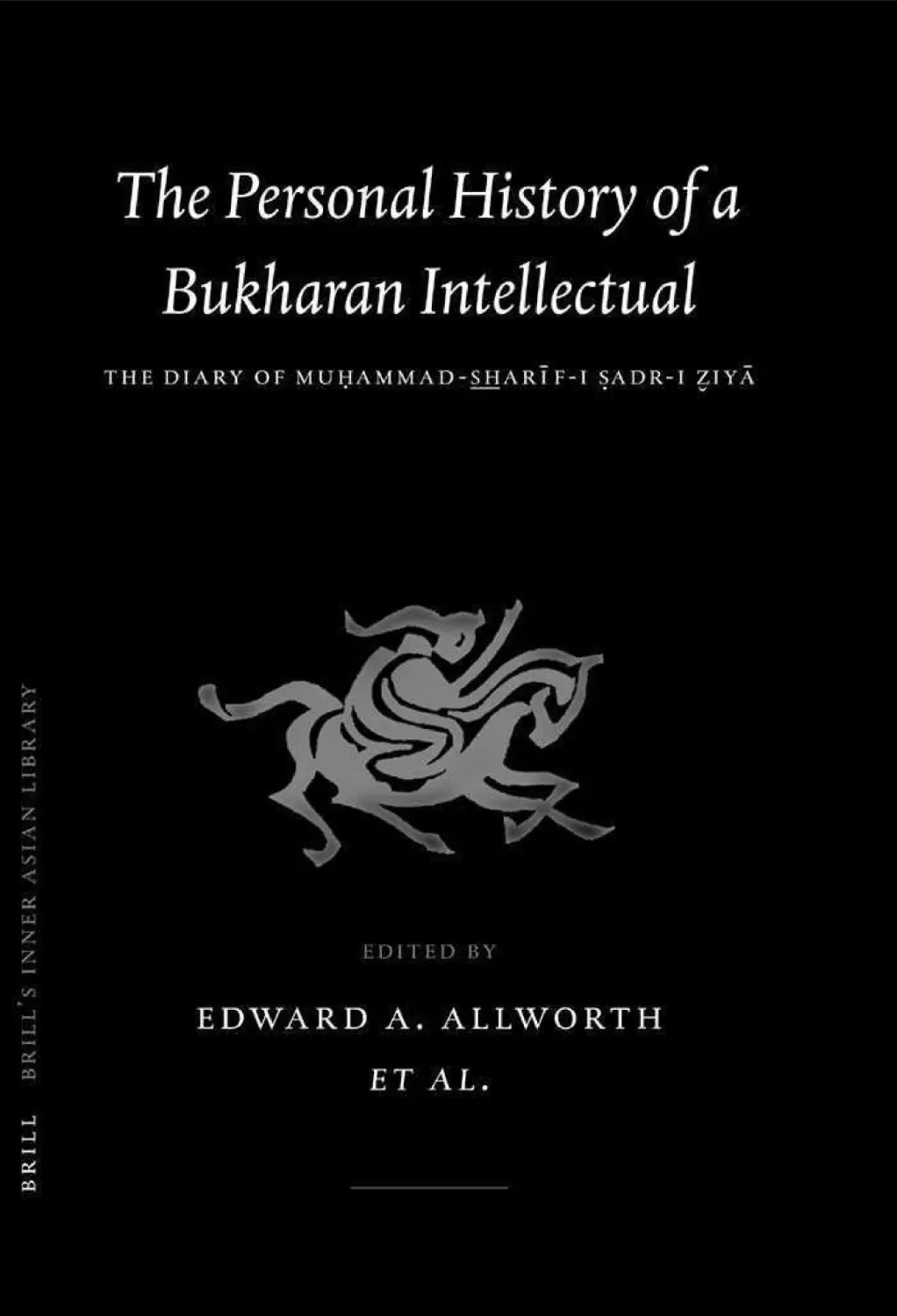


Автор: Şadr-i Ziyā Muhammad Sharīf-i
Теги: central asia diaries bukhara khanate
ISBN: 90-04-13161-2
Год: 2004
Текст
THE PERSONAL HISTORY OF A BUKHARAN INTELLECTUAL
BRILL’S
INNER ASIAN LIBRARY
edited by
NICOLA DI COSMO
DEVIN DEWEESE
CAROLINE HUMPHREY
VOLUME 9
THE PERSONAL HISTORY OF
A BUKHARAN INTELLECTUAL
The Diary
of
MuÈammad-SharÊf-i ‘adr-i Z8 iy§
Translated from the Original Manuscript
by Rustam Shukurov
With an Introductory Study and Commentaries
by Muhammadjon Shakuri (Shukurov)
Project Director
Shahrbanou Tadjbakhsh
Editor, English Language Edition
Edward A. Allworth
BRILL
LEIDEN • BOSTON
2004
This book is printed on acid-free paper.
Library of Congress Cataloging-in-Publication Data
Sadr Ziya’, Sharif Jan Makhdum, 1867-1931 or 2.
The personal history of a Bukharan intellectual : the diary of Muhammad Sharif-i Sadr-i
Ziya / translated from the original manuscript by Rustam Shukurov ; with an introductory
study and commentaries by Muhammadjon Shakuri (Shukurov) ; project director
Shahrbanou Tadjbakhsh ; editor, English language edition Edward A. Allworth.
p. cm. — (Brill’s Inner Asian library ; v. 9)
Includes bibliographical references and index.
ISBN 90-04-13161-2
1. Bukhoro viloëti (Uzbekistan)—History. 2. Khanate (Amirate) of Bukhara—History. 3. ‘adr
Z8 iy§’, Sharåf Jån Makhdåm, 1867-1931 or 2—Diaries. I. Title: Title in introd.: Ruznama.
II. Shukurov, R. (Rustam) III. Shukurov, M. (Muhammadjon), 1926— IV. Allworth,
Edward. V. Title. VI. Series.
DK949.B84S23 2003
958.7—dc22
[B]
2003056286
ISSN 1566-7162
ISBN 90 04 13161 2
© Copyright 2004 by Koninklijke Brill NV, Leiden, The Netherlands
All rights reserved. No part of this publication may be reproduced, translated, stored in
a retrieval system, or transmitted in any form or by any means, electronic,
mechanical, photocopying, recording or otherwise, without prior written
permission from the publisher.
Authorization to photocopy items for internal or personal
use is granted by Brill provided that
the appropriate fees are paid directly to The Copyright
Clearance Center, 222 Rosewood Drive, Suite 910
Danvers MA 01923, USA.
Fees are subject to change.
printed in the netherlands
ABU RAYHON BERUNIY INSTITUTE OF
ORIENTAL STUDIES
ACADEMY OF SCIENCES, UZBEKISTAN REPUBLIC
Mu˙ammad-·arìf-i Íadr-i Óiyà
R∆ZNÀMA
Toshkent-Leiden
This page intentionally left blank
CONTENTS
Editor’s Note ............................................................................
xiii
About the Translator of the Diary and Author of the
Introduction ..........................................................................
xv
List of Illustrations .................................................................... xvii
Preface of the Project Director ..............................................
xix
Preface of the Director of the Institute of Oriental
Studies .................................................................................... xxvii
Introduction by Muhammadjon Shakuri (Shukurov):
“Íadr-i Óiyà and his Diary” ................................................
Translator’s Notes ....................................................................
Diary ..........................................................................................
[Epidemic in Bukhara] ........................................................
[My Parent’s Illness] ............................................................
[Funeral Ceremony] ............................................................
[The Period of Training] ....................................................
[The Bukharan Embassy to ‡Ôqand and the Envy of
Rivals] ................................................................................
[Noble Wedding Feast in Bukhara] ....................................
[The Prince of Blood Óayà and Appointment to
Qarªì] ..............................................................................
A ∞azal of Nùr al-Dìn-¶àn-i TÔra-i Óayà ......................
A ∞azal of Mìrzà ·ams al-Dìn-i Dà'ì ............................
Another Piece by him ..........................................................
[Farìdùn, his Sons and the Legend of Amu Darya] ........
An Adventure on the Amu Darya ......................................
[From the Dismissal to a New Rise] ................................
[Death of Sayid Amìr MuΩaffar-i Bahàdur-¶àn] ............
[Reconciliation of Two Families] ........................................
[Calendar of Deaths] ............................................................
An Oracular Dream ............................................................
[My Friends] ........................................................................
[My First Appointments] ....................................................
[ Judgeship of Yangì-QÔr∞àn and Falling into
Disgrace] ............................................................................
1
76
83
85
87
96
101
105
108
111
112
113
114
115
117
119
124
130
132
136
138
142
143
viii
[A Reformation of the tùmàn of ‡itfar] ..........................
[My Uncle Mullà 'Inàyat-Allàh] ........................................
[My Maternal Great-Grandfather and the Community
of Mìrzà’s] ..........................................................................
[Events of the Year 1314] ....................................................
The Uprising of Christian Subjects of the Ottoman
Empire against the Government by Greek Incitement
to Sedition ..........................................................................
The Names of European [Powers], which were in
Jealousy and Envy at the Deeds and Behavior of His
Majesty the Magnificent Sultan 'Abd al-Óamìd-¶àn
after the Declaration of War on Greece owing to the
Backstairs Instigation of England ......................................
Emergence of Hostility between Greece and the Great
Ottoman Empire over the Uprising of the Christians of
the Island of Crete owing to the Instigation of England
because of the Massacre of Armenians ............................
Sending of some Brigades to Crete by His Majesty the
Fortunate Sultan, in Accordance with the People’s
Demand, to Repel the Attack of the Greek Troops,
and Retrenching of the mujàhidìn of Islam, and
Declaring of War from Both Sides and by the Order
of the Sultan ......................................................................
The Victory and Triumph of Muslims, Defeat and
Retreat of Greeks ..............................................................
[Some Events of the year 1314 in Bukhara] ......................
Prophetic Dream ....................................................................
[The Birth of Mìrzà Mu˙ammad-¸arìf, Dismissal and a
New Appointment] ............................................................
A qaßìda of Óiyà ....................................................................
[Mysterious Fires in the Region of Karmìna] ....................
[Baneful Winter of 1318] ......................................................
[Rank of Íudùr and Appointment to 2ahàrjÔy] ..............
[Russian Bridge over Amu] ..................................................
[Thanksgiving Letter to the Amìr] ......................................
[Death of 'Abd al-Ra˙màn of Afghanistan] ........................
[Bankruptcy of Bukharan Merchants] ..................................
[Staying in Karkì] ..................................................................
[The Smallpox Epidemic] ....................................................
[Between Fear and Hope] ....................................................
146
148
155
160
161
166
169
170
171
174
175
177
179
182
184
188
190
192
195
196
201
203
209
[Appointment to Kàmàt] ......................................................
[Four Events] ..........................................................................
[Dismissal and Prophetic Dream in Se-Pulàn] ....................
Russo-Japanese War with some Details of it ......................
Story of the Rise of the Russian Empire due to the
Wisdom of Peter the Great ..............................................
Causes of the Decline and Collapse of the Russian
Empire ................................................................................
The Praise and Description of Mikado, the Triumphant
Emperor of Japan ..............................................................
War between Japan and China ............................................
[The Boxer Rebellion and the Russian Annexation of
Chinese Territories] ............................................................
[Declaration of War] ..............................................................
[The Fall of Port Arthur] ....................................................
[Battle of Mukden] ................................................................
[Sea-Battle at Tsushima Strait] ............................................
[The Last Stage of the War] ................................................
[Treaty of Portsmouth] ..........................................................
On the Casualties, Expenditures, and Costs of this
War ......................................................................................
[On the Causes of the Russian Defeat] ..............................
[A Vain Hope] ......................................................................
[Disastrous Earthquake] ........................................................
Description and Dating of the Earthquake of Andìjàn ......
[Getting Rid of ‡itfar] ........................................................
[The Three Remarkable Events of the Year 1326] ..........
Appointment to ·ahrisabz ..................................................
[Clashes between Sunnis and Shiites] ..................................
[Incident in Qarªì] ..............................................................
Some Good Deeds which were done by this Slave with
the Broken Wings in that Year ........................................
[Fire in One of the King’s Houses] ....................................
[The Death of Amìr 'Abd al-A˙ad-¶àn] ..........................
On the Good Deeds of this Enlightened King ..................
The Fortunate Enthronement of Sayid 'Àlim-¶àn-i TÔra,
the Crown-Prince ................................................................
[Halley’s Comet] ....................................................................
Another Good Work [of the King] ......................................
[Íadr’s Dignity and Judgeship of fiijduwàn] ....................
ix
211
212
215
217
218
219
221
222
223
225
229
230
232
233
234
235
236
237
238
242
245
247
251
254
258
259
259
260
261
264
265
267
267
x
[The Author’s Activity in the tùmàn of fiijduwàn] ..........
[The Death of the Japanese Mikado] ..................................
“The Ceremony of Interring that Great Emperor” ............
A Quotation from the News of “Óabl al-matìn” ................
Another True Story of Hamràh-Qul of Kudùrì ................
[The Second Marriage of the Author] ................................
[Crisis in Iran] ........................................................................
[The Cause of Iran’s Misfortune] ........................................
[The Ottomans lost Western Tripoli] ..................................
The War of the Balkan Countries with the Turkish
Lions ....................................................................................
An Italian Black Song ............................................................
The Number of Losses of this War ....................................
Dismissal of the Grand Vizier of the Sublime State of
Turkey, Kàmil-pàªà, and the Murder of
NàΩim-pàªà ........................................................................
The Answer of the Ottoman Íadr-i A'Ωam to the Epistle
of the Amìr Óabìb-Allàh-¶àn ..........................................
[Some Events of 1331 in Bukhara] ......................................
Appointment to 2ahàrjÔy ....................................................
[Great War] ............................................................................
[The Death of the Author’s Son and Three Oracular
Dreams] ..............................................................................
Some Events of the Time of my Judgeship in this
Province; the Death of Mullà 'Abd al-fiaffàr
Ma¶dùm ............................................................................
Good Works that Came into Sight from this Fallen Slave
in these Circumstances ......................................................
[Nomination to the post of Chief Justice and its
Circumstances] ....................................................................
[Proclamation of the Manifesto] ..........................................
[Progressivist’s Demonstration and the Anti-Progressivist
Upheaval] ............................................................................
[Assault] ..................................................................................
[Reconciliation Meeting at the Ark] ....................................
[The Beginning of the Reaction and my Formal
Dismissal] ............................................................................
[Arrest of my Younger Brother and Nephew] ....................
[Executions in Bukhara] ........................................................
[In Prison] ..............................................................................
268
270
273
275
277
277
278
281
282
284
289
292
294
298
298
299
301
303
309
311
312
318
324
330
333
335
339
341
343
[ Judgeship in ·ahrisabz] ......................................................
On some International Affairs ..............................................
[Riot in ·ahrisabz] ..............................................................
[Russian Invasion] ..................................................................
[Crossing the Desert] ............................................................
Three Prophetic Visions in Qarªì ......................................
[Bàsqù1ì Movement] ............................................................
[My Family Affairs] ................................................................
[Earthquake in Japan] ..........................................................
[Death of Abù al-Qàsim] ......................................................
[Under Arrest] ........................................................................
[Oriental Affairs] ....................................................................
[War in Khorezm] ................................................................
[On Current Foreign and Domestic Affairs] ......................
Appendix 1
From the Events of the Year 1313. On the Killing of the
King of Kings of Iran, Nàßir al-Dìn ·àh Qàjàr ..........
Enthronement and Coronation ............................................
Appendix 2
The Events of the Year 1326 ..............................................
Appendix 3
1. Selected Genealogy of Íadr-i Óiyà based on his
Diary ..................................................................................
2. Community of Mìrzàs or the Family of Íadr-i Óiyà’s
Mother ................................................................................
3. Territorial Division of the Amirate of Bukhara ..............
a) Districts (tùmàn) of Bukhara ........................................
b) Provinces (wilàyat) ..........................................................
4. List of the Man∞ìt Amìrs of Bukhara ..........................
5. List of Chief Justices (qà˙ì kalàn) of noble Bukhara ......
Appendix 4
List of Places where the Amìr of Bukhara Appointed
Íadr-i Óiyà 22 Times as Judge and/or Ra"ìs ...................
xi
347
348
349
350
354
358
362
367
367
369
371
371
372
374
381
382
384
386
388
389
389
389
389
390
390
Bibliography ................................................................................ 391
Index ............................................................................................ 395
This page intentionally left blank
EDITOR’S NOTE
This first full edition of the Diary of Íadr-i Óiyà translated and published in a Western language comes as a special gift to the community of contemporary scholars in the field of modern Central and
West Asian cultural history. We have before us a rare, original work
by an eminent intellectual and social figure of Bukhara during its
final decades of semi-independent existence. More than that, in this
book scholars and students enjoy the unusual good fortune of benefiting
from the unique qualifications of the Translator and of the Author
of the Introduction. This achievement should draw attention also to
the extensive previous work of each scholar, which deserves much
broader recognition in the wider academic world than it has received
up to now.
Dr. Rustam M. Shukurov, who teaches in the Faculty of History,
Moscow State University, lists some of his most recent contributions
to scholarship in the biographical section given below. In the present study, he translated from Persian or Tajik into English and
annotated with great sensitivity and care both the basic manuscript
text of the Diary (RÔznàma) and the extensive Introduction. Furthermore,
his intimate knowledge about the life of his grandfather, Íadr-i Óiyà,
confers special authenticity upon the Translator’s rendition of every
page in this book.
Academician Muhammadjon Shakuri, author of the learned study
that serves in this volume as an essential Introduction to the Diary
of Íadr-i Óiyà, has written a formidable number of scholarly investigations. Several relate to certain of the many works composed by
his father, Íadr-i Óiyà. The short professional biography shown below
mentions a few of his most important contributions to the field of
Central Asian studies. At the same time, he serves as head of the
Department of Modern Tajik Literature in the Institute of Tajik
Language and Literature, Dushanbe, Tajikistan Republic. He has
received attention in Iran, Russia and his homeland as a leading
scholar of Tajik literary criticism.
Dr. Shahrbanou Tadjbakhsh, New York Project Director of this
work, visiting scholar, Columbia University, deserves great credit for
managing the intricate task of coordinating the efforts of this group
xiv
’
of participants scattered in three continents and countries and using
several languages of communication. She has simultaneously continued
the demanding schedule of an active staff member of the UNDP living and working abroad while devoting her energies to the further
advancement of Central Asian studies.
Readers will also be grateful to the Institute of Oriental Studies,
Uzbekistan, and its Director, Academician Muzaffar Khayrullaev, for
granting exclusive permission to the Editor of this volume to publish the Diary in an English translation from the rare manuscript of
the work held in its Tashkent archive. Dr. Khayrullaev’s Preface,
below, describes the Institute’s numerous holdings of additional writings by Íadr-i Óiyà.
Mr. Jon Olafsson, Centre for Research in the Humanities, University
of Iceland, Rekjavik, when a Ph.D. Candidate in Columbia University
during the late 1990s, kindly gave time and effort for us repeatedly
to facilitate the timely sending and receiving between Moscow and
New York of manuscript pages vital to the preparation of this book.
Dr. Christopher Brest, cartographer, drew the map of The Amirate
of Bukhara.
Support for this scholarly project, in addition to the vast amounts
of effort, time and personal resources devoted to it by the Translator
of the Diary and by the Author of the Introduction, came entirely
from private sources. They have come especially from author and
journalist, Arthur Bonner, from Dr. Tadjbakhsh, from Professor
Amvar Shukurov and from The Central Asia Book Series Fund,
administered by Edward A. Allworth.
ABOUT THE TRANSLATOR OF THE DIARY AND
AUTHOR OF THE INTRODUCTION
Short Biography of the Translator, Rustam Shukurov. Born
Dushanbe, Tajikistan X/12/1961. Educated, Moscow State University,
PhD 1990. Since 1997, Associate Professor, Moscow State University,
Faculty of History Department of Medieval History. Principal fields
of research: history and culture of Byzantium, Iran, Turkey, and
Central Asia. Main recent books: The Grand Komnenoi and the
Orient (1204–1461), 446 pp. in Russian, (2001); Peuples d’Asie
Centrale 230 pp. in French (1994), in collaboration with Professor
Sharif M. Shukurov; editor, The Overcoming of the Otherness,
Collected Studies on the Genesis of the Mediterranean
Cultures, in Russian (1999). An article relevant to the present book,
“Memoirs of Two Bukharans,” Sotsium nos. 11/12 (Moscow, in
Russian, 1992), pp. 42–50.
Short Biography of the Author of the Introduction,
Muhammadjon Shakuri (Shukurov). Born Bukhara, Uzbekistan
X/30/1925. Educated State Pedagogical Institute, Stalinabad, Tajikistan
1941–1945. Defended PhD dissertation at Moscow, in USSR Academy
of Sciences, 1955. Since 1951, has worked in the Institute of Tajik
Language and Literature, Dushanbe, Tajikistan. Academician, DSc,
Moscow 1971. Principal fields, modern cultural and literary history
and criticism of Tajikistan. Some of the most important books among
dozens published: The Ideological and Aesthetic Features of
Ayni’s Memoirs (1966, 246 pp., in Tajik); with others, he authored
the very important large literary dictionary of Tajik, Lexicon of
the Tajik Language, 2 volumes (1969 in Tajik); and a later study
Renewal: Tajik Prose Today (1986, 270 pp., in Russian). The
book Mukhamadzhan Shukurov, in the series “Materialy k
bibliografii uchenykh Tadzhikistana,” vol. 34, Dushanbe 1986, offers
biographical details and lists 501 of his publications issued up to that
time. Many more have appeared since then.
Illustration 1. Map of the Amirate of Bukhara.
LIST OF ILLUSTRATIONS
1.
2.
Map of the Amirate of Bukhara ..................................
Íadr-i Óiyà and son, Muhammadjon Shakuri.
Photo from the private archive of Muhammadjon
Shakuri ............................................................................
3 & 4. The Courtyard and Doorway of Madrasah-i
·arìf-i fiàziyàn, Bukhara, Íadr-i Óiyà’s prison,
where he perished in 1932. Photos by Shahrbanou
Tadjbakhsh, Bukhara, 2000 ..........................................
5.
First page of the manuscript, handwritten by Íadr-i
Óiyà, of his own Diary (RÔznàma), no. 2277 in the
archive of the Institute of Oriental Studies,
Tashkent ..........................................................................
6.
Íadr-i Óiyà photographed sometime after 1912. The
inscription on the left reads in Arabic: “This is the
image of the matchless Shelter of the Shariat, with
the [standing] of ßadr, the judge, Mìrzà
Mu˙ammad-·arìf-i Íadr.” Place unknown. Photo
from the private archive of Muhammadjon
Shakuri ............................................................................
7.
Íadr-i Óiyà (front right) in the company of a
contemporary Bukharan provincial governor, a royal
prince (tÔra) and servants. Date and place unknown.
Photo from the private archive of Muhammadjon
Shakuri ............................................................................
8.
Three judges (qà˙ì): (left) Íadr-i Óiyà, 'Abd al-Rasùl-i
Zakun, 'Abd al-Ra"ùf. 1923. Photo from the private
archive of Muhammadjon Shakuri ..............................
9.
Calligraphy of Íadr-i Óiyà in a letter to the
Bukharan Minister of Education, 'Abd al-Ra"ùf-i
Fi†rat, ca. 1922 ..............................................................
xvi
xviii
16
81
120
189
363
373
Illustration 2. Íadr-i Óiyà and son, Muhammadjon Shakuri.
Photo from the private archive of Muhammadjon Shakuri.
PREFACE OF THE PROJECT DIRECTOR
The story of how the translation of Mu˙ammad-·arìf-i Íadr-i Óiyà’s
RÔznàma came to be prepared is as personal as the Diary itself. The
project took almost ten years to bear fruit, from 1993 to 2002, a
long process in search of reestablishing the links that were thought
to have been broken when typhoid hit the madrasah of ·arìf-i
fiàziyàn (Mullà Mu˙ammad-·arìf madrasah in the quarter of
fiàziyàn) turned prison during the purges of 1932 in Bukhara.
During that period, Íadr-i Óiyà died, and his son was shipped off
to live with his aunt, and then to Stalinabad, the capital of a new
republic of Tajikistan. Íadr-i Óiyà’s personal Diary, together with his
and the Amìr’s personal libraries, were sent to the Institute of Oriental
Studies in Tashkent, and his soul began wandering the dusty streets
of the guûar of Gàw Kuªàn in his beloved Bukhara, now part of the
new Republic of Uzbekistan as a result of the demarcations of the
region under Stalin.
The translation project was the labor of love of two sets of lasting bonds: On the one hand, a student-professor link based on duty
and respect, and, on the other, three generations of fathers and sons
separated by political history. The project also called on the cooperation of scholars in New York, Dushanbe, Moscow and Tashkent,
rekindling links between regions, a century after their forced separation by the Bolsheviks, and during a decade of post-Soviet transformations which, although greatly facilitated by global connections,
also insinuated further separations between the newly independent
nation states.
In 1990, students of Central Asian studies in Columbia University
were reading one of few sources available in English, selected parts
of Íadr al-Dìn-i 'Aynì’s Yàddàªthà (Memories), for the intellectual and
cultural history of the beginning of early twentieth-century Bukhara.
'Aynì had been supported in his studies as a student in the Bukharan
madrasah of Mìr-i 'Arab by a patron of the arts, a qà˙ì ( judge) and
a religious scholar, a historian of ideas and a politician, whose literary soirees 'Aynì was describing in his memoirs. The students at
Columbia were told by their Professor that this grand man had in
fact drafted another cultural history of the period, his RÔznàma, which
xx
alas, was not translated from the original Persian or published; it
therefore remained an unavailable but valuable mirror into the ideas
of Bukhara.
Two years later, while on a dissertation grant in Dushanbe,
Tajikistan, I met Professor Muhammadjon Shukurov, a distinguished
academician, Head of the Department of Modern Tajik Literature
at the Institute of Tajik Language and Literature, and Head of the
Terminological Committee of The Presidium of the Tajik Academy
of Sciences. He told me about his attempts to resuscitate the good
name of his father and reestablish his links with Bukhara, where he
was born in 1926, and from where, after the death of his father, he
had been sent to Stalinabad. Academician Shukurov already had a
long history of dedication to the study of Tajik language, literature
and cultural history. His sons, Rustam and Sharif Shukurov, a long
history of contributions to Oriental studies in Russian Institutions of
higher learning: One was the Head of a Department at the Institute
of Oriental Studies in Moscow, the other, a Professor of Byzantine
History at the Moscow State University. Father and Sons possessed
the eloquent language of the true Bukharan intellectual and had the
same elegant kindred spirit of their ancestor, whose works they were
gradually publicizing in Tajikistan, Russia and Iran. The works of
Íadr-i Óiyà, including the manuscript of the RÔznàma, had been
transferred to the new Institute of Oriental Studies in the Academy
of Sciences in Uzbekistan with the establishment of the Republic.
There, they had been diligently catalogued and preserved, yet to be
published or translated.
Upon returning to the United States, the student and the Professor
decided to embark on this translation project with the help of Rustam
Shukurov. In true spirit of the personal nature of the Diary, Arthur
Bonner, a benevolent former New York Times writer, drew a personal
check as his contribution to the dream of resuscitating part of
Bukhara’s history. His support, relatively modest in quantity but large
in symbolism, went a long way throughout the years, stretched out
to come to the rescue of many people when the harsh realities of
the transition period and civil war violently struck the livelihoods of
the intellectuals of Moscow and Dushanbe.
1992, as it turned out, was the most painful year in modern Tajik
history. A bloody civil war cast regions against each other, broke
down all institutions, including and especially academic ones, impoverished intellectuals together with almost all segments of the popu-
xxi
lation. First a quest for national sovereignty and then the war further sealed borders between Tajikistan and Uzbekistan. While unions
and nations fell apart, the translation project, ironically, became the
cultural, and hence always permeable, link between the Institute of
Oriental Studies in Uzbekistan, where the manuscript had a home,
Moscow, where it was being translated by Íadr-i Óiyà’s grandson,
Dushanbe, where, despite the war and failing health, the author’s
son was preparing commentaries, and Columbia University in New
York, where Professor Allworth was patiently awaiting news of the
progress which I would take back on occasions of home leave from
my postings with the United Nations in the region.
In 1995, Professor Shukurov and I traveled to Bukhara, accompanied by my own father, in the first trip that began my many
searches for Íadr-i Óiyà’s steps in the dusty streets. We sought out
his ˙awlì, confiscated by the Soviet Government in the 1930’s, and
now home to a new generation of Bukharans. In the guûar of Gàw
Kuªàn, we searched for any mÔysafèd (elder) or kampìr (elderly woman)
who could remember their original neighbors. All the old people az
dunyà guûaªtagì, they would tell us, “passed on from this world.” If
everyone knew of Íadr al-Dìn-i 'Aynì, it was due to the rendition
of his memoirs into the Cyrillic script which had facilitated the transmission of his works to the new Bukharans, very few of whom could
now read the Arabic script. Íadr-i Óiyà, the patron of belles lettres,
however, had passed on from this world, the script of his manuscript unreadable, his family uprooted, and his identity split into a
few modern nations. We found his unmarked grave in the cemetery
next to the remnants of the old city gate ·ay¶ Jalàl, and years
later, I convinced the old gate keeper to guide me around the
madrasah of ·arìf-i fiàziyàn, once a holy place, where Íadr-i
Óiyà’s father had taught, then a prison sometime between 1927 and
1945, where Íadr-i Óiyà perished among his cellmates, before it
became a dormitory of construction engineers during Soviet times.
It now stood completely abandoned, one of the more than 300
decrepit madrasahs of Bukhara today. From the top of the madrasah,
Bukhara, in all its former glory, stood silent, forgotten by history,
yet still sacred and noble.
The persona of Íadr-i Óiyà, perhaps even more than his writings,
celebrates the generous spirit of men and women who devote themselves to the preservation of greatness of other people’s creations.
More than for his role as the Chief Justice in Bukhara (a very short
xxii
period indeed from March 26 to April 9, 1917) or his 27-year career
as Judge in the neighboring provinces for all of his life, he is to be
remembered as a patron of the arts and belles lettres. He used what
we would call today his “good offices,” his position, his own home,
often his personal funds and his vast imagination, to create a venue
for thinkers through literary salons at the end of the century. Later,
as political events drove these thinkers into revolutionary action, he
chose instead to devote his time to diligently recording the creations
of poets, calligraphers, architects and politicians. He was a public
man in search of a personal dream: to preserve, and hence publicize the ideas of the time. He also had an almost sacred devotion
to his two homes: The greater one being his land, his patrie, Bukhara,
which he saw being transformed from an Amirate to a Republic,
and his more immediate one, his own family, the lineage of which
played such importance that he begins his own personal story with
the end of that of his father’s. He did not live to see the divisions
of his homes through the irony of history, which transposed his own
son to another country by force and of subsequent grandsons to yet
other countries by choice.
Like the modern history of Tajikistan at the time of the preparation of this translation, the end-of-century Bukhara that Íadr-i Óiyà
portrays was a battle-field of reformers and conservatives, of family
clans originating from different regions, of involvement of foreign
powers, of greed and bravery, and ultimately, of poverty and exile.
Frequently dismissed for his outspoken critiques, his was a true career
of politicians and the fate of great men: one day in favor, and one
day poor, disgraced, and exiled. Yet his spirit of patronage lingered
on. His son Muhammadjon Shukurov’s contribution to the Tajik
language and literature is unprecedented. Through more than 700
published works, he is the main authority on Tajik literary criticism
and the Tajik language in modern usage. When revolutionary spirits were rekindled once again at the end of the twentieth century,
like his father, he did not participate directly, but, like Íadr-i Óiyà,
he devoted himself to writing about national ideals of culture, education, society and the state. When many intellectuals were forced
to seek exile by the 1992 Civil War, Professor Shukurov stayed home,
in his small house and in his large home, writing, as his own father
had done a century earlier, on his belief in a brighter future, one
that builds on history and the lessons of others. He chose his pen
and not his sword to express himself, like many intellectuals were
xxiii
forced to do. These ideals were transmitted to sons, one of whom,
a professor of Byzantine History in Moscow, Rustam Shukurov,
fulfilled more than a son’s duty by introducing their ancestor and
his values to readers worldwide through translating this manuscript.
The eloquent English words he has chosen put his own signature
on preserving creativity in its old glory.
Professor Edward Allworth, with his own diligent contribution to
bringing this manuscript to English speaking audiences, is also an
idealist of ideas. He also devoted a lifetime to teaching and writing
about the cultural history of Central Asia and transmitting the passion of preserving ideas and great men and women to his students
at Columbia University. Like Íadr-i Óiyà, and a century later, Professor
Allworth looked at current events through the eyes of history and
of individuals’ ideals more than their actions.
After editing the entire translation of the Diary, Professor Allworth
noted seven aspects that give the work such special value and interest:
As the Diary’s basic framework, Íadr-i Óiyà provides an elaborate
description of the Muslim religious judiciary and its structure, clearly
delineating Bukhara’s only formal, indigenous judicial system functioning during his lifetime. That emphasis upon religion supplies a
powerful structure for the Diary’s persistent reference to God’s blessings, to prayers, to preordination, to the afterlife, and to the events of
daily life relating to the Islamic religious calendar. This pervasive piety
makes obvious the principal reason why editors and translators of the
communist period, with its rigid atheistic bias, would not translate and
publish this unique work.
The content of the Diary also explains how the Bukharan throne
concentrated in itself authority over all decisions, and thus, why the
country fell into economic and social stagnation as a result of it. In
Folio 52b the diarist demonstrates this with one of his many serious
anecdotes, as follows: the inhabitants of ‡itfar tùmàn (district), when
he first served there as judge, desperately needed water to survive.
Water from the stream that normally supplied them no longer reached
their tùmàn, because the position of a hollow log far upstream blocked
the flow in favor of other districts. In order to adjust the log and
release sufficient water downstream, the judge, as usual, had to request
formal permission from the Amìr before anything could be done to
save the dying economy and population of ‡itfar tùmàn.
Incidents like that one also help explain another important trait of
Bukharan society, revealed here, in its final decades under the Amirate.
A pervasive system of patronage functioning within the religious judiciary and clerical hierarchy, and in all other official structures, had
created an alarming obsequiousness within them that had spread to
xxiv
the populace at large. In Folio 49, Íadr-i Óiyà describes the advice
rendered by his highly-esteemed father, and accepted by the author,
to help him get along in the struggle for position and economic security. His elder counseled the assumption and expression of an attitude
of ‘feebleness, humbleness and guiltiness’ before higher authority.
That obligatory outlook toward persons in superior status likewise
reflects itself and defines the tone conveyed in much of the literature
of the time. Panegyrics, written for many centuries by poets of Central
Asia, became even more fulsome in the years of final Bukharan decline.
So common that they followed a well-established form and comprised
an entire genre, these works of poetic praise, qaßìdas, saluted Amìrs
and others with exaggerated, insincere flattery. Íadr-i Óiyà’s own 93line qaßìda, composed for a Bukharan Amìr of his day, appears in full
in Folios 80b–82, where it characterizes Sayid Amìr 'Abd al-A˙ad-i
Bahàdur-khàn, who ruled 1885–1910 under the Russian protectorate,
as ‘the lord of Solomon’s habits and Darius’s charisma’ among numerous similar comparisons. In Folios 36–36b, the diarist also copies the
entire qaßìda, composed in honor of the same Amìr, by his contemporary, the historian, Mìrzà 'AΩìm Mìrà¶ùr-i Sàmì.
Poetry, therefore, makes up a significant, essential element in the
Diary. In all, it includes 184 different selections—short and long—of
specimens, many cited by memory from Íadr-i Óiyà’s own verse. Some
publishers, regarding poetry as extraneous material, have deliberately
omitted from histories the versified pages by past chroniclers. The
translator of this Diary has rewarded readers by rendering every line
into English. Among them, the diarist introduces here, besides lyrical,
mourning and panegyric poetry, many longer narrative poems to report
historical events that developed inside or outside the Amirate.
Especially in moments of euphoria, or in despondency, the diarist
often resorts to another type of writing, closely related to verse—rhythmic, and sometimes rhyming, prose. These forms do not represent a
unique contribution to literary style, for they appear often in traditional
Central Asian and West Asian works during certain periods. In this
case, Íadr-i Óiyà develops an evolving crescendo of parallelism that
entails the use of fugal forms of variation and a playing with multiple
synonymous clauses. They well display the writer’s mastery of his writing style. In folios 39–39b, p. 133, he briefly characterizes the demise
of a son-in-law of his father: “suddenly, God’s predestination had come
and the decree of his inconstant existence had been taken back, the
claims of his groundless substance had been interrupted, the bequest
of his borrowed life had been proved and sealed, the act of foundation
of his existence abolished, the desire of the foe of his life positively
responded, the edict of his life, a twin of nonentity, was sealed.” At
the death of the diarist’s own beloved year-old son, Abù al-Qàsim-jàn,
he wrote in folios 252–253, p. 370: “my feeble body became dust, and
my water of life became no more than a mirage, my matchless pearl
was lost; the earth of grief poured upon the skull of my head, the dust
xxv
of regret was sifted by my sieve-like chest. My heart melted and water
dropped from my eyes. My liver bled and blood dripped from my
eyes. Consciousness abandoned my head and no light remained in my
eyes. Patience and endurance left my heart, sadness and grief sit in
their place. Sleep was taken from my eyes, water turned into poison
in my mouth,” and so on.
As a participant in the chaotic events happening during the era of
the Russian government’s final collapse, the brief rise of the Jadids
(Reformists) in Bukhara, and the communist takeover of the Amirate,
between 1917 and late 1920, Íadr-i Óiyà provides original, eye-witness reports concerning Bukharan affairs in Folios 204b–245b, a long
section of the Diary. Later accounts of that crucial development by
Íadr al-Dìn-i 'Aynì, Fay˙-Allàh ‡wàja, A˙mad Naìm-i Nußrat-Allàh,
and perhaps others yet inaccessible to most readers, probably benefited
from this earlier manuscript record left by Íadr-i Óiyà.
These seven aspects of the Diary figure among its most important
contributions, but numerous others add substantially to knowledge of
modern Bukharan cultural and social history.
We are eternally grateful to Dr. Muzaffar Khayrullaev and the scholars of the Institute of Oriental Studies in Tashkent, not only for collaborating with us in the publication of this manuscript, but also,
and especially, for preserving the Diary with care, and with it, the
history of Bukhara, in their valuable collection. We are also grateful to Mr. Bonner for trusting in us and our project and making it
financially possible. I have been very proud and deeply enriched by
being part of this great project, which, beyond the final product you
have in your hands, is also my personal homage to my Professor,
to the spirit of all patrons of the arts, to the pain of all homes
divided by politics as an Iranian living abroad, and, especially, to
Bukhara of yesterday and today, always noble, always sacred.
Shahrbanou Tadjbakhsh
New York
This page intentionally left blank
PREFACE OF THE DIRECTOR,
INSTITUTE OF ORIENTAL STUDIES
The rare manuscript treasury of the Äbu Räyhan Beruniy Oriental
Institute in the Uzbekistan Republic’s Academy of Sciences (Ozbekistan
Respublikäsi Fänlär Akädemiyäsi Äbu Räyhan Beruniy namidägi
Shärqshunaslik Instituti) is considered one of the world’s richest
libraries. It has collected old manuscripts and sources pertaining to
the world of eastern Islam, especially to the history of Middle Asia,
and to science, culture and religion. The oldest works being preserved in the collection of the Institute concern the ninth century
AD and the latest, the twentieth century. Manuscript works basically
have been written in Arabic, Persian, various Turkic, and other languages. They have substantial importance in the study of the culture and history of Hindustan (India), the Near and Middle East,
China, Russia, and other neighboring people. In the rare manuscript
treasury are preserved precious manuscript works of men such as
the East’s Ibn Sina (Avicenna), Maturidiy, Yusuf Khas Hajib, Ähmäd
Yugnäki, Zäkäri är-Raziy, Jamiy, Juranniy, Näwaiy, Ulughbek, and
of a number of additional scholars, poets, and cultural figures. Likewise,
in the treasury are also being preserved precious documents pertaining to the people of Central Asia during the last eras of the
Middle Ages, and books written during the period when Czarist
Russia seized power over Central Asia.
The Institute has published separate indexes to the Collection of
Oriental Manuscripts (Shärq qolyazmäläri toplämi ) for works regarding history, exact and natural sciences, medicine, as well as sufism (mysticism). Of course, they substantially ease the efforts of researchers in
analyzing the works located in the rare manuscript treasury.
Translations have been made by scholars of the Institute from
works in the Arabic and Persian languages into Uzbek and into
Russian, works by the East’s renowned savants such as Musa Khwaräzmiy, al-Farabi, Färghaniy, al-Beruniy, Ibn Sina, Zämähshäriy,
Yäzdiy, Ulughbek, Mirza Häydär, and many more.
The author of the book, “The Diary (Ruznamä),” mentioned above—
Shärifjan Mähdum, the eminent Muhämmäd Sädr Ziya—lived in
the Amirate of Bukhara at the end of the nineteenth and beginning
xxviii
of the twentieth century. He was a literary scholar and historian and
one of the Amirate’s pro-education officials. With his father’s high
standing, he obtained a good education and became an intellectual
human being. After completing an Islamic higher educational institution (mädrässäh), he taught as a lecturer (mudärris) in one of Bukhara’s
mädrässähs. For his era, he succeeded in gaining comprehensive
knowledge. Along with the existence of his rich library, he himself
was, in fact, a skillful calligrapher, and someone who established
close ties with the foremost persons of that era and who knew how
to esteem real authority.
Shärifjan Mähdum was born on February 27, 1867. After the
Soviet regime was established, he worked in various organizations,
and in 1931 he died.
With his own talent, Sadr Ziya attracted the attention of the Amir
of Bukhara and was drawn into the service of the state. Nearly his
entire life, he worked in different cities of the Amirate of Bukhara
in the capacity of judge (qazi), and achieved the rank of Chief Justice
of Bukhara. His written works relating to various fields of the social
sciences arouse great interest among readers.
Twenty-five different works of Shärifjan Mähdum, in nine volumes written in his own hand, are preserved, in the original, in the
rare manuscript treasury of the Institute.
The works of Shärifjan Mähdum seem to have been written basically with a historical and literary orientation. Exactly these works
serve as an important source for examining the social history as well
as the literary life existing during the second half of the nineteenth
and the beginning of the twentieth century. Regrettably, so far, they
have scarcely been explored at all.
The following historical works by him exist in the rare manuscript
treasury of the Institute:
“History (Tärikh)”—in which have been set forth historical events
that occurred in states such as Türkiye, Central Asia, Afghanistan,
Iran and Russia.
“A Selection of Histories (Muntäkhib ät-täwarikh)”—gives details about
the prophets, legendary potentates, the Arab Caliphate, and the
dynasties of Central Asian sovereigns: Samanids, Ghaznavids, Khwarazmshahs, Timurids, and Baburids of Hindustan.
“Concerning the Emergence of the City of Bukhara (Bukhara shährining päyda bolishigä aid )”—information collected respecting the historical formation of Bukhara and its surroundings found in the works
xxix
of medieval historians (Närshäkhiy and others). Similarly, books of
his exist, based on the works of other authors, that also elucidate
the abridged history of the countries of Türkiye and Iran.
Some works of Shärifjan Mähdum relating to the history of literature are also being preserved in the treasury of the Institute. Such
works give valuable information about the literary-cultural life of
Bukhara during those periods. Among them, it is appropriate to
confirm in passing the existence of collections of verse by various
authors (bäyaz) and anthologies including biographical notes and
excerpts from verse (täzkirä ). Along with them, there is also a work
of his made up of a collection of biographies of scholars who lived
in the Middle Ages, regarding whose biographies fascinating information has been collected. Besides this will be encountered also his
tracts (risolä) pertaining to geography, calligraphy and old monuments.
The value of Shärifjan Mähdum’s works lies in the fact that he,
himself, directly witnessed and wrote about events that took place
in the Amirate of Bukhara during the second half of the nineteenth
century and beginning of the twentieth. Among them were such
important historical events as Turkistan’s undergoing conquest by
Czarist Russia. As a consequence of this conquest, the Amirate of
Bukhara, losing its independence, suddenly turned into a dependent
state subordinated to Russia.
In this regard, his most distinguished work, entitled “Diary (Ruznamä),” written in the manner of autobiography, deserves special
attention. In it is given extremely interesting information about the
author and his contemporaries, the social-political relations between
Bukhara and Russia, and the Bukharan Amirate’s domestic economic
situation, as well as the image of religious life at the end of the nineteenth and beginning of the twentieth century. At the same time, it
also sets forth details about events occurring in Türkiye and Afghanistan
and in the Russo-Japanese war of 1905.
Muzaffar M. Khayrullaev
Director, Äbu Räyhan Beruniy
Institute of Oriental Studies
The Academy of Sciences, Uzbekistan Republic
INTRODUCTION
ÍADR-I ÓIYÀ AND HIS DIARY
1
·arìf-jàn Ma¶dùm-i Íadr-i Óiyà was a writer who tried his pen
in poetry, prose, as well as in writing history, mostly at the beginning of the first third of the twentieth century. He was born on the
27th of Rama˙àn of 1283 (2nd February of 1867) and died at the
end of 1350, approximately at the end of April 1932.
His name was ·arìf. Ma¶dùm was the appellation given to
offspring of the 'ulamà (the intellectual, judicial and theological elite
of Bukhara), ªay¶ al-islàm, ra"ìs and others. Íadr was the ‘scholarly’
title which, in the last decades of the Amirate of Bukhara, was the
highest in dignity and the third in order following after the inferior
titles of Ôràq and ßudùr. Óiyà was his literary name. Íadr-i Óiyà’s
name has been written in historical sources as Mìrzà Mu˙ammad·arìf, Mu˙ammad-·arìf Ma¶dùm, Qà˙ì ·arìf-jàn, and so on.
Amìr 'Àlim-¶àn, in one of his manuscripts, has called him Qà˙ì
Mìrzà Mu˙ammad-·arìf-i Íadr. He himself has written his name
as Qà˙ì Mìrzà Mu˙ammad-·arìf-i Íudùr in one of his seals. In
formal Russian documents of the Soviet era, his name has been written as Sharif Shukurov.
His father’s name was Dàmullà 'Abd al-·akùr and his pen name
was Àyat. 'Abd al-·akùr-i Àyat (1817/18–1889) came from a family of traders of Bukhara. In his youth, he followed his father’s occupation, which was ªustagarì (bleaching canvas and wool) and leather
making, was then sent to madrasah once his unique talents were
detected. After finishing madrasah with honors, he became a lecturer (mudarris), teaching in different madrasahs, and served as qà˙ì
(religious judge) in various provinces of Bukhara; during the last ten
years of his lifetime he became the Chief Justice (qà˙ì kalàn) of
Bukhara. Dàmullà 'Abd al-·akùr-i Àyat’s position as Chief Justice
was not acceptable by all, as such verses of the time proved:
2
Can learned and unlearned persons become equal?—
a ªustagar has become our Chief Justice.1
As Íadr al-Dìn-i 'Aynì (1878–1954) has written in his memoirs
Yàddàªthà (Memories), 'Abd al-·akùr-i Àyat was famous for his ability to speak freely and openly to superiors (˙aq-gÔì), a character trait
which his son Íadr-i Óiyà also inherited.2 ·arìf-jàn Ma¶dùm-i
Íadr-i Óiyà claims in his own memoirs that he acquired primary
education from his father and from the poet 'Ìsà (1826–1887) until
his enrollment in the madrasah at the age of thirteen. In his book
Ta"rì¶-i amìràn-i Man∞ìtiya-i Bu¶àrà (History of the Manghit Amìrs of
Bukhara), Íadr al-Dìn-i 'Aynì writes that 'Ìsà Ma¶dùm-i 'Ìsà, like
his father, Mullà Niyàz, “was one of the critically disposed 'ulamà”.3
In 'Aynì’s other work, Ta"rì¶-i Inqilàb-i Bu¶àrà (History of the Bukharan
Revolution), it is written that 'Ìsà was forced by his critics “to flee
Bukhara during the reign of Amìr MuΩaffar and he, though having
returned during the reign of 'Abd al-A˙ad, spent a lifetime of agony
under the Amìr”.4 Íadr-i Óiya, therefore, also learned about justice
and truth from such teachers as 'Ìsà.
'Ìsà was a friend and follower of the great Bukharan intellectual,
A˙mad-i Dàniª (1826–1897), and Dàniª’s other friends, learned
men, were also close to 'Abd al-·akùr-i Àyat. Íadr-i Óiyà thus
benefited from the company of these learned men for his early intellectual development.
While ·arìf-jàn Ma¶dùm-i Íadr-i Óiyà was studying at the
madrasah, his home was a salon for literary meetings. We learn from
Íadr al-Dìn-i 'Aynì that every week “on school holidays, Tuesday,
Wednesday and Thursday, the house of ·arìf-jàn Ma¶dùm turned
into a gathering place of poets, devotees of poesy, tellers of entertaining narratives and wits”.5 Most of them were considered to be
the “scholars and free-thinkers of the time”.6 'Aynì has also written
elsewhere that the thought of visitors of Íadr-i Óiyà’s salon “always
manifested a degree of opposition”.7
1
Sadriddin Ayni, Kulliyot (Collected Works), vols. 1–15 (Dushanbe, 1958–),
vol. 12, p. 486.
2
Sadriddin Ayni, Kulliyot, vol. 7, p. 483.
3
Sadriddin Ayni, Kulliyot, vol. 10, p. 36.
4
Sadriddin Ayni, Ta"rikhi inqilobi Bukhoro (History of the Bukharan Revolution), (Dushanbe
1987), p. 23.
5
Sadriddin Ayni, Kulliyot, vol. 7, p. 10.
6
Sadriddin Ayni, Kulliyot, vol. 7, p. 45.
7
Sadriddin Ayni, Kulliyot, vol. 1, p. 33.
ß- Óà
DIARY
3
Íadr al-Dìn-i 'Aynì lived at Íadr-i Óiyà’s house for a while and
attended his literary meetings and attested that “at the meetings
which took place at ·arìf-jàn Ma¶dùm’s house, there were often
complaints of the ill deeds of governmental officials and the leaders
of the time”.8 The patrons at these meetings would sometimes praise
the courage and fearlessness of those fighting for justice. For example, they would commend one of the poets and officials of the time,
Íahbà, who “always spoke frankly and pointed out any deficiency
of the Amìr’s palace; sometimes, even in the Amìr’s presence they
did not abstain from frankness”.9 In this connection, 'Aynì quotes
Íadr-i Óiyà’s verses from his Taûkàr-i aª'àr (Anthology of Poems), devoted
to Mìrzà Óayit-i Íahbà:
In manifesting truth, neither openly nor secretly
he does not restrain himself before both common and great persons.
Even before the [face] of the King, according to his habit,
he always openly exposes the truth.
Here again there was emphasis on free speaking and truth seeking.
Members of Íadr-i Óiyà’s literary meetings upheld the long tradition
of the social thought of the Tajik people in the search for social justice, and some even demonstrated heroism and sacrificed their own
lives to it. In particular, at the end of his Diary, Íadr-i Óiyà writes
that the Íahbà mentioned above was sent in exile in the faraway
land of Qubàdiyàn in 1918, where he was killed at the hands of
local Uzbeks.10
In Íadr-i Óiyà’s literary circle, the name of A˙mad-i Dàniª was
always mentioned with high esteem. 'Aynì writes: “In my mind, one
of the people who respected him (A˙mad-i Dàniª—Author) more
than others was ·arìf-jàn Ma¶dùm”.11 'Aynì has even said that
“·arìf-jàn Ma¶dùm was in love with A˙mad Ma¶dùm’s literary
works”.12 Because of it, when he laid his hands on a copy of A˙mad
Ma¶dùm-i Dàniª’s book, Nawàdir al-Waqàe' (Rare Marvels), in 1898
or 1899, he asked a young poet and famous calligrapher of the time
'Abd al-Wà˙id-i MunΩim (1877–1934) to make a copy, and asked
8
Sadriddin Ayni, Kulliyot, vol. 7, p. 26.
Sadriddin Ayni, Kulliyot, vol. 7, p. 27.
10
Details of this event were recounted by Professor Sa"idjon Aliev, who heard
it directly from a witness. S. Aliev, Unitilmas Sahifalar (Unforgettable Pages), (Tashkent,
“Uzbekistan”, 1986), pp. 88–91.
11
Sadriddin Ayni, Kulliyot, vol. 7, p. 438.
12
Sadriddin Ayni, Kulliyot, vol. 7, p. 438.
9
4
'Aynì and Óayrat (1878–1902) to collate the copy with the manuscript
of the author. MunΩim, 'Aynì and Óayrat secretly accomplished this
commission, for the reading of A˙mad Ma¶dùm’s literary works
was forbidden.
After becoming familiar with Nawàdir al-Waqàe', the three young
men underwent the “revolution of ideas” (inqilàb-i fikrì). (This notable
manuscript is now kept in the collection of the Manuscript Division
of the Tajikistan Academy of Sciences).
From then on, A˙mad-i Dàniª was always present in absentia in
the discussions which took place in Íadr-i Óiyà’s house.
Just as 'Aynì describes the social inclinations of discussions at
Íadr-i Óiyà’s house, these gatherings proved to play a significant role
in the growth of liberal Bukharan literary and social ideas of the
beginning of the twentieth century. 'Aynì in his Yàddàªthà quotes
Óayrat: “·arìf-jàn Ma¶dùm being a famous contemporary wise
man, his house was the literary school of the time.”13 The literary
circle of Íadr-i Óiyà became “the contemporary literary school” where
a number of seekers for justice, free-thinkers, educators and selfless
fighters of the time were nourished. The enlightening activities of
Íadr-i Óiyà who, according to 'Aynì, “was no doubt one of the
educators and progressive men of his time”,14 was congenial to
A˙mad-i Dàniª’s teachings and helped much to put into practice
social ideas and encourage new literary trends, serving to transform
the traditional seeking for justice into the Enlightenment movement.
Íadr-i Óiyà not only had been for many years endeavouring greatly
to prevent A˙mad-i Dàniª’s handwritings from dispersing and disappearing for many years, but also, being the propagator of the
teachings of Dàniª, in his literary meetings helped in the training
of a number of young Tajik intellectuals in acting upon the ideas
of that great educator.
2
Both 'Abd al-Wà˙id-i MunΩim and 'Aynì who lived for some time
in Íadr-i Óiyà’s house, and who used to consider him as their intellectual father,15 began their activity as spreaders of culture after the
13
14
15
Sadriddin Ayni, Kulliyot, vol. 7, p. 228.
Sadriddin Ayni, Kulliyot, vol. 7, p. 44.
Sadriddin Ayni, Kulliyot, vol. 7, p. 50.
ß- Óà
DIARY
5
Russian Revolution of 1905. On the 10th of Shawwàl 1326 (November,
5th, 1908), they opened an “ußùl-i jadìd ” (new-method) school in
Bukhara, with modern teaching methods where children could become
literate in the course of 5–6 months, and then would get acquainted
with such sciences as mathematics, geography and history. A number of young intellectuals, among them A˙mad-jàn-i Óamdì (1884–
1946) and Óàmid ‡wàja-i Mehrì (who was killed by the Amìr’s
executioners in 1918), joined in these activities. Together they established a joint stock-association called the “Union of Noble Bukhara”
(·irkat-i Bu¶àrà-i ·arìf ) which printed books for the new schools.
In 1910, a secret society, the “Upbringing of Children” (Tarbiyat-i
a†fàl ) was established with the task of opening new-method Jadìd
educational establishments. When the Amìr of Bukhara, influenced
by conservative religious authorities, closed the Jadìd schools in 1910,
the Society for the Education of Youth opened a number of underground schools and sent children and teenagers abroad for studying.
In 1912, the Society began publishing a newspaper, Bu¶àrà-i ·arìf
which is considered to be the first Farsi newspaper in Central Asia.
The main purposes of the secret society were to promote educational reform, to upgrade the cultural level of people, and to save
the nation from medieval backwardness and isolation, putting it on
a progressive path.
The young people who joined the ranks of those fostering educational
and cultural reforms became known as “Young Bukharans”, “Progressivists” or “Jadìds” (‘new’ persons or supporters of the ‘new’ ). The Jadìd
movement and literature spread more rapidly in Samarkand, which
at that time had been annexed by the Russians from Bukhara and
had been made part of Russian Turkistan. In ‡ujand and Istrawªan
(present day Isfara), which was also considered as part of Russian
Turkistan, progressivists also began their educational activities.
·arìf-jàn Ma¶dùm never took direct part in the Jadìd movement, yet the Jadìds always benefited from his moral and material
support and assistance. Íadr al-Dìn-i 'Aynì testifies that he was among
one of those liberals who financially contributed to the activities of
the association of Tarbiyat-i a†fàl by paying a certain monthly fee in
secret.16 He also enrolled his son ¸arìf in the first year of the establishment of the new school, and by doing so, lent credibility to its
16
Sadriddin Ayni, Ta"rikhi inqilobi Bukhoro, p. 133.
6
reputation. When the new thinkers’ school closed for the first time,
Amìr 'Abd al-A˙ad-¶àn sent a letter to Íadr-i Óiyà inquiring about
the matter,17 to which he received an answer in support of all the
activities of the young progressivists.
In 1310 (1893) Íadr-i Óiyà completed his education, and at the
age of twenty-six, he began a twenty-seven year career serving as
qà˙ì of the largest provinces (wilàyat) and districts (tùmàn) of Bukhara.
He was frequently dismissed from his assignments because of some
“fault” of his, as he records in the Sababhà-i inqilàb-i Bu¶àrà (Causes
of the Bukharan Revolution), and each time he would return to Bukhara,
far removed from the Amìr’s favors, and, in his own words, “languished in the bitter state of dismissal and suffered from the heartache
of lack of money”.18
At times, the cause of such dismissals was in his following in the
footsteps of his father 'Abd al-·akùr-i Àyat, of being able, if necessary, to stand up to the Amìr and say the truth, eye to eye. This
habit of his offended the Amìr, the Vizier and the Chief Justice on
numerous occasions.
Íadr-i Óiyà was fond of horses and kept his stables in the same
style as the stables of the Amìr at the Ark. Informants notified the
Amìr that qà˙ì ·arìf-jàn was imitating His Majesty in his stables.
This too also caused the anger of the Amìr against him and led to
his dismissal each time.
While in his post as qà˙ì, his life was not always free from care.
At times, he faced troubles and concerns. In particular, he has mentioned that during his one and a half years of tenure as qà˙ì in the
province of Yangì-QÔr∞àn, “many debts and uncountable credits
became the pocket money and means of livelihood of this abject
slave” (RÔznàma, fol. 50). Not much has been recorded on periods
of happiness, pleasure and abundance in life for which he could be
grateful in his writings, including his RÔznàma.
Even though he usually lived away from Bukhara, he would find
the opportunity to follow his passion for literature, to pursue the
new thinkers and progressivists of Bukhara and even to assist them.
For example, a few years after his departure from Íadr-i Óiyà’s
house, Íadr al-Dìn-i 'Aynì did not have a cell at the madrasah, and
17
18
Ibid., p. 84.
RÔznàma, fol. 79v.
ß- Óà
DIARY
7
for some time was looking for a place to live in Bukhara, and lived
what he called in his words “an existence in shirts” (suitcase existence). Once when Íadr-i Óiyà, who was at that time the qà˙ì of
the province of Nasaf (Qarªì), heard about 'Aynì’s homelessness,
he bought a cell (˙ujra) for him to live in at the KÔkaltઠMadrasah,
the largest in Bukhara at the time, which had a large waqf. 'Aynì
lived in this cell from 1907 to 191719 and the waqf share of this cell
covered a part of his everyday expenditures.
In the month of February 1917, when the Russian Revolution,
having overthrown the monarchy, established a Republic, the Jadìds
of Transoxiana, including those from Bukhara, greeted the revolution with a favorable response and enhanced their activity on the
path to justice. Progressivists of Bukhara, the number of which had
reached 200 people, began lobbying the Amìr for increased social,
political and cultural reforms. The Russian Consulate, which wished
to portray itself as the proponent of social justice and democracy,
encouraged the Amìr not to deny the reforms.
At that time, Íadr-i Óiyà was the qà˙ì of the fiijduwàn district.
He was summoned immediately to Bukhara and appointed Chief
Justice. The position of Chief Justice, equal to that of the Minister
of Justice, and the third highest rank in the Government, after the
Amìr and the Prime Minister (or the Vizier), had been offered to
him twice before. Íadr-i Óiyà had refused both times. This time too,
he would not have accepted it, had the Amìr not appointed him
without informing him of his decision prior to the official appointment.
It became clear that the progressive reformists and the Russian
Consulate had recommended his appointment as Chief Justice and
that their suggestion has been accepted by the Amìr. Íadr al-Dìn-i
'Aynì wrote some years later that “Óiyà was considered to be among
the progressivist 'ulamà. That is why Amìr 'Àlim-¶àn appointed him
as Chief Justice of Bukhara in 1917 in order to implement the prescribed reform.”20 The head of the Russian Consulate, A. Miller,
sent a secret telegram to Petrograd in which he wrote: “Following
my suggestion, the Chief Justice and the Ra"ìs of Bukhara tomorrow
will be replaced with renowned supporters of the reforms, the qà˙ì
19
Sadriddin Ayni, Kulliyot, vol. 1, p. 58.
Íadr al-Dìn-i 'Aynì, Namùna-i adabiyàt-i tàjìk (Samples of Tajik Literature), (Moscow,
“Tsentral’noe izdatel’stvo narodov SSSR”, 1926). (Moscow, 1925), p. 401.
20
8
of fiijduwàn Mu˙ammad-·arìf, and that of 2ahàrjÔy, 'Abd alÍamad ‡wàja, both of which are well respected and known by the
population.”21 The named Mu˙ammad-·arìf, the qà˙ì of fiijduwàn,
was Íadr-i Óiyà. 'Abd al-Íamad ‡wàja, the qà˙ì of 2ahàrjÔy was
also among the progressivists, and was appointed as Ra"ìs (Minister
of Internal Affairs) of Bukhara.22
In an another telegram, Miller informed his capital that among
the leaders of Bukharan Jadìds, 'Abd al-Ra"ùf-i Fi†rat and Mùsà-i
YÔldઠrequested him to thank the Amìr for his favor to the reforms,
as well as for the appointment as Chief Justice of Bukhara “the qà˙ì
of fiijduwàn, Mu˙ammad-·arìf, a faithful supporter of reforms
and a man of a high reputation”.23 This leaves no doubt that the
appointment took place with the support of Bukharan progressivists
and the Russian Consulate in order to implement the reforms.
Íadr-i Óiyà has testified that when the turn of affairs became
known to him, “because of the fact that intrinsically I was disgusted
with the evil of the old style of governance, which harmed sons of
my country, with a hope to reform my country (wa†an) and religion
and with a prospect to serve the Sharia and the nation (millat), I
proceeded to the executing of this outstanding task”.24
This statement sheds light on Íadr-i Óiyà’s true intentions in his
social activities. For his contribution to the reform of “the country
and religion”, he wanted to serve in the path of “Sharia and the
nation”. At that time, the words wa†an (homeland) and millat (people and/or nation) started to acquire social meanings, and it is clear
that the activities of Íadr-i Óiyà came closely connected to the new
notions of patriotism (wa†an-dÔstì) and nationalism (millat-parwarì).
Clearly, the word millat (people, nation) had not yet encompassed a
specific social meaning, and could not, for example, refer to the
Tajik or other nation, and pertained more to the sense of religious
21
“Bukhara v 1917 godu. Sekretnaja telegramma rossiiskogo rezidenta v Bukhare
na imia sovetnika III politicheskogo otdela, 24 marta 1917 g. No. 137”, Krasnyi
Arkhiv, vol. 1 (20), (1927), pp. 83–84.
22
Qà˙ì 'Abd al-Íamad ‡wàja was a nephew of 'Abd al-Sa'ìd ‡wàja of Samarkand.
The latter was “matchless in his era”, and a teacher of ·ahàb al-Dìn-i Marjànì
(1813–1889), the great Tatar educator who had studied in Bukhara. About that
illustrious Samarkand family see below the text of the RÔznàma and commentaries:
fol. 63v, 205v–206.
23
From Krasnyi Arkhiv, vol. 1 (20), (1927), no. 141 (March 26, 1917) p. 91.
24
RÔznàma, fol. 205v.
ß- Óà
DIARY
9
identity, denoting those that shared religion, but was not at the same
time far from the meaning of “compatriots” (abnà-i wa†an and hamwa†anàn). This word only attained a social meaning two or three
years later on, when such expressions as “the Tajik millat”, or “the
Uzbek millat” in the sense of “people/nation” came into use and the
word milliyat (nationality) came about in order to express humanistic values and ideals in the struggle for freedom. Thus, the development of Íadr-i Óiyà’s social consciousness progressed from the
understanding of struggle, as service to religion and Sharia, as well
as service to the homeland and to the compatriots, to understanding of the necessity for a movement of indigenous emancipation.
It is thus that Íadr-i Óiyà accepted the position of Chief Justice
on the 26th of March 1917 (or the 8th of April, according to
Gregorian calendar). Amìr 'Àlim-¶àn delegated the implementation
of the reforms to three people: qùª-bègì Mìrzà Naßr-Allàh, qà˙ì ·arìfjàn Íadr-i Óiyà and ra" ìs 'Abd al-Íamad ‡wàja, the Minister of
Internal Affairs. However, before the reformist Manifesto was issued,
Íadr-i Óiyà came to know that the Amìr was not sincere in his support for the reforms, and on the contrary, he wanted to take this
opportunity to persecute reformists and strengthen those opposed to
them. As soon as he became aware of the situation, Íadr-i Óiyà
warned Íadr al-Dìn-i 'Aynì, who at that time was one of the activists
of the Jadìds: he showed 'Aynì a secret letter from the Qùª-bègì,
in which the true intentions of the Amìr were apparent.25 Unafraid
of revealing government secrets, Íadr-i Óiyà thus informed all the
reformists of the possible deceit and provocation.
Signs of deceit had already become apparent before the issuance
of the Reform Manifesto. Íadr-i Óiyà therefore informed the Qùªbègì by telephone that some people were intending to revolt in the
city in order to prevent the issuance of the Reform Manifesto. He
asked permission to imprison these, which was not granted.26 Reform
opponents thus prepared for finite action.
On the 7th of April 1917 (or the 20th April according to Gregorian
Calendar),27 the Order of the Reform was announced. The Order
25
Sadriddin Ayni, Kulliyot, vol. 1, p. 76.
Sadriddin Ayni, Ta"rikhi inqilobi Bukhoro, p. 163.
27
On the date of the enunciation of the Reform Manifesto see: RÔznàma, fol.
207ff. and relevant Commentaries.
26
10
was given to be read in public by Íadr-i Óiyà at the Bukhara Ark
in the presence of the representatives of different strata of society.
On the 8th (21st) of April, progressivists organized a “demonstration
of gratitude” throughout the city. As demonstrators progressed toward
the Règistàn, where the Ark was situated, they were surrounded by
students and mullahs, conservative opponents to the reforms. The
Amìr’s soldiers then dispersed the demonstrators and arrested a number of the Jadìds. Pressure increased, and the effect of the Reform
Manifesto, having not become operational yet, was reduced.
By April 9th (22nd), disturbances were continuing. Íadr al-Dìn-i
'Aynì was caught by soldiers and lashed 75 times next to the Ark
and sent to jail. However, he had to be released from prison and
taken to a Russian hospital. On the same day a crowd attacked
Íadr-i Óiyà, the details of which are seen in the RÔznàma. The attack
was also witnessed by Mu˙ammad-'Alì, son of Mullà Mu˙ammadSayid-i Baljuwànì, who wrote in his memoirs Ta"rì¶-i Nàfe'ì (A Beneficial
History) compiled in 1923–1927:
“The Chief Justice of the time, namely qà˙ì ·arìf Ma¶dùm, in
order to conduct a meeting <. . .>, had arrived at the Règistàn with
thirty or forty of his followers with cries “Make way [for the Chief
Justice]!”, when a loud voice came from one corner of the gathering, ordering “Hit him, this impious Jadìd qà˙ì who caused so much
unrest. If it weren’t for him, the Jadìds could not have done anything!” Then the idlers moved toward the Qà˙ì, in order to dishonor
and beat him, and attacked him and beat him heavily to the point
that all his clothes of gold embroidery were torn, and seized as trophies his belt, qÔshkàr, headgear and all his weapons (asli˙a). As [the
crowd] was hitting the Qà˙ì, the Amìr, who was watching from the
heights of the Ark from a tower built for observation, broke the window shutters28 with an axe and ordered them, with his hand, to stop
the beating. ·a∞àwuls,29 Ôday1ìs30 and many of ma˙ram-bàªìs31 freed
[Íadr-i Óiyà] from the hands of bumpkins and base people having
lion’s claws, and brought him to the Amìr in his shirt and trousers.
He would have been killed if, actually, he had not been saved by
28
In the text: tirèza-i dar which, plausibly, is to be corrected with tirèza-dar (?) or
dar-i tirèza.
29
On the Court title of ªa∞àwul see: RÔznàma, fol. 208v, Commentaries.
30
On the title of Ôday1ì see: RÔznàma, fol. 208v, Commentaries.
31
On the title of ma˙ram-bàªì see: RÔznàma, fol. 228, Commentaries.
ß- Óà
DIARY
11
the Amìr’s people. This incident is the most great and famous event
[connected] with the progressivists of Bukhara. In a word, the abovementioned Chief Justice was imprisoned during the day in the Ark,
then was sent to his house with new clothes after the Night-prayer.
After this event, it became clear that the Chief Justice had endeavored much for the liberating of Bukhara (˙urriyyat ªudan-i Bu¶àrà)
and had been one of the leaders of the progressivists.”32
Mu˙ammad-'Alì-i Baljuwànì described the course of the events
correctly but dated them mistakenly as 1918 when they actually happened in 1917. He also says that the Chief Justice had come to the
Règistàn with “thirty or forty of his followers”, which should also
not be correct, for if the qà˙ì indeed was surrounded by thirty or
forty men, his foes could not have had the opportunity to attack
him. Baljuwànì’s saying that Íadr-i Óiyà “was one of the leaders of
the progressivists” is also not true, but a mere rumor.
As a matter of fact, Íadr-i Óiyà was neither one of the leaders of
the Jadìds, nor did he participate directly in their movement. He
merely supported and assisted them, and in the reform movement
and during the escalation of the struggle between progressivists and
the conservative party he sought for reconciliation of adversaries, as
he himself puts it: “From the beginning to end, I was a supporter
of peace” and “I followed the path of truth and did not join any
sides.”33 He was trying to avoid all sorts of fanaticism, and act according to truth and justice.
Salìmì in his Ta"rì¶-i Salìmì (History of Salìmì), stresses that because
the fanatic conservatives were not able to kill Íadr-i Óiyà, they
demanded his resignation. Amìr 'Àlim-¶àn made a swift decision,
and on the same day, the 9th ( 22nd) of April, 1917, Íadr-i Óiyà
was dismissed from his post. The Russian Consul reported the decision on the same day to Petrograd by telegraph. The text of the
message reads: “Even though I had definitely prohibited the demonstration in Old Bukhara, on the morning of the 8th a demonstration
took place which resulted in disturbances among the inhabitants of
the city and the suburbs. Supporters of the Reform, the Ra"ìs ('Abd
al-Íamad ‡wàja—Author) and the Chief Justice (Íadr-i Óiyà—Author)
32
Mu˙ammad-'Alì b. Mu˙ammad-Sa'ìd-i Baljuwànì, Ta"rì¶-i Nàfe'ì (Dushanbe,
Irfon, 1991) pp. 45–46.
33
Íadr-i Óiyà, À‚ar-i Óiyàiya, MS, an autograph draft copy belongs to the author
of this text, p. 77.
12
were beaten and replaced with reactionaries.”34 Therefore, not only
Íadr-i Óiyà but also 'Abd al-Íamad ‡wàja was also discharged. In
the telegram sent by the Central Committee of the Young Bukharans
on the 25th of April to the Ministry of Foreign Affairs of Russia,
the name of the new Chief Justice was mentioned which replaced
Íadr-i Óiyà.35
Thus, the post of ·arìf-jàn Ma¶dùm-i Íadr-i Óiyà as Chief
Justice lasted only for fifteen days, from March 26 to April 9 1917
(or from the 8th to 22nd of April according to Gregorian calendar).
In the history of the Bukharan Amirate, we can hardly find any
other person who served such a short term in this position.
Following this event, Íadr-i Óiyà spent some time in illness. During
this time, he continued to fear punishment from the reactionaries.
This fear threatened him constantly, and he was only saved with
the help of his friends and supporters and by his son Mìrzà ¸arìf
who prevented evil-doers from entering his house.
Although Íadr-i Óiyà was dismissed on the 9th (22nd) of April
from his post as Chief Justice, the order of his dismissal had not
been issued yet. The dismissal of Íadr-i Óiyà was formally confirmed
on the 8th (21st) of July 1917.
On the 7th of October 1917 (Gregorian calendar) he was forcibly
sent as qà˙ì to Nasaf (Qarªì), and everyone understood that he was
sent into exile. 'Aynì writes. “Since the Amìr discarded the Manifesto
(the Reform Manifesto—Author) he had issued, he also forced Óiyà
to go to Qarªì as qà˙ì, in reality banishing him from Bukhara.”36
3
The juridical affairs of the Province of Nasaf were under the responsibility of ·arìf-jàn Ma¶dùm-i Íadr-i Óiyà for the period of six
months, until the 2nd of April 1918. In March 1918, Fdor Kolesov,
the Leader of the Bolshevik Government of Turkestan, which was
at that point one of the parts of Soviet Russia, attacked Bukhara.
His aim was to depose the Amìr and annex Bukhara as part of
34
35
36
Krasnyi Arkhiv, vol. 1 (20), 1927, no. 4617 (April 9, 1917), p. 91.
Krasnyi Arkhiv, vol. 1 (20), 1927, p. 105.
Íadr al-Dìn-i 'Aynì, Namùna-i adabiyàt-i tàjìk, pp. 401–402.
ß- Óà
DIARY
13
Russia, but he had to retreat in defeat with heavy losses. Amìr 'Àlim¶àn, encouraged by his victory, once again launched a campaign
of terror and persecution throughout Bukhara, a period which became
known as that of “Jadìd Killing” ( jadìd-kuªì). Íadr al-Dìn-i 'Aynì
has described the bloodshed in his 1922 novel Jallàdàn-i Bu¶àrà (The
Executioners of Bukhara).
On the 2nd of April 1918, Íadr-i Óiyà and his younger brother
fiafùr-jàn Ma¶dùm were imprisoned in the QÔr∞àn (citadel) of
Qarªì (Nasaf ), where the governor’s residence was located. That
evening, 'Abd al-Wakìl, the newly-wed nephew of Íadr-i Óiyà, the
son of 'Abd al-Jalìl Ma¶dùm, who had been also imprisoned in the
same QÔr∞àn on a charge of being a Jadìd, was killed. Íadr-i Óiyà
and his younger brother also expected execution at every moment.
On the eve of poor 'Abd al-Wakìl’s death, another fifteen people
were also executed, and on the next day, another four hundred fifty
saw their death. The killings continued for many days.
After a few days, the death sentence of Íadr-i Óiyà also reached
the Governor of Qarªì from Bukhara. The Governor of the Province,
Óaydar-Qul-bì-i Inàq37 noticed that the death Order bore the official
stamps of the Vizier and the Chief Justice, but not that of the Amìr.
Óaydar-Qul-bì respected Íadr-i Óiyà and, apparently, was a brave
enough person to return the Order to Bukhara with a letter to the
Amìr, writing in the sense that he had on numerous occasions executed death orders without the Royal stamp, but he could not do
so this time without the stamp of His Majesty.
They waited for an answer to this letter for a long time. Finally,
an order came to the Governor to liberate Íadr-i Óiyà and his
brother for blood-money of three million Russian rubles. Íadr-i Óiyà
was unable to pay such a fine. When he was put in jail, all his property was confiscated, his family was left with the clothes they were
wearing. Because of it, Íadr-i Óiyà wrote a query requesting permission to pay his “ransom” in portions. This request was accepted.
He was released after almost 70 days in prison, on the 8th
of June 1918. After his release, Íadr-i Óiyà was sent even further
from Bukhara, as qà˙ì to the Province of Kèª (·ahrisabz). Íadr
37
In RÔznàma the name of the Governor of Qarªì has been referred as A˙ràrQulì-bèk.
14
al-Dìn-i 'Aynì claims that the Amìr sent Íadr-i Óiyà “to ·ahrisabz
in order to be watched over by the [Amìr’s] uncle, Akram-¶àn,
who was Governor of that province.”38
The appointment of Íadr-i Óiyà as qà˙ì to ·ahrisabz should be
seen as a mere trick of the Amìr and his entourage, especially,
Burhàn al-Dìn, the Chief Justice. The purpose of his appointment
as qà˙ì, after having revoked the death sentence and imposed upon
him an enormous burden of blood-money, was to force him to plunder the population as much as possible in order to collect money
for paying his debt to the Treasury. They were plotting to kill him
not physically but spiritually.
However, they were not successful. Neither in the writings of
Íadr al-Dìn-i 'Aynì nor in other sources are there any indications
that Íadr-i Óiyà would retreat from his humanistic principles. Once
freed from the Nasaf prison, he was able to pay some of his fine
by borrowing money. He was subsequently saved from paying the
remaining sum by the Revolution in Bukhara, which took place in
1920.
Following the Revolution, Íadr-i Óiyà worked in a number of
offices and institutions of the People’s Republic of Bukhara. He was
supervisor (mumayyiz) of 'ulamà affairs, and worked in the Ministry of
waqfs, in the administration offices of the municipality, and in the
Library. He has written, “In the year 1342 of the Hijrat (1924), I,
a sinful slave, retired ( farà∞atè ba ham rasìd ) from service to the
Soviet Government.” Thus, once the Republic of Bukhara was
perfidiously abolished and became part of Soviet Uzbekistan, Íadr-i
Óiyà retired and stayed at home. He spent most of his time sick but
when he was feeling better, he would put pen to paper.
In 1931–1932, the Soviet Union was in need of large amounts of
money in order to begin the construction of large industrial enterprises. In Bukhara, Samarkand and other Central Asian cities, a
campaign was launched to collect gold from the inhabitants. People
were forced to turn in all their gold to the State. During this campaign, also Íadr-i Óiyà among others was thrown into prison.
The author of this Introduction, being his son, was 6 years old
38
Íadr al-Dìn-i 'Aynì, Namùna-i adabiyàt-i tàjìk, p. 402.
ß- Óà
DIARY
15
at the time, and I do not know whether he handed over his gold
or not. I only remember that the news of his death in prison arrived
on the 24th of April of the year 1932. The prison was located in
the madrasah of Mullà Mu˙ammad-·arìf (in the quarter of fiàziyàn)
and this was the name of Íadr-i Óiyà himself. At one time, qà˙ì
'Abd al-·akùr-i Àyat used to teach there and Íadr-i Óiyà used to
have a cell (˙ujra) on top of its gate, which he had given to Mìrzà
'Abd al-Wà˙id-i MunΩim, and it was there that MunΩim had copied
the Nawàdir al-Waqàe' of A˙mad-i Dàniª. Íadr-i Óiyà died in such
a place.
The jail keepers later told us that Íadr-i Óiyà died of typhus. His
disease was contagious and they did not allow us to take his corpse
home. We took him from the madrasah of Mìrzà Mu˙ammad-·arìf
directly to the Cemetery of ‡wàja 'Ißmat’s mazàr.
At the end of the nineteen fifties, after the death of Stalin, when
the Soviets began rehabilitating the names of the victims of the
Bolshevik terror of the twenties and thirties, I wrote to the Prosecutor’s
Office in Tashkent and requested a revision of the file of Íadr-i
Óiyà, in order to clarify his crime, and if possible, to rehabilitate
him. Finally, in 1960 an answer was received. The Deputy Prosecutor
of the Republic of Uzbekistan, a man by the name of Rizhin, in
the letter number 15/456–57, which was signed on the 30th of
August 1960, wrote:
“Your father Sharif Shukurov was not accused of a crime against
the state, he was not sentenced and therefore, the question of his
rehabilitation cannot be considered.”
4
The literary works of Íadr-i Óiyà are numerous. The late Sahobiddin
Siddiqov (d. 1994) who was his principal researcher, has estimated
his works to number more than sixty, most of them manuscripts in
his own handwriting, which are gathered in eleven books.
His personal library of rare manuscripts, which he and his father
had gathered throughout their lives, was confiscated soon after his
death. His own literary works (in rough and fair copies) also became
the property of the Soviet government with this library and were
transferred from Bukhara to Tashkent. They are at the moment kept
16
Illustrations 3 and 4. The Courtyard and Doorway of Madrasah-i ·arìf-i
fiàziyàn, Bukhara, where Íadr-i Óiyà was imprisoned and perished in
1932. Photographs by Shahrbanou Tadjbakhsh, Bukhara, November 2000.
ß- Óà
DIARY
17
at the Institute of Oriental Studies of the Academy of Sciences of
the Republic of Uzbekistan.39
Íadr-i Óiyà writes: “From early youth, <. . .> whenever I would
hear a good tale from someone, or come across a desirable story
somewhere, I would put on the clothes of narration.”40 That is why
his manuscripts consist of two types: One containing paraphrases
and resumes of historical sources recounted by others and the works
of historical and contemporary authors. The other part consists of
his own compositions.
Most of his own writings are based on true events, meaning he
would write what he observed or heard from people around him.
For example, one of his roughs, which is kept as Number 2367 in
the Collection of the Institute of Oriental Studies of the Academy
of Sciences in Tashkent, contains much information on his schoolmates, on the visit of the Amìr of Bukhara to Russia, about the relations between Bukhara and Afghanistan, samples of his own letters
and applications (according to Sahobiddin Siddiqov up to 29 examples), consisting of more than 60 stories.41
In the year 1322 (1904), he began collecting his various scattered
writings in a book called “À‚àr-i Óiyàiya” (Works of Óiyà), about
which, in his own words, he wrote “clever men appreciated its content, men of wit enjoyed it for its humor”.42
Some of his writings are known as Nawàdir-i Óiyàiya (Óiyà’s Rarities).
Nawàdir-i Óiyàiya consists of biographical essays on his and his father
'Abd al-·akùr-i Àyat’s lives, consisting of such works as La†à"ìf-u
mu†à"ìbàt (Funny Tales and Jests), Taûkirat al-˙umaqà (Anthology of Fools),
Taûkirat al-wuzarà (Anthology of Viziers), and in its second redaction,
the essay Sababhà-i inqilàb-i Bu¶àrà was also added to it.
Many of the sections of “Nawàdir-i Óiyàiya” are true stories which
are recounted as memoir writing. According to Sahobiddin Siddiqov,
39
Íadr-i Óiyà had catalogued his own library. Refer to U. Hamrov, ‘Bir shakhsii
kutubkhona va uning katalogi haqida’ (Concerning a personal library and its catalogue), in: Nauchnye raboty i soobshcheniia (Scientific Works and Information), Vol. 6,
Tashkent, 1963, pp. 387–395.
40
Íadr-i Óiyà. À‚àr-i Óiyàiya, a draft copy in the Ms. collection of M. Shakuri,
fol. 1.
41
S. Siddiqov, “Merosi adabiyu ilmii Sharifjon-Makhdumi Sadri Ziyo” (Literary
and scholarly heritage of ·arìf-jàn Ma¶dùm-i Íadr-i Óiyà), in: Majmuai ilmi, vol. 5,
Dushanbe 1966, pp. 28–37.
42
Íadr-i Óiyà. À‚àr-i Óiyàiya, fol. 1.
18
Óikàyàt-u mutà" ìbàt-i mu'àßirìn wa qarìb-i àn (Stories and Jests of Coevals
and those Living a Short Time Ago) consists of 42 true stories, the essay
Mutà" ìbàt-i muta"a¶¶irìn wa mu'àßirìn ( Jests of those living in the Past and
Coevals) 69 true stories, Mutà" ìbàt-i mutaqaddimìn ( Jests of those living in
the Past) 52 and in Óikàyàt-i 'ulamà-i mutaba˙˙irìn-i Bu¶àrà (Stories on
Outstanding Bukharan 'ulamà) 13 stories. In one of Íadr-i Óiyà’s rough
manuscripts, this scholar has discerned 293 stories, mostly based on
authentic events.
The authenticity and memoir characteristic of the works of
Íadr-i Óiyà lend more credence to their literary and historical worth.
Their significance lies primarily in the fact that describing real precedents and the lives of the author’s contemporaries, he introduced
them into literary history, reinforcing thus the existential footing of
literature, explicating the most vital questions of the time using materials taken directly from everyday life.
Keen attention to social life and problems, which were connected
with it, was one of the characteristics of the Enlightenment literature of the end of the nineteenth and the beginning of the twentieth century. Íadr-i Óiyà’s works also contributed to the further
development of this feature. As soon as the events of the time with
their specific characteristics, with their details and particularities had
found their way into traditional literature and the problems of social
life, being represented by the specifics of the real life, became the
matter of consideration, the national essence of literature manifested
itself to a greater extent. Íadr-i Óiyà was one of those writers of the
Bukharan Enlightenment who contributed to the beginning of the
foundation of the national Tajik literature.
Until then, undoubtedly, Persian literature leaned on the national
foundation and was a product of the national impression of the Tajik
people, reflecting the characteristics of national thinking and expressing national identity, although this expression of the national identity was based on general humanistic values. Writers would look at
national actuality from the point of view of general human values,
while actual specifics of life, evidences of social existence would be
more or less ignored, eclipsed by attention paid to general human
characteristics. Starting with the beginning of the twentieth century,
the outlook of literature began changing. Writers began to pay more
attention to national and social realities, their specific concerns and
their local peculiarities, to those traits which differentiated the specific
experience of the Tajik people from that of Persian-speakers of other
ß- Óà
DIARY
19
countries, Afghanistan and Iran. The general humanistic approach
of literature, a common feature for Persian-speaking literature, did
not decrease, but the specific Tajik national and local color and
characteristics increased. Until then, the Persian-speaking literature
of Mawarannahr par excellence was Persian literature; it became
Persian Tajik literature from then on.
The Persian Enlightenment literature in Central Asia began from the
last third of the nineteenth century, from the works of A˙mad-i
Dàniª (1826–1897) and continued until the second decade of the
twentieth century. This literature was the product of a time when
most of Transoxiana was annexed by Russia. Wars between Central
Asian states and local warlike rulers having ended, the region gradually shed the limitations and isolation of many centuries and joined
the economic and cultural systems of Russia and Europe. As a result,
new positive phenomena appeared in the economic and social development of Transoxiana, including that of Bukhara. Hopes for a
bright future began gradually replacing the hopelessness of the seventeenth and eighteenth centuries, and steps were taken toward
progress and national salvation.
In order to clarify the path for the future, it became necessary
first to examine and scrutinize contemporary realities. That is why
A˙mad-i Dàniª, and other writers following in his footsteps, such
as 'Abd al-Ra"ùf-i Fi†rat (1886–1938), Íadr-i Óiyà, Íadr al-Dìn-i
'Aynì in Bukhara, Ma˙mùd ‡wàja-i Behbùdì (1874–1919) and Sayid
A˙mad ‡wàja-i Íiddìqì-i 'Ajzì (1865–1927) in Samarkand, Tàª
‡wàja-i Asìrì (1864–1915) and Óàjì Yùsuf (1842–1924) in ‡ujand
cast light on the social realities of their time and studied different
aspects of them. The purpose of this literary scrutiny was to seek
ways to improve the conditions of the country, to extract it from
backwardness and to set it on the path to progress.
Men of letters of the first two decades of the twentieth century,
Fi†rat, 'Ajzì, Behbùdì, Asìrì and others, whose works became known
as Jadìd literature (adabiyàt-i jadìdiya), followed, par excellence, in the
critical path of A˙mad-i Dàniª. They composed works which strongly
criticized the political and social system of the time. From Bukhara,
Abdulqodir Muhiddinov (1882–1934), in articles which he wrote
under the pen name of “Bu¶àràì” and published starting in February
1910 in the newspaper “Waqt” (published in Orenburg, Russia), 'Abd
al-Ra"ùf-i Fi†rat in his “MunàΩira” (1911) and “Bayànat-i sayyà˙-i
hindì” (1912), had a detailed analytical and critical point of view of
20
the social, economic and cultural situation of the country.43 Some
literary works of Íadr-i Óiyà were also composed within the framework of this trend. Most of his stories which are found in La†à"ìf-u
mu†à"ìbàt, Taûkirat al-˙umaqà, and some other writings, are satirical
short stories. The satirical vision of Íadr-i Óiyà and other authors
of the Enlightenment, which sometimes were harshly critical, played
an important role in the formation of the new vision of society and
for the eradication of its backwardness.
A thorough analysis of the social scrutiny of events of the time in
the writings of A˙mad-i Dàniª developed in the two following directions. One view was his observations on the social situation in his
country and the countries of East and West, especially of Russia and
Europe. The second direction of his work consisted of a multi-faceted
analysis of the situation of different countries and nations, both neighboring and distant, with a view to gaining experience and comparing them with their own country. Writers of the Enlightenment sought
lessons for their path to national revival in the social experiences of
other countries and in the results of their struggles.
Various travelogues, such as the works of Ra˙mat-Allàh-i Wà˙e˙,
Sawàne˙ al-masàlik (Advantageous Paths) (1887), the work of Mìrzà
Siràj-i Siràjì (Mìrzà Siraj-i Óakìm or Doktor Íàbir) Tu˙af-i Ahl-i Bu¶àrà
(Gifts of the People of Bukhara) (1910), articles of Behbùdì and others
would expand the horizon of literature and social thought, and would
open readers’ eyes to a limitless world, full of thoughtful and instructive wonders, which prompted the society to follow the way of growth
and progress. As we shall see later, the RÔznàma of Íadr-i Óiyà,
although it was not a travelogue per se, would serve the same purpose.
One more trend which was quite influential in A˙mad-i Dàniª’s
writings and in general Bukharan intellectualism of the Enlightenment,
was the paying of special attention to history. A˙mad-i Dàniª mostly
concentrated on cultural history and on the history of philosophy,
kalàm (a rational trend in Muslim theology), gnosticism, ethics, and
such, and, especially, on the ethical teachings of the Muslim mystics
fiazàlì, Naßìr al-Dìn-i ˇùsì, 'Alì-i Hamadànì, 'Abd al-Ra˙màn-i
Jàmì, and 'Abd al-Qàdir-i Bèdil. It is obvious that A˙mad-i Dàniª,
43
A full description of the Tajik Enlightenment literature of the time can be
found in the article of this author “Hayot amri ma"nawist” (Life is a moral imperative) which is a section of his book Khuroson ast injo (It is Khorasan here) (Dushanbe,
1996).
ß- Óà
DIARY
21
comprehending the main intellectual achievements of the past generations throughout the centuries, wanted to draw lessons and form
general conclusions from them. It is important to note that his
reflection had an emphatically generalizing character. Such attempts
to draw inferences from and renovate views towards past historical
experiences indicates the fact that a new historical era has commenced.
When society has turned over a new leaf, the path of tomorrow
starts not from today, but from yesterday and the day before.
A˙mad-i Dàniª also compiled a work on the political history of
the last centuries, called Risàla (A Treatise) or Mu¶taßarè az ta"rì¶-i
sal†anat-i ¶ànadàn-i man∞ìtìya (A Compendium of the History of the Manghit
Dynasty).
After this, a number of other works appeared, which included
Mìrzà 'AΩìm-i Sàmì’s (1839–1908) work called Ta"rì¶-i Salà†ìn-i
Man∞ìtìya (History of the Mangit Sultans). Also among Íadr-i Óiyà’s
writings historical essays occupy a special place, which include
Ûikr-i awà"il-i Bu¶àrà (On the Beginnings of Bukhara), Munta¶ab altawàrì¶ (Selected Histories), Risàla-i Salà†ìn wa ·ahriyàràn (Treatise on
Sultans and Potentates), Ûikr-i pàdªàhàn wa kinàzàn-i Rùsìya (On the Kings
and Princes of Russia), Ûikr-i ˙àlàt-i 2ingìz-¶àn (Relation on the condition
of 2ingìz-¶àn), Ta"rì¶-i salà†ìn-i 'u‚mànì wa naßab-i èªàn (History of
the Ottoman Sultans and their Lineage), Awßàf-i Mìrzà Ulù∞-bèk (Description
of Mìrzà Ulù∞-bèk), Silsila-i salà†ìn-i uzbak-i 2ingìz-¶ànìya (Genealogy
of the Chingizid Uzbek Sultans), Ûikr-i Salà†ìn-i Aªtar¶ànìya (On the Ashtarkhanid Sultans), Ûikr-i sal†anat wa pàdªàhì-i amìr 'Àlim-¶àn-i Ma¶lù'
(On the sovereignty and reign of the deposed Amìr 'Àlim-¶àn). In addition
to his above-mentioned Taûkirat al-wuzarà, Íadr-i Óiyà also composed
separate pieces about famous ministers. For instance, among them
are Óikàyàt-i àl-i Barmak wa Abù 'Alì-i Sìnà wa 'Alì-·èr-i Nawàì (Stories
on the Barmak Dynasty, Avicenna and 'Alì-·èr-i Nawàì), Óikàyàt-i ‡wàja
NiΩàm al-Mulk wazìr-i sul†àn Óusayn Mìrzà (Stories on ‡wàja NiΩàm alMulk, the Vizier of the Sul†àn Óusayn Mìrzà), Tarjuma-i ˙àl-i Àstànaqul-i
QÔªbègì (Biography of qÔªbègì Àstànaqul, who was a Vizier of the
Manghits) and others.
For writing some of these essays, the author used either a single
reputable historical account, or various historical sources. In some
of these works, the historical sources are cited directly, others are
summaries of the original sources. In the works which dealt with the
latest ruling dynasty of Bukhara, i.e. the Manghits, the author outlines also some unique information which was added by himself.
22
Specifically, his information concerning the times of the rule of the
Amìr 'Àlim-¶àn, who was the last ruler of Bukhara, concerning the
viziers of the Manghit Dynasty, including about qÔªbègì Àstànaqul,
qÔªbègì Naßr-Allàh, and others, is very important.
Íadr-i Óiyà was especially interested in how former kings and
famous viziers would treat subjects. The main reason why he would
turn to history was his search for the ideal of the just king and the
prudent minister. He wanted to define the ideal characteristics of
kings and ministers and their rule, in order to be taken into account
in the social and political reforms of the day.
In addition, Íadr-i Óiyà was rather productive in writing various
anthologies, which also represent a sort of historical compilation. The
most important one was Taûkàr-i aª'àr (Anthology of Poems), composed
mostly in 1905–1907, with new sections added later. Approximately
200 poets were included in the first edition of the book and the
biographies and examples of poetry of 49 poets of the end of the
nineteenth and beginning of the twentieth century Bukhara were
included in the second edition. During this period, other anthologies were also written which represented the contemporary writers
more extensively. For instance, Taûkirat al-ªu'arà of Ne'mat-Allàh-i
MÔ˙taram (1904–1910) included about 125 poets in the first edition,
and 175 poets in another one; Íadr-i Óiyà’s last edition of Taûkàr-i
aª'àr could appear quite meager in comparison with MÔ˙taram’s
piece. However, it may seem so at first sight only. According to
Rasul Hodizoda, who is the first scholar of Central Asian poetic
anthologies of the end of the nineteenth century and beginning of
the twentieth, Íadr-i Óiyà’s Anthology is of special importance.44
The importance of his Anthology was that in most cases he gave
realistic information on the progressive writers of the time despite
their noncompliance with the official policies of the time and their
being banned from the Court and punished. This vantage point can
be easily traced when Íadr-i Óiyà writes about A˙mad-i Dàniª,
·ams al-Dìn-i ·àhìn, Qàrì Ra˙mat-Allàh-i WàΩe˙, Mìrzà 'AΩìm-i
Sàmì, Íadr al-Dìn-i 'Aynì and others. R. Hodizoda emphasized that
“no other anthologist would have dared to write about ·àhìn’s writ-
44
See: R. Hadi-zade, Istochniki k izucheniiu tadjikskoi literatury vtoroi poloviny XIX veka,
(Stalinabad, Izdatel’stvo AN Tadj. SSR, 1956), pp. 11–13, 22–23, 62–69, 73, 87–89,
136–137.
ß- Óà
DIARY
23
ings so openly and honestly as Íadr-i Óiyà did.”45 In general, Hodizoda
has concluded that Íadr-i Óiyà has “cited more complete information on most of the poets of the second half of the nineteenth century (than other anthologists—Author), and has made accessible to us
new materials concerning both their biographies and descriptions of
their works”.46
Sahobiddin Siddiqov, on the basis of existing copies of Taûkàr-i
aª'àr, including those penned by the author himself, prepared a critical edition of the Anthology which, unfortunately, has not been published yet. Siddiqov’s edition of the Anthology is enlarged with an
appendix containing additional information about the men of letters
of that time, scattered throughout Íadr-i Óiyà’s other works, including
his quite valuable autobiographical writings. As a result, S. Siddiqov
has constructed an inestimable source for the history of Tajik literature in the second half of the nineteenth and the beginning of the
twentieth century.47
These numerous remarks, dispersed in many of Íadr-i Óiyà’s writings, being brought together in Siddiqov’s edition, provide additional
information which sometimes amend and enrich the Taûkàr-i aª'àr’s
data. For instance, if Mullà Mu˙ammad-·arìf-i Anbar, apparently
due to his being a courtier, was praised very much in Taûkàr-i aª'àr,
however, in one of Íadr-i Óiyà’s memorial records he became the
target of ridicule by the author, who wrote: “Within the limits of
Bukhara [exists] neither a hand-wash basin (àftàba) with broken handle nor an earthen jug with broken neck in honor of which [Anbar]
has not produced a [poetical] chronogram (ta"rì¶)”.48
Taûkàr-i aª'àr in Siddiqov’s edition and with his appendixes contains ample information of this kind, numerous essential and meaningful details which excellently characterize the Bukharan literary
milieu of that time.
In addition, in 1923, Íadr-i Óiyà prepared a new edition of Ne'matAllàh-i MÔ˙taram’s Taûkirat al-·u'arà. He wrote about his edition:
45
R. Hadi-zade, op. cit., p. 67.
R. Hadi-zade, op. cit., p. 66.
47
The mentioned work of Sahobiddin Siddiqov has eventually been published
in Tehran just before this manuscript went to the printer: ·arìf-jàn Ma¶dùm-i
Íadr-i Óiyà, Taûkàr-i aª'àr. ·ar˙-i ˙àl-i bar¶ìaz ªà'iràn-i mu'àßir-i Tàjìkistàn wa namunahàyì az ªì'r-i ànàn, ba taß˙ì˙-i Sa˙àb al-Dìn-i Íiddìq (S. Siddiqov), ba kùªìª-i
Mu˙ammad-jàn-i ·akùrì-i Bu¶àràì (M. Shukurov), (Tehran, “Soroush Press”,
1380/2002).
48
Cited according to R. Hadi-zade, op. cit., p. 67.
46
24
“some redundant places both in verse and prose, in order to facilitate
[the style], I have omitted”, however, “the basis of the narration is
of MÔ˙taram himself ”.
Íadr-i Óiyà composed also a number of other anthologies such as
·u'arà-i muta"a¶¶irìn (Poets of Late Years), Fu˙alà-i muta"a¶¶irìn (Men
of Virtue of Late Years), Ûikr-i 1and nafar 'ulamà-i dawr-i à¶ir (On Some
'ulamà of the Last Epoch), Taûkirat al-˙ukamà (Anthology of Savants), Taûkirat
al-¶a††àtìn (Anthology of Calligraphers), Risàla-i ¶a††àtàn-i mutaqaddimìn
wa muta"a¶¶arìn (Treatise on Calligraphers of the Past and Late Years),
Ûikr-i ¶a††àtàn-i nasta'lìqì (On Calligraphers of Nasta'lìq Style), and so on.
On Íadr-i Óiyà’s Taûkirat al-¶a††àtìn valuable research has been made
by Ehson Oqilov. From this research it became clear that TaΩkirat
al-¶a††àtìn is an outstanding source for reconstruction of the development of the art of calligraphy in Central Asia from the fifteenth
century onward, containing detailed information on the genesis of
the Bukharan school of calligraphy, and, in particular, on the characteristic features of the calligraphic pen-works of Ra˙mat-Allàh-i
Bal¶ì-i Kàtib, Mawlawì Sàqì-Mu˙ammad-i Bal¶ì (and founded by
him the Mawlawì style), qà˙ì Mullà 'Abd al-Jabbàr (and the 'Abdujabbàrì
style), Íiddìqjànì style and the like, which is not found in any other
source.49
Some other works of Íadr-i Óiyà are highly esteemed as historical sources. Íadr-i Óiyà’s writings, such as memories, anthologies and
essays close in genre to anthology, his several historical essays and
his summarizing of famous histories and anthologies of the past,
apparently, testify to the same bias as that shown by A˙mad-i Dàniª’s
activity, namely, a generalizing look at the historical evolution of
national culture and spirituality. This essential inclination to generalizing reflection, in the activity of other representatives of the Central
Asian Enlightenment, in every case, acquired a different pattern. In
particular, 'Abd al-Ra"ùf-i Fi†rat in his essay Rahbar-i najàt (Guide on
the Way to Salvation), written in 1915, as if drew out an ethical schedule for the revival of the nation and analyzed, for that purpose, one
by one, the ideas of many great personalities of the past, which also
can be regarded as an inference intended for reaching a new conclusion relating to modernity.50
49
E.I. Oqilov, Napravleniia i etapy razvitiia tadzhikskoi kalligrafii, avtoreferat na soiskanie
uchenoi stepeni k.f.n., (Dushanbe, Irfon, 1992), pp. 14–19.
50
See details in: Muhammadjon Shakuri (M. Shukurov), Khuroson ast injo.
ß- Óà
DIARY
25
The Íadr-i Óiyà’s searches and generalizations, though invested in
a different form, gave a similar outcome. If one keeps in mind also
that the end of the nineteenth and the beginning of the twentieth
century, as it had become evident later, was, in fact, not the starting point of a new important stage in the being of traditional Bukhara,
but the end of her historical lifetime, Íadr-i Óiyà’s researches and
inferences acquire a special noteworthiness. In the writings of Íadr-i
Óiyà one may discern a cultural and spiritual image of Bukhara in
the declining years of her historical lifetime, an image which was
full of light and, at the same time, wreathed in deep wrinkles of
aging, past pains, and hopelessness.
In fact, I should like to believe that our time would not be the
termination of the Bukharan historical lifetime but the end of a particular period, and capable sons of Bukhara, from now on, could
awaken in this cradle of culture and spirituality again and breathe
a new creative life into their beloved homeland.
In the twentieth century, Bukhara, as one of the greatest centers
of Persian culture, marked with specific and unique features, has
been studied by a number of scholars and writers. The contributions of Íadr al-Dìn-i 'Aynì and Olga Sukhareva seem to be the
most valuable from the scholarly point of view. Íadr al-Dìn-i 'Aynì,
in many of his writings and, especially, in his Yàddàªthà, which consists of four volumes and about one thousand pages, has described
Bukharan life in the end of the nineteenth to the twentieth century
in great detail. Mrs. Olga Sukhareva, a Russian ethnologist, who
studied Bukharan history at the turn of the twentieth century for
many years, has published a number of comprehensive monographs.
However, ideological pressure during the Soviet time influenced her
works, and sometimes she was not able to write openly about everything. For instance, in many cases she endeavored, according to the
ideological requirements of the time, to represent the Bukharan people as belonging ethnically to Uzbeks though speaking the Persian
language. This is especially true for her early writings. In her last
and most valuable book Kvartal’naja obschina pozdnefeodal’nogo goroda
Bukhary she tried to avoid completely the question of ethnic identity
among the Persian-speaking majority of Bukharan population, not
specifying whether they are Tajiks or Uzbeks. As a matter of fact,
such an identification of Bukharan people as Uzbeks contradicts historical truths. Despite this point, her research is highly useful. Some
shortcomings of a similar nature can be seen also in 'Aynì’s writings.
26
According to the general post-Revolutionary approach, which entirely
denied the past and painted black the life in the times that preceded
the Bolshevik Revolution, representing it as a dark and dreadful
night, 'Aynì also sometimes sought many faults in pre-Revolutionary
Bukharan life. Despite this, 'Aynì managed to reflect Bukhara in the
splendor of her culture, in all her elevation. His Yàddàªthà is sometimes called an encyclopedia of Bukhara in the end of the nineteenth
century, and this is definitely true.
Íadr-i Óiyà also should be considered to be one of those who
depicted in many details which attract a reader’s attention the Bukhara
of the pre-Revolutionary time as a splendid spiritual center of culture.
Other writers, such as A˙mad-i Dàniª, 'Abd al-Ra"ùf-i Fi†rat, also
viewed social events of their time from a critical standpoint, mostly
noticing imperfection and backwardness, lack of order in their country and violation of human rights. As to Íadr-i Óiyà, as has been
pointed out above, he looked at many things with jeers and disapproval. However, like 'Aynì, he did not use only the colour black.
He took pride in his “holy homeland” and once said proudly: Bukhara
“is an assembly of people of knowledge and source of learned men”.51
In another place he maintained: Bukhara is “a residence of profound
savants, and a mine of grandees of piety”.52 He had an abundance
of similar observations concerning Bukhara. Some of his writings
leave an impression that he endeavored to collect and summon up
remarkable details of the Bukharan cultural life and write them down
on pages of history, as if wishing to do something in order that the
luminous image of Bukhara would remain on the memory board of
future generations and not be forgotten.
The information collected by Íadr-i Óiyà often is unique and very
exact. The following example may be rather eloquent. He has written a treatise, called Ûikr-i asàmì-i madàris-i dà¶ila-i Bu¶àrà-i ·arìf
(On the Madrasahs, Located in Noble Bukhara),53 which contains exciting
information. In fact, this piece could hardly be called a “treatise”
for it is no more than a list, organized as a table with the following five columns: index number, name of madrasah, number of
Íadr-i Óiyà, RÔznàma, fol. 60.
Íadr-i Óiyà, RÔznàma, fol. 3.
53
Íadr-i Óiyà, Ûikr-i asàmì-i madàris-i dà¶ila-i Bu¶àrà-i ·arìf, Archive of the
Institute of Oriental Studies of Uzbek Academy of Sciences (Tashkent), no. 2193,
fol. 422v–430v.
51
52
ß- Óà
DIARY
27
madrasah’s cells, name of the quarter (guûar), relevant remarks. In
other words, Íadr-i Óiyà not only listed all Bukharan madrasahs, but
also marked in which quarter they were located and how many cells
they comprised.
In order to show how important this information is, one must
remember that nobody among many others who had written about
Bukharan madrasahs at that time was so exact and detailed. For
instance, 'Abd al-Ra"ùf-i Fi†rat mentioned in one of his books, that
“Bukhara has about two hundred madrasahs” and then he named
seventy-two of them indicating the yearly waqf income of each of
them, which undoubtedly is a quite important evidence.54 Mu˙ammad'Alì-i Baljuwànì says that “Bukhara has about four hundred madrasahs,
cemeteries and places for reading the Qur"an (qàrì-¶àna).”55 In his
work he mentioned seventy-eight madrasahs. In many other compilations of that time can be found information of that sort which
either is not full or too inexact or having some other defect.
Íadr-i Óiyà mentioned two hundred and four madrasahs, with an
indication of their location in the city. His mentioning the number
of cells is also important because it shows the size and capacity of
a madrasah. On the basis of Íadr-i Óiyà’s list one may learn that
the biggest madrasahs had up to one hundred and forty-seven cells
(such as, for instance, the famous KÔkaltઠmadrasah), while the
smallest ones had only eight or nine cells; some madrasahs had only
two cells (such as Mehtar 'Àrif madrasah). The number of those
madrasahs which had more than twenty cells added up to sixty;
twenty madrasahs had more than fifty cells. In the last column of
the table the author gave the name of a person who built the
madrasah, the year of construction or the name of the Bukharan
Amìr during whose reign the madrasah was build. Apparently, he
could have obtained this information partly from other books but
some other evidence, such as an exact location of the madrasah in
that or another guûar, could hardly be found in historical sources. It
becomes evident from a number of his indications that he reexamined
the primary sources he utilized and was aware about the madrasahs’
present condition, giving references to their location at the time of
54
Abdurauf Fitrat, ‘Bayonoti sayyohi hindi’ (Speculations of a Hindi Traveler),
in: Sadoi Sharq (1988) 6, p. 23.
55
Baljuwànì, Ta"ri¶-i Nàfe'ì, p. 13.
28
compiling the list (“to the south of the mosque of Pà1àqul-i Óàjì”,
“behind the mosque of Bàlà-i Óaw˙”, “behind the guûar’s mosque”,
“adjacent to the mosque’s wall”, “inside the Friday Mosque”, “near
the mosque,” and so on.) Some madrasahs’ names are accompanied
with notes “destroyed”, “has been destroyed”, “burned up”. About
one of the madrasahs he noted that it “has become a power-station
(ìlìktrìk-¶àna) at the present time”.
It is clear that the author investigated each madrasah himself.
About one of the madrasahs he wrote that it “has been destroyed
since the Revolution”. This means that the list has been composed
after 1920. After the Soviet atheistic revolution, madrasahs lost their
traditional importance, and it became apparent that very soon many
of them would vanish—as long as the Bolsheviks from the very beginning condemned “the damned past” and started enthusiastically razing “the old world”. From this point of view, the compilation of the
list of Bukharan madrasahs, with all its details and comprehensiveness, had an immense historical significance, because it was intended
to lay a basis for preserving one of the most important features of
the spiritual life of Bukhara in the memory of the next generations.
A similar list of Bukharan mosques has been composed by Íadr-i
Óiyà, as well.56 A tradition existed according to which there were
three hundred and sixty quarters (guûar, ma˙alla) in Bukhara and each
had a mosque. Apparently relying upon this tradition Professor
Alexander Semenov maintained that the number of Bukharan mosques
added up to three hundred and sixty.57 However, recent scholarly
research did not confirm this tradition. It has been suggested by
post-Revolutionary historiography that at the turn of the twentieth
century the number of Bukharan quarters did not exceed two hundred and seventeen, and their mosques added up to not more than
two hundred and eighteen.58 Unfortunately, modern scholars have
been unaware of the list Íadr-i Óiyà prepared and did not analyze
it. The fact is that Íadr-i Óiyà’s list is more precise than all other
56
Íadr-i Óiyà, Ûikr-i asàmì-i masàjid-i dà¶ila-i Bu¶àrà-i ·arìf, Archive of the
Institute of Oriental Studies of Uzbek Academy of Sciences (Tashkent), no. 2193,
fol. 431v–434.
57
A.A. Semenov. ‘K proshlomu Bukhary’, in: S. Ayni, Vospominanija, (Moscow &
Leningrad, “Nauka”, 1960), p. 1013.
58
O.A. Sukhareva, K istorii gorodov Bukharskogo khanstva, (Tashkent, Izdatel’stvo AN
Uz.SSR, 1958), p. 68.
ß- Óà
DIARY
29
studies on the subject. His list includes 223 mosques. He not only
gave the overall number of Bukharan mosques but also adduced
their names, so hardly any doubt could arise about the reliability of
his figures.
The same manuscript, preserved in the Archive of the Institute of
Oriental Studies of the Uzbek Academy of Sciences (Tashkent) under
no. 2193, contains a copy of the treatise “Óàdì al-zà"irìn” (Guide of
Pilgrims) by Nàßir al-Dìn b. Amìr MuΩaffar (fol. 11–39), which also
was compiled after the Revolution, and describes mazàrs (tombs) in
the City and vicinity with great detail and preciseness. The copy of
this treatise, as well as the remainder of the manuscript, has been
made by the hand of Íadr-i Óiyà. This fact testifies again to Íadr-i
Óiyà’s interest in preserving the splendid past of Noble Bukhara for
the future.
Literary works of Íadr-i Óiyà attest that he was in love with
Bukhara and throughout his life, according to his own words, “feasted
his eyes on his sacred homeland”,59 and studied it profoundly and
had an eagerness to manifest its glory and splendor. As it seems to
me he has secured his object.
It must be added, finally, that Íadr-i Óiyà sometimes composed
poems, but his poetry is rather weaker than his prosaic works; he
himself acknowledged this, later it was also remarked by Íadr alDìn-i 'Aynì. Af˙al-i Pìrmastì in his anthology “Af˙al al-taûkàr” (composed in 1904) maintains that Íadr-i Óiyà “does not consider this
genre (i.e. poetry—Author) as a labor and pays less attention to it”.60
In fact his poetical works are not numerous at all and occur in his
manuscripts quite rarely on special occasions. In his manuscript, preserved in Tashkent Archive under no. 2367, he recorded his 7 ∞azals,
3 mu¶ammases, 3 qaßìdas, 2 mar‚iyas, 4 rubà"ìs, and 130 bayts of other
poets, which were dedicated to him. His RÔznàma contains a few
other samples of his poetry.
Íadr-i Óiyà, RÔznàma, fol. 242.
Af˙al Ma¶dùm-i Af˙al, Af˙al al-taûkàr fì ûikr al-ªu'arà wa al-aª'àr, (Tashkent,
“Litografia G.Kh. Arifdzhanova”, 1918), p. 72.
59
60
30
5
The RÔznàma (Diary) is one of the largest literary works of ·arìfjàn Ma¶dùm-i Íadr-i Óiyà which consists of more than 500 pages
in his own handwriting. The title RÔznàma, apparently, indicates that
author had an intention to record events of his time as if putting
them down day after day. The narration begins with the time of his
father Qà˙ì 'Abd al-·akùr-i Àyat’s death in Ûù al-Óijja of 1306 H
(1889, August) and continues till 1348/1929. In other words, the
Diary covers the major part of the author’s life from his entering
upon a separate life until two or three years before his death, thus,
obviously, being an unfinished work.
On the first page of the RÔznàma he wrote that “this Diary, together
with a poetical “Taûkirat al-ªu'arà”, was burned up during Kolesov’s
campaign in 1336. This Diary had no other draft copy; because of
the extreme thirst I had in regard to [recovering it], I had to rewrite
the thirty-year events for the second time”.61
He meant here the events of 1918 when Fedor Kolesov, Bolshevik
official from Russian Turkestan, failed in his attack against Bukhara
and the Bukharan Amìr 'Àlim-¶àn started anti-liberal terror in his
domain, bathing his country in blood. At that time Íadr-i Óiyà, serving in Nasaf (Qarªì) as a judge, was put in prison there. When he
was carried to prison, some of his works, all of which were manuscripts and partly unique drafts, were burned in front of his eyes.
In particular, the RÔznàma and Taûkirat al-ªu'arà were put to the
torch. According to Íadr al-Dìn-i 'Aynì, not only these two but also
others among his works disappeared: “Regretfully, the RÔznàma and
some other important writings of Óiyà vanished in the calamity of
Qarªì’s imprisonment”.62
Íadr-i Óiyà elsewhere wrote that À‚àr-i Óiyàiya “was lost in 1338
in the disarray of the Revolution”.63 The events of 1920 are meant
here, the so called “Bukharan Revolution”, when Russian Bolsheviks
for three days shelled the city and bombed it with eleven airplanes.64
Íadr-i Óiyà, RÔznàma, fol. 1.
Íadr al-Dìn-i 'Aynì, Namùna-i adabiyàt-i tàjìk, p. 402.
63
Íadr-i Óiyà. Àßàr-i Óiyàiya, fol. 1.
64
Rustam Shukurov, ‘Sentabri soli 1920 dar Bukhoro chi ruy dod?’ (What happened in Bukhara in September, 1920), in: Sadoi Sharq, (1990), 9, pp. 113–117.
61
62
ß- Óà
DIARY
31
In that time, Íadr-i Óiyà’s house was also damaged: “one of the
walls of my house—wrote Íadr-i Óiyà,—had been struck by a cannon
shell and a breach had appeared in it. All my goods and necessary
things had been sacked and robbed”.65 Again some of his manuscripts vanished. It was the second time that Íadr-i Óiyà witnessed
the ruination of his books.
After the Revolution, for ten or twelve years, he was able to compose some of these books again. Apparently, it was a very strong
and well-trained memory, like many of those brought up by traditional schools, that allowed him to rewrite anew even his Diary;
although, as he maintained in the preface to the Diary, “owing to
old age and the remoteness of time, many things had been lost or
were becoming obscure”,66 one may suggest that at least those things
which had been clearly embedded in his recollection were committed to paper.
Several places of the Diary indicate that the author, at the time
of rewriting, found out and made use of some scattered fragments
from his drafts (i.e. the first variant of the Diary). For example, in
his account of the year 1889/1306 he remarked that “from that day
until this instant, which is the days of compiling this Diary, sixteen
years have passed”.67 Certainly, these words could not have been
written after the Revolution (1920/1338–39), for “sixteen years” after
1889 falls on 1904/1321–22. Hence, probably Íadr-i Óiyà had at
his disposal a draft fragment, dated to 1904. In another place, relating about the events of 1897/1314, he remarked: “from that day till
today passed about eight years”,68 which also coincides with approximately 1904/1321–22. Consequently, recovering certain places of
his memoirs he relied on a source, dated back to 1904. Another
example: when he described at length the terrible Qara†à∞ earthquake he noted elsewhere: “from the time of that disaster until the
day of the compiling of this diary one year elapsed”,69 hence, if the
catastrophe occurred in 1325/1907, this passage was written in
1326/1908. At last, in his account of the beginning of the Great
War, he concluded: “This war, as I, the fallen slave, believe, must
65
66
67
68
69
Íadr-i
Íadr-i
Íadr-i
Íadr-i
Íadr-i
Óiyà,
Óiyà,
Óiyà,
Óiyà,
Óiyà,
RÔznàma,
RÔznàma,
RÔznàma,
RÔznàma,
RÔznàma,
fol.
fol.
fol.
fol.
fol.
241–241v.
1.
14v.
78v.
131v.
32
continue at least seven if not ten years. If I am spared, I shall narrate in more detail about [this war]. If God Almighty wishes”.70
These words, in my opinion, must be dated to 1914; the fragment
surviving from that time possibly was inserted into the second edition
of the Diary without any change. It is not impossible that such earlier fragments were utilized in other parts of the Diary, as well.
Some indications allow one to suggest that the rewriting of the
Diary, which, apparently, was started soon after the Revolution of
1920, had been progressing rather fast and the narration approached
the time of the Revolution in one and a half years. Íadr-i Óiyà,
having described the course of the Bolshevik revolution, the destruction
of Bukhara and his dreadful prophetic dreams, remarked, among
other things: “Till the days of composing of this Diary—there have
already passed one and a half years—the Amìr has been in Afghanistan . . .”.71 Consequently, the events of 1920 were put down approximately at the end of 1921 or in the first half of 1922.
Most subsequent events, obviously, were recorded on the spur of
the moment: “in the days of compiling of this Diary, to wit, in the
first day of Ûù al-Óijja of the aforementioned year”,72 i.e. 26/7/1922,
or “In these days, to wit, in the year 1341 of the Hijrat or of the
Christian year 1923”73 and so on.
Regretfully, there is too little information about the period following the Revolution. I will try to adduce some possible reasons
for this later.
The pre-Revolutionary events in most cases are described selectively and in brief, too. Sometimes these abridgments are marked
by the author himself: “I have shortened the description [of the
events] in ·ahrisabz and Qarªì; otherwise, it would be too detailed,
and the narration would be very long. In the days of composing the
Diary, I had not much inclination [to work on it] at all, for there
were many [other] concerns”.74 It means that these abridgments were
not only a result of the author’s distraction but also might be caused
by other motives. It seems that he was eager to finish again the
Diary as soon as possible, recording in brief only those episodes
70
71
72
73
74
Íadr-i
Íadr-i
Íadr-i
Íadr-i
Íadr-i
Óiyà,
Óiyà,
Óiyà,
Óiyà,
Óiyà,
RÔznàma,
RÔznàma,
RÔznàma,
RÔznàma,
RÔznàma,
fol.
fol.
fol.
fol.
fol.
194.
244v.
248.
249v.
234.
ß- Óà
DIARY
33
which were important from the author’s personal point of view and
from the standpoint of his passion for mulk-u millat (the country and
people). Apparently, he had to restrain himself from rehearsing many
other events in order to be able to give more space for an explicit
account of ideas of some liberal thinkers of his time, his own views
on social progress, and on the causes of the country’s backwardness
and of its undergoing so many misfortunes.
As a matter of fact, Íadr-i Óiyà’s RÔznàma resembles not so much
a diary or memoir literature, being rather far in its texture from the
standard genre of literary diary which has emerged in Europe and
now can be seen in Tajikistan, too. This book is that kind of detailed
autobiography which mostly, in connection with the personal history
of Íadr-i Óiyà (including the biographies of his relatives and intimates), comprises the events of his epoch, personally significant for
him, and expresses the author’s reflections on them. Thus, this is a
sort of “inner”—emotional and intellectual—diary. In his preface to
the Diary Íadr-i Óiyà posed the objects of its first variant in the following way: “I <. . .> committed myself and became firmly confirmed
in an intention to inscribe and record [my] lifetime’s internal and
external events and affairs, which are of importance, describing them
day after day, some in detail, some in brief ”.75 The first edition of
the book seems to be an epitome of “all important events and facts,
including dates of resignation from and appointment to an office as
well as of birth and death of the relatives and known persons of the
age and epoch”.76 In the Diary’s second edition these objects have
been partly achieved, as well.
At the same time, it is worth noting that, in the second edition
of the Diary which is now at our disposal, many Bukharan events
of historical importance, in some of which Íadr-i Óiyà took part
directly or indirectly, left beyond the pale of narration. In particular, nothing is mentioned about the struggle which started after
1908/1326 between progressivist young men and conservative mullahs. It was the struggle between “the new and old” ( jadìd-u qadìm)
that at last prompted the Amìr to issue his Reformation Manifesto.
Íadr-i Óiyà wrote in some detail about the announcement of this
Manifesto and its influence upon his own fate; however, he kept
75
76
Íadr-i Óiyà, RÔznàma, fol. 1.
Íadr-i Óiyà, RÔznàma, fol. 1.
34
silent on the foregoing developments culminating at length in the
publication of the Manifesto. Why did this happen? Why did Íadr-i
Óiyà dedicate about twenty pages of his diary and plenty of details
to the Russian-Japanese War, while completely neglecting in some
sense the heroic fight of Tajik intellectuals of the Enlightenment who
brought Bukhara out of backwardness?
An answer for such questions may be adduced after analyzing the
entire literary heritage of Íadr-i Óiyà. On the other hand, it is possible that by the time of starting his RÔznàma for the second time,
Íadr al-Dìn-i 'Aynì’s works Ta"rì¶-i amìràn-i Man∞ìtiya-i Bu¶àrà
(History of the Manghit Amirs of Bukhara) in Tajik and Bukhorodagi inqilobi
harakatning qisqacha ta"rikhi (A Short History of the Revolutionary Movement
in Bukhara) in Uzbek Turki had been published respectively in the
journal Shu'la-i inqilàb (1920–1921) and the newspaper Mehnatkashlar
tovushi (The Voice of Working People); in these works of 'Aynì the activity of Tajik progressivists had been described comprehensively and
in sequence. Probably, it was due to 'Aynì’s works that Íadr-i Óiyà
omitted these episodes. It is not impossible that in the first edition
of his Diary he also paid not very much attention to the struggle
between “the new and old”, maybe keeping the narration far from
current political issues and wishing not to mention the policy of the
Amìr and activity of ignorant and bigoted mullahs, at all. In any
case, some important evidence of the history of that time remained
outside the scope of the Diary.
As a result, the Diary factually mostly acquired a private and
domestic character, for the author happened to pay more attention
to “resignation from and appointment to an office as well as of birth
and death of relatives and known persons of the age and epoch”.77
For the same reason, also, anything related to the profound effect
which the personality of Íadr-i Óiyà produced in social and cultural
life of Bukhara at the turn of the twentieth century and about which
we learned much from the writings of 'Aynì, can hardly be traced
in the text of RÔznàma. Nor are these aspects of his activity found
in his other autobiography Tarjuma-i ˙àl-i banda-i ªikasta-bàl Mìrzà
Mu˙ammad-·arìf-i Íadr al-muta¶alliß bi al-Óiyà (Biography of [God’s]
Slave with Broken Wings Mìrzà Mu˙ammad-·arìf-i Íadr, al-Óiyà by penname) which is a part of his Nawàdir-i Óiyàiya. Tarjuma-i ˙àl is a short
77
Íadr-i Óiyà, RÔznàma, fol. 1.
ß- Óà
DIARY
35
epitome of his RÔznàma, the main features of which have been preserved precisely in the abridgment: here too, the author related mostly
about the private life of his family; because of it, his narration
acquired an emphatically personal tonality, and the socially and historically significant aspect of his activity peeped out occasionally, here
and there.
Whether the author exercised so much parsimony in revealing his
own outer social and cultural activity just out of his modesty (which,
undoubtedly, was one of the main virtues for traditional Bukharan
mentality), or out of his specific understanding of the genre of literary diary as personal, chiefly intellectual and emotional autobiography, or owing to some other reasons, can be found in further
investigations of his writings and their cultural and mental ambiance.
Anyway, there could be little doubt that if Íadr al-Dìn-i 'Aynì did
not leave his priceless evidence of the real place of Íadr-i Óiyà in
the cultural developments of that time, those five hundred pages of
Íadr-i Óiyà’s Diary could hardly be helpful in this sense, and today,
our knowledge of his life would lack many substantial things, about
which, probably, history would never learn at all.
So, one should not expect the Diary to reveal comprehensively all
details of Íadr-i Óiyà’s biography and historic events of his troubled
times. Not at all; moreover, it is obvious that Íadr-i Óiyà himself
had not such an intention as to represent indiscriminately everything
dealing with him. The Diary is a book in which readers will see,
through a rather narrow focus of the author’s private self-description, only particular episodes of the author’s ups and downs in his
official career, as well as separate eloquent signs of his time and of
social and cultural developments, which had that or another measure of significance inside the context of his deeply individual experience. In fact, this book is more important for conceiving the mental
horizons of the author, for reconstructing the actual content of his
mind, a complex of thoughts, intentions, fears and joys, and hence,
a specific context of his consciousness that provided a certain preknowledge, underlying and determining his outer public activity.78
78
On the significance of the idea of vital horizon for historicity see, in particular,
one of the early works of J. Derrida: E. Husserl, “L’Origine de la Géometrie”. Traduction
et introduction par Jacque Derrida (Paris, “Presses Universitaires de France”, 1962) chapter VIII (110–123, especially 123). For more details see: H.-G. Gadamer, Wahrheit
und Methode. Grundzüge einer philosophischen Hermeneutik, 4. Aufl. (Tübingen, “Mohr”,
1975) 2.I.3a.
36
6
Although the social activity of Bukharan progressivists and educators
was not reflected in Íadr-i Óiyà’s RÔznàma, one should keep in mind
that this is a product of a progressivist’s and educator’s world outlook. In this sense, the main aspects of the epoch have been revealed
not outwardly but essentially. The author does not describe the public activity of the persons of the Bukharan Enlightenment; however,
the principle characteristics of his epoch in many cases are explicated from their standpoint, as if neglecting the outward appearance
of an event and focusing on its primary meaning. Completely ignoring such notable events as the emergence of new method schools,
publishing of the new text-books and first liberal newspaper, starting
of anti-Jadìd persecutions by the authorities and the like, Íadr-i Óiyà,
at the same time, endeavored to interpret the meaning of the epoch
and activity of the rulers of the country in the manner intrinsic for
the outlook and perception of men of the Enlightenment. From this
point of view, here, Íadr-i Óiyà supported the fight of the progressivists. One of the main historical roles of this work of his consists
in its being a source for reconstructing those social and political concepts, those ways of thinking and understanding the world, which
prevailed among the persons of the Bukharan Enlightenment of that
time.
As has been noted above, formally, Íadr-i Óiyà was not a Jadìd
progressivist but one of the liberal and reformist 'ulamà. In the writings of Íadr al-Dìn-i 'Aynì have been mentioned a few other famous
'ulamà who developed new ideas and endeavored much for the sake
of reformation of the primary and high school and the struggle
against tyranny. One of these 'ulamà was Dàmullà 'Iwa˙-i Mudarris
who, in 1312/1894–95, during his pilgrimage to Mecca and Medina
(˙ajj) acquainted himself well with local liberal movements in Iran,
Turkey, Egypt and other countries of the Near and Middle East.
Dàmullà 'Iwa˙-i Mudarris, in one of the Bukharan madrasahs, “changing methods of teaching to an extent, put out of the educational
program senseless commentaries and exegeses”.79 Some other 'ulamà
followed this way. After the emergence of the Jadìds and appearance of new-method schools, the professional 'ulamà split into two
79
Sadriddin Ayni, Ta"rikhi Inqilobi Bukhoro, p. 24.
ß- Óà
DIARY
37
factions—protagonists and antagonists of the Jadìds. According to
Fayzullo Khodzhaev, the former group was headed by Muftì Ikràm
(or Mullà Ikràm1a, b. 1847–d. 1925) while the leader of the latter
became a certain 'Abd al-Ràziq.80 Anti-reformist forces enjoyed the
protection of qà˙ì Burhàn al-Dìn, Bukharan Chief Justice at that
time, whose activity will be described in more detail below. Soon
Muftì Ikràm “started [openly] criticizing the Amìr, the Vizier, muftì’s,
judges, 'ulamà and educational programs”.81 It was the circle of Muftì
Ikràm to which Íadr-i Óiyà belonged. This attitude of Íadr-i Óiyà
and other liberal 'ulamà such as Muftì Ikràm was rather close to that
of Jadìds but did not coincide with it. Their expectations for enlightened rulers, fair justice and statesmanship, the triumph of knowledge
in their country, true knowledge, not confined by the boundaries of
conservative, spiritless tradition have been clearly manifested in the
Diary.
The Bukharan Enlightenment was an ideology of national revival.
The agents of Enlightenment hoped to achieve the revival by means
of uplifting culture (in a general sense) and spirituality, being sure
that edification and general cultural betterment would lead the country to spiritual revival.
In the first new-method school, opened by MunΩim, 'Aynì, Óamdì
and Mehrì, on the 20th of ·a'bàn 1327 (5/9/1909), the “session
of an open general examination” (majlis-i imti˙àn-i kuªàda-i 'umùmì)
was held. Most of the progressivists, many 'ulamà, and even some
Samarkandi liberals took part in this examination. The examination
session passed so successfully and “the talents of Bukharan children
produced so great impression, that from that time on among the
Bukharans appeared the idea of thought revolution (inqilàb-i fikrì) . . .
One of the first newspaper-readers of Bukhara . . . cried out in excitement (ta"a‚‚ur) and said: ‘I hope that during [the next] ten years a
revolution will happen in Bukhara, and sons of the homeland will
be liberated from today’s abjection and ignominy’.”82
As we see, agents of the Enlightenment were eager to perform a
sort of thought revolution. Every time they spoke about the necessity
80
Fayzulla Khodzhaev, K istorii revoliutsii v Bukhare i natsional’nogo razmezhevaniia
Srednij Azii (On the History of the Revolution and National Delimitation in Central Asia), in:
Fayzulla Khodzhaev, Izbrannye trudy, t. 1, (Tashkent, Uzbekiston, 1970), pp. 71–317.
81
Sadriddin Ayni, Ta"rikhi Inqilobi Bukhoro, p. 24.
82
Sadriddin Ayni, Ta"rikhi Inqilobi Bukhoro, p. 49.
38
of social revolution the latter was considered as a secondary object
next to fulfilling the cultural revolution. Just in this sense Íadr alDìn-i 'Aynì in his book “History of the Bukharan Revolution” called
one of the chapters dealing with A˙mad-i Dàniª’s activity “Preparation
for intellectual and social ('ilmì wa ijtimà'ì) revolution”. The primary
goal here is an inqilàb-i 'ilmì (intellectual revolution).
Rustam Shukurov elsewhere maintained that “Bukharan revolutionaries advanced toward the renovation of society by means of spiritual revival, and this was the difference between them and European
socialists who wished to establish a completely new social order . . .
In Europe even most thoughtful social revolutionaries did not have
in view intellectual and spiritual revolution, as such. Indeed, some
European theorists of social revolution noted the necessity of spiritual renovation, or, to be more precise, they actually implied not so
much the renovation of the traditional spirituality but the creating of
an entirely new one. On the contrary, for instance, 'Aynì in his
“History of the Bukharan Revolution” is speaking about going back
to law and justice, namely the Sharia, to the eternal knowledge that
the people of Bukhara had once possessed and lost”. This opinion
seems to make sense.83
In fact, 'Aynì started the preamble to his History with the following statement: “if the Bukharan government and Bukharan 'ulamà
from the very beginning were savage, tyrannical, spiritually mercenary, place-hunting and ignorant, how could Bukhara once have
been a spring of knowledge and education and a center of civilization (madaniyyat)? The fact is that the civilization, knowledge and education are incompatible with savagery, tyranny and ignorance”.84 In
fact it was an extreme courtesy in respect to past generations when
an agent of the Enlightenment acknowledged that “ancient times”
were free from “savagery, tyranny and ignorance”; however, those
of them were definitely right who, being proud of the culture of the
forefathers, of the lofty spirituality of the people of the past, sought
aid from them.
That trait does not mean that the Enlightenment Revolution was
facing the past only and neglected modern knowledge. Indeed, it
83
See: R. Shukurov, ‘Tàjìkàn dar ¶aràbzàr-i buzurgì’, in: Tàjìkàn dar musayyir-i
ta"rì¶/ed. M. ·ukùrzàda, (Tehran, “al-Huda”, 1993), pp. 413–422.
84
Sadriddin Ayni, Ta"rikhi Inqilobi Bukhoro, p. 5.
ß- Óà
DIARY
39
was not so. Revolutionaries of the Enlightenment sought for new
knowledge and culture of their time both in the contemporary Orient
and Occident, but their difference from many political revolutionaries
and intellectuals of the West consisted in their willingness to strengthen
the spiritual foundation of the contemporary culture. Essentially, they
intended to wake up not the destructive forces of the human, but
his constructive and creative activity. Coming back to the roots was
regarded as a necessary condition, but that “comeback” was implied
which would be compliant with the present time, with requirements
of the twentieth century. The land of Great ‡uràsàn from the
ancient times, from the epoch of Zarathustra and Avesta, had been
a place of high spirituality, and it had become necessary that
Mawarannahr, now in the twentieth century, should raise the standard of dissemination of the culture based on spirituality.85
On the same line stands Íadr-i Óiyà’s especial attentiveness toward
the present life and history of a variety of nations, nearby and distant, which, as such, was one of the main literary methods of liberal thinkers to express their own social ideas. His descriptions of
the history and present state of foreign lands bore constitutive meaning for his strategy of exposing his outlook. It suffices to say that
such “foreign” excursuses, taking a prominent role in the structure
of his Diary, occupy more than 30 percent of the text and a considerable portion of them is written in verse. The scope of his interest in international history and politics is rather wide, comprising
such lands as Turkey, Japan, Iran, Afghanistan, Arabia, China, Europe
including, in particular, Russia, Greece, Italy and France, and even
North America.
In his “foreign excursuses” Íadr-i Óiyà is a continuer of a tradition which, in Persian Tajik literature, has been commenced by
A˙mad-i Dàniª. A˙mad-i Dàniª and his followers opened their
eyes, seeking for an exemplar, to the order of life, in other countries and nations, which they compared with the habits of their homeland. Íadr-i Óiyà followed this way, attentively peering at the events
abroad but, at the same time, thinking mostly about the future fate
of his “sacred homeland” (wa†an-i muqaddas).
When writers of the Enlightenment attentively looked into historical experience seeking for an exemplar, were they seeking answers
85
More details see in: Muhammadjon Shakuri, Khuroson ast injo.
40
to the questions which the enlightenment revolution should have
acquired? And by what sorts of persons and by which means of
reform of the society had they to be fulfilled? Social and civilization
experience of their ancestors and the contemporary world was needed
by the activists of the Central Asian Enlightenment for drawing up
a strategy of spiritual renovation of the society. Íadr-i Óiyà also
looked at the events of the outer world from the same standpoint.
From this perspective, in his “foreign passages”, the above-noted trait
of Enlightenment literature and outlook is especially strong.
The main object of Íadr-i Óiyà’s investigations in foreign history
and politics was seeking for an ideal personality. These searches as
such were rather common for traditional Persian literature. Íadr-i
Óiyà was seeking for the image of an ideal just king who, being a
far-sighted and sagacious leader, disseminator of justice, would be
able to accomplish an enlightenment revolution. Íadr-i Óiyà wished
to discover which qualities the personality of such leader had to have
and what the modern epoch demanded and expected from him?
In these quests Íadr-i Óiyà stands far from religious narrowness.
He directed his eyes to the image of the Ottoman Sultan, 'Abd alÓamìd, to the outstanding ruler of Afghanistan, Amìr 'Abd alRa˙màn, the Japanese Mikado, contemporary rulers of Iran; sometimes,
recurring to history, he examined the deeds of the famous Russian
emperor, Peter the Great.
The character of a prominent leader of a nation, as it was understood by Íadr-i Óiyà, can be seen most clearly in the personal qualities of the Ottoman Sultan, 'Abd al-Óamìd. These qualities are
manifested in the verses of Mu˙ammad-Yùsuf-i Riyà˙ì, an Afghan
poet, from whose quite long poetical piece Íadr-i Óiyà cited fully.
Riyà˙ì wrote, in particular:
For keeping the peace for his people
he had the safety of his homeland at heart <. . .>
To benefit from the riches [of the country],
he opened the door of generosity to people,
followed that king-benefactor
on the way of justice, like NÔªèrwàn86
As one may see from this citation, the first conditions for such leadership were justice and fairness, which had been remarked by all
86
Íadr-i Óiyà, RÔznàma, fol. 70–70v.
ß- Óà
DIARY
41
great moralist writers of ancient time and which Riyà˙ì, a modern
poet, understood also as “peace for the people (millat)” and “safety
of the homeland (wa†an)”. In the twentieth century, in the epoch of
imperialistic sway, the notions of “peace for the people” and “safety
of the homeland” appeared to be closely interconnected. In the literary tradition of the Enlightenment, beginning with the time of
A˙mad-i Dàniª, the notion millat, no matter whether used in a religious or social sense, was linked with the struggle against foreigners,
especially, Europeans, in the struggle for national liberation. Millat,
safeguarding of the homeland and its independence had become
foundation-stones of the Enlightenment and entered into Íadr-i Óiyà’s
Diary as one of the key-elements of the concept of justice. In this
manner, such concepts as “just king” which had existed in social,
philosophic and moralistic thought for ages, now were expanding
their contents, acquiring the connotations of modern times.
Below, in the Diary, the image of a national leader demonstrates
other original qualities, which reveal in more detail the ideal of the
Enlightenment. In his description of Peter the Great, he narrated
about the causes of the Russian flowering in the following words:
Like Peter, the magnificent and just king of kings,
no king had been born by mother in the earth,
for he bred all his savage nation,
both men and women, in a manner
that they became equal to the civilized people
and bore away the ball of superiority from Greeks <. . .>
All this progress was based on justice and fairness,
which were founded by Peter the Great.87
Here the traditional image of just king for Persian literature undergoes further transformation. He is not only a just king but also a
father educating and instructing the people, who moves the people
toward progress and brings the nation to a high civilization.
Íadr-i Óiyà called 'Abd al-Ra˙màn a “loving father of the Afghans”,
who “sacrificed his health and well-being, his banquets and fetes
and his content and repose for profit and prosperity of his state and
people”.88
No doubt these traits contradicted those of the Amìr of Bukhara.
87
88
Íadr-i Óiyà, RÔznàma, fol. 111v–112.
Íadr-i Óiyà, RÔznàma, fol. 166.
42
The author never did express it explicitly, but this allusion could
have been traced with ease.
The highest level in the developing of the personality of a just
king was represented in the image of the Japanese Mikado Mutsuhito.
The life of the Mikado, his enormous efforts in reforms, his wars
and victories, were described in the Diary in great detail. The essence
of Mikado’s activity, which “confused many politicians and drowned
every nation [of the world] in the sea of concern”,89 was formulated
in the following verses:
First, for acquiring wisdom and respect,
for renewing (ißlà˙) [his] people (millat) he strove.
He said: “Are not we the sons of Adam,
why are we less than the French ( farangàn) in wealth?
It would be right if we, openly like the sun,
come round the world fast <. . .>
If not, we shall be deprived of our land and country,
the day of our good fortune will turn into disastrous night!”90
Also, here, the notion of “the father of the people (millat)” has a
conceptual significance, and the material aspect of being, such as
“wealth” (sarwat), is added to the concept of “humanity” (“Are not
we the sons of Adam?”). In both examples dealing with Peter the
Great and the Mikado “renewing” and “progress” (taraqqì, ißlà˙) comprise not only industrial development, but imply also the improvement of human nature, the spiritual aspect of human existence.
Hence, taraqqì-¶wàh “progressist, advocate of progress”, the word by
which Íadr-i Óiyà called those Bukharan agents of Enlightenment
and Jadids, were those who fought not so much for “outer” social
but “inner” spiritual (cultural and ethic) progress of the nation.
According to the Diary, “the Mikado of Japan, first of all, descended
from his status of divinity and absolute majesty to the grade of submission and sincerity, and at once threw away his veil of the Son
of Heaven and the Celestial King. Afterward, he shortened the hands
of despotic judges and tyrannical nobility over the heads of the peasantry. He repeatedly proclaimed: “Lo, my darling children, I am
also a human being like you, and you are human beings like me,
and you have rights”. He established [new] law-courts and a judi-
89
90
Íadr-i Óiyà, RÔznàma, fol. 110.
Íadr-i Óiyà, RÔznàma, fol. 113–113v.
ß- Óà
DIARY
43
cial code, granted equality (musàwàt) and liberty of religions <. . .>
In the year 1304 of the Hijrat or 1886 of the Nativity, he promulgated the Constitution and announced the election of deputies and
the opening of the Parliament and the Council of Nobility. He borrowed a Law from the Codex of Napoleon of France, adding new
clauses to conform it with the conditions of Japan”.91
It is evident that in the historical experience of Japan it was her
political system of constitutional monarchy that attracted Íadr-i Óiyà’s
attention, and the establishing of which was one of the demands of
the agent of the Enlightenment in the first two decades of the twentieth century. However, it is more interesting that the author again
is seeking for a humanistic foundation of social order, trying to find
out the spiritual aspect of the activity of “loving father” of the nation.
From his quests, he came to the following generalization: “Therefore,
this emperor, the reformer and a person of angelic character, first
of all should be called a perfect man”.92
As has been shown, the problem of a spiritual foundation of social
reform was the focus of Íadr-i Óiyà’s attention. Apparently, he did
not restrict national renewal to a simple dissemination of knowledge
and culture, hoping for more general and deep spiritual regeneration of the human being.
In the eyes of some agents of the Enlightenment, such steps as
opening new-method schools, sending pupils to Europe and bringing teachers for Europe, publishing newspapers and books, developing of capitalism, commerce and industry, establishment of constitutional
monarchy and so on,—each of these was no more than an instrument for reaching their main object, that is the creation of a society based on spirituality. It is that type of society that could create
grounds for leading the human being to perfection, to the spiritual
and intellectual state of the Perfect Man.
Signs of such an understanding of the problem are seen in the
Diary, as well. In particular, the struggle for national liberation sometimes acquired here a conceptual meaning. The fight with colonialism, the defense of homeland and nation, and the protection of Islam
from attacks of European colonizers, obtain an important place in
the “foreign” excursions. The wars, waged by Turkey and Japan,
91
92
Íadr-i Óiyà, RÔznàma, fol. 158v–159.
Íadr-i Óiyà, RÔznàma, fol. 157v.
44
the Iranian and Afghan affairs, the policy of Britain, Russia and
other European powers, are evaluated just from this point of view.
Expressions like “insidious British”, “ill-fated Russians” and so on,
which are quite numerous, reminds readers of A˙mad-i Dàniª’s
wording rùsiya-i rÔ-siyah or “black-faced Russia”. Once Íadr-i Óiyà
described Iranian affairs in following way: “From one side there was
the English Lion spreading his sharp teeth and long claws, while
from the other side the Russian Bear lay in ambush keeping his
chap wide open with utmost avarice and greed. The Iranian Hare
stood betwixt them, still alive, [but this was] worse than being dead.”
Continuation of this account goes as follows: “Autocratic Russia,
redoubling persecution and violence, shed much blood in Tabriz and
Resht, badly devastated the area, hanged notable persons, and ruined
the holy tomb of Óa˙rat-i Imàm Ri˙à (God be pleased with him!)
by gun-fire. <. . .> Britain intercepted [the Russian Bear] on his
way, and grasped his reins, <. . .> and rescued the half-dead Iranian
Hare from his claws”.93
It is clear that the writer’s tonality in regard to both oppressing
colonizers and those who failed to defend the nation against oppressors is very sharp. This was also a broad hint to the Bukharan amirs
who had been unable to defend their nation and country.
Íadr-i Óiyà’s interpretation of Russian colonial policy in the section named “Causes of the decline and collapse of the Russian
Empire” deserves special attention. His general idea may be summarized well in his following lines:
The foundation of justice gave place to despotism,
well-being of subjects was destroyed.
Sometimes there occurred a massacre of Jews,
who dispersed all over the world,94
sometimes there was persecution of Armenians,
in order that their script and language would vanish,
[the Russian King] seized their holdings and church property [awqàf ]
and from arrogance robbed their churches. <. . .>
Afterward, Muslims resented it,
when [the Russian emperor] forced them to betray their faith,
demanding that women forsake the ˙ijàb,
and strongly torturing and harming men. <. . .>
93
94
Íadr-i Óiyà, RÔznàma, fol. 168.
Apparently, the pogrom of Jews in 1903 is meant.
ß- Óà
DIARY
45
When [Russians] started to tyrannize their subjects,
that cheerful feast gave way to sorrow.
The vault of eminence had crashed,
despotism had barred the door of victory to them.
They put God into a rage with themselves,
and drew the sword of God’s wrath upon themselves. <. . .>
If Russia the principles of Peter the Great
had not destroyed, forgotten and defied,
her affairs would not be so bad,
her ship would not sink in depths <. . .>
However, as [Russia] started to oppress people,
she cut her roots by this ax,
made sick and hurt the hearts of people,
made her enemy all the people.95
These are the author’s explanations for the Russian defeat in the
war with Japan and the First Russian Revolution in 1905. Such an
attention to and analyses of the Russian events of 1905 is exceptional for the Persian Tajik literature of that time. Here again, Íadr-i
Óiyà represents the crisis in which Russia sank, not so much as an
aftermath of purely social or economic maladministration, but as a
result of cultural and moral failure. Key-words in the author’s description are “script” and “language”, “religion”, “custom”, “church” and
so on, which as such constitute the essence of national singularity
and which put the causes of the Russian revolution into the spiritual and ethic dimension. Tyranny destroys the spiritual essence of
the nation. It is the human essence of the people that is the target
of an oppressor.
This is also one of the traits of Enlightenment thinking which tried
to perceive the “inner,” namely ethical and spiritual, background of
events. From this point of view, Íadr-i Óiyà’s exposition of social
and political events is intended mainly to discover their ultimate ethical sense.
Íadr-i Óiyà’s heroes of the resistance against colonial invasion are
real political figures of the contemporary East: the Japanese Mikado,
the Amìr 'Abd al-Ra˙màn of Afghanistan, the Ottoman Sultan 'Abd
al-Óamìd, and others. For him, Peter the Great is a person of the
same kind.
These statesmen were personifications of the humanistic ideals of
95
Íadr-i Óiyà, RÔznàma, fol. 112–112v.
46
Íadr-i Óiyà. It is a well-known fact that traditional Persian literature, for centuries, had been searching for its ideal in the historical
past. Tajik thinkers of the Enlightenment searched for their ideal
and paradigmatic personages among their coevals. Íadr-i Óiyà followed the same path.
However, Íadr-i Óiyà failed to find an ideal personage in his
homeland. Obviously, Bukharan amirs were deprived of the features
of a paradigmatic hero as he was understood by the author. He represents eminent characters of foreign statesmen in his Diary as if
selecting an exemplar for the Bukharan amirs and his compatriots.
The rulers of Bukhara, in comparison with these ideal persons, looked
unskilled, helpless and ignorant, standing far from the needs of their
people and lacking any concern about the nation. It is not impossible that this was a reason for burning the author’s manuscript of
RÔznàma in 1918.
To sum up, Íadr-i Óiyà’s “foreign” excurses, which were based
on or even directly cited from known periodicals and books of his
time, such as the Afghan newspaper Siràj al-A¶bàr-i Af∞ànistàn, the
Indian newspaper Óabl al-matìn, Egyptian newspaper 2ehra-namà,
and so on, revealed the outlook of a man of the Enlightenment,
often better than the purely biographical portions of the book. It
was these passages that are a valuable document for the reconstruction of the ideology of the Central Asian Enlightenment.
7
As has been mentioned elsewhere, above, the end of the nineteenth
and beginning of the twentieth century, in Bukhara, was the time of
a keen ideological conflict. The enlightenment lessons of A˙mad-i
Dàniª inspired a number of intellectuals of that time. Activity of some
of his followers such as 'Ìsà Ma¶dùm-i 'Ìsà (1826–1887), Dàmullà
'Abù al-Fa˙l-i Sìrat (?–1898). Qà˙ì 'Abd al-Wà˙id-i Íadr-i Íarìr
(1828–1885), Mìrzà 'AΩìm-i Sàmì (1839–1908), ·arìf Ma¶dùm-i
MÔ'taßim (?-?), ·ams al-Dìn-i ·àhìn (1858–1894), and some other
persons, all of whom were men of letters famous in their time, still
did not possess characteristic features of the Enlightenment movement, remaining within the limits of seeking for justice, the tradition for which had never held in the society. At the beginning of
the twentieth century, Dàmullà Mu˙ammad-Ikràm-i 'Abd al-Salàm
ß- Óà
DIARY
47
(1854–1925), better known as Muftì Ikràm1a, became, among honest
and truthful 'ulamà, an exemplary man of fearlessness and bravery.
Progressivist-minded young intellectuals of the two first decades of
the twentieth century, like Siràjì, 'Aynì, MunΩim, Óamdì, Fi†rat,
Mehrì, and others, brought these tendencies into full bloom. The
activity of this generation acquired the character of the Enlightenment
movement in full measure. In the same period, the Enlightenment
movement flourished also in Samarkand (Behbùdì, 'Ajzì, 'Abd alQàdir-i ·akùrì, and others) and ‡ujand (Asìrì and his associates).
In proportion to the degree their activity spread out, they encountered more and more persistent resistance of the authorities and conservative 'ulamà whom 'Aynì called “bigots and ambitious 'ulamà”.
As noted above, one of the possible reasons why Íadr-i Óiyà kept
silence about this historic struggle consisted in the fact that he, himself, being a participant in this struggle, was not inclined to discuss
his role in it. Nonetheless, some information about and laconic hints
concerning these notable events can be traced in his Diary. Information
of this kind requires a special clarification and elucidation.
In this connection, first, some words should be said about the
interrelation between Íadr-i Óiyà and the Bukharan family of Bay˙à.
The family of Bay˙à, originated from the province of Kùlàb (‡atlàn),
gave birth to three persons, who, obtaining highest 'ulamà ranks, for
more than forty years held the post of Chief Justice of Bukhara. The
first among them, qà˙ì Íadr al-Dìn, was the Chief Justice from about
the enthronement of the Amìr MuΩaffar (1860–1885) till 1879. His
son, qà˙ì Badr al-Dìn, in 1889–1908 and the latter’s son, Burhàn
al-Dìn, in 1913 (with a short interval in April–July 1917), also retained
the post of Chief Justice.
From the time when Íadr-i Óiyà’s father, Dàmullà 'Abd al-·akùr-i
Àyat, was a mudarris (madrasah teacher), an aversion commenced
between him and the Chief Justice Mullà Íadr al-Dìn. Íadr-i Óiyà,
in his essay Tarjuma-i ˙àl-i padar wa guûaªtagàn-i muallif (Biography of
the father and ancestors of the author), which is a part of his Nawàdir-i
Óiyàiya, stated that the relationship between Àyat and qà˙ì Íadr alDìn reached an extent that “There was no meeting or rendezvous at
which they did not argue against and dispute each other. Often, [such
meetings] ended with harshness and rudeness in words”. This hostility was inherited by both families. Íadr-i Óiyà wrote about it in
his Diary: “from that date up to that moment, when fifty years has
passed, <. . .> our family and that clan were like water and fire <. . .>,
48
this foulness changes not in any way into purity, nor does this hostility give way to fidelity”.96 So, the conflict between the two men,
acquiring a personal character and developing into hostility between
two families, lasted for about a half of a century.
In the Diary, Íadr-i Óiyà called these two clans dù †à"ìfa, mà dù
†à"ìfa (“the two families”, “our two families”). His own clan he usually designated as mà †à"ìfa, mà jamà'a, mà qabìla, mà awlàd (“our family, community, tribe, kin”) implying both his paternal and maternal
relatives. Sometimes, to these denominations he opposed the expression àn firqa (“that community, family”), which designated the members of the house of Bay˙à.
The fact was that the mentioned “foulness” and “hostility” in the
relationships of the two families had not merely personal but social
grounds, being evidence of those ideological contests in the Bukharan
society which involved both persons and families.
Some authors wished to represent this contest as a fight of individuals begotten by ambition and self-seeking as, for instance, 'Abd
al-Ra"ùf-i Fi†rat did: “Mu˙ammad-·arìf-i Íadr (i.e. Íadr-i Óiyà—
Author) was reckoned a proponent of the Jadìds, however, in reality,
this person had no other object but the post of Bukharan Chief
Justice. He regarded the Chief Justice post as his father’s patrimony
(his father had been the Chief Justice of Bukhara)”.97 Such an accusation in respect to Íadr-i Óiyà has no basis. As I have noted above,
the Bukharan amirs offered Íadr-i Óiyà the post of Chief Justice
twice, and twice he declined the offer. It would be pertinent to tell
about this now in greater detail.
In his autobiographical essay, Tarjuma-i ˙àl-i banda-i ªikasta-bàl, in
Nawàdir-i Óiyàiya Íadr-i Óiyà, wrote about it: “First, Amìr 'Abd alA˙ad-¶àn himself, before his demise, offered me, when I served in
the wilàyat of Qarªì, [to take] the place of the Chief Justice, Baqà
‡wàja. I presented reasonable excuses, which he had gladly accepted.
Second, the present Amìr, 'Àlim-¶àn, in the second year after his
enthronement and when I was charged with the judgeship in the
tùmàn of fiijduwàn for the first time, again offered me the position
of the Chief Justice Baqà ‡wàja. I gave him my formal excuses,
together with additional reasons. Because of his young age and
Íadr-i Óiyà, RÔznàma, fol. 21.
Abdurauf Fitrat, Dawrai hukmronii amir Olim-khon, ed. A. Nasriddinov, (Dushanbe,
“Palatu Dawlatii Kitobho,” 1991), p. 29.
96
97
ß- Óà
DIARY
49
thoughtlessness, my excuses did not meet his approval, but had
become the cause of taking offense”.
Undoubtedly, this passage gives a true explanation for the matter. This is confirmed also by the fact that, as has been shown above
(Section 2), in 1917 Íadr-i Óiyà was appointed to be the Chief Justice
of Bukhara against his consent and according to the proposal of
Bukharan progressivists and Jadìds which they submitted to the Amìr
by the intermediation of the Russian Consulate. Moreover, soon after
that 'Abd al-Ra"ùf-i Fi†rat himself and Mùsà-i Yùldઠrequested the
Russian Consul A.Ya. Miller to convey their gratefulness to the Amìr
for carrying out their wish and nominating Íadr-i Óiyà as the Chief
Justice (see above). However, what happened was that in 1930, thirteen years afterward, Fi†rat, having forgotten those requests and
thanks, suddenly started talking about Íadr-i Óiyà’s ambition and
self-seeking? I have no definite answer, however, it is obvious that
'Abd al-Ra"ùf ’s accusation hardly had any real basis; likewise, the
interpretation of the hostility between Íadr-i Óiyà’s family and the
family of Bay˙à as a purely personal contest, having no ideological
pretext would deviate from historical truth.
In order to put the matter into the proper historical context, one
should focus the light of authentic sources on the figures of qà˙ì Íadr
al-Dìn, qà˙ì Badr al-Dìn and qà˙ì Burhàn al-Dìn.
The name of qà˙ì Íadr al-Dìn was burned into the memory of
his coevals as the originator of two new heavy taxes which were
regarded as illegal. Íadr-i Óiyà wrote in his Diary: “<. . .> the Chief
Justice Mullà Íadr al-Dìn-i ‡atlànì, [was] the establisher of the
amìnàna-rule and the transformer of waqfs in accordance with the
màzàda-rule in favor of his prosperous treasury.”98 Íadr al-Dìn-i 'Aynì
in his Ta"rì¶-i amìràn-i Man∞ìtiya-i Bu¶àrà also wrote with reproach:
“Amìr MuΩaffar <. . .>, by advice of qà˙ì Íadr al-Dìn, confiscated,
in favor of the State, many waqfs by way of màzàda share, and the
refectories of 2àr-Bikr, ·ay¶ al-Islàm, Bahà al-Dìn and ‡wàja
'Abd al-‡àliq-i fiijduwànì are among them. Apart from these, all
those entombments and mazàr’s that had cells and waqfs were seized”.99
The tax of amìnàna (i.e. “tax of amìn”) also evoked the condemnation of contemporary authors. 'Aynì wrote in this regard: “Qà˙ì Íadr
98
99
Íadr-i Óiyà, RÔznàma, fol. 135v.
Sadriddin Ayni, Kulliyot, vol. 10, p. 97.
50
al-Dìn <. . .> introduced in bazaars new taxes in the guise of
amìnàna”.100 A˙mad-i Dàniª, also in a negative sense explained the
peculiarity of the latter tax in the following way: “If a widow brings
a clew (kalàwa) [to the bazaar] and sells it for three copper coins
( fulùs), two fulùs from the three would be the share of amìn. If a
person brings a donkey-load of firewood and sells it for three diram,
two parts of this would be the share of amìn. How strange this is:
a repressor was called amìn!”101 So, màzàda and amìnàna were seen
as misfortunes on the heads of the people and as things contradicting traditional customs and even the Sharia Law.
'Abd al-·akùr-i Àyat, being “harsh and rude” with qà˙ì Íadr alDìn, thus associated himself with the qà˙ì’s opponents, with those
who could not have accepted his innovations.
In the Diary, Íadr-i Óiyà relates that, in 1328 (1910), becoming
the judge of the wilàyat of Qarªì (Nasaf ), he found out that “by
guidance of some 'ulamà, who were quick-witted in evil deeds, payments for teaching and [madrasah’s] cells in the madrasah of 'AbdAllàh-¶àn and 'Àlì madrasah did not reach those for whom [moneys]
were intended, having mostly lapsed by way of màzàda to the Royal
Treasury”.102 He appealed to the Amìr and received permission to
abolish this rule, established by qà˙ì Íadr al-Dìn, and to direct a
waqf ’s income to the needs of lecturers and students. Judging by this
passage, Íadr-i Óiyà opposed not so much qà˙ì Íadr al-Dìn’s personality but his administrative activity, which he regarded to be as
corrupt.
Qà˙ì Badr al-Dìn, son of qà˙ì Íadr al-Dìn, was not less unpopular among liberal Bukharans. Íadr-i Óiyà praised him in the following words: “He loved scoundrels and ruffians, he loathed well-born
and gentle persons, every mean one was for him a person of importance, he pretended to hold sway over everyone. The standing of a
mullà consisted in his time in a turban’s greatness”.103 This account
concurs with the testimonies of other liberal writers of the time.
100
Sadriddin Ayni, Kulliyot, vol. 10, p. 98.
Ahmad Doniª, Risola yo mukhtasare az ta"rikhi saltanati khonadoni Manghitiya (A
Treatise or Excerpts from the History of the Kingdom of the Manghit Dynasty), (Dushanbe,
Sarwat, 1992), p. 48. In Arabic the word amìn means “truthful, unfailing person”,
“trustee, custodian”.
102
Íadr-i Óiyà, RÔznàma, fol. 154.
103
Íadr-i Óiyà, RÔznàma, fol. 137.
101
ß- Óà
DIARY
51
'Aynì accused him, in particular, in being involved in market operations, unworthy for the standing of a qà˙ì: “Amìr 'Abd al-A˙ad
was reckoned as one of the most avaricious money-changers (ßarràf )
of his time. He regularly sold and bought Russian hard currency
(qàìma), silver and gold. An invariable broker in his money-changing was qà˙ì Badr al-Dìn”.104 In his Yàddàªthà, 'Aynì criticized unlimited ambitions of Badr al-Dìn who consolidated extraordinary power
in his hands. In this connection, 'Aynì cited the following amusing
true story. For in the time of Amìr 'Abd al-A˙ad-¶àn and qà˙ì
Badr al-Dìn nobody was able to produce a sound, some people told
the truth and sought for justice pretending to be insane. A person,
Ya˙yà ‡wàja by name, who had a witty tongue, also put on the
mask of madness. Once he paid a visit to Badr al-Dìn. “Badr alDìn <. . .> asked [Ya˙yà ‡wàja] to give him a “blessing” (du'à-i
¶ayr). <. . .> Ya˙yà ‡wàja, <. . .> like praying men, lifted his hands
and said:
—O, my God, o Lord, make qà˙ì Badr al-Dìn God in Your own
place!
Qà˙ì was immensely surprised with this prayer and exclaimed:
—Hey, hey, hey! A blasphemy’s uttered!
—Neither blasphemy, nor surprise,—Ya˙yà ‡wàja replied.—These
days you are in Bukhara even greater than the Amìr, the death and
life of the entire people of the Bukharan state are in your hands.
You can ruin anybody and can elevate anybody, and nobody is able
to ask you about “whys and wherefores”. Now, except in the standing of God, there remained no other rank you would wish for <. . .>
You are responsible for the condition of the peasants whose houses
have been destroyed, fatherless orphans whose inheritance you have
seized, black days of the widows and waif-like children whose husbands and fathers have been confined in your prison. Probably, the
fear of God’s wrath spoils your banquet. If you become God, you,
recovering your temper, will proceed in your affairs, and without
least fearing the [Final] Account, will multiply your riches, because
God will never call Himself to Account”.105
Qà˙ì Badr al-Dìn was sand-blind. Qà˙ì Baqà ‡wàja who took his
104
105
Sadriddin Ayni, Kulliyot, vol. 10, p. 121.
Sadriddin Ayni, Kulliyot, vol. 7, pp. 14–15.
52
place as the Chief Justice after his death was deaf. 'Azìz ‡wàja-i
'Azìz, a contemporary poet of little popularity, wrote a verse about
them:
A blind man left Bukhara, a deaf man took his place,
for Noble Bukhara this deaf man is one more misfortune.
The words this deaf man is one more misfortune are sounded in Persian
as ìn kar balà-i dìgar ast, which can also be read as Karbalà-i dìgar ast
with meaning this is another Kerbela or another bloody misfortune, for
Kerbela in Persian literature was a common symbol of ultimate misfortune and crime. This line was read by 'Aynì in the latter sense.106
In any case, however one interpreted this verse, it undoubtedly indicated real feelings of Bukharans who viewed the rule of Badr al-Dìn
as a great misfortune for their country, regarding the authorities in
general as being either deaf or blind to the interests of the people
and country.
If the Bukharans, in general, acknowledged that Badr al-Dìn,
despite all his faults and limitation, was a relatively educated person,107 when his son Burhàn al-Dìn occupied the post of Chief Justice,
nobody had any doubt that the new qà˙ì kalàn was mentally blind,
deaf and dumb, being miles away from the virtues of Sharia. Íadri Óiyà characterized him as “a person of a ‘complicated ignorance’
and incarnated misfortune”.108 A more explicit account of his destructive activity was given by Íadr-i Óiyà in his essay Sababhà-i inqilàb-i
Bu¶àrà (Causes of the Bukharan Revolution) where he presents some
true stories based on his own experience. Many contemporary authors
agreed with Íadr-i Óiyà’s appraisal. For instance, 'Abd al-Ra"ùf-i
Fi†rat wrote: “Qà˙ì Burhàn al-Dìn was a fool and an uneducated
person. Despite his being a head of clergy (rÔ˙àniyàn) and a juridical officer, he was unable to read simple texts (¶a††hà-i 'àdì)”.109 Íadr
al-Dìn-i 'Aynì adds some greater details: “This person and knowledge were incompatible things, he possessed no intelligence and
insight. <. . . .> He was of the highest degree of designing and
hypocrisy. <. . .> In stone-blind bigotry he reached a level that if
we call him an incarnated manifestation of ignorant bigotry, we do
106
107
108
109
Sadriddin Ayni, Kulliyot, vol. 7, p. 26.
See, for instance: Sadriddin Ayni, Ta"rikhi inqilobi Bukhoro, p. 44.
Íadr-i Óiyà, RÔznàma, fol. 205v.
Abdurauf Fitrat, Dawrai hukmronii amir Olim-khon, p. 30.
ß- Óà
DIARY
53
not err. He knew nothing of the affairs of the world, except hoarding money, eating mantù and sleeping with women. He was so avid
for posts and offices that he was ready to sacrifice everything in his
path, even his human honor and pride (if he had these)”.110
It is no surprise that Burhàn al-Dìn became the leader of the conservative, bigoted part of the Bukharan mullahs opposing the liberal
“intellectual revolution”. Burhàn al-Dìn seems to have been a keyperson of this anti-liberal movement. Alexander Semenov, who served
for some time in the Russian Political Agency in Bukhara, relates
that once he accompanied the Russian Consul during his audience
at the Amìr’s Court. Russians talked about new-method schools. The
Amìr maintained that he was never against new-method schools, but
the Chief Justice, Burhàn al-Dìn did not agree to allow them. He
expressed his hope that Russians would succeed in persuading the
Chief Justice. When the Russians started talking about new-method
schools with Burhàn al-Dìn the latter flared up crying: “Jadìds are
enemies of Islam and believers, <. . .> they weaken the foundation
of the Faith” and so on. The Russian Consul and Semenov left the
Residence of the Chief Justice without any success.111
It is interesting that in the early stages of the social contest in
Bukhara, one may have found indications of that sub-ethnic, territorial and dialectal partition inside Tajik society which came to full
flower in the 1990s during the Tajik Civil War, the historical causes
and backgrounds of which have not yet been properly investigated
and estimated.
Burhàn al-Dìn was supported mainly by his compatriot mullahs
and madrasah students, namely, those originating from Kùlàb (‡atlàn).
Only a few of the Kùlàban residents of Bukhara participated in the
Enlightenment movement. Most of them belonged to the opposite
camp and were consistent opponents to educational and social change.
According to Semenov, in the times of struggle between new and old
( jadìd-u qadìm), Bukharan madrasah students split into two factions
which were called “tùmàn students” or “students of tùmàns” (†alaba-i
tùmànì) and “mountain students” or “students originating from
KÔhistàn.” Most activists of the latter party were Kùlàbans and supporters of qà˙ì Burhàn al-Dìn. The social activity of the Kùlàbans
110
111
Sadriddin Ayni, Ta"rikhi inqilobi Bukhoro, pp. 44–45.
A.A. Semenov. ‘K proshlomu Bukhary’, p. 988.
54
as a separate party among the population of Bukhara was first attested
by 'Aynì. As early as in 1907 he wrote in one of his verses:
If you should be asked about your condition, draw a long sigh and
answer: “I am doing badly:
‘The fight between fiijduwànì and Kùlàbì’ is the reply”.112
It is not clear which conflict between “natives of the tùmàn of
fiijduwàn” (located not far from Bukhara) and Bukharan residents
originating from Kùlàb was meant here. However, it is important
that the poet noticed this division among “KÔhistànì”/“Kùlàbì” and
lowland Tajiks and recognized its possible dangerous aftermath in
future.
In 1917, enmity between KÔhistànì and tùmàn students was very
keen and had an emphatic ideological character. According to 'Aynì,
in the spring of 1917 “tùmàn students”, running to an extreme with
the “authoritarian power of the Chief Justice and the arbitrariness
of the mullahs’ deputies”, rebelled and demanded their dismissal.113
“Mullahs’ deputies” was a committee consisting of four persons who
were elected by the conservative supporters of Burhàn al-Dìn (April
22, 1917) and pretended to be a supervising agency over the Bukharan
religious class (mullahs, madrasah teachers and so on).
Íadr-i Óiyà’s Diary also reports about such a division among
Bukharans, calling “tùmàn students” the “Bukharan faction”. 'Abd
al-fiafùr Ma¶dùm, his younger brother, in 1918 informed Íadr-i
Óiyà in Nasaf (Qarªì) that “now the people of Bukhara have split
into two parties: the KÔhistànì party (†àìfa-i kÔhistànì) supported the
present Chief Justice (namely, Burhàn al-Dìn—Author), while the
Bukharan faction ( jamà'at-i Bu¶àrì ) are becoming your partisans . . .”.114
The Bukharans wanted either Íadr-i Óiyà or 'IΩàm al-Dìn-i Íadr
(who in other sources was called also 'IΩàm al-Dìn Ma¶dùm-i
Mußannif ), to become the Chief Justice.
Here again the two parties were mentioned, one of which was
that of “KÔhistànì” supporters of Burhàn al-Dìn, opposing native
Bukharans and other dialectal Tajik groups in Bukhara. These conservative mullahs and madrasah students were a driving force of antireformist movement and terror in 1917–1918.
112
113
114
Sadriddin Ayni, Kulliyot, vol. 8, p. 167.
Sadriddin Ayni, Kulliyot, vol. 10, p. 171.
Íadr-i Óiyà, RÔznàma, fol. 226–226v.
ß- Óà
DIARY
55
Íadr-i Óiyà, muftì Óàjì Dàmullà Ikràm-i Íudùr (Dàmullà Ikràm1a),
fiiyà‚ al-Dìn Ma¶dùm-i Íadr-i A'lam, muftì 'Abd al-Razzàq-i Íudùr
and other liberal 'ulamà, along with Bukharan Jadìds withstood conservative forces and, in particular, the aforementioned Kùlàbì/KÔhistànì
party, headed by Burhàn al-Dìn.
It would be a mistake to think that Íadr-i Óiyà’s negative feelings
toward Burhàn al-Dìn and his ancestors and followers, as well as
the strife against the Kùlàban party in Bukhara in general, were
based on territorial and sub-ethnic hatred. Not at all, judging by the
Diary. The feelings of sub-ethnic superiority and intolerance, a sort
of primitive xenophobia, were absolutely alien to Íadr-i Óiyà and
other participants of this strife, at least, from among liberals and
Jadìds. In his Diary, Íadr-i Óiyà mentioned many of his close friends
and like-minded persons, whose origins showed a great variety of
ethnic and sub-ethnic backgrounds: Tajiks and Uzbeks from Bukhara,
fiijduwàn, Qunduz, Tashkent, Qaràtègin, Mar∞inàn, Bàysùn,
Samarkand, Bal¶ and so on. Íadr-i Óiyà’s companions were by origin from different provinces and districts of the Bukharan Amirate
and from abroad. This peculiarity of Íadr-i Óiyà’s circle of acquaintances and contacts has been also noted elsewhere by Íadr al-Dìn-i
'Aynì.
Among those persons whom Íadr-i Óiyà immensely respected was
·ams al-Dìn-i ·àhìn, an outstanding poet and Kùlàbì by origin.
Íadr-i Óiyà praised him very much, in particular, in his Nawàdir-i
Óiyàiya.115 ·àhìn returned his friendly feelings, dedicating to Íadri Óiyà one of his qaßìdas:
Due to your luminous thought and brilliant sense,
may the sun be in front of you [as your reflection], while the [useless] mirror remains by your side.
Except for your pure nature, which is as clean as water,
nobody is able to water the field of your perfection.
You are a darling son of the Potentate of his epoch (¶idèw-i zamàna),
upon whom the fundament of the State relied <. . .>
May your friendly feelings be solid in my heart
as firm as silver in the heart of a stone.
·àhìn constantly hunts after pigeons, but
what an offbeat hunting for the pigeon of your qualities it was!
115
Íadr-i Óiyà, Nawàdir-i Óiyàiya, ed. Mìrzà Shakùrzàda, (Tehran, “Soroush Press”,
1377/1999), p. 122.
56
In fact, ·àhìn highly appreciated also 'Abd al-Shakùr-i Àyat, whom
he called in the verses cited “the Potentate of his epoch.” In the
conflict between 'Abd al-Shakùr-i Àyat and the mentioned qà˙ì Badr
al-Dìn, ·àhìn was on the side of the former. His negative attitude
toward the habits and practice of the Court and Bukharan authorities
eventually led him into a sharp conflict with Burhàn al-Dìn, his
Kùlàbì compatriot.116 In the relationships between, on the one hand,
Shàhìn and Íadr-i Óiyà and his father, and on the other hand,
Shàhìn and Badr al-Dìn, not sub-ethnic roots but attitudes were
predominant.
This detailed excursus into the outlook of 'Abd al-Shakùr-i Àyat,
Íadr-i Óiyà and, in general agents of the Enlightenment toward the
family of Bay˙à and the Kùlàbì party, appears to be especially necessary here just at the end of the twentieth century, when sub-ethnic
partition in Tajik society has reached a critical point. Judging by the
precedent of Íadr-i Óiyà’s biography, not sub-ethnicity but ideology
predominated in Bukharan social and intellectual controversy.
However, undoubtedly, the sub-ethnic factor existed as a component of this controversy. The fact is that sub-ethnicity in political
strife was exclusively exploited by the conservative, anti-liberal and
anti-Jadìd forces, headed for many years by the members of the
Bay˙à family. Sub-ethnicity was sometimes involved in the ideological strife by the side which was less educated and intellectually active,
as an additional non-conceptual argument in conceptual disputes of
that time.
8
Bukharan intellectuals of the Enlightenment were monarchists in their
social and political outlooks. Revolutionary changes of the existing
social and political system of the country had not been included
in their political programs. They wished only that measure of social
and political alteration which would create grounds for general cultural and moral betterment. Abdulkodir Muhiddinov after the
Revolution recollected that “the Jadìds were not against the basic
116
Íadr-i Óiyà, Nawàdir-i Óiyàiya, pp. 125–127.
ß- Óà
DIARY
57
principles of the Amirate’s governance but wished, by consent of the
Amir and his retinue, to introduce an emendation into the basic
principles of the governance by the Amir’s Government”.117
Íadr-i Óiyà, like some Jadìds, was a supporter of constitutional
monarchy. It becomes clear from his Diary’s entries regarding the
Japanese Emperor and other sovereigns of his time. He wrote with
apparent satisfaction about the “transformation of the autocratic rule
(which lasted seven hundred years) of the Ottoman State into constitutional monarchy” in 1908.118 He highly appraised the activity of
the Japanese Emperor Mutsuhito (1867–1912) who “recognizing that
his nation was prepared, in the year 1304 of the Hijrat or 1886 of
the Nativity, promulgated the Constitution and announced the election of deputies and the opening of the Parliament and the Council
of Nobility. He borrowed a Law from the Codex of Napoleon of
France, adding new clauses to conform it with the conditions of
Japan”.119 It is obvious that the writer welcomed such changes as
the proclamation of constitutional monarchy, parliamentary elections,
and took example from the European legislation.
Íadr-i Óiyà could hardly have imagined his country without the
majestic figure of a sovereign. He praised the Amìr, recognizing kings
as God’s shadow on the face of the earth and being ready to serve
him and accomplish his command; he was truly delighted by the
King’s mercies, he rejoiced, for instance, when “dignitaries of the
Palace, which bore the sign of Saturn’s [sublimity], presented my
servile account to the effulgent attention of His Majesty”.120
First, liberals of the Bukharan Enlightenment set their hopes for
reform on the Amìr 'Abd al-A˙ad (1885–1910), who studied in St.
Petersburg and was aware of the modern world. The Amìr himself
also was willing to undertake reforms; however, bigoted mullahs and
the Chief Justice qà˙ì Badr al-Dìn did not let him enter this path.
The Amìr, despairing in his designs because of the pressure of the
“ignorant 'ulamà”, at last escaped from Bukhara: in 1897 he shifted
his Residence from the capital to a place called Karmìna (about 100
117
See A. Muhiddinov’s Introduction in: Abdurauf Fitrat, Dawrai hukmronii amir
Olim-khon, p. 6.
118
Íadr-i Óiyà, RÔznàma, fol. 90.
119
Íadr-i Óiyà, RÔznàma, fol. 159.
120
Íadr-i Óiyà, RÔznàma, fol. 11v.
58
km to the north-east of Bukhara). Liberals pinned similar expectation on the Amìr 'Àlim-¶àn (1910–1920) as expressed in the following verses dedicated to 'Àlim-¶àn’s enthronement:
Since God wished the full-scale Reforms
to be evolved in Bukhara in these days,
Sayyìd 'Àlim Bahàdur-¶àn the Just,
whose justness will give peace to this world,
happily ascended the throne of the Sultanate,—
oh, God! may his wishes be fulfilled!
From now on, according to the rules of justness
the affairs of the Kingdom will be settled.
The fundament of tyranny and injustice will be destroyed,
the base of the Sharia will be reinforced.
On the date of his enthronement a divine messenger speaks:
“The Islamic nation will meet progress!”121
Alas, the situation did not improve, but worsened. “'Àlim the calf
had become a bull” and with every passing day was losing respect.
The Amìr became a puppet in the hands of mercenary standpatters
and the ignorant qà˙ì, Burhàn al-Dìn. Arbitrariness and oppression,
and perpetually accrued persecutions in the time of the Amìr 'Àlim¶àn have been described in detail in the already mentioned 'Aynì’s
Ta"rì¶, and some other contemporary books. In Íadr-i Óiyà’s Diary,
also, such praise as “the King of kings disseminating justice”, “the
King of kings, the owner of Darius’ wont”, “the King having fortunate omen,” and so on, which he applied to the Amìr 'Abd alA˙ad, quite rarely accompanied the Amìr 'Àlim-¶àn’s name; the
signs of disappointment and coolness towards 'Àlim-¶àn had been
increasing in the course of the narration and, eventually, ended with
the humiliating epithet of “careless Amìr” (Amìr-i bètadbìr). State terror in 1917–1918, which dramatically affected Íadr-i Óiyà and his
family, begot an extreme disgust at the Amìr and his courtiers, qà˙ì
Burhàn al-Dìn and his party.
After the drastic events of 1917 and Kolesov’s incident in February
1918, when the inner struggle in Bukhara reached an extreme degree
and terror started, the defeat of reformist forces demoralized liberals and deepened disruption among Bukharan Jadìds, who separated
into several groups.122 A group of Jadìds, discarding their idea of
121
122
Íadr-i Óiyà, RÔznàma, fol. 151v–152.
Later, Soviet sources divided all Jadìds of that time into two major groups:
ß- Óà
DIARY
59
“mind revolution”, adopted radical Panturkist and Bolshevik doctrines, entered on the path of forcible turkification and ambition.
They came back to Bukhara in the wake of the Bolshevik invaders,
organized a state called the People’s Socialist Republic of Bukhara
and devised a puppet government. This event acquired the appellation of “the Bukharan Revolution,” which became common in the
writings of contemporary and later authors.
The word “Revolution” and expression “the Bukharan Revolution”
sometimes can be seen also in the final part of Íadr-i Óiyà’s Diary
and his other writings.
Íadr-i Óiyà’s attitude toward the Bukharan Revolution first, apparently, was rather negative. On the other hand, he trusted that “if
this once, like last time (i.e. after Kolesov’s incident—Author), the
Amìr would gain a victory, he would leave alive in this world not
one of us, the subjects (mardum), just as it had happened during
Kolesov’s war”.123 Judging by this, Íadr-i Óiyà did not wish for the
Amìr’s victory. However, he seems to have had no illusion about
the victory of Bolsheviks. Patriotic liberals of Bukhara found themselves between water and fire. The Enlightenment movement encountered violent attacks both from inside and outside the country.
Historical tragedy consisted just in the fact that the entire country,
the entire nation, and in particular, the ideology of national renovation, had been suppressed by both domestic and foreign bigotry.
Íadr-i Óiyà’s Diary probably is the only work, completed in postRevolutionary Central Asia by a local author, in which “the Bukharan
Revolution” has been described not as a people’s social revolution
but a plundering invasion of the army of foreigners.
In the first days of that Revolution, Íadr-i Óiyà, together with a
group of more then forty persons set off from Qarªì (Nasaf ) to
Bukhara. When the caravan, having passed through roadless and
waterless desert, reached an oasis settlement in the tùmàn of Kàm-i
Abì Muslim (Wa∞ànza), they saw that “all the inhabitants of the
village, from fear of the Russian soldiers, flew asunder, all the houses
were abandoned, there were no signs of the villagers”. Then it became
“communist Jadìds” and “non-communist Jadìds”, however, in fact, the fragmentation of the Jadìd movement was much greater. In particular, see an introductory
article of 'Abd al-Qàdir-i Mu˙ì al-Dìn (Abdulkodir Muhiddinov), leader of one of
the Jadìd groups, to Fi†rat’s essay Dawrai hukmronii amir Olim-khon (1930).
123
Íadr-i Óiyà, RÔznàma, fol. 236v.
60
evident that there was “a danger of the soldiers, who used to visit
villages and who immediately shot with rifles every living soul, who
appeared in their view, and robbed everything he had.”124
A little later, Íadr-i Óiyà in BÔstàn village asked about the condition of Bukhara and was told: “<. . .> The Russian soldiers, having
seized Bukhara, are engaged in pillaging it. All routes of communication are cut, and people absolutely cannot come from and go to
[the City]. Everyone is in the grasp of a thousand mortal dangers,
everybody is in the straits of peril, every one having soul is in [these]
difficulties; nobody can go from village to village, even moving from
house to house is beyond anyone’s ability”.125 In other words, the
Russians blockaded Bukhara and established marshal law.
Another time, when Íadr-i Óiyà inquired about the current situation, he received the following answer: “[The country] was entirely
ruined, all high buildings [in Bukhara] had been damaged and
destroyed by the strikes of mighty cannons, especially the environs
of the Ark of Bukhara and Rasta-i Naw-i Qà˙ì Kalàn up to Manàr
had turned into a desert so dreadful and a wilderness so awful, the
sight of which struck one with horror and inspired terror”.126 Below,
Íadr-i Óiyà complained: “almost all my goods and things had been
plundered, so I was beggared and impoverished. After the Revolution,
I lived in poverty and hardship till the time when the Government
of the Soviet Republic gave me back my estates”.127
Such is the description of the Bukharan Revolution in the Diary.
The Diary speaks exclusively about its negative effects emphasizing
its predatory and forcible character. Of course, Íadr-i Óiyà could
hardly have been unaware of the official representation of the Russian
Bolshevik invasion as “a liberating war”; nonetheless, he took the
liberty to describe the true state of affairs, which he himself had witnessed or heard from others and which clearly differed from official
interpretations of that time.
There is not a single place in the Diary which could be interpreted as complimentary in regard to the Revolution, the notion of
Revolution nowhere acquires sublime humanistic meaning, which
124
125
126
127
Íadr-i
Íadr-i
Íadr-i
Íadr-i
Óiyà,
Óiyà,
Óiyà,
Óiyà,
RÔznàma,
RÔznàma,
RÔznàma,
RÔznàma,
fol.
fol.
fol.
fol.
239.
240.
241v.
243v.
ß- Óà
DIARY
61
was habitual for the literature of that time, and has nothing in common with the humanistic ideals of the Enlightenment which was so
dear to the author.
It is worth noting also that Íadr-i Óiyà almost completely kept
silence about the post-Revolutionary events. He mentioned his appointment to the “the Ministry of Waqfs and Attestation of 'Ulamà”,128
his thirty-five day detainment by the Cheka, and his sufferings during the imprisonment (it was his second imprisonment) and the reports
of the birth and death of his relatives.129 The Soviet period of the
Diary is mostly concentrated on few items of international news on
the situation in Afghanistan, Turkey, Iran and Japan. Briefly, it
reports also about the fight between Bolsheviks and bàsma1ì guerrillas. But nothing about Bukhara. Nothing is said about the abolishment of the Bukharan People’s Republic in 1924 and its annexation
by Soviet Russia, nothing about the establishment of a Soviet state
under the name of Uzbekistan. That year in the most eastern part
of the former Bukharan Amirate, the Autonomous Republic of
Tajikistan was founded, which was also passed over in silence by
the author.
I believe that this silence of Íadr-i Óiyà was not a result of his
oversight or lack of knowledge, but was an indication of his deep
non-compliance with these changes; if he wrote about them he would
write negatively, and this negativism could have incurred danger;
because of it, he chose muteness. Possibly, this is why he preferred
to be silent.
It becomes evident from the last entries of the Diary that until
the very end of his life Íadr-i Óiyà remained a supporter of constitutional monarchy, he did not accept social revolution and a republican political system.
This idea has not been manifested explicitly but can easily be
traced in the general tone of his accounts. These are some late entries
in the Diary: “a certain Mu߆afà Kamàl-pàªà, a Turk, who, being
a revolutionary and republican <. . .> suddenly went to Constantinople
and <. . .> without any obstacle, entered Istanbul and proclaimed a
republic. [Now, he is] bent on forming its institutions”; “in Iran,
similar food is on the porringer, the same tumult is in progress.
128
129
Íadr-i Óiyà, RÔznàma, fol. 245v.
Íadr-i Óiyà, RÔznàma, fol. 254.
62
A˙mad-·àh of Iran, several months before now, by way of travel
or for taking counsel, went to Europe. In the king’s absence, the
revolutionaries of that country <. . .> took a part of the country
from the hands of the monarchists and, bringing it under their control, turned the country upside down. Immediately, the monarchists
took action, hindering and stopping this faction. Much blood has
been shed, havoc been roused; tranquillity vanished,”130 and so on.
Obviously, the author was on the side of monarchy and did not
like revolution and revolutionaries. His empathy towards monarchists
is also evident in the following citation: “Today in the Islamic world
[of Central Asia], Afghanistan is the only place where a king rules;
<. . .> [Amìr Amàn-Allàh-¶àn [of Afghanistan] <. . .> is agonizing
and trying to survive betwixt two mighty powers, to wit, England
and Russia” and “the Afghan Government, being between these two
fearsome lions, two terror-striking tigers, is an upright wall or a solid
barrier”. Intonations of approval and satisfaction are heard in these
words which, however, a little further on are mixed with some desperation: “in the author’s opinion, the Afghan state seems to be no
more than a mirage or a reflection on water.”131
However, later, when the author approached the events of 1929,
his admiration was replaced with disappointment because “AmànAllàh-¶àn <. . .> decided to establish a republic in his country”.132
Amàn-Allàh, as far as I know, had no such intentions and the source
of Íadr-i Óiyà’s statement is not clear.
Anyway, the suspicion about the Amìr’s republican sentiments
caused alienation of affections of the author. Now, the author set
his hopes on Ba1a-i Saqqà, who was “a bold and brave man <. . .>
[and] rose like a traditionalist and a supporter of the Faith and put
a hindrance in the way of the Amìr, Amàn-Allàh-¶àn, and became
an obstacle to his sort of policy.”133 Íadr-i Óiyà characterized Ba1a-i
Saqqà also in the following way: “All these endeavors and struggles,
which today he undertook against Amàn-Allàh-¶àn, are aimed at
retention of the Faith and at preserving custom and tradition, not
at devastating the country or at [obtaining] a position and post.”134
130
131
132
133
134
Íadr-i
Íadr-i
Íadr-i
Íadr-i
Íadr-i
Óiyà,
Óiyà,
Óiyà,
Óiyà,
Óiyà,
RÔznàma,
RÔznàma,
RÔznàma,
RÔznàma,
RÔznàma,
fol.
fol.
fol.
fol.
fol.
254–254v, 255.
256–256v.
260.
260.
260v.
ß- Óà
DIARY
63
One may suggest that the cause of Íadr-i Óiyà’s disappointment
with Amàn-Allàh lay also in the political preferences of the latter,
who traveled much in Europe and established close contacts with
Soviet Russia, which, according to Íadr-i Óiyà’s source, prompted
the Afghan Amìr to “re-organize the state according to a Soviet
republican model.”135 On the other hand, the author’s admiration
for Ba1a-i Saqqà might well have been connected with the Tajik
origin of Ba1a-i Saqqà and his claim to liberate Bukhara from the
Soviet regime.
Such are the last lines of the Diary of Íadr-i Óiyà. The Diary
ends with the condemnation of republican sentiments of Amàn-Allàh
(under which was possibly meant the Amìr’s willingness to begin
westernizing reforms) and the support of a monarchist ideology. It
seems that in the cited passage republicanism is regarded as contradicting the Faith, customs and tradition. Íadr-i Óiyà, from among
the writers of the Enlightenment, very likely was the only person
who, after passing through ten years of the establishment of the
Soviet regime, did not refrain from such views as latent criticism of
the Bukharan Revolution and glorification of constitutional monarchy, but the fact is that at that time the expression of these views
was equivalent to opposing the existing political system.
9
Throughout the Diary, Íadr-i Óiyà recounted a number of his dreams.
Description of dreams is one of the peculiarities of Íadr-i Óiyà’s
Diary which to such an extent is not found in the contemporary literature. These visions are worth special attention.
In the beginning of the Diary these dreams (such as the author’s
dreams after his father’s death) seem to have no social content being
in any case important to one or another measure for his individual
life. Later, his visions had been gradually acquiring more and more
general significance, and, at last, having become quite impressive
and symbolic, reflected the social essence of some drastic events of
the time.
After the enthronement of Amìr 'Àlim-¶àn (1910), the author’s
135
Íadr-i Óiyà, RÔznàma, fol. 258.
64
narration makes an impression that the occurrences of life gradually
acquired drastic and catastrophic color, as if a misfortune started
spreading over the country, a great disaster menacing not only
Bukhara but also the entire world. The feeling of the approaching
disaster appeared with the coming into sight of Halley’s Comet in
1910. Halley’s Comet “pervaded the entire sky”,136 which, according to the author’s interpretation, meant that “a calamity is hovering about, which shall cover the entire face of the earth from the
east to the west”.137 Consequently, the disaster which might occur
in the author’s homeland was a component of a world catastrophe.
From that point on, in many descriptions, an expectation of disaster can be perceived, and, in fact, diverse calamities took place,
the biggest of which was the World War of 1914–1918.
The World War, as well as other local wars which had been
described before it (i.e. the Balkan War, wars in Iran, the Far East,
Afghanistan, and so on) erupted far away from Bukhara, however,
they, with all their horrors, approaching Bukhara, eventually penetrated into the author’s country and intruded into the life of the
author, bringing upon him and the nation various misfortunes.
The historical meaning of these events is exposed by way of dreams.
In other words, in Íadr-i Óiyà’s narration, dreams became a means
of educing the background import of an event, manifesting its tragic
character in full measure. In the fortune of Bukhara, as well as in
the fortune of Íadr-i Óiyà, the years 1917, 1918 and 1920 were the
most tragic time, the time of the triumph of bigotry, unlimited terrorism and bloodshed, coup d’état and the victory of Pan-Turkic
Bolshevism. Most of these events Íadr-i Óiyà has not reflected in his
Diary, either being unable or unwilling to describe them; however,
their essence and general sense of this epoch have been revealed in
his horrifying records of dreams.
Those events, which intrinsically changed the fortune of Bukhara,
began in 1917; however, these dreadful visions of Íadr-i Óiyà had
started in 1916 and until 1920 a total of six dreams was recorded,
one more horrifying than the other. The first of these visions was
connected with the death of his son, Abù Sa'ìd aged two and a half,
which occurred after the death of his seven brothers and sisters. The
136
137
Íadr-i Óiyà, RÔznàma, fol. 152v.
Íadr-i Óiyà, RÔznàma, fol. 153v.
ß- Óà
DIARY
65
illness and death of Abù Sa'ìd grieved and distressed the author
extremely. These paternal throes make a quite woeful narrative,
which has been published elsewhere by the author of these lines.138
The dream in this narrative is the main means of describing a person’s psychological and emotional state. I cannot remember any other
literary piece in Persian literature of the twentieth century which
might employ a dream so forcefully for presenting a hero’s feelings
and sensations.
The narrative starts with the following: “in the year 1334, on the
seventeenth of Rabè' the Second, at night I had a dream. I, a careless slave, sat at the pisé tower of a high fortress, holding on my
palm an exceedingly beautiful white chick and feasting my eyes upon
it. Suddenly the beautiful chick flushed from my hand and fell in a
pond at the tower’s foot. I produced a scream coming from my bowels and woke up clapping my empty palms. Coming to myself, I saw
my beloved son, a white chick, Abù Sa'ìd beside me. For, having
been awoken up by my shout, in fear he plunged into my arms.”139
Then, after the child’s falling ill, the author narrates about his
concern, fear and hope; as his panic reached an extreme degree the
author had another vision: “my eyes full of tears sank in slumber
for a short while. Better not to sleep and not have [one more] such
awful dream, and even not be aware [of sleep] at all <. . .> As
soon as I closed my eyes I saw my darling son standing in front of
me, holding in his hand a pistol aimed at me. As I stirred, he,
[shooting,] laughingly made my breast the target of the pistol. At
once I was smitten all over with a glow. In tremor and horror I
woke up. <. . .> Finally, this dream, grievous for the father, came
true.”140
So is that narrative, full of intensive emotions, sighs and tears of
the unhappy parent, and a reader, so to speak hears his lamentations in actuality.
The description of the death of the small infant, those horrible
visions and all these sufferings and pains of the loving parent, who
every year had been encountering paternal anguish for his children,
evidently, also has a symbolic meaning. Possibly, here the dream is
138
139
140
M. Shakuri (Shukurov), “Khobi pareshoni padar” in: Bunyodi Adab, 1996, no. 1.
Íadr-i Óiyà, RÔznàma, fol. 194–194v.
Íadr-i Óiyà, RÔznàma, fol. 196–196v.
66
a symbol which liberates the meaning of an event from the confines
of its individual particularity and, expanding it considerably, shifts it
onto a general level of sociality, notifying all about the catastrophe
which is menacing the nation and homeland. The misfortune, which
has befallen the author, being enlarged by the horrors of his visions,
finally, is turning into a common misfortune and indicates that the
nation and country’s future is in danger, that the new-born generations are menaced by a great calamity. These dreams, as it were,
foretold that bloodthirsty reaction which would commence a year
later, in 1917, and put to the sword, in the first place, young people, gifted patriots of their land. Moreover, afterward, those youths
who escaped, played political games and, playing with alien arms,
made the bosom of their fatherland a target. Is it not the same situation as in the dream: “my darling son, <. . .> [shooting,] laughingly
made my breast the target of the pistol”? It seems to me that that
the horrible vision of Íadr-i Óiyà foretold the essential meaning of
the activity of those “children of their homeland”, such as the new
political party of “Revolutionary Young Bukharans”, and the Bukharan
Revolution.
The sense of the Bukharan Revolution has been laid open also
by means of symbolic dreams.
Another three dreadful visions are about the Bukharan Revolution.
The first two of them relate to a week before the Revolution. The
first dream has been told by the author as follows: “One night I
had a dream that I stood on a high hill and a very exalted place
on the east side of Bukhara. The site was so high that the entire
City was visible. From this place I feasted my eyes on my sacred
homeland. At that moment, suddenly all palaces, edifices and buildings of the City, without any cause and reason, collapsed and crumbled. <. . .> Beholding this from the top of the hill I rubbed my
hands in a hundred regrets, and wept and shouted. <. . .> I had
been all of a sweat from extreme terror. From the fear caused by
this dreadful dream, my limbs were struck with a tremor and my
bowel was seized with a shiver.”141
The key element in that vision is the “sacred homeland” (wa†an-i
muqaddas), i.e. Noble Bukhara, and its destruction occurring “without any cause and reason”, as if the result of an unexpected cata-
141
Íadr-i Óiyà, RÔznàma, fol. 241v–242.
ß- Óà
DIARY
67
strophe. Other elements of the narrative such as the author’s fear,
laments, tremor and shiver, which did not disappear even after his
waking, expose the author’s deepest emotional outburst as a reaction to the terrible fate of his “sacred homeland.” The meaning of
the dream is clear: what had happened with Bukhara, in eyes of the
author, was not a revolution and coming of social liberty but the
destruction of the “sacred homeland.”
The second vision is of the same sort: “I was at one of the districts inside Bukhara. Suddenly a sound of tumult rose within the
City. I asked [someone] about its causes. They answered that the
entire City was engulfed by fire. I went up to a high place and saw
that half of the City’s interior was ablaze; the fire’s smoke and flame
rose as high as Heaven. Hastily, with a profound panic, I rushed
from the place where I stood to my house, <. . .> and saw that the
flames enveloped the entire environs and neighboring area of the
house, but still had not reached my home (wa†an). <. . .> Suddenly,
an idea flashed across my mind that <. . .> an untimely aûàn, eliminates trouble [balwà] and hinders mischief (balà). There cannot be
greater mischief and trouble (balwà-wu balà) than this. With such a
notion inside [my] house, I commenced uttering the aûàn loudly. By
the wonder of the aûàn, the fire began going out, at once, its fury
and rage diminished. <. . .> The house of the author and the neighboring area had been saved from the flame and destruction. <. . .>
On the morrow, I checked a book of dream interpretations. As was
written there, if one had a dream that he was reciting the aûàn
loudly inside his home it meant that the home of the visionary would
remain safe and sound during a great misfortune ( fitna-i 'aΩìma); however, the visionary, himself, would become poor and destitute.”142
As can be seen, this dream is complex. Here again, calamity
pounced suddenly as an unexpected misfortune, a Heavenly intervention. Here again the object of suffering from misfortune is the
home/homeland, called in the narrative wa†an. However, now the
visionary saw two homelands: his “big homeland”, namely Bukhara,
and his “small homeland”, namely his house. Although “the entire
City was engulfed by fire”, due to the aûàn, the visionary himself
and his house remained safe. The event, which was seen in the
dream, was characterized by the following definitions: balwà—trouble,
142
Íadr-i Óiyà, RÔznàma, fol. 242–243.
68
tumult, disorder, commotion, agitation, rebellion, fitna—misfortune,
rebellion, revolution, defiance, war, and balà, as if an effect of the
first two,—evil, harm, mischief, disadvantage and so on. All these
pounced upon the head of the “big homeland” and jointly have been
defined as a “revolution”. Nothing remained of Bukhara, everything
was devoured by the flames of revolution. Although the author and
his “small homeland” survived, they are in a poor condition and
have not the faintest hope for a better future.
At the end of the twentieth century, the late, famous Tajik poet
Loiq (Là"ìq), as if in a similar case on behalf of Íadr-i Óiyà, addressed
the homeland:
I cry not because of my becoming poor
and also not because my clothes are torn,
I cry because you were sentenced to death,
Oh you, the ground and cause of my being a human.143
The inner meaning of the events of that time, in this vision of Íadri Óiyà, also was the destruction of the “sacred homeland”, Noble
Bukhara. The “small homeland” and visionary only appeared to be
saved. The visionary, at the grave of his big and small homelands,
is bewailing the fate of the nation and country.
Bukhara’s complete deprivation of political independence is implied
in the third vision. The third dream also happened a few days before
the Revolution. The author writes: “One night, I had a dream that
I was at the Amìr’s palace in Sitàra-Màh-‡àßa. <. . .> When the
Amìr appeared, coming on horseback from inside the gardens, the
court attendants and the author of this text accompanied him on
foot by his stirrup. <. . .> Suddenly, from the side of the Friday
mosque <. . .> a great cloud of dust appeared, amidst the dust was
seen a band of soldiers clad in black, armed and excellently equipped.
As soon as the Amìr saw this numerous troop, he hastily turned the
reins of his horse and, eluding the enemy, rushed aside <. . .>, fearfully whipping the horse <. . .> He rode his horse to the desert, all
alone; all of us were on foot; however much we struggled we failed
to join him. His servants were extraordinarily astonished, not knowing what to do.”144
143
Giryai man na az on ast, ki bechora shudam,/Ham na z-on ast, ki farsuda
buwad pirahanam./Giryam az on ki turo hukm ba kushtan kardand,/Ey tu ham
poya-wu ham moyai inson budanam.
144
Íadr-i Óiyà, RÔznàma, fol. 243v–244.
ß- Óà
DIARY
69
That dream is worth attention for a variety of reasons. It is not
clear which Amìr is implied here. One may safely suggest that it is
'Àlim-¶àn, but the dream itself (or the visionary) does not specify
the Amìr’s personality. Second, though the author did not clarify his
attitude to the Amìr, he joined courtiers and “accompanied him on
foot by his stirrup”, thus confirming his loyalty to the Court, to the
Amìr. Third, those who menaced the Amìr were “a band of soldiers clad in black, armed and excellently equipped”, namely a certain “black” force which unambiguously referred to the Bolsheviks
and strongly reminded readers of the above-discussed idiom “Rùsiyai rÔ-siyah” (black-faced Russia). Fourth, when the Amìr saw this
band, “he hastily turned the reins of his horse and, eluding the
enemy, rushed aside, fearfully whipping the horse <. . .> he rode his
horse to the desert, all alone”. Here is an indication of the weakness and perplexity of the Amìr, who, abandoning the country, saved
his soul. His forsaken subjects, helpless and unprotected (“all of us
were on foot”), were unable either to help their King or withstand
the enemy.
This vision is a forecast of the lack of a “leader of the nation”
(ßà˙ib-i millat), of the ill fate of the country and nation which would
remain without a chief, hope and power. Although Íadr-i Óiyà
suffered a lot from the last Bukharan Amìr and regarded him to be
“careless Amìr” (amìr-i bètadbìr), he reckoned the Amìr’s dethronement as a great catastrophe which disappointed also his hopes connected with constitutional monarchy.
In fact, the dissolution of the Bukharan state (1924) was a historical catastrophe for the Tajiks of Transoxiana. It deprived them
of the essential part of the area of their contemporary settlement
and, especially, of Bukhara and Samarkand, the traditional centers
of their culture, policy and economy. It forced them to establish a
new state called “Tajikistan” in the distant and the most backward
provinces of Bukhara which had no cities, hence had no developed
urban civilization. As a result, Tajiks have been cut off from the
mainstream of their cultural development over the centuries, denuded
of many elements of their spiritual and intellectual tradition, and
because of it lost cultural grounds for growth and progress.
Íadr-i Óiyà’s visions foretold the future historic catastrophe of
Bukhara and indicated the scale and extent of the misfortune which
would strike the Tajik nation and other peoples of the region.
These dreams eloquently testify about the personality of Íadr-i
70
Óiyà, who possessed strong character. Being a very sensitive person,
he possessed the ability to foresee and, especially, to sense beforehand the approach of great catastrophes and could perceive their
inner meaning. His power of seeing, understanding and analyzing
was so effective that he managed, without giving a detailed description of the post-Revolutionary events, to display clearly by symbolic
means the significance of the epoch.
The dreams of Íadr-i Óiyà are laments of a patriot over the ruins
of the glorious history of Noble Bukhara.
10
In conclusion, some explanations should be given concerning the
language of Íadr-i Óiyà’s writings.
One of the advantages, which the Enlightenment offered to the
Persian Tajik literature, was the continuity of literary style. First, it
was owing to the endeavors of A˙mad-i Dàniª, who opposed the
incomprehensible wording of the epigones of the Bèdili style. Íadr
al-Dìn-i 'Aynì in his Mu¶taßar-i tarjuma-i ˙àl-i ¶udam (A Short Autobiography) wrote about the last quarter of the nineteenth century:
“That one was reckoned the best secretary and letter-writer who formulated the idea, which might have been expressed by one sentence,
but conveyed by rhymed words in two pages. Letters and literary
pieces (inªàhà) were the very same as Bèdil’s Nukàt.”145 The writers
of the Enlightenment started struggling against such a style of expression and revived the simplicity and unsophisticated character of the
Persian prose of ‡uràsàn, and especially, Transoxiana, which went
back to the age of the Samanids. Most writers of Bukhara, Samarkand
(such as Sayid A˙mad ‡wàja-i 'Ajzì), ‡ujand (such as Tઠ‡wàjai Asìrì), and Istrawªan (Zufar-¶àn-i Jawharì) developed stylistic simplicity, though sometimes still remaining within the confines of the
Hindi literary style.
Íadr al-Dìn-i 'Aynì wrote: “·arìf-jàn Ma¶dùm (i.e. Íadr-i Óiyà—
Author), who was one of the famous writers of his time, being a follower (mu¶liß) of A˙mad-i Kalla (i.e. Dàniª—Author) and Sàmì,
made his literary pieces, letters and his memoirs even more simple
145
Sadriddin Ayni, Kulliyot, vol. 1, p. 54.
ß- Óà
DIARY
71
and understandable to ordinary people.”146 It must be added here
that Íadr al-Dìn-i 'Aynì himself and 'Abd al-Ra"ùf-i Fi†rat proceeded
on that path farther and very soon earned fame for their stylistic
simplicity. Especially, Íadr al-Dìn-i 'Aynì, in 1920s and 1930s, polished much his journalistic style; in prose he founded the realistic
trend, making his prosaic descriptions strict, concrete and visual; his
language was quite rich in nuances, melodious and mellifluent, expressing human emotions and passions in a new realistic and tangible
way, which produces a strong impression.
Íadr-i Óiyà in stylistic simplicity is between A˙mad-i Dàniª and
Íadr al-Dìn-i 'Aynì. His prosaic manner is an intermediate point in
the transition from A˙mad-i Dàniª’s style to that of Íadr al-Dìn-i
'Aynì’s. In comparison with the writings of Íadr-i Óiyà, A˙mad-i
Dàniª’s prose was much more complicated and embellished, especially, in its philosophical parts, which by now seem to be almost
indigestible. Íadr-i Óiyà’s language is more lucid, although it is not
free yet from the remnants of conventional sophistication of belleslettres, in particular, from labored Arabisms.
Sometimes, Íadr-i Óiyà’s prose is very clear and neat. Some of
his pieces may well be qualified as “Enlightenment’s realism” or
something very close to the twentieth-century realism. In such passages,
narration is completely free of pleonastic ornamentation and is precisely reproducing a hero’s psychological and emotional condition.
For instance, especially articulated in this sense is an autobiographical story from Nawàdir-i Óiyàiya relating about relationships between
a child, his father and grandmother in pure realistic manner:
“Because of it, my parent was in a perplexed state, confused and
baffled. I, having seen my father’s pains, unwittingly burst into tears.
Willingly or not, he stood up, took my hand with his vibrant hand
and started out. We got to the place where my grandmother was
sitting. When my parent reached the grandmother, she stood up and
greeted him. My father approached her at a run and kissed her
hands and put her hands to his eyes. My grandmother, stroking my
parent’s head and face too, said: ‘For such a long time I haven’t
been aware of your value and appreciated your rank!’”147
Evidently, this account reached the utmost extent of plainness; no
146
147
Sadriddin Ayni, Kulliyot, vol. 1, p. 54.
Íadr-i Óiyà, Nawàdir-i Óiyàiya, p. 98.
72
additional ornamenting elements can be seen here, the author evidently entirely rejected any inclination to be eloquent and oratory.
However, not all Íadr-i Óiyà’s pieces are of the same kind. It may
be said that he was not an advocate of artless primitivism in literature. Rhetoric and artistic elements in his prose are not few. His
language is full of skill and mastery, and he did not neglect anything which might have strengthened the beauty of his style.
'Aynì and Fi†rat in the first two decades of the twentieth century
wrote a number of pieces for schoolboys. These writings are specifically
childishly uncomplicated. In some cases it would be a mistake to
regard this childish simplicity as a general characteristic of the literary language. Such pieces were intended exclusively for children
or newly literate adults, being below the general level of literary language of that time. Íadr al-Dìn-i 'Aynì, in the 1930s and 1940s,
mostly wrote for ordinary people, for newly literate and almost uneducated persons and for those who in the post-Revolutionary time
had been torn from the roots of the centuries-old cultural tradition.
From this point of view, his prose is not merely simple, but also
sometimes quite primitive, like common parlance.
Íadr-i Óiyà never wrote for common people or children. Everything
he penned was put down in black and white for the traditional world
of the persons of culture. Because of it, his stylistic austerity has
much in common with the traditional, unsophisticated style of
Transoxus Persian which was of genuine and majestic plainness inherent in true literary masterpieces.
At the end of the nineteenth and beginning of the twentieth century, many of the specific linguistic elements of the Persian language
of Transoxiana, especially, those of Bukhara and Samarkand, entered
both poetry and prose. In the Diary, some linguistic specialties are
presented that, one or two centuries earlier, could not have been
found in the literary language. Writers of the Enlightenment considered such elements as appropriate for the written language in
order to simplify it, and Íadr-i Óiyà followed this strategy.
For instance, one may find in the Diary such expressions as tànu matàn dàr-u madàrè mèkardam.148 Tàn-u matàn derives from the verb
tawànistan and means “either can or cannot”, “either be able or
148
Íadr-i Óiyà, RÔznàma, fol. 105.
ß- Óà
DIARY
73
unable”; dàr-u madàr is employed here in the sense of making “compromise”, “conciliation” under constraint.
Other peculiarities of this sort are as follows: the using of ˙à˙ir in
the sense of al-àn “now” (Óà˙ir kàr bad-ìn minwàl ast “Now, the conditions are still the same”);149 the using of taklìf in the sense of pèªnihàd
and da'wat “offer”, “proposal”, “invitation” (Dawlat-i Rùs ìn taklìf-rà
rad karda bùd “Russia rejected this proposal”,150 taklìf-i qà˙ìgì namùdand “offered a judicial office”).151 That meaning of taklìf has been
attested by the Persian writers of ‡uràsàn beginning with the
eleventh century, for instance, by Anwarì and registered in Farhangi
Zaboni Tojiki (Lexicon of the Tajik Language) with relevant examples.
Adverbs (active voice) which are formed by the suffix -gì, which
rarely could be seen in A˙mad-i Dàniª’s writings, have been extensively employed by Íadr-i Óiyà: ¶iΩmatgàràn-i nàm burdagì “mentioned
servants”;152 dandàn-i àzàr mèdàdagì “the tooth which molested [me]”;153
1ahàr-bà∞-i dar Sa'dakàn bùdagì “a garden which is in [the village
of ] Sa'dakàn”;154 niªàna màndagì bùd “had been remaining as a
remembrance”.155
The suffix -gì instead of -ì in the words ending with alif can also
be seen: mìrzàgì instead of mìrzàì (ßifat-i mìrzàgì “epithet of Mìrzà”,
'unwàn-i mìrzàgìashàn “standing of Mìrzà”).156
The verbal prefix bi- (as in biguft, biraft, biyà, etc.) in the spoken
language of Transoxiana is sometimes pronounced as bu- (buraw,
bubìn, etc.). In some manuscripts of the seventeenth century such
words are supplied with the diacritical sign of pèsh (˙amma). In the
Diary of Íadr-i Óiyà such words are written even with wàw: bùbast,157
bùpardà¶t,158 bùbàyad,159 bùbìnèm.160
In the Diary, not only the words ¶urd, ¶urªèd, but even ¶ursand
and ¶ursandì are written with long wàw;161 zindagànì also occurs with
149
150
151
152
153
154
155
156
157
158
159
160
161
Íadr-i
Íadr-i
Íadr-i
Íadr-i
Íadr-i
Íadr-i
Íadr-i
Íadr-i
Íadr-i
Íadr-i
Íadr-i
Íadr-i
Íadr-i
Óiyà,
Óiyà,
Óiyà,
Óiyà,
Óiyà,
Óiyà,
Óiyà,
Óiyà,
Óiyà,
Óiyà,
Óiyà,
Óiyà,
Óiyà,
RÔznàma, fol. 255.
RÔznàma, fol. 68.
RÔznàma, fol. 225.
RÔznàma, fol. 7.
RÔznàma, fol. 8v.
RÔznàma, fol. 206.
RÔznàma, fol. 105v.
RÔznàma, fol. 61.
RÔznàma, fol. 112v.
RÔznàma, fol. 70.
RÔznàma, fol. 113v.
RÔznàma, fol. 129v.
RÔznàma, fol. 15, 16, 18, 37v, 76 and below throughout the text.
74
long wàw as zindùgànì;162 the Arabic dukàn has long wàw-i majhùl as
dÔkàn (p 157, 282);163 in the word jawàn the letter jim is supplied by
pèsh and hence is pronounced as juwàn;164 in most cases the forms
¶iûmat, ¶iûmatkàr, ustàû, gunbaû, in which standard d is changed to
û. All these are the influence of the local dialect. For in Transoxiana
the consonant 7 often turns into j and 7àla is mostly pronounced
as jàla, the Diary’s form ªah-najàd instead of the standard ªah-na7àd
is not surprising.165
The ancient model of verb in progressive aspect which is constructed by auxiliary verb istàdan and which quite rarely can be seen
in the writings of the authors of the end of the nineteenth and the
beginning of the twentieth century, occurs in the Diary only once:
˙ukùmat-i ˙à˙ira taªkìl yàfta istàda-st (“[The institutions of ] the present Government are under construction now”)166 instead of the standard ˙ukùmat-i kunùnì dàrad taªkìl mèªawad.
Verbal models such as guûar karda natawànist,167 baràmada raft,168 daràmada dìdam,169 tarsìda Bu¶àrà àmad,170 which have been extensively
employed by Tajik writers, especially, from the beginning of the
twentieth century onward, in the Diary, and some other writings of
Íadr-i Óiyà are also numerous. In the Diary one may notice also
purely spoken expressions such as asbàb-u anjàm-ra az bahraª guûaªta171
which implies more precisely az bahr-i 1ìzhà-wu lawàzimàt guûaªta.
The dialectal peculiarities of Transoxiana, some of which are more
narrowly specific Bukharan peculiarities, are numerous in Íadr-i
Óiyà’s pieces. Linguists conducting comparative studies of different
branches of the Persian language might find ample materials in Íadri Óiyà’s writings.
The language of Íadr-i Óiyà sheds light on essential characteristics of the Persian Enlightenment literature of Transoxiana. The
authors of the Enlightenment turned their faces to the everyday society and entered upon attentive investigation of it. The elements of
162
163
164
165
166
167
168
169
170
171
Íadr-i
Íadr-i
Íadr-i
Íadr-i
Íadr-i
Íadr-i
Íadr-i
Íadr-i
Íadr-i
Íadr-i
Óiyà,
Óiyà,
Óiyà,
Óiyà,
Óiyà,
Óiyà,
Óiyà,
Óiyà,
Óiyà,
Óiyà,
RÔznàma,
RÔznàma,
RÔznàma,
RÔznàma,
RÔznàma,
RÔznàma,
RÔznàma,
RÔznàma,
RÔznàma,
RÔznàma,
fol.
fol.
fol.
fol.
fol.
fol.
fol.
fol.
fol.
fol.
10, 34v etc.
83, 145v.
113.
23v.
249v.
6v.
8.
43.
206v.
238.
ß- Óà
DIARY
75
the Tajik dialect of Persian penetrated into the literary language
more and more as a part of the actuality. Simplification of the language and intensive infiltration of spoken dialects into literary works
was the most important feature of the Enlightenment literature.
Beginning with the 1930s and onward, this feature opened new facilities for strengthening the realistic foundation of literature. As a result,
most Tajik linguistic elements have been reflected in literature. This
trend was initiated by the Enlightenment writers and Íadr-i Óiyà
made a contribution to it.
*
*
*
Íadr-i Óiyà’s Diary survives in two manuscript copies, both preserved
in Abù Ray˙àn-i Bèrùnì’s Archive of the Institute of Oriental Studies
which is a branch of Uzbek Academy of Sciences (Tashkent). One
of these manuscripts is kept under the shelf-mark 2277, the other
one is a part of the MS number 1304 which contains also Taûkàr-i
aª'àr, Taûkirat al-¶a††àtìn and some other pieces of Íadr-i Óiyà. Both
manuscripts have been copied by the hand of the author himself.
The present translation is based on the manuscript 2277. It contains 260 leaves or 520 pages, every page comprises 13 lines. The
size of the page is 18 × 10 cm. The text is written in black by a
nay-qalam (reed-pen). Titles and some personal and geographic names
are written in red or violet ink.
Some pages contain marginal notes which explain, amend or extend
the main text. Often poetical illustrations to the main text are also
written on the margins.
In the following English translation of the Diary explanation of
personal names, toponymics, technical terms and so on is given in
paginal footnotes.
In conclusion I offer my warmest thanks to Professor Edward
Allworth, Dr. Shahrbanou Tadjbakhsh, and Mr. Arthur Bonner for
their extensive and generous help in preparation of this book, but
for their inspiration it would never have been completed.
Muhammadjon Shakuri (Shukurov)
Dushanbe, 1985–1996
TRANSLATOR’S NOTES
Organization of the Text
The original Persian text, written in Arabic script, includes a number of syntax signs, both of traditional nature and those, apparently,
introduced by Íadr-i Óiyà himself. Among traditional ones are subtitles written in red ink and parenthetic words such as al-∞ara˙, al˙àßil, and so on, which usually mark the passing to a new, separate
subject or part of the narration; special signs denoting poetical quotations which replace the words bayt (distich) and mißra' (hemistich).
At the same time, the original manuscript contains dots, written in
red ink on or above the line, dividing the text into a chain of rather
small word groups. These signs, apparently, were intended to mark
the logical structure of the discourse as well as to emphasize its rhythmical organization. Evidently, this syntactic division has little in common with the rules of the contemporary English syntactic system.
So, most of the syntax signs, such as division into passages, full stops,
commas, quotation marks, question-marks, exclamation points, dashes,
and the like, which are found in the English translation, are added
by the translator with consideration (where it was pertinent) of the
original syntax structure.
All elements (words, names, and so on), which are not found in
the original text but inserted by the translator for facilitatiting understanding stand in square brackets [ ] (this includes also words and
expressions taken from the Persian original). Conversion of dates
from the Hijra into the Gregorian calendar is usually given in the
text in square brackets, as well.
In order to facilitate reading, the translator took the liberty of
dividing the text into small paragraphs provided with relevant subtitles, which introduce one or more logically connected stories. Sometimes, this division coincides with the author’s own division marked
by inserted red subtitles or parenthetic words, but in most places it
was introduced by the translator.
Three dots inside square brackets [. . .] designate an illegible word
or expression. Words and expressions of doubtful meaning are marked
with a question-mark in round brackets (?).
’
77
Sentences and expressions in Arabic, which have not entered Tajik
Persian and preserve their foreign sounding, are marked throughout
the text with italics.
In Commentaries, the origin of those words is explained which
are foreign to Tajik, e.g., Arabic (Ar.), common Turkish roots (Tk.),
Uzbek (Uzb.), Russian and others. Special attention was paid to
tracing Uzbek and Russian roots in order to demonstrate the extent
of influence from these two languages upon the Bukharan Tajik
substratum.
English translation of Qur"anic citations is given according to the
following edition: The Holy Qur-àn. English Translation of the Meanings
and Commentary, revised & edited by the Presidency of Islamic
Researches, IFTA, Call and Guidance, (al-Madinah al-Munawarah,
1410/1990).
The manuscript of the Diary contains numerous marginal notes,
written either in red or black. Most likely, these notes had been
added by Íadr-i Óiyà later, during his editing of the text in 1930–1932.
The most extensive of these marginal notes are marked in the translation by superlinear letters a . . .a. Single words and names, which
were transferred by the translator from the margins into the text,
are left without marking.
Style
As a rule I was trying to follow the author’s specific style and wording as closely as possible, seeking English counterparts for every
Persian synonymical pair of words or expressions. Similarly, I preferred, if possible, to give the closest literal translation of Persian
metaphors and idioms instead of presenting their English idiomatic
counterparts. However, in the course of the work it had eventually
become clear that many exceptions were made in this general
approach. In some cases synonymical pairs with close meaning have
been rendered with a single English word or expression. Nonetheless,
I hope that these inconsistencies have not changed the general meaning in any single case.
A more complicated problem is represented by the fact that most
of the text is written in traditional saj' (rhymed prose). In deciding
whether to follow the meaning literally or to reproduce the original
rhymes, the translator had to choose the former, sacrificing the stylistic
78
’
beauty for the sake of meaning. This is also true in regard to the
translation of poetic parts of the Diary.
Transliteration System
The transliteration system is based on the rules of The Encyclopaedia
of Islam, Second Edition (EI2 ) with the following reservations and
modifications:
1) the letter jìm is reproduced as j (instead ¡);
2) we took liberty also to introduce specific signs for those different
Arabic letters which correspond in the Tajik Persian language to the
consonants s and z:
ºà (º of EI 2) = ‚;
£àl (£ of EI 2) = û;
∂àd (∂ of EI 2) = ˙;
3) 7 signifies the Persian consonant pronounced like English s in
“vision”;
4) as e is given specific Tajik Persian vowel i which before consonant h and ' in closed syllables and a number of other cases (for
instance, se “three”, ªèr “lion”) is pronounced as long e like the English
e: in bear; if in writing e is represented by the long ì it acquires a
superlinear sign è. It must be noted that in Tajik Persian the vowel e
is always long whether, in Arabic writing, it is represented with long
ì or short i;
5) as Ô is given the specific Tajik vowel wàw-i majhùl (“dubious wàw”),
which is pronounced as a very deep u close to o and resembling the
French œ in brun or parfum but without nasal component; in Arabic
script, in the beginning of a word, Ô is represented as aw, in all other
cases by the letter wàw. Wàw-i ma'rùf (“known wàw”) is the usual long
vowel u, common for Iranian and Tajik Persian, and is represented,
according to the EI 2 system, as ù.
Most titles and technical terms are given in original transcription
with relevant explanations in the Commentary. However, some of
the most common and frequently used terms were usually translated
into English (such as Chief Justice for qà˙ì kalàn and its Arabic variants,
the Glorious City for dàr al-fà¶ira, lecturer for mudarris, and the like).
Commonly known Oriental terminology and geographical names,
such as caliph, muezzin, madrasah, Bukhara, Amu Darya, etc. are
given in their familiar English appearance and without translation.
’
79
Bukharan personal names
A special difficulty was represented by rendering Bukharan names.
According to modern scholarly tradition, the i˙àfa, which links various elements of the name, is omitted in their English variants. As
a result, very often the original shape of proper names, as they are
current in the Tajik and Persian-speaking milieu, suffer substantial
and undesirable alterations. For instance, some elements of Tajik
personal names do not require the i˙àfa copula to be connected with
the preceding or succeeding elements: dàmullà, ˙àjì, ¶wàja need no
i˙àfa (e.g. Dàmullà 'Abd al-·akùr), honorary denomination ma¶dùm
is attached to the preceding personal name without i˙àfa (e.g., Abù
al-Óayy Ma¶dùm), and the like. Such specific features of the namemaking models, which cannot be disregarded by scholars, are not
reproduced by the standard rules of transmission of Oriental anthroponymics into the Roman alphabet. This is why I considered it
necessary to represent personal names in their original form (Mu˙ammad·arìf-i Íadr-i Óiyà instead of the common European Mu˙ammad-·arìf
Íadr Óiyà).
In most cases, I put the titles and ranks before the personal name,
but sometimes it seems pertinent to reproduce the name as it stands
in the text (not dèwàn-bègì Mìrzà NiΩàm al-Dìn Khwàja, but Mìrzà NiΩàm
al-Dìn Khwàja-i Dèwàn-Bègì as in the original text). I have to confess
that there are no strict criteria for choosing this or another style of
reproducing the name.
Acknowledgments
This translation has been collated with original Persian text with the
inestimable aid of my father Professor Muhammad Shakuri. My
father’s help was crucially important and in many cases decisive,
especially, for rendering the poetical part of the Diary and understanding specific Bukharan terms, idioms, features of private and
public life. At the same time, I realize that the present translation
of some difficult places, certainly, gives some room for different interpretations. In any case, if shortcomings remain, the fault is mine.
The collation of the text was largely completed during the three
meetings with my father (Moscow, 1997; Dushanbe, 1999 and 2000).
In this connection, I am grateful to Dr. Shodi-Muhammad Sufiev,
80
’
whose generous help, during my two visits to Dushanbe in summer
1999 and summer 2000, considerably facilitated completion of the
work. At the same time, I appreciate the support of Dushanbe Branch
of the Open Society Institute for funding my trip to Dushanbe in
1999, my brother Professor Anvar Shukurov, whose aid made possible my visit to Dushanbe in 2000. I thank also Dr. Mas'ùd-i Qàsimì
(Institute for the Studies in Persian and Tajik Culture) and Mr. 'AlìRi˙à-i Qazwa (Ràyzanì-i Farhangì-i Jumhùriyyat-i Islàmì-i Iran in
Dushanbe) for rendering me some very helpful reference books.
I am especially grateful to Dr. Shahrbanou Tadjbakhsh for her
enthusiastic help in organizationing the production of this book (and
especially, for her kind support which made possible Professor Shakuri’s
coming to Moscow in 1997 for the first session of the collation).
Without Dr. Tadjbakhsh’s kind initiative and cooperation this book
could hardly be composed and published.
My special thanks are due to Professor Edward Allworth to whom
belongs the idea of the translation of the Diary and whose scrupulous editing of the Diary’s English version and thoughtful suggestions concerning both the Diary’s text and the Commentaries, could
hardly be overestimated.
At last, I thank Mr. Arthur Bonner, whose generous financial support of the project, made as early as in 1994, allowed my father
and me to take up working on the book.
Rustam Shukurov
Moscow-Dushanbe
Illustration 5. First page of the manuscript, handwritten by Íadr-i Óiyà,
of his own Diary (RÔznàma), no. 2277 in the archive of the Institute of
Oriental Studies, Tashkent.
This page intentionally left blank
DIARY
MÌRZÀ MUÓAMMAD-SHARÌF-I ÍADR-I ÓIYÀ
[1] In the name of God, Wise and Knowing
[I,] an indigent [God’s] slave, Mìrzà Mu˙ammad-·arìf-i Íadr,1
al-Óiyà by pen-name,2 son of the Chief Justice,3 the most trustworthy of faithful men, my master and everybody’s master, Dàmullà4
1
Íadr—the third and the highest among the three honorary titles of the Bukharan
'ulamà, which were granted by the Amìr’s order (manªùr) in accordance with academic achievements. The second in order and importance was the title ßudùr, the
first in order and less important one was Ôràq. Íadr-i Óiyà in the beginning of his
career was granted straightway the title of ßudùr.
2
Íadr-i Óiyà, being an owner of the honorary title ßadr, in the most common
variant of his pen-name Íadr-i Óiyà “sunlight’s source” mostly used not technical
but initial meanings of the word ßadr, which signifies 1) bosom (hence, heart), 2)
the beginning of something.
3
Chief Justice (here and below aq˙à al-qu˙˙àt, also qà˙ì kalàn), the supreme judicial officer of the Bukharan Amirate, the head of the Department of Justice, one
of the key ministers of the Bukharan Government, being in the state hierarchy the
third in importance after the Amìr and the Vizier (qùª-bègì, sarwazìr). The Chief
Justice was appointed to his post by the direct written order of the Amìr, which
was called manªùr or yarlì∞. (On the status of the Chief Justice see: Íadr-i Óiyà,
Nawàdir-i Óiyàiya (Óiyà’s Rarities), ed. Mìrzà Shakùrzàda (Tehran, “Soroush Press”,
1377/1998), p. 147, 163.) All judges of wilàyats and tùmàns (see fol. 36v, 1v) were
subordinate to the Chief Justices. The Chief Justice presented directly to the Amìr
the candidates to the post of provincial judges and ra"ìs’s, who took their offices
after the Royal authorization. The Chief Justice had to send to the Amìr weekly
accounts on the state of affairs in the country and in the department entrusted to
him. From the time of the Chief Justiceship of Mullà Badr al-Dìn-i ‡atlànì
(1889–1908) such accounts had to be presented to the Amìr daily (Abdurauf Fitrat,
Dawrai hukmronii amir Olim-khon, (Dushanbe, “Palatai Dawlatii Kitobho”, 1991),
p. 40). Like the majority of other officials of the Amirate of Bukhara, the Chief
Justice received no allowance or endowment from the State Exchequer; according
to the traditional regulations, which were reflected in the Amìr’s orders of nomination to the post of Chief Justice, the latter received from applicants a definite
sum of money as payment for his work. For instance, for compiling and probating
a will the judge took 5 tanga from every 1000 tanga of the bequeathed property
(Sadriddin Ayni, Kulliyot, (Collected Works), vols. 1–15 (Dushanbe, “Irfon”, 1958–),
vol. 10, p. 149). As a rule, the title of aq˙à al-qu˙˙àt and qà˙ì kalàn was applied to
the Bukharan “minister of justice” with one significant exception: before the conquest of Samarkand by the Russians the Samarkand judge also bore the resounding title of qà˙ì kalàn or Chief Justice of Samarkand (on the personalities of
Samarkandan Chief Justices see notes below).
4
Dàmullà—“a great mullah”, a honorary denomination added to the proper name
84
˙-ªì- ß- Óà
'Abd al-·akùr-i Íadr-i5 Qà˙ì Kalàn,6 in the year one thousand three
hundred and six of the Hijrat [8/9/1888–27/8/1889], simultaneously with the end of his excellency, my father’s7 lifetime, committed myself and became firmly confirmed in an intention to inscribe
and record [my] lifetime’s internal and external events and affairs,
which are of importance, describing them day after day, some in
detail, some in brief. Thus, I wrote down in full all important events
and facts, including dates of resignation from and appointment to
an office as well as of birth and death of the relatives [mustanidàn]
and known persons of the age and epoch, from the time mentioned
and up to the year 1335 of the Hijrat [28/10/1916–16/10/1917], and
composed a diary. However, this Diary, together with a poetical
“Taûkirat al-ªu'arà”,8 was burned up during Kolesov’s campaign in
of a madrasah lecturer (mudarris). The etymology of the word is unclear. According
to one of the interpretations, this word first appeared in the Uy∞ùr milieu and
Kaª∞ar, being constructed from Chinese da “big, great” and Ar. mullà. The dàmullà
signified a senior lecturer of a madrasah. A teacher of the secondary school was
called mu'allim and mullà-i maktab-dàr. A junior madrasah lecturer was named dàmullà-i
dars-¶ànagì. A lecturer of the second level was called dàmullà-i kunjakì.
5
'Abd al-·akùr-i (or, according to Bukharan pronunciation, ·ukùr-i) Íadr, Àyat
by pen-name (b. ca 1817/18–d. 12/8/1889)—the author’s father, mudarris and
Persian Tajik poet. The grandfather of 'Abd al-·akùr-i Àyat was a ªustagar (a
craftsman who bleaches canvas and wool, see: Ol’ga A. Sukhareva, Kvartal’naia
obschina pozdnefeodal’nogo goroda Bukhary (v svjazi s istoriei kvartalov) (Quarter Community of
the Late Feudal City of Bukhara (in Connection with the History of Quarters)), (Moscow,
“Nauka”, 1976), p. 112; see also M. Shakuri, ‘Íadr-i Óiyà and his RÔznàma’ above
in this book). His mother’s grandfather was a leather-dresser. In 1879, 'Abd al·akùr-i Àyat was nominated to be Chief Justice. He was a companion of A˙madi Dàniª, among his close friends were Abù al-Fa˙l-i Sìrat (see fol. 165) and 'Ìsà
Ma¶dùm-i 'Ìsà. A number of stories from his life are recorded in Íadr-i Óiyà’s
book Nawàdir-i Óiyàiya, see: Íadr-i Óiyà, Nawàdir-i Óiyàiya.
6
See note 3.
7
In the text for father stands mawlàyì (Ar. my master), a title of respect by which
a father is addressed.
8
“Taûkirat al-ªu'arà” (Ar. “mentioning of poets”)—a traditional genre of poetical
treatises on literary history. “Taûkirat al-ªu'arà” (or “Taûkàr-i aª'àr”) of Íadr-i
Óiyà is one of his main works, which consists of 1444 bayts and contains information about 49 Bukharan Persian Tajik poets. It is a well-known work and a valuable source for the literary history of Central Asia in the nineteenth and the beginning
of the twentieth centuries (see: R. Hadizade, Istochniki k izucheniiu tadzhikskoi literatury vtoroi poloviny XIX v. (Stalinabad, “Izdatel’stvo AN Tadj. SSR”, 1956)).
The book was compiled in 1904–1907, but its unique copy was burned by the
Amìr’s soldiers. After 1920, Íadr-i Óiyà re-wrote the book, thus compiling the second edition of it. Not long before his death he wrote a shortened version of the
book. The second edition of the book has been recently published in Iran: Íadr-i
Óiyà, Taûkàr-i aª'àr. ·ar˙-i ˙àl-i bar¶ì az ªà'iràn-i mu'àßir-i Tàjìkistàn wa namùnahàyì
85
1336.9 This Diary had no other draft copy; because of the extreme
thirst I had in regard to [recovering it], I had to rewrite the thirtyyear events for the second time. Owing to [my] old age and the
remoteness of time, many things had been lost or were becoming
obscure. [1v]
[Epidemic in Bukhara]
Let it not be veiled from the minds of possessors of knowledge and
from the sight of masters of sagacity that in the beginning of the
reign of the peaceable sultan 'Abd al-A˙ad-¶àn,10 the sovereign of
this glorious land, after the passing of three complete lunar years
since he, God’s select, had ascended the imperial throne, in the year
1304 of the Hijrat [29/9/1886–18/9/1887], in this Glorious City
[balda-i fà¶ira], its tùmàns11 and environs, by the Divine Will and
az ªì'r-i ànàn, ba taß˙ì˙-i Sa˙àb al-Dìn-i Íiddìq (S. Siddiqov), ba kùªìª-i Mu˙ammadjàn-i ·akùrì-i Bu¶àràì (M. Shukurov), (Tehran, “Soroush Press”, 1380/2002).
9
The author refers to the first Bolshevik attack against the Amirate of Bukhara,
led by Kolesov, the chairman of the Turkistan Soviet government, in the second
half of February 1918. In the beginning of March the Russian troops suffered defeat
and retreated. Shortly after that, the Turkistan government formally recognized the
independence of the Bukharan Amirate (for more details see: Richard Pipes, The
Formation of the Soviet Union. Communism and Nationalism. 1917–1923 (Cambridge, Mass.
& London, “Harvard Un. Press”, 1964) p. 177).
10
'Abd al-A˙ad-¶àn—the Amìr of Bukhara, the sixth Amìr of the Manghìt dynasty,
ruled 1885–1910. He was educated in a Russian military school and promoted to
the rank of adjutant-general of the Russian Army. This early experience of 'Abd
al-A˙ad influenced very much his policy as a ruler of the Amirate. During his rule,
Russian influence upon the domestic life in Bukhara drastically increased. The
Amìr’s power became less tyrannical and cruel in comparison with the age of 'Abd
al-A˙ad’s predecessors. 'Abd al-A˙ad was a rather educated and open-minded person; he wrote acceptable Persian Tajik poetry; some of his verses were highly
esteemed by Bukhara’s educated public. 'Abd al-A˙ad made attempts at a deeper
reform of Bukhara which ended in failure due to the stubborn resistance of conservative Bukharan 'ulamà (see fol. 3) headed by the Chief Justice, Mullà Badr alDìn-i ‡atlànì (see fol. 13). At last, from 1897, 'Abd al-A˙ad-¶àn avoided staying
in Bukhara, mostly living at Karmìna in his new residence. The formal deputy of
the Amìr in Bukhara was the Vizier, but the factual power over the Amirate was
concentrated in the hands of the Chief Justice Badr al-Dìn. In the last years of his
reign 'Abd al-A˙ad-¶àn, being disappointed in the hopes of his youth, busied himself with drinking and undignified amusements. It is not impossible that it was the
frustration at the breakdown of his hopes which prompted him to change his penname Mas'ùd (Fortunate) to 'Àjiz (Feeble). See: Abdurauf Fitrat, Dawrai hukmronii
amir Olim-khon, p. 15; Sadriddin Ayni, Kulliyot, vol. 10, pp. 111, 117; Íadr-i Óiyà,
Nawàdir-i Óiyàiya, p. 167).
11
Tùmàn (Tk. “ten thousand, a military detachment of ten thousand cavalry
86
˙-ªì- ß- Óà
Eternal predestination, a great plague and general disaster fell on
the heads of the people of the Noble City [balda-i ªarìf ].12 The fire
of God’s punishment inflaming with every passing day, the sultry
flame of hell spread from day to day, so that all great and small
persons, every old and young one, everybody, [being dressed] in the
bed-clothes of illness and [lying on] the bed of sickness, fell into all
sorts of abjectness and kinds of affliction. [2] Everyone was affected
by a strange sickness and strange disease, which the eyes of those
who see had never seen, the ears of those who hear had never heard.
Matters went so far and distress reached such limits that the meaning of the [following] truthful words became obvious: “The day shall
a man flee from his own brother, and from his mother”.13 Neither
father cherishing his son, nor son troubling about his father. A universal misfortune it was, for if respectful lords, whose servants had
added up to a hundred or two, now had no one helping [them]
with a sip of water, what should be the condition of the others? A
part indicates the whole: this is sufficient, [adducing] more than these
details will result in prolixity.
In a word, by these plagues and disease, most creatures were
exposed to perishing, [there were] only one in a thousand or ten
out of many on whom, by will of the Lord Creator, the predestined
death [from] that [illness] would not fall. [2v] Half-dead with so
much weakness and pain, and with great infirmity and illness escaping this peril, they lived the most painful life. Meanwhile, the treachmen”)—here denotes “district”, administrative territories around the City of Bukhara,
which were under the direct control of the Bukharan government and, due to their
importance, were excluded from the entire provincial system of the Emirate. In the
wilàyat of Bukhara there were nine tùmàns. (See also wilàyat in fol. 36v).
12
Balda-i fà¶ira (or Dàr al-fà¶ira) and Balda-i ·arìf—honorary names of Bukhara,
which probably go back to a well-known ˙adì‚, related by the Prophet’s companion Salmàn-i Fàrsì, about the three famous cities of ‡uràsàn that will be “adorned
like a bride at Doomsday”. Among these three cities Bukhara is called in the Arab
language fà¶ira “Glorious”. There exists another ˙adì‚, according to which at the
night of Mi'ràj the Prophet saw a place on the earth’s surface from which a beam
went to the sky. The Prophet asked of Gabriel: “What is this place, from which a
beam is going to the sky?” Gabriel answered: “This is Bukhara, the beam of her
scholarship and knowledge is going toward the sky”. The Prophet answered: “Bukhara
is of me [al-Bu¶àrà minnì]” (See: Narªa¶ì, Ta"rì¶-i Bu¶àrà, (Tehran, “Intishàràti Tùs”, 1363), p. 31–32). It is possible that the following well-known anonymous
verse appeared on the basis of the latter tradition:
Although a beam comes down upon a city from the sky,
a beam comes up to the sky from Noble [ªarìf ] Bukhara.
13
Qur"an, 80:34–35.
’
87
erous Heaven, by order of [God] Omnipotent and Free [in His
action], made cruelty flourish and perfidy commence. The dawn of
happiness changed into an eve of decline; the thirty-year felicity proceeded to decline,
Misfortune became a neighbor and said “welcome” amicably,
fortune became a pilgrim and bade farewell kindly.
[My Parent’s Illness]
The explanation of this account and details of this summary are
that, in the year one thousand and six of the Hijrat (a thousand
blessings for its excellence), on Monday, in the day of 'arafat [8 Ûù
al-Óijja (5/8/1889)],14 concordant with the customs and habits of
the sultans of this land, His Majesty the King of kings, the owner
of Darius’ wont, made an invitation of Royal generosity [3] [to his
Court] and exalted both nobles and common people with Royal
robes and honored all subjects with his Imperial presence.
At that time my qibla,15 but even the qibla of [all] people, was
known and celebrated among 'ulamà16 of the epoch and grandees of
the age, like the sun amidst stars, in every kind of science and juridical knowledge, drum sounds of the fame of that chosen one among
good men were heard, everywhere around Bu¶ara, or even in the
space of the entire world, by the small and great of every land:
The Chief Justice of the City of Bukhara, whose name
is beating the drum of fame [even] in the provinces of Rùm.17
A eulogy of the portrayal of this man pardoned and pitied [by God]
is sufficient in what [has been told]. The Glorious City’s soil, since
14
'Arafat (Ar.), or the eve of the feast of Qurbàn (10 Ûù al-Óijja), here, probably,
denotes Monday, 8 Ûù al-Óijja (cf. below notes 28, 33, 45).
15
In the text qibla-gàham (literally “the place of my qibla”)—a title of respect by
which a father is addressed. Qibla—(Ar.) that part to which people direct their faces
in prayer. Below the translator took the liberty of translating qibla-gàham as “my
parent”. Íadr-i Óiyà"a father 'Abd al-·akùr-i Àyat is meant (R. Sh.).
16
'Ulamà (pl. of Ar. 'àlim)—“man of knowledge, savant, scientist”, a traditional
denomination of the intellectual elite of Muslim society, especially, of those ones
who dealt with traditional religious subjects such as theology and jurisprudence.
17
Provinces of Rùm—i.e. the Ottoman Empire, which was regarded by Ottoman
Turks as a heir of the ancient Roman/Byzantine (Rùm, Rùmì) Empire (P. Wittek,
‘Le sultan de Rûm’, Annuaire de l’Institut de Philologie et d’Histoire Orientales et Slaves, 6
(1938) 364–7).
88
˙-ªì- ß- Óà
ancient times, had been a residence of profound savants, and a mine
of grandees of piety, [3v] and a spring of great Sayids,18 and an
assembly of magnificent lords, and [it was true], especially, for the
days of the reign of His Majesty, an inhabitant of the place of [God’s]
forgiveness, namely Sayid Amìr MuΩaffar-i Bahàdur-¶àn.19 At the
time of dominion of [this] King of the epoch, the land of Turan
had found its fresh adorning and immense blooming, and day by
day the flourishing of this famous land was increasing, and coming
of the people from other countries to that land had become more
frequent for its great security and tranquillity. Because of it, many
students of Sharia disciplines and abundance of natural philosophers
and a myriad of scholars of every faction, being doubled and redoubled, excessively surpassed in number [those of ] previous times.
At the same time, my dearest parent [ janàb-i mawlàyì], during the
days of his life and his lifetime,—despite the perfect purity of his
character [4] and ultimate simplicity in worldly matters, [in spite of ]
being unselfish and impractical, and paying no attention to the formalities, respected by other savants,—nevertheless, he always was in
favor with the sultans of this land and content with the mercies of
great emperors. Always exceeding his contemporaries in everything,
all the time in every circle being incontestable, he constantly held
the Glorious City’s high posts and invariably was numbered among
confidants of the supreme power. One may say that there was no
one among all the savants of the day and outstanding persons of
the time, who had not been brought up, directly or indirectly, with
a chain of devotion to that lord, a shelter of knowledge, and who
had not inscribed on the forehead of pleading the brand of slavery
to him, [a man] esteemed by old and young persons.
In a word, in view of this, in the aforementioned day of 'arafat,
[4v] His Majesty, the Shelter of the Caliphate, chose him amidst
18
In the text: sàdàt—pl. of Ar. Sayid “descendant of the Prophet Muhammad”.
MuΩaffar al-Dìn-i Bahàdur-¶àn—ruler of the Amirate of Bukhara (1860–1885),
son of the Amìr Naßr-Allàh. His reign inaugurated the era of Russian dominion in
Central Asia. In 1868, having suffered a severe defeat in the war against the Russians,
he concluded a peace treaty with Russia, according to which a vast region, including Samarkand and other eastern Bukharan lands as far as Tashkent passed under
Russian control. According to the opinion of many liberal Bukharan writers, in consequence of this defeat his tyranny and abuses of his officials became even worse
(See: Abdurauf Fitrat, Dawrai hukmronii amir Olim-khon, p. 13; Sadriddin Ayni, Kulliyot,
vol. 10, p. 104).
19
’
89
outstanding lords and deigned to elevate him [by investing him] with
his special royal robes of honor, none similar to which anyone amidst
equals and peers had received before (well, I made a mistake, for
he was peerless in [his] epoch).
[That day], for the author of these pages was helplessly lying on
the sick-bed, being down with many diseases, my dearest parent,
with all his respectability and severity, being impelled by a feeling
of paternal compassion and sympathy, visited me and, after showing much kindness, hurried to his residence. Since extreme weakness suddenly seized me, a sinful slave, I was bereft of the honor of
talking with my parent, the mine of benefits, and was deprived of
the happiness of greeting [àstànabÔs] my patron. Despite this slave’s
being unworthy and filled with a thousand [5] sorts of ugliness
[qabà˙at] he came to the head of the bed of this hopeless slave,
because of his kindness and paternal gentleness and tender mercies,
several times a day; mostly ignoring almost all royal councils and
his judicial duties for the purpose of cheering me, a smallest slave,
and assuaging my sorrow, he smoothed the heaviness of my weakness by kind speech and honeyed words and parted from me only
if I felt relief.
That time, six days had passed after the aforementioned date,20
but this fallen slave, in spite of established habit, was not blessed by
this felicity. During this time, I was plunged every moment in the
sea of thought, every hour [5v] my astonishment increased more
and more, what might be the cause of the interruption in my father’s
visits and what is the reason for the callousness and coldness of my
parent, whether his blessed mind takes offense [at something] or is
there some other reason. Constantly, I wondered about and mentally reverted to the possible reasons for his resentment, and for his
splendid soul’s displeasure, and his most pure mind’s bitterness. Both
in thoughts and deeds I did not care about my own health and condition, secretly and openly inquiring of every servant of his supreme
residence about the reasons for such an attitude. But each of them
put forward excuses, no one of which could by any means calm my
weakened heart. Because of this, this low slave lost patience and
tranquillity.
20
Apparently it was 14 Ûù al-Óijja (11/8/1889).
90
˙-ªì- ß- Óà
Six days afterward, [6] on the evening of Monday,21 I put on oath
my father’s old and trusty servant, Abù al-Óayy Ma¶dùm by name,
who in his life was a support in the days of sorrow and companion
in the time of joy, and asked him [about the matter]. This poor
man, seeing no other choice except telling the truth, with great confusion told me the following awful story.
“When [your father], being robed in blessed royal clothes,22 parted
from you, suddenly, he fell unconscious on the way from your abode
to his house, and it was so dreadful an accident, that all the servants were perturbed and frightened, they had to pick up his insensible body and brought him to his home. From that time till now
[6v] he has not come to his senses and is unconscious yet. However, all this time, his confidants and servants, Mullà Mìr-jàn and
Mu˙ammad-Óusayn by name, repeatedly have been ordering and
reminding all servants on no account to inform anybody from the
beloved family, the grand tribe, and especially, the nameless author
[of these lines]. The power and influence these two men have in
general and particular matters, are firm and indisputable; nobody
can ignore anything they consider as expedient, and however much
you ask all [of the servants] about it, everyone presents one excuse
or another, not raising the veil over the essence of the matter. When
you put me on oath, in addition to my having eaten salt [with you],
I told you. Now you know [everything]”.
When [7] I heard this story, the rein of patience and endurance
slipped out of my hands. With a hundred difficulties and thousand
troubles, in the most arduous way, which is beyond speech and
description, I went to attend on my parent [qibla-i ˙aqìqìyam] and
saw that really, what was heard by the author of these lines from
the aforementioned [servant], was the lesser part of the whole [truth]
and a trifle from plenty. My dearest parent was lying completely
insensible on the sick bed, being taken ill with diarrhea, all this time
he had been suffering from flux; moreover, a rash was seen on his
skin. After a short discussion with the two servants already men-
21
Sunday evening is meant 11/8/1889.
Sar-u pà-i tabarrukì (lit. “head-and-foot”)—a honorary robe (¶il'at, jàma), turban
(salla, dastàr), high boots (mas˙ì), stocks (kafª) and sometimes other elements of outer
garments, which the Amìr granted to his subjects. In general, some other gala clothing could also have been called sar-u pà such as a bridegroom’s costume (sar-u
pà-i dàmàd ).
22
’
91
tioned, I immediately sent to His Majesty the Shelter of the Caliphate
a report on the true condition and state of health of my father, [7v]
and simultaneously swiftly informed Mullà 'Abd al-Jalìl-i Íudùr,23 the
elder son of my parent, who, at the time, was dignified and honored with the post of judge24 in the tùmàn of Kàmàt,25 entreating
[him] to the pay honor of [his] coming and bringing the happiness
of [his] visiting the sick. Since my servile report had been received
but not yet brought to the King’s notice, regretfully and disappointedly I urgently [sent for] an expert doctor, 'Abd al-Ra˙ìm
Ma¶dùm by name, who was an immutable friend of God’s Shadow,26
and permanent companion of His Majesty,27 the pardoned dweller
[of the place] of forgiveness, and who was assigned by the highest
Royal mercies for visiting and examining my parent. Coming on
Sunday, at ten o’clock and accomplishing [all] traditional and customary [8] formalities of the visit, he examined [my father’s] condition and investigated [the nature] of the illness, and got out, rushing
to the Court of the Shelter of the Caliphate, so this visit by no
means clarified [the cause of ] such acute sickness of my parent.
In addition to all these troubles and pain, that day, this abject
slave was seized by so keen a toothache that patience and strength
left me. On the night of Monday,28 I went home, lest the sound of
my moan, reaching my parent’s ears, should become the cause of
disturbance in his fragrant mind and harassment for his heart, shining like the sun. In the evening coming home with a hundred pains
and troubles, I spent the night in much moaning and lamenting. At
seven o’clock on Monday [15 Ûù al-Óijja (12/8/1889)] [8v] I pulled
out the tooth, which molested [me], in a manner you know if you
had to do with ignorant Bukharan quacks [ustàyàn].
Íudùr—the second honorary title of the Bukharan 'ulamà.
There were two classes of provincial judges (qà˙ì): judges of wilàyats, and those
of tùmàns. In wilàyats a judge was a key person in the local administration, being
the second in importance after the governor (˙àkim, mìr, see commentaries on fol.
18v). However, unlike wilàyat there was no governor in tùmàn, and administrative
functions were performed there by the judge of a tùmàn. Because of it, the post of
the judge of a tùmàn was often regarded as being more prestigious than that of the
wilàyat. Like the Chief Justice, (see note 3), provincial judges received no allowance
from the State.
25
Kàmàt—the old name of Wàbkand, a village located in 25 km to the northeast of Bukhara.
26
The Amìr 'Abd al-A˙ad-¶àn is meant.
27
The Amìr MuΩaffar-¶àn, father of 'Abd al-A˙ad, is probably meant.
28
Sunday evening or 11/8/1889 is meant.
23
24
92
˙-ªì- ß- Óà
So, immediately I went, falling and rising because of weakness
and disability, to be blessed with the honor of kissing the feet of my
beloved father, the shelter of [all] men, and I found that he had
been transferred from that house, to which yesterday I came to see
him, to another, very spacious house. This time I found my beloved
parent in full consciousness; because of it, [some] joy and mirth
smiled upon this completely weak and sinful slave.
Most gently, I inquired after his health and told him about myself,
and delicately conveyed to this lord’s audience an excuse for my not
being near him before. However, at the moment, it could not escape
attentive observation that he was completely absorbed in himself [9]
as if thinking over some important matter. In a word, he spent about
half an hour in such condition, while this slave, entirely seized with
agitation and with eyes full of tears, during this time was not honored to hear any reply from this lord to answer, or even a single
word. In that duration, the only thing that reached [this] poor slave’s
ear, which [my father] said, breathing his last breath: “My Lord, I
do not hope for anything in the world but for Your generosity!”
Thus, with these words, his last breath parted from his sweet soul,
and (he leaned on the pillow at the moment) his head, which sons
of Adam had not seen bowed unless in the time of Divine worship,
fell on his breast, merciful and free from anger.
As I, a fallen slave, from [my] childhood till that time had never
witnessed a tragedy like this, [9v] like a lifeless picture, being torpid and perplexed, frightened and depressed, I insensibly called the
servants of this high court, who were away on their business. At
once everybody, like a solar corona, crowded round this pole of the
sphere of wisdom and perfection, or the sun at the time of setting.
Everyone was trying, to the extent of one’s abilities, to clarify the
true condition [of my parent]; wrangle dragged on. At last, it became
evident that the Humày29 of the soul of this unique and peerless
[man], having flown to the top of the lotus of termination and left
the tightness of the cage of the perishable world, had alighted on
the branches of ambergris-smelling and everlasting Paradise. He ran
29
Humày or humà—(Persian, from Pahlawi humàk) a bird of prey, Fr. balbuzard
(Pandion haliaëtus); according to old Iranian beliefs going back to the Pre-Islamic
times, if the shadow of humày’s wings covers somebody’s head, it brings a great
fortune and power to that person.
’
93
free from distressing chains of predestination and injuring bullets and
the rifle [tìr-u tufang] of manlike werewolves, joining the mercy of
the Omnipotent [10] True God.
Till Heavens are an architect of this mansion, without a thorn of
sorrow,
nobody has found a flower of joy, in the orchard of life.
On the vernal meadow of life, a flower garden
nobody has found [blooming] in the early spring, safe from autumn
wind.
Indeed, the eternal Scribe of orders has not written the word of
everlasting perpetuity in the charter of life30 of any creature. The
Painter of the images of beings has painted the picture of life on
the pages of potentialities [characterized by the saying] “Everything
[that exists] will perish except His Face”.31 The Tailor of the workshop
of pre-existence has not sewn the robe of any being without a lace
of death. The Chamberlain of the palace of power has not lighted
the candle of politeness without the rudeness of distraction. This is
a sherbet that everyone will drink; this is a heavy burden that everybody must carry:
From the time of Adam till now, neither king, nor beggar—
nobody has clothes of eternity. [10v]
On Monday, in the month of the Feast,32
when after the Feast-day six days had passed33
he consecrated his injured soul to harmony
and made a sacrifice of himself to God.
On setting out with bitter tears
he pleaded: “O, the Judge-Creator,
since Thou mercifully greyed me with age,
do not me deprive of Thine munificence!”
In short, as a result of the occurrence of this crucial event and happening of this great disaster, he was lying insensibly and motionless
like a mural, and daylight turned at the moment black and darkened, as in my present days. Sometimes, hammering my unhappy
30
In the text, for life stands Tajik dialectical form zindùgànì (see Introduction by
M. Shakuri, Section 10).
31
Qur"an, 28:88.
32
The month of Ûù al-Óijja is meant.
33
The day of the Feast of Qurbàn fell on 10 Ûù al-Óijja or 7/8/1899, hence,
the qà˙ì kalàn 'Abd al-·akùr died on Monday, 15 Ûù al-Óijja 1306 or 12/8/1889.
94
˙-ªì- ß- Óà
head with the fist of grief, and tears of repentance flowing from my
eyes, which shaded tears of blood, I uttered the following verses:
I have not ever seen fatherlessness,
bitter thing, I should say, when undergone by myself.
The master of my order34 was thou,
the knowledge of my essence35 was thine,
—for the time of joy and happiness of this entirely feeble and humble slave [11] was closely tied with the lifetime of my glorious parent. With the setting of the sun of good fortune of his blessed existence
and when the base of the years and months of his [lifetime] had
turned infirm, I was not given even a split second in order to yield
for a wink to the soreness of my wounded heart and to the sorrow
of my vexatious mind, by the side of the lifeless corpse and inanimate body of this overseer of perfect men and God’s select. At that
very instant when a shirt on the trunk was ready to rend and the
skin on the body was starting to tear, mourning clothes were put
on the helpless body of this unconscious slave as if in addition to
all other disadvantages, and in spite of my being not myself, I was
requested to attend the King of kings, the Abundance of justice. The
thing was that not a word had been heard yet of the elder son
Íudùr,36 [11v] willingly or not, constrainedly and regardless of my
complete debility and much pains, [I] began the necessities of mourning and sent a servile report on the dreadful event and, with eyes
shedding bloody tears, was about to set out to the illustrious King’s
Palace, [risen as high as] Saturn’s orbit,37 when at that moment, by
way of visiting the palmy oasis of the faithful slave, the King of kings
of the Universe, himself, along with Mullà Ma˙mùd-bì-i38 Inàq,39 a
34
Master, order—a rhetorical allusion to the Sufi mystical doctrine as a philosophy of life (†arìqat), and to a master (ustàd ) of a Sufi order, who in this context is
like “a teacher of life”.
35
Another rhetorical reference to Sufi doctrine, namely to the well-known mystical concept of ˙aqìqat with the meaning “absolute truth, reality”, “essence”.
36
Mullà 'Abd al-Jalìl-i Íudùr, the elder brother of the author, is meant here.
37
According to the traditional astronomy, Saturn is the planet of the seventh
sky. Saturn was considered to be a symbol of magnificence and of the royal dignity and sublimity.
38
Bì (Uzb. “head of tribe”)—the ninth rank in the administrative hierarchy. Starting with this rank officers acquired the right to be nominated the mìr-i (sarkarda-i )
dasta (commander of a detachment of 500 soldiers) and ˙àkim (mìr, bèk) of wilàyat
(Mu˙ammad-'Alì-i Baljuwànì, Ta"rì¶-i Nàfe'ì (A Beneficial History), ed. A. Mukhtorov
(Dushanbe, “Irfon”, 1994), p. 26).
39
Inàq or 'Inàq—from the Uzb. “friend, comrade”, the eleventh class of the
’
95
sar'askar of the Royal regular military forces [nawkariya-i niΩàmì-i 'àlì],
honored with [his] dignifying arrival. My weakness was only aggravated. Dignitaries of the Palace, which bore the sign of Saturn’s
[sublimity], presented my servile account to the effulgent attention
of His Majesty. This person of Alexander’s quality40 for his deepest
sincerity and genuineness, and much compassion and empathy, no
sooner learned about this sorrowful event and sudden accident, with
a hundred vexations and regrets shed floods of tears [12] from his
eyes’ brook, then he uttered, as impromptu of his silver tongue, these
kingly verses, which are sweeter than life and are a result of the
refined thoughts and an outcome of lavish pearly genius of this illustrious King, whose famous nom de plume Nàmì 41 in the books of
his poetry at that time was like his sublime essence Mas'ùd:42
My fortunate [mas'ùd]43 rising star today was dimmed by sorrow
At the parting of the Chief Justice of the Law of Mu߆afà.44
After [showering] much kindness and infinite grace, an obligatory
writ obtained the glory to be issued that at the hour of four o’clock
in that day, which was Monday, the eighteenth of Ûù al-Óijja,45 the
preparation of means for the proper burial and fitting out of my
Bukharan liste de préséance. Initially inàq was an Amìr’s special messenger but by the
twentieth century the title had become purely honorary one and not connected
with some special functions.
40
Alexander the Great, the Macedonian King, is meant. It is a common-place
and popular simile in traditional Muslim literature and will be repeated by Íadr-i
Óiyà many times below in the text almost every time when his narration concerns
persons of royal blood.
On the image of Alexander the Great in Islamic tradition see one of the most
recent and up-to-date studies: Sharif Shukurov, ‘Aleksandr Makedonskii: metaistoria
obraza’ (Alexander the Great: a Meta-History of the Image), in: Chuzhoe: opyty preodoleniia. Ocherki iz istorii kul’tury Sredizemnomor’ia (Overcoming Otherness: Essays on the
Cultural History of the Mediterranean), ed. Rustam Shukurov (Moscow, “Aleteia”, 1999),
pp. 33–61).
41
Nàmì (“man of name”)—one of the pen-names of the Amìr 'Abd al-A˙ad.
42
Mas'ùd—Ar. “fortunate”. In other words “at that time his pen-name was not
Nàmì but Mas'ùd”.
43
The word “Mas'ùd” is written in red ink signifying here both the pen-name
of the author and adjective “fortunate”.
44
Mußtafà—one of the names of the Prophet Mu˙ammad.
45
18 Ûù al-Óijja was Thursday, not Monday. The date of 'Abd al-·akùr’s burial remains doubtful. It seems that the author made a mistake indicating the day
of the month as 18. According to Muslim customs, burial had to take place on the
very day of one’s death or at least on the next day. More likely, 'Abd al-·akùr
was interred 15 or 16 Ûù al-Óijja (i.e. Monday or Tuesday) or 12/8 or 13/8/1889.
96
˙-ªì- ß- Óà
parent should be finished. According to the order, obligating one to
obey it, to the extent of [my] endurance and ability, I hurriedly
commenced to accomplish [the King’s desire].
[Funeral Ceremony]
At the aforementioned hour, His Majesty, the owner of Solomon’s
insignia, on the square of the ¶ànaqàh of Dèwàn-Bègì 46 [12v] bestowing the honor of his lucky arrival, with the attendance of a great
number of people and in the presence of nobles and plain folk, held
a funeral service [ janàza], which is a guidance of Muslims [to another
world]. Persons of distinction from every section of society and a
crowd of disciples, for interring that beloved by contemporaries, hurried toward the burial place of this peerless man of his age and
epoch, which was situated in the western part [of the City] near the
blessed Lord ‡wàja Mu˙ammad-i Turk-i Jandì.47
After accomplishing the funeral prayer, His Majesty, a man of
Alexander’s rank, owing to the purity of his perfect kingly compassion and imperial, immense generosity enlightened [with his presence our] vile cell like the sun of the East, in order to recite the
Fàti˙a,48 and by this gift he made our family the envy of all peers
and turned it into contentment with [his] mercies, earning [our]
prayers for the royal dynasty [instead]. In those days, I, unfortunate
slave, [13] became the chief of the mourners49 for my pardoned parent, though [only] twenty-five years of my lifetime had passed by
‡ànaqàh of Dèwàn-Bègì—a building in the center of Bukhara, also known as
Dèwàn-Bègì Mosque, which was build in 1620 by the dèwàn-bègì Nàdir, a high
official at that time. ‡ànaqàh is a residence of the members of ßùfì order. ‡ànaqàh
or Mosque of Dèwàn-Bègì stands in front of Dèwàn-Bègì Madrasah, between two buildings there is a pond (Óawz-i Dèwàn-Bègì) which was a very popular promenade
place. On the title dèwàn-bègì, see note 907.
47
‡wàja Mu˙ammad-i Turk-i Jandì (‡wàja Imàm Abù Naßr-i A˙mad b. Fa˙l-i Mùsài Jandì)—a saint living in the tenth century AD, disciple of Abù Bakr-i Is˙àq-i
Kalàbàdì; here is meant the Cemetery of Turk-i Jandì with the saint’s mazàr in the
center. The mazàr and cemetery were located within the limits of the City in the
quarter of Turk-i Jandì (O.A. Sukhareva, Kvartal’naia obschina pozdnefeodal’nogo goroda
Bukhary (v sviazi s istoriei kvartalov), p. 92).
48
In the text: fàti˙a-rasànì. Fàti˙a (Ar.)—the opening sùrat (the section, or chapter) of the Holy Qur"an. Fàti˙a-rasànì or fàti˙a-¶wànì—a part of the mourning ritual, the reciting of the Qur"an verses for the soul of the ceased.
49
It means that Íadr-i Óiyà became the head of the family, the eldest man of
the family.
46
97
that time, and [till now], owing to the glory of being a relative of
my parent, that man of auspicious signs, I had known neither cold
nor hot, tasted neither the bitter nor sour, suffered no calamity,
obtaining no experience in such matters. When I appeared before
the luminous visage of the King in a very poor condition and corporal infirmity, bewildered and sad, His Majesty, because of the
virtue of his inborn chivalry and inherent humanity, felt pity for my
poor and feeble condition. [His Majesty] deigned to emanate from
the royal bounties upon this distressed slave and some other persons
verbal endearment and oral admonition with regard to Mìr Badr alDìn-i Íadr50—[that person] had been nominated to the post of ·arì'a
mÔ˙tasib51 of the Glorious City, and then, after the termination of
the lifetime of my parent, an inhabitant of paradise, he was appointed
to be the Chief Justice of the Noble Realm as well, ([not long ago]
in concordance with the King’s advice, kinship and unanimity from
either side, namely, accord between [13v] that aforenamed and my
parent, was established and strengthened),—whereby [His Majesty],
pretending to be humane and benevolent, wished to ameliorate and
improve our relations. [These royal exhortations] became a cause
of sobering down my troubled mind and soothing my injured soul.
After the Afternoon-[prayer] of that day, that man of distinction,
Qà˙ì-i Íudùr,52 having been informed by me, made a gift of his
attendance and being honored with kissing the imperial hand, according to kingly command, joined and participated in a discharge of
50
Badr al-Dìn-i ‡atlànì—son of Íadr al-Dìn-i ‡atlànì, second representative of
the clan Ibn-i Bay˙à, who achieved the highest posts in the Bukharan state hierarchy. In 1889–1908 he held the office of the Chief Justice. During his judgeship
he continued the policy of his father. Contemporary liberal writers accused him of
detracting from the position of the 'ulamà and of jobbery. Being highly valued by
the Amìr, he was so unpopular among the majority of the Bukharans that in bazaars
people gave mock performances in which Badr al-Dìn was represented in a burlesque appearance. Such performances first appeared in the time of the judgeship
of Íadr al-Dìn and Badr al-Dìn’s holding the office of Bukharan ra"ìs, in which
these two persons were represented in ridiculous aspect, sitting on an ass backwards
(Ahmad Donish, Risola yo mukhtasare az ta"rikhi saltanati khonadoni Manghitiya, (A Treatise
or Excerpts from the History of the Kingdom of the Manghit Dynasty), (Dushanbe, “Sarwat”,
1992), pp. 66–67; Sadriddin Ayni, Ta’rikhi inqilobi Bukhoro, (History of the Bukharan
Revolution), (Dushanbe, “Adib”, 1987), p. 44; Idem, Kulliyot, vol. 10, p. 121; Íadr-i
Óiyà, Nawàdir-i Óiyàiya, p. 164).
51
·arì'a mÔ˙tasib—old traditional name for the Bukharan rank of ra"ìs.
52
Qà˙ì-i Íudùr—Mullà 'Abd al-Jalìl Ma¶dùm-i Íudùr, the author’s elder brother,
is meant.
98
˙-ªì- ß- Óà
customary mourning ceremonies, being in outward appearance a
refractory slave, and malevolent and discordant in his inward soul.
Some subsequent days he showed patience, but in no way displayed
concern in general or in particular affairs [of mine], [14] nor gave
at the [funeral repast] of kèngàªì 53 any advice. When the days of
mourning and funeral recitement of the Fàti˙a passed, and, according to imperial allowance, I was granted leave to depart to the tùmàn
of Kàmàt to engage in Sharia judicial service, for a long period gates
for corresponding with him being shut, long duration passage to
intercourse being abandoned, in spite of hopes and expectations, in
no way did either assistance, or support come from that nobleman
to this completely exhausted slave.
I am not a sling’s stone, but I have a certain misfortune:
everyone, round whose head I swing, slings me far away.
That is the ta"rì¶54 of the death of his excellency my parent, may
he rest in peace:
That undoubted and never doubting savant, the Chief Justice and perfect master,
from the gentle breeze of his thought the flower-bed of wisdom seemingly burst into bloom,
And to those thirsty in the space of difficult questions of Knowledge
he easily gave the water of solution from the brook of his erudition.
Over everything in the climes of sciences of fiqh and philosophy,
his keen thought long governed, owing to the knowledge in logic and
tradition.
His farsighted intellect, having seen [14v] the world’s instability,
soon delivered himself to the immortal world.
He poured out the wine of a perishable being piously,
“Every soul shall have a taste of death”,55—had he read in the chronogram.
Thus, despite my complete disability in judgeship and being not
aware of current affairs, every good and evil, every profit and harm
53
Kèngàªì—(Uzb.) “counsel, advice”; customarily, close relatives and friends of
the family of the deceased gathered after engraving for the repast of kèngàªì as if
for giving advice to help the family to overcome the resultant material difficulties
and moral losses.
54
Ta"r춗(Ar.) the date of a notable event, hence a dating expression; also a
poem (and especially, a eulogy) or a single verse containing notable dates of someone’s life, often in enciphered form.
55
Qur"an, 3:185; 21:35; 29:57.
99
came upon the life of this least of men. From that day until this
instant, which is the days of compiling this Diary, sixteen years have
passed;56 the descendants of that man, dweller of the place of the
pardoned [men], are a community of those sinking into the sea of
grief and sorrow, those confused in the valley of regret and repentance, suffering many hardships and a diversity of striking 57 troubles,
devoted to the hermitage of obscurity and secluded in the cell of
misfortune, in addition to the condensing of pains, and of increase
of daily living hardships and nightly and daily hindrances, and [15]
[malicious] joy of foes, and friends’ grief, and perpetually increscent
calamity and its relentless progressing, and settling accounts with the
Dèwàn, and complying with the royal confiscation.58
Forgive a too loud clang of the bell,
too long a life is an excuse for it.59
Well, to resume, because [my father possessed] plenty of freedom
from [worldly matters], and paid no attention to worldly prejudices,
and because of the treachery of those thankless ones [namak-˙aràmàn],
named above, my parent left in the court of life almost no means
of subsistence and ready money that deserves mentioning. Moreover,
because of the inborn enmity “of those who receive [revenue]”,60 in
order to compensate for a share of amìnàna and màzàda taxes,61 the
major part [of my father’s goods and money] reverted to the Royal
56
Consequently one may think that this part of the Diary was initially compiled
around 1322/1905. It is also not impossible that the author, re-writing his Diary
in 1920s, used some surviving draft notes going back to that early date.
57
Striking—in the text “anguªt-namà”, namely, “pointed out by finger”, hence
“something extraordinary deserving to be indicated by finger”.
58
Settling accounts with the Dèwàn, and complying with the royal confiscation—according
to customary regulations, after the death of an official the Divan retook from his
household a considerable part of the property, given by the Divan and the Amìr
during his being at the office.
59
Here under the “clang of the bell” is meant complaining about severity of life.
60
Man lahu al-a¶û (Ar.)—probably, state tax-collectors are meant.
61
Amìnàna (Ar.)—a tax which was levied on merchants by the amìn of the bazaar.
Merchants had to pay one and a half percent of their profit. This tax was first
introduced after the Amìr MuΩaffar’s submission to Russia by the proposal of the
Chief Justice Íadr al-Dìn-i ‡atlànì. There were numerous trespasses in collecting
of this tax for sometimes merchants had to pay under constraint up to 50 percent
of their profit. Màzàda (Ar. “what is added”, “addition”, “additional”)—we failed
to find out the exact meaning of this term, however, one may suggest, that it
signified a special fiscal rule according to which waqf property lapsed to the Royal
Treasury (cf. fol. 136v and 154).
100
˙-ªì- ß- Óà
Treasury [¶azàna-i 'àmira], while the remainder was expended on
mourning expenditures, and consequently all heirs inherited no fortune
worth [15v] mentioning, as if only in fond remembrance [tabarrukan
rasìda], being grateful for and satisfied with that portion of predestined share and prescribed fate, spending their life in extreme need.
That rind 62 is blessed whose heir, after his death,
Receives nothing except the handle of the coffin and the staff [of the
mourner].63
The [death] year of that whale64 in the sea of piety and perfection
is the year of the Tiger,65 and his glorious life lasted seventy-three
years,66 God’s mercy be upon him and much pity on him at the
day of the Resurrection. He left six children; three of them are sons,
and the eldest of them the qà˙ì Mullà 'Abd al-Jalìl-i Íudùr, the middle son ([middle] in word and the least in his essence) am I, the
author of these lines Óiyà-i Íudùr, and the youngest of them is Mullà
'Abd al-fiafùr;67 [besides], three daughters, the eldest of them is
'Àlima, [savant] of her epoch, the wife of the qà˙ì Amàn-Allàh
‡wàja, the son of à¶ùnd 68 Íùfì ‡wàja, and the middle of them is
Íabì˙a, [beauty] of the world, the wife of Ȫàn-i Hàdì ‡wàja, the
son of [16] the aforenamed à¶ùnd, and the youngest of all was
Sà˙iba, [master] of happiness of our family, stricken with misfortune, fettered by everlasting Majnùn’s chains of [a person],68a Qàrì
62
Rind—(Persian) a wise man, a drunkard, a wanderer; in poetry is often used
as an equivalent for “dervish” or “Sufi mystic”.
63
Mourner’s staff—habitually, the relatives of the deceased carry the coffin with
one hand and hold a staff in the other hand.
64
In the text stands nahang which in Iranian Persian means crocodile and shark but
in Tajik Persian usually designates whale or generally big fish (below, Íadr-i Óiyà
employs the word in this sense as well). This specific Tajik usage is attested, in particular, by the present text of Íadr-i Óiyà.
65
The Chinese-Mongolian calendar of duodecimal animal cycle is meant. The
year of the Tiger is the third element of the cycle. The animal calendar became
popular in Central Asia and Iran from the time of the Mongol conquest in the
thirteenth century.
66
Hence, he was born in 1233 (1817/18).
67
Mullà 'Abd al-fiafùr Ma¶dùm (also fiafùr-jàn)—the younger brother of Íadr-i
Óiyà, was a classmate of Íadr al-Dìn-i 'Aynì who characterized him as being “completely uneducated, like the majority of Bukharan mullahs and unlike his brother”
(Sadriddin Ayni, Kulliyot, vol. 7, p. 61). 'Abd al-fiafùr Ma¶dùm seems to have
been linked with the Jadìd movement. See about him below, fol. 228.
68
À¶ùnd—the second religious ranks of Bukharan faqìhs (i.e. expert in dogma
and law) after the highest one of ªay¶ al-islàm. Usually an à¶ùnd got the very
prestigious position of a lecturer (mudarris) at the KÔkaltઠmadrasah.
68a
See note 112.
101
Mas'ùd by name, the younger son of the present Chief Justice, that
is, Badr al-Dìn-i ‡atlànì.
[The Period of Training]
Since some [things] from the days of the decease and from the events
[connected] with the death of that peerless man, have been written
with the pen of narration, we wish that a little from the life of this
man of praised qualities would come on to the ledger of account.
From the very beginning of the days of his education, my beloved
parent took entirely wholesome service, in order to learn the sciences, with the a'lam Dàmullà Mìrzà Sàleh,68b the wisest of savants,
the most perfect of the great. After the death of this unique [nàyàb]
pearl, my father, in the time of childhood, when deprivation from
this felicity and separation from this good fortune happened, searching for a prudent and experienced master, obtained the honor of
conversations [16v] with many eminent savants of his time by way
of examination and gaining confidence. In particular, he entered the
group of disciples [˙aw˙a-i 69 dars] of the qà˙ì kalàn Mullà 'InàyatAllàh-i Mawlawì, phoenix [nàdir] of the age and epoch, who, at that
time, being dignified and exalted with [the post of ] the Chief Justices
of the Glorious City of Noble Bu¶ara, was famed in people’s mouths
[ba-alsana-i jumhùr-i inàm fay˙ gaªta] as “the qà˙ì kalàn of Ta˙t-i
Manàr”.70
In that day, the school-fellows of my parent were occupied with
the reading of the very beginning of the “·ar˙-i Majrùràt”.71 [My
father] was sitting quietly in a corner along with this company, and
when the discourse came to the following point: “[Words] in Genitive
68b
For a'lam see note 73.
In the text instead of ˙aw˙a “group” stands ˙awza “region, part of a country”.
70
Ta˙t-i Manàr—a guûar around the famous Manàr-i Kalàn, the main minaret
of the city and one of its oldest structures (build in 1127).
Qà˙ì-Kalàn-i Ta˙t-i Manàrì—nickname of Mullà 'Inàyat-Allàh Mawlawì who had
a house in that quarter.
Guûar—(lit. “a passage”) a city quarter in old Bukhara and some other Central
Asian cities. According to the Bukharan tradition, there were 360 quarters in the
city at the time of its flourishing. Later narrative and anthropological sources of
the beginning of the twentieth century referred only to 220 guûars (O.A. Sukhareva,
Kvartal’naia obschina pozdnefeodal’nogo goroda Bukhary), p. 62.
71
·ar˙-i Majrùràt—apparently, the title of a text-book on the Genitive case in
Arabic grammar.
69
102
˙-ªì- ß- Óà
case [al-majrùràt] [means] what comprises, id est noun comprises . . .”,
my beloved parent appealing to the master inquired whether in the
words “what comprises” the following attributive clause relates to “what”
or to the word “comprises”? When the aforementioned Chief Justice
replied that [17] the attributive relates to the word “what” and not
to “comprise”, my parent suggested that if the attributive clause relates
to “what”, therefore “id est noun” will be an attributive clause belonging to “what” and consequently, the commentator had rather to word
it differently as follows: “what, namely a noun, comprises”, for the attributive clause has to follow directly the word it qualifies; in that case,
so many doubts over whether it explains “what” or “comprises” would
be dispelled.
The Chief Justice benevolently replied that, essentially, this sentence is absolutely correct, though the word “what” in “what comprises”
necessarily is either the object of asking or the object of qualifying
and, at the same time, “comprises” is either the subject of asking or
the subject of qualifying, wherefore either the subject of asking
inevitably ought to be separated from the object of asking, or the
object of qualifying ought to be separated from its qualifier. For that
reason the commentator, having seen it, mentioned together the
object and subjects of asking and qualifying, and thereafter explained
the object by the words “id [17b] est noun”.
In reply my beloved parent remarked that it has become clear
that the attributive belongs only to the word “what”, while the word
“comprises” is not attributed and needs no explanation, whereupon it
would be sufficient if the commentator in his account said only “id
est noun”, because the second “comprises” in the subordinate clause is
useless.
That nobleman [àn janàb], being tired of debating, said: “What a
person is he? I have seen, so far, nobody with such an ingenuous
nature!” and, most kindly settled my beloved parent by his side,
showered him with endless caresses, inquired about my parent’s name
and family, and at last he said: “Better if you resolve this question
yourself ”.
In accordance with the request of that nobleman, my parent gave
the following answer72 that the second referring to “comprises” is necessary because of the preceding premise “id est noun”, [18] which is
72
In the text: mutarannim-i jawàb gaªta literally, sang the answer.
103
an explanation for “what” and the object of either asking or qualifying, while the second “comprises” is either its attribute or the subject of asking; therefore without referring to the second “comprises”
either the object of asking would be separated from the subject or
the object of qualifying from the attributive.
That nobleman enjoyed the answer very much, and pronounced
a benediction. Bravo, the candid man of knowledge was generous
enough [to say]: “My son, my capacity is not sufficient to nurture
your abilities, you should search for someone better than I, but do
not for the world abandon your visits!”
In a similar manner, my parent also began to attend weekly lessons
of the a'lam Ȫàn-i Mu"min ‡wàja,73 the asylum of fiqh, but gained
not much profit. Eventually, he acquired the honor of being a disciple of the à¶ùnd Dàmullà Óasan, God’s mercy be upon him, and
till the time of formally finishing his education, he saw much favor
from this nobleman and obtained [18v] the highest grades and
degrees. Having finished standard textbooks, and having obtained a
distinction and passed an examination of the Chief Justice of Ta˙t-i
Manàr, firstly my father was appointed to the teaching74 position at
'Iwa˙-Bày-i 'Arab madrasah75 and then the madrasah of Bàzàr-i
73
A'lam—the third highest religious rank in Bukhara. An a'lam settled controversies among mullàs, being a senior of the muftìs. Usually, a'lams got a position of lecturer (mudarris) at Gàw-Kuªàn madrasah, which occupied the second highest place
among Bukharan madrasahs in regard of the amount of its waqf allowance (190 000
tangas per year).
74
In other words, he was appointed to be a mudarris (“lecturer”) or lecturer at
madrasah. Mudarrises were chosen from among respectful 'ulamà, the Amìr himself
appointed the mudarrises of the Bukharan madrasahs, in wilàyats they were nominated
by the order of a local qà˙ì. Young 'ulamà, before their first appointment to be a
mudarris, had to pass an examination, which was conducted in Bukhara by the Chief
Justice and in wilàyats by the local qà˙ì. Mudarrises were of two ranks: the higher
rank of mudarris-i banàras-pùª (“the one who wears [a robe of ] banàras”, i.e. of silken
exquisite fabric brought from Benares/Varanasi in India), and the lower rank of
mudarris-i adras-pùª (the one who wears [a robe of ] adras”, i.e. of a cheaper silken
fabric). These ranks were granted by the Amìr who presented a mudarris with the
robe of either banàras or adras fabric. On the meaning of banàras and adras see:
Sadriddin Ayni, Lughat, p. 25, 44.
75
Madrasah (Ar.)—Muslim high school in Central Asia. According to another
work by Íadr-i Óiyà, in the city of Bukhara, in the beginning of the twentieth
century, there were 204 madrasahs, the major part of which were small ones, having
only a few students (see: Íadr-i Óiyà, Ûikr-i asàmì-i madàris dà¶ila-i Bu¶àrà-i ·arìf ).
Every madrasah in the Amirate of Bukhara was endowed with a certain amount
of waqf property, the income from which was spent for restoration of the madrasah’s
buildings, for buying books for a madrasah’s library, maintenance of mudarrises and
students (Ar.-Taj. mullà-ba1a “young mullah”, Ar. †alaba “student”), and the like.
104
˙-ªì- ß- Óà
GÔsfand,76 in the age of the Great Amìr Naßr-Allàh-i Bahàdur-¶àn,77
which was the twin of prosperity [ fay˙-taw"amàn].
In the days of the reign and the time of magnificence of the Amìr
MuΩaffar-¶àn, by the offer of the Chief Justice Ȫàn-i Íùfì ‡wàja
he was shifted to the teaching position at Mullà Èr-NaΩar madrasah.78
The number of pupils of that well-behaved man as well as the fame
of his kindness, intelligence and virtues reached the ultimate point.
For that reason the King of kings, spreader of justice, Sayid Amìr
MuΩaffar deigned to exalt him, without any soliciting [for that] and
by his own kingly inquiry, with the judgeship of the wilàyat79 of Óiyà
al-Dìn. The birth of Óiyà-i Íudùr, [19] [this] wholly helpless and
sinful slave, occurred in that wilàyat; as it happened on the twenty
seventh of Rama˙àn, on the evening of Friday,80 I was named ·arìf
[Noble]:
Bukharan madrasahs differed in status—the more prestigious the madrasah was, the
higher level of annual income and the better mudarrises and students it had. The
most wealthy and respectable madrasah in Bukhara was Ja'far Khwàja madrasah,
the annual income of which ran to 250 000 tangas; the poorest and most insignificant
madrasahs had 12 000 tangas per year (Abdurauf Fitrat, ‘Bayonoti sayyohi hindi’,
in Sadoi Sharq (1988) 6, p. 23). There were “cells”, small rooms (Ar., sing. ˙ujra) in
every madrasah, where students lived. To every cell was allotted a certain part of
the waqf ’s income, which was received as a stipend by the student living in it. A
cell at SÔzangaràn madrasah, one of the poorest in Bukhara, gave 200 tangas to its
tenant as annual allowance, while, in the beginning of the twentieth century, the
price of one flat cake of bread was 2 pùl (1 silver tanga = 80 copper pùls). The
entire annual income of the Bukharan madrasahs added up to 3 776 000 tangas.
76
Bàzàr-i GÔsfand (“ram market”)—the name of one of the quarters in Bukhara
and the madrasah located in it.
77
Naßr-Allàh-i Bahàdur-¶àn—ruler of the Amirate of Bukhara, 1828–1860.
78
Mullà Èr-NaΩar Madrasah—one of largest madrasahs in Bukhara. It was constructed by Èr-NaΩar, the eighteenth-century Bukharan ambassador in Russia. The
construction was financed by the Russian Empress Catherine II.
79
Wilàyat—a “province”, an administrative unite of the Amirate of Bukhara, the
administration of which consisted of a ˙àkim or mìr (governor), who was a representative of the highest military and administrative power, a qà˙ì ( judge) and a ra"ìs
(the same as mÔ˙tasib, a superintendent of police), who exercised judicial control of
the 'ulamà, and an amlàk-dàr (tax-collector), who represented the financial department of the Amirate (descending order of importance in the hierarchy of a provincial administration looked as follows: ˙àkim, qà˙ì, amlàk-dàr and ra"ìs). There were
15 wilàyats in the Bukharan Amirate (see Appendix).
80
Thursday evening is meant. It is worth mentioning that the night between 26
and 27 Rama˙àn is the Night of Divine Decree, one of the most celebrated dates
in the Muslim calendar. So, the author’s date of birth, which fell on the night
between Thursday and Friday (the best day of the week) and coincided with the
Night of Divine Decree, must have been regarded as quite fortunate. But the fact
is that the 27th of Rama˙àn of 1283/1867, which is the commonly accepted year
of the author’s birth (see, for instance, “Introduction” by M. Shakuri), falls on
¶∆ 105
For my birth took place in that land
by that reason I was called Óiyà.
In people’s mouths I acquired the name ·arìf,
despite all my shortcomings.
[So], indispensably, for my destiny’s page
I determined upon the pen-name of Óiyà.
[The Bukharan Embassy to ‡Ôqand and the Envy of Rivals]
From that place after a year, due to the munificence of God Almighty
and benevolence of the King having fortunate omen, [my parent],
besides acquiring [the title of ] ßudùr, was transferred to the judgeship of the wilàyat of QaràkÔl. Seven months afterward through the
favor of the King of kings, at the time of the Chief Justiceship of
Mullà Íadr al-Dìn-i ‡atlànì,81 he was honored with a position of
Saturday (2/2/1867). It seems unlikely that the family tradition, on which obviously the author is relying here, could have made a mistake in the days of a week
and month. Thursday, 26th and Friday, 27th of Rama˙àn correspond to 1281
(24/2/1865). It is not impossible that 24/2/1865 is the real date of Íadr-i Óiyà’s
birth.
It also should be kept in mind that elsewhere above the author argued that at
the moment of his father’s death (August, 1889) he was twenty five, indicating thus
1865 as the year of his birth (fol. 13), which is in conformity with the foregoing
calculations. See also fol. 89: he was 26 in 1900 (1318).
On the other hand, cf. with fol. 47v, which stated that the author was 26 in
1893 indicating 1867 as the year of his birth (R. Sh.).
81
Mullà Íadr al-Dìn-i ‡atlànì—the Chief Justice in 1860s–1879, the first notable
representative of the Bukharan family of the Bay˙à, which originated from the place
‡àvaling in ‡atlàn (today Kulob, a district in Southern Tajikistan). One of the
founders of the Bukharan lineage came to Bukhara for learning in the first half of
the nineteenth century, and, graduating madrasah, settled in Bukhara. Starting with
Íadr al-Dìn-i ‡atlànì the members of the family held the highest posts in the
Amirate of Bukhara influencing much the policy of the Amirate until the end of
Bukharan Amirate in 1920. Their contribution to the history of the Amirate has
usually been considered by their liberal contemporaries and modern historians as
negative for their fanatical devotion to obsolescent tradition in statesmanship and
a stubborn fight against liberal tendencies in social and intellectual life in Bukhara.
The activity of Íadr al-Dìn-i ‡atlànì in the post of the Chief Justice was estimated by liberal Bukharan thinkers negatively. First, he was accused of initiating
the deliberate repression against the most talented and free-minded 'ulamà, who,
being appointed to judgeships in various distant provinces, actually were sent into
exile from Bukhara; at the same time, the most capable mudarris were banned from
teaching. Secondly, due to his warring position, the Amìr rejected the Russian offer
to make peace in 1865, and, as a result, Samarkand and other eastern provinces
of the Amirate were conquered by the Russians. See, for instance: Sadriddin Ayni,
Kulliyot, vol. 10, pp. 57, 96–99; see also A˙mad-i Dàniª’s indirect criticism of the
activity of the Chief Justice in: Ahmad Donish, Risola, pp. 48, 69–70.
106
˙-ªì- ß- Óà
lecturer at Mullà Miskìn82 madrasah and with the right to issue judicial decisions [ fatwà] in the Glorious City.
At that time ‡udà-Yàr-¶àn,83 Governor [wàlì] of ‡Ôqand84
cherished riot and rebellion, and, refusing the obedience and obsequiousness he had had [in regard to] the sublime state of Bu¶ara,
[19v] laid a claim on independence, and, moreover, he got into his
mind a daring to resist. Sayid Amìr MuΩaffar-i Bahàdur-¶àn, always
being his assistant and aide, had taken the land of Farghàna85 by
force of his valor’s strength from a tyrant of that land, 'Alìm-¶àn
by name, and gratuitously handed it to ‡udà-Yàr-¶àn; for that
reason, the occurrence of this revolt and happening of this rebel fell
heavily upon his noble soul. Although my parent had in no way
concerned the sultanate’s affairs, but only due to the maturity of the
fame of [his] virtues, and good nature, eloquence of tongue and
fluency of speech, and great popularity among people, and abilities
as persuader, the majestic ‡àn, distinguished [him] amongst amirs
and 'ulamà and sent [him] to Far∞àna as an envoy. My parent,
because of it exciting envy in peers, in accordance with the order,
[20] reached Far∞àna, and came to be at the rebelled ‡àn’s disposal and beheld the sign of mutiny and sedition on his forehead.
Howsoever much he admonished and exhorted him, there was no
success: [to anoint] blind eyes with surma.86 At last,
that reckless governor ‡udà-Yàr,
wicked to a good man and good to a wicked one,
commanded this unique pearl
to be beaded on the thread of grief.
He was dragged with bluster and tumult,
to the dungeon of disobedience as if the moon was brought to a dark
spot,
82
Mullà Miskìn madrasah was located in the quarter of Bàzàr-i FÔta and comprised of 21 ˙ujra (Íadr-i Óiyà, Ûikr-i asàmì-i madàris, fol. 430). The quarter of Bàzàri FÔta seems to be not listed in O. Sukhareva, Kvartal’naia obschina pozdnefeodal’nogo
goroda Bukhary (R. Sh.).
83
‡udà-Yàr-¶àn—the ‡àn of the Kokand state in 1845–1858 and 1866–1875.
84
‡Ôqand—now Kokand,
85
Far∞àna—valley of Far∞àna (Fergana), an exceptionally fertile area, famous
from the early medieval times for its highly developed rural and urban economy,
now divided between Tajikistan (regions of Khujand, Konibodom, Isfara, and the
like), Uzbekistan (regions of Kokand, Namangan and Andizhan) and Kyrgyzstan
(the region of Osh). Far∞àna was a main part of Kokand’s Emirate.
86
Surma—a collyrium, which encases keenness of sight.
¶∆ 107
and thus, by command of the ‡àn, the twin of stupidity, who violated rules and canons of monarchs of the world, they arrested and
imprisoned him in a place, SÔ¶t87 by name. As one year passed in
this manner,
because God was his aidant88
and the souls of saints were a helper,
like Joseph, released from the sorrowful prison,
he was set at liberty from pain and torture.
One year later the Creator
brought him to the Kingdom of Bu¶àr.89 [20v]
During this period, scattered information and diverse rumors had
been circulating in Bukhara, so His Majesty, God’s Shadow, for
soothing the sufferings of my parent’s family, in addition to the teaching at Mawlànà Miskìn, granted [to my father the post of mudarris90
at] Dèwàn-bègì madrasah.91 After my parent entered Bukhara His
Majesty, refuge of the caliphate, perfectly accomplished all necessities of respect and civility in regard of my father, cherishing him
with the robes of honor and ample gifts, and twenty days later he
exalted [him] with [appointment to be] ra"ìs of the Glorious City,
the rank of ßadr, and the teaching post in Mullà Mu˙ammad-Sharìf
madrasah.92 These kingly grants amazed all people, whereas the family of the Kùlàban,93 to wit qà˙ì Íadr al-Dìn-i ‡atlànì, who was
87
SÔ¶t (or SÔ¶)—an area in the valley of Far∞àna. Till now the major part
of SÔ¶’s population is Tajik.
88
God . . . aidant—presents a play on words: in Persian it sounds as ¶udà yàr,
what is also the name of the ‡àn ‡udà-Yàr with the meaning “God help [you]”
89
Bu¶àr—poetic form for Bu¶àrà.
90
Mudarris—(Ar.) lecturer, one, who gives a lecture or teaches. Here and below,
madrasah lecturer is meant. See also notes 74, 75.
91
Dèwàn-Bègì madrasah—one of the famous and large Bukharan madrasahs, having 75 student’s “cells” (˙ujra), constructed in 1623 by a certain dèwàn-bègì Nàdir
(see also commentaries on fol. 12v).
92
Mullà Mu˙ammad-·arìf—a large madrasah in Bukhara, which was located in
the quarter of fiàziyàn and because of it was also called fiàziyàn madrasah.
Íadr-i Óiyà not only shared with this madrasah the same name; several times it
played a remarkable role in his biography. 'Abd al-·akùr-i Àyat, the father of the
author, taught in that madrasah, Íadr-i Óiyà himself was a student in it. He possessed a cell there, which later he gifted to 'Abd al-Wà˙id-i MunΩim. In Soviet
times, Mullà Mu˙ammad-Sharìf madrasah was converted into a prison, in which
Íadr-i Óiyà, arrested, spent the last weeks of his life and died (see above: Muhammadjon
Shakuri, ‘Íadr-i Óiyà and his RÔznàma’).
93
Kùlàb—a remote district in the south-eastern part of the Bukharan Emirate,
adjacent to the Pamir mountains, being now within the borders of the Republic of
Tajikistan.
108
˙-ªì- ß- Óà
invested with the [post] of the Chief Justice of the Glorious City in
those days, exploded in envy. At the circles of the crowded assemblies, in the presence of the universal King of kings and 'ulamà of
the age, [21] a skirmish and wrestling match between a raging lion
and an infuriated tiger occurred, indeed
hate among people of art is inevitable.
With every passing day animosity between them was increasing and
hostility of one toward another growing; this [passion] was fermenting
in the nature of small and great persons in both families, and from
that date up to that moment, when fifty years had passed, the posts
of Chief Justice and ra"ìs of the Glorious City became a matter of
rivalry between these two families. Little by little, the hostility reached
such a degree that our family and that clan were like water and
fire, and like the relations between [the words] “I am taking refuge with
God”94 and the devil, this foulness changes not in any way into purity,
nor does this hostility give way to fidelity.
[Noble Wedding Feast in Bukhara]
In short, as three years had passed since my father’s becoming ra"ìs,
in place of [his lecturing at] Mu˙ammad-·arìf madrasah, the teaching at Tursùn-jàn, one of the biggest [21v] madrasahs of the [City],95
was added to his post of ra"ìs.
At the same time, conjugal union of the respected ma¶dùm96
Mu˙ammad-Baqà ‡wàja,—the elder son of the muftì-'askar97 Pàrsà
‡wàja-i Íadr, who was the elder son of the Chief Justice of Ta˙t-i
Manàr Mawlawì 'Inàyat-Allàh,—with the elder foster [hamªìra] sister of the writer of the text, was arranged. In the course of fifteen
days and nights instruments of feast and joy, banquet and pleasure
94
I am taking refuge with God—a standard Muslim protective formula.
Tursùn-jàn madrasah—was one of the most reputable madrasahs in the city, having high waqf ’ incomes. It was constructed in 1805 by a certain Mullà Tursùn-jàn
Bày.
96
Ma¶dùm—see above, the introductory article of Muhammadjon Shakuri in this
book.
97
Muftì (Ar.)—expert in Sharia Law who interprets its fundamentals and resolves
disputable points in the form of special judicial decisions ( fatwà); muftì-'askar i.e.
“military muftì”.
95
109
were constantly ready and in use. At that time, the King of the age,
Sayid Amìr MuΩaffar-i Bahàdur-¶àn bestowed honor with the dignifying arrival at the King’s house [˙awìlì]98 called Óawàlì-i Pà1à
Wafà, in the quarter of KÔy-i Dara¶t, wherein the banquet was
held, and every day till the end of the feast, His Majesty was adorning its premises [with his kingly presence] and mending its shortcomings.
In respect of expending largesse and money my beloved parent,
also making no difficulties at all, at the day of the royal visit, spread
carpets on and beautified the whole road from the Royal Ark99 up
to the place of feast and pleasure [22] with atlas and silk, velvet and
kam¶à.100 For eleven days Bukharan people came daily group by
group and family by family, looking for what the souls desire and
eyes enjoy, for repletion of stomach and taking away Ωalla;101 inhabitants of neighboring places came in flocks, and, beholding and hearkening things, which eye has never seen and ear has never heard,
went off, became happy and glad.
98
The literary meaning of the Persian ˙awlì/˙awìlì is “court”, in Bukhara and
other Central Asian territories, the ˙awlì is a common denomination for traditional
house having an inner yard (or yards) and enclosed by a high wall. Here the author
mentions such a house, which belonged to the Amìr. As to the house of ordinary
citizens of Bukhara it usually consisted of two parts: 1) andarùn or ˙awlì-i darùn
(“inner house”) which was mostly the place of women and children, and 2) ˙awlì-i
bèrùn (“outer house”) which was intended for men, both members of the family and
guests. Smaller houses, which had no “outer house” were named ˙awlì-i bèbèrùn or
“house without outer [house]” and were equipped with a wall in front of the outer
gates in order to hide the “inner” women’s part of the house from the eyes of
strangers. Usually, ˙awlì included household constructions such as stables, woodshed, barns, and the like.
99
Ark—(Persian from Pahlawi arg) “citadel, castle”, erected inside a walled city,
or major fortress; here it means the Bukharan citadel and the main residence of
the Man∞it Amìrs. According to Mu˙ammad-i Narªa¶ì, it was constructed by
Siyàwùª, epic Iranian hero and founder of Bukhara. Today’s Bukharan Ark goes
back to the sixteenth century, the ·aybànids’s time. By the beginning of the twentieth century, inside the Ark of Bukhara, the Amìr’s palace, were located the residence of the qùª-bègì, a Friday mosque, a smaller mosque, the Emirate’s exchequer,
prison [zindàn] and baths. Around three thousand people lived permanently at the
Ark. Till now, survives less than one-third of the pre-Revolutionary structures of
the Ark.
100
kam¶à—(from kam+¶wàb/¶àb/¶àw “with a little pile”) a kind of motley silk,
known in medieval Russia as kamká. In the last centuries in Bukhara it was also
pronounced as kim¶à.
101
In the text ûalla, in fact must be zalla—(Ar.) a food traditionally taken away
as a gift by the guests of a banquet.
110
˙-ªì- ß- Óà
His Majesty, the shelter of caliphate, kept the doors of grace open
to everyone, and day after day he exalted and pleased people and
servants with high ranks and honoring robes, thrice a day together
with grandees of the state and great men of the nation arranging
royal banquets of great pomp and magnificence. Fifteen days and
nights [22b] His Majesty stayed with good fortune in the feast-house
and, after the passing of the mentioned time, bestowing on my
beloved parent clothes [sar-u pà] embroidered with golden thread,
and a horse, and harness [abzàl] and horse-cloth [dawrì], presenting
many servants and dependents with clothes and other gifts, returned
to the imperial residence.
[However], since, from Adam till now, joy and sorrow go together,
nuptials and calamity are twins, immediately after a lunar year, to
a day, my miserable foster sister, in the flower of youth and in her
bridal days, with tearful eyes and grieved bosom, with a hundred
pains and afflictions, laid down her dear life and entered the land
of nonentity. His Majesty, a man of the caliph’s rank, granted a
favor of his fortunate presence for [making] janàza prayer for the
late lady. After obsequial ceremony, he deigned to visit her former
house, which now belongs to my brother 'Abd al-fiafùr Ma¶dùm,
a mudarris, in order to say the Fàti˙a prayer, [23] and soothing with
kind advice my father’s soul full of grief and heart full of sorrow,
he magnificently went away. My late lamented darling sister, her
lips being dry and eyes wet, left, on her way to the beyond, a son,
a six-month-old infant, 'Abd-Allah ‡wàja by name.
At that time, Mullà 'Abd al-Jalìl, the elder son of my parent,
being exalted with the post of the judge of the tùmàns of ‡ayràbàd
and for some time ·àfirkàm, because of his immaturity [¶ùrd-sàlì],
committed some things that did not agree with this rank; from time
to time His Majesty, the shelter of caliphate, administered rebukes
in this respect, which for my beloved father were like [pouring] salt
water on a burn; in addition to it, Mullà 'Abd al-Ra˙màn, a brother
of my parent, being free from the adornment of outward and inward
perfection, was an impudent person. All these unworthy events, which
occurred, had been darkening the bright mind [23b] and luminous
soul of my parent as long as these calamities redoubled, bit by bit,
and on account of faults these two aforenamed committed, my father,
after seven years [of service], was dismissed from the post of ra"ìs of
the Glorious City, and the just-mentioned Mullà 'Abd al-Ra˙màn
˙à ªì
111
was imprisoned and manacled; “home had been ruined, family had
been perplexed”.102
[The Prince of Blood Óayà and Appointment to Qarªì]
Three months after his dismissal from the post of ra"ìs, my parent
was honored with a judgeship in the wilàyat of 2ahàrjÔy,103 for at
that time Nùr al-Dìn-¶àn-i TÔra,104 Óayà105 by pen-name, who was
exalted with the governance [˙ukùmat] of that province,106 not long
before left for the world of eternity. Since the name of the late TÔra
is mentioned, his life will be described:
Of royal blood of the Bukharan realm
being famed for his intelligence and eloquence
Sayid Nùr al-Dìn-i TÔra, a king’s scion [ªah-najàd ],107 was
an erudite adept, knowing and magnanimous.
His kingly father, the lord of the land of Turan, is
pious Sayid Mìr MuΩaffar-ªàh. [24]
A thousand praises to such a son,
who in the world has a parent like he.
Modest [˙ayà] is this devoted royal scion,
so he has the pen-name Óayà in poetry.
He has beautified the kingdom of Word,
due to him word has become like a flower-bed.
He sounded a drum of Word
An idiomatic expression: 'imàrat wayràn wa jamà'at ˙ayràn.
2ahàrjÔy ( four streams, now Chärjew in the Turkmen Republic)—an important commercial and strategic city to the south-west of Bukhara on the bank of the
river Amu. There was the Russian New City in 2ahàrjÔy.
104
TÔra—(Uzb. tÔra “sir, master, man of dignity”) the title, applied to the names
of heirs of the Bukharan throne (1) and the Bukharan Amìr’s male next of kin (2).
105
Nùr al-Dìn-¶àn-i TÔra, Óayà by pen-name—son of the Amìr MuΩaffar-¶àn, who
after the enthronement of his brother the Amìr 'Abd al-A˙ad-¶àn was arrested
and spent the rest of his life under house arrest. His verses can be found in various
poetical anthologies of his time. The verses cited here were taken from Íadr-i Óiyà’s
“TaΩkàr-i aª'àr” (Íadr-i Óiyà, Taûkàr-i aª'àr, p. 67).
106
In other words, he was the ˙àkim (the same as mìr and bèk) of the province.
Óàkim was the highest administrative and military official of a Bukharan province
(wilàyat) and subordinated directly to the qùª-bègì and Amìr. Usually, the Amìr
himself appointed a person to the office of ˙àkim on the base of the formal presentation made by the qùª-bègì. Only Princes of royal blood (such as the Amìr’s
brothers, cousins, uncles and the like) were nominated to that post without preliminary presentation of the qùª-bègì.
107
Najàd—a dialectal Tajik element (see “Introduction” by M. Shakuri, Section 10).
102
103
112
˙-ªì- ß- Óà
and the sound of it flew as far as to Heavens.
I did not see anyone as ripe in Science and Arts
among smooth-tongued bard-princes such as he.
There has come [into being] nobody like that devoted prince,
so bold and fearless in day of battle.
He is so brave and courageous, that not one hero
has ever seen his turning back in battle.
In combat he is rupturing and breaking the [enemy’s] ranks,
in feast he is the life and soul of the party.
This noble TÔra, spent all the days and nights,
with men of sagacity.
Among them, Dà'ì,108 a man of wisdom,
was his constant companion.
I have not seen any possessor of pen comparable with Dà'ì,
a wise secretary with a fluent pen.
A sagacious secretary and a friend of knowledge,
he is Dà'ì by pen-name and ·ams al-Dìn by name.
He was a confidant of this prince of fortune and good luck
and a secretary of his court, [24v]
in TÔra’s youth and in his father’s time,
being a shelter of modesty of this famous prince.
At the time of being the governor [wàlì] of 2ahàrjÔy
he helplessly turned his face to the realm of nonexistence.
Some heart-warming verses of this prince
I will cite and thereafter the poetry of his secretary.
A ∞azal 109 of Nùr al-Dìn-¶àn-i TÔra-i Óayà
With jasmine-like visage, fir-like stature, bud-like lips,
coqueting, murderous for lovers, silver-white,
Mother of Time has never given birth to anyone as moon-like as you,
eyes of the Universe have not seen a lover like me.
108
Mìrzà ·ams al-Dìn-i Dà'ì-i Bu¶àrì ibn Jalàl al-Dìn-i Bu¶àrì (d. after 1885/86)—
a well-known Persian court poet, secretary, calligrapher and historian of Bukharan
Amìr MuΩaffar al-Dìn (1860–1885). He is the author of a historical work on the
campaign of Bukharan Amìr Naßr-Allàh against Kokand (‡Ôqand) (see: Charles A.
Storey, Persian Literature. A Bio-Bibliographical Survey, translated into Russian and revised,
with additions and corrections by Yu.E. Bregel (Moscow, “Nauka”, 1972), vol. 2,
p. 1165 No. <1022>). Dà'ì’s being the secretary of Nùr al-Dìn-i TÔra is confirmed
also by Íadr al-Dìn-i 'Aynì in his Namùna-i adabiyàt-i tàjìk (Moscow, “Tsentral’noe
izdatel’stvo narodov SSSR”, 1926), p. 285. Below, Íadr-i Óiyà cites a number of
Dà'ì’s poems of historical content.
One of the relatives of Dà'ì, Mìrzà Badè' by name, lived for some time as a
servant in the house of Íadr-i Óiyà (Sadriddin Ayni, Kulliyot, vol. 7, p. 8).
109
fiazal—(Ar.) a poetic genre, usually, of lyric poetry.
GHAZAL
ìà ª -ì- à'ì
113
In an assembly, where your eloquence rains pearls,
the intellect is stammering in understanding the essence of your being.
Drink rose-red wine to make your face rose-like red,
sit in [our] company and [coquettishly] cock your gold hat.
O [my] tormentor, do not get accustomed to acting heartlessly, for
a smell of milk still comes from your life-giving lips.
Do not let [my] rivals, o flower, enter your house,
it is a thousand pities if the flower-garden would become the abode
of a crow.
O Óayà, by your miraculous word, do strengthen the breath of Christlike ones,
[and you, o darling], bestow to ‡i˙r110 the new life by [beauty of ]
the dimple of your chin.
A ∞azal of Mìrzà ·ams al-Dìn-i Dà'ì
Your eyes teach the witchcraft of coquetry to Hàrùt,111
death is learning inclemency from your eyelashes. [25]
When you raised the veil, I revived the habits of Majnùn,112
show me [your] sweet [ªìrìn] lips and I shall act according to Farhàd’s
customs.113
As the line of ambergris appears around your face,114
it became for me a snare of misfortune, while for others being the letter of enfranchisement.115
O heart, having not yet taken a rest from the violence of malevolent
Concavity,
you walked into the snare of her curved curl.
110
‡i˙r (Ar. “green”)—a prophet whom Muslim tradition regarded as one of
the immortal prophets; he has found the water of life, hence he is a giver of life.
‡i˙r is always present in this world, the prophet Elijah and St. George (Ar. Jirjìs)
were his personifications.
111
Hàrùt—a fabulous angel which is mentioned together with his companion
angel Màrùt. These two angels came to earth, but committed sins and were imprisoned in a well in Babylon. They tried to teach people witchery, so in Persian literature they are a personification of witchery, cunning and disobedience.
112
Majnùn—(Ar. “mad, inflected by madness, possessed by a demon”) personage
of the famed Iranian epic “Laylà wa Majnùn”, a famous version of which was composed by NiΩàmì-i Ganjawì (1136–1217). Unhappy love for Laylà turned Majnùn
mad.
113
Here is a reference to the famous legend of two lovers, Farhàd and ·ìrìn.
The poet by way of a wordplay does not refer directly to ·ìrìn but only alludes
to her name, qualifying the lips of the mistress as “sweet” or, in Persian, “ªìrìn”.
114
The line of ambergris means here “black plaits”.
115
In other words, “seeing your black plaits, I was consumed with pains of love,
while others feasted their eyes on their beauty”.
114
˙-ªì- ß- Óà
Oh, my Lord, extricate my star from the sinister nadir of grief
to the auspicious zenith of meeting with her, for this is the [only]
source of [my] pleasure.
I, astonished and bewildered [sargaªta], cannot compass the station of
my purpose,
if the radiance of the star of your wisdom does not become my guide.
Hey heart, pour water of the rose-red wine on the flame of sorrow,
go and become the doorstep-dust of a pot-house, [for] anyway, you
will be dispersed by wind.116
Though, because of the boiling pride for her beauty and aloofness
[pertaining to the] mistress,
you did not recollect me, you do not leave my mind even for a while.
By beauty you have borne away the ball [1awgàn]117 from belles with
angelic face and silver-white body
whether they are Indian, or Kashmerian, or Byzantine [rùmì], or
Ba∞dadan.
Hidden smiles of your lips bestow life on me every moment,
though feigning of [your] eyebrows is disposed to be cruel.
O Dà'ì, do not escape obedience to her orders even if she tears you
asunder,
if you cannot endure [wounds of ] her injuring sword why did you
give [her your] heart.
Another Piece by him
Hey, by your curls a lily is confused and so is exquisite musk also,
o you, by your face the flower of the sun is bewildered also.
I am afraid of the hastiness of your character. Beware of
those eyes, which are lush and exciting, and hazy also. [25b]
The opal sheds bloody tears [envying] your ruby-red lips,
due to your bright face the moon is confused also.
[My] soul and heart are bound by the coil of your curl,
every old and young person is fascinated by the black narcissus of
your eyes also.
O my sweetheart, look at me once, for without you [my] heart
is bleeding and torn to ribbons, and melting [sorrowfully] down also.
116
In this distich Dà'ì plays on the names of the four prime elements of Oriental
natural philosophy: water, fire, dust/earth, wind/air.
117
2awgàn (Persian from Pahlawi ‘òpgàn/‘òpèqàn)—an old game of ball, famous
among Ancient and Medieval Persian kings and aristocracy, which was like the
Scottish golf, played with a stick with one end bent, but on horseback. In poetry
the 1awgàn game was a usual metaphor for a competition, the 1awgàn ball also
often symbolized one’s bitter destiny, as if played by Fate, a merciless and unpredictable 1awgàn-player.
ìù,
115
It seems the story of separation from you will never terminate,
this painful story will continue at Doomsday also.
As you unbind your lock, the bazaar prices
of musk, ambergris, and rose-water perfume go down also.
O cup-bearer, do not turn aside, and be generous, for I am thankful
for small mercies:
if there is no bright wine, the lees are good also.
Dà'ì does not enter the forbidden site of benevolence [of other people],
do not deprive him of the pleasure [of suffering from your] reproaching
anger also.
Well, to resume, this erudite prince, by command of Fate, was
afflicted with consumption and suffocation [sìl wa ¶afaqàn],118 and
in the reign of his father, spreader of justice, he, being about thirty
years old, finished his preparation for the journey and was chosen
for leaving for the Garden of Abode [ jannat al-ma"wà].119 In place
of this late and pardoned noble prince, at that very day, generous
Sayid Mìr Akram-i TÔra120 was nominated to vicegerency and governing of the wilàyat of 2ahàrjÔy, owing to much favor and sympathy of the latter’s father who, was as magnificent as Alexander
[the Great]. [26]
Thus, [my father] acted as judge of this province during a year
and a half, and after his dismissal he spent another year in Bukhara,
teaching students [†alaba].121 Afterward, he was appointed to the
judgeship of the above-mentioned province for the second time, for
once being engaged in this service one lunar year to a day.
[Farìdùn, his Sons and the Legend of Amu Darya]
My parent was discharged on the Qurbàn122 feast’s evening, [on
days,] memorable for their cold weather, and with a thousand straits
118
‡afaqàn—an illness which is described in the Persian to Persian lexicons as
asthma or a suffocation caused by or accompanied with heart disease.
119
Jannat al-ma"wà—Qur"anic expression (53:15), which designates Paradise where
the souls of believers will find their abode.
120
Akram-¶àn-i TÔra—one of the sons of the Amìr MuΩaffar, served successively
as a governor in numerous provinces of the Amirate and was notorious for his
despotism and unfairness (Sadriddin Ayni, Kulliyot, vol. 9, p. 97; Abdurauf Fitrat,
Dawrai hukmronii amir Olim-khon, p. 31).
121
On madrasah’s students see commentaries on fol. 19v, 31v.
122
Qurbàn (rÔz-i Qurbàn)—the feast of Sacrifice, starting 10 Ûù al-Óijja. Here the
author relates the events of 1296 (15/11–14/12/1879) (see also below fol. 28).
116
˙-ªì- ß- Óà
and embarrassing troubles and difficulties he reached the shore of
the river Amu Darya.123 He saw a swelling, amazing, man-eater of
a river, another river of such greatness and largeness, save the Great
Ocean, does not exist on the face of the world.
In days of old, fortunate Farìdùn,124 a scion of Jamªèd, was nourished by a cow in a mountain cave, [where he found a shelter] for
fear of Óa˙˙àk. With the help and zeal of Kàwa-i Àhangar and this
brave man’s leadership over the array, [26v] Farìdùn attacked bloodthirsty and reckless Óa˙˙àk, and owing to his divine radiance [ farr-i
èzadì] he gained victory over this Arabic tyrant, and razing to the
ground the latter’s millennial dominion, removed the dirt of his being
off the face of the earth. [Farìdùn] reigned five hundred years over
the inhabited quarter [of the earth], with Kàwa, famed for his qualities, heading his array; bringing to perfection sovereign power and
justice, he deserved those praises which the master of poets, Firdawsì-i
Tùsì, offers:
Happy Farìdùn was not an angel,
nor was he created from aloe or ambergris.
He owes his authority to justice and liberality,
be just and liberal, and you will be Farìdùn.
Well, at death’s door Farìdùn, an equitable and just scion of Jamªèd,
divided and distributed125 the surface of the earth between his three
sons; having given the farthest Orient [including] China126 and 2ìn127
to Salm, the middle lands to ˇùr, and the metropolis, [27] where
the capital city of contemporary Iran is now situated, entrusted and
gave up to the king Èraj, he engaged himself in serving the Nourisher
and worshipping the Creator. Some time after, the sinew of envy of
two elder brothers came into motion, and, saying “wherefore has
the youngest settled in the metropolis of the realm and the capital
of the kingdom?” they showed jealousy, and, acting treacherously,
invited the brother, their parent’s pearl, as a guest to the capital city
'Abd al-·akùr-i Àyat had to cross Amu Darya on his way from 2ahàrjÔy
to Bukhara.
124
Below follows the legend of Farìdùn and his three sons. Íadr-i Óiyà’s version
of the story considerably differs from the well-known one given in “·àh-nàma”
(“The Book of Kings”) by Abù al-Qàsim-i Firdawsì (934–1021).
125
In the text taw˙e' which must be corrected with the homophonic tawze'.
126
The text reads ¶a†à the more common variant of which is ¶atà.
127
2ìn—here it is an old Iranian designation for the steppes adjacent to the
northern limits of China.
123
117
of Samarkand. Salm arrived there as well. For some time all three
brothers were good to each other and feasted, but at a convenient
moment [the two elder ones] revealed the old malevolence, and
beheaded the king Èraj, and raising his head on a spear sent to
their father. Learning about the deeds of his malevolent sons, their
fortunate father was offended by the deeds of his ill-natured sons
and sobbed because of the parting with the king Èraj so much that
[27v] everything went dark before him and his light eyes went blind.
[Farìdùn], suffering great paternal grief, turned over the government
of the metropolis of the crowned king to his stewards and dug out
the [channel of life] river Amu Darya, in order to define the boundary and frontier between Èraj and ˇùr’s possessions. For that reason, the Amu Darya is also called in some comprehensive books the
Digging [bilkand ] of Farìdùn.
An Adventure on the Amu Darya
A reason for relating this preamble and for a detailed narrating of
this story is the fact that initially, this river was five hundred farsangs
long and a half farsang128 wide, whereas now, with the lapse of years
and months, it is thousand farsangs long and more than one farsang
wide.
From the age of the famous Farìdùn and till now this wavy sea,
in any age or century, had not been congealed, and nor were its
shores and bank were frozen over at all, never before had such
things been written in historical narrations. Nevertheless, at that feast
of Qurbàn, by the will of Yazdàn,129 [28] the weather was so cold
and frost so hard that, on the evening of Qurbàn of the year 1296
of the Hijrat [10 Ûù al-Óijja 1296 or 24/11/1879], the river, famous
and so turbulent, at once in a single night, froze over so hard and
[became] so covered with ice that ships were frozen tight and [shipping] routes there and back were cut off. From the sight of this, the
distress and confusion of my parent and his companions reached the
extreme: all his men and women, bidding adieu to life, had neither
patience to stay, nor might to go away.
128
Farsang/farsa¶—old Persian linear measure, then in Bukhara equalled approximately 8 km.
129
Yazdàn (Persian from Pahlawi yaztàn)—the old Iranian denomination for God.
118
˙-ªì- ß- Óà
The fact was that, according to the laws of that country, subject
to which my parent was, notwithstanding all [natural] cataclysms
that occurred, none of [my parent’s flock] had a right to stay there
or go back.130
Since my darling parent was a man of true confidence [in God]
and untold courage, in addition to gruffness and acridity that highly
predominated in his nature, having asked the Divine Lord for help
and assistance, and [28v] begged Him for defense and protection,
and submitted himself to God, boldly and in a manly way stepped
onto the ice and went ahead. 'Abd al-Wà˙id-i 'Arab, a man of quality, who was at that time the amìr al-ba˙r and ujradàr-i safà"ìn,131 by
way of compassion and well-wishing, prostrated himself before my
parent’s blessed feet to stop him. But all his attempts were in vain:
my father did not give up his intention to go, with the fire sparking from his eyes, he proceeded, like a wind over water. My father’s
servants and friends with fear and trembling, scarcely stepping forward, with thousand fears and terrors grasping their horses’ reins,
started moving in the wake of my parent; seeing this and being
unable to endure cold longer, camel-drivers grasped their camels’
bridles and followed them. [29] Sighs of small and great, lamentations of men and women, sighs of the servants, and crying of the
camel-drivers were reaching the heaven of Ether. Bystanders and
passengers [of the ships] made a clamor and, rubbing [in horror]
their hands, bitterly regretted to look on the perdition of such a
great array.
Thus, in that manner about forty men and women, twenty head
of horses and thirty head of camels altogether with their burdens,
[and] with the assistance of the Creator, crossed this ferocious and
blood-thirsty river, safely and successfully, not suffering any harm or
loss, and praised the King of Benevolence. But, most amazing was
130
According to the customary rules of Bukharan administration, a dismissed
official with all his dependents had to leave the place of his former office immediately, at the very day of receiving of the Royal order, and could not make any
long stop on the way till crossing the administrative border of his former office’s
district.
The Amu Darya constituted the eastern limit of the province of 2ahàrjÔy; consequently, 'Abd al-·akùr, being with his retinue on the right bank of the river,
might neither stop there, nor return to 2ahàrjÔy, but had to cross the river in
any event, not to violate the rules of dismissal.
131
Amìr al-ba˙r—probably, an officer responsible for shipping. Ujradàr-i safà"ìn—
probably, collector of rent from ship-tenants.
119
that a certain pilgrim, who, imitating that depressed array, crossed
the river in the wake of them, when he reached the coast-line and
wished to draw his horse onto dry land, one piece of ice suddenly
broke, and at once both horse and rider sank into the Sea of
Annihilation. “Such is the decree of [Him], the Exalted in Might, the
Omniscient.”132
So, in a word, my parent continued the remaining part of that
journey in a manner [29b] that, according to the rules of analogy,
you may know without saying and read without writing, [or, in other
words] with a thousand difficulties and strain—if [we] narrate in
detail that frost, which was a great misfortune, and bring into the
knot of description and tissue of relating this journey’s pains, as far
as this Diary’s having no room for that is concerned, [we] would
need [to start] a separate book.
[From Dismissal to a New Ascent]
When my parent arrived at Bukhara and took up his residence in
the beloved and sweet homeland, students [†alaba-i 'ilmiya] came in
flocks and groups seeking a benefit [in knowledge]. During that time
of retirement, Mullà 'Abd al-Ra˙màn, my parent’s brother, who had
been in irons and in prison since the time of my parent’s dismissal
from the post of ra"ìs of Bukhara, by Royal consent was [released
and] exalted again. He lived in solitude in the guûar of Mìrzà fiafùr
in the house inherited from his forefathers.
However, Mullà 'Abd al-Jalìl, the elder son of my parent, all that
time being irritated by his fate and vexed by his father, fell into
extreme poverty [30] and indigence, sinking into obscurity and misfortune, being ousted and separated from the good graces of the
King and the paternal love.
Thus, for approximately a year133 my father spent in his dismissal,
busying himself with instructing the students.
At this time, when His Majesty the Shelter of the Caliphate
bestowed a Royal visit on the wilàyat of Qarªì, he sent to my father
in Bukhara the diploma [manªùr] of the judgeship of this province,
132
133
Qur"an, 6:96; 36:38; 41:12.
I.e., probably, till 1297 (started 15/12/1879).
120
˙-ªì- ß- Óà
Illustration 6. Íadr-i Óiyà photographed sometime after 1912. Inscription
on the left reads in Arabic: “This is the image of the matchless Shelter of
the Shariat, with the [standing] of ßadr, the judge, Mìrzà Mu˙ammad·arìf-i Íadr.” Place unknown. Photo from the private archive of Muhammadjon
Shakuri.
121
and from there he himself moved with pomp and splendor to the
wilàyat of ·ahrisabz.134 After the departure of His Majesty, my father,
who had been appointed in place of Mu˙ì al-Dìn Ma¶dùm-i Íudùr,
son of the Chief Justice Mullà Íadr al-Dìn-i ‡atlànì, came to the
wilàyat of Qarªì. Seven months he was engaged in Sharia service.
At that time Mullà ‡àl-bì, ˙àkim of this district, died, and my
father, by Royal order, was charged with [the function of ] keeper
of accounts [30v] of the aforementioned district’s income and expenditure. Owing to the generosity and nobleness he possessed, he looked
after the family of the late-lamented governor, in spite of the fact
that this task had appeared to the Royal mind to be too troublesome. Seven months afterward, coming back from the wilàyat of
·ahrisabz, that day, when His Majesty entered the wilàyat of Qarªì,
my father was dismissed135 and Mullà Siràj al-Dìn-i Íudùr, the brother
of the above-named Mu˙ì al-Dìn Ma¶dùm-i Íudùr, was appointed
to this post.
While my father was the judge of Qarªì the greatest misfortune
happened to his mother;136 she, because of her old age and ill-health,
had remained in Bukhara; the aforenamed deceased lady was a
blessed woman, the noble longevity of the deceased lady was ninety
and six; she had a great beard like a man; the members of her family always sought a blessing from her noble words. [31]
His Majesty, the Shadow of God, after staying some time in the
wilàyat of Qarªì, returned to Bukhara. My parent, in the Royal
entourage, entered the Pious City and engaged himself with instructing students. His Majesty the Shelter of the Caliphate stayed in the
Glorious City for a year,137 and just before the feast of Rama˙àn
desired to travel to Qarªì again. Having been blessed by people at
parting, he deigned to arrive at the Royal Garden of ·ìrbadan,138
134
·ahrisabz (Kèª)—a city, capital of a wilàyat with the same name, located in
the north-east of the Emirate of Bukhara.
135
It happened, probably, in 1298 (started 03/12/1880).
136
About the mother of 'Abd al-·akùr-i Àyat and grandmother of the author
see extensive accounts in: Íadr-i Óiyà, Nawàdir-i Óiyàiya, pp. 94–100.
137
I.e., probably, in 1298–1299 (1880–1882).
138
The Royal Garden of ·ìrbadan—a large garden belonged to the Amìr and located
2 km to the south-east of Bukhara, which was founded by the Amìr MuΩaffar-¶àn.
It was a traditional place of the NawrÔz feast, which took place in the squares adjacent to the Garden and continued forty days and more.
122
˙-ªì- ß- Óà
in order to prepare the means of travel. At the site 2ìrt-Arì∞,139
[in regard to] the train of the Royal grooms and confidants in this
blissful voyage (and my parent was among them, besides five or six
servants) a Royal commission was issued; according to this irresistible
command, all the Royal flunkies, all slaves and suppliants, all soldiers serving in line [†àìfa-i 'askarì-i niΩàmì], pitched tents and marquees [31v] at the aforenamed place. Saying
the thread of my eye-sight and needle of the eyelash were needless,
because I had sewn up the eyes of waiting,
around full three lunar months they were looking forward to the
fortunate and inevitable Royal arrival. During this time, because of
cold and damp weather, an abundance of various causes became
the coincidence of perils and consonance of hazards, nevertheless the
Essence of the State reclined on the sofa of repose till the day of
the feast of Qurbàn. After the festive prayer, moving from ·ìrbadan
to the Royal Garden of Karì,140 and from that place to Mazàr-i
·arìf 141 and Sayid Amìr-i Kulàl,142 and traveling in that manner
during another month, [eventually] he lighted up the eyes of expectation of his courtiers at 2ìrt Arì∞ and perfumed this site with the
radiance of the beauty of the Kingly perfection. He stayed for some
time in this place, where seekers for the tithe [dahyak]143 were Royally
139
2ìrt-Arì∞ (or 2ìt-Arì∞)—a village to the north-east of Bukhara on the border
of the desert of Qarªì, having a very rigorous climate and famous for its cold winter.
140
The Royal Garden of Karì—a large garden of the Amìr, located in Karmìna,
which was a residence of the Amìr 'Abd al-A˙ad-¶àn.
141
Mazàr-i ·arìf (Ar.-Per. “the noble mazàr”)—the birthplace and mazàr of ·ay¶
Bahà al-Dìn-i Naqªband, located in 12 km to the north-east of Bukhara in the
village Qaßr-i 'Àrifàn (KÔ-i 'Àªiqàn). Bahà al-Dìn-i Naqªband (1318–1389), a
famous Sufi and the founder of the Naqªbandiya Sufi order, is a very popular Central
Asian saint, especially among Tajiks. The mazàr of Naqshband was frequented by
the Bukharans. In the month of ˛awr (April–May) there took place a four week
feast, during which on Tuesdays and Wednesdays Bukharan men and on Thursdays
and Fridays women made a pilgrimage to the mazàr. That pilgrimage, because of
its occurrence at the time of the blooming of red tulips, was called sayr-i gul-i sur¶
(“journey of the red flower”). There is, near the mazàr, a great and beauteous
¶ànaqàh which survives till now. During the Bolshevik invasion in 1920 the village
was bombed by airplanes.
142
Amìr-i Kulàl—head of the community of Kulàlan Sayids (Sayidàn-i kulàlì ) who
were a prominent and large family living in Bukhara and Wàbkand. The pìr (sufi
teacher) of Bahà al-Dìn-i Naqªband was an amìr-i kulàl.
143
Tithe (dahyak)—a bursary given to the students of Bukharan madrasahs. This
bursary acquired the name tithe, for it consisted in 1/10 of the income of waqf
lands, which was intended for maintaining Bukharan education. Every stipend
123
handed over to my parent.144 [32] My parent made them read books
and examined them, sixty students were given tithes.
Well, to resume, in that manner after four months His Majesty
the Shadow of God entered Qarªì, always keeping open the doors
of his benevolence to my parent’s fortunate face, assembling prominent and erudite men of knowledge and virtue at his victorious stirrup, distinguishing my parent and every day commanding him to
attend and speak at the Royal assemblies. Thus, he chose out of this
community of ideal intellectuals some perfect savants and did them
much favor; and among them were Abù Sa'ìd Ma¶dùm-i Íudùr,
the son of the deceased muftì Najm al-Dìn Ma¶dùm,145 and deceased
a'lam fiiyà‚ al-Dìn Ma¶dùm-i Íadr, and 'IΩàm al-Dìn Ma¶dùm,
the grandson of à¶ùnd Dàmullà Óasan146 (God’s mercy be upon
him), and Mullà Imàm al-Dìn-i Íadr who is now a'lam, [32v] and
Mullà Qurbàn, Fi†rat by pen-name,147 and Mullà 'Àdil, a Samarkandan
equalled 120 Bukharan tanga (80 Russian rubles), the overall number of such stipends
worked out to 1000, 125 of which each year the Amìr granted to the students.
The order of the yearly distribution of the bursaries was as follows. First, the Amìr
distributed these 125 bursaries among the Chief Justice, Bukharan ra"ìs, a'lams and
muftì’s. They, in their turn, gave a special examination to their students. Afterward,
the list of those passing exams with honors had to be presented to the qùª-bègì,
who passed it to the Amìr. After the Amìr’s ratification of the list, the qùª-bègì
invited the bursars to the Ark, where, during a special solemn ceremony, he, on
behalf of the Amìr, handed out the bursaries to the winners (see: Sadriddin Ayni,
Kulliyot, vol. 12, p. 99; some additional details see in quite informative Tajik research
by Abduvali Qushmatov, Vaqf (Namudhoi zamindorii vaqf dar Shimoli Tojikiston dar solhoi 1870–1917 (Waqf: Types of Waqf Land-Holdings in Northern Tajikistan in 1870–1917)),
(Dushanbe, “Irfon”, 1990), pp. 35–37).
144
The text reads “to my parent’s tithe”, which seems to be a slip of the pen.
145
Abù Sa'ìd Ma¶dùm-i Íudùr b. Najm al-Dìn Ma¶dùm—one of the prominent
Bukharan 'ulamà, famous for his fairness and knowledge. Once, when he was the
qà˙ì of ·ahrisabz, he liberated 120 girls, chosen for the Amìr’s harem, and married them to their contracted bridegrooms (see: Sadriddin Ayni, Kulliyot, vol. 10,
p. 88). His son A˙mad-jàn Ma¶dùm-i Óamdì was a liberal Persian Tajik poet (see
on him fol. 209).
146
À¶ùnd Dàmullà Óasan—a known lecturer of Bukharan madrasahs in the era
of Amìr Óaydar, a teacher of 'Abd al-·akùr-i Àyat, famous for his simplicity and
naiveté. A number of funny stories about his simplicity are found in Íadr-i Óiyà’s
Nawàdir-i Óiyàiya (Íadr-i Óiyà, Nawàdir-i Óiyàiya, pp. 87–94).
147
Mullà Qurbàn-i Fi†rat (d. 1888)—a Bukharan Persian Tajik poet who originated
from the tùmàn of ·àfirkàm, graduated from a Bukharan madrasah and served as
judge in various regions of the Amirate. He was famous among contemporaries for
his poetry, but his dèwàn has not yet been found. Íadr-i Óiyà’s “Taûkàr-i aª'àr”
contains some details of his life and noted “new trends” in his poetry, possibly,
implying those vernacular elements which can be seen in his poems.
124
˙-ªì- ß- Óà
mudarris, and others. Approximately a hundred distinguished savants,
[constantly] like conquest and victory, were attending upon the stirrup as high as the moon, when in such order the King of kings,
the disseminator of justice, with much dignity and plenty of pomp
and pride, honored ·ahrisabz with his arrival.
At that time, the Chief Justice, Mullà Íadr al-Dìn ‡atlànì, passing away, in the year 1299 [23/11/1881–11/11/1882], my parent,
due to God’s benevolence and the King’s favor, having been exalted
with an appointment to be the Chief Justice of the Glorious City,
and with the honorary clothes of gold embroidery and harness and
horse-cloth, entered Bukhara, where he spent full seven lunar years
excellently and well.
[Death of Sayid Amìr MuΩaffar-i Bahàdur-¶àn]
After passing three years of my parent’s Chief Justiceship, His Majesty,
the dweller of the place of forgiveness, that is, Sayid Amìr MuΩaffari Bahàdur-¶àn, in the year 1303 [10/10/1885–28/9/1886], after
twenty-six years of ruling, at age sixty-three, was taken ill with the
Qarªian epidemic disease [33] and infected by the plague. The servants of the Supreme Power brought this man of magnificence with
a thousand difficulties from Qarªì to Bukhara, then, sojourning in
·ìrbadan for a while, one evening afterward, transferred him to
the Royal Ark.148 In the beginning of the perilous Safar [8/11–7/
12/1885],149 His Majesty, having decided to move to the other world,
responded to the call of the True God and was interred among previous sultans and beside his forefathers at the blessed sepulcher of
Óa˙rat-i Imlà (God’s mercy be upon him).150 He depicted his life in
verses himself [as follows]:
The King, Sultan MuΩaffar, Amìr am I,
I am a legatee and successor of the throne of Naßr-Allàh;
My father left this perishable world
148
The Ark of Bukhara is meant.
Íafar, being the name of the lunar month, means “journey” also, consequently,
this phrase may be understood as “[the month] of perilous journey” as well.
150
The cemetery of Óa˙rat-i (Ȫàn) Imlà located in the quarter of Ȫàn-i Imlà.
Ȫàn-i Imlà (d. 1749) was a famous Sufi ªay¶ and Persian Tajik poet. He originated from Balkh, but lived and died in Bukhara. On the cemetery and quarter
see: O.A. Sukhareva, Kvartal’naia obschina pozdnefeodal’nogo goroda Bukhary, p. 138.
149
ì Ω- à-¶à
125
for he did not see much fidelity from [his] time.
When he was thirty-five years old, upon the throne of Bukhara [bu¶àr]
Heaven seated him with a great pride.
Twelve hundred and seventy-seven was [the year] [20/7/1860–8/7/
1861],
when that universal king left [this] world. [33v]
There was no heir of the realm and throne other than I
and I became the owner of the state, crown, and felicity.
After the decease of that famed monarch
I came to the caliphate seat.
I put the imperial diadem on my head,
becoming the heir of the kingdom of Naßr-Allàh.
The neighboring mighty sovereigns
did nothing but good for me.
Whether in ‡Ôqand or Kabul, ‡wàrazm151 or Balkh
I gave nobody the bread of affliction.
From the climes of the world and all [its] roads
nothing was heard except [my] victory.
I took the entire [land] of Óißàr [˙ißàràt],
Bada¶ªàn, and Darwaz, and KÔhistàn [kÔhàt].
I led against ‡Ôqand an army [as numerous] as ants,
I took by force its entire territory.
With the aid of good luck and by the command of predestination
the conquest proceeded up to the mountain passages of Kaª∞ar.
As I saw myself having become superior among kings,
“Victory” [Ωafar] became my name.152
The country ran free of horror and hazard,
unanimity shone from four corners [of the realm].
There was nothing besides welfare and wealth,
prosperity reached the ultimate degree.
I am from good luck and fortune, owing to me are happy
paupers and subjects in the cradle of peace. [34]
[But] Heaven recovered its old habits
and covered the world with trouble and evil.
Fate had become jealous of my delight
and revealed disorders from all sides.
In every corner rebellion woke up,
and every ant turned into a serpent.
From one side the Christians lifted up their heads,
the world was turned upside down by disturbance.
From another side upraised 'Abd al-Malik,
who was the elder son of this slave.153
151
152
153
‡wàrazm—today Khorezm in Uzbekistan.
His name muΩaffar (victor) and Ωafar (victory) derive from the same root Ar. ¸FR.
'Abd al-Malik-i TÔra’s uprising occurred in 1868, after the Russian conquest
126
˙-ªì- ß- Óà
From the other side, Íiddìq, a Kazakh [qazàq] robber,154
gathering around himself a group of people of discord.
On the other edge, immediately the Kènagas155
prepared for war and battle.
The entire world was aimed toward tumult,
unanimity retreated from the realm.
For defending the state, forced by sudden necessity,
in accordance with a fatwà of the Law of the Great Prophet,
I started talking about friendship with the Christians
and liquidated other revolts.
I razed to the ground people of crime,
sometimes by blandishments, sometimes by force.
When the land of the realm was freed from any detriment,
insomuch as no mischief-maker could [freely] breathe, [34v]
newly I became the most blissful in the world
and acquired the background for magnificence.
Except for banquet and feast, joy and delight,
I evaded any other business.
At nights and days festivals and jolly parties
I gave to the people of that land.
All people were following the path of joy,
for the soul of people would be protected from sorrow.
The fame of felicity spread throughout the world
[telling] that dolor had left the Kingdom.
In a word, I acquired from heaven fulfillment of my hopes
and subjugated sorrow and woe.
With such [a happy] twenty-seven years of [my] being in royalty,
passed my life in this country.
I had never deemed that the heavenly orb
might have shown me anything other than indulgence and love.
Suddenly blew the wind of death
and bowed me down to the dust like a willow.
Came in through the door the swift herald of death,
I had no time for even a single breath.
With much anguish I descended from the throne,
and settled down in the kingdom of nonexistence.
of Samarkand (2/5/1868). Soon being defeated he escaped to India. (see: Sadriddin
Ayni, Ta"rikhi amironi Manghitiyai Bukhoro, in: Kulliyot, vol. 10, pp. 63–82ff.).
154
Íiddìq-i TÔra was a Kazakh prince who found shelter in the Amirate of
Bukhara and was settled, together with his tribe, near fiijduwàn. He rebelled
against the Amìr MuΩaffar during the Russian-Bukharan war ca. 1868 but was soon
defeated (Sadriddin Ayni, Ta"rikhi amironi Manghitiyai Bukhoro, in: Kulliyot, vol. 10,
pp. 73–74).
155
Kènagas—an Uzbek tribe, which inhabited environs of ·ahrisabz, revolted
against Amìr MuΩaffar “in the second year of Amìr MuΩaffar’s ascending to the
throne”, i.e., in 1862 (Sadriddin Ayni, Kulliyot, vol. 10, pp. 43, 74).
ì Ω- à-¶à
127
Alas, fortune was not faithful,
a twinkle of life [zindùgànì] was not long. [35]
Now under these green ruins
I must recline till the Judgment Day.
My delicate body in the grave’s bed,
alack, will rest until the Resurrection.
Heigh, wanderer on the road!
convey to the master of the Realm the following word.
Say to him: “O famed Emperor,
till you sit on the royal throne,
follow the way and customs of kings,
and, till you stand, take the hand of the fallen.
His Majesty, the dweller of the site of forgiveness, Sayid Amìr
MuΩaffar-i Bahàdur-¶àn, left nine princes, one better than the other;
in those days some of them had been charged with governorship
[˙ukùmat-u ayàlat] in the vast provinces and immense countries, and
among them 'Abd al-Mu"min-¶àn, the eldest son of this Dweller
of the place of forgiveness, hoisted the flag of pride of governing the
province of Óißàr; Sayid Mìr Akram-i TÔra nobly, in the province
of ‡uzàr, [was] a possessor of dignity and honor; Sayid 'Abd alA˙ad-i TÔra, the Crown prince, [35v] 'Àjiz by pen-name,156 having
been honored with the deputy power in the provinces of Karmìna157
and ‡a†ir1ì; Sayid Mìr Íiddìq-i TÔra, Óiªmat158 by pen-name,
being a matchless prince in regard to knowledge and perfection, was
in the province of 2ahàrjÔy with a thousand sorts of respect, while
the five other persons were bound with service to their father at the
victorious stirrup.159
156
Sayid 'Abd al-A˙ad-i TÔra—the fourth son of Amìr MuΩaffar-khàn who succeeded his father. His pen-name 'Àjiz means feeble, weak.
157
Karmìna—an ancient city near Samarkand, famous for her climate. The Amìr
'Abd al-A˙ad-¶àn chose this city as his official residence (in 1897), leaving the
qùª-bègì as his deputy at the Bukharan Ark.
158
Mìr Íiddìq-i TÔra-i Óiªmat (variant of the name: Mu˙ammad-Íiddìq-¶àn)—the
fifth son of Amìr MuΩaffar-¶àn. As soon as 'Abd al-A˙ad became amìr, he imposed
house arrest on his younger brother Mìr Íiddìq, who spent in his house the next
35 (1885–1920) years. He was known as a liberal thinker and author of poetry in
Tajik, Uzbek and Arabic. All his life Óiªmat devoted to the collection and reading of books. His private library was the best one in Bukhara. In particular, it was
Óiªmat’s library in which Íadr-i Óiyà found the unique autograph of Dàniª’s
“Nawàdir al-waqàyè'” (see commentaries on fol. 63v). In 1920 Óiªmat was released
from house arrest by the Communist authorities. In 1922 or 1923 (1341 of Hijrat),
the Communist rulers exiled him to Afghanistan. The destiny of his library is
unknown. (Íadr al-Dìn-i 'Aynì, Namùna-i adabiyàt-i tàjìk, pp. 274–275).
159
The other five sons of Amìr MuΩaffar are meant.
128
˙-ªì- ß- Óà
After fair MuΩaffar-ªàh,
remained nine princes,
owing to their goodness each in his several land
became a ruler of domain and savant.
All kingly scions were just and fair,
the world did not recall anybody like them.
After fortunate MuΩaffar-ªàh,
all heirs were kings and [set] on the throne,
But only A˙ad-¶àn was a Crown Prince,
the kingly crown had been on his head from the cradle,
and as three hundred and three in time-count
had passed after expiration of a thousand [10/10/1885–28/9/1886],
(may His perfection be praised every moment)
the King of kings by order of the Dear Lord
came from Karmìna to the land of Bu¶àr,
and Bukhara felt herself to be [more than] the Garden of Iram,160 [36]
he ascended the throne of the clime of Turan,
and blessing came from Heaven to the earth.
Mìrzà 'AΩìm, a mìr-à¶ùr161 and munªì162 of His Majesty the Dweller
of the place of forgiveness, BÔstànì-i Sàmì163 by pen-name, has a
majestic qaßìda, concerning the fortunate enthronement of Sayid 'Abd
al-A˙ad-i Bahàdur-¶àn, which follows below:
O, the King of kings, Solomon’s peer, as glorious as Heaven,
o, the moon at the heights of gentleness, the majestic Emperor!—
wherever your imperial order would be heard,
from six sides164 rise [voices]: “This is the best word!”
The portal of your palace every morning and every evening
160
The Garden of Iram (Ar.)—a Qur"anic image of terrestrial paradise, which was
destroyed by God (Qur"an, 89:7).
161
Mìr-à¶ùr (Ar.-Taj.)—head of the Royal stables, who occupied the sixth position in the Table of Administrative Offices.
162
Munªì (Ar.)—here, secretary of the Amìr’s chancery.
163
Mìrzà Mu˙ammad-'AΩìm-i Mìr-à¶ùr-i Sàmì-i Munªì-i BÔstànì—one of the most
educated, talented and fruitful intellectuals of Bukhara, the author of a number of
historical works, an important poetical anthology, treatises on epistolography, b. ca
1839 in BÔstàn (a village in 40 km to the north-east of Bukhara)—d. ca 1908. First,
his pen-name was Himmat. He was a secretary [inªà-nawìs] of the Bukharan Amìr
MuΩaffar al-Dìn, but because of his criticism of state of affairs in the Amirate (like
A˙mad-i Dàniª and Óàjì Dàmullà Ikràm-i Íudùr), he at last was dismissed and
ended his life in poverty (Íadr al-Dìn-i 'Aynì, Namùna-i adabiyàt-i tàjìk, pp. 338–339;
Íadr-i Óiyà, Nawàdir-i Óiyàiya, p. 170; Charles A. Storey, Persian Literature, vol. 2,
pp. 1171–172 no. <1032>, who gives different date of his birth and death).
164
Six sides—i.e. six sides of the earth (front, behind, left, right, up, down), namely
“from every side”.
ì Ω- à-¶à
129
before the face of a suppliant is a mehràb165 of [resolving of his] difficulties.
Due to your benefiting table, everyone obtains what he desires,
every beggar due to your liberal benevolence runs content.
A little of your universal kindness is a source of rivers and mines,
a drop from the sea of your liberality puts in order affairs of this
world.
Due to the noble substance of your justice and clemency will acquire
a mine its gold, and a sea its pearls, and the nation its flourishing,
and the religion its harmony.
The sun is casting light upon the roof and door of your [palace], in
order
to prostrate itself on the threshold of your dominion.
The sound of honoring you is spread in every corner of the earth,
all commons and nobles make use of your universal benevolence.
The palace of your generosity is welcome for everyone,
except me, a feeble man, complaining of the ill-fortune.
There is nothing in my mind except the desire to serve you,
all other things are forbidden for my tongue except a prayer for your
dominion. [36b]
O, Your Majesty the Emperor, in remoteness from your palace,
I tear my skin in grief, like the hair [ruptures] a pore.
When, oh, my Lord, the dust of the threshold of your dominion
shall I take with my eyes as a tutty166 with a thousand reverenceß
In spite of all my unworthiness I do not despair of your mercy,
despite my incapacity, loneliness, defamation.
I, being so afflicted, have made your pure name,167 because of the
enthronement,
a beauteous and orderly chronogram.
However, the odor of this flower will be perceived by the senses of
that one for whom
[the skill] of computation of meaningful sorts of evidence is perfectly
manifested.
May your power and authority continue, and your life and luck be
prolonged,
may enemies be subdued, and victory be your friend, and worldly
[affairs] go according to [your] wish.
May compassion and knightly mercy be insomuch increased
that its single drop reaches indigent Sàmì, amen!
165
Mehràb (Ar.)—decorative arched niche in a mosque which indicates the direction (qibla) of the temple of Ka'aba in Mecca and to which a congregation turns
its faces in prayer.
166
Tutty—a kind of ointment used as eye remedy.
167
The Amìr’s name A˙ad is meant which is one of the God’s names.
130
˙-ªì- ß- Óà
The ta"rì¶ of his becoming the Crown Prince also belongs to mìrà¶ùr, munªì Mìrzà 'AΩìm-i Sàmì-i BÔstànì:
The dawn of the sun of magnificence and glory,
a Sign [àyat] from the Scripture of God,
the beam of eyes of the King of the Universe,
Sayid 'Abd al-A˙ad—[is] the second King!
Poured from my pen, by way of heaping
at the feet of the [notable] chronogram, precious pearls.
In two mißrà' 168 I have arranged [that ta"rì¶]
for it will not vanish with the lapse of time:
“A sign of the Beloved Lord
a rose of the Creator’s flower-garden”. [37]
[Reconciliation of Two Families]
In a word, in the cheerful age of this King with enlightened heart,
my parent, during the next four years, peacefully and prosperously
was in service to the Sharia of God’s Prophet. At that time Mullà
Mìr Badr al-Dìn-i Íadr, the elder son of the Chief Justice mullà Mìr
Íadr al-Dìn-i ‡atlànì had been honored and exalted with the post
of ra"ìs of the Glorious City. Because of the previous events, which
have been described by the pen of narration, and for the reason
that these two high posts changed hands several times passing from
one family to the other, sometimes by way of exchanging and sometimes by way of dividing, His Majesty, a man of the caliph’s rank,
acting with foresight and wishing to drive away the old hostility,
established kinship ties between our two families and created a basis
for the connection and union. [He,] considered it pertinent for the
author of this text to enter that family as a son-in-law, and a son
of the ra"ìs Mullà Mìr Badr al-Dìn-i Íadr, Qàrì Mas'ùd by name,
[37v] to become a son-in-law of my parent. A royal prescript, obligating to praise it, was gloriously issued in regard to preparing means
for the wedding feasts.
The appearance of that idea became a source of joy [¶ùrsandì]
and cheer on both sides, and in the year 1304 [29/9/1886–18/9/
1887]169 that idea came true. First, for the sake of this wedding and
168
169
Mißrà' (Ar.)—a hemistich.
The manuscript reads ‘134’.
131
good cheer, His Majesty, the Shelter of the Caliphate, with all his
magnificence and pomp, together with grandees of the State, conferring the honor of his kingly arrival at the house [˙awìlì], which
nowadays is in possession of the author of this narration, and staying there for a night and day, and bestowing clothes [sar-u pà] and
gifts to my parent and to his family and servants ([in particular he]
presented to my father a robe of gold embroidery, and a turbansash, and footwear, and a mas˙ì,170 embroidered with gold, and special [Royal] harness and horse-cloth, and a ªà†ir-servant),171 and
afterward happily and magnificently deigned to return to the Sultanate’s
Residence.
The next week, in the same manner, His Majesty, having granted
largesse with his fortunate arrival at the house of the ra"ìs Mullà Mìr
Badr al-Dìn-i Íadr, [38] spent a day and night in that place too,
and favored that family a thousand times till the celebration of this
wedding and feast came to an end. During this feast, due to the
King’s benevolence, took place also the nuptials and wedding of the
middle sister of the writer of this narration with the dear ma¶dùm
Ȫàn-i Hàdì ‡wàja, the son of à¶ùnd Íùfì ‡wàja.
Since my parent’s affairs, from the beginning up to the end, have in
short been described by this slave with broken wings, I wish the following ∞azal of my parent to be cited in [this] narration as fruits
of his subtle reflection. This is a ∞azal of my parent:
Like a madman I am a foe of my reputation and prudence,172
hoping that this peri-like [lady] will stone me for a lark.173
The tongue itself, by our custom, is not a confidant [deserving to
know] the heart’s secrets,
the pallor of my face might only tell your ear about the condition of
the heart.
170
Mas˙ì (Ar.)—a kind of high boot without heel, which was worn with kawª
(overshoes, gumshoes).
171
·à†ir (Ar.)—a slave or servant, who, wearing special clothes, runs in front of
a mounted Bukharan Amìr or highest state official as a herald. More about this
word in Bukharan usage see: Sadriddin Ayni, Lughati nimtafsilii tojiki baroi zaboni adabii
tojik, in: Idem. Kulliyot, vol. 12 (Dushanbe, 1976) p. 481.
172
This is a famous verse of 'Abd al-·akùr-i Àyat, a mu¶ammas of which was
written by Mu˙ammad-Íiddìq-i Óayrat (1876–1902), ingenious Bukharan Persian
Tajik poet who died in the flower of youth (Sadriddin Ayni, Yoddoshtho, vol. 7, pp.
229–230).
173
In other words, she will stone him as children do a madman in the street.
132
˙-ªì- ß- Óà
A sorrowful longing for you [helps me as] an intimate friend of [my]
gloomy soul in nights of solitude,
because of it I feel no sorrow for fate which pulled up your unspotted flap from my fist.174 [38v]
I cleaned [my] colorful house to a whiteness because of your visit,
come in, please, be seated in my eyes if you are sad because of the
tightness of my heart.175
Because of absolute aimlessness, I lament like a bell all my life,
what I say does not become clear, I do not know my own intentions.
My joy lacks stability, my anxieties lack constancy,
my condition lacks virtue, perhaps I am in the state of narcotic inebriation?
I do not know why the distress does master my existence
and [I have] a disgust at the ascetic way of life and the rosary,176 and
[feel] fatigued of the barba† and 1ang.177
I hope that I would cast out the sins of my ignobility [if ] Heaven,
On the balance of intellect, my value weighs with the lightest weight
[ûarra].178
Other fruits of his subtle reflection are beyond number, if we fly
round to all, we deviate from our object. For that reason we will
bridle our narration toward other affairs of this ill-fated [family].
[Calendar of Deaths]
Forty days having passed after my parent’s death, a girl, aged three,
the first daughter of this sinful slave, whom her illustrious grandfather, during his lifetime, esteemed as high as dear life, proceeded in
the wake of her grand-dad.179
174
Fate pulled up your unspotted flap from my fist—“to hold one’s fold” is an idiomatic
expression that denoted a pleader and, especially, a pleading male lover, as if kneeling and pulling the clothes’ fold of his passion to attract her attention.
175
In other words, if you do not like to be in my heart (i.e. give me your love),
be in my eyes (i.e. do not go out of my sight).
176
Rosary—in the text “tasbè˙”, that here denotes also praise to God; naturally,
a rosary serves to give an order to the reciting of the sacred names of God and is
a standard symbol of hermitic life.
177
Barba†—a musical instrument resembling European guitar. 2ang—a musical
instrument resembling European lute. Both instruments are known in the Iranian
world, at least, from Sasanid times.
178
In other words, being incapable and ignoble he has no value or “weight”,
hence, he hopes that he will be weighed with the lightest weights and, consequently,
thus meets the minimal requirements to escape Eternal punishment.
179
Hence, it occurred around 25 Mu˙arram 1307 or 21 September 1889. Apparently, her name was MÔ˙tarama.
133
Full three lunar months having passed since the date of my father’s
passing, [39] in the beginning of Rabè' the First [of 1307 (26/10–23/
11/1889)] the middle sister of the author, the wife of Hàdì ‡wàja,
passed away at age one and twenty, on Monday, when, having
interred her new-born baby-girl a day before,180 and then, having
suffered much pain and countless torments, decided to pass from the
city of Calamity in the land of Fear to the valley of Escape, since
in this country of sadness there is nothing left over for nightingales,
burned by [the flame of ] separation, from appeasing handfuls of
roses or fresh twigs in those rose-bushes of hope and desire.
One day after the dreadful event with that late lady, on Tuesday
of the aforementioned year [4 Rabè' the First (29/10/1889)], AmànAllàh ‡wàja,—a person, marked with virtues, adorned with perfection, obliged with high rank,—who had been appointed to the
judgeship of the wilàyat of QaràkÔl, whose laudable qualities being
beloved by people, and who was peerless in regard of [39v] honesty and piety and famous among judges for his protection of the
Sharia and the overseeing of the paupers, and who, by Royal permission, established blood relation with my parent as the latter’s sonin-law,—suddenly, God’s predestination had come and the decree of
his inconstant existence had been taken back, the claims of his
groundless substance had been interrupted, the bequest of his borrowed life had been proved and sealed, the act of foundation of his
existence abolished, the desire of the foe of his life positively responded,
the edict of his life, a twin of nonentity, was sealed. This majestic
pearl left a daughter, a fond remembrance of her father’s soul, beside
her mother, woman of a fortunate star.
In the year mentioned, in the month of Safar [26/9–25/10/1889],
a younger uncle by the mother of this slave with broken wings, 'Abd
al-'Azìz Ma¶dùm by name, who, a birth-mark on the face of people of wisdom and perfection, being well-known among peers and
matches for his sweet temper, good-nature, and much magnanimity
and courtesy [40] and being celebrated for his laudable characteristics, and especially, for his heartiness, goodness, and politeness, during the reign of the pardoned181 King, having been employed as my
180
Presumably, the author meant Monday, 3 Rabè' I 1307 (28/10/1889) and
respectively 2 Rabè' I (27/10/1889).
181
Pardoned—i.e. “pardoned by God”, “late”, a standard definition, applied to the
134
˙-ªì- ß- Óà
father’s scribe, beside the position of a lecturer in Ja'far-‡wàja-i
Naqìb madrasah,182 at the age of fifty-one, bade adieu to the transient world and settled in the world of eternity. That one, cherished
by God Almighty, left in this sad mansion, full of dread and evil,
three daughters, and a son by the name of 'Abd al-ÓafìΩ Ma¶dùm,
they all, being at a tender age, heart-brokenly with their eyes full
of tears spent their life in the custody of their afflicted mother.
Chameleonic fate, being not satisfied with vengeance, “has played
on the †anbùr183 the next song”, and, after interring my younger uncle,
the mourners (indeed this indigent slave in all cases was first in their
list) did not yet go out of mourning, immediately just the next day
[40v] my elder maternal uncle, qà˙ì Mìrzà Óikmat-Allàh by name,—
who, in respect of his soul’s purity and transparency, won out in the
contest with the Óalaban glass and mirror,184 whose magnanimity
bore away the ball of superiority from the [1awgàn] court185 of
Óàtam-i ˇày and Ma'n ibn Zà"ìda,186 and who was famed for his
sagacity and perfection, renowned for his good nature and excellent
behavior, and well-known among people for hastiness and impetuousness inherent in his star-like character, and despite the latter the
savants of his epoch were seeking the most cheerful society with him,
and who at that time of trouble was appointed to be the judge in
the tùmàn of Sàmjan,187—from this place, aged sixty, was taken and
brought to the Benevolent and Munificent. That pardoned man left
one daughter overtaken by the bonds of marriage with a certain qà˙ì
·àh Muràd, and one son Mìrzà Mu˙ammad-Sayid, who now is
exalted with the post of ra"ìs in the tùmàn of Kàmàt, and shows signs
of standing substitute for his father being writ large on his face [41].
name of a deceased person, who is expected to be pardoned for all his terrestrial
sins.
182
Ja'far-‡wàja Naqìb madrasah—the most prosperous and prestigious madrasah in
Bukhara.
183
ˇanbùr—a kind of Oriental lute, guitar.
184
Óalab (Aleppo), a Syrian city, famous for its glass and mirror production.
There was a Persian saying: “To bring glass to Óalab”, which is an exact counterpart for English “To bring coals to Newcastle”.
185
2awgàn court—a court for playing 1awgàn, see commentaries on fol. 25.
186
Óàtam-i ˇày—Óàtam b. 'Abd-Allàh from the Arabic tribe of ˇày, a legendary
man who lived in pre-Islamic times and was famous for his generosity. Ma'n b.
Zà"ìda—Abù al-Walìd Ma'n ibn Zà"ìda (d. 768), Arabic hero and man of courage,
famous for his generosity.
187
Sàmjan—a tùmàn in the wilàyat of Bukhara.
135
After some twenty days the eldest uncle on my mother’s side, Íùfì
Íiddìq by name, who all his life, owing to his poverty and abstinence, thankfully and willingly acted as muezzin188 in the quarter of
2ahàr ‡aràs,189 and never in his life seeking another rank (even
during my parent’s being the Chief Justice, when Íùfì Íiddìq was
offered many times an appointment to the post his qualities deserved
he declined and refused [to accept these offers]), and if saying “a
poor man is [always] safe”,190 always living in poverty and indigence,
and spending most of his time in copying [the writings] of Maªrab
and Íayqalì,191 together with his spouse within a week passed from
this world because of the plague and pestilence. That chaste man
never in his life begetting a child, no progeny remained after him
in this world.
Well, to resume, in the course of three months or little more,
eight members of our family falling ill [az naΩar aftàda], the majority of whom were counted reputable leaders in their circles [ yakjamà'a] [41v] and respectable guides of their communities [ yak-firqa],
reached the place of nonentity and death. In addition to that, within
a short duration in the families and lineage of each of the aforementioned, so many of their near and distant relatives were interred
and mourned that naming them one by one would cause much sorrow and fatigue and describing each of them would bear the fruit
of pain.
188
Muezzin (Ar. mu"aûûin)—the public crier, who assembles people to prayers.
2ahàr ‡aràs —a quarter in Bukhara. If the first word 1ahàr means in Persian
“four”, the etymology of ¶aràs is problematic: it may be understood either as ¶ar
“donkey” + às “mill”, hence “mill moved by donkey”, or as ¶ar “big” + às “mill”,
hence “a big mill”.
190
In the text an Uzbek saying: faqìr kiªì panahga. Using the Uzbek expression
here, the author imparts to the narration a vernacular sound, thus stressing the
simplicity and modesty of uncle; see also the next note (R. Sh).
191
Maªrab—Bàbà Ra˙ìm-i Maªrab-i Namangànì (d. 1711), a famous TurkiUzbek poet, descendant of the Ashtarkhanid Amìrs. He wrote also in Persian. He
wandered from city to city like a dervish and beggar, strongly criticizing in his
verses the upper classes of the society. Because of his unsociable style of life he
acquired a nickname Dèwàna, Madman (Dèwàna-i Maªrab). At length, he was arrested
and put to death by the governor of Qundùz.
Íayqalì—little-known Turki-Uzbek poet of the eighteenth century who was popular among nomadic Uzbeks of Turkistan.
The poetry of these two poets, though popular among common people, especially, in the Uzbek countryside, was considered by Bukharan highbrow intellectuals as too rustic and naive. Here the author, mentioning Maªrab and Íayqalì’s
books as a focus of life-long interests of his uncle, once again delicately alludes to
his simplicity and insufficiency of his literary education.
189
136
˙-ªì- ß- Óà
An Oracular Dream192
In a word,—
everywhere where there was a head-man he licked the dust,
everywhere where there was an ass he held his head up,—
superior persons of each [group of ] kindred, having taken cover
behind the curtain of concealment and reclined on the bed of nonentity, left this unfriendly fate to the care of perfectly ignorant juniors.
Among them, this slave, cut off from good fortune and deprived of
his father, spent much time in his house, the cell of indigence, keeping company with some other wretches and mournful ladies, apart
from any intimate friend or confidant, apart from any fellow or mate,
[42] mingling with grief and pain, consorting with sorrow and
affliction:
the story of the sorrow of Fortune’s rotation is not one of those tales
the smallest part of which could be expanded into a hundred books.
Though some days before it I had suffered from headaches, caused
by a slave’s annoying and by coming of numerous visitors [ahl-i
'àlam], now in the corner of solitude, [being affected] with the disease of loneliness, I suffered from the pains and grief of life. At the
same time, for a long time
Heaven constantly introduces a deal of sorrow into my life,
admixing a poison to make my destiny bitter,
And every grief, which we happily saw off at dawn,
delivers a surprise attack and returns to us at sunset,
for that reason rendering the details of this is outside the bounds of
possibility and depicting them one by one is out of the capability of
a two-tongued qalam.193 At that time I, an ignorant slave, followed
the path of obtaining [education], picked corn on the threshing-floor
of my parent’s perfection, and [42v] sowed the seeds of it in the soil
of my heart, gaining a lesson from studying “Tahûìb”.194 Having
192
This sub-title is written near the last line of the fol. 42v. on the right margin. The translator, basing himself on the general logic of the narration, took the
liberty of transferring it above to fol. 41v (R. Sh.)
193
Two-tongued qalam—the traditional qalam or reed pen is meant, the sharp working end of which is usually split in two to facilitate the flow of ink.
194
“Tahûìb”—i.e. “Tahûìb al-Man†iq wa al-Kalàm” of Sa'd al-Dìn Mas'ùd b.
137
been suddenly deprived of the happiness of my parent’s noble existence, and denuded of the honor of the delightful meeting with my
patron, for the first time an abundance of obsessive thoughts and
feelings caught the fevered imagination of this slave with broken
wings, for it is not easy to wear on the ear of the soul the ring of
slavery to someone, it is quite difficult to put on the helpless neck
the chain of servitude to a man. Having hitherto never bowed the
head of submissive begging on anyone’s threshold and never extended
the hand of seeking protection to anyone’s palace, to what door was
I to go, whose lesson was I to attend?
In no way could [my] sad heart set on anything, in no way could
my sorrowful mind feel sympathy for anyone until the night when
I saw in a dream a lofty court [bàrgàh-i manè ' ], [43] a broad dwelling,
and plenty of people, and countless folk in flocks, going in and out,
being in great bustle [takàpù]; I, the writer of these texts, following
people, entered that dwelling and place and saw a great crowd assembled inside, everyone being busy with work, everybody being absorbed
in a business.
The feeble author stepped a few steps forward and saw on one
side of this place a palace of an extreme height and great beauty,
the present Chief Justice of the Glorious City was sitting inside195 in
all his magnificence and extreme grandeur, dressed in luxurious, honorary clothes. At that moment by chance I looked around and saw
my dear parent, who was in a narrow and strait place, bareheaded
and in simple dress, hopelessly sitting in the corner sad and unhappy,
hanging his head sorrowfully.
I, this abject slave, [43v] [standing] perplexed and distressed between
these two men, wondered: if I go to the service of my parent it
definitely would offend the present Chief Justice, for [he would think
that] “all subjects are feeling themselves bound to be on my side
and to fasten the sash of servility to me on the waist of their soul,
but not this person, who is still turning his face toward his father
and till now has not paid respect to me;” if I go toward the present Chief Justice like others do, it undoubtedly would offend the
noble feelings of my parent, who would suppose that “his invariable
'Umar al-Taftàzànì (d. 1390), a treatise on philosophy and logic, which was used
in Bukharan madrasahs as a textbook.
195
Note on the margins reads: “That is Mìr Badr al-Dìn, Chief Justice.”
138
˙-ªì- ß- Óà
duties by and former links with me are abolished and [he] scorned
his respect to a parent and his filial politesse, and like others, turning his back upon me, is going toward the present Chief Justice”.
After [a pause of ] unassertive hesitation and tormenting consideration I concluded [44] and decided that doing reverence to the
present Chief Justice in prejudice of the noble personality of my parent would never become obligatory and binding for me; every time
I shall go to my parent I will answer reproaches of the present Chief
Justice with clear and proved arguments, but not contrarily. Having
prepared myself in such a manner, I approached my parent and
saw him in the aforesaid condition and aforementioned state sitting
on a mat. I greeted him and was about to acquire the honor of
kissing his hand and inquiring after his health when he said sorrowfully:
“O my child, you should go the way that other people go.”
[My Friends]
When I woke up from my sleep, having received this advisory discourse, [firstly] I made necessary preparations along with some old
friends and comrades, who numbered at least ten or fifteen persons
selected from one hundred and twenty [44v] of my school-fellows,
and who in my father’s time were associated by relations of partnership and were companions and fellow-travelers in every undertaking. In that time, being faithful to the obligations of friendship
and duties of chivalry, always being intimate confidants [of his] in
all adversities and misfortunes, and invariably accompanying me in
every ordeal, they were especially dear to me.
A manifestation of my friendly feelings is that the names of the
majority of them, who possess distinguished qualities and are singularly
valued by the author,—some of them till now are in the chains of
life and acquire dignities suited to their qualities, while the others,
being in the flower of youth, answered the call of the Lord of lords
(even in this sense they bore away the 1awgàn ball of superiority
from their friends),—become the necklace of mentioning in this
Diary. One of them is Mullà 'Abd al-Salàm-i fiijduwànì,196 the elect
196
'Abd al-Salàm-i fiijduwànì—a remarkable Bukharan intellectual who started giving lectures while still being himself a madrasah student. Íadr-i Óiyà knew him
from studentship time. It was the house of 'Abd al-Salàm where Íadr-i Óiyà first
139
among peers and compeers, who was appointed mudarris at 'Azìzàn
madrasah197 [45] and from there set off to the Abode of Peace [dàr
al-salàm],198 God’s mercy be upon him on the Day of Resurrection;
and Mullà 'Abd al-'Azìz ‡wàja-i QÔhandùzì199 in those days having the honor to be a mudarris at 'Abd al-'Azìz-¶àn madrasah;200
and Mullà Naûr-Allàh-i Bu¶àrì, Lu†fì by pen-name,201 honored with
the post of mudarris at Bàzàr-i GÔsfand madrasah, on whom in those
days, due to good fortune and lucky star, had been conferred the
glory to be table-companion [nadìm] of God’s Shadow; and Mullà
'Àªùr-Mu˙ammad-i Bu¶àrì, nominated a mudarris at Mu˙ammadYùnus-i Mìr-À¶ùr madrasah;202 and Mullà 'Àqil Bu¶àrì, who
belonged to the community of Monday’s ßalawàt-¶wàns;203 and Óàjì
met Íadr al-Dìn-i 'Aynì and then took him for study to Bukhara. During the early
years of 'Aynì’s education in Bukhara 'Abd al-Salàm was his dàmullà-i kunjakì
(Sadriddin Ayni, Kulliyot, vol. 6, pp. 191–195, 215–216).
197
'Azìzàn madrasah—a small madrasah, having as little as 7 cells (˙ujra), located
in the quarter of 'Azìzàn (Íadr-i Óiyà, Ûikr-i asàmì-i madàris dà¶ila-i Bu¶àrà-i ·arìf,
fol. 428v, no. 158)
198
I.e. Paradise.
199
Mullà 'Abd al-'Azìz ‡wàja-i QÔhandùzì (Quhandùz—now the city of Qunduz in
Northern Afghanistan)—a Bukharan Persian Tajik poet, 'Azìz by pen-name. He
was a disciple of 'Abd al-Wà˙id-i Íadr-i Íarìr (see fol. 63), class-mate and companion of Íadr-i Óiyà and a member of the latter’s literary circle. For some time
he taught at the prestigious madrasah of 'Abd al-'Azìz-¶àn, held office of judge
in various provinces of the Amirate, such as Óißàr and others. After the Bukharan
Revolution, having passed sixty, he emigrated to Afghanistan (Sadriddin Ayni, Kulliyot,
vol. 7, p. 26; Íadr al-Dìn-i 'Aynì, Namùna-i adabiyàt-i tàjìk, p. 432).
200
'Abd al-'Azìz-khàn madrasah—the masterpiece of Central Asian architecture built
in 1652 during the rule of the Shaybanid Khàn 'Abd al-'Azìz (1647–1680).
201
Mullà Naûr-Allàh-i Bu¶àrì-i Lu†fì—d. 1916, a Bukharan Persian Tajik poet,
punster and calligrapher, he was a disciple of 'Abd al-·akùr-i Àyat, Íadr-i Óiyà’s
class-mate and inevitable attendant of the latter’s literary assemblies. He met Íadr
al-Dìn-i 'Aynì at these assemblies and became his close friend. He taught at Bukharan
madrasahs, some times he was among companions [nadìm] of the Amìr 'Abd alA˙ad-¶àn. During the reign of 'Àlim-¶àn he served as judge in various Bukharan
provinces. He was not exuberant, and little survives from his writings (Íadr alDìn-i 'Aynì, Namùna-i adabiyàt-i tàjìk, p. 464).
202
Mu˙ammad-Yùnus-i Mìr-À¶ùr madrasah—probably, located in the quarter of Àbirawàn (O.A. Sukhareva, Kvartal’naia obschina pozdnefeodal’nogo goroda Bukhary, p. 91).
203
In the text: ßalawàt-¶wànàn-i dùªanbegì (Ar.-Taj. “those who recite prayers on
Mondays”)—a number of mullahs who every Monday came to the Amìr’s Ark for
reciting prayers and reading the Qur"an. After the defeat of Bukhara in the war
against Russia, a dangerous discontent arose among the Bukharan 'ulamà who accused
the Amìr MuΩaffar in the catastrophe that occurred and first of all in losing
Samarkand, second most important Islamic center of the Amirate after Bukhara.
In order to calm criticism and increase the dependence of the 'ulamà on the Crown,
140
˙-ªì- ß- Óà
al-Óaramayn204 Mullà Mu˙ì al-Dìn-i ‡a††àt-i205 Lawwà˙,206 lucky to
be a ßa˙è˙-¶wàn207 at the Sublime Ark; and Mullà 'Abd al-'Azìz-i
Tàªkandì; and Mullà Naßr al-Dìn-i Qaràtegìnì by name.
Finishing formal education, every one, at that time, lived in his
district and was engaged in spreading and teaching Sharia sciences
[45v] in his own homeland, being appointed to a high post. However,
one of the olden friends and comrades more sweet than life, who
accompanied the author of these words in pain and joy, in misery
and happiness, Mìr Ra˙mat Ma¶dùm by name, the son of mìrà¶ùr Mìr 'IΩàm and the grandson of defunct muftì Dàmullà Mìr
'Àlim nicknamed [. . .],208 received the Lord’s mercy in the year 1305,
on the eighth of the month of Ûù al-Qa'da, on the evening of
Thursday209 [18/7/1888] at the time when he studied “'Aqà"ìd” [in
the madrasah].210 Distinguished qualities of this virtuous person are
too high for rhetorical strength to approach their exalted position
or to beautify them by power of eloquence. For that reason, do hold
the reins of narration back from that side and turn to this verse that
contains the date:
MuΩaffar-¶àn, by the proposal of the Chief Justice Íadr al-Dìn-i Khatlànì, established
a number of new offices for mullahs at the Ark. Thus, there were established about
250 new positions of ßalawàt-¶wàns and ßa˙è˙-¶wàns (see below fol. 45), who came
to the Ark for reciting prayers for the Amìr and reading the Holy Writ and traditions. These mullahs were regularly paid a salary and given sar-u pà for their
work. Some mullahs came every day, while others only once a week. Those coming on Mondays were the most respected and had a higher salary. See: Sadriddin
Ayni, Kulliyot, vol. 10, pp. 96–97.
204
Óàjì al-Óaramayn (Ar.)—“visitor to two sanctities”, where ˙aramayn is a dual
form for ˙aram “sanctity”. Here it denotes a pilgrim who visited both Holy Cities,
i.e. Mecca and Medina.
205
‡a††àt—a calligrapher.
206
Lawwà˙—artisan specialized in blackening.
207
Ía˙è˙-¶wàn—“reader of Ía˙è˙”, that who serves as deacon of the “al-Jàme'
al-ßa˙è˙” of Imàm Mu˙ammad b. Ismà'ìl al-Bu¶àrì (d. 870), one of the main
authorities on ˙adi‚s of the Prophet Mu˙ammad. For a general study on Islamic
tradition see: G. Juynboll, Muslim Tradition: Studies in Chronology, Provenance and Authorship
of early Hadiths, (Cambridge, “Cambridge Un. Press”, 1983). Regular reciting of “alÍa˙è˙” at the Amìr’s Palace in the Ark of Bukhara started in the age of the Amìr
MuΩaffar.
208
His nickname (laqab) is not found in the text.
209
Wednesday evening is meant.
210
“Al-'Aqà"ìd al-Nasafiya” is a compendium on Islamic doctrinal theology, composed by 'Umar b. Mu˙ammad al-Nasafì (1067–1142) and used in Bukharan
madrasahs as a textbook (see: K. Brockelmann, Geschichte der arabischen Literatur, Bd.
1–2, (Weimar, 1898–1902); Suppl. Bd.1–2 (Leiden, “E.J. Brill”, 1937–38), Bd. 1,
S. 427 no. 11, Suppl. Bd.1, S. 758).
141
Mind was telling the date of his death to ear of soul and heart: [46]
“A free cypress has left the garden of this world”.
A coeval of these events, to wit of the time when I started my visits to the present Chief Justice Badr al-Dìn ‡atlànì, Mullà 'Abd
al-Ra˙ìm by name, my parent’s brother, who for a long time served
my father, and who sometimes made his living by trade (for, as it
is said, “a craftsman is a friend of God”), was a barª211 addict and
opium-eater [kÔknàrì]; dying in those days and breaking off his kef,
he left four daughters in the quarter of Mìrzà fiafùr in the hereditary house.
In a word, together with the aforesaid friends and some others I
paid a visit to the most noble present Chief Justice and [with him]
started studying “An Exegesis of ‘Óikmat al-'Ayn’”.212 [However,]
before the formal end of my education [occurred the following].
Because of the bigotry of the sons [ma¶dùmàn]213 of the Chief Justice,
who are peers and compeers of this feeble slave, and according to
the habits of that time and due to the contemptible state of the
world, in those times friends of those [ Judge’s scions] [amidst classmates] reached [46v] as many as one or two hundred. In view of
it, some of these classmates, owing to their complaisance, while the
others because of nefarious purposes, for organizing iftità˙àna,214 demanded services without any necessity and insisted upon great sums
of money, thuswise obtaining means of subsistence for their respectable ma¶dùms, [the sons of the Chief Justice]. In contradistinction
to me, a sinful slave, who together with very few comrades, the
211
Barª (Ar.)—a special Bukharan remedy prepared from opium in combination
with spices and honey.
212
“Óikmat al-'Ayn”—a compendium of traditional Muslim philosophy ('ilm-i ˙ikmat),
composed by Najm al-Dìn-i 'Alì ibn-i 'Umar al-Kàtibì-i Qazwìnì (d. 1276). Sadri Óiyà, probably, meant an exegesis of it under the title “·ar˙ 'alà ‘Óikmat al-'Ayn
li-l-Kàtibì ’”, used as a textbook in madrasah and written in the fourteenth century
by Mu˙ammad ibn Mubàrak-·àh al-Bu¶àrì.
213
Ma¶dùm (Ar.)—in the Bukharan usage this title was applied to the sons of
the Islamic intellectuals (mullàs, judges, ra"ìs, muftì and the like.).
214
Iftità˙àna—a traditional ceremony at the beginning of every academic year on
the 22nd of September. The end of the academic year fell on the 22nd of March,
i.e. the Feast of NawrÔz. This ceremony consisted in a feast (ijtimà'àna), organized
by the students of a madrasah, to give meal and gifts (raisin, sugar, bread, robe,
money and such) to the lecturers. On the other hand, every student, when starting to learn a new course (i. e. starting to study a new textbook such as “·ar˙-i
Mullà” or “'Aqà"ìd”, see commentaries on fol. 45v), had to give a separate iftità˙àna
to his lecturer. These numerous feasts and gifts represented a heavy burden for students. This is why below the author writes on “the pains” of iftità˙àna.
142
˙-ªì- ß- Óà
empty-handed empty pockets, did not belong [to the ma¶dùms’
friends], but, at the time of iftità˙àna did not dare either to defend
against or try to persuade [them], notwithstanding my knowledge
about the true state of their affairs. Because of it, up to the expiration of the term of education, despite my small incomes, I was
put to great expense, which entailed utter hardship and commotion,
which shook the base and structure of my (of the most poor of men’s)
feelings.
Yesterday fate dropped blood into my milk
and now it pours water into my wine.
In any event, when in such a manner at last I found the boon of
finishing [my] education and passed through the pains of requirements of iftità˙àna, in [47] the year one thousand three hundred and
ten of the Hijrat [25/7/1892–14/7/1893] a deliverance from the
torture of this pain and the seeking for this boon had come to me,
giving thanks [to God]
I said: “For in this rageful world
nobody is so woeful as I
let me fetch a sigh with relief only once”.215 But it was replied:
“Be silent! This place is not for sighing!”
[My First Appointments]
Immediately and without any delay the King’s order, obligating one
to obey it, and the Royal prescription, binding one to praise it, was
gloriously issued to this sinful slave to report himself to the Sublime
Court. Then, in the mentioned year, on Tuesday, on the fifteenth
of ·awwàl [2/5/1893], being honored with kissing the imperial
hand and exalted with the felicity of staying at the Saturn-like Sublime
Court, I remained there a week in obedient attendance. On the next
Tuesday [9/5/1893], in the days when the Imperial time was spent
in traveling out of the City [47b] and in visiting grandees of the
tùmàns, [we] reached the tùmàn of ‡wàja-i Jahàn, the twin of pleasure, where His Majesty deigned to exalt me with the judgeship of
215
The author may sigh with relief and even joy because he excelled everyone
in this world, at least in desolation.
ì-∆∞à 143
the tùmàn of ‡ayràbàd, an office of huge prominence and great
responsibility, though I was only twenty-six and in spite of my
unfitness. On the same day, I was permitted to leave for the tùmàn
mentioned and busy myself in Sharia judicial service. Within full six
lunar months, some joy of life sped on, tranquil days and nights
became obtainable [for me]. Because
we have been tempting our fortune in this city,
now we ought to have left this hazardous place,216
on the nineteenth Rabè' the Second, in the year one thousand three
hundred and ten, on Sunday [29/10/1893], I cut off my share of
bread and water from that tùmàn and was transferred to the wilàyat
of Yangì-QÔr∞àn,217 by God’s will [48] and Imperial favor, being
demoted as a matter of fact, but promoted formally.
[ Judgeship of Yangì-QÔrghàn and Falling into Disgrace]
At first, for some time this unfortunate slave falling into the company of Óàjì 'AΩìm by, name and ·ar'ì by pen-name,218—who was
charged with the post of ra"ìs in the aforementioned province, endowed
with every administrative talent and notorious amid people for his
noxious character and slandering,—always gravitated to altogether
delightful intercourse with him and constantly feared his evil of
defamation. In a little time, that miserable person, drinking a jar of
nonentity from the hands of death’s cup-bearer, moved from the
heights of the cultivated field of life and fell to the subterranean
basement of doom, and the beginning [ma†la' ] of the dèwàn219 of his
life found its termination in the concluding verse [maqta' ].
These are verses from a famous ∞azal of ÓàfiΩ-i ·èràzì (d. 1388–89).
Another variant of this name Yan∞ì-QÔr∞àn is found elsewhere in the text of
the Diary.
218
Óàjì 'Abd al-'AΩìm-i ·ar'ì Bu¶àràì—a famous Bukharan Persian Tajik poet (d.
ca 1895), who originated from Bukharan Iranians (Shiites). He lived long time in
India where he went from Bukhara for study, but in the end of his life he came
back to Bukhara (Íadr al-Dìn-i 'Aynì, Namùna-i adabiyàt-i tajìk, p. 375). He is the
author of numerous qaßìdas and ∞azals, and of poetical anthology “TaΩkirat alfu˙alà” (“Anthology of Savants”), only small parts of which, being copied by MunΩim,
survive (see. R. Hadi-zade, Istochniki k izucheniiu tadzhikskoi literatury vtoroi poloviny XIX
v. pp. 44–84).
219
Dèwàn (Taj.)—a book of poetry of a certain author.
216
217
144
˙-ªì- ß- Óà
The meaning of the truthful words
a broken piece of earthen pot took the place of pearls,
had become evident: Mullà Íàdiq by name, a liar,220 appointed to
be the ra"ìs there, without the least hesitation [48v] and regardless
of many good services which I had done for him by my own delusion, breeding strife and enmity and sending to the noblest ear of
God’s Shadow confusing and fearful information against this sinful
slave, rendered turbid the light mirror of the mind and clean speculum of the consciousness of the King in the latter’s attitude to me,
an indigent person, wherefore, for some time I became a grief to
that man of Alexander’s habits and an initiator of distress of the
Shelter of the Caliphate.
The fact is that one day his excellency, my late parent, in a certain connection had given me advice and admonition in the sense
that “May your luck help you and your star assist you, and may
you attain a degree and find a path when expression of your servility to the courts of magnificent kings and your supplication to
high-born emperors would be valued. Beware, lest a filthy tearing
of the veil become your habit or a vulgar slandering become a source
[49] of your glory”.
a
In the Perennial Temple, punishment will be indulgent,
if you benefit the one who is in sorrow.a
For that reason, while facing the Royal anger, at any rate I expressed
nothing but feebleness, humbleness and guiltiness, and [the following] relevant notable words—
although we meant no harm, o ÓàfiΩ,
be polite and say: “It is my fault”221
—I invariably conveyed to the noble Royal perception. At last, by
God’s benevolence and the Imperial grace, one of the distinguished
King’s servants, being charged with making inquiries about my conditions and circumstances, and coming to that entirely unfortunate
district, and questioning noblemen and dignitaries, small and great
persons on the affairs of this slave of tearful eyes, and also interro-
220
221
“Íàdiq . . . liar”—it is a play on words: Arabic ßàdiq means “truthful”.
Verses of ÓàfiΩ-i ·èràzì.
ì-∆∞à 145
gating in regard to the words of the liar Íàdiq, left in haste for the
Court of the Shelter of the Caliphate. Countless praises and many
thanks that the truthfulness of the words
revenge yourself upon slanderers by silence, [49v]
a knife is a remedy for an ominous cock crowing at the wrong time222
became manifest. Immediately, after three months [of service] he
was dismissed and in his place was appointed Mìr Pà1à Ma¶dùm.
In those days I bore in my languid mind a rubà'ì,223 which is cited
here for its being not out of place and as an illustration of the
narration:
When Óàjì 'AΩìm left this world
I said: “A harmful thorn has been pulled from my heart.”
When to my misfortune appeared Mullà Íàdiq, I said:
“A hundred mercies of God to the old thief of shrouds.”224
At the time when
heaven invariably navigates the ship of my destiny in two ways—
in times of joy it sets sail, in times of misery drops anchor,
during nineteen complete lunar months, in this district full of evil
and misery, being in the fetters of distress and chains of vexation, I
had an income which did not cover even half of the daily outgo
and necessities:
weep for a man whose
income is nineteen and outgo is twenty.
[Hence,] [50]
222
Verse of Mìrzà Mu˙ammad-'Alì-i Íà"ìb (1603–1677), a prominent Indo-Persian
poet whose poetry greatly influenced Persian literature in Iran and Central Asia.
223
Rubà'ì (Ar.)—a popular genre of quatrain.
224
The last line is a paraphrase of a proverb “mercy to the earlier/old/last year’s
thief of shrouds”, which denotes cases when new oppressor appears even worse then
the old one, when affairs are going from bad to worse.
This proverb is based on the following tale. Some city suffered greatly from a
thief of shrouds, who mercilessly devastated graves in the cemetery. Souls of the
victims of the thief pleaded with God. God took pity on them and the thief disappeared. However, soon afterward came a new thief of shrouds, the son of the
old one, who was even worse, for he not only robbed the dead but also practiced
necrophilia when he found a corpse of a young woman. Shocked souls of the dead
cried to God: “Mercy to the old thief !” asking to forgive him and return him to
earth in place of the new one.
146
˙-ªì- ß- Óà
judge about my autumnal fall of leaves from the condition of my
garden.
At that time this slave’s needs for the necessities of life and his
numerous losses reached an extreme degree. Because of it, straits
and indigence manifested themselves in all senses, pain and distress
were predominant in all respects, for many debts and uncountable
credits becoming the pocket money and means of livelihood of this
abject slave. “To give a mourner a hundred lashes”.225
In Ûù al-Qa'da of the year 1312 [26/4–25/5/1895], I was dismissed from the judgeship of the mentioned district, together with
the ra"ìs Mìr Pà1à Ma¶dùm, saying:
On the balance of intellect, my value weighs with the lightest weight,226
we were both resigned. Then I was seized by the pains of exacting
debts [from me] [mu†àliba-i duyùnàt].
In that district, the Benevolent Lord, due to the prayer of Sayid
Sul†àn ‡wàja-i Murªid, generously gave me the elder son who was
named Mìrzà 'Abd-Allàh.
Some time in such manner I lived in the Glorious City. After
passing full four lunar months, [50v] together with a number of dismissed officials, according to a traditional custom, I went [to join]
the victorious Royal stirrup in the wilàyat of Karmìna. In the year
1313, in the beginning of the month Rabè' the Second, on Saturday,227
[though] other retired persons facing a hundred rebukes were appealing to the Throne [without success], only this slave, entirely [seized
by] anxiety, obtained what he desired from the deep stream of the
Omnipotent Giver’s mercy and from the drops [which rained] from
the clouds of generosity of His Majesty the Shelter of the Caliphate,
being exalted with the judgeship of the tùmàn of ‡itfar.
[A Reformation of the tùmàn of ‡itfar]
When with great pomp I arrived at this tùmàn, the twin of glory,
about which I had heard a lot but hitherto never seen, I saw all
225
A Bukharan proverb, which means a new misfortune occurs in addition to
the olden one having been as bitter as the death of a relative.
226
This is the last line of a poem of 'Abd al-·akùr-i Àyat cited above (fol. 38v).
227
The first Saturday of this month falls on the 2nd of Rabè' II—21/9/1895.
TÙMÀN
¶
147
inns being destroyed, thorn-bushes all around replaced trees, heads
and faces of every small and great person of this land were covered
with dust, this unfortunate slave sank into thought and asked from
partners in office and [local] authorities [kalàn-ªawandagàn] an explanation and elucidation of this condition and its causes.228 [52]
Their answers concurred in words and meaning: “Almost seven
years has passed as ill fortune struck our sown fields and we saw no
flowing water save the floods of tears and the water [coming] from
the eyes”. When I asked about the whys and wherefores of it they
replied: “Long ago the river of this tùmàn came to nothing, and its
source ran dry. The kunda,229 which distributed water among partners and shareholders of this tùmàn, namely [the tùmàns] of Sàmjan
and Kàmàt, was placed but set up too high. Because of it, all water,
which belongs to all three tùmàns, firstly, is taken by inhabitants of
the tùmàn of Kàmàt (located at the upper part of the stream of these
three tùmàns), who waste water in quantities exceeding their needs
on themselves and watering of their lands. Because of the overloading
of the upstream and the lowness of the kunda, all remaining water
is spent in the tùmàn of Sàmjan. So we, [52v] luckless and thirsty
people in the desert of mortification, have neither any brook except
sweat of shame, nor any water-stream except the flood of eyes, or
rain of tears”.
Having heard these words, the twin of astonishment, I reported
it, presenting truthfully what I had seen and heard, to the perception of His Majesty Shadow of God in the most appropriate manner. Due to Imperial favor and kingly nourishing of poor people, a
blessed Royal decree [tabarruk-nàma] was fortunately issued to initiate the repair of the canal230 and to collect payments for using its
water [˙aqq-àba]. The Royal mercy happily emanated and, in accordance with the command obligating [all] to obey it, I went to the
mouth of the canal and returned the kunda to its old condition and
228
The next folio (51–51v), which relates the events of 1313 (1895–1896), obviously was placed here by chance, and is transferred by the translator of the “Diary”
below to Appendix 1 (R. Sh.).
229
Kunda—a thick log with some holes in the middle which, being settled into
the river or canal, was used for distributing water (Sadriddin Ayni, Lughati nimtafsilii
tojiki, p. 168).
230
For canal in the text stands kàn, which, probably, being a slip of pen, appears
here instead correct kàm (on kàm with the meaning “great canal” see: Sadriddin
Ayni, Lughati nimtafsilii tojiki, p. 161).
148
˙-ªì- ß- Óà
proper mode, for fifteen days the river’s outlets in Sàmjan and Kàmàt
tùmàns were banked and closed, while all the water of the three
tùmàns was being directed only to ‡itfar. Within the aforesaid duration, the entire tùmàn from end to end and every sown field were
saturated with [53] flowing water. By God’s mercy, the water of the
river increased several times as much as in the time before the stream
had been cut, and all tùmàns and their environs turned wealthy and
impregnated with water, all canals [kàmhà] were full of water and
fields were thriving.
By virtue of felicitous favor of the King, possessor of good luck,
in that year, pleasure and happiness came down upon people and
so a bountiful harvest fell upon that tùmàn, which was beyond the
fancies of imagination and day-dreams of an astonished mind. Many
of the peasants for sometime had been in litigation and quarreled
with others because of the disorders in the water supply, now, having heard about it, everyone was amazed. A story was told according to which in that year the measure of the King’s kharaj [˙ißßat
al-¶aràj-i sul†ànì] from a certain peasant, Íàbir-i KÔsa by name,
reached the degree of seventy mans231 of wheat! Responsibility [for
the truthfulness of this figure] is on the teller, [53v] but God is
omnipotent in all things.
[My Uncle Mullà 'Inàyat-Allàh]
Also at that time: a pillar of virtues, the best among peers, a glory
of 'ulamà, an ornament of savants, the wisest among contemporaries,
the most perfect amongst erudite men, a possessor of the rank of
Íudùr, knowledgeable in fiqh, Mullà 'Inàyat-Allàh Ma¶dùm-i Íudùr,
a lecturer and muftì, was the eldest son of a possessor of knowledge
in the Divine truths and a shelter of virtues, the late judge KaràmatAllàh Ma¶dùm, and the maternal grandfather of the author of this
text. In the time of his learning and training [he was] famed by
nobles and the common flock, and famous in people’s mouths as
the Creator’s select, beloved by people, unique in glibness of tongue
and eloquence of narration, fellow-less in sweetness of temper and
heartiness, a chief of people of his epoch, a leader of savants of his
231
Man = 846 gr.
à 'à-à
149
time, far-famed for his good temper and balanced character, known
by his generosity and sincerity, approved by all parties and every
character. [He was] peerless in the art of versifying, in composing
poetic riddles, and in adorning conversation, unmatched in interpreting obscurities of poetic puzzles, [54] and in playing chess, and
in speaking impromptu. [He was] matchless in zealous studying of
the Prophet’s ˙adì‚s and resolving [indefinable] questions of fiqh, in
calligraphy, and in swiftness of writing and in elegance of narration,
as compared with his coevals and even many forerunners, he possessed such “luminous hand”232 that, during the term of learning,
he, like his illustrious father, made many a time and oft [ak‚ar-u
a∞lab] within a night a copy of “Mu¶taßar al-wiqàyàt”233 in the
most elegant and pleasing style, the next day [sold it and] spent his
earnings in arranging a party for his friends:
The way of praising is long but the leg of thinking is lame,
the object of glorification is high but my lariat is short.
In his early youth, after finishing his learning and acquisition [of
knowledge], in spite of his young age, being only twenty-one, by
generosity of the Great Amìr,234 the illustrious grandfather of the
present ·ahinªàh,235 he was exalted with the office of lecturer in
Ibràhìm-À¶ùnd madrasah236 without any prior supplicating or
232
Yad-i bay˙à “luminous hand”—this idiom goes back to the legend of Moses
(Mùsà), according to which one of Moses’s hands was miracle-working and luminous like the sun.
233
“Mu¶taßar al-wiqàyàt” or precisely “an-Nuqàyàt wa hiya Mu¶taßar wiqàyàt alRiwàya fì masà"il al-Hidàyat li-Íadr al-·ari'at al-Awwal ” is a textbook on fiqh, composed by Íadr al-·arì'at al-˛ànì (d. 1346; see: K. Brockelmann, Geschichte der
arabischen Literatur, Bd. 1, S. 376, no. 24; Suppl. Bd. 1, S. 648), which is an abridged
version of the book of “Wiqàyàt al-Riwàya” of Ma˙mùd ibn Íadr al-·arì'at alMa˙bùbì (d. ca 1281; see: K. Brockelmann, Geschichte der arabischen Literatur, Bd. 1,
S. 376, no. 24; Suppl. Bd. 1, S. 644). The latter book itself is an exegesis to an
earlier compilation “al-Hidàya fì ªar˙ al-badàya” composed in 1178 in Samarkand
by Burhàn al-Dìn al-Mar∞inànì (K. Brockelmann, Geschichte der arabischen Literatur,
Bd. 1, S. 376, no. 24; Suppl. Bd. 1, S. 644–649). Surviving manuscripts of “Mu¶taßar
al-wiqàyàt”, the copying of which Mullà fiiyà‚-Allàh was able to start and finish
within a night, are numerous in collections of Oriental manuscripts, and usually
comprise about 200 or 250 folios.
234
Great Amìr, i.e. the Amìr Naßr-Allàh-¶àn.
235
I.e. Amìr 'Abd al-A˙ad.
236
Ibràhìm-À¶ùnd madrasah—one of the Bukharan madrasahs of the highest rank
(or the first category in regard of the appointed waqf allowance for madrasah’s
maintenance), which yearly received 40 000 tanga from its waqfs (see: Abdurauf
Fitrat, ‘Bayonoti sayyohi hindi’, Sadoi Sharq (1988) 6, p. 23).
150
˙-ªì- ß- Óà
appealing, from that post he was then honorably moved to the judgeship in the province of SarijÔy. After the expiration of the term of
the life [54v] of the aforementioned Great Amìr, during the rule of
the late ·ahinªàh [MuΩaffar-¶àn], resigning from the post of judge
in the province mentioned, without Royal permission and in secret
from his friends and kindred, in accordance with the relevant remarkable words
If a tree were able to move from place to place
it would never become the victim of a saw or fall prey to the ax,
he felt it necessary to travel and chose to take a journey.237 He disappeared for twenty-two years, during which he spent his dear life
in an excellent way, namely, in traveling and seeing distant lands
such as both Iraqs238 and China, Turkey and Far∞àna, as well as
visiting the greatest Western powers. He became acquainted with
many magnificent lords, and was dignified with the honor of being
a confidant in attendance on many august monarchs, and he was
profoundly respected by everyone of them; so, he gained a great
deal of experience and profit from the events of his life and the
occurrences [55] of nights and days. In some lands staying for a
year, in some others living around two years, and only rarely lingering as many as three years, in most countries he preferred to stay
for some duration. During the period mentioned, he obtained twice
the honor of going round God’s House of al-Óaram and kissing the
threshold of pride of the Great Prophet,239 and stayed in that Blessed
Land for some time and was a recluse in that sacred homeland.
During the first pilgrimage, his darling child, by the name of Mìrzà
Badè', a source of wisdom and perfection, incomparable in finewriting, passed away in the Holy City [of Medina] and was buried
in Jannat al-Baqè',240 God forgive him mercifully.
This nobleman, a shelter of virtues, according to the expression
237
This, apparently, was an induced escape, since, according to Íadr al-Dìn-i
'Aynì, 'Inàyat-Allàh and few other prominent 'ulamà fled from Bukhara fearing of
the wrath of the Amìr MuΩaffar-¶àn; he could have come back to Bukhara only
in the time of 'Abd al-A˙ad-¶àn (Sadriddin Ayni, Kulliyot, vol. 10, p. 96; Idem,
Ta"rikhi inqilobi Bukhoro, p. 23).
238
Both Iraqs—namely the historical regions of Iranian Iraq and Arab Iraq.
239
In other words Mullà 'Inàyat-Allàh went on a ˙ajj or pilgrimage to Mecca
and Madina, the sacred cities of Islam, twice.
240
Jannat al-Baqè'—possibly the name of the famous Qurayshit cemetery in Medina’s
vicinity.
à 'à-à
151
“Return is the most praiseworthy”, in the last days of my parent’s
life and of his being Chief Justice, in the age of the reign of the
then ·ahinªàh, namely Sayid Amìr 'Abd al-A˙ad-i Bahàdur-¶àn,
came back to [55v] the Glorious City, and after a short time was
honored by the Royal favor with lecturing in the madrasah of
Kalàbàd,241 therefrom he was moved to lecturing at the madrasah
of 'Abd-Allàh-¶àn,242 besides being honored with the office of muftì
of the Glorious City. In the Good City [balda-i †ayyiba] in regard of
teaching he was the most helpful of all lecturers, in regard of benefiting
students he was the most profitable, being the center of attraction
for every talented student seeking for knowledge as well as for interpreters [of the Qur"an] and experts in ˙adì‚’s:
All waters of the Ocean do not suffice
to wet the tip of my finger when I thumb through the pages of the
book of your wisdom.
In the meantime, he was exalted by the favor of the King of the
World with the post of mumayyìz243 and muftì at the Royal stirrup.
At that time His Majesty, possessor of the Imperial insignia, royally
deigned to stay in the province of Qarªì, favors of the King toward
that nobleman reached a degree that he revealed to him an intention, that appeared in his radiant Royal mind, to entrust the judicial office in the province of Qarªì, which is [56] among the highest
Sharia posts of the Sublime Government, to the care of a person of
piety, who has never deviated from the way of devotion, and never
exceeded the limits of the straight highway of Orthodox Faith, and
permanently is concentrated on the orders of the Lord of Sublimity
and always keeps in mind the regulations of the Master of Faith
[ßà˙ib-i millat].244
According to this command, the aforementioned nobleman indicated Mullà Burhàn al-Dìn-i Íudùr-i Samarqandì, who at that time
was in charge of the posts of lecturer at the madrasah of ‡wàja
241
Kalàbàd—name for one of the twelve regions ( jarìb) of Bukhara and a quarter in this jarìb. The famous Kalàbàd madrasah locates in Kalàbàd quarter. On the
quarter and madrasah see: O.A. Sukhareva, Kvartal’naja obschina pozdnefeodal’nogo goroda
Bukhary, pp. 246–248.
242
'Abd-Allàh-¶àn madrasah—a famous madrasah and masterpiece of Central Asian
architecture build in 1590.
243
An officer who imposed tax and defined the tax’s rate.
244
Master of Faith—i.e. the Prophet Muhammad.
152
˙-ªì- ß- Óà
Nihàl245 and muftì of the Glorious City, as [a candidate] appropriate
to be presented before the King’s eyes. The Imperial favor manifested itself in the following answer: “The person, who is reported
here, indeed is appropriate in all senses, however erstwhile several
times in the similar cases [56] the King’s offers had already been
happily issued, but the mentioned muftì refused to accept [them] and
every time put forward a plea [to decline these offers]. This time
surely he will do the same”.
That nobleman conveyed to the ear of the Shelter of Caliphate
the following answer: “Pious jurists wrote in their books on fiqh that
just sultans and faithful emperors ought to put the yoke of judicial
post on the neck of a man of piety, provided that his noble nature
every moment would be in harmony with the Divine Law and always
would be cultivated by the Sharia Law, but as to a man who administers justice hoping to please someone, that is itself a sign of his dishonesty, it is necessary and obligatory for the fragrant Throne to
keep free the spotless Sharia from the dirt of his being. If so, is it
possible to offer the Judgeship as a favor?”.
As soon as [57] these words reached the noblest Royal ears, immediately, by the kingly favor, a diploma [granting] the judgeship of
the province of Qarªì and honorary robes, besides the highest honorary title of Íudùr, was gloriously issued in regard of the mentioned
fortunate maternal uncle [of mine], who, because of it, sank in the
sea of thoughtfulness, many times and repeatedly asking pardon and
excuse, with many supplications and pleas was avoiding acceptance
of the diploma [manªùr] and robes of judgeship. At last, lieutenants
of the renowned King had to submit the actual position of affairs
for the consideration of the august ·ahinªàh. The Royal justice
deigned to manifest his dignity in the sense that “According to the
muftì’s own fatwà we wish a Sharia judge to occupy the place of
Judge of Qarªì, and now there is no room for anyone to agree or
disagree; now he has no alternative to receiving the post of judge”.
[57v] After the honor of receiving such a response, unwillingly he
accepted the necessity of engaging in the prescribed duties of judge
on the indispensable condition that he would abstain from unavoidable innovations (even usual ones) of our epoch, and customary tàr-
245
‡wàja Nihàl madrasah located in the quarter of Tìr-Garàn and had 25 student
cells (Íadr-i Óiyà, Ûikr-i asàmì-i madàris, fol. 424).
à 'à-à
153
tiq’s246 and the conventional presents. With His Majesty’s consent in
a full lunar year, according to the Royal command, in accordance
with the splendid and most laudable Muhammadan Law, and, in
harmony with the immortal and everlasting Faith, he got down to
the duties of the judgeship of that province.
After passing a complete year, he reported that “In the Hanafite247
writings it is stated that those sultans who are pretending to be adherents of the Muhammadan Law ought not to retain judges in their
offices more than a year, because for the mentioned duration a judge
being very busy with essential legal affairs has no adequate time for
accomplishing his own religious needs as well as his research work,
for that reason within that duration [58] a great loss to his knowledge248 occurs and his other world’s treasure is vanishing, and the
much trouble he has taken becomes a cause of reducing his income;
it is not impossible that during the fulfilling of the Sharia regulations the appearance of reluctance and negligence produces a fruit
of disadvantage and begets disobedience; therefore [the ruler] should
dismiss him for one year and forgive [his idleness] and allow his
withdrawing, in order that he, like the author of this letter, in the
days of leisure, willingly or not, would labor on polishing his knowledge and restoring his fortune”.
Nonetheless, His Majesty, the Shelter of the Caliphate, for that
or another reason and as if oblivious did not paint the sign of dismissal on the forehead of the affairs of that person. Thereupon, [my
uncle] translated some relevant passages from some famed books and
sent them as a report [adding] that “The explanations presented to
the noblest and the most blessed audience, are not the words of
246
Tàrtiq—Uzbek “gift, present, offering”, usually, a kind of customary gift presented by office-holders to the Amìr and high officials for acquiring the Highest
permission to perform, for instance, ceremonies of circumcision of a son or the
beginning of son’s education at madrasah. First the qùª-bègì gave his permission
and only after that the Amìr himself (Sadriddin Ayni, Ta"rikhi inqilobi Bukhoro, p. 19).
Here, it denotes customary gifts that a judge received from applicants.
247
The majority of Central Asian Muslims were and are Hanafites or followers
of the Óanafì maûhab (school of law) of Islam. This maûhab was founded by an illustrious Iraqi jurist and theologian Abù Óanìfa al-Nu'màn ibn ˛àbit (699–767) and
acknowledged as one of the four canonical schools of law (together with the Hanbalite,
Malikite and Shafiite maûhab’s).
248
On the significance of the concept of 'ilm “knowledge” or “science” in traditional Islamic mentality see: Franz Rosenthal, Knowledge Triumphant. The Concept of
Knowledge in Medieval Islam (Leiden, “E.J. Brill”, 1970).
154
˙-ªì- ß- Óà
some 'Amr and Zayd249 [58v] but the statements of the most prominent legislators (God gratify them all), so, in those matters any prolonging or negligence leads to committing sin”.
His Majesty, the Shadow of God, appointed some other to the
judicial post of the province of Qarªì, and immediately dignified
the above-mentioned person with the place of lecturer at the madrasah
of Dèwàn-Bègì and the office of muftì at the Royal stirrup, while
day after day the King’s sympathy and fellow feelings in respect of
the mentioned man were increasing. At the same time, as the latter decided during his holding judicial office and by direct Royal
permission, for recompensing the severity of judicial duties he wished
to set off on the fortunate journey in company with some of his students, in spite of his advanced years, and senility, and loss of his
physical faculties, according to the soothing words:
The affairs of a candid man make not a bad ending,
a piece of cotton [punba] when has aged becomes a leaf of the Holy
Scripture,
despite all pains and many [59] difficulties. Six months afterward,
making use of a train and a steam-boat,250 as if saying “among my
habits is a [constant] affection toward the homeland and its inhabitants”, he came back to the Glorious City again and, by the King’s
favor, was dignified with the place of lecturer at the madrasah of
Tursùn-jàn. Some time he remained in the corner of seclusion in
praying and in penance, engaging in writing fatwà’s,251 in copying
Bu¶àrì’s “Ía˙è˙”,252 amending it and giving lessons on it. In the
year one thousand three hundred and thirteen [24/6/1895–12/6/
1896], when he was sixty-six, the fortunate star of the life of that
nobleman moved to a sinister aspect, and the luminary, lighting up
the world, of the rising star of lucky signs of that rare pearl became
a fellow of decline. This nobleman left in this world as a remembrance of himself one ill-fated son Óàjì fiàzì and two other minors,
named 'Abd al-Ra˙màn Ma¶dùm and Mu˙ammad-Fùlàd. [59v]
249
'Amr and Zayd are two names traditionally used in exemplary sentences in the
elementary textbooks of the Arabic grammar from time immemorial and till now.
250
In the text, for boat stands àtaª-kìma which consists of Per. àtaª (fire) and
Uzb. kìma (ship, boat, vessel).
251
Fatwà—a dogmatic and juridical decision, issued by an Islamic lawyer as a
specification of the Sharia Law in connection with some concrete case, or as an
interpretation of cases on the basis of general regulations of the Sharia.
252
“Al-Jàmè' al-Ía˙è˙” is a work of Mu˙ammad ibn Isma'il al-Bu¶àrì, see fol. 45.
-
MÌRZÀ
155
That nobleman’s calligraphy, which in splendor and elegance has
neither match nor equal, exceeds in number two hundred books.
[My Maternal Great-Grandfather and the Community of Mìrzàs]
It should be known that Dàmullà Íàbir-jàn, God’s mercy be upon
him, who is the great-grandfather of the author of this text, was a
deeply learned man, a unique man of perfection, a sincere [God’s]
slave and unfailing ascetic of his time. Being a compendium of inner
and exterior knowledge, the grade of [spiritual] condition of that
nobleman reached such a level that for a long time and long duration
a numerous group [of disciples] came [to him] as early as before
[the morning] aûàn,253 learned a subject from the beginning of the
classes up to the time of graduation [¶atm], and in this manner
finished [their] education, but, other students who had been meeting them many times, morning by morning, never did make an
acquaintance or even see any of them at a street or bazaar, nobody
knew either their place of residence nor to what madrasah they
belonged. [60]
His interior was what you have learned, but his exterior cannot
be an unambiguous indication to or a credible proof of the fact that
in Bukhara, which is an assembly of people of knowledge and source
of learned men, those like that noble man, my great-grandfather,
from the worldly point of view were persons of complete insignificance
and abhorrence. [Even contrarily and] up to a degree that [once
officials brought] the diploma and honorary robes of a lecturer and
of a muftì of the Glorious City [for my great-grandfather] and waited
for the duration of a week in the quarter of 'Arabàn, named also
Sallà¶àn,254 [where my great-grandfather resided], remaining at his
house’s gate all this time, for that nobleman did not deign to open
the door. At last a week after, according to the saying “Who knocks
on that door will fail in his object”,255 someone’s head emerged from the
253
Aûàn—an announcement of the time for prayer, call for summoning for prayer;
a sequence of traditional formulas, which usually is loudly uttered by a special crier
(muezzin) from a mosque’s minaret just before the time of every one of the five
obligatory prayers.
254
'Arabàn—i.e. “Arabs” (pl. of the ethnic name 'arab); Sallà¶àn is sometimes
spelled also as Sallà¶àna (O.A. Sukhareva, Kvartal’naia obschina, indexes).
255
In Arabic it sounds as man daqqa bàban wa lajja walaj; on the margins the
156
˙ ì- ß- Óà
peep-hole and said: “Dàmullà, using a secret path, left that very day
for the cemetery of Óa˙rat-i Bàbà; since then and until now he did
not let us hear from him, but at least we are sure that because of
your [60v] people, staying here, Dàmullà will never come back here”.
The attendants informed His Majesty the Sultan about this occasion. Constrainedly, [His Majesty] forgave him despite such an extent
of his independence from the kings and his insignificance in worldly
matters. At the same time, His Majesty the Shelter of the Caliphate,
choosing that nobleman out of other savants, sent to his excellency
several members of his family by the names of Óusayn-¶àn-i TÔra,
'Umar-¶àn-i TÔra, 'Ubayd-¶àn, and Zubayd-¶àn for learning,
which is an undeniable proof and bright indication of the high external and spiritual standing of that God-forgiven one.
In a word, the nobleman mentioned above and his kindred were
known at that time as the Community of Mìrzàs [ jamà'at-i mìrzàyàn],256
because of their skill in penmanship they inherited from their fathers
and forefathers. Thus, [61] handwritten books of my great-grandfather worked out to more than two hundred; handwritten books of
Dàmullà Ra˙ìm-jàn, his younger brother, are more than five hundred. This talent progressed little by little in the sons of my greatgrandfather. This epithet of Mìrzà—for, from olden times, by this
title they have been called and by this description they have been
known—has become a part of their names. So, from the elder son
of my great-grandfather, Mìrzà Karàmat-Allàh by name (who, thus,
is the maternal grandfather of the writer of this text and who joined
the protection of the True Lord’s mercy at the time of being the
judge of Wàbkand) the number of his handwritings exceeds three
hundred (indeed, God knows better). The brother of the magnanimous grandfather of the author of the text, Mìrzà Hidàyat-Allàh by
name, at times was exalted with judicial posts, when the intellectual
side of his nature prevailing, as now and again his standing of Mìrzà
becoming active, he was dignified with scribing at the Royal Court.
author gave a Persian equivalent of the saying: “None of the seekers will gain his
object through this door”.
256
Mìrzàyàn—pl. of mìrzà (see note 1), Mìrzà—derived in Medieval times from
the Arabic and Persian compound word amìr-zàda or ‘son of amìr’, initially accompanied the names of persons of royal blood and members of military elite (amìrs);
later it denotes “penman”, “secretary”, “scribe” and became a common element of
the names of intellectuals and religious authorities.
-
MÌRZÀ
157
The beauty of his hand [61v] surpassed anybody else’s. The number of his handwritings added up to more than three hundred pieces,
as well. The handwritings of the elder son of the author’s grandfather, Mìrzà 'Inàyat-Allàh Ma¶dùm-i Íudùr, who was mentioned
above, exceed two hundred, as we have written somewhere above.
a
Handwritings of his son Mìrzà Badè' are more than a hundred.a
The handwritings of his late brother qà˙ì Mìrzà Óikmat-Allàh
Ma¶dùm added up to more than five hundred. The handwritings
of his late brother Mìrzà 'Abd al-'Azìz Ma¶dùm are more than a
hundred and fifty pieces. The handwritings of his deceased brother,
ßùfì Mìrzà Íiddìq, who was a dolorous dervish, destitute of any ornament of learning and perfection in [education], and who copied
[books] of Maªrab, Íayqalì, and “Óàtam-nàma”,257 including the
books mentioned, are more than two hundred fifty.
In sum, the art of fine handwriting and the appellation of Mìrzàs,
being derived from forefathers, belong to our family; it seems there
is no one [62] among the members of our house, who would be
not in hand with this skill, even the women of our tribe have been
beset with such embellishment, and the better part of them in copying are more capable and talented than many of men of their epoch.
Accordingly, the writer of this text who is reckoned the least in
this faction, never worked at and learned this subject, and from first
to last without taking tuition from anybody, in my childhood, by a
little effort I became known by my calligraphic skill, and masters of
this family chant praises of me in this regard. My darling parent,
who had no rival or match in knowing calligraphy [¶a†t-ªinàs$ì] and
bibliophilia [kitàbnàkì], in the days of his being the Chief Justice,
when his every calligrapher and each scribe wearied, waiting for a
commission, never assigned this task to anyone other [than me],
because [62v] my parent greatly adored and took utter delight in
the style of writing of the author of these lines. Since, for instance,
if he pleased to have me copy Mawlawì Sàqì’s258 handwriting, the
257
Maªrab, Íayqalì, and “Óàtam-nàma”—“Óàtam-nàma” is a collection of Medieval
novels concerning Óàtam-i ˇày (see also fol. 40v). About Maªrab and Íayqalì see
fol. 41. All three books were par excellence very popular among common people.
258
Mawlawì Sàqì-Mu˙ammad-i Bal¶ì—a famous calligrapher, he lived in the eighteenth century, his specific manner of writing influenced greatly the Bukharan calligraphic styles. Among his followers in Bukhara were 'Ìsà Ma¶dùm-i 'Ìsa, one of
the teachers of Íadr-i Óiyà, and Íadr-i Íarìr. Calligraphy of Mawlawì Sàqì and his
158
˙-ªì- ß- Óà
author of this narration wrote in Mawlawì Sàqì’s style [rawiya] on
the margin [of his text]; if he pleased to choose a piece written by
Mawlawì Jallì,259 on its margin I wrote in this style; if it was the
hand of Íiddìq,260 I reproduced Íiddìqì style, and even if he chose
the qà˙ì 'Abd al-Jabbàri261 style, though his style is absolutely inimitable, [I did it]: the writer of this text managed to imitate every of
these styles so truly that there was not a single difference except oldness [of the one] and novity [of the other]. Moreover, on the margins
of handwritings [kitàb] of qà˙ì 'Abd al-Jabbàr-i Ùrgùtì, and [three]
Bukharans Hamdam Ma¶dùm, Rabè' Ma¶dùm and Badè' Ma¶dùm by name, which [63] were written recently, though their styles
immensely diverged from each other, if I copied them, in no way
could one have distinguished.
Although I could not have made as many written pages as my
forefathers, for down to the end I have completed up to only twenty
manuscripts so far, in terms of the art of writing (God knows better, indeed) I should be not inferior to my forebears. The fact is
that I have written so many letters to my friends and addresses to
the sultans, verses and narratives, numbers beyond computation and
limit. But, however much I write addresses, letters, narratives, stories,
poetical anthologies, and this Diary as well, I always do it without
draft copy. It might be said that this is a specific trait of the indigent
writer of this narration, because in the past there were a number of
masters of this art, like qà˙ì 'Abd al-Wà˙id-i Íadr-i Íarìr-i Bal¶ì,262
followers in Bukhara is described in detail in Íadr-i Óiyà’s treatise “Taûkirat al¶a††àtìn” (see: Íadr-i Óiyà, Taûkirat al-¶a††àtìn, Archive of Oriental Institute of
Academy of Sciences of the Republic of Uzbekistan, MS no. 1304, fol. 84–85;
Ihson Okilov, Osnovnye stili i napravleniya tadzhikskoi kalligrafii (Dushanbe, 1992)).
259
Mawlawì Jallì—a calligrapher who lived in the nineteenth century. He and
his brother Mawlawì 'Abd-Allàh were followers of Mawlawì Sàqì (Íadr-i Óiyà,
Taûkirat al-‡a††àtìn, fol. 84–85).
260
Íiddìq (or Íiddìqì and Íiddìq-jànì)—famous Bukharan calligrapher living in
the nineteenth century who created his own modification of nasta'lìq style called ßiddìqì or ßiddìqjànì.
261
Qà˙ì 'Abd al-Jabbàr-i Ùrgùtì (1831–1913)—a famous calligrapher and poet, who
elaborated his own style in writing.
262
Qà˙ì 'Abd al-Wà˙id-i Íadr-i Íarìr-i Bal¶ì (1828–1885)—one of the renowned
Bukharan intellectuals and a Íùfì Persian Tajik poet of the nineteenth century. He
was born in Bal¶ and came to Bukhara for study. He served as qà˙ì, in particular, in fiijduwàn. His views on the present state of affairs in the Amirate were
critical and close to those of A˙mad-i Dàniª, but he dared not to express his criticism explicitly. His granddaughter was the wife of Íadr-i Óiyà (see: Íadr al-Dìn-i
-
MÌRZÀ
159
[63v] and qà˙ì Abù al-Óayy ‡wàja-i Íudùr-i Samarqandì,263 who
were superior among peers and the best riders in this racetrack, but
most of them never produced anything without a draft copy, even
Abù al-Óayy-i Íudùr corrected and revised [his pieces] up to five
or six times, unlike Mullà Mìr A˙mad-i ∆ràq-i264 Dàniª,265 the
author of “Nawàdir al-Waqàye'”,266 and Mìrzà 'Abd al-Ra˙ìm-i
TÔqsàba-i Munªì-i PèªkÔhì, and Mìrzà 'AΩìm-i Mìr-À¶ùr-i
Sàmì-i Munªì-i BÔstànì, and Mìrzà Qàbil Mìr-À¶ùr-i fiijduwànì,
and a few other masters of this art, who did not need to make drafts.
'Aynì, Namùna, p. 385–391; Sadriddin Ayni. Yoddoshtho, vol. 6, pp. 87–88, 92; see
also below fol. 164v).
263
Qà˙ì 'Abd (or Abù) al-Óayy ‡wàja-i Íudùr-i Samarqandì (1169/1756–1243/1828)—
a prominent Samarkandan qà˙ì kalàn and ªay¶ al-islàm, the author of numerous
works on jurisprudence and theology. His sons were also remarkable persons in the
cultural life of the region. About his elder son Qà˙ì Mullà 'Abd-Allàh ‡wàja-i
Íudùr-i Samarqandì-i Bu¶àrì see below fol. 116v. Another of his sons, Abù Sa'ìd
‡wàja, was a Samarkandan qà˙ì kalàn famous for his critical and liberal views
(Sadriddin Ayni, Kulliyot, vol. 10, p. 37); about his grandson 'Abd al-Íamad ‡wàja
see below fol. 205v. The other son of 'Abd al-Óayy ‡wàja—Mìr Salmàn ‡wàja
was a mudarris and historian. See also about this notable family the work of 'Abd
al-Óayy’s grandson (son of Abù Sa'ìd ‡wàja): Abù ˇàhir ‡wàja, Samariya, in:
Qandiya wa Samariya. Dù risàla dar ta"rì¶-i mazàràt wa ju∞ràfiya-i Samarqand (Two
Treatises on the History and Geography of Samarkand ), ed. Iraj Afshar, (Tehran, “Farhangì-i
Jahàngìrì”, 1367) pp. 188–189; see also: Charles A. Storey, Persian Literature 2,
p. 1168.
264
∆ràq—the first and the lowest honorary titles of the Bukharan 'ulamà.
265
Mullà Mìr A˙mad Ma¶dùm-i ∆ràq-i Dàniª ibn Nàßir (1826–1897)—a Persian
Tajik Bukharan intellectual of encyclopedic range of interests, who was famous as
poet and prose writer, calligrapher and artist, philosopher and architect. After
finishing madrasah he served at the Manghìt court as an architect and artist. In
the age of the Amìr MuΩaffar-¶àn he was nominated to the position of court
astrologer. Three times he visited Russia as a member of Bukharan diplomatic missions and got acquainted well with Russian culture. In particular, this experience
of his prompted him to criticize internal Bukharan policy and apply to the Amìr
with his reformative proposals.
At length, he fell into disgrace at the court but became extremely popular among
those Bukharan intellectuals believing in the necessity of reformation of the Bukharan
state. Due to his personality and literary activity, his influence upon liberal intellectuals of his time, he has been regarded by scholars as a founder of the liberal
enlightenment intellectual and social movement in Bukhara (Rasul Hodizoda, Donish,
vol. 1–2, (Dushanbe, “Donish”, 1988)).
266
Nawàdir al-Waqàye'—is the main prosaic work of A˙mad Ma¶dùm-i Dàniª,
in which he strongly criticized the Bukharan traditional social and political order.
In 1899, Íadr-i Óiyà charged Íadr al-Dìn-i 'Aynì, MunΩim and Óayrat with
copying A˙mad-i Dàniª’s “Nawàdir al-Waqàye'”, an autograph manuscript of which
Íadr-i Óiyà borrowed from the library of the known Íiddìq-¶àn-i Óiªmat. See
details in the Introduction of M. Shakuri.
160
˙-ªì- ß- Óà
Thus, calligraphy and endowment in eloquence and rhetoric are
like a bequeathed property [waqf ] of our family and of the offspring
of our house, however, saying:
Men, whose nature is as dirty and rough as an ass-cloth, have attained
their zenith,
hey you, the splendor of my nature, you are my misfortune,
I blubbered because of my ascending star, sometimes lulling and
cheering myself with the following mißrà':
Who has been given this one, will not be given that one.267 [64]
[Events of the Year 1314]
Among the events which occurred at this time was the massacre of
Armenians in Istanbul [Islàmbùl]268 and other places in that country.
The cause for this massacring and motive for this devastating was
the fact that, in the year 1314 [13/6/1896–1/6/1897], [. . .]269 an
Armenian, who was a leader of this faction and head of this group,
with the multitude of the armed Armenians launched an attack
against [. . .]270 and started murdering and plundering. Local people
and nation repulsed them and defended themselves from the violence.271 Thereby, some time afterward a group of Armenians, gathering in a great number, set out to the Sublime Porte and brought
down fire.272 Hilàl-¶àn the State Farràª-bàªì,273 intercepting the
267
Namely, the man, who is now suffering from a certain misfortune, likely has
escaped from many other calamities, which could be more dangerous and bitter.
268
Islàmbùl—a variant denomination of Istanbul, which was popular in Turkey
and in the Muslim World from the Late Middle Ages to the beginning of the twentieth century.
269
In the text stands 7àmsun, probably a proper name.
270
In the text stands inexplicable 7ahànsbùrg which, apparently, is a place-name.
271
It seems that the Turkish-Armenian clashes and subsequent mass massacre of
Armenians in August of 1894 at Sasun (Eastern Turkey) are meant here (W. Miller,
The Ottoman Empire and its Successors, 1801–1927, (London, “Cass”, 1966) p. 429; S.R.
Sonyel, The Ottoman Armenians, Victims of Great Power Diplomacy, (London, “K. Rustem
& Brother”, 1987), pp. 155ff.).
272
The events of 30 September 1895 in Istanbul (better known as “The Sublime
Port demonstration”) are implied here (see for instance: W. Miller, The Ottoman
Empire and its Successors, 1801–1927, p. 429; S.R. Sonyel, The Ottoman Armenians, Victims
of Great Power Diplomacy, pp. 180–183).
273
Farràª-bàªì—(from Ar. farrઠ“bed” and Turkish bà{ “head”) a Turkish coun-
161
way of those perfidious people, tried to stop them. One of the
Armenians fired off [his gun] at the chest of the Farràª-bàªì. As it
happened, soldiers keeping sentry [64v] called for reinforcements and
started the slaughter of the Armenians.
Thousands of Armenians having been punished, since [Great
Britain] abetted this rebel and occasioned this riot, the British fleet
approached Istanbul and declared that if people ceased not the massacre of Armenians, [Turkey] should prepare for fighting. At the
time, the Russian fleet appeared and [Russians], having taken the
part of Turkey, filed a protest to Great Britain, claiming that [every]
government is entitled to read its wicked subjects a lesson and any
interference of the foreign powers is a violation of [international]
rules. However, the Ottoman Government, considering the condition of its subjects, suppressed disorders. The wicked and felonious
Armenians gathering in a gang, suddenly attacked the Ottoman Bank
[65] and killed some clerks and soldiers. The Ottoman Porte this time
enhancing oppression, the Armenians constrainedly surrendered.274
The Uprising of Christian Subjects of the Ottoman Empire Against the
Government by Greek Incitement to Sedition
As the High Turkish Government calmed the Armenians and smoothed
and stabilized the situation a little, the Greeks aof the island of Cretea,
subject to the Sublime Porte, suddenly excited anti-Governmental
rebellion.275 Clashes between the Muslims and Christians took place
there, thousands were murdered and wounded. When the authorities,
with the aid of foreign ambassadors, managed to put down the conflict to a degree, fourteen Greek warships rendering aid to the Cretan
Christian rebels, came and [65v] fanned the flame of the turmoil.
terpart of the English court title of “Gentleman of the bedchamber”. Probably,
Major Server Bey, shot dead by an Armenian student during the clashes between
police and demonstrators, is meant here (S.R. Sonyel, The Ottoman Armenians, Victims
of Great Power Diplomacy, p. 182).
274
Here are meant the events of August 1896 in Istanbul, when Armenian revolutionaries seized the Ottoman Bank and took hostages (W. Miller, The Ottoman
Empire and its Successors, 1801–1927, p. 430; S.R. Sonyel, The Ottoman Armenians, Victims
of Great Power Diplomacy, pp. 209–216).
275
Apparently, the insurrection of Cretan Greeks in Canea on May 24, 1896 is
meant here.
162
˙-ªì- ß- Óà
In addition, Prince George [ prins 7ur7], the Greek prince,276 with
a number of warships, came to the aid of the rebellious Christians.277
At that time the Christian inhabitants of Crete proclaimed that the
island of Crete was annexed by Greece. After this announcement,
the Cretan Muslims burned to ashes the city of Rethÿmne [ratìmù].278
The Christians approaching from the other side [of the island], and
entirely seizing the western part of this island, were engaged in
hostilities.
The Ottoman authorities sent a hundred thousand soldiers to
Macedonia in addition to local troops. After that, the rebellious
Christians put the city of Canea [kàna] in siege and shelled it. The
Ottoman mujàhids279 from the towers of the fortress were giving a
response to the perfidious Christians with the fire of their lightningproducing guns.
At that time [66] the Russian, British, French and Italian marines
entered the city of Canea to pacify the city; at the same time the
cities of Rethÿmne and Candia [kàndì] were also occupied by the
marines of the mentioned powers.280 Russia, France and Germany,
planned to occupy the Greek harbor of Piraeus by joint forces,
thereby cutting the connection of Greece with the outer world. The
British government opposed it, and the European powers, which had
been considering Great Britain neutral in the conflict between Greece,
Crete and Turkey, due to this evident precedent realized that all
this havoc had been a result of the secret seditious activity of Britain.
The Greek troops, continuing their attack in Crete, took the fortress
of Voucoles [wùkùlì] and captured two hundred and fifty Turks. The
remaining ground-forces [66v] of that town fled to the city of Canea.
The insidious British Government, being afraid that the triple coalition of Russia, France and Germany in alliance with Turkey would
276
Prince George—the second son of the King of Greece and Crown Prince (ruled
1922–1923 as George II, the King of Greece).
277
Apparently, the landing of the Greek forces under Col. Vássos to the west of
Canea, which occurred February 15, is meant here.
278
Apparently, the Muslim outbreak at Canea on February 4 and subsequent
burning of Christian quarters in the city is implied here.
279
Mujàhidìn—Ar., pl. of mujàhid “one who endeavors in the way of faith” from
jihàd “endeavor, effort”; jihàd initially implied religious purification and mystical selfcultivation of an individual through fighting with one’s lust and passions, then
acquired the predominant meaning of an effort or fighting against infidels.
280
The occupation of Canea by the admirals of the five European Powers (Russia,
Britain, Italy, France, Germany) occurred February 15.
163
make a stand against Britain, detained the Greek cargo boats with
foodstuffs. The British demand for four powers, namely Russia,
Germany, France and Italy, to bring their joint fleet into the harbor
of Istanbul on purpose to menace Turkey was refused, and the four
mentioned powers in their turn threatened to act accordingly against
Britain anytime she would try to embody this idea.
The conciliating proposal of Germany and Austria, in connection
with the British demand [67] to devolve control over Crete to some
Christians but leave her under the jurisdiction of the Ottoman Empire,
was rightfully denied by the Turks.
At that moment the Greeks cut the Turkish railway connection
with Macedonia. The great Emperor of Russia wrote to the King
of Greece, to his capital, Athens, threatening that if he did not withdraw his troops from Crete within three days Greece would be conquered by the Russian army. Britain and France demanded that
Russia not interfere in these affairs.
Greeks near Salonika planted a dynamite mine beneath the Turkish
railway and sprang it when a train with innumerable soldiers was
passing over. Many of the Turkish soldiers [67v] were killed and
injured.
The Muslim millat281 in Istanbul entirely changed their attitude to
the Greek subjects of the Ottomans. Greece also took the similar
steps. This time, Britain manifested openly her adherence to Greece.
The Emperor of Russia concentrated twenty thousand brave and
fully equipped cavalrymen in the southern provinces of Russia with
the aim of assisting the Ottoman Government if any troubles would
start in Istanbul. The only aim [of Russia] was to render aid to the
Ottoman Government, for the Ottoman Government had always
held Britain to be its ally and Russia to be an opponent. However,
the question of Greece discouraged these beliefs.
A small troop of Austria, which agreed with the Russians, was
put on a war footing and made ready [for assisting the Turks]. The
real implication of this overall turmoil among the Christians, inspired
by Britain, was a plan to draw [68] the island of Crete out of reach
of both Ottomans and Greeks. However, Russia rejected this proposal and demanded that the Ottoman Empire should not surrender
her right of possession over Crete, but first, Greece should countermand
281
Millat (Ar., in Turkish—millet)—a religious community in Ottoman Turkey.
164
˙-ªì- ß- Óà
her troops; after that the Ottoman Empire should convey the jurisdiction over Crete to a Christian governor.
Then the following happened: on the last day of ·awwàl [Shawwàl,
30, 3/4/1897] Russia, supporting the Ottomans, sent to Crete six
field-guns, on the sixth of Ûù al-Qa'da [9/4/1897] the Greek army
invaded the Turkish territory near Kranea [krùna] and grasped the
Ottoman mujàhids with the claws of besieging. The Foreign powers
had been demanding that the Ottomans not occupy an inch of Greek
ground, and, because of it, up to this time, the main Ottoman forces
had not been engaged in fighting with the Greeks, and both sides
hesitated with a formal [68v] declaration of war. In this situation,
the Ottoman government recalled its ambassador from Athens and
declared war. In reply, the ambassador of Greece, upon notice from
the Ottomans, returned from Istanbul to Athens.
Thereafter, the Greek warships started shelling the Ottoman
fortresses, two thousand Greek infantrymen began moving towards
Préveza [prìwizà]. The Ottoman fleet was destroyed by the fire of
the Greek guns. The Greek troops penetrated Meloûna [màlùnà]
aiming to dynamite the Turkish railway. The Ottoman army offered
resistance and during two days and nights of fighting two hundred
Turks and a thousand Greeks were killed. On the sixteenth of Ûù
al-Qa'da [19/4/1897] twenty-two thousand Ottoman soldiers came
forward toward Lárissa [làrìsà]. The Greek army first retreated, being
not able to withstand it, but then, being reinforced, beat back its
[69] advance.
At last, an Ottoman army of 200,000 men invaded Greece and
Crete and occupied a vast territory. Though 'U‚màn-pàªà-i fiàzì282
resigned, the newly designated general [ pàªà], who became a commander of the victorious army, conquered the city of Volo [wùlù].
On the fourth of Ûù al-Óijja in the year 1314 [6/5/1897], the
vanguard of the Ottoman army in Greece engaged in hostilities with
the enemy. At that time the Muslim army consisted of fifty thousand men with sixty guns and twenty mortars [¶umpàra], while the
Greek forces were composed by thirty-two thousand men and seventy guns, save the marines with artillery. After two days and nights
of slaughterous struggle, the Greek soldiers being unable to withstand [it] and throwing down their arms, turned their backs, two
282
Osman Pa{a—Turkish commander-in-chief in April–May 1897.
165
thousand [69v] and eight hundred of them were killed and a thousand and four hundred men were wounded.
O cup-bearer, give me some tulip-like red wine,283
for I race the horse of my pen to a battle,
and with the aid of the Glorious Lord
praise the Sultan 'Abd al-Óamìd,284
I shall shed the blood of the foes of the nation,
and leave for the Muslims a remembrance,
and shoot the Greeks
in order that they will be cast down for their pride,
in the age of God’s select
kingly and mighty ·ahinªàh,
that sovereign, who was in the lands of Arabs,285
and whose face and hair refer to day and night,
[and who was] a friend of the Living and Glorious Lord,
'Abd al-Óamìd, a key of the door of victory,
owned a world of valor and of good fortune,
worth being adorned with crown and throne,
the just and godfearing king,
the moon of candor, the sun of liberality,
who fairly commanded in the realm of Rùm,
being a cause of the fame of that country, and
stepped on the apex of justice,
because of it acquiring the dignity of the king of Óaram.
God willed him not to be defeated,
and handed him the key of the gates of the Ka'ba. [70]
May the world be a constant base for his magnificence,
like these praises on the leaf of time.
Now I reach the beginning of my saga.
I am a servant of that palace,
I pray to the Creator of the world for helping
the Islamic people to triumph and outfight.
I wish to bead the splendent diamond [of verse],
I wish to tell the tale of the present age,
I shall depict the war with Europeans,
who were defeated by Muslim people.
When the possessor of the clime of the Arabic realm
283
This is a piece of Mu˙ammad-Yùsuf-i Riyà˙ì Harawì (1873–1912) (see below the
penultimate distich), an Afghan Persian Tajik poet, whose verses the author might
have taken from the newspaper “Siràj al-A¶bàr-i Af∞ànistàn”.
284
'Abd al-Óamìd II—the sultan of the Ottoman Empire, ruled 1876–1909.
285
Writing that 'Abd al-Óamìd was from “the Arab lands”, Riyà˙ì possibly
referred to the fact that the Ottoman sultans controlled Arabia and pretended to
be successors of Abbasid caliphs.
166
˙-ªì- ß- Óà
wished to conquer lands in order to rule them,
in Constantinople286 he made all preparations.
This king with an aim to conquer all the world,
out of numerous peoples he arranged an army
and cleared [bùpardà¶t]287 his heart from the wish of the bowl,
by the world-conquering he extended his arms
like the lover to a mistress does at a rendezvous.
For keeping the peace for his people
he had the safety of his homeland at heart.
Preparations for war including guns and rifles
made the Sultan victorious,
in order that, if an enemy appeared from any side,
he would be able to prevent [an enemy] from entering the land,
and, [nonetheless], if the foe steps forward,
the king’s arrow would pierce a foe’s liver. [70v]
From the riches at hand to every land
he sent a commander and an army,
in order that they might defend the border
and lest they be weak in repulsing the enemy.
To benefit from the riches [of the country],
he opened the door of generosity to people,
followed that king-benefactor
on the way of justice like NÔªèrwàn.288
The Names of European [Powers], which were in Jealousy and Envy
at the Deeds and Behavior of His Majesty the Magnificent Sultan 'Abd
al-Óamìd-¶àn after the Declaration of War on Greece owing to the
Backstairs Instigation of England
From his deeds, Europeans
were seething with sorrow, astonishment and concern,
when they all became aware of his affairs
they made a stand against his designs,
from every corner extending their hands like a banner
in order to increase his needs.
Especially, in making distemper, a ringleader became
England, a handful of Europeans,
286
In the text: Qus†an†iniya, one of the two major names of the city which was
no less traditional than Istanbul and which was the official one at the time of the
Ottoman Empire.
287
On spelling of this word see above: Muhammadjon Shakuri, ‘Íadr-i Óiyà and
his RÔznàma’, Section 10.
288
NÔªèrwàn—Sassanid King (531–579) famous for his justness and fairness.
167
which like a domestic fowl, laying eggs,
had never waged war in manly fashion,
but with fraud,289 cunning and lie,
and which always clasps in her arms her lover.290 [71]
Another powerful nation was Prussia,
which played the drum of hunting for world dominion.
And there is another state, France [ farang],
under whose thumb is Paris,
her people were rich in silver and gold,
and ready to extend their possessions.
Amid them also there was the fourth power,
called Austria by Christians,291
her army was more than twice nine hundred thousand men,
all well trained in warfare.
There was in the world the fifth power,
magnificent and mighty,
which under this steel-blue292 vault,
since the time of Darius, bore the name of Russia.293
The sixth was one situated to the west of India [?] in peace,
ready for the world-conquering, Holland [by name].
There was also the seventh bane of Asia,
known as “Italia,”
her people are all seeking for knowledge and arts,
being tireless in learning crafts.
289
In the text stands taΩwìr, instead, the correct form is tazwìr.
In other word, it (England) had always been achieving its goals.
291
In the text: Ùtriª, a denomination derived by the Ottoman Turks from the
German Österreich.
292
Literally “ebony”.
293
Establishing a temporary connection between Darius and the emerging of
Russia seems to be a complementary embellishment of a pure rhetorical character,
which has no basis in the Persian literary and historical tradition to which Riyà˙ì
obviously alludes. The Medieval Muslim tradition, which provided extensive information on Rus’ and its Slavic inhabitants, never connected Russians with the time
of Darius. The earliest mention of Rus’ in Arabic sources dates back to the 9th
century (Kitab al-Masalik wa’l-Mamalik (Liber viarum et regnorum) auctore Abu’l-Kasim
Obaidallah ibn Abdallah Ibn Khordadbeh . . . (Leiden, “E.J. Brill”, 1889) (BGA VI)) while
in Persian geographical tradition it dates back to the 10th century (Hudud al-'Alam.
The Regions of the World. A Persian Geography 372 A.H.–982 AD Transl. and expl. by
V. Minorsky (London, “Luzac”: printed at the University Press, Oxford for the
Trustees of the “E.J.W. Gibb Memorial”, 1937)). The earliest relative dating is presented by the Persian epics, namely by the legend of the Iranian pre-Islamic king
Bahràm-i Gùr, who married a Russian princess. However, the prototype of the legendary Bahràm Gùr is the real Sassanid king Wahram of the 5th century AD, and
the version of the legend with the Russian girl was compiled only in the 12th century by NiΩàmì-i Ganjawì, a famous Persian poet. Thus, Riyà˙ì’s statement is his
own invention which is not supported by the Persian literary tradition (R. Sh.).
290
168
˙-ªì- ß- Óà
Another country, that from time immemorial
existed in this clime of the world,
is called Greece, a rancorous one,
which made a rule of her enmity to Islam,
she was the eighth one amidst the nations,
from the powers of Europe, whereupon she is located. [71b]
The ninth nation was Austria by name,294
challenging the [Muslim] Faith and Mu˙ammad,295
for neighboring Europeans,
becoming a transactor in business.
The tenth nation is Spain,296
The other two are Belgium297 and Romania.
There are some other powerful realms,
each having a mighty sovereign,
being Christians by faith and belligerent
all greedily opening their mouths to the four corners,
preying on someone on the outside
to bind a quarry in a trice with chains,
they act in concert
like wolves pursuing flocks and herds.
With a strong claw securing a grip on everyone’s riches,
all at once by a hundred distempers and disorders
they extended their hands to the face of Islam
in order to demolish its state and all the nation.
But God came to the rescue
of the universal Sultan of Islam,
in order that Faith and the Right Route would not be defeated,
and the Islamic people would not be subjugated by infidels.
They all retreated at once,
war gave place to peace,
some years had passed in calm and tranquillity
there was no menace to peace. [72]
294
In the text: Awstriya, from the Russian name Avstriia; the appearance of this
denomination indicates that it was taken by Riyà˙ì from some Kazan-Tatar newspaper or other source, connected with the Russian tradition. Above, Riyà˙ì mentioned Austria under the name Ùtrish. It seems, that Riyà˙ì regarded here Ùtriª
and Awstriya as being two different countries (see above, see also commentaries on
fol. 71).
295
In the text: ¶ayr al-anàm “the good of mankind” a title of the Prophet
Muhammad.
296
In the text: Ispaniya, which corresponds to the Russian denomination for Spain
Ispaniia, hence, Riyà˙ì acquired his knowledge about her originally from a Russian
source.
297
In the text: Biljhik, which likely goes back to the Oriental (Turkish, Iranian
or Arabic) denomination derived from the French Belgique.
169
Emergence of Hostility between Greece and the Great Ottoman Empire over
the Uprising of the Christians of the Island of Crete owing to the Instigation
of England because of the Massacre of Armenians
At that time, because of the sedition of England,
which acted like a stooge-thief collaborating with police,298
the Greek army purposed
to make a predatory incursion upon the Ottoman Turks,
firstly, wishing to conquer Crete,
which was under the control299 of Islam.
The majority of her inhabitants were Christians,
obedient to their leaders and firm in their Faith,
appealed to Greeks for assistance,
in order that Greeks would plant their standard in that land.
[Greeks] proceeded to support that group,
uniting it with themselves.
In that place they completely ruined
the Islamic people, both common and noble,
and gave a free hand to pillage and plunder,
to provoke the collapse of the Islamic state.
As soon as this news came to Constantinople
Turks girt up their loins with fury,
aiming to conquer Greece they spread their wings
like lovers in the chamber of union,
with extreme aspiration every small and great person,
the Islamic citizens and country-men [72b]
turned their steps to the Palace of the Sultan
and implored: “O, beneficent King!
if Greeks on Crete from their fractiousness
incite [people] to every quarrel,
so that that all Christians with rage
would assault Muslims in that way,
now either you find some way out
and resolutely give the infidels a lesson
or give permission to the entire nation
to unsheathe the sword of wrath.
298
In the text: pulis, derived from the French police.
In the text ki islàm rà bùd zèr-i bilèt, where bilèt (?), likely pronounced in Tajik
as [bilet], is a loan-word perhaps derived from the Russian bilet (with the same
meaning as French “billet” ticket, label etc.). The meaning of bilèt in this context is
unclear.
299
170
˙-ªì- ß- Óà
Sending of some Brigades to Crete by His Majesty the Fortunate 300 Sultan,
in Accordance with the People’s Demand, to Repel the Attack of the Greek
Troops, and Retrenching of the mujàhids of Islam, and Declaring of War
from both Sides and by the Order of the Sultan
The Sultan of the Rùmi clime sent
an abundance of guns and men to that land,
in order that they would give a thrashing to Christians
and shed the blood of the enemies of the Faith.
As soon as the army reached Crete,
from Greeks, for waylaying her,
came a troop, being up in arms,
it came armed with a gun and rifles,
having sharpened all their spears, swords and axes
[Greeks] cut the route, being eager to battle. [73]
One by one, extra forces from Greece
advanced through every passage to their aid
aiming at the climes of Islam
like rapacious murderous wolves.
Muslims did not fear this array
and declared war on that band.
At that time from the Muslim lands,
luminous like stars in the heavenly wheel,
a strong army, from Constantinople
came to aid the Muslims.
[Muslims] decided to fight against Greeks,
valiantly formed a battle-array.
The standards were raised by both armies,
like a savant rose among men of virtue.
The bugles sounded the attack
from all sides, like the Trumpet of Saràfìl,301
from the sound of music,302 shouts and drum
tumult rose up to steel-gray Heaven.
After that the scattering artillery fire
was targeted at the enemy ranks from either side,
like a thunder-peal in spring-time,
din curled in that stricken field.
300
In the text Íà˙ib-Qiràn, a honorary title of the Chaghatay conqueror Amìr
Tìmùr (1369–1405).
301
Saràfìl (also Isràfìl ), according to the Muslim doctrine, one of the four angels
most close to God. On Judgment Day, due to Saràfìl’s trumpet call, all people will
die and then will resurrect; during Judgment, Saràfìl will read from the Scroll God’s
decisions concerning every individual and relegate these decisions to other angels.
302
In the text: mùzìk, another foreign word borrowed by the author originally
from a French (musique) or Russian (muzyka) source.
171
[Warriors shot] at each other
targeting at chests and shoulders, feet and heads.
Bullets in the air, [storming] like hail,
poured more violently than the Rain of Death.303 [73v]
A bullet hit one’s chest,
at once his hopes for living were scattered;
another one was stricken in the head by a ball of fate,
while another [was hit] in the arm and one more [wounded] in the leg.
Someone skulked amidst warriors,
another one fell down to the road dust.
Someone put forward his body against [the enemy’s] lance,
another one flew off to his homeland.
Someone laid down his own life,
another one put on an earring of death.
Someone fell into the enemies’ hand alive,
another fled to the wilderness.
In that confused clamor and in that tumult,
fear escaped from the heart of a brave spirit.
God’s mercy became an aid of Muslims,
who shed blood of the foes of the Faith.
From baneful volleys of Ottomans
Greeks suffered a repulse.
[They] broke asunder the connecting thread of their array,
being scattered in different directions, they broke into a run.
The Victory and Triumph of Muslims, Defeat and Retreat of Greeks
Many of these evil-doers were eliminated
in that battlefield from the storm of bullets.
Feeling sore and groaning, toward their homeland
they went off, covered with wounds and exhausted. [74]
[Warriors] of the Royal array of the Sultan of Rùm,
that outnumbered the stars [in the sky],
pursuing like drunk Turks,
laid ruinous hands on the enemy.
The cavalry of the Arabs of the kingdom of Óijàz,
who were proudly sitting astride their horses
like Qajar’s nÔyàn Karùbìyàt,
firmly took a foothold in ghazawat.304
The line of standards surged forward behind the foe
and this victory thinned out the opponent troops.
303
304
The Rain of Death—an apocalyptic allusion.
Ghazawat—in Muslim political doctrine, holy war waged against pagans.
172
˙-ªì- ß- Óà
Heroes of Baghdad, the Arabs of Syria,
drawing the sword of rage from sheaths,
rendered help to the Sultan like his friends
and followed the fleeing enemy.
The sounds of music were tinted by colors,
being as [a mixture of ] the outcry of a muezzin and melody of a
rubàb.305
The troops of Arabian Iraq from one side
arranged a battle-order to slay the foe
and mercilessly and boldly that army (?)
made a great tumult [performing] 2àr-gàh.306
The enemy found shelter in a stronghold [˙ißàr],307
as the Kabulan troop did to Isfandiyàr.308
All marquees and guns of Greeks
became the prize of Ottomans.
The triumphant melody [rushed] towards the sky
as the clang of the “bell of camel” [zang-i uªtur]309 which runs. [74v]
Óusaynan310 tumult covered the battlefield,
you may say that “the city is seized by confusion and excitation”,311
when vagrants of the Greek array
were defeated by the Ottoman army.
This was Segàh312 by its meaning,
its interpretation does not reside even in maßnawì.313
As the standard of the Faith rose over Greece,
Riyà˙ì ciphered out the date of this:
Put away double-talk and say truthfully—
God became an aidant314 of the Muslims.
Thus, after this notable victory, the Ottomans outfought [them] in
every place, and the Greek forces, being defeated, sustained many
305
Rubàb—an Oriental rebec, viol.
2àr-gàh (lit. camp)—name of one of the sections (maqàm) of the corpus of classical Tajik Iranian music “·aª-maqàm”, which is regarded as the epic, heroic
part of maqàms.
307
Hißàr —a part of the 2àr-gàh maqàm.
308
Isfandiyàr —an Iranian hero who was killed in duel by another famous Iranian
hero Rustam.
309
Zang-i uªtur (camel’s bell)—one of the parts of the “·aª-maqàm”.
310
Óusaynì—name of the second maqàm of “·aª-maqàm”.
311
“The city is seized by confusion”—an allusion to ÓafìΩ ·èràzì’s famous metaphor
“lùlìyàn-i ªahràªùb” (“gypsy girls that plunge the city into confusion and excitation”).
312
Segàh (triple)—“·aª-maqàm” ’s fifth maqàm characterized by a plangent and
slow sound.
313
Maßnawì—a genre of the classic Arabic and Persian poetry; here this word
denotes either “a great poem”, or “Ma‚nawì-i Ma'nawì” of Jalàl al-Dìn-i Rùmì
(13th century), an acknowledged paradigm of meaningful and eloquent poetry.
314
The text reads: ¶udà dàªt yàrì ba-islamiyàn, above the words dàªt yàrì
Íadr-i Óiyà wrote numerical value of the words 1314.
306
173
losses. In particular, the city of Volo was occupied by the Ottoman
forces on the sixth of Ûù al-Óijja [8/5/1897]. Thirty thousand soldiers of the Greek army were besieged in the city of Arta [àrtà], the
majority of whom perished in the epidemic of enteric fever. The
Ottoman forces launched an offense in the direction of Domokós
[damàkù] and put to flight a Greek brigade of twenty-five thousand
men, and at the locality of Gríbovo [ grìbùrù], after forty hours of
fighting and manly resistance of Greeks, two thousand Greeks, [75]
including thirty-three persons of high standing and [high] officers
[afìsir], were killed, while the others fled. On the 15th of Ûù al-Óijja
[17/5/1897] thirty thousand Ottoman soldiers seized the enemy’s
railway at Domokós. In the Othris mountains [kÔh-i atrìs] the Ottoman
and Greek bands rushed together, the victory fell upon the Islamic
people. At this conjuncture, in the Greek capital civil disorder started,
a great riot occurred. The King of Greece, flying for refuge to the
European countries, asked for a truce. However, the Ottomans were
not inclined to make peace. At last, Russia was brought forward as
a conciliator. The Emperor Nicholas,315 in person, by means of telegraph, interceded with the Sultan 'Abd al-Óamìd-¶àn-i fiàzì316 for
cessation of arms on favorable terms for Turkey, laying Greece under
contribution of two hundred million. In the course of this war Russia
several times [75v] having rendered a notable service and immense
support, had manifested unity with the Sublime State, because of it
on the 15th of Ûù al-Óijja [17/5/1897] from the Sublime Porte the
cease-fire order came to the pàªàs317 commanding the Ottoman
army.
Crete is an island, after forty-seven years of permanent homicide,
and perdition of several thousand soldiers, and melting of millions318
in gold, in the year 1655,319 on Tuesday, 29 Jumàdì the Second,320
the city of Canea [¶aniyà], and after the ensuing twenty-five years,
Candia [qandiya] and Rethÿmne [ratìmù] and other [cities] were captured and subdued [by Turks] under the command of Yùsuf-pàªà,
an Ottoman naval captain [kabìtàn].
315
316
317
318
319
320
Nicholas II (b. 1868–d. 1918), the last Emperor of Russia, ruled 1898–1917.
fiàzì—the title of one who makes ∞azawat, a war against infidels.
Pàªà—here Turkish military commanders are meant.
In the text: millìyànhà, which, apparently, derives from the Russian million.
In the text: 155.
21 August 1645 (in fact it was Monday, not Tuesday).
174
˙-ªì- ß- Óà
[Now] her population is three hundred twenty thousand, one hundred twenty of them are Muslims, the rest are Christians, who, formally being Ottoman subjects but joining foreign nations, committed
this rebellion and inflicted much disaster on the loyal Muslims. [76]
In the meantime, Russia handed on to Serbia [ßarbiya] one hundred twenty thousand pieces of [different] weapons and gave the
order to start military preparations, for, in case of emergency, to
meet a situation head-on.
[Some Events of the Year 1314 (1896–7) in Bukhara]
We have wandered too far from the point. Well, I stayed in that
glorious tùmàn [of ‡itfar] with much joy and an limitless delight
seventeen months to a day, occupied with the charged duties and
Sharia affairs. On the eleventh of the glorious month of Rama˙àn
of the year 1314 [13/2/1897], by the favor of the Shadow of God,
I arrived in the wilàyat of Karmìna. By the felicity of God’s mercy
and the honor of the Sultan’s kindness, in spite of my complete ignorance, I was raised to and exalted with the judgeship of the wilàyat
of ‡a†ir1ì, in addition to receiving robes of honor. Ten days afterward, [76v] on the twenty-first of the Glorious Month [of Rama˙àn]
[23/2/1897], 'Abd al-ÓàfiΩ Ma¶dùm by name, the darling son of
my younger maternal uncle, named 'Abd al-'Azìz Ma¶dùm, who
has already been described by the pen of narration above, and the
signs of whose good nature were evident, and clear beams of whose
forehead were bright, after suffering much pain and endless torment,
at twenty-two years of age, with an abundance of ache and grief,
and much affliction and sorrow, [as soon as] his wholesome water
being exsiccated and his mellifluous nightingale fell silent, sailed from
this palace of severities to the Garden of Abode [ jannat al-ma"wà].321
When from this date forty days expired,322 Mìrzà 'Abd-Allàh by
name, a dear child of the writer of these lines, who was born in the
wilàyat of Yangì-QÔr∞àn, and who by beauty of his face and eloquence of his tongue was as darling as my own soul, at the time
when my family had not moved yet to ‡a†ir1ì and still stayed in
321
322
Qur"an, 53:15.
See below note commentaries on fol. 77.
175
Bukhara, [77] at the age of four, went from his mother and the
shore of life to the whirlpool of nonentity and the fathomless depths
of death, his unblown bud drooped from the severe wind of doom,
and his fresh sprout broke from the worldly storm:
From these perpetual tortures and harms, inflicted by the celestial
Wheel,
I shall not be free till I keep body and soul together.
Prophetic Dream323
Simultaneously with this tragic event,—it occurred all of a sudden
following the Afternoon-[prayers] on Thursday and before the Evening[prayers] Mìrzà 'Abd-Allàh was buried beside his magnanimous
grandfather,324—just on Friday night,325 in ‡a†ir1ì, this writer, suspecting nothing, saw in a prophetic dream that it was [the time]
between the Afternoon and Evening [prayers], within the fence
[˙aΩìra] of my parent’s place, which, at these days, was rather narrow and small, and in bad condition. Present-day structures had not
been erected yet. I could not even suppose that my darling parent
[77v] might be there. Suddenly entering [the courtyard], I saw [my]
God-forgiven parent, who was pale, bowbacked, bareheaded, in his
shirt only, sitting on a coarse rug. A small child stood before my
parent’s face, ready to go to sleep. Nobody was seen in that place,
the twin of dread, except that boy. It was getting dark, day was
parting. Because of the gloominess of that place, and of coming dusk,
and feeling myself lonely, terror and fear invaded my mind. Hastily
['ijàlatan] I saluted my parent and begged his pardon for having not
come yet to his service and not having revealed yet my presence
here. My parent did not look at the author, I was honored only
with his following reply: “From your side this child will also be at
[my] service”. I woke up [78] and was plunged in the seas of thought.
Constrainedly, I lulled myself with cheering explanations and soothing interpretations [of the dream]. On Friday forenoon, one of the
323
This sub-title is written in red ink on the margins.
The first Thursday and Friday “forty days past” the 21st of Rama˙àn (see
commentaries on fol. 76v) fell on the 5–6 Ûù al-Qa'da 1314 or 8–9/4/1897.
325
The night between Thursday and Friday is meant.
324
176
˙-ªì- ß- Óà
servants of my family arrived at ‡a†ir1ì by train326 and informed
me about all that had happened before. Because of this mourning,
an array of grief attacked the hearth of my bosom. Wishing to calm
my stricken soul and appease my heart, torn by sorrow, I called on
all my family, and children and kids [¶ùrd-u rèzagàn] to come from
the Glorious Capital. On that day when they arrived at that district
by the Russian train327 [I learned, that] the daughter of the late
Qà˙ì Amàn-Allàh ‡wàja,328 mentioned above, being amidst this
group, together with her feeble mother (who is the elder sister of
this sinful slave), and being our family’s pride and the flower of the
flock, all at once had been taken ill on the way. As [78v] I saw her
helpless condition, this slave became perplexed, extremely hurt and
confused, grieved and upset, that pen and word are not able to
depict and express it. Fearing avaricious fate and complaining of
Heaven, [which is motley like] bùqalamùn,329 I said:
The liver of mine330 has been ensanguined like red flame by your
hands;
I said I am better but now again things go awry. Do not pain me
more, please.
In a word, after shedding much blood [of suffering] and drinking
much poison [of pain], in fourteen days, at the age of fourteen, that
unripe fruit on the branch of the lineage of gentleness, among the
raised trees of hope that a fresh sprout in the garden of the household331 of nobleness was chopped down by the sword of death. A
black day and grievous state of things overtook the life of those
affected by pain, and especially, of her lone and feeble mother, who
had been completely [79] concentrated on her; from that day till
today passed about eight years, but every time I recall her, from the
heat of the flame of grief I crook like a snake and burn like a thorn.
326
In the text: wagàn, from the Russian wagon “carriage, car” (cf. German Waggon
and French wagon).
327
In the text: 'aràba-i àtaªì-i rasì.
328
See above fol. 39.
329
Bùqalamùn—vari-colored stuffs, chameleon.
330
According to traditional beliefs, which go back to pre-Islamic times, the liver
is a producer of blood and a repository of the human soul ( jàn) and, consequently,
the main source of life. On the other hand, the heart is commonly regarded as a
container of the spirit (rÔ˙, also jàn), the divine, not material substance of a human
being. Thus, normally the heart and liver equally symbolize the source of vitality
in the human body, being interchangeable terms.
331
The text says ¶wànadàn instead of ¶ànadàn.
ìà ˙-Ωì
177
[The Birth of Mìrzà Mu˙ammad-¸arìf,
Dismissal and a New Appointment]
Thus, for nineteen months, in the aforementioned wilàyat [of ‡a†ir1ì],
being much contented with the Royal favors, and bound in gratitude to the Imperial mercies, being supported by every noble and
common person and agreeable to all people, the riches [of the wilàyat]
enlarging day by day, and the prestige of the authorities increasing
from day to day, however, at the same time, the agglomeration of
the ills of life and increment of troubles never stopped constricting
my breathing-space. By the order of predestination, grieving for parting with those three living in my soul [ jigar-gÔªagàn], as dear as my
life [ jàn], and four others from reputable servants, to wit Mìr
Mu˙ammad, son of 'àlamiyàn332 Mìr Ma'ßùm, [79v] [and] Mu˙ammadWafà, who was a slave, bought for gold and liberated by my parent, and Ma'mùr ‡wàja, a famous appellant ['ar˙a1ì], and JÔra
Kàrwàn by names, I spent my life in that ill-fated place and a verse
in style of Mawlànà-i Jàm333 came to my languid mind in those days,
which is written down [below]:
I have never seen a city like ‡a†ir1ì,
which is a center of every absurdity:
[needing] a raisin for the mourning ceremony334
I will never buy a raisin of ƻqara.335
At that time the Lord bestowed upon this needy slave a darling
child, who was given the name Mìrzà Mu˙ammad-¸arìf.336 At last,
332
'Àlamiyàn—the same as yasawul-i 'ulamà, a servant of the Amìr’s administration
who had to pass to 'ulamà invitations for formal meetings and attend the latter
(Sadriddin Ayni, Kulliyot, vol. 7, p. 242).
333
Mawlànà-i Jàm (“our Master of Jàm,” Jàm—a town in Iranian ‡uràsàn)—
honorary title of 'Abd al-Ra˙màn-i Jàmì (1414–92), famous Persian poet and mystic.
334
In the text ¶atm-i dikar which literally could be translated as “mourning reciting of Qur"an”.
335
∆ªqara—probably, a place in the region of ‡a†ir1ì.
336
Mìrzà Mu˙ammad-¸arìf (Zarif Sharifov)—the third son of the author, b. 1896–
d. 1970. When in 1908 'Abd al-Wà˙id MunΩim with some other persons had
opened the first new-method school in Bukhara (see commentaries on fol. 258 and
M. Shakuri’s Introduction), Íadr-i Óiyà sent ¸arìf to that school. Later ¸arìf graduated
a traditional madrasah. After the Revolution of 1920 Zarif Sharifov worked as a
teacher of geography in secondary schools in various districts of the Bukharan Republic.
Later he settled in the village of ‡iªtì in the region of fiijduwàn, where he
gave classes in geography till his death. His family’s nucleus is still in ‡iªtì. His
granddaughter Zebunniso Sharifova is a known modern painter living in Tashkent.
178
˙-ªì- ß- Óà
on the eighth of the month of Jumàdì the First, on Monday, the
year 1316 [24/9/1898],337 I was dismissed from the judgeship of the
mentioned wilàyat along with the ra"ìs Baqà ‡wàja-i Zargar (in baleful Fate’s eyes the dropping of an ass and the pearl are equal).
For nine months, it should be, I languished in the bitter state of
dismissal and suffered from the heartache of lack of money. At that
time [80] a younger uncle of this callous servant, Mullà 'Abd alRa˙màn by name, whose conditions have been mentioned and
described above, closed his days at the age of sixty three. He left in
this world three children, 'Abd al-Óalìm, 'Abd al-Salìm and 'Abd
al-Salàm by name.
Thus, in the year 1317 [11/5/1899–30/4/1900], His Majesty, the
Shelter of the Caliphate, had deigned to take a journey to Russia,
as he arrived in the wilàyat of 2ahàrjÔy a number of the persons
broken by the ill-fortune, namely those who were dismissed, among
whom was also Mullà 'Abd al-Jalìl Íudùr (the elder brother of the
writer), who, amenable to the rules and customs, with a hundred
fears and hopes came to that province, and with a thousand hopes
and supplications acquired [the Royal] mercies, while the writer of
the text, like the dog of the Seven Sleepers,338 hurried upon their
heels, falling and rising. Meanwhile, a quite long qaßìda, maintaining praises of the King of the Universe and comprising a hope that
my endless sins would be pardoned, was beaded on the thread [80v]
of verse, which I submitted for consideration of the lord of beneficence
Sayid Amìr 'Abd al-A˙ad-i Bahàdur-¶àn:
337
In fact this day fell on Saturday.
In the text: “the Inhabitants of the Cave”. An allusion to the well-known legend of the Inhabitants of the Cave (aß˙àb-i kahf ). Christians who, escaping from
the emperor Dakyus or Dakyanus (the Roman emperor Decius), took shelter in a
cave, where, by the will of God, they slept about 300 years. This legend was briefly
mentioned in the Qur"an (Qur"an, 18:9–26) and then evolved in detail in the various “Qißàß al-anbiyà” (“Stories about the prophets”). This Muslim legend runs back
to the similar Christian tale of the Seven Sleepers of Ephesus.
According to the legend, one of the Men of the Cave had a dog; when escaping from the pursuit he tried to get rid of the dog, the latter pleaded in human
tongue not to repel her for she is aware of the True God. She accompanied her
master and was put to sleep with him for 300 years. Here “the dog of the Seven
Sleepers” means a stubborn person, relentlessly pursuing somebody.
338
ßì Óà
179
A qaßìda of Óiyà
In this foul and treacherous age,
at this time, unfortunate for a man of honor and auspicious for a base
one,
what are the blows which Heavens still did not launch at me,
what are the injuries which this Star still did not do to me,
turning my body into a hoard of a thousand pains,
turning my bosom into a censer of a thousand fires?
It made my injured heart like a cage of a hundred cuts,
it made my slender body like a thin straw.
It made my two bright eyes blind by waiting,
it made my face tulip-vermeil with bloody tears.
It perpetually enveloped my heart by pain,
it always branded my body with affliction.
In the arched four-square of the world at four seasons of the time
it kept open the gate of sorrow from the six sides, so all my six ways
are locked.339
There is no friend to whom to reveal my lamentable condition,
nor a companion who might believe the versified story of [my] despair,
nor a confidant, who would ask about the burning of my bosom,
nor a tender soul, who would touch my head with compassion.
Who is that relative not transfixing my flesh with a hundred blades,
where is that kinsman not raising over my head an axe?
Who among my uncles was free from gall against me,
who among my aunts was bringing cheer and love? [81]
I saw nothing but torture and unfairness
from those who were [my] servants.
I saw nothing but gloom and dismalness
from those who were among [my] dependents and slaves.
From everyone, at whom I looked with eyes of faith, I suffered torment,
everybody, whom I asked for a remedy, gave me a sting.
Everyone, to whom I sang the saga of my grief,
replied with rage and anger: “Be it worse with you”.
When I learned all these habits of fate [†Ôr-i zamàn] and the tyranny
of the Heavens,
at once I cut all hopes with everybody,
except the lord of Solomon’s habits and Darius’s charisma [ farr],
except the master of a Fate-like power and the promoter of Faith.
Hey, King! In the climates of Justice and the domain of Faith
The eyes of Heavens have seen no one establishing equilibrium like
you.
339
I am locked within—in the text: ªudam ªaªdar. In the game of nard (a kind of
draughts) a position when one of the players occupies the front cells of all of an
opponent’s six pieces, so “locking” them.
180
˙-ªì- ß- Óà
In sincerity and fidelity you are like the lord [˙a˙rat] Íiddìq,340
in justice and piety you are like the lord 'Umar,341
in clemency and chastity you are like the lord 'U‚màn,342
in knowledge and liberality you are like the lord Óaydar.343
[O,] a Mentor of savants and a Giver of ability to scholars,
a Lord of people of the world and a Servant of the Prophet,
an Aid of the Prophet’s Law and a Giver of odor to Islam,
a Friend of the Prophet’s kindred and a Promoter of people of Arts,
in every part of heaven’s body eyes are growing
because of the desire to contemplate your beauty,
the Amìr of the Realm, the Shah of the Land, the Caliph of the Earth,
the Custodian of the people, and the Protector of the Epoch, and the
Commander of the warriors, [81v]
the Order of the kingdoms of the world and the Leader of sovereigns,
the King of the land of Turan and the Peer of the Caesar [qayßar],344—
your bestowal encloses all, either a foe or a friend,
your vest envelops all, either a noble or a commoner.
From your pure word the eyes of the Arts turn bright,
from the candle of your pen the assembly of discourses is luminous.
A pen in your hand is like the staff in the hand of Moses [kalìm],345
your verses on the page are like a sweet in the mouth.
Having the body of Rustam-i Dastàn346 and the justice of NÔªèrwàn,347
having generosity of Óàtam-i ˇày and the power of Alexander,
at feast times you are like the King Parwìz,348
at times of war you are like ˇÔs the son of NÔûar.349
Fearing your power, Fortune is motionless without your approval,
fearing your strength, Fate hesitates to move.
Venus does not touch the lute’s strings unless at your banquet,
a ministrel’s hand unknown to you does not play the lute.
It is good if heavenly girls and angels kiss your feet,
your door’s dust is worthy of being the crown of men and geniuses.
O, King! o, slaves’s protector! o, lord! o, majestic!
340
Íiddìq (Ar. most truthful )—honorary title of Abù Bakr the first caliph and heir
of the Muslim state after the Prophet Mu˙ammad, who ruled in 632–634.
341
'Umar b. al-‡a††àb—the second caliph, ruled in 634–644.
342
'U‚màn b. 'Affàn—the third caliph, ruled in 644–656.
343
Óaydar (Ar. lion)—honorary title of the fourth caliph 'Alì b. Abì-ˇàlib, ruled
in 656–661.
344
Ceaser —here the Ottoman Sultan.
345
Kalìm (Ar. who speaks or is spoken to) or kalìm allàh—honorary name of the
Prophet Moses.
346
Rustam-i Dastàn—famous Iranian epic hero, one of the most celebrated personages of Firdawsì’s “·àh-nàma”.
347
NÔªèrwàn—see fol. 70v.
348
Parwìz—Sassanid King, ruled 591–628, famous for his wars against Byzantium.
349
ˇÔs the son of NÔûar —hero of Iranian epics, defender of Iranian kings.
ßì Óà
181
get to know about the life of your old slave!
Since that time when [my] luck entered its sinister aspect,
this indigent slave was separated from your Palace,
he turned so helpless, he turned so feeble,
he turned so weak, he turned so exhausted.
Although the guilt and sins of Óiyà are endless,
they look less than an atom near your immense mercy. [82]
A thousand times he repented of his words,
a thousandfold he is sorry for his deeds.
Do not concede that the slave of your Palace
falls abased and weak, and perished for nothing.
Due to the felicity of your nurturing, [this] slave hopes
to revive with your blessing [his] father’s name.
I have adorned poesy by praising you,
now I shall give [it] another ornament praying for you.
O, King! for the love of the generosity, faithfulness and justice of the
Prophet
may the fulcrum of [your] dominion last till the Judgment Day.
I invoke God—[more] than everything, that can be grasped by number
and count,
may your life last for another thousand years.
I invoke God—so long as the notion of prayer exists in the world,
I invoke God—so long as prayer gives one hope,
may magnificence be a companion of your throne forever,
may victory and winning be a companion of your good luck!
In short, thus, [many] others did not find what they sought, retiring to the corner of disappointment and loneliness of dismissal, excepting this sinful slave, who on the sixteenth of Safar, on Sunday
[14/6/1900],350 was exalted by the mercy of the King of the Universe
with the judgeship of the joyful tùmàn of Kàm-i Abì-Muslim,351 and
being completely happy and delighted, I busied myself with offering
thanksgiving prayers [82v] and receiving blessing-prayers [from wellwishers].
350
In fact, it was Thursday.
Kàm-i Abì Muslìm (or Wa∞ànza)—one of the tùmàns of the wilàyat of Bukhara,
located 35 km to the northeast of Bukhara and south-east of Ghijduwàn on the
left bank of the river Zarafshàn.
351
182
˙-ªì- ß- Óà
[Mysterious Fires in the Region of Karmìna]
Meanwhile, the following event occurred which deserves to be heard.
In the beginning of the month of Rabè' I, which fell on the middle of Cancer, in the year 1318 [28/6–27/7/1900],352 some remarkable affairs and strange events within the borders of Mawarannahr,353
to the north of the Glorious Metropolis, starting with the territories
belonging to the wilàyat of Karmìna,—which is the capital of the
Sultan 'Abd al-A˙ad-¶àn, the governor of that land and the King
of Bu¶àr,—came to pass and happened; day by day, new information and additional data were heard from those who came in and
went off, strangeness and bizarreness in the condition of the noblemen and plain folk [of that region] was so extreme, that this nameless slave from hearing it felt dread and from perceiving it was
becoming depressed.
Thus, among other things, it was told that in the aforementioned
wilàyat every day many places (their number reached forty or fifty)
[such] as private houses, [83] shops [dÔkàn], cotton storehouses, heaps
of clover [¶irdàr-i bèda], lofts of hay and straw, and even wheat granaries, all of a sudden and simultaneously burst into flame so furiously that nothing remained of these lofts, heaps of dried grass,
private houses and granaries, [all] being burned to ashes. In many
cases [the fire] spread to the neighbors and a number of other granaries and private houses, as well, were ruined. Because of it, a general disorder and a great turmoil arose amidst young and old persons
of that land.
It was also told that the peasants of that region were placing their
granaries as far as possible from buildings and villages, and were
bringing down their firewood and fodder clover from the roofs [of
their houses]354 and dragging all these to wide fields and broad plains
[83v] and heaping them up. After dark all the night there were noisy
skirmishes between thieves and the night watch, by days until the
night there was a calamity of burning straw. Nobody could busy
352
The beginning of Rabè' I in 1318 fell on the middle of Cancer (21st of
June–20th of July).
353
Mawarannahr —from Ar. “the land beyond the river [Amu]”, a traditional
Muslim denomination for the Central Asian region to the North of the Amu and
up to the Altay and Southern Siberia.
354
The flat surface of a roof in a Central Asian house was used as a storage
place for firewood and other household equipment.
ì
183
himself with farm work, no one creature had the time to deal with
his affairs.
At that time the Universal ·ahinªàh and the King of the World,
by a newly established custom, had been in the capital city of Russia
[St. Petersburg], being ecstatic about his jaunt in the marvelous lands,
busy with his travel abroad and happy for wasting the exchequer.
Those days, [a man] of the rank of Sayid and [a man] of quality,
of supreme and highest level, the glorious and famous Ȫàn-i Hàdì
‡wàja-i Íudùr [by name],—who descended from the venerable family and illustrious lineage of a cream of faqihs, a pillar of great persons, a sultan of scholars, a proof of researchers [al-mudaqqiqìn] the
Chief Justice, the most trustworthy of faithful men, a Universal basis,
a guidance on the way, [84] Dàmullà Mu˙ammad-·arìf-i Mawlawì,—
was being honored and exalted with the judgeship of the aforementioned province.
Amidst remarkable stories and amazing reports about calming
down of that panic and removing of this calamity by the aforementioned person, which the author of this text (who in those days
wore the necklace of judgeship of the tùmàn of Kàm-i Abì-Muslim)
heard from those traveling there and back, some were extremely
strange, as, for instance, it was told that in connection with this [disaster] he wrote and gave to the inhabitants of that land two thousand
copies of prayers [riwàyat] against jinns. Those, who whole-heartedly
and unfeignedly asked and took from that nobleman a copy of the
prayers, avoided this calamity having suffered no loss, otherwise all
goods and all buildings became a prey of destruction and demolition.
Also, those days, from everybody came to the ear of the author
of the text such diverse reports, [84v] that the mind was unable and
helpless to indicate how to understand them, and the imagination
was muddied with obstructions in perceiving them. Thus, someone
told that a poor peasant for watching his granary with unthrashed
[wheat], which contained about fifty mans of wheat, along with some
others, like a halo, sat round the granary; suddenly they noticed a
tongue of flame and before they could stir a finger such a large granary momentarily and wholly was enveloped in flames.
When the plain was lighted up by this God’s lamp as if in the
daytime, there became visible three or four figures, white-dressed
and gray-bearded, going about and observing near the granary. [Peasants] hurried toward them, and, scrutinizing them closely, discovered that these persons bore no resemblance to the local people,
184
˙-ªì- ß- Óà
neither in [85] their style of dress nor by visage. Although being
importunately asked that “Who are you?” and “Why did you set
afire this granary?”, they did not respond and started going off. The
granary watchmen pursued them, wishing to capture them, but they
in an instant fled and, at last, climbed up a tree and hid.
A deadly fear swept over the masters and watchmen of the granary.
At last they decided that one or two of them should stay beneath
the tree for keeping an eye on and securing the fugitives, while the
other would pick up firewood and dry grass around and put it under
the tree to burn up [those] unknown persons. Soon they gathered
a lot of firewood, however by then [the arsonists] had in no way
revealed their presence, nor did a sound come from them. [85v]
[The peasants] kindled the gathered firewood, and, all of it, along
with the branches of the tree, burned up. As the fire went out there
was found not a trace of those [arsonists], whether they dissolved in
the air or burned away in the fire was not clear—when the bonfire
was burning, the masters and watchmen of the granary had not
stood the heat and backed away, for this reason they could not
descry them. This story is only one amidst thousands, and only a
handful from the heap, but, in fact, all stories were of that sort.
[Baneful Winter of 1318]
Directly after that summer in the aforementioned year, winter came
on, very cold, with a sharp frost, the duration of which lasted long;
from the beginning of Rama˙àn [23/12/1900–21/1/1901] till the
time after the Feast of Qurbàn.355 People suffered a lot from the
miseries of winter, many suckling babies because of the hard frost,
and many of the youngsters, [86] who gathered firewood in the
plains, because of much snow and freezing weather, and many miserable paupers, who were without necessary means of support and
maintenance,—[all of them] went to their fate, total constraint and
confusion being the only outcome of the life of every breathing creature. Many birds and wild beasts by nights staying in their lairs or
nests benumbed at their places and then starved with the cold in
such manner, that observers took them for being alive, but after an
355
The Qurbàn Feast started 10 Ûù al-Óijja or 31/3/1901.
185
examination ascertained that they were dead. Pastoral animals, for
the most part, constrainedly, being half-dead, entered townships and
villages, and took shelter in the houses and caravansaries [rabà†hà].
The beasts of prey, ceasing the violence of their harmful deeds, came
into the cultivated areas and, with foxy cunning fawned cajolingly.
This year many [86v] sheep,—which belonged to the Arabs356 and
which at that time covered the plain, being a source of profit and
earnings to the merchants of that land, who entirely depended upon
that, and being also the only cause of joy and passion of the Arabs—
because of exceptional frost and extreme exhaustion came from
earth’s surface to the meadow of nonentity. Things had taken such
a turn that the major part of the distinguished Arabs, whose herds,
which consisted of seven or eight thousand sheep, lost all their livestock. Many youngsters, who looked after sheep, went the way of
doom and death, hardly a part of them managed to escape the
clutches of winter, by a hundred cunning and a thousand crafts;
some of them with much repentance [like beggars]—“a staff in the
hand and a dog behind the back”—reached their homeland, [87]
but others took the path throughout the camps and stations of another
world.
In the course of three months, or even longer, the life of creatures was passing in that abyss; during this period the frost was getting sharper from day to day, people’s need for the means of protecting
themselves against it was getting greater and greater. Thus, noblemen and plain folk both were seized with its calamity, poor people
lamented because of their being hard up, rich people moaned because
of the lack of coal and firewood. Buying and selling of coal and
firewood, which usually had been traded by “the ass” and “the
pocket,” was now impossible even by weight and by dry measures.
Sorts of constraint and agitation of orphans and needy people, sighs
and cries of widows and paupers hour by hour was getting so loud
that human patience failed to endure hearing it. O, thank the holy
Creator! divine avenging and perishable deeds of Him, Almighty and
Holy, became fully manifested by all those, [87v] so nobody, at least
356
The Arabic minority in Central Asia emerged as early as in the time of Islamic
conquests (8th century). The major part of Arabs retained their language, characterized by some of the most archaic features. They inhabited regions adjacent to
Bukhara, in Sur¶andaryà region (now in Uzbekistan), in Qabàdiyàn (now in
Tajikistan).
186
˙-ªì- ß- Óà
regularly [aqall-i maràtib ba-tanΩìm], had means of subsistence in his
hand. Thank the Almighty Lord for bestowing release from this
calamity upon the writer of the text and other [God’s] slaves.
In a word, this needy slave, in that paradise-like tùmàn, during
one and a half years, happily and contentedly, was engaged in the
Sharia judicial service. Within this period nothing at all in any way
inflicted troubles or sorrows on his languid soul. In that tùmàn the
Creator of the World, by His endless generosity, granted to this feeble and weak man a lucky child, who was named Mìrzà Mu˙ammadLa†ìf. Wafà Ma¶dùm-i Wa˙ªì [wrote] about the date of the
nomination to the judgeship:357
Wa˙ªì asked [his] nomination’s date from the paradisiacal mind
[and was answered:] “about its date say: ‘Ingenious [al-Ωarìf ] is,
due to the Divine plenary mercies and the King’s command,
the year of his appointment as a judge of the glorious Sharia’.”
The [ta"rì¶ of the] day of the author’s entering that tùmàn was sent
by Qà˙ì Ne'mat-Allàh Ma¶dùm, MÔ˙taram358 by pen-name, [88]
who was a hermit at the blessed mazàr 359 of ‡wàja Mu˙ammad-i
Wàse' (God be content with the latter):
Hey you, who laid under tribute the kingdom of knowledge,
the dust of your feet is a crown for every collector of tribute.
“Now is the truth manifest”360 acquired its perfection from you,
“Falsehood perished ”361 found its strength in you.
When seated, you are as if being [enrobed] in good-fortune’s dress,
when you go, [sitting] on the saddle [ba-sarj], [you are like] light [siràj].
357
This is an almost unreadable phrase in red ink: wafà ma¶dùm wa˙ªì dar ta"rì¶-i
naßb-i qa˙à.
358
Ne'mat-Allàh Ma¶dùm-i MÔ˙taram (d. 1920)—a close friend of Íadr-i Óiyà and
Bukharan Persian Tajik poet whose pen-name first was Nàzuk. During the Bukharan
Revolution he was the judge in Yakka-Bà∞, where he was seized and executed by
the revolutionaries. He was one of those seven writers of the second half of the
nineteenth century to 1920 who composed an “Anthology” of Bukharan poetry (the
other six are Wà˙e˙, ·ar'ì, Óiªmat, Íadr-i Óiyà, Af˙al-i Pìrmastì and 'Abdì). His
“Taûkirat al-·u'arà”, which he had been writing from 1904 to 1909, included
poets’s names from alìf up to kàf and remained unfinished. In 1923 Íadr-i Óiyà
found a rough incomplete copy of “Taûkira” in the Bukharan State Library and
finished the book of his friend. This version added to by Íadr-i Óiyà was published
in Dushanbe in 1975: Ne"matullo Muhtaram, Tazkirat-uª-ªu"aro (Dushanbe, “Irfon”,
1975).
359
Mazàr (Ar. “place of pilgrimage, veneration”)—grave or tomb of a saint.
360
Qur"an, 12:51; this Qur"anic expression means here “discovery of the truth”.
361
Qur"an, 17:81.
187
When you give, you endow with endowments of ˇày’s [tribe],362
Óàtam’s expenses are [as small] as a tax on your expenditures.
For you, who mastered [ yatabawwu'u] the poesy and prose,
this [verse] is a drop of an artless discourse.
In your poesy versification is like a facing of astragalus,
in your prosaic writing the imperfections of prose are rare.
Every difficulty has its tiding over in you,
every riddle has its rede in you.
The king is in need [when he wants] to give you an [appropriate] office,
the moon is in need and [wishes] to acquire [light] from you.
For the rank you possess, the least praising is [to say]
“so-and-so is generous”.
O, due to the fame of your radiance, every night
an eagle makes a truce with the woodcock.
I was a hermit in this desert,
at the mazàr of the sparkling companions [of the Prophet] [ßa˙àba-i
wahàj ],
and I learned from you that the King-Healer
gave a remedy against the illness of dismissal. [88v]
In the rise your [star] is like the moon’s illuminating visage,
the murk of the discourse was expelled by your first distich [ma†la' ].
May the fame of your chastity be blessed,
May the defense of your good fortune billow.
May this, your rank,363 be at the time of rising
a lowest place in your ascension.
O, if only at [the time of the coming of ] your God-given fortune
were alive the Teacher of the Universe and of me,364
who was the teacher of all people of knowledge
and the weaver of the woof of understanding,
sinking in Philosophy [˙ikmat] like Avicenna,365
mastering the Syntax like Zajjàj,366
whose place in Knowledge was like the place of Abù Jahl367 in Infidelity,
who in justice was like Óajjàj368 in tyranny!
362
ˇày—an Arabian tribe from which Óàtam-i ˇày (see fol. 40v) originated, see
also the next line.
363
The text says misbat instead mu‚bat
364
Íadr-i Óiyà"a father 'Abd al-·akùr-i Àyat is meant here.
365
Avicenna (Abù 'Alì-i Ibn-i Sìnà)—famous Persian Bukharan philosopher and
physician who lived 980–1037.
366
Zajjàj—one of the greatest authorities in Arabic syntax.
367
Abù Jahl (“master of ignorance”)—a personage of the early history of Islam.
A Muslim, first named Abù al-Óakam, renounced Islam and readopted paganism;
he was nicknamed by Muslims Abù Jahl (Father of Infidelity) (Ghiyos-ul-lughot, vols.
1–3, (Dushanbe, “Adib”, 1987), vol. 1, p. 148, entries Bulhakam and Bulhukayman).
368
Óajjàj—a personage of a legend, according to which, Hajjàj son of Yùsuf was
tyrannical Amìr who unjustly killed seventy thousand men (Ghiyos-ul-lughot, vol. 1,
p. 269).
188
˙-ªì- ß- Óà
Your residence is Ka'aba for MÔ˙taram,369 a pilgrim,
your face is the qibla and my heart is a pilgrim.
The pen of my nature is the staff making allowed witchery370
the pearl thread of [my] verses is an arrow working wonder.
Not to meet your rebuke I scattered these lines on the page
like scattered glass broken by a stone.
O Lord, by the hand of Your Might
may fortune be [your] comber and the comb be out of ivory.
Let the apex of your rising star now take
the body of [your] enemy as a tax on [his] jealousy (?).
May the flame of your rage burn out and make
The smoke of a sigh go out of the fundament of [your enemy] (?).371
[89]
[Rank of Íudùr and Appointment to ChahàrjÔy]
May it not be veiled, that in 1318, on the twenty-third of Jumàdì
the Second [17/10/1900], on Tuesday,372 by the blessed writ [dast¶a††] of the King, in the wilàyat of Karmìna, I, being bestowed with
the honor of the kissing of the Imperial hand, early in the morning
on Wednesday, along with Burhàn al-Dìn-i Íudùr-i [Samarqandì],
the judge of the wilàyat of 2ahàrjÔy, in whose regard the Imperial
writ was gloriously issued as well, directed the eyes of supplication
and elucidated myself with the radiance of the delightful meeting
with the Shadow of God. Without delay just at the same day, Mullà
Burhàn al-Dìn-i Íudùr, in addition to his rank of ßudùr ['amal-i ßudùrì],
was exalted with the post of ra"ìs of the Glorious Metropolis, while
the author of these lines without any protraction, at age thirty-five,
was exalted with the sublime rank of ßudùr and with the judgeship
of the wilàyat of 2ahàrjÔy, by the Imperial mercy, in addition to
[other] benefactions and favorable words.
In accord with the obligatory order, I arrived by train ['aràba-i
wagàn] [89v] at the wilàyat of 2ahàrjÔy. First, I went to the QÔr∞àn373
369
MÔ˙taram—the nom de plume of the author of these verses (see above fol.
87v).
370
Staff making allowed witchery—an allusion to the Staff of Moses and to the allowed
wonder of poetical art, the only witchery permitted by Religious Law.
371
The last four lines are almost incomprehensible.
372
In fact it was Wednesday.
373
QÔr∞àn (Uzb.)—a fortress which was a residence of the ˙àkim of the wilàyat.
ßù à∆
189
Illustration 7. Íadr-i Óiyà (front right) in the company of a contemporary Bukharan
provincial governor, a royal prince (tÔra) and servants. Date and place unknown. Photo
from the private archive of Muhammadjon Shakuri.
190
˙-ªì- ß- Óà
to meet Óaydar-Qul-i Inàq,374 who was the brother of the Vizier
[wazàrat panàh] Àstànaqul-i Qùª-bègì375 and in those days held the
office of ˙àkim of that province, and after that I proceeded to engage
in the Sharia businesses of that wilàyat. However, such a great measure of Divine mercy and the Royal favor became a cause of envy
of coevals and the curses of foes.376 During eleven months, as long
as I was invested with service of judgeship of the aforementioned
wilàyat, because of the nails and pinpricks of grudging persons and
the malevolence of some contemporaries, and the detraction of the
ra"ìs 'Abd al-Óalìm, and leg-biting by envious enemies
(aa malevolent slander in relation to one
does upset the souls of manya)
I made days and nights pass somehow, and because of much pain
and extreme sorrow, though outwardly in the eyes of coevals I looked
to be very high and mighty and seemed to be a peer of an unspeakable majesty, while as a matter of fact one may say [91]377 that during that time neither a night or day, nor even a single minute might
I spend in tranquillity and content.
[Russian Bridge over Amu]
Among events, which occurred during this judgeship,378 was the completion of the Russian iron bridge over the river Amu. The details
374
Óaydar-Qul-i Inàq —brother of Àstànaqul-i Qùª-bègì (see below fol. 89v) who
was the ˙àkim of the wilàyat of 2ahàrjÔy during Íadr-i Óiyà’s serving there as a
judge. It seems quite strange that Íadr-i Óiyà wrote nothing about his relationship
with this person, though once he negatively described the ˙àkim’s deputy tÔqsàba
Mìrzà Zayn al-Dìn, due to whose slandering Íadr-i Óiyà was dismissed from his
position (see details in: Íadr-i Óiyà, Sabab-i inqilàb-i Bu¶àrà, in: Íadr-i Óiyà, Nawàdir-i
Óiyàiya, ed. Mìrzà ·akùrzàda, pp. 183–184).
375
Àstànaqul-i Qùª-bègì—a prominent Bukharan statesman of the end of the nineteenth and the beginning of twentieth century. He was on good terms with Bukharan
liberal thinkers, such as A˙mad-i Dàniª and 'Ìsà Ma¶dùm-i 'Ìsà, and famous for
his talents as a diplomat, visiting Russia as an envoy seven times.
376
The left end of the line is cut by binding, our reading of the last three words
is tentative: mardùd-i ßà˙ib-˙aqqàn.
377
The folio 90–90v containing the account of the Turkish Revolution in 1908–1909,
which apparently was inserted here by chance, is moved by the translator below
to Appendix 2 (R. Sh.).
378
The beginning of the phrase is written in red ink and is an immediate continuation of the passage going before the story of 'Abd al-Óamìd (see below Appendix 2).
191
of that are as follows. Fifty years ago, in 1282 [26/5/1865–15/5/
1866],379 a war between Sayid Amìr MuΩaffar-i Bahàdur-¶àn and
the Russian State, [whose army was] led by General Kaufman [gèneràl kàfmàn],380 took place. Because of the lack of experience, equipment and unity among people, the army of Islam was defeated; as
a result, accepted oral acknowledgment of dependence and seeming
subjugation and some temporary pre-conditions [the Sultan] concluded a regulation treaty [mußàli˙a-i tamªiyat].381 Amidst them were
the opening of commercial routes, and installing telegraph [tèlegram]
wires, and passage of the Russian trains [wagàn] in the territories
controlled by the Glorious City.
Thus, the telegraph line was installed after the fortunate enthronement of the present king, two years later, in the end of the days
[91v] of life of the Chief Justice, my parent, the railroad was built
also, and Russian trains started to run; however, for some time the
railroad had been crossing the river Amu using the wooden bridge.
In that period, Russian officials had been engaged in the constructing of the iron bridge and, having brought expenditure of riches and
money to an extreme degree, they completed constructing it by the
time that His Majesty, God’s Shadow, deigned to give the honor of
going from this side to the far bank’s lands.
Russian officials, such as the Gubernator [guburna] of Tashkent,382
the governors of Samarkand and Ashkhbad,383 with extreme pomp,
together with a great number of princes,384 ministers and military
officers,385 arriving at the wilàyat of 2ahàrjÔy, in Dèwàna-Bà∞,386
379
Therefore, this part of the Diary was compiled around 1332 (29/11/1913–18/11/
1914).
380
K.P. Kaufman—General-Gubernator, Russian governor-general of Russian
Turkistan; 1867–82.
381
Likely, the author meant the Treaty of 1873, the basic document which determined the further development of the Bukharan and Russian interrelation (see:
Charif & Roustam Choukourov, Peuples d’Asie Centrale (Paris, “Syros”, 1994), p. 50;
Namoz Khotamov, Sverzhenie emirskogo rezhima v Bukhare (Dushanbe, “Donish”, 1997),
pp. 11–20).
382
Guburna—from the Russian gubernator “Governor”; the Russian General-Gubernator
(general-gubernator) is meant, who was the head of the Russian colonial administration in Russian Turkistan with the capital in Tashkent.
383
In the text: aªqàbàd.
384
Kinasàn—the Persian plural of kinas, loaned from the Russian knjaz’ “prince”.
385
Ufìsiràn—the Persian plural from the Russian ofitser with the same meaning.
386
Dèwàna-Bà∞ (“Madman’s Garden”), New 2ahàrjÔy, a satellite town near the
old city of 2ahàrjÔy on the bank of the river Amu, in which the railway station
was located.
192
˙-ªì- ß- Óà
on the occasion of the completion of this iron bridge (which, to say
in all honesty, is worth it), some days and nights banqueted and
made fireworks displays that a two-tongued pen is not able to describe.
The first person to pass over that bridge, [92] was the zealous King.
[Thanksgiving Letter to the Amìr]
In order to inform [my] noble scions and glorious posterity, a thanksgiving letter, which was issued on that occasion (anamely [my nomination] to the judgeship of the wilàyat of 2ahàrjÔya), have been
adduced [here], so that the style and manner of letter-writing of the
author of the text to his scions and descendants would become known.
May that one, whose abilities are greater, not reprove [me]:
I endeavored as much as I could
concealing my gratefulness under the cotton shirt [burd] of prose,
do not reprove me if you manage
to clothe it within a better dress.
“O, my lord, cherishing [his] slave! May I be sacrificed to the blessed
head of my fortunate [lord]!
Praise to God, the Lord of the Worlds, thousands of times [giving] thanks to the palace of Him, Glorified and Almighty, for He,
with the hand of His perfect powerfulness, made such a King of the
Universe and the ·ahanªàh of the sons of Adam as His Majesty
my Sovereign, kind in regard to His weak and feeble slave to a
degree that—by auspices of the Sultan’s elixir-like mercies, and by
the glory of Royal favors, having the nobleness of the philosopher’s
stone,—in the salt-marsh of the field of my hopes and [92v] expectations, [he made] the multicolored flowers and fresh and colorful
reyhan herbs387 into blossom and he sweetened the aroma of my
soul with the alluring breeze of the attar of the Imperial benefaction, and my expectant eyes were illuminated by the rays of the
world-adorning beauty of my Sultan. He turned the adulterated copper of my ineptness into sterling gold.
In other words, o World’s Fulcrum, when this ignorant slave,
owing to glory of the Universal King’s cherishing of indigent [Ωarranawàzìhà], had been exalted with the grandiose rank ['amal] of ßudùr
387
That is basil.
ì
193
and the sublime post of judgeship of the wilàyat of 2ahàrjÔy,—and
neither of these two things, because of extreme perversity and abundant sinfulness of this powerless slave, has ever and in any way
occurred to his praying-for-the-King mind and never appeared in
the imagination of his slave,—in addition to all those, I saw from
His Majesty, my King [93] so many favors concerning me, that the
imperfect intellect of this slave became voiceless in reciting them,
the defective comprehension of this fallen one is clouded by thousands of obstacles in enumerating of their grades. O, my God! To
which one of these endless Master’s mercies can Your helpless slave
utter his gratitude by his one and only tongue?! With these sorts of
sinfulness, which are beyond the limits of explanation, what appropriate service can I render to compensate my Master’s measureless
favors! I have no choice other than to show my disability and plea
to the palace of Him Almighty, and beside chanting the praise and
addressing the prayer I can do nothing:
My God, till the earth is solid,
my God, till the sky has its pivot,
may not you feel sorrow at the rotation of the world,
may not your mind be saddened by the Universe.
O, the Master of the world! [I], this slave praying and seeking for
approval, after receiving from my Master of the Caliphate a Fàti˙a
prayer, which was full of fragrance, was honored with the distinction of the [93v] High permission to leave. By the obligatory prescription, offering prayers I took a train and, due to the Royal
distinction, I entered the wilàyat of 2ahàrjÔy with immense pomp
and splendor. For the family and domestics of the blessed [du'àgÔyaªàn] ra"ìs Mullà Burhàn al-Dìn-i Íudùr-i [Samarqandì], still had
not left the Judge’s Residence [qà˙ì-¶àna], that blessed night, offering
prayers, I spent in the ra"ìs’s Residence. On Thursday, early in the
morning, due to the felicity of the mines of the King’s blessings, I
went, offering thanks, to the pure grave and odoriferous tomb of
Óaydar-i Íafdar388 (God be content with him), and after pilgrimaging to the holy place of martyrdom of [Imàm] Ri˙à389 [in Maªhad],
with a hundred supplications and pleas I offered innumerable and
uncountable prayers for God’s Shadow and my Patron, hoping that
388
389
Óaydar-i Íafdar —(“a line breaker warrior”) a local Sùfì saint.
Imàm Ri˙à—the eighth Shiit imàm.
194
˙-ªì- ß- Óà
[these prayers] will be answerable to the extent of [high] abilities
and capacities of that Center of attraction of my hopes.
May I be sacrificed [to my lord]!390 After accomplishing the necessities of the pilgrimage, in order to pay respect to the Royal
Administration [dawlat-¶àna-i 'àlì] [94] I went to the QÔr∞àn and
met His [Majesty’s] slave Mìr-Bì-i Inàq, Shelter of the Amirate,391
together with him offered prayers for His Imperial Majesty. After it,
coming to the Royal Judge’s Residence, I was engaged in conducting my duties.
My I be sacrificed [to my lord], the notables [aªràf-u a'yàn], amìn392
and àqsaqàls,393 every one of them, coming to me, expressed their
solemn congratulations; in accordance with their dignity I gave tablecloths [dastar¶àn] to everyone394 and obtain their [prayers]395 for His
Majesty. By way of offering prayers and [showing my] subordination, wishing that the bright mind of His Majesty would be aware
of it, I respectfully presented him my report. My God, may he be
well till the End of the World!”
Thus, the envy of envious men and machinations of enemies concurred with the will of the Lord Benefactor and coincided with the
predestined cutting off from [daily] water and bread, in 1319, on
Thursday, twenty-first of Jumàdì the First [5/9/1901], through the
fault [ba-jarìma] of Mìrzà Badè' Qaràwùl-bègì396 the nà"ìb of Dehnaw,397
I was dismissed from the judgeship of the mentioned wilàyat and,
Literally: “[you, to whom may] I be a sacrifice” (taßadduq ªawam).
That is, ˙àkim or governor of wilàyat.
392
Amìn—here one of the heads of rural community who represented the interests of peasants during their paying of ¶araj tax and looked over the action of
official tax-collectors (cf. with àqsaqàl in the next note).
393
Àqsaqàl (in the text in plural “àqsaqàlàn”)—Uzb. “gray-bearded”, “elder”, here
a village (in the country) or quarter (in cities) head, who represented rural or urban
community in their relations with central administration.
394
According to customs, some sort of meal, rolled into a table-cloth was given
to every visitor.
395
In this sentence a word missed by the author, prayers [du'à] is added by translator as being most appropriate in this context (R. Sh.).
396
Qaràwùl-bègì—initially, a head of special detachment of guardians, who defended
roads from robbers and enemy’s spies. The title of qaràwùl-bègì, being the fifth rank
in the Table of Military Offices, was reckoned as insignificant. As it seems, by the
end of the nineteenth century the holder of qaràwùl-bègì title had no definite functions and fulfilled various commissions of the Amìr and ˙àkim of a wilàyat (see:
Mìrzà Badè'-i Dèwàn, Majma' al-arqàm (Collection of Ranks), (Moscow, “Nauka”, 1981),
p. 189).
397
Nà"ìb of Dehnaw—i.e. the deputy of the Governor (˙àkim).
390
391
' -˙à
195
walking into the way of distress, [94v] with a great abjectness and
humbleness I arrived in Karmìna to kiss the stirrup of the Shade of
God. An appeal from my dismissal, had been seen by the Royal
luminous sight, [however,] my slavery offering, owing to the capsizing of my luck and descending of star [of my fortune], despite habitude, did not meet the honor of acceptance. Because of it, in perfect
confusion, I settled in the cell of misery and pain and cloistered
myself in the angle of sorrow and grief. After passing a week, by
Royal permission and command, I entered the Good City [balda-i
†ayyìba] and in this manner stayed in Noble Bukhara in my native
homeland for nine months.
[Death of 'Abd al-Ra˙màn of Afghanistan]
Among other events of this year was the demise of the Great and
Wise Amìr, the Ray of the Nation and Religion Amìr 'Abd alRa˙màn-¶àn.398 In the year 1319 [20/4/1901–9/4/1902], the demise
of that hero, the Amìr 'Abd al-Ra˙màn-¶àn—matchless in his epoch
and age, the Amìr Íà˙ib-Qiràn, the Conqueror of the Lands, humane
with friends and ruinous with enemies, the master of Afghanistan,
the vanquisher—occurred in flowerful Kabul, and [he] was buried
in the well-known principal flowerbed of that country. [95] A verse
[with] the chronogram:
On the nineteenth of Jumàdì the Second [2/10/1901], has gone
on the evening of Thursday,399 that pure-minded king,
do turn your head away from felicity and announce the year of his
sorrow:
“Alas, fortune did not give time [mÔ˙lat]400 to the Amìr.”
The time of his reign bestowed by God [èzad]
if you like to learn—deduct a number [from the word] “God” [èzad ].
398
'Abd al-Ra˙màn-¶àn (1844–1901)—the ruler of Afghanistan in 1880–1901, who
reinstated the respect of the Amìr’s power and put an end to the former decentralization in his country. He visited Bukhara twice and later strongly criticized the
Bukharan Amìr MuΩaffar-¶àn and the state of affairs in Bukhara in his “Tàj alTawàr추 (“The Crown of Histories”).
399
Wednesday evening is meant.
400
In the manuscript just below this word stands the date 1319 in red ink.
196
˙-ªì- ß- Óà
Fortunate enthronement of the torch of the nation and faith Amìr
Óabìb-Allàh-¶àn:401
Sat on his place Óabìb-Allàh and became
the throne like a sky and he himself like a moon.
O, Lord, for the sake of the four righteous companions of A˙mad,402
may the King reign long justly.
a
Write the date [ta"rì¶] of his ascending the throne:
“enthroned the crown-prince for being the Amìr” a,403
[Bankruptcy of Bukharan Merchants]
Another event of this year is the bankruptcy of the renowned and
known businessmen of the Noble Bukhara Mìrzà Mu˙ì al-Dìn and
Mìr Óikmat-i Íarràf,404 whose debts had come to seven and a half
million [milìyàn], while agreement was achieved concerning [only] a
half of the total sum. Because of the bankruptcy of the mentioned
businessmen, some men of dignity and quality went to rack and ruin,
while, according to [the saying]: “so long as the city will not burn,
a dervish’s kebab will not be cooked”, a few underdogs became possessors of a great fortune, such as Óàjì Óikmat-i BÔz405 by name,
who was a man and servant of Mullà Mìr Badr al-Dìn the Chief
Justice. [95v] Boasting, he openly and loudly told that apart from
precious drapery and daily pocket-money, he had also taken (as if
with servility) twenty-five thousand tanga, what he regarded as a benefaction of His Excellency, the Chief Justice. We appeal to God for
shelter from the evil of our souls and from the evil of our deeds.
401
Amìr Óabìb-Allàh-¶àn (1871–1919)—the ruler of Afghanistan in 1901–1919,
son of the Afghan Amìr Amàn-Allàh-¶àn.
402
A˙mad (Ar.)—“the most praiseworthy”, a popular title of the prophet Mu˙ammad,
which is derived from the same root as the Prophet’s first name (ÓMD, Mu˙ammad
“praised” and “praiseworthy”). Four companions—the four first caliphs, i.e. Abù Bakr,
'Umar, 'U‚màn and 'Alì ibn Abì ˇàlib.
403
The year 1319 is written in red ink below the last line of the verse.
404
Íarràf (Ar.)—“goldsmith, jeweler, shroff ”.
405
Óàjì Óikmat-i BÔz (the nickname bÔz means “bold, strong”)—a notorious servant of the Chief Justice Badr al-Dìn-i ‡atlànì. Óikmat-i BÔz was portrayed by
Íadr al-Dìn-i 'Aynì in his novel “Dokhunda” and “Memoirs” (“Yoddoshtho”) as a
hooligan and mean person. Starting with the position of the Chief Justice’s equerry,
he went up as high as the rank of the Amìr’s confident and eventually was nominated to be Bukharan mìrªab. During the Bolshevik Revolution in 1920 he was
shot down by a peasant in front of the Gate of ·ay¶ Jalàl in Bukhara (Sadriddin
Ayni, Kulliyot, vol. 7, pp. 391–392).
197
The list of the businessmen who suffered loss and were bankrupted
this year in Noble Bukhara is [as follows]:
O friend! do not expect fidelity from the base world,
good luck and misfortune will never be constant for a single moment
[in it].
After success comes misery, autumn comes after spring,
listen attentively if you wish to comprehend these words.
A few words I shall pen about the revolving of the world
and reveal secrets of the inconstancy of the Universe.
*
*
*
Karakul [pÔst] trading became for some time an ornament to the
bazaar,
in merchants’ shops karakul became a fancy article,
those who had bales of karakul prospered and succeeded,
both good and mean persons, due to them, became merchants.
Now, when the wreck [of that trade] occurred, many people suffered
bankruptcy,
because of this many of them madly went far from their homeland. [96]
*
*
*
Óàjì, namely a ¶wàja-merchant, full of splendor and magnificence,
whose men for buying karakul wandered over seas and lands
up to ‡alaj, and Burdalì∞, and Kappa Bàzàr, and even up to hell.
He has gathered this year more than hundred thousand pelts [of
karakul].
But now, nobody knows how he will find a way out,
how he will save himself from [this hole] of bankruptcy.
*
*
*
The ¶ àja-merchant 'Ubayd-Allàh was drunk with the abundance of
money [tanga].
That one, who drunkenly sat on the proud steed one-legged.
None of the karakul of Karkì406 and Afghanistan ever escaped his grasp,
hoping to make a profit he came to qal'a407 and baled two hundred
thousand pieces of it.
w
406
Karkì (now Kerki in Turkmenistan)—city in the south-western part of the
Emirate and the center of the wilàyat with the same name, located on the bank of
the river of Amu near the Bukharan-Afghan border. Íadr-i Óiyà held there the
judicial office which was described in his “Sabab-i inqilàb-i Bu¶àrà (see in:
Íadr-i Óiyà, Nawàdir-i Óiyàiya).
407
Qal'a (Ar. fortress)—initially, Russian frontier fortresses where commercial
exchange between Bukharan and Russian merchants occurred. In Bukhara the
expression “to go to qal'a” meant “to go to Russia” for trade; such merchants were
called qal'a-raw “one who goes to qal'a”.
198
˙-ªì- ß- Óà
He has failed to sell these goods till now,
the losses of this year exceeded his multi-year profit.
*
*
*
The company of the family of 'Umar-bèk 'Arab
baled with a hundred pains three thousand and five hundred [karakul
pelts].
Mìrzà 'U‚màn-bèk, who pours bloody tears all days and nights
for fear lest his creditors should demand their money
and all goods and effects he has should disappear,
and he should leave the trade and be engaged in farming.
408
*
*
*
Tears choke me because of 'Abd al-Ra˙màn Baqìr,
for it has become evident that he will beat the drum of bankruptcy. [96v]
From pride he did not look to children and elders,
Alas, because of that capital, and alas, because of his behavior.
Where has all that gone? The robe of satiety is taken off the body!
[If you dared] to quarrel with the King’s servant [wakìl], he would
turn his back.
*
*
*
This nouveau riche rode in the battlefield of trading on the back of
the reed horse,409
good luck helped him and speeded up some of his businesses.
He rode on a gray pacer [ yùr∞a] and sometimes on a courser [bÔz
bidaw],
the first one has now remained without water, the latter one without
hay and barley.
Now he wanders in Moscow amazed in this month of fasting,
he deserves to stay in grief all his days and nights.
*
*
*
Beside a garden and a house he had property for six hundred thousand coins,410
due to his stupidity he considered himself a Qàrùn411 of his age.
For in the land of his bosom he sowed nothing but the seed of arrogance,
the sun of his luck went under early in the morning.
408
In the text: kumpàniya from the Russian kompaniia.
Note on the left margin reads: “Óàjì Ne'mat-i Sartarઔ (Coiffeur).
410
In the text sikka, which here denotes tanga, a silver coin and a basic unit of
currency in Bukhara.
411
Qàrùn—a Jew, personification of richness, miserliness and arrogance, who is
mentioned in the Qur"an.
409
199
If that one, who climbed so high in worldly matters,
fell down because of the treachery of the world—it is not surprising.
*
*
*
Having heard about his capital,412 learn now the following without any
doubt:
his debt with the rates of interest consists of two million five hundred
thousand tangas,413
the creditors are carrying away all his fortune writing him bills
—all the karakul pelts he gathered for selling [97]
both without hair [taqìr] and long-haired [mÔ-baland], which added up
to sixty-six thousand pieces.
Woe unto his soul, if his destiny is like this.
*
*
*
'Abd al-Sattàr, who started this business without having any capital,
the hand of sorrow bites with the tooth of repentance.
He should pour tears of blood for his poor condition,
because he tasted this bitter drink of loss, too.
Twenty-five sheaves [of money]414 he borrowed from several places,
Nonetheless, his income is only one hundred thousand tangas of loss.
*
*
*
Do know that the affairs of Naûr al-Dìn and Mu˙sin Bày415 are the
same,
the affairs of Naûr-Allàh and 'Abd al-Majìd resemble [them].
Everyone of them suffered a loss, but it is not so
that from that loss they are completely bankrupted.
Óàjì Kàmil-jàn and Óàjì Rasùl-Qul are another two,
who are content with little, and, because of it, they had no pain.
*
*
*
‡àl Bày, who is a birthmark of the beauty of commerce
and whose soul was free from arrogance and pride,
baled four hundred karakul pelts, and good fortune was his assistant,
for customers took away his goods without loss [for him], but with
profit.
I plea to God for his family always to be prosperous, [97v]
for his house perennially to be safe from such a disaster.
416
412
In the text kapìtàl from the Russian kapital.
Tanga—Bukharan silver coin equaling 15 Russian silver kopecks.
414
It seems that the author meant here 25 thousand tangas.
415
Bày—“rich man, merchant, landlord”, a honorary addition to the names of
prominent manufactures, merchants, landlords and their family.
416
It is a play on words: the name of the merchant was also “birthmark” (‡àl).
413
200
˙-ªì- ß- Óà
*
*
*
JÔra-bèk,417 foreseeing far ahead the ways of the world and religion,
whose preference was not worldly matters, but Faith,
for he was led in the way of the Sharia by a “firm cord” [˙abl almatìn],418
successfully went out of this hazardous hole and stands observing [the
affairs of others].
If you ask us about the affairs of Mìr Kalàn,
all we told about his paternal nephew 419 is right for him also.
*
*
*
That one, who is the elder son of Óàjì Ya˙yà-Bày,
established a company together with his brother on the base of their
father’s inheritance.
They baled thirty thousand [pelts] and went to the market at Makar"evo,420
and, selling [the goods] without losses, came back, saving themselves
from the danger.
Mìr Íiddìq421 was their servant in this journey,
and all their [success] was due to the fortunate presence of Mìr Íiddìqjàn.
*
*
*
The head of the merchants, namely Azizov,422 is glad,
though his losses amounted to four hundred odd [tangas].
417
JÔra-bèk-i 'Arab (Dzhurabek Arabov)—a Bukharan merchant, the richest person in Bukhara who was engaged in trading astrakhan. In the world market he
had the lead as a contractor of astrakhan, whose annual turnover reached as much
as 18 million rubles (see: Sadriddin Ayni, Kulliyot, vol. 7, p. 17; A.A. Semenov, ‘K
proshlomu Bukhary’ (On the Bukharan Past), in: S. Ayni, Vospominaniia, (Moscow
& Leningrad, “Nauka”, 1960), p. 1019). Íadr-i Óiyà mentioned him among his closest friends (Íadr-i Óiyà, Nawàdir-i Óiyàiya, p. 55). His descendants live now in
Tajikistan, bearing the second name Arabov, many of them are remarkable persons in the field of culture and Arts. See also note 834.
418
Óabl al-matìn—an idiomatic expression which, in particular, is used as a honorary denomination of the Sharia Law and the Qur"an.
419
JÔra-bèk is meant.
420
In the text makaryà, the market at Makar"evo near Nizhnij Novgorod in Russia
is meant here.
421
Mìr Íiddìq—it is not impossible that this is the name of the author of these
verses, namely Mu˙ammad-Íiddìq-i Óayrat (1878–1902), famous Bukharan Persian
Tajik poet. Known are his two other jesting poems (hajwìyya), similar in content
and style, dealing with the bankruptcy of the Bukharan merchants Mìr Óikmat and
Mìr Mu˙ì al-Dìn (published in: Mu˙ammad-Íiddìq-i Óayrat, Ash"ori muntakhabii
Hayrat (Dushanbe, “Irfon”, 1964)).
422
In the text 'azìzùf, a russified second name deriving from the Arabic name 'Azìz.
On the margins it is noted: “'Abd al-Ra"ùf, a head of the caravan [kàrwànbàªì].”
ì
201
Besides [the money he brought into] trade turnover, he had half of
his capital423 put away,
because of it he was not confused in this trade.
That one is all right, who did not become purse-proud,
neither the income nor the loss are able to confuse him. [98]
*
*
*
Mìr 'IΩàm al-Dìn-i ·àh, a proud bày,
pretended to be the most expert [of all merchants].
The reproaching of people always was in his mouth,
now his pocket is empty, but in his mouth there are still a hundred
thousand and a million [tangas].
This base and arrogant bày spoke without scruple:
“I am of royal blood” and was very proud.
*
*
*
For he pretended to be the best in the knowledge of trading,
he borrowed without fear some thousands of [tangas] from usurers.
Alas, this ignorant man baled thirty thousand pelts,
now he is powerless, he does not know what to do, and only sighs
because of it.
This poor pseudo-bày had only two hundred thousand tangas,
he has now lost several hundred thousand of other people’s money.
*
*
*
The pen of [. . .]424 composed [these verses] as an edification
and unveiled the secrets of the men of commerce.
Hey you, if you owe a bit of wit, do not think that I am grudging,
I compose these [verses] yielding to my friend’s requests.
Otherwise, I am not interested in their loss and income,
neither in the evil of their being, nor in the good of their not being.
[Staying in Karkì]
Thus, after the expiring of the aforementioned period in the year
1320 [98v] on Saturday, the fifth of Safar [13/5/1902]425 the yoke
of the judgeship of the wilàyat of Karkì, like heavenly predestination,
had fallen on the neck of this sinful slave. During one and a half
423
In the text kapìtàn stands for capital, see also commentaries for fol. 96v.
The name of the author of these verses is missing, but probably the name of
Mu˙ammad-Íiddìq-i Óayrat (see above fol. 38 and 97v) must have stood there.
425
This day actually fell on Tuesday.
424
202
˙-ªì- ß- Óà
lunar years I spent my life in immense pain and torture, in constrained
accord with scoundrels and complete disharmony with colleagues.
a
I do not say: “keep yourself apart from people”,
but in every business you are dealing with, be with Goda.
Firstly, because of the attack of sorrow and distress, I was seized by
the dangerous illnesses and the disease of asthma,426 and necessarily, in order to overcome the illness, often and many time I went
in airings at the river bank and sought for some amusement, though
for some reason, going and staying in that place, which was becoming an additional cause of depression and melancholy did not please
the author of this text at all.
However, in fact, the climate of [this district] is excellent, the
means of amusement and enjoyment are perfect in all senses, and
the instruments of repast and dining are exquisite. During the whole
time I stayed in this wilàyat, mixing with the ˙àkim dàd¶wàh Jalàl alDìn and the collector of zakàt Mìrzà Rabè' ‡wàja-bì, [99] I amused
myself with such a mode of life.
In these days the Benevolent Lord bestowed me with a daughter,
who was given the name Óanìfa.
At length, a part of these affairs, through the guidance of some
friends, in a different light and with an exaggeration, reached the
noblest year of my [dear] His Holiness the Shadow of God. On the
twenty-second of Jumàdì the First, in the year 1321427 of the Hijrat,
on Wednesday [16/8/1903],428 I found a relief from the tumult of
Karkì’s maelstrom. On Thursday arrived a telegram429 with [this]
information.
Making preparations for travel, on Friday at the first fourth of the
day430 [my] dependents set off across the river toward 2ahàrjÔy,
while I, a needy person, by the river-bank within four days and
nights via Qarªì reached the wilàyat of Karmìna on Tuesday. On
Thursday, I sent my servile petition with prayerful tàrtiq to the Palace,
‡afaqàn.
The text has 1322, but this date is not in keeping with preceding and ensuing chronology.
428
This day fell on Sunday.
429
The text reads telegràm, which is apparently derived from the Russian telegramma.
430
In the text: 1àªtgàh which literally means a middle hour between sunrise
and the meridian.
426
427
203
the pivot of the Universe, which acquired the glory of acceptation.
Friday morning, by the Royal prescription, taking the Russian train,
[99v] I entered the Glorious City and was awarded the happiness
of the visiting of people of dignity and members of my family and
relatives. For some time, with the greatest enjoyment, I mixed with
old friends and companions, who were sweeter than my soul.
[The Smallpox Epidemic]
This ∞azal has been penned as being pertinent here:431
Remember the days when I also had a candle of assemblage,432
that is, a beautiful visage I had before myself.
From despair I am beating my head with the hand, which
before, embracing, I hold on to the neck of a mistress.
On the bank of the Amu at Karkì, being joyful from meeting with
her,
sometimes I entered the river, sometimes rested on the shore.
Bitterness of the days seemed sweet to my mouth
till I cast a look at the face of that sweet-girl.
I recollect with a sob today that banquet, which I
had on the bank of the Amu with [my] lover.
Sometimes jolly, I was at the Court-House together with confidant
friends
sometimes sat in the mìr’s residence.
From circumambulating the famous grave of Imàm Kar¶ì
I always felt ease in all kinds of difficulties.
My heart had been carried away by my friend, but I fell far away
from the owner of hearts,
fortunate was that day when I both had a lady-love and kept my heart
with me.
One day I shall be killed by the pains of her not recalling even once:
I had [as my lover] 'Aynì,433 who was left, full of sorrow and love
[bèdil].434 [100]
431
The following ∞azal belongs to Íadr al-Dìn-i 'Aynì (see: Sadriddin Ayni,
Kulliyot, vol. 8, p. 118).
432
I.e. “I had a good friend (or lover) beside me”.
433
In the beginning of the line an empty place is left for a word; apparently the
name or pen-name of the author of the verse, i.e. Íadr al-Dìn-i 'Aynì, omitted
here is to be written in red ink.
434
Here can be guessed also a hint to Bèdil, 'Abd al-Qàdir, a famous IndoPersian poet of the seventeenth century. His pen-name, Bèdil, means “that one who
lost his heart”.
204
˙-ªì- ß- Óà
In a word, for a long time not any sorrow had a way to the poor
mind, nor any pain had an entrance to the feeble soul. For
I do know the habits of my fortune,
during this time, I thought and ruminated much about the meaning of [my] inharmonious being and understood that the truthful
words
behind every laugh stand ready two hundred sobs,
undoubtedly, as [I learned] by all my life’s experience, are stamped
on the brow and inscribed on the forehead of this slave. Now, what
happened that
two or three days [have passed] since Heaven ceased torturing me,
[I wonder,] what disaster might overtake Heaven’s Disaster?
Certainly, it is true, that from the cradle till now I, an ignorant slave,
due to the glory of being the son of his excellency the dweller of
the place of forgiveness,435 always and in all senses, had been encompassed by honor and respect, and had never seen either indignity
and abuse, or hardship and poverty. Within [100v] the last thirty
years, more or less, and until now, as I remember, when his excellency, my parent, [God’s] mercy and accord be upon him, had been
honored and invested with the top degrees of the highest ranks of
the Glorious City as the posts of ra"ìs and such Chief Justice and
the dependent of these [generic notions] the “specific” [dignities]436
in 2ahàrjÔy and Qarªì,—this feeblest slave, in the days of the
prosperous life of his excellency my parent, in all affairs being a
respectable person and in all senses being a prepotent man, every
moment being content with Royal mercies and all the time being
encompassed with my father’s love, always being a comrade of the
intellectuals of that time, all the time being a companion of the
savants of the epoch. On the contrary [now], if from time to time
some joy occasionally appeared in [my] cheerful mind and, according to human nature, deliberately or not, I was about to open my
mouth for laughing, just at that moment without hesitation I was
usually seized by some grief and anguish, or some sickness and disease, or at least by an internal discomfort, which is commonly called
435
436
'Abd al-·akùr-i Àyat is meant.
In the text: wa tawàbe'-i àn mißdàq.
205
“gloom” [hamm]. At the time of such illness [and] sufferings, [101]
[and] during such hardship, I usually found a consolation, sometimes in the delivering of my penitence and repentance to the Palace
of the Clement Lord, and sometimes in the visiting of the people of
the sepulcher, and at times in the reading of the Qur"an and in crying bitter tears. If once, despite all habits, the duration of my joy
lasted and the days of mental repose endured for some time, I always
had in my head an obsession, that if the Master of the Universe,
by His pure liberality, showed me a kindness, it ought to be a certain measure of amends [mà bihi al-talàqì] for all this felicity:
At length it happened as I had expected.
The details of these briefly expressed ideas and clarification of these
words is that this unfortunate slave’s elder daughter,437 being fourteen years of age—she was an acme of perfection in respect to the
purity of her virtues, and of the excellency of her clemency, and of
the ornamentation of her beauty, and of the adornment of her charm,
she was unique and peerless in her observance of the etiquette of
forefathers, and in her devotion to the obedience to the Lord of the
Creature, and in regularity of her reading of the Qur"an, and in
infrequency of her giving displeasure to human beings, [101v]—all
of a sudden, on the evening of the Rama˙àn Feast [19/12/1903]438
she evinced burning feverish heat and tossing. In the course of the
next three days and nights, it became evident that it was smallpox,439
despite the fact that before she had already been affected by it twice.
In any event, we reconciled ourselves [to that lot] at once, and, starting the necessary preparations and striving to do the needed procedures, directed the eyes of hope toward the Lord’s mercy. Five days
later, Mìrzà Mu˙ammad-La†ìf, who was born in the tùmàn of
Kàm-i Abì-Muslim, being at that time at the age of five,—whose
forehead bore the apparent attributes of cleverness and ability, whose
face was marked with the features of complaisance and sagacity,—
was also afflicted by smallpox; and so was Mìrzà Mu˙ammad-¸arìf,
his elder brother [aka-aª]440 as well:
437
Her name was Fa˙ìlat (b. ca 1890) see fol. 164v.
The evening of the last day of Rama˙àn (29th), before the Rama˙àn Feast
on the 1st of Shawwàl is apparently meant here.
439
Na∞zak.
440
Aka (Uzb.)—“elder brother”.
438
206
˙-ªì- ß- Óà
a
Hey Muslims! My soul is grasped by two mortal enemies:
smallpox reached [me] in Bukhara, [while] in Karkì furuncle [boils].a
In sum, from the evening of the Feast of Rama˙àn until the thirteenth of ·awwàl441 these poor [kids] had been suffering from every
sort of pain and malaise, at length on the evening before the fourteenth, after the Night-prayer my beloved son, Mìrzà Mu˙ammadLa†ìf, [102] hastened from the terrestrial land of torment to the
entirely cheerful flower-alley of Paradise and burned his powerless
father and mother in the blackthorn of the parting [from him].
Hey heart, have you seen what this sagacious son
saw under the vault of this Nile-blue cupola?
Instead of putting a silver tablet442 into his hand,
Heavens put a [grave]stone tablet upon his head.
In addition to that, this entirely sinful slave and all [his] family,
admitted the will of Almighty God, seeing no alternative to surrender, but retaining our breath and expecting [another] undeniable
gift, we awaited the recovery of the two other rays of [our] eyes,
nourishing a hundred hopes. Thursday morning,443 malicious Heaven
showered the head of this indigent slave with the other bitter misfortune, when immediately on that very day, according to the order
of Predestination, that my eyes’s beam, that poor [girl], who had
seen nothing of the world, with a hundred woes and sorrows, with
thousands of pains and sufferings, passed from the field of this world
to the terrain of Nonentity. [102v] During the lifetime of her brother
she passionately held her being stolen by the wolf of death to be a
thousand times better [than losing him], and, in fact, her agile soul
seemingly hurried in the wake of [her brother’s] immediately after
her body stiffened in death.
Because of the occurrence444 of that sudden and grievous event
and the happening of that abrupt and woeful accident, the sorrowful house of nonentity,445 in the eyes of this slave, dressed in mourning dresses from top to toe, turned black and dark, because of the
parting with these [two] rays of my eyes I powdered my eyes, that
441
442
443
444
445
The 14th Shawwal 1322 or 21/12/1904, apparently, is meant.
Silver tablet —a tablet used by school-boys for written exercises.
Thursday, 14th Shawwal 1322 or 22/12/1904 is meant.
In the text ßunù˙ instead of the correct sunùh.
The world, this world is meant.
207
were crying bloody tears, with the dust of sorrow, because of the
separation from these [two] joys of my bosom, I beat my wounded
breast with the hand of repentance, saying:
Profit from a sea would be perfect if there were not the danger of a
[decuman] wave;
conversation with a flower would be delightful if it were not spoiled
by a thorn.
In a word, I, having planted these two young scions from the field
of my hope to the soil of despair, said:
That day when the thorn of death enters your foot,
may the hand of Fate cut my head with the sword of doom. [103]
So that my eyes will not see a day in this world without you,
that is I, who is in the dust at your feet, and whose head is covered
by dust.
A certain relative, who had old
the deceased], according to [the
deep union [with them], versified
gram, and presented it, which is
links and heartfelt relations [with
family’s] wish and because of the
a mar‚iya446 comprising the chrononow reproduced here:
Mar‚iya
Hey heart, this unstable world is unreliable,
do not expect [from it] fidelity, do moan and lament.
Though before now the deeds of Heaven never remained covert,
today these have openly revealed [themselves] once again.
[This is] the Chief Justice Mìr ·arìf-i Íudùr, who
by [his] knowledge and wisdom, generosity and lavishness is famous,
behold what grief seized him by the judgment of Fate,
for everyone, who heard [about it], poured a flood of tears from his
eyes.
To wit, the two young roses, which he had in the flower-garden of
his life,
faded from the sudden and pestilential wind of fate,
the two eyes’ rays, which were nourished with [a father’s] whole heart,
have gone, and [then] only the eyes, shedding bloody tears, and the
crying soul remained [in this world].
Most awful was that within one day was devastated
the refined building of the existence of [these] two, what a disaster!
[Reaching] the station of nonentity has occurred too easily,
446
Mar‚iya—poetical genre of elegy.
208
˙-ªì- ß- Óà
while many people are grasped by difficulty of the pains of the angel
of death. [103v]
Fell to the shoreless swirl of nonentity
these two, and rested in the arms of nonentity.
If people are in a such condition because of this misadventure,
do know by analogy about the condition of the father.
He bids “Farewell” with patience, endurance and calmness,
and is escaping from banquet and feast saying: “Let us run away!”
From weakness he sleeps the whole day till night,
“from grief he does not sleep the whole night till day”.
His days and nights have been passing with sighs, and plaints and
laments,
ever since fate brought him the day [which came like] the angel of
death.
I asked the date [ta"rì¶] of this calamitous event from the Intellect,
it fetched a sigh and said: do count “regret and moan”.
However, Mìrzà Mu˙ammad-¸arìf, by God’s mercy, recovered from
this danger. When the author of these lines had the honor of [the
holding] of the judgeship of Karkì, Mullà ·àh-Muràd by name,
the son-in-law of the maternal uncle of this wing-broken slave, flew
the glorious ensign of the judgeship in ‡uzàr. Sending a pair of
partridges for my two eyes’ rays [Mìrzà Mu˙ammad-¸arìf and Mìrzà
Mu˙ammad-La†ìf ], he wrote in the [enclosed] note a single-bayt,447
which is here reproduced:
I am sending to your excellency a pair of royal-partridges [kabk-i darì],
one of them is for ¸arìf, another partridge is for La†ìf.448 [104]
In a word, after the carrying of this burden of distress and after the
drinking of this poison of torment, I passed the next nine months
in the constraint of disappointment and stifling of dismissal, [living]
in the most inferior state and [spending] my worst days. Every
believer and unbeliever, dissembler and trustworthy, regardless of
divisions between groups, felt sorry for my miserable conditions and
bent back:
Who did look at my lamentable condition
and did not bewail my lamentable condition?449
447
Fard-bayt—a single distich, usually, written on some occasion and being not a
part of a more extensive poem.
448
This is a play on words: the last line may be understood also as “one of them
is graceful [Ωarìf ], another partridge is tender [la†ìf ]”.
449
This verse represents a word-play: nigarìst (saw, beheld) and nagirìst (did not
lament, bewail), in Arabic script, are written identically.
209
—insomuch as those acquainted with me and strangers, wise ones
and mad ones, in solitude or in a busy places, in privacy and publicity, covertly or openly, pleaded with the palace of the Merciful
Lord for my relief and begged for my forgiveness. This slave, at all
these events hoping for the generosity of the Almighty Lord, spoke:
Before the Lord of this Harmony we are laying [the resolving of ] our
difficulties
in order to see what His mercies will do.
[Between Fear and Hope]
In the meantime, the ·ahinªàh, 'Àjiz450 by nom-de-plume, on the
month of Rajab [11/9–10/10/1904], after his jaunt in the provinces
of Russia, the twins of joy,451 reached the capital city [104v] of
Karmìna. All the supplicants with great hopes, and countless dunces
laughing and jollifying, unlike this heart-broken slave, who due only
to the advice and loving recommendations of my brothers and comrades, rising and falling, scarcely stepping forward, like the dog of the
Seven Sleepers, in the wake of my comrades, on Friday, arrived in
the wilàyat of Karmìna. I was sitting in a sorrowful corner and grievous spot, when suddenly, according to the meaningful words:
In hopelessness there is much of hope,
the end of a dark night is bright,
the sun of God’s clemency and the shadow of the King’s mercy cast
their radiance upon the forlorn head of this numb slave. Friday
morning I was honored by the personal message452 and inquiries of
His Majesty, and exalted by the attendance at the Royal Court, [as
sublime as] Saturn’s orbit. Two days later, despite customary traditions and habits, without any intercession of someone else, [105] on
Sunday, on the twenty-third of Rajab, in the year 1322 [3/10/1904],453
I was honored with a blessed diploma, and honorary robe, as well
as a second time with the judgeship of the tùmàn Kàm-i Abì-Muslim,
450
451
452
453
'Àjiz (Ar. Weak)—the Amìr 'Abd al-A˙ad-¶àn is meant.
Fara˙-taw"amàn.
Dast-¶a††.
This day actually fell on Monday.
210
˙-ªì- ß- Óà
because the population of that tùmàn had tender and friendly feelings toward this weak and helpless person, while I, the entirely sinful slave, had a perfect knowledge on all matters and conditions of
that [province].
Some delight and a little cheer thus were gained. Without my
willingness and [inner] concord, with a hundred difficulties and a
thousand regrets, acquiring the lower post than the previous one, I
concerned myself in judicial matters and the needs of paupers, alienating my heart from any of the worldly and amusing larks and every
base imbecility, willingly or not being moderate,454 because every
moment the habits of the treacherous Heavens were placing a thorn
on the highway of this worthless slave and throwing black dust in
the sightless eyes of this feeble man.
Every second an oppressor pierces my bosom with his poniard, [105v]
the old wound has not become well, yet, he launches another blow455
—[it did] likewise to us, my ill-fated kin, for we were prevented by
[it] from once raising our heads, or scratching one time the back of
our heads with a finger-nail, always it cut off either the head from
the body or the flesh from the nail. The clarification of this state
and the proof for these words is the fact that this wing-broken and
depressed slave had not gone out of mourning and not yet gotten
free from bewailing, the new torments had still not become old,
when on the fifteenth of Safar, on the evening of Thursday [20/4/
1905],456 [Fate] flung another [tragic] disturbance and tumult at the
head of this indigent person. My daughter, being two and a half
years old, Óanìfa by name, who had been remaining as a remembrance of the ill-fated wilàyat of Karkì, unexpectedly, parted from
the cuddling of her sorrowful mother and tearful eyes of her father,
departing for a journey and hurrying to the City of Rest, and left
her feeble father and numbed mother in an inconceivable condition,
in the torment of separation. [106]
Today the Gardener has plucked flowers too ceaselessly, mercilessly.
454
In the text: tàn-u matàn dàr-u madàrè mèkardam; on dialectical peculiarity of this
expression see in the Introduction by M. Shakuri, Section 10.
455
Below, on the margins, this verse is reproduced again in red ink and in the
author’s hand.
456
15th Safar of the next year, 1323, is meant.
àà
211
The balmy, smelling-of-ambergris pen of Íadr al-Dìn ‡wàja457 wrote
[about this event] as follows:
For the flower of his life faded at the moment of bud.
its ta"rì¶ was written down as “the bud faded, alas”.458
[Appointment to Kàmàt]
At that time, when the ·ahinªah of this epoch Sayid Amìr 'Abd
al-A˙ad-i Bahàdur-¶àn, habitually and customarily, stayed in the
capital of Russia, [occurred another death]. The shelter of wisdom
and nobleness [sayàdat], man of dignity, bearer of the rank of Íadr,
peerless in his time and epoch, inimitable and unequaled, incarnated
soul, embodied spirit, [the true] elucidation of your essence is superior to everything that the mind can invent to praise you, the possessor of glory and fame, qà˙ì Mùllà 'Abd-Allàh ‡wàja-i Íudùr,—the
elder son of the pardoned qà˙ì Abù al-Óayy ‡ wàja-i Íudùr-i
Samarqandì459 (according to the place of his birth) and Bu¶àrì
(according to the place of his residence),—as the meaningful verse
reads:
Why must a talented youth be less than his father if only by ten
grains?460
—this beloved son—in comparison with an illustrious father, if not
with all his [106v] forefathers, all of whom were men of high dignity
Íadr al-Dìn ‡wàja-i Sayid Muràdzàda, 'Aynì by pen name, now better known as
Sadriddin Ayni—b. 1878–d. 1954, the most distinguished Tajik writer of the twentieth
century.
The title ¶wàja in his name indicats his origination from the family of one of
the four caliphs (Abù Bakr, 'Umar, 'U‚màn, 'Alì). 'Aynì descended from the ¶wàjas
of Sàktarì (Soktare), a ¶wàja village in the region of fiijduwàn, located 50 km to
the north-east from Bukhara. The Soktare ¶wàjas (who were also called ¶wàjagàn-i
sad-pìrì) had been famous for their intellectual and religious activity in the history
of Central Asia since at least the 16th century (such as ‡wàja Sad-Pìrì, 'Abd Allàh
Pàyanda Sàktarìgì, Mìr Mu˙ammad-Óusayn-i Sàktarìgì etc.).
When 'Aynì’s parents died of plague, in 1889, Íadr-i Óiyà brought him to Bukhara.
From 1891 on, for some years Íadr al-Dìn-i 'Aynì lived in Íadr-i Óiyà’s house as
a servant. (Sadriddin Ayni, Kulliyot, vol. 7, p. 228).
458
Ta"rì¶ reads as follows: ∞un1 a pazhmurd wah which corresponds to 1323.
459
See commentaries for fol. 63v.
460
In the text sèr—i.e. ser, a Bukharan measure of weight equals ca 3 gr.
457
212
˙-ªì- ß- Óà
and of perfect virtue,—in all senses was superior and in every matter was incontestable.
Once, Mawlawì Óilàlì, poet of the enchanting tongue, in his praises
of the Prophet of man and genii (God’s blessings and peace be upon
him), gave luster to this not drilled461 Pearl and this ineffable meaning in the following manner:
In the poesy of the being of every prophet sent [from above],
[he] is like a rhyming word staying at end [of the line] but inferred
in the beginning,462
—in a word, the author of these lines is incapable of counting the
virtues and perfect abilities of the aforementioned Íudùr:
Your perfection makes me a polytheist, what can I do?
The heart is one but there is so much knowledge [in it], the head is
one, but so much wit!
In sum, this genuine pearl, at the time of his being in the judgeship of the tùmàn of Kàmàt, aged forty wanting two, rested in the
pearl-shell of the earth.
Mullà Mìr Badr al-Dìn, the Chief Justice, had been petitioning
the King that a man of a unique perfection and a virtuous person,
·ams al-Dìn Ma¶dùm by name, would be appointed to the judicial office of the aforementioned tùmàn in place of the pardoned
Íudùr; however, it happened that, by order of fate, from the land
of Russia [107] the manªùr and robe of the judgeship of the aforementioned tùmàn were conveyed royally in the favor of this entirely
feeble and sinful slave. On the sixth of Jumàdì the Second of the
year 1323 [8/8/1905], a man of the Regent of the State,463 the
461
I.e. “perfect”.
The Prophet Mu˙ammad, according to the Muslim tradition, was the Seal
(¶atm) of or the last element in the prophetic chain started with the Biblical Adam.
Here the lives of the prophets of the Old and New Testaments are compared with
the poetically structured text or verses. In the poetical line (i.e. life) of every prophet
Mu˙ammad represents its rhyming last word, which semantically and poetically is
the most important part of the verse, as if sealing it. On the other hand, single
words of the verse, representing a coherent text, are connected with each other by
semantic links, which are crowned by the last rhyming word. Alluding to these poetological speculations and to the fact, that according to Islam, Mu˙ammad’s teaching was a continuation of those ones developed by the previous prophetic traditions,
the poet is stressing the notional links between the last (i.e. Mu˙ammad) and previous words (namely, other prophets) of the poetical line.
463
Wakìl al-dawlat.
462
213
Vizier qùª-bègì Àstànaqul, arrived and announced the King’s favor.
Instantly, without hesitation hurrying to the Place, the pivot of
Heavens, I put the blessed manªùr upon my head like a crown464
and put on the blessed robe as an ornament of my body, and on
that very day I entered that paradise-like tùmàn. Standing well with
the inhabitants of that tùmàn, the major part of whom were notables and people of quality, I spent there happily, reposefully, in joy
and content, six months to the day.
Because of the fact that His Majesty, the Shadow of God, despite
the request of the present Chief Justice, had bestowed the judgeship
of this tùmàn on this ignorant one, the sinew of envy of that nobleman was set in motion, who did what he did.
[Four Events]
The first one among the good doings fulfilled by this ignorant person in this tùmàn, the twin of prosperity, [107v] was erecting of the
entrance portal465 of Óa˙rat-i Buzurg,466 along with its wooden bridge.
Secondly, it was the constructing in stone of the water-duct for the
pond of the Judicial Residence, for up to that moment [water] had
been streaming over litter and garbage and then disgorging into the
aforementioned pond.
[108] The third event467 was the demise of Mullà 'Abd al-Jalìl-i
Íudùr, the elder son of his excellency my parent, the elder brother
of this sinful slave. The aforementioned person was a man of complaisant character, of open-hearted and elevated nature. During the
lifetime of my parent, he had been exalted and exhilarated with
judgeship in ‡ayràbàd, ·àfirkàm, Kàm-i Abì-Muslim, Yan∞ìQÔr∞àn, QaràkÔl and Wàbkand; however after my father’s [death],
he resigned. At the ebb of his life, against the regulations of the
rank of Íudùr468 and by will of the Chief Justice Mullà Mìr Badr
464
The author alludes to the Bukharan custom, according to which a Royal
diploma of appointment (manªùr) had to be hung upon the turban of the honored
official, trailing from the back of his head.
465
In the text: pèªtàq.
466
Óa˙rat-i Buzurg (Great Óa˙rat)—‡wàja 'Abd al-‡àliq-i Gijduwànì is meant
(see on him commentaries for fol. 155).
467
The “third event” is written on a separate leaf 108–108v, inserted after
107–107b.
468
Bar ¶ilàf-i rawiª-i manßab-i ßadàrat.
214
˙-ªì- ß- Óà
al-Dìn, he was given a double share of lecturing at the madrasah
of Ja'far ‡wàja, and so led his life being shamed and abused by
his peers and coevals. The aforementioned man behaved in accordance with the sense of this verse—
Wheedling character is acceptable for both good and bad persons,
for water has access both to the heart of a sword469 and the eyes of
a mirror,470
[and as if ] speaking [this bayt]—
By demand of time, I have called the salt-marsh “a salt”,
I have called the bear “my mother’s brother” and the swine “my
father’s brother”,
—this man [108v] chose poverty, for everyone turning himself into
an insole and a puttee471 and, apparently, being unaware of this
verse:
People would hit me as a cobblestone with the toe-cap of their outerboot,
if I, from love, became their insole and legging,
and also did not make use of a doubtless ˙adì‚: “Be not sweet lest you
should be swallowed ”
a
(Be not sweet like honey, for you may be swallowed,
or bitter as chicory, for you may be expelled from the garden;
do not exceed the confines of equilibrium,
lest you should fall in the Deep, head over heels.)a
Because of it, he fell into humiliation and, at length, at the age of
sixty-one, he bade farewell to the passing world. The aforementioned
person left as a remembrance three sons, named 'Abd al-‡alìl
Ma¶dùm,472 'Abd al-Wakìl Ma¶dùm,473 'Abd al-fiaffàr Ma¶dùm
469
Allusion to the Persian idiom “to give water to the sword/iron”, namely, to
steel iron.
470
Here is possibly meant water used in fabrication of mirrors.
471
In the text patak wa pàytàba; in other words, he was too servile with others
(the counterpart of English “to lick somebody’s boots”).
472
'Abd al-‡alìl Ma¶dùm—nephew of Íadr-i Óiyà (b. ca. 1878–d.?), who was a
classmate of and of the same age as Íadr al-Dìn-i 'Aynì (Sadriddin Ayni, Kulliyot,
vol. 7, p. 202).
473
'Abd al-Wakìl Ma¶dùm—nephew of Íadr-i Óiyà, who, being a little boy at the
time of his father’s death, was grown up in the house of Íadr-i Óiyà. Later he
joined the Jadìd movement.
-à
215
and one daughter. The mother of the above-mentioned Íudùr was
from the family of 'Abd al-Karìm-i ·à†ir, who in the times of the
Great Amìr, Sayid Amìr Naßr-Allàh-i Bahàdur-¶àn, was honored
with eighteen posts in Bukhara. The mother of the above-mentioned
Íudùr passed away very soon, leaving the underage Íudùr; after
that, my parent had chosen [for marriage] the mother of the author.474
[107v]
The fourth event, which occurred during my judgeship in that
tùmàn, was that about one hundred imprisoned murderers, acting in
concert, together broke manacles and fetters, and, liberating themselves from irons, escaped from prison. I captured three of the fugitives, the first one was 'Abd-Allàh ‡wàja, by name, from this tùmàn,
another one was from Karkì, and the other one from Kajdawak,475
and sent them to the Sublime Palace, where, by Royal order, they
were executed.
[Dismissal and Prophetic Dream in Se-Pulàn]
In a word, in the aforementioned year [of 1323], on the eleventh
of Ûù al-Qa'da [7/1/1906], as a result of the above-mentioned causes
and reasons,476 on Saturday,477 I was dismissed from [the office] in
the aforenamed tùmàn and, after the issuing of Royal permission,
arrived at my hereditary house.478 The next ten lunar months [109]
to a day I spent in the garden479 of Se-Pulàn.480
At that time Mullà 'Abd al-Óakìm-i Íudùr, the judge of the wilàyat
of ·ahrisabz, who was my old good friend, like a sworn brother,
in the month of Rama˙àn [of the year 1324, 19/10/–17/11/1906],
showing me much kindness, reminded me [of the past] by his letter of greeting and cheered me with this reminder. In that respect,
by way of response, some absurd verses481 were written [by me],
which are as follows:
474
Below follows the continuation of the fol. 107v.
Kajdawak—a large village between Bukhara and fiijduwàn.
476
Apparently, some intrigues of the Chief Justice Mullà Badr al-Dìn ‡atlànì
are meant, which the author has mentioned above briefly [see fol. 107].
477
This day fell on Sunday.
478
wa†an-i mawrù‚ì.
479
2àr-bà∞—a country-side residence.
480
That is Three Bridges.
481
Muza¶rafàt.
475
216
˙-ªì- ß- Óà
Remember the time which we [ joyfully] spent together
And had a tender [friend] with silver-white body and mustaches just
appearing.
From the beginning of night and till morning sleeping with a thousand splendors and well,
while from dawn till night we had conversations with each other.
Sometimes it was the discharging of the Sharia [duties], sometimes it
was the fight with injustice,
in a word, we were not idle but worked hard.
We were for our relatives and family [as darling] as dear souls,
we commanded a profound respect in our servants too.
There were girls with moon-like faces and boon companions,
and a bowl of wine we held in our hands and drank.
Our houses were full of friends and our table-cloths full of food and
bread,
around us we had many of our kindred.
Before now, as well, the months of fasting came, and we,
before dawn, had a banquet and in the evening made our good if†àr.482
For every instrument of a banquet was ready for use,
we boasted of our luck and were immensely proud. [109v]
We considered themselves as being the beam483 of the eyes of the
Heavens,
did we suppose that there was some dust in the nature [of our beam]?
Because of this we waged war against Heaven
saying: “We expected from you many gifts.”
[Heaven] uttered: “All these [occurred] because of the defect of your
perfection,
otherwise, we had thought over a lot of your affairs.”
I will open to you my every sorrow,
for, thank God, we provided mitigation for each other.
In a word, one day, on the eighteenth of Rama˙àn of the year 1324
[5/11/1906], when, because of the Fast, the visits of people and servants were fewer than usual, I had been overtaken by fear and felt
lonesome, and [as if ] speaking—
Damn that paradise where there is not a single person [àdam],—
I became sick and tired of that garden, which was an image of the
Garden of Iram, and reposing on the bed in wrenching and anguish
I invoked the Palace of His Majesty, the Universal Judge: “My God,
482
If†àr—having meal after sunset which “breaks” the fast for night-time till the
next dawn.
483
In the text for the “beam” stands “˙iyà” (the pen-name of the author) written in red ink.
-
217
Thou knowest that from my early youth and till now I used to live
by Thy limitless mercies!” It was good that I had handed my difficulties
to the Lord, for at that very moment I fell asleep and [heard] that
someone told me “Lo you, get up, for your diploma484 has come!”
I asked: “Where to?” [The voice] replied: “To the tùmàn of PèªkÔh”.
Immediately, everything came true. [110]
Russo-Japanese485 War with some Details of it
Asked someone with an immense regret:
Have you seen the outcome of the war between Japan and Russia?
Far Eastern affairs and the war between Japan and Russia are numbered among the most significant and notable events on the face of
the earth, which confused many politicians and drowned every nation
[of the world] in the sea of concern, and attracted the attention of
all human beings, being an event unimaginable and unthinkable.
The puissant state of Russia before that time had been raising the
banner of imperial potency for two thousand years, having already
started her conquests and manifested her courage in the times of
Alexander Rùmì486 and Darius, the son of Dàràb,487 and, particularly, since the time of Peter the Great488 within the following three
hundred years, she had been beating the drum of universal domination, and the flag of her might had been seen from every part of
the earth, and the lands and seas of the world had been under her
imperial patronage, and she had borne away the [1awgàn] ball of
superiority [110v] from everybody. Everyone from the powers and
nations of the world was proud of establishing union and alliance
with that resplendent and ancient power; the political command of
their great kings saw the Russian nation as a source of good and
evil, a cause of profit and harm for all magnificent kings, and no
one from the great states and powerful sovereigns of the countries
484
Manªùr.
In his “Diary” Íadr-i Óiyà uses for Japan/Japanese two alternative denominations Jàpùn and Zhàpùn.
486
Alexander the Great, the Macedonian King, is meant.
487
Darius, the son of Dàràb (336–331)—the last Achaemenid King, dethroned by
Alexander the Great. See also commentaries to fol. 71.
488
Peter the Great, the Russian Emperor (1689–1725).
485
218
˙-ªì- ß- Óà
and lands of the Universe neglected suggestions and messages of the
august emperor489 of the lofty empire, always being at his service
and disposal, constantly having an eye on his motions, continually
seeking for the consent of the Russian state. What happened that
for five hundred eighty-five days, during the prolonged fighting in
the Far East with the fortunate and puissant state of Japan, which
less than thirty years before had been an indigent and weak nation,
the powerful state of Russia, for all this duration, in any one [111]
of [ Japanese] inland or coastal cities and land and sea battlefields,
did not witness victory and triumph in the way it ought to have
done?! Reprovers and sworn foes of [Russia] such as England and
America and others, which perpetually looked forward to the weakening and perturbing of the Russian state and nation, took the opportunity to sow the seeds of strife in her soil. The other enemies of
that state, incurring loss and languishing, also profited by the occasion. By that or another way and by diverse means, they bereft
Russia of her strength and might, rendering her foes aid and assistance. After achieving their goal they opened their mouths for slander. This is a quatrain:
So [elevated] was the highness of your crown?!
Such was the [fearsome] unsheathing of the swords of your array?!
[111v]
Such was the tittup of your courser
and such was the crinkling of your lariat?!
Yes, all the time in all such worldly affairs, the conduct of the sons
of the world is of that sort:
If they need your assistance, they are your slaves, if you are in need,
they become [your] masters,
I perceived well the deeds of the sons of the world, ask me another.
Story of the Rise of the Russian Empire due to the Wisdom of
Peter the Great
Let me tell a good story about it,
which refreshes the mind of a man of wisdom.
Do you not see that once the kingdom of Russia
489
In the text ìmparà†ùr from the Russian imperator.
219
became the mate of the lead-blue sky,
from every side conquered many lands
and laid the foundation of [its] majesty in the Universe?
The heart of Europeans split in two
for two parts of Asia [Russia] took as a prey.
Since Peter the Great [Russia’s] star rose,
her ship raised waves in the sea.490
Like Peter, the magnificent and just king of kings,
no king had been born by mother in the earth,
for he bred all his savage nation,
both men and women, in a manner
that they became equal to the civilized people
and bore away the [1awgàn] ball of superiority from Greeks.
Due to the aid of Science and assistance of the King,
the banner of their victory reached the moon. [112]
From the lands of Iran, Rùm491 and Sweden,
from [the lands of ] Turan and Turks,492 Lakzìs493 and Laks494
he took extensive territories and seized many cities,
he opened many [trade] routes and gained much profit.
All this progress was based on justice and fairness,
which were founded by Peter the Great.
Like Peter, such a vigorous and mighty king of kings,
so wise and erudite and sharp-witted,
there had been no king in that country,
who could have improved the governance so much.
Causes of the Decline and Collapse of the Russian Empire
Thus, some time passed and he left this world,
other kings from arrogance yield to injustice.
The foundation of justice gave place to despotism,
well-being of subjects was destroyed.
Sometimes there occurred a massacre of Jews,
who dispersed all over the world,495
sometimes there was persecution of Armenians,
in order that their script and language would vanish,
[the Russian King] seized their holdings and church property496
490
For “seas” in the text stands the collective noun qulzùm, which denotes “the
Red Sea” or “sea” in general.
491
“Rùm” here in the sense of Turkey, the Ottoman Empire.
492
“TÔràn and Turk” here in the sense of Turkistan.
493
“Lakzì”—a small nationality in the Northern Caucasus, lezgins.
494
“Lak”—a small nation in the Northern Caucasus.
495
Apparently, the pogrom of Jews in 1903 is meant.
496
Awqàf.
220
˙-ªì- ß- Óà
and from arrogance robbed their churches.
God had abided all these [crimes]
until the moon [of Russia] was blotted out by the cloud.
Afterward Muslims resented it,
when [the Russian emperor] forced them to betray their faith, [112v]
demanding that women forsake the ˙ijàb,497
and strongly torturing and harming men.
He inhibited aûàn498 and the places of prayer,
greatly striving to ban their Óajj.
When [Russians] started to tyrannize their subjects,
that cheerful feast gave way to sorrow.
The vault of eminence had crashed,
despotism had barred499 the door of victory to them.
They put God into a rage with themselves,
and drew the sword of God’s wrath upon themselves.
That star of dignity and power and splendor
linked itself with sin and became the target for [the blow] of misfortune.
If Russia the principles of Peter the Great
had not destroyed, forgotten and defied,
her affairs would not be so bad,
her ship would not sink in depths,
her way in the world always would be happy,
as it had been when she followed the way of justice.
However, as [Russia] started to oppress people,
she cut her roots by this ax,
made sick and hurt the hearts of people,
made her enemy all the people.
As the hearts of people had wearied,
they demanded from God their revenge.
Then the Creator of justice and mercy raised
a blue-blooded king from Japan, [113]
who became the cause of that [decline of Russia].
It was something undreamed-of for a human being
that Mikado,500 that emperor of the East,
would be able to drown the ship of the Russian state,
that this few years old young501 country
would invoke tumult in the world,
would precipitate Russians into agitation
and throw into agony the days and nights of them,
that valiant Japan, aged thirty,
497
Óijàb —a veil, hiding the most part of face, which, according to the Sunna,
is a necessary element of a woman’s costume.
498
Aûàn—call for prayer see commentaries to fol. 59v.
499
In the text dialectical Tajik bùbast (see Introduction, Section 10).
500
Mikado —honorary title of the Japanese emperor.
501
In the text dialectical Tajik juwàn (see Introduction, Section 10).
221
would overthrow the state gone three hundred years of age.
It undermined the reputation of Russia,
and capsized such a great state.
For another hundred years the things in [Russia]
will not go as well as in her early days.
Praise and Description of the Mikado,
the Triumphant Emperor of Japan
I heard that the Mikado, the man of fame,
seated on the imperial throne
when a thousand and two hundred years from the Hijrat
passed in addition to six and quadruplicated twenty.502
As that man of courage mounted the throne
from the earth his head went as high as the Pleiades.
First, for acquiring wisdom and respect,
for renewing503 [his] people504 he strove.
He said: “Are not we the sons of Adam,
why are we less than the French [ farangàn] in wealth? [113v]
It would be right if we, openly like the sun,
come round the world fast,
and acquire wisdom from every corner,
and demean the benightedness,
and compete with our neighbors,
and gain advantage in this competition!
If not, we shall be deprived of our land and country,
the day of our good fortune will turn into disastrous night!”
As soon as that king arrived at that decision,
he roused from his sweet slumber quickly.
Over ten or twenty years they wove the thread [and]
due to the [acquired] knowledge they found out who they were.
An abundance of railroads, extending as far as the sight [could] reach,
they constructed all over their country.
Many factories and many machines [they constructed],
plenty of [electric] wire they drew, and opened the roads.
Many cannons and rifles and other instruments of war
they produced in the Western style.
As all their land flourished
due to the order, [wise] policy, science and arts,
the emperor’s soul felt itself tight in those confines
502
503
504
Namely, 1286 (13/4/1869–1/4/1897).
Ißlà˙.
Millat.
222
˙-ªì- ß- Óà
and his nature followed the way of [seeking] fame and glory:
“If God gave us soberness
and awoke us from this death-like sleep,
now we have to505 reward Him with gratitude
and to become a guidance for these people. [114]
We must break forth from these tight jungles and mountains
[to the] outside, either by peace or by war!”
The first step at [his] neighbor,
at Manchuria, he resolved to aim.
For that land was a part of China,
to the Chinese emperor that area belonged.
There was a city, Mukden by name,
the graveyard of magnificent kings.
The graves of all [Chinese] kings were in that place,
[the city] was a holy sepulcher for the Chinese people.
They reckoned this city a sacred one
and immensely respected that their share.
War between Japan and China
When [the year] three hundred and thirteen plus a thousand506 came,
the war between Japan and China burst out.
They rushed to Manchuria from two sides
and levied a great war.
However, in the struggle with the Japanese, from where could the people of China
find strength and wrath?
[The Japanese emperor] took from China entirely that land
by blood and iron or by means of gold scales.
At the end of the war, after making peace,
the Chinese gave up to him that country.
In addition to that, eight hundred times a half-million
the Chinese gave him, willingly or not, as tribute.507 [114v]
In a word, after the victorious Japanese army achieved that notable
victory and that abundance of profit, Europeans, consumed with
envy, said: “If Japan, having achieved such a victory and triumph
505
In the text dialectical Tajik bùbàyad (see Introduction, Section 10).
Namely, 1313/1895. The author meant the Chinese-Japanese war of 1894–1895
for Korea and Manchuria. The Japanese army, seizing Korea, launched a sudden
offensive in Manchuria and occupied Liaodong peninsula. As a result, China called
for peace; the peace-treaty between Japan and China was concluded in April 1895.
507
The amount of contribution is given here in yens: in 1895–98 Chine, amenable
to the peace-treaty, paid to Japan the equivalent of 364 million yen.
506
223
and succeeded in her attacks and conquests, becomes the master of
China and seizes that amount of money:
in this world it will have no rival,
neither in friendship, nor in the time of rage.
Because of that, all the countries, and in particular, France, Russia
and Prussia,508 grew inflamed and
gathered in a meeting in order to come to accord,
they sat down, they talked, they stood up.509
In perfect union they decided to restrain the fortunate Empire of
Japan and started to look for a pretext, speaking:
Do not raid like a Turk and cease your attacks,
stretch your legs within the edges of your carpet,
for in this clean dust, where you put your foot,
better things occurred due to the [previous] king. [115]
From now on, we will not wait and hesitate,
we all are ready for fighting.
The Japanese ruler, beholding the union of those powers and speaking to himself:
Every word has its due occasion, every point has its right place,
emitted a sigh and answered them nothing.
Willingly or not, he beat a retreat,
in this circumstance he heard much of reproach.510
[Boxer Rebellion and the Russian Annexation of Chinese Territories]
Meanwhile, there occurred the Boxers’ (bàksarhà) events, who were
Chinese nationals, as a result, much blood was shed and great pillage occurred.511 The Francs, who, grinding their own axe, liberated
508
Namely, Germany.
This is a distich from Firdawsì’s “·àh-nàma”.
510
The triple alliance of Russia, Germany and France forced Japan to retreat
from its pretensions on the Chinese territories in Manchuria (See, for instance: B.A.
Romanov, Ocherki diplomaticheskoi istorii russko-japonskoi voiny (1895–1907), 2nd edition
(Moscow-Leningrad, “Izdatel’stvo Akademii nauk SSSR”, 1955) pp. 26–30).
511
Here the author means the Boxer (or Yihetuan) Firebrandlion (Rebellion) in
1900–1901, which threatened the political and economic positions of the European
509
224
˙-ªì- ß- Óà
China from Japanese hands by an abundance of ploys and were
looking for an opportunity and waiting for a pretext, wished to profit
by the occasion. Like hungry lions they pounced upon Boxers from
every side and attacked them. By these means, they installed themselves in China, everyone bit off a piece:
From that meal everyone bit off a piece,
dragged it to a corner and ate.512 [115v]
Among them, the Emperor of Russia coveted513 Manchuria and impatiently desired her, and he always kept that wish in mind, and constantly thought over this idea. By permission of the unfortunate
Chinese emperor and
under the pretense of calming that tumult and turmoil,
he brought the army from distant lands.
By this trick the entire Manchuria was occupied by Russia,514 which
instantly
installed a railroad from Siberia
in that country as far as the Ocean without fear,
everywhere stations and forts
[he] erected and spent much money [for this].515
In particular, it was the harbor of Port Arthur,516 an excellent port
that geographers cannot show the like of on the face of the earth.
Only one way led to that city, which was completely surrounded by
high mountains, the tops of which reached the sky, while their foot
powers in China and resulted in a series of punitive military actions, conducted in
China by European, American and Japanese forces.
512
It is meant the agreement of the 7th September 1901, according to which
China should pay to the European powers, USA and Japan the equivalent of 640
million rubles as an compensation for the losses suffered by foreign powers during
the Boxer Firebrandlion.
513
In the text: 'àªiq . . . bùda.
514
According to the Russo-Chinese arrangement in March 1902, Manchuria
passed under Russian military and administrative control.
515
He means the Kitaiskaia Vostochnaia zheleznaia doroga (KVZhD) or Chinese Eastern
Railroad, which connected the Russian Zabaikal’e with Vladivostok through the
formally Chinese territories of Manchuria. According to the Russo-Chinese treaty
of 1896, Russia promised to defend China and Korea from possible Japanese attacks;
in return Russia was permitted to install the KVZhD in Manchuria as the key element of transport infrastructure in case of war with Japan. The construction of the
KVZhD started in 1898.
516
In the text: pùrtàrtùr. The Chinese territories of Liaondong peninsula, with the
harbor of Port Arthur, were taken on lease by Russia in 1898.
225
was washed by the storming man-eater of sea. In that deep sea there
were hundreds of vessels and battleships, ready and equipped, and
thousands of airplanes,517 restless and throwing flame, and [116] producing lightning cannons, standing in rows, ready for battle, in the
depth of the sea there were placed so many mines, that even for
whales518 the passage became too narrow. [Russia] gathered a great
number of soldiers and abundance of munitions, in order to create
a solid backstop and impregnable citadel.
[Declaration of War]
After that, the illustrious Mikado understood by his attentive and
intent mind that it was a plot of his rivals, everyone of which grabbed
a portion of China, and the Russian bear, who was more greedy
and worse, also took away a morsel of that country. Because of it,
he was thoughtful of the matter and thought about war, first of all,
he consulted in this regard with his English tutor. After concluding
the alliance and union [with Britain] and achieving accord and consent, having an equipped and battle-seasoned army, he wrote to the
emperor of Russia in a cautious and provident manner that
O King! Whenever did Manchuria not belong to China?
why did you take away the possession of China?
Did you not, oh King, first tell yourself
that it would be totally unlawful [116v]
if anyone would seize a portion of China
or would injure the honor of the Chinese emperor?
If so, do withdraw the army from Manchuria,
Otherwise, I stand ready to avenge it.519
517
It is an anachronism—at that time airplanes had not yet been used as military equipment.
518
Nahang.
519
In 1901–02, Russia as a matter of fact annexed Manchuria and Liaondong,
gradually increasing there its military presence, founding a number of settlements
in Manchuria and facilitating migration of Russian nationals. The rise of the Russian
influence in Northern China led it to confrontation with political interests of England,
the United States and, especially, Japan. In January 1902, military and political
alliance between England and Japan was concluded, which encouraged Japan to
confront Russia in defending Japanese interests in China and Korea. The United
States supported the British-Japanese position, demanding that Russia open Manchuria
for foreign economical interests.
226
˙-ªì- ß- Óà
Japan, a state becoming stronger from day to day, waited some time
for a response, anchoring her hope to that address. However, the
officials of fortunate Russia paid no attention to that appeal and
gave no answer. Whereupon, the daring emperor of Japan wrote to
Petersburg520 that “I would wait another forty days for an answer,
and
if in that time the response will not arrive,
there will be I, and [my] club, and battlefield of Afràsiyàb”.521
The Japanese Emperor wrote to his ambassador in Petersburg: “if
within the given period you will receive the reply of the emperor of
Russia—good riddance! If not, at that very day draw out your flag
and come back”. In that period, again nothing had come from the
Emperor and ministers of Russia except unworthy mockery. [117]
At the set day the Japanese ambassador without the least hesitation
drew out his flag, by telegraph informed his Emperor, declared war
on Russia, and left for his capital.522 Meanwhile, as soon as the vigilant Emperor of the wakeful state of Japan, who all these days had
been waiting for the reply and watching for news, heard the news
from the telegram of his ambassador in Petersburg, instantly he,
being armed at all points, attacked the populace of Port Arthur like
a heavenly calamity, and, starting to send an avalanche of bullets
and a shower of shells upon the heads of the people of that harbor
and the Russian soldiers, laid siege to the port.
This event occurred on the twenty-second of Ûù al-Qa'da, or on
the twenty-seventh of January of Russians,523 in the year 1321 of the
520
Fi†irbur¶.
The last line of the verse alludes to a famous place in the “·àh-nàma”,
which narrates the fight between the warrior Rustam, armed in particular with a
club, and his adversary and a negative hero, Afràsiyàb.
522
The Japanese note of 13th January 1904 to the Russian authorities is meant.
The Japanese demanded from Russia to guarantee the territorial immunity of China
and Korea, and therefore, practically, to cease its military presence in the region
and to evacuate its settlements. The Japanese had been waiting for the official
response almost three weeks, till the beginning of February 1904. When the Russian
official response was signed by the emperor Nicholas (3 February 1904), Japanese
authorities had already chosen war and ignored it; on 6 February, Japan severed
diplomatic relations and the Japanese ambassador in Petersburg, Kurino, was ordered
to cease any negotiations with the Russians (Details see in: B.A. Romanov, op. cit.,
pp. 253–270).
523
27 January 1904 in the Russian Old Style chronology and the Hijri 22 Ûù
al-Qa'da 1321 corresponds to 9 February 1904, when the Japanese fleet attacked
Russians in the harbor of Port Arthur.
521
227
Hijrat, or nineteen hundred and four of the Nativity, and war was
declared [from both sides]. As [117v] this terrible news reached the
hearing of the Russian Emperor Nicholas [nìkàlày], he immediately
sent a great number of soldiers, and uncountable [supplies of ] ammunition, and uncounted arms, incalculable food and kit, under the
command of the matchless general Kuropatkin [gèneràl kurùpàtkìn],524
who was commissioned to conduct operations in the Far East and
to dispute the advance of the famous Mikado. From the side of the
fortunate and young state of Japan the victorious commander and
peerless general Nogi [nùgì] was appointed to fight and make war.
In a word, these two experienced generals manifested much bravery in this war—one of them by his attacking, another one by his
defending, and fully displayed their essential belligerence and disregard of self. Thus, the victorious Japanese heroes, within a long
period having successively assaulted up to thirty-six times the impregnable fortress of Port Arthur and its firm, stony harbor, deserved a
thousand sorts of [118] praises and acclamations.
Europeans were greatly surprised by what happened with Russia,
which for three hundred years had been raising her flag high and
now was overthrown by a single strike of that youngster state only
thirty years old. Moreover, the Russian naval admiral Makarov525 by
name and a commander of his warships, both of whom were brave,
in a moment [sank] on their two huge ships, either of which were
as large as a town, and fed the fishes. Three other destroyers [mùªakªikan] went to the bottom of the sea of nonentity, while all others,
damaged and crippled, remained on the surface. One of the ships,
crowded by princes of the royal blood and relatives of the Emperor,
blundered on to a mine and went into the jaws of whales. Many
people of dignity, everyone of whom was a governor of a country
[qu†rè], in that fight went to the land of nonbeing. [118v]
The ones who survived, including their commander, general Stessel
[istàsil ]526 by name, being blocked in Port Arthur, shut up the city’s
bay. General Nogi engaged in the siege. Afterward, another vanquishing Japanese army was directed to Korea and invaded Manchuria.
524
A.N. Kuropatkin, a Russian general, commander of the Russian ground forces
in Manchuria.
525
S.O. Makarov—a vice-admiral, commander of the Russian Fleet in the Pacific
Ocean.
526
A.M. Stessel’—a Russian general, commander of the Kwantung fortified area,
who eventually gave up Port Arthur to the Japanese army.
228
˙-ªì- ß- Óà
As [the Japanese] entered Korea, after several severe battles, Russians
gave up Korea and Manchuria to the Japanese and stopped near
the Yalu [river].527 After that moment, everywhere the Japanese army
attacked, the Russians could never withstand it and either turned
their back or surrendered.
Thus, in the year 1322 of the Hijrat [1904–1905] the Japanese
army entered Mukden. By that time, in Russia a certain Alekseev,
a man experienced and proficient in warfare, was nominated [119]
as the commander of naval forces. Alekseev brought all his battleships from the waters of Vladivostok to assume the offensive. From
the Japanese side a certain Togo, a man of courage, three days and
nights acted on the defensive: [at last] the Russian army was defeated
again.528
General Kuropatkin with three hundred thousand men and another
commander [. . .]529 by name, with uncounted soldiers simultaneously
launched an attack but without any success; [so, they] had no choice
but to deploy a band around Tyurencheng.530
At that time, when the Japanese shelled Liaoyang, Kuroki did not
give breathing-space to the Russians and sent them to the world of
nonentity. General Kuropatkin with two thousand and eight hundred men, with one thousand and three hundred mighty cannons,
assumed the offensive on the plain of Liaoyang. [119v] At the time,
Nodzu [nàdzhù], a famous Japanese general, held the center of the
Japanese position, while Kuroki was on the right flank and Oku
[ùkù] held the left wing. There occurred such a fierce battle the like
527
The Yalu or Yalujiang river in Korea. The Japanese forces under the command of general Kuroki, landing in Korea, invaded Manchuria in April 1904.
528
E.I. Alekseev was the commander-in-chief of the Russian land and sea forces
in the Japanese theater of operations and vicegerent and representative of the
Russian Emperor in that region. In July 1904, Alekseev ordered the redeployment
of 18 battle-ships of the Russian Pacific Ocean fleet from Port Arthur harbor to
Vladivostok. As a result of a severe battle, Russians lost 10 ships withdrawn or
captured.
529
The text says: K-r-m-bìb.
530
Likely, the author meant the unsuccessful offensive of the General Kuropatkin
against the Japanese forces to the south of Liaoyang in summer 1904. Tyurencheng
had been lost by the Russians in spring of 1904.
The number of the Russian soldiers under the command of Kuropatkin here is
exaggerated. The source of this exaggeration might have been the declarations of
Kuropatkin, who, actually, demanded to increase the strength of the land forces in
Manchuria up to 300 000 men, but in 1904 there were about 160 000 men under
his command.
229
of which the eyes of the world had never seen. The killed, injured
and captive from both sides could not be counted. The Russians
were forced to give up Liaoyang to the Japanese. After that, [the
Japanese] moved toward Mukden.531
A severe battle occurred at the market-place of Shahe [ªàhù], but
general Kuropatkin again had no success.532 On the other hand, the
great Russian Emperor Nicholas, believing that failures of the Russian
army were due to General Kuropatkin, reproached the aforementioned general in his telegram and [120] announced the nomination
of a new commander, Grippenberg [ gripèn-berg].533 When Kuropatkin
learned about his dismissal and the appointment of a new commander, he was extremely dissatisfied and did not agree with this.
As soon as the Japanese learned about the new commander they
stopped their offensive. Grippenberg seized Sandepu from the Japanese,
[but] two hundred Russian soldiers were captured by the Japanese,
and after that, Marshal Oyama [màrªil ùyàmà] helped the left wing
[of the Japanese army]. Grippenberg also asked Kuropatkin for assistance, but Kuropatkin, from rivalry, showed negligence; and Grippenberg sustained great casualties in matériel and men, and was able
to do nothing.534 Under the pretext of some illness he resigned.
Afterward, Kuropatkin experienced nothing but failures.
[The Fall of Port Arthur]
At that time, General Nogi [120v] was engaged in besieging Port
Arthur. For eight months he greeted the heads of the defenders with
rifle bullets and artillery shells [as heavy] as a shower, giving them
breathing-space neither day or night; supplying [them] with munitions and food was cut. From twenty-five thousand besieged men
nobody remained above ground save five thousand men who were
all injured and diseased, in particular, being afflicted with the remediless illness of hunger. Their horses turned into bags of bones, nonethe531
The battle happened in 08/11/–08/21/1904.
The unsuccessful Russian offensive across the river Shahe happened in October
1904.
533
O.K. Grippenberg, a Russian general. The vice-governor Alekseev (but not
Kuropatkin) was dismissed and recalled to Petersburg after the defeat at Shahe in
October 1904.
534
The attack against Sandephou occurred in the second half of January 1905.
532
230
˙-ªì- ß- Óà
less, they slaughtered their mounts for food. In that state of affairs
they had no choice but to become the target of an enemy bullet.
So, with a thousand pains and aches, they bid farewell to each other
and took the way to another world.
General Stessel, having seen such a turn of affairs, found no alternative other than to give up Port Arthur. In the year 1322 of the
Hijrat [19/3/1904–7/3/1905] [121] General Stessel sent a message
to the commandant Nogi and yielded up Port Arthur. Entering the
city, the General Nogi first bestowed honors on his rival, Stessel.
General Stessel, according to the rite, submitted his sword to General
Nogi and in token of respect offered him his horse. Though by custom General Nogi had to accept the sword, however, during eight
months of the fight for Port Arthur having observed the extraordinary skill of General Stessel, this chivalrous commandant before the
huge concourse of people praised and favored Stessel and refused
his sword to save his face and honor, accepting only his horse, which
was a friendly gift. Afterward, those Russian soldiers, who [121v]
took an oath never to fight the Japanese, were liberated; those who
did not swear, were retained as captives.535
[Battle of Mukden]
Afterward, [the Japanese] launched an offensive toward Mukden.
Both sides prepared for the battle. From the Japanese side, the commander-in-chief was Oyama; Kuroki, with hundred thousand cavalrymen, stayed in the right flank; Oku, with his men, commanded
the left wing; the fifth general was Nogi, the conqueror of Port
Arthur. From the Russian side there was General Kuropatkin; General
Kaulbars536 on the right flank and General Linevich537 on the left
wing arrayed troops. Both armies lusted after the foe’s blood. They
fought so severely that the angels in Heaven praised [God for not
being on the earth].
The Japanese emperor in Tokyo without the least delay supplied
his army with food, weapons and munitions, which he sent every
day uninterruptedly. That was unlike the Russian army, which was
535
536
537
Port Arthur was surrendered by Stessel on the 2nd of January 1905.
General A.B. Kaulbars is meant.
General N.P. Linevich is meant.
231
in poor condition. [122] The railroad via Harbin [hàrbìn], which was
the way all supplies were coming, as reinforcement, food and munitions, had been seized by Japanese. Moreover, once, for two days
and nights, the Russian soldiers were even in want of bread.
Anyway, the flame of battle burned eight days and nights. On the
ninth day, Oku overthrew the right wing of the enemy and seized
an impregnable position from [. . .]538 demoralizing Kaulbars. Afterward, Kuroki attacked [positions on the river] Hunhe [hun-hùy] and
broke through the front of the enemy’s left wing. Fifty thousand
Russian soldiers were put to flight. In the plain of Hunhe there was
such huge bloodshed that the soil of that site became red as a tulip.539
General Kuropatkin, being beyond hope, left Mukden and retreated
to Tieling [tanling], where he, wishing to stop and rest, ordered [the
men] to dig a lot of trenches. He made this safely-defended stronghold even more fortified.
Meanwhile, a train, coming from Russia [122v] with a great
amount of food, was by chance seized by the Japanese. Kuropatkin’s
hopes evaporated, he resigned from the command and left for Harbin,
where he remained.540 In his place, a certain Linevich became commander-in-chief. He also plunged into difficulty in Tieling, and, being
exhausted, gave up Tieling to the Japanese. Via Dalni [dàlnì], forty
thousand Russian captives were sent to Japanese [camps].
Afterward, [the Japanese] launched the offensive toward Harbin.
[. . .]541 were taken from the Russians. Another clash happened at
[. . .],542 where the Russians suffered defeat again. The Japanese
turned to Girìn and approached Harbin. As a result, the commandant, Linevich, was also dismissed.
In the text: ªanktan.
The Mukden battle happened in 02/19–03/09/1905.
540
After the Mukden battle Linevich was nominated the commander-in-chief and
Kuropatkin was appointed to be the commander of the 1st army in Manchuria.
541
Here follow a number of place-names which the translator failed to decipher:
sang kàpùn kaªt dùlang ˙is ªang hàlinkaª. Apparently small clashes are meant in the
course of the Russian retreat to the Sypingay fortified line (R. Sh.).
542
In the text: haytang.
538
539
232
˙-ªì- ß- Óà
[Sea-Battle at Tsushima Strait]
Another brigade of Russian soldiers, every one of whom were belligerent, were coming by sea on ships [123] as huge as a city, full
of food and munitions, under the command of Rozhdestvenskiy
[rùzìwìnskì].543 [These troops], setting off from the Baltic [bàltìk] Sea
and almost circumnavigating the globe by the western route, came
to enter the battle. Having passed the Suez Canal [sùès], they directed
their ships to the Gulf of Aden. Having reached the Indian Ocean,
from everywhere they heard dreadful news. [Because of it], they lingered in every port and island they reached, waiting for another
group of the Baltic ships,544 which followed behind them.
By the time of their arriving at Singapore [singàypùr], there was
no more water or coal for the ships, no food for the men, for the
journey from Russian waters to the Chinese Sea took one year.
Indeed, in time of peace they had been enjoying the mighty support of their country, but now in wartime had no understanding of
how to avoid these difficulties. When they had reached the waters
of Madagascar [madìgàskar] difficulties started. In any event, they
approached Formosa [ fàrmùzà] and, at last, with a thousand pains
came to Korean waters. [123v]
Admiral Togo launched an attack, like a lion jumping from his
ambush, and at that, the waters poured the dust of despair upon
their heads.545 There were one hundred and five Russian armored
battleships, torpedo boats [turbìl], cargo ships [naqqàl], and destroyers.546
The flagship with Admiral Rozhdestvenskiy and other officers was
damaged and taken captive. The vice-admiral sank, the second viceadmiral was missing, therefore, he either sank or escaped. As a result
of that battle, seven thousand Russians were taken captive and four
thousand men were sunk in the sea. Some of the one hundred and
five Russian ships were wrecked, some of them were taken captive
by the Japanese, some of them, being damaged and destroyed, hit
the beach.547 From the Japanese side, three destroyers were scuttled,
543
Z.P. Rozhdestvenskiy, a Russian admiral, nominated the commander-in-chief
of the Second Pacific Fleet.
544
It was the Third Pacific Fleet of rear-admiral N.I. Nebogatov.
545
The sea-battle at the Tsushima Strait in 5/27–5/28/1905 is meant.
546
The Russian fleet consisted of 38 ships.
547
The Russian fleet lost 22 ships sunk, 7 ships captured by enemy, 6 ships
233
four hundred men sank in the sea. From the beginning of the world
and till that time there had been fifteen outstanding sea-battles with
the participation of Europeans, this one, which was won by Togo,
outshone all of them. [124]
As the Russian military command and officers cut their hopes for
victory and it became evident to the Russian people, inner disorder
and revolt started among the Russian populace.
[The Last Stage of the War]
General Togo, thus bringing to a victorious end the war for Korea,
sent a group of his battleships with an abundance of soldiers toward
Vladivostok [wilàdiwustak], while he directed the other squadron of
his ships to the waters of Sakhalin [sa¶àlìn]. Sakhalin is an island
washed by water, situated just above Japan and neighboring Siberia
[sibìr], the area of which is two times as big as the area of France
[ farànsa]. The Russian Empire had bought it from China more than
ninety years before that time. Although, at the disposal of the garrison of that land there were forty-eight ships full of military munitions, it did not offer effective resistance. [124v] When the Japanese
attacked Korsakovsk [karsàkùwsk], the commander of that city, a certain Ljapunov [lìàpunùf ], delivered some good counterstrokes and
offered tough resistance, but, at length, was put to flight and escaped
to the northern part of the island. Thus, the Japanese took possession of Korsakovsk as well.548 The Japanese, pursuing the fleeing
Russians by land, approached the city of [. . .]549 and then seized
Vladimirovka [vlàdìmìruw] and [. . .]550 from the Russians. A skirmish
occurred near Dalni one more time, and the Russians were defeated
again. Due to this victory, a half of Sakhalin lapsed to the Japanese.
At that time the Japanese cut Harbin’s railroad, which made Vladivostok inaccessible for the Russians both from the sea and from
the North by land. [125]
As the matter came to that point, everywhere in Russia disorder
escaped and were disarmed in neutral ports, and only 3 ships reached Vladivostok.
About 5000 men were killed, 6142 men were captured by the Japanese.
548
The Japanese operations in Sakhalin started 07/07/1905.
549
In the text: tùtù.
550
In the text: ha1 tìr.
234
˙-ªì- ß- Óà
and tumult broke out, and the thread of state order of the Russian
Empire ripped. Three hundred years’ prestige of Russia vanished.
Involuntarily, the Russian Emperor looked for peace and agreed to
accept preconditions. America, playing the role of a conciliator,
prompted England to offer Japan a truce. The chivalrous Japan,
despite her victories and triumphs, welcomed the peace proposals.
[Treaty of Portsmouth]
S.Yu. Witte,551 representing the Russian Empire, and Komura
[kamùmùra]552 from the Japanese side, hurried to the American capital553
to make peace and to negotiate terms. Thus, after the meeting of
these two generals with the President554 of the American Republic,
Roosevelt,555 and their entering into negotiations on the conditions
of truce, at last, they agreed to the following terms. [125v]
First, Korea should become entirely the Japanese possession; second, the city of Port Arthur should be annexed by Japan; third, the
island Liaodong should become a Japanese possession as well; fourth,
the whole of Manchuria should be handed to the Chinese emperor,
neither Japan nor Russia could intrude into her; fifth, control over
the Harbin railway should become the Japanese property; sixth,
Sakhalin also should be under the control of Japan, and Russia by
no means could intrude into her; seventh, the Sea of Siberia556 should
be a Japanese fishery; eighth, the Chinese Sea should be closed to
Russian shipping; ninth, [Russia] should hand her concessions [imtìyàzàt]
in Manchuria over to China; tenth, Harbin should become the border of Russian [possessions], the [Russians] could not go past her;
eleventh, war restitution should be covered by Russia; twelfth, [126]
551
In the text s-i-w-w wìt. Count S.Yu. Witte (1849–1915), a prominent Russian
administrator and politician.
552
Jutaro Komura is meant, a Japanese statesman who, in 1901–1905, was
Minister of Foreign Affairs and acted as the Senior Plenipotentiary in Portsmouth.
553
In fact the peace conference took place in Portsmouth (08/23–09/05/1905),
a sea-port in New Hampshire, USA.
554
In the text: ra"ìs-i majlis, or “chairman/head of assembly”.
555
In the text on the margins: rùzìwilit. Theodore Roosevelt was president from
1901 to 1909. For his efforts concerning the Russian-Japanese negotiations, Roosevelt
won the Nobel Prize for peace.
556
The Sea of Siberia—precisely, the Sea of Okhotsk, the Sea of Japan, and the
Bering Sea, arms of the Pacific Ocean, washing the far eastern coasts of Siberia.
, , 235
all the Japanese captives and battleships the Russians had taken
should be returned.
General S.Yu. Witte557 was reduced to consenting to these conditions, despite their being extremely unfavorable. However, he persistently rejected the following three terms: the cession of Sakhalin, the
relinquishing of the ships [captured], and paying war restitution, but
he had no success. At length, the conference confirmed all these
terms.
As [word of ] the result [of the negotiations] and terms of the
peace-treaty spread in Japan, though the conditions were completely
favorable for the Japanese, nonetheless, Japanese officials would not
at all accept the peace and demanded continuation of the war.
Eventually, the emperor of Japan, the Mikado, [126v] calmed all
this agitation by his order.
On the Casualties, Expenditures, and Costs of this War
Within five hundred and eighty-five days the land and sea casualties of Russia added up to the 269 500 killed and injured privates,
men of dignity and officers. The Russian civil and military captives
taken both at sea and on land amounted to 71 050 men. The field
and mountain guns, machine-guns etc., which were seized by the
Japanese, added up to 697 guns.
The naval casualties of the Russians were twenty-seven battleships,
small and great, which had 616 turret-guns [tùb-i qal'a].
The initial cost of these ships, excluding their munitions and
artillery, [127] supplies and food amounted to 465 million Fr [ frank].
The cost of the other necessary munitions such as weapons and
food, was the same, apart from the vessels sunk and waterlogged,
all of which cost about the same sum.
The casualties of Japan on sea and land amounted to 216,000
men, all told, 1,700 civil and military captives, and 17 field and
mountain guns, which were seized by the Russians.
The Sea losses of Japan, apart from the several ships which were
sunk in the approaches of Port Arthur and Vladivostok by Russian
557
Count Witte was not a general but a civil servant, by 1905 he was “the
Chairman of the Committee of Ministers”.
236
˙-ªì- ß- Óà
artillery and whose crew and passengers became the prey of fishes,
were four brilliant battleships. [127v]
The first ship was “Hàtsùza” (?) which carried thirty-eight heavy
guns and cost sixty million Fr.
The second one was “Bàªì” (?) with forty-four cannons, which
cost thirty million Fr.
The third one was “Pùªmìnù” (?) which carried twelve cannons
and cost ten million Fr.
The forth one was “Sàypan” (?) which carried seven cannons and
cost five million Fr.
The ships and vessels which were sunk in the beginning of the
war at Port Arthur and somewhere else added up to eleven, carrying one-hundred sixty heavy cannon, and cost 150 million Fr. [128]
[On the Causes of the Russian Defeat]
In short, the unfortunates [nàmard ] of the Russian people, from
courtiers and populace, in those events contributed according to their
meanness and disgracefulness. Stingy Russian ministers and high
officials, going by their jealousy, in respect of sending reinforcements,
food and munitions to the selfless commander Kuropatkin, did not
support and help him in due and proper way and manner. They
had never striven to facilitate deliveries. Before the Emperor, they
displayed the worthy service of glorious commanders as bereft of
good fortune.
A Japanese officer long worked as a cook-shop-keeper in Port
Arthur. Russian officials knew the truth about him and were aware
of his real aims, [but] did not inform the Russian authorities. Moreover,
the large part of them did not hesitate to sell official secrets for a
plate of goulash. Thus, they had been discrediting the country’s threehundred-years’ splendor, the subject of which they were, unlike the
virtuous people of Japan, who did not neglect any kind of service
to their country, [128v] as, [for instance,] it was reported about a
Japanese woman and her five sons. In the beginning of hostilities
she sent her first son, but he was killed in Manchuria. As this news
arrived, she sent to war two other sons, one of whom was killed at
Mukden and another one was injured. Having learned about it, she,
hurrying to see her injured son, decided first to equip her two remaining sons for going to war. When her two sons asked for permission
237
to meet for a while their wounded brother before going to war, she
did not agree and said: “Although I would also like you to do so,
I fear that the time of making sacrifice to our nation and country
is passing, we must not waste the time, lest the enemy should win
and our people and homeland should be insulted by strangers!” Thus,
she sent her two sons to battle, while she, herself, hurried to the
hospital [duktùr-¶àna]558 to serve her injured son. [129]
[A Vain Hope]
Thus, after the suffering and severities of dismissal, unwillingly [ yak
sar taqàra sar], for the second time, coming to the tùmàn of ‡itfar,
I was engaged in prescribed duties. In my lifetime, as many times
as I, the fallen slave, had undertaken preparation for making banquets and feasts, celebrations and feasting for my children, it always,
by the share accrued [to me], had been spent with those days of
mourning for someone from among my darlings. At that time, though
my dear son Mìrzà Mu˙ammad-¸arìf, the one, still living, of seven
darling scions and grand family, by God’s mercy, was eleven years
old, due to the accumulation of ills of life and the crowding of
calamities daily and nightly, till that moment I had not been in a
position and found an opportunity to accomplish the obligatory prescription [of his circumcising]. Meanwhile, because that binding matter brooked no more delay and hesitation, and because of the fact
that this tùmàn did not suit at all for accomplishing such plans [129v]
and designs,559 I, because of indispensability [of the matter], constrainedly and by compulsion, [for]
Do not hurry save doing good things,
relying on the generosity of the Lord Creator, postponed for some
time those customary ceremonies and traditional rites and conveyed,
with a thousand signs of my loyalty, [the aforementioned child], the
light of my eyes, together with the slave’s gifts and blessing presents
to the stirrup of the victorious King, the slaves’ Owner, with thousands
558
The first part of the word duktùr-¶àna derives from the Russian doktor “doctor, physician”; in Modern Tajik it exists in the form du¶tùr.
559
The author, probably, meant that his resources in this tùmàn were not sufficient
for accomplishing such plans.
238
˙-ªì- ß- Óà
of ceremonies, with many hopes and abjectly asked [for allowance
to conduct the feast of circumcision], speaking to myself:
let us see [bùbìnèm] what will come to light from the [transcendental]
Concealment [∞ayb],
for
I know the habits of my fortune,
[and]
however much I tested it, of no use was it.
([Though it is also said:]
That one who tests an experienced man, will repent of this.)
Now again, as well as the last year and the year before last, the tree
of luck of this hopeful slave gave no fruit other than sorrow and
misfortune: the envoys of this indigent slave to the famous King’s
Palace as high as Heaven had not been accepted, and fourteen nights
and days later came back forcedly and constrainedly, confused and
ashamed, humiliated and affronted. [130]
Thus, I, this ignorant slave, fifteen lunar months to a day in complete confusion discharged the prescribed duties in that tùmàn, despite
the signs of Royal disapproval.
[Disastrous Earthquake]
Among the events of this year there was a terrible earthquake, which
occurred throughout the entire Mawarannahr. Details of this were
the following. On the fourteenth of the blessed month of Rama˙àn
[1325, i.e. 22/10/1907], at 9 o’clock in the morning, by the Divine
power, happened so strong a convulsion of nature that, by the will
of the Almighty, the entire world, the earth and its inhabitants started
to tremble. By order of the Omnipotent, all the trees and houses
seesawed so violently that the waters of rivers and pools, by mercy
of the Master of benefactions, due to the furious splashing of water
and shaking of the earth, had streamed down the roads and poured
out in other places. Mounts and other domestic beasts, afraid, shied,
tore off their tethers, and ran, [130v] but, being unable to escape
the violent trembling of the earth, fell on their muzzles.
239
However, in the Bukharan state, her tùmàns, and territories, the
loss of life and destruction of buildings were less. In the most violent way, this disaster acted in mountainous areas, and especially, in
the Qara†à∞ of Óißàr,560 where it happened and occurred in so
fierce a way that just one-hundredth part of the real devastation was
able to numb the mind attempting to perceive it, and confuse that
comprehension trying to imagine it. For instance, a certain servant of
Mullà 'Abd al-Óakìm-i Íudùr, judge of Óißàr,561 who at the moment
was at the service of the Íudùr, once told [me the following story]:
“When the aforementioned Íudùr and I were together, being in
the best mood, mirthful and jolly, suddenly, on the above-written
day and time, the earth and the entire world [zamìn-u zamàn] started
trembling and the awful earthquake burst out, which lasted no more
than a minute. In that duration, [131] those, whose predestined termination of life had not come, somehow managed to jump out of
their houses saving their souls, [except for] those, who were thoughtless [i∞mà˙]562 and negligent, or weak and diseased. The second
tremor, which lasted four minutes, destroyed at once all houses and
buildings, and all those, who were in these buildings, perished. Within
some five minutes, the area of Qara†à∞, as the earth at Doomsday,
turned flat and even, being everywhere denuded. Cries and plaints
of injured people deafened the ears of cherubs; screams and lamentations of children and old people reached the Heaven of Ether.563
There rose an ineffable noise and unimaginable hubbub. Women,
who had saved themselves during the first tremor, now had no veil
as their concealment, found no outer robe [rÔpÔª] to hide them. It
was a day [131v] more horrible than Doomsday, for the latter is
“The day a man shall flee from his own brother”,564 but now there was no
way for a woman to escape even from a strange man.”
The narrator said: “When, at length, some calm had descended,
those perished people who had been extracted from under the ground
560
Qara†à∞ or, Qara†àq, as in the manuscript (Uzb. “black mountain”) of Óißàr —
also Hisor, a big village in Tajikistan in the Hisor valley 50 km to the west of
Dushanbe, in the late 1970s was renamed Tursunzoda after the famous Soviet Tajik
poet, Mirzo Tursunzoda (1911–77).
561
Óißàr —here the name for a wilàyat in Eastern Bukhara, one of the biggest in
the Amirate and because of it one of the most important and prestigious.
562
In the text erroneously i∞màz.
563
The Heaven of Ether [a‚ìr from Gr. aithèr]—notion of Muslim natural philosophy designating a fiery substance above the airy spheres of the sky.
564
Qur"an, 80:34.
240
˙-ªì- ß- Óà
were buried again, there were one thousand seven hundred victims,
but God knows what is there in the underground!”565 Well, from the
time of that disaster until the day of the compiling of this diary one
year elapsed, but inhabitants of KÔhistàn and, particularly, residents
of Qara†à∞, [during all this time] having had not a moment’s respite
from this disaster and having been absolutely unsafe, by these days,
as the aforementioned time has passed, they [at length] feel a little
ease, some local people are returning [to their homeland] from everywhere, compelled to take shelter in the 1ayla’s and kàza’s.566 Other
details will be known from these verses:
Woe unto Heaven’s doings of that sort,
the face of the world is wreathed only in wrinkles of wrath and
hypocrisy. [132]
One of these deeds is the recent world’s convulsion,
which has never happened before in earth’s expanses.
On the fourteenth day of the Fasting month in the year of the Aries,
around nine o’clock, the Absolute Potentate
by His will so brutally shook the earth
that from His violent blow in the mountains and plains appeared
cracks,
for some time the earth lost its firmness
from the wrath of the Most High, shaking like a leaf.
Such an event, which happened in the land of Hißàr,
had never been seen by Mother-Earth and the eyes of the seven
heavens.
At the moment of violent tremor, from six sides [of the world], like
thunder,
the sound of the breaking of mountains and earth was heard,
from the [dust] of collapsing houses the world became dark,
so one might think that [it was Isràfìl’s]567 trumpet and the beginning
of Doomsday.
From the wrath of the Just Lord, momentarily,
the entire Qara†à∞ was razed to the ground,
the whole population of the district disappeared under the ground:
565
The author has dated that tremendous earthquake, which demolished Qara†à∞,
to 14 Rama˙àn, 1325, i.e. 22/10/1907 (see above). However, according to some
other sources, the earthquake occurred 21 September (Gregorian date) 1907, which
correspondes to 13 ·a'bàn 1325. It only lasted 7 minutes and killed 27000 persons. See: A. Madzhlisov, Agrarnye otnosheniia v Vostochnoi Bukhare v XIX–nachale XX
veka, Doctorat Thesis, (Dushanbe, 1968), p. 33 (R.Sh).
566
2ayla and kàza—both a sort of a shed or hut, constructed from straw, hay
and tree branches.
567
Isràfìl—according to the Islamic tradition, the angel of death who is to blow
the last trumpet.
241
either women and men, [and] children and adults.
Do not think that this land was the only place where the [Divine]
wrath manifested itself:
in Óißàr’s neighborhood two hundred villages suffered the same fate.
I am fatigued and the ink has dried out—
what else do I say, what else do I write, for [my] patience has been
exhausted?!
Oh Lord, preserve [us] from such a great disaster,
though there are [among us] both black-listed ones568 and deserving
to be treated with respect.
We plead with a thousand hopes,
for You are merciful, and beneficent and the Lord of compassion,569
[132v]
look favorably and kindly on us weak ones,
besides You, who else can preserve one from the depths of the burning hell?
The [date of ] the horrible happening of this soul-exhausting story
was trustfully asked by me from the knowing Intellect.
Purifying itself of the smoke and rust of passing time by Fate’s polishing,
he spoke: “the Qara†à∞ province was ‘ruined ’ [kun fa-yakùn ªud ].”570
Similarly, nine years before it, in the year 1320,571 in the area of
Andìjàn, which is one of the greatest in the region of Far∞àna,
occurred an earthquake as violent as this, and so horrible an incident occurred, that in that land,—which with the abundance of its
plants, and the plenty of its flower-gardens, and magnificent houses,
and splendor of edifices, as if challenged Paradise and laughed at
ambergris-smelling Eden, and the populace of which, by its wealth
and riches, pretended to be Qàrùn,572—within an hour these houses
and edifices disappeared without leaving a trace and sign, being
turned all upside-down,573 and that flourishing and verdurous area, like
568
In the text nàma-siyàh, literally, “those whose names are written in black ink
in the book of the world”.
569
The last bayt is accidentally repeated at the beginning of the next page.
570
Kun fa-yakùn—Ar. [God saith] “ ‘Be!’ and it is”, a Qur"anic expression (2:117;
36:82), which describes both the act of the creation and destroying of the Universe
by God, who brought new things into being by ordering “Be!”. Kun fa-yakùn is a
ta"rì¶, in the manuscript, above these words their numerical value is inscribed:
1325.
571
1320 correspondes to 10/4/1902–29/3/1903; the earthquake in Andìjàn
occurred 16 December 1902 (3/12/1902 according to Julian calendar), or 16
Rama˙àn 1320. Consequently it happened not nine but only five years before the
earthquake of Qara†à∞ (R.Sh).
572
Qàrùn—see fol. 96v.
573
In the text: 'àliyahà sàfilahà. This is a Qur"anic expression, see: 11:82; 15:74.
242
˙-ªì- ß- Óà
the ground of Karbalà,574 [133] became the place of a thousand of
vexations and calamities. Its inhabitants, like Qàrùn, falling prey to
the dragon of the earth, were punished for their deeds and actions,
which [consisted in] their enjoying sensual and devilish pleasures and
their being proud of the fleeting [dù-se rÔza] mundane fortune and
riches of the base world, and their taking a Christian state for a safe
shelter, and, despite their pretense to be Muslims, their ignoring the
pure Sharia, and neglecting God’s instructions, and persisting in
doing that was prohibited by Him. God, the Avenger, the Punisher
“grasps albeit tardily but rigorously”:
God’s mercy is doing you good,
but if it surpasses a limit it demolishes.
Description and Dating of the Earthquake of Andìjàn
He is the only just Avenger, a vehement Vengeance in punishing,
He is the only One who forgives sin, the only One of greatest rank,
the Helper in good acts.
He is Living and Eternal, Omnipotent in His mercy and condemnation,
He creates a flower-garden from fire, and produces fire from water.
For the fulgent lightning of the sword of His power
the earth’s surface is lighter than dust, and heaven’s roof [is lighter]
than a bubble. [133b]
God does whatever He intends and orders whatever He will,575
there is no doubt in that,576 and woe unto the one who doubts in it!
The money of prosperity had been scattered on the road of Subjugation,
“verily, triumph is the Return” had become a “greeting to the intellect” (?).
Arrogance appeared and the tumult of a hundred Doomsdays rose,
at last both of these became the key which unlocks [all] the doors to
the seven hells.
Wherever a man of property constructed a house of joy on the ground
of obscenity,
by his own hand [now] he pours upon flowers the water of calamity.
Owing to his affection toward the [obscenity],
that man does not wake up from the sleep of blindness and throws
off the mask [covering his sins].
574
Karbalà—a place in Iraq, where the martyrdom of Imam al-Husayn, 'Alì’s
younger son, occurred, on 10 October 680. See also p. 52.
575
Paraphrase of many Qur"anic places, similar in wording and meaning.
576
Ûàlik là rayb fìh—paraphrase of Qur"an, 2:2.
ìà 243
Andìjàn, the soul of lands, which was the envy of the Garden of Iram,
which due to its beauty acquired the adoration of uniqueness in the
world.
The description of the beauty of its pure girls with moon-like bright
faces,
untouched virgins, modestly looking down, see in the books.
The vault of the mosques’ mehràb is like a starting point in understanding the Lord,
a minbar’s pillow, like the Sinai Mount, is a mirror showing the quality
of [an imàm’s] sermon.577
[However,] the finger of the creed of Faith578 is higher than a minaret,
as if obedience [to God] is an augmenting splendor of the grandeur
of the True Religion.
The ûikr579 circle of ªay¶s580 is like a rainy cloud giving water to the
garden of benevolence,
due to their answered prayers everything is in the embrace of enjoyable rest.
Wherever success bloomed, failure bears fruit,
the mirror fails the perfection of the full moon.
The spreading of hypocrisy, and the increasing of viciousness, and the
declining of justice and faith
had awakened calamity whilst the eyes of good fortune had closed,
being lulled.
The Christians’ bell’s peal became victorious owing to [baneful] innovation [bid'at],
the Shari'a law lost its splendor, the state and nation were ruined.
[134]
The ûikr circle of ªay¶s turned into a place of disgrace,
the knowledge parted with praxis, the sown field of Religion remained
without a rain cloud.581
Pious abstaining and piety declined, filth and [evil] innovations greatly
increased,
ignorance flourished, the way of good works was closed.
A wave of wrath rose from the sea of the benignity of the Almightiness,
the dawn like a mirror reflected the murk of the evening of [God’s]
reproach.
577
This distich probably infers that the outward appearance of a mosque indicates the purity of faith of the mosque’s parish.
578
Finger of the creed of Faith [anguªt-i ªahàdathà]—here is meant an element of
Muslim prayer which consists in the raising of the index finger during the uttering
of the creed of Faith.
579
Ûikr (Ar.)—invocation in the name of God, eulogy; in Íùfì practice a special
ritual and technique of reciting of God’s names and sacred formulae.
580
·ay¶ (Ar.)—master, leader of Íùfì community.
581
A paraphrase of the Arabic maxim: “a man of knowledge without praxis is
like a cloud without rain” ('àlim bi-là 'amal ka-sa˙àb bi-là ma†ar).
244
˙-ªì- ß- Óà
The command “Be!” [kun]582 became a plectrum for playing the harp
of misfortune,
by means of this melody Fate played the music of trouble.
The artisans, who generate all events, the managers, who direct the
deeds of creatures,
gave permission to Calamity to plunder this land.
That Hot-tempered, Bellicose and Wrecking King
summoned his array and gave them orders;
the misfortunate black letters of the [Royal] charter put a flag into
their hands,
instantly the countless great array of grief rose with a hundred buffetings
[talà†um].583
Before the spear of the sighing of repentance would pierced men’s
throats,
the lighting of men’s hearts, which is produced by their [sinful] hearts’s
burning, scorches their livers.
The lariat of the pleas and prayers, which fastened the jaws of a
dragon, was loosed,
now, the [rising] palm of repentance beat the drum of torment.
The noise of the array of Calamity rose and spread everywhere—
the arm of its violence is long, its heart is full of rage, its feet are on
the stirrup.
[The array of Calamity] came from the desert of Predestination,
being obedient to the commands and beating [the drum] of guarding (?).
A hundred moons of the flood of calamity shone in the middle of the
sky,
[the country] like a whirlpool of the course of events became a captive of vicissitudes.
The night-watches from the fearful grandeur of Wrath
were bewitched from head to foot by the burning of universal grief.
[134v]
In the temperament of air appeared an agitation from [God’s] anger,
[because of the rising wind, even] a most firm basis [tar˙-i panj †àb]
scattered dust upon its head everywhere.
The cloud of dread broke eyelashes on its eyelids,584
like a fatherless orphan pouring tears from its wet eyes.
The earth trembled and produced a sigh of terror,
the cry grew into a new thunder, the trembling reversed [the course]
of the water-stream (?).
As if Isràfìl blew his trumpet
582
See commentaries, fol. 132v.
In the text—the word is mistakenly written as †alà†um (with the first †à instead tà).
584
“To break eyelashes on one’s eyelids” (mi7gàn ba-1ashm-i ¶wèªtan ªikastan)—a
Persian idiom, which means “to cry bitterly, to sob”.
583
¶
245
and his blowing, destructive for Existence, started the morning of
Doomsday.
The trembling of the earth achieved its absolute acme,
the earth seemed to reflect the commotion of storming waters.
The foundations of buildings crumbled from these blows,
like leaves fall in autumn because of sunshine.
Heavenly heights became a floor under foot,
floors, turning into dust, rose high as clouds.
All gardens and meadows, and well-built cornerstones
[. . . (?)] weakened and [like a] desert, nothing was seen but dust.
The dead, cuddled in their graves, were in agitation like the living,
the living, like the dead, without food and drink, shrank into themselves.
On that Doomsday, people suffered all kinds of horror,
their hearts like lamps: there were ashes upon their heads, and tears
on every eyelash.
Father did not take care of his son, nobody paid attention to the corpse
of people who perished:
“They said: ‘Where is the refuge’585 and “[. . . (?)] the Day of Account’’.
The thread of breathing stalled in the [tight] ring of the throat’s snare,
the slipping of the feet from weakness became a hindrance in the path
of compassion.
Eyes are wide open from fear and terror,
people, both the old and young persons, open their mouths being wonder-struck. [135]
Whether the pole of Heavens had canted, or the fulcrum [of the earth]
had broken;
or maybe the sky had been rolled up when the registry of Predestination
was rolled into a scroll?
Where is a perceiving eye, which could behold God’s portents,
where is a pious heart, which would ache because of all these?
Flood and fire, engulfing by and shaking of the ground, occurred from
many people’s sins,
which had been committed before, so this is not surprising.
Our Lord! Show us the truth and give us salvation,
and instruct us in the religion wherein Thou are the Guide!
[Getting Rid of ‡itfar]
Well, in a word, I, an indigent slave, spent in the tùmàn of ‡itfar
fifteen lunar months to the day. After the passing of the abovementioned time, I saw in a dream that someone appealed to the
585
Qur"an, 75:10.
246
˙-ªì- ß- Óà
author [of the text], and saying: “The qà˙ì of PèªkÔh is dismissed,
in his place 'Inàyat ‡wàja is nominated” (the fact is that the author
of these pages has happened to have such dreams many times). When
I woke up and roused from the ignorance [of sleep], I began to prepare for my dismissal, which indeed happened two days afterward,
and, going to Karmìna at the Royal stirrup and presenting the slavery application and customary gift [tàrtiq], I went to the holy mazàr
of Óa˙rat-i Qàsim-i ·ay¶ (God’s mercy be upon him!), where I
stayed two months. My pleas having been answered, [135v] I, returning thanks, came to the garden of Se-Pulàn and stayed there. Very
often men of dignity and persons of quality visited me, this despised
slave, such as a'lam Mullà fiiyà‚ al-Dìn-i Íadr,586 and muftì Mullà
Imàm al-Dìn-i Íudùr, and muftì Mullà 'Abd al-Ràziq-i Íudùr-i
Mar∞ìnànì,587 qà˙ì Sa'ad-Allàh Ma¶dùm-i Íudùr, muftì Dàmullà
Kiràm-i Íudùr-i Óàjì, muftì Dàmullà DÔst-i Íudùr-i Bàysùnì,588 'AbdAllàh ‡wàja-i Íadr the present muftì-'askar, who in those days held
the post of a judge, and other great men from among the military
and merchants. [136]589 Among them was qà˙ì ‡wàja Ne'mat-Allàh
Ma¶dùm, MÔ˙taram by nom-de-plume,590 who more than anybody
else showed his friendly feelings. Once, this unique gem entered my
room when I was sleeping. I immediately open my eyes and saw
that respected [mÔ˙taram] friend standing at my bedside and busying himself with my papers. Rudely snatching the papers out of
his hands I saw the following quatrain, extemporaneously written
by him:
Hey you, who gives the beam [˙iyà] to the friend’s eyes,
you, like Humà, rarely are found over the head of men!
586
Mullà fiiyà‚ al-Dìn-i Íadr-i A'lam—one of the leaders of the anti-liberal wing
of 'ulamà"s. When in 1908 the first new-method school was opened in Bukhara, he
was among those who, as an authority in Sharia law, proclaimed new-method
school, cinema, newspaper, and the like, to be illegitimate (kufr).
587
Now it is the city of Marghilan in the district of Farghana in Uzbekistan.
588
Dàmullà DÔst-Mu˙ammad-i Íudùr-i Bàysùnì, Nàdir by pen-name—a disciple of
'Abd al-·akùr Àyat and close friend of Íadr-i Óiyà. He was a lecturer in the prestigious Bukhara madrasahs, held offices of judge in various provinces of the Amirate.
Later his and Íadr-i Óiyà’s political biases diverged and DÔst-Mu˙ammad-i
Nàdir-i Bàysùnì became one of the leaders of the conservative wing among the
'ulamà (see below). He is the author of a poetical Dèwàn a copy of which is now
preserved in the Institute of Oriental Studies (Tajik Academy of Sciences) in Tajikistan.
589
The following passage, written on the fol. 136–136v, is marked by the author
to be inserted here.
590
About him see also the above fol. 87v.
247
I am your luck, because of it I keep awake,
you are my luck, because of it you are asleep.
One day that owner of the sign of knowledge as usual came, being
mounted on a donkey, along with a certain Qàrì Óaydar, a dismissed judge. The fact was that he always came riding a horse. The
compiler of these lines asked him about the reason of his donkeyback riding. [136v] At once he recited [the following verse], drilling
at one time the pearls of both meaning and stylistic beauty:
Heaven took me from horseback and mounted me on a donkey;
hitherto nobody came here together with an ass, but me.
Saying this, he beckoned me with his eyebrow pointing at Qàrì
Óaydar.
One of those days he paid me a visit when, because of the revolutions of fortune and daily and nightly vicissitudes, a slight illness
affected the compiler of these lines. As I complained about some
reasons of my sorrowful condition, he, by way of cheering my painful
soul, wrote the following impromptu:
Hey you, for whom either the progress and weakening are allotted,
you will not remain weak, for your progress is always at work.
If fifteen [days] of the month passed in the dark,
another fifteen would pass adorned with the Light (Óiyà) [end of the
fol. 136v].
[135v] So I spent my life in immense pleasure and with ineffable
delight, leisurely and in spare time writing the Diary and composing
“Taûkira”.591
[Three Remarkable Events of the Year 1326
(4/2/1908–22/1/1909)]
Among other events of this year is the death of Mullà Badr al-Dìn,
the Chief Justice, who was the elder son of the Chief Justice Mullà
Íadr al-Dìn-i ‡atlànì—the establisher of the amìnàna-rule and the
transformer of waqfs in accordance with the màzàda-rule in favor of
his prosperous treasury. The aforementioned man, after the termination of the life-time of my parent, being honored to be the Chief
591
On the famous “Taûkirat al-·u'arà” of Íadr-i Óiyà see above fol. 1.
248
˙-ªì- ß- Óà
Justice of the Glorious City, [137] was an efficient and prudent person, a man of respect and fame, addicted to and greedy for worldly
power, ever seeking for [a career] promotion and progress, a founder
of new markets and shops, a destroyer of pleadings to His Majesty,
[verily] he had a great personality—his temper was sweet, his cleverness was perfect, his generosity was complete. In his outward
appearance he was sincere and sympathetic with everybody, a friend
and comrade to all people, while in his inward soul he loved scoundrels
and ruffians, he loathed well-born and gentle persons, every mean
one was for him a person of importance, he pretended to hold sway
over everyone. The standing of mullà consisted in his time in a turban’s greatness and the size of robe’s [ornamented] edge [zèh]; the
indication of human’s respectability was a mi‚qàlì turban-sash,592 and
American stocks and high boots;593 his benefaction was in the reading of “Ía˙è˙”594 and [the establishing] of the sultan’s takya’s595 in
the Two Holy Cities and Istanbul [Islàmbùl], as well as in the bestowing of favors and grants upon the inhabitants of Óijàz and descendants of the Prophet. In any case, in such manner, for twenty years,
he enjoyed the pleasure of independent administering as Chief Justice
[137v] till the current year and the beginning of Rabè' the First
[3/4–1/5/1908], when he was aged seventy years, his fortune has
waned and his existence has revolved. He was buried in the miraculous mazàr beside his illustrious father. God’s mercy be upon him.
At that time Mullà Burhàn al-Dìn-i Íadr,596 the elder son of the
aforementioned person, was nominated to the post of the ra"ìs of the
Glorious City. One week later, Mullà Baqà ‡wàja-i Íudùr was
exalted from the judgeship in the wilàyat of 2ahàrjÔy to the rank
592
Salla-i mi‚qàlì—an exquisite light tissue of linen or flax.
Kafª-u mas˙ì amèrikànì—here are meant those stocks and high boots which
were made of American thin and soft leather, which was brought from Russia and
famous for its quality.
594
Ía˙è˙-¶wànì—see fol. 45.
595
Takya—another name for ¶ànaqàh (¶ànagàh), convent, hospice for dervishes.
596
Burhàn al-Dìn-i Íadr-i ‡atlànì—son of Badr al-Dìn-i ‡atlànì, the third representative of the clan of Ibn-i Bay˙à achieving the high posts. In the writings of
the contemporary liberal authors, he has been described as a low-brow and stubborn conservative who gave all his life to the struggle against the liberal and reform
movement in Bukhara (See, for instance: Sadriddin Ayni, Ta"rikhi inqilobi Bukhoro,
pp. 44–45; Abdurauf Fitrat, Dawrai hukmronii amir Olim-khon, p. 27). In the subsequent narration he will appear many times in the guise of the spiritual leader of
the reactionary wing among the Bukharan 'ulamà.
593
249
of the Chief Justice of the Glorious City, being thus distinguished
from his compeers and contemporaries, and pretenders to this post.
The Second Event
Was the demise of a daughter of the author, Óanìfa by name, aged
two and a half.
The Third Event: [a Mysterious Light in Se-Pulàn]
[It was] the strangest phenomenon, about which from Adam till
Óa˙rat-i ‡àtam,597 and from ‡àtam until now I have never heard
from anyone and never read it in a book. The details of this story
are that at the last day of ·awwàl of the above-mentioned year
[1326 (24/11/1908)], when I, a slave with broken wings, in the gardens named above, after sunset, climbed a high place for some reason, in complete unawareness, [when suddenly] I conceived fear,
[138] for there on the hill’s flat top, to which I came up, and upon
the branches of the trees was seen some radiance and light. At first,
not making out the matter, I was of the opinion that it was a
reflection of a candle burning somewhere nearby. However, looking
about attentively I found no candlelight around. On second thought,
it became evident that this light and radiance was shining and glittering evenly everywhere. I said: “Certainly, it must be the beam of
the moonlight”. However, remembering then that it was now the
last day of the month of ·awwàl and the evening before the month
of Ûù al-Qa'da, I was perplexed and looked round the place with
amazement. In the western part of the sky I saw the solar disc,
which, by order of the Omnipotent Creator, was located in the place
where [the sun] stood just before the Afternoon-prayer ['asr], which
redoubled my astonishment. On the other hand, its size and brightness were similar to those at the time of the sunrise or sunset. The
size of the disc was enormously huge and its color was inclining to
red.
597
‡àtam (Ar. end, conclusion) or ‡àtam al-anbiyà (Ar. the Last of Prophets)—honorary title of the Prophet Mu˙ammad.
250
˙-ªì- ß- Óà
Bewildered, I observed it, the potency of the Omnipotent and
Plenipotentiary [Lord] I was beholding with an eye of heedful attention. At the same time, my mind was dumb, and my ability to think
was [138v] straitened. At that instant, the sound of the aûàn for the
Night-prayers came, therefore [people in the mosque] were unaware
[of this phenomenon]. Along with the author there were a few men
from among peasants and villagers, they were perplexed as well.
Gradually a great fear and dread had been seizing this sinful slave,
so I went down from that place and busied myself with the accomplishing of my indispensable duty.598 For some time I pled to the
Palace of the Creator of the Universe and begged forgiveness.
After a short while I went up again and saw the sun still staying
at the same place. This time, once again the sound of the night aûàn
reached me but coming only from the side of JÔybàr.599 The author
was stricken by terror. Night watchmen were frantically beating their
drums. Willingly or not I went back to my sorrowful abode, wrapped
my head up with a blanket and fell asleep.
However, the oddest thing was that the next morning, whoever
heard this story from me either refused to believe it, or mocked,
unlike Sayf al-Dìn ‡wàja-i Íudùr-i JÔybàrì, who, coming together
with some local people, dazedly told the story of those circumstances
[139] with the details I had seen myself. All people of the quarters
of ‡iyàbàn600 and JÔybàr being stricken by terror because of this
incident, from extreme dread repeated the night prayers several times.
That one who trusts in the marvels of His [Terrestrial] Kingdom and wonders
of His [Celestial] Kingdom and perfection of His power, does not regard things
like that as being improbable not to mention impossible, but
where is the ear which is able to heed the word,
where is the eye of esteem?
598
Namely, the night prayer ('iªà), the coming time of which had been marked
by the above mentioned aûàn.
599
JÔybàr—one of the twelve regions ( jarìb), located in the south-western part of
the City. That jarìb acquired its name after ¶wàjas of JÔybàr (¶wàjagàn-i JÔybàrì), a
noble Bukharan lineage, which played a prominent role in religious, political and
cultural life of Central Asia.
600
‡iyàbàn (“big street, prospect)—one of the twelve regions ( jarìb) of Bukhara
named after the large prospect ‡iyàbàn in the center of Bukhara, which had
already existed as early as in the sixteenth century. The region of ‡iyàbàn adjoins
JÔybàr from the north.
ª
251
Well, the lengthening of a discourse causes fatigue, importunity brings
the fruit of vexation.
Appointment to ·ahrisabz
When I was at the apex of pleasure, on the thirteenth of Mu˙arram
in the year 1327 [4/2/1909] the honorary garments and diploma
for the judgeship of the wilàyat of ·ahrisabz was granted to this
entirely weak and sinful slave. A man of qùª-bègì Àstànaqul-bì-i Kull,
the holder of Vizier’s office, brought me to the High Ark, where I
was exalted with favor and grace, and the diploma, and the complimentary robe. At that time I had completely withdrawn from anything connected with the judicial profession and had put aside any
idea of it.
Thus, being definitely confused and discouraged, by the Russian
train [139v] I arrived in paradise-like Samarkand, and, in this connection, acquired the blessing of visiting Óa˙rat-i ·àh-i Zinda,601
and conveyed to the Great Amìr, the Conqueror of the World,
Íà˙ib-Qiràn Amìr Tèmùr-i Gurgàn the Fàti˙a prayer. Having slept
one night in the house of Qàrì Lampa,602 on Thursday [13/1/1327,
4/2/1909 (?)], via Ta¶ta-Qara1a603 I reached the wilàyat of ·ahrisabz. Then, according to the rite, in order to offer prayer [for the
Amìr], I went to the QÔr∞àn, and met the Governor [amàrat-panàh],
Mìrzà Naßr-Allàh-i604 Parwàna1ì605 (the administrative authority over
·ahrisabz and Kitàb606 belonged to that perfectly gentle and courteous
601
·àh-i Zinda—a grandiose architectural complex in Samarkand, the construction of which started in the eleventh century and ended in 1910. The oldest part
of the complex is the tomb of Qu‚am b. 'Abbàs (d. 677 in Samarkand), the cousin
of the Prophet Mu˙ammad, who was called ·àh-i zinda (“The Living King”).
602
Lampa—from the Russian “lampa” lamp, light.
603
Ta¶ta-Qaracha—a site between Samarkand and ·ahrisabz.
604
Mìrzà Naßr-Allàh-i Parwàna1ì or as below often qùª-bègì—a prominent figure
and for a long time high official of the Amirate. In 1327/1909–10, Íadr-i Óiyà
spent his judgeship at ·ahrisabz under his command during his holding the office
of ˙àkim. Soon afterward, in 1328/1910–11, Mìrzà Naßr-Allàh became qùª-bègì and
Vizier (Prime-Minister).
605
Parwàna1ì (parwàna and Tk. 1ì )—the eleventh rank in the hierarchy of military offices. Initially, parwànachì’s function consisted in delivering the Amìr’s orders
(manªùr, yarlì∞) to a recipient (Mìrzà Badè'-i Dèwàn, Majma' al-arqàm, p. 115). By
the end of the nineteenth century, parwàna1ì also delivered verbal orders of the
Amìr.
606
Kitàb—a town near ·ahrisabz and ‡uzàr.
252
˙-ªì- ß- Óà
Governor [mìr])607 and offered the prayers of thanksgiving for the
Royal mercies. Having settled in the house of Ȫàn-i Pìr (God’s
mercy be upon him), which at present is the new residence of the
judge [qà˙ì-¶àna], I was engaged in Sharia matters of that province.
For the reason that the above-mentioned house had had no suitable
live-in lodging, immediately I strained every effort to reconstruct it
and very soon its present buildings had been finished and prepared.
During the time that in that district I had been busying myself with
servicing those in need, I enjoyed extreme mirth [140] and delight
keeping company with the local people, all of them being clever and
perspicacious and, in particular, two men, both being muftì in that
[province], 'Abd al-Qàdir ‡wàja-i ∆ràq and 'Inàyat-Allàh ‡wàjai ∆ràq, who were unique and superlative in all senses, and from all
standpoints men of fame. All that time they were devoted friends
and companions of [me], the compiler [of the book], being twins
with me. There are ta"rì¶s by the two aforementioned Ôràqs concerning [my] taking the post of judge in that province, which are
penned below.
A Ta"rì¶ by the holder of the post of muftì [ faqàhat-panàh] Mullà
'Abd al-Qàdir ‡wàja-i ∆ràq:
Thank God that a lucky star did help,
and Heaven got accustomed to doing good,
and due to that [this] man, unequaled in the present epoch, has become
a judge
and turned his face toward charming ·ahrisabz.
Laudable are his wisdom and the essence of his nature,
he is admired by people and naturally capable.
In this era he is matchless, and an assembly of knowledge,
the world does not remember such a precious man.
His coming gave us a good omen,
the auspiciousness of his arrival made us gay.
Sincerely we told the date of his [arrival]:
“May the noblest of [the people of ] that time [ªarìf al-waqt]608 be
always in the zenith of judgeship”.
A Ta"rì¶ by muftì Mullà 'Inàyat-Allàh ‡wàja-i ∆ràq: [140v]
607
Mìr (also ˙àkim and bèk)—the governor of a wilàyat, being the military and
administrative head of a province, subordinated directly to the qùª-bègì and Amìr.
The important post of the mìr of the central wilàyat of Bukhara was held by the
qùª-bègì himself. See also notes for folios 7v, 11v, 18v, 23v.
608
It is a play on words: ªarìf is also the first name of Íadr-i Óiyà.
ª
253
The flourishing land of Kaª609
was a thirst for a good omen from the Noble [ªarìf ] of judgeship.
Thank God, by favor of the King of the Universe,
this [King’s] green land has quenched its dryness.
Nobleness [ªaraf ] has been adorned with his noble [ªarìf ] name,
because the source of derivation [ma"¶aû] became his derivative
[maßdar].610
By nature, Gentleness [najàbat] is always accompanied by High Rank
[ßadàrat],611
while Favor ['inàyat]612 is one of his servants.
His virtues are praiseworthy and his deeds are laudable,
his star reached its zenith in the constellation of Nobleness [ªaraf ].
O, God! So long as the blue wheel [of Heaven] exists
may this garden of his felicity remain green!
Without interruption we are joyfully celebrating his being nominated
a judge
heavily drinking the wine of his wisdom.
About the date of his noble arriving
I heard from the hidden world: “The judge of the city of Kaª is
excellent [bajà]”.613
[Once] 'Abd al-Qàdir ‡wàja-i ∆ràq invited [me] to break the Fast
[if†àr], 'Inàyat ‡wàja-i ∆ràq said:
O, [my] faithful and generous companion,
owing to you your brother’s hearts are mirthful.
The tongue is incapable of praising your perfection,
and intellects are impotent in numbering your values.
From your lavish favor the Great ∆ràq
is boundlessly and infinitely happy.
I hope that your fortune will be never-ending
and your generosity will cover every small and great person, [141]
for a Noble [ªarìf ] has visited that house,
in the evening of the twenty-fourth of the month of Rama˙àn.
Once I asked ['Inàyat ‡wàja-i ∆ràq] to render me some service in
the small locale of Yàzmàn; he wrote in this regard:
609
Kaª—Persian Tajik name for Kesh.
The word ªaraf “nobleness”, mentioned in the first line of this bayt, is the
noun of action of the Ar. verb ªarafa “to be noble”, while ªarìf is a derivative
adjective from ªaraf.
611
Najàbat is a synonym of ªaraf and therefore alludes to Íadr-i Óiyà, ßadàrat
alludes to Íadr-i Óiyà’s rank of Íadr.
612
This is the name of the author of the verses.
613
Under the line is written in red ink the date of the ta"rì¶: 1327.
610
254
˙-ªì- ß- Óà
I have been gladdened by your boundless kindness,
because of it, all days and nights I offer prayers for your soul;
nonetheless, sickness and heaviness of my two lame legs
have hampered me in accomplishing your errand in Yàzmàn.
In times past I, the author of these lines, have informed the perception of the sagacious [reader] about the causes of the delay in
executing the good rite [of circumcision] of my darling son [¸arìf ],
and by this time, according to Predestination, one more year had
already passed but this [my] wishing still had not been materialized.
After my coming to this wilàyat, postponement of this prescription,
which is necessary to be performed, had almost gone beyond all the
terms and limitations set by the Sharia. Because of that, I had to
accomplish that prescription of the Sunna secretly, losing any hope
for a formal celebration and adding it to the rest of my impracticable desires.
In a word, during one lunar year to a day (neither more nor less)
I lived in that Eden-like province with an immense serenity and
[141v] pleasure. On the thirteenth Mu˙arram of the next year [1328
(25/1/1910)], came the diploma [manªùr] and robe of the judgeship of the wilàyat of the noble Nasaf,614 which was among other
unexpected and agreeable accidents. On the thirteenth Mu˙arram,
on Thursday,615 I had arrived at the province of ·ahrisabz, but just
the same day and the same date I set out and went to the wilàyat
of Qarªì. Arriving there on the eve of Friday, I paid a visit to the
˙àkim TÔra ‡wàja-i Íudùr, the holder of the office of governor,
and after that I was engaged in Sharia service to those in need.
At that time, in the aforementioned year, a grievous event happened. Her excellency, my mother, who in those days was in Bukhara,
closed her days. She was interred beside my darling father near the
[tomb] of Óa˙rat-i Turk-i Jandì, God’s mercy upon them all.
[Clashes between Sunnis and Shiites]
Among events which happened in these days were clashes between
Sunnis and Shiites. The cause of this controversy and conflict was
614
615
Wilàyat of Nasaf—the same as the wilàyat of Qarªì.
The year 1327/1909 is meant.
255
the fact that for a long time and till now some high governmental
offices of the Glorious City, in process of time, had been concentrating in the hands of Shiites. Because of it, people of this faction
rushed from everywhere to this land, and, with the passing of time,
the above-mentioned people acquired great power and advantage in
all matters concerning state affairs and trade; even the office of Vizier
[142] was robbed away from the Sunni community [sunnat-u jamà'at].
So, by means of their servility and flattery, winning the kings of this
land over to their side, they attained authority, and deliberately and
patiently gained [the king’s] confidence; abandoning that piety, which
they [previously] paraded, everywhere in secrecy and in public they
openly followed the canons of their sect.
In such manner, in Mu˙arram of this year, the Shiites, executing
the rites of their sect, gathered outside the Samarkand Gate in the
barracks [sarbàz-¶àna] in order to discharge mourning ceremonies.
People of Bukhara, of all factions and conditions, every day going
out [of the City] for travel or leisure, watched what they were doing
there. One day, among others a few madrasah students [†alaba-i
'ilmiya] as usual came out, and one of these students originating from
‡Ôqand, laughed at the actions of one Shiite. It offended the entire
crowd of Shiites, who started to beat and kick the ‡Ôqandi student. Another student, [142v] according to the saying “verily, friend
imitates his friend ”, stood up for the ‡Ôqandan, and a small [ juz"ì]
altercation occurred.
This incident had become known in the City. Tumult arose and
disturbances burst out, all Sunni people, both the wise men and the
fool, came together, everywhere where they found adherents of
[unworthy] innovation [bid'at] they gave no quarter. Above all, residents of JÔybàr616 and ‡iyàbàn, who were bigoted Rafi˙its,617 taking up arms, unsheathed the sword of lawlessness against Sunnis and
gave a good deal of effrontery. Because of this, much blood was
shed on both sides—both of those who were right and those who
were wrong. At length, “the Truth has come and Falsehood perished ”:618
three days later the Sunni community vanquished the people of innovation and error.
616
JÔybàr—see fol. 138v.
Rafi˙its (from Ar. ràfi˙a “those who left or reject”)—one of the prevalent sobriquets of Shiites.
618
Paraphrase of Qur"an, 17:81.
617
256
˙-ªì- ß- Óà
Meanwhile, the [Russian] vicegerent of Samarkand came from the
Russian territory to Bukhara, arriving by train with a band of soldiers and two cannons [for] battering fortresses, and laid the blame
on the Shiite sect. His Majesty, the Shadow of God, [143] in concert with Russia, relieved all the Shiite officials of their positions,
and arrested and imprisoned the leaders of this community.
Among them was qùª-bègì Àstànaqul-bì-i Kull, the Grand Vizier
of the Royal State of the Glorious City, who was known by his laudable qualities and praiseworthy actions. Nonetheless, due to the fact
that the lineage of his forefathers went back to that community and
sect, and because of this crime of his, he was dismissed from the
post of Grand Vizier and imprisoned in the zakàt1ì-¶àna in the
wilàyat of Karmìna, along with all his family and kin.
Sayid 'Alì the tÔqsàba619 [and] sarkarda,620 the son-in-law of the former Vizier of this country and the Shiite qùª-bègì Mullà-jàn Mìrzà,
as well as Ibràhìm the tÔqsàba and mìràb,621—in the course of those
clashes flagrant crimes and countless betrayals of both of these tÔqsàba
became apparent,—had been detained about six months in the amlàkdàr-¶àna622 in a place Kàm-i Mè∞,623 and [143v] afterward they
were sent and dispatched to Iran. However, one year later Sayid
'Alì the tÔqsàba found shelter in the Sublime State again and, by
Royal mercy, was exalted with the [post of ] chief command in the
wilàyat of ‡a†ir1ì, whither he hurried in order to occupy his residence there.
After the dismissal of the aforementioned vizier, qùª-bègì Mìrzà
Naßr-Allàh-bì-i Kull who was of the Sunni community, a man of
true piety and faith, and a trustworthy person, being like ever increasing good fortune, had been transferred and elevated to the office of
Vizier and the rank of vice-royalty [nayàbat] from the governance
619
TÔqsàba—the seventh rank in the hierarchy of military offices.
Sarkarda—a general denomination for commander of a detachment in the
Bukharan army such as sarkarda of ten soldiers (dahbàªì), sarkarda of hundred soldiers ( yùzbàªì) etc.
621
Mìràb (Ar.-Taj. amìr of water)—an official who supervised the distribution of
water .
622
Amlàk-dàr-¶àna (Ar.-Taj.)—the residence of amlàk-dàr; amlàk-dàr (Ar.-Taj.) the
third of the four high officials of provincial administration (the first two were mìr/
˙àkim and qà˙ì, the fourth one was ra"ìs), who imposed and collected the principal
tax ¶aràj on land property (amlàk, pl. of Ar. mulk “land possession”).
623
Kàm-i Mè∞ (“folded in mist canal”)—the same as Konimekh, a town in contemporary Uzbekistan.
620
257
[hukùmat-u amàrat] of ·ahrisabz and Kitàb.624 As to the dismissed
vizier, his conditions and affairs were such as we have narrated and
written above. About one year he spent like this; now, at the present writing he has been nominated to the governance of Óiyà alDìn and ‡a†ir1ì.
After the passing of those clashes and the establishing of peace,
the ra"ìs Mullà Burhàn al-Dìn625 and mullà fiiyà‚ al-Dìn-i Íadr-i
A'lam were accused by the Imperial State of instigating [145]626 the
students. Mullà Burhàn al-Dìn-i Íadr was relieved of the position of
ra"ìs of the Glorious City. In place of that man was appointed Mullà
Qawàm al-Dìn ‡wàja-i Íadr, judge of the wilàyat of 2ahàrjÔy.
Seven lunar months to the day, the dismissed Íadr stayed at QàsimShaykh in Karmìna, suffering from a multitude of calamities, and
from there was elevated to the judicial office in the tùmàn of fiijduwàn.
Mullà fiiyà‚ al-Dìn-i Íadr-i A'lam some time also having been a
cause of irritation of the fragrant soul of the King and having incurred
wrath and reproof, at length, in that time, when the author of this
narration was exalted with the judgeship of the tùmàn of fiijduwàn,
the above-mentioned a'lam, in place of the author of these lines, was
nominated to the judgeship in the wilàyat of Nasaf with thousands
of sorts of woes.
[However,] we have deviated from our aim. In the days of [those]
clashes, His Majesty, the Owner of the Caliph’s rank, in order to
resolve the situation, sent to Bukhara the crown-prince of the Victorious
State Sayid 'Àlim-¶àn-i TÔra,627 who held the post of vicegerent
624
Mìrzà Naßr-Allàh’s (see on him also fol. 139v) activity as Vizier was positively
appraised by the liberals for his attempts to exterminate corruption and reduce
expenditure at the Amìr’s court, for governmental financial aid to local primary
schools and mosques etc. (Sadriddin Ayni, Kulliyot, vol. 10, p. 144). Definitely, he
was one of the most educated and broad-minded persons of his time. In particular, he lived some time in St. Petersburg and could speak Russian. He founded a
madrasah, named for Amìr 'Àlim-¶àn, in which he, being influenced by jadìds,
initiated a new educational program consisting of mathematics, geometry, calligraphy, geography, history and other new subjects (Abdurauf Fitrat, Dawrai hukmronii
amir Olim-khon, p. 36). Numerous praises for Mìrzà Naßr-Allàh can be found below
in the Diary as well as in other of Íadr-i Óiyà’s and Íadr al-Dìn-i 'Aynì’s writings
(Sadriddin Ayni, Ta"rikhi inqilobi Bukhoro, pp. 141ff., Idem, Kulliyot, vol. 10, p. 144).
625
Burhàn al-Dìn-i ‡atlànì is meant. After his resignation finally he was sent as
a judge to the wilàyat of 2ahàrjÔy (see below fol. 155v).
626
Fol. 144–144v contains verses of 'Abd al-'Azìz ‡wàja-i Quhandùzì, 'Azìz by
pen-name, concerning the Sunni-Shiite clashes, which are not directly connected
with the present narration and are omitted in this translation.
627
'Àlim-¶àn (1880–1944)—the last Man∞ìt ruler of Bukhara in 1911–1920. In
258
˙-ªì- ß- Óà
[ayàlat] in the wilàyat of Karmìna. No sooner had the fortunate footfall of the crown-prince occurred, [145v] than hostility gave place
to peace, and antagonism yielded to conciliation, the above-mentioned crown-prince settled in the Cradle of the center of the Sultanate
as the holder of the office of nà"ìb, while the Leader of the State
[ßà˙ib-dawlat], completely appeased and contented by the victory, as
usual, went traveling to Russia.
[Incident in Qarªì]
In the days of the Royal absence there, nothing happened except
the following: a certain Shiite, 'Alì 'Abbàs thirty years had been
engaging in the manufacture of rifles inside the QÔr∞àn of Qarªì
near the Gate of Tùtak.628 One day, without any idea or special
purpose he went to a potter-workshop [dÔkàn-i kulàl-garì], which was
situated outside the above-mentioned gate on the bank of the citadel’s
pond [àb-gìr]. In the shop happened to be a resident of Qarªì, who
was selling a six-shooter revolver and proffered it to that armorer.
When the Shiite master, wishing to examine it, gripped its handle
tightly, [the pistol] suddenly discharged and the bullet hit a certain
potter. People of Qarshì, [146] appraising this accident as being a
premeditated and deliberate action of the Shiite, seized him and
brought him to the author of these lines, demanding revenge. It happened after the time of Afternoon-prayers on Thursday. Thus, I sent
the Shiite to the zindàn629 of Qarshì; on Friday after the [Friday]
prayer, in due form, I went to the QÔr∞àn to the assembly of 'ulamà
and amirs and conducted the discussion of the ways of a fair resolution and of details of this matter. Meanwhile, the news had come
that a mob of students attacked Shiite shops.
1893–1897 he went to an elite military school in St.-Petersburg, after his coming
back to Bukhara he was proclaimed the Crown Prince and nominated to the post
of ˙àkim in the wilàyat of Qarªì (Nasaf ). Beginning with 1909 he held the office
of ˙àkim in the wilàyat of Karmìna. Very soon after his enthronement he became
one of the richest persons in his country, having made a fortune by trading astrakhan
fur. By 1917 his accounts at the Russian banks added up to more than thirty million Russian rubles. Since his early youth he was notorious for his drunken orgies,
which continued after his becoming Amìr. During the Bolshevik invasion in 1920
he escaped to Afghanistan and settled in Kabul, where he died in 1944.
628
Tùtak (Taj.)—a small mulberry tree.
629
Zindàn—dungeon, prison.
’
259
The writer of this text hurriedly rushed to this mob and saw how
at that very instant a certain Shiite Óàjì Ra˙ìm by name with two
his sons had been put to death. Immediately, I dismounted and decisively seized the students’ attention, and, making them enter the
madrasah of Mìr-bègì-bì, I locked its gate and guarded [qaràwulì 630
kaªìdam] them till night. After the Night-prayer, [146v] sending the
students one after the other to their residences, I came back to the
qà˙ì-¶àna. Such was the solution of this problem, and the peace
was set.
Some Good Doings, which were done by this Slave with the Broken Wings
in that Year
[It was] the repair of four small domes of the Namàz-gàh-i 'Ìdayn¶wànì. The cause of this repair was the fact that fifteen years or
even more had passed since the said domes had become degraded
and their bricks fell out, so in the cold and heat the magnificent
grandees, great amirs and 'ulamà of this province executed the necessary reciting with an extreme difficulty and pain. Things depend on
time. In that interval of time this ignorant slave was felicitated by
the happiness of renovating and restoring not only the great dome,
which was adorned with painted and glazed tiles and situated in the
center, but also other domes, with the aid and guidance of God.
Well, the King of kings, a man of Alexander’s rank, after his
excursion in Russia, arrived in [148]631 the wilàyat of Karmìna and
called forth his darling son and wise heir to come from Bukhara to
Karmìna.
[Fire in one of the King’s Houses]
One of the events of this year was the burning out of Óawìlì-i
Pàyàn.632 The details of this accident are as follows. After the clashes
between Shiites and Sunnis, Mìrzà NiΩàm al-Dìn ‡ wàja-bì-i
630
631
632
Qaràwulì—from Uzb. qaràwul “guard, guardian, watchman”.
Fol. 147–147v is blank.
Óawìlì-i Pàyàn—i.e. the “Lower House”.
260
˙-ªì- ß- Óà
Parwàna1ì,633 after holding the governance of the wilàyat of 2ahàrjÔy,
was nominated to the levying of zakàt 634 and supplying with the requisites [saranjàm-i mahàmm] the Sultan’s houses [˙awìlì] and appointed
to Óawìlì-i Pàyàn.
At that instant, the said house, being as if the second exchequer
of the Bukharan State, suddenly burst into flame. All exquisite goods,
various kinds of clothes and cloths [aqamªa wa amta'a], made from
fabrics embroidered with gold [latta], and kam¶àb,635 and Western
velvet,636 all robes and turbans embroidered with gold, and royal
Bukharan adras637 fabrics, and fur clothes, and carpets, and marquees
and tents, as well as rice, wheat, and hay,—everything burned to
ashes.
The worst thing was that the cartridges stored there, from the
heat of the fire, started to explode of themselves, wherefore six men
were hit by random bullets. Because of it also, nobody dared [148v]
to come near and deal with fire. Therefore, this omnivorous fire
raged night-long and all the next day and went out only when nothing remained to burn.
[The Death of Amìr 'Abd al-A˙ad-¶àn]
The thunderclap and grievous event of this year was the death of
the glorious and magnificent Sultan and matchless and prudent Amìr
Sayid 'Abd al-A˙ad-i Bahàdur-¶àn. The details of this sorrowful
accident and description of this sudden mishap were as follows. This
633
NiΩàm al-Dìn ‡wàja-bì-i Parwàna1ì (also called in other sources Mìrzà NiΩàm
al-Dìn-i Dèwàn-bègì, Mìrzà NiΩàm al-Dìn-i Qùª-begì, NiΩàm al-Dìn-i Urganjì,
Mìrzà Urganjì etc.)—one of the high officials of the Amirate. He originated from
Bukhara or a neighboring area but for some reason acquired the nisba Urganjì
(explanations for this see in: Abdurauf Fitrat, ‘Dawrai hukmronii amir Olim-khon,’
pp. 30–31). According to 'Aynì, he was “a bloodthirsty and tyrannical person by
nature” and this characteristic was supported by 'Abd al-Ra"ùf-i Fi†rat (Sadriddin
Ayni, Ta"rikhi inqilobi Bukhoro, p. 187; Abdurauf Fitrat, ‘Dawrai hukmronii amir Olimkhon,’ p. 31). For the title dèwàn-bègì, see note 907.
634
Zakàt—a special tax in favor of needy Muslims.
635
See fol. 22.
636
Farangì ma¶mal—a sort of European velvet.
637
Adras—an exquisite Bukharan white fabric, striped or adorned with a floral
ornament, which was made from a silken warp and the woof of very thick cotton
thread, woven with the use of a glue.
261
enlightened King, because of the revolutions of fortune, and the vicissitudes of time, and predominance of foreigners [tasallu†-i a∞yàr], hid
himself from people and established his residence in the wilàyat of
Karmìna. Choosing there a pleasant and healthy place subordinated
[ma˙kùm] to Sul†ànàbàd in Óiyà al-Dìn, he erected there elegant and
beautiful buildings.
At the time, as all of a sudden, in that place, the bird of his spirit
had fled from the cage of his body [149] and had alighted on the
branches of the trees of the ambergris-smelling Paradise, in the
twenty-fifth year of his reign and sovereignty, at the age of fifty-one,
in the month of Íafar [of 1328, 11/2–12/3/1910], on Thursday, he
deigned to descend and go down from the chair of kingdom [ta¶t-i
sal†anat] to a wooden coffin [ta¶ta-i tàbùt] and rested beside the
miraculous mazàr of Óa˙rat-i Qàsim-i ·ay¶ (peace be upon him!).
Since he was interred at Qàsim-i ·ay¶, the year of his departure
has been [shown] by the musk-black letters: “Be he a friend of
Qàsim-i ·ay¶”.
The occurring of that sad event and happening of that sudden accident plunged the world of contingent existence into turmoil, and
burned all his servants and friends in the melting-pot of parting.
On the Good Deeds of this Enlightened King
[These were] the introducing of the reciting of “Ía˙è˙” [ßa˙è˙-¶wànì]
in the two Noble Cities, and establishing of the waqf [maintenance]
for this in Noble Bukhara, and [149v] the erecting of the King’s
takyas638 in Great Mecca, and Illustrious Medina, and Istanbul, and
the bestowing of favors and grants upon the inhabitants of the Holy
Land [ar˙-i muqaddas]639 and to the descendants of the Prophet, and
the constructing of a superb mosque in the city [wilàyat] of Petersburg
[ fi†rbur¶], the capital of the Russian State. This late King and
Emperor, accepted of God, possessed a notable skill and gift in regard
to versifying. The outcome of his pearl-scattering thoughts is truly
638
639
See fol. 137.
The region of Mecca and Medina are meant.
262
˙-ªì- ß- Óà
huge. First, he had as his pen-name “Mas'ùd” which at length was
changed to “'Àjiz”.640
Look how humble he is: despite all his majesty
he chose “'Àjiz” as his nom de plume.
How well spoken the sweet-tongue Sa'dì,641
may his spirit be at the core of Paradises—
Humbleness is a virtue for proud and haughty men,
a beggar’s humbleness resides in his nature,—
God’s mercy, abundance of mercies, be upon him!
If your eyes seeking for advice are open,
and if you are wishing to travel in pursuit of Knowledge,
do see how from that Source of Benefit and Light [150]642
has risen the Sun of Sense.
Mu¶ammas643 of His Majesty 'Àjiz, by pen-name, on the ∞azal of
Kalìm-i Óakìm-i Hindì:644
I am glad that these girls with rose-like faces do not cease offending
me,
my sighs tingle in the ears of Heaven like a squall.
How would the news about a coming meeting with you reach me,
for if Heavens shower the stones of misfortune,
first, they hit the wings of the birds nesting high?
Till when will the tongues of complainants injure me?
the wounds cut by their tongues go as deep as my bones.
I do not grieve in this world over the words of my enemies:
if I sank into dust from the head-striking of my friends,
would I concern myself with the head-striking of enemies?
I am persuaded that the affairs of this world go wrong,
for neither king, nor beggar, nor garden will survive,
at the cross-road of this world, I heard [even] from children
that at length all contradictions between the one who plants flowers
and the one who picks them
will result in peace as soon as the wind blows, which made leaves fall.
640
On the pen-names of 'Abd al-A˙ad-¶àn see also fol. 12, 35v. The following
verses were cited by Íadr-i Óiyà in his Taûkirat al-ªu'arà.
641
Sa'dì-i ·èràzì—a famous Persian poet of the thirteenth century.
642
This folio seems to have been inserted here later as a separate poetical illustration, for the fol. 151 repeats at the beginning the last line of the preceding verse:
“has risen the Sun of Sense”, which we omit in our translation.
643
Mu¶ammas—a verse which consists of five-line strophes having the same rhyme.
644
Kalìm-i Óakìm-i Hindì or Abù ˇàlib-i Kàªànì (d. 1651)—famous Persian poet,
spending a considerable part of his life at the Court of Indian sultans, where he
acquired the highest rank of “malik al-ªu'arà” (“the king of poets”).
263
I am far off from the rendezvous with my lover, sorrow has become
my friend,
the aroma does not reach me from that meadow.
I am dying because of my parting with and wrench for that silverbodied coquette,
only our homeland shall render balsam into the wound of our jealousy, [150v]
but we have never seen a pearl come back to its shell.
I am not flighty, I am not in love with someone else,
I am not a hermit, and not canting,
I am not a qalandar,645 I am not one of those grinding his own axe,
I am not like this filthy [world] appearing to be good,
when, because of the pain of love, a knife goes as deep as my bones.
Since one’s heart was seized by the sorrow of love
it has not seen any joy, oh my friends!
The promise of that fairy-faced girl to [give me] an assignation was
broken;
the moment of arranging [with her] about the night of assignation
(God make it longer!)
runs out faster than [the word] runs up from the heart to the ear.
'Àjiz remains faithful to you in the pains of parting with you,
such are the circumstances of a lover from old times.
Yesterday a breeze brought me the following message:
Oh Kalìm, a word of the old love is coming,
the wine, which I wished in spring, ripens in autumn.646 [151]
Bayt of 'Àjiz:
[Her] fortunate messenger viewed all my pains and went away,
he enumerated them one by one, alas, she did not believe.
Another one by him:
If due to the vicissitudes of life 'Àjiz will leave this world,
[oh, friends,] get together and recollect my life.
Another one by him:
645
Qalandar —a member of the order of itinerating Sufis “Qalandarya”, an honest and unselfish person.
646
It is not impossible that this mu¶ammas, narrating the vain hopes of the lyrical hero (or the author himself ), could have been interpreted in a social and political sense and alludes to the Amìr’s failure to commence reforming of Bukhara.
Possibly, this is why Íadr-i Óiyà chose these verses to cite in his Diary (cf. the
ta"rì¶ on 'Àlim-¶àn’s enthronement below fol. 151v).
264
˙-ªì- ß- Óà
Due to her sweetly laughing lips, at the Egyptian bazaar
loaf-sugar, nabàt 647 and pistachio-nut abruptly went down in value.
Such pearls in his creations are numerous.
The Fortunate Enthronement of Sayid 'Àlim-¶àn-i TÔra,
the Crown-Prince
Sayid 'Àlim-¶àn-i TÔra, the Crown-Prince, the dear son of that
Sultan (forgiven and accepted of God) and the appointed heir of the
crown and throne, after accomplishing the funeral prayer for his
blessed father, turned his steps toward the capital and center of the
Sultanate and, deigning to settle in the Sultan’s Garden of ·ìrbadan,
he uttered the Friday prayer in association with grandees, nobles,
'ulamà and amirs [151v] of Bukhara. After the Friday prayer he went
into the High Ark and, at an auspicious hour and at the zenith of
the fortunate star, aged thirty-one, he ascended the hereditary throne,
and adorned the seat of the Sultanate and chair of the State with
his blessed being, and gladdened the people of this country with his
men-gladdening benefits. May the prayers of everyone old and young,
small and great in regard of this puissant King, which were offered
at that moment, be answered.
A qi†'a648 on the date of the Fortunate King’s ascending the throne:
Since God wished the full-scale Reforms [ißlà˙àt-i kullì]
to be evolved in Bukhara in these days,
Sayyìd 'Àlim-i Bahàdur-¶àn the Just,
whose justness will give peace to this world,
happily ascended the throne of the Sultanate,—
oh, God! may his wishes be fulfilled!
From now on, according to the rules of justness
the affairs of the Kingdom will be settled.
The fundament of tyranny and injustice will be destroyed,
the base of the Sharia will be reinforced. [152]
On the date of his enthronement a divine messenger649 speaks:
“The Islamic nation will meet progress!”
647
Nabàt—a kind of sweet, a crystal sugar.
Qi†'a (Ar. piece, cut, part, segment)—a poetic genre of short verses consisting of
several bayts.
649
A divine messenger—hàtifè; but it is also possible that here the pen-name of the
author of this ta"rì¶ is meant, hence it must be read as Hàtifì; however, such a
pen-name is not found in the sources.
648
’
265
That year in the Glorious wilàyat of Nasaf three madrasahs were
erected at once. One of them was the madrasah of Óàjì 'Abd al'Azìz Bày outside QÔr∞àn, the second one was the madrasah of
Dàmullà Nùr neighboring the 'Abd-Allàh-¶ànì cistern [sardàba], and
the third one was the madrasah of Bèk-Muràd-i Qazàq.650 According
to the request of the aforementioned Qazàq a ta"rì¶ was compiled
and inscribed on the madrasah’s memorial marker:
In the age of the Amìr 'Àlim-¶àn,
(when due to his fairness the world became like Paradise)
one of his fortunate subjects,
a man Bèk-Muràd by name, a pious person,
constructed [kard ta'mìr] the madrasah in Nasaf –
a measureless quantity of plaster [ gaj] and brick was spent;
may he get fruit in the other world,
for in this world he sowed a plant of goodness.
On the year of its dating, the pen
wrote: “A source of the benefaction is Bèk-Muràd.”651
[Halley’s Comet]
Another event of this year was the apparition of a star having a tail.
The circumstances and details of its apparition were as follows. In
the current year [of 1328] [152v] at the beginning of [the sign]
Cancer [21/6–20/7/1910], within the limits of Mawarannahr and
Turkistan appeared and became visible a very large and thick comet
[sitàra-i dumdàr]; never before had such a comet appeared and
astronomers of the entire world, since the time of God’s elect Adam
till now, had never encountered a tailed star like this, and nothing
had been written about it in historical books. This star from the
beginning till the middle of [the sign of ] Cancer was visible in the
sky, like a huge minaret; with its head being directed eastward and
its tail stretching westward, it pervaded the entire sky. So expanding from east to west, it ended nowhere. Astronomers and astrologers
were perfectly in the dark in this regard, unlike European [ farang]
scientists, who, using precision instruments and operating under true
theories discovered that [153], its length was six hundred million
650
651
Qazàq—ethnic name Kazakh.
Manba'-i fay˙-i bèk muràd—the simple sum of these letters makes 1329.
266
˙-ªì- ß- Óà
àl1ìn,652 and, by way of exploration they found out from their old
books that this star type had been named Halley [ ∞àlay]. It was
seeable approximately fifteen nights and then disappeared. After the
next twenty nights there appeared another star of such kind, but not
of such brightness and visible from its head to the end of the tail.
This one had also been called Halley. The head of this comet was
directed southward and its tail stretched northward. There are an
abundance of opinions and studies of scientists and investigators concerning the comet, which are not suited to be presented here in the
Diary [and so,] by necessity, all these have been summarized in the
following two bayts of Bàbà Íà"ìb.653
A misfortune is entailed by a tailed star:
if a wrinkle [of displeasure] runs from the birth-mark of that beauty,
be aware.
Another one by him:
I fear the birth-mark at the edge of my lady’s eye-brow,
a star having a tail I fear. [153v]
I cited here these verses bearing in mind that great and illustrious
[poets] happened to indite an abundance of similar verses on comets.
It occurs to the languid wit of this creditless slave that all these verses
are concerning commonly known comets, which appeared and do
appear in every age and period and bring to bear effect and influence.
Certainly, its size is important, like powerfulness and weakness of a
cylinder or turret depend on its proportions.
The effect of these two stars must be corresponding with their
proportions. In this regard it seems to [my] feeble mind that a
calamity is hovering about, which shall cover the entire face of the
earth from the east to the west: as all inhabitants of the world beheld
the first star, these people, in the similar manner, shall have to witness the catastrophe itself, which will be the aftereffect of the star,
[154] by their ears and eyes. Soon afterward, another misfortune
must also occur. It will also be a great calamity, but not as [critical as] the first one, and this second calamity must appear in the
south and spread northward. But God knows better.
Àl1ìn (Tk.)—the same as the Russian arshin, which equals 0,71 m.
Mìrzà Mu˙ammad-'Alì-i Íà"ìb (1607–1670/1675)—famous Iranian poet, court
poet of the Safawid rulers of Iran.
652
653
ß’ ∞à
267
In this regard also, the other convincing bayt was penned by ÓàfiΩ
from Shiraz:
O hermit! Wrapping the turban-sash, shorten its hanging end,
for evil tumults of every sort arise because of a tailed star.
Another Good Work [of the King]
was as following: in the course of years and months, by guidance of
some 'ulamà, who were quick-witted in evil deeds, payments for teaching and [madrasah’s] cells in the madrasah of 'Abd-Allàh-¶àn and
'Àlì madrasah did not reach those for whom [moneys] were intended,
having mostly lapsed by way of màzàda654 to the Royal Treasury.
This matter, in appropriate form, was conveyed to the audition of
the high-minded King by me, the author of these lines, and reached
the grade of being answered and, by the King’s mercy there were
exalted Mullà Yùsuf-i ∆ràq with the teaching at the madrasah of
'Abd-Allàh-¶àn and the title of a'lam, a certain Mullà Qurbàn with
the teaching and rank of muftì at 'Àlì madrasah, and certain Mullà
Manßùr ‡wàja [154v] and Mu"min ‡wàja by names with the rank
of muftì in the wilàyat of Qarªì, while all the unoccupied cells were
given over to their rightful tenants, and, [as a result,] an abundance
of good fruits was produced. “That is the Grace of God, which He will
bestow on whom He pleaseth.”655
[Íadr’s Dignity and Judgeship of fiijduwàn]
Some place above, it was recorded by the pen of narration that
Mullà fiiyà‚ al-Dìn-i Íadr, an a'lam and à¶ùnd, had been nominated to the judgeship of the wilàyat of Nasaf in place of the author.
At that time, on the eleventh of Rama˙àn of the year 1330 of the
Hijrat [24/8/1912], the termination of this judicial office became
manifested, and the writer of these lines, Óiyà-i Íudùr, happily and
joyfully entered the Glorious City. As soon as [my] prayer-offering
report had been seen, on the instant I was favored and endowed by
654
655
On màzàda see fol. 15.
Qur"an, 5:54.
268
˙-ªì- ß- Óà
my Lord the Shadow of God with the diploma [manªùr] of judgeship of the tùmàn of fiijduwàn, and with the precious title of Íadr
of the Glorious City, in addition to the office of the mìràb of ‡arqàn
RÔd and a mi‚qàlì 656 turban-sash and a kundal 657 hat, and a large
robe of kundal cloth, and a robe of foreign [zagrànsa] velvet and of
Royal farangì foreign velvet.658 [155] At the same time, I, a man of
loyalty, was chosen to be seen by the bright sight of the fortunate
young King, a sower of favors, Sayid Amìr 'Àlim-i Bahàdur-¶àn,
and was exalted with the Royal mercies. On that very day being
allowed to depart, I arrived at the tùmàn [of fiijduwàn], which is
the twin of prosperity, and after visiting the Óa˙rat-i Buzurg659 (God’s
mercy and accord be upon him!), I got to the judge’s residence [qà˙ì¶àna] and, offering the prayers of thanksgiving, was engaged in the
prescribed [duties].
[The Author’s Activity in the tùmàn of fiijduwàn]
The good works which were made in those times by this unworthy
[gumnàm] author were as follows. As I, this despicable slave, bearing
the Royal diploma [manªùr] on my head and wearing blessing clothes
[sar-u pà-i tabarrukì], with perfect pomp and pride, had arrived in
that blissful tùmàn, with my senses and soul being perfumed by the
ambergris-smelling zephyr of that land, and my eyes being illuminated by the tutty of the success-bringing threshold of Óa˙rat-i
‡wàja-i Akbar660—I at once found myself in a house, as incommodious as a bath’s furnace [gÔla¶-rang], belonging to a bald Bàbà
Óaydar. In addition to that, “I had to apply to [155v] a bald man,
656
See fol. 137.
Kundal—a woven in gold cloth.
658
For “foreign” in both cases stands zagrànsa, the Russian word zagranitsa or
zagranichnyi (respectively “abroad” and “foreign”), which likely in this context meant
“foreign from the West, western”. Consequently, a kind of West-European velvet
is meant here, which, probably, was imported from Russia.
659
Óa˙rat-i buzurg (also Óa˙rat-i ‡wàja-i Akbar and Óa˙rat-i ‡wàja-i Jahàn)—nickname of ‡wàja 'Abd al-‡àliq-i fiijduwànì (d. 1179), famous ßùfì teacher and
predecessor of the Naqªbandì Sufi Order. Bahà al-Dìn-i Naqªband (see commentaries on fol. 31v), founder of the Naqªbandiya, reckoned himself a follower
of 'Abd al-‡àliq’s teaching. The mazàr of 'Abd al-‡àliq in fiijduwàn was one
of the most venerated holy places in the Amirate.
660
Óa˙rat-i ‡wàja-i Akbar—‡wàja 'Abd al-‡àliq-i Ghijduwànì is meant.
657
’
TÙMÀN
∞à
269
but [even] the bald man started to be capricious.” When Mullà
Burhàn-i Íadr, being exalted with the judgeship of the wilàyat of
2ahàrjÔy, had come to that district, the above-mentioned Bàbà
Óaydar, for that or another reason being angry with the aforenamed
judge, took the liberty of behaving disgracefully. As soon as I, this
sinful slave, learned it, without delay, I erected, with Royal permission, the present qà˙ì-¶àna of that wilàyat within fifteen days near
the Sultan’s mosque [namàzgàh-i sul†ànì], arranging spacious two-sided
salons,661 laying out inner and outer houses,662 constructing sìnjàna663
and porticoes. Thus, I freed myself and subsequent judges from the
pain and debasement of living in a hired residence. That one is right
who speaks:
If you say: “I certainly can”, go ahead, for you will be able to do it,
if you say: “I certainly cannot”, take your seat, for you really will not
be able to do it.
Another good work of the author [is as follows]. The virtues of
Óa˙rat-i ‡wàja-i Jahàn (God’s mercy and accord be upon him)664
are superior to everything to which one could reach by the power
of verbalizing [156], or to anything to which one might approach
by the force of the weaving of narration. Because of it, I will turn
away the reins of the story from that side and lead toward my goal.
In a word, for this esteemed giant of men is the center of attraction for every small and great person coming from everywhere, the
site of this miraculous mazàr had always been overcrowded by pilgrims and palmers, all nights and days being unfree of praying and
reciting. Especially in the glorious days of the termination of the
Two Festivals,665 and on Fridays the confluence of people usually
661
Two-sided salon (mehmàn-¶ànahà-i dù-rÔya)—a spacious room having both northern and southern exposures, hence, being comfortable in both summer and winter.
Another name for such rooms was ¶àna-i dù-bahra (“two-part room”). A “summer”
room, having a window in the northern wall, was called rù ba-bàlà (i.e. “oriented
upwards”), a “winter” room with a window from the south was called rù ba-pàìn
(i.e. “oriented downwards”).
662
See fol. 21v.
663
Sìnjàna—a wooden house, the walls of which are based upon sìnj—squared
wooden logs inside the wall, on which thin wooden planks (qalamas) are stood at
an angle, the free space between the qalamas filled in with bricks.
664
Óa˙rat-i ‡wàja-i Jahàn (“the lord Master of the World”)—‡wàja 'Abd al‡àliq-i Gijduwànì is meant, see above fol. 155.
665
The Two Festivals—namely, Fi†r and A˙˙à.
270
˙-ªì- ß- Óà
reached a degree that roofs, and roads, and the Coppersmith Street
[rasta-i misgarì], which was the main road, became so overcrowded
by praying people that many others, perforce, had to accomplish the
service to the Pure Lord at impure spots. At the same time, because
of the narrowness of the passes, the access of people was almost
impossible and passage became too difficult.
This nameless slave, [156v] wishing to remove obstacles and afford
ease, bought for a price a parcel of land [adjoining] from the east
the square [ßa˙n] of the ¶ànaqàh of Óa˙rat-i Buzurg’s Friday mosque
[ jum'a-¶wànì] and added it to the aforementioned area. As a result,
a free additional space appeared and however many people happened to gather there, there was sufficient room for all of them.
The third good doing was [as follows]: on Fridays there served
only one muezzin at the ¶ànaqàh mentioned above, while the power
of one man’s voice was often insufficient because of the multiplicity
of the congregation. For that reason I added one more muezzin,
allotting for him as a waqf approximately four †anàb655a of a reedbed pond [kùl-i nay-zàr] in the place of Mùliyàn, in order that, on
Fridays, he could recite the aûàn together with the first muezzin and
help him in tidying up the added area. God, receive [this] of us!
[The Death of the Japanese Mikado]
Another event, which happened during my judgeship in this tùmàn,
[157] was the death of the Mikado, the Great Emperor of Japan.
The Afghani [newspaper] “Siràj al-A¶bàr” made [the following]
quotation from the contemporary [newspaper] “2ehra-namà”:666
“Because of the decease of the Great ·ahìnªah and Magnificent
Emperor of Japan, His Majesty Mutsuhito Mikado,667 just, wise and
erudite, an outstanding politician—the humankind bewails and the
whole civilized world has been shaken, for such a rare person, who
was marked with such angelic qualities and endued with such praiseworthy traits, has not been born yet by the Mother of time in the
For †anàb see note 757.
2ehra-namà—Persian newspaper published in Alexandria (thrice a month) and
then in Cairo (once a week).
667
The Japanese Emperor Mutsuhito Meiji Tenno (1852–1912), who ruled in
1867–1912, is meant.
665a
666
271
epoch of our civilization. Descending from the rank of divinity (God
forgive [such wording]!) and turning to the way of submission [to
God], the transition from autocratic tyrannical rules to just, constitutional ones, the disseminating of justice among people—are not
ordinary doings among authoritarian kings, especially, in the Orient.
[157v] Therefore, this emperor, the reformer and a person of angelic
character, first of all should be called a perfect man668 and a unique
individual. “Mutsuhito” means a clement man, and a gentle man,
and a contented one; “Mikado” designates a lord of the imperial
palace; “Yalanto” means “Celestial King”. There are many other
titles, which have been given by the Japanese people to their benign
Father and good King, cherishing his subjects and disseminating justice. The fame of the Emperor’s majesty and of his Japanese nation’s
power has spread all over the world from West to East. During the
war with Russia he revealed to the great world powers the superiority of his military forces on land and sea, of his political wisdom
and statesmanship”.669 “He was born in the year 1270 of the Hijrat,
which corresponds to the year 1852670 of the Nativity [of Christ], in
the city of Kyoto, he ascended the imperial throne in the year 1867
of the Nativity and in 1868 was crowned. In the year 1869 [158]
he married the princess Haruko671 or “Spring Venus”, who was peerless and unique in beauty and from the house of Ichijo.672 However,
none survived from offspring she bore, and the Mikado took in marriage several other noble ladies673 (in Japan and in the entire Orient
polygamy is a usual practice), and five sons and eight daughters were
born by his other wives. From his five sons survived nobody except
the third one, Yoshihito,674 who was the Crown Prince and now has
become the Emperor”.
668
Insàn-i kàmil—a concept of Muslim mystical theology, which was elaborated
by a famous Sufi theologian Mu˙ì al-Dìn Ibn al-'Arabì in the thirteenth century.
The detailed and up-to-date account of the idea of the “Perfect Man” is represented in the recently published Russian book Sovershennyi chelovek. Filosofiia i teologiia
obraza, ed. by Sharif Shukurov (Moscow, “Valent,” 1997).
669
Fa†ànat-i millì.
670
Mutsuhito was born 3 November 1852 which, in fact, falls on 20 Mu˙arram
1269.
671
In the text, the name is written as Hàdukù. The marriage in fact happened
in November 1868 (see: Japan Biographical Encyclopedia. Who is who, (Tokyo, “Japan
Biographical Research Dept., Rengo Press, Ltd.”, 1958), p. 834).
672
Ìt1ìzhù.
673
Mu¶addaràt.
674
Yoshihito Tai-sho, the Japanese Emperor in 1912–1926 is meant.
272
˙-ªì- ß- Óà
“His Majesty Mikado of Japan, in the year 1280 of the Hijrat,675
when he ascended the imperial throne, was fifteen. The entire nation
of Japan some forty-five years before had been savage and notorious for piracy. All princes, grandees, and chiefs in the Japanese cities
and in the countryside [158v] had been deeming themselves autocratic rulers, the entire property of peasants to be their own property, and the commoners to be their slaves. In this country the rich
men, merchants and nobility had been accumulating in their hands
the entire food supply of the nation. If someone wanted to go to
his ruler or judge, first he had to pay as bribes gifts and presents,
but even after that it was not clear whether he could leave from
this audience safe and sound; one had rarely remained alive and
well.”
“The Mikado of Japan, first of all, descended from his status of
divinity and absolute majesty to the grade of submission and sincerity, and at once threw away his veil of the Son of Heavens and
the Celestial King. Afterward, he shortened the hands of despotic
judges and tyrannical nobility over the heads of the peasantry. He
repeatedly proclaimed: ‘Lo, my darling children, I am also a human
being like you, [159] and you are human beings like me, and you
have rights’. He established [new] law-courts and a judicial code,
granted equality676 and liberty of religions. He rooted out one by
one the monopolizers of foodstuffs. He established post and telegraph services. He minted coins with his name inscribed. Before this
Mikado in Japan such a habit as minting coins with the name of
the [ruling] king did not exist, for it had been forbidden to touch
the king’s name without ritual purification. He opened many schools
and introduced compulsory education. He sent people to Europe
and brought many European teachers to his country.”
“When he recognized that his nation was prepared, in the year
1304 of the Hijrat or 1886 of the Nativity, he promulgated the
Constitution and announced the election of deputies and the opening of the Parliament677 and the Council of Nobility. He borrowed
a Law from the Codex of Napoleon of France, adding new clauses
675
Mutsuhito ascended the throne January 9, 1867 which, in fact, falls on Rama˙àn
3, 1283.
676
Musàwàt.
677
Pàrlamant.
273
to conform it to the conditions of Japan. The Japanese chronology
he replaced with the Christian678 one. He built armament [159v]
and shipbuilding factories and [initiated] new inventions. He repeatedly in his own person visited schools and delivered encouraging
speeches, and excited in children a liking for knowledge, giving them
gifts and presents. He also repeatedly visited the fields of military
training, and, heartening soldiers, appealed to them: ‘O my dear
children!’, and shared their meal and stayed with them, he rode
among high military officers and attended manœuvres.679 He published the official press and established unofficial press at a low price.
He introduced railways and built sea ships. [All these he had been
doing] till the war with China (awhich had four hundred million
people against ninety (?) million people of Japana), that burst out in
the year 1312 [or] 1894. He conquered the field. However, this victory of the Japanese the Europeans, and especially, Russia reckoned
as a result of a mischance and the disability of China. Then, the
war with Russia occurred in 1322 [1904], which continued eighteen
months. Everywhere [160] on land and sea victory fell to the lot of
Japan which made itself the King of kings of the Orient and entered
the number of the great world-powers, as some days ago the British
Prime-Minister related in his detailed speech dealing with praise to
and successes of Japan’s land and naval forces. In fact, the Mikado
of Japan is not dead but alive. He came into the world in 1270 and
left this world in one thousand three hundred and thirty.”
“The Ceremony of the Interring of that Great Emperor”
“Prince Arthur of Connaught,680 a Knight of the Garter,681 coming
on behalf of the British Government for [meeting with] the new
Emperor of Japan and participation in the ceremonies of interring
the Mikado, arrived in Yokohama and then proceeded to Tokyo,
where, at the railway station, he was met with the highest honors
by the Emperor, the Royal family and ministers and was lodged in
678
Mèlàdì.
Manàwrahà.
680
In the text: brins àrthur af kanàt. Prince Arthur of Connaught, H.R.H., arrived
in Japan as the official H.M. Representative at the funeral of the Emperor Mutsuhito.
681
Óàmil-i niªàn-i zànù-band.
679
274
˙-ªì- ß- Óà
the palace of Prince Fushimi. [160v] The Emperor favored Prince
Arthur and Prince Henry of Prussia682 with the highest honors of
the Kingdom. Prince Henry came on behalf of the German Emperor
for participating in the ceremony of interring of the Emperor of
Japan and, like the English prince, was honored by them with a
solemn reception at the railway station and was settled in the palace
of Kalasumi Kalasaki (?). The Royal interring of the Emperor took
place on the thirteenth of September. The Mikado’s funeral ceremony took place in the Royal chamber, where were present the new
emperor in ceremonial clothes, together with the Empress dowager,
the current Empress,683 princes, men of quality and high officers and
officials. The mourning ritual proceeded according to the official
State Religion, funeral drums sounded there. By groups, [people]
came in to bid farewell and recite the funeral prayer.” [161]
“Many Japanese prisoners were set free on that occasion, and one
million coins were dispensed to charity. All Japanese and other battleships half-staffed their flags, which is the sign of mourning. All
[public places] in the city were closed and in mourning. All generals and military commanders, including General Oku, Admiral Togo
[. . .],684 General Kuroki, and Admiral [. . .],685 participated in the
funeral ceremony. At the instant of interring the body, cannons fired,
giving the salute.”
“The Japanese Consul in Bombay also fulfilled Imperial mourning ceremonies, in which the Japanese residents in Bombay, Hindu
and Muslim took part. The Consul delivered a speech speaking of
the life of the Emperor and his contribution to world civilization,
and especially, to the Orient.”
“Because of the parting with his Emperor, General Nogi, the conqueror of Port Arthur, with his wife, committed suicide in the following way: General Nogi [161v] cut his throat with a knife, his
wife ripped up her stomach with a poniard. This manly action happened at that moment when the sounds of the cannons’s salute of
the interring of His Majesty the Mikado had been heard. This incident occurred at their residence, which was situated in Akasaka.686
682
683
684
685
686
Brins hanrì àf bruªiyà.
Ìmparà†rìs.
In place of brackets in the text stands yaransìtù.
In place of brackets in the text stands jùnbàrbàs.
Akàsàkì.
“˙ -ì”
275
The man and his wife were dressed in Japanese clothes. Before committing suicide they drank their last drop of wine from a bowl, which
was bestowed by their beloved Emperor. Then they wrote a letter
to the new Emperor. After that, they sacrificed themselves. One of
his servants, suspecting nothing, entered the room and found these
two persons lying bleeding. One day earlier, General Nogi and his
wife had their photograph taken and at 4 o’clock in the morning
participated in the prayer in the house of the Mikado. This sacrifice
is a very important action. They wrote letters of regret, left some
memorials, as, in particular, a letter of apology [162] to Prince Arthur
Connaught.”687
A Quotation from the News of “Óabl al-matìn” 688
“The last will of General Nogi, which he compiled at the time of
suicide, is a very tragic text. The deceased general wrote in his testament: ‘I am going after my King, for any need of my service has
vanished. Many times I have expressed willingness to die. For my
death I choose the time of great grief for the nation’. General Nogi
has divided his property among his wife, friends and public societies.
The general in his will has given the direction that the coffin with
his corpse would be placed at the School of Medical Sciences; his
pulled teeth, his cut hair and nails also would be interred; in place
of General Nogi, General Togo [162v] would be nominated”.
“The populace of Japan before the conquest of Korea and
Manchuria was ninety seven halves of a million [kurùr] three hundred twenty-five thousand [i.e. 48 825 000]. Before the Awakening
and Rousing,689 they worshipped their forebears, great persons, men
of courage and so forth. They have no divine book and esteemed
the Sun as their main divinity and supreme deity, and as his deputy
they regard their Emperor. In the large part of religious questions
687
Evidently, the anonymous Afghan author of these newspaper articles was an
English speaker and based his narration on English materials.
688
Óabl al-matìn (Ar. “firm cord”)—a weekly Persian newspaper, published from
1893 onwards in Calcutta, which was extremely popular among Bukharan liberals
and played a prominent role in spreading liberal and progressivist ideology in the
Bukharan Amirate.
689
Bèdàrì wa huªyàrì.
276
˙-ªì- ß- Óà
they come to decisions on the grounds of reason. In everyone of
their temples there are special symbolic objects and signs and they
believe that the spirit of a divinity rests in those objects. In particular, a mirror, sword, piece of a stone, and a shoe are among the
objects of these false superstitions of theirs. People of China have
similar [beliefs] also.”
“The majority of Japanese, all Chinese and most of the populace
of India worship Buddha. [163] Buddha was that unfortunate man,
who [was a personage of the following story]. When the Lord Jesus,
God’s Spirit, escaped from the king, a depraved, tyrannical and
oppressing man, and took shelter in a cave, this Buddha, by order
of that depraved king, found [ Jesus] and took him from the cave,
and then [ Jesus] was sent to the gallows. Many adherents of Moses
and a great number of Romans690 gathered at the foot of the gallows. At that instant the sun darkened, and so thick a blackness and
gloom fell there, that eyes became blind. The Most Holy Creator
sent his angels in order to set Jesus free from the ties and to bring
him to Heaven, and to fetter Buddha in place of him. The world
brightening again, Buddha in appearance of Jesus (peace be upon
him) was seen by Jews. Jews said: ‘This slick wizard wanted by his
witching to escape from our hands, but failed to harm us or to free
himself. [163v] Now he must be put to death as soon as possible,
lest he invents another bewitchment.’ However much he cried that
‘I am Buddha, who showed you the way to Jesus!’, they did not
believe and hanged him by his neck”.
“Others believe that Jews, seizing Jesus (peace be upon him),
imprisoned him in that cave. On that very night, a piece of a cloud
descended and, lifting Jesus, took him away to Heaven. When the
sun rose, Jews sent Buddha to the cave to bring out Jesus. Buddha
failed to find Jesus and, coming out of the cave in the appearance
of Jesus, said: ‘I did not find Jesus’. People replied: ‘Jesus is you,
you want to escape us by this trick’. He swore oaths but without
any success, and eventually was hanged. Some time they waited for
Buddha, but he did not get out of the cave. They sought him but
failed to find him. They thought that he went to Heaven.”
690
ˇà∞iyàn.
277
Another True Story [164] of Hamràh-Qul of Kudùrì
His affairs were as follows. A certain Hamràh-Qul, a perverted man,
originated from a place Kudùrì in the tùmàn of fiijduwàn, which
in arabisized form sounds as Qudùrì, and [called] where Imàm
Qudùrì (God’s mercy be upon him) has rested. He, meaning mischief, after the Evening-[Prayer], before noblemen and commoners
with dirty purposes invited an eighteen-year-old youngster, Fay˙Allàh by name, from the aforementioned place, to his house. When
the youth mentioned above had refused, [Hamràh-Qul] cut the stomach of that poor man from breast to navel with a knife, and thus
put him to death.
A great crowd of people caught that malignant man and brought
him to me, a feeble slave, and gave their statements and testimonies.
I, a sinful slave, conveyed the tragic circumstances of the case to
the noble Royal audition hoping that this malicious person, being
seized by the Sharia retaliation, would [undergo] the fulfillment of
the Sharia regulations [164v] and [become] the awakening of perverted persons. From the disseminating fairness of His Majesty God’s
Shadow came a High Imperial decision, according to which at one
of fiijduwàn’s market-days I, a feeble slave, with the help of God
Almighty, brought this bestial man to the market-place and handed
him, who was tied up, to the heirs of the poor victim, while I was
staying there as a supervisor. The heirs mauled to death that evil
man with blows of their knives and axes.
[The Second Marriage of the Author]
Another event of that year was the marriage of this slave with broken wings. The first mate of this hopeful691 slave was a granddaughter
of the savants’s ornament the qà˙ì Dàmullà 'Abd al-Wà˙id-i Íadr-i
Íarìr-i Bal¶ì 692 and a daughter of the late qà˙ì Mullà Mìr Ma˙mùd
Ma¶dùm. From the aforementioned lady, down to the present time,
when fifty year’s journey of my life have passed, seven children have
fallen at birth: athe first one MÔ˙tarama, [then] 'Abd-Allàh, Fa˙ìlat,
691
692
Ràjì.
On Íadr-i Íarìr-i Bal¶ì see fol. 63.
278
˙-ªì- ß- Óà
¸arìf, La†ìf, Óanìfa, Óàkimaa. Six of them passed away and are no
more. Only one of them, Mu˙ammad-¸arìf by name is above ground
now, being a cup-bearer of my hope. Because of it, [165] wishing
to multiply my family, I bound with the nuptial knot the granddaughter of the asylum of fiqh, a man of the Íadr’s standing, Dàmullà
Abù al-Fa˙l-i Íadr-i A'lam-i Bal¶ì 693 and the daughter of the late
qà˙ì Mullà 'Ibàd-Allàh Ma¶dùm. aBy the year 1343 [2/8/1924–21/7/
1925] [she has given birth] to five children: the first one was Abù
Sa'ìd, [then] Rafì'a, ‡ùrsanda, Abù al-Qàsim and Mu˙ammad.694
The first four are no more, but Mu˙ammad is above grounda.695
[Crisis in Iran]
Among other international events of that time was the falling of Iran
and her nation into a bad condition. Iran, which is one of the world’s
oldest states and a great Islamic power, the land which has given
birth to an abundance of great savants and famous poets, has been
in tumult and trouble for five years now, and burns to ashes, having fallen into baneful flame and ruinous dissension, and failing to
recover control over the state and to obtain power over the land.
There are numerous causes for the resulting disorder in the country and anarchy of the nation. The main cause was that Nàßir alDìn ·àh696 spent his forty-year reign frivolously, [165v] without
[facing] any obstacle or contending, the most part of his life wasting his riches for traveling and journeys, banquets and feasts, but
doing nothing for Faith and nation, country and state. Because of
it, his hour had struck, but the country’s welfare corresponding to
693
Dàmullà Abù al-Fa˙l-i Íadr-i A'lam-i Bal¶ì, best known by his pen-name as Sìrat
(d. 1898)—one of the prominent 'ulamà of nineteenth-century Bukhara, who was
born in a noble family in Bal¶ and came to Bukhara for studies. He was known
as a poet but mostly as a talented lecturer (biographical information see in: Íadr
al-Dìn-i 'Aynì, Namùna-i adabiyàt-i tàjìk, p. 331). He belonged to the circle of companions and confrere of A˙mad-i Dàniª. A copy of his poetical Dèwàn, is preserved now in the Manuscript Collection of the Academy of Sciences of Tajikistan.
694
Mu˙ammad-jàn-i Shakùrì (Shukurov), the author of the opening Commentaries,
is meant here.
695
The text between a. . .a is added from the left margin and, likely, has been
written by the author later, during his editing of the Diary.
696
Nàßir al-Dìn, the Shah of Iran ruled in 1848–1896.
279
contemporaneity and fitting this epoch did not come to hand, the
country and nation in no way obtained joy and easement.
Britain and Russia, rivals of Iran, profited by the occasion, each
of them aiming to swallow this tidbit. Due to that, both of these
two countries, being permanently eager to neutralize one another,
engineered plots in that country, which contradicted each other.697
At any rate, if the depraved ·àh would be able to do anything,
this contradiction and rivalry between the two powers would be converted into lucky circumstance and favorable opportunity [for him].
So did the hero of the nation and [166] loving father of the Afghans,
Amìr 'Abd al-Ra˙màn-¶àn, a coeval of the ·àh Nàßir al-Dìn of
Iran, who had gotten into the same trouble when from one side
[had been] the insidious aggressive English and from the other side
the ill-fated anxious Russians. Nonetheless, that man, matchless in
his epoch and time, sacrificed his health and well-being, his banquets and fetes and his content and repose for profit and prosperity of his state and people. [As if ] speaking
Nobody will be content and relaxed in your country,
if you are preoccupied with your own content and relaxation only,
all his life he devoted his enormous talent for mending the defect
and blemish of the state and nation, for elevating the country, cultivating the land, for indemnifying the roads, pleasing poor people,
for constructing factories698 and machines, as well as for establishing
the Academy of Sciences [dàr al-'ulùm] and founding the Academy
of Arts [dàr al-funùn], and developing commerce, and disseminating
education, and educing Art, and mitigating corruption and for other
good doings. [166v] He chose such wise ways and modes of relations with the rivals of his state and enemies of his nation that in
the passing of time such great powers [as Britain and Russia] have
become afraid of the Amìr 'Abd al-Ra˙màn-¶àn and puzzled by
the good order, prosperity and progress of Afghanistan. By his good
sense and bright mind, extreme diligence, and endeavor, he made
his name known all over the world and made peoples of the face
of the earth hear of the Afghan people.
697
On the British-Russian rivalry over Iran see a comprehensive monograph Firuz
Kazemzadeh, Russia and Britain in Persia, 1864–1914. A Study in Imperialism, (New
Haven & London, “Yale University Press”, 1968).
698
Fabrìkhà wa màªìnhà—from the Russian fabrika “factory” and mashina “machine,
machine-tool” or any “mechanism”.
280
˙-ªì- ß- Óà
Iran, on the contrary, has been declining day by day, and her
people dispersing in different directions; such a great country has
become the laughingstock of all infidels and Muslims. As the cup of
patience had been filled up [and] the people of Iran found themselves in mortal agony and fell into utmost need, just at that moment
the ·àh Nàßir al-Dìn was called to account.
MuΩaffar al-Dìn ·àh Qà1àr,699 having ascended his hereditary
Sultanate’s throne, to an extent, [167] necessarily, according to the
demands of the people, took the helm of state and sank into designs
for the progress of his country and nation, but nonetheless, the task
of the normalizing of the country had not been accomplished. MuΩaffar
al-Dìn ·àh, failing to do something during his reign also, hurried
to the abode he had deserved.
Mu˙ammad-'Alì-¶àn,700 his son, having ascended the hereditary
throne, for three years,701 in contradiction to the rules of his father,
committed savage acts, putting to death about fifty thousand men
within a week. At length, this stupid king’s son suddenly disappeared
and evaporated, but after a long time he reared his head in the
Russian lands in the area of Tiflis.
During his absence, the people of Iran elevated with the dignity
of ‡àn his sixteen-year old son A˙mad-¶àn,702 at the same time
the people’s deputies took the reins of government by the hands of
their own wit and engaged in replacing shortages. Stupid Mu˙ammad'Alì-¶àn [167v] was captivated by the desire to regain his [kingly]
majesty and position. [As if ] speaking:
I am going at your heels not of my own free will:
these two ambergris-smelling lariats703 are dragging me vigorously,
he unwillingly left Tiflis and, intruding into Iran, he turned the country upside down for some time, struggling against his son. Since he
raised all this chaos, having come from Russia, Britain was displeased
with it out of contrariness; in addition, he despaired of the [Iranian]
699
Qà1àr—the Iranian dynasty of Qajar, ruling in 1779–1925, is meant. MuΩaffar
al-Dìn, the ·àh of Iran ruled 1896–1907.
700
Mu˙ammad-'Alì—the ·àh of Iran, ruled in 1907–1909.
701
Instead of “three years,” in the text stands “three months,” which seems to
be a slip of pen, for the entire three years of the rule of Mu˙ammad-'Alì appear
to be meant here.
702
A˙mad-¶àn—the last Iranian ruler of Qajar dynasty ruling in 1909–1925.
703
Two woman’s braids are meant.
’
281
populace, and due to these two causes, he returned to his former
refuge and afterward stayed there in his residence.
Meanwhile, a certain Sattàr-¶àn, the brother of Mu˙ammad-'Alì¶àn, invaded Azerbaijan and, for two years, beating the drum of
independence there, turned the people deaf and this land topsy-turvy.
In the depth of this tumult Russia invaded Tabriz, while the
Englishmen occupied the southern part [168] of Iran. From one side
there was the English Lion spreading his sharp teeth and long claws,
while from the other side the Russian Bear lay in ambush keeping
his chap wide open with utmost avarice and greed. The Iranian
Hare stood betwixt them, still alive, [but this was] worse than being
dead. The poverty of Iran reached a point that not a single cannon
was found to salute the arrival of the Ottoman ambassador, which
hurt the feelings of the well-wishing envoy. Autocratic Russia, redoubling persecution and violence, shed much blood in Tabriz and
Resht, badly devastated the area, hanged notable persons, and ruined
the holy tomb of Óa˙rat-i Imàm Ri˙à (be God pleased with him!)
[in Maªhad] by gun-fire.
The Lord, who created the ups and downs,
created above each hand a [stronger] hand:
Britain intercepted [the Russian Bear] on his way, and grasped his
reins, and brought him to [the British] camp, and rescued the halfdead Iranian Hare from his claws.
[The Cause of Iran’s Misfortune]
The assassination of the British ambassador, Captain Ackford (?),704
became another cause of Iran’s misfortune. [168v] In the middle of
these diverse and contradictory events [there was] played on the
†anbùr the next song: Captain Ackford, the [British] ambassador in
Iran was put to death by two or three rude and ignorant men. The
fact was that before, Britain, for a certain reason, had announced
to the Iranian ·àh that the life of a single English private cost as
much as the lives of all the inhabitants of Iran, and if so, one may
imagine what is the price of the blood of the Captain. At present
704
Kaptàn àkfùrd.
282
˙-ªì- ß- Óà
the poor Iranian populace is gathering the blood-money for the
Captain. While the state exchequer is empty, except for punishing
the killers of [the ambassador], Iran is going to borrow fifteen thousand pounds from Britain, in order to give it by way of blood-money
to the British state, in addition to apologies. If [Britain] will agree
the situation is settled, if not, some Iranian territories instead of
blood-money must be ceded to Britain. In order to satisfy Britain
with the blood-money, an extent of territories equaling fifteen thousand pounds has to become [169] British property.705 However, God
knows better about the true state of affairs.
[The Ottomans lost Western Tripoli]
The withdrawal of western Tripoli706 from Turkish hands at that
time, during the reign of the Sultan Ruªàd-¶àn, occurred after the
revolution in the Ottoman Empire in the year 1331 of the Hijrat
[10/12/1912–28/11/1913]. The details and circumstances of this
are as follows. The population of Italy, being very large and numerous and huddled in a country of a very small area, which is in the
shape of top-boot, was encountering great suffering and flagrant
abjection. Because of it, thousands of souls perished every year.
Moreover, the Italians, being incapable of withstanding starvation
and poverty, have been emigrating in flocks to America and settling
in that ample country. The Italian government, [169v] for this reason and motive, being deeply concerned with this problem, had been
greedily looking at Western Tripoli for a very long time now, clenching the teeth of avarice and waiting for an opportunity and favorable circumstances. In this regard Italy enlisted the support of France
and also obtained the consent of cunning Britain. Germany707 and
Austria,708 being in accord with Italy, helped her as well. Autocratic
ill-fated Russia, whose only wish was to exhaust the Sublime Turkish
state, favorably watched the designs of Italy, considering them as
according with her own interests.
705
The commentator and translator of the text fail to identify which events in
the Iranian history before the Great War might underlie this account.
706
Taràblis.
707
In the text: jirman, presumably from Eng. Germany.
708
Awstriya.
283
At last, Italy, on the one hand having obtained consent of the
European powers and on the other hand considering the conditions
[170] of life and the [current] development of the [domestic] situation in the Sublime Ottoman state, at the moment decided to profit
by the coup d’état and inner disorder and dared to launch a blow.
As is well-known, Italy, defying all international regulations, declared
war on a completely nominal pretext, and, under the shelter of her
navy, seized and occupied Western Tripoli with her entire coastline.
However, since, during the next eight or nine months, thousands of
Italian troops failed to advance further inland, managing to do nothing but seize some Ottoman islands in the Mediterranean,709 Italy
tried by that to compel the Ottomans to make peace. However,
gaining no success in reconciliation as well, by necessity Italy was
induced to direct her eyes to instigation of [unrest in] the Balkans.
[170v]
As a result, threats and [military] demonstrations of the Balkan
states had been increasing from day to day. At last, the Ottoman
Empire was compelled to make terms with Italy in Lausanne,710
Switzerland.711 According to the peace treaty, the Ottoman Empire
renounced all rights to Western Tripoli she had had, letting Italy
and the local population negotiate with each other, and leaving
Tripoli’s administration in care of Óa˙rat-i ·ay¶-i Sanùsì712 and
other Islamic mujàhids. If this war ended with peace, the insolence
of the Balkans had reached a perfectly intolerable degree. The
Ottoman Empire, aiming to settle the problem, began gathering a
huge army of well-trained and brave soldiers in Adrianople713 [171]
and the neighboring area. Due to this, the Bulgarians immediately
calmed down, and, by the agency of the European powers, positively assured the Ottomans that Bulgaria would never again deviate from the root of peace. Because of it, [Bulgaria] stopped the
Ottoman Government from these manœuvres714 and made [the
709
Ba˙r-i safèd.
Lùzàn.
711
Suwìsara.
712
Sanùsiya—a Sufi order, which was founded in the early nineteenth century by
Mu˙ammad b. 'Ali al-Sanùsì (1787–1859). The ªay¶ of Sanùsiya afterward would
become the king of Tripoli (Libya).
713
Adrianople (Adriyànùpul)—old Greek name for the Turkish city of Edirne in the
Eastern Balkans.
714
Mànawra—cf.: also above fol. 159v.
710
284
˙-ªì- ß- Óà
Ottomans] agree to disperse and disband such a huge and formidable Ottoman army. At that time there governed the cabinet715 of
A˙mad-i Mu¶tàr-pàªà.
In the meanwhile, owing to the provocation of Austria, violent
revolts began in Albania. In many places the Turkish magazines716
of military munitions were robbed by the Albanians, who [obtaining arms] attacked civil and military officers. Thus, on the one hand,
there began this rebellion, on the other hand [171v] there existed
the order on disbanding of the Ottoman land forces which had been
gathered in Thrace,717 namely Adrianople, and adjacent areas. At
the same time, acute discords inside the army and among [political] parties gave a signal to the Balkan states, which, themselves having been prepared long before and looking for an opportunity, got
ready for an offensive and jointly declared war.718
The War of the Balkan Countries with the Turkish Lions
Montenegro719 was the first country which declared war, then her
other allies, such as Bulgaria, Serbia and Greece joined her. At the
same time the European powers, in order to aid [172] the Balkan
countries, practiced all kinds of arts and manipulations. Openly, they
were stopping the war, but secretly they were rendering extensive
help to the Balkan countries. Moreover, just before the declaration
of war, they, wishing not to allow the Ottomans to win, officially
had announced that in the coming war whatever side is victorious
the international borders would not be revised, but making sure that
the balance of advantage lay with Bulgaria they, saying “that one
whose sword is victorious strikes coins with his name”, announced
the victory [of Bulgaria]. The king of Bulgaria, Ferdinand,720 in a
place, [Stara] Zagora721 by name, issued for his troops a manifesto,
in which he let his army and nation know that “I am going in the
715
In the text: kabìna, from French cabinet.
Magazìnhà.
717
Tràkiyà.
718
On the events described in the Lybian War and Albanian insurrection in 1911
see: W. Miller, The Ottoman Empire and its Successors, 1801–1927, pp. 496–497.
719
Qara-†àq.
720
Ferdinand, the King of Bulgaria, ruled 1908–1918.
721
Za∞ara.
716
285
wake of the elder [. . .]722 by name, the Lame Pope, who in the past,
for the triumph of Christianity [172v] won a victory over the Muslims
and I took [my] example from him. Consequently, our only goal is
to rescue from despotism our Christian brothers, who spend their
life woefully in Macedonia723 under tortures of the Turks.” His other
allies, to wit the Serbs, Greeks and Montenegrins, issued similar declarations of war and manifestoes, officially representing the matter
as a Crusaders’ war.724
Besides, [there were grounds cited by] Turks themselves: the gross
blunders made by their compatriots, and the Albanian uprising and
revolt, and the rivalry among different [political] groups, and the
pulling different ways by political parties,725 and other causes [173]
joined, in addition to all these external events an all-embracing crises
in the Ottoman army had become evident.
In the beginning of the war, the Ottoman navy had superiority
over the Greek naval forces. However, unfortunately a certain
[Gregory] Averov, a Greek merchant living in Paris, through the
channels of his church community bought a big battleship, a dreadnought;726 he named the ship after his own name and sent her to
his country, to Greece, as a gift, which became a foundation of
Greek naval might. Because of it, the Ottoman battleships of the
Anatolian, Syrian and Yemenite coasts remained in disuse. On the
other hand, the Balkan countries, of small territory, were very swift
in maneuvering their land forces. [173v] Except for the strongholds
of Adrianople, Jóannina727 and Scutari728 the entire district of Rumelia
with ease and rapidly passed into the hands of the enemies of the
Ottoman Empire. Bulgarian troops, along with allies, even reached
the approaches of Çatalca,729 threatening Istanbul [Islambul], as well.
At length, Jóannina, Adrianople and Scutari fell, which entailed
defeats of the Ottomans everywhere and led to a short armistice
722
The translator failed to read the name larmìt. Printed versions of Ferdinand’s
Manifesto known to the translator do not contain such a name (see, for instance:
Balkanskaia voina, 1912–1913 (istoricheskii ocherk), (M., 1914), pp. 15–18) (R. Sh.).
723
Màkidùniyà.
724
Mu˙àriba-i ahl-i ßalìb-niªàn.
725
For parties stands pl. pàrtìhà, a word derived from any of the European languages, likely the Russian partiia “(political) party”.
726
Drèdnàwut.
727
Yànìya.
728
Uªqùdara.
729
2atàlja.
286
˙-ªì- ß- Óà
with the Bulgarians at Çatalca. Afterward, the official missions of
the warring states gathered in London for peace negotiations. However,
in the course of the peace talks the Balkan countries put forward
such pretentious and arrogant terms that [174] could not be accepted
in any way. As a result, the above-mentioned official missions returned
without any success, and the war continued.
During the truce and negotiations in London, occurred a number of tragic events in Istanbul. The minister of war, NàΩim-pàªà,
was murdered in the Sublime Palace itself. The cabinet of Kàmilpàªà fell, a new cabinet of Ma˙mùd-i ·awkat-pàªà, which supported the war, was organized. By that time Edirne fell.
In a word, in that unfortunate war, except for the heroic deeds
of the armored battleship “Óamìdiya”, all other military actions had
resulted in the defeats of the Ottomans.
At the second stage of the war [174v] Bulgarians, having advantage in the strength of [their] army, annexed Çatalca and Bulair.730
Once again the official delegations met in London for peace negotiations. This time the border was delimited along the line MidiaAînos.731 Territories to the west of this demarcation line fell to the
allies. These conditions were signed as basic items of the version of
the peace treaty and hostilities were ceased for some time.
A while later, the third stage of the war started. To understand
the implication of these events the position of Russia and Austria in
the Balkan War should be examined. [175] First, it must be known
that the Balkan War with Turkey most of all had undermined the
interests of Austria, for it had been a victory of the Slavic idea
[islàwiyyat] over the German idea [ jirmàniyyat]. The victoriousness of
the Serbs and Montenegrins induced great unrest among millions of
those Croatians732 and Serbs who were under the Austrian control.
Due to this fact, Austria had to bring a substantial part of her troops
under arms and have them in Bosnia and Herzegovina733 ready [to
fight]. At the same time, the problem of the derogating of the Austrian
consul in Prizren734 by Serbs emerged, which made the war between
Austria and Serbia close and unavoidable. Another thing, which
730
731
732
733
734
Bùlàìr.
Mìdiya aynùs.
‡uràwathà.
BÔsnà wa harsag.
Pra-zrèn.
287
made the Austrians mad with rage, was the Serbian conquests. [175v]
Austria in no way could concede that due to the Serbs the Russians
would be capable of establishing their presence in the Adriatic Sea735
in the city of Durazzo,736 a harbor situated on the Adriatic coast.
As soon as the Serbs planted themselves in that city, this possibility
would appear.
Just because of it, Italy and Austria officially made a statement
that “we in principal will never admit the intrusion of any other
country into the Adriatic”. Russia, which pretends to be the “father”
of all Slavs, did not submit to such a humiliation of the Serbian
Slavs, at once flooded the Russian-Austrian border with a huge army.
This time the affairs have to take a very bad turn, for if Austria
[176] and Russia start fighting, there is no doubt that a world war
[ jang-i 'umùmì] will burst out, for Italy and Germany in any case
will rush to help Austria, their ally. Thus, the Germans just due to
this escalation have put three hundred thousand men under arms.
So, all [European] powers preferred to secure jointly the interests of
Austria and pushed the Serbs out of Durazzo, and making Albania
an independent state, also expelled the Montenegrins from Üsküdar,
that is, Scutari.
Thus, step by step, the situation changed. In Istanbul, another
awful incident occurred. Ma˙mùd-i ·awkat-pàªà, who was both
the Grand Vizier and war minister, on his way by phaeton from
the defense ministry office to the Sublime palace [176v] was killed
by someone. In his place Sa'ìd-i Óalìm-pàªà became Grand Vizier.
At that time began a cruel war among the four Balkan allies over
the dividing of the territories taken by them from the Ottomans.
The fact of the matter is that some European politicians and statesmen, owing to their extraordinary hostility in regard to the Ottoman
state, directed [the Balkan states] against the blooming gardens of
the East-European provinces of Turkey and with a great effort and
with their help took these lands from the Ottomans, appraising the
Balkan union as being very profitable for their purposes, and they
dreamed, on the one hand, of sweeping away Islamic dominion [177]
within the limits of Europe and, on the other hand, of restraining
the flowing of the German spirit [ jirmàniyyat] by the reserves and
735
736
Adriyàtìk.
Dràj.
288
˙-ªì- ß- Óà
bonds of the Slavic spirit [islàwiyyat] erecting by that an iron curtain [ yak sadd-i àhanìnè] against [the German spirit]. Although they
managed to put an end to the Islamic dominion in Ottoman Europe,
the imaginary iron curtain turned out a mere mirage and limning
on water.
As the Balkan countries had failed to divide the conquered territories, naturally, they caused great bloodshed. Russia and France,
which with a thousand efforts and pains had put this alliance into
practice and had been expecting to obtain profuse advantages, gained
no profit at all. However much they strove to remove disunion from
among them, [177v] no success was achieved. Losing any hope, they
planned on dragging Romania in. France and Russia craftily gave
Romania to understand [their will] to destroy Bulgaria cunningly.
Romania had a similar apprehension, fearing that if Bulgaria would
outfight Serbia and Greece, this, in addition to the old Bulgarian
annoyance with the problem of Silistria,737 could cause a great misfortune to Romania. Therefore, Romania decided to get at last the
opportunity which she had been losing before, and started preying
upon Bulgaria (which was like a wounded animal, having been
exhausted by the [former] allies and still suffering from Ottomans),
and annexed an extensive part [178] of her territory.
On the other hand, the Ottoman Empire could not reconcile herself to the fact that with her still being alive others would divide her
legacy. Anwar-bèk-i fiàzì,738 reputed as a nation’s hero, profited by
the favorable circumstances, and Çatalca, Edirne and Kirk-kilise and
many other [Ottoman] territories were taken by force.
If one carefully examines the situation, it is evident that the designs
made before this point at the meetings and peace-talks by foreign
powers have passed from potentiality to life only by now. Even if
the Ottoman Empire were of steel, it could not stand this painful
rasping and sawing. The European powers in that war had besieged
737
Silìstra.
Anwar-bèk or Ott. Enver-bèk, i.e. Enver Pa{a (1881–1922)—an Ottoman liberal
politician and statesman. One of the founders of the Turkish liberal party “Itti˙àd
wa Taraqqì” (“Unity and Progress”). In 1914 was appointed to be the Ottoman
Military Minister. In the text his name is accompanied with the title of fiàzì—
here an honorary title with the meaning “champion, warrior, fighter with the
infidels”. (See below about his activity in Central Asia).
738
289
the Ottomans so tightly from all four sides that there had been no
hope of escape. [178v]
It is like a sort of hermitic bigotry, which dreamed of the world’s
being inhabited by nobody but anchorites. But what a silly idea and
a delirious dream it is, for the population of the Globe by now is
more than one and a half billion [miliyàrt], about a half billion of
them are Christians, the rest, more than one billion, are people of
divers nations and faiths. How could that wish be feasible in the
light of such a disparate correlation? Even if they manage to eliminate the Muslims, what can they do with the state of three hundred and thirty million Chinese, and the fifty-million person nation
of the Japanese? This humble author, Óiyà-i Íadr entreats the Palace
of the Shelter of the world, the Omnipotent Lord lacking nothing,
the Avenger providing remedy, to destroy the Christian powers, making them silent, avenging their idle babbles:
The sword is a remedy for a cock crowing at the wrong time.739 [179]
An Italian Black [siyàh] Song
During the war against the Turks for Western Tripoli, an Italian
soldier said on his bidding farewell: “Oh mummy! It is a great misfortune for a young man, not fighting for his fatherland’s sake. When
there is a war for Tripoli on and the Italian tricolor and the sounds
of marches are attracting every patriot, you, hey mummy, do pray
for me and do not weep, but be joyful, for I am going to Tripoli
happily, and am sacrificing my life for my country. This war is
against Islam. It suits virgin girls, as well, to go to that war. I shall
fight as well as I can for eliminating the Qur"an and shall kill for
my fatherland. Hey mummy, recall that story of an old woman,
whose son [179v] sacrificed himself for his homeland. Oh mummy,
I must go now, my ship is setting off. I am going to Tripoli joyfully, for the tricolor from Tripoli is calling me up. Do not grieve
for I am alive. But if I do not come back, do not mourn for me,
but every day visit the cemetery. The words of permission for you,
739
On the events of the Balkan War (1912–1913) described here see: W. Miller,
The Ottoman Empire and its Successors, 1801–1927, pp. 498–522.
290
˙-ªì- ß- Óà
which stop you from mourning, will be brought from my Tripoli
grave by a morning breeze. If somebody asks you why you do not
mourn for me, say to him: ‘My son is killed in Tripoli by the Turks’.
But the drum signal of departure is heard, I am going.”
Such heroic songs of the Italians and savage actions of the Balkans
during that long war were so numerous that the two-tongued qalam
[180] is incapable of describing even their one-tenth part.
However, our brothers-in-faith and our Muslim sisters must not
be hopeless and despairing because of these improper heroic songs
of infidels and imagine the Muslims as being without pride and
honor. When the declaration of war with the Balkan states was
announced in Istanbul, at this very week in the Caliphate’s capital
such melodies and songs appeared that the earth shook and all
human beings wept: everyone yearned to fight, all peoples commenced their preparations for battle, the populace smitten with extraordinary inspiration were ready for defending, some of them were
enrolling in the army registers, the others were entering the Red
Crescent, the others were contributing money, foes [180v] were making peace, adversaries were making friends. Baggage-men, coachmen, members of companies and crews of steam-boats were offering
service to the Government, selfless persons were proposing help to
their country. Patriotic Muslim women, coming to the Society of
Red Crescent, offered their help in caring for the sick and wounded
mujàhids.
Most amazing was the fact that as the news of the declaration of
the Balkan war reached an assembly of Muslims in Peshawar, the
Muslim people at that assembly were ready and willing to offer their
help promptly. Those having anything in their pockets offered and
contributed their money. Those who had no ready cash tendered
their head-dresses, clothes, watches and other things they had at the
moment, [181] so within an hour fifteen thousand Guldàr Rupees
were collected.
However, the most astonishing was the self-abnegation of a brave
woman. She was an old woman from Peshawar, who attended this
assembly. With patriotic inspiration vowing to assist the Islamic army
she willingly brought her ten-year old son to the [slave] market to
sell. Such devotion and self-abnegation of that brave woman produced so strong an impression among the Muslims of the assembly
that the pen is incapable of describing and the book is unable of
comprising the effects of this news. At last, this infant boy was bought
291
by a rich man for one thousand Guldàr Rupees, but he gave back
the boy to his mother and granted her some thirty extra Rupees,
[181v] for that brave woman was very poor. However that brave
woman of the nation, embodying patriotism, rendered this money
as assistance to wounded mujàhids. Thank God that there were such
displays of presence of mind and piety among the Muslims, as well.
The sense of unity at last was renewed, friendly connections and
relations among Muslim sultans are strengthening from day to day,
correspondence and negotiations among them are developing with
every passing day.
To sum up, as Ferdinand of Bulgaria and the Christian priests740
officially announced their commencing the religious war, the ·ay¶
al-Islàm in Istanbul also called for jihad, and all old and young people, women and men prepared themselves for fighting. His Majesty,
the Great Sultan, also signified his willingness to go [to war]. [182]
What can be a bigger disaster than the assault upon Faith; because
of it, the jihad had become obligatory for every mother’s son. For
those Muslims unable to go to the lands of war [dàr al-˙arb] it had
become obligatory to assist by giving money. Due to this, all the
people of the Ottoman Empire, including even women, were ready
for fighting. Muslims who were on the face of the earth, lent their
countenance. Due to this spirit of the Muslim brothers and Ottoman
warriors of jihad a great army was gathered, which was sent against
the Bulgarians. [The Ottomans], falling in with two hundred thousand Bulgarian troops in the region of Adrianople, defeated the
enemy and gained so brilliant a victory that it would be never forgotten. The Bulgarian prince also fell in that battle, an abundance
of cannons, rifles, munitions and other arms became a prize [182v]
of the Turkish heroes.
At that time the six recognized great and civilized powers again
started instigating unrest persistently in all the Balkan governments
and societies. It is obvious that even if the Ottoman Empire were
as strong as Rustam-i Dastàn or Isfandiyàr the Iron-Body,741 it was
incapable of withstanding such a great misfortune. As we read and
heard in the “·àh-nàma”742 and ancient chronicles, the first mythical
740
741
742
In the text: pàdrì(ha) “priest”, a loan-word, presumably, from Portuguese.
Rustam-i Dastàn and Isfandiyàr—perfect warriors, heroes of the Persian epics.
“·àh-nàma” (“The Book of Kings”)—see commentaries for folio 26.
292
˙-ªì- ß- Óà
heroes, like Amìr Óamza743 or 'Alì,744 God be generous to them,
fought single-handed with such an abundance of enemies and gained
a victory over them that the very idea of their defeat seemed unimaginable. However, [not only in myths, but also] in this Turkish-Balkan
war, such a great menace had been removed. I would like to compare the Ottoman Empire with a man remaining alone in a desert.
The dangerous and hungry beasts of prey encircled him and attacked
him from every side. [183] Bravo to the Islamic heroes and Ottoman
mujahiddins, who survived in defiance of all these foes of Faith and
refractory fanatics.
The Number of Losses of this War
The losses of the Ottoman mujàhids in this war against all the Balkan
Christians were a hundred thousand killed, and the expenses ran to
forty million pounds.745 From the Bulgarian side there were eighty
thousand killed and thirty million pounds.746 The casualties of Serbia
added up to thirty thousand, her expenses ran up to fifteen million
two hundred thousand pounds. The losses of Greece were ten thousand killed and nine hundred thousand pounds of expenses. The
losses of Montenegro ran up to eighty thousand and eight million
pounds of expenses. The overall casualty rate in that dreadful war
added up to 228,000 and the overall amount of expenses was 18
680 000 which equals thirty-six kurùr and sixty-eight lak pounds. But
God knows better. [183v]
Undoubtedly, one million men were killed and wounded in that
war. However, among the infidels it was the unashamed Bulgarians
who so cruelly oppressed and abused the Muslims, including, despite
all habits, their own subjects, that they were cursed and damned,
not only by Muslims but also by infidels all over the world. In this
regard the indigent author Óiyà-i Íadr is citing in this Diary a verse
relating to these events in order to awake brothers-in-faith and Muslim
sisters:
Amìr Óamza—Muslim epic hero.
'Alì b. Abù ˇàlib—the fourth Islamic caliph (ruled 656–661) who has become
a personage of legendary Muslim tradition.
745
Pawund.
746
The text reads: ªaßt hazàr kurùr (i.e. 500 000 (kurùr) taken 60 000 times) which
likely must be corrected to ªaßt kurùr (or 500 000 taken 60 times).
743
744
293
Hey compatriots! Look at the endeavor of strangers:
look, we are ignorant, while they are sober.
Listen to my words if only once,
look with the eyes taking advice if only once!
If only once awake from this sleep of ignorance,
behold, we are in sleep though the entire world is awake.
What was Islam and [now] what has it been?—weep over this!
[before] it was great and [now it has become] petty, behold, these
great and petty [states of Islam]! [184]
Where has the zeal of Islam gone today and what has happened with
it?
by God, behold the zeal of the infidels!
By God, if only once make a sincere effort
to behold the zeal of this cruel nation.
Christians hid their heads from Muslims in caves,
behold, now the Bulgarians have gone out of the caves.
Till when will the stranger be a master in our house?
one can die of shame, behold this disgrace.
They bound the hands of everybody, one by one behind the neck,
behold, which way will you turn now, forcedly?
Be zealous and every difficulty will be easy,
be selfless when you meet difficulty.
On the [causes of the] pain of the torn heart of Musta∞nì,747 who
has lost heart [bèdil],
learn from the news, read in newspapers.
If you did not observe the [true] state of Islam,
compare my ill condition and the curls of a mistress.748
Another one by him:749
The state of Islam is like matted curls, why?
but every Muslim does not weep bloody tears for this pain and this
sorrow, why?
Our time is the time of mourning over Islam suffering from the hands
of infidels,
but we, from ignorance, take this mourning for a feast, why?
747
Abù al-Óay ibn Mullà Rama˙àn Musta∞nì (1876–1934)—Afghan poet who versified
in Persian and Pashtu. He worked with Ma˙mùd-i ˇarzì (see Commentaries to
fol.187) in the newspaper “Siràj al-A¶bàr” (see fol. 187). Collaboration with ˇarzì
resulted in a strong influence of social ideas upon his poetry. Conceptually and stylistically his poetry was very close to the writings of the Enlightenment and Jadìd
Persian poets of Transoxiana (especially, Íiddìqì-i, 'Ajzì and others). Possibly, Íadri Óiyà cited here his poems published in the “Siràj al-A¶bàr”.
748
Both the condition of the author and the curls of a girl are black, hence, the
author’s condition is bad.
749
Musta∞nì is meant.
294
˙-ªì- ß- Óà
We must weep today like those in mourning,
but the eyes of mourners are dry, why?
The inhabited quarter [of the world] belonged, before now, to Islam,
but presently, Christians consider it as being theirs, why? [184v]
It was said before that the world is quite wide,
now, due to the deeds of infidels, the world has become too tight for
us, why?
Joy and peace, power and strength, silver and gold, property and
wealth,
everything they have taken from us, but we are so carefree, why?
This nation has bereaved us of everything we had,
only religion and faith remain, only these two remain, why?
Kingdoms of the world get out of our hands, but we are unaware of
it,
the world is in grief, but we are like children, joyful and happy, why?
Our day has become as dark as night because of the deeds of the
infidels,
the morning of enjoyment has become like the evening of grief, why?
Due to your deeds, they dwelt in woods as wild animals,
presently, the human is under the reign of wild animals, why?
Every Christian man-wolf has turned into a human due to the excellence of his knowledge,
the sons of Adam are losing humanity [àdamiyyat], why?
These people stole science and art from us,
now we purchase our goods from the thieves, why?
It is a mistake to expect friendly feelings from enemies,
you know your wound, o ignorant persons, but not the remedy, why?
You take every alien for your friend,
you do know well your intimate friends, [but want] aliens, why?
Till when will ignorance, enervation and recreancy [be with you],
if you are such, why should I keep silence?
Our repose deprived us of knowledge, sciences and perfection,
and still we are so attached to idleness, why?
How can Musta∞nì help pouring bloody tears, o friend?
could he not be a friend of a hundred sorrows, o friend?
Dismissal of the Grand Vizier of the Sublime State of Turkey, Kàmil-pàshà,
[185] and the Murder of NàΩim-pàshà
As the Turkish government of Kàmil-pàªà had made peace in that
war, according to which Adrianople and the neighboring areas were
ceded to Bulgaria, in the society [ jam'iyyat] “Itti˙àd wa taraqqì”750
750
Itti˙àd wa taraqqì society (Ar. union and progress)—political party, which was founded
295
a turmoil arose, people clamored, fifty thousand men with one accord
composed a letter and dispatched Anwar-bèk [to the Government],
and, accusing [the Government] in violating the rights of the nation
and committing high treason, demanded that the ministers resign.
Anwar-bèk-i fiàzì boldly went to the residence of the ministry and
commenced negotiations; at that instant, the huge mob outside the
residence stood unquietly and indignantly. NaΩìf-pàªà with a pistol
in his hand advanced on the trouble-makers, but the trouble-makers put NaΩìf-pàªà to death, shooting him down. After that, one of
NàΩim-pàªà’s officers, attacking the trouble-makers, was also murdered. [185v] NàΩim-pàªà, having seen his officer dead, flung oaths
calling trouble-makers foul dogs. People, being injured by these
reproaches, murdered NàΩim-pàªà, as well. Many people were killed
from both sides.
Afterward, Anwar-bèk together with Niyàzì-bèk and ˇal'at-bèk
and other military officers forced Kàmil-pàªà to swear an oath that
either the war would be continued or the ministers would resign.
The afore-mentioned Grand Vizier handed in his resignation. Anwarbèk-i fiàzì obtained the Sultan’s audience and brought back the
Imperial order nominating Ma˙mùd-i ·awkat-pàªà to be prime
minister in addition to the post of commander-in-chief. The ministers of the former cabinet were first arrested but later released. The
trouble-makers, bawling out thanksgiving slogans and reciting patriotic verses, went away. [186]
It is a thousand pities that great sovereigns and magnificent kings
of the Muslim people, though being powerful and wealthy and being
highly esteemed, had been deprived of the felicity of unity and the
bliss of unanimity, in no way having links and interrelations among
each other. Because of it, they never rendered help and support to
one another. Thank God, these deeds of treacherous infidels, taking
place first in the course of the war for Western Tripoli, and especially, the oppression and cunning committed by that despotic faction, the infidel Balkan alliance, had awakened the Muslim people
and prompted them to be alert. The sultans of the age showed an
extraordinary brotherhood and attention to each other, and wrote
letters and communicated with compassion and commiseration. Among
in 1894 in Istanbul by Ahmet Riza, a Turkish publicist, and which became especially active after 1908.
296
˙-ªì- ß- Óà
them Amìr Óabìb-Allàh-¶àn, the Amìr of Afghanistan, the beloved
son of [186v] Amìr 'Abd al-Ra˙màn-¶àn, in this regard, deigned
to write the following Royal epistle to the Grand Vizier [ßadr-i a'Ωam]
of the Sublime Ottoman State:
“Dear and beloved friend his excellency ßadr-i a'Ωam Mu˙ammadSa'ìd-pàªà, the sublime dignitary of the Ottoman State [ fa¶ìma-i
'u‚màniya], God increase his value, the kind and amiable epistle of
that my darling, containing the manifestation of the gratefulness of
his destitute refugees, who have taken shelter in the capital of the
Caliphate Istanbul, and, concerning the receipt of one thousand
English pounds [lìra] from the private donations of the assistants of
Faith and Islam, was received in the holy month of Ûù al-Óijja in
the year 1329 of the Prophet’s Hijrat [22/11/–21/12/1911]. From
this expression of great cheerfulness, love has appeared. We are giving thanks to the Almighty Lord, for this modest amount of money
had been spent in the best way. This needy slave is stating that [my]
feeling of love [187] and compassion to every Muslim, due to our
belonging to one and the same genus [ham-jinsì] and Faith, is on a
level that presupposes constant rejoicing at [other Muslims’] joys,
and pitying at their pains. As earlier, it became known from the
news, due to the Italian attack against the inhabitants of Western
Tripoli, impudence and bloodshed occurred in a part of the Sublime
Ottoman Empire. Because of this tremendous news, clamor and
resentment dwelt in the loving heart of this indigent [slave]! Certainly,
the circumstances and details of this have been related by the ‘Siràj
al-A¶bàr-i Af∞ànistàn’.751 The effect of this [news] till the resolving of the mentioned problem will be alive and preserved in the
memory. Because of it, going up to the level of sympathy and cooperation, it was decided to accomplish the task of cheering [187v] up
the wounded ones and assisting the orphans of the blessed victims.
Many booklets [kitàb1ahà] for the population of every district have
been sent in order to prompt people to make donations to the best
751
Siràj al-A¶bàr-i Af∞ànistàn—a Persian Afghan newspaper, which was published
1904–19 by Ma˙mùd-i ˇarzì, a famous Afghan liberal personality, and which was
extremely popular in Bukhara. The Bukharans learned from it the largest portion
of information about the outer world. The newspaper played an important role for
propagation of progressivist and liberal ideas. It is not impossible that the verses of
Mu˙ammad-Yùsuf-i Riyà˙ì-i Harawì, which are lavishly cited in the “Diary”, were,
in fact, borrowed from this newspaper.
297
of their ability. God willing, the people of Afghanistan will render
this agreeably and kindly. Since the spaces of this country, thank
God, are vast, it must take some time to collect their aid. Anyway,
for assisting the wounded persons and orphans of the blessed victims, six thousand English pounds collected by now have been conveyed with the offspring of the root of love Ja'farì, the Consul of
the Sublime Ottoman Empire in Bombay to [you] dear and beloved.
That money, which is to be collected hereafter, will also be sent;
there is great hope. Be in peace”. [188]
For a very long time the two countries, though having material
and spiritual, fraternal and religious links and connections, did not
intercommunicate with one another. The war for Western Tripoli
caused [the ruler of ] Afghanistan and other sultans of the Islamic
world to be aware of how the great European powers, which generally had been recognized as having a deep adherence to legality,
and cultivating justice, and being highly civilized, for this once made
an exhibition of their flagrant disregard of justice, and their violence,
and incivility. If we try to count all those barbarous deeds which
were committed secretly and openly by these arbitrary people, we
would have to write many books. All these indiscriminate slaughters
and ill-fated pillages, which were committed by these civilized people in the lands of Islam such as Crete, Cyprus, Tabriz, Mashhad
and so forth, all these savage deeds of civilized powers have awakened and aroused the Muslim world, [188v] and made [Muslim peoples] feel sympathy toward and [desire to] know about each other.
In a word, these latest events invoked a profound vigilance and
awareness among the Muslims, who thereby felt their duty of helping one another and of learning about each other’s life. It was the
feeling that affected the Amìr of Afghanistan and prompted him to
honor the Afghan people with an eloquent and impressive speech,
which touched them and opened their eyes. By these humanistic
[insàniyyat-kàràna] and moralizing [diyànat-parwaràna] efforts of the
clairvoyant Afghan king the aid registers [daftarhà-i i'àna] were started
and the collecting of sincere donations were induced. [189]
298
˙-ªì- ß- Óà
The Answer of the Ottoman Íadr-i A'Ωam to the Epistle
of the Amìr Óabìb-Allàh-¶àn
The venerable epistle of the Asylum of the Amirate, of 28 Rabè'
the Second 1330 [16/4/1912], which conveyed information about
[the sender’s] well-being and brought news in regard to the liberal
sending of one thousand English pounds for giving relief to the
Istanbul persons losing all in a fire, and also informed him about
granting another six thousand English pounds, which were collected
thanks to the Royal exhortation letter of the Afghan sovereign, who
appealed to the generous people of Afghanistan specially for helping the wounded men and the families of the victims of Western
Tripoli. This aid collected, which was received through the medium
of the Bombay ambassador, generated the feeling of profuse honor
and pride. Because of the relieving of the pains, which pounced upon
those pitiful people in consequence of the burning away of their
property, [189v] and because of the watering of the hearts of the
wounded ghazis, orphans and relatives of those mujahiddins, who
had reached the grade of martyrs on battlefields,—which was made
possible by this assistance (having the signs of compassion, patronizing the men of courage and disbursed for obtaining support for
them), as well as by this share of benevolent help, which was rendered by the generous population of Afghanistan and which became
the cause of profound contentment and joy, we offered and repeated
thanksgiving prayers and prayed for longevity of His Imperial life
and magnificence. In this connection, I am humbly magnifying His
Majesty’s profusely honorable dignity of asylum of the state and taking the opportunity to submit my praise once again. The signature
of Mu˙ammad-Sa'ìd binni 'Alì <. . .>,752 the Íadr-i A'Ωam”. [190]
[Some Events of 1331 in Bukhara]
At that period of time, in 1331 of Hijrat [10/12/1912–28/11/1913],
Baqà ‡wàja, the Chief Justice, by Royal order, started preparing
the feast with a thousand hopes and joys. This banquet and feast
was being arranged in the Kingly Garden of ·ìrbadan and during
752
The first character of the name is illegible: .àmiq.
à∆
299
fifteen or twenty days so much in goods was spent and so much
drink and food was wasted on vain expectation [†ama'-i ¶àm], and
on eyes’ fantasies, and unthinkable hopes that the calculating of
reveries and dreams is incapable of imagining and the lambent wit
is powerless in conceiving:
What my heart wishes does not happen,
What God wishes happens.
Everything great and small he did produced nothing but the opposite effect, the situation evolved contrariwise, since Mullà Burhàn alDìn-i Íadr-i [‡atlànì], having been honored and exalted with the
judgeship of the wilàyat of 2ahàrjÔy, now, by Royal favor, [190v]
rushed to the Garden of ·ìrbadan and like “a cook of the cooked
food”,753 there held a banquet using the preparation and provision
made by Baqà ‡wàja the Chief Justice; [thus,] the subordinate intrigant became a superior one [1u∞ùl-i mutà' mutà' ªuda] and seized
his father’s hereditary position from the hands of the usurper. The
poor Baqà ‡wàja, who in addition to the post of Chief Justice, had
been arrogating [rìª-gàw dàªt] to himself the dignity of ·ay¶ alIslàm,754 in accordance with [the saying]:
Home designs do not come true at bazaar,
lost the position of Chief Justice but obtained the rank of ·ay¶
al-Islàm.
Appointment to ChahàrjÔy
Around that time, I, a humble slave, in the mentioned year, in Rajab
[6/6–5/7/1913], by Royal favor, being exalted with the judgeship
in the wilàyat of 2ahàrjÔy and a big set of honorary garments [sar-u
pàhà-i kalàn], arrived at the mentioned wilàyat by Russian train, and
753
In the text the Uzb. saying tayàr àª∞a bakàwùl indicating that who ever lays
hands on a thing belonging to other person, corresponds with the English expression “reap where one has not sown”.
754
·ay¶ al-Islàm—the highest religious office in Bukhara, the topmost juridical
(not administrative) authority among judges (qà˙ì); the Chief Justice appealed to him
for resolving the most complicated juridical questions (Mìrzà Badè'-i Dèwàn, Majma'
al-arqàm, p. 92).
300
˙-ªì- ß- Óà
after visiting the asylum of the Amirate, dàd¶wàh Mu˙ammad-Yùnusbì,755 engaged in executing Sharia justice for people.
Just before my arriving at this province, in the tùmàn of fiijduwàn,
my new wife gave birth to a fortunate son, [191] who was named
Mìrzà Abù Sa'ìd. Thank God, the Lord of the worlds, for the auspicious occurrence of this glorious birth.
Long I stayed in that wilàyat of 2ahàrjÔy,—enjoying a thousand
kinds of respect and admiration; as long as I was in service to people there I always was content with God’s ample mercies, and permanently taking pleasure from the Sultan’s caress, being distinguished
from my coevals, having no match in all senses, surpassing everyone in the abundance of servants and relatives, being lavish with
everybody in giving regale and gifts, bringing to perfection all kinds
of wealth and splendor, becoming the envy of all coevals,—and spent
the time in remarkable comfort and delight. For there was no serious expenditure I bought a garden, near the qà˙ì-¶àna, which had
been built by the asylum of the Amirate, dèwàn-bègì Mìrzà NiΩàm
al-Dìn Khwàja,756 in the time of his administering there. [191v] I redoubled its comfort and equipment, enjoyableness and pleasantness.
Also, in a place called Dèwàna-Bà∞ì, for a price I bought another
garden of about two †anàbs757 of land comprising some Russian houses,
and enhanced its cost by new construction. At times, I, a smallest
slave, at the former delightful garden and sometimes at the latter
place affording pleasure, arranged banquets, together with my sincere friends and well-minded comrades, and appreciated the value
of life, spending the time with complete joy and perfect cheer:
a
Oh the past feast, you did not come again,
you have gone away from my hands, but do not leave my memory.a
In that period of time, by generosity of the Paramount Lord, there
was fulfilled, as an accomplishment of the best hopes and expectations, the good obligation of marrying off my child, the beam of my
eyes, my darling son Mìrzà Mu˙ammad-¸arìf, to the daughter of
755
Dàd¶wàh (Taj.)—the tenth rank in the Bukharan Table of Administrative
Offices. Initially, the function of dàd¶wàh consisted in receiving people’s complaints
to the Amìr and giving back the Amìr’s responses and decisions (Mìrzà Badè'-i
Dèwàn, Majma' al-arqàm, p. 98). By the end of the nineteenth century dàd¶wàh
turned into the prominent military rank.
756
On Mìrzà NiΩàm al-Dìn Khwàja-i Dèwàn-bègì see fol. 148f. and note 907.
757
ˇanàb—square measure which equals 2845 m2.
301
my brother, the late Mullà 'Abd al-Jalìl Ma¶dùm-i Íudùr. [192]
However, prior to it, I had had to send my eyes’s beam with suitable gifts and presents to the Royal palace, Heaven’s pivot, and
made gifts and largesse to every servant of the Sublime Mansion,
and eventually had been honored by Royal authorization and dresses.
Then, having acquired blessings [ fàti˙a] of Bukharan viziers and
men of quality and gathered all my family and relatives, comrades
and friends from Bukhara, the tùmàns and wilàyats, during fifteen
days in the described garden near the qà˙ì-¶àna I prepared with a
perfect patience instruments of feast and banquet, and, welcoming
these days every close and distant person, every Turk and Tàjìk as
a dear guest, making extraordinary efforts and taking enormous pains,
I achieved all my long hoped-for desires, [192v] and the marriage
was contracted, and this good obligation was accomplished.
Among the good works of the author at that province was the
imposition of tithe-charges on the population, for students. The fact
is that from time immemorial in several provinces of Bukhara such
as Qarªì, ·ahrisabz and Kitàb, in everyone a certain amount of
the [student] tithe is charged, which every year at the defined time
passes to madrasah students. However, in the wilàyat of 2ahàrjÔy,
which in all senses is a leading province in the state and the biggest
one, by one cause or the other, this obligation had not been laid
and this charge had been not imposed. At that time, by mercy of
the benign King and by petition of this feeblest man offering thanksgiving prayers, this obligation was laid on and this charge was put
in force.
[Great War]
Previously, it was stated that if fighting and hostility took place
between Serbia and Austria, [193] a world war would have to burst
out among the countries of the world. In addition, in regard to the
comet, so called Halley, we have also written that if the power of
its influence accorded with its size, a great catastrophe would have
to occur in the nearest future, which would cover the surface of the
earth from east to west. So, there happened what we feared. To
wit, between the two above-mentioned countries, owing to the abovedescribed and other motives and some additional causes, which, if
God wishes, will be explained in their proper place, in the year
302
˙-ªì- ß- Óà
1332, in ·a'bàn [25/6/–23/7/1914] the war began, and by the
first day of Rama˙àn [24/7/1914] the world of potentialities758 came
into great tumult.
The puissant German state of the Great Emperor Wilhelm,759
whose [subjects] added up to sixty million, in alliance with the eternal Turkish Ottoman state of the Sultan Ruªàd, came down on
the side of Austria, while on the other side the great triumphant
Russian Empire [193v] of Nicholas, in coalition with the bellicose
state, the master of India, the British Empire of George760 (awhich
had four hundred million Hindu and Africansa) and the French state,
perfectly set-up and arranged in excellent order (athe population of
these three great powers added up to seven hundred fifty milliona),
succored Serbia. An ocean of belligerent troops from both sides produced stormy waves, which turned sea and land upside down; the
world-conquering combatants of either side came into moving and
locomotion; the awful noise of this fight in a short time spread all
over the earth’s surface, the rattle of this bloodshed instantly filled
up the expanse of the ground; neither east nor west were out of this
war; land and sea were equal for combatants; the earth started trembling, shouts reached Heaven. Both Turks and Tàjìks were in motion,
men and women were in fear. Whether it was the world of Islam
or was the world of Slavs, everything was in convulsion; the Globe
was shaken as if by an earthquake, the universe fell into agitation,
human hearts [194] went into stupor.
This war, as I, the fallen slave, believe, must continue at least
seven if not ten years. If I am spared, I shall narrate in more detail
about [this war]. If God Almighty wishes. That one who spoke the
following was right:
If we survive, we shall stitch up
even that robe which is torn to shreds by our parting;
if we are dead, do accept our apology:
there are so many hopes which have bitten the dust.
758
The world of potentialities—term of Muslim natural philosophy signifying this
world which possesses only potential existence, unlike the being of God, Who possesses absolute existence.
759
In the text: wìlìhilìm. Wilhelm II (b. 1859–d. 1941), German Emperor and
king of Prussia (1888–1918); forced to abdicate at the end of World War I.
760
George V (b. 1865–†1936), King of Great Britain and Northern Ireland and
Emperor of India (1910–36).
’ 303
[The Death of the Author’s Son and Three Oracular Dreams]
Well, when I, this unknowing and ignorant slave, with an immense
pleasure and light heart was engaged in serving the needs of the
common people and enjoyed an infinite joy, in the year 1334, on
the seventeenth of Rabè' the Second [21/2/1916], at night I had a
dream. I, a careless slave, sat at the pisé tower [gil-burj ] of a high
fortress, holding on my palm an exceedingly beautiful white chick
and feasting my eyes upon it. Suddenly the beautiful chick flushed
from my hand and fell in a pond at the tower’s foot. I produced a
scream coming from my bowels and woke up clapping my empty
palms. [194v]
Coming to myself, I saw my beloved son, a white chick, Abù Sa'ìd
beside me. For, having been awoken up by my shout, in fear he
plunged into my arms, as soon as I opened my eyes and beheld the
beam of my eyes, the explanation of the dream flashed across my
mind. I was ready to began yelling but restrained myself for fear of
frightening my darling, as precious as soul, and I lifted my head
from the pillow and showered his head and face with kisses, and,
with auspicious interpretations and alleviating explanations, mitigated
the concern and relieved [my] mind.
It happened on the evening of Monday.761 On the day mentioned762
I gave everything coming to hand as a reciprocation for my judicial service to the hands of my dear son, in order that he would
give it back to a presenter and in return would receive the blessings
[du'à] of the latter, hoping that
from two hundred appeals at least one might produce an effect.
However, I was unaware of the fact that “nobody hinders His Predestination” [195] and “there is none to put back His Command”763—“God,
our Great Lord, affirm [this]!”. Rubà'ì:
Two days are not suited for fearing death:
the day when this comes to pass and the day when not.
When it must be, no use preventing it;
when this is not fated, fear of death is not good.
761
762
763
Sunday evening is meant. Sunday fell on Rabè' II, 16 or 20/2/1916.
Monday Rabè' II, 17 or 21/2/1916 is meant here.
Qur"an, 13:41.
304
˙-ªì- ß- Óà
In any event, I, a slave with broken wings, spent today between fear
and hope according to [the following] true words:
Do not make ill predictions, for their effects
may advance and catch you unawares.
At the time of the Night-[prayer] my beloved son appeared in the
doorway and seated himself beside me, looking as a crooked hair
burning in the fire, because of a fever heat. Seeing [him] in such a
condition, I lost self-command and was stricken with the flame [of
panic] and was incapable of calming myself. I raised him, my lively
soul, with laments and tears, and brought him to his bed-room. All
night long, together with his mother, I spent [beside him] in a terrible way.
Tuesday [195v] passed in giving alms and pious donations. On
the evening of Wednesday,764 at the time of danger I fell asleep for
a short while and I had [another] dream: a certain person staying
at my headboard handed me a two-name judicial seal and demanded
the old one in return. Because this dream had to be an indication
of appointment to a new judgeship and changing of the place [of
my residence], I completely lost my head, sinking deeper and deeper
into despair.
Today, Wednesday, has passed in giving medicine and making
[mullahs] recite [ prayers over the ill boy]. On the evening of
Thursday765 the jèbà1ì766 Mu˙ì al-Dìn, a man of the Vizier qùª-bègì
Mìrzà Naßr-Allàh-bì-i Kull, arrived on the Russian train, bringing
upon my head honorary robes and the diploma for the judicial office
of the wilàyat of Qarªì as an inevitable fate. Sa'ad-Allàh ‡wàja-i
Íudùr, the new judge, arrived, as well. For
The King’s order cannot be abased,
Predestination cannot be fought against,
willingly or not, compulsorily, this night I, the astounded slave, had
to pack [196] my belongings.
By morning I was ready for departure. After the morning aûàn,
764
Tuesday evening is meant.
Wednesday evening is meant.
766
Jèbà1ì—a military officer of the fourth rank, who was responsible for preparing uniforms, armor and shields for the army. It seems that by the end of the nineteenth century this office was no longer associated with any specific function.
765
’ 305
owing to much ado and excitement, keenness of danger and severity of peril, some heart palpitation and dizziness occurred. Owing
to extreme weakness and debility, I leaned on my bales and my eyes
full of tears sank in slumber for a short while. Better not to sleep
and not have [one more] such awful dream, and even not be aware
[of sleep] at all, like the author of the [following] bayt:
Being the sun’s slave I speak of the sun only,
I am not a night or night’s worshiper to retell dreams.767
In a word, as soon as I closed my eyes I saw my darling son standing in front of me, holding in his hand a pistol aimed at me. As I
stirred, he, [shooting,] laughingly made my breast the target of the
pistol. At once I was smitten all over with a glow. In tremor and
horror I woke up.
a
I told my mother: “Hey, loveless mother!”
you love your grandson and hate your son. It is not good!
She replied: “He is your enemy;
but the enemy of enemy is a friend, is he not?”a [196v]
[Another] mißrà':
Finally, this dream, grievous for the father, came true.768
From the other side [of the house] the sounds of women’s crying
and lamenting shoot up to the cosmos. When I had heard the terrible news of [my son’s] death, I forgot myself, and sank into a faint
and collapsed.
Servants and friends gathered all necessary things from somewhere
(because [needed] things were absent and effects were packed) and
placed my darling son, as precious as my own soul, that unique
pearl and that gem of the first water, into an earthen shell beside
Imàm Zayn al-'Àbidìn.
Yesterday such a heart-warming meeting I had,
today such a world-burning parting I have.
Alas, in the register of my life the Time
will equally mark the former as a day and the latter as a day.
767
This is the verse of Jalàl al-Dìn-i Rùmì-i Bal¶ì.
The mißrà' by 'Abd al-Ra˙màn-i Jàmì which was also cited in an elegy by
Íadr al-Dìn-i 'Aynì, see below fol. 198.
768
306
˙-ªì- ß- Óà
When I, this indigent slave, lifted his head from [the faint], the dust
of repentance, I raised a scream and cry that might have affected
the toughest stone. A spark witnessing about the flame in my bosom
shot up, [197] I sobbed without restraint, I blubbered:
Alas my Sa'ìd, alas my Sa'ìd!
I have not had enough of seeing your happy [sa'ìd ] face.
I shall see you again in dream or in reverie only,
I can only talk of the parting with you.
Too soon has a leaf ’s fall begun in your rose garden,
I did not pick a single flower in that garden.
I hoped that I would enjoy the fruit of my life,
I hoped that I would enjoy the fruit of your life.
As you shook off the dust of this world from your feet,
I have shaken off the dust of hope from my feet.
Oh abject nightingale, do you hear my mourning chant?
The torment [of the loss] of my Sa'ìd has martyred me.
My Sa'ìd gave power to my soul,
the base of my every success was my Sa'ìd.
An elegy [mar‚iya] being composed as a musaddas769 of the verses of
Óa˙rat-i Mawlànà-i Jàmì770 (God’s mercy be upon him!):
You have gone away, oh new rose-tree, from the garden of your father,
a nightingale burst out crying, [having heard] the weeping of your
father’s heart.
The parting with you inflamed the friends of your father,
the burning heart of your father, flaming bosom of your father.
You caused the heart’s blood’s pouring from the tearful eyes of your
father,
hey, your father’s soul, you did not spare the soul of your father.
[197v]
I attached my heart and soul to you, my darling;
what has happened that suddenly you have cut off the heart-to-heart
link with me?
Do filial love and the rules of fondness
consist in plunging your father into distress?
Your father would complain of Predestination, a hundred wounds on
the chest inflicted by nail’s scratching,
if from this his faith would not dry up.
769
Musaddas—Ar. “six-folded”, a form of a strophe consisting of six mißrà' or lines.
Mawlànà—Ar. “our lord, our master”, a honorary denomination of great
leaders of Sufi orders.
770
’ 307
In spring, when everything from rose to grass is joyful,
our eyes have become tearful, like a spring storm-cloud.
My bosom from grief is torn by a hundred wounds like a flame-red
rose,
why did you go under the ground, oh innocent rose-bush?
Spring has come and all plants have arisen from the dead,
hey you, the laughing flower771 of the father, do rise from the ground
also!
If you will not carve your way to us, at least send a zephyr,
send news with sympathy for us;
the soul is overwhelmed with sorrow, send us medicine,
the eyes have gone blind, send beam for [the eyes] of Óiyà.
My eyes have become as the eyes of Jacob, for God’s sake, send me
the flavor of your shirt, oh your father’s Joseph of Canaan.
Two or three years you showed your rose-like face,
with the rose of your face you made my house a garden. [198]
Your father, family and brother rejoiced,
but you soon destroyed the integrity of this chain.
I had a dream that you dissolved the peace in my heart,
finally, this dream, grievous for your father, came true.
[It seemed] high time had now come to tell of you,
to tell of your sweet words, your good deeds;
could I have guessed that I would tell the verses of mourning for you,
would tell of the pains of your agony?
“My liver burned up”772 I utter as the date of your death,
your mother’s heart is glowing red like the heart of your father.773
In any event, I, a slave with broken wings, full of pain of loss, a
body without a soul, a lifeless image, falling and getting on my feet,
went to Dèwàna-Bà∞, then got in Kàgàn by train, and [finally],
weeping and lamenting, arrived at Qarªì, dressed in the honorary
robes, having a diploma upon my head, and [with a] burning fire
in my soul [ jigar]. People, being blind and deaf and unaware [of
my circumstances], came to hail me. This sorrowful author with broken wings was voiceless and dumb, stricken with a thousand pains,
overtaken by wrenching and anguish, [198v] having his breath taken
771
Laughing flower also means “blossomed flower”.
In the text above these words in quotations marks ( jigaram sÔ¶ta) stands the
date 1334 (ta"rì¶) in red ink.
773
This elegy was compiled by Íadr al-Dìn-i 'Aynì in the days of Íadr-i Óiyà’s
deep mourning, see: Ayni, Kulliyat, vol. 8, pp. 206–7, 480 (Commentaries).
772
308
˙-ªì- ß- Óà
away, while others came in seeking for sugar.774 Oh, friends, “where
is the refuge”?!775
I want to go to a place, where no Heaven would be over my head,
however, what can one do, if there is not another place?
Now, when my good luck is seized by mischief,
my descent is as a sun-set, my feast consists of grief and gloom.
Every happiness I see is moving toward its wreck,
what can one hope for if the world is such [a place]?
I want to go to a place, where no Heaven would be over my head,
and sinister stars would not gaze at me.
Till when shall I offer my body to the torments of severity—
from the sky’s gyre, troubles do not give place to tranquillity?
I see in this world only pains coming after pains,
now my heart has been tightly seized by pains.
I want to be in a place, where no Heaven would be over my head,
for the pains of the world would be unaware of me.776
Indeed, all my beloved scions and darling heirs, seeing in all this
grief and anguish of mine my excessive love, will be ready to rebuke
me. The fact is that I, this smallest slave, in my relations with my
scions and descendants, all my life in general, followed the deeds
and words of HàfiΩ-i ·èràzì, “the tongue of the World of Mystery”:777
A child is God’s slave, do not grieve for him,
who are you to look after the slave better than God? [200]778
If he is agreeable [to God], he will obtain the treasure of felicity,
if he is luckless, why do you distress yourself for nothing?
Nonetheless, a son differs from a son profoundly; the difference is
immeasurable. Who has seen equality in the parents’s love which is
[as unequal] as the five fingers? Such a difference [takes place] out-
774
Customarily, new qà˙ì had to gift with sugar those who came congratulating
him upon a new appointment.
775
Ayn al-mafarr, this is a Qur"anic expression (75:10).
776
These verses are from a musaddas of ·ams al-Dìn-i ·àhìn (1859–1894), a
famous Bukharan Tajik poet (originated from Kùlàb), votary of Íadr-i Óiyà. That
musaddas has been published once in ·àhìn’s “Ash"ori muntakhab” (Dushanbe,
1960, pp. 336–7), however, the second strophe cited by Íadr-i Óiyà is not found
in the aforementioned edition.
777
Lisàn al-∞ayb—a wide-spread honorary name of ÓàfiΩ-i ·èràzì. However, the
following verses are not found in the contemporary collections of his poetry.
778
The fols. 199–199v, which seems to have been inserted here later by chance,
is moved below after the account of the death of Abù Sa'ìd.
à ' -∞à ¶ù
309
side the Creator Himself who is One and Only, Matchless and
Peerless, while for all other things [this difference] is possible and
conceivable.
In the Word of God, which is a revelation sent down,
how could “Perish the hands”779 be equal to “Then the word went forth: ‘O,
earth! swallow up thy water!’”780
How could words be stylistically and rhetorically equal,
even if the speaker is [as skillful] as ÓàfiΩ or Aßma'ì?781
In the same manner, the brothers of Joseph, peace be upon him,
showed to him so much hypocrisy and opposition only because of
the abundance of the father’s love for him. aThat one who did not taste
it knows it not a:
You never learn the taste of this wine, by God, unless you sip it;
you never learn what anise halvah is, until you eat it.
For what do I harass [you] any more, for what do I inflict [on you]
a headache:
The heart of flint will never know pains of the heart.
I see nothing better than the recurring of the narration.
[199] Some Events of the Time of my Judgeship in this Province;
the Death of Mullà 'Abd al-fiaffàr Ma¶dùm,782
who was the younger nephew of the author of these lines, the son
of the late qà˙ì Mullà 'Abd al-Jalìl Íudùr. The above-mentioned
[person] was only a child when his deceased father left him. The
major part of his life he spent in the house of the author of the present text; an absolute concord, friendship, and love arose between
us. When this time I was exalted with the judicial office in the wilàyat
of 2ahàrjÔy, he, in the days of [his] education, lived in Bukhara
for studying sciences [in madrasah]; during vacations he was engaged
779
Qur"an, 111:1.
Qur"an, 11:44.
781
'Abd al-Malik Aßma'ì (741–831)—a famous Arab poet.
782
A note on the left margin written by the hand of the author in red ink: “This
page is written here mistakenly; it must be written just above ‘In a word’.” According
to this note we transferred this passage to its proper place.
780
310
˙-ªì- ß- Óà
with niyàbat of Dehnaw. [He] was a very good and chaste young
man. He passed away in the flower of youth in Bukhara and was
buried beside his esteemed grandfather. It happened after the wedding of his sister, at the time when [he] read “'Aqà"ìd,” God’s mercy
be upon him.
Another event was the death of qà˙ì Mullà 'Abd al-‡alìl, the
son of the aforementioned qà˙ì Mullà 'Abd al-Jalìl Íudùr.783 [199v]
The above-mentioned qà˙ì was a perfectly talented young man peerless in regard of manners and remarkable in regard of treatment [of
people]. After finishing his education; for some time he served as a
mudarris, then he was exalted with the judicial post in the wilàyat of
∆stì (?), from there he was nominated to Yallìq Burdalìq (?). During
his judgeship there, his sister was tied up [with marriage bonds] with
[my] darling [son] Mìrzà Mu˙ammad-¸arìf. After that, by the request
of this ignorant author, he was promoted to [the judicial post] in
the tùmàn of ‡ayràbàd. At that time he moved to the eternal abode
in the wake of his younger brother784 'Abd al-fiaffàr Ma¶dùm.
The above-mentioned judge left a son, 'Abd al-Qàdir Ma¶dùm,
who lives in the hereditary house of his grandfather together with
his mother.
Be not attached to friendship with this world,
for it shows nothing but hostility.
Even if you live out a hundred years, death will come,
even if you conquer a hundred kingdoms, nothing is at the end.
“Every soul shall have a taste of death”.785 “When their term is reached, not
an hour can they cause delay, nor [an hour] can they advance [in it’s anticipation]”.786 [end of the fol. 199v]
In a word, by the predestined lot, [200v] I stayed in this province,
i.e. Qarªi, seven months in extreme pain and suffering seized by
the illness of ¶afaqàn,787 beside 'U‚màn-bèk-bì, the dàd¶wàh,788 a
despotic person, Governor [˙àkim] of a hundred mischiefs:
a
Seeing an ineligible lover is hell.a
'Abd al-‡alìl, the nephew of Íadr-i Óiyà is meant.
Dàdar “brother” in Tajik has a specific meaning of “younger brother.”
785
Qur"an, 3:185; 21:35; 29:57.
786
Qur"an, 7:34.
787
On the illness of ¶afaqàn see fol. 25v.
788
'U‚màn-bèk-bì—the Governor of the wilàyat of Qarªì in that time, a notorious person who was caricatured in Íadr-i Óiyà’s other works, for instance, in
783
784
311
Good Works that came into Sight from this Fallen Slave
in these Circumstances
The repairing of the mosque of Jilaw-¶àna. Sayid Amìr MuΩaffar-i
Bahàdùr-¶àn, who is the grandfather of the present King, during
his reign, had a habit of staying a year in Bukhara while another
year traveling to Qarªì and ·ahrisabz where he spent the major
part of the year. Because of it, for performing the five daily prayers
by [Royal] retinue and the Friday service by His Majesty, not far
from the qÔr∞àn, near the residence of the mìrªab [mìrªab-¶àna],
there was built a perfectly decorated mosque. Almost every Friday
he deigned to visit that mosque. However, to a thousand regrets, in
that time the mosque’s imàm and muezzin had not been supplied
with any waqf, not assigning them any income. After the lifetime of
the late King the visits of other sultans became [201] infrequent. So,
with the lapse of years and months and the revolution of the time
and world, the incomes [they had] were cut and the foundation of
this splendid edifice became weak, and such a noble temple (“mosque
whose foundation was laid on piety”)789 gradually turned into a dog’s passage place and a stable for mounts. Moreover, many wayfarers and
travelers, as well as people of the mìrªab-¶àna, acting shamelessly
in regard to this holy place, had been defiling it. This fact was a
cause of the Muslims’s sorrow and of the infidels’s ridicules.
When [my] share of the livelihoods led this feeble and unable
slave to that place, he could not abide such disgracefulness and outrage, and [forasmuch as]
a
In good doing there is no need in a good augury,a790
he mended and repaired that holy place of worship, buying approximately five †anàbs of cultivated land in the place of Malàl in that
province and allotting them to the imàm and muezzin as a waqf,
“Taûkirat al-˙umaqà” (“The Anthology of Fools”) and “Sabab-i inqilàb-i Bu¶àrà”
(“Cause of the Bukharan Revolution”), where he was described as a person “matchless in stupidity, ignorance and foolishness” (Íadr-i Óiyà, Nawàdir-i Óiyàiya, p. 147,
191). Similar descriptions can be found in the writings of 'U‚màn-bèk’s other contemporaries. 'Abd al-Ra"ùf-i Fi†rat, in particular, gave some details of the career of
'U‚màn-bèk as a tutor of sixteen-years old 'Àlim-¶àn (Abdurauf Fitrat, Dawrai
hukmronii amir Olim-khon, pp. 17, 31).
789
Qur"an, 9:108.
790
The mißrà' from a poem of ÓàfiΩ.
312
˙-ªì- ß- Óà
while Dàmullà ·èr-fiàzì-i ∆ràq, the a'lam of Qarªì, due to the
indication of this sinful slave, gave to the waqf around thirty †anàbs
of land [201v] irrigated and dry-farming [àbì wa lalmì]. As a result,
thank God, the Lord of the worlds, that house of Religion was
revived, aûàn, prayer [iqàmat] and parish were established by God’s
mercy and liberality.
[Nomination to the Post of Chief Justice and its Circumstances]
In a word, I spent in that province in the above-mentioned manner and described way as much time as was allotted, with great distress and pain. In the year 1335, on the first day of Rabè' the First
[26/12/1916], by the writer’s own will and request, I was exalted
a second time with the judicial post in the tùmàn of fiijduwàn, the
twin of prosperity. Due to this noble tùmàn and owing to the quality of its climate, the twin of pleasure, some energy and vitality
returned to this feeble slave. In addition, because in autumn more
weddings and amusements took place, so, in accord with [the following verse]:
I heard that if sorrow inflicts a wound
the sound of a tambourine [daf ] is helpful,791
due to the weddings and feasts, more cheeriness and joy arose,
whereby the oppression of spirits was mitigated and limbs were
strengthened. [202]
As three and a half months passed in that Paradise-like tùmàn in
the manner I told about and in the way I wrote of and I, being
busy with the Sharia affairs, unexpectedly on the fifteenth of Jumàdì
the Second of the aforementioned year on the evening of Saturday
[8/4/1917],792 came a command from the center of the Sultanate,
to wit, from the Amìr 'Àlim-¶àn and the Vizier qùª-bègì Naßr-
791
This bayt belongs to Jalàl al-Dìn-i Rùmì-i Bal¶ì.
Friday evening is meant here, however, 15, Jumàdì the Second corresponds
to Sunday. Íadr al-Dìn-i 'Aynì gives the same date for Íadr-i Óiyà’s nomination
as Chief Justice (Sadriddin Ayni, Tarikhi inqilobi Bukhoro, p. 146). Therefore, according to the Old Russian ( Julian) calendar, the date of Íadr-i Óiyà’s appointment
falls on 26 March, not 25 March as is referred to by N. Khotamov (Namoz
Khotamov, Sverzhenie emirskogo rezhima v Bukhare, p. 107).
792
313
Allàh, [according to which I] had to appear immediately at the
Court, the pivot of the Sultanate.
Obeying the command at once, on the evening of Saturday793
going to Qizìl-Teppa,794 getting to Bukhara by Russian train, I presented myself in the blessed Royal Court of the Caliphate and, on
Saturday morning, came before the Kingly eyes. Instantly, I was
exalted with the unexpected happiness of the preeminent position of
the Glorious City’s Chief Justiceship and the judgeship of Mazàr-i
·arìf 795 at one time, being distinguished among peers.
Though this high post and sublime path hereditarily and customarily lay not too far from the writer’s standing [202v], when this
unexpected happiness had occurred extemporarily and at once it
became a source of a surprise for the author of these lines and all
inhabitants of the Glorious City. At that very time, I inquired from
some my comrades about the motive of this favor and the cause of
this benefaction, which demand to be more detailed and circumstantial.
The fact is that the war of Russia against the puissant state of
Germany lingered, continuing from 1332 [29/11/1913–18/11/1914]
and up to the present year, and these two mighty and powerful
countries were engaged in constant fight and struggle [with each
other], and from both sides had been wasted an infinite number of
souls and uncountable riches; distractibility and banefulness of this
prolonged war undoubtedly influenced all nearby and distant lands,
forcing up hunger and living costs in the entire world. Because of
the misfortune of the war between the two brave emperors, the weeping and crying of fatherless children and husbandless women [203]
reached the blue sky. Consequently, utmost constraint and difficulty
became everybody’s lot. Sufferings in Russia reaching an extreme
degree,796 everyone became anxious about one’s own safety, everywhere in Russia [people] raised their heads and conceived a design
of revenge against the state, the subject of which they were.
Above, it already has been written by the pen of narration that
after the Russo-Japanese war, which occurred in 1321 [30/3/1903–18/
793
Friday evening is meant.
Qizìl-Tepa (Uzb. “Red Hill”)—a town near fiijduwàn where fiijduwàn’s railway station was located.
795
Mazàr-i ·arìf—the mazàr of ·ay¶ Bahà al-Dìn-i Naqªband. Due to the
religious significance of the mazàr it was regarded as an important administrative
unit with its own administration headed by qà˙ì and ra"ìs.
796
Kàrd ba ustu¶wàn rasìd.
794
314
˙-ªì- ß- Óà
3/1904] (this war continued five hundred eighty-five days), at all
points on land and sea Russia was defeated. As a result, nothing
having remained of supply and weaponry, army and exchequer and,
in addition, about a half of the Russian territory having been driven out of the possession of this old state and become the land of
the Japanese, [203v] after a peace treaty had been concluded, Russia
found herself in a [worse] condition: a spiritless body, like a corpse
without a soul. The disability and weakness of this state had reached
an extreme degree.
At that time, the subjects of Russia everywhere raised their heads
and commenced riots, wishing to replace the autocratic sway with
liberty and freedom. The Russian authority launched some convulsive actions, hoping to mitigate the inner disorders and tumult but
meeting failure, under duress accepted the major demands of the
people, and promising that “from now on all governance and administration will be executed with the counsel and accord of the people,” accordingly, elected four hundred persons from the respected
men of quality and formed a parliament [majlis]. As long as [the
Russian authority] directed state affairs, considering the counsel and
consent of these four hundred [204] persons, who were the people’s
deputies, the people, on their part, calmed down and lived some
time in peace. The Russian authority, having attained some relaxation, broke its promise and, determining upon returning to its autocratic policy, arrested all deputies, and, putting to death some of
them and exiling to distant regions the others, scattered them everywhere. Sixty persons of these four hundred deputies hid in different spots in Russia in the corners of hopelessness from fear of this
government.
In these circumstances, to wit, in the state of war between Russia
and the German Empire, when the devastation and havoc of Russia
reached the utmost degree, the subjects of the pained Russian state,
were pestered with [204v] the state, the subject of which they were.
Those sixty persons, brave patriots of their country, living in different
parts of Russia in pain, and biding their time, reckoned the present
occasion as high time, and the current moment as opportune, and
the people as being ready. They girt on the belt of self-devotion
and, getting together from the different places in the region of Moscow
and conducting there a conference [majlis] and coming to a decision, evolved a plan [ plàn] of their actions and line of conduct.
At that time, namely in the year 1335 [1917], they excited rebel-
315
lion simultaneously everywhere in the administrative centers of the
Russian state, and the Emperor Nicholas, abandoned by his luck,
along with all his functionaries and men of office, in one day were
deprived of their ranks and arrested.
Amidst them was Kuropatkin,797 in these days the Gubernator
[guburna] of Tàªkand, who administered the entire Turkistan [205]
and 'Iªqabàd,798 and whose acme of majesty also changed into the
depths of contempt and who was arrested and imprisoned by [rioters]. They brought under their control the entire administration and
government. When affairs had taken such a turn, they immediately
informed the Amìr of Bukhara and members of the [Russian] Consulate [qùnsùl-¶àna]799 in this country about the upheaval and details
of these events.
The Amìr, 'Àlim-¶àn, the Vizier, Mìrzà Naßr-Allàh the qùª-bègì,
the Russian Consul Miller [mildìr],800 and the latter’s deputies Shul"ga
[ªùlga]801 and Vvedenskii [vidìniskì],802 having learned of the of events,
797
In the text: kùrapatkìn, General A.N. Kuropatkin is meant one of the high military commanders during the Russo-Japanese war. At the time described, he was
Governor-General of Russian Turkistan.
798
'Iªqàbàd (Ar.-Taj. “the city of love”)—a town in southern Central Asia and
stronghold of the Russian power in her possessions there, now the capital of
Turkmenistan, more known in Russian-Turkmen pronunciation as Ashkhabad
(Ashgabat). It was conquered in 1881 by General A.N. Kuropatkin.
799
Qùnsùl-¶àna (Russ.-Taj. “the Residence of the Consul”)—the official Residence
of the Russian envoy (agent) in Bukhara, the formal name of which was Russian
Political Agency (Russkoe politicheskoe agenstvo). The Residence was located in the
Russian town of Kàgàn (New Bukhara). Russian Political Agency very often played
a decisive role in the internal policy of the Amirate. In most cases it supported
conservative anti-liberal forces wishing to prevent degradation of the Amìr’s regime.
For instance, Political Agency worked towards closing new-method schools and banning the first Bukharan newspaper “Bu¶àrà-i ·arìf ”. After the February Revolution,
Russia realized the necessity of some liberal changes in Bukhara as well. Bukharan
progressivists, applying to Russian Political Agency in order to force the Amìr to
start liberal reforms, this time had been supported.
800
Miller, Aleksandr Yakovlevich—In Bukhara, the Russian “Political Agent” (“politicheskij agent,” here and in other sources was referred also as ìl1ì-i Rùsiya, “Russian
envoy”, sardàr-i ìl1ì-¶àna-i Rùsiya, “the head of the Russian Consulate”, wakìl-i
siyàsì-i Rùsiya, “Political Representative of Russia”). As the Russian Consulate recognized the necessity of liberal changes, A.Ya. Miller (1868–1940) became a key
figure planning the content and course of the reformation.
801
Shul"ga Nikolai Andresvich (1883–?)—the first deputy of the Russian Consul in
Bukhara A.Ya. Miller, who was portrayed by Íadr al-Dìn-i 'Aynì as a twofaced
and treacherous person, having played a negative role in the fiasco of the Bukharan
Jadìds in 1917 (Sadriddin Ayni, Ta"rikhi inqilobi Bukhoro, pp. 118, 126 etc.).
802
Vvedenskii, Petr Pavlovich—the second deputy of Miller; for his full biography,
see Vladimir Genis, Vitse-konsul Vvedenskii. Moscow: “S.P. Mysl,” 2003.
316
˙-ªì- ß- Óà
willingly or not accepted the revolution and bound themselves to establish Liberty [˙urriyyat], escaping, due to this, from the claws of the
revolutionaries. The task of establishing a liberal regime [˙urriyyat]
was put forward for the consideration of the head of the 'ulamà of
that [205v] time, who held the post of the Chief Justice of the
Glorious City [and was] in reality a Distortion-of-the-Faith, though
outwardly bearing the name of Proof-of-the-Faith [burhàn al-dìn].803
For his being, and this is true of him, a person of a “complicated ignorance”804 and incarnated misfortune, he did not proceed to executing,
but did not even approve, this command obligating one to obey it.
That was the reason why, by insistence and wish of some of [my]
comrade revolutionaries [baràdaràn-i inqilàbchì] and some of the
Bukharan progressivists [taraqqì-†alabàn], the Amìr and Vizier called
me out, nominated to that post and commissioned me with accomplishing this order. Because of the fact that intrinsically I was disgusted with the evil of the old style of governance, which harmed
sons of my country [abnà-i wa†an], with a hope to reform my country [wa†an] and religion and with a prospect to serve the Sharia and
the nation, I proceeded to the executing of this outstanding task.
At the same time, Mullà 'Abd al-Íamad ‡wàja-i [206] Íudùr-i
Samarqandì,805 who could be named a personification of Reason and
a pearl of Knowledge, was moved from the judgeship of the wilàyat
of 2ahàrjÔy and nominated to the office of the ra"ìs of the Glorious
City, also by wish and demand of the comrades-patriots advocating
progress [baràdaràn-i wa†an-parast-i taraqqì-¶wàh].806
Thus, together with the diploma of the Chief Justiceship of the
Glorious City, I was granted by the center of the state a turban of
gold embroidery, a robe of gold embroidery, and footwear and mas˙ì,
embroidered with gold, and a special horse,807 and special [Royal]
Burhàn al-Dìn-i ‡atlànì is meant, who became the Chief Justice in 1913.
In the text: jahl-i murakkab, i.e. “an extreme” or “absolute ignorance”.
805
'Abd al-Íamad ‡wàja—grandson of Abù Sa'ìd ‡wàja-i Samarqandì and greatgrandson of the famous qà˙ì 'Abd al-Óayy ‡wàja-i Íudùr-i Samarqandì (see above
fol. 63v). 'Abd al-Íamad ‡wàja served as a judge in various provinces of the
Amirate and had amicable relationships with future Jadìds.
806
As a result, all three of the highest officials of the Amirate, chosen to reorganize
the state, namely the Vizier Naßr-Allàh-i Qùª-bègì, the Chief Justice Íadr-i Óiyà
and the Ra"ìs 'Abd al-Íamad, were persons well-known for their sympathy to liberal reforms and links with jadìds. These appointments by the Amìr were approved
by the Russian Political Agency.
807
Asb-i sawàrì-i ¶àßßa.
803
804
317
harness and horse-cloth,808 in addition to the hereditary blessed house
of my father, which after the death of my parent had been taken
by the Amìr 'Abd al-A˙ad-¶àn.
Immediately, on the next Sunday,809 I [bought] a garden [1ahàrbà∞] which is in Sa'dakàn810 and which I had been trying to purchase [without success] for years now since its owner had been not
agreeing to it, but now he suddenly [206v] agreed [to sell it], [and]
as a certain Óàjì 'Abd al-Manàn, a lecturer from Qarªì, wanting
to get it, came to the qà˙ì-¶àna for drawing up a deed, I persuaded
the aforementioned Óàjì and got [the garden].
At the same time, 'Abd-Allàh ‡wàja-i Íudùr, Ta˙sìn by penname,811 who had been in charge of the post of ra"ìs of Bukhara,
was nominated to the judgeship of the wilàyat of 2ahàrjÔy in place
of 'Abd al-Íamad ‡wàja-i Íudùr; and [the later] slain Mullà 'IΩàm
al-Dìn-i Íudùr was shifted from the post of muftì-'askar to the judgeship of the tùmàn of fiijduwàn,812 'Àrif ‡wàja-i Íudùr, the son of
the ªay¶ al-islàm Baqà ‡wàja, was moved from the judgeship of
the tùmàn of Wàbkand to the post of muftì-'askar.
Mìrzà Sayid Ma¶dùm-i ∆ràq, who was the nephew of the author813
was nominated to the judgeship of Wàbkand, having been moved
from the judgeship of the tùmàn of Wa∞ànza,814 however, a week
808
On mas˙ì, dawrì and abzàl, kinds of horse-cloths and harness, see above fol. 37v.
Possibly, 22 Jumàdì II or 15 April 1917 is meant.
810
Sa'dakàn—a village near Bukhara; these spacious and cultivated gardens would
be confiscated by the Amìr in 1918 after the dismissal and arrest of Íadr-i Óiyà in
Qarªì (see below also fol. 228).
811
'Abd-Allàh ‡wàja-i Íudùr-i Ta˙sìn—a famous connoisseur of Persian poetry and
Tajik poet, who served as qà˙ì in Wàbkand, 2ahàrjÔy and other wilàyats. Some
time he held the high office of the ra"ìs of Bukhara. He was a frequent attendant
of Íadr-i Óiyà’s literary assemblies. In 1925, when Íadr al-Dìn-i 'Aynì was compiling his Namùna-i adabiyàt-i tàjìk, Ta˙sìn had passed sixty and was still alive.
812
Mullà 'IΩàm al-Dìn-i Mußannif—one of the leaders of the conservative wing of
'ulamà who devoted all his life to the fight against liberals and liberal changes in
Bukhara such as the new-method schools and newspapers. Before the announcement of the Manifesto, the Amìr actually sent him to fiijduwàn into exile (Sadriddin
Ayni, Ta"rikhi inqilobi Bukhoro, p. 105).
813
Mìrzà Sayid Ma¶dùm-i ∆ràq, NaΩmì by pen-name—a Bukharan Tajik poet,
qà˙ì in the provinces of Bukhara and nephew of Íadr-i Óiyà who had close relationships with jadìd’s. He sent his son to the first new-method school. He, with his
uncle Íadr-i Óiyà, secretly financed the clandestine “Tarbiyat-i a†fàl” (“Upbringing
of Children”) (see: Sadriddin Ayni, Ta"rikhi inqilobi Bukhoro, p. 133).
814
Tùmàn of Wa∞ànza—the same as the tùmàn of Kàm-i Abì-Muslim in the wilàyat
of Bukhara. Waghànza is an ancient village 35 km to the north-east of Bukhara,
the administrative center of the tùmàn of Kàm-i Abì-Muslim.
809
318
˙-ªì- ß- Óà
later, in fear of the Wàbkand rebellions, he returned to Bukhara.
He dwelled in his birthplace [wa†an] in the quarter of fiàziyàn until
the time [207] when, along with the above-mentioned 'Abd al-Íamad
‡wàja-i Íudùr, he was expelled from Bukhara and sent to the wilàyat
of Baljuwàn and there put to death.815
A certain 'Abd al-Qàdir-i Inàq became laªkar-bàªì in place of
'Abd al-Sattàr-bèk-i Inàq. Burhàn al-Dìn-i [‡atlànì], the dismissed
Chief Justice, was expelled from Bukhara and settled in Kàgàn.
[Proclamation of the Manifesto]
Thus, such changes took place within fourteen days. After the expiration of the aforementioned time, to wit, on the last day of Jumàdì
the Second of the mentioned year [29 Jumàdì the Second 1335
(22/4/1917)],816 on Friday at ten o’clock, at the Royal Ark at the
815
The execution of 'Abd al-Íamad ‡wàja-i Íudùr and Mìrzà Sayid Ma¶dùm
probably happened in 1918.
816
In many contemporary sources, some confusion occurred with dating the
proclamation of the Manifesto. According to Russian sources, the Manifesto was
announced 20 April 1917 (or 7 April according to Julian calendar), which in fact
corresponds to Friday, 27 Jumàdì II (see, for instance: Namoz Khotamov, Sverzhenie
emirskogo rezhima v Bukhare, pp. 108–110).
Íadr-i Óiyà mistook by two days, correctly indicating the day of week. Íadr alDìn-i 'Aynì gives another date 28 Jumàdì II but also maintains that it was Friday,
thus mistaking by one day (Sadriddin Ayni, Ta"rikhi inqilobi Bukhoro, p. 152). Both
Íadr-i Óiyà and 'Aynì indirectly support the date 20 (7) April referring to Friday.
An absolutely impossible date is given by Fayzullo Khojaev who refers to 17
March, which apparently is a date of old Russian calendar style and corresponds
to Friday, March 30 of Gregorian calendar and Jumàdì II, 6 of the Hijrat.
Most salient is the fact that the text of the Manifesto itself is dated as “Friday,
28 Jumàdì II 1335” which corresponds to Saturday, 8 (21) April 1917. The Manifesto
was reproduced in Tajik original by Íadr al-Dìn-i 'Aynì (Sadriddin Ayni, Ta"rikhi
inqilobi Bukhoro, pp. 153–154) and in Russian translation by Fayzullo Khojaev (Fayzulla
Khodzhaev, K istorii revoliutsii v Bukhare i natsional’nogo razmezhevaniia Srednei Azii (On
the History of the Revolution and National Delimitation in Central Asia), in: Fayzulla Khodzhaev,
Izbrannye trudy (Selected Works), t. 1, (Tashkent, “Uzbekiston”, 1970), p. 102). It is
evident that 'Aynì in his narration relied on the text of the Manifesto not checking the date he found there.
Such an inconsistency in the dating of the official document by the Amìr’s
Chancellery seems to have been a thing impossible and unbelievable. The only
hypothetical explanation which could be put forward for the time being is that both
Íadr al-Dìn-i 'Aynì and Khojaev cited in their accounts not the original of the
Manifesto, but a printed unofficial version of it, the copies of which were duplicated and handed out to Bukharans by officers of the Russian Political Agency (see
about this below fol. 209b). One may think that the mistake in dating was made
319
Ra˙ìm-¶àn presence-chamber817 there assembled the entire nobility
[aªràf-u a'yàn], and 'ulamà, and amirs, and the Consulate officials
[ahàlì-i qùnsùl-¶àna], and some progressivists. At the above-mentioned hour, the Amìr and Vizier appeared at this assembly and put
a copy of a “manifesto” [manifìs], namely a public declaration,818 into
the hands of the author. I stood up and read [it] aloud, [207v] conveying it to the hearing of those present, both those nearby and distant, both Turks and Tàjìks. As soon as I finished reading the
Declaration, the Amìr, never uttering a word, immediately returned
to his dwelling chambers through the same door he had come in.
All those present remained at that chamber. Most of them were
perplexed and surprised. Many of them did not understand the meaning of the Declaration. The large part of those present at the assembly were unaware of the heart of the matter. The overwhelming
majority did not even comprehend the final cause of [summoning]
this assembly and reading this Declaration, for most of the inhabitants
of Bukhara were uneducated [bè-'ilm] and unaware of the affairs of
the world, being concerned merely with the elegance of their clothing
and the beauty of their turbans, not other things at all. In contradistinction from [them], a handful of the participants of the assembly,
such as Óàjì Dàmullà Ikràm-i Íudùr,819 and the above-mentioned
by a Russian editor of the Manifesto (see below the next passages and relevant
Commentaries) (R. Sh.).
817
In the text mehmà[n]-¶àna-i Ra˙ìm-¶ànì—a big room at the Ark which was
build by Ra˙ìm-¶àn Man∞ìt and used for the official audiences. It survives till
now.
818
It was A.Ya. Miller who persuaded the Amìr to confer a liberty “Manifesto”
which promised reform of judicial, administrative and fiscal institutions, freedom of
assembly and press. The draft-copy of the Amìr’s Manifesto was prepared in the
Russian Political Agency. It was considerably emended and edited by Miller and
Shul"ga, which is evident, as Íadr al-Dìn-i 'Aynì sarcastically noted, from the apparent infelicities of its style (publication of the text of the Manifesto see, for instance,
in: Sadriddin Ayni, Ta"rikhi inqilobi Bukhoro, pp. 153–154).
819
Dàmullà Ikràm-i Íudùr, muftì—known also as Óàjì Ikràm, Muftì Ikràm1a and
by his pen-name Akram, b. 1271/1854–d. 1925, a prominent Bukharan intellectual and liberal personality, lecturer at the most prestigious Bukharan madrasahs.
Many Bukharan liberals reckoned themselves to be disciples of him (as, for instance,
S. Ayni did: Sadriddin Ayni, Kulliyot, vol. 7, p. 578). When conservative 'ulamà
protested against the new-method school, which was opened in 1908 in Bukhara
by 'Abd al-Wà˙id-i MunΩim and Íadr al-Dìn-i 'Aynì, Óàjì Ikràm, as a muftì, issued
a permissive judicial decision ( fatwà) and sent his sons to that school (Íadr-i Óiyà,
Sabab-i inqilàb-i Bukhàrà, in: Íadr-i Óiyà, Nawàdir-i Óiyàiya, p. 168). In 1917 he was
expelled from Bukhara to the post of the judge of ‡uzàr. In 1918 he was arrested
and put in prison, from which he was liberated after the Bolshevik Revolution in
320
˙-ªì- ß- Óà
'Abd al-Íamad ‡wàja-i Íudùr, and [later] slain dàd¶wàh and sarkarda
Óàjì Mu˙ammad, and [later] slain sarkarda Mìrzà Íahbà-bì, and
some others who [208] appreciated the substance of the matter and
comprehensively followed deeds and words [˙àl] of attendants of the
assembly.
A reference to the chief participants in this assembly and officials
of the Royal Court will be not unimportant here. In some places
the reference will be made conjecturally. These were:
the Vizier qùª-bègì Mìrzà Naßr-Allàh;
dèwàn-bègì and zakàt1ì 820 Mìrzà NiΩàm al-Dìn ‡wàja, who these days,
in fear of his instigation, was sent to the wilàyat of ‡uzàr to fight
infestation of the grasshoppers,821
dèwàn-bègì Awliyà-Qulì,822 son of dèwàn-bègì Allàh-Yàr, who was sarkardai dasta,823
TÔra ‡wàja-i Íadr, son of Tursùn ‡wàja-i Mìr Asad, who also was
sarkarda-i dasta;
sar'askar,824 inàq 'Abd al-Qàdir;
slain Hàjì Mu˙ammad, dàd¶wàh and sarkarda mentioned above;
sarkarda, inàq ·àh-Mardàn-Qulì;
sarkarda, inàq 'Abd al-Sattàr-bèk; [208v]
Mìrzà Íahbà-bì,825 the above mentioned slain sarkarda-i qa†àrì;826
1920. Later he was nominated to be the head of the Sharia Court, which in 1922
was established by Bolsheviks in Bukhara. Íadr-i Óiyà was appointed to be his
deputy. Nothing is known about the last years of Óàjì Ikràm’s lifetime and circumstances of his death.
820
Zakàt1ì—an official who collected the zakàt tax (see fol. 148).
821
On Mìrzà NiΩàm al-Dìn Khwàja-i Dèwàn-bègì see above fols. 148, 191. By
that time he was one of the most authoritative and active opponents of the jadìd
movement (Sadriddin Ayni, Ta"rikhi inqilobi Bukhoro, p. 200).
822
Awliyà-Qulì (Awliyà-Qulì-bèk)—one of the influential military commanders in the
Bukharan army, father-in-law of the Vizier qùª-bègì Naßr-Allàh. He was notorious
for his despotic character and conservative view. For a long time he held the prestigious office of the ˙àkim of wilàyat of Óißàr. He was a consistent adversary of liberal and jadìd movements. In 1917, after the proclaiming of the Manifesto, he
became one of the leaders of the conservative 'ulamà and supporter of the persecutions of jadìds (Sadriddin Ayni, Ta"rikhi inqilobi Bukhoro, pp. 89, 136, 160).
823
Dasta—a detachment in the Bukharan army.
824
Sar'askar —a commander in Bukharan regular army.
825
Mìrzà Óayit-i Íahbà-bì—famous Persian Tajik poet and military official at the
time of the two last Man∞ìt Amìrs. Some time he served in the Amìr’s guard,
then was appointed to be mìràb of ·ahrÔd (a river which crossed the city of
Bukhara and was the main source of water for the Bukharans), afterward, he became
mìrªab of Bukhara. Wherever he served, he acquired the reputation of an honest
and able officer. He was famous for his ability to speak openly and frankly with
those higher in rank. Like a true liberal, he read newspapers and, after his retirement, his truthfulness increased, turning into criticism of the regime. In 1917 he
was arrested and imprisoned at the Ark.
826
Sarkarda-i qa†àrì—high military rank of the Bukharan regular army.
321
fiàzì-bèk-bì, sarkarda-i qa†àrì;
dàd¶wàh, Ôday1ì 827 TÔra-Qul-bèk;
dàd¶wàh, Ôday1ì Baràt-bèk;
slain ¶azìna1ì 'Abd al-Ra˙màn-bèk-bì, the brother of the slain qùªbègì and vizier Mìrzà Naßr-Allàh;
dàd¶wàh, sarkarda Mìrzà Salìm-bèk,828
ªa∞àwul 829 Mìrzà Mu˙ammad-·arìf;
tÔqsàba, mìrªab Hidàyat-Allàh-bèk;
munªì Mìrzà Farmàn-Qul-bì;
muªrif 830 Mìrzà Ra˙mat-Allàh-bì.
From the estate [†à"ìfa] of 'ulamà there [were present the following
persons]:
à¶ùnd, a'lam Mullà Imàm al-Dìn-i Óißàrì;
muftì Óàjì Damullà Ikràm-i Íudùr;
ra"ìs 'Abd al-Íamad ‡wàja;
muftì-i 'askar 'Àrif ‡wàja-i Íudùr;
muftì Ismà'ìl ‡wàja-i Íudùr;
muftì Yùsuf Ma¶dùm-i ∆ràq;
muftì Mullà ·àh-i ∆ràq;
muftì MuΩaffar ‡wàja-i ∆ràq;
muftì 'Ibàd-Allàh Ma¶dùm-i ∆ràq,831
muftì Mullà ‡à†ir-i ∆ràq;
muftì ·afaqqat-Allàh ‡wàja-i ∆ràq;
muftì Najm al-Dìn Ma¶dùm-i [209] ∆ràq;
muftì Mullà Qu†b al-Dìn-i ∆ràq,832
827
∆day1ì—(Uzb., also Ôyda1ì and hÔdày1ì) Master of Ceremonies, who was
the head of the Amìr’s servants and always had to be at the Royal stirrup. It was
the Ôyda1ì who, during the setting out of the Amìr from the Ark, preceded the
Royal cortege announcing to the people about the King’s approach. See: Mìrzà
Badè'-i Dèwàn, Majma' al-arqàm, 1981), p. 116; Sadriddin Ayni, Kulliyot, vol. 10,
p. 90.
828
Mìrzà Salìm-bèk (d. beginning of 1930s)—a military officer, brother of the Vizier
and qùª-bègì Mìrzà Naßr-Allàh. His nom de plume was Salìmì. He compiled a history of Bukhara entitled “KaªkÔl-i Salìmì”, made a calligraphic copy of Wà˙e˙’s
“Taûkirat al-·u'arà” and printed it. His still unpublished memoirs are in the hands
of the heirs of the late Tajik academician Abdulghani Mirzoev.
829
·a∞àwul—the officer who was in charge of foreign envoys coming to Bukhara
(Mìrzà Badè'-i Dèwàn, Majma' al-arqàm, p. 190).
830
Muªrif—personal secretary of the Amìr (Mìrzà Badè'-i Dèwàn, Majma' alarqàm, p. 115).
831
'Ibàd-Allàh Ma¶dùm—one of the leaders of the anti-liberal movement. He
started his career as a taraka1ì, official divider of the heritage of the deceased
between his heirs (Sadriddin Ayni, Ta"rikhi inqilobi Bukhoro, p. 160). He was one of
the five members of the “Committee of the Representatives of 'ulamà” (hay"at-i
wakìlàn-i 'ulamà), which was established after the announcement of the Manifesto
and aimed at counteraction to the liberals.
832
Mullà Qu†b al-Dìn-i ∆ràq—one of the conservative 'ulamà who was notorious
for his ignorance. According to Íadr al-Dìn-i 'Aynì, he achieved high posts due to
322
˙-ªì- ß- Óà
'Ibàd-Allàh ‡wàja, ¶a†ìb of the Kalàn mosque,833
Burhàn-¶àn, ªay¶ of the ‡iyàbàn ¶ànaqàh.
From the group of merchants [there attended]:
kàrwàn-bàªì 'Abd al-Ra"ùf;
Óàjì Jùra-bèk,834
Hajiboev-i [˙àjìbùef ] Bày and others.
From the group of progressivists [taraqqì-†alabàn] there were:
Mìrzà Mu˙ì al-Dìn,835
Mìrzà 'Abd al-Wà˙id-i MunΩim,836
his personal close links with the authorities. In 1917 he became one of the members of the “Committee of the Representatives of 'ulamà” (Sadriddin Ayni, Ta"rikhi
inqilobi Bukhoro, p. 161).
833
Mosque Kalàn or Masjid-i Kalàn (Ar.-Taj. “big mosque”)—the biggest Friday
mosque of Bukhara and in all Central Asia, admitting around 1200 persons, built
in 1514.
834
Though Jùra-bèk-i Arabov had friendly links with liberal circles, after the proclaiming of the Manifesto, in the consequent conflict between the Amìr and jadìds,
he sided with the former. It is possible that his choice was predetermined by his
financial dependence upon the Bukharan authorities. According to Íadr al-Dìn-i
'Aynì, he had a large credit account with the Government (Sadriddin Ayni, Ta"rikhi
inqilobi Bukhoro, p. 161).
Later, in 1920, Jùra-bèk-i Arabov took part in the last Bukharan embassy which
the Amìr sent to Moscow for negotiating with Vladimir Lenin. Lenin acknowledged
the Amìr’s regime and promised never again to menace Bukhara. The Amìr’s
envoys, satisfied and conciliated by Lenin’s promises, had not reached Bukhara yet,
when the Bolsheviks started hostilities against Bukhara and seized the city. Soon,
almost all members of this embassy were killed by the Bolsheviks one by one on
various pretexts, except Arabov, who was a relative of Fay˙-Allàh ‡wàja (Fajzullo
Khodzhaev), the leader of the Bukharan Communists. However, this did not save
his capital, which was confiscated by the Bolsheviks.
Arabov was arrested as late as in 1932 and spent his last days together with his
old friend Íadr-i Óiyà in the prison of Mu˙ammad-·arìf madrasah. Both of them
died in that prison. The dates of their death must have been very close: at least,
the corpses of Jùra-bèk-i Arabov and Íadr-i Óiyà were handed out to their families
on the same day. By the demand of the authorities, both corps were buried this
very day at the same Bukharan cemetery of ‡wàja 'Ißmat. However, the next night
the relatives of Arabov exhumed his body and re-buried him in his family tomb.
835
Mìrzà Mu˙ì al-Dìn-i Manßùr-zàda—one of the four millionaires of the Bukharan
Amirate, one of the richest of Central Asia’s cotton magnates. He secretly supported jadìds and lavishly financed their undertakings such as new-method schools,
publishing of new-method textbooks and “Bu¶àrà-i ·arìf ” newspaper and organization of the “Tarbiyat-i a†fàl” secret society.
However, his son, 'Abd al-Qàdir (Abdulkodir Muhiddinov) is better known.
Abdulkodir Muhiddinov was a close friend of Íadr al-Dìn-i 'Aynì and a famous
jadìd leader, who later broke with the Pan-Turkist majority of Bukharan communists
and in the 1920s made great efforts for organizing Tajik autonomy. In 1924 Abdulkodir Muhidinnov became the first Prime-Minister of the Tajik Autonomous Republic.
836
Mìrzà 'Abd al-Wà˙id-i MunΩim (Abdulvakhid Burkhanov, 1872–1934)—one of
323
Óàjì 'Abd al-Ra"ùf-i Fi†rat,837
A˙mad-jàn Ma¶dùm-i Óamdì;838
the jadìd leaders and a famous Tajik writer. During his madrasah student days he
first lived in the house of Íadr-i Óiyà as a servant, later Íadr-i Óiyà gifted him his
cell (˙ujra) in the Mullà Mu˙ammad-·arìf madrasah. He was a constant attendant
of Íadr-i Óiyà’s literary assemblies. It was MunΩim who, in 1908, opened the first
new-method school in his house. He was a key person in the foundation of the
secret society “Tarbiyat-i a†fàl” and the newspaper “Bu¶àrà-i ·arìf.”
837
Óàjì 'Abd al-Ra"ùf-i Fi†rat-i Bu¶àràì (Abdurauf Fitrat)—b. 1886–d. 1938, a
known Tajik and Uzbek writer. When he was a boy he was taken by his father
'Abd al-Ra˙ìm-i Íarràf, a merchant, to the ˙ajj to the sacred Muslim cities; that
was why his full name acquired a prepositional title Óàjì. In 1899, he entered the
famous Mìr-i 'Arab madrasah in Bukhara and finished his education in 1910. In
1907–1910, he traveled much in Bukharan provinces and Russian Turkistan (especially, Samarkand); in 1910, he went via Iran to Istanbul Turkey, where he attended
lectures at the famous madrasah Wà'iΩiya. In Istanbul, he published his first books
dealing with the question of renovating the traditional Central Asian cultural and
social life, and sent them for dissemination to Bukhara. These works, written in
Tajik, are evaluated as a remarkably innovative contribution to the Tajik and, in
general, Central Asian literature, which opened a “new stage” in the literary development. The influence of 'Abd al-Ra"ùf-i Fi†rat’s early writings upon Bukharan liberal thought was also profound. By 1917, due to his multiform experience and
brilliant education, he was regarded as the most broad-minded and authoritative
person among Bukharan jadìds and liberals.
Just at the time described, 'Abd al-Ra"ùf-i Fi†rat’s thought underwent a transformation toward Pan-Turkist ideals which later resulted in his complete denial of
his Tajik identity. (A recent and most comprehensive summary of Fi†rat’s literary
activity and biography see in: Edward A. Allworth, The Preoccupations of 'Abdalrauf
Fitrat, Bukharan Nonconformist (an Analyses and List of his Writings), [Anor, vol. 7], (Berlin,
“Das arabische Buch”, 2000); ibid., Evading Reality. The Devices of 'Abdalrauf Fitrat,
Modern Central Asian Reformist. Leiden: Brill, 2002.
A note on the left margin of the manuscript of the Diary, which apparently was
written by the author later, during his revising of the text, reads: “Fi†rat is recorded
erroneously”. This remark seems to be right, because, at the moment, 'Abd alRa"ùf-i Fi†rat was out of Bukhara.
838
A˙mad-jàn Ma¶dùm-i Óamdì (Ahmad Abusaidov)—son of Abù Sa'ìd Ma¶dùm-i Íudùr (see fol. 32), b. 1875–d. 1942. At the beginning of the twentieth century took part in the reform of Bukharan education, opening, in 1908, together
with Mìrzà 'Abd al-Wà˙id-i MunΩim and Íadr al-Dìn-i 'Aynì, a primary “new
method” school where he worked as a teacher. He was a member of the secret
society “Tarbiyat-i a†fàl”. In 1918 he escaped from Bukhara, later, in Tashkent, he
became one of the founders of the Bukharan Communist party and was elected to
be the head of the party’s “Press Department” (Otdel Pechati). In 1920, he was
elected the Chairman of the Revolutionary Committee of Bukharan communists
(Namoz Khotamov, Sverzhenie emirskogo rezhima v Bukhare, pp. 239, 274, 282). During
the Russian attack against Bukhara in 1920 he resigned by his own volition, being
against the air bombing of Bukhara. After the Bukharan Revolution he was nominated a Secretary of the Executive Committee of the Bukharan Communist party
and engaged in cultural affairs. After the foundation of the Tajik Republic in 1924
he moved to Tajikistan and worked in the field of press and publishing. In 1937
he was arrested and sent to Siberia where he died.
Before the Bukharan Revolution he was known as a promising Tajik poet who
324
˙-ªì- ß- Óà
Mu˙ì al-Dìn Ma¶dùm-i Ra"fat;
Íadr al-Dìn ‡wàja-i 'Aynì 839 and others.
From the officials of the Ìl1ì-¶àna840 there were Miller, his deputy
Shul"ga and his second deputy Vvedenskii, tÔqsàba 'A†à ‡wàja, the
head of the Ìl1ì-¶àna’s service [ma"mùr-i ¶iûmat-i ìl1ì-¶àna], Qàrì
Mìrzà fiulàm, a secretary of the Consulate, who was murdered
because of his being progressivist, as well as some others, enumeration of whose names would result in prolixity.
In a word, some of the attendants of the assembly were sober
persons, aware of the point of the problem, [209v] while others, like
figures in the murals, were perplexed with the matter.
Officials of the Consulate in this connection had brought a sheaf
of printed copies of the Declaration. The participants of the assembly,—some of them did it consciously, while others by way of imitation—took those copies.841
Meanwhile, the time of the Friday prayer came. The Amìr and
Vizier, together with this large collection of people, uttered the Friday
prayer in the Cathedral Mosque of the Ark. After termination of
the prayer everybody, apart from servants of the Court, going down
[out of the Ark], engaged in their own business.
[Progressivist’s Demonstration and the anti-Progressivist Upheaval]
When these [copies] of the Declaration spread inside the city of
Bukhara, and circumstances of this case became known among people, in the evening of Saturday,842 tumult occurred inside the city
developed “new poetry” (she'r-i naw) in Tajik and mentioned in Taûkàr-i aª'àr of
Íadr-i Óiyà. In the first years of the Revolution he published his Revolutionary
verses in the press under the pen-name MaΩlùm (Oppressed).
839
Íadr al-Dìn-i 'Aynì is meant here who by that time became one of the leaders of the jadìd movement in Bukhara. He had been involved in the liberal movement after 1905. In 1910 he took part in establishing the secret liberal society
“Tarbiyat-i a†fàl” and, in 1912, he became one of the founders of the first Bukharan
newspaper “Bu¶àrà-i ·arìf ”.
840
Il1ì-¶àna (Tk.-Pers. “Envoy’s residence”)—the same as Qùnsùl-¶àna (see above
fol. 205).
841
See Commentaries above for fol. 207 on a mistake in dating of the Manifesto
which likely occurred in these leaflets prepared by the Russian Consulate.
842
Friday evening is meant.
’
&
- 325
and men and women started a commotion. Everyone understood
[the Manifesto] in his own fashion, everybody interpreted [it] in his
own style. The binder of the banding of the people’s feelings [210]
was almost broken. [They], having disputed till the next morning,
on the morrow smoothed themselves down with the idea that “This
matter has no grounds, the Lord Creator is a defender of the country of Bukhara, the pure Sharia is a Guide and Aidant of the king
of this land. The Holy Prophet has declared: ‘Calamity does not whirl
over Bukhara’, God wishes, such things not to happen.”
Anyway, in such a manner they spent the night, and, having outlasted Saturday with their nightly hopes, in the evening of Sunday,843
repaired the losses of the previous night’s vigilance. On Sunday,
between sunrise and the meridian, in defiance of the hopes of the
people, a few progressivists,844 raising the flag of Liberty [˙urriyyat],
bustling about here and there in the streets and bazaars, reciting
rajaz,845 [210v] proclaimed Liberty.
The Bukharan 'ulamà846 in particular and the people in general
made sure that their nightly hopes proved to be groundless and
yesternight’s reassurances to be of no use. By instigation of the ignorant 'ulamà, the entire population rebelled, first getting together at
the square [ßa˙n] of the madrasah of KÔkaltàª847 and, weeping “Alas,
Sharia”, they started bustling about here and there following the
progressivists. By that moment those demanding Liberty [˙urriyyat¶wàhàn] had reached the street of JÔybàr. The author of these lines,
having heard this tumult, immediately went to the Ark of Bukhara
843
Saturday evening is meant.
In the text: panj ªaª nafar aß˙àbi taraqqì, i.e. “five or six progressivists”.
845
In the text: rajaz ¶wànda. Rajaz—name of several poetic meters which were
used in epic poetry; in the written language rajaz meant mostly boasting, bragging,
consequently, rajaz ¶wàndan meant both the reciting of epic (i.e. bellicose) verses and also
boasting.
846
In the text, Tajik plural: 'àlimàn.
847
KÔkaltઠmadrasah—one of the most prestigious and prosperous Bukharan
madrasahs, which had 153 student cells and occupied the third highest place among
them in regard to the amount of its waqf allowance (150 000 tanga per year). It
was founded in 1569 by Qul-Bàbà-i KÔkaltàª, foster-brother of the Uzbek ruler
'Abd-Allàh-i ·aybànì (1557–1598). 'Abd al-·akùr-i Àyat, father of Íadr-i Óiyà,
gave lectures at that madrasah, Íadr-i Óiyà himself was a student of it and had a
cell there. Íadr al-Dìn-i 'Aynì also was a student of the KÔkaltઠmadrasah. Later,
Íadr-i Óiyà bought one of the madrasah’s cells and gifted it to Íadr al-Dìn-i 'Aynì,
who lived in that cell during 1904–1917 and received its waqf ’s incomes. In Soviet
times that cell has been turned into 'Aynì’s Museum.
844
326
˙-ªì- ß- Óà
to qùª-bègì Mìrzà Naßr-Allàh and observed that the ra"ìs 'Abd alÍamad ‡wàja-i Íudùr had come just now as well. In that moment
the careless Amìr [amìr-i bètadbìr] stayed in the Lower House [˙awìlì-i
pàyàn], which was called the House of Mìrzà 'Abd al-Ra"ùf.
Trouble-makers [ahl-i balwà] stopped pursuing those demanding
Liberty and pounced upon the head of the Amìr with the purpose
of petitioning him. [211] The ignorant servants of the careless Amìr
closed the gates of the Sultanate’s citadel and re-directed the trouble-makers to the author of the text and the Vizier qùª-bègì Mìrzà
Naßr-Allàh. Beholding these affairs, those heroes who [only] at home
are lions [¶àna-ªèr], each of whom having been as an ant, now
became like a snake; people from among the lackadaisical idlers from
every street and bazaar also joined this shameless crowd, and, with
their cry and shout deafening the ears of cherubs, launched an attack
against the Ark.
We, the three persons, to wit, the indigent author, qùª-bègì Mìrzà
Naßr-Allàh and the ra"ìs 'Abd al-Íamad ‡wàja-i Íudùr together with
a few men present came out wishing to stop this crowd of ruffians,
but however much we persuaded them speaking and shouting, there
was no success, nothing [of our words] reached anybody’s ear. With
this tumult they [211b] burst into the Vizier’s Residence848 and trying to enter the [inner] rooms broke the panes of the windows. All
their claims were directed against the three of us, they called [us]
kafirs and apostates, and cursed [us], and named us Jadìds and
Yezidis.849
a
[Having encountered] these people, every look at whom stings the
heart,
better for you if you close your eyes and make your ears deaf.a
Every time they renewed their attacks against the three of us and
made an attempt to beat us up, we saved [our lives] by supplication and wile, promising to accomplish their demands. Meanwhile,
we several times telephoned the Amìr seeking for rescue but [he]
gave no answer and sent no help, and nobody from among the ser-
848
In the text: markaz-i wazàrat (lit. “center of Prime-Ministry”)—another name
for wazìr-¶àna (“residence of the vizier”) and ˙awlì-i qùª-bègì (“house of qùª-bègì”),
which denoted the residence of the qùª-bègì at the Ark.
849
Yezidi—follower of the Yezidi sect named after Yazìd, son of Mu"awiya,
Ommiad caliph, by whose order Óusayn b. 'Alì, was murdered.
’ - 327
vants of the palace came as well. We were helpless and perplexed,
not knowing what to do and how to deal with these agitated people.
Those servants of ours who were present added up at most to fifty
men, while the rebels numbered more than five hundred men. [212]
Gentle readers have already seen that there could have been no
other plan for the three of us than [seeking for] “where is the refuge?”.850
Those servants being [with us there], on the first onset had been
doing their utmost to protect us, standing up for us. For this fault
[of theirs] some of them had been beaten. At length, the better part
of those fifty persons was lying hidden in quiet corners, while those
who remained, in fear of their lives, crooked like a hair or became
like a soulless picture. It was only three of us who stood in this simulacrum of Doomsday amidst this roguish crowd like the moon in
its halo or the center of the whirling burning disk, stirring like a
sacrificial animal, appealing to everyone with supplication and wile.
Step by step they became more and more insistent and minute by
minute more aggressive, and [we] were controlling ourselves somehow and saving [our lives] someway.
At that moment a few men from this roguish crowd [212v] dragged
the ra"ìs, 'Abd al-Íamad ‡wàja-i Íudùr, down from the raised dais
where he stood and started kicking him. They kicked him so severely
that, as it were, hammered him in the floor. Blood began flushing
all over his body. His clothes were torn. He lay senseless and motionless. They had taken him for being dead and left him alone. For
some time, he remained lying in such a manner on the floor. Then,
footmen dragged him to a corner. He was left there till the end of
the day and at nightfall he was stealthily brought to his house.
The careless Amìr, on Monday, immediately recalling the [later]
slain Mullà 'IΩàm al-Dìn-i Íudùr from the judgeship of fiijduwàn,
nominated him to the post of the ra"ìs of the Glorious City. The
above-mentioned 'IΩàm al-Dìn-i Íudùr was a man bigoted, ill-humored,
despotic and quarrelsome. Since he had occupied the post of the ra"ìs
of Bukhara [213] he did nothing, but only blew up the spark of
commotion and blew on the fire of riot. As a result “a place respected
by the cattle-like mob had become a refuge of [this] tetchy cattle”.851
850
See fol. 198v.
The words in parentheses seem to be a colloquial idiom: marjà'-i 'awàmm kal-an'àm maljà"-i an'àm-i bad-ligàm gaªt.
851
328
˙-ªì- ß- Óà
The careless Amìr, who in fact had not been a protagonist of liberty and freedom, made the aforementioned person a support for
[fulfilling] his will, investing him in this regard with wide independence and authority.
Meanwhile the progressivists, Mìrzà Naûr-Allàh852 and Óàjì MìrBàbà853 by name, who, in order to represent their requests and resolve
doubts, had gone to the Ark with a complaint about the mutineers,
were beaten so violently that Mìrzà Naûr-Allàh passed away in hospital854 and Óàjì Mìr-Bàbà lay there unconscious. Other progressivists and partisans of Liberty, who were not numerous, in fear of
this defiance, rushed asunder [213v] and settled in Kàgàn. From the
officials of the Russian Consulate also there proceeded neither help
nor support to the author of these lines and to the aforementioned
Vizier. The ignorant ones, considering all these circumstances an
outcome of their demands and regarding the careless Amìr as leaning to their side, joined seditious doings of the ra"ìs Mullà 'IΩàm alDìn-i Íudùr.855
The mother of the Amìr sent to the mother of the Chief Justice,
Burhàn al-Dìn, a message and purses of gold, instigating to riot,
which became the last straw. The dismissed Chief Justice, from
Kàgàn, sending messages to his supporters and protagonists, to wit,
to the KÔhistàni people, spurring the horse of disorder and revolt,
852
Mìrzà Naûr-Allàh b. 'Abd al-fiafùr (fiafùr-zàda or 'Abd al-fiafùr-zàda)—a remarkable Bukharan jadìd who had been active in the jadìd movement since his entering
the secret society “Tarbiyat-i a†fàl”. 'Aynì named him among those who rendered
“material and moral” aid to publishing “Bu¶àrà-i ·arìf ” newspaper in 1912
(Sadriddin Ayni, Ta"rikhi inqilobi Bukhoro, p. 184).
853
Hàjì Mìr-Bàbà (Mirbobo Mukhsinov)—one of the leaders of the Bukharan
jadìds. In 1918 he was among the founders of the Bukharan Communist Party. After
1920 Mirbobo Muhsinov became the head of the Communist Trade Unions
(Profsoiuzy) of the Bukharan People’s Republic.
854
Naûr-Allàh b. 'Abd al-fiafùr and Óàjì Mìr-Bàbà were punished by 75 paddle strokes on the 20th of April (or 7 April according to the Julian calendar) and
imprisoned in the Bukharan Zindàn; on the 22nd (9) a band of Russian Cossacks
came to Bukhara from Kàgàn (they were sent by Miller), liberated Naûr-Allàh and
Óàjì Mìr-Bàbà, together with Íadr al-Dìn-i 'Aynì, and brought all of them to
Kàgàn’s hospital, where 25 (12) April Naûr-Allàh died (Sadriddin Ayni, Ta"rikhi
inqilobi Bukhoro, pp. 181–185). Naûr-Allàh wrote a sort of political testament before
he died which survives only in a Russian translation (Krasnyj arkhiv, no. 1 (1927),
p. 94). Naûr-Allàh b. 'Abd al-fiafùr should not be confused with the poet Mìrzà
Naûr-Allàh-i Lu†fì, who died in 1916, and he was not the son of muftì Dàmullà
Óàjì Ikràm, as some scholars have maintained.
855
Mullà 'IΩàm al-Dìn-i Mußannif is meant here who was among the initiators
of the repression against jadìds (Sadriddin Ayni, Kulliyot, vol. 10, p. 177).
’ - 329
by subornation sharpened the teeth of his biting hounds for [214]
biting one’s feet. The cause was that [this] faction of the people had
become larger than before, and their cries and weeping, produced
by “greased” throats, had become louder than ever. Before that
moment, the trouble-makers had consisted of the dregs of society
[aràûil 856 al-nàs] and had been betwixt fear and hope. However, after
the yesterday’s incident of the ra"ìs 'Abd al-Íamad ‡wàja-i Íudùr,
the people observed that the batters had seen no hindrance and prevention from anyone when committing their crime. Moreover,—“to
give a dead man a hundred lashes”—because of it, that victim was
relieved of the post of ra"ìs, and, in addition, Mìrzà Naûr-Allàh and
Óàjì Mìr-Bàbà were beaten so violently that one of them died of
these pains, [notwithstanding,] nobody supported those victims. From
these sorts of evidence [214v] the entire people understood the fact
of the matter.
Those who had been in doubt, were delivered from doubts by
their darling fathers, Burhàn al-Dìn-i Íadr and 'IΩàm al-Dìn-i Íadr.
It became manifest and proved, apparent and clear that the Amìr
was not a protagonist of Liberty, the Vizier not the supporter of the
progressivists, and the officials of the [Russian] Consulate obeyed
the winning adversary. The conclusion of small and great persons
was that the wicked 'ulamà—such as the Bàysùni muftì Mullà DÔst,
Mullà ·àh—a Bada¶ªani cow, the slain ‡Ôqandan muftì Mullà
‡àl-Muràd,857 the missing muftì 'Ibàd-Allàh Ma¶dùm, the slain
godless Mullà Qu†b al-Dìn, the damned ass MuΩaffar ‡wàja, the
hellish muftì Najm al-Dìn Ma¶dùm, and the others akin,—[that]
these fellows gained the foothold of filth, and became the leaders of
the firebrands. [215] Due to this, [these leaders] had become, in the
eyes of the Amìr and Vizier, desirable persons, and, in the eyes of
undiscerning people, men of respect, and were given the name of
“devout 'ulamà”. Verily,
856
In the text: aràzil.
Mullà ‡àl-Muràd-i ‡Ôqandì—one of the leaders of the conservative 'ulamà, an
initiator of the repression against the jadìds. Íadr al-Dìn-i 'Aynì, who knew him
better than Íadr-i Óiyà, called him Tàªkandì which may have been more correct
then the nisba “‡Ôqandì” given in the text. He was among those mullahs who
forced the Government to ban the new-method schools. In 1917 he became a member of the reactionary “Committee of the Representatives of the 'ulamà” which supported and instigated the Government in the evolving of terror against liberals. See:
Sadriddin Ayni, Ta"rikhi inqilobi Bukhoro, pp. 47, 49, 51, 165, 194.
857
330
˙-ªì- ß- Óà
in fact, darling, you never were a beauty, and this time [in addition]
your eyes have discharged matter!?
And now:
do bring an ass! do carry off [this] indecency ass-load by ass-load!858
Everyone of these good fellows chose an abode and assembled around
him groups of firebrands, and like the devil, put sin into the hearts
of people. They interpreted statements of the Proclamation separately, maintaining that the meaning of “Liberty” consists in the
absence of ˙ijàb and veil on women, [who would] walk around the
streets and bazaars with open faces and bareheaded like the women
of the Christians and join the foreign men; the meaning of “equality” consists in the following: [if ], for instance, there is no difference
between Islamic 'ulamà, Jews [215v] or Hindus, consequently, Jadìds,
for instance, may remove turbans from blessed 'ulamà and put on
them a Russian cap859 or a Jewish hat; after the adoption of Liberty
the 'ulamà must abide all these, otherwise they will be responsible,
hence, killed; “another pain which has no remedy” was the ravage
of the houses of the ordinary people and mullahs: it consisted in
prohibiting of the buying and selling of the [madrasah] cells.
[Assault]
As the preaching of these blessed 'ulamà had found room at the
fireplace of the bosom of the ignorant people, the cry “Alas, Sharia!”
broke from the house of their liver and they assembled at the square
of the madrasah of Tursùn-jàn.
At that moment, there came a message from the Vizier’s Residence
by telephone, according to which [I] had to intercept them and find
a way to calm them down. The powerless author, [216] immediately, coming to the square of the madrasah of Tursùn-jàn, saw a
858
These are two separate vulgar mißrà' for which we gave a loose translation
because of idiomatic difficulties: Aßlaª 1i budì nigàr kÔh-mizha ªudì ìnbàr and ¶ar
biyàr, ¶irwàr ¶irwàr, mas¶aragì bardàr. The second mißrà' implies the work of Bukharan
sewage-disposal men, who loaded sewage into special wicker sacks of reed [kaªªa]
which were carried by asses. The mocking verse imitates an appeal to such a sewagedisposal man.
859
·apka—“shapka”, a Russian word for “cap”.
331
large mob heated with shouting and clamoring. Muftì Mullà DÔst-i
Bàysùnì like a teacher was giving instructions.860 Meanwhile, the ra"ìs,
Mullà 'IΩàm al-Dìn-i Íadr, with immense pomp and splendor, with
the diploma of the post of ra"ìs upon his head, and with wagons of
filth in his heart, appeared there. The trouble-makers encircling me
raised hubbub and outcry. Muftì Mullà DÔst, taking my side and
supporting me, rescued me from their claws.
Accounting this as a favorable moment, I was going [toward the
Ark] to take counsel and seek out a remedy [for the matter] with
the Amìr and Vizier (at the time the Amìr was in the Center of the
Sultanate, namely, in the Bukharan Ark, as well). When I approached
the gates of the Ark at the Règistàn, which now is called Independence
Square, I saw people from different factions sitting everywhere group
by group. [216v] As they saw me, a band of ignorant ones, to wit,
the KÔhistàni [madrasah] students, encircled me and prevented me
from entering the Ark. The careless Amìr was sitting at his special
window861 and beholding my distressing and constrained condition.
At that instant, a Kùlàbi mudarris 'Abd862 al-Fattà˙ by name, who
was one of the ban-dogs of the dismissed Chief Justice Burhàn alDìn, approached me and clawed hold of my skirt, some others helped
him, dragged me down from horseback and started beating and kicking me.863
For a short time I retained consciousness but then lost the awareness of what they did and how I got free from their claws. Extreme
weakness seized [me], I did not know about my state and condition
of the limbs [of my body], I was not able [even] to distinguish [them
from each other]. I could only determine that I lay in a small and
dark room and the doors of the room were closed. I had no doubt
[217] that I was arrested. When I was at such guess-work, the door
opened, and someone quietly came in into the room and very carefully moved towards me. The darkness of the room prevented me
860
Íadr-i Óiyà’s old friend DÔst-Mu˙ammad-i Íudùr-i Nàdir-i Bàysùnì is meant
here.
861
This “Royal” window has survived until now, and, when someone is approaching from the square of the Règistàn, can be seen in a building inside the Ark near
the right turret of the main gates.
862
In the text: '-n-d.
863
This incident exerted a profound influence upon Bukharans and has been
noted by a majority of local historians of that time (see, for instance: Sadriddin
Ayni, Ta"rikhi inqilobi Bukhoro, p. 178; Abdurauf Fitrat, Dawrai hukmronii amir Olimkhon, p. 31; Mu˙ammad-'Alì-i Baljuwànì, Ta"rì¶-i Nàfe'ì, p. 45).
332
˙-ªì- ß- Óà
from recognizing [him]. From a general view of the situation I supposed that he had an intention to kill me. An agitation seized me.
My heart commenced beating and thumping extraordinarily. By
necessity, I had been controlling myself until the moment he reached
me. When he extended his hand towards me, I unwittingly appealed
to the Palace of the Lord Creator and gave tongue to repentance
and remorse. As soon as he noticed that I showed signs of life and
sense he called out and asked about my condition. It became clear
that it was my man Mullà-jàn by name. He asked me: “If you like
and are able we will bring you to your house”.
When I heard him talk about my home and house I found out,
in addition, [217v] that I was not imprisoned and not constrained,
and this gave me some joy. I braced myself, half-rose and sat up.
Mullà-jàn, having ascertained my haleness and strength, went out.
Immediately a few others came and, raising me with joint efforts,
brought me in a such manner to the gates of the Ark, where a
phaeton864 stood ready into which they seated [me]. Because of the
fear of another assault, the phaeton was accompanied on the one
side by the a'lam Mullà Ayàm al-Dìn-i Íadr-i Óißàrì and on the
other one by muftì Mullà DÔst-i Íudùr-i Bàysùnì. In that way they
brought me to my residence. One day and night I lay at home
senseless. After that, I recovered, and in a perplexed state I engaged
in my affairs, [for] I did not know anything about what had happened during [the previous] two days.
As I had recovered a little I heard that after the yesterday’s dreadful incident, when I was lying senseless at the Ark of Bukhara in
the dark [218] small room, my respected brother Mullà Íadr al-Dìn
‡wàja-i fiijduwànì, 'Aynì by pen-name, who in poesy and prose
was the first [before] Mìr-‡wànd865 and the second after Sa'dì of
Shiraz and who, by nature, was unhealthy and sickly, was taken
from the madrasah of KÔkaltઠin a very bad state and, at the
gates of the Ark of Bukhara, by the demand of the trouble-makers,
the Amìr and Vizier unmercifully and shamelessly had him given
seventy five [blows with] a stick and sent him in a such condition
to one of the prisons of that place which is called Àb-¶àna. The
864
Pàytìn—from the Russian “faeton” with the same meaning.
In the text, amìr-i ¶àwand. Mìr-‡wànd (1433–1498)—famous historical writer,
the author of the extensive historical work “Raw˙at al-ßafà” whose prosaic style was
considered as exemplary.
865
333
officials of the [Russian] Consulate during all these events did nothing, but taking the beaten and wounded ones from that prison,
brought them to Kàgàn and had them admitted to the hospital.
[Reconciliation Meeting at the Ark]
That week passed with such dreadful events. On Friday, at ten
o’clock, there came a message from the Amìr and Vizier that “We
wish today to reconcile the New and Ancient [ jadìd-u qadìm].” Though
this idea contained a formidable danger, [218v] and despite the fact
that this slave with broken wings was like a dead man in a corpse
washer’s hands, nonetheless, willingly or not, in the appointed hour,
namely, at eleven o’clock I came to the Ark of Bukhara and saw
there a great number and multitude of people had assembled there
like the last Friday, to wit, when the Declaration was announced.
Today, accomplishing the Friday prayer at the Cathedral mosque of
Ustà Rù˙ì along with the careless Amìr and this multitude of people, we, after the prayer, entered the presence-chamber Ra˙ìm-¶ànì,
where we sat for a while. At once, the Amìr and Vizier from the
side of the Salàm-¶àna and the officials of the [Russian] Consulate
together with a few progressivists from the side of the Throne entered
the chamber.
The Amìr seated himself at the head of the assembly, the Vizier
stood beside him, the officials of the Consulate and the faction of
the progressivists stood in a row behind the Amìr. The Amìr commenced speaking and called to the faction of 'ulamà: “Those my
dears who are present, [219] from now on, must not speak ‘New
and Ancient’, and in no way follow the rout of enmity and mutual
strife. All of you are sons of this world [rÔzgàr], progenies of the
same land”.
As the Amìr had come in his speech to that point [there happened the following]. [There were present] Mullà Qu†b al-Dìn (who
at that time was merely the imam of the Bàlà-i Óaw˙ [mosque])866
and 'Ibàd-Allàh Ma¶dùm, a person who was a lecturer in the Ja'far
‡wàja madrasah [and one (?)] of fifty mudarrises. These two persons
866
Bàlà-i Óaw˙ mosque (or Jàmè'-i Pàyanda) is opposite the main gates of the
Ark. It acquired its name from a pond located just in front of the mosque. Both
mosque and pond survive till now.
334
˙-ªì- ß- Óà
had in no way any recognition and respect among coevals, [however], “till the city will burn, the dervish’s kebab will not be cooked”
and these two “destroyers of the world”,867 making use of an opportunity given by that time of revolution, shamelessly and unabashedly
found a way to high-ranking assemblies like this and, moreover, when
the Amìr had brought his speech to that point, these two persons
came out of the row to the middle of the room, and raised their
voices and banged on the floor with their hands: [219v] “The inhabitants of Bukhara, till the last of them is alive, do not give up the
Sharia and do not permit the governance to be changed and Liberty
to be established!”. Uttering this, Mullà Qu†b al-Dìn cast his turban
to the floor.
“He played the next song on the †anbùr”: in this connection, “if an ass
falls behind another ass, its ears will be cut”, accordingly TÔra
‡wàja-i Íadr, the son of Tursùn ‡wàja-i Mìr Asad, who was a
madman, marched out of the row of amirs, prostrated himself before
the Amìr’s feet and said shedding tears: “First kill me here, then do
establish Liberty!”
In a word, “everywhere where there was an ass, he held his head
up” and the dèwàn-bègì Awliyà-Qulì pounced upon the Amìr’s head,
likewise, and endeavored much. A multitude of people of every faction stood outside the presence-chamber and looked on at the conduct of the participants of the assembly. Having heard screams and
shouts of their dear ones [220], everybody loosed their turbans and
passed them round their necks, and everybody at once produced
outcries “Alas, Sharia!”. At that instance the Ra˙ìm-¶ànì presencechamber resembled a women’s bath-house or a Jewish synagogue,
the yelling of the dear ones was reaching the whirling dome [of
Heaven]. Afterward, the affairs changed from dispute to molestation.
The Amìr could not stand it and went out to his residence using
the route he had come in. The officials of the [Russian] Consulate
and the group of progressivists hastily also went out through the
opposite door and kept close in one of the rooms of the Vizier’s
house deep into the night, from whence they, under the screen of
night, having disguised themselves, found their way to Kàgàn in the
guise of [Vizier’s] servants, with a hundred dodges and precautions.
867
For “destroyers of the world” in the text stands the Uzbek expression dunyà
bùzar “who can destroy the world.”
335
The dèwàn-bègì Awliyà-Qulì time after time visited the Amìr, urging on him disorder and instigating him to disturbance.
Till near sunset these debates continued. The crowd of troublemakers gradually [220v] thinned. For there was a fear of missing
the time of the Afternoon prayer, I had to go home. Outside the
gates of the Ark there were about two hundred men still busy [crying] “Alas, Sharia”. The gates of the Ark against habit were locked
from fear of trouble-makers. I went out through a small door [in
the gates] and came back home.
[The Beginning of the Reaction and my Formal Dismissal]
Mìrzà NiΩàm al-Dìn ‡wàja, by order of the Amìr, returned from
the wilàyat of ‡uzàr from the service of killing grasshoppers. Time
after time he came to the firebrands from the Amìr, for calming
and tendering them advice and admonition. There was acute rivalry
between the aforementioned dèwàn-bègì and qùª-bègì Mìrzà NaßrAllàh. At the same time, by custom and tradition, the post of Vizier,
after the qùª-bègì, inevitably would pass to him. Because of it, every
time he came from the Amìr to admonish the firebrands he openly
instigated complaints of the qùª-bègì. [221]
The Bukharan people, who regarded Liberty [as a creation] of
the three of us, beating the ra"ìs, 'Abd al-Íamad ‡wàja, and dismissing him, set their mind at rest, then wounding the author of
this text they a little smoothed themselves down; only the Vizier,
qùª-bègì Mìrzà Naßr-Allàh remained [unpunished]. So, in addition
to this, the instigating and inspiration of the dèwàn-bègì caused everybody at once to display their grudge against qùª-bègì Mìrzà NaßrAllàh as well, and the herd of ignorant fools started to demand
dismissal of such a matchless Vizier. This night, those two hundred
people in front of the gates of the Ark of Bukhara, hungry and
thirsty, till the next morning had been shouting and complaining of
the qùª-bègì.
On the other hand, the dismissed [Chief Justice] Mullà Burhàn
al-Dìn-i Íadr and the ra"ìs, Mullà 'IΩàm al-Dìn-i Íadr, each of whom
also had had a grudge against the qùª-bègì, sent messages to the
people of the tùmàns, instigating and inspiring discontent with the
Vizier. [221v] As a result, Saturday morning, outside the City from
all six sides [of the earth], a great tumult raised up to the blue sky,
336
˙-ªì- ß- Óà
[people] were shouting, [people] were yelling. The author of [these]
lines was rather amazed, I asked [people about the cause of this]
and was answered that the population of the tùmàns, both small and
great persons, both young and old ones, both pedestrians and riders,
had come to complain of the Vizier, qùª-bègì Naßr-Allàh, and demand
his dismissal. Today, on Saturday, by order of the Amìr, the gates
of the City were closed. The Vizier’s opponents were sent by the
careless Amìr with an errand to calm down [those] firebrands outside [the City]. When the missionaries reached the people of the
tùmàns, they added verbal recommendation to those instructions they
gave as a message [from the Amìr], and the firebrands, being assured,
enhanced their shouting. The Vizier’s opponents, coming back to
the Amìr, convinced and assured the lightless Amìr [222] that the
matter was desperate and not improvable, and represented to him
the Vizier’s dismissal as the only mummy868 for this fracture and the
only remedy for this callosity.
As a result, this night the foundation [for the decision] of this
matter had been laid, and Sunday morning this peerless Vizier, along
with his helpers and assistants, was taken into custody; dabìr Mìrzà
Ra˙mat-Allàh was ordered to audit [the Vizier’s] exchequer and so
forth. It was that day when he was factually and fully dismissed.
Dèwàn-bègì NiΩàm al-Dìn ‡wàja, as if provisionally and for the second time factually was charged with and appointed to [the Vizier’s
place] in addition to the rank of qùª-bègì, and thus succeeded in his
object. But he was unaware of the fact that
This base world is a bath tub,
[being] every time in the hand of the next dirty person, [222v]
unaware of the doubtless maxim: If he knocks on one’s door, someone will knock on his door:
You killed, and you will be killed, and that one who killed you
Will be also killed, because of the world’s turn to bad luck.
When the dismissal of this peerless Vizier occurred, the opponents’s
aspiring rather decreased; their goal having been achieved, they were
fomenting less the fire of rebellion. Because of this, the troublemakers also came back to their homeland. When some peace ensued,
868
Mummy [mÔmiyà]—a rare resin appearing in some mountain caves which has
been used from the ancient times as a medical substance.
337
Mullà Burhàn al-Dìn-i Íadr, as well, having done his part, came
back from Kàgàn to his homeland.
At the time of the dismissal of the enlighted Vizier, the Consul
Miller and his deputy, Shul"ga also being dismissed, went back to
Russia.869
When the auditing of the Vizier’s accounts [was finished], he was
forcedly transferred to the wilàyat of Nasaf, where he stayed under
arrest in the place QÔr∞àn1a, a[every time] hearing a few words
from the Amìr kept agreeing to the subject of [his] worshipa870 and
like a cow which, no longer aware of the morning blows from a
driver’s stick, [223] spends the night carelessly in a corral.
The Amìr as well, conciliated and content, for some time was
engaged in banquets and feasts, but on the one hand he exerted
himself in preparing the instruments of defense and means of struggle. Dàd¶wàh Imàm-Qulì-bèk871 was the leaven of vice and immorality, the dismissed Vizier, thoughtfully and providently, kept him as
an evil eye far away from the Amìr making him the governor of
the wilàyat of Yakka-Bà∞. The Amìr, who by nature was predisposed to sordid pleasures and by temper was desirous of satanic
delusions, reckoning the moment as favorable and [seeing] the agreeable Vizier gone, brought the aforementioned Imàm-Qulì-bèk from
the wilàyat Yakka-Bà∞; all the affairs of his court he assigned to
this insidious person. When this scum obtained this, the authority
over the Kingdom and nation [then] went completely out of the
869
15 April 1917, in Kàgàn, was held a Congress of the exiled Bukharan Jadìds
which made public the “treacherous role” of Miller and, especially, Shul"ga and
demanded that Miller and Shul"ga be arrested. Shul"ga and Miller left for Petrograd
on 21 April 1917. P.P. Vvedenskii was promoted to the place of Miller.
870
This passage (starting with “[every time]” and till this point), which is written
on the margins, is doubtful in meaning and given here in a tentative translation.
871
Imàm-Qulì-bèk (Imàm-Qul)—one of the court attendants of the Amìr 'Àlim-¶àn,
who became his closest confidant as early as the time of 'Àlim’s being Crown Prince
(at the end of the 1890s). After enthronement of 'Àlim-¶àn in 1910, Imàm-Qulì
was exalted with the rank of Ôday1ì and nominated to the post of ¶azìna-dàr (the
Head of the Exchequer). From that moment on, Imàm-Qulì obtained extraordinary influence at the court, interfering in the affairs of the Vizier and Chief Justice.
He acquired notoriety for being the organizer and inspirer of the Amìr’s depraved
amusements (see: Abdurauf Fitrat, Dawrai hukmronii amir Olim-khon, pp. 32–33). He
was responsible for the terror against dissidents which burst out in the Emirate of
Bukhara after the abortive attack of Kolesov in 1918 (Sadriddin Ayni, Ta"rikhi inqilobi
Bukhoro, p. 221). After the Bolshevik conquest of Bukhara in 1920 he escaped with
the Amìr to Afghanistan.
338
˙-ªì- ß- Óà
hands of the Amìr and Vizier. [223v] The dismissal and nomination of dignitaries, the good and evil of the people, everything was
within the grasp of this cattle-like person. The bazaar of bribery
became hot, the neck of those exalting their necks became elastic.872
On the other hand, those [Russian] revolutionaries, who in Russia
were devoured by making plans, during that interval of time also
sank into their own political and governmental affairs. Thus, those
who had been partisans of the old regime and had been acting
against the revolutionaries, became supporters of the revolutionaries
and helped that faction, [but] then the fight between these two factions started. Those who had been partisans of the old regime were
called Mensheviks, while the supporters of the fighters for Liberty
were named Bolsheviks. The Mensheviks were those persons who at
the time of Nicholas had been place-holders in the administration
[224] and served in army. The Bolsheviks are those who formerly
have been workers and peasants.
The Bukharan progressivists for some time stayed in Kàgàn in
hotel rooms,873 but then went to the provinces and engaged in their
trades and businesses. Those who were linked with the progressivists
or had notoriety among the people of Bukhara as being [linked with
them], because of their intercourse and business remained in this
country, were in a perplexed state. They, like Jews, paid jiziya.
It continued till the first day of ·awwàl [21/7/1917]. Before that
date Mullà Burhàn al-Dìn-i Íadr gave purses of gold to Imàm-Qulìbèk, a he-ass, and Mullà Qu†b al-Dìn, a firebrand. As a result, on
the evening of the Rama˙àn Feast874 he visited the Amìr in the
Palace. A week later, Mullà Burhàn al-Dìn-i Íadr was nominated
to the post of Chief Justice,875 and the ra"ìs, Mullà 'IΩàm al-Dìn-i
872
In other words proud persons became obedient.
Numùrhà—from the Russian “nomera” (pl. of nomer) lit. numbers, rooms in a hotel.
According to Íadr al-Dìn-i 'Aynì, the progressivists, having escaped from Bukhara,
found shelter in Grand Moscow Hotel (Bol"shaia Moskovskaia gostinitsa) in Kàgàn
(Sadriddin Ayni, Ta"rikhi inqilobi Bukhoro, p. 179).
874
The evening of 30 Rama˙àn is meant (20/7/1917).
875
21 July 1917, apparently, is the date of the formal dismissal of Íadr-i Óiyà
from the post of Chief Justice.
Burhàn al-Dìn-i ‡atlànì was the last Chief Justice in the Bukharan history. In
1920, after the Bolshevik conquest of Bukhara, he was sentenced to death by
Bolsheviks and shot down, which was described in detail by Íadr-i Óiyà’s “Sababi inqilàb-i Bu¶àrà (Russian translation of this passage see in: R. Shukurov,
‘Vospominaniia dvukh bukhartsev’ (Memoirs of two Bukharans), in: Sotsium, vol.
11/12, (Moscow, 1992), pp. 42–50).
873
339
Íadr, in addition to the post of ra"ìs, [224v] [received] the judicial
post of Mazàr-i ·arìf. Mullà Qu†b al-Dìn and 'Ibàd-Allàh Ma¶dùm,
as well, each according to his service, obtained [respectively] the post
of the muftì of the Glorious City and the dignity of ßudùr ['amal-i
ßudùrì]. The damned MuΩaffar ‡wàja and the hellish Najm al-Dìn
also, due to their adherence to the Chief Justice, attained the muftì
dignity and official ranks.
A few days before this, muftì Óàjì Dàmullà Ikràm-i Íudùr was
nominated as judge in the wilàyat of ‡uzàr, and so a pious and
famous 'àlim with thousands torments went to that province. Mìrzà
Íahbà-bì was sent to the wilàyat of Qabàdiyàn and dàd¶wàh Óàjì
Mu˙ammad to the wilàyat of QÔr∞àn-Tepa. These two men of fame
were put to death there. In the similar manner everyone, who was
under suspicion, was sent to a distant province. [225] Some of them
were murdered, the others were arrested. In particular, the author
of the text as well, on the eighteenth of Ûù al-Óijja of the aforementioned year [5/10/1917], when the careless Amìr was in the
wilàyat of Karmìna, he brought [me] to his stirrup and offered [me]
a judicial office. I, the author of the text, for two days had been
rejecting the offer and standing upon my refusal. Both Ôday1ì [and]
dàd¶wàh Imàm-Qulì-bèk and Ôday1ì [and] dàd¶wàh Baràt-bèk were
charged by the Amìr with [persuading me to accept] this offer. After
two days of my persistent refusals, Ôday1ì [and] dàd¶wàh Baràt-bèk,
who was a pure-minded and disinterested man, secretly dropped a
few words indicating that this time if I rejected [the offer] and persisted, I must be put under arrest in Karmìna. Unwillingly I gave
[my assent].
[Arrest of my Younger Brother and Nephew]
Immediately, on the twentieth of Ûù al-Óijja [7/10/1917] I was
nominated to the wilàyat of Qarªì (this was my third judgeship876
[there]) [225b] in addition to the extraordinary [honorary] clothes
and a special [Royal] riding horse. At the same time, the dismissed
Vizier qùª-bègì Mìrzà Naßr-Allàh was transferred to the wilàyat of
Karmìna from fear lest the two of us should start some other trouble,
876
In the text qà˙ìgì1ìyam.
340
˙-ªì- ß- Óà
while the ˙àkim of Qarªì was inàq 'U‚màn-bèk-bì,877—during my
second judgeship in that province, between us an antagonism had
arisen,—was at once relieved of the governance of this land for the
propitiation of the author of the text only. In his place inàq A˙ràrQulì-bèk was appointed.
Once, when I was immensely busy with my Sharia duties, suddenly I viewed my younger brother, 'Abd al-fiafùr Ma¶dùm, and
my nephew, 'Abd al-Wakìl Ma¶dùm, the son of the late 'Abd alJalìl Ma¶dùm-i Íudùr, in a [terrible] condition: with bound hands,
bareheaded, wounded legs, bow-backed. Ten men [226] of the Amìr,
bawling out abuse and putting to shame, brought and handed them
[to me] along with a letter sealed and signed by the Treasurer
[¶azìna1ì] dàd¶wàh Imàm-Qulì-bèk. The letter read as follows:
“Your brother and nephew had had a design to raise rebellion
and commit a riot. The Sultan’s wrath wished to impose punishment upon them, however, out of regard to you only, sent them to
you, yourself. You must keep these two men under arrest without
respect of persons and with due severity. And so farewell”.
When I had learned about the content of the letter and [saw] the
state of the two of them, I became mute with astonishment and perplexed. In any event, I gave the commissioners gifts and wheedled
them, and answered the letter with “Verily I accept [the order]”, and
in presence of the commissioners brought these two arrested men
into a base place. When the commissioners had gone back, in private I asked the aforementioned persons about the details of the
matter.
They told me that “now the people of Bukhara split into two parties: the KÔhistàni party [†àìfa-i kÔhistànì] supported the present Chief
Justice, while the Bukharan faction [ jamà'at-i Bu¶àrì], becoming your
partisans, demanded: ‘Because we do not want the present Chief
Justice [226v] we request the Center of the Sultanate to make that
person (to wit this feeble author) or, the third variant—the ra"ìs,
Mullà 'IΩàm al-Dìn-i Íadr, the Chief Justice’. It was suspected that
the two of us had been the source of this demand and we were sent
here in the present condition, bound and battered. Some of [the
demanders] were sent to Nùr-Atà, a few were forwarded to 2ahàrjÔy,
some others to Karmìna”.878
877
878
'U‚màn-bèk-bì—see on him above fol. 200v.
This protest demonstration occurred in January 1918. According to Íadr al-
341
“In the same manner, Óàmid Khwàja, the son of Baqà Khwàja,
and the son of Ȫàn-i Shàh-A¶sì were sent to Nùr-Atà; Amìn-jàn
Makhdùm, the son of Óiyà Makhdùm, and 'U‚màn-jàn Makhdùm,
the son of the Chief Justice, Burhàn al-Dìn, [were sent] to ChahàrjÔy;
Mullà 'Abd al-Karìm-i Óißàrì, a mudarris, [was sent] to Karmìna”.
For some time these two persons stayed in such a way under the
arrest of this indigent author.
[Executions in Bukhara]
At that time, in Jumàdì the Second of the year 1336, Kolesov
[14/3–12/4/1918], a Russian Bolshevik, who in those days dominated and ruled in the [ Turkistan] provinces of Russia, invaded
Bukhara in alliance with progressivists. First, he demanded that
Liberty be established. After the Amìr’s refusal, Kolesov declared
war, but suffered defeat and in two days, failing in his object, returned
to the center of his [possessions]. This event caused the [splash of ]
boldness of and executions by the Amìr, Vizier and those heroes
who [only] at home are lions.879 In Bukhara, everyone who was
known as an adherent [of Kolesov and progressivists] [227] or who
was claimed as such from enmity, immediately had been seized and
put to death.880 In this manner, the blood of thousands of innocent
persons was shed. Among them were murdered tÔqsàba Mu˙ammad·arìf, the son of the dismissed Vizier, and the dismissed Treasurer
Dìn-i 'Aynì and 'Abd al-Ra"ùf-i Fi†rat, more than one thousand persons gathered
at the square of the Règistàn in front of the Bukharan Ark and demanded that
the qùª-bègì dismiss the “Committee of the Representatives of 'ulamà”. In addition,
one group of the protesters demanded replacing the Chief Justice, Badr al-Dìn with
Íadr-i Óiyà, while the others supported 'Izàm al-Dìn Ma¶dùm-i Mußannif as new
Chief Justice. In addition, serious street clashes occurred between hostile groups.
'Abd al-fiafùr Ma¶dùm and 'Abd al-Wakìl Ma¶dùm, being among participants
of the protest, were arrested and sent by Imàm-Qulì to Sitàra-Màh-‡àßa to the
Amìr’s residence and then to Nasaf (see: Sadriddin Ayni, Ta"rikhi inqilobi Bukhoro,
pp. 198–199; Abdurauf Fitrat, Dawrai hukmronii amir Olim-khon, pp. 29–30).
879
Possibly, the Bukharan military forces are meant.
880
The terror largely was conducted by the governmental “Judicial Committee”
(hay"at-i mu˙àkama) which was organized by conservative 'ulamàs and presided over
by 'Ibàd-Allàh Ma¶dùm. The Committee brought to responsibility those who were
suspected of connections with the Russians, and jadìds and had the authority to pass
a death sentence which must have been confirmed by the signatures of the Chief
Justice (Burhàn al-Dìn-i ‡atlànì) and ra"ìs ('IΩàm al-Dìn-i Íadr-i Mußannif ). See:
Sadriddin Ayni, Ta"rikhi inqilobi Bukhoro, p. 216.
342
˙-ªì- ß- Óà
'Abd al-Ra˙màn-bèk-bì, the brother of the aforementioned Vizier.
And even the dismissed Vizier qùª-bègì Mìrzà Naßr-Allàh, who was
imprisoned in Karmìna. But there had been no other vizier since
the times of the House of Barmak,881 of Amìr 'Alì-·èr-i Nawàyì,882
and ‡wàja NiΩàm al-Mulk883 who, like him, holding the post of
vizier, would have been such an intellectual and unique savant. He
was a mine of clemency and modesty, the source of munificence and
generosity, a man of morality, famous for his pure mind all over the
universe, handsome, honest, a man of sweet temper and measured
words.
O you, the assemblage of virtues, with which [of your virtues] am I
to begin?
Whether I start describing your [beauty] or the beauty of your words?
In a word, not fearing God and not being ashamed of the people,
they murdered at that prison such a matchless Vizier along with his
two nephews, Sayid-bèk [227v] and Ûàkir-bèk by name, and his five
other domestics.
Also in that period, the ˙àkim of the wilàyat of Karkì dàd¶wàh
Mìrzà Zayn al-Dìn and his sixteen sons and relatives were put to
death and thrown down from the top of the Karkì castle to the
Amu river where they became the prey of rapacious fish. Also in
that period, the judge of ‡uzàr, Óàjì Dàmullà Ikràm-i Íudùr, was
arrested there, while his son was put to death on the first night [of
his arrest]. Also, Mìrzà Íahbà-bì was martyred in the wilàyat of
Qabàdiyàn, and his corpse was given to Uzbeks, who played kÔbkàrì 884
with it.885 And further on dàd¶wàh Óàjì Mu˙ammad was slain in
881
House of Barmak—famous Iranian dynasty of viziers of the Abbasid caliphs
which held the office from the middle of the eighth to the beginning of the ninth
century.
882
Amìr 'Alì-·èr-i Nawàyì (1441–1501)—famous 2aghatày poet and the vizier of
the Timurid ruler Óusayn-i Bàyqarà (1469–1506). Nawàyì is regarded by contemporary Uzbeks as the founder of Uzbek literary language and literature.
883
‡wàja NiΩàm al-Mulk (1018–1092)—famous Iranian writer and Vizier of the
Saljuqid sultan Malik-·àh (1072–1092).
884
KÔbkàrì or buzkaªì (Pers.)—an ancient popular Central Asian game, played by
riders with goat’s corpse, according to which a player must seize and carry the goat
outside of the playing field.
885
There exists another version of his death according to which Mìrzà Íahbà
was thrown to his death from the Munàr-i Kalàn of Bukhara (see, for instance:
Ganji Zarafshon (Zarafshan’s Treasure), (Dushanbe, “Adib”, 1991), p. 274), but the latter is no more than a later rumor not supported by other sources.
343
the most abhorrent way in the wilàyat of QÔr∞àn-Tepa. Mìr-à¶ùr
'Abd al-Qàdir ‡wàja, who was one of the adherents of qùª-bègì
Mìrzà Naßr-Allàh, was killed in the wilàyat of Óißàr. TÔqsàba 'A†à
‡wàja, the head of the Ìl1ì-¶àna’s service, and Mìrzà fiulàm, a
secretary of the [Russian] Consulate, [228] were murdered in Bukhara.
In the wilàyat of Qarªì, within a day, four hundred fifty men and
women, infidels and Muslims were publicly put to death on the
square of the QÔr∞àn Gates, and the author, under duress, was
there above them, overseeing [nàΩir] the course and circumstances
of the executions. These four hundred fifty persons were beside those
who were murdered in fives or tens every night in the prison.
In ‡uzàr and ·ahrisabz, where Akram-¶àn-i TÔra, the son of
Sayid Amìr MuΩaffar, governed and set up the standard of bloodshed, [the victims] were more numerous. In 2ahàrjÔy and Karkì
the same food was in the porringer.
At that time, qùª-bègì Mìrzà NiΩàm al-Dìn ‡wàja was removed
from the post of Vizier, and in his place 'U‚màn-bèk was appointed
Vizier in addition to the rank of qùª-bègì.886 He became the final
cause of the decline of the Bukharan state.
[In Prison]
Thereupon, on the twentieth of Jumàdì the Second of the aforementioned year [2/4/1918], the author of these lines along with
'Abd al-fiafùr Ma¶dùm, my younger brother, and 'Abd al-Wakìl
Ma¶dùm, my nephew and the son of the late 'Abd al-Jalìl Ma¶dùm-i Íudùr,887 and qaràwùl-bègì and ma˙ram-bàªì888 Mullàjàn, and
the dèwàn-bègì and jèbà1ì A˙mad-bèk, and amìr-à¶ùr Jànàn-i Mìrzà
Bàªì and ma˙ram Yùldàª, [228v] with a great tumult and a thousand fussings and exaggerations [wàhima] were seized and imprisoned at the QÔr∞àn of Qarªì in one room. All my goods and
chattels were seized, sixteen of my children and women, who were
my family, were settled in a room, leaving them only those things
886
'U‚màn-bèk-bì is meant. He was executed by the Bolsheviks soon after the
Bukharan Revolution in 1920.
887
'Abd al-Wakìl Ma¶dùm had been arrested during his bridal feast (tÔy) and
brought to Qarªì dressed in wedding clothes ( jàma-i dàmàdì ).
888
Ma˙ram-bàªì (Ar. ma˙ram “servant” + Uzb. bàªì “head”)—“chief of servants”,
a low Court title.
344
˙-ªì- ß- Óà
they had on. Throughout some interval of time, we knew nothing
about each other’s being alive or dead.
Today was Sunday. This evening, after the Night-prayers, poor
'Abd al-Wakìl Ma¶dùm was put to death without respect to his
lineage and pedigree, in a horrible way, which cannot be described
by a tongue and depicted by a pen. On that night, another fifteen
persons were slain.
Well, gentle readers should not be unaware of the condition of
this nameless writer at that moment. In this baleful abyss and terrifying arrest, where all doors of the room, except the entrance, had
been spiked from outside and nonetheless, every door being controlled by a few guards, hour after hour the fear of execution, minute
after minute the horror of murder remained [relentlessly] real and
evident.
The first man, who was slain this night, was the late 'Abd alWakìl Ma¶dùm. [229] Then, at intervals of time there had been
proceeding the sound of a pistol shot followed by cries [of victims].
In this manner, fifteen times the pistols had been discharged, [hence]
fifteen persons had been killed that night. Among them there were
even children and women.
I, the author of [these] lines, having accomplished the Nightprayers, remained sitting facing the qibla. I had no doubt that soon
I would pass to the other world. Except for the Pure Words,889 no
other thing occurred to me and passed my lips. Other memorized
prayers and sacred formulas [awràd-u aûkàr], I knew, had completely
vanished from my memory. All my comrades were unconscious, were
senseless and motionless, as if sleeping like the Inhabitants of the
Cave, or being already dead. Every time I heard a group of men
approaching us, bidding farewell to the life, I bowed my head in
sajda890 in order to be killed in the praying attitude. They halted for
a while and went away. I do not know for what reason [229v] they
had been doing this. This occurred several times before the morrow
came.
In a word, this night passed in that manner. Nobody had come
to us, nobody had asked us about anything. I have narrated that all
889
Kalima-i †ayyiba—apparently implies the basic Muslim formula là ilàha ill-allàh
“There is no god but God” (see: Aliakbar Dehkhodâ, Loghatnâme, vol. 9 (Tehran,
“2àp¶àna-i Majlis”, 1993–94), p. 13752 col. 3).
890
Sajda (Ar.)—ritual prostration before the face of God during Muslim prayers.
345
the doors, except the entrance, were spiked from outside (upon my
entering it, I had seen this, but some other doors were spiked after
our coming). However, the door through which we entered was fastened from outside by a chain. I did not know whether there was
a lock or not.
Our prison was located not far from the mosque of the QÔr∞àn.
The sound of the aûàn for the Morning-prayers came. I breathed
again, for hope sprang up within me to stay alive at least one more
day, because I knew that the likes of us usually were not killed in
the daytime.
These perplexing thoughts were [interrupted by] the coming of
prayer time, and I heard that muezzin commence the takbìr.891 Till
this moment I had never in my life missed prayer. However, now
I did not know whether I would be allowed to make a new †ahàrat 892
or not. Grieving about this prevailed over the past sorrows, [230] I
was confused and afflicted. Forced by necessity I knocked on the
door. Some one gave mouth: “What do you want?” I asked: “Can
I make †ahàrat?” He opened the door (I ascertained that there was
no lock) and gave me an earthen hand-wash basin without handles,
which, owing to my eagerness to accomplish †ahàrat, seemed to me
to be an ewer of gold. I made †ahàrat and fulfilled my prayer.
For many cases I charged myself with an obligation [waΩìfa] [of
reciting] the “Cloak Qaßìda”,893 which I had been keeping in my memory never needing to read it from a record. Today, according to my
habit, I was going to perform [this] obligation, but I failed. If I managed to call to memory a mißrà', I had forgotten another one. If
sometimes I could have finished a bayt, I erred in the next bayt and
so forth. Since such failures had occurred several times and continued for a long time, I felt a scare, and my desperation reached an
extreme degree. Because I had been deeply attached to this noble
qaßìda, losing it equaled in my eyes the losing of my life, forgetting
it [230v] seemed to me equivalent to missing prayer. Thirty years
had passed with my being with it, with my close attachment to it
891
Takbìr—sacred praising formula allàhu akbar (“God is the most great”) with
which aûàn starts.
892
ˇahàrat—ritual lustration before the prayers.
893
“Cloak Qaßìda” (qaßìda-i burda)—written by the Arab poet Ka'b b. Zahìr in
praising the Prophet Mu˙ammad, for which he was gifted by the Prophet with a
cloak (see: Aliakbar Dehkhodâ, Loghatnâme, vol. 3, p. 3953 col. 1).
346
˙-ªì- ß- Óà
in any circumstances. What happened today, when my sweet soul
was about to part from me, was that it wanted to stay away from
me. I did hope that during my lifetime it would be my affectionate
companion and after my death it would become my friend. Telling
myself this I suddenly cried [bitter tears], my body weakened, I lost
consciousness and fell insensible. After a while I lifted my head and,
whether it was an accident or inspiration, but when I commenced
reciting my other obligations [waΩàìf ], by God’s mercy, I managed
to finish them successfully. I gave thanks for this mercy and then,
with a hundred apprehensions and fears, entered upon reciting that
blessed qaßìda. This time God’s favor assisted me and I recited it
entirely. A sudden and profuse joy ensued, the distress of imprisonment vanished for some time.
After a while, I sank into thoughts of my situation again, the array
of sorrow [231] launched an attack from the six sides [of the earth].
Last night I was uncertain over the causes of [my] being not executed
yet. At length I came to a conclusion that the governor [of that
province], according to the command of the Amìr, seized us and
kept us under arrest, and, submitting [to the Amìr] the formal report
on the matter of fact, is now waiting for [the Royal] response:
what Heaven will bring outside from under the veil.
But then I told myself that, if so, why had 'Abd al-Wakìl Ma¶dùm
been put to death without any response [coming]?
In the [inner] disputes on these whys and wherefores four days
passed. After this duration, once inàq A˙ràr-Qulì-bèk the ˙àkim came,
being flushed with joy and offering his congratulations. I asked him
about the reasons, having no doubt that I was to be released.
Regretfully he answered me that “His Majesty showed a paternal
love toward you all. He forewent your and your younger brother’s
revenge and ordered [to exact] two million rubles as the price of
your blood and one million rubles as one for your younger brother.”894
894
In fact, A˙ràr-Qulì-bèk had received a death-warrant from Bukhara in regard
of Íadr-i Óiyà. The death sentence was possibly issued by “Judicial Committee”
and sealed by the Chief Justice Burhàn al-Dìn and the ra"ìs 'IΩàm al-Dìn-i Mußannif.
However, A˙ràr-Qulì-bèk, under the pretext that the death-warrant was not sealed
by the Amìr himself (according to routine judicial procedure, all death sentences
in the Amirate had to be confirmed by the Amìr’s seal), ignored the order and
thus saved Íadr-i Óiyà’s life. However, A˙ràr-Qulì-bèk seemed not to have dared
to ignore the similar order in regard of 'Abd al-Wakìl Ma¶dùm and many others whom he sent to death.
ª
347
As he finished, the Heavens as if collapsed on my head. [The
world] darkened in my eyes, [231v] I could not have uttered a word.
I was perplexed for all my properties, belongings and money I had,
had already been confiscated. I was distressed [wondering] from
where could I [obtain and] render three million rubles? At last,
according to the good advice of inàq A˙ràr-Qulì-bèk, I gave him a
promissory note [¶a††-i madyùnì] for three million rubles. Afterward,
I had been waiting seventy days till [the time when] on the twentyeighth of ·a'bàn of the aforementioned year [1336 (8/6/1918)] a
manªùr and honorary clothes for the judgeship of the wilàyat of
·ahrisabz arrived.
Thus, factually, I had gained liberty from the distress of imprisonment and immediately remembering about the bloodshed and atrocity of the ˙àkim of that province, who was Akram-¶àn-i TÔra, I
said: “Having escaped from rain I found myself beneath the gutter.”
[ Judgeship in ·ahrisabz]
In a word, I came back to my family and saw them reduced to an
awful condition; we only offered thanks [to God] for our being well.
However, owing to extreme hardship, I entered that province with
many difficulties and problems, being between fear and hope because
of the bloodlines of TÔra. In such a manner, arriving in that province,
being favored with the kissing of TÔra’s hand, [frightened and quiet]
like a dead mouse,895 I settled down in the judge’s residence and,
with a hundred fears and apprehension, busied myself with the [232]
people’s needs.
a
[Having encountered] these people, every look at whom pierces the
heart with a knife,
[it is] better for you if you close your eyes and make your ears deaf.a
In that wilàyat, on those days, raged a plague epidemic. Inside the
QÔr∞àn alone, one hundred and two hundred persons died every
day. Among them, within five or six days, three of my experienced
servants ended their lives. Till these days my younger brother, 'Abd
al-fiafùr Ma¶dùm, had yet been detained by me under arrest. As
895
Like a dead mouse—a Bukharan idiom implying a defaulter who pretends to be
good and quiet like a mouse which often shammed dead when encountering a cat.
348
˙-ªì- ß- Óà
soon as I felt some tranquillity, I appealed to the Amìr, requesting
his release. He granted it and favored [my brother] with his hereditary house, which had been confiscated896 by the Amìr. Because of
it, some joy ensued and I instantly sent my younger brother, who
was longing for his homeland and suffered much pain and torment
because of his status of prisoner, to Bukhara.
I threw off reserve, insomuch that I requested [the Court] to give
me back my house, located between the quarters of Gàw-Kuªàn,
2ahàr ‡aràs and Àbirawàn,897 and which had been confiscated898
by the Amìr. [232v] He graced [it to me] with all its contents, and
I took possession of it again. My other property and belongings, scattered in many places and provinces, partly had been sold by the
Amìr, and partly lapsed to the Government.
On those days, my darling daughter equaling to [my own] soul,
Rafì'a-¶àn by name, passed away, being aged two.
On some International Affairs
This is the year of the death of the Amìr of Afghanistan, an amir
fond of knowledge, Amìr Óabìb-Allàh-¶àn. The aforementioned
Amìr was an intelligent man, a person of grace and dignity, a friend
of his subjects, deserving his Sultanate, a guardian of the Divine
Logos, an eloquent and silver-tongued man. On Fridays and the
days of feast he himself delivered the ¶u†ba and accomplished the
functions of imàm. At that time, for having repose, he had arrived
at Jalàlàbàd. 'Inàyat-Allàh-¶àn, his elder son, who was a crownprince, traveled with him. Amàn-Allàh-¶àn,899 the younger son of
the Amìr, sat in Kabul as his vice-regent.
At night in Jalàlàbàd the prudent [ßà˙ib-tadbìr] Amìr was put to
896
In the text: pè1at bùd. Pè1at—from the Russian “pechat’” seal, sigil, hence,
pè1at bùd means was sealed up.
897
This house, located on the intersection of the three mentioned quarters, first
belonged to 'Abd al-·akùr-i Àyat and was inherited by Íadr-i Óiyà. During the
periods of 'Abd al-·akùr-i Àyat and Íadr-i Óiyà’s holding of the position of Chief
Justice, qà˙ì-¶àna or the Chief Justice’s Office had been located in this house. This
house was described in detail in the “Memoirs” of Íadr al-Dìn-i 'Aynì. See: Sadriddin
Ayni, Yoddoshtho (in Kulliyot, vol. 10), beginning of the Part III.
898
Pè1at bùd.
899
Amàn-Allàh-¶àn—ruler of Afghanistan in 1919–1929.
ª
349
death in his bedroom [233] and elevated to the rank of a martyr.
The fact is that all guards and watches were in their places, all
officers were engaging in their duties. Nobody among them was
aware of this dreadful event. On the morrow he was found murdered in his bed. When this dreadful event happened, the mother
of Amàn-Allàh-¶àn, the wife of the slain Amìr, who accompanied
[him] in this travel, entering an automobile,900 within six hours
reached Kabul. Before the morning came, she doubled the allowance
of soldiers and demanded from ministers, amirs and soldiers a promise
of loyalty to Amàn-Allàh-¶àn, her son. Those who did not know
about this, at dawn rushed to the palace and found out that the
Amìr Amàn-Allàh-¶àn had become a sovereign ruler. In Jalàlàbàd,
when the news of the dreadful event of the slain Amìr spread abroad,
'Inàyat-Allàh-¶àn, a crown-prince, handed the authority over the
sultanate courteously to his paternal uncle, Naßr-Allàh-¶àn by name,
[233v] for that Naßr-Allàh-¶àn also participated in this travel.
Willingly or not, he accepted the authority of Amìr. However, not
an instant had passed before the men of the Amìr Amàn-Allàh-¶àn
arrived. They brought them both to Kabul, Naßr-Allàh-¶àn was
executed and 'Inàyat-Allàh-¶àn was taken into custody.
[Riot in ·ahrisabz]
The population of ·ahrisabz suddenly rebelled against Akram¶àn-i TÔra, every young and old person, men and women together,
pounced upon the head of TÔra. The authorities were not able to
withstand this mob seeking vengeance. From the Amìr came the dismissed Vizier, qùª-bègì NiΩàm al-Dìn ‡wàja, along with fifty respected
officials, who were charged with calming down this disorder and
allaying this riot. However much they tried and endeavored, they
could have done nothing. At last, the author of these words, within
twenty-two days, took measures and calmed it down on condition
that no harm to the population and no abuse to the Governor would
be inflicted.901
900
Aftamah-bìl—from Russian “avtomobil"” which people normally pronounce as
“aftamabil"”.
901
On these events see also account of 'Abd al-Ra"ùf-i Fi†rat (Dawrai hukmronii
amir Olim-khon, p. 31), who dated it to 1916 and, consequently, made a mistake by
two years (1918).
350
˙-ªì- ß- Óà
This case became the cause of the Amìr’s content with this poor
[author]. He showered me with mercies, and immediately, during
the Feast of Qurbàn in the year 1337,902 nominated me to the judgeship of the glorious wilàyat of Nasaf. [234]
[Russian Invasion]
Inàq Sayid-bèk, who was a maternal uncle of the Amìr, exercised
governance in that province. It was my forth appointment to that
province. By the Lord’s order, I had lived out one more year, whatever the circumstances had been. I have shortened the description
[of the events] in ·ahrisabz and Qarªì; otherwise, it would be too
detailed one and the narration would be very long. In the days of
composing the Diary, I had not much inclination [to work on it] at
all, for there were many [other] concerns. According to [the saying]
“[A thing], which is not perceived fully, cannot not be abandoned fully”, I
chose only a handful from heaps and a little from plenty.
In a word, I spent another year in this province, being busied
with judicial charges. On the Feast of Qurbàn, in the year 1338,903
suddenly many soldiers of the Bolshevik Soviet State of Russia, the
leader of which was named Lenin [lèlìn], attacked the [railway] stations904 on the entire Bukharan territory. The Amìr and officials
[234v] of this country at once fell into confusion, went back and
forth, and gathered troops. Seeing the Russian soldiers being inactive
and doing no harm to anybody, they supposed that Russia was afraid
of them. They supposed that the result of this case would be like
that of Kolesov’s incident. They considered the prevention of that
to be a needless waste of time, the expenditures for that to be a
needless waste of money. Because of it, they dismissed most of the
assembled soldiers, others without their permission returned to their
quarters. The Amìr, Vizier and other dignitaries relapsed into feasts
and banquets, not interested in this matter and doing nothing for
settling it. If accidentally they recalled it or someone asked them
902
The starting of the Feast of Qurbàn (from 10 Ûù al-Óijja onwards) of 1337
fell on 5/9/1919.
903
The Feast of Qurbàn, in the year 1338, started on 10 Ûù al-Óijja or 25
August 1920.
904
Istansahà (sing. istansa)—from the Russian “stantsiia” station.
351
about it they only laughed it off: “Five or six hungry men have
come, within two or three days they will line their stomach and be
off ”.
In a word, if God wishes anything He prepares its premises. [235] When
inevitable Will tied itself with the downfall of the Amìr’s fortune,
the careless Amìr had overthrown those who had prudence and
reason and nourished those who were stupid and ignorant. He
did not hear wholesome advice, did not see further than what was
beneath his feet, did not think about the results of his doings, did
nothing to stop shedding innocent blood. The evil of these blameworthy deeds and this misdoing hit him, himself, and the people of
his country.
The details of this summary and the explanation of this account
are that on the fifteenth of Ûù al-Óijja of the aforementioned year
[30/9/1920], on Sunday,905 at dawn, on the entire territory of the
Bukharan State, the Russian soldiers, from the [railway] stations set
their fortress-battering artillery to roaring. The [Russian] troops got
moving, and, it seems that within a day they managed to occupy
all administrative centers, except Bukhara, which was seized in three
days.
On the day of the Revolution, I [235v] was in the wilàyat of
Qarªì. On Sunday, after the [Morning]-prayers suddenly arose
sounds of artillery fire. I was amazed, for I, as well, knew nothing.
Gun-shots followed one after another more and more often. I hurried and went to the QÔr∞àn to see the Governor [mìr]. He sat
free from care and showed surprise at my visit, regarding it as being
incongruous. I asked him about the situation at the [railway] station. He laughed in my face and answered: “Today is a Russian
paraznik,906 this is why they are discharging their guns.” I said: “There
were Russian parazniks before, but never such gun-shooting. What
happened today that [they act] in spite of their habits and conventions (great people had said:
Breaking of rules and habits leads to a misfortune,
beware of the water which pours from an oven).
905
In fact, 30 August 1920 fell on Monday. On the other hand, it seems that
the author made a mistake in the date not in the day of week. The Russians started
hostilities on Sunday, 29 August.
906
Paraznìk—from the Russian “prazdnik” feast, fete-day, celebration.
352
˙-ªì- ß- Óà
Moreover, in paraznik, at the most, they shoot with blank cartridges”.
During this dialogue a baneful shell hit the wall. [236] When the
insecure fortune of this stupid Governor was cut from its root and
foundation, the Governor turned white, not hearing a word, not seeing a thing, his body shaking. At that instant of stupefaction and
amazement a few men from the Qarªìan heroes who only at home
were lions [¶àna-ªèràn] brought a message that Russian infantry
had reached the QÔr∞àn. Unfortunately, at that time, also, I was
in great haste and at a loss about what to do, because I did not
know anything about partaking [in this campaign] of my comrades
[baràdaràn], the progressivists. I thought it was the Bolsheviks, only.
I was perfectly sure that these persons did not know me. I fearfully
imagined that I could have been [shot] by mistake.
Though these persons stayed at the station, from fear of the Amìr,
the Vizier and being afraid of the calumny of the Governor, I did
not inquire into them at all, for always I was under surveillance. If
they suspected something, they, by [prior] instruction of the Amìr
and Vizier, instantly would take me into custody or kill me. For that
reason [236v] I was afraid of the Governor to a greater degree. The
fact was that the Governor feared the Bolsheviks only, while I feared
both the flood of this rebel and the noxiousness of [possible] results.
If this once, like last time, the Amìr would gain a victory, he would
leave alive in this world not one of us, the subjects [mardum], just
as it had happened during Kolesov’s war. Because of this fact, my
fear and dread of the Governor was much more substantial.
Having been snake-bitten, now I was afraid of a stripy cord;
because of it, I did not feel safe and unconcerned enough to witness now the misdeeds and dreadful acts of the Governor.
At such a moment, nobody was present in the QÔr∞àn: there
were no signs of the nawkars, no scents of soldiers, the amlàk-dàr was
captivated with hunting, the dèwàn-bègì 907 was at the bazaar, the
mulàzim-ªawanda908 and ªàgird-pèªa909 were [busied with] saw and
907
Dèwàn-bègì—the thirteenth rank in the Table of Military Offices. Dèwàn-bègì
was a head of the chancellery (daftar-¶àna) and state finances in the central and
provincial administrations. The manager of the finances of prominent noble families was also called dèwàn-bègì.
908
Mulàzim-ªawanda—a small servant of 'ulamà such as qà˙ì, ra"ìs, a'lam, and the
like.
909
·àgird-pèªa—a small servant of military ranks such as ˙àkim, qùª-bègì, and
so on, performing small and not very significant errands, whose rank was beyond
353
ax. A servant did not look at the face of his master. The salt-eater
stooled into the saltcellar. Where the sarkardas are, and the a∞àliq910
is where? [237]
A cabby ['aràba-kaª] was busy as a cup-bearer in the Governor’s
harem. The shepherd [gàwràn],911 compared with the Governor, was
a man of knowledge [kàr-dàn]. The yasàwul-bàªì 912 was cooking kèngàª
pilaf.913 The yasàwul was guarding [qaràwul] guns. The guard [qaràwul]
was at the head cook’s [bakàwul] dining-room. The bakàwul was a
deputy of the katàwul. The katàwul was in pain because of the lack
of money. The ma˙ram-bàªì was preoccupied with head shaving. As
to the mìr-à¶ùr-bàªì, a hundred negligences arose from him. The
farràª-bàªì at such a moment was engaged in sprinkling water. The
mìr-ªab concerned in recompensing [the last] night’s sleeplessness.
The 'asas 914 was helpless [in fighting] with a fly.
In a word, all our affairs consist of “let alone your head and
scratch your heel”.915 The Governor was in such a state that if I
asked [from him] anything about the Heavens [àsmàn], the answer
would be about a cord [resmàn]; I started telling him about [wings’s]
fluttering [rafraf ] but [saw] him sitting as usual at the latrine [badraf ];
my bosom was wetted with tears, his trousers were wetted with
urine.916
At that instant, Russian soldiers entered the QÔr∞àn. The Governor
mounted his horse and took flight. I went to the judge’s residence
and set off with my family, [237v] both mounted and going on foot,
with me going behind them. Afterward, I went to QÔr∞àn1a, to
the Table of Offices and Ranks. Successful ªàgird-pèªa could be promoted to the
rank of 'amal-dàr (“officer”) and charged with a definite office and important
commission. On the ethnic “Tajik” component of the ªàgird-pèªa standing see:
N. Khanykov, Opisanie Bukharskogo khanstva, (Saint Petersburg, “Tipografia Imperatorskoi
Akademii Nauk”, 1843), p. 182, whose interesting explanations need to be checked.
910
A∞àliq—as is evident from Íadr-i Óiyà’s text, this is another military rank,
however, we failed to find any mention of it in other contemporary sources.
911
For shepherd in the text stands k(g)àr-wàn or k(g)àr-dàn which is hypothetically
corrected by the commentator and translator as gàwràn.
912
Yasàwul-bàªì (Uzb.)—“head of yasàwuls”, in which yasàwul denotes soldiers of
the Amìr’s body-guard.
913
In the text kengઠàªì (Uzb.) “the repast of counsel, advice”, which, in particular, was given to nearest relatives and friends before some significant events such
as weddings (cf.: fol. 14).
914
'Asas —subordinate of mìr-ªab.
915
The Bukharan vernacular idiom which signifies muddle and confusion in affairs.
916
Here, starting with “At such a moment,” p. 352, a chain of Bukharan vernacular idioms is presented.
354
˙-ªì- ß- Óà
the garden of Ȫàn-i Janàb, from there to Jum'a-Bàzàr to the house
of mìr-à¶ùr Jùra ‡wàja, from there to Kasbì to the house of Ôràq
MuΩaffar ‡wàja. On Friday, I heard there that on Wednesday, on
the eighteenth of the month of Ûù al-Óijja [2/9/1920],917 Russian
troops had entered Bukhara and the Amìr, Vizier, and all dignitaries had taken flight.
As this news spread among the population of Qarªì, they sank
into thoughts of their own affairs, great commotion and unspeakable confusion took place in that land.
[Crossing the Desert]
A group of people, who had arrived in the wilàyat of Qarªì from
Bukhara and other tùmàns on trading business, after this event occurred,
gathered in Kasbì not knowing what to do. When they learned about
my coming to Kasbì, they reckoned this as being an indubitable gift
and passed [238] under my protection. I regarded my leadership
over them and their companionship as a good opportunity as well
and, leaving adrift all my goods and livestock, belongings and chattels, along [with all my] men and women, having only those things
we wore, we joined this group and took the path. Entering a dangerous desert, sometimes going down roads, sometimes without roads,
we marched ahead. It was summer, the ground was as hot as a
smith’s oven. Bands and groups of people, one after another, encountered us, robbed one another. All of them were the deserting soldiers and nawkars. Those who were more strong or numerous robbed
the weaker ones. Those falling ill or murdered in this way are too
many to be counted. We saw many times how a victim, being carried off from the main road, was robbed or killed. Though he begged
for help and mercy, we were incapable of defending him. God’s protection and the multiplicity of comrades helped us so much that
nobody from among these bands encroached upon our community.
Our community consisted of more than forty persons. [238v]
In that manner, we traveled two nights and days, apart from stops.
We encountered no inn on our way, at nights, thorns were our bed,
mountain stones were our pillow. Children and grown-ups came to
917
2 September 1920 fell on Thursday not Wednesday.
355
extremities from thirst; young and old persons were at death’s door.
At that time, unexpectedly, we reached a well. Having neither cord
nor bucket, we bound horse’s reins and girths,918 used a horse’s nosebag as a bucket, and took up some water. It reminded me of the
well of Abel [1àh-i hàbil ]. Insects we had never seen in our life
were uncountable. The horse’s nose-bag was full of these insects. As
a result, there came to hand but a little quantity of water, dirtied
with the excrement of animals, which absolutely changed its natural
color. All comrades were in the dire plight. They drank a little of
this filthy water. The comrades labored hard for getting water in
order to have a drink of it and give to their animals.
Because I and my family, along with our mounts, were too weak
to take up water [from the well], not any of us could have bought
a handful of water. Several times I or my family wanted at least to
wet our lips with lees left of that drunken by horses, but we met
humiliation [of refusal] and obtained no water.
In such a manner, with difficulties and hardships, the mere remembrance [239] of which stings me with pain, anguish and shame, we
went [out of the desert] at the BÔstàn of the tùmàn of Kàm-i AbìMuslim in [terrible] condition: the horses were utterly exhausted, we
ourselves being so wearied that we were not able to sit up in the
saddle.
By mischance, we found [there] neither anybody nor a place where
we could have had a rest. All the inhabitants of the village, from
fear of the Russian soldiers,919 flew asunder, all the houses were abandoned, there were no signs of the villagers. On the one hand, there
was the danger of the soldiers, who used to visit villages and who
immediately shot with rifles every living soul, who appeared in their
view, and robbed everything he had. In particular, the soldiers were
fond of horses. I had no necessary things with me save a number
of horses, each of them being more valuable than a city and incomparable with a kingdom. There was no doubt that if the Russians
should see them, they, necessarily, would seize them from us and
seize in such a manner that [239v] both our lives and horses would
vanish, and, at least, we would remain in such a dangerous place
on foot.
918
919
Girth—in the text ayil (Uzb.).
In the text ßallàt from the Russian “soldat” soldier.
356
˙-ªì- ß- Óà
One of the lucky circumstances was that I had had a servant,
Mullà Ègam-Bèrdì, who originated from BÔstàn920 when I was engaged
in performing justice in that tùmàn, I showered him with much favor.
In accordance with the [verse]:
Do a good deed and throw it into a river [dajla]
so that God gives it back to you in a desert,
the aforementioned person, like ‡i˙r becoming [our] road-guide,
led us out of this murderous valley to the house of a certain Bàbà
Jum'a-bày, who was also among my appreciators. That poor man,
with a perfect joy lodged me in his house, and, fearing the Russian
soldiers, hid the horses and shut fast the gate. Afterward, he brought
some bread and tea. Since we had been hungry and thirsty for two
nights and days, that, undoubtedly, was not bread [for us] but soul
itself, which alighted [back] in our bodies. It was not tea but the
water of life, which saved us from death.
I questioned Ègam-Bèrdì and the host of the house about the situation in Bukhara. They told me [240] that: “We know about it no
more than that the Amìr, Vizier, and all their officers went off; the
Russian soldiers, having seized Bukhara, are engaged in pillaging it.
All routes of communication are cut, and people absolutely cannot
come from and go to [the City]. Everyone is in the grasp of a thousand mortal dangers, everybody is in the straits of peril, every one
having soul is in [these] difficulties; nobody can go from village to
village, even moving from house to house is beyond anyone’s ability.”
As I heard this news, I regarded this house as another prison for
me. Then I asked about the situation in fiijduwàn. Mullà ÈgamBèrdì said: “I was so agitated that it had slipped my mind and I
did not mention that now fiijduwàn is under the control of Mìrzà
'Abd al-Wà˙id-i MunΩim whom I know as your appreciator and servant. But I forgot it from immense terror and perturbation.”
When [I], the author [of these words], heard the name of Mìrzà
'Abd al-Wà˙id-i MunΩim921 I realized at once the participation of
920
BÔstàn—a village, 40 km to the north-east of Bukhara.
After his escape to Kàgàn in 1918 'Abd al-Wà˙id-i MunΩim became one of
the leaders of Bukharan jadìd revolutionaries in exile and established close contacts
with the Russians. At the time described he had returned to Bukhara with the
Russian troops and held the post of the Chairman of the Revolutionary Committee
in fiijduwàn. Later he became the Minister of Health of the Bukharan People’s
Republic. After unification of Bukhara with the Soviet Union, he moved to Tajikistan
921
357
the progressivists [in these events], [240v] and said: “Now it has
become evident that that faction has also been taking part in this
revolution and this war.” The author felt some ease and relief.
I requested Mullà Ègam-Bèrdì: “Could you deliver my letter to
Mìrzà MunΩim?” He replied: “Because of the circumstances I have
just described, this is absolutely impossible; however, [remembering]
your rights acquired [by your] prior [favors] I will take upon myself
the accomplishing of this dangerous task. If God will be gracious, I
shall go and come back”.
I hastily wrote as much as: “My dear Mìrzà MunΩim, I, to wit
so-and-so, came from Qarªì in a bewildered condition to BÔstàn
in Wa∞ànza, and stay in the house of a certain Jum'a-Bày. What
will be your instructions And so farewell.”
As soon as my letter was finished Mullà Ègam-Bèrdì utterly despondent, receiving from those present the Fàti˙a prayer and asking permission [for leaving], gave and explained some testamentary instructions
and afterward, bidding farewell, set off. A part of the night having
passed, ten soldiers for guarding and a phaeton for transferring us
arrived, bringing [241] a letter summoning us. On the morrow we
left our abode and reached fiijduwàn as fast as possible. There
had been prepared for us the house of a certain Àta-Muràd, where
we lodged, and putting off and cleaning out the dust and dirt of
our mangy clothes, and tasting various kinds of the Mìrzà’s food as
a recompense for several days of hunger, we gave necessary thanks
[for God’s] mercies, firstly, for neither me nor my family had seen
any harm from the Russian soldiers in the wilàyat of Qarªì, secondly, for such a dreadful valley inflicted no injury on us, thirdly,922
for our coming well and safe to this tùmàn, the twin of prosperity,
fourthly, for being granted the abundance [of dainty dishes] after
our profound starvation. Two nights and days we were the guests
of this sharp-witted Mìrzà; afterward with great pomp, accompanied
by soldiers, we went to Bukhara, and when we entered our darling
homeland I saw that one of the walls of my house [241v] had been
struck by a cannon shell and a breach had appeared in it. All my
goods and necessary things had been sacked and robbed. In any
event, I gave thanks for this as well.
and worked in the Soviet cultural institutions. In 1934 he died a natural death,
which was unusual for his jadìd comrades of such a high standing.
922
In the text erroneously: “secondly”.
358
˙-ªì- ß- Óà
Soon afterward, without delay, came some of my friends and comrades having heard [about my arrival]. I rejoiced greatly, seeing them
safe and well, because most of them were my intimate friends.
After some repose, I asked [them] about the conditions of this
country. It was entirely ruined, all high [rafè' al-bunyàn] buildings [in
Bukhara] had been damaged and destroyed by the strikes of mighty
cannons, especially the environs of the Ark of Bukhara and Rasta-i
Naw-i Qà˙ì Kalàn923 up to Manàr had turned into a desert so dreadful and a wilderness so awful, the sight of which struck one with
horror and inspired terror.
Three Prophetic Visions in Qarªì
In the wilàyat of Qarªì, a week before the Revolution, for two nights
successively I had terrible dreams; every one of them was an indication of the present condition of Bukhara. One night I had a dream
that I stood on a high hill and a very exalted place on the east side
of Bukhara. The site was so high that the entire City [242] was visible. From this place, I feasted my eyes on my sacred homeland. At
that moment, suddenly all palaces, edifices and buildings of the City,
without any cause and reason, collapsed and crumbled. Such high
edifices at once had been leveled with the ground. Beholding this
from the top of the hill I rubbed my hands in a hundred regrets,
and wept and shouted. At that instant, someone in my family woke
me up and questioned about the causes of my weeping and clapping
my palms. I had been all of a sweat from extreme terror. From the
fear caused by this dreadful dream, my limbs were struck with a
tremor and my bowel was seized with a shiver, I was incapable of
producing an answer to that request, and ignored and neglected it.
Directly, the next night, I had a dream that I was at one of the
districts inside Bukhara. Suddenly a sound of tumult rose within
[242v] the City. I asked [someone] about its causes. They answered
that the entire City was engulfed by fire. I went up to a high place
and saw that half of the City’s interior was ablaze; the fire’s smoke
923
Rasta-i Naw-i Qà˙ì Kalàn—a quarter in Bukhara, which usually commonly was
called by shortened form, Rasta-i Naw.
ªì
359
and flame rose as high as Heaven. Hastily, with a profound panic,
I rushed from the place where I stood to my house, which is divided
between the 2ahàr-‡aràs, Gàw-Kuªàn and Àbirawàn [quarters],
and saw that the flames enveloped the entire environs and neighboring area of the house, but still had not reached my home [wa†an].
My agitation and anxiety had reached an extreme degree. I did not
know what to do. Suddenly, an idea flashed across my mind that,
as it has been known among people and written in books, the untimely
[bè-ma˙al] aûàn, eliminates trouble and hinders mischief. There cannot be greater mischief and trouble than this. With such a notion
inside [my] house, I commenced uttering the aûàn loudly. By the
wonder of the aûàn, the fire began going out, at once, [243] its fury
and rage diminished. As this effect and this changing had become
evident, I had been reciting the aûàn again and again with a loud
and plangent voice until the time when the fire went down entirely.
The house of the author and the neighboring area had been saved
from the flame and destruction. At that instant someone in my family woke me up again and asked “for what do you recite all these
aûàns?” I replied nothing but wetted my tongue with penitence and
repentance.
On the morrow, I checked a book of dream interpretations. As
was written there, if one had a dream that he was reciting the aûàn
loudly inside his home [wa†an] it meant that the home of the visionary
would remain safe and sound during a great misfortune; however,
the visionary, himself, would become poor and destitute (see p. 67).
Verily, the predictions of these two dreams had come true within
the next ten days exactly, for most of the edifices [243v] of the City
had been burned and demolished, apart from two or three quarters,
circumjacent and contiguous to the [house] of the author, which
remained sound. However, almost all my goods and things had been
plundered, so I was beggared and impoverished.
After the Revolution, I lived in poverty and hardship till the time
when the Government of the Soviet [ªùrà"ì] Republic gave me back
my estates, which at one time had been confiscated from me by the
Amìr. Because of this, I felt some ease; selling some of these estates,
I spent money for my everyday needs.
A little time afterward, I saw in the wilàyat of Qarªì another
prophetic vision, the interpretation of which was also clear and obvious, and which also came true with all its details. The details of this
dream are as follows. One night, I had a dream that I was at the
360
˙-ªì- ß- Óà
Amìr’s palace in Sitàra-Màh-‡àßa.924 All courtiers were waiting for
the Amìr’s arrival. When the Amìr appeared, coming on horseback
from inside the gardens, the court attendants [244] and the author
of this text accompanied him on foot by his stirrup. In that way,
we went out through the gates of the gardens and reached the palace
square. Suddenly, from the side of the Friday mosque of Jilaw-‡àna
of Sitàra-Màh-‡àßa a great cloud of dust appeared, amidst the dust
was seen a band of soldiers clad in black, armed and excellently
equipped. As soon as the Amìr saw this numerous troop, he hastily
turned the reins of his horse and, eluding the enemy, rushed aside
to the left, fearfully whipping the horse, and drew away from his
attendants. He rode his horse to the desert, all alone; all of us were
on foot; however much we struggled, we failed to join him. His servants were extraordinarily astonished, not knowing what to do. For
some time they waited, hoping that he would come back, but there
was no sign of him.
At that dreadful and astonishing moment [244b] I woke up. From
the horror of that vision I was senseless and stony, I was incapable
of collecting my feelings. The meaning of this vision was clear.
Furthermore, its finale and sequel, undoubtedly, came true, as well,
for when the Bolshevik troops entered Bukhara, the Amìr disappeared from Sitàra-Màh-‡àßa, and his attendants dispersed and
wandered everywhere. Till the days of composing of this Diary—
there have already passed one and a half years925—the Amìr has
been in Afghanistan while his family, children and the Amìr’s mother
have been under the guardianship of the Soviet authorities. Some
of the Amìr’s attendants stay in Bukhara, serving in the [Soviet]
administration, the other faction is in Afghanistan along with the
Amìr, while still others wander in the wasteland and desert, and others are shopkeepers in the streets and bazaars, another group is in
the corner of namelessness and solitude, another faction, who had
been the leaven of the dough of tumult and [245] had become the
924
The Palace of Sitàra-Màh-‡àßa—a summer Royal residence, built at the end
of the nineteenth and beginning of the twentieth century and located to the north
of Bukhara about 4 km from the city’s center. The palace’s building is a masterpiece of late traditional Bukharan architecture and art, especially famous for its
inner decorations.
925
Hence, one may conclude that this part of the Diary was written in the first
half of 1922 at the latest (see also: Muhammadjon Shakuri, ‘Íadr-i Óiyà and his
RÔznàma’, Section 5).
ªì
361
cause of [the shedding] so much of innocent blood, and the ruining
of the State, and perplexing of the nation, were seized by punishment
for their doings. Among them are,
Mullà Burhàn al-Dìn, the Chief Justice,
the Vizier, qùª-bègì 'U‚màn-bèk,
the ra"ìs, Mullà 'IΩàm al-Dìn-i Íadr,
muftì Mullà Qu†b al-Dìn-i Íudùr,
muftì Mullà ‡àl-Muràd-i ∆ràq-i ‡Ôqandì,
qà˙ì Mullà Badr al-Dìn, who was a son of Mullà Imàm al-Dìn-i
A'lam-i Óißàrì,
'U‚màn Ma¶dùm, who was a son of Mullà Burhàn al-Dìn, the Chief
Justice,
Mìr-Bàbà-i TÔqsàba, the Tashkent Consul, commissioned by the Amìr,
mudarris [and] qàrì Zakariyà-i 2ahàrjÔyì,
Ma¶dùm-i Jùnbùl,926
Ma¶dùm-i Jabra"ìl, a mudarris,927
Mu˙ammadì Ma¶dùm, a mudarris,
Mìrzà 'Umar-i TÔqsàba, a man of Mullà Burhàn al-Dìn, the Chief
Justice,
Óàjì Qarªì-bèk-i TÔqsàba,
Mullà Qamar al-Dìn, a mudarris,928
mìr-à¶ùr Óaydar-Qul, a man of the Vizier, 'U‚màn-bèk,
Mìrzà 'U‚màn-i A††àr
and some other persons, after spending a few days [245v] in disposing of sewage and cleaning the streets, and thus becoming an
exemplary warning for people and disgraced before God, were put
to death by the Soviet Government in the manner that everyone of
them had dug his grave with his own hands and [only] afterward
was killed and inhumed. “Take warning, then, o ye with eyes [to see].”929
[Mißrà' ]:
926
'Imàd Ma¶dùm-i Jùnbùl—one of the leaders of ignorant mullahs and antagonists of jadìds (Sadriddin Ayni, Ta"rikhi inqilobi Bukhoro, p. 161; Sadriddin Ayni, Kulliyot,
vol. 7, pp. 241, 365–409). In 1918 he became a member of the “Judicial Committee”
(see commentaries on fol. 231).
927
Ma¶dùm-i Jabra"ìl—one of the leaders of the anti-liberal wing among 'ulamà
known for his injustice and close links with the Amìr’s Court (see about him:
Sadriddin Ayni, Kulliyot, vol. 7, p. 383).
928
Mullà Qamar al-Dìn (or Mullà Qamar)—a Kazan Tatar, one of the leaders of
conservative 'ulamà. Mullà Qamar’s first remarkable action was his struggle against
new-method schools in Bukhara. In 1910 he was noted among the instigators of
Sunni-Shia clashes in the Amirate. According to 'Aynì, he was a Russian undercover agent (Sadriddin Ayni, Ta"rikhi inqilobi Bukhoro, p. 38).
929
Qur"an, 59:2.
362
˙-ªì- ß- Óà
a
Where is there an ear capable of listening to a word and an eye taking a notice?
[Bayt]:
Even if the world becomes filled with musk and ambergris up to the
Heavens,
a person having no olfaction has no use for it.a
Some others such as
muftì-i 'askar 'Abd-Allàh ‡wàja-i Íudùr,
muftì Mullà DÔst-i Íudùr-i Bàysùnì,930
muftì Mullà ·àh-i Íudùr-i Bada¶ªì,
muftì Mullà 'Àrif ‡wàja-i Íudùr,
Burhàn-¶àn, the shaykh of ‡iyàbàn,
and a faction of Sayid’s such as
A˙mad ‡wàja-i Íadr-i JÔybàrì,
A˙mad ‡wàja-i Íudùr-i Ta¶ta-Bàz-i931 JÔybàrì,
and a group of mudarrises spent some time in prison and were released
in an act of grace.
I, the author of the text, at the time of compiling of this Diary,
have a position at the Ministry of Waqfs and Attestation of 'Ulamà.
In addition to all this abundance of duties, I have to engage in other
things as well. [246]
“One daughter of mine, as dear as my soul, ‡ùrsanda by name,
passed away at age two”.
[Bàsqùchì Movement]
In these days, to wit, in the year 1340 [4/9/1921–23/8/1922], everywhere in Bukhara, or even within the limits of Turkistan and the
lands of Far∞àna, there has appeared a number of headless932 ruffians
under the name of bàsqù1ì,933 who have been making mischief among
930
In 1918 DÔst-Mu˙ammad-i Íudùr-i Nàdir-i Bàysùnì became a member of the
notorious “Judicial Committee” (Sadriddin Ayni, Ta"rikhi inqilobi Bukhoro, p. 216).
931
Ta¶ta-bàz (Pers.)—a chess-player.
932
In the text bè-bઠfrom Uzb. bઠ“head.”
933
An Uzbek word with the meaning “robber, bandit, burglar”, the same as
bàsma1ì (bàsqù1ì is an ancient 2a∞atày variant of the word). After the Bolshevik
conquest of Central Asia the bàsqù1ì/bàsma1ì signified Muslim anti-Bolshevik rebels.
BÀSQÙCHÌ
363
Illustration 8. Three judges (qà˙ì): (left) Íadr-i Óiyà, 'Abd al-Rasùl-i Zakun, 'Abd alRa"ùf. 1923. Photo from the private archive of Muhammadjon Shakuri.
364
˙-ªì- ß- Óà
people and agitating the country, in every land and tùmàn, arranging conspiracies, and murdering mostly the officials of the Government
and rich people of the provinces, whose property they stole, and
moreover, made mischief against the pure Sharia, destitute persons
and their women’s honor and chastity they offended; thus, [they]
have been distressing poor men and frightening rich persons and
officials. Approximately five months have passed since this matter
has arisen and this food has been on the porringer.
The Soviet Government, for the time being, did not pay proper
attention to this, putting [the matter] aside and neglecting it. As this
negligence had not given any profit, in these days [246v] [the
Government] aimed at revenge and extermination of this sort of
beast-like crowd and made ready a large army and abundant equipment for fighting against this atrocious group.
The best part and the most proficient band of bàsqù1ì sits on the
eastern border of Mawarannahr in the wilàyats of the mountains
[kÔhistàn] of Óißàr. The leader of this troop is Anwar-bèk of Ottoman
Turkey. The details of this are as follows: when the Great Revolution
in the lands of Bukhara occurred and the Amìr escaped to Afghanistan,
at once the entire Eastern region, to wit the KÔhistàn provinces,
passed under the control of officials of the Soviet Government. A
short time later, again, owing to maladministration, most of those
being fostered and nourished by the Amìr became alienated from
the Soviet Government. The headmen of every group and leaders
of every faction [247] everywhere raised their heads and organized
conspiracies, every one of them, seizing Kùlàb, Baljuwàn, QaràTègìn, and Óißàr, has been endeavoring strenuously to establish independent governance.
The circumstances of Anwar-bèk’s joining that faction is as follows. Anwar-bèk, the Ottoman, after the collapse and dissolution of
the Turkish State, escaped from Istanbul and for some time found
shelter in Germany. After the Russian Revolution, in connection
with revolutionary activity, he came to Moscow and from there, after
the Bukharan Revolution, arrived at Bukhara in the same connection. For some period, he had been a guest of the Foreign NaΩàrat
and enjoyed extraordinary respect. At that time, for some reason,
whatever it was, he escaped from here, as well, and for some duration disappeared [247v] and became lost [from view]. At length, he,
appearing amidst this faction of troublemakers, devastated [the province
BÀSQÙCHÌ
365
of ] Óißàr and proclaimed himself a commander. Now he has established his center at Dushanbe in Óißàr [province].934
In the year mentioned, in the middle of the month of ·awwàl
(a good and fortunate completion [of the Rama˙àn Fast]), corresponding to the Christian year 1922 [28/5–26/6], the officials of
the Soviet Government, resolving upon extermination of this faction,
directed to that land regular troops, mighty cannons, a plenty of
provisions and abundant equipment, [counting on]
what Heaven will bring out from under the veil.
To the nameless author’s mind, that faction of those beast-like persons will be not able to withstand the Russian troops. “Knowledge is
with God, the Knowing, alone.”935 [248]
Verily, in the days of compiling of this Diary, to wit, in the first
day of Ûù al-Óijja of the aforementioned year [26/7/1922], the
officials of the Soviet Government completely expelled Anwar-bèk
with his adherents from the limits of the East and organized governance in the provinces conquered by them. In these days the tùmàns
around Bukhara have also been rescued from the tumult of the
bàsma1ì. At that time, some of the Bukharan dignitaries [a'yàn],
being in accord with the bàsma1ì, communicated and had relations
with Afghanistan and the deposed Amìr 'Àlim-¶àn. This had become
known to the officials of the present Government just now. Óàjì
'Abd al-Ra"ùf-i Fi†rat was charged with [investigating] this matter
by the Government and the problem has been definitely resolved.
The guilt of some persons was established and they were punished
for their doings. Among them [are the following persons]: [248v].
'Arab-¶àn-i TÔra the son of Nàßir-¶àn-i TÔra; this mentioned
Nàßir-¶àn-i TÔra is still alive, receives pension from the present
Government and lives in poverty; the aforementioned 'Arab-¶àn-i
TÔra is a grandson of the late Amìr MuΩaffar-i Bahàdur-¶àn and
a paternal nephew of the deposed Amìr 'Àlim-¶àn;
934
Enver Pa{a arrived at Bukhara in 1921 and tried to unite Pan-Turkist forces
of Central Asia. Although he found many adherents among the elite of the Bukharan
Communist Party and members of the Government of the Bukharan People’s
Republic, the Russian control over Bukhara was too tight, and he escaped to Eastern
Bukhara, hoping to organize military resistance against the Russian Bolsheviks.
935
Paraphrase of a Qur"anic expression (cf.: Qur"an, 67:26).
366
˙-ªì- ß- Óà
also 'Abd al-Wà˙id-¶àn-i TÔra, the son of the deceased 'Abd alMÔ"min-¶àn-i TÔra and the grandson of the Amìr MuΩaffar-¶àn,
and this aforementioned 'Abd al-Wà˙id-¶àn also is a paternal
nephew of the above-mentioned deposed Amìr;
also dàd-¶wàh Mìrzà Bahràm-bì, who during the former autocratic
regime was commissioned with letter-writing at the court of the sultans of this country;
also fiulàm-jàn Ma¶dùm the son of the late Sa'ad-Allàh-¶àni Íudùr, known as Ma¶dùm-i Namangànì; the aforementioned
fiulàm-jàn in the age of the deposed Amìr was commissioned with
the judgeship of the wilàyat of Yakka-Bà∞; after the Revolution he
had a position of deputy minister in the NaΩàrat of Justice; [249]
also, a certain 'Ißmat-jàn, who in the beginning of the Revolution
was one of the members of the Government, but these days because
of [his] treason has been relieved of his duty;
also a certain qàrì Ya˙yà-i fiijduwànì,
and four other persons, whose treason having been determined
and their guilt established, in the afternoon, after declaring [of their
sentence] and inflicting on them extraordinary tortures and debasements, were put to death publicly outside the Gate of Óa˙rat-i Imàm.
In the aforementioned year, at the end of Ûù al-Óijja [26/7–23/
8/1922], arrived news by telegraph that Anwar-bèk, the Turk, who
was the commander of rebels in the region of Óißàr, was shot down
by Russian soldiers and his lifeless body was found on the battlefield.
After verifying his identity and checking his identification by a number of witnesses, his corpse has been buried.936 What happened was
truly stated [in the following words]: [249v] “Nor does any one know
in what land he is to die.”937
In these days, to wit, in the year 1341 of the Hijrat or of the
Christian year 1923, the region of Óißàr has been completely liberated
from rebel and affray, and tranquillity has been reached. [The institutions of ] the present Government are under construction [there] now.
936
Enver Pa{a was killed in battle 2 August 1922 in Kùlàb. In 1995 his remains
were exhumed and transferred to Turkey.
937
Qur"an, 31:34.
367
[My Family Affairs]
In the aforementioned year of the Hijrat, at the end of ·awwàl,
'Abd al-fiafùr Ma¶dùm, my younger brother, having spent three
lunar months to a day in immense pain and limitless suffering, on
Tuesday,938 [passed away] joining the protection of the mercy of the
True Lord and on Wednesday was interred at the eastern part of
Óa˙rat-i Imàm al-Muslimìn, God’s mercy be upon him! He was
fifty-one years old and left no child as his remembrance. Most of
his life he spent in seclusion and solitude. He was an eccentric and
uninhibited man [rind-u àzàda], deprived of outward perfection. [250]
In the year 1341, in ·a'bàn the Great [19/3–17/4/1923], God
the most Generous granted me a fortunate son, from the granddaughter of Dàmullà Abù al-Fa˙l-i A'lam,939 who has been named
Abù al-Qàsim, God prolong his lifetime.
[Earthquake in Japan]
In that period of time in Japan, in the year 1342 of Hijrat, on the
twentieth of Íafar, corresponding to the Christian year 1923, the
first of September,940 at midnight there occurred a tremendous earthquake; as a result, the city of Tokyo, which is the capital of the
powerful State of Japan [ jàpùniya], along with another ten cities suddenly were ruined, and no traces of them remained. This earthquake
continued no longer than six minutes. This was so violent and awful
that the city of Tokyo was instantly seized by fire, and railway and
telegraph communications were destroyed. In the city, all administrative buildings, imperial palaces, police-stations and approximately
twenty thousand houses and buildings were burnt to ashes and demolished. [250v] Roads leading by land to the city were completely cut;
there remained only one road of ten gaz’s.941 The Sumida-Gawa
river, which flowed there, due to the severity of the earthquake,
flowed in an opposite direction, against its [natural] current. The
flames, which burst out during the cracking of the city of Tokyo,
938
939
940
941
Probably, Tuesday, 27 Shawwàl 1341 or 12 June 1923 is meant.
On Dàmullà Abù al-Fa˙l-i Íadr-i A'lam-i Bal¶ì see fol. 165.
20 Safar fell on 1 October 1923.
Gaz—linear measure equaling to about 105 cm.
368
˙-ªì- ß- Óà
could have been seen from as far as two hundred 1aqrìms away.942
The epicenter of this earthquake was situated in mount Hommokumisaki [àmàki (?)] and the city of Yokohama, which is reckoned as
one of the most famous cities of Japan and which was absolutely
destroyed. The city of Yokohama disappeared under the ground.
Volcanoes, located forty 1aqrìms away from the city, disgorged much
fire and burned neighboring areas.
There is no information about whether the Emperor of the Japanese
nation, the Mikado, and members of the Government, are alive or
dead, nor any trace of their bodies. Perforce, the capital was moved
from Tokyo to Kyoto. In the city of Tokyo martial law was declared
and she looked like a combat zone, [251] for the army’s ammunition, exploding, bombarded the city from the air. Due to hunger
and disorganization, thievery and robbery flourished. Judging by the
incoming news, high and billowing water of the sea943 swamped the
city of Yokohama, which remained covered with water. However,
the most surprising thing was that, in the sea, a new island appeared,
thirty 1aqrìms long and fifteen 1aqrìms in width. All steam-boats,944
which lay by the sea-coast, were smashed and destroyed.
This great catastrophe and this devastating earthquake in the land
of Japan had covered fifty thousand square 1aqrìms and killed [many]
people; within twenty hours, this country was violently shaken one
thousand twenty-nine times. The burning of Tokyo—though twentyone days has passed [251v] since [the earthquake]—according to
telegraph reports, is still in progress. Eighty per cent of the cities
and villages were destroyed by this calamity. According to the information of the local Ministry of the Interior, in Tokyo one hundred
thousand people and in Yokohama one hundred ten thousand people
perished. About two million souls remained homeless. The material
losses of the State were uncountable. Losses, which were sustained
in the capital, amounted to five billion gold rubles. According to the
latest news, [they have increased] to fifty billion gold rubles. Because
of it, Japanese government securities are going down. From this day
forward, politicians are considering the military strength of Japan
very low and, since this day, do not acknowledge the role in the
Orient which Japan had in the past.
942
943
944
2aqrìm—linear measure equaling 1,06 km.
The Uzbek word dengiz is used for “sea”; see also a few lines below.
Farà¶ùd—“steam-boat” from the Russian parokhod.
ù -à
369
Revolutionaries, who were in Tokyo and Yokohama, appreciating
the opportunity, became active in Korea for [inspiring] national revolution. [252] However, the Government reacted resolutely and
calmed this fire. Politicians do agree that even if there will be no
other obstacles, the Japanese nation can hardly come back to its
capital during the next thirty years.
[Death of Abù al-Qàsim]
Among the dreadful events which happened to the family of the
ignorant author is the death of my beloved and sweet son, Abù alQàsim-jàn. I have already conveyed to the ears of the esteemed
audience and to my darling scions that he came to this world in the
passing year and for about a year had been a source of joy for this
slave with broken wings, and a cause of mirth of my languid soul,
and a remedy for the wounds of my injured heart, becoming a spring
of smoothing of my sorrowful heart and a light [laffì (?)] of my grievous bosom, lighting up my house and perfuming my home, turning
into a sun in my dark days, a full moon in my sad nights, granting a cheerful broadness to the straits of my pain-constricted chest
[252v] and a recovery to the ruins of my distressed heart, being a
mummy for the wounds of my broken soul and a ray in the darkness of my life.
[God] gave me a good child, but gave him a short life,
not a child but grief [He] gave me.
Thus, in the middle of Jumàdì the First of the year 1342945 at once
the gentle body of my darling child was seized by the flame of a
baneful fever. Suddenly the fire of the liver-burning [ jigar-dÔz] lightning of fever enveloped the pure body of my dear child, and within
three days blew off the house of his existence, which was the cause
of my own life, by the wind of nonentity and took away light from
my eyes, mirth from my bosom, ease from my heart.
The occurrence of this terrible incident, the happening of this
unexpected event, renewed my old wounds and brought back departed
pains; smoke [of suffering] arose from the fundament [of my existence],
945
15 Jumàdì I 1342 fell on 23/12/1923.
370
˙-ªì- ß- Óà
my feeble body became dust, and my water of life became [no more
than] a mirage, my matchless pearl was lost; the earth of grief [253]
poured upon the skull of my head, the dust of regret946 was sifted
by my sieve-like chest. My heart melted and [water] dropped from
my eyes. My liver bled and [blood] dripped from my eyes. Consciousness abandoned my head and no light remained in my eyes.
Patience and endurance left my heart, sadness and grief sit in their
place. Sleep was taken from my eyes, water turned into poison in
my mouth. The gates of sorrow were opened from six sides into my
heart, the doors of joy were shut from all sides to my face. My
tongue turned dumb, my mind was mixed with distress. My mouth
was wide open and my soul was flying away, my dear soul yearned
to part from me. My pale visage was washed with the blood-tears
of my eyes. My day was replaced with the night of sadness, my
night slept together with sorrow and pain. Unity was ruined, separation triumphed. The smoke of my sigh went as high as the Pleiades,
the water of my eyes seeped as deep as the back of the Fish.947
My dear son hid from my eyes. [253v] My fortnight moon set.
Hand upon heart, foot upon mud, dust upon head. Weeping and
tearing my hair, I spoke:
Where is [kù] my Qàsim, my tranquillity is you,
my tranquillity is you, where is [kù] my Qàsim?
The dove-like cypress of your stature
made my speech like cooing [kù-kù].948
My dear soul, my lively spirit
all my days and nights went around
inquiring of everybody about any trace of you,
seeking for you in every street,
but becoming weary and injured, it stopped,
though it searched so much for the way you [have gone].
The fire of separation burned [my] heart and soul,
the flame of desperation turned its visage to me.
My cypress-like stature crooked,
my unfortunate face rested upon my knees.
I was killed twice by the anxious wish
of both seeing that visage and kissing that face.
946
In the text: nadàmat. In Tajik Persian the word nadàmat signifies not only repentance, as in Iranian Persian and Arabic, but also regret.
947
The fish or one of the three fishes who hold the earth on their backs.
948
Kù-kù means here also where is? where is?
371
Maybe the morning breeze will carry once
to my senses the aroma of that scent,
or [my] soul will go seeking for him
in the wake of him pursuing that scent.
My sweet soul will always be seeking him,
till Doomsday in searching for him. [254]
Everyone who will see [me] will weep and say:
“Where is my little Qàsim, where is my little Qàsim?”
[Under Arrest]
Some time afterward, in the year 1342 of the Óijrat, in the middle
of Rajab, at once another calamity pounced upon the head of the
author. On Wednesday [20/2/1924] after the Night-[prayers], from
the Political Department [siyàsì-ªu'ba],949 which is also called 2èka,950
came a few persons and, bringing me to the Political Department,
took me into custody. Having suffered in this imprisonment from
different molestations for thirty-five days, I was released. There was
no definite reason, no stated cause for this. I regarded it only as an
admonition of Him, the Almighty, and gave Him thanks.
[The Oriental Affairs]
At that time in the center of Islam, which is Istanbul, nominally,
the caliphate and the supreme power belonged to the Sultan, Wa˙ìd
al-Dìn by name,951 however, factually the ordering of affairs in the
country was in the hands of other countries, especially, the British
[Empire]. In that period of time a certain Mu߆afà-i Kamàl-pàªà,952
a Turk, [254v] who, being a revolutionary and republican, headed
an organization in Ankara; he suddenly went to Constantinople, and
the Sultan, Wa˙ìd al-Dìn, fled toward Serbia, not stopping any place
Siyàsì-ªu'ba—an Uzbek official denomination of the 2èka.
2èka—from the Russian ChK, abbreviation for Chrezvychainaia Komissiia, the
Bolshevik secret police department.
951
Wa˙ìd al-Dìn or Mehmed VI Vehiduddin—the last Ottoman sultan who ruled in
1918–1922.
952
Mustafa Kemal Pa{a or Kemal Atatürk (1881–1938)—the founder of the Turkish
Republic and its first president in 1923–1938.
949
950
372
˙-ªì- ß- Óà
till he reached her. Mu߆afà Kamàl-pàªà, without any obstacle,
entered Istanbul and proclaimed a republic. [Now, he is] bent on
forming its institutions.
The populace of Arabia wish to nominate somebody a caliph. The
people of Óijàz want a certain Sayid Óusayn, an Arab, to be the
caliph. They request aid from the Muslims of India and Tatarstan.
Also, in these days in Iran, similar food is on the porringer, the
same tumult is in progress. A˙mad-·àh of Iran, several months
before now, by way of travel or for taking counsel, went to Europe
[farangistàn]. In the king’s absence, the revolutionaries of that country, taking the opportunity [255] and reckoning the moment as favorable, commenced accomplishing their plan. They took a part of the
country from the hands of the monarchists and, bringing it under
their control, turned the country upside down. Immediately, the
monarchists took action, hindering and stopping this faction. Much
blood has been shed, havoc been roused; tranquillity vanished. Now,
the conditions are still the same. What will the sequel be to this,
what will it result in?
[War in Khorezm]
Also in these days, Khorezm [¶wàrazm] is in rebellion and war.
Simultaneously with Bukhara, a revolution also has occurred there.
Likewise, the autocratic government of this country has been replaced
by Bolshevik Russia with a soviet republic. Since that day till the
present moment, pacification and tranquillity has not become conspicuous in that land, because Turkmens of the tribe called Yùmùt,
all together, [255v] were acting against the Russian Soviet republic,
often making inroads upon the population and officials of that country.
Because of it, the ordinary people of that place have been suppressed
by the soldiers of either side. Thus, in these days, to wit, in the year
noted above, a group of the aforementioned Yùmùt Turkmens,
headed by a certain Junayd-¶àn, came and for some time seized
power, robbed and pillaged much, so that countless people, owing
to this, took the way to nonentity. Immediately, the Russian authorities, through the mediation of another faction of Turkmens, the
leader of whom is called fiulàm, after shedding much blood, reconquered the country. Now, they are endeavoring to organize their
institutions.
373
Illustration 9. Calligraphy of Íadr-i Óiyà in a letter to the Bukharan
Minister of Education, 'Abd al-Ra"ùf-i Fi†rat, ca. 1922.
374
˙-ªì- ß- Óà
Junayd-¶àn, with his adherents, has returned to his initial center
in [. . .]953 and stays there. [256]
[On Current Foreign and Domestic Affairs]
Today in the Islamic world [of Mawarannahr], Afghanistan is the
only place where a king rules; he is the Amìr Amàn-Allàh-¶àn, the
son of the Amìr Óabìb-Allàh-¶àn, being a son of the sagacious
Amìr 'Abd al-Ra˙màn-¶àn. Now he is agonizing and trying to survive betwixt two mighty powers, to wit, England and Russia. It is
amazing that, as the author would say, in such a period of time
[Amàn-Allàh-¶àn] is withstanding them only due to his making use
of the current political situation, because the lands of Afghanistan
are between the possessions of England and Russia. The British do
not want the Afghanistan State to be destroyed, the Russians do not,
as well, by virtue of rivalry. One may say, the Afghan Government,
being between these two fearsome lions, [256v] two terror-striking
tigers, is an upright wall or a solid barrier. Because of it, till their
aspirations are interrelated or time gives an opportunity, that state
and that kingdom is [still] existing and firm. So, in the author’s opinion, the Afghan state seems to be no more than a mirage or a
reflection on water. The British State is also in sorts of tumult these
days, for the governmental affairs of that country also passed into
the hands of workers954 during their congress,955 and it seems that a
part of the authority, in fact, has slipped from the hands of the
Government. It appears also that the independent British State, evidently, is ready to pass on to the space of decay.
In the “Futù˙àt-i Makiyyat”956 it has been written and in the “Rù˙
al-Bayàn” commentaries it has been clearly explained that this era
in which we live will not last through the four-hundredth [year].957
953
A gap in the MS.
In the text rabà†1ìk(hà), the word is an interesting hybrid consisting of the
Arabic root rabà† “guest-house, hotel, house” and the Russian suffix chik. The entire
word derives from the Russian rabochii “worker”.
955
For congress in the text stands the Uzb. word qùrultày.
956
“Meccan Revelations”, a book of the famous Arabic Sufi mystic of the thirteenth century, Mu˙ì al-Dìn Ibn al-'Arabì.
957
The Hijri year 1400 is meant.
954
375
In that year, in this world, no one who knows God will remain.
[257]
These days in Bukhara the Soviet Government has established the
Sharia Court consisting of fifteen persons, its chairman [ra"ìs] is Óàjì
Dàmullà Ikràm and his deputy is the nameless author. Sentences of
Sharia judges will be executed after the confirmation of this Court.
These days, American scientists have developed science and industry to a degree that one can hardly imagine anything more. For
instance, during one year, approximately a thousand patients, recognized to be mortally ill by skillful physicians, underwent transfusions of blood from healthy people to their veins; due to this operation,
the mortally ill persons have become completely well again. Today,
America has excelled at justice and fairness, and surpassed all
Europeans at science and knowledge. Its capital is called New York
[nìyùq]. Their country is named the New World.958 [257v]
Also in these days, French scientists, by the instrumentality of the
lenses of telescopes and by means of newly-invented devices, have
made a discovery and seen inside the globe of Venus a civilization,
many human beings and countless people, concerned with their business, running around by groups and bands. However, all their clothes
are red. French scientists are working on establishing a way of communicating with them.
This discovery of the French scientists has removed doubts about
the stone, which the last year fell on English territory, weighing five
hundred pùts959 and being covered with many inscriptions, which had
nothing in common with the letters of any of the peoples of the
earth. These discoveries of theirs have been supported by this event.
At that time, Russian officials, within five days, by an airplane
[†ayàra] that is èroplàn960 have been going and coming back from
Bukhara to Khorezm. [258]
These days, a faction of the Afghan subjects rioted against their
Amìr, Amàn-Allàh-¶àn, in the cities of Qawsana and Peªàwar,
murdering [there] all officials and soldiers of the Government. They
announced to their Amìr that “if you will rule in the way your forefathers did, let it remain as it is; otherwise, we will do the same
958
959
960
In the text: Uzb.-Taj. yan∞ì duniyà.
Pùt—from the Russian pud, a measure of weight equaling 16 kg.
From the Russian aeroplan “aeroplane, aircraft”.
376
˙-ªì- ß- Óà
with you as we did with them”.961 This demand and threat were
posed by them because the aforementioned Amìr was re-organizing
the state according to a Soviet republican model. However, it seems
that such daring and all this bravery they did not commit by their
own will, but, certainly, as a result of the interference of the British
[which will continue] till the matter is settled. “Knowledge is with God
the Knowing alone.”962 At that time, in the year 1343, in the month
of Rajab [26/1–23/2/1925], [God] granted me a beloved son, who
has been named Mu˙ammad.963 Rubà'ì containing the date:
Be this new offshoot always green and fruitful,
be in the garden of life young and fresh. [258v]
At the moment of his birth, which was under auspicious stars,
we made calculations: “Be under auspicious stars [forever]”.964
These days, to wit, in the year 1344 of the Óijrat [22/7/1925–10/7/
1926], a rumor spread among Muslims that the faction of wild
Wahhabis [wahhàbiyàn],—“their present leader is ·ay¶ Sa'ùdì” and
they inhabit the high mountain regions between two Sacred, Noble
Cities and, over three years perpetually making war in Great Mecca,
put to flight Amìr Óusayn, a Meccan noble, and became the masters [of the City]—have destroyed the Dome of ‡adìja965 the Great
(God’s contentment be upon her!) and besieged also Luminous Medina
and, on the fifteenth of Íafar of the above-mentioned year [4/9/1925],
have demolished the pure Tomb [raw˙at] of the Lord Prophet by
cannon fire and razed to the ground the fragrant tomb of Amìr
Óamza, the Chief of Martyrs (God’s contentment be upon him!).
The faction of Wahhabis relates to 'Abd al-Wahhàb. 'Abd alWahhàb originated from the Indian land and settled in the mountains between the Two Sacred Cities. They considered the confession
of God’s Unity and the apostolic mission of the Prophet to be indispensable. However, after the death of the Prophet [˙a˙rat] [259]
(God’s blessings be upon him), they do not consider it necessary to
961
I.e. with the Amìr’s men and soldiers.
Paraphrase of a Qur"anic expression (cf.: Qur"an, 67:26).
963
Muhammadjon Shakuri (Mukhammaddzhon Shukurov) is meant, the author
of these Commentaries. Only Mu˙ammad and his elder brother ¸arìf (fol. 79v) survived their father.
964
Be under auspicious stars (sa'd-a¶tar bàdà)—is a ta"rì¶ which gives 1343.
965
‡adìja (d. ca 619–620)–—the first wife of the Prophet Mu˙ammad.
962
377
observe966 him. The basis of their views is the following àyat:967
“Mu˙ammad is no more than a Messenger: many were the Messengers that
passed away”.968 According to the meaning of this àyat, they consider
it to be indispensable to observe him during his life-time only, whereas,
after his demise, for the doctrines of other prophets did not survive,
Mu˙ammad’s doctrine is said to be of the same sort. Forsake them
God in the two Worlds and destroy them!
It has been inscribed above by the pen of narration that A˙mad·àh [of Iran], after ascending the throne of his father, laid down
a constitution as the basis of governance and organized a Council
[majlis] of deputies, becoming himself the chairman of that Council.
In the year 1342 of the Óijrat [14/8/1923–1/8/1924], A˙mad ·àh,
with whatever purpose, wished to travel to Europe. He went to
France and stayed at that country two years. In that duration, a
certain Ri˙à-¶àn was a vicegerent of Iran. As the duration of the
absence of A˙mad-·àh lingered, owing to the closeness and proximity of Iran to Turkistan and because of the influence of the republicans’ propaganda, in the year 1344 of the Hijrat [22/7/1925–10/7/
1926] [259v] in the capital of Iran occurred a revolution; constitutional [monarchy] changed to republic, Ri˙à-¶àn became the president of the republic. The Crown Prince was expelled to Mesopotamia.
Now, republicans turned into supporters of the constitutional monarchy. Bloodshed has occurred. Whether [the crises] will be settled or
not is known only to the Lord, the Merciful King.
Also at that time, a certain 'Abd al-Karìm-¶àn the brother of
Mawlà 'Abd al-ÓafìΩ, the Amìr Fàris, who is from the Arabic tribe
of [. . .]969—almost two years has passed since he revolted; he is
fighting with the European infidels and destroyed all of Spain—won
a victory over the French.970 The major part of the French possessions was conquered. However, in these days, to wit, in the year
1344, the French press him fiercely.
However, after showing extreme courage and bravery during three
full lunar years, he was captured by infidels and put to death.
Ri˙à-¶àn, after finishing [the mentioned affairs], himself founded
966
967
968
969
970
In the text i†bà' in place of itbà'.
Àyat—(Ar.) a Qur"anic verse.
Qur"an, 3:144.
A gap in the text.
In the text pl. farangsÔzhà from the Russian frantsuz “the French, Frenchman.”
378
˙-ªì- ß- Óà
an autocratic regime, which survives until today, to wit, the year
1347 of the Óijrat [19/6/1928–8/6/1929]. [260]
Also in that year, the Amìr, Amàn-Allàh-¶àn of Afghanistan, in
spite of tradition, took a long journey, which continued about seven
months, during which he visited many European [nations] and countries, and in all the countries he enjoyed extraordinary respect. In
these days he has finished his travel and reentered his capital, Kabul.
Ten years of his reign have passed; on this occasion, a widespread
celebration took place in all regions of Afghanistan.
Also in that year, on the second of Rabè' the First [18/8/1928]
occurred the birth of a child, a son, who was given the name of
A˙mad. He passed away forty days later.
In the year 1348 of the Óijrat [9/6/1929–29/5/1930] AmànAllàh-¶àn, the Amìr of Afghanistan, immediately after finishing his
journey, decided to establish a republic in his country. The population rebelled against him. Another faction supported and protected
the Amìr. Meanwhile, a certain Óabìb-Allàh ibn Saqqà by name, a
bold and brave man from among the inhabitants of Qandahar, rose
like a traditionalist and a supporter of the Faith and put a hindrance
in the way of the Amìr, Amàn-Allàh-¶àn, and became an obstacle
to his sort of policy. When Amàn-Allàh-¶àn did not listen to his
advice, a war occurred between them. For approximately six months
this food was on the porringer. At length, Amàn-Allàh-¶àn failed
to withstand [the opposition] and escaped to Italy. Ibn Saqqà became
the Amìr of Afghanistan. [260v]
One trustworthy person reported that the ªay¶ Óabìb-Allàh originated from the Kabul mountains, his father was a man of the lowest stratum, no more than water-carrier. His son, since his childhood
had not been bowing his head to such mean trades, despite his youth
and poverty, always had been gathering around him young men of
courage and boldness. Everything, which from the Veiled Hoard
came to him, he shared with his comrades. Very soon the fame of
his bravery and chivalry spread among people like him [hamginàn].
Even the Amìr Amàn-Allàh-¶àn971 several times tried to secure a
grip on him in order to make him obedient, and in the case of his
refusal, to take him into custody. However, he had no success. At
length, [the Amìr] left him as he was, and, according to the saying:
971
In the text stands, apparently, mistakenly the name of Óabìb-Allàh-¶àn.
379
“Faith will not be saved from a zealous man,”972 he showed repentance and contrition. He became the disciple of [the ªay¶] [..]973
whose wonder-working is evident and whose supernatural [deeds]
are obvious. Also, in this case, he became famous among people.
All these endeavors and struggles, which today he undertook against
Amàn-Allàh-¶àn, are aimed at retention of the Faith and at preserving custom and tradition, not at devastating the country or at
[obtaining] a position and post. The above-mentioned pìr and his
master also supports him, [Óabìb-Allàh ibn Saqqà].
972
973
An Uzb. proverb: fiayratlikdan imàn qutùlmàs.
A gap in the text.
This page intentionally left blank
APPENDIX 1
[51] From the Events of the Year 1313.1
On the Killing of the King of Kings of Iran Nàßir al-Dìn ·àh Qàjàr 2
By the hand of a certain Mu˙ammad-Ri˙à, an adherent of Bàb3
from Kerman, he became a target for a sudden arrow:
Heaven cut the course of his feast,
Mercury wrote up the ordinance of his murder.
Seventy was he without three years old,
when fate suddenly broke the wings of his life.
In the year thirteen hundred plus another thirteen
he set off to Paradise magnificently and happily.
At midday on Friday as Sultan of hawks4
he regally winged a way to the summit of nearness to God.
It was the month of Ûu\ al-Qa'da, the seventeenth day,5
when this burning the world cautery scarred the heart.
When fifty years from his enthronement passed,
the feast of the Universe yielded to misery.
Thank God, his Light is not extinguished,
his heir is intelligent and sound.
With the aid of God and the perfect6 King
this true pearl will be better than [his] father
MuΩaffar ·àh (may his name prosper in Religion)
for [the fame] of the Magnificent [Lord] and the family of the Prophet.
1
24/6/1895–11/6/1896. Note on the top margin reads “This is a separate (bèjàst) folio”.
2
Nàßir al-Dìn ·àh Qajar —the Shah of Persia (1831–1896), ruled 1848–1896.
3
Bàb (or Sayid 'Alì-Mu˙ammad-i ·èràzì )—b. 1819–d. 1850, founder of a religious
sect in Islam, which pretends to reform Islam and unite the three monotheistic religions ( Judaism, Christianity and Islam).
4
Bèsar means both “hawk” and “beheaded”.
5
Friday, 1/5/1896.
6
We translate as “perfect” the Arabic expression law là-ka what means literally
“if not you” and which indicates a famous ˙adìß of Mu˙ammad: “If not you, indeed,
I would not have created Heavens” (Ghiyyos-ul-lughot, vol. 2, p. 214).
382
Enthronement and Coronation
of MuΩaffar al-Dìn ·àh7 on the throne of Iran, a base of good fortune
of Kayanids, took place in the year 1314.8 Mu˙ammad-Yùsuf-i Riyà˙ì 9
said about it:
MuΩaffar, the felicitous King of kings,
becoming in Iran the master of the throne and crown,
adorned banners of victory and triumph
as he placed the royal crown on his head. [51v]
By his order Iran began to prosper,
because of it noblemen and common flock rejoiced.
As soon as he ascended the royal throne
Heaven kissed the dust of his Court.
His foot was lucky and pious by nature,
and my pen has written about him a pithy sentence:
the enthronement of the Victor muΩaffar in Faith [took place]
as soon as one thousand and three hundred and fourteen [years
expired],10
[and] his ascending star was at zenith
shining and bright like the moon and sun.
From fear of him the enemy became unsteady,
like leaves trembling from a spring wind.
Since he was the most appropriate for leadership,
God gave him distinction in the whole world.
He [magnificently] extended his arms over the kingly throne,
and it was the best share falling to his lot
that he wore the Kayanid11 crown on his head
and will reign like his grandfather and father.
May God give him [long] life and fortune,
and may ill-wisher never bring him injury.
Since the King’s name is the Victor [muΩaffar] in Faith
he decorated the throne, crown and seal-ring.
Fortunate Nàßir al-Dìn ·àh,
who is forgiven by the Lord,
could step toward the perennial height
in order that the King MuΩaffar took his place.
7
MuΩaffar al-Dìn ·àh—the Qajar Shah of Persia, ruled 1896–1907.
The enthronement took place 3 May 1896.
9
Mu˙ammad-Yu\suf-i Riyà˙ì—see above fol. 69v.
10
13/6/1896–1/6/1897.
11
Kayanid—according to the epic history of Iran, the second dynasty of the great
Iranian kings such as Kay-Qubàd, Kay-Kàwus, Kay-‡usraw, etc., whose deeds
are, in particular, described in Firdawsì’s “·àh-nàma.”
8
383
May the former’s soul gain God’s mercy,
may the latter’s throne and realm be firm.
In order that Iran will shine from his deeds,
Riyà˙ì is praying with his every breath.12
12
It is not impossible that this and other verses of Riyà˙ì Harawì were borrowed
by Íadr-i Óiyà\ from the Afghan liberal newspaper “Siràj al-A¶bàr.”
APPENDIX 2
[90] The Events of the Year 1326 1
Among events of this year was a revolution in the capital of the
Caliphate, Istanbul [Islàmbùl], and transformation of the autocratic
rule (which lasted seven hundred years) of the Ottoman State into
constitutional monarchy.2 Gentle readers, who are aware of the course
of narration and have read the book of the Ottoman Revolution,
know, that a group of Turks under the pretext of demanding Liberty
[˙urriyyat-†alab] and calling for [establishing] a constitutional monarchy,3
rose against the wise king Sultan 'Abd al-Óamìd-¶àn. Organizing
conspiracies, exciting people by their doctrine and, in the meantime,
binding people to themselves, they were waiting for an opportunity.
In these days, when Turkey, because of lingering wars, came to
extreme weakness and decay, its numerous and diverse enemies,
attacking it from every side, had encircled and besieged the center
of Islam. Just at that very instant, the aforementioned group lifted
up its head and, under the pretext of the fall and annexation of
Edirne, the ancient capital [of Turkey],4 rebelled and fell upon Sultan
'Abd al-Óamìd-¶àn [90v] like an unexpected misfortune, and overthrew such a sagacious and expert Sultan; and another Sultan, an
ignorant one, Raªàd5 by name—who was the brother of the overthrown Sultan and in the days of the latter’s reign spent thirty three
years in prison—was mounted on the throne of the constitutional
monarchy in place of ['Abd al-Óamìd].6 They made the ignorant
1
This separate folio 90-90b written by the author’s hand, but by another pen,
a little hastily and scrawly, was, apparently, inserted later, dividing the previous
narration. We took the liberty of moving the passage. The author’s account seems
to be of some importance for understanding his position toward liberal revolutions
of his epoch. (R.Sh.)
2
The Turkish Revolution of 1908 is implied here. The proclamation of the
Constitution in Turkey occurred on July, 1908.
3
The Young Turks and their political party Union and Progress are meant here.
4
This reference to the fall of Edirne seems to be an anachronism in which the
events of 1908 might well have been confused with those of 1913 (the Balkan War).
5
Raªàd—Mehmed V Res*ad, the Ottoman Sultan, ruled in 1908–1918.
6
Mehmed V Re{ad succeeded his brother in April 1909.
385
Sultan a basis of their own rule and kept the former Sultan with
his family and entourage in prison, first for some time in Salonika
and then in Istanbul. As a result of this revolution, such a powerful state as this—which excited the envy of all powers of the world
and was a nucleus of Islam, and which was kept sound by peerless
Sultan 'Abd al-Óamìd-¶àn, as long as thirty-three years, due to his
prudence and good sense, though encircled by infidels—now was
lost. One may conclude that the final cause of the decline of Faith
and collapse of Islam was a group of Muslims. Sultan 'Abd al-Óamìd¶àn passed away during the days of his being in prison.
APPENDIX 3
1. Selected Genealogy of Íadr-i Óiyà based on his Diary
N “shustagar” × N (ca 1784–ca 1880)
'Abd al-·akùr-i Àyat (ca 1817/18–12/8/1889)
'Abd al-Ra˙ìm (d. ca 1889)
× (1) (before 1844) daughter of 'Abd al-Karìm-i ·àtir (d. 1840s)
'Abd al-Ra˙màn
(ca 1835–ca 1898)
<four daughters>
× (2) daughter of Karàmat-Allàh (d. 1910)
'Abd al-Jalìl (ca 1844–ca 1905)
'Abd al-Khalìl
(d. ca 1916)
'Abd al-Wakìl
(d. 7/4/1918)
daughter
× (ca 1913) ¸arìf
'Abd al-Óalìm
'Abd al-Salìm
'Abd al-Salàm
'Abd al-Ghaffàr
(d. ca 1913)
'Abd al-Qàdir
Íabì˙a (1868–1889)
× (ca 1887) Èshàn
Óàdì ‡wàja
foster daughter (d. before
1879) × Mu˙ammad-Baqà
Khwàjà b. Pàrsà Khwàja
'Àlima × Amàn-Allàh
Khwàja b. Àkhu\nd Su\fì
Khwàja (d. 29/10/1889)
Mu˙≥ammad·arìf-i Íadr-i
Óiyà (1867–1932)
'Abd-Allàh ‡wàja
daughter (1885–1899)
× (1) ca 1887 daughter of
Badr al-Dìn-i Khatlànì
Ía˙ìba × ca. 1887
qàrì Mas'u\d b. Badr
al-Dìn-i Khatlànì
'Abd al-Ghafu\r
(1872–12/6/1923)
× (2) after 1887, daughter of Mìr Ma˙mu\d b.
Dàmullà 'Abd al-Wà˙id-i Íadr-i Íarìr-i Balkhì
× (3) ca 1912, Mußabbi˙a (?), daughter of 'Ibàd-Allàh b. Abu\ al-Fa˙l-i A'lam
MÔ˙tarama
Fa˙ìlat (b. ca 1889/90–
22/12/1904)
Abu\ Sa'ìd (1913–24/
2/1916)
'Abd-Allàh (ca
1893–4/1897)
Rafi'a (1916–1918)
¸arìf (ca 1896–1970) La†ìf (b. ca
× ca 1913 daughter 1898–21/12/1904)
of 'Abd al-Jalìl
‡ursanda (ca 1920–ca
1922)
Abu\ al-Qàsim (March/
April 1923–December
1923)
Óanìfa (1902–20/
4/1905)
Óàkima
Mu˙ammad (b.
January–February 1925)
A˙mad (b. 18/8/
1928–d. ca 27/
9/1928
2. Community of Mìrzàs or the Family of Íadr-i Óiyà’s Mother
N × N
Dàmullà Íàbir-jàn
Dàmullà Ra˙ìm-jàn
Karàmat-Allàh
Óikmat-Allàh
(ca 1830–1889)
daughter × ·àh
Muràd
Mìrzà Badè'
(d. after 1860)
Óàjì Ghàzì
Íu\fì Íiddìq (d. 1889)
daughter (d. 1910) ×
'Abd al-Shakùr-i Ayat
'Abd al-'Azìz Makhdu\m
(1838–Sept./Oct. 1889)
Mu˙ammad-Sayid
'Abd al-Óafìz Makhdu\m
(ca 1875–d. 23/2/1897)
'Abd al-Ra˙màn
<three
daughters>
'Inàyat-Allàh (ca
1829–1895/96)
Hidàyat-Allàh
Mu˙ammad-Fulàd
387
388
3. Territorial Division of the Amirate of Bukhara
a) Districts (tùmàn) of Bukhara
1.
2.
3.
4.
5.
6.
7.
8.
9.
Àhu\gìr
Faràwìz
Kàm-i Abì-Muslim (known also as Waghànza)
Khayràbàd
Khitfar (known also as PèshkÔh and Zandanì)
Pìrmast
Sàmjan (known also as Ràmitan)
Shàfirkàm (known also as Wardànze, the old name ·àpu\rkàm)
Wàbkand (known also as Khwàja Jahàn, Kàlit, Kàm, tu\màn of
Ghijduwàn, Kàmàt)
b) Provinces (wilàyat)
1.
2.
3.
4.
5.
6.
7.
8.
9.
10.
11.
12.
13.
14.
14.
Baljuwàn
ChahàrjÔy
Hißàr
Karkì
Karmìna
Kha†irchì
Khuzàr
Qabàdiyàn
QaràkÔl
Qarshì (Nasaf )
SarijÔy
Shahrisabz (Kesh)
Yakka-Bàgh
Yangì-QÔrghàn
Óiyà al-Dìn
4. List of the Man∞ìt Amìrs of Bukhara
1800–1826 Óaydar
1826 Naßr-Allàh
1860 MuΩaffar al-Dìn
389
1885 'Abd al-A˙ad
1911–1920 'Àlim
5. List of Chief Justices (àÓì à) of Noble Bukhara
or 1864 Mullà Í≥adr al-Dìn-i Khatlànì
Dàmullà 'Abd al-Shaku\r-i Íadr-i Àyat
Mullà Badr al-Dìn b. Mullà Íadr al-Dìn-i Khatlànì
Mullà Baqà Khwàja
Mullà Burhàn al-Dìn b. Mullà Badr al-Dìn-i Khatlànì
(April–June) Mu˙ammad-·arìf-i Íadr-i Z«iyà b. Dàmullà 'Abd
al-Shaku\r-i Íadr-i Àyat
1917–1920 Mullà Burhàn al-Dìn b. Mullà Badr al-Dìn-i Khatlànì
1862
1879
1889
1908
1913
1917
APPENDIX 4
List of Places where the Amìr of Bukhara Appointed Íadr-i Óiyà 22 times
as Judge and/or Ra"ìs
1. Bukhara City, chief justice IV/8/1917 [III/26/1917, old style]–
IV/23/1917, and judge at sacred tomb (mazàr) of Bahà al-Dìn Naqªband;
2. 2 ahà rjÔ y wilà yat, judge X/17/1900 –IX/5/1901; 2d time:
VI/6–VII/7/1913–?;
3. fiijduwàn tùmàn, judge II–III/1917; 2d time, XII/26/1916–
IV/8/1917;
4. Kàmàt (Wàbkand) tùmàn, judge 1889 or 1890; 2d time, VIII/
8/1905–I/7/1906 (followed by a 10 lunar month hiatus during which
he held no appointment);
5. Kàm-ì Abi Muslim (Wa∞ànza) tùmàn, judge VI/14/1900 (1 1/2 lunar
year); 2d time; X/3/1904–?; [location approximate]
6. Karkì wilàyat, judge V/13/1902–VIII/16/1903 (followed by 9 lunar
months without appointment);
7. ‡atir1i wilàyat, judge II/13/1897–IX/24/1898;
8. ‡ayràbàd tùmàn, judge V/9/1893–X/29/1893; [not shown on map]
9. ‡itfar (PèªkÔh) tùmàn, judge IX/21/1895–II/13/1897; 2d time (15
lunar months); 3d time: XI/5/1906–II/4/1909; [not shown on map]
10. Qarªì (Nasaf ) wilàyat, judge I/25/1910–VIII/24/1912; 2d time:
?–XII/26/1916; 3d time: XII/7/1917–IV/2/1918 (S.Z. calls this “banishment”); 4th time: IX/5/1919–VIII/25/1920;
11. ·ahrisabz (Keª) wilàyat, judge II/4/1909–I/25/1910; 2d time:
VI/8/1918–?;
12. Yangì-QÔrghan wilàyat, ra"ìs and judge (1 1/2 lunar years).
The editor and mapmaker cannot precisely locate the Khayràbàd
and ‡itfar (PèªkÔh) tùmàns, so place them provisionally on the
map of The Amirate of Bukhara. We do show them in the above
list of places where Íadr-i Óiyà served as judge and/or ra"ìs. Moreover,
Academician Mu˙ammedjon Shakuri, on the basis of his deep knowledge of the Amirate’s geography, has kindly given guidance locating the two approximately: Khayràbàd stood at the edge of the desert
north of Qarªì in the vicinity of contemporary Kitàb, not far from
·ahrisabz, PèªkÔh sat northwest of Bukhara City at the edge of
the Khwarazmian desert, some 35–50 kilometers from the town of
Zandane (‡itfar).
BIBLIOGRAPHY
Abù ˇàhir ‡wàja. Samariya, in: Qandiya wa Samariya. Dù risàla dar ta"rì¶-i mazàràt
wa ju∞ràfiya-i Samarqand (Two Treatises on the Samarkandan History of Mazars and
Geography), ed. Iraj Afshar (Tehran, “Farhangì-i Jahàngìrì”, 1367).
Af˙al Ma¶dùm-i Af˙al, Af˙al al-taûkàr fì ûikr al-ªu'arà wa al-aª'àr (The Best Anthology
of Poets and Poems), (Tashkent, 1918).
S. Aliev, Unutilmas Sahifalar (Unforgettable Pages), (Tashkent, 1986).
Edward A. Allworth, Evading Reality. The Devices of 'Abdalrauf Fitrat, Modern Central
Asian Reformist. Leiden: “Brill,” 2002.
——, The Preoccupations of 'Abdalrauf Fitrat, Bukharan Nonconformist (an Analysis and List
of his Writings), [Anor, vol. 7], (Berlin, “Das arabische Buch”, 2000).
Íadr al-Dìn-i 'Aynì, Namùna-i adabiyàt-i tàjìk (Samples of Tajik Literature), (Moscow
1926).
Sadriddin Ayni, Kulliyot (Collected Works), vols. 1–15 (Dushanbe, “Irfon”, 1958–).
Sadriddin Ayni, Lughati nimtafsilii tojiki baroi zaboni adabii tojik (Concise Tajik Lexicon for
the Tajik Literary Language), in: Idem. Kulliyot, vol. 12 (Dushanbe, “Irfon”, 1976).
Sadriddin Ayni, Ta’rikhi inqilobi Bukhoro (History of the Bukharan Revolution), (Dushanbe,
“Adib”, 1987).
Sadriddin Ayni, Vospominaniia (Memoirs), (Moscow & Leningrad, “Izd-vo Akademii
nauk SSSR”, 1960).
Mu˙ammad-'Alì-i Baljuwànì, Ta"rì¶-i Nàfe'ì (A Beneficial History), ed. A. Mukhtorov
(Dushanbe, 1994).
Balkanskaia voina, 1912–1913 (istoricheskii ocherk) (The Balkan War, 1912–1913. A Historical
Survey), (M., 1914).
Carl Brockelmann, Geschichte der arabischen Litteratur, Bd. 1–2 (Weimar, 1898–1902);
Suppl. Bd. 1–2 (Leiden, “E.J. Brill”, 1937–38).
‘Bukhara v 1917 godu. Sekretnaia telegramma rossiiskogo rezidenta v Bukhare na
imia sovetnika III politicheskogo otdela, 24 marta 1917 g.’ (Bukhara in 1917.
Secret telegram of Russian Resident in Bukhara to the Councilor of the Third
Political Department, 24 March 1917), in: Krasnyi Arkhiv, vol. 1 (20), (1927).
Charif & Roustam Choukourov, Peuples d’Asie Centrale (Paris, “Syros”, 1994).
Aliakbar Deh¶odâ, Lo∞atnâme (Dictionary), vols. 1–14 (Tehran, “2àp¶ànah-i
Majlis”, 1993–94).
Ahmad Donish, Risola yo mukhtasare az ta’rikhi saltanati khonadoni Manghitiya (A Treatise
or Excerpts from the History of the Kingdom of the Manghit Dynasty), (Dushanbe, 1992).
Farhagi zaboni tojiki (az asri X to ibtidoi asri XX), dar zeri tahriri M. Shukurov,
V. Kapranov, R. Hoshim, N. Ma"sumi (Lexicon of the Tajik Language ( from the 10th
to the 20th century), (Moscow, “Sovetskaia Entsiklopedia”, 1969).
Abdurauf Fitrat, ‘Bayonoti sayyohi hindi’ (Accounts of a Hindi Traveller), in: Sadoi
Sharq (1988) 6.
Abdurauf Fitrat, Dawrai hukmronii amir Olim-khon (The Time of Amir 'Àlim-¶àn’s Reign),
ed. A. Nasriddinov (Dushanbe, “Palatai davlatii kitobho”, 1991).
Hans Georg Gadamer, Wahrheit und Methode. Grundzüge einer philosophischen Hermeneutik,
2. Aufl. (Tübingen, “Mohr”, 1965).
Ganji Zarafshon (Zarafshan’s Treasure), (Dushanbe, 1991).
Vladimir Genis, Vitse-konsul Vvedenskii. Moscow: “SP Mysl",” 2003.
Ghiyos-ul-lughot, vols. 1–3 (Dushanbe, “Adib”, 1987).
Rasul Hadi-zade, Istochniki k izucheniiu tadzhikskoi literatury vtoroi poloviny XIX v. (Sources
392
for the Study in Tajik Literature of the Second Half of the Nineteenth Century), (Stalinabad,
1956).
U. Hamraev, ‘Bir shakhsii kutubkhona va uning katlogi haqida’ (Concerning a personal library and its catalogue), in: Nauchnye raboty i soobshcheniia (Researches and
Communications), Vol. 6, Tashkent, 1963, pp. 387–395.
Mu˙ammad-Íiddìq Óayrat, Ash’ori muntakhabii Hayrat (Selected Poems of Hayrat) (Dushanbe,
1964).
Rasul Hodizoda, Donish, vols. 1–2 (Dushanbe, “Donish”, 1988).
The Holy Qur-àn. English Translation of the Meanings and Commentary, revised & edited
by the Presidency of Islamic Researches, IFTA, Call and Guidance (al-Madinah
al-Munawarah, “King Fahd Holy Qur-an Printing Complex”, 1410/1990).
Hudud al-'Alam. The Regions of the World. A Persian Geography 372 A.H.–982 A.D. Transl.
and expl. by V. Minorsky (London “Luzac”: printed at the University Press,
Oxford for the Trustees of the “E.J.W. Gibb Memorial”, 1937).
Edmund Husserl, “L’Origine de la Géometrie”. Traduction et introduction par Jacque Derrida
(Paris, “Presses Universitaires de France”, 1962).
Japan Biographical Encyclopedia. Who is who (Tokyo, “Japan Biographical Research
Dept., Rengo Press, Ltd.”, 1958).
Gautier Juynboll, Muslim Tradition: Studies in Chronology, Provenance and Authorship of
early Hadiths, Cambridge, “Cambridge Un. Press”, 1983.
Firuz Kazemzadeh, Russia and Britain in Persia, 1864 –1914. A Study in Imperialism
(New Haven, “Yale University Press”, 1968).
Nikolai Khanykov, Opisanie Bukharskogo khanstva (A Description of the Bukharan State),
(Saint Petersburg, 1843).
Namoz Khotamov, Sverzhenie emirskogo rezhima v Bukhare (Overthrow of the Amir’s Regime
in Bukhara), (Dushanbe, “Donish”, 1997).
Kitab al-Masalik wa’l-Mamalik (Liber viarum et regnorum) auctore Abu’l-Kasim Obaidallah ibn
Abdallah Ibn Khordadbeh . . . (Leiden, “E.J. Brill”, 1889).
A. Madzhlisov, Agrarnye otnosheniia v Vostochnoi Bukhare v XIX—nachale XX veka, Doctorat
Thesis (Dushanbe, 1968).
William Miller, The Ottoman Empire and its Successors, 1801–1927 (London, “Cass”,
1966).
Mìrzà Badè'-i Dèwàn, Majma' al-arqàm (Collection of Ranks), (Moscow, “Nauka”, 1981).
Ne"matulloi Muhtaram, Tazkirat-ush-ªu'aro (Anthology of Poets), (Dushanbe, 1975).
Narsha¶ì, Ta’rì¶-i Bu¶àrà (History of Bukhara), (Tehran, “Intishàràt-i Tùs”, 1363).
Fayzulla Khodzhaev, K istorii revoliutsii v Bukhare i natsional’nogo razmezhevaniia Srednei
Azii (On the History of the Revolution and National Delimitation in Central Asia), in:
Fayzulla Khodzhaev, Izbrannye trudy (Selected Works), t. 1, (Tashkent, 1970), pp.
71–317.
Ihson Okilov, Osnovnye stili i napravleniia tadzhikskoi kalligrafii (Major Styles and Trends of
Tajik Calligraphy), PhD Thesis, (Dushanbe, 1992).
Richard Pipes, The Formation of the Soviet Union. Communism and Nationalism. 1917–1923
(Cambridge, Mass. & London, “Harvard Un. Press”, 1964).
Franz Rosenthal, Knowledge Triumphant. The Concept of Knowledge in Medieval Islam
(Leiden, “E.J. Brill”, 1970).
Abduvali Qushmatov, Vaqf (Namudhoi zamindorii vaqf dar shimoli Tojikiston dar solhoi
1870–1917) (Waqf: Types of Waqf Land-Holdings in Northern Tajikistan in 1870–1917),
(Dushanbe, “Irfon”, 1990).
Boris Romanov, Ocherki diplomaticheskoi istorii russko-iaponskoi voiny (1895–1907) (Essays
on the Diplomatic History of the Russian-Japanese War: 1895–1907), 2nd edition (MoscowLeningrad 1955).
Alexander A. Semenov. ‘K proshlomu Bukhary’ (On the Bukharan Past), in: S. Ayni,
Vospominaniia (Moscow & Leningrad, “Nauka”, 1960).
393
Muhammadjon Shakuri (Shukurov), Khuroson ast injo (It is Khorasan here), (Dushanbe,
“Farhangi Niyogon”, 1996).
Muhammadjon Shakuri (Shukurov), “Khobi pareshoni padar” (Father’s Terrible
Dream) in: Bunyod-i Adab, 1996, no. 1.
Rustam Shukurov, ‘Tàjìkàn dar ¶aràbzàr-i buzurgì’ (Tajiks on the Ruins of their
Splendor), in: Tàjìkàn dar musayyir-i ta"rì¶/ed. M. Shakùrzàda (Tehran, “alHuda”, 1993), pp. 413–422.
Rustam Shukurov, ‘Vospominaniia dvukh bukhartsev’ (Memoirs of Two Bukharans),
in: Sotsium, vol. 11/12 (1992), pp. 42–50.
Rustam Shukurov, ‘Sentabri soli 1920 dar Bukhoro chi ruy dod?’ (What happened in
Bukhara in September, 1920), in: Sadoi Sharq (1990), 9, pp. 113–117.
Sharif Shukurov, ‘Aleksandr Makedonskii: metaistoria obraza’ (Alexander the Great:
a Meta-History of the Image), in: Chuzhoe: opyty preodoleniia. Ocherki iz istorii kul’tury Sredizemnomor’ia (Overcoming Otherness: Essays on the Cultural History of the Mediterranean),
ed. Rustam Shukurov (Moscow, “Aleteia”, 1999), pp. 33–61.
Sahobiddin Siddiqov, ‘Merosi adabiyu ilmii Sharifjon-Makhdumi Sadri Ziyo’ (Literary
and scholarly heritage of ·arìf-jàn Ma¶dùm-i Íadr-i Óiyà), in: Majmuai ilmi,
vol. 5, Dushanbe 1966, pp. 28–37.
Salahi Ramsdam Sonyel, The Ottoman Armenians, Victims of Great Power Diplomacy,
(London, “K. Rustem & Brother”, 1987).
Sovershennyi chelovek. Filosofiia i teologiia obraza (Perfect Man: Philosophy and Theology of the
Image), ed. by Sharif Shukurov (Moscow, “Valent”, 1997).
Charles A. Storey, Persian Literature. A Bio-Bibliographical Survey, translated into Russian
and revised, with additions and corrections by Yu.E. Bregel (Moscow, “Nauka”,
1972), vols. 1–3.
Ol’ga A. Sukhareva, K istorii gorodov Bukharskogo khanstva (On the Urban History of the
Bukharan Khanate), (Tashkent, 1958).
Ol’ga A. Sukhareva, Kvartal’naia obschina pozdnefeodal’nogo goroda Bukhary (v svjazi s istoriei kvartalov) (Quarter Community of the Late Feudal City of Bukhara in Connection with
the History of Quarters), (Moscow, “Nauka”, 1976).
Íadr-i Óiyà, À‚àr-i Óiyàiya (Óiyà’s Works), MS, an autograph draft MS belonging to
Muhammadjon Shakuri.
Íadr-i Óiyà, Nawàdir-i Óiyàiya (Óiyà’s Rarities), ed. Mìrzà Shakùrzàda (Tehran,
“Soroush Press”, 1377/1998).
Sadri Ziyo, Nawodiri Ziyoiya (Óiyà’s Rarities), ed. M. Shukurov, S. Siddiqov (Dushanbe,
“Adib”, 1991).
Íadr-i Óiyà, RÔznàma (Diary), Archive of the Institute of Oriental Studies of Uzbek
Academy of Sciences (Tashkent), MS no. 2277.
Íadr-i Óiyà, Sabab-i inqilàb-i Bu¶àrà (The Cause of the Bukharan Revolution), in: Íadr
Óiyà, Nawàdir-i Óiyàiya, ed. Mìrzà Shakùrzàda.
Íadr-i Óiyà (·arìf-jàn Ma¶dùm-i Íadr-i Óiyà), Taûkàr-i aª'àr. ·ar˙-i ˙àl-i bar¶ìaz
ªà'iràn-i mu'àßir-i Tàjìkistàn wa namùnahàyì az ªì'r-i ànàn, ba taß˙ì˙-i Sa˙àb alDìn-i Íiddìq (S. Siddiqov), ba kùªìª-i Mu˙ammad-jàn-i ·akùrì-i Bu¶àràì
(M. Shukurov), (Tehran, “Soroush Press”, 1380/2002).
Íadr-i Óiyà, Taûkirat al-¶a††à†ìn (Anthology of Calligraphers), Archive of the Institute of
Oriental Studies of Uzbek Academy of Sciences (Tashkent), MS no. 1304/3.
Íadr-i Óiyà, Ûikr-i asàmì-i madàris dà¶ila-i Bu¶àrà-i ·arìf (On the Madrasahs, Located
in Noble Bukhara), Archive of the Institute of Oriental Studies of Uzbek Academy
of Sciences (Tashkent), MS no. 2193, fol. 422v–430v.
Íadr-i Óiyà, Ûikr-i asàmì-i masàjid dà¶ila-i Bu¶àrà-i ·arìf (On the Mosques, Located in
Noble Bukhara), Archive of the Institute of Oriental Studies of Uzbek Academy of
Sciences (Tashkent), MS no. 2193, fol. 431v–434.
This page intentionally left blank
INDEX
The detailed Table of Contents preceding the Introduction offers direction to
numerous topics and sub-topics treated in Íadr-i Óiyà’s Diary. This Index will
generally avoid repeating them.
'Abd al-A˙ad-i Bahàdur-¶àn,
Bukharan Amìr 1885–1910,
biographical data 85 n. 10;
confiscates residence of 'Abd
al-·akùr-i Àyat 317; death of
260–261; Mas'ùd and 'Àjiz
pennames of 95, 127, 262; his own
poetry 262–263; Íadr-i Óiyà’s
panegyric to xxiv, 179–181; to
avoid ultra-conservative Chief
Justice, shifts royal residence from
Bukhara to Karmìna 57–58, 85;
verses of 262–264
'Abd al-Óamìd, Ottoman Sultan, as
ideal ruler 40; imprisoned, dies
385; opposes colonialism 45;
praised 165–166; revolt against
384–385; Russia’s support for 173
'Abd al-Jalìl-i Íudùr, mullà,
complaisant, open-hearted, elevated
in nature 213; children of
214–215; dies at age sixty-one 214;
elder son of Íadr-i Óiyà’s parent
213
'Abd-Allàh ‡wàja-i Íudùr, mullà,
judge, biography of 317 n. 811;
death of 211; one time Ra"ìs of
Bukhara 317 n. 811; penname
Ta˙sìn 317
'Abd al-'AΩìm-i ·ar'ì-i Bu¶àràì, ˙àjì,
notorious slanderer and provincial
ra"ìs in Yangi-QÔr∞àn 143 n. 217;
poet 143
'Abd al-Karìm-i ·àtir, Bukharan
statesman, 'Abd al-·akùr-i Àyat’s
father-in-law, honored by Amìr
Naßr-Allàh with 18 different posts in
Bukhara 215
'Abd al-Qàdir-i Inàq becomes regular
army chief 318; present at 1917
reading of Amìr’s Manifesto 320
'Abd al-Qàdir (see Muhiddinov)
'Abd al-Ra˙màn, Afghanistan Amìr
40; called “loving father of Afghans”
41, 279; death of 195; resists
colonial invasion 45
'Abd al-Ra˙ìm, mullà, uncle of Íadr-i
Óiyà, opium addict 141
'Abd al-Ra"ùf-i Fi†rat (see Fi†rat)
'Abd al-Íamad ‡wàja-i Íudùr-i
Samarqandì, a progressive,
appointed Ra"ìs (Minister of Internal
Affairs; moralskeeper) of Bukhara
7, 316; attacked and beaten by a
mob 326–327, 329; dismissed from
his post 11–12, 335; executed 1918
in wilàyat of Baljuwàn 318;
genealogy of 316 n. 805; a
personification of reason and pearl
of knowledge 316
'Abd al-Sattàr-bèk-i Inàq replaced as
army chief 318
'Abd al-·akùr-i Àyat, Chief Justice of
Bukhara 1, 124; higher education
of 101–103; father of Íadr-i Óiyà
1, 83–84; ghazal of 131–132; his
intellectual circles and friends
123–124; house of in City 348
n. 897; known to speak candidly 2;
rivalry and reconciliation of with
Chief Justice Mullà Mìr Íadr
al-Dìn-i ‡atlànì and his clan
47–53, 56, 107–108, 130–132; Íadr
al-Dìn-i 'Aynì’s comments about 2;
teaching posts 103–104
'Abd al-Wà˙id-i Íadr-i Íarìr-i Bal¶ì,
qà˙ì, follower of Dàniª 46; master
calligrapher makes drafts 158–159
n. 262; grandfather of Íadr-i Óiyà’s
wife 277
'Abd al-Wakìl Ma¶dùm imprisoned
343; nephew of Íadr-i Óiyà 343;
put to death 344–346
Abù al-Fa˙l-i Íadr-i A'lam-i Bal¶ì-i
Sìrat, dàmullà, friend and follower of
A˙mad-i Dàniª 46; friend of
396
Íadr-i Óiyà’s father 84 n. 5;
grandfather of Íadr-i Óiyà’s wife
278, 367; biography of 278 n. 693
Abù Sa'ìd Ma¶dùm-i Íudùr b. Najm
al-Dìn Ma¶dùm qà˙ì, favoured by
Amìr 123; fair and knowledgable,
father of Óamdì 123 n. 145
Afghanistan Amìr flees 378; sole
Central Asian monarchy after
rebellions 374, 376
A˙mad Ma¶dùm-i Dàniª, highly
esteemed in literary circle 3; his
famed book Rare Marvels (Nawàdir
al-Waqàe') 3–4; included in
anthologies 23; “Enlightenment”
literature of 19; reading his works
forbidden 4; renowned Bukharan
intellectual 2
A˙mad-jàn Ma¶dùm-i Óamdì (see
Óamdì)
A˙mad-·àh of Iran lays down a
constitution 377 (see also rebellion)
A˙ràr-Qulì-bèk, inàq, Qarªì governor
340; as intermediary 346–347
'Àjiz (see 'Abd al-A˙ad-i
Bahàdur-¶àn)
'Ajzì (Sayid A˙mad ‡wàja-i Íiddìqì-i
'Ajzì) of Samarkand, a realist author
19, 47, 70, 293
Akram-¶àn-i TÔra, despotic son of
Amìr MuΩaffar al-Dìn 115 n. 120;
governed various provinces 115
'Àlim-¶àn, Mìr Mu˙ammad,
Bukharan Amìr 1910–1920, as
crown prince peacemaker 257–258;
called “careless Amìr” 351 and
elsewhere; enthronement of 264;
flees the City with all top officials at
Bolshevik invasion 354, 360;
ignores calls for protection of liberals
326; Jadìds vainly pin hopes on
58; Manifesto of Liberty causes
tumult 324f.; manuscript of 1;
mother of, bribes Chief Justice to
instigate riots against liberals 328;
predisposed to sordid pleasures
337; “reign of terror” of 13, 324f.,
339; offers Chief Justiceship August
1917 to Íadr-i Óiyà 312–313;
Íadr-i Óiyà’s historical information
about 21–22, 257–258; surviving
descendants of 365–366
Amàn-Allàh-¶àn, Amìr of Afghanistan
378; disappoints Íadr-i Óiyà 62–63;
tries and fails to establish a republic
378 (see also rebellion)
ambition, criticized 48–49; Diarist’s
uncles refuse appointments and rank
135, 148–155
Amìr Tèmùr-i Gurgàn, Sà˙ib-Qiràn,
Conqueror of the World 251
Amirate of Bukhara, Chief Justices of
390; last decades of 1, 67–68;
Revolution of 1920 described as
foreign plundering 59
Amu Darya (river), iron bridge over
190–192; tales about 115–119
Anwar-bèk (Enver Pa{a) bàsqù1ì leader
364; from Ottoman Turkey 366;
the Turk, shot in Óißàr region 366
Arabov (see JÔra-bèk-i 'Arab)
architecture, 'Abd al-'Azìz-¶àn
madrasah, 17th-century masterpiece
139, 139 n. 199; Amìr 'Abd
al-A˙ad-i Bahàdur-¶àn erects royal
darwish shelters in Mecca, Madina
and Istanbul and a mosque in St.
Petersburg 261; Ark fortress/palace
in capital 109 n. 99, 319;
cultivated gardens in Sa'dakàn 317
n. 810; erection of elegant buildings
in Karmìna 261; ˙awlì house/court
defined 109 n. 98; KÔkaltઠ1569
madrasah 325 n. 847; new
construction and gardens in
2ahàrjÔy 300; qà˙ì-khàna ( judicial
quarters) erected near sultan’s
mosque in 2ahàrjÔy wilàyat 269,
269 nn. 661, 663; Ra˙ìm-¶àn
presence chamber in Ark 319,
333; renovation of domes on
Namàz-gàh-i 'Ìdayn-¶wànì 259;
renovation of “perfectly decorated”
mosque in Qarªì 311; Royal
Garden of Karì 122 n. 140;
Íadr-i Óiyà reconstructs judges’
house in ·ahrisabz and in
fiijduwàn 252, 269; Se-Pulàn
garden like Iram (Paradise) 216;
·ìrbadan royal gardens 121
n. 138; Sitàra-Màh-‡àßa 'Amìr’s
summer residence 360 n. 924;
three madrasahs built in Nasaf
(Qarªì) wilàyat in one year 265
(see also madrasah and tomb)
'Àrif ‡wàja-i Íudùr appointed City
muftì-askar 317; son of Chief Justice
Baqà ‡wàja 317
Armenians, Greeks and other
Christians rebel in Ottoman Empire
160–161
Asìrì (Tઠ‡wàja-i Asìrì) of ‡ujand,
realist author 19
Àstànaqul-bì-i Kull, Grand Vizier
(qùsh-bègì) of Bukhara; biography of
190 n. 375; brother of, governs
wilàyat of 2ahàrjÔy 189–190;
dismissed and imprisoned as a Shiite
official 256; his representative
brings good news 213
Awliyà-Qulì-Bèk, dèwàn-bègì, a despotic
military commander; conservative
anti-Jadìd leader 320 n. 822;
present at 1917 reading of Amìr’s
Manifesto 320; urges Amìr to
violence 334–335
Àyat (see 'Abd al-·akùr-i Àyat)
'Aynì (Íadr al-Dìn ‡wàja-i
fiijduwànì-i 'Aynì), composes poetic
elegy on death of Íadr-i Óiyà’s son
306–307; historian of Bukhara xix,
xxv, 25–26, 332; Jadìd activist and
leader 324 n. 839; memoirs of
25–26; protected by Íadr-i Óiyà
xxi, 3, 6–7, 325 n. 847; severely
beaten by mob 332–333
Ba1a-i Saqqà (Óabìb-Allàh ibn
Saqqà), Afghan rebel, admired by
Íadr-i Óiyà 62–63, 378–379
Badr al-Dìn-i ‡atlànì, (Mullà Mìr
Badr al-Dìn-i Íadr-i ‡atlànì),
appointed Ra"ìs 130; arranged
marriage of 130–131; corrupt
Chief Justice 50; father of Chief
Justice Burhàn al-Dìn 52–53; judge
Íadr al-Dìn-i ‡atlànì’s son
50–51; money broker 51; nominee
for judgeship bypassed 212;
relatively educated 52; son of Chief
Justice Mullà Mìr Íadr al-Dìn-i
‡atlànì 130; member of Ibn-i
Bay˙à family 97 note 50
Baljuwànì, Mu˙ammad-'Alì b. Mullà
Mu˙ammad-Sayid, historian, about
Bukhara’s madrasahs 27; describes
1917 conservative attacks on liberals
11; memoirs of 10–11
Baqà ‡wàja-i Íudùr, mullà, appointed
Chief Justice 51–52, 248–249; loses
contest for chief judgeship with
Burhàn al-Dìn-i Íadr-i ‡atlànì
397
298–299; senior religious leader in
Bukhara 317
bàsqù1ì (bàsma1ì), “beast-like persons,”
“atrocious group” 365, 364;
detested by Íadr-i Óiyà 366; Óißàr
region by 1923 cleansed of 366;
“mischief making” disturbs law and
order 364; resistance to Bolshevik
Russians 362–366 (see also
Anwar-bèk)
Bèdil, 'Abd al-Qàdir literary style of,
praised 70
Behbùdì, Ma˙mùd ‡wàja, of
Samarkand, follows model of
A˙mad-i Ma¶dùm-i Dàniª 19;
writes of social realities 19–20
Bonner, Arthur, project supporter xiv,
xx, xxv
Bukhara, Amirate of (see Amirate)
Bukhara, City of xviii; great
20th-century center of Persian Tajik
culture 25; JÔybàr section of 250;
officials of, punished for ill deeds
361–362; Revolutionary negative
effects on 59–60; Soviet Russians
plunder 60
Bukharan People’s Republic,
dissolution of, a historical
catastrophe for Tajiks 69; Íadr-i
Óiyà avoids comment about 61
Burhàn al-Dìn ‡atlànì, mullà,
appointed 1913 as Chief Justice
316 n. 803; characterized by
“complicated ignorance” 52–53,
316; executed in 1920 by Bolsheviks
361, 338 n. 875; expelled from City
to Kàgàn 318; instigates anti-liberal
violence 329; last Chief Justice in
Bukhara 338 n. 875; regains, in
July 21, 1917, post of Chief Justice
338; replaced, spring 1917 by Íadr-i
Óiyà 316; suborned Amìr’s advisors
338
calligraphy, masters of, including
Íadr-i Óiyà and his father 155–160
Chief Justices (qà˙ì kalàn), of
Bukhara,1862–1920, listed 390; of
Samarkand 83 n. 3, 159 n. 263
circumcision ceremonies (see wedding
and circumcision ceremonies)
climate and weather, extreme cold
from January to March 184–185
Columbia University in the City of
398
New York, Central Asian studies in
xxii
corruption, bribery in high office
seeking 338–339; diversion of
madrasah endowments 267;
mitigation of by Afghan ruler 279
costumes (see royal gifts, and trivial
concerns)
crime and punishment under Muslim
law, in fiijduwàn killer delivered to
family of victim 277; Judge Íadr-i
Óiyà supervises legal retribution 277
Dà'ì (Mìrzà ·ams al-Dìn-i Dà'ì-i
Bu¶àrì ibn Jalàl al-Dìn-i Bu¶àrì)
calligrapher, court secretary to Amìr
Mu˙affar al-Dìn 112 n. 108; poetry
of 113–115
Dàmullà Óasan, àkhùnd, famed for
simplicity 123 n. 146; madrasah
lecturer under Amìr Óaydar 123
n. 146; teacher of Íadr-i Óiyà’s
father 103; grandson of 123
Dàmullà Mu˙ammad-Ikràm-i 'Abd
al-Salàm (see Mu˙ammad-Ikràm-i
'Abd al-Salàm)
Dàniª (see A˙mad Ma¶dùm-i
Dàniª)
dessication and regeneration, of ‡itfar
tùmàn 146–148; Qarªì desert
aridity and heat 354
disease, epidemics and mortality 86;
Íadr-i Óiya’s cousin, 4-year-old son,
niece, 2-year-old daughter and
1-year-old son die 174–176, 249,
369–370; Íadr-i Óiyà’s and his
father’s serious illness 89–93; Íadr-i
Óiyà’s 3-year-old child, sister and 3
uncles, one by pestilence and
plague, and 3 other family members
die 132–135, 178; smallpox scourge
takes family and friends 202–209;
summary of births and deaths of
Íadr-i Óiyà’s offspring 277–278,
348, 362
dreams (see visions)
Dushanbe (Stalinabad, Stalinobod)
xix
economic decline, bankruptcies of
Bukharan merchants 196–201
education, Jadìds form association to
print books 5; most Bukharans lack
319; New-Method schools opened
323 n. 838; secret organization:
Society for Education of Youth,
opens underground schools 5;
teachers’ ranks and titles
83–84 n. 4; 100 n. 68, 103
nn. 73–74 (see also tithes)
endowment (waqf ) established for
support of imam and muezzin 311
(see also corruption); Íadr-i Óiyà
holds position at the Ministry of
Waqfs and Attestation of 'Ulama in
the People’s Republic of Bukhara
362
Enlightenment figures of Central Asia,
as monarchists 56–57; critical of
oppression and tyranny 45; ethical
and spiritual traits of 45; ideology
of 46; in Bukhara 19, 36–39,
40–41, 43; opposed by Kùlàbìs
(‡atlànìs) and mountain students
(KÔhistànìs) 53
Enver Pa{a (see Anwar-bèk)
firearms, local manufacture and sale of
258
fires burst out, in royal house-treasury
of the Amìr 260; in wilàyat of
Karmìna 182–184;
Fi†rat, 'Abd al-Ra"ùf, the Bukharan, a
continuer of A˙mad Ma¶dùm-i
Dàniª 19; biography of 323
n. 837; his 1915 ethical essay Guide
on the Way to Salvation 24;
investigates link between bàsqù1ìs
and Amìr 'Àlim-¶àn’s former
officials 365; Minister of Education
373; mistakenly denounces Íadr-i
Óiyà as a self-seeker 48–49
Óabìb-Allàh b. Saqqà becomes Amìr
of Afghanistan 378; deposes
Amàn-Allàh-¶àn 378–379
Óàjì 'AΩìm (see 'Abd al-'AΩìm-i ·ar'ì
Bu¶àràì)
Óàjì Dàmullà Ikràm (see
Mu˙ammad-Ikràm-i 'Abd al-Salàm)
Óàjì Mìr-Bàbà (Mirbobo Mukhsinov)
Jadìd leader, beaten unconscious by
mob 328–329; biography 328
n. 853; founder of Bukharan CP
328 n. 853
Óàjì Mu˙ammad, a military
commander, exiled to province of
Qùr∞àn-Tepa and executed 339;
present at the 1917 reading of
Amìr’s Manifesto 320
Óamdì (A˙mad-jàn Ma¶dùm-i
Óamdì, Soviet name Ahmad
Abusaidov) liberal Persian Tajik
poet, father of 123 n. 145; joined
'Aynì and MunΩim in 1908 opening
a New Method school 323 n. 838;
finances Union of Noble Bukhara
5; works for educational reform
323–324 n. 838; present at the 1917
reading of Amìr’s Manifesto 323;
Bukharan communist 323 n. 838
Óàmid ‡wàja-i Mehrì established,
with others, Union of Noble
Bukhara 5; executed 1918 by
Amìr’s men 5
Óayà (see Nùr al-Dìn-¶àn-i TÔra)
Óayit-i Íahbà-bì (Mìrzà Óayit-i
Íahbà-bì) Persian Tajik poet, noted
for frankness and truthfulness 3;
able, candid, honest officer
320 n. 825; biography 320 n. 825;
martyred in Qabàdiyàn province
3 n. 10, 320, 339, 342; military
official (sarkarda) under 2 amirs
320; present in 1917 during the
1917 reading of Amìr’s Manifesto
320; Uzbeks play kÔbkàrì/buzkaªì
with his corpse 342 n. 884
Óayrat (Mu˙ammad-Íiddìq-i Óayrat),
satirical verses of 197–201,
biography 200 n. 421, 131 n. 172;
comissioned by Íadr-i Óiyà to
prepare a copy of Dàniª’s Nawàdir
al-Waqàe' 4, 159 n. 266; member
of Íadr-i Óiyà’ literary circle 4
Óikmat-Allàh Ma¶dùm (Mìrzà
Óikmat-Allàh Ma¶dùm), Íadr-i
Óiyà’s uncle, judge, prolific
calligrapher 134, 157
history, foreign exemplars in 39–40;
ideal king in 40–41; modern
Central Asian versions of 21;
Íadr-i Óiyà as writer of 24–25;
writers of 1, xix, xxiv, xxvii, 21,
39
homosexuality deplored by Íadr-i Óiyà
277
'Ibàd-Allàh Ma¶dùm-i ∆ràq, muftì,
anti-liberal 'ulamà leader 321;
biography 321 n. 831; awarded
rank and dignity of sudur 339;
399
present at 1917 reading of Amìr’s
Manifesto 321; presides over
killings and terror against liberals
341 n. 880, 342–343; urges violence
against reforms 333–334
'Ibàd-Allàh Ma¶dùm, qà˙ì, mullà, son
of Abù al-Fa˙l-i Íadr-i A'lam-i
Bal¶ì, father of Íadr-i Óiyà’s wife
278
Ibn-i Bay˙à family, conflict with Íadr-i
Óiyà’s father 47–48; from ‡atlàn
(Kùlàb) province 47; held high
ranks in Bukhara 47
Imàm-Qulì-bèk, dàdkhwàh, accepts
bribes 338; decree of to Íadr-i
Óiyà 340; gains authority over
Amirate 337–338; insidious person,
scum brought to City by Amìr
337; offers Íadr-i Óiyà judicial
position 339; organizer and inspirer
of Amìr’s depraved amusements
337 n. 871
'Inàyat-Allàh Ma¶dùm-i Íudùr, mullà
appointed muftì and to other high
posts 151–154; famed and admired
for learning and eloquence
148–149; maternal grandfather of
Íadr-i Óiyà 148; unauthorized
travel of outside the Amirate
150–151
'Inàyat-Allàh-i Mawlawì (nicknamed
Qà˙ì Kalàn-i Ta˙t-i Manàr), mullà,
qà˙ì kalàn (Chief Justice) and
phoenix of the age 101; teacher of
Íadr-i Óiyà’s father 101–103
Institute of Oriental Studies,
Uzbekistan xiii, xix, xx, xxi, xxiv;
Íadr-i Óiyà manuscripts in xxvii,
17, 29
'Ìsà Ma¶dùm-i 'Ìsa, a “critically
disposed” 'àlim 2; forced to flee
Bukhara 2; follower of A˙mad-i
Dàniª 46; friend of A˙mad-i
Dàniª, Íadr-i Óiyà’s father and
Abù al-Fa˙l-i Íadr-i A'lam-i Bal¶ì
84 n. 5
'IΩàm al-Dìn Ma¶dùm-i Mußannif
('IΩàm al-Dìn-i Íadr), mullà, also,
appointed judge at Bukhara’s
Mazàr-i ·arìf tomb 339;
arch-conservative 'ulamà member
317 n. 812; bigoted, despotic official
327; comeuppance received 361;
dismissed from capital City post of
400
muftì-'askar (a sort of military
chaplain) 317; fails to protect
attacked liberals from mob 327,
331; provokes riots 327, 329;
recalled and named Ra"ìs of
the City 327; rouses popular
discontent against matchless Vizier
335–336
Jadìds (Reformists) and “free thinkers,”
in Bukhara 2; anti-Jadìd forces
exploit sub-ethnicity 56; brief rise
of xxv; denounced by Chief Justice
Burhàn al-Dìn 53; faction of,
discards “mind revolution” 58–59;
“Jadìd killing” ( jadìd-kuªì ) period
13; literature of 19;
New-Method schools of 5,
322–323 n. 835, n. 838; Íadr-i
Óiyà’s nephew imprisoned and
executed on a charge of “Jadìdism”
13; supported by rich cotton
magnate 322 n. 835; two hundred
in Bukhara 7 (see also “Union . . .”
and “Upbringing . . .” “Young
Bukharans”)
Japan, leadership of, highly praised
221–222 (see also Mutsuhito,
Emperor)
JÔra-bèk-i 'Arab (Dzhurabek Arabov),
˙àjì, biography 322 n. 834;
successful merchant 200; present at
the 1917 reading of Amìr’s
Manifesto 322; close friend and
fellow inmate of Íadr-i Óiyà
322 n. 834; diplomat to Lenin 1920
from Amirate 322 n. 834
JÔybàr (see Bukhara City)
Kàgàn, new town Bukhara, refuge for
Bukharan progressivists 338
Kaufman, General K.P. von, attacks
Bukhara 191; governor general of
Turkistan 191
Kemal Atatürk (see Mu߆afà
Kamàl-pàªà)
‡àl-Muràd-i ‡Ôqandì, muftì, mullà,
anti-Jadìd conservative 329;
biography 329 n. 857; punished
361; Tàªkandì? 329 n. 857;
wicked 'ulamà member 329
Khayrullaev, Muzaffar, Academician,
cooperation of xxv; position of
xiv, xxix
‡udà-Yàr-¶àn governor and then
‡àn of ‡Ôqand (Kokand, Qoqan)
106
‡wàja Ne'mat-Allàh Ma¶dùm (see
MÔ˙taram)
Kolesov, Fedor, Bolshevik official,
attacks Bukhara 12–13, 30, 84–85,
341, 350, 352
KÔhistànì party opposes native
Buharans 54; students from called
“Mountain Students” 53–54;
supports arch-conservative Chief
Justice 53–54, 340 (see also
Kùlàbì/Kùlàban)
Kùlàbì mudarris, 'Abd al-Fattàh, “a
ban-dog of dismissed Chief Justice”
331; drags Íadr-i Óiyà from his
horse and beats him 331 n. 863
Kuropatkin, General A.N., in 1917
Governor General of Russian
Turkistan 315; Russian troops of
defeated by Japan in Mukden
230–231
language and style, Diary returns to
simple diction 70–75; Tajik
linguistic elements of Bukhara and
Samarkand enter poetry and prose
72; local peculiarities 73–74;
Russian technical vocabulary
adopted in Tajik speech 350–351,
355, 371, 375; satirical idioms
352–353 n. 916; stylistic simplicity
admired 70–72; dialect penetrates
Tajik literary language 75;
translation of 77; transliteration
from 78
leaders, frivolous, ruin the state of Iran
278; scoundrels destroy Amirate of
Bukhara 343, 353, 361, 361–362,
nn. 926, 927, 928, 930
Lenin, Bolshevik leader, his troops
attack Bukhara 350
library, best private one in Bukhara
127 n. 158; confiscation of Amìr
'Àlim-¶àn’s xix; confiscation of
Íadr-i Óiyà’s xix; of Bukharan
People’s Republic, Íadr-i Óiyà toils
in post-Amirate of 14; Íadr-i Óiyà’s
father a bibliophile (kitàbnàkì) and
calligrapher 157
literacy, most Bukharans lack
319; New-Method schools offer
323 n. 838
literature: anthologies of by Íadr-i Óiyà
22–24; Bèdil’s writing style 70;
chronogram/commemoration (ta"rì¶)
verses 98, 186–188, 195–196,
252–253, 261, 264–265; elegies
(mar‚iya) of mourning and
lamentation 207–211, 306–307,
370–371; ghazals and legends
111–117; letter of thanks to Amìr
192–memoir genre 17–18; motif of
transience 93; panegyrics in xxiv,
128–130, 179–181; patrons of xxii,
2–3; pious thanksgiving letter
192–194; poetry 1; prose 1;
realistic modern writers 19;
recitations of misfortune 98–99;
revolutionary Tajik poet 323
n. 838; popular Sufi poetry of
Maªrab and Íayqalì 135, 135
n. 191, 157 n. 257; Íadr-i Óiyà’s
works 15, 17–18, 20, 22–23, 29;
satire on Bukharan officials 353;
social justice discussed in salons for
3, 17; writers of 1
Lu†fì (see Naûr-Allàh-i Bu¶àrì-i
Lu†fì)
madrasah, Bèk-Muràd-i Qazàq builds
one in H1329/AD1911 in Nasaf
province 265; endowment income
of, embezzled in Bukhara City and
Qarªì 50, 267; ethnic conflicts
between students of 53–55;
expensive gift ceremony (iftità˙àna)
in 141–142 n. 214; Fi†rat’s
book about Bukharan 17;
Ibràhìm-À¶ùnd madrasah richly
endowed 149 n. 236; instructor
appointed to 'Abd-Allàh-¶àn post
267; KÔkaltઠone of the largest
27; lost traditional importance 28;
Mìr-i 'Arab students in 1, 2;
number of cells in 27; Íadr-i
Óiyà’s list of 204 in Bukhara
26–28; ·arìf-i fiàziyàn (Mullà
Mu˙ammad-·arìf ) xix, 15,
107 n. 92, 108; students in 1, 2,
53–54; teachers in 1; visit to xxi;
works studied in 136 n. 194,
140 n. 210, 141 n. 212 and n. 214,
149 n. 233, 310
Ma˙mùd ‡wàja-i Behbùdì (see
Behbùdì)
Manifesto of Liberty (see 'Àlim-¶àn)
401
Manßùr-zàda (see Mìrzà Mu˙ì al-Dìn-i
Manßùr-zàda)
Mehrì (see Óàmid ‡wàja-i Mehrì)
Miller, Aleksandr Y. key figure in
planning political/social reform in
Bukhara 315 n. 800; persuades
Amìr to confer on Bukhara a
“liberty Manifesto” 319 n. 818;
present during the reading of the
Amìr’s Manifesto 324; returns to
Russia after dismissal 337; Russian
Political Agent and Consul in
Bukhara 315
Mìr-Bàba (see Óàjì Mìr-Bàbà)
Mìr Ra˙mat Ma¶dùm (see Ra˙mat
Ma¶dùm)
Mìr Íiddìq (see Óayrat)
Mìr Íiddìq-i TÔra (see Íiddìq-i TÔra-i
Óiªmat)
Mìrzà 'Abd al-Wà˙id-i MunΩim (see
MunΩim )
Mìrzà 'AΩìm-i Sàmì-i BÔstànì (see
Sàmì)
Mìrzà Óayit-i Íahbà-bì (see Óayit-i
Íahbà-bì)
Mìrzà Óikmat-Allàh (see Óikmat-Allàh
Ma¶dùm)
Mìrzà Mu˙ì al-Dìn (see Mu˙ì al-Dìn-i
Manßùr-zàda)
Mìrzà Naßr-Allàh-i Qùsh-Bègì (see
Naßr-Allàh)
Mìrzà Na˙r-Allàh (see NaΩr-Allàh)
Mìrzà NiΩàm al-Dìn ‡wàja (see
NiΩàm al-Dìn ‡wàja-bì)
Mìrzà Íahbà-bì (see Óayit-i Íahbà-bì)
Mìrzà Salìm-bèk (see Salìmì)
Mìrzà Sayid Ma¶dùm-i ∆ràq (see
Sayid Ma¶dùm-i ∆ràq)
Mìrzà ·ams al-Dìn-i Dà'ì (see Dà'ì)
Mìrzàs, Community of 155–160 (see
also calligraphy)
mosques, defiling, cleansing and
repairing of Qarªì’s beautiful
Jilaw-¶àna mosque 311; Masjid-i
Kalàn biggest Friday mosque in
Bukhara and all Central Asia 322
n. 833; Íadr-i Óiyà’s list of
Bukharan 28–29
Muftì Ikràm (see Mu˙ammad-Ikràm-i
'Abd al-Salàm)
Mu˙ammad-Ikràm-i 'Abd al-Salàm-i
Íudùr, ˙àjì (also known as Óàjì
Dàmullà Ikràm-i Íudùr, Óàjì Ikràm,
Dàmullà Ikràm1a, Muftì Ikràm1a),
402
exemplary in honesty and bravery
46–47; a model for young
20th-century progressives 46–47;
enrolled sons in New-Method school
of City 319 n. 819; called “pious
and famous 'àlim” 339; withstood
conservative forces 55, 319 n. 819;
present at 1917 reading of Amìr’s
Manifesto 319, 321; accepted
provisions of Amìr’s 1917 Manifesto
319–320; biography 319 n. 819;
expelled 1917 to ‡uzàr n. 819;
imprisoned 319 n. 819; his son
executed 1918 342; named
chairman of Soviet-founded Sharia
Court 375
Mu˙ammad-Íiddìq-¶àn (see Íiddìq-i
TÔra-i Óiªmat)
Mu˙ì al-Dìn-i ‡a††àt-i Lawwàh,
mullà, Íadr-i Óiyà’s friend 140;
official palace reader of al-Bu¶àrì’s
traditions 140 n. 207
Mu˙ì al-Dìn-i Manßùr-zàda wealthy
cotton magnate, bankruptcy of 196;
father of Abdulqodir Muhiddinov
322 n. 835; secretly supports Jadìd
reformists 322 n. 835; present
during the reading of Amìr’s
Manifesto 322
Muhiddinov, Abdulqodir, of Bukhara
('Abd al-Qàdir-i Mu˙ì al-Dìn),
prominent Jadìd leader, realist
author of press articles 19; his
appraisal of Jadìd movement
56–57, close friend of Íadr al-Dìn-i
'Aynì 322; son of magnate Mu˙ì
al-Dìn-i Manßùr-zàda 322 n. 835;
first prime minister of the Tajik
Autonomy 322 n. 835
MÔ˙taram (‡wàja Ne'mat-Allàh
Ma¶dùm-i MÔ˙taram), qà˙ì,
chronogram of for Sadr-i Ziya’s
appointment to Kàm-i Abì-Muslim
tùmàn 186–188 n. 358; early
penname Nàzuk 186 n. 358;
executed in 1920 by revolutionaries
186 n. 358; shows friendly feelings
246; Tajik poet 186 n. 358
MunΩim, (Mìrzà 'Abd al-Wà˙id-i
MunΩim), calligrapher and poet 3;
lived some time in Íadr-i Óiyà’s
house 4; Íadr-i Óiyà presents him
a madrasah cell (˙ujra) 15; opens
the first new-method school 37;
controls fiijduwàn after 1920
overthrow 356; his biography
322 n. 836, 356, 356 n. 921; Jadìd
leader 323 n. 836; Minister of
Health 356 n. 921; present during
1917 public reading of Amìr’s
Manifesto 322; “sharp witted”
Mìrzà saves Íadr-i Óiyà from
revolutionaries 357
Mu߆afà Kamàl-pàªà (Kemal Atatürk)
deposes Ottoman Sultan 371; first
president of Turkish Republic 371
n. 952; 372
Mutsuhito, Japanese Emperor, admired
as just king 42–43; biography,
death and burial of 270–276;
highly praised 221–222; opposes
colonialism 45
MuΩaffar-i Bahàdur-¶àn, Sayid Amìr
autobiographical poem of 124–127;
nine sons of 127–128; ruled
Bukharan Amirate 1860–1885 124
MuΩaffar ‡wàja-i ∆ràq, present
during 1917 public reading of Amìr’s
Manifesto 321; damnable individual
339; promoted to muftì 339
mysticism/Sufism in Muslim theology,
concept of the perfect man 271,
271 n. 668 (see also Predestination)
Najm al-Dìn hellish individual 339;
named muftì 339
Nàßir al-Dìn-i TÔra b. Amìr MuΩaffar
(Sayid Mu˙ammad-Nàßir-i TÔra) his
“Guide of Pilgrims,” 29; list of
Bukharan tombs 29
Naßr-Allàh (Mìrzà Naßr-Allàh-bì-i Kull)
qùsh-bègì (earlier parwàna1ì order
transmitter), the Vizier, called
enlightened, peerless 336;
intellectual, unique savant, clement
and modest 342; gentle and
courteous governor of ·ahrisabz
and Kitàb 251–252 n. 604;
educated, broad-minded new Vizier
256–257; trusted by liberals and
Jadìds 257 n. 624; compared
favorably with medieval Mìr
'Alì-·èr-i Nawàyì 342; present at
1917 reading of Amìr’s Manifesto
320; denounced by mob and by
dismissed officials 335; his dismissal
demanded by opponents 336–337;
arrested and imprisoned at
QÔr∞àn1a 337; transferred to
Karmìna wilayat exile 339;
murdered with 2 nephews in
Karmìna 342
natural disasters and phenomena,
comet 265–267; earthquake in
Japan 367–368; earthquake shakes
all Andijan and Mawarannahr
238–245; frightening light 249–250;
frigid winter weather 184;
grasshopper swarm 335 (see also
fires)
NaΩr-Allàh b. 'Abd al-fiafùr active
Bukharan Jadìd 328 n. 852;
beaten to death by mob
328–329
Naûr-Allàh-i Bu¶àrì-i Lu†fì mullà,
appointed madrasah lecturer 139;
one of Amìr 'Abd al-A˙ad-¶àn’s
table companions (nadìm) 139
n. 201; poet and disciple of Íadr-i
Óiyà’s father 139 n. 201
Ne'mat-Allàh Ma¶dùm (see
MÔ˙taram)
Nicholas, last Emperor of Russia 173,
227, 229, 302, 315, 338
NiΩàm al-Dìn ‡wàja-bì (also Mìrzà
NiΩàm al-Dìn-i Dèwàn-bègì, Mìrzà
NiΩàm al-Dìn-i Qùª-bègì, NiΩàm
al-Dìn-i Urganjì, Mìrzà Urganjì)
parwàna1ì, zakàt1ì, dèwàn-bègì,
qùª-bègì, chief alms/tax collector,
bloodthirsty, tyrannical 260 n. 633;
first governor of ChahàrjÔy then
administrator of the Amìr’s
Óawìlì-i Pàyàn 259–260; named
alms (zakàt) collector of Bukhara
259–260; builds judges’ house in
2ahàrjÔy 300; present at 1917
reading of Amìr’s Manifesto 320;
exiled to ‡uzàr province 335;
removed from post of Vizier 343;
second appointment as Vizier 336;
sent to calm riots in ·ahrisabz
349
Nùr al-Dìn-¶àn-i TÔra, ghazal by
112–113; he was heir to throne of
Amìr Mu˙affar-¶àn 111;
imprisoned for life by brother
111 n. 105; penname Óayà 113
Peter the Great, admired as civilizer of
Russia 41, 45; as effective leader
217–219
403
polygamy in Bukhara 277–278
Predestination, belief in 254; certainty
of death 310; unalterable 303,
310
Qà˙ì Kalàn-i Ta˙t-i Manàr (see
'Inàyat-Allàh-i Mawlawì)
Qu†b al-Dìn-i ∆ràq, mullà, accepts
bribes 338; appointed muftì of the
City 339; notoriously ignorant,
conservative 'ulamà 321 n. 832;
present at 1917 reading of Amìr’s
Manifesto 321; provokes violence
against liberals 333–335; punished
361
Ra˙ìm-¶àn-i Man∞ìt 319 n. 817
Ra˙mat Ma¶dùm b. mìr-àkhùr Mìr
'IΩàm, chronogram for death of
141; madrasah student of doctrinal
theology 140 n. 210; virtuous
friend of Íadr-i Óiyà 140
railroad, in Kàgàn (New Bukhara)
307; into Bukharan terrritory 191,
313; Russian attack in 1920 on
Qarªì starts from train depots
351; station in Qizìl-Tepa serves
fiijduwàn 313; to 2ahàrjÔy
299; to Samarkand 251
rebellion, A˙mad-·àh of Iran 372;
against Amìr of Bukhara 1918 by
·ahrisabz people 349; against
Soviet Russians by bàsqù1ìs
364–365; against Soviet Russians
by ‡wàrazm Turkmens under
Junayd-¶àn 372–374 (see also
revolution)
Reform Manifesto of 1917 deceitfully
issued by Amìr 318–320
religion, Buddhism deplored in Persian
press 276; Central Asians mostly
follow Hanafite school of Islamic law
153 n. 247; Chief Justices, list of
390; conflict and tension in Islam
254–257; establishment of royal
hospices for darwishes in Mecca,
Madina and Istanbul 248, 261; the
fast and if†àr meal 215–216;
Hanafite school of Islamic law 153
n. 247; Jesus ('Ìsà) in Islam 276;
“Meccan Revelations” of Sufi mystic
374 n. 956; Muslim believers visit
tombs in last days of Two Festivals
('Ìd al-Fi†r and 'Ìd al-A˙˙à) 269;
404
pious contributions 269–270;
prayers in time of great danger and
stress 344–346; residents (Rafi˙its)
of JÔybàr and ‡iyàbàn quarters
attack Sunnis 255; Sharia Court
established by Soviet Government
375; Shiite government officials
dismissed from posts 256–257;
Sunnis vs. Shiites 254–257; 'ulamà
violence in Bukhara against liberals
326–332; violence in Qarªì against
Shiites 258–259; Wahhàbì “wild
faction” doctrines in Mecca 376;
wicked 'ulamà members named 329
(see also mysticism)
revolution of February 1917, provokes
political changes in Bukhara
315–317
Ri˙à-¶àn, an autocrat 378;
becomes president of Iranian
Republic 377
royal gifts, of hats, robes and sashes
with gold thread (sar-u pà) and of
offices 90 n. 22, 268, 316; of
footwear and high boots 131, 316;
of horses, harness and horse-cloth
110, 124, 131, 317; of slaves 131;
of houses 317; seekers for 178,
209
Russia, Bolshevik troops of, August
25, 1920 attack Bukhara 350;
colonialism of denounced by Íadr-i
Óiyà 44–45; decline of from
arrogance and injustice 219–221;
its leaders in Central Asia deposed
315; Political Agency of in Bukhara
53; soldiers of plunder Íadr-i Óiyà’s
home 357
Íàbir-jàn, dàmullà, deeply learned and
ascetic 155; maternal great
grandfather of Íadr-i Óiyà 155;
unworldly and unambitious
155–156
Íadr-i A'lam-i Bal¶ì (see Abù
al-Fa˙l-i Íadr-i A'lam-i Bal¶ì)
Íadr al-Dìn-i ‡atlànì, mullà, qà˙ì,
Chief Justice of Bukhara 105;
relations with Íadr-i Óiyà’s father
47ff.; explodes in envy 107–108;
repression of free thinkers
105 n. 81
Íadr-i A'lam-i Bal¶ì (see Abù
al-Fa˙l-i Íadr-i A'lam-i Bal¶ì)
Íadr-i Íarìr-i Bal¶ì (see 'Abd
al-Wà˙id-i Íadr-i Íarìr-i Bal¶ì)
Íadr-i Óiyà, admired Japanese Mikado,
Mutsuhito Meiji Emperor 42–43,
57; another son born 367;
appointed Chief Justice by Amìr
'Àlim-¶àn 7, 9, 316; arrested in
1924 by Soviet Cheka 371;
assigned a post in “Ministry of
Waqfs and Attestation of
'Ulamà” 14, 61, 362; arrested
by Amìr’s police 13; attacked by
anti-progressive Bukharan mob
10–11, 330–333; autobiographical
Diary of 33; banished from
Bukhara 12; birth of
Mu˙ammadjon ·akùrì 376
n. 963; brother and nephew arrested
and mistreated 340; buried in
Cemetery of ‡wàja 'Ißmat’s tomb
15; calligrapher 157–158; completes
madrasah education 6, 142;
compositions of xxviii, 17–21,
30–35; confiscated house and
property returned to 348;
convinced monarchist 56–57,
62–63; death and funeral of his
father 94–101; deplores revolution
60–61; deputy chairman of
Soviet-founded Sharia Court 375;
Diary of, analyzed, evaluated,
rewritten 30–35, 84–85; dies in
prison of typhus 15; disgusted with
old style governance 316; eminent
associates of 138–140, 246–247,
252–253; father’s residence restored
to 317; first two judicial posts
142–143; genealogy of 386–388;
has prayer house renovated 259;
his elder brother’s character and
death 213–214; his elder brother’s
judgeships 100, 110, 178, 213; his
elder brother’s son 309–310; his
father’s education, judgeships, and
teaching posts 101–108; his full
name 1, 83; his learned maternal
grandfather 148–149; his mother’s
burial 254; his son, Mìrzà
Mu˙ammad-Óarìf 177; his
unmarked grave in Bukhara
xx; huge fine of blood money
imposed upon 346; jailed and fined
in April 1918 by Amìr 13; lacks
xenophobia 55; literary circle of,
taught justice 4; madrasah student
days of 2; manuscripts of xxv, 75;
new ideas about patriotism of 8;
not a Jadìd but a supporter of
Jadìdism 5, 11; patron of arts
xxii; poetry of, weak 29; powerful
memory of 31; praised by a
Kùlàbì poet 55–56; property and
family seized April 2, 1918 and
imprisoned again 343; raises and
stables horses 6; reads Amìr’s
Manifesto (Declaration) aloud
318–319; removed from Chief
Justiceship 11–12; satirical short
stories of 20; saved from
death-sentence 346–347 n. 894;
second marriage and offspring of
277–278; self-deprecating, here
and elsewhere 212, 268; siblings
and relatives of 100; Soviet
imprisonment of 15; title awarded
to 267–268; toils in offices of the
People’s Republic of Bukhara 14,
362; warns Jadìds of Amìr’s
deceitful Reform Manifesto 9;
younger brother’s life and death
characterized 367
Íahbà-bì (see Óayit-i Íahbà-bì)
Salìmì (Mìrzà Salìm-bèk), dàdkhwàh,
sarkarda, modern history by 11;
biography 321 n.828; brother of
Vizier 321 n. 828; military officer
321; present at 1917 reading of
Amìr’s Manifesto 320
Samarkand, Íadr-i Óiyà arrives there
by train 251
Sàmì (Mìrzà Mu˙ammad-'AΩìm-i
Sàmì-i BÔstànì) munshì mìr-àkhùr, his
qaßìda (poetic panegyric) to
enthronement of the Amìr 'Abd
al-A˙ad-¶àn xxiv, 128–129; ta"rìkh
of 130; historical work of 21;
Íadr-i Óiyà’s excerpts of poetical
works of 22; inspired by A˙mad-i
Dàniª 46; simplicity of style of
70; expert calligrapher 159
Sayid Ma¶dùm-i ∆ràq, biography
317 n. 813; expelled from the City
and executed in Baljuwàn 318;
lived in fiàziyàn quarter of City
318; nephew of Íadr-i Óiyà 317;
nominated judge in Wàbkand
317; supported Jadìd institutions
317 n. 813
405
Semenov, Alexander, serves in Russian
Political Agency, in Bukhara 53
·àh-Mardàn-Qulì, sarkarda, inàq, a
military commander present at the
1917 reading of Amìr’s Manifesto
320
·àh-i Zinda (“The Living King”)
complex in Samarkand 251
·arìf-jàn Ma¶dùm (see Íadr-i Óiyà)
Shakuri (Shukurov), Muhammadjon,
biography of vii, ix; birthplace of
xix; encounter with xx; son of
Íadr-i Óiyà xx
·ams al-Dìn Ma¶dùm, overlooked
for judgeship 212; a perfect and
virtuous person 212
·ams al-Dìn-i Dà'ì (see Dà'ì)
·ams al-Dìn-i ·àhìn (see ·àhìn)
·ar'ì Bu¶àràì (see 'Abd al-'AΩìm-i
·ar'ì Bu¶àràì)
·àtir (see 'Abd al-Karìm-i ·àtir)
·arìf-jàn Ma¶dùm-i Íadr-i Óiyà (see
Íadr-i Óiyà)
Shiites (see religious conflict)
·à˙ìn (·ams al-Dìn-i ·àhìn),
disliked by the Court 22, Kulàbì
origin of; praised by Íadr-i Óiyà
23, 55; respect to 'Abd al-Shakùr-i
Àyat 56; unpublished strophe of
ghazal of 308 n. 776
Shukurov, Anvar, grandson of Íadr-i
Óiyà xiv, 80
Shukurov, Rustam, biography of xiii,
xv; grandson of Íadr-i Óiyà xx
Shukurov, Sharif, department head,
Moscow Institute of Oriental
Studies xx; grandson of Íadr-i
Óiyà xx
Íiddìq-¶àn-i Óiªmat (see Íiddìq-i
TÔra-i Óiªmat)
Íiddìq-i TÔra-i Óiªmat (Sayid Mìr
Íiddìq-i TÔra-i Óiªmat, also
Mu˙ammad-Íiddìq-¶àn and
Íiddìq-¶àn-i Óiªmat) collects
splendid library 127 n. 158; fifth
son of Amìr MuΩaffar-¶àn 127;
imprisoned for life 127 n. 158;
matchless in knowledge and
perfection 127
Sìrat (see Abù al-Fa˙l-i Íadr-i A'lam-i
Bal¶ì)
Shul"ga, Nikolai A., deputy of A.Y.
Miller 315 n. 801; present at the
1917 reading of Amìr’s Manifesto
406
324; returns to Russia after dismissal
337
slander, envy, disgrace and
machinations, affect judicial
appointments 143–145, 190,
194–195, 201–202, 213–214; one
lying thief worse than another
145 n. 224
Soviet authorities destroy bàsqù1ì
movement 365; execute opposition
leaders publicly 365–366; ignore
local opposition at first 364;
secret police (Cheka) of, make
arrests 371
stupidity, Amìr nourishes 351;
appointed governor of Qarªì,
U‚màn-bèk-bì 310 n. 788;
embodiment of in Bukharan chief
justice 248; Iranian ruler’s,
condemned 280; jackasses cause
violent furor 329–330; Ottoman
Sultan Mehmed V Re{ad’s
(1908–1918) 384–385
Sukhareva, Olga her ethnographic
studies of late Bukharan history 25
Sunnis (see religious conflict)
Tadjbakhsh, Shahrbanou, biography of
xiii
Ta˙sìn (see 'Abd-Allàh ‡wàja-i
Íudùr)
Tajikistan, republic of xix
Tamerlane (see Amìr Tèmùr-i Gurgàn)
taxes and income 99–100, new,
heavy, perhaps illegal 49–50;
Íadr-i Óiyà’s lack of inheritance
99–100; special levies 247–248
telegraph lines bring news of bàsqù1ì
opposition 365–366; connect
Bukhara with Russia 191
tithe, a bursary for madrasah students
122–123 n. 143; imposed for
support of students in 2ahàrjÔy
wilayat 301; in provinces of Kitàb,
Qarªì, ·ahrisabz 301
tombs (mazàr) of Bukhara listed 29;
Amìr 'Abd al-A˙ad-¶àn buried
beside “miraculous mazàr” of
Óa˙rat-i Qàsim-i ·ay¶ 261;
Óa˙rat-i Buzurg shrine visited by
Íadr-i Óiyà 268–269; Óa˙rat-i
'Abd al-‡àliq-i fiijduwànì (or,
Óa˙rat-i ‡wàja-i Jahàn), in
fiijduwàn, narrow space around,
improved 269–270; Óa˙rat-i Turk-i
Jandì, Bukhara City tomb of 254;
Mazàr-i Sharìf Naqªbandì tomb
122 n. 141; Íadr-i Óiyà stays 2
months at holy tomb of Óa˙rat-i
Qàsim-i ·ay¶ 246; Íadr-i Óiyà
visits tomb complex, Samarkand,
of Óa˙rat-i ·àh-i Zinda 251;
throngs in fiijduwàn visit
miraculous mazàr of Óa˙rat-i
‡wàja-i Akbar ('Abd
al-‡àliq-i fiijduwànì) 269–270
trivial concerns of Bukharans, elegant
clothing, beautiful turbans 319;
madrasah teachers’ robes 103
n. 74; mullah’s standing measured
by girth of turban and a robe’s
ornamented edge, a turban-sash and
high boots 248
“Union of Noble Bukhara” (Shirkat-i
Bukhàrà-i Sharìf ), founded by
MunΩim and 'Aynì 5; printed
books for new method schools 5
“Upbringing of Children” (Tarbiyat-i
a†fàl) organization opened Jadìd
schools 5
U‚man-bèk-bì inàq, dàdkhwàh, qùsh-bègì
executed in 1920 by Bolsheviks
343 n. 886, 361; final cause of
Bukhara’s decline 343; biography
310 n. 788; governor (˙àkim) of
Qarªì, removed while Íadr-i Óiyà
judged there 340; named Vizier
343
'U‚màn-jàn Ma¶dùm son of Chief
Justice Burhàn al-Dìn, in 1917
exiled to 2ahàrjÔy 341; executed
in 1920 by Bolsheviks 361
Vvedenskii Petr P. deputy of A.Y.
Miller 315 n. 802; present at the
1917 reading of Amìr’s Manifesto
324
visions and dreams of chaos 63–70;
one comes true 216–217; oracular
dreams 136–138, 303–305;
pre-revolutionary visions in Qarªì
358–360; prophetic dreams 175,
245–246
von Kaufmann (see Kaufman)
war, between Chinese and Japanese
222–223; Bukharan army evaporates
in 1920 under Bolshevik assault
352–353; Bukharan military ranks
and titles 352–353 nn. 907, 909,
910, 912; Christian infidels vs.
Muslims 282–294; Greeks and
Turks 161–171; between Russians
and Bukharans 191, 350–354;
between Russians and Chinese
223–225; between Russians and
Japanese 217–218, 225–237; great
destruction by cannon of buildings
in City 358; renegade Bukharan
soldiers rob and murder 354–355;
Russian Bolsheviks attack Qarªì
407
and all the Amirate starting
September 29–30, 1920 with
artillery and firearms 351
water, animals and people need 355;
shortage of 355; tea as water of
life 356
wedding and circumcision celebrations,
ceremonies, delayed 254;
extravagant events and feasts
108–110, 130–131; 237–238, 301
“Young Bukharans” advocate social
reform 5 (see also Jadìds)