/
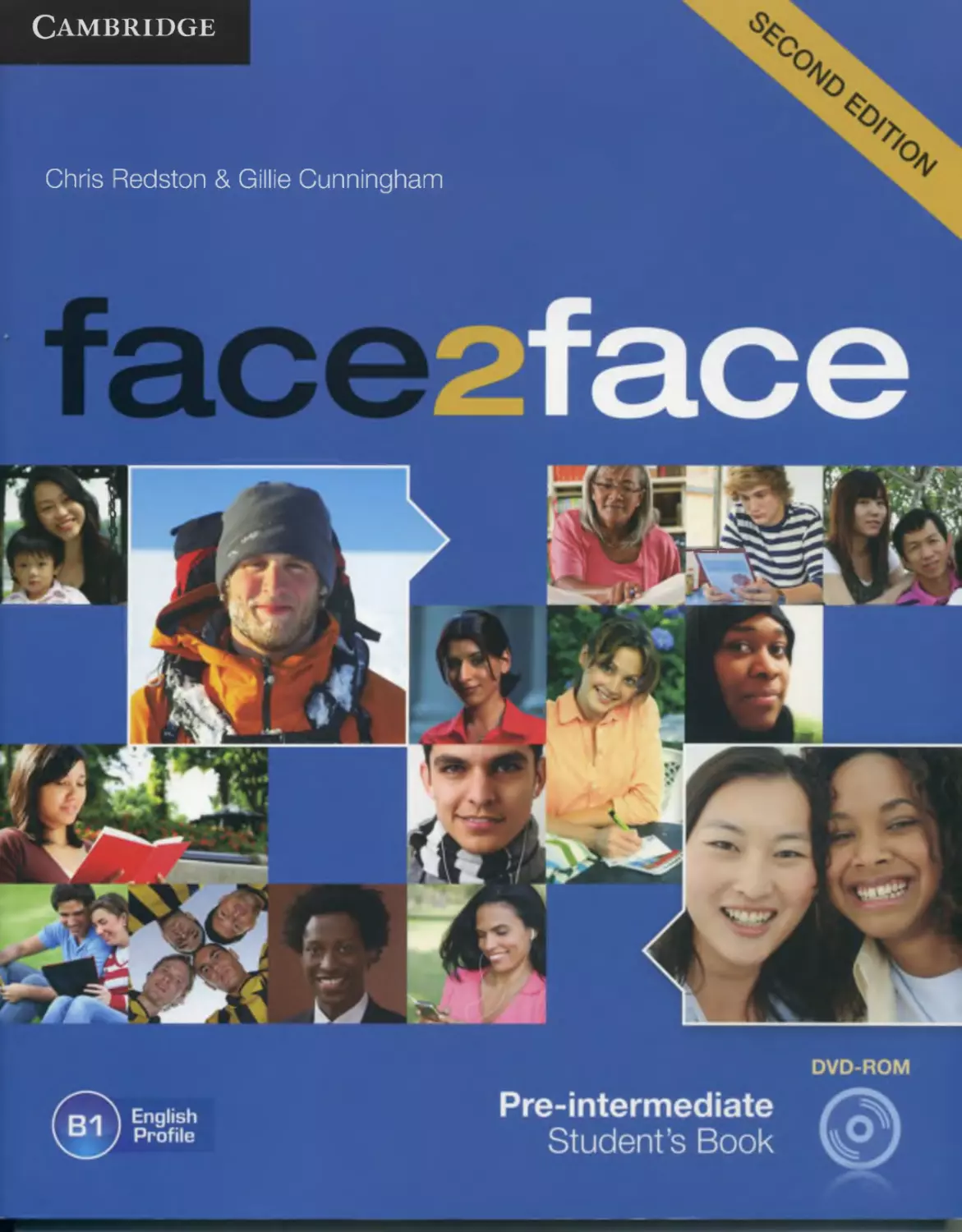


ISBN: 978-1-107-42207-0



Текст
C a m b r id g e
Chris Redston & Gillie Cunningham
CAMBRIDGE UN IV ERSIT Y PRESS
Cambridge, New York, Melbourne, M adrid, Cape Town,
Singapore, Sao Paulo, Delhi, Tokyo, Mexico City
Cambridge University Press
The Edinburgh Building, Cambridge CB2 8RU, UK
www. Cambridge, org
Information on this title: www.cambridge.org/9781107422070
© Cambridge University Press 2012
This publication is in copyright. Subject to statutory exception
and to the provisions of relevant collective licensing agreements,
no reproduction of any part may take place without the written
permission of Cambridge University Press.
First published 2012
Printed in the United Kingdom at the University Press, Cambridge
A catalogue recordfor this publication is availablefrom the British Library
ISBN
ISBN
ISBN
ISBN
ISBN
978-1-107-42207-0
978-1-107-60353-0
978-1-107-60352-3
978-1-107-63330-8
978-1-107-42209-4
Student’s Book with DVD-ROM
Workbook with Key
Workbook without Key
Teacher’s Book with DVD
Class Audio CDs
Cambridge University Press has no responsibility for the persistence or
accuracy of URLs for external or third-party internet websites referred to in
this publication, and does not guarantee that any content on such websites is,
or will remain, accurate or appropriate. Information regarding prices, travel
timetables and other factual information given in this work is correct at
the time of first printing but Cambridge University Press does not guarantee
the accuracy of such information thereafter.
Chris Redston & Gillie Cunningham
gg§ C a m b r i d g e
S M P U NIVERSITY PRESS
m
Contents
■
| Lesson
Vocabulary
Grammar
review of verb forms and questions
subject questions
1A
Life stories
p6
common phrases;
question words
1B
Super commuters
p8
collocations (1): work;
questions about travel
1C
Time off
plO
free time activities;
frequency adverbs and expressions
1D
Small talk
p12
E x tra P ra c tic e 1 a n d P ro g re s s P ortfolio 1
Real World
starting conversations; ending
conversations
p115
I
S e lf-stu d y D V D -R O M 1
2A
Beginnings
p14
past time phrases
Past Simple
2B
How we met
p16
relationships (1)
Past Continuous: positive and
negative, questions
2C
Coincidences
p18
adjectives (1);
connecting words (1)
2D
Internet dating
p20
finding things in common
........
E x tra P ra c tic e 2 a n d P ro g re s s P ortfolio 2 p116
Se lf-stu d y D V D -R O M 2
3A
Getting qualified
p22
employment
have to/had to: positive and negative,
questions and short answers
3B
Job-hunting
p24
looking for a job
Present Continuous and Present Simple;
activity and state verbs
3C
What a job!
p26
word building: noun endings
3D
I’m really sorry
p28
I
-------
apologies, reasons and promises
E x tra P ra c tic e 3 a n d P ro g re s s P ortfolio 3 p117
S e lf-stu d y D V D -R O M 3
4A
Lookalikes
p30
types of film;
past participles
Present Perfect for life experiences (1):
positive and negative
4B
My music
p32
types of music
Present Perfect for life experiences (2):
yes/no questions with ever
4C
TV or not TV?
p34
TV nouns and verbs;
-edand
adjectives
4D
What do you think?
p36
'—
.
asking for opinions, agreeing
and disagreeing
E x tra P ra c tic e 4 a n d P ro g r e s s P ortfolio 4 p118
S e lf-stu d y D V D -R O M 4
5A
A crowded planet
p38
the environment
will tor prediction; might
5B
Never too old
p40
collocations (2)
be going to; plans, hopes and ambitions
5C
Conservation works
p42
verbs and prepositions
5D
A charity event
p44
—
;
_
offers, suggestions and requests
E x tra P ra c tic e 5 a n d P ro g re s s Portfolio 5 p119
S e lf-stu d y D V D -R O M 5
6A
Teenagers
p46
adjectives (2); character
making comparisons: comparatives, a lot,
much, a bit, (not) a s ... as
6B
Roles people play
p48
relationships (2)
superlatives
6C
Family Business
p50
adjectives and prefixes (un-, in-, im-, dis-)
6D
Call me back
p52
E x tra P ra c tic e 6 a n d P ro g re s s Portfolio 6 p120
m
taking phone messages;
leaving phone messages
S e lf-stu d y D V D -R O M 6
Teacher’s DVD
J
2
Speaking
Listening and Video
Reading
Writing
Talking about myself
Another student's life
Celebrity profile: Jamie Oliver
Celebrity profile: Jamie Oliver
Questions with question words
People’s jobs
How I travel
Day-to-day life in my home
Help with Listening Word stress
Three commuters
Super Commuters 2
Subject and non-subject questions
My free time activities
A class free time survey
The British way of life?
A free time survey
Help with Listening Sentence stress (1)
The British way of life?
Sentences about my free time
A class free time survey
The last party I went to
Conversations at a party
E E S S h Matt and Carol’s party
A conversation at a party
HELP W IT H P R O N U N C IA T IO N The schwa / a / and word endings pl3
R e a d in g a n d W r i t in g P o r t f o l io 1 Staying in touch Workbook p64
Fast food
When did you la s t... ?
My special meal
The man behind KFC
The Michelin guides
A married couple I know
How Helen met Simon
How Ray met Claire
Help with Listening Weak forms (1): rasand were
An interesting story
The Girl from Petrovka
Help with Listening Weak forms (2): the schwa / a /
That’s incredible!
Internet dating
F i l - l j * Jackie’s first date
E H S F Jackie’s second date
An online profile
HELP W IT H P R O N U N C IA T IO N Past Simple: regular verbs p21
Things I have to do
Help with Listening have to and have
An interpreter and a paramedic
Past Simple questions
Sentences about me
R e a d in g a n d W r i t in g P o r t f o l io 2 An email with news Workbook p66
A referee’s training
Sentences about my job
Questions with have to
Letters to the editor
Unemployment
Find someone who ...
Jobs I'd like and hate
Unpopular jobs
Is that a real job?
Help with Listening Linking (1): consonant-vowel
A conversation about a difficult situation
t 'iI ■!=!•*■ A table for ten
I’m just doing my job!
A conversation about a difficult situation
HELP W IT H P R O N U N C IA T IO N Word stress (1) p29
R e a d in g a n d W ritin g P ortfolio 3 Applying for a job Workbook p68
My film-watching habits
The last film I saw
A famous face?
A Marilyn Monroe lookalike
My music
Interview with a rock star
Musical experiences
Three conversations
Help with Listening Linking (2): / w / sounds
Questions about TV
-etfand -ing questions
Are you a telly addict?
Help with Listening Linking (3): / r / and / ] / sounds
B E S F University education
Free education
Agree or disagree?
HELP W ITH P R O N U N C IA T IO N The final e p37
True and false sentences about my life
experiences
Questions with Have you ever... ?
A TV questionnaire
Kill your TV!
University education
R e a d in g a n d W ritin g P ortfolio 4 A great film Workbook p70
The environment
Life in the future
Our future - the Earth in 2030
Help with Listening 'IIand won't
Four people’s futures
Questions with Do you th in k... w ill... ?
Sentences with will, won't or might
Retirement
Find someone who ...
Retirement plans
Help with Listening going to
My plans, hopes and ambitions
Yes/No questions
My wildlife experiences
How to help the environment
Elephant corridors
Help with Listening Sentence stress (2)
Face-to-face with a gorilla
Charities
Organising a charity event
E E E sJ- A WWF charity event
A WWF charity event
HELP W IT H P R O N U N C IA T IO N The letter gp45
R e a d in g a n d W r i t in g P o r t f o l io 5 Which school? Workbook p72
Comparing me and someone I know
When I was a teenager
Living with the enemy
The roles I play in life
My family tree
Jake’s wedding
Soap operas
The next episode
Family Business Parts 1 and 2
Help with Listening Missing words
Using the phone
Taking and leaving messages
E E E E F Can I take a message?
HELP W IT H P R O N U N C IA T IO N The letter up53
Sentences comparing me and my family
Soap update: Family Business
A phone conversation
R e a d in g a n d W r i t in g P o r t f o l io 6 Writing notes Workbook p74
Lesson
Vocabulary
Grammar
7A
50 places to go
p54
travel
Present Continuous for future
arrangements
7B
What are you taking?
p56
things we take on holiday;
quantity phrases
quantifiers; possessive pronouns
7C
Wish you were here
p58
phrases with go
7D
It doesn’t work
p60
Real World
complaints and requests
E x tra P ra c tic e 7 a n d P ro g re s s P ortfolio 7 p121
C
S e lf-stu d y D V D -R O M 7
m
8A
Home sweet home
p62
describing your home
Present Perfect with for and since;
questions with How lo n g ... ?
8B
M eet the parents
p64
going to dinner
should, shouldn’t, must, mustn’t,
infinitive of purpose
8C
Cultural differences
p66
common verbs;
verb patterns
8D
What’s it like?
p68
adjectives (3)
E x tra P ra c tic e 8 a n d P ro g re s s P ortfolio 8 p122
questions with What... like?
I S e lf-stu d y D V D -R O M 8
9A
Problems, problems
p70
everyday problems
first conditional; future time clauses with
when, as soon as, before, after, until
9B
Sleepless nights
p72
adjectives (4): feelings
too, too much, too many, (not) enough
9C
Noisy neighbours
p74
phrasal verbs
9D
Invitations
p76
invitations and making arrangements
E x tra P ra c tic e 9 a n d P ro g re s s P ortfolio 9 p123
I Se lf-stu d y D V D -R O M 9
10A
The collectors
p78
verbs often used in the passive
Present Simple passive;
Past Simple passive
10B
Shopping trends
p80
words with some-, any-, no- and every(somebody, anything, etc.)
used to
10C
Fashion victims
p82
articles: a, an, the, no article
10D
It suits you
p84
clothes shopping
E x tra P ra ctic e 10 a nd P ro g re s s Portfolio 10 p124
what sales assistants say;
what customers say
S e lf-stu d y D V D -R O M 10
11A
Guess what?
p86
collocations (3)
Present Perfect for giving news with just,
yet and already
11B
Murder mystery
p88
crime
relative clauses with who, which, that and
where
11C
In the news
p90
guessing meaning from context
11D
Did you?
p92
echo questions
E x tra P ra ctice 11 a nd P ro g re s s Portfolio 11 p125
Se lf-stu d y D V D -R O M 11
12A
Working abroad
p94
money
reported speech
12B
Taking risks
p96
collocations (4); take and get
second conditional
12C
Graffiti
p98
connecting words (2):
first, next, then, etc.
End of Course Review
p101
E x tra P ra ctice 12 and P ro g re s s Portfolio 12 p126
Pair and Group Work pl02
I S e lf-stu d y D V D -R O M 12
Language Summaries p127
Audio and Video Scripts p153
■.
I
H P f liV s e e T e a c h e r’s DVD
Listening and Video
Reading
Writing
The top five holiday places
Find someone who ...
Holiday arrangements
A travel blog
A holiday itinerary
Sentences in the Present Continuous
Present Continuous questions
Going on holiday
Spot the difference
Packing for a holiday
Hotels
Questions with go
The world's most unusual hotels
Help with Listening Weak forms: review
Making a complaint
B E S J - At the hotel reception desk
Help with Listening Intonation (1)
HELP W ITH P R O N U N C IA T IO N Strong and weak forms p61
Describing my home
Talking about a friend
Questions with How lo n g ... ?
A lighthouse and a motorhome
Going to dinner
Places I've been to
Places to visit in my country
Advice on going to dinner
Help with Listening / t / at the end of words
Dinner with Sam’s parents
Personalised questions
Giving presents
Advice on giving presents
A town/city I know well
B B S k What’s Dublin like?
The world’s most unusual hotels
A conversation between a receptionist and
a hotel guest
R e a d in g a n d W ritin g Portfolio 7 Writing to complain Workbook p76
A lighthouse and a motorhome
Questions with How lo n g ... ? and
follow-up questions
Advice on going to dinner in my country
Tips on how to behave in my country
Culture shock!
R e a d in g a n d W r i t i n g P o r t f o li o 8 Studying abroad Workbook p78
HELP W ITH P R O N U N C IA T IO N Extra linking sounds p69
_ _
------
What will you do i f ... ?
Three problems
Jim’s business trip
First conditional questions
Children and babies
Problems and advice
New parents
Sentences about problems in my life
Problems in my neighbourhood
How to improve my town/city
Me and my neighbours
Help with Listening Fillers
Nightmare neighbours
Problems in my neighbourhood
How to improve my town/city
An invitation to dinner
Arrangements with other students
B H S J - Making arrangements
Help with Listening Intonation (2)
Dinner plans
An invitation to dinner
HELP W IT H P R O N U N C IA T IO N Long vowel sounds /s :/, / a : / and / y . / p77
R e a d in g a n d W r i t i n g P o r t f o li o 9 Getting advice Workbook p80
Buying and selling
A passive quiz
Memorabilia
The memorabilia business
The story of eBay
Shopping habits
When I was ten years old
Shopping now and then
Help with Listening usedto
Clothes
Gianni Versace
Shopping for clothes
Buying a jacket and trainers
t ' i i In a clothes shop
□
Questions in the passive
Sentences with used to/didn't use to
The Gucci story
Are you a fashion victim?
A conversation in a shop
R e a d in g a n d W r i t i n g P o r t f o li o 1 0 Giving an opinion Workbook p82
HELP W ITH P R O N U N C IA T IO N The letter cp85
. □
.
Getting ready to move house
I’ve just lost my job
Help with Listening Present Perfect or Past Simple
Who murdered Jack Miller?
Discussing the evidence
A murder in the village
The murder trial
My news habits
This week's news stories
Today’s news
Help with Listening Sentence stress: review
Using echo questions
D E H E } Four conversations
Help with Listening Intonation (3)
HELP W ITH P R O N U N C IA T IO N /a u /, / a u / and /D i/p 9 3
Things my partner told me
Echo questions
R e a d in g a n d W r i t i n g P o r t f o li o 11 Telling a story Workbook p84
Sentences about my life
Risk-taker
The history of graffiti
Banksy - graffiti artist
R e a d in g a n d W ritin g P ortfolio 12 What do you think? Workbook p86
HELP W ITH P R O N U N C IA T IO N Word stress (2) p100
Phonemic Symbols p167
Burglars caught by stolen laptop
I want to work abroad
He's wasting his money!
Help with Listening / h / at the beginning of words
Questions with take and get
Are you a risk-taker?
What would you do i f ... ?
Attitudes to graffiti
Artists or criminals?
Sentences about me or people I know
Three messages
Irregular Verb List p167
Self-study DVD-ROM Instructions p168
Vocabulary common phrases; question words
Grammar review of verb forms and questions
►Life stories
QUICK REVIEW Meeting new people
Introduce yourself to four other
students. Find out two things about
each person. Tell the class about two
people you spoke to.
Vocabulary and Speaking
C o m m o n p h ra s e s
Work in pairs. Are these phrases about
family (F), work (W), free time (FT) or
study (S)?
be married F
have children
go to school/college/university
have an interesting job
go to the cinema a lot
be unemployed
have brothers and/or sisters
play video games
work for a big/small company
chat to friends online
have a degree
go to concerts
work at the weekends
study another language
B
a Tick ( /) the phrases in 1 that are
true for you now or in the past.
b Work in groups. Tell other students
about yourself. Use the phrases from 1
and your own ideas.
I’m m arried and I have
three children.
How old are they?
Reading, Listening
and Speaking
□
a Write the names of three famous
British people. Why are they famous?
b Work in pairs. Compare names.
Who is the most famous person, do
you think?
£ ] a Look at the photos. Why is Jamie Oliver famous, do you think?
b Before you read, check these words with your teacher
a celebrity a chef a recipe a TV series a campaign
the government fresh ingredients the drums
c
Read and listen to the profile of Jamie Oliver. Then match
a-e to paragraphs 1-5.
a
b
c
d
e
Jamie’s early life
Campaigning for healthy food
A world-famous chef 1
Family and home life
A restaurant with a difference
CELEBRITY
PROFILE
Jamie Oliver
1
Jamie Oliver is one of the world's most famous chefs. You can watch him
on TV in over 100 countries and read his recipe books in 29 languages.
In fact, Jamie is the UK's second-biggest selling author of all time, after
JK Rowling. There are also Jamie Oliver DVDs, food products, restaurants,
magazines and apps for your phone.
Jamie was born in Essex, England, on 27th May 1975. When he was only
eight he started helping in the kitchen in his parents' pub. After Jamie left
college, he w orked at the famous River Cafe in London for three years. He
made his first TV series, The Naked Chef, in 1999. Jamie quickly became
a celebrity and in the same year he cooked lunch for the British Prime
Minister.
In 2001 Jamie opened a restaurant in London called Fifteen - but it wasn't
a typical restaurant. Jamie took 15 young unemployed people and taught
them to become chefs. The programme about the restaurant, Jamie's
Kitchen, was on TV every week and became a big success. Jamie now
has restaurants all over the UK and he is going to open restaurants in
Australia and other countries around the world in the next five years.
Jamie is also famous for his 'better food' campaigns. In 2005 he made
a TV series called Jamie's School Dinners because he wanted schools to
give children healthier meals. Because of Jamie's campaign, the British
government agreed to spend an extra £280 million on school meals. In
another series, Jamie's Ministry of Food, he helped people to stop eating
fast food and taught them to cook meals using fresh ingredients instead.
Jamie got married in June 2000 and he lives in London and Essex with his
wife, Jools, and their four children. He loves travelling, playing the drums
and riding around London on his scooter. At the moment Jamie is w ritin g
a new book of recipes, and when he's at home he enjoys relaxing with his
family - as well as cooking, of course!
U
a Read the profile again. Find the answ ers to
these questions.
1 How does Jamie travel around London?
By scooter.
H E L P W IT H G R A M M A R
R e v ie w o f v e rb fo rm s a n d q u e s tio n s
H
2
3
4
5
6
7
8
9
When did he make his first TV series?
What is he writing at the moment?
Which instrument can he play?
How often was Jamie’s Kitchen on TV?
How many children has he got?
Where is he going to open his new restaurants?
How long did he work at the River Cafe?
How old was Jamie when he got married?
10 Who did he make lunch for in 1999?
11 Why did he make Jamie’s School Dinners'?
12 How much did the British government agree
to spend on school meals?
a Match the words/phrases in bold in Jamie’s profile to
these verb forms.
Past Simple
Present Simple lives
Present Continuous
be going to
b Look at the table. Notice how we usually make questions.
Then write questions 2-4 from 5a in the table.
question
word
auxiliary
subject
verb
How
does
Jamie
travel
around London?
b Underline the question w ords in 5a.
c Look again at 5a. Answer these questions.
c Do the exercise in Language Sum m ary 1
1 Why don’t we use an auxiliary in question 5?
m r n m z m > Pi 27.
2 What is the verb in question 6?
3 Look at question 7. When do we use questions with be going to?
d Check in m
m
m
t P128.
a Make questions with these words.
1 live / Where / do / you ? Where do you live?
2
3
4
5
6
7
you / got / brothers and sisters / have / How many ?
studying / Why / you / are / English ?
Which / you / other languages / can / speak ?
favourite / ’s / restaurant / your / What / or cafe ?
What / do / you / last New Year’s Eve / did ?
going to / What / you / do / are / next weekend ?
b E 3 h 2 ■^:{iiiMikmhr■\7TiT71 Listen and check. Listen again and
practise.
c Work in pairs. Ask and answer the questions. Give more
information if possible.
Get ready ... Get it right!
□
Write eight questions to ask another student.
Use these ideas or your own.
• personal details • work
• family
• study
• home
• free time
u
• last holiday
• future plans
• studying English
a Work with a student you don’t know well. Take turns
to ask and answer your questions. Make notes on your
partner’s answers.
>
b Work in new pairs. Tell your new partner about the
person you talked to in 9a.
c Tell the class two things about the person you talked
to in 9a.
f l
1B
Vocabulary collocations (1): work;
questions about travel
Grammar subject questions
Super commuters
Q U IC K R EV IEW Q u e s tio n fo rm s
W o rk in p a irs . A s k a n d a n s w e r q u e s tio n s a b o u t
fa m ily, w o rk , fre e tim e o r s tu d y a n d fin d fo u r th in g s yo u have in c o m m o n .
Vocabulary and Speaking
WORK
C o llo c a t io n s (1): w o r k
Q j Work in pairs. Fill in the gaps in the diagram
with these words/phrases. Then check in
mmwmu* P127.
a restaurant children a fashion company
unemployed people an office an airline
a multinational a factory teenagers
disabled people a hospital
an engineering company volunteers
a hotel an advertising agency
HELP WITH LISTENING
W o rd s tre s s
•
in (+ places)
for (+ companies)
with (+ people)
a restaurant
a fashion company
children
£ 1 a Look at these questions about travel. Fill in the gaps
with these question words.
In words of two or more syllables, one syllable
always has the main stress.
How
restaurant children
fashion company
unemployed office
airline multinational
Listen and check.
E 3 * 5 ij;[iK[i|L
'[nr:V7Ti!?l Listen and practise the
phrases in 1. Copy the stress.
work in a restaurant
Q | a Write the names of four people you know
with jobs. Think of ways to describe their jobs.
Use phrases from 1 or your own ideas.
b Work in pairs. Tell your partner about these
people’s jobs. Ask follow-up questions. Who
has the most interesting job, do you think?
K>
How far
b Match questions 1-4 to answers a-d. Then check in
I'H M 'W illfrF P127.
a (It’s about) 10 kilometres,
b (I spend) about £45.
c (It takes) about half an hour,
d (I go) by train.
b Work in pairs. Where is the stress on these
words?
c
How much
do you get to work/university/school?
is it (from your home)?
does it take you (to get there)?
do you spend on travel a week?
Q[ a
3 Look at these words from 1. Listen
and notice the word stress.
factory teenagers
disabled hospital
engineering volunteers
hotel advertising
agency
How long
c Work in pairs. Take turns to ask questions 1-4 in 5a.
Answer for you.
Reading
m
a Read about the TV series Super Com m uters 2. What is it
about? What is ‘a commuter’, do you think?
b Read about the series again. Answer these questions.
1 When did Mick Benton live in Bangkok?
2 How far was it from his home to his office?
3
4
5
6
7
How long did it take him to get to work?
How long can people in Bangkok spend in traffic jams?
What does Gary do?
What kind of company does Sarah work for?
Where does Luke live?
:
B
•
*
*
•
•
I
•
Super Commuters 2
-----* ___ _
MICK BENTON'S excellent series
about commuters around the
world returns to our screens this
week. Mick had the idea for the
programme when he worked for
a TV company in Bangkok seven
years ago. He lived only four
kilometres from his office, but it
took him over two hours to get
to work every day. "The traffic
there is unbelievable," says Mick.
"People can sit in traffic jams for
seven or eight hours a day. They
even have their meals in their
cars!"
In the first programme of the new series, Mick interviews
three 'super commuters' who work in London. Gary Watson
is a lawyer for an American multinational and he travels from
York and back every day. Sarah Mead lives in Paris, but she
works for a fashion
company in London's
West End. And Luke
Anderson works for an
advertising agency in
the centre of London
- he commutes all
the way from Krakow,
in Poland. So maybe
your half-hour train
journey to work every
morning isn't so bad!
H E L P W IT H G R A M M A R S u b je c t q u e s tio n s
a Look at sentences a and b. Then answer
questions 1-4.
subject
verb
object
Mick Benton
made
the TV series.
subject
verb
preposition + noun
Sarah Mead
lives
in Paris.
1 Who made the TV series?
2 Who lives in Paris?
3 What did Mick Benton make?
4 Where does Sarah Mead live?
b W hich questions ask a bo ut the su bjects of
sentences a and b?
c How are the question fo rm s in 1 and 2 d ifferent
from the question fo rm s in 3 and 4?
:
d c h e c k in
e m im b k
P128.
H § W rite questions fo r the w o rd s in bold.
1
2
3
4
5
6
Mick worked in Bangkok. Who worked in Bangkok?
Mick worked in Bangkok.
Gary lives in York.
Sarah works in London.
Luke works for an advertising agency.
The programme starts at 9.30 p.m.
Listening and Speaking
a |2 » 2 ^ 6 Listen to three interviews from the TV
programme. Write one reason why Gary, Sarah and
Luke live a long way from work.
b Make questions. Use the Present Simple.
1 Who / leave / home at 6.45 a.m.?
Who leaves home at 6.45 a.m.?
2 How / Luke / travel / to work?
How does Luke travel to work?
3
4
5
6
7
8
Who / travel / to London twice a week?
How long / it / take / Luke to get to work?
Who / spend / £10,000 a year on travel?
Where / Sarah / stay / when she’s in London?
How much / Luke / usually spend / on a return flight?
Who / commute / to London five days a week?
c Work in pairs. Can you answer the questions in 9b?
d
Listen again and check.
Get ready ... Get it right!
2 2 Work in pairs. Student A p102. Student B p108.
VOCABULARY
1C AND SKILLS
I
Vocabulary free time activities;
frequency adverbs and expressions
Skills Reading: a magazine article;
Listening: a survey
Time off
Q U IC K R EV IEW P re s e n t S im p le q u e s tio n s
W o rk in g ro u p s . A s k q u e s tio n s to fin d o u t
w h o : g e ts u p firs t, ta k e s th e lo n g e s t to
g e t to c la ss, s p e n d s th e m o s t on tra ve l
a w e e k , w a tc h e s T V th e m o s t, g o e s to
Whattimedoyougetup?
BA
taboutseven. Whataboutyou?
b e d last. A
Reading and Listening
B
a How do people in the UK spend their free time, do you think?
b Read the article. Guess the correct answers a-r.
c
Listen and check your answers. Do you think any of
the answers are surprising?
Vocabulary and Speaking
F re e t im e a c t iv it ie s
d
a Look at these free time activities. Then
fill in the gaps in sentences 1-4 with the
words in bold.
do yoga play volleyball
go cycling go to the theatre
We use
We use
other games.
We use
We use
or health club.
with words that end in -ing.
with sports with a ball and
with places and events,
with things you do in a gym
b Match these words/phrases to do, play ,
go or go to. Check in VOCABULARY 1.4 p127.
museums running
basketball judo
art galleries skateboarding
•
•
cards diving pilates
concerts/gigs mountain biking
the gym table tennis
gymnastics fistivals chess
A new survey on the free tim e and
shopping habits of British people is
published this week - and it shows
that w e s till love football, going to
pubs, watching TV and eating fish
and chips! Here are some of the
results from the survey.
The British are always happy when they're
socialising. 55% o iamen/womenand 44%
o fbmen/women go to a bar or pub with their
friends every week.
About c20%/30% of adults go to a festival or
a concert at least once a year and d20%>/30%
go to the theatre. About 25% go to a museum
or an art gallery.
British people generally watch TV for about
ethreelfour hours every day-and about
f25%o/45%o of men have dinner and watch TV
atthe same time!
The average British person spends more than $15/22 hours online
every month, and a '"half/quarter of thattime is on social networking
sites like Facebook and Twitter.
TIP • In these vocabulary boxes we only show
the main stress in words and phrases.
c Work in pairs. Can you think of any
'More/Less than half of all adults in the UK do some sport every month.
About*7%/75% of British people go swimming and k7%/75% play football
- but 32% watch football on TV once or tw ic e a week.
more words/phrases that go with do, play,
go or go to ?
British people normally go on holiday once a year, but ^10%/20% of
people have two or more holidays a year. The most popular holiday
destination is mSpain/France.
Work in the same pairs. Ask questions
with Do you e v e r... ?. Find four things that
you both do in your free time. Use phrases
from 1 or your own ideas. Ask follow-up
questions if possible.
n30%/46% of adults go to a McDonald's restaurant every three months,
but °30%/46% go to a traditional fish
Do you ever go to art galleries?
Yes, sometimes./No, I don’t.
and chip shop.
o The British spend about£48 million
on ptea/coffee and £56 million on
^tea/coffee every month.
I c And every British person eats
r7//0kg of chocolate every year
- more than any other country in
the world!
HELP WITH V O C A B U L A R Y
F re q u e n c y a d v e rb s a n d e x p re s s io n s
a Put these frequency adverbs in order.
hardly ever always 1 never
sometimes occa*sionally often
usually/normally/generally 2
b Look at the frequency adverbs in blue
in the article. Then complete the rules with
before or after.
• Frequency adverbs go
the verb be.
• Frequency adverbs go
other verbs.
c Put these frequency expressions in order.
Listening and Speaking
Q
twice a day 1 once every three months
three times a week every Saturday
once a month once or twice a year 7
every couple of weeks
a
A researcher is interviewing Robert for this year’s
British free time survey. Listen and fill in the form.
Free time survey
d
Look at the frequency expressions in
pink in the article. Then choose the correct
phrase in the rule.
ACTIVITY
go to a bar o r a pub
• We usually put frequency expressions before
the verb/at the end of the sentence or clause.
e Check in i m s m
m
go to the theatre
go to museums o r a rt galleries
p127.
watch TV
a Make sentences with these words.
do sport
1 running / go / sometimes / Sundays / on / 1 .
go on holiday
I sometimes go running on Sundays.
2 do / a week / normally / or twice / We /
once / yoga .
3 months / 1/ every / go to / once / six /
the dentist.
4 is / on / home / Sundays / Alexander /
generally / a t.
5 of weeks / every / goes / diving / Carly /
couple.
6 are / in January / always / parents / My /
on holiday.
7 I / two / an art gallery / times / go to /
or three / a year.
8 volleyball / play / occasionally / at / We /
the weekend .
9 a year / my / 1/ or twice / grandparents /
once / see .
b Write five sentences about your free
time activities. Use frequency adverbs and
expressions from 4a and 4c.
I go to gigs once or twice a month.
c Work in groups. Take turns to say your
sentences. Do you do the same things?
HOW OFTEN?
b Work in pairs. Compare Robert’s answers with the
newspaper article. In what ways is he a typical British person?
I
Q
H E L P W IT H L IS T E N IN G S e n te n c e s tr e s s (1)
a
Listen to the beginning of the interview again. Notice
the stress in these sentences.
• We’re doing a survey on the free time habits o f
British people.
* Can I ask you a few questions?
•
How often do you go to a bar or a pub?
* b Look at Audio Script BEDh® p153. Listen
I the sentence stress.
Q
again and follow
a Work in pairs. Write your own free time survey. Write at least
six questions.
1 How often do you watch sport on TV?
b Work in groups of five or six. Take turns to ask your
questions. Find out who does the things in your survey
most often.
c Tell the class the results of your survey.
IB
Real World starting
conversations; ending
conversations
Q U IC K R EV IEW Free tim e a c tiv itie s W rite y o u r
fo u r fa v o u rite fre e tim e a c tiv itie s on a p ie c e o f pap er.
W o rk in p a irs . S w a p p a p e rs . G u e ss h o w o fte n y o u r
p a rtn e r d o e s th e s e a c tiv itie s . T he n a s k q u e s tio n s
w ith
Howoften... ?
to c h e c k y o u r g u e s s e s .
Work in groups. Tell your partner about the last party
you went to. Ask follow-up questions.
|t| a
Matt and Carol are having a
party. Look at photos A-C. Then watch or listen and
choose the correct words.
1
2
3
4
5
6
Matt is Carol’s brother/(^usban3)
Natalia is from Spain/Brazil.
Ben works with Matt/Carol.
Jackie is Matt and Carol’s neighbour/boss.
Liam is a lawyer/an accountant.
Amy is Carol’s sister/cousin.
b Watch or listen again. Tick the true sentences.
Correct the false sentences.
two
1 Natalia started her new job three weeks ago.
2 She goes back to Spain about four times a year.
3 Ben lives near a park.
4 Jackie is a manager of a French restaurant.
5 Liam and Amy met at Carol and Matt’s wedding.
6 Carol and Amy work for the same company.
R E A L W O R L D S ta r tin g c o n v e rs a tio n s
II
a Match these questions from the conversations to
the reasons we ask them a-d.
1 Do you know (David)?
2
3
4
5
6
7
8
Where are you from?
Whereabouts (in Spain)?
How do you know (Matt and Carol)?
Do you live near here?
Are you a friend of (Matt’s)?
What do you do?
Didn’t we meet at (Carol and Matt’s
wedding)?
9 You're (a lawyer), aren’t you?
10 How do you two know each other?
a
b
c
d
people you know now 1
where people are from or live
meeting people in the past
people’s jobs
b Check in
m
P128.
HELP WITH PRONUNCIATION
2 }1 0 E M K S M I Listen and practise the
sentences in 3a. Copy the stress.
T h e s c h w a / a / a n d w o rd e n d in g s
Do you know David?
U
11 Watch or listen to the ends of the
conversations. Fill in the gaps with the correct names.
1
2
3
4
5
6
!
•
a |3 3 3 h 13 Listen to these words. We say the blue
letters with a schwa /a/. Is the schwa stressed?
company exercise
children motorbike
Matt needs to talk to another guest.
suggests meeting up in the future.
gives someone a business card.
wants to talk to Matt about something.
goes to say hello to an old friend.
and
go to get some food.
&
B
!
2 A
•
B
•
;
|
.
•
•
J
!
3A
B
4 A
B
5 A
B
It was very nice to meet you.
You too.
We
get together sometime.
Yes, that’s a good idea.
Nice
you.
You too.
you later, maybe.
Yes, see you.
It’s
to see you again.
And you.
J b Check in ITTTTiESEEE}- pi28 .
Q B 3 |1 2
Listen and practise the
questions and responses in 6a. Copy the stress.
It was very nice to meet you.
You to‘o.
Q a Work in pairs. Write a conversation at Matt and
Carol’s party between two people who don’t know
each other. Use the phrases in bold from 3a and the
sentences from 6a.
hospital often commuter (factory)
question college doctor teenager
company multinational lawyer yoga
festival cinema married competition
actor open windsurfing director
station banana never normally
b I2EDH4 Listen and check. Listen again
and practise.
•
1A
interesting
agency
a Look at the underlined endings in these words.
Which does not have a schwa?
1
2
3
4
5
6
[j| a Look at these ways to end a conversation. Fill in the
'• gaps with these words.
•
Imeet See should
!great meeting
J
correct
machine
b Listen again and practise.
REAL WORLD E n d in g c o n v e rs a tio n s
j
police
away
m
a Look again at 2a. Match the words with a schwa
in the final syllable to these endings.
-al hospital
-en
-er
-or
-ion
-a
b Work in pairs. Can you think of six more twoor three-syllable words with the endings in 3a ?
continue2learn
Vocabulary, G ram m ar and Real W orld
■ Extra Practice 1 and Progress Portfolio 1 p115
■ Language Summary 1 p127
■ 1A -D Workbook p5
■ Self-study DVD-ROM 1 with Review Video
b Practise the conversation with your partner until
you can remember it.
c Work in groups of four. Take turns to role-play
your conversations. What do the people have in
common?
H Imagine there’s a party in your classroom. Have
conversations with four students.
R eading and W riting
■ Portfolio 1 Staying in touch Workbook p64
Reading a personal letter
Writing a letter to a friend
Beginnings
Q U IC K R EV IEW S ta r tin g a n d e n d in g
c o n v e rs a tio n s
Vocabulary past time phrases
Grammar Past Simple
— = 6$
www.chickeninfo.net/kfc
W rite s ix s e n te n c e s
th a t yo u ca n sa y to s ta rt a nd e nd
Howdoyou
knowMatt?Nicemeetingyou.,
c o n v e rs a tio n s a t a p a rty :
e tc.
W o rk in p a irs . C o m p a re s e n te n c e s .
Speaking and Reading
0 1 Work in groups. Discuss these questions.
1 What fast food companies are there in
your country? What food do they sell?
2 What are the good and bad things about
fast food?
3 How often do you go to a fast food
restaurant? What do you usually have
to eat and drink?
4 When you’re in a different town or city,
how do you decide where to eat?
Before you read, check these
words/phrases with your teacher.
a
a service station serve someone
develop a secret recipe
b Read the article about Harland
Sanders. Put these events in order.
a He travelled 250,000 miles a year,
b His father died.
c He became the manager of a service
station.
d He sold the KFC company,
e He was born in 1890. 1
f He developed his secret recipe,
g He learned to cook,
h He moved to a restaurant across the
street.
Read the article again. Then answer
these questions.
c
a Why did Harland Sanders learn to cook?
b How long did it take him to develop his
secret recipe?
c When did the first official KFC restaurant
open?
d How old was Harland Sanders when he
sold the company?
e What happened in 1980?
f Who bought KFC in 1986?
d Work in pairs. Compare answers.
T h e m a n b e h in d K F C
H arland Sanders was born in the U S A in
1890, but his childhood w a sn ’t a happy
one. H is father died w hen he was only six.
His mother d id n ’t have m uch money so she
needed to find a job. She w e n t to w ork in a
shirt factory and H arland stayed at home
to look after his younger brother and sister.
That was when he first learned to cook.
H e le ft home w hen he was twelve and
w orked on a nearby farm. After that he
had a lot of different jobs and in 1930 he
became the manager o f a service station in Corbin, Kentucky. He
started cooking meals for hungry travellers w ho stopped at the service
station, and soon people came only for the food. H arland c o u ld n ’t
serve everybody because the place was too small. So he decided to
move to a 142-seat restaurant across the street where he co u ld serve
all his customers. O ve r the next nine years he developed the secret
chicken recipe that made him famous.
The first official K entucky Fried Chicken restaurant d id n ’t open
until A ugust 1952 and by 1964
there were more than 600 K F C s in
N orth America. That year Sanders
sold the com pany for $2 million,
b ut he continued to w ork as K F C ’s
public spokesman and visited
restaurants all over the world. He
travelled 250,000 miles every year
until he died in 1980, aged 90. Six
years later, PepsiCo bought K F C
for $840 million.
There are now K F C restaurants
in more than 110 countries round
the world and K F C has 12 m illion
customers every day —but the
recipe is still a secret!
:
H E L P W IT H G R A M M A R
P a s t S im p le
Qj a Look at the
verbsinbold in the article.
Which are Past Simple positive forms of 1-4?
Which are Past Simple negative forms of 1-4?
1 regular verbs
2 irregular verbs
• 3be
* 4can
J
;
I
In 1889 two brothers, Andre and Edouard
Michelin,1 started (start) the Michelin company
in France. They 2
(develop) a new tyre
for bicycles and then they 3
(make) and
4
(sell) tyres for cars.
b Look again at the verbs in bold in the article.
Answer these questions.
1 How do we make the Past Simple positive of
regular verbs? Is there a rule for irregular verbs?
2 How do we make the Past Simple negative?
What are the Past Simple negative forms of be
and can?
In 1900 there 5
(be) about 3,000 cars in France and
people 6
(want) to travel around the country. But
travelling by car in those days7
(not be) easy. People
8
(not have) road maps so they9
(can not)
plan their journeys and they 10
(not know) where they
11
(can) find service stations or restaurants.
TIP • There is an Irregular Verb List on p167.
Of course, the Michelin brothers12
(want) people to
travel more because they 13
(need) to sell more tyres.
They 14
(write) the first Michelin guide in 1900, but the
famous star system 15
(not start) until 1926.
c Look at the questions in 2c. Then answer
these questions.
1 How do we usually make Past Simple questions?
2 How do we make Past Simple questions with
the verb be?
3 How are questions e and f different from
questions a-c?
Michelin now sells over
20 million guide books
and maps in more than
70 countries. There
are only 81 three-star
restaurants in the
world and 26 of them
are in France.
d Check in i d iM 'M I I K P130.
Q
a Find the Past Simple of these verbs in the
article about KFC.
die need work have become
start
stop come decide develop
make
sell continue visit travel buy
b Work in pairs. Compare answers. Which are
regular? Which are irregular?
a Read about how the Michelin Guides
started. Fill in the gaps with the Past Simple
of the verbs in brackets.
Get ready ... Get it right!
§U Think about the last time you had a special meal.
Make notes on the meal. Use these ideas.
•
reason for the meal
• where and when you had the meal
b Work in pairs. Compare answers.
• the people at the meal
• what time it started and finished
Vocabulary and Speaking
• what you wore
P a s t tim e p h r a s e s
• the food and drink
{•] a Put these past time phrases in order.
• any other interesting information
in 1900 in the sixties yesterday evening 8
last week the day before yesterday
eighty years ago in the nineteenth century 1
in July last year
Q
>
a Work in pairs. Talk about your special meals. Ask
questions to find out more information.
My special meal was for
my birthday last month.
Where did you have it?
b When do we use ago, last and in? Check in
m m m m u *P129.
|f
Work in pairs. Student A p103. Student B p109.
b Tell the class about your partner’s special meal. Did
anyone not enjoy their meal? Why not?
ia
Vocabulary relationships (1)
How we met
Q U IC K R EV IEW P a s t S im p le
Grammar Past Continuous:
positive and negative, questions
M a ke a lis t o f
fiv e th in g s yo u d id la s t w e e k . W o rk in g ro u p s
o r m o ve a ro u n d th e c la s s . A s k q u e s tio n s
w ith D id y o u ... ? a nd tr y to fin d o n e s tu d e n t
w h o d id e a ch th in g on y o u r list.
Listening and Speaking
Q
a Look at the photos. Where are the people,
do you think?
b
Match sentences 1-3 to photos A-C.
1
I was travelling back from China and we met
on the plane.
2 We first met when she w as renting a room
in my sister’s flat.
3 We w ere standing at a bus stop and he
said hello.
c 1 3 ^ ^ 1 5 Listen and check.
a Helen is talking about how she met Simon. Choose the
correct verb forms.
HELP WITH G R A M M A R
1
I first(me?)/was meeting Simon when we waited/were waiting for
a bus.
2 It rained/was raining and he offered/was offering me his umbrella.
3 While we sat/were sitting on the bus, he gave/was giving me
his business card.
4 But when I got/was getting home I couldn’t find the card
anywhere.
P a s t C o n tin u o u s : p o s itiv e a n d n e g a tiv e
Q
a Look at this sentence. Then answer the
questions.
I was tra ve llin g back from China and we
m et on the plane.
1
2
3
4
5
Which action started first?
Which action was shorter?
Which action was longer?
Did the ‘travelling’ continue after they met?
Which verb is in the Past Simple and which is
in the Past Continuous?
b Complete Helen’s story. Put the verbs in brackets in the
Past Simple or Past Continuous.
5 A week later I was walking (walk) to the bus stop after work
and I
(see) him in the street.
6 He
_ (talk) to a woman so I
(not say) hello.
7 But while I
(wait) for my bus, a car
(stop)
next to me. It was Simon.
8 He
(offer) to drive me home and I
(invite)
him in for a coffee. That
(be) 22 years ago!
b Fill in the gaps for the Past Continuous
with was, wasn’t, were or w eren’t.
POSITIVE
l/he/she/it +
you/we/they +
+ verb+Zng
+ verb+Zng
NEGATIVE
l/he/she/it +
you/we/they +
c
Q
Check in EE
+ verb+/'ng
+ verb+ing
•T O p130.
1 ^ 3 ^ 1 6 PRONUNCIATION
Copy the stress.
Listen and practise.
travelling back from China -*
I was /w a z / travelling back from China -*
I was /w a z / travelling back from China and
we m et on the plane.
c
Listen and check.
Vocabulary
m
R e la t io n s h ip s (1)
a Work in pairs.
iairs. Tick the phrases you know. Then check in
------------ m EK p129.
go out with someone get engaged to someone
ask someone out get married to someone
fall in love with someone meet someone for the first time
break up with someone go on a date get divorced
b Work in pairs. Put the phrases in 5 a in order. There is more
than one possible order.
HELP WITH LISTENING
W e a k fo r m s (1):
was were
and
a
Listen to the two different ways to
say was and were.
strong
weak
was
/WDZ/
/W3Z/
were
/w 3:/
/w a /
b Look at Audio Script
p154. Listen
again and notice how we say was and were.
Are was and were usually strong or weak in:
sentences? questions? short answers?
H E L P W IT H G R A M M A R
P a s t C o n tin u o u s : q u e s tio n s
Look at questions 4 and 5 in 6b. Then fill in
the gaps in the rule.
• We make Past Continuous questions with:
question word +
or
+ subject +
GRAMMAR 2.3
|H
p131
Work in pairs. Student A p103. Student B
p109.
Get ready ... Get it right!
|0
Choose a married couple you know
well (you and your husband/wife, your
parents, other relatives or friends). Make
notes on the couple. Use these ideas.
• when, where and how they met
• where they went on their first date
•
how long they went out together before
they got married
• when they got engaged
• when and where they got married
Listening and Speaking
Q
a 1320^18 Ray is talking to a friend about how he met his
wife, Claire. Listen and choose the correct answers.
1
2
3
4
5
Ray first met Claire in France/England.
She was working in a language school/a museum shop.
They met every day in a park/a cafe.
Ray went to the airport/station with Claire.
After they said goodbye, Ray took a plane/train to Paris.
• any other interesting or funny information
|Q
a Work in groups. Tell other students
about the couple you chose. Ask
questions to find out more information.
My parents first met at work.
Where were they living at the time?
b Listen again and answer the questions.
1 Why wasn’t Claire speaking much English at work?
2
3
4
5
How long did Ray practise French with Claire each day?
Why didn’t Ray ask Claire out?
What were they doing when Ray gave Claire a present?
What was Ray doing when Claire arrived home in Paris?
In M adrid. They were working for a ...
b Which story is the most romantic,
the most unusual or the funniest?
>
Vocabulary adjectives (1); connecting
VOCABULARY
2 C AND SKILLS
oincidences
words (1)
Skills Reading: a magazine article;
Listening: a story
Q U IC K R EV IEW P a s t C o n tin u o u s W rite fiv e
d iffe re n t tim e s o f th e day. W o rk in p a irs . A s k w h a t
y o u r p a rtn e r w a s d o in g a t th e s e tim e s y e s te rd a y :
Whatwereyoudoingat8.30a.m.yesterday?
I drivingtowork.
A
B w as
Reading
Q | a What i s ‘a coincidence’ ? Do you know any
interesting stories about coincidences? If so, tell
the class.
b Before you read, check these words with
your teacher.
sink (Past Simple: sank) a survivor drown
a restaurant owner shoot (Past Simple: shot)
an accident
c Read the article. Then match coincidences 1-3
to pictures A-C.
a Read coincidences 1-3 again and answer the
questions.
1 Who nearly drowned in the sea in 1965? Who
saved him?
2 What happened at the same beach nine years later?
3 What do the stories about people called Hugh
Williams have in common?
4 Did the two survivors in 1940 know each other?
5 What did King Umberto I and the restaurant owner
have in common? Find at least four things.
b Work in pairs. Which coincidence do you think is
the most surprising? Why?
Vocabulary
m
A d je c t iv e s (1)
a Work in new pairs. Try to match the adjectives in
bold in the article to definitions a-e. Then check in
pi29.
wmm»
a very surprising
amazing
b you don’t expect it to happen
unlucky or having a bad result
d very difficult to believe
e very unusual
c
b Work in pairs. Test your partner.
very surprising
E t
amazing
Many of us experience strange coincidences at some time
in our lives. For example, we might meet people we know in
the most unexpected places. Perhaps when we’re on holiday,
thousands of miles from home, we suddenly see our neighbour on
the beach. In fact, this type of coincidence is quite common, but
there are some coincidences which are really incredible. Here are
three of the strangest.
An unbelievable coincidence happened on a beach near Salem, USA.
In 1965 a woman called Alice Blaise saved a four-year-old child from
drowning in the sea. The boy’s name was Roger Lausier. In 1974, on the
same beach, Roger saved a man from drowning. The man he saved was
Alice Blaise’s husband.
If you’re travelling by boat, the luckiest name to have is Hugh Williams.
On 5th December 1660, a boat sank near Dover, England. There was
just one survivor - a man called Hugh Williams. On 5th December 1767,
another boat sank in the same area and the only survivor was another
man called Hugh Williams. On 8thAugust 1820, a boat sank on the
River Thames and there was only one survivor - his name was also Hugh
Williams. The next extraordinary coincidence in this story happened on
10thJuly 1940. A man and his uncle were the only survivors after afishing
boat sank out at sea. They were both called Hugh Williams.
In the nineteenth century King Umberto I of Italy went to a small
restaurant in Monza for dinner. The King noticed that he and the owner
of the restaurant looked exactly like each other. They began talking and
discovered some amazing coincidences. They were both born in the
same town on the same day, 14th March 1844, and they both had wives
called Margherita. Also Umberto became king on the same day that the
restaurant owner opened his restaurant. However, there was one last
unfortunate coincidence. On 29th July 1900, the restaurant owner died
in a shooting accident. While someone was telling King Umberto I about
this, a man shot and killed the king.
HELP WITH VOCABULARY
C o n n e c tin g w o r d s (1)
□
a Look at sentences 1-5. Then fill in the gaps in the
rules with the words in bold.
1
2
3
4
5
Hopkins wanted to read the book so he went to London
to buy a copy.
W hile he was waiting for his train home, he saw a book
on a seat near him.
They didn’t start making the film until two years later.
When they were filming in Vienna, George Feifer came
to visit the actors.
Feifer didn’t have his personal copy of the book
because a friend lost it.
• We use until to say something starts or stops at
this time.
Anthony Hopkins
Listening and Speaking
Q
looking for?
2 Why was George Feifer surprised at the end of
the story?
b Work in pairs. Try to put these things in order.
Then listen again and check.
a Anthony Hopkins got a part in a film called The Girl
g
h
:
□
Choose the correct words.
1 The four-year-old boy didn’t drown until/because Alice
saved him.
2 While/So Roger was walking along the beach, he saw
someone in trouble in the sea.
3 Hugh Williams didn’t drown when/until the boat sank.
4 King Umberto I died so/because someone shot him.
5 While/Until the king and the restaurant owner were
talking, they discovered some amazing coincidences.
6 Anthony Hopkins didn’t know George Feifer’s book
so/because he wanted to buy a copy.
7 Hopkins didn’t have a copy of the book while/until he
found one at the station.
He went to Vienna to make the film,
He met George Feifer, the author of the book,
He went to London to get a copy of the book,
He went to the station to go home,
He couldn’t find the book he wanted,
The book was Feifer’s personal copy.
HELP WITH LISTENING
W e a k fo rm s (2): th e s c h w a /a /
m
•
U
for things that
b Check in iw C T E rcrc iv pi29.
b He found a copy of the book on a seat,
f
to give the result of something.
Ho was waiting for his train home while he saw a book on
tho scat near him.
from Petrovka. 1
d
• We use
TIP • When a long action and a short action happen at
the same time, we can’t use while with the Past Simple:
1 Where did Anthony Hopkins find the book he was
e
to give the reason for something.
• Wo can use
and
happen at the same time.
a |^ 2 J -2 0 Listen to an amazing story about the
actor Anthony Hopkins and the author George Feifer.
Answer these questions.
c
• We use
a
Listen to the difference between the
strong and weak forms of these words. Notice the
schwa /a / in these weak forms.
strong
weak
strong
weak
and
/a n d /
/a n /
was
/W D Z/
/w a z /
to
/ t u :/
/ta /
were
/W 3 :/
/w a /
of
/DV/
/a v /
from
/fro m /
/fr a m /
b Look at Audio Script | J j ^ 2 0 p154. Listen again.
Notice the sentence stress and weak forms. Do we
stress weak forms?
a Think of an interesting story that happened to you
or someone you know. Make notes on these things.
• the people in the story
• when and where it happened
• what happened first
• the main events of the story
• what happens at the end
b Work in groups. Take turns to tell your stories.
Which story is the most interesting?
This story happened when my sister and I were kids.
One day, while we were playing in the park ...
~~y
n
2D
□ REAL
WORLD
Real World finding
things in common
QUICK REVIEW Connecting words (1) W o rk in
^
^
w w w .m atchonline.com /jackie23
p a irs . W h a t d o yo u re m e m b e r a b o u t th e s e p e o p le :
match Online Profile
R o g e r L ausier, H ug h W illia m s , K in g U m b e rto I,
A n th o n y H o p k in s ? Take tu rn s to te ll e a ch o th e r
a b o u t e a ch c o in c id e n c e . U se
when because
and
Q
until,while,
so,
if p o s s ib le .
Work in groups. Discuss these questions.
1
Do you think internet dating is a good idea?
Why?/Why not?
2 Do you know anyone who met their partner on the
internet? If so, tell the group about them.
3 Is internet dating popular in your country?
Why?/Why not?
Q
a Read Jackie’s profile on the website. Are these
sentences true or false?
1 Jackie is very tall. F
2
3
4
5
6
She is definitely looking for a husband.
She always goes out in the evenings.
She doesn’t do any sport.
Her ideal man can be younger or older than her.
She doesn’t want her date to live far away.
%
Name Jackie
Location Bristol
Age 31
Height 169 cm
Relationship status Single
Job Restaurant manager
Looking for Friendship and maybe more
Wants children Ask me later!
About me
When I'm not working, I really enjoy going out and meeting people.
But I also like staying at home and cooking dinner for my friends.
I love tennis and I do judo. I'm fun-loving and I'm generally happy
with my life, but I would like to share it with someone special.
My ideal match
He's got an interesting job, but life isn't only about work - he has
time to play too. He's between 28 and 38 years old. He enjoys eating
good food and having fun. He lives in or near Bristol.
b Work in pairs. Compare answers.
Q
a
E 3 f r 2 2 Jackie has two dates.
Look at photo A. Then watch or listen to her date
with Damon. Put these things in the order you
hear them.
a holiday in Japan
b cooking
c feeling nervous 1
d working in the evening
e online Japanese courses
a
b ^ ^ 2 ^ 2 . 2 EED h23 Look at Ph° t° B. Then
watch or listen to Jackie’s date with Kevin. Put
these things in the order you hear them.
eating meat
b dogs
c tennis
d looking after children
e judo
a
c Watch or listen to both conversations again.
Which of the things in 3 a and 3 b does Jackie
have in common with each man?
d Who does Jackie want to see again, do you
think? Why?
I
HELP WITH PRONUNCIATION
REAL WORLD F in d in g th in g s in c o m m o n
P a s t S im p le : re g u la r v e rb s
Q a Look at these sentences and responses. Then
answer questions 1 and 2.
A
I
A
I
really love cooking.
don’t go out much in the week.
B
B
a Work in pairs. How do we say the Past Simple
forms of these regular verbs?
So do I.
Nor do I.
want
visit
travel
1 Is person B saying ‘it’s the same for me’ or ‘it’s different
for me’?
2 When do we use So?. When do we use A/or?
b I ^ J - 2 6 Listen and check. Which Past Simple
forms end with the sound /id /?
b Look at these sentences and responses. Is person B
saying ‘it’s the same for me’ or ‘it’s different for me’?
A
A
I’m quite a good tennis player.
I didn’t do much sport at school.
Oh, I’m not.
Oh, I did.
B
B
TIP • When a regular verb ends in / t / or /d/, -ed is
pronounced /id /.
c Listen again and practise.
c Fill in the gaps in the table with these responses.
So did I.
Nor did I.
Oh, I’m not.
Nor am I.
So do I. Oh, I didn’t.
d Work in pairs. Take turns to say a verb from 1a.
Your partner says the Past Simple form.
Oh, I am.
Oh, I do.
Q
it’s the same it’s different
for me
for me
1 I’m a bit nervous.
So am I.
2 I’m not hungry.
Oh, I don’t.
3 I love children.
4 I don’t eat meat.
Nor do I.
5 I went to Japan last year.
Oh, I did.
6 I didn’t want to come home.
offer need decide move start stay
stop open close wait continue like
develop hate learn work love
a 12 33 ^ 2 7 Listen and circle the sentence you hear
first, a or b.
1
a I decide on Monday.
2
a We work all night.
3
a They like Istanbul.
4
a They stay at a hotel.
5
a I need some money.
6
a They close at ten.
©
b
b
b
b
b
I decided on Monday,
We worked all night,
They liked Istanbul,
They stayed at a hotel,
I needed some money,
They closed at ten.
b Listen again and practise.
TIP • We can say Nor or Neither: Neither am /., Neither do /.,
Neither did /., etc.
d Check in
continue2learn
P131.
JJ-24 m;i'K'nn’iHn7Ti7!l Listen and practise the
responses in 4c. Copy the stress.
So am I.
Q
■ Extra Practice 2 and Progress Portfolio 2 p116
Oh, I ’m not.
■ Language Summary 2 p129
Write two responses to each sentence.
I’m quite tired.
So am I./Oh, I’m not.
I don’t like fish.
I hate getting up early.
V ocabulary, G ram m ar and Real W orld
4
5
6
7
I went away last weekend.
I’m not from this town.
I didn’t sleep well last night.
I don’t play video games.
■ 2A-D Workbook p10
• Self-study DVD-ROM 2 with Review Video
[ ^ 2 5 Listen to six sentences and say it’s the same
for you. Listen again and say it’s different for you.
|H a Write six sentences about you. Start each sentence
with one of these phrases.
Move...
I’m ...
I went...
I don't like ...
I’m not...
I didn’t go ...
b Work in pairs. Take turns to say a sentence. Your
partner says if it’s the same or different for him/her.
Continue the conversation if possible. What do you
have in common?
Reading and W riting
■ Portfolio 2 An email with news Workbook p66
Reading a personal email
Writing connecting words (1): addition and
contrast; an email (1)
m
Vocabulary employment
Getting qualified
Q U IC K R EV IEW F in d in g th in g s in c o m m o n
Grammar have to/had to: positive and
negative, questions and short answers
W rite s e n te n c e s
b e g in n in g w ith I ’m . . . , I ’m n o t very ... ,1 lik e ... ,1 d o n ’t o fte n . . . ,
I h ad ... ,1 d id n ’t .... W o rk in p a irs. Take tu rn s to sa y y o u r
s e n te n c e s . Is e a c h s e n te n c e th e s a m e o r d iffe re n t fo r yo u ?
A I ’m a vegetarian. B So am I./O h , I ’m not.
Vocabulary and Speaking
I I
Em ploym ent
a Work in pairs. Which of these phrases do you know? Check
new phrases in EEEHBIEESh P131.
Lorna
a good salary friendly colleagues my own office
long holidays a good boss job security a company car
flexible working hours opportunities for travel
opportunities for promotion holiday pay sick pay
on-the-job training lots of responsibility
!
• haveto/hadto:
□
b Write five sentences about your job now, or the job you’d like
to have in the future. Use phrases from 1a.
In my job now, I have/don’t have ...
I’d like to have (a jo b w ith )...
c Work in pairs. Compare your ideas. How many are the same?
Listening and Speaking
a Look at photos A-C. Who is: a paramedic? an interpreter?
a football referee?
b Work in pairs. Which phrases from 1a are true for each job,
do you think?
HELP WITH GRAMMAR
p o s itiv e a n d n e g a tiv e
a Match the phrases in bold in 3a to
these meanings.
a This is necessary,
b This is not necessary,
c This was necessary in the past,
d This wasn’t necessary in the past.
b Fill in the gaps with have to, don’t have
to, has to and doesn’t have to. Which verb
form follows have to ?
POSITIVE
do a course.
do a course.
I/You/We/They
He/She
NEGATIVE
n
a Match sentences 1-3 to the photos A-C.
1 I had to study a lot and do on-the-job training for three years.
But I d id n ’t have to pay for it - the government did.
pay for it.
pay for it.
I/You/We/They
He/She
2 You don’t have to go to college, but you have to do a special course.
3 You usually have to have a degree in languages.
c How do we make the Past Simple
positive and negative forms of have to ?
b 1320^28 Listen and check.
d Check in m
o m
P132.
□
a Read about Bernie’s training again. Answer
these questions.
1 What does a football referee have to learn?
2 Do football referees have to pay a lot for their training?
3 Did Bernie have to do any written exams?
4 What did he have to do when he refereed his
first match?
5 What does a referee have to practise?
b Work in pairs and compare answers.
HELP WITH GRAMMAR
haveto/hadto:
El
a
29 Listen and notice the difference between
1 Do you have to go to college?
2 Does he have to be fit?
3 Did she have to do any exams?
have to and have in these sentences.
1 You have to /haefta/ learn 130 pages of rules.
2 Now I have /haev/ a job I love.
3 You don’t have to /haeftV go to college.
c Check in | i W
b Qj*Q^3G Listen and write the sentences you hear.
You will hear each sentence twice.
JJ-31
Listen and practise.
P132.
1 What / Rick / learn to do at the beginning of his course?
What did Rick have to learn to do at the beginning
o f his course?
Read about Bernie’s training. Fill in the gaps with the
correct form of have to.
You 1 don’t have to (not) go to college, but you
2 have to do a special course.The good thing is you
3...
(not) pay very much for the course.
But it's a lot of work. A referee 4
know
everything about the laws of the game. That means
you 5
learn 130 pages of rules. When
I did my course eight years ago, we 6__________
do practical and written exams. I’ll never forget my
first practical exam. 17___________ (not) referee
for 90 minutes, only the first half of a match. I was
terrified because I 8____________give a player a red
card after only five minutes. He wasn't happy about
it! But dealing with angry footballers is something a
referee 9
learn very quickly. A referee
10
(not) be super-fit like a footballer,
run for 90 minutes and he
but he 11__
12
practise running backwards.That's
really difficult! I love my job, but people never remember
the good decisions I make, only the bad ones.
»
a Make questions about Rick and Lorna with the
correct form of have to in the Present Simple or
Past Simple.
You have to /hasfta/ do a special course.
Q
a Look at the questions in 8a. How do we make
questions with have to in the Present Simple and
Past Simple?
b Write the positive and negative short answers
for these questions.
: HELP WITH LISTENING have to and have
U
q u e s tio n s a n d s h o r t a n s w e rs
2 Why / interpreters / work in pairs?
3 How many words / an interpreter / translate in
30 minutes?
4 / you / go to university to become a paramedic?
5 What’s the main thing a paramedic / do?
6 What / Lorna / do yesterday?
b Before you listen, check these words/phrases with
your teacher.
a microphone
an emergency
a bone
a roof
stay calm
c E E flh 32 L'sten to Rick and Lorna. Answer the
questions in 10a.
d Work in pairs. Compare answers.
e Which of the three jobs would you most
like to do? Why?
Get ready ... Get it right!
|Q
Work in pairs. Student A p106. Student B p112.
Vocabulary looking for a job
3B
Q U IC K R EV IEW
Job-hunting
haveto
Grammar Present Continuous and Present Simple;
activity and state verbs
T h in k o f
tw o p e o p le yo u k n o w w ith jo b s . W o rk
in p a irs. Tell y o u r p a rtn e r w h a t th e s e
p e o p le have to d o in th e ir jo b s . W h ic h
p e rs o n h a s th e b e s t jo b , d o y o u th in k ?
Vocabulary and Speaking
Looking for a job
Q
a Work in pairs. Which of these
phrases do you know? Check new
words/phrases in
p131.
find a job
write a CV
go for an interview
lose your job
look for a job
apply for a job
fill in an application form
be unemployed
get unemployment benefit
earn a lot of money
have some experience
b Work on your own. Put the phrases
in 1a in order. There is more than one
possible order.
1 lose your job
c Work with your partner. Compare
answers. Are they the same?
Reading
Q a Look at the photos and read the
letters. Why is Bonnie unemployed?
Why is Harry unemployed?
b Read the letters again. Tick the true
sentences. Correct the false ones.
two
a Bonnie left school throe months ago.
b She’s looking for her second job.
c She looks at the job adverts online
twice a week,
d She’s cleaning her neighbours’ house
at the moment,
e Harry worked for the same company
for seventeen years,
f He lost his job two months ago.
g He goes to a lot of interviews,
h He knows a lot about engineering.
m
LETTERS
TO THE EDITOR
Getting nowhere
Dear Sir,
My daughter, Bonnie, left
school two m onths ago and now
^ h e ’s loo k in g for her first job.
The problem is that com panies
always say they w ant people w ith
experience, b u t how can she get
experience if nobody gives her a
job? 2She goes online every day
and looks at the jo b adverts, bu t
there’s nothing for people like
her. At the m om ent 3s h e ’s do in g
some cleaning for our neighbours
to earn a bit of money, but
4sh e n ee d s a real job.
Experience
doesn’t count
Dear Sir,
I read your report on
unem ploym ent in yesterday’s
paper and 5I’m w ritin g to
tell you how it feels to be
unem ployed. I’m 54 years old
and I w orked for an engineering
com pany for 17 years until it
closed dow n four m onths ago.
6I’m ap p ly in g for every jo b I can,
b u t 7I n ev e r get an interview
because 8p eo p le th in k I’m too
old - it’s very frustrating. I’ve got
a lot of experience in engineering
and I w ant to work. I ju st need
som eone to give me a chance.
Harry Thom pson
Mr J Melton
M anchester
Preston
Speaking
! HELP WITH GRAMMAR P re s e n t C o n tin u o u s a n d
P resent S im p le ; a c tiv ity a n d s ta te v e rb s
Q
| | a Look at phrases 1-8 in the letters. Which are in the
Present Continuous and which are in the Present Simple?
£ | Work in groups. Discuss these questions.
1 Do you think it’s more difficult to be unemployed
when you’re young or when you’re older? Why?
2 Can people in your country get unemployment
benefit? If not, what do they do?
3 What’s the best way to find a job?
b Match phrases 1-8 to these meanings. There are two
phrases for each meaning.
I
• We use the Present Continuous for things that:
a are happening at the moment of speaking, she’s doing
b are temporary and happening around now, but maybe
not at the moment of speaking.
I
• We use the Present Simple for:
a daily routines and things we always/sometimes/
never do.
b verbs that describe states (be, want, have got, think, etc.).
Get ready ... Get it right!
□
Are you looking for a job at the moment?
2 / want / to live in a different country?
3 / need / speak English every day?
4 / read / a newspaper every day?
5 / read / a good book at the moment?
6 / get up / before seven o’clock?
7 / study / for an exam at the moment?
8 / have / an interesting job?
hate eat know
do believe need
d How do we make negatives and questions in the
Present Continuous and Present Simple?
e Check in
Make yes/no questions with you. Put the
verbs in the Present Continuous or Present
Simple.
1 / look / for a job at the moment?
c Do these verbs describe activities (A) or states (S)? Do
we usually use state verbs in the Present Continuous?
play A like S work write
remember run understand
Work in pairs. Student A p104. Student B p110.
p132.
Q 1 2 3 ^3 3 Listen and practise. Copy
the stress.
•
® •
She's looking for her first job.
Q a Put the verbs in Harry’s email in the Pr esent Continuous
or Present Simple. Where is he working now?
jk
To:
Frank Watson
Hi Frank
Good news - 11Ve got (have got) a new job! 2
you
(remember) that letter I wrote to the paper? Well, the
manager of a local engineering company read it and offered me a job!
The company3
(make) parts for cars and they4
(sell) them to companies in Europe. They5
(do) very well
at the moment but they6
(want) to get more business
and now they7
(try) to sell to companies in the USA. I
(like) having lots of responsibility and I 9
(have)
two or three meetings with customers every week. 110
(not work) now-it's my lunch break-so 111.
(write) a few
emails to my friends to tell them my news. I usually12
(work) quite long days but 113
(not work) at the weekend.
Anyway, I have to go - the phone14
. (ring).
a Ask other students your questions. Try
to find someone who answers yes for each
question. Then ask two follow-up questions.
Are you looking for a
job at the moment?
Yes, I am.
W hat kind of job are you looking for?
Harry
b Work in pairs. Compare answers. Explain why you
chose each verb form.
b Work in groups. Tell the other students
three things you know about the class.
VOCABULARY
3 C AND SKILLS
Vocabulary word building: noun endings
Skills Listening: a radio interview;
Reading: a magazine article
What a job!
Q U IC K R EV IEW P re s e n t S im p le a n d P re s e n t C o n tin u o u s
W rite th e n a m e s o f th re e p e o p le y o u k n o w w ell. W o rk
in p a irs . A s k y o u r p a rtn e r w h a t th e s e p e o p le u s u a lly d o in th e ir fre e tim e a n d w h a t th e y a re d o in g a t th e m o m e n t.
Speaking and Listening
a Think of three jobs that you would like to do and
three jobs you would hate to do.
b Work in groups and compare your ideas. Are
m
HELP WITH VOCABULARY
W o rd b u ild in g : n o u n e n d in g s
a Look at this table. How do we make the nouns?
Complete the ending column.
there any jobs you would all like to do?
verb
noun
ending
a E S f lh 3 4 Listen to Paul Owen talking about
collect
collection
-ion
his new book Is That a Real Job?. Put pictures
A -C in the order he talks about them.
act
actor
assist
assistant
b Listen again. Tick the true sentences. Correct
the false ones. Which job do you think is the most
unusual?
clean
cleaner
improve
improvement
test
test
1
2
3
4
5
6
Paul thinks testing furniture is an interesting job.
Furniture testers have to answer a lot of questions.
A company in New York makes 4.5 million fortune
cookies a year.
Fortune cookies started in China in the 19th century.
Golf ball divers sell the golf balls they find.
In the UK, golfers lose about one million balls a year.
b Which endings do we use for people’s jobs?
TIP • We can also make job words by adding -ist or -ian to
nouns: art -* artist, music musician.
c
Check in i w m m m
Pi3 i.
a Work in pairs. Write all the jobs you know with the
HELP WITH LISTENING
endings -or, -ant, - er; -is t and -ian.
L in k in g (1): c o n s o n a n t-v o w e l
b Compare lists with another pair.
•
u
We usually link words that end in a consonant sound
with words that start with a vowel sound.
a U f l h 34 Listen to the beginning of the interview
again. Notice the consonant-vowel linking at the
ends and beginnings of words.
Paul, your new b o o kjs_a collection_of_articles jib o u t
people with strange jobs. So we’re not
talking_aboutjictors, sales_assistantsjir cleaners.
| j | a Look at these words. Are they nouns (N),
verbs (V) or both (NV)?
•
•
•
decision N examine V interview NV
•
•
•
interviewer cook decide examination
argument visit discussion employ
information visitor guitarist
discuss argue politician
examiner inform employment
b Look at Audio Script U f l h 34 p155. Listen to the
interview again and notice the linking.
b Work in pairs. Compare answers. Check any
new words with your teacher.
|§ a Choose the correct words.
1 When did you last have a job interview/interviewer?
2 Have you got a big collect/collection of DVDs?
Do you ever argue/argument with your friends?
4 What was the last important decide/decision you made?
5 Do people in your family discuss/discussion politics a lot?
6 What’s the best way to improve/improvement your
English, do you think?.
3
b Work in pairs. Ask and answer the questions.
Reading and Speaking
HI a Work in pairs. Discuss these questions.
1 Look at the photo. Do you think traffic wardens are
necessary where you live? Why?/Why not?
2 What are the good and the bad things about being a
traffic warden, do you think?
b Before you read, check these words/phrases
with your teacher.
a stolen car a uniform a parrot aggressive
a parking fine complain an excuse
c Read an interview with William McBride, a traffic
warden. Fill in gaps a -f in the article with questions 1-6.
1 What excuses do people give you?
2 What are the good things about the job?
3 Does everyone pay their fine?
4 Why did you become a traffic warden?
5 Is it a dangerous job?
6 What do traffic wardens do?
£ | a Read the article again. Underline the part of the
article that tells us this information.
1 Not everyone has to pay a parking fine.
2 Traffic wardens help the police a lot.
Some traffic wardens can film people who argue
with them.
4 William had another job before he became a traffic
warden.
5 Traffic wardens hear some unbelievable excuses.
6 Some people like traffic wardens.
3
b Work in pairs. Compare answers.
c Do you still have the same opinion about traffic
wardens? Why?/Why not?
22 Work in groups. Discuss these questions.
1 Which professions are unpopular in your country?
2 Which groups of people get paid too much, do you
think? Why?
3 Which jobs should have the highest salaries? Why?
a
When I lost my job in the shipbuilding industry it was
hard to find new employment and this was the only job
I could get. But it was a good decision - I like my work.
b
Well, we give people parking tickets of course, but
that’s not all we do. We also help the police when they
are looking for stolen cars. In fact, we collect a lot of
local information for the police - it’s an important part
of our job.
c
Popular ones are: “ I couldn’t remember where the car
was”, “ I needed the toilet urgently”, "I stopped to help
an old lady” . Someone even said he paid for a ticket,
put it in the car, but his parrot ate it!
d
Sometimes, but we have radios so we can get help
when we’re in trouble. And now some wardens
actually have video cameras as part of their uniforms.
So, if anyone gets aggressive, it’s on camera. Strangely,
some of the most aggressive people are parents when
they’re collecting their children from school!
e
You certainly keep fit because you’re on your feet
all day. I like that. And not everyone hates us. Some
people think we do a good job. They know that
without us the traffic would be terrible and the
emergency services couldn’t do their jobs.
f
No, millions of people just don’t pay. And others
write to the parking department and complain. The
department accepts about 60% of these excuses, so
those people don’t have to pay. But the government
still gets over £ I billion a year from parking fines.
a
Real World apologies,
reasons and promises
QUICK REVIEW Word building: noun endings
W o rk in p a irs. H o w m a n y n o u n s c a n yo u th in k o f w ith
th e s e e n d in g s :
-ion,-or,-ant,-er,-ment, -ist -ian?
and
S w a p lis ts w ith a n o th e r pair. T h e n w rite v e rb s fo r th e
a
3 1200^35 Watch or listen to three
conversations. Fill in the gaps with the correct name
from photos A-C.
1 asking for time off?
a
b
c
d
e
f
2 asking someone to do something?
3 apologising for something?
b Work in pairs. Who said these sentences,
Carol or Amy?
n o u n s, if p o s s ib le .
| |
Q
Work in pairs. Look at photos A-C. Who do you think is:
1
2
3
4
5
6
7
has a meeting the next morning,
has to go out with some clients,
has got the concert tickets,
has to phone the restaurant,
has to look after her brother,
has to prepare a table for ten.
I’m sorry, I couldn’t finish it this morning.
I’m really sorry, but I can’t say no to my mum.
I have to take some clients out for dinner.
I have to go home and look after my little brother.
I had to help Henry.
I’ll finish it now and email it to you.
I’ll be back before eight thirty, I promise.
c Watch or listen again. Check your answers.
REAL W O RLD
A p o lo g ie s , re a s o n s a n d p ro m is e s
a Look at the sentences in 2b. Which are:
apologies? reasons? promises?
b Complete sentences 1-3 with a, b or c.
1 For apologies we often use ...
2 For reasons we often use ...
3 For promises we often use ...
a I’ll...
b I have to/had to ...
c I’m (really) sorry, (but) I can’t/couldn’t ...
c Look again at the sentences in 2b. Which verb
form comes after couldn’t, can’t, have to, had to
and ’//?
d Fill in the gaps in these responses to apologies.
time
happened
that
worry
1 Oh, don’t
2 Another
, maybe.
3 Oh, dear. What
4 Oh,
. Why's
e Check in
?
p133.
E S f r 36
Listen and practise the
sentences in 2b. Copy the stress and intonation.
I’m sorry, I couldn’t finish it this morning.
a Fill in the gaps in the phone conversation with
these phrases.
frn-reaHy-seffy couldn't come Another time
I’ll call had to I’m sorry have to don’t worry
can’t come What happened
ED H i, Bob. How are you?
bob I’m OK. L o o k ,1 I’m really sorry I
to your party last night.
E Oh, 3_____________ _ .
B I4
go to the police station.
E Oh, dear. 5
?
B Someone stole my car. But the police found it and
it’s fine.
E That’s good.
B Anyway, would you like to come round for dinner
this evening?
E 6
, 17
this evening.
18
take my parents to the airport.
B No problem. 9
E Yes, definitely. 10
weekend.
B Right. Talk to you then. Bye.
b
, maybe.
you at the
Listen and check.
c Work in pairs. Practise the conversation. Then
change roles and practise the conversation again.
I
HELP WITH PRONUNCIATION
I
W o rd s tr e s s (1)
•
| |
a Work in pairs. Match these two-syllable words
to stress patterns 1 and 2.
* 1 ar-tist
2 add-ress
office 1 degree airline
language
campaign college colleague
excuse yoga concert report
cleaner Japan
reason promise
•
• b J J 3 J 38 Listen and check. Which stress pattern
• is more common for two-syllable nouns, do you
• think?
•
• c Listen again and practise.
m
a Work in pairs. Where is the stress on these
• nouns?
•
•
.
I
I
I
•
politician discussion
government collection
interview promotion
musician engineering
decision unexpected
..........
application
conversation
information
argument
examination
•
b 1 2 3 ^ 3 9 Listen and check. Where is the stress
* on nouns that end in /Jan/?
•
I
c Listen again and practise.
a Work in new pairs. Write a conversation for one
of these difficult situations. Use phrases from 3b
and 3d.
1 M att promised to take Amy to the
airport next Tuesday, but now he can’t.
M att phones Amy. He apologises and
gives a reason. He promises to meet her
at the airport when she comes back.
continue2learn
M V ocabulary, G ram m ar and Real W orld
■ Extra Practice 3 and Progress Portfolio 3 p117
■ Language Summary 3 p131
■ 3A-D Workbook p15
2 Carol promised to meet M att for lunch
at one o’clock. It’s now 1.30 and M att
is at the restaurant. Carol phones M att.
She apologises and gives a reason why
she can’t come. She promises to cook
him a special dinner tonight.
■ Self-study DVD-ROM 3 with Review Video
b Practise your conversation with your partner until
you can remember it.
c Work with another pair. Take turns to role-play
your conversations.
• Reading and W riting
■ Portfolio 3 Applying for a job Workbook p68
Reading an email with information
Writing a curriculum vitae (CV)
Vocabulary types of film; past participles
4A
.ookalikes
Grammar Present Perfect for life experiences (1):
positive and negative
Q U IC K R EV IEW P a s t S im p le W o rk in p a irs. Tell e ach
B
o th e r a b o u t th in g s yo u d id la s t w e e k. F ind fiv e th in g s you
b o th d id . A
Iwenttoafootballmatchlastweek.
B So
didI.
Cover the article. Then look at photos A and B.
Which is the real Johnny Depp, do you think?
Which is a lookalike?
A s k fo llo w -u p q u e s tio n s if p o s s ib le .
Vocabulary and Speaking
Q
Types of film
Work in groups. Discuss these questions.
1 How often do you go to the cinema or watch films on DVD?
2 How often do you watch films online?
3 Which do you like best - watching a film at the cinema, on DVD
or on your computer? Why?
a Work in pairs. Which of these types of film do you know?
Check new words/phrases in m m s s m k P1 3 4 .
an animated film a love story a comedy
a war film
a thriller an action film an adventure film
a horror film
#
9
#
•
^
a western a drama a science-fiction (sci-fi) film a musical
b Work in groups. Tell the other students what types of film
you like and don’t like.
H
a Match questions 1-4 to a-d.
1 What kindjDf film jsjt?
W ho'sjnjt?
3 What’sJt_about?
4 What’s it like?
2
a the actors
the type of
b film
the person’s
c opinion of the film
the plot (the
d story of the film)
b E H 40 PRONUNCIATION Listen and practise questions 1-4
in 3 a. Copy the stress and linking.
What k i n d j D f film js jt?
c Write the names of the last film you saw: on TV, on DVD,
at the cinema, online.
d Work in pairs. Ask your partner about the films. Use the
questions in 3a.
W hat was the last film you saw on TV?
W hat kind of film is it?
Inception.
It’s a sci-fi film.
—y
Reading and Speaking
Q
a Work in pairs. What do you know about the actor Johnny
Depp? Can you name any of his films?
b Before you read, check these words/phrases with your
teacher.
•
a lookalike
for charity
*
•
appear in a film realise something
a character a costume
You probably haven’t heard of Danny Lopez,
but his amazing resemblance to the actor
Johnny Depp has made him one of the most
successful celebrity lookalikes in the world.
Danny started acting at the age of seven and
he’s appeared in over 500 films, plays and
TV shows as an actor and a musician. He
first realised that he looked like Johnny Depp
in 1984, when he saw Johnny in the film A
Nightmare on Elm Street. “Now, almost every
time I walk down the street, people confuse me
with Depp,” says Danny. (By the way, Danny’s
photo is the one on the right.)
These days Danny works as a professional
Johnny Depp lookalike, making appearances
at private parties and public events all over
the world. He’s worked for many famous
companies and he’s done a lot of work for
charity. “It can be a fun job sometimes,” says
Danny. “The best thing I like about it is that
it makes kids happy.” He often dresses as
characters from Depp’s films, such as Captain
Jack Sparrow, W illy W onka or the M ad Hatter,
and he’s spent over $20,000 on costumes.
“I haven’t met Johnny,” says Danny, “but
he knows about me.” And an incredible
coincidence is that Danny and Johnny were
born on exactly the same day - 9th June 1963!
Q a Read the article and check your answer to 5.
What do Danny Lopez and Johnny Depp have in
common?
f j ] a Write the Past Simple and the past participle of these
irregular verbs. Check in the Irregular Verb List, p167.
meet met met make
win wear give do
b Read the article again. Answer these questions.
1 When did Danny start acting?
2 When did he realise that he looked like Johnny
Depp?
3 Where does Danny make appearances as Johnny
Depp?
4 What does Danny think is the best thing about
the job?
5 Do Danny and Johnny Depp know each other?
b E
l * 41
spend hear have read
see take be go
PRONUNCIATION
Listen and practise.
meet, met, met
IQ
Read about Suzie Kennedy. Put the verbs in the correct
form of the Present Perfect or Past Simple.
A
^ www.hirealookalike.com/marilyn
— Q 5?
J HELP WITH GRAMMAR P re s e n t P e rfe c t fo r
life e x p e rie n c e s (1): p o s itiv e a n d n e g a tiv e
f | a Look at these sentences. Then choose the
correct verb form in the rules.
Present Perfect
He’s done a lot of work
for charity.
Past Simple
Danny sta rte d acting at the
age of seven.
• We use the Present Perfect/Past Simple for
experiences that happened some time before now.
We don’t know or don’t say when they happened.
• We use the Present Perfect/Past Simple if we say
exactly when something happened.
Fill in the gaps for the Present Perfect with
Ve, haven’t, ’s or hasn’t.
b
POSITIVE
l/you/we/they +
he/she/it +
(= have) + past participle
(= has) + past participle
Suzie Kennedy is probably the
world's most famous Marilyn
Monroe lookalike. She
1 's been (be) on TV all
over the world and she
(make)
2_
adverts for companies such
as Citroen and Pepsi. Suzie
can act and sing exactly like
Marilyn, and in 2009 she
(appear) in
3_____ __
the play Morilyn and Lucy in
London's West End. She
4
(also appear) in anumberof films asMarilyn.
She 5.
(star) in the Italian comedy Me and Morilyn
in 2010 and the film 6
(make) £2 million in its first
weekend. Suzie 7
(also work) as a model and she
8
(wear) a lot ofMarilynMonroe's original clothes
and film costumes. The real Marilyn Monroe 9
(die)
in 1962, but Suzie's life 10
(never be) more exciting
than it is now.
NEGATIVE
l/you/we/they +
he/she/it +
+ past participle
+ past participle
TIP • We often use never with the Present Perfect:
I’ve never met Johnny Depp.
c How do we make past participles of regular
verbs? Is there a rule for past participles of
irregular verbs?
d
El
Check in
p135.
a Look at the article again. Underline all the verbs
in the Present Perfect and circle all the verbs in the
Past Simple.
b Work in pairs. Compare answers. What are the
Get ready ... Get it right!
IQ
Write three true sentences and three false sentences
about your life experiences. Use the Present Perfect.
I’ve been to the USA twice.
I’ve met a very famous actor.
HI a Work in pairs. Take turns to say your sentences.
Guess if your partner’s sentences are true or false.
Ask follow-up questions about the true sentences.
I ’ve been to the USA twice.
N o, it’s true!
>
I think that’s false
Really? W hen did you last go there?
infinitive forms of the verbs?
b Tell the class about one of your partner’s true
experiences.
<a
4B
Vocabulary types of music
Grammar Present Perfect for life experiences (2):
yes/no questions with ever
My music
Q U IC K R EV IEW P re s e n t P e rfe c t W rite fo u r v e rb s
a n d th e ir p a s t p a rtic ip le s . W o rk in p a irs . Take tu rn s
to sa y a ve rb . Y o u r p a rtn e r sa ys th e p a s t p a rtic ip le
a n d a s e n te n c e in th e P re se n t P e rfe c t: A See.
B
Seen.I’veneverseen‘StarWars’.
Vocabulary and Speaking
K l
Types of music
a ^ ^ ^ 4 2 Listen and put the types of music in the
order you hear them.
jazz classical music blues rock music hip hop
*
•
*
•
r’n’b 7 pop music rock’n’roll dance music
traditional folk music reggae opera
b Work on your own. Answer these questions.
1 Which types of music do you like? Which don’t you like?
2 Who are your favourite bands, singers or composers?
3 What was the last album you bought or downloaded?
4 What was the last gig or concert you went to?
c Work in groups. Compare answers. Do you like the
same types of music?
HELP WITH GRAMMAR Present Perfect for life
experiences (2): yes/no questions with ever
a Look again at 4 a. Then complete the rules with
Listening and Speaking
m
Q
a Look at photos 1-3. Which is: a jazz concert, a
club, a music festival? Which would you like to go to?
• We use the
to ask about people’s
experiences. We don’t ask when these experiences
happened.
b J2E3K 43 Listen to Alan and Lucy talk about their
musical experiences. What music do they like?
• We use the
to ask for more information
about these experiences.
a Work in pairs. Fill in the gaps with Alan or Lucy.
1
2
3
4
5
6
a
has been to lots of music festivals.
hasn’t seen the Black Eyed Peas live.
has never been clubbing.
has been to hundreds of jazz concerts.
has never heard of Miles Davis.
hasn’t heard of Fatboy Slim.
b Fill in the gaps in the table with Have, Has, been,
seen or ever.
auxiliary subject
Have
he
a Work in new pairs. Look at the beginning of the
they
1Did/Have you ever 2go/been to a music
festival, Lucy?
LUCY Yes, 13did/have. 1 4w ent/’ve been to lots, actually.
The last one I 5’ve been/went to was in Denmark.
A L A N Oh, right. W ho 6did you see/have you seen there?
LUCY I 7saw l’ve seen R .E .M . and the Black Eyed Peas.
They 8were/have been brilliant!
b E
2 * 4 3 Listen and check your answers.
been
you
she
conversation. Choose the correct verb forms.
ever past
participle
b E S H - 4 3 i_jSten again and check.
ALAN
Ik
Present P erfect or Past Simple.
to a music festival?
the Black Eyed
Peas?
ever
heard
ever
of Miles Davis?
clubbing together?
TIP • ever + Present Perfect = any time in your life until
now. We often use ever in questions.
c Write the positive and negative short answers for
the questions in the table.
TIP • We can also say Yes, once/twice/lots of times, etc. or
No, never, as short answers.
d Check in
p135.
H E L P W IT H L IS T E N IN G
JJ-44 E S M f f l B J Listen and practise. Copy
the stress.
• When a word ends with an /u:/, /a u / or /a u / sound
and the next word starts with a vowel sound, we often
link them with a / w / sound.
been to a music festival -»
Have you ever been to a music festival?
Yes, I have. No, I haven’t.
f]
a Fill in the gaps with the Present Perfect or Past
Simple of the verb in brackets or the correct auxiliary.
| j i| a 1 2 2 * 4 5 Listen again to conversation 1 in 7a.
Notice the linking / w / sounds in these phrases.
Have y o u /w /e ver...
1
ALA N
LUCY
L in k in g (2): / w / s o u n d s
... Mexico /w/ on holiday.
I was s o /w /excited!
1 Have you ever m et anyone famous? (meet)
Yes, I 2 have . W hen I 3
in Mexico on
... a photo /w/_of us!
b Look at Audio Script
P156. Listen again to
conversations 1-3 and notice the linking / w / sounds.
ALA N
holiday, (be)
you
? (meet)
Really? W ho 4...
LUCY Robbie W illiams. I 5_....
so excited! (be)
And my friend 6
a photo of us! (take)
m
Work in pairs. Practise the conversations in 7a. Copy
the linking / w / sounds.
2
03
a Choose three experiences from A and three from B.
Then write six Have you e v e r... ? questions.
7
your father ever
to a rock
concert? (go)
ALA N Yes, he 8
. He 9
to a lot of
gigs when he 10
younger, (go, be)
LUCY W h o 11
he?
ALA N He 12
Bon Jovi two or three times
before they 13
famous, (see, become)
LUCY
3
14
you ever
to play an
instrument? (learn)
LUCY No, 1 15
. W hat about you?
A L A N 1 16
to learn the piano at school, (try)
LUCY 17
you any good? (be)
ALA N No, 1 18
no idea what I was doing! (have)
mmmm.
(see)
A
B
learn to play an instrument
meet anyone famous
go to a jazz or classical concert
miss a flight
have dancing or singing lessons see a film five times
be in a band or an orchestra
do yoga, judo or pilates
go clubbing all night
stay in a five-star hotel
ALA N
b |£ u r4 5 Listen and check.
b Work in pairs. Ask and answer your questions.
Ask follow-up questions if possible.
Get ready ... Get it right!
K ll Work in pairs. Student A p105. Student B p111
Vocabulary I v nouns auu veiua,
-ed and -ing adjectives
Skills Reading and Listening: a quiz;
Reading: an online article
VOCABULARY
4 C AND SKILLS ►TV or not TV?
QUICK REVIEW Present Perfect:
yes/no questions with ever Think
of four interesting places in the
town or city you are in now. Work in
pairs. Ask your partner if he or she
has ever been to these places. Ask
follow-up questions if possible.
Are you a telly addict?
you
Vocabulary and Speaking
Do you watch TV for more than tw enty hours a week?
o
Have you ever watched TV a ll night?
Do you ever study or work w ith the TV on?
TV nouns and verbs
H
o
your
Tim
partner
o
Have you got a TV in your bedroom or in the kitchen?
Do you always have to have the remote control?
a W ork in pairs. Put these w o rd s /
phrases into three groups.
1 TV equipment
2 TV programmes
3 TV verbs
O
Do you ever have dinner in front of the TV?
o
Do you often download TV programmes or watch them online?
0
Have you ever missed something important because
you wanted to watch TV?
cable or satellite TV 1
the news
turn on 3
a chat show the remote control
turn off a so*ap opera
a documentary change channels
a reality TV programme
a game show a DVD player
a current affairs programme
record a 3D TV a sitcom
a drama download a cartoon
2
b C heck in I M d U f M f lk
p134.
c C lose your books. W rite all
the w o rd s/p h ra se s in 1a you can
rem em ber in one m inute.
d W ork in pairs. C om pare
lists. Have you g ot the same
w ords/ph ra ses?
m
W ork in groups. D iscuss these
questions.
1 What TV equipment have you got
in your home?
2 Which types of TV programme are
popular in your country? Which
aren't popular?
3 Which types of TV programme do
you like? Which don't you like?
4 What did you watch on TV last
night or last weekend?
Reading and Listening
B
a Do the quiz. Put a tic k ( / ) or a cross
(X)
in the
you
colum n.
b W ork in pairs. A sk and answ er the questions in the quiz. Put a tic k or
yourpartner
a cross in the
partner telly addicts?
colum n. Then look at p114. Are you and your
J J -4 6 Mel and Tim are flatm ates. Listen to T im ’s answers to the quiz
and put a tic k or a cross in the
colum n. How many ticks did he get?
Tim
HELP WITH LISTENING Linking (3): / r / and / j / sounds
• When a word ends with an /a/, /3:/, /d:/, or /ea / sound and the next word
starts with a vowel sound, we often link them with a / r / sound.
• When a word ends with an /i/, / i : / or /a i / sound and the next word starts
with a vowel sound, we often link them with a / j / sound.
a U J J ' 46 Listen to the beginning o f the conversation again and notice
the linking sounds.
TIM Is it O K
jAif I turn on the TV for_/r/La bit?
MEL I ’ve got a better/r/Cidea. Let’s do this quiz. It’s about
telly ^ addicts.
TIM Me? I don’t watch TV v e r y ^ often.
MEL Yeah, right. O K , let’s find out if you’r e ^ a telly^^addict.
b Look at A udio S cript |3 3 Q ^4 6 p156. Listen to the conversation again
and notice the linking sounds / r / , / j / and /w /.
El
Reading and Speaking
Work in groups. Discuss these questions.
1 Do you think adults in your country watch too
much TV? Why?/Why not?
2 Think about children you know. How much TV
do they watch? Is it too much, do you think?
Who decides what they watch?
3 Would you like to live without TV for a week?
Why?/Why not?
a Work in pairs. Cover the article. Then guess the answers to
these questions.
1
2
3
4
5
How much TV does a typical American family watch every day?
Who watches more TV in the UK, men or women?
How many ads do American children see on TV every year?
How many TV murders do they see before they’re 18?
What is TV Turnoff Week, do you think?
HELP WITH VOCABULARY
-ed -ing
b Read the article and answer the questions in 6a. Were your
and
guesses correct?
4
►C A
a d je c tiv e s
a Look at the adjectives in bold in the article.
Then complete the rules with -ed or -ing.
^ www.turnoffyourtv.net
• We use
people feel.
adjectives to describe how
• We use
adjectives to describe the
thing, situation, place or person that causes
the feeling.
Look again at the adjectives in bold in the
article. Write the other -e d or -ing adjectives.
b
Could you live without TV for a
week? That's what millions
of people do every April and
September as part of TV Turnoff
Week, which is organised by
anti-television groups around the
world like NoTV.com and White Dot.
"Sure, TV programmes can be
exciting or relaxing, especially
when you're tired at the end of the
day," says Rudy Matthews from NoTV.com, "but most of the time
TV is just boring. We want people to turn off the TV for a week
and do something more interesting instead."
You may be surprised by how much television we watch. The
average American family watches TV for 6 hours and 47 minutes
every day and British men watch about 27 hours a week (British
women watch 'only' 24 hours). This means we spend over ten
years of our lives watching TV - what a frig h te n in g thought!
Many parents are annoyed at the amount of TV advertising aimed
at children and they're w orried about the effect of television
violence. Children in the USA watch 20,000 ads every year,
and they see 40,000 murders on TV before they're 18. Teacher
Julianne Wells thinks this is a problem. "American kids spend more
time watching TV than in school, and I think that's very worrying."
TV Turnoff Week started in
the USA in 1994 and it now
happens twice a year in
countries all over the world.
More than 70 million people
have turned off their TV for
a week - so why don't you
do the same?
exciting excited
c Check in j —
>P135.
J ^ 4 7 ■u:nK,iii,,iHMfltm Listen and practise.
Which -e d endings are pronounced /id /?
m
a Complete the adjectives with -ed or -ing.
1 Were you surprised by anything in
the article?
2 Which TV programmes do you think are
3
4
5
6
7
8
9
really bor
?
What’s the most frighten
film you’ve
ever seen?
When did you last feel really tir
?
What’s the most excit__ holiday you’ve
ever had?
Are you interest
in sport?
Do you have any annoy
habits?
When you were a child, what were you
worr
about?
What’s the most relax
way to spend
the weekend?
Work in pairs. Ask and answer the
questions. Ask follow-up questions if possible.
b
c Tell the class two things about your partner.
Tamer thinks the most relaxing
way to spend the weekend is
watching DVDs in bed.
□ REAL
WORLD
Real World asking for opinions,
agreeing and disagreeing
QUICK REVIEW -ed and -ing adjectives
JE ^J-4
true or false?
W o rk in p a irs. S tu d e n t A , w rite th e la s t
tim e y o u w e re : tire d , w o rrie d , e x c ite d ,
1
2
3
4
Carol did all the cooking. F
Amy is definitely going to university next year.
Carol and Matt didn’t have to pay university fees.
Ben and Amy think that most people don’t want to be in debt
when they leave university.
5 Students in the UK have to start paying back their student loans
when they’re at university.
6 Ben and Jackie didn’t go to university.
s u rp ris e d . S tu d e n t B, w rite o n e th in g th a t is:
in te re s tin g , re la x in g , frig h te n in g , a n n o yin g .
Tell y o u r p a rtn e r a b o u t th e th in g s on y o u r
list. G ive m o re in fo rm a tio n if p o s s ib le .
Q
Watch or listen again. Are these sentences
Work in groups. Discuss these questions.
1 Are schools free in your country? If not, how
much do they cost?
2 How much do students have to pay for
university education in your country? Do you
think it should be free? Why?/Why not?
3 What are the advantages and disadvantages
of a free education system?
|«j a Before you watch or listen, check these
words/phrases with your teacher.
fees can’t afford a graduate
a student loan pay something back
be in debt
b Look at the photo. What can you
remember about each person?
c
^ ^ ^ 4 8 Watch or listen to the
conversation at the dinner table. How many
people think that university education should
be free for everybody?
J REAL WORLD
I
Q
A s k in g fo r o p in io n s , a g re e in g a n d d is a g re e in g
a Look at these phrases. Are they ways of: 1 asking for
opinions, 2 agreeing or 3 disagreeing?
a
b
c
d
e
What do you think, (Jackie)? 1
I agree (with Amy),
I’m not sure about that,
I’m sorry, I don’t agree,
Maybe you’re right,
f What about you, (Ben)?
g Do you think (students should pay)?
h No, definitely not.
i Yes, I think so.
j Do you agree (with that)?
k Yes, definitely.
I No, I don’t think so.
b Check in liTTTIm m ok p135.
Jackie
Carol
HELP WITH PRONUNCIATION T h e fin a l e
Look at Audio and Video Script ^ J ^ ^ 4 1325^48
p157. Read the conversation and find all the phrases
for asking for opinions, agreeing and disagreeing.
a E 3 f 5 ° Listen and notice the vowel sounds in
these words. Which letter can sometimes change
the sound of the letters a, i and o?
JJ-49 ■j HU:mi?lhf‘i7Tn7l Listen and practise the
phrases in 4a. Copy the stress and intonation.
hat - ►hate
/ae/ /e i/
What do you think, Jackie?
win ■ ■wine
/ a i/
/i/
not - ♦note
/3U/
/D /
b Listen again and practise.
a Look at these sentences. Think of reasons why
you agree or disagree with them.
H
1 School holidays are too long.
2
3
4
5
6
All children should do some sport at school.
Schools for boys only or for girls only are a bad idea.
All children should learn to cook at school.
Exams are the best way to find out what students know.
All children should stay at school until they are 18.
plan
slim
stop
b Work in pairs. Take turns to ask your partner for
his/her opinion on the sentences in 7a. Respond
with phrases from 4a. Continue the conversation
if possible.
Do you think school
holidays are too long?
Yes, definitely. They
should be shorter.
W hat do you think?
I’m not sure about
that. I think that ...
vr
a Choose three of these sentences that you would
like to discuss. Think why you agree or disagree
with them.
a Work in pairs. Look at these words. How do we
say the letters in bold? Write the words in the table.
hot bit bite plane bone actor
shot date smoke chat realise
game write wrote written
a /ae/ plan
i/i/
o /D /
a /e i/
i /a i/
o /a u /
b |2iflh 51 Listen and check. Listen again
and practise.
f | | a E 3 I - 5 2 Listen and write the words.
•
*
b Work in pairs. Compare your spelling. Which
words have a final e?
continue2learn
• Women are better drivers than men.
• Video games are bad for children.
Vocabulary, G ram m ar and Real W orld
p118
• Money makes people happy.
• English is an easy language to learn.
■ Language Summary 4 p134
• Everyone should only work four days a week.
■ 4A-D Workbook p20
• People shouldn’t get married before they’re 30.
■ Self-study DVD-ROM 4 with Review Video
b Work in groups. Take turns to ask the group what
they think about the sentences you chose. Try to
continue each conversation for at least one minute.
Give reasons for your opinions.
Do you think women are
better drivers than men?
V
c Tell the class which sentences in 8a most people in
your group agreed or disagreed with.
R eading and W riting
■ Portfolio 4 A great film Workbook p70
Reading a film review
Writing describing a film
ia
5.
Vocabulary the environment
Grammar will for prediction; might
A crowded planet
Q U IC K R EV IEW P re s e n t P e rfe c t W o rk in p a irs . A s k
q u e s tio n s w ith H ave yo u e v e r... ? a n d fin d th re e
th in g s y o u ’ve d o n e in y o u r life th a t y o u r p a rtn e r
h a s n ’t d o n e . A s k fo llo w -u p q u e s tio n s if p o s s ib le .
Vocabulary and Speaking
The environm ent
Work in pairs. Fill in the gaps in the diagram with
these words/phrases about the environment. Check in
the environment the world population feed
pollution
rainforests the cost of livingoil and gas
floods green energy wildlife global warming
the planet climate change the Earth
_____ _____________ ______ __ ____ _______________
the environment
p ro te c t
Listening and Speaking
Q
p ro d u c e
a f g H r 1 Listen to an interview with Dr Andrew
Scott, an expert on the environment. Tick the things
he talks about.
• the world population in 2030
• the world population in 1930
pollution
• the number of people over 65
•
cities in the future
• food and water
•
global warming and climate change
• green energy
the world population
is in c r e a s in g
•
protecting wildlife
•
protecting rainforests
b Listen again. Which of these sentences does Dr
m
a Look at these sentences. Tick the ones that you think
are true for your country.
1 The cost of living is increasing.
2
3
4
5
6
There is more pollution than there was 10 years ago.
Most people want to protect wildlife and the environment.
My country produces most of its own food.
There are more floods than there were 10 years ago.
Our country produces more green energy than it did
10 years ago.
b Work in groups. Discuss the sentences in 2a.
Scott think are true about the year 2030? Correct
the false sentences.
1
2
3
4
The planet will be very crowded.
There will be about 8.2 billion people on the planet.
China will have a bigger population than India.
We might have 10 cities with populations of over
20 million.
5 It won’t be easy to produce food for everybody.
6 Green energy will be very important.
Work in pairs. Do you agree with Dr Scott’s
predictions? Why?/Why not?
c
HELP WITH LISTENING ’II and won'f
kl
a E & 2 Listen to how we say these phrases. Notice
the difference.
1 I stay
2 you have
I’ll stay
you’ll have
3
we’ll go
we go
4 they have
5 I want
they’ll have
I won’t
b ^ 2 ^ 3 Listen to these sentences. Circle the words
you hear.
1 //(Fit)stay at home all day.
HELP WITH GRAMMAR
will
fo r p r e d ic tio n ;
might
2 They/They'll have their own families.
□a
3 We/We’ll have two children.
Look again at the sentences in 3b. Then answ er
the questions.
1 Do we use will to predict the future or talk about
personal plans?
2 Which verb form comes after will?
3 What is the negative form of will?
4 Which verb do we use to say will possibly?
4 l/l'll speak English fluently.
5 We want to/won’t be in England.
6 I want to/w on't have children.
Q
b Make questions with these words. W hat are the
a work and studies
b living abroad
positive and negative short answers to these questions?
1 use / more people / green energy / Will ?
2 more people / Do you think / green energy / use / will ?
c C heck in W
c W ork in pairs. C om pare notes. Do you have the
P137.
sam e inform ation?
jjjjJ-5 ■jJiW.'UK'iHMiTTifll Listen and practise. C opy the
co ntractio n s [I’ll, etc.).
Write sentences you th ink are true. Use will, w on’t
or m ight.
I’ll / a il/ stay at home all day.
water / be more expensive than oil
I (don’t) think water w ill be more expensive than oil.
Water won’t/m ight be more expensive than oil.
most people / live in cities
all our homes / use green energy
most people in the world / speak Chinese
children / have all their lessons online
people / have computers inside their heads
air travel / be too expensive for most people
most people / have 3D TVs in their homes
b W ork in pairs. C om pare sentences. Give reasons
for your ideas if possible.
f j | Work in new pairs. Student A p105. Student B p111.
c his/her future family
d age and appearance
b Listen again. M ake notes on w hat each person says.
|H a Look at these other ideas a bo ut the year 2030.
1
a ^ ^ - 4 Listen to som e people talking a bo ut life in
the year 2030. M atch conversations 1 -4 to the things
they ta lk a bo ut a -d .
m
Get ready ... Get it right!
W rite five sentences w ith will, w on’t or m ight
about you or your fa m ily’s life in 2030. Use these
ideas or your own.
• job
• retired
• money
m
• home
• married or single
• children
• appearance
• English
• free time
a W ork in groups. C om pare sentences. Are any
the same?
b Tell the class tw o of your g ro u p ’s predictions.
Vocabulary collocations (2)
Grammar be going to:
plans, hopes and ambitions
Never too old
will
will,won’t might
Q U IC K R EV IEW
f o r p re d ic tio n
fiv e s e n te n c e s w ith
W rite
or
a b o u t y o u r life in th re e y e a rs ’ tim e . W o rk
in p a irs. Take tu rn s to sa y y o u r s e n te n c e s .
W h o s e life d o y o u th in k w ill c h a n g e m o re ?
Vocabulary
t i
C ollocations (2)
a Choose the correct verbs in these
collocations. Check in
p136.
1 (take)/make photos
2 live/leave abroad
3 make/move house
4 say/write a blog
5 get/have a fantastic time
6 spend/give time doing (something)
7 learn/want how to do (something)
8 make/do a course in (something)
b Work in pairs. Test your partner on
the collocations.
photos
take photos
H ELP WITH GRAMMAR
begoingto
; p la n s , h o p e s a n d a m b itio n s
Reading, Listening and
Speaking
a Look at these sentences. Then answer questions 1-3.
H
Work in pairs. Discuss the questions.
I’m sure we’ll have a fantastic time.
1 At what age do people usually retire in
1 Do both sentences talk about the future?
2 Which is a prediction? Which is a plan?
3 Which verb form comes after be going to l
your country?
2 What do you think are the good and bad
things about being retired?
3 Do you know anyone who is retired? How
do they spend their time?
m
b How do we make negatives, questions and short answers with
be going to ?
c Check in B
B
P137.
a Look at photos A-C. Match the people
to their plans for when they retire (1-3).
1 We’re going to drive across the USA.
We’re planning to spend about six
months travelling and I’m sure we’ll have
a fantastic time.
2 I’m hoping to retire before I’m 50, but I’m
not going to stay in this country. I want to
live abroad, somewhere that's hot all year.
3 I’m looking forward to spending more
time in the garden. I’m thinking of doing a
course in wildlife photography and I’d like
to go to Africa next year.
b U 2 3 h 6 Listen and check.
m
We’re going to drive across the USA.
a Find these phrases in 1-3 in 3a. Which verb form comes after
each phrase: the infinitive with to or verb+/ng?
a We’re planning ... infinitive with to
b I’m hoping...
c I want ...
d I’mlooking forward to ...
e I’mthinking o f ...
f I’d like ...
b Answer these questions.
1 Which phrase in 5a means ‘I’m excited about this and I’m going
to enjoy it when it happens’?
2 Which is more certain: I’m planning ... or I’m thinking o f ... ?
3 Which is less certain: I’m going to ... or I’m hoping ... 1
c Check in D
E
B
pi 37.
Q
E 2 h 8 C M E E M d
Listen and practise. C opy the stress.
writing a blog —*
M eryl’s thinking o f w riting a blog.
HELP WITH LISTENING going to
a 1 2 3 - 9 Listen and notice the tw o d ifferent ways we
say going to. Both are correct.
a I’m going to /gauigta/ buy a new camera,
b We’re going to /gana/ buy a camper van.
b |2 2 3 h 10 Listen to these p e o ple ’s sentences. Do you
hear: 1 /g a u ii]ta / or 2 /g a n a /?
a We’re going to drive across the USA. 2
b He’s going to live abroad,
c I’m going to write a blog,
d They’re going to have a great time,
e She’s going to retire next year,
f When are you going to retire?
H
a W rite six sentences a bo ut your plans, hopes and
am bitions. Use be going to and phrases from 5a.
I’m going to study Chinese next year.
I’m thinking o f buying a new laptop.
U
b W ork in groups. Tell each other your sentences from 9a.
W hich are the m ost unusual?
a Complete paragraphs 1-3 with the correct
form of the verbs in the boxes. Which people
in photos A-C said them, do you think?
bayvisit
write
Get ready ... Get it right!
drive
IQ
M ake yes/no questions w ith you.
1 We’re going to a buy a camper van and
b
from San Francisco to New
some old
York. We're hoping c____
friends on the way, and Meryl’s thinking of
0______ _
a blog about our journey.
1 be / going to / visit friends next month?
Are you going to visit friends next month?
2 would / like / be famous?
Would you like to be famous?
get up
learn
spend
buy
2 I’m planning a
a house by the
sea, either in Thailand or Barbados, and
I’m looking forward to b
late
every day. I’m hoping c__
. every
afternoon at the beach and I’d like
d
_
how to dive.
meetgo
buy
learn
3 I’m going to a
a new camera
and I’m looking forward to b
how to take photos of animals in the wild. I’m
also thinking o fc. _
on holiday to
Uganda. I w antd
a gorilla faceto-face.
b
i
Listen and check.
3 be / planning / move house this year?
4 be / looking forward / do / something special?
5 want / live abroad in the future?
6 be / thinking / change / your job or course?
7 be / going to / take any exams this year?
8 would / like / learn how / fly a plane?
9 be / hoping / retire early?
10 be / planning / go on holiday soon?
c a a A sk o the r students your questions. Try to find
som eone w ho answers yes to each question. Then ask
tw o follow -up questions.
b Tell the class about tw o p e o ple ’s plans, hopes or
am bitions.
Vocabulary verbs and
prepositions
VOCABULARY
5 C AND SKILLS
\A/nrkq
P n n Q P r \ /a t in n
O l J l lo fc ^ r V d L l l J l I W U l l V O
QUICK REVIEW Plans, hopes and
ambitions Write one thing you: are
thinking of doing tonight, are looking
forward to, are hoping to do next year,
are planning to do soon. Work in pairs.
Tell your partner your ideas. Ask
follow-up questions.
Have you ever been to a wildlife park or
a zoo? If so, what was it like?
We hear stories about the
disappearing natural world
all the time. 1 k m 2 of rainforest
is cut down every three minutes
and 100 species of plants, insects and
anim als become extinct every day. It’s all very
worrying - but sometimes there’s good news too.
2 Where do people go in your country to see
wildlife? Which animals can you see there?
3 Have you ever seen animals in the wild?
If so, which ones? If not, which animals
would you like to see?
B
a Before you read, ch eck these w ords
One im portant success is the m ountain gorilla, which lives in the
rainforests of Central Africa. Twenty years ago there were only 350
gorillas left in the wild and their m ountain home was disappearing fast.
But thanks to organisations like the World Wide Fund for Nature (WW F),
there are now over 700 gorillas in the w ild and the rainforests where they
live are national parks. One reason why gorillas haven’t become extinct
is, surprisingly, tourism. Every year tourists spend $3 m illion on visiting
national parks in Uganda and Rwanda and another $17 m illion on food,
transport and accommodation. This gives local people a reason to protect
the gorillas and their forest homes.
w ith your teacher.
cut down
a species
extinct
disappe'ar
a national park
DNA
b Read the article. A nsw er these
questions.
1 Where do mountain gorillas live?
2 Why are the gorillas a 'good news
story’?
3 Did Kathryn enjoy the first day of her
holiday? Why?/Why not?
c Read the article again. Find these
num bers in the article. W hat do they
describe?
a 1 km2
b 100
c 350
d 700
e $3 million
f $17 million
g £2,000
h seven
i
22
j
98.4%
d W ork in pairs. C om pare answers.
W hich fa cts do you th ink are
surprising?
m
r a c e
..
Our wildlife reporter
Kathryn Miller travels
to Uganda to meet some
mountain gorillas - and
discovers an environmental
success story.
W ork in groups. D iscuss these questions.
1
a
w ith
Reading and Speaking
Q
to
F a c e
Skills Reading: a magazine
article; Listening: an interview
:
HELP WITH VOCABULARY Verbs and prepositions
H | Verbs and prepositions often go together. Look at the verbs in bold
in the article. Then fill in the gaps w ith the c o rre ct prepositions.
9
I
1
I
•
3 fly
•
4
pay an amount of money
I
5
go
I
6
look
•
hear (a story)
2 sp end money
something
a place
a trip
_ something
a place _
something you want to find
•
7 take photos
I
8 sp end time
I
9
go back
I
10
talk
;
e
h
•
about something
somebody or something
somebody
the place where you started
atopic
»
p i 36
£ | Work in pairs. Student A p103. Student B p109.
HI a Before you listen to the rest of the interview, check
these words/phrases with your teacher.
an area of land
a path
a village
destroy
a corridor solve a problem
I’ve always wanted to meet a gorilla, so last m onth I flew
to Uganda and paid about £2,000 for a seven-day ‘gorilla
tour’. On the first day we went on a trip to the Volcano
Bwindi National Park. We walked through the rainforest
for two hours and looked for gorillas. It was hot, hum id
and very hard work - and then suddenly I was faceto-face with a gorilla! And not just one - a family of
22 gorillas were watching us from all sides. We took
photos of them as they ate, climbed trees and played
with their young. They weren’t frightening - instead, it
was incredible how similar they were to us. We spent
an hour with the gorillas before we went back to our
forest camp. At dinner that night, we talked about the
day and everyone said it was one of the most incredible
experiences of their lives.
b
Listen to the whole interview. Are these
sentences true or false?
1 The forests where elephants live are getting smaller. T
2 Elephants walk along the same paths as
their grandparents.
3 They never go into villages on the paths.
4 They sometimes destroy people’s homes.
5 There aren’t any villages in an ‘elephant corridor’.
6 The people in the villages don’t want to move.
The future for the gorillas isn’t certain, but at least they
still have a future. We share 98.4% of our D N A with
these amazing anim als and they are one of our closest
living relatives. If we can’t protect them, what hope is
there for the rest of the natural world?
:
•
HELP WITH LISTENING Sentence stress (2)
________
U | a f J 3 3 h 12 Listen to the beginning o f the interview
again. N otice the sentence stress.
Today on Wildlife World we’re talking to John Burton,
the director of the World Land Trust, who’s here to
• •
•
®
•
•
\
,
talk about elephants in Asia. First of all, John, there’s
• something I ’d like to ask you. How can you tell the
• difference betwe'en an African and an Asian elephant?
Listening and Speaking
§j| a Work in pairs. How much do you know about
elephants? Guess the correct words in these
sentences.
•
•
•
•
---------------------------------------------------------
!
nouns and names S auxiliaries
main verbs articles (a/an, the)
adjectives question words
1 African elephants are bigger/smaller than Asian
elephants.
2 The ears of an Asian elephant are like a map of
Africa/India.
3 There are more African/Asian elephants than
African/Asian elephants.
4 Elephants have very good/bad memories.
b I22J-11 Listen to the first
part of an interview with John
Burton from the World Land
Trust, a conservation charity.
Check your answers to 5a.
•
I
I
H
WORLD
LAN D
TRUST™
b W ork in pairs. Look again at 7a. W hich o f these
typ es o f w o rd s are stressed (S)?
c Look at Audio S cript
12 p158. Listen to the
interview again and fo llo w the sentence stress.
a W ork on your own. Think o f five ways you can help
the environm ent and w ild animals.
b W ork in pairs. C om pare ideas. C hoose the best five
ideas from both lists.
c W ork in large groups or w ith the w hole class. Make
a final list o f five ideas.
m
□ REAL
WORLD
Real World offers, suggestions
and requests
begoingto
yes/no
begoingto
Areyougoingtodosomesport
nextweekend? Yes, Iam./No, I’mnot.
Q U IC K R EV IEW
W o rk in p a irs. A s k
and answ er
q u e s tio n s w ith
a b o u t n e x t w e e k e n d . F ind fo u r th in g s y o u ’re b o th
g o in g to d o. A
B
:
I
m
REAL WORLD
Offers, suggestions and requests
a Write these headings in the correct places a -d in
the table.
making suggestions
making requests
making offers
responding to offers
Work in groups. Discuss these questions.
1 What are the biggest charities in your country?
a
b
2 Have you (or people you know) ever raised money
for a charity? If yes, what did you/they do?
I’ll do that, if you like.
Shall I make some posters?
Do you w an t me to do that?
Can I give you a hand?
Yes, that’d be great.
Yes, (that’s a) good idea.
Yes, if you don’t mind.
No, don’t worry. Thanks anyway.
c
d
Shall we start?
Let’s decide who does what.
W hy d o n ’t w e ask Jason?
C ould you give me a hand?
Will you organise that?
Can you do that?
3 What kind of charity is
the World Wide Fund
for Nature (WWF)?
What does it do?
WWF
Look at the photo. Then
watch or listen to these people planning a charity
event for the WWF. Which of these events are
they planning?
a
a concert
a 10 km run
a quiz night
a karaoke night
a sponsored walk
b Watch or listen again. Tick the things they
plan to do.
•
•
•
•
organise tickets
•
get tables and chairs
put an advert inthe
local paper
Natalia
c
Check in
p137.
Look at Audio and Video Script
E E S h 13 P158.
Read the conversation and find all the offers, suggestions,
requests and responses.
get food and drink
have a band
make posters
b Which verb form comes after the phrases in bold?
Which verb form comes after Do you want me ... ?
•
write quiz questions
•
hire a karaoke
machine
Carol
^1 4
Listen and practise the sentences
in 3a. Copy the stress and intonation.
I’ll do that, if you like.
David
□
HELP WITH PRONUNCIATION T h e le tte r g
a Fill in the gaps with the phrases in the boxes.
Shall-I don’t mind Do you want me
why don’t good idea I’ll
*
put up some posters in reception?
DAVID Yes, that’s a 2
NATALIA And 3
we tell the local
paper about the event?
DAVID Sure. 4
to do that?
NATALIA Yes, if you 5
DAVID O K , 6
___ call them tomorrow.
NATALIA 1 Shall I
can you don’t worry
shall I Let’s Can I
LIAM Jason, 7 can you
play at our WWF charity
event?
invite
some friends too?
great. Thanks a lot.
give you a hand with
JASON 10
anything else?
LIAM No, 11
JASON Right. 12
to play.
1 /g /
game
*
2 /d 3 /
gym
H
. Thanks anyway.
choose some songs
good
strange
argue
energy
grandfather
generally
a Work in pairs. Match the letter g in these words
with sounds 1 or 2 in 1 .
•
gorilla 1 agency
angry
dangerous
Argentina August
generous
orange
green
gig
intelligent
degree
hungry
Egypt
guitarist
graduate
;
•
•
b E & 1 6 Listen and check. Listen again and
practise. How do we usually say the letter g before:
e and y? other letters?
•
fjj§ a
17 We usually say the ending-age a s /id 3 /.
Listen and practise these words.
• *
~
............... ....
message
luggage language
village sausage
manage
•
b Work in pairs. Take turns to say these sentences.
I
I
1 My grandfather’s from a village in Egypt.
2 I lost my luggage in Argentina in August.
c Practise the conversations in 6a with your partner.
•
3 It’s an angry message in a strange language.
Then change roles and practise the conversations
again.
•
4 That hungry gorilla likes sausages and oranges.
I
5 An intelligent graduate manages the agency.
b Work in pairs. Compare answers.
•
Q
give
•
JASON Yes, of course. And 8
LIAM Yes, 9
•
I
that’d be
CD2 M5 Listen and notice two ways we say the
____
letter g. Listen again and practise.
a Work in groups of four. Choose a chairperson.
Imagine you are going to organise a charity event.
Decide on the charity, the type of event you want to
have, and when and where the event will be.
continue2learn
Vocabulary, G ram m ar and Real W orld
Let’s organise a concert.
■ Extra Practice 5 and Progress Portfolio 5 p119
■ Language Summary 5 p136
That’s a good idea.
Where shall we have it?
■ 5A-D Workbook p25
■ Self-study DVD-ROM 5 with Review Video
b Make a list of things you need to do. Use the ideas
in 2b and your own.
c Discuss who is going to do the things on the list.
Use the phrases from 3a. Make notes on who is going
to do each thing.
|?2 Work with people from different groups or with the
whole class. Tell them about the event you have
planned. Which event will be the best, do you think?
We’re going to organise a concert.
•
R eading and W riting
■ Portfolio 5 Which school? Workbook p72
Reading language school brochures
Writing formal and informal writing
m
6A
Vocabulary adjectives (2): character
Grammar making comparisons: comparatives,
Teenagers
a lot, much, a bit, (not) as... as
aeais*
Q U IC K R EV IEW O ffe rs , s u g g e s tio n s a n d re q u e s ts
W o rk in g ro u p s . You are g o in g to o rg a n is e a p a rty a t
y o u r s ch o o l. M a ke a list o f th in g s to d o a n d d e c id e
I’ll ShallI... ?,
(Shallwe... ?,Let’s
(Couldyou... ?,Willyou... ?,
w h o d o e s w h a t. U se o ffe rs (
...,
s u g g e s tio n s
etc.),
. . . , e tc.) a n d re q u e s ts
e tc.).
Vocabulary
Q
Adjectives (2): character
a Work in pairs. Which of these words do you know?
Check new words in ■
M
l
p138.
aggressive
ambitious bright
confident
considerate easy-going
helpful
honest
mature
moody
organised
patient
polite
reliable
rude
selfish
sensible talented
tidy
b Which words in 1a have: a positive meaning (P)?
a negative meaning (N)?
aggressive N
i
ambitious P
a
Choose four adjectives from 1a that describe your
character and four that don’t. Write them on a piece
of paper. Don’t write them in order.
b Work in pairs. Swap lists. Guess which four
adjectives describe your partner.
Speaking and Reading
e
Work in pairs. Discuss these questions.
1 Which is the most difficult to be: a child, a teenager,
a middle-aged person, an old person? Why?
2 Which is the most difficult to live with? Why?
KJ
LIVING WITH THE ENEMY
a Look at the headline in the article. Who is ‘the
enemy’, do you think? Read the first paragraph only
and find out.
b Read about Polly Cooper’s family. Who is easier
to live with, Debbie or Milly? Why?
c Read the article again. Tick the true sentences.
Correct the false ones.
different
1 Polly’s two daughters are very similar.
2 Debbie is doing badly at school.
3 Debbie knows what job she wants to do.
4 School work is quite difficult for Milly.
5 Milly is seventeen years old.
6 Polly is worried about both of her daughters.
People often say that living with teenagers is worse than
living with any other age group. But is this true? We talked
to two parents with teenage children to find out.
Polly Cooper
Of course, it can be really difficult living with teenagers; sometimes
they’re rude and they can be quite aggressive. But it isn’t only their
age, it’s also the type of people they are. My two daughters are very
different.
Debbie’s a typical moody fourteen-year-old and I think she’s
more selfish than Milly. I have to be much more patient with her.
But Debbie’s got her good points too. She’s a lot tidier than Milly
and she’s also more organised. School work is easier for Debbie
so her exam results are better. She’s also very ambitious and
wants to be a doctor.
Milly’s as confident as Debbie, but she has bigger problems
with school work and her exam results are usually worse. However,
Milly’s much more considerate than Debbie and she’s less moody.
Perhaps that’s because Milly’s two years older than her sister so
she’s a bit more mature.
I worry about Milly because she doesn’t know what she wants
to do when she leaves school. But I’m more worried about Debbie
because she isn’t as happy as Milly. I don’t think parents ever stop
worrying about their kids and I’ll certainly miss them both when
they leave home.
: HELP WITH GRAMMAR
•
||
Making comparisons
a Look at the comparatives in bold
in the article. How do we make
comparatives of these adjectives?
1 most one-syllable adjectives [old, etc.)
2 one-syllable adjectives ending in
consonant + vowel + consonant (big, etc.)
3 two-syllable adjectives ending in -y
(easy, etc.)
4 two-syllable adjectives (selfish, etc.)
5 adjectives with 3 syllables or more
(iorganised, etc.)
6 the adjectives good and bad
•
TIP • The opposite of more is less:
Milly’s less moody than Debbie.
•
b Which word is missing in this
sentence?
\
Debbie’s more selfish
Milly.
c Which of these words in bold mean:
a big difference? a small difference?
•
------- -------------------------------------------------------.
a lot tidier
We’ve got two boys - Carl is eight
and Bobby is sixteen. Bobby’s
a lot1 more sensible
(sensible) than his brother, so I
think teenagers are much
2_________________ (easy)
to live with than young children.
Bobby’s 3
(helpful) and he isn’t as
4
(selfish)
as Carl. Carl is definitely less
5
(patient)
than his brother and he isn’t as
6
(polite),
but I think that’s just because
he’s 7
(young). Bobby’s as 8
(easy-going)
as Carl and he’s 9
(confident) than his brother. But Carl’s a bit
10
(bright) thanBobby and hisschool reports are always much
11
(good). Perhaps Bobby’s reports aren’t as12
(good) as Carl’s because these days he’s 13
(interested) in girls
than his school work!
much more considerate
a bit more mature
Q
d Look at these sentences. Then
answer questions 1-3.
I
M illy’s as confident as Debbie.
;
Debbie isn’t as happy as Milly.
of your family. Use a lot, m uch, a bit, (not) as ... as and adjectives
from 1a.
Nina’s a b it taller than me.
•
:
are different?
2 Which sentence means they are
the same?
3 Do we use the adjective or its
comparative form with (not) as ... as?
e Check in E M M S * P139.
| j | |2 jJJ-1 8 IMIMMMVTfifll Listen and
practise. Copy the stress and the weak
forms of than and as.
9
9
9
0
Debbie’s more selfish than /S an/ Milly.
M illy’s as /s z / confident as /a z / Debbie.
H
a Read about Keith Bradley’s family.
Complete the article with the adjective
or its comparative form.
b Work in pairs. Compare answers.
c Do you think it’s easier to live with
teenage boys or teenage girls? Why?
I’m not as organised as she is.
b Work in pairs. Tell your partner about you and your friend or
member of your family. Give more information if possible.
1 Which sentence means the girls
I
a Write six sentences to compare yourself and a friend or member
Get ready ... Get it right!
Q
Think about how you can compare your life now to when you
were a teenager. (If you are a teenager, think about your life
now and your life five years ago.) Make notes on how your
personality, appearance and day-to-day life have changed.
now - much more confident, life not as stressful...
teenager - a b it thinner, less considerate ...
BD a Work in groups. Tell the other students about the
differences between now and then. Give reasons if possible.
I’m much more confident now
than when I was a teenager.
>
M y life isn’t as stressful
as it was then.
I was a bit thinner
when I was a teenager.
*~ v
b Tell the class two things about other people in your group.
1 9
6B
Roles people play
Vocabulary relationships (2)
Grammar superlatives
Q U IC K R E V IE W A d je c tiv e s (2): c h a r a c te r W rite s ix c h a ra c te r a d je c tiv e s . T he n th in k o f
o n e p e rs o n y o u k n o w fo r e a c h a d je c tiv e . W o rk in p a irs . Tell y o u r p a rtn e r a b o u t th e p e o p le .
Vocabulary and Speaking
HI
Relationships (2)
H
a
Make a list of all the roles you play in life.
a Work in pairs. Put these words into two groups:
I’m a stepfather, a brother, a neighbour...
1 family relationships, 2 other relationships. Check new
words in m m m m p138.
b Work in pairs. Discuss these questions.
uncle 1 aunt
boss
niece
nephew flatmate
•
•
•
•
cousin
close friend
ex-girlfriend
neighbour
stepfather grandmother twin brother colleague
relative great-grandfather employer employee
sister-in-law
b How many other words can you make with ex-, step,
grand, great-, and -in-law ?
1 Which of your roles do you like? Which don’t
you like?
2 How many of the same roles do you have?
I really like being a stepfather.
I like being a mother, but
I don’t like being a boss.
s r
Listening and Speaking
m
E E * 20
Listen and practise.
PRONUNCIATION
Copy the stress
a Work in pairs. Take turns to describe a person
She’s the happiest person I know.
in the picture. Don’t say his/her name. Your partner
says who it is.
a Write the comparative and superlative forms of
these adjectives.
This person is wearing a long white
dress. She looks very happy.
'
■
b Work in the same pairs. Guess the names of
these people.
1 Jake’s twin brother Dom
2 Jake’s great-uncle
1 intelligent
7
2 busy
8
selfish
3 fat
4 popular
9
10
5 good
6 helpful
11
tall
thin
lazy
12
far
b Work in pairs. Check your partner’
spelling.
3 Jake’s best friend
4 Jake’s aunt
5 Eric’s wife
6 Jake’s colleague
Q
Fill in the gaps in Dom’s sentences with the superlative
form of the adjective in brackets. Use the if necessary.
1 Diana’s one of
in the UK.
2 Her parents are
I
know.
3 Diana’s
a ^ ^ ^ 1 9 Listen to Dom and Charlie talking at the
wedding. Check your answers to 3b.
b Listen again and fill in the gaps.
Diana’s best 1 friend is Naomi. She’s the happiest
person Dom knows. Her 2
Eric, is the
most boring man D om ’s ever 3
and
ever.
Charlie thinks he’s got the worst 4
, Harriet.
Dom ’s richest relative is his 5
She’s also got the biggest 6
. The owner
of the most popular 7
_
in town is Rupert.
Patrick is D om ’s least favourite 8
. He’s
next birthday and his 10
is only 76!
a Look at 4b again. How do we make superlatives of
these adjectives?
1 one-syllable adjectives [rich, etc.)
2 one-syllable adjectives ending in consonant + vowel +
consonant (big, etc.)
3 two-syllable adjectives ending in -y {happy, etc.)
4 two-syllable adjectives (boring, etc.)
5 adjectives with 3 syllables or more (popular, etc.)
6 the adjectives good and bad
b Which word is missing in this sentence?
happiest person I know.
c Look at these sentences. Why don’t we use the
before the superlatives?
He’s Jake’s best friend.
d Check in
She’s our richest relative.
(happy) married couple
(organised) person I’ve ever met.
6 He’s also the world’s
7 This is
(bad) driver.
_ (important) day of his life.
8 And he’s wearing my
(expensive) shirt!
Get ready ... Get it right!
I
Daniela
Carlos
+
Teresa
(oldest)
|
(busiest)
I
Me
(brightest) (happiest)
I
Pablo
1
Fernando
(tallest)
(most reliable)
P
Draw your family tree. Then write one or two
superlatives to describe each person on your
family tree.
m
a Work in pairs. Take turns to tell your partner
about your family tree. Use the superlatives and
your own ideas to describe each person. Ask
questions to find out more information about your
partner’s family tree.
TIP • The opposite of most is least: He’s my least
favourite relative.
(young) company directors
4 She’s also my boss’s ________
(good) friend.
5 Jake is
(helpful) person in the world.
HELP WITH GRAMMAR S u p e rla tiv e s
She’s
bad
>
b Tell the class which person or people in your
partner’s family you would like to meet.
p139.
m
VOCABULARY I
6 C AND SKILLS
Vocabulary adjectives and
prefixes (un-, in-, im-, disSkills Reading: an article;
Listening: a radio drama
Family Business
■■■■■■■■Mi
Q U IC K R EV IEW S u p e rla tiv e s W o rk in
Read the first paragraph of the article only. Then complete
these sentences.
g ro u p s . S w a p in fo rm a tio n a b o u t y o u r lives
a n d m a ke a t le a s t s ix s e n te n c e s a b o u t th e
1 Family Business is a ...
g ro u p u sin g s u p e rla tiv e s . Tell th e c la s s
th re e o f y o u r s e n te n c e s :
biggestfamily.
Petra’sgotthe
3 There’s also another restaurant called ...
4 The family’s main problems are ...
n
Speaking and Reading
n
2 The Blake family own a restaurant called ...
1
Work in groups. Discuss these questions.
1
a Read the rest of the article. Then answer these questions.
Do you watch or listen to soap operas on
TV, the internet or the radio? If yes, which
ones?
2 Which soap operas are popular in your
country? Why are they popular, do you
think?
3 What are typical stories in soap operas?
Is The Full Moon restaurant successful?
2 Do Lydia and Clive have a good relationship?
3 How many children have they got?
4 Has Trudy got a job at the moment?
5 Which of their children is a criminal?
6 When did Nick leave home?
7 Who are Elizabeth’s parents?
8 Where is The Angel restaurant?
b Work in pairs. Draw a family tree of the Blake family.
Soap update: Family Business
In the popular radio drama Fam ily
Business, things aren't looking
good for the Blake family. They
own The Full Moon restaurant,
but a new restaurant called The
Angel is taking all their customers.
The Full Moon also has serious
money problems and relationships
between the fam ily members are
getting worse every week. For
new listeners here's our guide to
the main characters in radio's most
popular drama.
Lydia Blake
and her husband
Clive own
The Full Moon
restaurant.
Lydia is bright
and extremely
organised,
and she's very
worried about
the restaurant. She wants to borrow
some money from the bank - if she
can't, The Full Moon might have
to close.
Trudy is Lydia and
Clive Blake is the
chef at The Full
Moon - but being
married to Lydia
isn't easy. Fie thinks
she's impatient and
inconsiderate and
would like to ask her
for a divorce. But if
he does, what will
happen to the restaurant he loves?
Darren is the oldest
of Lydia and Clive's
three children (their
other son, Nick, left
home a year ago).
Darren works as a
waiter in his parents'
restaurant - when
he's not stealing cars
or staying out all
night. The most dishonest and unreliable
member of the family, he's the one we
love to hate!
4
Clive's youngest child.
Nineteen-year-old
Trudy is unemployed
and she can't keep
a job for more
than two weeks. Is
this because she's
immature, moody and
unhelpful, perhaps?
Kathy is Darren's
lovely wife and the
mother of threemonth-old Elizabeth.
Kathy is guiet, easy
going and unselfish but does she have
a secret past?
Eve King is the
owner of The Angel
restaurant, which
opened in the same
street as The Full
Moon last month.
Eve is attractive,
ambitious - and
single!
HELP WITH VOCABULARY
Work in pairs. Cover the article on p50. What do you
remember about these people and places?
Adjectives and prefixes (un-, in-, im-, dis-)
Lydia and Clive
b Darren and Kathy
c Trudy
d Eve King
e The Full Moon restaurant
f The Angel restaurant
a
| | a Find the opposites of these adjectives in the
article. Write them in the table.
patient considerate
honest
reliable
employed
mature
helpful
selfish
un3 ^ 2 3 Listen to the end of the episode. Answer
these questions.
inim-
1 Why is Kathy worried?
impatient
2 Does Darren stay at home with his family?
dis-
3 How much money did the restaurant make?
b Do you know the opposites of these adjectives?
4 Where did Lydia go?
5 Who’s the last person to arrive at the restaurant?
Write them in the table.
6 Why did he come back?
7 What happens at the end of the episode?
happy
intelligent polite ambitious
friendly
possible attractive
correct
sure organised
healthy
c Check in
HELP WITH LISTENING Missing words
• In informal spoken English we sometimes miss out
words if the meaning is clear.
p138.
a
^ 2 1 ■UiniMMMTW?! Listen and practise. Notice
that prefixes (un-, in-, etc.) aren’t usually stressed.
a 1 2 * ^ 2 4 Listen to these sentences. Notice the
reliable, unreliable
YOU EXPECT TO HEAR
YOU SOMETIMES HEAR
b Work in pairs. Take turns to say adjectives from 4a
and 4b. Your partner says the opposite adjective.
I’m having a break.
Are you going out?
Have you seen my cigarettes?
Having a break.
You going out?
Seen my cigarettes?
patient
missing words.
impatient
b Look at Audio Script | ^ ^ 2 3 p159. Listen again
and notice the missing words. What types of words do
we sometimes miss out?
Listening and Speaking
|s| a E 3 - 2 2 Listen to the beginning of this week’s
episode of Family Business. Answer these questions.
1 Where are the people?
2 Which characters are talking?
m
a Work in groups of four. What do you think will
happen in the next episode of Family Business'?
Use these ideas or your own. Include at least four
characters.
•
have an argument
• change his/her job
3 What do they talk about?
•
leave home
• lose his/her job
b Listen again. Tick the true sentences. Correct the
•
fall in love with someone
• borrow money
false ones.
1 Lydia borrowed some money from the bank
this afternoon.
2 The bank wants to close the restaurant.
3 The Full Moon has only got eight customers.
•
break up with someone
• steal money
•
go to hospital
• close the restaurant
•
be arrested
• open a new restaurant
I (don’t) think Lydia will be arrested.
4 The Angel restaurant is full.
5 Trudy has got a new job.
6 She’s going to work in a bank.
7 Lydia is very angry with Eve King.
I think Kathy might break up with Darren.
b Tell the class your ideas. Which ideas are the best,
do you think?
□
Real World taking phone
messages; leaving phone
messages
Q U IC K R EV IEW A d je c tiv e s a n d p re fix e s W o rk in
p a irs . H o w ca n y o u d e s c rib e th e s e c h a ra c te rs fro m
th e ra d io d ra m a
FamilyBusiness:
Lydia, C live , Trudy,
D arren , K athy, E liza b e th , Eve K in g a n d N ic k ? W h a t
h a p p e n e d in th e e p is o d e y o u lis te n e d to ?
f |
Work in pairs. Discuss these questions.
1
How often do you use your mobile or landline
every day?
2 Which three people do you call or text the most?
3 Do you ever need to speak English on the phone?
If so, who do you have to speak to?
4 How often do you check your phone messages? Do
you always phone people back? Why?/Why not?
I
REAL WORLD Taking phone messages
|t§ a Fill in the gaps with these words.
•
•
•
called
meeting
afraid
line leave
message
1 I’m
he isn’t here this afternoon.
?
2 Can I take a
?
3 Shall I tell him you
please. I’ll put you through
4 Hold the
5 I’m sorry, he’s in a
a message?
6 Would you like to
b
2 ^ 2 5 Listen and check.
REAL WORLD 6.1
► p139
|2 }2 ^ 2 5 ■jjmian.’iHMiTiKl Listen again and practise.
Copy the stress and polite intonation.
I’m afraid he isn’t here this afternoon.
U | a B E E * 6.1 1323^26 Look at the photos. David
wants to talk to his friend Matt. Watch or listen to
three conversations. Are these sentences true or
false?
1
Matt’s in a meeting at the recording studio.
2 Carol thinks Matt is at work.
3 David is at home when Matt calls him back.
b Listen again and answer these questions.
1
Does David call Matt’s mobile?
2 Why is Carol at home today?
3 Why does David want to talk to Matt?
4 Where is David going to be this evening?
5 Is David going to call Matt again later?
I
REAL WORLD Leaving phone messages
fc l Match these headings to the sentences from the
• phone conversations.
•
I
•
;
;
saying where people can contact you
leaving a message
asking to speak to someone
•
•
a
l
I
Can I speak to (Matt Robertson), please?
Is (Matt) there, please?
I
Could I speak to (David Baxter), please?
•
•
!
b
Could you ask him/her to phone me tomorrow?
Can you ask him/her to call me back?
Just tell him/her (Matt Robertson) called.
He/She can ring me at the office.
He/She can get me on my mobile.
He/She can call me at home this evening.
TIP • When we tell people who we are on the phone,
we say: It’s David, not I’m David.
E m m ^ p i3 9
Listen and practise the
sentences in 5. Copy the stress and polite intonation.
I
1 Where is Matt now?
u
3^-29 Listen and notice two ways we say the
letter u. Listen again and practise.
Can I speak to M att Robertson, please?
^ ^ ^ '6 . 2
Watch or listen to David and
Matt’s conversation. Answer these questions.
HELP WITH PRONUNCIATION T h e le tte r
•
*
U
2 What was Matt doing when David first triedto call him?
3 How long is the journey to the golf course?
4 What time are they leaving on Saturday?
5 How are they getting to the golf course?
1 /a / uncle study unlucky until
2 / ju :/ music university student excuse
a Work in pairs. Match the letter u in these words
with sounds 1 or 2 in 1 .
cut 1 uniform husband discuss
computer unemployed funny
opportunity unselfish costume
drums produce argue musician
a
It’s Friday evening. David is phoning Matt athome.
Choose the correct words.
b 1 2 2 ^ 3 0 Listen and check. Listen again and
practise.
DAVID H i Carol, xl ’m lit’s David. Is M att 1berelthere,
please?
CAROL No, 31/I’m sorry, he’s at the gym. Have you
tried his mobile?
D Yes, I have. But he didn’t answer.
C Well, 4shall/will I tell him you 5call/called ?
D Yes, please. And 6can/shall you ask him to call me
7back/home this evening?
C O f course.
D He can 8getlgets me 9by/on my mobile or he can
wrings/call me at home.
B
a Work in pairs. Look at these words. Which letter u
in bold is pronounced differently?
1
2
3
4
funny until (jstudent)
unlucky costume uncle
drums music uniform
lunch usually umbrella
5
6
7
8
argued hungry running
tube husband musical
museum useful under
summer butter USA
b E S & '31 Listen and check. Listen again
and practise.
C OK. I’ll tell him. Bye, David.
b Work in pairs. Compare answers.
c Practise the conversation with your partner.
a Work in new pairs. Write a conversation for one of
these situations. Use sentences from 2a and 5.
continue2learn
Vocabulary, Grammar and Real World
■ Extra Practice 6 and Progress Portfolio 6 p120
Carol is phoning her sister, Amy. Her flatmate,
Kim, answers the phone. Amy isn’t in at the
moment. Kim offers to take a message. Carol
leaves a message and says where and how
Amy can contact her.
■ Language Summary 6 p138
■ 6A-D Workbook p30
■ Self-study DVD-ROM 6 with Review Video
Ben is phoning a client, M r Lee. M r Lee’s
receptionist, Hazel, answers the phone. M r
Lee is in a meeting. Hazel offers to take a
message. Ben leaves a message and says what
time he is leaving the recording studio and
how M r Lee can contact him after that.
b Practise the conversation in pairs until you can
remember it.
c Work with another pair. Role-play your
conversations.
Reading and Writing
■ Portfolio 6 Writing notes Workbook p74
Reading notes and messages
Writing messages: notes; common abbreviations
£
Vocabulary travel
Grammar Present Continuous for
50 places to go
Q U IC K R EV IEW C o m p a ra tiv e s a n d s u p e rla tiv e s
T h in k o f th re e p la c e s y o u have b e e n to . W o rk in
I’vebeen
toLondon,VeniceandCairo.London’salotcolder
thanCairo. VeniceisthemostbeautifulplaceI’ve
beento.
p a irs . Take tu rn s to c o m p a re th e s e p la c e s .
A s k fo llo w -u p q u e s tio n s .
future arrangements
B a
Work in groups. Which of these places are in
photos A-C? Which place would you most like to
go to? Why?
•
Disney World, Florida, USA
• The South Island, New Zealand
• The Grand Canyon, USA
• The Great Barrier Reef, Australia
Vocabulary and Speaking
01
• Cape Town, South Africa
Travel
a Look at these travel words. What is the difference
in meaning? Check in I'n n m u ito r iflk p140.
travel
a journey
atrip
a tour
c Check your answers on p114. Then follow the
instructions.
b Choose the correct words.
1 How long is your travel/journey to school?
2 Have you ever been on a business trip/journey abroad?
3 Did you trip/travel a lot last year?
4 Have you ever been on a bus trip/tour of a famous city?
5 What’s the longest journey/travel you’ve ever been on?
6 Have you ever been on a package travel/tour?
c Work in pairs. Ask and answer the questions.
Ask follow-up questions if possible.
Reading and Speaking
B Read the travel blog and answer these questions.
1 What was the BBC programme about?
2 What did the blogger decide to do?
3 How many places has the blogger been to?
4 Did the blogger like all the places he’s been to?
PLACES TO CO
BEFORE YOU DIE
7*•*
.. by goman
A f t e r w atchin g the B B C p r o g r a m m e ab o u t the best
50
places in the w o rld t o visit, I decided to visit all
o f them! So fa r I’v e b ee n t o fifteen o f the
50
places
and I’v e loved e v e r y o n e o f them , particularly the
to p five - t h e y w e r e amazing. H e r e ’s m y blog ab o u t
th e trips I’v e m ade. A d d y o u r c o m m e n t s h e r e to
tell m e a b o u t y o u r ex p e rie n ce s.
b The places in 3a were the top five holiday
destinations that people chose for the TV programme
50 places to go before you die. Guess which order
they were in.
Listening and Speaking
New Zealand South Island
H a |233h 33 Josh and Esmay are colleagues. Listen
to their conversation. Where is each person going for
his/her next holiday?
b Listen again. Tick the true sentences. Correct the
false ones.
1 Esmay and Ronnie are leaving on Saturday.
2 They’re getting the six'o’clock train to the airport.
3 They’re staying with Ronnie’s friends for two weeks.
4 They’re going on a cycling tour for three days.
5 They’re going to some places in a tour bus.
6 Josh is having a skiing holiday this winter.
J HELP WITH GRAMMAR
Present Continuous for future arrangements
U a Look at sentences 1-3 in 4b. Then answer
questions a-d.
a Do these sentences talk about the past, present
or future?
b Do they talk about possible or definite arrangements?
c Does Esmay know exactly when these things
are happening?
d Has she booked the flight and the cycling holiday?
DAY 1
Christchurch to Hanm er Springs
U J22J-34
PRONUNCIATION
AFTERNOON
• Go to the hot pools in
Hanmer Springs
• Visit the National Park
NIGHT
• Camp overnight by the river
MORNING
• Meet at the Plaza Hotel
• Cycle along the coast
LUNCH
• Have a picnic lunch on the
Canterbury Plains
a Read about Day 1 of Esmay and Ronnie’s cycling
tour. Write sentences about their first day.
On Monday they’re travelling from Christchurch to
Hanmer Springs.
b How do you make positive sentences, negatives
and questions in the Present Continuous?
c Check in
M onday 1 1 th February
b Work in pairs. Student A p104. Student B p110.
p141.
Get ready ... Get it right!
Listen and practise. Copy the
stress.
We’re leaving on Saturday.
□
Look at these possible plans. Make yes/no
questions with you.
How long are you going for?
1 / have / a holiday next month?
Are you having a holiday next month?
2
3
4
5
6
7
8
m
/
/
/
/
/
/
/
meet / some friends after class?
do / something interesting next week?
go out / with friends tomorrow evening?
take / an exam next month?
have / dinner at home this evening?
travel / abroad in the next two months?
go to / another town or city next weekend?
>
a Ask other students your questions. Try to find
someone who answers yes to each question.
Ask follow-up questions if possible.
Are you having a holiday next month?
Yes, I ’m going to Bodrum.
Where are you staying?
b Tell the class two things you found out about
other students.
f ]
Vocabulary things we take on holiday;
7B
What are you taking?
Q U IC K R EV IEW P re s e n t C o n tin u o u s fo r fu tu re
a rra n g e m e n ts W rite fiv e th in g s y o u a re d o in g
next w eek:
H
OnSaturdayI’mgoingtoaparty.
quantity phrases
Grammar quantifiers; possesive pronouns
a Esmay and Ronnie are packing to go to New Zealand.
Find these things in the picture. Check new words in
1
B
»
P140.
W o rk in p a irs . Tell y o u r p a rtn e r a b o u t y o u r
a towel 11 sun cream
shorts soap
sandals
•
•
*
chewing gum
shaving gel
a swimming costume
swimming trunks
a sun hat toothpaste
a toothbrush
walking boots
perfume
a T-shirt a razor sunglasses
insect repellent
shampoo tea make-up
a rra n g e m e n ts . A s k fo llo w -u p q u e s tio n s . A re
y o u d o in g a n y o f th e s a m e th in g s ?
Speaking and Vocabulary
b Look at the picture again. What other things are they
taking on holiday?
Things we take on holiday
Q
Work in pairs. Discuss these questions.
1
When is the best time to go on holiday in your
country? Why?
2 How many bags or suitcases do you usually take
on holiday?
3 How long does it take you to pack?
4 Do you ever forget to take things you need?
If so, what?
H
a Work in pairs. Which words in 2 are: countable (C)?
uncountable (U)? plural (P)?
a towel C
sun cream U
shorts P
b Which of the plural words are: usually plural?
always plural?
shorts - always plural
sandals - usually plural
1 There are lots of books/T-shirts.
a Make a list of ten things you always take on holiday.
Use language from 2, 5b, 7a and your own ideas.
2 There are a few books/T-shirts.
a few T-shirts
There aren’t many books/T-shirts.
4 There’s a lot of toothpaste/make-up.
b Work in pairs. Compare lists. How many are
the same?
Qj a Look again at the picture. Choose the correct words.
I I
3
two pairs o f shorts
some sun cream
5 There’s a bit of toothpaste/make-up.
6 There isn’t much toothpaste/make-up.
Listening and Speaking
b Look at the phrases'in bold in 4a. Which mean a
large quantity? Which mean a small quantity?
Q
b Look at Audio Script ^ 2 h 37 p160. Listen again
and underline all the quantifiers (a lo t of, some, etc.).
I HELP WITH GRAMMAR
I
y
a | ^ ^ 3 7 Listen to Esmay and Ronnie. Tick the
words in 2a they talk about.
Q u a n tifie rs
a Look at sentences 1-6. Then complete the rules
with some or any.
1 There’s some tea.
HELP WITH GRAMMAR
Possessive pronouns
IQ
2 There are some towels.
3 Is there any sun cream?
a Look at these sentences. Notice the possessive
pronouns in bold.
ESMAY Have you got any room in your suitcase?
4 Are there any T-shirts?
RONNIE Why?
5 There isn’t any coffee.
ESMAY There are a few things I can’t get in mine.
6 There aren’t any jackets.
(= my suitcase) Can I put them in yours? (= your
• We usually use
in positive sentences,
• We usually use
in questions,
b What are the possessive pronouns for I, you, he,
• We usually use
in negative sentences.
she, we, they ?
b Look again at the sentences in 4a and 5a. Do
we use these quantifiers with countable nouns (C),
uncountable nouns (U) or both (B)?
1 lots of/a lot of 6
5
2 a few
6
3 not many
7
suitcase)
Check in H
c
ED a
a bit of
some
any
B
2 A
B
C Check in
3
d141.
A
B
2 ^ 3 5 i JiiiKMiKMHMTfiffl Listen and practise the
sentences from 4a and 5a. Copy the stress and linking.
»
4 A
B
•
Thereare lo ts j)f T-shirts.
2
3
4
5
6
a piece o f --- a
a bottle of
\
a packet of
a tube of
a bar of
a pair of
b
c
d
e
f
Are these your/yours sunglasses?
No, those are my/mine.
Is that her/hers towel?
Yes, that one’s her/hers.
Is that their/theirs camera?
No, it’s our/ours.
Excuse me. Are these books your/yours?
This one’s my/mine, but that one’s him/his.
Whose T-shirts are these?
tea
perfume
chewing gum
shorts
toothpaste
soap
They’re hers.
Whose bag is this?
It’s mine.
b | j|2 J -3 6 i;J:Hh'iii,'inr:i7TiT71 Listen and practise the
phrases in 7a. Copy the stress and linking.
a piece o f chewing gum
P"»41.
b Work in pairs. Ask and answer questions about the
things in the picture and in the classroom.
Q j a Match quantity phrases 1-6 with a-f. Then check
in B
H
> ’ P140.
1
lh
Choose the correct words.
1 A
4 not much
D
Get ready ... Get it right!
|H
Work in two groups. Group A p107. Group B p113.
m
VOCABULARY
7 C AND SKILLS
Vocabulary phrases with go
W is h y o u w e r e h e r e
Q U IC K R EV IEW Q u a n tity p h ra s e s W o rk in
p a irs . Tell y o u r p a rtn e r w h a t y o u u s u a lly have
in y o u r: frid g e , k itc h e n c u p b o a rd s , b a g , w a lle t.
Inmyfridgethere’susuallysomecheese,
afeweggsandalotofmilk.
D o yo u u s u a lly
have s im ila r th in g s ?
Skills Reading and Listening:
a travel magazine article
The world’s most
unusual hotels
In o u r search to fin d th e w o r ld ’s m o s t u n u s u a l h o te ls ,
w e s e n t S o p h ie N ic h o ls to spend a n ig h t in H ostel C elica
Reading and Listening
a
h o te l in C hile. H ere are o u r tra v e l w r ite r s ' re p o rts .
Work in groups. Discuss these questions.
1 When was the last time you stayed in a hotel?
2 Where was the hotel? Why were you there?
3 Did you enjoy staying at this hotel? Why?/
Why not?
m
in S lo ven ia, w h ile C ra ig Evans v is ite d th e M a g ic M o u n ta in
Hostel Celica
When I heard my next job was to
stay in a prison, I was a bit worried!
a Work in pairs. Try to put these words/
But in fa ct Hostel Celica, in Ljubljana,
phrases into three groups: activities (A), the
natural world (N) and buildings/rooms (B). Then
check your answers with your teacher.
Slovenia, isn't a prison a n y m ore - n ow
it's a v e r y p opular place to stay. It has
a g ood restaurant and a fr ie n d ly bar
and it often has art exhib itions. All the
a botanic garden N
rafting
a volcano
a hostel
a waterfall
a hot spring
a prison cell
snowboarding
a massage a castle
a sauna
ro o m s are basic but co m fo rta b le and
each one w a s de s ig n e d b y a different
artist. It felt strang e s le e p in g in a prison
cell, but I could un derstand w h y e v e r y o n e loves this unusual place
and I can personally re c o m m en d cell 1 0 7 !
b Read the first paragraph of the article and
look at the photos. Do you think the words/
phrases in 2 a are in the text about Hostel
Celica, the Magic Mountain hotel, or both?
T h e re are lots o f thin gs to do in and around the w on d e rfu l city o f
Ljubljana. You can g o to the old castle and listen to a concert. You
can g o on a boat trip on the river and visit the botanic gardens. Or
w h y not just go sig h ts e e in g - this city is full o f beautiful buildings
B
Work in two groups. Group A, read about
Hostel Celica. Group B, read about the Magic
Mountain hotel. Find the answers to these
questions.
1 What is unusual about the hostel/hotel?
2 What can you do near the hostel/hotel?
3 How many rooms are there?
4 How much does it cost per night?
5 When is a good time to go there?
KJ
a Work with a student from the other group.
Ask and answer the questions in 3.
b E S 2 h 3 8 Read and listen to the texts.
Check your partner’s answers.
{?] Work in the same pairs. Discuss these questions.
1 What was the most interesting thing about your
partner’s hostel/hotel?
2 What’s the best thing to do near your partner’s
hostel/hotel?
3 Which place is better for a holiday, do you think?
Why?
and bridges. And those looking fo r ad ven ture can go on a d a y trip to
Bled, a small tow n in the m ountain s, and go raftin g d ow n the Sa v a
river. Or if you w a n t to stay in Ljubljana, then go to the Atlantis
W a t e r Park and g o s w im m in g in one o f its sixteen pools. I w e n t
there fo r a sw im , a sa u n a and a m a s sa g e . T h at s e em e d the best
th in g to do aft e r a night in prison!
Hostel Celica has t w e n t y ro om s and th e y cost around € 3 0 a night.
M a y to S e p t e m b e r are the w a r m e s t months, but in w in te r there's
excellent skiing just one hour from Ljubljana.
The Magic Mountain hotel
Magic M ountain is an in credib le hotel in the Huilo Huilo natu re re se rv e in Chile.
It's a long w a y from a n y w h e re and the jo u rn e y th ere isn 't easy, but a fte r you arrive
you can go fo r a sau n a and ju st relax. T h e hotel its e lf is c e rtain ly on e o f th e m ost
beautiful and unusual p laces I've e v e r seen - it looks like a vo lcan o sittin g un der
a waterfall!
There are lots o f th in gs to do in Huilo Huilo and I w a s n ev er b ored in th e th ree
days I w as th ere. On the first d ay I w e n t fo r a w alk in th e fo re st. I w e n t w ith
an excellent gu id e so I learned all ab o u t th e trees, plants, an im als and b irds in
the reserve. T hen I w e n t on a trip to Lake Pirihueico, w h e re you can g o fish in g ,
swim m ing and sailing. But if you w an t a m ore e xcitin g ad v en tu re, g o to the
Chosuenco vo lcan o fo r excellen t sk iin g and sn o w b o a rd in g . T h en you can relax
in the hot sp rin g s nearby. And d e fin itely
d o n 't leave w ith o u t visitin g th e m agn ifice n t
Huilo Huilo w ate rfall.
T h e M agic M oun tain hotel has thirteen
ro om s and a d o u b le room co sts ab o u t
$180 a night. If you w a n t to g o skiing,
th e b est sn o w is in Ju ly and A u gu st. For
oth e r o u td o o r activities th e b est tim e s are
S e p te m b e r to N o v e m b e r and M arch to April.
HELP WITH LISTENING
□
W e a k fo rm s : re v ie w
• Remember: in sentences we say many small words with
a schwa /a / sound.
Q
a Read about the hostel and the hotel again and find
all the other phrases with go or went.
b Do we use these words/phrases with go, go to, go
with, go fo r or go on ?
the mountains
my family a business trip
sightseeing
an exhibition holiday some friends
a drink
a journey the beach
a run
camping
a walk
my father-in-law
snowboarding
a
Listen to the strong and weak forms of
these words.
strong
weak
strong
weak
of
/DV/
/av/
can
/kaen/
/ka n /
from
/frDm /
/fra m /
for
/fa :/
/fa /
are
/a :/
/a /
to
/tu :/
/ta /
and
/aend/
/a n /
was
/WDZ/
/w az/
b 1 2 2 ^ 3 8 Read and listen to the text about Hostel
Celica again. Notice the weak forms in pink of the
words in 6a.
HELP WITH VOCABULARY P h ra s e s w ith go
a Look at the words/phrases in blue in the text about
the Magic Mountain hotel. Then complete the rules with
for, with, to, on or - (no preposition).
• We use go
+ activity (verb+ing).
•
We use go
+ place.
•
We use go
+ person.
•
We use go
+ activity (noun).
•
We use go
+ travel words (a trip, holiday, etc.).
b Check in
m S S S E t P140.
go to the mountains
go with my family
a Fill in the gaps with the correct form of go and a
preposition if necessary.
1 Have you ever been to an exhibition?
2 When was the last time you
camping?
3 Do you ever
4 Do you like
5 Have you ever
a drink after work or class?
sightseeing tours?
snowboarding?
6 What was the last long journey you
?
7 Did you
holiday last year? If so, who did
you
?
the beach?
8 When was the last time you
9 Do you ever
10
Have you ever
long walks at the weekends?
rafting?
b Work in pairs. Ask and answer the questions.
Ask follow-up questions if possible.
c Tell the class two interesting things about
your partner.
□ REAL
WORLD
Real World complaints
and requests
Q U IC K R EV IEW P h ra s e s w ith
fre e tim e a c tiv itie s w ith
go:
go
W rite e ig h t
7
Look at the photo. Then watch
or listen to three guests making complaints to the
receptionist. What problems do they have?
|e ] a
fo u r th a t yo u o fte n
d o a n d fo u r th a t y o u n e ve r d o. D o n ’t w rite th e m
in o rd e r. W o rk in p a irs. S w a p p a p e rs a n d g u e s s
b Watch or listen again. What are the receptionist’s
w h ic h fo u r a c tiv itie s y o u r p a rtn e r n e ve r d o e s .
solutions to each guest’s problems?
REAL WORLD C o m p la in ts a n d re q u e s ts
Work in pairs. Discuss these questions.
a Look at these sentences. Are they complaints (C) or
requests (R)?
1
What do people complain about in hotels and
restaurants? Think of three things for each place.
2 Have you ever complained about a hotel room,
food in a restaurant or something you bought?
If so, tell your partner what happened.
0
1
I’m sorry, but I’ve got a bit of a problem. C
2 I wonder if you could ask someone to fix it.
3 I wonder if I could have some more towels, please.
4 I’m afraid I’ve got a complaint.
5 Could I soeak to the manager, please?
6 Could you help me?
7 I’m sorry, but I think there’s something wrong with
the shower.
8 Would you mind sending someone to look at it, please?
a Look at these complaints. Cross out the
incorrect words/phrases.
1 The window I teem !chair is broken.
2 The food/TV/shower isn’t hot enough.
3 The room /chair/lift is too noisy.
4 My breakfast/newspaper/bed hasn’t arrived.
b Look at the underlined verb forms in 4a. Then complete
these phrases with infinitive or verb+ing.
5 The air conditioning/window/remote control
doesn’t work.
6 There’s something wrong with the shower/light/
room number.
1 I wonder if I/you could +
2 Could I/you +
3 Would you mind +
b Work in pairs. Think of one more word/phrase
you can use in sentences 1-6 in 2a.
c Check in EUnSEilSSiSi-P141.
M r Lane
Receptionist
Mrs Gibson
HELP WITH LISTENING Intonation (1)
• We can tell if people are being polite by how much their
voices go up and down. If their voices are very flat, they
can sound rude or impatient.
i
a B 3 > 4 1 Listen to two sentences said twice.
Notice the intonation. The first person sounds rude.
The second person sounds polite.
b ^ ^ J - 4 2 Listen to six sentences said twice. Which
is polite, a or b?
1 (a) b
2 a b
3 a b
4 a b
5 a b
6 a b
^ - 4 3 ■aa.ltiiMHraMI Listen and practise sentences
1-8 in 4a. Copy the stress and polite intonation.
•
•
•
•
I
I
HELP WITH PRONUNCIATION
Strong and weak forms
23^44 Work in pairs. How do we say these strong
and weak forms? Listen and check. Listen again and
practise.
strong
weak
strong
was / w d z /
was /w a z /
does/dAz/ does /daz/
were /w 3 :/
were /w a /
do /d u :/
A
B
f§ a Fill in the gaps with these phrases.
A
B
A
B
l 1 Excuse me
help me?
RECEPTIONIST Yes, of course. W hat’s the problem?
Gi 3
, but I think there’s 4
with the light in the bathroom . 5
sending someone to look at it, please?
R Yes, of course. I’ll send someone up 6
Gl Thanks very much.
guest
, 2...
do /d a /
a Work in pairs. Look at this conversation. Do we
usually say the strong (S) or weak (W) forms of the
words in blue?
I’m sorry, but I’ve got a b it of a problem.
Excuse mo Would you mind Could you
something wrong straight away I’m sorry
weak
A
A
Sorry we're late. We 1were (W) having lunch. Right,
2do ( ) we need anything for the meeting?
Yes, we 3do ( ). We need these reports. 4Does ( )
Lisa know about the meeting?
Yes, she 5does ( ).
OK. 6Were ( ) you at the last meeting?
Yes, we 7were ( ).
8Was ( ) it a very long meeting?
Yes, it 9was ( ).
What 10was ( ) it about?
I don’t know. 1 11was ( ) asleep!
b
Listen and check. When do we use the
strong and weak forms of the words in 1 ?
c Work in pairs. Practise the conversation.
I’m sorry I’ll get a problem if you could
hot enough could I room service
GUEST 2
, but I’ve got a bit of
. The shower isn’t 9
I wonder 10
ask someone to fix it.
RECEPTIONIST I’m sorry about that. 11
someone to look at it immediately.
G2 T hank you. Also, 12
have breakfast
in my room?
R Yes, of course. I’ll ask 13
to call you.
G2 Thank you very much.
continue2learn
Vocabulary, Grammar and Real World
■ Extra Practice 7 and Progress P ortfolio 7 p121
■ Language Summary 7 p140
■ 7A-D Workbook p35
■ Self-study DVD-ROM 7 with Review Video
b Work in pairs. Practise the conversations.
a Work in pairs. Write a conversation between a
receptionist and a hotel guest. Use phrases from
2a and 4a.
b Practise the conversation with your partner until
you can remember it.
c Work with another pair. Take turns to role-play your
conversations. What problems did the guests have?
H ] Work in pairs. Student A p106. Student B p112.
Reading and Writing
Portfolio 7 Writing to complain Workbook p76
Reading a letter of complaint
Writing useful words/phrases in formal letters
F
Vocabulary describing your home
8A
Grammar Present Perfect with /brand since;
Home sweet home
Q U IC K R EV IEW Irre g u la r v e rb s
questions with How long ... ?
W rite th e
in fin itiv e , P a st S im p le a n d p a s t p a rtic ip le
o f e ig h t irre g u la r v e rb s. W o rk in p a irs.
T est y o u r p a rtn e r on y o u r v e rb s : A w rite .
B w ro te , w ritte n .
Vocabulary and Speaking
Describing your home
Work in pairs. Read these sentences.
Which words/phrases in bold do you
know? Check new words/phrases in
p142.
1 My house or flat is quite sm all/large/
spacious.
2 It’s unusual/typical for the area.
3 It’s got air conditioning/central heating.
4 It’s got a balcony/a great view/
a garden.
5 It’s on a busy/quiet road.
6 It’s close to/a long way from a park.
7 It’s in a nice/fashionable part of town.
I live in a lighthouse on the west coast of Scotland. Before I
moved here ’I lived in Glasgow for eight years, but I prefer living in
a lighthouse. I’m a writer and I enjoy being on my own, so this place
is perfect for me. 2I’ve lived here for six years and don’t ever want
to leave. The best thing about living in a lighthouse is the view. You
can see for miles in every direction, and the sunsets are fantastic. The
worst thing is the weather - it can get very cold and windy in winter.
But I’m very fit because I have to walk up and down stairs a lot!
ANGUS
8 It’s on the ground/third/top floor.
m
a Choose five sentences from 1 that
describe your home.
b Work in groups. Tell the other students
about your home. Do you like living
there? Why?/Why not?
Reading, Listening and
Speaking
e
a Look at the photos. What is the best
thing about each home, do you think?
b E E 9 b 46 F*ead ar|d listen to Angus
:
I
a
HELP WITH GRAMMAR
P re s e n t P e rfe c t w ith
for
and
since
a Look at phrases 1 and 2 in Angus’s text. Then answer
questions a-c.
a
Does Angus live in Glasgow now?
b Does Angus live in a lighthouse now?
c Which are the verb forms in phrases 1 and 2?
b Complete these rules with Present P erfect or Past Simple.
and Meg. What do they think is the best
thing about their homes?
•
that
c Read the texts again. Answer these
questions.
We use the
to talk about something
started and finished in the past.
•
We use the
to talk about something
started in the past andcontinues in the present.
that
1
Where is Angus’s lighthouse?
2 What does he do for a living?
3 Why is he very fit?
4 Where were Meg and Larry living when
they first met?
5 Who worked in a restaurant, Meg or
Larry?
6 Why does she think the motorhome is
comfortable?
c How do we makepositive and negative sentences with the
Present Perfect?
d
Look at phrases 3 and 4 in Meg’s text. Then fill in the gaps
in the rules with fo r or since.
• We use
with a period of time (how long).
• We use
with a point in time (when something started).
e Check in
m
P143.
HELP WITH GRAMMAR
Q u e s tio n s w ith
Howlong... ?
a Look at the text about Angus again. Then
answer these questions.
1 How long did Angus live in Glasgow?
2 How long has he lived in a lighthouse?
b Answer these questions.
1 Which question in 7a is in the Present Perfect?
2 Which is in the Past Simple?
3 Which question asks about where Angus lives now?
4 Which asks about where Angus lived before now?
5 Can you answer both questions with for and since?
How do we make questions in the Past Simple
and Present Perfect with How long ... ?
c
d Check in ESESMBE& P144.
E l a Look at the questions about a friend. Fill in the
gaps with the Present Perfect or the Past Simple of
the verbs in brackets.
What’s your friend’s name?
him? (know)
How long
you
him? (meet)
........ you first..
Where
Where does he live?
there? (live)
How long
...... h e ..
before that? (live)
Where
he
Where does he work or study?
there? (be)
How long
_____ he
him? (see)
When
you last
live in a motorhome with my husband, Larry, we first
met when we were living in Houston, Texas, and 3we’ve been
married for twelve years. In Houston I was a waitress and
Larry worked in a factory, but we both lost our jobs at the
same time. After that we decided that we didn’t want to live
in one place all the time. 4We’ve lived in our m otorhome since
2008 and we really love it. It’s quite spacious and we’ve got
central heating and air conditioning, so it’s very comfortable.
And the best thing about it is that when we need to find work,
we just drive to a new town!
MEG 1
JJ-47 liiMIHMiWHfll Listen and practise the
sentences in 8a. Copy the stress and weak form
of have.
What’s your friend’s name?
How long have /a v / you known him?
[ j | Fill in the gaps with fo r or since.
1
for ten years
2 since 2010
6
7
3
an hour
8
4
5
a long time
I was a child
9
10
Q
three weeks
Saturday
I was born
ten o’clock
ages
HI a Choose the correct verb forms in these sentences.
Then complete the sentences for you.
1 I lived/’ve lived in my home since
c Work in new pairs. Take turns to ask your
partner about a woman or girl he/she is
friends with.
Work in two groups. Group A p106.
Group B p112.
4 I had/'ve had my mobile phone for
5 I was/'ve been in this English class for
b Work in pairs. Compare sentences.
b Work in pairs. Take turns to ask your partner
the questions in 8a about his/her friend.
Get ready ... Get it right!
2 When I was a child I lived/’ve lived in
3 I was/’ve been in this town or city since
6 I started/’ve started learning English
a Think of a man or boy you’re friends with.
Decide how you can answer the questions in 8a
about him.
ago.
>
Vocabulary going to dinner
8B
Q U IC K R EV IEW P re s e n t P e rfe c t w ith
and
w ith
Grammar should, shouldn’t, must,
M e e t th e p a re n ts
since
Howlonghaveyou... ?
mustn’t ; infinitive of purpose
for
W o rk in g ro u p s . A s k q u e s tio n s
a n d fin d o u t
w h o h as: live d in th e ir h o m e th e lo n g e s t,
k n o w n th e ir b e s t frie n d th e lo n g e s t, bee n
in th is s c h o o l th e lo n g e s t, h a d th e ir m o b ile
p h o n e th e lo n g e s t.
Vocabulary and Speaking
Going to dinner
D
a Work in pairs. Which of these words/
phrases do you know? Check new words
in I 'feltMillHMIiflk P142.
a host a hostess a guest
invite someone to dinner
accept an invitation refuse an invitation
arrive early/on time/late greet someone
shake hands bow
kiss someone on the cheek
Listening
b Work with your partner. Discuss these
questions.
a |»J»J^-48 Isabel is from Argentina. She is asking her friend
Louise for advice. Listen and tick the sentences in 2 that Louise
says are true.
1
b Listen again. Answer these questions.
B
2
3
4
5
6
7
When was the last time you went to dinner
at someone’s house?
Who was the host or hostess? How do you
know him/her?
What did you say and do when you arrived?
How many guests were there? Who were
they? How did you greet them?
What did you have to eat and drink?
What time did you leave?
Did you have a good time? Why?/Why not?
Work in new pairs. Imagine you are invited
to someone’s house for dinner in the UK. Do
you think these sentences are true or false?
1 It’s polite to arrive on time.
2 It’s a good idea to take some food, like cake
or ice cream.
3 It’s polite to shake hands with people you
don’t know.
4 It’s OK to kiss people you don’t know on
the cheek.
5 It’s OK to smoke without asking.
6 It’s rude to start eating before the host
or hostess.
7 It’s OK to leave ten minutes after the meal.
8 It’s rude to ask people how much they earn.
m
1
2
3
4
5
Who is Isabel going to dinner with?
What are good presents to take for the hostess?
Who usually starts eating first?
What do British people usually do after dinner?
What topics can you talk about?
H E L P W IT H G R A M M A R
should, shouldn’t,must, mustn’t
a Look at sentences 1-4. Then fill in the gaps with the words
in bold.
1
2
3
4
You should wait for the hostess to start eating first.
You shouldn’t leave immediately after the meal.
You must say you like the food.
You mustn’t smoke at the table.
• We use should
and
• We use
and
to give advice.
..' to give very strong advice.
b Look at sentences 1-4 again. What verb form do we use
after should, shouldn’t, m ust and m ustn’t ?
c Make questions with these words. What are the positive and
negative short answers for question 2?
1
should / arrive / 1/ What time ?
2 take / 1/ to eat / Should / something ?
d
Check in H
IM
P144.
St,
HELP WITH LISTENING
/ t / at the end of words
El
1
2
I came here to study
I went back to Bath to visit some
3 You should go to Cambridge to see the
4 Sam should take you to
to see the sights.
5 I want to go to Oxford Street to do some
a U S h 49 Listen to these sentences. In which
sentences do you hear the t in bold?
1 a You shouldn’t arrive late.
b
2 a
b
3 a
b
You shouldn’t leave immediately.
You must ask the hostess.
And you must say you like the food.
You mustn’t smoke at the table.
You mustn’t ask people how much they earn.
HELP WITH GRAMMAR Infinitive of purpose
Look at these sentences. Do they have the
KB asame
meaning?
b Choose the correct word in these rules.
I
came here to study English.
• We usually say / t / before a vowel/consonant sound.
I
came here because I wanted to study English.
• We don’t usually say / t / before a vowel/consonant sound.
b Choose the correct word in the rule.
c Look at Audio Script |*J»2^48 p161. Listen to the
conversation again. Notice when we say and when we
don’t say / t / at the end of words.
•
PRONUNCIATION
TIP • We can also use for + noun to say why we do
something: I went to the shops fo r some milk.
Listen again and practise the
B
You shouldn’tjsrrive late.
m
a A visitor to your country is going to have dinner at
someone’s house. Write some advice.
b Compare your advice with other students. Is it
the same?
Listening and Speaking
Q
To say why we do something, we often use the
infinitive/infinitive with to.
sentences in 5a.
Q
Listen again and complete these sentences.
2 2 3 b 50 |sabel is having dinner with Sam and his
parents. Listen to their conversation. What advice do
Sam’s parents give her?
U
D
’ P i* 4
a Underline the infinitives of purpose in the
sentences in 9.
b Work in pairs. Compare answers.
a Write the names of six places you have been to.
b Work in pairs. Take turns to ask your partner
why he/she went to these places. Continue the
conversation if possible.
W hy did you go to Lima?
To visit my sister.
Get ready ... Get it right!
Imagine some friends are coming to visit your
city/country. Make notes on six places they
should go to and why they should go there.
Granada - visit the Alhambra
Donana National Park - see the birds
12| Work in groups. If you are from different
places, give your advice on where to go in
your city/country. If you are from the same
place, compare the advice you are going to give
your friends. Then decide on the best six places
to go.
You/They must go to Granada
to visit the Alhambra.
~1/
You/They should go to the Donana
National Park to see the birds.
" IS
1
Vocabulary common verbs;
VOCABULARY
8 C AND SKILLS
Cultural differences
verb patterns
Skills Reading: a magazine
article; Listening: an interview
■■■■■■■■■■■■■■■I
Q U IC K R EV IEW
must,mustn’t
should,shouldn’t,
HELP WITH VOCABULARY V e rb p a tte r n s
W h a t a d v ic e ca n
a Look at the verbs in bold in the first paragraph of the article.
Which verb forms come after these verbs?
yo u g iv e p e o p le w h o w a n t to lea rn
E n g lish ? M a ke s e n te n c e s w ith
Youshould/shouldn’t
must/mustn’t
... a n d
You
b Look at the verbs in blue in the rest of the article. Underline the
verb form that follows them. Then write the verbs in blue in the table.
. . . . W o rk in p a irs a nd
c o m p a re id e a s. W h a t’s th e b e s t
p ie c e o f a d v ic e , d o yo u th in k ?
Vocabulary
Q
+ in fin itive w ith t o
+ in fin itive
love
plan
should
C om m on verbs
a Work in pairs. Read sentences
1-8. Which of the verbs in bold
do you know? Check new verbs
in K B H E & p 1 4 2 .
1
2
3
4
5
6
7
8
In Thailand it’s rude to to u c h
people’s heads and p o in t your
feet at people.
People in Europe don’t e x p e c t a
lot of eye contact when you talk
to them.
In Asian countries a lot of eye
contact se e m s aggressive and
unfriendly.
It's OK to s ta n d quite close to
people in South America.
It’s OK to in te rru p t Japanese
people while they are talking.
You should a vo id leaving empty
bottles on the dinner table in
Russia.
In most Asian countries you must
ta ke o ff your shoes in people’s
homes.
It’s a good idea to a d m ire
beautiful things in an Arab
person’s home.
b Work with your partner. Do
you think the sentences in 1a are
true or false?
Reading and Speaking
H
+ ve rb + /n g
a Read the article and check
your answers to 1b.
b Read the article again.
Choose three things that you
think are surprising.
c Work in pairs. Compare ideas.
c Check in
(J
Work in pairs. Student A p102. Student B p108.
HOCK!
A lo t o f p e o p le love tra v e llin g to d iffe re n t c o u n trie s , b u t if y o u ’re
planning to g o a b ro a d th is year, Neil P a lm e r has so m e a d v ic e on
w h a t yo u should d o in d iffe re n t s itu a tio n s a ro u n d th e w o rld .
Body language
Most travellers enjoy meeting new people, but
sometimes you can be rude without saying
anything. In Russia, for example, you should
never shake hands in a doorway, and if you’re
travelling in Thailand, never touch people’s
heads or point your feet at people. When the
Japanese meet new people they like giving
business cards - but you should read the card
carefully, not just put it in your pocket.
Face-to-face communication
In most countries in Europe people expect a
lot of eye contact when you talk to them, but
in many Asian countries a lot of eye contact
seems aggressive and unfriendly. And in
South America people usually stand quite
close to each other when they talk, but in
countries like the UK or the USA you need to
give people more ‘personal space’. Also, it’s
very rude to interrupt Japanese people while
they are talking to you. You must wait until
they finish before you start speaking.
r
Listening and Speaking
Qj Work in pairs. Discuss these questions.
1 What was the last present you gave? Who did you
give it to? Why?
2 What was the last present you received? Who was
it from? Did you like it? Why?/Why not?
Q a Before you listen, check these words/phrases
with your teacher.
gre'edy knives death a funeral
an odd number an even number
b |^2h51 Listen to an interview with the travel writer, Neil
Palmer. Put the topics he talks about in order.
• things you shouldn’t give to people
• accepting and refusing presents
• giving flowers
• opening presents
2 *5 1 Listen again. Choose the correct words/
phrases in these sentences.
1 In China you should/shouldn’t accept a present
immediately.
2 You should give presents in China with one hand/
both hands.
3 In Thailand you should/shouldn’t open a present
when you get it.
4 Knives are a good/bad present to give in Japan.
5 You should never give Chinese/British people four
of anything.
6 You shouldn’t give your Turkish hostess white/red
flowers.
HELP WITH LISTENING L in k in g : re v ie w (1)
E l a Work in pairs. Notice the extra linking sounds
/) /, / w / and /r/. Then mark the consonant-vowel
linking in these sentences.
B u tjt isn’t as e a s y ^ .a s that, is it?
If you_/w /accept it immediately, people m ight think
you’re greedy.
And is there^/r/_anything you shouldn’t give as a
present?
Eating out
In restaurants in China you should
always try to leave a bit of food
on your plate, but it’s OK to start
smoking before other people fin is h
eating, which you mustn’t do in the
UK. If you’re in India, re m e m b e r to
eat with your right hand - the left
hand is ‘dirty’. Also a vo id leaving
empty bottles on the dinner table in
Russia - that’s bad luck.
b Look at Audio Script
your answers.
P"I61. Check
c Look again at Audio Script
p161.
Listen to the interview again and notice the
linking.
Q | a Work on your own, or in pairs with someone
from the same country. Write your top ten tips
about how to behave in your country. Use these
ideas.
•
body language
• face-to-face communication
• eating out
In the home
If you’re travelling in Asia, someone m ig h t invite you to visit
them at home. If so, don’t fo rg e t to take off your shoes when
you arrive. And if you visit an
Arab family’s home, don’t
admire anything valuable
because your host w ill feel
he should give it to you as a
present.
With so much to think about,
it’s not surprising that a lot
of people p re fe r going on
holiday in their own countries
- or you might d e c id e to stay
at home!
•
in the home
• giving and receiving presents
• what (not) to wear in different situations
• going to a wedding
• on public transport and in shops
• other dos and don’ts
When you meet a friend you should kiss them on
both cheeks.
You must refuse a present three times before you
accept it.
b Work in groups. Compare your tips with other
students. Are any of your tips the same?
H
*
□ REAL
WORLD
Real World questions
with What... like?
Vocabulary adjectives (3)
QUICK REVIEW Verb patterns Think of one thing
you: love doing, often forget to do, need to do when
you get home, might do next week, can’t do very
well, remember doing when you were a child. Work
in pairs. Tell your partner your ideas. Ask follow-up
questions if possible.
n
Work in pairs. Write these adjectives in the table.
Some words can go in more than one group.
Check in
p143.
welcoming
industrial wet tasty helpful
cosmopolitan windy polluted delicious
dry relaxed modern spicy freezing
reserved healthy touristy
changeable
sociable bland traditional
n
tow ns/
cities
people
industrial
welcoming
food
weather
a Choose two adjectives from each group in 1 to
describe: the town/city you are in now, the people,
the food, the weather.
b Work in pairs. Compare adjectives. Do you agree
with your partner’s adjectives?
U
a Work in pairs. Try to answer these questions
about Ireland.
1 What’s the capital city?
2
3
4
5
6
7
What languages do people in Ireland speak?
What type of live music do you often hear in pubs?
Which Irish drinks are famous?
What is Irish stew?
When is St Patrick’s Day?
What do people do on St Patrick’s Day?
b ^^^^8
Look at the photo of Natalia
and Liam. Then watch or listen to their conversation
and check your answers to 3a.
c Watch or listen again. Look at the table in 1. Tick
the adjectives Liam uses to describe: Dublin, the
people, the food, the weather.
Nataia
Liam
R E A L W ORLD Q u e s tio n s w ith W h a t ... like?
a Match questions 1 and 2 with answers a and b.
Which question means ‘describe Dublin’?
1 What’s Dublin like?a Yes, I love it.
2 Do you like Dublin?b It’s quite cosmopolitan and
parts of it are very modern.
b Fill in the gaps in these questions w ith's or are.
1
2
3
4
What
What
What
What
the city like?
the people like?
the food like?
the weather like?
TIP • We don’t use like in the answers to What... like?
questions: A What are the people like? B They're very
welcoming, not They’re like very welcoming.
SEE
c Check in E 5 IH G I1 S F PH4.
HELP WITH PRONUNCIATION
Extra linking sounds
^ • 5 4 Listen to these phrases. Notice the extra
linking sounds /w /, / j / and /r/. Listen again and
practise.
1 /w /
2 /)/
3 /r/
goV w /on
thev j/_end
for_A/_ages
toVw/Jtaly youVw/Cever
myvj/Caunt stayvj/Jn
for^r/wabout over_/r/_eighty
2 ^ 5 5 Listen to these conversations. Notice the
extra linking sounds. Listen again and practise.
A
B
A
B
A
B
What happens at thew/j/wend o f the film ?
Theyv j/_all goVw/_on a trip toVw/Jtaly.
Have you^/w/_ever been toVw/_England?
Yes, my^/j/jaunt’s lived there for_yr/Lages.
Who’s the_/j/_oldest person in your family?
My/wuncle. He’s over_/r/C,eighty.
How long has she been at the^^agency?
b For_/r/_about seven orVr/Leight years.
A
A
B
Do youVw/_always goVw/Cout on Sundays?
No, we^/j/jDften stay^/Jn and watch TV.
b Work in pairs. Practise the conversations. Copy
the linking. Take turns to be A and B.
2 ^ 5 3 HllilMIMnTftlll Listen and practise the
questions in 4b. Copy the stress and intonation.
continue2learn
What’s the city like?
V ocabulary, G ram m ar and Real W orld
E l Choose a town/city you know well, but not the one
you are in now. Write adjectives from 1 and other
adjectives you know to describe:
Q
•
the
town/city
• the shops
•
the
people
• the nightlife
•
the food
• the cost of living
•
the
• the public transport
weather
■ E x tra P ra c tic e 8 and P ro g re s s P o rtfo lio 8 p122
■ Language Summary 8 p142
■ 8A-D W orkbook p40
■ Self-study DVD-ROM 8 w ith Review Video
a Work in groups of four. Ask and answer questions
with W hat... like? about the towns and cities you and
the other students in your group chose in 6 .
W hat’s Moscow like?
It’s a beautiful city and
it’s very cosmopolitan.
............................MT'
b Work on your own. Put the places you talked about
in order from 1 to 4 (1 = the best place).
c Work in the same groups of four. Compare lists and
give reasons for your order.
d Tell the class which place is the most popular in
your group
f t
M Reading and W riting
■ Portfolio 8 Studying abroad Workbook p78
Reading an article
Writing connecting words (2): similarities,
differences and comparisons; a description
Vocabulary everyday problems
Problems, problems
9A
Q U IC K R EV IEW Q u e s tio n s w ith
Grammar first conditional; future time clauses
with when, as soon as, before, after; until
What... like? El
W o rk in p a irs . F ind o n e to w n o r c ity y o u ’ve
b e e n to th a t y o u r p a rtn e r h a s n ’t. T h e n ta k e
tu rn s to a s k a b o u t: th e to w n o r c ity , th e
What’s
Melbournelike? It’samoderncityandit’s
verycosmopolitan.
p e o p le , th e fo o d , th e w e a th e r. A
B
Vocabulary and Speaking
Everyday problem s
01
a Complete the phrases with the verbs in
the boxes. Check new words/phrases in
m m w m t p ^.
oversleep
1
get
oversleep on Monday mornings
2
3
V
leave
lost
your wallet at home
run
lose
miss
Listening
H
a plane/a train
your keys/mobile
out of money/time
a Look at photos A-C. What problems from 1a do the people
have, do you think?
b ^ 3 ^ 1 Listen and match the conversations to the photos.
Were your ideas for 3a correct?
c Work in pairs. Who said these sentences?
get
have
forget
1 If I’m late again, I’ll lose my job.
2 If we don’t leave soon, we won’t get there in time.
someone’s birthday
an accident
stuck in traffic
b Work in pairs. Test your partner on
the phrases.
3
4
5
6
You’ll be OK if you get a taxi.
If we don’t get there by five, we’ll miss the plane.
What will we do if we’re too late?
If we don’t find them, I’ll take you out for dinner instead.
d
Listen again and check.
on Monday mornings
oversleep on M onday mornings
:
HELP WITH GRAMMAR First conditional
a Look at these sentences. Notice the two different clauses.
| t | a Tick the phrases in 1a that you often do
or have done in the past.
b Work in groups. Tell the other students
which phrases you ticked. Which phrases
did everyone tick?
Ioften lose my keys.
Yes, so do I.
if clause
main clause
If I’m late again,
I’ll lose my job.
If we don’t leave soon, we won’t get there in time.
b Look at the sentences in 3c and answer these questions.
1
2
3
4
5
Do these sentences talk about the present or the future?
Does the if clause talk about things that are possible or certain?
Which verb form is in the if clause?
Which verb form is in the main clause?
Is the if clause always first in the sentence?
c Check in
m
p146.
e clauses
13
; until
Listening and Speaking
Q
a Jim is going on a business
trip. Read sentences a-e.
Then put the things on the
list in the order he is going
to do them.
a I’ll pack before I go to bed.
b I won’t leave the office until
I finish this report,
c I’ll phone the hotel after
I
talk to him.
d As soon as I finish the
report, I’ll go to the bank,
e I’ll call Oliver when I get
home.
b E E b
To do
■phone hotel check reservations
■call Oliver about
plane tickets
pack for trip
finish report 1
go to bank
Listen and check.
HELP WITH GRAMMAR
Future time clauses with when, as soon as, before,
after, until
□
Look at sentences a-e in 7a and answer these questions.
Do these sentences talk about the present or the future?
Which verb form comes after when, as soon as, before, after
and until?
Which verb form is in the main clause?
Choose the correct words/phrases in the rules.
We use if/when to say we are certain something will happen.
We use if/when to say something is possible, but it isn’t
certain.
We use as soon as/until to say something will happen
immediately after something else.
Jim and Michelle
We use until/after to say something starts or stops at this time.
□
3 ^ 2 ijJitihMihWMiK’i Listen and practise.
Copy the stress.
I’ll lose my job -*
If I ’m late again, I’ll lose my job.
□
c Check in
£ | a Choose the correct words/phrases. Then fill in the gaps
with the correct form of the verbs in brackets.
1 I’ll probably work as soon as/until I
_ (be) about 65.
2 I
(do) my homework before/as soon as the class
finishes.
3 When/If I
(get) home today, I’ll probably watch TV.
4 Maybe I
(phone) some friends if/after I have dinner.
5 I’ll probably read a book before/after I
(go) to sleep.
6 I
(study) English next year if/until I have time.
Fill in the gaps with the correct form of the verbs
in brackets.
1
A
B
2
A
B
3
A
B
If you don’t hurry (not hurry), you ’II be
(be) late.
OK, I’m leaving now. I ________ (call) you if
there
(be) a problem.
Don’t worry. If she
___ (miss) the last
bus, she
(get) a taxi.
But look at the
time. If she
(not be)
home by midnight, I
..... (start) worrying.
If you
(not pass) these exams, you
(notget) into university.
Well, if I
_ (not get) intouniversity,
I
(go) travelling instead.
P146.
b Tick the sentences that are true for you. Then compare
sentences with another student.
Get ready ... Get it right!
|0
Work in pairs. Student A p105. Student B p111.
a
Sleepless nights
Vocabulary adjectives (4): feelings
Grammar
too,toomuch,toomany,(not)enough
Q U IC K R EV IEW E v e ry d a y p ro b le m s
W o rk in p a irs . W rite all th e p h ra s e s fo r
e v e ry d a y p ro b le m s y o u c a n re m e m b e r
(getlost,missatrain,
e tc .). T h e n te ll y o u r
p a rtn e r a b o u t th e la s t tim e y o u h ad s o m e
o f th e s e p ro b le m s .
Martin
Vocabulary
Adjectives (4): feelings
01
a Work in pairs. Which of these words/
phrases do you know? Check new words
in I M M I l i m i * P145.
bored stressed excited depressed
pleased embarrassed tired guilty
upset
lonely
nervous confident
fed up
calm annoyed
b Work in pairs. Which words describe
positive feelings (P)? Which describe
negative feelings (N)?
bored N
a Choose six adjectives from 1a. Write
when you feel like this on a piece of paper.
Don’t write the adjectives.
before an exam
b Work in pairs. Swap papers. Take turns
to guess the adjectives.
Do you feel confident
before an exam?
N o, not usually.
~~v
Do you feel nervous?
Yes, I do!
□
a Look at the photo. How do the parents feel, do you think?
b
Listen and tick the things Anna and Martin talk about.
Listening and Speaking
B
m
Work in groups. Discuss these questions.
1 What’s the best age to have children, do
you think? Why?
2 How does your life change when you have
your first baby, do you think?
3 Do you know people with babies or young
children? If so, tell the other students
about them.
4 Do you ever look after children for friends
or someone in your family? If so, do you like
doing it? Why/Why not?
Anna
1 feeling depressed
2 sleep problems
3 feeling lonely
4 social life
5 money
6 moving house
7 good things about being a parent
8 having more children
/
Martin
a Work in pairs. Who said these
things, Anna or Martin?
1 I feel a bit guilty, so I try not to get
home too late.
2 I get upset when he says he’s got too
much w ork to do.
3 I’ve always got too many things to do.
4 He’s not old enough to talk.
5 I don’t have enough energy to do
anything.
6 I earn enough money for the
whole family.
7 I think this place is big enough for us.
b
H
a Fill in the gaps with too, too much,
too m any or enough.
1
2
3
4
5
Listen again and check.
HELP WITH GRAMMAR
too, toomuch, toomany,
(not)enough
a We use too, too m uch and too
many to say something is more than
we want. Look at sentences 1-3 in 5a.
Then fill in the gaps with countable
noun, uncountable noun or adjective.
• too +
• too much +
• too many +
b We use not enough to say
something is less than we want. Look
at sentences 4 and 5 in 5a. Then fill in
the gaps with noun or adjective.
• n o t+
_ + enough
not + verb + enough +
c We use enough to say something is
the correct number or amount. Look
at sentences 6 and 7 in 5a. Then fill in
the gaps with noun or adjective.
• enough +
+ enough
d Which verb form do we use after
the phrases in sentences 3-5 in 5a?
e Check in EZ3H E B E & pH6.
6
7
8
Fathers don’t spend enough time
with their children.
Children watch
TV.
They should play outside more.
Eighteen-year-olds aren’t mature
to have children.
Children spend
time playing video
games.
You should make
sure you’re earning
money
before you
have children.
Forty isn’t
old to
have a child.
Children eat
unhealthy food.
People shouldn’t have
children.
CRlSi
J
HALFPRICE
b Tick the sentences you
agree with.
c Work in groups. Compare
your answers and give reasons.
Which sentences do you all agree
or disagree with?
Get ready ... Get it right!
El Write six sentences about problems in your life with too, too
much, too many, (not) enough. Use these ideas or your own.
work money house/flat family
relationships children friends
free time holidays learning English
I’ve got too much work to do.
I haven’t got enough money to go on holiday.
Work in groups. Tell the other students about your
ES aproblems.
Give advice with You should/shouldn’t ... and
>
Why d o n ’t you ...? .
JjJ-5
Listen and
practise. Copy the stress.
get home too late —*■
I try not to get home too late.
too much work to do —*
He’s got too much work to do.
I’ve got too much work to do.
You should talk to your boss
W hy don’t you ask for some help?
-------------------------------------- ^
b Tell the class the best piece of advice that other
students gave you.
m
VOCABULARY
9 C AND SKILLS
Vocabulary phrasal verbs
r
Noisy neighbours
Q U IC K R EV IEW A d je c tiv e s (4): fe e lin g s W o rk in p a irs.
(excited,
M a ke a lis t o f a d je c tiv e s to d e s c rib e fe e lin g s
e tc.). C h o o s e fo u r o f y o u r a d je c tiv e s . Tell y o u r p a rtn e r
a b o u t th e la s t tim e yo u fe lt like th is .
Speaking and Reading
H
Work in pairs. Tell your partner about your neighbours.
Who are they? What are they like? Do you have any
problems with them?
B
a Read the letter and answer questions 1-4.
B
b Work in pairs. What advice can you give Yvonne?
e cups
to get
have
>elieve
)rain’s
■e did
chives
■om a
emale
■nding
id the
>soon
'omen
boost
team
n over
5 and
•ecord
>f the
know
NIGHTMARE NEIGHBOURS
I’ve lived in a rented flat for the last six m onths and
until recently life has been very quiet and peaceful.
But now a new couple have moved in next door
and they are making m y life impossible. The m ain
problem is that they have parties during the week
that go on all night. Sometimes their friends tu rn up
at their flat at tw o or three in the morning, and when
I com plain they just tell me to go away. M y two
children can’t sleep because o f the noise, so I d o n ’t get
enough sleep either. I was doing evening classes twice
a week, b u t I ’ve had to give them u p because I ’m
too tired to go. N ow w hen I get hom e I just take o ff
m y coat, sit dow n in front of the T V and fall asleep until the party starts next door, o f course.
A ll this is m aking me very depressed and fed up and I
just can’t p u t u p w ith the noise any longer. I like living
here and I get on well w ith all m y other neighbours,
b ut these people are a nightmare. I d o n’t want to
go back to m y parents’ house where we were living
before, b u t I d o n ’t know w hat else to do. D o your
readers have any advice for me?
Mrs Yvonne Chapman
Catford
newspaper; Listening: a news report
Read the letter again. Match the phrasal verbs in bold
to their meanings a-j.
a
b
c
d
e
1 What problem does Yvonne have?
2 How has she tried to solve the problem?
3 How has this problem changed her day-to-day life?
4 How does she feel now?
Skills Reading: a letter to a
start living in a new home move in
like someone and be friendly to him/her get on with
leave a place
continue
be standing and then sit in a chair
tolerate
stop doing
arrive at a place
return
remove
HELP WITH VOCABULARY
P h ra s a l v e rb s
a Phrasal verbs have two or three parts: a verb and
one or two particles. Look at the table. Then write
phrasal verbs c and d in 3 in the table.
verb
particle(s)
move
in
get
on with
b Read about phrasal verbs.
• Some phrasal verbs are literal. We can understand the
meaning from the verb and the particle(s):
A new couple have
They ju st tell me to
movedinnext door.
goaway.
• Some phrasal verbs are non-literal. Sometimes we
can’t understand the meaning from the verb and the
particle(s):
getonwell withall my other neighbours.
They have parties during the week that g
oonall night.
I
(= like and be friendly to them)
(= continue)
Look at phrasal verbs e-j in 3. Which are: literal (L)?
non-literal (NL)?
c
d Check in
P145.
I I I 1 2 2 ^ 6 PRONUNCIATION Listen and practise. Copy the
stress and linking.
A new couple have m dvedjn next door.
fj§ Work in pairs. Student A p104. Student B p110.
m
Speaking
H
a Think about the problems
in your neighbourhood. Write
eight sentences with too much,
too many, (not) enough. Use
the words/phrases in the box or
your own ideas.
traffic places to park
places for children to play
noise at night trains
buses pollution rubbish
dogs late-night bars
good schools parks
sports centres police
There’s too much traffic.
There aren’t enough places
to park.
b
Work in groups. Compare
your ideas. How many are
the same? What are the three
biggest problems?
Listening
Q a
7 Listen to five people
talking about their neighbours.
Put pictures A-E in order.
b Listen again. Answer these
questions.
1 What do the first person’s
2
3
4
5
neighbours do when she
goes away?
What is the second person thinking of doing?
How far away is the third person’s nearest neighbour?
Why does the fourth person think the children get into trouble?
Why is it important for the fifth person to park near her house?
c Work in pairs. Compare answers. Who do you think has the biggest
problem with their neighbours?
:
HELP WITH LISTENING Fillers
•
• In spoken English we often use words/phrases to give us time to think
(well, etc.). These fillers don’t have any meaning.
•
|j| a Underline the fillers in these sentences.
;
I
1 Well. I kind of get on well with all my neighbours er except one.
2 They’ve er got a teenage son, you see, and he’s like learning to play the drums.
3 And you know that’s um just the way I want it.
U*j a Work on your own. Make a
list of five things you would like
to do to improve your town/
city (or the town/city you’re
studying in).
improve public transport
build a new sports centre
b
Work in pairs. Explain why
you have chosen the things on
your list. Then choose the five
best things from both lists.
I’d like to improve public
transport because there
are too many cars.
Yes, that’s a good idea. I’ve
got that on my list too.
NT
c Work in large groups or with
the whole class. Agree on a final
list of five things. Which do you
think is the most important?
b Look at Audio Script E S h 7 p163. Listen again and underline all the
J fillers.
[
m
□
Real World invitations and
making arrangements
Q U IC K R EV IEW P h ra s a l v e rb s W rite s ix p h ra s a l v e rb s .
W o rk in p a irs. C o m p a re v e rb s . T h e n ta k e tu rn s to sa y a
f c j a Work in pairs. Try to find six mistakes in
this paragraph.
s e n te n c e w ith e a c h ve rb .
Q
Carol last saw Juliet at a party nearly
three years ago. Juliet is going round to
M att and Carol’s for dinner and might
bring her husband. Ben can’t come because
he’s going to London to see his sister.
M att and Ben arrange to meet after work
on Tuesday. They’re going to meet in a
restaurant on Market Road at 7.30.
a Write the names of two friends from different times in your
life. When did you last see them? What did you do together?
b Work in pairs. Tell your partner about your friends and the
last time you saw them.
^ 9 1 * 2 ^ 8 Look at the photos. Then watch or listen to
two conversations. Answer these questions.
|»|2Eh8 Watch or listen again.
Check your answers to 3 a. How many did
you get right?
b ^ ^ ^ ^ 9
1 When are Carol and Matt having people round for dinner?
2 Can Juliet and Ben come for dinner?
3 What do Matt and Ben arrange to do?
:
REAL WORLD
I
In v ita tio n s a n d m a k in g a rra n g e m e n ts
•
U
a Match a-d to sentences 1-12.
a
b
c
d
1
asking about people’s arrangements
inviting someone to do something
saying yes or no
arranging a time and place
Are you doing anything on Saturday? a
2 Would you like to come round for a meal?
3 Yes, I’d love to.
4 What time shall I come round?
5 I’d love to, but I can’t, sorry.
6 Why don’t we go for a drink next week?
7 Yes, that’d be great.
8 Are you free on Tuesday evening?
9 What are you doing on Wednesday?
10 Where/What time shall we meet?
11 Let’s meet at the Red Lion.
12 How about 6.30?
b Answer these questions.
1 Look at sentences 1 and 9. Which verb
form do we use to ask about people’s
arrangements?
2 Look at sentence 2. Which verb form comes
after Would you like ... ?
3 Look at sentences 4, 6, 10 and 11. Which verb
form comes after Where/What time shall 1/
we ... ?, Why don't w e ... ? and Let’s ... 1
TIP • If we have no plans, we can answer
questions 1 and 9 with: Nothing special.
c Check in
p146.
: HELP WITH LISTENING In to n a tio n (2)
I
• • Remember: we know if people are interested by how
much their voices move up and down.
•
^ 9 Listen to six sentences said twice. Which
person sounds interested, a or b?
•
I
| i ( a) b
3 a b
5 a b
!
4 a b
6 a b
2 a b
2 ^1 0 UiMilWMMMI Listen and practise the
sentences in 4a. Copy the stress and polite intonation.
HELP WITH PRONUNCIATION
Long vowel sounds: /y ./, /a :/ and /d :/
jjjJ-11 Listen to these sounds and words. Listen
again and practise.
1
2
3
/3: / earth journey university
/a :/ cardsstart calm
/o :/ small record talk
a Work in pairs. Look at the letters in bold in these
words. Match the words to sounds 1-3 in 1.
work 1 art walk
Thursday before
perfume war cartoon purple sauna
car park drama birthday abroad dance
fourthbar emergency services
garden
floor
bored large shirt guitar always
Are you doing anything on Saturday?
Qj a Kevin is another of Matt’s friends. Look at his diary
for next week. What arrangements does he have?
b K 2 £ }1 2 Listen and check. Listen again
and practise.
Q j Work in pairs. Take turns to say these sentences.
Check your partner’s pronunciation.
1 I work for the emergency services on Thursdays.
2 We always walk to the sauna on the fourth floor.
3
4
5
6
b Matt phones Kevin to invite him to dinner. Work in
pairs and write their conversation. Use sentences from
4a, the notes in Kevin’s diary and your own ideas.
U
He likes art, drama, dance, cartoons - and guitars!
I got perfume and a purple shirt for my birthday.
The bar near the car park has a large garden.
He was bored when he lived abroad before the war.
continue2learn
B Vocabulary, G ram m ar and Real W orld
c Work in the same pairs. Practise the conversation
until you remember it.
■ Extra Practice 9 and Progress Portfolio 9 p123
d Work with another pair. Take turns to role-play your
conversation. Is Kevin coming to dinner? If not, why not?
■ 9A-D Workbook p45
■ Language Summary 9 p145
• Self-study DVD-ROM 9 with Review Video
a Draw your own diary page for next week. Write
four of your arrangements. Write notes, not complete
sentences. If you don’t have any arrangements, invent
them!
b Think of three more things you would like to do next
week. Don’t write them in your diary.
c Work in groups or with the whole class. Invite
other students to do the things from 8b. If they say
yes, arrange a day/time/place to meet. Write the new
arrangements in your diary.
d Work in pairs. Take turns to tell your partner what
you are doing next week. Who is busier?
Reading and W riting
Portfolio 9 Getting advice Workbook p80
Reading a personal email asking for advice
Writing paragraphs; expressing sympathy and
giving advice; an email (2)
Vocabulary verbs often used in the passive
10A
The collectors
Grammar Present Simple passive;
Past Simple passive
Q U IC K R EV IEW In v ita tio n s a n d m a k in g
a rra n g e m e n ts
a Read the article and answer these questions.
Im a g in e y o u a re h a vin g a p a rty
1 What is ‘memorabilia’?
2 Whose memorabilia is very valuable?
3 How much did someone pay for John Lennon’s piano?
4 Do people always pay a lot for items of memorabilia?
n e x t w e e k. D e c id e o n th e d a y a n d tim e . In vite
o th e r s tu d e n ts to y o u r p a rty . H o w m a n y p e o p le
ca n c o m e ?
b Read about the items of memorabilia in the photos.
Then try to fill in gaps 1-6 with these prices.
Speaking and Reading
U
£15,000 £154,492 £250,000
£2,600,000
£650,000 £631,871
Work in pairs. Discuss these questions.
1 What were the last three things you bought (not
food or drink)? Where did you buy them?
2 Have you (or people you know) ever bought or
sold anything on websites like eBay? If so, what
was it?
c Work in pairs. Compare answers,
d
Listen and check.
This glove was worn by
Michael Jackson in 1983
The memorabilia
business
A lot of people collect things th at
w ere o w ned or signed by fam ous
m usicians, film stars an d sp ortsm en
an d w om en. M em orabilia is big
business an d th o u san d s of item s are
b o u g h t an d so ld every day.
Beatles m em orabilia is extrem ely
valuable an d is collected by fans
all over the w orld. In 2000 Jo h n
L en n o n ’s w hite p iano w as sold
for £140,000. It w as b o u g h t by
the singer, G eorge M ichael. T hen
in 2010 the h a n d w ritte n lyrics
of a Beaties’ song, A Day in the
Life’, w ere b o u g h t in the USA for
£810,000.
But n o t all m em orabilia is
expensive. You can buy autographs
of fam ous footballers like Pele for
ab o u t £100. You can even get David
B eckham ’s au to g rap h for as little as
£5 on eBay - b u t d o n ’t forget th at
you have to pay the postage!
when he first 'moonwalked'
It was sold in New York in
2009 fo r 1
The first ever Batman story was in
this 1939 comic. The comic was sold
for
in February 2010.
The previous record for a comic was
■That was for a 1938
Action Comic with the first ever
Superman story.
j
Thls Aston Martin Drr
I driven by Seanrn
Was
1 the iq e tl /
Conneryin
l4
8o" Bm
>9er. it Was sold for
in October 2010
This poster was designed for
the classic 1933 film King Kong
and it was sold in New York in
1997 f o r 5
First edition Harry Potter boo
are
now very valuable, particularly rf
L w ere signed by the author
JK Rowling. A signed first edition
copy of a Harry Potter book was sold
^o r 6
in February 2010-
U a Work in new pairs. Cover the article. Try to
answer these questions.
1 Who was John Lennon’s piano bought by?
2 How much were the Beatles lyrics sold for?
3 When was Michael Jackson’s glove sold?
4 Who was the Aston Martin driven by?
5 Who was the Harry Potter book signed by?
H
a Read about eBay. Put the verbs in brackets in the correct
active or passive form.
Pierre Omidyar1 started (start) eBay in his apartment
in 19 9 5 . At that time his website 2
(call)
AuctionWeb, but he 3
(change) the
name to eBay in 19 9 7 . On its first day AuctionWeb
4
(not visit) by a single person. But now
eBay 5
(use) by over 13 5 million people
and they 6
(spend) about $8 5 ,0 0 0 a
minute. In a typical year over 2 million items
7
(list) on eBay and about 5 0 0 ,0 0 0
(make) their living just by
people
selling things on the website. People sometimes
9
(buy) o r 10
(sell) very
strange things. One person 11
(pay) $ 5 14
for a piece of chewing gum th a t 12
(chew)
by Britney Spears. Another person put a Russian
submarine on eBay for $1.0 5 million, but nobody
13
(buy) it. And an
Australian even 14
(try) to sell New Zealand!
b Read the article again. Check your answers.
HELP WITH GRAMMAR Present Simple
passive; Past Simple passive
a Look at these sentences. Then answer
questions 1-4.
active
Michael Jackson wore this glove.
passive
This glove was worn by
Michael Jackson.
1 What is the object of the active sentence?
2 What is the subject of the passive sentence?
In which sentence is the focus on: the glove?
Michael Jackson?
4 In which sentence do we use by to say who did
the action (the agent)?
3
I
b Work in pairs. Compare answers. Which information
about eBay do you think is the most surprising?
b Look at this sentence. Then choose the
correct words in the rule.
A signed first edition copy o f a Harry Potter book
was sold for £15,000.
• We often use the passive when we know/
don’t know who did the action.
Vocabulary and Speaking
Verbs often used in the passive
a Tick the verbs you know. Check new verbs in
m m im m
c Fill in the gaps with past participle, are and
were. How do we make negatives in the passive?
w
r
write
paint
manufacture publish
grow direct build
invent
make
• To make the Present Simple passive we use:
subject + am, is or
_ +_
v
• To make the Past Simple passive we use:
subject + was or
_ +_
b Work in pairs. Think of two nouns you can use
with each verb.
d Look at the questions in 3a. How do we make
questions in the passive?
e Check in E3JEEQ3BSK p148.
H QZSh14
PRONUNCIATION
Copy the stress.
•
®
Listen and practise.
•
Thousands o f item s are bought and
sold every day.
§ ] a Read the article again and underline all
the passive verb forms. Which are in the
Present Simple passive? Which are in the
Past Simple passive?
b Work in pairs. Compare answers.
□
J
a Fill in the gaps with the correct passive form of the
verbs in 8a. Then complete the sentences to make them
true for you.
My favourite book
My mobile phone
My favourite film
My house/flat
My favourite shoes
by
in
by
about
in
ago.
Compare sentences with a partner. Are any the same?
Get ready ... Get it right!
U2 Work in two groups. Group A p103. Group B p109.
H
Vocabulary words with some-, any-, noand every- (somebody, anything, etc.)
10B
Grammar used to
Q U IC K R EV IEW P a s t S im p le p a s s iv e
M a ke a lis t o f fiv e fa m o u s b u ild in g s ,
p a in tin g s o r b o o k s . W h e n w e re th e s e
th in g s b u ilt/p a in te d /w ritte n a n d w h o
b y? W o rk in p a irs . Tell y o u r p a rtn e r
a b o u t th e th in g s o n y o u r list.
Speaking and Listening
(K
Work in groups. Discuss these
questions.
1 What type of things do you like
(and hate) shopping for?
2 Who goes shopping more often
in your country, men or women?
What do they buy?
3 What are the advantages and
disadvantages of shopping in
supermarkets or small shops?
4 Do you ever buy things online?
If so, what do you buy?
£ | a B S h lS Listen to an interview
with Michael Brett about his radio
programme, Shopping Now and
Then. Put the things he talks
about in order.
a skincare products for men
b Selfridges department store
c a shopping girlfriend
d food shopping in the 1970s
e shopping online
b Listen again. Fill in the gaps in
these sentences.
1
2
3
4
5
London’s first department store
opened in
It used to have a special room
only for
In the 1970s most married
men never used to do the
shopping.
‘Shopping girlfriends’ used to
help men choose
_ .
years ago you
didn’t use to see skincare
products for men.
c How have shopping trends
changed in your country? What
do you think will happen in the
future?
I
HELP WITH G R A M M A R
usedto
{jH a Look at sentences 2-4 in 2b. Then choose the correct words in the rules.
I
• We use used to to talk about present/past habits and repeated actions.
I
• We can/can’t use used to with state verbs (be, like, have, want, etc.).
•
• After used to we use the infinitive/verb+ing.
•
• b Look at sentence 1 in 2b. Why can’t we use used to in this sentence?
c Look at sentence 5 in 2b. How do we make the negative of used fo?
d Make questions with these words. What are the positive and negative
short answers for question 1 ?
• 1 do / women / use to / all the shopping /
• 2 single men / do / did / What / use to ?
• e Check in 1 M M E K P148.
Did ?
HELP WITH VOCABULARY W o r d s w ith some-, any-, noa n d every- (somebody, anything, e tc .)
HELP WITH LISTENING
used to
a Look at these sentences from the interview. Which words in
bold talk about: people? places? things?
a E E h i e Listen to these
sentences. Notice how we say the
positive, negative and question
forms of used to.
Som ebody bought their clothes for them.
Men didn’t use to have anything like that.
N obody’s surprised any more.
Now you can buy them everywhere.
It used to /ju is ta / have a
special room.
Men didn’t use to /ju is ta / have
anything like that.
b Fill in the gaps in the table.
some-
What did single men use to /ju:sta/
do?
people
b 123^-17 Listen and write five
places
sentences. You will hear each
sentence twice.
not give
drink
not sell
buy
not be
frozen food.
tea
every-
everywhere
anything
TIP • We also say someone, anyone, no one and everyone for people.
1 Shops used to close on
Sundays.
2 Shops
3 Most people
not coffee.
4 Shops _....
bags.
no
nobody
somebody
things
fH a Read sentences 1-8 about
shopping in the UK in the 1930s.
Fill in the gaps with the correct
form of used to and these verbs.
close
any-
H
c
Fill in the gaps in these rules with positive, negative and questions.
•
We usually use somebody, someone, somewhere and something in
sentences.
•
We usually use anybody, anyone, anywhere and anything in
sentences and
.............
d
Check in
p147.
a Choose the correct words in these sentences.
1 Anybody/Nobody used to buy food in supermarkets.
2 You could buy fresh fruit everywhere/nowhere.
you plastic
3 Everything/Something used to cost less than it does now.
take
4 There didn’t use to be nothing/anything to do at the weekends.
not have
5 You couldn’t travel anywhere/somewhere by plane.
6 Anyone/Everyone used to use the same currency as they do now.
5 There
any
supermarkets.
6 People
food every
day.
7 People
credit cards.
their
8 People always..
own shopping bags.
b Work in pairs. Compare
answers.
b Tick the sentences that you think were true about your country
50 years ago.
c Work in pairs. Compare sentences.
Get ready ... Get it right!
m
T ck all the things you used to do when you were ten years old.
Then think of three more things you used to do.
iw m u m im Listen and
practise the sentences in 5a.
• spend hours playing video games/reading
•
have a favourite toy/TV programme
Shops used to /ju :sta / close on
Sundays.
•
put posters of pop stars/footballers on my bedroom wall
•
be quite shy/moody/selfish
a Write four sentences with
used to /d id n ’t use to about your
(or your family’s) shopping habits
ten years ago.
I used to go shopping at lunchtime.
b Work in groups. Compare
sentences. Are any the same?
• get into trouble with my parents/the teachers
•
be good or bad at maths/languages
•
play on my own/play with my friends a lot
•
study very hard/do sports at school
IQ Work in groups. Talk about things you used to do when you
were ten. Ask follow-up questions if possible.
VOCABULARY
IO C AND SKILLS
Fashion victims
usedto
Iusedtogoclubbingeveryweekend.
Q U IC K R EV IEW
W o rk in p a irs . F ind fiv e th in g s th a t
Read the article about the Gucci family. Fill in gaps
a -f in the family tree.
yo u b o th u se d to d o fiv e o r te n y e a rs a g o th a t y o u d o n ’t d o
now . A
B So
didI.
H
Speaking and Reading
D
Work in groups. Discuss these questions.
1 How important are clothes to people in your country?
2 Do you think people spend too much money on clothes?
3 How many designer labels can you name? What do these
companies sell?
Vocabulary articles: a, an, the, no article
Skills Reading: an article; Reading and
Listening: a profile
Read the article again and tick the true sentences.
Correct the false ones.
1 Guccio Gucci designed clothes.
2 Rodolfo was good friends with Paolo.
3 Paolo wanted to start his own business.
4 Paolo gave information about his father to the police.
5 Maurizio was a successful businessman.
6 Patrizia shot Maurizio.
-v v i
Maurizio Gucci
1954 - f
k5s3s
Lots of people love buying 1dothes and
Gucci is one of 2the most famous fashion
houses in 3the world. It was started in
4ltaly in 1921 by a man named Guccio
Gucci. He was 5a designer who made
leather bags and suitcases and he had
6a small shop in Florence. 7The shop
was the beginning of the Gucci family
business and by 1953 Guccio's four sons,
Aldo, Ugo, Vasco and Rodolfo, were all
working for the company.
When Guccio died in 1953, his eldest
son Aldo became 8the head of Gucci
and took the Gucci label to 9America,
while Rodolfo managed the Italian side
of the business. Aldo's son, Paolo, didn't
get on with his father or his uncle,
Rodolfo, so he made plans to start his
own company called Paolo Gucci. When
Aldo discovered this, he sacked Paolo and
made it impossible for his son to start
his own fashion business. Paolo was so
angry that he told the Italian police his
father wasn't paying enough tax. Aldo
was sent to prison for a year and a day.
After Aldo Gucci died in 1990, his
nephew, Maurizio, became the head
of Gucci. Unfortunately Maurizio wasn't
10a very good businessman and in
1991 the company lost $60 million. This
was 11the worst year in Gucci's history.
Maurizio was also having problems with
his marriage. One day he went on a
business trip and decided not to go back
to his wife, Patrizia Reggiani. They finally
got divorced in 1994 and a year later
Patrizia hired 12a gunman to murder
her ex-husband. On 27th March 1995,
13the gunman shot and killed Maurizio
while he was walking to work. Patrizia
was sent to prison for 26 years.
Gucci 14products are still sold all over
the world, but there are no members
of the Gucci family in the successful
company we know today.
HELP WITH VOCABULARY
A rtic le s :
a,an,the,
Q
a Work on your own. Do the questionnaire.
n o a rtic le
Q a Look at words/phrases 1-7 in the first paragraph of
the article. Match one word/phrase to each of these rules
• We use a or an:
a with jobs, a designer
b to talk about a person or a thing for the first time.
• We use the:
c to talk about a person or a thing for the
second/third/fourth, etc. time,
d when there is only one (or one in a
particular place),
e with superlatives.
• We don’t use an article:
f to talk about people or things in general,
g for most cities and countries.
b Check in v m w m m
p147.
Q Look at the rest of the article. Match words/phrases
8-14 to each rule a-g in 4a. There is one word/phrase
for each rule.
Reading, Listening and Speaking
Q a Read about another Italian fashion designer, Gianni
Versace. Fill in the gaps with a, the or - (= no article).
AR E Y O U
A
FASHION VICTIM?
H ow im p o rta n t is it fo r you to w ear
clo th e s th a t are in fashion?
a V ery im portant,
b Q uite im portant,
c N o t at all im portant.
2 H ow m any designer clothes
have you got?
a O n e o r tw o things fo r special
occasions,
b N o n e - th e y ’re to o exp en sive,
c Q uite a lot - I love d esign er clothes.
H o w often do you go shopping for
clothes?
a T w o o r th ree tim es a year,
b O n ce o r tw ice a m onth,
c Every w e e k , if possible.
W h a t kind of clothes do you
buy when you go shopping?
a Things I’ve seen in fashion
m agazines,
b Things that I think will look good
on m e.
GIANNI VERSACE-FASHION DESIGNER
Gianni Versace was born in 1946
in a town called 1 Reggio
Calabria. Even when he w as 2
child he loved 3
clothes.
When he was 25 he decided to go
to 4
Milan to become 5
fashion designer, and in 1982 he
won his first award for being 6
best designer o f 7
women's
clothes. He created 8
new
perfume for men called 'Versace
L'Homme' in 1984.
c Things that are cheap o r in a sale.
T h e r e ’s a p arty at the
w eekend. D o you buy som e
new clothes?
' *
a M aybe, if I haven’t got anything
nice to w ear,
b N o , o f co u rse not.
c Y es, I alw ays buy som ething
n ew fo r a party.
H ow m any pairs o f shoes
have you got?
a 5 - I 5 pairs,
b M ore than 15 pairs,
c I- 5 pairs. I’v e only got on e pair
o f feet!
In 1995 he organised 9
party with Elton John to raise
money f o r 10
AIDS patients. A t 11
party he signed
copies of his new book, Men W ithout Ties, and gave all
12_
money from 13_
book to charity.
On July 15th 1997 Versace was murdered in 14
Miami.
Nobody really know s 15
reason why he was killed.
b E 2 * 1 9 Read and listen to the information about
Versace. Check your answers. What extra information is
in the recording?
b Work in pairs. Ask and answer questions 1-6.
How many of your answers are the same?
c Check your answers on p114. Are you and your
partner fashion victims?
d Do you agree with the description of you on
p114? Why?/Why not?
□ REAL
WORLD
Real World what sales assistants say;
what customers say
Vocabulary clothes shopping
Q U IC K R EV IEW C lo th e s W o rk in p a irs. M a k e a
lis t o f all th e c lo th e s y o u kn o w . W h ic h s tu d e n ts in
th e c la s s a re w e a rin g th e th in g s on y o u r list?
a
Work in groups. Discuss these questions.
1
Do you like shopping for clothes? Why?/Why not?
2 Do you think men and women have different
attitudes to clothes shopping? If so, how are
they different?
3 Is it a good idea for men and women to go
shopping together? Why?/Why not?
B
Work in pairs. Which of these words/phrases
do you know? Check new words/phrases in
E H E I B 2 > P147.
--------------------------------------------------- --
-
size small medium large extra large
cash a receipt try something on
it doesn’t fit a fitting room it suits you
it’s in the sale bring something back a refund
REAL WORLD W h a t s a le s a s s is ta n ts s a y
B
a Look at these sentences that sales assistants
say. Choose the correct words/phrases.
W hen yo u ’re lo oking
a
b
c
d
e
Would/Do you like any help?
The fitting room/refund is over there,
Let me know if you need a different size/fit.
It’s in the sale/size. It’s half price,
Would you like to suit you/try it on?
W hen you buy so m e th in g
f You have 28 days to try it on/bring it back.
g We don’t give change/refunds on sale items,
h
How would you like to cash/pay?
i Here’s your receipt/price.
j Would you like your size/receipt in the bag?
i
Watch or listen again. Choose the correct words/phrases.
1 Jackie’s already bought a white/blue dress today.
2 She wants to try on a bigger/smaller size.
3 Damon wants/doesn’t want Jackie to buy the dress.
4 She can/can't get a refund if she wants.
5 She’s got 14/28 days to return it.
6 The shirt is/isn’t in the sale.
7 Damon wants a small/medium.
8 He wants/doesn’t want to try it on.
9 He can/can’t get a refund if he wants.
1 0 Damon wants to go home/to another shop.
REAL WORLD W h a t c u s to m e r s s a y
Q j a Fill in the gaps with these words.
looking refund take Excuse
cash size try medium back
b E S S h 2 0 Listen and check.
E U B O I p148
B i o
0 2 J 2 1 Look at the photos. Then
watch or listen to Jackie and Damon in a clothes
shop. Answer these questions.
1 Why are Jackie and Damon shopping for clothes?
2 What does each person buy?
3 How much does each person spend?
4 How do Jackie and Damon feel about shopping?
1
I’m just looking
, thanks.
Could I
this on, please?
Could I try a smaller
?
If I bring it
, can I get a
OK, I’ll
it.
Have you got this in a
, please?
I’ll pay by
b Check in l i W l 'M H 'M * P148.
:
I
HELP WITH PRONUNCIATION
T h e le tte r c
H I a 1223^23 Listen and notice two ways we say the
letter c. Listen again and practise.
1 / k / cash cake cook cup contract
I 2 /s / price certain city spicy recipe
•
•
b Look at the words in 1a again. Complete these
• general rules with / k / or /s/.
I
. • c = / / before e, /' and y.
•
• • c = / / before a, o, u and most consonants.
•
| 4 a Work in pairs. How do we say each letter c in
•• bold in this conversation?
I A Celia’s coming for coffee after the concert.
I B That’s nice. Is she C olin’s niece?
•
•
•
•
•
No, that’s Lucy. Celia’s C olin’s cousin.
B Celia works at a medical centre, doesn’t she?
A No, she’s a receptionist for a computer company.
B She’s very attractive. Can you introduce me?
A Certainly not. She got married last December!
A
• b 1 2 2 ^ 2 4 Listen and check. Listen again
• and practise.
•
’• c Work in pairs. Practise the conversation. Then
I change roles and practise the conversation again.
2 ^ 2 2 i:J:HK'in:inn7TiT71 Listen and practise the
sentences in 6a. Copy the stress and polite intonation
continue2learn
I’m ju st looking, thanks.
(H a Work in pairs. Use these prompts to write a
conversation in the shop.
•
V ocabulary, G ram m ar and Real W orld
■ Extra Practice 10 and Progress Portfolio 10 p124
SALES ASSISTANT / you like / help ?
■ Language Summary 10 p147
Would you like any help?
■ 10A-D Workbook p50
CUSTOMER / this shirt / a large ?
■ Self-study DVD-ROM 10 with Review Video
SA / have / look for you. Yes, here / a large.
C / try / on ?
SA Sure. / fitting room / over there.
SA Is / any good ?
C Yes, / take it.
SA / £... / please. How / like / pay ?
C / credit card.
SA Your pin number, please. / like / receipt / bag ?
C Yes, please. Thanks very much. Bye.
SA Goodbye.
b Practise the conversation with your partner until
you remember it.
c Work with another pair. Take turns to role-play
your conversation.
Work in pairs. Student A p104. Student B p110.
B Reading and W riting
■ Portfolio 10 Giving an opinion Workbook p82
Reading a short website article; comments
on an article
Writing connecting words (3); giving your opinion
Vocabulary collocations (3)
11A
Guess what?
Grammar Present Perfect for giving news
with just, yefand already
■WIT
Q U IC K R EV IEW In a s h o p
O H S M fc p S
W o rk in p a irs
R o le -p la y a c o n v e rs a tio n b e tw e e n a
sa le s a s s is ta n t a n d a c u s to m e r in a
c lo th e s s h o p . W h e n y o u have fin is h e d ,
s w a p ro le s. T ry to c o n tin u e e ach
c o n v e rs a tio n fo r tw o m in u te s .
Vocabulary
Q
Collocations (3)
a Match the verbs in A to the
words/phrases in B. Check in
m m m 'Kt n * pu q .
B
A
have
book
get
Hi Liz
I've just heard that Rob's
in hospital. 1He's had a car
accident. He's already had
an operation and he's doing
well. I haven't heard all the
details yet, but I'll give you a
call when I have some more
news.
Love Alicia
Greorge WJebs+er’ s ^ust
pkokved 2He did sowve work
•for us last wu>*ctk Re
w<wts +0 ki\ow wkfiK We’s
gomg +o get paid Rave you.
'h-ms-ferred'tUe wvoKveyto
Wis account yet? i f nvort,
caft you. call Wivw?
paid
- a car accident
a holiday
give
get
check
transfer
have
lose
V
12. ^
Liz Williams
your bank account
someone a call
a message
an operation
your job
money to someone’s
account
....... ............
b Write four sentences about you or
people you know. Use the collocations
in 1a.
My sister booked a holiday last week.
c Work in pairs. Take turns to tell each
other your sentences. Ask follow-up
questions if possible.
M y sister booked a
holiday last week.
Where’s she going?
To the USA.
O h, whereabouts?
Reading and Speaking
0
Look at the photo of Liz and read
her messages A-C. Answer these
questions.
1 Why is Rob in hospital?
2 What does George Webster want?
3 Who lost her job?
E l
Guess what?
Carrie's lost her
Jo b! I ve j u s t talked
her and she’s
already started
,00k^9 for another
°"e. Give her a
call.
: HELP WITH GRAMMAR Present Perfect for
I giving news with just, yet and already
1
Q
a ^ 2 3 ^ 2 6 Listen to Liz talking to Carrie. Has
Carrie got any good news? If so, what is it?
t
y
•
b Look at Carrie’s ‘to do’ list. Then listen again and
tick the things Carrie’s already done.
a Look at sentences 1-3 in bold in Liz’s messages.
Which verbs are in the Present Perfect? Which verb is
in the Past Simple?
b Fill in the gaps in these rules with Past Sim ple or
To do
Present Perfect.
[ • • We use the
.
for giving news about
things that happened in the past and are connected
to the present. We don’t know or don’t say when they
happened.
J • We use the
happened.
;
• ckeck bank accoun.'t
• evwail cus'bvwers
• "fell Brian. fk e news
• plume PWil Taylor back
if we say when something
• look -for a holiday online
• book a koliday!
c Look at messages A -C again. Underline all the
examples of just, yet and already. Then fill in the gaps
in the rules with these words.
• We use _
very recently.
to say something happened
I
to say something hasn’t happened,
• We use __
but we think it will happen in the future.
c Work in pairs. Compare answers. What hasn’t
Carrie done yet?
'
• We use
to say something happened before
now (often sooner than expected).
d Look at Audio Script ^ ^ 2 6 p164. Listen again.
Underline all the examples of ju st, ye t and already.
•
0
•
d Look at the examples of just, yet and already in
messages A-C again. Then answer these questions.
1 Which of these words do we usually use in:
a positive sentences?
b negative sentences and questions?
2 Which words usually go:
a between the auxiliary and the past participle?
b at the end of the sentence or clause?
e Check in EEEEEEHII& P150.
I
•
Q
•
HELP WITH LISTENING
Present Perfect or Past Simple
a 1 ^ 3 ^ 2 7 Listen to these sentences. Notice the
difference between the Present Perfect and the
Past Simple.
1 I’ve booked a holiday.
• 2 He’s had an operation.
I 3 I’ve lost my job.
I
I booked a holiday.
He had an operation.
I lost my job.
j
Q
MttHi'WMHM'nifll Listen and practise.
Copy the stress.
b |j]2jjJ-28 Listen to six pairs of sentences. Which do
you hear first, the Present Perfect (PP) or the Past
• Simple (PS)?
I’ve just heard that Rob’s in hospital.
:
He’s already had an operation.
a Make sentences with these words. Use the
Present Perfect.
I haven’t heard all the details yet.
Q
1 PP
1 I / lunch / have / just I ’ve ju st had lunch.
2 yet / 1 / a holiday / not book
a Put the words in brackets in the correct places
in the sentences.
3 already / this year / I / on holiday / go
4 what to do / yet / I / not decide / next weekend
5 a new job / just / 1/ find
6 look at / already / I / for this lesson / the DVD-ROM
1 I haven’t been to visit him. (yet)
2 She’s started writing her CV. (just)
3 He’s called the office three times, (already)
4 Has she phoned her husband? (yet)
5 I’ve talked to his parents, (already)
6 I’ve transferred the money, (just)
b Tick the sentences that are true for you.
c Work in pairs. Compare sentences.
b Work in pairs. Compare sentences. Then match the
sentences in 5a with Liz’s messages A-C.
Get ready ... Get it right!
H
Work in pairs. Student A p102. Student B p108.
m
Vocabulary crime
Murder mystery
Q U IC K R EV IEW P re s e n t P e rfe c t fo r g iv in g n e w s
T h in k o f fo u r p ie c e s o f n e w s a b o u t y o u a nd
p e o p le yo u kn o w . W o rk in g ro u p s . Tell th e o th e r
Mysister’sjusttaken
Hasshegottheresultsyet?
s tu d e n ts y o u r n e w s: A
someexams.
A s k q u e s tio n s a b o u t th e o th e r
Listening and Speaking
EZSh29 There has been a murder in Yately, a village in
England. Listen to the conversation and match the people
to their descriptions.
§?| a
Work in pairs. Discuss these questions.
1 Do you, or people you know, like watching
b Work in pairs. Who are the people in pictures A-C?
Speaking and Vocabulary
Crime
TV crime dramas or programmes about
real-life crime? If so, which ones?
2 Do you ever read crime novels? If so, which
authors and books are your favourites?
ft]
who, which, that and where
Mar y—
Alice
Barry Clark
Ellen
Jack Miller
Adam
s tu d e n ts ’ n e w s: B
D
Grammar relative clauses with
Work in the same pairs. Which of these
crime words do you know? Check in
p149.
rob steal
break into
a suspect
burgle murder
bullets shoot a victim
arrest someone
Fill in the gaps in the table with these words.
Then check in m m m m v
steal
thief
murderer burglary robbery
robber murder burglar
verb
criminal
crime
rob
steal
theft
burgle
murder
Choose the correct words in these sentences.
1 Three men robbed/stole a bank in London last
ni jht and robbed/stole over £2 million. This
v as the third bank robbery/burglary in the city
this month.
2 Last night my car was burgled/broken into and my
satnav was robbed/stolen.
3 A man was stolen/murdered yesterday in Los
Angeles. The police have arrested/robbed two
suspects/victims in connection with the murder/
murderer.
4 My brother's flat was stolen/burgled last week and
his laptop was stolen/burgled.
t he murder victim
■— the new person in the village
Ellen and Jack’s son
the owner of the flower shop
Jack’s wife
Jack’s business partner
2 ^ 2 9 Listen again and answer these
questions.
Get ready ... Get it right!
1 When did the murder happen?
2 Where was the body found?
H2 Work in two groups. Group A p107. Group B p113.
3 When did the Garden Centre open?
4 How was the victim killed?
5 What were Jack and Barry arguing
about yesterday?
6 Who wanted to get divorced?
7 Why was Adam sent to prison?
8 When did he come out of prison?
m
;
HELP WITH G R AM M AR R e la tiv e c la u s e s
I
w ith
a Work in pairs with a student from the other group.
Take turns to point to the things in the picture and tell
your partner what you know about them. Use relative
clauses.
This is the person who ...
This is the gun that ...
That’s the place where ...
who, which, that a n d where
•
y a Look at these sentences. The underlined
clauses are called relative clauses. They tell you
which person, thing or place we are
talking about.
wherethey found the body.
He’s the man w
ho/thatwas murdered.
Her marriage is the only thing w
hich/that
That’s the place
J makes her happy.
•
b Complete the rule with the words in bold
in 7a.
••
*
*
• To introduce relative clauses we use:
a
or
for people.
b
or
for things.
c
for places.
* c Check in M ilJ m M illl* P150.
U
Complete these sentences with who, which, that
or where. Sometimes more than one answer is
possible.
1 Jack Miller is the man . who was murdered.
2 The big house at the end of the village is
3
4
5
6
Q
the Miller family lives.
owns the flower shop.
Alice is the woman .. ..
The only person
has been in prison
is Adam.
The police never found the money
Adam stole.
Mary thought Yately was a sleepy village
nothing ever happened.
a Work in groups. Make a list of suspects. Who
murdered Jack Miller, do you think? Why?
b Compare answers with the class.
b Who do you think murdered Jack Miller now? How
and why did the murderer do it, do you think?
fU
a
30 Listen to a news report about the murder
trial. Who is the murderer?
b Look at Audio Script f J U 3 0 p165. Read and listen
to the news report again. How did the murder happen?
How did the police catch the murderer? Why did the
murderer kill Jack Miller?
Vocabulary guessing meaning
from context
Skills Listening: the news;
Reading: an online article
VOCABULARY
11C AND SKILLS r► In the new s
l^mi^mmmaamiBHimaKmaaatuaamuauuiaMMuauuamHmaaHBaaamaaaammmmasammteaeaaaai
Q U IC K R EV IEW R e la tiv e c la u s e s W rite fo u r
a Work in the same pairs. Try to match two pieces of
d e fin itio n s o f p e o p le , th in g s o r p la c e s u sin g
information to headlines A-D. How is the information
connected to the news stories?
who, which,that where.
It’saplacewhereyoudoexercise.
Isitagym?
re la tiv e c la u s e s w ith
and
W o rk in p a irs. Take tu rn s to sa y y o u r d e fin itio n s :
1 300,000 people
2 30,000 people
Y o u r p a rtn e r
g u e s s e s th e a n s w e r:
3 a 1946 Hudson car
4 1.2 billion
5 a driving licence
6 towns and villages
7 over £1 billion
8 twenty arrests
Listening and Speaking
U
Work in groups. Discuss these questions.
1 Do you ever read the news online? If so, which
websites do you go to?
2 Do you prefer getting the news from the internet,
newspapers, the radio or TV? Why?
3 Do you think there will still be newspapers in 20
years' time? Why?/Why not?
Q
b ^ 2 ^ 31 Listen again and check.
HELP WITH LISTENING
Sentence stress: review
•
a Read headlines A-D. Check new words with
your teacher. Which is the most interesting story,
do you think?
Look at Audio Script ^ ^ - 3 1 p165. Listen again
to the first three news stories and follow the stressed
words.
a
il l e g a l d o w n lo ad s d am ag e
b Work in pairs. Look at the fourth news story on
p165. Decide which words are stressed.
UK MUSIC INDUSTRY
PROTESTS AGAINST
SPENDING COTS CONTINUE
You can often understand the general idea of a story
by listening to the stressed words.
c
Listen again and check.
Reading, Vocabulary and Speaking
m
a Work in new pairs. Cover the article. Try to put
pictures A-D in order. What do you think happens
in the story?
b
Read the article and check your ideas.
Read the article again. Tick the true sentences.
Correct the false ones.
c
with two roommates
AID FOR FLOOD VICTIMS
DELAYED BY BAD WEATHER
b E 3 h 31 Listen to the news. Put headlines A-D
in order.
n
Work in pairs. Which news stories A-D do these
words/phrases appear in? Check new words/
phrases with your teacher.
the army a demonstration a track
the back se*at a protester a fan
march
a disaster medical supplies a classic car
1 Kait Duplaga lives on her own.
2 The burglars stole two computers and two TVs.
3 Kait’s brother contacted her because he thought she
was online.
4 The burglars were buying something online.
5 The two men were friends of Kait’s.
6 They came to a party at Kait’s apartment a few weeks
before the burglary.
7 The burglars were arrested two days after Kait took
their photos.
d Work with your partner from 6a. Compare your
answers.
4►C A
( www.newsweb.com/stolenlaptop
W O RLD N EW S
B U S IN E S S N E W S
SPO RTSN EW S
BURGLARS CAUGHT
BY STOLEN LAPTOP
On April 27th, two burglars broke into Kait Duplaga’s
apartment in White Plains, New York, and stole about
$5,000 worth of electronic goods, including two flatscreen TVs and two laptops. As soon as Kait and her
two roommates got home that night, they reported
the burglary to the police. Unfortunately the police
couldn’t find anything to help them catch the burglars.
Nine days later, a friend of Kait’s contacted her
because his computer showed that she was
logged onto the internet. Kait used another
computer to go online and saw that someone was
using her laptop to do some shopping.
Then Kait, who works in an Apple computer store,
remembered that she could access the camera in her
laptop using remote technology. At first she could
only see an empty room, but then two men came
in and started using the computer again. Kait then
took photos of the men before they realised what
was happening. One of her roommates recognised
the men as friends of friends who were at a party at
their apartment a few weeks earlier. Kait immediately
contacted the police and gave them the photos and
names of the men. The next day the burglars were
arrested and the police found nearly all of the stolen
property in their apartment.
“It clearly makes our job a lot easier when the victim
can take a picture of the person using the stolen
property,” said Daniel Jackson of the White Plains
Department of Public Safety. “It was definitely a very
smart use of the technology.”
I
I
•
HELP WITH VOCABULARY
G u e s s in g m e a n in g fr o m c o n te x t
• • Sometimes you can guess the meaning of a word by:
I a knowing a similar word in your language or another
language you know.
I b knowing what type of word it is (noun, verb, adjective, etc.).
• c understanding the general meaning of the text and the rest
of the sentence.
Q
•
1
I
•
•
•
•
•
•
•
•
•
•
•
•
•
#
•
•
•
I
U
a Look at the words in bold in the article. Are they
nouns, verbs or adjectives?
b Choose the correct meanings, a or b. What
information in the article helped you decide?
1 goods
a excellent
b things you can buy
2 contacted
a talked to, wrote
b complained to
or sell
to or texted
3 logged onto a connected to
4 remote
a modern
b downloaded
b far away
b suddenly
5 realised
a decided
6 recognised
a forgot a person’s b knew someone
7 property
name
a things you own
a dangerous
understood
8 smart
c Check in m m m i i M
by his/her face
b expensive things
b clever, intelligent
P149.
a Work in pairs. Think of three stories you can
remember from this week’s news. Make notes about
each story. Ask your teacher for any new vocabulary.
b Work with another pair. Tell the other pair about your
stories. Then decide which story is the most interesting.
c Tell the class about the most interesting story in your
group.
LJ
HEAL
WORLD
Real World echo questions
Q U IC K R EV IEW C rim e W o rk in p a irs.
M a ke a lis t o f all th e c rim e w o rd s yo u
k n o w (a
thief,rob,
e tc.). C o m p a re lis ts
w ith a n o th e r pair. W h ic h w o rd s are:
v e rb s, c rim in a ls , c rim e s ?
D
a Work in pairs. Look at the photos.
Where are the people? What do you
remember about them?
Watch or
listen to conversations A-D. Match the
conversations to the things the people
talk about 1-4.
b
1 a weekend trip abroad
2 someone who has just had twins
3 a job that someone doesn’t want
4 a late night with an old friend
B
a Fill in the speech bubbles with these
echo questions. Then match them to
conversations A-D.
Didn’t you?
Doesn’t he?
Has she?
Are you?
Steve doesn’t want the job.
R E A L W O R L D E c h o q u e s tio n s
a Look again at 1-4 in 2a. Then choose the correct phrase in the rule.
• We use echo questions when we are interested or surprised/
didn’t hear what people said.
b Look again at 1-4 in 2a. Then choose the correct words in the rules.
I’m going to Berlin
for the weekend.
• We usually use the main verb/auxiliary in echo questions.
• We only use names/subject pronouns in echo questions.
•
If the sentence is positive, the echo question is positive /negative.
•
If the sentence is negative, the echo question is positive/negative.
c What are the echo questions for these sentences?
I didn’t go to bed till 3 a.m.
1 I work for the BBC. Do you?
2 He lives in a lighthouse.
3 They bought a new houselast week.
d
She’s just had twins!
I3 2 J - 3 2 Watch or listen
again. Check your answers.
5 They’ve just got engaged.
6 It’s over thirty
years old.
Check in
HELP WITH LISTENING Intonation (3)
•
b ^§3^11
4 I don’t get up until midday.
Remember: we know if people are interested or surprised by how much
their voices move up and down.
0 ^ 3 3 Listen to six conversations. Do the people who say the
echo questions sound interested (I) or not interested (Nl)?
1 © Nl
3 I Nl
5 I Nl
2 I Nl
4 I Nl
6 I Nl
:
!
•
HH
i
•
*
I
HELP W ITH PRONUNCIATION
/au/, /a u / and /a i/
a
Listen to these sounds and words,
Listen again and practise.
1 /a u / slow grow own
2 /a u / now cow how
yellow
brown
enjoy point
I 3 / di/ boy oil
•
I b Look again at 1a. What two ways can we say
I o w l What two ways can we spell the sound /d i/?
a Work in pairs. Look at the letters in bold in these
words. Match the words to sounds 1-3 in 1a.
snow 1 towel
town annoying
crowded toilet
avoid window destroy
shower toy throw noisy
disappointing show employer
* b 1223^36 Listen and check. Listen again
* and practise.
*
Work in pairs. Complete these words with w, y or /'.
Then take turns to say the sentences.
• 1
• 2
•
• 3
I 4
* 5
JjJ-34 liMHtMihwaMl Listen and practise. Copy the
stress and intonation.
continue2learn
Doesn’t he?
U
This show is disappo nting and anno ing.
I don’t enjo it when it’s cro ded and no sy.
My emplo er avo ds to n when it’s sno
ing.
The bo
po nted out of the windo at the co
Don’t thro the to s or the to el in the to
let!
a Write echo questions for these sentences.
V ocabulary, G ram m ar and Real W orld
1 My son isn’t happy at school. Isn’t he?
2 My boss hasn’t replied to my email yet.
■ Extra Practice 1 1 and Progress Portfolio 1 1 p125
■ Language Summary 11 p149
3 I’ve just seen your dad on TV!
4 My parents aren’t coming this weekend.
5 I went to South America last year.
6 My brother doesn’t have a mobile.
7 I want to buy an Aston Martin.
8 My mother plays golf every weekend.
■ 11A -D Workbook p55
■ Self-study DVD-ROM 11 with Review Video
b Work in pairs. Take turns to say the sentences and
echo questions.
Q
a Write six interesting things about yourself or people
you know.
b Work in new pairs. Take turns to say your
sentences to your partner. Continue the conversation
with an echo question and follow-up questions.
•
Reading and W riting
■ Portfolio 11 Telling a story Workbook p84
Reading a story
Writing verb forms in narratives; getting ideas;
a narrative
Working abroad
Vocabulary money
Grammar reported speech
Q U IC K P ^ V IE W E c h o q u e s tio n s
Im a g in e yo u a re a fa m o u s p e rs o n .
W rite fo u r s e n te n c e s a b o u t y o u r life.
W o rk in p a irs . Take tu rn s to sa y y o u r
s e n te n c e s . A n s w e r w ith an e c h o
q u e s tio n a n d fo llo w -u p q u e s tio n s :
IwasonTVyesterday. Wereyou?
Whichprogrammewereyouon?
A
B
G u e ss w h o y o u r p a rtn e r is.
Vocabulary
Money
a Work in pairs. Which phrases
in bold do you know? Check new
phrases in
pl51.
I lent some money to a friend
last week.
I’ve never borrowed money from
a bank.
I owe someone money, but I’m
going to pay it back soon.
I spend quite a lot of money on
clothes.
I'm trying to save some money for
my next holiday.
I sometimes waste money on things
I don’t need.
My favourite possession cost a lot
of money.
8 I don’t think I earn enough money.
9 I need to get some money out of
the bank.
10 I’ve never won any money in my life.
11 I lost some money last week.
b Work on your own. Choose six
sentences from 1a and make them
true for you.
c Work with your partner. Compare
sentences. Are any the same?
Listening and Speaking
H§ a 0 2 ^ 3 7 Listen to Ian talking
to his uncle, Mike. Which country
is Ian going to? What’s he going
to do there?
b Listen again. Fill in the gaps in
Ian’s sentences.
1 I’m working in a
2 I want to
abroad.
3 I’m going to do voluntary
4 I’ll be back next
5 I can save about
a week.
fe§ a E 2 } 3 8 Later that day Mike is telling his wife, Angela, about his
conversation with Ian. Listen and put Mike’s sentences a-e in the
order he says them.
a He said that he wanted to work abroad,
b He told me that he was going to do voluntary work,
c He said he was working in a restaurant,
d He told me he could save about £100 a week,
e He said that he’d be back next summer.
b Match Ian’s sentences 1-5 in 2b to Mike’s sentences a-e in 3a.
HELP WITH LISTENING
: HELP WITH GRAMMAR Reported speech
/ h / a t th e b e g in n in g o f w o r d s
Q a Look again at the sentences in 2b and 3a. Notice how the
verb changes in reported speech. Then fill in the table with these
verb forms.
•
a G 2 3 h 41 Listen to these sentences.
Notice when we don’t say /h /.
Past Simple 'd/would could
Past Continuous was/were going to
verb form in direct speech
verb form in reported speech
Present Simple
Past Simple
Present Continuous
YOU EXPECT TO HEAR
YOU OFTEN HEAR
He said his flight was
six hundred pounds.
He said [h]is flight was
six [hjundred pounds.
b Read these rules.
'll/will
• We usually say / h / after a vowel sound:
can
Yes, I heard that.
am/are/is going to
i
Sometimes we don't say / h / at the
beginning of words.
•
b Look again at sentences a-e in 3a. Then complete the rules
; with always or never.
*
• •
say
has an object:
He said (that) ... not He said me (that) ... .
• •
tell
has an object:
He told me (that) ... not He told (that) ... .
c Look at Audio Script 0 2 3 ^ 4 0 p166.
Listen to Mike and Angela’s conversation
again. Notice when they say and when
they don’t say / h / at the beginning of
words.
Get ready ... Get it right!
! TIP • We don't have to use that inreported speech.
t
c Fill in the gaps with the correct subject pronoun (/, you, etc.)
or possessive adjective (my, your, etc.).
1 “I don’t see my uncle very often.” —»Ian said that
see
We don’t usually say / h / after a consonant
sound: We can lend [h]im the money.
didn’t
H ] Write 6 - 8 sentences about your
life. Use these phrases or your
own ideas.
uncle very often.
• I’m
2 “I don’t see my nephew very often.” - > Angela said that
didn’t see
nephew very often.
d Check in m
o m
ing ... at the moment.
I’m working in a restaurant
at the moment.
t P152.
I ... every day/week/weekend.
JJ-39 ■nHihMikMHnVTl'im Listen and practise the sentences
in 3a. Copy the stress and weak form of that.
I can ... quite/very well.
I can’t ... very well.
He said that /S a t/ he wanted to work abroad.
• Next weekend I’m going to ...
I (don’t) like ...
!<{ a
Listen to the end of Mike and Angela’s
conversation. Answer these questions.
1 How much is the flight?
2 How much does Ian earn a week?
3 What did Mike do this afternoon?
4 What does Angela think of what Mike did?
b What did Mike say to Angela? Write the sentences in reported
speech. Use the verbs in brackets.
1
IA N
My flight is £600. (say)
He said (that) his flight was £600.
ia n
I don’t earn very much, (tell)
3
m ik e
4
IA N
It’s going to take you months to save enough money, (say)
I’m working seven days a week, (say)
5
m ik e
We’ll pay for the flight, (tell)
6
IA N
I
2
can pay you back next year, (say)
c Listen again and check.
When I'm old I think I’ll ...
I often/sometimes/never...
n
a Work in pairs. Tell your partner
your sentences. Remember your
partner’s sentences. You can write
one word only to help you remember
each sentence.
b Work with a new partner. Take
turns to tell him/her your first
partner’s sentences. Use reported
speech.
c Tell the class two things you
found out about the other students.
>
12B
Taking risks
Q U IC K R EV IEW R e p o rte d s p e e c h
T h in k o f fo u r
th in g s th a t o th e r s tu d e n ts have to ld y o u a b o u t
th e m s e lv e s on th is c o u rs e (o r th a t y o u r fa m ily /
frie n d s have to ld y o u re c e n tly ). W o rk in p a irs .
S w a p in fo rm a tio n u sin g re p o rte d s p e e c h :
toldmehewantedtolearnGerman.
Yoshi
Vocabulary collocations (4): take and get
Grammar second conditional
RISK-TAKER
If I won a bungee jump
in a competition,
Vocabulary and Speaking
C ollocations (4): take and get
Q
a Fill in the gaps with take or get. Check in
m
m
m
a I'd do it. How exciting!
b I'd say yes if my friend
jumped first,
c I wouldn't do it. I'd be
too frightened.
tffr Pis i.
1 Do you usually take your friends’ advice?
a long time to
ready i
the morning?
lost?
Do you ever
headaches?
Do you often
sugar in coffee?
Do you
any exams last year?
Did you
stressed
easily?
Do you
notes in class?
Do you always
When you do your homework, do you usually
2 Do you
3
4
5
6
7
8
9
If someone asked me to
I hold a snake,
a I wouldn't do it. I'd
run away!
b I d do it. Why not?
c I'd do it, but only if
the snake wasn't
dangerous.
all the answers right?
it easy on holiday?
10 Do you always
11 Do you often
colds in winter?
If someone offered to
hypnotise me,
12 Do you ever
a I'd ask my friend to
risks or are you always
very careful?
b Work in pairs. Ask and answer the questions
in 1a. Ask follow-up questions if possible.
try it first,
b I'd say yes
immediately,
c |'d definitely say no.
Reading and Speaking
or unusual? What was it? Did you enjoy it?
If someone offered me
'$1,000 to get a tattoo,
a I'd do it.
2 Would you like to do it again? Why?/Why not?
b I'd do it, but only for
3 What exciting or unusual things would you like to
do in the future?
c I wouldn't do it.
Work in groups. Discuss these questions.
1 When was the last time you did something exciting
B
$ 10,000 .
a Look at the cards from the game Risk-taker.
Try to match these words/phrases to the cards.
a snake hypnotise someone
a cheat a bungee jump
sing in public a tattoo
b Look at the R isk-taker cards again. Choose
the correct answers for you.
If someone asked me
1to be on a reality TV
programme,
a I'd say yes immediately,
b I'd definitely say no.
c I'd talk to my friends
first and take their
advice.
Q
^•4 2
Listen and practise. Copy the
stress and contractions (I’d, etc.).
a Choose a partner, but don’t talk to him/her yet.
Guess which answers he/she chose.
I’d do it. -* If I won a bungee jump, I’d do it.
b Check your guesses with your partner. How many
guesses were correct?
No, I chose c!
For card 1 I think you chose a.
c
I
Q
Make five sentences with the phrases from A,
B and C.
If I didn’t have to get up early,
If he worked a bit harder,
If she didn't take so long to get ready,
If he didn’t have two jobs,
If my parents lived nearer,
Look at p114. Are you and your partner risk-takers?
H E L P W IT H G R A M M A R S e c o n d c o n d itio n a l
a Look at these sentences. These are called second
conditionals. Choose the correct words/phrases in
these rules.
main clause
if clause
If I won a bungee jump in a competition,
I’d do it.
If someone asked me to hold a snake,
I wouldn’t do it.
m
• We use the second conditional to talk about real/
imaginary situations.
I’d go out this evening,
I’d see them more often,
he wouldn't be so tired,
she wouldn’t be late for class,
he wouldn’t do so badly at school,
• The second conditional talks about the past/
the present or the future.
B
• In the if clause we use the Present Simple/
Past Simple.
• In the main clause we use 'd, would or wouldn’t/
will or won't + infinitive.
b Fill in the gaps in these questions with if, do or
would.
1 What
you
you won a bungee
Q
jump?
2
you
someone asked you to hold a snake,
it?
c Check in E B n iS n i® -P 1 5 2 .
Fill in the gaps with the correct form of the verbs in
brackets. Then complete the sentences for you.
a
1
2
3
If someone asked me to
• sing in public,
a I'd go home
immediately,
b I'd definitely do it.
c I'd only sing if a ll my
friends did.
f If som eone offered to take
an exam fo r m e using m y
name,
but they live 300 kilometres away.
but he really needs the money.
but she always spends ages in the shower.
but he spends all his time watching TV.
but I start work at 7.30 tomorrow.
4
5
6
If I could (can) live anywhere in the world, I’d live
(live) in ...
If I
(have) more free time, I
(like) to...
If I
(can) have any job in the world, I
(be) a/an ...
If I
(not be) in this English class now, I
(be) ...
If I
(have) more money, I
_ (buy) ...
If I
. (can) change one thing in my life, I
(change) ...
b Work in pairs. Compare sentences. Are any
the same?
If I could live anywhere in the
world, I ’d live in the Caribbean.
Yes, me too.
O h, I wouldn’t. I ’d live in Bali.
a I'd definitely say no. I'm
not a cheat!
b I d take the risk, but only
if he/she was really bright,
c I'd say yes immediately.
Get ready ... Get it right!
Work in pairs. Student A p105. Student B p111.
m
Vocabulary connecting words (2):
first, next, then, etc.
Skills Listening: a radio interview;
Graffiti
Q U IC K R EV IEW S e c o n d c o n d itio n a l W h a t w o u ld
yo u b e if y o u w e re : an a n im a l, a co lo u r, a d a y o f
Reading: an online fact file
H
th e w e e k , a s e a so n , a p la c e , an ite m o f c lo th in g , a
d rin k ? W o rk in p a irs . C o m p a re id e a s.
animal, I’dbeatiger.
a |j|2Jh43 Listen again. What is the connection
between these things?
1 1,600 / 2,000 years ago / Pompeii
2 Mao Zedong / 4,000 characters / Mao’s teacher
3 Banksy / the people of Bristol / 97%
IfIwerean
A re a n y th e sa m e ?
b Work in pairs. Compare answers.
HELP WITH LISTENING L in k in g : re v ie w (2)
□
a Look at this sentence. Notice the different types
of linking.
Sally, writing or drawing g ra ffiti/j/Lon walls is_a crim ejof
course, but^everywhere you go^/w/jn this country these
days you see more/ t / and more graffiti.
b Look at Audio Script ^ ^ ^ 4 3 p166. Listen again and
notice the different types of linking.
Reading and Speaking
El
a Work in pairs. Look at pictures A-D. Do you like
Banksy’s work? Why?/Why not?
b Before you read, try to match these words/phrases to
pictures A, D, E, F or G. Check new words/phrases with
your teacher.
•
*
spray paint a CCTV camera
a penguin a stencil
•
a primitive cave painting
c Read about Banksy. Then put his pictures A-C in the
order they appear in the article.
d Read the article again. Answer the questions.
1 Why did Banksy start using stencils?
2 What messages did he write at London and Bristol zoos?
3 What happened to Banksy’s painting of the Mona Lisa?
4 How long was his primitive cave painting hanging on the
wall in the British Museum?
5 How many £10 notes did Banksy make?
6 How much were some of his £10 notes sold for on eBay?
7 Why does he hate CCTV cameras, do you think?
Speaking and Listening
Q
Work in groups. Look at these photos of graffiti.
Then discuss the questions.
1 What do you think of the graffiti in the photos?
2 Why do people do graffiti, do you think?
3 Is there a lot of graffiti where you live? If so,
what’s it like?
4 Do you think graffiti is a good thing? Why?/
Why not?
^ • 4 3 Listen to a radio interview about the
history of graffiti. Put these people, things and
places in the order you hear them.
Mao Zedong Banksy art or crime 1
Pompeii the messages in graffiti
e Work in pairs. Compare answers. What do you think is
the most interesting thing about Banksy?
:
I
II
HELP WITH VOCABULARY
C o n n e c tin g w o r d s (2):
first, next, then,
e tc .
a Look at the words in bold in the article and answer
these questions.
1 Which words connect things that happen at the same time?
2 Which words show the order of events?
b Check in IH M U IJiH U * P151.
cufrfree o z v o
. fa
g r a m ii a r i m
When Banksy started doing graffiti in the 1990s he used spray paints. This
way of working was slow and he didn’t always finish the work before he
was caught. So he started to use stencils, which was much quicker. A fte r
that Banksy’s graffiti appeared on lots of buildings in Bristol and London.
His work soon became well known and he began to take greater and
Q
greater risks.
Read an interview with Leon, a graffiti artist
from London. Choose the correct words.
First he climbed in with the penguins at London Zoo and painted ‘We’re
bored with fish’ on the wall in large letters. Next he went to Bristol Zoo and
1First/Next I find a good place.
2Tben/Finally I plan what I want to
do and 3while/after that I make my
stencil. 4N ext/W ben I collect all the
things I need to take. 5TbenlW bile I
wait until it gets dark. 6W ben/Then
painted a message on the elephants’ wall. It began, ‘I want out. This place
is too cold
Then in 2004 he walked into the Louvre, in Paris, and put
his painting of the Mona Lisa next to the famous painting by Leonardo da
Vinci. It was quickly removed. After the Louvre, Banksy put his primitive
cave painting in the British Museum in London. While it was hanging on the
it’s dark I drive to where I’m going to
do the graffiti. 7Wbile/First I park the
car, 8ithen/when I check that nobody’s
around. 9A fter tbat/First I start painting.
B u t 10while!finally I ’m working I
always check to see if anyone is coming.
n W hen/N ext I ’m happy with the piece I
sign my name. 12FinallylWhile I pack up
everything and leave before it gets light.
wall in the museum, hundreds of people stopped to look at the painting and
it stayed there for three days. Finally the staff at the museum discovered it
and took it down, but it’s now in the British Museum’s permanent collection.
Another of Banksy’s ideas was to print his own money. He made a
million pounds’ worth of £10 notes. Instead of ‘Bank of England’ the notes
said ‘Banksy of England’, and he replaced the Queen’s head with the head
•.< ■|
of Princess Diana. Hundreds of these bank notes were thrown into the
crowd at a music festival. Some people actually used the money to buy
things and others later sold their £10 notes on eBay for £200 each.
Banksy is now internationally famous and his graffiti can be found
in countries all over the world. You can also buy Banksy mugs, T-shirts,
posters and postcards. In 2010 there was a film about Banksy called Exit
Through the Gift Shop, and in the same year he created the opening and
closing sequence in an episode of The Simpsons. Banksy isn’t the artist’s
real name and, like many graffiti artists, he has always tried to keep his
identity a secret. And what does he hate most? CCTV cameras, of course!
Work in groups. Discuss these questions.
1
Do you think Banksy and Leon are artists or
criminals? Why?
2 What do you think the police should do
when they catch a graffiti artist at work?
3 Imagine you were a graffiti artist. What
would you draw or write about?
:
Q
HELP W ITH PRONUNCIATION Word stress (2)
a Work in pairs. Match these three-syllable words to patterns 1-3.
1
in-ter-view
2 a-ma-zing
3en-gi-neer
confident 1 polluted employee
delicious incorrect
organised teenager embarrassed oversleep company
volunteer excited burglary immature employment
unemployed adventure salary
Work in groups of four. Read the
rules.Then play the game!
Rules
b E E & 4 4 Listen and check. Listen again and practise.
B
a Work in the same pairs. Match these four-syllable words to
patterns A and B.
in-tll-li-gent
A
b
in-for-ma-tion
traditional A invitation unfortunate manufacture
documentary considerate disappointed incredible
operation environment experience population
unambitious security unattractive
b
B
Listen and check. Listen again and practise.
Work in new pairs. Take turns to say these sentences. Check your
partner’s pronunciation.
1 The documentary about the environment was incredible.
2 Most teenagers are confident, organised and considerate.
3 All his employees were disappointed and embarrassed.
4 Our company manufactures delicious traditional biscuits.
continue2learn
•
V ocabulary, G ram m ar and Real W orld
■ Extra Practice 12 and Progress Portfolio 12 p126
■ Language Summary 12 p151
■ 1 2 A -C Workbook p60
■ Self-study DVD-ROM 12 with Review Video
R eading and W riting
■ Portfolio 12 Describing your goals Workbook p 8 6
Reading an online diary; a posting on a website
Writing common mistakes; describing your goals
You need: One counter for each
student; one dice for each group.
How to play: Put your counters
on START. Take turns to throw the
dice, move your counter and read
the instructions on the square. The
first student to get to FINISH is the
winner.
Grammar and Vocabulary
squares: The first student to land
on a Grammar or Vocabulary
square answers question 1. The
second student to land on the same
square answers question 2. If the
other students think your answer is
correct, you can stay on the square.
If the answer is wrong, you must
move back to the last square you
were on. If a third or fourth student
lands on the same square, he/she
can stay on the square without
answering a question.
Talk about squares: If you land on
a Talk about square, talk about the
topic for 30 seconds. Another student
can check the time. If you can’t talk
for 30 seconds, you must move back
to the last square you were on. If a
second or third student lands on the
same square, he/she also talks about
the same topic for 30 seconds.
End of Course Review
Say one noun for these
quantity phrases.
2 a tube of, a packet of,
a bar of
Correct the mistake in
this sentence.
1 He has to get up early.
2 I had to have a degree.
Say six:
1 She’s not enough old
to talk.
1 types of TV programme
2 non-family relationships
2 We've got too much
chairs.
MOVE BACK
TWO SQUARES
FINISH
2 They manufacture
BMWs in Germany.
Hamlet.
©
©
2 risks, nervous,
lost, sugar
©
Give some advice
to someone visiting
your country.
©
Talk about things
you used to do
when you were
a child.
Do we use do, play, go or
go to with these words?
■1 cards, museums, judo, M
cycling
^
2 running, concerts, yoga,
basketball
2 helpful, polite, honest,
reliable
0
©
Do we use for or since
with each of these times?
What is the correct form
of go after these verbs?
1 an hour, yesterday, nine
o’clock, ages
1 can, plan, prefer, decide
2 forget, enjoy, start, will
2 last Friday, a long time,
a week, 2011
©
©
Say the comparatives
and superlatives.
MOVE FORWARD
THREE SQUARES
. 1 boring, rich, good,
ambitious
©
©
Talk about your
job, or a job you’ve
done or would like
to do.
©
MOVE BACK
THREE
SQUARES
Make nouns from these
verbs. Which are jobs?
2 assist, decide, clean,
argue
©
©
©
. 1 act, collect, improve,
discuss
2 steal rob burgle
Talk about your
favourite TV or
radio programmes.
Talk about a
relationship
between two
people you know.
1 exams, headaches,
stressed, notes
1 If I’ll miss the train, I'll
phone you.
2 He’ll do it when he get
home.
©
Do we use take or get
with these words?
Talk about the
things you’ve
done today.
Correct the mistake in
this sentence.
2 That was a very
excited film.
©
2 phrasal verbs
©
MOVE FORWARD
THREE
SQUARES
1 lend borrow
1 patient, selfish, mature
organised
®
2 a tour, a walk, the
beach
What's the difference
between these words?
Talk about your
plans for next week
or weekend.
1 Shakespeare wrote
2 h e r /S h e /jo b /ju s t/
's / lo s t.
1 Rome, my boss, holiday
©
1 things you can take
on holiday
1 yet / told / haven’t / 1/
him .
Which preposition do we
use after go with these
words?
©
What are the opposites
of these adjectives?
Say eight:
1 I’ve been to Poland
in 2009.
©
Talk about what
you usually do
in your free time.
1 write, make, win, see
Put this sentence into
the passive.
Make a sentence with
these words.
Correct the mistake in
this sentence.
MOVE FORWARD
TWO SQUARES
©
O
2 types of music
©
2 buy, find, give, take
Talk about your
home and your
neighbourhood.
1 types of film
1 character adjectives
2 adjectives to describe
feelings
What is the Past Simple
and past participle of
these verbs?
©
©
Say eight:
MOVE BACK
TWO SQUARES
0
0
<D
Say eight:
Make this sentence
negative.
Talk about an
interesting place
you’ve been to.
1 a piece of, a bottle of,
a pair of
Make tw o questions
about the words in bold.
1 Tom went to Italy.
2 Anne wants a new car.
2 polite, tidy, bad,
popular
«- START
©
Pair and Group Work: Student/Group A
1B
IQ p9
a You are going to ask your partner about day-to-day life in
his/her home. Make subject questions with Who ... ? and the
phrases in column A.
A
questions with
Who ... ?
y
h a
B
your
answer
C
your partner’s
answer
D
follow-up
questions
p87
a Work on your own. Carrie and her husband,
Brian, are moving house. You are Carrie.
Student B is Brian. Choose three things on your
list that you have already/just done and three
things you haven’t done yet. Think of a different
reason why you haven’t done each thing.
1 go out to work
2 leave home first
Where ... ?
3 get home first
When ... ?
4 do the cooking
What kind of
food ... ?
5 watch TV the
How many
hours a day ... ?
pack the kitchen things
What time ... ?
talk to the hank
What time ... ?
most
6 go to bed last
Garries
lis t
cancel the phone
empty the fringe aW freezer
tell the neighbours mere moving
clean the kitchen
b Answer the questions for your own home (or your family/
friends if you live alone) in column B.
c Work in pairs. Ask and answer questions. Write your
partner’s answers in column C. If possible, ask follow-up
questions with the prompts in column D. You start.
W ho goes out to work?
M y father.
Hnow’ s lisi
•
pack "Hvfi books
• +ell "tUe eledricrty covwpomy we’re wvovmg
Where does he work?
In a bank in the city centre.
d Compare your answers to your partner’s. How many are
the same?
8C Q p 6 6
a Work on your own. Fill in the gaps with the correct form of
the verbs in brackets.
1 What do you enjoy doing (do) in your free time?
2 Do you think you’ll ............. (study) English next year?
3 When did you start
(come) to this school?
4 What do you need..........
(do) when you get home?
5 What is the first city or country you remember________ (visit)?
6 Do you think you might________ (live) abroad one day?
7 Do you ever forget............_ (buy) people birthday presents?
8 Do you like
(watch) travel documentaries on TV?
b Work with your partner. Ask and answer the questions.
Ask follow-up questions if possible.
c Tell the class two things you found out about your partner.
•
lure a van.
•
get keys for +We new Uoixse
• "talk "to -five lawyer
•
pack +Ue clo-tkes
b Look at Brian’s list. Make questions with
the Present Perfect and yet.
Have you packed the books yet?
c Work with your partner. Ask questions to
find out which things Brian has done. If he
hasn’t done something, ask why.
Have you packed the books yet?
Yes, I ’ve just done that.
No, not yet.
W hy not?
I haven’t had time.
Pair and Group Work: Student/Group A
2A Q pi5
5C Q
a You are going to ask your partner the questions in
column A. Write follow-up questions in the Past Simple
using the prompts in column B.
a Work on your own. Fill in the gaps with the
correct form of the verbs in brackets and the correct
prepositions.
A
When did you la s t...
B
follow-up questions
... eat fried chicken?
Where / eat it?
... go shopping for food?
What / buy?
p42
a Would you like to go
b
c
d
e
f
(go) on a trip to Uganda?
What was the last place you________ (fly).
?
What do you hate
(spend) money
?
What do you and your friends often
(talk)
?
Would you like
_ (go back)
your first school?
What do you like
(take) photos
?
Who do you
(spend) a lot of time
?
Do you know anyone who
(look)
a place to
live at the moment?
... stay up late?
What time / go to bed?
... take a day off work/
university/school?
What / do?
h
... go out with a friend?
Where / go?
b Work with your partner. Ask and answer the
questions. Ask follow-up questions if possible.
You start.
b Work with a student from group B. Ask and answer
the questions from column A and your follow-up
questions. Use ago, last and in in your answers. Ask
more questions if possible.
When did you last eat fried chicken?
Last Friday./Three days ago.
Where did you eat it?
2B H
At my parents’ house.
pi7
a Work on your own.
Read about how Colin
and Linda met.
• Linda was teaching
in China.
• They first met on a plane
from Shanghai to New York.
• On their first date they went to the theatre and Linda
fell asleep.
• When they first met, Colin wasn’t going out with anyone.
• They got married three and a half years ago.
b Make questions in the Past Simple or Past
Continuous with the verbs in brackets.
1 What
2 How long ago
3
Linda
Colin
in China? (do)
they
. ? (meet)
_ with anyone when she met
Colin? (go out)
4 What were they doing when he
him? (ask)
5 Where _
they
her to marry
married? (get)
c Work with your partner. Ask and answer the
questions. You start.
g
10A SB p79
a Work with a student from group A. Write questions
with these words in the Present Simple passive or
Past Simple passive.
1 Who / the Mona Lisa / paint / by ?
Who was the Mona Lisa painted by?
a Van Gogh b Picasso c Leonardo da Vinci
2 Where / cotton / grow ?
a Turkey b England c Canada
3 When / the Taj Mahal / build?
a 1361 b 1631 c 1813
4 Who / the film Titanic / direct / by ?
a James Cameron b Steven Spielberg
c Francis Ford Coppola
5 Where / Volvo cars / manufacture ?
a the USA b Sweden c Japan
6 When / the first Harry Potter book / publish ?
a 1990 b 1997 c 2003
b Work with a pair from group B. Ask and answer the
questions. Say the three possible answers when you
ask your questions. (The correct answer is in bold.)
c Which pair got more answers right?
Pair and Group Work: Student/Group A
3B U
7A H b p55
p25
a Work on your own. Bonnie has got a job as a sales
representative with a company called QuickClean.
Read about her job.
a Work on your own. Make questions to find out the
missing information for Day 2 of Esmay and Ronnie’s
cycling tour. Then read about Day 3.
•
Where are they travelling to on Tuesday?
•
•
•
•
Every day Bonnie visits cleaning companies and tries to
sell them new products.
Bonnie earns about £400 a week.
She finishes work at about six o’clock.
She’s doing on-the-job training for the first two weeks.
At the moment she’s talking to a new customer.
New Zealand South Island
D A Y 2 Tuesday
Hanm er Springs to
b Make questions in the Present Simple or Present
Continuous. Use the verbs in brackets.
M O RNIN G
1 What does the company sell ? (sell)
2
the company
well at the moment? (do)
LUNCH
3 What time
4 What
5 Where
Bonnie
she
she
work? (start)
about the job? (like)
today? (work)
1 2 th February
•
•
AFTERNO O N •
NIGHT
•
D A Y 3 W ednesday
Kaikoura to Blenheim
1 3 th February
c Work with your partner. Ask and answer your
questions. You start.
M O RN IN G
• Go w hale watching
d Which job is better, do you think - Bonnie’s or
Harry’s? Why?
LUNCH
* Have lunch at a winery
AFTERNO O N
• Go on a tour of the winery
NIGHT
• Stay at the Crown Hotel in Blenheim
10D £1
p85
a Work on your own. Read the information for these
conversations. Decide what you want to say.
1 You are a sales assistant in a department store.
Your partner is a customer. He/She wants to buy
a jacket. Decide:
• the sizes and colours you have
• the price of each jacket (are they in the sale?)
2 You are a customer in a shoe shop. Your partner
is a sales assistant. You want to buy a pair of
trainers. Decide:
• the brand (Nike, Adidas, etc.), size and colour
you want
• how much money you want to spend
• how you want to pay (cash, credit card, etc.)
b Work with your partner. Role-play the two
conversations. You start conversation 1. Your partner
starts conversation 2 .
W ould you like any help?
Yes, please. I ’m looking for ...
• Cycle or drive to Blenheim
(home of New Zealand Chardonnay)
b Work with your partner. Ask your partner questions
and complete the information for Day 2.
c Answer your partner’s questions about Day 3.
d Which of the first three days of the cycling tour is
the best, do you think? Why?
9 c i n p74
a Work on your own. Fill in the gaps with the correct
form of these phrasal verbs.
go-toaek
give up
go on go away
turn up take off
1 Have you ever been back to your first school?
2 When was the last time you
for the
weekend?
3 Do you always
_ ___your shoes before you go
into your home?
4 Do you know anyone who has
smoking?
5 Are you planning to _
learning English after
this course?
6 Have you ever
at a party without an
invitation?
b Work with your partner. Ask and answer your
questions. Ask follow-up questions if possible.
g
Pair and Group Work: Student/Group A
12B
El p97
5A O p39
a Work on your own. Fill in the gaps with the correct
form of the verb in brackets.
1 If you
(win) a travel competition, where
would you go?
2 If you
(can) have dinner with anyone in
the world, who would you choose?
a Work on your own. Write questions with Do you
th in k ... w ill... ? and these ideas. Then write two
more questions of your own.
Family life in 2030
1 / families / be smaller in 2030?
3 If there
(be) a fire in your house, what
would you take out of the house first?
4 If you
(can) be in a TV programme, which
one would you like to be in?
2 / people / have more free time?
3 / more people / live to be a hundred?
5
4 / people / be happier?
If you
like to be?
(be) a famous actor, who would you
b Work with your partner. Ask and answer your
questions.
If you won a travel competition,
where would you go?
I think I’d go to Australia. W hat about you?
I ’d go to Mexico.
Do you think families w ill be sm aller in 2030?
5 / more fathers / stay at home to look after the children?
6 / more people / share jobs?
b Work with your partner. Ask and answer your
questions. Continue the conversation if possible.
9A EB p7l
a Work on your own. Your partner is going to drive
from Los Angeles to Mexico City. Write questions with
you to ask him/her about the journey.
1 What / do / if / have an accident?
4B ED p33
a Work on your own. You are a reporter for a local
newspaper. A rock band called Crazy Head is going
to do a gig in your town tonight. Student B is the
lead singer. You are going to interview him/her.
Make questions with you in the Present Perfect or
Past Simple.
1 / ever / play / here before?
Have you ever played here before?
2 When / start / singing with Crazy Head?
When did you start singing with Crazy Head?
3 What / do / before / join / the band?
4 How many countries / visit / with Crazy Head?
5 Which country / enjoy / the most?
6 / ever / play / in the USA?
7 When / play / there?
8 / ever / work / with other musicians?
9 When / work / with them?
b Work with your partner. Interview him/her. Ask
follow-up questions if possible.
What w ill you do if you have an accident?
2 What / do / if / get bored with driving?
3 What / do / if / get lost?
4 Where / stay / when / arrive in Mexico City?
5 What / do / as soon as / get there?
6 Where / go / after / finish your journey?
b Read about your journey.
Make notes on your ideas.
You are going to cycle from
London to Rome. Decide
what you will do in these
situations:
• if someone steals your bike
• if you can’t find a hotel
• if you run out of money
Also decide:
•
where you’ll stay when you arrive in Home
• what you’ll do as soon as you get there
• where you’ll go after you finish your journey
c Work with your partner. Ask him/her the questions
from a about his/her journey.
d Answer your partner’s questions about your journey.
Pair and Group Work: Student/Group A
8A I Q p63
a Work with a student from group A. Write questions to ask a student from group B.
1
2
3
How long / be / a ... ?
What / do before that?
What do you do?
How long have you been a (doctor)?
What did you do before that?
Where / your best friend live?
How long / live / there?
When / last see him or her?
3 Have / got a car or a bicycle?
How long / have / it?
Where / buy it?
4 Who / be / your favourite relative?
How long / know / him or her?
When / last see him or her?
5 What / be / your most important
possession?
How long / have / it?
Where / get it?
1 What / do?
2
b Work with a student from group B. Ask and answer questions from column 1. Then ask the questions from
columns 2 and 3 if possible.
c Tell the class (or other students) three things you found out about your partner.
3A m
7D □
p23
a Work on your own. Tick the things you have to do in
the week and at the weekend in the you columns.
IN THE WEEK
you
1
your
p a rtn e r
p6 l
a Work on your own. Read the information for phone
conversations 1-4. Decide what you want to say in
conversations 1 and 3.
AT THE WEEKEND
you
your
p a rtn e r
get up early
1 You are a guest in a hotel. Your room is very
hot and the air conditioning doesn’t work. Also
you haven’t got any soap. Phone reception and
complain politely.
2 You are the hotel receptionist. Reply to each
2 wear a suit
complaint the guest makes.
or a uniform
3 go to
meetings
or classes
4
work in the
evening
5 look after
children
b Make questions with have to and you for activities 1-5.
Do you have to get up early in the week?
Do you have to wear a suit or a uniform?
c Work with your partner. Ask and answer the
questions. Tick the things your partner has to do in the
your partner columns. What do you both have to do?
d Whose life is more stressful, do you think? Why?
3 You are a guest in a hotel. You phoned room
service for some coffee half an hour ago. It hasn’t
arrived. Also there’s something wrong with the
TV. Phone reception and complain politely.
4 You are the hotel receptionist. Reply to each
complaint the guest makes.
b Check that you understand the sentences in the
box. Use these sentences or your own ideas when
you are the receptionist in conversations 2 and 4.
I’m sorry to hear that. ■
I’m very sorry about that.
I’ll get someone to look at it (this morning).
I’ll send someone up straight away.
I’ll ask room service to get you some (more).
c Work with your partner. Role-play the
conversations in a.
Pair and Group Work: Student/Group A
7B m
ps 7
a Work with a student from
group A. Describe the picture. Use
a lo t of, lots of, a few, a b it of, not
m uch, n ot many, some, not any.
There’s lots o f sun cream.
There’s a lo t o f chewing gum.
There aren’t many books.
There are lots o f bars o f chocolate.
b Work with a student from
group B. Don’t look at his/her
picture. Take turns to tell your
partner about your picture. Find
ten differences in the pictures.
In my picture there’s lots o f sun
cream.
c Work with your partner
from group A. Tell him/her the
differences you know. Have you
got all the differences?
11B |Q p89
a Work on your own. Look at these things and choose the correct words in the relative clauses. There is sometimes
more than one possible answer.
C0 L C
1 This is the bullet that/who/where
was taken from Jack Miller’s body.
2 This is a neighbour who/where/
which saw someone breaking into
Barry Clark’s house on the night of
the murder.
U ts T £ R
3 This is the address of the flat who/
that/where Adam stayed on the
night of the murder. It’s 30 miles
away from Yately.
V
4 These are two people who/that/
5 These are the bullets that/who/
which were visiting Ellen on the
where were found in Barry Clark’s
night of the murder. They said that
they all went out to dinner.
house.
b Check your answers with a student from group A.
c Remember the information. Then turn back to p89.
6 This is the rose that/which/where
they found on the body.
Pair and Group Work: Student/Group B
1B 0 3 p9
11A El p87
a You are going to ask your partner about day-to-day life in
his/her home. Make subject questions with Who ... ? and the
phrases in column A.
a Work on your own. Carrie and her husband,
Brian, are moving house. You are Brian. Student
A is Carrie. Choose three things on your list that
you have already/just done and three things you
haven’t done yet. Think of a different reason
why you haven’t done each thing.
A
q ue stio n s w ith
Who ... ?
1
B
your
answ er
C
yo ur p a rtn e r’s
answ er
D
fo llo w -u p
q ue stion s
How ... ?
go to work by
public transport
Usi
2 leave home last
What time ... ?
3 get home last
When ... ?
•
4 do the
How often ... ?
• -fell ike electricrty covwpemy we’re w\ovin.g
housework
5 be online the
most
How many
hours a day ... ?
6 go to bed first
What time ... ?
pock -tWe books
•
kire o van
•
get keys -for +ke n.ew Uoixse
• -talk io -tke lawyer
•
pack +ke clo-tUes
b Answer the questions for your own home (or your family/
friends if you live alone) in column B.
c Work in pairs. Ask and answer questions. Write your
partner’s answers in column C. If possible, ask follow-up
questions with the prompts in column D. Your partner starts.
W ho goes to work by public transport?
H ow does she get to work?
M y wife.
By bus
d Compare your answers to your partner’s. How many are
the same?
8C Q
p6 6
a Work on your own. Fill in the gaps with the correct form of
the verbs in brackets.
a Do you know someone wholoves travelling (travel)?
b Why did you decide
(study) English at this school?
c Do you think people can
(learn) English withoutgoing
to classes?
Have you ever tried
(learn) another language?
Do you prefer
(study) in the morning or the evening?
Are you planning
(do) anything next weekend?
What should tourists
(see) in your country?
What do you try to avoid
(do)?
Work with your partner. Ask and answer the questions.
Carrie’s list
•
cancel the phone
•
empty the fringe and freezer
• pack the kitchen things
•
tell the neighbours we re moving
•
talk to the bank
•
clean the kitchen
b Look at Carrie’s list. Make questions with
the Present Perfect and yet.
Have you cancelled the phone yet?
c Work with your partner. Ask questions to
find out which things Carrie has done. If she
hasn’t done something, ask why.
Have you cancelled the phone yet?
Pair and Group Work: Student/Group B
2A Q
5C Q p42
pi5
a You are going to ask your partner the questions in
column A. Write follow-up questions in the Past Simple
using the prompts in column B.
a Work on your own. Fill in the gaps with the
correct form of the verbs in brackets and the correct
prepositions.
1
A
When did you la s t...
B
follow-up questions
... go to a fast food restaurant?
Which one / go to?
... eat something unusual?
What / eat?
... have a holiday?
Where / go?
4
... stay at home all weekend?
What / do?
5
... go shopping for clothes?
What / buy?
2
3
6
b Work with a student from group A. Ask and answer
the questions from column A and your follow-up
questions. Use ago , last and in in your answers. Ask
more questions if possible.
When did you last go to a fast food restaurant?
Last weekend./Three weeks ago
7
8
Have you ever taken (take) photos o f animals in
the wild?
Which towns or cities would you like
(go back)
?
How do you normally
(pay)
meals
in a restaurant?
How much do you usually.......... ..... (spend)
food a week?
Have you ever
(fly) .
another city in your
country?
(hear)
_ interesting things
How do you........ ..
to do in your town or city?
Do you
(spend) a lot of time
your
family?
When did you last
(go)
a trip
another town or city?
b Work with your partner. Ask and answer your
questions. Ask follow-up questions if possible.
Your partner starts.
W hich one did you go to?
The McDonalds near the school
1 0 A 0 3 p79
a Work with a student from group B. Write questions
with these words in the Present Simple passive or
Past Simple passive.
2B Q
pi7
1 Where / paper / first make ?
Where was paper first made?
a Work on your own. Read
about how Colin and Linda
met.
2
• Colin was working for an
engineering company in China.
• They first met on a plane six years ago.
• When they first met, Linda had a boyfriend. She broke
up with him a week later.
• Colin asked Linda to marry him when they were waiting
for a bus.
• They got married in Boston, Linda’s home town.
4
b Make questions in the Past Simple or Past
Continuous with the verbs in brackets.
6
a What
Linda
b Where
they
c Where
they
d
Colin
Linda? (go out)
e How long ago
__ in China? (do)
to when they met? (fly)
_ on their first date? (go)
with anyone when he met
they
married? (get)
c Work with your partner. Ask and answer the
questions. Your partner starts.
3
5
a Egypt b India c China
When / Hamlet / write ?
a 1401 b 1601 c 1801
Where / first passenger jet plane / build ?
a the UK b the USA c Germany
Who / television / invent / by ?
a Thomas Edison b John Logie Baird
c Guglielmo Marconi
Where / Hyundai cars / manufacture ?
a Chile b South Korea c Japan
Who / the Star Wars films / direct / by ?
a Alfred Hitchcock b Steven Spielberg
c George Lucas
b Work with a pair from group A. Ask and answer the
questions. Say the three possible answers when you
ask your questions. (The correct answer is in bold.)
c Which pair got more answers right?
Pair and Group Work: Student/Group B
3B H
7A
p25
a Work on your own. Bonnie has got a job as a sales
representative with a company called QuickClean.
Read about her job.
• QuickClean sells cleaning products.
• The company is doing very well at the moment.
• Bonnie starts work at half past eight every day.
• She likes having a company car.
• She’s working in Leeds today.
Where are they travelling to on Wednesday?
New Zealand South Island
DAY 2
Tuesday 1 2 th February
Hanm er Springs to Kaikoura
MORNING
• Go for a guided forest walk
•
Cycle or drive to Kaikoura
LUNCH
• Have a barbecue on the beach
AFTERNOON • Go on a boat trip and swim with dolphins
NIGHT
• Spend the night in a traditionalhome
a What does Bonnie do every day? (do)
b How much
she
every week? (earn)
c What time
she________ work? (finish)
d
she
any training at the moment? (do)
e What
she
now? (do)
DAY 3
W ednesday 1 3 th February
Kaikoura to
Work with your partner. Ask and answer your
questions. Your partner starts.
c
MORNING
d Which job is better, do you think - Bonnie’s or
Harry’s? Why?
H
b p55
a Work on your own. Read about Day 2 of Esmay and
Ronnie’s cycling tour. Then make questions to find out
the missing information for Day 3.
b Make questions in the Present Simple or Present
Continuous. Use the verbs in brackets.
10D
Q
LUNCH
AFTERNOON
NIGHT
b Work with your partner. Answer your partner’s
questions about Day 2.
p85
a Work on your own. Read the information for these
conversations. Decide what you want to say.
1 You are a customer in a department store. Your
partner is a sales assistant. You want to buy a
jacket. Decide:
• the size and colour you want
• how much money you want to spend
• how you want to pay (cash, credit card, etc.)
2 You are a sales assistant in a shoe shop. Your
c Ask your partner questions and complete the
information for Day 3.
d Which of the first three days of the cycling tour is
the best, do you think? Why?
9C
a Work on your own. Fill in the gaps with the correct
form of these phrasal verbs.
partner is a customer. He/She wants to buy a pair
of trainers. Decide:
• the brands (Nike, Adidas, etc.), sizes and
colours you have
• the price of each pair of trainers (are they in
the sale?)
b Work with your partner. Role-play the two
conversations. Your partner starts conversation 1.
You start conversation 2.
Would you like any help?
Yes, please. I ’m looking for .
I I p74
go back sit down put up with
go on give up get on with
1 Which country or city would you like to go back to?
2 Do you know anyone who has
eating
3
4
5
6
meat?
When you go to a concert, do you prefer to stand up
or
? .
Do you have to
a lot of noise where you
live?
the rest of
Do you___________ well________
your family?
What was the last party you went to? How long did it
for?
b Work with your partner. Ask and answer your
questions. Ask follow-up questions if possible.
Pair and Group Work: Student/Group B
12B £2 p97
5A d
a Work on your own. Fill in the gaps with the correct
form of the verb in brackets.
a Work on your own. Write questions with Do you
th in k ... w ill... ? and these ideas. Then write two more
questions of your own.
a If you
_ (can) buy any car in the world,
which car would you buy?
b If you
(be) a famous musician or singer,
who would you like to be?
c If you
(can) travel back in time, which year
would you choose to go to?
d If you
(know) that the world was going to
end in 24 hours, what would you do?
e If you
_
(need) $100,000 very quickly, how
would you get it?
b Work with your partner. Ask and answer your
questions.
If you could buy any car in the
world, which car would you buy?
I think I’d buy a Porsche. W hat about you?
I’d buy a Ferrari.
p39
The world in 2030
1 / there / be a world government in 2030?
Do you think there w ill be a world government in 2030?
2 / the world / be a safer place?
3 / there / be a woman President of the USA?
4 / people / still need passports to travel?
5 / most people / drive electric cars?
6 / your country / win the football World Cup?
b Work with your partner. Ask and answer your
questions. Continue the conversation if possible.
9 A Qj] p71
a Work on your own. Your partner is going to cycle
from London to Rome. Write questions with you to
ask him/her about the journey.
a What / do / if / someone steals your bike?
What w ill you do if someone steals your bike?
4B CD p33
a Work on your own. You are the lead singer of a rock
band called Crazy Head. You are going to do a gig
in this town tonight. Student A is a reporter from the
local newspaper. He/She is going to interview you.
Look at these ideas and make notes about your life.
b
c
d
e
f
1 The last time you played in this town.
2 When you started singing with Crazy Head.
b Read about your journey.
Make notes on your ideas.
3 Your job before you joined Crazy Head.
4 The number of countries you’ve visited with Crazy Head.
5 The country you enjoyed the most and why.
6 Three cities in the USA you have played concerts in.
7 When you played in these cities.
8 Two other musicians you have worked with.
9 When you worked with them.
b Work with your partner. Answer his/her questions.
Give more information about your life if possible.
Where / sleep / if / can’t find a hotel?
What / do / if / run out of money?
Where / stay / when / arrive in Rome?
What / do / as soon as / get there?
Where / go / after / finish your journey?
You are going to drive
from Los Angeles to
Mexico City. Decide
what you will do in these
situations:
•
•
•
if you have an accident
if you get bored with driving
if you get lost
Also decide:
• where you’ll stay when you arrive in Mexico City
• what you’ll do as soon as you get there
• where you’ll go after you finish your journey
c Work with your partner. Answer his/her questions
about your journey.
d Ask your partner the questions from a about
his/her journey.
HB
Pair and Group Work: Student/Group B
8A 03
p63
a Work with a student from group B. Write questions to ask a student from group A.
1
2
3
How long / live / there?
Where / live before that?
How long have they lived there?
Where did they live before that?
2 be / married?
How long / be / married?
Where / go on your honeymoon?
3 What / be / your favourite possession?
How long / have / it?
Where / get it?
4 Who / be / your oldest friend?
How long / know / him or her?
Where / meet him or her?
5 What colour / be / your favourite
T-shirt?
How long / have / it?
When / last wear it?
1 Where / your parents live?
Where do your parents live?
b Work with a student from group A. Ask and answer questions from column 1. Then ask the questions from
columns 2 and 3 if possible.
c Tell the class (or other students) three things you found out about your partner.
3A
IQ p23
7D
a Work on your own. Tick the things you have to do in
the week and at the weekend in the you columns.
IN THE WEEK
you
your
p a rtn e r
you
your
p a rtn e r
way to work/
school/
university
use a
computer a
lot
c
study in the
evening
d
cook for
yourself or
your family
e
take children
to school or
other places
p61
a Work on your own. Read the information for phone
conversations 1-4. Decide what you want to say in
conversations 2 and 4.
AT THE WEEKEND
a travel a long
b
□
b Make questions with have to and you for activities a-e.
Do you have to travel a long way to work in the week?
Do you have to use a com puter a lot?
c Work with your partner. Ask and answer the
questions. Tick the things your partner has to do in the
your partner columns. What do you both have to do?
d Whose life is more stressful, do you think? Why?
1 You are the hotel receptionist. Reply to each
complaint the guest makes.
2 You are a guest in a hotel. You can’t turn the air
conditioning off and the room’s very cold. Also
there aren’t enough towels in the bathroom.
Phone reception and complain politely.
3 You are the hotel receptionist. Reply to each
complaint the guest makes.
4 You are a guest in a hotel. The food that room
service brought you isn’t hot enough. Also the TV
is broken. Phone reception and complain politely.
b Check that you understand the sentences in the
box. Use these sentences or your own ideas when
you are the receptionist in conversations 1 and 3.
I’m sorry to hear that.
I’m very sorry about that.
I’ll get someone to look at it (this morning).
I’ll send someone up straight away.
I’ll ask room service to get you some (more).
c Work with your partner. Role-play the
conversations in a.
Pair and Group Work: Student/Group B
7B EE p57
a Work with a student from
group B. Describe the picture. Use
a lo t of, lots of, a few, a bit, not
much, not many, some, not any.
There’s lots o f sun cream.
There isn’t any perfume.
There are a few bottles o f water.
There’s a lo t o f insect repellent.
b Work with a student from group
A. Don’t look at his/her picture.
Take turns to tell your partner
about your picture. Find ten
differences in the pictures.
In my picture there’s lots o f sun
cream.
c Work with your partner
from group B. Tell him/her the
differences you know. Have you
got all the differences?
11B Q3 p89
a Work on your own. Look at these things and choose the correct words in the relative clauses. There is sometimes
more than one possible answer.
a This is the person where/who/
which says she was with Adam on
the night of the murder.
b This is the bank statement that/
which/who Barry Clark received on
the day of the murder.
d This is the gun where/that/who the
police found in Barry Clark’s house.
It’s the same gun that/which/who
was used to kill Jack Miller.
e This is the restaurant where/that/
who Ellen and her friends had
dinner on the night of the murder.
b Check your answers with a student from group B.
c Remember the information. Then turn back to p89.
c This is the hotel which/who/where
Barry stayed on the night of the
murder. It’s 50 miles away from
Yately.
f
This is a button which/who/that
was found next to Jack’s body.
Pair and Group Work: Answer Key
7A Q c p54
a Read the list of the top 50 places from the TV programme.
Tick any places you have been to and choose three places
you would like to visit.
50 places to go before you die
1 The Grand Canyon, USA
2 The Great Barrier Reef,
Australia
3 Disney World, Florida, USA
4 The South Island, New
Zealand
5 Cape Town, South Africa
6 The Golden Temple, Amritsar,
India
7 Las Vegas, USA
8 Sydney, Australia
9 New York, USA
10 The Taj Mahal, India
11 Lake Louise, The Rockies,
Canada
12 Uluru (Ayers Rock), Australia
13 Chichen Itza, Mexico
14 Machu Picchu, Peru
15 Niagara Falls, Canada/USA
16 Petra, Jordan
17 The Pyramids, Egypt
18 Venice, Italy
19 The Maldives
20 The Great Wall of China
21 Victoria Falls, Zambia/
Zimbabwe
22 Hong Kong
23 Yosemite National Park, USA
24 Hawaii
25 The North Island, New
Zealand
26 Igua^u Falls, Brazil/Argentina
27 Paris, France
28 Alaska, USA
29 Angkor Wat, Cambodia
30 Mount Everest, Nepal
31 Rio de Janeiro, Brazil
32 Masai Mara, Kenya
33 The Galapagos Islands
34 Luxor, Egypt
35 Rome, Italy
36 San Francisco, USA
37 Barcelona, Spain
38 Dubai
39 Singapore
40 La Digue, Seychelles
41 Sri Lanka
42 Bangkok, Thailand
43 Barbados
44 Iceland
45 The Terracotta Army, Xian,
China
46 The Matterhorn, Switzerland
47 Angel Falls, Venezuela
48 Abu Simbel, Egypt
49 Bali
50 Bora Bora, Tahiti
b
Work in the same groups. Tell the other students about
the places you have been to and the three places you
would like to visit.
4C H b P34
Are you a telly addict?
1-2 ticks
You don’t have a problem with TV. You probably do more
interesting things in your free time and prefer reading or going
out with friends.
3-4 ticks
You like watching TV, but it doesn’t control your life. You
probably only watch the programmes you really like and turn off
the TV when they’ve finished.
5-6 ticks
You probably watch too much TV. Why don’t you go out for a
walk instead - when your favourite soap opera isn’t on, of course!
7-8 ticks
You’re definitely a telly addict! You probably love your TV more
than your friends! Why don’t you turn it off and do something
more interesting instead?
m
10C i l c p83
Are you a fashion victim?
1
2
3
4
5
6
a
a
a
a
a
a
3 points
2 points
1 point
3 points
2 points
2 points
b
b
b
b
b
b
c
c
c
c
c
c
2 points
1 point
2 points
2 points
1 point
3 points
1 point
3 points
3 points
1 point
3 points
1 point
6-9 points
You’re definitely not a fashion victim. Clothes aren’t
very important to you and you probably wear the first
thing you see in the morning. Perhaps you should go
shopping next weekend and buy some new clothes.
10-12 points
You don’t worry about clothes very much, but you like
looking good and probably enjoy getting dressed up
for parties and weddings. You like shopping, but you
probably don’t buy things that you don’t need.
13-15 points
What you wear is important to you. You go shopping
because you want to, not because you need to, and you
probably only buy fashionable clothes. You’re not a
fashion victim - but you might be soon!
16-18 points
You’re definitely a fashion victim! What you wear is
very important to you and you love buying new clothes.
Maybe you don’t need to go shopping for a while.
You’ve probably got lots of clothes at home that you
never wear!
12B Q c p97
Risk-taker
1
2
3
4
5
6
7
a
a
a
a
a
a
a
3 points
1 point
2 points
3 points
3 points
1 point
1 point
b
b
b
b
b
b
b
2 points
3 points
3 points
2 points
1 point
3 points
2 points
c
c
c
c
c
c
c
1 point
2 points
1 point
1 point
2 points
2 points
3 points
7-11 points
You like things the way they are and probably don’t
do new things very often. Perhaps you’re not having as
much fun as you could. Go on, take a few more risks!
12-16 points
You like the idea of taking risks and you’re probably
ready to be a bit more adventurous. Maybe it’s time to
do all those things you’ve always wanted to do.
17-21 points
You’d try anything, any time, anywhere! You’re a real
risk-taker and there’s probably nothing you wouldn’t
do if you had the chance. Just be careful not to take too
many risks!
Extra P ractice 1
1A p6
Language Summary 1 p127
Q
Q Choose the correct words.
1
2
do you get to university?
How
does it take you to
get there?
3 How
is it from your
home?
4 How
do you spend on
travel a week?
1 (]/Vhere)/When do you live?
2
3
4
5
6
7
8
9
10
Who/Why is he always late?
How much/many does it cost?
What/How do you spel! it?
Which/Where train is this?
How old/often is your sister?
What/Who is your teacher?
How much/many eggs are there?
When/What were you born?
How long/often is the film?
11 Why/What does that mean?
12 How long/often do you check
your emails?
Fill in the gaps in these questions
about travel.
B
Make questions about the words
in bold in these sentences.
1 Who lives in the USA?
2 Where
5 What
6 What time
A
B
A
b
B
A
B
?
?
A
B
7Kay has 8five cats.
7 Who
8 How many
A
?
?
B
A
1C p10
U
Fill in the gaps with do, play, go
or go to.
1
2
3
4
5
6
7
| ] Write the letters in these words and
fill in the gaps with in , fo r or with.
work in a r e s t a u r a nt
work
vo unt rs
work
a t ct ry
work
t _ _ nag rs
work
an air in
work
a h sp t _ I
work
a mu tin ti nal
work _
dis b ed people
an ft ce
work
an adv
tis ___g
work..
cy
ag
11 work
a t sh
n
co p ny
12 work
un mpl y d
people
How do you where near here
Whereabouts Didn’t we meet
aren’t you know each other
a friend of do you do
A
^ h e film starts at 6six.
1B p8
1
2
3
4
5
6
7
8
9
10
?
3 Who
?
4 Where____________________ ?
What’s your favourite food?
Fill in the gaps with these words/
phrases.
A
3Ella worked in 4London.
1 food / favourite / ’s / your / What ?
U
B
1Dan lives in 2the USA.
U Make questions with these words.
2 do / you / How often / cook ?
3 What / you / cook / can ?
4 spend / do / you / on food / How
much / every week ?
5 a favourite restaurant / got / Have
/you ?
6 the last time / was / ate out / you /
When?
7 did / you / Where / go ?
8 going to / have / What / you / for
dinner / are / this evening ?
How
1D p12
Q
go running
museums
basketball
cycling
festivals
gymnastics
mountain
biking
8
9
10
11
12
13
14
cards
yoga
gigs
diving
chess
judo
art
galleries
Put the words in brackets in the
correct place in the sentence.
1 I get up early, (never)
I
2
3
4
5
6
7
8
9
never get up early.
My brother is late, (sometimes)
We start work at 9.00. (usually)
We play tennis, (once a month)
I don't watch TV. (often)
He plays football, (every Sunday)
I don’t go to concerts, (usually)
My parents are at home, (always)
I eat meat, (hardly ever)
B
A
B
1 How do you know Alan?
We work at the same school.
Do you live 2
________ ?
No, I live in London.
______ at Alan and
3
Sue’s wedding?
Yes, we did.
You’re a vet, 4......... ...... _.....
?
Yes, that’s right.
Are you 5
Sue’s?
Yes, I am.
And how do you two
6
?
We went to school together.
Oh, really? That’s interesting.
What7.......................... ?
I work for a travel company.
And 8
.....are you
from?
I’m from Brazil.
9
.... ...._ in Brazil?
From Salvador.
P ro g re s s P ortfolio 1
Tick the things you can do
in English.
> I can ask and answer questions
about day-to-day life.
J> I can talk about work and travel.
> I can talk about my free time
activities and how often I do
things.
^]> I can start and end
conversations with people
I don’t know.
i What do you need to
jfflSSk
• study again? See
h j h
j Self-study DVD-ROM 1.
E xtra P ractice 2
2 A pi4
Q
Write the verbs and the Past
Simple forms. Which verbs are
irregular?
1
U
asty
2
3
4
lesl
5
uyb
stay
2D p20
(-J Write sentences with the Past
Simple or Past Continuous.
£ | Write responses to these
sentences. (S) = it’s the same
for me. (D) = it’s different for me.
1 I first / meet / Josh when I /
cycle / to work.
I first met Josh when I was
cycling to work.
stayed
b
1
2 While he / get / out of his taxi,
the taxi door / hit / my bike.
istiv
s
v
3 Josh / take / me to hospital in
the taxi.
6
km ea
m
7
vhae
8
ratts
h
s
4 While we / wait / to see a doctor,
Josh / ask / me out.
5 We / go / on our first date two
weeks later.
6 Then one day, while we / walk /
in the park, he / ask / me to
marry him.
7 We / get / married sixteen years
ago!
a Put the verbs in brackets in
the Past Simple.
b Write questions in the Past
Simple for these answers about
Jan and Tom. Use the question
words in brackets.
1 To the supermarket. (Where)
Where did Jan go yesterday?
2
3
4
5
6
An old friend. (Who)
About 10 years ago. (When)
To do a business course. (Why)
Last year. (When)
In his restaurant. (Where)
2B pl6
A
g e t— N.
•—
fall
get
go
get
go
ask
break
B
on a date
married to someone
in love with someone
divorced
up with someone
someone out
out with someone
engaged to someone
Oh, I am.
Write the vowels (a, e, /, o, u) in
these adjectives.
1 str a ng e
2 am z ng
3 un xp ct d
4 unf rt n t
14 I don’t like having birthday
parties. (D)
gaggT
fji] Fill in the gaps with so, because,
when, while or until.
1 I didn’t meet her until 2009.
2
3 They went home early
was snowing.
it
I was travelling in Africa,
I saw some lions.
5 She had a bad cold
stayed in bed.
she
6 I waited
6 p.m., but then
I left.
7 He had a lot of work to do
he didn’t go out.
8 I first met my wife
she
was working for a TV company.
she
P r o g r e s s Portfoli<
Tick the things you can do
in English.
D
his wife phoned him, he
was in a meeting.
9 Lucy went home
was feeling ill.
3 I didn’t go out last night. (S)
4 I took some food to the party. (S]
5 I don’t drink coffee in the
evening. (S)
6 I didn’t understand the
question. (D)
7 I’m 21 next month. (S)
8 I really enjoyed reading that
book. (D)
9 I always get up before seven
thirty. (S)
10 I’m really hungry. (D)
11 I didn’t do my homework last
night. (D)
12 I’m not interested in sport. (S)
13 I really love watching tennis on
TV. (D)
5 incr d bl
v bl
6 unb _ I
rd n ry
7 extr
4
Match the verbs in A to the
phrases in B.
2 I’m not going out tonight. (D)
2C p18
m
I go out a lot. (S)
So do I.
eddice d
Yesterday morning Jan 1 went
(go) to the supermarket and she
(meet) an old friend,
Tom. Jan and Tom
(work)
together about 10 years ago. Then
Tom 4
(leave) his job and
5_____ (do) a business course.
Last year he 6
(become)
manager of a KFC restaurant and
Jan 7
(eat) in his restaurant
last night.
□
Language Summary 2 p129
D
D
D
D
D
I can describe past events am
say when they happened.
I can talk about people’s
relationships.
I can understand the main
points of a simple story.
I can make sentences with
until, because, so, etc.
I can find information in
adverts for cinemas, etc.
I can say that things are the
same for me or different for me
What do you need to
study again? See
Self-study DVD-ROM 2.
Extra P ractice 3
3A p22
| | Match the words/phrases in A to
the words/phrases in B.
A
on-the-job ^
job
\
friendly
\
holiday
Language Summary 3 p131
3B p24
3D p28
El
| j | a Read these conversations.
Make Mel’s sentences with these
words.
Last year Jim ^<$amect)/looked for
a lot of money, but then he 2/osf/
applied for his job. Now he 3’s/gets
unemployed and he 4earns/gets
unemployment benefit. Last month,
he 5filled in/wrote a CV and now
he’s 6applying for/losing jobs all the
time. Last week he 7went for/found
an interview, but he didn’t 8get/have
enough experience.
B
security
colleagues
pay
— training
opportunities
my own
sick
long
holidays
for travel
office
pay
a good
flexible
lots of
a company
responsibility
car
salary
working hours
Choose the correct words.
One verb form in each sentence
is incorrect. Correct the
mistakes.
'm looking
a Fill in the gaps with the correct
form of have to.
1
1 Pilots have to (+) pay for their
training.
2
2 Waiters
college.
3
(-) go to
3 Lorna
(+) get up
early for work every day last
week.
4 Referees
all the rules.
5 Rick
early yesterday.
6 We
tomorrow.
4
5
(+) learn
6
(+) go home
(-) go to work
(+) fly to New
7 I
York tomorrow morning.
8 We
food last night.
(-) pay for the
9 Claire
house last year.
(+) sell her
10 I
____ (+) do on-the-job
training last month.
b Write yes/no questions and
short answers for the sentences
in 2a.
1 Do pilots have to pay for their
training?
Yes, they do.
2 Do waiters have to go to
college?
No, they don’t.
I look for a new job which has
flexible working hours.
I always start work at 8 and I’m
never finishing before 7.
I’m applying for a job at the
moment and my husband
cooks the dinner.
He’s also listening to the radio
because he’s really liking music.
He cooks every evening and
I’m not thinking that’s right!
I’m needing to find a job, so I'm
writing my CV.
1
MEL *1 / sorry, I I I but / can ’t / ’m
/ tonight / go o u t .
I’m sorry, but I can’t go out tonight.
JO W hy not?
M 2late / have to / 1 / w ork .
J O h, don’t worry. Another time,
maybe.
2
M 3the meeting / sorry, / but I /
come / ’m / to / can’t / I .
J O h, right. W h y ’s that?
M 4to / my son / have to / I /
take / the doctor’s .
5I / you / ’11/ later / call .
3
M 6I ’m I I I finish / the report /
sorry, / yesterday / couldn’t .
J Oh, dear. W hat happened?
M 7help / had to / 1 / a colleague .
b Are Mel’s sentences apologies
(A), reasons (R) or promises (P)?
1A
3C p26
B
P ro g re s s P ortfolio 3
Fill in the gaps with the correct
form of the words in brackets.
1 He’s got a great collection
DVDs, (collect)
of
2 How many foreign
come to your hotel each year?
(visit)
3 They made lots of
to the buildings, (improve)
4 What was the boss’s
? (decide)
5 We had an
night, (argue)
last
6 There isn’t much.
for builders in my town, (employ)
7 The
made a
delicious meal, (cook)
8 We had a long
about it. (discuss)
Tick the things you can do
in English.
D
I can talk about things I like
and don’t like about jobs.
D
I can talk about what people
have to do in their jobs.
I can say what people are
doing now and what they
usually do.
I can apologise to people and
give reasons.
□ > I can promise to do things.
E>
What do you need to
study again? See
Self-study DVD-ROM 3.
m
E xtra P ractice 4
Language S um m ary 4 p134
4A p30
( I
U
Choose the correct words.
A
Write the types of film.
^Didjjdavp you ever 2go/been
to a music festival?
B Yes, I 3did/have. I 4w ent/’ve
been to Glastonbury in 2011.
A 5Did/Have you 6enjoy /enjoyed
B
1 a comedy
2 an a
A
film
3 as
B
A
6
B
an a
Fill in the gaps with the Present
Perfect of these verbs.
2
She
3
I
films in English.
4
I
(-) a meal for
more than twenty people.
5
My brother_________________(+)
for three different companies.
(+) to the USA.
K N R 0
(b , E M R G
R P 0
L
birthday party.
5 I’m tired/tiring. Time for bed.
6 That noise is annoyed/annoying,
D A
N C
F 0
L
K Q E N 0
W J
A
Z
C
L A
E A
s s
3 I always feel relaxed/relaxing
after doing yoga.
E B H R
1 B
L
D H U
P 0
E
P S
1 C A
L
B
than Spanish verbs.
Yes, 5
I agree with Do you agree
What about don’t think so
not sure about that
B
C
A
D
I don’t think money makes
people happy.
I’m 6
. Without
money, life is very difficult.
7
Bob. It’s hard
to be happy without money.
8
you, Dave?
9
with that?
N o, I 10
People make us happy, not
money.
P ro g re s s Portfolio 4
Tick the things you can do
in English.
I can talk about different
types of film, music and TV
programmes.
That’s interested/(interesting).
The news is worried/worrying.
4 Tom’s excited/exciting about his
G P
No, 2
. 1 think
it’s really difficult.
A 3
, Carla?
C I’m sorry, 4
The verbs in English are easier
B
Choose the correct words.
L)
L G E P
Z
off
player
show
channels
TV
a programme
English is an
easy language to learn?
1 Do you think
D
H
1
E S
show
— TV
on
control
opera
TV programme
(-)
2
0 C
fR
N P V
0
a game
download
a 3D
a DVD
turn
change
(+)
Find 12 types of music (-*1).
A
B
cable —
a chat
a soap
turn
a reality
remote
(+) a lot of
My parents
my new boyfriend.
Match a word from A to a word/
phrase from B.
A
(-) in a film.
4B p32
B
B
I Ve been
8
Bo-yotHhtnk
maybe you’re right
I don’t agree definitely not
What do you think
A
1
I
(+) a Harry
Potter book in English.
Fill in the gaps with these
phrases.
4C p34
§e
read work
appear
cook
meet
see study
7
10DidlHas your brother ever
n be/been in a band?
Yes, he n did/bas. He l i wasl
’s been in a rock band when he
14w as/’s been a teenager.
15Did/Have they 16play/played
Q
many gigs?
B N o, they 17 have only playedl
only played three times!
film
6 My dad
Chinese.
it?
Yes, 1 7did/have. It sw as/’s been
fantastic, but it 9 has rainedl
rained a lot!
4D p36
l
The film was really bored/
boring. I was so boring/bored
I fell asleep!
Ican talk about my experiences
and give more details about
when they happened.
D
D
I can ask other people about
their experiences.
I can ask for opinions and
agree or disagree with people.
What do you need to
study again? See
Self-study DVD-ROM 4.
Extra P ractice 5
5A p38
| | Write the missing letters.
1 My country pr o d u c e s oil.
2 It’s very important to protect the
en ir
m
t.
3 We need to produce a- lot more
gr
n en
g .
4 Cars and factories cause a lot of
p II t
n.
5 The world population is
inc _ a ing.
6 Global w
m ng causes
cl m t change.
7 We must protect w
dl fe
and r
nf r sts.
8 The c
t of I v ng is
increasing.
Qj Make sentences with these
words.
1 be / late / 'II / He .
He’ll be late.
2 might / 1/ a / flat / buy .
3 seven / home / won’t / Ella / be /
before .
4 sixty / ’II / he’s / before / retire /
He .
5 might / Italy / parents / to /
move / My .
6 Kim / actress / think / famous /
I / become / a / w ill.
7 think / live / you / most / Do / in /
cities / will / people ?
8 the / be / wedding / your / at /
cousin / Will ?
5B p40
||
Match the verbs in A to the
words/phrases in B.
have -s.
take
|
live
write
B
abroad
a blog
a fantastic time
photos
spend
learn
do
move
house
a course
time
how to do something
A
Language Summary 5 p136
Correct the mistakes in these
sentences.
I’m
1
2
3
4
5
6
Wt going to retire early.
Tim’s going to moves house.
We going to buy a new car.
Where’s your son going live?
What you are going to do?
They not going to come to the
meeting.
7 Is your parents going to go on
holiday soon?
Fill in the gaps with the correct
form of the verbs in brackets.
Next year I want1 to travel (travel)
around the world. I’m planning
(travel) around
Europe first and then I want
(fly) to Africa. I’m
also thinking o f4
(go)
to India. I’m looking forward to
5
(meet) new
people and 6
(learn)
more about the world. I’d like
(travel) for about
7....
eighteen months and I’m hoping
(write) a book about
my experiences. The problem is,
I don’t have very much money!
5D p44
Q
Choose the correct words/
phrases.
ROB I’m moving house on
Saturday. ^tZould y cnflCan I
give me a hand?
IAN Yes, of course. 2D o you
w ant!W hy d o n ’t we ask my
brother Terry to help too?
ROB That’s 3he great/a good idea.
4Can you/I’ll give him a call?
IAN Yes, 5I ’m /I’ll call him this
evening. 6Shall we/Could
you meet at your place at
about ten?
ROB OK. See you then.
AMY O K , the charity concert
is next month. 7L e t’s/Can I
decide who does what.
SUE sShall I/D o you w ant make
some posters?
AMY Yes, that’d 9a good ideal
be great. And we need
someone to sell tickets.
DAN D o you want me 10doing/
to do that?
AMY Yes, if you don’t n worryl
mind.
5C p42
P ro g re s s P ortfolio 5
K-i Choose the correct prepositions.
1 I’m looking@ /fo/of my keys.
2 We flew about/to/in Istanbul.
3 What do you want to talk w ith/
on/about?
4 We went of/on/in a trip for/w ith/
to the rainforest.
5 I love spending time about/with/
for my grandchildren.
6 My cousin spends a lot of money
for/on/of clothes.
7 How much did you pay for/to/
with those shoes?
8 Have you heard with/for/about
the floods?
9 He takes photos for/of/to wild
animals.
10 I’d love to go back in/to/on
South Africa one day.
Tick the things you can do
in English.
D
D
D
I can talk about the
environment.
I can make predictions about
the future.
I can understand the main
points of a radio interview
and a newspaper article.
D
I can ask and answer
questions about future plans.
D
I can make offers, suggestions
and requests.
What do you need to
study again? See
Self-study DVD-ROM 5.
E xtra P ractice 6
Language Summary 6 p138
6A p46
6B p48
6D p52
m
Q | Write the words for these
relationships.
Q
a Find 14 adjectives.
<5
CO
£
<D
3
0
«rt"
a
6
%
% t ic ^
CC
0<r
0
1 A boyfriend you had in the past
is your ex-boyfriend .
2 Your grandfather’s father is your
•«
3
§ j] a Write the comparative form
of the adjectives in 1a.
my uncle.
4
Your wife’s brother is your
5
A person you work with is your
8 The person who lives next door
is your
9 The person you work for is your
El
5 I’m not as ambitious
him.
6 Dan’s a lot more organised
his brother.
Write the superlative form of the
adjectives in brackets. Use the if
necessary.
1 When I was at school, Tom was
the brightest (bright) student
in our class.
2 My
7 They’re much older
me.
(good) subject
was maths.
3 My
was French.
Rewrite the sentences so they
have the same meaning. There
may be more than one possible
answer.
1 I’m not as old as my sister.
My sister is older than me
6
Basketball was
(popular) sport.
2 The last exam was worse than
the first exam.
7
(big) class had
forty students in it.
8
(funny) person in
my class was my friend Leo.
The first exam
3 Tennis isn’t as popular as
football.
4 Maria is better at English than
Stefan.
5 He isn’t as busy as me.
I’m
6 Sam’s as tall as me.
I’m
afraid called leave
ring speak Would
A Good morning. Can I help
you?
B Yes, can I '
to Jan
D unn, please?
A I’m 8
she isn’t here this
morning,
you like to
10
a message?
B Just tell her Bill Cain 11
She can 12_
me at the
office any time before five.
A O f course, M r Cain. Goodbye.
B Goodbye.
4 I thought science was
(boring) subject.
(interesting)
lessons were English lessons.
Football
, please?
, he’s at work. Can
I3
a message?
you ask him to
B Yes, 4
? He can
call me 5
6
me on my mobile.
A O f course. Bye, Bill.
1 there
(bad) subject
5
Stefan
can
get
A Hello?
7 The person you share a flat with
is your
b Fill in the gaps with as or than.
2 My sisters aren’t
patient as me.
3 He isn’t as good at English
_ his cousin.
4 Dee’s less interested in music
me.
Your mother’s daughter is your
6 The person who works for you is
your
moodier
B
take
back
A I ’m 2
moody
I’m taller than
there
sorry
B H i, Ann, it’s Bill. Is Dale
« W
b Which adjectives from 1a
have a negative meaning?
1
Fill in the gaps with these words.
6C p50
□
2
3
4
polite impolite
considerate
organised
employed
Tick the things you can do
in English.
D
I can describe people’s
character.
D
I can compare two or more
people or things.
D
I can talk about different
relationships.
I can follow the story of a
simple soap opera.
Write the opposites of these
adjectives.
1
P ro g re s s Portfolio £
5
6
7
8
healthy
mature
correct
honest
D I can take and leave phone
messages.
What do you need to
study again? See
Self-study DVD-ROM 6.
Extra P ractice 7
Language Summary 7 p140
7A p54
7 B p56
7C p58
H Change the underlined words.
Write the correct travel word.
iJ
H | Fill in the gaps with the correct
form of go and a preposition if
necessary.
jo u rn e y
1
W h at’s the lo n g e st tra v e l y o u ’v e
ever been on ?
2
H ow often d o you trip o u tsid e
1 sw i mm i ng c o s t u m e
2 s nd Is
3
ns ct r
p II nt
4 s
n cr
m
5 m k p
6 sh v ng g I
7 s ngl ss
s
8 r zr
9 t
thbr sh
your tow n or city?
3 Do you h ave to g o on b u s in e s s
tours for w o rk ?
4
A re you planning to g o on a
p a c k a g e travel this y e a r ?
5
Write the vowels (a, e, /', o, u) in
these things we take on holiday.
H ave you e v e r b e e n on a
sig h tse e in g iournev of you r
capital city?
Q a Fill in the gaps with the
Present Continuous form of
the verb in brackets.
jr-Hmir M
j i
S i ..-»
j
:.....
O S ' Vy
Nina Reed
Hi Nina
Next Friday Claire and Ben 1 are g o in g
(go) on holiday to Dubrovnic, but they
(not stay) in a hotel.
Our friend F e lic ia 3
(meet) them a t the airport and they
4
(stay) a t her house.
S he5 .....................................(work) next
Saturday so s h e 6
(not go) sightseeing w ith them. Carl and I
7
(arrive) late on
Friday evening. On Saturday morning I
8
(have) a massage in
our hotel. And y o u 9
(work) all weekend, you poor thing I
Katia
Q | What’s in the suitcase? Choose
the correct words.
1 There are some/any T-shirts.
2 There’s a fewI a bit of toothpaste.
3 There aren’t many/much books.
4 There’s a lot of/a few shampoo.
5 There’s a few/lots of soap.
6 There are a few/a bit of towels.
7 There isn’t many/much tea.
8 There’s lots of/much perfume.
m
Fill in the gaps in these phrases
with these words.
seap toothpaste perfume
biscuits paper shorts
1 a bar of soap
2 a pair of
3 a packet of
4 a tube of
5 a bottle of
6 a piece of
|j§ Write the possessive pronouns
for the words in bold.
b
1 A Whose boots are these?
1
2 A Whose suitcase is this?
Write questions in the Present
Continuous.
W here / you / g o / this
B They’re m y boots, m in e
B It’s h e r suitcase.
w eekend?
Where are you g o in g this
w eekend?
3 A Whose soap is this?
2
W hat / P am / d o / on M o n d a y ?
4
3
W hy / th ey / c o m e / e a rly ?
4
H ow / w e / g e t / to the th eatre
this e v e n in g ?
5
W hat tim e / h e / leave / for the
airp ort?
B It’s his soap.
A Whose books are these?
1 She goes snowboarding every
winter.
2 We’re
3
Let’s
a boat trip.
a walk.
4 Yesterday they
their mum to the water park.
5 I
sightseeing
yesterday morning.
6 Did he
the
exhibition on Sunday?
7D P60
IH Tick the correct sentences.
Change the incorrect sentences.
speak
1 I wonder if I could speaking to
the manager.
2 Would you mind help me?
Could I have some clean towels,
please?
4 I wonder if you could checking
my bill, please.
5 Could you sending someone to
look at the air conditioning?
3
6 Would you mind getting me a
taxi, please?
P ro g re s s P ortfolio 7
Tick the things you can do
in English.
D
I c a n talk a b o u t travelling.
D
I c a n talk a b o u t future
a rra n g e m e n ts.
Q
D
I c a n talk a b o u t quantity
(a
bit, etc.).
I c a n talk a b o u t holiday
activities.
D
I c a n m a k e sim p le co m p lain ts
an d re q u e sts in a hotel.
B They’re o u r books.
5 A Whose tea is this?
B It’s y o u r tea.
6 A Whose towels are these?
B They’re th e ir tow els.
What do you need to
study again? See
Self-study DVD-ROM 7.
Extra Practice 8
Language Summary 8 p142
8D
8A
p62
8B
p64
Q
Match these words/phrases to
the words/phrases in bold.
Q
Choose the correct words.
1 You m ustl(nustrft) smoke here.
2 You should/shouldn’t try this
soup. It’s very nice.
3 You really must/mustn’t see this
film. It’s fantastic!
4 You should/shouldn’t turn off
your phone in the cinema.
5 You must/mustn’t go there at
night. It’s really dangerous.
6 You should/shouldn’t go to that
cafe. The food is terrible.
7 You must/mustn’t try this food,
it’s delicious.
epet garden small typical
close to central heating top
1
My flat is on a noisy road, quiet
2 It’s on the ground floor.
3 It’s unusual for the area.
4 It’s got a spacious kitchen.
5 It’s got air conditioning.
6 It’s got a sunny balcony.
7 It’s a long way from the shops.
B
Choose the correct words.
A Where 1do/^oes) Jack live?
B
A
B
A
B
B
In Melbourne, Australia.
Really? H ow long 2didlhas he
3live/lived there?
4For/Since June last year.
Where 5did/has he 6live/lived
before that?
In Rome. He 7w as/’s been there
*
fori since 18 months before he
9m oved/’s m oved to Australia.
A Here’s a photo of my friend Vi.
H ow long 10did/have you
11
knew /know n her?
A n For/Since 2003.
B Where 13did/have you
14m eet/m et her?
A 1 15m e t/’ve m et her when I
was I’ve been at university.
B
§c| Complete these words about
going to dinner.
1 Lily’s a wonderful hosfess .
2 There were about fifty
g
at the party.
3 I’ll i
them to dinner.
4 When I meet people I don’t
know, I always s
h
. But I usually
k_________ friends on the
c
5 When Japanese people
g
each other, they
usually b
6 Shall we accept or r_..
this wedding i
?
a
p68
a Find 12 adjectives (-4).
A
c
S
P
I
C Y
D R P
G H M N R V M E E 0
Q E A
K
L
L
L
N D U S T
R
I
A
L)
U
W A 0
(I
N G E C
E 0
U C X
D E R D R Y W
I
J
0
D E
X D
T
Y
L
E
Y A
N U V
B
S 0
D T A
u
s
S
C
B
L
B R P E S K
E
L
W E
0
I
A
E T
b Do the adjectives in 7a
describe: 1 towns/cities
2 people 3 food 4 weather?
Tick the correct sentences.
Change the incorrect sentences.
in d u stria l 1
to get
1 I went out getting a paper.
2 We went out for a drink. /
3 I’m going to the UK for to study
English.
4 We often come here to do our
shopping.
5 Gary went online for finding a
cheap flight to Egypt.
6 I’m going to the baker’s to buy
some bread.
7 People go to Agra to seeing the
Taj Mahal.
8 I called Max to ask his advice.
H
Make questions with these
words. Then match the
questions to answers a-d.
1 ’s / Mumbai / What / like ?
2 like / the people / What / are ?
3 food / What / the / like / ’s ?
4 like / ’s / the weather / What ?
a
b
c
d
It’s very spicy!
It’s usually hot and dry.
They’re very welcoming,
It’s a busy, crowded city.
P ro g re s s Portfolio
8C
p66
□
Fill in the gaps with the correct
form of the verbs in brackets.
I love 1 travelling (travel) and I
really enjoy 2
(visit) new
places. Next year I’m planning
(ride) around South
America by motorbike. I want to
avoid 4 .
(travel) in the rainy
season, so I’ve decided 5
(begin) my journey in September.
I prefer6
(travel) on my
own because you can 1
(meet) more people that way.
I need 8
(learn) some
Spanish and I might9
(do) a course before I go. And I
mustn’t forget10________ (take)
my camera!
Tick the things you can do
in English.
D
u
D
D
D
I can describe my home and
where I live.
I can say how long something
has happened.
I can give and ask for advice.
I can talk about how people
behave in my country.
I can ask and answer
questions about places,
people, food and weather.
What do you need to
study again? See
Self-study DVD-ROM 8.
Extra P ractice 9
Language Summary 9 p145
9D p76
9A p70
9B p72
H Cross out the incorrect words/
phrases.
£ | Write the letters in these
adjectives to describe feelings.
1 have an accident/children/
2 ex
2 leave your wallet/phone/train
at home
3 lose your keys/bus /mobile
4 run out of coffee /your wallet/
5 c
6 f
10 c
11 st
7 forget someone’s birthday/
traffic/your keys
8 oversleep on Friday/in traffic/
this morning
12 g
m
Q Choose the correct words.
2 it / this report, / I’ll / 1/ finish / to
you / When / email .
3 before / leaves / you back / call /
the office / He’ll / he .
4 here / tell / you / get / won’t /
him / until / 1.
5 as soon as / phone me / home /
you / Will / get / you ?
6 we / the park / do the / go to /
After / shopping, / we’l l .
d
B
P
A
y
d
s
d
rr
B
ss
I
A
ss
d
B
It
1
That’s too much expensive.
3 There are too much people here.
B
4 I think it’s too dangerous.
5 You’re making too many noise!
A
6 The water isn’t enough hot.
7 I’ve got too many things to do.
A
8 I’m too many tired to go.
9 I spend too much time at my
computer.
10 I haven’t got enough money to
buy a new TV.
9C p74
Complete the phrasal verbs with
these particles.
baek
in down
away
off with (x2)
up (x2)
1
I’d love to
special
Are you 1 doing anything on
Tuesday evening?
N othing 2...........
W ould 3
come round
for a meal?
Yes, 4
. W hat time
come round?
6
7.30?
That’s great. See you then!
A 7Why don’t we go for a drink
2 He isn’t old enough to drive. /
II
you like to
How about
Why don’t we how about
that’d be Let’s meet
I can’t shall we
Tick the correct sentences.
Correct the wrong sentences.
Make sentences with these
words.
I ’ll tell him as soon as I can.
CD
lost
I
7
8 Pi
9
A
nf
d
nn
doing
shall I
d
ss
cr
money
1 tell / can / I’ll / as soon as /
him / 1.
t
3 d p
4
ps j
5 miss a plane/your keys/a train
6 get an accident/stuck in traffic/
H
Fill in the gaps with these words/
phrases.
1 n e rv o u s
unemployed
1 If l('{in ^/’ll find your wallet, I text/
’II text you.
2 We don't/won’t buy it if it 's /’ll be
very expensive.
3 If Monica doesn't/won’t get here
soon, I call/’ll call her mobile.
4 What do/will you do if you
m iss/’ll miss the plane
tomorrow?
5 We are/’ll be late if we won’t/
don’t leave now.
6 If you te ll/’ll tell my brother, he
's/7/ be very angry.
7 If I don't/won't find a job soon,
I have to/ II have to sell my car.
8 Where do/will you go if you
moveI ’ll move house?
a
on
I’d like to go back to Venice.
2 I get on well
my kids.
3 I can’t put up
the noise
any more.
4 Sam never turns
on time.
5 A new family have moved
across the road.
6 Go
and don’t come back!
7 I’ve given
eating meat.
8 The film w ent
for hours!
9 He to o k
his coat and sat
on the sofa.
B
B
A
tomorrow after work?
I’d love to, b u t 8
,
sorry. I’m meeting a friend.
Well, 9
Friday, then?
Yes, 10
great.
Where 11__
meet?
12
at the Zed Bar at
seven thirty.
OK. See you then.
P ro g re s s P ortfolio 9
Tick the things you can do
in English.
r>
I can talk about everyday
problems.
E > I can talk about possible
future events.
□ > I can talk about feelings.
D
I can invite people to dinner,
for a drink, etc.
D I can accept and refuse an
invitation politely.
I can arrange where and when
to meet people.
What do you need to
study again? See
Self-study DVD-ROM 9.
1 23
E xtra P ra ctice 10
10A
Q
Language Summary 10 p147
K | Write sentences about the past.
Use used to if possible.
p78
Rewrite these sentences in the
Present Simple passive.
1
lamps are made In India.
2 see a film last week
I saw a film last week.
3 visit my grandparents on
Sundays
4 not have long hair when I was
younger
5 go to the park yesterday
6 speak English at home when I
was a child
7 not do my homework last night
8 not like vegetables, but I do now
T h e y publish this m a g a z in e e v e ry
th ree m onths.
T his
3 My b o s s
o r g a n is e s the m e e tin g s.
The
4 Do they pay the employees on
Friday?
Are
?
5 They write a sales report every
month.
A
B
6
Do th ey g ro w te a in th e U K ?
7
T h e y m an u factu re P o r s c h e c a r s
in G erm an y.
Is
?
P o rsch e
B
Make sentences with these words.
Use the Past Simple passive.
1
/ th e flat / paint / last y e a r ?
UVas the flat p a in te d la st year?
2
T his b o o k / w rite / b y m y m um .
3
W e / not invite / to th e party.
1
I / not tell / a b o u t th e a ccid e n t.
6
/ yo u / a s k / to a p p ly for th e jo b ?
7 W hen / the Eiffel T o w er / build ?
The
2010 football
W orld C u p
2 I know someone/anyone who
works at the hospital.
3 We aren’t going nowhere/
anywhere this weekend.
4 I take my phone everywhere/
somewhere.
5 Anyone/No one in my family is
10B
I I
p80
In which sentences can you use
used to /d id n ’t use to l Change
the verbs in bold if possible.
1 I went sh o p p in g e v e ry w e e k . /
I used to go shopping every week.
2
B ut in M ay I lost m y job . X
3
I d id n ’t have m uch m oney.
4
I d id n ’t go out v e ry often.
5
I got quite d e p r e s s e d .
6 T h en o n e d a y I found the
p e rfe c t job.
7
I becam e a b u ye r for a big
d e p a rtm e n t store.
7
8
/
win / b y S p ain .
I’m really bored. I haven’t got
(^nythin0/nothing to do.
6
5
p84
Fill in the gaps with these words/
phrases.
help
tak e it
size
d o e s n ’t fit
try this on
fitting room
m edium
refunds
bring it b a c k
cash
receipt
in the sa le
SALES ASSISTANT W ould you like
any 1 help
?
CUSTOMER Yes, please. Can I
2
p
SA Yes, of course. The 3
is over there.
SA Is the jumper OK?
C No, it 4
Choose the correct words.
4 T h e letters / p o s t / last M onday.
8
a
I used to play video games at
school.
T h e y m a k e th o s e la m p s in India.
T h o se
2
1 play video games at school
10D
9
10
10C
over 70 years old.
I didn’t do anything/nothing
special yesterday.
Do you know somewhere/
nowhere good to eat?
Everybody/Anybody enjoyed
the food last night.
Is there something/everything
you want to talk about?
Has everybody/anybody found
my wallet?
p82
f | { Fill in the gaps with a/an, the or (= no article).
1had 1 a car accident last year.
2
accident happened a t3
night when 4
weather was really
bad. I had to buy 5
new car. I got
it from 6
friend who’s 7
car
salesman in 8
London. I used to
buy 9
expensive cars, but this
time I g o t10
cheapest car there
was!
. Could I try
a larger 5
?
SA Yes, of course. That’s a small.
Here it is in a 6
. It’s
. It’s half price.
C OK. I’l l 8
SA How would you like to pay?
C By9
SA Fine. W ould you like your
10
in the bag?
C Yes, please. Can I get a refund
if I 11
?
SA N o, sorry. We don’t give
12
on sale items.
P ro g re s s Portfolio 1C
Tick the things you can do
in English.
O
I c a n talk a b o u t w h e re things
D
w e re m ad e , grow n, etc.
I c a n talk a b o u t h ow thin gs
a re different now c o m p a re d
to th e p ast.
D
I c a n talk a b o u t m y childhood.
O
' I c a n u n d e rstan d a sim ple
profile of s o m e o n e ’s life.
□ >
I c a n h ave a co n versatio n in a
c lo th e s sh o p .
What do you need to
study again? See
Self-study DVD-ROM 10.
Extra P ractice 11
11A p86
Language Summary 11 p149
□
Choose the correct words.
1 That’s the man($who)/which stole
my car!
2 That’s the village where/who I
was born.
3 Is this the letter that/who you
were looking for?
4 This house is who/where my
brother used to live.
5 Is she the woman that/where
has five children?
6 I’ve lost the book which/where
has all my notes in.
7 What’s the name of the cafe
that/where they have live music?
8 My sister is the kind of person
where/who never stops working.
Q Choose the correct verbs.
1
2
3
4
5
6
7
8
9
(jiave)/lose a car accident
work/get a message
have/make an operation
check/give your bank account
give/get someone a call
book/make a holiday
fail/lose your job
give/get paid
check/transfer money to
someone’s account
f j] Make sentences with these words.
1 just / I’ve / him / to / spoken .
I've just spoken to him.
2 flat / already / has / new / sister /
My / found / a .
3 tickets / your / you / yet / Have /
train / booked ?
4 has / supermarket / to / gone /
the / Alice / ju st.
5 yet / we’re / told / engaged /
haven’t / anyone / We .
6 three / book / already / this / I've /
times / read .
11C
U
p90
Read this news story. Then
choose the correct meanings of
words 1-8.
11D
p92
Write the echo questions.
A I don’t like cheese.
B 1 D o n ’t yo u ?
A
My parents haven’t got a TV.
A
I work seven days a week.
B
A I went to Hawaii last month.
B
A My uncle is a famous actor.
A His parents have got a plane.
A I didn’t get your message.
A
David’s just lost his job.
A
My sister doesn’t eat meat.
A He wasn’t at home last night.
B
10
A
My aunt was an actress.
B 11
A They loved the present.
11B p88
12
fc| Fill in the gaps with these words.
murdered thief broke into
stole victim burgled
robberyburglars murder
robbed
arrested shot
1
A man was 1 murdered last
night while he was walking home
from work. The 2
was
3
in the head. The
police have4
. two
men in connection with the
A prisoner in a Scottish 1jail tried to
2escape by 3hiding in his wife’s suitcase.
The woman looked 4anxious as she was
seen 5dragging a heavy suitcase after
visiting her husband. She was stopped by
a 6suspicious prison 7guard, who opened
the suitcase and found the 8convict inside.
a
a
a
hospital
get out
holding
5
2 We were 6
last night,
stole the TV.
The7
3 Last night someone 8
my car and 9
__ my laptop.
The 10
also took the
CD player.
4 The International Bank was
11
last week. This is
the fourth bank 12
this
month.
confident
pulling
along the
ground
6 a wanting
to help
7 a a person
who works
in a prison
8 a prisoner
a
a
(6) prison
b get in
b being in a place
where people
can’t see you
b nervous
b carrying with
two hands
b thinking something
is wrong
b a part of a prison
b visitor
P ro g re s s Portfolio 11
Tick the things you can do
in English.
o
o
O
o
Q
I can talk about things I’ve
just/already done or haven’t
done yet.
I can talk about crime.
I can say which person, thing
or place I am talking about.
I can understand the main
points of simple news stories.
I can show I’m interested or
surprised in a conversation.
What do you need to
study again? See
Self-study DVD-ROM 11.
E xtra P ractice 12
12A
i|
p94
Language Summary 12 p151
&
a Fill in the puzzle with money
verbs. What is the hidden
phrase?
I
'B
A R
4l
6s
Do you often
We should
party now.
S
7
Sit down and
D
8
She always
when she
9
He hates
N E Y
B
C
10
Choose the correct verbs.
1 I don’t lend/(spenct)much on
clothes.
2 Can you borrow/lend me £20?
3 I’ll pay/waste you back soon.
4 I save/owe Bob a lot of money.
5 How much does a doctor
12B
headaches?
an hour to
2 / you change your job if you /
can ?
Did you
right?
What / you do if you / win / a lot
of money?
4 If you / can / go on holiday now,
where / you go?
3
ready for the
it easy.
5 If you / find / £100 in the street,
/ you keep it?
6 / you stop working if you / marry /
a millionaire?
.... very stressed
exams.
risks.
all the answers
p96
Life would be better i f ...
1 ... there weren’t (not be) any
cars.
2 ... everyone
(retire) at fifty.
3 ... the weekend
(be) three
days long.
4 ... everyone
(speak) the
same language.
5 ... we
(have) more women
politicians.
6 ...there (not be) so much
pollution.
7 ... we all
(do) more
exercise.
Use the words in brackets to
write sentences in reported
speech.
1 My English dictionary is very
good. (She / tell me)
2 I want to study English again
next year. (I / say)
3 My English is getting much
better. (He / tell me)
4 I'll need English for my work.
(He / say)
5 We can understand a lot of
English songs. (They / say)
6 I'm going to see an English film
tonight. (She / say)
7 I won’t go to the doctor. (I / say)
8 I’m not going to work on
Monday. (You / tell me)
9 We can’t go to the party.
(They / tell us)
sugar in tea.
£ | Fill in the gaps with the correct
form of the verbs in brackets.
6 We need to save/get some
money out of the bank.
7 I borrowed/lent £50 from Jeff
last week.
8 I’m saving/losing money for a
holiday.
She to ld m e (that) h e r English
d ic tio n a ry was very good.
1 / she help you if you / ask / her?
Would she help you if you
asked her?
12C
earn/win'?
m
She doesn’t
3
V
7P
b
2
6
M 0
5l
I took your advice last week.
f jj| Make second conditional
questions with these words.
It sometimes
there.
5 He
flu every winter.
S
w
3
1
4
w
R
Fill in the gaps with the correct
form of get or take.
H
o
p98
Choose the correct words.
1l/VT7en/^f)l called Sue and
arranged to meet her for a birthday
lunch. 2Next/While I went to the
bank to get some money. 3Thenl
When I bought Sue a present.
4After that/While we were having
lunch, Sue’s phone was stolen.
We had to wait for a long time, but
5finally/while the police came and
they even gave us a lift home. But
she never got her phone back.
P ro g re s s Portfolio 1:1
Choose the correct words.
Tick the things you can do
in English.
1
D
I can talk about money.
D
I can report what other people
have said.
D
I can talk about imaginary
situations in the present or
future.
D
I can understand a simple
magazine article.
D
I can use connecting words
(next, etc.).
2
3
4
5
6
7
8
If we(jjveB)/’ll live in that house,
we’d be near my office.
I buyI ’d buy that hat if I had
enough money.
I didn’t/wouldn’t go out if I was ill.
He wouldn’t be stressed if he
doesn’t/didn’t work so hard.
If they had/will have a party, they
would invite us.
She lends/’d lend you the money
if she could.
If you lived nearer, we can/could
see each other more.
We could go to the USA if our
holiday is/was longer.
What do you need to
study again? See
Self-study DVD-ROM 12.
Language S u m m ary 1
I i i t
^
DVD-ROM 1
---------------------
E l Question words
1A B P7
E » Questions about travel
1B B p8
A How do you get to work/university/school?
Write these question words in the table.
B (I go) by train.
Whe Which Where What When Why
How How long How many How much
How often How old
A
How fa r is it (from your home)?
B (It’s about) 10 kilometres.
A
How long does it take you (to get there)?
B (It takes) about half an hour.
question word
1 Who
2
3
4
5 Which
6
7
8
9
10
11
12
m eaning
A
a person
a time
a place
a reason (because ...)
a thing (a small number of possible answers)
a thing (many possible answers)
a number
a period of time (for a week, etc.)
a9©
a way of doing something
an amount of money
the number of times you do something
B (I spend) about £45.
How m u ch do you spend on travel a week?
Free time activities
TIPS • We can often use Which or What with no difference in
meaning: Which/What newspaper do you read?
1C Q pio
do
play
go
go to
things you do
in a gym or
health club
sports with a
ball and other
games
words that
end in -ing
places and
events
yoga
judo
pilates
/pi'la:ti:z/
gymnastics
volleyball
basketball
cards
table tennis
chess
cycling
running
skateboarding
diving
mountain
biking
the theatre
museums
art galleries
concerts/gigs
the gym
festivals
chess
skateboarding
• We use Whose... ? to ask about possessions: Whose pen
is this?
• We use What kind/sort/type o f... ? to ask about which thing,
activity, etc.: What kind of food do you like?
m
Collocations (1): work
1B □ P8
WORK
in (+ places)
for (+ companies)
with (+ people)
a restaurant
an office
a factory
a hospital
a hotel
a fashion company
an airline
a multinational
an engineering company
an advertising agency
children
unemployed people
teenagers
disabled people
volunteers
TIP • We can also say: 1work at home.
9
diving
mountain biking
TIP • We can say do sport(s) or play sport(s).
Frequency adverbs and expressions
1C □
pH
FREQUENCY ADVERBS
a factory a place where people make things like cars, TVs,
computers, etc.
a fashion company a company that designs and makes
clothes, shoes, etc.
an airline a company that provides regular flights to places
a multinational a large company that makes and sells things
in many different countries
an advertising agency a company that designs and makes
adverts for TV, newspapers, etc.
disabled with a condition or illness that makes it difficult to
do the things that other people do
volunteers people who work without getting any money,
often to help other people
always
100 %
often
.... 1 -
occasionally
—-
^
_____ ^---
usually/normally/generally sometimes
never
— to%
hardly ever
•
Frequency adverbs go a fte r the verb be: The British
are always happy when they’re socialising.
•
Frequency adverbs go b e fo re other verbs: British people
generally watch TV for about four hours every day.
TIP • We can’t use sometimes, occasionally, hardly ever or
never with negative verb forms. We can say / don’t often go out.
but not / don't sometimes go out .
FREQUENCY EXPRESSIONS
• To talk about frequency we often use expressions with everyvonce,
twice, three times, etc.:
Saturday,
a month,
a day,
a week, etc.
every
threetimes
once
TIPS • To ask about frequency, we use
twice
• For plural numbers of days, weeks, etc., we use once,
• We usually put frequency expressions at the end of the sentence or
clause: The British spend about £48 million on tea
twice, etc. + every: I go once every three months.
everymonth.
Review of verb forms and questions
1A Q
Howoften... ?
How often do you go running?
• a couple of weeks = two weeks
P7
E E } Subject questions
Present Sim ple: Jamie lives in London and Essex.
Present C ontinuous: Jamie is w ritin g a new book of recipes.
Past Sim ple: He w orked at the famous River Cafe.
He is going to open restaurants in Australia.
begoingto:
QUESTIONS: ALL VERBS EXCEPT BE, HAVE GOT AND BE GOING TO
1B D
subject
verb
object
Mick Benton
made
the TV series.
p9
subject
verb
preposition + noun
Sarah Mead
lives
in Paris.
• We usually use an auxiliary {do, be, can, etc.) to make questions.
SUBJECT QUESTIONS
question
word
auxiliary
subject
verb
PRESENT
SIMPLE
How
does
Jamie
travel
PAST SIMPLE
When
did
he
make
his first TV
series?
PRESENT
CONTINUOUS
What
is
he
writing
at the
moment?
CAN
Which
can
(instrument)
he
play?
Who made the TV series? Mick Benton.
Who lives in Paris? Sarah Mead.
around
London?
• We don’t use do, does or did to make questions with be: How often
wasJamie’s Kitchen on TV? How old wasJamie when he got married?
We make questions with have got to ask about family relationships and
possessions: How many children h
ashe got?Haveyou gota car?
We use questions with be going to to ask about future plans:
Where ishe g
oingtoopenhis new restaurants?
•
E
• We use Who when we ask about the subject of a
sentence and the subject is a person.
• Subject questions have the same word order as
positive sentences.
• We don’t use do, does or did in Present Simple and
Past Simple subject questions.
QUESTIONS: BE, HAVE GOT AND BE GOING TO
•
NON-SUBJECT QUESTIONS
What did Mike Benton make? The TV series.
Where does Sarah Mead live? In Paris.
• We use do, does or did in Present Simple and
Past Simple questions that ask about the object or
preposition + noun.
W
hat,
TIP • We can also make subject questions with
and
: What happened? Whose journey
Whose W
hich
takes two hours? Which journey costs the most?
35V
Starting conversations
people you know now
1D Q pi2
where people are from or live
Where are you from?>
Do you know (David)?
How do you know (Matt and Carol)? Whereabouts (in Spain)?
Do you live near here?
Are you a friend of (Matt’s)?
How do yo‘u two know e*ach other?
meeting people in the past
people’s jobs
Didn’t we meet at (Carol and Matt’s
wedding)?
What do you do?
You’re (a lawyer), aren’t you?
TIPS • When we think the answer to a question will be yes, we often use
negative questions:
we meet at Matt and Carol’s wedding?
(I think we did). We also use question tags: You’re a lawyer,
you?
(I think you are).
Didn’t
aren’t
• When we want more information about where people
live or where they are from, we ask Whereabouts?:
A Where are you from, Natalia? B I’m from Spain.
A Oh, right. Whereabouts (in Spain)? B Valencia.
I Q - Ending conversations
A
A
A
A
A
It was very nice to me'et you.
We should get together
sometime.
Nice me'eting you.
See you later, maybe.
It’s great to se'e you again.
1D H
p13
Yo'u too.
Yes, that’s a
good ide'a.
B
Yo*u too.
B Yls, se*e yo'u.
B
And yo'u.
B
B
Language S u m m ary 2
E
DVD-ROM 2
*
m
Past tim e phrases
AGO
• We use
Adjectives (1)
2A Q pi5
agoto talk about a time in the past. We use it with the Past Simple:
We got married six months ago. (= six months before now).
LAST
• We use
lastto say the day, week, etc. in the past that is nearest to now:
days
months
seasons
I saw Jo last Friday. (= the Friday before now).
• We use last with
(last Friday),
(last May),
(last summer)
and in these phrases: last night, last week, last weekend, last month, last year,
last century.
TIPS • We say last night, but yesterday morning, yesterday afternoon and yesterday
morning, etc.
• We don’t use a preposition with last or yesterday, last weekend not last weekend,
yesterday evening not yesterday evening, etc.
evening not
last
in
at
• We can use on with days to mean last: I bought it on Friday. = I bought it last Friday.
IN
• We use
• We use
inwith years (in 1900) and months (in July).
inthewith decades (in the sixties) and centuries (in the nineteenth century).
amazing very surprising: They
discovered some amazing coincidences.
unexpected you don’t expect it to
happen: l/l/e might meet people we know
in the most unexpected places.
unfortunate unlucky or having a bad
result: There was one last unfortunate
coincidence.
incredible and unbelievable very
difficult to believe: There are some
coincidences which are really incredible.
An unbelievable coincidence happened
on a beach near Salem.
strange and extraordinary very
unusual: Many of us experience strange
coincidences. The next extraordinary
coincidence in this story happened on
10th July 1940.
E I Connecting w ords (1)
2C m pi9
TIP • the day before yesterday = two days ago
|jg j} Relationships (1)
g -
2C f t j pi8
2B t J pi6
• We use u n til to say something stops or
starts at this time:
They didn’t start making the film until
two years later.
f t
• We use because to give the reason for
something:
Feifer didn’t have his personal copy of
the book because a friend lost it.
meet (someone) for the
first time
ask (someone) out
• We use so to give the result of
something:
Hopkins wanted to read the book so he
went to London to buy a copy.
• We can use while and when for things
that happen at the same time.
go o*ut (with someone)
fall in love (with someone)
get engaged (to
someone)
While he was waiting
for his train home,
he saw a book on a
seat near him.
get married (to someone)
break up (with someone)
get divorced
.
TIPS • We can say break up (with someone) or split up (with someone).
• We can also say: be in love/engaged/married/divorced.
When they were
filming in Vienna,
George Feifer came
to visit the actors.
TIP • When a long action and a short
action happen at the same time, we can’t
use while with the Past Simple:
He was waiting for his train home while
ho saw a book on the scat near him.
I
EBBf----------E
l Past Simple
2A □
The verb be
p15
• We use the Past Simple to talk about the past. We know
w h e n these things happened.
POSITIVE
NEGATIVE
l/he/she/it was
l/he/she/it wasn’t (= was not)
All verbs except be and can
you/we/they were
you/we/they weren’t (= were not)
POSITIVE
WH- QUESTIONS
• The Past Simple positive is the same for all subjects (/, you,
he, they, etc.): I wanted to go there. He worked in the UK.
most regular verbs: add -ed
stayed
learned
needed
worked
regular verbs ending in -e: add -d
lived
died
regular verbs ending in consonant + y:
-y -»-/ and add -ed
studied
married
regular verbs ending in consonant +
vowel + consonant: double the last
consonant
stopped
travelled
NEGATIVE
YES/NO QUESTIONS AND SHORT ANSWERS
Yes, I was./No, I wasn’t.
Were you at work?
Was she at home last night? Yes, she was./No, she wasn’t.
Were they from Germany?
Yes, they were./No, they weren’t.
• The Past Simple positive of can is could.
• The negative of could is couldn’t (= could not).
• Could and couldn’t are followed by the in fin itive : He could
• To make the Past Simple negative, we use:
s u b je c t + d id n ’t (= did not) + in fin itiv e
a u x ilia ry
Where were you/they last night?
When was he/she in the UK?
The verb can
• There are no rules for irre g u la r ve rb s. There is an Irregular
Verb List on p167.
su b je c t
• We make Wh- questions with:
q u e s tio n w o rd + w a s o r w e re + s u b je c t
serve all his customers in the 142-seat restaurant.
• Could and couldn’t are the same for all subjects (/, you, he,
in fin itive
she, it, we, they).
His mother didn’t
have
much money.
TIP • We make yes/no questions with could + subject + infinitive:
It
didn’t
open
until August 1952.
Could you speak any English five years ago?
They
didn’t
know
what to do.
• The Past Simple negative is the same for all subjects
(/, you, he, they, etc.):
Past Continuous: positive and negative
2B
B
• We use the Past Continuous to talk about an action that was
in progress when another (shorter) action happened. The
action in the Past Continuous might continue after this point.
I/We didn't go to work yesterday.
He/She didn’t call me last night.
They didn’t get my emails.
WH- QUESTIONS
was travelling
s u b je c t
in fin itive
q u e stio n
w ord
au xilia ry
What
did
you
do
last night?
When
did
he/she
learn
to cook?
Where
did
they
travel
to?
IIIIIIIIH
future
past
YES/NO QUESTIONS AND SHORT ANSWERS
•
pi6
Did you enjoy the meal?
Yes, I did./No, I didn’t.
Did he go to work yesterday?
Yes, he did./No, he didn’t.
Did they call you last night?
Yes, they did./No, they didn’t.
Past Simple questions and short answers are the same for all
subjects (I, you, he, they, etc.): What did we do last weekend?
Did she call you back? Yes, she did., etc.
TIP • We don’t use did when we ask about the subject of the
sentence: Who lived in Bangkok? not Who did live in Bangkok-?
(s e e B B ).
NOW
/ w a s travelling back from China and we m et on the plane,
was travelling = longer action (Past Continuous)
met = short action (Past Simple)
POSITIVE
l/h e /s h e /it + w as + verb+ /ng
y o u /w e /th e y + w ere + verb+/'ng
We first met when she was renting a room in my sister’s flat.
We were standing at a bus stop and he said hello.
NEGATIVE
l/h e /s h e /it + w a s n ’t + ve rb + /n g
y o u /w e /th e y + w e re n ’t + v e rb +ing
My father wasn’t waiting for me when I got there.
They weren’t watching TV, they were in bed.
Language Summary 3
verb+/ng: spelling rules
examples
most verbs: add -ing
go -*• going
wait —►waiting
verbs ending in -e: take off -e and
add -ing
live —►living
write —►writing
verbs ending in consonant + vowel +
consonant: double the last consonant
and add -ing
get —>getting
stop -* stopping
travel —>travelling
TIP • We also use the Past Continuous to talk about an activity
in progress at a point of time in the past: I was working at 9.30.
Past Continuous: questions
2B £ | p17
• We make Past Continuous questions with:
question w ord + was or were + subject + verb+Zng
question
word
D V D -R O M 3
--------------------------- —
--------------------
Employment
3A □
p22
a good salary a lot of money for doing your job
friendly colleagues /'kDli:gs/ nice people to work with
my own office an office only for you
long holidays a lot of days off a year
a good boss a good manager
job security when you know you’ll have the job for a long time
a company car a car that is paid for by your company
flexible working hours you can choose when you start and
finish work
opportunities for travel the chance to travel as part of your job
opportunities for promotion the chance to get a better job in
the company
auxiliary subject verb+ing
What
were
they
doing
when Ray gave
Claire a present?
What
was
Ray
doing
when Claire arrived
home in Paris?
IBBSK----------------------m
@
Finding things in common
2D Q p2l
holiday pay you get paid when you’re on holiday
sick pay you get paid when you’re ill
on-the-job training the company you work for teaches you
how to do the job
lots of responsibility it is your duty to get certain things done
TIP • We use jo b (a countable noun) to talk about a particular
work activity: A What’s his job? B He’s a doctor. We use w ork
(an uncountable noun) to talk about something you do as part of
your job: I’ve got a lot of work to do today.
To say ‘it ’s th e sam e fo r m e’ w e use ...
Looking for a job
• So + auxiliary (or be) + I to respond to positive sentences:
3B
a
p24
A I really love cooking. B So do I.
• Nor + auxiliary (or be) + I to respond to negative sentences:
A I don’t go out much in the week. B Nor do I.
To say ‘it ’s d iffe re n t fo r m e’ w e use ...
• a negative auxiliary (or be) to respond to positive sentences:
A I’m quite a good tennis player. B Oh, I’m not.
• a positive auxiliary (or be) to respond to negative sentences:
A I didn’t do much sport at school. B Oh, I did.
it’s the same
for me
it’s different
for me
I’m a bit nervous.
•
•
So am I.
Oh, I’m not.
I’m not hungry.
Nor am i.
Oh, I am.
I love children.
So dol.
Oh, I don’t.
I don’t eat meat.
Nor do I.
Oh, I do.
I went to Japan last year.
So did T.
Oh, Tdidn’t.
I didn’t want to come home.
Nor did I.
Oh, Tdid.
TIPS • We can say Nor or Neither: Neither am I., Neither do I.,
Neither did I., etc.
• We can say Vfes or No before phrases with so or nor: A I really
like tennis. B Yes, so do I. A I didn’t see that. B No, nor did I.
• We can also use Me too. to agree with positive sentences and
Me neither, (not Mo nor.) to agree with negative sentences:
A I like cooking. B Me too. A I don’t like fish. B Me neither.
a CV /si:'vi:/ a document you write that describes your
qualifications and the jobs you have done
apply /a'plai/ for a job ask a company to give you a job,
usually by writing a letter or filling in a form
an application form a form from a company that you fill in
when you want to apply for a job
unemployment benefit money you get from the government
when you are unemployed
earn /3:n/ get money for doing work
have some experience you have done the same or similar
work before
E S I Word building: noun endings
3C £ |
p26
• We can often make nouns from verbs by adding an ending
(a suffix). Some nouns and verbs have the same form.
verb
noun
ending
collect
collection
-ion
act
actor
-or
•
assist
assistant
-ant
clean
cleaner
-er
improve
improvement
-ment
test
test
-
TIP • We use the endings -or, -ant, -er, -ist and -ian for people's
jobs: a doctor, an accountant, a waiter, a dentist, a politician, etc.
EH HQ k
Q S have to/had to: positive and
negative 3A H p22
haveto/hasto
• We use
to say it is necessary
to do this: You usually have to have a degree in
have to/had to: questions and short answers
3A Q
p23
W H - QUESTIONS
q u e s tio n
w o rd
a u x ilia ry
s u b je c t
h a v e to
in fin itiv e
PRESENT
SIMPLE
Where
What
When
do
does
do
I
he/she
they
have to
have to
have to
go?
study?
leave?
PAST
SIMPLE
What
Why
Who
did
did
did
you
he/she
they
have to
have to
have to
study?
go?
call?
languages.
don’thaveto/doesn’thaveto
• We use
to say it is
not necessary to do this: You don't have to go to
college.
hadto
We use d
idn’thavetoto say it wasn’t necessary
• We use
to say it was necessary to do this in
the past: I had to study a lot.
•
to do this in the past: I didn’t have to pay for it.
Y E S /N O QUESTIONS AND SHORT ANSWERS
PRESENT SIMPLE
Do you have to go to college?
Yes, I do./No, I don’t.
Does he have to be fit?
Yes, he does./No, he doesn’t.
Did she have to do any exams? Yes, she did./No, she didn’t.
• We make positive sentences with:
have to/has to + infinitive
I/You/We/They have to do a course.
He/She has to do a course.
• We make negative sentences with:
don’t/doesn’t have to + infinitive
I/You/We/They don’t have to pay for it.
He/She doesn’t have to pay for it.
PAST SIMPLE
• We make positive sentences with:
had to + infinitive
TIPS • In P re se n t S im p le q u e stio n s w e c a n s a y : Do you have to ... ? or
Have you got to ... ?: Do you have to go? = Have you got to go?
• W e c a n ’t u s e have got to in P a s t S im p le q u e stio n s: Did you have to work
last night? not Had you got to work last night?
E S I Present Continuous and Present Simple;
activity and state verbs 3 B m p25
•
l/You/He/She/We/They had to do a course.
W e u s e th e Present C ontinuous for th in gs that:
didn’t have to + infinitive
a a re h ap p e n in g at the m om en t o f sp e a k in g : A t the moment
some cleaning.
to tell you how it feels
to be unemployed.
l/You/He/She/We/They didn’t have to pay for it.
b
she’sdoing
• We make negative sentences with:
I’mapplying
•
haven’t
hadn’t
for her first job.
W e u s e th e Present Sim ple for:
a daily routin es an d th in gs w e a lw a y s/so m e tim e s/n e v e r do:
online every day.
an interview.
Shegoes
b
Sheneeds
Ineverget
Peoplethink
v e r b s that d e s c rib e s ta t e s (be, want, have got, think, etc.):
• We can’t use have got to in the past: I had to work
last night, not I had got to work last night.
• We can’t use haven't to, hasn’t to or hadn’t to to say
something isn’t or wasn’t necessary: I don’t have to do
that, not I
to do that. We didn’t have to pay for
it. not Wo
to pay for it.
she’slooking
for every job I can.
It has to be here tomorrow. It had to stop at 11.00.
haveto havegotto
a re te m p o ra ry an d h ap p e n in g aro u n d now, but m a y b e not at
th e m om en t o f s p e a k in g : Now
• We also use has to/had to when the subject is it:
TIPS • We can use
or
in the
present: I have to go = I’ve got to go. Have got to is
very common in spoken British English.
I’mwriting
a real job.
I'm too old.
A c t iv ity a n d s ta te v e rb s
•
A c tiv ity verbs talk a b o u t activities an d actio n s. W e c a n u s e activity
v e r b s in the P re se n t S im p le an d the P re se n t C on tin u ou s: He plays
football every day. He’s playing football now. Typical activity v e r b s are:
play, work, write, eat, run a n d do.
•
State verbs talk a b o u t s ta te s , fe e lin g s an d opin ion s. W e don 't usually
u s e s ta te v e r b s in th e P re se n t C o n tin u o u s (or oth er con tin u ou s verb
form s): I like him. not I’m liking him. Learn t h e s e co m m o n sta te v e rb s.
c
be have (got) like love hate know
understand think agree believe want
remember
need
TIP • Some verbs can be both activity verbs and state verbs:
I'm having a shower, (activity); He has three children, (state).
B3-
/
Present C o n tin u o u s
P re s e n t S im p le
* We make the Present Continuous with:
subject + be + (not) + verb+/'ng
POSITIVE
•
For l/you/we/they the Present Simple positive is the same as
the infinitive: I/You/We/They live in the UK.
•
For he/she/it we add -s or -es to the infinitive: he lives, etc.
POSITIVE
I’m working at the moment.
You/We/They’re looking for a job.
He/She/It’s waiting for you.
SPELLING RULES FOR HE/SHE/IT FORM
NEGATIVE
spelling rule
examples
I’m not driving very fast.
You/We/They aren’t watching TV.
He/She/It isn’t working now.
most verbs: add -s
plays likes reads
verbs ending in -ch, -sh, -s,
-ss, -x or -z: add -es
watches /'wDtJiz/
finishes /JimJiz/
verbs ending in consonant + y:
-y —* -ies
study -» studies
the verbs go and do: add -es
goes does / d A z /
the verb have is irregular
has
WH- QUESTIONS
subject
verb+/ng
question
word
auxiliary
When
am
1
leaving?
Where
are
you
going?
Who
is
he/she
looking at?
What
are
we
watching?
What
are
they
doing?
YES/NO QUESTIONS AND SHORT ANSWERS
Are you working today?
Are they watching TV?
Is he playing football now?
Is she waiting for me?
Yes, I am./No, I’m not.
Yes, they are./No, they aren’t.
Yes, he is./No, he isn’t.
Yes, she is./No, she isn’t.
NEGATIVE
•
We make the Present Simple negative with:
don’t or doesn’t + infinitive
I/You/We/They don’t live in Germany.
He/She/It doesn’t want to go out.
WH- QUESTIONS
question
word
auxiliary
subject
infinitive
Where
do
you
live?
TIPS • See E M D E B K for the spelling rules for verb+/bg forms.
What
does
he/she
do?
• We can also make negatives and negative short answers with
’re not and’s not: We’re not going. Is she waiting? No, she’s not.
When
do
they
get up?
• We often use the Present Continuous with now, at the moment,
today: What are you doing now? I'm working at home today.
He’s checking his emails at the moment.
EQh Apologies, reasons and promises
3D Q p28
• For apologies we often use:
YES/NO QUESTIONS AND SHORT ANSWERS
Do you live here?
Yes, I do./No, I don’t.
Does she have a job? Yes, she does./No, she doesn’t.
TIPS • We can also use No problem, to respond to an apology.
A I’m sorry, I can’t come this evening. B No problem.
• There is often a pattern in this type of conversation:
we apologise -* we give a reason -> we make a promise.
I’m (really) sorry, (but) I can’t/ couldn’t + infinitive.
I’m really sorry, but I can’t say no to my mum.
I’m sorry, I couldn’t finish it this morning.
• For reasons we often use: I have to/had to + infinitive.
I have to take some clients out to dinner.
I had to help Henry.
• For promises we often use: I’ll + infinitive.
I’ll finish it now and email it to you.
I’ll be back before eight thirty, I promise.
• To respond to an apology we often use these phrases:
Oh, don’t worry.
Another time, maybe.
Oh, dear. What happened?
Oh, right. Why’s that?
I 33
Lang u ag e S u m m ary 4
@
DVD-ROM 4
I M W I l l i U ^ -------------------E S fr
Types of film
4A
£ j p30
an animated film
a love story
a comedy
an adventure film
a horror film
a western
an action film
a drama
a science-fiction
(sci-fi) /'saifai/ film
a musical
TIP • a film (UK) = a movie (US)
E E h Types of music
4B fe|
p32
E S I TV nouns and verbs
TV EQUIPMENT
jazz
classical music
blues
rock music
Cable or satellite TV is a system of sending
television programmes into your house along
cables in the ground (cable TV) or to a satellite
dish on your house/flat (satellite TV).
You hold the remote control in your hand and
use it to control the TV.
a cable
a satellite dish
A DVD player is a machine that plays DVDs so
you can watch them on TV.
A 3D TV is a television which shows pictures in three dimensions (3D).
TV PROGRAMMES
The news tells you about important things happening in the world.
On a chat show (US: a talk show) a presenter interviews people.
A soap opera is a fictional story about a group of people living in one area.
A documentary gives information and facts about real situations or people.
A reality /ri'aeliti/ TV programme has ordinary people in it, not actors.
On a game show people try to win prizes or money by answering questions or
doing unusual things.
A current affairs programme has reports and discussions about things that are
happening in the news.
A sitcom (situation comedy) is a comedy programme with the same characters
pop music
rock’n’roll
every week.
A drama is a serious play for TV, the theatre, radio, etc.
A cartoon is an animated TV programme, usually for children.
TV VERBS
dance music
traditional folk music
You turn on the TV when you want to watch something.
You turn off the TV when you’ve finished watching something.
You change channels when you want to watch a programme on a different channel.
You can record a programme and watch it later.
You can download a programme from the internet onto your computer or mobile
phone.
TIPS • TV programme (UK) = TV show (US)
opera
• We say the news is, not the nows arc: The news is on at six o’clock.
• We often use on to mean on TV: What time is the football on?
ft
m
-ed and -ing adjectives
4C y
p35
I
n 7 )
^
0
• We use -ed adjectives to describe how people feel: You
i
may be surprised by how much television we watch.
The tennis match
is exciting.
She’s excited.
• We use -ing adjectives to describe the thing, situation,
place or person that causes the feeling: TV programmes
can be exciting or relaxing.
m
The holiday
is relaxing.
He's relaxed.
The walk is tiring.
They’re tired.
The noise
is annoying.
She's annoyed.
The news
is worrying.
She’s worried.
W T 'S
The drama is boring.
She’s bored.
The book
is interesting.
He's interested.
The score
is surprising.
They’re surprised.
The ride
is frightening.
They’re frightened.
TIP • People can be bored or boring and interested or interesting: Adela was bored because Mark was boring.
EH E0F---------------------------------------------------i f f i Present Perfect fo r life experiences (1):
positive and negative 4A Q p3i
m t Present Perfect fo r life experiences (2):
yes/no questions with ever 4B H p32
• We use the Present Perfect for experiences that happened
some time before now. We don’t know or don’t say when
they happened: He’s done a lot of work for charity.
• We use the Present Perfect to ask about people’s
experiences. We don’t ask about when these experiences
happened.
• We use the Past Simple if we say exactly when something
happened: Danny started acting at the age of seven.
• We use the Past Simple to ask for more information about
these experiences.
POSITIVE
auxiliary subject ever
l/you/we/they + ’ve (= have) + past participle
he/she/it + ’s (= has) + past participle
Have
you
ever
been
to a music festival?
Has
he
ever
seen
the Black Eyed Peas?
Has
she
ever
heard
of Miles Davis?
Have
they
ever
been
clubbing together?
I’ve seen all of Johnny Depp’s films.
He’s spent over $20,000 on costumes.
NEGATIVE
l/you/we/they + haven’t (= have not) + past participle
he/she/it + hasn’t (= has not) + past participle
past
participle
SHORT ANSWERS
You probably haven’t heard of Danny Lopez.
She hasn’t seen ‘Pirates of the Caribbean’.
TIPS • We often use never with the Present Perfect: I’ve never
Yes, I have./No, I haven’t.
Yes, she has./No, she hasn’t.
Yes, you have./No, you haven’t. Yes, we have./No, we haven’t.
Yes, he has./No, he hasn’t.
Yes, they have./No, they haven’t.
met Johnny Depp.
• To make past participles of regular verbs, add -ed or -d to
the infinitive: play -> played, watch -» watched, etc. The Past
Simple and past participles of regular verbs are the same.
See
for spelling rules.
• There are no rules for irregular past participles. There is an
Irregular Verb List, p167.
TIPS • ever + Present Perfect = any time in your life until now.
We often use ever in questions.
• go has two past participles, been and gone. To talk about life
experiences, we usually use been: I've been to the USA. (I went
to the USA in the past and I’m not in the USA now).
• We can also say Yes, once/twice/lots of times, etc. or No, never.
as short answers.
I
Q > Asking fo r opinions, agreeing and disagreeing
asking for opinions
agreeing
I agree (with Amy).
What do yo*u think, (Jackie)?
Maybe you’re right.
What about yo*u, (Ben)?
Do you think (students should pay)? Yds, I think so.
Yes, definitely.
Do you agree (with that)?
4D
El p36
disagreeing
I’m not sure about that.
I’m sorry, I don’t agree.
No, definitely not.
No, I don’t think so.
TIPS • We use Yes, definitely, and
No, definitely not. to say that we
strongly agree or disagree with
something.
• We can also agree and disagree
with Do you th in k ... ? questions
with Yes, I do. and No, I don’t.
{
Language Summary 5
T m
m
m
q
D V D -R O M 5
- ----------------------------------------------------:-------------------------------------------------------------------------------
EES The environment
5A £ |
p38
protect
the environment
rainforests
wildlife
the planet
the Earth
produce
food
oil and gas
green energy
a rainforest
wildlife
the Earth
a f|ooc| /j^ ACj/
pollution
floods
global warming
climate change
H
the world population
the cost of living
B
H
is increasing
protect stop something dangerous or bad from happening to
a person or thing
the environment the air, water, forests, etc. where people,
animals and plants live
a rainforest a forest with a lot of tall trees in a tropical area
where it rains a lot
wildlife animals, birds and plants in the natural place where
they live
the Earth /3:0/ the planet that we live on
produce /pra'djuis/ make, grow or take something from
the earth
green energy /'enac^i/ energy that comes from the sun,
wind, water, the sea, etc.
cause /ko:z/ to make something happen, especially
something bad
pollution chemicals in the air or water that are dangerous for
people or animals
a flood / f l A d / when a lot of water covers a place that is
usually dry
global warming the increase in temperature around the world
caused by pollution and gases from burning oil, coal, gas, etc.
climate change the change in the weather around the world
because of global warming
world population the number of people living in the world
increase become bigger in number or quantity
cost of living the amount of money a person needs to pay for
food, travel, accommodation, etc.
W m Collocations (2)
take photos
live abroad
move house
write a blog
5B | ] p40
have a fantastic time
spend time doing (something)
learn how to do (something)
do a course in (something)
Verbs and prepositions
5C
El p42
verb + preposition
example
hear about something
We hear a lot about the
environment these days.
spend money on something She spent £2,000 on her holiday.
fly to a place
We’re flying to Morocco on
Sunday morning.
pay an amount of money
for something
They paid $10,000 for their car.
go on a trip to a place
We went on a trip to the rainforest,
look for something you
Are you looking for your keys?
want to find
take photos of somebody
or something
Marissa’s mother took a lot of
photos of the baby.
spend time with somebody
She spends a lot of time with her
three sisters.
go back to the place where
It’s getting late so let’s go back to
the village.
you started
talk about atopic
I don’t like talking about politics.
E M
m
B k
will for prediction; might
• We use
will+
5A O p39
YES/NO QUESTIONS AND SHORT ANSWERS
infinitive to predict the future: I think our
Are you going to live abroad?
Is she going to retire soon?
Are they going to move house?
planet will be very crowded.
• The negative form of will is
won’t:It won’t be easy to
produce food for everybody.
• We use
might
to say will possibly: We might have 100 cities
with populations of over 20 million.
TIPS • Will and might are the same for all subjects (/, you, he,
she, it, we, they).
• We usually write ’II after pronouns and will after names:
I’ll speak English fluently. Lenny will be famous one day.
• We also use will for offers: I'll help you with the shopping.
and promises: I’ll do it tomorrow.
Yes, I am./No, I’m not.
Yes, she is./No, she isn’t.
Yes, they are./No, they aren’t.
TIPS • We don’t usually use going to in short answers:
Ves, she is. not Yes, she’s going to.
• With the verb go, we usually say: I’m going to Turkey, not
I’m going to go to Turkey, but both are correct.
1 2 ! Plans, hopes and ambitions
5B
• We can also use these phrases to talk about plans, hopes
and ambitions:
+ infinitive with to: We’re planning to spend
beplanning
behoping
want
belookingforwardto
bethinkingof
’d/wouldlike
about six months travelling.
+ infinitive with to: I’m hoping to retire before I'm
50.
+ infinitive with to: I want to live abroad,
+ verb+ing: I’m looking forward to
spending more time in the garden,
+ verb+/ng: I'm thinking o f doing a course in
wildlife photography.
+ infinitive with to: I’d like to go to Africa.
QUESTIONS AND SHORT ANSWERS
• We make questions with:
(question w ord) + w ill + su bject + infinitive
What will our world be like in 2030?
Where will all these people live?
Will more people use green energy?
Yes, they will./No, they won’t.
TIPS • We often use Do you think... ? to make questions
with will: Do you think more people will use green energy?
•
• The short answers to all Do you think... ? questions are:
Yes, I do. and No, I don't.
• I'm planning ... is more certain than I’m thinking o f... .
• We can also use might in short answers: A Do you think you’ll
see John tomorrow? B (Yes,) I might.
5B Q p40
be going to
goingto+
to talk about future plans:
We use w
ill+
to talk about future predictions:
• We use be
infinitive
We’re going to drive across the USA.
•
p40
I’m looking forward to ... = I’m excited about this and I'm
going to enjoy it when it happens.
• I’m hoping ... is less certain than I’m going to ... .
TIPS • We can also use it or a noun after I’m looking forward to:
I'm looking forward to it/m y holiday.
• We can also use I'd love to talk about future plans and
ambitions: I’d love to travel around the world.
w m w m n .-----------------------
infinitive
I’m sure we’ll have a fantastic time. ( s e e B B ) .
POSITIVE AND NEGATIVE
subject
be (+ not)
going to
infinitive
1
’m /’m not
going to
stay
in this country.
You/We/
They
're/aren’t
going to
drive
across the
USA.
He/She
’s/isn’t
going to
write
a blog.
E S I Offers, suggestions and requests
5D E l p44
making offers
I’ll do that, if you like.
Yes, that’d be gre*at.
Shall 1make some posters? Yes, (that’s a) good ide*a.
Do you want me to do that? Yls, if you don't mind.
No, don’t worry. Thanks anyway.
Can 1give you a hand?
making suggestions
WH- QUESTIONS
responding to offers
making requests
Shall we start?
Could you give me a hand?
Let’s decide who does what. Will you organise that?
Why don’t we ask Jason?
Can you do that?
question
word
be
subject
going to
infinitive
When
am
1
going to
see
you again?
What
are you
going to
do
tomorrow?
Where
is
he/she
going to
live?
When
are
we/they
going to
move
house?
TIPS • After the phrases in bold we use the infinitive:
I'll do that, if you like.
• After Do you want me ... ? we use the infinitive + to:
Do you want me to do that?
• Could you ... ? is more polite than Can you ... ?.
L an g u ag e S u m m a ry 6
DVD-ROM 6
B E B B 3 > ---------------------E S I Adjectives (2): character
6A O p46
Relationships (2)
6B
a
p48
FAMILY RELATIONSHIPS
Aggressive people behave in an angry or
violent way to other people.
A m b itio us people want to be very
successful or powerful.
B right /b ra it/ people are intelligent and can
learn things quickly.
C onfident people are certain that they can
do things well.
C onsiderate people are very kind and helpful.
Easy-going people are very relaxed and don’t
worry about things.
Helpful people like helping other people.
Honest /'Dnist/ people always tell the truth
and don’t lie.
Mature /ma'tjua/ people behave like adults,
not children.
M oody people are often unfriendly because
they’re angry or unhappy.
O rganised people plan things well and
don’t waste time.
Patient /peifent/ people don’t get angry
when they have to wait for something to
happen.
Polite people show respect for other people
and aren’t rude to them.
Reliable /ri'laiabl/ people always do
things that they promise to do.
Rude people behave in a way that makes
other people feel bad.
Selfish people usually only think about
themselves, not other people.
Sensible people make good decisions
based on reasons, not how they feel.
Talented people are naturally good at
something.
T idy people always put things in the right
place.
(3D
my grandfather) my grandmother
GD
my father my mother
my uncle
my aunt /a:nt/
CD
^ 7
my brother my sister-in-law
^ ^
my niece /ni:s/
&
my co*usins /'kAzanz/
•
.
my nephew /'nefju:/
• Your s te pfath er is your mother’s husband, but he isn’t your father. Your mother
married again.
• Your tw in brother (or tw in sister) was born at the same time as you.
• A relative is a person in your family (an aunt, a cousin, a grandparent, etc.).
Your parents are your mother and father only.
• Your g re at-grandfather is your grandmother or grandfather’s father.
OTHER RELATIONSHIPS
Your boss is your manager at work.
Your flatm ate is the person you share a flat with (US = roommate).
A close friend is a very good friend.
Your ex-girlfriend is a woman you went out with in the past. She isn’t your
girlfriend now.
A neighbour /'neiba/ is a person who lives near you in the same street or building.
A colleague is a person who works with you in the same company.
Your em ployer is the person or company you work for.
An employee is a person who works for a company.
TIPS • We can use ex-, step-, grand, great- and -in-law with other family words: ex-wile,
stepmother, granddaughter, great-uncle, mother-in-law, etc.
• We always use hyphens (-) with ex-, great- and -in-law. We don’t use hyphens with
step or grand.
Adjectives and prefixes (un-, /n-, im -, d/s-)
6C Q P51
• We often use prefixes {un-, in-, etc.) to make opposites of adjectives.
She’s bright.
He’s polite.
un-
unreliable unemployed unhelpful unselfish unhappy unintelligent
unambitious unfriendly unattractive unsure unhealthy
in-
inconsiderate incorrect
im-
impatient immature impolite impossible
dis-
dishonest disorganised
TIPS • Adjectives beginning with c usually take the prefix in-: correct -» incorrect.
• Adjectives beginning with p usually take the prefix im-: patient -» impatient.
• We can’t use prefixes with all adjectives. We say not (very) bright, not unbright.
He’s aggressive.
She’s organised.
• We can use un- to make opposites of some verbs: pack -> unpack, lock -* unlock, etc
Making comparisons
Superlatives
6A U p47
COMPARATIVES
• We use comparatives to compare two people, places or
things that are different: Debbie's more selfish than Milly.
type of adjective
spelling rule
comparative
most 1-syllable
adjectives
add -er
older
brighter
but! dry -* drier
1-syllable adjectives
ending in -e
add -r
nicer
ruder
1-syllable adjectives
ending in consonant
+ vowel + consonant
double the last
consonant and
add -er
bigger
fatter
2-syllable adjectives
ending in -y
6B m p49
• We use superlatives to compare three or more people, places
or things: He’s the m ost boring man Dom's ever met.
type of adjective
spelling rule
superlative
most 1-syllable
adjectives
add -est
richest oldest
but! dry -» driest
1-syllable adjectives
ending in -e
add -st
nicest
rudest
1-syllable adjectives double the last
ending in consonant consonant and
+ vowel + consonant add -est
biggest
fattest
but! new - » newest
but! new -» newer
2-syllable adjectives
ending in -y
-est
happiest
funniest
-y —►-/ and
add -er
easier
tidier
2-syllable adjectives
not ending in -y
put m ost before
the adjective
2-syllable adjectives
not ending in -y
put more before
the adjective
more selfish
more patient
adjectives with 3
syllables or more
put m ost before
the adjective
most boring
most patient
most popular
most attractive
adjectives with 3
syllables or more
put more before
the adjective
more organised
more aggressive
irregular adjectives
irregular adjectives
good
bad
far
better
worse
further/farther
good
bad
far
best
worst
furthest/farthest
• The opposite of more is
less:Milly's less moody than Debbie.
• When we compare two things in the same sentence we use
after the comparative:
than
Debbie’s more selfish than Milly.
alot muchbefore the comparative to say there’s
• We use
or
a big difference:
-y -> -/ and add
• The opposite of m ost is least: He’s my least favourite relative.
TIP • Before superlatives in sentences we use the (She's the
happiest person I know.), possessive’s (He's Jake’s best
friend.) or a possessive adjective (She’s our richest relative.),
the + superlative is the most common form.
m
m
m
> ---------------------------------------------------
Taking phone messages
She's a lot tidier. Milly’s much more considerate than Debbie.
bitbefore the comparative to say there’s a small
• We use a
difference:
She's a bit more mature.
TIP • We can also use more with nouns: He's got more money
than her. I’ve got more free time than my brother.
I’m afraid he isn’t here this afternoon.
Can I take a message?
Shall I telljiim you called?
Hold the line, ple'ase. I’ll put you through.
I’m sorry, he’s in a meeting.
Would you like to leave a message?
(NOT) AS + ADJECTIVE + AS
^ 0 } Leaving phone messages
• We can also use
+ adjective + as to compare two
people or things that are different:
asking to speak to someone
notas
Debbie isn't as happy as Milly.
(= Milly is happier than Debbie).
• We use as + adjective + as to say that two people or
things are the same:
Milly’s as confident as Debbie.
(= they are both equally confident).
• We use the adjective with (not) as ... as, not the
comparative form:
She isn't as
as her sister, not She isn't as
happy
6D |1 p52
6D m p52
Can I spe’ak to (Matt Robertson), ple’ase?
Is (Matt) there, please?
Could I spe’ak to (David Baxter), ple'ase?
leaving a message
Could you ask him/her to phone me tomorrow?
Can you ask him/her to call me back?
Just tell him/her (Matt Robertson) called.
saying where people can contact you
happier
as her sistor.
• We don’t use than with (not) as ... as: She's as confident
as her sister, not She's as confident than her sistor.
He/She can ring me at the office.
He/She can get me on my mobile.
He/She can call me at home this evening.
TIP • When we tell people who we are on the phone, we say:
It’s David, not I’m David.
i
L an g u ag e S u m m a ry 7
@
W E S B B t---------ESI Travel 7A Q p54
K E f Quantity phrases
travel go from one place to another by car, plane, bus, etc.:
journey?
a trip when you go to a place,
usually for a short time, and
then come back: How was your
fn\
M
a piece of chewing gum
a bottle of perfume
a packet of tea
&
A
O
a tube of toothpaste
a bar of soap
a pair of shorts
TIP • Piece, bottle, packet, etc. are all countable nouns and can
be plural: She’s got three bottles of perfume. I bought two pairs
1
trip to Paris?
a tour when you visit lots
of places in the same city or
country: My parents are on a
7B Q p57
• We often use the phrases in bold to talk about quantity. We
can use these phrases with countable nouns, uncountable
nouns and plural nouns.
He travelled over T00 miles to be there.
a journey /'d33:ni/ when you
travel from one place to another
place: Did you have a good
DVD-ROM 7
o f shorts.
H
>—
^
®
A
Phrases with go
7C Q
p59
We use go + activity (verb+Zng): You can go fishing,
swimming and sailing.
tour o f Europe.
TIPS • Travel is a verb or an uncountable noun: A ir travel is
much cheaper these days. When we want to use a countable
noun, we usually use journey or trip-. How was your journey/trip?
not How was your travel?
We use go to + place: Go to the Chosuenco volcano.
We use go w ith + person: I went with an excellent guide.
We use go fo r + activity (noun): I went for a walk in the forest.
• We usually use go on with journey, trip and tour: I went on a
tour o f London, not I m ade a tour of London.
• We use go on + travel words (a trip, a tour, a journey, holiday,
etc.): I went on a trip to Lake Pirihueico.
• A package tour is a holiday where some things are included in
the price (for example, travel, hotel, food, etc.).
TIP • We often use go fo r a + noun or go + verb+/ng to mean
the same thing: go for a swim/run/walk = go swimming/running/
• When we say goodbye to people we often say: Have a good
walking.
journey/trip, not Have a-good travel/tour.
WEt Things we take on holiday
7B
ES p56
A
©
25
3
a towel
sun cream
a swimming
costume
swimming trunks
shorts
soap
sandals
chewing gum
shaving gel
toothpaste
a toothbrush
walking boots
perfume
insect repellent
shampoo
tea
0
a T-shirt
a razor
sunglasses
e
m
m
-
B > Present Continuous for future
arrangements 7A Q p55
OTHER QUANTIFIERS
• We usually use the Present Continuous for definite future
arrangements: We’re staying with friends of Ronnie’s.
• We usually know exactly when the arrangements are
happening. They are often the type of arrangements we can
write in a diary: We’re leaving on Saturday.
• We make the Present Continuous with:
subject + be + verb+Zng.
both
a few
not many
a bit of
not much
lots of/a lot of
some any
afew notmany
• With countable nouns we use
and
to mean a
small quantity: There are a few books = There aren't many
books.
isn’t much toothpaste.
doing this evening/weekend?
• The arrangement doesn’t have to be in the near future. The
important thing is how certain we are about it: We’re getting
married in May next year. (We’ve decided on a date.)
7B E l p57
TIPS • We don’t often use much or many in positive sentences:
I’ve got
of free time, not I’ve got
free time. There are
chairs, not There arc
chairs.
lots
alotof
much
many
• We can say ab
itofor little:There’s a bit o f soap. = There’s a
little soap. A little is more common in written English.
• We use H
owmuch... ? to ask about uncountable nouns and
Howmany... ? to ask about countable nouns: How much soap
a
have we got? How many towels are there?
E
SOME AND ANY
• We usually use some in positive sentences: There’s some
tea. There are some towels.
• We usually use any in questions: Is there any sun cream?
Are there any T-shirts?
• We usually use any in negative sentences: There isn’t any
coffee. There aren’t any jackets.
TIPS • We use some and any with uncountable nouns {soap,
chewing gum, shampoo, etc.) and plural countable nouns
{books, suitcases, razors, etc.).
l Possessive pronouns
object
pronouns
possessive
adjectives
possessive
pronouns
1
you
he
she
it
we
they
me
you
him
her
it
us
them
my
your
his
her
its
our
their
mine
yours
his
hers
ours
theirs
We use possessive pronouns in place of ‘possessive adjective
+ noun’: That’s
-* That's
mysuitcase.
mine.
We also use possessive pronouns in place of 'name +
possessive’s + noun’: Those are E
smay’sT-shirts.
Those are h
ers.
Would you like some tea?
->
• We can use no to mean not any. There's no coffee. = There
isn’t any coffee.
• After I wonder if I/you could ... and Could I/you ..
we use the infinitive: I wonder if you could
p60
complaints
requests
I’m sorry, but I’ve got a
1wonder if you could ask someone to fix it.
1wonder if 1could have some more towels,
bit of a problem.
I’m afraid I’ve got a
complaint.
•
•
•
7B KB p57
subject
pronouns
• We often use some in questions with Would you like ... ?:
7D Q
lotsof/
• With both countable and uncountable nouns we use
to mean a large quantity: There lots o f T-shirts.
There’s a lot o f make-up.
• We often use the Present Continuous to ask about people's
arrangements: How long are you going for? What are you
E l Complaints and requests
bitof notmuch
alotof
• When we use the Present Continuous for future
arrangements, we usually use a future time phrase (next
weekend, on Saturday etc.), or both people know from the
situation that we are talking about the future.
Quantifiers
uncountable nouns
• With uncountable nouns we use a
and
to
mean a small quantity: There’s a bit of toothpaste = There
TIPS • For more on how to make positive sentences, negatives
and questions in the Present Continuous, see E32EH3iE0h-
m
countable nouns
•
ple'ase.
Could 1spe’ak to the manager, ple‘ase?
I’m sorry, but 1th ink there’s Could you help me?
something wrong with the Would you mind sending someone to look
at it, please?
shower.
someone to fix it. Could you
helpme?
ask
• After Would you m in d ... ? we use verb+/'ng:
Would you mind
helpingme?
TIP • I wonder if I/you could ... and Would you
mind ... ? are more polite than Can i/you ... ? and
Could I/yo u ... ?
m
L an g u ag e S u m m a ry 8
M
E S I
^
DVD-ROM 8
B l ---------------------Describing your home
8A
Q
E B I Common verbs
p62
large big: Their house is very large.
spacious /'speijas/ with a lot of space: It’s a very spacious flat.
unusual /Ati'jugual/ different from what is normal: His home is
very unusual - he lives in a lighthouse!
typical similar to all the others: Our house is typical for the area.
air conditioning a machine in a building or a car that keeps the
air cool: In hot countries most offices have air conditioning.
central heating a system of heating in a building: Has your flat
got central heating?
a view the things you can see from a place: There’s a great view
from the bedroom window.
close to near: My house is close to the shops.
fashionable popular at a particular time: This is quite a
fashionable part of town these days.
top floor
second floor (US: third floor)
first floor (US: second floor)
ground floor (US: first floor)
s
8C Q p66
--------------touch put your hand on ---------------------something: Please don’t touch the
food.
point (at) show where something or someone is by using your
finger: You shouldn’t point at people - it’s rude.
expect think that someone should do a particular thing:
People always expect me to be funny.
seem appear to be: His new girlfriend seems very nice.
stand (stood, stood) be on your feet: There were no seats
so we had to stand.
interrupt stop someone when they are talking or doing
something, by saying something yourself: Sorry to interrupt,
but we have to leave now.
avoid not do something because it is a bad thing to do, or
because you don’t want to do it: I avoid going into the city
centre on Saturdays.
take off (took off, taken off) remove: She took off her coat
and sat down.
admire look at something and think it is attractive: Everyone
admires that painting.
TIP • The opposite of take o ff is put on: Why don’t you put on a
jum per if you’re cold?
Going to dinner
8B Qj
p64
a host a man who is having a party or other social event:
Duncan’s a wonderful host.
a hostess a woman who is having a party or other social
event: Samantha’s an excellent hostess,
a guest /gest/ a person who goes to a party or other social
event: There were about 200 guests at the wedding.
invite someone to dinner ask someone to come to your house
for dinner: Your parents have invited us to dinner on Saturday.
accept an invitation say yes when someone invites you to
something: Did you accept that invitation to your boss’s party?
refuse an invitation say no when someone invites you to
something: I had to refuse their invitation because I was ill.
greet someone say hello to someone when he or she arrives
somewhere: The hostess greeted me at the door.
EQh Verb patterns
8C
El p66
• When we use two verbs together, the form of the second
verb usually depends on the first verb: love travelling',
planning to g o ; should do, etc. These are called verb
patterns.
+ verb+Zng
(doing)
+ infinitive with to
(to do)
+ infinitive
(do)
love
enjoy
like
start
finish
avoid
prefer
plan
need
try
remember
forget
decide
should
can
must
might
will
Most travellers enjoy meeting new people.
You need to give people more ‘personal space’.
Sometimes you can be rude without saying anything.
TIPS • Some verbs have more than one verb pattern. We can
say love/like /start/prefer doing or love/like /start/prefer to do.
For these verbs the meaning is the same: I started to write a
book. = I started writing a book.
• In British English, like/love + verb+ing is more common than
like/love + infinitive with to: I like watching TV.
• In American English, like/love + infinitive with to is more
common: I like to watch TV.
kiss someone on the cheek
The host and hostess are
greeting two guests.
• A few verbs change their meaning with different verb patterns,
for example, need, try and remember. The verb patterns in the
table are the most common.
Adjectives (3)
f
8D D
p68
traditional following the ways of behaving that haven’t
towns/cities
people
food
weather
industrial
cosmopolitan
polluted
modern
touristy
traditional
welcoming
helpful
relaxed
reserved
(he*althy)
sociable
•
traditional
tasty
delicious
spicy
healthy
bland
traditional
wet
windy
dry
freezing
changeable
changed for a long time: The people in the village wore
traditional clothes for the festival.
relaxed /ri'laekst/ not worried or stressed: People who live in
the country are often more relaxed.
reserved /ri'z3:vd/ you don’t show your feelings to other
people: People often say British people are quite reserved.
sociable /'saujabl/ like being with people and enjoy meeting
new people: People in Dublin are very sociable.
tasty with a nice taste: This soup is very tasty.
delicious /di'lijas/ very tasty: Those little cakes are delicious!
spicy /'spaisi/ with strong flavours from spices: Indian food is
industrial with a lot of factories and other industry: Detroit is
very spicy.
an industrial city.
bland with very little flavour (usually negative): I liked the hotel,
but the food was a bit bland.
freezing extremely cold: It’s freezing here in winter.
changeable the weather changes quickly and often: In April
the weather is quite changeable.
cosmopolitan full of people, restaurants, shops, etc. from
different countries: London’s a very cosmopolitan city.
modern new and using the latest ideas, designs, etc.: Dubai is
a very modern city.
touristy with a lot of tourists and things for tourists to buy or
do (usually negative): It's a nice town, but it’s a bit touristy.
TIP • We can also use hot to mean spicy: That chilli sauce is
really hot!
modern
industrial
freezing
touristy
EBBm
Present Perfect with for and since
8A □ p62
FOR AND SINCE
• We use fo r with a period of time (how long): We’ve been
• We use the Past Simple to talk about something that started
and finished in the past: Before I moved here I lived in
Glasgow for eight years. (I don’t live in Glasgow now).
married for twelve years.
have been married for 12 years
_________
.......................................... V
lived
past
We've lived in our motorhome since 2008.
14 years ago
6 years ago NOW
future
• We use the Present Perfect to talk about something that
started in the past and continues in the present: I’ve lived
here for six years. (I started living here six years ago and I still
live here now).
have lived
:>
past
future
• We use since with a point in time (when something started):
*
past
NOW
12 years ago
14 years ago
6 years ago NOW
TIPS • For how to make the Present Perfect positive and
negative, and past participles of regular verbs, see inMAii
• For past participles of irregular verbs, see the Irregular
Verb List, p167.
future
since 2008
have lived
■ i
past
2008
NOW
future
TIPS • We can also use for with the Past Simple: I lived in
Germany for two years, (but I don't live there now). We can’t use
since with the Past Simple: I livod in Germany since 2009.
• We can also use the negative form of the Present Perfect with
for and since: I haven’t been there since 2010. She hasn’t
seen him for two weeks.
• We don’t use ago with the Present Perfect: I’ve been married
for two years, not I've been married-sincc two years ago.
• ages = a long time: / haven’t seen him forages.
8A D p63
►
8B □
• We use How long ... ? to ask about a period of time.
• We use
8.2
►
Questions with How long ... ?
• We use questions with How long ... ? and the Past Sim ple
to ask about something that started and finished in the past:
How long did Angus live in Glasgow? (he doesn’t live in
Glasgow now).
• We use questions with How long ... ? and the Present
Perfect to ask about something that started in the past and
is still happening now:
How long has he lived in a lighthouse? (he lives there now).
• We can answer Past Simple and Present Perfect questions
with for (for two years, etc.), but we can’t answer Past Simple
questions with since:
A How long did you live there?
B For ten years, not Since 2004.
• We make Past Sim ple questions with:
How long + did + su bject + infinitive
How long
auxiliary subject
How long
did
How long
How long
mustand mustn’tto give very strong advice.
You must say you like the food.
You mustn’t smoke at the table.
• After should, shouldn't, must and mustn’t we use the
infinitive.
arrive
ask
You shouldn’t
late.
You must
the hostess if you can smoke.
QUESTIONS AND SHORT ANSWERS WITH SHOULD
• We make questions with:
(question word) + should + subject + infinitive
What time should I arrive?
Should I take something to eat?
Yes, you should./No, you shouldn’t.
did
you
work
in the USA?
did
they
stay
at the party?
• We often use Do you think I should... ? to ask for advice:
Do you think I should take some food?
How long
has
he
lived
in a lighthouse?
How long
have
you
been
married?
How long
have
they
known
each other?
• The word advice is uncountable: Can you give me some
advice? not Can you give mo an advico?
• We also use must to say something is necessary:
You must pay this bill by 30th May.
TIPS • We often answer How long ... ? questions with short
phrases, not complete sentences:
• We also use mustn’t to say something is prohibited:
You mustn't go in there - it's dangerous.
g jg } Infinitive of purpose
8B ESS p65
• To say why we do something, we often use the infinitive
with
I came here
English. = I came here
to:
tostudy
TIPS • We can also use fo
r+ noun to say why we do
because I wanted to study English.
A How long have you lived here?
B Since January./For five months.
• We can also make questions in the Past Simple with How
long a g o ... ?\
A How long ago did you see him?
B About three months ago.
something: I went to the shops for some milk. (= I went to the
shops to buy some milk).
• We don’t say: I camo here
hero
forstudyEnglish.
fortostudyEnglish, or Icam o
------------------------------------------------------
1 2 } Questions with W h at... like?
8D (J p68
• We use questions with W h a t... like? to ask what you know
about a place:
A What’s Dublin like? (= describe Dublin)
B It’s quite cosmopolitan and parts o f it are very modern.
• We use questions with Do you like ... ? to ask how you feel
about a place:
A Do you like Dublin?
B Yes, I love it.
m
• We use
TIPS • We often use I (don’t) think with should: I (don’t) think
you should go to work.
auxiliary subject past
participle
m
shouldand shouldn’tto give advice.
You should wait for the hostess to start eating first.
You shouldn’t leave immediately after the meal.
he
How long
m
p64
infinitive
in Glasgow?
live
• We make Present Perfect questions with:
How long + have or has + subject + past participle
m
should, shouldn’t, must, mustn’t
8.3
• We can also use What’s/What are ... like? to ask what you
know about other things in a’place:
What's the city like?
What are the people like?
What's the food like?
What’s the weather like?, etc.
TIP • We don’t use like in the answers to W hat... like? questions:
A What are the people like?
B They're very welcoming, not Thoy’ro like very welcoming.
Language Summary 9
U H Everyday problems
9A Q
D V D -R O M 9
p70
oversleep on Monday mornings run out of money/time
get lost
forget someone’s birthday
leave your wallet at home
have an accident
miss a plane/a train
.
get stuck in traffic
lose your keys/mobile
confident certain that you can do things well
fed up annoyed, bored or disappointed because you have
done something for too long
calm /ka:m / relaxed and peaceful
bored, excited, tired, annoyed see K K H Z E K
TIPS • We can also use these -ing adjectives to describe
things, situations, places or people: boring, exciting, depressing,
pleasing, embarrassing, tiring, annoying. For the difference
between -ed and -ing adjectives, see I'HiftiiHUJiVflte*-.
• We say something is stressful not stressing: I’m having a very
stressful day.
oversleep sleep longer
than you planned to in the
morning: He overslept and
was late for work.
run out of use all of
something so there is no
more left: She's run out of
coffee.
Phrasal verbs
• There are a lot of common verbs in English with two or
three words: get up, eat out, stay in, look after, go out with,
run out of, etc. These are called phrasal verbs. They are very
common in spoken English.
•
get lost you don't know
where you are or where
to go: She got lost and
an accident something
couldn’t find the hotel.
accident on his way to work.
bad that happens and often
hurts people: He had a car
9C U p74
Phrasal verbs have two or three parts: a verb and one or two
particles.
verb
particle(s)
move
get
go
go
in
on with
away
on
LITERAL PHRASAL VERBS
• Some phrasal verbs are literal. We can understand the
meaning from the verb and the particle(s).
miss arrive too late to do
something: He missed the
train because he overslept.
get stuck not be able to
move: We got stuck in traffic
and missed the plane.
TIP • In American English you can say: I forgot my wallet at home.
HQ} Adjectives (4): feelings
9B Q
move in start living in a new home: Our new neighbours
moved in yesterday.
go away leave a place: Please tell him to go away.
sit down be standing and then sit in a chair: Hello, everyone.
Please sit down.
go back return: When are you going back to school?
take off remove: Please take off your shoes.
p72
NON-LITERAL PHRASAL VERBS
stressed worried and not able to relax
depressed very unhappy, often for a long time
pleased happy about something that happened
embarrassed /im'baersst/ feel stupid because of something
you did or something that happened
guilty /'g ilti/ feel bad because you have done something wrong
upset unhappy or worried because something bad has
happened
lonely unhappy because you don’t have any friends or anyone
to talk to
nervous /'mivas/ worried because of something that’s going
to happen
Some phrasal verbs are non-literal. Sometimes we can’t
understand the meaning from the verb and the particle(s).
get on with like someone and be friendly to him/her: Do you
get on well with your sister?
go on continue: The party went on until 4 a.m.
put up with tolerate: I can’t put up with the stress any more.
give up stop doing: I want to give up smoking.
turn up arrive at a place: What time did your parents turn up?
TIPS • We often use well with get on with: I get on well with all
my other neighbours.
• get on with (UK) = get along with (US)
B03HEF
E fl| First conditional
9A ( j p70
We use the first conditional to talk about the result of a possible event or
situation in the future.
The if clause talks about things that are possible, but not certain:
If I’m late again, I’ll lose my job (maybe I’ll be late again).
main clause
(will/won't + infinitive)
If I’m late again,
If we don’t leave soon,
I’ll lose my job.
we won’t get there in time.
• We use not enough to say something is jess
than we want.
not + adjective + enough: He’s not old
TIPS • The //clause can be first or second in the sentence.
• When we start with the //clause we use a comma (,) after this clause.
When we start with the main clause we don’t use a comma: You’ll be OK if
you get a taxi.
Future time clauses with when, as soon as, before,
after, until 9A E l P71
when soonas,beforeafterand untilto talk
• We can use sentences with
, as
about the future: I’ll pack before / go to bed.
• We use too, too much and too many to say
something is more than we want.
too + adjective: I try not to get home too
late.
too much + uncountable noun: He's got too
much work to do.
too m any + countable noun: I've always
got too many things to do.
The main clause says what we think the result will be in this situation
(I’m sure I’ll lose my job).
if clause
(if + Present Simple)
H E } too, too much, too many,
(not) enough 9B El p73
,
enough to talk.
not + verb + enough + noun: I don't have
enough energy to do anything.
• We use enough to say something is the
correct number or amount.
enough + noun: I earn enough money for
the whole family.
adjective + enough: I think this place is big
enough for us.
• After these words we use the Present Simple: I'll call Oliver when I get home.
not I'll call Oliver when
got home.
TIPS • We often use the infinitive with to after
these phrases:
•
I’ve always got too many things to do.
I’ll
•
•
•
In the main clause we use will/won’t + infinitive: /4s soon as I finish the report,
I’llgoto the bank.
We use w
hento say we are certain something will happen.
We use ifto say something is possible, but it isn’t certain.
We use as so
onasto say something will happen immediately after
• We don’t use too to mean very very:
It was really beautiful, not It was too beautiful.
something else.
• We use u n til to say something starts or stops at this time.
TIP • As in first conditional sentences, the future time clause with when, as soon
as, etc. can come first or second in the sentence: After I talk to him, I'll phone the
hotel. = I'll phone the hotel after I talk to him.
Invitations and making arrangements
9D 0
p76
asking about people’s arrangements inviting someone to do
something
*
•
•
Are you doing anything on (Saturday)? Would you like to come round for
(a meal)?
Are you free on (Tuesday evening)?
Why
don’t we go for (a drink next
What are you doing on (Wednesday)?
we*ek)?
saying yes or no
arranging a time and place
Yes, I’d love to.
I’d love to, but I can’t, sorry.
Yes, that’d be great.
What time shall I come ro’und?
Where/What time shall we meet?
#
•
• ®
Let’s meet at the (Red Lion).
How abo*ut (six thirty)?
• We can also use enough, too much and too
many at the end of a sentence or clause:
I think one child is enough.
Baby clothes cost too much.
My daughter loves these sweets, but she
shouldn’t eat too many.
TIPS • We use the Present Continuous to ask
about arrangements: What are you doing
on Wednesday? (seel M
M
. We can
answer this.question with Nothing special.
(= I have no plans).
• We use the infinitive with to after Would you
like ... ?: Would you like to come?
• We use the infinitive after Where/What time
shall I/we ...?, Why don't we ... ? and Let’s ... :
What time shall I/we come round? Why don’t
we go for a drink? Let's m eet at the Red Lion.
• We can say Yes, I’d love to. and Yes, I’d love to
come, but not Yes, I’d love.
Language Summary 10
Bjflh Verbs often used in the passive
10A Q p79
f
manufacture make something, usually in large numbers, in a
factory: Sony TVs are manufactured in Japan.
publish prepare and print a book, magazine, etc. so people can
buy it: When was the first Harry Potter book published?
invent design or create a new machine, game, etc.: The piano
was invented in the 18th century.
grow (grew, grown) to develop and become bigger (for plants,
trees, crops, etc.): These vegetables were grown by our neighbour.
direct tell the actors in a film or a play what to do: ‘Avatar’ was
directed by James Cameron.
build (built, built) make something (a house, a bridge, etc.) by
putting things together: Our house was built 100 years ago.
SEEh Words with some-, any-, no- and every(somebody, anything, etc.) 10B Q p8i
some-
any-
no
every-
people
somebody
anybody
nobody
everybody
places
somewhere
anywhere
nowhere
everywhere
things
something
anything
nothing
everything
• We usually use somebody somewhere and something
in positive sentences to mean one person/place/thing:
d when there is only one (or one in a particular place).
In the world.
e with superlatives.
Gucci is one of the most famous fashion houses.
• We don’t use an article:
f
to talk about people or things in general.
Lots of people love buying clothes, not Lots of people
love buying the clothes.
g for most cities and countries.
It was started in Italy, not It was started in the Italy.
TIPS • We use the with some countries: the UK, the USA, the
Czech Republic, etc.
• We use the in some fixed phrases: go to the cinema/shops,
in the morning/afternoon, at the weekend, the news, etc.
Q J } Clothes shopping
10D d
p84
size
small medium large extra large
cash
a receipt /ra'siit/
Somebodybought their clothes for them.
• We usually use anybody, anywhere and anything in negative
sentences and questions to mean one person/place/thing:
Men didn’t use to have
anythinglike that.
• Nobody, nowhere and nothing mean not one person/place/
thing:
surprised any more.
Nobody’s
• Everybody, everywhere and everything mean all the people/
places/things: Now you can buy them
everywhere.
TIPS • We also say so
meone,anyone,nooneand everyone
for people: There’s someone at the door.
• Nobody no one, nowhere and nothing are negative words.
We use them with a positive verb: Nobody
it. not Nobody
likes
doesn’tlikeit.
try something on
• Everybody, everyone, everywhere and everything have a plural
meaning, but we use these words with a singular verb:
Everybody watching TV. not Everybody
watching TV.
is
arc
Qjjg} Articles: a, an, the, no article
an:
10C O p83
• We use a or
a with jobs. He was designer.
b to talk about a person or a thing for the first time.
a
asmall shop in Florence.
the:
He had
• We use
c to talk about a person or a thing for the second/third/
fourth, etc. time.
Theshop was the beginning of the Gucci family business.
try something on put on a piece of clothing to see if it fits
and if you like it: Would you like to try it on?
it doesn’t fit it is the wrong size: This jacket doesn’t fit me.
It’s too small.
a fitting room the place in a shop where you can try on
clothes: Excuse me, where’s the fitting room?
it suits you it looks good on you: That dress really suits you.
it’s in the sale it’s cheaper than usual: Is this suit in the
sale?
bring something back return something that you bought to
a shop: If it doesn’t fit, can I bring it back?
a refund the money you get back when you return
something to a shop: Can I get a refund, please?
B u m
122 Present Simple passive; Past Simple
passive 10A Q p79
subject
active
<^ichael Jackson) wore
subject
passive This glove
•
•
•
•
•
•
verb
10B i J p80
We use used to to talk about past habits and repeated actions:
‘Shopping girlfriends’ used to help men choose clothes.
object
(mis glove)
j^erb^--—"'Sy + agent
was worrT*-by Michael Jackson.
In the active sentence the focus is on the person or thing
doing the action (Michael Jackson).
In the passive sentence the focus is on the person or thing
that the action happened to (the glove).
The o b je ct of the active sentence (the glove) becomes the
su bject of the passive sentence.
In passive sentences we can use by to say who did the
action (the agent): This glove was worn by Michael Jackson.
We often use the passive when we don’t know who or what
did the action: A signed copy o f a Harry Potter book was
sold for £15,000. (We don’t know who bought the book).
To make the Present Simple passive we use:
su bject + am, is or are + past particip le
Thousands of items are bought and sold every day.
Beatles memorabilia is collected by fans all over the world.
• To make the Past Simple passive we use:
su bject + was or were + past particip le
John Lennon’s white piano was sold for £140,000.
The books were signed by the author, JK Rowling.
• To make negative passive sentences, we use a negative form
of be: These computers aren’t made in Japan.
QUESTIONS
• We can use used to with state verbs (be, like, have, want, etc.):
It used to have a special room only for men. For common state
verbs, s e e E M J E E E K
• After used to we use the infinitive: 50 years ago you didn't
use to see skincare products for men.
• We can’t use used to for an action that only happened once:
London’s first department store opened in 1909. not London’s
first department store used to open in 1909.
POSITIVE AND NEGATIVE
•
Positive and negative sentences with used to/didn’t use to are
the same for all subjects (/, you, we, they, etc.).
• We make positive sentences with: subject + used to + infinitive.
They used to do the shopping.
• We make negative sentences with: subject + didn’t use to +
infinitive. They d id n ’t use to buy the food.
TIP • In the negative we can use didn’t use to or never used to:
Most married men never used to do the food shopping.
WH- QUESTIONS
question did
word
subject
use to
infinitive
What
did
single men
use to
do?
Where
did
you
use to
live?
When
did
she
use to
play?
YES/NO QUESTIONS AND SHORT ANSWERS
Did women use to do all the
shopping?
We make questions in the passive with:
(question w ord) + be + subject + past particip le
Yes, they did.
No, they didn’t.
Did you use to work in Selfridges? Yes, I did./No, I didn’t.
Where is memorabilia sold?
Where are Volvo cars made?
Who was the piano bought by?
How much were the lyrics sold for?
Was the book signed by the author?
E m
used to
TIP • We can only use used to to talk about the past. When we
want to talk about the present, we use usually + Present Simple:
I used to get up early (but I don’t get up early now). I usually get
up early (I get up early now).
i
What sales assistants say
When you’re looking
Would you like any help?
The fitting room is over there.
Let me know if you need a different size.
It’s in the sale. It’s half price.
Would you like to try it on?
When you buy something
You have twenty-eight days to bring it back.
We don’t give refunds on sale items.
How would you like to pay?
Here’s your receipt.
Would you like your receipt in the bag?
10D
p84
What customers say
10D Q p84
I’m just looking, thanks.
Excuse me.
Could I try this on, ple'ase?
Could I try a (smaller) size?
If I bring it back, can I get a refund?
OK, I'll take it.
Have you got this in a (medium), please?
I'll pay by cash.
TIPS • We can say pay by cash, pay with cash or pay cash.
• We can say pay by cheque/credit card, but not pay with
cbcquo/crodit card.
Language S u m m ary 11
«
• »
»
^
-----------------------------------
Collocations (3)
11A Q
Crime (2)
p86
check your bank account
have a car accident
book a holiday
get paid
give someone a call
get a message
verb
transfer money to someone’s account
have an operation
lose your job
a bank account where you keep your money in a bank: I need
to check my bank account.
criminal
11B Q p88
crime
rob
robber
robbery
steal
thief /0i://
theft
burgle
burglar
burglary
murder
murderer
murder
verb
I was robbed outside the
station last night.
transfer money move money electronically from one account
to another: I’ve just transferred £1,000 to your bank account.
have an operation when a doctor cuts open your body to
take out or repair something: He’s had an operation on his foot.
criminal
The robber ran away.
crime
There was a robbery at
the station.
TIP • The plural of thief is thieves /0i:vz/.
TIP • We can say give someone a call or give someone a ring.
C rim e (1)
DVD-ROM 11
11B Q p88
• Rob, steal and burgle all mean ‘take something that isn’t yours’. We use them
with different objects in a sentence.
• You rob people and banks, but not money or things: I was robbed on the way
home last night.
• You steal money and things, but not people or banks: Look! That man is stealing
your car!
• You burgle houses and flats, but not banks or cars: Our flat was burgled twice
last year.
• If you m urder someone, you kill him/her deliberately: Do the police think he was
murdered?
• If you break into a building or a car, you enter it by breaking something (e.g. a
window, a lock, etc.): Last week someone broke into our house and stole our TV.
• You put bullets in a gun: Does that gun have any bullets in it?
Guessing meaning from
context 11C H p9i
• Sometimes you can guess the meaning
of a word by:
a knowing a similar word in your
language or another language you
know.
b knowing what type of word it is
(noun, verb, adjective, etc.).
c understanding the general meaning
of the text and the rest of the
sentence.
1 goods (plural noun) things you can buy
or sell: The burglars stole about $5,000
worth of electronic goods.
• You use a gun to shoot people, animals or things: A policeman was shot in the leg.
• If a crime happens to you, you are a victim : The victim is still in hospital.
• If the police think you stole something or murdered someone, you are a suspect:
Are the police saying that the driver is a suspect?
• If the police arrest you, they catch you and take you to the police station for
questioning: Three people were arrested.
TIPS • You can also say I was burgled, to mean My house/flat was burgled.
• Steal, break (into) and shoot are irregular verbs. See the Irregular Verb List, p167.
• We often use ‘crime verbs' in the passive: My car was stolen. My sister’s house was
burgled. Three people were shot. A man was arrested.
• We often use the verb commit with the word crime : Have you ever committed a crime?
2 co nta cte d (regular verb) talked to,
wrote to or texted: Nine days later, a
friend contacted Kait.
3 logged onto (regular verb) connected
to: His computer showed that she was
logged onto the internet.
4 rem ote (adjective) far away: She could
access the camera in her laptop using
remote technology.
5 realised (regular verb) suddenly
understood: She took photos o f the
men before they realised what was
happening.
6 recognised (regular verb) knew
someone by his/her face: One o f her
roommates recognised the men.
7 p ro pe rty (uncountable noun) things
you own: The police found nearly all of
the stolen property in their apartment.
8 sm art (adjective) clever, intelligent:
He’s robbing
a bank.
He’s stealing a bag.
He's burgling
a house.
He’s breaking
into a car.
It was definitely a very smart use of
the technology.
EH EQ k
• go h a s tw o p a s t p articiples, been a n d gone. W e often u se
been to m e an ‘g o a n d c o m e b a c k ’, an d gone to m ean ‘g o , but
Q H Present Perfect for giving news with
just, yet and already 11A E l p87
•
W e u s e th e
Present Perfect for
not c o m e b a c k y e t’. C o m p a re th e s e tw o s e n te n c e s :
giving n e w s a b o u t th in gs that
h a p p e n e d in th e p a s t a n d a re c o n n e c te d to th e p re se n t. W e
d o n ’t kn ow or d o n ’t s a y w h e n th ey h a p p e n e d :
He's had a car
accident. Carrie’s lost her job!
•
W e u s e th e P a s t S im p le if w e s a y w h e n so m e th in g h a p p e n e d :
He did some work for us last month.
•
W e u s e ju s t to s a y so m e th in g h a p p e n e d v e ry recen tly: I've
just heard that Rob’s in hospital.
•
W e u se
yet to s a y so m e th in g h a s n ’t h a p p e n e d , but w e think it
I haven’t heard all the details yet.
will h a p p e n in the future:
already to s a y so m e th in g h a p p e n e d b e fo re now
(often s o o n e r than e x p e c te d ): He’s already had an operation.
•
W e u se
•
W e u su ally u s e
He’s just been to the shops. (H e’s b a c k h o m e now.)
He’s just gone to the shops. (H e’s at th e s h o p s now.)
• W e c a n u s e th e P re se n t P e rfe c t with this morning, this
afternoon, etc. w h e n it is still that tim e o f d ay:
I've seen him this morning. (It is still morning.)
I saw him this morning. (It is n ow afternoon.)
Relative clauses with who, which, that
and where 11B Q p89
•
W e u s e relative c la u s e s to s a y w h ich p e rso n /th in g /p lace w e
a re talking ab ou t.
•
To in trodu ce relative c la u s e s w e u s e :
a who
ju s t a n d already in positive s e n te n c e s . T h e s e
George Webster’s just phoned. She’s already started looking
for another one.
•
Yet
u su ally g o e s at th e e n d o f th e s e n t e n c e or c la u s e : I haven't
been to visit him yet. Have you transferred the money to his
account yet?
T I P S • For h ow to m a k e the P a s t Sim p le, s e e E E J E O S H K
• For h ow to m ak e the P re se n t P e rfe ct, s e e
an d
that for
p e o p le .
b which or that for things.
Her marriage is the only thing which/that makes
her happy.
W e u su ally u s e y e f in n e g ative s e n t e n c e s an d q u e stio n s.
• In A m e rican English w e often u s e the P a s t S im p le with just,
or
He’s the man who/that w a s murdered.
w o rd s g o b e tw e e n the auxiliary an d th e p a s t participle:
yet
already: Did you do it yet? (US) = Have you done it yet? (UK).
c where for
p la c e s .
That’s the place where they found the body.
who for p e o p le (but that is a ls o correct):
You probably know everyone who lives in the village.
T I P S • W e usu ally u s e
• W e usu ally u s e that for th in gs (but which is a ls o correct): And
they never found the money that was stolen.
• W e d o n ’t u s e what in relative c la u s e s : He’s the man that I told
you about, not He's the man what I told you about.
■ ilJ J I ’.'lililliV -----------------------------
IQB} Echo questions
•
•
W e u s e e c h o q u e stio n s
(Didn't you? Has she?, etc.) w h en w e
A
A
She’s just had twins! B Has she? not Has she had?
W e only u s e s u b je c t p ro n o u n s in e c h o q u e stio n s:
do/don't, does/doesn't or did/didn’t in
I work for the BBC. B D o you?
He lives in a lighthouse. B Does he?
A They bought a new house last week. B Did they?
A I don’t get up until midday. B Don’t you?
A
• T o re sp o n d to a s e n te n c e in the P re se n t Perfect, w e u se
If the s e n te n c e is positive, th e e c h o q u e stio n is positive:
have/haven’t or has/hasn’t in the e c h o question:
A They’ve just got engaged. B Have they?
A
•
P a s t Sim p le, w e u s e
th e e c h o q u estio n :
W e u su ally u s e th e auxiliary in e c h o q u e stio n s:
Steve doesn’t want the job. B Doesn’t he? not
Doesn't Stove?
•
T I P S • To re sp o n d to a s e n te n c e in the P re se n t Sim p le or
are in terested or su rp rise d .
A
•
11D i | p92
I’m going to Berlin for the weekend. B Are you?
If th e s e n te n c e is n egative, the e c h o q u e stio n is n e gative:
A
I didn’t go to bed till 3 a.m. B Didn't you?
• To
re sp o n d to a s e n te n c e with the verb
be, w e u s e am,
is/isn’t or are/aren’t in the e c h o question :
A It's over thirty years old. B ' Is it?
•
A
Aren't I? not Amn’t I?:
You aren’t in this class. B Aren’t I?
We say
• W e c a n a lso m ak e e c h o q u e stio n s with other verb form s:
I w a s really ill last week. B Were you?
Mark can’t drive very well. B Can’t he?
A My parents haven’t got a TV. B Haven't they?, etc.
A
A
Language S u m m ary 12
@
DVD-ROM 12
m m rn * ----------1 2 ^ Money
Collocations (4): take and get
12A D p94
lend money (to someone) give money to someone for a period
of time. You expect the person to pay it back: I lent my brother
£50 last week.
borrow money (from someone) take money from a person,
bank, etc. and pay it back in the future: Can I borrow £20 until
Friday?
owe /au/ someone money when you borrow money from a
person, bank, etc. and have to give it back in the future: I owe
the bank a lot of money.
pay money back give money back to the person, bank, etc.
you borrowed it from: I’ll pay you back tomorrow.
spend money (on something) use money to buy things:
I spend £70 on food every week.
save money (for something) keep money so that you can use
it in the future: I'm saving £50 a month fora holiday.
waste money (on something) spend money on something
you don't need or want, or isn’t very good: I’ve wasted a lot of
money on my car. It still doesn’t work!
cost money you have to pay this amount of money to buy or
use something: My sister’s new kitchen cost a lot o f money.
earn /3:n/ money get money for doing work: He earns about
12
Bn p96
take
•
take someone’s advice
take (a long) time to do something
take sugar (in coffee, tea, etc.)
take exams
take notes
take it e*asy
take risks
get
get re*ady
get lost
get headaches
get stressed
get (something) right or wrong
get an illness (a cold, flu, etc.)
E i—
: ---------------------------------------------------------------take it easy relax and do nothing: I always take it easy when
I'm on holiday.
take risks do things that might be dangerous: My father would
never go diving. He doesn't like taking risks.
get ready prepare yourself for something (going to work, a party,
etc.) by having a shower, getting dressed, putting on make-up,
etc.: My girlfriend always takes a long time to get ready.
get something right or wrong have the correct or incorrect
answer: How many guestions did you get right?
£50,000 a year.
get money out (of the bank) take money out of your own bank
account: I have to get some money out o f the bank tomorrow.
win money get money from a lottery, a competition, a horse
race, etc.: I won £10 on the lottery last Saturday.
lose money 1 you can’t find some money that you had: I’ve lost
£50 - 1can’t find it anywhere. 2 opposite of ‘win money’: He lost
all his money in Las Vegas.
TIPS • The verbs lend and borrow are very similar. Look at
the picture. Chris is
some money to Mark. Mark is
take notes
take it easy
get ready
get stressed
lending
borrowingmoney from Chris. Now Mark owesChris some
money and has to p
ayhim backin the future.
Connecting words (2): first, next, then,
etc. 12C Q p98
• We use when and while to connect things that happen at the
same time.
• We use first, next, then, after, after that and finally to show the
order of events.
Chris
Mark
borrow
• When you want to borrow money you can say: Can I
£20? or Can you
£20? not Can you borrow mo £20?
lendme
• We say It’s a waste of money when we think something isn’t very
good or is too expensive: Don’t buy that - it’s a waste of money.
• The verbs lend, spend, cost, get, win and lose are irregular.
See the Irregular Verb List, p167.
TIPS • A
ftercan be followed by a noun or ‘subject + verb’:
AftertheLouvre, Banksy put his primitive cave painting in the
British Museum.
He became popular a
fterhestartedusing stencils.
•Afterthatis always followed by ‘subject + verb':
AfterthatBanksy’sgraffitiappearedon lots of buildings in
Bristol and London.
B
B
’ --------------------------------------------------------------------
IEKI Reported speech
12A Q
p95
• We use reported speech when we want to tell someone what another person said.
• We usually change the verb forms in reported speech.
verb form in direct speech
Present Simple
verb form in reported speech
Past Simple
1want to work abroad.
He said that he wanted to work abroad.
Present Continuous
Past Continuous
I’m working in a restaurant.
He said he was working in a restaurant.
’ll/w ill
I’ll be back next summer.
’d/w ould
He said that he’d be back next summer.
can
1can save about £100 a week.
could
He told me he could save about £100 a week.
am /are/is going to
I’m going to do voluntary work.
was/were going to
He told me that he was going to do voluntary work.
SAVAND TELL
• To introduce reported speech we can use say or tell:
say never has an object: He said (that) ... not He said me (that)... .
tell always has an object: He told me (that) ... not He told (that)... .
TIPS • We don’t have to use that in reported speech: He said (that) he wanted to
work abroad.
• We often have to change pronouns and possessive adjectives in reported speech.
“I don’t see my uncle very often.” -> Ian said that he didn't see his uncle very often.
“I don’t see my nephew very often.” -* Angela said that she didn’t see her nephew
very often.
Second conditional
12B Q p97
• We use the second conditional to talk about imaginary situations:
If I won a bungee jump in a competition, I'd do it. (I don’t think this will ever
happen to me.)
If someone asked me to hold a snake, I wouldn't do it. (I don’t think anyone will
ask me to do this.)
• The second conditional talks about the present or the future. It often talks about
the opposite of what is true or real:
If I had enough money, I’d buy that jacket. (I haven’t got enough money now.)
If I had some free time, I’d go with you. (I don’t have any free time at the moment.)
SECOND CONDITIONAL QUESTIONS
• We often make questions in the
second conditional with What would
you do ... ?. This phrase can come
at the beginning or the end of the
question:
What would you do if you won a
bungee jump?
If someone asked you to hold a
snake, what would you do?
• We can answer What would you
do ... ? questions with:
I’d (do it).
I think I’d (do it).
I don’t think I’d (do it).
I wouldn’t (do it).
We don’t usually repeat the if clause
in the answer.
• We can also make yes/no questions
in the second conditional:
A If someone asked you to hold a
snake, would you do it?
B Vfes, I would. /No, I wouldn’t./
I might.
First conditional or second
conditional?
• We use the first conditional to talk
about possible situations (see
JEM SEESt)- We use the second
conditional to talk about imaginary
situations. Compare these two
sentences:
First conditional
If she studies hard, she'll pass the
exam. (She’s a good student and
I think she might pass the exam =
possible situation.)
Second conditional
POSITIVE AND NEGATIVE
main clause
if clause
(if + Past Simple)
{’d, would or wouldn’t + infinitive)
If 1won a bungee jump in a competition,
If someone asked me to hold a snake,
I’d do it.
1wouldn’t do it.
TIPS • The //clause can be first or second in the sentence. We only use a comma when
the if clause is first: If I had enough time, I’d help you. I’d help you if I had enough time.
• We can say If l/he/she/it was ... or If l/he/she/it were ... in the second conditional:
If I was/were younger, I’d come with you.
If she was/were rich, she'd travel around the world.
If she studied hard, she’d pass the
exam. (She’s not a good student and
she never studies, so I don’t think
she will pass the exam = imaginary
situation.)
Audio and Video Scripts
[jEJJ-6
MICK Gary, you spend over four hours a
day commuting from York to London, a
distance of about 200 miles.
GARY Yes, that’s right.
M And it costs you nearly £10,000 a year.
Why do you do it?
G Well, my wife and I were both born in
York, and most of our family and friends
still live there. And we like the quality of
life in York - it’s quieter than London and
the people are friendlier.
M Hmm. So tell me about your journey.
G Well, it takes about two hours to get to
London by train. I leave home at 6.45 and
I’m usually at my desk by 9.30.1 get back
home at about 8.30.
M And you do this five days a week.
G Yes, that’s right.
M And what do you do on the train?
G Well, all the trains have WiFi, of course,
so I answer emails and chat to friends
and things.
M Sarah, why do you work in London, but
live in Paris?
S A R A H Well, 1 moved to Paris four years
ago to work for a fashion designer, and I
really fell in love with the city. So when I
got this job in London, I decided to stay
in Paris and commute. Also, I ’ve got a
French husband now, and he doesn’t want
to live in London.
M So do you travel to and from London
every day?
S
Oh no, I go there and back twice a week. I
stay with my sister when I’m in London.
M Do a lot of other people commute to
London?
S Oh yes, I think so. Somebody told me
that about 50% of the people who travel
from Paris to London on Eurostar are
commuters. So I’m certainly not the
only one.
M Luke, it’s nearly 900 miles from Krakow
to London. W hy do you live so far away
from your job?
LUKE Well, my wife’s Polish, so that’s the
main reason really. We lived in London
for a few years, but flats are really
expensive, so last year we moved to
Krakow and bought a flat there instead.
M Is it very expensive to commute from
Krakow?
L
No, not really, because you can get really
cheap flights if you buy tickets in advance.
A return flight usually costs about £50. I
leave home on Monday morning and get
back late on Thursday evening.
M And how long does your journey to work
take?
L About four hours, door to door.
ANSWERS a men b women c 30% d 20%
e four f 45% g 22 h quarter i More j 15%
k 7% 120% m Spain n 30% o 46% p tea
q coffee r 10
INTERVIEWER Excuse me. We’re doing a
survey on the free time habits of British
people. Can I ask you a few questions?
ROBERT E r...sure.
I
Thanks very much. Right, first question.
How often do you go to a bar or a pub?
R Oh, probably about once a week. I
sometimes meet friends in the pub after
work.
I
And do you ever go to the theatre?
R Yes, I do. Quite a lot, actually.
I
OK. How often do you go?
R About once a month. A lot of my friends
are actors and I always go to see them
when they’re in something new.
I
And how often do you go to museums
and art galleries?
R Er, sorry, I never go to museums or art
galleries. I don’t really have time.
I
OK, no problem. Right, the next
question. H ow much TV do you watch a
day, on average?
R H m m , let me think. Well, I watch a lot
of football, so probably I’d say, er, about
three hours a day.
I
That’s about twenty-one hours a week.
R Yes, that sounds about right.
I
OK. And do you do any sport?
R Yes, I go running.
I
And how often do you do that?
R About three or four times a week.
I
Right. And what about holidays? How
often do you go on holiday?
R I normally have two holidays a year. One
in the summer and one in January.
I
H m m . And where do you usually go?
R In the summer I usually stay in the UK,
and in the winter I usually go somewhere
hot, like Africa or India.
I
OK. And how often do you ... ?
QZOh 11
1 MATT Hello. Welcome to the party.
NATALIA H i, I’m Natalia.
M H i, I ’m M att, Carol’s husband.
N Nice to meet you.
M You work with Carol, don’t you?
N Yes, that’s right. I’m the new receptionist
there.
M Do you know David? He’s Carol’s boss.
N Yes, he’s my boss too. Is he here, do
you know?
M No, he couldn’t come, unfortunately.
He’s away playing golf somewhere.
N Oh, that’s a shame.
M Where are you from, Natalia?
N I’m from Spain.
M Oh, right. Whereabouts in Spain?
N Valencia, but I came over to England
about eight years ago.
M Do you go back there very often?
N Um, about three times a year.
M Carol and I often talk about going to
Valencia sometime.
N Well, if you do, let me know, [start of
11] My
show you around.
M
brother can
_______
G r e a t , t h a n k s a l o t . [e n d o f
E H } 9] Oh, I ’m sorry, someone’s calling
me. It was very nice to meet you, Natalia.
N You too.
M We should get together sometime, you
know, with Carol and David.
N Yes, that’s a good idea.
M Enjoy the party.
N Thank you.
2 BEN Hello, I ’m Ben.
JACKIE H i, I’m Jackie. Nice to meet you.
B You too. Are you enjoying the party?
J
Yes, it’s great.
B H ow do you know M att and Carol?
J
I live next door.
B Oh, right. So, not far to come, then.
J
No, and if the party gets boring I can just
go home!
B Yeah, that’s true.
J
And what about you? Do you live near
here?
B Yeah, I do. I live about a mile away.
J Whereabouts?
B In Richmond, near the park.
J Oh, nice. Are you a friend of M att’s?
B Yeah, M att and I work at the same
recording studio.
J
Oh, that sounds interesting.
B Er, it can be. And what about you? W hat
do you do?
J I ’m a restaurant manager.
B Ah, right. W hat type of restaurant is it?
J Er, it’s an Italian restaurant called La
Trattoria, on Brook Street.
B Oh, I know the one. [start of
J
2 } 1 1 ] I’ve had dinner there once or
twice. The food is very good.
Oh, that’s nice to hear, thanks, [end of
Oh, here’s my
card. If you ever need a table, just give me
a call. You might get a free glass of wine
as well.
B Thanks a lot, I ’ll remember that. Ah,
there’s M att. Sorry, I need to ask him
something. Nice meeting you, Jackie.
J You too.
B See you later, maybe.
J Yes, see you.
3 CAROL H i, Liam. So pleased you
could come.
LIAM Very happy to be here, Carol.
Great party!
1 53
C
Thanks very much. Liam, this is my
sister, Amy.
L Hello, Amy. Nice to meet you.
AMY Nice to meet you too.
L Didn’t we meet at Carol and
M att’s wedding?
C Yes, that’s right, you did. You sat at the
same table, I think.
A Oh, yes, I remember. You’re a lawyer,
aren’t you?
L Yes, that’s right.
A How do you two know each other?
L Carol and I work together.
A Oh, right.
C Well, I do most of the work, [start
of
1-2
^ Liam just sits at
his desk chatting to people on Facebook
all day.
L Hey! That’s not true. Well, not all
the
time anyway, [end of
1.1
E 20h© ] Oh, I’m sorry, there’s an
old
friend I need to say hello to. It’s great to
see you again, Amy.
A And you. See you later.
L Yes, see you.
C Shall we get some food?
E S f r 14
ANSWERS 2 college 3 company 4 married
5 windsurfing 6 normally
03^15
A MAN Where did you first meet your
husband, Helen?
HELEN We were standing at a bus stop and
he said hello.
B
WOMAN H ow did you meet your
wife, Ray?
RAY We first met when she was renting a
room in my sister’s flat.
C WOMAN Where did you meet your
wife, Colin?
COLIN I was travelling back from China and
we met on the plane.
EQQi’ 16
travelling back from China —►I was /w az/
travelling back from China —►I was /w az/
travelling back from China and we met on
the plane, standing at a bus stop -* We were
/w a/ standing at a bus stop —►We were /w s/
standing at a bus stop and he said hello. I
renting a room in my sister’s flat —►when she
was /w az/ renting a room in my sister’s flat
—» We first met when she was /w az/ renting
a room in my sister’s flat.
|^ } l7
ANSWERS 1 were waiting 2 was raining,
offered 3 were sitting, gave 4 got
5 saw 6 was talking, didn’t say 7 was
waiting, stopped 8 offered, invited, was
03^18
[words in pink = weak forms; words in blue
= strong forms]
WOMAN H ow did you meet your wife, Ray?
RAY We first met when she was /waz/ renting
a room in my sister’s flat in Brighton.
W Was /waz/ it love at first sight?
R Yes, it was / wdz/. Well, for me, anyway.
W So, what happened?
R Well, Claire wanted to improve her
English, so she was /w az/ working in the
shop at the museum for the summer. But
she said she wasn’t practising her English
because most of the people who came to
the museum were /w s/ tourists. So I said,
“Look, I want to practise my French, so
let’s meet for half an hour every day. We
can have fifteen minutes speaking French
and fifteen minutes speaking English.”
W Right.
R So we had lunch in the park near the
museum every day and just talked to each
other in English and French.
W Did you ask her out?
R No, I was /w az/ too shy.
W So, what happened?
R Well, three weeks later her summer job
finished and it was /waz/ time for her
to go back to Paris. I went to the airport
with her and while we were /w a/ waiting
for her flight I gave her a present. It was
/waz/ an English dictionary. She laughed
and I suddenly thought, what if I never
see her again. I felt really sad.
W And was /w az/ she sad too?
R Yes, she was / wdz/. She was /w az/ crying
when we said goodbye. Anyway, she gave
me her address and asked me to visit her
sometime.
W So what did you do?
R Well, I went straight home, packed a bag,
got my passport and I took a train to
Paris.
W Not the same day!
R Yes, the same day. And her plane was
/w az/ delayed so I got to Paris first. When
she arrived home, I was /w az/ waiting by
the door to her flat.
W Were /w a/ you nervous?
R Yes, I was / wdz/. But I was /w az/ also
in love! And er ... a year later we got
married.
W Very romantic! Was /waz/ the wedding
in Paris?
R Yes, it was / wdz /.
W And were /w a/ both your families there?
R Yes, they were /w3:/. It was a great day.
0312°
In the nineteen seventies the actor Anthony
Hopkins got a part in a film called The G irl
from Petrovka. The film was based on a
book also called The G irl from Petrovka by
George Feifer. Hopkins wanted to read
the book before filming started so he went
to London to buy a copy, but he couldn’t
find one in any of the bookshops he tried.
W hile he was waiting for his train home, he
saw a book on a seat near him - amazingly,
it was a copy of The G irl from Petrovka.
There was nobody sitting on the seat,
so Hopkins picked it up and opened it.
Inside the book there were lots of
handwritten notes. Hopkins took the
book home and read it. That was the first
extraordinary coincidence connected to
the book, but later there was another.
The film company didn’t start making The
G irl from Petrovka until two years later.
When they were filming in Vienna, George
Feifer, the author of the book, came to
visit the actors. He told Hopkins that he
didn’t have a copy of his book because he
lent his personal copy to a friend. Then the
friend lost it somewhere in London. Feifer
was very unhappy about this because the
book had lots of his personal notes in it.
After Feifer told Hopkins this story,
Hopkins smiled and handed him the book
from the station in London. “Is this your
book?” he asked. Feifer opened the book and
he was amazed to see his own handwritten
notes on the pages. It was the same book he
lent his friend two years earlier.
^ ^ ^ 2.1
22
DAMON H i, are you Jackie?
JACKIE Yes. Hello, you must be Damon.
D Yes, nice to meet you.
J
You too. I ’m a bit nervous, actually.
D Yes, so am I. ... Would you like another
coffee?
J
Yes, please. A cappuccino.
D Would you like anything to eat?
J
Er, no, thanks. I ’m not hungry.
D Nor am 1. I’ll go and get the coffees then.
J
Thank yo u...
D Here you are.
J
Thank you.
D So, Jackie, what sort of things are you
interested in?
J
Well, I really love cooking.
D So do I. W hat kind of things do you
cook?
J
I cook a lot of Japanese food. I actually
went to Japan last year.
D W hat a coincidence! So did I. Where
did you go?
J
I went to Kyoto.
D W hat was it like?
J
It was incredible! The people are so polite
and friendly. And you, where did you go?
D I was in Tokyo. I had a great time. I didn’t
want to come home.
J
No, nor did I. But did you have problems
with the language?
D No, Fcan speak a bit of Japanese.
J
Oh, I can’t. I really want to learn, though.
D There are some good Japanese courses
online.
J
I know, but I prefer classes because I like
going out and meeting people.
D Do you go out a lot, then?
J N ot really. I manage a restaurant so I
don’t go out much in the week.
D Nor do 1.1 often work in the evenings too.
J
You’re a piano teacher, aren’t you?
D
J
D
J
D
Yes, I am.
I’d love to play the piano.
Have you got a piano?
Um, no.
Well, that is a bit of a problem ...
^ J J ^ 2 . 2 Q J } 23
JACKIE H i, are you Kevin?
KEVIN Yes. Are you Jackie or Penny?
J Jackie.
K Yes, of course, I’m meeting Penny later.
J Ah, right. ... I’m sorry I’m late. I was
looking after my sister’s children.
K Oh, do you like kids then?
J Yes. I love looking after children.
K Oh, I don’t. I never want to have kids.
J Oh, well.
K I prefer animals. I love dogs.
J Yes, so do I.
K Good, that’s one thing we have in
common, then.
J I’ve got a dog and three cats.
K Oh, I don’t like cats. Oh, O K ... so what
else? I’m quite sporty.
J Oh, I’m not. I didn’t do much sport
at school.
K Oh, I did.
J But I’m quite a good tennis player.
K Oh, I ’m not. I hate the game. I prefer
dangerous sports.
J Well, I also do judo.
K Oh, so do I! Maybe we can have a match
sometime. Oh, I ’m sorry. Do you want a
coffee?
J Yes, please.
K O r do you want to go somewhere for
a burger?
J No, I ’m not hungry, thanks.
K Oh, I am.
J And anyway I’m a vegetarian. I don’t eat
meat.
K Oh, I do. I love meat.
J Well, you’re meeting Penny later. Perhaps
she’ll have a burger with you ...
r m -25
I’m not married. I’m really hungry. I I don’t
watch TV very often. ! I usually get up before
seven. I I didn’t study English last year. I
I stayed at home last night.
0
3
}
2 7
ANSWERS 2b 3a 4b Sb 6a
Q E S t28
RICK You usually have to speak two or
more foreign languages to do an interpreting
course. And you usually have to have a degree
in languages. At the beginning of the course
you have to learn to listen and speak at the
same time. At first you do this in your own
language.
LORNA You don’t have to go to university to
become a paramedic. I didn’t, I just joined the
ambulance service. I had to study a lot and
do on-the-job training for three years. But I
didn’t have to pay for it - the government did.
It’s a great job, but the training’s hard.
BERNIE You don’t have to go to college, but
you have to do a special course. The good
thing is, you don’t have to pay very much for
the course. But it’s a lot of work. A referee
has to know everything about the laws of the
game.
03^30
1 They have to study for a long time. (x2)
2 We have a lot of training. (x2) 3 I have to
work at home a lot. (x2) 4 You don’t have
to go to university. (x2) S I have to have a
degree. (x2) 6 We don’t have any exams. (x2)
O H 31
You have to /hae/ta/ do a special course.
You have to /has/ta/ have a degree in
languages. I You don’t have to /hae/ta/ pay
very much. ! You don’t have to /hae/ta/ go to
university. I She has to /haesta/ study for four
ye*ars. I He doesn’t have to /hae/ta/ pay for
it. 11 had to /hasdta/ study a lot. i He didn’t
have to /hae/ta/ go to college.
|» Q } 3 2
RICK You usually have to speak two or
more foreign languages to do an interpreting
course. And you usually have to have a
degree in languages. At the beginning of the
course you have to learn to listen and speak
at the same time. At first you do this in your
own language. I had to listen to the news
in English and immediately repeat the same
words in English. Then I had to interpret
the news from other languages into English.
The training is stressful and the work is
too. But now I have a job I love. I work at
international conferences and I can interpret
six different languages. It’s impossible for
one person to interpret for more than half an
hour, so we have to work in pairs and take
turns every 30 minutes. And in that time we
have to interpret about 4,000 words. But of
course, we can’t interpret if people forget to
turn on their microphones - and sometimes
they do forget!
LORNA You don’t have to go to university to
become a paramedic. I didn’t, I just joined the
ambulance service. I had to study a lot and
do on-the-job training for three years. But I
didn’t have to pay for it - the government did.
It’s a great job, but the training’s hard. You
have to know everything about the human
body. For example, a paramedic has to learn
the names of all the different bones in the
body - and there are 206 of them! And of
course, we have to be excellent drivers - we
have a lot of training for that. But the main
thing is we have to stay calm in an emergency.
Like the call we had yesterday. We had to
help a man who fell off a roof. That was a
real emergency. But about 8 out of every 10
phone calls we get aren’t emergencies at all.
Some people call an ambulance when they
should just take an aspirin and go to bed.
1 3 3 } 33
She’s looking for her first job. S She goes
online every day. ! She’s doing some
cleaning. : She needs a real job. I’m writing
to tell you how it feels. ! I ’m applying for
every job I can. I never get an interview. I
People think I’m too old.
^ ^ 3 4
INTERVIEWER Paul, your new book is_a
collection of^articles_about people
with strange jobs. So we’re not
talking about actors, sales_assistants_or
cleaners.
PAUL No, all the peoplejn the book have
very unusual jobs.
I
Can you give_us some^examples?
P Well, when furniture companies want to
mak cmmproveinents to their products,
they employ people to test their furniture.
These people spend their working day
lying_on bedsjjr sitting_on chairs.
I
W hat a great job!
P Not really. Sometimes they have to sitjn
the same chair or lie on the same bed
forJiours and hours. Then they have to
answer lots of questions.
I
OK , that doesn’t sound very exciting.
P Then there_are fortune cookie writers.
You know, the fortune cookies that you
getj n Chinese restaurants.
I
Y e s J know what you mean.
P Well, someone has to write those.
I O f course.
P Forjexample, the Wanton company in
New York makes four and a half million
cookies a day!
I That’s_unbelievable.
P Yes, it is, isn’t it? One fortune
cookie writer told me he takes_a
notebook everywhere he goes. So when
he has_anjd e a he can write jt down. And
he has to think j n sentencesjof 10 words
because you cano nly fit 10 words_on the
bitso f paper.
I Right.
P Andanother^interesting thing, fortune
cookies^aren’t Chinese. They startedj n
JapanJn the nineteenth century.
Apparently they don’t have themj n China.
I O h, really? I thought the idea came from
China. So, what do you think j s the
m ostjinusual job?
P Well, what_about_a golf ball diver?
I A what?
P A golf ball diver. Golfers often lose golf
ballsj n lakes, so golf ball divers dive into
the lakes to look for the balls.
I
And what do they do with the balls
they find?
P They clean them and sell them. In the UK
golfers lose_about 20 million balls a year.
I 20 million! That’s^amazing, but yeSj_I
can believe it. I lose hundreds^and they
costjibout £3 each. Maybe thisjs a job
for my son. Thank you for com ingjn to
the studio today, Paul.
I
0^3 ESS}35
1 DAVID Ah, Carol, there you are. Have
you got that report I asked for?
CAROL I’m sorry, David, I couldn’t finish it
this morning.
D Oh, dear. W hat happened?
C I had to help Henry. He had some
problems with a client.
D But I need that report for the meeting first
thing tomorrow.
C I know. I ’ll finish it now and email it to
you.
D I hope so. It’s very important. Oh and
Carol, I know this is asking a lot, but
I invited some clients home for dinner
this evening, and my wife phoned a few
minutes ago to say that she’s ill. Er, could
you take them out for dinner instead?
C This evening? Oh ... yes, of course.
D Oh, that’s great. You can take them to
any restaurant you like. There are nine of
them.
C Nine!
D Yes, they’re very important clients. Please
look after them.
C Yes, of course.
D Thank you, Carol. I can email you their
names and all the information you need.
C Right. See you tomorrow, then. I hope
your wife gets better soon.
D Thanks, Carol. Enjoy the evening.
2 MATT H i, Carol.
CAROL H i, love.
M Where do you want to meet for the
concert tonight?
C Well ...
M Are you alright?
C Yes, I’m fine. But look, it’s about tonight.
I’m really sorry, but I can’t come to the
concert. I have to take some clients out
for dinner. David’s wife’s ill.
M Oh, don’t worry. 1 can give the tickets
to mum and dad. They love going to
concerts.
C But are you sure you don’t want to go?
M N ot without you.
C I’m sorry, M att. And I really wanted to go
to that concert.
M Yes, I know you did. Another time,
maybe. When you’re not so busy at work.
C Thanks for understanding, love.
Anyway, I have to go. I have to phone the
restaurant.
M OK, see you when you get home. Have a
nice dinner.
C Thanks, love. Bye.
M Bye.
C ... Oh, hi, Jackie, it’s Carol ... I ’d like to
book a table for ten at eight thirty this
evening, please.
3 JACKIE O h hi, Carol ... A table for ten
at eight thirty. Just one moment ... Yes,
that’s fine. Right, see you this evening at
eight thirty. Bye.
AMY Excuse me, Jackie.
J W hat is it, Amy?
A
J
A
J
A
J
A
J
A
J
I have to leave at six. I’m sorry, but I can’t
prepare the tables for this evening.
Oh, right. Why?
I just got a text from my mum. Her
sister’s in hospital and she wants to go
and see her. So I have to go home and
look after my little brother. I’m really
sorry, but I can’t say no to my mum.
OK, don’t worry, I can prepare the tables.
But we’ve just got a booking for ten
people at eight thirty. I need you for that.
We’re going to be very busy this evening.
I ’ll be back before eight thirty, I promise.
Are you sure?
Yes, the hospital visiting hours finish
at eight.
OK then. But get back as soon as you can.
O f course. Thanks, Jackie.
Oh, Amy. One more thing ...
03} 37
ANSWERS 2 couldn’t come 3 don’t worry
4 had to 5 W hat happened 6 I’m sorry
7 can’t come 8 have to 9 Another time
10I’ll call
39
ANSWERS discussion, application,
government, collection, conversation,
interview, promotion, information, musician,
engineering, argument, decision, unexpected,
examination
43
ALAN Have you ever been to a music
festival, Lucy?
LUCY Yes, I have. I ’ve been to lots, actually.
The last one I went to was in Denmark.
A Oh, right. W ho did you see there?
L I saw R .E .M . and the Black Eyed Peas.
They were brilliant! Have you ever seen
them live?
A No, I haven’t. I don’t really like rock or
hip hop, actually. I prefer classical music
or jazz.
L I like some classical music. I occasionally
listen to Mozart when I’m at home on my
own. But most of the time I listen to rock,
hip hop and dance music.
A Right.
L And what about you? Have you been to a
music festival?
A Er, no, I haven’t.
L OK. And have you ever been clubbing?
A No, never. I don’t really like dance music
or anything like that.
L Oh, but listening to dance music in a
club is a fantastic experience. You don’t
know what you’re missing. We should go
together sometime.
A Er, yes, maybe. And how about jazz?
Have you ever been to a jazz concert?
L Yes, I’ve been to one or two.
A Oh, I ’ve been to hundreds. Live jazz is
just amazing. Have you ever heard of
Miles Davis?
L No, I haven’t. W ho’s he?
A
L
A
L
Seriously, you’ve never heard of him?
He was a brilliant jazz musician. You
obviously don’t know anything about real
music. Right. Er, your musical education
starts with Miles Davis.
And yours starts with, um, Fatboy Slim.
Fatboy who?
Fatboy Slim. He’s one of the most famous
DJs in the world. Don’t you know
anything?
03}44
been to a music festival —►Have you ever
been to a music festival? Yes, I have. No, I
haven’t. I seen the Black Eyed Peas —* Has he
ever seen the Black Eyed Peas? ' Yes, he has.
No, he hasn’t. I heard of Miles Davis —* Has
she ever heard of Miles Davis? ! Yes, she
has. I No, she hasn’t, been clubbing together
—►Have they ever been clubbing together? 1
Yes, they have. I No, they haven’t.
03} 45
1 ALAN Have you_/w/wever met anyone
famous?
LUCY Yes, I have. When I was in
Mexico_/w/_on holiday.
A Really? W ho did you meet?
L Robbie Williams. I was so_/w/^excited!
And my friend took a photo_/w/^of us!
2 L Has your father ever been toyw/^a rock
concert?
A Yes, he has. He went toyw/_a lot of gigs
when he was younger.
L W ho did he see?
A He saw Bon Jovi two_/w/^or three times
before they became famous.
3 A Have you_/w/_ever learned to play an
instrument?
L N o y w /J haven’t. W hat about you?
A I tried to learn the piano^/w/^at school.
L Were you^/w/^any good?
A No. I had no_/w/jdea what I was doing!
03}46
TIM Is it O K yj/_if I turn on the TV
for_yr/_a bit?
MEL I’ve got a betteryr/jdea. Let’s do this
quiz. It’s about telly_/j/_addicts.
T Me? I don’t watch TV very_/j/_often.
M Yeah, right. OK, let’s find out if
you’re/r/wa telly_/j/^addict. Here’s the first
question. Do you watch TV for more than
twenty_/j/_hours a week?
T Um ... well ... I_/j/^always watch the
football, and the news, of course, and
I_/j/_enjoy watching films.
M And you always watch at least one soap
opera/r/^every day.
T Yeahj_/r/^OK. Soyw/_I probably do watch
TV for twenty_/j/_hours a week.
M Twenty_/j'/_hours a day, more like ... OK,
question 2. Have you_/w/^ever watched
TV_/j/,all night?
T No^/w/Ji don’t think I have ... not all
night, anyway!
M OK, next question. Do you_/w/_ever
studyyj/_or work with the TV_/j/^on?
T No, never. You know_/w/_I can’t work if
there’s any noise.
M And question 4. Have you got a TV_/j/Jn
your bedroom or_/r/_in the kitchen?
T NOj_/w/_I haven’t - you know that.
M Right. Question 5. Do you /w/_always
have to have the remote control?
T Er ... yes, I do_/w/jictually.
M Yes, most of the men I knoww/w/^always
have to have the remote.
T Oh, I don’t know_/w/_about that. I spend
most of my time looking foryr/jt!
M Yes, that’s true. OK, on to the next
question. Do youyw/_ever have
dinner_/r/_in front of the TV?
T If I’m on myyj/_own, then yes, of course I
do. Doesn’t everyone?
M Hm m , you’re not doing very well, are
you? Question 7. Do you_/w/_often
download TV programmes or watch
them online?
T Well, I don’t download programmes
veryyj/_often, but I watch a lot of
programmes online. You know, when I ’m
away from home or_/r/_in a hotel.
M So that’s a yes. OK, last one. Have
you_/w/_ever missed something important
because you wanted to watch TV?
T Yes. Once. A few years agoyw/\ didn’t
go to_/w/wa friend’s wedding because I
wanted to watch a football match.
M Tim!!
T But it was the World Cup Final!
M Right. And that’s more/r/ymportant
than a wedding, is it?
T Oh. Do /w/J. really have to_/w/_answer
that? So, how did I do?
M Well, you get one point for_/r/_each tick,
so that’s ... er ... let’s see ...
M
C
M
B
M
J
C
B
A
C
B
C
A
M
[ 2 2 } 47
exciting, excited I relaxing, relaxed I tiring,
tired I boring, bored I interesting, interested I
surprising, surprised I frightening, frightened !
annoying, annoyed I worrying, worried
A
B
JACKIE M m m , that was lovely.
AMY Yes, that was really delicious.
Thanks, Carol.
CAROL I’m glad you enjoyed it, but I didn’t
do it all. M att helped too.
MATT Well, I only did the vegetables.
C And he’s going to do all the washing-up.
M Oh, am I? That’s news to me!
BEN So, Amy, I hear you want to go to
university next year.
A Well, I’m not sure I do now. The fees
are really high and I can’t afford it. And
anyway, I don’t think I should have to
pay. I think university should be free for
everybody.
B Hm m . Well, that’s one way of looking at
it. W hat do you think, Jackie?
J I agree with Amy. Schools are free,
J
C
so why aren’t universities? That’s why
we pay our taxes, isn’t it? I think all
education should be free.
I’m not sure about that. Everyone knows
graduates get better jobs, which means
they get higher salaries. So I think they
should pay something for their education.
I’m sorry, I don’t agree. We didn’t have to
pay university fees, M att, so why should
Amy?
That’s true. But we were at university a
long time ago.
Yeah, about fifty years ago, wasn’t it?
Not quite that long. And anyway, there
are a lot more people at university now.
The government can’t afford to pay for
everyone.
Maybe you’re right. But I think they
should pay for people who can’t afford to
go to university.
W hat about you, Ben? D o you think
students should pay?
No, definitely not. The government can
always find ways to pay for wars or to
help the banks, so why can’t they afford
to pay for our education system?
Exactly.
So you’re saying that universities are only
for rich people these days.
Um, yes. I think so. Rich parents will
always send their kids to university. But
most young people don’t want to be
thousands of pounds in debt at the end of
their course.
W hat do you think, Amy? Do you agree
with that?
Yes, definitely. Most of my friends from
school haven’t gone to university because
their families can’t afford it.
Well, they can always get student loans.
And they don’t have to start paying any of
the money back until they leave university
and get a good job. So maybe you should
get a student loan, Amy.
No, I don’t think so. I don’t want to finish
university and find that I’m £40,000 in
debt. I ’d rather carry on working at the
restaurant.
Yeah, I can understand that. I started
work at 16 and I’ve done OK. You don’t
need to be a graduate to get a good job.
That’s true. I didn’t go to university
either. But then, I did fail most of my
exams at school ...
OK - so, who wants some dessert? ...
51
/as/
/ei/
/ l/
/a i/
/d /
/au/
plan i actor ' chat
plane ! date I game
bit I slim I written
bite ! realise I write
hot sh o t1stop
bone I smoke I wrote
Q ^ Q h 52
flat I postcode I swim i exercise I co st!
decide I decision I place I phone
INTERVIEWER Today my guest is Dr
Andrew Scott, who is the author of
a new book called O u r Future - the
Earth in 2030. Dr Scott, welcome to the
programme.
DR SCOTT Thank you.
I
Dr Scott, what will our world be like in
2030?
S Well, first of all, I think our planet will
be very crowded. The world population is
increasing by nearly 10,000 people every
hour, or about 220,000 people every day!
This means that in 2030 there’ll be about
8.2 billion people living on this planet.
1 That’s incredible.
S Yes, it is. Especially when you think that
in 1930, the world population was only
about 2 billion.
I
Where will all these people live?
S We think that about 60% of people will
live in Africa and Asia, and in 2030 India
will have a bigger population than China.
I
Really?
S Yes, and cities will be a lot bigger. We
might have 100 cities with populations of
over 20 million.
I
And of course all these people will need
food, water, energy and a place to live.
S Yes, absolutely. And that’s the problem.
It won’t be easy to produce food for
everybody. And as I’m sure you know,
global warming is already changing our
climate. And by 2030, some countries
won’t have enough water for people to
drink.
I Oh, it sounds a very depressing picture.
Is it too late to do anything about it?
S No, not at all. There are a lot of things we
can do, but we have to do them quickly.
Firstly, we need to use less oil and gas,
because this causes global warming. But
the good news is that we’re producing
more and more green energy, and this will
be very important in 2030.
I W hat else can we do?
S Well, we also need to protect the
rainforests, because they help to stop
climate change.
I OK.
S And of course the other thing people
can do is not have so many children. It’s
the enormous increase in population
that’s causing the problem. But whatever
happens, life in 2030 will be very
different for billions of people.
I Dr Scott, thank you for joining us today ...
E E I> 3
ANSWERS 2 They’ll 3 We 4 I’ll 5 won’t
6 want to
1 In 2030 ... well, I ’ll probably be married.
And I want to have children, but I only
want girls. I don’t like boys very much,
41
they’re stupid. M y husband will go out to
work and I ’ll stay at home all day and watch
_
I
TV. And we’ll have lots of horses.
2
Well, we won’t be in England, that’s for
sure. In 2030 we’ll have a house somewhere
hot, like Spain or France. We have two
children, you see, so we can’t move now. But
they’ll have their own families by then, so we
can live wherever we want.
3 At the moment I ’m doing a degree in
engineering. So in 2030 I’ll probably be an
engineer for a big company or something
J
I
J
J
I
J
I
I’ll stay at home all day. I We’ll have lots of
horses. I They’ll have their own families. ! I’ll
probably be an engineer. I We won’t be in
England. I won’t have much hair. ! I might
be a teacher. I ’ll speak English fluently.
ANSWERS 1 b drive c to visit d writing
2 a to buy b getting up c to spend d to learn
3 a buy b learning c going d to meet
•
•
J
I
J
•
writing a blog —* Meryl’s thinking of writing
a blog. I buy a house by the se*a —* I ’m
planning to buy a house by the sea.
getting up late every day —►I’m looking
forward to getting up late every day. ! spend
every afterno*on at the beach —* I’m hoping
to spend every afternoon at the beach.
le*arn how to dive —* I ’d like to learn how
to dive. ! buy a new camera —►I ’m going to
buy a new camera, me^et a gorilla face-toface —►I want to meet a gorilla face-to-face.
b l c2 d2 el fl
I
J
I
J
I
J
I
E IE F 12
INTERVIEWER Today on W ildlife World
we’re talking to John Burton, the director
of the World Land Trust, who’s here to
•
• •
•
•
#
talk about elephants in Asia. First of all,
John, there’s something I’d like to ask
you. How can you tell the difference
between an African and an Asian
elephant?
JOHN Well, African elephants are bigger
than Asian elephants and they also have
larger ears.
I
OK.
*
®
»
«
J
Interestingly, an African elephant’s ears
are like a map of Africa, and an Asian
f
•
*
o fE p h ii]
I
like that. Or I might be a teacher, but at
a university, not a school. And maybe I ’ll
speak English fluently by then!
4 HUSBAND Well, I ’ll be 67, so I ’ll be a bit
fatter perhaps and I won’t have much hair.
WIFE I think I’ll be old and grey. I’ll
probably look like my mother.
H You look like your mother now.
W Hey! Oh, and I’ll have a new husband!
*
elephant’s ears are like a map of India.
Really? That’s amazing. And how many
of these animals are there in the wild?
Well, there are about half a million
African elephants, but only about fifty
thousand Asian elephants.
And is it true that elephants never forget?
Well, I’m not sure about that, but they
do have very good memories, [end
J
So what are the main problems facing
elephants in Asia?
Well, it’s the usual story, I’m afraid. The
forests and other areas of land where
elephants live are getting smaller because
people are cutting down all the trees. One
of the biggest problems is that elephants
walk from place to place along paths that
their families have used for hundreds of
years.
Right.
But if people build a village on one of
these paths, the elephants will walk
straight through it.
And of course this causes a lot of
problems for the villagers.
Yes, because the elephants eat the food
that the villagers are growing, and
sometimes they also destroy their homes.
In the elephants’ heads, it’s still their land,
you see.
And how can we solve this problem?
Well, the best way is to make what we
call ‘elephant corridors’. The World Land
Trust works with the villagers to protect
the areas of land where the elephants
• walk. This means that the elephants can
travel from place to place without meeting
any people.
And what about the people who live in
these areas?
We build them new villages, away from
the elephant corridor.
And do the people want to move?
O h yes, definitely. The people in the
villages are very happy to move to a place
that is safer for them and their families.
So elephant corridors are good for people
and for elephants.
Yes, indeed.
Well, it’s good to hear a positive story
about wildlife. Thank you for talking to
us, John.
My pleasure.
EE3h13
DAVID OK. Shall we start? Right, thanks for
coming. As you know, this year we’re
raising money for the World Wide Fund
for Nature’s gorilla conservation project.
Right, we haven’t got a lot of time, so let’s
decide who does what. The first thing is who’s going to organise the tickets?
CAROL I ’ll do that, if you like.
D Yes, that’d be great. Thanks, Carol.
LIAM How many do you think we’ll need?
D Oh, about a hundred.
C And how much should they cost?
L How about £10 each?
D Yes, that sounds about right. 100 tickets
at £10 each. Great.
NATALIA Shall I make some posters?
D Yes, that’s a good idea. Where shall we
put them?
C Well, we can put them up in all the offices
... and maybe in some local shops and
restaurants.
N Could you give me a hand with that?
C Yes, of course. I know some of the local
businesses. I ’ll ask them.
D Great. So that’s the tickets and the
posters. We’ll also need lots of tables and
chairs. Liam, will you organise that?
L Er ... yes, of course. I know someone who
organises weddings.
D OK. But remember, we can’t pay anyone.
It’s for charity.
L Yes, don’t worry. I’ll ask him if we can
have them for free.
D Great. And what about the food and
drink?
C Do you want me to do that?
D Yes, if you don’t mind.
C Well, we don’t want Liam doing the
cooking - everyone will be ill!
L Hey!
D OK. W hat else? W hat about music?
L W hy don’t we ask Jason? He’s in a really
good jazz band. They could play while
people are eating.
D Yes, good idea. Right, what else?
C W ho’s going to write the questions?
D Ah, yes. That was next on my list. Can
you do that, Liam?
L Sure, no problem. I love doing quizzes.
N Can I give you a hand?
L No, don’t worry. Thanks anyway.
C Er, can I ask something, David?
D O f course.
C W hat are you going to do?
D Well, someone has to be the boss.
ALL Oh, yeah ... Typical ...
L I know, David. Seeing as you’re the boss,
why don’t you be the quizmaster? You
know, the person asking all the questions.
D Yes, OK. I’ll do that.
L And of course you’ll have to wear this
gorilla costume too!
N That’s a fantastic idea!
D I’m not sure about that.
C Actually, I don’t think David needs a
costume!
D Yes, very funny. OK , thanks for coming,
everyone. Let’s make this the best event
ever.
I3 2 J-1 8
Debbie’s more selfish than Milly. M illy’s as
confident as Debbie. M illy ’s two years
older than her sister. M illy’s less moody
than Debbie. I Debbie’s a lot tidier than
9
•
•
•
?
M illy. M illy ’s much more considerate than
Debbie. ' She’s a bit more mature. : Debbie
f
•
*
isn’t as happy as Milly.
CD2 ►19
CHARLIE Hello, Dorn.
DOM Oh, hi, Charlie. Are you enjoying
yourself?
C Yes, thanks. But I don’t know anyone
here apart from you, Jake and Diana.
D Well, who do you want to know about?
C W ho’s the woman in the red dress?
D Ah. That’s Naomi. She’s Diana’s best
friend from university.
C She’s gorgeous.
D Yes, she is. And she’s the happiest person
I know.
C Really?
D And she’s married.
C Oh.
D That’s her husband next to her - the one
in the blue suit. His name’s Eric. He’s a
colleague of Jake’s.
C W hat’s he like?
D Actually, he’s the most boring person I’ve
ever met in my life. All he talks about is
work, work, work.
C And he’s got the worst haircut ever.
D Yes, you’re right. I don’t know why she
married him.
C W ho’s he talking to?
D Oh, that’s Aunt Harriet. She’s our richest
relative. It’s quite sad really - she never
got married because she thought men
only wanted her for her money. No one
knows how much she has, but she’s got
the biggest house you’ve ever seen and she
lives there on her own. She’s a bit strange.
C Yes, she looks it.
D And the guy talking to my brother is
Rupert. He’s Jake’s best friend. Do you
know a place called The Bug Bar in
Market Street?
C Yes, I’ve been there once or twice.
D Well, he owns it. Apparently it’s the most
popular bar in town at the moment. You
have to queue to get in.
C Look, someone’s waving at you.
D Oh no. He’s my least favourite relative.
Hello, Uncle Patrick! How are you?
That’s my great-uncle Patrick. He’s 90
next birthday.
C Wow! He doesn’t look that old.
D Yes, well, he’s married to a much younger
woman. She’s only 76! Anyway, come
with me and I ’ll introduce you to Naomi’s
sister. I don’t think she’s married ...
CD2
►
20
She’s the happiest person I know. He’s the
most boring person I’ve ever met. 1He’s got
the worst haircut ever. She’s got the
biggest house you’ve ever se*en. He’s Jake’s
best friend. ! It’s the most popular bar in
town. He’s my least favourite relative.
22^21
•
•
•
•
reliable, unreliable employed, unemployed
considerate, inconsiderate correct, incorrect I
patient, impatient I mature, immature
honest, dishonest organised, disorganised
^ ^ 2 2
CLIVE Hello, Lydia. W hat happened at the
bank this afternoon?
LYDIA Bank managers. They’re all idiots.
C Oh, dear. We can’t borrow any more
money, is that what you’re saying?
L O f course that’s what I’m saying. And if
we don’t start paying them back soon,
they’re going to close this restaurant.
C Oh, no. They can’t do that!
L Yes, they can. And they will. In two
weeks.
DARREN H i, M um.
L Hello, Darren.
D H ow did it go at the bank?
L Oh, don’t ask.
D Don’t worry, things’ll get better. And
soon.
L I hope so. How many customers have we
got in today?
C Er ... six.
L Six? Is that all? I bet The Angel has more
than six customers.
D Yes, it’s full. I walked past a few minutes
ago. There were people waiting outside.
L Oh, dear. If we don’t get our customers
back, we’re going to have to close the
restaurant.
D That won’t happen, M um , I promise you.
C Darren, these are for table two. And they
want a bottle of house red. Come on,
hurry up, we still have some people to
look after ...
D OK , I’m going.
TRUDY H i, Dad.
C Hello, Trudy. How are you?
T Yeah, not bad. Hey, guess what? I’ve got
a job!
L For how long, we wonder ... ?
C Well done, darling! W hat kind of job is it?
T I’m a waitress ... at that new restaurant
down the street.
L What?! You mean The Angel?
T Yeah, that’s right. I ’m starting on
Monday.
C But if you want to be a waitress, why
don’t you work here?
T Because you haven’t got any customers,
that’s why. And anyway, I live with you
people. I don’t want to work with you as
well. Oh, I have to go. Bye!
L I don’t believe it ... that woman!
C Oh, calm down. At least she’s got a job.
L N ot her. Eve King, the woman at The
Angel. H ow could she take my daughter
away from me?
C Yes, I know, but what can you do?
L I ’ll show you what I can do ...
C Lydia ... Lydia ... where are you going?
CD2 ►23
KATHY Hello, darling. [Are] You OK?
DARREN H i, Kathy. Yeah, [I’m] fine.
K Darren, I’m worried. Elizabeth’s not very
well.
D Oh, dear.
K Shouldn’t you be at work?
D
K
D
K
D
K
D
K
D
K
[I’m] Having a break.
[Are] You going out?
Yeah. [Have you] Seen my cigarettes?
[They’re] Over there, on the table. Where
are you going, anyway?
[I’m going] Out. And where’s my lighter?
[It’s] O n the table. Darren, what’s
going on?
[I’ve| Got some things to do, that’s all.
You never spend time with us any more.
See you later, Kathy. Bye.
Bye. Oh, Elizabeth, I’m so sorry your
dad’s not here with us. But I am ... I ’ll
always be here for you. Now do you want
to play with your toys ... do you?
CLIVE And here’s your receipt. (Thanks)
Thanks very much. Come again. (Thank
you. Good night.) Right, that’s the last
customer. H ow much have we made
tonight? ... £174 ... oh, dear ... Sorry,
we’re closed ... oh, it’s you, Darren.
Where did you go?
DARREN [I went] Out. [I] Had things to do.
C But we had customers.
D [I] Thought you could look after them.
There were only six. Where’s Mum?
C She’s ... er ... I don’t know ... There you
are, Lydia. Where have you been?
LYDIA [I] Went for a walk. [I] Needed some
time to think. Is Trudy home?
C Yes, [she’s] in her room.
L Oh, good. Now I think we all need to
talk about things. Darren, can you go and
get ...
C Sorry, we’re ... Oh, my ...
I. Nick!
NICK H i, everyone! H ow ’s business?
L Nick, darling, I can’t believe it’s you. Where
have you been? Why didn’t you call?
D And why have you come back?
N There’s only one reason I ’m back.
C W hat’s that, son?
N To see my daughter.
C Your daughter?
N Yes, Elizabeth. She’s my daughter, not
Darren’s. Ask Kathy. She’ll tell you. I ’m
Elizabeth’s father.
L What?!
C W hat’s happening outside?
N There’s a fire down the street. A
restaurant, I think. It looked quite bad
too. So, how is everyone?
^2 ^2 5
ANSWERS 1 afraid 2 message 3 called
4 line 5 meeting 6 leave
E E * 26
1 BEN Hello, K L R Recording Studio. Can I
help you?
DAVID Yes, can I speak to M att Robertson,
please?
B Ah, I ’m afraid he isn’t in this afternoon.
Can I take a message?
D Yes, please. Could you ask him to phone
me tomorrow? M y name’s David Baxter.
He can ring me at the office.
B
D
Yes, of course.
Actually, don’t worry. I ’ll call him on his
mobile. Thanks anyway. Goodbye.
Bye.
B
2 C A R O L Hello.
DAVID H i, Carol, it’s David.
C Oh, hello, David.
D Are you enjoying your day off?
C Yes, it’s nice to get away from the office
for a while. W hat can I do for you?
D Is M att there, please?
C No, he isn’t. He’s at work.
D Ah, OK. I just called the recording studio
and he wasn’t there. Ah well.
C Have you tried his mobile?
D Yes, I have. There was no answer, but I
left a message.
C Oh, OK. Shall I tell him you called?
D Yes, please. And can you ask him to call
me back? I need to talk to him about our
golf weekend.
C Sure.
D He can get me on my mobile or he can
call me at home this evening.
C OK. I’ll tell him. Bye, David.
D Bye, Carol.
3
Good afternoon, ATL
Limited. Can I help you?
M A T T Hello. Could I speak to David Baxter,
please?
R Hold the line, please, I’ll put you through
... Hello, is David Baxter there, please?
W O M A N I ’m afraid he’s in a meeting at the
moment.
R
OK . Thank you. ... I’m sorry, he’s in a
meeting. Would you like to leave a message?
M Er ... just tell him M att Robertson called.
I’ll call back later.
R OK , I ’ll give him the message. Goodbye.
M Bye.
R E C E P T IO N IS T
DAVID Matt!
M A T T David. 1 got your message.
D At last! Where are you?
M Well, I’m just outside my house now, but
when you called earlier, I was playing golf.
D Playing golf!
M Yes, I wanted to get a bit of practice
before our golf weekend. I’m going to
beat you this time. You just wait.
D Well, we’ll see at the weekend.
M Anyway, what did you want to talk to me
about?
D I just wanted to check with you about
Saturday morning. W hat time do you
think we should leave?
M Well, I’d like to be on the golf course by
11 and it’s a two-hour drive.
D Right.
M So, er, shall we leave by 8.30 or is that
too early for you?
D No, that’s fine. Shall we go in your car or
mine?
M I don’t mind.
D OK, let’s go in mine. I ’ll pick you up at
8.30. And keep practising - you need it.
Sh
M Oh, yeah? See you on Saturday. Bye.
D Bye.
I 2 2 j} 3 i
ANSWERS 2 costume 3 drums 4 usually
5 argued 6 husband 7 under 8 USA
5 2 5 -3 2
Listening Test (see Teacher’s Book)
2 2 } 33
ESMAY H i, Josh.
JOSH H i, Esmay.
E I saw your wife in the supermarket the
other day. She told me all about your trip
to Australia. Oh, it sounded amazing!
J
Yeah. It really was incredible - we loved
every minute. Particularly the Great
Barrier Reef. That was unbelievable!
E Yes, I can imagine.
J And what about you? Have you got any
holiday plans?
E Yes. I looked at that travel blog you told
me about - you know, the one about the
50 places to go before you die.
J O h yeah.
E Yes, and my husband, Ronnie, and I are
going to New Zealand.
J Really?
E Yeah. We booked it last month.
J Great. H ow long are you going for?
E Three weeks. We both really need a
holiday. And it’s summer over there, of
course. It’ll be nice to see the sun again!
Oh, I can’t wait.
J So when are you going?
E We’re leaving on Saturday. We have to get
up at 4.30 because we’re getting the six
o’clock train to the airport.
J That’s early.
E We don’t mind. We’re really excited.
J And where are you staying?
E We’re staying with friends of Ronnie’s
for the first two weeks - they live in
Wellington on the North Island. Then
we’re travelling to the South Island we’re going on a cycling tour for a week.
J Wow, that sounds like hard work!
E Well, it’s not all cycling. Sometimes we’re
driving to places in a tour bus and then
cycling when we get there. And what
about you? Are you having a holiday this
winter?
J
No, we aren’t going anywhere. The trip to
Australia was very expensive so we aren’t
going skiing this year. But my wife’s
already planning next summer’s holiday.
Apparently, we’re going to Mexico.
E Oh, nice!
0 ^ 3 4
We’re leaving on Saturday. How long are
you going for? I Where are you staying? i
We’re staying with friends for two weeks.
We’re driving to places in a tour bus.
Are you having a holiday this winter? I
No, we aren’t going anywhere.
1 2 3 -3 7
RONNIE OK. I ’m nearly ready, I think.
ESMAY Wow, that was quick.
R Well, we don’t need many clothes. It’s
summer over there, remember.
E Are you taking any sun cream?
R No, I’m not. We can get some in New
Zealand. I suppose you’re taking lots of
pairs of shoes.
E Yes. And these sandals. Is that a problem?
R Well, only because I ’ll probably have to
carry them.
E No, you won’t. I can carry my own
suitcase.
R Oh, yeah. I ’ve heard that one before.
W hat else are you taking?
E Well, I’m taking my swimming costume,
of course, and a few books. I like reading
when I ’m on holiday.
R Books are heavy. How many are you
taking?
E Oh, not many. Er, Ronnie? Have you got
any room in your suitcase?
R Why?
E There are a few things I can’t get in mine.
Can I put them in yours?
R Such as?
E Um, let’s see. M y sun hat?
R OK.
E My walking boots?
R Right.
E And a few T-shirts.
R Yes, OK.
E Oh, and I ’m definitely taking lots of
insect repellent this time. Insects love me!
R But not as much as I do.
E Ah ... sweet. Oh yes, and a packet of tea.
R Tea!?
E Well, I can’t live without tea. And you
can’t get good tea outside the UK.
R OK. Where are all these things, anyway?
E There, on the chair.
R What? All that?
E Well, um, I can wear my sun hat, I
suppose.
R Oh, that makes a big difference! And
what’s in that bag?
E Oh, just some make-up.
R Do you need all that?
E Well, you know what I look like without
any make-up.
R True. You should definitely take the
make-up.
E Hey!
R But maybe you can leave the tea.
^ ^ ^ • 7 1 2 2 } 40
RECEPTIONIST Good morning, sir. Can I
help you?
MR LANE Good morning. I’m sorry, but I ’ve
got a bit of a problem. The remote control
in my room doesn’t work, so I have to
walk over to the TV every time I want to
change channels. I wonder if you could
ask someone to fix it.
R Oh, I ’m sorry to hear that. I ’ll get
someone to look at it this morning.
L Thank you. Oh, and I wonder if I could
have some more towels, please. I dropped
mine in the bath last night.
R O f course. I’ll ask room service to get you
some more.
L Thank you very much.
R You’re welcome.
L Er, where do I go for breakfast?
R The restaurant is just along the corridor,
on your left.
L Thank you.
R Good morning, sir. Can I help you?
MR COLE I certainly hope so. I’m afraid I’ve
got a complaint. I ’m in room 102 and it’s
much too noisy. I’m right next to the lift
and I didn’t get any sleep last night.
R I’m very sorry to hear that, but I’m afraid
there isn’t another room available today.
We’re fully booked.
C Right. Could I speak to the manager,
please?
R Just take a seat and I’ll let him know
you’d like to see him.
C Thank you.
MRS GIBSON Excuse me. Could you
help me, please?
R Hello, Mrs Gibson. W hat’s the problem?
G I’m sorry, but I think there’s something
wrong with the shower. It isn’t hot
enough. Would you mind sending
someone to look at it, please?
R O f course. I’ll send someone up straight
away. It’s room 303, isn’t it?
G Yes, that’s right. Thank you very much.
R N ot at all.
G Oh, and we have to leave today, I’m afraid.
R Oh, so you’re not leaving tomorrow?
G No, I’m sorry, I got the dates wrong. We
have to get home by this evening. I ’m
really sorry.
R Don’t worry, it’s not a problem, Mrs
Gibson. Check-out is at 12 o’clock.
G Thank you very much.
C So there is another room available today.
R Yes, there is now. It’s room 303. Do you
want me to reserve it for you?
C Yes, please.
R OK. You can change rooms any time after
2 p.m.
C Right. Thank you very much.
R Good morning. The Station Hotel ...
O h yes, that’s the rock band, isn’t it? ...
And they’re just staying for one night?
... Yes, their rooms are reserved here this
evening. They’re in rooms 301, 302 ...
304 and 305. ... Thank you. ... Bye.
42
1 I wonder if you could ask someone to fix
it. a 2 1 wonder if I could have some more
towels, please, b 3 I’m afraid I’ve got a
complaint, b 4 Could you help me? a 5 I’m
sorry, but I think there’s something wrong
with the shower, b 6 W ould you mind
sending someone to look at it, please? a
E 2 J -4 5
ANSWERS 2W 3S 4W 5S 6W 7S 8W 9S
10W 11W
1*23^48
ISABEL You know Sam, my new boyfriend?
LOUISE Yes.
I
Well, his parents have invited us to dinner
this evening ...
L Oh, that’s nice!
I
... And I don’[t] wan[t] to do anything
wrong. Can you give me some advice?
L Yes, of course. Wha[t] do you wanjt]
to know?
I
OK , the firsjtj thing, wha[t] time should I
arrive?
L Well, you shouldn’t_arrive late. British
people are usually on time, as you know.
I Not_even a few minutes?
L Well, a few minutes is O K , but it’s a bi[t]
rude to arrive more than fifteen minutes
late.
I
Right. Should I take something to ea[t],
like cake or ice cream?
L British people don’t^often take food, bu[t]
we usually take something for the hostess,
like flowers or a bottle of wine, or some
chocolates.
I H m m , that’s good to know.
L And when you mee[t| someone
you
don’[t] know, it’s polite to shake hands.
British people often kiss their friends
on the cheek, bu[t] noft] people they
don’[t] know.
I Oh, yes, I knew that.
L Oh, another thing - you must_ask the
hostess if you can smoke and you
mus[t]n’[t] smoke at the table. These days
mos[t] British people don’jt] smoke, and if
they do, they usually go outside.
I Right.
L Oh, and you should waijtj for the hostess
to starteating first. And you mus[t] say
you like the food - even if it’s terrible!
Er, ooh, anything else? Oh, yes, British
people like to sit and talk for an hour
or two after they’ve had dessert, so you
shouldn’jt] leave immediately after the
meal.
I
Right. And is there anything I shouldn’jt]
talk about?
L No, no[t] really, you can talk
about anything. Places you’ve been to,
work, family, and the weather, of course.
Bu|t] you mus[t]n’t_ask people how much
they earn. British people think that’s rude.
I
OK , thanks a lot. That’s really useful.
L N o problem. I ’m sure you’ll have a grea[t]
time! So, what^are you going to wear?
1223^50
ISABEL M m m , this is delicious!
MOTHER Thank you, Isabel.
SAM Yes, M u m ’s food is always delicious.
FATHER Have you been to England before,
Isabel?
I
M
1
F
I
M
I
F
S
M
I
M
I
S
I
S
M
Yes, when I was 16 I came here to study
English. I went to a language school in
Bath.
And where have you been this time?
Well, last week I went back to Bath to
visit some friends. That was really nice.
And what are you planning to do with the
rest of your time here?
I don’t know, really.
Well, you should go to Cambridge to see
the university. It’s really beautiful. We’ve
got some friends there. I ’m sure you can
stay with them, if you like.
That sounds great. Thank you.
And Sam should take you to London to
see the sights, of course.
Yes, maybe.
Oh, yes. And you must go on the London
Eye while you’re there.
W hat’s that?
It’s a big wheel, about 150 metres high,
and there’s a wonderful view of the whole
city from the top.
Oh, yes, I know what you mean. We
must go there, Sam. And I want to go to
Oxford Street to do some shopping.
Oh, no!
I need to buy some presents for my family
and I want to get some new clothes.
Maybe we can go on Saturday?
Clothes shopping in London on a
Saturday afternoon? You’re joking!
Sam!
1 22 ^5 1
INTERVIEWER O n Around the World this
week we’re looking_at giving presents_in
different cultures. W ith m e jj/js the
travel writer, Neil Palmer. Welcome to the
programme, Neil.
NEIL Thank you.
I
Nowyw/_everyone gives presents^of
course. But it isn’t as easy /j/^as
th a tjjs it?
N NOj_/w/wit certainlyyj/jsn’t. In some
places, like China, for_/r/_example,
it’s polite to refuse_a present once_or
twice before/r/_acceptingjt. If
youyw/accept it immediately, people
might think you’re greedy. And you
should give the present with both hands,
not just one hand.
I
Oh, that’s^interesting.
N And^even^opening presents can beyj/_a
problem. In most Western countries, like
England or the USA, people want you
toyw/wopen the present when they givejt
to you. But in places like Thailandand
Vietnam_it’s very rude toyw/_open_a
present immediately. You should keep the
present and open it when you get home.
I
Andys thercyr/ anything you shouldn’t
givejis a present?
N Well, that depends^on the country. In
Japan you must never gireanything you
can cut with, like knives^or scissors, as
these_are_/r/_a symbolwof death.
I
N
Oh, dear. That could beyj/^embarrassing.
YeSj_and j n both Japanese_and Chinese
the word for ‘four’ means ‘death’ - so
you shouldn’t givejinyone four^/r/_of
anything.
I In the_/j/j.JK we_/j/_often give flowers. Is
that the samejill over the world?
N Yes, but you still need to be careful. In
countries like Turkey, for^/r/_example, you
shouldn’t give your hostess white flowers peoplejanly give white flowersat funerals.
And you must g iv e a n o d d numberyr/wof
flowers - an^even number_/r/js unlucky.
I I never knew giving presents was so
difficult! Neil Palmer, thank you for
com ingjn to talk to_/w/wus today.
N It was_a pleasure.
LIAM H i Natalia. Are you enjoying the
party?
NATALIA Oh, hi Liam. Yes, it’s great,
thanks. You weren’t in the office last
week, were you?
L No, I went back to Dublin to visit my
parents for a few days.
N Really? I ’ve always wanted to go to
Ireland. W hat’s Dublin like?
L Well, it’s the capital city, of course, but
it’s changed a lot since I was a child. Now
it’s very cosmopolitan and parts of it are
very modern.
N Right.
L The city centre is very touristy too, but
Dublin is still a great place to visit.
N I don’t know much about Ireland,
actually. W hat are the people like?
L Well they’re very welcoming and they
really like tourists. I think you’d find
them very helpful and relaxed.
N Does everyone speak English?
L Yes, but sometimes the accent is a bit hard
to understand - even for me! A lot of
people speak Irish Gaelic too.
N OK.
L And Dubliners are very sociable - they
love getting together in the evenings, and
having a drink, and listening to people
playing Irish folk music. And of course
Dublin has some of the best pubs in
the world. Do you know Guinness, our
famous black beer?
N Yes, I ’ve had Guinness here in England.
L Ah, but English Guinness is not like Irish
Guinness. And of course Irish whiskey is
very famous too.
N And what’s the food like?
L Well, you get the same food as you do
in the UK most of the time. But we also
have some very tasty Irish dishes - do you
know Irish stew?
N No, what’s that?
L It’s made of lamb, potatoes, carrots and
onions, all cooked together. You often
get it in the pubs at lunchtimes. It’s really
delicious - and it’s quite healthy too.
N
L
N
L
N
L
N
L
N
L
Sounds good. And what’s the weather
like?
Well, it’s often wet and windy - Ireland
is famous for its rain - and in winter it’s
freezing, of course. But on a sunny day
there’s no better place in the world.
So when is the best time to visit?
Well, the weather in July and August is
usually quite good, but probably the best
time to visit is around St Patrick’s Day,
which is on March 17th.
OK. W hat happens then?
In Dublin there’s St Patrick’s festival,
which is brilliant. Everyone in the city
wears green and it’s basically one long
party for three days and nights.
That sounds fun. I really must go.
You’ll have a fantastic time, I promise.
Hey, would you like to see some photos of
Dublin?
Yes, that would be great.
I’ve got some on my mobile phone, I think.
1 KEIRA Morning, Hannah. Do you want
some coffee?
HANNAH N o, thanks, Keira. I haven’t got
time. I overslept... again.
K Oh, dear. A late night, was it?
H Yes, a bit. Look, I have to go. If I ’m late
again, I’ll lose my job.
K Don’t worry. You’ll be O K if you get a
taxi.
H Yes, good idea.
K Have you got the number of a taxi
company?
H Yes, I have. I’ll call them now.
K Right, have a good day.
H You too. See you later.
2 JIM Where are the car keys? I can’t find
them anywhere.
MICHELLE I don’t know, Jim. Where did
you put them last?
J
That’s a silly question, isn’t it?
M W hat time does the film start?
J
In about twenty-five minutes.
M Well, if we don’t leave soon, we won’t get
there in time.
J
Yes, I know. Maybe you can help me look
for them.
M Are they in your coat pocket?
J
No, they’re not. I’ve looked.
M O K , I ’m just trying to help.
J
I’m sorry. Look, if we don’t find them, I’ll
take you out for dinner instead.
M Oh, that sounds good.
3 WENDY Oh, this is terrible.
PETER Yes, I know. If we don’t get there by
five, we’ll miss the plane.
W Well, why didn’t we leave sooner?
P Don’t worry. We’ll get there. We just have
to be patient.
W Oh. W hy have you turned off the satnav?
P It can’t help us when we’re stuck in
traffic, can it?
W W hat will we do if we’re too late?
P
Well, we’ll have to get the next flight. Just
relax, all right?
W O K , sorry. Oh, I hate going on holiday.
Next year let’s just stay at home.
P Fine by me.
I2 2 J M
I ’ll lose my job —►If I ’m late again, I ’ll lose
my job. we won’t get there in time -* If we
don’t leave soon, we won’t get there in time, i
if you get a taxi —* You’ll be O K if you get a
taxi, i we’ll miss the plane —* If we don’t
get there by five, we’ll miss the plane. ! if
we’re too late —* W hat will we do if we’re
too late? ! I ’ll take you out for dinner
instead —* If we don’t find them, I’ll take you
out for dinner instead.
USh3
JIM Now, what else do I have to do? OK. I
won’t leave the office until I finish this report.
I need that for the meeting in Rome. Right,
what’s next? Oh, yes, I need some euros. OK,
as soon as I finish the report I’ll go to the
bank. They’ll still be open, I think. If not,
I ’ll get some at the airport. Right - tickets ...
Oliver organised the tickets ... I’ll call him
when I get home, just to check everything’s
OK. And I’ll phone the hotel to check our
reservations after I talk to him. Um ... what
time do I have to be at the airport? ... Ugh,
wow, that’s early - 1 think I’ll pack before
I go to bed. OK , that’s everything, I think.
Now, where’s that report?
ANNA Well, my life has changed completely,
of course. After Tom was born I was quite
depressed for a few weeks, but I’m less
stressed about things now. Martin helps
when he’s home, but I get upset when he
says he’s got too much work to do. I have to
work 24 hours a day! Tom isn’t sleeping well
at the moment, so I never get enough sleep
and then I don’t have enough energy to do
anything. Now I ’m at home all the time with
the baby, it can be quite lonely. I haven’t been
out with my friends since Tom was born so
I don’t really have a social life. But I’m never
bored - I’ve always got too many things to
do and there isn’t enough time to do them all.
But there are lots of good things about being
a mum too. I was very excited when Tom
smiled for the first time and I love watching
him sleep. But I don’t want any more children
- I think one child is enough.
MARTIN Life’s changed a lot since Tom was
born, but I don’t mind - I’m just pleased that
he’s a healthy baby. It’s been harder for Anna,
I think, and Tom wakes up a lot in the night
so neither of us is getting much sleep. Also,
we don’t really have a social life together
any more, because Anna’s usually too tired
to go out in the evening. I sometimes go out
with friends from work, but I feel a bit guilty,
so I try not to get home too late. At least I
earn enough money for the whole family,
so we don’t have to worry about that. Anna
would like to move to a bigger house, but I
think this place is big enough for us, for now
anyway. And the good things? Well, I love
watching Tom’s face. He’s not old enough to
talk, but he makes some funny faces! Yes, I
love being a dad - and I think Tom’s the most
beautiful baby in the world.
1 2 3 ^5
get home too late —* I try not to get home
too late. I too much work to do —►.He’s got
too much work to do. I too many things to
do —►I’ve always got too many things to do.
not old enough to talk —►He’s not old
enough to talk, enough energy to do
anything —►I don’t have enough energy to
do anything, eno'ugh money for the whole
family. —* I earn enough money for the
whole family, big enough for us —►I think
this place is big enough for us.
|^ ^ -6
A new co*uple have m ovedin next door. !
Their parties goyw/won all night. I Their
friends turn_up_at twoyw/yn the morning.
They tell me to goywyaway. I I ’ve had to
give th e m u p . I take-off my coat. I sit
downyn fronty>f the TV. ! I can’t put-up
with the nolse^any longer, i I get_on well
with^all m yyjy other neighbours. I don’t
want to go back to my parents’ house.
1223^7
PRESENTER ... And we’ll have more about
that story later in the programme. A new
report out today says that one of the biggest
causes of stress is our neighbours. So we sent
our reporter, M andy Stevens, to find out what
the public think.
MANDY Excuse me, can I ask you if you get
on well with your neighbours?
FIRST PERSON Oh, yes, definitely. I’ve got
fantastic neighbours - well, they’re friends
really, not just neighbours. We often, you
know, go round to visit each other for er
coffee and um just talk about the day. And
when I um go away for the weekend they
always look after my cats, which is really
useful.
SECOND PERSON Well, I kind of get on with
all my neighbours er except one. They’ve er
got a teenage son, you see, and he’s learning
to play the drums. They’re really loud and
it drives us crazy! I’ve, like, talked to his
parents, but you know, they just don’t care.
We’re thinking of moving house to get away
from them.
THIRD PERSON Well, I don’t um have any
neighbours, actually. I live in a big house in
the country and er there’s nobody near me.
The nearest house is about um four miles
away. And you know that’s um just the way I
want it. I like the quiet, you see.
FOURTH PERSON Well, most of my
neighbours are, you know, OK, but um it’s
the kids that are the problem. There aren’t
enough places for them to play, you see, so
they just get into trouble. It’s er it’s not really
their fault, they’re kind of ... just bored really
and you know there’s not much to do round
here.
FIFTH PERSON Well, in our street there are,
like, not enough places to park. So you know,
people just um park anywhere. So sometimes
I er have to leave my car a long way from
my house, which is really annoying. I’ve got
two kids under the age of two, you see, and
sometimes I um have to carry them quite a
long way. So, yeah, my neighbours are a bit of
a problem.
EiSh8
1 CAROL Juliet, is that you?
JULIET Carol! Wow, long time no see!
C Absolutely!
J W hat a coincidence! When did we last see
each other?
C It was probably at that New Year’s party,
wasn’t it? And that was nearly two years
ago!
J
Yes, that’s right. And how are you and
Matt?
C Oh, we’re both fine, thanks. M att’s
business is doing quite well and I ’m still
at the same company. And how are things
with you?
J
Well, I’m working at the Station Hotel at
the moment. I’m a receptionist there, but
it’s only part-time.
C Oh, right. Look, um, are you doing
anything on Saturday?
J
No, nothing special.
C Well, M att and I are having a few friends
round for dinner. Would you like to
come?
J
Yes, I ’d love to. Do you still live at the
same place?
C Yes, we do.
J W hat time shall I come round?
C Oh, er, about 8? And bring a friend if
you like.
J
Well, actually I ’ve just started going out
with a guy from work. So, maybe, if he
wants to come.
C That’s interesting. W hat’s his name?
J
Harry. He’s really nice. I’ll let you know
tomorrow if he can come.
C Great. I ’ve still got the same mobile
number, so just send me a text.
J
I will. I’m really looking forward to
it. Oh, by the way, do you remember
Charlotte? ...
2 BEN His name’s Vince. We were at school
together. He lives in California now.
MATT Wow, lucky him. Oh, er, by the way,
would you like to come round for a meal
on Saturday? Carol and I are having a few
friends round for dinner.
B
M
B
M
B
M
B
M
B
M
B
M
B
M
B
Oh, I’d love to, but I can’t, sorry. I’m going
to London this weekend to see my brother.
That’s a shame.
Look, why don’t we go for a drink next
week after work?
Yes, that’d be great.
OK . Are you free on Tuesday evening?
No, sorry, Carol’s parents are coming
round that evening.
OK. W hat are you doing on Wednesday?
Well, I have to go and see a customer in
the afternoon, but I ’m free in the evening.
Great. Where shall we meet?
Er ... let’s meet at the Red Lion.
Is that the pub on Market Road?
Yes, that’s right.
Great. W hat time shall we meet?
Er, how about 6.30?
Yeah, fine. Anyway, what time is this new
band ...
1 Are you doing anything on Saturday? a
2 Would you like to come round for a meal? b
3 Yes, I ’d love to. a 4 I’d love to, but I can’t,
sorry, b 5 W hy don’t we go for a drink next
week? b 6 Yes, that’d be great, a
^^•1 3
ANSWERS 1 £250,000 2 £650,000
3 £631,871 4 £2,600,000 5 £154,492
6 £15,000
E E 5 1 i4
•
Thousands
*
•
•
of items are bought and sold
every day. Beatles memorabilia is collected
by fans all over the world. ! This glove was
worn by Michael Jackson. I It was sold in
New York in 2009. I This car was driven by
Se*an Connery. I This poster was designed for
the film King Kong. I These books were
signed by JK Rowling.
CD3 ►15
INTERVIEWER My next guest is Michael
Brett, whose programme, Shopping Now
and Then, is on at 6.30 this evening.
Michael, attitudes to shopping have
changed over the years, haven’t they?
MICHAEL Yes, they have. Particularly men’s
attitude to shopping.
I
So, how has that changed?
M Well, let’s take London’s first department
store - Selfridges. Selfridges opened in
1909 and it used to /ju:sta/ have a special
room only for men. The husbands used to
/ju:sts/ go to this room, sit in comfortable
chairs and read their newspapers while
their wives did the shopping.
I
Did women use to /ju:sts/ do all the
shopping?
M Yes, they often did. Even in the 1970s
most married men never used to /ju:sta/
do the food shopping. But now you see
men doing the weekly shopping in the
supermarket all the time - nobody’s
surprised any more.
I
M
I
M
I
M
I
M
I
M
I
And in your programme you say that
before the 1970s a lot of men didn’t even
buy their own clothes.
No, somebody bought their clothes for
them - usually their wives or girlfriends.
But what did single men use to /ju:sta/ do?
Their mothers probably did their clothes
shopping. But some men’s shops used to
/ju:sta/ have a ‘shopping girlfriend’ service.
W hat was that?
Er, these ‘shopping girlfriends’ used to
/juista/ go round the shop with the man
and help him to choose clothes.
How interesting. And your programme
also looks at how products for men have
changed.
Yes. 50 years ago you didn’t use to /ju:sts/
see skincare products for men. Men didn’t
use to /jw.sta/ have anything like that. But
now you can buy them everywhere.
So what’s been the biggest change in our
shopping habits?
Definitely online shopping. Everybody,
men and women, buy lots of things
online - food, holidays, music, TVs and
even cars. And with the increase in online
shopping, it’ll be interesting to see what
happens to real shops in the future.
H m m . Well, thanks for coming in to
talk to us today, Michael. You can hear
Shopping Now and Then this evening at
6.30.
J
SA
J
SA
J
D
SA
J
SA
J
SA
J
D
J
SA
J
SA
D
SA
J
D
J
D
1 They used to sell postcards. (x2) 2 We
didn’t use to buy things online. (x2) 3 I used
to go to the supermarket every week. (x2)
4 I never used to do the food shopping. (x2)
5 She didn’t use to spend a lot of money on
clothes. (x2)
ANSWERS 2 a 3 - 4 - 5 a 6 the 7 - 8 a
9 a 10- l it h e 12 the 13 the 14- 15 the
Extra information:
... in 1984. In September 1988 he opened the
first Versace shop in M adrid, Spain.
... was killed. But 9 days later a man was
found dead on M iam i beach. The police
SA
D
SA
D
SA
D
SA
D
SA
believe he was Versace’s murderer.
ANSWERS a Would b fitting room c size
d sale e try it on f bring it back g refunds
h pay i receipt j receipt
D
SA
D
J
I ’ll have to try it on first. Excuse me.
Could I try this on, please?
Yes, sure. The fitting room is over there.
Thank you. ... ,
Just let me know if you need a different
size.
Thank you. ... W ait here, Damon. I need
your opinion. ... W hat do you think?
Yeah, get that. It really suits you.
Is it any good?
It’s a bit big. Could I try a smaller size?
W hat size is that?
It’s a 12.
I’ll have a look for you. ... Here’s a
size 10.
Thank you. ... Is this better?
It’s perfect. You look great. Get that one.
I’m not sure. If I bring it back, can I get a
refund?
Yes, but keep the receipt. You have 28
days to bring it back.
Er, OK, I’ll take it. ...
That’s £160, please.
£160!
... Your pin number, please. ... Thank
you. ... Here’s your receipt.
Thank you. ... Bye. Right, let’s go to the
men’s department. You need a new shirt
for the wedding.
But I’ve got lots of shirts.
Damon, you need a new shirt. ... This
one’s nice, Damon.
No, I prefer this one. Have you got this
shirt in a medium, please?
Medium. There should be one. Yes, here’s
one in a medium, and it’s in the sale. It’s
half price.
O h good. I ’ll take it, thank you.
Would you like to try it on?
No, thank you.
You have 28 days to bring it back if it
doesn’t fit and you want to change it. But
we don’t give refunds on sale items.
OK.
... Right, that’s £17.50. How would you
like to pay?
I ’ll pay by cash.
Thanks very much. ... Here’s your
change. Would you like your receipt in
the bag?
Yes, please. ... Thank you. Bye.
Goodbye.
Now can we go home?
Yes, after I’ve bought some shoes to go
with that dress.
202^10 ^ ^ -2 1
f y S V 22
JACKIE Right, first I want to look at the
dresses.
DAMON But you’ve just bought a dress.
J
I know, but I can’t wear a white dress to
your sister’s wedding.
SALES ASSISTANT Would you like any help?
J
No, thanks. I’m just looking. Ah, this
dress is nice.
D Yeah, that’s great. W hy don’t you get that
one?
ANSWERS 2 Excuse 3 try 4 size 5 back,
refund 6 take 7 medium 8 cash
EEM 5
I ’ve just heard that Rob’s in hospital. He’s
already had an operation. I I haven’t heard
all the details yet. George Webster’s just
phoned. I Have you transferred the money to
his account yet? I Carrie’s lost her job! I She’s
already started looking for another one.
I2 2 U 26
LIZ H i, Carrie. I ’ve just got your message.
I’m so sorry.
CARRIE Thanks, Liz.
L When are you leaving?
C O n Friday. I ’ve already told them I’m not
staying till the end of the month.
L I’m not surprised. Have they paid you for
this month?
C Yes, they have. I ’ve just checked my bank
account.
L Well, that’s good.
C And I ’ve just emailed all my customers
to tell them the news. Four of them have
already emailed me back to say how sorry
they are.
L And what about Brian? Have you told
him yet?
C No, I haven’t. He’s on his way back from
Singapore at the moment. I ’ll tell him
when he gets home.
L Right.
C And guess what? I ’ve just got an email
from Phil Taylor in Brighton ...
L Oh, yes?
C He wants me to call him. He says he
might have a job for me.
L Wow, news travels fast. Have you phoned
him yet?
C No, not yet. I need time to think about
what I want to do.
L Yes, of course.
C And I ’ve just been online looking for a
cheap holiday.
I. That sounds a great idea.
C I haven’t booked anything yet of course,
but I’ll have another look when I get
home. Anyway, I have to go, here comes
my boss. I ’ll call you later, Liz. Bye.
^ ^ }2 8
1 She’s said goodbye to everyone. She said
goodbye to everyone. 2 I told him the news.
I ’ve told him the news. 3 He’s checked
his bank account. He checked his bank
account. 4 They had a car accident. They’ve
had a car accident. 5 She’s got a message.
She got a message. 6 We’ve transferred the
money. We transferred the money.
1 22^29
ALICE Excuse me, are you the new person
who’s just moved in across the street?
MARY Yes, I am.
A Hello, my name’s Alice. I own the flower
shop on the corner.
M Oh, nice to meet you. I’m Mary.
A Have you heard the news?
M No, what’s happened?
A Well, the man who lives in the big house
at the end of the village was murdered last
night.
M What?!
A Yes, at the, um, new Garden Centre.
M The Garden Centre?
A Yes, that’s the place where they found the
body. Jack Miller - he’s the man who was
murdered - is the owner. And it, um, only
opened 2 weeks ago.
M How ... how was he killed?
A They said on the radio he was shot.
M Oh, dear, that’s terrible. So, um, er, you
probably know everyone who lives in the
village. Er, who do you think did it?
A Well, um, I shouldn’t be saying this, but
do you know Barry Clark?
M Er, no ...
A He’s Jack’s business partner. Apparently
they had a big argument yesterday at the
Garden Centre.
M Oh. W hat were they arguing about?
A Money. Barry said Jack was stealing from
him. And you don’t want to steal from
Barry Clark - he’s a bit crazy, if you know
what I mean.
M Right.
A And then of course there’s um ... Ellen,
Jack’s wife. Last month she told me Jack
um wanted to leave her - you know, get
divorced.
M Oh, dear.
A Yes, she was very upset, obviously. Her
marriage is the only thing which makes
her happy. Especially after um ... after
what happened to their son.
M Er, why, what happened?
A Well, four years ago their son, Adam, was
sent to prison.
M Oh, no. W hat for?
A He robbed the local post office.
M So he’s still in prison, then.
A No, he came out two weeks ago. And they
never found the money that was stolen.
M H m m ... and I thought Yately was
a sleepy village where nothing ever
happened ...
^2^30
PRESENTER ... has promised more money
for schools in the coming year ... And I
hear that the Miller murder trial has just
ended. Here’s our reporter, Alexander
Harris.
ALEXANDER Well, a few minutes ago 47year-old flower-shop owner, Alice White,
was found guilty of the murder of Yately
businessman, Jack Miller. During the
trial we heard how she broke into the
home of M r Miller’s business partner,
Barry Clark. She stole his gun and went
to the Yately Garden Centre, where M r
Miller was working late. She shot him
once in the heart, killing him instantly,
and then left a single red rose on his body.
Then she returned to M r Clark’s house
and put the gun back.
P So how did the police catch her?
A They found a button near M r Miller’s body.
When a photo of the button appeared in
the evening paper, a local woman, Mary
Barnes, immediately called the police.
P
A
P
She said she was talking to Mrs White
the morning after the murder and noticed
that a button was missing from her coat.
The police visited Mrs W hite’s home
and found the coat, with the button still
missing.
And why did she murder M r Miller?
Well, during the trial we heard that Mrs
W hite’s flower shop was losing business
to the new Garden Centre. She thought
that if she killed M r Miller and his
business partner was arrested, the Garden
Centre would have to close.
That was Alexander Harris at the
Miller murder trial. And now sport.
Wolverhampton Wanderers have beaten
Chelsea 5-1 in ...
1233^31
ANNOUNCER It’s ten o’clock. And here
with a summary of today’s news is James
Humphrey.
JAMES There have been demonstrations in
London, Edinburgh and other cities around
the country today to protest against
government spending cuts. Tracy Spencer has
this report from central London.
TRACY Today’s demonstration in the
capital was the biggest so far as people
continue to protest against the government’s
plans to cut twenty billion pounds from
public spending next year. About thirty
thousand people marched from Hyde Park to
Trafalgar Square, many of them hospital
workers, teachers and government employees
who could lose their jobs because of the
cuts. Two police officers and twelve
protesters were injured and the police
made twenty arrests.
JAMES In Pakistan, heav^ rain has delayed
relief efforts as the army tries to get emergency
food and medical supplies to the victims of
last week’s floods, which destroyed towns and
villages in the north of the country. Over three
hundred thousand people are now homeless
and the Pakistani government has described
the situation as ‘a national disaster’.
Music fans in the UK illegally downloaded
1.2 billion tracks last year, according to a
new report by the music industry. The
report says that while the number of legal
downloads continues to increase, more than
three-quarters of tracks downloaded in the
UK are from illegal sources. The report says
illegal downloading costs the British music
industry over one billion pounds a year.
E 2 J -3 2
A JULIET Oh, by the way, do you remember
Charlotte? You know, from the yoga
course we did together in Thailand?
CAROL Yes, of course.
J
She’s just had twins!
C Has she? W hat did she have?
J Two girls.
C Oh, that’s nice. Well, next time you see
her, give her my love.
J I will. Anyway, I’ve got to go. I’ll see you
on Saturday. Bye.
C Bye.
B BEN Morning.
MATT H i, Ben. H ow ’s everything going?
B Yeah, fine, thanks.
M Is everything OK?
B Yeah, I ’m fine, just a bit tired, that’s all. I
didn’t go to bed until 3 a.m.
M Didn’t you? W hy not?
B An old friend turned up yesterday evening
and we stayed up late talking.
M Oh, who’s the friend?
B His name’s Vince. We ...
C JACKIE Oh, Amy. One more thing.
AMY Yes?
J
Can you work on Saturday? I know it’s
your weekend off, but M olly’s phoned to
say that she’s ill.
A I ’m sorry, I can’t. I’m going to Berlin for
the weekend.
J Are you? That sounds exciting.
A Yes, my cousin’s just got a job there and
it’s her birthday this weekend.
J Well, have a lovely time.
A Thanks, Jackie.
J That’s OK.
D DAVID Hello, Liam. Glad you could
make it.
LIAM N o problem.
D Oh, er, by the way, have you spoken to
Steve about the national sales manager
job yet?
L Yes, I’ve just phoned him, actually.
D And?
L Steve doesn’t want the job.
D Doesn’t he? It would be a big promotion
for him. OK , well, thanks for telling me.
Right, where are the others? We need to
start the meeting.
1 *2 ^3 3
1 A Marcus and Nicola are getting divorced.
B Are they? (I)
2
And in the USA, a man who lost his wallet
fifty-five years ago received a surprise today
when his wallet was returned to him. M r
Goodlove, who is seventy-five and lives in
San Diego, lost his wallet behind the back
seat of his 1946 Hudson car. It was found
by two men from Idaho who collect classic
cars. The wallet contained M r Goodlove’s
military ID , his driving licence, several
receipts - and a ten-dollar bill.
A My brother doesn’t eat meat.
B Doesn’t he? (NI)
3 A I ’m not going to my niece’s wedding.
B Aren’t you? (I)
4
A M y dad played football for England.
B Did he? (I)
5 A I haven’t told my parents yet.
B Haven’t you? (NI)
6 A My grandmother’s ninety-seven.
B Is she? (I)
I
E S I 34
Doesn’t he? ' Are you? ; D idn’t you?
Has she? i D o you? I Does he? ! Did they? !
D on’t you? i Have they? Is it?
MIKE Ian! Ian!
IAN Oh, Uncle Mike - hi!
M Well, congratulations! After six years
of study and training, you’re finally a
lawyer. Wonderful news!
I
Thanks.
M It’s always good to have a lawyer in
the family.
I
Why? Are you planning a life of crime,
Uncle Mike?
M Oh, no. Not yet, anyway. So are you
looking for a job?
I
I’ve already got one.
M Oh, that’s good.
I
Yes, I ’m working in a restaurant.
M A restaurant?
I
Yes, I ’m a waiter there.
M A waiter!
I
Yes. I want to work abroad so I need to
save some money quickly.
M Ah. Where are you going?
I
I’m going to work in Canada.
M Oh, so you’re going to be a lawyer in
Canada.
I
No, I’m not qualified in Canada. But I’m
going to do voluntary work there with
some brilliant environmental lawyers.
M Oh, helping the environment. That’s
good.
I
But I’ll be back next summer, so your
family lawyer won’t be away for long.
M W ho’s paying for all this?
I
The people in Canada will pay for
everything when I ’m over there, but I
have to pay for my flight. That’s why
I ’m working at the restaurant. I can save
about £100 a week.
M H m m . H ow much is the flight going to
cost?
^^^•3 8
MIKE Guess who I saw in town?
ANGELA Who?
M Ian. He’s a qualified lawyer now.
A I know. That means he’s going to earn
lots of money. Has he got a job yet?
M Yes, he has.
A O h, that’s good!
M He said he was working in a restaurant.
A In a restaurant?!
M Yes, he’s trying to save some money.
A W hat for?
M He said that he wanted to work abroad.
A He’s going abroad?
M Yes. He told me he was going to work
in Canada.
A Why Canada? Have they got more crime
there than we have?
M No, of course not!
A
Well, he can probably earn more money
over there.
M Actually, he told me that he was going to
do voluntary work.
A Oh, this is getting worse and worse. After
all the money he spent on his studies. And
now he’s going to do voluntary work!
M But it’s voluntary work with environmental
lawyers. He wants to do environmental
law in the future. I think it’s wonderful.
Well, anyway, he said that he’d be back
next summer.
A Right.
M He told me he could save about £100 a
week. But I don’t think that’s possible.
And he said the flight was six hundred
pounds.
A Oh, he’s wasting his money!
Q>2j}40
ANGELA Oh, he’s wasting his money!
MIKE O h dear.
A W hat’s the matter?
M Well, he said [hjis flight was six [hjundred
pounds ...
A Yes, I heard that. But it’s his money.
M M m m . Well, he told me he didn’t earn
very much.
A H ow much?
M He said [h]e was earning a hundred and
ninety pounds a week.
A That’s nothing!
M I know. And I said it was going to take
[hjim months to save enough money.
A It certainly is.
M And he said [h]e was working seven days
a week. I don’t think [h]e should work
that hard, do you?
A No. I ’ll talk to him. I’ll tell him he’s
wasting his money and his time going to
Canada.
M Um ...
A W hat’s the matter now?
M Well, er ... I told [hjim we’d pay for
his flight.
A What!
M He said [h]e could pay us back next year.
A Well, that’s OK. We can lend [hjim the
money.
M Er ... I told [hjim it was a present from
us both. So I transferred six [hjundred
pounds into his bank account.
A What! So he’s not wasting his money, he’s
wasting ours!
M Now, now, dear. Calm down. It’s not the
end of the world ...
^23^42
I’d do it. —►If I won a bungee jump, I’d
do it. I wouldn’t do it. -* If someone asked
me to hold a snake, I wouldn’t do it. if you
won a bungee jump —♦W hat would you
do if you won a bungee jump? I I’d do it. 1
I wouldn’t do it. ! would you do it —►If
someone asked you to hold a snake, would
you do it? I Yes, I would. No, I w ouldn’t.
Q SF43
PRESENTER Welcome to Society
Today. In the studio we have
Sally_/j/^Ashton, who’s making_a new
documentary about graffiti called Art^or
Crime? Welcome to the programme,
Sally.
SALLY Hello.
P Sally, writing or drawing graffiti_/j/won
walls is^a crimejpf course, but_everywhere
you go_/w/in this country these days you
see more_/r/_and more graffiti.
S Well, first_of all, you say ‘these days’, but
thereyr/jsn’t_anything newyw/^about
graffiti. In fact, 1,600 examplesof
graffiti were found j n Pompeii, near
Naples j n Italy.
P And they were done 2,000 years_ago!
S That’s right.
P And what did the graffiti_/j/jn
Pompeii say?
S Oh, things like ‘Felix was here’, ‘Rufus
loves Cornelia’ or things like ‘Don’t drink
the wine here - they put water_/r/_in_it’.
P That’s very /j/jnteresting.
S And there/r/ware examples of
graffiti_/j/^all through history,
n otj)nly_/j/jn Pompeii.
P Right. And it seems the messages were
very similar to ones you find today.
S Yes, that’s true. The messages^are
usually_/j/^about love, politics^and
society. Actually, the longest piece_of
graffitiyj/on record was written by Mao
Zedongjn China_/r/jn 1915. He wrote
4,000 characters com plainings bout his
teacher and Chinese society_/j/_at that
time.
P Really? But of course, graffitiyj/jsn’t_only
written messages.
S No, somejaf today’s graffiti_/j/js very
beautiful. A lotyrf people love the graffiti
done by_/j/_artists like Cykes or Banksy.
Did you know thatj n Bristol, Banksy’s
home town, the people wereyr/__askedj f
they wanted to keepa pieceof Banksy’s
work_or cleanj t off.
P And what was the result?
S 97 per cent_of the people
whoyw/wanswered the question said
they wanted to keepj t . So_/w/jt’s
still there.
P And what can you tell us^about Banksy?
S Well, Banksyyj/js^a very_/j/jnteresting
graffitiyj/^artist and he’s^always ...
B 2 }> 4 6
Listening Test (see Teacher’s Book)
Phonemic Symbols
Vowel sounds
/a e /
/u /
/D /
/3 /
father
ago apple
cat book
could on
got in
/3 :/
her
/a :/
/u :/
/
arm
car
born
shjrt
blue
too
d
/I/
swim happy
:/
/A /
under
any cup
/e /
A /
easy bed
/ i:/
walk eat
meet
/a u /
/a i/
/U 9 /
/e i/
/e a /
/3 U /
/I3 /'
/3 l/
out
brown
over
chajr where near
here tour
noisy nine
eye eight
day go
mature boy
Consonant sounds
/b /
/p /
park
soup be
/a /
both mother
/m /
me
/n /
name now
teach job
think hot
action television
/w /
write we
bag
/3 /
/J /
/r/
heJio marry
/g /
look girl
days shoe
rice zoo
A /
hand iate
red cold
/z /
page see
/h /
A )/
rain sing
white dog
/s /
/d 3 /
/tj/
the chips
live time
/k /
/d /
/t/
/V /
laugh very
rob face
/e /
think
/f/
/ j/
white you
yes
Irregular Verb List
infinitive
be
become
begin
bet
blow
break
bring
build /b ild /
buy
can
catch
choose
come
cost
cut
do
draw /d r a /
drink
drive
eat
fall
feed
feel
find
fly
forget
get
give
go
grow /grau/
have
hear
hide
hit
hold
keep
know
learn
Past Sim ple
past p articiple
was/were
became
began
bet
blew
broke
brought / b r a t /
built / b ilt /
bought /b o :t/
could /k u d /
caught /k o :t/
chose /tja u z/
came
cost
cut
did
drew /d ru :/
drank
drove
ate
fell
fed
felt
found
flew /flu :/
forgot
got
gave
went
grew /g ru :/
had
heard /h3:d/
hid
hit
held
kept
knew /n ju :/
learned/learnt
been
become
begun
bet
blown
broken
brought /b r a t /
built / b ilt /
bought /b o :t/
been able
caught /k a :t/
chosen
come
cost
cut
done /dAn/
drawn /d ra n /
drunk /d rn ijk /
driven
eaten
fallen
fed
felt
found
flown /fla u n /
forgotten
got (US: gotten)
given
been/gone
grown /graun/
had
heard /h3:d/
hidden
hit
held
kept
known /naun/
learned/learnt
infinitive
Past Sim ple
past participle
leave
lend
let
lose /lu :z /
make
meet
pay
put
read /ri:d /
ride
ring
run
say
see
sell
send
shake
shoot
show
sing
sit
sleep
speak
spell
spend
stand
steal
swim
take
teach
tell
think
throw /0rau/
understand
wake
wear
win
write
left
lent
let
lost
made
met
paid /p e id /
put
read /re d /
rode
rang
ran
said /sed/
saw /s o :/
sold
sent
shook /fu k /
shot
showed
sang
sat
slept
spoke
spelled/spelt
spent
stood
stole
swam
took /tu k /
taught /to :t/
told
thought /Qo:t /
threw /0 ru :/
understood
woke
worn
won / w a ii /
wrote
left
lent
let
lost
made
met
paid /p e id /
put
read /re d /
ridden
rung /rA g/
run
said /sed/
seen
sold
sent
shaken
shot
shown
sung / saij/
sat
slept
spoken
spelt
spent
stood
stolen
swum /sw Am /
taken
taught /to :t/
told
thought /0D:t/
thrown /0reun/
understood
woken
worn
won /w An/
written
Self-study DVD-ROM Instructions
What’s on the Self-study DVD-ROM?
•
•
over 300 exercises to practise all language areas
a Review Video for each unit which appears only on the Self-study DVD-ROM
•
My Tests and My Progress sections
•
an interactive Phonemic Symbols chart
•
an e-Portfolio with Grammar Reference , Word List and Word Cards practice tool,
plus a My Work section where you can build a digital portfolio of your work
•
the main audio recordings from the Student’s Book
Use the navigation bar
to go to different areas
of the DVD-ROM.
Choose a unit.
Create vocabulary
and grammar tests
for language in the
Student's Book.
Practise the new
language from each
lesson.
Listen and practise
new language. You
can also record your
own pronunciation.
Listen to the main
recordings from the
Student’s Book and
read the scripts.
Watch the Review
Video and do the
activities.
Get help on using the Self-study DVD-ROIV
Go to the home screen. —
Go to Cambridge Dictionaries Online.
Look at the Phonemic Symbols
chart and practise the pronunciation
of vowel and consonant sounds.
System requirements
Windows
•
•
Intel Pentium 4 2G H z o r faster
M icro so ft® W in d o w s® XP (SP3),
•
•
V ista ® (SP2), W in do w s 7
M inim um 1GB RAM
M inim um 750M B o f hard drive space
•
Check My Progress to see your
scores for completed activities.
Installing the Self-study DVD-ROM to your hard disk
•
Insert the f a c e 2 f a c e S e c o n d e d itio n Elementary Self-study DVD-ROM into
your CD/DVD drive. The DVD-ROM will automatically start to install. Follow the
installation instructions on your screen.
•
On a Windows PC, if the DVD-ROM does not automatically start to install, open
My Computer, locate your CD/DVD drive and open it to view the contents of the
DVD-ROM. Double-click on the CambridgeApplica tion Installer file. Follow the
installation instructions on your screen.
•
On a Mac, if the DVD-ROM does not automatically start to install, double-click on the
fa c e 2 fa c e DVD icon on your desktop. Double-click on the CambridgeApplicationlnstaller
file. Follow the installation instructions on your screen.
A d o b e ® Flash® Player 10.3.183.7
or later
Mac OS
•
Intel Core™ Duo 1.83GHz o r faster
•
M ac OSX 10.5 or later
•
•
•
M inim um 1GB RAM
M inim um 750M B o f hard drive space
A d o b e ® Flash® Player 10.3.183.7
o r later
Explore the e-Portfolio.
Support
If you need help with installing the DVD-ROM, please visit: www.cambridge.org/elt/support
Pre-intermediate Student’s Book
Chris Redston & Gillie Cunningham
2 f a c e Second edition is a fully updated and redesigned edition of this best-selling general English course
for adults and young adults who want to learn quickly and effectively in today’s world. Based on the communicative
approach, it combines the best in current methodology with innovative new features designed to make learning and
teaching easier. Vocabulary and grammar are given equal importance and there is a strong focus on listening and
speaking in social situations. Each double-page lesson is easily teachable off the page with minimal preparation.
Interactive Self-study DVD-ROM, has fully updated
exercises in all language areas, including video,
record-and-listen capability, progress check,
customisable tests and e-Portfolio.
IT B fll video presentation material for the double
page Real World lessons, which focus on the
functional and social language students need for
day-to-day life. This video material is available on
the new Teacher’s DVD.
f
Full-page Extra Practice sections for each unit provide
further controlled practice for all new language.
rm
Help with Pronunciation sections enable
students to improve their pronunciation and help
them to communicate more effectively.
Innovative Help with Listening sections help students
to understand natural spoken English in context.
PHvl design and user-friendly signposting for
easy navigation.
Quick Reviews at the beginning of each lesson get
each class off to a lively, student-centred start.
IT H y I Vocabulary selection is informed by English
Vocabulary Profile in addition to the Cambridge
International Corpus and Cambridge Learner Corpus.
The redesigned interactive Language Summary
includes all new vocabulary, grammar and
functional language.
The
a f a c e Second edition Pre-intermediate Student's
Book provides 80 hours of core teaching material, which can be
extended to 120 hours with the inclusion of the photocopiable
resources (including the new Extra Reading worksheets) in the
Teache
Teacher’s Book (now with new Teacher’s DVD).
T
9
2 f a c e Second edition is fully compatible with the
Comm
Common
European Framework of Reference for Languages
(CEFR) and gives students regular opportunities to evaluate
their progress.
©
CEFR level:
English Profile
www.englishprofile.org
I
Cambridge ESOL exams:
face2face
C1
Advanced (CAE)
A dvanced
U pper Interm ediate
B2
r
First (FCE)
1
In te rm e d ia te
B1 +
P relim in ary (PET)
B1
A2
Visit www.cambridge.org/elt/face2face for more free
learning resources.
E lem entary
r
A1
Key(KET)
H
S tarter
Pre-intermediate takes students well into B1.
Cambridge
English
Grammar
in Use
Learner's
Dictionary
Our authors study the Corpus to see how English is
really used, and to id entify typical learner mistakes.
This means tha t Cambridge materials help students to
avoid mistakes, and you can be confident the language
taught is useful, natural and fully up-to-date.
R aym ond M urphy
ISBN 978 0 521 18939 2
C AM BRID G E ENGLISH CORPUS
The Cambridge English Corpus is a
m ulti-billion word collection o f w ritten
and spoken English. It includes the
Cambridge Learner Corpus, a unique
bank of exam candidate papers.
www.cambridge.org/corpus
ISBN 978 0 521 14988 4
ISBN 978 1 107 66015 1
CAMBRIDGE QU ALITY GUARANTEE
p i C
a m b r id g e
U N IVER SITY PRESS
w w w .c a m b rid g e .o rg