/



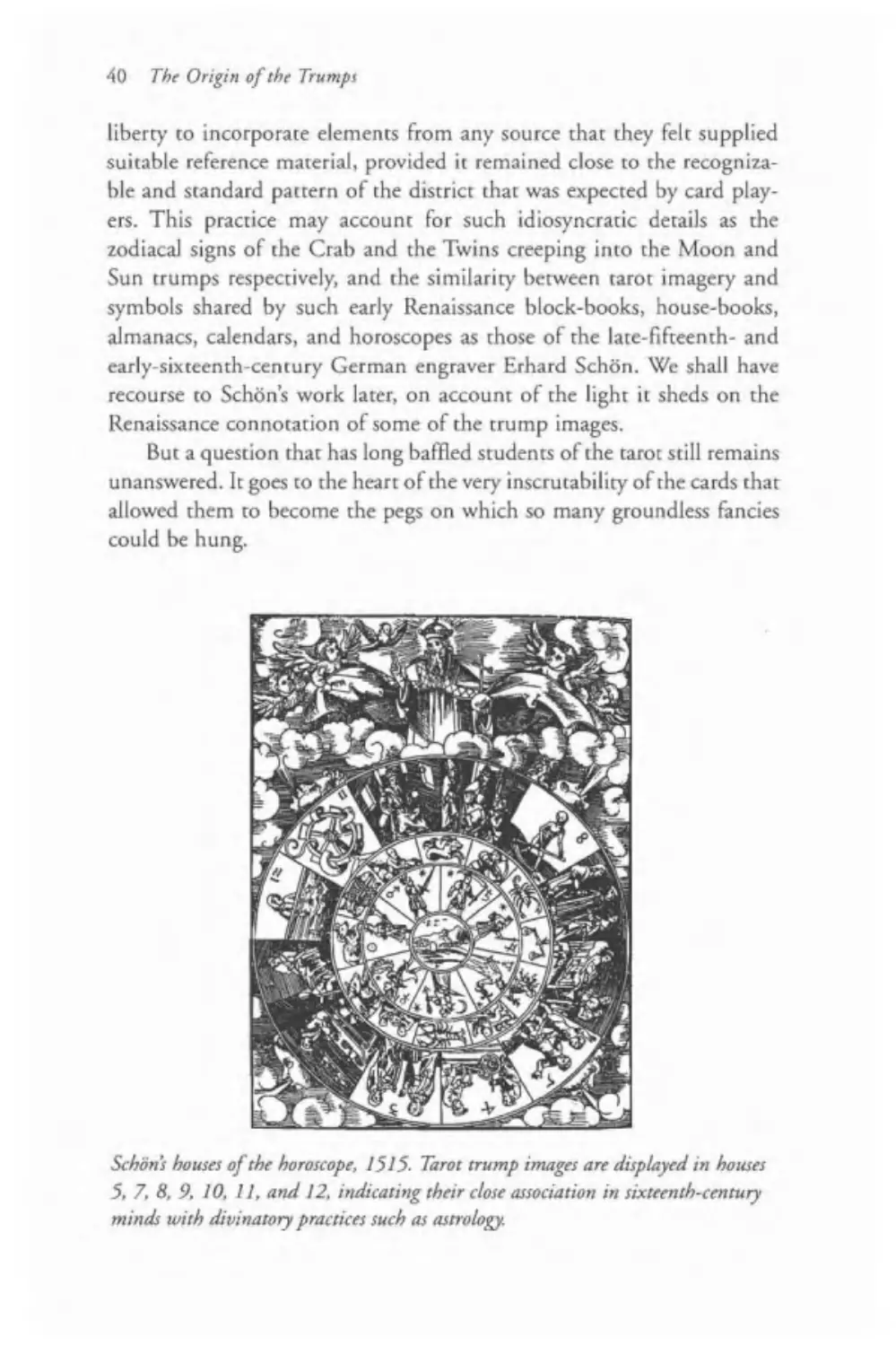
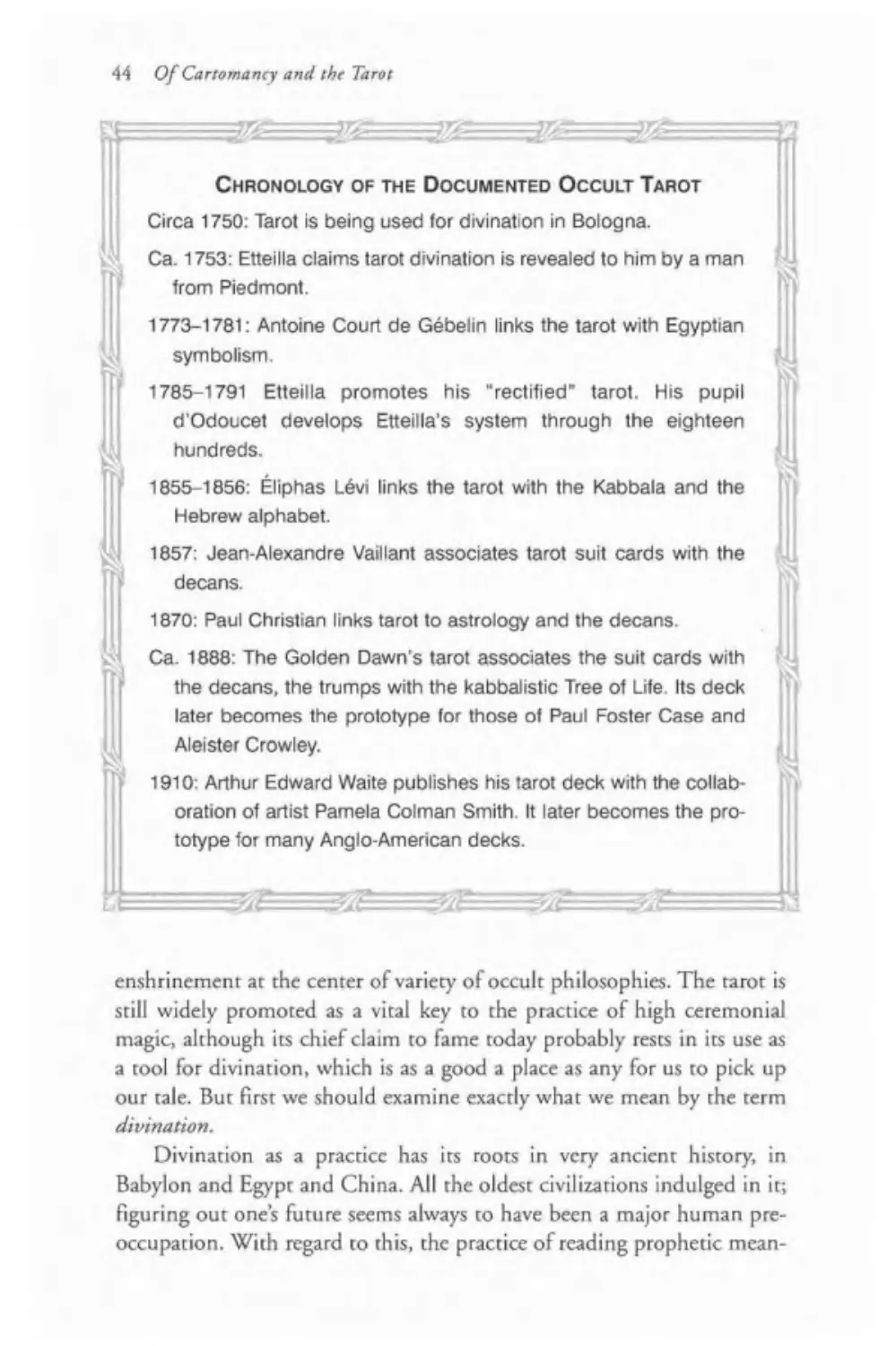
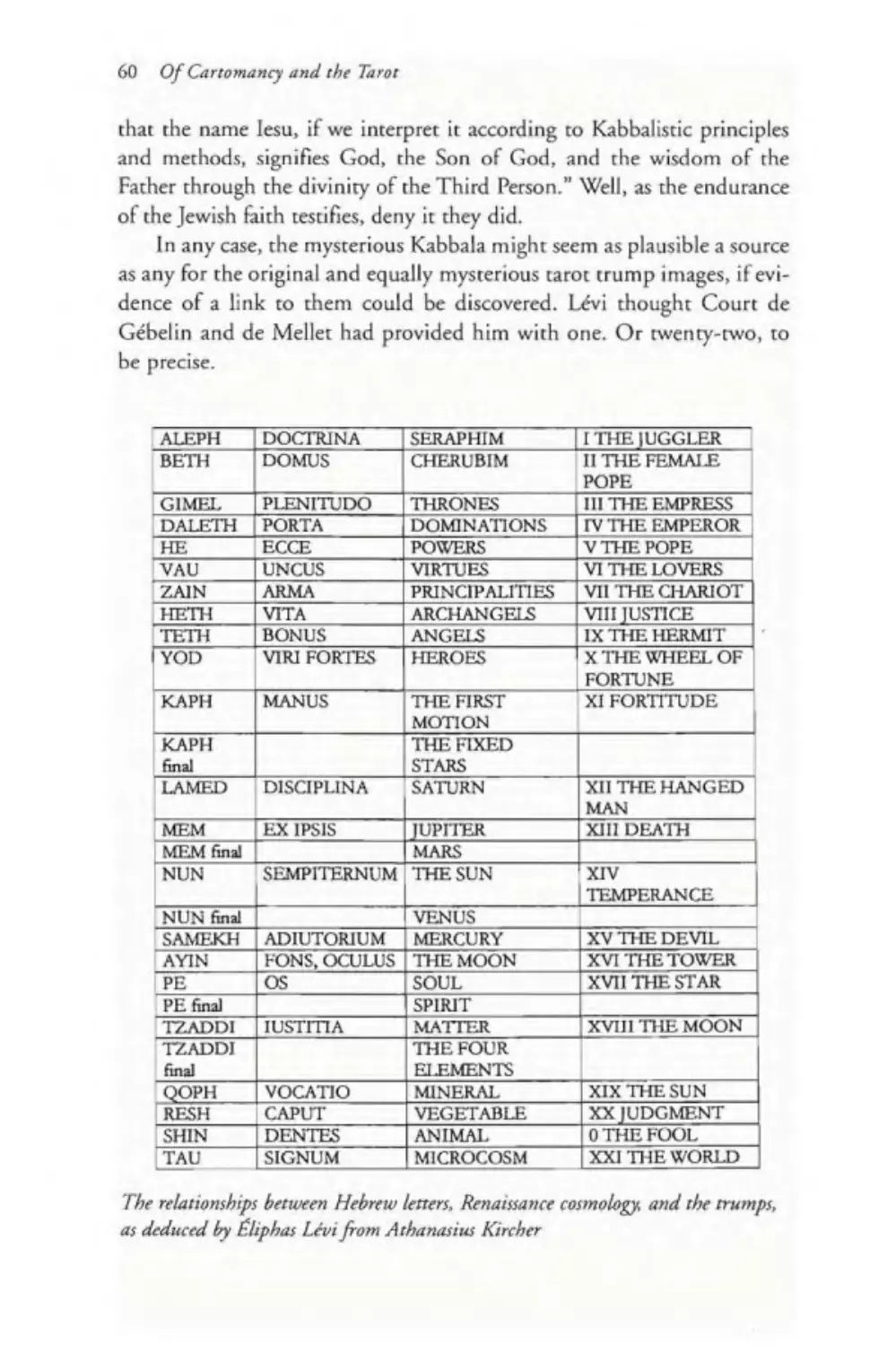
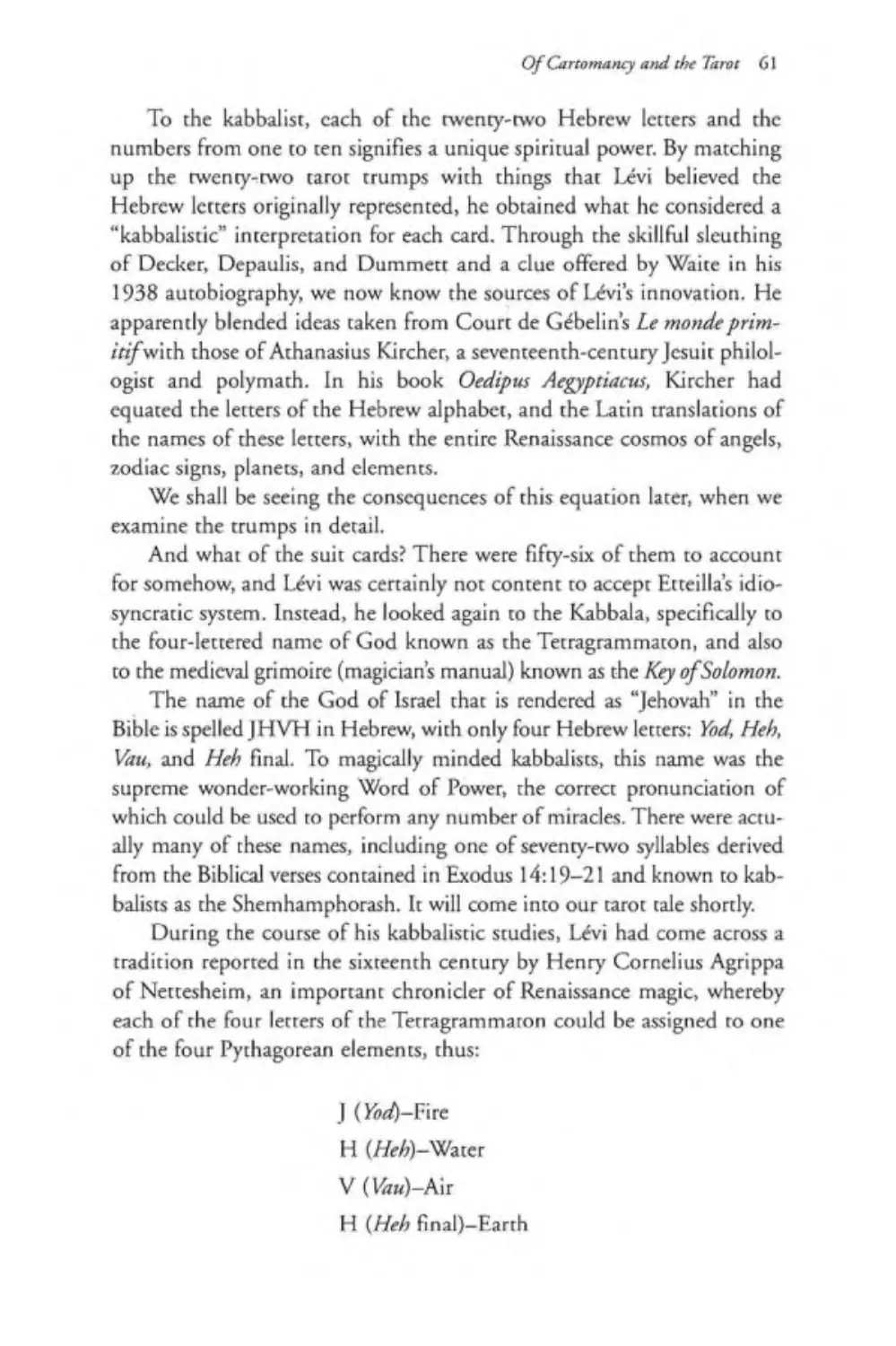
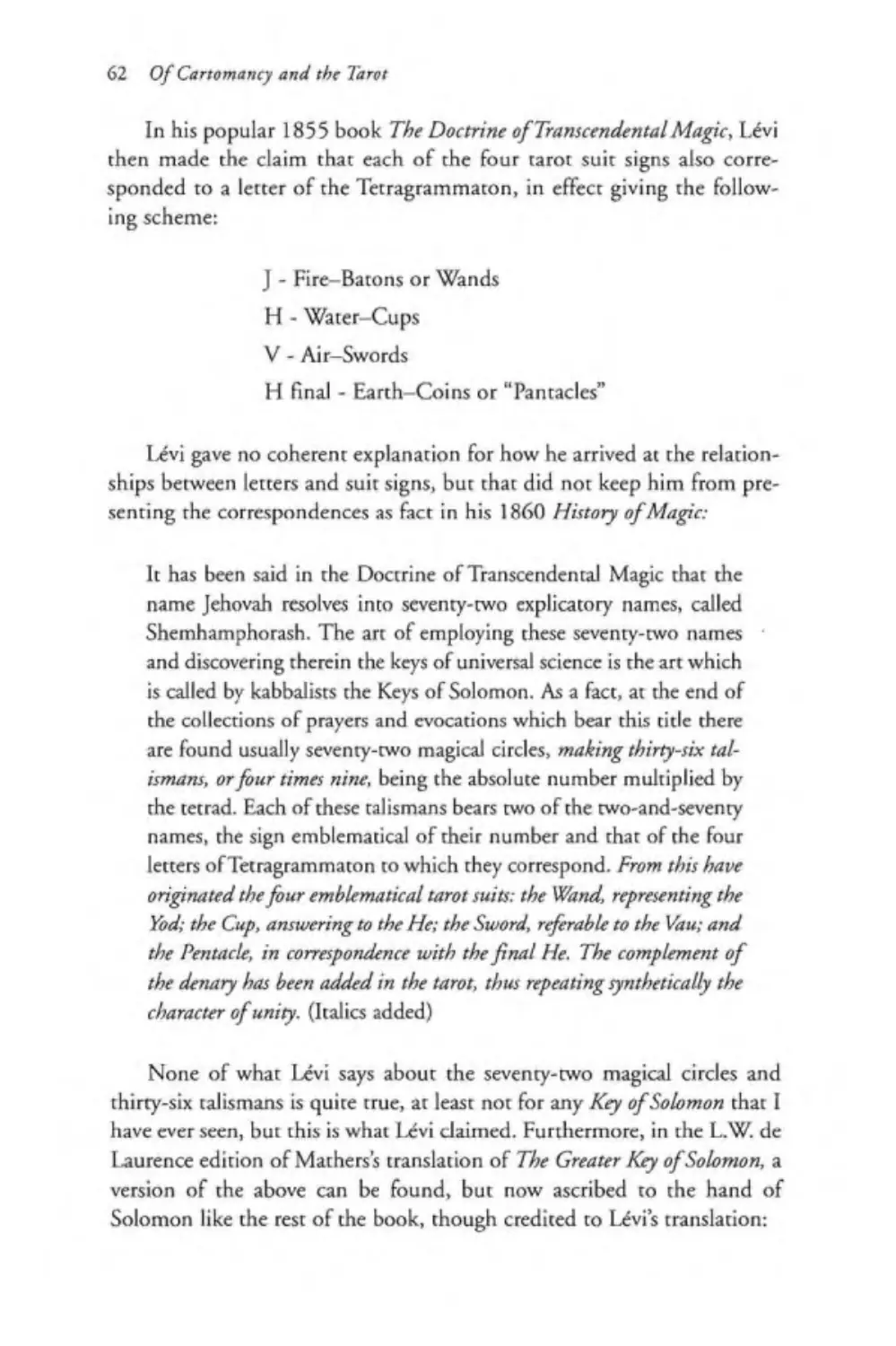
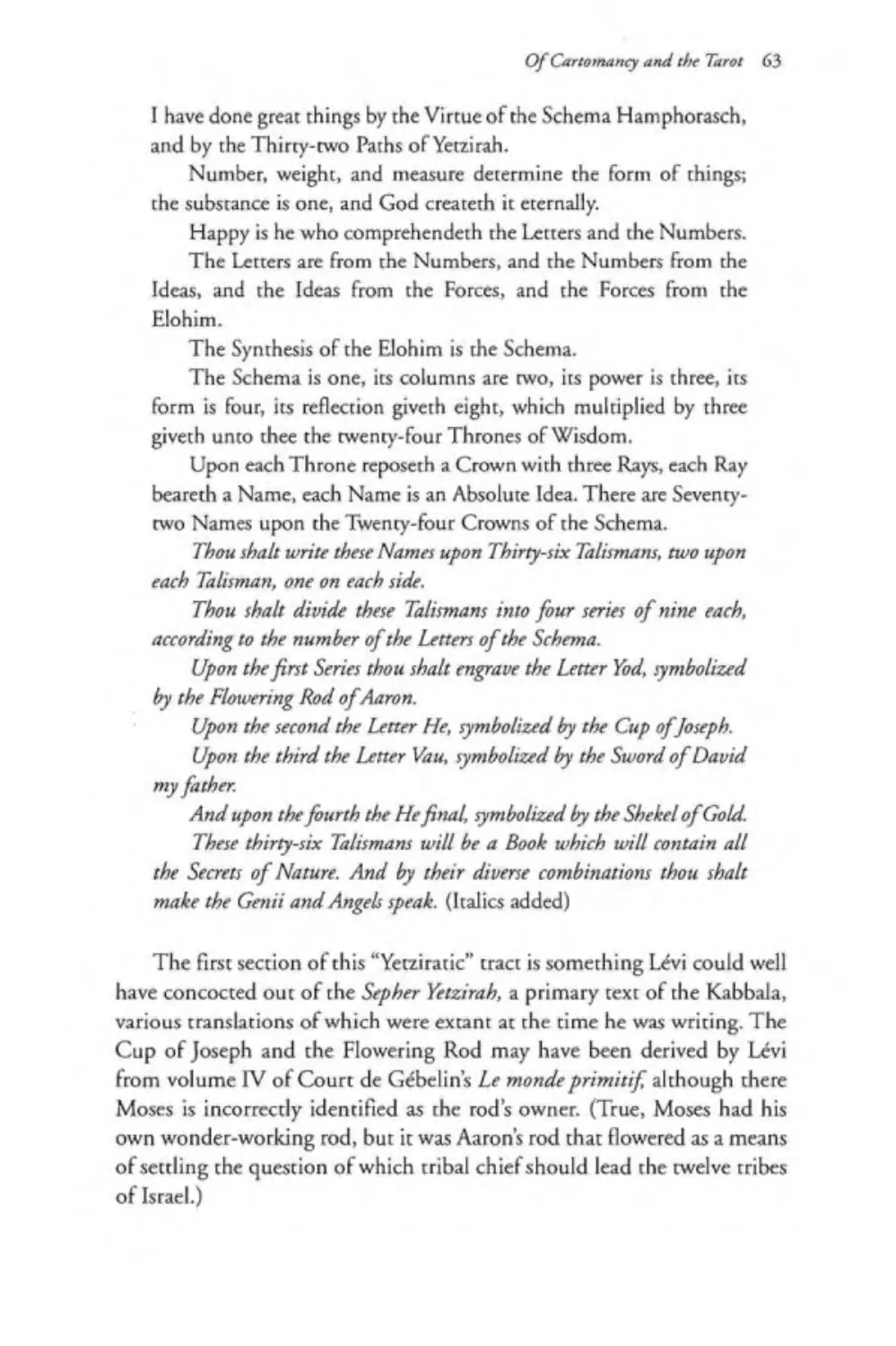
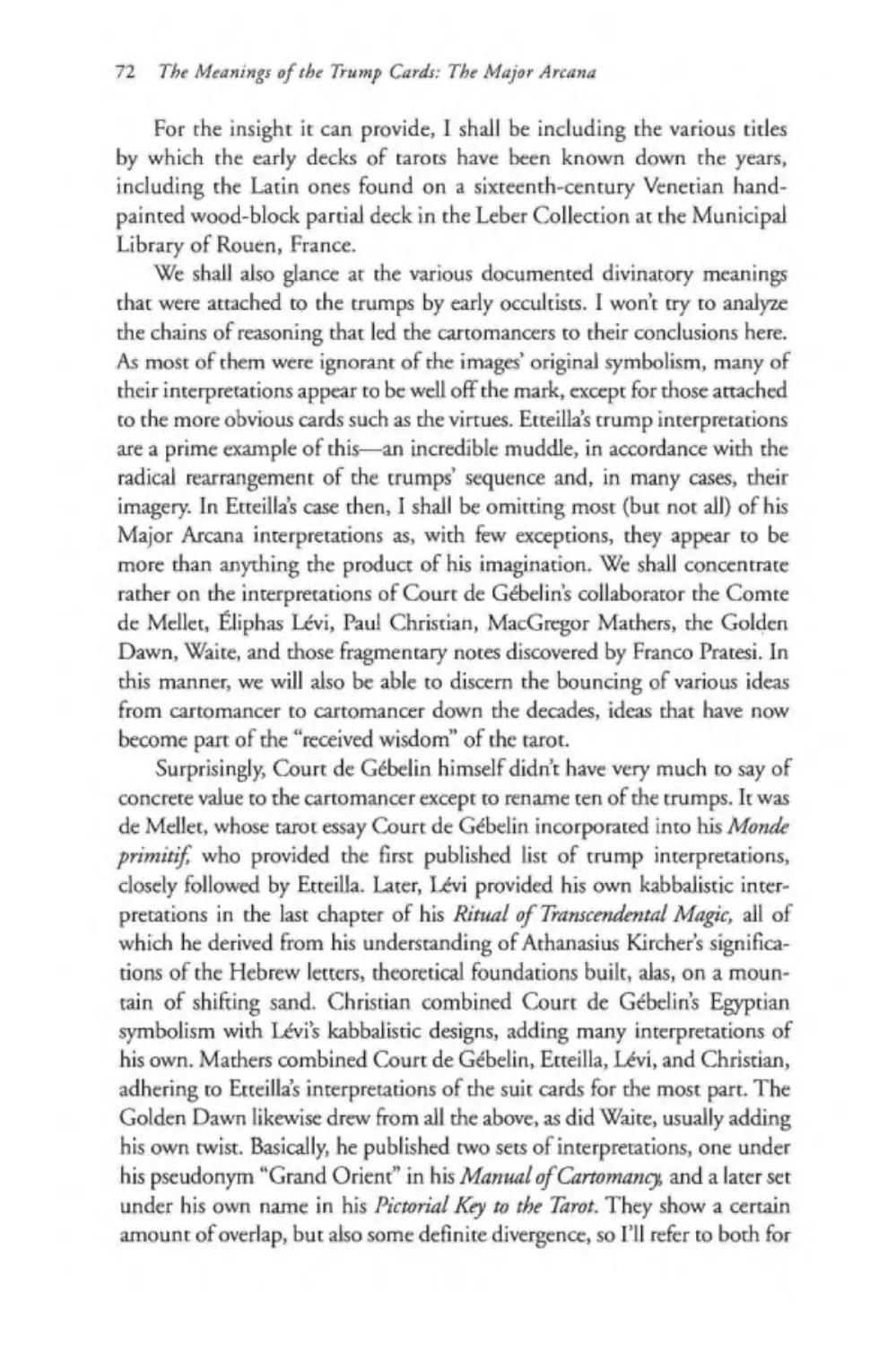
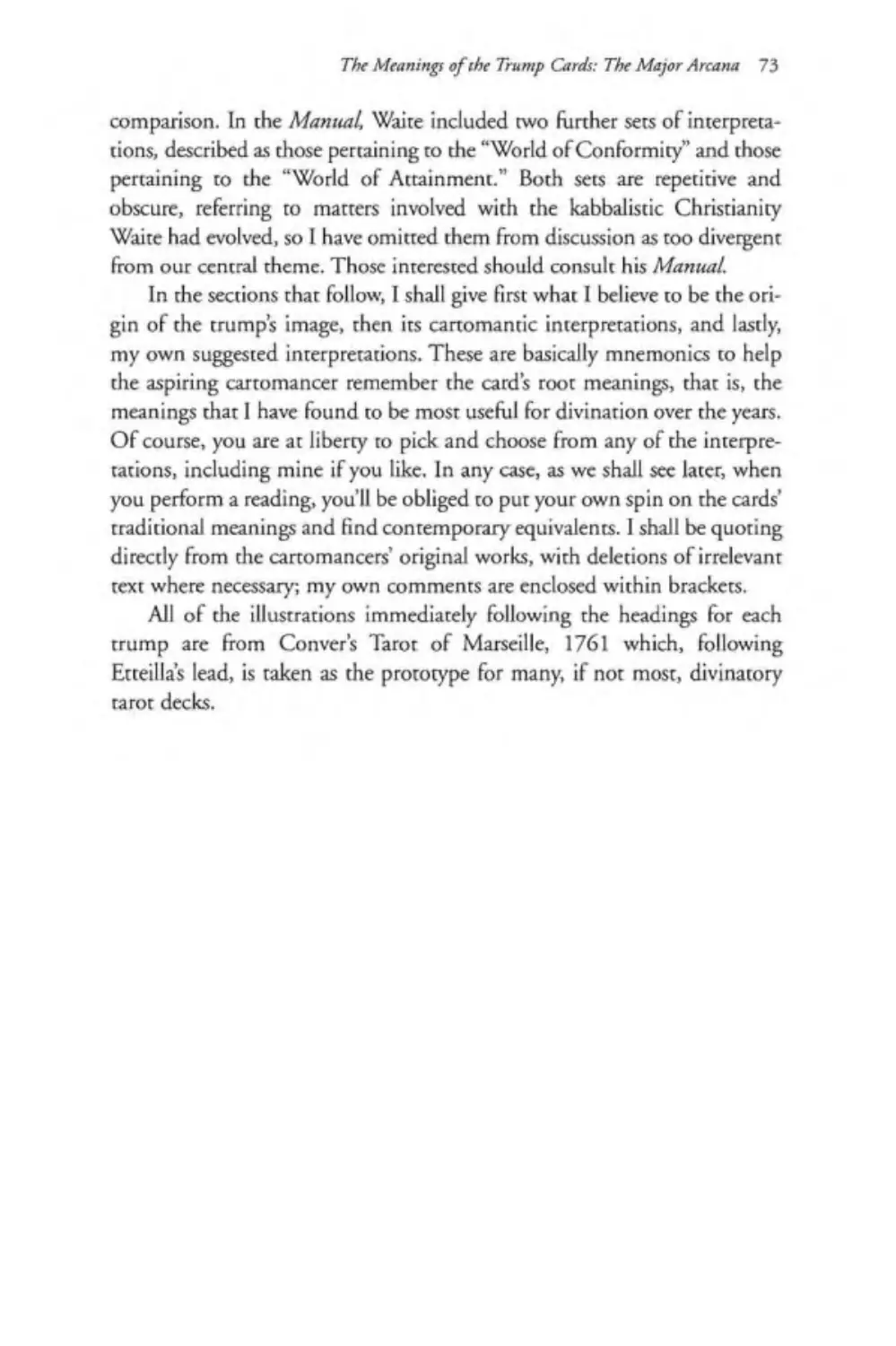
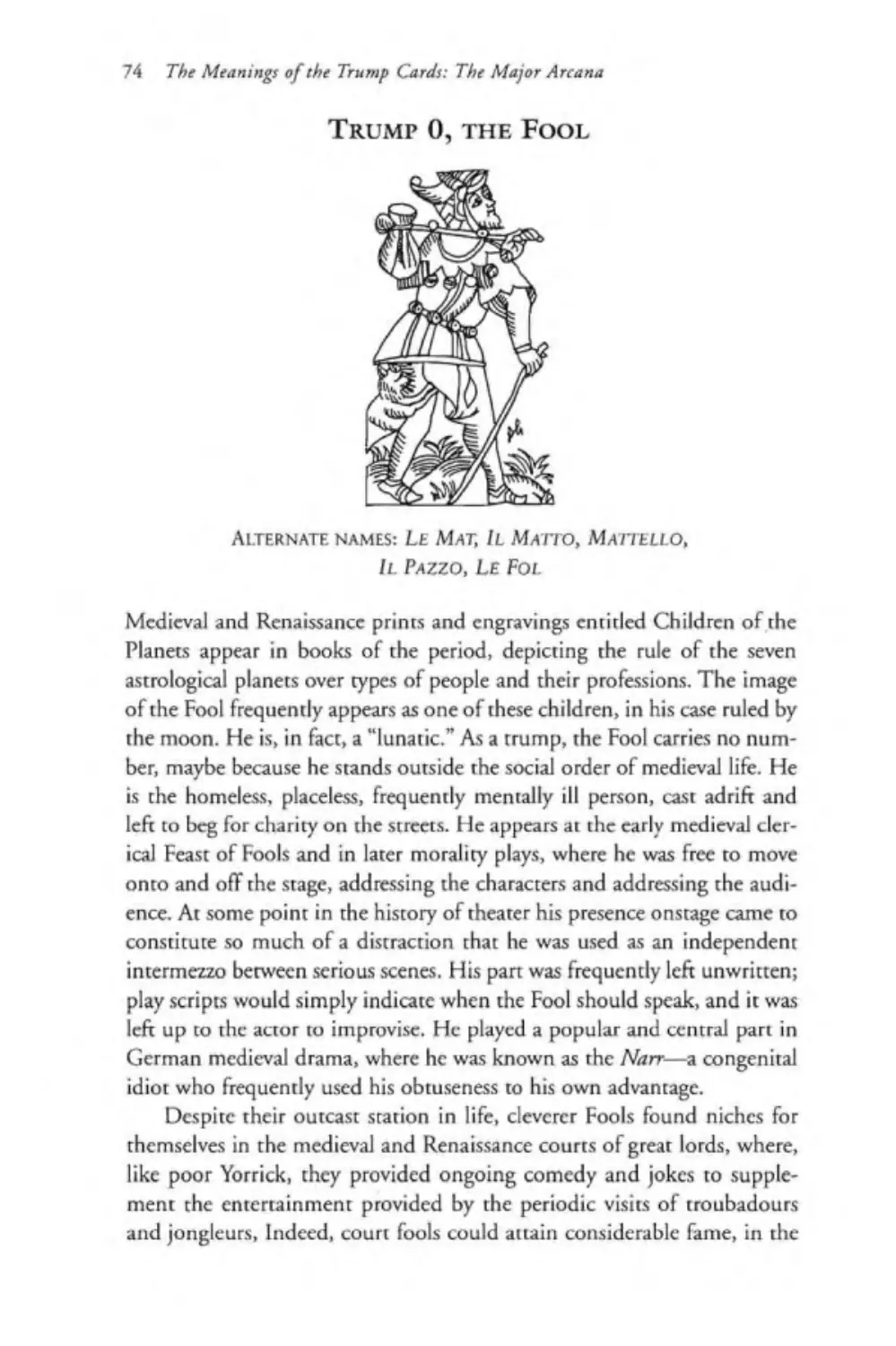
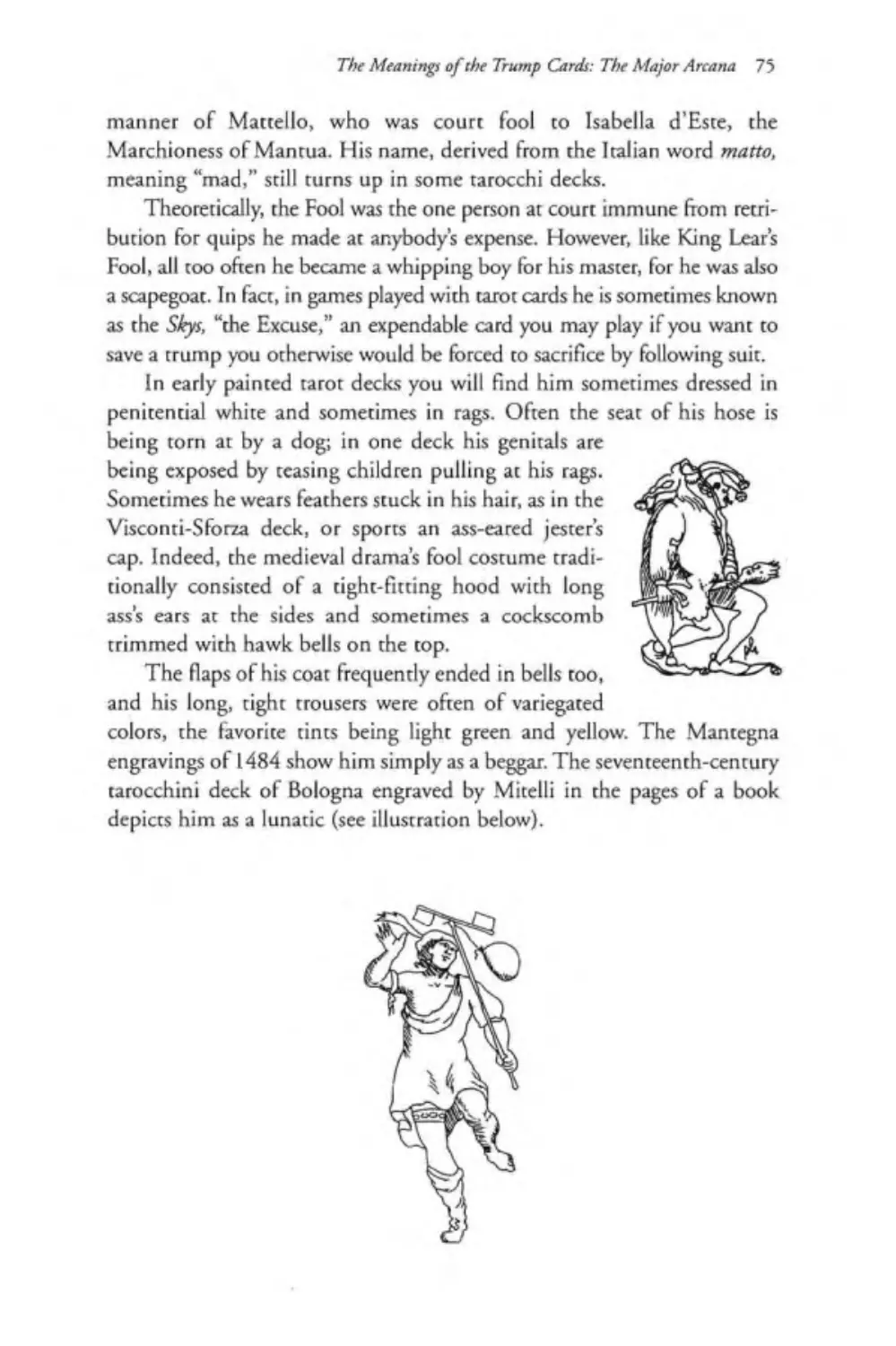
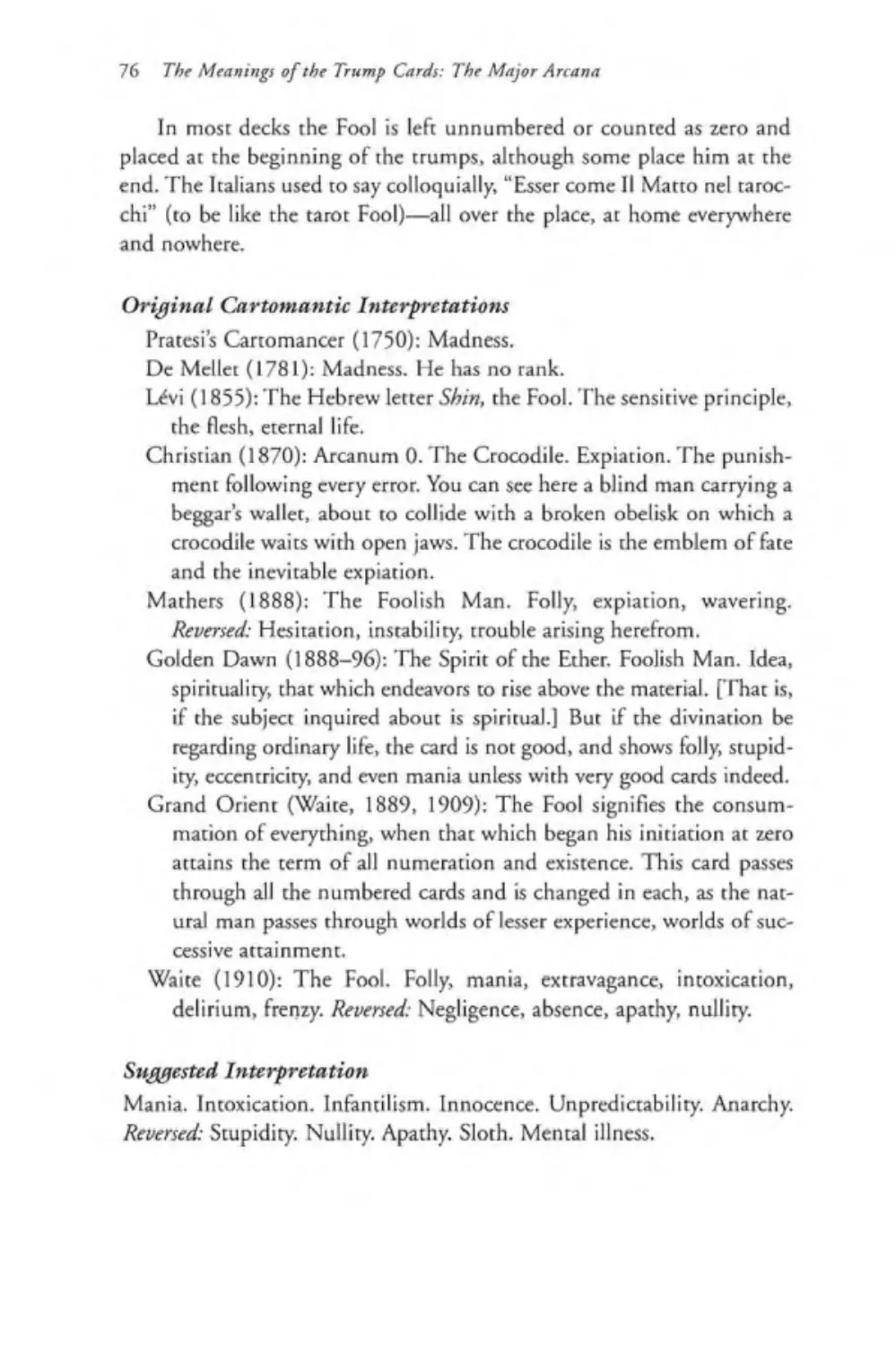
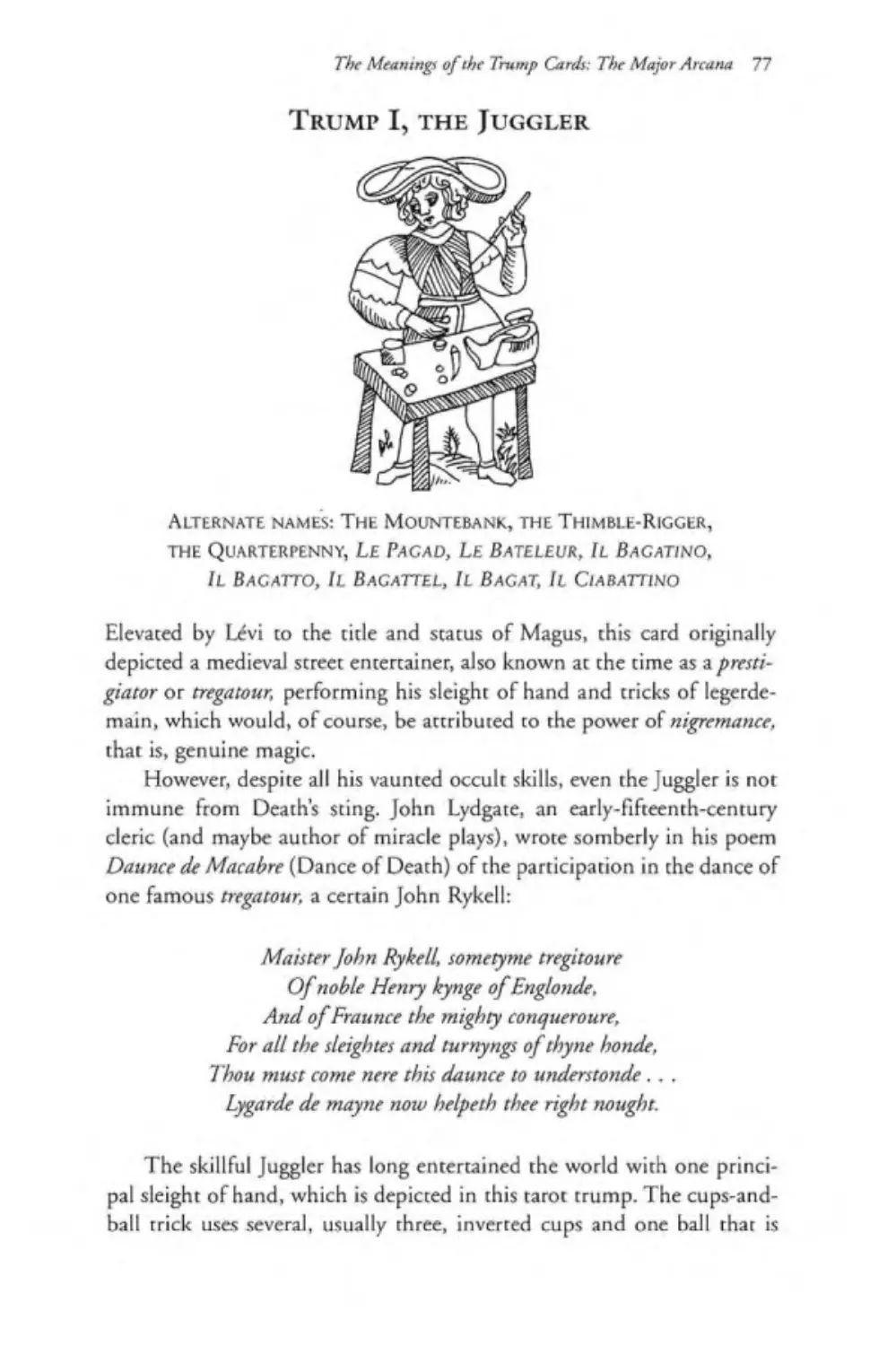
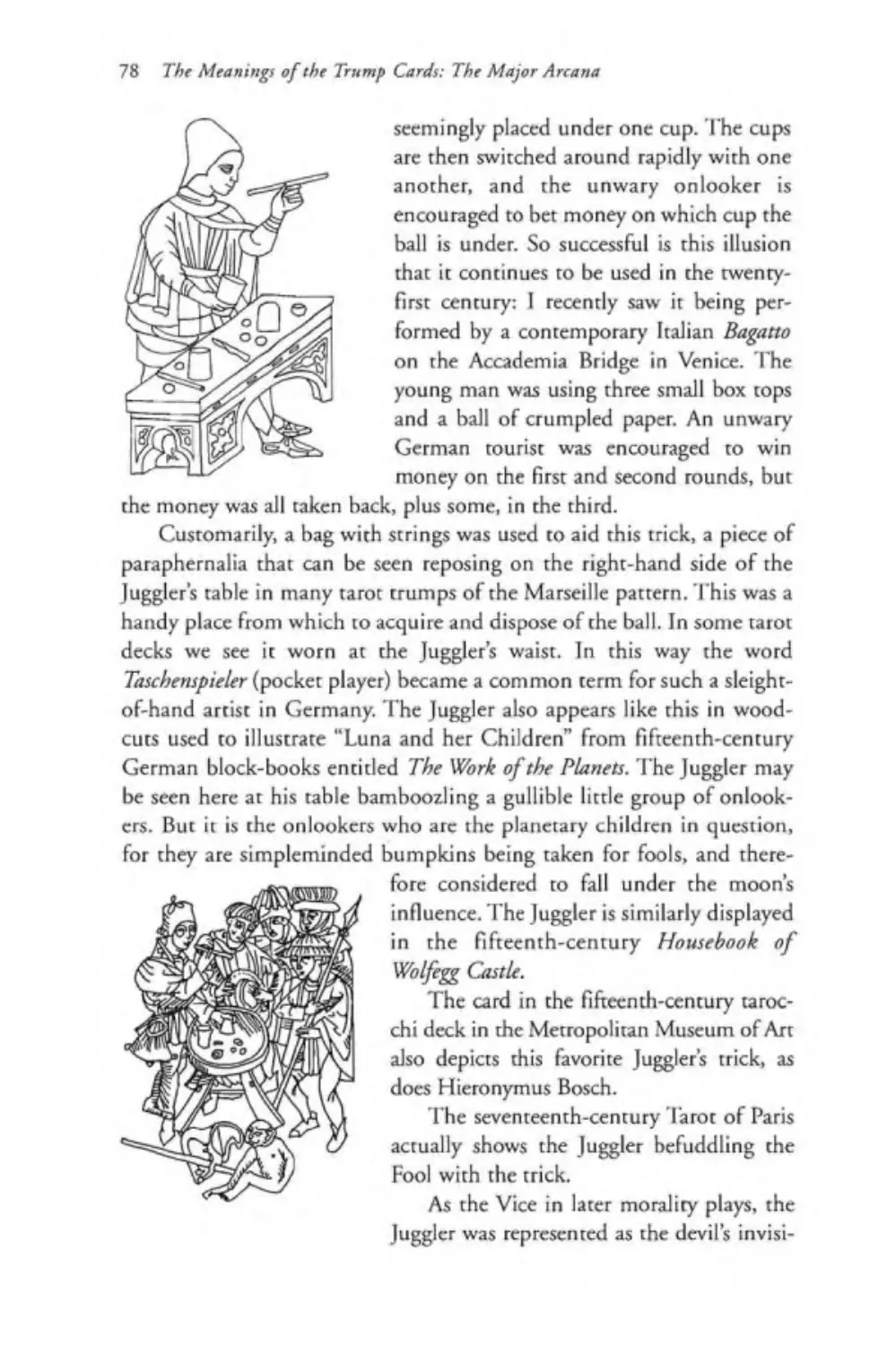
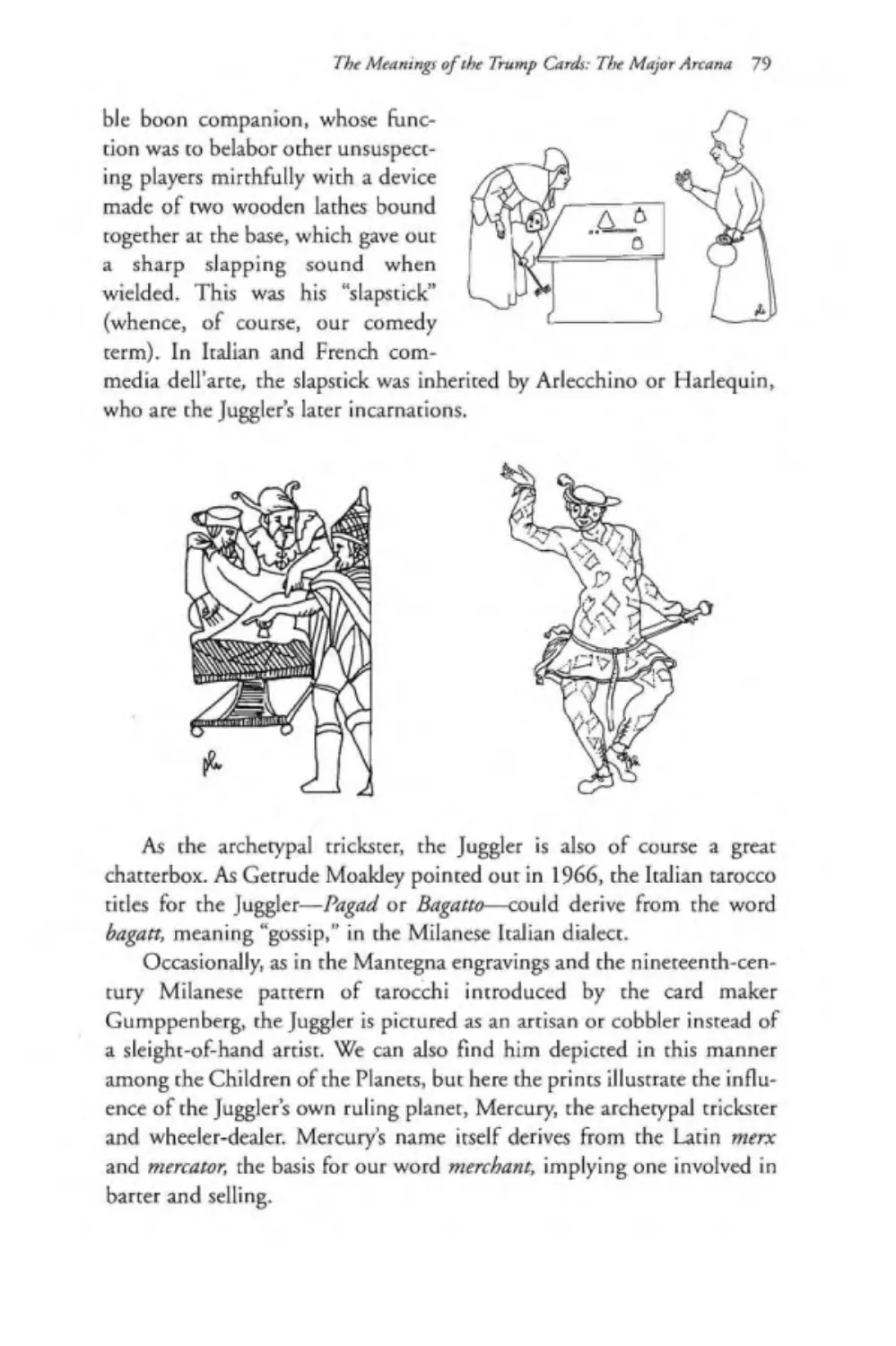



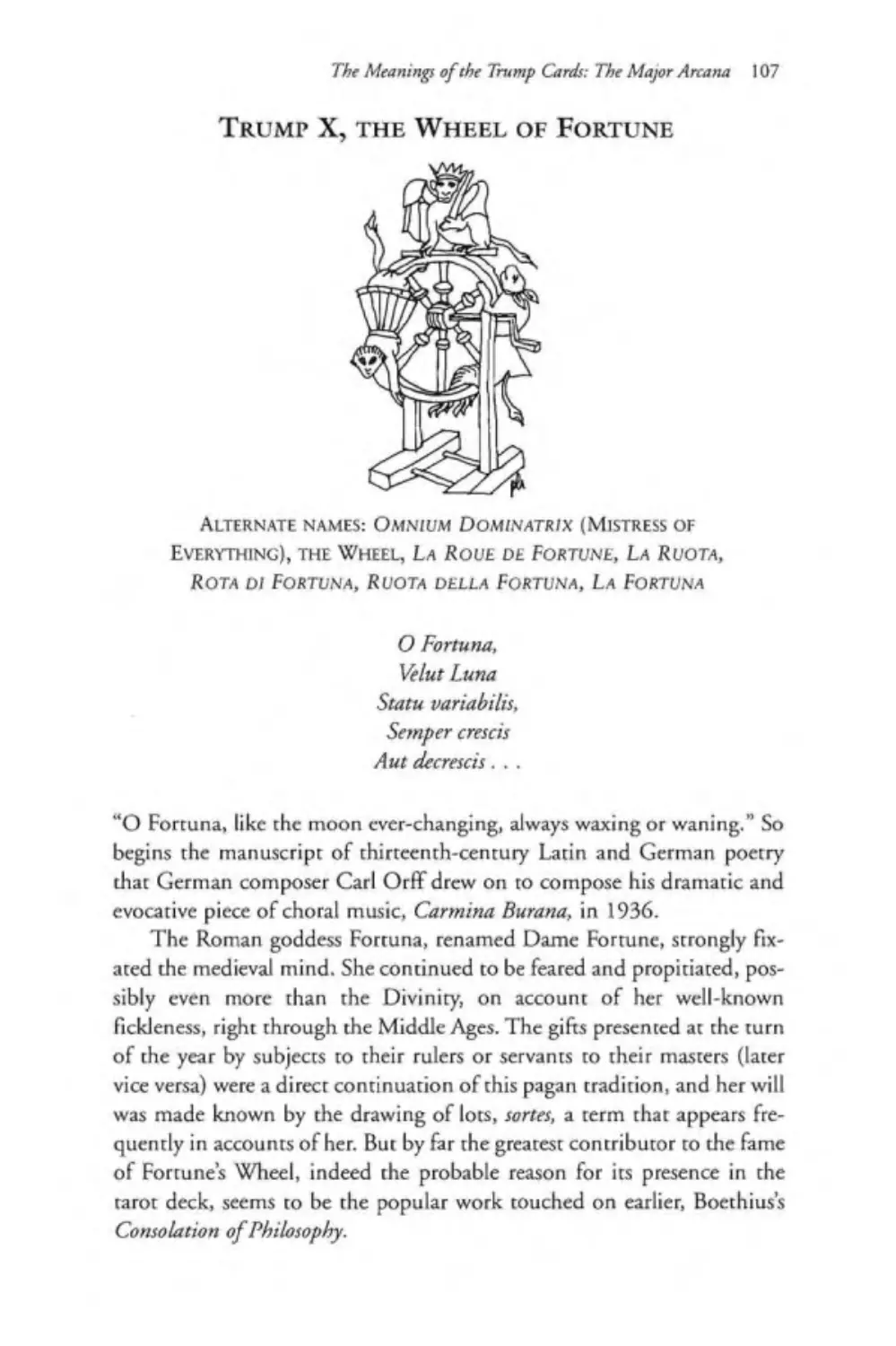
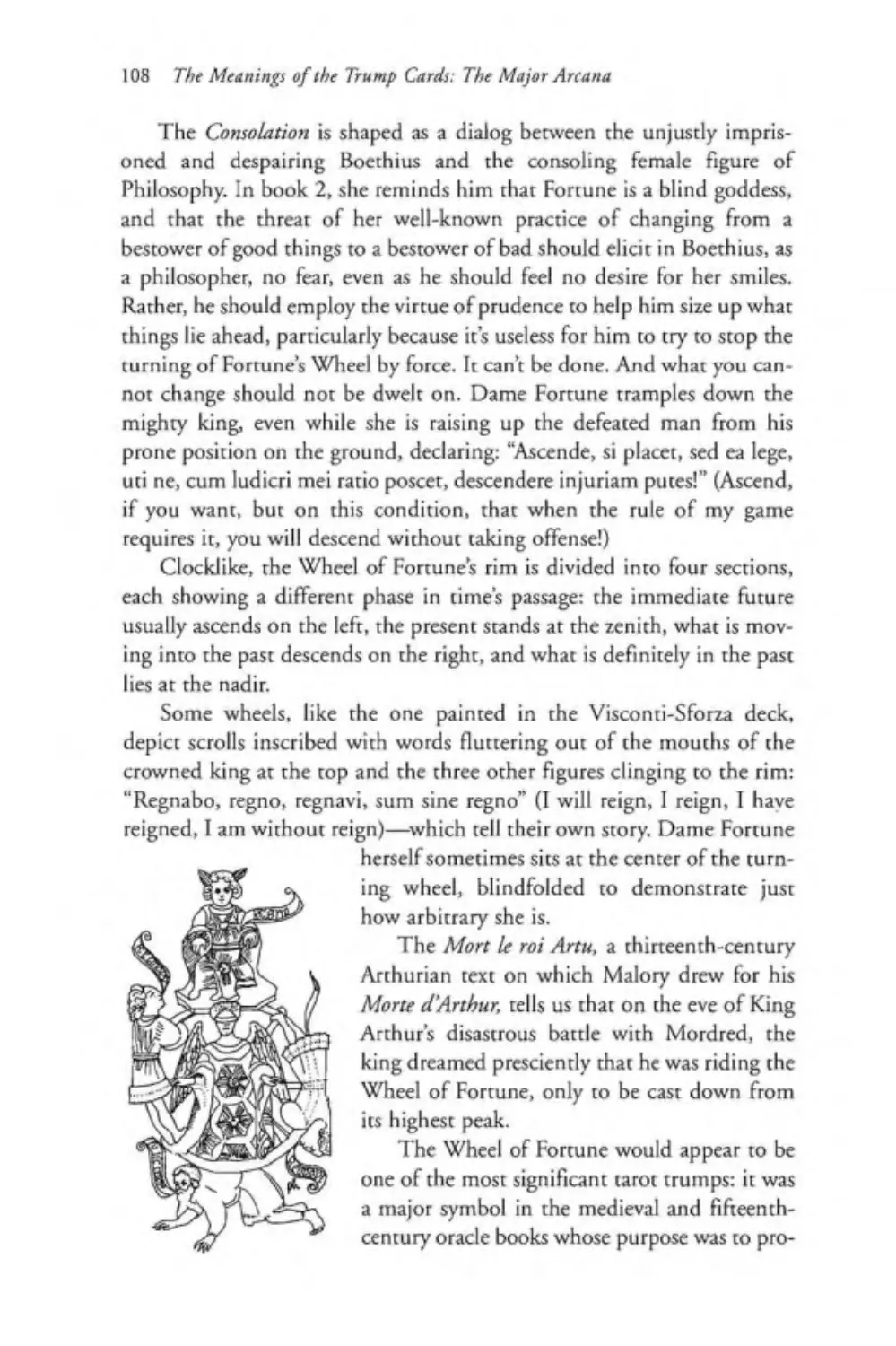
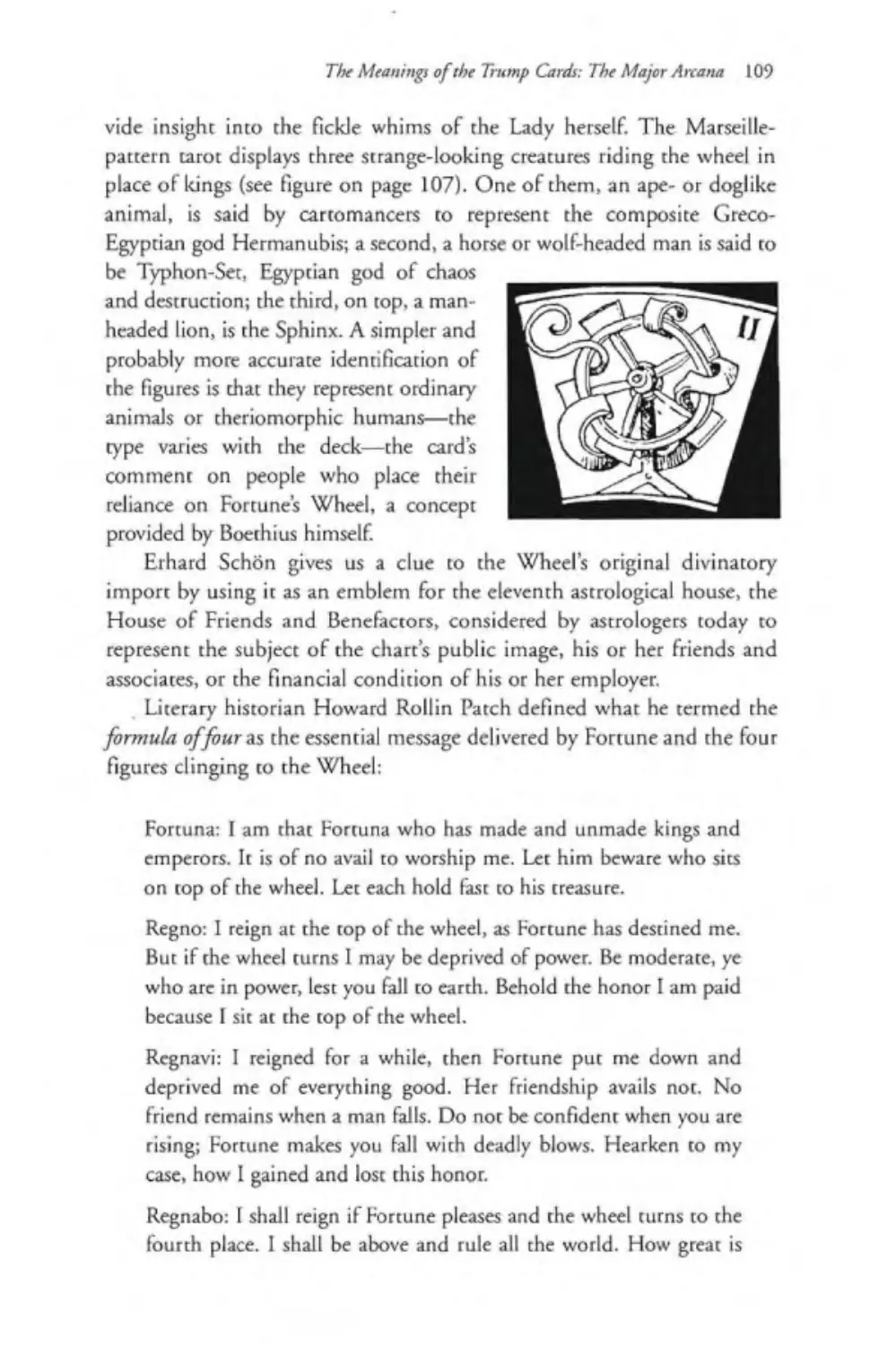
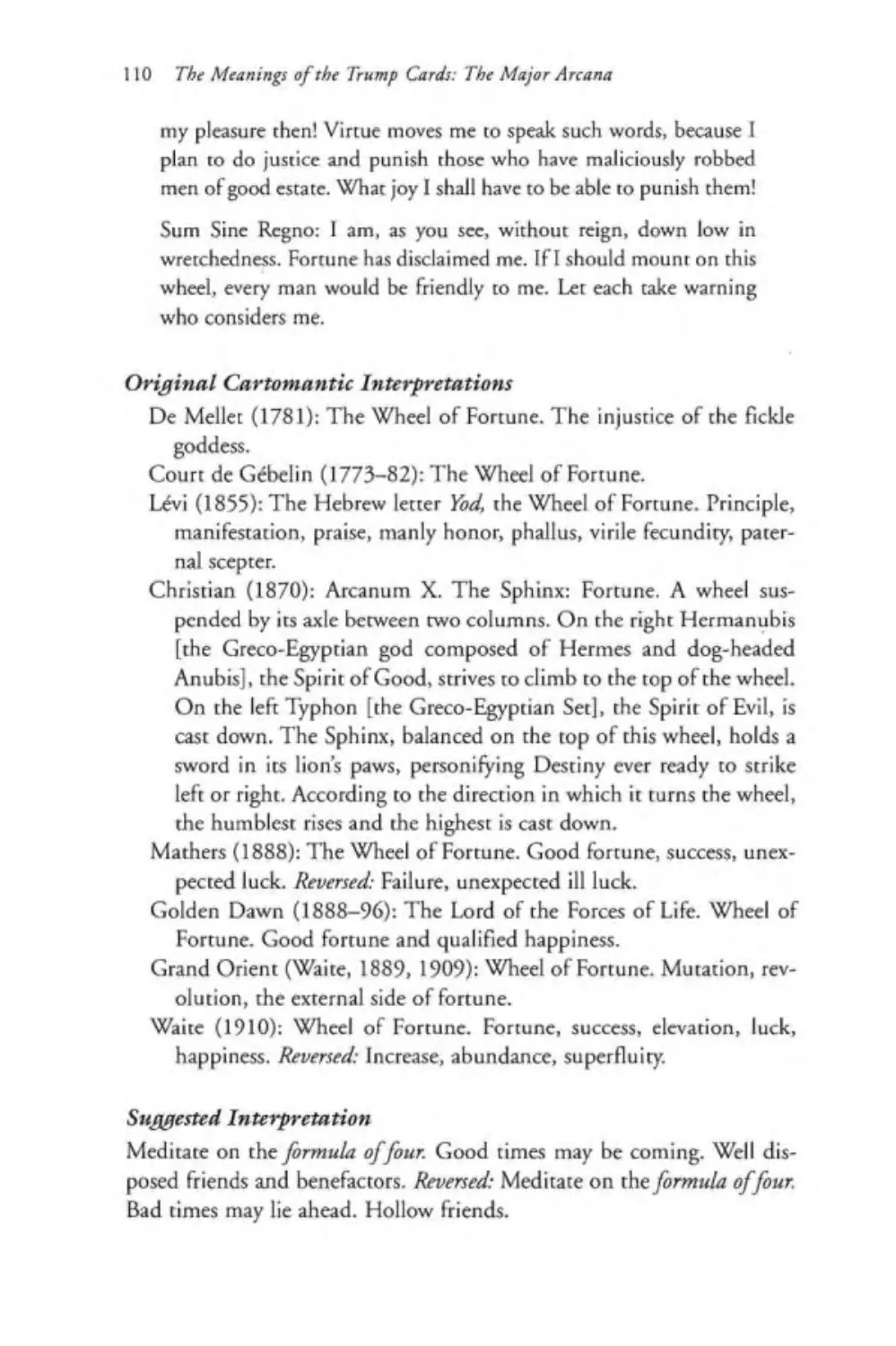

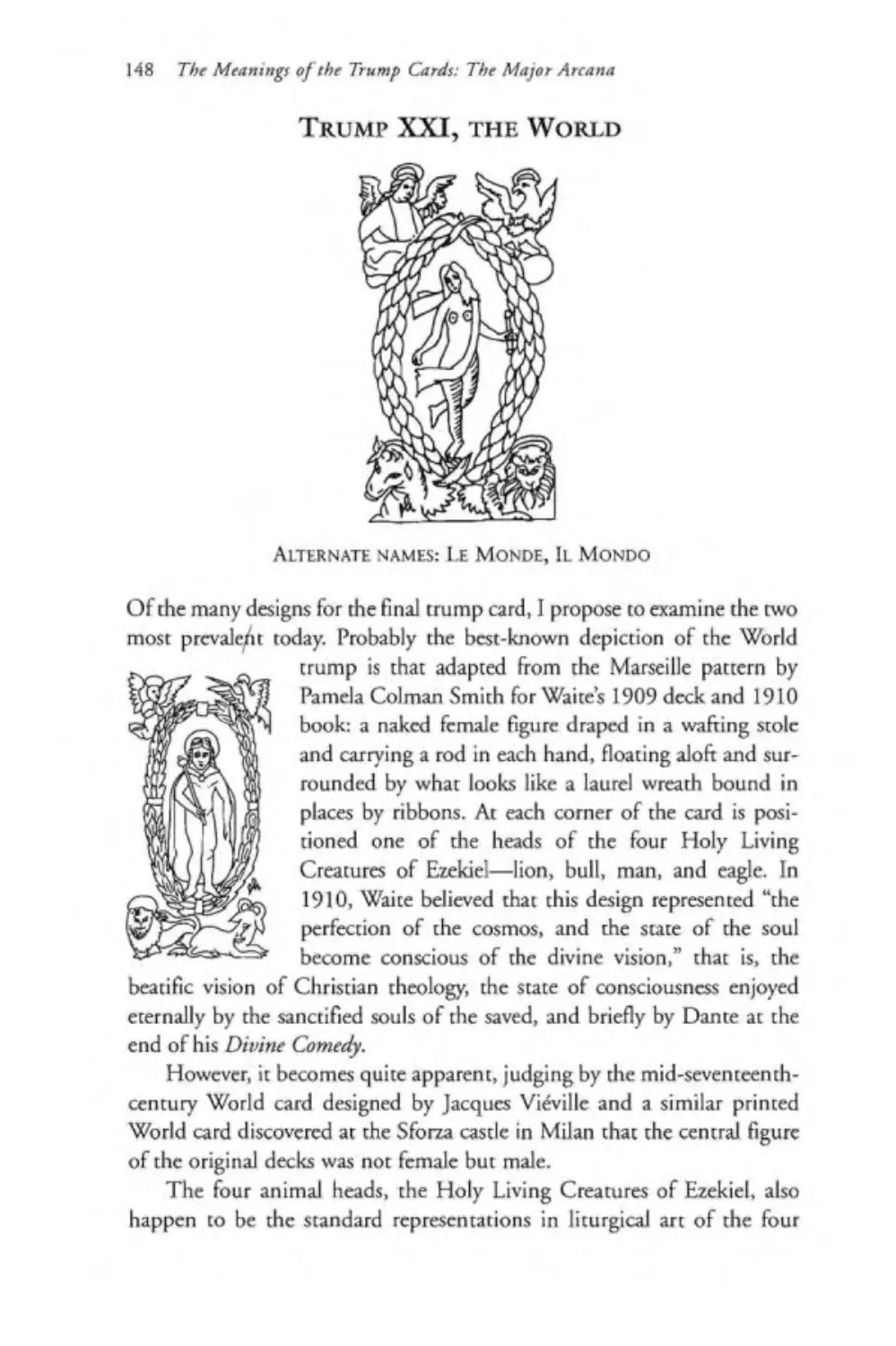
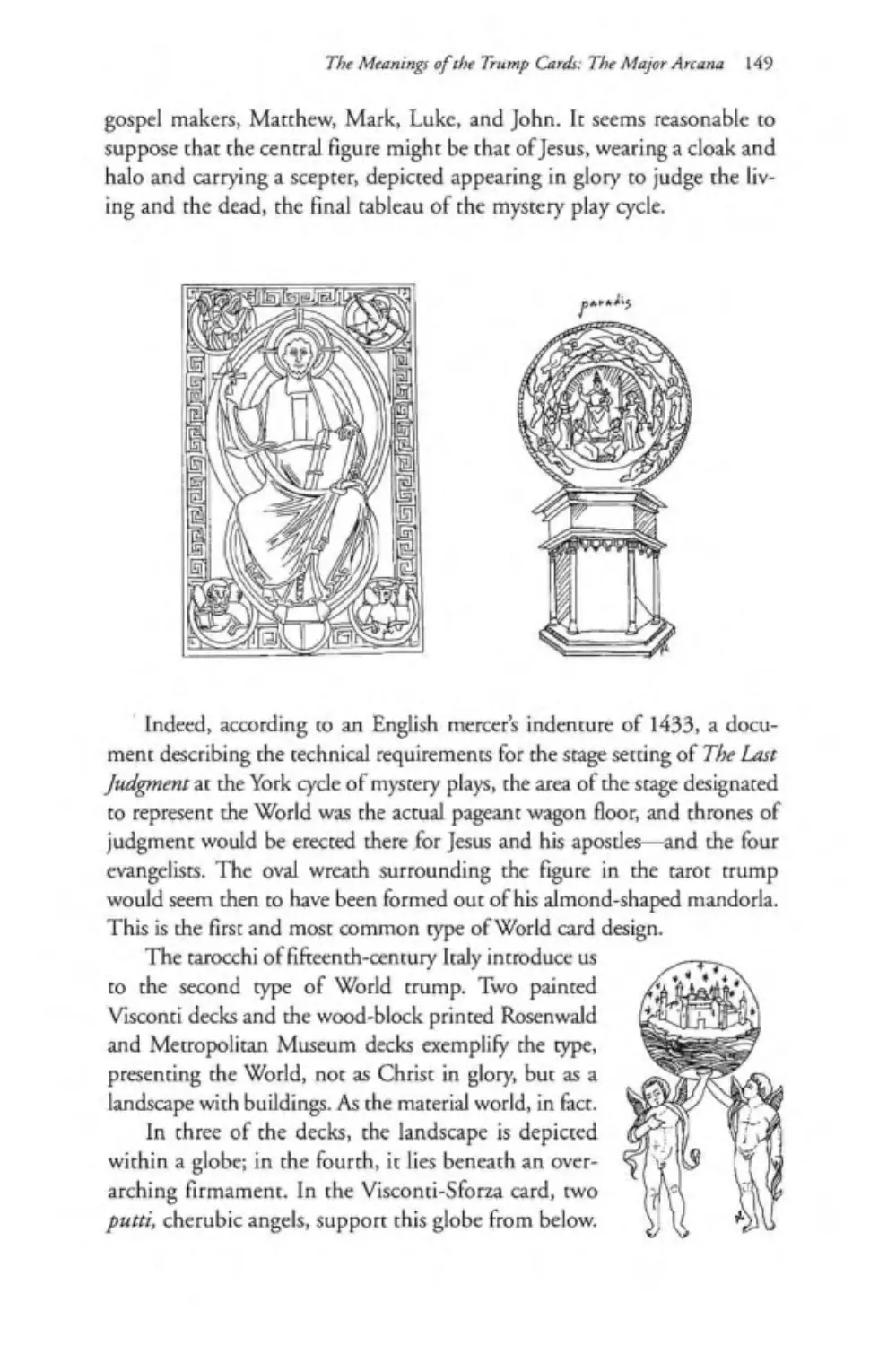
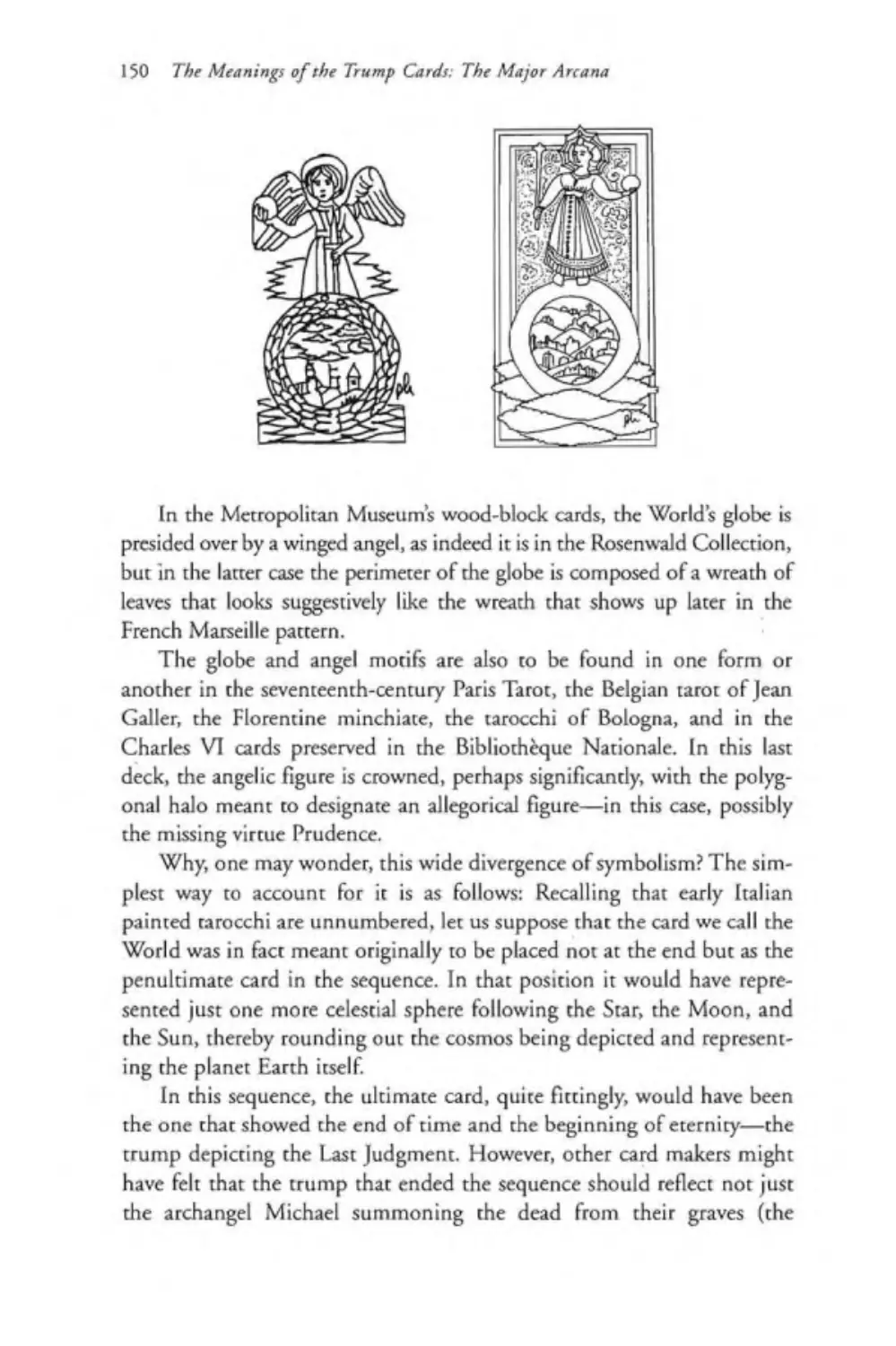
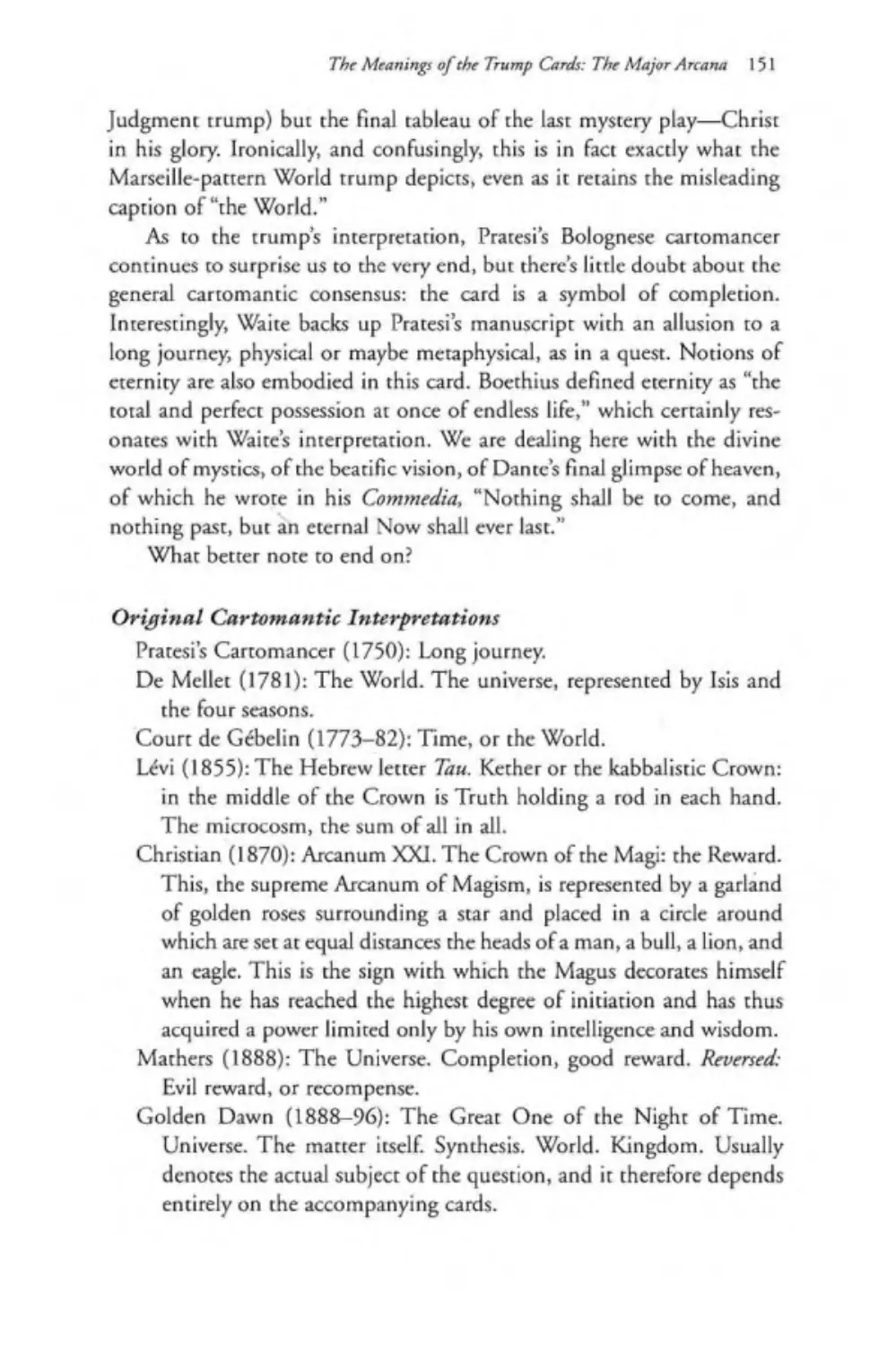

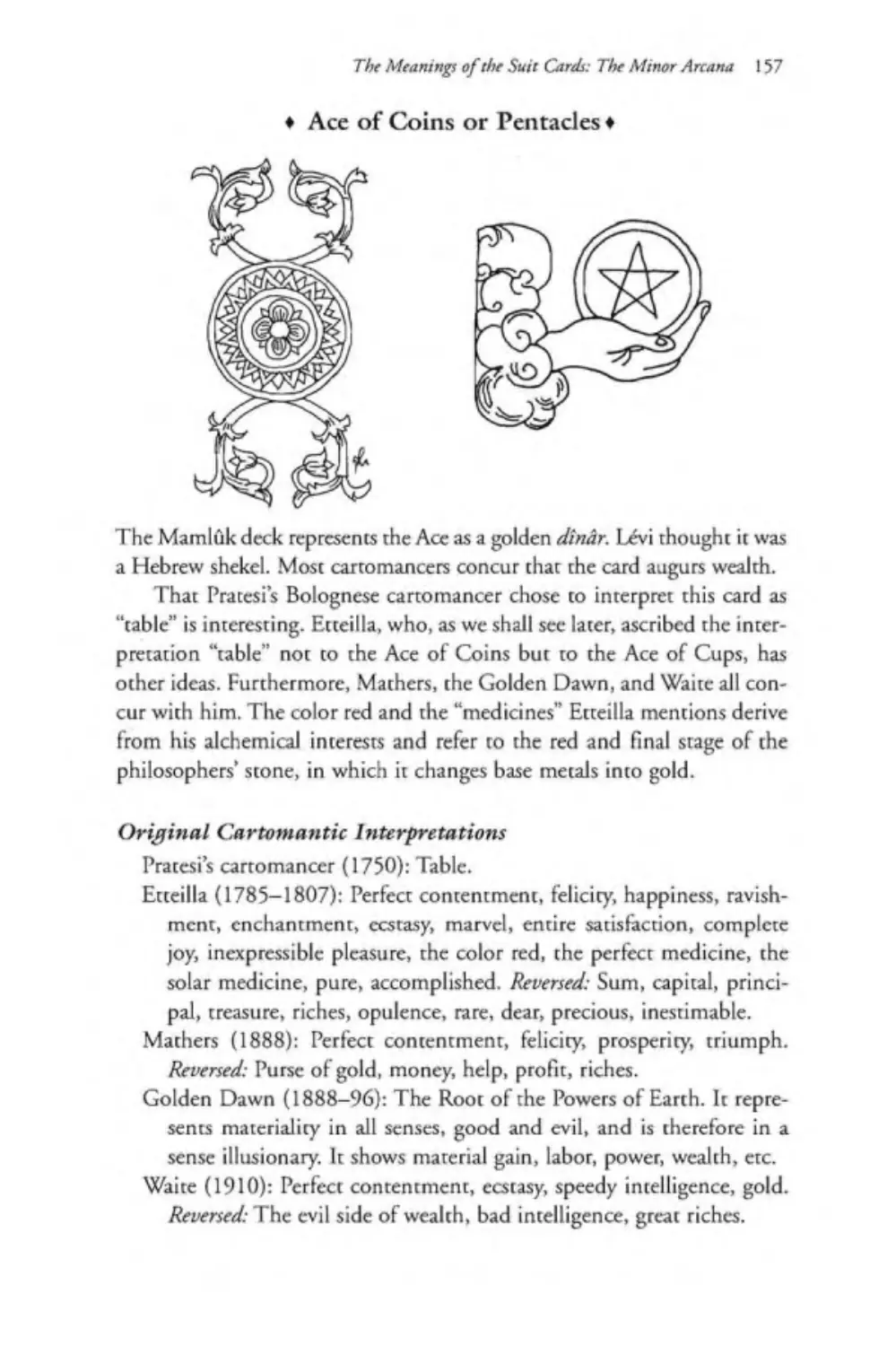
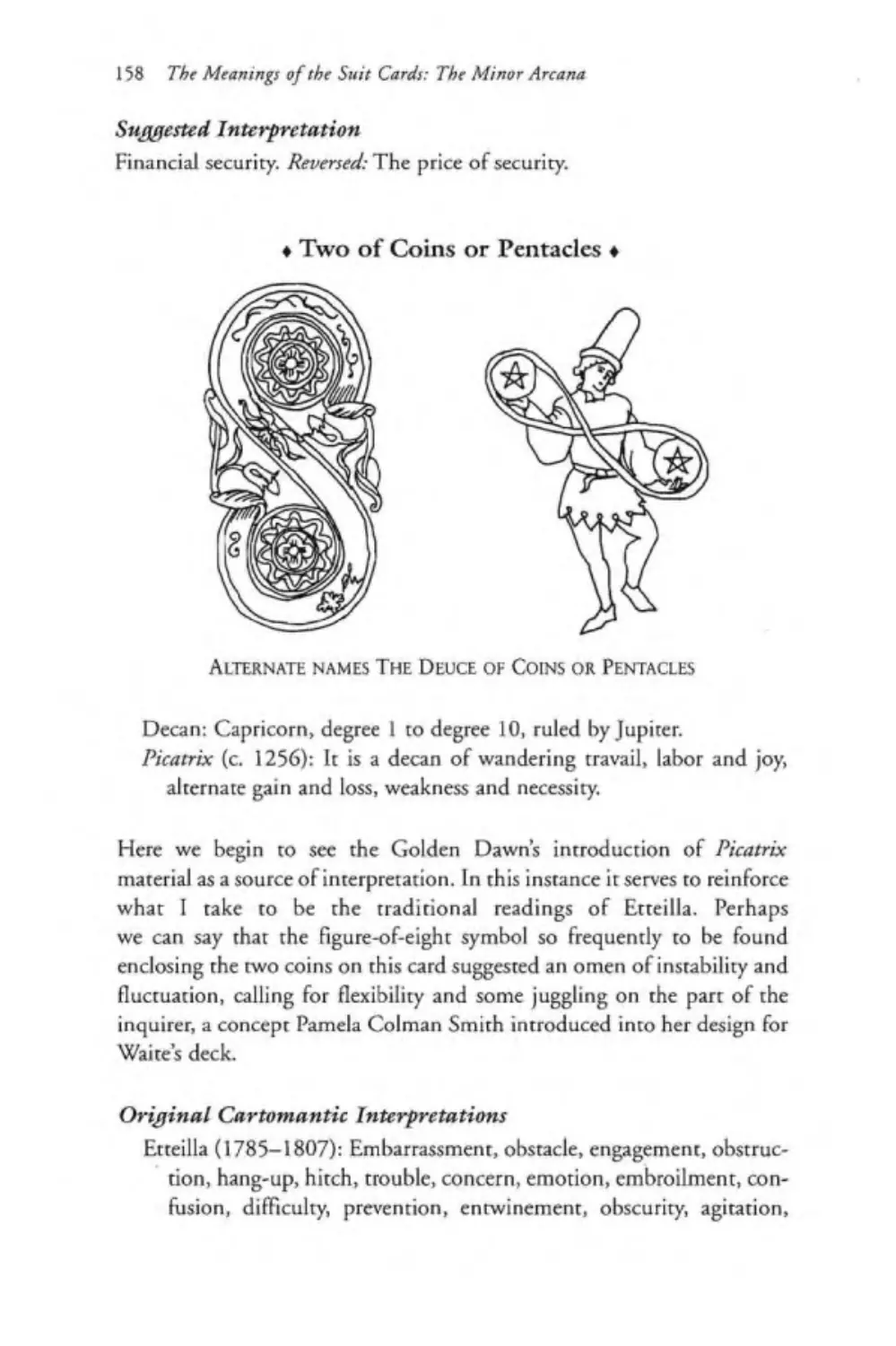
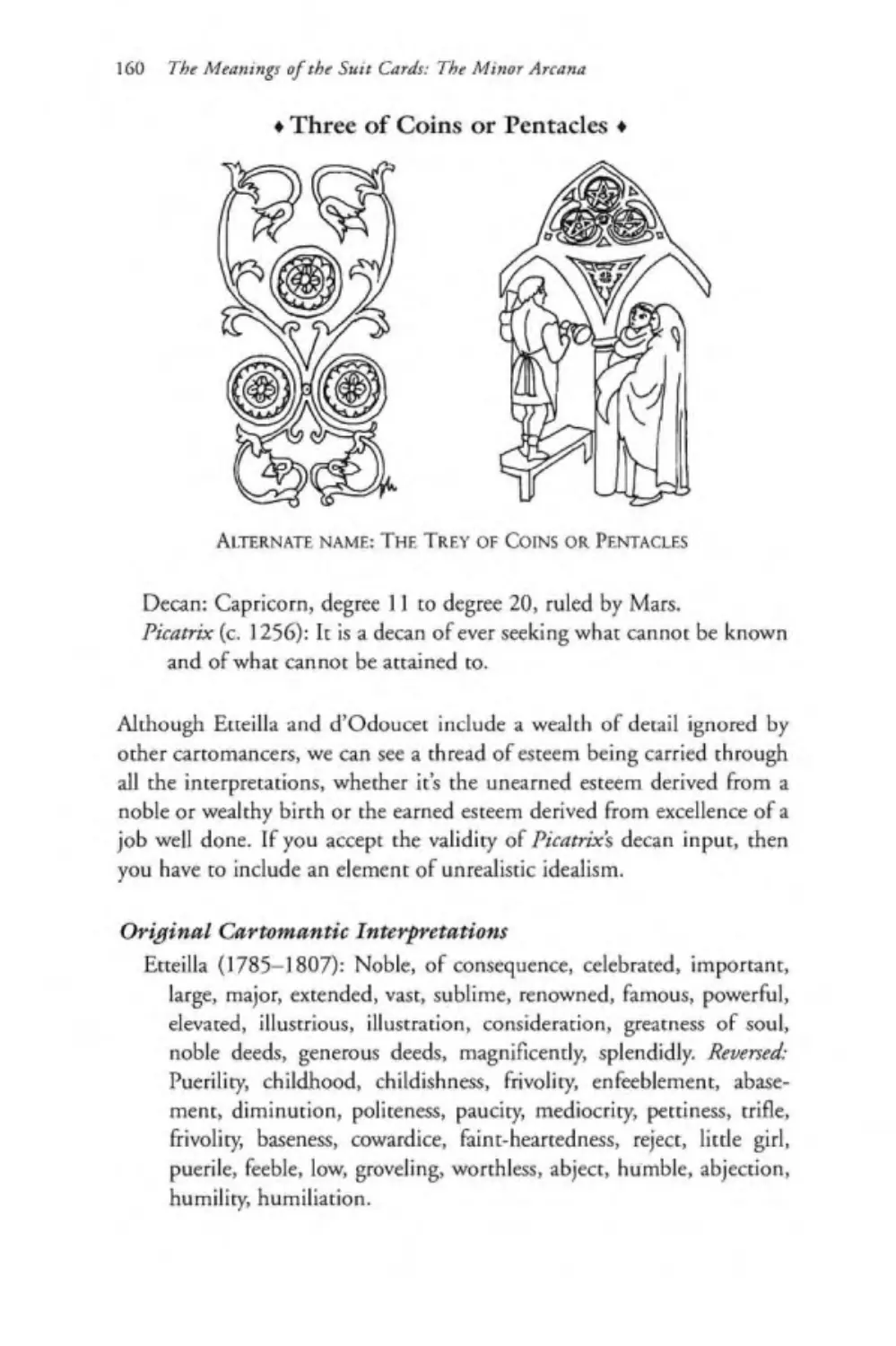
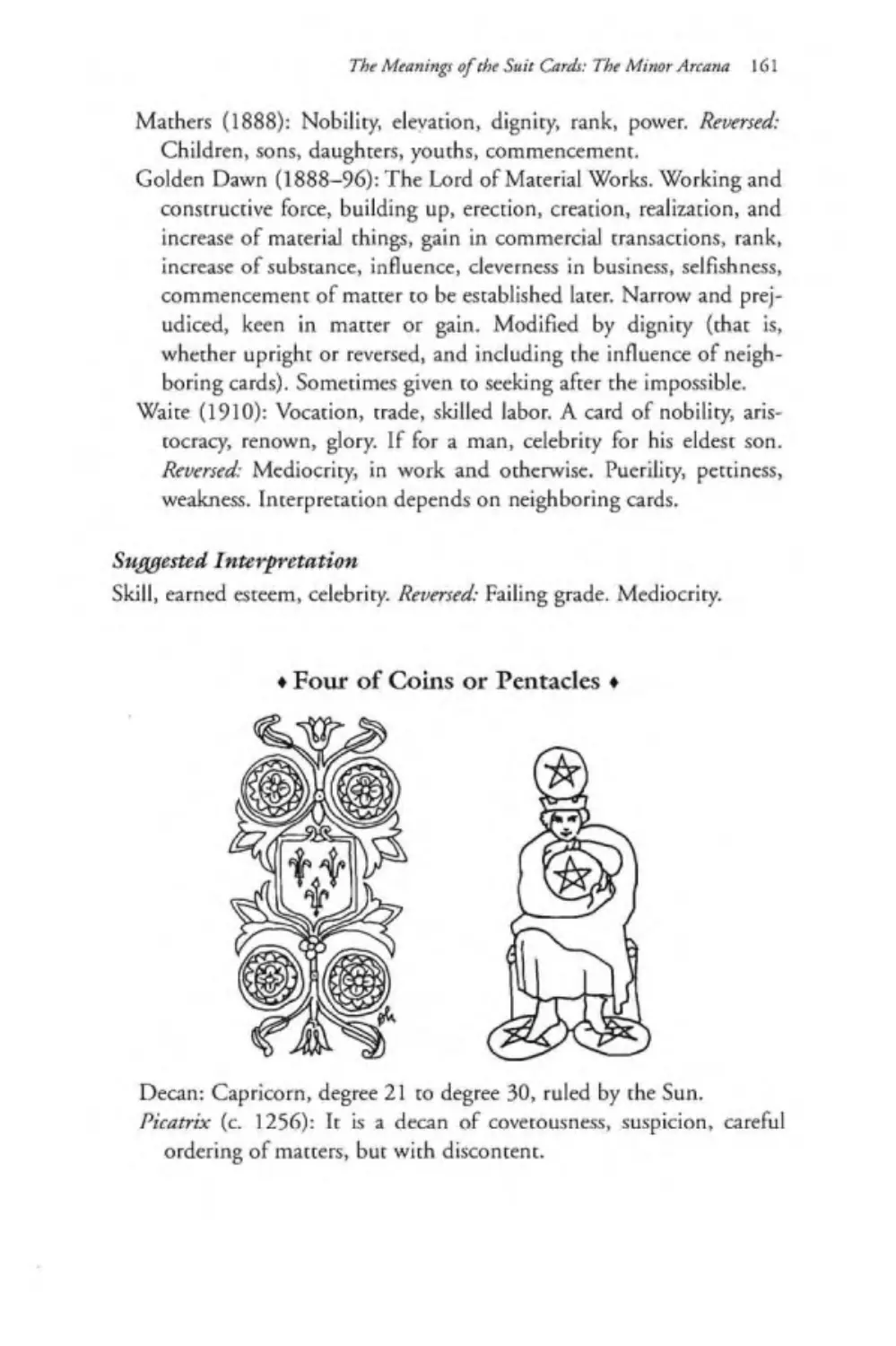
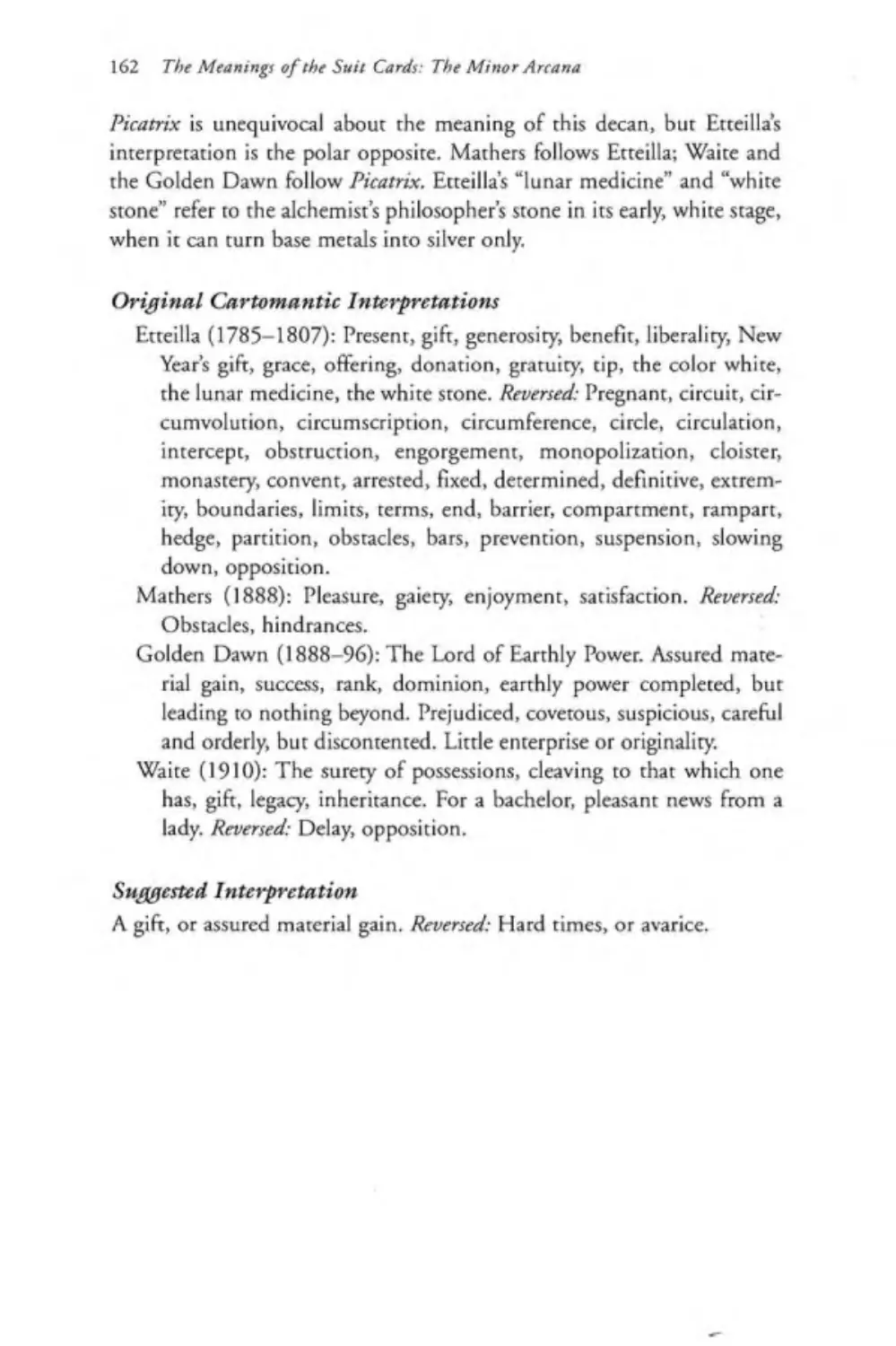
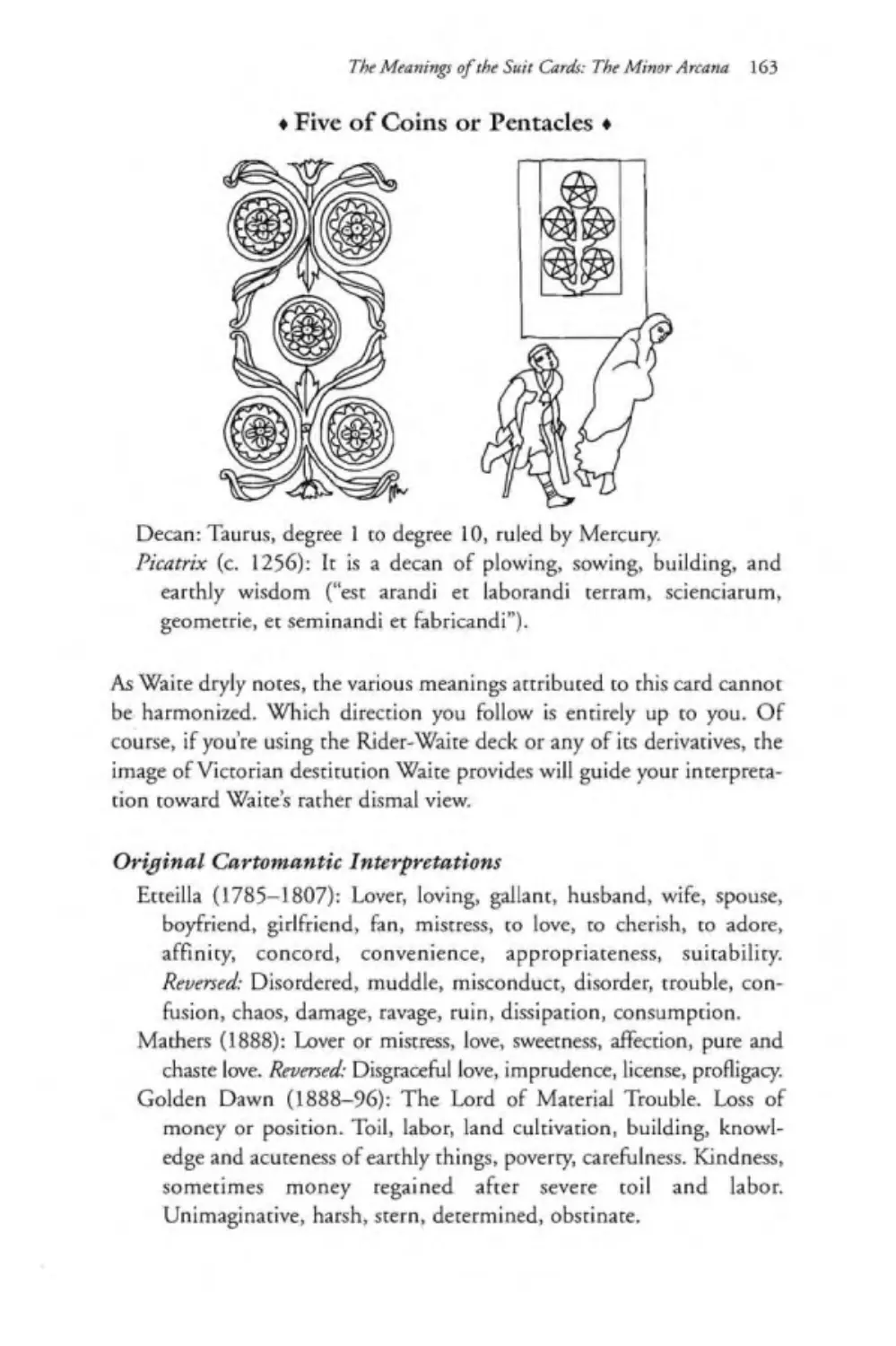
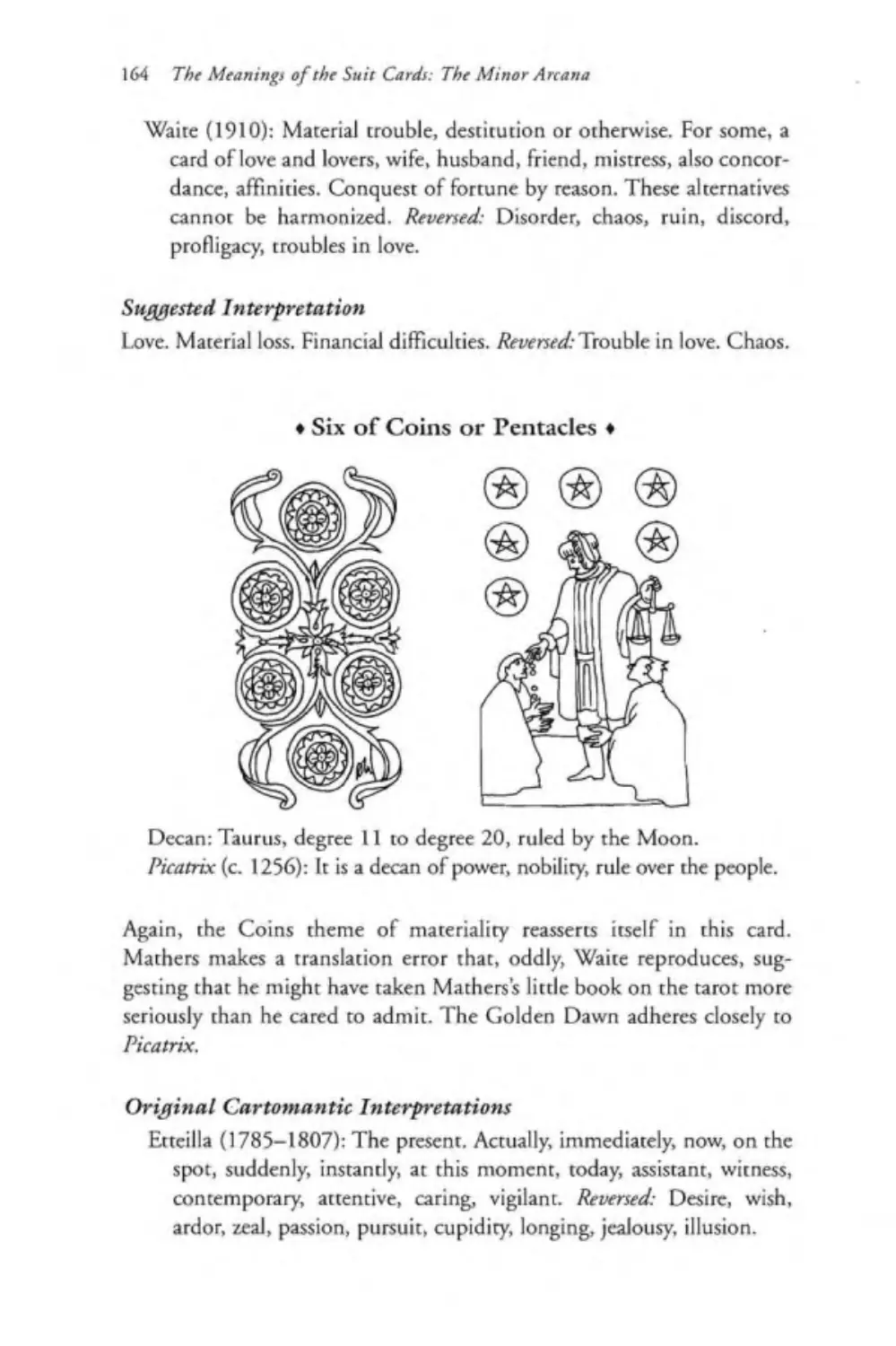
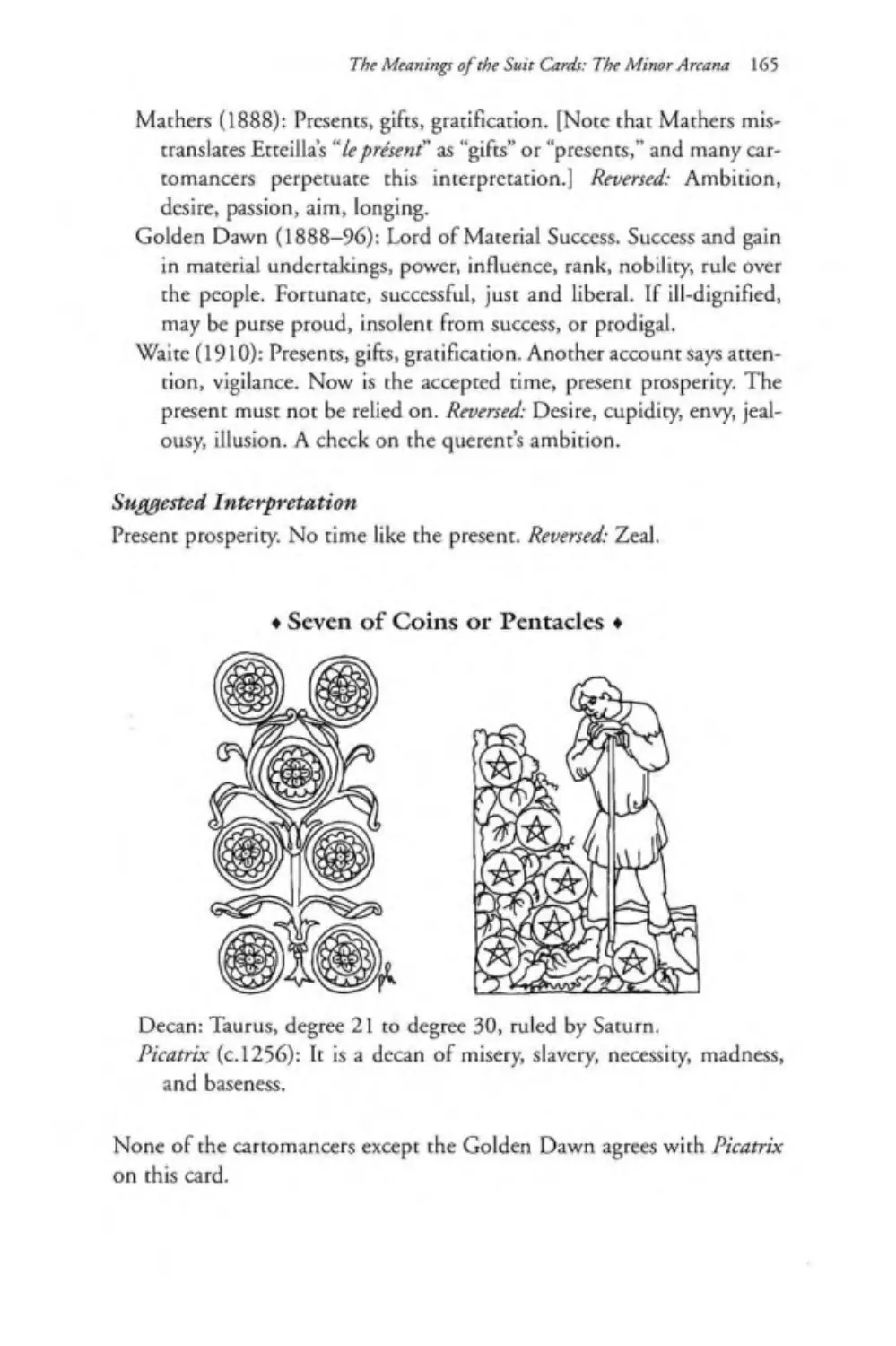
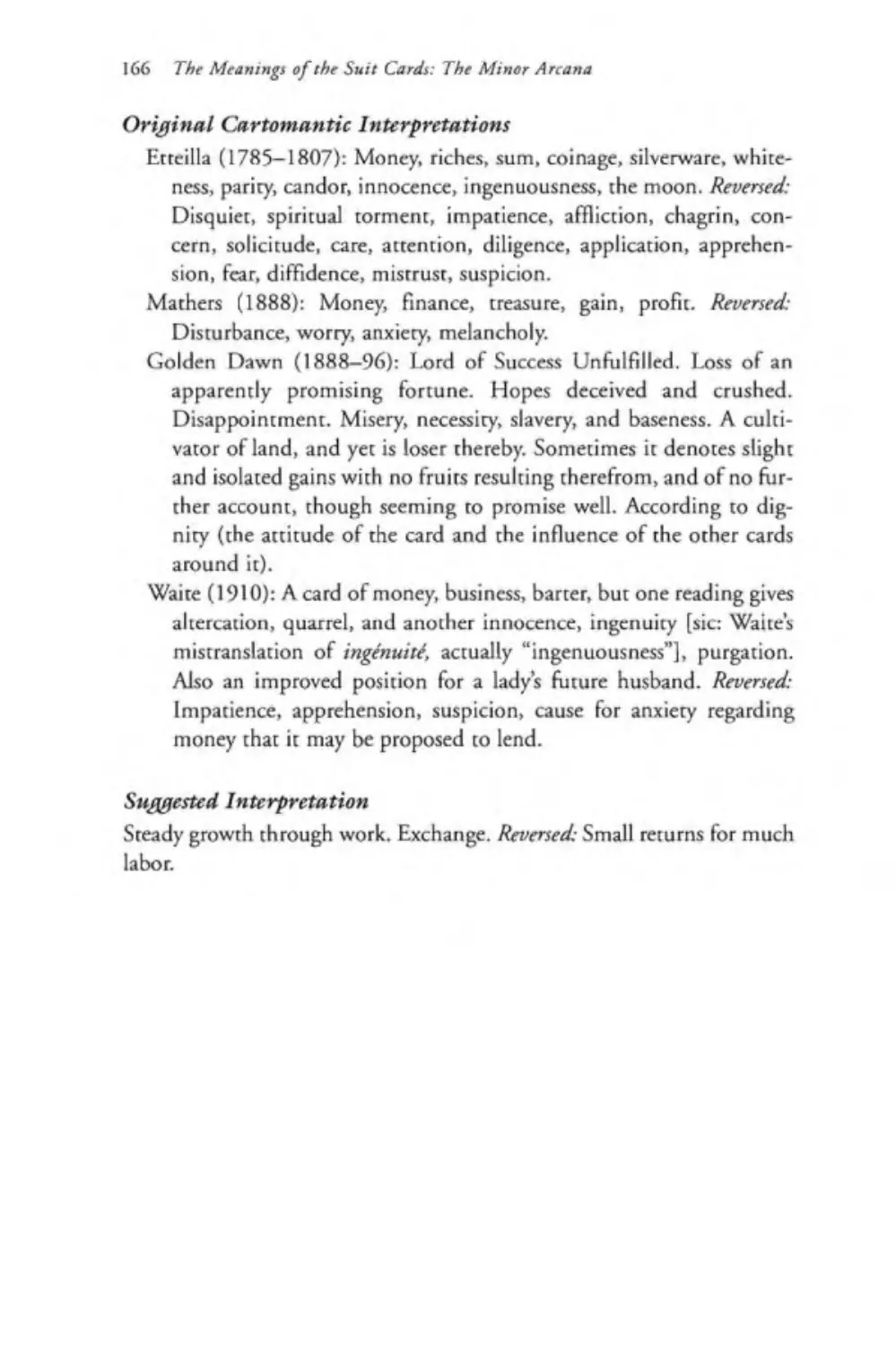
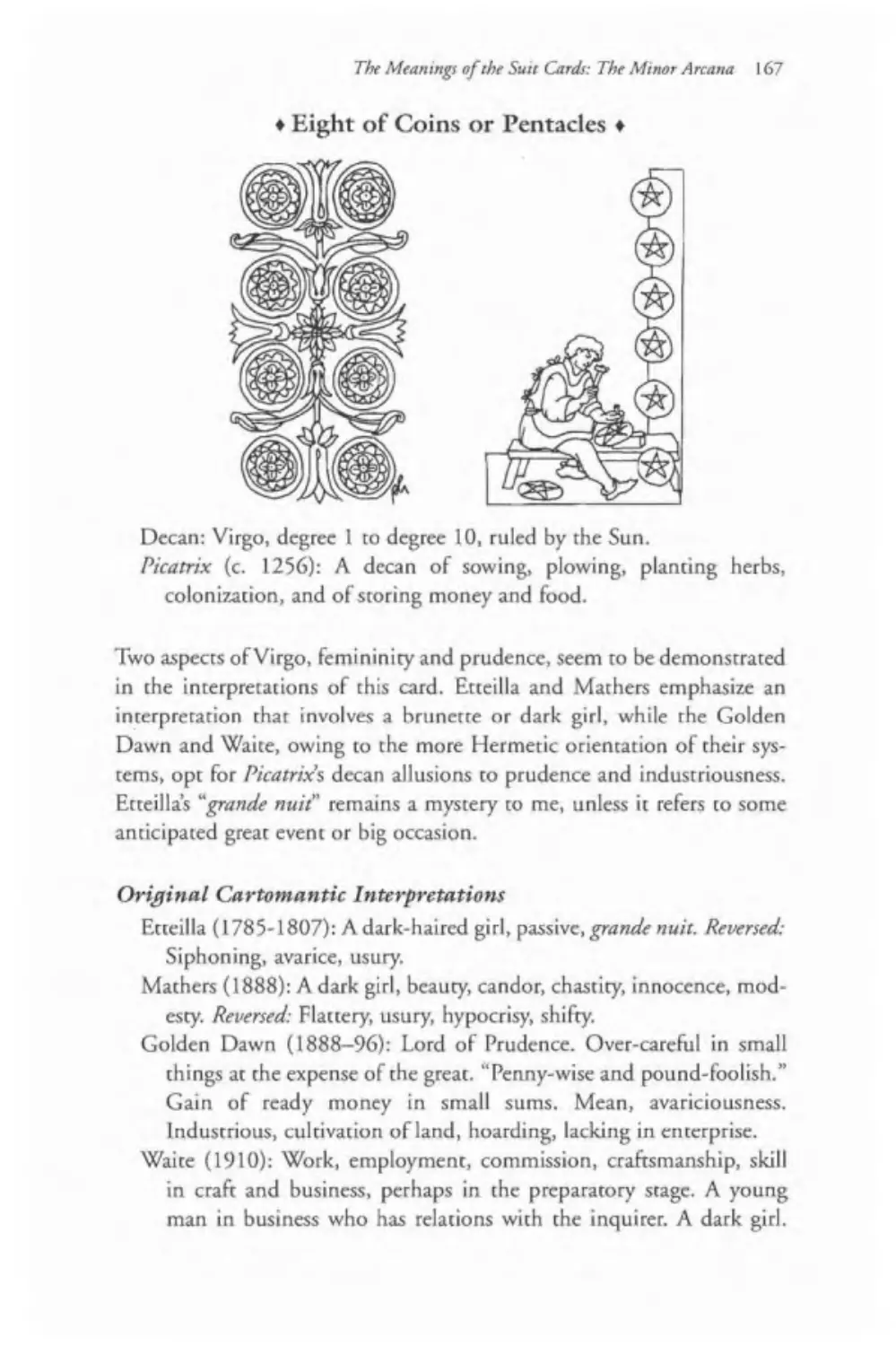

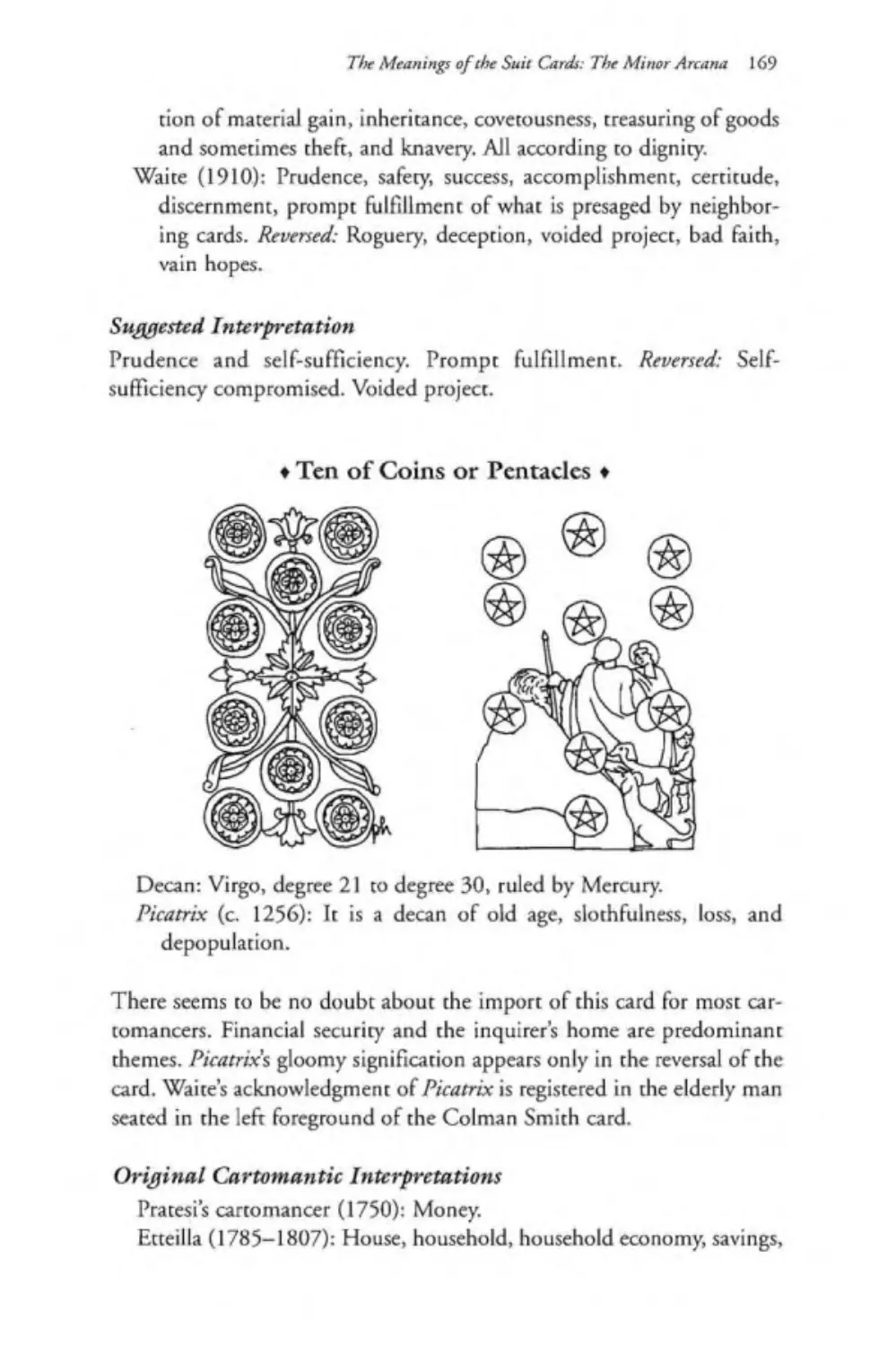

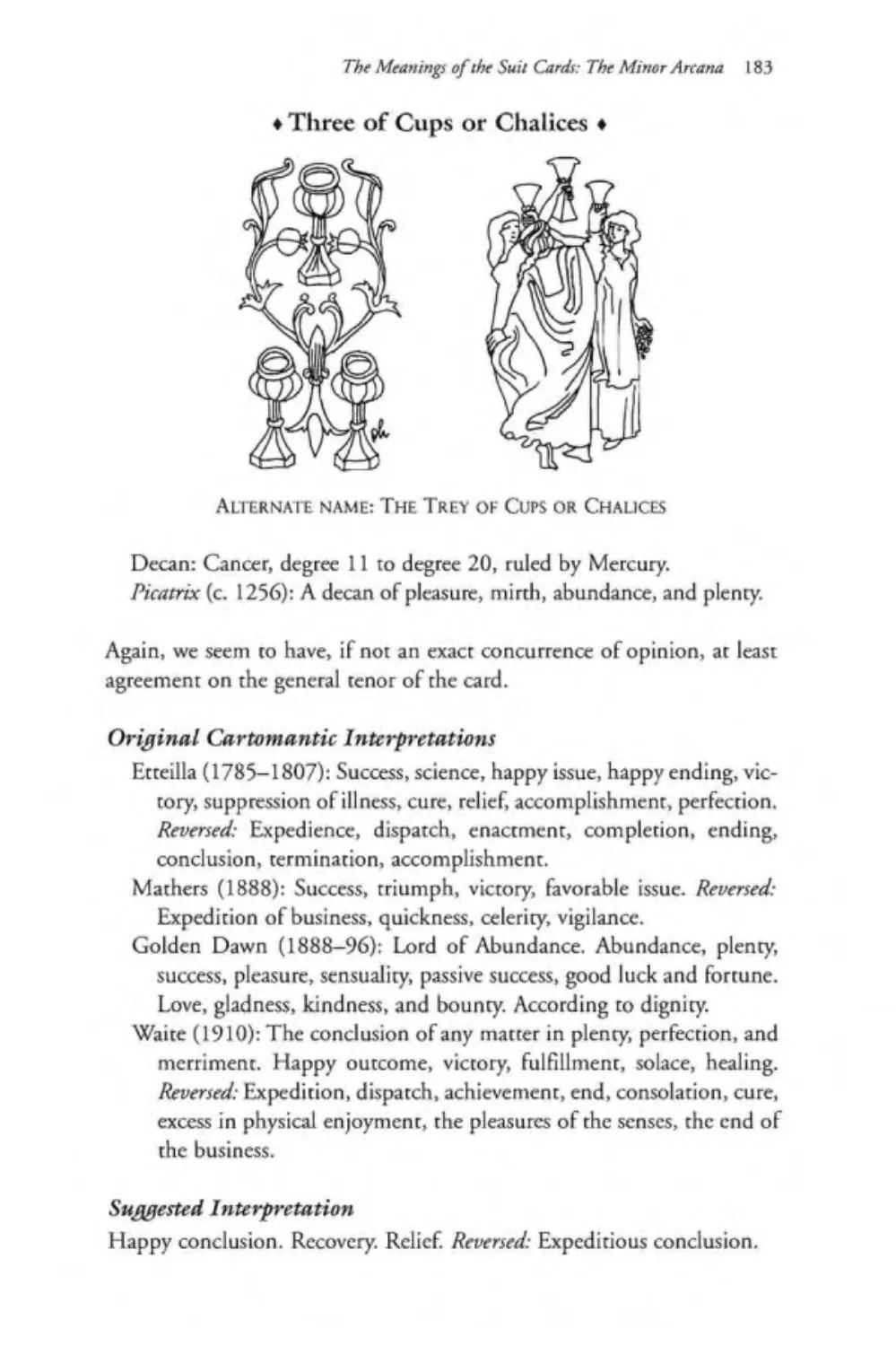
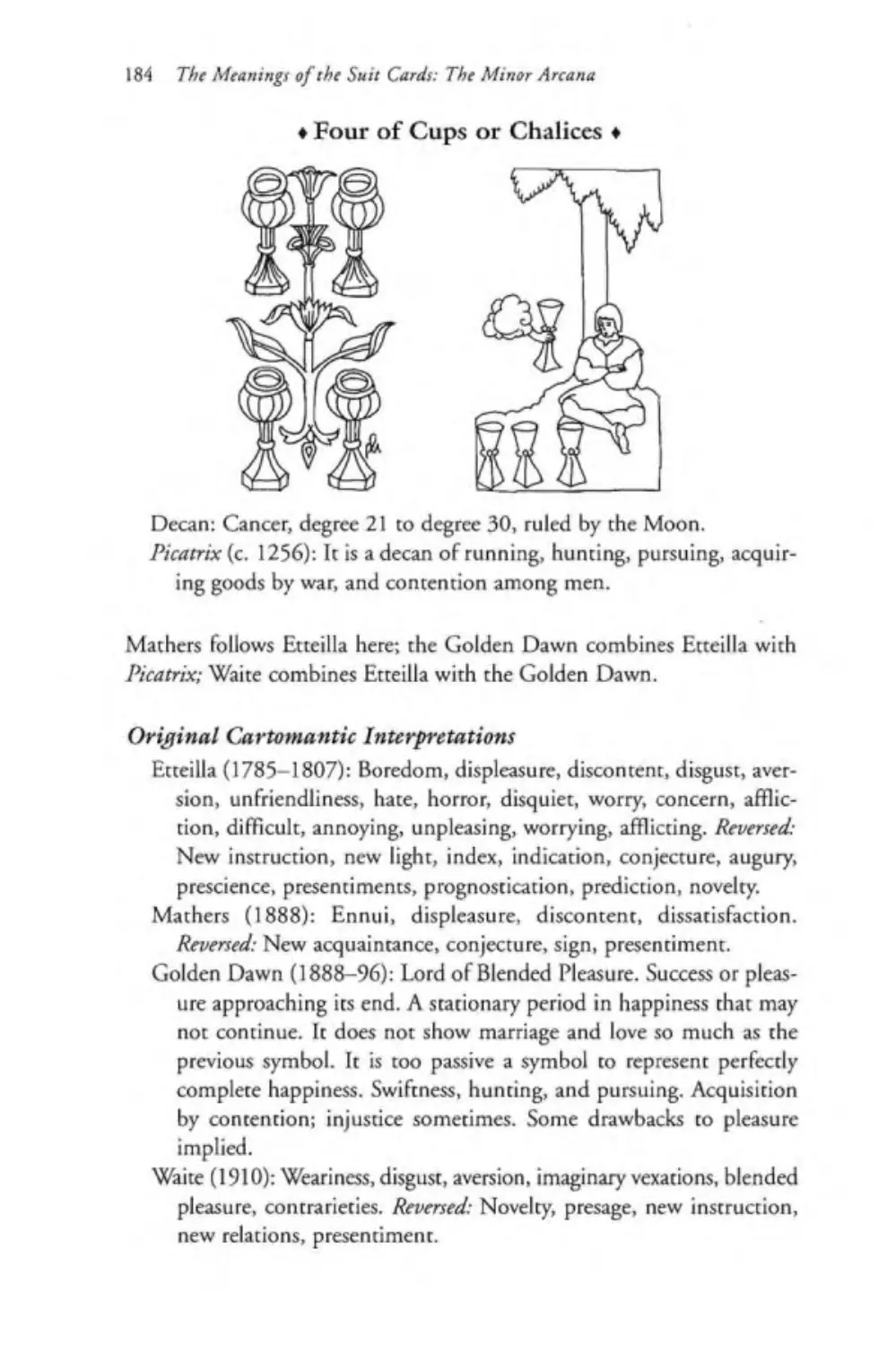
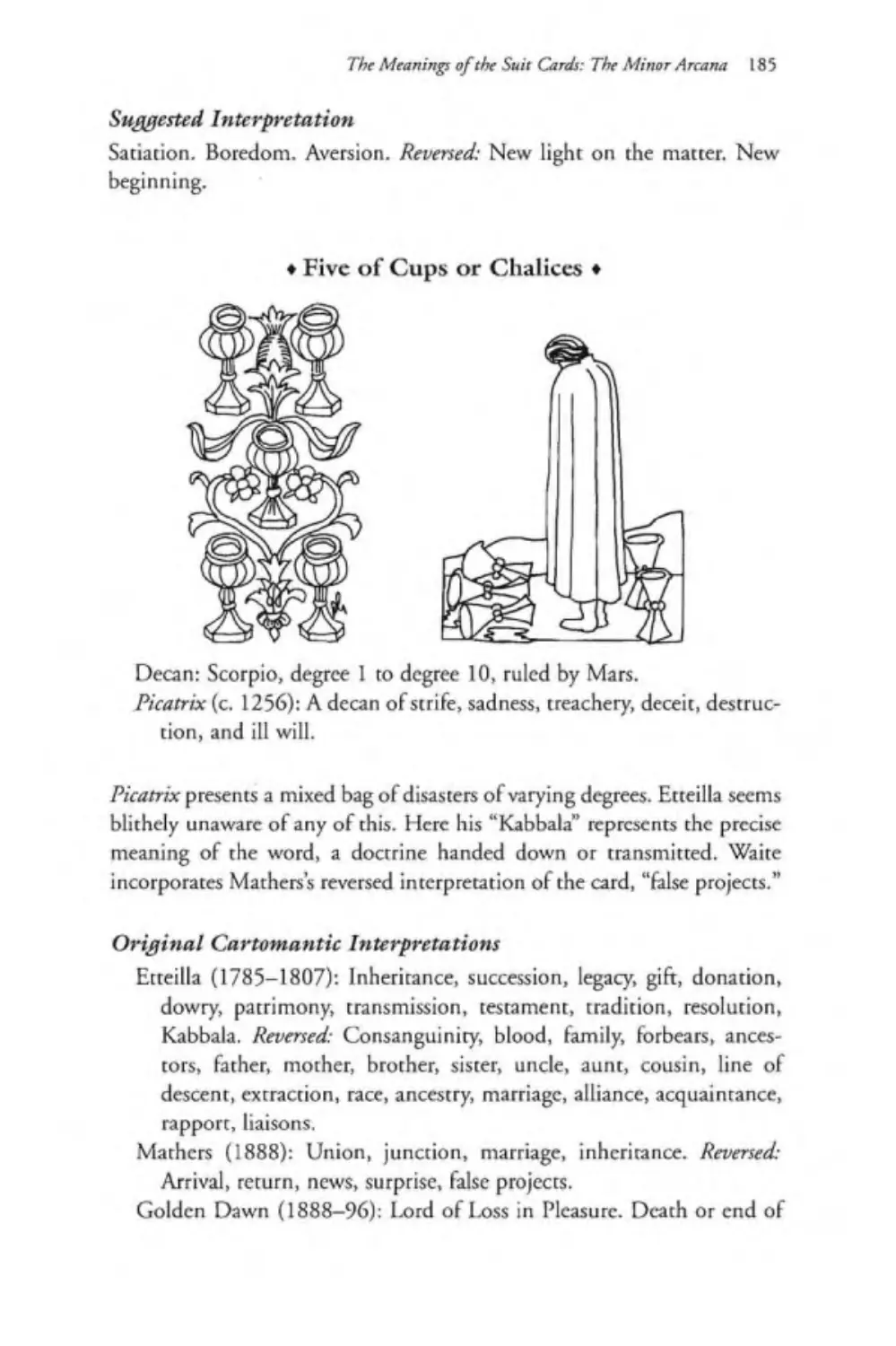
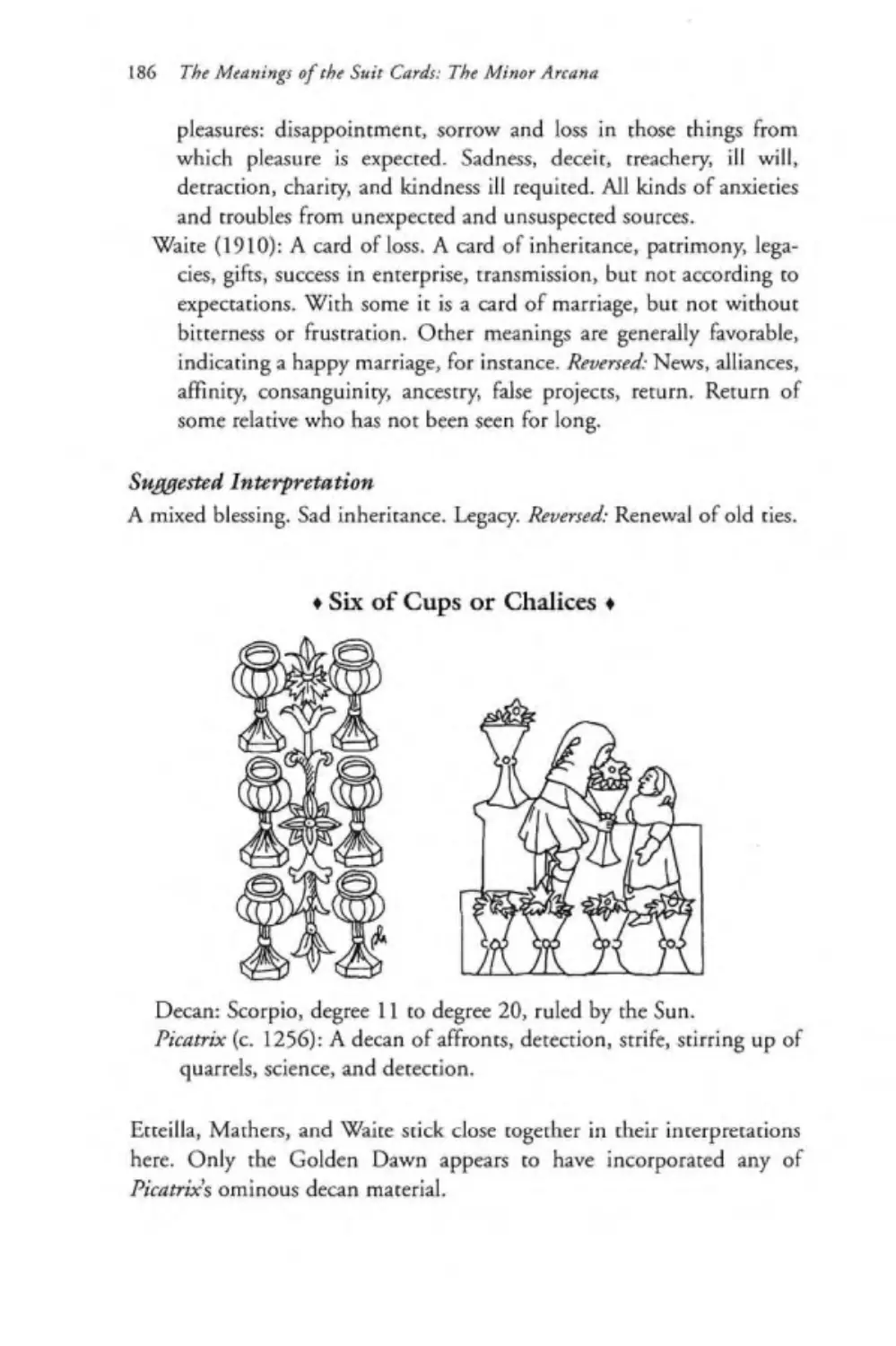


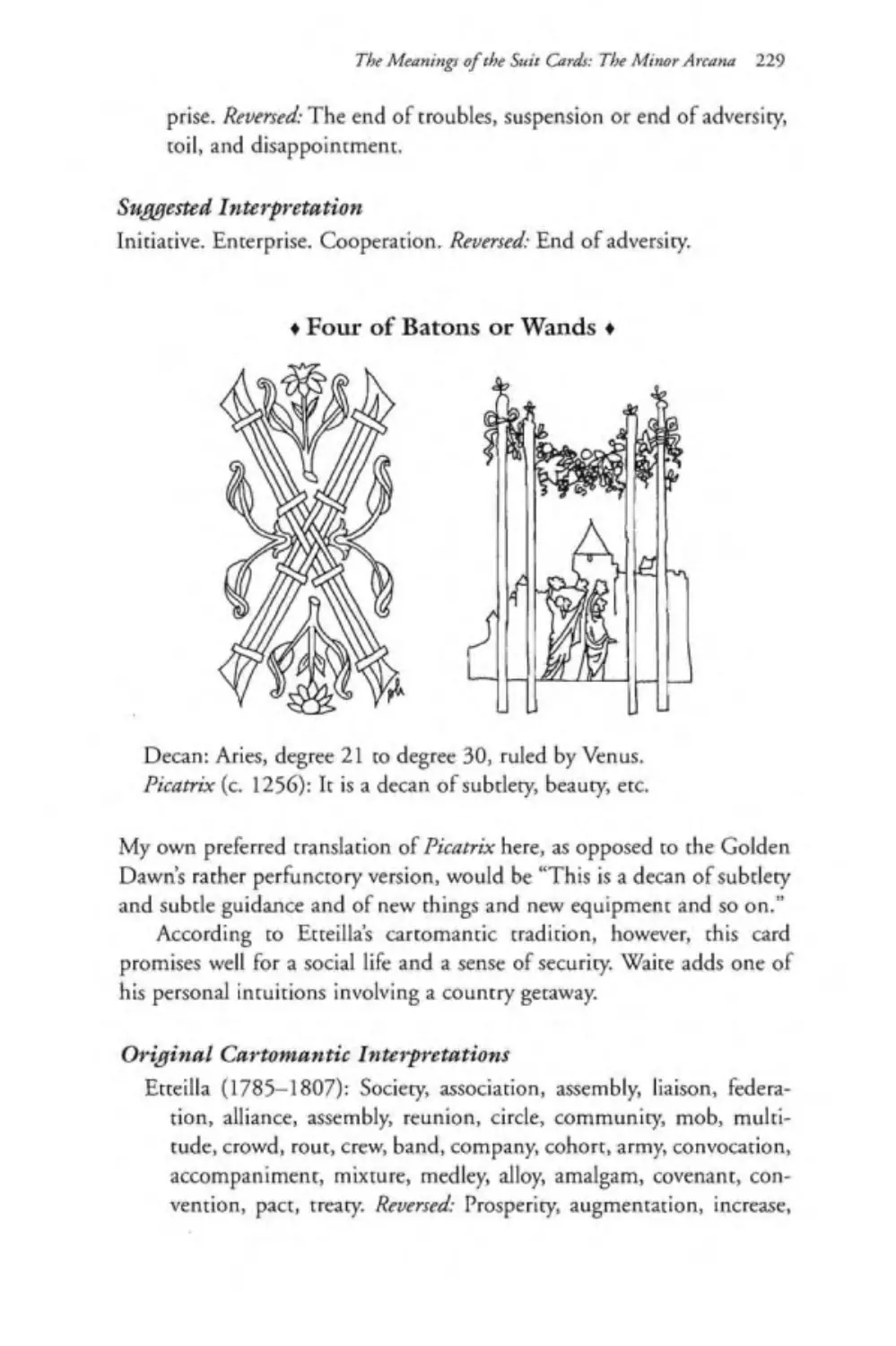
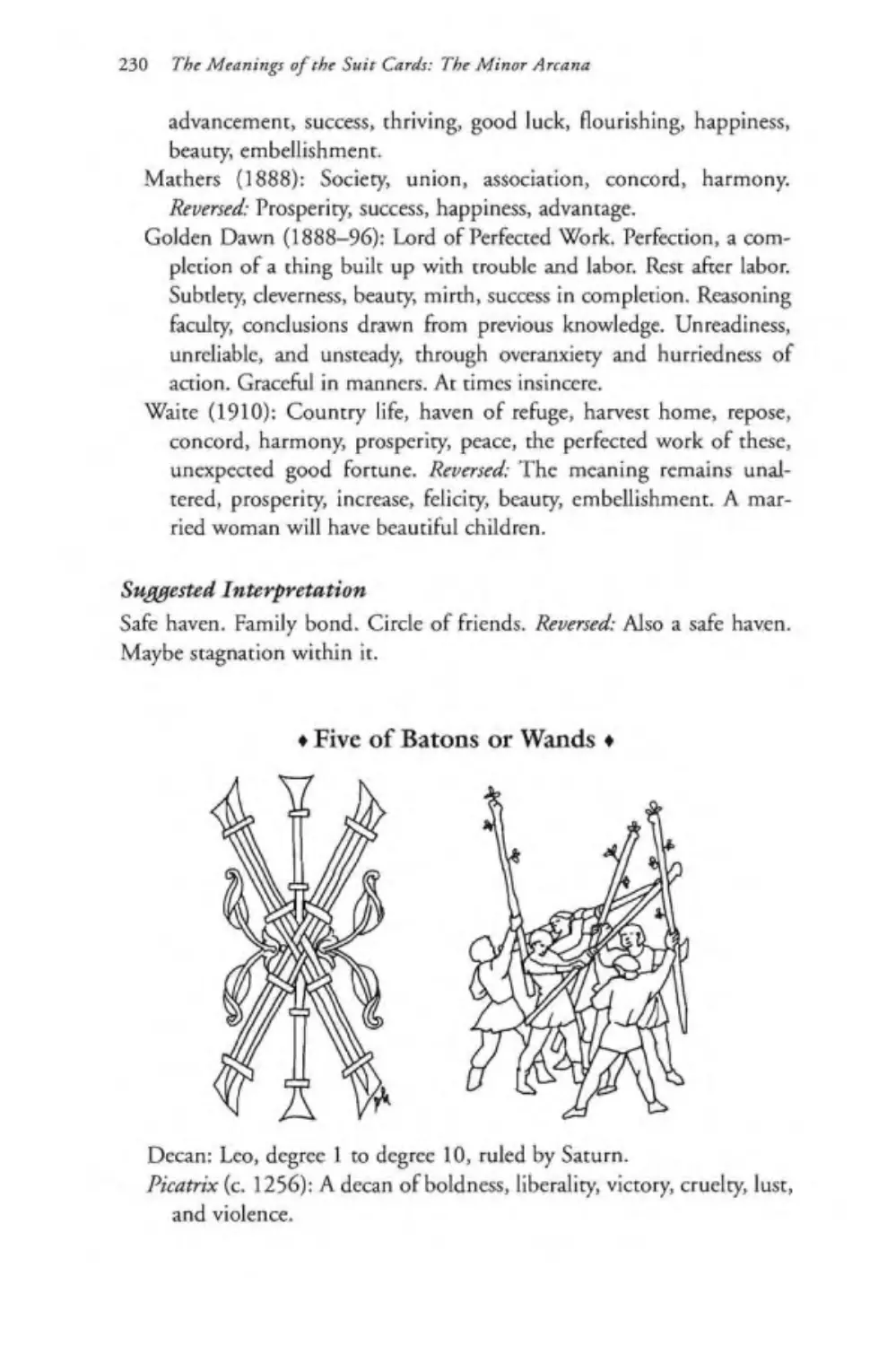
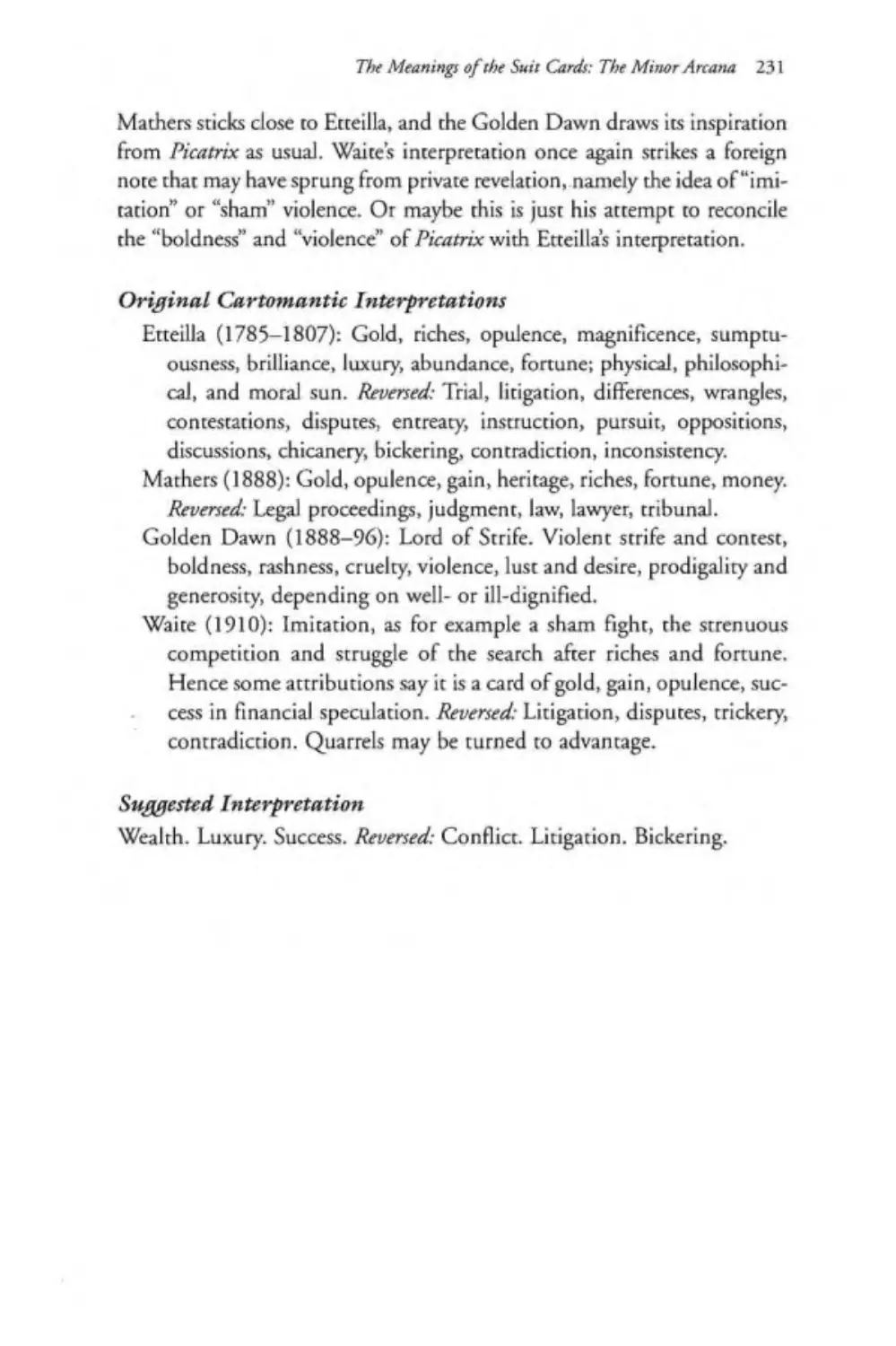
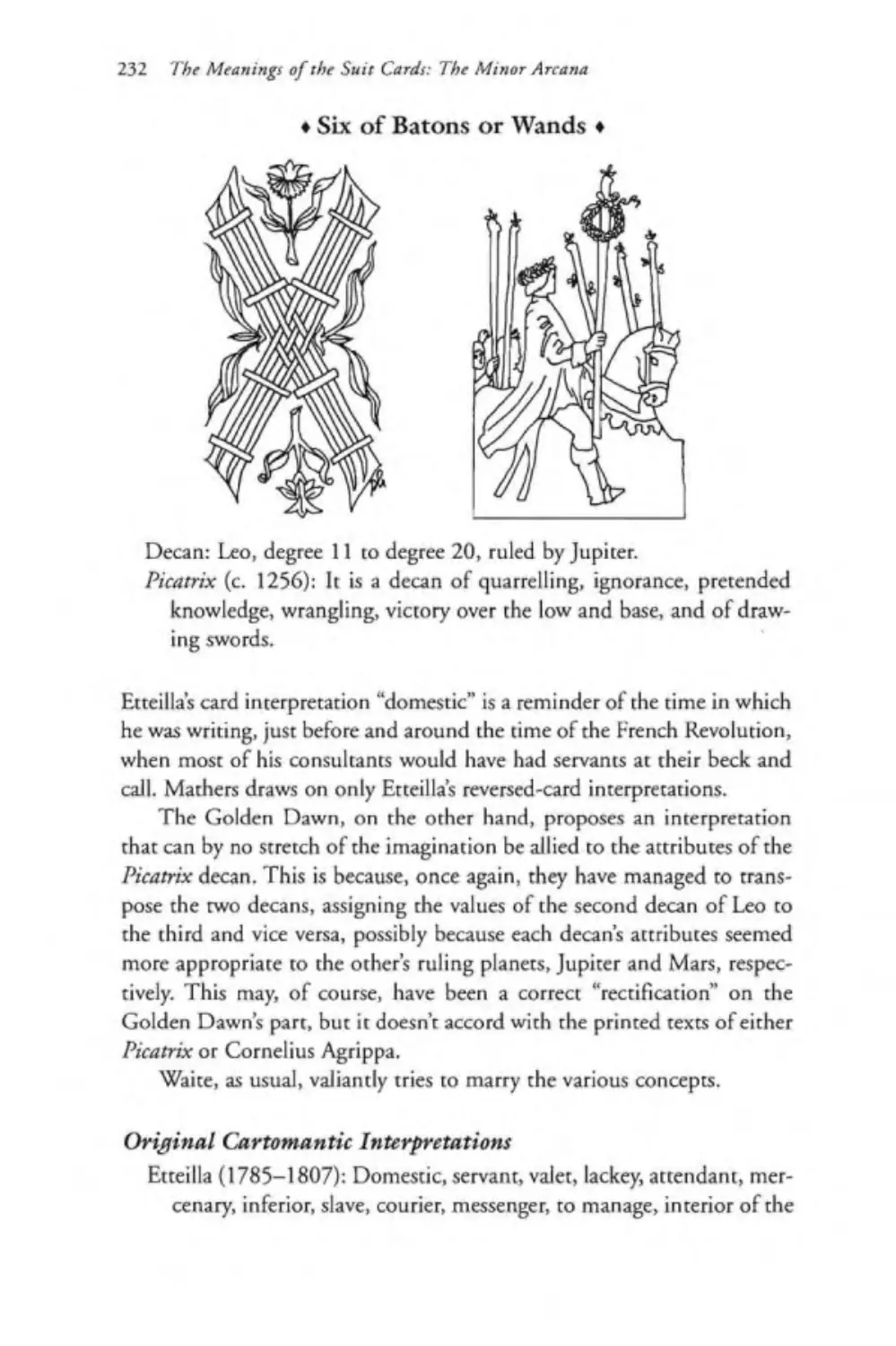
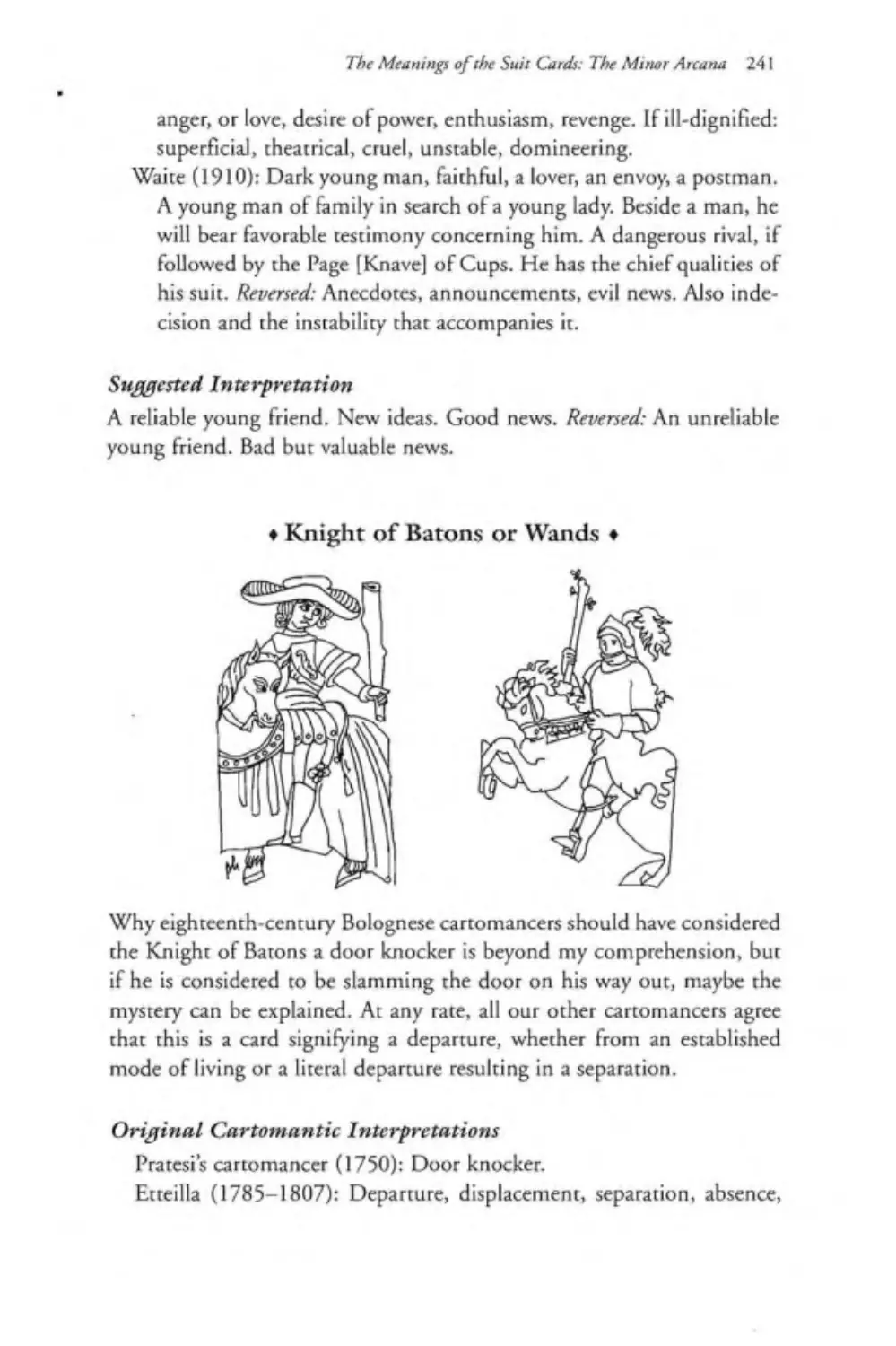
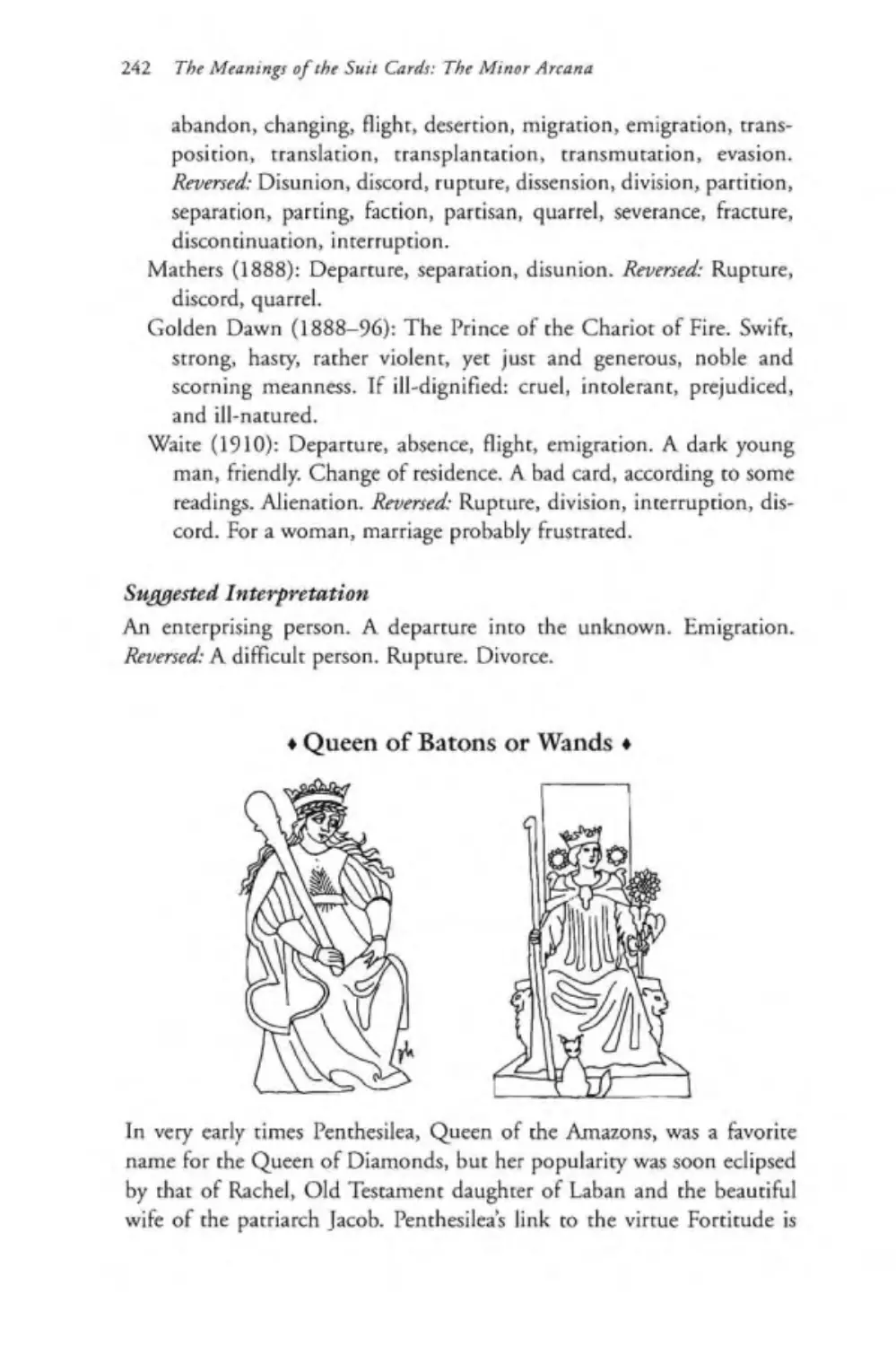
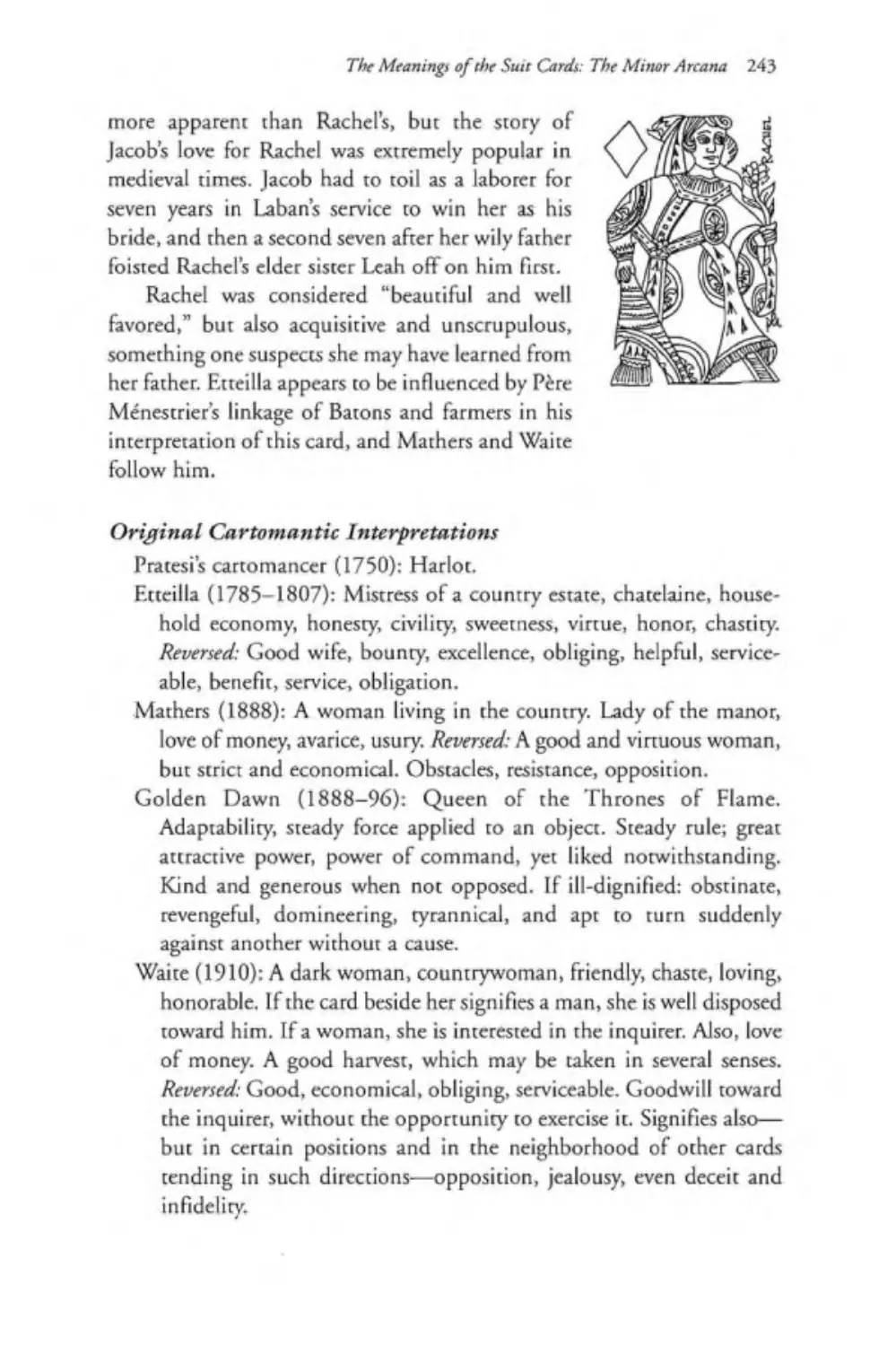
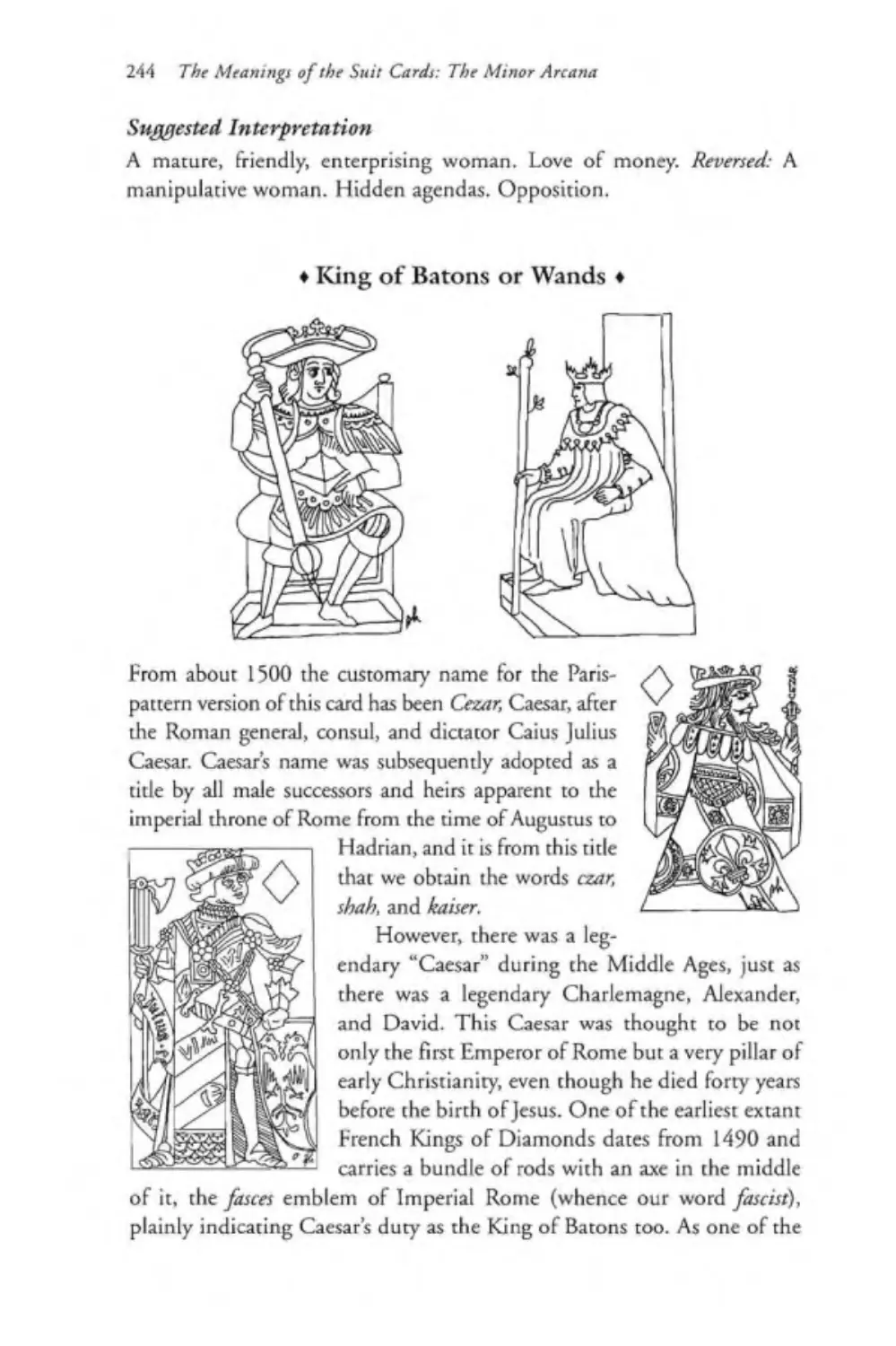
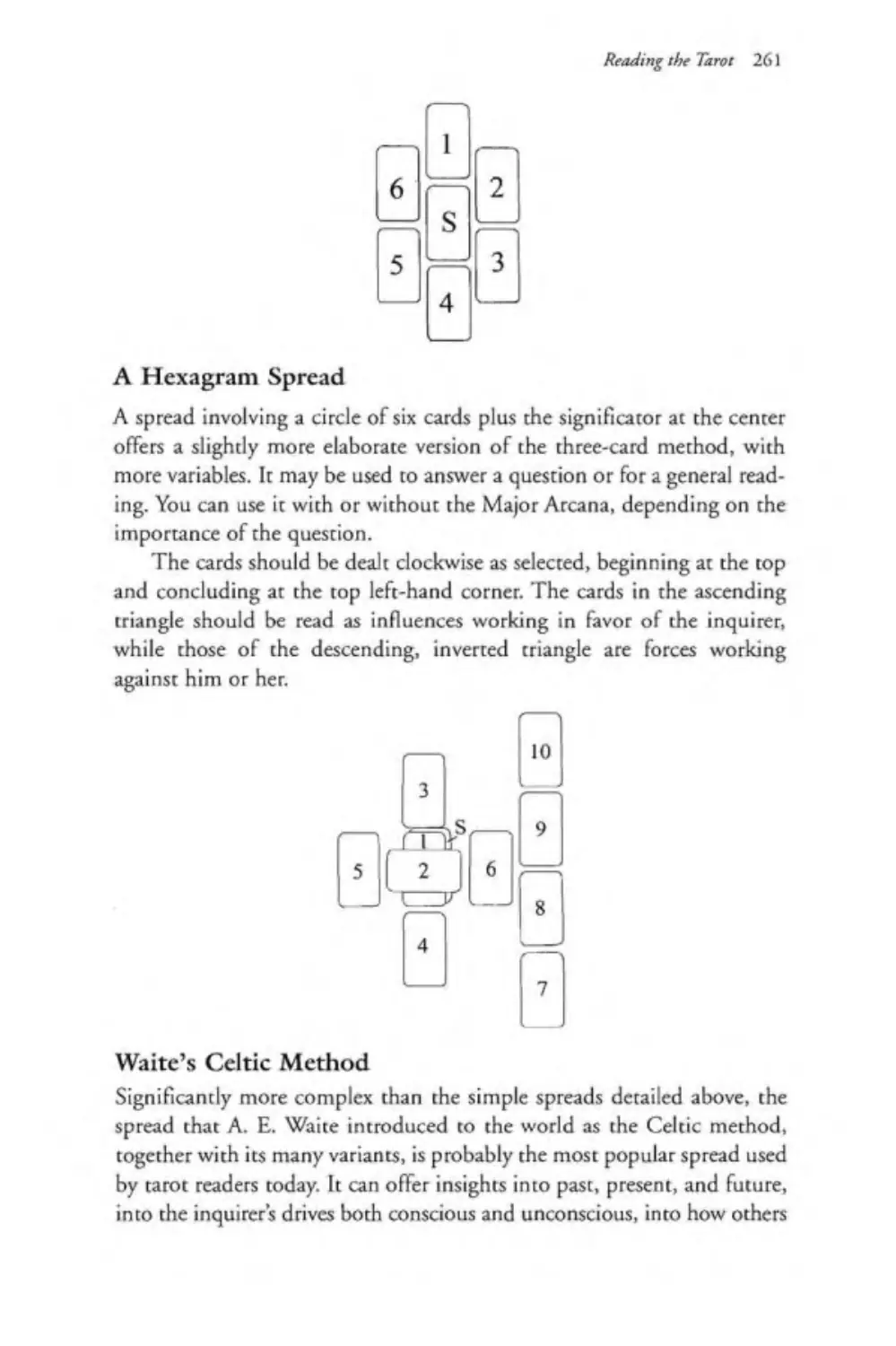
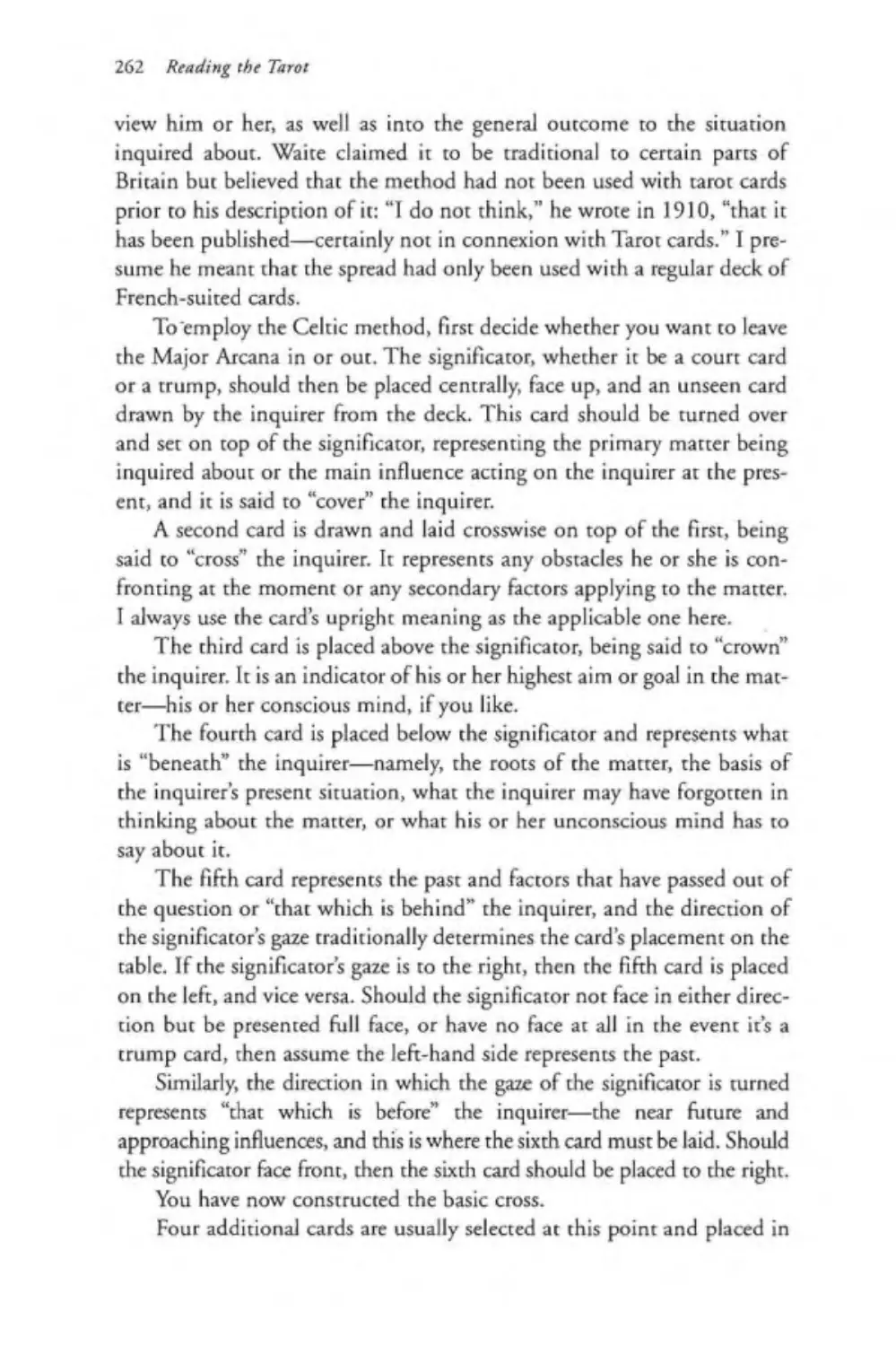
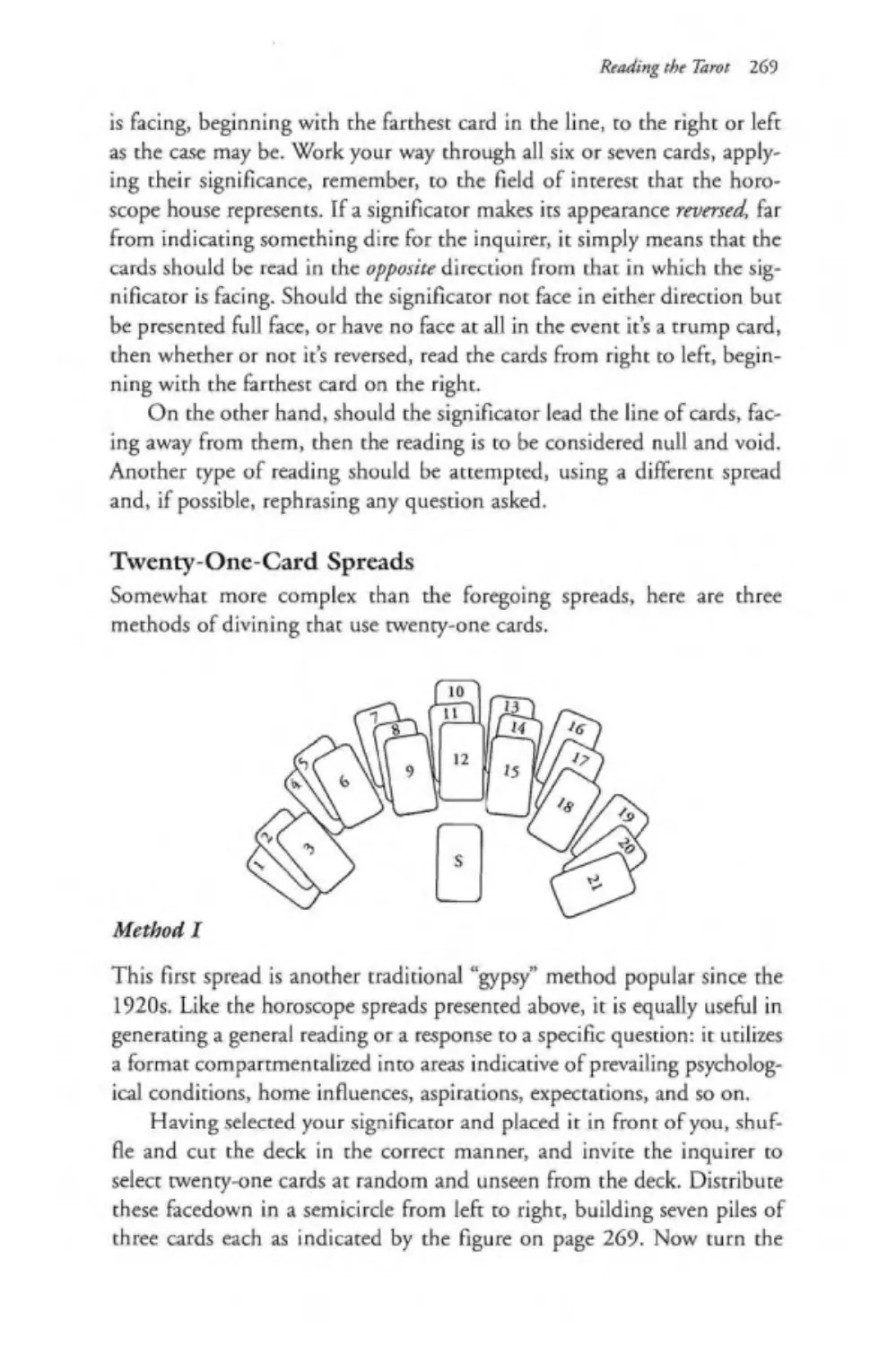
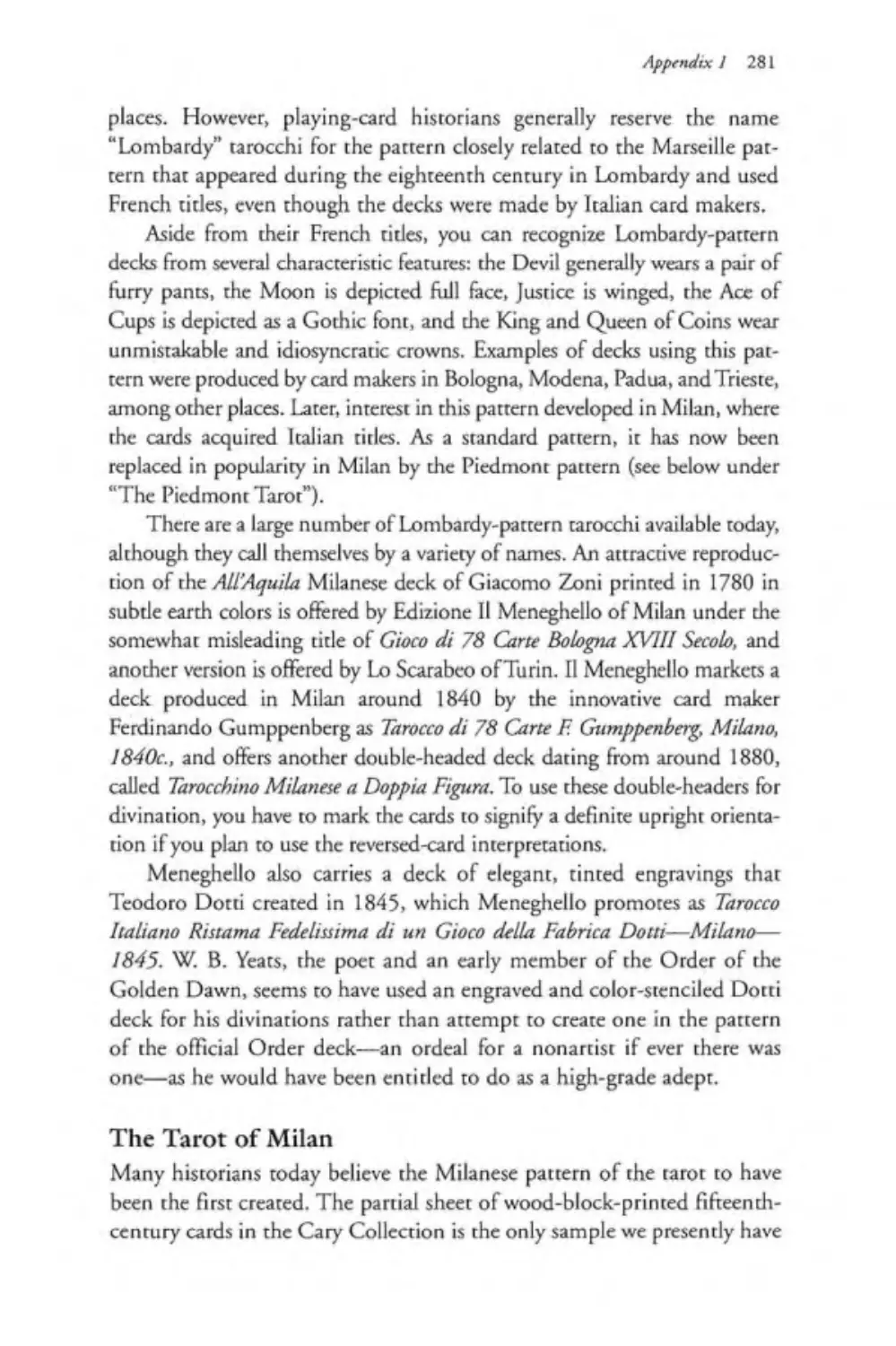


Текст
                    In loving memory of Olga, and Carl

Ju.
Tegn»
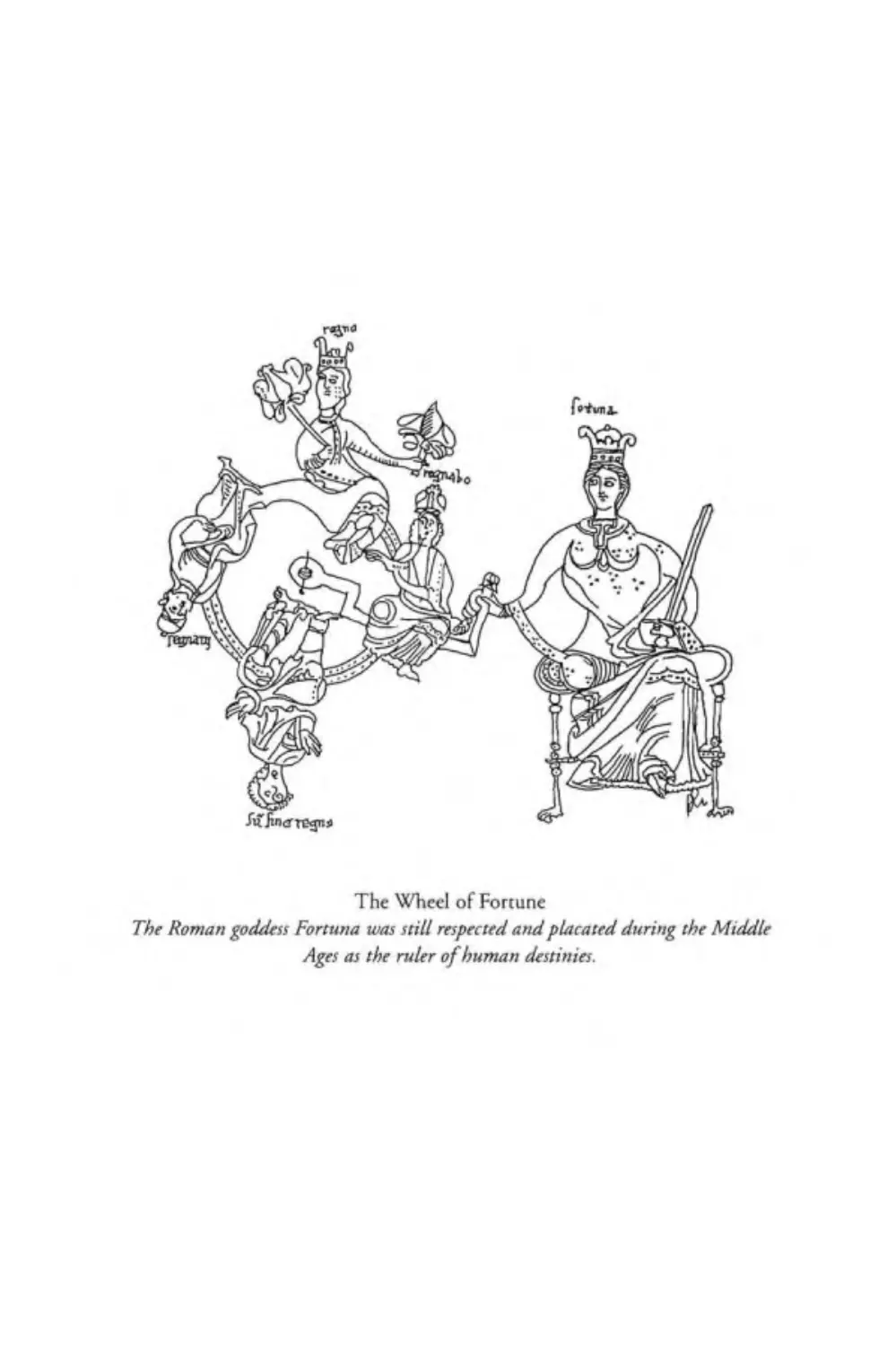
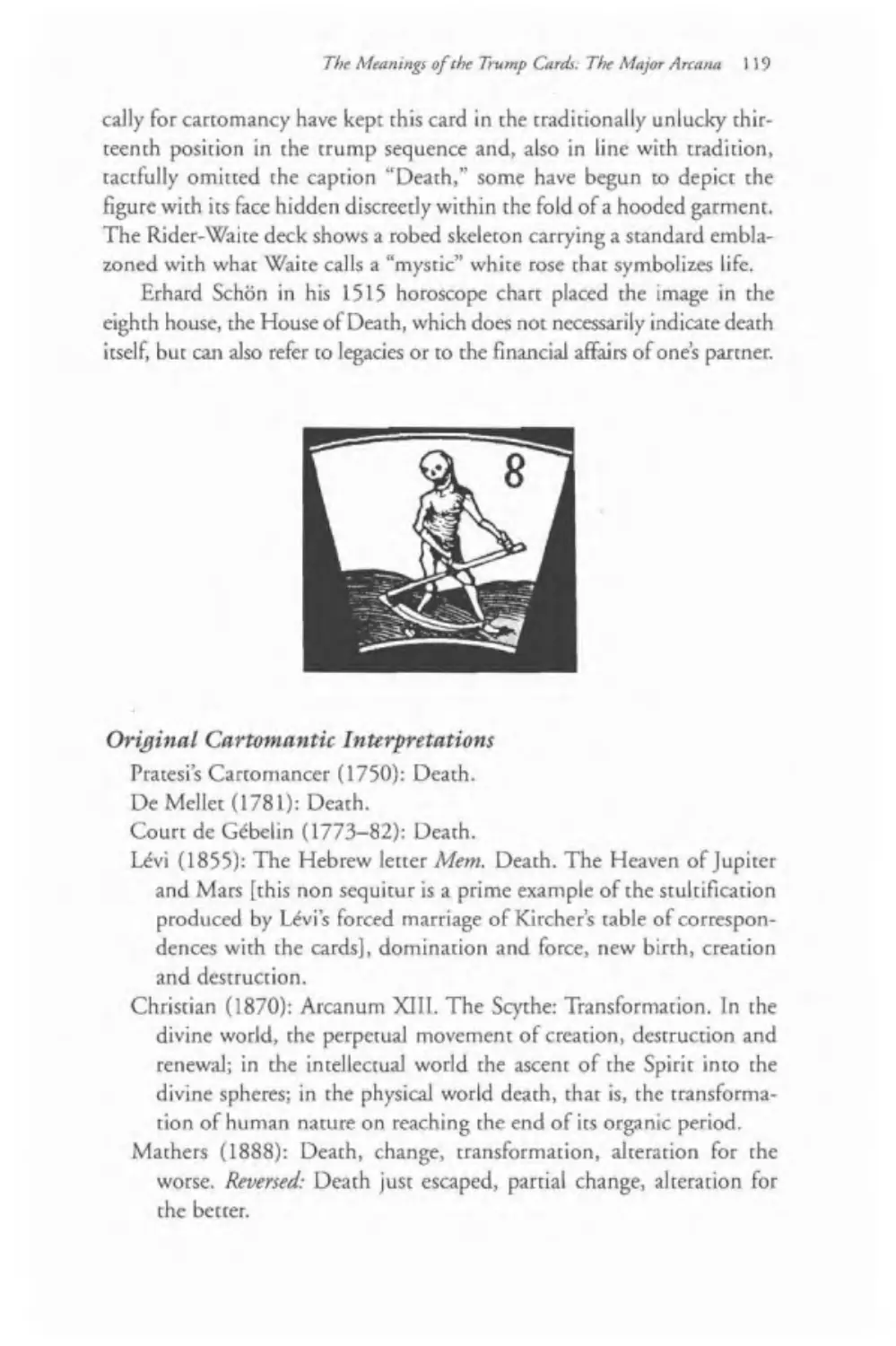
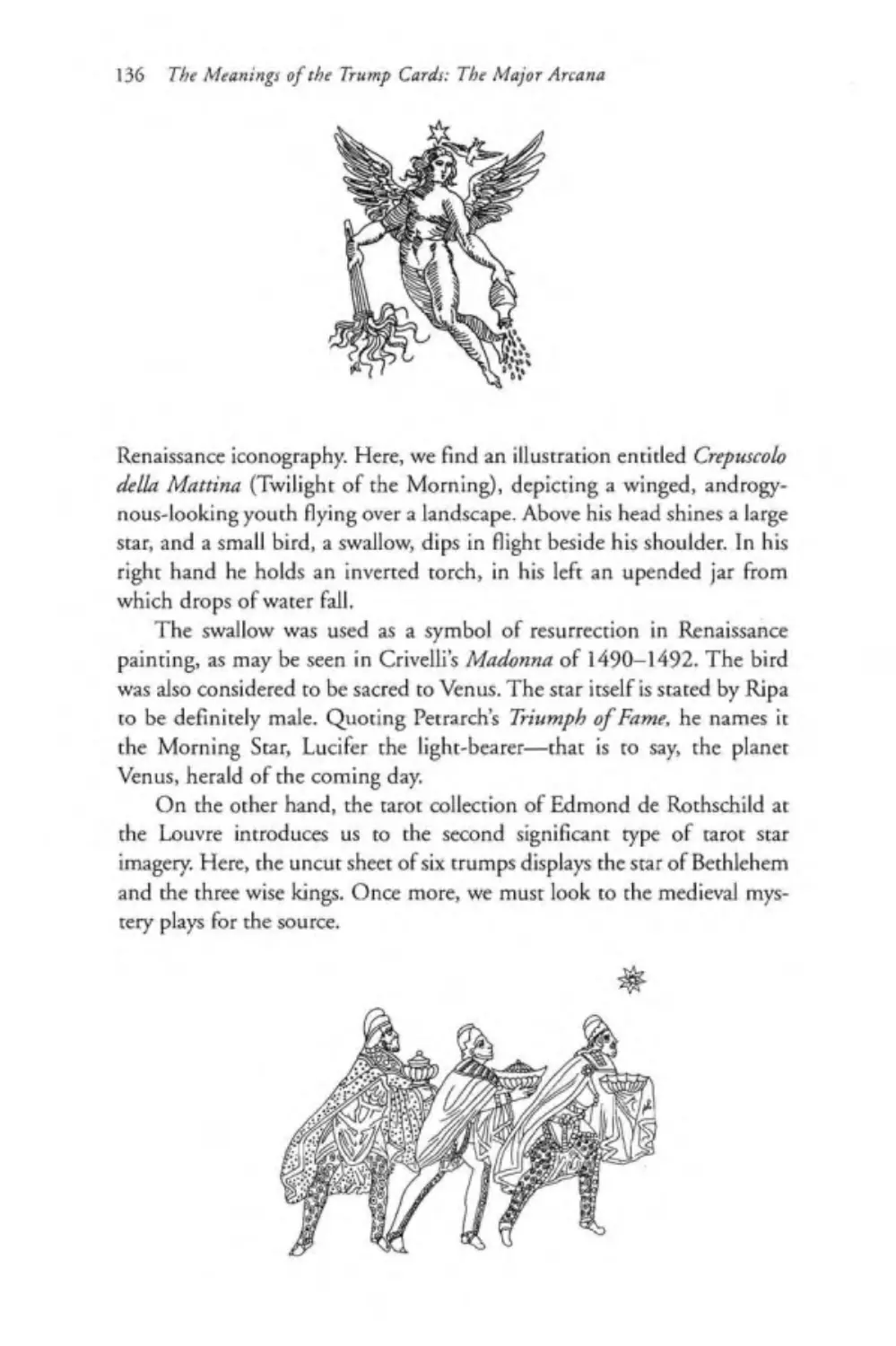
The Wheel of Fortune
The Roman goddess Fortuna was still respected and placated during the Middle
Ages as the ruler of human destinies.
Contents
Acknowledgments	x
Preface	xi
Introduction: Of Playing Cards
and Tarot Decks	i
The Mamluk Cards	2
The Creation of the Court Cards	5
The Naming of the Court Cards	8
The Creation of the Tarot Trumps	10
Tarot in the Sixteenth Century	13
Further Developments	14
1	The Origin	of the Suit Signs	is
Sufis and the Suit Signs	21
The Four Cardinal Virtues	23
The Four Castes of Ancient Persia	25
2	The Origin of the Trumps	29
Petrarchs / Trionfi	30
Medieval Drama	32
The Four Last Things	38
The Tale the Trumps Tell	39
3	Of Cartomancy and the Tarot 43
The Ancient Art of Sortilege	43
Egyptian Magic and the Book of Thoth	52
Ettcillas System	55
The Kabbala and Eliphas Lrfvi	59
The Golden Dawn Attributions	64
Papus and His “Bohemian” Tarot	69
4	The Meanings of the Trump Cards:
The Major Arcana	71
0	The Fool	74
I	The Juggler	77
II	The Female Pope	81
II	I	The Empress	86
I	V	The Emperor	89
V	The Pope	92
VI	The Lovers	95
VII	The Chariot	98
VI	II	Justice	101
I	X	The Hermit	104
X	The Wheel of Fortune	107
XI	Fortitude	111
Xll	The Hanged	Man	113
Х1П	Death	117
XIV	Temperance	121
XV	The Devil	124
XVI	The Tower	129
XVII	The Star	135
XVIII	The	Moon	139
XIX	The	Sun	142
XX	The	Judgment	145
XXI	The	World	148
5	The Meanings of the Suit Cards:
The Minor Arcana	153
The Suit of Coins or Pentacles	155
The Suit of Cups or Chalices	179
The Suit of Swords	200
The Suit of Batons or Wands	224
6 Reading the Tarot	246
Selecting a Tarot Deck	249
Getting in Touch with Your Cards	250
Preparing for Divination	252
General Rules of Cartomancy	253
Simple Tarot Spreads	259
Advanced Cartomancy—Linking the Cards	263
Complex Systems	271
Last Words of Advice	276
Appendix 1.	Historical Tarot Decks	279
Appendix 2.	Where to Buy Your Cards	291
Appendix 3.	Where to See the Originals	294
About the Illustrations	297
Bibliography	308
Index	322
Acknowledgments
Ihanks arc due to the following for their help in preparing this book:
Stuart R. Kaplan for providing me material on the Mamluk cards so long
ago; Andrea Pollen for important information about the Mamluk suit
signs; Ron Decker for sharing with me his expertise on tarot symbolism
and Erteilla; Giordano Berti for his help in trying to locate the elusive
tarocchi of Vittoriano Facco; Jess Karlin for his pointers on tarot and
magic; Mary K. Greer for a careful reading of an early draft followed by
learned and constructive suggestions; the International Playing-Card
Society, notably Christopher Rayner, Dr. Michael Cooper, and Barbara
Clarke, for their help in locating valuable playing-card research; the staff
of the British Library, Ixmdon, for their diligence in locating material on
medieval drama; Susan Jeffers and Mark Shelmerdinc for their support-
ive enthusiasm throughout the long history of this project; Niki Marvin
for her love, encouragement, and spiritual fortitude; Mel Raab for com-
ing to my assistance with his timely technical wizardry; Martha Millard
for her long-standing faith in the book; Jon Graham for his persistence
and tenacity in bringing the book to publication; Vickie Trihy and
Bronwyn Becker for their erudite and constructive input to the final
manuscript; and last but definitely not least, William Bast, who made
everything possible.
x
Preface
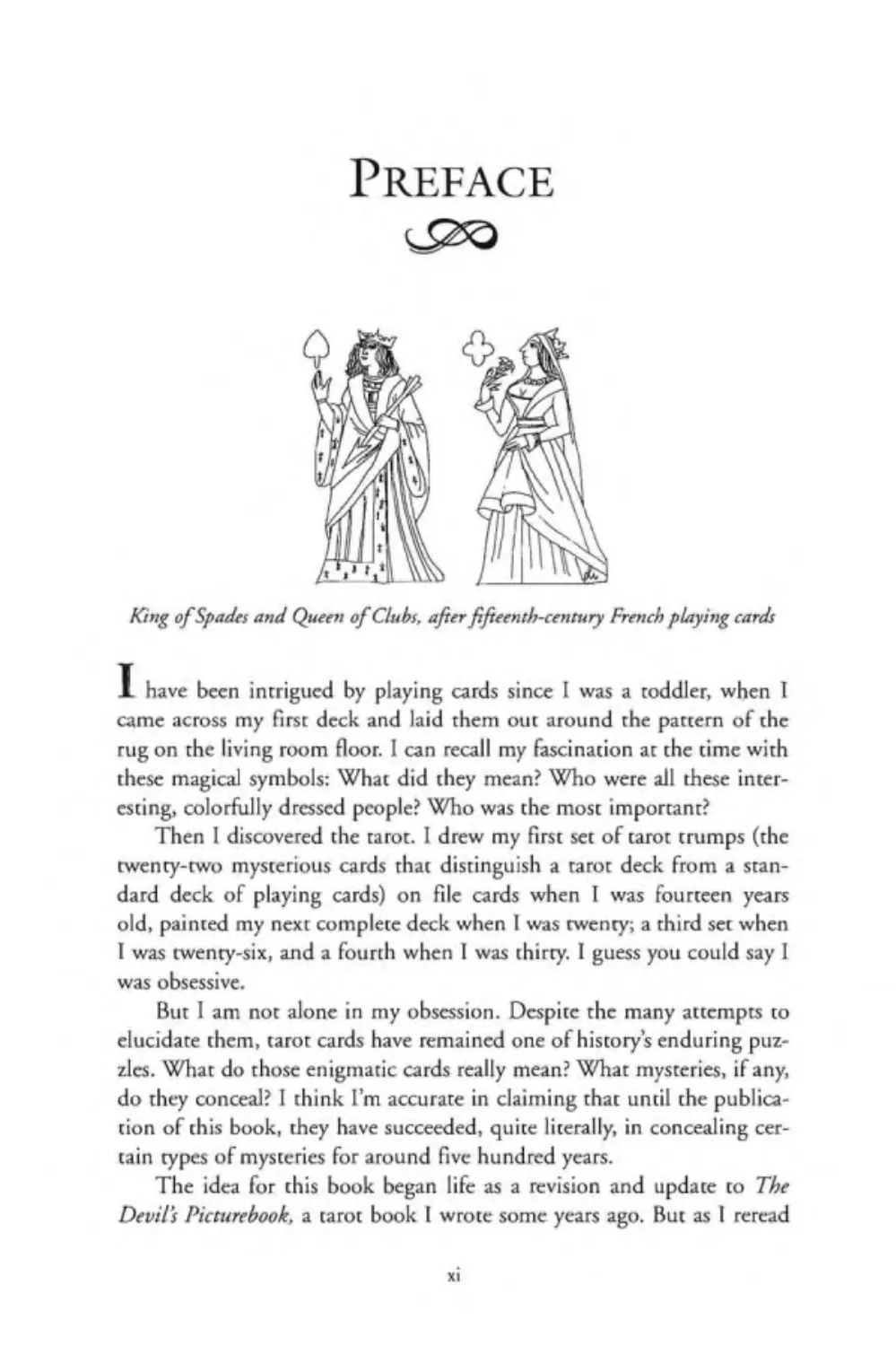
King of Spades and Queen of Clubs, after fifteenth-century French playing cards
I have been intrigued by playing cards since I was a toddler, when I
came across my first deck and laid them out around the pattern of the
rug on the living room floor. 1 can recall my fascination at the time with
these magical symbols: What did they mean? Who were all these inter-
esting, colorfully dressed people? Who was the most important?
Then 1 discovered the tarot. 1 drew my first set of tarot trumps (the
twenty-two mysterious cards that distinguish a tarot deck from a stan-
dard deck of playing cards) on file cards when I was fourteen years
old, painted my next complete deck when I was twenty; a third set when
I was twenty-six, and a fourth when 1 was thirty. 1 guess you could say I
was obsessive.
But I am not alone in my obsession. Despite the many attempts to
elucidate them, tarot cards have remained one of history’s enduring puz-
zles. What do those enigmatic cards really mean? What mysteries, if any,
do they conceal? I think I'm accurate in claiming that until the publica-
tion of this book, they have succeeded, quite literally, in concealing cer-
tain types of mysteries for around five hundred years.
The idea for this book began life as a revision and update to The
Devils Picturebook, a tarot book I wrote some years ago. But as I reread
xi
xii Preface
each chapter of Picturebook, I realized with somewhat mixed emotions
that so much new light had been shed on the history of the subject since
I wrote it that if I did write anything at all—and there was plenty to write
about—it would have to be an entirely new venture.
Unlike Picturebook, in which I speculated broadly on the tarots pos-
sible associations to medieval and Renaissance myth and magic, my aim
here is not merely to provide another “how-to” book on cardreading.
Rather, 1 propose to track each symbol in every card of the deck, in both
so-called Major and Minor Arcanas (the trump cards and the suit sign
cards) to its actual historical origin, and then explore how its meaning in
divination evolved from this source, if in fact it did.
In the thirty years since I wrote Picturebook, my views on the tarot
have changed. Tarot, moreover, has expanded from a subject of interest
only to playing-card enthusiasts and occultists to one of worldwide
appeal, having gained a considerable amount of academic attention and
an enormous presence on the Internet. There you can find an amazing
plethora of tarot Web sites, chat rooms, and information resources pro-
moting lively, well-informed, and often diametrically opposed points of
view: historical, psychological, Hermetic, divinarory, feminist, postmod-
ern, you name it. Furthermore, a vast collection of books on tarot has
now become available. However, although the mysterious cards have
arguably become part of mainstream culture—the art of tarot reading
recognized as, at minimum, a technique of psychological exploration and
the cards themselves finally anchored in an assured historicity by the
books of British philosopher Michael Dummett and others—there still
remain shadowy areas from which three questions of enormous impor-
tance loom unanswered.
•	First, what was the origin of the suit card symbols, and what did
they stand for?
•	Second, what was the source of the trumps, and what was their orig-
inal import? They were not simply conjured out of thin air.
•	Third and lastly, when and why did people begin using the cards for
divination—that is, as a means of acquiring spiritual guidance or
discovering hidden information?
As we shall see, all the evidence available today suggests that the
trumps were added to an already existing game of fifty-six playing cards
Preface xiii
during the middle of the fifteenth century and for their subject matter
drew on imagery readily recognizable by the card players of the time.
However, knowledge of that symbolism was quickly lost by the average
card player, which allowed for regional changes to creep into the design
of the cards as their use in gaming spread throughout Europe. Nonetheless,
the archaic and suggestive imagery used in the trumps and court cards
resonated with that part of people’s psyches from which dreams and
visionary experience spring (designated by the pioneering psychologist
Carl Gustav Jung as the unconscious mind). This mystical quality may
have led naturally to the evolution of the cards as a divination tool, if
indeed the trumps were not initially adapted from a preexisting divina-
tion device—a notion 1 shall examine in due course.
Michael Dummctt, who is opposed to what he regards as the misap-
propriation of the tarot by occultists, doubts that the images depicted on
the trumps taken as a set contained any special meaning to their earliest
users, inasmuch as they were standard subjects of medieval and
Renaissance iconography. 1, on the other hand, for the very same reason,
believe the trumps to have been pregnant with meaning from the start,
their symbolism drawn from the world of medieval drama, of miracle,
mystery, and morality plays, with a hint of Neoplatonism evident here
and there, which lent itself very readily to esoteric uses such as divination.
Furthermore, we shall see that the court cards in the so-called Minor
Arcana spring from a heady brew of pagan and medieval myth, also
handy for the would-be diviner. Moreover, as Dummctt himself has so
ably demonstrated, the symbolism of the four suit signs seems to have
evolved from a source even older than that of the trumps, a source that 1
believe can be traced to the Persian Empire before the time of the Islamic
conquest in 642 C.E. Consequently, they also carry definite meanings
exploitable by rhe diviner.
This brings me to my last great unanswered question about the
cards: when, and why, were they first used for divination? Today histor-
ical opinion favors the eighteenth century because many historians
equate playing-card divination with “cartomancy,”a particular form of
fortune-telling with cards that was introduced in the late seventeen
hundreds. However, an older method of seeking hidden wisdom from
playing cards existed as much as three centuries earlier. I contend that
this early practice of drawing playing cards singly as lots to answer ques-
tions—a type of divination known as “sortilege” and an ancient and
xiv Preface
widespread practice—introduced the earliest use of cards for divination.
Indeed, the French verb still used today for card reading, tirer (drawing,
as in drawing lots), is a strong indication that playing-card divination
had its roots in sortilege. The fact that the term cartomancy was invented
in the eighteenth century to refer to a newly devised system of divina-
tion that made use of extended combinations of cards does not affect my
argument.
In our search for the tarot’s origins, we will explore a vast and fasci-
nating world of arcane symbolism and a diversity of cultures, and we will
witness how the human love of playing games melded with the equally
human desire to probe the unknown. The introduction briefly describes
how playing cards first arrived in Europe from the Middle East and how
tarot decks developed for game playing, then became popular through-
out Europe during the sixteenth and succeeding centuries. Chapter 1
explores the cultural origins and symbolism of the four suit signs; chap-
ter 2 is a similar examination of the origins of the trumps. Chapter 3 is
devoted to an account of the development of the tarots use as an instru-
ment of divination. In chapters 4 and 5, I offer an analysis of the first
documented divinatory interpretations of the trumps and suit cards. The
remainder of the book is addressed to those who wish to explore the tarot
in greater depth: chapter 6 presents actual methods of reading the cards.
Three appendices provide the most current information available about
obtaining and viewing decks: appendix 1 details the variety of historical
tarot decks that are available in facsimile; appendix 2 lets the interested
reader know where he or she can obtain them; and appendix 3 indicates
where the truly devoted tarot enthusiast can see the actual decks
described or illustrated in the text.
Finally, a personal note about tarot divination.
Although I received an early training in the Western esoteric tradi-
tion, 1 don’t advocate any particular method of tarot divination today,
although I am more than willing to offer suggestions. I began reading
tarot cards over forty years ago while I was studying with the Society of
the Inner Light and later with a group that studied the teachings of the
Hermetic Order of the Golden Dawn. From the experience I gathered
during that time, I ultimately came to the conclusion that Dion
Fortunes more casual approach to the cards was more effective for me
than the rigidly formal method advocated by the Golden Dawn. As I see
it, cartomantic rules and regulations have been cobbled together from a
variety of sources, and I hold to the school of thought that the secret of
Preface xv
DE
2^
22=

A Chronology of the Historical Tarot

&

Fourteenth century: Mamliik playing cards introduced to Europe,
inspire the creation of European playing cards for trick-taking
games European decks generally comprised four suits, each
headed by a King and one or two Ministers. The Ministers evolve
into Knights, Knaves, and Queens.
Fifteenth century: Tarot decks created by adding twenty-two picto-
rial trump cards to standard Italian deck of fifty-six cards showing
Mamluk-derived Coins, Cups, Swords, and Batons as suits
Imagery for the trumps is drawn from medieval sources. Painted
decks are created for the nobility: the Viscontis of Milan, the
D'Estes of Ferrara, the commissioners of the Charles VI Tarot.
The Cary-Yale sheet of tarots is printed in Milan.
Sixteenth century: Printed tarot decks produced in Florence,
Bologna, Ferrara. Printed tarot cards now spread to France.
Switzerland, Belgium, and Spain. Captions and roman numerals
added to the trumps. Tarot decks widely used to play card games
Seventeenth century: Papal states clamp down on use of “inap-
propnate" trump imagery, leads to substitute cards for Female
Pope. Pope. Emperor, and Empress in the Tarot of Bologna and
the minchiate of Florence Tarot of Besangon replaces Female
Pope with Juno and Pope with Jupiter. The Belgian Tarot gives
rise to the Tarot of Pans and the ViGville Tarot.

№
Eighteenth century: Rise in popularity of the Tarot of Marseille.
Egyptian symbolism used to explain its origin. Tarot cards now
used for complex cartomancy as well as card games.
Nineteenth and Twentieth centuries: Hebrew kabbalist symbolism
and astrology incorporated into the tarot. Explosion of decks
made exclusively for cartomancy.

Ж


3Q
xvi Preface
successful divination lies within the diviner. Actually, 1 believe anyone
who wants to read the cards is not only free to, but must evolve a per-
sonal method for himself or herself, for reasons 1 will make clear. If you
have the talent, it will make itself known to you soon enough. However,
if you take the art of tarot reading seriously (and expect others to), it
might behoove you to know something about the actual historical roots
of your chosen field.
Which, in a nutshell, is what this book is all about.
Introduction
Of Playing Cards and
Tarot Decks
I sing of knights and ladies, of love and arms,
Of courtly chivalry, of courageous deeds. . .
Ludovico Ariosto,
Orlando Fur/oso, canto 1,1532.
T™ cards and what we think of today as regular playing cards are not
quite the same thing, although they are close cousins of one another. The
tarot appeared out of the blue as a colorful variant of the standard northern-
Italian playing-card deck in Milan or Ferrara sometime during the mid-
dle of the fifteenth century.
Until twenty years ago, nobody could put a finger on exactly where
what we consider to be standard European playing cards originated, let
alone tarot cards. There had been many theories, but nothing definite by
way of proof. The best bets were that they came from China, Persia, or
India, ail of which have their own different types of playing cards, but
nobody could piece together just how European playing cards evolved
from these exotic roots. Solid documentary evidence for the existence of
playing cards in Europe, mostly in the form of bans against them, indi-
cated that they were well known by the 1370s. The earliest known men-
tion of them is an injunction against gambling with cards, issued in the
canton of Bern in 1367. The earliest known actual description, however,
was written ten years later, in Basel, by a Dominican monk known to his-
tory as Johannes von Rheinfelden.
Rheinfelden’s homily Tractatus de moribus et disciplina humanae
2 Introduction
conversation!! (A Treatise on Morals and Civilizing Teachings to Be
Drawn from Frequently Used Things) dealt with popular games, such as
card playing, based on the feudal structure of medieval society, and noted
their usefulness as a source of moral instruction. Among other card
games, he described a collection of fifty-two cards used for games involv-
ing trick taking. These cards were divided into four different sequences
of symbols or “suits,” thirteen cards to a suit. Each suit consisted of cards
numbered from one to ten, with each numbered card bearing its own
symbol, and three “court” picture cards also bearing symbols: a King and
what our monk referred to as two Marschallt (officers), which sound like
they could be the ancestors of our standard Queen and Knave cards.
Now, what symbols marked these cards to represent the suits, our
Dominican monk didn’t say, although suit sets as diverse as Herons,
Hounds, Falcons, and Falcon Lures, or Roses, Crowns, Pennies, and Rings,
are known to have been used in early northern-European card decks. We
now know that the suit signs that became standard in the lands that became
Switzerland (Roses, Hawkbells, Shields, and Acorns) and later in Germany
(Hearts, Hawkbclls, Leaves, and Acorns) developed around 1450 and 1460
respectively. The French suit signs (Hearts, Clover Leaves, Pikes, and
Paving Files) appeared in about 1480. These later gave rise to the suits of
our “regular" decks of cards: Hearts, Clubs, Spades, and Diamonds.
However, it wasn’t until as recently as 1980 that Michael Dummett,
Wykeham Professor of Logic at Oxford University from 1979 to 1992,
demonstrated that remnant and telltale traces of suit and deck structure
found in French and German playing cards indicate that they undoubt-
edly evolved from the suits that were popular in Italy, Spain, and Portugal
at the end of the fourteenth century: Cups, Coins, Swords, and Batons
or Cudgels. Of even greater significance, Dummett also made a convinc-
ing case for the Islamic Near East as the actual place of origin of the pro-
totypical deck of cards that gave rise to all the other European decks.
The MamlOk Cards
In 1939 a deck of fifteenth-century hand-painted cards from Egypt was
discovered in the Topkapi Sarayi Museum in Istanbul. At the time the
decks were created, Egypt was governed by the Mamluks, a dynasty of
Egyptian sultans originally descended from Circassian Turkish slaves
brought to Egypt to form a standing army in the thirteenth century C.E.
Introduction 3
The game played with these Mamluk cards was known in Arabic as
Muluk wanuwwdb (the Game of Kings and Deputies).
The Istanbul discovery remained unnoticed until it was finally brought
to light in a paper written by the cards’ discoverer, L. A. Mayer, which was-
n't published until 1971. The four suits displayed in the Islamic deck con-
sist of Cups, Coins, Swords, and what were believed to be Polo Sticks. In
1980 Dummett fairly conclusively demonstrated that they all showed more
than a significant similarity to the suit signs of early Italian playing cards.
The curved shapes of the Mamluk Swords make much better sense if
we think of them as scimitars, the weapon of choice among medieval
Islamic warriors. Likewise, polo sticks—which are what those angular,
crisscrossing, and in some instances dragon-headed objects on the
Mamluk cards are believed to be—were known to be heraldic emblems
in the world of Islam. The game of polo being unknown in Europe in the
fourteenth and fifteenth centuries, these polo sticks were transformed
into barons, cudgels, or scepters by European card makers.
Arabic names for the Coin and Cup suits hint that the Mamluk
cards were used for gambling. Indeed, an existing record states that the
Mamluk sultan al-Malik al-Mu’ayyad won money in a game of cards in
4 Introduction
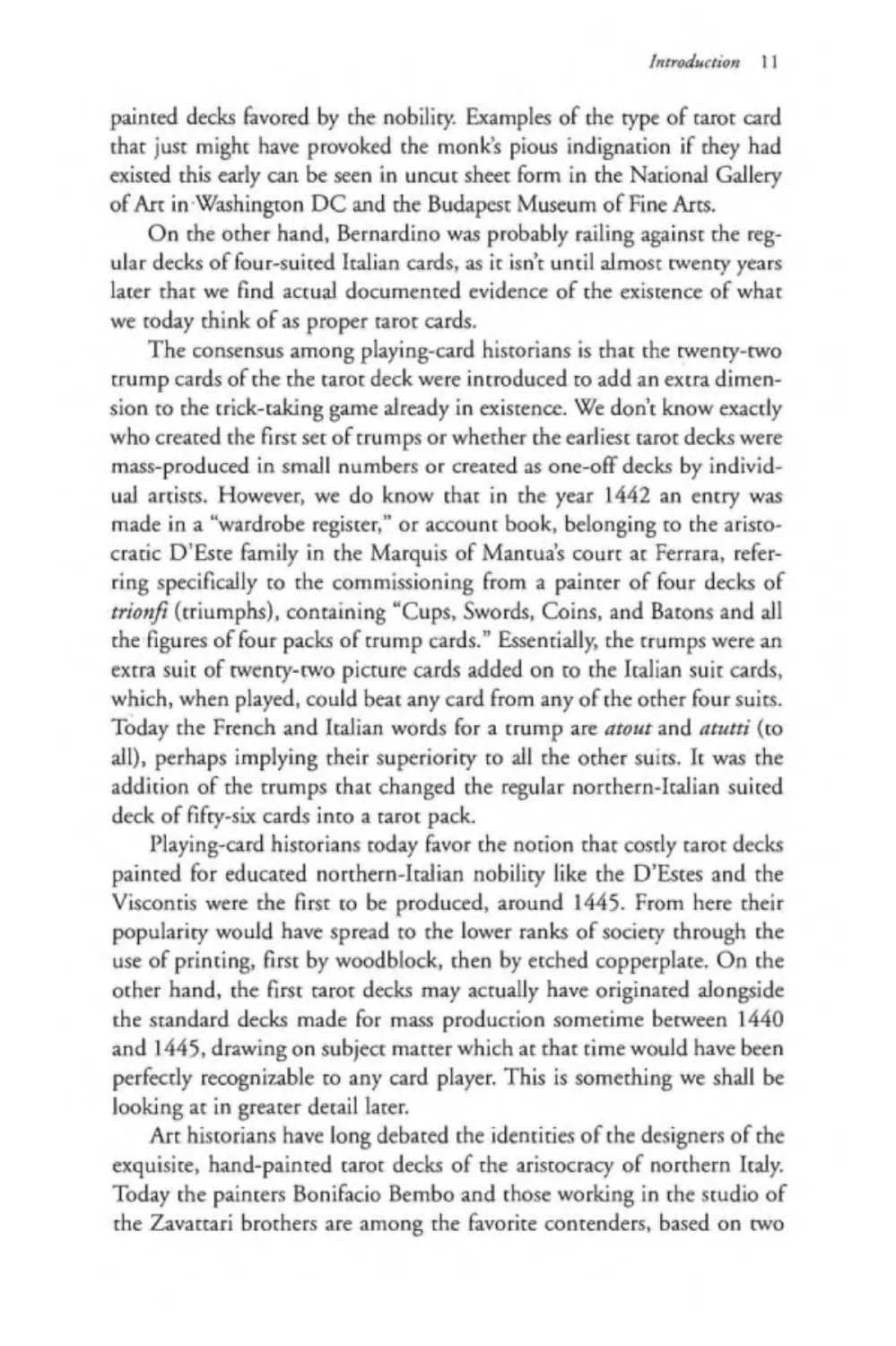
Left-—Tii'O of Swords (scimitars), after a fif-
teenth-century Mamliik card. Right—Two
of Swords, after a Tarot ofMarseille pattern.
Notice how the curve of the scimitars is
repeated in the curving sword design of
northern Italian tarots.
Left—Three of Polo Sticks, after a fifteenth-
century Mamliik card. The dragon-head
motif will show up later in European tarot
decks, notably tn the Marseille Two of Cups.
Right— Three of Batons, after a Tarot of
Marseille pattern. Notice the crisscross Baton
motif inherited from the Mamliik Polo Stick.
about the year 1400. The word denari or danari, still used in Italian for
the Coin suit, is derived from the Arabic word for the gold Mamluk
dindr coin. The Cups of the Mamluk cards are named tumdn, and
tumdn is actually the word for a Persian gold coin that was worth at one
time ten thousand dindr coins. The money-derived names also suggest
that the Islamic card makers may have copied their playing cards from
the oldest playing cards we have on record—Chinese “money
cards ’made for gambling that make use of three or four suits: Coins or
“Cash”; Strings of a Hundred Coins (in which the coins are strung
together through holes in their center and look like banded rods);
Myriads of Strings (representing tens of thousands of coins and repre-
sented by highly stylized oriental personages); and in some packs, Tens
of Myriads. We shall examine rhe puzzle of why Islamic playing-card
makers might choose to replace these four suits with Coins, Cups,
Swords, and Polo Sticks later.
Significantly, Islamic playing cards are mentioned in three fifteenth-
Introduction 5
1*
Chinese "money-suited" Dongguan Pai cards from a modern deck using three suits.
The cards illustrated are Six Cash (Coins) and Six Strings of Coins (Batons). These
cards are still used for gambling. Not so much "cards" as narrow, disposable strips of
paper, they come in packs of 120, comprising three “decks. " Each deck of forty is
rarely used more than once or twice.
century Italian manuscripts known as the Chronicles of Viterbo, which
state: “In the year 1379 there was brought to Viterbo the game of cards,
which in the Saracen language is called nayb." In fifteenth-century Italy
we find the term naibi used for playing cards in general, and in many
Spanish-speaking countries they’re still called naipes, from which we
probably get the Old English term for a scoundrel, jackanapes. As
Dummett concludes, the entry in the Chronicles supplies the only plausi-
ble etymology for these odd words, especially when it becomes evident
that the word nayb in Arabic means “deputy’’ or “minister” and refers to
two of the court cards in the Mamluk deck.
The Creation of the Court Cards
Because of the Islamic prohibition against the depiction of the human
figure, the Mamluk King and two Deputy cards simply show a suit sign,
a calligraphic inscription in Arabic that describes the title of the card, and
sometimes a flowery aphorism.
When the cards were reinterpreted by European card makers, how-
ever, no such Islamic prohibition of images applied, so we now have rep-
resentational court cards headed by very obvious kings wearing crowns.
The earliest decks used in Italy, Spain, and Germany initially contained
6 Introduction
The malik at-tQmin, King of the Ten Thousand (Cups), after a fifteenth-century
Mamluk card. The inscription is the only indication that this card is a king.
only two court cards in each suit in addition to the King: a Superior
Officer and an Inferior Officer, deriving from the corresponding
Deputies of the Mamluk deck. The Queen appeared later in German and
French decks as a substitute for the Mamluk Superior Officer, while the
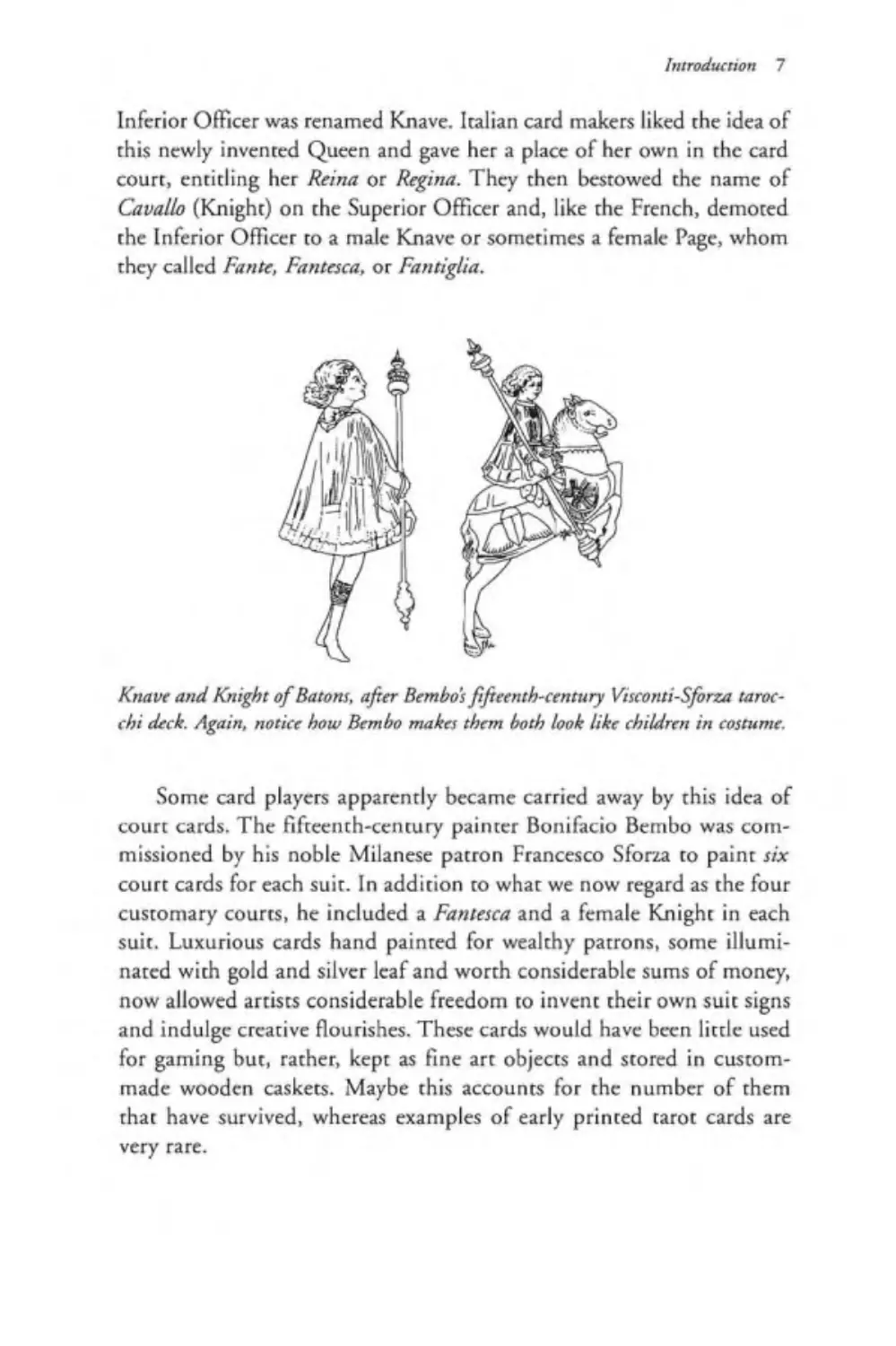
Queen and King of Batons, after the fifteenth-century Visconti-Sfbrza tarocchi
deck. The childlike faces are typical of the style of the painter who created them,
Bonifacio Bembo, a favorite designer at the court of Milan.
Introduction 7
Inferior Officer was renamed Knave, kalian card makers liked the idea of
this newly invented Queen and gave her a place of her own in the card
court, entitling her Reina or Regina. They then bestowed the name of
Cavallo (Knight) on the Superior Officer and, like the French, demoted
the Inferior Officer to a male Knave or sometimes a female Page, whom
they called Fante, Fantesca, or Fantiglia.
Knave and Knight of Batons, after Benthos fifteenth-century Vtsconti-Sforza taroc-
chi deck. Again, notice how Bern bo makes them both look like children in costume.
Some card players apparently became carried away by this idea of
court cards. The fifteenth-century painter Bonifacio Bembo was com-
missioned by his noble Milanese patron Francesco Sforza to paint six
court cards for each suit. In addition to what we now regard as the four
customary courts, he included a Fantesca and a female Knight in each
suit. Luxurious cards hand painted for wealthy patrons, some illumi-
nated with gold and silver leaf and worth considerable sums of money,
now allowed artists considerable freedom to invent their own suit signs
and indulge creative flourishes. These cards would have been little used
for gaming but, rather, kept as fine art objects and stored in custom-
made wooden caskets. Maybe this accounts for the number of them
that have survived, whereas examples of early printed tarot cards are
very rare.
8 Introduction
The Naming of the Court Cards
The French norion of naming the court cards of their decks emerged in
the early to mid-1400s, about the time the tarot trumps first appeared.
The court cards' names would have been bywords for the French nobil-
ity, as the names were taken from popular medieval romances written
in the thirteenth and fourteenth centuries. Indeed, many of rhe male
court card names in French card decks are drawn from a medieval group-
ing of heroes known as the Nine Worthies, three of whom derive from
the legendary world of biblical Judaism, three from classical paganism,
and three from legendary Christendom. The seventeenth-century poet
and dramatist John Dryden describes them in his translation of the poem
The Flower and the Leaf:
Nine Worthies were they called, of different rites,
Three fews, three pagans, and three Christian Knights, . . .
Originating in Les Voeux du paon, “The Vows of the Peacock," a tale
written in 1312 by one Jacques de Longuyon, the Nine Worrhies were
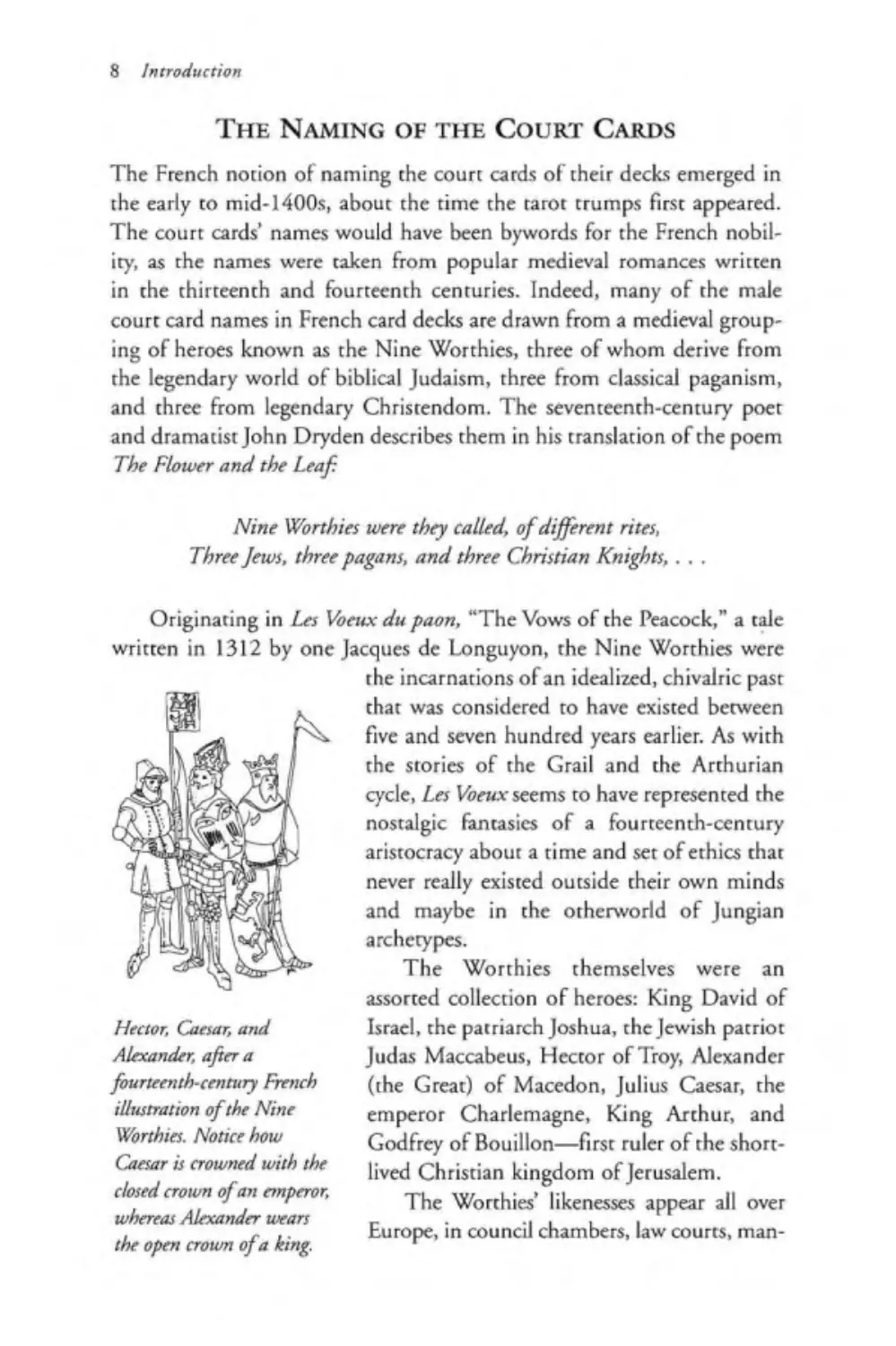
Hector, Caesar, and
Alexander, after a
fourteenth-century French
illustration of the Nine
Worthies. Notice how
Caesar is crowned with the
closed crown of an emperor,
whereas Alexander wears
the open crown of a king.
the incarnations of an idealized, chivalric past
that was considered to have existed between
five and seven hundred years earlier. As with
the stories of the Grail and the Arthurian
cycle, Les Voeux seems to have represented the
nostalgic fantasies of a fourteenth-century
aristocracy about a time and set of ethics that
never really existed outside their own minds
and maybe in the otherworld of Jungian
archetypes.
The Worthies themselves were an
assorted collection of heroes: King David of
Israel, the patriarch Joshua, the Jewish patriot
Judas Maccabeus, Hector of Troy, Alexander
(the Great) of Macedon, Julius Caesar, the
emperor Charlemagne, King Arthur, and
Godfrey of Bouillon—first ruler of the short-
lived Christian kingdom of Jerusalem.
The Worthies’ likenesses appear all over
Europe, in council chambers, law courts, man-
Introduction 9
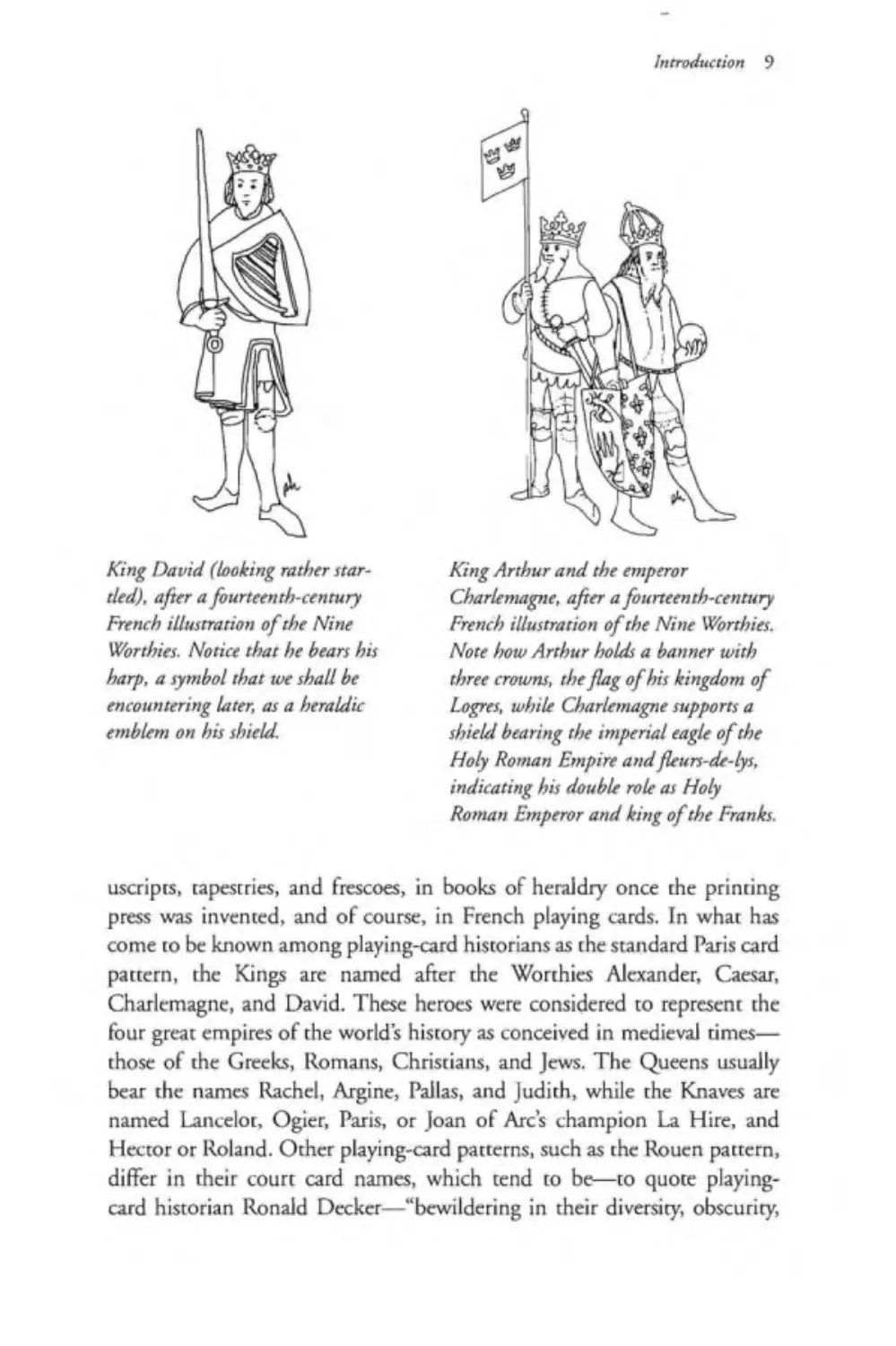
King Arthur and the emperor
Charlemagne, after a fourteenth-century
French illustration of the Nine Worthies.
Note how Arthur holds a banner with
three crowns, the flag of his kingdom of
Logres, while Charlemagne supports a
shield bearing the imperial eagle of the
Holy Roman Empire and fleurs-de-lys,
indicating his double role as Holy
Roman Emperor and king of the Franks.
King David (looking rather star-
tled), after a fourteenth-century
French illustration of the Nine
Worthies. Notice that he bears his
harp, a symbol that we shall be
encountering later, as a heraldic
emblem on his shield.
uscripts, tapestries, and frescoes, in books of heraldry once the printing
press was invented, and of course, in French playing cards. In what has
come to be known among playing-card historians as the standard Paris card
pattern, the Kings are named after the Worthies Alexander, Caesar,
Charlemagne, and David. These heroes were considered to represent the
four great empires of the worlds history as conceived in medieval rimes—
those of the Greeks, Romans, Christians, and Jews. The Queens usually
bear the names Rachel, Argine, Pallas, and Judith, while the Knaves are
named Lancelot, Ogier, Paris, or Joan of Arc’s champion La Hire, and
Hector or Roland. Other playing-card patterns, such as the Rouen pattern,
differ in their court card names, which tend to be—to quote playing-
card historian Ronald Decker—“bewildering in their diversity, obscurity,
10 Introduction
and their very decipherment” and seem to reflect only the whim of the
designer rather than an underlying theme like the Paris pattern’s. However,
understanding the relationship between the court cards and the Worthies
illuminates much that has hitherto been obscure about their interpretations
in cartomancy.
The Creation of the Tarot Trumps
Just what were the games being played with these fifty-six-card decks whose
court cards bore the names of legendary heroes? Besides the trick-taking
games mentioned by Rheinfelden in the 1370s, we know for a fact that in
1423 playing cards of some kind were commonly being used for gambling
in northern Italy. The fire-and-brimstone monk Bernardino of Siena
preached in Bologna at that rime against cards—among other things—
branding them an invention of the devil, and calling for the townsfolk to
burn them in a “bonfire of vanities." The ycar!423 is generally considered
too early for these cards to have been tarots, but they were no doubt decks
printed by woodblock on card—a process that had only just been
invented—and hand colored by stencils, rather than the expensive hand-
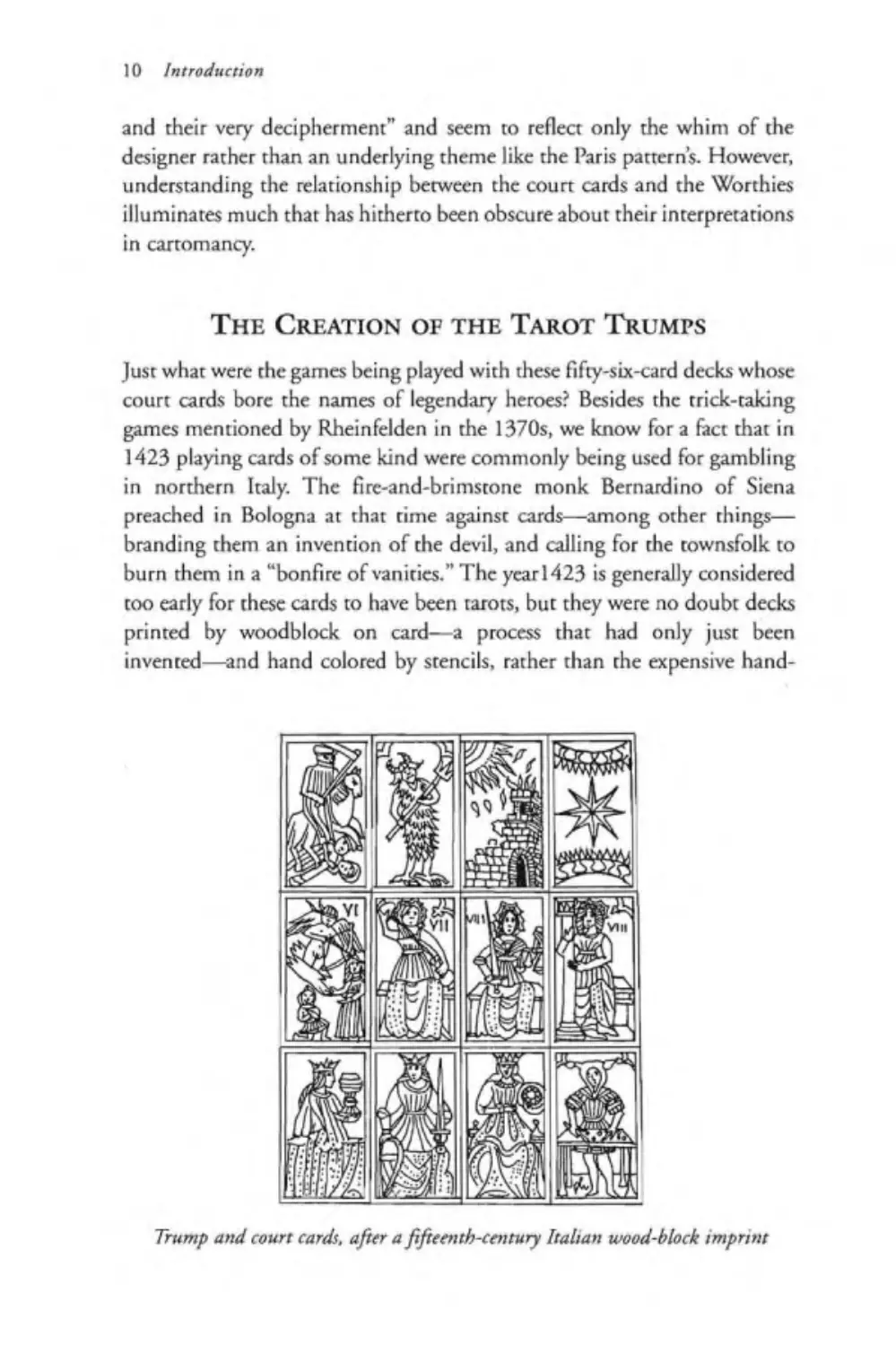
Trump and court cards, after a fifteenth-century Italian wood-block imprint
Introduction 11
painted decks favored by the nobility. Examples of the type of tarot card
that just might have provoked the monks pious indignation if they had
existed this early can be seen in uncut sheet form in the National Gallery
of Art in Washington DC and the Budapest Museum of Fine Arts.
On the other hand, Bernardino was probably railing against the reg-
ular decks of four-suited Italian cards, as it isn’t until almost twenty years
later that we find actual documented evidence of the existence of what
we today think of as proper tarot cards.
The consensus among playing-card historians is that the twenty-two
trump cards of the the tarot deck were introduced to add an extra dimen-
sion to the trick-taking game already in existence. We don’t know exactly
who created the first set of trumps or whether the earliest tarot decks were
mass-produced in small numbers or created as one-off decks by individ-
ual artists. However, we do know that in the year 1442 an entry was
made in a “wardrobe register,” or account book, belonging to the aristo-
cratic D’Este family in the Marquis of Mantua's court at Ferrara, refer-
ring specifically to the commissioning from a painter of four decks of
trionfi (triumphs), containing “Cups, Swords, Coins, and Batons and all
the figures of four packs of trump cards.” Essentially, the trumps were an
extra suit of twenty-two picture cards added on to the Italian suit cards,
which, when played, could beat any card from any of the other four suits.
Today the French and Italian words for a trump are atout and atutti (to
all), perhaps implying their superiority to all the other suits. It was the
addition of the trumps that changed the regular northern-Italian suited
deck of fifty-six cards into a tarot pack.
Playing-card historians today favor the notion that costly tarot decks
painted for educated northern-Italian nobility like the D’Estes and the
Viscontis were the first to be produced, around 1445. From here their
popularity would have spread to the lower ranks of society through the
use of printing, first by woodblock, then by etched copperplate. On the
other hand, the first tarot decks may actually have originated alongside
the standard decks made for mass production sometime between 1440
and 1445, drawing on subject matter which at that time would have been
perfectly recognizable to any card player. This is something we shall be
looking at in greater detail later.
Art historians have long debated the identities of the designers of the
exquisite, hand-painted tarot decks of the aristocracy of northern Italy.
Today the painters Bonifacio Bembo and those working in the studio of
the Zavattari brothers are among the favorite contenders, based on two
12 Introduction
distinct styles of painting that can be discerned in the Visconti-Sforza
cards from Milan.
Michael Dummett, however, believes that the willingness of the
Ferrarese D’Este family to entertain flights of fancy indicates that tarots
may have originated in their court at Ferrara rather than among the
Milanese Viscontis. The D’Este nobles involved themselves deeply in
chivalric tales about Emperor Charlemagne’s paladins, the mystique of
which they tried to recapture in elaborate jousting tournaments as well as
in the tarot cards they are known to have commissioned. The Museo
delle Arti e delle Tradizioni Popolari in Rome possesses eight cards from
a D’Este deck, one of which is a Lovers trump thought to depict
Ruggiero, a mythical Saracen knight who converted to Christianity,
embracing the equally mythical warrior maiden Bradamante, both of
whom the D’Estes believed were their actual ancestors. Ruggiero and
Bradamante’s tale is recounted in Ludovico Ariostos epic sixteenth-cen-
tury sword-and-sorcery poem Orlando furioso, which embroiders on the
Charlemagne legend but spreads its canvas farther south to include Italy
as well as France and Germany.
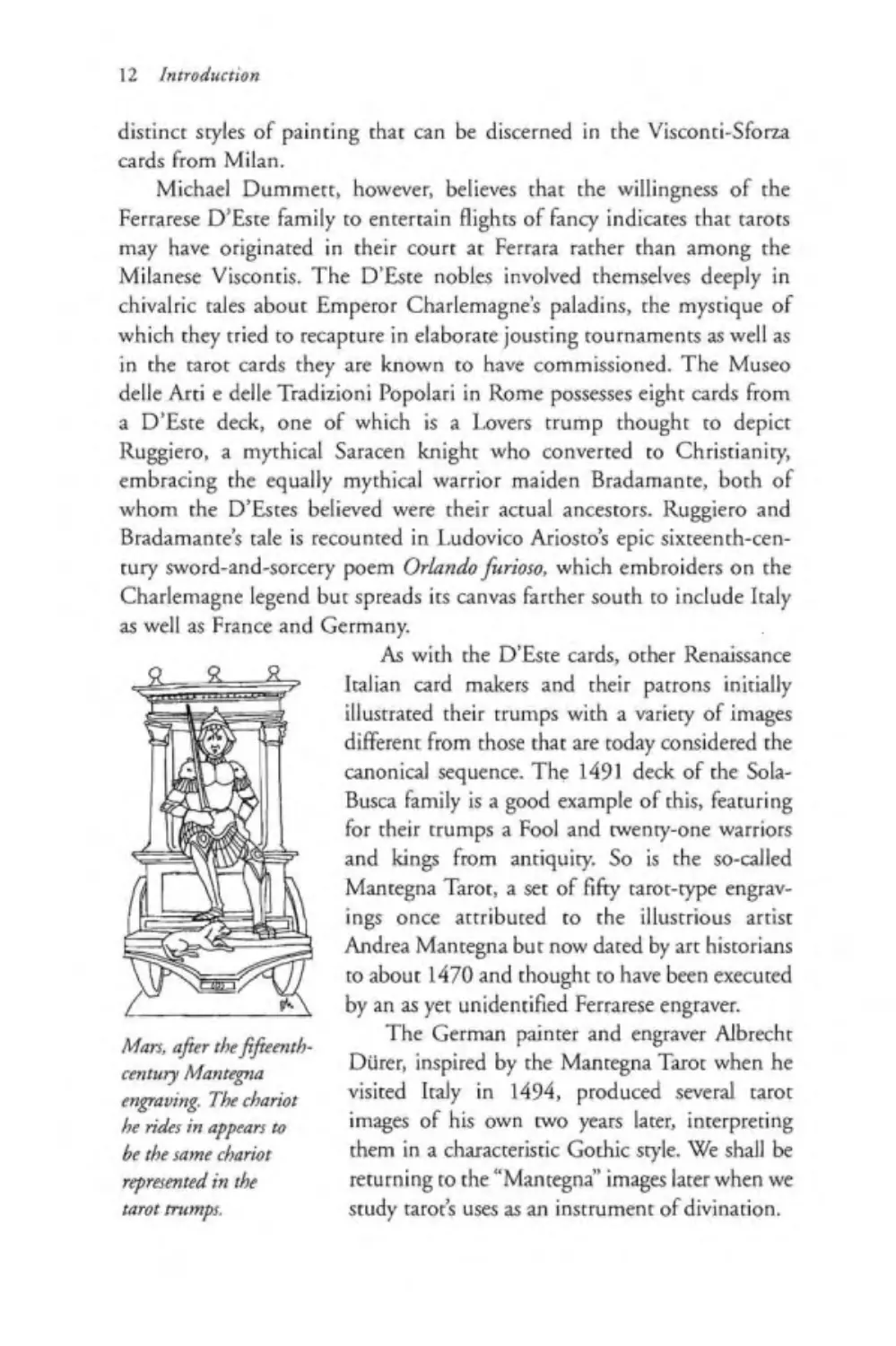
Man, after the fifteenth-
century Mantegna
engraving. The chariot
he rides in appears to
be the same chariot
represented in the
tarot trumps.
As with the D’Este cards, other Renaissance
Italian card makers and their patrons initially
illustrated their trumps with a variety of images
different from those that are today considered the
canonical sequence. The 1491 deck of the Sola-
Busca family is a good example of this, featuring
for their trumps a Fool and twenty-one warriors
and kings from antiquity. So is the so-called
Mantegna Tarot, a set of fifty tarot-type engrav-
ings once attributed to the illustrious artist
Andrea Mantegna but now dated by art historians
to about 1470 and thought to have been executed
by an as yet unidentified Ferrarese engraver.
The German painter and engraver Albrecht
Diirer, inspired by the Mantegna Tarot when he
visited Italy in 1494, produced several tarot
images of his own two years later, interpreting
them in a characteristic Gothic style. We shall be
returning to the “Mantegna” images later when we
study tarot’s uses as an instrument of divination.
/nlroduc lion 13
Tarot in the Sixteenth Century
Early in rhe sixteenth century, tarot cards began to be referied to in Italy
as tarocchi (plural of tarocco), and the word trionfi disappears from docu-
mented reference. Italian playing-card collector Andrea Pollert suggests
that the term tarocco, which has long perplexed playing-card historians,
derives from the archaic Italian verb taroccare, which he associates with
the Arabic word taraqa (to hammer). According to Pollett, taroccare
referred to a technique that goldsmiths employed to cover a surface with
gold leaf and then hammer diamond-shaped patterns into it, a technique
used in many of the backgrounds of the Visconti cards and others.
In 1534 the French satirist Francois Rabelais referred to a game he
called tarau in a list of games played by Gargantua, a character in one of
his novels, indicating that the Italian word tarocco had begun its transfor-
mation into what today we know as tarot. In fact, during the sixteenth cen-
tury the game of tarot spread beyond northern Italy and became popular
throughout France, Switzerland, Belgium, and Spain. The French towns
Rouen and Lyons printed literally thousands of decks from woodblocks in
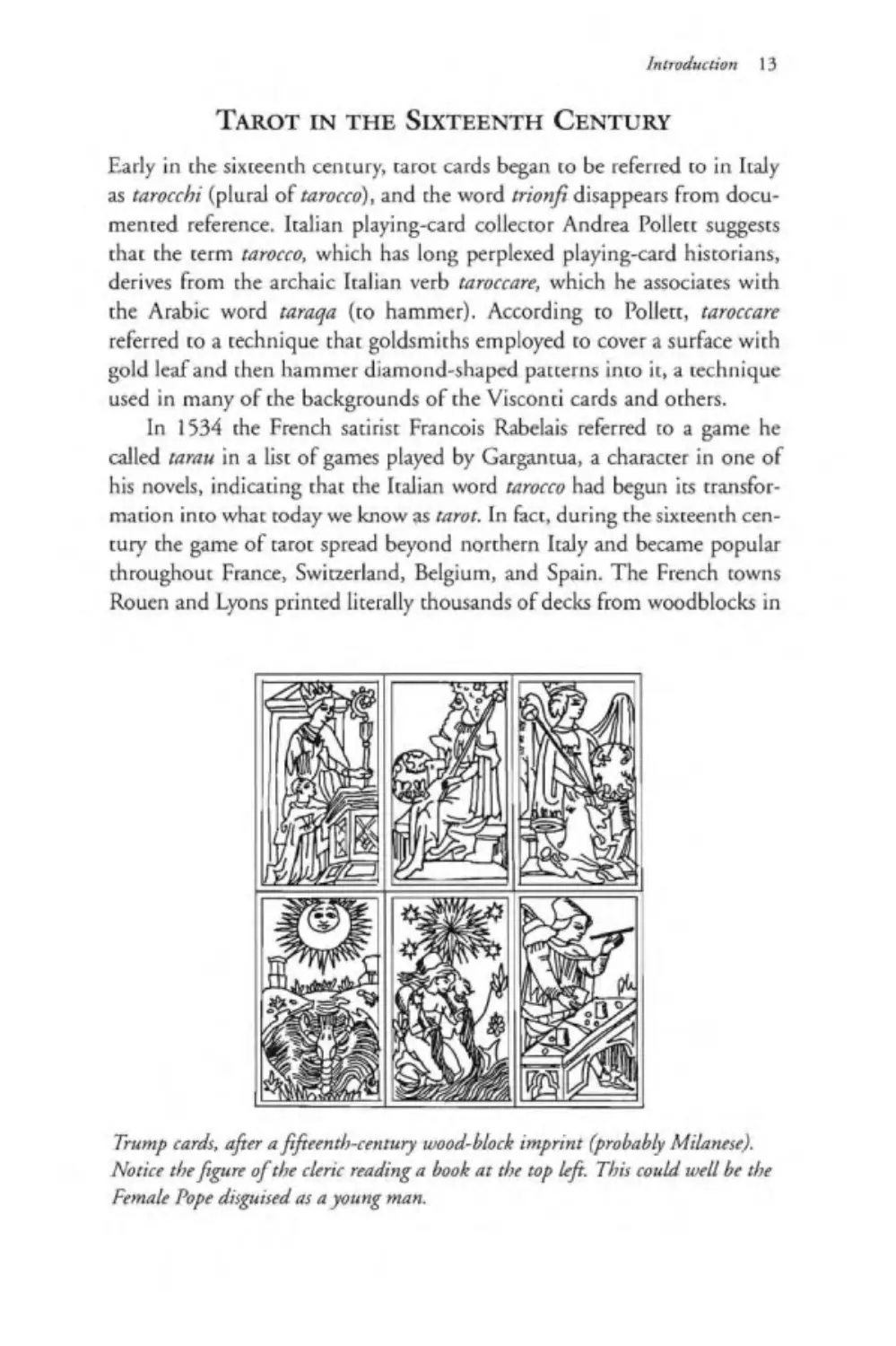
Trump cards, after a fifteenth-century wood-block imprint (probably Milanese).
Notice the figure of the cleric reading a book at the top left. This could well be the
Female Pope disguised as a young man.
14 Introduction
what has come to be known today as the Marseille pattern. One of the
earliest, Milanese, prototypes of this pattern may today be seen in the
Cary Collection at Yale University, an uncut partial sheet of fifteenth-
century wood-block printed cards. The pattern was possibly introduced
to France from Milan by French soldiers returning from the French occu-
pation of the city sometime between 1494 and 1525.
Because it was so widely reproduced, the Marseille pattern represents
what most people today would regard as the conventional tarot deck:
fifty-six cards in four suits (Coins, Cups, Swords, and Batons), each of
which contains fourteen cards—ten "pips” numbered from ace to ten and
the four court cards, Knave, Knight, Queen, and King. To these are
added twenty-one roman-numbered pictorial trumps (the Juggler,
Female Pope, Empress, Emperor, Pope, Lovers, Chariot, Justice, Hermit,
Wheel of Fortune, Fortitude, Hanged Man, Death, Temperance, Devil,
Tower, Star, Moon, Sun, World, and Judgment) and one unnumbered
trump (the Fool). Indeed, the trump cards of the famous deck designed
by Pamela Colman Smith for A. E. Waite in 1909 are based upon the
Marseille pattern.
Prior to the sixteenth century, however, the tarot trumps were uncap-
tioned and inconsistently numbered. Presumably, tarot players were
expected to remember trump names and order. Only with the arrival of
the seventeenth century do we find trump cards with names regularly
printed underneath the image and a roman numeral at the top, provid-
ing an explicit sequence for the novice player. Thereafter, while some card
makers bowed to pressure from the church and attempted to find substi-
tutes for what censorious Catholic authorities considered to be the offen-
sive images of the Emperor, Empress, Female Pope, and Pope, generally
speaking, the form and order of the trump sequence when used in game
playing has remained more or less consistent over the centuries.
Further Developments
During rhe sixteenth century' the card makers of Florence created another
important deck of playing cards that made use of tarot imagery. Known
as minchiate, these decks diverged in various ways from tarocchi. To
begin, several of the tarocchi trumps were replaced. The vexatious card
known as the Female Pope became a less controversial Grand Duke, the
Empress became a Western Emperor, the Emperor an Eastern Emperor,
Introduction 15
and the Fool vanished altogether. In addition, the minchiatc introduced
cards representing the twelve signs of the zodiac, the four Pythagorean
elements—earth, air, fire, and water—and four of the traditional Seven
Virtues apparently missing from the tarocchi, namely Prudence, Faith,
Hope, and Charity. I say “apparendy” because, as we shall see, it may turn
out that Prudence was present in disguise, operating under an assumed
identity. These additional trumps were shoehorned in near the end of the
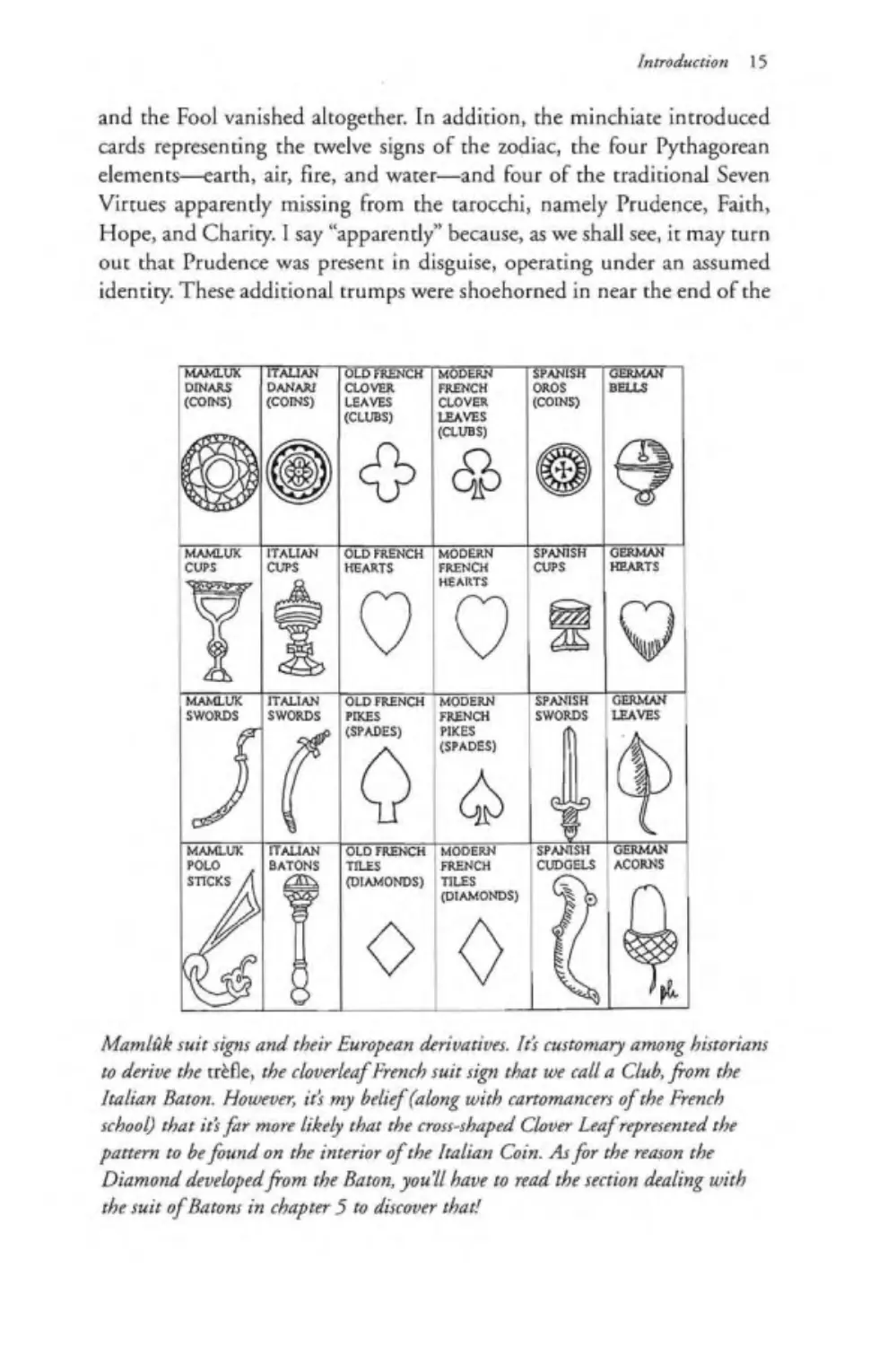
RF1 IS
MAMLUK
DINARS
(COINS)
mSSErn
FRENCH
CLOVER
LEAVES
(CLUBS)
ITALIAN
danaxi
(COINS)
OLD(BENCH
CLOVER
LEAVES
(CLUBS)
SPANtsTT German
OROS
(COINS)
MODERN
FRENCH
HEARTS
ITALIAN
CUPS
MAMLUK
CURS
GERMAN
HEARTS
SPANISH
CUPS
OLD FRENCH
HEARTS
SPANISH
SWORDS
ITALIAN
SWORDS
m7m.uk
SWORDS
MODERN
FRENCH
PIKES
(SPADES)
GERMAN
LEAVES
OLD FRENCH
PIKES
(SPADES)
MAMLUK
POLO
STICKS
ITALIAN
batons
MODERN
FRENCH
TILES
(DIAMONDS)
OLD FRENCH
TILES
(DIAMONDS)
SPANISHGERMAN
CUDGELS ACORNS
Mamluk suit signs and their European derivatives. It’s customary among historians
to derive the trifle, the cloverleaf French suit sign that we call a Club, from the
Italian Baton. However, it’s my belief (along with carromancers of the French
school) that it's far more likely that the cross-shaped Clover Leaf represented the
pattern to be found on the interior of the Italian Coin. As for the reason the
Diamond developed from the Baton, you'll have to read the section dealing with
the suit of Batons in chapter 5 to discover that!
16 Introduction
usual tarot trump sequence, swelling the minchiate decks to a hefty
ninety-seven cards. Like the tarot, of which it was a variation, the minchi-
ate game consisted of trick taking. Each card had a specific numerical
value assigned to it. The sum total of the card values within the tricks
taken by each player was toted up at the end of every game to determine
the winner. Although the zodiac and the elements frequently assume an
important place in European esoteric systems, their incorporation as
extra trumps into the minchiate seems simply to have been a means to
add complexity to the game rather than to endow it with any special eso-
teric significance.
Meanwhile, alongside the development of tarocchi, minchiate, and
French and Belgian tarots, playing cards continued to evolve. German
card makers crafted exquisitely engraved decks of various descriptions,
and decks of cards using the so-called French suit signs—Clubs, Hearts,
Spades, and Diamonds—were becoming increasingly popular. Partially,
this popularity must be attributed to the economics of mass production:
the French suit signs were far simpler and less work-intensive to produce
than the engraved, hand-tinted ones, requiring only forty stenciled suit
cards and twelve printed and stenciled court cards.
French cards using the Rouen pattern had been introduced to
England around 1450, although they all but disappeared during Oliver
Cromwell’s Protectorate during the seventeenth century. Indeed,
Cromwells game-hating puritans considered card play an invention of
the devil, believing the court cards to be “idols and false gods; which
since [the card makers] would seem Christians, [they] have changed to
Charlemaigne, Launcelot, Hector and such like names. ”
After rhe puritans were swept from power in 1659, English playing
cards made their appearance once more, again using the French suits.
These would evolve into the familiar, stylized pattern of “regular” playing
cards in use all over the world today.
This then, in much-abbreviated form, is what we know about the docu-
mented history of the pre occult tarot. Today, aside from the decks produced
for divination, tarot cards still exist in a variety of regional forms: French,
Italian, Sicilian, Swiss, Belgian, and German. These decks are still in use as
game cards. In many cases the Italian suit signs have been exchanged for the
French variety and the original trumps’ designs replaced by pictures of ani-
mals or scenes from nineteenth-century family life, as in the modern French
tarot or the German and Hungarian card decks known as Tarock.
Introduction 17
From the point of view of the first tarot readers, whoever they may
have been, it was the old imagery that was worth dose attention. Much
like their ancient Chinese forerunners, the medieval and renaissance pat-
terns became invested with elaborate occult and talismanic values.
Divination being a large subject, we shall go into that in greater depth
later. Indeed, the story of tarot’s evolution doesn't end at the point we’re
leaving it here. We’ll be picking up the thread again in chapter 3, where
tarot moves into the arcane world of eighteenth- and nineteenth-century
occultists who rediscovered the tarot and put it to use for their own pur-
poses. For now we’ll turn our attention to finding out exactly what the
original tarot card imagery may have meant. We shall discover that there
may be more of the genuinely magical and mystical about some of the
cards’ original roots than was ever dreamed of by those latter-day occult
philosophers. Our quest will lead us to the very portals of the fire tem-
ples of ancient Persia.
1
The Origin
of the Suit Signs
Ijefore we explore rhe original meanings of rhe taror trumps, we should
attend to the riddle that, historically speaking, first presented itself: the
origin of the suit cards, or as tarot readers refer to them, the Minor
Arcana (arcana being a term meaning “secrets” introduced to tarot in
1870 by the journalist and occultist Jean-Baptiste Pitois, writing under
the pseudonym of Paul Christian).
What significance did the Italian and French suit signs have when
they were first introduced, if they had any at all and weren’t just random,
handy tokens for differentiating four sequences of cards with which to
play games? Were the suits just arbitrarily plucked out of thin air, or is
there something more profound to them?
Aside from various facetious or hostile interpretations that have been
proposed down the centuries—facetious or hostile on account of playing
cards’ association with gambling—the first serious attempt to attach a
meaning to the four suits was made in 1704 by Claude-Francois M^nestrier,
a Jesuit antiquarian from Lyons.
This avid iconologist was responsible for the idea, still current among
some playing-card enthusiasts, that the French suits reflected the feudal
social structure of Europe in the late Middle Ages and early Renaissance.
In M£nestrier’s analysis, the suit of Hearts represented the church. Spades
(Pikes) the arms-bearing aristocracy, Diamonds (Paving Tiles) the mer-
chant class, and Clubs (Trefoils) the peasantry. Given that Johannes von
Rheinfelden had associated card play with the feudal structure of
medieval society in his fourteenth-century treatise, Menestrier’s theory
18
The Origin of lire Suit Signs	19
might seem plausible. However, Rheinfelden is just as likely to have been
referring to the internal hierarchical structure of the suits—from the low-
est Ace to the highest King—as a reflection of feudal society rather than
to any hierarchical structure ascribable to the suit signs themselves.
Furthermore, Menestrier was unaware that the French suits were a
fairly new invention that had been derived, via the Italian suit signs, from
those of the Mamluk packs. Nonetheless, Menestrier s interpretation was
so widely accepted that the matter of the suits’ meanings remained
unquestioned until it passed into the hands of eighteenth- and nineteenth-
century students of the occult, whose ideas, it now turns out, don’t stand
up to close scrutiny, either.
Probably the most important and persistent of these later notions
dates from the end of the nineteenth century, when it became popular to
interpret the suit signs in light of a supposed connection between Celtic
mythology and the European Grail and Arthurian cycles.
According to proponents of this theory, the four magical talismans
that belonged to rhe pagan gods of Irish Celtic legend—rhe cauldron of
the Dagda, the sword of Nuada, the stone of Fdl, and the spear of Lugh—
are considered the prototypes of certain talismanic objects that appear in
medieval tales concerning the Holy Grail, that elusive object often
described as the legendary chalice with which Jesus was said to have cel-
ebrated his Last Supper and which was subsequently used to collect his
blood as he hung dying on the cross. In these tales, which are usually
quests interwoven into the medieval stories of King Arthur and his
Knights of the Round Table, the Holy Grail is frequently borne by a pro-
cession of maidens carrying three other ritualistic objects. Proponents of
the “Celtic” theory maintain that these objects—said to be a dish, a
sword, and the spear that the centurion Longinus thrust into Jesus’s body
on the cross to ensure his death—evolved from the four Celtic talismans.
However, the notion that there were exactly four sacred objects,
"Hallows'' as the writer and mystic A. E. Waite dubbed them, in the Grail
procession is contested by scholars today. There is no dish or sword in some
accounts of the legend. In others there are more than four ritual objects,
including candlesticks, knives, and lamps. Furthermore, when it comes to
correlating the Celtic/Grail objects and the tarot suit signs, a dish is not
really a coin (or a stone, for that matter), nor is a spear a baton. Finally, the
idea that the talismans of Celtic legend or, indeed, the Grail legend should
have given rise to the tarot suit signs must now be considered untenable in
view of their recently proven derivation from the Mamluk deck.
20 The Origin of the Suit Signs
Another enticing theory about the suits’ origins was that propounded
by Jessie Weston, an Arthurian scholar at the turn of the century. Partly
persuaded by Waites beliefs about the subject, she maintained that the
tarot suits were evidence of the survival of a secret pagan cult into the
Middle Ages, a thesis she set forth in her popular book From Ritual to
Romance. Waite, however, took issue with her on this, hinting that the
source of the symbols probably lay in the unorthodox Christianity of the
Albigensian heretics of the thirteenth century, which he also associated
with the Grail. Neither Weston nor Waite offered any evidence for their
conclusions, however.
Although these theories have not withstood the test of rime, the Grail
theme has entered todays cartomantic idea pool, largely due to the
important part it plays in the imagery of the immensely influential tarot
deck designed to Waite’s specifications that we shall encounter later.
Accordingly, tenuous and unsupported though these Grail links with the
tarot may be, 1 shall be touching on them from time to time when we
examine card interpretations.
Now, having surveyed some of the historically discredited theories of
the suits' origins, maybe we should start our quest for the suit signs where
they first appear in recorded history, where the Mamluk deck led us.
Those polo sticks, for instance.
We will recall that the four Mamluk suits consisted of Cups, Coins,
Polo-sticks and Swords. Now, Polo-sticks happen to figure prominently
as marks of distinction in Mamluk heraldry. Coats of arms were among
the prerogatives of the military dignitaries known as emirs in MamlOk
culture. Although the coat of arms itself was bestowed by the sultan on
rhe emir, the emir was allowed to choose his design for himself. Among
the many and varied marks of distinction used in these Mamluk coats of
arms were indeed cups, indicative of service as a cup-bearer, round disks
or plates, indicative of service as a taster, polo-sticks, for service as a polo-
master, and swords as the emblem of an armor-bearer.
So taken at face value, these heraldic emblems would appear to be the
most obvious explanation of the Tarot suits. Or would they? Why choose
those particular emblems to mark the suits, one finds oneself wondering?
Was it simply the artististic whim of rhe card maker, anticipating the
diverse choice of suits that would later appear on early German playing
cards? But if that were the case, then why do we not find more varied suits
among Mamluk decks made by other card makers, bearing emblems other
than just these four, such as the equally popular heraldic emblems saddles.
The Origin of the Suit Signs 21
pen-boxes, napkins or bows, for instance? Why
would these four and just these four be chosen
to become what we might call the “standard
Mamluk pattern?” Maybe some further mean-
ing underlay their selection. Maybe we should
delve a little deeper into the sources of the sym-
bols themselves. So, once again, let us turn to
those Polo-sticks.
Suhs and the Suit Signs
The word polo is believed to derive from a
Tibetan word,/>«/« (ball). Earliest records of the
game indicate that it was played by Persian
tribes sometime before King Darius I and his
troops formed the first great Persian Empire in
the sixth century B.C.E.
From Persia, polo spread to Constantinople,
then Turkestan, and on to India and the Far
East. The game migrated to Egypt with the Arab
conquests of the eighth century C.E. and became
Darius 1 of Persia, “the
Great King. “Also referred
to as “the King of Kings, “
Darius was one of the
seven Persian princes who
agreed that he should be
king whose horse was the
first to neigh.
an integral part in court
life there. The polo stick became an important motif in Islamic heraldry,
and in the sect of Shiah Muslims that came to be known as Sufis.
In its evolution, Sufism was influenced by a variety of doctrines besides
Islam: early Christian monasticism, the Indian Buddhism that flourished
throughout the East long before the conquest of Islam, and Greek and
Roman Neoplatonic philosophy, which entered Islam around 800 C.E. The
pantheistic type of Sufism that came to prevail in Persia emphasized mysti-
cism—ecstatic and visionary experience. The Deity was seen as the sole real-
ity, beyond all names and definitions. Not only was It considered absolute
being, It was also considered to be absolute good and absolute beauty, too.
The very nature of beauty was believed to consist of the desire for manifes-
tation, and the cosmos itself was thought to be the result of this desire. Well-
known Sufi tradition has the Deity say, “I was a hidden treasure, and I
desired to be known, so I created creatures in order that 1 might be known."
Arifi of Herat, a fifteenth-century Sufi, entitled a book about ecstatic,
self-sacrificing love The Ball and the Polo Stick, and he uses the game of
polo as an allegory for his mystical teachings. The Rubaiyat quatrains of
the eleventh-century Sufi poet and Persian astronomer-mathematician
22 The Origin of the Suit Signs
Omar Khayyam also allude to the game of polo to illustrate the helpless-
ness of humankind, humanity being the ball, and fate or the Deity the
polo player and his stick:
The Ball no question makes of Ayes and Noes,
But Here or There as strikes the Player goes;
And He that toss d you down into the Field,
He knows about it all—HE knows—HE knows!
Other suit sign images also occur in the Rubaiyat. The cup image is
used repeatedly throughout the poem, and it is an evocative, powerful
icon. In a couple of instances, the allusion is made to the magic seven-
ringed cup that belonged to the legendary Persian king Jamshid, in which
past, present, future—indeed everything in the world—was revealed to
him. Coins are also alluded to when the poet judges “money, better than
a thousand promises” and equates coins to “a cup, a lover, and music on
the field’s verge” to be grasped today rather than exchanged for the vague
promise of heaven later. Actual money, moreover, is to be spent on friends
rather than hoarded and left behind for one’s enemies.
Are these intriguing images proof that the Sufi culture can claim to
have originated the suit signs of the Mamliik cards? The Sufi writer Sayed
Idries Shah claimed that the tarot had Sufi roots, although he failed to
give any convincing details to substantiate his claim. On the other hand,
polo predated the Sufis, so the suit symbols may have a much earlier,
Persian, provenance.
Moreover, as 1 mentioned earlier, the word tum^n as applied to the
Mamluk Cup suit appears to derive, somewhat confusingly it would
seem, from the Persian word tumdn, meaning “ten thousand." According
to the renowned fourteenth-century Moorish scholar and historian of the
Islamic Empire Abd-ar-Rahman ibn Khaldun, the dindr (the Mamluk
Coin symbol) was a gold coin at the time he was writing. In fact the
tumdn was said to be worth ten thousand dandnir (plural of dindr}, which
seems to be quite a substantial amount of money. By the 1890s, however,
the tumdn's exchange value appears to have dwindled to an amount
worth about six British shillings; use of the coin was ultimately discon-
tinued in 1932. So apparently the term tuman points to the use of the
deck for gambling rather than to the Cup symbol itself.
Yet such linguistic clues alone cannot place the Persians at the scene
of suit origins. To accomplish this, we must refer to a Platonist and trav-
The Origin of the Suit Signs 23
ding lecturer of the second century C.E. who provides us with an unex-
pected nugget of what may turn out to be golden information. It will
involve us in a lightning-quick tour to Africa, Italy, France, ancient
Greece, and back to Persia once more.
The Four Cardinal Virtues
Around the year 160 C.E. in the North African city of Oea, Apuleius of
Madaura, author of the famous magical romance The Golden Ass, was
forced to defend himself on a charge of sorcery that had been cooked up
to bolster a dubious lawsuit against him and that used his known inter-
est in the occult sciences as a smear tactic.
Apuleius quoted Plato in his defense, who stated that “magic” (which
Plato defined as the legitimate worship of the gods performed by the
Zoroastrian Magian priests of his era) was taught to young Persian crown
princes by four tutors, each chosen from among all the other Persian eld-
ers for his outstanding display of virtue. The important point for our pur-
poses is that, of these tutors, one was considered the wisest elder, one rhe
most just, one the most restrained, and one the bravest.
If one pauses to consider, it becomes evident that Apuleius’s elders are
the exemplars of what later came to be known as the Four Cardinal
Virtues: Prudence (Wisdom), Justice, Temperance (Restraint), and
Fortitude (Bravery or Strength). Now it also happens that the symbols
most frequently associated with the Cardinal Virtues from classical times
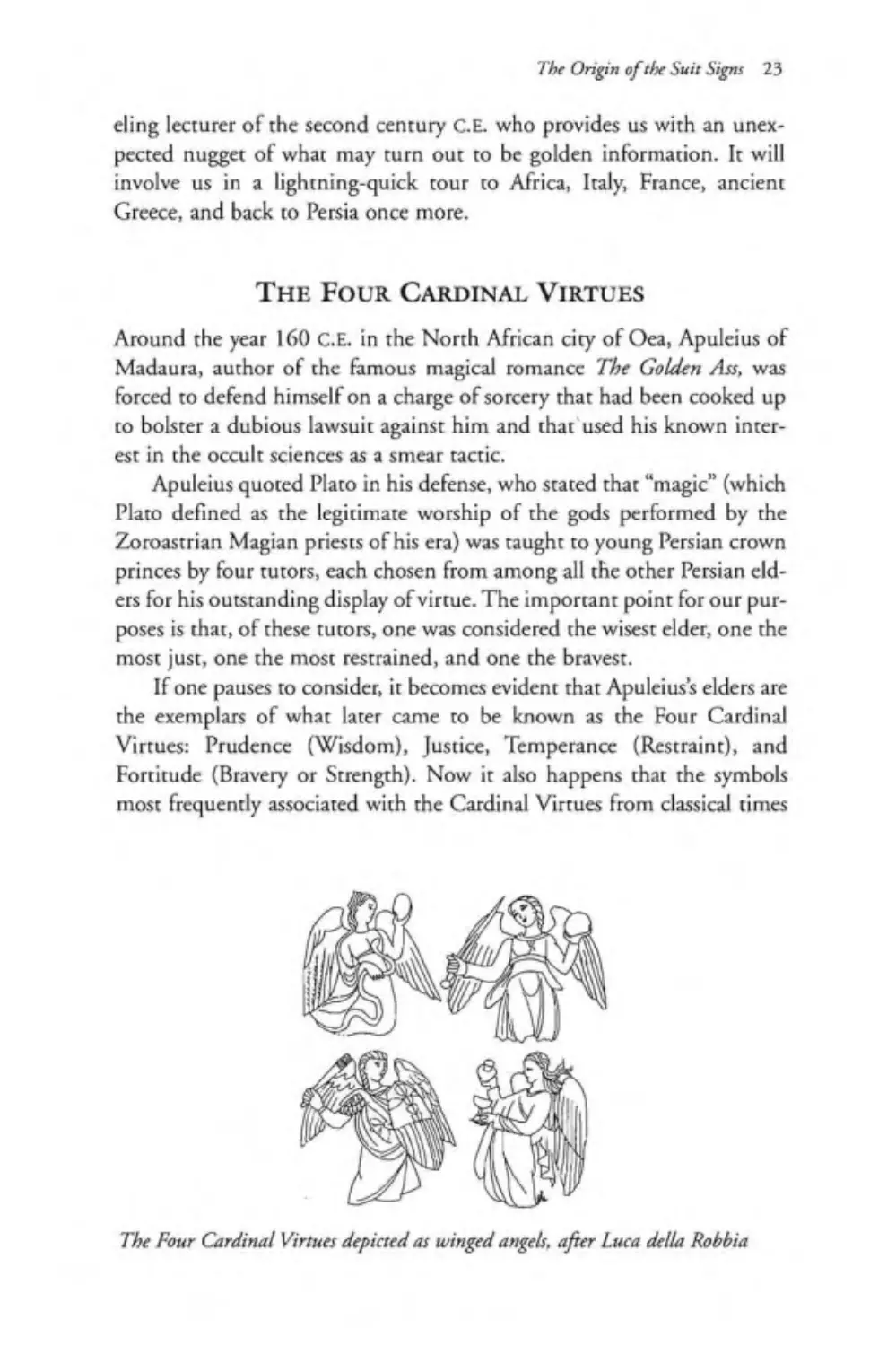
The Four Cardinal Virtues depicted as winged angels, a)
Luca della Robbia
24 The Origin of the Suit Signs
through the Middle Ages into rhe Renaissance are identical with the four
suit signs of the Italian tarocchi, something first noted, as far as I am
aware, by Gertrude Moakley, a scholar whose important contributions to
tarot research we shall be glancing at in the following chapter. You may see
the symbols displayed, among other places, by the fifteenth-century
ceramicist Luca della Robbia on the ceiling of the Cardinal of Portugal’s
chapel in the beautiful Florentine church of San Miniato al Monte. In
each of the four corners of the vaulted ceiling, an angel carries one emblem
apiece: the circular mirror (Coin) of the Cardinal Virtue Prudence; the
sword of Justice; the cup of Temperance; and the rod of Fortitude.
That this attribution of the virtues to the suits was not just an Italian
conceit but current in other parts of Europe, too, is suggested by a popu-
lar sixteenth-century book of games, Cento giuochi liberali et d'tgegno (One
Hundred Liberal and Ingenious Games). Authored by one Innocenzio
Ringhieri, it was dedicated to rhe subsequently famous Italian princess
from Florence who married into the French royal family, Catherine de
M^dicis. (As Queen of France, she was later to place her fate entirely in
the hands of diviners like Nostradamus and the astrologer Luca Ganrico.)
First printed in Bologna in 1551, Ringhieri s manual was reprinted in
Venice and in French translation in Lyons in 1553, then again in Bologna
in 1580. It detailed a hundred games and entertainments that made use of
dice, chess, and playing cards, including some with such intriguing names
as delle figure Celesti (dealing with astrological signs) or—alarmingly—dell
Incantatore о dell Serpi (dealing with snake charming) or del Chiromante
(dealing with palm reading) or, most intriguing of all, dell'Infemo (dealing
with hell)! More important for us, however, is the game the book describes
as the Magnificent Game of the King, which involves using Italian playing
cards in which the suits are considered to represent the Cardinal Virtues.
As we might expect, Mirrors (Coins) are said to stand for Prudence, Swords
for Justice, Cups for Temperance, and Columns for Fortitude.
Perhaps even more significantly, the Nine Worthies that we encoun-
tered in the previous chapter were considered to be the medieval embod-
iments of the virtues: Fighting Spirit (Fortitude), Wisdom (Prudence),
Law (Justice), and Civility (Temperance). Indeed, the Four Cardinal
Virtues were thought to be the essential ingredients of prouesse, which
doesn’t mean just “prowess” but something far more elevated and spiri-
tual than mere machismo, namely, the highest goal aimed at by the
medieval knight. Furthermore, the Cardinal Virtues turn out to be an
important theme that runs through the Major Arcana of the tarot deck.
The Origin of the Suit Signs 25
So we must pose the question, if the Cardinal Virtues are so impor-
tant to our argument, where did they originate?
Most historians ascribe their source, prior to their adoption into
Christianity by the Dominican scholar Thomas Aquinas, to Greek philos-
ophy. Writing in the fourth century B.C.E., Plato assembles the Cardinal
Virtues into a unit in his Laws and Republic: “Wisdom [Prudence] is the
chief and leader,” he writes, “next follows Temperance, and from the
union of these two with Courage [Fortitude) springs Justice.” Aristotle,
Plato’s pupil, added variations of his own. Philo of Alexandria, the Jewish
Platonist philosopher of the first century C.E., compared them to the four
rivers that ran out of Eden, which is poetic and maybe esoterically mean-
ingful, but hardly helpful in pinpointing the virtues’ geographical source.
However, if we assume that Apuleius quoted Plato correctly, it is con-
ceivable the four virtues predate Greek philosophy, and the Great King
of the Persians had to possess all four in good measure if he were to effec-
tually govern. And that assertion brings us back to the Persian Empire
once more.
The Four Castes of Ancient Persia
The Persian Empire of the Achaemenids was founded around 550 B.C.E.
on the ruins of the Assyrian Empire, in the geographical area we know
today as Iraq and Iran. Vast and all-encompassing, it reached from Egypt
in the west to the river Indus in the east. Twenty-nine years after the
empire’s founding, Darius I, known to history as Darius the Great,
became Persia's first “Great King.” Zoroastrianism, said to have been
inculcated by the prophet Zoroaster or Zarathustra, became Persia’s offi-
cial religion. After the Arab conquest of Persia in 642 C.E., the practice of
Zoroastrianism and a variety of other religions such as Buddhism,
Judaism, and Christianity continued to exist alongside the dominant reli-
gion of Islam. This state of affairs lasted into the seventeenth century.
Indeed, there exists a highly informative seventeenth-century Persian
text that goes by the name Dabistan-ul-mazahab, a translation of which was
published in 1901 under the title The School of Manners, although School
of Religious Doctrines would perhaps have been more appropriate. The
English translators of the text believed the author to be Mohsan Fani, a Sufi
of Persian extraction living in India and born around 1615 C.E. However,
Joseph H. Peterson, who has written extensively on religious and esoteric
traditions, ascribes the book to the pen of a seven teen th-century Persian, a
26 The Origin of the Suit Signs
Shiah mullah named Mir Du’l-fequar Ardestani, whom Peterson believes
based it on the teachings of Azar Kayvan, a sixteenth-century Zoroastrian
high priest.
Be that as it may, whoever wrote the Dabistan presents sketches of
what he considered were the great religions currently being practiced in
Persia during the seventeenth century. Most pertinent for us is the
account of Magism, that is, Zoroastrianism, which, as we have noted, had
its beginnings in the seventh or sixth century B.C.E. and had survived in
Persia since that time.
Fani/Ardestani begins his account of Zoroastrianism by recounting,
among other things, the exploits of the legendary culture hero of the
Persians, Mahabad, exploits lost in the depths of mythological time. To
Mahabad he attributes the organization of cities, villages, streets, colon-
nades, and palaces, the introduction of commerce and trade, and the
division of humankind into four classes or castes. These were:
Class 1: The priestly class of Magi. This was divided into Hirbeds or dis-
ciples, Mobeds or masters, and Destur Mobeds, masters of masters.
The author of the Dabistan describes this class as ascetics and learned
men, selected for maintaining the faith and enforcing the sentence
of the laws; he also refers to them as Htiristdr, Birman, and Birmun.
Class 2: Kings and intrepid warriors, chosen to devote themselves to
the cares of government and authority, to promoting equity, polic-
ing, and curbing aggression. Members of this caste are named
Ntins tar, Chatraman, and Chatri, which words are said to mean
“standard” or “distinction.”
Class 3: Farmers, cultivators, artisans and skillful men, styled Siiristdr
or Bas, said to imply “cultivation” and “improvement.”
Class 4: The Ruzistar or Sudin, composed of people destined for
“employment" and “service.”
The Dabistan is quite obviously describing a social system with remark-
able similarity to the four castes of Hinduism, a concept that the Persian reli-
gion apparently shared with its Hindu cousin. We know that the Persian
tribe of the Magians, referred to as Htiristdr by the Dabistan, functioned as
officiating clergy in the Persian Empire, essential to the fire cult of the god
Ahuramazda, “the Wise Lord." By all accounts, they performed the sacri-
fices, prophesied the future, made libations, and chanted the invocations
and theogonies of the deity. They wore white robes, with fur caps peaked
The Origin of the Suit Signs 27
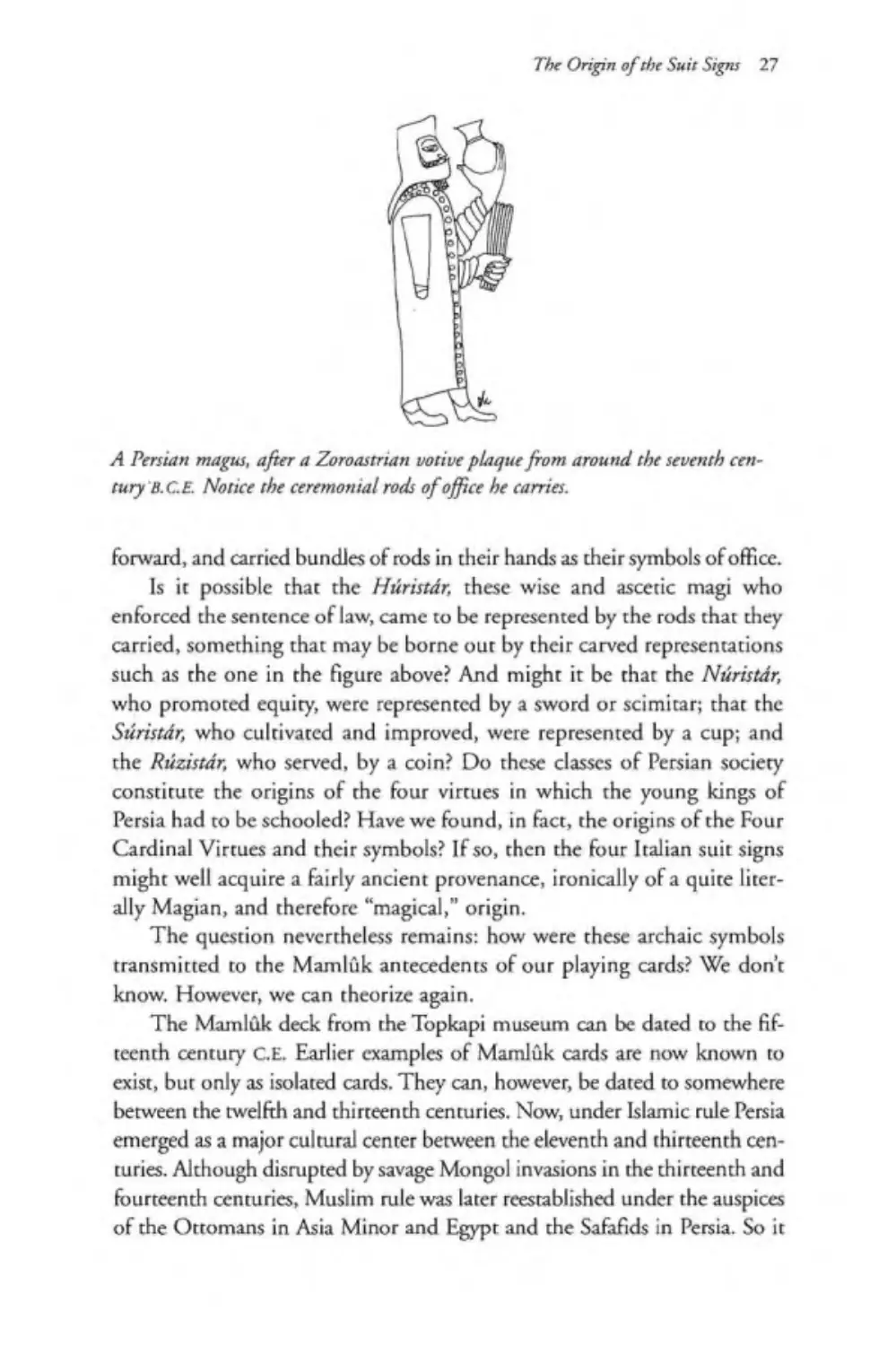
A Persian magus, after a Zoroasrrian votive plaque from around the seventh cen-
tury B.C.E. Notice the ceremonial rods of office he carries.
forward, and carried bundles of rods in their hands as their symbols of office.
Is it possible that the Htiristdr, these wise and ascetic magi who
enforced the sentence of law, came to be represented by the rods that they
carried, something that may be borne out by their carved representations
such as the one in the figure above? And might it be that the Nuris tar,
who promoted equity, were represented by a sword or scimitar; that the
Stiristdr, who cultivated and improved, were represented by a cup; and
the Riizistdr, who served, by a coin? Do these classes of Persian society
constitute the origins of the four virtues in which the young kings of
Persia had to be schooled? Have we found, in fact, the origins of the Four
Cardinal Virtues and their symbols? If so, then the four Italian suit signs
might well acquire a fairly ancient provenance, ironically of a quite liter-
ally Magian, and therefore “magical,” origin.
The question nevertheless remains: how were these archaic symbols
transmitted to the Mamluk antecedents of our playing cards? We don’t
know. However, we can theorize again.
The MamlQk deck from the Topkapi museum can be dated to the fif-
teenth century C.E. Earlier examples of Mamluk cards are now known to
exist, but only as isolated cards. They can, however, be dated to somewhere
between the twelfth and thirteenth centuries. Now, under Islamic rule Persia
emerged as a major cultural center between the eleventh and thirteenth cen-
turies. Although disrupted by savage Mongol invasions in the thirteenth and
fourteenth centuries, Muslim rule was later reestablished under the auspices
of the Ottomans in Asia Minor and Egypt and the Safafids in Persia. So it
28 The Origin of the Suit Signi
may well be that the Mongols were responsible for introducing Chinese
playing cards to Persia in the first half of the thirteenth century.
It is also conceivable that the Persians, who already possessed playing-
card games known as and Ganjifa, created the prototype of the
MamlOk decks by substituting the symbols corresponding to the four
classes of ancient Persian society for the money signs found on the
Chinese gambling cards used by the Mongols. When this new four-suited
Persian card game ultimately spread through the Islamic world in much
the same manner that the game of chess is known to have done, the sym-
bolic rods of the Magian priests would have been exchanged in the
MamlOk decks for more familiar polo sticks, in much the same manner
that the Mamluk polo sticks were later transformed (back!) into batons by
European card makers. Only the Shiah Sufis, with their ties to pre-lslamic
Persia and their penchant for religious eclecticism, would seem to have
preserved the import of the polo stick as a symbol of divine power, as wit-
nessed in the works of Arifi and Omar Khayyam. Indeed, the fact that the
Sufis were not only familiar with, but in accord with, certain Zoroastrian
beliefs is hinted at in the the description of the wine that Omar Khayydm
drinks, which in Islam is a forbidden drink, so is referred to as “Magian,"
that is, pertaining to the Zoroastrians, who were permitted to drink it.
Whether the Persian origin of the European suit signs can ultimately
be proven or not, it’s interesting to note that both this theory and
Mdnestrier’s align the suits’ symbols with hierarchical social classes. It is also
true that both theories beg further investigation for evidence of their valid-
ity. However, cartomancers may note that if the suit symbols are indeed of
Zoroastrian provenance, they may also carry an association with the four
elements held sacred by the Magian priests, fire, air, water, and earth.
And if, for the sake of argument, we say that the four standard Italian
suit signs of the tarot represent the four Pythagorean elements, what
would a fifth suit, if we may refer to the tarot trumps as that, be said to
represent other than the mysterious fifth element—quintessence—a
notion current among fifteenth-century Italian students of Neoplatonic
philosophy? In Pythagorian terms we would be talking here about the
element of the ether or spirit, the fifth point of the pentagram that rules
the other four, the archetypal, spiritual world that lies above and below
the world of appearances. This is, in fact, a concept we shall see amply
illustrated in the following chapter, where we shall discover how spiritual
and indeed, quite literally, “mysterious” the trumps really were.
The Origin
of the Trumps
I listorians have long quibbled over whether the twenty-two trumps of
the tarot were initially created as a sequence by themselves—as a separate
card game perhaps—or were added on ad hoc to the Italian deck of fifty-
six to make an existing game more complex.
Judging from the facts that no decks consisting solely of twenty-two
trumps have survived and that the early uncut printed sheets of taror
cards and various Visconti and D’Este painted decks all show trumps and
suit cards united, it seems more likely that somebody had rhe bright idea
of making the regular game of fifry-six Mamluk-derived playing cards
more complex by adding to it twenty-one special, high-ranking cards
(and one special nonranking card).
Whether it was an unknown wood engraver and card maker or Bembo
himself or artists from the Zavanari studio or someone in the Visconti
court who provided the idea of the rrump suit, we don’t yet know. Nor do
we know who selected the cards’ imager)’. However, whoever he or she was,
the inventor may (or may not) have had a fondness for the works of the
Italian writer Giovanni Boccaccio and his friend, the poet and humanist
scholar Francesco Petrarca, otherwise known to us as Petrarch.
In 1966, then New York Public Library cataloger Gertrude Moakley fol-
lowed up a clue provided by Alessandro di Francesco Rosselli, a sixteenth-
century Florentine dealer in graphic arts. Rosselli had declared in his
catalog of 1528 that aside from other card games, he also stocked The
Game of the Triumphs of Petrarch. .Moakley advanced the ingenious theory
that Rosselli was actually referring to tarot cards and that the title of the
29
30 The Origin of the Trumps
game derives from / trionfi (The Triumphs), the name of a poem written
between 1352 and 1374 by Petrarch. As a matter of fact, it turns out that
the poet did have a special relationship with the Visconti court, which
may or not be significant.
Petrarch’s I Trionfi
Born in 1304 in Arezzo, Italy, the son of a legal clerk who was exiled for
political reasons, Francesco Petrarch spent his early life at Avignon in
France, at that time the seat of the papacy. Although he followed his
fathers wishes and studied law at Montpellier and Bologna, Petrarchs
burning passion was literature, and particularly the study of Latin litera-
ture—an interest he shared with his friend Giovanni Boccaccio. As a tal-
ented and dedicated scholar and poet, Petrarch attracted international
fame and in 1341 was crowned with the laurel wreath of Poet Laureate
in Rome. In Avignon, Petrarch wrote numerous sonnets, the most
famous being a series of love poems addressed to an idealized but unat-
tainable married nineteen-year-old woman, Laura de Noves, who died of
the plague during the Black Death in 1348.
Petrarch led a wandering life, moving from city to city searching out
Latin manuscripts and writing his essays, poems, and letters. In 1353 he
settled for a while in Milan and lived as the guest of the powerful Visconti
family. It was there that he began composing the poem entitled / trionfi
in 1356, again on the theme of his undying love for Laura, continuing to
work on and revise it until his death eighteen years later in 1374.
Now, fourteenth-century Italians used the term triumphs to describe
the decorated floats or pageant carts that were drawn in procession
through streets at religious or secular festivals. These processional tri-
umphs generally illustrated allegorical themes. Each successive allegory
won or “triumphed” over the one illustrated by the previous float.
There are six allegorical triumph carts in Petrarchs poem. The first is
a traveling float illustrating the triumph of Cupid over men and gods,
representing the triumph of love, notably Petrarchs own love for Laura.
Cupid’s triumph is followed by the triumph of chastity over Cupid and
fickle fortune, illustrating Laura’s chaste and proper refusal of Petrarch’s
love (she was a married woman, after all). The third float in the proces-
sion illustrates the awful triumph of death over Laura during the plague;
the fourth, the triumph of I .auras bright fame over grim death; the fifth,
the inevitable triumph of Old Man Time over Laura’s fame; and the sixth
The Origin of the Trumps 31
and ultimate triumph, the triumph of eternity over time, in which Laura
and Petrarch are finally able to enjoy everlasting bliss together.
Many paintings and engravings have been created illustrating / tri-
onfi since the poem was first published, although none that 1 know of
have utilized all the images that appear in it. The images that do appear
in illustrations, however, arc highly suggestive of some of the tarot trumps.
Gertrude Moakley’s association of the tarot trumps with I trionfi is
extremely persuasive, although it doesn’t solve all the riddles of the
trumps, at least not those of the Marseillc-pattern deck. Petrarch’s poem
accounts for the trumps Love, Temperance, Fortune (the Chariot), the
Pope, Emperor, Empress, Death, Time (the Hermit), Hades (the Devil),
the “Quick Revolving Wheel” (the Wheel of Fortune), the Sun, the
Moon, and Eternity (the World). Unaccounted for are the images of the
three virtues, the Fool, the Juggler, the Female Pope, the Hanged Man,
the Lower, the Star, and Judgment.
However, Petrarchs works may nevertheless turn out to be important
in our search for the source of all the trumps, even if I trionfi cannot be said
to have given rise to them all. What Moakley did not develop in her the-
ory is the fact that Petrarch also authored a variety of ocher books, one deal-
ing with the Four Cardinal Virtues and another, De hominis illustrihus
(About Illustrious Men), chronicling the pontificates and reigns of various
Roman emperors and popes, including, in passing, the legendary pontifi-
cate of Pope Joan. Unfortunately, even if we posit that the trump images
were taken from the collected works of Petrarch and maybe Boccaccio, the
Fool, the Juggler, the Hanged Man, the Tower, the Star, and Judgment are
still unaccounted for. What source could these possibly have?
Rather than rummage through recondite symbolisms like those of
alchemy or astrology as has been the custom among tarot sleuths in the
past, I propose that we turn our attention entirely in the opposite direc-
tion and search for these images in far more obvious places. Specifically,
we must look at what one might call the mass entertainment of that era:
the medieval drama, from where, as we shall see, Petrarch obviously drew
the “triumph” conceit for his poem in the first place. As Glynne
Wickham notes of the era in his History of the Theatre: “Echoing in some
respects a Roman ‘triumph,’ these pageant theatres (superbly illustrated
in Italy by Mantegna, Petrarch, and others) became a commonplace from
the Atlantic seaboard to the Baltic."
It is these pageant theaters, rather than Petrarchs works, that unlock
the riddle of the origin of the trump cards. 1 shall describe the plays that
32 Thr Origin of tht Trumps
were performed in them in some detail, to demonstrate just how illumi-
nating they become when placed in context with the cards.
Medieval Drama
In early Christian Europe, the problem of how best to proselytize the illit-
erate Teutonic and Celtic masses became a major headache for Pope
Gregory the Great and his missionaries from Rome. Aside from incorpo-
rating old pagan beliefs and practices into the fabric of the new Christian
religion, one of rhe chief ideas suggested to Gregory by his advisor
Augustine was to use the arts to capture the peoples imaginations—the
architecture, sculpture, and paintings of cathedrals, the poetry and music
of the liturgical rituals. In the ninth and tenth centuries, drama was
added to the list of inducements, primarily through the offices of the
Benedictine monasteries that developed it. And this is where we discover
the location of our genuine tarot “mysteries.”
Mystery Plays
Most historians concede that Christian mystery plays were the first and most
important of the forms that medieval drama took. Some derive the term
mystery, not from anything to do with secrets, but rather—like die french
word mystere—from the Latin ministerium, meaning a church service; oth-
ers believe it stems from the French word metier, meaning the function of
the craft guilds who referred to their trades as “mysteries” and who per-
formed the mystery plays when they ultimately passed into secular hands.
The mystery play originated in the practice of setting the Christian
liturgy to music to be sung antiphonally, that is, in the form of a dialog
between two sections of the choir. For example, one half of a Benedictine
choir might sing the introductory words of the Easter Mass: “Quern
quaeretis in sepulchro?” (Whom do you seek in the tomb?)—the angel’s
question to the two Marys when they came searching for Jesus’ body on
Easter Sunday—and the other half would respond. These antiphons were
performed first in Switzerland, France, and England. However, it did not
take the church long to discover that this kind of musical entertainment
proved popular and instructive. Plays could be written to fit other litur-
gical events too, such as Christmas, the adoration of the Magi at
Epiphany, and Jesus’ ascension into heaven. And so mystery plays came
to be performed annually, growing in complexity over the years by the
addition of new scenes and material.
The Origin of the Trumpt 33
By the thirteenth century, the story they unfolded was that of man's
creation, fall, and redemption as portrayed in the Christian liturgical year.
In every year's drama, Lucifer would be cast out of heaven, Eve would be
created from Adam's rib, and the tree of knowledge would be transformed
into the cross at Calvary. Jesus would be born and adored by the Three
Wise Kings following their star; he would perform his miracles and die oh
the cross betrayed by Judas. The Marys would weep. Jesus would descend
into hell to smash down its doors, defeat Satan, and release the unre-
deemed from limbo. He would then rise dramatically from the tomb to
ascend to heaven in his mandorla—the almond-shaped nimbus of light
that frequently surrounds the figure of the glorified or ascended Christ in
liturgical art—to join God the Father and the Holy Spirit in order to
judge all of those who had been subjected to rhe tyranny of death—popes,
emperors, lovers, warriors, hermits, beggars, and even jugglers.
By the early fourteenth century, when Petrarch and Boccaccio would
have been able to witness them, these dramas were being performed by
secular tradesmen as well as by the clergy. While the plays were still per-
formed in churches, the secular productions were loaded onto huge wag-
ons called pageant carts that rumbled off to open areas like marketplaces.
There rhe plays, in chronological order, would be enacted, pageant after
pageant, beginning with the biblical creation of the world and ending
with the Last Judgment. In Italy, the land of Petrarch’s birth, these pag-
eant wagons came to be referred to as trionfi.
According to Martial Rose, who researched and restaged mystery
plays in the 1960s, the pageant carts would be led through four or five
gaps in an outdoor circular auditorium of raked bleachers. Those repre-
senting heaven and hell would be brought into position first and left in
place through the entire performance.
These wagons were two-tiered towers. On heaven’s battlements
Jehovah, the archangels, and the angelic choir would appear. On hell's
tower the devils would set watch on the battlements during the
“Harrowing” play. Beneath or beside hell’s tower, limbo would be
located, represented as a grating or prison. (In Roman Catholic theology,
limbo was a region between heaven and hell to which were consigned the
souls of men who died before the coming of Christ, and those of infants
who died before baptism.) Close to limbo would be placed the gaping
jaws of Hell-Mouth—a dragons head belching flames—through which
actors portraying devils and damned souls would pass by trapdoor to the
ground level beneath the pageant.
34 The Origin of the Trumps
Limbo and Hell-Mouth, after a sixteenth-century manuscript illustration of a mys-
tery play Jerusalem is represented onstage to the left, but out of sight in the illustra-
tion. The ship moored in the left foreground sits on a painted square, representing
the sea. Behind it the barred, burning tower containing prisoners represents the
tower of limbo. To the far right, in the tower of hell the souls of the damned suffer
tortures in a blazing cauldron and bound to a wheel, while Satan surveys the scene
with satisfaction, mounted on a dragon atop a pole.
This pageant system of production proved highly popular through-
out Europe, but ultimately the plays ended up being presented on long
fixed platforms with individual settings or “mansions” for each scene.
The stage effects accompanying the plays could now be made complex
and spectacular. Actors could be lifted above the
playing area or descend from heaven. Fireworks
were used for diabolical effects: rhe devils are
described as belching fire from their mouths and
horns. A sixteenth-century eyewitness to one of
these spectacles wrote:
The secrets of Paradise and Hell, are utterly
prodigious and capable of being taken by the
spectators for works of genuine enchantment.
For one saw there Angels and other characters
descend from on high, sometimes visibly, some-
times invisibly and appearing all of a sudden.
The Devil trump,
after Vievilie's
French card, 1650
The Origin of the Trumps 35
Lucifer rose from Hell riding on a dragon, without anyone knowing
how. The rod of Moses, dry and sterile, suddenly bloomed with
flowers and fruit. The souls of Herod and Judas were lofted into the
Air by devils.
Morality Plays
The rapid increase of scmiprofessional groups of actors and entertainers,
known as jongleurs, from 1425 onward added to the number of plays
offered to die public. Most of these were what have come to be known as
morality plays. They appeared first around 1400 but, unlike the mystery
play, were not tied to any particular day of the liturgical calendar.
Fifieenth-century devil's
costume for a German
mystery play
Devils' masks for
an Austrian mystery
play
Although not liturgically inspired, morality plays usually adopted
the ritual format of a fall from grace followed by redemption.
Dramatized allegories, their characters were abstractions, their protago-
nist humanity itself. They coupled the Christian concept of sin with
allegorical figures taken from classical pagan mythology, figures like the
goddess Fortuna.
Three themes were dominant in morality plays: the so-called psy-
chomachia, a term borrowed from an allegorical poem of the same name
by the fourth-century Spanish poet Aurelius Clemens Prudentius, to
describe the conflict of the virtues and the vices for man’s soul while he
is still alive; the summoning, portraying the arrival of Death at man’s last
hour; and the judgment, a debate over the fate of the soul of the
deceased, with Mercy and Peace on one side and Truth and Justice on
the other.
36 The Origin of the Trumps
Given the popularity of these themes in fifteenth-century drama, the
tarot trumps Death, the Wheel of Fortune, the Judgment, and the three
Virtue trumps may well have derived from the morality plays, although,
maybe significantly, another work of Petrarchs, Things to be Remembered,
written in 1343, also dealt specifically with all four of the Cardinal Virtues.
The Dance of Death
Wirh regard to the derivation of the Death trump, we may look to what
may well be the first morality play to emerge as a drama distinct from the
liturgical cycle, namely that known in various forms as The Dance of Death,
Dance Macabre, or Dodentantz. This play illustrated the all-conquering
power of the Grim Reaper, something that the Black Death—that world-
wide epidemic of bubonic plague—had recently made overwhelmingly
obvious in the devastation it inflicted on Europe between 1347 and
1364. The play’s perennial message was primarily directed at the wealthy
and frivolous of the age in the hope of refocusing their gaze on more spir-
itual matters.
Death comes for the emperor, pope, and king, after Von Wyls sixteenth-century
Dance of Death. Notice the courteous attitudes displayed to Death by his victims,
which avail them not at all, as we shall see in chapter 4!
The earliest pictorial representation of the Dance of Death, painted
sometime around 1424 on a cloister wall of rhe Cemetery of rhe
Innocents in Paris, depicted members of all social classes—from pope
and emperor down to beggar, fool, and hermit—engaged in a stately
dance with skeletons and corpses, the dead escorting the living to the
tomb. The original painting was destroyed in 1669, but woodcuts depict-
ing the Dance were made by the Paris engraver Guyot Marchant, and its
explanatory verses have also been preserved, which we will see later.
The Origin of the Trumps 37
Numerous German versions of the Dance, to which we will have further
recourse when we examine the trumps in detail, also exist as woodcuts in
books and in murals. Highly renowned in the world of art, the Dance is
also depicted in engravings of lost drawings by Hans Holbein the
Younger published in 1538, as well as the horrifying panel painted by
Brueghel around 1562.
Quite obviously, most of the images on tarot trumps I through XIII
could have been drawn directly from the Dance of Death. The unnum-
bered card, the Fool, who appears in some illustrations of the Dance, also
turns out to be a stock character in medieval drama, whose job was to
clown, address the audience and other actors, and make satirical com-
ments about the inscrutable ways of the Deity. Again, we shall explore his
function further when we come to examine the trumps individually.
As for the origin of the tarot Wheel of Fortune, the goddess Fortuna—
or Dame Fortune, as she came to be known—featured repeatedly in the
morality plays.
Dame Fortune enthroned opposite Dame Wisdom, after sixteenth-century French
engraving. Fortune carries her famous wheel, on which rides humanity; Dame
Wisdom (Prudence), on the other hand, consults her mirror, in which she surveys
the entire cosmos. Her mirror is represented in the tarot by the Coin suit.
Fortuna originally entered the medieval scholarly consciousness
through the writings of the sixth-century Roman Neoplatonist, Anicius
Manlius Severinus Boethius. A patrician scholar who was ultimately con-
demned to death on a concocted charge of treason, Boethius lived from
38 The Origin of the Trumps
about 480 to 524 C.E. His Latin translations of Aristotle and his works
on Greek arithmetic, astronomy, geometry, and music became enor-
mously important during the Middle Ages. Possibly of even greater pop-
ularity than his translations, however, was a work entirely of his own that
he entitled The Consolation of Philosophy, which we shall also look at later.
Even the poet Dante is said to have drawn comfort from it after the death
of Beatrice, his particular beloved. Dame Fortune plays a major role in
the Consolation, together with her wicked wheel, which every member of
humanity rides and whose turning determines fare. Significantly, she also
appears in the tarot trumps and, as we shall see, in a variety of other
devices used for divination.
Miracle Plays
The third category of play that concerns us in identifying the trumps’ ori-
gin is the miracle play. These dramas generally featured religiously edifying
stories similar to those recounted in The Golden
Pope Joan with her child,
after fifieenth-century
German woodcut
Legend, a thirteenth-century compilation of
pious tales, generally gruesome and blood
soaked, about saints and martyrs or sinners often
saved from eternal damnation through the inter-
cession of the Virgin Mary. An example of such
a story may be found in a German miracle play
written in 1480 that deals with the mythical life
and death of one Frau Jutten, otherwise known
to the world as Pope Joan, rhe only female pope
the Catholic Church has yet seen. We shall con-
sider poor Joan’s tale in due сойке.
The Four Last Things
Finally, we should consider Catholic Church doctrine itself, if not as a
direct source, then at least as a reinforcement of the meanings of four of
the trumps, namely Death, the Devil, Judgment, and the World. It hap-
pens that these cards, if the World trump is considered to be a represen-
tation of heaven, constitute a depiction of those four most important
events in a believing Roman Catholic’s spiritual life, known as the Four
Last Things—important because nobody can escape death or judgment,
and the choice of heaven or hell is one each soul must make.
The Origin of the Trumps 39
Hieronymous Bosch included the Four Last Things in his fifteenth-
or early sixteenth-century painted panel entitled The Table Top of the
Seven Deadly Sins and the Four Last Things presently hanging in the Prado
Gallery, Madrid. His depictions of Judgment and Hell show significant
similarity to the imagery of the Judgment, Devil, and Tower trumps.
The Tale the Trumps Tell
It is my contention, then, that whoever selected the original pictures for
the tarot trumps used imagery drawn directly from mystery, miracle,
and morality plays, most especially The Dance of Death. The origins of
these images in popular culture also lead me to believe that the trumps
were probably introduced in the mass-produced “folk” decks before
being custom-made by celebrated painters for noble families.
In the custom-made painted decks, alterations to the trumps
designs—such as omission of unpleasing references to hell in the form of
the Devil and Tower trumps—could be incorporated. A variety of elements
pertaining to the aristocratic families who commissioned the painted cards’
manufacture, ranging from heraldic mottoes to the portrayals of family
members themselves in the trumps, could also be added to provide layers
of relevance for the intellectual delight of the Viscontis, D’Esres, and other
owners. These painted decks, however, I believe to have been based upon
rhe original Roman Catholic “drama” imagery of decks printed for the
common people, by whom it would have been most appreciated.
So if we set aside the Neoplatonic and literary glosses of the aristo-
cratic, painted cards, the trumps basically tell the story of the soul’s jour-
ney through life into the afterlife, an archetypal and perennial story
recounted in Christian imagery typical of the late medieval period. A
tale such as this, told at a time such as this, so soon after the catastrophic
Black Death, and dealing with issues of eschatology, worldliness, for-
tune, death, salvation, and resurrection, would have been totally com-
prehensible to any card player of the late Middle Ages and early
Renaissance. Viewed in this light, tarot trumps can certainly be said to
fulfill the pronouncements of the fourteenth-century Dominican monk
known to historians as Johannes von Rheinfelden: that playing cards
could be morally instructive.
However, we can be sure that the card makers and engravers respon-
sible for each new generation of printed folk tarots would have felt at
40 The Origin of the Trumps
liberty co incorporate elements from any source that they felt supplied
suitable reference material, provided it remained close to the recogniza-
ble and standard pattern of the district that was expected by card play-
ers. This practice may account for such idiosyncratic details as the
zodiacal signs of the Crab and the Twins creeping into the Moon and
Sun trumps respectively, and the similarity between tarot imagery and
symbols shared by such early Renaissance block-books, house-books,
almanacs, calendars, and horoscopes as those of the late-fifteenth- and
early-sixteenth-century German engraver Erhard Sch6n. We shall have
recourse to Schon’s work later, on account of the light it sheds on the
Renaissance connotation of some of the trump images.
But a question that has long baffled students of the tarot still remains
unanswered. It goes to the heart of the very inscrutability of the cards that
allowed them to become the pegs on which so many groundless fancies
could be hung.
Schon's houses of the horoscope, 1515. Tarot trump images are displayed tn houses
5, 7, 8, 9, 10. 11. and 12. indicating their close association in sixteenth-century
minds with divinatory practices such as astrology
The Origin of the Trumpi 41
If the trumps did initially carry some kind of message or meaning,
how is it that by 1550 that meaning had vanished, leaving the cards
merely enigmatic pictures, tokens to play games with? The sixteenth-
century Ferraresc poet Flavio Alberti Lollio, who at that date published a
tirade against the indignity of subjecting himself to the vicissitudes of
gambling games in general and tarocco in particular, complained that the
derivation of the word tarocco, and the images on the cards themselves,
made no sense at all to him:
What else do they mean by the Juggler and the Fool, than swindler
and trickster? What other meaning have the Popess, the Chariot, the
Traitor, the Wheel, the Hunchback, Strength, the Star, the Sun, rhe
Moon, Death and Hell, and all the rest of this motley crew? And that
fantastic and bizarre name tarocco—is it without an etymology?
Lollio was a man who hailed from Ferrara, a town that had hosted the
creation of a variety of painted D’Este tarots in the previous century. You
would have thought that he, a poet, of al) people, might recall the trumps'
meaning. Apparently not. It seems that something particularly potent and
iconoclastic had been at work to effectively blot the memory out.
The answer to this puzzle may surely be found in the religious tur-
moil that ravaged Europe during the sixteenth century. With the arrival
of the Reformation—that rebellion against the hegemony of Roman
Catholicism begun by Martin Luther—and the bitter internecine wars
that followed, the religious drama of the pageants quite literally vanished
in France, Italy, and England. The stories that the pageants told were,
after all, originally intended as instruments of conversion to the Catholic
faith and Therefore offensive to rhe rising Protestant authorities. In 1548,
in fact, all religious plays were banned by the Parliament of Paris. Under
the patronage of the nobility, Italy now led the humanist revival of inter-
est in classical antiquity, which included the playwrights of Greece and
Rome. The old religious dramas were banished from rhe minds of the
educated as so much medieval rubbish, and with them went the knowl-
edge of what the tarot trumps originally represented.
However, though the meanings of the trumps appear to have been
largely forgotten by most of the card players who used them—they were,
after all, only a card game initially—the symbolism undoubtedly would
have continued to appear meaningful and potent to a few. In view of the
42 The Origin of the Trumps
church’s documented hostility toward what it perceived as blasphemous
use of the trump images in gaming, apparently some of its ministers
should be included among those who continued to discern the cards’ sym-
bolism. Their attitude undoubtedly would have been the same as that of
the Dominican preacher who castigated the use of dice, playing cards, and
triumphs in the 1480 and 1500 document Sermones ck ludo cum ahis
(Sermons on Games Together with Other Matters). He fairly frothed with
rage when he declared that “nothing is so abhorrent to God as the game
of triumphs,” chiefly because it had the effrontery to depict the emperor,
the pope, the Cardinal Virtues, planets, and angels, even God himself, for
its purposes (see trump XXI in chapter 4 to explain this last gripe). And it
would be particularly odd if such potent symbolism was dismissed as mere
trivial decoration by others who also fancied they knew about such mat-
ters but were not necessarily representatives of the church, which leads us
to the subject matter of our next chapter.
Of Cartomancy and
the Tarot
The Ancient Art of Sortilege
In the introduction we followed the evolution of the tarot from its initial
appearance as a deck of playing cards in fifteenth-century Italy through
its growth in popularity as a game of cards to France and Europe in the
sixteenth and seventeenth centuries. Now it’s time to pick up the thread
once more and examine how these, by now enigmatic, cards fared in the
eighteenth and nineteenth centuries. We shall see how, captivated by
what 1 shall call their archetypal resonance, eighteenth- and nineteenth-
century illuminati and occultists of various persuasions came to perceive
them as instruments of divine revelation, ascribing them first an ancient
Egyptian provenance, then a kabbalistic one. This has led to their
Ibis-headed Thoth, Ancient Egyptian god of wisdom, and creator of the tarot
according to such eighteenth-century French cartomancers as Jean-Baptiste Alliette,
otherwise known as Etteilla
43
44 Of Cartomancy and the Tarot
Eg
за
Chronology of the Documented Occult Tarot

Circa 1750: Tarot is being used for divination in Bologna.
Ca. 1753: Etteilla claims tarot divination is revealed to him by a man
from Piedmont.


Ш
1773-1781: Antoine Court de Gebelin links the tarot with Egyptian
symbolism.
1785-1791 Etteilla promotes his ‘rectified’’ tarot. His pupil
d'Odoucet develops Etteilla’s system through the eighteen
hundreds.
1855-1856: Eliphas Ldvi links the tarot with the Kabbala and the
Hebrew alphabet.
1857: Jean-Alexandre Vaillant associates tarot suit cards with the
decans.


г
1870: Paul Christian links tarot to astrology and the decans.
Ca. 1888: The Golden Dawn’s tarot associates the suit cards with
the decans, the trumps with the kabbalistic Tree of Life. Its deck
later becomes the prototype for those of Paul Foster Case and
Aleister Crowley.
1910: Arthur Edward Waite publishes his tarot deck with the collab-
oration of artist Pamela Colman Smith. It later becomes the pro-
totype for many Anglo-American decks.


a


enshrinement at the center of variety of occult philosophies. The tarot is
still widely promoted as a vital key to the practice of high ceremonial
magic, although its chief claim to fame today probably rests in its use as
a tool for divination, which is as a good a place as any for us to pick up
our tale. But first we should examine exactly what we mean by the term
divination.
Divination as a practice has its roots in very ancient history, in
Babylon and Egypt and China. All the oldest civilizations indulged in it;
figuring out ones future seems always to have been a major human pre-
occupation. With regard to this, the practice of reading prophetic mean-
Of Cartomancy and the Tarot 45
ing into the random selection of signs or symbols was known to the
ancient Greeks as manteia, which provides part of the base of our word
for playing-card divination, cartomancy—or cartonomancie, as the word
was first coined. The Romans called this art of occult investigation div-
inatio (divination), a word undoubtedly related to the word divinus
(divine), implying finding out what the gods had in store for us.
In the past almost anything could be, and was, used to divine by: the
entrails of sacrificial animals, the features of the human body, the stars,
the weather, the elements, flights of birds. Sometimes the will of the gods
was discerned by casting or drawing lots, series in Latin, which were sym-
bols or runes or alphabetical letters inscribed on bones, dice, or slips of
wood. Every system worked differently, but basically each symbol or sign
was associated by tradition with a certain meaning when it showed up.
These meanings could be strung together and interpreted by the diviner—
who was frequently the priest or priestess of a cult or religion—to pro-
vide answers to a specific question. Our word sorcery comes from these
sortes, and the Latin word sortilegium (sortilege) means divining by pick-
ing up lots in this manner.
In medieval Europe a type of sortilege that could be practiced by the
literate man or woman became popular. It was called bibliomancy: peo-
ple obtained supernatural guidance by opening certain books at random.
Keeping their eyes shut, they would draw their oracle by pricking a line
of text with a needle and interpreting it as the answer to their question.
Generally, the books used were those considered in some way special,
such as the Bible, the Iliad, or the Aeneid. Significantly, it is from the
pages of these books that the characters depicted on many of the court
cards of the Minor Arcana are drawn. This type of divination came to be
called sortes Biblicae, sortes Homericae, or sortes Virgilianae. Later, other
methods of selecting random texts from books were adopted: dice, for
instance, could be rolled to indicate chapter and verse numbers or small
pivoted wheels could be spun to select verses that contained the particu-
lar answer sought. No less a pillar of Christian society than Saint
Augustine, in Book VIII of his Confessions, confessed to using sortilege in
times of crisis. Significantly perhaps, Petrarch also made use of it, using
as his instrument of divination a pocket-sized copy of Augustine’s same
Confessions, which he carried with him at all times. As literary scholar
Mary Carruthers points out in her book on the function of memory in
medieval society:
46 Of Cartomancy and the Tarot
The very custom of using books for “sones” is an interesting exam-
ple of regarding books as personal sources whose function is to pro-
vide memorial clues to oneself, divine influences being able to
prophecy through the images of letters on the page just as they can
during sleep through the images written in the memory.
Using Playing Cards for Divination
Our first literary allusion to divination by playing cards dates back to the
fourteenth century. Tarot historian Gerard Van Rijnbcrk discovered a ref-
erence to it in a fourteenth-century epic poem, later printed in Milan in
1519, and entitled Spagna istoriata (History' of Spain). Canto XX
recounts that Roland (Orlando), in order to discover the whereabouts of
the enemies of Charlemagne, has recourse to a magic circle in which he
lays out a deck of cards. This, of course, is only fiction in which playing
cards appear as divination devices. Our first actual examples of playing
cards being used for sortilege date from a hundred years later, during the
fifteenth century, where cards are employed in conjunction with versified
oracle books similar in principle to the I Ching, or Book of Changes. This
was an ancient Chinese oracle book, tentatively dated to the twelfth cen-
tury B.C.E., that was consulted by the random selection of dried yarrow
stalks to build up a six-lined figure indicating a verse or set of verses. Our
case in point, however, is a German oracle book entitled Ein Loszbuch
auszder Karten gemacht, (A Lot-Book Made from Playing Cards), which
was written in the 1480s to accompany a deck of cards using the German
suit signs Hawkbells, Hearts, Leaves, and Acorns.
Fifteenth-century German playing cards used for divination purposes, after illus-
trations in Eyn Loszbuch ausz der Karten gemacht. From the left, the King of
Leaves (King of Swords), the Ober of Leaves (Knight of Swords), the Unter of
Leaves (Knave of Swords), and the Banner of Leaves (Ten of Swords).
Of Cartomancy and the Tarot 41
The Wheel of Fortune, after Spirito's illustration. I have indicated the gist of the
writing on the scrolls in English, which in the original is written in barely deci-
pherable Italian.
Indeed, such lot-books seem to have been highly popular among
educated Germans of the fifteenth century. Often their pages are illus-
trated with depictions of Fortunes Wheel, as they are in similar Italian
lot-books of the following century, such as Sigismondo Fanti’s Triompho
di Fortuna (The Triumph of Fortune) and Lorenzo Spiriro’s II libro della
ventura overo II libro de la sorte (The Book of Luck or The Book of Fate)
of 1501. Spirito’s book required the use of dice and involved questions
48 Of Cartomancy and the Tarot
arranged around a Wheel of Fortune; the questions led to a variety of leg-
endary or imaginary kings, whose names in turn led to a variety of orac-
ular answers.
Many lot-book covers bore circles around which twenty-three letters
of the alphabet were inscribed. In some the circle itself could be spun like
a roulette wheel to pick out a letter; in others a pivoted pointer fulfilled
the function. The letters would lead to an oracular verse inside the book
that would answer the inquirers question, either directly or after a fur-
ther procedure involving dice or cards. The oracles invariably consisted of
verses or morality tales.
Up to this point we have discussed the origin of the trump cards solely
in light of the evolution of card games. However, combine the fact that
the subject matter illustrated on the early trumps was drawn from just the
kind of drama-derived moral, philosophical, or religious milieu dear to the
hearts of the creators of the lot-books with the fact that the Wheel of
Fortune appears so reliably in tarot trumps and.lot-books, and 1 think it
fair to conjecture that these facts taken together may indicate some simi-
larity of purpose shared by the trump sequence and such sortilege devices.
Whether or not this was in fact the case, whatever the source of these new
cards, the significance of their spiritually charged symbolism quite appar-
ently was never lost upon those who had eyes to see. As we noted earlier,
the sixteenth-century German engraver Erhard Schon made use of seven
of the trump images to illustrate the astrological houses of his printed
“Horoscope." And sooner or later people began to use tarocchi images and
images very like them for sortilege as well as for gambling.
There are, for instance, those tarotlike engravings already alluded to,
dated to about 1470 now and once attributed to Andrea Mantegna. They
are printed on flimsy paper and seem much too large for playing ordinary
card games. They exist in two versions, known as the E-series and the S-
series, differing only in minor details from one another. The unknown
Ferrarese artist who created them made fifty images (rather than twenty-
two or seventy-eight), five ranks of ten, and they too carry alphabetical let-
ters as well as numbers. The first rank depicts the social order of
precedence in medieval and early Renaissance times, progressing from a
beggar to an artisan to a servant, passing through king and emperor, end-
ing with the pope. The second rank shows the Arts as the nine classical
muses led by the god Apollo; the third rank depicts the seven liberal arts
of medieval scholasticism, plus astrology, philosophy, and theology; the
fourth rank depicts the three disciplines of astronomy, chronology, and
Of Cartomamy and the Tarot 49
cosmology, followed by die Seven Virtues. The fifth and most sublime
rank shows the seven planetary gods, then the sphere of the fixed stars, fol-
lowed by the Primum Mobile, or ether, and finally the Prima Causa, or
first cause of everything. In other words, the Mantegna tarocchi presents
the entire cosmic ladder in typical Neoplatonic fashion, from beggar to
God, in fifty steps that would be comprehensible to the educated fifteenth-
century mind. It is in the first rank, the images depicting the social order
of precedence, that we can detect similarities to the tarot trumps.
Undoubtedly, the artist was drawing inspiration here from existing taroc-
chi, whether of the painted aristocratic variety or the printed folk kind.
Differing opinions have been advanced as to who, if anyone, origi-
nally commissioned the Mantegna images, and for what purpose.
Playing-card historian Detlef Hoffmann has conceded that they were
most likely used to provide a stimulus for profound discussions between
educated people rather than to play idle games. The images certainly look
as though they had been created for a philosophical game of Nontrivial
Pursuit rather than merely as emblems for a deck of playing cards.
Historian Heinrich Brockhaus, who made a detailed study of the images
in the 1930s, theorized that they may have been created to provide
amusement for Pope Pius II, Cardinal Johannes Bessarion, and German
philosopher Nicholas ofCusa—the last two of whom were strongly influ-
enced by Neoplatonism in their theologies—during a seven-month eccle-
siastical council held at Mantua between June 1459 and January 1460.
Would these clerics have included sortilege in their list of potential
amusements, then? Like Nicholas of Cusa, Cardinal Bessarion undoubt-
edly took at least a passing interest in divination. We know that De sor-
tibus, a fifteenth-century treatise on sortilege, was dedicated to him by a
Sienese professor of canon law, Marianus Socinus. Indeed, Pius II is said
to have stated that he would prefer to read Socinus’s work on sortilege
than to plow through Socinus’s commentaries on other, more boring
theological subjects. Lynn Thorndike in his seminal History of Magic
and Experimental Science commented that “something akin to shaking
dice seems to have appealed to the volatile and practical Piccolimini
(Pius II) more than poring over the dry wording and involved logic of a
technical legal discussion.” For his part, Nicholas of Cusa was fond of
using games as metaphysical metaphors, viewing play as a uniquely
human activity that ultimately could lead the participant to the
Absolute. He himself invented a game around the year 1463 entitled
The Game of Spheres that was played on nine concentric circles drawn on
50 Of Cartomancy and the Tarot
the ground. These resembled the standard medieval diagrams of the
planetary spheres, and although we do not understand the rules of the
game, it seems to have involved the Hermetic doctrine of God’s being
an infinite sphere whose center is everywhere and circumference
nowhere.
Despite such tantalizing hints that the fifteenth-century inhabitants
of Milan or Ferrara might have used their newly printed trump cards for
divination, we have no documented evidence that they did so. They may
have, or the twenty-two images may simply have been appropriated from
the medieval drama and used to create a fifth suit of “triumphs” with
which to elaborate the regular Italian trick-taking game of cards. In either
case, there is a slim dividing line between a game of hazard on which you
place a bet and a game of hazard that you interpret as an indication of
what fate has in store for you. In both procedures, Dame Fortune ulti-
mately decides the issue.
Matteo Maria Boiardo, a fifteenth-century poet and author intimately
involved with, and indeed patronized by, the D’Este court at Ferrara, did
devise a special tarot deck around the year 1475 with eccentric suit signs,
eccentric trumps, and verses to go with each card. These verses essentially
assigned meanings to each card—a significant step toward using the cards
as oracles—but we don’t find our first definite mention of anyone using
standard Italian tarocchi trumps by themselves for anything like sortilege
until 1527.
Teofilo Folengo, an Italian poet also known to his readers as Merlini
Cocai or Coccalo, was born in Mantua in 1496. He was educated at the
University of Bologna, before entering the Benedictine Order as a monk.
Folengo’s fame rests on his poetry, which belongs in the category of verse
known as “macaronic,” that is, composed in a jumble of languages—in
Folengo’s case Latin, Italian, and a Mantuan dialect. His importance to tarot
history lies in one of his poems, the oddly entitled Caos del triperuno or Tri
per uno (The Chaos ofThree for One). It was written under his pseudonym,
Merlini Cocai, published in Venice in 1527, and contains a set of five son-
nets that make use of the names and imagery of all twenty-two trumps.
The verses arc interspersed between the dialog of two men, Triperuno
and Limerno (the latter being another of Folengo’s literary pseudonyms).
Limerno has been commanded to recite poetry for the queen and has writ-
ten sonnets for four people, two women and two men, all of whom have
been dealt trump cards. The cards form the basis for each sonnet and a
description of the character of the person to whom they have been dealt.
Of Cartomancy and the Tarot 51
The meanings assigned to the cards are all fairly obvious, face-value
ones: Justice means justice and the Lovers, or Love, as the card was called
then, means love, and so on. The Tower is referred to as Foco (fire), and
Judgment is called the Angel, both recognized name variants of the time.
However, the important fact for us is that the cards are referred to as
sortes, “destinies,” or otherwise “lots,” and used to form character sketches.
Folengo’s use of the cards to devise sonnets began something of a
craze among sixteenth-century Italian aristocracy for a game that came to
be known as Tarocchi appropriati (Appropriated Tarots). Here trump
cards were selected by one player and presented to another, who would
interpret them thematically by a process of idea association to create
verses about himself or herself, about another person, or most popularly,
to praise certain well-known ladies around the court.
But what of the question-and-answer type of sortilege like that prac-
ticed by Augustine, Petrarch, or users of the lot-books? Cocai and the
practitioners of Tarocchi appropriati used only the trumps. What of the
suit cards? Did they find a use too?
In 1540, thirteen years after the appearance of Cocais poem, also in
Venice, a method of divination devised to make use of only the Coin
sequence of the suit cards crops up in the form of an elaborately pro-
duced book entitled Le sorti di Francesco Marcolino da Fortt, intituolate
Giardino de Pensieri (The Oracles of Francesco Marcolino da Forh, enti-
tled Garden ofThoughts).
Marcolino details a method of drawing nine cards from the Coins
suit as lots (sortes again) to provide answers to a series of fifty questions,
much in the manner of rhe German lot-books. The inquirer is directed
to draw one or two of the Coin cards unseen. These cards would identify
oracular verses printed elsewhere in the book that were to be read as an
answer to the question asked.
Marcolinos method of drawing sortes definitely falls into the category of
sortilege. Furthermore, it is an indicator that, alongside more intellectual
practices like that which must have accompanied the Mantegna tarocchi, at
a popular level the suit cards were also being used for fortune-telling. Ruth
Martin provides supportive evidence for early magical use of the tarot in her
study Witchcraft and the Inquisition in Venice, 1550-1650, which details
how only a handful of years later, women prosecuted as witches in Venice
are reported in court records to be using tarocchi trumps in their spells,
something that Godfrey Lelend, the gypsy-lore scholar, also reported to be
the case in and around Florence two centuries later. So, not forgetting the
52 Of Cartomancy and the Tarot
appearance of Erhard Schon’s significant “Horoscope” engraving, there can
be no doubt that during the sixteenth and seventeenth centuries die tarot
was already being viewed as an occult device.
By the mid-eighteenth century, the famous rake Giacomo Casanova
was reporting in his diary of 1765 that his Russian peasant mistress
resorted to reading playing cards every day, but we don’t know whether
or not these cards were tarots. Fairly conclusive, however, to the question
of whether or not tarocchi had a tradition of divinatory usage prior to the
late eighteenth century is the 1989 discovery of a manuscript in the
library of the University of Bologna. Announced by Franco Pratesi, an
expert on early Florentine cards and tarocchi, and subsequently dated to
some time prior to 1750, the manuscript gives a list of cartomantic inter-
pretations for thirty-five Bolognese tarocchi cards along with a rudimen-
tary method of laying them out.
The 1750s turn out to be particularly significant in the documented
history of tarot divination due to the efforts a Parisian algebra teacher
who created a new identity for himself by reversing his surname, Alliette,
and establishing himself as the worlds first professional card reader.
Egyptian Magic and the Book of Thoth
According to what purports to be Etteilla’s own account of the matter, it
was during the early 1750s that he first learned the art of telling fortunes
with French-suited playing cards from three aging cartomancers, one of
whom hailed from Piedmont in northern Italy.
In the book that appeared under Etteilla’s imprint in 1791, Etteilla, on
L’art de lire dans les cartes (Etteilla, or The Art of Reading Cards), he dis-
paraged these card readers’ rudimentary art of “card drawing,” as he termed
it, which he describes, not inaccurately, as being little better than the old
practice of sortilege, of “drawing lots from Homer, Virgil or the Bible.” He
felt that there was a potential in the art that was being neglected.
Etteilla began divining in 1753 with the reduced deck of thirty-two
French-suited cards used to play the game Piquet (plus an extra home-
made card that he named an “Etteilla,” the prototype of what todays card
reader calls the significator). However, Etteilla claims that he had to wait
four years until his Piedmontese teacher led him to the tarot in 1757,
declaring that these were the cards that truly contained all the secret wis-
dom of the ancients.
Of Cartomancy and the Tarot 53
This was, as we shall see, an idea that was soon to gain wide acceptance.
A few years after Etteilla’s alleged revelation, at some period between
1773 and 1781, a French-Swiss Protestant pastor named Antoine Court
de Gebelin came across a group of friends playing cards with a tarot deck,
which he claimed never to have set eyes on before. Drawn to the unusual
imagery of the cards, Court de Gobelin, who fancied he knew something
about arcane matters, suddenly recognized in them symbols of the lost
religion of ancient Egypt.
Nobody contradicted this interpretation, as nobody knew very much
about ancient Egypt in the eighteenth century, except what could be
gleaned from a few classical Greek and Latin writings. Most notable
among these was a collection known as the Corpus Hermeticum, thought
by Renaissance philosophers and magicians to contain deep Egyptian
secrets in the form of dialogues between Thoth and other Egyptian gods.
We shall look at the Corpus in more detail presently, as it becomes an
important element in our tarot story.
So in 1781 Court de Gebelin expounded an imaginative history of tarot
that would influence scholars for many years and propel the cards into
entirely new and exotic arenas. Found in volume VIII of his sprawling nine-
volume history of the world begun in 1773 and entitled Le monde primitif
analts^ et compare avec le monde moderne (The Primitive World Analyzed
and Compared with the Modern World), Court de Gobelins theory claimed
that the tarot was the remains of a book written by ancient Egyptian priests
and introduced to Europe by Gypsies after their purported exodus from
Egypt. (Gypsies, who in reality had an Asian origin, had initially promoted
the idea that they were bands of persecuted Egyptian Christians to win favor
in the Christian courts of Europe, and the word gypsy itself is a garbling of
the word Egyptian} Of course, we now know that tarot cards predated the
appearance of Gypsies in Europe by many years.
But why did Court de Gebelin plump for ancient Egypt rather than,
say, Persia, one may ask?
From the time of Pythagoras in the sixth century B.C.E. and through-
out the duration of both the Roman and Islamic Empires, Egypt had been
singled out by philosophers as the place where the deepest insights into the
history of humankind could be obtained, so Court de Gdbelin was only
following a long tradition. As the Rosetta stone had not yet been discov-
ered or deciphered, Egyptian hieroglyphics were believed to contain a
huge treasure trove of information about prehistory and other obscure
matters. In Court de Gebelin’s day, with the grip of the Roman Catholic
54 Of Cartomancy and the Tarot
Church loosening and the Age of Enlightenment in full swing, just about
anything that wasn't considered seditious by the state could legitimately be
considered fair game for speculation, and speculate people certainly did.
Court de Gebelin himself was deeply preoccupied by the question of ori-
gins, particularly the origins of the human race and languages.
Furthermore, in addition to practicing as a pastor, he was a Freemason and
a follower of the teachings of the mystics Martines de Pasqually and Louis
Claude de Saint Martin. Illuminist societies like some of the lodges of the
Freemasons were breeding grounds for discourse on the mysteries of great
civilizations of the past and the origins of humankind.
Court de Gobelin was aided in his antiquarian research by a person
he referred to as “M. le C. de M***," who has only recently been identi-
fied by Oxford historian Robin Briggs as a military man, Louis-Raphael-
Lucrfcce de Fayolle, Comte de Mellet and lieutenant of the king of
Frances bodyguard. Though de Mellet was not known to be a Freemason,
he may well have met Court de Gdbelin through membership of one of
the several groups engaged in esoteric studies to which the pastor
belonged. Moreover, it was de Mellet, whose essay on the tarot Court de
Gobelin incorporated into his book, who fleshed out Court de Gebelin’s
idea that would become of paramount importance to later cartomancers:
that the twenty-two mysterious picture cards known as trumps in the
tarot deck were associated in some way with the twenty-two letters of the
Hebrew alphabet. In actual fact, were the trumps to be connected with
an alphabet, one would think it far more likely to be the Latin alphabet,
bearing in mind their fifteenth-century European origins.
With the publication of Court de Gebelin and de Mellet’s work,
almost overnight, it seems, tarot became the bible of would-be magi,
hailed as the key to all the secrets of the ages. Most important, it appears
to have provided the impetus for Etteilla to enter rhe public arena and
claim center stage.
Between 1785 and 1791, Etteilla began publishing his own ideas
about tarot, apparently building on the Egyptian theory laid down by de
Mellet and Court de Gebelin, although he claimed that he had known
about the cards’ Egyptian origins since 1757 and that Court de Gobelin
had merely relayed all that he wrote about from an “amateur,” presumably
de Mellet. Etteilla, meanwhile, had concluded that the actual root source
of the deck was the Book ofThoth, a mythical book of magic said to belong
toThoth, the ibis-headed Egyptian god of wisdom, later known to Arabic
alchemists and Renaissance magicians as Hermes Trismegistos (Thrice-
Of Cartomancy and the Tarot 55
Great Hermes). What’s more, Etteilla supplied the amazing detail that the
book had been engraved for posterity by seventeen Hermetic adepts,
priests of Thoth, on plates of gold 171 years after the Great Flood, and
that these plates had been the prototypes for tarot cards.
Etteilla set about designing his own tarot deck based upon these
notions and began telling fortunes with them in addition to his Piquet
pack. So successful did he ultimately prove in his practice that his decks
became known as “Egyptian” tarots to distinguish them from what were
then generally referred to as “German” tarots (which we would call
Tarocks) and also from “Italian” tarots, that is, decks consisting of the tra-
ditional French, Swiss, Belgian, or Italian patterns. Ironically, fashionable
Parisian society came to consider only “Egyptian” tarots suitable for
proper cartomancy.
The first Etteilla deck, probably a reproduction of Etteilla’s own
engraved one, was published in 1789, two years before his death in 1791.
In 1826 a second appeared, introducing tides that evoke Masonic con-
cepts. These can still be seen in В. P Grimaud’s Grand Etteilla ou Tarots
Egyptiens deck. A third appeared in 1838, heralded as the Grand Livre de
That, happily coinciding with the appearance of an explanatory booklet
entitled Le grand Etteilla ou L’art de tirer les cartes ascribed to one “Julia
Orsini," proclaimed “the Sibyl of the Faubourg Saint-Germain.” A
fourth, this time promoted as the 78 Tarots Egyptiens—Grand jeu de
I’Oracle des Dames, appeared between 1865 and 1870. This last deck of
“Etteilla" cards, completely redrawn and exuding a nineteenth-century
Gothic aura that contrasted with the dowdy, rather inept look of Etteilla’s
original deck, again altered die symbolism of several of the cards as well
as various interpretations.
Etteilla’s System
Etteilla’s importance to tarot reading today chiefly resides in his interpre-
tations of what (anachronously here) I shall call his Minor Arcana, which
1 shall deal with shortly. His first set of sixty-four interpretations (two per
card, depending on whether it was drawn upright or reversed) included
those that he had used for his thirty-two-card French-suited Piquet deck,
to which he now had to add ninety-two new interpretations to account
for the twenty-four extra suit cards and twenty-two trumps.
As for his interpretations of the trump cards, which are of less impor-
tance to us, he seems to have taken a number of them from de Mellet,
56 Of Cartomancy and the Tarot
specifically the attribution of the first trumps to various stages of the
biblical creation of the world. This meant that Etteilla reversed the cus-
tomary trump sequence and worked backward, beginning his deck with
the trump generally known as Judgment, which he redesigned and enti-
tled “Chaos.” As for the other trumps, Etteilla followed the logic that if
they were indeed the remnant of the Book ofThoth, that is, of Hermes
Trismegistos, the interpretations should correspond to teachings con-
tained in the Corpus Hermeticum, that collection of Neoplatonic philo-
sophical manuscripts from Egypt under the Roman Empire that had
been kicking about Europe in various translations since 1460.
Where a match between a tarot card and a Hermetic concept wasn’t
possible, the Hermetic concept prevailed and the medieval tarot symbol-
ism was discarded. Furthermore, Etteilla insisted that his entire deck
should be quite literally recognized as pages from the Book ofThoth, and
he rearranged the order of the cards according to this theory, shuffling
them in the process and numbering them from one to seventy-eight as fol-
lows: trump 1 displayed five concentric rings to represent Chaos, which
was said to represent the male inquirer or Etteilla; trump 11 depicted the
Sun and Light, and represented Enlightenment or the element Fire
depending on its upright or reversed position; trump III depicted the
Moon and Plants, representing Opinion/Water, trump IV depicted the
Stars and Sky, representing Deprivation/Air; trump V depicted Man and
the Four-Footed Animals, representing Journey/Earth; and so on through
the entire “rectified” trump sequence. The Fool or Alchemist shows up,
not unnaturally, representing Folly.
As for his suit cards, Etteilla followed Court de G£belin in equating
all Trefle (Trefoil) cards (and their meanings) with his Coin suit (contrary
to many present-day cartomancers who identify Coins with Diamonds);
he identified all Coeur (Heart) cards with his Cup suit; all Pique (Pike)
Spade cards with his Sword suit; and all Carreau (Paving Tile) Diamond
cards with his Baton suit.
The English magus Samuel Liddell MacGregor Mathers followed the
same equation of suits in his 1888 booklet about the tarot. Arthur
Edward Waite, the English mystic whom we have already encountered
(and a frequent critic of Mathers who played an even larger role than
Mathers did in the subsequent development of tarot divination),
acknowledged in his 1910 Pictorial Key to the Tarot that the divinatory
meanings of the tarot suit cards were the same as the French suit sign
cards, but confusingly stated that Coins were the prototypes of Spades,
Of Cartomancy and the Tarot 57
and Swords of Clubs. This is oddly self-contradictory, as his suit card
interpretations do follow those of Etteilla, and indeed, Waite followed
Etteilla in equating Cups to Hearts, Swords to Spades, Wands to
Diamonds, and “Pantades" to Clubs in his earlier, pseudonymous,
Manual of Cartomancy, first published in 1889.
To my knowledge, nobody yet knows where Etteilla obtained his
original Piquet interpretations, which accounted for the French suit cards
seven through ten and which he used later for his tarot Minor Arcana.
They predate the declarations of Court de Gebelin and de Mcllet by
eleven or twelve years, so there seems no question of his having borrowed
them from a printed source. They do, however, bear resemblance to some
of Pratesis mid-eighteenth-ccntury Bolognese tarot interpretations which
we shall be referring to in later chapters, as do the meanings Etteilla
would later ascribe to some of his trumps.
Regarding their authenticity as a traditional system, generally speak-
ing, Etteilla’s interpretations seem too quirky and heterogeneous for him
to have just made them up. When cartomancers invent an interpretive
system, as in the instance of the one invented by the nineteenth-century
occultist Papus (Сёга^ Encausse), it usually displays some kind of inter-
nal logic, guiding principle, or inner consistency—philosophical,
numerological, or astrological, perhaps—which certainly cannot be said
of Etteilla’s interpretations.
Etteilla did later supplement his studies of the Corpus Henneticum
with numerology, astrology, and alchemy, and his interpretations for all
the tarot suit cards from two through ten might conceivably have been
influenced by meanings attributed by astrologers to the thirty-six divi-
sions of the zodiac known as “decans” (which the Asclepius, one of the
books of the Corpus, mentions but does not detail). However, the mean-
ings of the decans and Etteilla’s Minor Arcana cards are, for the most part,
at odds. Etteilla claimed to have learned his Piquet lore from those three
elderly fortune-tellers. I believe the likelihood is that he did, and that he
was genuinely following some kind of traditional set of interpretations
current for playing cards in eighteenth-century Europe.
Maybe they came from Piedmont?
Maybe his interpretations of the French aces and seven-through-ten
number cards all derive from traditional sources, while those of cards two
through six come from his other research? One can’t tell. We probably can
rule out, however, the notion that they were borrowed from some other
system of divination. Etteilla’s last published work, Etteilla, ou L’art de lire
58 Of Cartomancy and the Tarot
dans les cartes, contains a remarkable passage stating that Etteilla had at one
time believed card reading derived from a process of sortilege using thirty-
three wooden wands devised by a Greek named “Alpha,” but which origin
he had long since come to regard as a myth! Historians Decker, Depaulis,
and Dummett surmise that Etteilla's story may have been a confused
account of a system of geomancy that reached France via Moorish Spain.
Geomancy is a type of sortilege that makes use of symbolic figures
built out of four layers of single or double dots- rather like the I Ching,
but derived from Arabic sources. However, it possesses only sixteen fig-
ures, not thirty-three, and none of their meanings, however and
whichever way you twist them, appears to fit the original list of card
interpretations Etteilla produced for the number cards of his Piquet pack.
Be that as it may, there’s no mystery about where Etteilla's interpre-
tations of the court cards came from. Although the various names for the
French court cards were by no means consistent over the centuries, those
known to playing-card specialists today as the standard Paris pattern
make Etteilla’s (or his mentors’) source quite apparent. As we noted ear-
lier, each court card was drawn from medieval legends and romances
popular at the time the cards were invented and, therefore, has a person-
ality and a story associated with it. Obviously, the depictions of these
characters lend themselves to sortilege, as indeed the books did that
recounted so many of their exploits, namely the Bible, the Iliad of
Homer, and the Aeneid of Virgil.
Etteilla and later French cartomancers invariably ascribed three of the
court cards—King, Queen, and Knave—to certain types of people, but
as far as I know, nobody knows where the fortune-telling characteristics
of the tarot Knights came from, probably for the simple reason that
French-suited packs contained no Knights. However, other legendary
characters were ascribed to court cards in other deck patterns, such as
that of Rouen, so it’s possible that the tarot Knights borrowed personas
from this pool of characters, specifically those of Knaves. The word
knave, by the way, originally meant a boy or a candidate for knighthood
and was synonymous with valet, page, infant, damoysel, bachelier, or childe
(as in “Childe Roland to the dark tower came"). In modern cartomancy,
however, the card can signify a young person of either sex, incorporating
the role of the female page, the Fantesca or Fantiglia that sometimes
appears in the “feminine” Italian Coins and Cups suits.
The year of Etteilla’s death in 1791 saw the anonymous publication of
the Dictionnaire synonimique du Livre de Thot (Thesaurus of the Book of
Of Cartomancy and the Tarot 59
Thoth), which Decker, Depaulis, and Dummett have concluded was actu-
ally authored by a pupil of Etteilla’s, retired army officer Pierre-Joseph
Joubert de la Salette. Obviously intended as the companion volume to
Ettcillas deck, the book explains all the meanings of the cards, upright and
reversed, card reversals being a practice that seems to have been first docu-
mented if not introduced by Etteilla. Inspired by this work, another pupil
of Etteilla’s, Melchior Montmignon d’Odoucet, issued a work in three vol-
umes between 1804 and 1807 called Science des signes, ou Mede cine de I’e-
sprit, connue sous le nom d'art de tirer les cartes (The Science of Signs, or
Medicine for the Mind, Known under the Name of the Art of Card
Drawing). It is ultimately these two books, La Salette’s and d’Odoucet’s,
that laid the groundwork for most Minor Arcana interpretations today.
Aside from these interpretations, of course, the other enormous con-
tribution Etteilla and his school made to the art of tarot divination was
to advance it from the practice of simple sortilege—the drawing and
interpreting of single cards—to the use of spreads and layouts of multi-
ple cards to be read as “sentences” or entire complexes of ideas. It is this
latter method that is generally practiced by todays card reader.
Etteilla had a host of disciples and imitators, but it took the ingenu-
ity of Eliphas Levi, the pen name of Alphonse-Louis Constant, a talented
and imaginative nineteenth-century Roman Catholic ex-deacon turned
writer and illustrator, to enlarge upon de Mellet’s suggested link between
the twenty-two letters of the Hebrew alphabet and the twenty-two enig-
matic trump cards and to add a layer of kabbalistic Jewish bricks on top
of Court de Gebelin’s and Etteilla’s Egyptian story. In this manner, Levi
launched the tarot on its evolution from an instrument of gaming and
fairly humble sortilege to its present status as an indispensable tool for the
student of the Christian Kabbala and high ceremonial magic.
The Kabbala and Eliphas Levi
The Kabbala is a Jewish theosophy claiming an excessively ancient origin
of a supernatural, angelic nature, but now thought by scholars to have
evolved in twelfth-century Spain and Provence, possibly from Gnostic and
Pythagorean—as well as the obvious biblical and rabbinical—sources. It
was later incorporated into Renaissance Christian Neoplatonism, where it
became a “Christian” Kabbala, intended originally as a means to convert
Jews to Christianity (which it didn’t). Indeed, the noble young Florentine
philosopher Pico della Mirandola felt that “no Hebrew Kabbalist can deny
60 Of Cartomancy and the Tarot
that the name lesu, if we interpret it according to Kabbalistic principles
and methods, signifies God, rhe Son of God, and the wisdom of rhe
Father through the divinity of the Third Person.” Well, as the endurance
of the Jewish faith testifies, deny it they did.
In any case, the mysterious Kabbala might seem as plausible a source
as any for the original and equally mysterious tarot trump images, if evi-
dence of a link to them could be discovered. levi thought Court de
Gebelin and de Mellet had provided him with one. Or twenty-two, to
be precise.
ALEPH	DOCTR1NA	SERAPHIM	1THEIUGGLER
BETH	DOMUS	CHERUBIM	IITHEFEMAIE POPE
Gl.MEL	PLENITUDO	THRONES	III THE EMPRESS
DALETH	PORTA	DOMINATIONS	IV THE EMPEROR
HE	ECCE	POWERS	V THE POPE
VAU	UNCUS	VIRTUES	VI THE LOVERS
ZA1N	ARMA	PRINCIPALITIES	VII THE CHARIOT
HETH	VITA	ARCHANGELS	VIII JUSTICE
TF.TH	BONUS	ANGELS	IX THE HERMIT
1 YOD	V1RI FORTES	HEROES	X THE WHEEL OF FORTUNE
KAPH	MANUS	THE FIRST MOTION	XI FORTITUDE
KAPH final		THE FIXED STARS
LAMED	D1SCIPLINA	SATURN	XII THE HANGED MAN
MEM	EX IPS1S	JUPITER	XIII DEATH
MF.M final		MARS
NUN	SEMP1TERNUM	THESUN	XIV TEMPERANCE
NUN final		VENUS
SAME.KH	ADIUTORIUM	MERCURY	XV THE DEVIL
A YIN	FONS, OCULUS	THE MOON	XVI THE TOWER
PE	OS	SOUL	XVII THE STAR
PE final		SPIRIT
TZADD1	IUSTITIA	MATTER	XVI11 THE MOON
TZADDI final		THE FOUR EIEMENTS
QOPH	VOCATIO	MINERAL	XIX THE SUN
RESH	CAPUT	VEGETABLE	XX JUDGMENT
SHIN	DENTES	ANIMAL	0 THE FOOL
TAU	SIGNUM	MICROCOSM	XXI THE WORLD
The relationships between Hebrew letters, Renaissance cosmology, and the trumps,
as deduced by Tliphas Levi from Athanasius Kircher
Of Cartomancy and the Tarot 61
To the kabbalist, each of the rwenty-rwo Hebrew letters and the
numbers from one to ten signifies a unique spiritual power. By matching
up the rwenty-rwo tarot trumps with things that Levi believed the
Hebrew letters originally represented, he obtained what he considered a
“kabbalistic” interpretation for each card. Through the skillful sleuthing
of Decker, Depaulis, and Dummett and a clue offered by Waite in his
1938 autobiography, we now know the sources of Ldvi’s innovation. He
apparently blended ideas taken from Court de Gobelins Le mondeprim-
itifvnth those of Athanasius Kircher, a seventeenth-century Jesuit philol-
ogist and polymath. In his book Oedipus Aegypttacus, Kircher had
equated the letters of the Hebrew alphabet, and the Latin translations of
the names of these letters, with the entire Renaissance cosmos of angels,
zodiac signs, planets, and elements.
We shall be seeing the consequences of this equation later, when we
examine the trumps in detail.
And what of the suit cards? There were fifty-six of them to account
for somehow, and L^vi was certainly not content to accept Etteilla’s idio-
syncratic system. Instead, he looked again to the Kabbala, specifically to
the four-lettered name of God known as the Tetragrammaton, and also
to the medieval grimoirc (magicians manual) known as the Key of Solomon.
The name of the God of Israel that is rendered as “Jehovah" in the
Bible is spelled JHVH in Hebrew, with only four Hebrew letters: Yod, Heh,
Vau, and Heh final. To magically minded kabbalists, this name was the
supreme wonder-working Word of Power, the correct pronunciation of
which could be used to perform any number of miracles. There were actu-
ally many of these names, including one of seventy-two syllables derived
from the Biblical verses contained in Exodus 14:19-21 and known to kab-
balists as the Shemhamphorash. It will come into our tarot tale shortly.
During the course of his kabbalistic studies, Levi had come across a
tradition reported in the sixteenth century by Henry Cornelius Agrippa
of Nettesheim, an important chronicler of Renaissance magic, whereby
each of rhe four letters of rhe Tetragrammaton could be assigned to one
of the four Pythagorean elements, thus:
J (M-Fire
H (//eZr)-Water
V(l<r«)-Air
H (Heh final)—Earth
62 Of Cartomancy and the Tarot
In his popular 1855 book The Doctrine of Transcendental Magic, Levi
then made the claim that each of the four tarot suit signs also corre-
sponded to a letter of the Tetragrammaton, in effect giving the follow-
ing scheme:
J - Fire-Batons or Wands
H - Water-Cups
V - Air-Swords
H final - Earth-Coins or “Pantaclcs”
levi gave no coherent explanation for how he arrived at the relation-
ships between letters and suit signs, but that did not keep him from pre-
senting rhe correspondences as fact in his 1860 History of Magic:
It has been said in the Doctrine of Transcendental Magic that the
name Jehovah resolves into seventy-two explicatory names, called
Shemhamphorash. The art of employing these seventy-two names
and discovering therein the keys of universal science is rhe art which
is called by kabbalists the Keys of Solomon. As a fact, at the end of
the collections of prayers and evocations which bear this title there
are found usually seventy-two magical circles, making thirty-six tal-
ismans, or four times nine, being the absolute number multiplied by
rhe tetrad. Each of these talismans bears two of the two-and-seventy
names, the sign emblematical of rheir number and that of the four
letters ofTetragrammaton to which they correspond. From this have
originated the four emblematical tarot suits: the Wand, representing the
Yod; the Cup, answering to the He; the Sword, referable to the Vau; and
the Pentacle, in correspondence with the final He. The complement of
the denary has been added in the tarot, thus repeating synthetically the
character of unity. (Italics added)
None of what Levi says about the seventy-two magical circles and
thirty-six talismans is quite true, at least not for any Key of Solomon that I
have ever seen, but this is what l.evi claimed. Furthermore, in the L.W. de
Laurence edition of Mathers’s translation of The Greater Key of Solomon, a
version of the above can be found, but now ascribed to the hand of
Solomon like the rest of the book, though credited to Lavi’s translation:
Of Cartomancy and the Tarot 63
I have done great things by the Virtue of the Schema Hamphorasch,
and by the Thirty-two Paths of Yetzirah.
Number, weight, and measure determine the form of things;
the substance is one, and God createth it eternally.
Happy is he who comprehendeth the Letters and the Numbers.
The Letters are from the Numbers, and the Numbers from the
Ideas, and the Ideas from the Forces, and the Forces from the
Elohim.
The Synthesis of the Elohim is the Schema.
The Schema is one, its columns are two, its power is three, its
form is four, its reflection giveth eight, which multiplied by three
giveth unto thee the twenty-four Thrones of Wisdom.
Upon each Throne reposeth a Crown with three Rays, each Ray
beareth a Name, each Name is an Absolute Idea. There are Seventy-
two Names upon the Twenty-four Crowns of the Schema.
Thou shah write these Names upon Thirty-six Talismans, two upon
each Talisman, one on each side.
Thou shall divide these Talismans into four series of nine each,
according to the number of the Letters of the Schema.
Upon the first Series thou shall engrave the Letter Yod, symbolized
by the Flowering Rod of Aaron.
Upon the second the Letter He, symbolized by the Cup of Joseph.
Upon the third the Letter Vau, symbolized by the Sword of David
my father.
And upon the fourth the He final, symbolized by the Shekel of Gold.
These thirty-six Talismans will be a Book which will contain all
the Secrets of Nature. And by their diverse combinations thou shall
make the Genii and Angels speak. (Italics added)
The first section of this “Yetziratic” tract is something Levi could well
have concocted out of the Sepher Yetzirah, a primary text of the Kabbala,
various translations of which were extant at the time he was writing. The
Cup of Joseph and the Flowering Rod may have been derived by Levi
from volume IV of Court de Gdbelins Le monde primitif, although there
Moses is incorrectly identified as the rod s owner. (True, Moses had his
own wonder-working rod, but it was Aarons rod that flowered as a means
of settling the question of which tribal chief should lead the twelve tribes
of Israel.)
64 Of Cartomancy and the Tarot
Wherever L£vi came up with rhe quotation, from some unknown
kabbalistic text or his own fertile brain, it is Levi's system—in which the
nine fire signs of the zodiac are attributed to Batons, the nine water signs
to Cups, the nine air signs to Swords, and the nine earth signs to Coins—
grafted onto Etteilla’s system, that provides the basis for most tarot div-
ination today.
The Golden Dawn Attributions
While Etteilla was clearly the central force in France for disseminating the
“Egyptian” system of tarot card interpretation, in England it was the
Order of the Golden Dawn that put Levi’s “Kabbala” theory to work.
The Hermetic Order of the Golden Dawn, to give it its full title, was
a secret society devoted to the study of the occult arts founded in London
in 1888 by Wynn Westcott, MacGregor Mathers, and William K.
Woodman, three English Freemasons and latter-day Rosicrucians. The
Order’s teachings consisted chiefly of a blend of Agrippas Occult
Philosophy, its own version of the Enochian magic of Queen Elizabeth Is
astrologer John Dee, the magical kabbalism of Eliphas Levi, certain yogic
practices, sundry contemporary interpretations of ancient Egyptian
magic, and the practice of a variety of divination systems, including the
tarot. This was all taught within a framework of hierarchical Rosicrucian
grades of initiation typical of the eighteenth century.
During the years of its existence, if you include those of the many
temples and societies it spun off, the Golden Dawn drew into its fold
such personalities as the Irish poet William Butler Yeats; author Algernon
Blackwood; actress Florence Farr; poet-magus Aleister Crowley; kabbal-
ists Dion Fortune, Israel Regardie, and Paul Foster Case; mystical writers
Evelyn Underhill and Charles Williams; and last but definitely not least
for our purposes, Arthur Edward Waite. Although it began its life as a
society bent merely on the theoretical study of the occult, with its growth
in membership it expanded its goals to encompass the achievement of
practical occult powers and mystical illumination. It claimed to be able
to turn its initiates into twentieth-century magi.
The Golden Dawn’s version of the tarot was available only to magic-
practicing initiates of the higher grades in a second, “inner” order: the
Order of the Rose of Ruby and Cross of Gold. This Order tarot offered
“rectifications” of its own (such as exchanging the positions in the deck
of Justice and Fortitude), redesigns of the court cards and several of the
Of Cartomancy and the Tarot 65
trumps, and exotic new titles for all the cards. It assigned the trumps to
Hebrew letters in a way different from Levis, however, correlating them
with the twenty-two channels or “paths” that link the sephirothic spheres
on the kabbalistic Tree of Life, a diagram representing the cosmos. In
Hebrew Kabbala there are various versions of the Tree, but the Golden
Dawn used the one popularized by the Christian kabbalists of the
Renaissance. When it came to the Minor Arcana, the Order followed
Etteilla’s interpretations but melded them with a fresh source of esoteric
symbolism it had discovered: the thirty-six decans of the zodiac.
The Decan System of Rulership
What exactly is a decan, you may ask. Well, a decan is an astrological con-
cept at least five thousand years old, genuinely dating from the time of
ancient Egypt. However, today’s astrologers and cartomancers owe their
decans to the Islamic variant of this concept.
According to Arab and medieval astrologers, each of the twelve signs
of the zodiacal band may be divided into three ten-degree arcs. These arc
called the first, second, and third decanates or decans of the sign. Thus
there are thirty-six decans in the zodiac. Each is considered to be ruled by
the sun, the moon, or one of the five planets recognized by ancient
astrologers. The succession of these celestial bodies through the zodiacal
signs is the so-called Chaldean one, in which the planets’ ranking is deter-
mined by their apparent speeds as they cross the sky, Saturn being the
slowest, the moon the fastest. The planets Neptune, Uranus, and Pluto
were unknown when the system was invented, but the sun and moon
were both counted as planets, making seven in all.
Now, two of these decan systems are commonly used by astrologers,
but the Golden Dawn only made use of the one that ascribes Mars to the
first decan of Aries, and from here carries on in a repeating Chaldean
series—Mars, the sun, Venus, Mercury, the moon, Saturn, Jupiter, Mars,
and so on—throughout the thirty-six decans as follows:
ZODIAC SIGN
DECAN 1
DECAN 2
DECAN 3
Aries	Mars	Sun	Venus
Taurus	Mercury	Moon	Saturn
Gemini	Jupiter	Mars	Sun
Cancer	Venus	Mercury	Moon
66 Of Cartomancy and the Tarot
ZODIAC SIGN	DECAN 1	DECAN 2	DECAN
Leo	Saturn	Jupiter	Mars
Virgo	Sun	Venus	Mercury
Libra	Moon	Saturn	Jupiter
Scorpio	Mars	Sun	Venus
Sagittarius	Mercury	Moon	Saturn
Capricorn	Jupiter	Mars	Sun
Aquarius	Venus	Mercury	Moon
Pisces	Saturn	Jupiter	Mars
Like rhe planers and stars, decans have been associated with a variety
of images since Egyptian times. Recent researches by Marco Bertozzi and
Gianluigi Magoni suggest that the decan images used by Arab and
medieval astrologers, like those of the ancient Egyptians, are derived from
the shapes of constellations and star clusters neighboring the constella-
tions of the zodiac. Picatrix, a book of astrological magic translated from
Arabic into Latin dating from the fourteenth century or earlier, recom-
mended using these images as talismans for a variety of purposes. Two
centuries later Agrippa also advocated using them as talismans in his
Three Books of Occult Philosophy.
Agrippas Occult Philosophy may have sparked the Golden Dawns
idea to marry the thirty-six decans to the thirty-six tarot suit cards (minus
the aces and court cards), or it may have been Paul Christian, a student
of Levi’s, whose 1870 book Histoire de la magic (History of Magic) pre-
sented a complex astrological interpretation of the suit cards (quite unlike
the Golden Dawn’s, however) alongside an Egyptian development of the
trumps. Whatever you may think of the Golden Dawn system, though,
the decans do add dimension to Etteilla’s, possibly traditional, cartoman-
tic interpretations. Indeed, they add seventy-two more variables (count-
ing reversed cards) of a more Hermetic caliber, based on genuinely
ancient astrology. However, there’s no evidence that I know of that the
numbered suit cards ever had any connection with decans before
Christian and the Golden Dawn gave them one. Perhaps they did.
Another thing we just don’t know.
When it came to the court cards, the Golden Dawn Tarot also
rearranged them, turning the Knaves into “Princesses” and renaming the
Knights on horseback “Kings” and the Kings “Princes.” The rationale for
Of Cartomancy and the Tarot 67
this shuffle was, once more, the kabbalistic Tetragrammaton formula,
although the Princesses may have been suggested by Italian decks, which,
as already noted, sometimes replace the male Fanti with female Fantesca
in the feminine suits of Coins and Cups.
Without burdening the reader with unnecessary explanations of the
“Four Worlds" of the Kabbala, suffice it to say that the court cards of the
Golden Dawn Tarot were expressly designed to portray divine power
manifesting in each world. King cards are said to portray this divine
power manifesting in the archetypal world of pure Deity, Atziluth, as the
mature, masculine Yod of the Tetragrammaton JHVH. As such, the kings
are depicted dynamically, mounted on horseback. Queens are seated on
thrones to portray divine power manifesting in the archangelic, creative
world of Briah as the mature, feminine Heh. Princes (Knights) ride in
chariots, portraying the young, masculine Vau that unites the power of
the King and rhe Queen by manifesting in the angelic, formative world
of Yetzirah. Princesses (Knaves), portraying the divine power manifesting
in the world of action and matter, Assiah, are depicted as young, bare-
breasted, and standing, uniting the powers of King, Queen, and Prince
through the young, dynamic, feminine Heh final. Quite apparently, aside
from requiring a commitment to kabbalistic doctrine, this scheme signif-
icantly complicates the simpler and older cartomantic court card classifi-
cations as different types of people.
Some historians believe that the Order tarot was Mathers’s invention;
others believe that Westcott devised it. Golden Dawn historian Darcy
Kuntz, for example, published a booklet containing photographs of rhe
sixteen original Golden Dawn court cards and subtitled it “As drawn by
William Wynn Westcott and Moina Mathers. ” Moina was MacGregor
Mathers’s wife and a student at the Slade School of Fine Art. She was also,
quite literally, the first member to be initiated into the Order, in March
of 1888, a month after its founding. So if the depiction of the Golden
Dawn tarot can be attributed to Moina Mathers, then presumably her
husband may have had a hand in invenring ir, including rhe derailed
decan ascriptions of the suit cards. But Mathers makes no mention of
decans in his pamphlet The Tarot, which was published in 1888
(although he does refer in its pages to Jean-Alexandre Vaillant, the author
of the 1857 text Les Romes: Histoire vraie des vrais bohemians (The
Romanies: A True History of True Gypsies) who proposed that Gypsies
were responsible for introducing the tarot to Europe and suggested
ascribing the two through ten suit cards to the decans). Instead, Mathers
68 Of Cartomancy and the Tarot
simply uses Etteilla’s suit card interpretations, word for word mostly, giv-
ing any negative, ill-omened interpretations to reversed cards.
On the other hand, the Order tarot may have been the creation of
neither Westcott nor Mathers. Some historians now surmise that the
inspiration for the Golden Dawn itself can be traced to the brain of one
Kenneth Mackenzie, a scholarly occultist who may have been responsible
for the rudimentary enciphered notes on which the Golden Dawn ritu-
als and teachings were based. Mackenzie was a member of the Societas
Rosicruciana in Anglia, a Rosicrucian society that later came to count
both Westcott and Mathers among its membership, and this may have
been the link that gave them access to Mackenzies papers after his death
in 1886—and possibly to descriptions of a revised tarot.
No tarot deck designs traceable to Mackenzie apparently survive,
however, although he did inform both Westcott and Mathers that he was
at one time considering writing a book on rhe subject. His interest in it
also appears in an account he wrote for his Rosicrucian society’s journal,
the Rosicrucian and the Red Cross, detailing questions he asked fliphas
Levi on the occasion of a visit to Paris in 1861. This connection between
Mackenzie and the French magus might explain the attributions of the
suit cards to the elements and Tetragrammaton, but the the origin of
their attribution to rhe decans still remains a mystery. I think it probable
that Westcott devised the court cards and maybe the trumps, leaving the
suits to Mathers, who. taking the hint from Vaillant and Christian, mar-
ried them to the decans.
Waite seemed to change his mind about the tarot over the years.
Although under his own name he generally adopted a critical attitude to
what he deemed vulgar fortune-telling, that didn’t prevent him, some-
what disingenuously one might think, from publishing a variety of “how-
to” fortune-telling books. Most notable among these is the 1889 book
entitled A Handbook of Cartomancy, Fortune-Telling and Occult
Divination that Waite published under the pseudonym Grand Orient
and reissued later with minor changes as the Manual of Cartomancy. Here
he gives the customary interpretations of regular playing cards under the
heading “The English Method of Fortune-Telling by Cards” (which cor-
respond by and large to those revealed by Robert Chambers in his Book
of Days of 1864) but declines in a chapter on the tarot to reveal the inter-
pretations of the tarot suit cards “because they would involve the state-
ment of certain facts on occult divination which have never been made
public.”
Of Cartomancy and the Tarot 69
Presumably, Waite was referring to the Golden Dawn decan attribu-
tions, which in 1889 he believed to be a genuine tradition handed down
from antiquity via the Golden Dawns “secret chiefs"—the hidden high-
grade adepts alleged to govern the order in much the same way as
Madame Blavatsky's mahatmas were said to govern the Theosophical
Society. However, in 1910’s The Pictorial Key to the Tarot, which Waite
wrote under his real name, he declares that inasmuch as the Minor
Arcana suit cards are essentially the same as a deck of regular playing
cards, they therefore possess only fortune-telling or gambling potential
rather than deep esoteric secrets. Furthermore, he now happily includes
the orders decan-derived interpretations (although not identified as
such), as well as Etteilla’s fortune-telling interpretations, which like those
in Mathers’s 1888 book, arc quoted practically verbatim from Etteilla.
One wonders whether Waite, at this stage disillusioned by the Golden
Dawn’s pretensions to antiquity, now felt free to disregard his initiatory
oaths of secrecy and disclose the decan interpretations of the tarot imparted
by the Order. Whatever the truth may have been, along with publication
of his own book on tarot divination in 1910, Waite was also to oversee the
republication of another book on the same subject that he had seen fit to
revise, and to which he had added a critical, though friendly, introductory
preface. This was The Tarot of the Bohemians, by Dr. Gcrard-Anaclet-
Vincent Encausse, otherwise known to the world as Papus.
Papus and His “Bohemian” Tarot
Second only to £liphas Levi, Encausse is a prime contender for the prize
for being the most influential popularizer of the occult during the nine-
teenth and beginning of the twentieth centuries. Aside from practicing as
a physician, he wrote voluminously about esoteric matters under the
Papus pseudonym. This odd name, according to Levi, whom Encausse
greatly admired, belonged to one of the genii to be found in a Greek
theurgic tract. Known to occultists as the Nuctemeron of Apollonius, rhe
text had been used by L6vi to conjure up the shade of the dead philoso-
pher Apollonius ofTyana in 1854. The genius Papus is said to rule the
first hour of the day and, very suitably for Encausse, to personify the
practice of medicine.
Having been refused initiation into the order of Freemasonry, Papus
subsequently seems to have compensated for the slight by either found-
ing, or becoming a member of, most of the prominent occult orders that
70 Of Cartomancy and the Tarot
flourished in France in his time. He briefly became a member of the Paris
branch of the Golden Dawn in 1895.
Like his fellow occultists, Papus took a keen interest in the tarot. He
subscribed to the by now popular theory that Gypsies were responsible
for its introduction from the East, and that the cards were the “Bible of
Bibles,” the “Book of Thoth Hermes Trismegisrus, the Book of Adam,
the book of the primitive Revelation of ancient civilizations.”
His own books on the tarot—Le tarot des Bohtmiens (The Gypsies’
Tarot, translated in its various English editions as The Tarot of the
Bohemians) and Le tarot divinatoire (The Divining Tarot)—though popu-
lar, were essentially a synthesis of the thoughts of other occultists about the
subject, and although Papus attempted to establish his own system of card
interpretations, it was unconvincing and unenlightening. He was ulti-
mately forced to recur to the old and established interpretations of Etteilla.
What Papus did supply, however, aside from a tarot deck designed to his
own specifications, were new methods of laying the cards out for divina-
tion purposes. He also insisted that the Minor Arcana was as important in
its way as the Major, a point with which Waite concurred.
Papuss name will crop up again in our tarot tale, notably in chapter
6. Now, however, having laid the groundwork, it’s time to turn our atten-
tion to the tarot cards themselves, individually and in detail.
4
The Meanings of the
Trump Cards:
The Major Arcana
Tn the past it seems to have been the custom For those who wrote about
interpreting tarot cards to begin with the Major Arcana. Maybe this was
because the trumps were considered to be more important, and there was
more to be said about them. Or maybe, like so much else about the tarot,
it was simply traditional. Etteilla and d’Odoucet did it that way, and so did
Mathers, and so did Waite; I see no reason not to follow their example.
In this chapter, therefore, we shall be delving into the imagery of each
tarot trump and its meaning at the time that it was incorporated into the
deck. To begin, we should recall that the trumps follow a definite
sequence that has changed very little over the centuries. This in itself tells
us certain things about them. They commence with worldly matters and
then progress to more important, otherworldly concerns as they rise in
their order of progression. It may be on this account that a tradition exists
whereby the trumps I-V are known as the Lesser Trumps, and trumps
XVTI-XXI as the Greater Trumps.
To account for later variations in trump design, we must also bear in
mind that the original sources of the imagery were probably lost sight of
by the second half of the sixteenth century, so designers of new decks
were free to add their own frills. Most did so without departing too far
from a recognizable pattern, but also without a true understanding of
what they were depicting.
71
72 The Meanings of the Trump Cards: The Major Arcana
For the insight it can provide, I shall be including the various titles
by which the early decks of tarots have been known down the years,
including the Latin ones found on a sixteenth-century Venetian hand-
painted wood-block partial deck in the Leber Collection at the Municipal
Library of Rouen, France.
We shall also glance at the various documented divinatory meanings
that were attached to the trumps by early occultists. I won’t try to analyze
the chains of reasoning that led the cartomancers to their conclusions here.
As most of them were ignorant of rhe images’ original symbolism, many of
their interpretations appear to be well off the mark, except for those attached
to the more obvious cards such as the virtues. Etteilla’s trump interpretations
are a prime example of this—an incredible muddle, in accordance with the
radical rearrangement of the trumps’ sequence and, in many cases, their
imagery. In Etteilla’s case then, I shall be omitting most (but not all) of his
Major Arcana interpretations as, with few exceptions, they appear to be
more than anything the product of his imagination. We shall concentrate
rather on the interpretations of Court de Gobelin’s collaborator the Comte
de Mcllct, Eliphas Levi, Paul Christian, MacGregor Mathers, the Golden
Dawn, Waite, and those fragmentary notes discovered by Franco Pratesi. In
this manner, we will also be able to discern the bouncing of various ideas
from cartomancer to cartomancer down the decades, ideas that have now
become part of the “received wisdom” of the tarot.
Surprisingly, Court de Gdbelin himself didn’t have very much to say of
concrete value to the cartomancer except to rename ten of die trumps. It was
de Mellet, whose tarot essay Court de Gobelin incorporated into his Monde
primitif, who provided the first published list of trump interpretations,
closely followed by Etteilla. Later, IZvi provided his own kabbalistic inter-
pretations in the last chapter of his Ritual of Transcendental Magic, all of
which he derived from his understanding of Athanasius Kircher’s significa-
tions of the Hebrew letters, theoretical foundations built, alas, on a moun-
tain of shifting sand. Christian combined Court de Gobelin’s Egyptian
symbolism with I/vis kabbalistic designs, adding many interpretations of
his own. Madiers combined Court de СёЬеПп, Etteilla, L^vi, and Christian,
adhering to Etteilla’s interpretations of die suit cards for the most part. The
Golden Dawn likewise drew from all the above, as did Waite, usually adding
his own twist. Basically, he published two sets of interpretations, one under
his pseudonym “Grand Orient" in his Manual of Cartomancy, and a later set
under his own name in his Pictorial Key to the Tarot. They show a certain
amount of overlap, but also some definite divergence, so I’ll refer to bodi for
The Meanings of she Trump Cards: The Major Arcana 73
comparison. In the Manual, Waite included two further sets of interpreta-
tions, described as those pertaining to the “World of Conformity" and those
pertaining to the “World of Attainment.” Both sets are repetitive and
obscure, referring to matters involved with the kabbalistic Christianity
Waite had evolved, so I have omitted them from discussion as too divergent
from our central theme. Those interested should consult his Manual.
In the sections that follow, I shall give first what I believe to be the ori-
gin of the trumps image, then its cartomantic interpretations, and lastly,
my own suggested interpretations. These are basically mnemonics to help
the aspiring cartomancer remember the card’s root meanings, that is, the
meanings that 1 have found to be most useful for divination over the years.
Of course, you are at liberty to pick and choose from any of the interpre-
tations, including mine if you like. In any case, as we shall sec later, when
you perform a reading, you'll be obliged to put your own spin on the cards’
traditional meanings and find contemporary equivalents. I shall be quoting
directly from the cartomancers’ original works, with deletions of irrelevant
text where necessary; my own comments are enclosed within brackets.
All of the illustrations immediately following the headings for each
trump are from Conver’s Tarot of Marseille, 1761 which, following
Etteilla’s lead, is taken as the prototype for many, if not most, divinatory
tarot decks.
74 The Meanings of the Trump Cards: The Major Arcana
Trump 0, the Fool
Alternate names: Le Mat, Il Matto, Mattello,
Il Pazzo, Le Fol
Medieval and Renaissance prints and engravings entitled Children of rhe
Planets appear in books of the period, depicting the rule of the seven
astrological planets over types of people and their professions. The image
of the Fool frequently appears as one of these children, in his case ruled by
the moon. He is, in fact, a “lunatic.” As a trump, the Fool carries no num-
ber, maybe because he stands outside the social order of medieval life. He
is the homeless, placeless, frequently mentally ill person, cast adrift and
left to beg for charity on the streets. 1 le appears at the early medieval cler-
ical Feast of Fools and in later morality plays, where he was free to move
onto and off the stage, addressing the characters and addressing the audi-
ence. At some point in the history of theater his presence onstage came to
constitute so much of a distraction that he was used as an independent
intermezzo between serious scenes. His pan was frequently left unwritten;
play scripts would simply indicate when the Fool should speak, and it was
left up to the actor to improvise. He played a popular and central part in
German medieval drama, where he was known as rhe Narr—a congenital
idiot who frequently used his obtuseness to his own advantage.
Despite their outcast station in life, cleverer Fools found niches for
themselves in the medieval and Renaissance courts of great lords, where,
like poor Yorrick, they provided ongoing comedy and jokes to supple-
ment the entertainment provided by the periodic visits of troubadours
and jongleurs, Indeed, court fools could attain considerable fame, in the
The Meanings of she Trump Cards: The Major Arcana 75
manner of .Mactello, who was court fool to Isabella d’Este, the
Marchioness of Mantua. His name, derived from the Italian word matto,
meaning “mad,” still turns up in some tarocchi decks.
Theoretically, the Fool was the one person at court immune from retri-
bution for quips he made at anybody’s expense. However, like King Lears
Fool, all too often he became a whipping boy for his master, for he was also
a scapegoat. In fact, in games played with tarot cards he is sometimes known
as the Skys, “the Excuse,” an expendable card you may play if you want to
save a trump you otherwise would be forced to sacrifice by following suit.
In early painted tarot decks you will find him sometimes dressed in
penitential white and sometimes in rags. Often the seat of his hose is
being tom at by a dog; in one deck his genitals are
being exposed by teasing children pulling ar his rags.
Sometimes he wears feathers stuck in his hair, as in the
Visconti-Sforza deck, or sports an ass-eared jesters / )
cap. Indeed, the medieval drama’s fool costume tradi- I Й *
tionally consisted of a tight-fitting hood with long
ass’s ears at the sides and sometimes a cockscomb	/
trimmed with hawk bells on the top.
The flaps of his coat frequently ended in bells too,
and his long, tight trousers were often of variegated
colors, the favorite tints being light green and yellow. The Mantegna
engravings of 1484 show him simply as a beggar. The seventeenth-century
tarocchini deck of Bologna engraved by Mitelli in the pages of a book
depicts him as a lunatic (see illustration below).
76 The Meanings of the Trump Cards: The Major Arcana
In most decks the Fool is left unnumbered or counted as zero and
placed at the beginning of rhe trumps, although some place him ar the
end. The Italians used to say colloquially, “Esser come II Matto nel taroc-
chi” (to be like the tarot Fool)—all over the place, at home everywhere
and nowhere.
Original Cartomantic Interpretations
Pratesis Cartomancer (1750): Madness.
De Mellet (1781): Madness. He has no rank.
Ldvi (1855): The Hebrew letter Shin, the Fool. The sensitive principle,
the flesh, eternal life.
Christian (1870): Arcanum 0. The Crocodile. Expiation. The punish-
ment following every error. You can see here a blind man carrying a
beggar’s wallet, about to collide with a broken obelisk on which a
crocodile waits with open jaws. The crocodile is the emblem of fate
and the inevitable expiation.
Mathers (1888): The Foolish Man. Folly, expiation, wavering.
Reversed: Hesitation, instability, trouble arising herefrom.
Golden Dawn (1888-96): The Spirit of the Ether. Foolish Man. Idea,
spirituality, that which endeavors to rise above the material. [That is,
if the subject inquired about is spiritual.] But if the divination be
regarding ordinary life, the card is not good, and shows folly, stupid-
ity, eccentricity, and even mania unless with very good cards indeed.
Grand Orient (Waite, 1889, 1909): The Fool signifies the consum-
mation of everything, when that which began his initiation at zero
attains the term of all numeration and existence. This card passes
through all the numbered cards and is changed in each, as the nat-
ural man passes through worlds of lesser experience, worlds of suc-
cessive attainment.
Waite (1910): The Fool. Folly, mania, extravagance, intoxication,
delirium, frenzy. Reversed: Negligence, absence, apathy, nullity.
Suggested Interpretation
Mania. Intoxication. Infantilism. Innocence. Unpredictability. Anarchy.
Reversed: Stupidity. Nullity. Apathy. Sloth. Mental illness.
The Meaning of the Trump Cardi: The Major Arcana 77
Trump I, the Juggler
Alternate names: The Mountebank, the Thimble-Rigger,
the Quarterpenny, Le Pacad, Le Bateleur, Il Bacatino,
Il Bacatto, Il Bacattel, Il Bacat, Il Ciabattino
Elevated by lufvi to the title and status of Magus, this card originally
depicted a medieval street entertainer, also known at the time as a presti-
giator or tregatour, performing his sleight of hand and tricks of legerde-
main, which would, of course, be attributed to the power of nigrcmance,
that is, genuine magic.
However, despite all his vaunted occult skills, even the Juggler is not
immune from Deaths sting. John Lydgate, an early-fifteenth-century
cleric (and maybe author of miracle plays), wrote somberly in his poem
Daunce de Macabre (Dance of Death) of the participation in the dance of
one famous tregatour, a certain John Rykell:
Maister John Rykell, sometyme tregitoure
Of noble Henry kynge of Englonde,
And of Fraunce the mighty conqueroure.
For all the sleightes and turnyngs of thyne honde.
Thou must come nere this daunce to understonde.. .
Lygarde de mayne now helpeth thee right nought.
The skillful Juggler has long entertained the world with one princi-
pal sleight of hand, which is depicted in this tarot trump. The cups-and-
ball trick uses several, usually three, inverted cups and one ball that is
78 The Meanings of the Trump Cards: The Major Arcana
seemingly placed under one cup. The cups
are then switched around rapidly with one
another, and the unwary onlooker is
encouraged to bet money on which cup the
ball is under. So successful is this illusion
that it continues to be used in the twenty-
first century: I recently saw it being per-
formed by a contemporary Italian Bagatto
on the Accademia Bridge in Venice. The
young man was using three small box tops
and a ball of crumpled paper. An unwary
German tourist was encouraged to win
money on the first and second rounds, but
the money was all taken back, plus some, in the third.
Customarily, a bag with strings was used to aid this trick, a piece of
paraphernalia that can be seen reposing on the right-hand side of the
Jugglers table in many tarot trumps of the Marseille pattern. This was a
handy place from which to acquire and dispose of the ball. In some tarot
decks we see it worn at the Juggler’s waist. In this way the word
Taschenspieler (pocket player) became a common term for such a sleight-
of-hand artist in Germany. The Juggler also appears like this in wood-
cuts used to illustrate "Luna and her Children" from fifteenth-century
German block-books entitled The Work of the Planets. The Juggler may
be seen here at his table bamboozling a gullible little group of onlook-
ers. But it is the onlookers who are the planetary children in question,
for they are simpleminded bumpkins being taken for fools, and there-
fore considered to fall under the moon’s
influence. The Juggler is similarly displayed
in the fifteenth-century Housebook of
Wolfegg Castle.
The card in the fifteenth-century taroc-
chi deck in the Metropolitan Museum of Art
also depicts this favorite Juggler’s trick, as
does Hieronymus Bosch.
The seventeenth-century Tarot of Paris
actually shows the Juggler befuddling the
Fool with the trick.
As the Vice in later morality plays, the
Juggler was represented as the devil’s invisi-
The Meaning of the Trump Cards: The Major Art ana 79
ble boon companion, whose func-
tion was to belabor other unsuspect-
ing players mirthfully with a device
made of two wooden lathes bound
together at the base, which gave out
a sharp slapping sound when
wielded. This was his “slapstick”
(whence, of course, our comedy
term). In Italian and French com-
media dell’arte, the slapstick was inherited by Arlecchino or Harlequin,
who are the Juggler’s later incarnations.
As the archetypal trickster, the Juggler is also of course a great
chatterbox. As Getrude Moakley pointed out in 1966, the Italian tarocco
titles for the Juggler—Pagad or Hagatto—could derive from the word
bagatt, meaning “gossip,” in the Milanese Italian dialect.
Occasionally, as in the Mantegna engravings and the nineteenth-cen-
tury Milanese pattern of tarocchi introduced by the card maker
Gumppenberg, the Juggler is pictured as an artisan or cobbler instead of
a sleight-of-hand artist. We can also find him depicted in this manner
among the Children of the Planets, but here the prints illustrate the influ-
ence of the Jugglers own ruling planet, Mercury, the archetypal trickster
and wheeler-dealer. Mercury’s name itself derives from the Latin merx
and mercator, the basis for our word merchant, implying one involved in
barter and selling.
80 The Meanings of the Trump Cards: The Major Arcana
Original Cartomantic Interpretations
Pratesis Cartomanccr (1750): Bagatrino, married man.
De Mellet (1781): The Mountebank.
Court de Gobelin (1773-82): The Thimble-Rigger.
Lfvi (1855): The Hebrew letter Aleph, the Juggler. The Magus. Being,
mind, man, or God; the comprehensible object; unity; mother of
numbers; the first substance.
Christian (1870): The Magus: Will. Arcanum I expresses in the divine
world the Absolute Being who contains and from whom flow all
possible things; in the intellectual world, Unity, the principle and
synthesis of numbers; in the physical world, Man, the highest of all
living creatures.
Mathers (1888): The Juggler or Magician. Willpower, dexterity.
Reversed: Will applied to evil ends, weakness of will, knavishness.
Golden Dawn (1888-96): The Magus of Power. The Magician or
Juggler. Skill, wisdom, adaptation, cunning, always depending on
the cards around it and whether or not it’s reversed. Sometimes
occult wisdom.
Grand Orient (Waite, 1889, 1909): The Juggler. Skill, subtlety, on the
evil side, trickery. Also occult practice.
Waite (1910): The Magician. Skill, diplomacy, subtlety, snares of ene-
mies, the inquirer—if male. Reversed: Physician, magus, disgrace.
Suggested Interpretation
Skill. Dexterity. Diplomacy. Reversed: Deceit. Quackery. Swindling.
The Meanings of the Trump Cards: The Major Arcana 81
Trump II, the Female Pope
Alternate names: The Popess, Pope Joan, the High Priestess,
Junon, La Pap esse. La Papessa
First dubbed the High Priestess by Court de Gobelin, this card has always
presented a great puzzle to students of the tarot and generated some of
the most frenzied speculation. Various theories have been advanced about
its origins, and several of them have merit and so are worth examining.
Stuart Kaplan, in his Encyclopedia of Tarot, proposes the idea that the
trump may represent the papacy itself, and takes as his source for this
image the sixteenth-century Italian painter Giorgio Vasari's Allegory of
Papal Triumph, painted to celebrate the victory of Spain, Venice, and the
papacy over the Turks at the Battle of Lepanto. Vasaris painting depicts
a standing woman wearing the papal triple-crowned tiara and carrying
the Keys of Saint Peter.
The problem with Kaplans interpretation is a simple one. The
trumps already have a symbol for the papacy, namely Trump V, the Pope.
What need for another?
Gertrude Moakley, in her persuasive 1966 Tarot Cards Painted by
Bembo, advances the theory that in the Visconti-Sforza painted tarocchi,
at least, the Female Pope is a relative of the Visconti family, a nun of the
Umiliata order named Sister Manfreda, who was in fact elected pope by
rhe small Lombard sect of Guglielmites at the beginning of the fourteenth
century.
She was, of course, burned at the stake as a heretic by the Inquisition
in 1300, and the church later proceeded against the first Visconti Duke of
82 The Meanings of the Trump Cards: The Major Arcana
В Milan for his very slight connection with rhe sect.
Moaklcy’s analysis of the family history behind the
Bembo cards is extremely thorough, although I find
it curious that the Visconti-Sforzas would have
wanted one of their more eccentric relatives, espe-
cially one who had been burned as a heretic, por-
trayed on an expensive deck of playing cards and
thus memorialized. Moreover, the Female Pope also
appears in three wood-block-printed fifteenth-
century decks that we know of, and 1 find it less
likely that these represent Sister Manfreda than that
rhe Bembo depiction of Sister Manfreda, if that is
 who she is, was a version of the already established
icon of the Female Pope.
Robert O’Neill, in his intriguing Tarot Symbolism, proposes that the
mysterious lady is in fact the Egyptian goddess Isis. In the 1909 deck
that Pamela Colman Smith designed for Waite, the Female Pope is por-
trayed wearing a horned lunar crown and carrying an equal-armed solar
cross on her breast. Here Waite was following the description of the card
Levi had provided in his Ritual of Transcendental Magic, which the
French magus declared was inspired by an illustration he believed to be
an image of Isis that he had come across in an old Protestant book of
anti-Catholic propaganda. O’Neill, on the other hand, traces what he
believes to be the Female Pope’s Isis identity to a mural painted on a wall
in the Vatican, in the Appartamento Borgia. Unfortunately the figure in
rhe mural looks nothing like rhe Female Pbpe, save for the inclusion of
a small open book that she demurely scans with downcast eyes.
Furthermore, she wears a simple coronet, not a triple-crowned papal
tiara. The Isis connection to this card may one day turn out to have
some basis in fact, but unfortunately O’Neill’s iconographical "proof”
falls short of being convincing.
O’Neill also offers an alternative notion that the trump may repre-
sent a sibyl. One of these pagan seeresses does indeed appear in the mys-
tery plays among the various Old Testament prophets who foretell the
birth of Jesus. However, again we have a problem with the imagery. The
details provided by Martial Rose of the sibyl’s costume in mystery plays
performed at the Feast of the Circumcision in the cathedrals of Laon
and Rouen describe her as crowned, with hair streaming and an expres-
sion of mad inspiration on her face—not exactly our serene Female
The Meaning! of the Trump Cards: The Major Arcana 83
Pope. The mosaic pavement of the cathedral in Siena constructed in
1482 and 1483 also depicts ten sibyls (and yes, these mysterious women
do carry books or scrolls—the so-called Sibylline Books, in fact), but no,
they look nothing like the Female Pope as she’s portrayed in any tarot
deck I know of.
Of course, the Florentine minchiate avoids the entire problem.
There, in the same way that we have the Emperor of the East and the
Emperor of the West, we also have two Popes, which was indeed the case
at one time, one in Rome and one in Avignon. Perhaps there was never
meant to be a Female Pope at all? There was just a slight mistake in gen-
der? I think not. The old trump was too well known and too notorious
to be dismissed like that.
The lady’s big book, however, is interesting and possibly significant.
It brings me to my last theory, which I believe to be the correct one—
that is, that the card represents exactly what it says it does: Pope Joan.
As Kaplan points out, Joan was
believed to have reached her position of
eminence through her erudition, hence
the big book that she holds in many
tarot cards. Aside from her usurpation
of the papacy, an exclusively masculine
domain, the church may have consid-
ered Joan’s greatest sin to be her learn-
ing, represented by the large book.
And as Dummett notes, both
Pope and Female Pope trumps are
known to have given offense to papal
authorities, who finally prevailed in German-speaking areas of the Holy
Roman Empire in the seventeenth century and had rhe cards replaced by
figures of Jupiter and Juno, respectively. The choice of the name Junon or
Juno is interesting, being about as close to the name Joan as you can get.
It is true that Joan has since been judged by scholars to be a figment
of antipapal imagination, and the English clergyman responsible for the
hymn “Onward, Christian Soldiers," Sabine Baring-Gould, in his com-
pilation of medieval legends, Curious Myths of the Middle Ages, proposed
that her legend was a Greek Orthodox confection designed to throw dis-
credit on the papal hierarchy. However, medieval chroniclers Jean de
Mailly, Anastasius the Librarian, Marianus Scotus, and Sigebert de
Gemblours all write of her, as do Petrarch and Boccaccio. The Dominican
84 The Meanings of the Trump Cards; The Major Arcana
monk Jean de Mailly was the first to mention her in his Chronicle, around
1255, and her existence was widely and long accepted. She was said to
have been elected to the papacy in 855 as Pope John V1IL Chronicler
Martin Polonus gives the following details of her story:
After Leo IV, John Anglus, a native of Metz, reigned two years, five
months and four days. And the pontificate was vacant for a month.
He died in Rome. He is related to have been a female, and, when a
girl, to have accompanied her lover in male costume to Athens;
there she advanced in various sciences, and none could be found to
equal her. So, after having studied for three years in Rome, she had
great masters for her pupils and hearers. And when there arose a
high opinion in the city of her virtue and knowledge, she was unan-
imously elected Pope. But during her papacy' she became pregnant
by a servant. Not knowing the time of birth, as she was on her way
from Saint Peters to the Lateran she had a painful delivery, between
the Coliseum and Saint Clement's Church, in the street.
Some versions of the story recount that the child and mother died on
the spot, some that she survived and was imprisoned, and others that
the child was spirited away to become the Antichrist of the last days.
Later Protestant writers were not satisfied that the father of the baby
should have been only a servant: some made him a cardinal, others Satan
himself.
Fiction or not, the most likely reason poor Joan finds herself accom-
panying Death in the tarot trump parade is that she actually made dozens
of appearances in German miracle plays specifically about her, an exam-
ple of one being Frau Jutten, written in 1480 by the cleric Theoderich
Schernberg. According to Baring-Gould, “Jutt” was one of Joan’s many
aliases, and indeed the play tells the story of an ambitious woman who
assumes male clothing, attains high ecclesiastical office, and finally
becomes Pope. She is, alas, unmasked, does rigorous penance, but is ulti-
mately saved from hell by the intercession of the Virgin Mary. Joan’s
iconographic source in medieval drama is, in fact, the only reason for her
inclusion in the trumps parade that makes any sense to me.
Giovanni Boccaccio included Joan among the ranks of great women
of antiquity and sang her praises, albeit qualified, in his De mulieribus
claris (About Famous Women), which he wrote around 1361, supposedly
The Meanings of the Trump Cards: The Major Arcana 85
inspired by his friend Petrarch’s De viris illustribus (Lives of Illustrious
Men). Today, in fact, many cartomancers see her as an archetype of fem-
inist issues.
Original Cartomantic Interpretations
De Mellet (1781): Juno. Pride, symbolized by her peacock. Idolatry.
Court de Gibelin (1773-82): The High Priestess.
L^vi (1855): The Hebrew letter Beth, the Female Pope. The house of
God and Man, the sanctuary, the law, gnosis, Kabbala, the occult
church, the duad, wife or mother.
Christian (1870): Arcanum II. The door of the occult sanctuary.
Knowledge.
Mathers (1888): The High Priestess. Science, wisdom, education.
Reversed: Conceit, ignorance, unskillfulness, superficial knowledge.
Golden Dawn (1888-96): The Priestess of the Silver Star. High
Priestess. Change, increase and decrease. Fluctuation (whether for
good or evil is shown by cards connected with it.)
Grand Orient (Waite, 1889, 1909): High Priestess. Nature, including
generation and reproduction, fertility, change.
Waite (1910): The High Priestess. Secrets, mystery, the unrevealed
future. The woman who interests rhe inquirer, if male; the inquirer
herself, if female. Wisdom and science. Reversed: Moral or physical
ardor, conceit, surface knowledge.
Suggested Interpretation
Radical theories. New paradigms. Reversed: False revelations. Incorrect
conclusions.
86 The Meanings of the Trump Cards: The Major Arcana
Trump III, the Empress
Alternate name: L’Imperatrice
As the wife of the Emperor, the Empress partakes in various Dances of
Death. “1 thought I had a lot of power. ... Oh, let me live on, I implore
you!" she begs the Grim Reaper in the Lubeck play. In a lighter vein she
also appears in Boccaccio’s De mulieribus claris (About Famous Women)
as the Empress Irene of Byzantium, immediately after Pope Joan. On the
other hand, if the Emperor Trump represents Frederick 111 (a subject we
shall explore in the next card), then the Empress is his wife, Leonora of
Portugal, whom he married in 1552.
In the fifteenth-century Milanese deck in the Cary Collection, both
the Empress and her husband carry shields bearing an eagle, the heraldic
device of the Holy Roman Empire and an image carried into the
Visconti-Sforza deck.
In fact, not until 1855 does she exchange her
imperial crown for the stellar crown of modern
tarots. At this date, Lliphas Levi transforms her
into the “woman clothed with the Sun and
crowned with twelve stars”—of the biblical Book
of Revelation—and names her Venus-Urania,
later altered by Christian to Isis-Urania. In 1909
Waite added a further touch by transforming the
eagle on her shield into the astrological symbol
for Venus.
In terms of archetypal significance, one might
The Meanings of the Trump Cards: The Major Arcana 87
follow Boccaccio's lead and say that all the famous
women rulers of antiquity are represented by this
trumps image: Isis, Jocasta, Hecuba, Clytemnestra,
Penelope, Dido, Olympias, Mariamnc, Cleopatra,
and Irene, the eighth-century Empress of
Byzantium. Today we should see her as the
supreme archetype of female secular authority and
political power at work on or behind the throne.
All the cartomancers who followed the lead
of Levi, who had matched the trumps with
Kirchers Hebrew alphabet and come up with the
letter Gimel, meaning “the Camel," adopted
"plenitude" as an interpretation for the Empress.
However, if Boccacio's work is borne in mind, Jocasta, Clytemnestra,
Olympias, and Irene herself show very different faces from that pre-
sented by Waites romanticized image.
Original Cartoniantic Interpretations
De Mellet (1781): The Queen.
Court de Gobelin (1773-82): The Queen.
Levi (1855): The Hebrew letter Gimel, the Empress. The word, the
triad, plenitude, fecundity, nature, generation in the three worlds.
Christian (1870): Arcanum III. Isis-Urania: Action. In the divine
world, the supreme power balanced by the eternally active mind
and absolute wisdom; in the intellectual world, the universal
fecundity of the Supreme Being; in the physical world, nature
in labor, the germination of the acts that are to spring from
the will.
Mathers (1888): The Empress. Action, plan, movement in a matter,
initiative. Reversed: Inaction, frittering away of power, lack of con-
centration, vacillation.
Golden Dawn (1888-96): Daughter of the Mighty Ones. Empress.
Beauty, pleasure, success, luxury; sometimes dissipation, but only
with very evil cards.
Grand Orient (Waite, 1889, 1909): Empress. The sphere of action; the
feminine side of power, rule, and authority; womans influence;
physical beauty, womans reign; also the joy of life, and excesses on
the evil side.
88 The Meanings of the Trump Cards: The Major Arcana
Waite (1910): The Empress. Fruitfulness, action, initiative. Reversed:
Light, truth, the unraveling of involved matters, public rejoicings;
according to another reading (Mathers), vacillation.
Suqtjested Interpretation
Female political power. Beneficence. Plenitude. Reversed: Waste.
Vacillation. Overindulgence. Abuse of female political power.
The Meaning of the Trump Cants; The Major Arcana 89
Trump IV, the Emperor
Alternate names: L’Emrereur, LYmperatore, LYmperaoore
“I don’t know whom to call for help against Death, who has me in his
power!” complains the Emperor in the Dance of Death that once adorned
the Cemetery of the Innocents in Paris.
Ar its foundation, the Holy Roman Empire was supposed to be the
realization of the ideal of the Imperium Christianum, at once the heir
of the ancient Empire of Rome and, at the same time, the secular coun-
terpart of the church. As we have noted, Charles the Great, King of
the Franks, subsequently known to history as Charlemagne, was
crowned the first Holy Roman Emperor of the West in 800 C.E. Over
the succeeding centuries, the imperial crown was fiercely fought over,
until in 1452 the Holy Roman Emperor's powers were diminished and
limited to German lands only. The Empire subsequently came to an end
in 1806.
It is possible that the Emperor trump portrays Charlemagne, although
the costume he wears in the Marseille pattern is not, as Moakley noted, one
that Charlemagne would have worn, but rather that of a European arch-
duke of a later period. As Moakley also pointed our, card makers were more
likely to portray an emperor reigning at the time trumps were invented,
possibly Emperor Frederick III. He lived from 1415 to 1493 and was
crowned emperor by Pope Nicholas V in Rome in 1452, the last emperor
in fact to be crowned there. On the other hand, the trump could equally
well represent Sigismund, who received the Iron Crown of Lombardy in
90 The Meanings of the Trump Cards: The Major Arcana
ss Milan in 1431 before being crowned Holy Roman
A\	Emperor at Rome in 1433.
l*1 mcdieval and Renaissance iconography, the
vj/i /С/ Emperor symbolized secular rule as opposed to
/fff	religious rule, and he turns up in the engraver
г27	x/tCsC< I 1I Erhard Schon’s 1515 horoscope woodcut as a sym-
1 bol for the tenth house of the astrological chart,
/ t\ i_____„	\ known to astrologers as the House of Dignities,
vi ' Л/S'—In astrology the sky is divided into twelve por-
I у	tions by means of great imaginary circles that cross
<^>Л	the north and south points of the horizon,
through which the stars and planets pass every
twenty-four hours. Not to be confused with the signs of the zodiac, each
of these divisions is called a “house.” The tenth house is considered ro
represent, among other things, the profession of the individual to whom
the chart belongs. Doubtless the image on the trump in the fifteenth cen-
tury would have carried this connotation ro those who knew anything
about astrology. Today the tenth house also carries the notion of the
inquirer’s honor, fame, promotion, employer, and the affairs of the gov-
ernment and country in general.
Original Cartomantic Interpretations
De Mellet (1781): The king.
Court de СёЬеПп (1773-82): The king.
Levi (1855): The Hebrew letter Daleth, the emperor. The Porte (the
Turkish Sultans court), or government of the East, initiation,
power, the Tetragram, the quaternary, the cubic stone.
Christian (1870): Arcanum IV. The Cubic Stone. Realization.
The Meanings of the Trump Cards: The Major Artana 91
Mathers (1888): The Emperor. Realization, effect, development.
Reversed: Stoppage, check, immaturity.
Golden Dawn (1888-96): Son of the Morning, chief among the
mighty. Emperor. War, victory, strife, ambition.
Grand Orient (Waite, 1889, 1909): Emperor. Logic, experience, wis-
dom, male power.
Waite (1910): The Emperor. Stability, power, protection, realization, a
great person, aid, reason, conviction, authority, and will. Reversed:
Confusion to enemies, obstruction, immaturity.
Suggested Interpretation
Male political power. Stability. Potency. Protection. Reversed: Abuse of
male political power. Authoritarianism. Micromanagement.
92 The Meanings of the Trump Cards: The Major Arcana
Trump V, the Pope
Alternate names: Pont/fex Pont/f/c/u.m (Priest of Priests),
the Hierophant, the High Priest, Jupiter, Le Pape, Il Papa
“Alas! Must I lead the Dance and be the first in line, 1 who am the very
incarnation of God?” cries the Pope when Death comes to confront him
in the Dance ы Les Innocents.
As successor to the apostle Simon Peter, the pope, whose title means
“father," was considered to be the head of the Christian Church in west-
ern Europe. Basically, however, he was the bishop of Rome. His titles,
aside from Pontifex (bridge builder between man and divinity), a title he
derived from pagan Rome, included Romania Pontifex, Sanctissimus
Pater, Sanctissimus Dominus Noster, and many others. The pope was the
“vicar,” or substitute, for Jesus, and was frequently depicted as holding
the symbolic keys that Jesus was believed to have granted to Simon Peter
to bind and loose men from the spiritual consequences of their sins.
However, by the end of 1378, about the time we find our first men-
tion of playing cards, the papacy was being contended for by two rival
popes. Clement VII, who maintained his court in Avignon, was being
backed by France, Scotland, Savoy, Castile, Aragon, and Navarre, while
Urban VI in Rome was being supported by the Holy Roman Emperors,
Bohemia, Poland, Hungary, and northern and central Italy. Indeed, from
1378 until 1417, there were to be two, sometimes even three, rival popes,
each with his administration and college of cardinals! There is no reason
to suppose that the pope depicted in the tarot trump is any particular one
of them—they were all very mortal, and as such they all took part in the
The Meaning! of the Trump Cards: The Major Arcana 93
Dance of Death. However, in the painted fifteenth-century Bembo
decks, as we have noted, the pope depicted is probably Nicholas V, the
reigning pope at the time of their creation. Nicholas began what was later
to become the Vatican Library, and indeed was a great patron of the
growing flock of humanists—scholars who exalted Greek and Roman
culture—keeping hundreds of copyists and scholars in his employ to for-
ward the advance of literacy and learning.
As with the Female Pope card, during the seventeenth century the
church encouraged the remaining German-speaking countries of the Holy
Roman Empire to find a substitute image for what they considered the
inappropriate depiction of the pope, and
it is ironic that the image they selected to
replace it was that of Jupiter, the
Olympian Sky Father. In medieval repre-
sentations of the classical gods, Jupiter
was often portrayed in the robes of a
prelate, monk, or even the pope himself.
In medieval and Renaissance iconog-
raphy, the image of the Pope represents
religious, as opposed to secular, author-
ity. Erhard Schon displays him in the ninth house of his horoscope chart,
the House of Religion, which generally deals with long journeys, foreign
countries, dreams, and visions, as well as religion, philosophy, and higher
intellectual pursuits. As the Pontifex, the pope is the interpreter of the
mysteries of the unseen, whether religious or what today we would call
scientific. It may seem counterintuitive to some, but we should really
include research scientists under this trump, as they are today’s inter-
preters of the mysteries of the microcosm and the macrocosm.
The card was renamed the High Priest or Hierophant in the late
eighteenth century, again by Court de Gebelin to accord with his ancient
Egypt theory. Christian, the Golden Dawn, and Waite all followed Court
de Gebelin in his nomenclature and Levi in his interpretation. Etteilla
and Mathers struck out on their own, but de Mellet, who was obviously
looking at one of the Besan^on decks, cannot be said to provide anything
of much use to a cartomancer, if, in fact, he ever intended to.
Original Cartomantic Interpretations
De Mellet (1781): Jupiter. The Everlasting mounted on an eagle.
Court de Gebelin (1773-82): The high priest or chief hierophant.
94 The Meanings of the Trump Cards: The Major Arcana
Levi (1855): The Hebrew letter Heh, the pope. Indication, demon-
stration, instruction, law, symbolism, philosophy, religion.
Christian (1870): Arcanum V. The Master of the Arcana or Sacred
Mysteries, the hierophant or occult inspiration. In the divine world,
the universal law; in the intellectual world, religion, the relationship of
the absolute to the relative being; in the physical world, inspiration.
Mathers (1888): The Hierophant, or Pope. Mercy, beneficence, kind-
ness, goodness. Reversed: Overkindness, weakness, foolish
generosity.
Golden Dawn (1888-96): Magus of the eternal gods. Hierophant.
Divine wisdom. Manifestation, explanation, teaching. Differing
from, though resembling in many aspects, the meaning of the
Magician, the Prophet (Hermit), and the Lovers. Occult wisdom.
Grand Orient (Waite, 1889, 1909): Pope, or Hierophant. Aspiration,
power of the keys, the outward show of spiritual authority, the tem-
poral power of official religion; on the evil side, sacerdotal tyranny
and interference.
Waite (1910): The Hierophant. Marriage, alliance, servitude; by another
account [Mathers], mercy and goodness; inspiration; the man to
whom the inquirer has recourse. Reversed: Overkindness, weakness.
Sujip/ested Interpretation
Religion. Science. Orthodoxy. Reversed: Dogmatism. Hypocrisy.
Sanctimony.
The Meanings of the Trump Cards: The Major Arcana 95
Trump VI, the Lovers
Alternate names: Love, Marriage. L’Amoureux, L’Amore,
Gu AMANTI, GLI iNAMORATl
The power that ties the bond
Of nature’s laws is Love;
Love rules land and sea alike,
Love regulates the heavens above.
So proclaimed the Consolation of Philosophy to the medieval world, and
it was a theme that Dante used in the last line of his epic poem The
Divine Comedy. The Platonic belief that divine love is the motivating
power of the cosmos was widely entertained by
Renaissance humanists, thereby tying Christianity
into pagan philosophy.
Like the Bembo painted decks, the earliest
woodcut tarots simply depict a pair of lovers.
These could be any lovers, Dante and Beatrice,
Petrarch and Laura, Tristan and Isolde, or a Visconti
noble and bride; but always overhead flics the mis-
chievous boy-god Eros, classical symbol of all-con-
quering love. Well, almost all-conquering.
Remember, the Lovers as Youth and Maiden also
appear in the Dance of Death, although they don’t
think about such matters now.
96 The Meaning! of the Trump Cards: The Major Arcana
Later tarots depict a young man apparently torn in his choice
between two figures, presumably female, although the seventeenth-century
Tarot of Jacques Vi^ville does show them with peculiarly short hair. The
trump here seems to display the archetypal love triangle: one of the sup-
plicating figures will surely lose out, because overhead flies mischievous
Eros again, his bow bent, arrow aimed.
Court de Gebelin provided the caption “Marriage,” while the Comte
de Mellet interpreted the image as that of Hercules choosing between
Vice and Virtue, a subject popular among painters of the high
Renaissance, although de Mellet hedged his bets by adding the word love,
too. His interpretation of rhe card as “a trial of moral strength" was
adopted by many later cartomancers, as we shall see. However, an exam-
ination of early tarots reveals that Eros—love purely and simply—and
not moral choice is the subject of the card.
fEros, or Cupid, as the Romans knew him, pos-
sessed a golden bow and quiver full of arrows, some
tipped with gold, some with lead. Those beings, mor-
tal or immortal, struck by Eros’ golden arrows became
infatuated with the being they had their eyes set on,
while those pierced by the lead-ripped arrows fled in
loathing. In this way Eros, who like Justice and
Fortune was frequently depicted blindfolded, played
many quite devastating pranks, one of which resulted
in the destruction of Troy. He was accordingly treated
with deference by even the most powerful gods and goddesses.
Erhard Schon uses an image strikingly similar to the trump to illustrate
the seventh astrological house, die House of Marriage and Partnership. A
robed pastor stands between a man and a woman, presumably marrying
them. If Erhard Schon has anything to tell us, the meanings ascribed to this
The Meanings of the Trump Cards: The Major Arcana 97
trump should therefore be: any type of union, marriage, contract, lawsuit,
an open enemy, and dealings with the public generally. All partnerships,
sexual or otherwise, emotional or financial, are represented.
Original Cartomantic Interpretations
Pratesis Cartomancer (1750): Love.
De Mcllct (1781): Love. A man hesitating between Vice and Virtue.
Court de Gobelin (1773-82): Marriage.
Levi (1855): The Hebrew letter Vau, Vice, and Virtue. Interlacement,
lingam (the Hindu term for phallus, which L/vi introduces in his
Doctrine of Transcendental Magic as a kabbalistic symbol of Venus),
entanglement, union, combination, equilibrium.
Christian (1870): Arcanum VI. The Two Roads. The Ordeal. A man
standing motionless at a crossroads. Two women stand each with a
hand on his shoulder, indicating one of the two roads. The woman
on the right personifies virtue, the one on the left, vice. Above and
behind, the genius of Justice, borne on a nimbus of blazing light,
is drawing his bow and directs the arrow of punishment at Vice.
The whole scene expresses the struggle between the passions and
conscience.
Marhers (1888): The Lovers. Trials surmounted. Reversed: Unwise
plans, failure when put to the test.
Golden Dawn (1888-96): Children of the Voice Divine, Oracles of
the Mighty Gods. The Lovers. Inspiration, motive power, impulse.
Grand Orient (Waite, 1889, 1909): Lovers. Material union, affection,
desire, natural love, harmony, equilibrium.
Waite (1910): The Lovers. Attraction, love, beauty, trials overcome.
Reversed: Failure, foolish designs. Another account [Etteilla] speaks
of marriage frustrated.
Suggested Interpretation
Union. Marriage. Partnership. Reversed: Destructive partnership. End of
relationship or partnership.
98 The Meanings of the Trump Cards: The Major Arcana
Trump VII, the Chariot
Alternate names: V/ctoriae Premium (the Reward of Victory),
the Triumphal Car, Le Chariot, Il Carro, La Carrozza
Trump VII may display one of the pageant wagons on which medieval
plays were frequently mounted, or it may display a war chariot. The fig-
ure inside it also varies from deck to deck, and with it the meaning. The
first printed trumps probably intended the figure to represent the King
in the Dance of Death. “You have been riding your high horse with great
haughtiness, therefore you mourn all the more so now,” says Death to
the King in the Liibeck play, “So step right down in front, you too,
Mister King!''
In later cards, the figure in the chariot is sometimes the female alle-
gorical figure of Fame from Petrarchs Trionfi, but more often it is a male
figure in armor, usually crowned, sometimes helmeted, often carrying a
scepter or sword. The Charles VI cards show the rider carrying a battle-ax.
The fifieenth-century Mantegna engravings suggest that this figure may
be Mars, the Roman god of war (see the figure on page 12). This might
make a certain amount of sense if we consider the province of the previ-
ous card, which dealt with matters of love. The Consolation of Philosophy
has this to say about the relationship between love and war.
Should Love loosen its tight bond
And abrogate its rule of law,
The mutual love which all things share
Would in an instant turn to war.
The Meanings of the Trump Cards: The Major Arcana 99
Alternatively, if we consider one of the cards other titles, Reward of
Victory, then the chariot may be said to represent fame or victor)' in gen-
eral. The fifteenth-century Rosenwald deck depicts the figure in the char-
iot crowned and carrying orb and sword, maybe also inspired by the
image of Fame described in Petrarch’s famous 1374 poem, I trionfi:
When, turning round, I saw the
Power advance
That breaks the gloomy graves eternal trance,
And bids the disembodied spirit claim
The glorious guerdon of immortal Fame.
Original Cartomantic Interpretations
Pratesis Cartomanccr (1750): Journey.
De Mellet (1781): Chariot of War. Crimes of the Iron Age.
Court de Gobelin (1773-82): Osiris Triumphant.
Ldvi (1855): The Hebrew letter Zayin, the Cubic Chariot. Weapon,
sword, cherubic sword of fire, the sacred septenary, triumph, roy-
alty, priesthood.
Christian (1870): Arcanum VII. The Chariot of Osiris: Victory. A war
chariot, square in shape, surmounted by a starred baldaquin upheld
by four columns. An armed conqueror advances carrying a scepter
and a sword in his hands. He is crowned with a fillet of gold orna-
mented at five points by three pentagrams or golden stars. The
square charior symbolizes the work accomplished by rhe will, which
100 The Meanings of the Trump Cards: The Major Arcana
has overcome all obstacles, the four columns supporting the starry
canopy, the four conquered elements. The lifted sword is the sign of
victory. The two sphinxes, one white, the other black, symbolize
Good and Evil—the one conquered, the other vanquished—both
having become the servants of the Magus who has triumphed over
his ordeals.
Mathers (1888): The Chariot. Triumph, victory, overcoming obsta-
cles. Reversed: Overthrown, conquered by obstacles at the last
moment.
Golden Dawn (1888-96): Child of rhe Power of the Waters, Lord of
the Triumph of Light. The Chariot. Triumph, victory, health, suc-
cess, though sometimes not enduring.
Grand Orient (Waite, 1889, 1909): Chariot. Triumph of reason.
Success, the right prevailing, conquest.
Waite (1910): The Chariot. Providence, war, triumph, presumption,
vengeance. Reversed: Riot, dispute, litigation, defeat.
Suggested Interpretation
Heroism. Success. Fame. Reversed: Victory delayed. Defeat.
The Meanings of the Trump Cards: The Major Arcana 101
Trump VIII, Justice
Alternate names: La Justice, La Giustizia
Plato believed in the existence of a primary world of pure forms or
archetypes, underlying yet distinct from their dim manifestations in the
world of here and now. Justice, Fortitude, Temperance, and
Prudence—concepts borrowed from the Persians—were considered by
Plato to be such archetypes; later they became known as rhe Four
Cardinal, or Natural, Virtues appropriated by Christian theologians
Ambrose, Augustine, and Aquinas. The word cardinal implied that the
virtue was a principal one, on which other, lesser virtues were hinged
(the Latin word cardo means “hinge,” something on which a thing piv-
ots). The Roman orator Cicero considered them to be the four great
cornerstones of all virtue, which he defined in a typical Stoic manner as
“a mental habit harmonious with reason and the natural order of
things.” Three more virtues were added later by the church, the “theo-
logical” virtues of the Apostle Paul—Faith, Hope, and Charity.
Together, the cardinal and theological virtues made up the heptad of
the Seven Virtues. Their absence in a person was considered to give rise
to their opposites, the Seven Deadly Sins—Pride, Avarice, Lust, Envy,
Gluttony, Wrath, and Sloth, which were deadly because they lay at the
root of every other sin.
Virtues and vices turn up personified in medieval morality plays,
which is undoubtedly the original reason Justice is depicted as a tarot
trump here. She also happened to form one of the cornerstones of Rerum
memorandarum libri (Things to be Remembered), a book about the
102 The Meanings of the Trump Cards: The Major Arcana
Cardinal Virtues that Petrarch began but never completed. She was a very
familiar figure by the fourteenth and fifteenth centuries.
Unlike the other three virtues, the Justice displayed in tarot decks is
always female. Like the other Virtues, however, she is often portrayed
with the polygonal or hexagonal halo reserved in
Christian iconography for allegorical, as opposed
to sanctified, figures. In her hands she carried the
scales of logic, and, most important, the sword of
Justice, which is one of four suit signs of the
Minor Arcana; she appears like this in the
Rosenwald and the Charles VI cards.
Christian and Mathers believed that the figure
of Justice was the Greek goddess Themis, but
actually rhe figure is believed by art historians to
be Astraea, the daughter of Zeus and Themis.
Classical mythology tells us that Astraea was born
before the Great Flood during the Golden Age,
when all of humanity lived in harmony together in
an earthly paradise. As wickedness among humans increased, she with-
drew from the world and made her home in the heavens, where she may
be seen today as the constellation Virgo.
Original Cartomantic Interpretations
De Mellet (1781): Justice.
Court de Gobelin (1773-82): Justice.
Levi (1855): The Hebrew letter Cheth, Justice. Balance, attraction and
repulsion, life, terror, promise and threat.
Christian (1870): Arcanum VIII. Themis: Equilibrium. The ancient
symbol of Justice weighs in the balance the deeds of men, and as a
counterweight, opposing evil with the sword of expiation. The eyes
of Justice are covered with a bandage to show that she weighs and
strikes without taking into account the conventional differences
established by men.
Mathers (1888): Themis, or Justice. Equilibrium, balance, justice.
Reversed: Bigotry, want of balance, abuse of justice, overseverity, bias.
Golden Dawn (1888-96): Daughter of the Lord of Truth, Holder of
the Balances. Justice. Strength arrested in the act of judgment. Legal
proceedings, a court of law, a trial by law.
The Meanings of the Trump Cards: The Major Arcana 103
Grand Orient (Waite, 1889, 1909): Justice. Equilibrium on the men-
tal side rather than the sensuous; under certain circumstances, law
and its decisions; also occult science.
Waite (1910): Justice. Equity, probity, vindication. Reversed: Law in all
departments, legal complications, bigotry, bias, excessive severity.
Suggested Interpretation
Impartiality. Law. Due process. Reversed: Bad laws. Injustice. Corruption.
104 The Meanings of the Trump Cards: The Major Arcana
Trump IX, the Hermit
Alternate names: Rerum Edax (Devourer oe Things),
the Old Man, [.’Eremite, Le Vieillard, Capuchin,
Le PrEtre, L'Eremita, Il Gobbo, L’Ermita, Il Vecchio
Hermits are not exempted from the Dance of Death, and indeed are fre-
quently depicted in Death’s clutches in medieval art. “To die, that is not
difficult for me, were I inwardly prepared and my conscience well
cleansed,”declares the Hermit in the 1489 Liibeck play. However, the
tarot Hermits other titles also indicate that we’re not dealing with your
common or garden variety hermit here, at least not in Renaissance tarot
decks, which include the painted Visconti cards. The Leber cards’ cap-
tion, Devourer of Things, and the Old Man caption in the minchiate indi-
cate that the Hermit has been reinterpreted by these later decks as Time,
portrayed as the classical Roman god Saturn.
In Greek mythology, Saturn is Kronos, king
of the Titans, who so feared being deposed from
his throne by his offspring that he took to swal-
lowing them the minute his wife Rhea gave birth
to them. Hence Saturn-Kronos’s name in the
Leber deck is Rerum Edax, “Devourer of Things.”
Rhea, however, foiled her husband's scheme by
presenting him with stones wrapped in baby
clothes to swallow. One of Saturn’s sons, Jupiter-
Zeus, did subsequently wrest power from him,
banishing him to rule over rhe Isles of rhe Blessed.
The Meanings of the Irump Cards: The Major Arcana 105
In this manner Saturn-Kronos came to be looked on as
representative of tyrannous, all-devouring Time. As Father
Time, he is often portrayed in art carrying Saturn’s sickle
and an hourglass. In Renaissance tarot trumps the hour-
glass often takes the place of the original lantern carried by
the Hermit. Time is also frequendy shown hobbling along
on a staff or two crutches, as the artist Giuscppi Maria
Miteili portrayed him in the illusrations of Bolognese taroc-
chi he engraved in 1664.
Perhaps the most important identification of this card
for our purposes may be one that harks back to the
Fulgentius metaforalis, a fourteenth-century memory manual written by a
Franciscan friar, John Ridvall, which identifies Saturn with the virtue
Prudence even though in early medieval iconography Prudence was usually
portrayed as female (hence my note in the introduction that Prudence may
indeed be present in the trumps, albeit in heavy disguise). She also gener-
ally holds up a mirror (the Coin suit of the Minor Arcana) in which she
sees reflected the image of herself and, behind her, the serpent that she
holds in her other hand. The mirror is considered to signify, among other
things, that wise people have the power to see themselves as they really are.
The serpent may derive from the New Testament, Matthew 10:16: “Be ye
as wise \prudentes] as serpents, "or it may be a rendering of the Ouroboros
serpent or dragon consuming its tail, a Gnostic symbol for endless time.
This image appears in the Mantegna tarocchi Saturn’s hand along with his
scythe. The stag that appears in some versions of this Hermit trump was
considered to be a creature prudent in its ability to elude pursuers.
To the medieval moralist, a prudent act was one that was neither
unpremeditated nor transient in its effect. According to Cicero, the Cardinal
Virtue Prudence consists of the knowledge of what is good, what is bad, and
what is neither good nor bad, but whose parts consist of memory of the past,
intelligence about the present, and foresight concerning the future.
Original Cartomantic Interpretations
Pratesis Cartomancer (1750): The Old Man.
De Mellet (1781): The Hermit. The sage in search of justice.
Court de G£belin (1773-82): The Sage, or seeker after truth.
LZvi (1855): The Hebrew letter Teth, the Hermit or Capuchin monk.
Goodness, revulsion from evil, morality, wisdom.
106 The Meanings of the Trump Cards: The Major Arcana
Christian (1870): Arcanum IX. The Veiled lamp: Prudence. Arcanum
IX is represented by an old man who walks leaning on a stick, hold-
ing in front of him a lighted lantern half hidden by his cloak. He
personifies experience acquired in the labors of life. The lighted
lantern signifies the light of the mind, which should illuminate the
past, the present, and the future. The cloak that half conceals it sig-
nifies discretion. The stick symbolizes the support given by
Prudence to the man who does not reveal his purpose.
Mathers (1888): The Hermit. Prudence, caution, deliberation.
Reversed: Overprudence, timorousness, fear.
Golden Dawn (1888-96): The Magus of the Voice of Light, the
Prophet of the Gods. The Hermit, or Prophet. Wisdom sought for
and obtained from above. In the mystical titles, this with the
Hierophant and the Magician are the three Magi.
Grand Orient (Waite, 1889, 1909): Hermit. Caution, safety, protec-
tion, detachment, Prudence, sagacity, search after truth.
Waite (1910): The Hermit. Prudence, circumspection. Also treason,
roguery, corruption. Reversed: Concealment, disguise, fear, unrea-
soned caution.
Suf[sjested Interpretation
Prudence. Contemplation. Caution. Reversed: Delay. Obstacle. Apathy.
The Meaningi of the Trump Cards: The Major Arcana 107
Trump X, the Wheel of Fortune
Alternate names: Omnium Dominatrix (Mistress of
Everything), the Wheel, La Roue de Fortune, La Ruota,
Rota di Fortuna, Ruota della Fortuna, La Fortuna
О Fortuna,
Velut Luna
Statu variabilis.
Semper crescis
Aut decrescis . . .
“O Fortuna, like the moon ever-changing, always waxing or waning.” So
begins the manuscript of thirteenth-century Latin and German poetry
that German composer Carl Orff drew on to compose his dramatic and
evocative piece of choral music, Carmina Burana, in 1936.
The Roman goddess Fortuna, renamed Dame Fortune, strongly fix-
ated the medieval mind. She continued to be feared and propitiated, pos-
sibly even more than the Divinity, on account of her well-known
fickleness, right through the Middle Ages. The gifts presented at the turn
of the year by subjects to their rulers or servants to their masters (later
vice versa) were a direct continuation of this pagan tradition, and her will
was made known by the drawing of lots, sortes, a term that appears fre-
quently in accounts of her. But by far the greatest contributor to the fame
of Fortunes Wheel, indeed the probable reason for its presence in the
tarot deck, seems to be the popular work touched on earlier, Boethius’s
Consolation of Philosophy.
108 The Meanings of the Trump Cards: The Major Arcana
The Consolation is shaped as a dialog between the unjustly impris-
oned and despairing Boethius and the consoling female figure of
Philosophy. In book 2, she reminds him that Fortune is a blind goddess,
and that the threat of her well-known practice of changing from a
bestower of good things to a bestower of bad should elicit in Boethius, as
a philosopher, no fear, even as he should feel no desire for her smiles.
Rather, he should employ the virtue of prudence to help him size up what
things lie ahead, particularly because it’s useless for him to try to stop the
turning of Fortune’s Wheel by force. It can’t be done. And what you can-
not change should not be dwelt on. Dame Fortune tramples down rhe
mighty king, even while she is raising up the defeated man from his
prone position on the ground, declaring: “Ascende, si placet, sed ea lege,
ud ne, cum ludicri mei ratio poscet, descendere injuriam putes!" (Ascend,
if you want, but on this condition, that when the rule of my game
requires it, you will descend without taking offense!)
Clocklike, the Wheel of Fortunes rim is divided into four sections,
each showing a different phase in time’s passage: the immediate future
usually ascends on the left, the present stands at the zenith, what is mov-
ing into the past descends on the right, and what is definitely in the past
lies ar rhe nadir.
Some wheels, like rhe one painted in the Visconti-Sforza deck,
depict scrolls inscribed with words fluttering out of the mouths of the
crowned king at the top and the three other figures clinging to the rim:
"Regnabo, regno, regnavi, sum sine regno" (I will reign, I reign, I have
reigned, I am without reign)—which tell their own story. Dame Fortune
herself sometimes sits at the center of rhe turn-
ing wheel, blindfolded to demonstrate jusr
how arbitrary she is.
The Mort It roi Artu, a thirteenth-century
Arthurian text on which Malory drew for his
Morte dArthur, tells us that on the eve of King
Arthurs disastrous battle with Mordred, the
king dreamed presciently that he was riding the
Wheel of Fortune, only to be cast down from
its highest peak.
The Wheel of Fortune would appear to be
one of the most significant tarot trumps: it was
a major symbol in the medieval and fifteenth-
century oracle books whose purpose was to pro-
The Meaningi of the Trump Cards: The Major Arcana 109
vide insight into the fickle whims of the Lady herself. The Marseille-
pattern tarot displays three strange-looking creatures riding the wheel in
place of Icings (see figure on page 107). One of them, an ape- or doglike
animal, is said by cartomancers to represent the composite Greco-
Egyptian god Hermanubis; a second, a horse or wolf-headed man is said to
be Typhon-Set, Egyptian god of chaos
and destruction; the third, on top, a man-
headed lion, is the Sphinx. A simpler and
probably more accurate identification of
the figures is that they represent ordinary
animals or theriomorphic humans—the
type varies with the deck—the card’s
comment on people who place their
reliance on Fortunes Wheel, a concept
provided by Boethius himself.
Erhard Schon gives us a clue to the Wheel’s original divinatory
import by using it as an emblem for the eleventh astrological house, the
House of Friends and Benefactors, considered by astrologers today to
represent the subject of the chart’s public image, his or her friends and
associates, or the financial condition of his or her employer.
Literary historian Howard Rollin Patch defined what he termed the
formula offour as the essential message delivered by Fortune and the four
figures clinging to the Wheel:
Fortuna: I am that Fortuna who has made and unmade kings and
emperors. It is of no avail to worship me. Let him beware who sits
on top of the wheel. Let each hold fast to his treasure.
Regno: I reign at the top of the wheel, as Fortune has destined me.
But if the wheel turns I may be deprived of power. Be moderate, ye
who are in power, lest you fall to earth. Behold die honor I am paid
because I sit at the top of the wheel.
Rcgnavi: I reigned for a while, then Fortune put me down and
deprived me of everything good. Her friendship avails not. No
friend remains when a man falls. Do not be confident when you are
rising; Fortune makes you fall with deadly blows. Hearken to my
case, how I gained and lost this honor.
Regnabo: I shall reign if Fortune pleases and the wheel turns to the
fourth place. 1 shall be above and rule all the world. How great is
110 The Meanings of the Trump Cards: The Major Arcana
my pleasure then! Virtue moves me to speak such words, because 1
plan to do justice and punish those who have maliciously robbed
men of good estate. What joy 1 shall have to be able to punish them!
Sum Sine Regno: 1 am, as you see, without reign, down low in
wretchedness. Fortune has disclaimed me. If I should mount on this
wheel, every man would be friendly to me. Let each take warning
who considers me.
Original Cartomantic Interpretations
De Mellet (1781): The Wheel of Fortune. The injustice of the fickle
goddess.
Court de Gdbclin (1773-82): The Wheel of Fortune.
Levi (1855): The Hebrew letter Yod, the Wheel of Fortune. Principle,
manifestation, praise, manly honor, phallus, virile fecundity, pater-
nal scepter.
Christian (1870): Arcanum X. The Sphinx: Fortune. A wheel sus-
pended by its axle between two columns. On the right Hcrmanubis
[the Greco-Egyptian god composed of Hermes and dog-headed
Anubis], the Spirit of Good, strives to climb to the top of the wheel.
On the left Typhon [the Greco-Egyptian Set], the Spirit of Evil, is
cast down. The Sphinx, balanced on the top of this wheel, holds a
sword in its lions paws, personifying Destiny ever ready to strike
left or right. According to the direction in which it turns the wheel,
the humblest rises and the highest is cast down.
Mathers (1888): The Wheel of Fortune. Good fortune, success, unex-
pected luck. Reversed: Failure, unexpected ill luck.
Golden Dawn (1888-96): The Lord of the Forces of Life. Wheel of
Fortune. Good fortune and qualified happiness.
Grand Orient (Waite, 1889, 1909): Wheel of Fortune. Mutation, rev-
olution, the external side of fortune.
Waite (1910): Wheel of Fortune. Fortune, success, elevation, luck,
happiness. Reversed: Increase, abundance, superfluity.
Suggested Interpretation
Meditate on the formula of four. Good times may be coming. Well dis-
posed friends and benefactors. Reversed: Meditate on the formula offour.
Bad times may lie ahead. Hollow friends.
The Meanings of the Trump Cards: The Major Arcana 111
Trump XI, Fortitude
Alternate names: Strength, Force, La Force,
La Fortezza, La Forza
Fortitude is the second of the Four Cardinal Virtues openly portrayed in
the tarot trumps. The Marseille pattern exemplifies one of the most
popular depictions of this Virtue, as a female fig-
ure either wrenching open, or forcing shut, the
jaws of a lion.
From the point of view of a Renaissance intel-
lectual, this figure could be the nymph Cyrene,
whom Apollo took a fancy to one day when he
spotted her wrestling unarmed with such a beast.
There are other Fortitude images, however,
and they introduce us to the
third group of symbols shared
by the Major and Minor
Arcanas: the Column, Baton,
Wand, or Cudgel. The Rosenwald Tarot, for exam-
ple, shows Fortitude clasping a Corinthian column,
and the Charles VI card shows the figure breaking the
column in two.
Although the tarot Fortitude has become a female
over time, the prototype was probably male: Samson,
breaking one of the pillars of the temple to which he
was bound after being betrayed by his faithless
112 The Meanings of the Trump Cards: The Major Arcana
Delilah. The Visconti-Sforza painted deck, on the other
hand, shows a cudgel-wielding man about to take a
swing at a lion that crouches at his feet. In this instance
Hercules is probably the inspiration, and the beast is
the Nemean lion, one of the creatures Hercules
encountered during the strenuous labors imposed on
him by the goddess Juno-Hera.
Thomas Aquinas considered Fortitude to be the
Virtue responsible for all impulses that help us to resist
fear. Unlike the Lovers, the Fortitude trump does rep-
resent moral trials of strength.
Original Cartomantic Interpretations
Pratesis Cartomancer (1750): Violence.
De Mellet (1781): Fortitude, who comes to rhe aid of Prudence by
vanquishing the lion, the wild, uncultivated land.
Court de Gdbclin (1773-82): Force or Strength.
L£vi (1855): The Hebrew letter Kaph, Strength. The hand in the act
of grasping and holding.
Christian (1870): Arcanum XI. The Tamed Lion: Strength. In the
divine world, the Principle of all strength, spiritual or material; in the
intellectual world moral Force, in the physical world organic Force.
Mathers (1888): Strength, or Fortitude. Power, might, force. Reversed:
Abuse of power, overbearingness, want of Fortitude.
Golden Dawn (1888-96): Daughter of the Flaming Sword, Leader of
the Lion. Fortitude, courage, strength, power not arrested in the act
of judgment, but passing on to further action, sometimes obstinacy.
Grand Orient (Waite, 1889. 1909): Fortitude, or Strength. Courage,
vitality, tenacity of things, high endurance.
Waite (1910): Fortitude. Power, energy, action, courage, magnanimity,
success and honors. Reversed: Despotism, abuse of power, weakness,
discord or disgrace.
Suggested Interpretation
Moral trial of strength. Firm resolve. Take courage. Reversed: Foolhardy
audacity. Overkill.
The Meanings of the Trump Cards: The Major Arcana 113
Trump XII, the Hanged Man
Alternate names: The Hanging Man, the Traitor, Le Pendu,
Il Penduto, L'Appeso, Il Tr л ditore, L’Impiccato
The figure hanging by one foot in the earliest Hanged Man trumps has
generally been considered by playing-card historians
unspecified traitor. Indeed, one of the Italian names
for this card is just that, // Traditore, the Traitor,
clearly depicted caught in the act in the seventeenth-
century tarocchino illustration engraved by Mitelli.
Some have speculated that the original figure
of the hanging man may be Judas Iscariot. The
fifteenth-century Rosenwald deck shows the upside-
down figure clutching a small bag in each hand,
which presumably may contain money. The Charles
VI Hanged Man certainly shows
what seem to be coins stuffed
inside the bags.
However, such would not
have been the case if the card were adhering strictly
to the gospel account. Before Judas hanged himself,
he was said to have returned the thirty pieces of silver
that were his fee for betraying Jesus. “That which you
paid me,” says Judas to Pontius Pilate in one mystery
play, “divide it as you will, and claim it, clean, for
to represent an
114 The Meanings of the Trump Cards: The Major Arcana
Furthermore, there remains yet another annoying hole in the Judas
theory. Judas took his own life by hanging himself by the neck, but rhe
Hanged Man is typically depicted “baffled,” as the practice was named,
hanged by the heels upside down as a traitor. Edmund Spencer, the
sixteenth-century poet, describes an instance of'baffling" performed by
Prince Arthur on the villainous and still living knight, Sir Turpinc, in his
chivalric Elizabethan romance The Faerie Queen:
He by the heels him hung upon a tree.
And baffl'd so, that all which passed by
the picture of his punishment might see.
Gertrude Moaldey makes a convincing argument that Bembos
painted fifteenth-century Hanged Man represents Francesco Sforza’s
father, Muzio Attendolo, who, after being ennobled by the pope, had sub-
sequently taken sides against him. As a consequence, the offended pope
ordered pictures of Attendolo hanging upside down and suspended by one
foot—’’shame painting” it was called—to be displayed on all the gates and
bridges of Rome. However, other explanations for the card certainly exist.
Sandro Botticelli, for example, depicted on the wall of the Bargello the
inglorious end of the Pazzi family—a banking family that perished in an
attempt to oust their rivals the Medicis from Florence in a murderous
coup in 1478. All figures are shown with ropes around their necks, except
a certain Napolcone Francese, whose guilt was uncertain and who escaped
death. Botticelli depicted him hanging by one ankle, but this position is
thought to indicate his escape rather than his treachery.
So which character is most likely to be the inspiration for our
Hanged Man? Is it to be Muzio Attendolo, or Judas, or someone else
entirely? The gospels certainly regarded Judas's betrayal of Jesus as a sin
of avarice, which would logically lead one directly to the next card,
Death, which the Bible clearly identifies as the wages of sin. However, the
Renaissance interpretation of the trump may have had nothing to do
with Judas, or even treason, despite the various card titles. There is a
source that has not been explored sufficiently, I believe, perhaps because
it does not specifically refer to a man hanging upside down. If we con-
sider the words closely, however, this is surely the image they convey.
The source is once again Boethius’s Consolation of Philosophy, where
we find the following lines of verse, referring to the necessity for a man
The Meanings of the Trump Cards: The Major Arcana I 15
to remember at all times the Neoplatonic doctrine that his individual
mind has access to the Divine Mind. This means that he can access
Wisdom directly, by recollection, as well as through the senses; and that
therefore he should at all times hold his head high and aspire to the
divine understanding:
Alone the human race lifts high its head,
And stands with body upright:
With head held high and upturned face, you seek the sky:
So must you let your thoughts rise up.
Unless, earthbound, you lose your wits, this picture warns.
Let not your mind sink downward, lower than your
body poised above.
Does the last line evoke the image of a man hanging upside down or
does it not? Plato himself in his Timaeus describes the embodied human
soul enmeshed by worldliness as anatrope (upside down): “as you might
imagine a person upside down, his head leaning upon the ground and his
feet up against something in the air, "an image that may be rhe source of
Boethius’s concept.
Court de Gebelin and de Mellet both made the mistake of reversing the
image on this card and viewing it as somebody treading on a serpent. Hence
their misnomer “Prudence.” Levi at least got the card the right way up.
Erhard Schon depicts a man imprisoned in the stocks, possibly a com-
parable, if less lethal, punishment than hanging by the heels, and places
the image in the twelfth astrological house, the House of Mystery and
Uncertainty. This house is interpreted by astrologers as relating to unseen
or unexpected troubles, restraints, exile, seclusion, hospitals, and secret
enemies, so perhaps this is the divinatory interpretation we should accept.
1) 6 The Meaning! of the Trump Cards: The Major Arcana
Original Cartomantic Interpretations
Pratesis Cartomancer (1750): The Traitor, betrayal.
De Mellet (1781): The Hanged Man. Prudence.
Court de GtJbelin (1773-82): Prudence.
Levi (1855): The Hebrew letter Lamed, a man hanging by one foot.
Example, instruction, public teaching.
Christian (1870): Arcanum XII. The Sacrifice: Violent Death.
Arcanum XII expresses in the divine world the revelation of the law;
in the intellectual world the teaching of duty; in the physical world
sacrifice.
Mathers (1888): The Hanged Man. Self-sacrifice, sacrifice, devotion,
that which is bound. Reversed: Selfishness, that which is unbound,
partial sacrifice.
Golden Dawn (1888-96): The Spirit of the Mighty Waters. Hanged
Man or Drowned Man. Enforced sacrifice, punishment, loss, suf-
fering.
Grand Orient (Waite, 1889, 1909): Hanged Man. Renunciation, for
whatever cause and whatever motive.
Waite (1910): The Hanged Man. Wisdom, circumspection, discern-
ment, trials, sacrifice, intuition, divination, prophecy. Reversed:
Selfishness, the crowd, the body politic.
Suggested Interpretation
Reevaluation. Reversal of values. New insights. Reversed: Treachery.
Restraints. Seclusion.
The Meaning! of rhe Trump Cardr: The Major Arcana 117
Trump XIII, Death
Alternate names: La Mort, Il Morte, La Morte
I am Death, that dreads no man,
That catches every man and spares no one;
For God’s commandment is
That all to me must be obedient. . .
I heed neither gold, silver nor riches.
Nor Pope, Emperor, King, Duke, nor Princes,
For if I were to receive great gifts,
I might gain the world. ..
So speaks Death in the sixteenth-century English morality play
Everyman. Moreover, he cheerfully informs his victims in his fifteenth-
century Dance At Les Innocents: “You who live: it is certain that, however
long delayed, you will dance.”
However, Death appeared in his dance not just as a destroyer but also
as the Angel of Death, God’s messenger, who summoned people to the
world of the hereafter. The setting of the actual Dance of Death play was
usually a churchyard, although the interiors of churches were also used.
According to the oldest known text (which appears in the woodcuts of
Guyot Marchant that once adorned rhe walls of the Cimetiere des
Innocents and illustrated the Dance of Death) the priest would first pick
on one of the spectators and address him with the words:
118 The Meanings of the Trump Cards: The Major Arcana
Oh Thou,
Rational Creature!
Who desires eternal life,
You have here a lesson worthy of your attention.
For the best conclusion of your mortal life
It is called the Dance of Death;
Everyone learns to dance it.
Then figures clad in the traditional guise of Death—tight-fitting yel-
lowish linen suits painted with bones to look like skeletons—would
appear from the charnel house, a room or vault attached to the church
where cadavers or bones were interred. One of these figures would
address the first victim, generally someone portraying the emperor or
the pope, and invite him to accompany him to the next world. The invi-
tation would inevitably be protested and declined for one reason or
another, and just as inevitably insisted
upon. The pope or emperor would be led
away, as a second fatal messenger would
grab the hand of the next victim, some-
body lower down the social scale, and the
performance would be repeated.
The number of classes in society was
usually reckoned to be twenty-four, so the
Dance would in effect involve twenty-four
episodes. The Mantegna engravings por-
tray only ten out of the total number of
available ranks.
In the earliest tarot decks, Death is
depicted as a corpse, later as a skeleton,
wielding his scythe on horseback or on
foot. /Ml of humanity falls before the sweep
of his blade, all classes high and low, popes,
prelates, emperors, paupers. The painted
trumps, the fifteenth-century Rosenwald
Collection, and the Metropolitan Museum
of Art cards all depict him thus, as indeed
do all the old printed decks.
While many decks designed specifi-
The Meanings of the Trump Cards. The Major Arcana 119
cally for cartomancy have kept this card in the traditionally unlucky thir-
teenth position in the trump sequence and, also in line with tradition,
tactfully omitted the caption “Death,” some have begun to depict the
figure with its face hidden discreetly within the fold of a hooded garment.
The Rider-Waite deck shows a robed skeleton carrying a standard embla-
zoned with what Waite calls a "mystic” white rose that symbolizes life.
Erhard Schon in his 1515 horoscope chart placed the image in the
eighth house, the House of Death, which does not necessarily indicate death
itself, but can also refer to legacies or to die financial affairs of one's partner.
Original Cartomantic Interpretations
Pratesi’s Cartomancer (1750): Death.
De Mellet (1781): Death.
Court de Gtfbelin (1773-82): Death.
L£vi (1855): The Hebrew letter Mem. Death. The Heaven of Jupiter
and Mars [this non sequitur is a prime example of the stultification
produced by Levi’s forced marriage of Kircher’s table of correspon-
dences with the cards), domination and force, new birth, creation
and destruction.
Christian (1870): Arcanum XIII. The Scythe: Transformation. In the
divine world, the perpetual movement of creation, destruction and
renewal; in the intellectual world the ascent of the Spirit into the
divine spheres; in the physical world death, that is, the transforma-
tion of human nature on reaching the end of its organic period.
Mathers (1888): Death, change, transformation, alteration for the
worse. Reversed: Death just escaped, partial change, alteration for
the better.
120 The Meaning! of the Trump Cards: The Major Arcana
Golden Dawn (1888-96): The Child of the Great Transformers, Lord
of the Gates of Death. Death, time, transformation, change, some-
times destruction, but only if borne out by the cards with it.
Grand Orient (Waite, 1889, 1909): Death, transforming force,
destruction.
Waite (1910): Death. End, mortality, destruction, corruption. Also,
for a man, the loss of a benefactor, for a woman, many obstacles; for
an unmarried woman, failure of marriage projects. Reversed: Inertia,
sleep, lethargy, petrification, hope destroyed.
Suggested Interpretation
Legacy. Shadow of mortality. Major change. Reversed: Cancellation.
Annulment. Death.
The Meanings of the Trump Cards: The Major Arcana 121
Trump XIV, Temperance
Alternate names: Atrempance, La Temperance, La Temperanza
The Temperance trump represents the third, and last, of the Four
Cardinal Virtues openly depicted in the tarot, the vessels she carries being
versions of the fourth Minor Arcana suit sign, the Cup.
In his Republic, Plato considered that the carnal lusts of the working
class in his ideal city-state would, for some reason, be greater than those
of other classes; he therefore believed that Temperance would be the
Virtue most needed by them. The renowned Roman orator and states-
man Cicero, on the other hand, thought Temperance, which he consid-
ered to mean general self-restraint in foregoing any pleasures, a good
habit for everyone to cultivate, as did the Dominican theologian
Thomas Aquinas. Temperance was said to fulfill the condition of being
“restrained within measure.” Temperance was also
considered to be the virtue that defeated the
deadly sin of Wrath. The dictionary today simply
defines it as “moderation” or “self-restraint.”
Three of the early printed tarot decks—the
Cary Milanese, the Rosenwald, and the
Metropolitan Museum—portray Temperance as a
woman pouring liquid from one vessel into
another, diluting wine with water. This is her stan-
dard iconographical form in Western art. Various
theories have been advanced as to who the figure
pouring the liquid originally was. Most likely
it once represented Ganymede, a young Trojan
122 The Meaning! of the Trump Carols: The Major Arcana
prince whom Zeus fell in love with and abducted to become his cup-
bearer. In modern decks. Temperance is winged like an angel and sports
in her hair an astrological solar symbol, which was bestowed on her
by Etteilla and later embraced by Levi as “the sign of the sun on her
forehead."
Actually, the solar symbol began life as a simple little flower in the old
Marseille design—another instance of imaginative rectification.
Etteilla also placed one of Temperances feet on a solid triangular
block, the other on a sphere, something that Waite translates in his deck
as one foot on land (the element earth, perhaps) and the other in water.
Waite also includes Etteilla’s “priest” reference in his interpretation. I
shall include Etteilla’s input on this trump card, as it seems to have been
so influential.
Original Cartomantic Interpretations
Pratesi’s Cartomancer (1750): Time.
De Mellet (1781): Temperance. An angel instructs Man on the avoid-
ance of Death.
Court de СёЬеНп (1773-82): Temperance.
Etteilla (1785-1807): Temperance. The Angel of the Apocalypse.
Reversed: Convictions. The services of a priest, for whatever sacra-
mental reasons determined by the other cards.
Levi (1855): The Hebrew letter Nun. Temperance: the Heaven of the
Sun, climates, seasons, motion, changes of life, which is ever new
yet ever the same.
Christian (1870): Arcanum XIV. The Solar Spirit: Initiative. In the
divine world, the perpetual motion of life; in the intellectual world,
the combination of ideas that create morality; in the physical world,
the combination of natural forces.
Mathers (1888): Temperance. Combination, conformation, uniting.
Reversed: Ill-advised combinations, clashing interests.
Golden Dawn (1888-96): Daughter of the Reconcilers, the Bringer
Forth of Life. Temperance. Combination.
Grand Orient (Waite, 1889, 1909): Temperance. New blood, combi-
nation, admixture.
Waite (1910): Temperance. Household economy, moderation, frugal-
ity, management, accommodation. Reversed: Things connected with
churches, religions, sects, the priesthood, sometimes even the priest
The Meanings of the Trump Cards: The Major Arcana 123
who will marry the inquirer. Also disunion, unfortunate combina-
tions, competing interests.
Suggested Interpretation
Self-restraint. Moderation. Good combination. Reversed: Excessive self-
restraint. Anorexia. Bad combination.
124 The Meaning! of the Trump Cards: The Major Arcana
Trump XV, the Devil
Alternate names: Perditorum Raptor (Captor of the Lost),
Le Diable, Il Diavolo
Thus from infernal Dis do we ascend
To view the subjects of our monarchy.
Those souls which sin seats the black sons of Hell,
'Mong which as chief, Faustus, we come to thee,
Bringing with us lasting damnation . . ,
So speaks Lucifer in rhe last act of Christopher Marlowe’s Dr. Faustus,
one of the last great morality plays. He might just as well have been
speaking of the soul of Judas, whom in some tarot trumps the Devil has
come to carry off and devour.
In medieval drama, Satan was always played as a monstrous ogre
rather than a fallen angel, and indeed that is also how he is depicted in the
The Meanings of the Trump Cards: The Major Arcana 125
old printed tarots. The actor who played him was
frequently dressed in shaggy wolf or calfskin pants
to simulate satyr’s legs, with cloven hooves or bird
of prey claws attached to them, and horns on his
head, of course.
Sometimes he wore bat’s wings and a scor-
pion’s tail, and sometimes he carried a besom
broom. He could be dressed in red, black, blue,
or, according to the theater historian Karl
Mantzius, green like a reptile. His costume could
be embellished with facelike ornaments on his
knees and elbows and a mask on his belly, as you
can see depicted in the seventeenth-century Tarot
of Paris and the Tarot of Jacques Vieville (see figure at the bottom of page
34). This may be an allusion to the response of Satan to Jesus in the New
Testament story of the Gaderene swine: “My name is legion.”
The eighteenth-century Marseille decks, however, show a slightly dif-
ferent image. Here the Devil is presented on a pedestal. He has oddly
oriental-looking eyes, bat’s wings, and eagle’s claws; wields a blazing torch
rather than a pitchfork or besom; and wears what looks like a helmet with
stag’s horns sprouting from either side. He is accompanied by two
smaller, captive demons that also appear to be wearing antlered hats and
are chained by the necks to a ring on the base of their master’s pedestal.
It is worth noting that in medieval drama, the devil and his cohorts fre-
quently wore chains around their necks and fetters on theit hands and
legs to symbolize their captivity. They also carried staves filled with com-
bustible explosives, or torches laced with sulfur.
Waite took the Marseille-pattern Devil as a foundation for his own
trump, but built on it, obviously inspired by a drawing made by Fliphas
L<fvi.
Now this is very odd, because L/vi believed the figure of the Devil
depicted in the tarot to be far from the Enemy of Man and God, but
rather “a pantheistic and magical figure of the Absolute.” Furthermore,
Waite—who was himself responsible for this English translation of Lavi’s
text—never lost an opportunity to castigate Lavi’s fertile imagination
when it came to matters occult, and this surely extended to Lavi’s Devil
interpretation. Nevertheless, paradoxically, Waite adapted Levi’s own
drawing for his Devil trump. To quote Waite’s critical remarks in his Key
to the Tarot about Lavi’s Devil image and the interpretation Levi put on it:
126 The Meanings of the Trump Cards: The Major Arcana
Uvi's Baphometic Goat
Waite's Devil trump
With more than his usual derision for the arts which he pretended
to respect and interpret as a master therein, Eliphas L£vi affirms that
“the Baphometic figure (the devil] is occult science and magic. ..
What it does signify is the Dweller on the Threshold without the
Mystical Garden when those are driven forth therefrom who have
eaten the forbidden fruit.
Baphomet was the name of an idol that the Roman Catholic
Inquisition accused the crusading monastic order of the Knights Templar
of worshiping in the fourteenth century. Waite’s references to a “Mystical
Garden” and “forbidden fruit” probably allude to the Pardes Rimmonim,
the poetic name for a paradisiacal state of ecstatic trance entered by tra-
ditional kabbalists in quest of divine illumination. Waite therefore seems
to have interpreted this card, not as a symbol for occult science, but
rather as an illustration of the punishment meted out to those who try to
lay hands on it unworthily. If this is the case, then he undoubtedly
derived the idea from Alfred Faucheux, also known as Francois-Charles
Barlet, a fellow initiate of Papus in the French Rosicrucian group L'Ordre
Kabbalistique de la Rose Croix. Papus quoted Barlet extensively in his Le
tarot des Bohemiens (The Gypsies’ Tarot), and as already noted, Waite
edited and wrote the preface for the English edition of this book.
In reference to the Devil trump (Arcanum XV, Typhon) Papus, quot-
ing Barlet, wrote:
The Meanings of the Trump Cards: The Major Arcana 127
According to your deserts, you will be enraptured like St. Paul or
you will expose yourself to madness, to the spiritualization of evil or
sorcery. This is the Sabbat or the Ecstasy. The reader cannot pay too
much attention to this solemn monument of practical occultism, so
well described in Lytton’s "Zanoni” under the name of the "Dragon
of the Threshold,” it is the formidable danger which necessitates so
many secrets. This threshold is reached by many artificial paths:
hasheesh, narcotics, hypnotics of every kind, the practices of spiri-
tual mediums, but woe to him who attempts to pass it before he has
triumphed in the long and laborious preliminary preparation!
In other words, Waite, Barlet, and Papus are solemnly warning their
readers of the heavy price to be paid by the unworthy or unprepared per-
son who tries to meddle with occult powers, which I doubt very much
would have been an interpretation of the trump during the fifteenth cen-
tury. Nor, as is happens, does it seem ro have entered the list of suggested
card interpretations that Waite gave either as Grand Orient or under his
own name!
Original Cartomantic Interpretations
Pratesi’s Cartomancer (1750): Anger.
De Mellet (1781): The Devil. Typhon. Human nature defiled and
enslaved.
Court de G£belin (1773-82): Typhon,
L£vi (1855): The Hebrew letter Samekh. The Devil. The Heaven of
Mercury, occult science, magic, commerce, eloquence, mystery,
moral force.
Christian (1870): Arcanum XV. Typhon: Fate. In the divine world pre-
destination; in the intellectual world Mystery; in the physical world
the Unforseen, Fatality. Typhon, the spirit of catastrophes, who rises
out of a flaming abyss and brandishes a torch above the heads of
two men chained at his feet.
Mathers (1888): The Devil. Fatality for good. Reversed: Fatality for evil.
Golden Dawn (1888-96): Lord of the Gates of Matter, Child of the
Forces of Time. Devil. Material Force. Temptation, obsession, espe-
cially with the Lovers.
Grand Orient (Waite, 1889, 1909): The Devil, or Typhon. Fatality,
evil, the false spirit; can indicate also the good working through evil.
128 The Meanings of the Trump Cards: The Major Arcana
Waite (1910): The Devil. Violence, vehemence, fatality. What is pre-
destined, but not for this reason evil. Reversed: Evil fatality, weak-
ness, blindness.
Sssfipested Interpretation
Tyranny. Major force. Avoidable evil. Reversed: Fate at its crudest.
Nature’s dark side. Unavoidable evil.
The Meanings of the Trump Cards: The Major Arcana 129
Trump XVI, the Tower
Alternate names: The Lightning-Struck Tower,
the House of God, the Hospital, the Arrow, the Thunderbolt,
the Fire, La Maison Dif.u, Lf. Foudre, La Torre,
Il Fuoco, La Saetta, La Sagitta
Trump XVI in modern decks is usually labeled the
Tower, which is simply a bald description of the pic-
ture shown. The earliest wood-block tarots, such as
the uncut sheets in the Cary Collection, the
Rosenwald Collection, and the Harris Brisbane Dick
Collection at the Metropolitan Museum, all display
it as a tower with its battlements ablaze.
In other Tower trumps, like that in the
Rothschild Collection or the
Marseille-pattern decks, bodies
fall from the Tower or collapse on
the ground around it.
The inscription La Maison Dint, which appears in
the seventeenth century J. R Meyer Tarot, has led some
to speculate that the Tower depicts the temple at
Jerusalem, either that of Solomon or the building
destroyed centuries later during the Roman occupation.
However, the word Dieu (God) may be a corruption, as
one may see if one consults early decks, where Diefel
130 The Meanings of the Trump Cards: The Major Arcana
(devil) can appear instead. So quite the reverse interpretation could apply:
the Tower could be “the devils house.” Moreover, a poem written by Giulio
Bcrtoni in an exercise of Tarocchi appropriati around 1550 clearly names
the Tower as just that, la Casa del Diavolo. Court de Gebelin seems to have
been on the right track when he dubbed the card die Castle of Plutus.
Other fifteenth-century Italian titles for this
trump, la Sagitta (the Arrow) and la Saetta (the
Thunderbolt) refer to the lightning bolt striking
the Towers battlements. And still other trumps,
like il Fuoco of the Florentine minchiate, show a
blazing doorway from which a naked and dis-
traught woman tries to flee.
Where are we to find a reference to this Devils
House struck by lightning, or this blazing doorway,
for that matter? Solomons temples, Sodom and
Gomorrah, or the Tower of Babel have all been
suggested as sources for the image, but one must
question how these Gt in with the sequence of other trumps. Solomons
temples were destroyed by the hand of man. Sodom and Gomorrah were
destroyed by Gre and brimstone, admittedly, but they aren’t necessarily
associated with towers. Babel was defeated by a proliferation of foreign
tongues, not lightning bolts.
Once more, medieval drama seems to provide the most compelling
answer to the puzzle. In Trump XVI we see Satan’s defeat, the conquest
of the power of darkness by the power of light, as dramatized in the mys-
tery play known as The Harrowing of Hell.
The Harrowing, which means “pillaging” or “plundering,” occurs
just before the Last Judgment in the play cycle, and represented Jesus’s
descent into Hell after his cruciGxion, where he breaks down its gates,
sometimes with the help of the archangel Michael. Though not men-
tioned in the Bible, Jesus’s journey to Hell is recorded in detail in the
Descensus Christi ad Inferos (Christs Descent into Hell), which forms the
second part of the apocryphal third-century Gospel of Nicodemus. The tra-
dition of the Harrowing was a highly popular one, moreover, and was
used extensively by medieval poets and playwrights, forming a vital ele-
ment in the mystery plays of all European countries.
The play had as its foundation a liturgical ceremony known as the
Tolhte Portas (Lift up your Gates) used at the consecration of medieval
churches, which was in effect a form of exorcism. In the usual version of
The Meaning! of the Trump Cards: The Major Arcana 131
the ritual, the bishop would lead the choir in procession through the
churchyard up to the closed church doors, on which he would strike
three blows with his pastoral staff. In response to the words of King
Davids Psalm 24:7-10 sung by the choir, “Principes, portas tollite, et
introibit Rex Gloriae!" (Lift up your gates, О ye princes, and the King of
Glory shall enter in!), the deacon, who would have taken up his place
within the church previously, would reply, “Who is the King of Glory?"
The response given would be “Dominus virtutem ipse est Rex Gloriae!”
(The Lord strong and mighty, he is the King of Glory!). As the proces-
sion entered, the deacon, who symbolized the old spirit of evil conquered
by the new spirit of holiness, would then slip quietly away.
Despite its name, The Harrowing of Hell, the play’s real drama would
actually take place not in the torture chambers of Hell itself, but in
Limbo, the barred prison where the unbaptized souls of those born
before the birth of Jesus awaited release. It is in Limbo that Adam and
Eve and the prophets were lodged, a limbo which, until Christs harrow-
ing, the Devil and his cohorts controlled.
In the mystery play, battlements would be placed along the upper
part of the pageant wagon to represent the fortified walls of Hell. The
illustration by Hubert Cailleau of the Valenciennes Mystery Play of
1547, which was performed on a fixed stage, depicts Limbo as a tower
with unredeemed souls peering through its prison bars, flames blazing
from the roof. Fire-breathing demons watch from the battlements of the
tower of Hell nearby, and Satan himself is elevated above the entire scene,
riding a dragon on top of a pole (see figure at the top of page 34). The
Florentine minchiate’s fiery doorway seems to represent Adam and Eve’s
escape from Limbo as the divine thunderbolt cracks hell open.
In eighteenth-century Belgian decks, however, the Tower of Limbo is
replaced by a tree above which a huge burst of light appears, and beneath
which a startled shepherd stands with his flock of sheep. These are the
cards that carry the caption le Foudre (the Thunderbolt.) The astonished
shepherd and his flock could simply be taking shelter from a storm
beneath the tree. On the other hand, we may be seeing here an illustra-
tion of The Play of the Shepherds that frequently accompanied the Tres
Reges, or Play of the Three Wise Kings, which sometimes forms the subject
of the next trump. If this is the case, then the angel has just announced
the birth of Jesus to the astonished shepherd, and it is not a lightning
bolt, but the glory of the Host of Heaven that has just exploded above
with a chorus of hosannas to greet the arrival of the Messiah.
132 The Meanings of the Trump Cards: The Major Arcana
However, these thunderbolt card designs are atypical. The devil’s
tower would seem to have been the original target of the divine lightning.
Here is the main action of rhe Harrowing of Hell taken from an
English mystery play, very much abbreviated and very freely translated by
myself from Middle English. It must have been highly popular when per-
formed with all the customary pyrotechnics and stage effects. The char-
acters in this excerpt are Jesus, Satan (also called Lucifer), a demon (in
other mystery plays named Ribald), the devil Belsabub, and, among oth-
ers in limbo (including Adam and Eve), the as yet unredeemed patriarch
King David.
Jesus smites for a second time on the gates of Limbo with his cruci-
form staff:
Jesus:
Principes, portas tollite!
Lift up your gates, ye lords of pride!
Et introibit rex glorie!
The King of Bliss comes tn his tide!
Satan:
Alas, alack! What rogue is he
That says his kingdom shall be cryed?
The Meanings of the Trump Carets: The Major Arcana 133
King David:
(calling out from Limbo)
That may thou in my Psalter see
For that very point of prophecy
I said that he should break
Thy bars and bonds by name,
And on thy works his vengeance take!
Now shall thou see the same!
Jesus:
This place shall stand no longer fast!
Open up, and let my people past!
He strikes the gates of Limbo again, and this time they burst open
with a crash and blaze of gunpowder. The denizens of Hell rush
about like chickens in a blind panic.
Demon:
Alas, behold our Tower is broken!
And burst are all our bars of brass!
Tell Lucifer all is unlocked!
Belsabub:
What then, is limbo lost?! Alas!
Even allowing for the fact that they were ignorant of the origins of this
trump, it is surprising that all the cartomancers except Court de Gdbelin
and the Golden Dawn consistently miss the fact that the blasted tower is
the Devil’s house, so the catastrophic destruction depicted would appear
to be a blow directed against evil, not the converse. The Golden Dawn,
interestingly, refers to the trump as “Lord of the Hosts of the Mighty,” and
“Courage," terms that happen to coincide with verbal elements present
within the psalm on which rhe Tollite Portas ritual is based.
Original Cartomantic Interpretations
De Mellet (1781): The Tower. The House of God. The earthly para-
dise from which man and woman are expelled by a comet and hail-
storm, or a fiery sword.
134 The Meanings of the Trump Cards: The Major Arcana
Court de СёЬеПп (1773—82): House of God, or the Castle of Plutus.
Etteilla (1785-1807): The Lightning-Struck Temple. The Capitol.
Poverty. Reversed: Prison. Unjust calumny.
Levi (1855): The Hebrew letter Ayin. Tower: The Heaven of the
Moon, alterations, subversions, changes, failings.
Christian (1870): Arcanum XVI. The Lightning-Struck Tower: Ruin.
In the divine world, the punishment of pride; in the intellectual
world, the downfall of the Spirit that attempts to discover the mys-
tery of God; in the physical world, reversals of fortune. Material
forces that can crush great and small alike. Rivalries which only end
in ruin for all concerned. Frustrated plans, hopes that fade away,
ruined ambitions and catastrophic deaths.
Mathers (1888): The Lightning-Struck Tower. Ruin, disruption, loss,
bankruptcy. Reversed: These in a partial degree.
Golden Dawn (1888-96): Lord of the Hosts of the Mighty. Tower.
Ambition, fighting, courage. In certain combinations (or reversed),
destruction, danger, fall.
Grand Orient (Waite, 1889, 1909): Ruined Tower. Destruction, con-
fusion, judgment; also the idea of divine wrath.
Waite (1910): The Tower. Misery, indigence, adversity, calamity, dis-
grace, deception, unforeseen catastrophe. Reversed: According to
one account (Mathers again], the same in a lesser degree. Also
imprisonment, tyranny.
Stt^gested Interpretation
Downfall of tyranny. Release. End of bondage. Reversed: Release, to a
lesser degree.
The Meanings of the Trump Cards: The Major Arcana 135
Trump XVII, the Star
Alternate names: Inclitum Sydus (Renowned Star, Star of
Wonder), L’Etoile, La Stella, Le Stelle, the Stars.
Several different sets of imagery are used to portray the Star trump. Some
decks depict astrologers observing a large star. Others, which I shall con-
centrate on here, as I believe they carry clues to the trump’s identity,
depict it as the morning star, or star of Bethlehem.
The fifieenth-century Milanese deck in the Cary Collection, and
indeed all subsequent Marscille-pattern decks, shows an androgynous-
looking nude figure with flowing hair (in modern decks a female) kneel-
ing and emptying jars of liquid, water perhaps, into a stream or pond (see
bottom center figure on page 13). One jar is tucked under the figures
right arm, the other supported on the left shoulder. Above it shines an
enormous scintillating star surrounded by four lesser stars. A fifth star
nestles on the figures right shoulder, maybe implying that this is the
image of a constellation.
The figures most obvious identification would be Aquarius, the
water carrier, the eleventh sign of the zodiac, and there are various
medieval and later woodcuts and engravings illustrating the water carrier
emptying two containers in just such a manner. However, there seems no
obvious reason why this particular astrological sign should be associated
with this trump other than by happenstance.
The only clue I can find to the source of this puzzling image lies in a
reference in the sixteenth-century book of allegorical images called
Iconologia, compiled by Cesare Ripa, a Perugian student of medieval and
136 The Meanings of the Trump Cards: The Major Arcana
Renaissance iconography. Here, we find an illustration entitled Crepuscolo
della Mattina (Twilight of the Morning), depicting a winged, androgy-
nous-looking youth flying over a landscape. Above his head shines a large
star, and a small bird, a swallow, dips in flight beside his shoulder. In his
right hand he holds an inverted torch, in his left an upended jar from
which drops of water fall.
The swallow was used as a symbol of resurrection in Renaissance
painting, as may be seen in Crivelli’s Madonna of 1490-1492. The bird
was also considered to be sacred to Venus. The star itself is stated by Ripa
to be definitely male. Quoting Petrarchs Triumph of Fame, he names it
the Morning Star, Lucifer the light-bearer—that is to say, the planet
Venus, herald of the coming day.
On the other hand, the tarot collection of Edmond de Rothschild at
the Louvre introduces us to the second significant type of tarot star
imagery. Here, the uncut sheet of six trumps displays the star of Bethlehem
and the three wise kings. Once more, we must look to the medieval mys-
tery plays for the source.
The Meanings of the Trump Cards: The Major Arcana 137
The second-largest unit of these plays was
made up of those that arose around the feast of
Epiphany on January 6. Among them evolved a
small but popular drama, again taken from the
New Testament, that concerned the three wise
men or magi from the east who followed the
miraculous star of Bethlehem that led them to the
newborn Jesus.
The belief that they were kings arose during
the sixth century, and that their names were Jasper
or Casper, Melchior, and Balthasar, during the
twelfth. The play was known variously as the Tres
Reges, Magi, or the Stella, “Star,” and it was per-
formed by three of the clergy, who donned crowns and regal robes to play
the kings. In the Rouen version of the play, the kings would approach
from the west, north, and south ends of the church. They would meet
and identify themselves and their mission, displaying their gifts in gilt
chalices: gold from Tharsis to honor Jesus's kingship, frankincense from
Arabia to pay homage to his divinity, and myrrh used for embalming
(foreshadowing Jesus’s death) from Saba or Sheba, todays Yemen, famous
then for its myrrh, aloes, and cassia. Then the kings would follow the star
to the high altar in the east. The star itself, frequently lit by candles,
would be drawn along a wire strung high above the worshipers’ heads.
Both sets of trump imagery use the star as a symbol of hope, expec-
tation, and advent; the first for the advent of daylight, the second for the
advent of the Messiah.
It’s interesting to note that Pratesis cartomancer focuses on the gift
aspect of the card. Christian actually identifies the card as the Star of
the Magi. As "Grand Orient,” Waite begins by following Christian,
Mathers, and the Golden Dawn in interpreting the Star as a sign of hope.
Eleven years later, writing under his own name now, he includes an inter-
pretation of the trump as a star of ill omen, something chat was starred by
Etteilla with his addled rearrangement and “rectification” of the trumps.
Original Cartomantic Interpretations
Pratesi’s Carromancer (1750): Gift.
De Mellet (1781): The Star. The creation of the stars and fishes.
Court de Gebelin (1773-82): Sirius the Dog Star with Isis.
138 The Meaning! of she Trump Carets: The Major Arcana
L6vi (1855): The Hebrew letter Peh. The Blazing Star. Heaven of the
soul, outpouring of thought, moral influence of idea on form,
immortality.
Christian (1870): Arcanum XVII. The Star of the Magi: Hope. In the
divine world, Immortality; in the intellectual world, the Inner Light
that illuminates the Spirit; in the physical world, Hope.
Mathers (1888): The Star. Hope, expectation, bright promises.
Reverseei: Hopes not fulfilled, or only in a minor degree.
Golden Dawn (1888-96): Daughter of the Firmament, Dweller
between the Waters. Star. Hope, faith, unexpected help. Reversed:
Deceived hope.
Grand Orient (Waite, 1889, 1909): Star. Light descending, hope; the
symbol of immortality.
Waite (1910): The Star. Loss, theft, abandonment; another reading
says hope and bright prospects. Reversed: Arrogance, haughtiness,
impotence.
Suggested Interpretation
Birth of hope. Rebirth. Healing. Reversed: Lessened hope, but not an
annulment.
The Meaning of the Trump Cards: The Major Arcana 139
Trump XVIII, the Moon
Alternate names: La Lune, La Luna
The painted Visconti-Sforza decks of the Renaissance
depict the classical goddess Phoebe or Diana in this
trump.
However, the more common version is exempli-
fied by the Marseille pattern. This displays the moon
alone, letting fall drops of dew into a dew pond, out
of which rises a crayfish or crab, the symbol for the
zodiacal sign Cancer, which the moon rules. This
trump design also appears in the prototypical
fifteenth-century Milanese Cary Collection sheet. All
that is absent from the Milanese trump are the two
howling canines featured by
later decks, including Waites.
The fifteenth-century Florentine Rosenwald
wood-block deck simply shows rhe moon’s disk.
Seventeenth-century decks like the French Vieville
deck and the cards made in Rouen by Adam de
Hautot and copied a hundred years later by
Belgian card makers Vandenborre and Jean Gallcr
show a female figure spinning yarn from a distaff,
possibly tying in with a folklore belief in the moon
as a goddess of destiny. In iconography, the distaff
140 The Meanings of the Trump Cards: The Major Arcana
is also frequently used as an image denoting
feminine domesticity.
1’he Moons position in the trump sequence
may be indicative of the imminent arrival of the
Last Judgment, the final mystery play in the
cycle. The prophet Isaiah alludes to this
moment: “The moon shall shine with a bright-
ness like the suns ... on the day when the Lord
binds up the broken limbs of his people and
heals their wounds.” As Kaplan observes, both
the moon and the sun appear in the sky at the
same time in illustrations of Petrarchs Triumph
of Eternity.
As you will note, most of the old cartomantic interpretations are fairly
negative, in line with traditional associations of the moon with lunacy,
foolishness, and inconstancy. However, the moon was also considered by
Renaissance magicians as the archetype responsible for the phenomenon
of flux and reflux, as exhibited by the ocean’s tides, the red tide of the
human bloodstream, a womans menstrual cycle, and ultimately anything
in nature—like the moon itself—that waxes and wanes and is periodically
cyclic. This was one interpretation, among others, promoted by the
Golden Dawn Tarot.
The Meaning! of the Trump Cards: The Major Arcana 141
Original Cartomantic Interpretations
Pratesis Cartomancer (1750): Night.
De Mellet (1781): The Moon. Creation of the Moon and terrestrial
animals. The wolf and the dog represent wild and domesticated
animals.
Court de Gdbelin (1773-82): The Moon.
Levi (1855): The Hebrew letter Tzaddi. The Moon. The elements, the
visible world, reflected light, material forms, symbolism.
Christian (1870): Arcanum XVIII. Twilight: Deceptions. In the
divine world, the abysses of the Infinite; in the intellectual world,
the darkness that cloaks the Spirit when it submits itself to the
power of the instincts; in the physical world, deceptions and hid-
den enemies.
Mathers (1888): The Moon. Twilight, deception, error. Reversed:
Slight deceptions, trifling mistakes.
Golden Dawn (1888-96): Ruler of Flux and Reflux, Child of the Sons
of the Mighty. Moon. Dissatisfaction, voluntary change (as opposed
to XIII, Death). Reversed: Error, lying, falsity, deception.
Grand Orient (Waite, 1889, 1909): Moon. Half-light, mutation,
intellectual uncertainty, region of illusion; false-seeming.
Waite (1910): The Moon. Hidden enemies, danger, calumny, dark-
ness, terror, deception, occult forces, error. Reversed: Instability,
inconstancy, silence, lesser degrees of deception and error.
Suggested Interpretation
Period of increase. Flood tide. Waxing moon. Illusion. Revened: Period of
decline. Ebb tide. Waning moon. Delusion.
142 The Meaning) of the Trump Card): The Major Arcana
Trump XIX, the Sun
Alternate names: Le Soleil, Il Sole
Whereas the moon rules the night, the sun rules the day. This image
forms a natural pair with the previous one, and together they corroborate
the arrival of the Day of Judgment in the mystery play cycle. “The sun
[shall shine] with seven times his wonted bright-
ness, seven days’ light in one,” predicts Isaiah.
In all the tarot Suns the solar orb or sunburst
is prominently displayed and, indeed, is the one
consistent image. In the Marseille pattern
(above), drops of water surround the sun’s disk,
moisture sucked up by its heat, later to be let fall
as rain. Below, two children play together in
front of a low wall. Most likely the picture illus-
trates the fifth house of the horoscope chart, the
House of Children and Pleasure, astrologically
ruled by Leo and the Sun, and frequently sym-
bolized by two playing children.
An interesting design for the Sun that
appears on seventeenth- and eighteenth-century tarots of the Belgian
pattern depicts a single boy, sometimes naked, riding a horse and carry-
ing a banner.
filiphas Ldvi describes this image as “a naked child mounted on a
The Meanings of the Trump Cants: The Major Arcana 143
white horse and displaying a scarlet standard,” and Waite used it for his
deck, feeling it conveyed what he perceived to be the spiritual import of
the card better than the two playing children,
Waite was also undoubtedly influenced by a verse from a work popular
among Golden Dawn initiates, the Chaldean Oracles of Julianus, a book of
fairly inscrutable writings attributed to one Julian the Theurgist, a
Neoplatonist of the second century C.E.: “But these things 1 revolve in the
reclusive temples of my mind ... to see a horse more glittering than light,
or a boy riding on the back of the horse, fiery or clad in gold, or naked.”
Using Erhard Schons astrological fifth house as a guide, we can
interpret this trump as good health, a heightening of creative powers,
organizational abilities, abundant joy, the realization of the Stars hope,
and maybe quite literally, children.
144 The Meaning} of the Trump Card}: The Major Arcana
Original Cartomantic Interpretations
Pratesi’s Cartomancer (1750): Day.
De Mellet (1781): The Sun. The Creation of the Sun and the union
of man and woman.
Court de Gebelin (1773-82): The Sun.
Levi (1855): The Hebrew letter Kaph. A radiant Sun: composites, the
head, apex, prince of heaven.
Christian (1870): Arcanum XIX. The Blazing Light: earthly happi-
ness. In the divine world, the supreme Heaven; in the intellectual
world, sacred Truth; in the physical world, peaceful Happiness.
Mathers (1888): The Sun. Happiness, contentment, joy. Reversed:
These in minor degree.
Golden Dawn (1888-96): Lord of the Fire of the World. Sun. Glory,
gain, riches, sometimes also arrogance. Reversed or when with evil
cards: Display, vanity.
Grand Orient (Waite, 1889, 1909): Sun. Full light, intellectual and
material, earthly happiness, but not attained individually.
Waite (1910): The Sun. Material happiness, fortunate marriage, con-
tentment. Reversed: The same in a lesser sense.
Suggested Interpretation
Good health. Creativity. Joy. Children. Reversed: The same.
The Meaning? of the Trump Card,: The Major Arcana 145
Trump XX, the Judgment
Alternate names: The Last Judgment, the Angel, Le Jugement,
L'Ange, L’Angelo, Il Giudizio, La Trompete
The so-called Judicium, Last Judgment, constituted the group of mystery
plays performed at the end of the pageant cycle. This event, based in large
part on Jesus’s account of the final cosmic reckoning in the gospel accord-
ing to Matthew, brought the play cycle to a spectacular climax. Humanity
was judged and the world and time itself brought to an end.
In the play that was performed in York, England, the World was built
on the lower deck of the pageant wagon. There were probably trapdoors
through which the dead could rise. Heaven was built on the upper level
of the wagon, where angels performed, and where Jesus could return with
his saved souls at the end of the play. All this appears in the last two
trumps of the tarot deck.
The Marseille pattern for Judgment depicts an angel hovering in the
heavens and sounding a trumpet. Below, tombs and graves open and the
naked bodies of the dead rise in answer to the summons, hands prayer-
fully clasped in front of them. The Italian decks, however, are not so con-
sistent. One of Bembo’s painted Visconti Judgment cards depicts a
paternal Deity flanked by two angels as the central tableau; the other, in
the Cary-Yale Collection, depicts two angels by themselves. The
Florentine minchiate offers yet another version, giving a solitary angel
two trumpets to blow, deleting the rising dead altogether, and replacing
them with a town that probably represents the city of Florence itself.
Most modern decks, including Waites, follow the Marseille pattern
146 The Meanings of she Trump Cards: The Major Arcana
and feature a single trumpeting angel. In view of the action being per-
formed, this could be the archangel Gabriel, but a cross-emblazoned ban-
ner floating from the trumpet identifies it as Michael.
At the top of the Cary-Yale Bembo Judgment card seen above, the
words the angel is uttering, “Surgitc ad Judicium,” may be seen painted
in gold. If the angel’s message is anything like the words declaimed in the
York play, it goes something like this:
Surgite! All men arise!
Venite ad judicium! Come you to Judgment!
For now is set the high justice,
And the day of doom!
Come you quickly to this assize,
All great and small,
And of your answer now take care.
What you say when that you come,
Уоиг answer for to tell.
For when God shall examine, beware!
The truth alone He will hear,
And send you to Heaven or to Hell!"
The Meanings of the Trump Cards: The Major Arcana 147
Original Cartomantic Interpretations
Pratesis Cartomancer (1750): Angel, wedding, and settlement.
De Mellet (1781): The Angel. The creation of man. Men and women
formed from the earth, summoned by Osiris.
Court de Gebelin (1773-82): Creation, or the Last Judgment.
L£vi (1855): The Hebrew letter Resh. The Judgment. Vegetative prin-
ciple, generative virtue of the earth, eternal life.
Christian (1870): Arcanum XX. The Awakening of the Dead:
Renewal. Represents the passage from life on earth to the life of the
future. The sign of the change that is the end of all things, of Good
as well as of Evil.
Mathers (1888): The Last Judgment. Renewal, result, determination
of a matter. Reversed: Postponement of result, delay, matter
reopened later.
Golden Dawn (1888-96): The Spirit of the Primal Fire. Judgment.
Final decision. Sentence. Reversed: Determination of matter with-
out appeal on its plane.
Grand Orient (Waite, 1889, 1909): The Last Judgment. Resurrection,
summons to new things, a change in the face of everything.
Waite (1910): The Last Judgment. Change of position, renewal, out-
come. Another account specifies total loss through a lawsuit.
Reversed Weakness, cowardice, simplicity; also deliberation, deci-
sion, sentence.
Stijj/jested Interpretation
Final determination. Resolution. Day of Reckoning. Reversed: Hesitation.
Delay. Postponement. Sentence.
148 The Meanings of the Trump Cards: The Major Arcana
Trump XXI, the World
Alternate names: Le Monde, Il Mondo
Of rhe many designs for die final trump card, I propose to examine the two
most prevalent today. Probably the best-known depiction of the World
trump is that adapted from the Marseille pattern by
Pamela Colman Smith for Waites 1909 deck and 1910
book: a naked female figure draped in a wafting stole
and carrying a rod in each hand, floating aloft and sur-
rounded by what looks like a laurel wreath bound in
places by ribbons. At each corner of the card is posi-
tioned one of the heads of the four Holy Living
Creatures of Ezekiel—lion, bull, man, and eagle. In
1910, Waite believed that this design represented “the
perfection of the cosmos, and the stare of the soul
become conscious of the divine vision,” that is, the
beatific vision of Christian theology, the sure of consciousness enjoyed
eternally by the sanctified souls of the saved, and briefly by Dante at the
end of his Divine Comedy.
However, it becomes quite apparent, judging by the mid-seventeenth-
century World card designed by Jacques Vievillc and a similar printed
World card discovered at the Sforza castle in Milan that the central figure
of the original decks was not female but male.
The four animal heads, the Holy Living Creatures of Ezekiel, also
happen to be the standard representations in liturgical art of the four
The Meanings of the Trump Cards: The Major Arcana 149
gospel makers, Matthew, Mark, Luke, and John. It seems reasonable to
suppose that the central figure might be that of Jesus, wearing a cloak and
halo and carrying a scepter, depicted appearing in glory to judge the liv-
ing and the dead, the final tableau of the mystery play cycle.
Indeed, according to an English mercers indenture of 1433, a docu-
ment describing the technical requirements for the stag? setting of 77л- Last
Judgment at the York cycle of mystery plays, the area of the stage designated
to represent the World was the actual pageant wagon floor, and thrones of
judgment would be erected there for Jesus and his aposdes—and the four
evangelists. The oval wreath surrounding the figure in the tarot trump
would seem then to have been formed out of his almond-shaped mandorla.
This is the first and most common type of World card design.
The tarocchi of fifteenth-century Italy introduce us
to the second type of World trump. Two painted
Visconti decks and the wood-block printed Rosenwald
and Metropolitan Museum decks exemplify the type,
presenting the World, not as Christ in glory, but as a
landscape with buildings. As the material world, in fact.
In three of the decks, the landscape is depicted
within a globe; in the fourth, it lies beneath an over-
arching firmament. In the Visconti-Sforza card, two
putti, cherubic angels, support this globe from below.
150 The Meanings of the Trump Cards; The Major Arcana
In the Metropolitan Museums wood-block cards, the World's globe is
presided overby a winged angel, as indeed it is in the Rosenwald Collection,
but in the latter case the perimeter of the globe is composed of a wreath of
leaves that looks suggestively like the wreath that shows up later in the
French Marseille pattern.
The globe and angel motifs are also to be found in one form or
another in the seventeenth-century Paris Tarot, the Belgian tarot of Jean
Galler, the Florentine minchiate, the tarocchi of Bologna, and in the
Charles VI cards preserved in the Bibliotheque Nationale. In this last
deck, the angelic figure is crowned, perhaps significantly, with the polyg-
onal halo meant to designate an allegorical figure—in this case, possibly
the missing virtue Prudence.
Why, one may wonder, this wide divergence of symbolism? The sim-
plest way to account for it is as follows: Recalling that early Italian
painted tarocchi are unnumbered, let us suppose that the card we call the
World was in fact meant originally to be placed not at the end but as the
penultimate card in the sequence. In that position it would have repre-
sented just one more celestial sphere following the Star, the Moon, and
the Sun, thereby rounding out the cosmos being depicted and represent-
ing the planet Earth itself.
In this sequence, the ultimate card, quite fittingly, would have been
the one that showed the end of time and the beginning of eternity—the
trump depicting the Last Judgment. However, other card makers might
have felt that the trump that ended the sequence should reflect not just
the archangel Michael summoning the dead from their graves (the
Thr Meanings of the Trump Cards: The Major Arcana 1 51
Judgment trump) but the final tableau of the last mystery play—Christ
in his glory. Ironically, and confusingly, this is in fact exactly what the
Marseille-pattern World trump depicts, even as it retains the misleading
caption of “the World."
As to the trump’s interpretation, Pratesis Bolognese cartomancer
continues to surprise us to the very end, but there’s little doubt about the
general cartomantic consensus: the card is a symbol of completion.
Interestingly, Waite backs up Pratesis manuscript with an allusion to a
long journey, physical or maybe metaphysical, as in a quest. Notions of
eternity are also embodied in this card. Boethius defined eternity as "the
total and perfect possession at once of endless life,” which certainly res-
onates with Waites interpretation. We are dealing here with the divine
world of mystics, of the beatific vision, of Dante’s final glimpse of heaven,
of which he wrote in his Commedia, “Nothing shall be to come, and
nothing past, but an eternal Now shall ever last.”
What better note to end on?
Original Cartomantic Interpretations
Pratesi’s Cartomancer (1750): Long journey.
De Mellet (1781): The World. The universe, represented by Isis and
the four seasons.
Court de Gebelin (1773-82): Time, or the World.
Levi (1855): The Hebrew letter Tau. Kether or the kabbalistic Crown:
in the middle of the Crown is Truth holding a rod in each hand.
The microcosm, the sum of all in all.
Christian (1870): Arcanum XXI. The Crown of rhe Magi: the Reward.
This, the supreme Arcanum of Magism, is represented by a garland
of golden roses surrounding a star and placed in a circle around
which are set at equal distances the heads of a man, a bull, a lion, and
an eagle. This is the sign with which the Magus decorates himself
when he has reached the highest degree of initiation and has thus
acquired a power limited only by his own intelligence and wisdom.
Mathers (1888): The Universe. Completion, good reward. Reversed:
Evil reward, or recompense.
Golden Dawn (1888-96): The Great One of the Night of Time.
Universe. The matter itself. Synthesis. World. Kingdom. Usually
denotes the actual subject of the question, and it therefore depends
entirely on the accompanying cards.
152 The Meaning! of the Trump Cards: The Major Arcana
Grand Orient (Waite, 1889, 1909): The World. The glory thereof
under the powers of the highest providence, the sum of manifest
things; conclusion on any subject.
Waite (1910): The World. One of the worst explanations concerning
it is that the figure symbolizes the Magus when he has reached the
highest degree of initiation. (!] Assured success, recompense, voy-
age, route, emigration, flight, change of place. Reversed: Inertia, fix-
ity, stagnation, permanence.
Suggested Interpretation
Prize. Reward. Achievement. Long journey. Reversed: Permanence.
5
The Meanings of the
Suit Cards:
The Minor Arcana
In this chapter we shall take a close look at the legendary associations of
the suit cards, as well as their cartomantic interpretations. For conven-
ience, I shall arrange them in a Pythagorean progression from earth to
water to air to fire, starting from what might be considered the most
material, the Ace of Coins, and progressing to the highest or most ethe-
real, the King of Batons.
The authorities cited here, whom I believe to be the primary ones,
are some of those we encountered in the last chapter, namely Pratesis car-
tomancer (when he or she has something to say), Etteilla, Mathers, the
Golden Dawn, and Waite, incorporating the interpretations listed in the
various editions of his Key to the Tarot.
The Golden Dawn’s source for its decan interpretations of rhe suit
cards two through ten appears to be Picatrix Israel Regardies volumes of
the Golden Dawn published between 1937 and 1940 were until fairly
recently the only published source of Golden Dawn documents.
However, the material they contained was an edited and expurgated
Stella Matutina version of the original Golden Dawn material. One of
the highly significant papers that had been dropped at some point by the
Stella Matutina was one entitled The Magical Images of the Decans, which
on examination proves to be essentially a word-for-word English transla-
tion from the Latin of Picatrix. By comparing the Golden Dawn suit card
interpretations with this material, it becomes immediately apparent
where their tarot suit interpretations are drawn from.
153
154 The Meanings of the Suit Cards: The Minor Arcana
Regardie later made good for the Stella Matutina omission by includ-
ing the paper in his Complete Gotelen Dawn System of Magic (1984), which
was based on a considerably earlier set of Golden Dawn documents dat-
ing from between 1894 and 1896 that had originally belonged to Golden
Dawn initiate F. L. Gardner. Generally, as we shall see, this decan material
is very much at variance with Etteilla’s cartomantic interpretations.
As for the Golden Dawn court cards, the orders total and utter disre-
gard of the traditional court sequence of King, Queen, Knight, and Knave
remains problematic. Its kabbalistic reformulation of the Knights as
Kings, Kings as Princes, and Knaves as Princesses seems to me not only at
odds with the historical tarot but as addled in its own way as Etteilla’s “rec-
tified" trump scheme was. For the sake of completeness, however, confus-
ing as they may be to some, I shall include the Golden Dawn courts and
interpretations if only to reveal their debt to Etteilla or Mathers.
The two images with which I’ve chosen to illustrate each of the suit
cards are based on the eighteenth-century Marscillc-pattern deck of
Nicholas Conver and Pamela Colman Smith’s 1910 cards designed for
A. E.Waite, which generally provide the inspiration for the suits of most
contemporary tarot decks. The Conver card images appear on the left
after each card heading, the images from Waites deck on the right. Note
that Waite characterized his Coin suit as “Pentacles” and his Baton suit
as “Wands,” English suit names that first appear as alternatives to
Coins and “Sceptres” in Mathers’ book The Tarot in 1888. Waite also
chose to entitle his Knave court cards “Page,” a perfectly valid transla-
tion of the French Valet.
The importance of Etteilla’s interpretations of the Minor Arcana
cards cannot be overstated. Aside from providing the prototype for each
card’s interpretation, the list of synonyms and associated words for each
meaning that Etteilla and d’Odoucet provided are helpful for construct-
ing the character of a card in one’s memory. One may find similar,
though modern, versions of the list in contemporary tarot books, but I
believe it correct to say that the list given here is the prototype of all oth-
ers, whether the cartomancer happens to know it or not.
The lists may seem repetitious to some, with quaint and out-of-date
references that can be safely ignored. However, if you truly wish to learn
to divine with the tarot in the traditional manner, it pays to take the time
to read and reflect on Etteilla’s, maybe traditional, interpretations, which
all in some way represent different facets of each Minor card.
The Meanings of the Suit Cards: The Minor Arcana 155
The Suit of Coins or Pentacles
The Coin and Mirror are symbols pertaining to the Cardinal Virtue
Prudence and, as 1 see it, to the ancient Persian class of Rtizistar, workers.
Many cartomancers believe the Coin, also referred to today as a Pentacle,
represents the Pythagorean element earth. Be that as it may, the virtue
Prudence connotes, in addition to the idea of caution, notions of reflec-
tion, memory, foresight, communication, and exchange, whether finan-
cial or informational. Coins are considered a “feminine” suit in some card
games, and for divination purposes may be associated with things to do
with money, materiality, economics and financial matters: the more lim-
ited meanings of Prudence in fact.
As already noted, Etteilla equated the Coin, not with the Diamond
as you might expect, but with the French cloverleaf suit sign trefle, and
Mathers followed him in this. If you compare the design inside a
Marseille-pattern Coin with the conventional Club suit sign, the equa-
tion will not seem so far-fetched.
Mathers was also responsible for introducing the term, Pentacle, as we
have also noted. In this he was, inaccurately, following Levi’s example—
inaccurately because in 1855, in chapter 10 of his Doctrine of
Transcendental Magic, L^vi had actually referred to the tarot Coin as a
“Pantacle.” This was a variation of the word pentacle he had invented to
distinguish it from its common dictionary meaning as a five-pointed star
or pentagram.
The five-pointed pentagram was originally a very ancient symbol
156 The Meanings of the Suit Cards: The Minor Arcana
Waite also copied Ltvi's
illustration of a Pantacle of
Ezechielfrom The Doctrine
of Transcendental Magic to
use as the center of his new
Wheel of Fortune trump card.
used in Mesopotamia and India, later adopted by the school of
Pythagoras as an emblem signifying good health, and therefore highly
suitable for inscription on amulets and talismans. It was subsequently
adopted by early Christians to represent the five wounds of Christ and,
like the sign of the cross, Christianity itself; later Christian kabbalists
used it to represent spirit or the quintessence, the fifth element believed
by alchemists to rule the other four envisaged by Pythagoras and
Aristotle—earth, water, air, and fire.
However, this was not 1/vi’s intended
usage of the word, even though his
rationale for his neologism was rooted
in medieval magic. Here the word pen-
tacle is also often used to refer to a talis-
man rather than a pentagram, and it was
in this sense that Ldvi was employing it.
As L£vi defined it, a “Panracle” (read
“talisman") was “a synthetic character
resuming the entire magical doctrine in
one of its special conceptions,” that is,
an all-embracing design that represented
the magical system you were working
with at the time, in this case, the system
of transcendental magic according to
£liphas Levi.
However, Waite obviously instructed
Pamela Colman-Smith to display pentagrams on his Coin suit, and in
this manner we arrive at the disks decorated with five-pointed stars,
Pentacles, which so frequently replace Coins in modern Tarot decks.
The Meanings of the Suit Cards: The Minor Arcana 157
♦ Ace of Coins or Pentacles ♦
The Mamluk deck represents the Ace as a golden dinar. Levi thought it was
a Hebrew shekel. Most cartomancers concur that the card augurs wealth.
That Pratesis Bolognese cartomancer chose to interpret this card as
“table” is interesting. Etteilla, who, as we shall sec later, ascribed the inter-
pretation “table” not to the Ace of Coins but to the Ace of Cups, has
other ideas. Furthermore, Mathers, the Golden Dawn, and Waite all con-
cur with him. The color red and the “medicines" Etteilla mentions derive
from his alchemical interests and refer to the red and final stage of the
philosophers’ stone, in which it changes base metals into gold.
Original Cartomantic Interpretations
Pratesis cartomancer (1750): Table.
Etteilla (1785-1807): Perfect contentment, felicity, happiness, ravish-
ment, enchantment, ecstasy, marvel, entire satisfaction, complete
joy, inexpressible pleasure, rhe color red, the perfect medicine, the
solar medicine, pure, accomplished. Reversed: Sum, capital, princi-
pal, treasure, riches, opulence, rare, dear, precious, inestimable.
Mathers (1888): Perfect contentment, felicity, prosperity, triumph.
Reversed: Purse of gold, money, help, profit, riches.
Golden Dawn (1888-96): The Root of the Powers of Earth. It repre-
sents materiality in all senses, good and evil, and is therefore in a
sense illusionary. It shows material gain, labor, power, wealth, etc.
Waite (1910): Perfect contentment, ecstasy, speedy intelligence, gold.
Reversed: The evil side of wealth, bad intelligence, great riches.
158 The Meanings of the Suit Cards: The Minor Arcana
Suggested Interpretation
Financial security. Reversed: The price of security.
♦ Two of Coins or Pentacles ♦
Alternate names The Deuce of Coins or Pentacles
Decan: Capricorn, degree I to degree 10, ruled by Jupiter.
Picatrix (c. 1256): It is a decan of wandering travail, labor and joy,
alternate gain and loss, weakness and necessity.
Here we begin to sec the Golden Dawn’s introduction of Picatrix
material as a source of interpretation. In this instance it serves to reinforce
what I take to be the traditional readings of Etteilla. Perhaps
we can say that the figure-of-eight symbol so frequently to be found
enclosing the two coins on this card suggested an omen of instability and
fluctuation, calling for flexibility and some juggling on the part of the
inquirer, a concept Pamela Colman Smith introduced into her design for
Waites deck.
Original Cartomantic Interpretations
Etteilla (1785-1807): Embarrassment, obstacle, engagement, obstruc-
tion, hang-up, hitch, trouble, concern, emotion, embroilment, con-
fusion, difficulty, prevention, entwinement, obscurity, agitation,
The Meanings of the Suit Cards; The Minor Arcana 159
disquiet, perplexity, solicitude. Reversed; Note, writing, handwrit-
ing, text, literature, doctrine, erudition, works, book, production,
composition, dispatch, epistle, missive, character, literal sense,
alphabet, elements, principles, letter of exchange.
Mathers (1888): Embarrassment, worry, difficulties. Reverted: Letter,
missive, epistle, message.
Golden Dawn (1888-96): Lord of Harmonious Change. Harmony of
change. Alternation of gain and loss, weakness and strength, ever-
varying occupation, wandering, discontented with any fixed condi-
tion of things; now elated, now melancholy; industrious yet unreli-
able; fortunate through prudence of management, yet sometimes
unaccountably foolish. Alternately talkative and suspicious. Kind yet
wavering and inconsistent. Fortunate in journeying. Argumentative.
Waite (1910): A card of gaiety, recreation and its connections. Also
news and messages in writing, as obstacles, agitation, trouble,
embroilment. Another reading indicates that troubles are more
imaginary than real. Reverted: Enforced gaiety, simulated enjoy-
ment, literal sense, handwriting, composition, letters of exchange.
Also bad omen, ignorance, injustice.
Suggested Interpretation
Juggling, maybe financial. Embarrassing news. Reverted: Obstacles,
maybe financial. An important communication.
160 The Meanings of the Suit Carets: The Minor Arcana
♦ Three of Coins or Pentacles ♦
Alternate name: The Trfy of Coins or Pentacles
Decan: Capricorn, degree 11 to degree 20, ruled by Mars.
Picatrix (с. 1256): к is a decan of ever seeking what cannot be known
and of what cannot be attained to.
Although Etteilla and d’Odoucet include a wealth of detail ignored by
other cartomancers, we can see a thread of esteem being carried through
all the interpretations, whether it’s the unearned esteem derived from a
noble or wealthy birth or the earned esteem derived from excellence of a
job well done. If you accept the validity of Picatrix's decan input, then
you have to include an element of unrealistic idealism.
Original Cartomantic Interpretations
Etteilla (1785-1807): Noble, of consequence, celebrated, important,
large, major, extended, vast, sublime, renowned, famous, powerful,
elevated, illustrious, illustration, consideration, greatness of soul,
noble deeds, generous deeds, magnificently, splendidly. Reversed-
Puerility, childhood, childishness, frivolity, enfeeblement, abase-
ment, diminution, politeness, paucity, mediocrity, pettiness, trifle,
frivolity, baseness, cowardice, faint-heartedness, reject, little girl,
puerile, feeble, low, groveling, worthless, abject, humble, abjection,
humility, humiliation.
The Meanings of the Suit Cards: The Minor Arcana 161
Mathers (1888): Nobility, elevation, dignity, rank, power. Reversed:
Children, sons, daughters, youths, commencement.
Golden Dawn (1888-96): The Lord of Material Works. Working and
constructive force, building up, erection, creation, realization, and
increase of material things, gain in commercial transactions, rank,
increase of substance, influence, cleverness in business, selfishness,
commencement of matter to be established later. Narrow and prej-
udiced, keen in matter or gain. Modified by dignity (that is,
whether upright or reversed, and including the influence of neigh-
boring cards). Sometimes given to seeking after the impossible.
Waite (1910): Vocation, trade, skilled labor. A card of nobility, aris-
tocracy, renown, glory. If for a man, celebrity for his eldest son.
Reversed: Mediocrity, in work and otherwise. Puerility, pettiness,
weakness. Interpretation depends on neighboring cards.
Suflffested Interpretation
Skill, earned esteem, celebrity. Reversed: Failing grade. Mediocrity.
♦ Four of Coins or Pentacles ♦
Decan: Capricorn, degree 21 to degree 30, ruled by the Sun.
Picatrix (c. 1256): It is a decan of covetousness, suspicion, careful
ordering of matters, but with discontent.
162 The Meaning! of the Suit Cards: The Minor Arcana
Picatrix is unequivocal about the meaning of this decan, bur Etteilla’s
interpretation is the polar opposite. Mathers follows Etteilla; Waite and
the Golden Dawn follow Picatrix. Etteilla’s “lunar medicine" and “white
stone’’ refer to the alchemist’s philosopher's stone in its early, white stage,
when it can turn base metals into silver only.
Original Cartomantic Interpretations
Etteilla (1785-1807): Present, gift, generosity, benefit, liberality, New
Year’s gift, grace, offering, donation, gratuity, tip, the color white,
the lunar medicine, the white stone. Reversed: Pregnant, circuit, cir-
cumvolution, circumscription, circumference, circle, circulation,
intercept, obstruction, engorgement, monopolization, cloister,
monastery, convent, arrested, fixed, determined, definitive, extrem-
ity’, boundaries, limits, terms, end, barrier, compartment, rampart,
hedge, partition, obstacles, bars, prevention, suspension, slowing
down, opposition.
Mathers (1888): Pleasure, gaiety, enjoyment, satisfaction. Reversed:
Obstacles, hindrances.
Golden Dawn (1888-96): The Lord of Earthly Power. Assured mate-
rial gain, success, rank, dominion, earthly power completed, but
leading to nothing beyond. Prejudiced, covetous, suspicious, careful
and orderly, but discontented. Little enterprise or originality.
Waite (1910): The surety of possessions, cleaving to that which one
has. gift, legacy, inheritance. For a bachelor, pleasant news from a
lady. Reversed: Delay, opposition.
Suggested Interpretation
A gift, or assured material gain. Reversed: Hard times, or avarice.
The Meaning of the Suit Cards: The Minor Arcana 163
♦ Five of Coins or Pentacles ♦
Decan: Taurus, degree 1 to degree 10, ruled by Mercury.
Picatrix (c. 1256): It is a decan of plowing, sowing, building, and
earthly wisdom (“esr arandi er laborandi terram, scienciarum,
geometric, et seminandi et fabricandi”).
As Waite dryly notes, the various meanings attributed to this card cannot
be harmonized. Which direction you follow is entirely up to you. Of
course, if you're using the Rider-Waite deck or any of its derivatives, the
image of Victorian destitution Waite provides will guide your interpreta-
tion toward Waite’s rather dismal view.
Original Cartomantic Interpretations
Etteilla (1785-1807): Lover, loving, gallant, husband, wife, spouse,
boyfriend, girlfriend, fan, mistress, to love, to cherish, to adore,
affinity, concord, convenience, appropriateness, suitability.
Reversed: Disordered, muddle, misconduct, disorder, trouble, con-
fusion, chaos, damage, ravage, ruin, dissipation, consumption.
Mathers (1888): Lover or mistress, love, sweetness, affection, pure and
chaste love. Reversed: Disgraceful love, imprudence, license, profligacy.
Golden Dawn (1888-96): The Lord of Material Trouble. Loss of
money or position. Toil, labor, land cultivation, building, knowl-
edge and acuteness of earthly things, poverty, carefulness. Kindness,
sometimes money regained after severe toil and labor.
Unimaginative, harsh, stern, determined, obstinate.
164 The Meaning! of the Suit Card!: The Minor Arcana
Waite (1910): Material trouble, destitution or otherwise. For some, a
card of love and lovers, wife, husband, friend, mistress, also concor-
dance, affinities. Conquest of fortune by reason. These alternatives
cannot be harmonized. Reverted: Disorder, chaos, ruin, discord,
profligacy, troubles in love.
Su^pested Interpretation
Love. Material loss. Financial difficulties. Reversed: Trouble in love. Chaos.
♦ Six of Coins or Pentacles ♦
Decan: Taurus, degree 11 to degree 20, ruled by the Moon.
Picatrix (c. 1256): It is a decan of power, nobility, rule over the people.
Again, the Coins theme of materiality reasserts itself in this card.
Mathers makes a translation error that, oddly, Waite reproduces, sug-
gesting that he might have taken Mathers's little book on the tarot more
seriously than he cared to admit. The Golden Dawn adheres closely to
Picatrix.
Original Cartomantic Interpretations
Etteilla (1785-1807): The present. Actually, immediately, now, on the
spot, suddenly, instantly, at this moment, today, assistant, witness,
contemporary, attentive, caring, vigilant. Reversed: Desire, wish,
ardor, zeal, passion, pursuit, cupidity, longing, jealousy, illusion.
The Meaning! of the Suit Cardt: The Minor Arcana 165
Mathers (1888): Presents, gifts, gratification. [Note that Mathers mis-
translates Ettcillas “lepresent” as “gifts” or “presents,” and many car-
tomancers perpetuate this interpretation.] Reversed: Ambition,
desire, passion, aim, longing.
Golden Dawn (1888-96): Lord of Material Success. Success and gain
in material undertakings, power, influence, rank, nobility, rule over
the people. Fortunate, successful, just and liberal. If ill-dignified,
may be purse proud, insolent from success, or prodigal.
Waite (1910): Presents, gifts, gratification. Another account says atten-
tion, vigilance. Now is the accepted time, present prosperity. The
present must not be relied on. Reversed: Desire, cupidity, envy, jeal-
ousy, illusion. A check on the querent’s ambition.
Suflfjested Interpretation
Present prosperity. No time like the present. Reversed: Zeal.
♦ Seven of Coins or Pentacles ♦
Decan: Taurus, degree 21 to degree 30, ruled by Saturn.
Picatrix (c.1256): It is a decan of misery, slavery, necessity, madness,
and baseness.
None of the cartomancers except the Golden Dawn agrees with Picatrix
on this card.
166 The Meanings of the Suit Cards: The Minor Arcana
Original Cartomantic Interpretations
Etteilla (1785—1807): Money, riches, sum, coinage, silverware, white-
ness, parity, candor, innocence, ingenuousness, the moon. Reversed:
Disquiet, spiritual torment, impatience, affliction, chagrin, con-
cern, solicitude, care, attention, diligence, application, apprehen-
sion, fear, diffidence, mistrust, suspicion.
Mathers (1888): Money, finance, treasure, gain, profit. Reversed:
Disturbance, worry, anxiety, melancholy.
Golden Dawn (1888-96): Lord of Success Unfulfilled. Loss of an
apparently promising fortune. Hopes deceived and crushed.
Disappointment. Misery, necessity, slavery, and baseness. A culti-
vator of land, and yet is loser thereby. Sometimes it denotes slight
and isolated gains with no fruits resulting therefrom, and of no fur-
ther account, though seeming to promise well. According to dig-
nity (the attitude of the card and the influence of the other cards
around it).
Waite (1910): A card of money, business, barter, but one reading gives
altercation, quarrel, and another innocence, ingenuity [sic: Waite’s
mistranslation of ingenuity actually “ingenuousness”], purgation.
Also an improved position for a lady’s future husband. Reversed:
Impatience, apprehension, suspicion, cause for anxiety regarding
money that it may be proposed to lend.
Suggested Interpretation
Steady growth through work. Exchange. Reversed: Small returns for much
labor.
The Meanings of the Suit Cards: The Minor Arcana 167
♦ Eight of Coins or Pentacles ♦
Decan: Virgo, degree 1 to degree 10, ruled by the Sun.
Picatrix (c. 1256): A decan of sowing, plowing, planting herbs,
colonization, and of storing money and food.
Two aspects of Virgo, femininity and prudence, seem to be demonstrated
in rhe interpretations of this card. Etteilla and Mathers emphasize an
interpretation that involves a brunette or dark girl, while rhe Golden
Dawn and Waite, owing to the more Hermetic orientation of their sys-
tems, opt for Picatrix’s decan allusions to prudence and industriousness.
Etteilla’s “grande nuit” remains a mystery to me, unless it refers to some
anticipated great event or big occasion.
Original Cartomantic Interpretations
Etteilla (1785-1807): A dark-haired girl, passive, grande nuit. Reversed:
Siphoning, avarice, usury.
Mathers (1888): A dark girl, beauty, candor, chastity, innocence, mod-
esty. Reversed: Flattery, usury, hypocrisy, shifty.
Golden Dawn (1888-96): Lord of Prudence. Over-careful in small
things at the expense of the great. “Penny-wise and pound-foolish.”
Gain of ready money in small sums. Mean, avariciousness.
Industrious, cultivation of land, hoarding, lacking in enterprise.
Waite (1910): Work, employment, commission, craftsmanship, skill
in craft and business, perhaps in the preparatory stage. A young
man in business who has relations with the inquirer. A dark girl.
168 The Meaning) of the Suit Cards: The Minor Arcana
Reversed: Voided ambition, vanity, exaction, usury. May also signify
the possession of skill, in the sense of the ingenious mind turned to
cunning and intrigue. The inquirer will be compromised in a mat-
ter of moneylending.
Suggested Interpretation
Dark-haired girl or young woman. Manual or commercial ability.
Reversed: Beware of greed or extortion.
♦ Nine of Coins or Pentacles ♦
Decan: Virgo, degree 11 to degree 20, ruled by Venus.
Picatrix (c, 1256): It is a decan of gain, covetousness, taking of goods,
and rising by care and treasuring up.
Virgo again indicates prudence in this card. Etteilla’s students felt thar it
indicated a sort of guarantee of result.
Original Cartomantic Interpretations
Etteilla (1785-1807): Effect, realization, positive, accomplishment,
success. Reversed: Flimflam, swindling, deception, promises without
result, vain hopes, aborted projects.
Mathers (1888): Discretion, circumspection, prudence, discernment.
Reversed: Deceit, bad faith, artifices, deception.
Golden Dawn (1888-96): Lord of Material Gain. Complete realiza-
The Meanings of the Suit Cards Tire Minor Arcana 169
cion of material gain, inheritance, covetousness, treasuring of goods
and sometimes theft, and knavery. Ail according to dignity.
Waite (1910): Prudence, safety, success, accomplishment, certitude,
discernment, prompt fulfillment of what is presaged by neighbor-
ing cards. Reversed: Roguery, deception, voided project, bad faith,
vain hopes.
Suggested Interpretation
Prudence and self-sufficiency. Prompt fulfillment. Reversed: Self-
sufficiency compromised. Voided project.
♦ Ten of Coins or Pentacles ♦
Decan: Virgo, degree 21 to degree 30, ruled by Mercury.
Picatrix (c. 1256): It is a decan of old age, slothfulness, loss, and
depopulation.
There seems to be no doubt about the import of this card for most car-
tomancers. Financial security and the inquirers home are predominant
themes. Picatrix's gloomy signification appears only in the reversal of the
card. Waite’s acknowledgment of Picatrix is registered in the elderly man
seated in the left foreground of the Colman Smith card.
Original Cartomantic Interpretations
Pratesis cartomancer (1750): Money.
Etteilla (1785—1807): House, household, household economy, savings,
170 The Meaning! of the Suit Cards: The Minor Arcana
dwelling, domicile, habitation, manor, lodging, regiment, bastion,
vessel, vase, archive, castle, cottage, family, extraction, race, poster-
ity, lair, cavern, den. Reversed: Lot, fortune, game, unforeseen occur-
rence, gamble, ignorance, sortilege, fate, destiny, fatality, happy or
unhappy occasion.
Mathers (1888): House, dwelling, habitation, family. Reversed:
Gambling, dissipation, robbery, loss.
Golden Dawn (1888-96): Lord of Wealth. Completion of material
gain and fortune, but nothing beyond, as it were, at the very pin-
nacle of success. Old age, slothfulness, great wealth, yet sometimes
loss in part, and later heaviness, dullness of mind, yet clever and
prosperous in money transactions.
Waite (1910): Gain, riches, family matters, archives, extraction, house or
dwelling, the abode of a family. Derives its value from other cards.
Reversed: Chance, fatality, loss, robbery, games of hazard, sometimes
gift, dowry, pension, an occasion which may be fortunate or otherwise.
Sntjjjcsted Interpretation:
The home. Security. Family. Reversed: Loss, maybe through a gamble.
♦ Knave or Page of Coins or Pentacles ♦
The most common identification for the French-suit version of this card
was Lancelot, the handsomest knight of all. Indeed, the Valet de Trtfle has
been known as Lancelot since the late fifteenth century.
The Meanings of the Suit Cards: The Minor Arcana 171
Lancelot was not one of the Nine Worthies,
but he was an extremely popular character in
medieval romance. Some say he was the son of
King Bran of Brittany, but raised from infancy by
the Lady of the Lake. As Nimue—possibly a mis-
reading of the manuscript name Ninive, Ninianc,
or Viviane—this enchantress also plays a large part
in Arthurian romance as Merlin’s mistress and King
Arthur's protector against the mischief of another
enchantress, Arthurs half sister, Morgan Le Fay.
Lancelot’s guilty love for Arthurs wife, Guinevere,
was one of the ultimate causes of the downfall of Arthur’s kingdom of
Logres, although he fathered his son, Galahad, upon the daughter of Pcllcs
the Grail King. Later, after he had knighted Galahad and introduced him to
Arthur’s court, Lancelot went in quest of the Holy Grail, but because of his
amorous imperfections, he only sighted it
twice, whereas Galahad achieved it.
An English deck of the eighteenth cen-
tury names this card, not inappropriately,
“Contradiction."
Pratesi notes that the Page or Knave card
named in the manuscript he discovered was
the Fantesca, the female version of the card,
indicating that a pre-1750 tarocco of
Bologna was being used by the writer.
Obviously, for a female court card, a female
interpretation would be appropriate.
Etteilla’s divinations, however, operated with
a maleV&Zrt. Mathers resorts only to the Coins/Prudence/Earth interpre-
tation, as does Waite, with a little bit of Etteilla thrown in.
Original Cartomantic Interpretations
Pratesis cartomancer (1750): Fantesca of Coins, young lady.
Etteilla (1785-1807): A dark-haired youth, study, instruction, appli-
cation, meditation, reflection, work, occupation, apprenticeship,
schoolboy, disciple, pupil, apprentice, amateur, student, speculator,
negotiator. Reversed: Profession, superfluity, largesse, luxury, sump-
tuousness, magnificence, abundance, multiplicity, liberality, benefit,
172 The Meanings of the Suit Cards: The Minor Arcana
generosity, beneficence, crowd, multitude, degradation, dilapida-
tion, pillage, dissipation.
Mathers (1888): A dark youth, household economy, rule, manage-
ment. Reverted: Prodigality, profusion, waste, dissipation.
Golden Dawn (1888-96): Princess of the Echoing Hills. Rose of the
Palace of Earth. She is generous, kind, diligent, benevolent, careful,
courageous, preserving, pitiful. If ill-dignified (reversed), she is
wasteful and prodigal.
Waite (1910): A dark youth; a young officer or soldier; a child.
Application, study, scholarship, refleaion, news, messages and the
bringer of these. Rule, management. Reversed: Prodigality, dissipa-
tion, liberality, luxury. Unfavorable news.
Suggested Interpretation
A sensible younger person. Diligence (the postive aspect of Lancelot). Study.
Reversed: A careless, crass younger person (Lancelot at his worst). Waste.
♦ Knight of Coins or Pentacles ♦
Cartomancers often interpret Knaves (in this instance Knights), repre-
senting as they do servants or dependents of the King or Queen of their
suits, as their “thoughts,” and this is what Pratesis cartomancer did. A
King or Queen is generally considered to represent either the inquirer or
a person with whom he or she is having or will have dealings.
The Meaning! of the Suit Cards: The Minor Arcana 173
Original Cartomantic Interpretations
Pratesis cartomancer (1750): The thought of the man (the King of
Coins).
Etteilla (1785-1807): Usefulness, advantage, gain, profit, interest,
profitable, interesting, advantageous, important, necessary, oblig-
ing, officious. Reversed: Peace, tranquility, repose, sleep, apathy,
inertia, stagnation, inactivity, unemployment, free time, pastimes,
recreation, carelessness, nonchalance, indolence, laziness, idleness,
torpor, discouragement, extermination.
Mathers (1888): A useful man, trustworthy, wisdom, economy, order,
regulation. Reversed: A brave man, but out of employment, idle,
unemployed, negligent.
Golden Dawn (1888-96): Prince of the Chariot of Earth. Increase of
matter, increase of good and evil, solidifies, practically applies
things, steady, reliable. If ill-dignified, animal, material, stupid. Is
slow to anger, but furious if roused.
Waite (1910): Utility, serviceableness, interest, responsibility, recti-
tude. A useful man, useful discoveries. Reversed: Inertia, idleness,
repose of that kind. Stagnation, also placidity, discouragement,
carelessness, a brave man out of employment.
Suggested Interpretation
A useful person. Propitious occasion. Taking responsibility. Reversed: A
dull, careless person. Unemployment.
174 The Meanings of the Suit Cards: The Minor Arcana
♦ Queen of Coins or Pentacles ♦
The most popular caption for the French-suit version of this card was
Argine, thought by many to be an anagram of Regina (Queen), repre-
senting Mary of Anjou, the wife of the French king Charles VII. Others
have said she represents Marie de Medicis, wife to Henry IV.
Alternatively, the name is claimed to be a version of Argea, the daughter
of Ardrastus, an ancient king of Argos in Greece.
Another Argea, however, turns up in rhe tales of the sixteenrh-cenrury
Ferrarcse poet Torquato Tasso: Argea Queen of the Fays, sister to the
enchantress Filidea and protector of the hero
Floridanre. Tasso may well have been drawing his
inspiration for her character from fourteenth-
century Spanish and Portuguese material con-
tained in the popular chivalric romance Arnadis of
Gaul, however. Furthermore, the thirteenth-
century English priest and chronicler Layamon
introduces another fay with a similar name in
his Arthurian chronicle, notably Argante, the
“fairest of elves” and queen of Avalon, who takes
the wounded King Arthur into her care to heal
him after his last battle. If Argine/Argea is
indeed Argante, she would seem to be an alter ego of Morgan le Fay.
Some old French decks label this card "Tromperie" (Faithlessness), which
might be an accurate descriprion of Morgan from Arthurs point of view.
Pratesi’s interpretation is pretty inscrutable, though echoed to some
degree by the Golden Dawn.
The Meaning! of she Suit Cardi: The Minor Лпапа 175
Original Cartomantic Interpretations
Pratesis cartomancer (1750): Truth.
Etteilla (1785-1807): A dark-haired woman, wealth, riches, pomp, lux-
ury, sumptuousness, assurance, surety, confidence, certitude, affir-
mation, security, toughness, liberty, frankness. Reversed: Unsure,
doubting, uncertain, doubt, indecision, uncertainty, disquiet, fear,
terror, timidity, apprehension, vacillation, hesitation, undetermined,
irresolute, perplexed, in suspense.
Mathers (1888): A dark woman, a generous woman, liberality, great-
ness of soul, generosity. Reversed: Certain evil, a suspicious woman,
a woman justly regarded with suspicion, doubt, mistrust.
Golden Dawn (1888-96): Queen of the Thrones of Earth. She is
impetuous, kind, timid, rather charming, greathearted, intelligent,
melancholy, truthful, yet of many moods. Ill-dignified, she is unde-
cided, capricious, foolish, changeable.
Waite (1910): Opulence, generosity, magnificence, security, liberty. A
dark woman. Presents from a rich relative. Rich and happy marriage
for a young man. Reversed: Evil, suspicion, suspense, fear, mistrust,
illness.
Suggested Interpretation
A mature, affluent, outspoken woman. Generosity. Economic security.
Reversed: An affluent but untrustworthy woman. Venality.
176 The Meanings of the Suit Cards: The Minor Arcana
♦ King of Coins or Pentacles ♦
The most popular caption for the Paris-pattern version of this card was
Alexander, who, aside from being great, was also king of Macedon and
one of the Nine Worthies.
Alexanders fourth-century B.C.E. reign ushered in the Hellenistic
Age, the age of the Greek Empire. Pupil of Aristotle, conqueror of Asia
and Egypt, superhero of the ancient world, Alexander also found time
to be the lover of Hephaestion and to marry a
variety of princesses from the lands he con-
quered. He subsequently became a hugely popu-
lar figure in French medieval romance. The
earliest Alexander tale was supposedly written
by one of his early companions, Callisthencs,
and was current in Egypt around 200 C.E.
Callisthenes tells us that Alexander was
fathered by the Egyptian sorcerer-pharaoh
Nectanebus on Olympias, wife of King Philip
of Macedon during Philip’s absence, making
sure that the baby was born under favorable
astrological aspects. Alexander had hair like a lion’s mane, eyes of differ-
ent colors, and a prodigious strength belied by his short stature. He was
adored by his troops, and on his marches of conquest supposedly
encountered dog-headed men and centaurs, a magnetic mountain, orac-
ular trees, and lion-sized ants! He visited the depths of the ocean in
a prototypical bathysphere, and took to the skies in a chariot drawn
by griffins. The twelfth-century French poem the Romance of Alexander
The Meanings of the Suit Cards: The Msnor Arcana l П
was composed in twelve-syllable meters, subsequently given the name
“alexandrines."
Alexanders story, not unnaturally, was also taken up by the Persians,
whom he defeated. They passed it on in turn to the Turks and other
Muslims, who entitled Alexander Dhul-Qamain, “the Two-horned One”
(as he appears in chapter 18 of the Koran),
probably because he had himself depicted on
coins wearing the rams horns of the Egyptian
god Amun, whose priests had prophesied his
victories. As one of the Nine Worthies,
Alexander was famous for his generosity with
the spoils of his wars. Largesse was a knightly
virtue, and Alexander made his soldiers
wealthy with the booty of battle.
Again, Pratesis cartomancer presents us
with one of his (or her) enigmatic oracles.
Mathers and Waite seem more focused and
on target. The Golden Dawn seems way off
the mark.
Original Cartomantic Interpretations
Pratesi’s cartomancer (1750): The man.
Etteilla (1785-1807): A dark-haired man, businessman, negotiator,
banker, secretary of finance, calculator, stock market speculator,
physics, geometry, mathematics, science, master, professor.
Reversed: Imperfection, defect, weakness, defectiveness, defective
construction, malformation, disordering, ugliness, deformity, cor-
ruption, fetid.
Mathers (1888): A dark man, victory, bravery, courage, success.
Reversed: An old and vicious man, a dangerous man, doubt, fear,
peril, danger.
Golden Dawn (1888-96): Lord of the Wild and Fertile Land. King of
the Spirits of the Earth. Unless very well dignified (by the proxim-
ity of positive cards), he is heavy, dull, and material. Laborious,
clever and patient in material matters. If ill-dignified he is avari-
cious, grasping, dull, jealous, not ver}’ courageous, unless assisted
by other symbols. [This is hardly a portrait of the Alexander of
legend!]
178 The Meanings of the Suit Cards: The Minor Arcana
Waite (1910): A rather dark man, a merchant, master, professor. Valor,
realizing intelligence, business and normal intellectual aptitude,
sometimes mathematical gifts and attainments of this kind.
Reversed: An old and vicious man. Vice, weakness, ugliness, perver-
sity, corruption, peril.
Suggested Interpretation
A wealthy man. Business aptitude. A financial speculator. Reversed: A
wealthy man. Avarice or corruption.
The Meaning of the Suit Cards. The Minor Arcana 179
The Suit of Cups or Chalices
The Cup, Chalice, and Flask are symbols of rhe Cardinal Virtue
Temperance, the ancient Persian class of Suristar, cultivators and farmers,
and the element water. In card games Cups, like Coins, are also consid-
ered a “feminine” suit. In divination, Cup cards are generally interpreted
as having to do with love, pleasure, receptivity, comfort, civility, fertility,
emotional matters, and female sexuality. Etteilla and Mathers equated
Cups with Hearts. Again, a comparison of the bowl of a Marseille-
pattern Cup with a conventional Heart will show the similarity.
£liphas Ltfvi believed the Cup represented the silver cup of the bib-
lical hero Joseph, by means of which he performed his divinations, pre-
sumably by scrying, as in a crystal ball. On the other hand, the tarot
Cup, as already noted, is considered by many cartomancers today to
refer to the legendary Holy Grail of the Arthurian Cycle, and sometimes
to its presumed pagan Celtic forerunner, the inexhaustible cauldron of
the Dagda, which could even bring the dead back to life. In both
instances, the symbols would connote divine inspiration, nourishment,
and fertility.
180 The Meanings of the Suit Cards; The Minor Arcana
♦ Ace of Cups or Chalices ♦
Pratesis Bolognese interpretation of this card as “the house" can probably
be equated to Etteilla’s “hotel” and “inn.” Furthermore, the interpreta-
tion of the Ace of Hearts or Cups as the “house of the inquirer" is a fairly
widely established cartomantic tradition. So the Bolognese reading may
in fact be the correct choice. However, Waite takes a stab at reconciling
all the interpretations.
Original Cartomantic Interpretations
Pratesis cartomancer (1750): The house.
Etteilla (1785-1807): Table, repast, feast, gala, regalement, nourish-
ment, food, nutrition, guests, service, invitation, prayer, supplica-
tion, convocation, host, hotel, hostelry, inn, abundance, fertility,
production, solidity, stability, fixedness, constancy, perseverance,
continuation, duration, following, assiduousness, persistence, firm-
ness, courage, tableau, painting, image, hieroglyph, description,
shelves, portfolio, bureau, desk, table of Nature, bronze table, mar-
ble table, law, catalog, table of contents, harmonic table, garden
table, altar table. Reversed: Mutation, permutation, transmutation,
alteration, vicissitude, varieties, variation, inconstancy, lightness,
exchange, barter, purchase, sale, market, treatise, convention, meta-
morphosis, diversity, versatility, reversal, upending, revolution,
reversion, version, translation, interpretation.
Mathers (1888): Feasting, banquet, good cheer. Reversed: Change,
novelty, metamorphosis, inconstancy.
The Meanings of the Suit Cards: The Minor Лгсапа 181
Golden Dawn (1888-96): The Root of the Powers of Water. It sym-
bolizes fertility, productiveness, beauty, pleasure, happiness, etc.
Waite (1910): House of the true heart, joy, content, abode, nourish-
ment, abundance, fertility, holy table, felicity hereof. Inflexible will,
unalterable law. Reversed: House of the false heart, mutation, insta-
bility, revolution, unexpected change of position.
Suggested Interpretation
Happy home. Nourishment. Abundance. Inspiration. Reversed: Sad home.
Emotional letdown. Change. Inconstancy.
♦ Two of Cups or Chalices ♦
Alternate name: The Deuce of Cups or Chauces
Decan: Cancer, degree 1 to degree 10, ruled by Venus.
Picatrix (c. 1256): Dominion, science, love, mirth, subtlety, and mag-
istracy.
The traditional dragon, lion, or dolphin heads, sometimes read as a
caduceus, that appear on this card are obviously derived from a design to
be found in the original Mamluk deck, a fact noted by tarot historian Jan
Bauwens in 1972.
As to the card’s interpretation, everybody seems in accord. The har-
monious influence of Venus, the planet of peace and love, in the water
182 The Meanings of the Suit Cards: The Minor Arcana
sign Cancer would appear to be fairly unambiguous, if you accept the
decan theory.
Original Cartomantic Interpretations
Etteilla (1785-1807): Love, passion, inclination, sympathy, attractive-
ness, propensity, friendship, goodwill, affection, attachment, taste,
liaison, gallantry, attraction, affinity. Reversed: Desire, wish, vows,
will, longing, lust, avarice, sensuality, jealousy, passion, illusion,
appetite.
Mathers (1888): Love, attachment, friendship, sincerity, affection.
Reversed: Crossed desires, obstacles, opposition, hindrance.
Golden Dawn (1888-96): Lord of Love. Harmony of masculine and
feminine united. Harmony, pleasure, mirth, subtlety, sometimes
folly, dissipation, waste, and silly action, according to dignity.
Waite (1910): Love, passion, friendship, affinity, union, concord, sym-
pathy, the interrelation of the sexes, that desire which is not in nature
but by which nature is sanctified. Favorable in things of pleasure and
business, as well as love, also wealth and honor. Reversed: Passion.
Suggested Interpretation
Emotional bonding. Good omen. Reversed: Head ruled by heart. Bad omen.
The Meanings of the Suit Cards: The Minor Arcana 183
♦ Three of Cups or Chalices ♦
Alternate name: The Trey of Cups or Chalices
Decan: Cancer, degree 11 to degree 20, ruled by Mercury.
Picatrix (c. 1256): A decan of pleasure, mirth, abundance, and plenty.
Again, we seem to have, if not an exact concurrence of opinion, at least
agreement on the general tenor of the card.
Original Cartomantic Interpretations
Etteilla (1785-1807): Success, science, happy issue, happy ending, vic-
tory, suppression of illness, cure, relief, accomplishment, perfection.
Reversed: Expedience, dispatch, enactment, completion, ending,
conclusion, termination, accomplishment.
Mathers (1888): Success, triumph, victory, favorable issue. Reversed:
Expedition of business, quickness, celerity, vigilance.
Golden Dawn (1888-96): Lord of Abundance. Abundance, plenty,
success, pleasure, sensuality, passive success, good luck and fortune.
Love, gladness, kindness, and bounty. According to dignity.
Waite (1910): The conclusion of any matter in plenty, perfection, and
merriment. Happy outcome, victory, fulfillment, solace, healing.
Reversed: Expedition, dispatch, achievement, end, consolation, cure,
excess in physical enjoyment, the pleasures of the senses, the end of
the business.
Suftfested Interpretation
Happy conclusion. Recovery. Relief. Reversed: Expeditious conclusion.
184 The Meaning» of the Suit Cards: The Minor Arcana
♦ Four of Cups or Chalices ♦
Decan: Cancer, degree 21 to degree 30, ruled by the Moon.
Picatrix (c. 1256): It is a decan of running, hunting, pursuing, acquir-
ing goods by war, and contention among men.
Mathers follows Etteilla here; the Golden Dawn combines Etteilla with
Picatrix; Waite combines Etteilla with the Golden Dawn.
Original Cartomantic Interpretations
Etteilla (1785-1807): Boredom, displeasure, discontent, disgust, aver-
sion, unfriendliness, hate, horror, disquiet, worry, concern, afflic-
tion, difficult, annoying, unpleasing, worrying, afflicting. Reversed:
New instruction, new light, index, indication, conjecture, augury,
prescience, presentiments, prognostication, prediction, novelty.
Mathers (1888): Ennui, displeasure, discontent, dissatisfaction.
Reversed: New acquaintance, conjecture, sign, presentiment.
Golden Dawn (1888-96): Lord of Blended Pleasure. Success or pleas-
ure approaching its end. A stationary period in happiness that may
not continue. It does not show marriage and love so much as the
previous symbol. It is too passive a symbol to represent perfectly
complete happiness. Swiftness, hunting, and pursuing. Acquisition
by contention; injustice sometimes. Some drawbacks to pleasure
implied.
Waite (1910): Weariness, disgust, aversion, imaginary vexations, blended
pleasure, contrarieties. Reversed: Novelty, presage, new instruction,
new relations, presentiment.
The Meanings of the Suit Cards: The Minor Arcana 185
Suggested Interpretation
Satiation. Boredom. Aversion. Reversed; New light on the matter. New
beginning.
♦ Five of Cups or Chalices ♦
Decan: Scorpio, degree 1 to degree 10, ruled by Mars.
Picatrix (c. 1256): A decan of strife, sadness, treachery, deceit, destruc-
tion, and ill will.
Picatrix presents a mixed bag of disasters of varying degrees. Etteilla seems
blithely unaware of any of this. Here his “Kabbala” represents the precise
meaning of the word, a doctrine handed down or transmitted. Waite
incorporates Matheis's reversed interpretation of the card, “false projects.”
Original Cartomantic Interpretations
Etteilla (1785-1807): Inheritance, succession, legacy, gift, donation,
dowry, patrimony, transmission, testament, tradition, resolution,
Kabbala. Reversed: Consanguinity, blood, family, forbears, ances-
tors, father, mother, brother, sister, uncle, aunt, cousin, line of
descent, extraction, race, ancestry, marriage, alliance, acquaintance,
rapport, liaisons.
Mathers (1888): Union, junction, marriage, inheritance. Reversed-
Arrival, return, news, surprise, false projects.
Golden Dawn (1888-96): Ix>rd of Ixiss in Pleasure. Death or end of
186 The Meanings of the Suit Cards: The Minor Arcana
pleasures: disappointment, sorrow and loss in those things from
which pleasure is expected. Sadness, deceit, treachery, ill will,
detraction, charity, and kindness ill requited. All kinds of anxieties
and troubles from unexpected and unsuspected sources.
Waite (1910): A card of loss. A card of inheritance, patrimony, lega-
cies, gifts, success in enterprise, transmission, but not according to
expectations. With some it is a card of marriage, but not without
bitterness or frustration. Other meanings are generally favorable,
indicating a happy marriage, for instance. Reversed: News, alliances,
affinity, consanguinity, ancestry, false projects, return. Return of
some relative who has not been seen for long.
Suggested Interpretation
A mixed blessing. Sad inheritance. Legacy. Reversed: Renewal of old ties.
♦ Six of Cups or Chalices ♦
Decan: Scorpio, degree 11 to degree 20, ruled by the Sun.
Picatrix (c. 1256): A decan of affronts, detection, strife, stirring up of
quarrels, science, and detection.
Etteilla, Mathers, and Waite stick close together in their interpretations
here. Only the Golden Dawn appears to have incorporated any of
Picatrix's ominous decan material.
The Meanings of the Suit Cards: The Minor Arcana 187
Original Cartomantic Interpretations
Etteilla (1785-1807): The past, passed away, faded, stale, long ago,
previously, since the first instant, long since, in the past, age,
decrepitude, antiquity. Reversed: That which is to come, future,
after, at last, afterward, ultimately, regeneration, resurrection, repro-
duction, renewal, reiteration.
Mathers (1888): The past, passed by, faded, vanished, disappeared.
Reversed- The future, that which is to come, shortly, soon.
Golden Dawn (1888-96): Lord of Pleasure. Commencement of
steady increase and pleasure, but commencement only. Also affront,
detection, knowledge, and in some instances, contention and strife,
arising from unwarranted self-assertion and vanity. Sometimes
thankless and presumptuous. Sometimes amiable and patient,
according to dignity.
Waite (1910): Past and memories, looking back, as for example, on
childhood, happiness, enjoyment from rhe past, things that have
vanished, pleasant memories. Another reading reverses this, giving
new relations, new knowledge, new environment. Reversed: The
future, renewal, that which will come to pass presently. Inheritance
to fall in quickly.
Suggested Interpretation
Dwelling on the past. Self-analysis may be helpful. Reversed: Looking to
the future will be helpful.
188 The Meanings of the Suit Cards: The Minor Arcana
♦ Seven of Cups or Chalices ♦
Decan: Scorpio, degree 21 to degree 30, ruled by Venus.
Picatrix (c. 1256): A decan of war, drunkenness, fornication, wealth,
pride, and of rage and violence against women.
Etteilla presents what seems to be the most popular interpretation of this
card, one indicative of the power of the imagination. Waite expands on
this. Again, only the Golden Dawn rings warning bells, in fact quoting
Picatrix practically word for word.
Original Cartomantic Interpretations
Etteilla (1785-1807): Thought, soul, spirit, intelligence, idea, mem-
ory, imagination, understanding, conception, meditation, contem-
plation, reflection, deliberation, view, opinion, sentiment. Reversed:
Project, design, intention, desire, will, resolution, determination,
premeditation.
Mathers (1888): Idea, sentiment, reflection. Reversed: Plan, design,
resolution, decision.
Golden Dawn (1888-96): Lord of Illusionary Success. Possibly vic-
tory, but neutralized by the supineness of the person. Illusionary
success. Deception in the moment of apparent victory. Lying, error,
promises unfulfilled. Drunkenness, wrath, vanity, lust, fornication,
violence against women. Selfish dissipation. Deception in love and
friendship. Often success gained, but not followed up. Modified by
dignity.
The Meaning} of the Suit Cards: The Minor Arcana 189
Waite (1910): Fairy favors, images of reflection, sentiment, imagina-
tion, things seen in the glass of contemplation. Some attainment in
these degrees but nothing permanent is suggested. A fair child, idea,
design, resolve, movement. Reversed: Will, determination, project.
Suggested Interpretation
Pipe dreams. Reversed: Definite plan of action.
♦ Eight of Cups or Chalices ♦
Decan: Pisces, degree 1 to degree 10, ruled by Saturn.
Picatrix (c. 1256): It is a decan of many thoughts, of anxiety, of jour-
neying from place to place, of misery, of seeking riches and food.
Mathers, as so often, sticks close to Etteilla’s interpretation of the card.
The Golden Dawn relies on Picatrix's quite different input. Waite char-
acteristically tries to harmonize all the interpretations.
Original Cartomantic Interpretations
Etteilla (1785-1807): Blond girl, honest girl, practical girl, honor, dis-
cretion, modesty, moderation, timidity, fear, apprehension, sweet-
ness, consent. Reversed: Satisfaction, happiness, contentment,
gaiety, joy, delight, rejoicing, diversion, feasting, excuse, reparation,
exoneration, public rejoicing, spectacle, pomp, decoration, prepara-
tion, disposition.
190 The Meanings of the Suit Cards: The Minor Arcana
Mathers (1888): A fair girl, friendship, attachment, tenderness.
Reversed: Gaiety, feasting, joy, pleasure.
Golden Dawn (1888-96): Lord of Abandoned Success. Temporary
success, but without further result. Things thrown aside as soon as
gained. No lasting even in the matter in hand. Indolence in success.
Journeying from place to place. Miser}’ and repining without cause.
Seeking after riches. Instability according to dignity.
Waite (1910): Readings are entirely antithetical, giving joy, mildness,
timidity, honor, modesty. In practice, it is usually found that the
card shows the decline of a matter, or that a matter that has been
thought to be important is really of slight consequence. Marriage
with a lair woman. Reversed: Great joy, happiness, feasting, perfect
satisfaction.
Suggested Interpretation
Moderation. The decline of a matter. Moving on. Reversed: Great satis-
faction. Festivity.
♦ Nine of Cups or Chalices ♦
Alternate names: The Wish Card, the Great Nine
Decan: Pisces, degree 11 to degree 20, ruled by Jupiter.
Picatrix (c. 1256): It is a decan of self-praise, of high mind, and of
seeking after great and high aims.
The Meaning of the Suit Cards: The Minor Arcana ) 91
Mathers and Waite all cling closely to Etteilla’s interpretation. Only the
Golden Dawn draws on Picatrix, too.
Original Cartomantic Interpretations
Etteilla (1785-1807): Victory, success, achievement, advantage, gain,
pomp, triumph, trophy, preeminence, superiority, spectacle, trap-
pings, attire. Reversed: Sincerity, truth, reality, loyalty, good faith,
frankness, ingenuousness, candor, open-heartedness, simplicity, lib-
erty, science, impertinence, familiarity, audacity, ease, disturbance.
Mathers (1888): Victory, advantage, success, triumph, difficulties sur-
mounted. Reversed: Faults, errors, mistakes, imperfections.
Golden Dawn (1888-96): Lord of Material Happiness. Complete and
perfect realization of pleasure and happiness almost perfect. Self-
praise, vanity, conceit, much talking of self, yet kind and loveable,
and may be self-denying therewith. High-minded, and not easily
satisfied with small and limited ideas. Apt to be maligned through
too much self-assumption. A good, generous, but, maybe, foolish
nature.
Waite (1910): Concord, contentment, physical well-being, victory,
success, advantage, of good augury for military men, satisfaction.
Reversed: Truth, loyalty, liberty, good business, but the readings vary
and include mistakes and imperfections.
Suggested Interpretation
The inquirer will get his or her wish. Satisfaction. Victory. Reversed:
Good omen. Success, giving rise to vanity.
192 The Meanings of the Suit Cards; The Minor Arcana
♦ Ten of Cups or Chalices ♦
Decan: Pisces, degree 21 to degree 30, ruled by Mars.
Picatrix (c. 1256): It is a decan of pleasure, fornication, of quietness,
and of peacemaking.
Pratesi’s simple Bolognese ascription “roof tiles" is of interest in the light of
Etteilla’s “town, city, village, dwelling, habitation,” etc. As usual, Mathers
follows Etteilla; the Golden Dawn, Picatrix; Waite tries to reconcile ail.
Original Cartomantic Interpretations
Pratesi’s cartomancer (1750): Roof tiles.
Etteilla (1785-1807): A town, city, homeland, country, borough, vil-
lage, place, site, dwelling, habitation, residence, citizen, burghers,
townsfolk. Reversed: Anger, indignation, agitation, irritation, rav-
agement, fury, violence.
Mathers (1888): The town wherein one resides, honor, consideration,
esteem, virtue, glory, reputation. Reversed: Combat, strife, opposi-
tion, differences, dispute.
Golden Dawn (1888-96): Lord of Perfected Success. Permanent and
lasting success, happiness because inspired from above. Not sensual
as Nine of Cups, the Lord of Material Happiness, yet almost more
truly happy. Pleasure, dissipation, debauchery. Pity, quietness,
peacemaking. Kindness, generosity, wantonness, waste, etc., accord-
ing to dignity.
Waite (1910): Contentment, repose of the entire heart, the perfection
The Meanings of the Suit Cards; The Minor Arcana 193
of that state, also the perfection of human love and friendship. If
with several picture cards, a person who is taking charge of the quer-
ent’s interests. Also the town, village, or country inhabited by the
inquirer. For a male inquirer, a good marriage and beyond his
expectations. Reversed: Repose of the false heart, indignation, vio-
lence, sorrow.
Suggested Interpretation
The home. Recognition. Emotional contentment. Reversed: Domestic or
workplace stress. Negativity.
♦ Knave or Page of Cups or Chalices ♦
The most popular titles for the French-suit version of this card were La
Hire and Paris of Troy. Neither was a member of the Nine Worthies, the
first because he was born long after their legend was devised, the second
because he was regarded during the Middle Ages as
something of a coward, an ill-mannered seducer and
immediate cause of the Trojan War.
On the other hand, Etienne de Vignoles (aka La
Hire) was a soldier, a close friend and supporter of
Joan of Arc, and the rumored inventor of the French
suit signs as substitutes for Coins, Cups, Swords, and
Batons. He was born about 1390 and died in 1443,
but his name may have been added to the Knave of
Hearts at a later date.
194 The Meanings of the Suit Cards: The Minor Arcana
One of the earliest Valets tie Coeur is depicted
holding a blazing torch or large candle, thought to
represent the torch of Hymen, the Greek god
of marriage.
Paris of course was the Trojan lover of the beau-
tiful Helen, whom he stole from her husband
Menelaus, king of Sparta, thereby bringing about
the ten-year Trojan War. The Rouen pattern of this
card names it “Siprian Roman," intended perhaps
as Cyprian Roman, “Roman favored by Aphrodite.”
If Troy is considered the antecedent of Rome, then
Paris indeed fulfilled this definition, having bestowed on Aphrodite the
golden apple of Eris. In any case, we can imagine the kind of persona
being depicted. An English deck of around 1750 simply labels him the
“Sly Knave.”
Pratesi’s cartomancer uses the female version of the Page, so his inter-
pretation probably refers to the thoughts of the Queen of Cups. Waite,
however, certainly seems to be referring to the invaluable aid La Hire ren-
dered Joan of Arc. Mathers, Etteilla, and the Golden Dawn join him in
agreeing on the reversed values of the card, which all seem to point to the
“Paris” persona. Perhaps we can say the Knave represents La Hire when
upright, Paris of Troy when reversed—truly someone, as Etteilla remarks,
with “a penchant which threatens ruin, and leads to final destruction!”
Original Cartomantic Interpretations
Pratesi’s cartomancer (1750): Fantesca of Cups, the lady.
Etteilla (1785-1807): A blond youth, studious, study, application,
work, reflection, observation, consideration, meditation, contem-
plation, occupation, work, profession, employment. Reversed:
Penchant, leaning, propensity, inclination, attraction, taste, sympa-
thy, passion, affection, attachment, friendship, heart, longing,
desire, charm, engagement, seduction, invitation, agreement, flat-
tery, cajolery, fawning, adulation, eulogy, praise. A penchant that
threatens ruin and leads to final destruction.
Mathers (1888): A fair youth, confidence, probity, discretion,
integrity. Reversed: A flatterer, deception, artifice.
Golden Dawn (1888-96): Princess of the Waters and Lotus of the
Palace of the Floods. Sweetness, poetry, gentleness, and kindness.
The Meanings of the Suit Cards: The Minor Arcana 195
Imagination, dreamy, at times indolent, yet courageous if roused.
Ill-dignified, she is selfish and luxurious.
Waite (1910): Fair young man, one impelled to render service and
with whom the inquirer will be connected. A studious youth. News,
message, good augury, application, reflection, meditation. Also
these things directed to business. Reversed: Taste, inclination,
attachment, seduction, deception, artifice, obstacles of all kinds.
Suggested Interpretation
An attractive, helpful younger person. Good news. Reversed: An attractive
but destructive younger person. Seduction.
♦ Knight of Cups or Chalices ♦
The eighteenth-century interpretation of this card seems to carry the sense
of somebody arriving and the repayment or setdement of a loan, quite apart
from the Knights possible identity as the inquirer or another person.
Mathers picks up the thread of somebody making a visit, as Waite does, but
it remains for die Golden Dawn to delineate rhe type of personality the
Knight portrays. Colman Smiths design for this card borrows elements from
the Sola-Busca deck, the unorthodox tarocchi deck designed in Venice for
the Sola-Busca family by a Ferrarese artist in the sixteenth century.
Original Cartomantic Interpretations
Pratesi’s cartomancer (1750): Settlement.
196 The Meanings of the Suit Cards: The Minor Arcana
Etteilla (1785-1807): Arrival, coming, approach, coming aboard,
reception, access, reconciliation, conformity, advent, approxima-
tion, accession, confluence, comparison. Reversed: Crookedness,
rascality, deceit, ruse, artifice, slickness, cleverness, suppleness,
trickery, subtlety, lawlessness, wickedness.
Mathers (1888): Arrival, approach, advance. Reversed: Duplicity, abuse
of confidence, fraud, cunning.
Golden Dawn (1888-96): Prince of the Chariot of the Waters. He is
subtle, violent, crafty, and artistic. Powerful for good or evil, but
more attracted by the evil, if allied with apparent Power or Wisdom.
If ill-dignified, he is intensely evil and merciless.
Waite (1910): Arrival, approach, sometimes that of a messenger. A
visit from a friend who will bring unexpected money to the inquirer
Also advances, proposition, demeanor, invitation, incitement.
Reversed: Trickery, artifice, subtlety, swindling, duplicity, fraud.
Suggested Interpretation
Arrival. Invitation. Proposition. Reversed: A deceiver. Fraud.
♦ Queen of Cups or Chalices ♦
The most popular caption for the Paris-pattern French-suit version of
this card was Judith, Old Testament Apocrypha beauty and heroine from
the besieged city of Bethulia. The widow of one Manasses, Judith
seduced, then beheaded, Nebuchadnezzar’s general Holofernes while he
slept, in this manner causing the rout of the besieging Assyrian army. The
The Meanings of the Suit Cards: The Minor Arcana 197
apocryphal book of Judith reports Ozias, the
governor of Bethulia, acknowledging her deed
with what sounds like oddly faint praise: “All that
thou hast spoken hast thou spoken with a good
heart, and all the people have known thy under-
standing, because the disposition of thy heart is
good.” Presumably, this qualified her for her
position as the Queen of Hearts.
However, some old French Dames de Coeur
carry the words La fay est perdue (Faith, or trust,
is lost) inscribed on them. So obviously Judiths
not all sweetness and light (possibly in view of her deed), a fact that
apparently wasn't lost on Etteilla, Mathers, and Waite, either.
Original Cartotnantic Interpretations
Pratesi’s cartomancer (1750): Married lady.
Etteilla (1785-1807): A blond woman, honest woman, virtue, wis-
dom, honesty. Reversed: К highly placed woman, honest woman,
defect, dishonesty, depravity, disorder, corruption, scandal.
Mathers (1888): A fair woman, success, happiness, advantage, pleas-
ure. Reversed: A woman in good position, but intermeddling, and to
be distrusted. Success, but with some attendant trouble.
Golden Dawn (1888-96): Queen of the Thrones of the Waters. She is
imaginative, poetic, kind, yet not willing to take much trouble for
another. Coquettish, good-natured, underneath a dreamy appear-
ance. Imagination stronger than feeling. Very much affected by
other influences, and therefore more dependent upon good- or ill-
dignity [upright or reversed] than upon most other symbols.
Waite (1910): A fair woman, honest, devoted, who will do service to
the inquirer. Loving intelligence, and hence the gift of vision.
Success, happiness, pleasure. Also wisdom, virtue. Sometimes
denotes a woman of equivocal character. Reversed: The accounts vary.
Good woman, otherwise distinguished woman but one not to be
trusted. Perverse woman. Vice, dishonor, depravity. A rich marriage.
Suggested Interpretation
A mature woman friend, wife, or faithful fiancee. Honesty. Devotion.
Reversed: Untrustworthy woman. Fickleness. Sensuality.
198 The Meaning» of the Suit Cards: The Minor Arcana
♦ King of Cups or Chalices ♦
The enduring caption for the Paris-pattern version of this card is Charles,
that is, Charlemagne, the first Holy Roman Emperor of the West and one
of the Nine Worthies. His name first appears on the King of Hearts in
about 1480. Initially king of the Franks, Charlemagne was crowned
emperor in 799.
Noted as a lawmaker, Charlemagne was also known as a promoter of
education and—by reason of his office as Holy Roman Emperor—pro-
tector of the Roman Catholic Church. He and his paladin knights
became the center of a huge series of medieval chivalric romances.
Legend told that Charlemagne, truly named
Charles rhe Great, was eight feet tall and could
bend three horseshoes at once in his hands. He
was buried at Aix-la-Chapelle but is said to
await the day when, armed and crowned once
more, he will appear to save Christendom and
do battle with the Antichrist. As one of the
Nine Worthies, he was considered to embody
the peace and stability that his rule brought to
Europe.
Waites caution to “beware of ill will” and
“hypocrisy pretending to help” seems more fit-
ting to the reversal of the card rather than to its
upright position.
The Meanings of the Suit Cards: The Minor Arcana	199
Original Cartomantic Interpretations
Pratesi’s cartomancer (1750): An old man.
Etteilla (1785-1807): A blond man, an honest man, probity, fairness,
art, science. Reversed: A highly placed man, a distinguished man, an
honest man, a dishonest man, usury, extortion, injustice, a bandit,
a thief, a crook, corruption, scandal.
Mathers (1888): A fair-haired man, goodness, kindness, liberality, gen-
erosity. Reversed: A man of good position, but shifty in his dealings.
Distrust, doubt, suspicion.
Golden Dawn (1888-96): Lord of the Waves and the Waters. King of
the Hosts of the Sea. Graceful, poetic, Venusian, indolent, but enthu-
siastic if roused. Ill-dignified, he is sensual, idle, and untruthful.
Waite (1910): Fair man, a man of business, law, or divinity.
Responsible, disposed to oblige the inquirer. Also equity, art and
science, including those who profess science, law, and art. Creative
intelligence. Beware of ill will on the part of a man of position, and
of hypocrisy prerending ro help. Reversed: Dishonest, double-dealing
man. Roguery, exaction, injustice, vice, scandal, loss.
Suggested Interpretation
A cultured, friendly man. Arts and sciences. Generosity. Revened: A cul-
tured but untrustworthy man. Extortion, loss.
200 The Meanings of the Suit Cards: The Mtnor Arcana
The Suit of Swords
The Sword (and Scales) are symbols of the Cardinal Virtue Justice;
maybe the ancient Persian class of Htiristdr, or warriors, who promote
equity; and, by some accounts, the element air. The sword symbol obvi-
ously suggests cutting and penetration, but also acts of discriminating,
discerning, making a judgment. The Sword suit is considered “mascu-
line” in card games. In divination, its a suit that signifies division, strug-
gle, misfortune, sorrow, and disappointment; today it also connotes
matters to do with legalities, mental challenges, or painful issues. Etteilla
and Mathers both equated it with Spades. The French Pique or “pike”
and Italian Spada or “sword” evidently share a common ancestor in the
Mamluk scimitar. In Irish Celtic myth, the death-dealing sword of
Nuada of the Silver Hand, from whose stroke none recovered, was once
considered to be the prototype for the Grail Sword of Authurian legend.
The Grail Sword, however, was said to be either the sword of the bibli-
cal King David or the blade used to behead John the Baptist. If it’s con-
sidered to be the sword of King David, then we may be standing on
firmer ground.
The Meanings of the Suit Cards: The Minor Arcana 201
♦ Ace of Swords ♦
Eliphas L^vi believed the tarot Sword represented the sword of King
David, which would seem appropriate, as the French King of Spades is
usually considered to depict King David himself. Elsewhere, however,
L^vi refers to the tarot Sword as that of Michael, the archangel of Justice.
The coronet, laurel branch, and palm frond on the Tarot of Marseille Ace
of Swords were identified in 1998 by playing-card historian Ronald
Decker as a heraldic device of the Milanese Visconti-Sforzas.
None of the cartomantic interpretations of this card betray the
Justice association of Swords, and all save Pratesi’s Bolognese cartomancer
plump for the obvious phallic connotation. Mathers and Waite are
undoubtedly following Etteilla’s interpretation of the card, but in true
Victorian fashion are being somewhat coy. The Golden Dawn is more
concerned about Hermetic issues.
Original Cartomantic Interpretations
Pratesi’s cartomancer (1750): Letter.
Etteilla (1785-1807): Extreme, large, excessive, over the top, furious,
ravaged by, extremely, passionately, excessively, vehemence, animosity,
transport, ravagement, anger, fury, rage, extremity, borders, confine,
end, limits, last gasp, last extremity, embroilment. Reversed:
Pregnancy, germ, seed, sperm, matter, enlargement, engendermcnt,
conception, fructification, childbearing, childbirth, fecundation, pro-
duction, composition, aggrandizement, augmentation, multiplicity.
Mathers (1888): Triumph, fecundity, fertility, prosperity. Reversed:
Embarrassment, foolish and hopeless love, obstacle, hindrance.
202 The Meanings of the Suit Cards: The Minor Arcana
Golden Dawn (1888-96): The Root of the Powers of Air. It symbol-
izes invoked as contrasted with natural force. Raised upward, it
invokes the Divine Crown of Spiritual Brightness [Kether, the first
divine emanation of the kabbalistic sefirothic Tree]. Reversed it is
the invocation of demoniac force, and becomes a fearfully evil
symbol. It represents therefore very great power for good or evil,
but invoked. And it also represents whirling force, and strength
through trouble. It is the affirmation of Justice, upholding divine
authority; but it may become the Sword of Wrath, Punishment,
and Affliction.
Waite (1910): Triumph, the excessive degree in everything, conquest,
the triumph of force. A card of great force, in love as well as hatred.
It can indicate great prosperity or great misery. The crown [as
depicted in the Marseille pattern] may carry a much higher signifi-
cance than comes usually within the sphere of fortune-telling. [See
the Golden Dawn interpretation above.] Reverted: The same, but
the results are disastrous. Another account says conception, child-
birth, augmentation, multiplicity [see Etteilla above]. For a woman,
marriage broken off by her own imprudence.
Suggested Interpretation
Authority. Triumph. Vehemence. Conquest. Revened: Excess. Conception.
Enlargement.
The Meanings of the Suit Cards: The Minor Arcana 203
♦ Two of Swords ♦
Alternate name: The Deuce of Swords
Decan: Libra, degree 1 to degree 10, ruled by the Moon.
Picatrix (c. 1256): It is a decan of Justice, aid, truth, and helping the poor.
The Golden Dawn is prolix here, where Etteilla is unusually succinct.
(The omission mark in the Golden Dawn entry indicates where I have
omitted, as unnecessary for our purposes, the Golden Dawn description
of the design of its version of the card.)
Original Cartomantic Interpretations
Etteilla (1785-1807): Friendship, attachment, affection, tenderness,
goodwill, rapport, relationship, identity, intimacy, conformity, sym-
pathy, affinity, attraction. Reversed: False, falsity, lies, imposture,
duplicity, bad faith, calculated deceit, dissimulation, swindling,
deception, superficial, skin deep, surface.
Mathers (1888): Friendship, valor, firmness, courage. Reversed: False
friends, treachery, lies.
Golden Dawn (1888-96): Lord of Peace Restored. Contradictory
characteristics in the same nature. Strength through suffering.
Pleasure after pain. Sacrifice and trouble yet strength arising there-
from. . . . Peace restored, truce, arrangement of differences, justice.
Truth and untruth. Sorrow and sympathy for those in trouble, aid
to the weak and oppressed, unselfishness. Also an inclination to rep-
etition of affronts if once pardoned, of asking questions of little
204 The Meanings of the Suit Cards: The Minor Arcana
moment, want of tact, often doing injury when meaning well.
Talkative.
Waite (1910): Conformity and the equipoise that it suggests, courage,
friendship, concord in a state of arms, affection, intimacy. Gifts for a
lady, influential protection for a man in search of help. Another read-
ing gives tenderness, affection, intimacy. Favorable readings must be
considered in a qualified manner, as Swords generally are not sym-
bolic of beneficent forces in human affairs. Reversed: Imposture, false-
hood, duplicity, disloyalty, dealings with rogues.
Suggested Interpretation
Truce. Friendship. Equilibrium. Reversed: Duplicity. Disloyalty.
♦ Three of Swords ♦
Alternate name: The Trey of Swords
Decan: Libra, degree 11 to degree 20, ruled by Saturn.
Picatrix (c. 1256): A decan of quietness, ease, plenty, good life, and dance.
This is a problematic card for a number of reasons. To begin, whoever
translated the decans’ meanings from Picatrix and used them to interpret
the Golden Dawn tarot suit cards somehow contrived to transpose the
images and meanings of the second and third decans of Libra. Both the
edition of Picatrix that I have consulted for this analysis and Agrippas
Occult Philosophy confirm this. So to find what the Golden Dawn
The Meanings of the Suit Cards: The Minor Arcana 205
thought the decan interpretation of this card should be, we must read the
decan associated with the next card, the Four of Swords, and vice versa.
Where Mathers got his “nun" from, one cannot tell.
Waite’s design for this card, however, the heart pierced by three
swords, was undoubtedly based upon the fifteenth-century Sola-Busca
deck, which displays an almost identical symbol.
Whether the Sola-Busca design was a fanciful one	ГХ /Q
or based on a tradition is hard to tell. A heart pierced
by seven swords, however, was a recognized Christian	кУ/бу
liturgical symbol of the “Seven Sorrows of Mary," \( (j (
which were: Simeons grim temple prophecy of the < \
fate of the infant Jesus, the family’s flight into Egypt, Q \
Mary’s temporary loss of the youthful Jesus while he
was disputing the rabbis in the temple, the terrible
road to Calvary, the crucifixion itself, the removal of	'
Jesus’s dead body from the cross, and the body’s
entombment. The Festival of Mary’s Seven Sorrows was inaugurated as a
church observance in 1423, so undoubtedly the symbol of a heart pierced
by swords would have conveyed something of the sort when depicted on
a fifteenth-century playing card, which may explain what seems to be its
widespread divinatory interpretation as described by Etteilla.
Original Cartomantic Interpretations
Etteilla (1785-1807): Distance, departure, absence, removal, disper-
sion, distant, delay, disdain, repugnance, aversion, horror, incom-
patibility, contrariness, opposition, unsociabiliry, misanthropy,
incivility, separation, division, rupture, antipathy, section, sever-
ance. Reversed: Confusion, dementia, meandering, mental alien-
ation, distraction, mad conduct, error, miscalculation, loss, detour,
diversion, dispersion.
Mathers (1888): A nun, separation, removal, rupture, quarrel.
Reversed: Error, confusion, misrule, disorder.
Golden Dawn (1888-96): Lord of Sorrow. Disruption, interruption,
separation, quarreling, sowing of discord and strife, mischief mak-
ing, sorrow, tears, yet mirth in evil pleasures, singing, faithfulness in
promises, honesty in money transactions, selfish and dissipated, yet
sometimes generous, deceitful in words and repetition, the whole
according to dignity.
206 The Meanings of the Suit Cards: The Minor Arcana
Waite (1910): Removal, absence, delay, division, rupture, dispersion,
for a woman the flight of her lover. Reversed: Mental alienation,
error, loss, distraction, disorder, confusion, a meeting with one
whom the inquirer has compromised.
Suggested Interpretation
Absence. Loss. Separation. Reversed: Distraction. Confusion.
♦ Four of Swords ♦
Decan: Libra, degree 21 to degree 30, ruled by Jupiter.
Picatrix (c. 1256): It is a face (decan) of ill deeds yet of singing and
mirth and gluttony, sodomy and following of evil pleasures.
Remember, this Picatrix decan interpretation was misapplied by the
Golden Dawn to the previous card, the Three of Swords, although even
then, its interpretation seems a far cry from Picatrix s singing, mirth, glut-
tony, and sodomy. For the Four of Swords the Golden Dawn introduced
the “quietness, ease, plenty, good life, and dance” of the second decan of
Libra. Maybe because of this confusion, Waite follows Etteilla only.
Original Cartomantic Interpretations
Etteilla (1785-1807): Solitude, desert, retreat, hermitage, exile, ban-
ishment, proscription, uninhabited, isolated, abandoned, derelict,
tomb, sepulcher, sarcophagus. Reversed: Economy, good conduct,
The Meanings of the Suit Cards: The Minor Arcana 207
wise administration, prudence, direction, housekeeping, savings,
avarice, order, arrangement, rapport, convenience, concert, accord,
concordance, harmony, music, disposition, testament, reserve,
restriction, exception, circumspection, circumscription, modera-
tion, wisdom, sympathy, management, precaution.
Mathers (1888): Solitude, retreat, abandonment, solitary, hermit.
Reversed: Economy, precaution, regulation of expenditure.
Golden Dawn (1888-96): Lord of Rest from Strife. Rest from sorrow,
yet after and through it. Peace from and after war. Relaxation of
anxiety. Quietness, rest, ease and plenty, yet after struggle. Goods of
this life, abundance. Modified by the dignity as in the other cases.
Waite (1910): Vigilance, retreat, solitude, hermits repose, exile, tomb
and coffin. A bad card, but if reversed a qualified success may be
expected by wise administration of affairs. Reversed: Wise adminis-
tration, circumspection, economy, avarice, precaution, testament.
Suggested Interpretation
Retirement. Loneliness. Meditation. Reversed: Fixed income. Economy
measures.
♦ Five of Swords ♦
Decan: Aquarius, degree 1 to degree 10, ruled by Venus.
Picatrix (c. 1256): It is a decan of poverty, anxiety, grieving after gain,
and never resting from labor, loss, and violence.
208 The Meanings of the Suit Cards: The Minor Arcana
Etteilla and the Golden Dawn seem closest to Picatrix, but of course we
have to remember that Picatrix is describing decans with a view to using
their images on astrological talismans, not tarot cards. However, all the
cartomancers seem to concur on this card’s general sense, and it isn’t a
particularly good one to draw.
Original Cartomantic Interpretations
Etteilla (1785-1807): Ixsss, alteration, shrinkage, degradation, attri-
tion, fading, destruction, deterioration, detriment, diminution,
damages, reverses, prejudice, defect, tort, avarice, decadence,
destruction, disadvantage, devastation, dilapidation, dissipation,
misfortune, griefs, setback, reversal of fortune, ruin, defect, rout,
debauch, shame, defamation, dishonor, infamy, ignominy, affront,
ugliness, deformity, humiliation, thief, robber, rape, plagiarism,
seizure, hideous, horrible, opprobrious, corruption, disarray, seduc-
tion, lawlessness. Reversed: Grief, enfeeblcment, affection, chagrin,
dolor, spiritual torment, funeral pomp, interment, obsequies, funer-
als, burial, entombment.
Mathers (1888): Mourning, sadness, affliction. Reversed: Losses, trou-
ble [same signification, whether reversed or not].
Golden Dawn (1888-96): Lord of Defeat. Contest finished, and decided
against the person, failure, defeat, anxiety, trouble, poverty, avarice,
grieving after gain, laborious, unresting, loss and vilencss of nature.
Malicious, slandering, lying, spiteful and tale bearing. A busybody and
separator of friends, haring to see peace and love between others.
Feelings of pity easily roused but unenduring. As dignity.
Waite (1910): Degradation, destruction, revocation, infamy, dishonor,
loss, with the variants and analogs of these. An attack on the for-
tune of the inquirer. Reversed: The same. Burial and obsequies. A
sign of sorrow and mourning.
Suggested Interpretation
Loss. Degradation. Lost hopes. Reversed: The same.
The Meaning of the Suit Cards. The Minor Arcana 209
♦ Six of Swords ♦
Decan: Aquarius, degree 11 to degree 20, ruled by Mercury.
Picatrix (c. 1256): It is a decan of beauty, dominance, conceit, good
manners and self-esteem, yet not withstanding modest.
Etteilla has nothing in common with Picatrix, which is drawn on by only
the Golden Dawn here. Mathers and Waite concur with Etteilla’s impres-
sion of journeys and some kind of declaration. Waite introduces the spe-
cific notion of a journey by water, Mathers the notion that the
“declaration” in the card’s reversal can be a declaration of love.
Original Cartomantic Interpretations
Etteilla (1785-1807): Route, alley, road, course, passage, path, way,
march, tract, voyage, kind attention, conduct, means, manner, fash-
ion, expedient, course, racetrack, promenade, example, trace, ves-
tige, envoy, messenger. Reversed: Declaration, declarative action,
unfolding, explanation, interpretation, charter, constitution,
diploma, legal manifesto, ordinance, publication, proclamation,
ostensibility, poster, publicity, authenticity, notoriety, denunciation,
census, enumeration, knowledge, discovery, unveiling, vision, reve-
lation, apparition, appearance, avowal, confession, protestation,
approbation, authorization.
Mathers (1888): Envoy, messenger, voyage, travel. Reversed Declaration,
love proposed, revelation, surprise.
210 The Meaning! of the Suit Cards: The Minor Arcana
Golden Dawn (1888-96): Lord of Earned Success. Success after anxi-
ety and trouble. Selfishness, beauty, conceit, but sometimes mod-
esty therewith, dominion, patience, labor, etc., according to dignity.
Waite (1910): Journey by water, route, way, envoy, commissionary,
expedient, rhe voyage will be pleasant. Reversed: Declaration, con-
fession, publicity. Unfavorable issue of a lawsuit. One account
[Mathers] says that it is a proposal of love.
Suggested Interpretation
Travel. A route to success. Messenger. Reversed: Revelation. Declaration.
Explanation.
♦ Seven of Swords ♦
Decan: Aquarius, degree 21 to degree 30, ruled by the Moon.
Picatrix (с. 1256): It is a decan of abundance and compliments, detec
tion and affronts.
Etteilla initiates the notion of “hope” here, and the other cartomancers
agree for the most part. The Golden Dawn tries to integrate this with
Picatrixs "affronts.”
Interestingly, Waite may have had more than just the Golden Dawn
decan attribution to draw on here. Although he states that "the design is
uncertain in its import, because the significations are widely at variance
with each other,” he appears to have gone to the Sola-Busca deck again for
The Meanings of the Suit Cards: The Minor Arcana 211
the cards design. The Sola-Busca deck depicts a young
man stealing off with four swords, already carrying
three in a container strapped to his back.
Now, the origin of this Sola-Busca image may
derive, in turn, from the “sequel" to a popular medieval
chanson de geste that we shall encounter shortly, the
story of Renaut de Montaubon. One of the characters
who make an appearance in Renaut’s tale is a sorcerer-
knight named Maugis d’Aigremont, whose subsequent
popularity gave birth to the sequel, a new chanson all of
his own, written during the early thirteenth century. As
a foster child of the fay Oriande, d’Aigremont was
instructed in the magical arts, and notably cast a sleep-
ing spell over Charlemagne and his knights, then
made off with their swords.
The incident bears a resemblance to the design
on the Sola-Busca card that seems to have been
Waites source, and could conceivably serve to illus-
trate Picatrixs “detection and affronts.” From Waite’s
interpretations, however, it appears he knew nothing
of d’Aigremont.
Original Cartoin antic Interpretations
Etteilla (1785-1807): Hope, intention, expectation, aspiration, to rely
upon, to overvalue oneself, groundwork, scheme, will, wish, desire,
vow, longing, taste, fantasy. Reversed: Wise advice, good counsel,
salutary warnings, instruction, lesson, observation, reflection, note,
warning, thought, reprimand, reproach, tidings, annunciation,
poster, consultation, admonition.
Mathers (1888): Hope, confidence, desire, attempt, wish. Reversed:
Wise advice, good counsel, wisdom, prudence, circumspection.
Golden Dawn (1888-96): Lord of Unstable Effort. Partial success, yield-
ing when victory is within grasp, as if the last reserves of strength were
used up. Inclination to lose when on the point of gaining through not
continuing the effort. Love of abundance; fascinated by display, given
to compliment, affronts, and insolences, and to detect and spy on
another. Inclined to betray confidences, not always intentional. Rather
vacillating and unreliable, according to dignity as usual.
212 The Meaning} of the Suit Cards: The Minor Arcana
Waite (1910): A dark girl, design, attempt, wish, hope, confidence,
quarreling, a plan that may fail, annoyance. A good card, it prom-
ises country life after a competence has been secured. Reversed:
Good advice probably neglected, counsel, instruction, slander,
babbling.
Suggested Interpretation
Hope. Confidence. Attempt. Plan. Reversed: Get reliable advice from a
reliable source. Be prudent.
♦ Eight of Swords ♦
Decan: Gemini, degree 1 to degree 10, ruled by Jupiter.
Picatrix (c. 1256): It is a decan of writing, calculations, giving and
receiving money, and of wisdom in unprofitable things.
The Golden Dawn mixes this “wisdom in unprofitable things” with what
is obviously the traditional cartomantic interpretation of the card, criti-
cism or blame, to come up with something more like nit-picking.
Original Cartomantic Interpretations
Etteilla (1785-1807): Criticism, difficult position, critical moment,
critical time, decisive instant, unhappy situation, delicate circum-
stance, crisis, examination, discussion, inquiries, blame, censure,
carping, epilog, control, disapprobation, condemnation, annulment,
The Meaningi of the Suit Cards: The Minor Arcana 213
judgment, scorn. Reversed: Incident, difficulty, particular circum-
stance, conjunction, event, accessory, unaware, obstacle, delay, hin-
drance, abjcctness, contestation, contradiction, opposition,
resistance, quibbling, unthought of, unforeseen, fortuitous case,
adventure, occurrence, destiny, fatality, accident, unhappiness, dis-
grace, misfortune, symptom.
Mathers (1888): Sickness, calumny, criticism, blame. Reversed:
Treachery in the past, event, accident, remarkable incident.
Golden Dawn (1888-96): Lord of Shortened Force. Too much force
applied to small things, too much attention to detail, at expense of
principle and more important points. Ill-dignified [badly placed],
these qualities produce malice, pettiness, and domineering qualities.
Patience in detail of study, great ease in some things, counter-
balanced by equal disorder in others. Impulsive, equally fond of giv-
ing and receiving money, or presents. Generous, clever, acute, self-
ish, and without strong feeling of affection. Admires wisdom, yet
applies it to small and unworthy objects.
Waite (1910): Bad news, violent chagrin, crisis, censure, power in
trammels, conflict, calumny, sickness. For a woman, scandal spread
in her respect. Reversed: Disquiet, difficulty, opposition, accident,
treachery, fatality, what is unforeseen, departure of a relative.
Suggested Interpretation
Criticism. Opposition. Illness. Bad news. Crisis. Reversed: Unforeseen
Incident. Treachery. Accident.
214 The Meanings of the Suit Cards: The Minor Arcana
♦ Nine of Swords ♦
Decan: Gemini, degree 11 to degree 20, ruled by Mars.
Picatrix (c. 1256): It is a decan of burden, pressure, labor, subtlety,
dishonesty.
Mars and Gemini are not a happy combination here. However, except in
its reversed position, the card traditionally does not seem to deserve the
extremely negative spin placed on it by the Golden Dawn. Etteilla, on the
other hand, draws on his private sources of, maybe Piedmontese, infor-
mation and notes that, among other things, the Nine of Swords signifies
religious matters or somebody involved with them, an interpretation
reflected by Mathers and Waite also.
Original Cartomantic Interpretations
Etteilla: (1785-1807): Bachelor, celibate, virginity, abbot, priest,
monk, hermit, friar, nun, temple, church, monastery, convent, her-
mitage, sanctuary, cult, religion, piety, devotion, rite, ceremony, rit-
ual, recluse, anchorite, vestal. Reversed: Justifiable distrust,
well-founded suspicion, legitimate fear, mistrust, doubt, conjecture,
scruple, timorous conscience, fear, timidity, bashfulness, disgrace,
shame.
Mathers (1888): An ecclesiastic, priest, conscience, probity, good
faith, integrity. Reversed: Wise distrust, suspicion, fear, doubt,
shady character.
Golden Dawn (1888-96): Lord of Despair and Cruelty. Despair, cru-
elty, pitilessness, malice, suffering, want, loss, misery. Burden oppres-
The Meanings of the Suit Cards: The Minor Arcana 215
sion, labor, subtlety and craft, lying, dishonesty, slander. Yet also obe-
dience, faithfulness, patience, unselfishness, etc., according to dignity.
Waite (1910): An ecclesiastic, a priest, generally a card of bad omen, pre-
dicting death, failure, miscarriage, delay, deception, disappointment,
despair. Reversed: Imprisonment, suspicion, doubt, reasonable fear,
shame. Good ground for suspicion against a doubtful person.
Suggested Interpretation
Integrity. Good faith. Patience. Reversed: Well-founded mistrust. Disgrace.
♦ Ten of Swords ♦
Decan: Gemini, degree 21 to degree 30, ruled by the Sun.
Picatrix (c. 1256): It is a decan of disdain, mirth, and jollity and of
many unprofitable words.
According to Etteilla, when this card is found upright, it may be regarded
as one of the worst cards in the deck. All the other cartomancers follow
him in this, even the Golden Dawn, although it integrates Picatrix mate-
rial as well.
Original Cartomantic Interpretations
Pratesi’s cartomancer (1750): Tears.
Etteilla (1785-1807): Weeping, tears, sobs, groans, sighs, wails, lamen-
tations, grievances, affections, chagrins, sadness, dolor, jeremiad,
216 The Meanings of the Suit Cards: The Minor Arcana
ballad, desolation. Reversed: Advantage, gain, profit, success, grace,
favor, benefit, ascendant, ability, empire, authority, power, usurpation.
Mathers (1888): Tears, affliction, grief, sorrow. Reversed: Passing suc-
cess, momentary advantage.
Golden Dawn (1888-96): Lord of Ruin. (Almost a worse symbol
than Nine of Swords.) Undisciplined warring force, complete dis-
ruption and failure. Ruin of all plans and projects. Disdain, inso-
lence, and impertinence, yet mirth and jolly therewith. A marplot
[malicious meddler], loving to overthrow the happiness of others,
a repeater of things, given to much unprofitable speech, and of
many words, yet clever, acute, and eloquent, etc., depending on
dignity.
Waite (1910): Pain, affliction, tears, sadness, desolation. It is not espe-
cially a card of violent death. Reversed: Advantage, profit, success,
favor, but none of these are permanent. Also power and authority.
Victory and consequent fortune for a soldier in war.
Suggested Interpretation
Affliction. Sadness. Exhaustion. Pain. Reversed: Ray of hope. With good
cards, leading to better things.
♦ Knave or Page of Swords ♦
The most frequent titles for the Paris-pattcm French-suited version of
this card were the medieval Worthies Ogier and Renaut. Although Ogier,
or Hogicr, was reputed to be a Dane, indeed a son of King Geoffrey of
The Meanings of the Suit Cards: The Minor Arcana 217
Denmark, his title “of Dannemarche” should more
likely be translated “of die Ardennes marches,” or
“L’Ardennois.”
Ogiers own son was killed by Chariot, the
emperor Charlemagne’s son, so out of revenge Ogier
killed Charlemagne's nephew. Ogier subsequently
made peace with the emperor, however, and became
one of Charlemagne’s twelve paladins. He slew the
giant Brehus and came to be regarded as the patron
of hunting (a title he shared with the Valet de
Carreau), and is frequently depicted in cards with his dog at his heels.
Fays or enchantresses were said to have attended his birth, among them
Morgan le Fay, who finally took him to live with her in Avalon, where,
like King Arthur, he dwells immortally until such a time as he shall be
summoned back to defend France against its enemies. Significantly,
Ogier owned two Spanish swords of legendary excellence named
Sauvagine and Cortante.
Alternatively, the Valet de Pique is said to represent one of the other
great Worthies of medieval romance, Renaut, or Renault, of Montaubon,
also a paladin of Charlemagne and one of the four sons of Aymon.
Renaut first appears in a chanson de geste of the thirteenth century,
and later in Dutch, German, Old Norse, Spanish, English, and Italian
texts. During the sixteenth century, Ariosto introduces him in his
Orlando furioso as Rinaldo, Lord of Monte Albano, rival to his cousin
Orlando. In legend, Renaut and his three brothers
mounted on their magical horse Bayart, a steed
powerful enough to carry all four of them together.
After many adventures, frequently at odds with his
liege lord Charlemagne, Renaut performed the
superhuman feat of building St. Peter’s Cathedral in
Cologne, but was murdered by envious fellow work-
ers. His remains were interred at Dortmund,
another of his family’s holdings. Miracles soon
began to occur about his tomb, ensuring the even-
tual canonization of the fallen hero as Saint
Reinoldus.
are represented
218 The Meanings of the Suit Cards: The Minor Arcana
Original Cartomantic Interpretations
Etteilla (1785—1807): A spy, a curiosity seeker, an observer, an examiner,
an amateur, a watcher, a supervisor, an examination, note, remark,
observation, annotation, speculation, account, calculation, deduction,
a learned man, an artist. Reversed: Unforeseen, sudden, suddenly, out
of the blue, astonishing, surprising, unexpected, the necessity to speak
without preparation, to compose and recite on the spot.
Mathers (1888): A spy, overlooking, authority. Reversed: That which is
unforeseen, vigilance, support.
Golden Dawn (1888-96): Princess of the Rushing Winds. Lotus of the
Palace of Air. Wisdom, strength, acuteness, subtleness in material
things, grace and dexterity. If ill-dignified, she is frivolous and cunning.
Waite (1910): Authority, overseeing, secret service, vigilance, spying,
examination, and the qualities belonging to these activities. An
indiscreet person will pry into the Querent’s secrets. Revened: More-
evil side of these qualities. What is unforeseen, unprepared state.
Sickness is also intimated.
Suggested Interpretation
Spy. Secrecy. Vigilance. Examination. Reversed: Unexpected occurrence.
♦ Knight of Swords ♦
The Knight of Swords is undoubtedly a man of iron in character, and
maybe by profession too. I'm afraid the Golden Dawn’s reference to
“Alpha and Omega” (of the book of Revelation?) in connection with this
The Meanings of the Suit Cards: The Minor Arcana 219
card, like so much else created by their juggling of court cards, remains a
mystery to me.
Original Cartomantic Interpretations
Etteilla (1785-1807): A military man, a swordsman, an armed man, a
master at fencing, a duelist, a soldier of all regiments and all arms,
combatant, enemy, dispute, war, combat, battle, duel, attack,
defense, opposition, resistance, destruction, ruin, collapse, dislike,
hate, anger, resentment, courage, valor, intrepidity, bodyguard,
mercenary. Reversed: Incompetence, ineptitude, foolishness, stupid-
ity, imprudence, impertinence, extravagance, ridiculousness, tri-
fling, swindle, larceny, crookedness, industriousness.
Mathers (1888): A soldier, a man whose profession is arms, skillful-
ness, capacity, address, promptitude. Reversed: К conceited fool,
ingenuousness, simplicity.
Golden Dawn (1888-96): Prince of the Chariots of the Winds. Full
of ideas and thoughts and designs, distrustful, suspicious, firm in
friendship and enmity, careful, slow, overcautious. Symbolizes
Alpha and Omega, the Giver of Death, who slays as fast as he cre-
ates. If ill-dignified: harsh, malicious, plotting, obstinate, yet hesi-
tating and unreliable.
Waite (1910): A soldier, man of arms, satellite, stipendiary. Heroic
action predicted for soldier. Skill, bravery, capacity, defense, address,
enmity, wrath, war, destruction, opposition, resistance, ruin. There
is a sense in which the card signifies death, but only in its proxim-
ity to other cards of fatality. Reversed: Imprudence, incapacity,
extravagance. Dispute with an imbecile person. For a woman, strug-
gle with a rival, who will be conquered.
Suggested Interpretation
An assertive person. Heroism. Reversed: К hasty person. Intemperance.
Imprudence. Mistakes.
220 The Meanings of the Suit Cards: The Minor Arcana
♦ Queen of Swords ♦
Pallas was the Paris-pattern name of the Queen of Spades as early as 1493,
maybe earlier. In Greek mythology, Pallas, also known as Athene, sprang
full-grown from the head of Zeus, the ruling god of Olympus. As the virgin
goddess of wisdom, she championed the Greeks during the Trojan War,
whereas die god of war. Ares, the Greek Mars, cham-
pioned the Trojans. The poet Homer in his Iliad
describes both deities battling it out together on the
plain in front of Troy, Pallas triumphing over Ares,
illustrating the power of intellect over brute force.
In her day, the chaste Pallas was referred to by
poets as la Pucelie (the Maiden). This also hap-
pened to be the nickname given to Joan of Arc,
whom the Queen of Spades is also sometimes said
to represent.
The Meanings of the Suit Cards: The Minor Arcana 221
Original Cartomantic Interpretations
Etteilla (1785-1807): Widowhood, emptiness, privation, absence,
penury, sterility, indigence, poverty, empty, vacant, unoccupied,
unemployed, daring, free. Reversed: A bad woman, malignity, malice,
crockery, finesse, artifice, deviousness, bigotry, prudery, hypocrisy.
Mathers (1888): Widowhood, loss, privation, absence, separation.
Reversed: A bad woman, ill-tempered and bigoted. Riches and
Discord. Abundance together with worry, joy with grief.
Golden Dawn (1888-96): Queen of the Thrones of Air. Intensely per-
ceptive, keen observation, subtle, quick, confident, often persever-
ingly accurate in superficial things, graceful, fond of dancing and
balancing. If ill-dignified: cruel, sly, deceitful, unreliable, though
with a good exterior.
Waite (1910): Widowhood, female sadness and embarrassment,
absence, sterility, mourning, privation, separation. Reversed: К bad
woman. Malice, bigotry, artifice, prudery, deceit.
Suggested Interpretation
A mature, widowed, unmarried, or solitary woman. Independence.
Separation. Reversed: A difficult woman. Malice. Misfortune. Sorrow.
♦ King of Swords ♦
The caption for the French-suit version of this card was most frequently
David, Old Testament king of Israel, poet and prophet, harpist, conqueror
of the giant Goliath and the Philistines, and one of the Nine Worthies.
222 The Meanings of the Suit Cards: The Minor Arcana
David was the youngest son of Jesse of
Bethlehem-Judah, and tamed rhe fits of
madness suffered by Saul, the first king of
Israel, with his skill as a harpist. He was loved
deeply by both Jonathan and Michel, Saul’s
son and daughter; he subsequently married
Michel and eventually became king himself.
The sword and harp are David’s
emblems: After using a slingshot to fell the
giant Goliath, the hero of the Philistines,
David cut off Goliath’s head with the giant’s own sword. David hung the
huge sword in the tabernacle, the portable sanctu-
ary initially used by the Jews in the wilderness, but
because he had spilled human blood, he was for-
bidden to build the temple itself. The task was left
to his son Solomon, who, after he had completed
the temple, hung the sword in it, where it
remained as a famous talisman.
David has lost his sword in most French suit
sign cards, but still appears with his harp, remind-
ing us of his authorship of the biblical psalms.
King David’s name appears as the King of Spades in the Paris pattern
from the late fifteenth century onward, and as one of the Nine Worthies,
he was considered, by his elevation from shepherd boy to king, to
embody the working of divine justice in its recognition of true nobility.
Original Cartomantic Interpretations
Pratesi’s cartomancer (1750): Evil tongue.
Etteilla (1785-1807): A man of the judiciary, a man of law, a judge,
an attorney, an assessor, a senator, a businessman, a practitioner, an
advocate, an agent, a doctor, a physician, a jurist, jurisprudence, a
plaintiff, a legal consultant. Reversed: Ill-intentioned, wickedness,
perversity, perfidy, crime, cruelty, atrocity, inhumanity.
Mathers (1888): A lawyer, man of law, power, command, superior-
ity, authority. Reversed: A wicked man, chagrin, worry, grief, fear,
disturbance.
Golden Dawn (1888-96): Lord of the Winds and Breezes. King of the
Spirits of Air. He is active, clever, subtle, fierce, delicate, courageous,
The Meaning! of the Suit Cards: The Minor Arcana 223
skillful, but inclined to domineer. Also to overvalue small things,
unless well-dignified. If ill-dignified: deceitful, tyrannical, and crafty.
Waite (1910): Whatever arises out of the idea of judgment and all its
connections. Power, command, authority, militant intelligence, law,
offices of the crown, and so on. Hence also a lawyer, senator, doc-
tor. Reversed: A bad man. Cruelty, perversity, barbarity, perfidy, evil
intention.
Suggested Interpretation
Authority figure. Legal matters. Justice put to good ends. Reversed:
Despot. Perverted justice. Legal troubles.
224 The Meanings of the Suit Cards: The Minor Arcana
The Suit of Batons or Wands
The Baton, Cudgel, Wand, and Pillar are symbols of the Cardinal Virtue
Fortitude, the ancient Persian class of learned men who maintain the
faith known as Magians, or Htlristdr, and by some accounts the element
fire. In medieval and Renaissance Europe, the symbols implied support,
strength, and courage. Mamluk polo sticks may have represented the
Absolutes ability to bat the destiny of the human soul around; the Persian
Magians certainly considered that their rods signified service to the holy
fire of Ahuramazda. In card games the Batons are considered a “mascu-
line” suit, and in divination the suit sign is interpreted as an emblem of
energy, support, willpower, and matters to do with enterprise and creativity.
Both Etteilla and Mathers equate Batons with Diamonds, the French
suit sign Carreau, or Paving Tiles. If this is an accurate identification,
which I believe it is, then the Paving Tile possibly derives its identity from
rhe lozenge-shaped holes in the lattice made by the Mamluk polo sticks
and subsequently by the Italian Batons (see the figure on the left on page
237, for example). In English this is rendered as “diamond,” according to
the Oxford. English Dictionary a jewelers’ term used since the fifteenth
century to describe the shape made by a plane section of an octahedral
crystal when its diagonals are arranged in a vertical and horizontal posi-
tion.
In Celtic lore the Baton is seen to correspond to the terrible lance of
the Irish sun god Lugh, which was thought to be the prototype for the
miraculous spear of Longinus that Sir Balin used to inflict the Dolorous
Stroke on the Grail King in later Arthurian romance.
The Meaning! of the Suit Cards: The Minor Arcana 225
♦ Ace of Batons or Wands ♦
L^vi stated that the Wand represented the miraculously flowering rod of
Moses’ brother Aaron, a concept borrowed in part from Court de
G£belin, who identified it as the rod of Moses himself. As we noted ear-
lier, Aaron’s flowering rod was one of the well-known theatrical effects of
the mystery plays.
Pratesi’s Bolognese interpretation seems to be at odds with everyone
here, unless his manuscript was actually indicating the reversed meaning
of the card, which would in fact tie in with Etteilla’s. Of great interest,
Waite seems to have tapped into this Bolognese tradition, or one similar
to it, which he mentions in an afterthought as “another reading."
Original Cartomantic Interpretations
Pratesi’s cartomancer (1750): Annoyances.
Etteilla (1785-1807): Birth, commencement, nativity, origin, cre-
ation, source, principle, supremacy, first fruits, extraction, race,
family, rank, house, line, posterity, occasion, cause, reason, first,
premises. Reversed: Downfall, cascade, decadence, decline, fading,
lessening, dissipation, failure, bankruptcy, ruin, destruction, demo-
lition, damage, devastation, fault, error, mistake, weakness, dejec-
tion, discouragement, perdition, abyss, gulf, precipice, to perish, to
fall, to sink, to derogate, profundity.
Mathers (1888): Birth, commencement, beginning, origin, source.
Reversed: Persecution, pursuit, violence, vexation, cruelty, tyranny.
Golden Dawn (1888-96): Root of the Powers of Fire. Force, strength,
226	The Meanings of the Suit Cards: The Minor Arcana
rush, vigor, energy, and it governs according to its nature various
works and questions. It implies natural, as opposed to invoked, force.
Waite (1910): Creation, invention, enterprise, the powers that result
in these, principle, beginning, source, birth, family, origin, the viril-
ity that is behind them, the beginning of enterprises. According to
another account, money, fortune, inheritance. Another reading pre-
dicts calamities of all kinds. Reversed: Fall, decadence, ruin, perdi-
tion, to perish, also a certain clouded joy. A sign of birth.
Suggested Interpretation
New beginning. Creativity and enterprise. Reversed: A difficult start.
Problematic enterprise.
♦ Two of Batons or Wands ♦
ALTERNATE NAME: DEUCE OF BATONS OR WANDS
Decan: Aries, degree 1 to degree 10, ruled by Mars.
Picatrix (c. 1256): It is a decan of boldness, fierceness, resolution, and
shamelessness.
Nobody seems to agree about this card. Etteilla considered it a bad one
when presented upright, but Mathers and the Golden Dawn preferred to
follow the lead of Picatrix, emphasizing the decans beneficent energizing
The Meanings of the Suit Cards: The Minor Arcana 227
power of Mars in Aries. Waite duly noted that there is really no way to
reconcile the contradictory interpretations as good fortune on the one
hand, sadness and affliction on the other, although he makes an attempt
at it in his card design. This is one of those cards where final judgment is
truly left up to the intuition of whoever is interpreting it.
Original Cartomantic Interpretations
Etteilla (1785-1807): Chagrin, sadness, melancholy, affliction, displeas-
ure, dolor, desolation, mortification, temper, disagreement, the vapors,
dark thoughts, sourness, anger, spite. Reversed: Surprise, enchantment,
thrilling, trouble, unforeseen event, unexpected happening, fright,
emotion, fear, terror, dread, consternation, astonishment, domination,
ravishment, alarms, marvel, phenomenon, miracle.
Mathers (1888): Riches, fortune, opulence, magnificence, grandeur.
Reversed Surprise, astonishment, event, extraordinary occurrence.
Golden Dawn (1888-96): Lord of Dominion. Strength, dominion,
harmony of rule and justice. Boldness, courage, fierceness, shame-
lessness, revenge, resolution, generous, proud, sensitive, ambitious,
refined, restless, turbulent, sagacious withal, yet unforgiving and
obstinate, according to dignity.
Waite (1910): Between the alternative readings there is no marriage
possible, on the one hand, riches, fortune, magnificence, on the
other, physical suffering, disease, chagrin, sadness, mortification. A
young lady may expect trivial disappointments. Reversed: Surprise,
wonder, enchantment, emotion, trouble, fear.
Suggested Interpretation
Negative thoughts. Reversed: Extraordinary surprise.
228 The Meanings of the Suit Cards: The Minor Arcana
♦ Three of Batons or Wands ♦
Alternate name: The Trey oe Batons or Wands
Decan: Aries, degree 11 to degree 20, ruled by the Sun.
Picatrix (c. 1256): This is a decan of pride, nobility, wealth, and rule.
All our cartomancers emphasize Etteilla’s interpretation of this card as
one of hope and enterprise.
Original Cartomantic Interpretations
Etteilla (1785-1807): Enterprise, to undertake, to commence, to
encroach, to take possession of, audacity, temerity, boldness, impru-
dence, enterprising, bold, rash, audacious, undertaken, encum-
bered, disconcerted, crippled, effort, try, temptation. Reversed:
Interruption of misfortunes, of torments, of suffering, of travail,
end, cessation, discontinuation, discontinuance, repose, influence,
intermediary, intermission.
Mathers (1888): Enterprise, undertaking, commerce, trade, negotia-
tion. Reversed: Hope, desire, attempt, wish.
Golden Dawn (1888-96): Lord of Established Strength. Established
force and strength. Realization of hope. Completion of labor, success
of the struggle. Pride, nobility, wealth, power, conceit. Rude self-
assumption and insolence. Generosity, obstinacy, according to dignity.
Waite (1910): Established strength, enterprise, effort, trade, com-
merce, discovery. A very good card, collaboration will favor enter-
The Meaning! of the Suit Card. The Minor Arcana 229
prise. Reversed: The end of troubles, suspension or end of adversity,
toil, and disappointment.
Suggested Interpretation
Initiative. Enterprise. Cooperation. Reversed: End of adversity.
♦ Four of Batons or Wands ♦
Decan: Aries, degree 21 to degree 30, ruled by Venus.
Picatrix (c. 1256): It is a decan of subtlety, beauty, etc.
My own preferred translation of Picatrix here, as opposed to the Golden
Dawn’s rather perfunctory version, would be “This is a decan of subtlety
and subtle guidance and of new things and new equipment and so on."
According to Etteilla’s cartomantic tradition, however, this card
promises well for a social life and a sense of security. Waite adds one of
his personal intuitions involving a country getaway.
Original Cartomantic Interpretations
Etteilla (1785-1807): Society, association, assembly, liaison, federa-
tion, alliance, assembly, reunion, circle, community, mob, multi-
tude, crowd, rout, crew, band, company, cohort, army, convocation,
accompaniment, mixture, medley, alloy, amalgam, covenant, con-
vention, pact, treaty. Reversed: Prosperity, augmentation, increase,
230 The Meanings of the Suit Cards: The Minor Arcana
advancement, success, thriving, good luck, flourishing, happiness,
beauty, embellishment.
Mathers (1888): Society, union, association, concord, harmony.
Reversed: Prosperity, success, happiness, advantage.
Golden Dawn (1888-96): Lord of Perfected Work. Perfection, a com-
pletion of a thing built up with trouble and labor. Rest after labor.
Subtlety, cleverness, beauty, mirth, success in completion. Reasoning
faculty, conclusions drawn from previous knowledge. Unreadiness,
unreliable, and unsteady, through overanxiety and hurriedness of
action. Graceful in manners. At times insincere.
Waite (1910): Country life, haven of refuge, harvest home, repose,
concord, harmony, prosperity, peace, the perfected work of these,
unexpected good fortune. Reversed: The meaning remains unal-
tered, prosperity, increase, felicity, beauty, embellishment. A mar-
ried woman will have beautiful children.
Suggested Interpretation
Safe haven. Family bond. Circle of friends. Reversed: Also a safe haven.
Maybe stagnation within it.
♦ Five of Batons or Wands ♦
Decan: Leo, degree 1 to degree 10, ruled by Saturn.
Picatrix (c. 1256): A decan of boldness, liberality, victory, cruelty, lust,
and violence.
The Meanings of the Suit Cards: The Minor Arcana 231
Mathers sticks close to Etteilla, and the Golden Dawn draws its inspiration
from Picatrix as usual. Waites interpretation once again strikes a foreign
note that may have sprung from private revelation, namely the idea of “imi-
tation” or “sham” violence. Or maybe this is just his attempt to reconcile
the “boldness” and “violence” of Picatrix with Etteilla’s interpretation.
Original Cartomantic Interpretations
Etteilla (1785-1807): Gold, riches, opulence, magnificence, sumptu-
ousness, brilliance, luxury, abundance, fortune; physical, philosophi-
cal, and moral sun. Reversed: Trial, litigation, differences, wrangles,
contestations, disputes, entreaty, instruction, pursuit, oppositions,
discussions, chicanery, bickering, contradiction, inconsistency.
Mathers (1888): Gold, opulence, gain, heritage, riches, fortune, money.
Reversed: Legal proceedings, judgment, law, lawyer, tribunal.
Golden Dawn (1888-96): Lord of Strife. Violent strife and contest,
boldness, rashness, cruelty, violence, lust and desire, prodigality and
generosity, depending on well- or ill-dignified.
Waite (1910): Imitation, as for example a sham fight, the strenuous
competition and struggle of the search after riches and fortune.
Hence some attributions say it is a card of gold, gain, opulence, suc-
cess in financial speculation. Reversed: Litigation, disputes, trickery,
contradiction. Quarrels may be turned to advantage.
Suggested Interpretation
Wealth. Luxury. Success. Reversed: Conflict. Litigation. Bickering.
232 The Meanings of the Suit Cards: The Minor Arcana
♦ Six of Batons or Wands ♦
Decan: Leo, degree 11 to degree 20, ruled by Jupiter.
Picatrix (c. 1256): It is a decan of quarrelling, ignorance, pretended
knowledge, wrangling, victory over the low and base, and of draw-
ing swords.
Etteilla’s card interpretation “domestic” is a reminder of the time in which
he was writing, just before and around the time of the French Revolution,
when most of his consultants would have had servants at their beck and
call. Mathers draws on only Etteilla’s reversed-card interpretations.
The Golden Dawn, on the other hand, proposes an interpretation
that can by no stretch of the imagination be allied to the attributes of the
Picatrix decan. This is because, once again, they have managed to trans-
pose the two decans, assigning the values of the second decan of Leo to
the third and vice versa, possibly because each decan’s attributes seemed
more appropriate to the other’s ruling planets, Jupiter and Mars, respec-
tively. This may, of course, have been a correct “rectification" on the
Golden Dawns part, but it doesn’t accord with the printed texts of either
Picatrix or Cornelius Agrippa.
Waite, as usual, valiantly tries to marry the various concepts.
Original Cartomantic Interpretations
Etteilla (1785-1807): Domestic, servant, valet, lackey, attendant, mer-
cenary, inferior, slave, courier, messenger, to manage, interior of the
The Meanings of the Suit Cards: The Minor Arcana 233
house, housework, family, all the house servants. Reversed:
Expectation, hope, trust, to lay the groundwork, to rely on, to
entrust, to hope, reliance, foresight, fear, apprehension.
Mathers (1888): Attempt, hope, desire, wish, expectation. Reversed:
Infidelity, treachery, disloyalty, perfidy.
Golden Dawn (1888-96): Lord of Victory. Victory after strife, success
through energy and industry, love, pleasure gained by labor, careful-
ness, sociability and avoiding of strife, yet victory therein. Also inso-
lence, pride of riches, and success. The whole depending on dignity.
Waite (1910): A victor triumphing, but also great news, such as might
be carried in state by the king’s courier. Expectation crowned with
its own desire, the crown of hope, and so forth. Also that servants
may lose the confidence of their masters, or that a young lady may
be betrayed by a friend. Reversed: Apprehension; fear, as of a victo-
rious enemy at the gate; treachery; disloyalty, as of gates being
opened to the enemy. Also fulfillment of deferred hope.
Suggested Interpretation
Success. Good news. An assistant. Reversed: Agonized waiting.
♦ Seven of Batons or Wands ♦
Decan: Leo, degree 21 to degree 30, ruled by Mars.
Picatrix (c. 1256): It is a decan of love, pleasure, society, and avoiding
of quarrels and carefulness in parting with goods.
234 The Meanings of the Suit Cards: The Mtnor Arcana
Remember, we have co view the attributes of the previous, second, decan
of Leo to understand the Golden Dawn’s interpretation of this card.
As a historical side note, Mathers appears to draw on the Golden
Dawn for the upright interpretation of this card, which would indicate
that he was aware of the Order system of tarot interpretation in 1888
when he wrote his Tarot booklet. Ettcillas interpretation of the upright
card, moreover, is completely different from the Golden Dawn’s. Waite,
while drawing on Etteilla and the Golden Dawn, generally softens the
impact of the card all around.
Original Cartomantic Interpretations
Etteilla (1785-1807): Parley, discourse, conference, colloquy, conver-
sation, dissertation, deliberation, discussion, speech, pronunciation,
language, idiom, patois, negotiation, market, exchange, measure,
commerce, traffic, correspondence, to speak, to say, to utter, to con-
fer, to chatter, to chat, to sew discord, to babble, to blab. Reversed:
Indecision, irresolution, uncertainty, perplexity, inconstancy,
thoughtlessness, variation, variety, diversity, to hesitate, hesitation,
to totter, to vacillate, versatility.
Mathers (1888): Success, gain, advantage, profit, victory. Reversed:
Indecision, doubt, hesitation, embarrassment, anxiety.
Golden Dawn (1888-96): Lord of Valor. Possible victory, depending
on the energy and courage exercised; valor, opposition, obstacles,
difficulties, yet courage to meet them, quarreling, ignorance, pre-
tence, wrangling and threatening, also victory in small and unim-
portant things, and influence over subordinates. Depending on
dignity as usual.
Waite (1910): A card of valor, the vantage position, wordy strife, nego-
tiations, war of trade, barter, competition, success. A dark child.
Reversed: Perplexity, embarrassments, anxiety, a caution against
indecision.
Suggested Interpretation
Negotiations. Commerce. Chatter. Success. Reversed: Irresolution.
Vacillation.
The Meaning of the Suit Cards; The Minor Arcana 235
♦ Ei^ht of Batons or Wands ♦
Decan: Sagittarius, degree 1 to degree 10, ruled by Mercury.
Picatrix (c. 1256): It is a decan of boldness, freedom, welfare, liberal-
ity, and of fields and gardens.
This is one of the more remarkable coincidences between Etteilla’s car-
tomantic tradition and Picatrix, although only the Golden Dawn seems
aware of the rural associations of this card.
Original Cartomantic Interpretations
Etteilla (1785-1807): Countryside, field, plain, agriculture, cultivation,
tillage, landed property, real estate, Farm, farmhouse, garden, orchard,
meadow, wood, grove, shade, pleasure, sport, amusement, pastime,
merrymaking, peace, calm, tranquility, innocence, rural life, forest,
valley, mountain, field of battle. Reversed: Interior dispute, examina-
tion, argument, misunderstanding, regrets, remorse, to repent, inter-
nal agitation, irresolution, uncertainty, indecision, inconceivable,
incomprehensible, doubt, qualm, timorous conscience.
Mathers (1888): Understanding, observation, direction. Reversed:
Quarrels, intestine [internal or domestic] disputes, discord.
Golden Dawn (1888-96): Lord of Swiftness. Too much force applied
too suddenly. Very rapid rush, but too quickly passed and expended.
Violent but not lasting. Swiftness. Rapidity. Courage, boldness, con-
fidence, freedom, warfare. Violence, love of open air, field sports,
garden, meadows. Generous, subtle, eloquent, yet somewhat
236	The Meanings of the Suit Cards: The Minor Arcana
untrustworthy. Rapacious, insolent, oppressive. Theft and robbery,
according to dignity.
Waite (1910): Activity in undertakings, swiftness as that of an express
messenger, great haste, great hope, speed toward an end that prom-
ises happiness, generally that which is on the move, also the arrows
of love. Reversed: Internal dispute, stingings of conscience, quarrels,
domestic disputes for a married person.
Suggested Interpretation
Swift progress. Country matters. Reversed: Internal dispute.
♦ Nine of Batons or Wands ♦
Decan: Sagittarius, degree 11 to degree 20, ruled by the Moon.
Picatrix (c. 1256): It is a decan of fear, lamentation, grief, anxiety, and
disturbance.
For once, all the cartomanccrs seem to ignore Picatrix here. What Etteilla
interprets as “hindrance,” the Golden Dawn interprets as unshakable
force, Mathers as “discipline,” and Waite as “strength in opposition.”
Original Cartomantic Interpretations
Etteilla (1785-1807): Hindrance, intervals, separation, delay, sending
back, suspension, lengthening, slowly, slowdown. Reversed:
The Meaning of the Suit Cards: The Minor Arcana 237
Something that thwarts or crosses, obstacle, preventions, opposition,
disadvantage, adversity, toil, misfortune, unhappiness, calamity.
Mathers (1888): Order, discipline, good arrangement, disposition.
Reversed: Obstacles, crosses, delay, displeasure.
Golden Dawn (1888-96): Lord of Great Strength. Tremendous and
steady force that cannot be shaken. Herculean strength, yet some-
times scientifically applied. Great success, but with strife and
energy. Victory preceded by apprehension and fear. Health good
and recovery, yet doubt. Generous, questioning and curious, fond
of external appearances, intractable, obstinate.
Waite (1910): Strength in opposition. If attacked, the person will meet
an onslaught boldly. All possible adjuncts, delay, suspension,
adjournment. Reversed: Obstacles, adversity, calamity.
Suggested Interpretation
Strength in adversity. Delay. Reversed: Adversity. Obstacles. Calamity.
♦ Ten of Batons or Wands ♦
Decan: Sagittarius, degree 21 to degree 30, ruled by Saturn.
Picatrix (c. 1256): It is a decan of ill will, levity, envy, obstinacy, and
swiftness in all evil things, and of deceitful acts.
Etteilla’s interpretations seem to mirror Picatrix's decan interpretation
very well, as do those of Waite. Mathers, however, seems not only to have
238 The Meanings of the Suit Cards: The Minor Arcana
given Etteilla’s upright interpretation to the reversed card but to have
come up with a sunny new upright reading all his own (which Waite dis-
misses, in characteristic fashion). The Golden Dawn’s interpretations are
somewhat self-contradictory.
Original Cartomantic Interpretations
Etteilla (1785-1807): Treason, perfidy, swindling, cheating, ruse, sur-
prise, disguise, dissimulation, hypocrisy, prevarication, duplicity,
disloyalty, heinousness, falsity, conspiracy, imposture. Reversed:
Obstacle, zeal, bar, shackle, contrarieties, difficulties, toil, travail,
inconvenience, abjectness, quibbling, objection, stumbling block,
hedge, entrenchment, redoubt, fortification.
Mathers (1888): Confidence, security, honor, good faith. Reversed:
Treachery, subterfuge, duplicity, bar.
Golden Dawn (1888-96): Lord of Oppression. Cruel and overbearing
force and energy, but applied only to selfish and material ends.
Sometimes shows failure in a matter, and the opposition too strong
to be controlled arising from the person’s too great selfishness at the
beginning. Ill will, levity, lying, malice, slander, envy, obstinacy,
swiftness in evil, if ill-dignified. Also generosity, self-sacrifice, and
disinterestedness when well-dignified.
Waite (1910): Some of the readings cannot be harmonized. I set aside
that which connects it with honor and good faith [Mathers’s]. The
chief meaning is oppression simply, also fortune, gain, any kind of
success, and also the oppression of these things. Also a card of false-
seeming, disguise, and perfidy. Difficulties and contradictions if
near a good card. Reversed: Contrarieties, difficulties, intrigues, and
their analogies.
Suggested Interpretation
Treachery. Disloyalty. Cheating. Reversed: Obstacles. Entrenched attitudes.
The Meanings of the Suit Cards: The Minor Arcana 239
♦ Knave or Page of Batons or Wands ♦
The most popular names for rhe French-suit version of this card were
Roland, the legendary nephew and paladin of Charlemagne’s and cousin
to Renaut, and the equally legendary Trojan hero Hector.
In fifteenth-century Italy Roland became well known as Orlando,
who became successively mad with love (innamorato), then simply mad
(furtoso), under the penmanship of first Matteo Maria Boiardo, then
Ludovico Ariosto, both of whom were favorite poets and tale spinners of
the D’Este family.
Rolands exploits are described in The Song of Roland, a chanson de
geste thought to have been written around 1100, although the twelfth-
century Anglo-Norman poet and historian Robert Wace tells us that a
Norman minstrel entertained William of Normandy’s troops with the
Song on the eve before the battle of Hastings in 1066. Its authorship is
ascribed to one Therould or Turoldus, a Norman troubadour. The Song
tells how, after campaigning six years against the Saracens in Spain,
Charlemagne sent Ganelon, Roland’s treacherous stepfather, on an embassy
to Marsillus, the Saracen king of Saragossa. Owing to Ganelon’s treach-
ery, Marsillus learned the route by which Charlemagne’s army was plan-
ning to return to France and ambushed the rear guard as Roland was
conducting it through the mountain pass at Roncevalles. Fighting until
only fifty of his men survived, Roland was obliged to try to summon aid
by blowing on his enchanted horn, won in an earlier battle with the giant
Jutmundus. Charlemagne heard the blast from afar, but the wicked
Ganelon persuaded him that Roland was merely hunting deer. Before
dying, Roland tried to destroy his sword Durandal to prevent its falling
240 The Meanings of the Suit Cards: The Minor Arcana
into Saracen hands, but he succeeded only in splitting the rock on which he
tried to break it. Durandal lies to this day immersed in a stream, the touch
of whose waters brings instant death to anyone who tries to appropriate it.
Noblest and most magnanimous of all the
Trojans, Hector was an immensely popular figure of
romance during the Middle Ages and early
Renaissance. According to Homer, after holding Troy
for ten years against the Greeks’ siege, Hector was
finally slain by the Greek hero Achilles in revenge for
Hector’s unintentional slaying of Achilles’ lover
Patroclus, who had put on Achilles’ armor to fight.
Achilles was generally considered an unworthy
knight, whereas Hector embodied the chivalric qual-
ity of prouesse, prowess. Hector’s heroic status throughout Europe guar-
anteed his inclusion among the Nine Worthies. In fact, he was probably
the first of them. Significantly, he appears as such in a 1457 fresco in
Augsburg, alongside Emperor Frederick III (the possible Emperor of the
trumps sequence) and the Seven Electors, German princes responsible for
electing him Holy Roman Emperor.
Pratesi’s cartomancer relies on the customary, most basic interpreta-
tion of any Knave: the thoughts and feelings of the King or Queen of his
suit. Etteilla, Mathers, and Waite all bring out the emissary aspect of
Roland or Hector. The Golden Dawn emphasizes the Knave’s elemental,
fiery qualities.
Original Cartomantic Interpretations
Pratesi’s cartomancer (1750): Thought of the lady (the Queen of
Batons).
Etteilla (1785-1807): A stranger, an unknown person, something
extraordinary, strange, unusual, unaccustomed, unheard of, surpris-
ing, admirable, marvelous, prodigious, miracle, episode, digression,
anonymous. Reversed: Announcement, advice, advertisement,
admonition, anecdotes, chronicle, history, stories, fables, notices,
instruction.
Mathers (1888): A good stranger, good news, pleasure, satisfaction.
Reversed: Ill news, displeasure, chagrin, worry.
Golden Dawn (1888-96): Princess of the Shining Flame. The Rose of
the Palace of Fire. Brilliance, courage, beauty, force, sudden in
The Meaning^ of t/к Suit Curds The Minor Arcana 241
anger, or love, desire of power, enthusiasm, revenge. If ill-dignified:
superficial, theatrical, cruel, unstable, domineering.
Waite (1910): Dark young man, faithful, a lover, an envoy, a postman.
A young man of family in search of a young lady. Beside a man, he
will bear favorable testimony concerning him. A dangerous rival, if
followed by the Page [Knave] of Cups. He has the chief qualities of
his suit. Reversed: Anecdotes, announcements, evil news. Also inde-
cision and the instability that accompanies it.
Suggested Interpretation
A reliable young friend. New ideas. Good news. Reversed: An unreliable
young friend. Bad but valuable news.
♦ Knight of Batons or Wands ♦
Why eighteenth-century Bolognese cartomancers should have considered
the Knight of Batons a door knocker is beyond my comprehension, but
if he is considered to be slamming the door on his way out, maybe the
mystery can be explained. At any rate, all our other cartomancers agree
that this is a card signifying a departure, whether from an established
mode of living or a literal departure resulting in a separation.
Original Cartomantic Interpretations
Pratesi’s cartomancer (1750): Door knocker.
Etteilla (1785-1807): Departure, displacement, separation, absence,
242 The Meanings of the Suit Cards: The Minor Arcana
abandon, changing, flight, desertion, migration, emigration, trans-
position, translation, transplantation, transmutation, evasion.
Reversed: Disunion, discord, rupture, dissension, division, partition,
separation, parting, faction, partisan, quarrel, severance, fracture,
discontinuation, interruption.
Mathers (1888): Departure, separation, disunion. Reversed: Rupture,
discord, quarrel.
Golden Dawn (1888-96): The Prince of the Chariot of Fire. Swift,
strong, hasty, rather violent, yet just and generous, noble and
scorning meanness. If ill-dignified: cruel, intolerant, prejudiced,
and ill-natured.
Waite (1910): Departure, absence, flight, emigration. A dark young
man, friendly. Change of residence. A bad card, according to some
readings. Alienation. Reversed: Rupture, division, interruption, dis-
cord. For a woman, marriage probably frustrated.
Suggested Interpretation
An enterprising person. A departure into the unknown. Emigration.
Reversed: A difficult person. Rupture. Divorce.
♦ Queen of Batons or Wands ♦
In very early times Penthesilea, Queen of the Amazons, was a favorite
name for the Queen of Diamonds, but her popularity was soon eclipsed
by drat of Rachel, Old Testament daughter of Laban and the beautiful
wife of the patriarch Jacob. Penthesileas link to the virtue Fortitude is
The Meaning of the Suit Carets: The Minor Arcana 243
more apparent than Rachel's, but the story of
Jacobs love for Rachel was extremely popular in
medieval times. Jacob had to toil as a laborer for
seven years in Labans service to win her as his
bride, and then a second seven after her wily father
foisted Rachel’s elder sister Leah off on him first.
Rachel was considered “beautiful and well
favored,” but also acquisitive and unscrupulous,
something one suspects she may have learned from
her father. Etteilla appears to be influenced by Рёге
Menestrier’s linkage of Batons and farmers in his
interpretation of this card, and Mathers and Waite
follow him.
Original Cartomantic interpretations
Pratesi’s cartomancer (1750): Harlot.
Etteilla (1785-1807): Mistress of a country estate, chatelaine, house-
hold economy, honesty, civility, sweetness, virtue, honor, chastity.
Reversed: Good wife, bounty, excellence, obliging, helpful, service-
able, benefit, service, obligation.
Mathers (1888): A woman living in the country. Lady of the manor,
love of money, avarice, usury. Reversed: A good and virtuous woman,
but strict and economical. Obstacles, resistance, opposition.
Golden Dawn (1888-96): Queen of the Thrones of Flame.
Adaptability, steady force applied to an object. Steady rule; great
attractive power, power of command, yet liked notwithstanding.
Kind and generous when not opposed. If ill-dignified: obstinate,
revengeful, domineering, tyrannical, and apt to turn suddenly
against another without a cause.
Waite (1910): A dark woman, countrywoman, friendly, chaste, loving,
honorable. If rhe card beside her signifies a man, she is well disposed
toward him. If a woman, she is interested in the inquirer. Also, love
of money. A good harvest, which may be taken in several senses.
Reversed: Good, economical, obliging, serviceable. Goodwill toward
the inquirer, without the opportunity to exercise it. Signifies also—
but in certain positions and in the neighborhood of other cards
tending in such directions—opposition, jealousy, even deceit and
infidelity.
244 The Meanings of the Suit Cards: The Minor Arcana
Suggested Interpretation
A mature, friendly, enterprising woman. Love of money. Reversed: A
manipulative woman. Hidden agendas. Opposition.
♦ King of Batons or Wands ♦
From about 1500 the customary name for the Paris-
pattern version of this card has been Cezar, Caesar, after
the Roman general, consul, and dictator Caius Julius
Caesar. Caesars name was subsequently adopted as a
title by all male successors and heirs apparent to the
imperial throne of Rome from the time of Augustus to
Hadrian, and it is from this title
that we obtain the words czar,
shah, and kaiser.
However, there was a leg-
endary “Caesar” during the Middle Ages, just as
there was a legendary Charlemagne, Alexander,
and David. This Caesar was thought to be not
only the first Emperor of Rome but a very pillar of
early Christianity, even though he died forty years
before the birth of Jesus. One of the earliest extant
French Kings of Diamonds dates from 1490 and
carries a bundle of rods with an axe in the middle
of it, the fasces emblem of Imperial Rome (whence our word fascist),
plainly indicating Caesars duty as the King of Batons too. As one of the
The Meaning of the Suit Cards: The Minor Arcana 245
Nine Worthies, Caesar was considered to be the incarnation of courage
and determination, a builder and bringer of civilization.
Again, we can see the influence of M£nestrier at work on the car-
tomantic interpretations of this card.
Original Cartomantic Interpretations
Pratesis cartomancer (1750): An unmarried gentleman.
Etteilla (1785-1807): Master of an estate, a good and severe man, a
well-intentioned man, an honest man, conscience, probity, a
farmer, a worker on the land, a cultivator. Reversed: A good and
severe man, indulgence, severity, tolerance.
Mathers (1888): Man living in the country, country gentleman.
Knowledge, education. Reversed: A naturally good but severe man.
Counsel, advice, deliberation.
Golden Dawn (1888-96): The Lord of the Flame and the Lightning.
King of the Spirits of Fire. He is active, generous, fierce, sudden, and
impetuous. If ill-dignified, he is evil-minded, cruel, bigoted, brutal.
Waite (1910): Dark man, friendly, countryman, generally married,
honest, and conscientious. The card always signifies honesty, and
may mean news concerning an unexpected heritage to fall in before
very long. Generally favorable, may signify a good marriage.
Reversed: Good, but severe. August, yet tolerant. Also advice that
should be followed.
Suggested Interpretation
A friendly, mature, reliable man. An austere man. Important advice.
Reversed: An astute but unscrupulous man. Important advice.
Reading the Tarot
Now that you arc familiar with the tarot deck, you may want ro learn
how ro read it. Some of my readers wit! quire obviously be old hands at this,
but I hope that even they will find in this chapter some hints that will help
them deepen their understanding of the process and sharpen their skills.
There are innumerable techniques for reading the cards, and each
reader has his or her own pet methods. They can all produce results, so
long as you approach the cards in the right frame of mind. Many are vari-
ations of variations that have passed from diviner to diviner down the
years. As 1 have indicated, the oldest cartomantic methods designed for
use with tarot cards that I am aware of are those that originated in France
or Italy.
Today we suspect that divination works by means of a mental process
known to psychologists as projection. Briefly, this process occurs when
someone “projects” the inner, unconscious content of his or her mind
onto outside events or objects, such as somebody else’s actions, an
ambiguous visual picture such as an inkblot provided by a psychologist,
or the pattern of tea leaves left in a cup. Meaning is then read into these
things by the person who is reacting to them.
246
Reading the Tarot 247
Projection is also made use of in a psychological assessment tool
called a thematic apperception test. In the TAT, examiners present indi-
viduals with a set of five to twelve cards displaying pictures of ambiguous
situations, mostly featuring people. Respondents construct a story about
each picture, describing events that have occurred, are occurring, or will
occur, and what the depicted characters are feeling and thinking.
At first glance, this process looks similar to the one you will use with
your tarot cards. However, unlike TAT card imagery, tarot card
imagery—with its medieval trumps, court cards, coin, cup, sword, and
baton symbols—is thought by cartomancers to evoke not just personal
fantasy but also primitive patterns of interpretation that are common to
all humanity. The patterns are known as archetypes. According to the
theories of the influential Swiss psychologist and psychiatrist Carl
Gustave Jung, these archetypes are deeply rooted in what he described as
our collective unconscious, a sort of group mind that we all share. The
unconscious levels of our personal, individual minds grow out of the col-
lective unconscious like trees from a common root.
This common source of symbolic matter gives tarot cards a very spe-
cial potential. If their imagery is indeed archetypal, they can be used not
just to evoke the unconscious content of your own mind into conscious
awareness but to reach down to the underlying depths of the collective
unconscious, where your own unconscious is one with the unconscious
of the person whose cards you are interpreting. The symbols form a psy-
chic bridge between the conscious you and the unconscious mind of the
person you are reading for and provides assurance that your interpreta-
tion of the cards drawn will be meaningful for both of you.
Now, exactly how the cards predict future events or why we some-
times manage to draw the appropriate cards unseen from the deck time
and again in response to the same question remains a mystery. I suspect
Neoplatonist magi of the Renaissance would have considered these
results to be the work of the world soul (which is pretty close in concept
to Jungs collective unconscious). Today’s parapsychologists might con-
sider divination the work of psi. You can call it chance if you like. But,
then, chance ultimately may turn out to be a rather slipshod concept,
regardless of what the laws of statistics seem to imply.
One day we may have to recognize that “coincidence” derives from a
principle somehow built into the very nature of reality, a principle that
ordains that similar things have no option but to flock together, like birds
of a feather. This seems to be what Jung was getting at with his theory of
248 Reading the Tarot
synchronicity; it is undoubtedly what the Neoplatonic magi meant by
their doctrine of universal sympathy: that everything in the cosmos is
connected, we might say “holistically,” by the power of meaning.
Naturally, the meaning of “meaning” continues to be a philosophical
debate, as do the criteria for similarity and the means by which syn-
chronicity might translate into a quantifiable science. Parapsychologists
in a sense have been testing the accuracy of divination techniques for over
a century in their quest for answers, although they have had a hard time
getting the guardians of scientific orthodoxy to accept their findings.
Oddly enough, today's fundamental physicists may prove allies in rhe
search. Paying little attention to orthodoxy much of the time, these sci-
entists have stumbled across a revolutionary principle derived from quan-
tum theory that they call nonlocality, a concept that Einstein fought
bitterly against bur that has recently been experimentally proven beyond
a shadow of doubt. Essentially, the doctrine of nonlocality states that
everything that we have hitherto thought of as separate—people, places,
things—is really part of one great thing, which enables these apparently
discrete things to be in constant touch from one end of the cosmos to the
other. Astonishing as this may seem, all things really are intimately con-
nected, and the speed of light, as once believed, presents no limitation to
the instant reaction of one quantum event to another—however far apart
they may be, at the other side of the universe even—provided they both
arise from the same quantum-event source, among which the Big Bang
could surely be counted, and are, as physicists say, “entangled.”
/Vs a logical consequence, perhaps the concepts of “far” and “near,” or
indeed “past” and “future,” should now be considered relative viewpoints,
limited only to growing organisms with consciousness. All of this, of
course, has enormous relevance to the plausibility of divination, which
presumes to delve into past, present, and future in addition to other peo-
ples’ minds and lives. It also brings me to a pertinent and disturbing
philosophical conundrum that parapsychologists have dubbed the inter-
vention paradox.
In the past, divination and prophecy have frequently been regarded
by their practitioners as systems for delivering advice and warnings,
rather than as statements of set-in-concrete fact about the future. In this
way, if the prediction is unwelcome, the inquirer can take steps to pre-
vent its fulfillment. But here lies the paradox. If one can successfully avert
the prophesied disaster, that fact alone implies that the prophecy or div-
ination was inaccurate. And if the event does not happen because of the
Reading the Tarot 249
evasive action, what exactly was it that was divined? The event never hap-
pened, because of successful intervention.
To account for the future’s mutability, what we must discard is belief
in a single fate and envisage a universe full of many potential branching
futures. Which one becomes real—which pathway the universe takes at
any given point in time—would then depend on whether a particular
intervention does or doesn't take place. A divination procedure, such as
cartomancy, carried out successfully would therefore only predict possi-
ble, maybe even probable, futures, of which everyone possesses a multi-
tude to choose from at any instant of his or her life. So cartomancers
must be said to read possibilities, not certainties. It is worth repeating
that a tarot reading does not describe a destiny written in stone.
It can, however, and often does have a profound psychological effect
on the person for whom it’s being performed. Diviners should always be
aware that the intense atmosphere that may develop during a reading can
put the inquirer into a highly suggestible state that increases the chance of
a readings turning into a self-fulfilling prophecy. So, should you, as the
cartomancer, see what looks to you like sinister tidings in the cards, be
diplomatic. Be more than diplomatic. Find a way to put a positive spin on
your interpretation. Remember, if you are reading accurately, you are only
seeing one among many possible futures, so always accentuate the posi-
tive. Furthermore, always gauge how much your inquirer wants to know
before revealing potentially distressing material, such as the possibility that
a spouse is straying. And above all, avoid giving destructive suggestions;
your authority as cartomancer is simply too powerful to be used carelessly.
Selecting a Tarot Deck
If you want to begin reading tarot cards, you must obviously obtain a per-
sonal deck if you don’t already own one. Not only must the deck appeal
to you, but the card designs must be striking enough to memorize easily.
With these criteria in mind, aspiring tarot readers frequently pick the
deck designed by Colman Smith for Waite or one of its many derivatives.
These include, among many others, the Aquarian, Morgan-Greer, and
Knapp-Hall decks. All of these illustrate every card in the Minor and Major
Arcanas with pictures designed to suggest rhe meanings that Waite assigned
them. If we consider the fifteenth-century Sola-Busca cards and the many
wonderful engraved German decks as well as rhe variety of French and
250 Reading the Tarot
German fortune-telling decks designed in the eighteenth and nineteenth
centuries, Waites idea to illustrate the suit cards was hardly completely
novel. However, maybe because of the accessibility of the cards plus the pop-
ular, literate companion book that Waite wrote and Colman Smith illus-
trated, the Waite-Colman Smith deck has become the most successful tarot
pattern in the last century. Although Waites suit card pictures are nontradi-
tional, they can really help you memorize the cards’ traditional meanings.
In selecting your deck, above all be guided by your instincts. People
who favor the Kabbala may be drawn to the decks of ROTA (Paul Foster
Case’s group, “Builders of the Adytum”), Gareth Knight, Golden Dawn,
Hermetic, or Thoth, or any of the new decks that continue to be pro-
duced by the big playing-card companies. Traditionalists, however, may
want to stick with a Marseille pattern or one of the Swiss or many Italian
decks. You will find more information about all of these in the appen-
dices at the back of this book.
Getting in Touch with Your Cards
Many of todays tarot books follow the example of Etteilla and his disci-
ple d’Odoucet to provide a wide range of possible meanings for each card
to allow the reader the option of selecting one from the manual that
makes sense in the situation being inquired about. Using manuals in this
manner can be a slow process to begin with, but it can work well.
However, unless tarot readers take the time to familiarize themselves with
all the meanings, they can become dependent on rhe manual rather than
intuition, which is where the real wisdom flows from.
Dion Fortune, an initiate of the Golden Dawn who later formed her
own highly influential group, the Society of the Inner Light, offered this
advice to the novice tarot reader: “To use Tarot . . . does not consist
merely in a knowledge of the significance of the cards, but in getting in
touch with the forces behind the cards.” In order to do this, Fortune
advised the novice to carry the cards around, sleep with them under the
pillow, handle them, and ponder upon the meaning of the pictures in the
light of what the book of instructions had to say until the significance of
each picture was realized. “As soon as one perceives some sort of signifi-
cance in the picture on a card,” she wrote, “one has made a link with that
card, and its appearance in the divination will mean something.”
So if you want to read tarot in the traditional manner—and this is
Reading the Tarot 251
really the hardest part of the whole process—memorize the basic mean-
ings of the cards, the interpretations I have provided for the Major
Arcana and the principal ones offered by Waite, Mathers, or Etteilla for
the Minor. Use these interpretations as mental scaffolding, or starting
points, for the file of associations you create for yourself each time you
use the cards. Really get to know the basic meanings so they come to you
without thinking. This work on the cards you will initiate with the con-
scious part of your mind, but the unconscious levels should not be neg-
lected either. The easiest way to begin this work is by meditation.
The use of cards from the Major Arcana as guided-meditation sym-
bols for therapeutic group work has become popular over the last thirty
years, and it happens to be a very good way of opening up their arche-
typal potential. However, if you don’t have the opportunity to get
involved with groups, you can accomplish very similar results through
solo meditation. This simply means that you allow your mind to dwell
quietly on the image of each card and everything you think it embodies
during quiet times in your day, perhaps first thing when you ger up in the
morning or before going to bed at night. Use the figure, picture, or pat-
tern of symbols on the card as a starting point, and deliberately allow
your imagination to wander, observing the mental associations that come
up. You may jot them down in a notebook if you like. Gently guide your
focus back ro the tarot picture if your mind gers too far off track.
After a short while, you may find that each card calls up consistent,
personal images for you, in addition to those you memorized at the start.
These personal images are your own instinctive insights, and by associat-
ing them with particular tarot cards, you start building up your own div-
ination vocabulary in much the same way that born psychics do. Never
mind that the images may seem arbitrary or associated for odd reasons.
If the tarots are indeed archetypal, they can be trusted ro perform
autonomously when left to their own devices, making appropriate asso-
ciations with thoughts and images held in the storehouse of your uncon-
scious mind. These thoughts and images will be among the interpretations
available to you when that particular tarot card turns up in a reading. To
quote Fortune once again, “When the Great Angel of the Tarot has been
contacted, the cards are remarkably revealing.’’
It is also helpful to start associating the cards with personal experiences.
Try connecting people you encounter every day with the coutt cards;
everyday experiences with the Minor Arcana number cards two through
ten; major, life-affecting events like births, marriages, and deaths with
252 Reading the Tarot
aces and Major Arcana cards. Start thinking about events in tarot terms.
After a particularly bad day at work, for instance, you might say to your-
self, “Well, that was a real Ten of Swords day," or when a long-held wish
is granted, you can remark to yourself that the Nine of Cups is finally
manifesting itself in your life. To get the most out of your tarot deck, each
card has to become an expression of some part of your own life experi-
ence and have some special relevance for you.
Once you have accomplished this preliminary work of memorizing
traditional card meanings and creating personal associations, the cards
will begin to act as triggers during readings, prompting your unconscious
mind to send up hints to the conscious you about the subject of the div-
ination. You will be “in touch" with your cards.
You will undoubtedly find the numbered suit cards of the Minor
Arcana rhe most difficult to deal with initially. Whereas the symbols used
by the trumps and court cards are fairly suggestive, the suit cards from two
to ten give no hint of their meanings unless you use illustrated cards like
those in the Colman Smith-Waite deck. At the beginning, you must sim-
ply commit the meanings to memory, and for this reason, cartomancers
today frequently attach key words to the number cards to aid in the mem-
orization process. If it helps, you can make such a list from the suggested
interpretations 1 have attached to each card description. However, remem-
ber that any card can indicate an entire range of meanings, and which you
choose should be determined by considering the general trend of the
spread and any question that has been asked. It is at this point that your
intuition and ability as a cartomancer really begin to come into play.
Preparing for Divination
Now, here are two pieces of advice that you are free to ignore if you wish.
They come from my own experience, which may not accord with the
experience of others, so you are welcome to consider them my personal
dos and don’ts.
I begin with a controversial technical point, but one I believe to be
valid: I don’t believe it’s wise to use the Major Arcana for casual inquiries.
In fact, I believe it should only be used for important queries. The trumps
arc, or should be, too highly charged for ordinary everyday use. Many
diviners today disagree, treating the Major Arcana as if it were of the same
value as the Minor and assigning it sweetened or watered-down interpre-
Readi ng the Tarot 253
cations, generally in order ro make it less threatening. I believe this is an
enormous mistake. Life does have a dark side to it, whether we like it or
not.
This doesn’t mean don’t practice with the trumps, just use them judi-
ciously when actually divining with them. Take them seriously. By using
the Major Arcana you will be opening up the divination to archetypes
represented by such cards as the Hanged Man, Death, and the Devil, as
well as the reversals of the other trumps. Use the Minor Arcana for all
casual readings, retaining the trumps for use as significators, as alterna-
tives to court cards, and of course when the situation demands it. You'll
note that several of the layouts I detail later require just that.
Point number two: the secret of successful card reading, as is rhe case
with any form of sortilege, lies in asking the right questions and asking
them properly. Don’t ask questions that require a date or time as an answer,
and don’t ask questions that can be answered with a simple yes or no. Some
cartomancers do ask these questions, but the methods they use to generate
answers strike me as mechanical, and I don’t have much use for them.
Instead, ask for insight into problems and keep your queries as open-ended
as possible, including only the details needed to clarify what you want to
find out. When there is a choice ro be made between several courses of
action, deal with each possibility separately, using a separate spread for
each. For example, lay out one spread to answer die question, “How will
the inquirer benefit by choosing course A?” and another spread to answer,
“How will the inquirer benefit by choosing course B?” and so on.
Now, having considered these points, I recommend trying your first
real reading. You can do one for yourself, and I’m sure you will, but your
first practical insight into the process will actually come when you do one
for someone else. Ask someone to volunteer, but not someone you know
well. I have found advice Waite once gave to be true: the less you know
of a person, the easier it is to divine for him or her.
General Rules of Cartomancy
Before actually committing yourself to an interpretation—and this
applies to all readings—study the cards that have been drawn to get the
overall feel of them. If you are including the Major Arcana in your prac-
tice run, check how many trumps there are. This will give you some
measure of the gravity of the reading. A good rule of thumb here is the
254 Reading the Tarot
more trumps, the greater the importance. Also notice which suits pre-
dominate. These will give an indication of the readings main thrust:
Coins indicate prudence and material or financial marten; Cups, tem-
perance and emotional matters; Swords, justice and matters ro do with
legalities, mental challenges, or painful issues; Batons, fortitude and mat-
ters to do with enterprise and creativity. Remember also—and this is the
important part, the notion that Etteilla introduced—that besides being
read singly, the cards may also be read as a unit, one card influencing, and
often totally changing, the implications of another. If you advance to the
stage where you are doing complex readings using what 1 call card link-
ing, you will find the juxtaposition of several cards produces shades of
meaning not seen in the same cards presented singly.
Now here are the steps in the process of doing an actual reading.
Most of them come as second nature to the practiced diviner and are
slipped through quickly, so I spell them out in detail only for the novice
who is coming to tarot for the first time.
Step 1: Creating the Mood
Many, if not most, card readers find that emotional or psychological prepa-
ration is an important prerequisite for meaningful divination. Card reading
requires a feeling of derachmenr, an introspective calm, a “wise passivity,” as
it has been called. This can be achieved with a simple, silent self-affirmation
to the effect that you are now no longer your usual rushed, fretful self, but
for the time being at least, have taken on the wise, calm, imperturbable form
of the virtue Prudence, who is able to see w'hat is past, what is present, and
what is to come. You may also find it helpful to devise a simple ritual to help
put you in the mood, lighting a candle or a stick of incense maybe, though
this is by no means mandatory. Some cartomancers prefer to keep the
atmosphere of the session as simple and uncluttered as possible.
Step 2: The Significator
Many cartomancers no longer use significators, but I’m going to teach
you the traditional method here so that you will be able to use them if
you choose.
Pick up your tarot deck and select the significator, the card that will rep-
resent the person who is consulting the cards or, alternatively, will represent
the matter that the inquirer is consulting the cards about. It serves as a phys-
ical and symbolic focus point for the inquirer and the diviner. When the
Reading the Tarot 255
outcome to some major problem is being sought, the significator should be
chosen from among the Major Arcana trumps, selecting one that seems to
have an interpretation corresponding to the matter involved. For example,
if a love relationship is involved, select the Lovers. Where death or inheri-
tances are involved, select Death. For legal matters use Justice, and so on.
On the other hand, if the inquirer wants a general reading, the signifi-
cator should be selected from among the court cards to represent the
inquirer himself or herself, and there are various ways of assigning these.
Waite opts for the Golden Dawn method of allotting Knights to men over
forty, Kings to males under forty, Queens to older women, and Knaves
to younger females. This counterintuitive juggling of Kings and Knights
doesn’t appeal to me, however, because 1 don’t subscribe to the Golden
Dawn Tarot’s kabbalistic court card allocation. I prefer to make things much
simpler and more transparent: Kings for mature men, Queens for mature
women, Knights for younger people of both sexes, and Knaves for children
or adolescents of both sexes. Remember, we’re only talking about assigning
significators at the moment. The court cards can and do have other mean-
ings when they turn up in a reading. To help resolve this issue, Etteilla intro-
duced a blank card into his decks, which he named the “Etteilla, ”to act as
the significator. He did this to free up the court cards, which until the
1750s, had apparendy been used by diviners to represent the inquirer. “If a
dark-haired man consulted the cards for himself,” Etteilla wrote, "and took
the King of Trefoils [Coins], which represents a dark-haired man, to repre-
sent himself, he wouldn't be able to discover if [another] dark-haired man
intended to help or hinder him.” However, the point that Etteilla missed
here is that the action of selecting a significator metaphorically, and maybe
metaphysically, places the inquirer within the deck of cards before him.
If Etteilla’s concern doesn’t worry you (and it never worried me), then
which suit you select the significator from may be determined by the
inquirers physical appearance (the traditional method, which these days
can mean very little in view of how easily the appearance may be altered),
from his or her temperament, or from his or her astrological birth sign.
This last method is the least likely to lead to quibbling, especially if the
inquirer knows something about tarot. Alternatively, if you happen to
know the inquirer, simply choose a court card whose character you think
reflects his or hers. Finally, some cartomancers allow inquirers to choose
their own significators. No matter which method you choose, the fol-
lowing box will help you see how court cards can match your inquirer
when you are giving general readings.
256 Reading the Tarot
The Sixteen Significators and Their Characters
King, Queen, Knight, and Knave of Coins (Earth)
Very dark hair, with a dark or ethnic complexion; or practical, prudent,
laborious, stubborn, gloomy, "melancholic"; or born under the zodia-
cal sign of Taurus, Virgo, or Capricorn.
King, Queen, Knight, and Knave of Cups (Water)
Blond or very light brown hair, with a medium complexion; or placid,
unconcerned, indifferent, undemonstrative, “phlegmatic’'; or born
under the zodiacal signs of Cancer, Scorpio, or Pisces.

Reading the Tarot 257
32
King, Queen, Knight, and Knave of Swords (Air)

Medium-colored hair, with a medium complexion; or confident, opti-
mistic, clear-headed, witty, "sanguine"; or bom under the zodiacal
signs of Gemini, Libra, or Aquarius.
King, Queen, Knight, and Knave of Batons (Fire)
*

Golden, red. or auburn hair, with a fair, freckled complexion; or pas-
sionate, energetic, hot-headed, irascible, sensual, “choleric"; or born
under the zodiacal signs of Aries. Leo, or Sagittarius.

Г
258 Reading the Tarot
Step 3: The Question
Having selected the significator, formulate the question or goal of the div-
ination very specifically on behalf of the inquirer and state it out loud. You
can address yourself to the cards or to the room, it makes no difference, just
so long as the formulation is made. Some cartomancers write rhe inquiry
down on a piece of paper or in a notebook kept for the purpose at this point.
Doing so can certainly help focus the mind and clarify the question (and if
you also record the cards and the interpretations you place on them, you can
start building up your own tarot thesaurus as Etteilla and his pupils did).
Step 4: The Shuffle
Now shuffle the deck well. If you are performing the divination for your-
self, you will be responsible for the shuffle. If you are reading the cards
for someone else, both of you should take part in it. Your object is to ran-
domize the cards as much as possible and reverse some of them. Choose
any method of doing this that satisfies you. My own preference is to make
a pool of the entire deck, cards face down, on the table. The cards should
then be stirred around by rhe inquirer until they are well and truly mixed
to the satisfaction of reader and inquirer alike. While doing this the
reader should keep his or her mind as blank as possible, while the
inquirer should concentrate firmly on the question he or she has come to
pose, whether it be general or specific.
Step 5: The Cut
The cards should now be gathered up by the reader and the deck offered,
still face down, for the inquirer to cut. Traditionally, the inquirer is asked
to cut the cards three times with the left hand toward himself or herself,
which I suspect was originally meant to counteract hemispheric domi-
nance in right-handed people's brains. Therefore, I suppose that if you are
naturally left-handed, then you should use the right. In my experience,
however, it seems to make not one bit of difference which hand is used.
Step 6: The Draw
You are now ready to “draw” the cards, as the old cartomancers would say.
Traditionally, cartomancers simply deal from the top of the deck at this
point of the operation, which you are absolutely at liberty to do if it feels
best for you. However, I follow a radical departure from tradition in this
instance, one that has been widely adopted in the last thirty years. My feel-
ing has always been that “chance” is allowed to play a much larger hand if
Reading the Tarot 259
the cartomancer fans our the cards facedown and invites the inquirer ro
draw the cards from the fan, one after another. The inquirer then hands
the cards to the cartomancer.
If you do follow this method, both inquirer and reader should take
care to preserve the cards’ orientation exactly the way they have been
drawn—reversed or upright—while positioning them in the spread.
Simple Tarot Spreads
The simplest method of reading the cards is by using them in “spreads”
or “layouts,” both words being used to refer to the same thing. The
spread or a layout may be likened to a computer spreadsheet or horo-
scope chart: each part of the pattern on which a card is placed refers to
something different, such as the past, the future, the inquirers hopes,
fears, and so forth. As they are drawn, single cards are laid our on a table
by the diviner in these patterns. Effective cartomancers are adept at
employing a range of spreads, from the most elementary variety when the
response required is a simple one, to more sophisticated ones when a
question requires a highly nuanced answer.
Today there are a great many of these patterns to choose from, and
every cartomancer has his or her favorites. You will discover which work
best for you by trial and error, and much will depend on how well you
are able to cope with the cards themselves. The more suggestive the cards
are for you—the more in touch you are with your deck—the more com-
plex the spread you can use. If you are new to tarot, begin with the sim-
pler ones with the least number or variables and build to the more
complex as you gain confidence.
Restricted Decks
When you’re seeking enlightenment on one specific problem, a popular
method of narrowing down the range of variables—which I believe was
introduced to the public by Papus—is to divine with a restricted deck of
the Minor Arcana, using one of the simpler spreads.
A restricted deck simply means using only the suits germane to the
problem, cither with or without the tarot trumps, depending on how deep
rhe problem is. If the query is a mundane one without deep involvement,
as I have already indicated, leave the tarot trumps out entirely. For instance,
if you require a specific answer to a question concerning a business trans-
action, use the combined suits of Coins and Swords and Batons; for a
260 Reading the Tarot
purely financial one, Coins only; an emotional one, Cups, possibly with
the addition of the tarot trumps, depending on the seriousness of the ques-
tion. A problem at work or concerning careers in any form calls for Batons
and Cups and may indicate the trumps be included. In short, trust your
own intuition to tell you which suits play a part in the question. If you
want to make sure you cover all bases, use all four suits.
A Three-Card Method
Aside from simply cutting the deck and reading the card revealed (which
may be done), probably the simplest cartomantic method involves three
cards: the significator and two others that the inquirer draws at random
from the deck. Reputedly a gypsy method, this requires that you first sepa-
rate the Minor Arcana from the Major, and from the Minor cards select only
the suit or suits that best represent the inquirers question, if there is one.
Next, select the significator or have the inquirer select it, placing it upright
on the table in front of you. (In every divination you do, the cards should
always be placed facing you, for you, the cartomancer, to interpret.) Tell the
inquirer to hold his or her question, if any, clearly in mind while mixing and
cutting the cards. The first of the cards he or she draws should be placed—
oriented exactly as it was drawn, remember—to the right of the significator
in front of you. This card is said to represent the inquirers present predica-
ment. A second card is now drawn and placed to the right of the first. This
represents a situation or person the inquirer is about to encounter. This sim-
ple spread may be elaborated by drawing a further card. In this instance, the
first card drawn (placed to the right of the significator) will act as an indi-
cator of the past, the second (placed to the right of the first) the present, and
the third (placed to the right of the second) the future.
Now, if the question is one of greater importance, the inquirer may
repeat the operation with the Major Arcana, and place three trump cards
above each of the three Minor Arcana cards. The pair of cards on the left
are read first, and are said to represent influences operating in the past of
the inquirer. Those in the middle represent the influences acting in the
present, those on the right, on the future. This method resembles a sim-
plified version of one first introduced by Papus in 1889.
Reading the Tarot 261
A Hexagram Spread
A spread involving a circle of six cards plus the significator at the center
offers a slightly more elaborate version of the three-card method, with
more variables. It may be used to answer a question or for a general read-
ing. You can use it with or without the Major Arcana, depending on the
importance of the question.
The cards should be dealt clockwise as selected, beginning at the top
and concluding at the top left-hand corner. The cards in the ascending
triangle should be read as influences working in favor of the inquirer,
while those of the descending, inverted triangle are forces working
against him or her.
Waite’s Celtic Method
Significantly more complex than rhe simple spreads detailed above, the
spread that A. E. Waite introduced to the world as the Celtic method,
together with its many variants, is probably the most popular spread used
by tarot readers today. It can offer insights into past, present, and future,
into the inquirers drives both conscious and unconscious, into how others
262 Reading the Tarot
view him or her, as well as into the general outcome to the situation
inquired about. Waite claimed it to be traditional to certain parts of
Britain but believed that the method had not been used with tarot cards
prior to his description of it: “I do not think,” he wrote in 1910, “that it
has been published—certainly not in connexion with Tarot cards." I pre-
sume he meant that the spread had only been used with a regular deck of
French-suited cards.
To employ the Celtic method, first decide whether you want co leave
the Major Arcana in or out. The significator, whether it be a court card
or a trump, should then be placed centrally, face up, and an unseen card
drawn by the inquirer from the deck. This card should be turned over
and set on top of the significator, representing the primary matter being
inquired about or the main influence acting on the inquirer at the pres-
ent, and it is said to “cover” the inquirer.
A second card is drawn and laid crosswise on top of the first, being
said ro “cross” the inquirer. It represents any obstacles he or she is con-
fronting at the moment or any secondary factors applying to the matter.
I always use the card’s upright meaning as the applicable one here.
The third card is placed above the significator, being said to “crown”
the inquirer. It is an indicator of his or her highest aim or goal in the mat-
ter—his or her conscious mind, if you like.
l‘he fourth card is placed below the significator and represents what
is “beneath” the inquirer—namely, the roots of the matter, the basis of
the inquirers present situation, what the inquirer may have forgotten in
thinking about the matter, or what his or her unconscious mind has to
say about it.
The fifth card represents the past and factors that have passed out of
the question or “that which is behind” the inquirer, and the direction of
the significators gaze traditionally determines the card’s placement on the
table. If the significators gaze is to the right, then the fifth card is placed
on the left, and vice versa. Should the significator not face in either direc-
tion but be presented full face, or have no face at all in the event its a
trump card, then assume the left-hand side represents the past.
Similarly, the direction in which the gaze of the significator is turned
represents “chat which is before” the inquirer—the near future and
approaching influences, and this is where the sixth card must be laid. Should
die significator face front, then the sixth card should be placed to the right.
You have now constructed rhe basic cross.
Four additional cards are usually selected at this point and placed in
Reading the Tarot 263
a column one above the other on the right-hand side of the cross, begin-
ning at the bottom. Card number seven represents inquirers’ present state
of mind, as they see themselves at the moment. Card number eight indi-
cates their current social environment and how others see them. Card
number nine represents their hopes or fears concerning their situations,
or sometimes an unforeseen factor about to rear its head.
Card number ten represents the final, overall outcome and the work-
ing out of rhe influences revealed by all the other cards. This is the card
to which you should pay chief attention. If the answer sought during the
reading is in any way ambiguous, this card may be taken and used as the
significator for another spread, either repeating the Celtic method or
using another layout entirely. If it’s a court card, it represents a person
who will be largely instrumental in determining the outcome of the mat-
ter inquired about. In this case, consider using this card as a significator
for a new operation to reveal the nature of that person’s influence.
When using Waite’s spread, study cards one through six carefully, for
they represent the present situation. Cartomancer Joan Bunning, whose
books and Web site provide good advice on tarot cartomancy for novice
and adept alike, suggests also examining cards one through eight in pairs,
cards one and two paired to explore the central dynamic of the question,
cards three and four ro compare the different mental levels on which this
question is being hashed out, cards five and six to catch the drift of people
and events passing through the inquirer’s life, and cards seven and eight to
examine how the inquirer is relating to his or her environment. Etteilla
thought he had introduced this method of reading paired cards in his early
days of divining with French-suited cards, but in fact Marcolino da Forll
was the first to document its use with Italian cards in his Le ingeniose sorte.
Advanced Cartomancy—Linking the Cards
From working with spreads, you may want to progress to working with
cards in the advanced manner that Etteilla recommended, by using them
to form complex “sentences." This is the manner in which experienced
cartomancers work, whether they use tarot or regular French-suited cards.
In order to do this effectively, you will of course have to become thor-
oughly in touch with your deck. You would also be wise to have practiced
stringing the cards together by making what I call little “practice runs.”
For instance, without formulating any specific question to be answered,
simply select several cards unseen from the deck, let’s say six or seven, and
264 Reading the Tarot
place them facedown in a row in front of you, left to right or right to left, it
doesn’t matter at this point. Now, as you read your line of cards beginning
from the first one you drew and progressing to the last, let them turn them-
selves into a story. Remember Etteilla’s lists of interpretations—the cards can
essentially be used as nouns, verbs, adverbs, or adjectives. Again recalling
Etteilla, the cards should be allowed to suggest, rather than be rigidly inter-
preted. If you have done your homework on them, this won’t be difficult.
Sample Readings
Here are four sample readings to illustrate what I mean by a practice
run. The first three constitute readings for three entirely different ques-
tions, but they are all based on the same cards drawn at random from a
deck consisting of only the Minor Arcana, for reasons that I have already
explained. This will show you how rhe same cards can be used ro tell
three completely different narratives. Which narrative is relevant to your
question is, of course, entirely up to you and your intuition. The fourth
reading addresses a further, unrelated question concerning a matter of
some gravity, so it uses both Major and Minor Arcana.
To begin, I draw six cards from the Minor Arcana only. They turn
out to be the Four of Cups, the Seven of Coins, the Three of Batons
reversed, rhe Five of Coins, rhe Seven of Swords reversed, and the Knave
of Cups. You may care to set these cards out on a table in front of you to
better follow what 1 say.
Now, the first question I’m going to ask of these cards is, “What are
the prospects for the new relationship I’m getting into?”
First, look up the Four of Cups. You will notice that Etteilla gives sev-
enteen different interpretations, Mathers and Waite far fewer. Of all of
these, 1 am going to select Etteilla’s “concern,” just because I feel it’s the
most pertinent.
Now look up the Seven of Coins. Etteilla lists eleven interpretations,
Mathers an additional two, Waite three more. Of these, 1 feel Etteilla's
“candor” to be the most appropriate.
Moving on to die Three of Batons reversed; out of the seventeen or so
meanings listed by our cartomancers, I’m going to pick Etteilla’s “cessation.”
The Five of Coins requires a choice between Waite’s dismal interpre-
tation “destitution” or Etteilla's and Mathers’s focus on love. Under the
circumstances, the latter interpretation seems the most suitable, so I’m
choosing “lover."
Now we come to the Seven of Swords reversed. All the early car-
Reading the Tarot 265
romancers feel much the same unease about this card, so I’m going to go
with the flow and pick “apprehension.”
Lastly, we come to the Knave of Cups. He’s upright here, so he’s in
his helpful, “La Hire” aspect. Etteilla describes this card as a him or her
(remember, Knaves can represent youngsters of either gender); Mathers,
as possessing integrity; and Waite, as one impelled to tender service. In
any case, it is a good augury.
So my reading in answer to the question “What are the prospects for
the new relationship I’m getting into?" would be that there may at first
be mutual concerns (Four of Cups) about honesty (Seven of Coins here)
implying mutual commitment, but these will cease (Three of Batons,
reversed), and that any further apprehensions (Seven of Swords reversed)
will be dispelled over time by the recognition of the love and integrity
demonstrated in the relationship (Knave of Cups).
Now let’s use the same cards to answer the question “What are the
prospects for my daughter getting into the college of her choice next year?”
Again, the Four of Cups will yield “concern.” The Seven of Coins will
now indicate “money;” the Three of Batons reversed, “influence,” “interme-
diary,” and “end of troubles;” and the Five of Coins, following Etteilla, “suit-
ability." The Seven of Swords reversed brings “diligence” or “application,”
and the Knave of Cups, “study” and “application” again, and a good augury.
Therefore, my response to the query, “What are the prospects for my
daughter getting into the college of her choice next year?” would be that
the worry you have (Four of Cups) about financial aspects of this event
(Seven of Coins) will be taken care of through the influence of a helpful
intermediary, possibly someone connected with the college (Three of
Batons reversed), who will be convinced of your daughter’s suitability
(Etteilla’s Five of Coins). All your daughter need concentrate on is dili-
gence and application (Seven of Swords reversed) in her studies, to bring
about a happy outcome (Knave of Cups).
Finally, we’ll ask the question, “Shall 1 be successful in my present
undertaking?”
I will take the Four of Cups to indicate “worry” again, rhe Seven of Coins
to mean “ingenuousness” or “innocence,” the Three of Batons reversed to
mean “cessation of torment,” the Five of Coins to indicate “affinity” or “suit-
ability." or maybe even Waite’s “destitution.” The Seven of Swords reversed
yields Waite’s “anxiety about money proposed to lend,” and the Knave of
Cups supplies “the profession" and “one impelled to render service.”
My reading would then go something like this: Worry (Four of Cups)
266 Reading the Tarot
about your lack of experience (Seven of Coins) will cease (Three of Batons)
when it is seen that you are instantly afflicted neither by disaster nor by
your fears of your unsuitability for the task before you (Five of Coins). The
only caveat would be that the amount of money you initially invest should
be a prudent one (Seven of Swords reversed). Bearing this caution in mind,
your business experience should be a happy one, made more so by the pres-
ence of a young helpful business associate (Knave of Cups).
Now here is a reading that uses both Arcanas.
I draw seven cards unseen from the well-shuffled pack. They are the
Ten of Batons reversed, the Juggler, the Seven of Cups reversed, the Pope,
the King of Swords reversed, the Three of Swords reversed, and the Sun.
The question 1 shall ask is, “What is the prognosis for X s mothers illness?”
Note to begin with the comparatively large proponion of trumps
that have appeared, indicating the gravity of the question. This may be
accentuated by the two Sword cards, which can generally indicate, as you
may recall, mental challenges or painful issues.
For the Ten of Batons reversed, I shall select “obstacle” or “inconven-
ience” from Ettcillas list. For the Juggler, 1 shall select Mathers’s “skill"
and Waite’s “diplomacy”—interpretations that experience has taught me
ro approve. For the Seven of Cups reversed I choose Etteilla’s “project"
and Waite's “definite plan of action”; for the Pope, “orthodox science"—
in this case medicine and therapeutic counseling—for the King of
Swords reversed, Etteilla’s “doctor” and “inhumanity” and Waites “cruel”
or “despotic.” Lastly, there’s no doubt about the Sun's meaning being
“good health” and “abundant joy.”
So the reading 1 would give in response to “What is the prognosis for
Xs mother's illness?" would be this: The inconvenience she is presently
experiencing (Ten of Batons reversed) may be overcome by skillful diplo-
macy (the Juggler), but what is needed is a determined plan of action
(Seven of Cups reversed) rather than just vague hopes, that orthodox med-
icine and therapeutic counseling (the Pope) should be called on, but that X
should steer clear of a certain overbearing and heavy-handed doctor (King
of Swords reversed), who will only cause X’s mother more confusion (Three
of Swords reversed). The final card (the Sun) indicates that the prospect for
the outcome is one of the best, a complete cure and healthy life.
You may not be able to integrate all the cards in your first attempts
at card linking, and that's to be expected. To my way of thinking, it really
does constitute advanced work. But with practice, one begins to see how
the meaning of one card generates or specifies the meanings of others.
Reading the Tarot 267
Horoscope Spreads
The card reading method 1 am about to describe next will constitute our
first expedition into the territory of card linking. Because it utilizes the for-
mal layout of horoscope houses, the horoscope spread also happens to be
effective for obtaining information on definite points. I believe the method
was introduced by Etteilla, then later taken up by a variety of Parisian car-
tomancers, including the fabled Madame С1ётеш and Edmond. It was
subsequently incorporated into the Golden Dawns complicated five-step
process of reading the tarot that they named The Opening of the Key
However, the layout comes in all shapes and sizes and is also known as the
Astrological Spread, the Zodiac Spread, and the Wheel. Here are a couple
of variants. The first is a reputedly Italian layout that 1 discovered in a book
on divination that my father, Richard Carl Huson, edited in 1936.
An Italian Method
This method requires the inclusion of the Major Arcana, so be prepared
for the possibility of unsettling results. The significator should be placed
centrally and the cards shuffled, cut, and fanned out, facedown as usual.
The inquirer must now select forty-eight cards at random, making a pile
of them, still facedown, one upon the other.
Now, deal the selected cards from the top of their pile—turning them
faceup but making sure to preserve their upright or reversed orientation
exactly the way it is—into a circle of twelve heaps of four cards each. Begin
your first pile at center left and proceed counterclockwise, building up the
heaps in rotation as the accompanying illustration indicates. This pattern
will, of course, be familiar to students of astrology, representing as it does the
chart of the twelve horoscope houses. As we noted in an earlier chapter, each
268 Reading the Tarot
house governs a specific area of human experience. The sentences formed by
the cards should be read accordingly:
House 1. The state of mind of the inquirer and the general circum-
stances surrounding him or her.
House 2. His or her possessions and financial affairs.
House 3. His or her communication skills; also casual travel and
neighbors.
House 4. Home life, where he or she lives; also the inquirers mother.
House 5. The inquirer’s creativity, pleasures, love life, or children.
House 6. The inquirer’s work; also health.
House 7. The inquirers marriage or partnerships, sexual or otherwise.
House 8. Possessions gained through others, legacies, or deaths.
House 9. The inquirer’s philosophy, deeper quests, travel to distant parts.
House 10. The inquirer’s career, self-expression in the world; also the
inquirer’s father.
House 11. The inquirer’s connections, social contacts, friends, image.
House 12. The inquirer’s burdens, restrictions, and secret fears.
Edmond’s Method
1 have adapted this second type of horoscope spread from one proposed
by the once-famous nineteenth-century French cartomancer Edmond
Billaudot, who was known by only his first name. Here you will select the
significator as usual, but leave it in the deck. Now have the inquirer shuf-
fle and cut the entire deck of seventy-eight cards. He or she must then
draw cards unseen from the fanned deck, distributing them faceup and
counterclockwise to make a circle of twelve piles, taking care to preserve
the order and upright or reversed orientation of each card and noting the
location of the significator when it turns up. As indicated in the figure on
page 267, your first card should be placed where nine o’clock is posi-
tioned on a clock face (the first house), your second at eight o'clock (the
second house), and so on until you have used up the entire deck. In this
spread each house will end up with a stack of six or seven cards.
The packet containing the significator is now removed and the other
eleven heaps discarded.
Having noted the house that the significator was found in and the
special field of interest it represents, the packet of cards should now be
spread out from left to right, top card first. Now begin linking the cards
together as a reading, working in the direction in which the significator
Reading the Tarot 269
is facing, beginning with the farthest card in the line, to the right or left
as the case may be. Work your way through all six or seven cards, apply-
ing their significance, remember, to the field of interest that rhe horo-
scope house represents. If a significator makes its appearance reversed, far
from indicating something dire for the inquirer, it simply means that the
cards should be read in the opposite direction from that in which the sig-
nificator is facing. Should the significator not face in either direction but
be presented full face, or have no face at all in the event it’s a trump card,
then whether or not it’s reversed, read the cards from right to left, begin-
ning with the farthest card on the right.
On the other hand, should the significator lead the line of cards, fac-
ing away from them, then the reading is to be considered null and void.
Another type of reading should be attempted, using a different spread
and, if possible, rephrasing any question asked.
Twenty-One-Card Spreads
Somewhat more complex than the foregoing spreads, here are three
methods of divining that use twenty-one cards.
Method I
This first spread is another traditional “gypsy” method popular since the
1920s. Like the horoscope spreads presented above, it is equally useful in
generating a general reading or a response to a specific question: it utilizes
a format compartmentalized into areas indicative of prevailing psycholog-
ical conditions, home influences, aspirations, expectations, and so on.
Having selected your significator and placed it in front of you, shuf-
fle and cut the deck in the correct manner, and invite the inquirer to
select twenty-one cards at random and unseen from the deck. Distribute
these facedown in a semicircle from left to right, building seven piles of
three cards each as indicated by the figure on page 269. Now turn the
270 Reading the Tarot
piles over, carefully preserving their orientation, and read them in the
order in which they were distributed, cards one, two, three, and so on.
The pile of three cards on the far left-hand side of the arc is said to rep-
resent the inquirers personality, specifically his or her present psychological
condition. Cards four, five, and six depict present home life. Cards seven,
eight, and nine show his or her present desires. Ten, eleven and twelve indi-
cate the inquirers expectations. Thirteen, fourteen, and fifteen show what is
not expected. Sixteen, seventeen, and eighteen show the immediate future,
and nineteen, twenty, and twenty-one show more long-term influences.
Method II
Methods II and III are best used for answering a specific question of some
importance. Both require that you use the entire deck of seventy-eight
cards, so be prepared for input from the Major Arcana.
Select the significator but leave it in the deck. After shuffling and cut-
ting, all the cards should now be distributed, faceup, in six rows of thir-
teen, whether left to right or right to left doesn’t matter, but you should
keep them consistent.
You must now find the preselected significator and then, moving in the
direction indicated by the gaze of the character on the card, or in the event
of this being inapplicable, in the direction in which the cards were laid
down, count seven cards along, counting the significator as card number
one. The seventh card will become the first card of your reading, which you
can lay to one side to facilitate matters. Count seven more cards along now
to find the second card of your reading, and lay it beside the first; and so on.
When you come to the end of the row closest to you, return to the
beginning of the top row and continue your counting until the full com-
plement of twenty-one has been read as one long “sentence” in answer to
the inquirer’s question. Begin with the first card you laid aside and end
with the twenty-first.
Method III
Method III relies on the same layout as Method II but harks back to the
days of the oracle books, requiring that a pair of dice be shaken and cast
by the inquirer. The sum of the two dice faces indicates the number of
cards to be counted along, starting from the significator, traveling in the
direction of its gaze or the order of the cards in which they were laid
down, as the case may be. Again, the first card to be read is the first
Reading the Tarot 271
selected by the dice throw, and the reading is complete when twenty-one
cards have been selected in this manner.
As I have indicated, in both Methods II and HI, it is helpful if the
diviner removes the cards as they are counted out and places them away
from the bulk of the others for doser scrutiny and linking. Again, this is
a method to be applied to answering a single question.
Of course, both methods may be considerably simplified by just
counting out the required cards from an upward-facing deck. This
detracts from the ritual, however, which I think is an important psycho-
logical part of the process.
Complex Systems
Until you are completely at ease with the practice of linking the cards, my
advice is that you stay with the simpler systems. The complex ones are for
experts. However, when you are ready, here are three that I believe to be
among the most significant. The first is attributed to one of the nineteenth-
century interpreters of Etteilla, Julia Orsini, of “Faubourg Saint-Germain”
notoriety, whom we encountered in an earlier chapter.
Step 2
The Oracles of Julia Orsini
Step 1
No significator is to be preassigned in this method. After you have pre-
pared the cards in your usual manner, the inquirer should select forty-two
cards at random from the entire deck, sight unseen of course, and dis-
tribute them face upward to form a row of six piles, seven cards to each.
Selected cards one through seven should be contained in the first pile on
272 Reading the Tarot
the right; eight through fourteen in a pile to the left of the first , and so
on. As always, care should be taken as the cards are distributed to preserve
their upright and reversed orientations.
Step 2
Take up the first pile on the right and lay it out, right to left, still face-
down. Take up rhe second pile and also deal it out right to left on top of
the cards from the first pile, as demonstrated in the figure on page 271.
Repeat this process until the six seven-card piles arc exhausted and you
are now confronted by seven six-card piles.
Step 3
Skim off the top card of each pile, shuffle them together, and lay them
out, right to left as always, in a new row.
Step 4
Take the next two cards from each pile, shuffle them, and lay them out
as two new rows below the first.
Step 5
Gather up the remaining twenty-one cards, shuffle them, and lay them
out in three rows beneath your first three. Once again, you are con-
fronted by six rows of seven cards.
Reading the Tarot 273
Step 6
Search for the significator. In this instance, the Pope (Hierophant) must
be used fora male inquirer, the Female Pope (High Priestess) for a female.
If the card appears within the spread, remove it and place it to the left of
the array if it is the Female Pope and to the right if it is the Pope. The
inquirer should then draw another card unseen from the remaining deck
of thirty-six cards to fill the gap. If the significator does not appear on the
table, search the unused deck for it and place it on the left or right as
indicated. This traditional step actually makes very little sense, unless we
view it as an example of the magical “insertion’of the inquirer into the
pack that we mentioned earlier.
Step 7
Read the cards beginning at the top right-hand corner, working right to
left, and ending at the bottom left-hand comer.
As you see, this process uses no handy layout. There is no division of
the pattern into convenient areas of interpretation, such as “past” and
“future.” it offers no external support to the diviner, and therefore should
be reckoned one of the most advanced processes. The cards must literally
“speak” to the cartomancer, who has to rely entirely on intuition as to
which cards are the most important and relevant ones.
Etteilla’s Method
This is the original method of tarot divination devised by Etteilla toward
the end of the eighteenth century. It can actually be divided into two
spreads, the first of which I call for convenience the Horseshoe Spread
and the second by its traditional name, Etteilla’s Great Figure of Destiny.
Mathers adapted both of them and published his versions in his 1888
booklet on the tarot. What follow are Etteilla’s original methods, how-
ever, not Mathers’s.
The Horseshoe Spread
Step 1. No significator is required for this method. Having shuffled the
entire deck of seventy-eight cards and invited the inquirer to cut the deck
three times with the hand that he or she does not use for writing, deal rhe
cards, facedown, into three piles—A, B, and C—of twenty-six cards each.
One card must be placed on each of the piles in turn, working from left
to right.
274 Reading the Tarot
ABC
Steps 1-4
Step 2. Pile B, the middle pile, should now be taken and placed off to
the right. Piles A and C should then be gathered together and shuffled
and cut three times by the inquirer.
Step 3. The shuffled cards of A and C should again be dealt out into
three piles, of seventeen cards each—A, B, and C, again—working from
left to right, and the remaining single card placed off to the left.
Step 4. Again remove the central pile, B, and place it off to the right,
alongside the other В pile. Adding in the remaining single card placed off
to the left, gather up piles A and C, which will amount to thirty-five
cards, and invite the inquirer to shuffle and cut them three times.
Step 5. Deal these cards into three piles of eleven cards each, leaving two
cards undcalt. Place the central, B, pile to the right once again and dis-
card the flanking piles A and C, along with the remaining rwo cards left
over from the deal. Now turn your attention to the three remaining В
piles off on your right.
Pick up the pile you made first, containing twenty-six cards. Lay out
the cards it contains, faceup now, in a large horseshoe shape arcing away
from you, placing the top card, which we shall call card number one, in
the lower right-hand corner, and the bottom card, card number twenty-
six, in the lower left-hand corner.
Then, working from right to left and linking the cards together as you
go, begin your reading with card number one and end it on card number
twenty-six. Etteilla says this arc refers to the inquirers soul, which we may
take to mean his or her psychological and emotional condition.
Having dispensed with the twenty-six cards, remove them and lay
out the pile of seventeen from right to left in exactly the same manner.
This arc deals with the inquirers mind, his or her mental preoccupations,
work, affections, abilities, and pastimes.
Now the last pile of eleven cards should be laid out in a small arc
Reading the Tarot 275
from right to left. This Etteilla refers to as the inquirers body, his or her
material condition, health, monetary situation, and environment.
Etteilla^ Great Figure of Destiny
This spread uses sixty-six cards drawn from the full deck and does require
the use of a significator.
After selecting your significator, placing it centrally, shuffling, and
performing the triple cut, allow the inquirer to draw sixty-six cards one
after another, unseen, of course. These should be placed face upward in
the pattern illustrated on page 276.
Beginning at the bottom, place cards one through eleven in a column
up the right-hand side of the table.
Now place cards twelve through twenty-two up the left-hand side in
a similar column, leaving plenty of room in between.
Place cards twenty-three through thirty-three right to left along the
top of the table, joining the two columns like a beam.
Now, within the two side pillars, starting toward the bottom and
halfway between them, lay cards thirty-four through sixty-six around the
significator in a counterclockwise circle. Leave gaps in your circle
between cards forty-four and forty-five, between fifty-five and fifty-six,
and between sixty-six and thirty-four (where the two ends of the circle
join).
Finally, place the remaining eleven cards below the Significator in the
circle. They will not be read.
Your spread is now complete.
276 Reading the Tarot
Future
Cards one through eleven and thirty-four through forty-four are said
by Etteilla to refer to the past. They must be read in pairs, one and thirty-
four, two and thirty-five, and so on up to eleven and forty-four. Cards
twenty-three through thirty-three and forty-five through fifty-five repre-
sent the present. Again, read them in pairs, twenty-three and forty-five,
twenty-four and forty-six, and so on.
Cards twelve through twenty-two and fifty-six through sixty-six rep-
resent the future, what is yer to come for the inquirer. But here the cards
in the center segment are to be read contrary to the order of their
sequence, in pairs twelve and sixty-six, thirteen and sixty-five, and so on.
(Both Mathers and Papus give variations at this point, but they don’t fol-
low the scheme that Etteilla quite obviously has in mind, so I won’t trou-
ble the reader with them).
As you can see, there are a great many cards to deal with here, and
unless you have already acquired the knack of linking the meanings of the
cards so that they blend together, the best you will achieve is a muddle of
ideas and feelings that don’t really cohere. So work up to this method.
Don’t attempt it at first. Your unconscious mind has to be led to the point
where it can pick out and enlarge upon what it sees as the relevant tarot
symbols, and this requires practice with the simpler spreads. The more
card variables you place in your tarot layout, the more at ease with them
you have to be.
Reading die Tarot 277
Last Words of Advice
Don’t worry about making a fool of yourself when you start reading the
cards. Blurt out your impressions of the cards as you read them, without
censoring or trying to edit them—always retaining some caution, how-
ever, about delivering destructive interpretations. This may sound like
something of a balancing act, but it isn’t all that difficult. Essentially what
you do is give your unconscious mind free play within a set of limits that
you yourself impose, like a rabbit in a pen.
You are bound to make as many errors as hits at first, but you will
know when the cards start speaking to you and triggering your intuitions
correctly. This can be a very exciting moment. Your concentration will
become very intense and your inquirer will begin to find your perception
eerily accurate.
Remember, too, that you can always stop if you need a rest; car-
tomancy can be ver)' taxing at times. Try to empty your mind while you do
this, then resume the reading when you’re ready. If you go blank on a card,
try repeating the card’s name over and over to stimulate your associations.
Be aware any session can take one of two general directions: toward a
“reading"—with verbal input from the inquirer—or toward a divination,
without verbal input. An inquirer’s questions will, of course, bend the
interpretation you give the cards toward a practical end. This is exactly
what is supposed to happen in any “reading” session. Readings rely as
much on the cartomanccr’s common sense and powers of empathy as they
do on extrasensory perception. The cards become talking points that
inevitably lead to revelatory material. How insightful such readings turn
out to be will depend to some degree on how accurate you are as a judge
of character. With practice, you’ll learn to distinguish between the feel of
mere guesses and genuine intuitions. Persistent thoughts will finally strike
you with particular impact; these are the ones to take note of.
As for prediction of the future, my feelings about the matter suggest
that your accuracy will depend on just how deep your contact is with the
collective unconscious. Looking back on card reading sessions, you may
be surprised to learn just how much the cards reflected matters that later
came to pass. With this in mind, you can ask your inquirers if they would
mind your making notes on, or audio taping, their readings. This kind of
feedback can be very helpful to your development as a cartomancer.
If you get completely stuck on the meaning or the relevance of a card,
try psychometry on it. Lay your hand on it, blank your mind completely,
278 Reading the Tarot
and allow impressions to rise. This is something Waite suggested in his
Pictorial Key, and it can sometimes work. However, if certain cards per-
sist in making absolutely no sense, say so and skip them. Don’t waffle.
They may be alluding to something you can’t even imagine now but that
may well be revealed later.
And finally, here is one last word of very practical advice. You’ll be
surprised how many people enjoy having their cards read. Once news gets
out that you read the tarot, you may find yourself being asked to bring
your cards along with you wherever you go, which may or may not
become a nuisance, depending on your inclination. Remember, you can
always say no, and you should decline the request if you don’t feel like per-
forming. There’s nothing worse than trying to do a reading when you’re
not in the mood. It won’t please you, and it probably won’t help the
inquirer.
Enough said.
Appendix 1
Historical Tarot Decks
Thoth divines the moral status of a human soul at its postmortem Judgment
Here is a selection of some of the historical tarot and tarocchi decks that
I deal with in this book that may be used for divination, plus one or two
others that 1 find useful, intriguing, or otherwise worthy of inclusion. Most
of them are available today in newly created editions, in some cases as photo
facsimiles made from museum or private collections. Bear in mind, how-
ever, that these arc often considered “specialty" cards created for collectors or
cartomancers, not decks created for card play, so many are printed in lim-
ited editions. Don’t be disappointed if you have to hunt a little to find them.
To make your search easier, appendix 2 provides a list of addresses and con-
tact numbers for card publishers and distributors that I have found useful.
Standard Patterns
The word pattern (also portrait) used in connection with a deck of playing
cards refers to its design. Also be aware that what are known by playing-
card historians as “standard patterns,” as for example the “Belgian” pattern,
279
280 Appendix I
don’t necessarily refer co the place where the cards were made but to where
the pattern was recognized as the standard and used for card play.
The Marseille Tarot
The Marseille pattern is undoubtedly the most popular tarot pattern known
today. Although the pattern was also produced in Paris, Belfort, and
Avignon, its “Marseille” title was bestowed on the deck only fairly recently
by the famous card manufacturer Grimaud. Grimaud CEO Paul Marteau
had boldly adjusted the pattern in the 1920s, taking as his model the tarot
of Nicholas Conver, an eighteenth-century’ card-maker from Marseille.
Marteau issued his new deck during the 1930s under the title Tarot de
Marseilles, and the pattern has borne the Marseille name ever since. Prior to
Marteau’s naming it, the pattern had simply been referred to as the “Italian”
tarot. Indisputably deriving from an old Milanese playing-card pattern (sec
below under “The Tarot of Milan”), the Marseille pattern closely resembles
cards from an uncut partial sheet of fifteenth-century Milanese tarots in the
Cary Collection at the Reinecke Library, Yale University. It’s my belief that
something like the Cary-Yale sheet may well have been the pattern that pro-
vided the prototype for the painted decks of the Viscontis and D’Estes.
One of the older Marseille-pattern decks, designed by Claude Burdel
in 1751, is available today in facsimile from Edizione Lo Scarabeo of
Turin. On the other hand, probably the most famous Marseille tarot of
all, the 1760 Tarot of Marseille of Nicholas Conver, has also been repro-
duced in facsimile by Lo Scarabeo, as well as by Hdron-Boechat of
Bordeaux, by Edizione II Meneghello of Milan, and by Dal Negro of
Trieste. Piatnik of Vienna offers the Marseille Tarot of Ignaz Grebs, cre-
ated in 1800. Grimaud s large, primary-colored Tarot of Marseille is still
on the market, and as of the time of writing is available from U.S. Games
Systems, Editions Dusscrre, and A. G. Muller of Switzerland.
The Marseille pattern was produced not only in France but also in
Fribourg, and Ncuchatel, Switzerland. A Swiss Marseille-pattern deck,
the 1804 deck of Jean Proche—an intermediate in style between the
Marseille and the Besan^on patterns—is currently available as the Swiss
Tarot (1804) from Edizione II Meneghello, Milan.
The Lombardy Tarot
Because the areas of northern Italy known as Piedmont and Lombardy lie
next door to each other, its little wonder that a certain amount of con-
fusion exists about the names applied to tarocchi decks that developed in
Appendix I 281
places. However, playing-card historians generally reserve the name
“Lombardy" tarocchi for the pattern closely related to the Marseille pat-
tern that appeared during the eighteenth century in Lombardy and used
French titles, even though the decks were made by Italian card makers.
Aside from their French titles, you can recognize Lombardy-pattern
decks from several characteristic features: the Devil generally wears a pair of
furry pants, the Moon is depicted full face, Justice is winged, rhe Ace of
Cups is depicted as a Gothic font, and the King and Queen of Coins wear
unmistakable and idiosyncratic crowns. Examples of decks using this pat-
tern were produced by card makers in Bologna, Modena, Padua, and Trieste,
among other places. Later, interest in this pattern developed in Milan, where
rhe cards acquired Italian titles. As a standard pattern, it has now been
replaced in popularity in Milan by the Piedmont pattern (see below under
“The Piedmont Tarot").
There are a large number of Lombardy-pattern tarocchi available today,
although they call themselves by a variety of names. An attractive reproduc-
tion of the AU’Aquila Milanese deck of Giacomo Zoni printed in 1780 in
subtle earth colors is offered by Edizione II Meneghello of Milan under the
somewhat misleading title of Gioco di 78 Carte Bologna XVIII Secolo, and
another version is offered by Lo Scarabco ofTurin. II Meneghello markets a
deck produced in Milan around 1840 by the innovative card maker
Ferdinando Gumppenbcrg as Tarocco di 78 Carte F. Gumppenherg, Milano,
1840c., and offers another double-headed deck dating from around 1880,
called Tarocchino Milanese a Doppia Figura. To use these double-headers for
divination, you have to mark the cards to signify a definite upright orienta-
tion if you plan to use the reversed-card interpretations.
Meneghello also carries a deck of elegant, tinted engravings that
Teodoro Dotti created in 1845, which Meneghello promotes as Tarocco
Italiano Ristama Fedelissima di un Gioco della Fabrica Dotti—Milano—
1845. W. B. Yeats, the poet and an early member of the Order of rhe
Golden Dawn, seems to have used an engraved and color-stenciled Dotti
deck for his divinations rather than attempt to create one in the pattern
of the official Order deck—an ordeal for a nonartist if ever there was
one—as he would have been entitled to do as a high-grade adept.
The Tarot of Milan
Many historians today believe the Milanese pattern of the tarot to have
been the first created. The partial sheet of wood-block-printed fifteenth-
century cards in the Cary Collection is the only sample we presently have
282 Appendix 1
of it. Its iconography indicates a close similarity to the Marseille pattern,
which historians theorize derived from it. Cards designed in the Milanese
pattern seem to have been used in Milan until the time when production
of tarocchi was proscribed under an economically repressive Spanish
regime that governed the state from 1535 to 1713.
The so-called Milanese standard pattern to be found today, however,
was actually developed from the Marseille pattern by the card manufac-
turer Ferdinando Gumppenberg, beginning in 1810, after Milan had
passed into Austrian hands. Gumppenberg published a pretty deck of
tinted engravings that are fussily but delicately drawn in the Neoclassical
style typical of the early nineteenth century. This deck substitutes the
southern-Italian and Spanish-style cudgels for the
northern-style barons, and straight swords for curved
blades. Promoted today as Antichi Tarocchi Lombardi
(Ancient Tarots of Lombardy), a handsome reproduc-
tion of these cards can today be obtained from Lo
Scarabeo.
More sophisticated were the designs created later by
Carlo della Rocca, an early-nineteenth-century artist
who worked for Gumppenberg. His tarot decks from
1823 to 1840 are more obviously based on the Marseille
pattern, reverting to batons and curved swords, all inter-
preted in a florid Victorian manner. A fine facsimile reprint of della
Roccas 1835 tarot and a very similar deck daring from 1880 are also avail-
able from Lo Scarabeo. Della Roccas splendid and practically identical
"Soprafino" deck (1835) and his 1840 deck are available from Meneghello
of Milan.
The Piedmont Tarot
The Piedmont standard pattern or Tarot of Piedmont was also originally
a variant of the Marseille pattern. Confusingly, this deck can also go by
the name of the Tarot of Venice.
Produced by French card manufacturers during the eighteenth century,
probably at Lyons, the Piedmont Tarot was exported to Nice and to
Piedmont in Italy, where it gained an individuality all its own. It strayed
from the Marseille pattern in a number of ways—by putting a face on the
Devils belly, by showing the Moon as a half-moon in profile, and by giv-
ing a caption, La Morte, to the Death trump, a card generally left unnamed.
Ar the end of the nineteenth century the Piedmont Tarot adopted double-
Appendix I 283
headed cards co aid in card play, and modern Piedmont crumps tend co
have Arabic numerals rather than the roman numerals of the old ones.
Double-headed Tarocchi Piemontese printed by Masenghini of Bergamo
are available, as is a facsimile of the full-length deck designed in 1860 by
Giovanbattista Guala in soft blues, golds, and reds, to which fortune-tel ling
interpretations printed in Italian have been added at the base of each
card. This deck is published by Lo Scarabeo of Turin as Antichi Tarocchi
Divinatori. Modiano of Trieste and Dal Negro of Trieste publish the
widely available modern, double-headed plastic-coated decks.
The Bcsan^on Tarot
A further Marseille-derived tarot pattern is that designated the Tarot of
Besan<;on, a French town lying on the border of Switzerland, just above
Geneva. This is one of the patterns that contain the eighteenth-century,
papally correct substitutes Juno and Jupiter in place of the Female Pope
and Pope. Although it still carried French captions, the Besan<;on Tarot
was once used by German-speaking card players in eastern France,
Switzerland, and parrs of Germany.
A beautiful and subtly colored facsimile of a Besantjon Tarot is avail-
able today from Edizione II Meneghello, Milan.
The Swiss Tarot
A Bcsan^on tarot offspring that you might consider owning is the Swiss
pattern, also known as the “JJ" pattern, alluding to the initial letters of
284 Appendix 1
Juno and Jupiter. This tarot was introduced in the mid-nineteenth cen-
tury, as is apparent from the dress style of the figures on the cards. A
beautifully engraved example of this pattern is available in a facsimile edi-
tion from A. G. Muller, and U. S. Games Systems.
The Tarot of Jacques Vieville
Although accounted by some a Belgian pattern, playing-card and games his-
torian Thierry Depaulis conjectured that the Jacques Vidville deck represents
a seventeenth-century combination of the Marseille and Bologna patterns.
A fine photographic facsimile of this deck with a commentary and set
of tarot game rules by Depaulis was published by Heron-Boechat of
Bordeaux. 1 bought a deck in Belgium a few years ago, and I recently saw
decks being advertised at the playing-card museum in Issy-les-
Moulineaux, Paris. Its worth trying to get hold of a deck if you can, as
the images are very striking.
The Tarot of Bologna
The Bolognese pattern of tarocchi has been around since the middle of
the fifteenth century, possibly 1459, and is probably the oldest pattern
still in active use as a game. The deck is restricted, consisting of only
sixty-two cards: the suit cards two through five have been dropped.
Navigators often appear on the Moon trump, and a spinner with her
distaff on the Sun trump. The four cards that so frequently gave offense
to church authorities, namely the Pope, Female Pope, Emperor, and
Appendix I 285
Empress, were replaced by four spear-carrying Moors or Satraps in 1725,
after Bologna fell under papal influence. At one time—but no longer,
apparently—these decks were called tarocchint, meaning “little tarocchi,”
and some say this term referred to the cards’ narrowness rather than the
curtailment of the suit cards.
Since the second half of the eighteenth century, the standard
Bolognese-patterned decks meant for card play have included double-
headed court cards and trumps.
Today the modernized Bolognese pattern can be bought in a slim and
elegant double-headed deck printed by Modiano ofTrieste. Cambissa of
Trieste has also published a deck, as has Dal Negro ofTrieste. Dal Negro
and II Meneghello have also published beautiful reproductions of the
Tarocchint di Gioseppe Maria Mitelli, a set of twenty-two trumps and
forty suit cards that first appeared as six book plates in 1664 and were
designed by the renowned engraver Mitelli. The trumps are uncaptioned
and unnumbered, and among other changes, the Female Pope has been
transformed into another male Pope, and the Emperor and Empress into
the Western and Eastern Emperor.
The Belgian Tarot
The Besan^on-pattern tarot, in its turn, gave rise to the eighteenth-century
Belgian pattern, produced exclusively in Belgium. Incongruously, the
Belgian pattern replaces the Female Pope with a card captioned the “Spanish
Captain Fracasse" (misspelled “Eracasse” in some decks), depicting a
286 Appendix 1
character borrowed from the commedia dell’arte, sixteenth-century
Italian improvisational theater of a farcical nature. The Pope is char-
mingly replaced by Bacchus astride a wine barrel. Hmm ...
In the Belgian pattern, The Hanged Man now dangles by his neck
and not his foot, and the Tower is replaced by a shepherd under the
tree—as we noted earlier, perhaps a reference to the Mystery Play of the
Shepherds. The eighteenth-century Brussels card maker F. I. Vandenborre
produced a deck that is currently available as a quaint and wonderful
reprint by A. G. Miiller in conjunction with Carta Mundi.
The Minchiate of Florence
According to the pioneering playing-card collector Sylvia Mann, the
word minchiate translates roughly as “to play at trumps. " As we have seen,
the minchiate deck contains ninety-seven cards, which include the twelve
Appendix I 287
signs of rhe zodiac and the four elements, plus various substitutions,
additions, and omissions from the “regular” tarot trump sequence. The
pattern was introduced in Florence in the sixteenth century and had
spread to Genoa and Sicily by the late nineteenth. Various reproductions
of this standard pattern are now available.
Lo Scarabeo has produced an elegant "Etruria" edition of delicately
tinted engravings from 1725 Florence. Another deck—similarly from 1725
and also entitled "Etruria" (maybe they're from the same original?) but with
richer, duskier tones—has been published by Edizione II Meneghello. This
company also offers the "Florentine" deck, whose colors are brighter still,
though of clumsier design, being printed from a woodblock dated 1850.
Unique Decks
Obviously, the patterns listed above do not embrace “one-off” decks that
were specially commissioned by certain people or families like the
Viscontis, D’Estes, or Sola-Buscas. Facsimiles of the most famous of these
unique decks are now available. With these 1 also include certain mixed-
parentage decks and decks produced solely for divination.
Bembo’s Visconti-Sforza (Morgan-Bergamo) Tarot
Several versions of the Visconti-Sforza deck are currently available, pho-
tographically reproduced from the original cards in the collections of the
Pierpont Morgan Library, the Casa Colleone, and the Accademia
Carrara, Bergamo. U.S. Games Systems, has published one version, A. G.
Muller another, Edizione II Meneghello a third, Dal Negro a fourth. Lo
Scarabeo has also published a striking deck painted by the Bulgarian
artist Atanas Alexander Atanassov, very closely following the Visconti
designs and incorporating brilliant gold backgrounds similar to those of
the originals. I had not realized quite how dazzling those backgrounds
have remained through all the centuries until 1 saw some of the original
cards in the Accademia Carrara in Bergamo recently.
Bembo’s Visconti Cary-Yale/Modrone Tarot
As far as 1 know, only U.S. Games Systems, has published a facsimile
edition of the Visconti Cary-Yale/Modrone Tarot, an important deck
also attributed to Bonifacio Bembo. Several of the cards are missing, and
there are extra court cards, including female Pages, female Knights, and
288 Appendix i
extra Virtue trumps. The cards are believed to have been painted for
Francesco Sforza of Milan, sometime between 1440 and 1450. The fac-
similes tend to be a bit dim, and the silver and gold illumination does
not photograph well, but they of enormous historical interest.
The Tarocchi of Mantegna
Facsimiles of the extremely interesting set of fifteenth-century black-and-
white Mantegna engravings that we examined in chapter 3 (it’s not really
a deck of cards) are available from both II Meneghello and Lo Scarabeo.
As noted, it has particular relevance to Renaissance philosophical and
Hermetic issues.
The Sola-Busca Tarot
Lo Scarabeo issued a colorful rendition (not facsimile) of the wonderfully
eccentric fifteenth-century Sola-Busca cards under the title Illuminating
Ancient Tarots, and U.S. Games Systems, currently carries them in the
United States. They’re difficult to use for divination unless you associate
specific meanings to them. For a tarot enthusiast like me, however, it’s a
treat to own a deck. They’re very curious and special, being for the most
part surrealistically conceived or grotesque images of Worthies, heroines,
and villains, historical, biblical, and legendary. As we have seen, Pamela
Colman Smith used several of them as starting points for her designs for
Waites Minor Arcana.
Muliik Wanuwwab, the Mamluk Cards
The historically pivotal Mamluk cards were photographically reproduced
some years ago in a limited edition of 750 copies by Carta Mundi, pub-
lished by Aurelia Books of Brussels and Louvain. The original cards in the
Topkapi Sarayi Museum are from a partial deck, itself augmented by cards
from other old decks. The Carta Mundi edition supplied simulations to
fill in the missing originals. Altogether, these are a prize, if you can get
hold of a set, but again, no use for divination. U.S. Games Systems, used
to carry them, but the secondhand market may be your only recourse now.
The Tarot of Paris
In 1985 the illustrious playing-card company В. R Grimaud published a
beautiful facsimile edition of the famous early- seventeenth-century Tarot
of Paris, using photographs of the deck possessed by the Bibliothcquc
Appendix I 289
Nationale, Paris, and offering an informative booklet by Depaulis. The
bookstore of the Bibliotheque used to carry it, and may still. It is another
collector's gem. A mixture of French, kalian, and Spanish themes, the
Tarot of Paris remains in its way as much of an enigma as the early
painted decks.
Etteilla’s Tarot
As we have seen, Etteilla’s cards, and the decks based on them, came in a
variety of versions. They still do. These are extremely important to the
history of cartomancy, providing as they do most of the Minor Arcana
cartomantic interpretations that became standard. However, as 1 indi-
cated earlier, the Etteilla decks took gross liberties with the order, names,
and even identities of the historical trumps.
If you do wish to use them or simply add them to your collection, a
selection of decks is available. Grimaud offers the quaintly bourgeois
Grand Etteilla ou Tarots Egyptiens, in which the designs match Etteilla’s
original deck; £ditions Dusserre publishes a facsimile of a set in the
Bibliothfcque Nationale, the altered and gothicized Tarot Egyptien-Grand
Jeu de I’Oracle des Dames. Lo Scarabeo of Turin has also published a ver-
sion of an Etteilla deck entitled Esoteric Ancient Tarots, which first saw
the light of day between 1870 and 1880 under the odd name of Jeu de la
Princesse Tarot (Game of the Princess Tarot). By far the most “thorough”
deck available, 1 suppose, is one entitled Tarocco Egiziano from Dal
Negro, Trieste, which covers its bases on each card with an image of an
Etteilla Tarot Egyptien, a Hebrew letter, a tiny Italian tarot card, and a
French suit card! Etteilla packs are available from a variety of sources,
including U.S. Games Systems, Llewellyn, and France-Cartes.
The Papus Tarot
The Papus Tarot cards are very handsome, facsimiles of the designs cre-
ated by Gabriel Goulinat for Papuss 1909 book, Le Tarot Divinatoire.
They are published by Editions Dusserre and are a must for the diligent
collector of fine tarot cards. If you use them for divination, you will note
that Papus reverted to Etteilla’s original interpretations.
The Golden Dawn Tarot
U.S. Games Systems has published one version of the Golden Dawn
Tarot, Llewellyn Publications, another. Based upon notebooks and
290 Appendix 1
records of the Order, the U.S. Games Systems cards were painted by
Robert Wang in collaboration with Israel Regardic, who brought practi-
cal experience to the project as an initiate of the Stella Matutina—a later
development of the Golden Dawn. The Llewellyn deck was created by
Sandra T. Cicero, also apparently with the encouragement of Regardie.
Be aware, however, that there are decks on the market with “Golden
Dawn” in their titles that have little or nothing to do with the Order or
its tarot. So before you buy, make quite sure what you're getting. As pre-
viously noted, Darcy Kiintz has published, in booklet form, facsimiles of
the black-and-white line drawings of the original Golden Dawn court
cards only, which he has entitled “As Drawn by William Wynn Westcott
and Moina Mathers." These rather crudely executed drawings are, pre-
sumably, the genuine articles.
Thoth Tarot Cards
The Golden Dawn cards were the inspiration for illustrations by painter
Frieda Harris for a book about tarot written by the ex-Golden Dawn
magician Aleister Crowley, which he entitled, not entirely originally, the
Book of Thoth: A Short Essay on the Tarot of the Egyptians. The book was
published on March 21, 1944. Llewellyn subsequently published the
illustrations by themselves as a deck of cards in the late 1960s; U.S.
Games Systems has since published a deck, as have A. G. Muller and sev-
eral other publishers. Though of great occult interest, the Thoth cards
bear very little similarity to historical tarot decks, although many car-
tomancers enjoy using them. They reflect Crowley’s own personal phi-
losophy, which some consider an advantage.
The Rider-Waite Tarot
Probably the most well-known divinatory tarot deck today, the cards
designed to A. E. Waite’s specifications by Pamela Colman Smith in 1909
may be obtained at almost any bookstore. They may be found in their
original 1910 color scheme—reprinted in Belgium and published by
Rider and Co., England, and by U.S. Games Systems—as The Original
Rider Waite Tarot Deck. They have also been produced in many versions,
in all colors, shapes, and sizes, by U.S. Games Systems, A. G. Muller, Dal
Negro, and Lo Scarabeo.
Appendix 2
Where To Buy
Your Cards
U nfortunatcly, the reproductions of old tarot and tarocchi decks that
used to be available at bookstores and Italian tobacconists have often
been edged out by new, catchier cartomantic decks with designer-generated
imagery so idiosyncratic that it frequently has little to do with historical
tarot at all. So, aside from checking with your local or online bookstores
and tarot sites, you may wish to write, fax, or Web site e-mail any of the
sources listed below if you’re in search of a particularly hard-to-find his-
torical tarot deck. Publishers Llewellyn and U.S. Games Systems and card
distributors Somerville, II Trigono, and Alida have (as of the time of writ-
ing) good selections of the older decks.
United States
Llewellyn Publications
P. O. Box 64383-052
St. Paul, Minnesota 55164-0383
Phone: 651 291 1970
Fax: 651 291 1908
Web site: www.llewellyn.com/
U.S. Games Systems
179 Ludlow Street
Stamford, CT 06902
Fax: 203 353 8431
Web site:
http://www.usgamesinc.com/
United Kingdom
InterCol
43 Templars Crescent
London N3 3QR
England
Phone: 011 20 8349 2207
Fax: 011 20 8346 9539
Web site: www.intercol.co.uk
Rider Books
Random House
20 Vauxhall Bridge Road
London SW1V 2SA
United Kingdom
Phone: 011 20 7840 8400
291
292 Appendix 2
Fax: 011 20 7840 8406
Web site: www.randomhouse.co.uk
(The formerly titled Rider-Waite, now
Waite-Colman Smith, deck is obtain-
able through U.S. Games Systems)
Europe
A. G. Muller
Bahnhofstrasse 21
CH 8212, Neuhausen am Rheinfall,
Switzerland
Phone: 011 41 (0) 52 674 03 30
Fax: 011 41 (0) 52 674 03 40
E-mail: info@agm.ch
Web site: http://www.agm.ch/
Alida
Salita alia Rocca, 4
47890 Repubblica di San Marino,
Italy
Web site: http://www.alidastore.com/
Carta Mundi
Visbeekstraat 22
B-2300 Turnhout, Belgium
Phone: 011 32 (0) 14/42 02 01
Fax: 011 32 (0) 14/42 82 54
Web site: http://www.cartamundi.com/
Dal Negro
Fabbrica Carta da Gioco
Piazza Cavazerani, 9
31030 Carbonera
Treviso, Italy
Phone: 011 39 0422 6922
Fax: 011 39 0422 397625
Fax: 011 39 0422 692490
E-mail: info@dalnegro.com
Web site: www.dalnegro.com
Editions Dusserre
4 rue Nansouty
75014 Paris, France
Phone: 011 (1) 45 89 40 21
Fax: 011 (1)45 89 76 31
Francc-Cartes
49, Rue Alexandre ler, BP 49
54130 Saint-Max Cedex,
France
Phone:011 33 03 83 21 32 32
Fax: 011 33 03 83 21 99 39
E-mail: contact@frances-cartes.fr
Web site: http://www.france-cartes.fr/
Grimaud is now published by
France-Cartes.
Heron-Boechat is now distributed in
France by Francc-Cartes; in Italy by
Dal Negro.
II Meneghello
Edizioni di Osvaldo Menegazzi
Via Fara, 15
Milano, Italy
Phone: 011 39 02/670 28 17
Phone 011 39 02/670 31 85
II Trigono
Via Roma 112
Vicofertile
43040 Parma, Italy
Phone: 011 39 0521 674000
Fax: 011 39 0521 672733
Web site:
http://www.trigono.com/tarots/index
.htm
Lo Scarabeo
Via Varese 15c
10152 Torino, Italy.
Phone: 011 39 011 283793
Fax: 011 39 011 280756
E-mail: info@loscarabeo.com
Web site: www.loscarabeo.com
Appendix 2 293
Masenghini
Fabbrica da Gioco
Jolly Joker S.r.l
Piazza Cavazerani, 9
31030 Carboncra
Treviso, Italy
Phone: 011 39 0422 398406
Fax: 011 39 0422 699374
E-mail: info@masenghini.it
Web site: www.mascnghini.it
Modiano
Via Travnik, 21
San Dorligo della Valle
34018 Trieste. Italy
Phone: 011 39 040 389311
Fax: 011 39 040 827716
E-mail: info@modiano.it
Web site: www.modiano.it/
Piatnik
Wiener Spiclkartenfabrik
Ferdinand Piatnik & Sohne
Hiitteldorfer Str. 229-231
Postfach 79
A-l 141 Wien, Austria
Phone: 011 43 1 /914 4151
Fax: 011 43 1 /911 1445
E-mail: info@piatnik.com
Web site: www.piatnik.com
R. Somerville (Playing Cards)
Place de la Maine
F-31420 ALAN, France
Phone: 011 33 (0)5 61 98 76 61
Fax: 011 33 (0)5 61 98 76 10
Web site:
http://wwsv.playingcardsales.com
Appendix 3
Where To See
the Originals
1 he original decks mentioned in the text are possessed by the museums
listed below. Before trying to see any, however, contact the museum to
ascertain viewing days and hours, whether they currently have the cards
you want on view, and whether you need to make an appointment. Most
large libraries, such as the Bibliothfcque Nationalc in Paris, require you to
obtain a reader’s card before you can consult their private collections. So
get in touch with them by mail or e-mail beforehand, explaining who you
are and the nature of your visit, what you need to see, and whether it is
for research purposes or simple interest. Be aware that you will often be
asking to view priceless treasures, so rhe library staff needs assurance that
you are honest, responsible, and genuine in your interest.
United States
The Beiпеске Rare Book and
Manuscript Library
Yale University, 121 Wall Street,
New Haven, Connecticut 06511, USA
Mailing address: PO.Box 208240,
New Haven, CT 06520
Phone: 203 432 2972
E-mail: ellen.cordes@yale.edu
Partial printed tarocchi sheet from
Milan (prototype of the
Marseille pattern), old catalog
no. I-1010.
The Cary-Yale Visconti di
Modrone tarocchi, partial deck
consisting of sixty-seven cards,
painted by Bonifacio Bcmbo.
The Metropolitan Museum of Art
1000 Fifth Avenue, New York,
New York 10028-0198, USA
Phone: 212 570 3756
Fax: 212 570 3972
294
Appendix J 295
E-mail: cducarion@mermuseum.org
Three uncut printed tarocchi
sheets from Ferrara or Venice.
Catalog no. 26.101.5, Harris
Brisbane Dick Collection.
The National Gallery of Art
600 Constitution Avenue NE,
Washington DC 20002, USA
Phone: 202 737 4215
E-mail: der-infb@nga.gov
The Rosenwald Tarot Cards, uncut
printed sheet from Florence.
Rosenwald Collection, catalog
no. B. 19823.
The fifty tarocchi of Mantegna
engravings, E-series. The Ailsa
Mellon Bruce Fund.
The fifty tarocchi of Mantegna
engravings, S-serics. The
Rosenwald Collection.
The Pierpont Morgan Library
29 East 36th Street. New York, New
York 10016, USA (under reconstruc-
tion, scheduled for reopening 2006)
Phone; 212 685 0610
E-mail: media@niorganlibrary.org
The Pierpont Morgan Visconti-
Sforza tarocchi, partial deck of
thirty-five cards painted by
Bonifacio Bembo.
United Kingdom
The British Museum
Great Russell Street, London WC1B
3DG, England
Phone: 011 (44) 020 7323 8299
E-mail:
information@thebritishmuseum.ac.uk
The Sola-Busca tarocchi, seventy-
eight uncolored engravings.
The Swiss Tarot of Johann Georg
Rauch.
The Albrecht Durer tarocchi
engravings. Sloan Collection.
The Warburg Institute
Woburn Square. London WC1H 0AB,
England
Phone: 011 44 020 7862-8949
E-mail: Warburg.Library@sas.ac.uk
The Thoth Tarot, original water-
color designs by Frieda Harris
for Aleister Crowley’s tarot.
Europe and Turkey
Accademia Carrara
Piazza Giacomo Carrara 82, 24121,
Bergamo, Italy
Phone: 011 39 035399640
Fax: 011 39 035224510
E-mail:
segr@accademiacarrara.bergamo.it
The Visconti-Sforza tarocchi,
partial deck of twenty-six
cards painted by Bonifacio
Bembo and an unknown artist
(identified by the museum as
Antonio Cigognara).
The Albertina Museum
Albertinaplatz 1, 1010 Vienna.
Austria
Phone: 011 43(0)1 534 83 0
Fax: 011 43(0)1 533 76 97
E-mail: info@albertina.at
The fifty’ Sola-Busca tarocchi
designs, uncolored engravings
Bibliotheque Municipale de Rouen
3 Rue Jacques Villon, 76043 Rouen,
CEDEX 1, France
Phone: 011 33 02 35 71 28 82
Fax: 01) 33 02 35 70 01 56
296 Appendix 3
E-mail: bm.villon@roucn.fr
Partial deck of thirty Italian taroc-
chi with Latin captions, printed
and hand painted, probably
from sixteenth-century Venice.
Leber Collection, catalog
no. 1352-X1V.
Bibiiothdque Nationale
Departement des Estampes et de la
Photographic, 58 rue de Richelieu, F-
75084 Paris, CEDEX 02, France
Phone: 011 (33) 01 53 79 83 80
Fax: 011 (33) 01 53 79 83 07
E-mail: estampes-photo@bnf.fr
The so-called Charles VI partial
deck, composed of seventeen
hand-painted cards.
The Egyptian Tarot of Etteilla.
The Tarot of Jacques Vidville.
The “Mantegna” tarocchi (S-scries),
fifty engravings.
The Tarot of Marseille, Nicholas
Conver, 1761.
The Tarot of Paris.
Musdc du Louvre
25058 Paris, CEDEX 01, France
Phone: 011 (33) 01 40 20 50 50
Fax; 011 (33) 01 40 20 54 42
E-mail: info@louvrc.fr
Uncut printed tarocchi sheet from
Bologna (Rothschild Collection).
Mused Fran^ais de la Carte a Joucr
Galcric d’Histoire de la Ville, 16 rue
Auguste Gervais, 92130, Issy-les-
Moulineaux, France
Phone: 011 33 01 41 23 83 60
Fax: 011 33 01 41 23 83 66
E-mail: musce@villc-issy.fr
Various tarot decks and tarocchi.
Musei Civici del Castello Visconteo
Viale XI Fcbbraio 35, 27100 Pavia,
Italy
Phone: 011 39 0382 - 33853/304816
Fax: 011 39 0382 - 303028
E-mail: muscicivici@comune.pv.it
Minchiate from Florence.
The Topkapi Sarayi Museum
Sultanahmet, Eminonu, Istanbul,
Turkey
Phone: 011 90 212 512 0480
Fax: 011 90 212 528 5991
E-mail: history@ee.bilkent.gov.tr
The Mamluk cards.
About the Illustrations
Frontispiece: The Wheel of Fortune, after a ninth-century manuscript in the
John Rylands Library, Manchester.
Preface
Page xi: King of Spades and Queen of Clubs, after a fifteenth-century French
hand-painted deck.
Introduction
Page 3, from left to right: Ace of Cups, Ace of Coins, Ace of Polo Sticks,
and Ace of Swords, after fifteenth-century Mamliik cards in the Topkapi
Sarayi Museum, Istanbul.
Page 4, from left to right: Two of Swords, after a fifteenth-century Mamluk
card in rhe Topkapi Sarayi Museum, Istanbul.
Two of Swords, after a Tarot of Marseille-pattern deck.
Three of Polo Sticks, after a fifteenth-century Mamluk card in the Topkapi
Sarayi Museum, Istanbul.
Three of Batons, after a Tarot of Marseille-pattern deck.
Page 5: Six Cash (Coins) and Six Strings of Coins (Batons), after Chinese
"money-suited” Dongguan Pai cards.
Page 6, top: The malik at Human, King of the Ten Thousand suit, after a fif-
teenth-century Mamluk card in rhe Topkapi Sarayi Museum, Istanbul.
Page 6, bottom: Queen and King of Barons, after the fifteenth-century
Visconti-Sforza tarocchi deck painted by Bonifacio Bembo.
Page 7: Knave and Knight of Batons, after the fifteenth-century Visconti-
Sforza tarocchi deck painted by Bonifacio Bembo.
Page 8: Hector, Caesar, and Alexander, After an illustration of the Nine
Worthies from Le chevalier errant, 1394, MS 12559, fol. 1. Biblioth^que
Nationale, Paris.
297
298 About the Illustrations
Page 9, left: King David. After an illustration of the Nine Worthies from Le
chevalier errant, 1394, MS 12559, fol. 1. Bibliotheque Nationale, Paris.
Page 9, right: King Arthur and the Emperor Charlemagne. After an illustra-
tion of the Nine Worthies from Le chevalier errant, 1394, M.S. 12559, fol.
1. Bibliotheque Nationale, Paris.
Page 10: Death, the Devil, the Tower, the Star, the Lovers, Temperance,
Justice, Fortitude, the Queens of Cups, Swords, and Coins, and the Juggler.
After a partial sheet of printed woodcut tarocchi, Florence, fifteenth cen-
tury. Rosenwald Collection, National Gallery of Art, Washington DC.
Page 12: Mars, after the fifteenth-century Mantegna engraving.
Page 13: The Female Pope, the Emperor, the Empress, the Moon, the Star,
and the Juggler, after a partial sheet of woodcut tarocchi, probably from
Milan, fifteenth century. Cary Collection, Beinecke Library, Yale University.
Page 15: The Mamluk suit signs and their European derivatives.
Chapter 1
Page 21: “The Great King," Darius I of Persia, after a sixth to fifth century
B.C.E. relief from Persepolis.
Page 23: Clockwise from the top left, the angels of Prudence, Justice,
Temperance, and Fortitude, after Luca della Robbia, the ceiling of the
Cardinal of Portugal’s chapel, San Miniato al Monte, Florence.
Page 27: A Persian Magus, after a gold votive plaque in the British Museum,
seventh to sixth century B.C.E.
Chapter 2
Page 34, top: Limbo and Hell-Mouth, after a sixteenth-century manuscript
by Hubert Cailleau, showing the setting for the mystery play at
Valenciennes, 1547. The blazing towers of limbo and hell lie at the far right
of the stage. Lucifer rises above the tower of hell, mounted on a dragon.
Page 34, right: The Devil trump, after a card in the Tarot of Jacques Vidville,
Paris, 1650.
Page 35, left: After an original devils costume for a fifteenth-century mys-
tery play, formerly in the possession of Count Dr. Hans Wilczek at Castle
Seebarn, Korneuburg, Austria.
Page 35, right: After devils’ masks for the mystery play at Sterzing, originally
in the Ferdinandeum collection, Innsbruck.
About the Illustrations 299
Page 36: After rhe Dance of Death, by the sixteenth-century painter Jakob
von Wyl. Death comes for the Emperor, the Pope, and the King.
Page 37: Dame Fortune, blindfolded and holding her ever-turning wheel,
enthroned opposite Dame Wisdom (Prudence), holding her mirror and
seated on her throne of virtues. Sixteenth-century French engraving.
Page 38: Pope Joan with her child, after a woodcut from the Chronicle of
Hartmann Schedel, Nuremberg, 1493.
Page 40: Engraving by Erhard Schon in Leonhard Reymann's Nativitat
Kalender, Nuremberg, 1515, showing horoscope house images similar to six
tarot trumps: the Wheel of Fortune, the Emperor, the Pope, Death, the
Lovers, and the Sun.
Chapter 3
Page 43: Thoth, the Egyptian god of wisdom and writing, after the papyrus
ofTaukherit, twenty-first dynasty, Rijkmuseum van Oudheden, Leiden.
Page 46: After images from Eyn Loszbuch auiz der Karten gemacht, an early-
sixteenth-century German oracle book involving the use of playing cards.
Page 47: After a Wheel of Fortune illustration from II libro di ventura overa
il libro de la sorte, di Lorenzo Spirito, Milan, 1501, an early-sixrcenth-ccntury
kalian oracle book
Chapter 4
Page 74: Trump 0, the Fool, after a card from the Tarot of Marseille of
Nicholas Conver, 1761, Bibliotheque Nationale, Paris.
Page 75, right: Court Fool in his official costume, after a woodcut, Cosmo-
graphie Univenelle of Munster, Basel, 1552.
Page 75, bottom: The Fool disports himself with a child’s windmill to which
is attached a balloon. His right arm and leg bear metal restraints or cuffs,
and from rhe cuff on his arm dangles a broken chain. After an engraved
illustration of Bolognese tarocchini, Giuseppe Maria Mitelli, 1664.
Page 77: Trump I, the Juggler, after a card from the Tarot of Marseille of
Nicholas Conver, 1761, Bibliothi:que Nationale, Paris.
Page 78, top: Uncaptioned Juggler, after a partial sheet of woodcut tarocchi,
Milan, probably fifteenth century.
Page 78, bottom: A juggler performing his tricks, after Luna and her Children,
wood engraving from an astrological almanac, Wtrkungen derplaneten, 1470.
300 About the Illustrations
Page 79, top: The Conjuror is eyed very narrowly by a disbelieving peasant
woman. After Hieronymus Bosch, Mus6e Municipal, Saint-Germain-en-Laye.
Page 79, bottom left: Trump I, the Juggler, after a card from The Tarot of
Paris, seventeenth century, Biblioth^que Narionale, Paris.
Page 79, bottom right: Seventeenth-century Harlequin, after an engraving
by Giuseppe-Maria Mitelli.
Page 81: Trump 11, the Female Pope, after a card from the Tarot of Marseille
of Nicholas Conver, 1761.
Page 82: The Female Pope trump, after an uncaptioned card painted by
Bonifacio Bembo for the fifteenth-century Visconti-Sforza deck. Pierpont
Morgan Library, New York.
Page 83: Pope Joan holding a book, after a woodcut made by Jacobus
Philippus Forestus for Deplurimis claris scelettsque Mulieribus, Laurentius de
Rubeis, Ferrara, 1497.
Page 86, top: Trump III, the Empress, after a card from the Tarot of Marseille
of Nicholas Conver, 1761.
Page 86, bottom : The Empress, after an uncut sheet of woodcut trumps,
Milan, fifteenth-century. Cary Collection, Beinecke Library, Yale University.
Page 87: The Empress, after a trump painted by Bonifacio Bembo for the fif-
teenth century Visconti-Sforza deck.
Page 89: Trump IV, the Emperor, after a card from the Tarot of Marseille of
Nicholas Conver, 1761.
Page 90, top: The Emperor, after an uncut sheet of woodcut trumps, Milan,
fifteenth century. Cary Collection, Beinecke Library, Yale University.
Page 90, bottom: Detail of the tenth horoscope house of Erhard Schon (see
entry for page 40).
Page 92: Trump V, the Pope, after a card from the Tarot of Marseille of
Nicholas Conver, 1761.
Page 93: Detail of the ninth horoscope house of Erhard Schon (see entry for
page 40).
Page 95, top: Trump VI, the Lovers, after a card from the Tarot of Marseille
of Nicholas Conver, 1761.
Page 95, bottom: The Lovers, after a trump painted by Bonifacio Bembo for
the fifteenth-century Visconti-Sforza deck.
About the lUuttrauont 301
Page 96, left: Love, after an engraving by Giuseppe-Maria Mitelli in 1664 to
illustrate the tarocchini of Bologna.
Page 96, bottom: Detail of the seventh horoscope house of Erhard Sch6n
(see entry for page 40).
Page 98: Trump VII, the Chariot, after a card from the Tarot of Marseille of
Nicholas Conver, 1761.
Page 99: The Chariot, after a card from a partial sheet of wood-block taroc-
chi, Florence, fifteenth century. Rosenwald Collection, National Gallery of
Art, Washington DC.
Page 100: After Eliphas Lavi's design for the Chariot, Rituel de la Haute
Magie, 1856.
Page 101: Trump VIII, Justice, after a card from the Tarot of Marseille of
Nicholas Conver, 1761.
Page 102: The Cardinal Virtue Justice, after a fifteenth-century painted card
in the Charles VI set.
Page 104, top: Trump IX, rhe Hermit, after a card from the Tarot of
Marseille of Nicholas Conver, 1761.
Page 104, bottom: Saturn, after the fifteenth-century Mantegna engravings.
Page 105: Time, after an engraving by Giuseppe-Maria Mitelli in 1664 illus-
trating the tarocchini of Bologna.
Page 107: Trump X, the Wheel of Fortune, after a card from the Tarot of
Marseille of Nicholas Conver, 1761.
Page 108: The Wheel of Fortune, after the card painted by Bonifacio Bembo
for the fifteenth-century' Visconti-Sforza deck.
Page 109: Derail of the eleventh horoscope house of Erhard Schon (see entry
for page 40).
Page 111, top: Trump XI, Fortitude, after a card from the Tarot of Marseille
of Nicholas Conver, 1761.
Page 111, left: Fortitude, after a twelfth-century mosaic, St. Marks Cathedral,
Venice.
Page 111, right: The Cardinal Virtue Fortitude, after a fifteenth-century
painted card in the Charles VI set.
Page 112: The Cardinal Virtue Fortitude, after a card painted by an
unknown artist for the fifteen th-century Visconti-Sforza deck.
302 About the Illustrations
Page 113, top: Trump XII, the Hanged Man, after a card from the Tarot of
Marseille of Nicholas Conver, 1761.
Page 113, right: The Traitor, after an engraving by Giuseppe Maria-Mitelli
in 1664 illustrating a pack of tarocchini of Bologna.
Page 113, left: The Hanged Man, after a painted card in the fifteenth-century
Charles V] set.
Page 115: Detail of the twelfth horoscope house of Erhard Schon (see entry
for page 40).
Page 117: Trump XIII, Death, after a card from the Tarot of Marseille of
Nicholas Conver, 1761.
Page 118, top: Death and the Lawyer, after the Dance of Death, fifteenth-
century block-book.
Page 118, bottom: Unnumbered and uncaptioncd Death trump, after a par-
tial sheet of woodcut tarocchi, Florence, fifteenth century.
Page 119: Detail of the eighth horoscope house of Erhard Schon (see entry
for page 40).
Page 121, top: Trump XIV, Temperance, after a card from the Tarot of
Marseille of Nicholas Conver, 1761.
Page 121, bottom: Temperance, after Etteil la, Maniere de se recrier avec lejeu
de carte nommi les tarots Paris, 1783.
Page 124, top: Trump XV, the Devil, after a card from the Tarot of Marseille
of Nicholas Conver, 1761.
Page 124, bottom left: Lucifer devouring Judas Iscariot, after Opere del
divino poeta Danthe, Venice, Bernardino Stagnino, 1512.
Page 124, bottom right: Unnumbered and uncaptioned Devil trump, after
a card from a sheet of fifteen th-century tarocchi of Bologna, Rothschild
Collection, Musfce Louvre, Paris.
Page 125: 1’he Devil, after a card from a partial sheet of woodcut tarocchi,
Florence, fifteenth century. Rosenwald Collection, National Gallery of Art,
Washington DC.
Page 126, left: The Sabbatic Goat, after filiphas Levi, Rituelde la haute magie,
1856.
Page 126, right: Trump XV, the Devil, after Pamela Colman Smiths design
for A. E. Waites tarot, 3910.
About the Illustrations 303
Page 129, top: Trump XVI, the Tower, after a card from the Tarot of
Marseille of Nicholas Conver, 1761.
Page 129, right: The Lightning-Struck Tower, after a card from a sheet of
woodcut fifteenth-century tarocchi from Venice or Ferrara. Metropolitan Museum
of Art, New York.
Page 129, left: The Tower, after a fifteenth-century card from a sheet of
Bolognese tarocchi. Rothschild Collection, Musee Louvre, Paris.
Page 130: Unnumbered and uncaptioned lower trump, after an eighteenth-
century Florentine minchiate card.
Page 132, left: The Thunderbolt, after a seventeenth-century card from the
Tarot of Jacques Vi^ville, Paris.
Page 132, right: Shepherds celebrate the birth of Christ. After a fifteenth-
century woodcut in a Book of Hours printed by Antoine Verard.
Page 135: Trump XVII, the Star, after a card from the Tarot of Marseille of
Nicholas Conver, 1761.
Page 136, top: Crepuscolo della mattina (Morning Twilight), after Cesare
Ripa, Iconologia, 1603.
Page 136, bottom: The Three Magi, after a sixth-century mosaic in the
church of Saint Apollinare Nuovo, Ravenna.
Page 137: The Star, after a card in a sheet of uncut fifteenth-century
Bolognese tarocchi. Rothschild Collection, Musee Louvre, Paris.
Page 139, top: Trump XVIII, the Moon, after a card from the Tarot of
Marseille of Nicholas Conver, 1761.
Page 139, left: Unnumbered and uncaptioned Moon trump, after a card
painted by an unknowm artist for the fifteenth-century Visconti-Sforza
deck. Pierpont Morgan Library, New York.
Page 139, right: The Moon, after a card in a partial sheet of fifteenth-cen-
tury Milanese tarocchi. Cary Collection, Beinecke Library, Yale University.
Page 140, left: The Moon, after a card designed in 1770 by F. I.
Vandenborre.
Page 140, bottom: The Moon, after a painted card in the fifteenth-century
Charles VI set. Biblioth^que Nationale, Paris.
Page 142, top: Trump XIX, die Sun, after a card from the Tarot of Marseille
of Nicholas Conver, 1761.
304 About the Illustrations
Page 142, left: The Sun: depicting the philosopher Diogenes, who lives in a
barrel, asking Alexander to move out of his sunlight. After a card painted by
an unknown artist for the fifteenth-century D’Este tarocchi. Cary Collection,
Beinecke Library, Yale University.
Page 143, top left: The Sun, after a standard Belgian Tarot pattern of the
eighteenth-century.
Page 143, top right: Trump XIX, the Sun, after Pamela Colman Smith’s
design for A. E. Waites tarot, 1910.
Page 143, bottom: Detail of the fifth horoscope house of Erhard Schon (see
entry for page 40).
Page 144: The Sun, after a card painted by an unknown artist for the
fifteenth-century Visconti-Sforza deck. Pierpont Morgan Library, New York.
Page 145: Trump XX, Judgment, after a card from the Tarot of Marseille of
Nicholas Conver, 1761.
Page 146: Judgment, after a card from the fifteenth-century Cary-Yale
Visconti deck painted by Bonifacio Bembo. Cary Collection, Beinecke
Library, Yale University.
Page 148, top: Trump XXJ, the World, after a card from the Tarot of
Marseille of Nicholas Conver, 1761.
Page 148, left: Trump XXI, the World, after a card from the Tarot of Jacques
Vi^ville, 1650. Bibliothequc Nationale, Paris.
Page 149, left: Christ in Majesty, after the Stavelot Bible, 1097, British
Library.
Page 149, top right: Paradise, after a sixteenth-century manuscript by
Hubert Cailleau, showing the setting for the mystery play at
Valenciennes, 1547. The tower representing paradise stood at the far left
of the stage.
Page 149, bottom: The World, after a card painted by an unknown artist
for the fifteenth-century Visconti-Sforza deck. Accademia Carrara,
Bergamo.
Page 150 left: The Angel (the World), after a card from an uncut sheet of
fifteenth-century woodcut tarocchi. Rosenwald Collection, National
Gallery of Art, Washington DC.
Page 150, right: The World? After an uncaptioned card from the Charles VI
set. Biblioth^que Nationale, Paris.
About the llluttrations 305
Chapter 5
Throughout this chapter: Figures at left following the card name are based
on the version of the card in the Marseille-pattern deck of Nicholas Conver,
1761. Figures at right following the card name are based on the venion of the
card in A. E. Waites deck, designed by Pamela Colman Smith, 1910.
Page 155: The Cardinal Virtue Prudence, after an engraving in Cesare Ripa’s
I co no login, 1603.
Page 156: After Eliphas Levi, the Pantacle of Ezechiel, the key to all panta-
cles, Dogme de la Haute Magie. 1855.
Page 171, right: Lancelot, Valet de Trifle, after an eighteenth century French
suit card.
Page 171, left: Lancelot agrees to knight his son Galahad, after a manuscript
of the Lancelot-Graal cycle. Hill Monastic Manuscript Library, Collegeville,
Minnesota.
Page 174, lower left: Argine, Dante de Trifle, after an eighteenth-century
French suit card.
Page 176, lower left: Alexandre, Roi de Trifle, after an eighteenth-century French
suit card.
Page 177: Alexander borne aloft by griffins, after a twelfth-century floor
mosaic, Otranto Cathedral.
Page 179: The Cardinal Virtue Temperance, after a trump in the fifteenth-
century Visconti-Sforza deck.
Page 182, left: Two of Cups, twin dragon-head detail, after the Tarot of
Jacques Vi£vilie, Paris, 1650.
Page 182, right: Twin-dragon head detail, after a Mamluk card in the
Topkapi Sarayi Museum. Istanbul.
Page 193, bottom right: La Hire, Valet de Coeur, after an eighteenth-century
French suit card.
Page 194: After a Valet de Coeur circa 1500, shown carrying the torch of
Hymen, the Greek god of marriage.
Page 197: Judic (Judith), Dante de Coeur, after an eighteenth-century French
suit card.
Page 198, bottom left: Charlemagne in coronation robes, after Francois
Hottenroth.
Page 199: Charles (Charlemagne). Roi de Coeur, after an eighteenth-century
French suit card.
306 About the Illustrations
Page 200: The archangel Michael carrying the sword and scales of Justice.
Page 205: Three of Swords, after a card from the Sola-Busca deck, Venice,
1491 or 1523.
Page 211, top: Seven of Swords, after a card from the Sola-Busca deck,
Venice 1491 or 1523.
Page 211, bottom: Maugis d’Aigremont casts a sleeping spell over
Charlemagne and his knights in order to steal their swords. After a minia-
ture by Loyser Lildet, c.1460, MS Renaut de Montaubon, Biblioth^que de
Г Arsenal, Paris.
Page 217, top: Hogier, Valet de Pique, after an eighteenth-century French suit
card.
Page 217, bottom: Ogier with his sword Cortante, after a seventeenth-cen-
tury French suit card.
Page 220, middle left: Pallas, Dame de Pique, after an eighteenth century
French suit card.
Page 220, bottom: Joan of Arc, “La Pucelle, “chasing off three whores with
her sword, breaking it in the process. After a fifteenth-century manuscript.
Page 222, left: King David playing the harp, surrounded by four jongleurs.
After a thirteenth-century manuscript in the Biblioth^que Nationale, Paris.
Page 222, rights David, Rot de Pique, after an eighteenth-century French suit
card.
Page 224: Fortitude, after the fifteenth-century “Mantegna" engraving.
Page 240: Hector, Valet de Carreau, after an eighteenth-century French suit card.
Page 243: Rachel Dame de Carreau, after an eighteenth century French suit
card.
Page 244, middle right: Cezar (Caesar), Roi de Carreau, after an eighteenth-
century French suit card.
Page 244, lower left: French suit card Roi de Carreau circa 1490, carrying the
Roman fasces insignia (Batons), and identified as Julius Caesar.
Chapter 6
Page 246: Die Prato von Herz (the Queen of Hearts), after a German play-
ing-card oracle book, 1543.
Page 256, top: The Melancholy Temperament, after a woodcut in a German
calendar, Augsburg, circa 1480.
About the Illustrations 307
Page 256, bottom: The Phlegmatic Temperament, after a woodcut in a
German calendar, Augsburg, circa 1480.
Page 257, top: The Sanguine Temperament, after a woodcut in a German
calendar, Augsburg, circa 1480.
Page 257, bottom: The Choleric Temperament, after a woodcut in a
German calendar, Augsburg, circa 1480.
Page 276: Etteilla’s Great Figure of Destiny.
Appendix 1
Page 279: The god Thoth weighing the Heart of the Deceased against the
Feather of Truth, after the Funerary Papyrus of the Royal Scribe and
Steward of King Scty I, Memphis, Egypt, circa 1310 B.C.E., British Museum
papyrus 9901.
Page 282: The Fool, after a card from the Tarocco Soprafino of F. Gumppenberg,
Milan, 1835.
Page 283: Juno (Female Pope substitute) and Jupiter (Pope substitute), after
the Tarot of Besan^on, eighteenth century.
Page 284, left: The Chariot, after a card from the Tarot of Jacques Vieville,
Paris, 1650.
Page 284, right: Justice, after a card from the Tarot of Jacques Vieville, Paris,
1650.
Page 285: The Star, the Hanged Man, and the Wheel of Fortune, after a
double-headed modern deck of tarocco Bolognese published by Modiano.
Page 286, top left: The Spanish Captain Fracasse, used as a substitute for the
Female Pope in Belgian decks after the seventeenth century. After a card
designed by F. 1. Vandenborre in 1770.
Page 286, center: The Spanish Captain Fracasse of the sixteenth-century
commedia dell’arte. After a sixteenth-century manuscript in the Biblioth&jue
Nationale, Paris.
Page 286, top right: The Bacus (Bacchus) Trump, used as a substitute for the
Pope in Belgian decks after the seventeenth century. After a card designed
by F. I. Vandenborre in 1770.
Page 286, bottom: Trump cards Sagittarius and the element water, after an
eighteenth-century minchiate deck from Florence.
Bibliography
Here is a list of the material I have consulted in writing this book.
Gertrude Moaklcy’s groundbreaking work, the tarot encyclopedias of
Stuart Kaplan, and the painstaking works of Dummett, Decker, and
Depaulis have been of fundamental importance to me, as they should be
to anyone interested in the history or occult development of tarot cards.
Robert V. O’Neill’s book is also of great value for its careful exploration
of tarot symbolism from a divergent number of points of view.
Regrettably, many of the other, rarer works arc available only in major
libraries, although some are included in more recent texts, which I have
indicated where applicable.
Card Decks
Antichi Tarocchi Lombardi. Milano: E Gumppenberg, 1810; Turin, Italy: Lo
Scarabeo.
The Cary-Yale Visconti Tarocchi Deck. New York: U.S. Games Systems, 1984.
The Complete Tarot Cards Authentic. Designed by Pamela Colman Smith and
Arthur Edward Waite. New York: University Books, n.d.
Grand Etteilla Egyptian Gypsies Tarot. Saint-Max Cedex, France: Cartomancie
Grimaud, France-Cartes.
/ Tarocchini Gioseppe Maria Mitelli, Sec. XVII. Edizione Speciale per la BIASS.
Bergamo, Italy: Grafica Gutenberg, n.d.
The Minchiate Florentine "Etruria. "Milan: Edizioni II Meneghello, 1994.
Muluk u/anuiourib (MamlOk Cards from Istanbul). Brussels and Louvain,
Belgium: Aurelia Books, 1972.
The Original Rider Waite Tarot Deck. Stamford. Conn: U.S. Games Systems;
London: Random House, Rider Books, 1999.
Petit Etteilla. Saint-Max Cedex, France: В. P. Grimaud, France-Cartes, 1994.
308
Bibliography 309
Sola-Busca Illuminating Ancient Tarots. Turin, Italy: Lo Scarabeo, 1995.
Swiss Tarot 1JJ. Neuhausen am RheinfaJI, Switzerland: A. G. Muller.
Tarocchi del Mantegna. Lissonc, Italy: Edizione del Sollcone, 1981.
Tarocchi Gioco di 78 Carte Bologna XVIII Sec. Milan: Edizione II Meneghello,
1986.
Tarocchino Milanese a Doppia Figura 1880c. Milan: Edizione II Meneghello,
2000.
Tarocco dt Besanfon Sec. XVIII. Milan: Edizione ristampata da II Meneghello,
2000.
Tarocco di Besanfon XIX Sec. Milan: Edizione II Meneghello, 1986.
Tarocco di Marsiglia da Nicola Conver. Trieste, Italy: Bo^chat Frites, Dal Negro.
Tarocco di 78 Carte F. Guntppenberg, Milano, 1840c. Milan: Edizione II
Meneghello, 1995.
Tarocco "Soprafino"di F. Gumppenberg. Milan: Edizioni II Meneghello, 1992.
Tarot de Jacques Vitville. Bordeaux: Hcron-Boechat, n.d.
Tarot de Faris. Paris: В. P. Grimaud, 1984.
Le Tarot Divinatoire par le Dr. Papus. Paris: Editions Dusserre, n.d.
Tarot Egyptien Grand Jeu de I’Oracle des Dames: Methode dEtteilla et du Livre
de That. Paris: Editions Dusserre, n.d.
Tarot of Marseilles. Paris: В. P. Grimaud [1930?]
Thoth Tarot Cards. St. Paul: Llewellyn Publications, n.d. Also A leister Crowley
Thoth Tarot. Stamford, Conn.: U.S. Games Systems, 1988.
Vandenborre Tarot. New York: Aurelia Books, U.S. Games Systems, n.d.
Visconti-Sfbrza Tarocchi Deck. New York: U.S. Games Systems, 1975.
Prjnted Works ano Web Sites
Tarot and Playing-Card History
Bauwens, Jan. Muluk wanuwwab (MamlQk Cards). Issued in combination with a
reproduction of the Istanbul deck. Leuven (Louvain): Aurelia Books, 1972.
Benham, W. G. Playing-Cards. London: Ward Lock, 1931; Spring Books, 1950.
Berry, John. “‘The Nine Worthies' and French Cards." Playing-Card
(International Playing-Card Society) 27, no. 218 (1999).
310 Bibliography
Bcrti, Giordano, and Andrea Vitali. Le carte di coni: 1 tarocchi, Gioco e Magia
alia Cone degli Estensi. Ferrara, Italy: Nuova Alfa Editoriale, 1987.
Bcrti, Giordano, Marissa Chiesa, and Giuliano Crippa. Antichi Tarocchi
Bolognese. Torino, Italy: Lo Scarabeo, 1995.
Berti, Giordano, Sofia Di Vincenzo, and Maria Chiesa. Antichi Tarocchi
Illuminati: Sola-Busca. Torino, Italy: Lo Scarabeo, 1995.
D'Allemagne, Henry Rent!. Antique Playing-Cards: A Pictorial History. New
York: Dover Publications, 1996.
--------. Les cartes a jouer du quatorzihne au vingtihne siecle. Paris: Librairie
Hachette, 1906.
Decker, Ronald. “Number Symbolism and the Tarot Trumps.” Playing-Card
(International Playing-Card Society) 27 (1999).
--------. “The Tarot: An Inquiry into Origins.” Gnosis (San Francisco) (winter
1998).
--------. “Who’s Who in Court Cards.” Playing-Card (International Playing-
Card Society) 16 (1988).
Decker, R., and M. Dummett. A History of the Occult Tarot 1870-1970.
London: Duckworth, 2002.
Decker, R.. T. Depaulis, and M. Dummett. A Wicked Pack of Cards. New York:
St. Martins Press, 1996.
Depaulis, Thierry. The Paris Tarot. Issued with the Tarot de Paris. Marseille:
Society le Jeu de Marseille, 1984.
--------. Tarot, jeu et magie. Exhibition catalog. Paris: Biblioth£que Nationale,
1984.
Dummett, Michael. The Game of Tarot from Ferrara to Salt Lake City London:
Duckworth, 1980.
--------. Twelve Tarot Games. London: Duckworth, 1980.
Dummett, Michael, and K. Abu-Deeb. "Some Remarks on Mamluk Playing
Cards.” Journal of the Warburg and Courtauld Institutes (London) 36 (1973).
Hargraves, Catherine Perry. A History of Playing-Cards. New York: Dover, 1966.
Hoffman, Detlef. The Playing-Card New York: New York Graphic Society, 1973.
Husband, Timothy B. The Cloisters' Playing Cards and Other Hand-Painted Packs
of the Fifteenth Century. Issued with The Flemish Hunting Deck. Vienna:
Piatnik, 1994.
Bibliography 311
Kaplan, Stuart R. The Encyclopedia of Tarot. Vol. 1, New York: U.S. Games
Systems, 1978; vol. 2, New York: U.S. Games Systems, 1986; vol. 3,
Stamford, CT: U.S. Games Systems, 1990.
Little, Tom Tadfbr. The Hermitage. Tarot history web site, www.Tarothermit.com.
Mann, Sylvia. Collecting Playing-Cards. New York: Bell Publishing, 1966.
Mayer, L. A. Mamluk Playing-Cards. Leiden, Netherlands: E. J. Brill, 1971.
McLeod, John. Card Games. Web site, hrtp://www.pagat.com.
Merlin, R., L'Origine des cartes a jouer. Paris, 1869.
Moakley, Gertrude. The Tarot Cards Painted by Bembo. New York: New York
Public Library, 1966.
Morley, H. T. Old and Curious Playing-Cards. Secaucus, New Jersey: Wellfleet
Press, 1989.
Olsen, Christina. The Art of Tarot. New York: Abbeville Press, 1995.
O’Neill, Robert V. Tarot Symbolism. Lima, Ohio: Fairway Press, 1986.
Pollen, Andrea. Place. Playing card history Web site, www.geocities.com/a-
pollert/.
-------. “Tuman, or the Ten Thousand Cups of the Mamluk Cards.” Playing-
Card (International Playing-Card Society) 31 (2002).
Pratesi, Franco. “Italian Cards: New Discoveries #2." Playing-Card
(International Playing-Card Society) 15 (1987).
-------. “Italian Cards: New Discoveries #9." Playing-Card (International Playing-
Card Society) 27 (1989).
Revak, James W. Villa Revak. Tarot history Web site, www.villarevak.org.
Rijnberk, Gerard Van. Le Tarot, historic, iconographie, esoterisme. Paris, 1947.
Reprint, Paris: Editions de la Maisnie, 1981.
Steele, Robert. “A Notice of the Ludus Triumphorum and Some Early Italian
Card Games.” Archaeologia (London) 57 (1900): 185-200.
Medieval and Renaissance Drama
Allerdyce, Nicoll. Masks, Mimes, and Miracles. London and New York: Harrap,
1931. Reprint, 1963.
Axton, Richard. European Drama of the Early Middle Ages. London: Hutchinson,
1974.
312 Bibliography
Beadle, Richard and Pamela King. York Mystery Plays: A Selection in Modern
Spelling. New York: University Press, 1984.
Bevington, David. Medieval Drama. New York: Houghton Mifflin, 1975.
Chambers, Edmund. The Medieval Stage. New York: Dover, 1996.
--------. The English Folk-Play New York: Oxford University Press, 1969.
Clark, James Midgley. The Dance of Death in the Middle Ages and Renaissance.
Glasgow: Jackson, 1950.
Davidson, C., and J. H. Stroupe, eds. Iconographic and Comparative Studies in
Medieval Drama. Kalamazoo, Ml: Western Michigan University, 1991.
Duchartre, Pierre Louis. The Italian Comedy. Translated by R. T. Weaver. New
York: Dover, 1966.
Gassner, John. Medieval and Tudor Drama. New York: Bantam, 1971.
Kahrl, Stanley J. Traditions of Medieval Drama. London: Hutchinson, 1974.
Konigson, Elie. La Representation dun mystkre de la passion a Valenciennes en
1547. Paris: CNRS, 1969.
Mantzius, Karl. A History of Theatrical Art in Ancient and Modern Times.
London: Duckworth, n.d.
Nagler, A. M. Source Book of Theatrical History New York: Dover, 1952.
Rose, Martial, ed. The Wakefield Mystery Plays. New York: W W. Norton, 1969.
Rossiter, A. P English Drama from Early Times to the Elizabethans. New York:
Barnes and Noble, 1967.
Walker, Greg, ed. Medieval Drama, an Anthology. Walden, MA: Blackwell, 2000.
Wickham, Glynne. A History of the Theatre. London: Phaidon Press, 1985.
--------. The Medieval Theatre. London and New York: Cambridge University
Press, 1974. Reprint, 1987.
Classical, Medieval, and Renaissance Literature and Art
Albertus Magnus. "Postilia in Isiam," in Opera Omnia ad Fidem Codicum
Manuscriptorum Edenda. Vol. 19, edited by F. Siepmann. Monasterii
Westfalorum: Aschendorff, 1952.
Apuleius of Madaura. The Apologia and Florida. Translated by H. E. Butler.
1909. Reprint. Westport, CT: Greenwood Press, 1970.
Ariosto, Ludovico. Orlando furioso. Translated by Guido Waldman. New York:
Oxford University Press, 1983.
Bibliography 313
Augustine of Hippo. Confessions. Book 8, chapter 12, p. 29. (See Appleton, The
Catholic Encyclopedia.)
Baring-Gould, Sabine. Curious Myths of the Middle Ages. New York: University
Books, 1967.
Bernardo, A. S. Petrarch, Laura, and the Triumphs. Albany, NY: State University
of New York Press, 1974.
Berthelot, Anne. King Arthur, Chivalry and Legend. Translated by Ruth
Sharman. London: Thames and Hudson, 1997.
Boccaccio, Giovanni. Famous Women (De mulieribus claris). Translated by
Virginia Brown. Cambridge: Harvard University Press, 2003.
Boethius. The Consolation of Philosophy. Translated by P. G. Walsh. New York:
Oxford University Press, 1999.
--------. The Consolation of Philosophy Translated by V. E. Watts. London:
Penguin Books, 1969.
Boiardo, Matteo Maria. Tarocchi. Edited by Simona Foa. Rome: Salerno
Editrice, 1993.
Bolte, Johannes. Geschichte der Losbiicher. In Georg Wickrams Werke, vol, 4,
edited by Johannes Bolte. Tubingen, Germany: Litterarischer Vcrein
Stuttgart, 1903.
Brewer, E. Cobham. Brewers Dictionary of Phrase and Fable. London: Cassell, 1977.
Carruthers, Mary. The Book of Memory: A Study of Memory in Medieval Culture.
Cambridge: Cambridge University Press, 1990.
Cattari, Vincenzo. Le imagini colla sposiztone degli dei degli antichi. Venice:
Marcolini, 1556. (See Volpi, Le imagini degli dei di Vincenzo Cartari.)
Casanova, Giacomo. History of My Life. Translated by W. R. Trask. Vol. 3.
Baltimore: Johns Hopkins University Press, 1977.
The Catholic Encyclopedia, 1908. Robert Appleton Company. Online Edition
Copyright 1999 Kevin Knight: http://www.newadvent.org/cathen/
Cavendish, Richard. King Arthur and the Grail. New York: Taplinger, 1979.
Cirlot, J. E. Dictionary of Symbols. New York: Philosophical Library, 1962.
Cocai, Merlini. (Teofilo Folengo). 11 caos di triperuno (The Chaos of Three for
One). Venice, 1527. (See Kaplan, The Encyclopedia of Tarot, vol. 2, pp. 8—9.)
Cusa, Nicholas de. De Ludo Globi: The Game of Spheres. Translation and intro-
duction by P. M. Watts. New York: Abaris Books, 1986.
314 Bibliography
Dante Alighieri. The Divine Comedy. Translated by R. Pite and H. Cary. New
York: Everyman Paper Classics.
De Troyes, Chretien. Arthurian Romance}. Translated by W. W. Kibler and C. W.
Carroll. London: Penguin, 1991.
Engels, 1. J. “Hector.” In A Dictionary of Medieval Heroes, translated by Tanis Guest.
Suffolk, England, and Rochester, New York: Boydell and Brewer, 1998.
Evans, M. W. Medieval Drawings. New York: Paul Hanilyn, 1969.
Gerritsen, W. P., and A. G. van Melle, eds. A Dictionary of Medieval Heroes.
Translated by Tanis Guest. Suffolk, England, and Rochester, New York:
Boydell and Brewer. 1998.
Hall, Janies. Dictionary of Subjects and Symbols tn Art. London: John Murray,
1974.
Heningcr, S. K. The Cosmographical Glass: Renaissance Diagrams of the Universe.
San Marino, CA: Huntington Library, 1977.
Hibbert, Christopher. The Rise and Fall of the House of Medici. London: Allan
Lane, 1974.
Hind, Arthur M. An Introduction to a History ofWoodcut. New York: Dover, 1963.
Holbein, Hans. Dance of Death. Introduction and notes by James M. Clark.
London: Phaidon Press, 1947.
Hottenroth, Francois. Le costume chez les peuples anciens et modernes. Paris:
Armand Guerinet, n.d.
Homer. The Iliad and the Odyssey Translated by W. J. Black. New York: Barnes
and Noble, 1999.
Husband, T. B. The Medieval Housebook and the Art of Illustration. New York:
Frick Collection, 1999.
Kaplan, Aryeh. Sefer Yetzirah. New York: Samuel Weiser, 1990.
Kircher, Athanasius. Oedipus Aegyptiacus. Rome. 1642-44.
Lacroix, Paul. Moeurs, usages et costumes au Moyen Age. Paris, 1871.
Lehner, Ernst. Symbols, Signs and Signets. New York: Dover, 1950.
Leland, Charles Godfrey. Aradia, or The Gospel of the Witches. London: David
Nun, 1899.
--------. Etruscan Magic and Occult Remedies. New York: University Books, 1963.
Lollio, Flavio Alberto. Invettiva contra U Gioco del taroco, in Rime piacevoli.
Venice, 1550. (See Kaplan, The Encyclopedia of Tarot, vol. 1, p. 30.)
bibliography 315
Luck, Georg. Arcana Mundi, Magic and the Occult in the Greek and Roman
Worlds. Baltimore: Johns Hopkins University Press, 1985.
Malory, Thomas. Le morte d'Arthur in The Works of Thomas Malory. Edited by
E. Vinaver. Oxford and New York: Oxford University Press, 1977.
Martin, Ruth. Witchcraft and the Inquisition in Venice, 1550-1650. Oxford and
New York: Blackwell, 1989.
Ovid. The Metamorphoses. Translated by M. M. Innes. London: Penguin Books,
1971.
Patch, Howard Rollin. The Goddess Fortuna tn Medieval Literature. Cambridge:
Harvard University Press, 1927.
Petrarca, Francesco (Petrarch). Rerum memorandarum hbri Edited by G.
Billanovich. Florence: Sansoni, 1945.
--------. The Triumphs of Francesco Petrarch, Florentine Poet Laureate. Translated
by Henry Boyd, with an introduction by Guido Biagi. London and
Cambridge, Mass.: The University Press, 1906. (Sec Kaplan, The
Encyclopedia of Tarot, vol. 2, pp. 142-47.)
Paton, Lucy Allen. Studies in the Fairy Mythology of Arthurian Romance. New
York: Burt Franklin, 1960.
Philo. On the Virtues. Vol. 8, book 4. Loeb Classical Library. Cambridge:
Harvard University Press, 2000.
Picatrix. Sec Pingree.
Pingree, David. Picatrix-. The Lattn Version. London: Warburg Institute, 1986.
Piton, Camille. Le costume civil en France du XIII au XIX st'ecle. Paris: L
Maretheux, n.d.
Plutarch. Lives of the Noble Greeks. New York: Dell, 1968.
Portoli, Attilio, cd. Le opere maccherontche de Merlin Cocai. Vol. 3. Mantua,
Italy: 1890.
Puhvcl, Jaan, ed. Myth and Law among the Indo-Europeans. Berkeley and Los
Angeles, CA.: University of California Press, 1970.
Ragghianrc, Carlo L, cd. Le vite di Giorgio Vasari. Vol. 1. Milan: Rizzoli Editore,
1945.
Ringhieri, Innocenzio. Cento giuochi liberali et d'tngegno, novellamente da M.
Innocentio Ringhieri, gentilhuomo Bolognese ritrovait e in died libn descritti,
impresa per Anselmo Giaccarelli. Bologna, 1551. (See Kaplan, The
Encyclopedia of Tarot, vol. 1, p. 30.)
316 Bibliography
Ripa, Cesare. Iconologia. 1593. Milan: I tascabili degli Editori Associati, 1992.
Rodrigucz de Montalvo, Garci Ordonez. Amadis of Gaul Translated by H. C.
Behm and E. B. Place. Lexington, KY: University Press of Kentucky, 1974—75.
Rudwin, Maximilian. Tlx Devil in Legend and Literature. La Salle, Illinois:
Open Court Publishing, 1959.
Santi, Bruno. The Marble Pavement of tlx Cathedral of Siena. Florence: Scala, 1982.
Schelling, Michael. “Rota Fortunac: Bcziehungen zwischcn Bild und Text in
mittelalterichen Handschriften.” In Wolfgang Harms and L. Peter Johnson,
Deutsche Literatur des spUten Mittelalters. Hamburger Colloquium 1973.
Publications of the Institute of Germanic Studies, University of London,
vol. 22. Berlin: Erich Schmidt Verlag, 1975.
Scholem, Gershom. Kabbalah. New York: New York Times Books, 1974.
--------. Origins of the Kabbalah. Princeton, NJ: Princeton University Press, The
Jewish Publication Society, 1987.
Schroder, Horst. Der Topos der Nine Worthies in Literatur und bildender Kunst.
Gottingen: Vandenhoek and Ruprecht, 1971.
Scott, Walter, ed. and trans. Hermetica: Tlx Ancient Greek and Latin Writings
Which Contain Religious or Philosophic Teachings Ascribed to Hermes
Trismegistus. 4 vols. Boulder, CO: Hermes House, 1982; Boston: Shambala
Publications, 1985.
Seznec, Jean. The Survival of the Pagan Gods. Translated by Barbara Sessions.
New York: Harper Torchbook, 1961.
Stanford, Peter. The Legend of Pope Joan. New York: Henry Holt, 1998.
Thomas Aquinas. Summa Theologica. Translated by the Fathers of the English
Dominican Province. Chicago: Thomas More Press, 1997.
Virgil. The Aeneid. Translated by Robert Fitzgerald. New York: Random House,
Vintage Books, 1990.
Volpi, Caterina. Le imagini degli dei di Vincenzo Cartari. Rome: Edizione De
Luca, 1996.
Wace and Layamon. Arthurian Chronicles. Translated by E. Mason. London: J.
M. Dent, 1977.
Wade, Elizabeth I. “A Fragmentary German Divination Device: Medieval
Analogues and Pseudo-Lullian Tradition.” In Conjuring Spirits: Texts and
Traditions of Medieval Ritual Magic, edited by Claire Fanger. Pennsylvania:
Pennsylvania State University Press, 1998.
Bibliography 317
Waite, A. E. The Holy Grail. New York: University Books, 1961.
--------. The Holy Kabbalah. New York: University Books, n.d.
Wolfegg, Christoph Graf zu Waldburg. Venus and Man: The World of the
Medieval Housebook. Munich and New York: Prestel Verlag, 1998.
Yates, Frances A. The Art of Memory London: Routledge and Kegan Paul, 1966.
--------. Giordano Bruno and the Hermetic Tradition. London: Routledge and
Kegan Paul, 1964.
Persian and Islamic Literature
Arifi of Herat. The Ball and the Polo Stick, or The Book of Ecstasy Translated by
R. S. Greenshields. London: Octagon Press, 1980.
Browne, E. G. A Year amongst the Persians. London: Adam and Charles Black,
1893.
The Dabistan, or School of Manners. Author unknown. Translated by D. Shea,
and A. M. Troyer. New York: Walter Dunne, 1901. Also see Joseph H.
Peterson's Web site on Zoroastrianism, http://www.avesta.org.
Ibn Khaldun. The Muqaddimah, an Introduction to History Translated by Franz
Rosenthal, abridged and edited by N. J. Dawood. London: Routledge and
Kegan Paul and Seeker and Warburg, 1967-
The Koran. Translated by N.J. Dawood. New York: Penguin Books, 1983.
Mayer, L. A. Saracenic Heraldry: A Survey. Oxford and Ixmdon: Oxford
University Press, 1933, 1999.
Nicholson, R. A. Studies in Islamic Mysticism. London: Routledge and Kegan
Paul, 1998.
Omar Khayydm. The Rubaiyat of Omar Khayyam. Translated by Peter Avery and
John Heath-Stubbs. London: Penguin Books, 1979,
--------. The Rubaiyat of Omar Khayyam. Translated by Edward Fitzgerald. New
York: Dover, 1991.
Shah, Sayed Idries. The Sufis. New York: Doubleday, 1964.
Cartomancy, Symbolism, and the Occult Sciences
Agrippa, Henry Cornelius. Three Books of Occult Philosophy Antwerp, 1531;
Hastings, England: Chthonios Books, 1986; St. Paul: Llewellyn
Publications, 1993.
Angelus, Johannes. Astrolabium planum in tahulis ascendens. Augsburg, 1488;
Venice, 1502.
318 Bibliography
Bertozzi, Marco. La tirannia degli as tri: Gli affreschi astrologici di Palazzo
Schifanoia. Bologna, Italy: Cappelli di Bologna, 1985; Livorno, Italy:
Sillabe, 1999.
The Chaldean Oracles as Set Down by Julianus. Translated by Francesco Patrizzi
and Thomas Stanley. Gillette, New Jersey: Heptanglc Books, 1989.
Chambers, Robert. Book of Days. 2 vols. London and Edinburgh: R. Chambers,
1864.
Christian, Paul. Histoire de la magie, du monde sumaturel el de la fatalid a tro-
vers les temps et les peuples. Paris, 1870.
--------. The History and Practice of Magic. Edited by Ross Nichols. Translated
by James Kirkup and Julian Shaw. New York: Citadel Press, 1969.
--------. L'Homme rouge des Tuileries. Paris, 1863; Paris: Editions de la Maisnie,
1977.
Court de Gobelin, Antoine. Le monde primitif analisi et compart avec le monde
modeme. Paris, 1781.
Crowley, Aleister (The Master Therion). The Book ofThoth: A Short Essay on the
Tarot of the Egyptians. New York: Samuel Weiser, 1969.
D'Ambly, Paul Boiteau. Les carta a jouer et la cartomancie. Paris: Hachette,
1854; Bologna: Arnaldo Fomi Editore, 1980.
De Givry, E. G. A Picture Museum of Sorcery, Magic and Alchemy Translated by
J. C. Locke. New York: University Books, 1963.
Devore, Nicholas. Encyclopedia of Astrology. New York: Philosophical Library,
1947.
D’Odoucet, M. M. Science des signa, ou Midecine de 1‘aprit, connue sous le nom
dart de tirer les carta. 3 vols. Paris, 1804-7.
Encausse, Gerard (Papus). Le tarot divinatoire: clef du tirage da cartes et des sorts.
Paris, 1909; Paris: Editions Dangles, 1969.
--------. The Tarot of the Bohemians. Translated by A. P. Morton. Edited and
with a preface by A. E. Waite. North Hollywood, CA: Wilshire Book
Company, 1978.
Etteilla. Dictionnaire synonymique du Livre de Thot ou Synonyma de significations
primitives trades sur les feuillets du Livre de Thot. Paris, 1791.
--------. Maniire de se recrier avec le jeu de carta nommies tarots. Paris, 1783-85;
Paris: Editions Jobert, 1977.
Bibliography 319
Etteilla, ou L’art de lire dans les cartes. Paris, 1791.
Fachan, Zoi. L'homme zodiaque. Marseille: Agep, 1991.
Fanti, Sigismondo. “Triompho di Fortuna." In Grazia Mirti. La Forza delle
immagine in astrologia. Transcript of the first International Congress of the
Astrological Federation of Southern Europe, Mykonos, June 10, 2000.
Mirti@mbox.venco.it.
Fortune, Dion. The Mystical Qabalah. London: Williams and Norgate, 1948.
--------. Practical Occultism in Daily Life. London: Aquarian Press, 1976.
Gettings, Fred. Dictionary of Astrology London: Routledge and Kegan Paul,
1987.
Gilbert, R. A. The Golden Dawn Scrapbook. New York: Samuel Weiser, 1997.
Giles, Cynthia. The Tarot: History Mystery and Lore. New York: Simon and
Schuster, 1994.
Gleadow, Rupert. The Origin of the Zodiac. New York: Castle Books, 1968.
Grand Orient (A. E. Waite). A Handbook of Cartomancy Fortune-Telling and
Occult Divination. London and Edinburgh: G. Redway, 1889.
--------. A Manual of Cartomancy Fortune-telling and Occult Divination. 4th
ed„ revised and enlarged, with plates. London: Rider, 1909. (Also available
as A Manual of Cartomancy and Occult Divination, republished by Kessinger
Publishing Company, Kila, Montana, n.d.)
Halbronn, Jacques. Etteilla: L'astrologie du Livre de That (1785), suivie de
recherches sur I’histoire de l’astrologie et du tarot. Paris: Editions de la Grande
Conjonction, 1993.
Hoffmann, Detleff, and Erika Kroppenstedt. Wahrsagekarten, ein Beitrag sur
Geschichte des Okkultismus. Bielefeld: Deutsches Spielenkarten Museum,
1972.
Hone, Margaret E. The Modern Text-Book of Astrology London: Fowler, 1973.
Howe, Ellie. The Magicians of the Golden Dawn. London: Routledge and Kegan
Paul, 1972.
Huson, Richard, ed. The Complete Book of Fortune: A Comprehensive Survey of
the Occult Sciences and Other Methods of Divination. London: Associated
Newspapers, Northcliffe House, 1936.
Hutton, Ronald. The Triumph of the Moon: A History of Modem Pagan
Witchcraft. Oxford and New York: Oxford University Press, 1999.
320 Bibliography
King, Francis. Ritual Magic in England (1887 to the Present Day). London:
Neville Spearman, 1970.
Kuntz, Darcy. The Golden Dawn Court Cards as Drawn by William Wynn
Westcott and Moina Mathers. Edmonds, WA: Holmes Publishing, 1996.
Levi, Eliphas (Alphonse-Louis Constant). The History of Magic. Translated by A.
E. Waite. London: Rider, 1813; New York: Weiser, 1999.
--------. Transcendental Magic. Translated by A. E. Waite. London: Rider, 1896;
New York: Weiser, 1999.
Losbuch in Deutschen Reimpaaren. Vollstandige Faksimile ausgabe im original-
format des Codex Vindobonensis Series Nova 2652 der Osterreichischen
Nationalbibliothek. Graz, Austria: Akademische Druck u. Verlagsanstak,
1973.
Magoni, Gianluigi. Le cose non dette sui Decani di Schifanoia. una lettura astro-
nomica. Accademia delle Scienze di Ferrara. Ferrara: Corbo Editore, 1997.
Marcolino da Forll, Francesco. Le sorti de Francesco Marcolino da Forti, mtitolate
Giardina di Pensieri allo lllustrissimo Signore Hectare Estense. Duca di Ferrara.
Venice, 1540, 1550. (See de Givry, A Picture Museum of Sorcery, pp.
290-93.)
Mathers, S. L M. The Greater Key of Solomon. Chicago: De Laurence, 1914.
--------. The Kabbalah Unveiled. London: Routlege and Kegan Paul, 1954.
--------. The Tarot. New York: Occult Research Press [1888?]
McIntosh, Christopher. Eliphas LAii and the French Occult Revival. New York:
Weiser, 1974.
McLean, Adam. The Magical Calendar of Tycho Brahe. Magnum Opus Hermetic
Sourceworks Number 1, Edinburgh, 1980.
Orsini, Julia, l.’art de tirer les cartes. Paris, 1850; Paris: Editions Dusserre, n.d.
Papus. See Encausse, Gerard.
Raine, Kathleen. Yeats, the Tarot and the Golden Dawn. Dublin: Dolmen Press.
1976.
Regardie, Israel. The Complete Golden Dawn System of Magic. Phoenix: Falcon
Press, 1984.
--------. The Golden Dawn: An Account of the Teachings, Rites and Ceremonies of
the Order of the Golden Dawn. 4 vols. Chicago: Aries Press, 1937-40. Also
St. Paul: Llewellyn, 1992.
Bibliography 321
Rcvak, James W The Influence of Etteilla and His School on Mathers and Waite.
Online article version l.l (8/19/00). (See Revak, Villa Revak.)
Seligman, Kurt. The History of Magic. New York: Pantheon Books, 1948.
Spirito, Lorenzo. Il Libro della Ventura overo 11 Libro de la Sorte. Milan, 1501.
Thorndike, Lynn. A History of Magic and Experimental Science. Vols. 1-4. New
York: Columbia University Press, 1964-66.
Vaillant, J.-A. Les Romes: Histoire vraie des vrais hohemiens. Paris, 1857.
Waite, A. E. The Key to the Tarot: Being Fragments of a Secret Tradition under the
Veil of Divination. London: William Riderand Son, 1910.
--------. The Pictorial Key to the Tarot. 1910. New York: University Books, 1959.
--------. Shadows of Life and Thought. London: Selwyn and Blount, 1938.
Webb, James. The Occult Underground. La Salle, IL: Open Court Publishing,
1974.
Weston, Jessie. From Ritual to Romance. Princeton, NJ: Princeton University
Press, 1993.
Psychology', Divination, and the Paranormal
Beloff, John. “Parapsychology and Philosophy.” In The Handbook of Parapsychology.
Edited by Benjamin Wolman. New York: Van Nostrand Reinhold, 1977.
Eisenbud, Jule. Paranormal Foreknowledge. New York: Human Sciences Press,
1982.
Geiser, L., and M. I. Stein, eds. Evocative Images: Thematic Apperception Test and the
Art of Projection. Arlington, Va.: American Psychological Association, 1999.
Hardy, A., and A. Koestler. The Challenge of Chance. New York; Random House,
1973.
Jung, Carl Gustave. The Archetypes and the Collective Unconscious. Translated by
R. E C. Hull. Princeton, NJ: Princeton University Press, Bollingen Series,
1981.
Koestler, Arthur. The Roots of Coincidence. New York: Random House, 1972.
Loewe, M., and C. Blacker. Oracles and Divination. Boulder, CO: Shambala
Publications, 1981.
Nadeau, R., and M. Kafatos. The Non-Local Universe: The New Physics and
Matters of the Mind. New York: Oxford University Press, 1999.
Index
numbers in italic indicate illustrations.
Page
Ace of Batons or Wands, 225-26
Ace of Coins or Pentacles, 157-58
Ace of Cups or Chalices, 180-81
Ace of Swords, 201-2
Acorns, 46
Aeneid, 45
Agrippa, Henry Cornelius, 61,66
Ahuramazda, 26
air, 15.64,257
Alexander, 8, 8, 176-77
Apollo, 48
Appropriated Tarots, 51
Apuleius, 25
Aquarius, 65-66, 135
Aquinas, Thomas, 25, 112, 121
archetypes, 247
Ardestani, Mir Du’l-fequar, 26
Argine, 9, 174
Aries, 65-66
Arifi of Herat, 21-22
Ariosto, Ludovico, 12
Aristotle, 25
Arlecchino, 79
Arthur and Arthurian legend, 8, 9, 19
Arts, 48
Astraea, 102
astrological houses, 48
House of Children and Pleasure, 142
House of Death, 119
House of Dignities, 90
House of Friends and Benefactors,
109
House of Marriage and Partnership,
96
House of Mystery and Uncertainty,
115
House of Religion, 93
astrology, 48, 65-66
astronomy, 48—49
Attendolo, Muzio, 114
Augustine, 32
Babylon, 44
The Ball and the Polo Stick. 21-22
Banner of Leaves, 46
Baphomet, 126
Baring-Gould, Sabine, 83-84
Barlet, Francois-Charles, 126-27
Batons (Wands), 14, 224
Ace of Batons or Wands, 225-26
Eight of Batons or Wands, 235-36
Five of Batons or Wands, 230-31
Four of Batons or Wands, 229-30
King of Batons or Wands, 244—45
Knave of Batons or Wands, 239—41
Knight of Batons or Wands, 241 -42
Nine of Batons or Wands, 236-37
Queen of Batons or Wands, 242—44
322
Index 323
Seven of Batons or Wands, 233-34
Six of Batons or Wands, 232-33
Ten of Batons or Wands, 237-38
Three of Batons or Wands, 228-29
Two of Batons or Wands, 226-27
Bauwens, Jan, 181
Belgian Tarot, 285-86
Belgium. 13-14. 131. 139
Bembo, Bonifacio, 6, 7, 7, 11-12,
114. See also Visconti Cary-
Yale/Modrone Tarot; Visconti-
Sforza Tarot
Bensancon Tarot, 283
Bernardino of Siena, 10-11
Bertoni, Giulio, 129, 130
Bertozzi, Marco, 66
Bessarion, Cardinal Johannes, 49
Bible, 45
bibliomancy, 45-46
Billaudot, Edmond, 268-69
Black Death, 36-38
Blackwood. Algernon, 64
Boccaccio, Giovanni, 29. 30, 84-85
Boethius. Anicius Manlius Severinus,
37-38, 107-8, 114-15
Boiardo, Matteo Maria, 50
Book of Thoth. 56
Bosch, Hieronymous, 39, 78
Botticelli, Sandro, 114
Bradamante, 12
Bravery. See Fortitude
Briggs, Robin, 54
Brockhaus, Heinrich, 49
Brueghel, 37
bubonic plague. See Black Death
Budapest Museum of Fine Art, 11
Caesar, Julius, 8, 8, 244-45
Cancer, 65-66
Capricorn, 65—66
card drawing, 52
card linking, 263-71
Carruthers, Mary, 45-46
cartomancy, 45, 253-59
Cary Collection, 129, 135
Cary Milanese Tarot, 121
Casanova, Giacomo, 51-52
Case, Paul Foster, 64
castes, 26-27
Catherine de M^dicis, 24
Catholics and Catholicism, 14, 38-39,
83
cauldron of the Dagda, 19, 179
Cavallo, 7. See also Knights
Celtic method, 261-63
Celtic mythology, 19
Chalices. See Cups
Chambers, Robert, 68
Chaos, 56. See also Judgment
Chariot, the, 31.98-100
Charity, 15, 101
Charlemagne, 8, 9. 89, 198
Charles VI cards
the Hanged Man in, 113
Justice in, 102
the World in, 150
Children of the Planets, 74
China, 4-5, 5, 44
Christian, Paul, 18, 66. See also inter-
pretations; specific cards
Christians and Christianity, 14,
38-39, 156. See also mystery plays
Chronicles of Viterbo, 5
chronology, 48-49
Cicero, 101, 121
class divisions, 26-27
Clement VII, 92
Clubs, IS, 16, 18
324 Index
Coins (Pentacles), 14, 155-56
Ace of Coins or Pentacles, 157-58
Eight of Coins or Pentacles, 167-68
Five of Coins or Pentacles, 163-64
Four of Coins or Pentacles, 161-62
King of Coins or Pentacles, 176-78
Knave of Coins or Pentacles, 170-72
Knight of Coins or Ptntacles,
172-73
in Mamluk cards, 3—4
Nine of Coins or Pentacles, 168-69
Queen of Coins or Pentacles, 174-75
Seven of Coins or Pentacles, 165-66
Six of Coins or Pentacles, 164-65
Ten of Coins or Pentacles, 169-70
Three of Coins or Pentacles. 160-61
Two of Coins or Pentacles, 158-59
use for divination, 51-52
collective unconscious, 247, 277
complex systems, 271-76
The Consolation of Philosophy, 38,
107-8, 114-15
Constant. Alphonse-Louis. See L£vi,
Eliphas
Constantinople, 21
Conver, Nicholas, 154
Corpus Hermeticum, 53, 56
cosmology, 49. 60, 61-62
court cards, 5-7, 8-10, 14, 58-59,
66-67. See also Minor Arcana
Court de Gobelin, Antoine. 53-54,
72, 96, See also interpretations;
specific cards
Crab, the 40
Cromwell, Oliver. 16
Crowley, Aleister, 64
Cupid, 30, 96
Cup of Joseph. 63
Cups (Chalices), 14, 179
Ace of Cups or Chalices, 180 81
Eight of Cups or Chalices, 189-90
Five of Cups or Chalices, 185-86
Four of Cups or Chalices, 184—85
King of Cups or Chalices, 198-99
Knave of Cups or Chalices, 193-95
Knight of Cups or Chalices, 195-96
in MamlQk cards, 3—4
Nine of Cups or Chalices. 190-91
Queen of Cups or Chalices, 196-97
Seven of Cups or Chalices, 188-89
Six of Cups or Chalices, 186-87
Ten of Cups or Chalices, 192-93
Three of Cups or Chalices, 183
Two of Cups or Chalices, 181-82
Curious Myths of the Middle Ages, 83
cutting, 258
Cyrene, 111
Dabistan, 25-27
Dame Fortune, 37. 37, 50, 107
Dame Wisdom, 37
dananir. 22
Dance of Death, 36-38, 86, 89, 104,
117-18
Dante, 38
Darius 1.2/. 21,25
David (King), 8, 9, 221-22
Death, 31. 36-39. 117-20
decans, 57, 65-69. See also specific
cards under Minor Arcana
Decker, Ronald, 9-10, 61,201
Dee, John, 64
Della Robbia, Luca, 24
De Mellet, Comte Louis-Raphael-
Lucrfcce, 54, 96. See also interpre-
tations; specific cards
Index 325
denari, 4
Depaulis, Thierry, 61
D’Este family, 11-12, 239
Devil, the, 31,38-39, 124-28
Diamonds, 16, 18, 224
Diana, 139
dice, 45
divination
history of, 43—46
process of, 246-49
use of playing cards for, 46-52
The Doctrine of Transcendental Magic,
62
d'Odoucet, Melchior Montmignon,
59
Dongguan Pai cards, 5
drawing, 258-59
Dryden, John, 8
Dummett, Michael, 2, 3, 12, 61, 83
Diirer, Albrecht, 12
earth, 15, 64, 256
Eastern Emperor, 14-15
Edmond’s method, 268-69
Egypt, 2-5, 21, 44. 53-55
Eight of Batons or Wands, 235-36
Eight of Coins or Pentacles, 167-68
Eight of Cups or Chalices, 189-90
Eight of Swords, 212-13
Einstein, Albert, 248
elements, 15, 28, 64, 256, 257
Emperor, the, 14. 31, 89-91
Empress, the, 14, 31, 86-88
Encausse, G^rard-Anadet-Vincent.
See Papus
Encyclopedia of Tarot, 81
England, 16
Eros, 96
E-series, 48
Eternity. See World
Etteilla
card linking and, 263
history of, 52-55
Minor Arcana and, 154
significators and, 255
spreads, 273-76
system of, 55-59
on Temperance, 122
on the Tower, 134
See also Minor Arcana
Etteilla’s Tarot, 289
Excuse, the, 75
Faith. 15, 101
Fame, 98
Fani, Mohsan, 25-26
Fanti, Sigismondo, 47
Farr, Florence, 64
fate, 248^19
Faucheux, Alfred, 126
Female Pope, the, 14, 31, 81-85
feudalism, 18-19
fire, 15. 64, 257
Five of Batons or Wands, 230-31
Five of Coins or Pentacles, 163-64
Five of Cups or Chalices. 185-86
Five of Swords, 207-8
Flowering Rod, 63
Folengo, Teofilo, 50-51
Fool, the, 14, 15,31,37,74-76
formula of four, 109-10
Fortitude, 23-25, 111-12, 224. See
also Batons
Fortuna, 37, 37, 50, 107
Fortune. See Chariot
Fortune, Dion, 64, 250
326 Index
fortune-telling, 51-52, 58, 68-69
Four Cardinal Virtues, 23, 23-25, 101
Fortitude. 23-25, 111-12, 224
Justice, 23-25, 101-3, 200
Prudence, 15. 23-25, 105. 150
Temperance, 23-25, 31, 121-23, 179
four elements, 15, 28, 64, 256, 257
Four Last Things, 38-39
Four of Batons or Wands, 229-30
Four of Coins or Pentacles, 161-62
Four of Cups or Chalices, 184-85
Four of Swords, 206-7
France
naming of court cards and, 8
playing cards of, 16
popularity of tarot cards in sixteenth
century, 13-14
suit signs of, 2, 18-19
trumps and, 11
Frederic III, 86
Frederick 111, 89
Freemasonry, 64
Caller, Jean, 139
gambling, 1, 3-5. 10
Game of Kings and Deputies. See
Mamluk cards
Game of Spheres, The, 49-50
Ganymede, 121-22
Gardner, E L., 154
Gemini, 65-66
geomancy, 58
Germany
development of court cards and,
5-6
playing cards of, 16
suit signs of, 2, 46
use of playing cards for divination,
46-48
Godfrey of Bouillon, 8
Golden Dawn, 64—69, 153-54, 255.
See also interpretations; specific
cards
Golden Dawn Tarot, 289-90
Goliath, 222
Grail legend, 19-20
Grand Duke, 14
Grand Orient. See interpretations
Greater Key of Solomon, The, 62-63
Greater Trumps, 71, 135-52
Great Figure of Destiny, 275-76
Greece, 45
Gregory the Great, 32
Grimaud, B. P., 55
Gypsies, 53, 70
Hades, 31. See also Devil
Hallows, 19
Hanged Man, the, 31,113-16
Harlequin, 79
Harris Brisbane Dick Collection, 129
Harrowing of Hell, The. 130-32
Hawkbells, 46
Hearts, 16, 18. 46
Hebrew letters, 60. 61,65, 86
Hector ofTroy, 8, 8, 9. 239-40
Hell-Mouth, 33,34
Hermes Trismegistos. See Thoth
Hermetic Order of the Golden Dawn,
64-69, 153-54, 255. See also
interpretations; specific cards
Hermit, the, 104-6
hexagram spread, 261
hieroglyphics, 53-54
Hierophant. See Pope
High Priest. See Pope
History of Magic and Experimental
Science, 49, 62
Index 327
Hoffmann, Detlef, 49
Holbein, Hans (the younger), 37
Holy Grail, 19-20
Holy Living Creatures of Ezekiel,
148-49
Holy Roman Empire, 83, 89
Hope, 15, 101
horoscope spreads, 267
Horseshoe spread, 273-75
House of Children and Pleasure. 142
House of Death, 119
House of Dignities, 90
House of Friends and Benefactors, 109
House of Marriage and Partnership,
96
House of Mystery and Uncertainty,
115
House of Religion, 93
Hymen, 194
I Ching, 46
llliad, 45
India, 21
Inferior Officer, 6-7
interpretations
about, 71-73, 153-54
Ace of Batons or Wands, 225-26
Ace of Coins or Pentacles, 157-58
Ace of Cups or Chalices, 180-81
Ace of Swords, 201-2
the Chariot, 99-100
Death, 119-20
the Devil, 127-28
Eight of Batons or Wands, 235-36
Eight of Coins or Pentacles, 167-68
Eight of Cups or Chalices, 189-90
Eight of Swords, 212-13
the Emperor. 90-91
the Empress, 87-88
the Female Pope, 85
Five of Batons or Wands, 231
Five of Coins or Pentacles, 163-64
Five of Cups or Chalices, 185-86
Five of Swords. 208
the Fool, 76
Fortitude, 112
Four of Batons or Wands, 229-30
Four of Coins or Pentacles, 162
Four of Cups or Chalices, 184-85
Four of Swords, 206-7
the Hanged Man. 116
the Hermit, 104—6
the Judgement, 147
the Juggler, 80
justice, 101-3
King of Batons or Wands, 245
King of Coins or Pentacles, 177-78
King of Cups or Chalices, 199
King of Swords, 222 -23
Knave of Batons or Wands, 240-41
Knave of Coins or Pentacles,
171-72
Knave of Cups or Chalices, 194-95
Knave of Swords, 218
Knight of Batons or Wands, 241-42
Knight of Coins or Pentacles,
172-73
Knight of Cups or Chalices, 195-96
Knight of Swords, 219
the Lovers, 97
the Moon, 141
Nine of Batons or Wands, 236-37
Nine of Coins or Pentacles, 168-69
Nine of Cups or Chalices, 190-91
Nine of Swords, 214-15
the Pope, 93-94
Queen of Batons or Wands, 243-44
Queen of Coins or Pentacles, 175
328 Index
Queen of Cups or Chalices, 197
Queen of Swords, 221
Seven of Barons or Wands, 234
Seven of Coins or Pentacles, 165-66
Seven of Cups or Chalices. 188-89
Seven of Swords, 211-12
Six of Batons or Wands, 232-33
Six of Coins or Pentacles, 164-65
Six of Cups or Chalices, 186-87
Six of Swords, 209-10
the Star, 137-38
the Sun, 144
Temperance, 122-23
Ten of Batons or Wands, 238
Ten of Coins or Pentacles, 169-70
Ten of Cups or Chalices, 192-93
Ten of Swords, 215-16
Three of Batons or Wands, 228-29
Three of Coins or Pentacles, 160-61
Three of Cups or Chalices, 183
Three of Swords, 205-6
the Tower, 133-34
Two of Batons or Wands, 227
Two of Coins or Pentacles, 158-59
Two of Cups or Chalices, 181-82
Two of Swords, 203-4
the Wheel of Fortune, 110
the World, 151-52
intervention paradox, 248
Isaiah, 140, 142
Isis, 82
Italian spread, 267-68
Italy
development of court cards and,
5-7
development of the minchiate, 14-16
Four Cardinal Virtues and, 24
trumps and, 11
/ Trionfi, 30-32
Jamshid (King), 22
Jews and Judaism. See Kabbaia
Joan of Arc, 220
jongleurs, 35
Joshua, 8
J. P. Meyer Tarot, 129
Judas, 113-14
Judgment, the, 31, 35, 36, 38-39,
145-47
Judith, 9, 195. 196
Juggler, the, 31. 77-80
Jung, Carl Gustave, 247
Juno, 83
Jupiter, 65-66, 93
Justice, 23-25, 101-3, 200. See also
Swords
Kabbaia, 59-64
Kaplan, Stuart, 81, 83
Kayvan, Azar. 26
Key of Solomon, 61
King of Batons or Wands, 244-45
King of Coins or Pentacles, 176-78
King of Cups or Chalices, 198-99
King of Leaves, 46
King of Swords, 46, 221-23
King of the Ten Thousand (Cups), 6
Kings, 6-7, 9-10, 14, 58-59
Kircher, Athanasius, 60, 61
Knave of Batons or Wands, 239-41
Knave of Coins or Pentacles, 170-72
Knave of Cups or Chalices, 193-95
Knave of Swords. 46, 216-18
Knaves, 7,9-10, 14,58-59
Knight of Batons or Wands,
241-42
Knight of Coins or Pentacles, 172-73
Knight of Cups or Chalices, 195-96
Knight of Swords, 46, 218-19
Index 329
Knights, 7, 14. 58-59
Knights Templar, 126
Kiintz, Darcy, 67
La Hire, 9, 193
Lancelot, 9. 170-71
la Salette, Pierre-Joseph Joubert de, 59
Last Judgment. 145, 149, 150-51
Leaves. 46
Leber cards, 104
Lelend, Godfrey, 51-52
Leo, 65-66
Leonora of Portugal, 86
Lesser Trumps, 71,77-94
L£vi, Eliphas, 59-65, 68. See also
interpretations
Libra, 65-66
limbo, 33, 34, 131
Limerno, 50-51
linking, 263-71
Lollio, Flavio Alberti. 41
Lombardy Tarot, 280-81
Longuyon, Jacques de, 8
Love, 31
Lovers, the, 31,95-97
Lucifer. See Devil
Lugh, 19, 224
Lydgate, John, 77
Maccabeus, Judas, 8
Mackenzie, Kenneth, 68
Magism. See Zoroastrianism
Magnificent Game of the King, 24
Magoni, Gianluigi, 66
Magus, 77
Mailly. Jean de, 84
Major Arcana, cards of
about, 71-73
casual inquiries and, 252—53
the Chariot, 31, 98-100
Death, 31,36-39, 117-20
the Devil, 31,38-39, 124-28
the Emperor, 14, 31, 89-91
the Empress, 14, 31, 86—88
the Female Pope, 14, 31, 81-85
the Fool, 14, 15.31,37,74-76
Fortitude, 23-25, 111-12
the Hanged Man, 31, 113-16
the Hermit, 104-6
the Judgment, 31, 35, 36, 38-39,
145-47
the Juggler, 31, 77-80
Justice, 23-25. 101-3
the Lovers, 31, 95-97
the Moon. 31, 65-66, 139-41
the Pope. 14, 31. 92-94
the Star, 31. 135-38
the Sun. 31,65-66, 142—44
Temperance, 23-25, 31, 121-23
the Tower, 31, 129-34
the Wheel of Fortune, 31, 36, 37,
47. 107-10
the World, 31, 38-39, 148-52
See also trump cards
Mamluk Cards, 2-5,3, 4, 27-28,
157, 288
Manfreda (Sister), 81-82
Mantegna, Andrea, 12, 48
Mantegna engravings, 12, 75, 98
manteia, 45
Marchant, Guyot, 36
Mars, 12, 65-66, 98
Marseille pattern
the Devil in, 125
the Emperor in, 86
Fortitude in, 111
the Judgment in, 145
the Juggler in, 78
330 Index
the Moon in, 139
origin of, ) 4
the Star in, 135
the Sun in, 142
the Wheel of Fortune in, 109
the World in, 148
Marseille Tarot, 280
Martin, Ruth, 51
Mary of Anjou, 174
Masqually, Martines de, 54
Mathers, Moina, 67
Mathers, Samuel Liddell MacGregor,
56-57,64. 67-68. See also
interpretations; specific cards
Mattello, 75
Matutina, Stella, 153-54
Mayer, L A., 3
medieval drama, 32-38
meditation, 251
Menestrier, Clause-Francois,
18-19
Mercury, 65-66, 79
Milanese deck, 135
minchiate, 14—16
Minchiate of Florence, 286-87
the Female Pope in, 83
the Judgment in, 145
the World in, 150
Minor Arcana, 153-54
casual inquiries and, 252-53
difficulty with, 252
of Etteilla, 56-57
See also Batons; Coins; Cups;
suit cards; Swords
miracle plays, 38
Mitelli, Giuseppi Maria, 75, 105
Moakley, Gertrude, 24, 29-30, 79,
81-82, 89, 114
money cards, 4-5, 5
mood, 254
Moon, the, 31 > 65-66, 139—41
morality plays, 35-36. 74, 78-79,
117, 124
Myriads of Strings, 4
mystery plays, 32-35, 130-32,
136-37
mysticism, 21
mythology, 19
naibi, 5
naipes, 5
National Gallery of Art, 11
nayb, 5
Neoplatonic philosophy, 28, 49, 59
Neptune. 65
Nicholas V, 93
Nicolas of Cusa, 49-50
Nine of Batons or Wands, 236-37
Nine of Coins or Pentacles, 168-69
Nine of Cups or Chalices, 190-91
Nine of Swords, 214-15
Nine Worthies, 8. 8-10, 24, 218-19.
See also specific Worthies
noniocality, 248
Noves, Laura de, 30-31
Ober of Leaves. 46
Ogier, 9, 216-17
Omar Khayydm, 22
O'Neill Robert, 82
Oracles of Julia Orsini, 271-73
Order of the Golden Dawn, 64-69,
153-54, 255. See also interpreta-
tions; specific cards
Order of the Rose of Ruby and Cross
of Gold, 64-65
Orff, Carl, 107
Orlando. See Roland
Index 331
Page. See Knaves
Pallas, 9, 220
Papus, 57, 69-70. 126-27, 259
Papus Tarot, 289
Paris card pattern, 9-10
Paris of Troy, 193-94
Parliament of Paris, 41
Patch, Howard Rollin, 109-10
Paving Tiles. See Diamonds
Pentacles. See Coins
Penthesilea, 224, 242-43
Persia, 21, 22-23, 25-28
Peterson, Joseph H., 25-26
Petrarch, 30-32
Philo of Alexandria, 25
Phoebe, 139
Picatrix. 66, 153. See also specific
Minor Arcana cards
Pico della Mirandola, 59
Pictorial Key, 278
Piedmont Tarot, 281-82
Piquet deck, 55
Pisces, 65-66
Pitois, Jean-Baptiste. See Christian,
Paul
Pius 11 (Pope). 49
planetary gods, 49
Plato, 101, 115, 121
playing cards
as distinct from tarot cards, 1-2
evolution of, 16
use for divination, 46-52
Pluto, 65
Pollert, Andrea, 13
Polonus, Martin, 84
Polo Sticks. 3-4, 20-23
Pope, the, 14, 31, 92-94
Pope Joan, 83-84
Pratesi, Franco, 52, 57. See also
interpretations
Prima Causa. 49
Primum Mobile, 49
projection, 246-47
Protectorate, 16
Prudence, 15, 23-25, 105, 150
psi, 247
psychomachia, 35
Pythagorean elements, 15
Queen of Batons or Wands, 242-44
Queen of Coins or Pentacles, 174-75
Queen of Cups or Chalices, 196-97
Queen of Swords, 220-21
Queens, 6-7, 9-10, 14, 58-59
questions, 253, 258
quintessence, 28
Rabelais, Francois, 13
Rachel, 9, 242-43
Reformation, 41
Regardie, Israel, 64, 153-54
Regina, 7. See also Queens
Renaissance cosmology, 60, 6162
Renaut, 216-17, 239-40
Restraint. Ser Temperance
restricted decks, 259-60
Rheinfelden. Johannes von, 1-2,
18-19, 39
Rider-Waite Tarot
about, 290
Death in, 119
the Female Pope in, 82
Five of Coins in, 163
the Judgment in, 145
the World in, 148
Ridvall, John, 105
332 Index
Rijnberk, Gerard Von, 46
Ringhieri, Innocenzio, 24
Ripa, Cesare, 135-36
From Ritual to Romance, 20
Roland. 9, 46
Rose, Martial, 33
Rosenwald Collection, 150
Rosenwald Tarot, 99
Fortitude in. 111
the Hanged Man in, 113
Justice in, 102
Temperance in, 121
the Tower in, 129
Rosicrucians, 64
Rosselli, Alessandro di Francesco,
29-30
Rothschild, Edmond de, 136
Rothschild Collection, 129, 136
Rouen pattern, 16
Rubaiyat, 21-22
Ruggiero, 12
Rykcll, John, 77
sacred objects, 19
Sagittarius, 65-66
Saint Augustine, 45
Saint Martin, Louis Claude de, 54
Samson, 111
Satan. See Devil
Saturn, 65-66, 104-5
Schernberg, Theoderich, 84
scholasticism, 48
Schon, Erhard, 40, 40, 48. 90,93, 96,
109, 119
School of Manners, The, 25-27
Scorpio, 65-66
Sepher Yetzirah, 63
Seven Deadly Sins, 101
Seven of Batons or Wands, 233—34
Seven of Coins or Pentacles, 165-66
Seven of Cups or Chalices, 188-89
Seven of Swords, 210-12
Seven Virtues, 15, 23-25, 49, 101,
105. See also specific virtues
Sforaa, Francesco, 7, 114
Shah. Sayed Idries, 22
Shi'ah Sufis, 28
shuffling. 258
Sigismund, 89-90
significators, 254-55, 256-57
Six of Batons or Wands, 232-33
Six of Coins or Pentacles, 164-65
Six of Cups or Chalices, 186-87
Six of Swords, 209-10
Smith, Pamela Colman, 14, 82, 154
social order, 48
Society of the Inner Light, 250
Socinus, Marianus, 49
Sola-Busca family, 12
Sola-Busca Tarot, 195, 205, 210-11,
288
Solomon, 222
sortilege, 43—46
Spades, 16, 18, 200
Spain, 5-6, 13-14
spear of Lugh, 19
Spencer, Edmund, 114
Spirito, Lorenzo, 47-48
spreads
card linking, 263—71
complex systems, 271-76
simple. 259-63
S-series, 48
Star, the, 31, 135-38
stars, 49
stone of Fal, 19
Strength. See Fortitude
Strings of a Hundred Coins, 4
Index 333
Sufis and Sufism, 21-23
suit cards, 14
European derivatives, IS
German, 46
Golden Dawn and. 66
interpretations of, 56-57
origins of, 18-28
predominance of, 254
Tetragrammaton and, 62
use for divination, 51-52
See also Minor Arcana; specific suits
summoning, the, 35
Sun, the, 31, 65-66. 142—44
Superior Officer, 6-7
Swiss Tarot, 283-84
Switzerland, 2, 13-14
sword of Nuada, 19
Swords, 14, 200
Ace of Swords, 201-2
Eight of Swords, 212-13
Five of Swords, 207-8
Four of Swords, 206—7
King of Swords, 221-23
Knave of Swords, 216-18
Knight of Swords, 218-19
in Mamluk cards, 3—4
Nine of Swords, 214-15
Queen of Swords, 220-21
Seven of Swords, 210-12
Six of Swords, 209-10
Ten of Swords, 215-16
Three of Swords, 204-6
Two of Swords, 203-4
synchronicity, 248
tarocchi, 13-14, 41. 78
tarocchini deck (Bologna)
the Fool in, 75
the Juggler in, 79
tarot cards
countries of origin and, 55
as distinct from playing cards, 1-2
formulating questions for, 253, 258
getting in touch with, 250-52
preparing for divination. 252-53
reading of, 246—49
regional cards of, 16-17
selection of, 249-50
in the sixteenth century, 13-14
See also specific decks; spreads
Tarot of Bologna, 150, 284—85
Tarot of Jacques Vidvi lie, 284
the Devil in, 125
the Lovers in, 96
the Moon in, 139
the World in, 148
Tarot of Milan, 86, 280-81
Tarot of Paris, 78, 125, 150, 288-99
TAT (thematic apperception test), 247
Taurus, 65-66
Temperance, 23-25, 31, 121-23, 179
Ten of Batons or Wands, 237-38
Ten of Coins or Pentacles, 169-70
Ten of Cups or Chalices, 192-93
Ten of Swords, 46, 215-16
Tens of Myriads, 4
Tetragrammaton, 61-62, 67
Themis, 102
theology, 48
Thomas Aquinas, 25. 112, 121
Thorndike, Lynn, 49
Thoth. 43, 54-55, 56
Thoth Tarot Cards, 290
Three Books of Occult Philosoplry, 66
three-card method, 260
Three of Batons or Wands, 228-29
Three of Coins or Pentacles, 160-61
Three of Cups or Chalices, 183
334 Index
Three of Swords, 204-6
three virtues, 31
Time, 31. See alto Hermit
Tower, the, 31, 129-34
Tree of Life, 65
Trefoils. See Clubs
trick taking, 16
Triperuno, 50-51
triumph carts, 30—31
trump cards
creation of, 10-12
Etteilla's interpretation of, 55-56
history of, 29-30
illustrations of, 10, 13
meaning of, 39—42
Petrarch and, 30-32
relationship with Hebrew letters
and cosmology, 60
symbolism of, 48-52
See also Major Arcana, cards of;
medieval drama
tOmin, 22
Turkestan, 21
twenty-one-card spreads, 269-71
Twins, the, 40
Two of Batons or Wands, 226-27
Two of Coins or Pentades, 158-59
Two of Cups or Chalices, 181-82
Two of Swords, 203—4
Underhill, Evelyn, 64
universal sympathy, 248
Unter of Leaves, 46
Uranus, 65
Urban VI, 92
Vaillant, Jean-Alcxandrc, 67
Vandenborre, 139
Vasari, Giorgio, 81
Venus, 65-66
Venus-Urania. See Empress
Vi^ville, Jacques, 96. See also Tarot of
Jacques Vi£ville
Virgo, 65-66, 167
Visconti Cary-Yale/Modrone Tarot,
145-46, 149-50, 287-88
Visconti family, 1 1-12, 30
Visconti-Sforza Tarot. 287
the Empress in, 86
the Female Pope in, 81-82
the Fool in, 75
Fortitude in, 1)2
the Hanged Man in, 114
the Judgment in, 145
the Moon in, 139
the Pope in. 93
the Wheel of Fortune in, 108
the World in, 149-50
Waite, A. E.. 14, 19-20, 56-57, 64.
68-69, 154, 255,257, 261-63.
See also interpretations; specific
cards
Wands. See Barons
water, 15, 64, 256
Westcott, Wynn, 64, 67
Western Emperor, 14-15
Weston. Jessie, 20
Wheel of Fortune, the, 31,36, 37, 47.
107-10
Wickham, Glynne, 31
Williams, Charles, 64
Wisdom. See Prudence
Witchcraft and the Inquisition in Venice,
1550-1650, 51
Woodman, William K.. 64
Index 335
Word of Power, 61
Work of the Planets. The, 78
World, the, 31,38-39, 148-52
World of Attainment, 73
World of Conformity, 73
world soul, 247
Worthies, See Nine Worthies
Yeats, William Butler, 64
yogic practices, 64
Zavattari brothers, 11-12
zodiac signs, 15, 40, 65-66, 256, 257
See also decans
Zoroastrianism, 25, 26