/














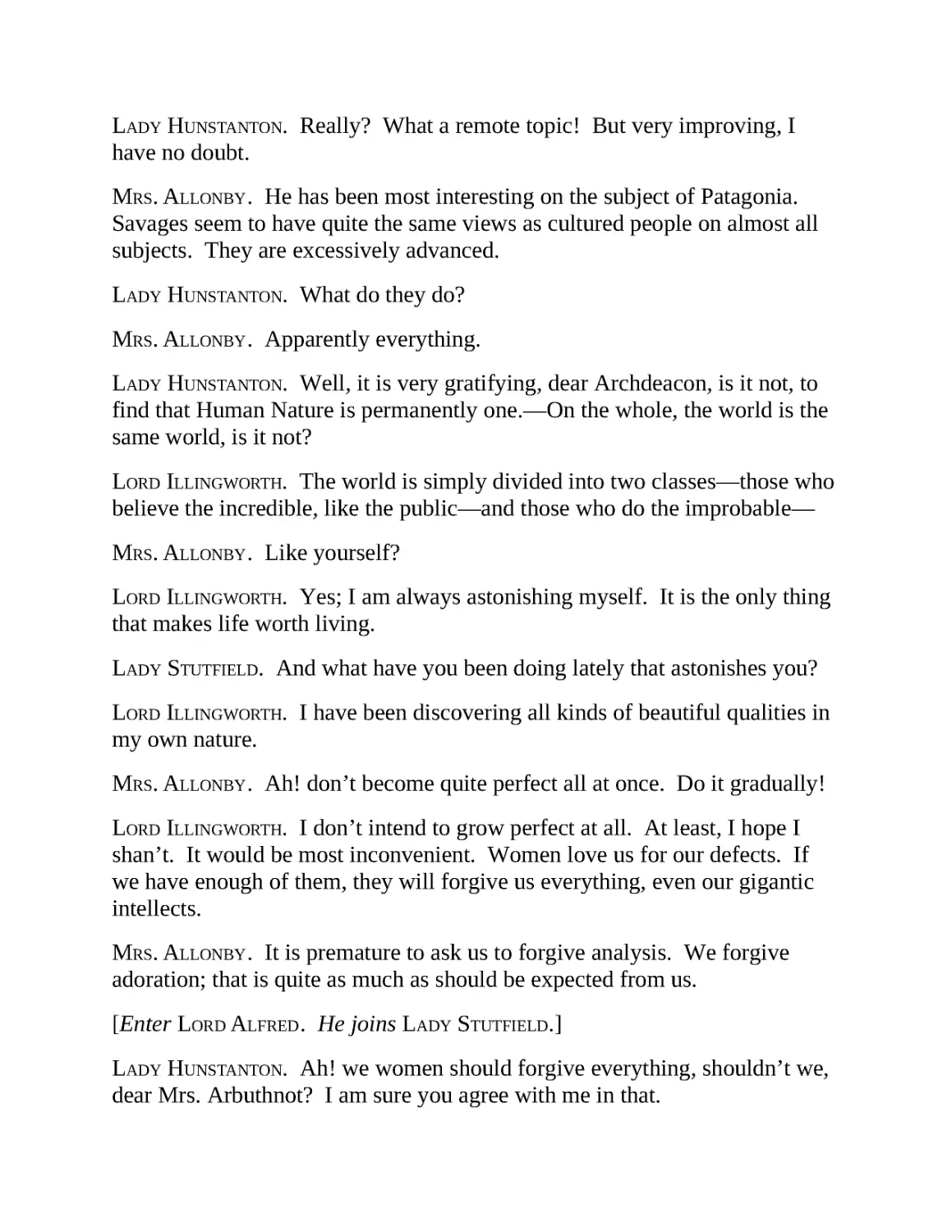

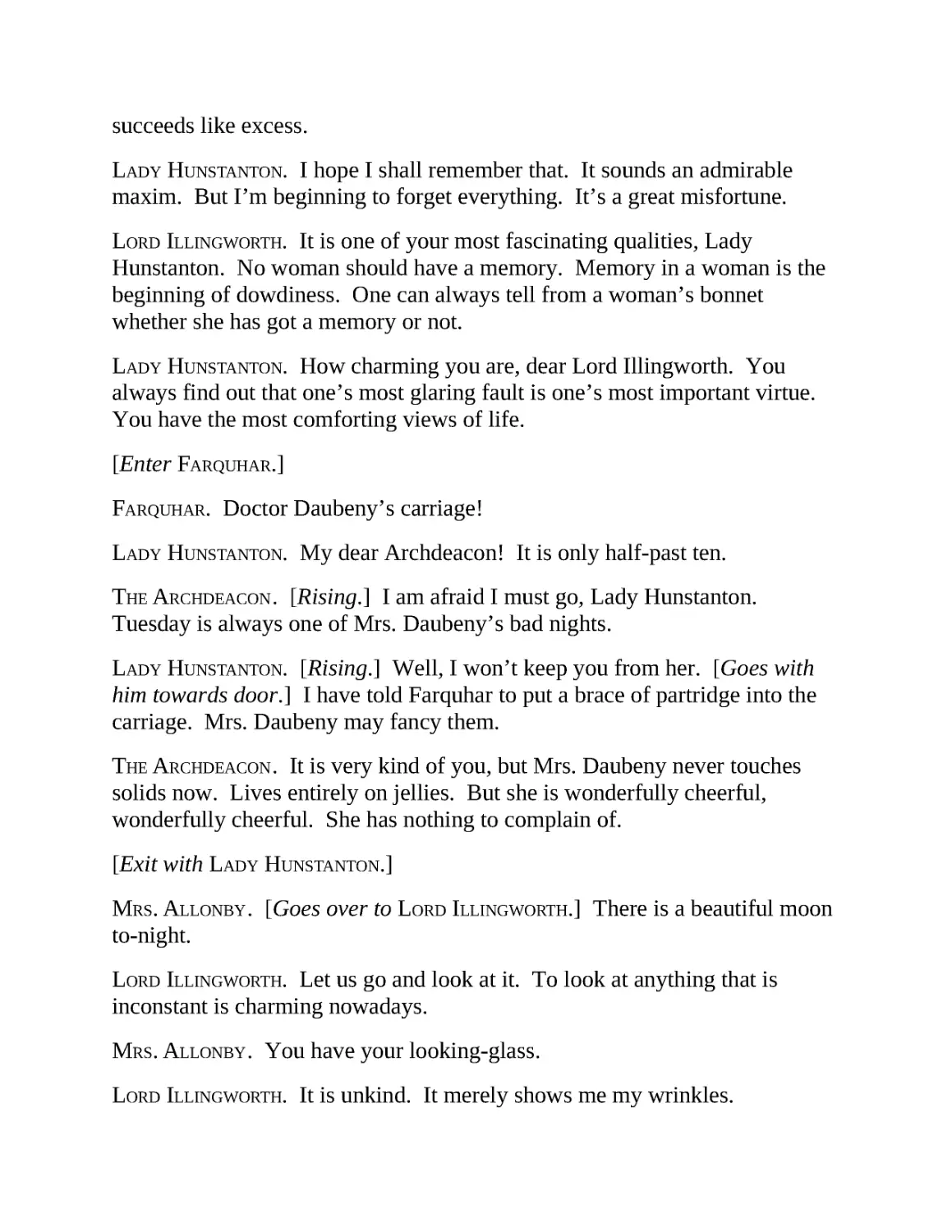
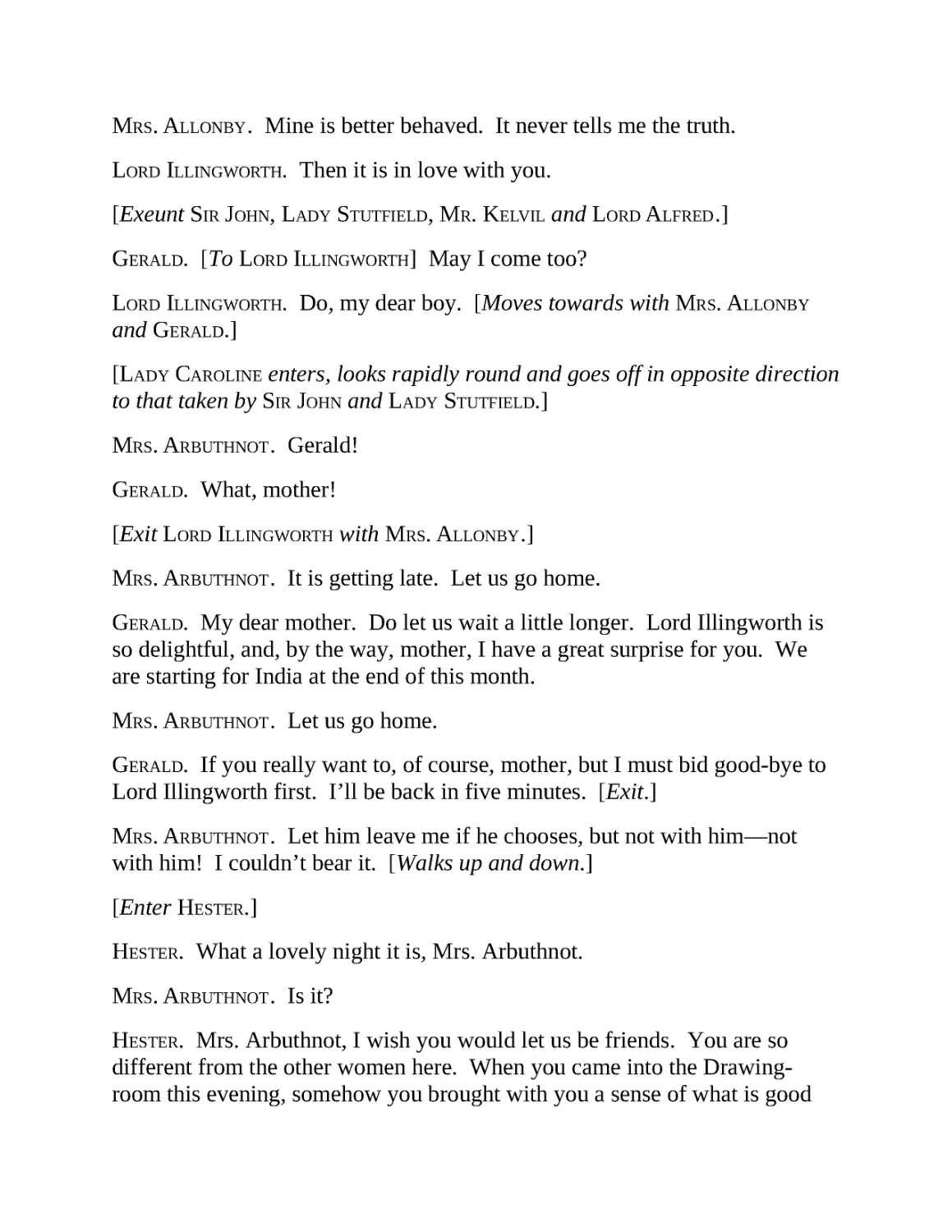
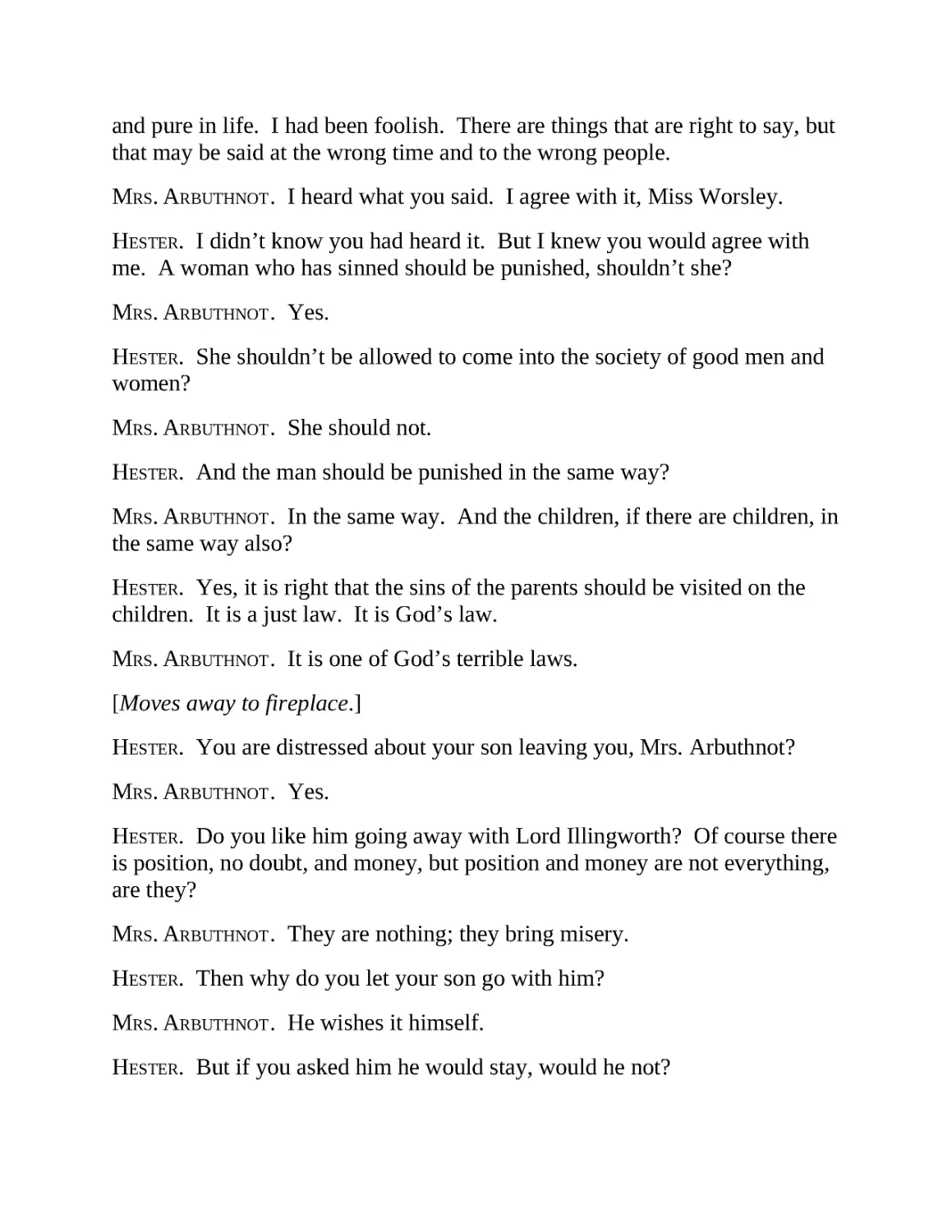










Текст
                    The Project Gutenberg eBook, A Woman of No Importance, by Oscar Wilde
This eBook is for the use of anyone anywhere in the United States and most
other parts of the world at no cost and with almost no restrictions
whatsoever. You may copy it, give it away or re-use it under the terms of
the Project Gutenberg License included with this eBook or online at
www.gutenberg.org. If you are not located in the United States, you'll have
to check the laws of the country where you are located before using this ebook.
Title: A Woman of No Importance
A Play
Author: Oscar Wilde
Release Date: September 16, 2014 [eBook #854]
[This file was first posted on 20 March 1997]
Language: English
Character set encoding: ISO-646 -US (US-ASCII)
***START OF THE PROJECT GUTENBERG EBOOK A WOMAN OF NO IMPORTANCE***
Transcribed from the 1919 Methuen & Co. Ltd. edition by David Price, email
ccx074@pglaf.org
A WOMAN OF
NO IMPORTANCE
A PLAY
BY
OSCAR WILDE

METHUEN & CO., LTD.
36 ESSEX STREET W.C.
LONDON
Eighth Edition
First Printed
1894
First Issued by Methuen and Co. (Limited Editions on
Handmade Paper and Japanese Vellum)
February 1908
Third Edition
September 1909
Fourth Edition
May
1910
Fifth Edition
December 1911
Sixth Edition
March 1913
Seventh Edition (Cheap Form)
October 1916
Eighth Edition
1919
The dramatic rights of ‘A Woman of No Importance’ belong to Sir Herbert
Beerbohm Tree and to Robert Ross, executor and administrator of Oscar
Wilde’s estate.
TO
GLADYS
COUNTESS DE GREY
[MARCHIONESS OF RIPON]

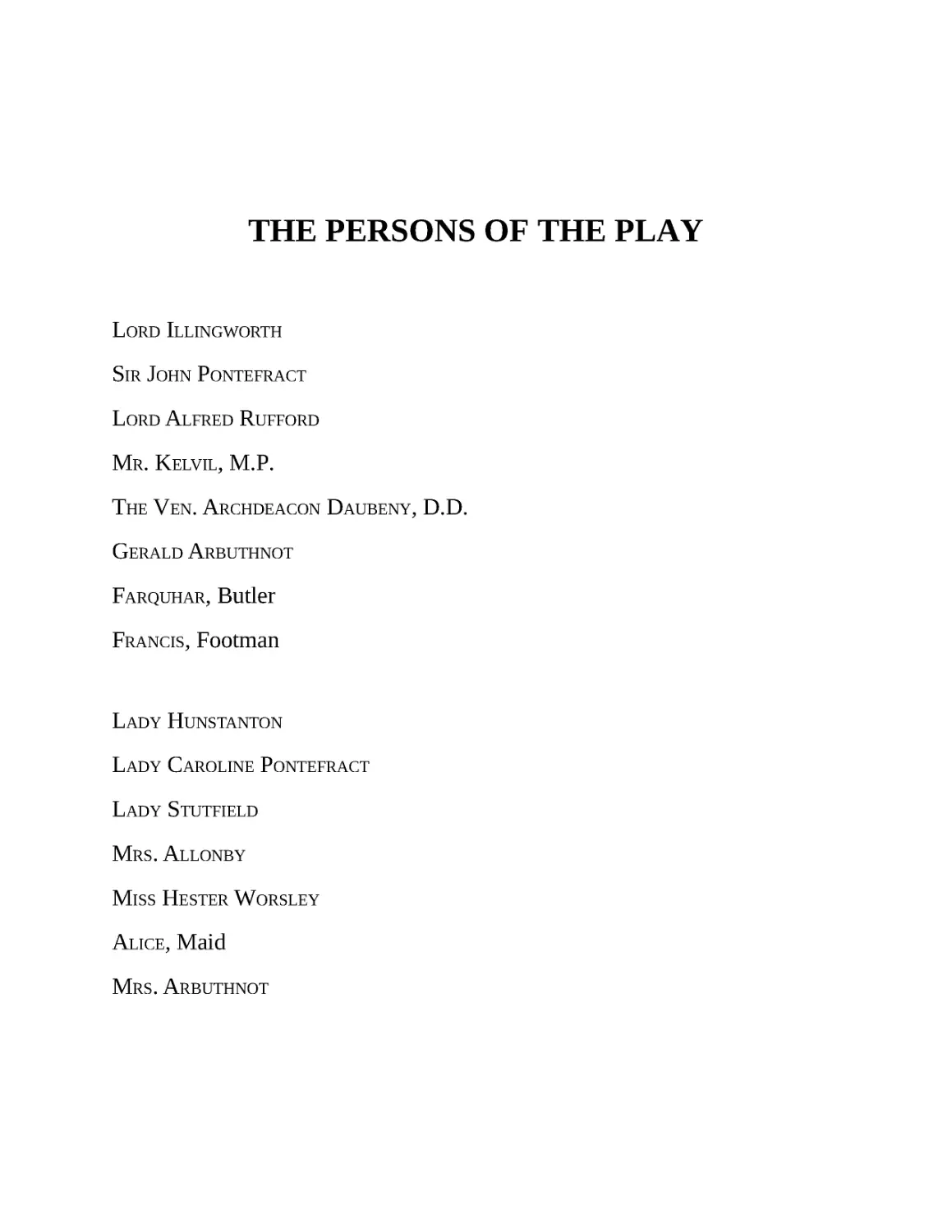
THE PERSONS OF THE PLAY
LORD ILLINGWORTH
SIR JOHN PONTEFRACT
LORD ALFRED RUFFORD
MR. KELVIL, M.P.
THE VEN. ARCHDEACON DAUBENY, D.D.
GERALD ARBUTHNOT
FARQUHAR, Butler
FRANCIS, Footman
LADY HUNSTANTON
LADY CAROLINE PONTEFRACT
LADY STUTFIELD
MRS. ALLONBY
MISS HESTER WORSLEY
ALICE, Maid
MRS. ARBUTHNOT

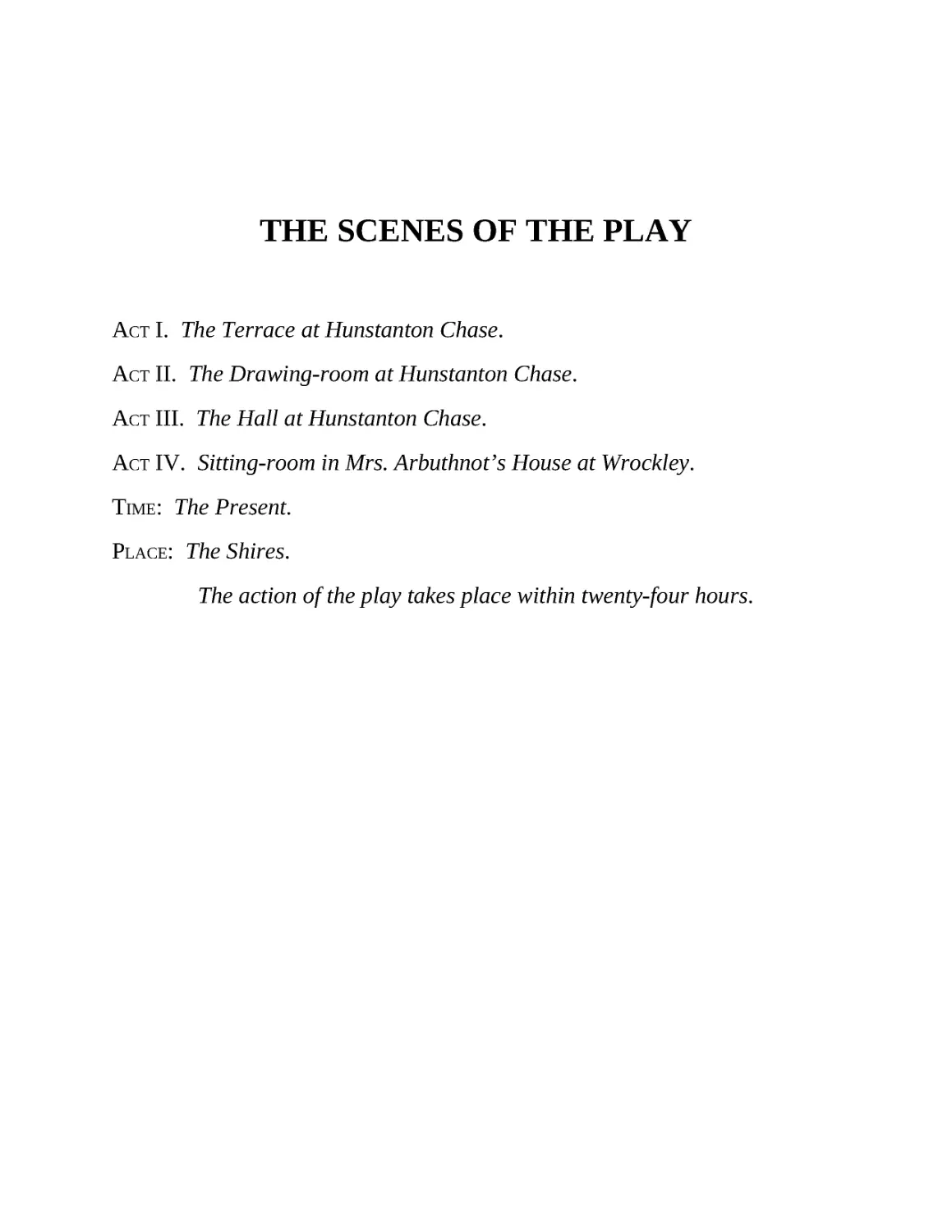
THE SCENES OF THE PLAY
ACT I. The Terrace at Hunstanton Chase.
ACT II. The Drawing-room at Hunstanton Chase.
ACT III. The Hall at Hunstanton Chase.
ACT IV. Sitting-room in Mrs. Arbuthnot’s House at Wrockley.
TIME: The Present.
PLACE: The Shires.
The action of the play takes place within twenty-four hours.

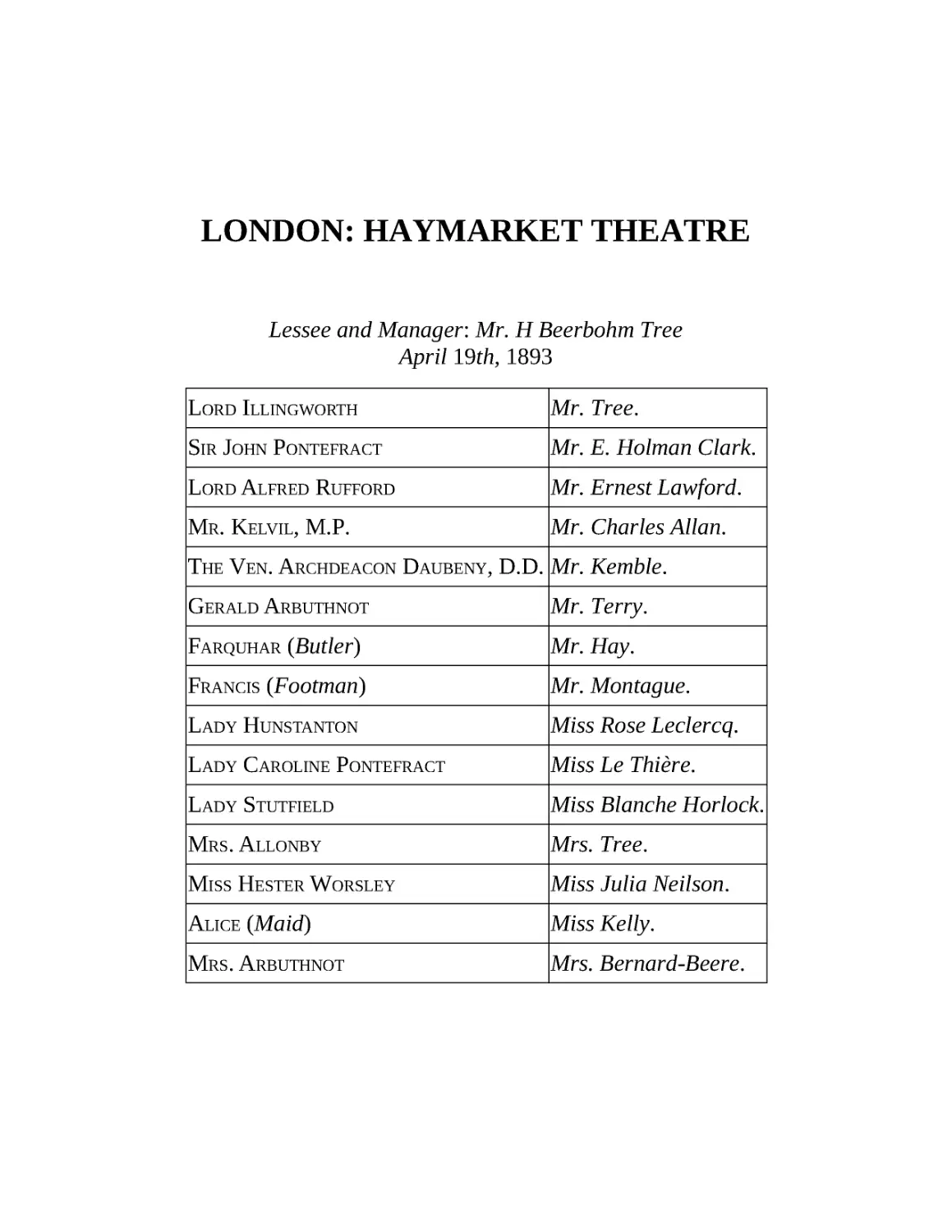
LONDON: HAYMARKET THEATRE
Lessee and Manager: Mr. H Beerbohm Tree
April 19th, 1893
LORD ILLINGWORTH
Mr. Tree.
SIR JOHN PONTEFRACT
Mr. E. Holman Clark.
LORD ALFRED RUFFORD
Mr. Ernest Lawford.
MR. KELVIL, M.P.
Mr. Charles Allan.
THE VEN. ARCHDEACON DAUBENY, D.D. Mr. Kemble.
GERALD ARBUTHNOT
Mr. Terry.
FARQUHAR (Butler)
Mr. Hay.
FRANCIS (Footman)
Mr. Montague.
LADY HUNSTANTON
Miss Rose Leclercq.
LADY CAROLINE PONTEFRACT
Miss Le Thière.
LADY STUTFIELD
Miss Blanche Horlock.
MRS. ALLONBY
Mrs. Tree.
MISS HESTER WORSLEY
Miss Julia Neilson.
ALICE (Maid)
Miss Kelly.
MRS. ARBUTHNOT
Mrs. Bernard-Beere.

FIRST ACT
SCENE
Lawn in front of the terrace at Hunstanton.
[SIR JOHN and LADY CAROLINE PONTEFRACT, MISS WORSLEY, on chairs under
large yew tree.]
LADY CAROLINE. I believe this is the first English country house you have
stayed at, Miss Worsley?
HESTER. Yes, Lady Caroline.
LADY CAROLINE. You have no country houses, I am told, in America?
HESTER. We have not many.
LADY CAROLINE. Have you any country? What we should call country?
HESTER. [Smiling.] We have the largest country in the world, Lady Caroline.
They used to tell us at school that some of our states are as big as France and
England put together.
LADY CAROLINE. Ah! you must find it very draughty, I should fancy. [To SIR
JOHN.] John, you should have your muffler. What is the use of my always
knitting mufflers for you if you won’t wear them?
SIR JOHN. I am quite warm, Caroline, I assure you.
LADY CAROLINE. I think not, John. Well, you couldn’t come to a more
charming place than this, Miss Worsley, though the house is excessively
damp, quite unpardonably damp, and dear Lady Hunstanton is sometimes a
little lax about the people she asks down here. [To SIR JOHN.] Jane mixes too
much. Lord Illingworth, of course, is a man of high distinction. It is a

privilege to meet him. And that member of Parliament, Mr. Kettle—
SIR JOHN. Kelvil, my love, Kelvil.
LADY CAROLINE. He must be quite respectable. One has never heard his name
before in the whole course of one’s life, which speaks volumes for a man,
nowadays. But Mrs. Allonby is hardly a very suitable person.
HESTER. I dislike Mrs. Allonby. I dislike her more than I can say.
LADY CAROLINE. I am not sure, Miss Worsley, that foreigners like yourself
should cultivate likes or dislikes about the people they are invited to meet.
Mrs. Allonby is very well born. She is a niece of Lord Brancaster’s. It is
said, of course, that she ran away twice before she was married. But you
know how unfair people often are. I myself don’t believe she ran away more
than once.
HESTER. Mr. Arbuthnot is very charming.
LADY CAROLINE. Ah, yes! the young man who has a post in a bank. Lady
Hunstanton is most kind in asking him here, and Lord Illingworth seems to
have taken quite a fancy to him. I am not sure, however, that Jane is right in
taking him out of his position. In my young days, Miss Worsley, one never
met any one in society who worked for their living. It was not considered the
thing.
HESTER. In America those are the people we respect most.
LADY CAROLINE. I have no doubt of it.
HESTER. Mr. Arbuthnot has a beautiful nature! He is so simple, so sincere.
He has one of the most beautiful natures I have ever come across. It is a
privilege to meet him.
LADY CAROLINE. It is not customary in England, Miss Worsley, for a young
lady to speak with such enthusiasm of any person of the opposite sex.
English women conceal their feelings till after they are married. They show
them then.
HESTER. Do you, in England, allow no friendship to exist between a young
man and a young girl?

[Enter LADY HUNSTANTON, followed by Footman with shawls and a cushion.]
LADY CAROLINE. We think it very inadvisable. Jane, I was just saying what a
pleasant party you have asked us to meet. You have a wonderful power of
selection. It is quite a gift.
LADY HUNSTANTON. Dear Caroline, how kind of you! I think we all do fit in
very nicely together. And I hope our charming American visitor will carry
back pleasant recollections of our English country life. [To Footman.] The
cushion, there, Francis. And my shawl. The Shetland. Get the Shetland.
[Exit Footman for shawl.]
[Enter GERALD ARBUTHNOT .]
GERALD. Lady Hunstanton, I have such good news to tell you. Lord
Illingworth has just offered to make me his secretary.
LADY HUNSTANTON. His secretary? That is good news indeed, Gerald. It
means a very brilliant future in store for you. Your dear mother will be
delighted. I really must try and induce her to come up here to-night. Do you
think she would, Gerald? I know how difficult it is to get her to go
anywhere.
GERALD. Oh! I am sure she would, Lady Hunstanton, if she knew Lord
Illingworth had made me such an offer.
[Enter Footman with shawl.]
LADY HUNSTANTON. I will write and tell her about it, and ask her to come up
and meet him. [To Footman.] Just wait, Francis. [Writes letter.]
LADY CAROLINE. That is a very wonderful opening for so young a man as you
are, Mr. Arbuthnot.
GERALD. It is indeed, Lady Caroline. I trust I shall be able to show myself
worthy of it.
LADY CAROLINE. I trust so.
GERALD. [To HESTER.] You have not congratulated me yet, Miss Worsley.
HESTER. Are you very pleased about it?

GERALD. Of course I am. It means everything to me—things that were out of
the reach of hope before may be within hope’s reach now.
HESTER. Nothing should be out of the reach of hope. Life is a hope.
LADY HUNSTANTON. I fancy, Caroline, that Diplomacy is what Lord
Illingworth is aiming at. I heard that he was offered Vienna. But that may
not be true.
LADY CAROLINE. I don’t think that England should be represented abroad by
an unmarried man, Jane. It might lead to complications.
LADY HUNSTANTON. You are too nervous, Caroline. Believe me, you are too
nervous. Besides, Lord Illingworth may marry any day. I was in hopes he
would have married lady Kelso. But I believe he said her family was too
large. Or was it her feet? I forget which. I regret it very much. She was
made to be an ambassador’s wife.
LADY CAROLINE. She certainly has a wonderful faculty of remembering
people’s names, and forgetting their faces.
LADY HUNSTANTON. Well, that is very natural, Caroline, is it not? [To
Footman.] Tell Henry to wait for an answer. I have written a line to your
dear mother, Gerald, to tell her your good news, and to say she really must
come to dinner.
[Exit Footman.]
GERALD. That is awfully kind of you, Lady Hunstanton. [To HESTER.] Will
you come for a stroll, Miss Worsley?
HESTER. With pleasure. [Exit with GERALD.]
LADY HUNSTANTON. I am very much gratified at Gerald Arbuthnot’s good
fortune. He is quite a protégé of mine. And I am particularly pleased that
Lord Illingworth should have made the offer of his own accord without my
suggesting anything. Nobody likes to be asked favours. I remember poor
Charlotte Pagden making herself quite unpopular one season, because she
had a French governess she wanted to recommend to every one.
LADY CAROLINE. I saw the governess, Jane. Lady Pagden sent her to me. It

was before Eleanor came out. She was far too good-looking to be in any
respectable household. I don’t wonder Lady Pagden was so anxious to get
rid of her.
LADY HUNSTANTON. Ah, that explains it.
LADY CAROLINE. John, the grass is too damp for you. You had better go and
put on your overshoes at once.
SIR JOHN. I am quite comfortable, Caroline, I assure you.
LADY CAROLINE. You must allow me to be the best judge of that, John. Pray
do as I tell you.
[SIR JOHN gets up and goes off.]
LADY HUNSTANTON. You spoil him, Caroline, you do indeed!
[Enter MRS. ALLONBY and LADY STUTFIELD.]
[To MRS. ALLONBY .] Well, dear, I hope you like the park. It is said to be well
timbered.
MRS. ALLONBY . The trees are wonderful, Lady Hunstanton.
LADY STUTFIELD. Quite, quite wonderful.
MRS. ALLONBY . But somehow, I feel sure that if I lived in the country for six
months, I should become so unsophisticated that no one would take the
slightest notice of me.
LADY HUNSTANTON. I assure you, dear, that the country has not that effect at
all. Why, it was from Melthorpe, which is only two miles from here, that
Lady Belton eloped with Lord Fethersdale. I remember the occurrence
perfectly. Poor Lord Belton died three days afterwards of joy, or gout. I
forget which. We had a large party staying here at the time, so we were all
very much interested in the whole affair.
MRS. ALLONBY . I think to elope is cowardly. It’s running away from danger.
And danger has become so rare in modern life.
LADY CAROLINE. As far as I can make out, the young women of the present

day seem to make it the sole object of their lives to be always playing with
fire.
MRS. ALLONBY . The one advantage of playing with fire, Lady Caroline, is
that one never gets even singed. It is the people who don’t know how to play
with it who get burned up.
LADY STUTFIELD. Yes; I see that. It is very, very helpful.
LADY HUNSTANTON. I don’t know how the world would get on with such a
theory as that, dear Mrs. Allonby.
LADY STUTFIELD. Ah! The world was made for men and not for women.
MRS. ALLONBY . Oh, don’t say that, Lady Stutfield. We have a much better
time than they have. There are far more things forbidden to us than are
forbidden to them.
LADY STUTFIELD. Yes; that is quite, quite true. I had not thought of that.
[Enter SIR JOHN and MR. KELVIL.]
LADY HUNSTANTON. Well, Mr. Kelvil, have you got through your work?
KELVIL. I have finished my writing for the day, Lady Hunstanton. It has been
an arduous task. The demands on the time of a public man are very heavy
nowadays, very heavy indeed. And I don’t think they meet with adequate
recognition.
LADY CAROLINE. John, have you got your overshoes on?
SIR JOHN. Yes, my love.
LADY CAROLINE. I think you had better come over here, John. It is more
sheltered.
SIR JOHN. I am quite comfortable, Caroline.
LADY CAROLINE. I think not, John. You had better sit beside me. [SIR JOHN
rises and goes across.]
LADY STUTFIELD. And what have you been writing about this morning, Mr.

Kelvil?
KELVIL. On the usual subject, Lady Stutfield. On Purity.
LADY STUTFIELD. That must be such a very, very interesting thing to write
about.
KELVIL. It is the one subject of really national importance, nowadays, Lady
Stutfield. I purpose addressing my constituents on the question before
Parliament meets. I find that the poorer classes of this country display a
marked desire for a higher ethical standard.
LADY STUTFIELD. How quite, quite nice of them.
LADY CAROLINE. Are you in favour of women taking part in politics, Mr.
Kettle?
SIR JOHN. Kelvil, my love, Kelvil.
KELVIL. The growing influence of women is the one reassuring thing in our
political life, Lady Caroline. Women are always on the side of morality,
public and private.
LADY STUTFIELD. It is so very, very gratifying to hear you say that.
LADY HUNSTANTON. Ah, yes!—the moral qualities in women—that is the
important thing. I am afraid, Caroline, that dear Lord Illingworth doesn’t
value the moral qualities in women as much as he should.
[Enter LORD ILLINGWORTH.]
LADY STUTFIELD. The world says that Lord Illingworth is very, very wicked.
LORD ILLINGWORTH. But what world says that, Lady Stutfield? It must be the
next world. This world and I are on excellent terms. [Sits down beside MRS.
ALLONBY.]
LADY STUTFIELD. Every one I know says you are very, very wicked.
LORD ILLINGWORTH. It is perfectly monstrous the way people go about,
nowadays, saying things against one behind one’s back that are absolutely
and entirely true.

LADY HUNSTANTON. Dear Lord Illingworth is quite hopeless, Lady Stutfield. I
have given up trying to reform him. It would take a Public Company with a
Board of Directors and a paid Secretary to do that. But you have the
secretary already, Lord Illingworth, haven’t you? Gerald Arbuthnot has told
us of his good fortune; it is really most kind of you.
LORD ILLINGWORTH. Oh, don’t say that, Lady Hunstanton. Kind is a dreadful
word. I took a great fancy to young Arbuthnot the moment I met him, and
he’ll be of considerable use to me in something I am foolish enough to think
of doing.
LADY HUNSTANTON. He is an admirable young man. And his mother is one of
my dearest friends. He has just gone for a walk with our pretty American.
She is very pretty, is she not?
LADY CAROLINE. Far too pretty. These American girls carry off all the good
matches. Why can’t they stay in their own country? They are always telling
us it is the Paradise of women.
LORD ILLINGWORTH. It is, Lady Caroline. That is why, like Eve, they are so
extremely anxious to get out of it.
LADY CAROLINE. Who are Miss Worsley’s parents?
LORD ILLINGWORTH. American women are wonderfully clever in concealing
their parents.
LADY HUNSTANTON. My dear Lord Illingworth, what do you mean? Miss
Worsley, Caroline, is an orphan. Her father was a very wealthy millionaire or
philanthropist, or both, I believe, who entertained my son quite hospitably,
when he visited Boston. I don’t know how he made his money, originally.
KELVIL. I fancy in American dry goods.
LADY HUNSTANTON. What are American dry goods?
LORD ILLINGWORTH. American novels.
LADY HUNSTANTON. How very singular! . . . Well, from whatever source her
large fortune came, I have a great esteem for Miss Worsley. She dresses
exceedingly well. All Americans do dress well. They get their clothes in

Paris.
MRS. ALLONBY . They say, Lady Hunstanton, that when good Americans die
they go to Paris.
LADY HUNSTANTON. Indeed? And when bad Americans die, where do they go
to?
LORD ILLINGWORTH. Oh, they go to America.
KELVIL. I am afraid you don’t appreciate America, Lord Illingworth. It is a
very remarkable country, especially considering its youth.
LORD ILLINGWORTH. The youth of America is their oldest tradition. It has
been going on now for three hundred years. To hear them talk one would
imagine they were in their first childhood. As far as civilisation goes they are
in their second.
KELVIL. There is undoubtedly a great deal of corruption in American politics.
I suppose you allude to that?
LORD ILLINGWORTH. I wonder.
LADY HUNSTANTON. Politics are in a sad way everywhere, I am told. They
certainly are in England. Dear Mr. Cardew is ruining the country. I wonder
Mrs. Cardew allows him. I am sure, Lord Illingworth, you don’t think that
uneducated people should be allowed to have votes?
LORD ILLINGWORTH. I think they are the only people who should.
KELVIL. Do you take no side then in modern politics, Lord Illingworth?
LORD ILLINGWORTH. One should never take sides in anything, Mr. Kelvil.
Taking sides is the beginning of sincerity, and earnestness follows shortly
afterwards, and the human being becomes a bore. However, the House of
Commons really does very little harm. You can’t make people good by Act
of Parliament,—that is something.
KELVIL. You cannot deny that the House of Commons has always shown
great sympathy with the sufferings of the poor.
LORD ILLINGWORTH. That is its special vice. That is the special vice of the

age. One should sympathise with the joy, the beauty, the colour of life. The
less said about life’s sores the better, Mr. Kelvil.
KELVIL. Still our East End is a very important problem.
LORD ILLINGWORTH. Quite so. It is the problem of slavery. And we are trying
to solve it by amusing the slaves.
LADY HUNSTANTON. Certainly, a great deal may be done by means of cheap
entertainments, as you say, Lord Illingworth. Dear Dr. Daubeny, our rector
here, provides, with the assistance of his curates, really admirable recreations
for the poor during the winter. And much good may be done by means of a
magic lantern, or a missionary, or some popular amusement of that kind.
LADY CAROLINE. I am not at all in favour of amusements for the poor, Jane.
Blankets and coals are sufficient. There is too much love of pleasure
amongst the upper classes as it is. Health is what we want in modern life.
The tone is not healthy, not healthy at all.
KELVIL. You are quite right, Lady Caroline.
LADY CAROLINE. I believe I am usually right.
MRS. ALLONBY . Horrid word ‘health.’
LORD ILLINGWORTH. Silliest word in our language, and one knows so well the
popular idea of health. The English country gentleman galloping after a fox
—the unspeakable in full pursuit of the uneatable.
KELVIL. May I ask, Lord Illingworth, if you regard the House of Lords as a
better institution than the House of Commons?
LORD ILLINGWORTH. A much better institution, of course. We in the House of
Lords are never in touch with public opinion. That makes us a civilised
body.
KELVIL. Are you serious in putting forward such a view?
LORD ILLINGWORTH. Quite serious, Mr. Kelvil. [To MRS. ALLONBY .] Vulgar
habit that is people have nowadays of asking one, after one has given them an
idea, whether one is serious or not. Nothing is serious except passion. The

intellect is not a serious thing, and never has been. It is an instrument on
which one plays, that is all. The only serious form of intellect I know is the
British intellect. And on the British intellect the illiterates play the drum.
LADY HUNSTANTON. What are you saying, Lord Illingworth, about the drum?
LORD ILLINGWORTH. I was merely talking to Mrs. Allonby about the leading
articles in the London newspapers.
LADY HUNSTANTON. But do you believe all that is written in the newspapers?
LORD ILLINGWORTH. I do. Nowadays it is only the unreadable that occurs.
[Rises with MRS. ALLONBY .]
LADY HUNSTANTON. Are you going, Mrs. Allonby?
MRS. ALLONBY . Just as far as the conservatory. Lord Illingworth told me this
morning that there was an orchid there as beautiful as the seven deadly sins.
LADY HUNSTANTON. My dear, I hope there is nothing of the kind. I will
certainly speak to the gardener.
[Exit MRS. ALLONBY and LORD ILLINGWORTH.]
LADY CAROLINE. Remarkable type, Mrs. Allonby.
LADY HUNSTANTON. She lets her clever tongue run away with her sometimes.
LADY CAROLINE. Is that the only thing, Jane, Mrs. Allonby allows to run away
with her?
LADY HUNSTANTON. I hope so, Caroline, I am sure.
[Enter LORD ALFRED .]
Dear Lord Alfred, do join us. [LORD ALFRED sits down beside LADY
STUTFIELD.]
LADY CAROLINE. You believe good of every one, Jane. It is a great fault.
LADY STUTFIELD. Do you really, really think, Lady Caroline, that one should
believe evil of every one?

LADY CAROLINE. I think it is much safer to do so, Lady Stutfield. Until, of
course, people are found out to be good. But that requires a great deal of
investigation nowadays.
LADY STUTFIELD. But there is so much unkind scandal in modern life.
LADY CAROLINE. Lord Illingworth remarked to me last night at dinner that the
basis of every scandal is an absolutely immoral certainty.
KELVIL. Lord Illingworth is, of course, a very brilliant man, but he seems to
me to be lacking in that fine faith in the nobility and purity of life which is so
important in this century.
LADY STUTFIELD. Yes, quite, quite important, is it not?
KELVIL. He gives me the impression of a man who does not appreciate the
beauty of our English home-life. I would say that he was tainted with foreign
ideas on the subject.
LADY STUTFIELD. There is nothing, nothing like the beauty of home-life, is
there?
KELVIL. It is the mainstay of our moral system in England, Lady Stutfield.
Without it we would become like our neighbours.
LADY STUTFIELD. That would be so, so sad, would it not?
KELVIL. I am afraid, too, that Lord Illingworth regards woman simply as a
toy. Now, I have never regarded woman as a toy. Woman is the intellectual
helpmeet of man in public as in private life. Without her we should forget
the true ideals. [Sits down beside LADY STUTFIELD.]
LADY STUTFIELD. I am so very, very glad to hear you say that.
LADY CAROLINE. You a married man, Mr. Kettle?
SIR JOHN. Kelvil, dear, Kelvil.
KELVIL. I am married, Lady Caroline.
LADY CAROLINE. Family?

KELVIL. Yes.
LADY CAROLINE. How many?
KELVIL. Eight.
[LADY STUTFIELD turns her attention to LORD ALFRED .]
LADY CAROLINE. Mrs. Kettle and the children are, I suppose, at the seaside?
[SIR JOHN shrugs his shoulders.]
KELVIL. My wife is at the seaside with the children, Lady Caroline.
LADY CAROLINE. You will join them later on, no doubt?
KELVIL. If my public engagements permit me.
LADY CAROLINE. Your public life must be a great source of gratification to
Mrs. Kettle.
SIR JOHN. Kelvil, my love, Kelvil.
LADY STUTFIELD. [To LORD ALFRED .] How very, very charming those gold-
tipped cigarettes of yours are, Lord Alfred.
LORD ALFRED . They are awfully expensive. I can only afford them when I’m
in debt.
LADY STUTFIELD. It must be terribly, terribly distressing to be in debt.
LORD ALFRED . One must have some occupation nowadays. If I hadn’t my
debts I shouldn’t have anything to think about. All the chaps I know are in
debt.
LADY STUTFIELD. But don’t the people to whom you owe the money give you
a great, great deal of annoyance?
[Enter Footman.]
LORD ALFRED . Oh, no, they write; I don’t.
LADY STUTFIELD. How very, very strange.

LADY HUNSTANTON. Ah, here is a letter, Caroline, from dear Mrs. Arbuthnot.
She won’t dine. I am so sorry. But she will come in the evening. I am very
pleased indeed. She is one of the sweetest of women. Writes a beautiful
hand, too, so large, so firm. [Hands letter to LADY CAROLINE.]
LADY CAROLINE. [Looking at it.] A little lacking in femininity, Jane.
Femininity is the quality I admire most in women.
LADY HUNSTANTON. [Taking back letter and leaving it on table.] Oh! she is
very feminine, Caroline, and so good too. You should hear what the
Archdeacon says of her. He regards her as his right hand in the parish.
[Footman speaks to her.] In the Yellow Drawing-room. Shall we all go in?
Lady Stutfield, shall we go in to tea?
LADY STUTFIELD. With pleasure, Lady Hunstanton. [They rise and proceed to
go off. SIR JOHN offers to carry LADY STUTFIELD’S cloak.]
LADY CAROLINE. John! If you would allow your nephew to look after Lady
Stutfield’s cloak, you might help me with my workbasket.
[Enter LORD ILLINGWORTH and MRS. ALLONBY .]
SIR JOHN. Certainly, my love. [Exeunt.]
MRS. ALLONBY . Curious thing, plain women are always jealous of their
husbands, beautiful women never are!
LORD ILLINGWORTH. Beautiful women never have time. They are always so
occupied in being jealous of other people’s husbands.
MRS. ALLONBY . I should have thought Lady Caroline would have grown tired
of conjugal anxiety by this time! Sir John is her fourth!
LORD ILLINGWORTH. So much marriage is certainly not becoming. Twenty
years of romance make a woman look like a ruin; but twenty years of
marriage make her something like a public building.
MRS. ALLONBY . Twenty years of romance! Is there such a thing?
LORD ILLINGWORTH. Not in our day. Women have become too brilliant.
Nothing spoils a romance so much as a sense of humour in the woman.

MRS. ALLONBY . Or the want of it in the man.
LORD ILLINGWORTH. You are quite right. In a Temple every one should be
serious, except the thing that is worshipped.
MRS. ALLONBY . And that should be man?
LORD ILLINGWORTH. Women kneel so gracefully; men don’t.
MRS. ALLONBY . You are thinking of Lady Stutfield!
LORD ILLINGWORTH. I assure you I have not thought of Lady Stutfield for the
last quarter of an hour.
MRS. ALLONBY . Is she such a mystery?
LORD ILLINGWORTH. She is more than a mystery—she is a mood.
MRS. ALLONBY . Moods don’t last.
LORD ILLINGWORTH. It is their chief charm.
[Enter HESTER and GERALD.]
GERALD. Lord Illingworth, every one has been congratulating me, Lady
Hunstanton and Lady Caroline, and . . . every one. I hope I shall make a
good secretary.
LORD ILLINGWORTH. You will be the pattern secretary, Gerald. [Talks to him.]
MRS. ALLONBY . You enjoy country life, Miss Worsley?
HESTER. Very much indeed.
MRS. ALLONBY . Don’t find yourself longing for a London dinner-party?
HESTER. I dislike London dinner-parties.
MRS. ALLONBY . I adore them. The clever people never listen, and the stupid
people never talk.
HESTER. I think the stupid people talk a great deal.
MRS. ALLONBY . Ah, I never listen!

LORD ILLINGWORTH. My dear boy, if I didn’t like you I wouldn’t have made
you the offer. It is because I like you so much that I want to have you with
me.
[Exit HESTER with GERALD.]
Charming fellow, Gerald Arbuthnot!
MRS. ALLONBY . He is very nice; very nice indeed. But I can’t stand the
American young lady.
LORD ILLINGWORTH. Why?
MRS. ALLONBY . She told me yesterday, and in quite a loud voice too, that she
was only eighteen. It was most annoying.
LORD ILLINGWORTH. One should never trust a woman who tells one her real
age. A woman who would tell one that, would tell one anything.
MRS. ALLONBY . She is a Puritan besides—
LORD ILLINGWORTH. Ah, that is inexcusable. I don’t mind plain women being
Puritans. It is the only excuse they have for being plain. But she is decidedly
pretty. I admire her immensely. [Looks steadfastly at MRS. ALLONBY .]
MRS. ALLONBY . What a thoroughly bad man you must be!
LORD ILLINGWORTH. What do you call a bad man?
MRS. ALLONBY . The sort of man who admires innocence.
LORD ILLINGWORTH. And a bad woman?
MRS. ALLONBY . Oh! the sort of woman a man never gets tired of.
LORD ILLINGWORTH. You are severe—on yourself.
MRS. ALLONBY . Define us as a sex.
LORD ILLINGWORTH. Sphinxes without secrets.
MRS. ALLONBY . Does that include the Puritan women?

LORD ILLINGWORTH. Do you know, I don’t believe in the existence of Puritan
women? I don’t think there is a woman in the world who would not be a
little flattered if one made love to her. It is that which makes women so
irresistibly adorable.
MRS. ALLONBY . You think there is no woman in the world who would object
to being kissed?
LORD ILLINGWORTH. Very few.
MRS. ALLONBY . Miss Worsley would not let you kiss her.
LORD ILLINGWORTH. Are you sure?
MRS. ALLONBY . Quite.
LORD ILLINGWORTH. What do you think she’d do if I kissed her?
MRS. ALLONBY . Either marry you, or strike you across the face with her
glove. What would you do if she struck you across the face with her glove?
LORD ILLINGWORTH. Fall in love with her, probably.
MRS. ALLONBY . Then it is lucky you are not going to kiss her!
LORD ILLINGWORTH. Is that a challenge?
MRS. ALLONBY . It is an arrow shot into the air.
LORD ILLINGWORTH. Don’t you know that I always succeed in whatever I try?
MRS. ALLONBY . I am sorry to hear it. We women adore failures. They lean
on us.
LORD ILLINGWORTH. You worship successes. You cling to them.
MRS. ALLONBY . We are the laurels to hide their baldness.
LORD ILLINGWORTH. And they need you always, except at the moment of
triumph.
MRS. ALLONBY . They are uninteresting then.

LORD ILLINGWORTH. How tantalising you are! [A pause.]
MRS. ALLONBY . Lord Illingworth, there is one thing I shall always like you
for.
LORD ILLINGWORTH. Only one thing? And I have so many bad qualities.
MRS. ALLONBY . Ah, don’t be too conceited about them. You may lose them
as you grow old.
LORD ILLINGWORTH. I never intend to grow old. The soul is born old but
grows young. That is the comedy of life.
MRS. ALLONBY . And the body is born young and grows old. That is life’s
tragedy.
LORD ILLINGWORTH. Its comedy also, sometimes. But what is the mysterious
reason why you will always like me?
MRS. ALLONBY . It is that you have never made love to me.
LORD ILLINGWORTH. I have never done anything else.
MRS. ALLONBY . Really? I have not noticed it.
LORD ILLINGWORTH. How fortunate! It might have been a tragedy for both of
us.
MRS. ALLONBY . We should each have survived.
LORD ILLINGWORTH. One can survive everything nowadays, except death, and
live down anything except a good reputation.
MRS. ALLONBY . Have you tried a good reputation?
LORD ILLINGWORTH. It is one of the many annoyances to which I have never
been subjected.
MRS. ALLONBY . It may come.
LORD ILLINGWORTH. Why do you threaten me?
MRS. ALLONBY . I will tell you when you have kissed the Puritan.

[Enter Footman.]
FRANCIS. Tea is served in the Yellow Drawing-room, my lord.
LORD ILLINGWORTH. Tell her ladyship we are coming in.
FRANCIS. Yes, my lord.
[Exit.]
LORD ILLINGWORTH. Shall we go in to tea?
MRS. ALLONBY . Do you like such simple pleasures?
LORD ILLINGWORTH. I adore simple pleasures. They are the last refuge of the
complex. But, if you wish, let us stay here. Yes, let us stay here. The Book
of Life begins with a man and a woman in a garden.
MRS. ALLONBY . It ends with Revelations.
LORD ILLINGWORTH. You fence divinely. But the button has come of your
foil.
MRS. ALLONBY . I have still the mask.
LORD ILLINGWORTH. It makes your eyes lovelier.
MRS. ALLONBY . Thank you. Come.
LORD ILLINGWORTH. [Sees MRS. ARBUTHNOT’S letter on table, and takes it up
and looks at envelope.] What a curious handwriting! It reminds me of the
handwriting of a woman I used to know years ago.
MRS. ALLONBY . Who?
LORD ILLINGWORTH. Oh! no one. No one in particular. A woman of no
importance. [Throws letter down, and passes up the steps of the terrace with
MRS. ALLONBY . They smile at each other.]
ACT DROP.

SECOND ACT
SCENE
Drawing-room at Hunstanton, after dinner, lamps lit. Door L.C. Door R.C .
[Ladies seated on sofas.]
MRS. ALLONBY . What a comfort it is to have got rid of the men for a little!
LADY STUTFIELD. Yes; men persecute us dreadfully, don’t they?
MRS. ALLONBY . Persecute us? I wish they did.
LADY HUNSTANTON. My dear!
MRS. ALLONBY . The annoying thing is that the wretches can be perfectly
happy without us. That is why I think it is every woman’s duty never to
leave them alone for a single moment, except during this short breathing
space after dinner; without which I believe we poor women would be
absolutely worn to shadows.
[Enter Servants with coffee.]
LADY HUNSTANTON. Worn to shadows, dear?
MRS. ALLONBY . Yes, Lady Hunstanton. It is such a strain keeping men up to
the mark. They are always trying to escape from us.
LADY STUTFIELD. It seems to me that it is we who are always trying to escape
from them. Men are so very, very heartless. They know their power and use
it.
LADY CAROLINE. [Takes coffee from Servant.] What stuff and nonsense all
this about men is! The thing to do is to keep men in their proper place.

MRS. ALLONBY . But what is their proper place, Lady Caroline?
LADY CAROLINE. Looking after their wives, Mrs. Allonby.
MRS. ALLONBY . [Takes coffee from Servant.] Really? And if they’re not
married?
LADY CAROLINE. If they are not married, they should be looking after a wife.
It’s perfectly scandalous the amount of bachelors who are going about
society. There should be a law passed to compel them all to marry within
twelve months.
LADY STUTFIELD. [Refuses coffee.] But if they’re in love with some one who,
perhaps, is tied to another?
LADY CAROLINE. In that case, Lady Stutfield, they should be married off in a
week to some plain respectable girl, in order to teach them not to meddle with
other people’s property.
MRS. ALLONBY . I don’t think that we should ever be spoken of as other
people’s property. All men are married women’s property. That is the only
true definition of what married women’s property really is. But we don’t
belong to any one.
LADY STUTFIELD. Oh, I am so very, very glad to hear you say so.
LADY HUNSTANTON. But do you really think, dear Caroline, that legislation
would improve matters in any way? I am told that, nowadays, all the married
men live like bachelors, and all the bachelors like married men.
MRS. ALLONBY . I certainly never know one from the other.
LADY STUTFIELD. Oh, I think one can always know at once whether a man has
home claims upon his life or not. I have noticed a very, very sad expression
in the eyes of so many married men.
MRS. ALLONBY . Ah, all that I have noticed is that they are horribly tedious
when they are good husbands, and abominably conceited when they are not.
LADY HUNSTANTON. Well, I suppose the type of husband has completely
changed since my young days, but I’m bound to state that poor dear

Hunstanton was the most delightful of creatures, and as good as gold.
MRS. ALLONBY . Ah, my husband is a sort of promissory note; I’m tired of
meeting him.
LADY CAROLINE. But you renew him from time to time, don’t you?
MRS. ALLONBY . Oh no, Lady Caroline. I have only had one husband as yet. I
suppose you look upon me as quite an amateur.
LADY CAROLINE. With your views on life I wonder you married at all.
MRS. ALLONBY . So do I.
LADY HUNSTANTON. My dear child, I believe you are really very happy in
your married life, but that you like to hide your happiness from others.
MRS. ALLONBY . I assure you I was horribly deceived in Ernest.
LADY HUNSTANTON. Oh, I hope not, dear. I knew his mother quite well. She
was a Stratton, Caroline, one of Lord Crowland’s daughters.
LADY CAROLINE. Victoria Stratton? I remember her perfectly. A silly fair-
haired woman with no chin.
MRS. ALLONBY . Ah, Ernest has a chin. He has a very strong chin, a square
chin. Ernest’s chin is far too square.
LADY STUTFIELD. But do you really think a man’s chin can be too square? I
think a man should look very, very strong, and that his chin should be quite,
quite square.
MRS. ALLONBY . Then you should certainly know Ernest, Lady Stutfield. It is
only fair to tell you beforehand he has got no conversation at all.
LADY STUTFIELD. I adore silent men.
MRS. ALLONBY . Oh, Ernest isn’t silent. He talks the whole time. But he has
got no conversation. What he talks about I don’t know. I haven’t listened to
him for years.
LADY STUTFIELD. Have you never forgiven him then? How sad that seems!

But all life is very, very sad, is it not?
MRS. ALLONBY . Life, Lady Stutfield, is simply a mauvais quart d’heure made
up of exquisite moments.
LADY STUTFIELD. Yes, there are moments, certainly. But was it something
very, very wrong that Mr. Allonby did? Did he become angry with you, and
say anything that was unkind or true?
MRS. ALLONBY . Oh dear, no. Ernest is invariably calm. That is one of the
reasons he always gets on my nerves. Nothing is so aggravating as
calmness. There is something positively brutal about the good temper of
most modern men. I wonder we women stand it as well as we do.
LADY STUTFIELD. Yes; men’s good temper shows they are not so sensitive as
we are, not so finely strung. It makes a great barrier often between husband
and wife, does it not? But I would so much like to know what was the wrong
thing Mr. Allonby did.
MRS. ALLONBY . Well, I will tell you, if you solemnly promise to tell
everybody else.
LADY STUTFIELD. Thank you, thank you. I will make a point of repeating it.
MRS. ALLONBY . When Ernest and I were engaged, he swore to me positively
on his knees that he had never loved any one before in the whole course of
his life. I was very young at the time, so I didn’t believe him, I needn’t tell
you. Unfortunately, however, I made no enquiries of any kind till after I had
been actually married four or five months. I found out then that what he had
told me was perfectly true. And that sort of thing makes a man so absolutely
uninteresting.
LADY HUNSTANTON. My dear!
MRS. ALLONBY . Men always want to be a woman’s first love. That is their
clumsy vanity. We women have a more subtle instinct about things. What
we like is to be a man’s last romance.
LADY STUTFIELD. I see what you mean. It’s very, very beautiful.
LADY HUNSTANTON. My dear child, you don’t mean to tell me that you won’t

forgive your husband because he never loved any one else? Did you ever
hear such a thing, Caroline? I am quite surprised.
LADY CAROLINE. Oh, women have become so highly educated, Jane, that
nothing should surprise us nowadays, except happy marriages. They
apparently are getting remarkably rare.
MRS. ALLONBY . Oh, they’re quite out of date.
LADY STUTFIELD. Except amongst the middle classes, I have been told.
MRS. ALLONBY . How like the middle classes!
LADY STUTFIELD. Yes—is it not?—very, very like them.
LADY CAROLINE. If what you tell us about the middle classes is true, Lady
Stutfield, it redounds greatly to their credit. It is much to be regretted that in
our rank of life the wife should be so persistently frivolous, under the
impression apparently that it is the proper thing to be. It is to that I attribute
the unhappiness of so many marriages we all know of in society.
MRS. ALLONBY . Do you know, Lady Caroline, I don’t think the frivolity of
the wife has ever anything to do with it. More marriages are ruined nowadays
by the common sense of the husband than by anything else. How can a
woman be expected to be happy with a man who insists on treating her as if
she were a perfectly rational being?
LADY HUNSTANTON. My dear!
MRS. ALLONBY . Man, poor, awkward, reliable, necessary man belongs to a
sex that has been rational for millions and millions of years. He can’t help
himself. It is in his race. The History of Woman is very different. We have
always been picturesque protests against the mere existence of common
sense. We saw its dangers from the first.
LADY STUTFIELD. Yes, the common sense of husbands is certainly most, most
trying. Do tell me your conception of the Ideal Husband. I think it would be
so very, very helpful.
MRS. ALLONBY . The Ideal Husband? There couldn’t be such a thing. The
institution is wrong.

LADY STUTFIELD. The Ideal Man, then, in his relations to us.
LADY CAROLINE. He would probably be extremely realistic.
MRS. CAROLINE. The Ideal Man! Oh, the Ideal Man should talk to us as if we
were goddesses, and treat us as if we were children. He should refuse all our
serious requests, and gratify every one of our whims. He should encourage
us to have caprices, and forbid us to have missions. He should always say
much more than he means, and always mean much more than he says.
LADY HUNSTANTON. But how could he do both, dear?
MRS. ALLONBY . He should never run down other pretty women. That would
show he had no taste, or make one suspect that he had too much. No; he
should be nice about them all, but say that somehow they don’t attract him.
LADY STUTFIELD. Yes, that is always very, very pleasant to hear about other
women.
MRS. ALLONBY . If we ask him a question about anything, he should give us an
answer all about ourselves. He should invariably praise us for whatever
qualities he knows we haven’t got. But he should be pitiless, quite pitiless, in
reproaching us for the virtues that we have never dreamed of possessing. He
should never believe that we know the use of useful things. That would be
unforgiveable. But he should shower on us everything we don’t want.
LADY CAROLINE. As far as I can see, he is to do nothing but pay bills and
compliments.
MRS. ALLONBY . He should persistently compromise us in public, and treat us
with absolute respect when we are alone. And yet he should be always ready
to have a perfectly terrible scene, whenever we want one, and to become
miserable, absolutely miserable, at a moment’s notice, and to overwhelm us
with just reproaches in less than twenty minutes, and to be positively violent
at the end of half an hour, and to leave us for ever at a quarter to eight, when
we have to go and dress for dinner. And when, after that, one has seen him
for really the last time, and he has refused to take back the little things he has
given one, and promised never to communicate with one again, or to write
one any foolish letters, he should be perfectly broken-hearted, and telegraph
to one all day long, and send one little notes every half-hour by a private

hansom, and dine quite alone at the club, so that every one should know how
unhappy he was. And after a whole dreadful week, during which one has
gone about everywhere with one’s husband, just to show how absolutely
lonely one was, he may be given a third last parting, in the evening, and then,
if his conduct has been quite irreproachable, and one has behaved really
badly to him, he should be allowed to admit that he has been entirely in the
wrong, and when he has admitted that, it becomes a woman’s duty to forgive,
and one can do it all over again from the beginning, with variations.
LADY HUNSTANTON. How clever you are, my dear! You never mean a single
word you say.
LADY STUTFIELD. Thank you, thank you. It has been quite, quite entrancing. I
must try and remember it all. There are such a number of details that are so
very, very important.
LADY CAROLINE. But you have not told us yet what the reward of the Ideal
Man is to be.
MRS. ALLONBY . His reward? Oh, infinite expectation. That is quite enough
for him.
LADY STUTFIELD. But men are so terribly, terribly exacting, are they not?
MRS. ALLONBY . That makes no matter. One should never surrender.
LADY STUTFIELD. Not even to the Ideal Man?
MRS. ALLONBY . Certainly not to him. Unless, of course, one wants to grow
tired of him.
LADY STUTFIELD. Oh! . . . yes. I see that. It is very, very helpful. Do you
think, Mrs. Allonby, I shall ever meet the Ideal Man? Or are there more than
one?
MRS. ALLONBY . There are just four in London, Lady Stutfield.
LADY HUNSTANTON. Oh, my dear!
MRS. ALLONBY . [Going over to her.] What has happened? Do tell me.
LADY HUNSTANTON [in a low voice] I had completely forgotten that the

American young lady has been in the room all the time. I am afraid some of
this clever talk may have shocked her a little.
MRS. ALLONBY . Ah, that will do her so much good!
LADY HUNSTANTON. Let us hope she didn’t understand much. I think I had
better go over and talk to her. [Rises and goes across to HESTER WORSLEY.]
Well, dear Miss Worsley. [Sitting down beside her.] How quiet you have
been in your nice little corner all this time! I suppose you have been reading
a book? There are so many books here in the library.
HESTER. No, I have been listening to the conversation.
LADY HUNSTANTON. You mustn’t believe everything that was said, you know,
dear.
HESTER. I didn’t believe any of it
LADY HUNSTANTON. That is quite right, dear.
HESTER. [Continuing.] I couldn’t believe that any women could really hold
such views of life as I have heard to-night from some of your guests. [An
awkward pause.]
LADY HUNSTANTON. I hear you have such pleasant society in America. Quite
like our own in places, my son wrote to me.
HESTER. There are cliques in America as elsewhere, Lady Hunstanton. But
true American society consists simply of all the good women and good men
we have in our country.
LADY HUNSTANTON. What a sensible system, and I dare say quite pleasant
too. I am afraid in England we have too many artificial social barriers. We
don’t see as much as we should of the middle and lower classes.
HESTER. In America we have no lower classes.
LADY HUNSTANTON. Really? What a very strange arrangement!
MRS. ALLONBY . What is that dreadful girl talking about?
LADY STUTFIELD. She is painfully natural, is she not?

LADY CAROLINE. There are a great many things you haven’t got in America, I
am told, Miss Worsley. They say you have no ruins, and no curiosities.
MRS. ALLONBY . [To LADY STUTFIELD.] What nonsense! They have their
mothers and their manners.
HESTER. The English aristocracy supply us with our curiosities, Lady
Caroline. They are sent over to us every summer, regularly, in the steamers,
and propose to us the day after they land. As for ruins, we are trying to build
up something that will last longer than brick or stone. [Gets up to take her
fan from table.]
LADY HUNSTANTON. What is that, dear? Ah, yes, an iron Exhibition, is it not,
at that place that has the curious name?
HESTER. [Standing by table.] We are trying to build up life, Lady
Hunstanton, on a better, truer, purer basis than life rests on here. This sounds
strange to you all, no doubt. How could it sound other than strange? You
rich people in England, you don’t know how you are living. How could you
know? You shut out from your society the gentle and the good. You laugh at
the simple and the pure. Living, as you all do, on others and by them, you
sneer at self-sacrifice, and if you throw bread to the poor, it is merely to keep
them quiet for a season. With all your pomp and wealth and art you don’t
know how to live—you don’t even know that. You love the beauty that you
can see and touch and handle, the beauty that you can destroy, and do
destroy, but of the unseen beauty of life, of the unseen beauty of a higher life,
you know nothing. You have lost life’s secret. Oh, your English society
seems to me shallow, selfish, foolish. It has blinded its eyes, and stopped its
ears. It lies like a leper in purple. It sits like a dead thing smeared with gold.
It is all wrong, all wrong.

LADY STUTFIELD. I don’t think one should know of these things. It is not
very, very nice, is it?
LADY HUNSTANTON. My dear Miss Worsley, I thought you liked English
society so much. You were such a success in it. And you were so much
admired by the best people. I quite forget what Lord Henry Weston said of
you—but it was most complimentary, and you know what an authority he is
on beauty.
HESTER. Lord Henry Weston! I remember him, Lady Hunstanton. A man
with a hideous smile and a hideous past. He is asked everywhere. No
dinner-party is complete without him. What of those whose ruin is due to
him? They are outcasts. They are nameless. If you met them in the street
you would turn your head away. I don’t complain of their punishment. Let
all women who have sinned be punished.
[MRS. ARBUTHNOT enters from terrace behind in a cloak with a lace veil over
her head. She hears the last words and starts.]
LADY HUNSTANTON. My dear young lady!
HESTER. It is right that they should be punished, but don’t let them be the
only ones to suffer. If a man and woman have sinned, let them both go forth
into the desert to love or loathe each other there. Let them both be branded.
Set a mark, if you wish, on each, but don’t punish the one and let the other go
free. Don’t have one law for men and another for women. You are unjust to
women in England. And till you count what is a shame in a woman to be an
infamy in a man, you will always be unjust, and Right, that pillar of fire, and
Wrong, that pillar of cloud, will be made dim to your eyes, or be not seen at
all, or if seen, not regarded.
LADY CAROLINE. Might I, dear Miss Worsley, as you are standing up, ask you
for my cotton that is just behind you? Thank you.
LADY HUNSTANTON. My dear Mrs. Arbuthnot! I am so pleased you have
come up. But I didn’t hear you announced.
MRS. ALLONBY . Oh, I came straight in from the terrace, Lady Hunstanton, just
as I was. You didn’t tell me you had a party.

LADY HUNSTANTON. Not a party. Only a few guests who are staying in the
house, and whom you must know. Allow me. [Tries to help her. Rings
bell.] Caroline, this is Mrs. Arbuthnot, one of my sweetest friends. Lady
Caroline Pontefract, Lady Stutfield, Mrs. Allonby, and my young American
friend, Miss Worsley, who has just been telling us all how wicked we are.
HESTER. I am afraid you think I spoke too strongly, Lady Hunstanton. But
there are some things in England—
LADY HUNSTANTON. My dear young lady, there was a great deal of truth, I
dare say, in what you said, and you looked very pretty while you said it,
which is much more important, Lord Illingworth would tell us. The only
point where I thought you were a little hard was about Lady Caroline’s
brother, about poor Lord Henry. He is really such good company.
[Enter Footman.]
Take Mrs. Arbuthnot’s things.
[Exit Footman with wraps.]
HESTER. Lady Caroline, I had no idea it was your brother. I am sorry for the
pain I must have caused you—I —
LADY CAROLINE. My dear Miss Worsley, the only part of your little speech, if
I may so term it, with which I thoroughly agreed, was the part about my
brother. Nothing that you could possibly say could be too bad for him. I
regard Henry as infamous, absolutely infamous. But I am bound to state, as
you were remarking, Jane, that he is excellent company, and he has one of the
best cooks in London, and after a good dinner one can forgive anybody, even
one’s own relations.
LADY HUNSTANTON [to MISS WORSLEY] Now, do come, dear, and make friends
with Mrs. Arbuthnot. She is one of the good, sweet, simple people you told
us we never admitted into society. I am sorry to say Mrs. Arbuthnot comes
very rarely to me. But that is not my fault.
MRS. ALLONBY . What a bore it is the men staying so long after dinner! I
expect they are saying the most dreadful things about us.
LADY STUTFIELD. Do you really think so?

MRS. ALLONBY . I was sure of it.
LADY STUTFIELD. How very, very horrid of them! Shall we go onto the
terrace?
MRS. ALLONBY . Oh, anything to get away from the dowagers and the
dowdies. [Rises and goes with LADY STUTFIELD to door L.C .] We are only
going to look at the stars, Lady Hunstanton.
LADY HUNSTANTON. You will find a great many, dear, a great many. But
don’t catch cold. [To MRS. ARBUTHNOT .] We shall all miss Gerald so much,
dear Mrs. Arbuthnot.
MRS. ARBUTHNOT . But has Lord Illingworth really offered to make Gerald his
secretary?
LADY HUNSTANTON. Oh, yes! He has been most charming about it. He has
the highest possible opinion of your boy. You don’t know Lord Illingworth, I
believe, dear.
MRS. ARBUTHNOT . I have never met him.
LADY HUNSTANTON. You know him by name, no doubt?
MRS. ARBUTHNOT . I am afraid I don’t. I live so much out of the world, and
see so few people. I remember hearing years ago of an old Lord Illingworth
who lived in Yorkshire, I think.
LADY HUNSTANTON. Ah, yes. That would be the last Earl but one. He was a
very curious man. He wanted to marry beneath him. Or wouldn’t, I believe.
There was some scandal about it. The present Lord Illingworth is quite
different. He is very distinguished. He does—well, he does nothing, which I
am afraid our pretty American visitor here thinks very wrong of anybody, and
I don’t know that he cares much for the subjects in which you are so
interested, dear Mrs. Arbuthnot. Do you think, Caroline, that Lord
Illingworth is interested in the Housing of the Poor?
LADY CAROLINE. I should fancy not at all, Jane.
LADY HUNSTANTON. We all have our different tastes, have we not? But Lord
Illingworth has a very high position, and there is nothing he couldn’t get if he

chose to ask for it. Of course, he is comparatively a young man still, and he
has only come to his title within—how long exactly is it, Caroline, since Lord
Illingworth succeeded?
LADY CAROLINE. About four years, I think, Jane. I know it was the same year
in which my brother had his last exposure in the evening newspapers.
LADY HUNSTANTON. Ah, I remember. That would be about four years ago. Of
course, there were a great many people between the present Lord Illingworth
and the title, Mrs. Arbuthnot. There was—who was there, Caroline?
LADY CAROLINE. There was poor Margaret’s baby. You remember how
anxious she was to have a boy, and it was a boy, but it died, and her husband
died shortly afterwards, and she married almost immediately one of Lord
Ascot’s sons, who, I am told, beats her.
LADY HUNSTANTON. Ah, that is in the family, dear, that is in the family. And
there was also, I remember, a clergyman who wanted to be a lunatic, or a
lunatic who wanted to be a clergyman, I forget which, but I know the Court
of Chancery investigated the matter, and decided that he was quite sane. And
I saw him afterwards at poor Lord Plumstead’s with straws in his hair, or
something very odd about him. I can’t recall what. I often regret, Lady
Caroline, that dear Lady Cecilia never lived to see her son get the title.
MRS. ARBUTHNOT . Lady Cecilia?
LADY HUNSTANTON. Lord Illingworth’s mother, dear Mrs. Arbuthnot, was one
of the Duchess of Jerningham’s pretty daughters, and she married Sir Thomas
Harford, who wasn’t considered a very good match for her at the time,
though he was said to be the handsomest man in London. I knew them all
quite intimately, and both the sons, Arthur and George.
MRS. ARBUTHNOT . It was the eldest son who succeeded, of course, Lady
Hunstanton?
LADY HUNSTANTON. No, dear, he was killed in the hunting field. Or was it
fishing, Caroline? I forget. But George came in for everything. I always tell
him that no younger son has ever had such good luck as he has had.
MRS. ARBUTHNOT . Lady Hunstanton, I want to speak to Gerald at once.

Might I see him? Can he be sent for?
LADY HUNSTANTON. Certainly, dear. I will send one of the servants into the
dining-room to fetch him. I don’t know what keeps the gentlemen so long.
[Rings bell.] When I knew Lord Illingworth first as plain George Harford, he
was simply a very brilliant young man about town, with not a penny of
money except what poor dear Lady Cecilia gave him. She was quite devoted
to him. Chiefly, I fancy, because he was on bad terms with his father. Oh,
here is the dear Archdeacon. [To Servant.] It doesn’t matter.
[Enter SIR JOHN and DOCTOR DAUBENY. SIR JOHN goes over to LADY
STUTFIELD, DOCTOR DAUBENY to LADY HUNSTANTON.]
THE ARCHDEACON . Lord Illingworth has been most entertaining. I have never
enjoyed myself more. [Sees MRS. ARBUTHNOT .] Ah, Mrs. Arbuthnot.
LADY HUNSTANTON. [To DOCTOR BAUBENY.] You see I have got Mrs.
Arbuthnot to come to me at last.
THE ARCHDEACON . That is a great honour, Lady Hunstanton. Mrs. Daubeny
will be quite jealous of you.
LADY HUNSTANTON. Ah, I am so sorry Mrs. Daubeny could not come with you
to-night. Headache as usual, I suppose.
THE ARCHDEACON . Yes, Lady Hunstanton; a perfect martyr. But she is
happiest alone. She is happiest alone.
LADY CAROLINE. [To her husband.] John! [SIR JOHN goes over to his wife.
DOCTOR BAUBENY talks to LADY HUNSTANTON and MRS. ARBUTHNOT .]
[MRS. ARBUTHNOT watches LORD ILLINGWORTH the whole time. He has passed
across the room without noticing her, and approaches MRS. ALLONBY , who
with LADY STUTFIELD is standing by the door looking on to the terrace.]
LORD ILLINGWORTH. How is the most charming woman in the world?
MRS. ALLONBY . [Taking LADY STUTFIELD by the hand.] We are both quite
well, thank you, Lord Illingworth. But what a short time you have been in
the dining-room! It seems as if we had only just left.

LORD ILLINGWORTH. I was bored to death. Never opened my lips the whole
time. Absolutely longing to come in to you.
MRS. ALLONBY . You should have. The American girl has been giving us a
lecture.
LORD ILLINGWORTH. Really? All Americans lecture, I believe. I suppose it is
something in their climate. What did she lecture about?
MRS. ALLONBY . Oh, Puritanism, of course.
LORD ILLINGWORTH. I am going to convert her, am I not? How long do you
give me?
MRS. ALLONBY . A week.
LORD ILLINGWORTH. A week is more than enough.
[Enter GERALD and LORD ALFRED .]
GERALD. [Going to MRS. ARBUTHNOT .] Dear mother!
MRS. ARBUTHNOT . Gerald, I don’t feel at all well. See me home, Gerald. I
shouldn’t have come.
GERALD. I am so sorry, mother. Certainly. But you must know Lord
Illingworth first. [Goes across room.]
MRS. ARBUTHNOT . Not to-night, Gerald.
GERALD. Lord Illingworth, I want you so much to know my mother.
LORD ILLINGWORTH. With the greatest pleasure. [To MRS. ALLONBY .] I’ll be
back in a moment. People’s mothers always bore me to death. All women
become like their mothers. That is their tragedy.
MRS. ALLONBY . No man does. That is his.
LORD ILLINGWORTH. What a delightful mood you are in to-night! [Turns
round and goes across with GERALD to MRS. ARBUTHNOT . When he sees her,
he starts back in wonder. Then slowly his eyes turn towards GERALD.]
GERALD. Mother, this is Lord Illingworth, who has offered to take me as his

private secretary. [MRS. ARBUTHNOT bows coldly.] It is a wonderful opening
for me, isn’t it? I hope he won’t be disappointed in me, that is all. You’ll
thank Lord Illingworth, mother, won’t you?
MRS. ARBUTHNOT . Lord Illingworth in very good, I am sure, to interest
himself in you for the moment.
LORD ILLINGWORTH. [Putting his hand on GERALD’S shoulder.] Oh, Gerald
and I are great friends already, Mrs . . . Arbuthnot.
MRS. ARBUTHNOT . There can be nothing in common between you and my son,
Lord Illingworth.
GERALD. Dear mother, how can you say so? Of course Lord Illingworth is
awfully clever and that sort of thing. There is nothing Lord Illingworth
doesn’t know.
LORD ILLINGWORTH. My dear boy!
GERALD. He knows more about life than any one I have ever met. I feel an
awful duffer when I am with you, Lord Illingworth. Of course, I have had so
few advantages. I have not been to Eton or Oxford like other chaps. But
Lord Illingworth doesn’t seem to mind that. He has been awfully good to
me, mother.
MRS. ARBUTHNOT . Lord Illingworth may change his mind. He may not really
want you as his secretary.
GERALD. Mother!
MRS. ARBUTHNOT . You must remember, as you said yourself, you have had so
few advantages.
MRS. ALLONBY . Lord Illingworth, I want to speak to you for a moment. Do
come over.
LORD ILLINGWORTH. Will you excuse me, Mrs. Arbuthnot? Now, don’t let
your charming mother make any more difficulties, Gerald. The thing is quite
settled, isn’t it?
GERALD. I hope so. [LORD ILLINGWORTH goes across to MRS. ARBUTHNOT .]

MRS. ALLONBY . I thought you were never going to leave the lady in black
velvet.
LORD ILLINGWORTH. She is excessively handsome. [Looks at MRS.
ARBUTHNOT.]
LADY HUNSTANTON. Caroline, shall we all make a move to the music-room?
Miss Worsley is going to play. You’ll come too, dear Mrs. Arbuthnot, won’t
you? You don’t know what a treat is in store for you. [To DOCTOR
BAUBENY.] I must really take Miss Worsley down some afternoon to the
rectory. I should so much like dear Mrs. Daubeny to hear her on the violin.
Ah, I forgot. Dear Mrs. Daubeny’s hearing is a little defective, is it not?
THE ARCHDEACON . Her deafness is a great privation to her. She can’t even
hear my sermons now. She reads them at home. But she has many resources
in herself, many resources.
LADY HUNSTANTON. She reads a good deal, I suppose?
THE ARCHDEACON . Just the very largest print. The eyesight is rapidly going.
But she’s never morbid, never morbid.
GERALD. [To LORD ILLINGWORTH.] Do speak to my mother, Lord Illingworth,
before you go into the music-room. She seems to think, somehow, you don’t
mean what you said to me.
MRS. ALLONBY . Aren’t you coming?
LORD ILLINGWORTH. In a few moments. Lady Hunstanton, if Mrs. Arbuthnot
would allow me, I would like to say a few words to her, and we will join you
later on.
LADY HUNSTANTON. Ah, of course. You will have a great deal to say to her,
and she will have a great deal to thank you for. It is not every son who gets
such an offer, Mrs. Arbuthnot. But I know you appreciate that, dear.
LADY CAROLINE. John!
LADY HUNSTANTON. Now, don’t keep Mrs. Arbuthnot too long, Lord
Illingworth. We can’t spare her.

[Exit following the other guests. Sound of violin heard from music-room.]
LORD ILLINGWORTH. So that is our son, Rachel! Well, I am very proud of
him. He in a Harford, every inch of him. By the way, why Arbuthnot,
Rachel?
MRS. ARBUTHNOT . One name is as good as another, when one has no right to
any name.
LORD ILLINGWORTH. I suppose so—but why Gerald?
MRS. ARBUTHNOT . After a man whose heart I broke—after my father.
LORD ILLINGWORTH. Well, Rachel, what in over is over. All I have got to say
now in that I am very, very much pleased with our boy. The world will know
him merely as my private secretary, but to me he will be something very
near, and very dear. It is a curious thing, Rachel; my life seemed to be quite
complete. It was not so. It lacked something, it lacked a son. I have found
my son now, I am glad I have found him.
MRS. ARBUTHNOT . You have no right to claim him, or the smallest part of
him. The boy is entirely mine, and shall remain mine.
LORD ILLINGWORTH. My dear Rachel, you have had him to yourself for over
twenty years. Why not let me have him for a little now? He is quite as much
mine as yours.
MRS. ARBUTHNOT . Are you talking of the child you abandoned? Of the child
who, as far as you are concerned, might have died of hunger and of want?
LORD ILLINGWORTH. You forget, Rachel, it was you who left me. It was not I
who left you.
MRS. ARBUTHNOT . I left you because you refused to give the child a name.
Before my son was born, I implored you to marry me.
LORD ILLINGWORTH. I had no expectations then. And besides, Rachel, I
wasn’t much older than you were. I was only twenty-two. I was twenty-one,
I believe, when the whole thing began in your father’s garden.
MRS. ARBUTHNOT . When a man is old enough to do wrong he should be old

enough to do right also.
LORD ILLINGWORTH. My dear Rachel, intellectual generalities are always
interesting, but generalities in morals mean absolutely nothing. As for saying
I left our child to starve, that, of course, is untrue and silly. My mother
offered you six hundred a year. But you wouldn’t take anything. You simply
disappeared, and carried the child away with you.
MRS. ARBUTHNOT . I wouldn’t have accepted a penny from her. Your father
was different. He told you, in my presence, when we were in Paris, that it
was your duty to marry me.
LORD ILLINGWORTH. Oh, duty is what one expects from others, it is not what
one does oneself. Of course, I was influenced by my mother. Every man is
when he is young.
MRS. ARBUTHNOT . I am glad to hear you say so. Gerald shall certainly not go
away with you.
LORD ILLINGWORTH. What nonsense, Rachel!
MRS. ARBUTHNOT . Do you think I would allow my son—
LORD ILLINGWORTH. Our son.
MRS. ARBUTHNOT . My son [LORD ILLINGWORTH shrugs his shoulders]—to go
away with the man who spoiled my youth, who ruined my life, who has
tainted every moment of my days? You don’t realise what my past has been
in suffering and in shame.
LORD ILLINGWORTH. My dear Rachel, I must candidly say that I think Gerald’s
future considerably more important than your past.
MRS. ARBUTHNOT . Gerald cannot separate his future from my past.
LORD ILLINGWORTH. That is exactly what he should do. That is exactly what
you should help him to do. What a typical woman you are! You talk
sentimentally, and you are thoroughly selfish the whole time. But don’t let us
have a scene. Rachel, I want you to look at this matter from the common-
sense point of view, from the point of view of what is best for our son,
leaving you and me out of the question. What is our son at present? An

underpaid clerk in a small Provincial Bank in a third-rate English town. If
you imagine he is quite happy in such a position, you are mistaken. He is
thoroughly discontented.
MRS. ARBUTHNOT . He was not discontented till he met you. You have made
him so.
LORD ILLINGWORTH. Of course, I made him so. Discontent is the first step in
the progress of a man or a nation. But I did not leave him with a mere
longing for things he could not get. No, I made him a charming offer. He
jumped at it, I need hardly say. Any young man would. And now, simply
because it turns out that I am the boy’s own father and he my own son, you
propose practically to ruin his career. That is to say, if I were a perfect
stranger, you would allow Gerald to go away with me, but as he is my own
flesh and blood you won’t. How utterly illogical you are!
MRS. ARBUTHNOT . I will not allow him to go.
LORD ILLINGWORTH. How can you prevent it? What excuse can you give to
him for making him decline such an offer as mine? I won’t tell him in what
relations I stand to him, I need hardly say. But you daren’t tell him. You
know that. Look how you have brought him up.
MRS. ARBUTHNOT . I have brought him up to be a good man.
LORD ILLINGWORTH. Quite so. And what is the result? You have educated
him to be your judge if he ever finds you out. And a bitter, an unjust judge
he will be to you. Don’t be deceived, Rachel. Children begin by loving their
parents. After a time they judge them. Rarely, if ever, do they forgive them.
MRS. ARBUTHNOT . George, don’t take my son away from me. I have had
twenty years of sorrow, and I have only had one thing to love me, only one
thing to love. You have had a life of joy, and pleasure, and success. You
have been quite happy, you have never thought of us. There was no reason,
according to your views of life, why you should have remembered us at all.
Your meeting us was a mere accident, a horrible accident. Forget it. Don’t
comenow,androbmeof...ofallIhaveinthewholeworld.Youareso
rich in other things. Leave me the little vineyard of my life; leave me the
walled-in garden and the well of water; the ewe-lamb God sent me, in pity or
in wrath, oh! leave me that. George, don’t take Gerald from me.

LORD ILLINGWORTH. Rachel, at the present moment you are not necessary to
Gerald’s career; I am. There is nothing more to be said on the subject.
MRS. ARBUTHNOT . I will not let him go.
LORD ILLINGWORTH. Here is Gerald. He has a right to decide for himself.
[Enter GERALD.]
GERALD. Well, dear mother, I hope you have settled it all with Lord
Illingworth?
MRS. ARBUTHNOT . I have not, Gerald.
LORD ILLINGWORTH. Your mother seems not to like your coming with me, for
some reason.
GERALD. Why, mother?
MRS. ARBUTHNOT . I thought you were quite happy here with me, Gerald. I
didn’t know you were so anxious to leave me.
GERALD. Mother, how can you talk like that? Of course I have been quite
happy with you. But a man can’t stay always with his mother. No chap
does. I want to make myself a position, to do something. I thought you
would have been proud to see me Lord Illingworth’s secretary.
MRS. ARBUTHNOT . I do not think you would be suitable as a private secretary
to Lord Illingworth. You have no qualifications.
LORD ILLINGWORTH. I don’t wish to seem to interfere for a moment, Mrs.
Arbuthnot, but as far as your last objection is concerned, I surely am the best
judge. And I can only tell you that your son has all the qualifications I had
hoped for. He has more, in fact, than I had even thought of. Far more. [MRS.
ARBUTHNOT remains silent.] Have you any other reason, Mrs. Arbuthnot, why
you don’t wish your son to accept this post?
GERALD. Have you, mother? Do answer.
LORD ILLINGWORTH. If you have, Mrs. Arbuthnot, pray, pray say it. We are
quite by ourselves here. Whatever it is, I need not say I will not repeat it.

GERALD. Mother?
LORD ILLINGWORTH. If you would like to be alone with your son, I will leave
you. You may have some other reason you don’t wish me to hear.
MRS. ARBUTHNOT . I have no other reason.
LORD ILLINGWORTH. Then, my dear boy, we may look on the thing as settled.
Come, you and I will smoke a cigarette on the terrace together. And Mrs.
Arbuthnot, pray let me tell you, that I think you have acted very, very wisely.
[Exit with GERALD. MRS. ARBUTHNOT is left alone. She stands immobile with
a look of unutterable sorrow on her face.]
ACT DROP

THIRD ACT
SCENE
The Picture Gallery at Hunstanton. Door at back leading on to terrace.
[LORD ILLINGWORTH and GERALD, R.C. LORD ILLINGWORTH lolling on a sofa.
GERALD in a chair.]
LORD ILLINGWORTH. Thoroughly sensible woman, your mother, Gerald. I
knew she would come round in the end.
GERALD. My mother is awfully conscientious, Lord Illingworth, and I know
she doesn’t think I am educated enough to be your secretary. She is perfectly
right, too. I was fearfully idle when I was at school, and I couldn’t pass an
examination now to save my life.
LORD ILLINGWORTH. My dear Gerald, examinations are of no value
whatsoever. If a man is a gentleman, he knows quite enough, and if he is not
a gentleman, whatever he knows is bad for him.
GERALD. But I am so ignorant of the world, Lord Illingworth.
LORD ILLINGWORTH. Don’t be afraid, Gerald. Remember that you’ve got on
your side the most wonderful thing in the world—youth! There is nothing
like youth. The middle-aged are mortgaged to Life. The old are in life’s
lumber-room. But youth is the Lord of Life. Youth has a kingdom waiting
for it. Every one is born a king, and most people die in exile, like most
kings. To win back my youth, Gerald, there is nothing I wouldn’t do—
except take exercise, get up early, or be a useful member of the community.
GERALD. But you don’t call yourself old, Lord Illingworth?
LORD ILLINGWORTH. I am old enough to be your father, Gerald.

GERALD. I don’t remember my father; he died years ago.
LORD ILLINGWORTH. So Lady Hunstanton told me.
GERALD. It is very curious, my mother never talks to me about my father. I
sometimes think she must have married beneath her.
LORD ILLINGWORTH. [Winces slightly.] Really? [Goes over and puts his hand
on GERALD’S shoulder.] You have missed not having a father, I suppose,
Gerald?
GERALD. Oh, no; my mother has been so good to me. No one ever had such a
mother as I have had.
LORD ILLINGWORTH. I am quite sure of that. Still I should imagine that most
mothers don’t quite understand their sons. Don’t realise, I mean, that a son
has ambitions, a desire to see life, to make himself a name. After all, Gerald,
you couldn’t be expected to pass all your life in such a hole as Wrockley,
could you?
GERALD. Oh, no! It would be dreadful!
LORD ILLINGWORTH. A mother’s love is very touching, of course, but it is
often curiously selfish. I mean, there is a good deal of selfishness in it.
GERALD. [Slowly.] I suppose there is.
LORD ILLINGWORTH. Your mother is a thoroughly good woman. But good
women have such limited views of life, their horizon is so small, their
interests are so petty, aren’t they?
GERALD. They are awfully interested, certainly, in things we don’t care much
about.
LORD ILLINGWORTH. I suppose your mother is very religious, and that sort of
thing.
GERALD. Oh, yes, she’s always going to church.
LORD ILLINGWORTH. Ah! she is not modern, and to be modern is the only thing
worth being nowadays. You want to be modern, don’t you, Gerald? You
want to know life as it really is. Not to be put of with any old-fashioned

theories about life. Well, what you have to do at present is simply to fit
yourself for the best society. A man who can dominate a London dinner-
table can dominate the world. The future belongs to the dandy. It is the
exquisites who are going to rule.
GERALD. I should like to wear nice things awfully, but I have always been
told that a man should not think too much about his clothes.
LORD ILLINGWORTH. People nowadays are so absolutely superficial that they
don’t understand the philosophy of the superficial. By the way, Gerald, you
should learn how to tie your tie better. Sentiment is all very well for the
button-hole. But the essential thing for a necktie is style. A well-tied tie is
the first serious step in life.
GERALD. [Laughing.] I might be able to learn how to tie a tie, Lord
Illingworth, but I should never be able to talk as you do. I don’t know how to
talk.
LORD ILLINGWORTH. Oh! talk to every woman as if you loved her, and to every
man as if he bored you, and at the end of your first season you will have the
reputation of possessing the most perfect social tact.
GERALD. But it is very difficult to get into society isn’t it?
LORD ILLINGWORTH. To get into the best society, nowadays, one has either to
feed people, amuse people, or shock people—that is all!
GERALD. I suppose society is wonderfully delightful!
LORD ILLINGWORTH. To be in it is merely a bore. But to be out of it simply a
tragedy. Society is a necessary thing. No man has any real success in this
world unless he has got women to back him, and women rule society. If you
have not got women on your side you are quite over. You might just as well
be a barrister, or a stockbroker, or a journalist at once.
GERALD. It is very difficult to understand women, is it not?
LORD ILLINGWORTH. You should never try to understand them. Women are
pictures. Men are problems. If you want to know what a woman really
means—which, by the way, is always a dangerous thing to do—look at her,
don’t listen to her.

GERALD. But women are awfully clever, aren’t they?
LORD ILLINGWORTH. One should always tell them so. But, to the philosopher,
my dear Gerald, women represent the triumph of matter over mind—just as
men represent the triumph of mind over morals.
GERALD. How then can women have so much power as you say they have?
LORD ILLINGWORTH. The history of women is the history of the worst form of
tyranny the world has ever known. The tyranny of the weak over the strong.
It is the only tyranny that lasts.
GERALD. But haven’t women got a refining influence?
LORD ILLINGWORTH. Nothing refines but the intellect.
GERALD. Still, there are many different kinds of women, aren’t there?
LORD ILLINGWORTH. Only two kinds in society: the plain and the coloured.
GERALD. But there are good women in society, aren’t there?
LORD ILLINGWORTH. Far too many.
GERALD. But do you think women shouldn’t be good?
LORD ILLINGWORTH. One should never tell them so, they’d all become good at
once. Women are a fascinatingly wilful sex. Every woman is a rebel, and
usually in wild revolt against herself.
GERALD. You have never been married, Lord Illingworth, have you?
LORD ILLINGWORTH. Men marry because they are tired; women because they
are curious. Both are disappointed.
GERALD. But don’t you think one can be happy when one is married?
LORD ILLINGWORTH. Perfectly happy. But the happiness of a married man, my
dear Gerald, depends on the people he has not married.
GERALD. But if one is in love?
LORD ILLINGWORTH. One should always be in love. That is the reason one

should never marry.
GERALD. Love is a very wonderful thing, isn’t it?
LORD ILLINGWORTH. When one is in love one begins by deceiving oneself.
And one ends by deceiving others. That is what the world calls a romance.
But a really grande passion is comparatively rare nowadays. It is the
privilege of people who have nothing to do. That is the one use of the idle
classes in a country, and the only possible explanation of us Harfords.
GERALD. Harfords, Lord Illingworth?
LORD ILLINGWORTH. That is my family name. You should study the Peerage,
Gerald. It is the one book a young man about town should know thoroughly,
and it is the best thing in fiction the English have ever done. And now,
Gerald, you are going into a perfectly new life with me, and I want you to
know how to live. [MRS. ARBUTHNOT appears on terrace behind.] For the
world has been made by fools that wise men should live in it!
[Enter L.C . LADY HUNSTANTON and DR. DAUBENY.]
LADY HUNSTANTON. Ah! here you are, dear Lord Illingworth. Well, I suppose
you have been telling our young friend, Gerald, what his new duties are to be,
and giving him a great deal of good advice over a pleasant cigarette.
LORD ILLINGWORTH. I have been giving him the best of advice, Lady
Hunstanton, and the best of cigarettes.
LADY HUNSTANTON. I am so sorry I was not here to listen to you, but I
suppose I am too old now to learn. Except from you, dear Archdeacon, when
you are in your nice pulpit. But then I always know what you are going to
say, so I don’t feel alarmed. [Sees MRS. ARBUTHNOT .] Ah! dear Mrs.
Arbuthnot, do come and join us. Come, dear. [Enter MRS. ARBUTHNOT .]
Gerald has been having such a long talk with Lord Illingworth; I am sure you
must feel very much flattered at the pleasant way in which everything has
turned out for him. Let us sit down. [They sit down.] And how is your
beautiful embroidery going on?
MRS. ARBUTHNOT . I am always at work, Lady Hunstanton.
LADY HUNSTANTON. Mrs. Daubeny embroiders a little, too, doesn’t she?

THE ARCHDEACON . She was very deft with her needle once, quite a Dorcas.
But the gout has crippled her fingers a good deal. She has not touched the
tambour frame for nine or ten years. But she has many other amusements.
She is very much interested in her own health.
LADY HUNSTANTON. Ah! that is always a nice distraction, in it not? Now,
what are you talking about, Lord Illingworth? Do tell us.
LORD ILLINGWORTH. I was on the point of explaining to Gerald that the world
has always laughed at its own tragedies, that being the only way in which it
has been able to bear them. And that, consequently, whatever the world has
treated seriously belongs to the comedy side of things.
LADY HUNSTANTON. Now I am quite out of my depth. I usually am when
Lord Illingworth says anything. And the Humane Society is most careless.
They never rescue me. I am left to sink. I have a dim idea, dear Lord
Illingworth, that you are always on the side of the sinners, and I know I
always try to be on the side of the saints, but that is as far as I get. And after
all, it may be merely the fancy of a drowning person.
LORD ILLINGWORTH. The only difference between the saint and the sinner is
that every saint has a past, and every sinner has a future.
LADY HUNSTANTON. Ah! that quite does for me. I haven’t a word to say. You
and I, dear Mrs. Arbuthnot, are behind the age. We can’t follow Lord
Illingworth. Too much care was taken with our education, I am afraid. To
have been well brought up is a great drawback nowadays. It shuts one out
from so much.
MRS. ARBUTHNOT . I should be sorry to follow Lord Illingworth in any of his
opinions.
LADY HUNSTANTON. You are quite right, dear.
[GERALD shrugs his shoulders and looks irritably over at his mother. Enter
LADY CAROLINE.]
LADY CAROLINE. Jane, have you seen John anywhere?
LADY HUNSTANTON. You needn’t be anxious about him, dear. He is with
Lady Stutfield; I saw them some time ago, in the Yellow Drawing-room.

They seem quite happy together. You are not going, Caroline? Pray sit
down.
LADY CAROLINE. I think I had better look after John.
[Exit LADY CAROLINE.]
LADY HUNSTANTON. It doesn’t do to pay men so much attention. And
Caroline has really nothing to be anxious about. Lady Stutfield is very
sympathetic. She is just as sympathetic about one thing as she is about
another. A beautiful nature.
[Enter SIR JOHN and MRS. ALLONBY .]
Ah! here is Sir John! And with Mrs. Allonby too! I suppose it was Mrs.
Allonby I saw him with. Sir John, Caroline has been looking everywhere for
you.
MRS. ALLONBY . We have been waiting for her in the Music-room, dear Lady
Hunstanton.
LADY HUNSTANTON. Ah! the Music-room, of course. I thought it was the
Yellow Drawing-room, my memory is getting so defective. [To the
ARCHDEACON.] Mrs. Daubeny has a wonderful memory, hasn’t she?
THE ARCHDEACON . She used to be quite remarkable for her memory, but since
her last attack she recalls chiefly the events of her early childhood. But she
finds great pleasure in such retrospections, great pleasure.
[Enter LADY STUTFIELD and MR. KELVIL.]
LADY HUNSTANTON. Ah! dear Lady Stutfield! and what has Mr. Kelvil been
talking to you about?
LADY STUTFIELD. About Bimetallism, as well as I remember.
LADY HUNSTANTON. Bimetallism! Is that quite a nice subject? However, I
know people discuss everything very freely nowadays. What did Sir John
talk to you about, dear Mrs. Allonby?
MRS. ALLONBY . About Patagonia.

LADY HUNSTANTON. Really? What a remote topic! But very improving, I
have no doubt.
MRS. ALLONBY . He has been most interesting on the subject of Patagonia.
Savages seem to have quite the same views as cultured people on almost all
subjects. They are excessively advanced.
LADY HUNSTANTON. What do they do?
MRS. ALLONBY . Apparently everything.
LADY HUNSTANTON. Well, it is very gratifying, dear Archdeacon, is it not, to
find that Human Nature is permanently one.— On the whole, the world is the
same world, is it not?
LORD ILLINGWORTH. The world is simply divided into two classes—those who
believe the incredible, like the public—and those who do the improbable—
MRS. ALLONBY . Like yourself?
LORD ILLINGWORTH. Yes; I am always astonishing myself. It is the only thing
that makes life worth living.
LADY STUTFIELD. And what have you been doing lately that astonishes you?
LORD ILLINGWORTH. I have been discovering all kinds of beautiful qualities in
my own nature.
MRS. ALLONBY . Ah! don’t become quite perfect all at once. Do it gradually!
LORD ILLINGWORTH. I don’t intend to grow perfect at all. At least, I hope I
shan’t. It would be most inconvenient. Women love us for our defects. If
we have enough of them, they will forgive us everything, even our gigantic
intellects.
MRS. ALLONBY . It is premature to ask us to forgive analysis. We forgive
adoration; that is quite as much as should be expected from us.
[Enter LORD ALFRED . He joins LADY STUTFIELD.]
LADY HUNSTANTON. Ah! we women should forgive everything, shouldn’t we,
dear Mrs. Arbuthnot? I am sure you agree with me in that.

MRS. ARBUTHNOT . I do not, Lady Hunstanton. I think there are many things
women should never forgive.
LADY HUNSTANTON. What sort of things?
MRS. ARBUTHNOT . The ruin of another woman’s life.
[Moves slowly away to back of stage.]
LADY HUNSTANTON. Ah! those things are very sad, no doubt, but I believe
there are admirable homes where people of that kind are looked after and
reformed, and I think on the whole that the secret of life is to take things
very, very easily.
MRS. ALLONBY . The secret of life is never to have an emotion that is
unbecoming.
LADY STUTFIELD. The secret of life is to appreciate the pleasure of being
terribly, terribly deceived.
KELVIL. The secret of life is to resist temptation, Lady Stutfield.
LORD ILLINGWORTH. There is no secret of life. Life’s aim, if it has one, is
simply to be always looking for temptations. There are not nearly enough. I
sometimes pass a whole day without coming across a single one. It is quite
dreadful. It makes one so nervous about the future.
LADY HUNSTANTON. [Shakes her fan at him.] I don’t know how it is, dear
Lord Illingworth, but everything you have said to-day seems to me
excessively immoral. It has been most interesting, listening to you.
LORD ILLINGWORTH. All thought is immoral. Its very essence is destruction.
If you think of anything, you kill it. Nothing survives being thought of.
LADY HUNSTANTON. I don’t understand a word, Lord Illingworth. But I have
no doubt it is all quite true. Personally, I have very little to reproach myself
with, on the score of thinking. I don’t believe in women thinking too much.
Women should think in moderation, as they should do all things in
moderation.
LORD ILLINGWORTH. Moderation is a fatal thing, Lady Hunstanton. Nothing

succeeds like excess.
LADY HUNSTANTON. I hope I shall remember that. It sounds an admirable
maxim. But I’m beginning to forget everything. It’s a great misfortune.
LORD ILLINGWORTH. It is one of your most fascinating qualities, Lady
Hunstanton. No woman should have a memory. Memory in a woman is the
beginning of dowdiness. One can always tell from a woman’s bonnet
whether she has got a memory or not.
LADY HUNSTANTON. How charming you are, dear Lord Illingworth. You
always find out that one’s most glaring fault is one’s most important virtue.
You have the most comforting views of life.
[Enter FARQUHAR.]
FARQUHAR. Doctor Daubeny’s carriage!
LADY HUNSTANTON. My dear Archdeacon! It is only half-past ten.
THE ARCHDEACON . [Rising.] I am afraid I must go, Lady Hunstanton.
Tuesday is always one of Mrs. Daubeny’s bad nights.
LADY HUNSTANTON. [Rising.] Well, I won’t keep you from her. [Goes with
him towards door.] I have told Farquhar to put a brace of partridge into the
carriage. Mrs. Daubeny may fancy them.
THE ARCHDEACON . It is very kind of you, but Mrs. Daubeny never touches
solids now. Lives entirely on jellies. But she is wonderfully cheerful,
wonderfully cheerful. She has nothing to complain of.
[Exit with LADY HUNSTANTON.]
MRS. ALLONBY . [Goes over to LORD ILLINGWORTH.] There is a beautiful moon
to-night.
LORD ILLINGWORTH. Let us go and look at it. To look at anything that is
inconstant is charming nowadays.
MRS. ALLONBY . You have your looking-glass.
LORD ILLINGWORTH. It is unkind. It merely shows me my wrinkles.

MRS. ALLONBY . Mine is better behaved. It never tells me the truth.
LORD ILLINGWORTH. Then it is in love with you.
[Exeunt SIR JOHN, LADY STUTFIELD, MR. KELVIL and LORD ALFRED .]
GERALD. [To LORD ILLINGWORTH] May I come too?
LORD ILLINGWORTH. Do, my dear boy. [Moves towards with MRS. ALLONBY
and GERALD.]
[LADY CAROLINE enters, looks rapidly round and goes off in opposite direction
to that taken by SIR JOHN and LADY STUTFIELD.]
MRS. ARBUTHNOT . Gerald!
GERALD. What, mother!
[Exit LORD ILLINGWORTH with MRS. ALLONBY .]
MRS. ARBUTHNOT . It is getting late. Let us go home.
GERALD. My dear mother. Do let us wait a little longer. Lord Illingworth is
so delightful, and, by the way, mother, I have a great surprise for you. We
are starting for India at the end of this month.
MRS. ARBUTHNOT . Let us go home.
GERALD. If you really want to, of course, mother, but I must bid good-bye to
Lord Illingworth first. I’ll be back in five minutes. [Exit.]
MRS. ARBUTHNOT . Let him leave me if he chooses, but not with him—not
with him! I couldn’t bear it. [Walks up and down.]
[Enter HESTER.]
HESTER. What a lovely night it is, Mrs. Arbuthnot.
MRS. ARBUTHNOT . Is it?
HESTER. Mrs. Arbuthnot, I wish you would let us be friends. You are so
different from the other women here. When you came into the Drawing-
room this evening, somehow you brought with you a sense of what is good

and pure in life. I had been foolish. There are things that are right to say, but
that may be said at the wrong time and to the wrong people.
MRS. ARBUTHNOT . I heard what you said. I agree with it, Miss Worsley.
HESTER. I didn’t know you had heard it. But I knew you would agree with
me. A woman who has sinned should be punished, shouldn’t she?
MRS. ARBUTHNOT . Yes.
HESTER. She shouldn’t be allowed to come into the society of good men and
women?
MRS. ARBUTHNOT . She should not.
HESTER. And the man should be punished in the same way?
MRS. ARBUTHNOT . In the same way. And the children, if there are children, in
the same way also?
HESTER. Yes, it is right that the sins of the parents should be visited on the
children. It is a just law. It is God’s law.
MRS. ARBUTHNOT . It is one of God’s terrible laws.
[Moves away to fireplace.]
HESTER. You are distressed about your son leaving you, Mrs. Arbuthnot?
MRS. ARBUTHNOT . Yes.
HESTER. Do you like him going away with Lord Illingworth? Of course there
is position, no doubt, and money, but position and money are not everything,
are they?
MRS. ARBUTHNOT . They are nothing; they bring misery.
HESTER. Then why do you let your son go with him?
MRS. ARBUTHNOT . He wishes it himself.
HESTER. But if you asked him he would stay, would he not?

MRS. ARBUTHNOT . He has set his heart on going.
HESTER. He couldn’t refuse you anything. He loves you too much. Ask him
to stay. Let me send him in to you. He is on the terrace at this moment with
Lord Illingworth. I heard them laughing together as I passed through the
Music-room.
MRS. ARBUTHNOT . Don’t trouble, Miss Worsley, I can wait. It is of no
consequence.
HESTER. No, I’ll tell him you want him. Do—do ask him to stay. [Exit
HESTER.]
MRS. ARBUTHNOT . He won’t come—I know he won’t come.
[Enter LADY CAROLINE. She looks round anxiously. Enter GERALD.]
LADY CAROLINE. Mr. Arbuthnot, may I ask you is Sir John anywhere on the
terrace?
GERALD. No, Lady Caroline, he is not on the terrace.
LADY CAROLINE. It is very curious. It is time for him to retire.
[Exit LADY CAROLINE.]
GERALD. Dear mother, I am afraid I kept you waiting. I forgot all about it. I
am so happy to-night, mother; I have never been so happy.
MRS. ARBUTHNOT . At the prospect of going away?
GERALD. Don’t put it like that, mother. Of course I am sorry to leave you.
Why, you are the best mother in the whole world. But after all, as Lord
Illingworth says, it is impossible to live in such a place as Wrockley. You
don’t mind it. But I’m ambitions; I want something more than that. I want to
have a career. I want to do something that will make you proud of me, and
Lord Illingworth is going to help me. He is going to do everything for me.
MRS. ARBUTHNOT . Gerald, don’t go away with Lord Illingworth. I implore
you not to. Gerald, I beg you!
GERALD. Mother, how changeable you are! You don’t seem to know your

own mind for a single moment. An hour and a half ago in the Drawing-room
you agreed to the whole thing; now you turn round and make objections, and
try to force me to give up my one chance in life. Yes, my one chance. You
don’t suppose that men like Lord Illingworth are to be found every day, do
you, mother? It is very strange that when I have had such a wonderful piece
of good luck, the one person to put difficulties in my way should be my own
mother. Besides, you know, mother, I love Hester Worsley. Who could help
loving her? I love her more than I have ever told you, far more. And if I had
a position, if I had prospects, I could—I could ask her to—Don’t you
understand now, mother, what it means to me to be Lord Illingworth’s
secretary? To start like that is to find a career ready for one—before one—
waiting for one. If I were Lord Illingworth’s secretary I could ask Hester to
be my wife. As a wretched bank clerk with a hundred a year it would be an
impertinence.
MRS. ARBUTHNOT . I fear you need have no hopes of Miss Worsley. I know
her views on life. She has just told them to me. [A pause.]
GERALD. Then I have my ambition left, at any rate. That is something—I am
glad I have that! You have always tried to crush my ambition, mother—
haven’t you? You have told me that the world is a wicked place, that success
is not worth having, that society is shallow, and all that sort of thing—well, I
don’t believe it, mother. I think the world must be delightful. I think society
must be exquisite. I think success is a thing worth having. You have been
wrong in all that you taught me, mother, quite wrong. Lord Illingworth is a
successful man. He is a fashionable man. He is a man who lives in the world
and for it. Well, I would give anything to be just like Lord Illingworth.
MRS. ARBUTHNOT . I would sooner see you dead.
GERALD. Mother, what is your objection to Lord Illingworth? Tell me—tell
me right out. What is it?
MRS. ARBUTHNOT . He is a bad man.
GERALD. In what way bad? I don’t understand what you mean.
MRS. ARBUTHNOT . I will tell you.
GERALD. I suppose you think him bad, because he doesn’t believe the same

things as you do. Well, men are different from women, mother. It is natural
that they should have different views.
MRS. ARBUTHNOT . It is not what Lord Illingworth believes, or what he does
not believe, that makes him bad. It is what he is.
GERALD. Mother, is it something you know of him? Something you actually
know?
MRS. ARBUTHNOT . It is something I know.
GERALD. Something you are quite sure of?
MRS. ARBUTHNOT . Quite sure of.
GERALD. How long have you known it?
MRS. ARBUTHNOT . For twenty years.
GERALD. Is it fair to go back twenty years in any man’s career? And what
have you or I to do with Lord Illingworth’s early life? What business is it of
ours?
MRS. ARBUTHNOT . What this man has been, he is now, and will be always.
GERALD. Mother, tell me what Lord Illingworth did? If he did anything
shameful, I will not go away with him. Surely you know me well enough for
that?
MRS. ARBUTHNOT . Gerald, come near to me. Quite close to me, as you used
to do when you were a little boy, when you were mother’s own boy. [GERALD
sits down betide his mother. She runs her fingers through his hair, and
strokes his hands.] Gerald, there was a girl once, she was very young, she
was little over eighteen at the time. George Harford—that was Lord
Illingworth’s name then—George Harford met her. She knew nothing about
life. He—knew everything. He made this girl love him. He made her love
him so much that she left her father’s house with him one morning. She
loved him so much, and he had promised to marry her! He had solemnly
promised to marry her, and she had believed him. She was very young, and
—and ignorant of what life really is. But he put the marriage off from week
to week, and month to month.— She trusted in him all the while. She loved

him.— Before her child was born—for she had a child—she implored him for
the child’s sake to marry her, that the child might have a name, that her sin
might not be visited on the child, who was innocent. He refused. After the
child was born she left him, taking the child away, and her life was ruined,
and her soul ruined, and all that was sweet, and good, and pure in her ruined
also. She suffered terribly—she suffers now. She will always suffer. For her
there is no joy, no peace, no atonement. She is a woman who drags a chain
like a guilty thing. She is a woman who wears a mask, like a thing that is a
leper. The fire cannot purify her. The waters cannot quench her anguish.
Nothing can heal her! no anodyne can give her sleep! no poppies
forgetfulness! She is lost! She is a lost soul!—That is why I call Lord
Illingworth a bad man. That is why I don’t want my boy to be with him.
GERALD. My dear mother, it all sounds very tragic, of course. But I dare say
the girl was just as much to blame as Lord Illingworth was.— After all, would
a really nice girl, a girl with any nice feelings at all, go away from her home
with a man to whom she was not married, and live with him as his wife? No
nice girl would.
MRS. ARBUTHNOT . [After a pause.] Gerald, I withdraw all my objections.
You are at liberty to go away with Lord Illingworth, when and where you
choose.
GERALD. Dear mother, I knew you wouldn’t stand in my way. You are the
best woman God ever made. And, as for Lord Illingworth, I don’t believe he
is capable of anything infamous or base. I can’t believe it of him—I can’t.
HESTER. [Outside.] Let me go! Let me go! [Enter HESTER in terror, and
rushes over to GERALD and flings herself in his arms.]
HESTER. Oh! save me—save me from him!
GERALD. From whom?
HESTER. He has insulted me! Horribly insulted me! Save me!
GERALD. Who? Who has dared—?
[LORD ILLINGWORTH enters at back of stage. HESTER breaks from GERALD’S
arms and points to him.]

GERALD [He is quite beside himself with rage and indignation.] Lord
Illingworth, you have insulted the purest thing on God’s earth, a thing as pure
as my own mother. You have insulted the woman I love most in the world
with my own mother. As there is a God in Heaven, I will kill you!
MRS. ARBUTHNOT . [Rushing across and catching hold of him] No! no!
GERALD. [Thrusting her back.] Don’t hold me, mother. Don’t hold me—I’ll
kill him!
MRS. ARBUTHNOT . Gerald!
GERALD. Let me go, I say!
MRS. ARBUTHNOT . Stop, Gerald, stop! He is your own father!
[GERALD clutches his mother’s hands and looks into her face. She sinks
slowly on the ground in shame. HESTER steals towards the door. LORD
ILLINGWORTH frowns and bites his lip. After a time GERALD raises his mother
up, puts his am round her, and leads her from the room.]
ACT DROP

FOURTH ACT
SCENE
Sitting-room at Mrs. Arbuthnot’s. Large open French window at back,
looking on to garden. Doors R.C . and L.C .
[GERALD ARBUTHNOT writing at table.]
[Enter ALICE R.C. followed by LADY HUNSTANTON and MRS. ALLONBY .]
ALICE. Lady Hunstanton and Mrs. Allonby.
[Exit L.C .]
LADY HUNSTANTON. Good morning, Gerald.
GERALD. [Rising.] Good morning, Lady Hunstanton. Good morning, Mrs.
Allonby.
LADY HUNSTANTON. [Sitting down.] We came to inquire for your dear mother,
Gerald. I hope she is better?
GERALD. My mother has not come down yet, Lady Hunstanton.
LADY HUNSTANTON. Ah, I am afraid the heat was too much for her last night.
I think there must have been thunder in the air. Or perhaps it was the music.
Music makes one feel so romantic—at least it always gets on one’s nerves.
MRS. ALLONBY . It’s the same thing, nowadays.
LADY HUNSTANTON. I am so glad I don’t know what you mean, dear. I am
afraid you mean something wrong. Ah, I see you’re examining Mrs.
Arbuthnot’s pretty room. Isn’t it nice and old-fashioned?
MRS. ALLONBY . [Surveying the room through her lorgnette.] It looks quite

the happy English home.
LADY HUNSTANTON. That’s just the word, dear; that just describes it. One
feels your mother’s good influence in everything she has about her, Gerald.
MRS. ALLONBY . Lord Illingworth says that all influence is bad, but that a
good influence is the worst in the world.
LADY HUNSTANTON. When Lord Illingworth knows Mrs. Arbuthnot better he
will change his mind. I must certainly bring him here.
MRS. ALLONBY . I should like to see Lord Illingworth in a happy English
home.
LADY HUNSTANTON. It would do him a great deal of good, dear. Most women
in London, nowadays, seem to furnish their rooms with nothing but orchids,
foreigners, and French novels. But here we have the room of a sweet saint.
Fresh natural flowers, books that don’t shock one, pictures that one can look
at without blushing.
MRS. ALLONBY . But I like blushing.
LADY HUNSTANTON. Well, there is a good deal to be said for blushing, if one
can do it at the proper moment. Poor dear Hunstanton used to tell me I didn’t
blush nearly often enough. But then he was so very particular. He wouldn’t
let me know any of his men friends, except those who were over seventy, like
poor Lord Ashton: who afterwards, by the way, was brought into the Divorce
Court. A most unfortunate case.
MRS. ALLONBY . I delight in men over seventy. They always offer one the
devotion of a lifetime. I think seventy an ideal age for a man.
LADY HUNSTANTON. She is quite incorrigible, Gerald, isn’t she? By-the-by,
Gerald, I hope your dear mother will come and see me more often now. You
and Lord Illingworth start almost immediately, don’t you?
GERALD. I have given up my intention of being Lord Illingworth’s secretary.
LADY HUNSTANTON. Surely not, Gerald! It would be most unwise of you.
What reason can you have?

GERALD. I don’t think I should be suitable for the post.
MRS. ALLONBY . I wish Lord Illingworth would ask me to be his secretary.
But he says I am not serious enough.
LADY HUNSTANTON. My dear, you really mustn’t talk like that in this house.
Mrs. Arbuthnot doesn’t know anything about the wicked society in which we
all live. She won’t go into it. She is far too good. I consider it was a great
honour her coming to me last night. It gave quite an atmosphere of
respectability to the party.
MRS. ALLONBY . Ah, that must have been what you thought was thunder in the
air.
LADY HUNSTANTON. My dear, how can you say that? There is no resemblance
between the two things at all. But really, Gerald, what do you mean by not
being suitable?
GERALD. Lord Illingworth’s views of life and mine are too different.
LADY HUNSTANTON. But, my dear Gerald, at your age you shouldn’t have any
views of life. They are quite out of place. You must be guided by others in
this matter. Lord Illingworth has made you the most flattering offer, and
travelling with him you would see the world—as much of it, at least, as one
should look at—under the best auspices possible, and stay with all the right
people, which is so important at this solemn moment in your career.
GERALD. I don’t want to see the world: I’ve seen enough of it.
MRS. ALLONBY . I hope you don’t think you have exhausted life, Mr.
Arbuthnot. When a man says that, one knows that life has exhausted him.
GERALD. I don’t wish to leave my mother.
LADY HUNSTANTON. Now, Gerald, that is pure laziness on your part. Not
leave your mother! If I were your mother I would insist on your going.
[Enter ALICE L.C .]
ALICE. Mrs. Arbuthnot’s compliments, my lady, but she has a bad headache,
and cannot see any one this morning. [Exit R.C .]

LADY HUNSTANTON. [Rising.] A bad headache! I am so sorry! Perhaps you’ll
bring her up to Hunstanton this afternoon, if she is better, Gerald.
GERALD. I am afraid not this afternoon, Lady Hunstanton.
LADY HUNSTANTON. Well, to-morrow, then. Ah, if you had a father, Gerald,
he wouldn’t let you waste your life here. He would send you off with Lord
Illingworth at once. But mothers are so weak. They give up to their sons in
everything. We are all heart, all heart. Come, dear, I must call at the rectory
and inquire for Mrs. Daubeny, who, I am afraid, is far from well. It is
wonderful how the Archdeacon bears up, quite wonderful. He is the most
sympathetic of husbands. Quite a model. Good-bye, Gerald, give my
fondest love to your mother.
MRS. ALLONBY . Good-bye, Mr. Arbuthnot.
GERALD. Good-bye.
[Exit LADY HUNSTANTON and MRS. ALLONBY . GERALD sits down and reads
over his letter.]
GERALD. What name can I sign? I, who have no right to any name. [Signs
name, puts letter into envelope, addresses it, and is about to seal it, when
door L.C . opens and MRS. ARBUTHNOT enters. GERALD lays down sealing-
wax. Mother and son look at each other.]
LADY HUNSTANTON. [Through French window at the back.] Good-bye again,
Gerald. We are taking the short cut across your pretty garden. Now,
remember my advice to you—start at once with Lord Illingworth.
MRS. ALLONBY . Au revoir, Mr. Arbuthnot. Mind you bring me back
something nice from your travels—not an Indian shawl—on no account an
Indian shawl.
[Exeunt.]
GERALD. Mother, I have just written to him.
MRS. ARBUTHNOT . To whom?
GERALD. To my father. I have written to tell him to come here at four

o’clock this afternoon.
MRS. ARBUTHNOT . He shall not come here. He shall not cross the threshold of
my house.
GERALD. He must come.
MRS. ARBUTHNOT . Gerald, if you are going away with Lord Illingworth, go at
once. Go before it kills me: but don’t ask me to meet him.
GERALD. Mother, you don’t understand. Nothing in the world would induce
me to go away with Lord Illingworth, or to leave you. Surely you know me
well enough for that. No: I have written to him to say—
MRS. ARBUTHNOT . What can you have to say to him?
GERALD. Can’t you guess, mother, what I have written in this letter?
MRS. ARBUTHNOT . No.
GERALD. Mother, surely you can. Think, think what must be done, now, at
once, within the next few days.
MRS. ARBUTHNOT . There is nothing to be done.
GERALD. I have written to Lord Illingworth to tell him that he must marry
you.
MRS. ARBUTHNOT . Marry me?
GERALD. Mother, I will force him to do it. The wrong that has been done you
must be repaired. Atonement must be made. Justice may be slow, mother,
but it comes in the end. In a few days you shall be Lord Illingworth’s lawful
wife.
MRS. ARBUTHNOT . But, Gerald—
GERALD. I will insist upon his doing it. I will make him do it: he will not
dare to refuse.
MRS. ARBUTHNOT . But, Gerald, it is I who refuse. I will not marry Lord
Illingworth.

GERALD. Not marry him? Mother!
MRS. ARBUTHNOT . I will not marry him.
GERALD. But you don’t understand: it is for your sake I am talking, not for
mine. This marriage, this necessary marriage, this marriage which for
obvious reasons must inevitably take place, will not help me, will not give me
a name that will be really, rightly mine to bear. But surely it will be
something for you, that you, my mother, should, however late, become the
wife of the man who is my father. Will not that be something?
MRS. ARBUTHNOT . I will not marry him.
GERALD. Mother, you must.
MRS. ARBUTHNOT . I will not. You talk of atonement for a wrong done. What
atonement can be made to me? There is no atonement possible. I am
disgraced: he is not. That is all. It is the usual history of a man and a woman
as it usually happens, as it always happens. And the ending is the ordinary
ending. The woman suffers. The man goes free.
GERALD. I don’t know if that is the ordinary ending, mother: I hope it is not.
But your life, at any rate, shall not end like that. The man shall make
whatever reparation is possible. It is not enough. It does not wipe out the
past, I know that. But at least it makes the future better, better for you,
mother.
MRS. ARBUTHNOT . I refuse to marry Lord Illingworth.
GERALD. If he came to you himself and asked you to be his wife you would
give him a different answer. Remember, he is my father.
MRS. ARBUTHNOT . If he came himself, which he will not do, my answer
would be the same. Remember I am your mother.
GERALD. Mother, you make it terribly difficult for me by talking like that;
and I can’t understand why you won’t look at this matter from the right, from
the only proper standpoint. It is to take away the bitterness out of your life,
to take away the shadow that lies on your name, that this marriage must take
place. There is no alternative: and after the marriage you and I can go away
together. But the marriage must take place first. It is a duty that you owe,

not merely to yourself, but to all other women—yes: to all the other women
in the world, lest he betray more.
MRS. ARBUTHNOT . I owe nothing to other women. There is not one of them to
help me. There is not one woman in the world to whom I could go for pity, if
I would take it, or for sympathy, if I could win it. Women are hard on each
other. That girl, last night, good though she is, fled from the room as though
I were a tainted thing. She was right. I am a tainted thing. But my wrongs
are my own, and I will bear them alone. I must bear them alone. What have
women who have not sinned to do with me, or I with them? We do not
understand each other.
[Enter HESTER behind.]
GERALD. I implore you to do what I ask you.
MRS. ARBUTHNOT . What son has ever asked of his mother to make so hideous
a sacrifice? None.
GERALD. What mother has ever refused to marry the father of her own child?
None.
MRS. ARBUTHNOT . Let me be the first, then. I will not do it.
GERALD. Mother, you believe in religion, and you brought me up to believe
in it also. Well, surely your religion, the religion that you taught me when I
was a boy, mother, must tell you that I am right. You know it, you feel it.
MRS. ARBUTHNOT . I do not know it. I do not feel it, nor will I ever stand
before God’s altar and ask God’s blessing on so hideous a mockery as a
marriage between me and George Harford. I will not say the words the
Church bids us to say. I will not say them. I dare not. How could I swear to
love the man I loathe, to honour him who wrought you dishonour, to obey
him who, in his mastery, made me to sin? No: marriage is a sacrament for
those who love each other. It is not for such as him, or such as me. Gerald,
to save you from the world’s sneers and taunts I have lied to the world. For
twenty years I have lied to the world. I could not tell the world the truth.
Who can, ever? But not for my own sake will I lie to God, and in God’s
presence. No, Gerald, no ceremony, Church-hallowed or State-made, shall
ever bind me to George Harford. It may be that I am too bound to him

already, who, robbing me, yet left me richer, so that in the mire of my life I
found the pearl of price, or what I thought would be so.
GERALD. I don’t understand you now.
MRS. ARBUTHNOT . Men don’t understand what mothers are. I am no different
from other women except in the wrong done me and the wrong I did, and my
very heavy punishments and great disgrace. And yet, to bear you I had to
look on death. To nurture you I had to wrestle with it. Death fought with me
for you. All women have to fight with death to keep their children. Death,
being childless, wants our children from us. Gerald, when you were naked I
clothed you, when you were hungry I gave you food. Night and day all that
long winter I tended you. No office is too mean, no care too lowly for the
thing we women love—and oh! how I loved you. Not Hannah, Samuel
more. And you needed love, for you were weakly, and only love could have
kept you alive. Only love can keep any one alive. And boys are careless
often and without thinking give pain, and we always fancy that when they
come to man’s estate and know us better they will repay us. But it is not so.
The world draws them from our side, and they make friends with whom they
are happier than they are with us, and have amusements from which we are
barred, and interests that are not ours: and they are unjust to us often, for
when they find life bitter they blame us for it, and when they find it sweet we
do not taste its sweetness with them . . . You made many friends and went
into their houses and were glad with them, and I, knowing my secret, did not
dare to follow, but stayed at home and closed the door, shut out the sun and
sat in darkness. What should I have done in honest households? My past
was ever with me. . . . And you thought I didn’t care for the pleasant things of
life. I tell you I longed for them, but did not dare to touch them, feeling I had
no right. You thought I was happier working amongst the poor. That was
my mission, you imagined. It was not, but where else was I to go? The sick
do not ask if the hand that smooths their pillow is pure, nor the dying care if
the lips that touch their brow have known the kiss of sin. It was you I
thought of all the time; I gave to them the love you did not need: lavished on
them a love that was not theirs . . . And you thought I spent too much of my
time in going to Church, and in Church duties. But where else could I turn?
God’s house is the only house where sinners are made welcome, and you
were always in my heart, Gerald, too much in my heart. For, though day
after day, at morn or evensong, I have knelt in God’s house, I have never

repented of my sin. How could I repent of my sin when you, my love, were
its fruit! Even now that you are bitter to me I cannot repent. I do not. You
are more to me than innocence. I would rather be your mother—oh! much
rather!—than have been always pure . . . Oh, don’t you see? don’t you
understand? It is my dishonour that has made you so dear to me. It is my
disgrace that has bound you so closely to me. It is the price I paid for you—
the price of soul and body—that makes me love you as I do. Oh, don’t ask
me to do this horrible thing. Child of my shame, be still the child of my
shame!
GERALD. Mother, I didn’t know you loved me so much as that. And I will be
a better son to you than I have been. And you and I must never leave each
other...but,mother...Ican’thelpit...youmustbecomemyfather’s
wife. You must marry him. It is your duty.
HESTER. [Running forwards and embracing MRS. ARBUTHNOT .] No, no; you
shall not. That would be real dishonour, the first you have ever known. That
would be real disgrace: the first to touch you. Leave him and come with me.
There are other countries than England . . . Oh! other countries over sea,
better, wiser, and less unjust lands. The world is very wide and very big.
MRS. ARBUTHNOT . No, not for me. For me the world is shrivelled to a palm’s
breadth, and where I walk there are thorns.
HESTER. It shall not be so. We shall somewhere find green valleys and fresh
waters, and if we weep, well, we shall weep together. Have we not both
loved him?
GERALD. Hester!
HESTER. [Waving him back.] Don’t, don’t! You cannot love me at all, unless
you love her also. You cannot honour me, unless she’s holier to you. In her
all womanhood is martyred. Not she alone, but all of us are stricken in her
house.
GERALD. Hester, Hester, what shall I do?
HESTER. Do you respect the man who is your father?
GERALD. Respect him? I despise him! He is infamous.

HESTER. I thank you for saving me from him last night.
GERALD. Ah, that is nothing. I would die to save you. But you don’t tell me
what to do now!
HESTER. Have I not thanked you for saving me?
GERALD. But what should I do?
HESTER. Ask your own heart, not mine. I never had a mother to save, or
shame.
MRS. ARBUTHNOT . He is hard—he is hard. Let me go away.
GERALD. [Rushes over and kneels down bedside his mother.] Mother, forgive
me: I have been to blame.
MRS. ARBUTHNOT . Don’t kiss my hands: they are cold. My heart is cold:
something has broken it.
HESTER. Ah, don’t say that. Hearts live by being wounded. Pleasure may
turn a heart to stone, riches may make it callous, but sorrow—oh, sorrow
cannot break it. Besides, what sorrows have you now? Why, at this moment
you are more dear to him than ever, dear though you have been, and oh! how
dear you have been always. Ah! be kind to him.
GERALD. You are my mother and my father all in one. I need no second
parent. It was for you I spoke, for you alone. Oh, say something, mother.
Have I but found one love to lose another? Don’t tell me that. O mother, you
are cruel. [Gets up and flings himself sobbing on a sofa.]
MRS. ARBUTHNOT . [To HESTER.] But has he found indeed another love?
HESTER. You know I have loved him always.
MRS. ARBUTHNOT . But we are very poor.
HESTER. Who, being loved, is poor? Oh, no one. I hate my riches. They are
a burden. Let him share it with me.
MRS. ARBUTHNOT . But we are disgraced. We rank among the outcasts Gerald
is nameless. The sins of the parents should be visited on the children. It is

God’s law.
HESTER. I was wrong. God’s law is only Love.
MRS. ARBUTHNOT . [Rises, and taking HESTER by the hand, goes slowly over to
where GERALD is lying on the sofa with his head buried in his hands. She
touches him and he looks up.] Gerald, I cannot give you a father, but I have
brought you a wife.
GERALD. Mother, I am not worthy either of her or you.
MRS. ARBUTHNOT . So she comes first, you are worthy. And when you are
away, Gerald . . . with . . . her—oh, think of me sometimes. Don’t forget
me. And when you pray, pray for me. We should pray when we are
happiest, and you will be happy, Gerald.
HESTER. Oh, you don’t think of leaving us?
GERALD. Mother, you won’t leave us?
MRS. ARBUTHNOT . I might bring shame upon you!
GERALD. Mother!
MRS. ARBUTHNOT . For a little then: and if you let me, near you always.
HESTER. [To MRS. ARBUTHNOT .] Come out with us to the garden.
MRS. ARBUTHNOT . Later on, later on. [Exeunt HESTER and GERALD. MRS.
ARBUTHNOT goes towards door L.C . Stops at looking-glass over mantelpiece
and looks into it. Enter ALICE R.C .]
ALICE. A gentleman to see you, ma’am.
MRS. ARBUTHNOT . Say I am not at home. Show me the card. [Takes card
from salver and looks at it.] Say I will not see him.
[LORD ILLINGWORTH enters. MRS. ARBUTHNOT sees him in the glass and starts,
but does not turn round. Exit ALICE.] What can you have to say to me to-
day, George Harford? You can have nothing to say to me. You must leave
this house.

LORD ILLINGWORTH. Rachel, Gerald knows everything about you and me now,
so some arrangement must be come to that will suit us all three. I assure you,
he will find in me the most charming and generous of fathers.
MRS. ARBUTHNOT . My son may come in at any moment. I saved you last
night. I may not be able to save you again. My son feels my dishonour
strongly, terribly strongly. I beg you to go.
LORD ILLINGWORTH. [Sitting down.] Last night was excessively unfortunate.
That silly Puritan girl making a scene merely because I wanted to kiss her.
What harm is there in a kiss?
MRS. ARBUTHNOT . [Turning round.] A kiss may ruin a human life, George
Harford. I know that. I know that too well.
LORD ILLINGWORTH. We won’t discuss that at present. What is of importance
to-day, as yesterday, is still our son. I am extremely fond of him, as you
know, and odd though it may seem to you, I admired his conduct last night
immensely. He took up the cudgels for that pretty prude with wonderful
promptitude. He is just what I should have liked a son of mine to be. Except
that no son of mine should ever take the side of the Puritans: that is always an
error. Now, what I propose is this.
MRS. ARBUTHNOT . Lord Illingworth, no proposition of yours interests me.
LORD ILLINGWORTH. According to our ridiculous English laws, I can’t
legitimise Gerald. But I can leave him my property. Illingworth is entailed,
of course, but it is a tedious barrack of a place. He can have Ashby, which is
much prettier, Harborough, which has the best shooting in the north of
England, and the house in St. James Square. What more can a gentleman
require in this world?
MRS. ARBUTHNOT . Nothing more, I am quite sure.
LORD ILLINGWORTH. As for a title, a title is really rather a nuisance in these
democratic days. As George Harford I had everything I wanted. Now I have
merely everything that other people want, which isn’t nearly so pleasant.
Well, my proposal is this.
MRS. ARBUTHNOT . I told you I was not interested, and I beg you to go.

LORD ILLINGWORTH. The boy is to be with you for six months in the year, and
with me for the other six. That is perfectly fair, is it not? You can have
whatever allowance you like, and live where you choose. As for your past,
no one knows anything about it except myself and Gerald. There is the
Puritan, of course, the Puritan in white muslin, but she doesn’t count. She
couldn’t tell the story without explaining that she objected to being kissed,
could she? And all the women would think her a fool and the men think her a
bore. And you need not be afraid that Gerald won’t be my heir. I needn’t tell
you I have not the slightest intention of marrying.
MRS. ARBUTHNOT . You come too late. My son has no need of you. You are
not necessary.
LORD ILLINGWORTH. What do you mean, Rachel?
MRS. ARBUTHNOT . That you are not necessary to Gerald’s career. He does not
require you.
LORD ILLINGWORTH. I do not understand you.
MRS. ARBUTHNOT . Look into the garden. [LORD ILLINGWORTH rises and goes
towards window.] You had better not let them see you: you bring unpleasant
memories. [LORD ILLINGWORTH looks out and starts.] She loves him. They
love each other. We are safe from you, and we are going away.
LORD ILLINGWORTH. Where?
MRS. ARBUTHNOT . We will not tell you, and if you find us we will not know
you. You seem surprised. What welcome would you get from the girl whose
lips you tried to soil, from the boy whose life you have shamed, from the
mother whose dishonour comes from you?
LORD ILLINGWORTH. You have grown hard, Rachel.
MRS. ARBUTHNOT . I was too weak once. It is well for me that I have changed.
LORD ILLINGWORTH. I was very young at the time. We men know life too
early.
MRS. ARBUTHNOT . And we women know life too late. That is the difference
between men and women. [A pause.]

LORD ILLINGWORTH. Rachel, I want my son. My money may be of no use to
him now. I may be of no use to him, but I want my son. Bring us together,
Rachel. You can do it if you choose. [Sees letter on table.]
MRS. ARBUTHNOT . There is no room in my boy’s life for you. He is not
interested in you.
LORD ILLINGWORTH. Then why does he write to me?
MRS. ARBUTHNOT . What do you mean?
LORD ILLINGWORTH. What letter is this? [Takes up letter.]
MRS. ARBUTHNOT . That—is nothing. Give it to me.
LORD ILLINGWORTH. It is addressed to me.
MRS. ARBUTHNOT . You are not to open it. I forbid you to open it.
LORD ILLINGWORTH. And in Gerald’s handwriting.
MRS. ARBUTHNOT . It was not to have been sent. It is a letter he wrote to you
this morning, before he saw me. But he is sorry now he wrote it, very sorry.
You are not to open it. Give it to me.
LORD ILLINGWORTH. It belongs to me. [Opens it, sits down and reads it
slowly. MRS. ARBUTHNOT watches him all the time.] You have read this letter,
I suppose, Rachel?
MRS. ARBUTHNOT . No.
LORD ILLINGWORTH. You know what is in it?
MRS. ARBUTHNOT . Yes!
LORD ILLINGWORTH. I don’t admit for a moment that the boy is right in what
he says. I don’t admit that it is any duty of mine to marry you. I deny it
entirely. But to get my son back I am ready—yes, I am ready to marry you,
Rachel—and to treat you always with the deference and respect due to my
wife. I will marry you as soon as you choose. I give you my word of honour.
MRS. ARBUTHNOT . You made that promise to me once before and broke it.

LORD ILLINGWORTH. I will keep it now. And that will show you that I love my
son, at least as much as you love him. For when I marry you, Rachel, there
are some ambitions I shall have to surrender. High ambitions, too, if any
ambition is high.
MRS. ARBUTHNOT . I decline to marry you, Lord Illingworth.
LORD ILLINGWORTH. Are you serious?
MRS. ARBUTHNOT . Yes.
LORD ILLINGWORTH. Do tell me your reasons. They would interest me
enormously.
MRS. ARBUTHNOT . I have already explained them to my son.
LORD ILLINGWORTH. I suppose they were intensely sentimental, weren’t they?
You women live by your emotions and for them. You have no philosophy of
life.
MRS. ARBUTHNOT . You are right. We women live by our emotions and for
them. By our passions, and for them, if you will. I have two passions, Lord
Illingworth: my love of him, my hate of you. You cannot kill those. They
feed each other.
LORD ILLINGWORTH. What sort of love is that which needs to have hate as its
brother?
MRS. ARBUTHNOT . It is the sort of love I have for Gerald. Do you think that
terrible? Well it is terrible. All love is terrible. All love is a tragedy. I loved
you once, Lord Illingworth. Oh, what a tragedy for a woman to have loved
you!
LORD ILLINGWORTH. So you really refuse to marry me?
MRS. ARBUTHNOT . Yes.
LORD ILLINGWORTH. Because you hate me?
MRS. ARBUTHNOT . Yes.
LORD ILLINGWORTH. And does my son hate me as you do?

MRS. ARBUTHNOT . No.
LORD ILLINGWORTH. I am glad of that, Rachel.
MRS. ARBUTHNOT . He merely despises you.
LORD ILLINGWORTH. What a pity! What a pity for him, I mean.
MRS. ARBUTHNOT . Don’t be deceived, George. Children begin by loving their
parents. After a time they judge them. Rarely if ever do they forgive them.
LORD ILLINGWORTH. [Reads letter over again, very slowly.] May I ask by
what arguments you made the boy who wrote this letter, this beautiful,
passionate letter, believe that you should not marry his father, the father of
your own child?
MRS. ARBUTHNOT . It was not I who made him see it. It was another.
LORD ILLINGWORTH. What fin-de-siècle person?
MRS. ARBUTHNOT . The Puritan, Lord Illingworth. [A pause.]
LORD ILLINGWORTH. [Winces, then rises slowly and goes over to table where
his hat and gloves are. MRS. ARBUTHNOT is standing close to the table. He
picks up one of the gloves, and begins pulling it on.] There is not much then
for me to do here, Rachel?
MRS. ARBUTHNOT . Nothing.
LORD ILLINGWORTH. It is good-bye, is it?
MRS. ARBUTHNOT . For ever, I hope, this time, Lord Illingworth.
LORD ILLINGWORTH. How curious! At this moment you look exactly as you
looked the night you left me twenty years ago. You have just the same
expression in your mouth. Upon my word, Rachel, no woman ever loved me
as you did. Why, you gave yourself to me like a flower, to do anything I
liked with. You were the prettiest of playthings, the most fascinating of small
romances . . . [Pulls out watch.] Quarter to two! Must be strolling back to
Hunstanton. Don’t suppose I shall see you there again. I’m sorry, I am,
really. It’s been an amusing experience to have met amongst people of one’s
own rank, and treated quite seriously too, one’s mistress, and one’s—

[MRS. ARBUTHNOT snatches up glove and strikes LORD ILLINGWORTH across the
face with it. LORD ILLINGWORTH starts. He is dazed by the insult of his
punishment. Then he controls himself, and goes to window and looks out at
his son. Sighs and leaves the room.]
MRS. ARBUTHNOT . [Falls sobbing on the sofa.] He would have said it. He
would have said it.
[Enter GERALD and HESTER from the garden.]
GERALD. Well, dear mother. You never came out after all. So we have come
in to fetch you. Mother, you have not been crying? [Kneels down beside
her.]
MRS. ARBUTHNOT . My boy! My boy! My boy! [Running her fingers through
his hair.]
HESTER. [Coming over.] But you have two children now. You’ll let me be
your daughter?
MRS. ARBUTHNOT . [Looking up.] Would you choose me for a mother?
HESTER. You of all women I have ever known.
[They move towards the door leading into garden with their arms round each
other’s waists. GERALD goes to table L.C . for his hat. On turning round he
sees LORD ILLINGWORTH’S glove lying on the floor, and picks it up.]
GERALD. Hallo, mother, whose glove is this? You have had a visitor. Who
was it?
MRS. ARBUTHNOT . [Turning round.] Oh! no one. No one in particular. A
man of no importance.
CURTAIN
***END OF THE PROJECT GUTENBERG EBOOK A WOMAN OF NO
IMPORTANCE***
***** This file should be named 854-h .htm or 854-h .zip******

This and all associated files of various formats will be found in:
http://www.gutenberg.org/dirs/8/5/854
Updated editions will replace the previous one--the old editions will
be renamed.
Creating the works from print editions not protected by U.S . copyright
law means that no one owns a United States copyright in these works,
so the Foundation (and you!) can copy and distribute it in the United
States without permission and without paying copyright
royalties. Special rules, set forth in the General Terms of Use part
of this license, apply to copying and distributing Project
Gutenberg-tm electronic works to protect the PROJECT GUTENBERG-tm
concept and trademark. Project Gutenberg is a registered trademark,
and may not be used if you charge for the eBooks, unless you receive
specific permission. If you do not charge anything for copies of this
eBook, complying with the rules is very easy. You may use this eBook
for nearly any purpose such as creation of derivative works, reports,
performances and research. They may be modified and printed and given
away--you may do practically ANYTHING in the United States with eBooks
not protected by U.S . copyright law. Redistribution is subject to the
trademark license, especially commercial redistribution.
START: FULL LICENSE
THE FULL PROJECT GUTENBERG LICENSE
PLEASE READ THIS BEFORE YOU DISTRIBUTE OR USE THIS WORK
To protect the Project Gutenberg-tm mission of promoting the free
distribution of electronic works, by using or distributing this work
(or any other work associated in any way with the phrase "Project
Gutenberg"), you agree to comply with all the terms of the Full
Project Gutenberg-tm License available with this file or online at
www.gutenberg.org/license.
Section 1. General Terms of Use and Redistributing Project
Gutenberg-tm electronic works
1.A . By reading or using any part of this Project Gutenberg-tm
electronic work, you indicate that you have read, understand, agree to
and accept all the terms of this license and intellectual property
(trademark/copyright) agreement. If you do not agree to abide by all
the terms of this agreement, you must cease using and return or
destroy all copies of Project Gutenberg-tm electronic works in your
possession. If you paid a fee for obtaining a copy of or access to a
Project Gutenberg-tm electronic work and you do not agree to be bound
by the terms of this agreement, you may obtain a refund from the
person or entity to whom you paid the fee as set forth in paragraph
1.E.8.
1.B . "Project Gutenberg" is a registered trademark. It may only be
used on or associated in any way with an electronic work by people who
agree to be bound by the terms of this agreement. There are a few
things that you can do with most Project Gutenberg-tm electronic works
even without complying with the full terms of this agreement. See
paragraph 1.C below. There are a lot of things you can do with Project
Gutenberg-tm electronic works if you follow the terms of this
agreement and help preserve free future access to Project Gutenberg-tm
electronic works. See paragraph 1.E below.

1.C . The Project Gutenberg Literary Archive Foundation ("the
Foundation" or PGLAF), owns a compilation copyright in the collection
of Project Gutenberg-tm electronic works. Nearly all the individual
works in the collection are in the public domain in the United
States. If an individual work is unprotected by copyright law in the
United States and you are located in the United States, we do not
claim a right to prevent you from copying, distributing, performing,
displaying or creating derivative works based on the work as long as
all references to Project Gutenberg are removed. Of course, we hope
that you will support the Project Gutenberg-tm mission of promoting
free access to electronic works by freely sharing Project Gutenberg-tm
works in compliance with the terms of this agreement for keeping the
Project Gutenberg-tm name associated with the work. You can easily
comply with the terms of this agreement by keeping this work in the
same format with its attached full Project Gutenberg-tm License when
you share it without charge with others.
1.D . The copyright laws of the place where you are located also govern
what you can do with this work. Copyright laws in most countries are
in a constant state of change. If you are outside the United States,
check the laws of your country in addition to the terms of this
agreement before downloading, copying, displaying, performing,
distributing or creating derivative works based on this work or any
other Project Gutenberg-tm work. The Foundation makes no
representations concerning the copyright status of any work in any
country outside the United States.
1.E . Unless you have removed all references to Project Gutenberg:
1.E .1 . The following sentence, with active links to, or other
immediate access to, the full Project Gutenberg-tm License must appear
prominently whenever any copy of a Project Gutenberg-tm work (any work
on which the phrase "Project Gutenberg" appears, or with which the
phrase "Project Gutenberg" is associated) is accessed, displayed,
performed, viewed, copied or distributed:
This eBook is for the use of anyone anywhere in the United States and
most other parts of the world at no cost and with almost no
restrictions whatsoever. You may copy it, give it away or re-use it
under the terms of the Project Gutenberg License included with this
eBook or online at www.gutenberg.org. If you are not located in the
United States, you'll have to check the laws of the country where you
are located before using this ebook.
1.E .2 . If an individual Project Gutenberg-tm electronic work is
derived from texts not protected by U.S. copyright law (does not
contain a notice indicating that it is posted with permission of the
copyright holder), the work can be copied and distributed to anyone in
the United States without paying any fees or charges. If you are
redistributing or providing access to a work with the phrase "Project
Gutenberg" associated with or appearing on the work, you must comply
either with the requirements of paragraphs 1.E .1 through 1.E.7 or
obtain permission for the use of the work and the Project Gutenberg-tm
trademark as set forth in paragraphs 1.E .8 or 1.E.9.
1.E .3 . If an individual Project Gutenberg-tm electronic work is posted
with the permission of the copyright holder, your use and distribution
must comply with both paragraphs 1.E.1 through 1.E .7 and any
additional terms imposed by the copyright holder. Additional terms
will be linked to the Project Gutenberg-tm License for all works
posted with the permission of the copyright holder found at the

beginning of this work.
1.E .4 . Do not unlink or detach or remove the full Project Gutenberg-tm
License terms from this work, or any files containing a part of this
work or any other work associated with Project Gutenberg-tm.
1.E .5 . Do not copy, display, perform, distribute or redistribute this
electronic work, or any part of this electronic work, without
prominently displaying the sentence set forth in paragraph 1.E.1 with
active links or immediate access to the full terms of the Project
Gutenberg-tm License.
1.E .6 . You may convert to and distribute this work in any binary,
compressed, marked up, nonproprietary or proprietary form, including
any word processing or hypertext form. However, if you provide access
to or distribute copies of a Project Gutenberg-tm work in a format
other than "Plain Vanilla ASCII" or other format used in the official
version posted on the official Project Gutenberg-tm web site
(www.gutenberg.org), you must, at no additional cost, fee or expense
to the user, provide a copy, a means of exporting a copy, or a means
of obtaining a copy upon request, of the work in its original "Plain
Vanilla ASCII" or other form. Any alternate format must include the
full Project Gutenberg-tm License as specified in paragraph 1.E .1.
1.E .7 . Do not charge a fee for access to, viewing, displaying,
performing, copying or distributing any Project Gutenberg-tm works
unless you comply with paragraph 1.E.8 or 1.E.9.
1.E .8 . You may charge a reasonable fee for copies of or providing
access to or distributing Project Gutenberg-tm electronic works
provided that
* You pay a royalty fee of 20% of the gross profits you derive from
the use of Project Gutenberg-tm works calculated using the method
you already use to calculate your applicable taxes. The fee is owed
to the owner of the Project Gutenberg-tm trademark, but he has
agreed to donate royalties under this paragraph to the Project
Gutenberg Literary Archive Foundation. Royalty payments must be paid
within 60 days following each date on which you prepare (or are
legally required to prepare) your periodic tax returns. Royalty
payments should be clearly marked as such and sent to the Project
Gutenberg Literary Archive Foundation at the address specified in
Section 4, "Information about donations to the Project Gutenberg
Literary Archive Foundation."
* You provide a full refund of any money paid by a user who notifies
you in writing (or by e-mail) within 30 days of receipt that s/he
does not agree to the terms of the full Project Gutenberg-tm
License. You must require such a user to return or destroy all
copies of the works possessed in a physical medium and discontinue
all use of and all access to other copies of Project Gutenberg-tm
works.
* You provide, in accordance with paragraph 1.F.3, a full refund of
any money paid for a work or a replacement copy, if a defect in the
electronic work is discovered and reported to you within 90 days of
receipt of the work.
* You comply with all other terms of this agreement for free
distribution of Project Gutenberg-tm works.

1.E .9 . If you wish to charge a fee or distribute a Project
Gutenberg-tm electronic work or group of works on different terms than
are set forth in this agreement, you must obtain permission in writing
from both the Project Gutenberg Literary Archive Foundation and The
Project Gutenberg Trademark LLC, the owner of the Project Gutenberg-tm
trademark. Contact the Foundation as set forth in Section 3 below.
1.F .
1.F .1 . Project Gutenberg volunteers and employees expend considerable
effort to identify, do copyright research on, transcribe and proofread
works not protected by U.S. copyright law in creating the Project
Gutenberg-tm collection. Despite these efforts, Project Gutenberg-tm
electronic works, and the medium on which they may be stored, may
contain "Defects," such as, but not limited to, incomplete, inaccurate
or corrupt data, transcription errors, a copyright or other
intellectual property infringement, a defective or damaged disk or
other medium, a computer virus, or computer codes that damage or
cannot be read by your equipment.
1.F .2 . LIMITED WARRANTY, DISCLAIMER OF DAMAGES - Except for the "Right
of Replacement or Refund" described in paragraph 1.F.3, the Project
Gutenberg Literary Archive Foundation, the owner of the Project
Gutenberg-tm trademark, and any other party distributing a Project
Gutenberg-tm electronic work under this agreement, disclaim all
liability to you for damages, costs and expenses, including legal
fees. YOU AGREE THAT YOU HAVE NO REMEDIES FOR NEGLIGENCE, STRICT
LIABILITY, BREACH OF WARRANTY OR BREACH OF CONTRACT EXCEPT THOSE
PROVIDED IN PARAGRAPH 1.F.3 . YOU AGREE THAT THE FOUNDATION, THE
TRADEMARK OWNER, AND ANY DISTRIBUTOR UNDER THIS AGREEMENT WILL NOT BE
LIABLE TO YOU FOR ACTUAL, DIRECT, INDIRECT, CONSEQUENTIAL, PUNITIVE OR
INCIDENTAL DAMAGES EVEN IF YOU GIVE NOTICE OF THE POSSIBILITY OF SUCH
DAMAGE.
1.F .3 . LIMITED RIGHT OF REPLACEMENT OR REFUND
-
If you discover a
defect in this electronic work within 90 days of receiving it, you can
receive a refund of the money (if any) you paid for it by sending a
written explanation to the person you received the work from. If you
received the work on a physical medium, you must return the medium
with your written explanation. The person or entity that provided you
with the defective work may elect to provide a replacement copy in
lieu of a refund. If you received the work electronically, the person
or entity providing it to you may choose to give you a second
opportunity to receive the work electronically in lieu of a refund. If
the second copy is also defective, you may demand a refund in writing
without further opportunities to fix the problem.
1.F .4 . Except for the limited right of replacement or refund set forth
in paragraph 1.F .3, this work is provided to you 'AS-IS', WITH NO
OTHER WARRANTIES OF ANY KIND, EXPRESS OR IMPLIED, INCLUDING BUT NOT
LIMITED TO WARRANTIES OF MERCHANTABILITY OR FITNESS FOR ANY PURPOSE.
1.F .5 . Some states do not allow disclaimers of certain implied
warranties or the exclusion or limitation of certain types of
damages. If any disclaimer or limitation set forth in this agreement
violates the law of the state applicable to this agreement, the
agreement shall be interpreted to make the maximum disclaimer or
limitation permitted by the applicable state law. The invalidity or
unenforceability of any provision of this agreement shall not void the
remaining provisions.

1.F .6 . INDEMNITY
-
You agree to indemnify and hold the Foundation, the
trademark owner, any agent or employee of the Foundation, anyone
providing copies of Project Gutenberg-tm electronic works in
accordance with this agreement, and any volunteers associated with the
production, promotion and distribution of Project Gutenberg-tm
electronic works, harmless from all liability, costs and expenses,
including legal fees, that arise directly or indirectly from any of
the following which you do or cause to occur: (a) distribution of this
or any Project Gutenberg-tm work, (b) alteration, modification, or
additions or deletions to any Project Gutenberg-tm work, and (c) any
Defect you cause.
Section 2. Information about the Mission of Project Gutenberg-tm
Project Gutenberg-tm is synonymous with the free distribution of
electronic works in formats readable by the widest variety of
computers including obsolete, old, middle-aged and new computers. It
exists because of the efforts of hundreds of volunteers and donations
from people in all walks of life.
Volunteers and financial support to provide volunteers with the
assistance they need are critical to reaching Project Gutenberg-tm's
goals and ensuring that the Project Gutenberg-tm collection will
remain freely available for generations to come. In 2001, the Project
Gutenberg Literary Archive Foundation was created to provide a secure
and permanent future for Project Gutenberg-tm and future
generations. To learn more about the Project Gutenberg Literary
Archive Foundation and how your efforts and donations can help, see
Sections 3 and 4 and the Foundation information page at
www.gutenberg.org Section 3. Information about the Project Gutenberg
Literary Archive Foundation
The Project Gutenberg Literary Archive Foundation is a non profit
501(c)(3) educational corporation organized under the laws of the
state of Mississippi and granted tax exempt status by the Internal
Revenue Service. The Foundation's EIN or federal tax identification
number is 64-6221541 . Contributions to the Project Gutenberg Literary
Archive Foundation are tax deductible to the full extent permitted by
U.S . federal laws and your state's laws.
The Foundation's principal office is in Fairbanks, Alaska, with the
mailing address: PO Box 750175, Fairbanks, AK 99775, but its
volunteers and employees are scattered throughout numerous
locations. Its business office is located at 809 North 1500 West, Salt
Lake City, UT 84116, (801) 596-1887 . Email contact links and up to
date contact information can be found at the Foundation's web site and
official page at www.gutenberg.org/contact
For additional contact information:
Dr. Gregory B. Newby
Chief Executive and Director
gbnewby@pglaf.org
Section 4. Information about Donations to the Project Gutenberg
Literary Archive Foundation
Project Gutenberg-tm depends upon and cannot survive without wide
spread public support and donations to carry out its mission of
increasing the number of public domain and licensed works that can be
freely distributed in machine readable form accessible by the widest

array of equipment including outdated equipment. Many small donations
($1 to $5,000) are particularly important to maintaining tax exempt
status with the IRS.
The Foundation is committed to complying with the laws regulating
charities and charitable donations in all 50 states of the United
States. Compliance requirements are not uniform and it takes a
considerable effort, much paperwork and many fees to meet and keep up
with these requirements. We do not solicit donations in locations
where we have not received written confirmation of compliance. To SEND
DONATIONS or determine the status of compliance for any particular
state visit www.gutenberg.org/donate
While we cannot and do not solicit contributions from states where we
have not met the solicitation requirements, we know of no prohibition
against accepting unsolicited donations from donors in such states who
approach us with offers to donate.
International donations are gratefully accepted, but we cannot make
any statements concerning tax treatment of donations received from
outside the United States. U.S. laws alone swamp our small staff.
Please check the Project Gutenberg Web pages for current donation
methods and addresses. Donations are accepted in a number of other
ways including checks, online payments and credit card donations. To
donate, please visit: www.gutenberg.org/donate
Section 5. General Information About Project Gutenberg-tm electronic works.
Professor Michael S. Hart was the originator of the Project
Gutenberg-tm concept of a library of electronic works that could be
freely shared with anyone. For forty years, he produced and
distributed Project Gutenberg-tm eBooks with only a loose network of
volunteer support.
Project Gutenberg-tm eBooks are often created from several printed
editions, all of which are confirmed as not protected by copyright in
the U.S . unless a copyright notice is included. Thus, we do not
necessarily keep eBooks in compliance with any particular paper
edition.
Most people start at our Web site which has the main PG search
facility: www.gutenberg.org
This Web site includes information about Project Gutenberg-tm,
including how to make donations to the Project Gutenberg Literary
Archive Foundation, how to help produce our new eBooks, and how to
subscribe to our email newsletter to hear about new eBooks.