/



Текст
                    Written by Brian David Johnson • Creative Direction: Sandy Winkelman
Illustration: Riccardo Burchielli with D. Hudson & M. Haley • Brought to you by the Army Cyber Institute at West Point
11.25.2027

Science Fiction Prototypes are science fiction stories based on
future trends, technologies, economics and cultural change. The story
you are about to read is based on threatcasting research from the Army
Cyber Institute at West Point and Arizona State University. Our story does
not shy away from a dystopian vision of tomorrow. Exploring these dark
regions inspires us to build a better, stronger and more secure future
for our Armed Forces.
Once a year, Americans sit down to a Thanksgiving meal that unites us
in gratitude for our safety and security. As many follow the celebration
with a football game or an after-dinner nap, our defense automated
supply chain never sleeps.
Our economy is becoming more and more automated. Between
global supply chains and high frequency trading, our national and
economic security is increasingly dependent on automation and AI.
But what safeguards monitor the machines that we depend upon? On
Thanksgiving Day 2027, robots and algorithms will hyper-efficiently run
our supply chains, but are these systems themselves secure?
Lt. Col. Glenn Robertson
U.S. Army, Signal
BUILDING A BETTER, STRONGER AND MORE
SECURE FUTURE FOR OUR ARMED FORCES
The views in this graphic novel are those of the author and do not reflect the official policy or
position of the Department of the Army, DOD, or the U.S. Government.
© 2018 Department of the Army

The shipments from Ft. Lewis were delayed two days, sticking Lt. Jenkins and
her skeleton crew to supervise the load at the docks on Thanksgiving day.
Without a second thought one of them tweets “Finally...looks like I will get
some turkey! #hatemylife” ...and the attack begins.
Months before the Army’s highly automated supply chain and the deployment
planning system had been breached, turning them into a weapon for a local
terror cell. Little errors and minimal oversight have sent a deadly payload to
the docks of Seattle WA.
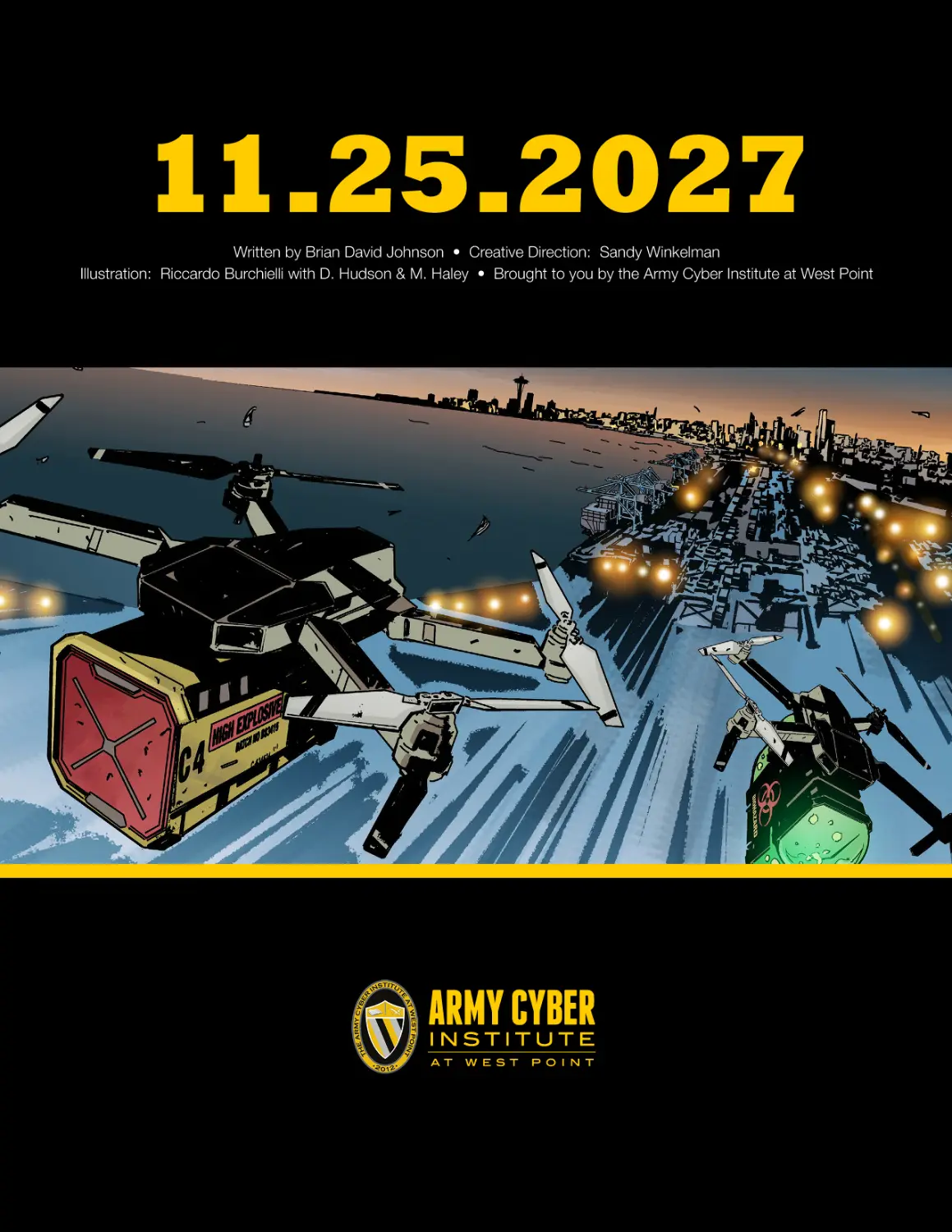
A pair of autonomous drones fly on a collision course with a specially loaded
railcar... millions will die. No one will ever forget 11/25/27.
11-25-2027

In the port of Seattle, an Army of robots conducts their repetitive task of
off-loading delicate cargo from trains. We’re all thankful for robots that
don’t need a day off for Thanksgiving. But who’s watching the robots to
see what ingredients were mixed together?
In the future, machines will increasingly automate menial and complex
tasks. How do we ensure the effectiveness of safety-related functions?
Have we taken into account not just the chance of random failures, but
also acts of an adversary seeking to subvert these systems?
Whereas developing high-performing human operators and safety
personnel once took decades of training and experience, it can now be
imparted to machines in seconds. However, does this knowledge contain
everything a machine needs to know “in case of emergency?”
In a world where safety is not the only threat, how do we understand
the danger of cyber threats combined with the physical world? As cyber-
physical systems and interactions become more complex, how do we
visualize the threat adequately and defend ourselves accordingly?
By lowering the cost of doing business, we make our systems more
competitive in the global economy. As our systems become more “efficient”
how do we evaluate the risk of trading off efficiency for security?
AFTERWARD
“I don’t need my own robot army as long as I can
commandeer yours.”
Colonel Greg Conti
U.S. Army Retired

First Edition: 2018