/



Текст
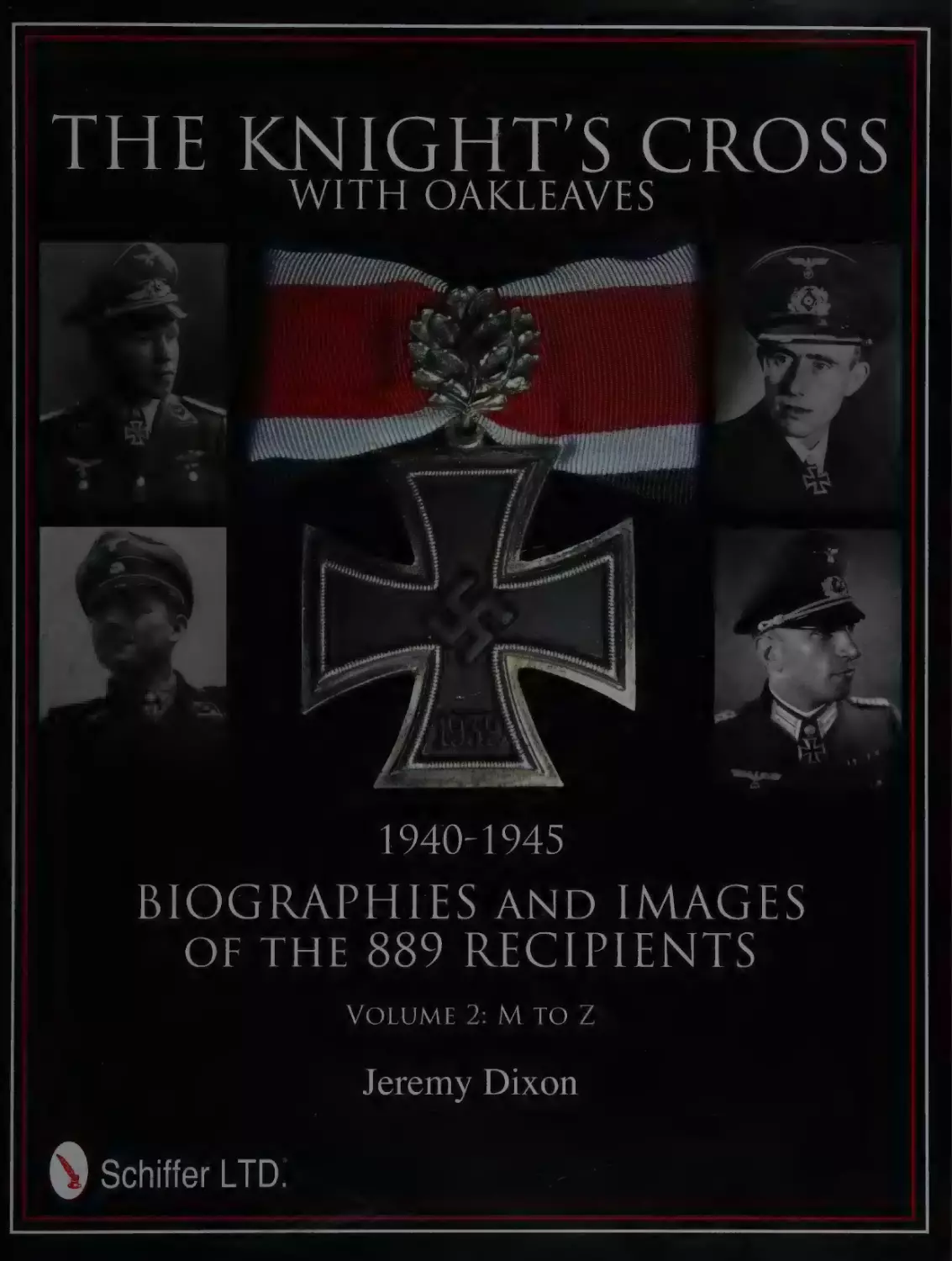
                    THE KNIG
HT'S
CROS
S
WITH OAKLEAVES

1940-1945

BIOGRAPHIES AND IMAGES
OF THE 667 RECIPIENTS
VOLUME

2: M TO Z

Jeremy Dixon

@ schitfer LTD:

This extensive, two-volume set presents every recipient
of the Knight’s Cross with Oakleaves, awarded during the
Second World War, and presented personally by Hitler
from 1940 until 1945. Described — and shown with at least
one photograph — are each of the 889 recipients from the

‘ient
murs
rom
one
_uft-

Luftwaffe, Heer, Waffen-SS, and Kriegsmarine, as well as

eign

foreign recipients. This work contains over 1,000 photographs, from the author’s own collection as well as other
private collections. This is the first time such a work has
been written in the English language and is a must for anyone interested in Germany’s highest decorations, as well as
anyone interested in the careers of each recipient.

rom
lecnin
din
sted

7

»
=

Be

o
_
*,

THE KNIGHT'S CROSS
WITH OAKLEAVES
1940-1945
BIOGRAPHIES AND IMAGES
OF THE 889 RECIPIENTS
VOLUME 2AM TO Z

Jeremy Dixon

Schiffer Military History
Atglen, PA

Book Design by Stephanie Daugherty.
Copyright© 2012 by Jeremy Dixon.

Library of Congress Control Number: 2012949598
All rights reserved. No part of this work may be reproduced or used in any forms or by any
means - graphic, electronic or mechanical, including photocopying or information storage and
retrieval systems-- without written permission from the copyright holder.
The scanning, uploading and distribution of this book or any part thereof via the Internet
or via any other means without the permission of the publisher is illegal and punishable by law.
Please purchase only authorized editgpnis and do not participate in or encourage the electronic
piracy of copyrighted materials.
:
“Schiffer, “Schiffer Publishing, Ltd. &“Design” andthe a
of pen and inkwell” are

registered trademarks f Schiffer Publishing, Ltd.

-

Printed’in China,
ISBN: 978-0-7643-4266-0

We are interested in hearing from authors with book ideas on related topics.

Published by Schiffer Publishing Ltd.
4880 Lower Valley Road

Atglen, PA 19310

:

In Europe, Schiffer books are distributed by:
Bushwood Books

6 Marksbury Avenue

Phone: (610) 593-1777

Kew Gardens

FAX: (610) 593-2002

Surrey TW9 4JE, England

E-mail: Info@schifferbooks.com.
Visit our web site at: www.schifferbooks.com

Phone: 44 (0) 20 8392-8585
FAX: 44 (0) 20 8392-9876

Please write for a free catalog.
This book may be purchased from the publisher.
Try your bookstore first.

E-mail: Info@bushwoodbooks.co.uk.
Visit our website at: www.bushwoodbooks.co.uk
Try your bookstore first.

CONTENTS

Acknowledgements
Introduction

Chapter 1

The Knight's Cross and Its Higher Grades

Chapter 2

The Oakleaves Recipients

19

Appendix

637

Bibliography

644

THE OAKLEAVES RECIPIENTS
M-Z
Heinz MACHER

SS-Sturmbannfiihrer, Waffen-SS
* 31st December 1919, Chemnitz, Sachsen
+ 21st December 2001, Schenefeld, Hamburg
Knight’s Cross: Awarded on 3rd April 1943 as SS-Untersturmfiihrer
and commander of the 16th Company, SS-Panzer Grenadier Regiment
“Deutschland” for his outstanding bravery during the battle of Kharkov.
He was presented with his Knight’s Cross a few weeks later in Berlin, by
SS-Gruppenfiihrer und Generalleutnant der Waffen-SS Hans Jiittner, the
Chief of the SS Main Leadership Office (SS-Fiihrungshauptamtes).
Knight’s Cross with Oakleaves: Macher became the 554th recipient of the
Oakleaves as SS-Obersturmftihrer and commander of the 16th Company,
3rd SS-Panzer Grenadier Regiment “Deutschland” on 19th August 1944
for actions on the Eastern Front. In 1945 Macher led a group of fifteen
SS specialists who were ordered by Himmler to blow up the SS castle
Wewelsburg in order to ensure that important files should not fall into the
hands of the Allies. The demolition command arrived on 31st March but
only managed to blow up one of the towers of the castle - the rest remained
untouched. Macher was then ordered to bury the castles treasures which
included over 9,000 Death’s Head rings held in a shrine to commemorate
SS men killed in action. These treasures have never been found.
A signed photograph of SSObersturmfiihrer Heinz Macher wearing
the Knight’s Cross. (Mark C. Yerger)
SS-Sturmbannfiihrer Macher seen here
wearing the Knight’s Cross with Oakleaves,
along with the German Cross in Gold,
and Close Combat Clasp in Gold. In May
1945 during the last desperate days of the
war, Macher joined Himmler’s staff and
was with the Reichsfiihrer when he was
captured by British troops. (Private source)

326

The Knight’s Cross with Oakleaves + 1940 - 1945: The Oakleaves Recipients &@ 327
Awards: Reich Sports Badge in Bronze; SA Sports Badge in Bronze;
Iron Cross 2nd Class (24.09.1941); General Assault Badge (02.10.1941);
Iron Cross 1st Class (15.03.1942); Wound Badge in Black (01.04.1942);

Eastern Front Medal (01.08.1942); Tank Destruction Badge in Silver
(20.03.1943); Close Combat Clasp in Bronze (12.04.1943); Wound
Badge in Gold (12.08.1943); German Cross in Gold (07.08.1944);

Close Combat Clasp in Gold (23.10.1944); Wehrmacht Daily Report:
13.03.1943.

Eberhard August von MACKENSEN
Generaloberst, Heer
* 24th September 1889, Bromberg
+ 19th May 1969, Neumiinster
Knight’s Cross: Awarded on 27th July 1941 as General der Kavallerie
and Commanding General of the III Army Corps (mot) (reclassified
the III Panzer Corps in January 1942) part of the 1st Panzer Group
for his great skill as a Corps commander on the Russian Front. In a
relatively short amount of time, which had surprised the German High
Command, Mackensen and the III Army Corps had advanced more
than 125 miles to Kiev, his first objective, by 10th July 1941. On 20th
November he reached the city of Rostov, a vital communications center
and the gateway to the oil rich Caucasus. However, the Soviets werent
ready to give up their oil and pushed through a gap. Mackensen was
forced to divert some of his armour to deal with the Red Army threat,
;
:
:
Eberhard August
where upon the main Soviet counter-attack fell on his weakened Corps —Cotection)
on 25th November 1941. Three days later Mackensen was ordered to
withdraw his troops from Rostov.
Knight’s Cross with Oakleaves: He became the 95th recipient of
the Oakleaves on 26th May 1942 as General der Kavallerie and as
Commanding General of the III Panzer Corps for further action on
the Russian Front. From 17th to 28th May 1942 Mackensen took part
in the main battle for Kharkov where his troops had helped with the
destruction of six Soviet divisions. He had captured 128,607 Soviet
troops, 417 tanks, 827 assault guns and 1,300 heavy weapons. There is |
little doubt that Mackensen had great tactical skill. In June 1942 he saw |
action in the Kupyansk area and later was successful when he took Salsk.
!
Gi
In early November it was his III Army corps which crossed the Terek
and attacked the outskirts of Ordzhonikidze. He later took command
of the 1st Panzer Army from Kleist; in February 1943 he was successful
again when he virtually destroyed a Soviet tank group. In July he was
promoted to Generaloberst, by September he had began to retreat
back from the Donets Basin towards the Dnieper, and in October was
pushed back further. In November he was transferred to Italy where he
was ordered to liquidate the Anzio bridgehead. However he was not
successful. In June 1944 he was replaced by General der Panzertruppe

von Mackensen (Author's

Joachim Lemelsen. After the war Mackensen was accused of war crimes

along with Generalfeldmarschall Kesselring. Both accused of taking part
in the Ardeantine Cave massacre. Mackensen was sentenced to death
but it was later commuted to twenty-five years imprisonment. He was
released from prison in October 1952.

28
yyfackensen wearing his Knight’s Cross
with Oakleaves. (Author's Collection)

328 ee The Knight’s Cross with Oakleaves « 1940 - 1945: The Oakleaves Recipients

Awards: Iron Cross 1st and 2nd Class (World War I); Wound Badge in
Black; Cross of Honour for Frontline Combatants (1934); Armed Forces

Long Service Award 4th to 1st Class (02.10.1936); Bar to the Iron Cross

2nd Class (17.09.1939); Bar to the: Iron Cross 1st Class (02.10.1939);
Eastern Front Medal (1942).

Hellmuth MADER
Generalmajor, Heer
* 5th July 1908, Rotterode, Meiningen
+ 12th May 1984, Koblenz

Knight’s Cross: Awarded on 3rd April 1942 as Major and commander of
the 3rd Battalion of the 522nd Infantry Regiment in recognition of his
outstanding bravery during the heavy fighting in the area around north
Kharkov on the Russian Front. In July 1942 he took over as commander
of the 522nd Infantry Regiment and saw action during the summer
and autumn in the Don region. He was promoted to Oberstleutnant in
September 1942 and after the disaster of Stalingrad he was transferred
to France as part of the newly established 297th Infantry Division. In
the summer of 1943 he transferred to Serbia and on 1st October was
promoted to the rank of Oberst.
Knight’s Cross with Oakleaves: He became the 560th recipient of the
Oakleaves as commander of Instruction Brigade North of the Weapons
Training School North, as well as being combat commander in Shaulen,
Lithuania as an Oberst on 27th August 1944 for actions on the Eastern
Front. In July Mader was ordered to defend the town of Schaulen. As town
commandant he only had a few troops as most of his units had already
been committed to combat elsewhere. He only had a few training and
security companies, but under his command they were put to good use,
tying down an entire Soviet corps for three days. By the night of 28th-29th
July the town was virtually surrounded. With the help of reinforcements
and the courage of his troops they managed to breakout. In October he
led the 7th Panzer Division in the battles for Memel and from December
he commanded the Fihrer Grenadier Brigade “Grofsdeutschland” during
the Ardennes Offensive.
Knight’s Cross with Oakleaves and Swords: Awarded as the 143rd
recipient of the Swords on 18th April 1945 as Generalmajor and
commander of the Fuhrer Grenadier Division for continued actions on
the Eastern Front. On 30th January 1945 his command was expanded to
divisional level and on the same day he was promoted to Generalmajor.
From February he took part in the defensive battles in Pomerania and
in March saw heavy fighting in Lower Silesia in the Battle of Lauban.
By mid-April he saw fighting in the area around Vienna where in May
1945 he surrendered to U.S. troops. However he was handed over to the
Russians as part of an agreement and didn't return from captivity until
1955. He joined the West German Army in 1956 rising to the rank of
Generalleutnant.
Awards: Armed Forces Long Service Award 4th Class; Iron Cross 2nd
Class (06.1940); Iron Cross Ist Class (08.1940); Infantry Assault Badge
in Silver; Eastern Front Medal; Wound Badge in Black; Close Combat
Clasp in Bronze; War Merit Cross 2nd Class + Swords.

The Knight’s Cross with Oakleaves ¢ 1940 - 1945: The Oakleaves Recipients 4% 329
Kurt MAIER

Major, Luftwaffe
* 21st January 1911, Mannheim
+ 11th February 1952, near Heilbronn
Knight's Cross: Awarded as Oberleutnant and pilot/observer with the 1st
Group, 4th Bomber Wing “General Wever” on 16th November 1942, in
recognition of the many missions he flew over Norway, Holland, France,
England and the Soviet Union. From early 1941 he took part in the
bombing over the English south coast, the Thames, Hull, Bristol, Liverpool
and Belfast and from July over Moscow, Oesel, and Demjansk.
Knight's Cross with Oakleaves: He became the 674th recipient on 6th
December 1944 as Hauptmann and as Staffelkapitdn of the 3rd Group,
Ist Bomber Wing “Hindenburg” for actions in the north area of the
Eastern Front where he helped to inflict heavy losses on the Allies. From
September 1944 until the end of the war he served as test pilot for new
Luftwaffe aircraft which included jet-fighters and bombers. He was killed
in February 1952 in a car accident near Heilbronn.
Awards:

Iron Cross 2nd Class (1940); Iron Cross

Ist Class (1941);

Luftwaffe Honour Goblet (13.06.1941); Operational Flying Clasp in
Gold; German Cross in Gold (22.01.1942).

Wilhelm Hans Joachim von MALACHOWSKI

Major.i.G., Heer
* 6th June 1914, Rostock

+ 28th October 1980, Cologne
Knight’s Cross: Awarded on 30th January 1942 as Oberleutnant and
Commander of the 2nd Battery of the 189th Assault-gun Battalion for
action during the winter of 1941-1942 in the many battles in Rzhev. He
proved himself a capable battery commander and was responsible for the
destruction of several Soviet tanks during the battles in northern Rzehv.
Knight’s Cross with Oakleaves: He became the 206th recipient of the
Oakleaves on 6th March 1943 as Hauptmann and Commander of the
228th Assault-gun Battalion on the Russian Front. In December 1942
his battalion destroyed twelve Soviet tanks and penetrated an enemy
position near Tazinskaja where they destroyed another thirty-four tanks.
In February 1943 he led his battalion during an assault against a strong
Soviet force in the Dnieper area before advancing to the western part
of Bereka where Malachowski was seriously wounded. When he had
recovered from his wounds he was presented with the Oakleaves by
Hitler on 10th June 1943 at the Wolfschanze, Hitler's headquarters in
East Prussia. In May 1944 he was transferred to the Assault-gun School in
Burg, near Magdeburg as an instructor where he stayed until September
1944 where he was promoted to Major.i.G and appointed an officer in the

General Staff of the Army.
Awards: Armed Forces Long Service Award 4th Class (02.10.1939); Iron
Cross 2nd Class (09.07.1940); Iron Cross 1st Class (26.05.1941); Tank

Combat Badge in Silver;, Wound Badge in Silver (1942); Eastern Front

Medal (06.09.1942).

Wilhelm Malachowski (Wehrkundearchiv)

330 Bhs The Knight’s Cross with Oakleaves + 1940 - 1945: The Oakleaves Recipients
Robert-Georg Freiherr von MALAPERT
Hauptmann, Luftwaffe

* 7th August 1912, Darmstadt
+ 21st May 1942, over the region of Kursk, Soviet Union

Knight’s Cross: Awarded on 6th January 1942 as Oberleutnant and
Staffelkapitén with the 5th Squadron, Ist Stuka Wing in recognition
of his success over the skies of Poland, France, England, Malta,
Crete, North Africa and the Soviet Union and upon flying his 315th
mission.

Knight’s Cross with Oakleaves: Awarded posthumously on 8th June
1942, to become the 99th recipient of the Oakleaves as Hauptmann and
as Commander of the 3rd Group, 1st Stuka Wing after flying a total of
510 combat missions, and after demonstrating courage under fire. He
had been shot by a Russian sniper after being forced down by enemy
anti-aircraft fire behind enemy lines.
Awards: Pilot’s Badge (1935); Armed Forces Long Service Award 4th
Class (1938); Iron Cross 2nd Class (27.09.1939); Iron Cross 1st Class
(28.05.1940); German Cross in Gold (15.10.1941); Eastern Front Medal
(1942); Operational Flying Clasp in Gold (1943).

Giinther Freiherr von MALTZAHN
Oberst, Luftwaffe
* 20th October 1910, Wodarg, Demmin
+ 24th June 1953, Dusseldorf

Knight’s Cross: Awarded on 30th December 1940 as Major and
Commander of the 2nd Group, 53rd Fighter Wing “Pik-As” (Ace of
Spades), upon achieving his 13th aerial victory over England.
Knight’s Cross with Oakleaves: He became the 29th recipient of
the Oakleaves (12th fighter pilot) on 24th July 1941 as Major and

Giinther von Maltzahn (Authors Collection)

Commander of the 53rd Fighter Wing after shooting down his 42nd
enemy aircraft over the Soviet Union. The Oakleaves were presented
to von Maltzahn at Fiihrer Headquarters, Wolfschanze on 28th August
1941 by Hitler. From mid December 1941 his squadron saw action
in the Mediterranean where he yet again showed his great skill and
leadership as a combat pilot. In June 1943 he was promoted to Oberst
and from October became Fighter Leader “Italy”, responsible for all
fighter squadrons in occupied Italy. He ended the war serving on the
staff of the 9th Air Division. During the war he flew more than 500
sorties and shot down sixty-eight enemy aircraft, including thirty-four
on the Eastern Front.
Awards: Pilot’s Badge (1935); Armed Forces Long Service Award
Ath Class (02.10.1936); Iron Cross 2nd Class (07.10.1939); Iron
Cross Ist Class (10.05.1940); Luftwaffe Honour Goblet (23.03.1942);

German Cross in Gold (23.12.1942); Operational Flying Clasp in
Gold (1943); AFRIKA cuff title (1943); Wehrmacht Daily Report:
18.11.1940.

The Knight’s Cross with Oakleaves « 1940 - 1945: The Oakleaves Recipients @ 331
Erich Georg Eduard von MANSTEIN
Generalfeldmarschall, Heer

* 24th November 1887, Berlin
+ 10th June 1973, Irschenhausen, Icking
Knight’s Cross: Awarded on 19th July 1940 as General der Infanterie
and as Commanding General of the XXXVIII Army Corps for his part
in the successful invasion of France. The speed of the German advance
and the success of the campaign, which only lasted six weeks, were
down to the leadership and skill on Manstein. In the summer of 1941
Manstein commanded the newly formed LVI Army Corps (mot),
during the invasion of Russia. In September 1941 he was appointed
Commander-in-Chief of the 11th Army and achieved great success
during the opening battles of the campaign in the southern sector of the
Eastern Front, including battles in the Crimea and in Sevastopol. On
7th February 1942 Manstein was promoted to the rank of Generaloberst

Von Manstein was born Fritz Erich von
Lewinksi, the tenth child of a Prussian
aristocrat artillery general Eduard von
Lewinski and Helen von Sperling. Hedwig
von Sperling, Helene’s younger sister, married
Generalleutnant Georg von Manstein. The
couple were not able to have children, so
it was decided that this tenth child would
be adopted by his uncle and aunt. So
Erich von Lewinski was brought up Erich
von Manstein. (Author’s Collection)

Manstein walking with his adjutant Alexander
Stahlberg in 1941. At the end of the war
Manstein was captured by the British and
tried for war crimes. He was acquitted of
many of the seventeen charges but was found
guilty of two. He was sentenced to eighteen
years imprisonment in December 1949. This

was later commuted to twelve years, however
he was released on 6th May 1953 for medical
reasons. He later served as senior defence
advisor for the West German Chancellor
Konrad Adenauer. He later moved to Bavaria
where he wrote his memoirs, “Lost Victories”,
where he presented the thesis that ifthe
generals had been in charge of strategy instead
of Hitler, the war on the Russian Front could
have been won. (Author’s Collection)

332 ee The Knight’s Cross with Oakleaves « 1940 - 1945: The Oakleaves Recipients

and in May during the fierce fighting in the Kerch Peninsula took over
170,000 Soviet prisoners.
Knight’s Cross with Oakleaves: He became the 209th recipient of the
Oakleaves as Generalfeldmarschall and Commander-in-Chief of Army
Group South on 14th March 1943 for actions on the Russian Front.
Manstein’s counteroffensive in February 1943 was a great success. He had
recaptured Kharkov; it was an audacious plan, one that Hitler had been
very nervous about. Manstein had destroyed the Soviet 3rd Tank Army, had
captured 615 tanks, 354 guns, and large quantities of equipment between
the Donets and the Dnieper. On 10th March 1943 Hitler flew to Manstein’s
headquarters at Zaporozhe and decorated him with the Oakleaves.
Knight’s Cross with Oakleaves and Swords: Awarded on 30th March
1944 as Generalfeldmarschall, still serving as Commander-in-Chief
of Army Group South in Russia when he became the 59th recipient of
the Swords. The winter Soviet offensive began in December 1943 and
Manstein flew to see Hitler in January 1944 to demand that he be allowed
to pull back his entire south wing, but Hitler refused. Manstein then
began a devastating assessment of Hitler’s leadership during the Russian
campaign. He demanded to be appointed Commander-in-Chief East and
told Hitler that if he directed the war in Russia the generals would obey.
Hitler taken aback ended the meeting. As a result of Hitler's stubbornness
the XLII and XI corps of the 8th Army was surrounded near Cherkassy.
Manstein tried to reach the Cherkassy Pocket but because of bad weather
and Russian counterattacks he was halted within five miles of the pocket.
The XI and XLII corps broke out on the night of 16/17th February but
they lost most of their heavy equipment and all of their tanks. Once
again Manstein flew to see Hitler demanding freedom of command,
but this was refused again. On 25th March after Manstein threatened to
resign Hitler allowed him to order a breakout which saved ten divisions.
On 30th March Hitler called Manstein and Kleist to Obersalzburg and
presented them both with the Swords and then relieved them of their
commands. Manstein was succeeded by Generalfeldmarschall Walter
Model. Manstein left Hitler on good terms and Hitler said that if he ever
launched a large offensive again, he wanted Manstein to command it.
Awards:

Iron Cross

2nd

Class

(05.10.1914);

Iron

Cross

Ist Class

(13.11.1915); Wound Badge in Black; Cross of Honour for Frontline
Combatants (1936); Armed Forces Long Service Award 4th to 1st Class
(02.10.1936); Bar to the Iron Cross 2nd Class (16.09.1939); Bar to the Iron
Cross 1st Class (21.09.1939); Crimea Shield in Gold (1943); Wehrmacht
Daily Report: 11.10.1941; 12.10.1941; 19.05.1942; 20.05.1942; 02.07.1942;
20.03.1943; 04.08.1943.

Hasso Eccard von MANTEUFFEL
General der Panzertruppe, Heer
* 14th January 1897, Potsdam
+ 24th September 1978, Reith, Tirol, Austria
Knight’s Cross: Awarded on 3lst December 1941 as Oberst and
Commander of the 6th Rifle Regiment part of the 7th Panzer Division
in recognition of his assault on the bridge of Jakhroma during action on
the Russian Front.

The Knight’s Cross with Oakleaves + 1940 - 1945: The Oakleaves Recipients

@ 333

Oberstleutnant von Manteuffel as
Commander of the 6th Rifle Regiment,
wearing the Knght’s Cross.
(Author’s Collection)

General von Manteuffel with Knight's Cross
holder Major Hugo Schimmel, commander
of the Panzer Grenadier Regiment
“Grofsdeutschland,” near Vilkovishke,
Lithuania, 1944. (Author's Collection)

Knight’s Cross with Oakleaves: He became the 332nd recipient of the
Oakleaves on 23rd November 1943 as Generalmajor and Commander of
the 7th Panzer Division as part of the 4th Army for actions on the Russian
Front. Three days after taking command of the 7th Panzer Division
Manteuffel was wounded by a Russian air attack on his command vehicle,
he was taken to a field aid-station where he was treated. He wanted
to remain with his troops and refused to be evacuated to hospital. He
remained in command and his division managed to fight its way back to
the other side of Dnieper by September 1943. He saw fierce fighting at
Kharkov, Belgorod, Akhyrka along the middle Dnieper River, and at Kiev.
During the battle of Kiev his division was eventually forced by superior
numbers to give way, Manteuffel however made a successful counter-attack
and Zhitomir was taken bythe 7th Panzer Division. Hitler was overjoyed
and when Manteuffel was awarded the Oakleaves Hitler summoned him
to Rastenburg to present him with the award personally. Manteuffel was
busy and didn’t arrive at Hitler's headquarters until December 1943.
Knight’s Cross with Oakleaves and Swords: Awarded as the 50th
recipient of the Swordson 22nd February 1944 as Generalmajor and whilst
still commanding the 7th Panzer Division in Russia. On 26th November
1943 Manteuffel was to take command of the Panzer Grenadier Division

“Grofdeutschland” but he delayed taking command as the 7th Division was

334 Be The Knight’s Cross with Oakleaves + 1940 - 1945: The Oakleaves Recipients

in a difficult situation. It was engaged in fierce fighting near Zhitomir but
his outstanding skill as a commander brought the situation under control
once again. At the beginning of March 1944 the Soviets launched a huge
offensive aimed at breaking through to the Romanian oilfields. He now
took command of the Panzer grenadier Division “GD” which had found
itself encircled by the Soviets. Manteuffel managed to free his division
without losing a single weapon and as a result earned his promotion to
Generalleutnant. The Grofsdeutschland returned to the Cornesti region
eastwards of Jassy and during April 1944 held off attacks by the Red Army.
On 2nd May twenty Russian divisions launched a fresh offensive in an
attempt to break through to the oilfields of Ploesti. Manteuffel launched
a counter-attack and together with the Luftwaffe destroyed 250 enemy
tanks and brought the Russian advance to a halt. Finally on 14th May 1944
Manteuffel was able to travel to the Berghof where Hitler presented him
with his Swords. In September 1944 Manteuffel was promoted to General
der Panzertruppe and appointed Commander of the 5th Panzer Army,
being was transferred to the Western Front as part of Army Group G.
Knight’s Cross with Oakleaves, Swords and Diamonds: He became
the 24th recipient of the Diamonds on 18th February 1945 as General
der Panzertruppe and as Commander-in-Chief of the 5th Panzer Army
for his leadership during the Ardennes Offensive. On 28th February
1945 Hitler summoned Manteuffel to Berlin where he presented him
with the Diamonds. On 2nd March Manteuffel took command of the
3rd Panzer Army on the Eastern Front, where he held the position on
the Oder until 26th April when he was forced to retreat. By 3rd May he
had reached the British lines and handed over his entire command into
British captivity.
Awards:

Iron Cross

2nd Class

(13.10.1916);

Iron Cross

1st Class

(02.05.1917) Wound Badge in Black; German Riders Badge in Gold
(02.01.1931); Cross of Honour for Frontline Combatants (1935); Armed

Forces Long Service Award 4th to 2nd Class (1939); Reich Sports
Badge in Gold (1939); War Merit Cross 2nd Class (20.12.1940); Bar to
the Iron Cross 2nd Class (22.07.1941); Bar to the Iron Cross 1st Class
(01.08.1941); Tank Combat Badge in Bronze (02.09.1941); Eastern Front
Medal (1942); AFRIKA cuff title (1943); Tank Combat Badge “25” (1944);

Golden Hitler Youth Badge with Oakleaves; Wehrmacht Daily Report:
08.10.1943; 16.11.1943; 14.03.1944; 08.05.1944.

Erich MARCKS |
General der Artillerie, Heer
* 6th June 1891, Berlin-Schéneberg
+ 12th June 1944, Hébécrevon northwest of St. Ld, France

Knight’s Cross: Awarded on 26th June 1941 as Generalleutnant and
Commander of the 101st Light Infantry Division in recognition of his
bravery during the fierce fighting at Medyka on the Russian Front. He
fought with courage and led his division with great skill until he was
seriously wounded during the fighting and as a result had to have a leg
amputated. His artificial leg did not prevent him, nine months later,
from being given a front line command. From 25th March 1942 he led
the 337th Infantry Division whilst stationed in France. In September

The Knight’s Cross with Oakleaves + 1940 - 1945: The Oakleaves Recipients Qj 335

_ 1942 he was appointed Commanding General of the LXVI Army Corps,
and on Ist October 1942 he was promoted to General der Artillerie
and at the same time took command of the LXXXVII Army Corps. In
August 1943 Marcks took command of the LKXXIV Army Corps and
for the next few months trained them ready for the expected Allied
invasion.
Knight’s Cross with Oakleaves: He became the 503rd recipient of
the Oakleaves on 24th June 1944, awarded posthumously as General
der Artillerie and Commanding General of the LXXXIV Army Corps
for action during the Normandy Campaign. On 6th June 1944, when
the Allies invaded France his army corps was stationed near the port
of Cherbourg. With the Allies almost on top of his position he had to
defend the port and the surrounding area from a strong Allied force.
At first he succeeded in preventing the enemy from advancing but he
couldn't hold them for long. On 12th June during an aerial attack from a
US. fighter-bomber Marcks was killed near St. L6, his body was found in
a ditch. He now lies in the German Cemetery twelve kilometres west of
St. L6, grave #158, row 8, block K.

:

3

Awards: Iron Cross 2nd Class (25.09.1914); Iron Cross Ist Class (08.1915); |General Erich Marcks seen here wearing the

Wound Badge in Black (World War I); Cross of Honour for Frontline
;

Combatants (1934); Armed Forces Long Service Award 4th to Ist Class
(02.10.1936); Bar to the Iron Cross 2nd Class (21.09.1939); Bar to the
Iron Cross Ist Class (29.09.1939); Wound Badge in Gold (26.06.1941);

‘8/5
Cross. His cousin Werner Marcks was
also a holder of the Knight’s Cross, awarded on

3). September 1944. (Wehrkundearchiv)

Wehrmacht Daily Report: 13.06.1944.

Werner MARCKS

Generalleutnant, Heer
* 17th July 1896, Magdeburg
+ 28th July 1967, Wedel, Hamburg
Knight’s Cross: Awarded on 2nd February 1942 as Oberstleutnant and
Commander of the 104th Rifle Regiment and was Fihrer of a Battle
Group attached to Panzer Army “Afrika’, for actions in North Africa.
After seeing action on the Russian Front Marcks was transferred to
North Africa where in mid-December he took command of the 155th
Rifle Regiment and from January 1942 was also given command of a
Battle Group. He led his battle group in Cyrenaica, Libya against the
British 8th Army and took part in an offensive that lasted for sixteen
days after which time he had pushed back the British and threw them
out of Cyrenaica. For his great determination and courage he was
personally presented with his Knight’s Cross by Generaloberst Rommel
on 5th February 1942. He led his regiment during the advance on El
Alamein in September 1942 but was taken seriously ill and had to
be transferred to hospital. In January 1943 he joined the staff of the
Inspector General of Panzer Troops before being transferred to Russia
in February 1944 where he commanded the Ist Panzer Division. In
April Marcks was promoted to the rank of Generalmajor and began to
see heavy action.
2
Knight’s Cross with Oakleaves: He became the 593rd recipient of the
Oakleaves on 21st September 1944 as Generalmajor and as Commander of the 1st Panzer Division part of the III Panzer Corps for actions on the

Werner Marcks (Wehrkundearchiv)

336 Bi The Knight’s Cross with Oakleaves ¢ 1940 - 1945: The Oakleaves Recipients

Russian Front. In July and August 1944 he saw heavy action northwest
of Lemberg where he fought in the defensive battles with great bravery
and distinguished leadership, managing to push back the Red Army.
However his command was short lived when he became ill again in
September and returned to hospital. When he had recovered he flew
to Posen on 7th November 1944 where he was presented with the
Oakleaves by Reichsftihrer-SS Himmler. On 10th January 1945 he was
appointed commander of the 21st Panzer Division and fought until the
end of January in Lower Silesia. He was promoted to Generalleutnant
in April 1945 seeing heavy fighting in the German capital where he was
taken prisoner by the Soviets. In 1951 he was sentenced to twenty-five
years imprisonment as a war criminal, but four years later was released
due to ill health.
Awards: Iron Cross 2nd Class (28.05.1915); Iron Cross lst Class
(22.02.1918); Wound Badge in Silver (World War I); Cross of Honour

for Frontline Combatants; Armed Forces Long Service Award 4th to 1st
Class (02.10.1936); Bar to the Iron Cross 2nd Class (14.09.1939); Bar

to the Iron Cross Ist Class (16.10.1939); Tank Combat Badge in Bronze
(04.06.1942); German Cross in Gold (11.12.1941); Eastern Front Medal
(02.05.1944); AFRIKA cuff title (12.08.1944).

Willy MARIENFELD
Oberstleutnant der Reserve, Heer
* 1st October 1896, Reppen
+ 7th June 1944, Constanta, Romania ,
Knight’s Cross: Awarded on 17th August 1942 as Major der Reserve and

Commander of the 2nd Battalion of the 123rd Infantry Regiment for
actions on the Russian Front. In June 1942 he took part in the attack on
Sevastopol and the following month when the fighting had ended his
battalion remained as part of the occupation force.
Knight’s Cross with Oakleaves: He became the 482nd recipient of the
Oakleaves on 25th May 1944 as Major der Reserve and as Commander
of the 123rd Grenadier Regiment part of the 50th Infantry Division for
continued actions in Russia. From early 1944 Marienfeld saw action in
the Crimea and during the defensive battles near Perekop, displayed
outstanding bravery as well as skillful leadership. He saw heavy action

Willy Marienfeld (Wehrkundearchiv)

during the defence of the northern area of Sevastopol where in May he
was seriously wounded and evacuated to hospital where he succumbed to
his injuries being peony prompted to the rank of Oberstleutnant
der Reserve.

+,

Awards: Iron Cross ond Class (World War I); Iron Cross 1st Class
(World War I); Cross, of Honour for Frontline Combatants (1935);
Armed Forces Long Service Award 4th to 2nd Class (02.10.1936); Bar
to the Iron Cross 2nd Class (16.09.1939); Bar to the Iron Cross 1st

Class (03.07.1940); Infantry Assault Badge in Silver; Commendation

Certificate of the C-in-C of the Army (25.05.1942); Eastern Front Medal
(1942); Crimea Shield; Wound Badge in Gold (1944); Wehrmacht Daily
Report: 14.05.1942.

The Knight’s Cross with Oakleaves + 1940 - 1945: The Oakleaves Recipients {@ 337

Marseille was presented with both the Oakleaves
and Swords by Hitler during a special ceremony
in June 1942 at the Wolfschanze. Although
awarded the Diamonds in September 1942, he
was killed before they could be presented to him.
It is believed that his family were never given
his Diamonds, and that today they are held at
the Luftwaffe Museum at Uetersen, Germany.
(Wehrkundearchiv)
Hans-Joachim Marseille wearing the Knight's

Cross awarded in recognition of his 50th aerial
victory.

Hans-Joachim MARSEILLE

Hauptmann, Luftwaffe
* 13th December 1919, Berlin-Charlottenburg
+ 30th September 1942, near El Alamein, Egypt
Knight’s Cross: Awarded on 22nd February 1942 as Leutnant and as a
fighter pilot serving with the 3rd Squadron, 27th Fighter Wing in Africa,
upon achieving his 50th aerial victory.
Knight’s Cross with Oakleaves: He became the 97th recipient of the
Oakleaves on 6th June 1942 as Oberleutnant and while still serving with
the 27th Fighter Wing over North Africa, after achieving ninety-seven
aerial victories.
Knight's Cross with Oakleaves and Swords: Marseille became the
12th recipient of the Swords on 18th June 1942 while serving as an
Oberleutnant and Staffelkapitdn with the 3rd Squadron, 27th Fighter
Wing in recognition of achieving his 101st aerial victory. He went to
FHQ Wolfschanze on’28th June 1942; Hitler presented him with both

the Oakleaves and his Swords in a special ceremony.
Knight’s Cross with Oakleaves, Swords and Diamonds:

He was still

serving with the 27th Fighter Wing in North Africa when he was awarded
the Diamonds on 3rd September 1942 to become the 4th recipient of this
most prestigious award, following his 172nd victory. He was however
killed just twenty-eight days later when his aircraft developed engine
failure and as he tried to bail out he slammed against his aircraft and was
killed instantly.
=
os
Awards: Iron Cross 2nd Class (09.09.1940); Iron Cross lst Class
(17.09.1940); Luftwaffe Honour Goblet (03.11.1941); German Cross in

Gold (24.11.1941); Operational Flying Clasp in Gold + Pendant (1942);
Combined Pilots and Observers Badge in Gold + Diamonds; AFRIKA
cuff title (1943); Wehrmacht Daily Report: 04.06.1942; 17.06.1942;
18.06.1942; 04.09. 1942; 01.10.1942.

(Wehrkundearchiv)

338 BM The Knight’s Cross with Oakleaves « 1940 - 1945: The Oakleaves Recipients
Robert MARTINEK

General der Artillerie, Heer
* 2nd February 1889, Gratzen, Kaplitz, Austro-Hungary
+ 28th June 1944, Beresina, east of Cerven, Soviet Union

Knight’s Cross: Awarded on 26th December 1941 as Generalmajor and
Commander of the 267th Infantry Division of the VII Army Corps for
his part in halting the Soviet breakthrough on Rusa near Moscow during
the winter offensive. From June 1942 he served as artillery commander
with the 7th Mountain Division during the conquest of Sevastopol as part
of the 11th Army. In December 1942 he was given temporary command
of the XXXIX Panzer Corps, being promoted to General der Artillerie in
January 1943 the command was made permanent shortly afterwards.
Knight’s Cross with Oakleaves: He became the 388th recipient of the
Oakleaves on 10th February 1944 as General der Artillerie and Commanding
General of the XXXIX Panzer Corps part of the 4th Army for his part in
thwarting the Soviet breakthrough west of Smolensk during the autumn
of 1943. Martinek was presented with the Oakleaves personally by Hitler
on 24th February 1944 at Hitler's mountain retreat the Berghof. During the
Soviet offensive in the summer of 1944, Army Group Center found itself
fighting a losing battle. On 28th June 1944 the Soviets bombed the German
position in Berezina and the headquarters of the XX XIX Panzer Corps tooka
direct hit, Martinek was fatally wounded in the head by shrapnel. His orderly
officers carried him from the area with the wounded and buried his body in
Tscherwen, Belarus on 30th June 1944, where he still lies today.

Robert Martinek (Wehrkundearchiv)

Awards:

Iron Cross

2nd

Class

(25.09.1939);

Iron Cross

1st Class

(20.05.1940); Commendation Certificate of the C-in-C of the Army
(22.09.19410; Eastern Front Medal; Crimea Shield; Wehrmacht Daily
Report: 24.10.1943; 03.04.1944; 03.07.1944.

Alfred MATERN
Oberfeldwebel, Heer
* 15th December 1910, Konigsberg, East Prussia
+ 26th March 1945, Insterburg Hospital
Knight’s Cross: Awarded on 4th September 1943 as Oberfeldwebel and
Platoon Leader in the 5th Company of the 22nd Fusilier Regiment for

'
i
B

ae,
ye
~

Alfred Matern (Wehrkundearchiv)

:
2

|

8
ea:
“

his bravery whilst fighting on the Russian Front. He saw heavy fighting
in the area around Lake Ladoga and endured almost a year of continued
heavy defensive battles with the Red Army distinguishing himself in late
July 1943. As Platoon Leader and with only a handful of troops he took
an active role in, the stabilizing and defence of the front, pushing back
the Soviet resistance. The Knight's Cross was presented to Matern during
a field ceremony along with five other recipients including Obergefreiter
Walter Kuhn, Major Wolfgang Sichart von Sichartshofen, Oberfeldwebel
Heinrich Henning, Unteroffizier Hans Halten and Feldwebel Otto Witt by
the Commander of the Ist Infantry Division Generalmajor Ernst-Anton
von Krosigk.
Knight’s Cross with Oakleaves: He became the 784th recipient of the
Oakleaves whilst still serving with the 22nd Fusilier Regiment as a
Platoon Leader on 16th March 1945 for actions on the Eastern Front.
In early 1944 he fought in northern Ukraine in the area of Vinnitsa, and

The Knight’s Cross with Oakleaves + 1940 - 1945: The Oakleaves Recipients &@ 339

_ then in March he fought west of Mogilev-Podolsk as part of the 1st Panzer
Army in the so-called “Hube Pocket.” In September 1944 he saw action
in Lvov and then on the border with East Prussia where his exceptional
bravery and leadership was recognised. He never received his Oakleaves
as he was seriously wounded less than ten days after being notified of the
award and died in hospital.
Awards: Golden Hitler Youth Badge of Honour; Awards: Iron Cross 2nd
Class (21.08.1941); Iron Cross 1st Class (19.09.1941); Infantry Assault
Badge in Bronze; Close Combat Clasp in Bronze; Eastern Front Medal

(1942); Wound Badge in Silver; German Cross in Gold (14.03.1944).

Dr. med.dent. Karl MAUSS
General der Panzertruppe, Heer

* 17th May 1898, Plén

+ 9th February 1959, Hamburg-Wandsbek
Knight’s Cross: Awarded on 26th November 1941 as Oberstleutnant and
Commander of the 69th Rifle Regiment of the 10th Panzer Division for
his part in the encirclement of Minsk and Smolensk. From June 1941 he
led his regiment as an advanced guard of the division, being one of the
first units to move into Russia. During the struggle for Vyazma, against
forty-five Soviet divisions he joined in the defence of the bridgehead
across the river Ugra, fighting as part of Army Group Center. All attempts
made by the Red Army to retake the position failed and Mauss and his
men fought with courage and determination before the fighting halted
just fifteen miles from Moscow.
Knight's Cross with Oakleaves: He became the 335th recipient of the
Oakleaves on 24th November 1943 as Oberst and Commander of the 33rd
Panzer Grenadier Regiment, part of the 4th Panzer Division for continued
actions on the Russian Front. In February 1943 Mauss was responsible for all
German units in the area around Kursk and planned the successful rescue of

ee

ee ee

eae

Cross, and Tank Combat Badge in Silver next to his

Iron Cross Ist Class. (Author's Collection)

General Mauss seen on his command vehicle
wearing the Knight’s Cross with Oakleaves
and Swords. During the presentation of the
Swords, Hitler offered Mauss home leave, but
instead Mauss asked for forty new tanks for his
division. (Author's Collection)

340 ee The Knight’s Cross with Oakleaves « 1940 - 1945: The Oakleaves Recipients

the VII Army Corps with great loss to his own unit. For this he was awarded
the Oakleaves along with nine other members of the 4th Panzer Division.
The Oakleaves were presented to Mauss by Hitler on 6th December 1943 at
Fiihrer Headquarters in Rastenburg, East Prussia. He had been previously
recommended for the Oakleaves back in April 1943 but this had been
rejected. In January 1944 he was appointed Commander of the 7th Panzer
Division, being promoted to Generalmajor the same day. During the heavy
fighting in Tarnopol and Minsk his division destroyed 800 Soviet tanks. In
June 1944 Army Group Center managed to halt the Soviet offensive on the
border of East Prussia and the 7th Panzer Division played a decisive role in
securing the victory. On 1st October Mauss was promoted to the rank of
Generalleutnant in recognition of his leadership and skill.
Knight’s Cross with Oakleaves and Swords: Awarded on 23rd October
1944, to become the 101st recipient of the Swords as Generalmajor and
Commander of the 7th Panzer Division part of the 2nd Army in recognition
of his leadership during the battles in Vilnius, Libau, Doblen and Lida.
Knight’s Cross with Oakleaves, Swords and Diamonds: He became on

15th April 1945 the 26th recipient of the Diamonds (10th army recipient)
as General der Panzertruppe and whilst still Commander of the 7th Panzer
Division for action on the Eastern Front. From mid-January 1945 he took
part in the defensive battles during the fighting near the Narew Bridgehead,
Lithuania, later seeing action towards Danzig. In March the 7th Panzer
Division saw some of the toughest defensive battles on the southern sector
of the Eastern front near Gdynia. On 25th March he was seriously wounded
when an artillery shell exploded next to him and he had to have his left leg
amputated. He spent days lying on a stretcher in a field hospital still giving
out orders to his men. He was eventually evacuated by torpedo boat to a
hospital in Copenhagen where he was captured by British troops. After the
war he opened a dental practice in Hamburg.
Awards:

Iron

Cross

2nd

Class

(16.09.1915);

Iron

Cross

1st Class

(21.10.1916); Wound Badge in Black; Cross of Honour for Frontline
Combatants; Armed Forces Long Service Award 4th to 3rd Class; Bar
to the Iron Cross 2nd Class (28.09.1939); Bar to the Iron Cross Ist Class
(25.05.1940); Tank Combat Badge in Bronze; Eastern Front Medal; German
Cross in Gold (11.03.1943); Wound Badge in Gold; Close Combat Clasp

in Bronze (08.1943); Tank Combat Badge “50”; Wehrmacht Daily Report:
13.03.1944; 15.08.1944; 20.02.1945.

Egon MAYER

Oberstleutnant, Luftwaffe
* 19th August 1917, Konstanz
+ 2nd March 1944, southwest of Montmédy, near Sedan, France
Knight's Cross: Awarded on Ist August 1941 as Leutnant and fighter pilot
serving with the 3rd Group, 2nd Fighter Wing “Richthofen” after downing
twenty enemy aircraft over France and England. He scored his 30th aerial
victory, a Spitfire on 15th April 1942, and on 19th August, his birthday he
down two Spitfires over Dieppe to claim his 52nd victory. In November he
was appointed Commander of the 3rd Group of the 2nd Fighter Wing.
Knight's Cross with Oakleaves: Awarded as Hauptmann and Commander
of the 3rd Group, 2nd Fighter Wing on 16th April 1943 to become the

The Knight's Cross with Oakleaves « 1940 - 1945: The Oakleaves Recipients

_ 232nd recipient after achieving his 63rd victory over the Western Front.
Mayer along with Georg-Peter Eder is credited with developing the headon attack technique against the Allied daylight bomber raids. This new
technique brought considerable success against four-engine bombers. On
Ist July 1943 he took command of the 2nd Fighter Wing after Oberst Walter
Oesau had been killed in action. He was presented with the Oakleaves by
Hitler at the Berghof at the end of April 1943 in a ceremony in the Great
Hall. On 6th September he shot down three U.S. Army Air Force B-17 fourengine bombers in nineteen minutes to claim his 80th victory. He achieved
his 90th victory on 31st December and by February 1944 he achieved his
100th victory when he shot down a P-47 fighter near Atguen.
Knight’s Cross with Oakleaves and Swords: He became the 51st
recipient of the Swords on 2nd March 1944, the very day he was killed,
as Oberstleutnant and Commander of the 2nd Fighter Wing after scoring
his 102nd aerial victory. During a daylight raid on 2nd March he was
leading a formation against U.S. fighters that were escorting bombers.
The American fighters turned and attacked Mayer’s formation and he
was shot down and killed. During his career he shot down 102 enemy
aircraft all on the Western Front of which twenty-six were four-engine
bombers, fifty-one Spitfires, and twelve U.S. P-47 fighters.

Egon Mayer (Wehrkundearchiv)

Awards: Pilot’s and Observers Badge; Iron Cross 2nd Class (25.11.1939);
Iron Cross 1st Class (10.05.1940); German Cross in Gold (16.07.1942);

Operational Flying Clasp in Gold + Pendant; Wound Badge in Silver.

Dr. Dr.Ing. Johannes MAYER
General der Infanterie, Heer

* 6th September 1893, Stepenitz, Pritzwalk
+ 7th August 1963, Hamburg
Knight's Cross: Awarded on 13th September 1941 as Oberst and
Commander of the 501st Infantry Regiment part of the 290th Infantry
Division for actions in the northern sector of the Eastern Front. He
distinguished himself during the heavy fighting south of Ilmensees and
at Polistj in Poland where he destroyed a bridge over the Porussja River.
In March 1942 he took command of the 329th Infantry Division being
promoted to Generalmajor a few days later. During the summer of 1942
he saw heavy action during the Soviet offensiveon the Eastern Front and
in February 1943 was promoted to Generalleutnant.
Knight’s Cross with Oakleaves: He became the 453rd recipient of the
Oakleaves on 13th April 1944 as Generalleutnant and Commander of
the 329th Infantry Division in recognition of his leadership during the
fighting in northwest Newel against a strong Soviet force of five infantry
divisions and two armoured brigades. Mayer order engineers to construct
bunkers and barricades which his troops courageously defended until
reinforcements arrived and Mayer led a successful counter-attack.
Knight’s Cross with Oakleaves and Swords: Awarded on 23rd August
1944 to become the 89th recipient of the Swords whilst still commanding
the 329th Infantry Division for continued actions on the Russian Front.
In July 1944 he led his division during the defensive battles for Ergli in
the Courland, where the remains of the 21st Luftwaffe Field Division
had joined Mayer's division. During most of July and early August 1944

Johannes Mayer (Wehrkundearchiv)

4 341

342 eh The Knight’s Cross with Oakleaves « 1940 - 1945: The Oakleaves Recipients

the 329th Infantry Division had been attacked no less than thirty-two
times by the Soviets and had suffered many casualties, including Mayer
himself, after stopping all attempts by the Red Army to break through the
German lines. In early 1945 Mayer returned to frontline duty after being
wounded, against the advice of his doctor and led the 2nd Army Corps
in the Courland. However it wasn’t long before Mayer fell ill again, due
to his old injuries and was evacuated to hospital once again where on Ist
April 1945 he was informed that he had been promoted to General der
Infanterie. Whilst lying in hospital he was taken prisoner by the British and
was finally discharge from hospital and captivity in December 1946.
Awards:

Iron Cross

2nd

Class

(24.08.1915);

Iron

Cross

lst Class

(16.12.1916); Wound Badge in Black; Cross of Honour for Frontline
Combatants (06.08.1935); Armed Forces Long Service Award 4th to Ist
Class (02.10.1936); Bar to the Iron Cross 2nd Class (06.06.1940); Bar to

the Iron Cross 1st Class (09.06.1940); Infantry Assault Badge in Silver;
Eastern Front Medal (12.09.1942); Courland cuff title (1945); Wehrmacht

Daily Report: 16.03.1944; 18.07.1944.

Hans MEIER
Hauptmann, Heer

* 23rd February 1918, Holzminden
Knight’s Cross: Awarded on 30th September 1944 as Hauptmann and
Fuhrer of the 1st Battalion of the 74th Panzer Grenadier Regiment for
actions on the Eastern Front. During August and September 1944 Meier

led his battalion during the fierce defensive fighting south of Warsaw
where forty Soviet tanks were destroyed, the majority being claimed by
the battalion led by Meier.
Knight’s Cross with Oakleaves: He became the 874th recipient of the
Oakleaves on 9th May 1945 as Hauptmann and Commander of the 1st
Battalion of the 74th Panzer Grenadier Regiment for continued actions
on the Eastern Front. There is no proof that the award recommendation
was ever processed or approved. There is evidence that on 17th March
1945 the award was recommended from the field but nothing ever reached
the Army Personnel office. The Oakleaves were awarded as a result of the
“Dénitz Directive” which is not legally valid. The award number of 874 was
assigned by the Award Association of the Knight's Cross.
Hans Meier (Wehrkundearchiv)

Awards: Iron Cross 2nd Class (06.10.1939);
(23.07.1940); Eastern Front Medal (08.1942).

Iron Cross

Ist Class

Hubert-Erwin MEIERDRESS
SS-Sturmbannfiihrer, Waffen-SS

* 11th December 1916, Wesel, Rheinland
+ 4th January 1945, near Dunalmas, Hungary
|
|
Knight’s Cross: Awarded on 13th March 1942 as SS-Obersturmftihrer and
Fuhrer of the Assault-Gun Battery, SS-Artillery Regiment, SS-Totenkopf
Division in recognition of his defence of Bjakowo on the Russian Front.
At the time Meierdress was in command of a small battle group of just
120 men. For several days, enemy units had been attacking around
Bjakowo. There followed ferocious fighting and Meierdress had only

The Knight’s Cross with Oakleaves + 1940 - 1945: The Oakleaves Recipients {@ 343

_ thirty unwounded men. He was cut off from the other encircled units in
the Demjansk Pocket, and Meierdress continued his defence against the
overwhelming Soviet forces until he himself was severely wounded and
had to be air lifted to hospital.
Knight’s Cross with Oakleaves: Whilst commanding the lst Battalion,
3rd SS-Panzer Regiment, SS-Hauptsturmfiihrer Meierdress became the
310th recipient of the Oakleaves on 5th October 1943, for his command,
leadership and gallantry during continued actions on the Eastern Front.
From spring to September 1943 Meierdress commanded his battalion
and was in constant action. At Bjelgorod, Kursk, at the Oka, the Mius
and the Heights of Augustowo his men acquitted themselves with
distinction, destroying great numbers of Soviet tanks and guns in the
process. Meierdress was again wounded and again evacuated from the
front. His Oakleaves was presented to him by Hitler at FHQ Wolfschanze,
Rastenburg. While serving with the battalion in Hungary in January 1945,
Meierdress was leading five of his Panthers in an attack on Soviet-held
positions. He was surprised by a Soviet T-34 tank when it fired at him at
almost point-blank range. His tank received a direct hit and Meierdress
was killed instantly. The German garrison at Budapest was never reached
and the survivors surrendered on 12th February 1945. Meierdress now
rests in the Military Cemetery Central Group 97 in Vienna, Austria,
Block A, Grave #9.
Awards: Reich Sports Badge in Bronze; SA Sports Badge in Bronze; Iron

Hunert-Erwin Meierdress (Wehrkundearchiv)

Cross 2nd Class (15.11.1939); Tank Combat Badge in Silver (1941); Iron
Cross Ist Class (15.01.1942); Eastern Front Medal (09.1942); Wound
Badge in Silver; Wound Badge in Gold (11.1943).

Eugen Albert Max MEINDL
General der Fallschirmtruppe, Luftwaffe
* 16th July 1892, Dongueschingen
¢ 24th January 1951, Munich
Knight’s Cross: Awarded on 14th June 1941 as Generalmajor and
Commander of the Ist Air Landing Assault Regiment for actions in
Crete. In May he led his assault regiment during the invasion of Crete,
and was wounded shortly after parachuting into the area near Maleme
airfield. The command of his troops was provisionally handed over to
Oberst Hermann-Bernhard Ramcke whilst Meindl] recovered from his
wounds. Although he was unable to command he did take part in the
latter stages of the campaign and his bravery was recognised when he
was awarded the Knight’s Cross. By February 1942 his command was
upgraded to divisional strength and he saw action in the area around
Demjansk with the bulk of hiscommand while the other part fought in
the south in relief of the Cholm Pocket. In May, German forces finally
broke the encirclement and Luftwaffe ground forces playeda majorrolein —Eygen Meindl (Private source)

breaking through the Soviet lines. It was a great success and the Germans
kept the town until 1944. In July 1943 Meindl was appointed Inspector
of all Luftwaffe Field Formations and was promoted to Generalleutnant.
In November he was appointed Commanding General of the 2nd
Fallschirmjager Corps and by April 1944 had been promoted to the rank
of General der Fallschirmtruppe.
.

344 Be The Knight’s Cross with Oakleaves « 1940 - 1945: The Oakleaves Recipients

Knight’s Cross with Oakleaves: Awarded as General der Fallschirmtruppe
and Commanding General of the 2nd Fallschirmjager Corps on 31st
August 1944, becoming the 564th recipient, for actions near Falaise on
the Western Front. On the night of 19th-20th August, Meindl and his
chief of staff Oberst Ernst Blauensteiner, each led an assault group in a
last chance bid to escape from the Falaise Pocket. After a desperate march
through enemy territory they finally broke free of the encirclement. He
later saw action in Germany against a superior Anglo-American force

near the Siegfried Line area where he suffered a heavy defeat.
Knight’s Cross with Oakleaves and Swords: Awarded as General der
Fallschirmtruppe and Commanding General of the II Fallschirmjager
Corps on 8th May 1945, becoming the 155th recipient. There is no proof
that the award was ever processed or approved. The award was made as a
result of the “Dénitz Directive” which has been proved invalid and illegal.
A list with Meindls name on for approval of the ward was never signed by
Dénitz, perhaps not even seen by him. The award sequence number was
determined by the Award Association of the Knight’s Cross of which Meindl
was a member. He surrendered to the Allies on 25th May 1945 and spent
time in several prison camps before being released in September 1947.
Awards: Iron Cross 2nd Class (18.07.1915); Iron Cross 1st Class (17.01.1916);
Cross of Honour for Frontline Combatants (1935); Parachutist Badge (1935);
Armed Forces Long Service Award 4th to 1st Class (02.10.1936); Bar to the
Iron Cross 2nd Class (22.10.1939); Bar to the Iron Cross Ist Class (10.11.1940);
Narvik Shield (10.11.1940); Wound Badge in Black (25.10.1941); German
Cross in Gold (27.07.1942); Eastern Front Medal (09.08.1942); KRETA cuff

title (25.05.1943); Wehrmacht Daily Report: 23.06.1943.

Horst von MELLENTHIN

}

Z

@ as

Horst von Mellenthin (Wehrkundearchiv)

General der Artillerie, Heer
* 31st July 1898, Hannover
+ 8th January 1977, Wiesbaden
Knight’s Cross: Awarded on 10th October 1944 as Generalleutnant
and Commander of the 205th infantry Division part of the XXXXIII
Army Corps for actions on the Eastern Front. During the summer of
1944 he took part in the heavy fighting in Polotsk, Daugava, Riga and in
the Courland where he distinguished himself as an excellent divisional
commander. His division had successfully repulsed several attacks from
superior forces and his efforts and bravery had been noticed, in July
Mellenthin was promoted to the rank of Generalleutnant.
Knight’s Cross with Oakleaves: He became the 815th recipient of the
Oakleaves on 4th April 1945, as Generalleutnant, whilst still commanding
the 205th Infantry Division on the Eastern Front. From 19th October until
13th November 1944 he led the XVI Army Corps in the Courland and in
January 1945 was appointed deputy commander of the XXXVIII Panzer
Corps. During the major defensive battle in the Courland in March 1945
he showed great leadership and bravery thwarting the Russian attempts to
break through the German lines, and for this he was promoted to General
der Artillerie. In April 1945 he led both the XI Army Corps and the VIII
Army Corps in Upper Silesia and then during the last days of the war saw
action in Czechoslovakia where he surrendered to American troops.

The Knight’s Cross with Oakleaves « 1940 - 1945: The Oakleaves Recipients &@ 345
Awards: Iron Cross 2nd Class (22.08.1915); Iron Cross lst Class
(29.05.1917); Wound Badge in Black; Cross of Honour for Frontline

Combatants; Armed Forces Long Service Award 4th to 2nd Class

(02.10.1936); Bar to the Iron Cross 2nd Class (15.07.1943); Bar to the
Iron Cross Ist Class (26.07.1943); German Cross in Gold (25.03.1944);

Wehrmacht Daily Report: 20.09.1944; 27.12.1944.

Walter MELZER
General der Infanterie, Heer
* 7th October 1894, Leipzig
+ 23rd June 1961, Bremen

Knight’s Cross: Awarded on 21st August 1941 as Oberst and Commander
of the 151st Infantry Regiment of the 61st Infantry Division for his
outstanding leadership during the fighting on the Eastern Front. He
took part in the advance on Jelgava, Riga and the conquest of Tallinn in
the summer of 1941. In February 1942 he took command of the 694th
Infantry Regiment in France and in July took command of the 252nd
Infantry Regiment seeing action on the central sector of the Eastern
Front. He continued to see heavy action and took part in some of the
bloodiest defensive battles of the eastern front. Melzer was an excellent
commander and was promoted to Generalmajor on 1st February 1943
and to Generalleutnant in August 1943.
Knight’s Cross with Oakleaves: He became the 558th recipient
of the Oakleaves on 23rd August 1944 as Generalleutnant and as
Commander of the 252nd Infantry Division part of the IX Army Corps
for continued actions in Russia. During the summer offensive of 1944
he saw action Northwest of Vitebsk and during the fighting around
Narew where his command managed to hold back the Red Army
until help arrived and prevented a severe crisis. On 12th October he
was promoted to Gengral der Infanterie and appointed Commanding
General of the XXIII Army Corps. In early 1945 he led his troops into
East Prussia and fought his final battle near Gdansk where he was
captured by the Allies.
Awards:

Iron

Cross’ 2nd

Class

(09.08.1915);

Iron

Cross

Ist Class

(10.03.1918); Wound Badge in Black; Cross of Honour for Frontline
Combatants; Armed Forces Long Service Award 4th to Ist Class
(02.10.1936); Bar to the Iron Cross 2nd Class (16.09.1939); Bar to the
Iron Cross 1st Class (03.10.1939); Eastern Front Medal; German Cross in
Gold (11.02.1943); Wehrmacht Daily Report: 21.07.1944.

Karl-Friedrich MERTEN _
Kapitan zur See, Kriegsmarine

* 15th August 1905, Posen
+ 2nd May 1993, Waldshut-Tiengen
Knight’s Cross: Awarded as Korvettenkdpitan and Commander of U-68,
2nd U-Boat Flotilla on 13th June 1942, for sinking eleven ships in the
North Atlantic.
f
Knight’s Cross with Oakleaves: Awarded on 16th November 1942,
as the 147th recipient (20th Naval recipient) and as Korvettenkdpitan

Walter Melzer (Wehrkundearchiv)

346 oo The Knight’s Cross with Oakleaves « 1940 - 1945: The Oakleaves Recipients
and still Commander of U-68, 2nd U-Boat Flotilla for sinking sixteen

ships, a total of more than 107,000 shipping tons. He was presented
with the Oakleaves by Hitler personally during a ceremony at the
Wolfschanze in East Prussia at the same ceremony where Wolfgang
Liith received his Oakleaves. In December 1942 he returned to
Lorient after 109 days at sea and was appointed Commander of the
26th U-Boat Flotilla. He was promoted to Fregattenkapitan on Ist
May 1944, and in February 1945 he was transferred to the Naval High
Command West. In March he was appointed as a staff officer at Hitler’s
headquarters in Berlin and the following month was promoted to
Kapitdn zur See. He was captured by the Americans at the end of the
war and was soon released. However in May 1948 he was arrested by
French officials on suspicion of war crimes - the sinking of unarmed
French tankers in the Caribbean. The case was dismissed in March
1949 when all charges were dropped.
Awards:

Armed

Forces Long Service Award 4th Class (02.10.1936);

Olympic Award 2nd Class (21.12.1936); Armed Forces Long Service
Award 3rd Class (01.04.1938); Spanish Cross in Bronze (24.04.1938);
Iron Cross 2nd Class (02.10.1939); U-Boat Badge (02.08.1941); Iron
Karl-Friedrich Merten (Author’s Collection)

Cross 1st Class (30.12.1941); High Seas Fleet Badge (09.10.1942); U-Boat
Badge in Gold + Diamonds (30.01.1943); War Merit Cross 2nd Class +
Swords (30.01.1944); War Merit Cross 1st Class + Swords (29.10.1944);

Wehrmacht Daily Report: 08.04.1942.

Manfred Meurer (Wehrkundearchiv)

Manfred MEURER
Hauptmann, Luftwaffe
* 8th September 1919, Hamburg
+ 21st January 1944, east of Magdeburg
Knight’s Cross: Awarded on 16th April 1943 as Oberleutnant and as
Staffelkapitan of the 3rd Squadron, Ist Night Fighter Wing after achieving
his 23rd night victory over the Western Front.
Knight’s Cross with Oakleaves: He became the 264th recipient on 2nd
August 1943 while still serving with the 1st Night Fighter Wing, with the
rank of Hauptmann. The award came after Meurer had achieved his 50th
night time victory, a RAF Mosquito shot down on the night of 27th/28th
July 1943. Meurer was presented with his Oakleaves by Hitler on 10th
August 1943 at Fuhrer Headquarters, East Prussia. On 5th August he was
appointed Commander of the 2nd Group of the 5th Night Fighter Wing,
the following month he succeeded Hauptmann Hans-Dieter Frank as
Group Commander with the lst Night Fighter Wing. On the night of
12th/13th December he shot down his 60th aerial victory. Then on the
night of 21st/22nd January 1944 his luck ran out, he collided with a RAF
Lancaster and crashed; he was killed instantly along with the crew of
the Lancaster. During his career Meurer had flown 130 combat missions
and had achieved sixty-five victories, which included forty four-engine
bombers, all at night.
Awards:

Iron Cross

2nd Class

(17.04.1942);

Iron Cross

1st Class

(19.12.1942); Luftwaffe Honour Goblet (15.03.1943); Operational Flying
Clasp in Gold; German Cross in Gold (31.03.1943).

The Knight’s Cross with Oakleaves « 1940 - 1945: The Oakleaves Recipients &@ 347
Heinz MEYER

Major, Luftwaffe
* 9th April 1916, Magdeburg
t 22nd September 1987, Viersen
Knight’s Cross: Awarded on 8th April 1944 as Hauptmann and
Commander of the 8th Company, 4th Fallschirmjager Regiment for
pushing back an Allied assault which posed a serious threat to the
German positions at Monte Cassino. On 21st February the 2nd Battalion,
4th Fallschirmjager Regiment moved into position on Calvary Hill, to
the northwest of the Monastery. On 19th March an Allied force attacked,
and although Meyer was taken by surprise his men sprang into action
against the enemy tanks. Six tanks were destroyed and another sixteen
disabled. By halting this attack Meyer and his men had removed a
dangerous threat to the Monastery.
Knight’s Cross with Oakleaves: He became the 654th recipient of the
Oakleaves on 18th November 1944 as Hauptmann and as Fuhrer of
the 3rd Battalion, 15th Fallschirmjager Regiment for his continued
gallantry in action and inspiring leadership in the Normandy battles
and in Holland. Despite continued attacks by Allied aircraft his unit
had defended well against the U.S. 2nd Infantry Division in Normandy.
By August the 5th Fallschirmjager Division was very nearly cut off in
the Falaise Pocket and barely escaped capture. By March 1945 Meyer
was commanding a Battle Group against the Americans in the Harz
Mountains. Major Meyer was taken prisoner by American forces on
8th May 1945.

Heinz Meyer (Wehrkundearchiv)

- Awards: Parachutist Badge; Iron Cross 2nd Class (23.05.1940); Iron
Cross 1st Class (21.06.1942); German Cross in Gold (21.06.1943).

Kuno von MEYER
Oberstleutnant, Heer ,

* 27th December 1913, Arnswalde
+ 25th January 2010
Knight’s Cross: Awarded on 26th November 1944 as Major and
Commander of the Ist Battalion of the 24th Panzer Regiment for his
outstanding bravery and leadership during the heavy fighting on the
southern edge of the Falaise Pocket. He also saw action in July 1944 in
the area around Caen at the time of the Allied invasion.
Knight’s Cross with Oakleaves: He became the 795th recipient of the
Oakleaves on 23rd March 1945 as Oberstleutnant and Commander of
Panzer Regiment Coburg part of 103rd Panzer Brigade for continued
action on the Eastern Front. In November 1944 he became the
commander of the-Cadet- School at Konigsberg shortly after being
promoted to Oberstleutnant. In January 1945 he took command of the
Panzer Regiment “Coburg” in Lower Silesia.
Awards: Iron Cross 2nd Class (19.10.1939); Iron Cross 1st Class
(01.07.1940); Eastern Front Medal; Wound Badge in Silver (02.1943);
German Cross in Gold (10.01.1943).

a
es
Kuno von Meyer (Wehrkundearchiv)

348 ihe The Knight’s Cross with Oakleaves « 1940 - 1945: The Oakleaves Recipients
Kurt “Panzer” Adolf Wilhelm MEYER
SS-Brigadeftihrer und Generalmajor der Waffen-SS
* 23rd December 1910, Jerzheim near Braunschweig
+ 23rd December 1961, Hagen, Westfalen
Knight’s Cross: Awarded as SS-Sturmbannfiihrer and Commander
of the 1st SS-Reconnaissance Battalion, Regiment Leibstandarte SS
Adolf Hitler on 18th May 1941 for actions during the assault on the
Klissura Pass in the Balkan Campaign. Meyer while commanding his
reconnaissance battalion was bogged down by enemy gun fire. He
rallied his men, with machine-pistol in hand, and led them forward

to capture the enemy positions.

An interesting photograph of Kurt Meyer seen
here with the rank of SS-Brigadefiihrer wearing
the Knight's Cross with Oakleaves and Swords.
The decoration and the rank insignia have been
added, the original probably showed Meyer
wearing his Knight's Cross with different rank
insignia. (Wehrkundearchiv)

Knight’s Cross with Oakleaves: Awarded on 23rd February
1943, to become the 195th recipient, as SS-Obersturmbannfiihrer
and Commander of the SS-Reconnaissance Battalion, SS-Panzer
Grenadier Division “Leibstandarte SS Adolf Hitler” for his part in
the battle for Kharkov. His Panzer Reconnaissance Battalion along
with the Panzer Battalion commanded by SS-Obersturmbannfihrer
Max Wiinsche spearheaded the successful attack and threw back the
6th Soviet Guards Cavalry Corps.
Knight’s Cross with Oakleaves and Swords: Meyer became the 91st
recipient of the Swords on 27th August 1944 as SS-Standartenfiihrer
and Commander of the 12th SS-Panzer Division “Hitlerjugend’,
I SS-Panzer

Corps for actions

on the Western

Front.

received the Swords because he was captured by Belgian partisans
on 6th September 1944, who would have killed him had American

he

SS-Obersturmbannfiihrer Meyer being
presented the Oakleaves by Hitler at
FHQ at Vinnitsa, Ukraine on 25th

February 1943. (Mark C. Yerger)

He never

The Knight’s Cross with Oakleaves « 1940 - 1945: The Oakleaves Recipients

4 349

troops not intervened and stopped them. They dressed Meyer in
the uniform of an Army Oberst and turned him over to the British.
When the war ended Meyer was brought before a Canadian military
court at Aurich, Germany and was accused of having committed
atrocities against unarmed Canadian soldiers. Meyer was found
guilty and sentenced to death but the sentence was commuted to life
imprisonment. He was finally released on 6th September 1954. As a
result of his war wounds his health was poor and while celebrating
his 50th birthday suffered a fatal heart attack. His funeral, in HagenDelstern, was attended by hundreds of former Waffen-SS soldiers.
Awards: Reich Sports Badge in Bronze; SA Sports Badge in Silver
(1935); Iron Cross 2nd Class (25.09.1939); Wound Badge in Black

(09.1939); Iron Cross 1st Class (31.05.1940); Infantry Assault Badge
in Bronze (03.10.1940); German Cross in Gold (08.02.1942); Eastern

Front Medal (04.09.1942); Wehrmacht Daily Report: 29.06.1944.

Otto MEYER

SS-Obersturmbannfiihrer, Waffen-SS
* 23rd December 1912, Moldenit, Schleswig
+ 29th August 1944, on the Seine near Duclair west of Rouen,
France

Knight’s Cross: Awarded on 4th June 1944 as SS-Obersturmbannfiihrer
and Commander of the 9th SS-Panzer Regiment, 9th SS-Panzer
Division “Hohenstaufen” for actions on the Eastern Front. He fought
-against the enemy in the Ukraine for five continuous days where
his troops defended the area near Velykyi Khodachkiv against Soviet
tanks.
Knight’s Cross with Oakleaves: He became the 601st recipient of
the Oakleaves, awarded posthumously on 30th September 1944 as
Commander of the 9th SS-Panzer Regiment, 9th SS-Panzer Division
“Hohenstaufen”, part of the II SS-Panzer Corps for actions on the
Western Front. Otto Meyer had distinguished himself as a good tank
commander during the Russian campaign. In 1944 he saw action in
France where his men fought near Caen-Villers-Bocage and also at
Cheux. His tank regiment became one of the most successful on the
:
Western Front, having destroyed more than 300 enemy tanks. A few

:
484 company commander Meyer served
during the Polish campaign, the Battle of
512 ine palkans papain

days after the breakout from the Falaise Pocket, Meyer was killed

invasion of Russia. On 9th November 1941 he

«

by

during an attack by American fighter aircraft. He is buried in the —was promoted to SS-Sturmbannfiihrer, and in

Military Cemetery in Bourdon, France; the location of his grave is aed hee os PES AE GS
block 39, row 7 and grave #106.
Awards: Reich Sports Badge in Bronze; SA Sports Badge in Bronze;
Iron Cross 2nd Class (29.05.1940); Iron Cross 1st Class (08.08.940);

Tank Combat Badge in Silver; Infantry Assault Badge in Bronze
(13.12.1940); German Cross in Gold (14.01.1942); Wound Badge in
Black (26.02.1942); Eastern Front Medal (01.09.1942).

350 Be The Knight’s Cross with Oakleaves « 1940 - 1945: The Oakleaves Recipients

;

Georg MICHAEL
_

telegram the same day which read, “In grateful

Major, Heer
* 10th February 1917, Hamburg
+ 19th January 1944, Odessa, Soviet Union
Knight’s Cross: Awarded on 19th January 1941 as Leutnant der Reserve
and Platoon Commander in the 6th Company of the 22nd Cavalry
Regiment for his daring leadership in France. At the end of June 1940
Michael was commanding a reconnaissance squad in France and came
upon the village of Fremontier la Petite. The village was checked for
French troops and any found were overpowered and taken prisoner, he
radioed to his headquarters to report that the village was secure. Then
a message was received that a large French troop unit was heading
towards Michael and he knew he had to do something to save his unit
and the division who had just been informed that the area was secure.
He jumped on a motorcycle and road out to the French troops and after
being shot at he convinced them that he had come to negotiate. However
they were surprised when he informed them that he was there to discuss
their surrender to him. He told them that the village was full of German
troops and that artillery were placed on the hills ready to fire at the
French troops. He convinced the French commander that surrender was
the only option. The French commander finally agreed to surrender and
Michael led some 500 enemy prisoners back to the German lines. His

appreciation ofyour heroic actions in battle...
ee eee pectin)

men were astounded as was his divisional commander. His exploits were
reported all over the front and he was mentioned in the official Armed

On 25th January 1943 Oberleutnant der
Reserve Michael was awarded the Knight's
Cross with Oakleaves and he received a

Forces Communiqué.
Knight's Cross with Oakleaves: He became the 187th recipient of the
Oakleaves on 25th January 1943 as Oberleutnant der Reserve and Fuhrer of

the 2nd Battalion of the 26th Panzer Grenadier Regiment for actions on the
Russian Front. Attached to the 6th Army at Stalingrad Michael was severely
wounded. He showed such determination and total disregard for his own
safety during the terrible fighting throughout the Russian winter and took
part in numerous actions before being recommended for the Oakleaves.
Michael later took part in the battle for Kiev in November 1943 and in
February 1944 he took part in the relief of the encircled German units at
Cherkassy. In January 1944 in bitter fighting around Nikopol on the southern
sector of the Eastern Front, Michael was wounded for the eighth time. This
time the wound proved fatal, he died in hospital, and is buried in ZagrebMirogoj Cemetery in Croatia, plot 82, block 6, row 10, grave #297.
Awards: Iron Cross 2nd Class (01.10.1939); Iron Cross lst Class
(15.06.1940); Infantry Assault Badge in Silver (06.1940); Tank Destruction
Badge in Silver (2); Eastern Front Medal (1942).

Gerhard MICHALSKI
Oberstleutnant, Luftwaffe
* 25th June 1917, Augsdorf, Eisleben
+ 22nd February 1946, near Kaltenkirchen
Knight’s Cross: Awarded on 4th September 1942 as
Staffelkapitdn of the 4th Squadron, 53rd Fighter Wing
shooting down his 41st aerial victory — a Spitfire whilst
He was to become the most successful fighter pilot in

Oberleutnant and
in recognition of
flying over Malta.
the skies over the

The Knight’s Cross with Oakleaves + 1940 - 1945: The Oakleaves Recipients @ 351

Malta area, scoring a total of twenty-six victories. He became a squadron
commander with the 53rd Fighter Wing on Ist June 1942, the same day
he scored his 30th victory. On 15th October Michalski was shot down
by a RAF Spitfire off Marsaxlokk Bay, his 500th combat mission. At the
beginning of May 1943 he recorded a further eight victories, including
his 50th victory. Following the fall of Tunisia he was relocated to bases
in Sicily and in June was shot down again whilst flying over Sicily, he
bailed out and was rescued from the sea and taken to hospital in Ragusa.
He returned to action in late August 1943, the following month he took
temporary command of the 53rd Fighter Wing when its commander
Oberst Giinther von Maltzahn was hospitalised due to malaria. In
November 1943 he was relocated to Austria where on 2nd November he
recorded his 60th victory. In April 1944 he was appointed Commander
of a special fighter wing based at Kassel in Germany that was created to
protect the skies over the Fatherland. On 1st May he was wounded again
when he was shot down during aerial combat. Following his recovery he
joined the staff of the General of Fighters and in July transferred to the
lst Group of the 11th Fighter Wing.
Knight’s Cross with Oakleaves: He became the 667th recipient of the
Oakleaves on 25th November 1944 as Major and Commander of the 4th — Gerhard Michalski (Wehrkundearchiv)

Fighter Wing after his 72nd aerial victory, a B-17 bomber, which became
his penultimate victory. He gained his 73rd and last aerial victory on 8th
March 1945 over the Eastern Front. In February 1946 he was involved
in a motor vehicle accident from which he later died in hospital. During
his career as a fighter pilot he flew 652 combat missions and shot down
-seventy-three aircraft of which fifty-nine were over the Western Front
including thirteen four-engine bombers and twenty-nine Spitfires.
Awards:

Iron

Cross

2nd

Class

(28.09.1939);

Iron

Cross

lst Class

(03.09.1940); Operational Flying Clasp in Gold + Pendant (1941); Wound
Badge in Silver (06.1944).
v

Johann MICKL

Generalleutnant, Heer
* 18th April 1893, Zelting, Radkersburg, Austria
+ 10th April 1945, Rijeka, Croatia
Knight’s Cross: Awarded on 13th December 1941 as Oberst and
Commander of the 155th Rifle regiment whilst attached to Panzer
Group Afrika in recognition of his bravery during the fighting in North
Africa. He led his regiment in the defensive action on the southern
flank of the German forces who were fighting near Tobruk against
enemy forces trying to relieve the city. Mickl was captured by British
forces on 26th November 1941 but managed to escape two days later
with 800 German prisoners of war to freedom. In December he was
wounded in the head and hand but nevertheless remained with the
division, which he had commanded since its former commander had

been killed in an air raid.
Knight’s Cross with Oakleaves: He became the 205th recipient of the
Oakleaves on 6th March 1943 as Oberst and Commander of the 25th
Panzer Grenadier Regiment of the 12th Panzer Division for his command
and leadership of his regiment and in addition for his services to the

Johann Mickl (Wehrkundearchiv)

252 Be The Knight’s Cross with Oakleaves « 1940 - 1945: The Oakleaves Recipients

Armed Forces. From 26th January to 14th March 1943 he completed a
divisional leaders training course during which time he was promoted to
Generalmajor. He then served for a time as the Fuhrer of the 25th Panzer
Grenadier Regiment at Rshev and ‘Vyazma. He took part in the Battle of
Kursk in July 1943 whilst Fithrer of the 11th Panzer Division. In April
1944 Mickl was promoted to Generalleutnant and took command of
the 392nd (Croatian) Infantry Division which saw action in the Rijeka-

Karlobag area against Tito’s partisans. On 9th April 1945 he was shot in
the head, and died the following day.
Awards: Iron Cross 2nd Class (01.10.1939); Iron Cross lst Class
(15.06.1940); Tank Combat Badge in Bronze (24.09.1940); Wound Badge

in Gold; Infantry Assault Badge in Silver (22.07.1942); AFRIKA cuff title
(1943).

Hubert Mickley (Wehrkundearchiv)

Hubert MICKLEY
Oberstleutnant, Heer
* 11th April 1918, Schonlanke-Theresia
+ 30th December 1944, Sibret northwest of Bastogne, Belgium
Knight’s Cross: Awarded as Hauptmann and Fuhrer of the 1st Battalion
of the 4th Grenadier Regiment on 26th December 1943 for actions in
Russia. He led his regiment during the evacuation of the Demjansk Pocket
in February 1943 after some of the bloodiest battles of the campaign in
which the Soviets lost over 400 aircraft in a bid to crush the pocket. He
pulled back to the south of Staraya Russa, then during the Soviet offensive
in early December distinguished himself further in the fierce fighting of
the area northwest of Newel, playing an important role in the defeat of
the Soviet counter-attack.
Knight’s Cross with Oakleaves: He became the 540th recipient of the
Oakleaves on 4th August 1944 as Hauptmann and Commander of the
Ist Battalion of the 4th Grenadier regiment whilst attached to the 32nd
Infantry Division on the Russian Front. In July 1944 at the start of the
Soviet Offensive against Army Group North he distinguished himself
during the fighting in the area around Ostrow. Without anti-tank
weapons and almost no ammunition he found himself surrounded by
the Soviets. The only means of escape was a bridge that the Red Army
were using to advance their tanks into the area. Mickley decided to
make a breakout and with 200 of his troops, under the cover of darkness
made his escape from the enemy encirclement. He managed to get all
his wounded out as well as his vehicles, blowing up the bridge before
leaving the area:,In October 1944, shortly after being wounded Mickley
was promoted to Major and took command of the 2nd Battalion of the
Fuhrer Escort Brigade,He saw action during the Ardennes Offensive
in December 1944 where he was killed during an Allied infantry
attack near Bastogne. He was posthumously promoted to the rank of
Oberstleutnant.
Awards:

Iron Cross 2nd Class (22.05.1940);

Iron Cross

1st Class

(17.06.1940); Infantry Assault Badge in Silver; Close Combat Clasp
in Bronze; German Cross in Gold (23.01.1942); Honour Roll Clasp of
the Army (21.06.1942); Eastern Front Medal; Wound Badge in Gold
(1944).

The Knight’s Cross with Oakleaves « 1940 - 1945: The Oakleaves Recipients @@ 353

Friedrich MIETH
General der Infanterie, Heer
* 4th June 1888, Eberswalde

+ 2nd September 1944, Iasi, Romania
Knight’s Cross: Awarded on 2nd November 1943 as General der Infanterie
and Commanding General of the IV Army Corps on the Russian Front
as part of the 6th Army. Towards the end of 1943 Mieth saw heavy
fighting east of Nikopol where he distinguished himself as a brave and
outstanding corps commander.
Knight’s Cross with Oakleaves: He became the 409th recipient of the
Oakleaves on lst March 1944 whilst still commanding the IV Army
Corps on the Russian Front. He took part in the tough defensive battles
as part of Army Group South in the Nikopol area, being responsible
for creating a link with the German troops in Crimea. The Oakleaves
were presented to him by Hitler at Fihrer headquarters Wolfschanze,
Rastenburg in mid 1944. He took his corps to Romania in August 1944
where he was surrounded by the Red Army. During the heavy fighting in
the Jassy Pocket Mieth was killed.
Awards: Iron
(11.03.1915);
for Frontline
Award 4th to

Cross 2nd Class (17.09.1914); Iron Cross 1st Class
Wound Badge in Black (04.1918); Cross of Honour
Combatants (29.12.1934); Armed Forces Long Service
1st Class (02.10.1936); Bar to the Iron Cross 2nd Class
(29.10.1939); Bar to the Iron Cross 1st Class (04.02.1940); German Cross
in Gold (26.12.1941); Eastern Front Medal (01.08.1942); Wehrmacht
Daily Report: 18.02.1944; 08.06.1944.

Friedrich Mieth

(Wehrkundearchiv)

*

Klaus MIETUSCH
Major, Luftwaffe
* 5th August 1918, Posen
+17th September 1944, near Rath-Aldekerk
Knight’s Cross: Awarded on 26th March 1944 as Hauptmann and
Commander of the 3rd Group, 26th Fighter Wing “Schlageter” for his
skill as a fighter pilot over the skies of France, England, Malta, North
Africa, Russia and for achieving his 60th aerial victory. After shooting
down his 60th victory he was himself shot down near Meppen by a USS.
Army Air Force P-47. He bailed out and landed safely but suffered serious
injuries which kept him in hospital for the next few weeks. On 4th July he
recorded his 70th aerial victory and on 17th July was shot down again,
this time by a RAF Spitfire.
Knight’s Cross with Oakleaves: Mietusch became the 653rd recipient of
the Oakleaves when it was awarded on 18th November 1944 posthumously
as Major and while still a Group Commander with the 26th Fighter Wing,
i
in recognition of his continued skill and of his 75th aerial victory, a U.S.
P-51 over Munich on the day he was killed 17th September 1944. He flew —Klaus Mietusch (Wehrkundearchiv)
a total of 452 combat missions and gained seventy-five victories, sixty of
them over the Western Front. He was wounded several times and was
shot down ten times.
_
Awards: Iron Cross 2nd Class (05.1940); Iron Cross 1st Class (11.1940);
Luftwaffe Honour Goblet (26.04.1941); Wound Badge in. Silver;

Operational Flying Clasp in Gold. -

354 eh The Knight’s Cross with Oakleaves + 1940 - 1945: The Oakleaves Recipients
Hans MIKOSCH

Generalleutnant, Heer
* 7th January 1898, Kattowitz, Upper Silesia

Hans Mikosch (Authors Collection)

+ 18th January 1993, Reichshof
Knight’s Cross: Awarded on 21st May 1940 as Oberstleutnant and
Commander of the 51st Engineer Battalion in recognition of the
important role he played during the campaign in France. On 10th May
1940 Mikosch carried out an attack of the Fortress Eben Emael, on the
Belgian-Dutch border with great determination and courage, his troops
managed to puncture a hole in the Belgian defences and join the German
paratroopers who had landed nearby. The fort was taken the following
day along with its commander and over one thousand Belgian troops.
Knight’s Cross with Oakleaves: He became the 201st recipient of the
Oakleaves on 6th March 1943 as Oberst and Commander of the 677th
Engineer Regiment and was Fuhrer of a Battle Group in Stalingrad. He
demonstrated his skill as a regimental commander against a vastly superior
Soviet force during the fierce fighting near Stalingrad. He was presented with
the Oakleaves by Hitler at his headquarters in Rastenburg in mid 1943. In
January 1944 Mikosch was promoted to Generalmajor and shortly afterwards
was appointed commander of the 13th Panzer Division. In June 1944 he was
serving in Boulogne, France and in August was serving as Higher Engineer
Leader XIII while commanding fortifications in East Prussia. In March 1945
he was promoted to Generalleutnant whilst serving as Deputy Commander
of Fortress Konigsberg, where he was captured by the Soviets. He finally
returned to Germany from Allied captivity in October 1955.
Awards: Iron Cross 2nd Class (12.06. 1916); Iron Cross 1st Class (06.06.1918);
Wound Badge in Black; Cross of Honour for Frontline Combatants (1935);
Armed Forces Long Service Award 4th to 1st Class (02.10.1936); Bar to the

Iron Cross 2nd Class (19.10.1939); Bartothe Iron Cross 1st Class (14.05.1940);
Eastern Front Medal (1942); German Cross in Gold (13.11.1942).

Gotz Freiherr von MIRBACH
Korvettenkapitan, Kriegsmarine
* 12th September 1915, Berlin-Charlottenburg

+ 5th August 1968, Hamburg
Knight’s Cross: Awarded on 14th August 1940 as Oberleutnant zur See
and Commander of S-21, 1st Torpedo Boat Flotilla for sinking the French
destroyer Jaguar and on Sth July 1940 he sank the British Liner “Hartlepool?
He was the 5th Torpedo Boat Officer to win the Knight's Cross.
Knight’s Cross:,with @akleaves: Awarded as Kapitdnleutnant and
Commander of the 9th Torpedo Boat Flotilla on 14th June 1944, becoming
the 500th recipient. During the Allied invasion he sank eight landing
ships with a total tonnage of 16,750 and was involved in the sinking of a
British cruiser. In September 1944 he was promoted to Korvettenkapitan

and fought with his flotilla in the Baltic Sea where he was captured in
May 1945 by British forces.
Awards:

Gotz von Mirbach (Wehrkundearchiv)

Iron Cross

2nd Class

(30.04.1940);

Iron Cross

1st Class

(28.05.1940); Destroyers Badge (16.12.1940); E-Boat Badge (21.12.1940);
German Cross in Gold (10.11.1942); E-Boat Badge + Diamonds
(14.06.1944); Wehrmacht Daily Report: 28.04.1944.

The Knight’s Cross with Oakleaves « 1940 - 1945: The Oakleaves Recipients &@ 355
_ Walter MISERA
Oberstleutnant, Heer
* 14th July 1906, Vogelsgriin, Auerbach
+ 27th September 1993, Nuremberg
Knight’s Cross: Awarded on 23rd August 1943 as Major and Commander
of the 2nd Battalion of the 515th Grenadier Regiment, part of the 294th
Infantry Division for actions on the Russian Front. During July 1943
Misera defended an area located near the Mius River against a large
formidable Soviet force with great skill. When the enemy attacked he led
his battalion during the counter-attack using his assault-guns against the
Soviet advance with devastating effect. He was seriously wounded during
the fighting and had to be evacuated to hospital.
Knight’s Cross with Oakleaves: He became the 569th recipient of the
Oakleaves on 2nd September 1944 as Major and Fihrer of the 95th
Division Group of the IX Army Corps for his leadership during the
heavy fighting in the region around Vitebsk on the Eastern Front. The
Oakleaves were presented to Misera personally by Hitler at Fuhrer
Headquarters Wolfschanze, Rastenburg on 19th September 1944. From
late September he saw action as part of the 95th Infantry Division in
East Prussia. In early 1945 he took command of the 278th Infantry
regiment in the Memel area and on 23rd March 1945 took command of
the lst Grenadier regiment before being captured by the Allies.

Walter Misera (Authors Collection)

Awards: Armed Forces Long Service Award 4th to 3rd Class (02.10.1936);
Iron Cross 2nd Class (20.04.1941); Iron Cross lst Class (16.02.1942);

Wound Badge in Black (1942); Infantry Assault Badge in Silver; Eastern
-Front Medal; Close Combat Clasp in Bronze: German Cross in Gold
(29.03.1943); Wound Badge in Silver (1943); Close Combat Clasp in
Silver; Close Combat Clasp in Gold (23.03.1945).

Walter MIX
,
Oberstleutnant der Reserve, Heer
* 21st December 1917, Deutsch Krone
+ 17th November 2004, Uelzen
Knight’s Cross: Awarded on 18th December 1942 as Oberleutnant der
Reserve and Commander of the 9th Company of the 174th Grenadier
Regiment in recognition of his outstanding bravery during the fighting
south of Lake Ilmen in the area around Demjansk. From January 1943 he
served as a battalion commander and the following month was promoted
to Hauptmann der Reserve.
Knight’s Cross with Oakleaves: He became the 405th recipient of
the Oakleaves on 22nd February 1944 as Hauptmann der Reserve and
as Commander of the 2nd Battalion of the 174th Grenadier Regiment
during the defensive battles near Newel where he distinguished himself
as a capable battalion commander. In October 1944 he was posted to
Cadet School IV in Thorn, West Prussia as a tactics instructor and by
early 1945 was serving as Commander of the 266th Infantry Regiment.
He took part in his final battle of the war near Dresden where he was
captured by Allied forces.
Awards: Iron Cross 2nd Class (01.07.1941); Iron Cross 1st Class © Walter Mix (Wehrkundearchiv)
(02.08.1941); Infantry Assault Badge in Silver (1941); German Cross in

356 pe The Knight’s Cross with Oakleaves « 1940 - 1945: The Oakleaves Recipients
Gold (03.06.1942); Eastern Front Medal (16.08.1942); Demjansk Shield
(1943); Wound Badge in Silver (1944).

Walter Model was noted for his defensive
battles in the latter half of the war, mostly
on the Eastern front. He has been called the
Wehrmacht’ best defensive tactician and
Hitlers favourite general. He didn't come to
Hitler’s attention until 1942 when his tenacious
style offighting and aggressive personality won
him plaudits from his Fiihrer, who considered
him one of the best field commanders of the
war. However their relationship broke down
after the German defeat during the Battle of the
Bulge. (Author's Collection)

Walter Otto Moritz MODEL
Generalfeldmarschall, Heer
* 24th January 1891, Genthin, Jerichow II
+ 21st April 1945, Ratingen near Diisseldorf
Knight’s Cross: Awarded on 9th July 1941 as Generalleutnant and
Commander of the 3rd Panzer Division whilst attached to the XXIV Panzer
Corps for actions during the early part of the Russian campaign. Model always
led from the front, had great physical courage and was an inspiration to his
troops. He led the 3rd Panzer Division across the Bug, then the Beresina and
the Dnieper, captured Bobruysk and played a vital role in the encirclement
at Bialystok, Minsk and Smolensk. In October 1941 he was given command
of the XXXXI Panzer Corps and took part in the drive on Moscow during
which time he was promoted to General der Panzertruppe.
Knight’s Cross with Oakleaves: He became the 74th recipient of the
Oakleaves on 17th February 1942 as General der Panzertruppe and
Commander-in-Chief of the 9th Army for his outstanding leadership
on the Russian Front. When Model took command of the 9th Army it
seemed doomed, its XXIII Corps was cut off southeast of Lake Volga
near Rzhev. Model however rescued it in a counterattack on 22nd January
and simultaneously cut off and then surrounded the Soviet 39th Army.
The Soviets tried to force their way out of the encirclement but Model
was ready for them he predicted exactly where they would breakout and
was waiting for them. The final battle did not end until 24th February
1942. Six Soviet divisions had been wiped out, another four had virtually
been destroyed and dozens more were badly beat up. The Soviet offensive
had failed. Army Group Center had been saved - by Walter Model. On
28th February Model flew to the Wolf’s Lair in Rastenburg where Hitler
decorated him with the Oakleaves. Model was also promoted to the rank
of Generaloberst during the same ceremony.
Knight’s Cross with Oakleaves and Swords: Awarded on 2nd April
1943 to become the 28th recipient of the Swords as Generaloberst whilst
still Commander-in-Chief of the 9th Army in recognition of his skillful
retreat from the Rzhev Salient. It was one of the best planned and executed
tactical withdrawals

of the war. Model

suffered very few casualties,

unlike the Soviets. All efforts made by the Red Army to annihilate the
9th Army while it was on the move met with bloody defeats. Model was
presented with the Swords by Hitler at the Berghof on 27th April 1943.
He later led the 9th Army during the Battle of Kursk, where his strategy
was responsible for the German defeat. However he survived this setback
and was later given command of the 2nd Panzer Army (whilst also
commanding the 9th Army), and continued to inflict heavy losses on the
Soviets. On 31st May 1944 he flew to Fihrer Headquarters where he was
presented with his Marshal’s Baton (he had been officially promoted to
the rank of Generalfeldmarschall on 1st March 1944),
Knight’sCrosswith Oakleaves, Swordsand Diamonds: Hebecamethe 17th
recipient of the Diamonds on 17th August 1944 as Generalfeldmarschalland
Commander-in-Chief of Army Group Center for his continued leadership

The Knight’s Cross with Oakleaves + 1940 - 1945: The Oakleaves Recipients &@ 357

and courage on the Russian Front. During the summer of 1944 Model had
received some remarkable appointments which would make him the most
influential German commander on the Eastern Front. He took command
of Army Group North Ukraine as well as retaining command of Army
Group South. He now controlled forty-three divisions of which five were
panzer divisions. But the situation on the eastern front was by now critical
and Army Group Center was now defending the 450-mile Belorussian
salient. When the front collapsed Hitler sacked Generalfeldmarschall Busch
and replaced him with Model, but the destruction of Army Group Center
could not be prevented and the Germans lost 350,000 men. Model did
however manage to patch up the front again but the army group was lost.
On 17th August 1944 Hitler presented Model with his Diamonds and said
to him, “Were it not for you, your heroic efforts, and your leadership ... the
Russians might have been in East Prussia today or even before the gates of
Berlin.” Model was now transferred to the Western Front where he became
Commander-in-Chief West as well as Commander of Army Group B. In
September Generalfeldmarschall Rundstedt took over as C-in-C West but
Model retained command of Army Group B. Later that month he defeated
the British at Arnhem. He led his troops during the fighting in the Siegfried
Line battles and during the Battle of the Bulge and in the Battle of the Ruhr.
As the war ended Model committed suicide in woods outside Diisseldorf
rather than surrender. Model is buried in Hiirtgenwald-Vossenack

ss

cemetery in Germany, grave #1074.

During the Polish Campaign Model served

Awards:

ot

Iron Cross 2nd Class (20.09.1914); Iron Cross Ist Class

LR

se

ne

(19.10.1915); Wound Badge in Silver (27.08.1918); Cross of Honour for —Generalleutnant and in November commanded

Frontline Combatants (26.01.1935); Armed Forces Long Service Award _ the 3rd Panzer Division which he led during

“theta! list Glass (02.10.1936); Spanish Cross in Bronze (31.05:1939); Bar

¢#tssan Campaign. (Authors Collection)

to the Iron Cross 2nd Class (22.09.1939); Bar to the Iron Cross 1st Class
(02.10.1939); Tank Combat Badge in Silver (29.08.1941); Wound Badge

in Gold (25.05.1942); Eastern Front Medal (15.07.1942); Wehrmacht
Daily Report: 21.02.1942; 03.09.1943; 05.08.1944; 19.04.1945.

Martin MOBUS
Major, Luftwaffe
:
* 9th May 1917, Zeisdorf, Sorau
+ 2nd June 1944, near Pori, Finland

Knight’s Cross: Awarded on 8th May 1940 as Leutnant while attached to
the 1st Group of the 1st Stuka Wing for his success as a pilot over Poland
and Norway. On 3rd May 1940 it was reported that he sank the British
Cruiser “Sussex” off the coast of Norway but research after the war shows
that the “Sussex” was with three other battle cruisers heading towards
Iceland and so couldn't have been sunk by Mobus.
Knight’s Cross with Oakleaves: He became the 463rd recipient of the
Oakleaves on 25th April 1944 as Major and Commander of the Ist
Group, 3rd Ground-Assault Wing after flying more than 750 combat
missions over the Soviet Union and for destroying sixty tanks, eighteen
anti-aircraft, five armoured trains, 600 vehicles and over 600 aircraft on

the ground. Moébus was killed in a car accident in Finland in June 1944.
Mébus flew over 600 combat missions during his wartime career and is
today buried in Rovaniemi-Norvajaervi Cemetery, Finland.

Martin Mébus (Wehrkundearchiv)

358 phe The Knight’s Cross with Oakleaves « 1940 - 1945: The Oakleaves Recipients
Awards: Iron Cross 2nd Class (26.09.1939); Iron Cross 1st Class
(05.05.1940); Luftwaffe Honour Goblet (24.08.1942); German Cross in

Gold (24.09.1942); Operational Flying Clasp in Gold (1943); Demjansk

Shield (1943).

Werner “Vati” MOLDERS

Werner Molders (Wehrkundearchiv)

Werner Molders (Wehrkundearchiv)

‘The grave of Oberst Werner Molders,
located in the Invalids’ Cemetery
in Berlin. (Private source)

‘

Oberst, Luftwaffe
* 18th March 1913, Gelsenkirchen
+ 22nd November 1941, near Breslau-Gandau
Knight’s Cross: Awarded on 29th May 1940 as Hauptmann and
Commander of the 3rd Group, 53rd Fighter Wing after scoring his 20th
aerial victory over France. He was shot down in combat on 5th June 1940
by the French ace Lieutenant René Pommier Layragues and was taken
prisoner. He was liberated two weeks later when France fell. He returned
to Germany to be promoted to Major and appointed Commander of the
51st Fighter Wing. On 28 July 1940, during his first flight with his new
unit, he succeeded in downing a Spitfire, but his aircraft was then hit by
the enemy aircraft. He was seriously wounded in the legs, but managed
to make an emergency landing at the airfield at Wissant in France.
Knight’s Cross with Oakleaves: He became the 2nd recipient of the
Oakleaves on 21st September 1940 as Major and Commander of the
51st Fighter Wing after achieving his 40th air victory, a Spitfire over
Dungeness during the Battle of Britain. On 22nd October he shot down
three RAF Hurricanes to become the first Luftwaffe pilot to reach a score
of fifty aerial victories. By the end of the Battle of Britain he had scored
fifty-four victories. He was officially presented with the award by Hitler
at the Reichs Chancellery on 23rd September 1940.
Knight’s Cross with Oakleaves and Swords: Oberstleutnant Mélders
was awarded the Swords on 22nd June 1941 as the 2nd recipient while
still commanding the 51st Fighter Wing after achieving his 72nd aerial
victory. His 71st and 72nd victory were achieved over Dover on 20th

The Knight’s Cross with Oakleaves + 1940 - 1945: The Oakleaves Recipients &@ 359

February 1941 and both victories were RAF Spitfires. Mélders was
presented with his Swords at FHQ Wolfschanze by Hitler.
Knight's Cross with Oakleaves, Swords and Diamonds: Oberst Molders

became the very first recipient of the Diamonds on 16th July 1941 while
still serving as the Commander of the 51st Fighter Wing. Molders received
the Diamonds for scoring his 100th aerial victory, which included twenty-

eight victories on the Russian Front between 22nd June and 16th July
1941. Not only was he the first soldier of the Wehrmacht to be awarded the
Diamonds he was also promoted to the position of General der Jagdflieger
— the first officer to obtain such a position. During a special ceremony
at Fuhrer HQ Wolfschanze, Rastenburg, Hitler presented Mélders with
his Diamonds. Even though he was later ordered to stop flying combat
missions he continued to do so and achieved several unconfirmed victories
over the Crimea. On 22nd November 1941, he was flying as a passenger
in a Heinkel He 111 from the Crimea to Germany to attend the funeral of
Generaloberst Ernst Udet. The aircraft was landing during a thunderstorm
at Breslau when the engines failed and crashed, Molders and three other
passengers were killed. He was given a state funeral. He had flown 330
combat missions during the war and had shot down 101 aircraft. He was
the top scorer during the Spanish Civil War with fourteen victories and
helped develop many of the modern fighter tactics still in use today.
Awards: Spanish Cross in Gold with Swords + Diamonds (06.06.1939);
Iron Cross 2nd Class (27.09.1939); Iron Cross 1st Class (03.04.1940);
Wound Badge in Black (05.1940); Combined Pilots and Observers

Badge in Gold + Diamonds (08.1940); Operational Flying Clasp in Gold
+ Diamonds (1940); Wehrmacht Daily Report: 29.05.1940; 06.09.1940;
23.10.1940; 26.10.1940; 11.02.1941; 27.02.1941; 18.04.1941; 23.06.1941;
01.07.1941; 16.07.1941.

Walter MOSE
Oberfeldwebel, Heer”
* 30th September 1920, Langenbielau-Tannenberg, Reichenbach
+ 28th November 1944, Plauendorf near Goldap, East Prussia
Knight’s Cross: Awarded on 11th March 1943 as Oberjdger and Platoon
Leader in the 13th Company of the 49th Jager Regiment attached to
the 28th Jager Division for actions on the Russian Front. Mése proved
himself a most capable Platoon Leader during the rear-guard attack near
Lake Ladoga and Novgorod.
Knight’s Cross with Oakleaves: He became the 390th recipient of the
Oakleaves on 10th February 1944 as Feldwebel and Platoon Commander
whilst still attached to the 49th Jager Regiment on the Russian Front. In
mid-January 1944 he took over the command of the battalion after most
of the officers had been killed or wounded, and under his leadership the
Germans achieved a decisive victory in the area around Novgorod. On
27th April 1944 he flew to the Berghof, the Fuhrer’s mountain retreat in
the Obersalzburg, where he was presented with the Oakleaves by Hitler.
From June 1944 he saw action south of the Pripyat marshes near Kovel
and in November was transferred to East Prussia where he was killed
ae promoted to the
during the heavy fighting. Mésel was PO
__rank of Oberfeldwebel.

Walter Mése (Wehrkundearchiv)

360 BE The Knight’s Cross with Oakleaves « 1940 - 1945: The Oakleaves Recipients
Awards: Iron Cross 2nd Class (22.08.1941); Infantry Assault Badge in
Silver (1941); Iron Cross Ist Class (28.05.1942); Eastern Front Medal
(22.08.1942); Wound Badge in Gold (1943).

Johann MOHR

Korvettenkdpitan, Kriegsmarine
* 12th June 1916, Hannover

+ 2nd April 1943, Atlantic west of Oporto
Knight’s Cross: Awarded on 27th March 1942 as Kapitdnleutnant and
Commander of U-124, 2nd U-Boat Flotilla after sinking fifteen ships
with a total of 63,032 shipping tons.
Knight’s Cross with Oakleaves: The 177th recipient as Kapitdnleutnant
and Commander of U-124 awarded on 13th January 1943 in recognition
of his successes in sinking sixteen ships in the Atlantic, the Mediterranean,
and off the coast of Africa. The presentation of the Oakleaves was made
by Hitler in February 1943 at his headquarters in East Prussia. He was
killed when his U-Boat, U-124 was sunk with all hands on 2nd April
1943 about 500km west of Oporto, Portugal by the British corvettes HMS
Stonecrop and HMS Black Swan.
Awards: Spanish Cross in Bronze + Swords (06.06.1939); Iron Cross 2nd Class
(29.11.1939); Iron Cross 1st Class (04.05.1941); U-Boat Badge (04.05.1941);

Wehrmacht Daily Report: 26.11.1941; 24.03.1942; 18.06.1942.

Gerhard Mokros (Wehrkundearchiv)

Gerhard MOKROS
Oberst der Reserve, Heer
\
* 18th March 1909, Dresden
t 3rd April 1996, Sonthofen
Knight’s Cross: Awarded on 18th November 1941 as Leutnant der Reserve
and as Fuhrer of the 7th Company of the 331st Infantry Regiment in
recognition of his leadership and bravery during the defence of the Pochep
Bridgehead near Bryansk. In June 1942 he became battalion commander
with the 179th Infantry Regiment, and from October 1942 saw action in
the 331st Grenadier Regiment. In the spring of 1943 he led his battalion
in the Kharkov area and in July saw action during the Battle of Kursk. He
was promoted to Major der Reserve on 1st August 1943 and was seriously
wounded the following month. He returned to duty in May 1944 with the
212th Infantry Division as regimental commander seeing action south of
Pskov and later in Lithuania. During this time the 212th Infantry Division
was virtually destroyed, the remaining troops were withdrawn from the
front and the division was reorganised. In mid-September 1944 the division
was renamed the 212th Volks Grenadier Division. On 1st September 1944
Mokros was promoted to Oberstleutnant der Reserve shortly before seeing
action on the Eastern Front as part of the 7th Army.
Knight’s Cross with Oakleaves: Oberst der Reserve Mokros was awarded
the Oakleaves without a recipient number, (some sources state he was
recipient #860, and the last official recipient of the award), on 5th May
1945 as Commander of the 423rd Grenadier Regiment for actions on the
Western Front. During the retreat across the Rhine he distinguished himself
once again and on Ist May 1945 was promoted to Oberst der Reserve.

The Knight’s Cross with Oakleaves « 1940 - 1945: The Oakleaves Recipients @ 361

Awards: Armed Forces Long Service Award 4th to 3rd Class (02.10.1939);
Iron Cross 2nd Class (25.06.1940); Iron Cross Ist Class (26.07.1941);
Honour Roll Clasp of the Army (29.09.1941); Commendation Certificate

of the C-in-C of the Army (04.10.1941); Infantry Assault Badge in Silver;
German Cross in Gold (01.12.1943).

Alfred MONTAG
Hauptmann der Reserve, Heer

* 15th June 1918, Reitendorf, Mahrisch Schonberg
+ 18th November 1990, Bonn
Knight’s Cross: Awarded on 21st April 1944 as Hauptmann der Reserve
and Commander of the 2nd Battery of the 909th Assault Gun Brigade
for action on the Russian Front as part of the 110th Infantry Division in
recognition of his leadership and bravery during the defensive battles south
of Bobruisk on the Russian Front. He fought on the Eastern Front until the
end of 1944 and from late-January 1945 saw action on the Western Front.
Knight’s Cross with Oakleaves: He became the 873rd recipient of the
Oakleaves on 9th May 1945 as Hauptmann der Reserve and Fuhrer of
the 341st Assault Gun Brigade attached to the 59th Infantry Division on
the Western Front. The award recommendation from the Commanderin-Chief West, Generalfeldmarschall Kesselring, arrived at the Army
Personnel Office on 28th April 1945. However the award recommendation
wasnt processed as it was put “on hold”, because the assault-gun brigade
had already capitulated in the Ruhr Pocket. The award did not take place.
Therefore this award is illegal and invalid. After the war he joined the
Bundeswehr rising to the rank of Oberstleutnant.

,
Alfred Montag (Wehrkundearchiv)

Awards: Iron Cross 2nd Class (30.07.1941); General Assault Badge
(20.01.1942); Iron Cross 1st Class (11.02.1942); Tank Combat Badge
in Silver; Eastern Front Medal (08.08.1942); Wound: Badge in Silver
(15.06.1943); German Cross in Gold (03.08.1943); Wound Badge in

Gold (15.08.1943); Commendation Certificate of the C-in-C of the Army
(27.09.1943); Honour Roll Clasp of the Army (27.01.1944); General

Assault Badge “50” (20.05.1944).
a

Hans von der MOSEL
Generalmajor, Heer
* 3rd May 1898, Tetschen-Bodenbach, Austria
+ 12th April 1969, Nienburg an der Weser
Knight’s Cross: Awarded on 9th August 1942 as Oberst and Commander of
the 547th Infantry Regiment of the 328th Infantry Division for his excellent
defence of the area near Rshev. On 6th August he led two battalions with
twelve tanks against the Soviet forces near Rzhev and after three hours of
fighting had prevented the Red Army troops from advancing.
Knight’s Cross with Oakleaves: He became the 589th recipient of the
Oakleaves on 18th September 1944 as Generalmajor and as Chief of
Staff to the Commandant of Fortress Brest and as deputy Commandant
of Fortress Brest. The award was made in recognition of his command
of Fortress Brest during the week long defence after its Commandant,
General der Fallschirmtruppe Ramcke had surrendered to U.S. troops.

Hans von der Mosel (Wehrkundearchiv)

362 oe The Knight’s Cross with Oakleaves « 1940 - 1945: The Oakleaves Recipients

On 20th September 1944 Mosel surrendered Brest to the Americans and
remained in Allied captivity until his release in 1948.
Awards: Iron Cross 2nd Class (12.08.1918); Wound Badge in Black
(World War I); Cross of Honour for Frontline Combatants; Armed Forces

Long Service Award 4th to 2nd Class; Bar to the Iron Cross 2nd Class
(24.12.1940); Iron Cross Ist Class (25.07.1941); Eastern Front Medal.

Kurt-Hermann Mihlen (Wehrkundearchiv)

Kurt-Hermann Freiherr von MUHLEN
Generalleutnant, Heer
* 22nd January 1905, Ulm
+ 14th January 1972, Krefsbronn
Knight’s Cross: Awarded on 6th November 1942 as Oberstleutnant and
Fuhrer of the 75th Jager Regiment of the 5th Jager Division in recognition
of his bravery and leadership during the heavy fighting near Demjansk
on the Russian Front. On 3rd January 1943 he became commander of the
75th Jager Regiment and was promoted to the rank of Oberst the same
day seeing action near Vitebsk. In March 1944 he began training as a
divisional commander at the Infantry School at Doberitz, and in July he
took over as Commander of the newly established 559th Volks Grenadier
Division. In November 1944 he was promoted to Generalmajor and was
transferred to the Western Front.
Knight’s Cross with Oakleaves: He became the 690th recipient of the
Oakleaves on 9th January 1945 as Generalmajor and Commander of the
559th Volks Grenadier Division for his leadership during the fighting against
the Americans on the Western Front. He was promoted to Generalleutnant
on 20th April 1945, and surrendered the‘following month.
Awards: Armed Forces Long Service Award 4th to 3rd Class; Iron Cross
2nd Class (18.05.1940); Iron Cross Ist Class (31.07.1940); Infantry
Assault Badge in Silver; German Cross in Gold (28.02.1942); Eastern
Front Medal (08.1942).

Johannes Rudolf MUHLENKAMP
SS-Standartenfiihrer, Waffen-SS
* 9th October 1910, Metz-Montigy, Lothringen
+ 23rd September 1986, Langelsheim, Goslar
Knight’s Cross: Awarded on 3rd September 1942 as SS-Sturmbannfiihrer
and Commander of a Panzer Battalion in the SS-Division “Wiking”, LVII
Panzer Corps in recognition of his leadership and bravery during the
heaving fighting in the Caucasus’ and for his role in the storming of
Rostov. He contirlued to see action in Russia until late 1943 when he was
transferred to Croatia as a battalion commander. In March 1944 he took
command of the 5th SS:Panzer Regiment and saw action during the start
of the fighting in Kovel, and the following month he was promoted to the
rank of SS-Standartenfiihrer.
Knight’s Cross with Oakleaves: He became the 596th recipient of the
Oakleaves on 21st September 1944.as SS-Standartenfiihrer and Commander
of the 5th SS-Panzer Division “Wiking”, IV SS-Panzer Corps for continued
actions on the Eastern Front. In July 1944 he took part in some of the
heaviest tank battles of the campaign where his troops destroyed 208

The Knight’s Cross with Oakleaves + 1940 - 1945: The Oakleaves Recipients &@ 363

Johannes Miihlenkamp (Author's Collection)

From October 1944 Miihlenkamp served as
Inspector of Panzer troops within the WaffenSS, and in February 1945 he was appointed
commander of the 32nd SS Panzer Grenadier
Division — his last command of the war.
(Wehrkundearchiv)

Soviet tanks. In August he took over as temporary commander of the 5th
SS Panzer Division “Wiking”, and played a decisive role in holding back the
Soviets between the Bug and Vistula rivers, who were attempting to break
through towards Warsaw. During the period between 4th August and 3rd
September 1944 his division had destroyed 151 Soviet tanks, nineteen
assault-guns, thirteen self-propelled guns, ninety-four machine-guns and
had destroyed five enemy aircraft. The Soviet break through to Warsaw
failed and Mihlenkamp’s troops had inflicted such heavy losses on the
enemy that they halted their attacks and withdrew.
Awards: Reich Sports Badge in Bronze; SA Sports Badge in Bronze; Iron
Cross 2nd Class (03.10.1939); Iron Cross 1st Class (09.11.1939); German

Cross in Gold (02.10.1942); Tank Combat Badge in Silver (15.09.1942);

Wound Badge in Silver (15.09.1942); Wound Badge in Gold (13.04.1943);
Wehrmacht Daily Report: 11.07.1944.

Alfred MULLER
Oberstleutnant, Heer
* 23rd November 1915, Kaltensondheim, Kitzingen
+ 2nd July 1997, Miinster
Knight’s Cross: Awarded on 20th February 1943 as Hauptmann and
Commander of the 901st Assault-gun Training Battery whilst attached to
the 19th Panzer Division on the Russian Front. In the winter of 1942/43
Muller was in command of a rearguard unit around Starobjelsk. From
20th to 23rd June his men destroyed three T-34 tanks and scattered an
attacking infantry force. A few days later, his small force was responsible
for breaking through the Russian lines to rescue an encircled German
infantry combat group.
Knight’s Cross with Oakleaves: He became the 354th recipient of the
Oakleaves on 15th December 1943 as Hauptmann and as Commander of the
191st Assault-gun Battalion whilst still assigned to the Russian Front. From
August 1943 Miiller saw action at Noworossisk and the Kuban Bridgehead,
_ destroying ninety-five enemy tanks. Miiller’s battalion covered theevacuation

(

|

tebe
Dd

:
Alfred Miiller (Wehrkundearchiv)

364 ee The Knight’s Cross with Oakleaves « 1940 - 1945: The Oakleaves Recipients

of the Kuban area, halting the Soviet advance at Eltingen and Bulganak. On
15th December 1943 he flew to Rastenburg where at the Wolf’s Lair he was
presented with the Oakleaves. In July 1944, now a Major, he was appointed
Commander of the Tactical Instruction Staff at the Assault-gun School in
Burg and a month later he was named as the School Commander. On Ist
April 1945 he was promoted to Oberstleutnant and sent to the Eastern Front.
During the very last days of the war Miiller was promoted in the field to
Oberst by General der Panzertruppe Walther Wenck (evidence relating to this
field promotion does not exist in any official records), and given command
of an ad hoc division, Ferdinand von Schill. On 7th May 1945, the remnants
of the division crossed the Elbe and surrendered to U.S. troops.
Awards: Armed Forces Long Service Award 4th Class (02.10.1939); Iron
Cross 2nd Class (11.10.1939); Iron Cross Ist Class (25.07.1941); General
Assault Badge in Silver (29.08.1941); Eastern Front Medal (28.08.1942);
Wound Badge in Black (07.06.1943); Kuban Shield (01.12.1944).

Anton “Toni” MULLER
Major, Heer
* 12th April 1914, Niedersteinebach, Altenkirchen
+ 27th July 2006, Asbach, Westerwald
Knight’s Cross: Awarded on 10th September 1944 as Hauptmann and as

Anton Miiller wearing the Knight's Cross with
Oakleaves, German Cross in Gold, the Honour
Roll Clasp of the Army, Infantry Assault Badge
in Silver, and on his sleeve the Demjansk Shield
and Kurland cufftitle. (Author's Collection)

Fuhrer of the 1st Battalion of the 501st Grenadier Regiment for actions
on the Eastern Front. Miller managed to hold a vital area from the enemy
which helped the remaining troops in their tactical withdrawal from the
Courland in the summer of 1944.
Knight’s Cross with Oakleaves: He bécame the 738th recipient of the
Oakleaves as Hauptmann and Commander of the 2nd Battalion of the
503rd Grenadier Regiment on 14th February 1945 in recognition of his
crucial defence of an area near Frauenburg on the Eastern Front. The award
came for operations by his battalion during the defence battles against the
enemy between 21st and 23rd December 1944. He was promoted to the
rank of Major on 1st February 1945 and whilst seeing further action in the
Courland area was wounded for the fifth time the following month. When
the war ended Miiller was at home still recovering from his wound.
Awards: Armed Forces Long Service Award 4th Class (1939); Iron Cross
2nd Class (14.10.1939); Iron Cross

1st Class (17.12.1941); Infantry

Assault Badge in Silver; Demjansk Shield; Eastern Front Medal; Honour
Roll Clasp of the Army (17.09.1943); German Cross in Gold (03.11.1943);
Kurland cuff title (1943); Wound Badge in Silver (03.1945).
¥

Dietrich von MULLER
Generalleutnant, Heer *
* 16th September 1891, Malchow, Waren
+ 3rd January 1961, Hamburg
Knight’s Cross: Awarded on 3rd May 1942 as Oberstleutnant and as
Commander of the 5th Rifle Regiment of the 269th Infantry Division in
recognition of his leadership during the critical situation in February 1942
near Pogostje on the Russian Front. Miller restored a situation at the front

that could have been catastrophic for the Germans; he attacked a Soviet

The Knight’s Cross with Oakleaves + 1940 - 1945: The Oakleaves Recipients

force of over forty tanks that were trying to break through the German
lines and in doing so secured the front for the XXVIII Army Corps.
Knight's Cross with Oakleaves: He became the 272nd recipient of the
Oakleaves on 16th August 1943 as Oberst and Commander of the 5th
Panzer Grenadier Regiment whilst attached to the 12th Panzer Division
for continued actions on the Russian Front. During July 1943 Miiller
distinguished himself in the area around Orel, and on several occasions
took the lead during the attacks on the Soviets. On 16th July he led his
battalion during a particularly audacious attack when he drove through
the enemy lines with two tanks and several armoured cars rescuing a
battalion that had been encircled by the Red Army. He was transferred
to the staff of the Inspector General of Panzer Troops in March 1944
and from August was appointed Fuhrer of the 16th Panzer Division.
On 9th November he was promoted to Generalmajor and confirmed as
Commander of the 16th Panzer Division.
Knight’s Cross with Oakleaves and Swords: Awarded on 20th February
1945 to become the 134th recipient of the Swords, as Generalmajor and
Commander of the 16th Panzer Division for actions on the Eastern Front.
In January 1945 he led his division during the fierce fighting in the area
around Komorki, Poland against Soviet troops. He continued to see heavy
action against the Soviets and in late January he succeeded in breaking
through the enemy lines in Kielce and rescuing troops from the XXIV
Panzer Corps. On 19th April 1945 whilst on a reconnaissance trip near
Kromeriz, Czechoslovakia he was captured by partisans and handed over
to the Soviets. Whilst in captivity he was notified of his promotion to the
rank of Generalleutnant on 20th April 1945. Miller remained in Soviet
captivity until his release during a general amnesty on 10th October 1955.

Dietrich von Miiller

(Wehrkundearchiv)

Awards: Iron Cross 2nd Class (02.10.1914); Iron Cross 1st Class
(19.08.1916); Wound Badge in Black (World War I); Cross of Honour

for Frontline Combatants; Armed Forces Long Service Award 4th to 3rd
Class; Bar to the Iron Cross 2nd Class (19.09.1939); Bar to the Iron Cross

Ist Class (31.10.1939); Tank Combat Badge in Silver; German Cross in
Gold (21.02.1942); Eastern Front Medal (1942).

Friedrich-Karl “Tutti” MULLER
Oberstleutnant, Luftwaffe
* 25th December 1916, Berlin-Lichterfelde
+ 29th May 1944, Salzwdel, Saxony-Anhlat
Knight’s Cross: Awarded on 19th September 1942 as Oberleutnant and
Staffelkapitan of the 1st Squadron, 53rd Fighter Wing upon achieving his
98th aerial victory, a Soviet I-16 fighter. In August 1942 Miller claimed
twenty-five victories, including five enemy aircraft shot down on 12th
August. From Ist to 19th” September he shot down another thirty-five
aircraft which included six Russian I]-2 Sturmovik ground-attack aircraft.
Knight’s Cross with Oakleaves: He became the 126th recipient of the
Oakleaves on 23rd September 1942 as Oberleutnant and as Staffelkapitan
of the 1st Squadron, 3rd Fighter Wing “Udet’, after scoring his 100th aerial
victory over Russia.He had achieved his 100th and 101st aerial victory
on 19th September 1942 the same day he had been awarded his Knight's
Cross. The presentation of his Oakleaves was made by Hitler at Fuhrer —Friedrich-Karl Miiller (Wehrkundearchiv)

365

366 Bhs The Knight’s Cross with Oakleaves « 1940 - 1945: The Oakleaves Recipients
Headquarters Werewolf, Vinnitsa in the Ukraine on 3rd October 1942.

In November he was appointed a group Commander in the 53rd Fighter
Wing and led the unit in Tunisia. From 25th November until 30th April
1943 he claimed twelve victories. He was granted a period of extended
leave after suffering from nervous and physical exhaustion. When he
returned in February 1944 he was appointed Commander of the 4th Group
of the 3rd Fighter Wing. He claimed three USAAF four-engine bombers
which took his victory tally to 122. On 24th March 1944 he was appointed
Commander of the 3rd Fighter Wing. Miiller was killed during landing at
Salzwedel and was posthumously promoted to the rank of Oberstleutnant.
He was credited with 140 aerial victories in over 600 missions.
Awards: Iron Cross 2nd Class (17.04.1940); Iron Cross 1st Class
(20.06.1940); Wound Badge in Silver (06.1942); Eastern Front Medal
(09.1942); German Cross in Gold (15.11.1943); Luftwaffe Honour Goblet

(13.12.1943); Operational Flying Clasp in Gold (1943); Wehrmacht Daily

Report: 19.04.1944.

Friedrich-Wilhelm MULLER

i “Ve
»

YdA

‘ke
bit

al eo.aU

eo.

ek
ad

a

Friedrich- Wilhelm Miiller (Author's Collection)

General der Infanterie, Heer
* 29th August 1897, Barmen-Wuppertal
+ 20th May 1947, Athens, Greece
Knight’s Cross: Awarded on 22nd September 1941 as Oberstleutnant
and Commander of the 105th Infantry Regiment of the 72nd Infantry
Division in recognition of his outstanding efforts and leadership during
heavy fighting with the Soviets in Romania. Miller was promoted to
Oberst on 1st January 1942 and shortly afterwards distinguished himself
several times during the fighting in the Crimea.
Knight’s Cross with Oakleaves: He became the 86th recipient of the
Oakleaves on 8th April 1942 as Oberst and as Commander of the 105th
Infantry Regiment part of the 72nd Infantry Division for actions in
Eupatoria in the Ukraine and during the retaking of Feodosia from Soviet
forces. On Ist August 1942 he was promoted to the rank of Generalmajor
and was appointed Commander of the 22nd Infantry Division. In
November he took his division to Crete and took over the security of the
island which led to the conquest of the Islands of Kos, Samos and Leros.
In May 1944 he was promoted to Generalleutnant and made Fihrer of
the V Army Corps and later took part in the final battles in the Crimea.
On Ist July 1944 he was promoted to General der Infanterie and was
appointed Commander of Fortress Crete.
Knight’s Cross with Oakleaves and Swords: Awarded on 27th January 1945
as General der Infanterie and as the Commanding General of the LXVIII
Army Corps to become the 128th recipient for actions in the Balkans and
the Eastern Front. Fron? 29th January 1945 he was Commander of the 4th
Army seeing action in East Prussia. In April he was captured by British
troops and was taken to Greece to face trial as a war criminal. It was no
surprise when Miiller was found guilty and sentenced to death along with
General der Fallschirmtruppe Bruno Brauer. The execution was delayed so
it could be carried out on the 6th Anniversary of the invasion of Crete,
20th May 1947. After the execution the bodies of Miller and Brauer were
buried at the Chaidari Barracks in Athens.

The Knight’s Cross with Oakleaves « 1940 - 1945: The Oakleaves Recipients —B 367
Awards:

Iron

Cross

2nd

Class

(25.05.1916);

Iron

Cross

lst Class

(29.08.1916); Cross of Honour for Frontline Combatants; Armed
Forces Long Service Award 4th to Ist Class (02.10.1936); Bar to the
Iron Cross 2nd Class (22.12.1939); Bar to the Iron Cross

lst Class

(12.06.1940); Infantry Assault Badge in Silver; Certificate of the C-in-C

of the Army (08.02.1942); Eastern Front Medal (1942); German Cross
in Gold (18.06.1943); Crimea Shield (1943); Wehrmacht Daily Report:
19.01.1942; 18.11.1943; 10.03.1945; 30.03.1945.

Fritz MULLER
Oberst, Heer
* 3rd October 1907, Flamischdorf, Neumarkt
+ 26th January 1994, Eschwege, Hessen
Knight’s Cross: Awarded on 25th August 1942 as Hauptmann and
Commander of the 2nd Battalion of the 38th Jager Regiment while
attached to the 8th Jager Division for action during the fighting near
Demjansk. In March 1942 he led his battalion on the northern section
of the Eastern Front where he linked up with the 5th Light Division to
attack the Red Army and successfully establish contact with the II Army
Corps in Demjansk. In June 1943 he was promoted to Oberstleutnant and
appointed Commander of the 298th Infantry Regiment seeing action in
the area of the Kuban Bridgehead and later seeing further action west of
Krymskaja. Onlst March 1944 Miller was promoted to Oberst seeing
action in the region around Jassy as part of the 8th Army.
Knight’s Cross with Oakleaves: He became the 477th recipient of the
Oakleaves on 14th May 1944 as Oberst and Commander of the 208th
Grenadier Regiment of the 70th Infantry Division, in recognition of his
leadership during the successful defence of the Nikopol Bridgehead from
19th to 25th December 1943. Miller had performed during the battle
with outstanding bravery and had risked his own life in the defensive
battles and always thought of his troops first before himself. He was a well
liked and respected commander. In the summer of 1944 he had to leave
the frontline when he became seriously ill with malaria and remained in
hospital until January 1945. He returned to his regiment as adjutant and
saw heavy fighting in Silesia. On 20th January he was seriously wounded
losing his right leg. While recovering in hospital in Muhlhausen he was
captured by U.S. forces.
Awards: Armed Forces Long Service Award 4th to 3rd Class; Iron Cross
2nd Class (28.10.1939); Iron Cross

Ist Class (29.05.1940); Infantry

Assault Badge in Silver; Wound Badge in Black; German Cross in
Gold (19.05.1942); Demjansk Shield (1943); Wehrmacht Daily Report:

A studio portrait of Oberstleutnant Fritz Miiller
wearing the Knight’ Cross with Oakleaves and

29.04.1944.

officer’s dress dagger.
wae

Pd

Ludwig Johann MULLER
General der Infanterie, Heer
* 28th June 1892, Zeselberg, Kaiserslautern
+ 28th June 1972, Munich

Knight’s Cross: Awarded on 25th October 1943 as Generalleutnant and
Commander of the 97th Jager Division for actions during the heavy
fighting near the city of ee aein Southern Russia.

(Wehrkundearchiv)

368 ee The Knight’s Cross with Oakleaves « 1940 - 1945: The Oakleaves Recipients

Knight’s Cross with Oakleaves: He became the 440th recipient of the
Oakleaves as Generalleutnant and as Fihrer of the XXIX Army Corps on
6th April 1944 for continued actions on the Russian Front. In February
1944 he fought during the battles near the Nikopol Bridgehead and in
March saw action south of Krivoy Rog during the Soviet encirclement,
from which he led his forces during the successful German breakout. It
was a skilful manoeuvre and one for which Miller was totally responsible.
On 20th June 1944 he flew to the Berghof where Hitler decorated him
with the Oakleaves in recognition of his outstanding leadership. Miller
who had been promoted to General der Infanterie continued to command
the XXIX Army Corps in Romania where on 21st August 1944 he was
captured by Russian troops. He was held in a Soviet prison camp until his
release in October 1955.
Awards: Iron Cross 2nd Class (10.07.1915); Iron Cross lst Class
(08.04.1918); Wound Badge in Black (World War I); Cross of Honour

for Frontline Combatants (1934); Armed Forces Long Service Award 4th
to 1st Class (02.10.1936); Bar to the Iron Cross 2nd Class (21.10.1939);

Bar to the Iron Cross Ist Class (31.05.1940); German Cross in Gold
Ludwig Johann Miiller (Wehrkundearchiv)

(28.02.1942); Eastern Front Medal.

Joachim MUNCHEBERG
Major, Luftwaffe
* 31st December 1918, Friedrichshof, Dramburg
+ 23rd March 1943, southwest of Al Miknasi, Tunisia
Knight’s Cross: Awarded on 14th September 1940 as Oberleutnant and as
Adjutant to the Commander of the 3rd Group (Major Gerhard Schépfel),
of the 26th Fighter Wing “Schlageter”, after claiming his 20th aerial
victory, a spitfire over Maidstone, Kent, England. Miincheberg went onto
claim a total of fourteen aerial victories during the Battle of Britain and
in February 1941 he transferred with his unit to the Mediterranean area
where he flew missions out of Sicily.
Joachim Miincheberg (Author's Collection)

Studio portrait ofMajor Joachim
Miincheberg wearing the Knight's Cross
with Oakleaves and Swords. Miincheberg
scored a total of 135 victories in over
500 missions before he was killed over
Tunisia during combat with USAAF
Spitfires. After shooting one down he
collided with another damaging his
aircraft which crashed, killing him
instantly.

(Wehrkundearchiv)

The Knight’s Cross with Oakleaves ¢ 1940 - 1945: The Oakleaves Recipients @ 369
Knight’s Cross with Oakleaves: He became the 12th recipient of the
Oakleaves as Oberleutnant and Staffelkapitdn of the 7th Squadron of
the 26th Fighter Wing on 7th May 1941, upon achieving his 43rd aerial
victory, a RAF Hurricane over Hal Far, Malta. He was presented with
the Oakleaves on 20th May 1941, by Hitler at the Berghof. In August
1941 he was transferred to France where on the 29th he claimed his 50th
victory. From the time he returned from North Africa until he left the
26th Fighter Wing in late June 1942 he was to claim thirty-five victories
of which thirty-four were Spitfires.
Knight’s Cross with Oakleaves and Swords: Awarded on 9th September
1942, to become the 19th recipient as Hauptmann and while deputy
Commander of the 51st Fighter Wing “Molders”, upon downing his 103rd
enemy aircraft, this time over Russia. The award was presented at Hitler's

Headquarters in Vinnitsa, Ukraine on 17th October 1942. Miincheberg
achieved thirty-three aerial victories over Russia. On 1st October he was
appointed Commander of the 77th Fighter Wing, operating in North
Africa, Sicily and Tunisia.

Awards: Iron Cross 2nd Class (17.09.1939); Iron Cross 1st Class
(10.05.1940); Wound Badge in Black (06.1941); German Cross in Gold

(05.06.1942); Operational Flying Clasp in Gold + Pendant; AFRIKA
cuff title (1943); Wehrmacht

Daily Report:

15.09.1940;

01.05.1941;

11.12.1941; 04.06.1942; 25.05.1943.

Leopold MUNSTER
Leutnant, Luftwaffe
* 13th December 1920, Pohorsch, Neu-Titschein, Czechoslovakia
+ 8th May 1944, near Wollersheim south of Hildesheim
Knight’s Cross: Awarded on 21st December 1942 as Feldwebel while
attached to the 2nd Group of the 3rd Fighter Wing “Udet’, after claiming
his 51st aerial victory over the Eastern Front.
Knight’s Cross with Oakleaves: He became the 471st recipient of the
Oakleaves when it was posthumously awarded on 12th May 1944 as
Leutnant and as Staffelkapittn of the 4th Squadron, 3rd Fighter Wing
in recognition of his skill and bravery as a fighter pilot. Awarded after
ninety-five aerial victories, the last being a B-24 Liberator that he collided
with, which exploded in mid-air killing all on board.
Awards:

Iron

Cross

2nd

Class

(24.07.1941);

Iron

Cross

Ist Class

(07.09.1941); Luftwaffe Honour Goblet (24.09.1942); German Cross in

Gold (03.10.1942); Operational Flying Clasp in Gold (1943).
Rolf MUTZELBURG

Kapitanleutnant, Kriegsmatine
* 23rd June 1913, Kiel
+ 11th September 1942, Atlantic

Knight’s Cross: Awarded on 17th November 1941 as Kapitdnleutnant and
Commander of U-203, 1st U-Boat Flotilla after sinking twelve ships.
Knight’s Cross with Oakleaves: Awarded as Kapitdnleutnant and still
Commander of U-203 on 15th July 1942, for sinking ten ships during
his time in the Atlantic, becoming the 104th recipient. Mitzelburg was

Leopold Miinster (Wehrkundearchiv)

370 ao The Knight’s Cross with Oakleaves « 1940 - 1945: The Oakleaves Recipients

responsible for the sinking of twenty-one ships totalling over 83,000
shipping tons. On 11th September 1942 he died ina freak accident. During
a quiet period he took advantage of the wonderful autumn weather in
the Atlantic southwest of the Azores and dived from the conning tower
but he struck the deck head-first when the U-boat suddenly lurched in
the swell. The following day the supply boat arrived with a doctor on
board but it was too late Miitzelberg had died; he was buried at sea the
following day.
Awards: Armed Forces Long Service Award 4th Class (15.08.1936); Iron
Cross 2nd Class (01.07.1941); Iron Cross 1st Class (01.07.1941); U-Boat

Badge (01.07.1941); Wehrmacht Daily Report: 30.07.1941; 20.04.1942;
15.09.1942.

Josef-Georg MULZER
Oberstleutnant, Heer
* 23rd April 1915, Munich
Rolf Miitzelburg (Wehrkundearchiv)

+ 21st January 2011
Knight’s Cross: Awarded

on 7th September 1943 as Major and
Commander of the 195th Engineer Battalion whilst attached to the 95th
Infantry Division for actions on the Russian Front. In January 1943 he
saw action in the area near Woroschilowgrad in the Ukraine where the
resistance was tough. He was promoted to Major in June 1943 and the
following month led his battalion with outstanding bravery and skill
during the tough defence fighting near Orel.
Knight’s Cross with Oakleaves: He became the 367th recipient of the
Oakleaves whilst still attached to the 195th Engineer Battalion on the
Russian Front on 10th January 1944. Towards the end of 1943 Mulzer
distinguished himself in Bobruisk during the Soviet breakthrough where
he showed great courage and leadership when he thwarted the enemy
advance which enabled the trapped German division to escape from
certain capture. Mulzer flew to Rastenburg where Hitler presented him
with the Oakleaves at his headquarters, Wolfschanze on 30th January
1944. After training as a general staff officer he joined the 2nd Panzer
Division in Italy and from September took command of the 1st Engineer
Assault Regiment on the Western Front. He was seriously wounded in
October and spent the rest of war in hospital.
Awards: Armed Forces Long Service Award 4th Class (1938); Iron Cross
2nd Class (27.06.1940); General Assault Badge in Silver (1940); Narvik
Shield (04.1941); Iron Cross 1st Class (30.08.1942); Eastern Front Medal

Josef-Georg Mulzer (Wehrkundearchiv)

(02.09.1942); Wound Badge in Silver (1944).

Werner MUMMERT *°°
Generalmajor der Reserve, Heer

* 31st March 1897, Liittewitz, Dobeln
+ 28th January 1950, prison camp in Suja, Soviet Union

Knight’s Cross: Awarded on 17th August 1942 as Major der Reserve
and as Commander of the 256th Reconnaissance Battalion of the 256th
Infantry Division in recognition of his bravery during the difficult
fighting in the area around Rshev on the Russian Front. Mummert was

The Knight’s Cross with Oakleaves « 1940 - 1945: The Oakleaves Recipients &@ 371

promoted to Oberstleutnant der Reserve on 18th September 1942 and
later took command of the 14th Panzer Reconnaissance Battalion on the
Eastern Front.
Knight’s Cross with Oakleaves: He became the 429th recipient of
the Oakleaves on 20th March 1944 as Oberstleutnant der Reserve and
Commander of the 103rd Panzer Grenadier Regiment part of the 14th
Panzer Division for actions on the Russian Front. In February 1944

shortly after being promoted to Oberst der Reserve he led his regiment
during the difficult and bloody defensive battles in Kirovograd and in
Cherkassy.
Knight’s Cross with Oakleaves and Swords: Awarded on 23rd October
1944 to become the 107th recipient of the Swords as Oberst der Reserve
and as Commander of 103rd Panzer Grenadier Regiment in recognition
of his exemplary courage and for the achievements of his regiment
during the defensive battles in Jassy and the Courland on the Eastern
Front. During these battles Mummert was severely wounded and while
recovering in hospital he was informed that he had been awarded the
Swords to his Knight’s Cross. After he had recovered from his wound
he took command of the 103rd Panzer Brigade seeing action in the
Saar region. From January 1945 he took over as Commander of the
newly formed Panzer Division “Miincheberg” and the following month
was promoted to Generalmajor. He led this division during the battles
in Kustrin and later in Berlin where his unit defended its position
against a heavy Soviet artillery barrage whilst trying to attempt a link
with “Army Wenck.” On 2nd May 1945 Mummert and remnants of
his brigade were captured by the Red Army. Mummert died whilst in
Soviet captivity in January 1950.
Awards: Iron Cross 2nd Class (1916); Wound Badge in Black (World
War I); Cross of Honour for Frontline Combatants; Bar to the Iron
Cross 2nd Class (11.05.1940); Iron Cross 1st Class (07.07.1940); Infantry

Assault Badge in Silver; Tank Combat Badge in Bronze; German Cross

in Gold (11.01.1942); Honour Roll Clasp of the Army (04.05.1942);
Tank Destruction Badge in Silver Eastern Front Medal (08.1942); Close
Combat Clasp in Bronze (1942); Wehrmacht Daily Report: 23.09.1944.
4

Walther Kurt Josef NEHRING

General der Panzertruppe, Heer
* 15th August 1892, Stretzin, Schlochau
+ 20th April 1983, Diisseldorf
Knight’s Cross: Awarded on 24th July 1941 as Generalmajor and
Commander of the 18th Panzer Division part of the XXXXVII Army
Corps for actions on the Russian Front. On 22nd June 1941 Nehring
entered Russia as-part of the German invasion force and headed
towards Brest-Litovsk.

On 29th June he led his troops during the

attack on the bridgehead over the Berezina River with great success.

|,
Werner Mummert (Wehrkundearchiv)

372 he The Knight’s Cross with Oakleaves « 1940 - 1945: The Oakleaves Recipients

General Nehring had questioned the wisdom
of defending Tunisia in 1942, as he felt
that the Allied air and naval power would
someday defeat the Germans and destroy
Panzer Army Afrika. He was branded a
moral coward by Goebbels and Hitler and
was never recommended for promotion again.
Hitler however could not leave such a capable
commander on the shelffor long and Nehring
was given a new command. He continued to
show his worth and when he was awarded the
Knight's Cross with Oakleaves and Swords,
Hitler personally presented the award to him.
(Wehrkundearchiv)

Nehring was decorated with the Knight’s Cross by Generaloberst Heinz
Guderian. He continued to lead his panzer division with great success
and in January 1942 he rescued the 216th Infantry Division, which had
been surrounded at Ssuchinitshy. On 1st February he was promoted
to Generalleutnant and given command of the Afrika Korps. He was
again successful in Africa and played a major role in the breaking the
Gazala Line and capturing Tobruk. On Ist July 1942 he was promoted
to General der Panzertruppe. He was, however, seriously wounded in
the head and arm during the attack on El Alamein in October 1942,
when his vehicle was bombed and had to be evacuated back to Europe.
In November he was ordered from hospital by Generalfeldmarschall
Kesselring, the Commander-in-Chief South, to assist Rommel and
prevent the Anglo-American forces from taking Tunisia. Nehring felt
this was a waste of time as he foresaw that Allied air and naval power
would one day cause the collapse of the Axis supply lines in the area.
As a result of his outburst he was branded a coward by Goebbels and
defeatist by Hitler. In May 1943 Nehring’s prediction came true; the
Germans were defeated in North Africa. In February 1943 he assumed
command of the XXIV Panzer Corps and led its troops on the Eastern
Front.

Knight’s Cross with Oakleaves: He became the 383rd recipient of
the Oakleaves on 8th February 1944 as General der Panzertruppe and
Commanding General of the XXIV Panzer Corps as part of the 4th
Panzer Army on the Russian Front. On 24th December 1943 the Soviets
broke through the front and attacked the XXXXII Army Corps near
Kiev. Nehring who was away from the front was summoned by radio and
flown directly to the combat area wheré he took control of the situation
and halted the Red Army’s advance. Nehring was presented with the
Oakleaves by Hitler at the Berghof on 27th April 1944. From 2nd July
to 8th August 1944 he was deputy commander of the 4th Panzer Army
before becoming seriously ill in October.
Knight’s Cross with Oakleaves and Swords: Awarded on 22nd
January 1945 to become the 124th recipient of the Swords whilst
still commanding the XXIV Panzer Corps on the Eastern Front. He
returned to duty in January 1945 and by the 17th he found himself
miles behind the Russian lines surrounded by a dozen Russian armies.
Nehring called upon all of his skill and experience and formed a
“floating pocket” maintaining his perimeter as he retreated to the
northwest, picking up stragglers from shattered divisions and even
civilians. He later managed to link up with Dietrich von Saucken’s
Grofdeutschland Panzer Corps and continued pushing west. Finally

after covering more than 150 miles he reached the German lines.
Hitler was thrilled by Nehring’s accomplishment and personally
decorated him with the Swords. Hitler even gave him command of
the 1st Army Panzer Army in Upper Silesia, but failed to promote
Nehring to Generaloberst. Hitler had never forgotten Nehring’s
outburst regarding Tunisia. He surrendered to the Americans at the
end of April 1945 and was released from an Allied prison in 1947.
Awards: Wound Badge in Silver (1914); Iron Cross 2nd Class (27.01.1915);
Iron Cross Ist Class (25.11.1917); Cross of Honour for Frontline

Combatants (12.1934); Armed Forces Long Service Award 4th to Ist

The Knight’s Cross with Oakleaves « 1940 - 1945: The Oakleaves Recipients &@ 373
Class (02.10.1936); Bar to the Iron Cross 2nd Class (11.09.1939); Bar

to the Iron Cross Ist Class (29.09.1939); Tank Combat Badge in Silver;

Eastern Front Medal (1942); AFRIKA cuff title (1943); Wound Badge in
Gold (02.09.1943).

Egon von NEINDORFF
Generalleutnant, Heer
* 12th September 1892, Koblenz
+ 15th April 1944, Sagrobelje near Ternopol, Soviet Union

Knight’s Cross: Awarded on 4th April 1944 as Generalmajor and as
Battle Commandant of Tarnopol whilst attached to the 4th Army, in
recognition of his defence of the garrison against a Russian siege. Hitler
had declared Tarnapol a fortress to be held until the last man.
Knight's Cross with Oakleaves: He was posthumously awarded the
Oakleaves on 17th April 1944 while still Commandant of Tarnopol, to
become the 457th recipient of the award. The Red Army surrounded the
city, killing almost all the German defenders and reducing Tarnopol to
ruins. Neindorff was killed during the breakout from the city on 15th

April 1945.

Awards: Iron Cross 2nd Class (World War I); Iron Cross Ist Class
(World War I); Wound Badge in Black (World War I); Cross of Honour

for Frontline Combatants (1934); Armed Forces Long Service Award
4th to 1st Class (02.10.1936); Wound Badge in Black (1942); Bar to the
Iron Cross 2nd Class (1943); Bar to the Iron Cross 1st Class (02.04.1944);

Wehrmacht Daily Report: 02.04.1944; 18.04.1944.

Walter NEITZEL
Oberstleutnant, Heer
* 9th May 1913, Greifenberg

+ 2nd September 1944, Tallin, Estonia
Knight’s Cross: Awarded on 2nd June 1943 as Hauptmann and Fuhrer of
the 1st Battalion of the 409th Grenadier Regiment in recognition of his
leadership during the heavy fighting in April and May 1943 against the
Red Army south of Staraya Russa in Novgorod, Russia.
Knight’s Cross with Oakleaves: He became the 576th recipient of the
Oakleaves as Major and Commander of the Ist Battalion of the 409th
Grenadier Regiment awarded posthumously on 5th September 1944
for continued actions on the Eastern Front. In the spring of 1944 he
had led his battalion during the defensive battles near Narva where he

distinguished himself several times against the Soviets. He was wounded
on 26th August 1944 after taking part in another battle near the Bay of
Viborg on the Finnish coast. He died in hospital from his wounds a few
days later.
Awards: Iron Cross 2nd Class (29.11.1940); Iron Cross Ist Class
(29.07.1941); German Cross in Gold (30.07.1941); Infantry Assault

Badge in Silver; Wound Badge in Black; Eastern Front Medal (1942);
Honour Roll Clasp-of the Army (07.08.1943); Close Combat Clasp in
Bronze (1944).

ee

water Neitzel (Wehrkundearchiv)

374 eo The Knight’s Cross with Oakleaves « 1940 - 1945: The Oakleaves Recipients

Rudolf Neubert (Wehrkundearchiv)

Rudolf NEUBERT
Oberstleutnant, Heer
* 8th September 1914, Bohlen, Arnstadt
+ 19th April 1995, Murnau
Knight’s Cross: Awarded on 29th February 1944 as Hauptmann and
Commander of the 2nd Battalion of the 32nd Grenadier Regiment in
recognition of his outstanding leadership and bravery in rescuing a trapped
division. In January 1944 the Soviets advanced south of Leningrad and
cut off the German 24th Infantry Division. Neubert was ordered to find a
way through the Soviet lines and clear a road to free the German division,
it seemed an impossible task. Neubert led his battalion through a snowcovered swamp, an area that the Red Army had thought too difficult to
negotiate, and succeeded in reaching the rear of the enemy without being
noticed. Neubert turned his battalion in the direction of the Soviet Battle
Group and attacked and pushed the enemy back and in doing so linked up
with the 24th Infantry Division, which resulted in their rescue.
Knight’s Cross with Oakleaves: He became the 817th recipient of the
Oakleaves as Oberstleutnant and as the Commander of the 31st Grenadier
Regiment on 5th April 1945 whilst attached to the LVI Panzer Corps on
the Eastern Front. From the beginning of the Soviet offensive against Army
Group Center in June 1944 Neubert sawheavy fighting from Polotskthrough
to Lativia. In late-1944 he was involved in the heavy defensive battles in the
Courland area where in January 1945 he was promoted to Oberstleutnant
and appointed Commander of the 31st Grenadier Regiment. In midMarch 1945 he led his regiment during some of the bloodiest battles of the
Courland where he fought with outstanding bravery during the last weeks
of World War II. He was taken prisoner by the Soviets in May 1945, being
released from captivity more than ten years later.
Awards: Iron Cross 2nd Class (07.07.1941); Iron Cross 1st Class
(12.09.1941); Infantry Assault Badge in Silver (1941); Eastern Front Medal
(1942); Wound Badge in Silver (1942); Close Combat Clasp in Bronze;
German Cross in Gold (10.01.1943); Crimea Shield; Close Combat Clasp

in Silver (1944); Honour Roll Clasp of the Army (07.12.1944).

Heinrich Georg NICKEL
Generalmajor, Heer

Heinrich Nickel (Wehrkundearchiv)

* 5th December 1894, Wesel
+ 2nd January 1979, Lingen
Knight’s Cross: Awarded on 16th June 1940 as Oberstleutnant and as
Commander of the 3rd Battalion of the 26th Infantry Regiment part
of the 30th Infantry Division for actions in France. On 17th May 1940
Nickel led an attack on.the enemy’s defensive lines of northern Belgium
that helped the XI Arnty’Corps to penetrate the front, on 27th May his
command attacked an enemy position northeast of Ingelmunster and
Nickel personally stormed three enemy batteries. He was decorated with
the Knight's Cross by his divisional commander Generalleutnant Kurt
von Briesen. In June 1941 he took part in the attack on Russia as part of
Army Group Centre and saw action during the opening battles of the
campaign. He was transferred to the 290th Infantry Division in September
1941 and became commander of the 502nd Infantry Regiment, being

The Knight’s Cross with Oakleaves + 1940 - 1945: The Oakleaves Recipients &@ 375

promoted to Oberst the following month. Still on the Eastern front Nickel
led his regiment during the fighting near Lake Ilmen and the division
was surrounded in the Demjansk Pocket in January 1942. It was another
year before the division was able to fight its way out of the Pocket, later
fighting at Dno, Lake Ladoga and the Battle of Nevel that winter.
Knight’s Cross with Oakleaves: He became the 543rd recipient of the
Oakleaves on 8th August 1944 as Generalmajor and Commander of the
342nd Infantry Division, part of the LVI Panzer Corps for actions on the
Russian Front. In the summer of 1944 the division fought well at Kovel
until July, then during the retreat across eastern Poland, and continued
on to the Baranov Bridgehead on the Vistula. Nickel was promoted to
Generalleutnant on 1st July 1944 and for actions at Kovel he was awarded
the Oakleaves on 8th August, being presented to Nickel in a ceremony at
Hitler’s headquarters in East Prussia. He returned to the front and when
the Red Army broke out of the bridgehead in January 1945, his division
was decimated. It remained at the front as a Battle Group until the end
of the war. Nickel and small remnants of the division managed to escape
the Soviets and surrendered to the Americans at Travemiinde.
Awards: Iron Cross 2nd Class (29.07.1916); Iron Cross 1st Class (18.08.1918);

Cross of Honour for Frontline Combatants; Armed Forces Long Service
Award 4th to Ist Class; Bar to the Iron Cross 2nd Class (19.09.1939); Bar

to the Iron Cross Ist Class (13.11.1939); Infantry Assault Badge in Silver;
Eastern Front Medal; German Cross in Gold (29.03.1943); Demjansk
Shield (1943); Wehrmacht Daily Report: 30.04.1944; 11.07.1944.

Horst NIEDERLANDER

Oberst, Heer
* Ist April 1908, Sensburg
+ 24th April 1944, Sevastopol, Soviet Union
Knight’s Cross: Awarded on 10th February 1943 as Tasseean and
Fuhrer of the 1st Battalion of the 686th Grenadier Regiment whilst
attached to the 336th Infantry Division for actions on the Russian
Front. The Germans were attacked by sixty to seventy Soviet tanks and
Niederlander’s battalion was responsible for defending a village near Chir
that had just been captured by German forces. The Soviets attacked the
village with tanks and infantry for the next few days but were held back
by Niederlander’s troops. Niederlander was decorated with the Knight's
Cross by his divisional commander Generalleutnant Walther Lucht.
Knight’s Cross with Oakleaves: He became the 491st recipient of the
Oakleaves when awarded to him posthumously on 9th June 1944 as
Oberstleutnant and Commander of the 336th Fusilier Battalion. During
the summer and autumn of 1943 he saw heavy fighting in southern
Ukraine and during the rétreat from the Mius to the Crimea. During the —Hauptmann Niederlander is presented

fighting north of Sevastopol in April 1944 Niederlander led his troops

oeee

SUE

with outstanding bravery and on 24th April while leading his men during —(woh,kundearchiv)
a counter-attack he was fatally wounded.
Awards: Armed Forces Long Service Award 4th Class (02.10.1936); Iron

Cross 2nd Class (03:40.1939); Iron Cross Ist Class (20.06.1942); Infantry

Assault Badge in Silver; Eastern Front Medal (08.1942); Crimea Shield
(1942); German Cross in Gold (21.04.1943); Wound Badge in Black (1943).

eee

376 oh The Knight’s Cross with Oakleaves ¢ 1940 - 1945: The Oakleaves Recipients
Hermann NIEHOFF

General der Infanterie, Heer
* 3rd April 1897, Papenburg, Aschendorf
+ 5th November 1969, Moers

Hermann Niehoff (Wehrkundearchiv)

Knight’s Cross: Awarded on 15th June 1944 as Generalleutnant and
as Commander of the 371st Infantry Division part of the XXIV Army
Corps for his outstanding bravery on the Russian front. From December
1943 Niehoff saw action in Croatia and by February 1944 he participated
in the heavy fighting in northern Ukraine. In April he was promoted
to Generalleutnant and shortly after saw heavy action in the KamenetzPodolsk Pocket against the Soviets where he fought with great courage,
proving himself a most able divisional commander.
Knight’s Cross with Oakleaves: He became the 764th recipient of the
Oakleaves on 5th March 1945 as Generalleutnant whilst still commanding
the 371st Infantry Division for actions on the Eastern Front. During the
subsequent battles against the Red Army in the summer and autumn
of 1944 and during the early battles of 1945 in Upper Silesia, Niehoff
continued to command his division with great skill, and in February he
had pushed back a large Soviet force from the Moravian-Ostrava area.
On 5th March 1945 he took command of Fortress Breslau which he held
until the German surrender on 6th May 1945.
Knight’s Cross with Oakleaves and Swords: Awarded on 26th April 1945
to become the 147th recipient of the Swords as General der Infanterie and
Area Commander of Fortress Breslau. Niehoff defended Breslau heroically
and on Ist April 1945 was promoted to General der Infanterie, and through
his efforts he held off the Soviets for almost eleven weeks which enabled
hundreds of refugees to escape to the West. However there are no records
in the Federal Archives to prove the award. The Award Association of the
Knight’ Cross only assumed that Niehoff had received the Swords. According
to information supplied by Niehoff he stated that Gauleiter Hanke had
submitted him for the award on Ist April 1945, but there is no official mention
of the award in the German archives. The award date and recipient number
was assigned by the Award Association of the Knight’s Cross.
Awards: Iron Cross 2nd Class (05.08.1916); Iron Cross lst Class
(12.06.1918); Cross of Honour for Frontline Combatants (1934); Armed
Forces Long Service Award 4th to 1st Class (02.10.1936); Bar to the Iron
Cross 2nd Class (26.06.1940); Bar to the Iron Cross 1st Class (07.07.1941);

Wound Badge in Black; Honour Roll Clasp of the Army (29.09.1941);
German Cross in Gold (06.01.1942); Infantry Assault Badge in Silver;
Eastern Front Medal; Wehrmacht Daily Report: 11.08.1944.
r

Horst NIEMACK

Generalmajor, Heer

*”’

*10th March 1909, Hannover
+ 7th April 1992, Grof& Hehlen, Celle
Knight’s Cross: Awarded on 13th July 1940 as Rittmeisterand Commander
of the 5th Reconnaissance Battalion of the 5th Infantry Division for
actions during the French Campaign. In April 1940 Niemack had taken
command of a reconnaissance battalion with the 5th Infantry Division
and had led this unit with great success during the Western Campaign.

The Knight’s Cross with Oakleaves ¢ 1940 - 1945: The Oakleaves Recipients &@ 377

Niemack led his troops during some daring attacks in Damery near Reims
in June 1940, and these independent and daring raids on the enemy
helped with the major success of the 2nd Army during the campaign.
Niemack had proved a capable and skilful battalion commander whose
future as a regimental commander was almost guaranteed.
Knight’s Cross with Oakleaves: He became the 30th recipient of the
Oakleaves on 10th August 1941 as Rittmeister whilst commanding a
reconnaissance battalion attached to the 5th Infantry Division for his
excellent leadership on the Eastern Front. Niemack’s battalion held off a
strong Soviet counter-attack near Scririjai, in southern Lithuania which

opened the path for the division to advance. A few days later, once the
division was through, his troops closed the gap on the enemy which
prevented their escape, culminating in the Soviet defeat. On 29th June
during the heavy fighting Niemack was wounded by a bullet in the
thigh. He was decorated with the Oakleaves by Hitler at his headquarters
in Rastenburg on 10th August 1941. As a result of his injuries he was
recalled from the frontline and after his promotion to the rank of Major
he served as Commander of the Cavalry Training Unit at Krampnitz.
From March 1943 he was promoted to Oberstleutnant and took command

ue
~

a

; pylf

of the 26th Panzer Grenadier Regiment part of the newly formed 24th Horst Niemack (Wehrkundearchiv)
Panzer Division, (the original division had been destroyed at Stalingrad)
in Normandy. He served in France during the summer and then later
transferred to Italy where his regiment became part of the Panzer
Division Grenadier “Grofsdeutschland.” In late 1943 he was transferred
to the Eastern Front and in January 1944 was promoted to Oberst.
Knight’s Cross with Oakleaves and Swords: Awarded the Swords on
4th June 1944 to become the 69th recipient as Oberst and Commander
of Panzer Fusilier Regiment “Grofsdeutschland” part of Panzer Grenadier
Division “GD” for continued actions in Russia. In March 1944 his unit saw
action during the Soviet Jassy-Kishinev Offensive and the city of Targu
Frumos was taken by the Red Army. On 2nd May there was a fierce battle
and Niemack led his forces against the soviet tanks and within a few days
Niemack’s troops had destroyed fifty-six tanks and the city was retaken. The
Swords were personally presented to Niemack by Hitler on 20th June 1944
at the Berghof. In October 1944 he was seriously wounded and there was
a chance he could lose his arm. He was flown to the main dressing station
in Berlin where Professor Sauerbruch, a famous surgeon saved his arm. In
January 1945, once he had recovered he took over command of the Panzer
Lehr Division on the Western Front. The division became trapped in the
Ruhr Pocket and in an attempt to escape Niemack was again wounded
and taken to a hospital in Potsdam only a day after being promoted to °
Generalmajor. He narrowly escaped being captured by the Soviets when he — Horst Niemack with a friend. (Author Collection)
was moved to a hospital in Eutin, Holstein and was taken prisoner by the
British. He was released from captivity in 1947 and later joined the ranks
of the Bundeswehr, rising to the rank of Brigadegeneral.
Awards: German Riders Badge in Gold; Armed Forces Long Service
Award 4th to 3rd Class (02.10.1936); Iron Cross 2nd Class (17.05.1940);
Iron Cross lst Class (12.06.1940); Commendation Certificate of the

C-in-C of the Army(03.07.1941); Wound Badge in Black (1941); General
Assault Badge in Silver (1941); Eastern Front Medal (09.1942); Wound

Badge in Gold (07.04.1945); Wehrmacht Daily Report: 06.07.1941.

378 he The Knight’s Cross with Oakleaves « 1940 - 1945: The Oakleaves Recipients
Wilhelm NIGGEMEYER
Hauptmann der Reserve, Heer
* Oth May 1918, Haan, Diisseldorf

+ 14th February 2008, Erftstadt
:
Knight’s Cross: Awarded on 18th September 1942 as Leutnant der Reserve
and as Fiihrer of the 2nd Company of the 26th Engineer Battalion whilst
attached to the 26th Infantry Division in Kaluga near Bolchoff-Sukhinichi
on the Russian Front where he prevented a major breakthrough by Soviet
forces. From August to November 1942 Niggemeyer saw some very heavy

Wilhelm Niggemeyer (Wehrkundearchiv)

defensive action near Bolkhov-Mzensk, in December he was transferred
to the Don area to help with the Stalingrad offensive.
Knight’s Cross with Oakleaves: He became the 241st recipient of
the Oakleaves on 17th May 1943 as Oberleutnant der Reserve and as
Adjutant of the 26th Engineer Battalion for actions on the Russian
Front. In January 1943 his unit was ordered to help with the attack on
the Red Army to help the troops stuck in Stalingrad. His orders were to
help to prevent the collapse of the 8th Italian Army near the Don River.
Niggemeyer’s battalion destroyed two armoured vehicles including many
tanks, two of which Niggemeyer personally destroyed earning him two
Tank Destruction Badges in Silver. As a result his troops managed to
hold the Soviets and prevent the Italian army from being eliminated. He
was then soon after transferred to head a training department at Army
Headquarters and his last command of the war was as Commander of
an engineer battalion in Potsdam. He fell into American captivity at the
end of the war but was released in September 1945. He later joined the
Bundeswehr rising to the rank of Oberstleutnant.
Awards:

Iron Cross

2nd Class

(16.08.1941);

Iron Cross

Ist Class

(08.09.1941); General Assault Badge in Silver; Wound Badge in Silver;
Eastern Front Medal (20.08.1942); Tank Destruction Badge in Silver x 2

(25.08.1942); Tank Destruction badge in Silver x 2 (03.01.1943).

Karl-Heinz NOAK
Major, Heer

Karl-Heinz Noak (Wehrkundearchiv)

* 30th July 1916, Berlin
+ 14th November 1978, Koblenz
Knight’s Cross: Awarded on 5th August 1940 as Leutnant and Platoon
Commander in the 2nd Company of the 46th Panzer Jager Battalion for
actions during the French Campaign. He repeatedly distinguished himself
in France and on 17th and 18th June 1940, his company held the bridge
at Beaugency. It was of vital importance to keep clear as this was the only
usable crossing point which would allow the 44th and 9th divisions to cross.
During the fierce fighting to capture the bridge his company took numerous
French prisoners, and captured various machine guns and a field gun. In
October 1940 he was promoted to Oberleutnant and from January 1941 he
commanded the 1st Company of the 137th Panzer Jager Battalion, part of
the 137th Infantry Division, seeing action during the summer of 1941 in
Russia. In December 1941 he was transferred, because of his experience to
the Army NCO Training School near Eisenach, Thiiringen.
Knight’s Cross with Oakleaves: He became the 63rd recipient of the
Oakleaves on 16th January 1942 as Oberleutnant and as Commander of

The Knight’s Cross with Oakleaves « 1940 - 1945: The Oakleaves Recipients
the 1st Company of the 137th Panzer Jager Battalion during the advance on
Moscow. Here he was involved in the critical fighting during the advance
on Moscow, where he distinguished himself in the battles against the
Red Army. He was presented with the Oakleaves at Fiihrer Headquarters
Wolfschanze, Rastenburg on 7th February 1942. In March 1943 he was
promoted to Hauptmann and from June took command of the 654th Heavy
Panzer Battalion seeing action during the start of “Operation Citadel” in the
Kursk area. In the course of the fighting he was seriously wounded and after
his recovery he was assigned to the officer’s training school in Hamburg. In
March 1944 he returned to the front to take command of his old battalion
which had been transferred to Normandy, where in September he was
promoted to the rank of Major. He then saw action during the fierce fighting
in the Ruhr pocket where he was again severely wounded. Whilst lying in
hospital he fell into allied captivity when he was made a prisoner in April
1945 by the Americans. He was released in October 1945 and later joined the
Bundeswehr rising to the rank of Oberst before retiring in 1974.
Awards:

Iron Cross

2nd

Class

(06.11.1939);

Iron Cross

Ist Class

(26.06.1940); General Assault Badge in Silver; Tank Combat Badge in
Silver; Commendation Certificate of the C-in-C of the Army (20.07.1941);
Eastern Front Badge (09.1942); Wound Badge in Gold (1944); German

Cross in Gold (06.01.1945).

Ernst NOBIS

Oberst, Heer
*18th October 1901, Graz, Austria
+ 7th March 1963, Vienna, Austria
Knight’s Cross: Awarded on 21st January 1942 as Hauptmann and as
Commander of the 2nd Battalion of the 204th Infantry Regiment whilst
attached of the 97th Light Infantry Division for actions on the Russian
Front. On 10th December 1941 the Red Army pushed forwards towards
the German frontlirfe with two regiments supported by low-level air
support, tanks and rockets. The Germans needed to act swiftly and
the decision to attack was made by Nobis who broke through with his
battalion and secured the position preventing the German front from
being breached. It was his swift action that saved the front which he
defended until the rest of the 204th Infantry Division arrived.
Knight’s Cross with Oakleaves: He became the 151st recipient of the
Oakleaves on 5th December 1942 as Oberleutnant and Commander of
the 204th Jager Regiment part of the 97th Jager Division for his personal
bravery during the heavy fighting in the Caucasus where his troops
prevented a Soviet penetration of the German frontlines. In December
1942 Nobis was promoted to Oberst, a week later he was severely wounded
and spent a long time recovering in hospital. In January 1944 he was
assigned as Military Attaché in Helsinki, and during the last months of
the war he served as Quartermaster to the High Command of the Army
in Berlin. When the war ended he returned to his native Austria where
he served with the Austrian Ministry of Defence.
Awards: Armed Forces Long Service Award 4th Class (02.10.1936); Iron
Cross 2nd Class (14.10.1939); Iron Cross 1st Class (29.06.1941); Eastern Front
Medal; Infantry Assault Badge in Silver (01.1943); Wound Badge in Gold.

Ernst Nobis

(Wehrkundearchiv)

379

380 be The Knight’s Cross with Oakleaves « 1940 - 1945: The Oakleaves Recipients

Karl-Gottfried NORDMANN
Oberst, Luftwaffe
* 22nd November 1915, GiefSen, Hessen
+ 22nd July 1982, Greenwich, Connecticut, USA

Karl-Gottfried Nordmann (Wehrkundearchiv)

Knight’s Cross: Awarded on 1st August 1941 as Oberleutnant and
Staffelkapitdn of the 12th Squadron, 51st Fighter Wing upon achieving
his 38th aerial victory while flying combat sorties over the Soviet Union.
He had scored his first aerial victory over Poland on 3rd September 1939;
by 6th May 1941 he had scored another nine victories.
Knight’s Cross with Oakleaves: Awarded on 16th September 1941, to
become the 35th recipient of the Oakleaves while still attached to the
51st Fighter Wing, after gaining his 59th aerial victory. His award of the
Oakleaves was presented to him at FHQ Wolfschanze in October 1941
by Hitler. From 10th April 1942 he commanded the 51st Fighter Wing
“Mélders’, which he led on the Eastern Front for two years. In April 1944
he was appointed Fighter Leader of East Prussia and from January 1945
he served as Inspector of Day Fighters on the Eastern Front with the rank
of Oberst. He ended the war with seventy-eight aerial victories from 800
combat missions.
Awards:

Iron Cross

(05.01.1940);

Armed

2nd Class (08.10.1939);
Forces

Iron Cross

Long Service Award

1st Class

4th Class

(1940);

Operational Flying Clasp in Gold; Wound Badge in Black; Wehrmacht
Daily Report: 04.05.1944.

Theodor Nordmann (Wehrkundearchiv)

Theodor NORDMANN
Major, Luftwaffe
F
* 18th December 1918, Dorsten, Recklinghausen
+ 19th January 1945, southeast of Schillen, East Prussia
Knight’s Cross: Awarded on 17th September 1941 as Leutnant and pilot
serving with the 8th Squadron, Ist Stuka Wing in recognition of his 190th
combat mission while flying over France, England, Malta, Crete and
North Africa. Nordmann had by the time he was awarded his Knight’s
Cross flown almost 200 combat sorties, had sunk a large ship near Malta,
and had destroyed twenty-one tanks and fourteen anti-aircraft batteries
in North Africa.
Knight’s Cross with Oakleaves: He became the 214th recipient on 16th
March 1943 as Oberleutnant and Fuhrer of the 3rd Group of the Ist Stuka
Wing, after achieving over 700 combat missions, from June 1941 over
the Soviet Union. He flew his 500 mission in May 1942 and his 600th on
22nd August 1942 and had by this time destroyed more than 600 tanks.
He was then taken Off operational duties and his talent was put to good
use at the Luftwaffe Flight Test Center at Rechlin, Mecklenburg, where
he became an instructor.InDecember 1942 he returned to operational
duties with the 3rd Group of the 1st Stuka Squadron and by February
had flown his 700th mission which earned him the Oakleaves. He was
presented with his award by Hitler in April at the Berghof, in the Great
Hall. From 27th March he was appointed temporary Commander of the
101st Squadron and in April was promoted to Hauptmann.
Knight’s Cross with Oakleaves and Swords: Major Nordmann while
Commander of the 2nd Group, 3rd Ground-Assault Wing became the 98th

The Knight’s Cross with Oakleaves ¢ 1940 - 1945: The Oakleaves Recipients @ 381

recipient of the Swords on 17th September 1944, in recognition of his skill
as a Stuka pilot and in flying more than 1100 combat missions. Nordmann
was presented with the Swords during a ceremony at Hitler’s Wolfschanze,
East Prussia. In October 1944 he obtained permission for special leave to
get married, but he only had a few short months of happiness. In November
1944 his squadron was transferred and the following month Nordmann
was promoted to Major and appointed squadron commander. On 19th
January 1945 he was flying in bad weather near Insterburg, East Prussia
when his wingman collided with him as they were about to land, both
aircraft crashed near Schillen, killing both pilots. Nordmann had flown
more than 1,200 combat missions as a Stuka and ground-attack pilot.
Awards: Iron Cross 2nd Class (24.05.1940); Iron Cross Ist Class
(29.08.1940); German Cross in Gold (09.11.1942); Wound Badge in Silver;

Operational Flying Clasp in Gold + Pendant (1943); KRETA cuff title.

Walter “Nowi” NOWOTNY
Major, Luftwaffe
* 7th December 1920, Gmiind, Austria
+ 8th November 1944, Hesepe, Bramsche
Knight’s Cross: Awarded on 4th September 1942 as Leutnant and while
attached to the 3rd Squadron, 54th Fighter Wing after achieving his 56th
aerial victory. On 20th July 1942 he shot down five Russian fighter aircraft
and on 11th August he claimed another two, to record his 56th aerial
victory, however during the engagement with the enemy planes his own
aircraft was damaged and he had to perform a crash-landing when he
returned to base. A few days later he was flying again and soon recorded
more victories. On 25th October Nowonty was named as Staffelkapitan
of 1st Squadron of the 54th Fighter Wing He recorded his 75th aerial
victory on 20th March 1943 over Russia. On 26th March 1943 he shot
down his first Russian flown Spitfire over Leningrad. In June, he shot
down forty-one enenjy aircraft, including five on 1st June, six on 8th June
and his 100th came on 15th June.

Knight’s Cross with Oakleaves: He became the 293rd recipient of the
Oakleaves on 4th September 1943 as Oberleutnant and Staffelkapitdn of
the 1st Squadron, 54th Fighter Wing for his 189th aerial victory over the

Soviet Union. On 10th August ; 1943, Nowotny
was appointed Commander
:
:
;

of the Ist group of the 54th Fighter Wing. He recorded forty-nine Soviet

sha
i

Nowoty claimed hisfirst victory on 19th

July 1941, but on his return he was himself

jn down and spent three days and nights at

planes shot down in August 1943, including nine on 13th August, six on _ sea in a rubber dinghy before being rescued.
18th August, and seven on the 21st August, which brought his total to 161 — (Wehrkundearchiv)

victories. On 1st September 1943, he shot down ten enemy aircraft; five in
the space of twelve minutes during a morning sortie and another five in
nine minutes at noon. He shot down six enemy aircraft the next day.
Knight’s Cross with Oakléaves and Swords: Awarded on 22nd September
1943, to become the 37th recipient of the Swords as Hauptmann and
Commander of the Ist Group, 54th Fighter Wing after his achieved his
218th aerial victory. On 8th September 1943 Nowotny shot down five
enemy aircraft, which included his 200th victory. He claimed another six

enemy aircraft on 14th and 15th September raising his victory total to 215.
His Oakleaves together with the Swords were presented to him by Hitler, at
Fiihrer Headquarters Wolfschanze in East Prussia on 23rd September 1943.

382 whe The Knight’s Cross with Oakleaves « 1940 - 1945: The Oakleaves Recipients

Knight’s Cross with Oakleaves, Swords and Diamonds: After achieving
his 250th aerial victory over the skies of the Soviet Union Hauptmann
Nowotny was awarded the Diamonds while still serving with the 54th
Fighter Wing on 19th October 1943 to become 8th recipient of the award.
During his last ten days on the Eastern Front, Nowonty shot down thirtytwo Russian aircraft, including eight on 9th October and six on 13th and
14th October. Nowotny became the first fighter pilot in history to pass 250
victories and was now the top-scoring fighter ace of the Luftwaffe. The
Diamonds were presented to him at Fithrer HQ Wolfschanze by Hitler
during a special ceremony on 20th October 1943. He was now a national
hero and Nazi propaganda made the most of his achievements, making
him into a “superstar.” During the following months he went on a morale
boosting tour and then in April 1944 he was appointed Commander of the
101st Fighter Wing, an operational training unit based at Pau in France. In

September his unit was equipped with Me 262 jet fighters and it was his job
to measure their potential and acquire tactical knowledge. Nowotny did
well and by 7th November 1944 he had claimed three victories in the new
jet fighter. The following day Nowotny reported that he had shot down a
B-24 four-engine bomber and then reported that he had engine trouble.
His aircraft was seen to dive vertically out of the clouds and crash; one of
the greatest Luftwaffe aces was dead. During the war he had achieved 258
aerial victories and had flown over 440 combat missions. All but three of
his victories were on the Eastern Front.
Awards: Iron Cross 2nd Class (1941); Iron Cross lst Class (1941);
Luftwaffe Honour Goblet (20.07.1942); German Cross in Gold
(21.08.1942); Eastern Front Medal (02.09.1942); Operational Flying

Clasp in Gold + Pendant (1943); Wehrmacht Daily Report: 02.09.1943;
09.09.1943; 16.09.1943; 10.10.1943; 15.10.1943; 09.11.1944.

Hans von OBSTFELDER
General der Infanterie, Heer

* 6th September 1886, Steinbach-Hallenberg, Meiningen
+ 20th December 1976, Wiesbaden
Knight’s Cross: Awarded on 27th July 1941 as General der Infanterie
and Commanding General of the XXIX Army Corps in recognition of
his distinguished leadership in the southern sector of the Eastern Front
during the fierce fighting near Kiev.
Knight’s Cross with Oakleaves: He became the 251st recipient of
the Oakleaves on 7th June 1943 as General der Infanterie whilst still
commanding the XXIX Army Corps for continued actions on the
Russian Front. Obstfelder led his army corps with great distinction
during the Soviet summer offensive of 1942, when the Red Army
advanced on the Don area and the XXIX Army Corps under Obstfelder
fought with great skill and bravery to hold the German lines. He was
presented with the Oakleaves on 28th August 1943 by Hitler at Fithrer

The Knight’s Cross with Oakleaves + 1940 - 1945: The Oakleaves Recipients &@ 383

Headquarters Wolfschanze, Rastenburg. On 25th august 1943 Obstfelder
took command of the LKXXVI Army Corps in Northern France.
Knight's Cross with Oakleaves and Swords: Awarded on 5th November
1944 to become the 110th recipient of the Swords as General der Infanterie
and Commanding General of the LXXXVI Army Corps for actions in
France. After the success of the Allied landings in Normandy in June
1944, the LXXXVI Army Corps formed the defensive front in southern
Holland where it held back the Allied forces for some time. Obstfelder
proved a capable corps commander and the success of the defence was
down to his skill as a leader. Hitler later decorated Obstfelder with the
Swords at his headquarters Alderhorst, Bad Neuheim. He served for a
time as President of the Reich Military Court, being responsible for courtmartials. In December 1944 he was appointed Fuhrer of the 1st Army on
the Western Front and in March 1945 he served as Fiihrer of the 19th
Army. He served as Commander-in-Chief of the 7th Army during the
last weeks of the war and was taken prisoner by the Allies in May 1945.
He was released from captivity in August 1947 and settled in Kassel. His
nephew Wolfgang von Obstfelder served as an officer in the army and he
too was awarded the Oakleaves in April 1945.
Awards: Iron Cross 2nd Class (05.09.1914); Iron Cross Ist Class
(19.06.1915); Cross of Honour for Frontline Combatants; Armed Forces
Long Service Award 4th to 1st Class (02.10.1936); Bar to the Iron Cross
2nd Class (20.09.1939); Bar to the Iron Cross Ist Class (29.09.1939);
Eastern Front Medal (05.08.1942); Wound Badge in Black (02.01.1943);

=

|

£\

pans von Obstfelder (Wehrkundearchiv)

German Cross in Gold (21.04.1943).

Wolfgang von OBSTFELDER
Major, Heer

* 10th September 1918, Stadthagen
+ 11th July 1981, Sundern-Langscheidt
Knight’s Cross: Awarded on 10th September 1944 as Hauptmann as
Commander of the 346th Panzer Jager Battalion attached to the 346th
Infantry Division in recognition in the part he played in the recapture
of the town of Troarn, southeast of Caen. It was in mid-July 1944 that
the 346th Infantry Division broke through the Allied lines and headed
towards Troarn. Obstfelder ordered his battalion to attack the British
forces and push them back, during the attack his men destroyed eight
tanks, several anti-tank guns and killed numerous infantry soldiers. His

men held the town for ten days until reinforcements arrived.
Knight’s Cross with Oakleaves: He was awarded the Oakleaves on 30th
April 1945, without a recipient number, (some sources give him recipient
# 858), as Major and Commander of the 346th Panzer Jager Regiment
part of the 6th Fallschirmjager Division for continued actions on the
Western Front. In April 1945 he saw action in Holland, where on his own
initiative he formed a small battle group of thirty tanks, which attacked the
Canadian forces destroying six enemy tanks and captured four Sherman
tanks. This enabled the German 362nd Volks Grenadier Division and
the 6th Fallschirmjager Division to hold their positions and defend the
German lines. The award presentation of the Oakleaves took place on
23rd September 1944 at Hitler’s Headquarters at Wolfschanze Rastenburg.

Wolfgang von Obstfelder (Wehrkundearchiv)

384 De The Knight’s Cross with Oakleaves « 1940 - 1945: The Oakleaves Recipients

On 8th May 1945 Obstfelder surrendered to the British in Holland, and
remained in captivity until December when he returned home. He later
served in the Bundeswehr reaching the rank of Oberstleutnant.
Awards: Armed Forces Long Service Award 4th Class (1939); Iron Cross

2nd Class (29.09.1939); Iron Cross 1st Class (29.06.1941).

Heinrich Ochs (Wehrkundearchiv)

Heinrich OCHS
Oberleutnant, Heer
* 19th May 1915, Ettlingen
+ 21st October 1943, Michailovka, Soviet Union
Knight’s Cross: Awarded on 2nd June 1943 as Oberfeldwebel and as
a Platoon Commander in the 1st Company of the 101st Panzer Jager
Battalion in recognition of his outstanding bravery during the fighting
retreat from the Caucasus after the fall of Stalingrad. Ochs and his Panzer
Jager Battalion later distinguished themselves during the defensive
struggle at the Kuban Bridgehead. His battalion destroyed many Soviet
tanks during the fighting and played a vital role in helping to hold the
German front.
Knight’s Cross with Oakleaves: He became the 360th recipient of the
Oakleaves when it was awarded posthumously on 30th December 1943
as Leutnant whilst still serving as a Platoon Commander with the 101st
Panzer Jager Battalion on the Russian Front. During the heavy fighting
on the Taman Peninsula in September and October 1943 Ochs showed
great courage and determination. He was killed in Michailovka, during
one of the fiercest battles on the southern sector of the Eastern Front. He
was posthumously promoted to the rank of Oberleutnant.
Awards: Armed Forces Long Service Award 4th Class (1939); Iron Cross
2nd Class (20.09.1940); West Wall Medal (1940); Iron Cross Ist Class
(01.11.1940); General Assault Badge in Silver (11.04.1942); Wound

Badge in Silver; Eastern Front Medal (09.1942); Wound Badge in Gold
(28.05.1943).

Walter “Gulle” OESAU
Oberst, Luftwaffe
* 28th June 1913, Farnewinkel, Heide, Holstein

+ 11th May 1944, near St. Vith, Belgium
Knight's Cross: Awarded as Hauptmann and Staffelkapitdn of the 7th
Squadron, 51st Fighter Wing on 20th August 1940, after becoming the
5th Luftwaffe fighter ace to shoot down twenty enemy aircraft. In August
1940 he was appointed Commander of the 3rd group of the 51st Fighter
Wing, and in November he was transferred as a group commander with
the 3rd Fighter Wing. »
Knight’s Cross with Oakleaves: He became the 9th recipient of the
Oakleaves on 6th February 1941 as Hauptmann and Commander of
the 3rd Group, 3rd Fighter Wing after shooting down his 40th aerial
victory, a RAF Spitfire over England. The Oakleaves were presented to
him by Hitler on the same day as the award was rendered at Fiihrer HQ
Wolfschanze. He recorded his 50th victory on 30th June 1941, and shot

down another five enemy aircraft on 10th July.

The Knight’s Cross with Oakleaves ¢ 1940 - 1945: The Oakleaves Recipients @ 385

Knight's Cross with Oakleaves and Swords: Awarded on 16th July 1941,
to become the 3rd recipient of the Swords while still attached to the 3rd
Fighter Wing after achieving his 80th aerial victory over the skies of the
Soviet Union. He was presented with the Swords by Hitler at Fuhrer HQ
Wolfschanze on 25th July 1941. At the end of July 1941 he was recalled
to the Western Front where he took command of the 2nd Fighter Wing.
He recorded his 100th victory on 26th October, only the third Luftwaffe
pilot to reach this score. He was forbidden to fly any further missions; his
combat experience was considered too valuable to risk. In November he
returned to combat duty as Commander of the 1st Fighter Wing following
the death of Oberst Hans Philipp. On 11th May 1944 Oesau took off from
Paderborn to intercept Allied bombers on their way to bomb Belgium.
During the attack on the bombers he was attacked by USS. fighters and shot
down. He scored a total of 127 victories in over 300 missions. He scored
nine victories during the Spanish Civil War and seventy-four were on the
Western Front which included fourteen four-engine bombers.
Awards: Spanish Cross with Swords in Gold + Diamonds (06.06.1939);
Spanish Wound Badge in Black (1939); Iron Cross 2nd Class (15.05.1940);

Walter Oesau (Author's Collection)

Iron Cross 1st Class (20.05.1940); Wound Badge in Silver; German Cross in

Gold (17.10.1943); Operational Flying Clasp in Gold + Pendant; Wehrmacht
Daily Report: 06.09.1940; 06.02.1941; 04.07.1941; 27.10.1941; 15.04.1944.

Carl-Heinz OESTERWITZ

J

Oberstleutnant, Heer
* 15th March 1914, Innsbruck, Austria
+ 13th June 1999, Pulheim, Cologne
Knight’s Cross: Awarded on 30th April 1943 as Oberleutnant and as
Commander of the 7th Company of the 800th Training Regiment
“Brandenburg” whilst attached to the 97th Jager Division for his leadership
and bravery during the defensive fighting in the Caucasus region of the
Eastern Front. He led his troops during the capture of a major bridge
during the advance into the oil producing area of Maikop in the West
Caucasus playing a vital role in the defeat of the Soviet forces in February
1943. Shortly afterwards he was promoted to Hauptmann and during the
summer of 1943 he led a battalion of the 2nd Regiment of the Division
“Brandenburg.” On 1st January 1944 he was promoted to Major and in
the autumn of 1944 he supervised the conversion of the “Brandenburg”
Division into a mechanized infantry division.
Knight’s Cross with Oakleaves: He became the 734th recipient of the
Oakleaves on 10th February 1945 as Oberstleutnant and Commander
of the 2nd Jager Regiment “Brandenburg” part of Panzer Corps

“Grofsdeutschland” for actions in the Balkans. At the end of 1944 he was
fighting in the region of Bélgrade and the Danube Bridgehead where the
fighting was particularly bloody. He was promoted to Oberstleutnant on
1st January 1945 and was later transferred to Lodz in Poland where he
further distinguished himself in battle.
Awards: Armed Forces Long Service Award 4th Class (02.10.1939); Iron
Cross 2nd Class (27.01.1940); Iron Cross Ist Class (16.08.1942); Eastern
Front Medal (1942); German Cross in Gold (13.12.1942); Brandenburg

cuff title.

ge

3

Carl-Heinz Oesterwitz

(Wehrkundearchiv)

386 he The Knight’s Cross with Oakleaves « 1940 - 1945: The Oakleaves Recipients

An incredibly brave soldier, OppelnBronikowski was an excellent panzer
commander - when he was sober. He would
often appear at headquarters drunk, sometimes
very early in the morning. It was some time
before he was given a division to command.
(Wehrkundearchiv)

Hermann Leopold August von OPPELN-BRONIKOWSKI
Generalmajor, Heer
* 2nd January 1899, Berlin
+ 19th September 1966, GeifSach, Bad Tolz
Knight’s Cross: Awarded on Ist January 1943 as Oberst and
Commander of the 204th Panzer Regiment part of the 294th Infantry
Division for actions on the Russian Front. From May 1942 until January
1943 Oppeln-Bronikowski’s regiment had destroyed over 450 Soviet
tanks, 209 assault guns and had destroyed or captured over 750 heavy
infantry weapons. This was an outstanding achievement especially
when in November 1942 Oppeln-Bronikowski, who had over 100
tanks at his disposal, only had thirty-nine that were operational (the
reason was that vermin had chewed the cables in the tanks and had to
be repaired). In February 1943 he took command of the 11th Panzer
Regiment seeing action in the summer of 1943 during the Battle of
Kursk.
Knight’s Cross with Oakleaves: He became the 536th recipient of
the Oakleaves on 28th July 1944 as Oberst and Commander of the
22nd Panzer Regiment whilst attached to the 21st Panzer Division
in recognition of his outstanding leadership during the fighting in
France. In May 1944 his regiment took part in the fierce fighting
around the area of Caen and his troops held an important position
for thirty-two days without giving up an inch of ground to the enemy.
For his bravery and leadership Oppeln-Bronikowski was decorated
with the Oakleaves by Hitler at Fiihrer Headquarters, Wolfschanze in
September 1944. After attending a divisional training course he was
appointed Commander of the 20th Panzer Division on 7th November
1944, He was promoted to Generalmajor in January 1945, and led the
division into Hungary.
Knight’s Cross with Oakleaves and Swords: Awarded on 17th
April 1945 to become the 142nd recipient as Generalmajor and
Commander of the 20th Panzer Division on the Eastern Front, part
of the VIII Army Corps. In February he saw heavy action during the
fierce battles in Upper Silesia and by the end of March 1945 had seen
action through Lower Silesia and into Dresden. He led his division
with outstanding bravery during the bloody counter-attack against
the Soviets in Spremberg, Brandenburg. Oppeln-Bronikowski was
captured by U.S. troops on 18th May 1945, and was transferred to
England where he remained until his release in July 1947.
Awards:

Iron Cross. 2nd Class (28.05.1918); Iron Cross

Ist Class

(14.10.1918); German Riders Badge in Gold; Cross of Honour for
Frontline Combatants (13.07.1934); Armed Forces Long Service
Award 4th to 2nd Class (02.10.1936); Bar to the Iron Cross 2nd

Class (25.09.1939); Bar to the Iron Cross Ist Class (10.11.1939);
Tank Combat Badge in Silver (29.11.1941); Eastern Front. Medal
(15.08.1942); Wound Badge in Black (22.01.1943); German Cross
in Gold (07.08.1943); Wound Badge in Silver (1943); Tank Combat

Badge “25.”

The Knight’s Cross with Oakleaves « 1940 - 1945: The Oakleaves Recipients
Werner OSTENDORFF

SS-Gruppenfiihrer und Generalleutnant der Waffen-SS
* 9th October 1910, Metz-Montigy, Lothringen
+ 23rd September 1986, Langelsheim, Goslar
Knight’s Cross: Awarded on 13th September

1941

as

SS-

Obersturmbannftihrer and Chief of Operations (Ia) in the SS-Division

“Reich’, XXXXVI Panzer Corps for actions on the Eastern Front.
The focus of the battle was on the north-south road to Dorogobusch
which the enemy continuously used to move in troops. A successful
Soviet attack here would have endangered the positions of the entire
XXXXVI Army Corps, including the 10th Panzer Division and SSDivision “Das Reich.” A counter-attack was ordered, but before this
took place the enemy attacked again with heavy weapons fire and there
was a call for reinforcements by the German corps commander. SSObersturmbannfitihrer Ostendorff was ordered to take command of
the situation and it was only through his bold action that the enemy
was held back. He had sent out reconnaissance parties to investigate
the enemy strength for himself and had personally directed the tanks,
assault guns, infantry and heavy machine guns. His actions eliminated

&
one

hd
ae

‘ff

—Werner Ostendorff was promoted to SS-

the chance of an enemy breakthrough along the area occupied by the

Haale! 2 ao ae ne Wii

XXXVI Army Corps. Ostendorff was decorated personally with the

oe

WENO

ES: Waffen-SS

Knight's Cross by SS-Obergruppenftihrer Paul Hausser. Ostendorff later —on 20th April 1944, and was seriously wounded

led Battle Group “SS-Reich” from February to June 1942 on the Russian _ in June 1944. (Wehrkundearchiv)
Front. From December 1944 until January 1945 he became the only
Chief of Staff for Himmler’s Army Group “Upper Rhine’, having been
promoted to SS-Gruppenfiihrer und Generalleutnant der Waffen-SS in
December 1944.
Knight’s Cross with Oakleaves:
As SS-Gruppenfiihrer und
Generalleutnant der Waffen-SS, Ostendorff was awarded the Oakleaves
on 6th May 1945 as Commander of the 2nd SS-Panzer Division “Das
Reich.” There is no proof of this award in the records of the Federal
Archives. It was one of several awards made by SS-Oberstgruppenfiihrer
Dietrich in May 1945. He maintained that he had been authorized by
Hitler, in May 1944, to award Knight’s Cross with Oakleaves on his own
authority. This is unconfirmed and the author Veit Scherzer regards this
award as illegal. The award number of 861 was provided by the Award
Association of the Knight’s Cross. Ostendorff was one of the youngest
divisional commanders in the Waffen-SS. He was severely wounded
near Carentan and after he recovered was appointed Chief of Staff of
Army Group “Upper Rhine” whose commander for a brief time was
Himmler. He was wounded again near Stuhlweissenburg and died of
his wounds in a military hospital in Bad Aussee, Austria.
_ Awards: Pilot’s Badge (1937); Iron Cross 2nd Class (19.05.1940); Iron
Cross lst Class (23.06.1940); General Assault Badge (1940); Wound
Badge in Black; German Cross in Gold (05.06.1942); Eastern Front
Medal (08.1942); Wound Badge in Silver (1944); Wehrmacht Daily
Report: 29.07.1944.

387

388 ee The Knight’s Cross with Oakleaves « 1940 - 1945: The Oakleaves Recipients
Wilhelm OSTERHOLD

Wilhelm Osterhold (Author's Collection)

Oberstleutnant, Heer
* 12th January 1914, Oldesloe
+ 3rd April 2002, Hann Minden
.
Knight’s Cross: Awarded on 26th March 1944 as Major and Commander
of the 3rd Battalion of the 27th Fusilier Regiment part of the 12th Infantry
Division for actions on the Eastern Front. In February 1944 during the
Battle of Vitebsk the Soviet forces attempted a breakthrough of the
German lines in the area west of Prudnik-Gorbatschow, but Osterhold
and his battalion were despatched to the area and managed to hold off
the attacks. On 22nd June 1944 the Soviet launched their large scale
offensive against Army Group Center, and as a result the 12th Infantry
Division was destroyed. From 27th June, Osterhold led the remnants of
the 48th Grenadier Regiment in heavy fighting against the Red Army. In
August the 12th Infantry Division was re-established as the 12th Volks
Grenadier Division. Osterhold was promoted to Oberstleutnant on Ist
October 1944, and was transferred with his regiment to the area around
the Ardennes.
Knight’s Cross with Oakleaves: He became the 732nd recipient of the
Oakleaves on 10th February 1945 as Oberstleutnant and Commander of
the 48th Grenadier Regiment whilst attached to the 12th Volks Grenadier Division in recognition of his leadership during the fierce fighting
in the Ardennes. In January Osterhold was wounded for the fifth time
but nevertheless stayed with his men during the enemy breakthrough
north of Priim. He was eventually evacuated to hospital where he was
captured by U.S. troops. He would later serve in the Bundeswehr reach-

ing the rank of Oberst.

,

Awards: Armed Forces Long Service Award 4th Class (1939); Iron Cross
2nd Class (13.10.1939); Iron Cross 1st Class (31.12.1940); Infantry

Assault Badge in Silver; German Cross in Gold (03.06.1942); Eastern
Front Medal; Tank Destruction Badge in Silver (3); Wound Badge in
Silver (1944); Close Combat Clasp in Bronze (1945).

Max-Hellmuth OSTERMANN
Oberleutnant, Luftwaffe
* 11th December 1917, Hamburg
+ 9th August 1942, west of Amossovov, northeast of Velikihe Luki, Soviet
Union
Knight’s Cross: Awarded after shooting down his 29th enemy aircraft
on 4th September 1941 ,as a Leutnant and while attached to the 7th
Squadron, 54th Fighter Wing. Ostermann had achieved his first and
second aerial victories during the French Campaign. He shot down
another six aircraft dufing the Battle of Britain and participated in the
invasion of the Balkans. On 6th April 1941 he shot down a Yugoslavian
fighter and following the success of the Balkans campaign he went on
to see action against Russia over Leningrad. In November 1941 he
transferred to the 1st Group of the 54th Fighter Wing and by 1942 had
shot down forty Soviet aircraft
Knight's Cross with Oakleaves: Awarded as Oberleutnant and
Staffelkapitdn of the 7th Squadron, 54th Fighter Wing on 12th March

The Knight’s Cross with Oakleaves « 1940 - 1945: The Oakleaves Recipients

{4 389

1942, to become the 81st recipient, after achieving sixty-two aerial
victories after fierce combat over the Russian Front. He shot down his
50th victory on 20th January 1942, his 60th on Ist February and claimed
his 70th aerial victory on 20th March 1942. He was presented with the
Oakleaves by Hitler at FHQ Wolfschanze, Rastenburg.
Knight’s Cross with Oakleaves and Swords: He became the 10th recipient
of the Swords on 17th May 1942 while still commanding the same unit
after scoring his 100th aerial victory. After recording his 97th victory on
10th May 1942 he was shot down but escaped without injury. On 12th
May he became the seventh pilot in World War II to achieve 100 aerial
victories. His Swords were presented to him by Hitler at Rastenburg on
29th June 1942 and he was granted extended leave. He finally returned to
duty in August 1942, however on 9th August shortly after shooting down
his 102nd victory he was shot down and killed during a dogfight with
Soviet fighters in the vicinity of Amossovo.
Awards:

Iron Cross

2nd

Class

(31.05.1940);

Iron Cross

Ist Class

(31.05.1940); Wound Badge in Black (06.1942); Operational Flying Clasp
in Gold + Pendant; Wehrmacht Daily Report: 24.04.1942; 07.05.1942;
14.05.1942; 14.08.1942.

Hans-Arno OSTERMEIER
Oberstleutnant der Reserve, Heer

Ostermann joined the Luftwaffe as a
Fahnenjunker in March 1937. At the outbreak
of World War II he was serving with Ist
Group, 1st Destroyer Wing. He participated

* 10th February 1903, Budapest, Austro-Hungary

in the invasion of Poland in September 1939.

:
+ 13th June 1989, Waldkraiburg

In April 1940, Ostermann was transferred to
the 21st Fighter Wing. Leutnant Ostermann

Knight’s Cross: Awarded as Hauptmann der Reserve on 23rd August
1944 as Fuhrer of a Battle Group of the Panzer Grenadier Division

in recognition of his; outstanding bravery
and :leadership
“Feldherrnhalle”
‘
.
:

during the opening battles near Minsk on the Russian Front in late July

was assigned to Ist Group, 2st Fighter Wing.
0©n 20 May 1940, he achieved hisfirst aerial

eee
Giieg We Benen anne
hep:
e shot down a French fighter near Péronne.

He Iater recorded a second victory during the

1944. On Ist October 1944 he was promoted to Major der Reserve, afew — French campaign. (Wehrkundearchiv)

days later he was attached to the Luftwaffe Fallschirm-Panzer Corps
“Hermann Goring” 4nd Ostermeier was appointed Commander of the
Assault Battalion “HG?
Knight’s Cross with Oakleaves: He became the 834th recipient of the
Oakleaves on 15th April 1945 as Major der Reserve and as Fuhrer of the
3rd Fallschirm-Panzer Grenadier Regiment “Hermann Goring” for his
outstanding leadership and bravery during the fighting in Heiligenbeil
Pocket in East Prussia. On 30th April 1945 he became one of the few to
be awarded with the Close Combat Clasp in Gold; although it’s unlikely
the award was ever presented due to the war being almost at an end. He
then marched with his regiment, almost 3,000 men from Czechoslovakia

are

to the west to escape Soviet captivity.
Awards: Iron Cross 2nd Class (27.07.1941); Iron Cross Ist Class
(30.09.1941); Eastern Front Medal (28.07.1942); Tank Combat Badge
in Bronze; Tank Destruction Badge in Silver; KRETA cuff title; Wound

Badge in Silver (1943); Close Combat Clasp in Bronze (1944); Close
Combat Clasp in Silver (1944); Close Combat Clasp in Gold (30.04.1945);
Wound Badge in Gold (1945).
Hans-Arno Ostermeier (Wehrkundearchiv)

390 whe The Knight’s Cross with Oakleaves « 1940 - 1945: The Oakleaves Recipients
Dr. Maximilian OTTE
Major, Luftwaffe
* 3rd September 1910, Rawitsch, Posen
+ 20th May 1944, southeast of Koschniza, Iasi, Romania

Knight’s Cross: Awarded on 5th April 1942 as Oberleutnant while
attached to the 9th Squadron, 2nd Stuka Wing “Immelmann” after
achieving 350 combat missions over the Soviet Union. He was promoted
to Hauptmann in April 1943 and transferred to the staff of the 3rd Stuka
Wing, in July 1943 he flew during the Battle of Kharkov, achieving his
700th combat mission. From 10th September he was Commander of the
2nd Group of the 2nd Stuka Wing, and in December he was promoted

to the rank of Major.
Knight’s Cross with Oakleaves: He became the 433rd recipient of the
Oakleaves on 24th March 1944 as Major and Commander of the 2nd
Group, 2nd Ground-Assault Wing “Immelmann’, upon achieving over
1,000 combat missions over the Soviet Union. The Oakleaves were
presented to him personally by Hitler at the Berghof on 4th April 1944.
On 20th May 1944 during his 1,179th combat mission he was shot down
by anti-aircraft guns while flying over the target.
Maximilian Otte (Wehrkundearchiv)

Awards: Iron Cross 2nd Class (08.06.1940); Iron Cross Ist Class
(05.05.1941); Luftwaffe Honour Goblet (05.01.1942); German Cross in

Gold (04.02.1942); Wound Badge in Silver; Operational Flying Clasp in
Gold + pendant.

Heinrich PAEPCKE
Major, Luftwaffe
* 11th December 1910, Wattenscheid
+ 17th October 1942, north of Malta
Knight’s Cross: Awarded on 5th September 1940 as Oberleutnant and
Staffelkapitan in the 7th Squadron, 30th Bomber Wing for his successful

bombing missions over Norway, the Netherlands, Belgium and France.
He sunk a freighter at Dunkirk and an anti-aircraft cruiser; he was also
responsible for shooting down five British fighters during bombing
missions over England. In April 1941 he was appointed Commander of
the 2nd Group of the 77th Bomber Wing, the following month he was

promoted to Hauptmann, and saw action over Crete.

Heinrich Paepcke (Wehrkundearchiv)

Knight’s Cross with Oakleaves: He became the 154th recipient of the
Oakleaves when it was posthumously awarded on 19th December 1942
as Hauptmann and as Commander of the 2nd Group, 77th Bomber Wing.
He was awarded the Oakleaves in recognition of his bravery and skill
during the heavy bombing operations over Murmansk and for sinking a
12,000 ton ship. On 12th October whilst flying in operations over Malta
he collided with a British Spitfire and crashed to his death.
Awards: Iron Cross 2nd and Ist Classes (1940); Luftwaffe Honour Goblet
(21.09.1942); Operational Flying Clasp in Gold (1942).

-

The Knight’s Cross with Oakleaves + 1940 - 1945: The Oakleaves Recipients i 391

Otto PAETSCH
SS-Standartenfiihrer, Waffen-SS
* 3rd August 1909, Rheinhausen, Dusiburg
+ 16th March 1945, on the Oder Bridge Head in the area of AltdammFinkenwalde east of Stettin
Knight's Cross: Awarded as SS-Obersturmbannfiihrer and Commander
of 10th SS-Panzer Regiment, 10th SS-Panzer Division “Frundsberg” on
23rd August 1944 for his actions and personal bravery on the Western
Front. On Ist August 1944 Paetsch led his regiment a sector on the front
near Aunay-sur-Odon near Caen where for two days he fought against a
strong British force until reinforcements arrived.
Knight’s Cross with Oakleaves: SS-Obersturmbannfiihrer Paetsch
became the 820th recipient of the Oakleaves on 5th April 1945, awarded
posthumously whilst still Commander of the 10th SS-Panzer Regiment for
continued actions on the Western Front, which included his success in the
fighting at the Hagenau bridgehead and at Stettin. In the autumn of 1944
Otto Paetsch fought at Arnhem against the British 1st Airborne Division

—-

|

(Operation Market Garden) and in early 1945 was involved in the fighting —O40 Paetsch (Wehrkundearchiv)

in Pomerania, where on 16th March at Altdamm he was fatally wounded.
He was posthumously promoted to the rank of SS-Standartenfitihrer. He is
buried in the Military Cemetery near Nadrensee, Pomellen.
Awards: Iron Cross 2nd Class (03.08.1941); Tank Combat Badge in
Bronze (1941); Iron Cross 1st Class (15.09.1942); Eastern Front Medal
(1942); German Cross in Gold (24.04.1943); War Merit Cross 2nd Class
+ Swords (1944).

Karl PALMGREEN
Fregattenkapitan, Kriegsmarine
* 2nd September 1891, Stralsund-Voigdehagen
+ 11th July 1970, Gottingen
Knight’s Cross: Awarded on 3rd August 1941 as Korvettenkapitan and
Commander of Blockade Runner IX and I, 4th Blockade Runner Flotilla
for successful actions in the North Sea, English Channel and in the Bay of
Biscay. In October 1941 he saw action in the Dover Straits, the narrowest
point of the Channel - it was his job to clear the way for his own ships. From
January 1943 he was Fihrer of the 36th Minesweepers Flotilla and from
March he was appointed Chief of Staff at the German Naval Command
in Italy. In August he was appointed as Section Commander of the port of
Naples, where his troops disarmed an entire Italian army corps.
Knight’s Cross with Oakleaves: He became the 523rd recipient on 11th
July 1944 as Korvettenkapitan and Commander of the 38th Minesweeper
Flotilla for actions in the English Channel. From June 1944 he
commanded the 38th Minesweeper Flotilla with great success especially
after the Allied invasion when night after night he led his flotilla during
the many minesweeping operations in the Channel area. He was later
decorated with the Oakleaves by Hitler at the Wolfschanze, East Prussia.
On Ist August 1944 Palmgreen was promoted to Fregattenkapitdn and in
January 1945 he wasappointed Commander of the 9th and 3rd Protection
Division in the Baltic Sea area. In the final weeks of the war he ordered
his ships to evacuate thousands of refugees and soldiers from the Baltic

Kay palmgreen (Wehrkundearchiv)

392 he The Knight’s Cross with Oakleaves « 1940 - 1945: The Oakleaves Recipients

area to escape the Soviet army. He was captured by the Western Allies at
the end of the war and was released in August 1945.
Awards: Iron Cross 2nd Class (1914); Iron Cross 1st Class (06.1915); Bar

to the Iron Cross 2nd Class (08.06.1940); Minesweepers Badge (1941);
Bar to the Iron Cross 1st Class (08.01.1941).

:
Pannwitz was promoted to Generalleutnant in

Helmuth von PANNWITZ
Generalleutnant, Heer
* 14th October 1898, Botzanowitz, Rosenberg, Upper Silesia
+ 16th January 1947, Lubjanka Prison, Moscow
Knight’s Cross: Awarded on 4th September 1941 as Oberstleutnant and
Commander of the 45th Reconnaissance Battalion of the 45th Infantry
Division in recognition of his outstanding bravery on the Eastern Front.
In July 1941 he fought with great distinction and skill when he led his
battalion near Pinsk in the Pripet Marshes against Soviet forces and was
later being involved in the capture of Brest-Litovsk a major city in Belarus.
However he was forced to give up his command due to a serious back
condition, he was almost unable to move. He recovered in December 1941
and transferred to the Army Headquarters where he was appointed head of
mobile troops. On 1st April 1942 he was promoted to the rank of Oberst.
Knight’s Cross with Oakleaves: He became the 167th recipient of the
Oakleaves on 23rd December 1942 as Oberst and Fuhrer of Battle Group
“von Pannwitz”, whilst attached to the 4th Panzer Army near Stalingrad on
the Russian Front. In September he was given the opportunity to establish
a Cossack unit, a German division comprising of Russian volunteers who

April 1944 and was transferred to the Waffen- —were willing to fight for the Third Reich. On 8th November Pannwitz was
SS on 11th February 1945 with the rank of
:
:
:
he
BSer cpeniuiver and Gencrallewtnant der
officially appointed commander of this new division. On 15th November
Waffen-SS. (Wehrkundearchiv)

he led them in heavy fighting against the Red Army during a breakthrough
on the Don. This unit performed well and smashed three Russian divisions
west of Stalingrad. He was decorated with the Oakleaves by Hitler on 15th
January 1943 at Fiihrer Headquarters Wolfschanze, Rastenburg. Pannwitz
was promoted to Generalmajor on 1st June 1943 and continued to see
action with his division of Cossacks. In April 1944 he was promoted to
Generalleutnant and from 1st February 1945 he was appointed Commanding
General of the XV Cossack Korps, seeing action in the Balkans. At the same
time the Cossack unit was transferred to the Waffen-SS, Pannwitz was given
the rank of SS-Gruppenfiihrer und Generalleutnant der Waffen-SS on 12th
February 1945. On 12th May 1945 he surrendered his troops to the British.
However his troops.were handed over to the Russians on 29th May 1945 and
many were executed while others were sent to labour camps, however he as
a German citizen was told by the British that he wouldn't be handed over to

the Russians. Pannwitz insisted on sharing the fate of his men and voluntarily

surrendered to the Soviets. Pannwitz was executed on 16th January 1947,

having been convicted by a Soviet court in Yugoslavia.
Awards: Iron Cross 2nd Class (16.09.1915); Iron Cross 1st Class
(27.01.1917); Wound Badge in Black (World War I); Cross of Honour for
Frontline Combatants (20.12.1934); Armed Forces Long Service Award
4th Class (02.10.1936); Bar to the Iron Cross 2nd Class (23.09.1939); Bar
to the Iron Cross 1st Class (05.10.1939); General Assault Badge in Silver
(18.07.1941); Eastern Front Medal (07.1942).

The Knight’s Cross with Oakleaves « 1940 - 1945: The Oakleaves Recipients &@ 393
Giinther PAPE
Generalmajor, Heer
* 14th July 1907, Dusseldorf
t 21st January 1986, Diisseldorf

Knight’s Cross: Awarded on 10th February 1942 as Major and Commander
of the 3rd Motorcycle Battalion, part of the XXXXVIII Panzer Corps in
recognition of his bravery during an attack on the town of Solojowka on the
Russian Front. The attack was ordered by Pape on his own initiative without
waiting for the arrival of tanks, he knew that the successful capture of this
village was key to the continued success of the German campaign in the East.
After taking command of the 3rd Panzer Reconnaissance Battalion in April
1942, he was appointed Commander of the 394th Protection Regiment in
September when he was promoted to the rank of Oberstleutnant.
Knight’s Cross with Oakleaves: He became the 301st recipient of the
Oakleaves on 13th September 1943 as Oberst and Commander of the 394th
Panzer Grenadier Regiment of the 3rd Panzer Division for his success
during the heavy fighting near Bielgorod in the summer of 1943, where

he was seriously wounded. He was presented with the Oakleaves on 15th
:
‘
September 1943 by Hitler at his Military Headquarters at Wolfschanze, —Gjinther Pape (Wehrkundearchiv)
Rastenburg. From the autumn of 1943 until September 1944 he was
assigned to the Army School at Hirschberg, participating in the fighting
in Silesia as Commander of the Panzer Division “Feldherrnhalle.” He was
promoted to Generalmajor on 1st May 1944 and by the end of the year
his division had been nearly destroyed in the fighting for Budapest. He
saw action with a new “Feldherrnhalle” division in the last months of the
war in Brno, Czechoslovakia, where he was captured by U.S. troops. He
was released from captivity in 1947 and in 1956 joined the ranks of the
Bundeswehr, rising to the rank of Brigadegeneral.
Awards: Armed Forces Long Service Award 4th to 3rd Class (02.10.1939);
Iron Cross 2nd Class (20.09.1939); Iron Cross 1st Class (21.05.1940); Tank

Combat Badge in Bronze; Eastern Front Medal (1942); Wound Badge in
Silver; Honour Roll Clasp of the Army (05.12.1944); Wehrmacht Daily
Report: 20.12.1944.

Friedrich Wilhelm Ernst PAULUS
Generalfeldmarschall, Heer
* 23rd September 1890, Breitenau, Melsungen
+ 1st February 1957, Dresden
Knight’s Cross: Awarded on 26th August 1942 as General der Panzertruppe
and as Commander-in-Chief of 6th Army for his leadership during the
counterattack east of Kharkov in May 1942. On 20th May Paulus linked
up with the Group Kleist who were west of Kharkov, encircling the main
Soviet strike force. On 28th May all Soviet resistance was ended. A total
of 240,000 men, 2,026 tanks, and 1,249 guns were captured or destroyed
in the Kharkov Pocket. In June 1942 the German summer

offensive

started and from his headquarters Hitler had ordered that the 6th Army
must take Stalingrad. The Siege of Stalingrad began on 2nd September
1942, and during the early stages the Germans made good progress. By
™
the 20th September the 6th Army had penetrated to the Volga, cutting
Paulus (Wehrkundearchiv)
Friedrich
—
Paulus
October
of
the Soviet 62nd Army in two, but by the beginning

394 os The Knight’s Cross with Oakleaves + 1940 - 1945: The Oakleaves Recipients

‘The grave of Paulus located at the city
cemetery in Baden-Baden. He was presented at
Nuremberg by the Russians as a witness for the
prosecution and was not released from captivity
until 1953. He worked as an inspector of the
Peoples Police in East Germany. However
this was short lived when he contracted
motor neuron disease resulting in his death
in a Dresden clinic in 1957. He fared better
than most of his men under his command;
approximately 150,000 died during the siege at
Stalingrad, and of the 91,000 captured around
45,000 troops died during the march to the
prison camps in Siberia. Only 7,000 of his
troops returned home. (Author's Collection)

sent a message to Hitler asking for reinforcements. During this time the
Soviets attacked en masse and their losses were heavier than those of
the Germans. By mid-October the reinforcements and ammunition that
Paulus had requested arrived by air. By 1st November Paulus controlled
90% of the ruined city of Stalingrad. On 10th November Paulus launched
a new counterattack, it failed. The Red Army began to surround the city
and on 22nd November the two Soviet armies merged near Kalach,
surrounding the 6th Army in a pocket thirty miles in length and twentyfour miles in width. Paulus met with his generals and was told that the
6th Army had insufficient fuel to break out of Stalingrad and would have
to be supplied by air. On 27th November his generals pressed Paulus
to break out on his own initiative but he didn't. On 30th November
1942 Paulus was sent a message from Hitler, he had been promoted to
Generaloberst. The Stalingrad airlift failed and the 6th Army in Stalingrad
was doomed.
Knight’s Cross with Oakleaves: He became the 178th recipient of the
Oakleaves as Generaloberst whilst still commanding the 6th Army on 15th
January 1943 for his bravery during the fighting in the Stalingrad Pocket. By
Christmas 1942, 28,000 men had died in Stalingrad since the encirclement.
The 6th Army strength was less than 246,000 men. Infantry strength was
low, so was ammunition, food and morale. On 27th December, the relief
column, the 4th Panzer Army who were trying to prevent being encircled
was forced to withdraw. Paulus rejected two surrender demands on the
8th and 9th of January 1943. Two days later the Russians attacked with
seven armies. Paulus had fewer than 100 tanks. Nevertheless he fought on.
On 22nd January the Red Army broke through the southwestern sector
of the front and Paulus who had been told that he had 12,000 unattended
wounded, now ordered that they shouldn't be fed any longer. On 31st
January Hitler promoted Paulus to Generalfeldmarschall and reminded
him that no German field-marshal had ever been captured. Hitler was
of course inviting Paulus to commit suicide. The very same day Paulus
surrendered to the Russians. He refused to co-operate with his captors at
first but in mid-July 1944 he made an anti-Nazi broadcast to the German
troops to disobey Hitler. As a result Hitler ordered his family arrested.
Awards: Iron Cross 2nd Class (World War I); Iron Cross 1st Class (World
War I); Cross of Honour for Frontline Combatants (1934); Armed Forces
Long Service Award 4th to 1st Class (02.10.1936); Bar to the Iron Cross 2nd
Class (21.09.1939); Bar to the Iron Cross 1st Class (27.09.1939); Eastern
Front Medal (07.1942); Wound Badge in Black (1943); Wehrmacht Daily
Report: 30.05.1942; 11.08.1942; 31.01.1943; 01.02.1943; 03.02.1943.
*

4

Joachim PEIPER

SS-Standartenfiihrer, Waffen-SS
* 30th January 1915, Berlin- Wilmersdorf
t+ 14th July 1976, Traves, eastern France

Knight’s Cross: Awarded on 9th March 1943 as SS-Sterinbanaiiter ae
Commander of the III Battalion, 2nd SS-Panzer Grenadier Regiment
“Leibstandarte SS Adolf Hitler”, SS-Panzer Grenadier Division “LSSAH”
for actions on the Eastern Front. On 6th march Peiper had established a
small bridgehead along the Staro-Moskovska road and advanced rapidly

The Knight’s Cross with Oakleaves + 1940 - 1945: The Oakleaves Recipients {¥ 395

on the enemy. Peiper and his men were under constant fire as they entered
Kharkov, the losses to his men and vehicles during the house to house
fighting were high. By 14th March 1943, Kharkov was back in German
hands, it was one of the greatest military successes of the Waffen-SS and
Peiper had played a vital role.
Knight’s Cross with Oakleaves: He became the 377th recipient of the
award as SS-Sturmbannfiihrer and Commander of the 1st SS-Panzer
Regiment “Leibstandarte SS Adolf Hitler’, 1st SS-Panzer Division
“LSSAH” on 27th January 1944, for continued actions in Russia. His

regiment had been particularly successful on 5th January when they
had succeeded in destroying thirty-seven Soviet tanks near Sherebin.
For his bravery and leadership during this time Peiper received special
recognition by General der Panzertruppe Hermann Balck, commanding
General of the XX XXVIII Panzer Corps. He was presented personally by
Hitler with the Oakleaves at Fuhrer Headquarters in East Prussia. He also
visited Himmler his former boss (Peiper had been a onetime adjutant to
the SS leader), who congratulated Peiper on his award and promoted him
to SS-Obersturmbannfiihrer on 30th January 1944, Peiper’s 29th birthday.
By June 1944 Peiper was commanding his regiment in Normandy and

within a few days his unit had destroyed 100 enemy tanks.
Knight’s Cross with Oakleaves and Swords: SS-Obersturmbannfiihrer
Peiper was awarded the Swords on 11th January 1945 becoming the 119th
recipient as the Commander of the Ist SS-Panzer Regiment “LSSAH’, 1st
SS-Panzer Division “LSSAH” and as Commander of Battle Group “Peiper”
during the Ardennes Offensive on the Western Front. In December Peiper
and his unit was trapped in La Gleize. On 24th December Peiper ordered

a breakout to save his regiment, however he had to leave all his equipment
:

'

:

F

;

together with his wounded soldiers. For six days his troops fought a battle

Peter

85 Oh

wearing the Knight’ Cross with

Oikicaves- arid Swords (OMe

Fiihrer headquarters Wolfschanze, Rastenburg,
East Prussia, January 1944: Hitler presents

SS-Sturmbannfiihrer Peiper the Knight's
Cross with Oakleaves. (Mark C. Yerger)

396 be The Knight’s Cross with Oakleaves « 1940 - 1945: The Oakleaves Recipients

with three U.S. divisions but managed to escape complete encirclement
and returned to their own lines. Peiper will perhaps always be remembered
for the “Malmedy Massacre”, when over seventy unarmed American
prisoners-of-war were killed by men from Peiper’s regiment during the
Battle of the Bulge in 1944. The SS led the US. troops into a field and
gunned them down. After the war Peiper and many others, including the
Commander-in-Chief of the 6th Panzer Army, SS-Oberstgruppenfiihrer
Dietrich were tried by an American, military tribunal at Dachau. There
were forty-three SS officers including Peiper sentenced to death — twentythree were sentenced to life imprisonment. However a new trial was
initiated by U.S. senator Joe McCarthy and it was found that many of the
SS were tortured into confessing. As a result thirty-one death sentences
were commuted and after thirteen years in prison Peiper, Dietrich and
the defendants were released. In 1972 Peiper moved to France where he
lived in quiet retirement until he was identified by a former Communist
resistance member. In 1976 he was investigated and his presence in the
small village of Traves was known and he began to get death threats. On
14th July 1976 Peiper was murdered when his home was attacked and set
on fire, the perpetrators have never been identified.
Awards: Iron Cross 2nd Class (31.05.1940); Iron Cross lst Class
(13.06.1940); Infantry Assault Badge in Bronze (07.09.1940); Eastern
Front Medal (01.09.1942); German Cross in Gold (06.05.1943); Tank

Destruction Badge in Silver (24.07.1943); Close Combat Clasp in Bronze
(01.09.1943); Close Combat Clasp in Silver (07.09.1943).

Dietrich PELTZ
Generalmajor, Luftwaffe
* 9th June 1914, Gear-Reuf

Peltz was the youngest general in the Luftwaffe
when he was promoted to Generalmajor at the
age of twenty-nine in 1943. The son of a factory
manager he learned to fly before passing his
final school exams at the age of eighteen.
(Wehrkundearchiv)

+ 10th August 2001, Munich
Knight's Cross: Awarded on 14th October 1940 in recognition of his
130th Ground-Assault mission while serving as Oberleutnant and
Squadron Leader of the 1st Squadron, 3rd Stuka Wing after achieving
more than 130 combat mission over Poland and France. During an attack
on Dunkirk he destroyed a fully loaded troop ship, he then went on to fly
seventy daylight and night time missions over England. In March 1941
he was promoted to Hauptmann and appointed Group Commander with
the 77th Bomber Wing.
Knight’s Cross with Oakleaves: Hauptmann Peltz became the 46th
recipient of the Oakleaves on 31st December 1941 having flown 250 tactical
missions as Commander of the 2nd Group, 77th Bomber Wing. The award
was also in recognition of bombing techniques he had developed which
allowed his pilots to achieve greater success against ground targets during
the Russian campaign. He'was presented with the Oakleaves personally by
Hitler on 1st January 1942 at his headquarters in Rastenburg, East Prussia.

After attending a bomber training course he was ordered to form a special
unit, the 66th Bomber Wing, where he helped to develop the use of rocket
bombs against Allied shipping. He was promoted to Major in July 1942 and
by December had been promoted to the rank of Oberstleutnant. In January
1943 he was named Inspector of Bomber and Dive-Bomber aircraft and in
March was promoted to Oberst.

-— =

The Knight’s Cross with Oakleaves ¢ 1940 - 1945: The Oakleaves Recipients $@ 397

Knight's Cross with Oakleaves and Swords: Awarded on 23rd July 1943
after flying 300 tactical mission as Oberst and Inspector of Bomber and
Stuka aircraft, becoming the 31st recipient, while flying over thé Western
Front and North Africa. In August he was named as the Attack Leader
England, with orders to make plans for renewed attacks on Southern
England. On 1st November 1944 he was promoted to Generalmajor and
took command of the 9th Air Corps. In late December and early January
he led a force of over 500 aircraft against England. The raids however were
a disaster for the Luftwaffe, and only thirty-two tons of bombs, of the 282
dropped, fell on London. For the following four months, further raids were
made, resulting in the loss of 329 aircraft, to little effect, and as aresult these
aircraft were not available to help with the defence against the forthcoming
Allied invasion of Europe. In October 1944 Peltz was made Commanding
General of the 2nd Fighter Corps and in December he led his unit during
the Ardennes Offensive. In January 1945 he was responsible for the air
defence of Prague. He was captured by U.S. troops in May 1945 but was
soon released he then returned to civilian life. Peltz was presented with his
Swords on 25th July 1943 by Hitler at FHQ Wolfschanze, Rastenburg.
Awards: Iron Cross 2nd Class (15.09.1939); Iron Cross Ist Class (22.05.1940);

Operational Flying Clasp in Gold + Pendant; Combined Pilots and Observers
Badge in Gold + Diamonds; Wehrmacht Daily Report: 26.06.1944.

Hans-Gotthard PESTKE
Major.i.G., Heer

* 17th June 1914, Preufsisch Stargard
t 17th April 2001, Celle
Knight’s Cross: Awarded on 15th November 1941 as Oberleutnant and
Commander of the 3rd Company of the 176th Infantry Regiment, part of
the 61st Infantry Division for actions on the Russian Front: He distinguished
himself several times during the campaign in the east and during the advance
through the Baltic States in 1941. In early 1942 he served as regimental
adjutant seeing heavy fighting during the battles south of Lake Ladoga
Knight’s Cross with Oakleaves: He became the 311th recipient of the
Oakleaves on 14th October 1943 as Hauptmann and Commander of
the 1st Battalion of the 176th Infantry Regiment for continued actions
near Lake Ladoga on the Eastern Front. He was promoted to Major.i.G.,
onlst October 1943 and just before he was informed that he had won
the Oakleaves he was wounded but recovered soon afterwards. He then
transferred to the staff of the newly established 16th Panzer Division
before being appointed Commander of the Military Aacademy in
Hirschberg, Silesia. In late 1944 he was appointed staff officer with the
12th Luftwaffe Field Division and fought during the fierce battle in Gdansk
near the mouth of the Rivér Vistula where he was again wounded. Whilst
recovering in Eckernférde naval hospital he became a prisoner of the
British. He was released in May 1947, joining the Bundeswehr in April
1956, rising to the rank of Oberst before he retired in 1972.
Awards: Armed Forces Long Service Award 4th Class (1939); Iron Cross
2nd Class (14.10.1939); Iron Cross

1st Class (11.07.1940); Infantry

Assault Badge in Silver; Eastern Front Medal (1942); Wound Badge in
Silver (1943); Close Combat Clasp in Bronze.

@
jy445

dh
Gotthard Pestke (Wehrkundearchiv)

398 ee The Knight’s Cross with Oakleaves « 1940 - 1945: The Oakleaves Recipients
Fritz PETERSEN

Oberwachtmeister, Luftwaffe
* 29th November 1909, Minster, Westfalen
+ 1st September 1946, St. Mauritz, Munster
Knight’s Cross: Awarded on 16th November 1942 as Wachtmeister attached
to the 6th Company of the 4th Anti-Aircraft Regiment, in recognition of
his achievements during the heavy fighting near Rshev on the Russian
Front when he destroyed thirty-one enemy tanks during August 1942.
Knight’s Cross with Oakleaves: He became the 438th recipient of the
Oakleaves on 26th March 1944 as Oberwachtmeister while still attached
to the same anti-aircraft regiment and while still seeing heavy action in
Russia. The award came after he destroyed forty-two tanks (which included
eight tanks in a single day), and forty-one aircraft. He was presented with
the Oakleaves by Hitler at the Berghof, Obersalzburg on 4th April 1944.
Awards: Iron Cross 1st and 2nd Classes (1941); Luftwaffe Ground Assault

Badge (1943); Anti-Aircraft Badge; Wound Badge in Black.
Fritz Petersen (Author’s Collection)

Rudolf Jesper PETERSEN
Kapitan zur See, Kriegsmarine
* 15th May 1905, Atzerballig, Sonderborg
+ 2nd January 1983, Flensburg
Knight’s Cross: Awarded on 4th August 1940 as Korvettenkdpitan and
Commander of the 2nd Torpedo Flotilla for his outstanding achievements

in Norway and for his successful attacks on British ports. From October
1941 he was Staff Officer to the Commanding Admiral of Torpedo Boats.
In April 1942 he was appointed a commander of all Torpedo Boats in the
Channel area. He helped in the development of these boats, and it was
his efforts that led to the Torpedo Boats being used in greater numbers
in the Channel. On Ist March 1944 he was promoted to Kapitan zur See
in recognition of his efforts.
Knight’s Cross with Oakleaves: Kapitan zur See Petersen became the 499th
recipient of the Oakleaves on 13th June 1944 whilst Fiihrer of Torpedo
Boats for actions in the English Channel in recognition of destroying over
Rudolf Jesper Petersen

(Wehrkundearchiv)

Petersen took part in more than 100
day and night missions and had
considerable success in sinking Allied
shipping. From October 1944 until
the end of the war he was the highestranking naval officer commanding a
torpedo flotilla. (Wehrkundearchiv)

~~

=

The Knight’s Cross with Oakleaves + 1940 - 1945: The Oakleaves Recipients 4@ 399
twenty landing craft during the Allied invasion. He was presented with the
Oakleaves by Hitler at the Berghof on 11th July 1944.
Awards: Armed Forces Long Service Award 4th Class (02.10.1936);
Armed Forces Long Service Award 3rd Class (01.04.1937); Iron Cross
2nd Class (1940); Iron Cross 1st Class (28.05.1940); Destroyers Badge
(11.12.1940); E-Boat Badge (19.03.1942); E-Boat Badge + Diamonds
(13.06.1944).

Karl PREFFER-WILDENBRUCH

SS-Obergruppenfiihrer und General der Polizei und Waffen-SS
* 12th June 1888, Riidersdorf, near Berlin

+ 29th January 1971, Bielefeld, Nordrhein- Westfalen
Knight’s Cross: Awarded on 11th January 1945 as SS-Obergruppenfiihrer
und General der Polizei und Waffen-SS and as Commanding General of the
IX SS-Mountain Corps, part of Army Group South on the Southeastern
Front in Hungary, especially in and around Budapest.
Knight’s Cross with Oakleaves: He became the 723rd recipient on Ist
February 1945 whilst still commanding the IX SS-Mountain Corps.
SS-Obergruppenfiihrer und General der Polizei und Waffen-SS PfefterWildenbruch took part in the Siege of Budapest which was one of the
longest and bloodiest city struggles of World War II, lasting 102 days.
During the attempt to breakout from Budapest he was seriously wounded
and captured by the Russians. On 10th August 1949 he was sentenced to
twenty-five years hard labour, but after the death of Stalin in 1953 things
changed and in October 1955 he was freed. His awards of the Knight’s
Cross and the Knight's Cross with Oakleaves never reached him due to
his captivity. He was killed in a traffic accident in Bielefeld in January
aO7TL:
Awards: Iron Cross 2nd Class (14.09.1917); Iron Cross 1st Class (1918);

Wound Badge in Black; Bar to the Iron Cross 2nd Class (20.06.1940); Bar
to the Iron Cross 1st Class (20.06.1940).

Hans Hellmuth PFEIFER
Generalleutnant, Heer
* 18th February 1894, Altenburg, Thiiringen
{ 22nd April 1945, Finale west of Ferrara, Italy
Knight’s Cross: Awarded on 26th November 1941 as Oberstleutnant and
as Commander of the 185th Infantry Regiment part of the 87th Infantry
Division for his distinguished command and combat performance on
the Russian Front. Pfeifer participated in the attack on Moscow, in the
tank battle of Vyazma and in the battles for Gshatsk, Mohaisk and Rusa.
‘His leadership was also récognised when on Ist October 1941 he was
promotedto the rank of Oberst. From June 1942 he saw action near
Rzhev where he was wounded. Once he had recovered he attended a
divisional leader's course in July 1943 and was promoted to Generalmajor
in September. He took command of the 65th Infantry Division in Italy in
December 1943. He proved himself a competent divisional commander
in June 1944 against U.S. troops southeast of Rome. He was promoted to
Generalleutnant on 1st June 1944.

="

Hans Pfeifer (Wehrkundearchiv)

400 Bt The Knight’s Cross with Oakleaves « 1940 - 1945: The Oakleaves Recipients
Knight’s Cross with Oakleaves: He became the 574th recipient
of the Oakleaves on 5th September 1944, as Generalleutnant and
Commander of the 65th Infantry Division whilst attached to the
1st Fallschirmjager Corps for his outstanding leadership during the
withdrawal battles in July and August 1944 near Arno, Italy. Pfeifer
was personally decorated with the Oakleaves by SS-Reichsftihrer

Himmler on 16th December 1944 at Trossingen. He was killed during
the heavy fighting west of Ferrara in April 1945. He is buried in FutaPass Cementery in Italy.
Awards: Iron Cross 2nd Class (03.10.1914); Iron Cross Ist Class
(05.10.1916); Cross of Honour for Frontline Combatants (1934);

Armed Forces Long Service Award 4th to 3rd Class; Bar to the
Iron Cross 2nd Class (08.06.1940); Bar to the Iron Cross Ist Class

(16.06.1940); Infantry Assault Badge in Silver; German Cross in Gold
(30.10.1942); Wound
Report: 02.06.1944.

Kurt Pflugbeil (Author's Collection)

Badge in Black (11.1942); Wehrmacht

Daily

Kurt Leopold PFLUGBEIL
General der Flieger, Luftwaffe
* 9th May 1890, Hiitten near K6nigstein, Elbe
+ 31st May 1955, Weende, Gottingen
Knight’s Cross: Awarded on 5th October 1941 as Generalleutnant and
Commanding General of 4th Air Corps for his outstanding command
in the southern sector of the Russian Front. His units had successfully
supported the infantry divisions under the command of General der
Infanterie Erich von Manstein. Pflugbéil was promoted to General der
Flieger on 2nd February 1942 and in September 1943 was appointed
Commander-in-Chief of the 1st Air Fleet.
Knight’s Cross with Oakleaves: He became the 562nd recipient on
27th August 1944 as General der Flieger and Commander-in-Chief
of the lst Air Fleet for his excellent leadership during the defence
against superior Soviet forces near Kharkov. He was presented with his
Oakleaves at Fuhrer Headquarters, Wolfsschlucht II, on the Western
Front located in Margival, France. In January 1945 whilst retreating
across the southern part of the eastern front he found himself almost
surrounded by Soviets troops near Haserpoth in the Courland. The
situation got worst and although his troops made a valiant effort in
defending the area Pflugbeil finally surrendered to the Soviets in May
1945. He was sentenced to twenty-five years hard labour in a Soviet
prison camp, but was released in January 1954. The years inside a Soviet
prison camp had:taken its toll on Pflugbeil and as he wasn't a well man,
he died in May 1955. .
Awards:

Iron Cross 2hd Class (14.09.1941);

Iron Cross

Ist Class

(07.10.1916); Prussian Observers Badge; Armed Forces Long Service
Award 4th to Ist Class; Bar to the Iron Cross 2nd Class (07.10.1939);
Bar to the Iron Cross Ist Class (15.06.1940); Eastern Front Medal
(1942); Wehrmacht Daily Report: 31.10.1941; 30.05.1942; 11.04.1944;
01.01.1945.

The Knight’s Cross with Oakleaves « 1940 - 1945: The Oakleaves Recipients

@ 401

Ernst Georg Kurt PHILIPP

Oberst, Heer
* 13th October 1912, Senitz, Nimptsch, Lower Silesia
+ 16th March 2005, Warendorf
Knight's Cross: Awarded as Oberleutnant and Commander of the 4th
Company of the Ist Panzer Regiment on 28th November 1940 for his
leadership and skill during actions in France. On 14th May 1940 the
French tried to stop the advance of the 1st Panzer Division near Maas,
but Philipp took his company to high ground and held the enemy with its
tanks until reinforcements arrived. His possession of the high ground was
a crucial part of the overall situation and this high ground was vital when
launching such an attack on a large enemy force. In January 1941 Philipp
was promoted to Hauptmann and then in the summer of 1941 served
as the adjutant to the 1st Panzer Regiment in Russia and in the advance
through the Baltic States. In October 1941 he took part in the assault on
Moscow and in 1942 led the 2nd Battalion during the fighting near Rzhev.
In the summer of 1943 he was involved in the training of the first units of
the Waffen-SS in the use of the Tiger tank. He was promoted to Major in
August 1943, remaining on the Russian Front until May 1944.
Knight’s Cross with Oakleaves: He became the 599th recipient of the
Oakleaves on 30th September 1944 as Major and as Panzer Officer on the
staff at the headquarters of the 8th Army on the Eastern Front where he
distinguished himself during the fierce fighting in Romania. During an
attack by the Red Army his troops destroyed sixty-eight Russian tanks in
just four days, holding off the attack until reinforcements arrived. After
recovering from a back injury he took command in November 1944 of
~ the 1st Panzer Replacement Battalion and in December was promoted to
Oberstleutnant. He was shortly afterwards appointed Commander of the
1st Panzer Regiment seeing action in the southern sector of the Eastern
Front. He went on to see action in Hungary during the fierce fighting in
the capital, Budapest. On Ist April 1945 he was promoted to Oberst the
following month he was captured by U.S. troops in Austria. He was soon
released but was arrested by Soviet troops and spent the next four years
in captivity. In November 1955 he joined the ranks of the Bundeswehr,
rising to the rank of Generalmajor before he retired in April 1971.
Awards: Golden Hitler Youth Badge of Honour (1936); Iron Cross 2nd

Ernst Philipp (Wehrkundearchiv)

Class (29.09.1939); Armed Forces Long Service Award 4th Class (1939);

Iron Cross Ist Class (21.10.1939); Tank Combat Badge in Silver; Wound
Badge in Black; Eastern Front Medal (08.1942).

Hans “Fipps” PHILIPP

Oberstleutnant, Luftwaffe

* 17th March 1917, Meiferi
+ 8th October 1943, near Nordhorn, Emsland
Knight’s Cross: Awarded as Oberleutnant and Staffelkapitdn of the 4th
Squadron of the 54th Fighter Wing on 22nd October 1940 after gaining
SEIS
Tie
his 20th aerial victory — a Spitfire - whilst flying over England.
cei Mts ad aor
recipient of tethe oe 1gsti
the 33rd
Knight’s Cross with Oakleaves: He became
‘
;
;
the Polish Campaign, and shot down
aircraft in 1940, a Spitfire over
enemy
fifth
his
Staffelkapitdn
as
Oakleaves on 24th August 1941, while still serving
with the same fighter wing, after achieving his 62nd aerial victory over —France. (Wehrkundearchiv)

402 ws The Knight’s Cross with Oakleaves « 1940 - 1945: The Oakleaves Recipients
Russia. The Oakleaves were presented to him at Fiihrer Headquarters
Wolfschanze, East Prussia on 3rd September 1941.
Knight’s Cross with Oakleaves and Swords: Awarded on 12th March
1942 as the 8th recipient of the Swords as Hauptmann and Commander
of the 1st Group, 54th Fighter Wing, in recognition of his 86th aerial
victory. In fact Philipp had achieved his last eighty victories in the
space of seventy-eight days. During a ceremony at Fiihrer Headquarters
Wolfschanze Philipp was presented with his Swords by Hitler, also present
that day were fighter pilots Kurt Ubben and Max-Hellmuth Ostermann
who were both collecting their Oakleaves. Philipp scored his 100th aerial
victory on 31st March 1942, his 150th came on 14th January 1943 and
he shot down his 200th victory on his 26th birthday. He was the second
fighter pilot of the Luftwaffe to reach the score of 200 aerial victories (the
first was Hermann Graf). In April 1943 he was appointed Commander
of the 1st Fighter Wing and flew defence actions over the skies of the
Reich. On 8th October 1943 Philipp attacked a formation of about 400
US. bombers on their way to bomb Bremen. As he disappeared into the
cloud approaching the bombers his aircraft suffered engine failure and
fell to the ground. His body was found on the Dutch border under a
tree, his parachute had failed to open. On 1st October 1943 Philipp was
posthumously promoted to the rank of Oberstleutnant. He is buried in
MeifSen-Trinitatis Cemetery, Germany. Had Phillipp not been killed its
likely he would have added to his tally of enemy victories and would have
no doubt been a candidate for the Knight’s Cross with Oakleaves, Swords
and Diamonds. He lies today in Meifsen-Trinitatis Cemetery, Germany.
Awards: Iron Cross 2nd Class (10.10.1939); Iron Cross Ist Class
(31.05.1940); Luftwaffe Honour Goblet (28.09.1940); German Cross in

Gold (18.06.1942); Operational Flying Clasp in Gold + Pendant; Wound
Badge in Black; Wehrmacht Daily Report: 07.07.1941; 07.06.1942;
27.06.1942; 18.03.1943; 12.10.1943.

Arthur Martin PHLEPS
SS-Obergruppenftihrer und General der Waffen-SS
* 29th November 1881, Birthalm, Siebenbiirgen, Austro-Hungary

} 21st September 1944, Simand northwest of Arad, Siebenbiirgen
Knight’s Cross: Awarded as SS-Gruppenfiihrer und Generalleutnant der
Waffen-SS and Commander of the SS-Volunteer Mountain Division
part of Army Group E on 4th July 1943 for actions during the Balkans
Campaign. He proved himself an outstanding commander during
Operation “White” in the Balkans between January and March 1943. He
led the attack frorh the area of Bos.-Petrovac to Bos.-Grahovo in February
1943, it was only through his personal action that the division was so
successful. The enemy losses were high - approximately 3,000 dead, 2,378
wounded, including the capture of many guns, horses and armoured
vehicles. He advanced through Savnik against a tough resistance by the
enemy and again was successful. On 31st May his division advanced
over the 2,000 meter high Maglic Mountain north of the CemernoSattels, and in cooperation with the right flank of the 188th Infantry
Division, they closed the pocket in the north. On 21st June 1943 Phleps
was promoted to SS-Obergruppenfiihrer und General der Waffen-SS, and

~

=

The Knight’s Cross with Oakleaves + 1940 - 1945: The Oakleaves Recipients S@ 403

in July he was appointed the first commander of the newly formed V
SS-Mountain Corps. From December 1943 until January 1944 Phleps
had much success in the anti-partisan battles in the east, north and the
west of Bosnia. In December his troops cleaned out the areas north of
Montenegro and southeast of Bosnia of all partisan forces.
Knight’s Cross with Oakleaves: Awarded posthumously on 24th
November 1944, to become the 670th recipient of the Oakleaves as
SS-Obergruppenftihrer und General der Waffen-SS and Commanding
General of the V SS-Volunteer Mountain Army Corps and as Higher SS
Police Leader in Siebenbiirgen for actions on the Southeastern Front.
On 18th September 1944 Phleps had decided to find out the exact
position of the enemy and set out with his adjutant SS-Untersturmfiihrer
Wagner and his driver SS-Oberscharfiihrer Oehl. They travelled
towards Arad and continued quite a distance past the thin German
lines of defence. On their journey they were warned by villagers of the
approaching Red Army but ignored these warnings. Then it was too
late, they were captured by a Soviet patrol. The disappearance of Phleps
was initially treated as absence without leave and Himmler even issue
an arrest warrant. However it soon became evident that Phleps had

dnise Ps pene

been executed along with his driver and adjutant by Russian troops

|. a

near Arad three days after being captured.

Austro-Hungarian infantry cadet school

ee

See a ea! oe Dre hte fm

Awards: Wound Badge in Black (19.08.1914); Iron Cross 2nd Class _ in Pressburg and was commissioned as a

(27.01.1917); Bar to the Iron Cross 2nd Class (10.07.1941); Iron Cross Ist

pte

Wie es

ae

Class (26.07.1941); Eastern Front Medal (12.09.1942); Infantry Assault —pimanian nationality, although he was born

Gerhard Otto PICK

in Hungary. He joined the Rumanian army the
same year and in 1920 was promoted to Oberst
and saw service as a staff officer. In 1930 he
commanded his own brigade and was promoted
to Generalmajor in April 1933, and reached the

Oberstleutnant, Heer

rank of Generalleutnant five years later. It wasn't

* 17th November

until June 1941 that Phleps transferred to the
Waffen-SS as SS-Oberfiihrer and commander of

Badge in Bronze (07.01.1943); German

Cross in Gold (20.06.1944).

1910, Rehden, Graudenz

+ 11th May 1987, Dortmund

Knight’s Cross: Awafded on 2nd November 1941 as Hauptmann and
Commander of the 2nd Battalion of the 490th Infantry Regiment part of
the 269th Infantry Division for the success of an attack in August 1941
against the Soviets near Luga. His battalion also played a vital part in the
penetration of the Soviet fortifications near Petersburg, which opened the

the Regiment “Westland.”

(Wehrkundearchiv)

roads around the area which enabled the Germans to attack Petersburg

along an enemy clear road. During the first half of 1942 Pick fought in the
Volkhov and Pogostje Pockets. In September he was seriously wounded
south of Leningrad and after his recovery he served for a time as a tactics
instructor at the military training school in Dresden. In April 1943 he
was appointed Commander of the 305th Reconnaissance Battalion in
France. From August 1943 he saw action in northern Italy and from
October when he moved t6 southern Italy.
Knight’s Cross with Oakleaves: He became the 553rd recipient of the
Oakleaves on 19th August 1944 as Major and Commander of the 577th
Grenadier Regiment attached to the 305th Infantry Division for actions
during the fighting withdrawal from the area around Monte Cassino. On
20th December 1944 Pick took command of the NCO School at Mewe,
West Prussia and from 6th February until 28th March 1945 he served as a
staff officer at Fiihrer er
atin Berlin: From April he commanded _ Gerhard Pick (Wehrkundearchiv)

404 oo The Knight’s Cross with Oakleaves « 1940 - 1945: The Oakleaves Recipients

the 3rd Infantry Regiment during the fighting in Berlin. He was captured
on 7th May 1945 by US. troops and released two months later.
Awards: Armed Forces Long Service Award 4th Class (1939); Iron Cross
2nd Class (29.06.1941); Iron Cross Ist Class (28.07.1941); Infantry
Assault Badge in Silver; Eastern Front Medal (1942); Wound Badge in

Black (10.1942); Commendation Certificate of the C-in-C of the Army
(15.01.1944).

:

Wolfgang Friedrich Wilhelm Siegfried PICKERT
General der Flakartillerie
* 3rd February 1897, Posen
+ 19th July 1984, Weinheim near Mannheim
Knight’s Cross: Awarded on 11th January 1943 as Generalmajor and
Commander of the 9th Flak (anti-aircraft) Division for his support of
the 6th Army at Stalingrad. When he arrived in Russia in June 1942
Pickert immediately re-organised his forces in readiness for the antiaircraft support of Stalingrad and by December his headquarters had
moved nearer the front being located in Stalingrad itself. By February
1943 most of the 9th Flak Division had been destroyed and Pickert along
with his staff had been flown out of the city before it fell. His division
was later reformed in the Crimea where it was destroyed again in April
1944. Pickert had taken over command of the 3rd Flak Corps when its
commander, Generalleutnant Johannes Hintz had been killed in a road

Wolfgang Pickert (Author's Collection)

accident.
Knight’s Cross with Oakleaves: Awarded as the 489th recipient of
the Oakleaves on 5th June 1944 as Generalleutnant and Commanding
General of the 3rd Flak Corps for actions during the defence of the
Kuban Bridgehead. The Oakleaves were personally presented to him by
Hitler at FHQ Wolfschanze in June 1944. In August he took part in the
fighting in the Falaise Pocket when the Allies had almost encircled the
7th Army and the 5th Panzer Army. Pickerts corps supported the ground
troops the best he could, and the losses were heavy on both sides. Pickert
managed to escape the pocket before it fell to the Allies and the remnants
of the 3rd Flak Corps withdrew to Germany. In December 1944 Pickert
took part in the Battle of the Bulge in the Ardennes Forest before being
moved in early February 1945 to Bonn where his forces supported the
5th Panzer Army. He was promoted to General der Flakartillerie in
March and was transferred to the Office of the Commander-in-Chief of
the Luftwaffe just before his corps was destroyed in the Ruhr Pocket. He
surrendered to US: forces on 8th May 1945 and remained in captivity
until his release on 5th January 1948.
Awards: Iron Cross 2nd Class (02.11.1916); Iron Cross 1st Class
(13.04.1918); Cross of Honour for Frontline Combatants; Armed Forces
Long Service Award 4th to 1st Class (02.10.1939); Bar to the Iron Cross
2nd and Ist Classes (1940); Anti-Aircraft Badge (19.08.1942); German

Cross in Gold (07.12.1942)
08.05.1944.

Wehrmacht

Daily Report: 20.44.1944;

—-—

The Knight’s Cross with Oakleaves « 1940 - 1945: The Oakleaves Recipients @ 405

Erich PIETZONKA
Oberst, Luftwaffe
* 4th October 1906, Pliimkenau, Oppeln
+ 18th December 1989, Bad Sassendorf
Knight’s Cross: Awarded on 5th September 1944, as Oberstleutnant
and Commander of the 7th Fallschirmjager Regiment for his leadership
and bravery during the heavy fighting around the areas of Shitomir and
Kirvograd.
Knight’s Cross with Oakleaves: He became the 584th the recipient of the
Oakleaves on 16th September 1944 as Oberst and Commander of the 7th
Fallschirmjager Regiment during the fierce fighting in the area of Fortress
Brest, for his successful counter-attacks which halted the enemy forces
and the destruction of forty-three tanks as well as the capture of over 300
prisoners. Three days after being awarded his Oakleaves he was captured
by US. troops, remaining in Allied captivity until 6th May 1946.
Awards: Reich Sports Badge in Bronze; Armed Forces Long Service
Award 4th Class (02.10.1936); Armed Forces Long Service Award 3rd
Class (17.12.1936); Parachutist Badge (1938); Pilot’s Badge; Iron Cross

2nd Class (28.05.1940); Wound Badge in Black (21.07.1941); Infantry

,

5...) picrsonka (Wehrkundearchiv)

Assault Badge in Silver (22.06.1942); Eastern Front Medal (14.07.1942);
Iron Cross Ist Class (28.05.1940); German Cross in Gold (04.08.1942);
Luftwaffe Ground Assault Badge (06.11.1942).

Hubert PILARSKI
Oberfahnrich, Heer
* 19th October 1913, Buer-Scholven, Gelsenkirchen
+ 5th October 1996, Cologne
Knight’s Cross: Awarded on 4th August 1943 as Oberfeldwebel and
Platoon Commander in the 8th Company of the 511th Grenadier
Regiment in recognition of his bravery during the Russian summer
offensive and the fighting near Orel.
Knight’s Cross with Oakleaves: He became the 493rd recipient of the
Oakleaves on 9th June 1944 as Oberfeldwebel and Platoon Commander in
the 8th Company of the 948th Grenadier Regiment for continued actions
on the Russian Front. In March 1944 he led his platoon during a counterattack against a strong Soviet force near Tarnopol. Several days later the
Soviets broke through the German lines and Pilarski quickly formed a
small detachment of twenty men and on his own initiative attacked the
Soviet command post. Pilarski personally led the attack and was first to
enter the command post, he threw his grenades and managed to escape
out of a window. The small Soviet force fled probably thinking that they
were being attacked by a much large force. From September 1944 he
was attached to the 948th Infantry Regiment as leader of a machine-gun
company east of the Vistula. In February 1945 he served as an ordnance
officer with the 948th Grenadier Regiment in Upper Silesia. After the
war he served in the Bundeswehr until his retirement in March 1966.
Awards: Armed Forces Long Service Award 4th Class; Iron Cross 2nd
Class (11.08.1940); Infantry Assault Badge in Silver; Iron Cross 1st Class
(05.08.1941); Eastern Front Medal (08. 1942p Wound Badge in Silver;

Close Combat Clasp in Bronze.

re
z
Hubert Pilarski

(Wehrkundearchiv)

406 ops The Knight’s Cross with Oakleaves « 1940 - 1945: The Oakleaves Recipients
Kurt PLENZAT

Kurt Plenzat (Wehrkundearchiv)

Leutnant, Luftwaffe
* 17th January 1914, Insterburg
+ 17th November 1998, Cologne
Knight’s Cross: Awarded on 19th September 1943 as Oberfeldwebel serving with the 2nd Squadron, 2nd Stuka Wing “Immelmann’, after his 848th
combat mission while flying over the Balkans, Crete and the Soviet Union.
During the eastern campaign he flew over Leningrad, Cholm, Demjansk,
Tula, Kursk, Voronezh, Kharkov, Poltava, Stalingrad, and the Caucasus.
On 18th October 1944 he flew his 1000th combat mission over the skies
of Hungary.
Knight’s Cross with Oakleaves: Awarded on 24th January 1945, to
become the 712th recipient as Leutnant while serving with the 2nd
Squadron, 2nd Ground-Assault Wing “Immelmann’, after achieving
his 1,100 combat mission. He flew his last mission in May 1945 from
Graz, in the Dresden area. During his career Plenzat had flown 1,234
combat missions and had been shot down seven times. He had shot
down three enemy aircraft, destroyed eighty tanks and had also been
successful against Russian ships in the Black Sea as well as British ships
near Crete. After the war he joined the Bundswehr rising to the rank of
Hauptmann.
Awards: Iron Cross 2nd Class (14.01.1941); Luftwaffe Honour Goblet
(14.10.1941); Iron Cross 1st Class (09.04.1942); German Cross in Gold
(09.04.1942); Operational Flying Clasp in Gold + Pendant (1943); Wound

Badge in Silver.

Georg Graf von PLETTENBERG
Major, Heer

* 11th July 1918, Haus Alst, Steinfurt, Westfalen
+ 29th July 1980, Dortmund
Knight’s Cross: Awarded on 12th August 1944 as Rittmeister and
Commander of the 4th Heavy Cavalry Battalion attached to the 4th
Cavalry Brigade in recognition of his leadership during an attack against
a Soviet cavalry unit north of Ssluzk. Plettenberg contributed significantly
to halting the Soviet attack which prevented further action against the
German forces. On Ist January 1945 he was promoted to the rank of
Major whilst serving in Hungary.
Knight’s Cross with Oakleaves: He became the 730th recipient of the
Oakleaves whilst still Commander of the 4th Heavy Cavalry Battalion
for his success and leadership during the heavy fighting in Budapest,
Hungary against the Red Army.
Awards:
Georg Plettenberg (Wehrkundearchiv)

Iron

Cross

2nd

Class

(04.06.1940);

Iron

Cross

1st Class

(13.07.1942); General Assault Badge in Silver; Eastern Front Medal (1942);
Wound Badge in Silver (1943); Close Combat Clasp in Silver (1944).

Hermann Lukas PLOCHER
Generalleutnant, Luftwaffe
* 5th January 1901, Stuttgart
+ 8th December 1980, Calw, Wiirttemberg

~

=

The Knight’s Cross with Oakleaves « 1940 - 1945: The Oakleaves Recipients $¥ 407

Knight's Cross: Awarded on 22nd November 1943 as Generalmajor and
Commander of the 4th Air Division in recognition of the support his
command gave to ground troops in the region of Smolensk. In August
1943 Plocher succeeded Generalmajor Karl Koller as Chief of Staff of the
3rd Air Fleet under Generalfeldmarschall Hugo Sperrle. It was Plochers job
to coordinate the defence of occupied Europe from his headquarters in
Paris. In April 1944 his headquarters moved to Arlon where he continued
to defend the skies over occupied Europe. But under the command of a man
like Sperrle, who was vain and laid-back, the 3rd Air Fleet had no chance of
defeating the U.S. and British forces. Plocher had no influence over Sperrle
and things just got worse, and by the Allied landings of June 1944 the Allies
werent far away from having total air superiority over the skies of most of
Europe. Plocher was promoted to Generalleutnant in July 1944 and took over
command of the 6th Fallschirmjager Division three months later.
Knight’s Cross with Oakleaves: He became the 867th recipient of
the Oakleaves on 8th May 1945 as Generalleutnant and Commander
of the 6th Fallschirmjager Division. From March 1945, as part of the
Ist Fallschirmjager Army, Plocher led his command during the tough
fighting against the British in an attempt to stop them from crossing the
Rhine. It was for his bravery and leadership that he was recommended
for the Oakleaves. (Ihe award recommendation wasn fully processed
and was, from the point of view of the Award Association, approved as
a result of the “Donitz Directive.” As this “directive” is not legally valid
then the award of the Oakleaves in this case is invalid. The award date
and number was determined by the Award Association of which Plocher
was a member). He surrendered to the Canadian forces near Zutphen,
in the Netherlands on 8th May 1945 and was then handed over to the
Americans, spending nearly two years in U.S. internment camp. He
returned to Germany in June 1947 and entered the West German Air
Force, eventually rising to the position of Commanding General of the
Luftwaffe Group South with the rank of Generalmajor.
Awards: Spanish Crdss in Gold + Swords (06.06.1939); Armed Forces
Long Service Award 4th to 2nd Class (02.10.1939); Iron Cross 2nd Class
(17.05.1940); Iron Cross 1st Class (05.06.1940); Combined Pilots and

Observers Badge; German Cross in Gold (09.04.1942); Eastern Front

Medal (08.1942).
Hubert POLZ
Hauptmann, Luftwaffe
* 24th January 1917, Leonstein, Kirchdorf, Austro-Hungary
+ 7th January 1992, Spain
Knight’s Cross: Awarded on 5th February 1944 as Leutnant and

Staffelfiihrer of the 7th Squadron, 3rd Stuka Wing in recognition of
his 672nd-combat mission over Malta and North Africa. Pélz flew his
first combat mission over Malta and from February until December
1941 saw action over North Africa and the Mediterranean and again
from May 1942 until April 1943 in North Africa. From July 1943 he
saw action over the-central sector of the Eastern Front, flying combat
missions over Orel, Kahrkov, Gomel, Poltava, Dnepropetrovsk, Kiev,
Crimea, and against the Soviet Fleet in the Black Sea. By 11th October

Hermann Plocher (Wehrkundearchiv)

408 ee The Knight’s Cross with Oakleaves « 1940 - 1945: The Oakleaves Recipients

1943 Pélz had flown a total of 500 combat sorties against the enemy.
A short time later he transferred to the southern sector of the Eastern
Front and retrained and started to fly Fw 190 fighter aircraft. On 24th
July 1944 he flew his 800th combat mission.
Knight’s Cross with Oakleaves:: He became the 661st recipient of the
Oakleaves on 25th November 1944 as Hauptmann and Fuhrer of the Ist
Group, 151st Ground-Assault Wing for achieving his 1,000th combat
mission. The Swords were presented to him by Hitler at the Reich
Chancellery in Berlin, at the same time he was promoted to the rank
of Hauptmann. By the end of the war Pélz had flown a total of 1,055
bombing missions, and had shot down eleven aircraft whilst flying the
Fw 190 and sank several ships including a Russian destroyer and several
smaller ships during action over the Black Sea.
Awards: Iron Cross 2nd Class (12.04.1941); Iron Cross Ist Class
(18.10.1941); Luftwaffe Honour Goblet (15.06.1942); German Cross in

Gold (25.09.1942); Wound Badge in Silver; Operational Flying Clasp in
Gold + Pendant; AFRIKA cuff title (1943).

Michael POSSINGER
Major, Heer

Michael Péssinger (Authors Collection)

* 18th January 1919, Ettal, Garmisch
+ 23rd May 2003, Garmisch-Partenkirchen
Knight’s Cross: Awarded on 19th July 1940 as Leutnant der Reserve
and as Platoon Commander in the 16th Company of the 98th
Mountain Jager Regiment attached to the 1st Mountain Division in
recognition of his bravery in the Battle‘for France. During the French
counter-offensive in June 1940 near Juvigny, Possinger and his Platoon
destroyed seven French tanks in less than forty minutes and disabled
four others thus preventing a flank attack to his Regiment which could
have been catastrophic. The Knight’s Cross was presented to him by
his divisional commander Generalmajor Ludwig Kibler. Poéssinger
was promoted to Oberleutnant in October 1940, and in April 1941 saw
action in Yugoslavia and from June fought in Russia as a Company
Commander with the 98th Mountain Regiment. In December 1941 he
was given instructions to form a Ski Company which he did, and within
two months they were successfully operating behind the Russian lines.
They destroyed railway lines, attacked supply columns and captured
ammunition and trucks. The Soviets called them the “Ghost Company.”
Péssinger later took part in the tank battle at Kharkov in May 1942,
and then the following month he was injured during the fighting in the
Caucasus’. In April 1943 the 1st Mountain Division was transferred to
the Balkans and here Péssinger was involved in anti-partisan warfare.
On the night of the 23rd’and 24th September 1943 he led his company
during the invasion of the island of Corfu and within two days the
island had been captured. On Ist October Péssinger was promoted to
Hauptmann, taking command of the 1st Battalion of the 98th Mountain
Jager Regiment which he led until July 1944 seeing action in Greece
and Yugoslavia. Promoted in October 1944 to Major he was shortly
afterwards appointed Commander of the 2nd Battalion of the 112th
Grenadier Regiment in East Prussia.

-

=

The Knight’s Cross with Oakleaves « 1940 - 1945: The Oakleaves Recipients < 409

Knight's Cross with Oakleaves: He became the 759th recipient of the
Oakleaves on 28th February 1945 as Major and Commander of the Ist
Battalion of the 1123rd Grenadier Regiment part of the 558th Volks
Grenadier Division for his outstanding leadership in East Prussia.
During the fighting near Olsztyn in Poland his battalion destroyed fortytwo Russian tanks and prevented an enemy breakthrough. In March
1945 he was wounded for the seventh time and while recovering in a
hospital in Garmisch-Partenkirchen was taken prisoner by the advancing
Americans. In April 1956 Péssinger joined the Bundeswehr rising to the
rank of Oberstleutnant.
Awards:

Iron Cross

2nd Class

(24.09.1939);

Iron Cross

Ist Class

(16.06.1940); Infantry Assault Badge in Silver (1941); Close Combat Clasp
in Bronze (1942); German Cross in Gold (16.02.1943); Tank Destruction

Badge in Gold; Close Combat Clasp in Silver (1944); Wound Badge in
Gold (1945); Close Combat Clasp in Gold (01.05.1945).

Werner Hermann Gustav POETSCHKE

SS-Sturmbannfiihrer, Waffen-SS
* 6th March 1914, Brussels, Belgium
+ 24th March 1945, near Veszprém, Hungary
Knight’s Cross: Awarded on 4th June 1944 as SS-Hauptsturmfiihrer
and Commander of the Ist Company, Ist SS-Panzer Regiment
“Leibstandarte SS Adolf Hitler”, 1st SS-Panzer Division “LSSAH” for
actions on the Eastern Front. He saw heavy action in the defensive
battles in the Kamanetz-Podolsk Pocket in April 1944 where he
demonstrated outstanding leadership during a surprise attack by the
enemy in which his company secured the victory. He was promoted to
SS-Sturmbannfiihrer on 9th November 1944, and the following month
took Command of the lst Battalion of the Ist SS-Panzer Regiment
whilst fighting in the Ardennes Offensive, and from February 1945

during the fighting in Hungary.
Knight’s Cross with Oakleaves: He became the 783rd recipient of
the Oakleaves on 12th March 1945 as Commander of the I Battalion,

Ist-SS-Panzer Regiment “LSSAH”, lst SS-Panzer Division “LSSAH”,
with the rank of SS-Sturmbannfihrer for actions on the Southeastern
Front. During the fighting to the south of Veszprem on 23rd March
1945 Poetschke was seriously wounded when a mortar shell exploded
near him seriously damaging his lower extremities. He died as a result
of his wounds the following day. SS-Sturmbannfiihrer Poetschke now
rests in the Military Cemetery in Mattersburg, Austria. Block 10, Row
2, Grave #1586.
Awards: Iron Cross 2nd Class (27.09.1939); Iron Cross Ist Class
(02.06.1940); Wound Badge in Black (05.07.1940); Tank Combat Badge
in Bronze (05.04.1941); Eastern Front Medal (13.07.1942); German Cross
in Gold (05.11.1942); Tank Combat Badge in Silver (04.12.1943); Wound
Badge in Gold (24.2.1943); Tank Combat Badge in Gold (15.11.1944);

Close Combat Clasp in Bronze (15.11.1944); Honour Clasp of the Army
(05.03.1945).

ge

Werner Poetschke (Wehrkundearchiv)

410 BE The Knight’s Cross with Oakleaves « 1940 - 1945: The Oakleaves Recipients

Othmar POLLMANN
Major, Heer
* 25th September 1917, Regensburg
+ 11th September 1991, Munich
Knight’s Cross: Awarded on 27th August 1943 as Major and Commander

of the 2nd Battalion of the 481st Grenadier Regiment in recognition of
his courage and leadership during the defensive battles in the area of
Smolensk on the Russian Front. Pollmann organised the counter-attack
near Logi and during the fighting was wounded twice. As a result of
his organisation the Soviets attacks failed and Pollmann’s divisional
commander called him, “The Lion of Logi” In the autumn of 1943 he

Othmar Pollmann (Wehrkundearchiv)

fought while attached to the 256th Infantry Division during the retreat
from the area near Orsha-Vitebsk. It was there during the defensive
fighting that he suffered his tenth wound of the campaign. This time it
was a serious injury and he was hospitalised until October 1944, and
once recovered he was assigned to an adjutant’s course in Krampnitz.
Knight’s Cross with Oakleaves: He became the 760th recipient of the
Oakleaves on 28th February 1945 as Major and Fihrer of the 279th
Grenadier Regiment and as Adjutant (IIa) of the 95th Infantry Division
for actions during the fierce fighting in the Memel Bridgehead area. His
regiment took an active role in the recapture of Thierberg helping to close
the front’s gap between the IX and XXVII Army Corps. The Oakleaves
were presented to Pollmann by Hitler at the Fuhrer Bunker, Berlin on
18th March 1945. From 13th April until the end of the war Pollmann was
assigned to the OKH (Oberkommando der Heeres or High Command
of the Army) in Tirol, Austria where he was taken prisoner by the
Americans in May 1945, being released‘from captivity one month later.
From November 1953 he served in the West German Defence Ministry
in Bonn, retiring with the rank of Oberst in October 1975.
Awards: Iron Cross 2nd Class (31.05.1940); Iron Cross Ist Class
(11.11.1940); Infantry Assault Badge in Silver; Eastern Front Medal (1942);
German Cross in Gold (09.10.1942); Close Combat Clasp in Bronze (1943);

Wound Badge in Silver (1944); Close Combat Clasp in Silver (1944).

Otto Franz POLLMANN

Otto Pollmann (Wehrkundearchiv)

Kapitanleutnant der Reserve, Kriegsmarine
* 3rd March 1915, Wesermiinde, Bremerhaven
+ 28th February 1958, Leer
Knight’s Cross: Awarded on 19th May 1943 as Leutnant zur See and
Commander of UJ-2210, 22nd Submarine Hunter Flotilla for destroying
five enemy submarines within seven weeks in the Mediterranean area.
Knight’s Cross with Oakleaves: Awarded as Oberleutnant zur See and
Commander of UJ-2210, 22nd Submarine Hunter Flotilla for destroying
or damaging fourteen enemy submarines. Although only one, the sinking
of HMS Tigris in February 1943 can be substantiated. He’ became the
461st recipient of the award on 25th April 1944. The award was made
by Hitler personally on 5th May 1944 at the Berghof, Berchtesgaden.
Soon after he returned to his boat it was sunk by Allied naval units and
from the end of 1944 Pollmann served with the 11th Submarine Hunter
Flotilla in the Baltic area. He was promoted to Kapitdnleutnant der

~

=

The Knight’s Cross with Oakleaves « 1940 - 1945: The Oakleaves Recipients iB 411

Reserve in March 1945 and was appointed company commander with
the “Battalion Emmermann’” which was assigned to protect members
of the Dénitz Government in Flensburg. After the war he servéd in the
Bundesmarine until his premature death in February 1958.
Awards: Iron Cross 2nd Class (22.05.1940); Minesweepers Badge
(23.11.1940); Wound Badge in Black (17.07.1942); Iron Cross 1st Class
(03.03.1943); German Cross in Gold (26.01.1944).

Georg- Wilhelm POSTEL
General der Infanterie, Heer
* 25th April 1896, Zittau
+ 20th September 1953, Sachty Prison, Soviet Union
Knight’s Cross: Awarded on 9th August 1942 as Oberst and Commander of
the 364th Infantry Regiment part of the 161st Infantry Division in recognition
of his command during the successful defence of the area around Rzhev. He
was promoted to Generalmajor in January 1943 and took command of the
320th Infantry Division, seeing further action on the Russian Front.
Knight’s Cross with Oakleaves: He became the 215th recipient of the
Oakleaves on 28th March 1943 as Generalmajor and Commander of the
320th Infantry Division for his leadership in the defensive battles on the
southern sector of the Eastern Front. Fighting in some of the most difficult
weather conditions of the campaign his troops were locked in battle for nine
days with the Red Army, and once his heavy weapons were in place Postel
could blast through the Soviet lines. By 14th February 1943, four days later
his troops had pushed back the enemy and had secured the German lines
once again. The following day Postel and his division were mentioned in the
Armed Forces Daily Report: “An Infantry Division pushed forward from its
operating base under the exemplary leadership of its divisional commander

Generalmajor Postel and penetrated the strong enemy forces, destroying them
and returning to their own lines in a battle that lasted for nine days.” Postel
was decorated with the Oakleaves by Hitler on 31st March 1943 at Hitler’s
Mountain Retreat the Berghof. Postel continued to see heavy action on the
Eastern Front and in September 1943 was promoted to Generalleutnant.
Knight’s Cross with Oakleaves and Swords: Awarded as Generalleutnant
and Commander of the 320th Infantry Division on 26th March 1944 to
become the 57th recipient of the Swords for his excellent leadership of his
division during the summer of 1943 in Bielgorod and later for actions in
Kharkov. The swords were presented to Postel by Hitler at the Berghof on
25th May 1944. From July 1944 Postel was the Commanding General of the
XXX Army Corps in Romania until his capture on 30th August. After the
capitulation of Romania he was sentenced to twenty-five years of hard labour
on 4 June 1949. Postel died in custody on 20 September 1953 of tuberculosis.
He was interred in the prisoner of war cemetery in Shakhty row 3, grave 14.
Awards: Iron Cross 2nd Class (World War I); Iron Cross 1st Class (World War
I); Cross of Honour for Frontline Combatants (1936); Armed Forces Long
Service Award 4th to Ist Class (02.10.1936); War Service Cross 2nd Class +
Swords (1940); Bar to the Iron Cross 2nd Class (10.07.1941); Bar to the Iron
Cross 1st Class (17.08:1941); Infantry Assault Badge in Silver (1941); German
Cross in Gold (28.02.1942); Eastern Front Medal (07.1942); Wound Badge in

Silver; Wehrmacht Daily Report: 14.02.1943; 19.01.1944; 31.08.1944.

:

©e0rg- William Postel (Authors Collection)

412 oe The Knight’s Cross with Oakleaves « 1940 - 1945: The Oakleaves Recipients
Josef “Sepp” Quirin PRENTL

Josef Prentl

(Wehrkundearchiv)

Major, Luftwaffe
* 14th October 1916, Fiirstatt, Rosenheim
+ 16th July 1994, Mittenwald
Knight’s Cross: After distinguishing himself during the heavy fighting
near the Woronesh airfield on 24th and 25th July 1942 and for his unit's
success in holding back a strong Soviet force he was awarded the Knight's
Cross on 21st October 1942 as Oberleutnant and as Commander of the
2nd Company, 231st Anti-Aircraft Regiment. In August 1942 he was
appointed deputy Operations Officer with the 10th Anti-Aircraft Division
and in February was promoted to Hauptmann. Prentl then saw action as
leader of a battle group in Don region where for about four weeks he fought
the enemy over a distance of almost 200 miles from Izyum to Kharkov.
Here his troops destroyed twelve enemy tanks, thirty-two artillery guns
and forty-one assault guns. In September he took part in the suppression
of the uprising in Badoglio, Italy, where he took over 4,000 prisoners
including an Italian general. From October 1943 until January 1944 he was
Commander of the Anti-aircraft ground-support School and from January
until March 1944 he commanded the Battle Group “Prentl” at the Nettuno
beachhead where his troops destroyed forty tanks and pushed back the
enemy. In October 1944 he took command of the 2nd Battalion of the
37th Anti-Aircraft Regiment and from 15th November served with the 5th
Anti-Aircraft Regiment after being promoted to the rank of Major.
Knight’s Cross with Oakleaves: Major Prentl was awarded the Oakleaves
on 28th April 1945 as Commander of the 116th Anti-Aircraft Regiment part
of the 18th Anti-Aircraft Division (mot), for his leadership and success in

holding the enemy back and in destroying forty-one aircraft, eighty-six tanks,
thirty-one large guns and thirty vehicles in six weeks of fighting. Although
officially his Oakleaves were issued without a recipient number some sources
make reference to him being the 851st recipient. He surrendered to British
troops in Liibeck, Holstein on 13th May 1945 and was released just two
months later. He joined the Bundeswehr, rising to the rank of Oberst.
Awards:

Iron

Cross

2nd

Class

(18.10.1940);

Iron

Cross

Ist Class

(10.02.1942); German Cross in Gold (20.08.1944); Luftwaffe Ground-

Assault Badge; Wehrmacht Daily Report: 24.07.1942; 17.03.1945.

Gustav PRESSLER

Oberstleutnant, Luftwaffe
* 13th October 1912, Hamburg
t 9th October 1985, Miinster, Westfalen
Knight’s Cross: Awarded on 4th February 1942 as Hauptmann and
Commander of the 3rd Group, 2nd Stuka Wing “Immelmann’, after almost
300 combat missions ovér Poland, France, the Balkans and the Soviet
Union. Pressler was presented with the Knight’s Cross by Generaloberst
Otto Defloch on 7th February 1942 together with Oberleutnant HansKarl Stepp and Group adjutant Oberleutnant Wilhelm Kaiser.
Knight’s Cross with Oakleaves: Awarded as Major while still attached to
the same Stuka Wing on 26th January 1943, to become the 188th recipient
of the Oakleaves after flying more than 450 combat missions over the
Soviet Union, including during the battle for Stalingrad. The Oakleaves

The Knight’s Cross with Oakleaves + 1940 - 1945: The Oakleaves Recipients

@ 413

were presented to him by Hitler at Fiihrer HQ Wolfschanze, Rastenburg
on 28th January 1943. He was promoted to Oberstleutnant in March 1944

and briefly led a squadron consisting of converted Fw 190 fighter planes
that had been modified as dive bombers. He was then appointed to the
German Luftwaffe Mission in Sofia where he served as a training officer
with the Bulgarian air force. From November 1944 until the end of the war,
he returned to active service as Commander of the 104th Ground-Assault
Wing, achieving his 530th combat mission before the end of the war. In
1956 he joined the Bundeswehr, retiring as an Oberstleutnant in 1965.
Awards: Iron Cross 2nd Class (1940); Iron Cross 1st Class (1941);

German Cross in Gold (13.01.1942); Operational Flying Clasp in Gold.

Heinrich Giinther PRIEN
Korvettenkdpitan, Kriegsmarine

* 16th January 1908, Osterfeld, Weifsenfels
+ 8th March 1941, Atlantic south of Ireland
Knight’s Cross: Awarded on 18th October 1939 as Kapitdnleutnant and
Commander of U-47, 7th U-Boat Flotilla for sinking HMS Royal Oak
at Scapa Flow. When Admiral Donitz, the Commander-in-Chief of the
U-boats drew up his plan to attack the British Navy’s fleet anchored at
Scapa Flow, Prien knew he was the man for the mission. Prien entered
Scapa Flow just after midnight on the 14th October 1939, completely
undetected. The defences were not as effective as either the Germans
or the British had thought. But when Prien reached his target he found
that the rest of the British fleet had left; only a few small ships and the
Royal Oak remained. So Prien fired his torpedoes and sank the British
battleship and escaped back out to sea. Prien returned to Germany a

=
Gustav Pressler (Wehrkundearchiv)

hero; 833 British sailors were dead. He was the Ist U-Boat commander to

be awarded the Knight's Cross which was presented personally by Hitler
at the Reich Chancellery.
Prien joined the German Merchant Navy in
mid-1923, studying
for three months at the
Seaman's College Hamburg, before going to sea
as a cabin boy on the full rigged three-master
“Hamburg.” In 1932 he passed his captains
examination but was unable to find work.
Angry at the inept government he joined the
Nazi party in March 1932. In 1933 he joined
Reichsmarine and underwent training on
the light crusier “Konigsberg” before being
posted to the U-boat training school at Kiel.
He joined U-26 and went on two patrols in
1937, during the Spanish Civil War. He rose
steadily in rank and by the outbreak of World
War II had been promoted to Kapitanleutnant.
In August 1939 he left Kiel for a patrol lasting
twenty-eight days as captain of U-47. He sank
the British ship “Bosnia” on 5th September
and returned to Kiel ten days later. He is seen
in these two photographs proudly wearing
the Knight's Cross, being one of the first
recipients of the war. (Author’s Collection)

414 Bk The Knight’s Cross with Oakleaves ¢ 1940 - 1945: The Oakleaves Recipients

Knight’s Cross with Oakleaves: Kapitdnleutnant Prien became the 5th
recipient (1st Naval Officer) of the Oakleaves on 20th October 1940 while
commanding U-47, in recognition of his achievement of reaching a total
of 200,000 shipping tons sunk. He was presented with the Oakleaves at a
ceremony at the Reich Chancellery by Hitler on 31st October 1940. On
7th March 1941, U-47 was attacked and sunk by HMS Wolverine. All
hands were lost, including Prien.
Awards: Armed Forces Long Service Award 4th Class (22.01.1937); Iron
Cross 2nd Class (25.09.1939); Iron Cross 1st Class (17.10.1939); U-Boat
Badge (17.10.1939); U-Boat Badge + Diamonds (1941); Wehrmacht
Daily Report: 29.11.1939; 28.06.1940; 01.07.1940; 06.07.1940; 10.09.1940;
25.09.1940; 20.10.1940; 23.05.1941.

SS-Gruppenfiihrer und Generalleutnant Priefs
wearing the Knight's Cross with Oakleaves and
Swords along with the German Cross in Gold.
(Wehrkundearchiv)

Hermann August Ludwig PRIE&
SS-Gruppenfiihrer und Generalleutnant der Waffen-SS
* 24th May 1901, Marnitz, Mecklenburg
+ 2nd February 1985, Ahrensburg
Knight’s Cross: Awarded on 28th April 1943 as SS-Oberfiihrer and
Commander of the SS- Artillery Regiment, SS-Panzer Grenadier Division
“Totenkopf”, in recognition of his bravery during the bitter fighting in
the Demjansk Pocket. His command performed with excellence during
the fighting and destroyed a total of seventy-two Russian tanks. On 15th
July 1943 PriefS was promoted to SS-Brigadefiihrer und Generalmajor der
Waffen-Ss.
Knight's Cross with Oakleaves: Awarded as SS-Brigadefiihrer und
Generalmajor der Waffen-SS on 9th September 1943 as Commander of
the SS-Panzer Grenadier Division “Totenkopf”, part of the 8th Army,
becoming the 297th recipient for continued actions on the Eastern Front.
In August Prief’ saw heavy action near Kharkov where his division fought
with great bravery and commitment preventing the Soviets from advancing
and trapping a number of German divisions. The spearhead of the Soviet
advance was wiped out by the men under Prief’. He was personally thanked
by the Commander of Army Group South, Generalfeldmarschall Erich von
Manstein who said, “.. he must be thanked for his personal and enthusiastic
commitment ...” and he went on to say, “The award of the Knight’ Cross
with Oakleaves is warmly supported. The exploits of the division and its
commander deserve special recognition.” The heavy fighting on the Russian
front continued and on 20th April 1944 Prief’ was promoted to SSGruppenfiihrer und Generalleutnant der Waffen-SS.

Knight’s Cross with Oakleaves and Swords: For further actions on the
Eastern Front SS-Gruppenfiihrer und Generalleutnant Prie& became the
65th recipient of the Swords on 24th April 1944 as Commander of the 3rd
SS-Panzer Division “Toténkopf” for continued actions in the Dnieper
area of the Russian Front. Priefs distinguished himself in the area near
Balta-Birsula where his division was scattered, partially encircled and
his rearguard almost cut off. Through his clear leadership and decision
making he contributed considerably to holding the railway line of BaltaOdessa for enough time to enable the rest of the German corps to move
further east. Prief’ was awarded the Swords during a ceremony at Hitler’s
mountain retreat at the Obersalzburg. In the autumn of 1944 Prie& took

-

=

The Knight’s Cross with Oakleaves + 1940 - 1945: The Oakleaves Recipients &@ 415

Priefs being presented the Swords by
Hitler at the Obersalzburg in May
1944. (Author’s Collection)

command of the 1st SS-Panzer Corps which he led during the Battle of
the Bulge and later in Hungary and Austria. After the war he was one of
the SS defendants in the Malmedy Trial at Dachau. He received a twenty
year sentence but was released from Landsberg prison in 1954.
Awards: Wound Badge in Black (03.06.1919); Iron Cross 2nd Class
(22.09.1939); Iron Cross 1st Class (15.10.1939); General Assault Badge

* (1940); German Cross in Gold (06.01.1942); Eastern Front Medal (1942);
Demjansk Shield (1943).

Josef “Pipps” PRILLER
Oberst, Luftwaffe
.
* 27th June 1915, Ingolstadt
+ 20th May 1961, Bobing
Knight’s Cross: Awarded on 19th October 1940 as Oberleutnant and
Staffelkapitdn of the 6th Squadron, 51st Fighter Wing after achieving
his 20th aerial victory, an RAF Hurricane over Tunbridge Wells, Kent,
England. Priller claimed at least fourteen aerial victories during the Battle
of Britain. In November 1940 he took command of the 1st Squadron
of the 26th Fighter Wing, when he succeeded Oberleutnant Eberhard
Henrici who had been shot down over the Channel. That winter, the 26th

Fighter Wing was withdrawn from the Channel front and returned to
Germany.
Knight’s Cross with Oakleaves: He became the 28th recipient of the
Oakleaves on 20th July 1941 as Oberleutnant and Staffelkapitdn of the 1st
Squadron, 26th Fighter Wing “Schlageter”, upon achieving his 41st aerial
victory, a Spitfire near Dover. Between

16th June and 11th July 1941

{
medi

«|

eae

ul

josef Priller gained his first aerial victory on

Priller had shot down nineteen RAF aircraft, including seventeen Spitfire |28th May 1940 over Dunkirk and went on to

fighters. He was presented with the Oakleaves at Fiilhrer Headquarters canctpay
ena ee bis
Wolfschanze. By the end of 1941 Priller had shot down fifty-eight aircraft, 444) pe oe allpie Spittires oF i
recording his 60th victory on 27th March 1942 and his 70th on 5th May. —Hurricanes. (Wehrkundearchiv)

416 oie The Knight’s Cross with Oakleaves + 1940 - 1945: The Oakleaves Recipients

By the end of 1942 his score had risen to eighty-one victories. On 11th
January 1943 he was appointed Commander of the 26th Fighter Wing,
succeeding Major Gerhard Schépfel.
Knight’s Cross with Oakleaves and Swords: Oberstleutnant Priller was
awarded the Swords as Commander of the 26th Fighter Wing on 2nd
July 1944, as the 73rd recipient. The award was rendered after Priller had
achieved his 100th aerial victory, a USAAF B-24 bomber over France. He
was presented with the Swords by Hitler at his headquarters Wolfschanze,
Rastenburg during a special ceremony on 2nd August 1944. On Ist
January 1945 Priller led the 26th Fighter Wing in the attack on the Allied
airfields, codenamed Operation “Bodenplatte, at Brussels-Evére and
Brussels-Grimbergen. On 28th January Priller was appointed Inspector
of Fighters East, a post he held until the end of the war. Priller flew 1,037
combat missions during the war and achieved 101 victories, all on the
Western Front. He was the most successful Luftwaffe pilot when it came
to shooting down Spitfires - he shot down sixty-eight of them.
Awards:

Iron Cross

2nd

Class

(30.05.1940);

Iron Cross

1st Class

(10.07.1940); German Cross in Gold (09.12.1941); Operational Flying
Clasp in Gold + Pendant; Wound Badge in Black; Wehrmacht Daily
Report: 02.05.1942; 15.06.1942.

Hugo Georg PRIMOZIC
Leutnant, Heer

npe
m
r
P
fe
Hugo Primozic (Wehrkundearchiv)

* 16th February 1914, Backnang, Wiirttemberg
+ 18th March 1996, Fulda
Knight’s Cross: Awarded on 19th September 1942 as Wachtmeister
and Platoon Commander in the 2nd Battery of the 667th AssaultGun Battalion for actions on the Eastern Front. He led his battery in
September 1942 against a superior enemy with unique success. His battery
destroyed thirty-two Soviets tanks in two weeks of which twenty-four
were destroyed on 15th September alone. This led to the planned Soviet
tank attack at Rzhev being halted. The Knight's Cross was personally
presented to Primozic by Generalmajor Curt Souchay the Commander
of the 72nd Infantry Division and together with his award Primozic was
promoted to the rank of Oberwachtmeister.
Knight’s Cross with Oakleaves: He became the 185th recipient of the
Oakleaves on 25th January 1943 as Oberwachtmeister whilst still serving
as a Platoon Commander with the 667th Assault-Gun Battalion for his
continued success in destroying Soviet tanks. On 11th December 1942 he
destroyed his 60th enemy tank near Rzhev on the Eastern Front. Primozic
was presented with the Oakleaves by Hitler on 31st January 1943 at the
Wolfschanze, East Prussia. Because of his skill as an assault-gun commander
he was assigned as an ifistructor in February 1943 at the Artillery School
in Burg near Magdeburg. During the last weeks of the war he saw heavy
action as battery commander in Magdeburg and Berlin during the desperate
fighting for the city. He managed to escape the Soviets and was captured by
American troops in May 1945; being released in August the same year.
Awards: Armed Forces Long Service Award 4th Class (04.1938); Iron Cross
2nd Class (18.08.1942); Iron Cross 1st Class (16.09.1942); Wound Badge
in Black (23.09.1942); General Assault Badge in Silver (24.12.1942).

-

=

The Knight’s Cross with Oakleaves ¢ 1940 - 1945: The Oakleaves Recipients 417

Karl PROLL
Oberstleutnant, Heer
* 16th September 1910, Batzhausen, Parsberg

+ 7th February 1974, Passau
Knight’s Cross: Awarded on 30th January 1943 as Hauptmann and
Commander of the 2nd Battalion of the 63rd Panzer Grenadier
regiment part of the 17th Panzer Division for actions on the Russian
Front. In May 1942 he led his battalion in the area northwest of
Oreland then from late 1942 he took part in the fighting in Stalingrad
where he took an active part in pushing back a Soviet attack. He
continued to see action on the Eastern Front, fighting in the Donets
region in the autumn of 1943 and in April 1944 during the breakout
in the Kamenetz-Podolsk Pocket. He was wounded in the summer
of 1944 and in October he was promoted to Oberstleutnant and
appointed Commander of the 35th Panzer Grenadier Regiment.
Knight’s Cross with Oakleaves: He became the 715th recipient of the
Oakleaves on 25th January 1945 as Oberstleutnant and Commander
of the 35th Panzer Grenadier Regiment whilst attached to the 25th
Panzer Division in recognition of his leadership during the defensive
action against British and American troops on the Western Front.
From February 1945 he fought whilst attached to the 25th Panzer
Division east of the Oder and in mid-April he was fighting in Berlin
and later in Mecklenburg where he was captured by British troops.

Karl Proll (Wehrkundearchiv)

Awards: Armed Forces Long Service Award 4th to 3rd Class (1940);
Iron Cross 2nd Class (21.06.1940); Iron Cross 1st Class (04.07.1941);

Infantry Assault Badge in Silver; Wound Badge in Silver; German
~ Cross in Gold (01.04.1942); Eastern Front Medal (1942).

Walter PRUS
Hauptmann, Heer

* 4th December 1911,“Harmsdorf, Eutin
+ 13th November 2003, Harmsdorf, Eutin
Knight’s Cross: Awarded on 10th September 1944 as Leutnant and
Fithrer of the 6th Company of the 76th Grenadier Regiment (mot), for
his part in the major disruption of the enemy supplies near Lemberg.
During August and September 1944 his company played a major
role in the disruption and capture of major enemy supplies, which
severely held back the Soviets advance. PriifS was also promoted to
Oberleutnant as a result of his actions.
Knight’s Cross with Oakleaves: He became the 796th recipient of
the Oakleaves on 23rd March 1945 as Oberleutnant and Commander
of the 8th Company of the 76th Panzer Grenadier Regiment part
of the 20th Panzer Division for his personal bravery during the
heavy fighting in Lower Silesia. Pri was promoted to the rank of
Hauptmann in March and from 6th April he commanded the 2nd
Battalion of the 76th Panzer Grenadier Regiment in berlin where he
was seriously wounded on 23rd April 1945.
Awards: Armed Forces Long Service Award 4th Class (Iron Cross 2nd
Class (07.11.1939); Iron Cross 1st Class (08.08.1940); Infantry Assault
Badge in Bronze; German Cross in Gold (11.06.1942); Eastern Front

Walter PriifS (Wehrkundearchiv)

418 Co The Knight’s Cross with Oakleaves « 1940 — 1945: The Oakleaves Recipients

Medal (1942); Wound Badge in Silver (08.1942); Close Combat Clasp

in Silver; Tank Destruction Badge in Silver; Wound Badge in Gold
(28.02.1945).

Joseph Maria Hermann Ernst Peter Hans von RADOWITZ

Generalleutnant, Heer
* 29th July 1899, Frankfurt am Main
+ 1st June 1956, Bad Wiesse

Joseph von Radowitz (Wehrkundearchiv)

Knight’s Cross: Awarded on 17th September 1944 as Oberst and as
Fuhrer of the 23rd Panzer Division for his outstanding leadership during
the defensive actions near the Baranov Bridgehead on the Russian Front.
Radowitz was promoted to the rank of Generalmajor on 1st September
1944 and on 23rd September he was appointed Commander (as opposed
to acting commander), of the 23rd Panzer Division in recognition of
his success in Russia. In mid September 1944 Radowitz moved with
his division to Transylvania and in November he saw heavy action in
Budapest.
Knight’s Cross with Oakleaves: He became the 882nd recipient of the
Oakleaves on 9th May 1945 as Generalleutnant and as Commander of
the 23rd Panzer Division for actions on the Eastern Front. In April 1945
Radowitz was fighting the Soviets in southwest Hungary and his division
fought with great skill, Radowitz was promoted to Generalleutnant
on Ist March 1945. In late April 1945 he was recommended for the
Oakleaves for his leadership in Hungary, the award was endorsed by
General der Artillerie de Angelis. The award recommendation arrived at
the Army Personnel Office on 30th April 1945 but the recommendation
was insufficient. On 2nd May 1945, a teletype message was sent to the
headquarters of the 2nd Panzer Army asking for the recommendation
to be approved. The award was disapproved stating that the guidelines
established by the Fiihrer for the approval of the award have not been
fulfilled. The Award Association however assigned Radowitz the recipient
number 882 although the award is illegal. On 8th May 1945 Radowitz
was captured by British troops but was soon released. He later joined
the Bundeswehr and held the rank of Generalmajor at the time of his
death in May 1956.
Awards: Iron Cross 2nd Class (1917); Cross of Honour for Frontline

Combatants

(12.1934); Armed Forces Long Service Award 4th to

3rd Class (02.10.1936);
Bar to the Iron Cross 2nd Class (06.10.1939);
Iron Cross Ist Class (26.06.1940); Eastern Front Medal (08.08.1942);

Wound Badge in Black (19.10.1943); Tank Combat Badge in Bronze
(21.11.1943); German Cross in Gold (29.02.1944); Wehrmacht Daily
Report: 04.10.1944.

The Knight’s Cross with Oakleaves « 1940 - 1945: The Oakleaves Recipients &@ 419
Giinther “Fips” RADUSCH
_ Oberst, Luftwaffe
* 11th November 1912, Schwetz, West Prussia
+ 29th July 1988, Nordstrand, Schleswig-Holstein
Knight's Cross: Awarded on 29th August 1943 as Major and as Commander
of the 2nd Group, 3rd Night Fighter Wing for shooting down his 36th
aerial victory a four-engine bomber over Peenemiinde. By the end of
1943, Radusch had scored forty-two aerial victories, including three RAF
four-engine bombers. On 2nd December he was shot down by his own
anti-aircraft guns over Berlin. He bailed out unharmed but his crewman
suffered wounds. On Ist February 1944 he was appointed Commander of
the 2nd Night Fighter Wing and continued to fly successful missions.
Knight’s Cross with Oakleaves: After achieving his 53rd aerial victory, a
Halifax bomber, Radusch was awarded the Oakleaves on 6th April 1944,
to become the 444th recipient, as Major and Commander of the 5th Night
Fighter Wing. His Oakleaves were personally presented to him by Hitler at
the Berghof, in the Great Hall on 5th May 1944. On the night of 21st and
22nd May 1944 he shot down three more RAF four-engine bombers, and
on the night of 7th and 8th July 1944 he shot down his 65th and last aerial
victory. He was appointed Commander of the 3rd Night Fighter Wing on Ist
November 1944 and held this position until the end of the war. Of the sixtyfive aerial victories he achieved during the war and in the Spanish Civil War,
fifty-seven were four-engine bombers, after flying 140 combat missions.

S#"ther Radusch (Wehrkundearchiv)

Awards: Spanish Cross in Gold + Swords (06.06.1939); Iron Cross 2nd

and lst Classes; Luftwaffe Honour Goblet (19.10.1942); German Cross in

_ Gold (13.02.1943); Operational Flying Clasp in Silver.

Adolf RAEGENER

Generalleutnant, Heer
* 17th February 1895, Klein-Leinungen, Sangerhausen
+ 17th August 1983, Braunschweig
Knight’s Cross: Awarded on 25th June 1940 as Oberstleutnant and
Commander of the 309th Infantry Regiment of the 208th Infantry Division
for his outstanding performance in the Flanders area and Dunkirk in May
1940. He was promoted to Oberst in September 1940 and in February 1941
he took command of the 9th Infantry Regiment. In the summer of 1941 he
led his regiment during the opening phase of the Russian campaign and
was seriously injured in November 1941 during the fighting for Moscow.
He lost a leg and spent months in various hospitals before eventually
returning to duty in June 1943, as an officer attached to the Berlin Military
District. On 15th January 1944 he was appointed Commander of Cadet
School [X and in March was promoted to Generalmajor. At the end of 1944
he returned to the front and in January 1945 he was made Commander
of Division’ Staff “Raegener” which consisted of the 433rd and 463rd
Infantry Divisions and saw heavy fighting near the Oder River area. On 1st
March 1945 he was promoted to Generalleutnant, and from 13th March
commanded the area around Madgeburg.
Knight’s Cross with Oakleaves: He became the 842nd recipient of the
Oakleaves as Generalleutnant and as Commandant of Fortress Magdeburg on
17th April 1945 in recognition of his exemplary leadership during the heavy

Adolf Raegener (Wehrkundearchiv)

420 BE The Knight’s Cross with Oakleaves « 1940 - 1945: The Oakleaves Recipients

fighting against the Red Army. Through his leadership and self-sacrifice he
managed to save countless hundreds of civilians from certain death at the
hands of the Soviets. On 17th April, he led his two divisions and hundreds
of civilians across the Elbe River and into American captivity, from which
he was released in July 1945. He returned home with two prosthetic legs; the
other leg had to be amputated because of an infection.
Awards: Iron Cross 2nd Class (05:06.1916); Iron Cross Ist Class
(02.03.1917); Wound Badge in Black (World War I); Cross of Honour

for Frontline Combatants; Armed Forces Long Service Award 4th to Ist
Class (02.10.1936); Bar to the Iron Cross 2nd Class (01.10.1939); Bar to

the Iron Cross 1st Class (17.05.1940); Infantry Assault Badge in Silver;
Wound Badge in Gold (11.1941); Commendation Certificate of the
C-in-C of the Army (28.11.1941); Eastern Front Medal (09.1942).

Gerhard Ferdinand Otto RAHT
Hauptmann, Luftwaffe
* 6th June 1920, Reinfeld, Oldesloe

Gerhard Raht (Wehrkundearchiv)

+ 11th January 1977, Reinfeld, Oldesloe
Knight’s Cross: Awarded on 24th June 1944, as Hauptmann and
Staffelkapitin of the 4th Squadron, 3rd Night Fighter Wing upon
achieving his 34th aerial victory over France. Raht achieved his first
victory on the night of 26th and 27th July 1942, he achieved his 10th
victory on the night of 29th and 30th July and by March had shot down
twenty-five aircraft. In June 1944 he took over as Commander of the Ist
Group of the 2nd Night Fighter Wing, flying missions over France, later
he flew missions over northwest Germany.
Knight’s Cross with Oakleaves: He became the 833rd recipient of the
Oakleaves on 15th April 1945 as Hauptmann and Commander of the
lst Group, 2nd Night Fighter Wing after shooting down his 58th enemy
aircraft over the Western Front which included the skies of England. On
the night of 8th February 1945 he scored six victories and was mentioned
in the Armed Forces Daily report. In early March 1945 he was involved
in the last long-distance night fighter operation of the war against targets
in England where he shot down his last aerial victory. By the end of the
war Raht had shot down fifty-eight enemy aircraft all at night from a total
of 171 combat missions. He was one of the most successful night fighter
pilots of the Luftwaffe.
Awards: Iron Cross 2nd Class (03.04.1942); Iron Cross 1st Class
(13.03.1943); Luftwaffe Honour Goblet (30.08.1943); German Cross in
Gold (03.04.1944); Operational Flying Clasp in Gold + Pendant (1944);

Wound Badge in Silver; Wehrmacht Daily Report: 10.02.1945.
Giinther RALL
Major, Luftwaffe
* 10th March 1918, Gaggenau, Rastatt
t 4th October 2009, Bad Reichenhall
Knight’s Cross: Awarded on 4th September 1942 as Oberleutnant while
attached to the 3rd Group of the 52nd Fighter Wing after achieving fiftytwo aerial victories, seventy-two low-level attacks after completing 300
combat missions over the Soviet Union.

The Knight’s Cross with Oakleaves + 1940 - 1945: The Oakleaves Recipients @ 421
Knight’s Cross with Oakleaves: He became the 134th recipient of the
_ Oakleaves while still attached to the same fighter wing on 26th October
1942 upon shooting down his 100th enemy aircraft. He received his
award from Hitler at Fiuhrer HQ Wolfschanze, Rastenburg. A short time

later Rall was promoted to Hauptmann and in April 1943 took over as
Commander of the 3rd Group of the 52nd Fighter Wing, which had the
reputation as being the most successful fighter group of the Luftwaffe.
Knight's Cross with Oakleaves and Swords: While flying his 555th combat
mission over the skies of the Soviet Union Hauptmann Rall achieved
his 200th aerial victory and was awarded the Swords on 12th September
1943, to become the 34th recipient as Commander of the 3rd Group, 52nd
Fighter Wing. On 2nd August 1944 Rall was decorated with his Swords at
Rastenburg by his Fiihrer. In the spring of 1944 Rall had taken command of
the 2nd Group of the 11th Fighter Wing and was flying defensive missions
over Germany. On 12th May 1944 Rall shot down two Thunderbolts and
was then attacked himself by a pair of P-47s and was shot down and forced
to bail out over Frankfurt am Main, and in the process had his left thumb
shot off. He then spent many weeks in hospital, caught an infection whilst
being operated on and didnt return to active duty until November. His last ,
command was with the 300th Fighter Wing operating out of Salzburg from Gor Rall first saw combat dining the Bagie
20th February 1945 until the end of the war. He was taken prisoner by the of France, and it was during this campaign
Americans at the end of the war. While a prisoner he was approached by _ that he began his personal victory score when
the Americans who were gathering Luftwaffe pilots who had experience in osaemi :ie _feeree
flying the Me 262 jet fighters. Rall was transferred to Bovingdon near Hemel pansferred to ae to take part in the Borile
Hempstead in England and then sent to RAF Tangmere where he met RAF of Britain where he commanded the 8th
ace Robert Stanford Tuck and the two became firm friends. He eventually Squadron of the 52nd Fighter Wing, and where

returned to Germany and joined the West German Air Force in 1955. From
January 1971 until March 1973 he held the position of Inspector of the
Luftwaffe and from April 1974 until October 1975 he was military attaché
with NATO. He ended his military career with the rank of Generalleutnant.
During his wartime career he had shot down 275 aircraft, making him the
third most successful Vuftwaffe fighter pilot of World War II.
Awards: Iron Cross 2nd Class (23.05.1940); Iron Cross lst Class
(05.07.1940); Luftwaffe Honour Goblet (17.11.1941); German Cross in
Gold (15.12.1941); Operational Flying Clasp in Gold + pendant (1943);
KRETA Cuff title (1943); Wound Badge in Gold (1944); Wehrmacht
Daily Report: 29.08.1943; 30.11.1943.

Hermann-Bernhard “Papa” RAMCKE
General der Fallschirmtruppe, Luftwaffe
* 24th January 1889, Schleswig-Friedichsberg
+ 4th July 1968, Kappeln, Schlei
Knight’s Cross: Awarded on 21st August 1941 for his heroic action while
serving as Generalmajor and Commanding General of the Supplementary
troops attached to the XI Air Corps, and at the same time he was Fuhrer of
the Air Landing Assault Regiment in recognition of his bravery and great
leadership during the invasion of Crete. On 21st May 1941 the airborne
invasion of Crete began, and the following day Ramcke was dropped by
parachute into Crete with 500 troops. They landed west of Tavronitis and
east of the airfield at Malem. Once landed Ramcke took command of the

ee ee ei: a aga

422 Be The Knight’s Cross with Oakleaves « 1940 - 1945: The Oakleaves Recipients

Air Landing Assault Regiment after its commander had been seriously
wounded. Ramcke led his men in bitter fighting along the coast road that
culminated in the capture of Canea on 27th May. Five days later the last of
the British troops who had not already been evacuated surrendered to the
Germans. In March 1942 he was transferred to the Staff of the Italian Armed
Forces to assist with the training of their parachute divisions. In July Ramcke
was transferred from Greece to Libya and the Ist Fallschirmjager Regiment
took up defensive positions on the El Alamein front.
Knight’s Cross with Oakleaves: He became the 145th recipient of the
Oakleaves on 13th November 1942 as Generalmajor and as Commanding
General of the Air Landing Assault Regiment “Ramcke” in North Africa. In
October 1942 the British 8th Army began its offensive and the German-Italian
front almost collapsed. However Ramcke’s command held out and without
vehicles he began to fight a retreat on foot to the west, and by 6th November
Ramcke’s men attacked an entire British supply column and captured their
vehicles. He then travelled about 200 miles through enemy held territory,
and joined Rommel’s Panzer Army. In December Ramcke was summoned
to the Wolfschanze, Hitler’s Headquarters in Rastenburg, where he was
decorated with the Oakleaves and promoted to Generalleutnant. In February
1943 Ramcke was appointed Commander of the 2nd Fallschirmjager, seeing
action in the occupation of Rome in the summer. By 8th September the
Germans had taken control of the country and in Rome Ramcke'’s men were
in key positions throughout the city; Germany had control of Rome once
again. A few days later Ramcke was seriously wounded when his staff car
was attacked by an Allied fighter plane; he spent several weeks in a military
hospital in Dresden. Ramcke returned to take command of his division in
February 1944, which had been transferred to the southern sector of the
Russian Front. Shortly after Ramcke took over the division fell back across
the Bug River and managed, for a while, to contain the enemy bridgeheads
on the Dniester River until it could no longer hold out.
Knight’s Cross with Oakleaves and Swords: Awarded for his leadership
and bravery during the defence of “Fortress Brest’, as Generalleutnant on
19th September 1944, becoming the 99th recipient. In July 1944 Ramcke
was transferred to France following the Allied invasion in Normandy.
The 2nd Fallschirmjager Division arrived in Brittany and started to
defend the port of Brest from possible Allied air landings. In late July
the Americans attacked from the Normandy beachhead and entered
Brittany in August, their objective being to seize the fortified port of
Brest. On 11th August Ramcke arrived in Brest and took command of
what was now “Fortress Brest’, relinquishing his command of the 2nd
Fallschirmjager Division to Oberst Hans Kroh. Ramcke now had over
35,000 troops under his command and held on to the city for over a

month, finally having to surrender to the Americans on 19th September
1944. That very day Ramcke had been informed by radio that he had been
awarded the Swords and the Diamonds simultaneously, a rare event.
Knight’s Cross with Oakleaves, Swords and Diamonds: The award
came on the same day as the award of the Swords and he became the 20th
recipient. The award came on the day he surrendered to the British, and so

his Swords and Diamonds were presented to Ramcke by a representative
of the Red Cross while a prisoner of war at Trent Park prison where he was
held from October 1944 until April 1945. In May 1946 he was handed over

The Knight’s Cross with Oakleaves + 1940 - 1945: The Oakleaves Recipients

@ 423

Bernhard Ramcke one of the most
highly decorated officers of the
Luftwaffe. (Private source)

iy
Ww

to French authorities, who charged him with organising and permitting
the murder of French citizens and for plundering property and for taking
part in the torture of prisoners. Most thought the charges were over the top
and in March 1951 Ramcke was sentenced to five years imprisonment, but
was released three months later, for time already served.
Awards: Iron Cross 2nd“Class (17.04.1916); Wound Badge in Gold
(03.11.1919); Cross of Honour for Frontline Combatants (26.01.1935);
Armed Forces Long Service Award 4th to 1st Class (02.10.1936); Bar to

the Iron Cross 2nd Class (01.10.1939); Bar to the Iron Cross Ist Class
(23.05.1941); Parachutist Badge (01.08.1940); Luftwaffe Ground Assault

Badge (1942); Combined Pilots and Observers Badge in Gold + Diamonds
(1943); AFRIKA cuff title (1943); KRETA cuff title (1943); Wehrmacht
Daily Report: 09.06.1941; 09.11.1942; 10.09.1944; 21.09.1944. —

Hermann-Bernhard Ramcke
(Author's Collection)

424 lke The Knight’s Cross with Oakleaves « 1940 - 1945: The Oakleaves Recipients
Fritz-Georg Hugo Karl von RAPPARD
Generalleutnant, Heer
* 15th August 1892, Sdgeln, Bersenbriick
+ 29th January 1946, Velikije-Luki, Soviet Union

Fritz-Georg Rappard (Wehrkundearchiv)

Knight’s Cross: Awarded on 20th October 1944 as Generalleutnant and
Commander of the 7th Infantry Division part of the XX Army Corps in
recognition of his leadership during the fighting retreat across the Bug
River and into East Prussia.
Knight’s Cross with Oakleaves: He became the 751st recipient of the
Oakleaves on 24th February 1945 as Generalleutnant and while still
commanding the 7th Infantry Division on the Eastern Front. The Oakleaves
came in recognition of his outstanding leadership during the defensive
actions in late January 1945 in area near Marienbrug, Elbing, where his
division fought well against the Soviet offensive destroying almost fifty
tanks on 14th January and by 16th January his troops had destroyed 120
Soviet tanks. Rappard led his troops tirelessly day and night pushing back
the Soviet counter-attacks and preventing an enemy breakthrough in
Gdansk. During the last months of the war he saw action in East Prussia.
In May 1945 Rappard was captured by the Russians who imprisoned him
and accused him of war crimes and sentenced him to death in January
1946. He was hanged in February at the Welikije-Luki Prison.
Awards: Iron Cross 2nd Class (11.11.1914); Iron Cross lst Class
(31.07.1916); Wound Badge in Black (1917); Cross of Honour for

Frontline Combatants; Armed Forces Long Service Award 4th to Ist Class
(02.10.1936); Bar to the Iron Cross 2nd Class (18.06.1940); Bar to the
Iron Cross Ist Class (24.07.1940); German Cross in Gold (01.06.1944);

Wehrmacht Daily Report: 13.09.1944.

*

Erhard RAUS
Generaloberst, Heer
* 8th January 1889, Wolframitz, Znaim, Austro-Hungary
t 3rd April 1956, Bad Gastein, Austria
Knight’s Cross: Awarded on 11th October 1941 as Oberst and Commander
of the 6th Rifle Brigade whilst attached to the 6th Panzer Division of the
XXXXI Army Corps, for his leadership during the advance on Leningrad in
the summer of 1941. In July his troops captured two important bridges which
were very important during the advance by the XXXXI Corps on Leningrad.
After Raus helped to close the Vyazma Pocket he succeeded Generalmajor
Franz Landgraf as acting commander of the 6th Panzer Division. He was
transferred to the 3rd Panzer Group and his division lost almost all of its

Erhard Raus (Author’s Collection)

vehicles. In May 1942 he transferred to France, however by the end of the
year his division had returned to the Eastern Front. In December he attacked
towards Stalingrad and drove to within thirty miles of the 6th Army, and had
Paulus attempted a breakout of his own Raus may have linked up with the
6th Army. In January 1943 Raus was promoted to Generalleutnant and in
May he was promoted to General der Panzertruppe and given command of
the 11th Army Corps seeing action around Kharkov.
Knight’s Cross with Oakleaves: He became the 280th recipient of
the Oakleaves on 22nd August 1943 as General der Panzertruppe and
Commanding General oftheXI Army Corps for his outstanding leadership

The Knight’s Cross with Oakleaves « 1940 - 1945: The Oakleaves Recipients @ 425

during the defensive battles around Kharkov. Raus was decorated with
the Oakleaves by Hitler on 27th August 1943 at Fuhrer Headquarters
in Vinnitsa, Ukraine. In November 1943 he took command of the 47th
Panzer Corps and as part of von Manstein’s 4th Panzer Army took part
in the counter-attack near Kiev. The Germans were successful until the
weather broke, and Raus did not have the resources to take Kiev. On 26th
November 1943 he became the acting Commander of the 4th Panzer
Army which became permanent in March 1944. In May he succeeded
Generaloberst Hans Hube as Commander of the 1st Panzer Army and
on 15th August he was promoted to Generaloberst. The following day he
was again transferred when he took command of the 3rd Panzer Army.
He saw heavy fighting north of Memel in October 1944 and then took a
defensive position in East Prussia. From 22nd February 1945 Raus had
eight divisions under him with less than seventy tanks and held a 150
mile front on the Oder River, about forty miles from Berlin. In March
1945 Hitler summoned Raus to the Berlin Bunker to inform the Fuhrer
on the state of his divisions. Although Raus gave an excellent account of
himself, Hitler took an immediate dislike to him. He was immediately
replaced by General der Panzertruppe Manteuffel. In May Raus was
captured by U.S. troops and spent almost two years in captivity.
Awards: Cross of Honour for Frontline Combatants (17.07.1934); Armed
Forces Long Service Award 4th to Ist Class (01.12.1939); War Merit
Cross 2nd Class + Swords (20.11.1940); Bar to the Iron Cross 2nd Class
(29.06.1941); Bar to the Iron Cross 1st Class (06.07.1941); Tank Combat

Badge in Silver (01.09.1941); Eastern Front Medal (01.08.1942); German
Cross in Gold (14.02.1943).

Alfons Vilhelm Robert REBANE
Waffen-Standartenfiihrer, Waffen-SS
* 24th June 1908, Walk, Estonia

+ 8th March 1976, Augsburg, Schwaben, Bavaria
Knight’s Cross: Awarded on 23rd February 1944 as Major and
Commander of the Estonian Volunteer Battalion 658, Battle Group Speth
for actions on the Eastern Front. He distinguished himself in January 1944
when his troops prevented the Soviets from advancing further along the
front in the area around the railway line at Novgorod. In late February
the Estonian 658th, 659th and the 660th Battalions were transferred to
Russia to form the newly created 20th Waffen-Grenadier Division (Estonia
Nr.1), and became part of the Waffen-SS. In September 1944 he fought
as part of Army Group North seeing action during the retreat in Estonia,
the following month his division was sent back to Germany where it was
assigned to the military training camp at Neuhammer near Breslau. In
November Rebane was promoted to Waffen-Obersturmbannfiihrer and
after the Soviet breakthrough at Baranov he once again led his division
during the fierce fighting against the Red Army.
Knight’s Cross with Oakleaves: Awarded as Waffen-Standartenfihrer
der SS, and Commander of the 46th Waffen-Grenadier Regiment der SS
(Estonian Nr.2), LVI-Panzer Corps on 9th May 1945 for actions on the

Eastern Front. By February 1945 his unit was fighting in Upper Silesia
and by March were west of Opole, Poland. Rebane led his command

426 BR The Knight’s Cross with Oakleaves

1940 - 1945: The Oakleaves Recipients

From 1926 to 1929 Rebane attended Tartu

University and graduated from the Estonian War
College with first class honours. He served as
an infantry officer with the 1st Armoured Train
Regiment as a Leutnant, and in February 1933

was promoted to Oberleutnant. He served as a
junior officer instructor in the Defence League in
1935, and from 1939-1940 served in the Lddne
County Territorial Regiment. In 1941 he joined the
German Army and went on to fight against the
Soviets in northwestern Russia. In February 1944

he was transferred to the Narva Front and attached
to the 25th Army Corps. (Wehrkundearchiv)

Rebane was released from the Army
in April 1944 and transferred to the
Waffen-SS, eventually becoming a WaffenStandartenfiihrer with the 47th WaffenGrenadier Regiment. The Estonian division
played a significant role in the Battle of Narva
and the Battle of Emajégi, holding back the
Soviet re-occupation of Estonia until the
Soviet Tallinn Offensive. (Wehrkundearchiv)

during the fierce action on the Eastern Front during the last desperate
weeks of the war suffering heavy casualties. On 12th April 1945 the award
recommendation from the field arrived at the Army Personnel Office but
there are no indications of further processing or approval. The Knight's
Cross Award Association decided that the award would be given # 875.
However Veit Scherzer maintains that the award was therefore illegal.
His command was encircled several times by the Red Army but he was
amongst the small group of Estonian soldiers who in the final days of the
war evaded capture by the Soviets and managed to reach the Western
lines to surrender. Rebane was given the nickname of “Estonian Rommel”
for his leadership and tactics. He was released from captivity in 1947 and
moved to England and joined MI6 as the Estonian expert in London. In
1977 the famous Nazi hunter Beate Klarsfeld alleged that Rebane was a
war criminal. However all investigations found no evidence to confirm
the accusations against Rebane and his army unit and no charges were
ever brought against him.
Awards: Infantry Assault Badge in Silver; Iron Cross 2nd Class (09.04.1943);
Iron Cross 1st Class (09.11.1943); Eastern Front Medal (1942); Close

Combat Clasp in Bronze; Wehrmacht Daily Report: 28.01.1944.

Hermann Adolf Wilhelm Philipp RECKNAGEL
General der Infanterie, Heer
* 18th July 1892, Strauchmithle, Hofgeismar
+ 23rd January 1945, insa’village between Petrikau and Tomasz, Poland

Knight’s Cross: Awarded on 5th August 1940 as Oberst and Commander
of the 54th Infantry Regiment part of the 18th Infantry Division for his
outstanding leadership during the capture of Dunkirk in June 1940. He
also played an important role in the attack south of Ypres and it was
because of his leadership skills and the courage of his troops that Dunkirk
fell so quickly which contributed to the German victory over France.
Since the summer of 1941 Recknagel’s regiment had fought as part of the

The Knight’s Cross with Oakleaves « 1940 - 1945: The Oakleaves Recipients $@ 427

4

100th Light Infantry Division in southern Russia where he was wounded.
Once he had recovered he was appointed acting commander of the 11th
Infantry Division in January 1942, two months later he was involved in
the fierce defensive battles in the industrial areas of the Donets Basin
and was promoted to Generalmajor. He saw fighting in the Caucasus
and then during the summer of 1942 saw action north of the Azov Sea.
During the winter the Germans started to retreat and Recknagel was
engaged in a fighting retreat across almost 500 miles of enemy territory.
In March 1943 he was promoted to Generalleutnant whilst the fighting
continued until July when his division was able to regroup and organise
its armour.
Knight’s Cross with Oakleaves: He became the 319th recipient of the
Oakleaves on 6th November 1943 as Generalleutnant and as Commander
of the 111th Infantry Division whilst attached to the XXIX Army Corps
for his leadership during the fighting near the Azov Sea on the Russian
Front. In August a huge Soviet force had attacked Recknagel’s position and
he had been joined by elements of the XXIX Army Corps which helped
enlarged his command. He now led a larger force organised into “Group
Recknagel”, and on 30th August his troops had attacked and destroyed a
total of 273 Soviet tanks. In June 1944 he was appointed Commanding
General of the XXXII Army Corps seeing action in the central sector of
the Eastern Front and the following month he was promoted to General
der Infanterie.
Knight’s Cross with Oakleaves and Swords: Awarded on 23rd October
1944 to become the 104th recipient of the Swords as General der
Infanterie and Commanding General of the XXXII Army Corps for his
outstanding leadership on the Eastern Front. When Army Group Center
was threatened with collapse it was thanks to the skill of Recknagel and
the bravery of his troops that saved Army Group Center from total
destruction. The XXXII Army Corps consolidated their position in the
area near the Vistula and held the Red Army until reinforcements arrived
and strengthened the German lines.
Hermann Recknagel (Wehrkundearchiv)

In January 1945 General Recknagels’ command
was attacked by a huge Soviet force consisting
offourteen divisions and two tanks corps. An
attempt was made by General der Panzertruppe
Walther Nehring, the Commander of the XXIV
Panzer Corps to prevent Recknagel’s corps
from being completely encircled but this failed.
Recknagel along with his chief of staff tried to
escape the encirclement but both were shot by
partisans near a village between Petrikau and
Tomasz6, Poland. (Wehrkundearchiv)

428 ee The Knight’s Cross with Oakleaves « 1940 - 1945: The Oakleaves Recipients
Awards: Iron Cross 2nd Class (01.10.1914); Iron Cross Ist Class
(30.09.1916); Wound Badge in Silver (World War I); Cross of Honour

for Frontline Combatants; Armed Forces Long Service Award 4th to Ist
Class (02.10.1936); Bar to the Iron Cross 2nd Class (22.09.1939); Bar to

the Iron Cross Ist Class (02.10.1939); Infantry Assault Badge in Silver;
Wound Badge in Black; Eastern Front Medal; German Cross in Gold

(11.02.1943).
Hans Ludwig REICHARDT
Oberst, Heer

* 18th April 1904, Kirchberg, Zwickau
+ 2nd February 1945, Steinau an der Oder
Knight’s Cross: Awarded on 24th July 1941 as Major and Commander
of the 3rd Battalion of the 192nd Infantry Regiment in recognition of
his outstanding leadership and skill whilst commanding an advance
guard during the crossing of an important river northeast of Kovel in the
Russian Campaign. From December 1941 he served as an instructor at

the Company Commander School in Mourmelon, France and from June
1942 he transferred to the Officer Cadet School in Beverloo, Belgium.
From January 1943 Reichardt served as a training officer in Military
District IV (Wehrkreis IV), Dresden, before transferring to northern

Hans Reichardt (Wehrkundearchiv)

Ukraine as the Commander of the 208th Infantry Regiment as part of
the 1st Panzer Army. In July 1944 he was appointed Commander of
the Army NCO School in Silesia and in November he was promoted
to Oberst.
Knight’s Cross with Oakleaves: He became the 762nd recipient of the
Oakleaves awarded posthumously on 5th March 1945 as Oberst and
Commander of Battle Group Steinau, attached to Division Nr.408,
part of the LVII Army Corps for actions on the Eastern Front. In
January 1945, he formed a battle group from members of the NCO
School in Silesia together with troops from Division Nr.48 and was
made responsible for the defence of the city of Steinau on the Oder.
His troops fought with great courage and so did their commander. On
22nd February 1945 Reichardt was killed in the city during the fierce
fighting.
Awards:

Iron Cross

2nd Class

(15.05.1940);

Iron Cross

1st Class

(16.05.1940); Infantry Assault Badge in Silver; Eastern Front Medal;
Wound Badge in Black; Wehrmacht Daily Report: 06.02.1945.

Gustav REIMAR:

©

Major, Heer

* 24th April 1910, Diddefsee, Peine
+ 23rd March 1945, Kisbér west of Esztergom, Hungary
Knight’s Cross: Awarded on 28th July 1943 as Hauptmann and
Commander of the 6th Company of the 4th Panzer Grenadier Regiment
for action during the Kursk Offensive on the Russian Front. On 8th July
1943, Reimar led his company northeast of Belgorod and continued
southwest capturing the villages of Melichowo and Alexandrowka on
14th July 1943.

The Knight’s Cross with Oakleaves + 1940 - 1945: The Oakleaves Recipients @ 429

Knight's Cross with Oakleaves: He became the 582nd recipient of the
Oakleaves on 10th September 1944 as Hauptmann and Commander of
the 76th Field Replacement Battalion part of the 6th Panzer Division
in recognition of his leadership during the fierce fighting in northern
Ukraine against the Red Army. In November 1944 he was promoted
to Major and appointed Commander ofthe 2nd Battalion of the 114th
Panzer Grenadier Regiment which he led into Hungary, seeing heavy
action in Budapest in February where he was killed a month later.
Awards: Armed Forces Long Service Award 4th Class (02.10.1936); Iron
Cross 2nd Class (29.12.1939); Iron Cross 1st Class (03.06.1940); Wound

Badge in Silver; German Cross in Gold (21.03.1943).

Heinrich-Friedrich (Heinz) REINEFARTH

s

SS-Gruppenfiihrer und Generalleutnant der Waffen-SS und Polizei
* 26th December 1903, Gnesen, Pose, West Prussia
+ 7th May 1979, Westerland, Insel Sylt
Knight’s Cross: Awarded on 25th June 1940 as Feldwebel der Reserve
and Platoon Commander in 14th Panzer-Jager Company, 337th Infantry
Regiment for actions during the French Campaign where his company
was responsible for securing the roads to Dunkirk. He was promoted
during his Army service to SS-Obersturmbannfihrer in the AllgemeineSS on 20th April 1940, to SS-Standartenfiihrer on 20th April 1941, to
SS-Oberfihrer on 30th January 1942 and to SS-Brigadefiihrer on 20th
April 1942.
Knight’s Cross with Oakleaves: Awarded as SS-Gruppenfiihrer und
Generalleutnant der Waffen-SS und Polizei and Commander of the SSBattle Group “Reinefarth” for actions in Warsaw on 30th September

Gustav Reimar (Wehrkundearchiv)

1944, becoming the 608th recipient. Reinefarth was presented with
his Oakleaves on 7th November 1944 by Himmler. In December 1944,

Reinefarth was given command of the XVIII SS Corps and between
January and March 1945 he commanded the defence of Fortress Kiistrin.
However he declined to defend it to the last man and withdrew his troops
before he lost them all. Himmler, acting on Hitler's orders, had Reinefarth
arrested at the end of, March 1945. He was later sentenced to death, but

the sentence was never implemented. After the war the Polish authorities
wanted him extradited to face war crimes, but the British and Americans
decided that Reinefarth could be useful as a witness at the Nuremberg
Trial. After the trial he was arrested and charged with war crimes, but
a local court in Hamburg released him because of lack of evidence. In
December 1951 he was elected as Mayor of the town of Westerland

and in 1962 he became an elected member of the local authority. In
1967 he began to work as a lawyer and despite the many requests for
his extradition the West German government refused, granting him a
general's pension.
Awards: Iron Cross 2nd Class (25.09.1939); Iron Cross Ist Class
(28.05.1940); Close Combat Clasp in Bronze (1943); War Merit Cross
2nd Class + Swords (11.1944).

Reinefarth joined the police as a Generalmajor
and was appointed Administrative General
Inspector to SS-Gruppenfiihrer und
Generalleutnant der Polizei Karl-Hermann Frank
in Czechoslovakia. From February to December
1944 he served as the Higher SS and Police
Leader “Wartheland.’ He was promoted to SSGruppenfiihrer und Generalleutnant der Polizei
on Ist August 1944, and shortly afterward was
recalled to combat duty. (Private source)

430 vhs The Knight’s Cross with Oakleaves « 1940 - 1945: The Oakleaves Recipients
Ernst-Wilhelm REINERT
Hauptmann, Luftwaffe
* 2nd February 1919, Cologne-Lindenthal
+ 5th September 2007, Bad Pyrmont, Lower Saxony
Knight’s Cross: Awarded on Ist July 1942 as Unteroffizier while attached to
the 2nd Group, 77th Fighter Wing upon achieving his 53rd aerial victory.
Knight’s Cross with Oakleaves: He became the 131st recipient of the
Oakleaves on 5th October 1942 as Feldwebel while still attached to the
77th Fighter Wing after scoring his 103rd aerial victory over the skies
of the Soviet Union. He was decorated with the Oakleaves at Fuhrer
Headquarters Wolfschanze by Hitler on 26th November 1942. Reinert
then transferred to the Mediterranean area where he scored fifty-one
aerial victories to become one of the most successful fighter pilots over the
skies of Tunisia. He often shot down several aircraft in one day and was
Ernst-Wilhelm Reinert
(Author’s Collection)

The Knight’s Cross with Oakleaves « 1940 - 1945: The Oakleaves Recipients

@ 431

compared with the famous fighter pilot Hans-Joachim Marseille who had
_ been killed two months earlier. On 8th August 1943 Reinert was forced to
ditch in the sea near Milazzo after a dog fight with some P-40s, he was soon
rescued and returned to his base. In October he took command of the Ist
Squadron of the 77th Fighter Wing and in December he shot down a RAF
Spitfire over Monet Cassino to record his 165th aerial victory. He became
ill in early 1944 with malaria and in April he was transferred to Austria as
Oberleutnant and Staffelkapitdn with the 27th Fighter Wing. In June he
was transferred to the invasion front, flying over Caen where he claimed
three more victories. He was wounded in July and returned to Germany
the following month where his squadron was refitted.
Knight's Cross with Oakleaves and Swords: After achieving his 130th
victory over the Italy Oberleutnant Reinert was awarded his Swords on
Ist February 1945 as Staffelkapitdn of the 14th Squadron, 27th Fighter
Wing. In March he was transferred to the 7th Fighter Wing where he
flew the Me 262 jet-fighter. By the end of the war Reinert had shot down
a total of 174 enemy aircraft had destroyed sixteen aircraft on the ground
along with sixteen armoured vehicles and six locomotives during ground
attack missions. After the war he joined the Bundeswehr, rising to the
rank of Oberstleutnant before retiring in 1972.
Awards: Iron Cross 2nd Class (29.09.1941); Iron Cross 1st Class (29.09.1941);
Luftwaffe Honour Goblet (16.02.1942); German Cross in Gold (18.05.1942);

AFRIKA cuff title (1943); Crimea Shield (1943); Operational Flying Clasp in
Gold + Pendant (1944); Wound Badge in Silver.

Alfred-Hermann REINHARDT
Generalleutnant, Heer
* 15th November 1897, Affalterbach, Backnang
+ 14th January 1973, Ohringen, Stuttgart
Knight's Cross: Awarded on 4th December 1941 as Cleroieaneae and
Commander of the 421st Infantry Regiment part of the 125th Infantry
Division for his efforts during the fierce fighting in Donets area in July
1941. After being promoted to Oberst Reinhardt took part in the advance
into the Caucasus in the summer and autumn of 1942.
Knight’s Cross with Oakleaves: He became the 306th recipient of the
Oakleaves on 28th September 1943 as Oberst and Commander of the
421st Grenadier Regiment in recognition of his leadership during the
advance into the Caucasus, the defence in the Kuban Bridgehead and
during the action in the area near Dnieper River in the summer and

autumn of 1943. From 5th September until 1st October Reinhardt was
on a divisional leaders training course in Hirschberg. In November 1943
he was attached to the 370th Infantry Division before being promoted
to Generalmajor in February 1944, when he took command of the 98th
Infantry Division in the Crimea. Here he was involved in some of the
bloodiest fighting of the campaign and his forces suffered heavy losses.
After his division was rebuilt and refitted he saw action in the area of
Zagreb and was promoted to Generalleutnant on 1st September 1944.
Knight’s Cross with Oakleaves and Swords: Awarded on 24th December
1944 as Generalleutnant and Commander of the 98th Infantry Division,
to become the 118th recipient of the Swords. in-recognition of his

™
4jreq-Hermann Reinhardt (Wehrkundearchiv)

432 Bi The Knight’s Cross with Oakleaves « 1940 - 1945: The Oakleaves Recipients

leadership during the defensive actions on the Adriatic coastal areas and
in the Bologna area of Italy. He was captured in Italy by the Allies at the
end of the war and was released from captivity in 1948.
Awards: Iron Cross 2nd Class (31.08.1917); Iron Cross 1st Class
(31.07.1919); Cross of Honour for Frontline Combatants; Armed Forces

Long Service Award 4th to 2nd Class; Bar to the Iron Cross 2nd Class
(25.06.1940); Bar to the Iron Cross. 1st Class (27.07.1940); Infantry

Assault Badge in Silver; Eastern Front Medal; German Cross in Gold
(04.09.1942); Wound Badge in Silver; Kuban Shield (1943); Wehrmacht
Daily Report: 10.09.1944.

Georg-Hans REINHARDT

Georg-Hans Reinhardt (Wehrkundearchiv)

Generaloberst, Heer
* 1st March 1887, Bautzen
+ 23rd November 1963, Tegernsee
Knight’s Cross: Awarded on 27th October 1939 as Generalleutnant
and Commander of the 4th Panzer Division in recognition of his
bravery and leadership during the victory over Poland. Reinhardt was
decorated with his Knight’s Cross by Hitler during a special ceremony
at the Reich Chancellery on 27th September 1939. He was named in
February 1940, as the Commander of the XXXXI Motorised (later
Panzer) Corps, which he led in Belgium and France. In June 1940 he
was promoted to General der Panzertruppe and led the XXXXI Corps
during the conquest of Yugoslavia. He took part in the attack on
Russia on 22nd June entering into Lithuania. He advanced well and
by September managed to penetrate the outer defences of Leningrad.
In October he became commander of the 3rd Panzer Army where he
succeeded Generaloberst Hermann Hoth, for the next ten days made a
deep penetration towards Moscow. As part of von Bock’s Army Group
Centre he saw action as part of the attempted attack on the Russian
capital. From the north he took Klin and pressed on to the VolgaMoscow canal. The Germans were forced back by the Soviet winter
counteroffensive that began on 6th December 1941.
Knight’s Cross with Oakleaves: He became the 73rd recipient of the
Oakleaves on 17th February 1942 as General der Panzertruppe and
as Commander of the 3rd Panzer Group for his leadership during
the defensive fighting near Vitebsk and for his bravery during the
counterattack through Vyasma. He was presented with the Oakleaves at
Hitler’s headquarters in East Prussia on 4th March 1942.
Knight’s Cross with Oakleaves and Swords: Awarded on 26th May
1944 to becomé the 68th recipient of the Swords as Generaloberst
and Commander-in-Chief of the 3rd Panzer Army for his continued
leadership during the advance on Smolensk. The Swords were
presented to Reinhardt by Hitler during a ceremony at the Berghof
in May 1944. Reinhardt continued to command the 3rd Panzer Army
until 15th August 1944, when he was appointed Commander-inChief of Army Group Centre, after succeeding Generaloberst Model.
He led the remnants of the army group out of Russia and Poland and
into East Prussia. The Russians had now shifted their main offensive
from the south on a 400-mile front from around Riga to Warsaw.

The Knight’s Cross with Oakleaves + 1940 - 1945: The Oakleaves Recipients &@ 433

io Group Centre was pushed back through Tilsit and Konigsberg
_ but the situation got worse as the Soviets turned northwest to overrun
East Prussia. After continuing disputes with Hitler and for allowing
the 4th Army to retreat in January he was finally relieved of his
command. Reinhardt would have probably have been replaced at this
time; had he not been struck in the head by a bullet and hospitalised.
He recovered from his wound, and was arrested by U.S. troops in
June 1945. He was sent to Nuremberg to face trial as a war criminal
as part of the High Command Case and was sentenced to fifteen years
imprisonment.
Awards: Iron Cross

2nd Class

(14.09.1914);

Iron Cross

1st Class

(08.08.1915); Honour for Frontline Combatants; Armed Forces Long
Service Award 4th to lst Class (02.10.1936); Bar to the Iron Cross
2nd Class (21.09.1939); Bar to the Iron Cross Ist Class (02.10.1939);

Eastern Front Medal; Wehrmacht Daily Report: 18.10.1941; 19.10.1941;
21.01.1944.

Max REINWALD
Generalmajor der Reserve, Heer

* 1st September 1903, Hagelstadt, Regensburg
t 8th June 1969, Regensburg
Knight’s Cross: Awarded on 29th February 1944 as Oberstleutnant
der Reserve and Commander of the 19th Grenadier Regiment for his
outstanding leadership during the heavy defensive battles in the Pripyat
area of the Russian Front. Reinwald was decorated with the Knight's
Cross in February 1944 by the Commander of the 7th Infantry Division
Generalleutnant Fritz-Georg Rappard. On Ist April 1944 Reinwald was
promoted to Oberst der Reserve and from August he took command of
the 199th Infantry Regiment.
Knight’s Cross with Oakleaves: He became the 702nd recipient of the
Oakleaves on 18th Jantfary 1945 as Oberst der Reserve and as Commander
of the 19th Grenadier Regiment “List” part of the 7th Infantry Division
for actions on the Eastern Front. In the summer of 1944 he saw action
north of Brest-Litvosk and his regiment contributed significantly in
the defence action against the Soviet summer offensive. From October
1944 he saw action against the Soviet 48th Army and was attacked over
thirty times, with his position being bombed bythe Soviet air force. In
November he attended a divisional leader's course in Hirschberg, Silesia
before taking over command of the 362nd Infantry Division in Italy on
Ist January 1945. In April 1945 he was promoted to Generalmajor der
Reserve and took command of the 362nd Infantry Division seeing action
on the Italian Front, ee he was captured by the Allies at the end of
the war.
Awards:

Iron Cross 2nd Class (24.10.1939);

Iron Cross

1st Class

(14.06.1940); Infantry Assault Badge in Silver (1941); German Cross in
Gold (19.12.1941); Wound Badge in Silver; Eastern Front Medal (1942);
Commendation

Certificate of the C-in-C of the Army (07.01.1943);

Close Combat Clasp~in Bronze (1944); Wehrmacht
19.01.1944.

Daily Report:

Max Reinwald (Wehrkundearchiv)

434 ee The Knight’s Cross with Oakleaves « 1940 - 1945: The Oakleaves Recipients

Otto-Ernst REMER

In September 1939 during the attack on
Poland, Remer was an Oberleutnant
attached to a motorized infantry company,
and later saw action during the Balkans
campaign. He took part in the invasion
of Russia in 1941 and by April 1942 was
a battalion commander and joined the
Infantry Regiment “Grofsdeutschland.” By
February 1943, Major Remer was appointed

commander of the Ist battalion Grenadier
Regiment “GD.” (Author's Collection)

After being wounded in March 1944, Remer
was chosen to command the infantry Regiment
“GD”, a unit that performed public and
security duties in Berlin. It was during this time
that Remer and his men successfully stopped
the 20th July plot to seize control of the German
government, following the assassination
attempt on Hitler. After being ordered to arrest
Propaganda Minister Joseph Goebbels he went
to the office of the Reichsminister to arrest
him. However Goebbels was able to persuade
Remer that Hitler was alive and handed him
his telephone where Remer heard Hitler’s voice
at the other end of the line. Remer was then
ordered by Hitler to crush the plot and arrest
those responsible. Remer was promoted that
same day to Oberst. (Author's Collection)

Generalmajor, Heer
* 18th August 1912, Neubrandenburg
+ 4th October 1997, Marbella, Spain
Knight’s Cross: Awarded on 18th May 1943 as Major and Commander
of the Ist Battalion of the Grenadier Regiment (mot) “Grofsdeutschland’,
part of the Infantry Division “GD”, in recognition of his outstanding
bravery during the Battle of Kharkov in the spring of 1943. Remer's
troops, mounted in halftracks and other armoured vehicles, covered
the withdrawal of an entire Waffen-SS Panzer Corps during the fierce
fighting around Kharkov.
Knight’s Cross with Oakleaves: Whilst still commanding a battalion in
the Grofsdeutschland Grenadier regiment he was awarded the Oakleaves
on 12th November 1943 to become the 325th recipient for continued
actions on the Russian Front. From July 1943 his battalion saw heavy
action as part of Operation Citadel, at the Battle of Kursk, and in the
defensive battles near Kharkov and during the Battle of Poltava. In
March 1944, after being wounded, Remer was appointed Commander
of the Infantry Regiment Grofdeutschland, stationed in Berlin. It was
during this time that Remer and his men successfully stopped the 20th
July plot and assisted in the arrest of the main conspirators. At first he
was ordered to arrest Goebbels, after he had been told that Hitler had
been assassinated. He went to the office of Goebbels, pistol in hand, and
ready to arrest him. Goebbels managed to dissuade Remer from arresting
him and insisted that Hitler was still alive. He phoned Hitler and Remer
spoke with his Fiihrer who ordered him to put down the plot. Remer
came off the phone and did exactly that} being promoted that same night
to Oberst. Remer later commanded the Fiihrer Begleit Brigade, a field unit
formed from the Grofdeutschland units in East Prussia. His men suffered
high casualties, reportedly due to Remer’s leadership. He then took his
command west for the Ardennes Offensive in December 1944 where it
suffered high casualties once again. In 1945 his command was expanded
to divisional level and Remer was promoted to Generalmajor. He was

The Knight’s Cross with Oakleaves + 1940 - 1945: The Oakleaves Recipients @ 435

captured by U.S. troops just before the end of the war and remained a
_ prisoner until 1947. He later got into right wing politics and formed a
party which was later banned, after it had attracted 360,000 supporters
and won sixteen seats in parliament. In his later years he supported proNazi groups and questioned the Holocaust. He eventually fled to Spain
where he remained until his death in 1997.
Awards: Armed Forces Long Service Award 4th Class (1939); Iron
Cross 2nd Class (20.05.1940); Iron Cross 1st Class (12.06.1940); General
Assault Badge in Silver; Wound Badge in Black; Eastern Front Medal

(07.1942); German Cross in Gold (29.08.1942); Close Combat Clasp in

Bronze; Close Combat Clasp in Silver; Wound Badge in Gold.

Dr. Lothar RENDULIC

Generaloberst, Heer
* 23rd October 1887, Wiener Neustadt, Austro-Hungary
+ 23rd May 1968, Haus im Wald, Grafenau
Knight’s Cross: Awarded on 6th March 1942 as Generalleutnant and as
Commander of the 52nd Infantry Division part of the LVII Army Corps
for his leadership and courage during the final push on Moscow and for
his part in the Soviet winter counter offensive. In July 1942 he fought
with partisans in the forests near Bryansk and later in Sukhinichi where
his troops stormed almost 3,000 bunkers. On Ist January 1943 Rendulic
was promoted to General der Infanterie, and continued to command his
forces in Russia with great success.
Knight’s Cross with Oakleaves: He became the 271st recipient of the
Oakleaves on 15th August 1943 as General der Infanterie and as the

Commanding General of the XXXV Army Corps for continued actions on
the Russian Front. In July 1943 Rendulic was fighting in the Kursk area as
part of Operation Citadel, where he fought against a far superior force. He
led his troops with great skill especially during the great defensive battle of
Orel which lasted nine days. In early August 1943 he took over command of
the newly formed 2nd Panzer Army, seeing action in the Balkans. Rendulic
was decorated with the Oakleaves at Fiihrer Headquarters Wolfschanze,

East Prussia on 15th September 1943 by Hitler. On 1st April 1944 he was
promoted to Generaloberst, and took over command of the 20th Mountain
Army in northern Finland two months later.
Knight’s Cross with Oakleaves and Swords: Awarded on 18th January
1945 to become the 122nd recipient of the Swords as Generaloberst and
Commander-in-Chief of the 20th Mountain Army for action on the Eastern
Front. He fought with great courage and with outstanding leadership during
the defence of Courland, and was outnumbered two to one by the Finns as
the Soviets advancedin the north and center. He was decorated with the
Swords on 18th January 1945 in Berlin during a ceremony in the Reich
Chancellery. On 26th January he took over from Generaloberst Schorner
as Commander-in-Chief of Army Group North, within twelve hours he
was ordered to take command of Army Group Center. Rendulic had been
ordered to take command of the defence of East Prussia. (Hitler had great
faith in Rendulic, and the general knew how to handle Hitler - a fellow
Austrian). On 6th April he was summoned to Hitler's bunker in Berlin and _
was told he was to take command of Army Group Southin Vienna where

s
5 oiar Rendulic (Webieundearchiv)

436 eh The Knight’s Cross with Oakleaves « 1940 - 1945: The Oakleaves Recipients

the Soviets were about to take the city. When he arrived at his headquarters
a few days later he could no more than concentrate his forces east of the
city while evacuating the wounded. On 6th May 1945 Rendulic ordered the
remnants of his Army Group to fight their way westward to avoid capture
by the Russians. Rendulic was captured two days later and in September
1946 was tried by the Americans for war crimes at Nuremberg. He was
found guilty and sentenced to twenty years imprisonment in January 1948.
However his sentence was commuted to ten years in 1951 and before the
end of the year he had been released from prison
Awards: Iron Cross 2nd Class (20.09.1939); Iron Cross Ist Class
(10.10.1939); Wound Badge in Black; German Cross in Gold (26.12.1941);

Armed Forces Long Service Award 4th Class (1942); Eastern Front
Medal (1942); Courland cuff title (1944); Golden Party Badge of the
NSDAP (19.09.1944); Lapland Shield (1945); Wehrmacht Daily Report:
06.06.1944; 28.12.1944; 14.03.1945; 09.05.1945.

Rolf RENNECKE

Oberstleutnant, Luftwaffe
* 19th June 1915, Leipzig
+ 3rd March 1986, Bayrisch Gmain
Knight’s Cross: Awarded on 9th June 1944 as Hauptmann and as Acting
Commander of the 2nd Battalion, 3rd Fallschirmjager Regiment in
recognition of his outstanding leadership as Battle Commandant of
Cassino. From February 1944 he was made responsible for the defence
of the city and with his battalion he proved a capable commander
and made a courageous effort in deferiding the city. On 1st June 1944
Renneck was promoted to Major and was appointed Commander of the
Ist Fallschirmjager Regiment seeing heavy defence action in Italy.
Knight’s Cross with Oakleaves: He became the 664th recipient of the
Oakleaves on 25th November 1944 as Major and Acting Commander
of the 1st Fallschirmjager Regiment in recognition of his leadership and
bravery during the heavy fighting near Lake Trasimeno, Italy and in
the defensive battles near Bologna. He was promoted to Oberstleutnant
in January 1945 and continued to command the Ist Fallschirmjager
Regiment in Italy until the end of the war.
Rolf Rennecke (Wehrkundearchiv)

Awards: Iron Cross 2nd Class (16.05.1940); Iron Cross 1st Class
(16.05.1940); Wound Badge in Black (11.1941); Eastern Front Medal
(09.1942); Luftwaffe Honour Goblet (12.12.1943); Luftwaffe GroundAssault Badge (1943); KRETA cuff title (1943).
sd]

Helmut RENSCHLER
Hauptmann der Reserve, Heer
* 18th April 1920, Bitterfeld
+ 5th November 1999, Bad Homburg
Knight’s Cross: Awarded on 15th May 1944 as Oberleutnant der Reserve
and Commander of the 1st Company of the 5th Artillery Regiment for
his outstanding command during the defensive battles north of Kovel
on the Russian Front. He had already, at the beginning of 1944, proved
himself in the heavy defensive battles around Vitebsk and Orscha and as

The Knight’s Cross with Oakleaves

1940 - 1945: The Oakleaves Recipients @ 437

a result had been promoted. From the summer of 1944 he saw action near
Pultusk, as part of the 5th Jager Division during the difficult and bloody
withdrawal. He continued to fight with great courage and in August was
promoted to Hauptmann der Reserve.
Knight’s Cross with Oakleaves: He became the 770th recipient of the
Oakleaves on 11th March 1945 as Hauptmann der Reserve and whilst still
serving as a company commander with the 5th Artillery Regiment part
of the 5th Jager Division on the Eastern Front. In February 1945 he took
part in the difficult withdrawal battles from the area around the Vistula,
and his actions prevented large parts of the 5th Jager Division from being
captured by the enemy. During the last months of the war he fought in
the defence battles near Wittenberge on the lower Elbe in Brandenburg
where he was captured by U.S. troops.
Awards:

Iron Cross

2nd Class

(27.06.1941);

Iron Cross

1st Class

(15.10.1941); General Assault Badge in Silver; Wound Badge in Black;
Eastern Front Medal (19.08.1942); German Cross in Gold (24.11.1942);

Close Combat Clasp in Bronze; Close Combat Clasp in Silver.
——

Helmut Renschler (Author’s Collection)

Josef Wilhelm RETTEMEIER

Major, Heer

* 17th September 1914, Niederdollendorf, Siegburg
+ 19th December 1997, Bad Nauheim
Knight’s Cross: Awarded on 5th December 1943 as Hauptmann and
Commander of the 5th Panzer Battalion as part of the 25th Panzer
Grenadier Division for actions on the Russian Front. On 15th November
Rettemeier led his battalion from Minsk towards Moscow along the
main highway engaging the enemy as he travelled. By 17th November
his battalion had destroyed over forty Soviet tanks and his infantry had
almost been destroyed but had nevertheless shown great courage during
the bloody fighting in Minsk, Orsha, and Smolensk.
Knight’s Cross with’ Oakleaves: He became the 425th recipient of the
Oakleaves on 13th March 1944 whilst still commanding the 5th Panzer
Battalion for continued actions on the Russian Front. On 2nd March
:
1944 the 267th Infantry Division was attacked in the area north of Stary _Josef Rettemeier (Wehrkundearchiv)
Bychoff north of Rogachev by eight enemy divisions. The breakthrough
was prevented and repulsed when the Germans launched a counter-attack
and Rettemeier’s battalion played an important part when they destroyed
twenty enemy tanks. Asa result Rettemeier was immediately recommended
for the Oakleaves and was personally decorated by Hitler at the Berghof on
27th April 1944. In June the Red Army surrounded Army Group Center
and during the heavy fighting Rettemeier led his men out of the Soviet
encirclement to therelative safety of the German lines. In the autumn of
1944 he commanded the Ist Battalion of the 130th Panzer Lehr Regiment
fighting in the area near Lorraine where he was wounded several times.
After the war he joined the Bundeswehr rising to the rank of Oberst, before
becoming military advisor in Taiwan from 1973 until 1975.
Awards: Armed Forces Long Service Award 4th Class (1938); Iron Cross

2nd Class (01.06.1940); Iron Cross 1st Class (07.06.1942); Tank Combat
Badge in Silver; AFRIKA cuff title (1943); Wound Badge in Gold (1944);

Wehrmacht Daily Report: 01.03.1944.

438 Bhi The Knight’s Cross with Oakleaves ¢ 1940 - 1945: The Oakleaves Recipients

Benno REUTER
Leutnant der Reserve, Heer
* 27th December 1911, Maxdorf, Salzwedel

+ 17th December 1980, Seelze, Hannover

Benno Reuter (Wehrkundearchiv)

Knight’s Cross: Awarded on 8th February 1944 as Stabswachtmeister
and Fihrer of the 7th Company of the 49th Jager Regiment, part of the
25th Panzer Grenadier Division in recognition of his leadership during
the Russian offensive north of Novgorod. In January during the heavy
fighting the first attack ordered failed and due to the lack of officers he
took the decision to take command of a company and attack the Soviets
making a huge contribution to the attack by the 49th Jager Regiment.
Reuter was decorated with the Knight’s Cross on 23rd February 1944 by
the Commander of the 28th Jager Division Generalleutnant Hans Speth.
Knight’s Cross with Oakleaves: He became the 633rd recipient of the
Oakleaves on 28th October 1944 as Fuhrer of the 6th Company of the
49th Jager Regiment still with the rank of Stabswachtmeister for action
on the Eastern Front. Reuter continued to show outstanding leadership
and courage during the heavy fighting near the Narew Bridgehead and in
the fighting withdrawal from Novgorod. The 6th Company under Reuter
held a critical position near Novgorod which prevented the Soviets from
making a breakthrough. The proposal for the Oakleaves was sent to the
Army Personnel Office on 17th October and in less than two weeks it
was confirmed - it was very rare for someone of Reuter’s rank to receive
this prestigious award. On 1st November 1944 Reuter was promoted to
Leutnant and saw action in East Prussia as part of the 28th Jager Division.
In the Heiligenbeil Pocket the division was virtually destroyed and was
fighting as small battle groups by the by‘the end of April 1945.
Awards: Armed Forces Long Service Award 4th Class (02.10.1936); Iron

Cross 2nd Class (09.11.1939); Iron Cross 1st Class (05.07.1940); Infantry

Assault Badge in Silver; Wound Badge in Silver; Eastern Front in Medal

(09.1942).

Erich REUTER

Erich Reuter (Wehrkundearchiv)

Generalleutnant, Heer
* 30th March 1904, Neu-Htickeswagen, Gummersbach
+ 30th October 1989, Lindau am Bodensee
Knight’s Cross: Awarded on 17th August 1942 as Oberstleutnant and
Commander of the 122nd Infantry Regiment whilst attached to the 50th
Infantry Division in recognition of his outstanding fighting skills during
the fierce fighting in the Crimea and the capture of Sevastopol. He was
promoted to Obe#st in April 1944 and was appointed adjutant in Army
Group North-Ukraine.
Knight’s Cross with Oakleaves: He became the 710th recipient of the
Oakleaves on 21st January 1945 as Generalmajor and Commander of the
46th Infantry Division for actions in Romania where he saw action in the
Carpathian Mountains area and Transylvania. He distinguished himself
as a successful commander and was promoted to Generalmajor on 9th
November 1944. During the first three months of 1945 he saw action in
Kormon, Hungary, then during the defensive battles in Gran and Waag.
He led the 46th Infantry Division in April into South Moravia and into

The Knight’s Cross with Oakleaves « 1940 - 1945: The Oakleaves Recipients &@& 439
Austerlitz, Znojmo and Brno where in May 1945 he was captured by
Soviet troops. He was released from captivity in October 1955.
Awards: Armed Forces Long Service Award 4th to 3rd Class (02:10.1936);
Iron Cross 2nd Class (08.06.1940); Iron Cross 1st Class (06.07.1940);
Commendation Certificate of the C-in-C of the Army (10.08.1941);

Infantry Assault Badge in Silver; Honour Roll Clasp of the Army
(29.09.1941); German Cross in Gold (12.03.1942); Eastern Front Medal
(1942); Crimea Shield (1943).

Hellmuth REYMANN
Generalleutnant, Heer
* 24th November 1892, Neustadt, Upper Silesia
+ 8th December 1988, Garmisch-Partenkirchen
Knight's Cross: Awarded on 5th April 1944 as Generalleutnant and
Commander of the 13th Luftwaffe Field Division as part of the XXVIII
Army Corps for his excellent combat performance and gallantry in the fierce
fighting south of St. Petersburg where his division suffered heavy losses.
Knight’s Cross with Oakleaves: He became the 672nd recipient of
the Oakleaves on 28th November 1944 as Generalleutnant and as
Commander of the 11th Infantry Division for his excellent leadership on
the Eastern Front. After taking command of the Division in April 1944
he saw action in the area near Narva and in September he took part in
the defensive battles near Riga. On 16th December 1944 Reymann was
decorated with the Oakleaves by SS-Reichsfiihrer Himmler at Trossingen,
Wiurttemberg. On 6th March Reymann was personally named by Hitler
as the new Commandant of Berlin, succeeding Generalleutnant von
Hauenschild, and was told to make ready for the impending Battle of
Berlin. When he entered Berlin he soon found that there were no plans
to evacuate the city, and he didn’t agree with Hitler's: plans to destroy
Berlin’s bridges. Although he knew that destroying the bridges leading
into Berlin could sfow the Russian advance, he believed that, if the
bridges were destroyed it would deprive the city of its electricity, water,
and fuel. When Hitler ordered his Nero Order, the destruction of bridges
and military installations Reymann refused and met with Speer who was
Hellmuth Reymann (Wehrkundearchiv)

Generalleutnant Reymann with two members
of the 44th Grenadier regiment who have been
recently presented the Knight’s Cross. On the
left is Oberleutnant Egon von der Marwitz,
awarded his on 12th August 1944, and to the
right is Major Heinz-Oskar Laebe awarded
his on 7th March 1944.

(Wehrkundearchiv)

440 us The Knight’s Cross with Oakleaves « 1940 - 1945: The Oakleaves Recipients

also against the order. On 22nd April Hitler relieved Reymann of his
command after Goebbels and Bormann had convinced him that he was
no good. He then took command ofa division in Potsdam, given the title
to escape along with about 20,000 of
of “Army Group Spree.” He managed
his troops to the west and surrendered to the Americans in May 1945.
Awards: Iron Cross 2nd Class (16.09.1914); Iron Cross 1st Class (04.03.1915);

Cross of Honour for Frontline Combatants (1934); Armed Forces Long
Service Award 4th to Ist Class (02.10.1936); Bar to the Iron Cross 2nd Class

(28.11.1939); Bar to the Iron Cross Ist Class (18.06.1940); German Cross in
Gold (22.11.1941); Eastern Front Medal (07.1942); Courland cuff title.

Johann-Georg RICHERT
Generalleutnant, Heer
* 14th April 1890, Liebau, Landeshut
+ 30th January 1946, Minsk, Soviet Union
Knight’s Cross: Awarded on 17th March 1944 as Generalleutnant and
Commander of the 35th Infantry Division part of the LVI Panzer Corps
for his excellent leadership on the Russian Front. In early January 1944 he
moved to new defensive positions south of Mogilev east of the Dnieper
and fended off the attacks by the Red Army.
Knight’s Cross with Oakleaves: He became the 623rd recipient of the
Oakleaves on 18th October 1944 as Generalleutnant and divisional
commander attached to the LV Army Corps on the Easter Front. At the
beginning of the Soviet summer offensive in June 1944 the 35th Infantry
Division saw action south of Bobruisk where it suffered heavy losses.
However Richert proved to be an excellent commander and his troops
broke through the Soviet lines and reached Brest-Litovsk. The Oakleaves
were presented to Richert by Hitler at the end of October 1944 at Fiihrer
Headquarters Wolfschanze, Rastenburg. He continued to lead the 35th
Infantry Division on the Eastern Front until the end of the war. On 8th
May 1945 he was captured by the Soviets and was charged with war
crimes and publicly executed in Minsk on 30th January 1946.
Awards: Iron Cross 2nd Class (World War I); Iron Cross 1st Class (World
War I); Cross of Honour for Frontline Combatants (1935); Armed Forces
Long Service Award 4th to 1st Class (02.10.1936); Bar to the Iron Cross
2nd Class (20.09.1939); Bar to the Iron Cross lst Class (03.10.1939);
Infantry Assault Badge in Silver; German Cross in Gold (01.12.1941);

Eastern Front Medal (1942).

Bruno RICHTER

.

Rittmeister, Heer

* 23rd November 1914,Bechtcice, Lodz, Russia
t 6th June 1993, Berlin
Knight’s Cross: Awarded on 26th November 1944 as Rittmeister and
Fuhrer of the 24th Divisional Fusilier Battalion (Reconnaissance) whilst

Bruno Richter (Wehrkundearchiv)

attached to the 24th Infantry Division for his leadership during the heavy
fighting near Vitebsk on the Eastern Front. After the collapse of Army
Group Center he was engaged in heavy fighting near Riga in October,
whilst helping to protect the right side of Army Group North.

The Knight’s Cross with Oakleaves « 1940 - 1945: The Oakleaves Recipients &@ 441

Knight's Cross with Oakleaves: He became the 825th recipient of the
Oakleaves on 8th April 1945 as Rittmeister and Commander of the
24th Divisional Fusilier Battalion (Reconnaissance) for action south of

Frombork, Poland. In March he was once again involved in heavy fighting
against Soviet tanks, his troops managed to destroy four enemy tanks in
close combat. In late April 1945 Richter was still fighting against the Red
Army and finally on 8th May he surrendered to the Soviets. He remained
in captivity until released in 1949.
Awards: Iron Cross 2nd Class (25.09.1939); Armed Forces Long Service
Award (02.10.1939); General Assault Badge in Silver (16.01.1942); Iron

Cross Ist Class (20.04.1942); Eastern Front Medal (09.1942); Crimea
Shield (30.12.1942); Close Combat Clasp in Bronze (1943); Close

Combat Clasp in Silver (06.12.1944); Honour Roll Clasp of the Army
(25.03.1945).

Friedrich RICHTER
Oberst, Heer
* 27th August 1910, Bayreuth
+ 17th June 1969, Hof, Bavaria

Knight’s Cross: Awarded on 17th August 1943 as Major and Commander
of the 3rd Battalion of the 42nd Grenadier regiment part of the 46th
Infantry Division in recognition of his personal bravery and outstanding
leadership in the Battle of Izyum on the Russian Front. In early 1944 he
was wounded, and from April was in the reserves while he recovered. In
November he took command of the 1222nd Infantry Regiment as part of
the newly established 180th Infantry Division on the Western Front.
Knight’s Cross with Oakleaves: He became the 818th recipient of the
Oakleaves on 5th April 1945 as Oberstleutnant and Commander of
the 1222nd Grenadier Regiment whilst attached to the 180th Infantry
Division for his outstanding leadership during the heavy fighting in the

Lower Rhine region’ Richter was captured by the Americans on 17th
April 1945 during the fighting in the Ruhr Pocket.
Awards: Armed Forces Long Service Award 4th Class (02.10.1936); Iron
Cross 2nd Class (05.10.1939); Iron Cross Ist Class (05.07.1940); Infantry

Assault Badge in Silver; Close Combat Clasp in Bronze; Honour Roll
Clasp of the Army (18.04.1942); German Cross in Gold (24.05.1942);
Wound Badge in Black (1943).

Wolfram Freiherr von RICHTHOFEN
Generalfeldmarschall, Luftwaffe
* 10th October 1895, Gut Barzdorf near Striegau, Lower Silesia

+ 12th July 1945, Bad Ischt
Knight’s Cross: Awarded on 17th May 1940 as Generalmajor and
Commanding General of the 8th Air Corps for his leadership during
the French Campaign where his aircraft perfected their use of divebombers. On 19th July 1940 he was promoted to General der Flieger, and

if the invasion of England had succeeded Richthofen would have been
responsible for the Folkestone area, where he would have supported the
_ landings made by the troops under the command of Generaloberst Ernst

Friedrich Richter

(Wehrkundearchiv)

442 we The Knight’s Cross with Oakleaves « 1940 - 1945: The Oakleaves Recipients

The cousin of Manfred von Richthofen, the
World War Ifighter ace known as the Red
Baron, Generalfeldmarschall Wolfram von
Richthofen is seen here holding his interim
Marshals baton. (Author's Collection)

Busch. In May 1941 he was transferred to Greece where he was placed
under the command of Generaloberst Alexander Lohr.
Knight’s Cross with Oakleaves: He became the 26th recipient on 17th
July 1941 as General der Flieger whist still commanding the 8th Air Corps
for his support of the ground troops during the Balkans Campaign, for
support during the invasion of Crete, and supply air support against the
British Mediterranean fleet. The Oakleaves were presented by Hitler at
FHQ Wolfschanze on 15th February 1942; also receiving the Oakleaves
were Generaloberst Walter Model and General der Panzertruppe GeorgHans Reinhardt. In September 1941 he was transferred to Russia as part
of Kesselring’s 2nd Air Fleet, where his aircraft saved the day several
times when Stukas attacked the Russian armour and mortar batteries
when the XLI Panzer Corps was in serious trouble. In February 1942
Richthofen was promoted to Generaloberst and appointed Commander
of the 4th Air Fleet when he took part in trying to keep the encircled 6th
Army at Stalingrad supplied by air. Despite the failure of the Stalingrad
air drop he was promoted to Generalfeldmarschall on 17th February
1943, to become the youngest field-marshal in Hitler’s armed forces. On
27th October 1944 Richthofen became ill and was granted leave. He was
later diagnosed with a brain tumour and retired from active duty on 28th
November. He died while in American captivity at Bad Ischl.
Awards: Iron Cross 2nd Class (21.09.1914); Iron Cross 1st Class
(06.06.1918); Cross of Honour for Frontline Combatants (1934); Armed
Forces Long Service Award 4th to 1st Class (02.10.1936); Spanish Cross
in Gold + Diamonds (06.06.1939); Bar to the Iron Cross 2nd Class
(12.09.1939); Bar to the Iron Cross 1st Class (25.09.1939); Combined
Pilots and Observers Badge in Gold + Diamonds (08.1940); Eastern Front

Medal (08.1942); KRIM Shield (1942); Eastern Front Medal; KRETA cuff
title (1943); Wehrmacht Daily Report: 20.06.1940; 21.10.1941; 19.05.1942;
20.05.1942; 02.07.1942; 12.08.1942; 20.03.1943.

Willy Helmut RIEDEL

Willy Riedel (Wehrkundearchiv)

Oberst.i.G., Heer
* 16th November 1909, Liegnitz
+ 10th February 1982, Potsdam
Knight’s Cross: Awarded on 8th December 1942 as Hauptmann and
Commander of the 3rd Battalion of the 524th Infantry Regiment while
attached to the 297th Infantry Division for actions on the Russian Front.
He distinguished himself in the advance on Stalingrad remaining at the
head of his battalion even after he was wounded.
Knight’s Cross with Oakleaves: He became the 186th recipient of the
Oakleaves on 25th January 1943 whilst still a Hauptmann and battalion
commander with the 524th Infantry Regiment on the Russian Front.
In November he again distinguished himself and in December he was
promoted to Major as a result of his excellent leadership during the
Stalingrad offensive. Shortly after being notified of his award he was
seriously wounded and taken prisoner by the Russians. He was one of the
lucky ones, and after being nursed back to health he entered an officer’s
prison camp in Yelabuga and was released in November 1947. He joined
the police in East Germany when he returned home and commanded

The Knight’s Cross with Oakleaves « 1940 - 1945: The Oakleaves Recipients @ 443

the 6th Motorised Schiitzen Division of the National People’s Army from
October 1956 to December 1957.
Awards: Armed Forces Long Service Award 4th Class (02.10.1939); Iron
Cross 2nd Class (13.11.1939); Iron Cross 1st Class (03.07.1940); German
Cross in Gold (30.05.1942); Eastern Front Medal.

Volprecht Riedesel Freiherr von EISENBACH

Oberstleutnant, Luftwaffe
* 10th December 1912, Hofgeismar
+ 9th February 1945, Idstein, Rheingau-Taunus
Knight’s Cross: Awarded on 7th October 1942 as Hauptmann and
Commander of the 2nd Group, 76th Bomber Wing for action over the
skies of Russia where he flew his 250th combat mission. From 28th June

to 16th July 1942 he saw action during the summer offensive of Voronezh,
in the lower Don area and during the fighting in the Caucasus area.
Riedesel zu Einsenbach was appointed Commander of the 54th Bomber
Wing in February 1943, being promoted to Major the following month
seeing action in Sicily. His wing later saw action against Allied ports of
the Mediterranean as well against the Allied invasion fleet in the West.
Knight’s Cross with Oakleaves: He became the 696th recipient on 14th
January 1945, as Oberstleutnant and Commander of the 54th Bomber
Wing (fighter), for his continued actions and success over the Soviet
Union. His bomber wing had been re-equipped with Junkers 88 and Me
262 jet fighters in late-1944 with Riedesel zu Eisenbach retraining as a
fighter pilot, after more than 450 bombing missions. After completing — Volprecht von Eisenbach (Wehrkundearchiv)
his retraining he flew with the 54th Fighter Wing seeing action on the
Eastern Front where in February 1945 he was killed during a dog-fight
over Rheingau-Taunus, Germany.
Awards: Armed Forces Long Service Award 4th Class (02.10.1939); Iron
Cross 2nd (1941); Iron Cross 1st Class (1941); German Cross in Gold

(11.05.1942); Operatfonal Flying Clasp in Gold + Pendant (1943).

Georg RIETSCHER

Leutnant der Reserve, Heer
* 3rd December 1918, Schweinerden, Kamenz
+ 21st September 1991, Radibor, Bautzen
|
Knight’s Cross: Awarded on 27th June 1942 as Gefreiter and Gunner
with the 14th Company of the 513th Infantry Regiment in recognition of
his outstanding bravery during the fighting in Kharkov on the Russian
Front. During an attack by Red Army infantry and armoured vehicles
Rietscher’s troops destroyed nine tanks and halted the Soviet advance.

In January 1943 hetook part in the defensive battles as part of the XXX
Army Corps in the fighting retreat to the Donets region.
Knight’s Cross with Oakleaves: He became the 210th recipient of the
Oakleaves as Unteroffizier with the 14th Company of the 513th Infantry
Regiment on 14th March 1943 whilst attached to the 294th Infantry
Division during the retreat in the Donets region. Rietscher was decorated
with the Oakleaves on 17th April 1943 by Hitler at the Berghof. He
_ ended the war with the rank of Leutnant der Reserve serving with the

tis be The Knight’s Cross with Oakleaves + 1940 - 1945: The Oakleaves Recipients
Georg Rietscher
(Wehrkundearchiv)

Grofsdeutschland Regiment during the battles in Berlin. After the war he
settled in East Germany.
Awards:

Iron Cross 2nd Class (09.10.1941); Infantry Assault Badge

in Silver; Tank Destruction Badge in Silver (2); Iron Cross 1st Class
(23.05.1942); Eastern Front Medal (26.08.1942).

Julius Alfred “Papa” RINGEL
\
General der Gebirgstruppe, Heer
* 16th November 1889, Voélkermarkt, Austro-Hungary
+ 10th February 1967, Bayrisch Gmain, Bavaria

Knight’s Cross: Awarded on 13th June 1941 as Generalmajor and
Commander of the 5th Mountain Division part of the XVIII Army
Corps for his part in the successful invasion of Crete in May 1941.
His division first saw action in the spring of 1941 during the Balkans
Campaign, then during the invasion of Greece. In May he led his
division during the airborne attack on Crete when his troops attacked
the airfields and secured the island from the British. In November 1941,

t|
ponent CUTE (Re
Julius Ringel (Wehrkundearchiv)

Ringel’s division returned to Germany for rest and refitting. However
within four months it was back in action on:the Eastern Front where
Ringel commanded the 3rd Mountain Division southwest of Leningrad
where it played a major role in the defeat of the Volkhov Front, and
for his achieveménts was promoted to the rank of Generalleutnant in
December 1942.
Knight’s Cross with Oakleaves: He became the 312th recipient of the
Oakleaves on 25th October 1943 as Generalleutnant and as Commander
of the 5th Mountain Division whilst attached to the XXVI ‘Army Corps
in recognition of his outstanding leadership and gallantry on the Russian
Front. In December 1943 he was transferred west to the Gustav Line near
the town of Cassino. He remained in Italy for another four months before
being transferred to Croatia as Commander of the LXIX Army Corps. In
June 1944 he was promoted to General der Gebirgstruppe and appointed

The Knight’s Cross with Oakleaves « 1940 - 1945: The Oakleaves Recipients &@ 445

Commander of the Military District of Salzburg from which the “Korps
Ringel” was formed. Ringel held this command until the end of the war.
Awards: Cross of Honour for Frontline Combatants (1936); Armed Forces
Long Service Award 4th Class (1939); Iron Cross 2nd Class (10.11.1939);
Iron Cross 1st Class (15.04.1941); Wound Badge in Silver; Eastern Front
Medal (15.08.1942); KRETA cuff title (10.12.1942); Golden Party Badge
of the NSDAP (30.01.1943); Wehrmacht Daily Report: 11.06.1941;
12.08.1943.

Walther RISSE
Generalleutnant, Heer
* 13th December 1892, Geithain, Sachsen
+ 21st June 1965, Hamburg
Knight’s Cross: Awarded on 22nd September 1941 as Oberst and
Commander of the 474th Infantry Regiment part of the 254th Infantry
Division for his distinguished leadership during the advance through the
Baltic States, especially in the fierce fighting around Tallinn. In September
1942 he led the 225th Infantry Division during the advance on Leningrad.
In early 1944 he took part in the retreat to Narva as Commander of the
22nd Infantry Division.
Knight’s Cross with Oakleaves: He became the 704th recipient of the
Oakleaves on 18th January 1945 as Generalleutnant and as Commander
of the 225th Infantry Division as part of the lst Army Corps for the
part he played in the fierce fighting in the Courland area of the Russian
.Front. On 8th May 1945 Risse surrendered to the Soviets and remained
in captivity until 10th October 1955.
Walther Risse (Author's Collection)

Risse is seen here wearing the general’
great coat and winter clothing during
the time when he was commander of the
225th Infantry Division. He was promoted
to Generalmajor on Ist November 1942

and on Ist June 1943 was promoted to
Generalleutnant. (Author's Collection)

446 Bi The Knight’s Cross with Oakleaves « 1940 - 1945: The Oakleaves Recipients
Awards: Iron Cross 2nd Class (World War I); Iron Cross 1st Class (World

War I); Cross of Honour for Frontline Combatants; Armed Forces Long
Service Award 4th to Ist Class (04.1939); Bar to the Iron Cross 2nd Class
(15.05.1940); Bar to the Iron Cross Ist Class (04.06.1940); Infantry Assault
Badge in Silver; Eastern Front Medal (1942); Courland cuff title (1943);

German Cross in Gold (30.09.1944); Wehrmacht Daily Report: 28.12.1944.

Georg Graf von RITTBERG
Generalleutnant, Heer
* 30th May 1898, StraSburg im Elsafs
+ 6th June 1973, Kriin, Upper Bavaria
Knight’s Cross: Awarded as Generalmajor and Commander of the 88th

Infantry Division on 21st December 1944 in recognition of his role in
the breakout from the Cherkassy Pocket where his division performed a
successful rearguard action.
Knight’s Cross with Oakleaves: He became the 610th recipient of the
Oakleaves on 10th October 1944 as Generalmajor whilst still commanding
the 88th Infantry Division on the Eastern Front. During the heavy battles
in the area around Kovel-Lviv in the Ukraine and in the fighting at the
Baranov Bridgehead on the Vistula his division destroyed over 100 Soviet
tanks. Rittberg was decorated with the Oakleaves on 7th November 1944
at Posen by SS-Reichsfiihrer Heinrich Himmler during a special ceremony
with seventeen other officers who were being awarded the Oakleaves,
including SS-Gruppenfiihrer Heinz Reinefarth, Generalmajor Werner
Marcks, Oberst Arthur Jiittner and Oberst Wilhelm Bleckwenn. Shortly
after being promoted to Generalleutnint Rittberg saw action during
the Soviet Winter Offensive, and in January 1945 he was wounded and
captured by the Red Army. He didn't return from Soviet captivity until
9th October 1955.
Awards: Iron Cross 2nd Class (06.1915); Iron Cross 1st Class (10.1917);

Cross of Honour for Frontline Combatants; Armed Forces Long Service
Award 4th to 1st Class (02.10.1936); Bar to the Iron Cross 2nd Class
(17.05.1940); Bar to the Iron Cross 1st Class (28.05.1940); German Cross
in Gold (29.01.1942); Eastern Front Medal (1942); Wehrmacht Daily
Report: 18.07.1944; 19.08.1944.

Rolf ROCHOLL
Hauptmann, Heer

oo
Rolf Rocholl

Na
(Wehrkundearchiv)

* 8th December 1918, Berlin
+ 23rd August 1943, Donec near Isjum, Soviet Union
Knight’s Cross: Awarded on 28th July 1942 as Oberleutnant and Fihrer
of the 2nd Company of the 5th Panzer Regiment in recognition of his
outstanding leadership during the battles between Capuzzo and Marsa
Matruk where he was seen always leading from the front. He was
promoted to Hauptmann just before the battle for El Alamein and later
was appointed Operations Officer on the staff of the Afrika Korps. He
returned to Germany in April 1943 where he continued his training as
a staff officer. Before his training was complete he was called on to take
command of a grenadier battalion on the Russian Front.

The Knight’s Cross with Oakleaves + 1940 - 1945: The Oakleaves Recipients S@ 447

Knight's Cross with Oakleaves: He became the 287th recipient of the
Oakleaves when he was posthumously awarded them on 31st August
1943 as Hauptmann and Commander of the 3rd Battalion of the 569th
Grenadier Regiment for actions in Russia. He proved himself an excellent
leader of men during the fighting at Izyum, where he drove the enemy
out of their positions ten times. On 23rd August 1943 he was wounded
twice in the chest by rifle fire while leading his battalion, again from the
front. He died the same day.
Awards: Iron Cross 2nd Class (16.10.1939); Armed Forces Long
Service Award 4th Class (1940); Iron Cross 1st Class (11.11.1940); Tank
Combat Badge in Silver; German Cross in Gold (25.03.1942); AFRIKA
cuff title (1943).

Carl RODENBURG
Generalleutnant, Heer

* 17th May 1894, Geestemiinde, Bremerhaven
+ 5th November 1992, Altenberge, Miinster
Knight’s Cross: Awarded on 8th October 1942 as Generalmajor and
Commander of the 76th Infantry Division part of the VIII Army Corps
for outstanding leadership on the Russian Front. As part of Army Group
South he led his division towards the Don area, Lissitschansk and southern
Millerovo where during the fierce fighting proved himself as an excellent
leader. In November 1942 his division was pushed back by the Soviets,
suffering heavy losses at Stalingrad. On 1st December Rodenburg was
promoted to Generalleutnant.
Knight’s Cross with Oakleaves: He became the 189th recipient of
the Oakleaves on 31st January 1943 as Generalleutnant whilst still
commanding the 76th Infantry Division for continued action on the
Russian Front. The remnants of his division saw continued action at
Stalingrad and it was whilst fighting in the area of the tractor factory
inside Stalingrad itselfthat his division was completely surrounded by the
Red Army. On 31st January, the same day he was awarded the Oakleaves,
Rodenburg surrendered. He was released from captivity on 10th October
1955 and returned to Germany.
Awards: Iron Cross 2nd Class (25.04.1915); Iron Cross lst Class
(15.05.1917); Wound Badge in Black (World War I); Cross of Honour
for Frontline Combatants (1935); Armed Forces Long Service Award 4th
to Ist Class (02.10.1936); Bar to the Iron Cross 2nd Class (17.05.1940);
Bar to the Iron Cross 1st Class (25.05.1940); German Cross in Gold
(07.03.1942); Eastern Front Medal (09.1942).

Eberhard RODT

=

~~

Generalleutnant, Heer
* 4th December 1895, Munich
+ 14th December 1979, Munich
Knight’s Cross: Awarded on 25th June 1940 as Oberstleutnant and
Commander of the 25th Reconnaissance Battalion attached to the 56th
Infantry Division for action during the French Campaign. Between
May and June 1940 he saw heavy fighting against a strong enemy

Carl Rodenburg (Wehrkundearchiv)

448 ee The Knight’s Cross with Oakleaves « 1940 - 1945: The Oakleaves Recipients

and led his battalion across France and into Ghent, Belgium. He took
the town of Ghent with only forty troops, capturing almost 5,000
prisoners who thought that Rodt was commanding a regiment rather
than a small battalion. His actions were of great importance especially
during the final battles around the Channel ports and in the capture of
Dunkirk. In the summer of 1941 he was transferred to Southern Russia
where in October he took command, of the 2nd Rifle Brigade during
the advance on Moscow. From February 1942 Rodt commanded the
22nd Rifle Brigade part of the newly formed 22nd Panzer Division in
France. In March he returned to Russia, seeing action in the Crimea

and in May 1942 saw action southeast of Kharkov before seeing action
near Stalingrad. In November he took over command of the 22nd
Panzer Division and was promoted to Generalmajor in March 1943.
In June he took command of the newly formed 15th Panzer Grenadier
Division in Sicily, later seeing action in Salerno. He was promoted to
Generalleutnant in March 1944 and saw heavy action during the retreat
in Tuscany.
Rodt was promoted to Oberst in August 1940
and appointed commander of the 66th Rifle

Knight’s Cross with Oakleaves: Awarded on 28th April 1945 without

Regiment.

as Generalleutnant and Commander of the 15th Panzer Grenadier
Division part of the II Parachute Corps for actions during the
Ardennes Offensive on the Western Front. In February and March he
saw action during the bitter fighting near the Rhine Bridgehead and
in the rearguard action in Recklinghausen, Hamm. Rodt was captured
by the Allies on 5th May 1945, he was held in British captivity until

(Wehrkundearchiv)

a recipient number (some sources give 847 as his recipient number)

his release on 15th June 1945.
Awards: Iron Cross 2nd Class (30.07.1915); Iron Cross 1st Class
(10.08.1918); Wound Badge in Black (World War I); Cross of Honour for
Frontline Combatants (1934) ; Armed Forces Long Service Award 4th to
Ist Class (02.10.1939); Bar to the Iron Cross 2nd Class (21.05.1940); Bar
to the Iron Cross 1st Class (21.05.1940); Tank Combat Badge in Bronze;
Wound Badge in Black (17.08.1941); Eastern Front Medal (08.1942);
German Cross in Gold (23.08.1942); Crimea Shield (06.02.1943);

Wehrmacht Daily Report: 25.01.1944; 13.10.1944.

Gustav-Siegfried RODEL
Oberst, Luftwaffe
* 24th October 1915, Merseburg

+ 6th February 1995, Bonn, Bad Godesberg
Knight’s Cross: Awarded on 24th June 1941 as Oberleutnant and
Staffelkapitdn of the 4th Squadron, 27th Fighter Wing for his 20th
aerial victory, a Spitfire over North Africa. Rédel achieved his first
victory over the skies“of Poland and shot down ten aircraft during
the Battle of Britain, later seeing action over the Balkans, Russia and
in September in North Africa. Rodel achieved his 40th aerial victory
on 23rd May 1942 over North Africa, and his 60th victory came on
9th October 1942. On 1st November he achieved his 73rd and last
victory over the skies of North Africa before being transferred to the
Balkans.

The Knight’s Cross with Oakleaves « 1940 - 1945: The Oakleaves Recipients

@ 449

Knight’s Cross with Oakleaves: He became the 255th recipient on
20th June 1943 as Major and Commander of the 27th Fighter Wing
after shooting down his 78th enemy aircraft during operations over
the skies of the Soviet Union, North Africa and the over the Balkans.
Rédel received his Oakleaves from Hitler at Fithrer HQ Wolfschanze,

Rastenburg shortly after the award date. On Ist May 1944 Rédel was
promoted to Oberstleutnant and by August he had reached the rank of
Oberst. From January 1945 he commanded the 2nd Fighter Division
which he led until the end of the war. He achieved ninety-eight aerial
victories, which included thirteen four-engine bombers, after flying 980
combat missions. He joined the West German Luftwaffe in 1956 and
retired in September 1971 as a Brigadegeneral.
Awards: Spanish Cross in Bronze (06.06.10939); Iron Cross 2nd Class
(17.09.1939); Iron Cross 1st Class (16.06.1940); German Cross in Gold
(16.07.1940); Luftwaffe Honour Goblet (14.12.1940); Operational Flying
Clasp in Gold (1942); AFRIKA cuff title (1943).

Friedrich ROGELEIN
Oberst, Heer
Pe
es
5
.
:
26th June 1910, Bietigheim, Besigheim
+ 25th March 1999, Baden-Baden

Rédel joined the Luftwaffe in 1936 and saw
action during the Spanish Civil War with the
Condor Legion. On 15th July 1939 he was
assigned to the 2nd Squadron, 21st Fighter Wing
and later took part in the invasion of Poland,
gaining his first victory near Warsaw on Ist

Knight’s Cross: Awarded on 7th January 1944as MajorandCommander _ September 1939. He participated in the French

of the 1st Battalion of the 109th Grenadier Regiment part of the 35th

Sane esleee

Se ersBS

Infantry Division for his outstanding command during the fighting

jo49 By the end Se

es had ine

near Rzhev and in the fighting in Smolensk. He was seriously wounded

fourteen victories, the majority of these shot

on 26th December 1943 and spent several weeks in a field hospital in
Mogilev where he learnt he had been awarded the Knight’s Cross. In
March 1944 he led his regiment during the beginning of the Russian
offensive against Army Group Center seeing action in the Bobruisk

407 over England. He then tookpart in the
pS pinion
nie

Pocket and towards Brest-Livosk. In September 1944 he was promoted
to Oberst and during January 1945 saw combat in the combat area
around West Prussia.
Knight’s Cross with Oakleaves: He became the 831st recipient of
the Oakleaves as Oberst and Commander of the 109th Grenadier
Regiment on 14th April 1945 in recognition of his bravery on the
Russian Front. On 24th January 1945 Rogelein and eight of his troops
were seriously wounded by machine gun fire and were captured
by the Soviets. They thought Réogelein was dead and after looting
his body they left him lying where he had fallen. He managed to
crawl to safety and found his regiment and prevented an ambush.

Régelein was then admitted to hospital in Stolberg, Pomerania
where he was informed that he had been awarded the Oakleaves.
Whilst recoveringin hoépital he fell into American captivity and
was released in September 1945.
Awards: Armed Forces Long Service Award 4th Class (1940); Iron Cross
2nd Class (31.05.1940); Iron Cross

Ist Class (24.06.1940); Infantry

Assault Badge in Silver; German Cross in Gold (17.11.1941); Eastern
Front Medal (1942); Honour Roll Clasp of the Army (07.09.1943); Close
Combat Clasp in Bronze (1944); Wound Badge in Silver (1945).

==as
Friedrich Régelein (Wehrkundearchiv)

450 oh The Knight’s Cross with Oakleaves ¢ 1940 - 1945: The Oakleaves Recipients

Heinz ROKKER
Hauptmann, Luftwaffe
* 20th October 1920, Oldenburg, Lower Saxony

Knight’s Cross: After claiming his 35th aerial victory, a four-engine
bomber over Romilly-sur-Seine, France, Oberleutnant Rokker was
awarded the Knight’s Cross on 27th July 1944 as Staffelkapitdn of the
2nd Squadron, 2nd Night Fighter Wing. On the night of 6th and 7th
June 1944 he claimed five British bombers shot down in the area of the

Rokker joined the Luftwaffe in October 1939
and trained as a night-fighter pilot, completing
his training near Munich in September 1941.
He was posted to the Mediterranean area in
May 1942 and was assigned to the 2nd Night
Fighter Wing. On 20th June 1942 he shot
down a RAF Beaufort over the Mediterranean
Sea. In August he was relocated to Belgium
and was appointed Staffelkapitan of the 1st
Squadron of the 2nd Night Fighter Wing in
December. In February 1942 he returned to
the Mediterranean area and was based in
Sicily where he flew missions over Sicily and
Tunisia, and by April 1943 had recorded his
sixth night victory. By 25th March 1944 Rékker
had shot down twenty enemy aircraft at night
and would soon be awarded the Knight’s Cross.
(Wehrkundearchiv)

Allied landings in Normandy. He was promoted to Hauptmann on Ist
August and recorded his 40th aerial victory on the night of 7th and 8th
August. From September he commanded the 2nd Squadron of the 2nd
Night Fighter Wing, two months later he had achieved a total of fortyfive victories.
Knight’s Cross with Oakleaves: He became the 781st recipient of the
Oakleaves on 12th March 1945 as Hauptmann and still assigned to the
2nd Night Fighter Wing, after achieving greatest success, he had shot
down six four-engine bombers to record his 60th aerial victory. On
the night of 15th and 16th March he shot down four enemy aircraft;
these would be his last victories. Rokker was credited with sixty-four
aerial victories (fifty-five were four-engine bombers), in 161 combat
missions.
Awards: Iron Cross

2nd

Class

(03.07.1942);

Iron Cross

Ist Class

(14.08.1942); Operational Flying Clasp in Gold (1943); Luftwaffe Honour
Goblet (12.06.1944); German Cross in Gold (13.06.1944); Wound Badge

in Black.

Kurt ROPKE
General der Infanterie, Heer
* 29th November 1896, Solingen
t 21st July 1966, Gottingen
Knight’s Cross: Awarded on 17th November 1943 as Generalmajor
and Commander of the 46th Infantry Division whilst attached to the
XXX Army Corps in recognition of his outstanding leadership on the
Russian Front. From May 1943 he led the 320th Infantry Division
during the fighting near Kharkov and in August he was promoted to
Generalmajor and took over as the Commander of the 46th Infantry
Division. In September and October 1943 he distinguished himself in
the defensive fighting during the retreat south of Dnepropetrovsk. In
July 1944 Répke led his division in the fighting retreat from southern
Ukraine to Romania.
Knight’s Cross with Oakleaves: He became the 830th recipient of
the Oakleaves on 14th April 1945 as General der Infanterie and as
Commanding General*of the XXIX Army Corps attached to the
8th Army for his outstanding leadership on the Eastern Front. On
Ist February 1944 he was promoted to Generalleutnant and took
command of the XXIX Army Corps in the Carpathians. In October he
was promoted to General der Infanterie and saw action in the retreat
to northern Hungary and into Slovkia. He was wounded towards the
end of the war and taken prisoner by the Soviets; he didn’t return from
captivity until January 1956.

The Knight’s Cross with Oakleaves ¢ 1940 - 1945: The Oakleaves Recipients @ 451
Awards: Iron Cross 2nd Class (World War I); Iron Cross 1st Class
(World War I); Wound Badge in Black (World War I); Cross of Honour

for Frontline Combatants; Armed Forces Long Service Award 4th to
Ist Class (02.10.1936); Bar to the Iron Cross 2nd Class (03.07.1941);
Bar to the Iron Cross Ist Class (18.07.1941); Eastern Front Medal
(1942); German Cross in Gold (09.10.1942); Wehrmacht Daily Report:
06.03.1944.

Franz Ferdinand ROGALSKI
Oberleutnant der Reserve, Heer
* 15th July 1913, Kalkhéfen, Ebenrode
t 6th February 1977, Bad Homburg vor der Héhe
Knight’s Cross: Awarded on 17th March 1944 as Oberfeldwebel and as the
Fuhrer of the 8th Assault Battalion part of the 106th Infantry Division for
actions in the Ukraine where he distinguished himself during the fierce
fighting near Kirovograd and in the Cherkassy Pocket. In May 1944 he
was appointed an officer candidate with the 8th Sturm Battalion, seeing
action in southern Ukraine. Towards the end of 1944 he was promoted
to Leutnant der Reserve and was appointed Adjutant of the II Battalion of
the 45th Infantry Regiment.
Knight’s Cross with Oakleaves: He became the 775th recipient of the
Oakleaves on 11th March 1945 as Leutnant der Reserve and Adjutant
of the 2nd Battalion of the 45th Grenadier regiment whilst attached
to the 21st Infantry Division for actions on the Eastern Front. He saw
action in East Prussia and his exceptional skill as a soldier was well
known. He served with distinction during the fighting in Landsberg in
February 1945. In the last days of the war he fought in the Heiligenbeil
Pocket where his regiment suffered heavy losses, eagioe to his capture
by Allied forces.
Awards: Armed

Kurt Ropke (Wehrkundearchiv)

Forces Long Service Award 4th Class (02.10.1939);

Iron Cross 2nd Class (18.09.1941); Infantry Assault Badge in Silver;
Iron Cross 1st Class (30.01.1942); Eastern Front Medal; Wound Badge
in Silver.

Bernhard ROGGE
Vizeadmiral, Kriegsmarine
* Ath November 1899, Schleswig
+ 29th June 1982, Reinbek, Hamburg
Knight’s Cross: Awarded on 7th December 1940 as Kapitan zur See and
Commander of the Auxiliary Cruiser Atlantis, becoming the 48th Naval
officer to earn the Knight's Cross. The award was made after Rogge had
sunk 94,000 shipping tons in one month. Rogge took Atlantis to sea on
11th March 1940 and had the ship disguised as a Soviet freighter, the Kim.
His first action was in May against the freighter Scientist which he sank
with a single torpedo. He then captured the Norwegian ship Tirranna,
after firing 150 shells at her before she surrendered. His next victim was
the 7,500 ton City ofBaghdad he then captured the Norwegian tanker
Teddy, the following day he captured another tanker the Ole Jacob, with _ 10,000 tons of fuel aboard.

Franz Rogalski (Wehrkundearchiv)

A52 we The Knight’s Cross with Oakleaves « 1940 - 1945: The Oakleaves Recipients

Knight’s Cross with Oakleaves: Kapitdn zur See Rogge became the
45th recipient (9th Naval officer) of the Oakleaves on 31st December
1941 while still commanding the Auxiliary Cruiser Atlantis, for
sinking twenty-two enemy ships with a total of 145,697 shipping tons.
In November 1941 whilst refuelling with U-162 a number of enemy
ships were spotted in the distance. Rogge immediately turned his stern
towards the enemy to show as small a target as possible. He had a
damaged engine and so no chance of escape. The enemy ships fired on
the Atlantis and scored several hits, and he was forced to abandon ship.
Eventually Rogge and his crew were picked up by another ship and
taken to St. Nazaire on 25th December. The award presentation was
made by Hitler at the Wolfschanze in a ceremony along with Heinrich
Lehmann-Willenbrock and Reinhard Suhren. Rogge was the only
recipient of the Auxiliary Cruiser Badge with Diamonds, presented to
him by Grofadmiral Erich Raeder.

Bernhard Rogge (Wehrkundearchiv)

Awards: Iron Cross 2nd and Ist Classes (World War I); Cross of Honour
for Frontline Combatants (07.11.1934); Armed Forces Long Service
Award 4th to 3rd Class; Bar to the Iron Cross 2nd Class (1940); Bar to
the Iron Cross Ist Class (1940); Auxiliary Cruisers Badge (01.1942);

Auxiliary Cruisers Badge + Diamonds (1943).

Hans Rohr (Wehrkundearchiv)

Hans Babo von ROHR
Oberleutnant der Reserve, Heer
* 9th October 1922, Wolletz, Angermiinde
+ 15th February 1945, Konitz, West Prussia
Knight’s Cross: Awarded on 5th Noveniber 1944 as Leutnant der Reserve
and as Platoon Commander in the 2nd Company of the 25th Panzer
Regiment in recognition of his bravery in the defensive battles north
of Schaulen-Dobler, Lithuania and for his part in the fighting near the
Memel Bridgehead in October 1944.
Knight’s Cross with Oakleaves: He became the 754th recipient of the
Oakleaves on 24th February 1945 when they were awarded posthumously
as Leutnant der Reserve and as Fuhrer of the 2nd Company of the 25th
Panzer Regiment. In January 1945 he saw heavy action during the
defensive battles in southern Prussia and the following month during the
retreat from West Prussia. On 14th February he was engaged in heavy
fighting with a strong armoured enemy force on the Prussian border as
part of the 7th Panzer Division. His company attacked the armoured
units and Rohr destroyed three enemy tanks. On the following day during
heavy fighting Rohr was killed along with his battalion commander
Major Walter Brandes. Rohr was posthumously promoted to the rank of
Oberleutnant.
Awards: Eastern Front*Medal (1942); Iron Cross 2nd Class (06.12.1943);
Iron Cross 1st Class (28.01.1944); Tank Destruction Badge in Silver (3).

Herbert ROLLWAGE
Oberleutnant, Luftwaffe
* 24th September 1916, Gielde, Goslar
t 4th January 1980, Gielde, Goslar

The Knight’s Cross with Oakleaves + 1940 - 1945: The Oakleaves Recipients @@ 453

Knight's Cross: Awarded on 5th April 1944 as Oberfeldwebel attached to
the 5th Squadron, 53rd Fighter Wing for achieving his 53rd aerial victory,

a B-17 bomber over the Zeltweg area of Austria. He recorded: his 60th
aerial victory on 27th May 1944 when he shot down a U.S. P-51 fighter
near Rambervillers, France. He was promoted to Leutnant in August and
appointed Staffelkapitdn of the 5th Squadron of the 53rd Fighter Wing.
Knight’s Cross with Oakleaves: He became the 713th recipient of the
Oakleaves on 24th January 1945 as Leutnant and Staffelkapitdn of the
Sth Squadron, 53rd Fighter Wing, after he had shot down his 70th
enemy aircraft, a U.S. P-51 fighter. Rollwage left the 53rd Fighter Wing
in December 1944 having been assigned to 2nd squadron of the 106th
Fighter Wing as an instructor. In early April 1945 he returned to the 53rd
Fighter Wing where he stayed until the end of the war. He was credited
with seventy-one aerial victories during the war after flying a total of 664
combat missions, although it is though he may have shot down eighty or
eighty-five enemy aircraft. Some sources put the figure at more than 100,
but this has never been proven.
Awards:

Iron Cross

2nd

Class

(05.07.1941);

Iron Cross

1st Class

(16.09.1941); Luftwaffe Honour Goblet (05.08.1942); German Cross in
Gold (12.12.1942); Operational Flying Clasp in Gold + Pendant (1943);
Wound Badge in Silver.

©

“S _ #27 "2a

SE

——

is

’

acu

Herbert Rollwage (Wehrkundearchiv)

Rudolf Ernst Phillipp August Joachim Freiherr von ROMAN
General der Artillerie, Heer
* 19th November 1893, Bayreuth
+ 18th February 1970, Gut Schernau, Dettelbach
Knight’s Cross: Awarded on 19th February 1942 as Generalmajor and
Commander of the 35th Infantry Division whilst attached to the V
Army Corps for actions on the Russian Front. He led his division during
the advance on Moscow in November 1941, and for his actions in the
area near Volokolanisk he was awarded the German Cross in Gold.
After the German breakthrough his division pushed forward towards
the Moscow-Volga Canal northwest of the Soviet capital. When the
Red Army launched a massive counter-attack they pushed back the
German advance; Roman led his division with great skill during the
fighting retreat from the area.
Knight’s Cross with Oakleaves: He pee the 313th recipient of
the Oakleaves on 28th October 1943 as General der Artillerie and
Commanding General of the XX Army Corps for his exemplary leadership
and personal commitment during the defensive fighting on the Eastern
Front as part of Army Group South. From May until December 1944 he —From March 1942 von Roman was temporary

fought along the Bug River area and into East Prussia finally seeing his

[’ader ee 7 ses)es Reap

a .

last action in the Heiligenbeil Pocket in March 1945. He was captured by
USS. troops in May 1945 and was released in 1947.

afane pistecie i ; ries Aaa ‘
1942 and justamonth later reached the rank of

Awards: Iron Cross 2nd Class (05.09.1914); Iron Cross 1st Class
(14.08.1916); Wound Badge in Silver (World War I); Cross of Honour
for Frontline Combatants (01.07.1935); Armed Forces Long Service
Award 4th to 1st Class (02.10.1936); Bar to the Iron Cross 2nd Class
(18.09.1939); Bar to the Iron Cross 1st Class (01.12.1939); German Cross
in Gold (19.12.1941); Eastern sont Medal (1942).

General derArtillerie. (Author’ Collection)

454 elke The Knight’s Cross with Oakleaves + 1940 - 1945: The Oakleaves Recipients

Erwin Johannes Eugen ROMMEL
Generalfeldmarschall, Heer
* 15th November 1891, Heidenheim, Wiirttemberg
+ 14th October 1944, Herrlingen

Knight’s Cross: Awarded on 27th May 1940 as Generalmajor and
Commander of the 7th Panzer Division for actions in France. On 10th May
1940 the 7th Panzer Division crossed the border with Belgium where it
fought against the French 1st Armoured and the 4th North African divisions.
It repulsed the major British counterattack of the campaign at Arras and
captured the ports of St. Valery and Cherbourg. In six weeks Rommel had
lost 2,594 men killed, wounded, and captured, but he had taken over 97,000
prisoners, shot down fifty-two aircraft, and destroyed fifteen on the ground.
He captured the commander of the French Atlantic Fleet, four other admirals
and at least seventeen generals. In January 1941 Rommel was promoted to
Generalleutnant, and the following month Hitler sent Rommel to North
Africa to take command of the German Afrika Korps.
Knight’s Cross with Oakleaves: He became the 10th recipient of the
Oakleaves (2nd general to receive the award) on 20th March 1941 as
Erwin Rommel as a Generalmajor shortly after
receiving his Knight's Cross in France as the
commander of the 7th Panzer Division. He is also
wearing his Pour le Mérite awarded to him in
December 1917 for the capture of 9,000 Italians
during World War I. (Author’s Collection)

Generalmajor and whilst still commanding the 7th Panzer Division in
recognition of his exemplary leadership during the French Campaign.
Rommel was decorated with the Oakleaves during a special ceremony
in Berlin at the Reich Chancellery on 25th March 1941. In July Rommel
was promoted to General der Panzertruppe and a few months later Hitler
made him commander of Panzer Group Afrika. Hitler was preoccupied
with the war in Russia and failed to send Rommel reinforcements but he
used what he had to great effect.
Knight’s Cross with Oakleaves and Swords: Awarded on 20th January
1942 to become the 6th recipient of the Swords (1st Army officer to be
awarded the Swords) as General der Panzertruppe and Commander-inChief of Panzer Army Afrika. In November and December 1941 the British
launched a fierce attack on Rommel; he managed to defeat the initial
attacks but lost the main battle, losing all but twenty-six of his panzers. On
21st July 1941 Rommel struck again at the British and recaptured Benghazi
and pursued the British across the desert. For this Hitler promoted his
favourite general to Generaloberst on 30th January, and his command was
upgraded to Panzer Army Afrika. The Swords were presented to Rommel
by Hitler at his headquarters in Rastenburg, East Prussia in March 1942.
The main battle started on 26th May 1942 but despite the odds Rommel
broke through the heavily mined Gazala Line and outfought the Allies,
nearly destroying the 8th Army. He chased the British to Tobruk, which
he finally captured on 21st June along with 32,000 prisoners. The following
day Hitler promoted him to Generalfeldmarschall; he was the youngest
Feldmarschall in the army. Rommel now invaded Egypt; he was confident
that he could strike the British early and win a decisive victory. By August
1942 the Allies had air superiority and Rommel had only enough fuel for
a panzer advance of eighty miles, and with less than 260 tanks, the British
had over 700. In September the Allies had turned back Rommel’ last
attempt to break the El Alamein Line. By now Feldmarschall Rommel was
a sick man. Exhausted by a year and a half of battle in the desert, suffering
from desert sores, stomach problems, and liver trouble he left North Africa
and was replaced by General Stumme.

The Knight’s Cross with Oakleaves « 1940 - 1945: The Oakleaves Recipients {@ 455
Knight’s Cross with Oakleaves, Swords and Diamonds: He became the
6th recipient of the Diamonds on 11th March 1943, (1st Army officer) as

Generalfeldmarschall and as the Commander-in-Chief of the Army Group
Afrika for action in North Africa. In January 1943 Rommel returned to
Africa as Commander of Army Group Afrika; his old command had been

renamed. He managed a surprise attack at Kasserine Pass in late February
and defeated the Americans. However he was less successful when he
attacked the 8th Army at Medenine on 6th March, when he lost fifty
panzers without destroying a single British tank. He left North Africa for
the final time on 9th March, and then three days later at his headquarters
in the Ukraine Hitler decorated Rommel with the Diamonds. He then
went into semi-retirement while his Afrika Korps collapsed just as he
had predicted. In January 1944 Rommel was ordered out of retirement
by Hitler and named Commander-in-Chief of Army Group B, in Italy. In
April Rommel was posted to the Atlantic Wall and was not satisfied with
what he saw and went about improving the defences. On 6th June 1944
the Allies launched the invasion of Europe and landed at the beaches of
Normandy. Rommel who was on leave at the time had missed the most
important battle of his military career. Rommel arrived back in France on
9th June and ordered a counterattack that was pushed back by the British.
On 15th July Rommel sent Hitler a message calling him to draw the proper
conclusions from the invasion, implying that Hitler should end the war.
He was by now deeply involved in the anti-Hitler conspiracy. On 17th July
1944 Rommel’ staff car was attacked by a British Spitfire while on the road
out of Livarot toward Vimoutiers. He was rushed to hospital, in a coma and
not expected to live through the night. Whilst Rommel lay in his hospital
bed recovering Hitler had been the victim of an assassination attempt when
a bomb exploded at his headquarters in Rastenburg on 20th July. On 14th
October 1944 whilst recovering well at his home in Herrlingen Rommel
was visited by two officers. With them were SS troops who surrounded
Rommel’s home. They spoke to Rommel told him that Hitler knew he was
involved in the assassfnation attempt of 20th July 1944. They told him that
he could commit suicide or face trial by the Peoples Court. Rommel chose
trial. Burgdorf told the Feldmarschall that if he faced a trial Hitler would
not protect his family, but if he committed suicide then he would have a
hero’s funeral and his wife and child would be looked after. Rommel had
little choice but to accept the only option - suicide. He bid his wife and
son farewell and walked out of his house in full uniform to a waiting car. It
travelled about 200 yards down the road and stopped. Burgdorf explained
to Rommel that he had brought with him a cyanide capsule that would
work in seconds. Within a few minutes the most famous German general

As one of the few generals who consistently
fought the Western Allies (he was never
assigned to the Eastern Front), Rommel
is regarded as having been a humane and
professional officer. His Afrikakorps was never
accused of war crimes. Soldiers captured
during the African campaign were reported to
have been treated humanely. Furthermore, he
ignored orders to kill captured commandos,
Jewish soldiers and civilians in all theaters

of his command. (Author's Collection)

of the war was dead. He is buried in Blanstein-Herrlingen Cemetery, row
8, grave #1.

Awards: Iron Cross 2nd Class (30.09.1914); Iron Cross 1st Class
(25.02.1915); Pour le Mérite (10.12.1917); Wound Badge in Silver (World

War I); Cross of Honour for Frontline Combatants; Armed Forces Long
Service Award 4th to lst Class (02.10.1936); Bar to the Iron Cross 2nd
Class (17.05.1940); Bar to the Iron Cross Ist Class (21.05.1940); Tank

Combat Badge in Silver (1940); Fithrerhauptquartier cuff title; AFRIKA
cuff title (1943); Combined

Pilot's and Observers Badge in oe +

Diamonds; Wound pa in SoldMe 08.1944).

Generalleutnant Rommel wearing
the Oakleaves to the Knight’s Cross as
Commander-in-Chief of German troops in
Libya. (Wehrkundearchiv)

456 eh The Knight’s Cross with Oakleaves « 1940 - 1945: The Oakleaves Recipients
Dr. Karl Franz Joseph ROBMANN
Oberstleutnant, Luftwaffe
* 23rd November 1916, Kempten
+ 1st April 2002, Bad Kreuznach
Knight’s Cross: Awarded on 12th November 1941 as Oberleutnant and

Karl Rofsmann (Wehrkundearchiv)

Commander of the 16th Company of the Anti-Aircraft Regiment (mot)
“General Goring”, for his outstanding combat performance and gallantry
during the advance on Orel, Russia. At the end of 1941 he was transferred with
his regiment to France where in July 1942 he was promoted to Hauptmann
and appointed Commander of the Ist Battalion of the Panzer Regiment
“Hermann Goring. In the summer of 1943 he was transferred to Sicily in
southern Italy. On 1st January 1944 he was promoted to Major and by June
had taken command of the Reconnaissance Battalion “HG” in Italy. He was
wounded in October 1944 and upon recovering he took over as Commander
of the 1st Battalion of the 1st Fallschirmpanzer Regiment “HG?”
Knight’s Cross with Oakleaves: He became the 725th recipient of the
Oakleaves on Ist February 1945 as Major and Acting Commander of the
Ist Fallschirmpanzer Regiment “Hermann Goring’, for his leadership
in preventing a Soviet breakthrough to East Prussia during the heavy
fighting towards the end of 1944. On 1st March 1945 he was promoted to
Oberstleutnant continuing to see action near the Oder River area whilst
attached to the XIV Panzer Corps. He was captured by American troops
in May 1945 after being wounded.
Awards: Iron Cross 2nd Class (29.06.1941); Wound Badge in Black
(07.07.1941);
Badge (1941);
(01.09.1942);
Cross in Gold

Iron Cross lst Class (17.07.1941); General Assault
Anti-Aircraft Badge (19.09.1941); Eastern Front Medal
Luftwaffe Ground-Assault Badge (14.01.1944); German
(20.03.1944).

Hellmuth Max von RUCKTESCHELL
Kapitan zur See der Reserve, Kriegsmarine

Hellmuth von Ruckteschell (Wehrkundearchiv)

* 23rd March 1890, Hamburg-Eilbeck
+ 24th September 1948, Hamburg-Fuhlsbiittel
Knight’s Cross: Awarded on 31st October 1940 as Korvettenkdpitan
der Reserve and while serving as Commander of the Auxiliary Cruiser
Widder, for sinking ten merchant ships in the Atlantic Ocean. From
September 1941 he was the Commander of the auxiliary cruiser Michael
seeing successful action in the Indian Ocean from 27th March 1942 until
2nd March 1943.
Knight's Cross with Oakleaves: Awarded as Kapitiin zur See der Reserve,
becoming the 158th’ recipient of the Oakleaves on 23rd December 1942
while serving as Commander of the Auxiliary Cruiser Michael for sinking
more than 94,000 shippirig tons in the Indian Ocean. Ruckteschell was the
subject of the first war crimes investigations undertaken by the British.
It was alleged that on several occasions Ruckteschell whilst commanding
warships had ordered his crew to continue firing on merchant ships that had
surrendered. At the end of the war Ruckteschell was brought back from an
internment camp to Germany to stand trial. He was charged with several
counts which included: On 10th July 1940 he attacked the SS Davisian
the charge was that Ruckteschell had continued to fire after the radio was

The Knight’s Cross with Oakleaves + 1940 - 1945: The Oakleaves Recipients $@ 457

knocked out and the signal to surrender had been acknowledged. On 21st
August he had fired upon lifeboats and had failed to ensure the crew’s
survival. The defence maintained that the German sailors were firing over
the heads of the Allied seamen. On 11th September 1942 he attacked SS
Empire Dawn and had continued to fire after she had surrendered. The
trial was held between 5th and 21st May 1946, Ruckteschell was convicted

on three of the five charges and sentenced to ten years imprisonment. His
sentence was later reduced by three years on 30th August 1947.
Awards: Iron Cross 2nd Class (10.10.1915); U-Boat Badge (1915);
Iron Cross Ist Class (03.11.1916); Bar to the Iron Cross 2nd Class
(22.06.1940); Bar to the Iron Cross 1st Class (1940); Auxiliary Cruisers
Badge (30.12.1942).

Hans-Ulrich RUDEL
Oberst, Luftwaffe
* 2nd July 1916, Konradswaldau, Landeshut
+ 18th December 1982, Rosenheim
Knight’s Cross: Awarded on 6th January 1942 as Oberleutnant and
as pilot and Technical Officer with the 3rd Group, 2nd Stuka Wing
“Immelmann’, in recognition of flying more than 400 combat missions
over the Soviet Union. It was also awarded in recognition of the sinking
of the Soviet Battleship Marat on 23rd September 1941.
Knight’s Cross with Oakleaves: He became the 229th recipient of the
Oakleaves on 14th April 1943 as Oberleutnant and Staffelkapitan of the
Ist Squadron, 2nd Stuka Wing for being the first Stuka pilot to achieve
1,000 combat missions in the southern sector of the Russian Front. On
16th April 1943 Rudel was presented with the award by Hitler at the
Berghof.
Knight’s Cross with Oakleaves and Swords: For flying 1,600 combat
missions and destroying more than 100 tanks Rudel became the 42nd
recipient of the Swofds on 25th November 1943 as Hauptmann and
Acting Commander of the 3rd Group, 2nd Stuka Wing. He was presented
with the award at Fiihrer HQ Wolfschanze, Rastenburg.
Knight’s Cross with Oakleaves, Swords and Diamonds:

He became

the 10th recipient of the Diamonds on 29th March 1944 after he had
accumulated more than 1,800 combat missions and had destroyed over
200 enemy tanks, while serving as Major and‘Commander of the 3rd
Group, 2nd Ground Assault Wing “Immelmann”. He was the first and
only ground-assault pilot to be awarded the Diamonds. The presentation
of the Diamonds by Hitler took place at the Berghof, Berchtesgaden.
In November 1944, he was wounded in the thigh and flew subsequent
missions with his leg in a plaster cast.
Knight’s Cross with Golden Oakleaves, Swords and Diamonds: On
29th December 1944 Oberstleutnant Rudel became the first and only
recipient of the Golden Oakleaves after achieving more than 2,400
combat missions and having destroyed over 460 enemy tanks, while
Commander of the 2nd Ground-Assault Wing in Russia. The personal
presentation by Hitler was made on Ist January 1945 at Fuhrer
Headquarters Adlerhorst, Bad Neuheim. On 3rd January Hitler hosted
a special celebration for Rudel and the guests included Reichsmarschall

According to official Luftwaffe records, Rudel
flew 2,530 combat missions during which
he destroyed almost 2,000 ground targets
(among them 519 tanks, seventy assault craft/
landing boats, 150 self-propelled guns, four
armoured trains) as well as nine aircraft. He
was also responsible for the sinking of the
Soviet battleship “Marat,” two cruisers and a
destroyer. He was never shot down by another
pilot, only by anti-aircraft artillery and was
forced to land thirty-two times, several times
behind enemy lines. He was the most highly
decorated soldier of the German armed forces
during World War II. (Wehrkundearchiv)

458 es The Knight’s Cross with Oakleaves + 1940 - 1945: The Oakleaves Recipients

Hermann Goring, Grofadmiral Karl Dénitz, Generaloberst Heinz
Keitel, Generaloberst
Generalfeldmarschall Wilhelm
Guderian,
Alfred Jodl, SS-Gruppenfiihrer Hermann Fegelein and Reich Foreign
Minister Joachim von Ribbentrop. No other man in Nazi Germany had
accomplished nor achieved this level of recognition. On 8th February
1945 his aircraft was hit by a 40mm shell seriously injuring him in the
right foot forcing him to crashland. His life was saved by his observer
Ernst Gadermann who stemmed the bleeding; but Rudel’s leg had to be
amputated below the knee. Miraculously he returned to active duty on
25th March and destroyed twenty-six more tanks before the end of the
war. He managed to escape the clutches of the Soviets and surrendered
to US. forces on 8th May 1945, after landing his aircraft at Kitzingen
airfield. He then spent the next eleven months in a hospital. Once
released by the Americans he moved to Argentina in 1948.
Awards: Golden Hitler Youth Badge of Honour; Iron Cross 2nd Class
(10.11.1939); Iron Cross Ist Class (15.07.1941); Operational Flying Clasp

in Gold (18.07.1941); Luftwaffe Honour Goblet (20.10.1941); German
Cross in Gold (02.12.1941); Eastern Front Medal (08.1942); Wound

Badge in Silver (1943); Combined Pilots & Observers Badge in Gold
+ Diamonds (05.1944); Operational Flying Clasp in Gold + Diamonds
(06.1944); Wound Badge in Gold; Wehrmacht Daily Report: 10.02.1945.

Erich RUDORFFER

Major, Luftwaffe
* 1st November 1917, Zwochau, Delitzsch
Knight’s Cross: Awarded on 1st May 1941 as Leutnant while attached
to the 6th Squadron, 2nd Fighter Wing “Richthofen’, after downing
his 19th aircraft, a Blenheim over Jersey. Rudorffer recorded his 40th
aerial victory on 8th December 1941 and was particularly successful
during the Allied landings at Dieppe in August 1942 when he shot
down two Spitfire fighters to record his 44th and 45th victories. He
was appointed Staffelkapitan of the 6th Squadron of the 2nd Fighter
Wing in November seeing action in Tunisia. He shot down eight British
aircraft in under thirty minutes on 9th February 1943 to record his
61st victory, and seven more in twenty minutes six days later. When

Erich Rudorffer (Wehrkundearchiv)

Adolf Dickfled was wounded Rudorffer assumed temporary command
of the 2nd Group of the 2nd Fighter Wing. After scoring twenty-seven
victories in Tunisia he returned to the Channel Front in April 1943,
after recording his 74th aerial victory he transferred to the 54th Fighter
Wing near Konigsberg in June 1943. He was soon transferred to the
Eastern Front to take command of the 2nd Group of the 54th Fighter
Wing after its commander Hauptmann Heinrich Jung had been killed.
On 24th August Rudorffer shot down five Russian aircraft, and‘on 14th
September he shot down an additional five aircraft. He scored seven
victories in seven minutes on 11th October which included his 100th
victory. On 6th November he shot down thirteen Russian aircraft in
seventeen minutes!

Knight’s Cross with Oakleaves: He became the 447th recipient of the
Oakleaves while Hauptmann and Commander of the 2nd Group, 54th
Fighter Wing on 11th April 1944, after shooting down a total of 130

The Knight’s Cross with Oakleaves ¢ 1940 - 1945: The Oakleaves Recipients @ 459

enemy aircraft. The Oakleaves were presented to him by Hitler on 5th
May 1944 at the Berghof. By 26th July 1944 Rudorffer had achieved his
150th victory, on 25th August he shot down five aircraft and-on 25th
September he shot down another six.
Knight’s Cross with Oakleaves and Swords: For achieving his 210th
aerial victory Hauptmann Rudorffer was awarded the Swords on 26th
January 1945, while still attached to the same unit, becoming the 126th
recipient for achieving 212 aerial victories. He was presented with the
award during a ceremony at the Reich Chancellery, Berlin. On 15th
January 1945 he was placed in command of the Ist Group of the 7th
Fighter Wing and flew the Me 262 jet fighter. He became one of the first
jet fighter aces in the world by scoring twelve victories, including ten
four-engine bombers. By the end of the war Rudorffer had scored a total
of 224 victories, making him the 7th most successful Luftwaffe fighter
pilot of the war. He had flown over 1,000 missions and had been shot
down sixteen times.
Awards: Iron Cross 2nd Class (22.05.1940); Iron Cross lst Class
(28.06.1940); Luftwaffe Honour Goblet (20.10.1940); German Cross in
Gold (09.12.1941); Wound Badge in Black (01.1943); AFRIKA cuff title

(1943); Operational Flying Clasp in Gold + Pendant (1944).

Gerd RUGE
Major, Heer

* 17th August 1913, Breege, Bergen
+ 18th January 1997, Wetzlar
Knight’s Cross: Awarded on 7th September 1943 as Hauptmann and
Commander of the 1st Battalion of the 128th Grenadier Regiment part of
the 23rd Panzer Division for his excellent leadership during the defensive
battles near Izyum on the Russian Front. In September and October 1943
he took part in the fighting retreat from southern Ukraine to the border
of Romania. He was promoted to Major in February 1944, and continued
to lead his battalion during the withdrawal from Jassy.
Knight’s Cross with Oakleaves: He became the 648th recipient of
the Oakleaves on 16th November 1944 as Major and Fuhrer of the
128th Panzer Grenadier Regiment for his leadership and gallantry
during the fierce fighting in Hungary against three Soviet divisions.
Ruge was presented with the Oakleaves by SS-Reichsfiihrer Himmler at
Trossingen, Wiirttemberg on 28th November 1944. In March 1945 he
took part in the withdrawal north of Lake Balaton, Hungary, and was
promoted to Oberst on 20th April 1945. He was captured by British
forces in Styria, Austria, but was released less than six months later.
From 1946 until 1956 he was employed as a manager in an industrial
company, he then joined the Bundeswehr where he remained until his
retirement in 1971.
Awards: Iron Cross 2nd Class (19.07.1941); Iron Cross Ist Class
(08.08.1941); Infantry Assault Badge in Silver; Wound Badge in Black;
Eastern Front Medal (09.1942); Close Combat Clasp in Silver (1944);

Wehrmacht Daily Report: 22.10.1944.

,_, Rupe (Wenriidearchn)

460 BE The Knight’s Cross with Oakleaves « 1940 - 1945: The Oakleaves Recipients
Heinrich RUHL
Major, Heer
* 31st August 1915, Frankfurt am Main
Knight’s Cross: Awarded on 21st September

1944 as Major and

Commander ofthe 122nd Divisional Fusilier Battalion (Reconnaissance)

whilst attached to the 30th Infantry Division in recognition of his
excellent leadership in preventing an enemy breakthrough south of Lake
Wirtz on the Eastern Front. He was decorated with his Knight’s Cross
by the Commander of the 122nd Infantry Division Generalleutnant
Friedrich Fangohr. From October 1944 he fought with great bravery
during the fierce fighting in the Courland before being seriously
wounded in March 1945.
Knight’s Cross with Oakleaves: He became the 789th recipient of the
Oakleaves on 16th March 1945 as Major and whilst still commanding
the 122nd Divisional Fusilier Battalion for his distinguished leadership
during the heavy fighting in the Courland area of the Eastern Front.
an

Heinrich Ruhl (Wehrkundearchiv)

Awards: Armed Forces Long Service Award 4th Class (11.1939); Iron
Cross 2nd Class (11.06.1940); Iron Cross Ist Class (05.09.1941); General
Assault Badge in Silver; Eastern Front Medal (1942); Close Combat Clasp
in Bronze (1943); German Cross in Gold (02.07.1944); Close Combat
Clasp in Silver (1944); Wound Badge in Silver (1945).

Joachim RUMOHR

SS-Brigadefiihrer und Generalmajor der Waffen-SS
* 6th August 1910, Hamburg
+ 11th February 1945, Budapest, Hungaty
Knight’s Cross: Awarded on 16th January 1944 as SS-Obersturmbannfiihrer and Commander of the 8th SS-Artillery Regiment, 8th SS-Cavalry Division “Florian Geyer” for actions on the Eastern Front. He led
a small Battle Group against a Soviet force near a farm in Sapolitschi in
October 1943. His troops forced the enemy back and during the night
defended the German lines until his men could be relieved the following
morning. On 17th October the 8th SS-Artillery Regiment were among
troops deployed north of Klin to prevent a Russian advance. However
there was an order given to retreat which wasn't passed down to the 8th
SS-Cavalry Division, and they found themselves in the middle of the enemy without support. The division was quickly encircled. Rumohr again
organised his artillerymen into a small combat unit and shielded the SSCavalry Division against the enemy with his artillery. His troops suffered
severe losses but the SS division was able to avoid complete capture. On
20th and 21st Octéber Rumohr was responsible for holding the key town
of Saxagan after a successful German counterattack. His troops repelled
ten large attacks and held the town for forty-eight hours until reinforcements arrived. Rumohr was praised for his excellent performance by the
Commanding General of the LII Army Corps. In April 1944 Rumohr
took command of the SS-Cavalry Division “Florian Geyer’, he was promoted to SS-Oberfiihrer on 9th November 1944 and to SS-Brigadefiihrer
und Generalmajor der Waffen-SS on 15th January 1945.
Knight’s Cross with Oakleaves: SS-Brigadefiihrer und Generalmajor
der Waffen-SS Rumohr became the 721st recipient on 1st February 1945

“

=

The Knight’s Cross with Oakleaves + 1940 - 1945: The Oakleaves Recipients @ 461

as Commander of the 8th SS-Cavalry Division “Florian Geyer” for his
leadership and bravery during the siege of Budapest. The presentation
of the Oakleaves was made at his headquarters. He was wounded during
the division's attempted breakout from the city, and on 11th February he
committed suicide. His division had been almost completely destroyed.
Rumhor is buried in Budaérs Cemetery, Hungary.
Awards: Iron Cross 2nd Class (14.11.1939); Iron Cross lst Class
(28.08.1940); General Assault Badge (1941); Wound Badge in Silver
(30.07.1942); German

Cross in Gold (23.02.1943); Wehrmacht

Daily

Report: 09.10.1944.

Karl Rudolf Gerd von RUNDSTEDT
Generalfeldmarschall, Heer
* 12th December 1875, Aschersleben
+ 24th February 1953, Schlof Oppershausen, Celle
Knight’s Cross: Awarded on 30th September 1939 as Generaloberst
and Commander-in-Chief of Army Group South for actions during the
invasion of Poland. He advanced from Silesia and Slovakia in conjunction
with von Bock’s Army Group North and within less than six weeks Poland
was defeated. The Knight's Cross was personally presented to Rundstedt
by Hitler during a special ceremony at the Reich Chancellery together
with eight other generals including Generaloberst Fedor von Bock,
Generaloberst Walter von Brauchitsch, Generaloberst Wilhelm Keitel,
and General der Artillerie Walter von Reichenau. At the end of October
1939 Rundstedt was appointed Commander-in-Chief of Army Group A,
which he led during the invasion of France and the Low Countries. On
22nd June 1940 France signed the armistice with Germany. Rundstedt
was promoted to the rank of Generalfeldmarschall on 19th July, along
with twelve other generals. For the invasion of Russiain June 1941 he
was named Commander-in-Chief of Army Group South. In March 1942
Rundstedt was name Commander-in-Chief West and Commander-in- — Gerd von Rundstedt (Author's Collection)

Chief of Army Group D with his headquarters in France. He was pleased
to be back in France once again and got on very well with Marshal
Petain and the French. However he did little to prepare the French coast
for an Allied invasion, and never really believed that the Allies could
be stopped on the beaches. He was by now becoming more and more
disillusioned with Hitler, the Nazis and the High Command. He refused,
however, to join the conspiracy against Hitler. On 6th June 1944, D-Day,
with Rommel away, Rundstedt took it upon himself to move divisions
without first consulting Hitler and the High Command. His orders were
soon countermanded by Hitler. Because of this delay Rundstedt couldn't
counterattack until the 9th June; and it failed.

Knight’s Cross with Oakleaves: He became the 519th recipient of the
Oakleaves on Ist July 1944 as Generalfeldmarschall and Commanderin-Chief West. After the failure of the counterattack in June Rundstedt

fraught with anger telephoned Keitel and reported the failure of the
attack. Keitel asked Rundstedt what to do, what should he tell Hitler.
Rundstedt replied, “Make peace you fools!” and then hung up. Within
minutes Keitel had reported to Hitler exactly what Rundstedt had
said. The following day Oberst Heinrich Borgmann, Hitler's Army

462 ee The Knight’s Cross with Oakleaves « 1940 - 1945: The Oakleaves Recipients

Generalfeldmarschall von Rundstedt,
shortly after his surrender, talking
to U.S. Major-General Frank W.
Milburn, the commander of the XXI
Army Corps in Weilheim, Germany,
May 1945. (Author's Collection)

adjutant arrived at Rundstedt’s headquarters in Paris. He presented
Rundstedt with the Oakleaves and handed him a letter from Hitler
which relieved him of his command and put him on the retired list
for the third time! His third retirement lasted only two months.
Rommel had been critical wounded ‘and the Normandy front had
collapsed, with that Paris fell and most of France and Belgium were
in Allied hands. Kluge had committed suicide, and Hitler replaced
him with Rundstedt. It was a good choice, as soon as Rundstedt took
over command the Western Front stabilised. Hitler's objective was to
launch a major offensive through the Ardennes and capture Antwerp.
If he captured that port he could disrupt the Allied preparations for
the invasion of Germany. Rundstedt opposed the Ardennes offensive
from the start; he could see that it was too ambitious for the forces
involved. He wanted to cut off the Allies at Aachen, which would
have been a major defeat in itself, but Hitler insisted upon his plan to
capture Antwerp. Rundstedt decided not to take part in the offensive
and handed over his command to Model. The offensive began on 16th
December 1944 and by Christmas Eve Rundstedt was asking Hitler to
halt it; Hitler refused. On 9th January 1945 it was obvious even to
Hitler that the offensive had failed and he withdrew Dietrich’s Panzer
Army and sent it to the Eastern Front.

|

Knight’s Cross with Oakleaves and Swords: Awarded on 18th February
1945, to become the 133rd recipient whilst still Commander-in-Chief

West for his efforts during the Ardennes Offensive. Rundstedt travelled
to Berlin on 11th March 1945 where he was decorated with the Swords
at the Reich Chancellery — probably in the Bunker — personally by Hitler.
The failure of the Offensive had broken German morale on the Western
Front and on 20th February the Allies had broken through the Siegfried
Line. On 7th March the Americans crossed the Rhine at Remagen and on

The Knight's Cross with Oakleaves + 1940 - 1945: The Oakleaves Recipients {& 463

Generalfeldmarschall von Runstedt
with Generalfeldmarschall Wilhelm
Reitel, Chief of the Oberkommando
der Wehrmacht and Hitler’s military
advisor. (Author's Collection)

9th March Rundstedt was replaced by Generalfeldmarschall Kesselring.
Rundstedt went into retirement again, this time for the last time. On
2nd May 1945 Rundstedt was captured by the American 36th Infantry
Division at the hospital at Bad Tolz. He spent the next few months to
various prisoner of war camps until he arrived at the London District
Cage, a special prison for high ranking Nazis. Here he was interrogated
again. In July 1948 he left Britain and headed to Nuremberg where he
was to stand trial as a war criminal along with other senior generals. In
January 1949 he was formally charged with twenty counts of war crimes
including the involvement in the Commando Order, the Commissar
Order,

ill-treatment

and killing of Russian

civilians, partisans

and

prisoners of war. He had already been in hospital twice during his time
in captivity and in May 1949 the British finally decided that Rundstedt
wasnt fit enough to stand trial. On 26th May he was released from
captivity and returned home.
Awards: Iron Cross 2nd Class (World War I); Iron Cross 1st Class (World
War I); Cross of Honour for Frontline Combatants;Armed Forces Long

464 ioe The Knight’s Cross with Oakleaves « 1940 - 1945: The Oakleaves Recipients
Service Award 4th to 1st Class (02.10.1936); Armed Forces Long Service
Award Ist Class + Oakleaves (1939); Bar to the Iron Cross 2nd Class
(16.09.1939); Bar to the Iron Cross 1st Class (21.09.1939); Wehrmacht
Daily Report: 06.08.1941; 08.08.1941; 19.09.1941; 11.10.1941; 12.10.1941;
10.09.1943.

Dr. Wolfgang Gottfried Joachim RUST
Major, Heer

Wolfgang Rust (Wehrkundearchiv)

* 15th September 1919, Greifswald
+ 15th December 2007, Braunschweig
Knight’s Cross: Awarded on 24th June 1944 as Hauptmann and as
Adjutant with the 11th Grenadier Regiment of the 14th Infantry
Division for his part in preventing a Soviet breakthrough near Orsha,
Belarus on the Eastern Front. He led his troops during difficult weather
conditions against a far superior enemy but nevertheless attacked them
for several hours inflicting massive losses. He was decorated with the
Knight's Cross by Generalleutnant Hermann Florke, the Commander of
the 14th Infantry Division at its field headquarters. On 22nd June 1944,
when the Soviets launched their offensive to crush Army Group Center,
Rust and his regiment were south of Vitebsk where they encountered a
heavy enemy force. After months of defensive action the 14th Infantry
Division had to withdraw towards East Prussia and finally across the
German border in January 1945.
Knight’s Cross with Oakleaves: He became the 771st recipient of
the Oakleaves on 11th March 1945 as Hauptmann and Commander
of the 2nd Battalion of the 11th Grenadier Regiment in recognition
of his leadership during the fighting in the forest area south of
Wormditt, East Prussia. In late-March 1945 Rust was presented with
the Oakleaves by General der Infanterie Wilhelm Burgdorf, Chief of
the Army Personnel Department, in the Berlin Bunker. In April 1945
he took command of the 28th Panzer Grenadier Regiment after being
promoted to the rank of Major. He was taken prisoner by Soviet forces
in Bohemia on 10th May 1945. He managed to escape from captivity
when he jumped from the train that was taking him east to a Soviet
prison camp. He left the train in Hungary and managed to find his
way back to Germany. After his return to his homeland he studied
law in Gottingen and once qualified spent rae years as a lawyer in
Brunswick.
Awards: Iron Cross 2nd Class (18.07.1941); Infantry Assault Badge
in Silver; Iron Cross Ist Class (09.03.1942); Wound Badge in Silver;
Tank Destruction Badge in Silver (2); Honour Roll Clasp of the Army
(05.12.1943); German Cross in Gold (08.12.1943); Close Combat Clasp
in Bronze.

“7

~~

a

The Knight’s Cross with Oakleaves « 1940 - 1945: The Oakleaves Recipients &@& 465

Max Heinrich SACHSENHEIMER
Generalmajor, Heer
* 5th December 1909, Muhlbach, Sinsbach

+ 2nd June 1973, Merzhausen, Freiburg im Breisgau
Knight’s Cross: Awarded on 5th April 1942 as Hauptmann and
Commander of the 2nd Battalion of the 75th Jager Regiment in
recognition of his distinguished leadership during the fierce fighting in
the Demjansk Pocket. In the winter of 1942 he fell seriously ill and had
to be evacuated to a local hospital where in December he was promoted
to Major. He finally returned to the front in February 1943, seeing action
near Demjansk as part of the 5th Jager Division, and served from April
as the 2nd General Staff Officer (1b). In October he was assigned to a
General Staff course in Hirschberg where he distinguished himself as
one of best officers in the course.
Knight’s Cross with Oakleaves: He became the 472nd recipient of the
Oakleaves on 14th May 1944 as Major and Fuhrer of the 75th Jager
Regiment part of the 5th Jager Division, for his excellent leadership
during the relief of Kovel in the spring of 1944. Sachsenheimer was
decorated with the Oakleaves by Hitler on 31st May 1944 at the Berghof.
In September he took temporary command of the 17th Infantry Division
after being promoted to Oberst, three months later his command was
made permanent and he was promoted to the rank of Generalmajor. In
January 1945 he saw action during the large-scale Soviet attack and his
division-fought bravely against superior odds.
Knight’s Cross with Oakleaves and Swords: Awarded as Generalmajor
and Commander of the 17th Infantry Division on 6th February 1945 to
become the 132nd recipient of the Swords in recognition of the successful
mission to recapture a poison gas factory at Dyhernfurth near Breslau.
The presentation of the Swords was made on 12th February 1945, by
Generalfeldmarschall Ferdinand Schérner the Commander-in-Chief of
Army Group Center. By the end of the war Sachsenheimer was fighting
with his division in Sitesia where he was captured by U.S. troops.

Max Sachsenheimer (Wehrkundearchiv)

Awards: Armed Forces Long Service Award 4th Class (1940); Iron Cross
2nd Class (25.05.1940); Iron Cross 1st Class (16.06.1940); Wound Badge
in Black; Infantry Assault Badge in Silver (1941); Eastern Front Medal
(1942); German Cross in Gold (03.02.1943); Close Combat Clasp in

Bronze.

Wilhelm von SALISCH
Oberst, Heer
* 5th November 1913, Chorinchen, Eberswalde
¢ 20th March 1945, hospital in East Prussia
Knight’s Cross: Awarded on 20th April 1943 as Hauptmann and
Commander of the 3rd Battalion of the 49th Jager Regiment while
attached to the 28th Jager Division for his success during the defensive
battles in southern Russia near Volkhov and Leningrad. In September
1943, now with the rank of Major, he led the 1st Ski Battalion of the 1st
Ski Brigade during the fighting near Vitebsk in Russia.
Knight’s Cross with Oakleaves: He became the 533rd recipient of the
Oakleaves on 27th July 1944 as Major and Fithrer of the 49th Jager Regiment —_Wilhelm von Salisch (Wehrkundearchiv)

466 Bh The Knight’s Cross with Oakleaves « 1940 - 1945: The Oakleaves Recipients

for his leadership and gallantry during the large Soviet offensive of June and
July 1944. He fought in the action near Baranovichi, defending his position
with great determination during the bitter fighting. He was presented
with the Oakleaves by Hitler on 11th August 1944 at Filhrer Headquarters
Wolfschanze in East Prussia. Shortly after being presented with the award
he was promoted to Oberstleutnant. In November he saw action in East
Prussia as part of the 28th Jager Division. On 1st February 1945 Salisch was
promoted to Oberst seeing action in the Heiligenbeil Pocket where the 28th
Division was virtually destroyed. On 17th March 1945 Salisch was wounded,
for the ninth time; he died the following day in hospital.
Awards: Armed Forces Long Service Award 4th Class (1939); Iron Cross
2nd Class (21.10.1939); Iron Cross Ist Class (21.06.1940); Infantry

Assault Badge in Silver (1941); Wound Badge in Black; Eastern Front
Medal (09.1942); Wound Badge in Silver; German Cross in Gold
(26.12.1944); Wound Badge in Gold ? (17.03.1945); Wehrmacht Daily
Report: 22.09.1944.

Joachim Martin Constantin SANDER

Oberst, Heer
* 7th August 1898, Wernigerode
+ 3rd November 1944, Goldap
Knight’s Cross: Awarded on 19th September 1943 as Oberstleutnant and
Commander of the 23rd Panzer Regiment part of the 23rd Panzer Division
for his outstanding leadership during the fighting in the lower Don area
of the Russian Front. He saw heavy fighting in early 1943 between the
Mius and the Donets and in September took part in the defensive actions
near Dnepropetrovsk in the Ukraine. After being promoted to Oberst in
August 1943, Sander led his regiment into Romania where he was given
command of the 31st Panzer Regiment.
Knight’s Cross with Oakleaves: Awarded posthumously on 5th February
1945, to become the 729th recipient of the Oakleaves as Oberst and
Commander of the 31st Panzer Regiment for his bravery and outstanding
leadership during the fighting in Lithuania and later in the defensive
battles in East Prussia. Sander is buried in the Cernjachovsk Cemetery
in Russia in block 6, row 11, grave #817.
Awards: Iron Cross 2nd Class (18.11.1916); Iron Cross 1st Class
(27.08.1919); Cross of Honour for Frontline Combatants (1934); Armed

Forces Long Service Award 4th to 2nd Class (02.10.1936); Bar to the Iron
Cross 2nd Class (26.09.1939); Bar to the Iron Cross 1st Class (08.10.1939);
Tank Combat Badge in Silver; Eastern Front Medal (10.1942); German
Cross in Gold (24.03.1943); Wehrmacht Daily Report: 09.11.1944.

Georg SATTLER

Georg Sattler (Wehrkundearchiv)

Oberleutnant, Luftwaffe
* 14th April 1917, Munich
+ 30th August 1944, Melsbrock, Brussels, Belgium
Knight’s Cross: Awarded on 5th February 1944 as Leutnant while attached
to the 1st Squadron, 1st Training (Bomber) Wing after achieving more
than 150 combat missions over Belgium and France which included the

The Knight’s Cross with Oakleaves ¢ 1940 - 1945: The Oakleaves Recipients &@ 467
care of Eben Emael, Antwerp, Sedan, Dunkirk and over England
_ during the bombing of Birmingham, Coventry, Southampton, gcc
Manchester, London and Bristol.
Knight’s Cross with Oakleaves: He became the 675th recipient of the
Oakleaves as Oberleutnant and Staffelkapitén in the 1st Group of the 1st
Training Wing, when he was awarded the Oakleaves posthumously on
6th December 1944. In recognition of his bravery and leadership and for
achieving 310 combat missions.
Awards: Armed Forces Long Service Award 4th Class (02.10.1939); Iron
Cross 2nd Class (11.11.1940); Iron Cross Ist Class (18.11.1940); Luftwaffe

Honour

Goblet

(02.03.1942);

German

Cross in Gold

(12.01.1943);

Operational Flying Clasp in Gold (1944).

Friedrich Wilhelm Eduard Kasimir Dietrich von SAUCKEN
General der Panzertruppe, Heer
* 16th May 1892, Fischhausen, East Prussia
t 27th September 1980, Munich
Knight’s Cross: Awarded on 6th January 1942 as Generalmajor and
Fuhrer of the 4th Panzer Division for actions on the Russian Front.
In December 1941 he led his troops in action north of Orel where he
successfully destroyed enemy divisions. In recognition of his success he
was promoted to Generalmajor in January 1942 and was decorated with
the Knight's Cross by the Commander-in-Chief of Army Group Center,
Generalfeldmarschall Giinther von Kluge whilst recovering in hospital
near Smolensk, from a serious head wound. After his convalescence he
took command of the Army School at Krampnitz. On 1st March 1943 he
was promoted to Generalleutnant and from May 1943 he took permanent
command of the 4th Panzer Division.
Knight’s Cross with Oakleaves: He became the 281st recipient of the
Oakleaves on 22nd August 1943 as Generalleutnant and as Commander
of the 4th Panzer Division part of the XXXXVI Army Corps for his
success during the fierce fighting near Orel on the Russian Front, part of
Operation Citadel. The Oakleaves were presented to Saucken by Hitler at
the Wolfschanze, East Prussia on 22nd August 1943.
Knight’s Cross with Oakleaves and Swords: Awarded on 31st January
1944 to become the 46th recipient of the Swords whilst still commanding
the 4th Panzer Division for his successful leadership in the defensive
battles against the Soviets near Gomel, Belarus and near Kalinkovichi,
in the Ukraine. On 25th May 1944 Saucken flew to the Berghof,

Berchtesgaden where Hitler presented him with the Swords. He took
command of the XX XIX Panzer Corps in June 1944 and played a decisive
role during the Soviet summer offensive in East Prussia shortly after being
‘promoted to General der-Panzertruppe. In December he was ordered
to establish a new panzer corps, which consisted of troops from both
the elite Grofdeutschland and Brandenburg divisions, he then became
the commander of the new “Grofsdeutschland” Panzer Corps. However
in January 1945, with the start of the Soviet offensive the whole of the
eastern front had beertorn apart and Saucken’s newly formed command
never fought as a corps but as two separate divisions iin separate Seki
zones until the end of iewar.

Saucken was never decorated with the

Diamonds but is recognised by all sources as
the last man to have been awarded them during
World War II. On the same day that he learned
by radio of his award of the Diamonds he was
ordered to leave his headquarters in Gdansk the war was over. However Saucken remained
with his troops and marched them into Soviet
captivity. He remained a prisoner of the Soviets
for just over ten years, returning to Germany

in October 1955. During his time in Soviet
captivity he had spent two and a half years in
solitary confinement in the notorious Lubyanka
Prison near Moscow. (Author's Collection)

468 oh The Knight’s Cross with Oakleaves « 1940 - 1945: The Oakleaves Recipients

Knight’s Cross with Oakleaves, Swords and Diamonds: General der
Panzertruppe Saucken became the 27th and last recipient of the Diamonds
on 8th May 1945, as Commander-in-Chief of the Army High Command
in East Prussia (AOK East Prussia) for actions in East Prussia.
Awards: Iron Cross 2nd Class (19.10.1914); Iron Cross Ist Class
(23.05.1916); Wound Badge in Gold (World War I); Cross of Honour

for Frontline Combatants; Armed Forces Long Service Award 4th to Ist
Class (02.10.1936); Bar to the Iron Cross 2nd Class (13.09.1939); Bar

to the Iron Cross 1st Class (03.10.1939); Tank Combat Badge in Silver;
Wound Badge in Gold; Eastern Front Medal (1942); Wehrmacht Daily
Report: 03.12.1943; 05.07.1944; 09.05.1945.

Konrad SAUER
Hauptmann der Reserve, Heer
* 29th January 1915, Roth, Marburg
+ 12th July 1986, Marburg
Knight’s Cross: Awarded on 26th September 1942 as Wachtmeister
der Reserve and Platoon Commander in the 3rd Company of the 209th
Assault-Gun Battalion in recognition of his leadership and bravery during
the heavy fighting near Rshev on the Russian Front. Here his assault-gun
Battalion was responsible for destroying over thirty Soviet tanks in three
weeks which contributed significantly to the defensive action against the
Russian forces who were attempting to break through the German lines. In
September Sauer and his battalion were transferred to France where they
were rested and where Sauer was promoted to Leutnant and presented
with his Knight’s Cross. By the end of October 1942 he had returned to the
Eastern Front when in April 1943 he was wounded for the third time. In
early 1944 he helped to establish the 300th Assault-gun Training Battalion
in France but this was short lived due to the shortage of guns — they were
Konrad Sauer (Wehrkundearchiv)

needed at the front. In June 1944 Sauer saw action on the Eastern Front in

the area near Minsk in the central sector of the Eastern Front.
Knight's Cross with Oakleaves: He became the 603rd recipient of the
Oakleaves on 30th September 1944 as Leutnant der Reserve and as Fihrer of
the 1st Company of the 393rd Assault-Gun Brigade for his skill and leadership
during the heavy fighting on the Eastern Front. In August 1944 he saw action
in the Baltic area and on Ist September was promoted to Oberleutnant der
Reserve. In mid September he was engaged in fierce fighting west of Dorpat,
Estonia where his assault-guns destroyed fourteen Soviet tanks in two days.
As well as receiving the Oakleaves Sauer was mentioned in the Armed Forces
Daily Report on 20th September 1944, From October he led the 393rd Assaultgun brigade and irl January 1945 became a training officer at the Assault-gun
School at Magdeburg and in March was promoted to Hauptmann der Reserve.
On 29th March 1945 the’school was formed into Battle Group “Burg” and

saw action near Magdeburg against the western Allies. Sauer suffered his fifth
wound and was recovering in hospital when the war ended. He later joined the
Bundswehr, reaching the rank of Oberstleutnant before he retired.
Awards:

Iron Cross

2nd Class

(10.05.1942);

Iron Cross

Ist Class

(31.07.1942); Tank Combat Badge in Silver; Wound Badge in Silver;
Eastern Front Medal (1942); Honour Roll Clasp of the Army (05.09.1942);

Wehrmacht Daily Report: 20.09.1944.

-—

=

The Knight’s Cross with Oakleaves + 1940 - 1945: The Oakleaves Recipients a} 469

Bernhard August Ferdinand SAUVANT
Oberst, Heer
* 25th March 1910, Kutten, Angerburg
+ 15th April 1967, Ludwigsburg, Wiirttemberg
Knight’s Cross: Awarded on 30th November 1942 as Major and
Commander of the Ist Battalion of the 36th Panzer Regiment in
recognition of his leadership and gallantry during the fierce fighting
in the northern sector of Stalingrad on the Russian Front. From 14th
October 1942 Sauvant's battalion was involved in fierce street fighting
in the city, especially around the area of the tractor factory. After two
attempts by his armoured battalion to break through against the Soviets,
Sauvant decided to attack using his own initiative and attack through the
factory area into the southern part of Stalingrad. On 15th October he led
an armoured battle group of twelve tanks and pushing back the enemy
and by 26th November destroyed a large part of the Soviet 61st Cavalry
Division, the following day he linked up with another battle group at the
rear of the Soviet 81st Cavalry Division. By February 1943 Sauvant was
commanding the armoured Battle Group “Sauvant’, seeing action near
the Don and Donets area as part of Army Group “Hollidt.” In June he
took over as Commander of the 505th Heavy Panzer Battalion and was
soon to see a lot more heavy action.

Knight’s Cross with Oakleaves: He became the 260th recipient of the
Oakleaves on 28th July 1943 as Major and Commander of the 505th
Heavy Panzer Battalion whilst attached to the XXX XVII Panzer Corps for
action during the Battle of Kursk. On 5th July 1943 the German offensive
in Kursk began and Sauvant led his battalion into battle on the first day,
taking a major role in the breakthrough by the XXXXVII Panzer Corps.
With his ten tiger tanks he attacked the Soviet armoured units and in less
than seven days Sauvant'’s battalion had destroyed over forty Soviet T-34
tanks. On 13th August 1943 the Soviets shelled the German lines heavily
and Sauvant was seriously wounded by shrapnel. In September 1944 he
finally returned to acfive duty on the Eastern Front as Commander of
the 36th Panzer Regiment. He was promoted to Oberstleutnant on 1st
October 1944, leading his regiment during the fierce fighting in the
Courland area as part of the 14th Panzer Division. After being promoted
to Oberst in April 1945, he was taken prisoner by the Soviets.
Awards: Armed Forces Long Service Award 4th Class (02.10.1936); Iron
Cross 2nd Class (21.09.1939); Iron Cross 1st Class (27.10.1939); Tank

Combat Badge in Silver; Wound Badge in Black; Eastern Front Medal
(22.08.1942); German Cross in Gold (13.09.1942); Tank Combat Badge
“25”; Wound Badge in Silver (09.1944); Courland cuff title (07.05.1945).

Heinrich Alexander Ludwig Peter Prinz zu SAYN-WITTGENSTEIN
Major, Luftwaffe
*14th August 1916, Copenhagen, Denmark
+ 21st January 1944, Neuermark-Libars
Knight’s Cross: Awarded on 7th October 1942 as Hauptmann and
Staffelkapitén of the~9th Squadron, 2nd Night Fighter Wing after
achieving a total of twenty-two night victories in just forty-nine = combat
sorties on the Western Front.

Bernhard Sauvant (Wehrkundearchiv)

470 be The Knight’s Cross with Oakleaves ¢ 1940 - 1945: The Oakleaves Recipients
Knight’s Cross with Oakleaves: He became the 290th recipient of
the Oakleaves on 31st August 1943 after downing his 49th aerial
victory over the Western Front as Hauptmann and Commander of
the 4th Group, 5th Night Fighter Wing. He achieved another twentynine aerial victories since winning the Knight’s Cross which included
shooting down seven aircraft in a single night. He was decorated
with the Oakleaves by Hitler on 22nd September 1943 at Fuhrer
Headquarters Wolfschanze, Rastenburg together with Hartmann
Grasser, Gunther Rall and Walter Nowotny. From September until
November he commanded the 2nd group of the 3rd Night Fighter
Wing and from January 1944 he was promoted to Major and took
command of the 2nd Night Fighter Wing.
Knight’s Cross with Oakleaves and Swords: He became the 44th recipient
of the Swords when it was awarded posthumously on 23rd January 1944 in
recognition of his success as a night fighter pilot and for achieving eightythree night victories. He had managed on a single night to shoot down
Heinrich zu Sayn- Wittgenstein (Wehrkundearchiv)

a total of six enemy aircraft, and his last victories were over the Western

Front when he was commanding the 2nd Night Fighter Wing with the
rank of Major. On the night of 21st January 1944 he attacked a large
formation of RAF bombers over Schénhausen, Elbe, shooting down five
bombers. The fifth bomber burst into flames the fire attracted some RAF
fighters who immediately attacked Sayn-Wittgenstein’s Ju 88. His aircraft
was badly damaged and he ordered his crew to bail out to safety. He stayed
and tried to land the aircraft but he lost control crashed into the ground
and was killed. Sayn- Wittgenstein is buried in Ysselsteyn Cemetery, in the
Netherlands in block TH, row 1, grave 2.
Awards:

Iron Cross

2nd Class (05.06.1940);

Iron Cross

lst Class

(26.06.1940); Luftwaffe Honour Goblet (15.09.1941); German Cross in
Gold (21.08.1942); Wound Badge in Silver (1944); Operational Flying

Clasp in Gold (1944); Wehrmacht Daily Report: 25.01.1944.

Friedrich-August SCHACK
General der Infanterie, Heer
* 27th March 1892, Schmiedeberg, Schubin, Posen
+ 24th July 1968, Goslar
Knight’s Cross: Awarded on 24th July 1941 as Oberst and Commander
of the 392nd Infantry Regiment part of the 169th Infantry Division
in recognition of his bravery during the fierce fighting near Salla in
Lapland against the Soviets. His personal conduct and leadership during
the difficult and: bloody days of fighting had a major contribution to
the success of the battle, within eight days of fighting his regiment had
destroyed thirty-two Soviet tanks. In October 1942 he was appointed the
commander of the Military School at Potsdam. In May 1943 he returned
to front line duty with the 216th Infantry Division seeing action near Orel
on the Eastern Front. When the Soviet summer offensive began in Orel,

Friedrich-August Schack (Wehrkundearchiv)

Schack who had been promoted to Generalmajor led the division towards
Gomel where it suffered heavy losses and would later be disbanded.
Knight’s Cross with Oakleaves: He became the 597th recipient of the
Oakleaves on 21st September 1944 as Generalleutnant and Commander
of the 272nd Infantry Division for continued actions on the Russian Front.

The Knight’s Cross with Oakleaves + 1940 - 1945: The Oakleaves Recipients &@ 471

After being promoted to Generalleutnant in January 1944, he led the
division in France where he proved himself an outstanding commander
in some of the bloodiest defensive action of the campaign, in-the area
around Caen. From early September 1944 he commanded the LXXXI
Corps in Aachen and from 15th November commanded the LXIII Corps
in Upper Alsace. Promoted to General der Infanterie on 20th April 1945
he commanded the XXXII Army Corps in the Mecklenburg area until
the end of the war. He was taken prisoner near the end of the war by the
Americans and was released in March 1948.
Awards: Iron Cross 2nd Class (22.03.1916); Iron Cross 1st Class
(29.03.1918); Cross of Honour for Frontline Combatants (1934); Armed

Forces Long Service Award 4th to 1st Class (02.10.1939); Bar to the Iron
Cross 2nd Class (10.10.1939); Bar to the Iron Cross Ist Class (25.06.1940)

Wound Badge in Black; Eastern Front Medal (1942); Wehrmacht Daily
Report: 04.08.1944; 27.08.1944.

Giinther SCHACK
Leutnant, Luftwaffe
* 12th November 1917, Bartenstein, East Prussia
t 14th June 2003, Nideggen-Schnidt
Knight’s Cross: Awarded on 29th October 1943 as Leutnant and while
assigned to the 9th Squadron as a fighter pilot as part of the 51st Fighter
Wing “Molders’, after achieving his 116th aerial victory over the Soviet
Union. He was first assigned to the 51st Fighter Wing in July 1943 where
he claimed four enemy aircraft on 15th July, in August he shot down forty
enemy aircraft. From 20th August he was named as acting Staffelkapitdn
of the 7th Squadron and continued to score victories. On 27th August he
collided with Oberfeldwebel Lothar Mai who unfortunately was killed when
his aircraft crashed as a consequence of the collision. Schack managed to
land his damaged aircraft safely. On 3rd September he shot down his 100th
aerial victory, and by rhonthss end he had shot down 166 enemy aircraft.
Knight's Cross with Oakleaves: He became the 460th recipient of the Oakleaves on 20th April 1944 as Leutnant and Staffelkapitdn of the 9th Squadron,
51st Fighter Wing upon downing 133 enemy aircraft while still flying combat missions over Russia. The Oakleaves were presented
to him
by Hitler; at
rest
;
the Berghof on 5th May 1944. On 6th August while intercepting a formation
of B-17 bombers over the Eastern Front his aircraft was hit by enemy fire,
when he was attacked by P-51 Mustangs. He escaped and managed to belly
land his stricken aircraft behind enemy lines. He shot down his 150th aircraft
on 13th August 1944, and in October was again shot down and had to bail
out. In December, now with the rank of Hauptmann, Schack was appointed
Group Commander in the 51st Fighter Wing and had 161 victories to his
credit. By 7th April 1945, Ke had claimed a further thirteen Soviet aircraft
and a week later had to bail out his aircraft yet again; this time he suffered
burns. He soon returned to combat duties and on 1st May 1945 was made
Commander of the 4th Group of the 3rd Fighter Wing, a position he held
until the end of the war. He was credited with 174 victories in 780 missions,
all on the Eastern Front. He was shot down fifteen times during his career.
Awards: Iron Cross 2nd Class (10.08.1941); Iron Cross lst Class
_ (15.06.1942); Eastern Front Medal (1942); Luftwaffe Honour Goblet

Schack’s uncle was General der Infanterie

Friedrich Schack who was awarded the Knight's
Cross with Oakleaves on 21st September 1944.

(W#hrkundearchiv)

472 Pe The Knight’s Cross with Oakleaves « 1940 - 1945: The Oakleaves Recipients
(16.01.1943); German Cross in Gold (26.02.1943); Operational Flying
Clasp in Gold + Pendant (1944).

Max SCHAFER

Max Schafer (Wehrkundearchiv)

SS-Standartenfiihrer, Waffen-SS
* 17th January 1907, Karlsruhe, Baden .
+ 7th May 1987, Baden-Baden
Knight’s Cross: Awarded on 12th February 1943 as Commander of the
SS-Engineer Battalion, SS-Panzer Grenadier Division “Wiking’, LVII
Panzer Corps as SS-Sturmbannfiihrer for actions on the Eastern Front.
In the summer of 1942 he led his battalion during the advance into the
Caucasus and in early 1943 in the fighting withdrawal in the lower Don
area. In January 1943 he saw action at the Proletarskaya Bridgehead
where his battalion provided vital support for the “Wiking” Division.
The Soviets attacked day and night and Schafer’s battalion supported
by armour from the division defended the position successfully and
destroyed most of the Soviet attackers. Schafer was promoted to SSObersturmbannfiihrer on 30th January 1943 as a result of his performance
during the vital defensive action. He was decorated with the Knight's
Cross by his divisional commander SS-Gruppenfiihrer Felix Steiner. In
May 1943 he was appointed to the newly formed HI SS-Panzer Corps
seeing action southwest of Leningrad towards the end of the year.
Knight’s Cross with Oakleaves: Awarded as the 714th recipient on 25th
January 1945 as SS-Obersturmbannfiihrer and Corps Engineer Leader of
the III Battalion, SS-Panzer Corps for his personal courage and leadership
during the fighting in the Baltic regions‘and later in the Courland area.
From February 1945 he fought in Pomerania, Stettin and briefly in Berlin
before finally ending the war in British captivity in Schleswig-Holstein.
Awards: Iron Cross 2nd Class (03.06.1940); Iron Cross Ist Class
(13.07.1941); General Assault Badge (09.05.1942); Eastern Front Medal
(15.09.1942); Honour Roll Clasp of the Army (20.11.1944).

Hans SCHALANDA
Hauptmann, Luftwaffe
* 7th February 1921, Vienna, Austria
+ 26th March 1945, near Gorgast southwest of Kistrin
Knight’s Cross: Awarded on 3rd April 1943 as Oberleutnant and fighter
pilot attached to the 8th Squadron, Ist Stuka Wing after achieving his
581st combat mission whilst flying missions over Malta, North Africa
and the Soviet Union. From July 1943 he was appointed squadron
commander and in early 1944 and continued with his success in the
central region of the Eastern Front, which included night raids whilst
flying the Ju 87 Stuka over East Prussia.
Knight's Cross with Oakleaves: He became the 630th recipient of the
Oakleaves on 24th October 1944 as Oberleutnant and Staffelkapitdn in the
3rd Squadron, 1st Ground-Assault Wing, after he had flown more than 890
combat missions over the Mediterranean area and the Soviet Union. Shortly
after being awarded the Oakleaves Schalanda was promoted to Hauptmann
Hans Schalanda (Wehrkundearchiv)

and continued to fly successful combat missions over Russia. He was shot

—- =

The Knight’s Cross with Oakleaves + 1940 - 1945: The Oakleaves Recipients $Y 473

down seven times in total whilst flying over the Eastern Front. In December
his squadron was re-equipped and fitted to destroy tanks. On 26th March
1945 whilst engaging a group of Soviet tanks over Kiistrin his aircraft was hit
by ground fire and exploded. At the time of his death Schalanda had flown 933
missions which included forty-one missions as a tank destroyer.
Awards: Iron Cross 2nd Class (1941); Iron Cross Ist Class (1941); Luftwaffe
Honour Goblet (01.04.1942); German Cross in Gold (05.06.1942); Eastern

Front Medal (09.1942); Operational Flying Clasp in Gold + Pendant (1944).

Hermann SCHARNAGEL

Oberstleutnant, Heer
* 26th May 1914, Dischingen, Neresheim
+ 8th May 1944, near Sevastopol, Soviet Union
Knight’s Cross: Awarded on 6th October 1943 as Hauptmann and
Commander of the 173rd Engineer Battalion of the 73rd Infantry
Division for exemplary leadership on the Russian Front. In September
the 73rd Infantry Division suffered heavy losses during the fierce fighting
in the area around Myshako and began to retreat. It was during this
time that Scharnagel distinguished himself when his battalion captured
Novorossiysk the main port in the Black Sea. However the port was
recaptured by the Red Army on 16th September 1943.
Knights Cross with Oakleaves: He became the 602nd recipient of the
Oakleaves on 30th September 1944, awarded posthumously as Major and
whilst till commanding an engineer battalion with the 73rd Infantry Division
in recognition of his bravery in April and early May 1944, during the fierce
fighting in the final battles for Sevastopol. On 6th May 1944, Scharnagel had
been made leader of the 170th Grenadier Regiment but just two days later he
was killed during the fierce and bloody fighting near Sevastopol.
Awards: Armed Forces Long Service Award 4th Class (1938); Iron Cross
2nd Class (15.06.1940); Iron Cross 1st Class (07.08.1940); Eastern Front
Medal (08.1942).
”

Hermann Scharnagel (Wehrkundearchiv)

Hans-Karl von SCHEELE
General der Infanterie, Heer
* 23rd May 1892, Magdeburg
+ 8th October 1955, Bad Homburg
:
‘
Knight’s Cross: Awarded on 4th July 1940 as Oberst and Commander of "’
the 191st Infantry Regiment part of the 71st Infantry Division for his part — ~
in the successful invasion of France. He led his regiment along the MarneRhine Canal in northern France towards the city of Nancy, and captured
the city intact. He was surprised to find all the bridges leading to the city

undamaged, and this enabled the German troops to advance further west
towards the town of Toul. After the fall of France the division remained in
Nancy on occupation duty. In April 1941 his unit was relocated to southern
Poland to be refitted. On 22nd June his division left for the Eastern Front

where it saw action near Kiev. In November 1941 the division was again
moved to the Western Front, first to Belgium for training and then to
France where Scheele was promoted to Generalmajor. In December he
took command of the 208th Infantry Division; and the following month he —Hans-Karl Scheele (Author's Collection)

474 Be The Knight’s Cross with Oakleaves « 1940 - 1945: The Oakleaves Recipients

saw action once again on the Eastern Front as part of the 2nd Panzer Army.
In February 1943 Scheele was appointed Commanding General of “Corps
Scheele”, the following month he was promoted to Generalleutnant.
Knights Cross with Oakleaves: He became the 217th recipient of the
Oakleaves on 2nd April 1943 as Generalleutnant and as the Commanding
General of Corps Scheele for outstanding leadership and gallantry on the
Eastern Front. In the spring of 1943 he saw heavy action in the areas around
the Don and Donets where his forces helped to stabilize the defences at the
front by pushing back the enemy and destroying over sixty Soviet tanks. From
October he commanded both the LI and LIII Army Corps, and was wounded
the following month. In December he was promoted to General der Infanterie
and in January 1944 took over as Chief Ordnance Officer for the Il Army
Corps. In November he was transferred to Berlin where he was appointed
President of the Reichs Military Courts, presiding over courtmartials.
Awards: Iron Cross 2nd Class (15.09.1914); Iron Cross Ist Class
(15.12.1914); Wound Badge in Black (1916); Cross of Honour for Frontline

Combatants (05.06.1935); Armed Forces Long Service Award 4th to 1st
Class (02.10.1936); Bar to the Iron Cross 2nd Class (23.09.1939); Bar to the
Iron Cross Ist Class (16.05.1940); Eastern Front Medal (23.09.1942).

Franz SCHEIDIES

Generalmajor, Heer
* 22nd February 1890, Grof-Pelken, Tilsit
+ 7th April 1942, west of Gluchica near Cudovo, Soviet Union
Knight’s Cross: Awarded on 5th August 1940 as Oberstleutnant and
Commander of Fortress Infantry Regiment C, in recognition of his
successful leadership during the fighting in Belgium and France. His
regiment was an “advance guard” attached to the XII Army Corps,
and it marched past the Maginot Line where it saw fierce fighting near
Languimberg in Lorraine, northeastern France. During an assault on

Azerailles Scheidies was severely wounded and was evacuated from
the frontline. Whilst recovering he was promoted to the rank of Oberst
and informed shortly afterwards that he had been awarded the Knight's
Cross. He remained in France with his unit as part of the occupation
force before being transferred to East Prussia before the end of the year.
Knight’s Cross with Oakleaves: He became the 43rd recipient of
the Oakleaves on 31st December 1941 as Oberst and Commander of
the 22nd Infantry Regiment part of the lst Infantry Division for his
leadership and gallantry during the fierce fighting on the Russian Front.
On 22nd June 1941, Scheidies led his regiment into Russia, seeing
action in the ared of Lake Peipsi, during the conquest of Kingisepp,
a town in Leningrad. The presentation of the Oakleaves was made in
January 1942 by Hitler af Fihrer Headquarters Wolfschanze. From 27th
March 1942 he was appointed acting commander of the 61st Infantry

On 31st March 1942, during fierce street
fighting west Gluchica near Cudovo, in Russia
Scheidies was severely wounded and died seven
days later. He was posthumously promoted to
the rank of Generalmajor. (Author's Collection)

Division, seeing action on the northern section of Eastern ‘Front.
Awards: Iron Cross 2nd Class (World War I); Iron Cross Ist Class
(World War I); Cross of Honour for Frontline Combatants (1934);

Armed Forces Long Service Award 4th to 1st Class (02.10.1936); Bar
to the Iron Cross 2nd Class (19.09.1939); Bar to the Iron Cross Ist

Class (03.10.1939); Infantry Assault Badge in Silver.

The Knight’s Cross with Oakleaves + 1940 - 1945: The Oakleaves Recipients {@ 475

Wolfgang “Bombo” SCHENCK
Oberstleutnant, Luftwaffe
* 7th February 1913, Windhuk, German South-Africa
+ 5th March 2010, Marburg, Germany
Knight’s Cross: Awarded the Knight’s Cross after achieving more than 200
combat missions, over Poland, Norway, France and England, as well as for

shooting down nine enemy aircraft. The award was made on 14th August
1941 as Oberleutnant and Staffelkapitdn of the 1st Squadron, 210th Light
Bomber Wing. In January 1942 Schenck was promoted to Hauptmann
and was appointed Commander of the 1st Group of the 1st Light Bomber
Wing, which was renamed in March as the 1st Destroyer Wing.
Knight’s Cross with Oakleaves: He became the 139th recipient of the
Oakleaves on 30th October 1942 as Hauptmann and as Commander of
the 1st Group, 1st Destroyer Wing after his 300th combat mission and
for a total of eighteen aerial victories over the skies of Russia. He was
presented with the Oakleaves by Hitler Fuhrer HQ Wolfschanze on
21st November 1942. In January 1943 he was appointed Commander
of the lst Destroyer Wing seeing action in the Mediterranean area. In
August he was promoted to Major and from October served on the staff
of the Inspector General of Bombers. From March 1944 he worked in
the technical department of the Luftwaffe, later serving as a test pilot for
the Messerschmitt Me 262 jet fighter. In September he commanded a
bomber group equipped with Me 262 aircraft whilst attached to the 51st
Bomber Wing. On lst November he was promoted to Oberstleutnant
and the following month took command of the 51st Bomber Wing. In
January 1945 he was appointed Inspector of jet aircraft and was captured
by USS. forces in April 1945.
Awards: Iron Cross 2nd Class (23.09.1939); Iron Cross lst Class
(25.05.1940); Armed Forces Long service Award 4th Class (1940);
Luftwaffe Honour Goblet (22.12.1940); Eastern Front Medal (07.09.1942);

Operational Flying Clasp in Gold (1943).

Gustav Wilhelm Joachim SCHEPKE

Kapitanleutnant, Kriegsmarine
* 8th March 1912, Flensburg
+ 17th March 1941, Atlantic, southeast of Ireland
Knight’s Cross: Awarded on 24th September 1940 as Kapiténleutnant
and Commander of U-100, 7th U-Boat Flotilla for actions in the North
Sea and the Atlantic, which included sinking seven ships in two days,
becoming the 32nd Naval officer to win the award.
Knight’s Cross with Oakleaves: He became the 7th recipient of
the Oakleaves (3rd Naval officer) on 1st December

1940 whilst still

commanding U-100 for sitking fourteen ships. The award was presented
to Schepke by Hitler at a ceremony in early January 1941 at the Berghof.
Schepke sunk thirty-seven ships for a total of 155,882 shipping tons and
damaged four more. He was one of three of the most famous U-Boat
commanders during the early part of the war; the other two were
Gunther Prien and Otto Kretschmer. On 17th March 1941 U-100 was

badly damaged by depth charges and was forced to surface and was
rammed by HMS Vanoc. Schepke who was last reported on the bridge of

Wolfgang Schenck (Wehrkundearchiv)

476 whe The Knight’s Cross with Oakleaves « 1940 - 1945: The Oakleaves Recipients

Schepke was a favourite of the Naval
High Command because unlike Prien
and Kretschmer he was a committed
Nazi. In February 1941 he made a speech
in the Berlin Sportpalast to thousands
of Berlin school children about the
U-boat war. (Author’s Collection)

U-100 was crushed into his own periscope when HMS Vanoc rammed
his submarine and he went down with his boat.
Awards: Iron Cross 2nd Class (09.11.1939); U-Boat Badge (09.11.1939);
Iron Cross Ist Class (27.02.1940); U-Boat Badge + Diamonds (1941);
Wehrmacht Daily Report: 29.08.1940; 22.09.1940; 21.10.1940; 26.11.1940;
20.12.1940; 25.04.1941.
\S

Generalmajor Theodor Scherer (Author's
Collection)

Theodor SCHERER
Generalleutnant, Heer
* 17th September 1889, Hoéchstadt, Dillingen
+ 17th May 1951, Ludwigsburg, Wiirttemberg
Knight’s Cross: Awarded on 20th February 1942 as Generalmajor and as
Commander of the 281st Security Division whilst attached to the XX XIX
Army Corps for his outstanding leadership during the siege of Cholm.
In January 1942 the Soviets had.surrounded the town of Cholm trapping
a number of Germans units which included Scherer’s Security Division,
in total about 5,500 troops. Scherer’s troops possessed no anti-tank guns,
and the artillery bombardments from the Soviets had destroyed most of
the houses, leaving the Germans without shelter in the bitter cold. The
Russian snipers would pick off the German troops on a regular basis.
However the Soviet tactics never changed and soon the Germans were
able to predict accurately where and when each new assault would be
made. Crucially, they wére also able to radio for supporting artillery fire
from outside the pocket. Scherer commanded his troops in what had now
become a fortress with courage and outstanding leadership. His troops
held the town for more than 100 days against the strongest of enemy
forces. As the Soviets advanced through the narrow streets of the town in
their tanks, the Germans laid ambushes and soon the Soviet tanks were
unable to manoeuvre and were either destroyed or forced to withdraw.

The Knight’s Cross with Oakleaves ¢ 1940 - 1945: The Oakleaves Recipients 3 477

Knight’s Cross with Oakleaves: He became the 92nd recipient of the
Oakleaves whilst commanding the 281st Security Division on 5th
May 1942, in recognition of his successful command during the siege
of Cholm. The fighting continued in Cholm and finally supported
by a massive artillery barrage and Stuka dive-bombers, a relief force
broke through and entered Cholm. There they found Scherer at his
headquarters with only 1,200 men still fit for action. He had held the
town for 107 days against a strong Soviet force that had launched
almost 2,000 individual assaults on the town. He was decorated with
the Oakleaves by Hitler on 17th May 1942 at Fihrer Headquarters
Wolfschanze. In September he took over command of the 34th Infantry
Division, on 1st November he was promoted to Generalleutnant and
the following day he was appointed Commander of the 83rd Infantry
Division and was deployed to Velikije Luki on the Easter Front as part
of Army Group Center. Just as he took over the Soviets struck and the
city was quickly isolated and by 20th November was encircled. About
7,500 men were trapped. The LIX Army Corps was unable to mount a
rescue as it had no units available; the 8th Panzer Division was ordered
to breakthrough but failed. Further attempts were made by the 20th
Infantry Division along with remnants of Scherer’s own troops left
outside the city. The German defenders in Velikije Luki were desperate

An official portrait of Generalleutnant
Scherer wearing the Knight’s Cross with
Oakleaves. (Author's Collection)

Scherer on the Eastern Front as commander of
the 83rd Infantry Division, part of Army Group
Center. In mid-April 1944 he was appointed
Inspector of Coastal Defences on the Eastern
Front. In late-1944 his Commander-in-Chief
Generaloberst Ferdinand Schorner transferred
Scherer to Germany with the comment that
he had no further use for him. Scherers
military career was over.

(Wehrkundearchiv)

478 ae The Knight’s Cross with Oakleaves « 1940 - 1945: The Oakleaves Recipients

and they held on for four long weeks until finally a battle group broke
through to them. The city fell on 16th January 1943 and only a few
survivors made it out alive; Scherer was one of them.
Awards: Iron Cross 2nd Class (26.08.1914); Wound Badge in Black (World
War I); Iron Cross Ist Class (17.01.1920); Cross of Honour for Frontline

Combatants; Armed Forces Long Service Award 4th to 1st Class (02.10.1936);
Bar to the Iron Cross 2nd Class (15.06.1940); Bar to the Iron Cross Ist Class
(20.06.1940); West Wall Medal (1940); Wound Badge in Black; Eastern Front
Medal (1942); Cholm Shield; Wehrmacht Daily Report: 06.05.1942.

Heinrich Scheuerpflug (Wehrkundearchiv)

Heinrich Lorenz Paul Alfons SCHEUERPFLUG
Generalleutnant, Heer
* 3rd July 1896, Netphen, Siegen
+ 8th August 1945, Oswiecim (Auschwitz), Poland
Knight’s Cross: Awarded on 6th September 1942 as Oberst and
Commander of the 116th Infantry Regiment part of the 9th Infantry
Division for the decisive role he played in the capture of Krasnodar and
city in southern Russia on the Kuban River. From December 1942 he
served as an Adjutant (Ila) with Army Group A, before seeing action
in Kiev on the Eastern Front as Commander of the 68th Infantry
Division. He was promoted to Generalmajor in January 1944, and by
the spring his division had suffered heavy losses during the retreat near
Zjitomir and Tarnopol. On 1st August Scheuerpflug was promoted to
Generalleutnant and continued to see fierce action on the Eastern Front.
From 11th to 19th September 1944 the 68th Infantry Division fought
against a far superior enemy and the XXXXVIII Panzer Corps lost over
100 tanks during the fighting. In mid January 1945 Scheuerpflug was
ordered to withdraw his division back into Upper Silesia, to prevent
complete destruction.
Knight’s Cross with Oakleaves: He became the 791st recipient of the
Oakleaves on 16th March 1945 as Generalleutnant and as Commander
of the 68th Infantry Division attached to the XXXXVIII Panzer
Corps for continued actions on the Eastern Front. He personally led
the division’s counter attack which was pushed back by the Soviets,
sO more troops were moved up to the front - a greater effort was
needed. The 68th Infantry Division led the new counter attack and was
successful; the Soviets lost seventy tanks and almost 3,500 troops were
killed. Scheuerpflug had successfully led his division during the attack,
playing a vital role in the success of the XX XXVIII Panzer Corps victory
during the battle for Warthegau (Zawiercie), Poland and the struggle
for industrial area around Upper Silesia. After the battle Scheuerpflug
was ordered to pull back his troops in Moravia where during the last
days of the war he was:seriously wounded. He died in Soviet captivity
in August 1945 in the hospital of the former concentration camp at
Auschwitz.
Awards: Iron Cross 2nd Class (22.09.1915); Iron Cross Ist Class
(27.01.1917); Cross of Honour for Frontline Combatants; Armed Forces
Long Service Award 4th to 1st Class (02.10.1936); Bar to the Iron Cross
2nd Class (25.06.1940); Bar to the Iron Cross Ist Class (04.07.1941);

Wehrmacht Daily Report: 10.11.1943; 14.12.1943; 19.09.1944.

The Knight’s Cross with Oakleaves « 1940 - 1945: The Oakleaves Recipients @& 479

Walter SCHEUNEMANN
Generalmajor, Heer
* 26th March 1909, Bankau, Schwertz, West Prussia
+ 29th December 1949, Gottingen
Knight’s Cross: Awarded as Oberleutnant and Commander of the
9th Company of the 272nd Infantry Regiment on 5th August 1940 in
recognition of his leadership and bravery during the French Campaign.
As part of the 93rd Infantry Division Scheunemann led his company
into France and pushed towards the Cappel, near the Maginot Line,
where the French forces nearby began to withdraw. The Germans
pushed on towards Meurthe and Scheuenemann’s 9th Company played
a vital role in securing the area, which enabled the 258th Infantry
Division to continue their flanking attack on the enemy. After the fall
of France he remained in the country as part of the occupation force
before moving east in August 1941 to see action near Leningrad. In
April 1942 he was promoted to Hauptmann and in January 1943 rose

§

to the rank of Major.

Walter Scheunemann (Wehrkundearchiv)

Knight’s Cross with Oakleaves: He became the 202nd recipient of the
Oakleaves on 6th March 1943 as Hauptmann and as Commander of the
Ist Battalion of the 272nd Grenadier Regiment whilst attached to the
93rd Infantry Division on the Russian Front. He distinguished himself
on several occasions especially during the fierce fighting near Volkhov
where he commanded a “special task force” consisting of troops well over
battalion strength. In August 1942 he led a battalion against a large Soviet
force south of Uritsk near Leningrad where he fought with great gallantry
— earning the appreciation of his corps commander. In early 1944 he led
the 270th Grenadier Regiment during action near Cholm, in September
he was promoted to Oberst and was transferred to the reserves for the
remainder of the war.
Awards: Armed Forces Long Service Award 4th Class (1939); Iron Cross
2nd Class (20.06.1940); Iron Cross 1st Class (20.06.1940); Infantry
Assault Badge in Silver (1941); Eastern Front Medal (1942); Cholm

Shield; Honour Roll Clasp of the Army (05.11.1944).

Kurt SCHILLE
Major, Heer

* 28th November 1910, Zeulrenroad, Greiz
+ 19th December 1985, Stuttgart
Knight’s Cross: Awarded on 25th August 1942 as Hauptmann and
Commander of the 3rd Company of the 24th Engineer Battalion for his
gallantry and outstanding leadership during the heavy fighting north of
Sevastopol on the Russian Front. After attending a commander's course
he became ill and didn't return to frontline action until October 1943.
He returned to Russia where he commanded the 24th Engineer Battalion
and continued to see action near Novgorod and later during the fierce
fighting northwest of Vitebsk. He was promoted to Major in March 1944,
and two months later he took part in a decisive battle which secured a
key bridge over the Diina River.
Knight’s Cross with Oakleaves: He became the 544th recipient of the
,
Oakleaves on 8th August 1944 as Major and Commander of the 24th —Kurt Schille (Wehrkundearchiv)

480 bE The Knight’s Cross with Oakleaves « 1940 - 1945: The Oakleaves Recipients

Engineer Battalion of the 24th Infantry Division for continued actions
on the Russian Front. In July he was severely wounded during heavy
action against a large Soviet force near the Diina River area. Although his
wound was serious he remained at his post and continued to command his
troops until the situation was under control. For his outstanding bravery
and success Schille was decorated with the Oakleaves by Reichsfiihrer-SS
Himmler in Posen on 7th November, 1944. After recovering from his
wound he commanded the NCO Engineer School in Mittenwald, Bavaria.
In March 1945 he returned to frontline duty and was again wounded on
22nd April 1945, in Franconia. After the war he joined the Bundeswehr
rising to the rank of Oberstleutnant.
Awards: Armed Forces Long Service Award 4th to 3rd Class (02.10.1936);
Iron Cross 2nd Class (01.10.1939); Iron Cross 1st Class (03.07.1940);

General Assault Badge in Silver; Commendation

Certificate of the

C-in-C of the Army (20.08.1941); German Cross in Gold (02.02.1942);

Eastern Front Medal (1942); Crimea Shield (1943); Wound Badge in
Silver (1944).

Gerhart SCHIRMER

Oberstleutnant, Luftwaffe
* 9th January 1913, Chemnitz
+ 5th September 2004, Lauf-Aubach, Offenburg
Knight’s Cross: Awarded on 14th June 1941 as Hauptmann and
Commander of the 6th Company, 2nd Fallschirmjager Regiment for his
part in the capitulation of British forces during the invasion of Greece,
his command forced the surrender of over 1,250 troops, which included
seventy-two officers. Schirmer was presented with the Knight's Cross at
Fuhrer HQ Wolfschanze, Rastenburg on 18th July 1941.

Gerhart Schirmer (Author's Collection)

Knight’s Cross with Oakleaves: He became the 657th recipient of
the Oakleaves on 18th November 1944 as Oberstleutnant and as
Commander of the 16th Fallschirmjager Regiment for his leadership
during the occupation of the city of Vilnius in July 1944 and during
the fighting near the Memel Bridgehead at Tilsit. On 7th November
1944 Schirmer was arrested by the Gestapo in connection with the
20th July 1944 bomb plot to kill Hitler. He was interrogated and it was
found that he had only corresponded with the Stauffenberg family and
had no connection with the assassination attempt. In January 1945

he was released from a Gestapo prison. From February until March
he served as a consultant on airborne defences whilst on the staff of
Generalfeldmarschall Model. He ended the war as a prisoner of the
Soviets and was‘imprisoned in a labour camp until January 1956. He
joined the Bundeswehr in December that same year and served until
his retirement in April971 as an Oberst.
LoS
Awards: Armed Forces Long Service Award 4th Class (02.10.1938);
Iron Cross 2nd Class (28.05.1940); Iron Cross 1st Class :(28.05.1940);

Luftwaffe Honour Goblet (05.07.1940); Parachutist Badge; Luftwaffe
Ground-Assault Badge; Eastern Front Medal (1942); German Cross in
Gold (25.06.1943); KRETA Cuff title (1943); AFRIKA cuff title (1943);

Wehrmacht Daily Report: 25.08.1944.

-

=

The Knight’s Cross with Oakleaves ¢ 1940 - 1945: The Oakleaves Recipients @ 481

Walter SCHLAGS-KOCH
Oberst der Reserve, Heer
* 7th September 1898, Hillesheim, Daun
+ 17th October 1983, Cologne
Knight’s Cross: Awarded on 5th September 1944 as Major der Reserve
and as Commander of the 1st Battalion of the 365th Grenadier Regiment
in recognition of his outstanding leadership during the withdrawal in
Narew River area on the Eastern Front. Shortly after receiving his award
Schlags-Koch transferred and was appointed a regimental commander
with the 2nd Army seeing action in Warsaw. He was promoted on Ist
November to the rank of Oberstleutnant der Reserve, and by the autumn
saw more action in the area near Narew.

Knight’s Cross with Oakleaves: He became the 876th recipient of
the Oakleaves on 9th May 1945 as Oberstleutnant der Reserve and as
Commander of an Assault Regiment attached to the Headquarters
Staff of the 2nd Army. In early 1945 he took part in the withdrawal of
West Prussia and by the end of the war was in action in Gdansk, for his
bravery during this time he was recommended and some sources state
awarded the Oakleaves. However the award recommendation from the
field arrived at the Army Personnel Office via radio on 6th April 1945. On
10th April a request was sent to 2nd Army HQ asking for verification. By
28th April no message had arrived back to the Army Personnel Office and
so the recommendation was put on “hold.” There were no more proceedings
and as such the award was never made official and is therefore not legal.
The date and number 876 was decided by the Award Association of the
Knight’s Cross of which Schlags-Koch was a member. At the end of the war
he was captured by the Soviets and spent time in many labour camps,
finally ending up in the infamous Lubyanka Prison in Moscow where
he had been sentenced to twenty-five years. He finally returned home to
Germany in October 1955.
Awards: Iron Cross 2nd Class (World War I); Iron Cross 1st Class
(World War I); Cross of Honour for Frontline Combatants (1935);

Armed Forces Long Service Award 4th to 1st Class; Bar to the Iron
Cross 2nd Class (05.10.1940); Infantry Assault Badge in Silver; Bar
to the Iron Cross 1st Class (03.03.1942); Eastern Front Medal (1942);
Wound Badge in Silver; German Cross in Gold (20.08.1943); Close
Combat Clasp in Bronze (1943); Close Combat Clasp in Silver (1943);

Honour Roll Clasp of the Army (15.11.1943); Close Combat Clasp in
Gold (14.04.1945).

Rudolf SCHLEE
Hauptmann, Heer

* 10th November 1913, Ludwigshafen
+ 19th June 1979, Ludwigshafen-Oggersheim
Knight’s Cross: Awarded on 23rd October 1941 as Oberfeldwebel and
as Platoon Commander in the 6th Company of the 13th Mountain
Jager Regiment for his personal bravery and leadership during the
two day battle at Derashnje. He also distinguished himself during the
successful capture of the Ukrainian city of Vinnitsa in July 1941. Schlee
continued to see action on the Eastern Front, with fighting near Malaya,

walter Schlags-Koch (Wehrkundearchiv)

482 Be The Knight’s Cross with Oakleaves « 1940 - 1945: The Oakleaves Recipients

Rudolf Schlee (Wehrkundearchiv)

Schlee is seen here at the front while attached
to the 13th Mountain Jager Regiment, shortly
after being awarded the Oakleaves. In July
1944 Schlee would command the execution
squad in the courtyard of the War Ministry
where the four officers involved in the plot
to kill Hitler were shot on the orders of
Generaloberst Fromm. (Wehrkundearchiv)

Belorsjorka and near the Sea of Azov. In July 1942 with the start of the
German summer offensive he saw action during the advance on Rostov
and during the attack on the Caucasus Mountain area.
Knight’s Cross with Oakleaves: He became the 222nd recipient of the
Oakleaves as Obérfeldwebel and whilst till Platoon Commander attached
to the 13th Mountain Jager Regiment part of the 4th Mountain Division
for his part in the rétreat from the Kuban Bridgehead area towards
Novorossiysk where he distinguished himself in the fierce fighting. On
20th July 1944, there was an attempt on Hitler’s life when a bomb exploded
at his headquarters in Rastenburg. The main conspirators including
the man who had planted the bomb, von Stauffenberg were arrested at
the War Ministry in Berlin by the Commander of the Grofdeutschland
Regiment Major Ernst Remer. The four conspirators were taken outside
into the court yard of the War Ministry and put up against a wall and

-— me

The Knight’s Cross with Oakleaves « 1940 - 1945: The Oakleaves Recipients &j 483

shot. The commander of the battalion responsible for the executions
was Schlee. By February 1945 Schlee had been promoted to Hauptmann
and was commanding the Guard Regiment “Grofdeutschland” in the
Frankfurt, Oder area where he was captured by the Soviets.
Awards: Armed Forces Long Service Award 4th Class (04.04.1938); West
Wall Medal (15.03.1940); Iron Cross 2nd Class (08.06.1940); Iron Cross

Ist Class (03.08.1940); Infantry Assault Badge in Silver (25.08.1940);

Eastern Front Medal (01.08.1942); Wound Badge in Silver (04.12.1942);
Close Combat Clasp in Bronze (1943).

Johann “Hans” SCHLEMMER

General der Gebirgstruppe, Heer
* 18th January 1893, Nesselwang, Fiissen
t 26th June 1973, Bad Kreuznach

Knight’s Cross: Awarded on 21st April 1942 as Generalmajor and
Commander of the 134th Infantry Division part of the XXXXVII Panzer
Corps for his leadership during the difficult and bloody fighting near Orel
on the Russian Front. The defensive fighting against the 61st Soviet Army
lasted from 28th January until 20th February 1942, and it was his tough
stance and outstanding leadership that enabled the Germans to halt the
Russian advance. He continued to serve in Russia with great success and
on lst January 1943 was promoted to Generalleutnant.
Knight's Cross with Oakleaves: He became the 369th recipient of the
Oakleaves on 18th January 1944 as Generalleutnant and Commander of
the 134th Infantry Division now part of the XXXV Army Corps still on the
Russian Front. From August 1943 he saw heavy action in Belarus during
the defensive battle north of Gomel where he performed with outstanding
bravery. The Oakleaves were presented to Schlemmer by Hitler at his
headquarters in Rastenburg on 13th February 1944. In June 1944 his
division saw action during the major Soviet Offensive where it was almost
destroyed at Bobruisk’ On 2nd July 1944 he took over as Commander
of the LXXV Corps in northern Italy where he saw action in the Alpine
region of the front. He was promoted to General der Gebirgstruppe on 9th
November, continuing to see heavy fighting in Italy until the Germans
capitulated in May 1945. He remained in Allied captivity until early 1947.
Awards: Iron Cross 2nd Class (09.11.1914); Iron Cross 1st Class (17.12.1916);

Wound Badge in Black; Cross of Honour for Frontline Combatants; Armed
Forces Long Service Award 4th to 1st Class; Bar to the Iron Cross 2nd Class
(02.10.1939); Bar to the Iron Cross 1st Class (25.05.1940); German Cross in
Gold (23.01.1942); Eastern Front Medal (18.08.1942).

Helmuth SCHLOMER

~

Generalleutnant, Heer
* 30th May 1893, Hausberge, Minden
+ 18th August 1995, Munich
Knight’s Cross: Awarded on 2nd October 1941 as Oberstand Commander
of the 5th Rifle Regiment of the 12th Panzer Division in recognition of
his gallantry and leadership during the fighting near Leningrad. In April
1942 he was promoted to Generalmajor and at the same time appointed

Johann Schlemmer (Wehrkundearchiv)

484 a The Knight’s Cross with Oakleaves « 1940 - 1945: The Oakleaves Recipients
Commander of the 3rd Infantry Division (mot), which later became

the 3rd Panzer Grenadier Division and continued to see action on the
Eastern Front.

Knight’s Cross with Oakleaves: He became the 161st recipient of the
Oakleaves on 23rd December 1942 as Generalmajor and as Commander
of the 3rd Infantry Division (mot) whilst attached to the 6th Army for
his leadership during the defence of the bridgehead at Voronezh where
he personally led more than one counterattack against the enemy. He
took part in the fighting at Stalingrad with great success and was on
lst December 1942 promoted to Generalleutnant. On 15th January
1943 he took over command of the XIV Panzer Corps at Stalingrad
and when the city fell he surrendered to the Soviets. He was released
from captivity on 24th October 1949 and took up residence in Minden,
Westphalia.
Awards: Iron Cross 2nd Class (World War I); Iron Cross Ist Class
(World War I); Wound Badge in Silver (World War I); Cross of Honour

for Frontline Combatants; Armed Forces Long Service Award 4th to Ist
Helmuth Schlémer (Wehrkundearchiv)

Class (1938); Bar to the Iron Cross 2nd Class (14.09.1939); Bar to the
Iron Cross 1st Class (31.10.1939); Tank Combat Badge in Bronze.

Wilhelm SCHMALZ
Generalleutnant, Luftwaffe
* Ist March 1901, ReuSen, Weifsenfels
+ 15th March 1983, Braufels, Hesse
Knight’s Cross: Awarded on 28th November 1940 as Major while
commanding the Ist Battalion, 11th‘Infantry Regiment for actions
during the French Campaign. He led his battalion during the advance
through Mass, Dordrecht, Rotterdam and into The Hague. He then saw
action in Antwerp and in the encirclement of the British Expeditionary
Force at Dunkirk. In the second phase of the campaign in France he
saw heavy fighting in the breakthrough at Amiens and then across
the Seine River in Lyon. In June his battalion had seen action near
Poitiers and by September the 11th Infantry Regiment was ordered to
Poland. In November he took command of the 59th Motorcycle Rifle
Battalion seeing action in the Balkans until February 1942 when he was
promoted to Oberstleutnant and appointed Commander of the 11th
Panzer Grenadier Regiment. After his promotion to Oberst in October
he was transferred to southern France, where in January 1943 he took
over command of a regiment that was attached to the newly formed

“Herman Goring Division.”
Knight’s Cross with Oakleaves: Schmalz became the 358th recipient
on 23rd December 1943 as Oberst and Commander of a Special
Purpose Grenadier Brigade attached to the Panzer Division “Hermann
Goring” for his leadership and outstanding bravery during the difficult
and stubborn resistance in Sicily. Schmalz was decorated with the
Oakleaves by Hermann Goring at Fiihrer Headquarters Wolfschanze.
In April 1944 he took over as Commander of the Parachute Panzer
Division “HG.” He later took part in the counterattack at Anzio and
after the fall of Rome the division was sent to Poland with orders to
counter the advancing Soviet Army. In October the division enlarged

~ ae

The Knight’s Cross with Oakleaves ¢ 1940 - 1945: The Oakleaves Recipients ei 485

Schmalz wearing the Knight's Cross with
Oakleaves and the German Cross in Gold.
Visible on his sleeve is the “Hermann

Goring” cufftitle. (Author’s Collection)

and became a corps; however because of the shortage of troops the
new corps was made up of Luftwaffe ground personnel with little or no
combat experience. With the heavy fighting and the lack of experience
his troops did nothing to stem the tide of the Allied advance. In January
1945 Schmalz was promoted to Generalleutnant and was transferred
to East Prussia where his unit fought alongside the Grofdeutschland
Panzer Corps. On 8th May he surrendered to U.S. troops and was
accused of war crimes in Italy but the charges were later dropped and
he was finally released in 1950.
Awards: Iron Cross 2nd Class (14.09.1939); Iron Cross lst Class
(16.10.1939); War Merit Cross 2nd Class + Swords (1941); Eastern Front

Medal (22.08.1942); Luftwaffe Ground-Assault Badge; Wound Badge in
Silver.

Heinrich SCHMELZER
SS-Hauptsturmfiihrer der Reserve, Waffen-s
-SS.
* 14th March 1914, Nesselréden, Eschwege, Hessen-Nassau
+ 4th July 1985, Nesselréden, Eschwege, Hessen
Knight’s Cross: Awarded on 12th March 1944 as SS-Obersturmfiihrer
der Reserve and Acting Commander of the 16th Company, 4th SS-Panzer
Grenadier Regiment “Der Fiihrer”, for actions on the Eastern Front. On
24th December 1943 the Red Army pushed back the 8th Panzer Division
and captured the only bridge across the Teterev River which cut off the
Panzer Battle Group “Das Reich.” Schmelzer decided to build a bridge
across the river using his own troops, and very quickly built a simple
bridge that was sixty metres long. They were attacked many times by
Soviet forces but managed to continue with the construction. By early
morning on 25th December the bridge was complete and the German
units crossed the river, when the last German troops crossed the pe
it was blown up.

486 ee The Knight’s Cross with Oakleaves « 1940 - 1945: The Oakleaves Recipients

Knight’s Cross with Oakleaves: Awarded as the 756th recipient
on 28th February 1945 as SS-Hauptsturmftihrer der Reserve and as
Commander of the lst Company of the 2nd SS-Panzer Engineer
Battalion attached to the 2nd SS-Panzer Division “Das Reich”. In June
1944 he was transferred to France where he took part in the defensive
battles against the Allied invasion. At the end of December he saw
action during the Ardennes Offensive where he took part in decisive
action against a strong enemy force, and without serious loss he led his
forces with great skill and avoided being encircled by enemy forces. In
April 1945 he was commanding a Battle Group in Gorlitz-Dresden,
when the war finished in May he returned home. He was arrested by
the Americans on 27th May 1945, and imprisoned without charge. He

Heinrich Schmelzer (Wehrkundearchiv)

was physically abused whilst in prison and was beaten several times
by American soldiers who entered his cell. He at one point asked if
he could be shot rather than to go through physical torture every day,
and was close to suicide on more than one occasion. Finally on 27th
February 1947 he was released from American captivity and returned
home.
Awards: Iron Cross 2nd Class (01.07.1940); Iron Cross 1st Class
(27.07.1940); Wound Badge in Black (02.10.1941); General Assault Badge
(31.03.1942); Eastern Front Medal (01.08.1942); German Cross in Gold

(27.10.1942); Wound Badge in Silver (20.04.1943); Close Combat Clasp
in Bronze (06.12.1943); Close Combat Clasp in Silver (1944).

Gerhard SCHMIDHUBER
Generalmajor, Heer
:
* 9th April 1894, Dresden
+ 11th February 1945, Budapest, Hungary
Knight’s Cross: Awarded on 18th October 1943 as Oberstand Commander
of the 304th Panzer Grenadier Regiment of the 2nd Panzer Division in

recognition of his leadership and bravery during the defensive fighting
near Orel and in September 1943 in Kiev and Chernigov. From May until
September 1944 he served as Deputy Commander of the 7th Panzer
Division seeing action in Lithuania and from September took command
of the 13th Panzer Division.
Knight’s Cross with Oakleaves: He became the 706th recipient of the
Oakleaves on 21st January 1945 as Generalmajor and Commander of
the 13th Panzer Division for his leadership during the tough street
fighting in Budapest between October and December 1944. During
the retreat from the city Schmidhuber was killed on 11th February

Gerhard Schmidhuber (Wehrkundearchiv)

a
1945.
Awards: Iron Cross 2nd Class (09.05.1915); Iron Cross lst Class
(07.12.1917); Cross of Honour for Frontline Combatants; Armed Forces
Long Service Award 4th Class (02.10.1936); Bar to the Iron Cross
2nd Class (29.09.1939); Bar to the Iron Cross 1st Class (24.06.1940);
Commendation Certificate of the C-in-C of the Army (10.10.1941);
Tank Combat Badge in Bronze (10.12.1941); German Cross in Gold
(28.02.1942); Wound Badge in Silver (07.04.1942); Eastern Front Medal
(08.1942); Close Combat Clasp in Bronze (02.11.1943); Wehrmacht

Daily Report: 20.12.1944.

°*

=

The Knight’s Cross with Oakleaves « 1940 - 1945: The Oakleaves Recipients i 487
August SCHMIDT

Generalleutnant, Heer
* 3rd November 1892, Firth
t 17th January 1972, Munich
Knight’s Cross: Awarded on 27th October 1939 as Oberstand Commander
of the 20th Infantry Regiment in recognition of his leadership and the
part his troops played in the defeat of Poland, especially during the Battle
of Bzura. Schmidt was decorated with his Knight’s Cross by Hitler during
a special ceremony at the Reich Chancellery, Berlin on 27th October
1939. In the spring of 1940 he led the 20th Infantry Regiment during the
Western Campaign seeing action in France. He remained in France as part
of the occupation force as Commander of the 21st Infantry Regiment.
In June 1941 he participated in the invasion of Russia until September
when he was transferred to the reserves. Promoted to Generalmajor on

Ist October 1941, Schmidt took over as temporary commander of the
50th Infantry Division in January 1942, where he saw action in Southern
Russia. In April 1942 he was appointed Commander of the 10th Infantry
Division (mot), where he saw action during the defensive fighting on the
central sector of the Soviet Front.
Knight’s Cross with Oakleaves: He became the 371st recipient of the
Oakleaves on 23rd January 1944 as Generalleutnant and Commander of
the 10th Panzer Grenadier Division part of the XXIV Panzer Corps for
action on the Russian Front. Schmidt led his unit during the unsuccessful
Kursk offensive of July 1943, and was later sent to the southern sector of
the front where he suffered heavy casualties during the Battle of Kiev and
in the retreat to the Dnieper. Schmidt continued to have losses, and by
August his unit had to be withdrawn for rest and reorganisation. From
early September until January 1945 he was temporary Commander of the
LXXII Army Corps, seeing continued actions on the Eastern Front. On
21st January he returned to take command of the 10th Panzer Grenadier
Division, where he fought in Cracow, Radom, during the retreat from
the Vistula, and Silesig. However Schmidt was by now very short of tanks
and equipment and by April he was forced to retreat into Moravia where
the remnants of his division surrendered to the Soviets at Deutsch-Broad
on 10th May 1945. Schmidt spent just over ten years in Soviet captivity,
being released in October 1955, and returning to Germany.
Awards:

Iron

Cross

2nd

Class

(14.09.1914);

Iron

Cross

1st Class

(14.10.1916); Wound Badge in Black; Cross of Honour for Frontline

Combatants (01.07.1935); Armed Forces Long Service Award 4th to Ist
Class (02.10.1936); Bar to the Iron Cross 2nd Class (17.09.1939); Bar to
the Iron Cross Ist Class (01.10.1939); Eastern Front Medal (22.08.1942);

Wehrmacht Daily Report: 18.01.1944.
_

P,

Erich SCHMIDT
Major, Heer
* 10th February 1911, GiefSen
+ 13th November 1977, Bensheim, Hessen
Knight’s Cross: Awarded on 9th June 1944 as Major and Commander
of the 507th Heavy Panzer Battalion attached to the 8th Panzer Division
in recognition of his bravery and leadership for actions on the Russian

August Schmidt (Wehrkundearchiv)

488 eke The Knight’s Cross with Oakleaves « 1940 - 1945: The Oakleaves Recipients

Erich Schmidt (Wehrkundearchiv)

Front. In the spring of 1944 Schmidt was transferred to Russia as part
of Army Group North Ukraine in the area around Tarnopol, Brody. In
March an attack was ordered against Soviet tank forces at Tarnopol,
Lvov and Brody. Prominent among the attacking force were the
Tiger tanks of the 507th Heavy Panzer Battalion under the command
of Major Schmidt. His battalion played a vital role in the German
success; the Soviets T-34 tanks were no match for his Tiger tanks. In
October 1944, Schmidt was appointed regimental commander in the
Fuhrer Grenadier Brigade “Grofdeutschland” and saw action in East
Prussia until December when he was transferred to take part in the
Ardennes Offensive in Belgium. In January 1945 he was promoted to
Oberstleutnant.
Knight’s Cross with Oakleaves: He became the 877th recipient of the
Oakleaves on 9th May 1945 as Major and Fihrer of the 2nd Panzer
Regiment for his combat performance in Lower Silesia and Vienna.
He saw action in February 1945 in Pomerania, at the beginning of
March he was seeing action in Lower Sielsia and by the end of March
the fighting was in Kistrin, finally ending the war in Vienna. The
award recommendation from the field arrived at the Army Personnel
Office via radio on 24th March 1945. The award document was prepared
and handed to General Burgdorf who wanted to know more details of
recommendation from Schmidt’s commanding officer. A request was
made to his commanding officer on 2nd April 1945 however Schmidt's
division had been moved and the request made via teletype didn’t arrive
at corps HQ until 28th April. A note was made to present the award
document again on 5th May; however the award recommendation was
never processed. The Award Association‘of the Knight’s Cross decided on
the recipient number and date of award. In 1968 former Army Adjutant
Willi Johannmeyer was asked about this matter and he responded in a
letter, “I do not recollect picking up the Oakleaves for Oberstleutnant
Schmidt”. Therefore the award has to be deemed unauthorised and illegal.
At the end of the war the Americans handed over the entire Fiihrer
Grenadier Division “GD” to the Russians and Schmidt and his officers
did not return to Germany until January 1950.
Awards:

Armed

Forces

Long

Service

Award

4th

Class

(04.1938);

Iron Cross 2nd class (02.10.1939); Iron Cross 1st Class (28.05.1940);

Tank Combat Badge in Silver (06.06.1940); Wound Badge in Black
(01.08.1941); Wound Badge in Silver (11.11.1941); German Cross in
Gold (22.04.1942); Eastern Front Medal (03.08.1942); Wehrmacht Daily
Report: 30.08.1944.

Gustav Richard Ernst SCHMIDT
Generalleutnant, Heer
* 24th April 1894, Karsdorf, Querfurt
|
+ 7th August 1943, Berezovka northwest of Belgorod, Soviet Union
Knight’s Cross: Awarded on 4th September 1940 as‘ Oberst and
Commander of the 74th Infantry Regiment of the 19th Panzer Division
for his distinguished leadership during the Western campaign. He showed
great personal courage and skill as a commander during the fighting in
the region of Oise Canal in France and in Aisne, Belgium, despite his
physical disability caused by his injuries during World War I. In October

—-—

=

The Knight’s Cross with Oakleaves + 1940 - 1945: The Oakleaves Recipients @& 489

1940 he was appointed Commander of the 19th Infantry Brigade and
in June 1941 led his brigade during the early stages of the invasion of
Russia.
Knight’s Cross with Oakleaves: He became the 203rd ee as
Generalleutnant and Commander of the 19th Panzer Division on 6th
March 1943 for actions on the Russian Front. He took part in the early
battles near Leningrad and in the fighting towards Moscow during the
winter of 1942. On 6th January 1942 he took over as Commander of
the 19th Panzer Division and this was followed by his promotion to
Generalmajor in April 1942. During the winter of 1942-1943 in the
fierce fighting in Millerovo, Rostov where he proved himself a capable
and brave commander during the German counter-attack. On 7th
August 1943 he led a sizable part of his command into a Soviet ambush
near Beresowka where Schmidt committed suicide. According to some
sources he was killed during the ambush, although Scherzer lists his
death as suicide.
Awards: Iron Cross 2nd Class (15.09.1914); Iron Cross lst Class
(18.10.1915); Wound Badge in Black; Cross of Honour for Frontline

Combatants; Armed

Forces Long Service Award 4th to lst Class

(02.10.1936); Bar to the Iron Cross 2nd Class (21.09.1939); Bar to
:
i
the Iron Cross 1st Class (02.10.1939); Tank Combat Badge in Bronze; —Gystay schmidt (Author's Collection)
German Cross in Gold (22.04.1942); Eastern Front Medal.

Hans SCHMIDT

General der Infanterie, Heer

* 28th April 1877, Ulm

+ 5th June 1948, Stuttgart
Knight’s Cross: Awarded on 22nd September 1941 as Generalleutnant
and Commander of the 260th Infantry Division in recognition of his
leadership during the advance on Berezina and the Dnieper area of
the Russian Front. A¢ part of Army Group Center his division took an
active role in the successful attack and capture of Chernigov, Ukraine,
in the battle of Kiev and in October 1941 during the attack on Moscow.
On Ist January 1942 he took over as Commanding General of the IX
Army Corps, followed a month later by his promotion to General der
Infanterie.
Knight’s Cross with Oakleaves: He pene the 334th recipient of
the Oakleaves on 24th November 1943 as Generalleutnant and as
Commanding General of the IX Army Corps attached to the 4th Army
for his leadership and bravery during the battle in Smolensk between
January 1942 and October 1943, and for his part in thwarting a Soviet —Hans Schmidt (Wehrkundearchiv)

breakthrough. On 31st October 1943 at the age of seventy-six Schmidt
retired from the Armed Forces.
Awards: Iron Cross
(World War I); Cross
to the Iron Cross 2nd
(04.07.1940); Eastern

(06.11.1942).

2nd Class (World War I); Iron Cross 1st Class
of Honour for Frontline Combatants (1935); Bar
Class (31.12.1939); Bar to the Iron Cross Ist Class
Front Medal (22.08.1942); German Cross in Gold

490 ue The Knight’s Cross with Oakleaves + 1940 - 1945: The Oakleaves Recipients
Heinz SCHMIDT

Hauptmann, Luftwaffe
* 20th April 1920, Bad Homburg von der Hohe, Hesse

On 12th August 1941 Heinz Schmidt was
attacked by enemy aircraft fire and his plane
was damaged. He made an emergency landing
nearly forty-five miles behind enemy lines,
and after seven days of evading capture he
finally reached the German lines and safety.
(Wehrkundearchiv)

+ 5th September 1943, near Markor, Vologda, Soviet Union
Knight’s Cross: Awarded on 23rd August 1942 as Leutnant and as a
fighter pilot attached to the 6th Squadron, 52nd Fighter Wing upon
reaching his 51st aerial victory.
Knight’s Cross with Oakleaves: For ahr his 102nd aerial victory
Schmidt was awarded the Oakleaves on 15th September 1942 while
still a Leutnant attached to the 4th Squadron, 52nd Fighter Wing. He
became the 124th recipient and the award was presented to him on
16th September 1942 by Hitler at FHQ Wolfschanze, Rastenburg. In
February 1943 he had to bail out from his aircraft over the Sea of Azov
in the Ukraine and after a two-day march with a shattered right arm
and a dislocated shoulder he finally reached the German lines. After his
recovery he returned to the 52nd Fighter Wing and in August 1943 was
appointed Staffelkapitan of the 6th Squadron on the Eastern Front. On
5th September he was mistakenly shot down by a Hungarian fighter;
he was posthumously promoted to Hauptmann. He had achieved 173
victories and had flown 712 missions during his career as a fighter pilot.
Awards: Iron Cross 2nd Class (22.10.1940); Iron Cross lst Class
(09.11.1940); Luftwaffe Honour Goblet (06.07.1942); German Cross in

Gold (13.08.1942); Eastern Front Medal (09.1942); Operational Flying
Clasp in Gold (1943).

Rudolf “Panzer” SCHMIDT
Generaloberst, Heer
* 12th May 1886, Berlin
+ 7th April 1957, Krefeld
Knight’s Cross: Awarded on 3rd June 1940 as Generalleutnant and
Commanding General of the XXXIX Army Corps (mot) in recognition
of his leadership and bravery during the French campaign where on
27th May his army corps secured a victory against French forces near
Lille.
Knight’s Cross with Oakleaves: He became the 19th recipient of
the Oakleaves on 10th July 1941 as General der Panzertruppe and
Commanding General of the XXXIX Army Corps (mot) for action on
the Russian Front. In June 1941 he led his corps into Russia and took
part in the battles around Minsk, he had taken Vilna on the third day
of the campaign, then closed in on Minsk and his corps contributed
substantially to the success of the first large encirclement of the Soviets
on the Eastern Front. In November
Rudolf Schmidt (Wehrkundearchiv)

1941 he succeeded Guderian as

Commander of the 2nd‘Army and in January 1942 he was promoted to
Generaloberst and his command was confirmed as permanent byHitler.
He wasa successful and skillful commander, one of the best of the eastern
front, and would no doubt go on to be even more successful. However
his military career came to an abrupt halt, when the Gestapo, who were
investigating his brother, found letters Schmidt had written which were
highly critical of Hitler and the Nazi conduct of the war. When Hitler
was told he was shocked and apparently genuinely offended. He sacked

The Knight’s Cross with Oakleaves + 1940 - 1945: The Oakleaves Recipients &@ 491

Schmidt on 10th July 1943, and he was taken before the Reichs War
Court and was ordered to be committed to a psychiatric facility. He was
discharged from the army on 30th September 1943. Schmidt seems to
have gotten off lightly; he could have been shot for what he had done.
He surrendered to the Soviets at the end of the war and remained a
prisoner until October 1955. He settled in Krefeld, West Germany but
was not a well man; the years in Soviet prisons had taken their toll and
he died two years later.
Awards: Iron Cross 2nd Class (World War I); Iron Cross 1st Class (World

War I); Cross of Honour for Frontline Combatants; Armed Forces Long
Service Award 4th to 1st Class (02.10.1936); Bar to the Iron Cross 2nd
Class (22.09.1939); Bar to the Iron Cross 1st Class (02.10.1939); Tank
Combat Badge in Silver (1941); Eastern Front Medal (09.1942).

Walter SCHMIDT
SS-Obersturmbannfiihrer, Waffen-SS
* 28th January 1917, Bremen
t 8th July 2000, Bremen
Knight’s Cross: Awarded on 4th August 1943 as SS-Hauptsturmfiihrer
and Acting Commander II Battalion, SS-Panzer Grenadier Regiment
“Westland”, SS-Panzer Grenadier Division “Wiking” for actions on
the Eastern Front. At the end of July 1943 the Soviets had pushed
west towards Izyum and had occupied several villages. With only a
few men Schmidt attacked the Soviet force and in the next few days
his infantry units saw heavy action against the Soviet tank force. For
four days Schmidt and his men held their positions which enabled
the SS-Panzer Division to establish a new defensive front. The award
was presented to Schmidt by the Commander of the 5th SS-Panzer
Division “Wiking”, SS-Brigadeftihrer und Generalmajor der Waffen-SS
Herbert Otto Gille.
Knight’s Cross with Oakleaves: SS-Hauptsturmfiihrer Schmidt became
the 479th recipient on 14th May 1944 as Commander of the II Battalion,
10th SS-Panzer Grenadier Regiment “Westland’, 5th SS-Panzer Division

“Wiking” for continued actions on the Eastern Front. During the German
outbreak from the Cherkassy Pocket in February 1944 Schmidt's battalion
spearheaded the German breakout from the Soviet encirclement and
prevented major losses to the SS-Panzer Division. On 9th November
1944 he was promoted to SS-Sturmbannfiihrer, and in January 1945 was
appointed Commander of the Training Division in the SS Junker School
at bad Tolz. In March, now with the rank of SS-Obersturmbannfiihrer he
was given the command of the 96th SS-Panzer Grenadier Regiment part
of the 39th SS-Panzer Division “Nibelungen’, which was formed from
teachers and students of the SS Junker School at Bad Tolz. The regiment
surrendered to the Americans in May 1945.
Awards: Iron Cross 2nd Class (20.09.1939); Iron Cross Ist
(14.09.1941); Tank Combat Badge in Silver (20.07.1940); Eastern
Medal (08.09.1942); German Cross in Gold (09.04.1943); Wound
in Silver (20.04.1943);Close Combat Clasp in Bronze (15.05.1943);
Combat Clasp in Silver (1944); Wound Badge in Gold (1945).

Class
Front
Badge
Close

Walter Schmidt (Mark C. Yerger)

492 BE The Knight’s Cross with Oakleaves + 1940 - 1945: The Oakleaves Recipients
Wilhelm SCHMITTER

Wilhelm Schmitter (Wehrkundearchiv)

Major, Luftwaffe
* 18th December 1913, Rheydt
+ 8th November 1943, over London, England
Knight’s Cross: Awarded on 19th September 1942 as Oberleutnant and as
a pilot with the 2nd Group, 40th Bomber Wing after flying 172 operational
flights, which included seventeen whilst on submarine hunting duty, and
the bombing at night of the English eastern coast.
Knight’s Cross with Oakleaves: He became the 432nd recipient of the
Oakleaves when it was awarded posthumously on 24th March 1944 as
Major and Staffelkapitién of the 15th Squadron of the 2nd Bomber Wing
in recognition of his leadership and in achieving 192 combat flights. On
8th November 1943 he flew in a raid on London but failed to return. His
aircraft was shot down by a RAF Mosquito piloted by Squadron Leader
WH. Maguire DFC and Flying Officer W.D. Jones, it crashed in Hampden
Park, Eastbourne at 10:43 pm. When Schmitter was shot down he still
had his full bomb load and the aircraft exploded on impact.
Awards: Reich Sports Badge in Bronze (1933); Pilot’s Badge (1936); Armed
Forces Long Service Award 4th Class (01.07.1938); Iron Cross 2nd Class
(16.05.1940); Iron Cross 1st Class (03.01.1941); Luftwaffe Honour Goblet

(05.01.1942); Operational Flying Clasp in Gold + Pendant (16.02.1942);
German Cross in Gold (18.05.1942); Wound Badge in Black (16.07.1942).

Heinz-Wolfgang SCHNAUFER
Major, Luftwaffe
* 16th February 1922, Calw, Stuttgart *
+ 15th July 1950, southwest of Bordeaux, France
Knight’s Cross: Awarded on 31st December 1943 while serving as an
Oberleutnant and Staffelfiihrer with the 12th Squadron, 1st Night Fighter
Wing in recognition of his 42nd aerial victory in night combat.
Knight’s Cross with Oakleaves: For achieving his 84th aerial victory at

Known as “The Night of St. Trond”, Schnaufer
was credited with 121 night victories and
flew 164 combat missions. He became the
highest scoring night fighter ace in history.
(Wehrkundearchiv)

night Hauptmann Schnaufer became the 507th recipient of the Oakleaves
on 24th June 1944 while serving as the Commander of the 4th Group, Ist
Night Fighter Wing. On 25th May 1944 he shot down five enemy aircraft
in fourteen minutes to achieve his 74th night victory. He recorded his
50th aerial victory which was his Group's 500th victory on the night of
24th/25th February 1944. On 17th June 1944 Schnaufer shot down two
RAF four-engine bombers to record his 79th and 80th victories.
Knight’s Cross with Oakleaves and Swords: He became the 84th recipient
of the Swords on 3rd August 1944, after achieving his 89th aerial victory
while still attached to the 1st Night Fighter Wing. He was presented with
both his Oakleaves and Swords by Hitler at Fuhrer HQ Wolfschanze in

August 1944,

ae

a

Knight’s Cross with Oakleaves, Swords and Diamonds: For downing
his 100th night aerial victory Hauptmann Schnaufer was ‘awarded the
Diamonds on 16th October 1944, becoming the 21st recipient. The award
was presented to him during a special ceremony at the Reichs Chancellery
by Hitler on 27th November 1944. By the end of 1944 his victory tally
stood at 106, and in December he was promoted to the rank of Major. His
greatest success came on 21st February 1945, when he shot down nine RAF

-

=

The Knight’s Cross with Oakleaves + 1940 - 1945: The Oakleaves Recipients &@& 493

four-engine bombers in the course of one night. On 7th March he shot
down three RAF bombers to claim his 121st aerial victory — his last of the
war. He was taken prisoner by the British at Eggebek, Schleswig-Holstein
in May 1945 and was released later that year. He wanted to continue to fly
and along with a friend he decided to try and earn a living flying in South
America. On 23rd September 1946 he set out to make contacts and arrange
his new career. However he crossed the border illegally and was arrested
and imprisoned for six months. He returned to Germany and joined the
family wine business, and by the time of his premature death in a road
traffic incident in July 1950, he had built up a very prosperous business.
Awards: Wound Badge in Black (05.1942); Iron Cross 2nd Class
(02.06.1942); Iron Cross 1st Class (19.10.1942); Luftwaffe Honour Goblet

(26.07.1943); German Cross in Gold (16.08.1943); Operational Flying
Clasp in Gold (1944); Combined Pilots and Observers Badge in Gold +

Diamonds (1944); Wehrmacht Daily Report: 10.10.1944.

Otto Adalbert SCHNEE
Korvettenkdpitan, Kriegsmarine

* 31st December 1913, Berlin
+ 4th November 1982, Hamburg
Knight’s Cross: Awarded on 30th August 1941 as Oberleutnant zur See
and Commander of U-201, 1st U-Boat Flotilla for sinking twelve ships
with a total of 36,530 shipping tons in the Atlantic. On 9th May 1941
he sunk the British steamer Grenalia of 5,800 tons and the 5,900-ton
Empire Cloud was seriously damaged. In August he operated against the
Gibraltar convoys and on the 19th sank the British steamer’s Ciscar and
the Aguila both bound for Gibraltar from England. On 23rd August he
attacked the same convoy of ships and sunk the Stork and the steamer
Aldergrove of 1,900 tons.
Knight’s Cross with Oakleaves: For actions in the Atlantic Ocean
Kapitdnleutnant Schne€ became the 105th recipient of the Oakleaves on 15th
July 1942 whilst commanding U-201, still part of the 1st U-Boat Flotilla, for
actions in the Atlantic Ocean. The award was presented to Schnee by Hitler at
his Werewolf headquarters in the Ukraine near the town of Vinnitsa. Schnee
became an expert in destroying convoy escorts and during World War II
he sank a total of twenty-seven ships, which included an auxiliary cruiser, a
destroyer and a submarine-chaser to amass a total of 190,000 shipping tons.
Towards the end of the war he was given command of one of the new modern
Type XX] boats, U-2511. On his first operational mission in May 1945 whilst
awaiting a convoy target, he received a signal warning him that in view of the
imminent ending of hostilities he should under no circumstances attack any
enemy shipping. He did try some practice runs against the British cruiser
HMS Norfolk and found that he could have quite easily sunk her without
being detected. However he obeyed his orders and allowed her to pass
unmolested. He survived the war and became a leading figure in the U-Boat
Veterans Association. He was the son-in-law of Grofadmiral Donitz, and
was one of the pallbearers at Donitz’s funeral.
Awards: Armed Forces Long Service Award 4th Class (08.04.1938); Iron
Cross 2nd Class (21.10.1939); U-Boat Badge (27.11.1939); Iron Cross Ist

Class (15.08.1940); U-Boat Bagees- Diampads,

Otto Schnee (Author's Collection)

494 BE The Knight’s Cross with Oakleaves « 1940 - 1945: The Oakleaves Recipients
Erich SCHNEIDER

Erich Schneider (Wehrkundearchiv)

Generalleutnant, Heer
* 12th August 1894, Biedenkopf, Hessen
+ 3rd October 1980, Wiesbaden
Knight’s Cross: Awarded on 5th May 1943 as Generalmajor and
Commander of the 4th Panzer Division of the XX Army Corps in
recognition of his outstanding leadership during the Kursk offensive.
From June 1943 he served as chief of the Development and Testing
department in the Army Ordnance Office and was in July promoted to
Generalleutnant. On 28th December 1944, he returned to frontline duties
when he was named as the Commander of the 14th Infantry Division.
Knight’s Cross with Oakleaves: He became the 768th recipient of the
Oakleaves on 6th March 1945 as Generalleutnant and Commander
of the 14th Infantry Division for distinguished service and gallantry
during the fierce fighting in East Prussia, and during the defensive
battles in the Heiligenbeil Pocket. On 20th March 1945 Schneider
was relieved of his command because he opposed orders that had
come directly from Hitler and even spent time in a Gestapo prison.
He surrendered to Allied forces in May 1945, and was released from
captivity in November 1947.
Awards: Iron Cross 2nd Class (22.09.1914); Iron Cross lst Class
(26.10.1915); Cross of Honour for Frontline Combatants; Armed Forces

Long Service Award 4th to 1st Class (02.10.1936); Bar to the Iron Cross
2nd Class (24.06.1941); Bar to the Iron Cross 1st Class (16.07.1941);
General Assault Badge in Silver (17.08.1941); Wound Badge in Black
(21.11.1941); Eastern Front Medal (06.08.1942).
X

Josef SCHNEIDER

Hauptmann der Reserve, Heer

* 14th July 1914, Rheinbreitbach, Siegburg
+ 26th April 1981, Rheinbreitbach, Siegburg
Knight’s Cross: Awarded on 27th June 1942 as Oberfeldwebel and as
Platoon Commander in the 11th Company of the 207th Jager Regiment
for his leadership and gallantry during heavy action on the Russian
Front. In May 1942 he took command of the 11th Company during a
major counter-attack near Isjum against a superior Soviet force. By the

Josef Schneider (Wehrkundearchiv)

end of the fighting his troops had captured thirteen prisoners and had
killed thirty Soviet soldiers without loss.
Knight’s Cross with Oakleaves: He became the 389th recipient of the
Oakleaves on 10th-February 1944 as Leutnant and as Fihrer of the 13th
Company of the 207th Jager Regiment part of the 97th Jager Division
for continued actions in Russia. In July 1943 after being promoted to
Leutnant der Reserve he distinguished himself during the heavy fighting
near the Nikopol Bridgehead where his troops captured some important
high ground and kept the Soviets occupied while the remainder of the
Division were able to continue with further operations in the south.
Schneider was later severely wounded whilst fighting in southern Ukraine
and in October 1944 he was promoted to Hauptmann der Reserve. After
he had recovered from his wounds he was appointed Commander of
the 199th Mountain Jager Replacement and Reconnaissance Regiment

-

=

The Knight’s Cross with Oakleaves « 1940 - 1945: The Oakleaves Recipients @ 495
in Bad Reichenhall, where he served until the end of the war when he
surrendered to the Americans.

Awards: Armed Forces Long Service Award 4th Class (1939); Iron Cross
2nd Class (27.07.1941); Iron Cross 1st Class (10.09.1941); Infantry Assault
Badge in Silver (1941); Honour Roll Clasp of the Army (01.03.1942);
Eastern Front Medal (02.09.1942); Tank Destruction Badge in Silver (3);
Wound Badge in Silver (1944).

Siegfried “Wumm” SCHNELL
Hauptmann der Reserve, Luftwaffe
* 23rd January 1916, Zielenzig
t 25th February 1944, near Narva, Estonia
Knight's Cross: Awarded on 9th November 1940 as Leutnant der Reserve
while serving with the 2nd Group, 2nd Fighter Wing “Richthofen’, after
downing his 20th aerial victory, an RAF Hurricane over the Isle of Wight.
Knight’s Cross with Oakleaves: He became the 18th recipient of the
Oakleaves (9th fighter pilot), on 9th July 1941 as Leutnant der Reserve
and attached to the 9th Squadron, 2nd Fighter Wing, after shooting
down three Spitfires to achieve his 40th aerial victory over England.
He was at the time one of the highest scoring aces of the 2nd Fighter
Wing. The presentation of his Oakleaves came on 25h July 1941 at
Fuhrer Headquarters, Rastenburg. On 19th August 1942 whilst flying
over Dieppe he shot down four Spitfires to reach a total of seventy aerial
victories. He reached his 80th victory on 4th April 1943. On Ist May
Schnell was appointed Commander of the 3rd Group of the 54th Fighter en
ae ee re Gir
Wing. He shot down three B-17 bombers on 11th January 1944, to claim 4, feces of World War Il was oie
his ninety victory. On 11th February he was transferred to the 4th Group __with the 4th Squadron with the 2nd Fighter
of the 54th Fighter Wing based on the Eastern Front. He shot down
Wing. He scored hisfirst victory during the
three Soviet aircraft before being shot down and killed himself on 25th
eh Campaign on 14th May 1940 and
:
;
:
;
later participated in the Battle of Britain.
February 1944. During his wartime career he had shot down ninety(wehrkundearchiv)
three aircraft of which‘ninety were on the Western Front.
Awards: Pilots Badge (1936); Armed Forces Long Service Award 4th
Class (1938); Iron Cross 2nd Class (10.06.1940); Iron Cross 1st Class
(14.09.1940); Luftwaffe Honour Goblet (09.1941); German Cross in

Gold (16.07.1942); Operational Flying Clasp in Gold (1943); Wehrmacht
Daily Report: 09.07.1941.

Rudolf SCHOENERT

Major der Reserve, Luftwaffe
* 27th July 1911, Glogau
+ 30th November 1985, Province of Manitoba, Canada
Knight’s Cross: Awarded6n 25th July 1942 for his 21st night victory
as Oberleutnant der Reserve and Staffelkapitdn of the 4th Squadron, 2nd
Night Fighter Wing. In December 1942, now with the rank of Hauptmann
der Reserve he was made Commander of the 1st Group of the 5th Night
Fighter Wing and from August 1943 he commanded the 1st Group of the
100th Night Fighter Wing in Russia where he was very successful.
Knight’s Cross with Oakleaves: He became the 450th recipient of the
Oakleaves on 11th April 1944, after achieving his 61st night aerial victory

Rudolf Schoenert (Author's Collection)

496 oe The Knight’s Cross with Oakleaves « 1940 - 1945: The Oakleaves Recipients

while flying combat missions over the Soviet Union, as Major der Reserve
and Commander of the 10th Night Fighter Group. He was presented
with the Oakleaves on 5th May 1944 at the Berghof, Hitler's Mountain
retreat on the Obersalzburg. From 6th March 1945 he was captured by
the Allies whilst serving as Commander of the 5th Night Fighter Wing.
He had claimed sixty-four night time victories during his wartime career
and had flown a total of 376 combat sarties.

Awards: Iron Cross 2nd Class (10.07.1941); Iron Cross 1st Class
(22.07.1941); Luftwaffe Honour Goblet (05.01.1942); German Cross in
Gold (18.05.1942); Operational Flying Clasp in Gold (1942); Wehrmacht
Daily Report: 28.04.1942; 24.06.1944.

Georg Wilhelm SCHONING
Oberstleutnant der Reserve, Heer
* 8th June 1908, Gumbinnen, East Prussia

+ 2nd November 1987, Bochum
Knight’s Cross: Awarded on 7th February 1944 as Major der Reserve and
Commander of the 1st Battalion of the Fusilier Regiment “Feldherrnhalle”
part of the 246th Infantry Division in recognition of his gallantry during
the fierce fighting in the battle of Vitebsk in the winter of 1943 and 1944.
Knight’s Cross with Oakleaves: He became the 707th recipient of the
Oakleaves on 21st January 1945 as Major der Reserve and Fuhrer of the
66th Panzer Grenadier Regiment whilst attached to the 13th Panzer
Division for actions on the Eastern Front. From February 1944 Schéning

Georg Schéning (Wehrkundearchiv)

commanded the Fusilier Regiment “Feldherrnhalle”, and from July he
led the 110th Panzer Brigade “Feldherrnhalle” which he led during fierce
fighting in Hungary. From September 1944 he commanded the 66th
Panzer Regiment during the bloody fighting in Budapest where the 13th
Panzer Division was trapped until a successful attempt by a small Battle
group, commanded by Sch6éning was successful in breaking out. However
during the breakout Schéning was seriously wounded and evacuated to
a hospital in Bad Elster, Saxony. In April he fell into American captivity
and in June was handed over to the Russians but was released in October

1945 and returned to Germany.
Awards: Armed Forces Long Service Award 4th Class (1939); Iron
Cross 2nd Class (11.07.1940); Iron Cross 1st Class (12.08.1941); Infantry

Assault Badge in Silver; Wound Badge in Silver; German Cross in Gold
(14.02.1942); Eastern Front Medal (1942); Honour Roll Clasp of the Army

(16.10.1942); Close Combat Clasp in Bronze; Crimea Campaign Shield.

Johannes Ferdinand SCHORNER

Generalfeldmarschall, Heer
* 12th June 1892, Munich

+ 2nd July 1973, Munich
Knight’s Cross: Awarded on 20th April 1941 as Ceneannce and
Commander of the 6th Mountain Division of the XVIII Army Corps for
action in the Balkans. On 6th April 1941 Sch6rner’s division was overrun
byasurprise attack by the enemy who were positioned on the snow-capped
peck near Belaaica-Planina. On 8th April Schorner, on his own initiative,

The Knight’s Cross with Oakleaves « 1940 - 1945: The Oakleaves Recipients &% 497

counter-attacked to the north of the enemy’s position and pushed them
_back towards the front of Salonika. His actions contributed significantly
to the 2nd Panzer Division's advance across the front. On 27th April 1941
the Germans captured Athens and troops from the 6th Mountain Division
flew the German flag over the Acropolis. In January 1942 Schérner was
transferred to Russia where he was appointed temporary commander
of the XIX Mountain Corps after being promoted to Generalleutnant.
On Ist June he was simultaneously promoted to the rank of General der
Gebirgstruppe and he was confirmed as corps commander.
Knight’s Cross with Oakleaves: He became the 398th recipient of the
Oakleaves as General der Gebirgstruppe and the Commanding General
of the XXX Panzer Corps on 17th February 1944 in recognition of his
leadership during the successful attack on the Soviet lines near the Nikopol
Bridgehead between November 1943 and February 1944. In March he was
appointed Commanding General of the 17th Army and from 30th March
he took over command of Army Group South. On Ist April 1944 he was
promoted to Generaloberst and until the summer saw action during the
withdrawal to Romania where he established a new defensive frontline.
Knight’s Cross with Oakleaves and Swords: Awarded as Generaloberst
and Commander-in-Chief of Army Group North on 28th August 1944
to become the 93rd recipient of the Swords for continued actions on the
Eastern Front. From 23rd July 1944 he took command of Army Group
North on the Eastern Front. Schérner had a gap of more than thirty miles
on his right flank, and the Soviets were precariously close to reaching the
Baltic Sea and cutting him off in Estonia and Latvia. To make matters worse
Schorner had no reserves left, his troops were exhausted, and were under
attack by more than eighty divisions. Schorner demanded that his generals
prevent the front from collapsing and any that failed he would have shot.
With great skill and brutality Schoérner managed to keep his front from
collapsing — but only just. The Red Army had however reached the Baltic
just west of Riga and Army Group North was isolated. Schérner had asked
Hitler if he could evacufate Estonia but Hitler refused. Instead he sent the
3rd Panzer Army under Generaloberst Raus to counterattack. At first Raus
was successful but time was running out, and by 20th August Schorner
was facing 130 Russian divisions. He again asked Hitler's permission
to evacuate Estonia and eastern Latvia, again Hitler refused. On 14th
September the Russians attacked. The next day the Red Army penetrated
to within twenty-five miles of Riga and Schorner flew to see Hitler to ask
to evacuate. This time Hitler agreed and the evacuation began on 18th
September 1944. Schorner succeeded in extracting all of his German units
and by 27th September the evacuation was over.
Knight’s Cross with Oakleaves, Swords and Diamonds: He became the
23rd recipient of the Diamonds on Ist January 1945 as Generaloberst and
whilst still Commander-in-Chief of Army Group North for his leadership
during the fighting in the Courland. Schorner led his Army Group
during the fighting in the Courland Pocket in which the Soviets tried to
crush Army Group North. The first began on 27th October and during
this battle Schérner’s troops had knocked out over 520 Russian tanks
against a loss of only twenty anti-tank guns. Schérner flew to the Reich
Chancellery, Berlin on 16th January 1945 where he was decorated by
Hitler with the Diamonds. The following day Hitler appointed Schérner

Johannes Schérner (Wehrkundearchiv)

On Sth April Hitler promoted Schérner to
the rank of Generalfeldmarschall - the last
army general to receive this rank. On 30th
April Schérner was informed of Hitler's death
and that he had been named as the new
Commander-in-Chief of the Army in Hitler's
Will. Schérner then flew to Austria, according
to his ADC Oberleutnant Helmut Dirning to
take up his new command in Bavaria as head
of the German Army. He never reached his
destination as his small aircraft crashed in
eastern Austria. The field-marshal wandered
for several days trying to avoid capture and on
18th May he was arrested by the Americans
who turned him over to the Russians. He was
sentenced to twenty-five years imprisonment
as a war criminal; he was released in January
1955. (Wehrkundearchiv)

498 Be The Knight’s Cross with Oakleaves « 1940 - 1945: The Oakleaves Recipients

Commander of Army Group A, replacing Generaloberst Josef Harpe. On
26th January Hitler changed the name of Army Group A to Army Group
Center. Schérner had 400,000 men, 1,150 tanks, and 4,100 guns. The
Soviets had over 2.2 million men with 6,400 tanks and 46,000 guns. By
March 1945 Schérner’s main mission was to hold the Silesian industrial
area. He fought with the utmost energy and brutality but could not stem
the tide. On 16th February Breslau, the heart of Silesia was surrounded
by the Red Army. He lost the Battle of Silesia and withdrew into Saxony
and Czechoslovakia.
Awards: Iron Cross 2nd Class (22.12.1914); Iron Cross 1st Class
(27.01.1917); Pour le Mérite (05.12.1917); Wound Badge in Black (1918);

Cross of Honour for Frontline Combatants (1934); Armed Forces Long

Service Award 4th to 2nd Class (02.10.1936); Armed Forces Long Service
Award lst Class (1938); Bar to the Iron Cross 2nd Class (12.09.1939);
Bar to the Iron Cross Ist Class (20.09.1939); Eastern Front Medal
(20.08.1942); Golden Party Badge of the NSDAP (30.01.1943); Courland

cuff title (1943); Wehrmacht

Daily Report: 18.02.1944; 30.11.1944;

01.01.1945; 05.04.1945; 09.05.1945.

Klaus SCHOLTZ
Fregattenkapitdn, Kriegsmarine
* 22nd March 1908, Magdeburg
+ 1st May 1987, Bad Schwartau
Knight’s Cross: Awarded on 26th December 1941 as Kapitdnleutnant
and Commander of U-108, 2nd U-Boat Flotilla, in recognition of sinking
thirteen ships for a total of 61,760 shipping tons.
Knight’s Cross with Oakleaves: He became the 123rd recipient of the
Oakleaves on 10th September 1942 as Korvettenkapitan whilst still serving
as Commander of U-108 for continued actions in the Atlantic in which
he sunk twelve ships. On 17th September he ended his patrol and sailed
into Lorient where Admiral Donitz decorated him with the Oakleaves.
On 1st October Scholtz was promoted to Korvettenkapitdn and from
15th October took command of the newly formed 12th U-Boat Flotilla
in Bordeaux. On Ist July 1944 he was promoted to Fregattenkapitan
and on 17th September Bordeaux fell to the Americans and Scholtz was

captured. He was released in 1946 and returned to Germany. He later
joined the Bundesmarine and retired in 1966 with the rank of Kapitan
Klaus Scholtz (Wehrkundearchiv)

zur See.
:
Awards: Armed Forces Long Service Award 4th to 3rd Class (02.10.1936);
Iron Cross 2nd Class (10.1939); Iron Cross Ist Class (11.1939); U-Boat

Badge (27.11.1939); Wehrmacht Daily Report: 06.07.1941.
Friedrich Max Karl (Fritz) von SCHOLZ

SS-Gruppenfiihrer und Generalleutnant der Waffen-SS
* 9th December 1896, Pilsen, Bohmen
+ 28th July 1944, near Narwa, Estonia
Knight’s Cross: Awarded on 18th January 1942 as SS-Oberfiihrer and
Commander SS Infantry Regiment “Nordland”, SS-Division “Wiking”,
XIV Army Corps for actions on the Eastern Front. During the battles

-—

=

The Knight’s Cross with Oakleaves « 1940 - 1945: The Oakleaves Recipients

north of Rostov from 17th to 20th November 1941, he led a combat
group which had to cover the flanks of the 1st Panzer Army and resist
heavy fighting from the enemy. From midday of 17th November until
the evening of the 20th November, five Russian divisions tried to overrun
Battle Group “von Scholz.” The fact that the combat group resisted the
heavy attacks for four days is purely down to its commander von Scholz.
He stayed day and night in the most dangerous positions and led the
combat in Dobropolje himself against the massive attacks. On 21st
November his unit captured 400 Soviet prisoners in a surprise thrust
that he personally led.
Knight’s Cross with Oakleaves: He became the 423rd recipient of the
Oakleaves on 12th March 1944 as SS-Brigadefiihrer und Generalmajor
der Waffen-SS as Commander 11th SS-Volunteer Panzer Grenadier
Division, III SS-Panzer Corps in recognition of his leadership during
the fierce battles in Narva in January 1944. He was promoted to SSGruppenfiihrer und Generalleutnant der Waffen-SS on 20th April 1944
remaining a divisional commander until he was wounded.
Knight’s Cross with Oakleaves and Swords: Awarded posthumously
on 8th August 1944, as the 85th recipient whilst SS-Gruppenfiihrer
und Generalleutnant der Waffen-SS and Commander

{4 499

Known to his men as “der alte fritz” (“The Old
Fritz”), because of his concern for their welfare,
von Scholz was among SS-Obergruppenfiihrer

of the 11th SS- Steiner’ favourite commanders and

Volunteer Panzer Grenadier Division “Nordland”, III SS-Panzer Corps

"ommended him for the Knights Cross as well

for actions on the Eastern Front. Scholz died in a field hospital in
July 1944 from wounds received during heavy fighting against Soviet
forces ithe Baltic region. Scholz rests today in a Military Cemetery in

“ Cee

Tallinn-Maarjamae, Estonia.
Awards: Iron Cross 2nd Class

(17.05.1940);

Iron

Cross

lst Class

(29.05.1940); Infantry Assault Badge in Silver (1940); Wound Badge
in Black; German

Cross in Gold (22.11.1941); Eastern Front Medal

(09.1942).
Helmut SCHOLZ
SS-Hauptsturmftihrer, Waffen-SS
* 1st July 1920, Halberndorf, Grottkau, Upper Silesia
+ 12th November 1997, Herne, Westfalen
Knight’s Cross: Awarded on 4th June 1944 as SS-Untersturmftihrer and
Acting Commander of the 7th Company, 49th SS-Volunteer Panzer
Grenadier Regiment “De Ruyter’, 4th SS-Volunteer Panzer Grenadier
Brigade “Nederland” for actions on the Northeastern Front. On the
night of 13th and 14th March 1944 the Soviets tried to push through
to the Narva Bridgehead. During the fighting the battalion commander
was killed and the Company Commander was wounded and Scholz
then had to take command. With two companies now under his
command he pushed back the Red Army advance and held his position
until reinforcements arrived.
Knight’s Cross with Oakleaves: Awarded on 21st September 1944 as
the 591st recipient as Acting Commander of the II Battalion, 49th SSVolunteer Panzer Grenadier Regiment “De Ruyter’, 23rd SS- Volunteer
Panzer Grenadier Division “Nederland” for continued actions on the

Russian Front. In late-July through to early August 1944 he took part
in fierce tank battle against the Red Army and during an attack on his ~

500 ee The Knight’s Cross with Oakleaves « 1940 - 1945: The Oakleaves Recipients

On 20th April 1944 SS-Untersturmfiihrer
Scholz was promoted to the rank of
SS-Obersturmfiihrer and immediately
recommended for the Knight's
Cross (Mark C. Yerger)

staff position by nine Soviet tanks he led a detachment and destroyed
three of the tanks. His personal bravery and determination played a
major part in halting the enemy’s breakthrough. Scholz was presented
with the OakleavésbyHimmler on 7th November 1944. From late 1944
he served as Regimental Adjutant to the 48th SS-Volunteer Grenadier
Regiment “General Seyffardt” of the Division “Nederland.’:He was
promoted to SS-Hauptsturmftihrer on 30th January 1945 and saw action
in the Courland, Stettin and finally during the battles in Berlin before
surrendering to the Allies.
Awards: Golden Hitler Youth Badge of Honour (1934); Iron Cross 2nd
Class (14.10.1941); Infantry Assault Badge in Bronze (20.02.1942);
Wound Badge in Silver (01.02.1943); Iron Cross 1st Class (17.02.1943);

Close Combat Clasp in Bronze (02.04.1943).

7

=

The Knight’s Cross with Oakleaves + 1940 - 1945: The Oakleaves Recipients &@ 501

Herbert SCHRAMM
_ Hauptmann, Luftwaffe
* 13th October 1913, Wetzlar
+ 1st December 1943, Eupen, Belgium
Knight's Cross: Awarded on 6th August 1941 as Leutnant while serving
as a fighter pilot with the 3rd Group, 53rd Fighter Wing after achieving
his 25th aerial victory while flying combat missions over France, England
and the Soviet Union.
Knight's Cross with Oakleaves: Awarded the Oakleaves posthumously
on 11th February 1945 to become the 736th recipient as Oberleutnant
and Staffelkapitdn of the 5th Squadron, 27th Fighter Wing in recognition
of his bravery as a fighter pilot and for achieving forty-two aerial victories
from 480 combat missions. In 1942 and 1943 he served as a flying
instructor and was promoted to Oberleutnant on 1st November 1942.
In August 1943 he was appointed Staffelkapitan of the 5th Squadron of
the 27th Fighter Wing and flew over Germany. On Ist December 1943
whilst engaged in air combat with some American P-47 Thunderbolts
over Eupen in Belgium his aircraft was attacked and he was killed. It took
fourteen months before he was awarded the Oakleaves and posthumously
promoted to Hauptmann.
Awards: Pilot's Badge (1935); Iron Cross 2nd Class (20.04.1940); Iron
Cross Ist Class (13.09.1940); Luftwaffe Honour Goblet (23.02.1942);

Herbert Schramm (Wehrkundearchiv)

Operational Flying Clasp in Gold (1943).

Josef SCHREIBER

Leutnant, Heer

* 24th December 1919, Mindersdorf, Sigmaringen
+ lst February 1945, Fortress Posen
Knight’s Cross: Awarded on 31st March 1943 as Feldwebel and Platoon
Commander in the 4th Company of the 14th Assault Regiment part of
the 78th Assault DiviSion in recognition of his bravery and leadership
during the mass attack near Orel by the Soviet 70th Army which lasted
over nine hours. Shortly after being decorated with the Knight’s Cross
Schreiber was promoted to Oberfeldwebel.
Knight’s Cross with Oakleaves: He became the 309th recipient of the
Oakleaves on 5th October 1943 as Oberfeldwebeland Platoon Commander
in the 7th Company of the 14th Assault Regiment for his continued
bravery during the fierce fighting in the Orel region of the Russian
Front. During these difficult and tough battles Schreiber succeeded in
attacking and capturing six Soviet bunkers and over eighty prisoners. On
14th August 1943, the company commander Hauptmann Albert Brachat
was mortally wounded and Schreiber took temporary command of the
company. He became the first member of the 78th Assault Division and
only the sixth NCO to be awarded the Oakleaves. On 29th October he
flew to Hitler’s headquarters in Rastenburg where he was decorated with
the award. Shortly after the presentation he asked to speak to Hitler in
private and spent thirty minutes in conversation with the Fuhrer. What
was said is not known. From December 1944 he saw action in Posen
against the Red Army and in January 1945 the first tank battle began. On25th January Fortress Posen was completely surrounded by the Soviets

Josef Schreiber (Wehrkundearchiv)

502 oe The Knight’s Cross with Oakleaves « 1940 - 1945: The Oakleaves Recipients

and on Ist February Schreiber was seen in a forward position in combat
with the Soviets. He sent a message asking for reinforcements and after
that nothing more was heard from him. The German Army officially
reported him as missing in action on 1st March 1945, his body has never
been recovered.
Awards: Iron Cross 2nd Class (10.09.1941); Iron Cross Ist Class
(18.09.1941); Infantry Assault Badge in Silver (1941); Wound Badge in

Silver; Eastern Front Medal (27.07.1942); Close Combat Clasp in Bronze
(1943); Close Combat Clasp in Silver (20.10.1943).

Karl SCHREPFER

Major, Luftwaffe
* 10th February 1917, Augsberg
+ 6th September 1946, Wertheim
Knight’s Cross: Awarded on 19th June 1942 as Oberleutnant and
Staffelkapitan in the 6th squadron of the 1st Stuka Wing after achieving
approximately 500 combat missions He saw combat over England, the
Mediterranean and the Soviet Union where he flew 300 missions. In
August he achieved his 550th mission and on 5th September he destroyed
two tanks, four artillery positions, two anti-aircraft batteries and five
mortar positions in the Stalingrad area. He was promoted to Hauptmann

Karl Schrepfer (Wehrkundearchiv)

on Ist April 1943 and then became very ill in May with typhus and was
evacuated from the front. He returned to active duty in October 1943 as
Commander of the 1st Group of the 151st Ground-Assault Wing seeing
action over Serbia. On 16th April he took command of the 3rd Group of
the 1st Ground-Assault Wing on the Eastern Front, and was promoted
to Major six months later.
Knight’s Cross with Oakleaves: Major Schrepfer was awarded the
Oakleaves on 28th April 1945 (no recipient number), as Major and
Commander of the 3rd Group, 1st Ground-Assault Wing, after flying
more than 800 combat missions over Russia and the Eastern Front.
He was responsible for destroying at least forty-nine enemy tanks, 214
vehicles, seventy-eight heavy guns, as well as five major bridges, three
fuel dumps and an ammunition depot. At the end of the war he was
taken prisoner and was released in early 1946, a few months later he was
involved in an accident and was killed.
Awards: Pilot’s Badge (1936); Iron Cross 2nd Class (10.10.1939); Iron
Cross Ist Class (29.06.1940); Luftwaffe Honour Goblet (07.10.1941);

German Cross in Gold (02.01.1942); Operational Flying Clasp in Gold +
Pendant (1943); KRETA cuff title (21.05.1943).

Wilhelm Heinrich ac dae SCHRODER
Oberst, Heer
* 7th July 1896, Sommercell Hoxter
+ 17th July 1979, Witten an der Ruhr
Knight’s Cross: Awarded on 26th March 1944 as Oberstleutnant and
Commander of the 580th Grenadier Regiment of the 306th Infantry
Division in recognition of his distinguished service in the fierce fighting
near Nikopol and at the Dnieper Bridgehead in January 1944. From 2nd
April he was attached to the Army NCO School at Ortelsburg and from

=

The Knight’s Cross with Oakleaves « 1940 - 1945: The Oakleaves Recipients {@ 503

the 2nd August he was appointed Commander of the NCO School at
Striegau in Silesia. He was promoted to Oberst on 1st September 1944
and from January 1945 he served at the NCO School in Parchwitz,
Poland where he established a regimental strong unit known as Battle
Group “Schréder.”
Knight's Cross with Oakleaves: He became the 779th recipient of the
Oakleaves on 13th March 1945 as Oberst and Commander of Battle
Group Schréder whilst attached to the 408th Division for his success
during the defensive fighting on the Oder near Breslau (Wroclaw). From
8th February until 13th February 1945 his unit played a decisive role in
maintaining the cohesion of the division during the Red Army attacks.
In May 1945 he surrendered to the Allies in Lower Silesia and after a
brief stay in a prison camp returned home.
Awards:

Cross

(17.06.1924);

2nd

Cross

Class

(16.08.1917);

of Honour

Iron

for Frontline

Cross

1st

Combatants;

Class
Armed

Forces Long Service Award 4th Class (02.10.1936); Iron Bar to the
Iron Cross 2nd Class (10.10.1939); Bar to the Iron Cross 1st Class
(20.11.1943); War Merit Cross 1st Class + Swords; Wehrmacht Daily
Report: 15.04.1944.

Erich Friedrich Dagobert SCHROEDTER
Major, Heer

* Ist May 1919, Munich
+ 7th December 1994, Lorrach
Knight’s Cross: Awarded on 23rd October 1944 as Rittmeister and
Commander of the Panzer Reconnaissance Battalion “Grofsdeutschland”
attached to Panzer Grenadier Division “GD” for actions on the Eastern
Front. In early October he saw action in the Courland where his battalion
was engaged in heavy defensive action against a strong Soviet force.
Schroedter led his battalion during the rescue of a regiment trapped by
the Red Army and suffered heavy losses in the attack. It was only under
the cover of darkness that he was able to lead his battalion to the safety
of the German lines.
Knight’s Cross with Oakleaves: He became the 808th recipient of the
Oakleaves on 28th March 1945 as Rittmeister whilst still a battalion
commander attached to the Grofsdeutschland Division for his continued
leadership and outstanding service on the Eastern Front. In February
1945 he distinguished himself during the heavy fighting near K6nigsberg
and then saw fighting in East Prussia and towards the Baltic Sea where
he saw heavy action during a three day long battle against the Soviets.
Even though his: troops were completely
exhausted yt:
they managed to
d
fight off the Soviet tank advances and still managed to inflict heavy losses
on the enemy which included the destruction of ten tanks. Schroedter
was promoted to Major on 30th January and during the fighting he was
wounded and was evacuated to hospital where he later learnt that he had
been awarded the Oakleaves.
Awards: Iron Cross 2nd Class (05.10.1939); Iron Cross Ist Class
(07.07.1940); Eastern Front Medal (1942); German Cross in Gold

(26.07.1944); Wound Badge in Gold (06.08.1944).

coder’ eisdnad Dror en eed ae
was rewarded when on 23rd October 1944
1 was decorated with the Knight’ Cross by
=arlpoe
commander
Generalmajer
Lorenz in front of
his battalion.
(wenrkundearchiv)

504 oo The Knight’s Cross with Oakleaves « 1940 - 1945: The Oakleaves Recipients

Werner SCHROER
Major, Luftwaffe

*12th February 1918, Milheim, Ruhr
+ 10th February 1985, Munich
Knight’s Cross: Awarded on 20th October 1942 as Leutnant and
Staffelfiihrer of the 8th Squadron, 27th Fighter Wing for his 49th aerial
victory shot down over North Africa. He achieved three aerial victories
over England before being posted to North Africa in April 1941. By
July 1942 he had recorded sixteen victories, and in September he had
shot down thirteen more to achieve his 40th victory on 15th September
1942. On 4th November he shot down two four-engine bombers and in
February 1943 he claimed two RAF Beauforts.
Knight’s Cross with Oakleaves: For shooting down his 85th enemy
aircraft (B-17 bomber), he became the 268th recipient of the Oakleaves
on 2nd August 1943, as Hauptmann and Commander of the 2nd
Group, 27th Fighter Wing. Between 29th April and 23rd July 1943
Schr6er saw action over Sicily and southern Italy where he claimed
twenty-two victories which included twelve four-engine bombers.
The Oakleaves were presented to him by Hitler at FHQ Wolfschanze
on 10th August 1943. In August he was transferred to WiesbadenSchréer completed his flight training in May
1940 and was assigned to the 27th Fighter
Wing based on the Channel Front. He flew
his first combat mission during the Battle of
Britain and in March 1941 was transferred
to North Africa to support the Afrika Korps,
and it was here that he claimed his first aerial
victory. By the end of 1941 he had scored seven
victories, and in March 1942 was appointed
adjutant of the Ist Group of the 27th Fighter
Wing. (Wehrkundearchiv)

Erbenheim in Germany, still attached to the 2nd Group of the 27th

Fighter Wing. On 6th September his Group engaged a formation of
262 B-17 bombers and claimed forty-five of them, Schroéer claimed
three which increased his total victories to eighty-eight. On 3rd March
1944 he claimed his 99th victory and was appointed Commander of
the 3rd Group of the 54th Fighter Wing based in Luneberg. On 24th
May he shot down a P-51 and two P-47’s to claim 102 aerial victories.
On 21 July he found himself being transferred to a fighter pilot school
as an instructor, returning to active service at the front in February
1945.

Knight’s Cross with Oakleaves and Swords: On 19th April 1945
Schroer became one of the last recipients of the Swords (although
no recipient number some sources claim that he was the 144th
recipient). The award came in recognition of his 110th aerial victory
as Major and as Commander of the 3rd Fighter Wing “Udet.” During
his time with the 3rd Fighter Wing Schroer had claimed twelve aerial
victories and ended the war with a total of 114 victories (twentysix were four-engine bombers), after flying more than 190 combat
missions.
Awards: Iron Cross 2nd Class (19.04.1941); Iron Cross Ist Class
(09.09.1941); Luftwaffe Honour Goblet (06.08.1942); Wound Badge in

Silver; German Cross in Gold (09.09.1942); Operational Flying Clasp in
Gold (1943); AFRIKA cuff title (1943).

Gustav SCHUBERT
Oberleutnant, Luftwaffe

* 11th November 1916, K6nigszelt, Schweidnitz
+ 20th January 1945, southwest of Kroschin, Hohensalza, Poland

Knight’s Cross: Awarded on 22nd May 1943 as Oberfeldwebel and pilot
serving with the 9th Squadron of the 1st Stuka Wing after achieving his

The Knight’s Cross with Oakleaves

1940 —- 1945: The Oakleaves Recipients @ 505

550th combat mission over the skies of Poland and the Soviet Union.
Whilst flying in bombing missions over the Eastern Front and Russia
he had destroyed thirty-two tanks, blown-up twelve river and railway
bridges had destroyed sixteen artillery and anti-aircraft guns and had sunk
two gun boats. In the spring of 1944 he was promoted to Oberleutnant
and assigned to the 9th Squadron of the 1st Stuka Wing, taking over as
Staffelkapitan that summer.
Knight’s Cross with Oakleaves: He became the 629th recipient of the
Oakleaves on 24th October 1944 as Oberleutnant and pilot with the
9th Squadron, 1st Ground-Assault Wing after achieving 1089 combat
victories over the Eastern Front. He was presented with his Oakleaves
at Fuhrer HQ Wolfschanze, Rastenburg. Schubert went onto fly a total
of just over 1,200 combat missions before being killed by enemy antiaircraft fire over Poland.
Awards: Iron Cross 2nd Class (21.09.1939); Iron Cross Ist Class
(22.09.1941); Luftwaffe Honour Goblet (30.03.1942); German Cross
in Gold (08.09.1942); Eastern Front Medal (1942); Operational Flying
Clasp in Gold (1943).
Gustav Schubert

(Wehrkundearchiv)

Walter SCHUCK
Oberleutnant, Luftwaffe
* 30th July 1920, Frankenholz-Bexbach, Ottweiler
Knight’s Cross: Awarded as Oberfeldwebel and pilot with the 9th
Squadron, 5th Fighter Wing on 8th April 1944 upon achieving his
84th aerial victory over the Soviet Union. After three weeks leave
he returned to his squadron which he led temporarily. On lst June
1944 he was promoted to Leutnant and two weeks later he achieved
his 100th aerial victory, two years exactly to the day of his very first
victory.

Knight’s Cross with Oakleaves: After achieving his 171st aerial victory
over the Soviet Union whilst still attached to the 9th Squadron, 5th
Fighter Wing Oberleutnant Schuck became the 616th recipient of the
Oakleaves on 24th October 1944. His award was presented personally to
him by Reichsmarschall Goring at the Reich Chancellery, Berlin on 11th
November 1944. He took over as Staffelkapitdn of the 10th Squadron
of the 5th Fighter Wing in January 1945, continuing to shoot down
enemy aircraft, claiming his 198th victory on 16th February. Schuck
was then transferred to the 7th Fighter Wing where he flew the new Me __Walther Schuck (Wehrkundearchiv)
262 jet-fighter, taking over command of the 3rd Squadron at the end of
February. By the end of the war he had claimed eight victories whilst
flying the Me 262. In May 1945 he was captured by British forces and
after spending a brief time in captivity was released. During the war
he had claimed a total of 206 aerial victories of which 198 were on the
Eastern Front.
Awards: Iron Cross 2nd Class (19.05.1942);

Iron Cross

Ist Class

(14.06.1942); Operational Flying Clasp in Gold (26.01.1943); Luftwaffe
Honour

Goblet (05.04.1943); German

Cross in Gold (24.06.1943);

Wound Badge in Black; Operational Flying Clasp in Gold + Pendant

(1944).

:

506 oh The Knight’s Cross with Oakleaves « 1940 - 1945: The Oakleaves Recipients
Heinrich Georg SCHULER
Oberst der Reserve, Heer
* 18th October 1903, Posen

Heinrich Schiiler(Wehrkundearchiv)

+ 12th January 1945, Weichselbogen, Poland
Knight’s Cross: Awarded on 18th September 1942 as Hauptmann der
Reserve and Fiihrer of the 2nd Battalion of the 525th Infantry Regiment
for action near Kharkov on the Russian‘Front. From January until March
1942 Schiiler participated in the fierce fighting in the area southwest of
Kharkov and in early March was promoted to Hauptmann der Reserve. In
May and June he took part in the encirclement and capture of Kharkov
as part of Panzer Group “Kleist”. He then participated in the attack west
of Rostov where he led the 2nd Battalion of the 535th Infantry Regiment
against a formidable Soviet force south of Rostov. He continued to serve
with success on the Russian Front and in November and December 1942
saw action during the defensive battles near the Don River as part of the
Italian XXXV Army Corps.
Knight’s Cross with Oakleaves: He became the 218th recipient of the
Oakleaves on 2nd April 1943 as Hauptmann der Reserve and Commander
of the 2nd Battalion of the 525th Grenadier Regiment in recognition of his
continued bravery on the Russian Front. In January 1943 he took part in
the battles near Kupjansk and later near Malinovka in the Ukraine. He then
participated in the retreat from the Donets area and during the defensive
fighting at the fortifications near Kremenchug where he distinguished
himself. Promoted to Oberstleutnant der Reserve he was made temporary
commander of both the 130th Infantry Regiment and the 45th Infantry
Division from 30th July 1944 until his death in January 1945.
Awards: Armed Forces Long Service Award 4th to 3rd Class (02.10.1936);
Iron Cross 2nd Class (24.12.1939); Iron Cross 1st Class (25.06.1940);
Infantry Assault Badge in Silver (11.1940); German Cross in Gold
(28.02.1942); Eastern Front Medal (01.09.1942).

Willi SCHULKE
Major, Heer

* 14th March 1918, NeifSe, Upper Silesia
+ 10th March 1945, GroSneukirch northwest of Ratibor, Upper Silesia
Knight’s Cross: Awarded as Oberleutnant and Fihrer of the 2nd Battalion
of the 1st Ski Jager Regiment on 28th October 1944 for actions during the
battle at the Dukla Pass, Czechoslovakia on the Eastern Front. During a
separate attack on 28th September 1944 his battalion was surrounded but
within twenty-four hours his troops had broken the encirclement and
along with their wounded had successfully made it back to the German
lines.
.
|
Knight’s Cross with Oakleaves: He became the 740th recipient of the
Oakleaves on 16th February 1945 as Hauptmann and Commander of the
2nd Battalion of the 1st Ski Jager Regiment in recognition of his outstanding
leadership qualities during fighting in Upper Silesia. Schiilke was killed
during combat near Grofeukirch in Upper Silesia on 10th March 1945.
Awards: Iron Cross 2nd Class (08.11.1939); Wound Badge in Black (1941);
Iron Cross Ist Class (25.09.1941); German Cross in Gold (17.08.1944);
Willi Schiilke

(Wehrkundearchiv)

Honour Roll Clasp of the Army (25.02.1945),

The Knight’s Cross with Oakleaves + 1940 - 1945: The Oakleaves Recipients &@ 507

Otto SCHUNEMANN
Generalleutnant, Heer
* 6th October 1891, Doberan, Rostock
+ 29th June 1944, Pagost east of Berezino, Soviet Union
Knight’s Cross; Awarded on 20th December 1941 as Oberst and
Commander of the 184th Infantry Regiment of the 86th Infantry Division
for action during the battle for Velikie Luki and Toropets in August
1941. Schiinemann went on to distinguish himself in the fierce fighting
near Smolensk in October and took part in the attack on Moscow. His
regiment advanced towards the Volga before being pushed back by the
Soviet winter offensive. In November he was promoted to Generalmajor
and appointed Commander of the 337th Infantry Division and continued
to see heavy action during the defensive fighting near Rzhev on the Volga
River. From March 1943 he saw action near Smolensk and in May was
promoted to the rank of Generalleutnant.
Knight’s Cross with Oakleaves: He became the 339th recipient
of the Oakleaves on 28th November 1943 as Generalleutnant and
Commander of the 337th Infantry Division whilst attached to the
XXXIX Panzer Corps in recognition of his bravery and leadership
during continued actions on the Russian Front. In October and
November 1943, Schtinemann led his division during the fighting
near Rzhev and in the withdrawal from Yelnja, Smolensk and Orscha,
where it was decimated in the Russian summer offensive of 1944.
Schtinemann was appointed Commander of the XX XIX Panzer Corps

goose
:
Otto Schiinemann (Wehrkundearchiv)

on 22nd June 1944, when General der Artillerie Robert Martinek was

killed. Schiinemann himself was killed a few days later during the
heavy fighting near Pagost.
Awards: Iron Cross 2nd Class (World War I); Iron Cross 1st Class (World
War I); Cross of Honour for Frontline Combatants; Armed Forces Long
Service Award 4th Class (02.10.1936); Bar to the Iron Cross 2nd Class
(28.05.1940); Bar to,the Iron Cross Ist Class (18.06.1940); Infantry

Assault Badge in Silver; Honour Roll Clasp of the Army (28.08.1941);
Eastern Front Medal (01.09.1942); German Cross in Gold (11.02.1943);

Wehrmacht Daily Report: 03.07.1944.

Viktor Hermann Otto Ludwig Paul Ferdinand SCHUTZE
Kapitan zur See, Kriegsmarine

* 16th February 1906, Kiel
+ 23rd September 1950, Frankfurt (Main)
Knight’s Cross: Awarded on 11th December 1940 as Korvettenkdpitan
and Commander of U-103, 2nd U-Boat Flotilla for sinking seven ships
whilst commanding of U-25 and for another twelve ships sunk as
Commander of U-103 in the North Atlantic area.
Knight’s Cross with Oakleaves: While still commanding U-103,
Korvettenkdpitan Schiitze became the 23rd recipient (being the 7th naval
officer) on 14th July 1941 after sinking sixteen ships for a total of 88,120
shipping tons. The award was presented to Schiitze personally by Hitler
at his headquartersin East Prussia, the Wolfschanze. Viktor Schiitze
managed to sink more than 209,000 shipping: tons; he died in a prisoner
of war camp in Frankfurt in 1950.

Viktor Schiitze (Author's Collection)

508 oe The Knight’s Cross with Oakleaves ¢ 1940 - 1945: The Oakleaves Recipients
Awards: Iron Cross 2nd Class (13.11.1939); Iron Cross Ist Class
(21.02.1940); U-Boat Badge (21.05.1940); U-Boat Badge + Diamonds
(1943); War Merit Cross 2nd Class + Swords (30.01.1944); War Merit
Cross Ist Class + Swords (01.09.1944); Wehrmacht Daily Report:
04.12.1940; 10.12.1940; 27.05.1941; 13.07.1941.

Hinrich Rudolf SCHULDT

Hinrich Schuldt as SS-Obersturmbannfiihrer
wearing the Knight’s Cross.

(Wehrkundearchiv)

Schuldt was fatally wounded on 15th March
1944 by an anti-tank grenade in the area of
Ostrov. He was given a state funeral in Riga,
Latvia and was posthumously promoted to the
rank of SS-Brigadefiihrer und Generalmajor
der Waffen-SS. (Mark C. Yerger)

SS-Brigadefiihrer und Generalmajor der Waffen-SS
* 14th June 1901, Blankenese, Pinneberg
+ 15th March 1944, near Pecane (Velikaja) in the area of Ostrov
Knight’s Cross: Awarded on 5th April 1942 as SS-Obersturmbannfiihrer
and Commander of the 4th SS-Totenkopf Infantry Regiment, 17th
Infantry Division, XII Army Corps for actions on the Eastern Front.
In recognition of his command skills and gallantry for actions in the
Kolodosi district in Central Russia. His regiment held a critical road open
against a stronger enemy force. On Ist August 1942 he was promoted
to SS-Standartenfiihrer, and left his command in October when he was
transferred and appointed Commander of SS-Brigade Schuldt.
Knight’s Cross with Oakleaves: Awarded as the 220th recipient on 2nd
April 1943 as SS-Standartenfiihrer and Commander of SS-Brigade Schuldt,
XXIX Army Corps for actions on the Eastern Front. On 19th December
1942 Schuldt led his regiment during a counterattack against the Soviets
northeast of Meschkoff. His regiment pushed back the Russians and it was
his personal leadership and tactics and the bravery of his men that held
back the Soviet advance. In January and February 1943 his command saw
more heavy action. On 15th January part of his brigade was surrounded by
the Soviets near Nowo-Jerochin and Kalitwenezkaja, but Schuldt ordered a
breakout. On the night of 31st January the enemy attacked Schuldt’s troops
once again and there followed some fierce and bloody fighting; the positions
in Woroschilow and Shiroky were held for two days and two nights. The
Soviets lost twenty-four tanks during the fighting and after the counter
attack by Schuldt’s troops on 26th February, the Soviets disengaged. Schuldt
was presented with the Oakleaves on 16th April at a ceremony in the Great
Hall at Hitler’s mountain retreat on the Obersalzburg, the Berghof. In midMarch 1943 his brigade was dissolved and he spent the next six months in
the reserves. In September he took command of the Latvian SS-Volunteer
Division and was promoted to SS-Oberfiihrer on 9th November 1943.
Knight’s Cross with Oakleaves and Swords: He was Commander of the
2nd Latvian SS-Volunteer Brigade with the rank of SS-Oberfiihrer when
he became the 56th recipient of the Swords on 25th March 1944, awarded
posthumously, for continued actions on the Eastern Front. In midJanuary 1944 the Soviets threatened a breakthrough near Podbereshje
and Schuldt recognised clearly the extreme seriousness of the situation.
He hit the enemy hard and inflicted heavy losses on the Russian assault
divisions and with it gained at least forty-eight hours, allowing the
XXXVIII Panzer Corps to pull back.
Awards: Iron Cross 2nd Class (24.10.1939); Iron Cross 1st Class
(10.1941); Infantry Assault Badge in Silver (11.1941); Eastern Front
Medal (09.1942); German Cross in Gold (21.04.1943); Wound Badge in

Silver; Wehrmacht Daily Report: 29.02.1944.

The Knight’s Cross with Oakleaves + 1940 - 1945: The Oakleaves Recipients &@ 509

Fritz-Rudolf SCHULTZ

..

* 19th February 1917, Munich
t 2nd March 2002, Gau-Bischofsheim
Knight’s Cross: Awarded on 21st April 1944 as Hauptmann der Reserve
and Commander of the Ist Battalion of the 35th Panzer Regiment part
of the 4th Panzer Division in recognition of his bravery and leadership
during the heavy defensive battles near Orel on the Russian Front. In
early April he distinguished himself again when his battalion rescued
a trapped German force near Kovel by a large Soviet force. On 1st May
1944 he was promoted to Major der Reserve and from August he fought
in Warsaw and in Lithuania from September.
Knight’s Cross with Oakleaves: He became the 636th recipient of the
Oakleaves on 28th October 1944 as Major der Reserve and Fuhrer of
the 35th Panzer Regiment for actions in the Courland area. During
the heavy defensive battles in the summer of 1944 he successfully
halted a Soviet advance with only eight tanks. For his brave actions
he was decorated with the Oakleaves on 16th December 1944 by SSReichsfiihrer Himmler at Trossingen. From early January 1945 until
the end of the war he served as panzer officer on the staff of Army
Group A and from 26th January he also served in a similar position
with Army Group Center on the Eastern Front. At the end of the war
he surrendered to Americans and was kept in captivity for just seven
days before being released.

Fritz-Rudolf Schultz (Wehrkundearchiv)

Awards: Armed Forces Long Service Award 4th Class (1939); Iron Cross
2nd Class (29.09.1939); Iron Cross 1st Class (01.09.1940); Tank Combat

Badge in Silver; Wound Badge in Black; Eastern Front Medal; German
Cross in Gold (26.12.1943).

Paul SCHULTZ
Generalmajor, Heer
* 30th October 1891, Welzheim, Wiirttemberg
+ 15th September 1964, Tubingen
Knight’s Cross: Awarded on 3rd September 1942 as Oberst and
Commander of the 308th Infantry Regiment part of the 198th Infantry
Division for actions near Rostov where he proved himself an outstanding
commander during the battles for Krasbodar-Paschkowskaja. In
December he took part in the fierce fighting of the Kotschanowa
Mountains before seeing action from January until March 1943 at the
Kuban Bridgehead.
Knight’s Cross with Oakleaves: He became the 284th recipient of
the Oakleaves on 26th August 1943 as Oberst whilst still Commander
of the 308th Grenadier Regiment in recognition of his leadership and
outstanding gallantry during the fierce fighting in the region of Belgorod.
Schultz was presented with the Oakleaves by Hitler on 15th September
1943 at the Wolfschanze, Rastenburg. In March 1944 he was promoted to
Generalmajor and from October until the end of the war he served as the
Commander of the Weapons School attached to the 8th Army. In May
1945 he was captured by American troops and stayed in Allied captivity
:
;
until 1947.

:
’

Major der Reserve, Heer

Paul Schultz (Wehrkundearchiv)

510 wie The Knight’s Cross with Oakleaves « 1940 - 1945: The Oakleaves Recipients
Awards:

Iron Cross

2nd Class (09.09.1914);

Iron Cross

1st Class

(06.07.1918); Wound Badge in Silver; Cross of Honour for Frontline
Combatants (1935); Armed Forces Long Service Award 4th to Ist Class

(02.10.1936); Bar to the Iron Cross 2nd Class (17.04.1940); Bar to the Iron

Cross 1st Class (01.08.1940); Infantry Assault Badge in Silver; German
Cross in Gold (18.10.1941); Eastern Front Medal (1942).

Herbert Schultze (Wehrkundearchiv)

Herbert Emil SCHULTZE
Korvettenkdpitan, Kriegsmarine
* 24th July 1909, Kiel
+ 3rd June 1987, Hereford, England
Knight’s Cross: Awarded on 1st March 1940 as Kapitdnleutnant and
Commander of U-48, 7th U-Boat Flotilla after sinking sixteen ships
for a total of 109,074 shipping tons, which included the French tanker
Emile Miguet in the Atlantic. The award was presented by Hitler during a
ceremony at the Reich Chancellery.
Knight’s Cross with Oakleaves: Awarded as Kapitdnleutnant while still
Commanding U-48 on 12th June 1941, becoming the 15th recipient of the
Oakleaves (6th Naval officer) for his exploits in the Atlantic where he sunk
a further 12 ships for a total of 74,358 shipping tons. On 29th June 1941
Schultze was presented with his Oakleaves by Hitler at the Wolfschanze in
East Prussia. During his wartime career he patrolled the area around the
Atlantic and as the blockade of that area gathered speed, he sunk a total
of more than 310,000 shipping tons, a total of fifty-one ships. This was
the largest tonnage to be sunk by a single submarine. In July 1942 he was
appointed Commander of the 3rd Flotillain La Rochelle and in December
he joined the staff of the Commander of U-Boats Admiral Dénitz. Promoted
to Korvettenkapitdn in April 1943, he was appointed a department head
at the Naval War College in March 1944 where he served until the end of
the war. In 1956 Schultze joined the Bundesmarine serving in several staff
positions and retiring in September 1968 as Kapitédn zur See.
Awards: Armed Forces Long Service Award 4th Class (02.10.1936); Iron
Cross 2nd Class (25.09.1939); U-Boat Badge (25.10.1939); Iron Cross

Ist Class (27.10.1939); U-Boat Gold + Diamonds (15.07.1941); U-Boat

Combat Clasp in Bronze (1944); Wehrmacht Daily Report: 26.02.1940;
02.04.1941; 12.06.1941.

Adalbert SCHULZ
Generalmajor, Heer
* 20th December 1903, Berlin
+ 28th January 1944, Sepetovka, Soviet Union
Knight’s Cross: Awarded on 29th September 1940 as Hagens and
Commander of the 1st Company of the 25th Panzer Regiment for his
outstanding leadership in the heavy fighting in May 1940 against French
and British troops during the successful capture of Cherbourg.
Knight's Cross with Oakleaves: He became the 47th recipient of the
Oakleaves on 31st December 1941 as Hauptmann and Commander of the
1st Battalion of the 25th Panzer Regiment whilst attached to the 7th Panzer
Division for actions on the Russian Front. From June 1941 he saw action

The Knight’s Cross with Oakleaves « 1940 - 1945: The Oakleaves Recipients @ 511

on the Eastern Front where he distinguished himself several times. As part
of Army Group Center in temperatures of -40 degrees Celsius, he made
good use of his tanks against a strong Soviet force in Klin near Moscow
where 4,000 of his troops were wounded. The Oakleaves were presented to
Schulz by Hitler in March 1942 at Fiihrer Headquarters Wolfschanze.
Knight’s Cross with Oakleaves and Swords: Awarded as Oberstleutnant
on the 6th August 1943 to become the 33rd recipient of the Swords (8th
Army recipient), whilst Commander of the 25th Panzer Regiment for
continued actions on the Russian Front. He distinguished himself in the
spring during the heavy fighting in the Donets and from April to July 1943
took part in the fierce fighting in Kharkov and Belgorod. He continued to
see action in Russia and was promoted to Oberst on 1st November 1943.
Knight’s Cross with Oakleaves, Swords and Diamonds: Awarded on

14th December 1943 to become the 9th recipient of the Diamonds (2nd
Army recipient), as Oberst and Commander of the 25th Panzer Regiment
part of the 7th Panzer Division in recognition of his outstanding leadership
during the heavy fighting in the tough defensive battles in Kiev. Here he
stopped a major advance of over 150 Soviet tanks, destroying many of
them and forcing them into a withdrawal. The Diamonds were presented
by Hitler during a special ceremony at the Wolfschanze headquarters,
Rastenburg on 9th January 1944, where he also was promoted to
Generalmajor. In early January he was named as the Commander of the

Adalbert Schulz (Author's Collection)

7th Panzer Division and during an attack against an enemy position near

Shepetivka on 28th January 1944 whilst standing in the open hatch of his
tank he was struck in the head by a shell fragment. He later succumbed
to his injuries though he was evacuated to a field hospital.
Awards: Armed Forces Long Service Award 4th Class (02.10.1939); Iron
Cross 2nd Class (24.05.1940); Iron Cross 1st Class (29.05.1940); Tank Combat

Badge in Bronze; Tank Combat Badge in Silver; Wound Badge in Black;
Eastern Front Medal (09.1942); Wehrmacht Daily Report: 30.01.1944.
&

Karl Friedrich Wilhelm SCHULZ
General der Infanterie, Heer
* 15th October 1897,-Polnisch Nettkow, Grinberg

+ 30th November 1976, Freudenstadt, Schwarzwald
Knight’s Cross: Awarded on 29th March 1942 as Oberst.i.G. and Chief

of the General Staff of the XXXIII Army Corps in recognition of his
bravery during the heavy defensive battles near Kaluga on the Russian
Front. On 12th May he was appointed Chief of the General Staff of the
11th Army and on 1st July 1942 was promoted to Generalmajor. In the
summer of 1942 he was involved in the operations in the Crimea and
from November 1942 unti] March 1943 served as Chief of the General
Staff of Army Group Don and South where he played a major role in
Generalfeldmarschall Mansteir’s plans to stabilize the southern sector of
the Eastern Front. In May 1943 he took over as Commander of the 28th
Jager Division and was promoted to Generalleutnant on Ist July 1943.
Knight’s Cross with Oakleaves: He became the 428th recipient of the
Oakleaves on 20th’March

1944 as Generalleutnant and Fuhrer of the

III Panzer Corps for actions during the heavy defensive fighting near.
- Shepetovka on the Russian Front. On 1st April 1944 Schulz was promoted

,

;

4444) s-nutz (Wehrkundearchiv)

512 BE The Knight’s Cross with Oakleaves + 1940 - 1945: The Oakleaves Recipients

to General der Infanterie and on 25th May 1944 he flew to Berchtesgaden
where he was decorated with the Oakleaves personally by Hitler.
Knight’s Cross with Oakleaves and Swords: Awarded on 26th February
1945 to become the 135th recipient of the Swords as General der
Infanterie and Commander-in-Chief of the 17th Army for his leadership
and bravery during the heavy fighting in the area of the Lower Vistula
and in the industrial region of Upper Silesia. On 2nd April 1945 he was
appointed Commander-in-Chief of Army Group G on the Western Front.
He surrendered to the Americans near Munich at the end of the war.
Awards:

Iron

Cross

2nd

Class

(02.06.1916);

Iron

Cross

1st Class

(27.01.1918); Wound Badge in Black; Cross of Honour for Frontline
Combatants; Armed Forces Long Service Award 4th to 1st Class; Bar to

the Iron Cross 2nd Class (06.04.1940); Bar to the Iron Cross 2nd Class

(14.06.1940); Eastern Front Medal; KRIM

Shield; Wehrmacht

Daily

Report: 14.03.1944.

Karl-Lothar Schulz (Author's Collection)

Karl-Lothar SCHULZ
Generalmajor, Luftwaffe
* 30th April 1907, Konigsberg
+ 26th September 1972, Wiesbaden
Knight’s Cross: Awarded on 24th May 1940 as Hauptmann and
Commander of the 3rd Battalion, Ist Fallschirmjager Regiment for
actions in Rotterdam, Holland. During the attack on Holland his battalion
captured the airport at Rotterdam which was essential to the campaign;
the ground troops could now be supplied with food, ammunition and
reinforcements. After the defeat of France, in July 1940, Schulz was
promoted to Major and took part in the aerial invasion of Crete in May
1941. His troops encountered fierce fighting and due to a shortage of
ammunition were forced to abandon the city shortly afterwards. Schulz
nevertheless held positions near Heraklion and again his leadership skills
helped secure the victory. In September 1941 he was transferred to the
Eastern Front where he saw action near Leningrad. In April 1942 he was
appointed temporary Chief of Operations of the 7th Air Division and
in June took over as Commander of the Ist Fallschirmjager Regiment
seeing action near Leningrad, Volkhhov, Rzhev and Orel. In October he
was promoted to Oberstleutnant and a year later held the rank of Oberst.
Knight’s Cross with Oakleaves: He became the 459th recipient on
20th April 1944 as Oberst and Commander of the Ist Fallschirmjager

Regiment for his bravery and leadership during the heavy battles around
Monte Cassino. On 18th, November 1944 he took command of the 1st
Fallschirmjager Division succeeding Generalmajor Hans Korte. From
November 1944 until April 1945 he saw action during the defensive fighting
in the sector near Imola; Italy while attached to the 10th Army. He fought
with great bravery and determination and in January 1945 was promoted
to Generalmajor. He surrendered to American troops on 2nd May 1945,

and spent over two years in Allied captivity before being released in 1947.
Knight’s Cross with Oakleaves and Swords: The 112th recipient of the
Swords, awarded on 18th November 1944 as Oberst while still Commander
of the Ist Fallschirmjager Regiment for continued actions in northern
Italy. With his award came promotion to the rank of Generalmajor.

The Knight’s Cross with Oakleaves + 1940 - 1945: The Oakleaves Recipients S@ 513

Awards: Armed Forces Long Service Award 4th Class (02.10.1939);
Parachutist Badge; Iron Cross 2nd Class (12.05.1940); Iron Cross Ist
Class (13.05.1940); Luftwaffe Ground-Assault Badge; German Cross in
Gold (09.09.1942); Eastern Front Medal (1942); KRETA cuff title (1943);

Wound Badge in Silver (1944).

Ludwig SCHULZ
Generalmajor, Luftwaffe
* 4th August 1896, Lissa, Posen
+ 10th December 1966, Miilheim in the Ruhr
Knight’s Cross: Awarded as Major and Commander of the 1st Group,
76th Bomber Wing on 16th August 1940 for action during the Polish and
French Campaign. His Group had attacked the French near the Maginot
Line and supported the ground troops during the attack in Dunkirk as
well as the airfields in the Paris area. At the end of the French Campaign
Schulz was promoted to Oberstleutnant and by April 1942 had been
promoted to Oberst.
Knight’s Cross with Oakleaves: He became the 747th recipient on 19th
February 1945 as Generalmajor and Commander of the Air War School
5, Breslau and Acting Commander of a Battle Group in Fortress Breslau,
awarded for his leadership and his prevention of a Soviet break-through
near the Oder River. In February 1945 Schulz was appointed Commander
of all Air War Schools with his headquarters in Dresden, and controlled
eight schools. However by March aircraft were in short supply and what
aircraft he possessed lacked fuel. On 8th May 1945 Schulz was captured
by US. troops and he remained in captivity until May 1947.
Awards: Cross of Honour for Frontline Combatants; Armed Forces Long

Ludwig Schulz (Wehrkundearchiv)

Service Award 4th Class (02.10.1936); Bar to the Iron Cross 2nd Class

(14.05.1940); Bar to the Iron Cross 1st Class (23.05.1940); Luftwaffe
Ground-Assault Badge; Luftwaffe Honour Goblet (08.07.1940); Wound
Badge in Silver (1940).

Paul Joseph SCHULZE
Oberstleutnant, Heer

* 6th January 1913, Brakel, Hoxter
+ 28th July 1980, Brakel, Hoxter
Knight’s Cross: Awarded on 30th December 1943 as Hauptmann and
Commander of the 21st Panzer Battalion of the 20th Panzer Division for
actions on the Russian Front. On 19th November his battalion attacked
a Soviet armoured force near Gorodok and captured twelve T-34 tanks,
which were painted with the German Baltic Cross and used against the
Soviets. On 28th November these tanks were used to attack the Soviet
armoured and mechanized infantry near Lake Losswida and destroyed
seven Soviet tanks, ten large anti-tank guns and other weapons.
Knight’s Cross with Oakleaves: He became the 538th recipient of the
Oakleaves on 28th July 1944 as Major and whilst still commanding the
21st Panzer Battalion as part of the 20th Panzer Division for his part in
the successful breakout of the Bobruisk Pocket on the Russian Front. He
-was decorated with the Oakleaves on 15th September 1943 by Hitler at —Paul Schulze (Author's Collection)

514 ee The Knight’s Cross with Oakleaves « 1940 - 1945: The Oakleaves Recipients

his headquarters in Rastenburg, known as the Wolf’s Lair. From January
1945 until the end of the war Schulze commanded the Ist Battalion of

the 130th Panzer Lehr Regiment on the Western Front with the rank of
Oberstleutnant.
Awards: Armed Forces Long Service Award 4th Class (1938); Pilot’s
Badge; Iron Cross 2nd Class (12.05.1940); Iron Cross Ist Class

(04.07.1940); Tank Combat Badge in Silver; Infantry Assault Badge in
Silver; German Cross in Gold (25.04.1942); Eastern Front Medal (1942);

Tank Destruction Badge in Silver; Tank Combat Badge “100.”

Werner SCHULZE
Generalmajor der Reserve, Heer

aac
Werner Schulze

(Wehrkundearchiv)

* 15th January 1895, Calbe, Schonebeck
+ 3rd November 1996, Stuttgart
Knight’s Cross: Awarded on Ist March 1942 as Major der Reserve and
Commander of the 2nd Battalion of the 510th Infantry Regiment, part of
the 293rd Infantry Division in recognition of his outstanding bravery and
leadership during the winter battles southwest of Moscow. In May 1942
Schulze was appointed deputy Commander of the 418th Infantry Regiment
and from August 1942 he took over the leadership of the 329th Infantry
Regiment and was promoted in December to Oberstleutnant der Reserve.
Knight's Cross with Oakleaves: He became the 557th recipient of the
Oakleaves on 23rd August 1944 as Oberst der Reserve and Commander
of the 551st Grenadier Regiment of the 329th Infantry Division for his
outstanding leadership during the defensive fighting near Demjansk and in
March 1944 for his part in the withdrawal from Ergli, Latvia. On 18th July
his Divisional Commander Generalleutnant Johannes Mayer was seriously
wounded and Schulze was appointed as his replacement. On 1st January he
was promoted to Generalmajor der Reserve and took over as Commander
of the 14th Infantry Division in the area around the Vistula where he was
captured by the Allies in May 1945, being released three years later.
Awards: Iron Cross 1st and 2nd Classes (World War I); Cross of Honour

for Frontline Combatants; Armed Forces Long Service Award 4th to 2nd
Class (1936); Bar to the Iron Cross. 2nd Class (27.07.1941); Bar to the Iron
Cross Ist Class (04.08.1941); Infantry Assault Badge in Silver; Honour
Roll Clasp of the Army (28.11.1941); Eastern Front Medal; German

Cross in Gold (02.10.1943); Wehrmacht Daily Report: 21.09.1944.

Otto SCHURY «,
Generalmajor, Heer
* 22nd October 1903, Munich
+ 11th December 1979, Brannenburg am Inn, Bavaria

Knight's Cross: Awarded on 17th July 1941 as Major and Commander of
the 2nd Battalion of the 100th Mountain Jager Regiment part of the 5th
Mountain Division in recognition of his outstanding skill as a commander
during the conquest of Crete in May 1941. In June 1943 he took over as
Commander of the 3rd Battalion of the 100th Jager Regiment and saw
heavy action in the spring of 1942 as part of Army Group North. He was
promoted to Oberstleutnant on 1st April 1942 and participated in the

The Knight’s Cross with Oakleaves + 1940 - 1945: The Oakleaves Recipients {@ 515

battles near Neva, Volkhov and the southern part of Lake Ladoga. On Ist
October he took command of the 229th Jager Regiment and saw heavy
fighting in the west Caucasus.
Knight’s Cross with Oakleaves: Awarded on 21st September 1944 to
become the 592nd recipient of the Oakleaves as Oberst and Commander
of the 229th Jager Regiment part of the 101st Jager Division for his
outstanding leadership on the Eastern Front. From January until March
1944 he saw heavy action near Vinnitsa and in July distinguished himself
during the fighting in Lvov (Lemberg), in the Ukraine. He was appointed
temporary commander of the 101st Jager regiment on 1st November
1944; this became permanent in February 1945. He was promoted to
Generalmajor in April and continued to serve with the division in Moravia
until his capture by Soviet troops on 9th May 1945. He was imprisoned
and remained in captivity until his release on 8th October 1955.
Awards: Blood Order of the Nazi Party; Armed Forces Long Service Award
Ath to 3rd Class (1939); Iron Cross 2nd Class (20.09.1939); Iron Cross Ist
Class (23.02.1940): Infantry Assault Badge in Silver (01.11.1941); Eastern
Front Medal (19.09.1942); KRETA cuff title (31.12.1942); German Cross

4, Schury (Wehrkundearchiv)

in Gold (10.05.1943); Wound Badge in Black (30.05.1943); Wehrmacht

Daily Report: 11.08.1944.

Heinrich SCHWEICKHARDT
Major, Luftwaffe
* 17th February 1914, Heidelberg
+ 9th January 1945, on a flight from Sicily to Greece
Knight’s Cross: Awarded as Oberleutnant and bomber pilot assigned to
the 8th Squadron, 76th Bomber Wing on 4th February 1942 after flying
successful missions over Poland, France, England and the Soviet Union.
After operations in the Polish Campaign he saw action over eastern
Galicia and in 1940 say action during the French Campaign bombing key
positions near the Maginot Line. After the defeat of France he took part
in the bombing of England, particularly the airfields and targets around
London, Hull, Glasgow and Belfast, as well as targeting shipping in the
Channel. He then switched to the Eastern Front where he bombed targets
in the Baltic States and supported the ground troops near Leningrad. In
October 1941 he supported the army during the attack on Moscow.
Knight’s Cross with Oakleaves: After achieving 170 combat missions
over the Soviet Union in March 1942 Hauptmann Schweickhardt while
still assigned to the 76th Bomber Wing became the 138th recipient of
the Oakleaves on 30th October 1942. From May to July 1942 he flew
missions over the Don area and the Caucasus during the Soviet summer
_offensive. He attacked ships in the Volga and from 10th August 1942 was
effective against ground targets during the battles near Stalingrad. The
award waspresented to him at Fiihrer HQ Wolfschanze, Rastenburg by
Hitler on 1st December 1942. At the time of his death in January 1943
Schweickhardt had flown over 300 combat missions.
Awards: Pilot's Badge (1935); Iron Cross 2nd Class (22.09.1939); Armed

Forces Long Servicé Award 4th Class (02.10.1939); Iron Cross 1st Class
(12.07.1940); German Cross in Gold (13.01.1942); Eastern Front Medal

- (09.1942); Operational Flying Clasp in Gold (1943).

Heinrich Schweickhardt (Wehrkundearchiv)

516 BE The Knight’s Cross with Oakleaves + 1940 - 1945: The Oakleaves Recipients

Oberst Herbert Schwender was about to be
awarded the Swords and a recommendation had

been sent to the headquarters ofArmy Group
North - no documents to support this claim has
ever been located. (Wehrkundearchiv)

Herbert SCHWENDER
Oberst, Heer
* 22nd December 1912, Berlin-Charlottenburg
+ 22nd September 1944, Valga, Estonia
Knight’s Cross: Awarded on 11th March 1943 as Major and Fuhrer
of the 3rd Grenadier Regiment of the 21st Infantry Division in
recognition of his outstanding courage and leadership during the
defensive fighting south of Lake Ladoga in 1942 and early 1943. On Ist
April 1943 Schwender was promoted to the rank of Oberstleutnant, and
shortly after he took command of the 45th Grenadier Regiment and
was promoted to Oberst in October 1943.
Knight’s Cross with Oakleaves: He became the 442nd recipient of the
Oakleaves on 6th April 1944 as Oberst and Commander of the 45th
Grenadier Regiment for his part in the fighting south of Leningrad during
the Russian offensive. At the end of January at the time of the Soviet
winter offensive his regiment fought against three Soviet divisions near
Volkhov in order to keep a vital supply road open. His troops suffered
heavy casualties but kept the road open mainly due to the leadership
of Schwender and his men’s outstanding gallantry. The presentation of
the Oakleaves was made on 25th May 1944 at the Berghof personally by
Hitler. Schwender later played an important role in the defensive battles
near Estonia in the spring and summer of 1944. On 22nd September
Schwender was killed during combat with Soviet tanks.
Awards: Armed Forces Long Service Award 4th to 3rd Class
(02.10.1939); Iron Cross 2nd Class (06.10.1939); Iron Cross 1st Class

(26.06.1940); Infantry Assault Badge in Silver; German Cross in Gold
(27.11.1941); Eastern Front Medal (1943); Close Combat Clasp in Silver

(1944);Wehrmacht Daily Report: 04.02.1944.

Johann SCHWERDFEGER

Oberleutnant, Heer
* 24th November 1914, Plein, Wittlich
Knight’s Cross: Awarded on 17th May 1943 as Feldwebel and Platoon
Commander in the 1st Company of the 228th Jager Regiment for his
leadership during the fighting in the Caucasuses and in the area of the
Kuban Bridgehead.
Knight’s Cross with Oakleaves: He became the 474th recipient of the
Oakleaves on 14th May 1944 as Oberfeldwebel whilst still serving with
the 228th Jager Regiment as a Platoon Commander on the Russian Front.
From January to‘March 1944 he saw heavy action during the defensive
battles near Vinnitsa, and in March he distinguished himself in the area
near Kamenetz-Podolsk:- known as the Hube Pocket. During the fighting
he fought with great personal bravery and was seriously wounded, was
disabled and had to leave the army.

Schwerdfeger was presented with his Knight’s Cross
by Generalleutnant Emil Vogel, Commander of the
101st Jager Division.

(Wehrkundearchiv)

Awards: Armed Forces Long Service Award 4th Class (1939): Iron Cross
2nd Class (19.06.1940); Infantry Assault Badge in Silver (1941); Eastern
Front Medal (1942); Iron Cross Ist Class (19.11.1942); Wound Badge in
Silver; Kuban Shield (1943); Tank Destruction Badge in Silver (2); Close

Combat Clasp in Bronze (1944).

The Knight’s Cross with Oakleaves « 1940 - 1945: The Oakleaves Recipients &@ 517

Gerhard “Gerd” Helmuth Detloff Graf von SCHWERIN
General der Panzertruppe, Heer
* 23rd June 1899, Hannover

+ 29th October 1980, Rottach-Egern
Knight’s Cross: Awarded on 17th January 1942 as Oberst and Commander
of the 76th Infantry Regiment (mot) of the 20th Infantry Division for
actions on the Russian Front. He led his regiment during the battles of
Tichvin, Volkhov, and Staraja Russa and in the Siege of Leningrad. The
Knight's Cross came after his success at Schliisselburg, where he cut the
last remaining land route from Leningrad to the rest of Russia. On 23rd
July 1942, he was appointed action commander of the 8th Jager Division,
a post he held until November when he was made Commander of the
16th Panzer Grenadier Infantry on the southern sector of the Eastern
Front. He was promoted to Generalmajor on 1st October 1942 and
continued to see action in Russia.
Knight’s Cross with Oakleaves: He became the 240th recipient of the
Oakleaves on 17th May 1943 as Generalmajor and as Commander of the
16th Infantry Division (mot), part of the XXIX Army Corps in recognition
of his outstanding leadership during the defensive fighting from January
to July in the area near Kursk. He was promoted to Generalleutnant on
Ist June 1943 and within a few days his command had been upgraded
and renamed as the 16th Panzer Grenadier Division. He continued to see
action on the Russian Front from July 1943, two months later took part
in the withdrawal near Nikopol.
Knight’s Cross with Oakleaves and Swords: Awarded on 4th November
1943 to become the 41st recipient of the Swords as Generalleutnant and
Commander of the 16th Panzer Grenadier Division for his outstanding
leadership and for his contribution during critical situations in holding the
frontline. His division was used as a “Fire Brigade” unit, called upon to help
in critical situations on the front when and where it was needed. During the
summer and autumn of 1943 Schwerin saw heavy action south of Kharkov
and the Zaporozhye Bridgehead. He was decorated with the Swords by
Hitler at the Berghof in March 1944. Schwerin had become a member
of the anti-Hitler conspiracy and had handled the 116th Panzer division
poorly during the Mortain counterattack. As a result he was relieved of
his command in August 1944. He was briefly restored to command his old
division once again by Generalfeldmarschall Model shortly after Paris had
fallen. He then led the 116th Panzer Division into the Siegfried Line sector
and was made responsible for defending the city of Aachen. However
Schwerin had plans to hand over the city to the Americans without a fight,
but his plans were discovered by the Gestapo. He was fortunate that the
Gestapo didnt find out about his knowledge of the 20th July plot against
Hitler otherwise he would have been executed. Instead he was once again
relieved of his command on Ist September 1944. In December 1944 he
was recalled to duty to replace Generalleutnant Ernst-Ginther Baade,
who had been wounded, as Commander of the 90th Panzer Grenadier
Division. On 1st January 1945 he was named as the Commander of the
LXXVI Panzer Corps and on Ist April 1945 he was promoted to General
der Panzertruppe: On 20th April his command was virtually destroyed by
an Anglo-American offensive and on 25th April Schwerin surrendered to.
- the Allies — he was released on 24th December 1947.

Gerhard von Schwerin (Author's Collection)

518 a The Knight’s Cross with Oakleaves + 1940 - 1945: The Oakleaves Recipients
Awards: Iron Cross 1st and 2nd Classes (World War I); Wound Badge in
Black (World War I); Cross of Honour for Frontline Combatants; Armed

Forces Long Service Award 4th to 2nd Class; Bar to the Iron Cross 2nd Class
(11.05.1940); Bar to the Iron Cross Ist Class (19.05.1940); Eastern Front
Medal (1942); AFRIKA cuff title?; Wehrmacht Daily Report: 27.10.1943.

Hans SEIDEMANN

General der Flieger, Luftwaffe
* 18th January 1902, Garlin, Westpriegnitz
+ 21st December 1967, Braunschweig
Knight’s Cross: Awarded on 20th March 1942 as Oberst.i.G., and Chief
of the General Staff of the 2nd Air Fleet, under Generalfeldmarschall

Hans Seidemann (Author's Collection)

Kesselring, for his leadership and personal application during his time
as Chief of Staff during the eastern campaign and later in Italy. In August
he was promoted to Generalmajor and appointed Air Leader “Afrika’,
succeeding General Otto Hoffmann von Waldau. He saw action in Tunisia
from February 1943 and was able to fly out to Sicily before the front fell.
When he arrived back in Europe he was transferred to Russia to take
command of the 8th Air Corps. From July 1943 he was responsible for
supporting the 4th Panzer Army during the Battle of Kursk.
Knight’s Cross with Oakleaves: For his success in the air to ground
attacks during the Battle of Kursk and helping to slow the advance of the
Red Army in the areas of North Ukraine and Galicia. Generalleutnant
Seidemann was awarded the Oakleaves on 18th November 1944 as the
Commanding General of the 8th Air Corps, becoming the 658th recipient.
Seidemann had established his headquarters near Mikojanowka, southeast

of Bjelgorod, and was responsible for 1,180 aircraft; they helped to reduce
the advance of the Soviets in North Ukraine. In January 1945 Seidemann’s
command moved to Schweidnitz, Poland and became known as Luftwaffe
Command “Silesia.” In March he was promoted to General der Flieger and in
April his command was renamed again, being called Luftwaffe Command
VIII with its headquarters in Senftenberg on the Czech-German border.
On 9th May Seidemann surrendered to the Allies and spent the next two
years in a prison camp. He died whilst on a shopping trip with his family
in December 1967 after suffering a heart attack.
Awards: Pilot's Badge (1935); Armed Forces Long Service Award 4th to
2nd Class (1938); Spanish Cross in Gold + Swords (06.06.1939); Iron

Cross 2nd Class (25.09.1939); Iron Cross 1st Class (20.05.1940); AFRIKA

cuff title (1943); Wehrmacht Daily Report: 20.02.1944.
Maa
rs

Reinhard SEILER

Major, Luftwaffe
* 30th August 1909, Rawitsch, Posen
+ 4th October 1989, Grafengehaig, Bayreuth
Knight’s Cross: Awarded on 20th December 1941 as Hauptmann and
Commander of the 3rd Group of the 54th Fighter Wing, after downing his
43rd enemy aircraft while flying operational sorties over France, England
and later the Soviet Union. His first victories of the war were achieved
on the 10th January and 7th April 1940 on the Western Front. During an

The Knight’s Cross with Oakleaves + 1940 - 1945: The Oakleaves Recipients {@ 519

attack on the airfields of Damblain, France he destroyed fifteen aircraft
on the ground. He shot down another Spitfire over the Channel on 5th
August 1940, achieving his 20th aerial victory on 15th August 1941, his
30th came on 23rd September 1941.
Knight’s Cross with Oakleaves: He became the 419th recipient of the
Oakleaves on 6th July 1943, after claiming his 100th aerial victory, as Major
and Commander of the 1st Group, 54th Fighter Wing. On 6th July 1943, the
same day he shot down his 100th enemy aircraft he was severely wounded;
it was severely months before he could return to the front where he claimed
another nine aerial victories before the end of the war. Seiler received the
Oakleaves from Hitler at the Berghof on 4th April 1944. However because
of the severity of his wounds he was confirmed medically unfit for frontline
duty and instead became a fighter pilot instructor from May 1944, when he
was appointed Commander of the 104th Fighter Wing. During the war he
had recorded over 480 combat missions and had shot down 109 aircraft,
ninety-six of which were on the Eastern Front.
Awards: Spanish Cross in Gold with Swords + Diamonds (06.06.1939);
Iron Cross 2nd Class (20.01.1940); Iron Cross 1st Class (30.07.1940);

Luftwaffe Honour Goblet (20.08.1941); German Cross in Gold
(15.12.1941); Wound Badge in Silver (1943); Operational Flying Clasp

°

oa

Reinhard Seiler (Wehrkundearchiv)

in Gold + Pendant (1944); Wehrmacht Daily Report: 19.06.1942.

Hermann SEITZ

Oberst, Heer
* 19th April 1902, Beilngries
+ 20th December 1942, Werch. Kimsky northeast Kotelnikovo, Soviet
Union

Knight’s Cross: Awarded on 12th April 1942 as Oberstleutnant and
Commander of the 20th Reconnaissance Battalion (mot) of the 126th

Infantry Division for actions on the Russian Front where he distinguished
himself during the fierce fighting in Volkhov, near Leningrad. From 17th
January 1942 during the tough defensive battles near Kopzy and later
Volkhov Seitz had displayed exemplary personal courage and excellent
leadership which enabled the German operations to continue against the
Red Army. His leadership had also been recognised when on Ist March
1943, he was promoted to Oberstleutnant.
:
Knight’s Cross with Oakleaves: He became the 140th recipient of the
Oakleaves on 31st October 1942 as Oberstleutnant and as Commander
of the 63rd Panzer Grenadier Regiment, part of the 17th Panzer Division
in recognition of his outstanding leadership during the defensive action
near Orel on the Russian Front in August 1942. During this battle Seitz
must take some share ofthe success of the destruction Oigelires Soviet
divisions, in fact his regiment successfully repelled, over a period of three
days a total of twenty enemy attacks on their position. On 20th December
1942 Seitz was killed during fierce fighting near Werch, northeast of
Kotelnikovo. He was posthumously promoted to the rank of Oberst.
Awards: Armed Forces Long Service Award 4th to 3rd Class (1936);
Iron Cross 2nd Class (25.09.1939); Iron Cross Ist Class (02.07.1941);
Commendation Certificate of the C-in-C of the Army (09.07.1941);
German Cross in Gold (11.12.1941); Eastern Front Medal (1942).

—y ont
57 mann Seite (Welreundentcaiy)

520 he The Knight’s Cross with Oakleaves ¢ 1940 - 1945: The Oakleaves Recipients

Paul Semrau (Wehrkundearchiv)

Paul SEMRAU
Major, Luftwaffe
* 12th November 1915, German Eylau
+ 8th February 1945, near Twente, Holland
Knight’s Cross: Awarded on 7th October 1942 as Hauptmann and
Staffelkapitén of the 3rd Squadron of the 2nd Night Fighter Wing in
recognition of his 160th combat mission as a reconnaissance, day and
night fighter and for his 14th aerial victory, over England and North
Africa. During night operations over North Africa he shot down fourteen
British bombers and destroyed another six aircraft on the ground. From
November 1942 he flew night missions hunting the British convoys and
submarines in the area around Sicily. In July 1943 he was appointed
Commander of the newly formed 3rd Group of the 2nd Night Fighter
Wing and saw action over Holland. In May 1944 he was promoted to
Major and on lst November was appointed Commander of the 2nd
Night Fighter Wing.
Knight's Cross with Oakleaves: He was awarded the Oakleaves
posthumously, to become the 841st recipient on 17th April 1945 as Major
and Commander of the 1st Group, 2nd Night Fighter Wing in recognition
of his 46th aerial victories of which a great many were four-engine
bombers, after flying about 350 combat missions. On 8th February 1945
Semrau was killed when his aircraft crashed during a difficult landing at
Twente airfield in Holland.
Awards: Armed Forces Long Service Award 4th Class (1940); Iron Cross
2nd Class (17.05.1941); Iron Cross lst Class (12.06.1941); German

Cross in Gold (29.04.1942); Operational Flying Clasp in Gold (1943);
Wehrmacht Daily Report: 19.06.1941.

Fridolin von Senger und Etterlin
(Wehrkundearchiv)

Fridolin Rudolf Theodor von SENGER UND ETTERLIN
General der Panzertruppe, Heer
* 4th September 1891, Waldshut
+ 4th January 1963, Freiburg im Breisgau
Knight’s Cross: Awarded on 8th February 1943 as Generalmajor and
Commander of the 17th Panzer Division part of the LVII Panzer Corps in
recognition of his leadership during the decisive winter battles in Rostov
where he successfully halted a Soviet breakthrough. On Ist May 1943 he
was promoted to Generalleutnant and from June was appointed Liaison
Officer with the Italian 6th Army. On 10th July Senger und Etterlin took
command of the German units in Sicily until he was relieved by General
der Panzertruppe Hans- Valentin Hube on 17th July 1943. He did however
retain his position’ with the Italian 6th Army until September when he
was appointed Commandant of the German Armed Forces in Sardinia
and Corsica. On 22nd October he was made Commanding General of
the XIV Panzer Corps in Italy.
Knight's Cross with Oakleaves: He became the 439th recipient of
the Oakleaves on 5th April 1944 as General der Panzertruppe and
Commanding General of the XIV Panzer Corps whilst attached
to the 10th Army for his successful defence of the Cassino Front.
Following the Allied landings at Anzio in January 1944, shortly after
Senger was promoted to General der Panzertruppe, the U.S. 5th Army

The Knight’s Cross with Oakleaves + 1940 - 1945: The Oakleaves Recipients 4@ 521
attempted to breach the German mountain defences at Cassino to

draw off enemy reinforcements from Anzio. Over the next few
months the Allies suffered terrible casualties trying to capture the
town of Cassino and scale the heights dominated by the ruins of the
Benedictine monastery. Senger und Etterlin was decorated with the
Oakleaves on 27th April 1944 at the Berghof. In May the Allies finally
broke through the Monte Cassino front and captured Rome in June.
After withdrawing to the Gothic Line, von Senger’s corps found itself
defending Bologna towards the end of the war. In October he took
over as temporary commander of the 14th Army in Italy. In May 1945
he negotiated the surrender of German forces in Italy, and went into
Allied captivity until May 1948.
Awards: Iron Cross 2nd Class (28.06.1915); Iron Cross 1st Class
(17.08.1917); Wound Badge in Black (World War I); Cross of Honour
for Frontline Combatants (05.10.1934); Armed Forces Long Service
Award 4th to 1st Class (02.10.1936); Bar to the Iron Cross 2nd Class
(20.05.1940); Bar to the Iron Cross 1st Class (08.07.1940); German Cross

in Gold (11.10.1943); Wehrmacht Daily Report: 05.10.1943.

Franz Heinrich Otto SENSFUL
Generalleutnant, Heer
* 21st June 1891, Trunz, Elbing
+ 11th March 1976, Heppenheim
Knight’s Cross: Awarded on 22nd August 1944 as Generalleutnant
and Commander of the 212th Infantry Division part of the 3rd Panzer
Army in recognition of his leadership and outstanding performance
during the retreat from the Baltic on the Eastern Front. His division
however had suffered during the retreat and the defensive actions and
was almost destroyed; the High Command disbandedit and reformed
in September 1944, as the 212th Volks Grenadier Division.
Knight’s Cross with Oakleaves: He became the 881st recipient of the
Oakleaves on 9th May 1945 as Generalleutnant and still commanding
the 212th Infantry Division in recognition of his outstanding
achievements during the fierce fighting near the Rhine River in the
area of Franconia. The award recommendation from the field arrived at
the Army Personnel Office on 14th March 1945, It was put on hold when
it was reported that the 212th Infantry Division had been surrounded
by U.S. forces and that Sensfufs had been reported as missing. The
award was not approved. The award number and date was supplied
by the Award Association of the Knight's Cross. He surrendered to the
Americans on 10th May 1945.
Awards: Iron Cross 2nd Class (18.09.1914); Iron Cross Ist Class
(20.11.1914); Wound Badge in Black (World War I); Cross of Honour

for Frontline Combatants; Armed Forces Long Service Award 4th to
1st Class (02.10.1936); Bar to the Iron Cross 2nd Class (01.10.1939);

Bar to the Iron Cross Ist Class (22.04.1941); Wehrmacht Daily Report:
07.07.1944.

e
Ea

Franz Sensfuf (Wehrkundearchiv)

522 Bs The Knight’s Cross with Oakleaves « 1940 - 1945: The Oakleaves Recipients
Heinrich SETZ
Major, Luftwaffe
* 12th March 1915, Gundelsdorf, Kronach
+ 13th March 1943, Yzengremer east of Eu, France
Knight’s Cross: Awarded on 31st December 1941 as Oberleutnant and
Staffelkapitan of the 4th Squadron, 77th Fighter Wing, for downing his
50th enemy aircraft while flying contbat missions over England, the
Balkans and the Soviet Union.
Knight’s Cross with Oakleaves: He became the 102nd recipient of
the Oakleaves while still an Oberleutnant attached to the 77th Fighter
Wing on 23rd June 1942 in recognition of his 76th aerial victory over
the Soviet Union. The Oakleaves were presented to him by Hitler
during a ceremony at Fuhrer Headquarters Wolfschanze, Rastenburg
on 29th June 1942. On 13th March 1943 Setz crashed after engaging
three British Spitfires over Yzengremer, France. He was posthumously
promoted to Major.
During his career Setz shot down 138 enemy
aircraft all while flying over the Eastern Front.

Awards: Iron Cross 2nd Class (12.09.1940); Iron Cross 1st Class
(18.10.1940); German Cross in Gold (21.08.1942); Eastern Front Medal

(09.1942); Operational Flying Clasp in Gold (1943).

(Wehrkundearchiv)

Richard Seuss

(Wehrkundearchiv)

Richard SEUSS
Oberleutnant der Reserve, Kriegsmarine
* 28th August 1897, Leipzig
+ 26th September 1963, Miinster
Knight’s Cross: Awarded as Oberleutnant der Reserve and Commander
of the Naval Artillery Battery Ile de Cécembre, Naval Artillery Battalion
608 at St.-Malo, on the 15th August 1944 in recognition of the heavy
losses he inflicted on the U.S. forces there. His troops defended St. Malo
for two weeks against a continuous attack by air, land and sea, and before
it was captured by the Allies Seuss made sure that the harbour entrance
was blocked and that he had destroyed all of his weapons
Knight’s Cross with Oakleaves: Whilst still Commander of the naval
Artillery Battery on St. Malo Seuss was awarded the Oakleaves, becoming
the 577th recipient on 2nd September 1944 whilst in U.S. captivity. On
18th August St. Malo was captured and Seuss found himself a prisoner.
Whilst in Allied captivity he learned that he had been awarded the
Oakleaves in recognition of his defence of the harbour. He was decorated
with the Oakleaves in captivity.
|
Awards: Armed Forces Long Service Award 4th to 3rd Class (1939); Iron
Cross 2nd Class (1941); Iron Cross Ist Class (1942); Wehrmacht Daily
Report: 01.09.1944; 03.09.1944.
>

ioe

Walther Kurt von SEYDLITZ-KURZBACH
General der Artillerie, Heer
* 22nd August 1888, Hamburg-Eppendorf
+ 28th April 1976, Bremen
Knight's Cross: Awarded on 15th August 1940 as Generalmajor and
Commander of the 12th Infantry Division part of the II Army Corps for his
outstanding leadership and courage during the Battle of France. He passed

The Knight’s Cross with Oakleaves + 1940 - 1945: The Oakleaves Recipients &@ 523

through Luxembourg quickly and reached the Maginot Line in May 1940.
He then saw action southwest of Lille, on the 27th May crossed the Detile

River where his division repelled the counter-attacks made by the French
Army. By the 5th June the 12th Infantry Division had been successful again
during the attack on the Somme area and after the defeat of France SeydlitzKurzbach remained in France as part of the army of occupation.
Knight’s Cross with Oakleaves: He became the 54th recipient of the
Oakleaves as Generalmajor and whilst still commanding the 12th Infantry
Division on 31st December 1941 for actions on the Russian Front. At the
end of May 1941 Seydlitz-Kurzbach led his division into East Prussia and
then from June, at the start of the Russian Campaign his division moved
across the border and up to Kovno pushing eastwards. From September
he took part in the heavy defensive fighting in Demjansk, and then the
following month he was able to advance through to the Valdai Hills. On 1st
December 1941 he was promoted to Generalleutnant. The Oakleaves were
presented to Seydlitz-Kurzbach in January 1942 at Hitler’s headquarters
in Rastenburg, the Wolf’s Lair. On 4th March 1942 he was appointed
Commander of the “Group Seydlitz” and succeeded in freeing the encircled
II Army Corps from the Demjansk Pocket. On 8th May he was made
Commanding General of the LI Army Corps with which he captured
Rostov and took part in the Battle for Stalingrad. On 1st June 1942 he was
promoted to General der Artillerie and when Stalingrad fell on 31st January
1943 Seydlitz surrendered along with Paulus, the Commander-in-Chief of
the 6th Army to the Soviets. After the war he showed little cooperation
with the Soviet authorities and requested release into the Soviet occupation
zone of Germany. This was refused and he was arrested and charged with
war crimes. In 1950 he was sentenced to twenty-five years imprisonment,
but in October 1955 he was released to West Germany. In April 1996 he
was given a posthumous pardon by the Russian authorities.

wry, yon Seyi e-noz beck
(Wehrkundearchiv)

Awards: Iron Cross 2nd Class (19.09.1914); Iron Cross 1st Class (21.10.1915);
Wound Badge in Silver (World War I); Cross of Honour for Frontline
Combatants (1935); Armed Forces Long Service Award 4th to 1st Class
(02.10.1936); Bar to the Iron Cross 2nd Class (17.05.1940); Bar to the Iron
Cross Ist Class (22.05.1940); Eastern Front Medal; Demjansk Shield.
4

Joachim Ferdinand Max von SIEGROTH ~ -

Generalmajor, Heer
* 25th December 1896, Oberlobendau, Goldberg
+ 2nd May 1945, Halbe, near Berlin.
Knight’s Cross: Awarded as Oberst and Commander of the Officer Cadet
School VI and as Commander of Battle Group Krause, part of Division
Nr. 462, on 18th October 1944 for actions on the Eastern Front. In late

September 1944 Siegroth led a detachment of troops from the Officer Cadet
School in Metz who fought during the defence of the Metz Bridgehead
as Battle Group “Krause.” He was promoted to Generalmajor on 9th
November 1944 and on Ist February 1945 he took over command of the
newly established 712th Infantry Division, seeing action south of Kustrin.
Knight’s Cross with Oakleaves: He became the 878th recipient of
the Oakleaves on 9th May 1945 as Generalmajor and Commander of.
the 712th Infantry Division part of the 9th Army in recognition of Joachim von Siegroth (Wehrkundearchiv)

524 Pe The Knight’s Cross with Oakleaves + 1940 - 1945: The Oakleaves Recipients

his bravery during the fighting in the Halbe Pocket near Berlin. The
Commander-in-Chief of the 9th Army, Generalfeldmarschall Model
recommended that he should be awarded the Oakleaves. On 21st April
the Army Personnel Office received:a teletype recommendation for the
Oakleaves; the message stated that “justification for the award would
follow: The “justification” never arrived. From the point of view of the
Award Association of the Knight’s Cross, the award was approved as
a result of the “Dénitz Directive” which is illegal. Therefore the award
itself is not legal. The award number of 878 was supplied by the Award
Association of the Knight’s Cross. The award date was determined by
Walther-Peer Fellgiebel. Siegroth was reported as missing in late April
1945 and after the war it was reported that he had been killed during
the fighting in Halbe, near Berlin on 2nd May 1945.
Awards: Iron Cross 2nd Class (09.10.1914); Cross of Honour for Frontline

Combatants (1934); Armed Forces Long Service Award 4th to Ist Class
(02.10.1936); Bar to the Iron Cross 2nd Class (12.06.1940); Iron Cross

Ist Class (22.06.1940); Infantry Assault Badge in Silver; German Cross
in Gold (19.12.1941); Eastern Front Medal (1942); Honour Roll Clasp of

the Army (15.11.1943); METZ cuff title.

Ernst SIELER

Generalleutnant, Heer
* 22nd August 1893, Altenburg, Thiiringen
+ 6th October 1983, Bernau, Chiemsee

Knight’s Cross: Awarded on 12th September 1941 as Oberst and
Commander of the 46th Infantry Regiment of the 30th Infantry Division
in recognition of his outstanding combat performance during the attack
and subsequent defensive action at Staraya Russa near Novgorod on the
Russian Front. In November 1942 he was transferred to France where he
took over command of the 304th Infantry Division
Knight’s Cross with Oakleaves: He became the 502nd recipient of the
Oakleaves on 24th June 1944 as Generalleutnant and as Commander of the

Ernst Siler (Wehrkundearchiv)

304th Infantry Division part of the LXXII Army Corps for further action
on the Russian Front. In January 1943 he was promoted to Generalmajor
and soon afterwards returned*to Russia where he saw fighting in the
Donets area. He was promoted to Generalleutnant on 1st July 1943, and
took part in the withdrawal from September 1943 until January 1944,
over the Dnieper at Zaporizhia near the Nikopol Bridgehead and then
during the siege between Ingulez and Ingul. In April 1944 Sieler led his
division during the retreat near Zaporozhye and in action in the Odessa
region. From February 1945, whilst commanding the LIX Corps, he
saw action in Silesia until his capture in May 1945 by the Soviets. He
remained in Russian captivity until October 1955 when he was released
and returned to Germany.
|
y
Awards: Iron Cross 2nd Class (14.09.1914); Iron Cross 1st Class
(01.07.1916); Cross of Honour for Frontline Combatants; Armed Forces
Long Service Award 4th to 1st Class (02.10.1939); Bar to the Iron Cross
2nd Class (11.05.1940); Bar to the Iron Cross 1st Class (23.05.1940);
Eastern Front Medal (1942); Demjansk Shield (1943); German Cross in
Gold (23.02.1944).

The Knight’s Cross with Oakleaves + 1940 - 1945: The Oakleaves Recipients @ 525
Walther SIEVERS
Oberst der Reserve, Heer
* 15th June 1902, Halstenbek, Pinneberg
+ 12th June 1982, Bad Pyrmont
Knight’s Cross: Awarded on 19th December 1942 as Hauptmann der
Reserve and Commander of the 3rd Battalion of the 415th Infantry
Regiment whilst attached to the 81st Infantry Division in recognition of
his bravery and leadership during the defence of the Demjansk Isthmus.
Knight’s Cross with Oakleaves: He became the 379th recipient of
the Oakleaves on 29th January 1944 as Oberstleutnant der Reserve
and Commander of the 415th Grenadier Regiment part of the 123rd
Infantry Division for his leadership during the fierce fighting in southern
Ukraine, especially in October 1943 when his regiment took part in the
successful defensive action near the Zaporozhye Bridgehead. Shortly
after receiving the Oakleaves from Hitler during a ceremony at the
Berghof, Sievers was severely wounded at the front. He was promoted
to Oberst der Reserve on 1st November 1944, shortly after he left the
front, because of his injuries.
Awards: Armed Forces Long Service Award 4th Class (1939); Iron Cross
2nd Class (15.05.1940); Iron Cross 1st Class (22.07.1941); Infantry
Assault Badge in Silver (1941); German Cross in Gold (02.01.1942);

Walther Sievers

(Wehrkundearchiv)

Eastern Front Medal (23.08.1942); Demjansk Shield; Honour Roll Clasp
of the Army (15.11.1943); Wound Badge in Gold (1944).

Walter SIGEL
Oberst, Luftwaffe
* 12th January 1906, Ulm
+ 8th May 1944, Trondheimer Fjord
Knight’s Cross: Awarded on 21st July 1940 as Hauptmann and
Commander of the 1st Group of the 76th Stuka Wing in recognition of
his combat performance over the skies of Poland and France. During the
campaign in the west he bombed various targets including Maastricht,
Eben Emael, targets on the Meuse crossing, during the battle for Boulogne,
Dunkirk, Calais and the airfields of Dockendorf, Guise and Villenauxe.
Knight’s Cross with Oakleaves: He became the 116th recipient of the
Oakleaves on 2nd September 1942 as Oberstleutnant and as Commander
of the 3rd Stuka Wing for his success during bombing missions over
England, the Balkans and North Africa. From

Ist April 1942 he took

over as Commander of the 3rd Stuka Wing which supported Rommel’s
ground troops in North Africa during the decisive battle at Tobruk. On
Ist June 1943 he was promoted to Oberst and appointed Inspector of
Bomber Pilots. From October he became responsible for anti-partisan
combat in Istria and in April 1944 he was appointed Air Leader Norway.
On 8th May during an inspection flight over the Trondheimer Fjord, his
Fieseler Storch aircraft hit a high voltage cable and crashed, Sigel was
killed instantly.
Awards: Iron Cross 2nd Class (17.09.1939); Armed Forces Long Service
Award 4th Class (02:10.1939); Iron Cross 1st Class (20.06.1940); Luftwaffe
Honour Goblet (1941); German Cross in Gold (24.04.1942); Operational

Flying Clasp in Gold (1943); Wehrmacht Daily Report: 21.06.1942.

Walter Sigel (Wehrkundearchiv)

526 Be The Knight’s Cross with Oakleaves « 1940 - 1945: The Oakleaves Recipients
Hermann SIGGEL

Oberstleutnant, Heer
* 29th December 1910, Kleinen, Wismar
+ 15th April 1981, Ebersberg, Upper Bavaria
Knight’s Cross: Awarded on 9th June 1944 as Oberstleutnant and as
Commander of the 172nd Grenadier Regiment of the 75th Infantry
Division in recognition of his leadership abilities and courage on the
Russian Front. He had taken part in the fighting at Radomyschl in
December 1943, then the defensive fighting on the northern edge of the

Hermann Siggel (Wehrkundearchiv)

town of Zhitomir. In January 1944 he had led his regiment during the
defensive action near Dubrovka and in the attack on the east bank of the
Bug River in March seeing fierce fighting against a strong Soviet force in
the Kamenez-Podolsk Pocket in April 1944.
Knight’s Cross with Oakleaves: He became the 552nd recipient of
the Oakleaves on 16th August 1944 as Oberstleutnant and whilst
still a regimental commander with the 75th Infantry Division for his
outstanding achievements on the Eastern Front. After the outbreak from
the so-called Hube Pocket he led his division during the retreat back
to the Carpathian Mountains. On Ist August Siggel was promoted to
Oberst and on 13th August he was seriously wounded but refused to
be evacuated until his troops had withdrawn to relative safety. On 7th
November 1944, once recovered fully Siggel was decorated with the
Oakleaves in Posen by SS-Reichsfiihrer Himmler. On 13th April 1945 he
was appointed Commander of a Battle Group and saw action in the Ruhr
Pocket until he was captured by American troops the following day.
Awards: Armed Forces Long Service Award 4th Class (02.10.1936); Iron
Cross 2nd Class (29.06.1940); Armed Forces Long Service Award 3rd
Class (02.10.1940); Iron Cross 1st Class (09.01.1942); Infantry Assault

Badge in Silver; Eastern Front Medal (09.1942); German Cross in Gold
(26.09.1942); Wound Badge in Silver (1944).

Alfred Kurt SIMM
Major, Heer
* 12th July 1910, Eppendorf, Chemnitz
+ 19th November 1973, Plauen im Vogtlandkreis, Czechoslovakia
Knight’s Cross: Awarded on 27th July 1941 as Stabsfeldwebel and
Platoon Commander in the 2nd Company of the 31st Infantry
Regiment whilst attached to the 24th Infantry Division in Russia.
Simm arrived in»Russia in the summer of 1941 at the beginning of
the campaign and saw.action almost immediately during fighting
northwest of Lviv in the Ukraine. During the fierce fighting his troops

showed great bravery.,and Simm showed exemplary courage and
leadership in securing a key enemy position south of Rawa-Ruska.
After being wounded in November 1941 he joined the 31st Infantry
Replacement Battalion and from April 1942 fought as part of the
2nd Company of the 31st Infantry Regiment in the Crimea. He was
wounded again on 22nd June 1942 and had to be hospitalised, and had
recovered fully by September. He was promoted to Oberleutnant on
2nd April 1943; from September was company commander with the
31st Grenadier Regiment. He continued to see action on the Eastern

The Knight’s Cross with Oakleaves + 1940 - 1945: The Oakleaves Recipients {@ 527
Front and was awarded the German Cross in Gold in November, and
was wounded yet again in early 1944. He was promoted to Hauptmann
on Ist June 1944, and continued to impress his superiors during the
tough defensive fighting on the Eastern Front.
Knight’s Cross with Oakleaves: He became the 832nd recipient of
the Oakleaves as Hauptmann and Fihrer of the 2nd Battalion of the
31st Grenadier Regiment on 14th April 1945 for continued actions
on the Eastern Front. In early 1945 he led his battalion during the
tough defensive battles in Courland and proved himself again in midMarch 1945 as an outstanding fighter and excellent leader. Simm was
captured by the Soviets in April 1945 and was released from captivity
in December 1949.
Awards: Armed Forces Long Service Award 4th Class (02.10.1936); Iron
Cross 2nd Class (22.09.1939); Iron Cross 1st Class (30.05.1940); Wound
Badge in Silver (11.1941); Infantry Assault Badge in Silver (1941);
Eastern Front Medal (07.1942); Wound Badge in Gold (10.10.1943);

German Cross in Gold (21.11.1943); Honour Roll Clasp of the Army
(15.05.1944).
Alfred Simm (Wehrkundearchiv)

Max SIMON

SS-Gruppenfiihrer und Generalleutnant der Waffen-SS
* 6th January 1899, Breslau, Silesia
+ 1st February 1961, Dortmund
Knight’s Cross: Awarded on 20th October 1941 as SS-Oberfiihrer and
Commander of the SS-Totenkopf Infantry Regiment, SS-Totenkopf
Division for actions on the Eastern Front. In the northern section of the
front his regiment secured a fifteen mile wide advance routetoDemjansk,
fighting off numerous Soviet attacks. Simon distinguished himself during
these attacks and was seriously wounded by shell splinters in the head and
the right arm. He was promoted to SS-Brigadeftihrer und Generalmajor
der Waffen-SS on 1st December 1942. He took command of the SS-Panzer
Grenadier division “Totenkopf” on 26th February 1943, after the death of
Theodor Eicke. He led the division, at least on paper until 10th October
1943, but actually left in early April due to illness. After he had recovered he
was appointed Commander of the newly formed 16th SS-Panzer Grenadier
Division “Reichsftihrer-SS” on 22nd October 1943, He was promoted to SSGruppenfiihrer und Generalleutnant der Waffen-SS on 20th April 1944.
Knight’s Cross with Oakleaves: Awarded on 28th October 1944 as the
639th recipient as Commander of the 16th SS-Panzer Grenadier Division
“Reichsftihrer-SS” as SS-Gruppenfiihrer und Generalleutnant der WaffenSS in recognition of his bravery and commitment during the Kharkov
battles and for his leadership of his division. Simon was presented with
the Oakleaves on 28th October by Reichsfiihrer-SS Himmler. In November
1944 Simon took over as Commander of the XIII SS-Army Corps - a
command he held until the end of the war. He was charged with war crimes
after the war by the British along with Generalfeldmarschall Kesselring,
Generaloberst von Mackensen and General der Infanterie Melzer. After his
release he faced a-German court and was accused of having committed
war crimes during the last stages of the war. Apparently citizens of a small _
village in Swabia disarmed young Hitler Youth boys who were attempting

528 Po The Knight’s Cross with Oakleaves « 1940 - 1945: The Oakleaves Recipients

Max Simon (Wehrkundearchiv)

Simon joined the SS in May 1933 and was
assigned to the 47th SS-Standarte in Gera.
He was promoted to SS-Untersturmfiihrer
in November 1934. He briefly served
as the commander of the Sachsenburg
concentration camp. In 1938 he was involved
in the Anschluss,

(Union with Austria),

the occupation of Bohemia and Moravia
and the occupation of the Sudetenland. At
the start of World War II he was assigned
to the 1st Grenadier Regiment and during
the Battle of France Simon led his regiment
in the capture of Lyon, Orléans, Tours
and Bordeaux, and then advanced to the
Spanish border. (Author’s Collection)

=
=

..

ie

to defend the village from advancing American troops. Simon learned of
this and brought them before a court-martial, which condemned them to
death by hanging. This was a warning to German citizens not to surrender
without a fight. He was later acquitted of all charges and released in 1954.
He was also sentenced to death in absentia by the Russians for alleged war
crimes during the Kharkov battles but no evidence was shown to prove
this. Immediately after his release in 1954 he was arrested again by German
authorities and was tried three times, each of these resulted in a verdict of
not guilty. While awaiting a fourth trial, he died of a heart attack.
Awards: Iron Cross 2nd Class (1918); Bar to the Iron Cross 2nd Class

(13.09.1939); Iron Cross 1st Class (02.10.1939); Infantry Assault Badge
in Silver (1940); Wound Badge in Black (1941); Eastern Front Medal
(13.07.1942); Demjansk Shield (31.12.1943); German Cross in Gold

(09.10.1944);Wehrmacht Daily Report: 21.07.1944.

Gerhard SIMONS
Hauptmann der Reserve, Heer.
* 5th February 1921, Konigsberg, East Prussia

Knight’s Cross: Awarded on 29th February 1944 as Oberleutnant der Reserve and as Platoon Commander with the Signals Platoon of the 240th Artillery Regiment for his actions during the retreat southwest of Leningrad.
Knight's Cross with Oakleaves: He became the 547th recipient of the
Oakleaves on 11th August 1944 as Oberleutnant der Reserve and as Fiihrer
of the Staff Battery of the 240th Artillery Regiment and Regimental Signals
Officer for his part in the fighting withdrawal as part of Army Group Center
during the Soviet Summer Offensive. In July 1944 he saw heavy action against
the Red Army west of Moledeczno and made a bold decision to retreat and
- establish a new defensive front. He was promoted to Hauptmann der Reserve
on Ist September, and fought as a battery commander with the 240th
Artillery Regiment in the Heiligenbeil Pocket until the end of the war.
Awards: Iron Cross 2nd Class (17.05.1942); Eastern Front Medal (1942);
Gerhard Simons (Wehrkundearchiv)

Iron Cross Ist Class (20.03.1943).

The Knight’s Cross with Oakleaves « 1940 - 1945: The Oakleaves Recipients &@ 529
Friedrich SIXT
Generalleutnant, Heer
* 28th October 1895, Munich
t 4th August 1976, Munich
Knight’s Cross: Awarded on 17th December 1943 as Generalleutnant
and Commander of the 50th Infantry Division part of the XXXXIX
Mountain Corps for actions on the Russian Front. In the summer
of 1942 as part of Army Group A he took part in the attack on the
lower Don towards the Caucasus and in 1943 played an important
part in the defence of the Kuban Bridgehead. In June 1943 he was
promoted to Generalleutnant and saw heavy fighting in the north of
Sswernaja Bay on the Black Sea in the Crimea. In May 1944, during
the fierce fighting in the Crimea the 50th Infantry Division was almost
annihilated and Sixt was seriously wounded. On the night of 11th May
1944 Sixt was among the last troops to be evacuated to the mainland
by the German Navy. In August 1944, after he had recovered from his
wounds he returned to the Eastern Front to take command of the 5th
Jager Division.

Knight’s Cross with Oakleaves: He became the 772nd recipient of the — Friedrich Sixt (Wehrkundearchiv)
Oakleaves on 11th March 1945 as Generalleutnant and Commander of
the 5th Jager Division of the XXIII Army Corps for his leadership and
bravery during the heavy fighting in West Prussia. He showed great skill
as a commander and during the German withdrawal was able to escape,
several times, from the threat of enemy encirclement. In April 1945 he
was leading the CI Army Corps near the Elbe where he surrendered to
the British and was held in captivity until 1947.
Awards:

Iron

Cross

2nd

Class

(23.12.1915);

Iron

Cross

lst Class

(05.05.1918); Wound Badge in Black; Cross of Honour for Frontline
Combatants; Armed Forces Long Service Award 4th to lst Class
(02.10.1939); Bar to the Iron Cross 2nd Class (28.09.1939); Bar to the
Iron Cross 1st Class (11.06.1941); German Cross in Gold (18.05.1942);

Eastern Front Medal; Wound Badge in Silver (1944); Wehrmacht Daily
Report: 12.09.1944.
4

Otto SKORZENY

SS-Standartenfiihrer der Reserve, Waffen-SS

~

* 12th June 1908, Vienna, Austria

+ 5th July 1975, Madrid, Spain
Knight’s Cross: Awarded on 13th September 1943 as SSHauptsturmfiihrer der Reserve and as Group Leader in the Reich
Security Head Office and as Commander of a Special Unit Friedenthal
in recognition of his rescue of the Italian leader Mussolini from the
Campo Imperatore Hotel at the top of the Gran Sasso Mountain. On
12th September 1943 Skorzeny led a rescue unit that crash landed
its gliders within a few feet of the small hotel on the 6,000 foot high
plateau. Skorzeny and nine others neutralized the Italian guards
without firing a shot and quickly persuaded the rest of the 250-man
garrison to surrender. Skorzeny then crammed Mussolini between
his knees in a Storch aircraft piloted by Generaloberst Student's
Otto Skorzeny (Wehrkundearchiv)

530 oh The Knight’s Cross with Oakleaves « 1940 — 1945: The Oakleaves Recipients

personal pilot and made a miraculous escape from the plateau and
flew to Rome. The award was presented to Skorzeny by Hitler with
SS-Obergruppenfiihrer Ernst Kaltenbrunner in attendance at Hitler's
headquarters in Rastenburg, where he was promoted to the rank of SSSturmbannfiihrer der Reserve. Skorzeny was also involved in the plans
to kidnap Marshal Pétain, the head of Vichy France and to capture
Tito dead or alive, however both plans were abandoned. Skorzeny
took a role in restoring order in Berlin after the failed attempt to
kill Hitler on 20th July 1944. In October 1944, he kidnapped the son
of the Hungarian regent, Admiral Horthy. In December 1944 Hitler
gave Skorzeny a critical role in the Ardennes Offensive. Skorzeny
had English speaking personnel dressed in American uniforms and
used captured enemy tanks; this bogus brigade was supposed to take
the Meuse River bridges intact. Other members of his commando
unit were ordered to create chaos. However his commando was not
given the amount of vehicles and clothing as promised and only a
few managed to get through the American lines. Most betrayed
themselves by giving incorrect passwords at checkpoints, but a few
still managed to confuse U.S. forces in the rear areas. As for Skorzeny
he was seriously wounded in the Ardennes Offensive and almost lost
an eye.
Knight’s Cross with Oakleaves: SS-Obersturmbannfihrer der Reserve
Skorzeny became the 826th recipient of the award on 9th April
1945 as Commander of Battle Group Skorzeny whilst defending the
Schwedt-Bridgehead on the Oder River and was Commander of all SS
Commando Units in the area. At the end of January 1945 Skorzeny
was ordered to set up a bridgehead on the lower Oder River. On his
first and only conventional military mission, Skorzeny ended up with
a division-size command, a mixed bag of some 15,000 troops, and his
outposts were holding off the Russians when he was recalled at the
end of February. He had been ordered to organise an Alpine redoubt
with headquarters in Hitler’s Berchtesgaden enclave, but he found
that none of the necessary preparations had been made. The war had
been over for ten days when Skorzeny and his men, all in uniform and,

descended from their hideout and surrendered on 13th May 1945. He
was a witness for the prosecution at Nuremberg and later faced trial
himself at Dachau in 1947. He was charged with using German troops
dressed in U.S. army uniforms during the Ardennes Offensive but was
acquitted of any wrongdoing. He was held in prison until he escaped
in July 1948. He settled in Spain and later lived in Africa working with
pro-Belgian mercenaries, and later returned to Spain. He founded Die
Spinne which helped some 600 former SS men escape from Germany.
He died in a Madrid hospital of a lung ailment in July 1975 at the age
of sixty-seven.
.
Awards: Iron Cross 2nd Class (26.08.1941); Eastern Front Medal
(02.09.1942); Wound Badge in Black (18.08.1943): Iron Cross Ist Class
(19.09.1943); Wound Badge in Silver (1944); Combined Pilots and
Observers Badge + Diamonds (01.12.1944); German Cross in Gold

(16.01.1945); Honour Roll Clasp of the Army (05.02.1945); Wehrmacht
Daily Report: 12.09.1943.

The Knight’s Cross with Oakleaves + 1940 - 1945: The Oakleaves Recipients {4 531
Eduard SKRZIPEK
Hauptmann, Luftwaffe
* 26th June 1917, Beuthen-Rofberg
+ 25th February 1945, Pilsen, Czechoslovakia
Knight’s Cross: Awarded as Oberleutnant attached to the 5th Squadron
of the 27th Bomber Wing “Boelcke” on 16th April 1943 in recognition of
his success during bombing missions over England and Southern Russia.
He took part in bombing mission over England between May-June
1940 and from 1941 he saw action over many cities in Russia including
Kirovograd, Odessa, Kiev, Kharkov, Sevastopol and the Crimea. During
his time over Russia he became something of a specialist in destroying
ground targets - he destroyed forty-five aircraft a total of twenty-two
transport trains and shot down three enemy fighters.
Knight’s Cross with Oakleaves: He became the 509th recipient of the
Oakleaves on 24th June 1944 as Hauptmann and Staffelkapitén of the 14th
Squadron of the 27th Bomber Wing for continued action over Russia.
By December 1943 he had flown a total of 466 combat missions over
Russia and had continued to have great success in destroying ground
targets. In August 1944 he left the front as his combat experience was
needed to train new bomber pilots and so he was transferred to Rechlin,
Mecklenburg as an instructor. He was killed during a training flight over
Pilsen, in February 1945.

Eduard Skrzipek (Wehrkundearchiv)

Awards: Iron Cross 2nd Class (15.09.1940); Iron Cross Ist Class
(30.09.1940); Luftwaffe Honour Goblet (26.11.1941); German Cross in

Gold (27.05.1942); Operational Flying Clasp in Gold + Pendant (1944).

Christian SONNTAG

Oberst, Heer
* 27th September 1910, Pressig, Kronach
t 3rd April 1945, Le-Verdon-sur-mer, France

Knight’s Cross: Awarded on 12th February 1944 as Major and Fiihrer
of the 255th Division Group of Corps Battalion B for his distinguished
leadership and courage during the fierce fighting in the Cherkassy Pocket
on the Russian Front. After the breakout from Cherkassy in April Sonntag
was made temporary Commander of the 248th Infantry Regiment and
was promoted to Oberstleutnant.
Knight's Cross with Oakleaves: He became Ae 573rd recipient of the
Oakleaves on 5th September 1944 as Oberstleutnant and Commander of the
248th Grenadier Regiment part of the 88th Infantry Division in recognition
of his leadership and gallantry in the Vistula Bridgehead area near Baranov
where he was seriously wounded. He had taken part in some of the bloodiest
fighting of the Eastern Front during the German withdrawal and after he
had recovered was promoted to Oberst on 1st November and two weeks later
was appointed Commander of the Sea Fortress of Le Verdon on the French
Atlantic coast where

he was killed on 3rd April 1945.

Awards: Armed Forces Long Service Award
Cross 2nd Class (29.06.1940); Iron Cross 1st
Assault Badge in-Silver; German Cross in
Front Medal (09.1942); Close Combat Clasp

4th Class (02.10.1939); Iron
Class (14.09.1941); Infantry
Gold (25.03.1942); Eastern
in Bronze; Wound Badge in

Silver (1944); Wehrmacht Daily Report: 11.08.1944.

ee

aan

Christian Sonntag (Wehrkundearchiv)

532 oki The Knight’s Cross with Oakleaves + 1940 - 1945: The Oakleaves Recipients

Wolfgang Spate (Wehrkundearchiv)

Wolfgang SPATE
Major der Reserve, Luftwaffe
* 8th September 1911, Dresden
+ 30th April 1997, Edewecht, Oldenburg
Knight’s Cross: Awarded on 5th October 1941 as Oberleutnant der
Reserve whilst attached to the 5th Squadron of the 54th Fighter Wing
after achieving fifty-four aerial victories. On 7th April 1941 he shot down
a British Blenheim over Yugoslavia during the Balkans campaign. On
10th August Spate had shot down his 20th aerial victory whilst flying over
the Eastern Front, and on 10th September his score had risen to thirty
victories. On 1st October 1941 he shot down his 40th aerial victory.
Knight’s Cross with Oakleaves: He became the 90th recipient of
the Oakleaves on 23rd April 1942 as Oberleutnant der Reserve and a
Staffelkapitén of the 5th Squadron of the 54th Fighter Wing after achieving
seventy aerial victory whilst flying over Russia. From April he served as
a Luftwaffe test pilot and from July 1942 flew the Me 163 jet fighter in
Rechlin. In May 1944 he returned to combat missions as Commander
of the 4th group of the 54th Fighter Wing on the Eastern Front. On 4th
November he was appointed first Commander of the 400th Fighter Wing
— the first Luftwaffe unit equipped with rocket-fighters. In March 1945 he
was appointed a group commander to the 7th Fighter Wing, a new unit
equipped with the Me 262 fighter aircraft; remaining with this unit until
the end of the war. During his wartime career he shot down a total of
ninety-nine aircraft, of which ninety were shot down on the Eastern Front
and five were shot down while flying the Me 262 jet fighter.
Awards: Iron Cross 2nd Class (08.11.1939); Iron Cross 1st Class
(27.06.1940); Luftwaffe Honour Goblet (09.08.1941); German Cross in

Gold (09.12.1941); Operational Flying Clasp in Gold + Pendant (1944).

:
id
.
Karl-Wilhelm Specht (Author's Collection)

Karl-Wilhelm SPECHT
General der Infanterie, Heer
* 22nd May 1894, Herdecke, Hagen
+ 3rd December 1953, Cernzy Prison southwest Ivanovo, Soviet Union
Knight’s Cross: Awarded on 8th September 1941 as Oberst and
Commander of the 55th Infantry Regiment of the 17th Infantry Division
for actions on the Russian Front. In May 1941 his division moved to
Eastern Poland where he led the advance on Brest-Litovsk against the
Soviets. He then saw heavy fighting during the siege of Bialystok and
later near Berezina and in August and September took part in the Battle
of Chernigov in the Ukraine.
Knight’s Cross with Oakleaves: He became the 60th recipient of the
Oakleaves on 16th January 1942 whilst still serving as an Oberst and
Commander of an infantry regiment with the 17th Infantry Division in
recognition of his leadership and courage during the attack on Moscow.
He led his regiment during the fighting near Moscow and in the area
north of Bryansk. He later showed outstanding leadership during the fierce
fighting south of Moscow on the Oka River and north of Tula. Specht was
decorated with the Oakleaves in March 1942 at Fiihrer Headquarters
Wolf’s Lair in Rastenburg along with Generalmajor Hermann Breith,
Generalmajor Walter Wessel, Oberst Heinrich Eberbach and Oberstleutnant

The Knight’s Cross with Oakleaves + 1940 - 1945: The Oakleaves Recipients

General Specht with Generalarzt
Maximilian Riemer in mid1942. (Author’s Collection)

Otto Hitzfeld. In June 1942 the 17th Panzer Division was transferred to

France and Specht took a well earned rest from the Russian Front. He was
promoted to Generalmajor in August 1942 and the following month he
was appointed Commander of the Infantry School in Doberitz. Specht
returned to the Eastern Front in March 1943 and in August was promoted
to Generalleutnant. From December he became Inspector of Education
in the Army, and after the failure of the July 1944 bomb plot he was a
member of the Honour Court which court-martialled those officers who
were members of the resistance, and as a consequence
were dismissed
from the army so they could be tried at the People's Court where most
were sentenced to death. In December he was promoted to General der
Infanterie and became Commander of Military District XX (Danzig, West
Prussia) and from March 1945 was made Commanding General of Corps
Hela. He was capturedby the Soviets at the end of the war and subsequently
died in a prison camp near Moscow in December 1953.
Awards: Iron Cross 2nd Class (22.01.1915);. Iron Cross 1st Class
(28.04.1917); Wound Badge in Black; Cross of Honour for Frontline

Combatants (1934); Armed Forces Long Service Award 4th to 1st Class
(02.10.1936); Bar to the Iron Cross 2nd Class (21.12.1939); Bar to the Iron

Cross 1st Class (09.06.1940); Infantry Assault Badge in Silver; Wound
Badge in Silver; Eastern Front Medal.
—_

S

Johann “Hans” SPIELMANN
Major, Heer

* 29th December 1916, Laufenburg, Waldshut
+ 15th August 2005, Laufenburg, Waldshut
Knight’s Cross: Awarded on 27th March 1942 as Leutnant and Platoon
Commander in the Ist Battery of the 197th Assault-gun Battalion after
destroying thirty-five tanks. During the defensive battles on the Kerch

4 533

534 be The Knight’s Cross with Oakleaves « 1940 - 1945: The Oakleaves Recipients

Johann Spielmann (Wehrkundearchiv)

Peninsula between 13th-14th March his assault-gun battalion destroyed
fourteen enemy tanks. They destroyed another seven tanks on 15th March
1942 and on 18th March he added eleven to his score — his battalion had
become one of the most successful on the Eastern Front. On 11th April he
was promoted to Oberleutnant and in early June 1942 saw action during
the storming of the fortress of Sevastopol. In July he was promoted to
Hauptmann and in January 1943 he led the 197th Assault-gun Battalion
in Jiiterbog. In April 1943 his command was renamed the 653rd Heavy
Panzer Jager Battalion and saw fierce fighting during the Battle of Kursk
in June and July 1943. On 5th July Spielmann was severely wounded and
after spending eleven months recovering in hospital he returned to active
duty as the temporary commander of the 202nd Assault-gun Brigade in
September 1944. In January 1945 he was scored his units 1,000th tank
destruction and the following month was promoted to Major.
Knight’s Cross with Oakleaves: He became the 804th recipient of the
Oakleaves on 28th March 1945 as Major and Commander of the 202nd
Assault-gun Brigade part of the 227th Infantry Division for his leadership
and bravery during the fierce fighting in the Courland where his brigade
destroyed forty-four enemy tanks in three days. He was captured by
British forces in May 1945 but was soon released. He later took over his
father’s business in Baden where he stayed until his retirement.
Awards: Iron Cross 2nd Class (13.07.1941); General Assault Badge in Silver
(05.08.1941); Tank Combat Badge in Silver (11.09.1941); Iron Cross 1st
Class (26.09.1941); Armed Forces Long Service Award 4th Class (1941);

Wound Badge in Gold (31.10.1941); Commendation Certificate of the
C-in-C of the Army (28.03.1942); Commendation Certificate of the C-in-C
of the Army (15.07.1942); Eastern Front Medal (12.09.1942); KRIM Shield
(11.11.1942); Wehrmacht Daily Report: 15.03.1942; 13.06.1942.

Wilhelm SPIES

Spies shot down his first enemy aircraft during
the Polish Campaign and by the end of 1940
had shot down nine enemy aircraft. He was
very successful during low-level attacks in Crete
and the Balkan campaign. (Wehrkundearchiv)

Major, Luftwaffe
* 26th August 1913, Rimpar, Wurzburg
+ 27th January 1942, southwest of Suchini¢i, Soviet Union
Knight’s Cross: Awarded on 14th June 1941 as Hauptmann and as
Staffelkapitén of the 1st Squadron of the 26th Destroyer Wing “Horst
Wessel” in recognition of achieving ten aerial victories and for destroying
twenty aircraft on the ground whilst flying over Poland, France, England,
the Balkans and Russia.
Knight’s Cross with Oakleaves: He became the 85th recipient of the
Oakleaves on 5th April 1942, awarded posthumously as Hauptmann and
Commander of the Ist Group of the 26th Destroyer Wing in recognition
of twenty aerial victories and whilst flying over 300 combat missions. On
27th January Spies wasshot down whilst flying over Suchinitschi on the
Eastern Front, and was posthumously promoted to the rank of Major on
5th April 1942.
Awards: Spanish Cross in Bronze + Swords (06.06.1939); Iron Cross
2nd Class (27.09.1939); Armed Forces Long Service Award 4th Class
(02.10.1939); Iron Cross Ist Class (24.06.1940); German Cross in Gold

(21.03.1942); Operational Flying Clasp in Gold (1943); War Merit Cross
Ist Class + Swords (1944).

The Knight’s Cross with Oakleaves + 1940 - 1945: The Oakleaves Recipients @@ 535
Wilhelm Eberhard SPINDLER
Oberstleutnant, Heer
* 5th July 1914, Stuttgart
+ 20th August 1997, Stuttgart
Knight’s Cross: Awarded on 21st December 1940 as Leutnant and Platoon
Commander in the 13th Company of the 98th Mountain Jager Regiment
part of the Ist Jager Division for action during the French campaign.
In May 1940 during an attack on a village near Mondrepuis the 98th
Mountain Jager Division came under fire by persistent French armour and
had to withdraw. The 13th Company, under Leutnant Spindler however
attacked the French force and prevented them from making any further
advances on Mondrepuis which allowed the Germans to replenish supplies
and defeat the French armoured units. Spindler and his company were
praised by the regimental and divisional commanders and the Knight's
Cross was recommended and Spindler was promoted to Oberleutnant on
lst December 1940. In April 1941 he saw action in Serbia and from there
was transferred to southern Russia in the summer. After recovering from [iy sem
a wound he was appointed a company commander with the 1st Mountain — witnetm spindler (Wehrkundearchiv)
Division in August 1942 and was involved in the successful conquest of
the Elbrus mountain range. On lst January 1943 he was promoted to
Hauptmann and from July he took command of the 54th Mountain Jager
Replacement Battalion. He was promoted to Major on 1st June 1944 and in
October was appointed Commander of the 99th Mountain Regiment.
Knight’s Cross with Oakleaves: He became the 718th recipient of
the Oakleaves on 31st January 1945 as Major and Fihrer of the 99th
Mountain Jager Regiment whilst attached to the 1st Mountain Division
in recognition of his outstanding bravery during the fighting south of
Lake Balaton in Hungary, where his command regained valuable ground
after an enemy breakthrough. He was decorated with the Oakleaves
on 14th February 1945 in Tapcony, Hungary by Generalleutnant Josef
Kubler. Spindler was promoted to Oberstleutnant on 1st February 1945
and was wounded again on 16th March 1945 and was hospitalised, where
he remained until the end of the war.
Awards: Armed Forces Long Service Award 4th Class (02.10.1939); Iron
Cross 2nd Class (01.14.1939); Iron Cross 1st Class (28.05.1940); Infantry
Assault Badge in Silver (1941); German ‘Cross in Gold (08.02.1942);
Honour Roll Clasp of the Army (15.07.1942); Eastern Front Medal (1942);

Wound Badge in Gold (1944); Wehrmacht Daily Report: 22.12.1944.

Dr. Bodo Heinrich Ferdinand Otto SPRANZ
Hauptmann, Heer

* Ist January 1920, Nordhausen, Harz

+ 1st September 2007, Bremen
Knight’s Cross: Awarded on 3rd October 1943 as Oberleutnant and
Commander of the Ist Battery of the 237th Assault-gun Battalion part of
the 330th Infantry Division in recognition of destroying his 76th tank.
In just six days of intense fighting at the end of August 1943, Spranz and
his battery had destroyed sixty-one Soviet tanks. In the battles around
Smolensk in September 1943, Spranz and his Battery distinguished
themselves in numerous defensive actions.
|

536 ihe The Knight’s Cross with Oakleaves « 1940 - 1945: The Oakleaves Recipients

Bodo Spranz (Authors Collection)

Knight’s Cross with Oakleaves: He became the 308th recipient of the
Oakleaves on 3rd October 1943, for his leadership, bravery and his successful
contribution during the battles around Jelnja. Whilst waiting for the approval
of his Knight's Cross to come through Spranz had achieved enough to be
awarded the Oakleaves which was awarded on 3rd October, the same date
of the Knight’s Cross. The two decorations were presented by Hitler at the
Wolfschanze, Rastenburg on the 8th October 1943, at the same time, making
this one of the rarest occasions when a soldier was presented with a Knight's
Cross and then the Oakleaves. Spranz was also promoted to the rank of
Hauptmann. From April 1944 he served at the Assault-gun School in Burg
near Magdeburg and from December served as an Ordnance Officer to the
Chief of the General Staff of the Army. In March 1945 he was attached to the
14th Army in Italy as a staff officer, ending the war as part of Army Group
“Wenck. He surrendered to American troops in May 1945 and was released
from captivity in October of the same year.
Awards: Iron Cross 2nd Class (23.06.1940); Iron Cross 1st Class
(02.07.1941); Wound Badge in Black (04.09.1941); German Cross in
Gold (06.05.1942); Eastern Front Medal (27.07.1942); Tank Destruction
Badge in Silver (4) (27.08.1942); General Assault Badge in Silver “25”;

Tank Combat Badge in Silver; Wound Badge in Silver (02.09.1942);
Wound Badge in:Gold (08.12.1942).

Sylvester “Vestl” STADLER
SS-Brigadefiihrer und Generalmajor der Waffen-SS
* 30th December 1910, Fohnsdorf, Steiermark, Austria
+ 23rd August 1995, K6nigsbrunn near Schwabmiinchen, Bavaria
Knight’s Cross: Awarded on 6th April 1943 as SS-Sturmbannfiihrer and
Commander of the 2nd Battalion, SS-Panzer Grenadier Regiment “Der
Fuhrer’, SS-Panzer Grenadier Division “Das Reich’, SS-Panzer Corps for
actions on the Eastern Front. In March 1943 Stadler’s battalion reached

The Knight’s Cross with Oakleaves « 1940 - 1945: The Oakleaves Recipients

4 537

the town of Jefremowka and detected a strong enemy force occupying the
fortress town. On the night of 1st and 2nd March Stadler led the attack
on town and by 08:00 on the morning of 2nd March the town had fallen.
About 250 enemy soldiers were dead, twelve tanks, seventeen artillery

guns and thirty-eight anti-tank guns were left in the battlefield. He was
decorated with the Knight's Cross by SS-Obergruppenfiihrer und General
der Waffen-SS Paul Hausser, the Commander of the I SS-Panzer Korps.
On 20th April 1943 Stadler was promoted to SS-Obersturmbannfiihrer
and in June took over command of SS-Regiment “Der Fiihrer.”
Knight's Cross with Oakleaves: Awarded as SS-Obersturmbannfiihrer and
Commander of the SS-Panzer Grenadier Regiment “Der Fithrer’, 2nd SSPanzer Division “Das Reich” on 16th September 1943, to become the 303rd
recipient, for actions on the Eastern Front. On 21st August 1943 during
one of the most dangerous phases of the defensive battles in the Kharkov
area Stadler led his regiment in battle towards the village of Korotitsch. His
regiment held the village from strong enemy attacks. At one point more
than fifteen enemy tanks attacked the village from the north. The bulk of the
infantry was separated from the tanks in hard fighting. Some tanks broke
through, and with them part of the infantry. But the village was held as it
was a key point in the gap between the divisions engaged in the defensive

battles, and kept the positions in a round defence in spite of the unbroken
i
heavy fire of the enemy
artillery. The battle lasted for two hours. Again and
;
again the enemy tried to break though. The breakthrough of the enemy

Sylvester Stadler (Mark C. Yerger)

On 26th September 1943, at Fiihrer

Pees oe me ae
akleaves
Pe cease
together with SS-Gruppenfiihrer Walter
Kriiger. Also present is Reichsfiihrer-SS

Heinrich Himmler. (Mark C. Yerger)

538 oo The Knight’s Cross with Oakleaves « 1940 - 1945: The Oakleaves Recipients

tanks and infantry towards the southeast and with it the encirclement of
the three divisions fighting in Kharkov was prevented through the excellent
defensive action of Stadler and his men. Stadler was presented with the
Oakleaves on 26th September 1943 at Hitler’s Headquarters Wolfschanze
together with SS-Gruppenfiihrer Walter Kriiger. On 30th January 1944
Stadler was promoted to SS-Standartenfiihrer and in June a unit of his
command was responsible for the actions at Oradour-sur Glane. On 10th
June 1944, part of the “Der Fiihrer” Regiment, led by SS-Sturmbannfiihrer
Otto Dieckmann took part in a massacre in the village of Oradour-zurGlane in France in which 642 villagers were killed. Although Stadler
ordered a court martial for Dieckmann, the SS officer responsible for the
massacre, his reputation was tarnished. Stadler spent a few weeks on the
reserve list until 29th July 1944 he was made temporary commander of
the 9th SS-Panzer Division until he was wounded by artillery fire on 29th
July 1944. He was promoted to SS-Oberfiihrer on Ist August 1944 and on
20th April 1945 he was promoted to SS-Brigadefiihrer und Generalmajor
der Waffen-SS.
Knight’s Cross with Oakleaves and Swords: Awarded on 6th May 1945
(152nd recipient) as SS-Brigadefiihrer und Generalmajor der WaffenSS and as Commander of the 9th SS-Panzer Division “Hohenstaufen”
for his leadership and courage during the fighting near Caen and later
during the Ardennes Offensive. There is no proof in the Federal Archives
of this award having been made. According to Stadler himself he stated
that “Sepp” Dietrich (Commander of the 6th Panzer Army) made the
award on 22nd March 1945, even though Stadler’s division did not report
to the 6th SS-Panzer Army. If this was true then the award would have
been illegal anyway. The award number of 152 was supplied by the Award
Association of the Knights Cross. The award date was taken by Fellgiebel.
He surrendered with the remnants of his command to the Americans on
8th may 1945.
Awards: German Olympic Award 2nd Class (01.09.1936); Reich Sports Badge
in Bronze (1936); SA Sports Badge in Bronze (1936); Iron Cross 2nd Class

(25.09.1939); Wound Badge in Black (15.06.1940); Infantry Assault Badge in
Silver (21.06.1940); Iron Cross 1st Class (26.06.1940); Close Combat Clasp

in Gold (12.12.1943); Wehrmacht Daily Report: 16.07.1944.

Heinrich Wilhelm STAHLER
Oberleutnant, Luftwaffe
* 23rd September:1922, Cologne-Nippes
+ 27th August 1978, Essen-Heithausen
Knight's Cross: 23rd September 20th July 1944 as Leutnant and Staffelfiihrer
of the 7th Squadron ofthe 2nd Ground-Attack Wing “Immelmann” in
recognition of his 700th combat mission over the Russian Front, He saw

Heinrich Stahler

(Wehrkundearchiv)

action over the Kuban bridgehead in April 1943, Kharkov and the Crimea
in May and in July supported the ground troops during Operation Citadel.
In the autumn of 1944 he flew ground-attack missions in Hungary and in
early 1945 saw action over Upper Silesia on the Oder Front.
Knight's Cross with Oakleaves: He became the 812th recipient of the
Oakleaves on 28th March 1945 as Oberleutnant and Staffelkapitin of
the 7th Squadron of the 2nd Ground-Attack Wing after achieving his

The Knight’s Cross with Oakleaves + 1940 - 1945: The Oakleaves Recipients {@ 539

1,000th combat mission. He was presented with the Oakleaves by Géring
at Karinhall during a special ceremony, on 7th April 1945 together with
Hauptmann Gerhard Stiidemann and Hauptmann Alexander Glaser.
Stahler flew his last mission in late April 1945 near Bautzen. During the
war he had flown more than 1,100 combat missions had experienced
numerous emergency landings and had almost been shot down by antiaircraft and fighters but had survived. He was one of the youngest and
best Stuka pilots of World War II.
Awards: Iron Cross 2nd Class (20.03.1942); Luftwaffe Honour Goblet
(1942); Iron Cross 1st Class (12.05.1943); German Cross in Gold

(12.12.1943); Operational Flying Clasp in Gold (1944).

Rainer Joseph Karl August STAHEL
Generalleutnant, Luftwaffe

* 15th January 1892, Bielefeld
+ 30th November 1955, Gulag Voikovo, Soviet Union
Knight’s Cross: Awarded on 18th January 1942 as Oberstleutnant and
Commander of the 34th Anti-Aircraft Regiment in recognition of his
outstanding courage and determination while supporting Army Group
Center on the Russian Front. Promoted to Oberst in March 1942 Stahel
was appointed Commander of the 99th Anti-Aircraft Regiment in Stalino
where he was responsible for supporting the 1st Panzer Army. In September
1942 he established the 4th Luftwaffe Field Division and led this unit in
Russia until the end of November. He was then appointed Commander of
a battle group that had been put together from Luftwaffe ground personnel
in Russia and in January 1943 led this group in battle towards Stalingrad,
managing to get some of his troops out of the city before it fell.
Knight’s Cross with Oakleaves: He became the 169th recipient of the
Oakleaves on 4th January 1943 as Oberst and Commander of Luftwaffe
Battle Group Stahel for his success in forming emergency or special

battle groups on the Russian Front. On 21st January 1943 he was
promoted to Generalmajor and in May was appointed Commander
of the 22nd Anti-Aircraft Brigade which had been formed to protect
the Messina Strait. Following the Italian surrender in Sicily he was
appointed Military Commander of the city of Rome. One of his first
duties when he arrived in Rome was to order the deportation of Rome's
Jews to Auschwitz. He had tried to ignore the order and consulted with
Ribbentrop the German Foreign Minister but Himmler’s orders could
not be ignored. He was promoted to Generalleutnant on 22nd July 1944
and was transferred to Vilna in German occupied Poland where he
became garrison commander.
Knight’s Cross with Oakleaves and Swords:

He became

the 79th

recipient of the Swords on 18th July 1944 as Generalmajor and
Commander Fortress Vilnius. During the major Soviet offensive, the
liberation of Belorussia Stahel had been given reinforcements. The
Soviets had torn open the front line between German Army Group
center and Army Group North in Vilnius. The Germans had to hold
this line because without it they wouldn't be able to re-establish a
connection between the two army groups and wouldn't be able to
hold back the Soviets from the Baltic. Stahels orders were simply, to

)
Rainer Stahel (Author's Collection)

540 Be The Knight’s Cross with Oakleaves « 1940 - 1945: The Oakleaves Recipients

hold the line at all cost. However the Soviets managed to take the city
after days of fierce fighting and the Germans lost 13,000 troops, left
in the city when it was liberated. Stahel managed to escape with 3,000
troops, although the city had fallen, Hitler was pleased because he
had delayed the Soviets enough to allow the Germans to re-establish
their frontline, and on 25th July was transferred to Warsaw where
he was appointed City Commandant. In August during the Warsaw
Uprising Stahel had underestimated the Poles and his headquarters
was surrounded and it wasn’t until 7th August that he was rescued but
the fighting continued inside Warsaw. At the end more than 600,000
inhabitants of Warsaw and Wola were deported to Auschwitz. On 25th
August 1944 Stahel was sent to Romania to crush the resistance in
Bucharest, however the following day the Romanians switched sides
and entered Bucharest unopposed. Arrested, interrogated and then
imprisoned in a Soviet Gulag, Stahel was finally released in October
1955, returning to Germany only to suffer a heart attack the following
month and died.
Awards: Iron Cross 2nd Class (12.10.1914); Iron Cross Ist Class
(24.03.1915); Cross of Honour for Frontline Combatants; Armed Forces

Long Service Award 4th to 3rd Class (02.10.1936); Bar to the Iron Cross
2nd Class (16.07.1941); Bar to the Iron Cross 1st Class (18.09.1941);

Anti-Aircraft Badge; Eastern Front Medal (08.1942); Wound Badge in
Silver; Wehrmacht Daily Report: 14.07.1944.

Hendrik Stahl (Mark C. Yerger)

Hendrik STAHL
A
Hauptmann, Luftwaffe
* 24th July 1921, Kobenhavn, Denmark
+ 25th January 2004, Hannover
Knight’s Cross: Awarded on 23rd December 1942 as Leutnant attached
to the 3rd Group of the 2nd Stuka Wing “Immelmann’” in recognition of
achieving 550 combat missions whilst flying over Russia and the Balkans.
Within eighteen months Stahl had destroyed sixty-six tanks, seventyfour trucks, twenty-five anti-aircraft guns and artillery positions as well
as destroying four major bridges, a large ammunition dump and three
aircraft.
Knight’s Cross with Oakleaves: He became the 506th recipient of
the Oakleaves on 24th June 1944 as Oberleutnant and Staffelkapitan
of the 8th Squadron of the 2nd Ground-Attack Wing “Immelmann”
after flying 1,000:combat missions. On 1st July 1944 he was promoted
to the rank of Hguptmaun. On 23rd January 1945 Stahl took over as
Commander of the 3rd Group of the 2nd Ground Support Wing on
the Eastern Front. During World War II he flew as a Stuka and ground
attack pilot, flying over 1,200 sorties. His radio operator Oberfeldwebel
Georg Péthig flew with him in over 800 combat missions and was
awarded the Knight’s Cross. Stahl was one of the most successful Stuka
pilots of the war.
Awards: Iron Cross 2nd Class (08.05.1941); Iron Cross 1st Class
(31.07.1941); Luftwaffe Honour Goblet (20.10.1941); German Cross in
Gold (02.12.1941); Eastern Front Medal (08.1942); Operational Flying

Clasp in Gold + Pendant (1944).

The Knight’s Cross with Oakleaves + 1940 - 1945: The Oakleaves Recipients @@ 541
Dr. Paul STAHL
Oberst der Reserve, Heer
* 21st May 1906, Hagen, Westfalen
+ 7th May 1988, Hagen, Westfalen
Knight's Cross: Awarded as Major der Reserve and temporary commander
of the 114th Panzer Grenadier Regiment of the 6th Panzer Division
in recognition of his leadership and outstanding courage during the
successful fighting in the Kamenez-Podolsk pocket on the Russian Front.
Promoted to Oberstleutnant der Reserve on lst June 1944, Stahl took over

as Commander of the 114th Panzer Grenadier Regiment in August 1944.
He saw action in Lithuania in the region of Kaunas-Vilnius and from
December took part in the fighting in Hungary.
Knight’s Cross with Oakleaves: He became the 879th recipient of the
Oakleaves on 9th May 1945 as Oberstleutnant der Reserve and Commander
of the 114th Grenadier Regiment for his success as a commander during the
fighting in the battle of Vienna in January 1945. The award recommendation
from the field was received at the Army Personnel Office on 12th April 1945.
A request was made for a positive endorsement from Army Group South
headquarters and the recommendation was put on hold. Nothing arrived
and so the award was approved by the Award Association of the Knight's
Cross in 1975. They decided that the award was approved on 9th May 1945
as a result of the Donitz Directive. However this has since been stated as non
legal. So the award of the Oakleaves is invalid. The award number of 879 was
assigned by the Award Association of the Knight’s Cross. He was promoted
to Oberst der Reserve in April 1945, and was captured by American troops
on 8th May 1945 and was then handed over to the Russians who kept him
imprisoned until October 1955 when he returned to Germany.
Awards: Armed Forces Long Service Award 4th Class (02.10.1939); Iron

Paul Stahl (Wehrkundearchiv)

Cross 2nd class (29.09.1939); Iron Cross lst Class (03.07.1940); Tank

Combat Badge in Silver; Wound Badge in Silver; Eastern Front Medal.
4

Hans-Arnold “Fifi” STAHLSCHMIDT
Oberleutnant, Luftwaffe
* 15th September 1920, Kreuztal, Siegen
+ 7th September 1942, southeast of El Alamein, Egypt
Knight’s Cross: Awarded on 20th August.1942 as Leutnant and
Staffelfiihrer of the 2nd Squadron of the 27th Fighter Wing after gaining
forty-eight aerial victories whilst flying in combat over North Africa. In
July 1942 he shot down twenty-six enemy aircraft, and on 3rd September
he recorded five victories which took his total to fifty-six.
Knight’s Cross with Oakleaves: He became the 365th recipient of
the Oakleaves on 3rd January 1944, awarded posthumously while still
attached to the 27th Fighter Wing in recognition of his skill as a fighter
pilot and in shooting down fifty-nine enemy aircraft. On 7th September
1942 whilst flying southeast of El Alamein he had come under attack by
RAF Spitfires, his aircraft then disappeared and Stahlschmidt was listed
as missing. He was posthumously promoted to the rank of Oberleutnant.
During his career as a fighter pilot he flew more than 400 combat
missions and shot down fifty-nine enemy aircraft all whilst flying over
North Africa.

Stahlschmidt attended pilots’ school in Breslau
and attended the War College in ViennaSchwecht. On completion of his training he
was posted to the 27th Fighter Wing, and in
the spring of 1941 found himself in North
Africa. He claimed his first victory, a RAF
Hurricane over Tobruk on 15th June 1941. On
20th November, he claimed three more aircraft,
bringing his total to four enemy victories.
On 21st February 1942 he was shot down
and had to make an emergency landing in
no-man’ land. He was rescued by a German
reconnaissance patrol. (Wehrkundearchiv)

542 oe The Knight’s Cross with Oakleaves « 1940 - 1945: The Oakleaves Recipients

Awards: Iron Cross 2nd Class (20.06.1941); Operational Flying Clasp in
Gold (09.04.1941); Iron Cross 1st Class (21.11.1941); German Cross in
Gold (09.04.1942); AFRIKA cuff title (1943).

V/s
Martin Steglich (Wehrkundearchiv)

Martin STEGLICH
Oberstleutnant, Heer
* 16th July 1915, Breslau
+ 20th October 1997, Ruppichteroth
Knight’s Cross: Awarded on 25th January 1943 as Hauptmann and
Fuhrer of the 2nd Battalion of the 27th Fusilier Regiment of the 123rd
Infantry Division for actions on the Eastern Front. In December 1942
he led his troops in a counter-attack against a large Soviet force near
Zemena on the Eastern Front. Steglich led his troops from the front and
destroyed many tanks and succeeded in securing the front line.
Knight’s Cross with Oakleaves: He became the 816th recipient of
the Oakleaves on 5th April 1945 as Major and Fuhrer of the 1221st
Grenadier Regiment part of the 180th Infantry Division for actions on
the Western Front. In January 1945 Steglich retreated into Germany
whilst he was pursued by British forces and during the Battle of Wesel
he was wounded. With the division decimated at the end of March
during Operation Varsity, an Allied combined forces offensive using
both ground and airborne troops. The remains of the division withdrew
into the Ruhr. Steglich personal courage, dedication to his men and his
leadership kept his troops from collapsing and eventually escaping the
Red Army. In May 1945 he was taken Prisoner by the Americans, but
was released later that year.
Awards:

Iron Cross

2nd Class

(14.09.1939);

Iron Cross

lst Class

(27.06.1940); Infantry Assault Badge in Silver; Armed Forces
Long Service Award 4th Class (02.10.1940); Wound Badge in
Black (13.07.1940); Honour

Roll Clasp of the Army

(28.07.1941);

Commendation Certificate of the C-in-C of the Army (30.07.1941);
German Cross in Gold (11.01.1942); Eastern Front Medal (29.07.1942);
Demjansk Shield (04.05.1944); Close Combat Clasp in Bronze
(04.05.1944); Close Combat Clasp in Silver (08.05.1944); Wound Badge
in Silver (29.03.1945).

Leopold “Bazi” STEINBATZ
Oberleutnant, Luftwaffe
* 25th October 1918, Vienna, Austria
+ 15th June 1942; Voléansk, Soviet Union
After joining the Austrian army in 1937,
Steinbatz began his pilot training two years
later. In November 1940 he was assigned to
the 52nd Fighter Wing. He initially flew as
wingman to Hermann Graf and took part in
the invasion of the Balkans and Crete, flying

mainly ground attack missions. He gained
his first victory over the Eastern Front on 4th
August 1941. By November he had recorded his
25th aerial victory.

(Wehrkundearchiv)

Knight’s Cross: Awarded on 14th February 1942 as Feldwebel and fighter
pilot with the 9th Squadron of the 52nd Fighter Wing after achieving
forty-two aerial victories over the Balkans and the Soviet Union. He
gained his first victory over the Eastern Front in August 1941 and by
November 1942 he had gained a total of twenty-five aerial victories. On
27th December 1941 he shot down his 32nd victory.
Knight’s Cross with Oakleaves: He became the 96th recipient of
the Oakleaves on 2nd June 1942 as Oberfeldwebel attached to the 3rd
Squadron of the 52nd Fighter Wing after achieving his 91st aerial victory.

The Knight’s Cross with Oakleaves + 1940 - 1945: The Oakleaves Recipients @ 543

At the end of April 1942 he shot down six Russian aircraft and on 5th
May he achieved his 51st enemy victory. He claimed his 75th victory on
20th May and his 91st victory came on 2nd June 1942.
Knight’s Cross with Oakleaves and Swords: Whilst still attached to
the 52nd Fighter Wing, Steinbatz became the 14th recipient of the
Swords, awarded posthumously on 23rd June 1942 in recognition of
his 99th aerial victory. On 15th June after recording his final victory he
was shot down by Russian anti-aircraft and crashed into a forest near
Voltschansk.
Awards: Iron Cross 2nd and Ist Classes (1941); Luftwaffe Honour Goblet

(19.01.1942); German Cross in Gold (22.01.1942); Operational Flying
Clasp in Gold (1942); Wound Badge in Silver; Wehrmacht Daily Report:
03.05.1942; 31.05.1942; 12.06.1942; 25.06.1942.

Felix Martin Julius STEINER

SS-Obergruppenfiihrer und General der Waffen-SS
* 23rd May 1896, Stallupénen, Gumbinnen, East Prussia
+ 12th May 1966, Munich
Knight’s Cross: Awarded on 15th August 1940 as SS-Oberfiihrer and
Commander of the SS-Regiment “Deutschland, SS-Verftigungs (early
armed SS units) Division for actions during the Western Campaign.
During the campaign against Holland he took part in the capture of
the archipelago of Zeeland which was defended by French troops.
Steiner's regiment advanced fast and within three days stormed two
strong defensive positions; here he distinguished himself during the
fierce fighting. The quick success had a wide-reaching significance in the
battles in Belgium, and the success was down to Steiner's outstanding
leadership. He was promoted to SS-Brigadefiihrer und Generalmajor der
Waffen-SS on 9th November 1940 and in December was given command
of the SS-Division (mot) “Germania.”

Knight’s Cross with Oakleaves: Steiner became the 159th recipient of
the Oakleaves as SS-Gruppenfiihrer und Generalleutnant der Waffen-SS
and Commander of the SS-Panzer Grenadier Division “Wiking” as part
of Army Group A on,23rd December 1942, for actions on the Eastern
Front. In August his division had penetrated far into the southern area
of Russia where he once again showed excellent leadership skills and
distinguished himself in the fierce fighting in the West Caucasus where he
was also wounded when a grenade hit his staff car. He took command of
the III SS-Panzer Korps and was promoted to SS-Obergruppenftihrer und
General der Waffen-SS in July 1943. He would stay a corps commander
until becoming ill and being succeeded by SS-Gruppenfiihrer und
Generalleutnant

February 1944.

der_ Waffen-SS

Matthias

Kleinheisterkamp

on

25th

a

Knight’s Cross with Oakleaves and Swords: Awarded as_ SSObergruppenfiihrer und General der Waffen-SS on 10th August 1944
(86th recipient) while Commanding General of the III SS-Panzer Corps
part of Army Group North for continued actions on the Eastern Front.
His corps repelled thé numerous enemy attacks whilst fighting in the
Oranienbaum Pocket in early 1944. In July when the Soviets attacked
he made sure that his defensive position was strengthened and even

Julius Steiner (Mark C. Yerger)

544 BE The Knight’s Cross with Oakleaves « 1940 - 1945: The Oakleaves Recipients

From November 1942 until late-January
1944 Steiner led the III Panzer Corps
and was decorated with his Oakleaves by
Hitler on 5th February 1943 at Fiihrer
Headquarters in Rastenburg. (Private Source)

though the enemy strength was far superior the defensive success was
purely down to Steiner’s leadership. His recommendation of the Swords
was also endorsed by Generaloberst Ferdinand Schérner, who said,
“His personal decisiveness and bravery and versatile battle leadership
deserve recognition”. He was presented with his Swords together with
SS-Sturmbannfiihrer Leon Degrelle, who was receiving the Oakleaves, at
Hitler’s Headquarters in Rastenburg on 28th August 1944. Steiner was
one of the most innovative commanders of the Waffen-SS. He was a
skillful commander who fought through the invasions of Poland, France
and the Low Countries. He was then chosen by Himmler to oversee the
creation and then command of the first volunteer SS Division, which
became the 5th SS Division Wiking. On 21st April 1945, during the battle
for Berlin, Steiner was placed in command of Army Detachment Steiner
and was ordered by Hitler to attack the Russians that were heading for the
German capital and make a pincer attack to envelop the 1st Belorussian
Front. On the 22nd April Steiner made it clear that he did not have the
divisions to do this and that same afternoon during a situation conference
Hitler fell into a tearful rage when he realized that Berlin was not to be
rescued. Steiner was imprisoned until 1948 and cleared of all charges of
war crimes.
°
Awards: Iron Cross 2nd Class (09.10.1914); Wound Badge in Black
(13.09.1917); Iron Cross lst Class (03.11.1917); Cross of Honour
for Frontline Combatants (1934); Bar to the Iron Cross 2nd Class
(17.09.1939); Bar to the Iron Cross 1st Class (26.09.1939); German Cross
in Gold (22.04.1942); Eastern Front Medal (09.1942); Wehrmacht Daily
Report: 01.08.1944.

The Knight’s Cross with Oakleaves « 1940 - 1945: The Oakleaves Recipients

i 545

Johannes “Macky” STEINHOFF
Oberst, Luftwaffe
* 15th September 1913, Bottendorf, Querfurt
{ 21st February 1994, Wachtberg-Pech, Bonn
Knight’s Cross: Awarded on 30th August 1941 as Oberleutnant and
Staffelkapitan of the 4th Squadron of the 52nd Fighter Wing after
achieving his 35th aerial victory during combat operations over France,
England and the Soviet Union. Steinhoff was promoted to Hauptmann in
early 1942 and in February was appointed Commander of the 2nd Group
of the 52nd Fighter Wing.
Knight’s Cross with Oakleaves: He became the 115th recipient of the
Oakleaves on 2nd September 1942 as Hauptmann and as Commander
of the 2nd Group of the 52nd Fighter Wing in recognition of achieving
his 101st aerial victory whilst flying over the Soviet Union. Since
winning the Knight’s Cross his score of victories had risen quickly.
He shot down his 50th victory in December 1941 and his 80th came
in August 1942. He reached the score of 101 victories on 31st August
1942. He shot down twenty-one aircraft in December while flying
over Stalingrad and on 2nd February 1943 he shot down his 150th
aircraft. In May he was appointed Commander of the 77th Fighter
Wing in the Mediterranean area, and was promoted to Oberstleutnant
on Ist April 1944.
Knight’s Cross with Oakleaves and Swords: Awarded on 28th July 1944
to become the 82nd recipient as Oberstleutnant and Commander of the
27th Fighter Wing after achieving his 168th aerial victory whilst flying
combat missions over the Soviet Union, North Africa and Italy. He was
promoted to Oberst on 1st October 1944 and in December he took over
as Commander of the 7th Fighter Wing, equipped with the Me 262
jet fighter. Steinhoff was allowed to hand-pick several of his squadron
commanders which included Heinz Bar and Gerhard Barkhorn.
However after several high losses during Operation “Bodenplatte,’
Steinhoff and various other fighter pilots fell into disfavour with Goring;
Steinhoff was relieved of his command. In early 1945 he transferred
to the JV 44 unit that had been put together by Adolf Galland. On
18th April 1945, after achieving six victories with the unit, Steinhoff’s
Me 262 suffered a tire blow-out on take-off and crashed. Steinhoff was
lucky to survive but suffered terrible burns anid spent the next two years
in hospital. His eyelids had to be rebuilt by a British surgeon after the
war. During World War II Steinhoff had flown 993 operational sorties
and had shot down 176 aircraft. He was later asked by the West German
government to help rebuild the Luftwaffe within NATO and he rose to
the rank of full general. He went onto serve as Commander of Allied
Air Forces in Central Europe and Chief of Staff of the Luftwaffe from
1966 until 1970. He retired from service in 1974.
Awards: Iron Cross 2nd Class (11.1939); Iron Cross Ist Class (06.1940);
Armed Forces Long Service Award 4th Class (1940); Luftwaffe Honour

johannes Steinhoff (Wehrkundearchiv)

Goblet

victory. (Mark C. Yerger)

(18.08.1941);

Eastern

Front

Medal

(09.09.1942);

Operational

Flying Clasp in Gold + Pendant (1943); KRIM Shield (1943); Wound
Badge in Gold (1945).”

S#iheff ae ee an ee
oe
al
eee ty _e ane

546 ue The Knight’s Cross with Oakleaves « 1940 - 1945: The Oakleaves Recipients
Wilhelm STEMMERMANN

General der Artillerie, Heer
*23rd October 1888, Rastatt, Baden
+ 18th February 1944, west D pursncnzy north of Zvenigorodka, Soviet
Union

Knight’s Cross: Awarded on 7th February 1944 as General der Artillerie
and Commanding General of the Xf Army Corps whilst attached to
the 8th Army for actions in the Cherkassy Pocket on the Russian Front.
He led his corps with great skill during late January and early February
1944 during the fierce defensive battles in the Cherkassy Pocket where,
because of his skill as a commander, he was able to save 35,000 men from
total defeat and capture by the Soviets.
Knight’s Cross with Oakleaves: He became the 399th recipient of the
Oakleaves whilst still commanding the XI Army Corps in Russia on 18th
February 1944 in recognition of his continued bravery during the fierce
fighting in the Cherkassy Pocket. On 18th February Stemmermann was
killed when a grenade hit his staff car.
Wilhelm Stemmermann (Wehrkundearchiv)

Awards: Iron Cross 2nd Class (World War I); Iron Cross 1st Class (World
War I); Wound Badge in Silver (World War I); Cross of Honour for
Frontline Combatants (1934); Armed Forces Long Service Award 4th to
Ist Class (02.10.1936); Bar to the Iron Cross 2nd Class (12.09.1939); Bar

to the Iron Cross 1st Class (23.09.1939); General Assault Badge in Silver;
German Cross in Gold (11.01.1942); Eastern Front Medal; Wehrmacht
Daily Report: 20.02.1944; 22.02.1944.

Hans-Karl Stepp (Wehrkundearchiv)

Hans-Karl STEPP
Oberstleutnant, Luftwaffe
* 2nd September 1914, Giefen
+ 12th December 2006, Leipzig
Knight’s Cross: Awarded on 4th February 1942 as Oberleutnant and
Staffelkapitdn of the 7th Squadron of the 2nd Stuka Wing “Immelmann’” after achieving 418 combat missions whilst flying over Poland, France and the
Balkans. Stepp was presented with the Knight's Cross by Generaloberst Otto
Defloch on 7th February 1942 together with Hauptmann Gustav Pressler
and Group adjutant Oberleutnant Wilhelm Kaiser. In the spring of 1942 he
flew against targets in the North Sea area and against enemy shipping in the
Murmansk area. In March 1943 he transferred to the Luftwaffe Flight Test
Center in Rechlin where he tested new armour-piercing weapons for Stuka
aircraft. He returned to active service in June after being promoted to Hauptmann and took over command of the 2nd Group of the 2nd Stuka Wing.
Shortly after reaching the rank of Major he was appointed Commander of
the 2nd Ground Assault Wing equipped with Fw 190 aircraft.
Knight’s Cross with Oakleaves: He became the 462nd recipient of the
Oakleaves on 25th April 1944 as Oberstleutnant and as Commander of
the 2nd Ground Assault Wing “Immelmann’” in recognition of his 800
combat mission whilst flying over the Soviet Union. In September 1944
he handed over his squadron to Major Hans-Ulrich Rudel. He then
became the Luftwaffe Liaison Officer for fighter and attack aircraft and in
January 1945 joined the staff of the Luftwaffe High Command in Berlin.
He ended the war with an excellent record after flying more than 900

The Knight’s Cross with Oakleaves « 1940 - 1945: The Oakleaves Recipients S@ 547
combat missions over Poland, France, the Balkans, and Russia. Stepp was
the brother-in-law of Knight’s Cross with Oakleaves and Swords holder
Generalmajor Dietrich Peltz.
Awards:

Pilots Badge

(1936);

Iron

Cross

2nd

Class

(01.11.1939);

Iron Cross 1st Class °(15.06.1940); Operational Flying Clasp in Gold
(05.1941); Luftwaffe Honour Goblet (09.09.1941); German Cross in Gold

(15.10.1941); Operational Flying Clasp in Gold + Pendant (02.1943);
AFRIKA cuff title (05.1943); Wehrmacht Daily Report: 25.04.1944.

Hans-Christian STOCK
Major, Heer
* 21st November 1919, Liebstadt, Pirna
t 12th January 1945, Csecs southwest Kosice, Slovakia
Knight’s Cross: Awarded on 22nd August 1943 as Leutnant and Platoon
Commander in the 2nd Battery of the 270th Assault-gun Battalion part of
the 112th Infantry Division in recognition of his outstanding leadership
in the fighting north of Orel on the Russian Front from February until
July 1943. He saw action during the Battle of Kursk and played a vital
role in the rescue of the trapped LHI Army Corps of Generalleutnant
Friedrich Gollwitzer in July 1943. Stock was promoted to Oberleutnant on
1st October 1943 and took command of the 2nd Company of the 152nd
Panzer Jager Battalion in the spring of 1944. He saw more action on the
Russian Front and on Ist August 1944 was promoted to Hauptmann.

Knight's Cross with Oakleaves: He became the 628th recipient of the
Oakleaves on 23rd October 1944 as Hauptmann and Commander of the
2nd Company of the 152nd Panzer Jager Battalion whilst attached to the
1st Ski Jager Division for actions during the fierce defensive fighting in the
Carpathian Mountains. Stock was decorated with the Oakleaves by Himmler
on 7th November 1944 in Posen. In early January 1945 he took over as
Commander of the 152nd Panzer Jager Battalion and was killed in action a
few days later. He was posthumously promoted to the rank of Major.
Awards: Iron Cross 2nd Class (22.09.1939); Armed Forces Long Service

Award 4th Class (02.10.1939); General Assault Badge (11.08.1941);
Iron Cross Ist Class (13.02.1942); Wound Badge in Silver (21.07.1942);
Eastern Front Medal (21.07.1942); Tank CombatSins in Silver; Wound
Badge in Gold (22.08.1943).

Georg STORCK
Hauptmann der Reserve, Heer

* Ist April 1917, Misdroy, Wollin Island
Knight’s Cross: Awarded on 22nd September 1941 as Leutnant der Reserve
and Fiihrer of the Engineer Platoon Staff Company of the 394th Rifle
Regiment for his outstanding leadership during the capture ofa strategically
important bridge over the Desna near Novgorod-Seversky on the Russian
Front. He was decorated with his Knight's Cross by the Commander of the
3rd Panzer Division Generalleutnant Walter Model. In November 1941 he
succeeded in capturing another important bridge southeast of Tula. He
was seriously wounded in early 1942 and after recovering was assigned .
to a training unit in Germany. On Ist March 1944 he was promoted to

Hans-Christian Stock (Wehrkundearchiv)

548 eh The Knight’s Cross with Oakleaves « 1940 - 1945: The Oakleaves Recipients
Hauptmann der Reserve and in June was transferred to the Fuhrer Escort
Battalion as a company commander. In January 1945 the Escort Battalion

became the Fiihrer Escort Division “Grofdeutschland” and Stérck was
appointed a battalion commander. From February 1945 he saw action in
Pomerania and later near Arnswalde.
Knight’s Cross with Oakleaves: He became the 880th recipient of the
Oakleaves son 9th May 1945 as Hauptmann der Reserve and Commander of
the Ist Battalion of the Panzer Grenadier Regiment attached to the Fuhrer
Escort Division for his leadership during the heavy fighting near Arswalde.
The award recommendation arrived at the Army Personnel Office on 26th
February 1945. On 3rd March a more detailed recommendation was requested.
This arrived a few days later and the request was positively endorsed on 10th
March. Then the Personnel Office changed its mind and requested further
justification for the award. There are no other indications that the award was
further processed or approved before the end ofthe war. The Award Association
of the Knight's Cross looked into the matter in 1978 and decided that the
Oakleaves were approved on 9th May 1945 from aview point of the Dénitz
Directive. We now know that this directive was illegal and invalid, therefore the
award of the Oakleaves to Stérck is illegal. During the last days of the war he
suffered his fifth serious wound and ended the war in hospital.
Georg Stérck_(Wehrkundearchiv)

Awards: Iron Cross 2nd Class (25.10.1939); Iron Cross Ist Class
(20.08.1941); Honour Roll Clasp of the Army (28.08.1941); Tank Combat

Badge in Silver; Infantry Assault Badge in Silver; Eastern Front Medal
(08.1942); Tank Destruction Badge in Silver (2) (14.09.1942); Wound
Badge in Silver (15.09.1943).

Edwin Stolz (Wehrkundearchiv)

Edwin STOLZ
Oberleutnant der Reserve, Heer
* Ath December 1912, Biihlerthal, Buhl
+ 17th May 1944, Polock, Soviet Union
Knight’s Cross: Awarded on 8th February 1943 as Feldwebel and Platoon
Commander of the 14th Company of the 353rd Grenadier Regiment in
recognition of the contribution his platoon made to the defensive battles
near Toropetz on the Russian Front. Stolz led his platoon with great skill
during the defensive fighting in January 1943, and within a short time
his anti-tank guns destroyed and damaged eight Soviet tanks which
contributed greatly to the defence of the frontline. Stolz continued to
distinguish himself in battle and at the end of April 1944 was promoted
to Leutnant der Reserve.
Knight’s Cross with Oakleaves: He became the 498th recipient of the
Oakleaves when ‘they were awarded posthumously on 12th June 1944
as Leutnant der Reserve and Fihrer of the 14th Company of the 353rd
Grenadier Regiment for his bravery and determination during the
defensive fighting northwest of Vitebsk. During the fighting near Polock
Stolz was severely wounded and later died of his injuries in hospital. As
well as being posthumously awarded the Oakleaves he was also promoted
to Oberleutnant der Reserve.
Awards: Armed Forces Long Service Award 4th Class (1939); Infantry Assault
Badge in Silver; Eastern Front Medal; Iron Cross 2nd Class (27.09.1942);
Iron Cross 1st Class (08.02.1943); Wound Badge in Silver (1944).

The Knight’s Cross with Oakleaves « 1940 - 1945: The Oakleaves Recipients

@ 549

August Franz Walter STORP
Generalmajor, Luftwaffe
* 2nd February 1910, Schnecken-Elchniederung, East Prussia - ~

+ 9th August 1981, Goslar
Knight’s Cross: Awarded as Hauptmann and Commander of the 2nd
Group, 76th Bomber Wing on 21st October 1940 for low-level attacks
against targets in the English Channel. In April 1940 Storp sank the
Norwegian destroyer Aegir and the night before Dunkirk he sunk a troop
transporter. On 27th September his bomber group was mentioned in a
Wehrmacht Daily Report, it said, “.. the crew of the aircraft under the
command of Hauptmann Storp took part in daring low-level raids over
England with great skill and courage ... their commander will be rewarded.”
His group had sunk 12,000 tonnes of shipping in the English Channel
and made successful attacks against military positions in northern France
and in Belgium. Storp was promoted to Major on 1st November 1940.
Knight’s Cross with Oakleaves: Awarded on 14th July 1941, becoming the
22nd recipient, as Major and as Commander of the 210th Ground-Attack
Wing for actions on the Eastern Front. In April 1941 Storp formed a lowlevel ground attack bomber wing and saw action on the Eastern Front in
May 1941, in support of Guderian’s 2nd Panzer Group. In October he was
:
transferred to the Luftwaffe Operations Staff in Berlin where he stayed until —August Storp (Wehrkundearchiv)
August 1942. He then took over as Commander of the 6th Bomber Wing
and saw action over France and from June 1943 flew over Italy and the
Mediterranean. He had been promoted to Oberstleutnant on 1st February
1943 and by August was already an Oberst. In December he was named
chief of Staff of the 4th Air Corps where he saw action in the Ukraine and
later Poland. In June 1944 he took command of the 76th Bomber Wing
seeing action over Italy. In October he was appointed General of Bomber
Flying and did his best to reorganise flying groups using his experience
and skill to do the best job he could. In November he was promoted to
Generalmajor and in February 1945 took command of the 5th Air Division.
He surrendered to British troops on 8th May 1945 and spent almost three
years in captivity before being released in February 1948.
Awards: Iron Cross 2nd Class (02.10.1939); Iron Cross lst Class
(26.04.1940); Luftwaffe Honour Goblet (20.10.1940); Armed Forces Long
Service Award 4th to 3rd Class (1940); Wound Badge in Black (1943);

Operational Flying Clasp in Gold (1943); Wehrmacht Daily Report:
27.09.1940; 04.11.1940.

Hans-Giinther Paul STOTTEN
Major.i.G., Heer
* 7th October 1916, Berlin-Charlottenburg
+ 5th April 1945, Wolfgraben, Wienerwald
Knight’s Cross: Awarded on 4th July 1940 as Leutnant and Fuhrer of
the 1st Company of the 3rd Panzer Regiment attached to the 2nd Panzer
Division for his success during the French Campaign. At the beginning of
the campaign he fought as part of the XIX Army Corps (mot) advancing
through Luxembourg and then across the Meuse and onto Dunkirk. In
the second phase of the campaign he proved himself during the Battle
-of Chalons where his company was engaged in heavy fighting and took

Major STOR?

550 BE The Knight’s Cross with Oakleaves + 1940 - 1945: The Oakleaves Recipients

Hans-Giinther Stotten_(Wehrkundearchiv)

an active role in the capture of 900 French soldiers as well as capturing
numerous anti-tank guns and tanks. In 1941 he served as adjutant of
the 1st Battalion of the 3rd Panzer Regiment, taking part in the Balkans
and the Eastern Campaigns. In September 1941 he was part of the
French occupation force and was located in the area near La Rochelle
and Bordeaux. In October he transferred to the Eastern Front where he
was wounded during the fighting near ‘Moscow. After recovering he was
promoted on Ist April 1942 to the rank of Hauptmann and became an
escort guard to the Finnish General Talvela. From September he served
with the 5th Panzer Regiment in North Africa and in early 1943 was
appointed a battalion commander.
Knight’s Cross with Oakleaves: He became the 236th recipient of the Oakleaves on 10th May 1943 as Hauptmann and Commander of the 1st Battalion of the 8th Panzer Regiment as part of the Army Group Afrika and
distinguished himself during the heavy fighting near the Kasserine Pass. He
was wounded again and flown out of Africa and was promoted to Major
on lst May 1943. The Oakleaves were presented to Stotten personally by
Hitler at the Wolfschanze, Rastenburg on 10th June 1943. After recovering
in hospital from his wounds he trained as a staff officer from October 1943
and in January 1944 joined a unit in the Balkans. From April he transferred
to the War Academy in Hirschberg, Silesia where he continued his training
as a staff officer. In August he was appointed the Intelligence Officer (Ic) attached to Army Group South in Russia. He was captured by the Soviets on
4th April 1945 and the following day he was shot while trying to escape.
Awards: Armed Forces Long Service Award 4th Class (1938); Iron Cross
2nd Class (05.10.1939); Iron Cross 1st Class (11.10.1939); Tank Combat

Badge in Silver; Wound Badge in Black (1941); Wound Badge in Silver
(11.1941); German Cross in Gold (14.03.1943); AFRIKA cuff title.

Max Stotz (Wehrkundearchiv)

Max STOTZ
Hauptmann, Luftwaffe
* 13th February 1912, Mannworth, Vienna
+ 19th August 1943, north of Kirov, Soviet Union
Knight’s Cross: Awarded on 19th June 1942 as Oberfeldwebel whilst
attached to the 2nd Group of the 54th Fighter Wing in recognition of
achieving fifty-three aerial victories whilst flying in combat over Poland,
France, England, the Balkans and the Soviet Union. He achieved twelve
victories during the French Campaign and was then seriously wounded.
He returned to the front in time for the Balkans Campaign and then saw
action during the, invasion of Russia. In the campaign in the east he not
only shot down forty-six enemy aircraft but during low-level attacks he
destroyed numerous tanks, locomotives and other vehicles.
Knight's Cross with Oakleaves: He became the 137th recipient of
the Oakleaves on 30th October 1942 as Oberfeldwebel and while still
attached to the 54th Fighter Wing after shooting down his 100th aircraft
while flying over the Soviet Union. On 30th December 1942 while flying
over the northern section of the Eastern Front he achieved ten aerial
victories and on 26th January 1943 achieved his 150th victory. Promoted
to Oberleutnant he was appointed a Staffelkapitén in June and shortly
afterwards took command of the 2nd Group of the 54th Fighter Wing.

The Knight’s Cross with Oakleaves + 1940 - 1945: The Oakleaves Recipients & 551

On 19th August 1943 he had to jump out of his stricken aircraft after it
was damaged by a Russian fighter. His parachute was seen to open north
of Kirov but he has been listed as missing in action.
Awards: Armed Forces Long Service Award 4th Class (02.10.1939); Iron

Cross 2nd Class (05.11.1939); Iron Cross 1st Class (01.06.1940); Luftwaffe
Honour Goblet (28.09.1940); German Cross in Gold (01.12.1941);

Operational Flying Clasp in Gold (1943).

Hyazinth Graf STRACHWITZ von GROS-ZAUCHE
UND CAMMINETZ
Generalleutnant der Reserve, Heer
* 30th July 1893, Grof Stein, Grof Strehlitz, Upper Silesia
+ 25th April 1968, Trostberg, Bavaria
Knight's Cross: Awarded on 25th August 1941 as Major der Reserve and
Commander of the 1st Battalion of the 2nd Panzer Regiment part of the
16th Panzer Division for actions on the Russian Front. The Knight’s Cross
was presented to him by Generaloberst Hans-Valentin Hube. In June 1941
the 16th Panzer Division was ordered to reinforce a bridgehead over
the Bug River which was under heavy fire from the Soviets. Strachwitz’s
battalion, which had been equipped with tanks, came under fire from the
opposite bank; the tanks drove into the river and after submerging they
emerged on the far bank and began to engage the enemy. Strachwitz at the
head of his troops destroyed over 300 enemy vehicles and several Soviet
batteries.
Knight’s Cross with Oakleaves: He became the 144th recipient of the
Oakleaves on 13th November 1942 as Oberstleutnant der Reserve whilst
still a battalion commander with the 2nd Panzer Regiment for continued
actions in Russia. The 16th Panzer Division was part of the 6th Army
encircled at Stalingrad, and during an engagement on the northern flank
of the pocket his unit destroyed 105 Soviet T-34s. Soon after this however
Strachwitz was seriously wounded and flown out of Stalingrad before it fell.
The Oakleaves were presented to Strachwitz by Hitler at the Wolfschanze
in late 1942. In January 1943 he was given command of Panzer Regiment
Grofsdeutschland of the Panzer Grenadier Division “GD.”
Knight’s Cross with Oakleaves and Swords: Awarded as Oberst der
Reserve and Commander of the Panzer Regiment “Grofdeutschland”
on 13th November 1943 to become the 27th recipient of the Swords for
continued actions on the Russian Front. He led his regiment during the
Battle of Kharkov, fighting alongside the II SS-Panzer Corps. The Swords
were presented by Hitler during a special ceremony at the Berghof on
31st March 1943. In November 1943, Strachwitz left the Grofsdeutschland
on grounds of ill-health. After a month’s sick leave he was recalled to
active duty and promoted to Generalmajor der Reserve in April 1944.
Knight’s Cross with Oakleaves, Swords and Diamonds: He became
the 11th recipient of the Diamonds on 15th April 1944 as Oberst der
Reserve and as Commander of a Panzer Group with Army Group North
in recognition of his outstanding leadership and courage during the
Battle of Narva in the spring of 1944. His efforts and those of his men
thwarted all attempts by the Soviets to break through the German lines
_and this significantly contributed to the holding of the entire defensive

Strachwitz von Grofs-Zauche und Camminetz
saw action during World War I as a Leutnant
where he was awarded the Iron Cross Ist and
2nd Classes. He remained in the army after
the war and by the time ofthe invasion of
Poland in September 1939 held the rank of
Major der Reserve while serving with the Ist
Panzer Division. He saw action in France
and the Low Countries and then during the
campaign in the Balkans, in which he took part
in the advance on Belgrade, fighting alongside
the Grofsdeutschland Regiment. During the
invasion of Russian in June 1941 Strachwitz

was transferred to the 2nd Panzer Regiment
and given command of a battalion. (Author's
Collection)

552 Be The Knight’s Cross with Oakleaves « 1940 - 1945: The Oakleaves Recipients

front. Strachwitz was decorated with the Diamonds by Hitler at the
Reich Chancellery, Berlin during a special ceremony in April/May 1944.
Promoted to Generalleutnant der Reserve in January 1945 Strachwitz was
ordered to organize the formation of the Panzer Jager Brigade based at
Bad Kudova and this was later known as the Panzer Jager Brigade Upper
Silesia, an ad hoc brigade made up of various units, and was, for the most
part, poorly trained and equipped. It helped to defend Upper Silesia in
the last stages of the war and managed to destroy hundreds of enemy
tanks and vehicles. In April 1945 Strachwitz led his men in a successful
breakout from a Russian encirclement in Czechoslovakia to the U.S. held
region of Bavaria where he surrendered.
Awards: Iron Cross 2nd Class (08.1914); Iron Cross Ist Class (1914);

Cross of Honour for Frontline Combatants (02.1934); SA-Sports Badge
in Bronze (1936); Reich Sports Badge in Silver (1936); Reich Sports
Badge in Gold (1936); Bar to the Iron Cross 2nd Class (05.10.1939); Bar
to the Iron Cross 1st Class (07.06.1940); Tank Combat Badge in Silver
Strachwitz was also given the rank ofSS-Standartenfiihrer and had become a member of the
Nazi Party before the war. Reichsfiihrer-SS Himmler typically gave high-profile people like Strachwitz high ranks in the SS for prestige and to keep
these people in close contact. (Author’ Collection)

(1941); Wound Badge in Silver; Commendation Certificate of the C-in-C
of the Army (02.08.1941); Wound Badge in Gold; Eastern Front Medal
(09.1942); Tank Combat Badge in Gold “100” (1944); Wehrmacht Daily
Report: 02.09.1944.

Martin STRAHAMMER

Martin Strahammer (Wehrkundearchiv)

Generalmajor, Heer
* 13th November 1890, Gésting, Ganserndorf, Austro-Hungary
+ 2nd May 1945, Brescia, Italy
Knight’s Cross: Awarded on 30th January 1942 as Oberstleutnant and
Commander of the 240th Panzer Jager Battalion of the 170th Infantry
Division for his distinguished leadership during the advance into southern
Ukraine especially during the battles for Mariupol and Melitopol. On Ist
April 1942 he was promoted to Oberst and from September led the 266th
Infantry Regiment near Rshev. In May 1943 he took over command of
the 146th Grenadier Regiment part of the 65th Infantry division and
continued to see action on the Russian Front.
Knight’s Cross with Oakleaves: He became the 545th recipient of the
Oakleaves on 11th August 1944.as Oberst and Commander of the 146th
Grenadier Regiment of the 65th Infantry Division for his part in the
defensive fighting at the beachhead in Nettuno in Italy. He also took part
in the withdrawals north of Rome where he fought with great courage
and with outstanding leadership. Strahammer was decorated with the
Oakleaves by SS-Reichsfiihrer Himmler in Posen on 7th November 1944.
From January 1945 he led the 114th Jager Division in Italy and three
months later was promoted to Generalmajor. In May he was captured by
American troops near Brescia, Italy where on 2nd May 1945 he was shot
by an American soldier in circumstances that still have not been fully
explained; speculation is that he was shot while trying to escape.
Awards: Iron Cross 2nd Class (08.09.1917); Bar to the Iron Cross 2nd
Class (04.07.1941); Iron Cross Ist Class (05.08.1941); Infantry Assault
Badge in Silver; Eastern Front Medal (1942); German Cross in Gold
(11.03.1943); KRIM Shield.

The Knight’s Cross with Oakleaves « 1940 - 1945: The Oakleaves Recipients

Erich STRAUBE
General der Infanterie, Heer
* 11th December 1887, Elsterwerda, Liebenwerda
t 31st March 1971, Osterrode im Harz
Knight’s Cross: Awarded on 19th July 1940 as Generalmajor and
Commander of the 268th Infantry Division part of the XII Army Corps
for his distinguished leadership and courage during the French Campaign.
In June 1940 he achieved a successful and significant breakthrough in the
Maginot Line south of Saarbriicken where his troops took many French
prisoners. Promoted to Generalleutnant on 1st June 1941, he remained
on the Russian Front as part of Army Group Center and in early 1942
took part in the heavy defensive battles south of Vyazma. In April 1942
he was appointed Commander of the XIII Army Corps seeing action in
the assault on Voronezh in the winter of 1942-43 and in the spring of
1943 during the Kursk offensive. On Ist August 1943 Straube was made
Commanding General of the LXXIV Army Corps in France and was
promoted to General der Infanterie on 1st June 1944.
Knight’s Cross with Oakleaves: He became the 609th recipient of the
Oakleaves on 30th September 1944 as General der Infanterie and Commanding General of the LXXIV Army Corps part of the 5th Panzer
Army in recognition of his great skill as a commander during the heavy
fighting in Normandy and during the fighting in the Falaise Pocket. On
17th December 1944 he took over command of the LXXXVI Army Corps
in Holland and saw action as the commander of the 1st Parachute Army
in the final battle in the area around Bremen where he was captured by
Allied troops on 28th April 1945.
Awards: Iron Cross 2nd Class (11.09.1914); Iron Cross lst Class
(05.05.1916); Cross of Honour for Frontline Combatants; Armed Forces

Long Service Award 4th to 1st Class; Bar to the Iron Cross 2nd Class
(15.11.1939); Bar to the Iron Cross 1st Class (17.05.1940); Eastern Front

Medal.

a

Bruno Heinrich Hugo STRECKENBACH

SS-Gruppenfiihrer und Generalleutnant der Polizei und Waffen-SS
* 7th February 1902, Hamburg
+ 28th October 1977, Hamburg
Knight’s Cross: Awarded on 17th August 1944 as SS-Brigadefiihrer
und Generalmajor der Polizei und Waffen-SS as Commander of a Battle
Group in the 19th Waffen Grenadier Division of the SS (Latvian Nr.2),
VI SS-Volunteer Army Corps for actions on the Eastern Front. On 6th
August 1944 west of Lake Lubana an enemy breakthrough threatened to
cut off the only road of retreat for the Germans so Streckenbach decided
to attack. He gathered his reserves together, led the attack personally and
surrounded the Soviet forces from both sides. It was a complete success
as his forces completely annihilated two Soviet infantry regiments and
captured a large amount of weaponry. The proposal of the Knight’s Cross
was supported by Generalfeldmarschall Schérner who acknowledged
Streckenbach as, “.. an outstanding personality ... who strengthens the
fighting spirit of his men.” On 9th November 1944 Streckenbach was
promoted to SS-Gruppenfiihrer und Generalleutnant der Waffen-SS and _
- Polizei.

rich Straube (Wehrkundearchiv)

@ 553

554 he The Knight’s Cross with Oakleaves « 1940 - 1945: The Oakleaves Recipients

Knight’s Cross with Oakleaves: Streckenbach became the 701st
recipient of the Oakleaves as SS-Gruppenfiihrer und Generalleutnant der
Polizei und Waffen-SS and Commander of the 19th Waffen Grenadier
Division der SS (Latvian Nr.2), VI SS-Volunteer Army Corps on 16th
January 1945 for continued actions on the Eastern Front. On 23rd

Streckenbach had two sides to his career in
the SS. During the latter half of the war he
was a brave soldier who won many awards.
However during the earlier part of his career
in the Allgemeine-SS he worked for Heydrich’s
Reich Security Main Office or RSHGA
and was responsible for many thousands
of murders committed as part of the Nazi
Einsatzgruppen (mobile killing units) in Russia.
(Wehrkundearchiv)

December 1944 the Soviets attacked the Streckenbach’s forces and
penetrated far into the German lines. Streckenbach then decide to
build-up a blockade against the Soviet advance and he deployed the
2nd Battalion of the 43rd Waffen-Grenadier Regiment to stop the Soviet
advance. The German defensive line was increased the next day when
Streckenbach deployed a battalion of the 273rd Grenadier Regiment to
carry out a counterattack against the flank of the enemy thrust towards
the northwest. By the 27th December Streckenbach had succeeded in
holding up the enemy break-through until the arrival of armoured
divisions from other parts of the Courland area. During the fierce
fighting the Soviets had lost eighteen tanks, one assault-gun, eighteen
anti-tank guns, twelve light artillery guns, forty-four heavy machineguns, 156 light machine guns and the Germans had captured over 100
prisoners. Streckenbach surrendered his command at Saldus in the
Courland on 8th May 1945, and was turned over to the Russians. He

remained a Soviet prisoner until October 1955. He was arrested in 1961
and then released. He was then arrested again in 1973 and charged with
war crimes. He was accused of taking part in the mass killings in Russia
when he been in charge of an Einsatzgruppen or mobile killing squad.
The trial was cancelled in April 1974 when Streckenbach became ill. He
never faced trial and died three years later.
Awards: Golden Badge of the NSDAP (30.01.1939); Iron Cross 2nd
Class (10.10.1940); War Merit Cross 2nd Class + Swords (30.01.1942);
War Merit Cross 1st Class + Swords (30.01.1942); Iron Cross 1st Class
(15.07.1943); General Assault Badge (25.09.1943); Close Combat
Clasp in Bronze (30.10.1943); German Cross in Gold (15.12.1943);

KURLAND cuff title Wehrmacht Daily Report: 09.08.1943; 30.09.1944;
27.12.1944,

Werner STREIB
Oberst, Luftwaffe
* 13th June 1911, Pforzheim
+ 15th June 1986, Munich

Werner Streib (Wehrkundearchiv)

Knight’s Cross: Awarded on 6th October 1940 as Oberleutnant and
Staffelkapitin of the 2nd Squadron of the 1st Night Fighter Wing in
recognition of his 8th aerial victory (seven night victories and one daytime victory) whilst flying combat missions over England. By the end
of October 1940 Streib became Commander of the 1st Group of the
Ist Night Fighter Wing and by the end of May 1941 had twenty-six
confirmed night victories. He had even succeeded in shooting down five
RAF Lancaster bombers in the space of only thirty minutes. On 14th
January 1942 he scored his 40th aerial victory.
Knight’s Cross with Oakleaves: He became the 197th recipient of the
Oakleaves on 26th February 1943 as Major and Commander of the Ist
Group of the Ist Night Fighter Wing after achieving his 43rd aerial

The Knight’s Cross with Oakleaves « 1940 - 1945: The Oakleaves Recipients §B 555
victory in combat over the Western Front. On the night of 11th June
1943 Streib flew the new night fighter He 219 for the first time and was
impressed by its armament; so much so that within half an hour he
had shot down five aircraft. On 1st July he was appointed Commander
of the 1st Night Fighter Wing and became a dedicated advocate of the
He 219, an aircraft he felt would tip the balance in Germany’s favour.
However less than 300 had been built and only half that number would
ever see combat.
Knight’s Cross with Oakleaves and Swords: Awarded on 11th March
1944 as the 54th recipient of the Swords as Major and Commander of the
Ist Night Fighter Wing in recognition of his 65th night victory. Later in
March he was appointed Inspector of Night Fighters and on 1st May was
promoted to Oberstleutnant. By the end of the war he had flown about
150 combat missions and had scored a total of sixty-six aerial victories.
He ended the war as an Oberst and was acknowledged as the “Father of
Night Fighters.” When the German military was re-established after the
war he rejoined the Luftwaffe and achieved the rank of Generalmajor and
continued to serve until his retirement in 1966.
Awards: Pilot’s Badge (1935); Armed Forces Long Service Award 4th
Class (02.10.1939); Iron Cross 2nd Class (17.05.1940); Iron Cross Ist
Class (20.06.1940); Luftwaffe Honour Goblet (13.09.1940); German

Cross in Gold (26.02.1942); Operational Flying Clasp in Gold (1943);
Wound Badge in Black; Wehrmacht Daily Report: 15.03.1941; 05.07.1941;

31.05.1942.

Hans STRELOW

Leutnant, Luftwaffe
* 26th March 1922, Berlin
+ 22nd May 1942, Mcensk, Soviet Union
Knight’s Cross: Awarded on 18th March 1942s Leutnantand Staffelfiihrer
of the 5th Squadron of the 51st Fighter Wing “Molders” after achieving
fifty-nine aerial victories over the Soviet Union. During the winter and
spring of 1942 he achieved a rapid sequence of victories and on 18th
March 1942 he claimed seven victories.
Knight’s Cross with Oakleaves: At the age of only nineteen Strelow
became the youngest recipient of the Oakleaves on 24th March 1942, the
84th recipient of the Oakleaves whilst still attached to the 51st Fighter
Wing after claiming his 66th aerial victory. He received the Oakleaves
two days before his 20th birthday becoming the youngest recipient of
the Oakleaves during the war. After a period of leave, Strelow returned
to the front as Staffelkapitdn of the 5th Squadron of the 51st Fighter
Wing. On 22nd May 1942 he was shot down by a Pe-2 twin-engine
bomber and was forced to land behind Soviet lines near Mcensk. With
few chances of evading capture and knowing that highly decorated aces
were tortured before execution by the Russians, he chose to take his
own life.

Awards:

Iron

Cross

2nd

Class

(05.07.1941);

Iron

Crosslst

Class

(14.09.1941); Luftwaffe Honour Goblet (17.10.1941); Operational Flying

Clasp in Gold (1942); Wehrmacht Daily Report: 19.03.1942; 18.06.1942.

Strelow was the youngest recipient of the
Oakleaves, awarded to him two days before his

20th birthday. (Wehrkundearchiv)

556 wha The Knight’s Cross with Oakleaves ¢ 1940 - 1945: The Oakleaves Recipients

Hans STRIPPEL
Leutnant, Heer

Hans Strippel (Wehrkundearchiv)

* Ist December 1912, Obergeis, Hersfeld
+ 26th November 1983, Bad Hersfeld
Knight’s Cross: Awarded on 22nd January 1943 as Oberfeldwebel and
Platoon Commander in the 2nd Company of the 1st Panzer Regiment
attached to the Ist Panzer Division after destroying thirty-six enemy
tanks. Strippel destroyed a tank on 9th December 1942, during the
fighting south of Toropetz in Russia — it was the 1st Panzer Division's
1,000th tank victory. On 30th November 1942 he destroyed four Russian
tanks near Stepanzewo. Strippel had become one of the most successful
tank commanders of the German Army.
Knight’s Cross with Oakleaves: He became the 485th recipient of
the Oakleaves on 4th June 1944 as Oberfeldwebel and as Platoon
Commander with the 4th Company of the Ist Panzer Regiment after
destroying seventy enemy tanks. In mid-February 1944 Strippel
again distinguished himself in battle, during the liberation of “Group
Stemmermann” from the Cherkassy Pocket on the Russian Front. He
had by this time destroyed approximately seventy enemy tanks which
included sixteen in the month of February alone! He was decorated with
the Oakleaves by Hitler during a special ceremony at the Berghof along
with, to name but a few, Oberstleutnant Fritz Miller, Generalmajor Wolf
Hagemann, General der Artillerie Ernst Eberhard and Oberst Horst
Niemack on 20th June 1944. In late-1944 Strippel was promoted to the
rank of Leutnant.
Awards: Armed Forces Long Service Award 4th Class (02.10.1936); Iron
Cross 2nd Class (24.09.1939); Tank Combat Badge in Silver (05.07.1941);
Iron Cross 1st Class (21.07.1941); Wound Badge in Black (19.08.1941);
German Cross in Gold (24.12.1941); Eastern Front Medal (01.08.1942);

Tank Combat Badge in Silver “25” (08.01.1944); Wound Badge in Silver
(22.01.1944); Tank Combat Badge in Silver “50” (30.07.1944).

Friedrich Strohm (Wehrkundearchiv)

Friedrich STROHM
Oberstleutnant, Heer
* 17th December 1908, Bonus, Saarlouis
+ 24th September 1944, Netta, East Prussia
Knight's Cross: Awarded on 18th January 1944 as Major and Commander
of the Ist Battalion of the 480th Grenadier Regiment for actions on
the Russian Front. In November 1943 during the heavy fighting west
of Kirchev, Strohm, who. had taken over as temporary commander of
the 480th Grenadier Regiment, held back Soviet forces for three days
until reinforcements arrived. At the end of February 1944 Strohm took
over leadership of the 470th Grenadier Regiment and was promoted to
Oberstleutnant on 1st May 1944.
Knight’s Cross with Oakleaves: He was posthumously awarded the
Oakleaves on 18th October 1944 to become the 613th recipient as
Oberstleutnant and Commander of the 470th Grenadier Regiment part
of the 260th Infantry Division for continued actions in Russia. In June
1944 he took part in the fighting during the Soviet large-scale offensive
against Army Group Center and saw fierce fighting near the Dnieper

The Knight’s Cross with Oakleaves + 1940 - 1945: The Oakleaves Recipients $@ 557

area and Minsk. On 24th September Stohm was fatally wounded in East
Prussia and is buried in Borschimmen.

Awards:

Armed

Forces

Long Service

Award

4th to 3rd Class

(02.10.1939); Iron Cross 2nd Class (16.06.1940); Iron Cross 1st Class

(23.08.1941); Infantry Assault Badge in Silver; Eastern Front Medal;

German Cross in Gold (21.04.1943); Honour Roll Clasp of the Army
(07.10.1943); Close Combat Clasp in Bronze (28.11.1943); Wound
Badge in Silver (1944).

Heinz STRUNING
Hauptmann, Luftwaffe
* 13th January 1912, Neviges, Diisseldorf
+ 24th December 1944, Werl
Knight’s Cross: Awarded on 29th October 1942 as Leutnant and pilot
attached to the 8th Squadron of the 2nd Night Fighter Wing after
achieving twenty-three aerial victories at night. His first aerial victory
was a Wellington bomber shot down on 23rd November 1940 over the
North Sea. Promoted to Oberfeldwebel in July 1941 he saw action over
Holland and later was transferred to the 1st Group of the 2nd Night
Fighter Wing in Sicily. By February 1942 Striining had flown ninetytwo combat missions and had shot down ten enemy aircraft. He was
wounded in November 1942 and after recovering returned to active
duty and recorded his 35th aerial victory on 25th June 1943. On Ist
August he was promoted to Oberleutnant and took over as Staffelkapitan
in the lst Night Fighter Wing. On Ist April 1944 he was promoted to
Hauptmann.
Knight’s Cross with Oakleaves: He became the 528th recipient of the

Oakleaves on 20th July 1944 as Hauptmann and Staffelkapitan of the 3rd
Squadron of the 1st Night Fighter Wing in recognition of his achievement
of fifty aerial victories. The Oakleaves were personally presented to
Striining by Hitler at the end of August 1944 at his headquarters in
Rastenburg. On 30th August he took over as Staffelkapitdn of the 9th
Squadron of the Ist Fighter Wing seeing action over Germany. On 24th
December Striining was shot down and killed by a British fighter over
Werl, Germany, but the location of his body and his aircraft remained
a mystery until February 1945. He was buried near his home village
with full military honours and with the entire village turning out. He
had flown a total of 280 combat missions and had scored fifty-six night
victories during his career, making him one of the most successful nightfighter aces of World War II.
Awards:

Iron

Cross

2nd

Class

(15.07.1940);

Iron

Cross

Ist Class

(25.11.1940); Luftwaffe Honour Goblet (12.06.1941); German

Cross

in Gold (10.07.1942); Operational Flying Clasp in Gold + Pendant
(31.05.1944); Wehrmacht Daily Report: 02.06.1942.

Striining joined the Luftwaffe in 1935. In
August 1939 he was assigned to the 26th
Destroyer Wing and later transferred to the
30th Bomber Wing flying Ju 88 twin-engine
fighters on patrol off the coast of Norway. In
July 1940 he began his training as a night
fighter pilot and after completing training was
assigned to the 2nd Night Fighter Wing. By the
end of 1941 he had scored nine victories and
was one of the foremost night fighter pilots of
the Luftwaffe. (Wehrkundearchiv)

558 oe The Knight’s Cross with Oakleaves « 1940 - 1945: The Oakleaves Recipients

Kurt Student (Author's Collection)

Student is seen here with an unknown
Major, probably his adjutant. Student
is clearly wearing the Knight's Cross
and both officers wear the KRETA
cufftitle. (Author’s Collection)

Kurt Arthur Benno STUDENT

Generaloberst, Luftwaffe
* 12th May 1890, Birkholz, Ziillichau-Schwiebus
t 1st July 1978, Lemgo
Knight’s Cross: Awarded on 12th May 1940 as Generalleutnant and as
Commanding General of the 7th Air Division for the successful air and
land operations atEben-Emael on the Belgium border. Student formulated
the plan to take Eben-Emael and together with Oberst Bruno Brauer of
the 1st Parachute Regiment, Students troops landed near the fortress in
gliders. On 10th May 1940, 400 glider troops and over 4,000 other troops
parachuted around The Hague and Rotterdam with Student personally
directing his troops with great success. Hitler was overjoyed. Two days
later Student was seriously wounded when a stray bullet struck him in
the head. Whilst recovering student had been promoted to General der
Fallschirmtruppe and returned to active duty as Commanding General
of the 11th Air Corps in January 1941. On 20th April 1941 Student flew
to Hitler's headquarters to discuss the plan for the invasion of Crete. The

The Knight’s Cross with Oakleaves ¢ 1940 - 1945: The Oakleaves Recipients & 559

plan was approved and on 23rd May Student flew to Crete to supervise
the battle. Within seven days Crete was overrun but Students parachute
troops suffered heavy losses.
Knight’s Cross with Oakleaves: He became the 305th recipient on 27th
September 1943 as General der Fallschirmtruppe and Commanding General
of the XI Air Corps for actions in and around Sicily and for his part in
the rescue of Mussolini from Italian partisans. In March 1944 Student
was appointed Commander-in-Chief of the 1st Parachute Army and saw
action during the occupation of Rome, Monte Cassino and the attempted
defence against the Allied landings at Anzio. In August he was promoted
to Generaloberst and was at his command post when the Allies launched
Operation “Market Garden’, the airborne invasion of Holland on 17th
September 1944. Student personally led his troops against the American
101st Airborne Division, one of the reasons that the U.S. objective failed
was down to the skill of Student. On 29th April Student was informed by
Keitel that he had succeeded Generaloberst Heinrici as Commander of Army
Group Vistula. However before Student could take up his new command in
Holland American tanks overrun his headquarters and he narrowly escaped
capture. On 28th May 1945 Student finally surrendered to British troops and
was imprisoned in the London Cage. He was later charged with war crimes
that had taken place in Crete, and was sentenced to five years imprisonment.
The Greek authorities later requested his extradition to face trial in Athens
for crimes committed in Greece. However this was refused due to Student's
health problems. He had been released early from prison, his old head wound
that he had received in 1940 was making him seriously ill. He returned to
Germany and became president of the Association of German Parachute
troops in 1949 and remained in this position until his death.
Awards: Pilot’s Qualification Badge (27.02.1914); Iron Cross 2nd Class
(26.09.1914); Iron Cross 1st Class (29.08.1915); Wound Badge in Silver
(1917); Pilots Commemorative Badge (10.9.1919); Cross of Honour for
Frontline Combatants (30.01.1935); Pilot’s Badge (21.05.1935); Armed
Forces Long Service Award 4th to Ist Class (02.10.1936); Bar to the Iron
Cross 2nd Class (20.09.1939); Bar to the Iron Cross Ist Class (20.09.1939);
Combined Pilots and Observers Badge in Gold + Diamonds (02.09.1940);
KRETA cuff title (20.05.1943).

Gerhard STUDEMANN
Hauptmann, Luftwaffe
* 19th June 1920, Rom, Parchim

+ 6th December 1998, Treier
Knight’s Cross: Awarded on 26th March 1944 as Oberleutnant and as
Staffelkapitdn of the 9th Squadron of the 77th Stuka Wing after achieving
over 700 combat missions over the Balkans and the Soviet Union. From
April 1942 Stiidemann had flown in numerous missions over the Eastern
Front and up until his award had destroyed fifty enemy tanks, thirty-one
anti-aircraft guns, thirty anti-tank guns, several trains and had also sank
a freighter in the Black Sea. On 20th April 1944 he flew his 800th combat
2
mission and in the summer and autumn of 1944 he flew missions over
southern Poland and Romania. On 1st December he was promoted to - EA
Gerhard Stiidemann (Wehrkundearchiv)
Hauptmann and in early 1945 transferred to Silesia.

560 BE The Knight’s Cross with Oakleaves « 1940 - 1945: The Oakleaves Recipients

Knight’s Cross with Oakleaves: He became the 813th recipient of the
Oakleaves on 28th March 1945 as Hauptmann and Commander of the
2nd Group of the 77th Ground-Attack Wing in recognition of his 900th
combat mission during continued actions over the Eastern Front. At the
end of February 1945 he was appointed Commander of the 3rd Group of
the 77th Ground-Attack Wing. He was presented with the Oakleaves on
7th April 1945 during a special ceremony at the home of Hermann Goring,
Karinhall, together with Oberleutnant Wilhelm Stahler and Hauptmann
Alexander Glaser. In April 1945 he was flying combat missions over the
Oder Front and had by the end of the war flown a total of 996 combat
missions and had destroyed 117 tanks.
Awards:

Iron

Cross

2nd

Class

(13.07.1941);

Iron

Cross

Ist Class

(20.08.1941); Luftwaffe Honour Goblet (12.04.1942); German Cross in
Gold (21.08.1942); Eastern Front Medal (08.1942); Operational Flying

Clasp in Gold + Pendant (1943).

Gustav STUHMER

Gustav Stitihmer (Wehrkundearchiv)

Oberfeldwebel, Heer
* 8th April 1914, Elsfleth, Brake
+ 16th February 1944, Sirgala, south Sillamae, Estonia
Knight’s Cross: Awarded on 29th December 1942 as Feldwebel and
Platoon Commander in the 11th Company of the 103rd Panzer Battalion
part of the 399th Grenadier Regiment for actions on the Russian Front. In
early September 1942 he saw heavy action south of Schliisselburg where
the Soviets had broken through the German lines. Stiihmer led an attack
against the Soviets at Dubrovka and played a decisive role in destroying
the Soviet bridgehead. For his leadership and bravery as well as being
awarded the Knight’s Cross he was promoted to Oberfeldwebel.
Knight’s Cross with Oakleaves: On 6th March 1944 OberfeldwebelStihmer
was posthumously awarded the Oakleaves to become the 422nd recipient
whilst still attached as a Platoon Commander to the 399th Grenadier
Regiment on the Russian Front. He distinguished himself during the Battle
of Leningrad and in Novgorod in January 1944. During the fierce fighting
he was seriously wounded and died in hospital on 16th February 1944.
Awards: Armed Forces Long Service Award 4th Class (1939); Iron Cross
2nd Class (10.07.1941); Iron Cross Ist Class (19.08.1941); Infantry

Assault Badge in Silver; Eastern Front Medal; German Cross in Gold
(03.08.1942); Wound Badge in Gold (27.11.1942).

Walter SUB
Oberfeldwebel, Heer

;..

* 24th December 1916; Lindenau, Aue
+ March 1945, (missing) west Konigsberg, East Prussia
Knight’s Cross: Awarded on 9th June 1944 as Feldwebel and Platoon
Commander in the Staff Company of the 273rd Grenadier Regiment in
recognition of his courage during actions on the Russian Front. On 19th
May 1944 the Soviets broke through a defensive position southeast of
Ostrow against the 93rd Infantry Division. Sif was ordered to take back
an important bridge that had previously been taken by the Soviets. His

The Knight’s Cross with Oakleaves « 1940 - 1945: The Oakleaves Recipients &@ 561

men stormed the bridge, the Soviets were beaten back and the bridge was
back in German hands again.
Knight’s Cross with Oakleaves: He became the 717th recipient of the
Oakleaves on 25th January 1945 as Oberfeldwebel whilst still serving as a
Platoon Commander with the 273rd Grenadier Regiment as part of the
93rd Infantry Division for his bravery on the Eastern Front in December
1944 where he distinguished himself during the fighting in the 3rd Battle
of the Courland. Less than two months after being decorated with his
Oakleaves Siif was listed as missing and his body has yet to be found.
Awards: Infantry Assault Badge in Silver; German Cross in Gold
(02.07.1942); Eastern Front Medal; Wound Badge in Silver; Iron Cross
2nd Class (07.01.1943); Iron Cross 1st Class (23.12.1943); Demjansk
Shield (1943); Close Combat Clasp in Silver (1944).

Reinhard “Teddy” Johann Heinz Paul Anton SUHREN
Fregattenkapitdn, Kriegsmarine
* 16th April 1914, Langenschwalbach, Bad Schwalbach
+ 25th August 1984, Halstenbek, Hamburg
Knight’s Cross: Awarded on 3rd November 1940 as Oberleutnant zur
See and Watch Officer on U-48, under the command of Kapitdanleutnant
Heinrich Bleichrodt, after nine successful patrols in the Atlantic and
North Sea when U-48 sank a total of 200,000 tons of shipping.
Knight's Cross with Oakleaves: He became the 56th recipient, (11th Naval
recipient) on 31st December 1941 as Oberleutnant zur See and Commander
of U-564 for the sinking of ten ships which included the British Corvette
Zinnia (925 tons) and two ships totalling 11,596 shipping tons. He was
presented with his Oakleaves by Hitler at Rastenburg on 12th January 1942.
Knight’s Cross with Oakleaves and Swords: Whilst still commanding

Walter Siifs (Wehrkundearchiv)

U-564, 1st U-Boat Flotilla, Kapitanleutnant became the 18th recipient (3rd

Naval officer) of the Swords on 1st September 1942 for sinking ten ships
during three patrols in the Atlantic. He was presented the award by Hitler
at FHQ in East Prussia. The day after he was awarded the Swords Suhren
was promoted to Korvettenkapitdn and from October 1942 until February
1943 he served as an.instructor with the 2nd U-Boat Training Division.
From May 1944 until the end of the war he was Commander of all U-Boats
in Norway, where he became responsible for the U-Boat Flotillas in Narvik,
Bergen and Trondheim; their job was to destroy convoys in the North
Arctic Ocean. He was promoted to Fregattenkapitdn on 1st June 1944, and

was captured by the British in April 1945.
Awards: Armed Forces Long Service Award 4th Class (05.04.1939); Iron

Cross 2nd Class (25.09.1939); U-Boat Badge (21.12.1939); Iron Cross Ist
Class (25.02.1940); U-Boat Badge + Diamonds (01.01.1942); War Merit
Cross 2nd Class + Swords (30.01.1944); U-Boat Combat Clasp in Bronze
(1944); Wehrmacht Daily Report:17.02.1915.

Reinhard Suhren (Wehrkundearchiv)

562 ee The Knight’s Cross with Oakleaves + 1940 - 1945: The Oakleaves Recipients

Hans Tettau (Author’s Collection)

On 16th March 1945 von Tettau was promoted
to General der Infanterie and was transferred
to the Reserves.

(Wehrkundearchiv)

Hans Bernhard Carl Otto von TETTAU

General der Infanterie, Heer
* 30th November 1888, Bautzen
+ 30th January 1956, Monchengladbach
Knight’s Cross: Awarded on 3rd September 1942 as Generalleutnant
and as Commander of the 24th Infantry Division of the LIV Army
Corps for actions on the Russian Front. After taking part in the fierce

fighting of the Battle of Kiev in October 1941, he moved to the Crimea
and was promoted to Generalleutnant in March 1942. He participated
in the Siege of Sevastopol in June where he distinguished himself as
a dedicated and skillful commander. After the capture of Sevastopol
in July-August 1942, Tettau saw action on the southern coast of the
Crimea and in early September was transferred to the Leningrad area
where he took part in the defensive battles of Lake Ladoga. Tettau then
spent many months on the Reserve List.
Knight’s Cross with Oakleaves: He became the 821st recipient of the
Oakleaves on 5th April 1945 as Generalleutnant and as Fihrer of Corps
Group “von Tettau” attached to the 3rd Panzer Army for action in
Pomerania on the Eastern Front. In mid-January 1945 his Corps Group
was trapped by the Soviets in the Baltic area, but he did manage to lead
a small group out of the area to freedom.
Awards: Iron Cross 2nd Class (18.09.1914); Iron Cross 1st Class
(18.09.1915); Wound Badge in Black (World War I); Cross of Honour

for Frontline Combatants; Armed Forces Long Service Award 4th to
Ist Class (02.10.1936); Bar to the Iron Cross 2nd Class (22.09.1939);
Bar to the Iron Cross Ist Class (05.10.1939); German Cross in Gold
(05.05.1942); Eastern Front Medal (1942).

The Knight’s Cross with Oakleaves « 1940 — 1945: The Oakleaves Recipients @ 563
August Adolf Karl Hermann THIELE
Vizeadmiral, Kriegsmarine
* 26th August 1893, Berlin-Charlottenburg

f 31st March 1981, Mollin (Holstein)

Knight’s Cross: Awarded on 18th January 1941 as Kapitan zur See
and Commander of the Heavy Cruiser Liitzow for his command and
leadership of Battle Group 5 during the occupation of Oslo shortly after
the sinking of the German Cruiser Liitzow. In April 1941 he was promoted
to Konteradmiral and Admiral of the Norwegian north coast. From June
he was named Chief of Staff of the Fleet Command and in August 1942 he
was Admiral commanding the North Sea area. On Ist April 1943 he was
promoted to Vizeadmiral and in July 1944 was appointed Commander of
the Second Battle Group in the Baltic Sea. From October he commanded
Battle Group “Thiele” off the coast of Memel.
Knight’s Cross with Oakleaves: Vizeadmiral Thiele became the 824th
recipient on 8th April 1945 for his excellent leadership of his Battle Group
which prevented a Soviet breakthrough and gave the Germans valuable
time to move their artillery. From 22nd April he succeeded Admiral
Theodor Burchardi as Commanding Admiral of the Eastern Baltic Sea.
He was captured by the British at the end of the war, being released from
captivity in December 1946.

August Thiele

(Wehrkundearchiv)

Awards: Iron Cross 2nd Class (08.01.1916); Iron Cross Ist Class
(29.06.1919); Cross of Honour for Frontline Combatants; Armed Forces

Long Service Award 4th to 3rd Class (02.10.1936); Armed Forces Long
Service Award 2nd Class (05.03.1937); Reich Sports Badge in Bronze;
Bar to the Iron Cross 2nd Class (14.04.1940); Bar to the Iron Cross Ist
Class (15.04.1940); High Seas Fleet Badge (12.1940); German Cross in

Gold (09.03.1945); Naval Combat Clasp in Bronze (12.04.1945).

Karl Alfred THIEME
Oberstleutnant, Heer
* 28th May 1914, Wesermiinde-Lehe, Bremerhaven
+ 6th June 2004, Bremerhaven

Knight’s Cross: Awarded on 30th October 1943 as Hauptmann and
Commander of the Ist Battalion of the 110th Panzer Grenadier Regiment
in recognition of his part in securing a major-beachhead in the Dnieper
area. On 1st December 1943 he was promoted to Major and was transferred
to southern France in May 1944 as part of the 11th Panzer Division.
Knight’s Cross with Oakleaves: He became the 627th recipient of the
Oakleaves on 23rd October 1944 as Major and Fihrer of the 111th
Panzer Grenadier Regiment for actions in southern France. After the
_ Allied invasion of France his regiment moved to Provence where his
regiment played a decisive role in the successful advance on Belfort.
The Oakleaves were presented to Thieme by SS-Reichsfiihrer Himmler
on 7th November 1944 in Posen. He took over as Commander of the
110th Panzer Grenadier Regiment in November and was promoted to
Oberstleutnant on 30th January 1945.
Knight’s Cross with Oakleaves and Swords: Awarded on 9th May
1945 to become the 156th recipient of the Swords as Oberstleutnant and.
-Commander of the 110th Panzer Grenadier-Regiment for actions on

Karl Thieme (Wehrkundearchiv)

564 ws The Knight’s Cross with Oakleaves « 1940 - 1945: The Oakleaves Recipients

the Russian Front. The award recommendation from the field arrived at
the Army Personnel Office on 10th April 1945. However the request was
insufficient as there was no input from the Commander-in-Chief West,
and a further recommendation was requested and the award was put on
hold. The award was never approved. From the point of view of the Award
Association of the Knight's Cross, the award was approved as a result of the
Dénitz Directive which we know was illegal. Therefore the award of the
Swords for Karl Thieme is not legal. The award number (156) was assigned
by the Award Association of the Knights Cross.
Awards: Armed Forces Long Service Award 4th Class (1940); Iron Cross
2nd Class (23.06.1940); Wound Badge in Black (1941); Iron Cross Ist

Class (29.04.1941); Tank Combat Badge in Bronze; Close Combat Clasp in

Bronze; Eastern Front Medal (1942); German Cross in Gold (09.04.1943);
Close Combat Clasp in Silver (1944); Wound Badge in Gold (1944).

Siegfried Paul Leonhard THOMASCHKI
General der Artillerie, Heer

Siegfried Thomaschki (Wehrkundearchiv)

* 20th March 1894, Miswalde, Mohrungen
+ 31st May 1967, Bad Neuenahr
Knight’s Cross: Awarded on Ist November 1942 as Generalmajor and
Commander of the 11th Infantry Division part of the XXVIII Army
Corps in recognition of his outstanding leadership during the fierce
fighting on the Russian Front. After taking over as Commander of the
11th Infantry Division in March 1942 Thomaschki took part in the
battles of Leningrad and Volkhov where he distinguished himself as a
skillful commander.
Knight’s Cross with Oakleaves: He became the 299th recipient of the
Oakleaves on 11th September 1943 as Generalleutnant and whilst still
commanding the 11th Infantry Division for his outstanding bravery
during the heavy fighting near Ladoga on the Russian Front. He took
part in the fighting west of Kirishi and in September participated in the
heavy fighting in the northern section of the Russian Front between
Volkhov and Lake Ladoga as part of the Army Group North. He was
promoted to Generalleutnant on New Year's Day 1943, and in September
was appointed Higher Artillery Commander with the 18th Army. When
his troops heard that he had been awarded the Oakleaves and had been
transferred honoured him by forming a mile-long line and saluted him
as he left. From November 1944 he commanded a Battle Group and on
27th December was named as Commanding General of the X Corps in
the Courland. Promoted to General der Artillerie in March 1945, he was
captured by Soviet troops in May and spent just over ten years in Soviet
captivity, returning home in October 1955.
Awards: Iron Cross 2nd Class (31.12.1914); Iron Cross Ist Class
(27.01.1917); Wound Badge in Silver (1917); Cross of Honour for
Frontline Combatants (1934); Armed Forces Long Service Award 4th to
1st Class (02.10.1936); Bar to the Iron Cross 2nd Class (06.10.1939); Bar
to the Iron Cross 1st Class (18.12.1939); Wound Badge in Black; German
Cross in Gold (19.12.1941); Eastern Front Medal (1942); Wehrmacht

Daily Report: 12.02.1944.

The Knight's Cross with Oakleaves + 1940 - 1945: The Oakleaves Recipients sB 565

Rolf THOMSEN
Kapitanleutnant, Kriegsmarine

* 6th May 1915, Berlin
+ 26th March 2002, Bonn
Knight’s Cross: Awarded on 4th January 1945 as Kapitdnleutnant and
Commander of U-1202, 11th U-Boat Flotilla after sinking the American

Liberty ship Dan Beard in the St. Georges Channel between England
and Ireland.
Knight’s Cross with Oakleaves: Kapitanleutnant Thomsen was awarded
the Oakleaves on 29th April 1945, becoming one of the last Naval officers
to receive the award (without an issue number) for the sinking of at least
two destroyers off the coast of Ireland; however these victories could not
be confirmed after the war and Thomsen is only credited with sinking
one ship. From April 1945 he served as head of the military base at
Bergen, Norway which was part of the 11th U-Boat Flotilla. From June
1945 until February 1946 he was in British captivity, he later joined the
Bundesmarine where he rose to the rank of Admiral.
Awards: Iron Cross 2nd Class (25.11.1939); U-Boat Badge (03.01.1940);

Thomsen ead wats ore remote
a carly1943 aud then Hansjerted othe

Iron Cross Ist Class (17.05.1940); Narvik Shield (10.1940); Wound
Badge in Black (02.08.1940); Wound Badge in Silver (25.04.1941);

U-Boat service in January 1944. His first
patrol took him into the North Atlantic as

Operational Flying Clasp in Gold (26.03.1942); German Cross in Gold

(14.10.1943); U-Boat
Bronze (27.04.1945).

Badge (03.01.1945); U-Boat

Combat

“om™mander of U-1202, (Author's Collection)

Clasp in

Andreas THOREY
Major, Heer

* 3rd November 1912, Hitzacker, Dannenberg
+ 18th April 1944, Velschau, Soviet Union
Knight’s Cross: Awarded on 14th September 1942as Oberleutnant
and as Fuhrer of the 9th Staff Squadron of the 9th Reconnaissance
Battalion whilst attached to the 9th Infantry Division in recognition
for his outstanding bravery during the fierce fighting in the Crimea
and in Rostov.

In June

1943 he became

the Commander

of the

94th Reconnaissance Battalion shortly after being promoted to
Rittmeister.
|
Knight’s Cross with Oakleaves: He became the 349th recipient of the
Oakleaves on 7th December 1943 as Rittmeister and Commander of the
94th Reconnaissance Battalion attached to the 4th Mountain Division
for continued actions on the Russian Front. In the summer and autumn
of 1943 he led his battalion during the defensive fighting near the
Novorossiysk Bridgehead and in October in the fighting near Melitopol.
_ He was decorated with the Oakleaves by Hitler on 30th January 1944 at
his military headquarters in Rastenburg. On 18th April 1944 Thorey was
killed near Dniester in the southern sector of the Eastern Front and was
posthumously promoted to Major.
Awards: Armed Forces Long Service Award 4th Class (02.10.1936); Iron
Cross 2nd Class (21.06.1940); Iron Cross Ist Class (18.07.1941); General

Assault Badge in-Silver; Wound Badge in Black.

Andreas Thorey (Wehrkundearchiv)

566 ie The Knight’s Cross with Oakleaves « 1940 - 1945: The Oakleaves Recipients
Willi THULKE

Oberstleutnant, Heer
* 22nd September 1916, Gumbinnen

eet

Willi Thulke

(Wehrkundearchiv)

+ 4th September 1998, Lippstadt
Knight’s Cross: Awarded on 7th January 1943 as Oberleutnant der Reserve
and Commander of the 6th Company of the 501st Grenadier Regiment
attached to the 290th Infantry Division in recognition of his outstanding
leadership and bravery during the defensive action in the Demjansk. In
May 1943 after being promoted to Hauptmann he now commanded the
3rd Battalion of the 501st Infantry Regiment in Russia.
Knight’s Cross with Oakleaves: He became the 424th recipient of the
Oakleaves on 13th March 1944 as Hauptmann and as Commander of the
Ist Battalion of the 501st Grenadier Regiment for continued actions on
the Russian Front. In February 1944 he took part in the heavy fighting
near Pustoshka where his battalion fought for thirteen days against a large
Soviet tank force. During this battle Thulke was seriously wounded and
was tied to a wooden sled during the breakthrough to the west. In August
1944 he was promoted to Major and after his recovery he returned to the
frontline as the new Commander of the 586th Infantry Regiment as part
of the 320th Volks Grenadier Division. He continued to see action on the
Eastern Front until he surrendered to the Allies in Slovkia in April 1945.
He ended the war as an Oberstleutnant and later joined the Bundeswehr.
Awards:

Iron

Cross

2nd

Class

(22.07.1941);

Iron

Cross

1st Class

(17.12.1941); Infantry Assault Badge in Silver; Close Combat Clasp in
Bronze; Eastern Front Medal; Kuban Shield; Demjansk Shield.
A

Helmut THUMM
General der Infanterie, Heer
* 25th August 1895, Ravensburg
+ 13th July 1977, Welzheim, Waiblingen
Knight's Cross: Awarded on 30th June 1941 as Oberstleutnant and
Commander of the 56th Infantry Regiment of the 5th Infantry Division in
recognition of his outstanding courage and skill during the fierce fighting

Helmut Thumm (Wehrkundearchiv)

west of Lida, Belarus. Thumm was decorated with the Knight's Cross by the
Commander of the 5th Infantry Division Generalmajor Karl Allmendinger.
On Ist October 1941 Thumm was promoted to Oberst and at this time was
fighting in advance on Moscow and in the area east of Smolensk. However
his regiment suffered heavy losses and were stopped before Vyazma and
had to go on the:defensive against a strong Soviet force. At the end of
November he was, transferred along with the division to France where his
troops were rested and the division was reorganised.
Knight’s Cross with Oakleaves: He became the 166th recipient of the
Oakleaves on 23rd Decémber 1942 as Oberst and Commander of the 56th
Jager Regiment of the 5th Jager Division for his outstanding leadership
during the offensive fighting for the Demjansk Bridgehead on the Russian
Front. Thumm was decorated with the Oakleaves at a ceremony at
Filhrer Headquarters Wolfschanze, Rastenburg by Hitler in early 1943. In
January he took command of the 5th Jager Division and was promoted
to Generalmajor on 1st March 1943. At the end of March he took part
in the heavy fighting south of Staraya Russa where his division suffered

The Knight’s Cross with Oakleaves ¢ 1940 - 1945: The Oakleaves Recipients 567
heavy losses. On 1st September Thumm was promoted to Generalleutnant.
Until March 1944 he took part in the defensive fighting between Vitebsk
and Orsha. From April until July his division withdrew to the area near
Pultusk Narew. On Ist November he was appointed Commanding General
of the LXIV Army Corps in Alsace and in January 1945 was promoted
to General der Infanterie. At the end of December 1944 the German Ist
Army launched Operation North Wind an offensive aimed at destroying
the Allied forces in Alsace. On 5th January, when it became obvious that
Operation North Wind had failed Reichsftihrer-SS Himmler’s Army Group
“Upper Rhine” began its attack north of Strasbourg seizing a ten-mile
bridgehead at Gamsheim, while two days later the 19th Army launched
Operation Winter Solstice. Thumm now attacked with infantry and panzer
troops north from the Colmar Pocket along the western bank of the Rhine
Canal to linkup with the Gamsheim bridgehead and encircle Strasbourg.
However the planned attack failed and ground to a halt on 13th January,
and Thumm was blamed for the failure and dismissed on the orders of
Himmler. He was to face court-martial but the war ended before it could
begin. Thumm was captured by Allied troops and remained in captivity
until October 1947.
Awards: Iron Cross 2nd Class (26.08.1915); Iron Cross Ist Class
(03.07.1918); Wound Badge in Black (World War I); Cross of Honour

for Frontline Combatants (1934); Armed Forces Long Service Award 4th
to lst Class (02.10.1936); Bar to the Iron Cross 2nd Class (03.06.1940);
Bar to the Iron Cross 1st Class (13.06.1940); Commendation Certificate
of the C-in-C of the Army (03.07.1941); Eastern Front Medal (1942);

Wehrmacht Daily Report: 05.07.1941.

Hans THURNER

Hauptmann, Luftwaffe
* 24th October 1918, Innsbruck, Austria
+ 11th June 1944, southeast of St. Pierre-Sur-Dives, France

Knight’s Cross: Awarded on 6th August 1941 whilst attached to the 3rd
Group of the 55th Bomber Wing with the rank of Leutnant in recognition
of 132 combat missions flown over England and France. Between July
1940 and May 1941 Thurner had flown bombing missions over London,

Bristol, Southampton, Liverpool, Birkenhead, Coventry, Belfast,
Glasgow, Gloucester, Hull and Birmingham. From July 1941 he flew
combat missions over Russia and the southern sector of the Eastern Front
where he distinguished himself during numerous bombing missions. In
September 1942, now an Oberleutnant, Thurner joined the 6th Bomber
Wing as Technical officer and saw action over the Mediterranean area.
_Knight’s Cross with Oakleaves: He became the 587th recipient of the
Oakleaves, awarded posthumously on 17th September 1944 as Hauptmann
and Commander of the 1st Group of the 6th Bomber Wing for his continued
success as a bomber pilot over England and Russia. After being promoted
to Hauptmann in May 1944, Thurner was appointed Group Commander
with the 6th Bomber Wing flying missions once again over England. On
11th June 1944 he failed to return from a mission; he had been shot down

over France whilst flying back from a bombing mission over England. He
_ is buried in the La Cambe Cemetery in France.

Hans Thurner (Wehrkundearchiv)

568 we The Knight’s Cross with Oakleaves « 1940 - 1945: The Oakleaves Recipients
Awards: Iron Cross 2nd Class (18.09.1940); Iron Cross Ist Class
(30.09.1940); Luftwaffe Honour Goblet (22.04.1941); German Cross in

Gold (16.08.1943); Operational ene Clasp in Gold; Wound Badge in

Silver.

Gerhard THYBEN
Oberleutnant, Luftwaffe
* 24th February 1922, Kiel
+ 4th September 2006, Santiago de Cali, Colombia
Knight’s Cross: Awarded on 6th December 1944 as Oberleutnant and
as a fighter pilot with the 7th Squadron of the 54th Fighter Wing in
recognition of his 116th aerial victory over the Soviet Union. Thyben
achieved his first victory on 26th February 1943 over the Eastern Front;
he had started his career in the Luftwaffe as a volunteer in July 1940.
By August 1943 he had shot down thirty-two aircraft and on 23rd June
1944 he recorded his 50th aerial victory, followed by his 60th on 7th
July, and two months later he had achieved seventy victories. His tally
of victories rose sharply and on 30th September 1944 Thyben was being
congratulated by his squadron for achieving his 100th aerial victory.
He was decorated with the Knight’s Cross in late December 1944 by
the Commander-in-Chief of the 1st Air Fleet General der Flieger Kurt
Pflugbeil. On 17th February 1945 Thyben achieved his 150th aerial
Gerhard Thyben (Wehrkundearchiv)

victory.

Knight’s Cross with Oakleaves: He became the 822nd recipient
of the Oakleaves on 8th April 1945 as Oberleutnant and whilst still
serving with the 54th Fighter Wing in recognition of his 156th aerial
victory whilst flying over the Eastern Front. He was promoted to
Oberleutnant on 9th February 1945. On 8th May 1945 he claimed his
last victory over the Baltic Sea. He shot down a Petlyakov Pe-2 that
was probably looking for German refugee ships escaping from the
Courland Pocket. This might have been the very last victory claimed
by a Fw 190 of the war. Thyben surrendered to the British on landing
at Flensburg. He had flown a total of 385 combat sorties and had
scored 157 aerial victories, most of them had been whilst flying over
the Eastern Front. He was one of the most successful young fighter
pilots of the Luftwaffe.
Awards: Iron Cross 2nd Class (25.05.1943); Iron Cross lst Class
(10.07.1943); Luftwaffe Honour Goblet (30.08.1943); German Cross in

Gold (24.10.1943); Operational Flying Clasp in Gold (1944).
4

Kurt Oskar Heinrich Ludwig Wilhelm von TIPPELSKIRCH |
General der Infanterie, Heer
* 9th October 1891, Berlin-Charlottenburg
t 10th May 1957, Liineburg
Knight’s Cross: Awarded on 23rd November 1941 as Generalleutnant

and Commander of the 30th Infantry Division of the X Army Corps in
recognition of his success in a battle that lasted a week which resulted in
the defeat of a major Soviet attack on the flank of the X Army Corps. He
was presented with the Knight’s Cross by General der Artillerie Christian

The Knight’s Cross with Oakleaves ¢ 1940 - 1945: The Oakleaves Recipients a 569

Hansen, Commander of the X Army Corps. In January 1942 Tippelskirch
led the 20th Infantry Division during which time it was encircled at
Demjansk. However Tippelskirch himself was flown out of the pocket
on 27th August 1942 after being promoted to General der Infanterie and
named as Commander of the 8th Italian Army on the southern sector
of the Eastern Front. On 18th February 1943 he assumed command of
the XII Corps and participated in the fierce fighting at Spass-Demensk,
Bryansk and Mogilev-Minsk.
Knight’s Cross with Oakleaves: He became the 539th recipient of the
Oakleaves on 30th July 1944 as General der Infanterie and as Deputy
Commander-in-Chief of the 4th Army for his continued bravery and
leadership on the Russian Front. In June 1944 he was appointed acting
Commander of the 4th Army and disobeyed an order and retreated.
Had he not done so the entire 4th Army would have been destroyed
by the Soviets. In July he was seriously wounded in a plane crash. The
Oakleaves were presented by Hitler at Fithrer Headquarters at the
Wolfschanze, Rastenburg in September 1944. He returned to duty in
October 1944 as deputy commander of the 1st Army on the Western
Front. On 12th December he assumed command of the 14th Army
on the Italian Front, where he launched a surprise offensive that
severely disrupted the Allies preparations for their own offensive. In
February 1945 he took command of the 21st Army and in April he
was appointed Commander of Army Group Vistula. He surrendered
to the Americans near Liibeck on 2nd May 1945 and was released
from captivity in 1947.
Awards: Iron Cross 2nd Class (18.11.1914); Iron Cross Ist Class
(20.12.1919); Wound Badge in Black; Cross of Honour for Frontline
Combatants (1934); Armed Forces Long Service Award 4th to Ist Class
(02.10.1936); Bar to the Iron Cross 2nd Class (30.09.1939); Bar to the Iron
Cross Ist Class (30.05.1940); Eastern Front Medal (08:1942); Demjansk

Shield?; Wehrmacht Daily Report: 03.04.1944.

Werner TONIGES
Korvettenkdpitan, Kriegsmarine

* 7th January 1910, Oberhausen
+ 25th January 1995, Essen
Knight’s Cross: Awarded on 25th peymes 1941 as Oberleutnant zur
See and as Commander of S-102, 1st Torpedo Flotilla for actions on the
European Atlantic west coast and in support of the Crimean Operation

where he sank five ships, which included a large steam ship of 10,000
tons.

Knight’s Cross with Oakleaves: While serving as the Commander of
S-40 of the 1st Torpedo Boat Flotilla Kapiténleutnant Téniges became
the 143rd recipient of the Oakleaves on 13th November 1942 for tactical
sorties off the coast of France and the Black Sea. Toniges was credited
with 281 patrols and for sinking eighteen enemy ships for a total of over
86,000 shipping tons. He was presented with his Oakleaves by Hitler
on 8th January 1943 during a ceremony at the Wolfschanze, becoming
the first torpedo boat commander to earn the Oakleaves. At the end
--of September 1942 Toniges. wasstransterted- to the Naval Academy at

Kurt von Tippelskirch (Wehrkundearchiv)

570 oe The Knight’s Cross with Oakleaves « 1940 - 1945: The Oakleaves Recipients

On 16th December 1942, Kapitdnleutnant
Werner Téniges became one of the
very few E-Boat commanders to be
awarded the E-Boat War Badge with
Diamonds. (Author’s Collection)

Flensburg where he served as a company commander. From September
1943 until the end of the war he was attached to the High Command of
Kriegsmarine as a training officer. He was promoted to Korvettenkapitan
on Ist January 1945.
Awards: Armed Forces Long Service Award 4th Class (05.04.1939);
Spanish Cross in Bronze + Swords (06.06.1939); Iron Cross 2nd
Class (24.06.1940); Iron Cross Ist Class (06.07.1940); E-Boat Badge
(28.01.1941); E-Boat Badge + Diamonds (16.12.1942); Crimea Campaign
Shield (16.08.1943).

Theodor TOLSDORFF
Generalleutnant, Heer
* 3rd November 1909, Lehnarten, Treuburg, East Prussia
+ 25th May 1978, Dortmund-Deusen
Knight’s Cross: Awarded on 4th December 1941 as Oberleutnant and
Commander of the 14th Company of the 22nd Infantry Regiment
for his courage and leadership during the heavy fighting south of
Petersburg in November 1941. Promoted to Hauptmann in December
he was wounded: in April 1942 but recovered quickly and soon
returned to the front. From September he took temporary command
of a battalion when its commander had been seriously wounded.
However soon after taking command Tolsdorff was himself wounded
once again during the fighting at Leningrad and Lake Ladoga; he had
lost half of his right foot from an explosion. On the closing days of
the Volkhov battle he was again wounded in the head by a bullet,
and was forced to remain in hospital until 20th September 1942. On
Ist January 1943 Tolsdorff was promoted to Major and appointed
Commander of the Ist Battalion whilst still attached to the 22nd
Infantry Regiment.

The Knight’s Cross with Oakleaves « 1940 - 1945: The Oakleaves Recipients & 571
Knight’s Cross with Oakleaves: He became the 302nd recipient of the
Oakleaves on 15th September 1943 as Major and Commander of the
Ist Battalion of the 22nd Fusilier Regiment whilst attached to the lst
Infantry Division for actions during the 3rd Ladoga battle in August
1943. His battalion fought for fourteen days against the Red Army
inflicting many losses. Tolsdorff was decorated with the Oakleaves on
the 15th September 1943 by Hitler at the Berghof in Bavaria. On 31st
December the 1st Infantry Division transferred to the southern sector
in the Vinnitsa-Odessa area where Tolsdorff now commanded the 22nd
Fusilier Regiment. He was again wounded by a shot in the stomach
from close range but as usual Tolsdorff managed to return to active duty
within a few weeks. Whilst recovering in hospital he was promoted to
Oberstleutnant and once recovered was ordered to report to the Cadet
School at Metz.
Knight’s Cross with Oakleaves and Swords: He became the 80th
recipient of the Swords as Oberstleutnant on 18th July 1944 whilst
serving as Commander of the 1067th Grenadier Regiment and as Fithrer

of Battle Group Tolsdorff in Vilna. Tolsdorff defended the city of Vilna

72!sdorffhad a unique career in the army. He

with great skill and courage and held out long enough to evacuate the
thousands of wounded from the city until reinforcements arrived. He

and in less than eleven years rose to the rank

VOR SCENT OTe
eae ae
of Generalleutnant. He was also awarded

was presented with the Swords at Fuhrer Headquarters Wolfschanze by

Germany’ highest award for bravery. At the

Hitler in August-September 1944, and was shortly afterward promoted
to Oberst. Tolsdorff was then ordered to go to Thorn in East Prussia

ae oe Re oA naereie
|, a¢ Knight's Cross with Oakdeaves Sands

to oversee the formation of the newly formed 340th Volks Grenadier —and Diamonds. (Wehrkundearchiv)

Division. In mid-November the unit transferred to the Aachen-Jilich

area on the west to defend against U.S. forces trying to cross the Rhine.
In December the unit was withdrawn to make ready for the Ardennes
Offensive. On 30th January 1945 Tolsdorff was promoted to the rank
of Generalleutnant.
Knight’s Cross with Oakleaves, Swords and Diamonds: Awarded
on 18th March 1945 to become the 25th recipient of the Diamonds
as Generalmajor and Commander of the 340th Infantry Division in
recognition of his personal bravery during the Ardennes Offensive.
The presentation of the Diamonds was made by Hitler in the Bunker
of the Reich Chancellery, Berlin in late March 1945. He ended the
war as Commander of the LXXXII Panzer Corps in the Amberg area
of Bavaria. He surrendered to American troops of the 101st Airborne
on 8th May 1945, being released from captivity two years later. In
December 1952 he was arrested and charged with the execution of a
Hauptmann Holzey on 3rd May 1945. He was sentenced to two and a
half years imprisonment but a federal court overturned the decision
and ordered a retrial. At the retrial in June 1960 Tolsdorff was found

not guilty.
e
Awards: Armed Forces ‘Long Service Award 4th Class (1939); Iron
Cross

2nd

Class

(22.09.1939);

Iron Cross

1st Class

(23.10.1939);

Infantry Assault Badge in Silver; German Cross in Gold (23.08.1942);
Eastern Front Medal; Wound Badge in Gold; Wehrmacht Daily Report:
10.07.1944.

Bi, eh The Knight’s Cross with Oakleaves « 1940 - 1945: The Oakleaves Recipients
Giinter TONNE

Major, Luftwaffe
* 21st May 1916, Frankfurt
+ 15th July 1943, Vibo Valéntia Airport, Italy
Knight’s Cross: Awarded on 5th October 1941 as Oberleutnant whilst
attached to the 6th Squadron of the 210th Fast Bomber Wing in
recognition of six aerial victories and ‘his success in low-level attacks
over the Russian Front. In February 1942 the 210th Fast Bomber
Wing was converted and became the 1st Destroyer Wing, and Tonne
became the Commander of the 2nd Group seeing action in Southern
Russia.

Knight’s Cross with Oakleaves: He was posthumously awarded the
Oakleaves on 24th October 1944 to become the 632nd recipient as Major
and Commander of the 10th Fast Bomber Wing in recognition of his
achievements while flying over the Russian Front, and after achieving
more than 300 combat missions.
Awards: Armed Forces Long Service Award 4th Class (02.10.1939);
Iron Cross 2nd Class (06.03.1940); Iron Cross 1st Class (09.06.1940);
Luftwaffe Honour Goblet (06.08.1941); Eastern Front Medal (09.1942);
Giinter Tonne (Wehrkundearchiv)

Operational Flying Clasp in Gold.
Wolfgang TONNE
Major, Luftwaffe
* 28th February 1918, Mofsbach, Schleiz
+ 20th April 1943, Tunis-Protville Airport, Tunisia
Knight’s Cross: Awarded on 6th September 1942 as Oberleutnant
and Staffelkapitén of the 3rd Squadron of the 53rd Fighter Wing after
achieving fifty-four aerial victories whilst flying combat missions over
France, England and the Soviet Union. He shot down four Russian fighters
and two II-2 ground attack aircraft on 31 May to record his 19th victory.
In August, he recorded twenty-five victories and on 15th August he shot
down his 60th victory, and his 100th victory came on 22nd September
1942.

Leutnant Tonne recorded his first victory over

France on 14th May 1940 and later the same
day was shot down near Bouillon. He bailed
out landing in enemy territory but managed
to return safely to his own lines. Over England
and the Channel he was to gain a further three
victories by the spring of 1941. On Ist July he
was appointed adjutant of the 1st Group of the
53rd Fighter Wing. He took part in the invasion
of Russia and by July 1941 had recorded a
further eight victories. In December he was
transferred to the Mediterranean theatre, and
in January 1942 was appointed commander a

Staffelkapitan. (Wehrkundearchiv)

Knight’s Cross with Oakleaves: He became the 128th recipient of the
Oakleaves on 24th September 1942 whilst still attached to the 53rd
Fighter Wing after achieving his 101st aerial victory over Malta and the
Soviet Union. In November 1942 Tonne was appointed Staffelkapitdn of
the 3rd Squadron of the 53rd Fighter Wing in North Africa. He went onto
specialise in shooting down Spitfires and claimed ten in a short time.
He flew a total of eighty-two combat missions and claimed twenty-one
victories over Tunisia. Tonne was killed in a flying accident caused whilst
attempting a victory fly past over the airfield at Protville, Tunisia on 20th
April 1943 in his Bf 109.He recorded 122 victories in 641 missions. He
recorded twenty-six victories over the Western Front, which included
sixteen Spitfires.
*
Awards: Iron Cross 2nd Class (18.04.1940); Iron Cross Ist Class
(23.05.1940); Luftwaffe Honour Goblet (06.08.1941); German Cross
in Gold (21.08.1942); Eastern Front Medal (1942); Operational Flying

Clasp in Gold; AFRIKA cuff title?.

The Knight’s Cross with Oakleaves ¢ 1940 - 1945: The Oakleaves Recipients S33 5/5

Erich TOPP
Fregattenkapitdn, Kriegsmarine

* 2nd July 1914, Hannover
+ 26th December 2005, Siiften, Géppingen, Baden-Wirttemberg
Knight’s Cross: Awarded on 20th June 1941 as Oberleutnant zur See and
Commander U-552, 7th U-Boat Flotilla for sinking fourteen ships in the
Atlantic. Topp had completed three patrols as Commander of U-57 and
two whilst commanding U-552 after sinking 89,981 tons of shipping.
Among his successes was the British auxiliary submarine hunter the
Commander Horton and the British tanker Cadillac both sunk on 27th
April 1941. In May he sank the British freighter Nerissa and June became
even more successful month for Topp, with the 4,860 ton steamer
Ainderby being sunk on the 10th June. Two days later he sank the large
freighter Chinese Prince and on 18th June he sank the steamer Norfolk.
Knight’s Cross with Oakleaves: Topp became the 87th recipient of the
Oakleaves while still commanding U-552, 7th U-Boat Flotilla on 11th
April 1942 as Kapitdnleutnant for sinking thirteen ships for a total of
68,303 shipping tons. He was the 12th naval recipient of the award.
He was presented with his Oakleaves at Hitler's Headquarters in East
Prussia, Wolfschanze in June 1942 together with another recipient
Kapitdnleutnant Reinhard Hardegen. Topp seemed unstoppable. His
next cruise in the summer of 1942 was against the Gibraltar convoys and
on 15th June 1942 he sank five ships.
Knight's Cross with Oakleaves and Swords: Awarded the Swords on 17th
August 1942 as Kapitdnleutnant and still Commander of U-552, becoming
the 17th recipient. It was awarded for the sinking of six ships for a total
of 20,994 shipping tons and for damaging three ships. This was Topps
last cruise and he returned to base in mid-August 1942. [he award was
presented to Topp at Hitler's Headquarters, Werewolf — Topp had become
the third naval recipient. He was now given command of a U-Boat Flotilla at
Gotenhafen until a few weeks before the end of the war when he once again
took command of a U-Boat. This was U-2513 a Type XXI submarine which

Erich Topp (Wehrkundearchiv)

Hitler presents Topp and Kapitanleutnant
Reinhard Hardegen with the Oakleaves
at Fiihrer Headquarters, Rastenburg.
Also present at right is Hitlers naval
adjutant Kapitan zur See Karl-Jesko
von Puttkamer. (Author’s Collection)

574 Be The Knight’s Cross with Oakleaves « 1940 - 1945: The Oakleaves Recipients

conducted no war patrols. On 8th May 1945, Topp surrendered his command
at Horten, Norway and U-2513 was taken to Oslo. She was later raised by the
Americans and used for experimental work. Topp joined the West German
Bundesmarine after the war and reached the rank of Konteradmiral.
Awards: Armed Forces Long Service Award 4th Class (01.04.1938);
U-Boat Badge (07.11.1939); Iron Cross 2nd Class (01.01.1940); Iron
Cross Ist Class (01.09.1940); U-Boat Badge + Diamonds (11.04.1942);
U-Boat Combat Clasp in Bronze (18.06.1942); War Merit Cross 2nd Class
+ Swords (30.01.1944); War Merit Cross 1st Class + Swords (30.01.1944);
Wehrmacht Daily Report: 03.07.1941; 11.04.1942; 18.06.1942.

Karl TORLEY
Oberstleutnant, Heer
* 16th October 1913, Iserlohn
+ 19th July 1943, Kalinovka west Taganrog, Soviet Union
Knight’s Cross: Awarded on 23rd November 1941 as Oberleutnant
and Commander of the 2nd Company of the 60th Infantry Regiment
(mot) for action on the Russian Front. In July 1941 he saw heavy
action near the Stalin Line on the western border of the Soviet Union
and in August played an active role in the siege at Uman. He led his
company during the advance near Kursk in October to December
where he distinguished himself as a brave and courageous soldier on
numerous occasions.

Karl Torley (Wehrkundearchiv)

Knight’s Cross with Oakleaves: He became the 132nd recipient of the
Oakleaves on 11th October 1942 as Hauptmann and Commander of the
Ist Battalion of the 60th Infantry Regiment (mot) whilst attached to the
16th Infantry Division (mot) for continued actions on the Russian Front.
He saw action during the Soviet summer offensive near Kursk and with the
start of the German offensive in July 1942 he saw action near Voronezh.
He distinguished himself during the winter battles on the Donets, always
leading from the front, he took part in the fighting and demonstrated his
bravery during the close-combat clashes with the enemy. On Ist February
1943 Torley was promoted to Major and continued to see heavy action
on the Russian Front. On 19th July he was killed at Kalinvoka and was
posthumously promoted to the rank of Oberstleutnant.
Awards: Armed Forces Long Service Award 4th Class (1939); Iron Cross
2nd Class (24.05.1940); Iron Cross 1st Class (25.06.1940); Eastern Front
Medal (1942).

Eduard TRATT
Major, Luftwaffe
* 24th February 1919, Wurzburg
+22nd February 1944, Nordhausen
Knight’s Cross: Awarded on 12th April 1942 as Oberleutnant whilst
attached to the 2nd Group of the Ist Destroyer Wing after achieving
twenty aerial victories during combat missions over Poland, France,
England and the Soviet Union. In October 1942 he was appointed
Commander of the 2nd Group of the 26th Destroyer Wing and took part
in actions over Germany. He flew the Messerschmitt Me 410.

The Knight’s Cross with Oakleaves « 1940 - 1945: The Oakleaves Recipients &@ 575

Knight’s Cross with Oakleaves: He became the 437th recipient of the
Oakleaves on 26th March 1944, awarded posthumously as a Hauptmann
and Commander of the 2nd Group of the 26th Destroyer Wing for
combat missions over the Western Front. On 22nd February 1944 during
a combat mission over Nordhausen Tratt aircraft was shot down and
killed. During his career Tratt had flown 350 combat missions and had
shot down thirty-eight aircraft, destroyed twenty-six tanks and twentysix aircraft on the ground. Tratt was the most successful destroyer pilot
with regard to aerial victories in the Luftwaffe at the time of his death. He
was posthumously promoted to the rank of Major.
Awards:

Iron Cross

2nd Class

(02.07.1940);

Iron Cross

1st Class

(20.08.1940); German Cross in Gold (25.06.1943); Operational Flying
Clasp in Gold (1943); Wound Badge in Silver.

Hans Emil Julius Ludwig Karl TRAUT
Generalleutnant, Heer
* 25th January 1895, Saargemiind
Re 9th December

1974, Darmstadt

Eduard Tratt

(Wehrkundearchiv)

Knight’s Cross: Awarded on 5th August 1940 as Oberstleutnant and
Commander of the Ist Battalion of the 90th Infantry Regiment part of
the 20th Infantry Division for actions during the French Campaign. On
16th June 1940 he led his battalion during the advance on Langres in
northeast France. Despite the ever-increasing threat from Anglo-French
forces, Traut led his battalion to Pont-sur-Saone and after a brief battle
cleared the way and enabled the 20th Infantry Division to cross the River
Durgeon and successfully attacked Vesoul. Shortly after being presented
with the Knight's Cross Traut was promoted to Oberst. From 25th October
1940 he took command of the 41st Infantry Regiment part of the 10th
Infantry Division (mot) and from the summer of 1941 took part in the

campaign in Russia. 2

Knight's Cross with Oakleaves: He became the 67th recipient of the
Oakleaves on 23rd January 1942 as Oberst and Commander of the 41st
Infantry Regiment (mot) and Fuhrer of the 10th Infantry Division (mot)
for actions during the.Russian campaign. During the severe winter of 19411942 Traut led his regiment during the advance of Moscow and played a
vital role in the attack on Tula. On Ist April 1942 he was promoted to
Generalmajor and from 25th April was appointed Commander of the 263rd
Infantry Division. From August 1942 until January 1943 he saw heavy action
during the advance on the area near Spas-Demensk a town in Kaluga Oblast
about 150 miles from Smolensk. He was promoted to Generalleutnant on
1st January 1943 and took command of the 78th Assault Division in April,
seeing action during Operation Citadel and in the subsequent defensive
battles. From October 1943 until June 1944 he led the division during heavy
defensive fighting along the road towards Smolensk. Traut took part in at
least five major battles at this time and towards the end of June took part
in its largest battles against a strong Soviet force near Orsha. During the
major Soviet offensive against Army Group Center, Traut'’s division was
attacked and almost decimated. On 12th July 1944 he had little choice but to
surrender to the Red Army and was taken into captivity; most of his troops
_ never returned but Traut was released in October 1955.

Hans Traut (Wehrkundearchiv)

576 whe The Knight’s Cross with Oakleaves ¢ 1940 - 1945: The Oakleaves Recipients
Awards:

Iron Cross

2nd Class

(21.10.1914);

Iron Cross

1st Class

(17.01.1917); Wound Badge in Black; Cross of Honour for Frontline
Combatants (1934); Armed Forces Long Service Award 4th to Ist Class

(02.10.1936); Bar to the Iron Cross. 2nd Class (20.09.1939); Bar to the
Iron Cross Ist Class (04.10.1939); Eastern Front Medal; German Cross in
Gold (15.12.1943); Wehrmacht Daily Report: 13.03.1944.

Heinrich Trettner

(Wehrkundearchiv)

Heinrich “Heinz” TRETTNER
Generalleutnant, Luftwaffe
* 19th September 1907, Minden
+ 18th September 2006, Miinchen-Gladbach
Knight’s Cross: Awarded on 24th May 1940 as Major.i.G., and Chief
of Operations of the 7th Air Division in recognition of his part in the
planned of the invasion of Holland, he was responsible for organising
the troops, equipment and training. He was so busy during this time
that he failed to take parachute training and had to jump during the
invasion without having made any practice jumps. In December 1940
he took over as Operations Officer with the 11th Air Corps in Berlin.
He was promoted to Oberstleutnant i.G., on 1st October 1941. He was
later involved in the preparations and planning of the invasion of Crete.
Promoted to Oberst.i.G., and in March 1943 the headquarters of the 11th
Air Corps moved to Nimes in southern France. On 4th October 1943 he
was appointed Commander of the 4th Fallschirmjager Division seeing
action in January 1944 against the Americans at Anzio-Nettuno as part
of the 1st Fallschirm Corps.
Knight’s Cross: He became the 586th récipient on 17th September 1944
as Generalmajor and Commander of the 4th Fallschirmjager Division
for his outstanding leadership during the fighting in Anzio. In April
1945 he was promoted to Generalleutnant and by this time his command
had suffered many casualties, and was fighting for survival in Verona
where on 3rd May it surrendered to U.S. troops. Trettner was held in
Allied captivity until April 1948. He studied law after the war gaining
his diploma in 1956, when he joined the Bundeswehr with the rank of
Generalmajor. He was until 1959 head of logistics at NATO headquarters
in Paris. In February 1960 he commanded the Ist Corps and was later
appointed Inspector General of the Bundeswehr. He retired from military
service in August 1966 as a full General.
Awards: German Spanish War Cross (30.09.1938); Spanish Cross in
Gold + Swords (06.06.1939); Iron Cross 2nd Class (12.05.1940); Iron
Cross lst Class (12.05.1940); KRETA cuff title (1943); Wound Badge in

Black (03.03.1944); Combined Pilots and Observers Badge in Gold +
Diamonds; Wehrmacht Daily Report: 28.06.1944.
|

Rudolf TRITTEL
Oberstleutnant, Heer
* 18th June 1913, Magdeburg
+ 18th May 1945, Vordingborg, Denmark
Knight’s Cross: Awarded on 14th August 1943 as Major and
Commander of the 3rd Battalion of the 479th Infantry Regiment

The Knight’s Cross with Oakleaves ¢ 1940 - 1945: The Oakleaves Recipients &@ 577

whilst attached to the 258th Infantry Division for his distinguished
leadership during the fighting south of Orel on the Russian Front.
Despite being severely wounded during the battle with the Red Army
Trittel fought with great courage and showed great skill as a battalion
commander. On Ist April 1944 he was promoted to Oberstleutnant
and in October took over command of the 9th Grenadier Regiment
seeing action on the Baltic Isles of Saaremaa and Moon.
Knight’s Cross with Oakleaves: He became the 799th recipient of the
Oakleaves on 23rd March 1945 as Oberstleutnant and Commander
of the 9th Grenadier Regiment part of the 129th Infantry Division
for action in the defensive battles in East and West Prussia. On 26th
March he was severely wounded during the fighting near Olsztyn
and succumbed to his injuries on 18th May 1945 in hospital at
Vordingborg, Denmark.
Awards: Armed Forces Long Service Award 4th Class (02.10.1939);

Iron Cross 2nd Class (20.05.1940); Iron Cross 1st Class (11.11.1941);

Infantry Assault Badge; Wound Badge in Silver; Eastern Front Medal
(1942).

Christian TYCHSEN
SS-Obersturmbannfiihrer, Waffen-SS
* 3rd December 1910, Flensburg
+ 28th July 1944, Normandy
Knight’s Cross: Awarded on 31st March 1943 as SS-Sturmbannfiihrer
and Commander of the II Battalion, SS-Panzer Regiment, SS-Panzer
Grenadier Division “Das Reich” in recognition ofhis skillful leadership
and gallantry during the advance on Kharkov.
Knight’s Cross with Oakleaves: He became the 353rd of the award
as SS-Sturmbannfiihrer on 10th December 1943 as Commander of
the 2nd SS-Panzer Regiment, 2nd SS-Panzer Division “Das Reich”
for continued actions on the Eastern Front. In early November 1943
Tychsen moved his regiment up to defend the German lines from
the strong Soviet force, that broke through the flanks of the German
lines, in an attempt to prevent the Soviets from penetrating the line.
Only five tanks could be spared for this task, but Tychsen stormed
through the lines and soon made contact with the enemy. Three
Russian T-34 tanks appeared and Tychsen opened fire destroying
two of them. Tychsen held the position against the Soviets until
reinforcements arrived the next day. He played a leading role in the
securing of the divisional flanks and showed great personal courage.
In July 1944 Tychsen and his regiment were fighting in Normandy
and on 28th while on a reconnaissance mission his vehicle was hit

by enemy fire, his driver was killed. Tychsen was only wounded and
his men thought he had been captured by the Americans. They later
offered the Americans twenty of their captured men in exchange for
Tychsen, as they knew nothing about his whereabouts. It was later
revealed that he had in fact died in American captivity and had been
buried in an unmarkéd grave. After the war Tychsen was reburied in
the Military Cemetery in Marigny, France. —

ff
=
A
Gprictian Tchisen (Weurandeatany)

578 whe The Knight’s Cross with Oakleaves « 1940 - 1945: The Oakleaves Recipients
Awards: Iron Cross 2nd Class (30.05.1940); Iron Cross Ist Class
(18.07.1940); Infantry Assault Badge in Bronze (30.07.1941); Wound
Badge in Black (30.07.1941); Wound Badge in Silver (20.11.1941);
Wound Badge in Gold (12.02.1942); German Cross in Gold
(13.05.1942); Eastern Front Medal (20.08.1942); Close Combat Clasp
in Bronze.

Ubben joined the Navy in 1931 and transferred
to the Luftwaffe four years later. At the
outbreak of World War II he saw action in
Poland. He shot down his first aircraft in May
1940 over Holland and in June transferred to
Norway. On 22nd July 1940 he was appointed
Staffelkapitan of 8th Squadron of the 77th
Fighter Wing and by the end of the year was
stationed to the Channel front. In April 1941
he took part in the Balkans campaign and shot
down a RAF Hurricane over Greece on 19th
April. He was later successful flying missions
against British shipping around the coasts of
Greece and Crete. (Wehrkundearchiv)

Kurt “Kuddel” UBBEN
Major, Luftwaffe
* 18th November 1911, Dorstadt, Goslar
+ 27th April 1944, Saponay northwest of Fere-an-Tardenois, France
Knight’s Cross: Awarded on 4th September 1941 as Oberleutnant
and as Staffelkapitdn of the 8th Squadron of the 77th Fighter Wing in
recognition of his achievement in shooting down thirty-two enemy
aircraft during sorties over France, England, the Balkans and Russia.
He shot down his first aircraft on 10th May 1940 and also performed
numerous ground attack missions and fighter-bomber attacks against
Allied shipping around the coats of Greece and Crete. On 22nd May
together with Oberleutnant Wolf-Dietrich Huy he attacked the Royal
Navy’s Force “C” between the islands of Kythera and Antikythera. Both
were successful in gaining hits on the British battleship Warspite. In 1941
he took part in the invasion of Russia claiming his 20th and 21st victories
on 25th July. On 5th September Ubben now a Hauptmann was appointed
Commander of the 3rd Group of the 77th Fighter Wing. He achieved his
50th victory on 19th October 1941.
Knight’s Cross with Oakleaves: He became the 80th recipient of the
Oakleaves on 12th March 1942 as Hauptmann and Commander of the
3rd Group of the 77th Fighter Wing for his continued success over the
skies of Russia and in recognition of his 69th aerial victory. When his
group was transferred to North Africa Ubben had ninety-two victories
to his credit. He continued his success and gained his 100th and 101st
victory on 14th January 1943. By October he was leading his group
over the skies of Romania and was tasked with the aerial protection
of the Ploesti oilfields from the increasing Allied bombing attacks. On
10th March 1944 Major Ubben was appointed Commander of the 2nd
Fighter Wing based in France. On 27th April he was shot down by
USAAF fighters northwest of Fére-an-Tardenois. He bailed out but his
parachute failed to opén. Ubben was credited with 111 victories, ninety
of which were over the Eastern Front after flying approximately 500
combat missions.
.
Awards: Pilots Badge (1935); Armed Forces Long Service Award 4th
Class (02.10.1939); Iron Cross 2nd Class (10.05.1940); Iron Cross Ist
Class (12.08.1940); German

Cross in Gold (09.12.1941); Operational

Flying Clasp in Gold + Pendant (1943).

The Knight’s Cross with Oakleaves + 1940 - 1945: The Oakleaves Recipients §@ 579
Karl Adolf ULLRICH
SS-Oberfiihrer, Waffen-SS
* Ist December 1910, Saargemtind
+ 8th May 1996, Bad Reichenhall
Knight’s Cross: Awarded on 19th February 1942 as SS-Sturmbannfiihrer
and Commander of the Engineer Battalion “SS-Totenkopf’ Division for
actions on the Russian Front, during heavy bombing his men huddled
in freezing temperatures in the snow, cold and hungry they nevertheless
defended their territory with great courage, resisting all attempts to
dislodge them. The Russians were driven off only by bitter hand-to-hand
fighting. The troops were kept going by the gallantry, leadership and
strength of character of Ullrich. When he was informed of the award of
the Knight's Cross he replied that he would much rather have been sent
fresh troops than a decoration.
Knight’s Cross with Oakleaves: He became the 480th recipient of
the Oakleaves on 14th May 1944 as SS-Obersturmbannfiihrer and
Commander of the 6th SS-Panzer Grenadier Regiment “Theodor Eicke”
for continued actions on the Russian Front. In early March 1944 the
Russians succeeded in breaking through in a neighbouring sector of
the front. On his own initiative, Ullrich gathered an ad hoc force from
whatever troops he could find. The following day he personally led
these men into a successful counter-attack which halted the enemy
breakthrough. The presentation of the Oakleaves was made by Hitler at
the Wolfs Lair, Rastenburg on 29th July 1944. He was promoted to the
rank of SS-Oberfiihrer on 20th April 1945, just three weeks later he was
captured by the Allies.
Awards: Iron Cross 2nd Class (18.05.1940); Iron Cross lst Class
(01.07.1940); General Assault Badge (1940); Close Combat Clasp
in Bronze (1941); Eastern Front Medal (08.1942); Demjansk Shield

Ullrich joined the SA in 1931 and in April
1932 joined the SS. He served with the SSStandarte in Bamberg from June to September
1933, had military training with the Army,
and served briefly with the police. He was
later selected for officer training and was
commissioned in April 1936. He took part in
the Western campaign where he won the both
classes of the Iron Cross. He transferred to the
Totenkopf (Death’s Head) Division in May
1941, being promoted to SS-Sturmbannfiihrer
six months later.

(Wehrkundearchiv)

(12.1943).
Karl Ullrich is awarded the Oakleaves by Hitler
while Himmler can be partly seen behind
him. Ullrich then posed for photographs at the
Wolfschanze, 29th July 1944. (Mark C. Yerger)

580 oo The Knight’s Cross with Oakleaves « 1940 - 1945: The Oakleaves Recipients

Martin Friedrich Karl UNREIN
Generalleutnant, Heer
* Ist January 1901, Weimar

Martin Unrein (Wehrkundearchiv)

+ 22nd January 1972, Munich
Knight’s Cross: Awarded on 10th September 1943 as Oberst and
Commander of the 4th Panzer Grenadier Regiment of the 6th Panzer
Division for actions on the Russian Front. In July 1943 Unrein took
part in Operation Citadel, a month later he led his regiment during
the battle for Kharkov. With only seven tanks at his disposal his
regiment fought for six hours against a strong Soviet force and held
the German lines, preventing the Soviets from advancing further and
prevented a German catastrophe. On 5th November he took command
of the 14th Panzer Division and at the same time was promoted to
Generalmajor.
Knight’s Cross with Oakleaves: He became the 515th recipient of the
Oakleaves on 26th June 1944 as Generalmajor and Commander of the
14th Panzer Division part of the LI] Army Corps for continued actions
on the Russian Front. In January 1944 he saw heavy fighting during the
battle of Kirovograd and during the battles west of Cherkassy where
50,000 German troops were encircled by the Red Army. In mid-May
he took part in the fierce battles near the Dniester River against a large
Soviet force where his troops almost destroyed completely the 8th Soviet
Guard Army, and capturing all of their artillery. Shortly after being
decorated with the Oakleaves on Ist July 1944, Unrein was promoted to
Generalleutnant. On 6th September he suddenly became very ill and had
to be admitted to hospital. He returned to active duty on 30th November
1944, with his division seeing action during the fierce fighting in the
Courland. On Ist February 1945 he took command of the 3rd SS-Panzer
Corps and from Ist April commanded Panzer Division “Clausewitz” in
the area of Braunschweig, Magdeburg. He was captured by the Allies on
24th April 1945 and was released in 1947.
Awards: Iron Cross 2nd Class (05.09.1918); Cross of Honour for Frontline

Combatants; Armed Forces Long Service Award 4th to 2nd Class; Bar to
the Iron Cross 2nd Class (12.10.1939); Iron Cross 1st Class (04.07.1940);
Tank Combat Badge in Bronze (16.02.1942); German Cross in Gold

(28.02.1942); Eastern Front Medal (16.07.1942); Honour Roll Clasp of

the Army (18.04.1943).

Horst Viktor von USEDOM
Generalmajor, Heer
* 9th March 1906, Celle
t 14th October 1970, Gauting, Munich

Knight’s Cross: Awarded on 31st December 1941 as nice and
Commander of the 61st Motorcyclist Battalion of the 11th Panzer
Division for his outstanding leadership and success during the
defensive battles near Moscow. On Ist April 1942 Usedom took
command of the Motorcycle Battalion “Grofdeutschland” and saw
action during the assault on Voronezh during the summer. He was
promoted to Oberstleutnant on 1st August 1942 and from October took
over as Commander of the 67th Panzer Grenadier Regiment part of

The Knight’s Cross with Oakleaves « 1940 - 1945: The Oakleaves Recipients &@ 581

the 26th Panzer Division. He saw action in Italy from August 1943 and
the following month was promoted to Oberst. From July 1944 he was
attached to a Cadet School and in October was appointed commander
of the 108th Panzer Grenadier Regiment seeing action in the Courland
until the end of 1944.
Knight’s Cross with Oakleaves: He became the 809th recipient of the
Oakleaves on 28th March 1945 as Oberst and Fithrer of Panzer Brigade
“Kurland” whilst attached to the 81st Infantry Division for action in the
Courland area on the Eastern Front. From the beginning of January until
February 1945 he was involved in the defensive actions during the 5th
Courland battle. He was taken prisoner by the Soviets on 8th May 1945,
returning from captivity in October 1955.

Awards: Armed Forces Long Service Award 4th to 3rd Class (1938); Iron
Cross 2nd Class (22.09.1939); Iron Cross 1st Class (30.05.1940); Infantry

Assault Badge in Silver; Tank Combat Badge in Bronze; Wound Badge in
Black; Eastern Front Medal (1942); Courland cuff title (1943); German
Cross in Gold (29.01.1945).
Horst Usedom (Wehrkundearchiv)

-

Heinrich-Gottfried Otto Richard von VIETINGHOFF-SCHEEL
Generaloberst, Heer
* 6th December 1887, Mainz

t 23rd February 1952, Pfronten
Knight’s Cross: Awarded on 24th June 1940 as General der
Panzertruppe and as the Commanding General of the XIII Army
Corps for his part in the success of the French Campaign. In May
1940 Vietinghoff’s army corps established a large beachhead south of
the Ardennes on the afternoon of the first day of the campaign, which
enabled the Germans to halt any breakthrough by the Allies. On 1st
November 1940 he took over as Commanding General of the XXXXI
Army Corps (mot) seeing action during the invasion of Russia from
June 1941. Here he was decorated with the German Cross in Gold for
his bravery. In June 1942 he became temporary commander of the
9th Army in Belarus and on lst December 1942 was named as the
Commander-in-Chief of the 15th Army. In August 1943 he became
the Commander-in-Chief of the 10th Army in Italy, and in September
was promoted to Generaloberst.
Knight’s Cross with Oakleaves: He became the 456th recipient of the
Oakleaves on 16th April 1944 as Generaloberst and Commander-in-Chief
of the 10th Army for his superb handling of the defensive withdrawals

from the Winter Line (a series of German military fortifications in Italy)
and other numerous battles in southern Italy with the Allies. Vietinghoff
was decorated with the Oakleaves on 11th May 1944 by Hitler at the
Berghof. In October 1944 he was temporarily made Commander of
Army Group C in Italy when Generalfeldmarschall Kesselring was
- seriously wounded in a car crash. When Kesselring returned in January

+
eae
pas
Paidstal Selasecaa gk fe
ights Cross with Oakleaves (Author's
Collection)

582 oe The Knight’s Cross with Oakleaves + 1940 - 1945: The Oakleaves Recipients

Heinrich von Vietinghoff-Scheel
(Author's Collection)

At the end of April 1945, Vietinghoff
made contact with the Allies as
Supreme Commander of all German
forces in Italy and agreed to surrender
on 2nd May at noon. He is seen here

in Gardone in the Riveria, 17th May
1945, just before he went into captivity.
He spent two and a half years in
British captivity and was released in
September 1947. (Author's Collection)

1945, Vietinghoff left Italy to command Army Group Courland in East
Prussia. When in March 1945, Kesselring was named as Commander-inChief West in France; Vietinghoff was appointed Supreme Commander

in Italy.

.

Awards: Iron Cross2nd Class (13.09.1914); Iron Cross 1st Class (23.04.1915);

Wound Badge in Black; Cross of Honour for Frontline Combatants; Armed
Forces Long Service Award 4th to 2nd Class (02.10.1936); Bar to the Iron
Cross 2nd Class (21.09.1939); Bar to the Iron Cross 1st Class (28.09.1939);
Tank Combat Badge in Silver; German Cross in Gold (22.04.1942); Eastern
Front Medal (1942); Courland cuff title.

The Knight’s Cross with Oakleaves « 1940 - 1945: The Oakleaves Recipients @ 583

Otto VINCON
Oberstleutnant der Reserve, Heer

onset

* 23rd January 1906, Perouse, Leonberg
+ 13th April 1945, (missing) Wildbach (Schwarzwald)
Knight’s Cross: Awarded on 3rd December 1943 as Hauptmann der

Reserve and as Fuhrer of the 1st Battalion of the 460th Grenadier Regiment
for actions on the Russian Front. In late 1943 he successfully defended
against a Soviet assault and then pursued the enemy. Always at the head
of his troops, he penetrated the enemy’s main line of resistance and blew
up several dugouts. Vincon was one of the most daring and brave young
officers of the 260th Infantry Division and took part in numerous offensive
and defensive operations in Russia. In March 1944 he was promoted to
Major der Reserve. In May the 260th Infantry Division moved southeast of
Orscha and the following month took part in a fierce battle in the Minsk
Pocket with the Red Army. In October 1944 Vincon was transferred to the
257th Volks Grenadier Division, where he assumed acting command of
the 266th Grenadier Regiment on the Western Front.
Knight’s Cross with Oakleaves: He became the 728th recipient of the
Oakleaves on 5th February 1945 as Major der Reserve and Commander
of the 1st Battalion of the 460th Grenadier Regiment part of the 260th
Infantry Division in recognition of his bravery and leadership during the
fierce fighting in the Alsace and along the Rhine in the early part of 1945.
The division then moved to positions in the foothills of the Black Forest.
On 13th April 1945 Vincon personally led a reconnaissance group into
the Black Forest when they came across American soldiers and there was
an exchange of fire. During the fighting Vincon went missing and failed

» ©

Otto Vincon (Wehrkundearchiv)

to rejoin his troops. He was never seen again. Many years after the war

information from an American army log stated that a dead Army Major
had been found in an empty building near Dobel; the soldier wasn't
wearing an identity disc or decorations. It can be assumed that the body
was Vincon who had been killed and robbed of his decorations. He was
posthumously promoted to the rank of Oberstleutnant der Reserve.
Awards: Armed Forces Long Service Award 4th to 3rd Class (02.10.1936);
Iron Cross 2nd Class (19.03.1940); Iron Cross Ist Class (01.08.1941);
Infantry Assault Badge in Silver; German Cross in Gold (03.08.1942);

Close Combat Clasp in Bronze; Close Combat Clasp in Silver (1943);
Wound Badge in Silver; Close Combat Clasp in Gold (08.01.1945).

Heinz VINKE

Oberfeldwebel, Luftwaffe
* 22nd May 1920, Barby, Schonebeck
+ 26th February 1944, over the Channel, northwest of Dunkirk, France
Knight’s Cross: Awarded on 19th September 1943 as Feldwebel and
attached to the 11th Squadron of the 1st Night Fighter Wing after achieving
his 27th aerial victory. On the night of 17th/18th August 1943 Vinke was
seventy-five miles north of Borkum when he was shot down by a British
long-range fighter, he was only slightly wounded and returned to duty
less than twenty-four hours later. He was promoted to Oberfeldwebel at
the same time he. was decorated with his Knight's Cross.
Knight’s Cross with Oakleaves: He became the 465th recipient of the
Oakleaves on 25th April 1944 as Oberfeldwebel, awarded posthumously —_Heinz Vinke (Wehrkundearchiv)

584 Be The Knight’s Cross with Oakleaves ¢ 1940 - 1945: The Oakleaves Recipients

whilst still attached to the Ist Night Fighter Wing in recognition of
achieving fifty-four aerial victories over the Western Front. On 26th
February 1944 during a rescue operation for one of his fellow pilots,
northwest of Dunkirk whilst flying over the North Sea he was shot down
by British fighters and is to this day listed as missing in action.
Awards: Iron Cross 2nd Class (1942); Iron Cross Ist Class (1942);
Luftwaffe Honour Goblet (29.03.1943); German Cross in Gold

(04.04.1943); Operational Flying Clasp in Gold (1943).

Emil Wilhelm VOGEL
General der Gebirgstruppe, Heer
* 20th July 1894, Zwickau
+ 1st October 1985, Miilheim (Ruhr)

Knight’s Cross: Awarded on 7th August 1943 as Generalleutnant and as
Fuhrer of the 2nd Battalion of the 101st Jager Division while attached
to the XXXXIV Army Corps for his courage and leadership during the
heavy defensive battles south of Zaporozhe on the Russian Front.
Knight’s Cross with Oakleaves: Generalleutnant Vogel became the 475th
recipient of the Oakleaves on 14th May 1944 whilst still commanding a
battalion in the 101st Jager Division for his decisive use of his battalion
during the outbreak from the area of the “Hube” Pocket. He was
presented with the Oakleaves personally by Hitler during a ceremony
at the Berghof on 31st May1944. From the 10th August 1944 until the
end of the war Vogel was the commanding General of the XXXVI Army
Corps in Finland and later in Norway, being promoted to General der
Gebirgstruppe on 9th November 1944. He surrendered to British troops
on 9th May 1945 and remained in captivity until 23rd December 1947.
Awards: Iron Cross 2nd Class (11.06.1915); Iron Cross lst Class
(25.10.1916); Wound Badge in Black; Cross of Honour for Frontline
Emil Vogel (Wehrkundearchiv)

Combatants; Armed

Forces Long Service Award 4th to 2nd Class

(02.10.1936); Armed Forces Long Service Award 1st Class (03.08.1939);
Bar to the Iron Cross 2nd Class (25.09.1939); Bar to the Iron Cross 1st
Class (20.10.1939); German Cross in Gold (25.04.1942); Eastern Front
Medal (07.08.1942); Infantry Assault Badge in Silver (14.10.1942); Kuban

Shield (1943); Lapland Shield?;,; Wehrmacht Daily Report: 29.03.1944.

Fritz VOGT
SS-Sturmbannfiihrer, Waffen-SS

* 17th March 1918, Munich
+ 3rd April 1945, ‘near Fiirstenfeld, Steiermark
Knight’s Cross: Awarded as SS-Obersturmfiihrer and Commander of the
2nd Company, SS-Reconnaissance Battalion, SS-Verfiigungs Division
on 4th September 1940, for actions during the French Campaign. His
Knight's Cross was presented to him in Holland by SS-Gruppenfiihrer
und Generalleutnant Paul Hausser, Commander of SS-Division
Verfiigungstruppe (later known as SS-Division “Das Reich”). On 7th
June 1940 Vogt carried out a reconnaissance from Rouvray-en-Somme

towards Harbonnieres in the northwest of France. Vogt surprised a
retreating French infantry column capturing more than 250 prisoners.

The Knight’s Cross with Oakleaves + 1940 - 1945: The Oakleaves Recipients {@ 585

His achievements kept on mounting and soon he was responsible for the
capture of more than 1,000 prisoners taken with almost reckless personal
gallantry when leading his men from the front.
Knight's Cross with Oakleaves: Awarded on 16th March 1945 as the
785th recipient of the Oakleaves with the rank of SS-Sturmbannfiihrer and
Comman
ofthe! Battalion,
der23rd SS- Volunteer Panzer Grenadier Regiment
“Norge,” 5th SS-Panzer Division “Wiking.” During action in Budapest in
late January 1945 Vogt was facing an overwhelming Soviet force but was
determined to make the enemy fight for every piece of land. He carried out
a fighting withdrawal and out of some 200 enemy tanks destroyed in this
battle, Vogt's unit was responsible for fifty-four and Vogt himself knocked
out three Russian tanks single-handedly. However because of the chaotic
conditions at the front Vogt never received his Oakleaves. Towards the end
of March a Soviet ground-attack fighter attacked Vogt’s staff car and he was
mortally wounded. His commander, SS-Standartenfiihrer Karl Ullrich, took
off his own Oakleaves and hung them around the neck of the dying Vogt.
Awards: Iron Cross 2nd Class (23.09.1939); Wound Badge in Black
(10.05.1940); Iron Cross 1st Class (27.05.1940); Infantry Assault Badge
in Bronze (12.1940); Wound Badge in Silver (19.06.1941); General
Assault Badge (1941); German Cross in Gold (08.02.1942); Wound
Badge in Gold (09.02.1943); Close Combat Clasp in Bronze (11.1943);
Tank Destruction Badge in Silver (3) (02.1945).

Fritz Vogt (Wehrkundearchiv)

.

Heinrich Paul Hermann VOIGTSBERGER
Generalmajor, Heer
* 10th February 1903, Gera-Untermhaus
t 17th March 1959, Wittlich
Knight’s Cross: Awarded on 9th July 1941 as Major and Commander of
the 2nd Machine-gun Battalion of the 5th Light Infantry Division for his
part in the successful attack on the fortifications of Marsa el Brega, Libya in
April 1941. He was also commended for his leadership and bravery during
the recapture of Cyrenaica in eastern Libya, where Voigtsberger was
wounded. In May 1942 after his recovery, he took temporary leadership
of the 60th Infantry Regiment, and was promoted to Oberstleutnant on 1st
October 1942. By early 1943 he was seeing action during the withdrawal to
Rostov and then in the fighting on the Mius and Dnieper against the Red
Army. He saw action near the Krivoy Rog Bridgehead from June 1943 and
two months later was promoted to Oberst.
Knight’s Cross with Oakleaves: He became the 351st recipient of the
Oakleaves on 9th December 1943 as Oberst and Commander of the 60th
Grenadier Regiment (mot) part of the 16th Panzer Grenadier Division

for his part in the successful evacuation of the Dnieper Bridgehead, and
was the last officer to leave the Zaporozhe area before it fell to the Soviets.
From late-1943 until early-1944 he fought in the area north of Odessa, and
at the beginning of 1944 saw action near Krivoy Rog in the Ukraine. In
March 1944 he went with the division to France where it was re-equipped
and reorganized. He then took part in the defensive fighting during the
Allied invasion and saw action during the battle of Aachen. In April 1945
he was promoted to Generalmajor and was appointed commander of the
309th Infantry Division, Secing action at Kiistrin, Berlin and finally near

Heinrich Voigtsberger (Wehrkundearchiv)

586 hs The Knight’s Cross with Oakleaves ¢ 1940 - 1945: The Oakleaves Recipients

Rathenow. At the end of the war he surrendered to British troops and
was held in captivity until 1947.
Awards: Armed Forces Long Service Award 4th to 3rd Class (02.10.1936);

Iron Cross 2nd Class (20.02.1940); Armed Forces Long Service Award 2nd
Class (02.10.1940); Iron Cross 1st Class (21.04.1941); Wound Badge in
Black (1941); Infantry Assault Badge in Silver; AFRIKA cuff title (1943).

Ernst Heinrich VOB
Generalmajor, Heer
* 3rd November 1899, Timmenrode, Quedlinburg
+ 11th October 1943, Kirovograd, Soviet Union
Knight’s Cross: Awarded on 18th April 1943 as Oberstleutnant and
Commander of the 585th Grenadier Regiment part of the 320th Infantry
Division for action on the Russian Front. From January 1943 Vof had
taken part in numerous defensive actions against the Red Army and led his
regiment during the fierce offensive fighting near Kharkov. On Ist June 1943
Vof was promoted to Oberst, and during the summer and autumn he once

Ernst Vofs (Wehrkundearchiv)

again proved himself a capable commander during the battles for Belgorod.
Knight’s Cross with Oakleaves: He was posthumously awarded the
Oakleaves on 28th October 1943 to become the 314th recipient as
Oberst and whilst still commanding the 585th Grenadier Regiment for
his outstanding command performance and bravery during the fierce
fighting in the area around Belgorod. During the heavy fighting at NowoLipiwo in the Ukraine in the southern sector of the Eastern Front Vof
was killed. As well as being awarded the Oakleaves he was posthumously
promoted to the rank of Generalmajor.
Awards: Iron Cross 2nd Class (23.09.1939); Armed Forces Long Service
Award 4th to 2nd Class (1939); Iron Cross 1st Class (31.05.1940); Wound
Badge in Silver (1941); Eastern Front Medal (1942); German Cross in
Gold (17.08.1942).

Jurgen WAGNER

SS-Brigadefiihrer
und Generalmajor der Waffen-SS
* 9th September 1901, Strassburg, Elsas
+ 27th July 1947, Belgrade
Knight's Cross: Awarded on 24th July 1943 as SS-Oberfiihrerand Commander
of SS-Panzer Grenadier Regiment “Germania”, SS-Panzer Grenadier Division
“Wiking” in recognition of his personal bravery and leadership during the
attack over the Donez west of Isjum. During the German counterattack
against the Soviets Wagner's regiment captured the important villages of
Ssawodskoj and Ssrednij, and on 19th July 1943, repelled attacks from the
Soviet 20th Rifle Guard Divisions. It was thanks to the quick capture of the
two villages that an enemy breakthrough was prevented, and the further
dispatch of strong forces over the Donez was avoided. The counter-attack

The Knight’s Cross with Oakleaves + 1940 - 1945: The Oakleaves Recipients &@ 587
was ordered on Wagner's own initiative, and as a result the superior enemy
was destroyed which included 35-40 tanks. The planned break-through by
the Red Army was prevented and the main fighting line was won back. The
presentation of the Knight's Cross to Wagner was made by the Commander
of the SS-Panzer Grenadier Division “Wiking” SS-Brigadefiihrer Herbert Otto
Gille in July 1943. In October Wagner was transferred and took command
of the Panzer Grenadier Brigade “Nederland,” becoming in November
the 23rd SS-Volunteer Panzer Grenadier Division “Nederland.” Wagner
remained commander throughout the unit's history and was promoted to
SS-Brigadefiihrer und Generalmajor der Waffen-SS on 20th April 1944.
Knight’s Cross with Oakleaves: He became the 680th recipient on 11th
December 1944 as SS-Brigadefiihrer und Generalmajor der Waffen-SS
and as Commander of the 4th SS-Volunteer Panzer Grenadier Brigade
“Nederland,” III SS-Panzer Corps in recognition of his leadership during
a major Russian attack on the Oranienbaum Front in August 1944, and
for the defensive actions around Dorpat, that allowed the successful
withdrawal of several Army divisions. Wagner surrendered along with the
remains of his unit to American forces on Ist May 1945 at Tangermitinde
on the Elbe River. The U.S. handed him over to the British military _ jiirgen Wagner (Author's Collection)

authorities, who in turn passed him over to the Yugoslavians. He was
tried before a military tribunal after being accused of war crimes and was
condemned to death. He was executed on 27th July 1947 in Belgrade.
Awards: German Horseman's Badge in Silver; Iron Cross 2nd Class
(16.05.1940); Iron Cross Ist Class (01.07.1940); Infantry Assault Badge
in Bronze (31.03.1941); Wound Badge in Black (27.12.1941); Eastern
Front Medal (09.1942); German Cross in Gold (08.12.1942).

Kurt WAHL

SS-Sturmbannftihrer, Waffen-SS
* 20th August 1914, Meiningen, Thiringen
t 28th December 1988, Oyten near Bremen
Knight’s Cross: Awarded on 23rd August 1944 as SS-Hauptsturmfiihrer as
Regimental Adjutant and Acting Commander of a Battle Group attached
to 38th SS-Panzer Grenadier Regiment, 17th SS-Panzer Grenadier
Division “Gétz von Berlichingen” for actions on the Western Front. He
saw action during the Allied invasion of France where he distinguished
himself during the fighting near the Cherbourg Peninsula. At the end of
September 1944 he took command of the 17th SS-Panzer reconnaissance
Battalion and in November was promoted to SS-Sturmbannfiihrer, and
took part in the advance along the West Wall.
Knight’s Cross with Oakleaves: He became the 720th recipient on Ist
February 1945 as SS-Sturmbannftihrer and Commander of the 17th SS
Reconnaissance Battalion, 17th SS-Panzer Grenadier Division “Gétz
von Berlichingen” for continued actions on the Western Front. During
fierce fighting in Saarbriicken towards the end of 1944 Wahl took part
in a bloody fight against the Allies where he was wounded when a
phosphorous bomb exploded in his face. Later, once he had recovered,
he travelled to Berlin, to the Reich Chancellery, where Hitler presented
him with the Oakleaves during a special ceremony. He was captured by
- the Soviets in April 1945, during the fighting in Berlin.

Kurt Wahl (Wehrkundearchiv)

588 be The Knight’s Cross with Oakleaves + 1940 - 1945: The Oakleaves Recipients
Awards: War Merit Cross 2nd Class + Swords (01.12.1939); Iron Cross
2nd Class (01.09.1941); Wound Badge in Black (14.11.1941); Iron Cross
Ist Class (01.04.1942); Tank Destruction Badge in Silver (01.03.1943);
Close Combat Clasp in Bronze (01.10.1943).

Rudolf Freiherr von WALDENFELS °*
Generalleutnant, Heer

Rudolf von Waldenfels (Author’s Collection)

* 23rd September 1895, Ingolstadt
+ 14th August 1969, Rottach-Egern
Knight’s Cross: Awarded on 11th October 1941 as Oberst and Commander
of the 4th Rifle Regiment of the 6th Panzer Division for his bravery during a
six-day battle in August 1941, against a strong Soviet force near Vopolsova,
southeastern Estonia. On Ist October Waldenfelds was promoted to
Oberst, in April 1942 he took command of the 6th Infantry Brigade and
from November was commander of the Panzer School in Paris. From 22nd
August 1943 he took over as commander of the 6th Panzer Division after
the death of Generalmajor von Hiinersdorff. Promoted to Generalmajor
on lst November 1943, Waldenfels took part in the early defensive battles
between the Dnieper and Dniester in early 1944.
Knight’s Cross with Oakleaves: He became the 476th recipient of the
Oakleaves on 14th May 1944 as Generalmajor and as Commander of the
6th Panzer Division in recognition of his outstanding bravery during
the fierce fighting in the Kamenets-Podolsky Pocket. Waldenfels flew to
Hitler’s Mountain retreat the Berghof on 31st May 1944 where he was
decorated with the Oakleaves, and the following day was promoted to
Generalleutnant. A few days later the 6th Panzer Division was transferred
to Germany for a rest and refitting. In July 1944 the division was back
on the Eastern Front where it took part in the attack on Vilnius to free
trapped German forces. Waldenfels and his division were deployed to
Poland and in late 1944 transferred to Hungary where he took part in
the withdrawal to the Danube and towards Vienna. After weeks of heavy
fighting Waldenfels was captured by the Soviets and was held in captivity
until October 1955.
Awards: Iron Cross 2nd Class (16.10.1915); Iron Cross lst Class
(27.04.1924); Cross of Honour for Frontline Combatants; Armed Forces
Long Service Award 4th to 1st Class (02.10.1936); Bar to the Iron Cross
2nd Class (24.09.1939); Bar to the Iron Cross lst Class (12.10.1939);

General Assault Badge in Silver.

Kurt WALTER

Oberst, Heer

—

m

* 27th January 1908, Seedorf, Sagan
+ 27th June 1944, Beresina near Borisov, Soviet Union

Knight’s Cross: Awarded on 25th September 1942 as Major and
Commander of the 2nd Battalion of the 32nd Infantry Regiment for his
outstanding bravery and leadership during the conquest of the fortress of
Sevastopol. Walter also took part in the planned attack on Leningrad as
part of the 11th Army and saw heavy defensive action during the fierce
fighting south of Lake Ladoga on the Russian Front.

The Knight’s Cross with Oakleaves ¢ 1940 - 1945: The Oakleaves Recipients &@ 589

Knight’s Cross with Oakleaves: He became the 345th recipient of the
Oakleaves on 5th December 1943 as Oberstleutnant and as Commander
of the 11th Grenadier Regiment part of the 14th Infantry Division for his
part in the action during the Battle of Bryansk in September 1943. The
following month he saw combat near Vitebsk and later took part in heavy
fighting northwest of Smolensk where he contributed to the stability of
the German front. He was promoted to Oberst on 1st January 1944 and
during the major Soviet offensive against Army Group Center in June
1944 saw further action south of Vitebsk and in the heavy fighting near
Borisov where he was listed as missing in action.
Awards: Armed Forces Long Service Award 4th to 3rd Class (02.10.1939);
Iron Cross 2nd Class (26.09.1939); Iron Cross 1st Class (08.07.1941);

Commendation Certificate of the C-in-C of the Army (08.03.1942 +
15.07.1942); German Cross in Gold (17.08.1942); Eastern Front Medal
(08.1942); KRIM Shield; Wehrmacht Daily Report: 22.06.1942.

Erich WALTHER

Generalmajor, Luftwaffe
* 5th August 1903, Gorden, Liebenwerda
+ 26th December 1948, Camp Weimar-Buchenwald
Knight’s Cross: Awarded on 24th May 1940 as Major and Commander of
the 1st Battalion of the 1st Fallschirmjager Regiment for his contribution to
the victory in Norway. In June 1941 he led the 3rd Battalion in Heraklion
during the invasion of Crete, and marched into the city at the head of his
troops. In September Walther saw action in Russia where he was awarded
the German Cross in Gold for actions near Leningrad. Promoted to
Oberstleutnant in January 1942 he was promoted to Oberst on 20th April
1942, and in September helped to form three new battalions to make up
the 4th Fallschirmjager Regiment. He led this new regiment in Sicily and
fought a decisive battle in the area near the Simeto Bridge. At Cassino his
regiment defended well and fought bravely on the hills around the area.
Knight’s Cross with Oakleaves: He became the 411th recipient of the
Oakleaves on 2nd March 1944 as Oberst and Commander of the 4th
Fallschirmjager Regiment for actions in Russia. He took command of
the 2nd Fallschirm Panzer Grenadier division “Hermann Goring” in East
Prussia in September 1944 and faced a Soviet.onslaught. He then saw

Kurt Walter (Wehrkundearchiv)

action as commander of a Battle Group and fought at Arnhem where he
managed to stop the enemy paratroopers during the ill-fated “Operation
Market Garden” In late 1944 he returned to East Prussia and was
promoted to Generalmajor on 30th January 1945.
Knight’s Cross with Oakleaves and Swords: Awarded on Ist February 1945
to become the 131st recipient of the Swords as Oberst and Fuhrer of the 2nd

Knight's Cross with Oakleaves in an official
photograph taken in January 1945. (Author's
lection)

Fallschirm Panzer Grenadier Division “Hermann Géring” in recognition
of his outstanding leadership of his division during the successful attacks
against the Red Army in East Prussia. By March 1945 his command had
been pushed back into the heart of East Prussia, was transferred south and
ended the war east of Prague where he surrendered to the Americans on
8th May 1945. He was for a time imprisoned in the former concentration
camp of Buchenwald where he was treated badly by his Soviet captors.
-He died in December 1947 under circumstances that have never been

Gepetaliuaior Brith Walther nen tener

590 Be The Knight’s Cross with Oakleaves « 1940 - 1945: The Oakleaves Recipients

fully explained. He may have died because of mistreatment, malnutrition,
suicide or even executed.
Awards: Armed Forces Long Service Award 4th to 3rd Class (1939);

Parachutist Badge; Iron Cross 2nd Class (18.04.1940); Iron Cross 1st Class
(26.04.1940); Narvik Campaign Shield (09.1940); German Cross in Gold
(13.04.1942); KRETA cuff title (10.1942); Wound Badge in Silver (1945).

Max WANDREY

Max Wandrey (Wehrkundearchiv)

Major der Reserve, Heer
* 8th April 1910, Hamburg
+ 21st February 1945, Kruschwitz, Rothenburg Hospital
Knight’s Cross: Awarded on 9th January 1944 as Oberleutnant der Reserve
and as Commander of the 11th Company of the Ist Jager Regiment
“Brandenburg” part of the 22nd Infantry Division for his part in the
capture of the island of Leros, Greece. It was men from his company
that stormed the British headquarters in Leros and captured the British
commander of the island Brigadier Robert Tilney. Wandrey was further
recognised for his achievements when he was promoted to the rank of
Hauptmann der Reserve on the same day he received his Knight's Cross. In
the autumn of 1944 he took part in the defence of Osijek on the Danube
and in late 1944 saw action in Hungary.
Knight’s Cross with Oakleaves: He became the 787th recipient of the
Oakleaves as Major der Reserve on 16th March 1945, awarded posthumously,
as Commander of the 2nd Battalion of the Ist Jager Regiment “Brandenburg”
whilst attached to Panzer Grenadier Division “Brandenburg” for his
outstanding bravery during the defensive fighting in Lodz, Poland. On
20th February 1945 Wandrey suffered serious injuries being evacuated to a
military hospital in Krauschwitz, Lower Silesia where he died the following
day. He was posthumously promoted to the rank of Major der Reserve.
Awards: Armed Forces Long Service Award 4th Class (02.10.1939); Iron

Cross 2nd Class (01.06.1940); Infantry Assault Badge in Silver (29.07.1940);
Wound Badge in Black (01.10.1940); Iron Cross 1st Class (08.08.1941); German Cross in Gold (13.05.1942); Close Combat Clasp in Bronze (1944).

Karl WANKA
Major der Reserve, Heer
* Ist June 1914, Auschowitz, Marienbad, Austro-Hungary
+ 3rd May 1980, Bad Kissingen

Karl Wanka (Wehrkundearchiv)

Knight’s Cross: Awarded on 23rd February 1944 as Oberleutnant der
Reserve and Fuhrer of the 1st Battalion of the 446th Grenadier Regiment
part of the 134th Infantry Division for actions on the Russian Front. On
lst December 1943 Wanka was promoted to Hauptmann der Reserve
and distinguished himself in the winter defensive actions on the Upper
Dnieper River area east of Bobruisk against a strong Soviet force. At the
end of June 1944 after the major Soviet offensive against Army Group
Center, the 134th Infantry Division had been completely destroyed;
Wanka survived along with a handful of troops. In July he was appointed
commander of the 1st Battalion of the 53rd Grenadier Regiment and by
September had been promoted to Major der Reserve.

The Knight’s Cross with Oakleaves + 1940 - 1945: The Oakleaves Recipients &@ 591
Knight’s Cross with Oakleaves: He became the 800th recipient of the
Oakleaves on 23rd March 1945 as Major der Reserve and as Commander
of the Ist Battalion of the 53rd Grenadier Regiment whilst attached to
the 14th Infantry Division for his outstanding courage and leadership
during the fighting withdrawal to southern East Prussia. He continued to
command his troops with great skill and managed to survive the major
Soviet offensive in mid-February before heading towards the lines of the
western Allies. In May 1945 he surrendered to the Americans only to be
handed over the Czechs where he remained a prisoner until April 1956,
working as forced labor in a uranium mine in Czechoslovakia.
Awards: Infantry Assault Badge in Silver; Iron Cross 2nd Class
(29.07.1941); Iron Cross lst Class (15.01.1942); Eastern Front Medal

(1942); Close Combat Clasp in Bronze.

Hinrich WARRELMANN

Generalmajor, Heer
* 26th April 1904, Riidershausen-Striickhausen, Brake
+ 9th October 1980, Westerkappeln, Osnabriick
Knight’s Cross: Awarded on 16th April 1944 as Oberst and Commander
of the 502nd Grenadier Regiment part of the 290th Infantry Division in
recognition of his outstanding combat performance during the tough
defensive battles south of Newel in the winter of 1943-1944.
Knight’s Cross with Oakleaves: He became the 555th recipient of the
Oakleaves whilst still commanding the 502nd Grenadier Regiment
on 19th August 1944, for his leadership and personal courage during
the defensive fighting east of Dunaburg, Latvia against the Red Army.
In November 1944 he attended a divisional leaders training course in
Hirschberg, Silesia before returning to frontline action in January 1945
as commander of the 179th Infantry Division. From 15th February until
the end of the war he commanded the 183rd Volks-Grenadier Division
on the Western Front, being promoted to Generalmajor on 1st April
1945. At the end of April he was captured by British troops in the Ruhr
Pocket and was released in 1947.

Awards: Armed Forces Long Service Award 4th to 3rd Class (02.10.1936);
Iron Cross 2nd Class (21.09.1939); Iron Cross 1st Class (13.06.1940);

West Wall Medal (1940); German Cross in Gold (28.02.1942); AFRIKA
cuff title (1943); Honour Roll Clasp of the Army (27.02.1944).

Horst WARSCHNAUER
Major, Heer

* 28th December 1919, Breslau
+ 26th December 1948, Miinster
Knight’s Cross: Awarded on 12th December 1942 as Oberleutnant der
Reserve and Commander of the 2nd Company of the Engineer Battalion
(mot) “Grofdeutschland” for action on the Russian Front. On 22nd

September 1942 he saw action near Rshev where his company occupied
the eastern part of the village of Tschermassowo which was located just
behind a heavily fortified enemy bunker system. Warschnauer led his
men during an attack on the enemy position-and within just eighteen

Hinrich Warrelmann (Wehrkundearchiv)

592 Be The Knight’s Cross with Oakleaves « 1940 - 1945: The Oakleaves Recipients

minutes his troops had destroyed 120 bunkers and managed to return
to their own lines before the Soviets could mount any kind of counterattack. He was wounded in the knee in April 1943 and on Ist May
was promoted to Hauptmann. In June 1944 he was made commander
of the 37th Panzer Engineer Battalion and saw action near the Vistula
River south of Baranov during August 1944. On 27th October he took
command of the Panzer Engineer Battalion “Grofsdeutschland” seeing
action in East Prussia.

Horst Warschnauer (Wehrkundearchiv)

Knight’s Cross with Oakleaves: He became the 753rd recipient of the
Oakleaves on 24th February 1945 as Hauptmann and as Commander
of the Panzer Engineer Battalion “Grofdeutschland” part of the Panzer
Grenadier Division “GD” in recognition of his personal bravery during
the heavy fighting in East Prussia. In March 1945 his troops formed a
rear guard as the retreating remnants of the German forces withdrew
from East Prussia towards the Baltic Sea. When Warschauer and his
troops reached the Baltic Sea the transport ships had already left so his
troops including the wounded swam to the ships across the icy waters.
Warschnauer and his men eventually arrived in the West where they
surrendered to the British. Warschnauer was released from captivity
in August 1947. At the end of 1948 he suffered a bout of malaria and
contracted diptheria and died later that year on 26th December.
Awards:

Iron Cross 2nd Class (03.10.1939); Infantry Assault Badge

in Bronze; Iron Cross 1st Class (05.07.1941); Armed

Forces Long

Service Award 4th Class (02.10.1941); Eastern Front Medal

(1942);

Tank Destruction Badge in Silver (2);Wound Badge in Silver (1944);
Wehrmacht Daily Report: 17.08.1944. :

Alois WEBER

Generalmajor, Heer
* 26th July 1903, Kastl, Kemnath
+ 19th June 1976, Freising, Bavaria
Knight’s Cross: Awarded on 26th November 1941 as Major and
Commander of the Ist Battalion of the 19th Infantry Regiment whilst
attached to the 7th Infantry Division for his outstanding leadership
during the fighting near Smolensk and during the attack on Moscow in
August 1941. He later took part in the retreat south of Gzhatsk, a town
in the area of Smolensk, where he again demonstrated his leadership
abilities. In March 1942 Weber was appointed commander of the
Army NCO Schools in Marienburg and Wetzlar, and was promoted to
Oberstleutnant the following month. In December 1943. he returned to
the frontline a commander of the 61st Grenadier Regiment part of the
7th Infantry Division,:seeing action near Gomel, Belarus. From. January
1944 he saw action during the heavy defensive fighting in Pripyat and

Alois Weber (Wehrkundearchiv)

during the continued retreat from the Narew River area, during this time
Weber was promoted to Oberst.
:
Knight’s Cross with Oakleaves: He became the 579th recipient of the
Oakleaves on 10th September 1944 as Oberst and Commander of the
61st Grenadier Regiment of the 7th Infantry Division for his courage and
leadership during the continued withdrawal from the Narew River area
on the eastern Front. Weber was decorated with the Oakleaves on 7th

The Knight’s Cross with Oakleaves ¢ 1940 - 1945: The Oakleaves Recipients

November 1944 in Posen by SS-Reichsfiihrer Heinrich Himmler. On 29th
_ September 1944 he was made commander of the 78th Volks Greandier
Division in Galicia and from January 1945 he led the 362nd Infantry
Division during fighting in Italy. He was promoted to Generalmajor on
30th January, and fought in the area of the Po Valley, Italy until the end
of the war.
Awards: Reich Riders Badge; Armed Forces Long Service Award 4th to
3rd Class (02.10.1936); Iron Cross 2nd Class (28.09.1939); Iron Cross 1st

Class (28.11.1939); Infantry Assault Badge in Silver; Eastern Front Medal
(1942); Wehrmacht Daily Report: 30.08.1944.

Gottfried Ludwig WEBER
Generalleutnant, Heer
* 31st January 1899, Breslau
+ 16th August 1958, Villach, Austria
Knight’s Cross: Awarded on 13th October 1941 as Major and
Commander of the 162nd Infantry Regiment part of the 61st Infantry
Division for actions on the Russian Front. He began the campaign in
the East in Memel where his regiment made ready for the invasion
of Russia. In September and October 1941 he distinguished himself
during the battles for the Baltic islands of Moon, Osel and Dagé as part
of the XXXXII Army Corps. On 17th October Weber was decorated
with the Knight’s Cross during a ceremony on the field, in front of the
entire regiment by his divisional commander Generalleutnant Siegfried
Haenicke. From January until July 1942 he saw action in Volkhov near
Leningrad during the defensive fighting around Lake Ladoga and Lake
Ilmen. He was wounded in February 1942 and on Ist April, whilst still
recovering from his wounds, he was promoted to Oberstleutnant and
given command of the 176th Infantry Regiment. After his recovery he
returned to the northern sector of the Eastern front where he was also
given temporary command of both the 81st and 93rd Infantry Divisions.
On 15th November 1943 he took over command of the 12th Luftwaffe
Field Division and in February 1944 was promoted to Generalmajor.
Knight’s Cross with Oakleaves: He became the 490th recipient of the
Oakleaves on 9th June 1944 as Generalmajor and Commander of the
12th Luftwaffe Field Division whilst attached to the XXVIII Army Corps
for his part in halting the Soviet advance near Pskov in the spring of
1944. He was decorated with the Oakleaves on 20th June 1944 personally
by Hitler at a ceremony conducted at the Berghof on the Obersalzburg.
He was promoted to Generalleutnant on 1st August 1944 and from April
1945 he commanded the XVI Army Corps in the Courland. He was
captured by the Soviets at the end of the war wasn't released from prison
until October 1955. When he returned to Germany he served with the
Bundeswehr rising to the rank of Generalmajor and ending his career as
Inspector of Infantry.
Awards: Armed Forces Long Service Award 4th Class (02.10.1939); Iron

Cross 2nd Class (27.09.1939); Iron Cross 1st Class (20.10.1939); Wound

Badge in Black (1940); Infantry Assault Badge in Silver; Eastern Front
Medal (1942); German Cross in Gold (16.02.1943); Kurland cuff title?

(1943).

|

Gottfried Weber (Wehrkundearchiv)

@ 593

594 Be The Knight’s Cross with Oakleaves « 1940 - 1945: The Oakleaves Recipients
Karl-Heinz “Benjamin” WEBER
Hauptmann, Luftwaffe
* 30th January 1922, Heringsdorf, Swinemiinde
+ 7th June 1944, Rouen area near Gaen, France

Knight’s Cross: Awarded on 12th November 1943 as Oberleutnant and
Staffelfiihrer of the 7th Squadron of the 51st Fighter Wing “Molders” in
recognition of his 110th aerial victory over the Soviet Union. On 25th
May 1944 Weber was promoted to Hauptmann and shortly afterwards

Weber volunteered for service in the Luftwaffe
in 1939 and served with the 51st Fighter Wing.
He claimed his first victory in June 1941 in
Russia and by October claimed a total of twelve
victories. He achieved his 20th victory on 9th
August 1942. The following month his aircraft
was attacked and he was forced to bail out. He
landed safely but was wounded by a German
sentry and spent several months in hospital.
He returned to combat in December and began
to increase his tally rapidly, being decorated
with the German Cross in Gold on 16th March
1943. (Wehrkundearchiv)

Wilhelm Wegener (Wehrkundearchiv)

transferred to the Western Front as part of the 1st Fighter Wing where he
took part in the defense of the Reich.
Knight’s Cross with Oakleaves: He became the 529th recipient of the
Oakleaves, awarded posthumously on 20th July 1944, as Hauptmann and as
Staffelkapitiin of the 7th Squadron of the 51st Fighter Wing in recognition of
achieving 136 aerial victories. On 7th June 1944 while flying against Allied
fighters south of Rouen near Caen on his first mission over the Invasion
Front he was attacked by fighters and failed to return to home base. His body
has never been recovered and it is generally believed that he was shot down
and killed by a RAF Mustang. He had flown over 500 combat missions and
his 136 victories were all claimed over the Eastern Front.
Awards: Iron Cross 2nd Class (06.07.1941); Iron Cross Ist Class
(17.08.1941); Luftwaffe Honour Goblet (30.09.1942); German Cross in
Gold (18.03.1943); Operational Flying Clasp in Gold + Pendant (1943).

Wilhelm WEGENER

General der Infanterie, Heer
* 29th April 1895, Trebatsch, Beeskow-Storkow
+ 24th September 1944, Riga, Latvia
Knight’s Cross: Awarded on 27th October 1941 as Oberst and
Commander of the 94th Infantry Regiment of the 32nd Infantry Division
for his outstanding combat performance during the Battle of StarayaRussa in August 1941. He also proved himself in the defensive action in
Demjansk and north of Lake Seliger, part of the Volga basin.
Knight’s Cross with Oakleaves: He became the 66th recipient of the
Oakleaves on 19th January 1942 whilst still commanding the 94th
Infantry Regiment on the Russian Front. He proved himself again-as a
capable and brave commander during the decisive defensive battles in
the winter of 1941-1942 in the eastern part of the Demjansk Pocket.

Wegener was decorated with the Oakleaves on 12th May 1942 by Hitler
at his headquarters in East Prussia. On Ist June 1942 he was promoted
to Generalmajor, and took command of the 32nd Infantry Division. In
February 1943 during the evacuation from the Demjansk Pocket he
participated in the fighting withdrawal to the south of Staraya Russa and
in March was promoted to Generalleutnant. From September he took
temporary command of the L Army Corps south of Leningrad and on
lst December was promoted to General der Infanterie and at the same
time his command was confirmed.
Knight’s Cross with Oakleaves and Swords: Awarded on 17th September
1944 to become the 97th recipient of the Swords as General der Infanterie
and as Commanding General of the I Army Corps for his outstanding
performance during the heavy fighting in August and September 1944

The Knight’s Cross with Oakleaves « 1940 - 1945: The Oakleaves Recipients 4 595
in North Courland near Modohn. Before he could be decorated with the

Swords Wegener was killed near Riga on 24th September 1944.
Awards: Iron Cross 2nd Class (World War I); Iron Cross 1st Class (World
War I); Wound Badge in Black (World War I); Cross of Honour for Frontline

Combatants; Armed Forces Long Service Award 4th to 1st Class; Bar to the
Iron Cross 2nd Class (26.09.1939); Barto the Iron Cross 1st Class (29.05.1940);

Infantry Assault Badge in Silver; Wound Badge in Silver; Eastern Front
Medal; Demjansk Shield; Wehrmacht Daily Report: 26.09.1944.

Ferdinand WEGERER
Oberfeldwebel, Heer
* 9th August 1917, Neusiedl, Wiener Neustadt, Austro-Hungary
+ 8th December 1999, Pernitz, Austria
Knight’s Cross: Awarded on 8th October 1943 as Unteroffizier and
Platoon Commander in the 1st Company of the 10th Panzer Grenadier
Regiment in recognition of his bravery in the fierce fighting near Kursk
from July 1943. He saw heavy action near Orel and in the tough defensive
fighting south of Vyazma and in September from Stalino (known now as
Donetsk), in the Ukraine.

Knight’s Cross with Oakleaves: Unteroffizier Wegerer became the
483rd recipient of the Oakleaves whilst still a Platoon Commander
with the 10th Panzer Grenadier Regiment on 4th June 1944 for
continued actions on the Russian Front. From March 1944 he fought in
battles northwest of Nikolayev and made a bold counter-attack which
played a vital role in allowing elements of his division to escape Soviet
encirclement. In mid 1944 Wegerer saw action on the Western Front,
fighting the Allies in France where he was seriously wounded. He
ended the war in a military hospital in Steyr, Austria from which the
Americans released him in 1946.

Awards:

Iron

(28.08.1941);

Cross, 2nd

Class

Tank Combat

(09.1942); Close Combat

Ferdinand Wegerer (Wehrkundearchiv)

(10.07.1941);

Iron

Cross

Badge in Silver; Eastern

Clasp in Bronze; Wound

Ist Class

Front Medal

Badge in Silver

(12.10.1943); Close Combat Clasp in Silver (11.10.1944).
4

Maximilian Maria Joseph Karl Gabriel Lamora Freiherr von und zu
WEICHS AN DER GLON

Generalfeldmarschall, Heer
* 12th November 1881, Dessau
+ 27th September 1954, Burg Rosberg, Bonn
Knight’s Cross: Awarded as General der Kavallerie and Commander-inChief of the 2nd Army on 29th June 1940 for his outstanding leadership
during the successful Western campaign. He saw action in the spring
of 1941 in the Balkans and during the summer was transferred to
Russia and later saw fighting during the advance on Kursk in July 1942
as Commander-in-Chief of Army Group B. For his leadership during
the Russian campaign Weichs was promoted on 10th July 1943, to
Generalfeldmarschall.InAugust he was appointed Commander-in-Chief
Southeast, and was also made Commander-in-Chief of Army Group F
~ in the Balkans.

596 Bei The Knight’s Cross with Oakleaves + 1940 - 1945: The Oakleaves Recipients

Knight’s Cross with Oakleaves: He became the 731st recipient of
the Oakleaves on 5th February 1945 as Generalfeldmarschall and
as Commander-in-Chief of Army Group F and at the same time was
Commander-in-Chief Southeast for his outstanding leadership and his
efforts in establishing a new defensive front in northern Yugoslavia.
Weichs was decorated with the Oakleaves by Hitler in Berlin at the Reich
Chancellery on 25th February 1945. In March Army Group South was
dissolved and Weichs was placed on the reserve list where he remained
until the end of the war. He was arrested by the Americans on 2nd May
1945 and being kept ina number of prisons and hospitals he was eventually
released on 30th November 1948. He had been implicated, during the
Nuremberg Trials, in war crimes committed while suppressing partisans
in the Balkans; however, he was removed from the Hostages Trial due to
medical reasons.
Awards: Iron Cross 2nd Class (20.09.1914); Iron Cross 1st Class
(12.11.1915); ); Cross of Honour for Frontline Combatants (1935);

Armed Forces Long Service Award 4th to 1st Class (02.10.1936); Bar to
After winning the Knight’ Cross in June 1940,
Weichs was promoted to Generaloberst on 19th
July 1940 by Hitler as further recognition of his
success during the French campaign. Weichs
was then appointed Commanding General of
the 2nd Army. (Wehrkundearchiv)

the Iron Cross 2nd Class (18.09.1939); Bar to the Iron Cross 1st Class
(29.09.1939); Eastern Front Medal; Wehrmacht Daily Report: 11.04.1941;
07.08.1941; 23.09.1941; 18.10.1941; 19.10.1941; 10.09.1943; 19.01.1944.

Wilhelm WEIDENBRUCK
Major, Heer

ia

4

j

»

ree. |

Wilhelm Weidenbriick (Wehrkundearchiv)

* 5th February 1915, Neuenkirchen, Melle
Knight’s Cross: Awarded on 16th September 1942 as Oberleutnant and
Commander of the 5th Company of the 3rd Panzer Regiment attached
to the 2nd Panzer Division in recognition of his outstanding bravery
and leadership on the Russian Front. From October 1941 Weidenbriick
fought on the Russian Front as part of Army Group Center seeing action
near Moscow. In the severe winter of 1941-1942 he led his company with
great skill and courage during the decisive battles outside of Moscow
and during the fighting for Rshev in August and September 1942. In
the spring of 1943 he commanded the 3rd Battalion of the 3rd Panzer
Regiment and continued to see fierce fighting on the Eastern Front as
part of the 104th Panzer Brigade. On lst August 1944 Weidenbriick
was promoted to Major seeing action near the Rozan Bridgehead in
Poland.
|
Knight’s Cross with Oakleaves: He became the 649th recipient of the
Oakleaves on 16th November 1944 as Major and Commander of the
104th Panzer Battalion part of the XXIII Army Corps for his leadership
during the defence of the Rozan Bridgehead from two heavy Soviet
counterattacks. From:26th October 1944 Weidenbriick led the 104th
Panzer brigade until it was disbanded in mid-November. He then led
the 4th Panzer Replacement and Training Battalion during the final
stages of the war, seeing action in Vienna where he surrendered to the
Allies.
Awards: Armed Forces Long Service Award 4th Class (1940); Iron Cross
2nd Class (01.06.1940); Iron Cross 1st Class (28.08.1940); Tank Combat

Badge in Silver; German Cross in Gold (02.01.1942); Eastern Front
Medal.

The Knight’s Cross with Oakleaves + 1940 - 1945: The Oakleaves Recipients &@ 597
Otto Weidinger (Mark C. Yerger)

Weidinger as SS-Obersturmbannfiihrer
and Commander of the 4th SS-Panzer
Grenadier Regiment “Der Fiihrer”,
part of the 2nd SS-Panzer Division
“Das Reich.” (Mark C. Yerger)

SY)
Z

Otto WEIDINGER

SS-Obersturmbannftihrer, Waffen-SS
* 27th May 1914, Wurzburg, Franconia, Bavaria
+ 10th January 1990, Aalen, Wiirttemberg
Knight’s Cross: Awarded on 21st April 1944 as SS-Sturmbannfihrer
and Commander

of the 2nd SS-Panzer

Reconnaissance

Battalion,

2nd SS-Panzer Division “Das Reich” for actions on the Eastern Front.
In late 1943 Weidinger led his reconnaissance battalion during the
heavy defensive fighting east of Zhitomir. He led repeated counterattacks against the enemy and pushed them back numerous times,
it was thanks to Weidinger’s leadership of his battalion that enabled
the 2nd SS-Panzer Division to complete a successful attack on the
enemy.

598 oe The Knight’s Cross with Oakleaves « 1940 - 1945: The Oakleaves Recipients

Knight’s Cross and Oakleaves: On 26th December 1944 Weidinger
became the 688th recipient of the Oakleaves as SS-Obersturmbannfiihrer
and Commander of the 4th SS-Panzer Grenadier Regiment “Der Fuhrer’,
2nd SS-Panzer Division “Das Reich” for actions on the Western Front. In
the summer of 1944 Weidinger led his regiment in France against the
Allied invasion of Europe and later saw action during the heavy defensive
fighting in the area of the Falaise Pocket. It was his great courage and
outstanding leadership that led to the successful attempt to rescue part
of the trapped 7th Army in the Pocket. In late 1944 together with the
remnants of his regiment took part in the Ardennes Offensive — the
famous Battle of the Bulge.
Knight’s Cross with Oakleaves and Swords: Awarded on 6th May 1945
as the 150th recipient as SS-Obersturmbannfiihrer and Commander of
the 4th SS-Panzer Grenadier Regiment “Der Fuhrer’, 2nd SS-Panzer
Division “Das Reich” for action in Hungary. Weidinger fought again
with great bravery and outstanding leadership in Hungary and later in
April during the heavy action in Vienna. However there is no proof of this
award in the Federal Archives. This was another award authorized by Sepp
Dietrich which is not legally binding. The award sequence number of 150
was determined by the Award Association of the Knight's Cross of which
Weidinger was a member. On 9th May 1945 Weiddinger was arrested
by the Americans near Pilsen, Czechoslovakia and was imprisoned for
a time in the former concentration camp at Dachau. In August 1947,
he was transferred to French custody where he remained until June
1951. After over six years he was finally put on trial, along with fifty
other SS soldiers. All were charged with a crime for being volunteers
in the Waffen-SS. He was acquitted of allcharges and released on 23rd
June 1951. In January 1953 Weidinger returned to court in the trial of

the perpetrators of the massacre at Oradour-sur-Glane where he was a
witness for the defence.
Awards:

Iron

Cross

(24.07.1940); Wound

2nd

Class

(15.11.1939);

Iron

Cross

Ist Class

Badge in Black (03.09.1941); Infantry Assault

Badge in Bronze (21.10.1941); War Merit Cross 2nd Class + Swords
(20.04.1942); Wound Badge in Silver (19.08.1943); German Cross in
Gold (26.11.1943); Close Combat Clasp in Silver (30.04.1944).

Helmuth Otto Ludwig WEIDLING
General der Artillerie, Heer
* 2nd November 1891, Halberstadt
debt Sleriaeile) 1955, Vladimier Prison, southeast Moscow, Soviet
Union
Knight’s Cross: Awarded on 15th January 1943 as Generalmajor and
Commander of the 86th Infantry Division of the XXXXI Panzer Corps for
actions and for his leadership during the bloody fighting on the Russian
Front. By late 1942 Weidling led his division west of Rshev where he
took part in some tough defensive battles against the Red Army. He had
proved himself a tough and successful commander and was promoted to
Generalleutnant on 1st January 1943. On 20 October he was appointed
Commanding General of the XXXXI Panzer Corps and was promoted to
General der Artillerie on 1st January 1944.

The Knight’s Cross with Oakleaves « 1940 - 1945: The Oakleaves Recipients &@ 599
Knight's Cross with Oakleaves: He became the 408th recipient of
the Oakleaves on 22nd February 1944 as General der Artillerie and
Commanding General of the XXXXI Panzer Corps as part of the 9th
Army for his outstanding leadership in the tough defensive battles near
Krichev, Belarus and-near the Berezina River in early 1944. Weidling was
decorated with the Oakleaves by Hitler at the Berghof, probably in early
March 1944.
Knight’s Cross with Oakleaves and Swords: Awarded while still
commanding the XX XXI Panzer Corps, on 28th November 1944 to become
the 115th recipient of the Swords for his part in the defensive battle against
the Soviet summer offensive in late June 1944 against Army Group Center.
Weidling built up the defences on the Vistula front which held back the
Soviets for some time, gaining valuable time for the Germans to regroup.
He was presented with the Swords by Hitler at the Reich Chancellery
in Berlin on 28th November 1944. On 12th April 1945 Weidling was
appointed commander of the LVI Panzer Corps, and on 23rd April it was
reported that Hitler had ordered Weidling shot because it was reported
that he had moved his headquarters from the west of Berlin to Doberitz
without permission. Weidling reported personally to the Reich Chancellery
to justify his actions. After the misunderstanding had been cleared up he
was allowed to leave. The following day he received a message which stated
Weidling was a tough and courageous
that he had been appointed by Hitler asee Commandant
of
Berlin.
He was Helmuth
aig
:
:
:
commander who was awarded the Knight's
supposed to hold back two and a half million Soviet soldiers with less than —Goss with Oakleaves and Swords in November
90,000 men and 3,500 Hitler Youth. On 2nd May 1945 at 08:23 Weidling —1944. (Author's Collection)
surrendered to the Russians, the Battle of Berlin was over. He was taken
into custody as a prisoner of war and was flown into the Soviet Union. On
27th February 1952 he was sentenced to twenty-five years imprisonment
for not surrendering Berlin sooner.
Awards: Iron Cross 2nd Class (09.10.1914); Iron Cross lst Class
(03.03.1916); Cross of Honour for Frontline Combatants; Armed Forces

Long Service Award 4th to Ist Class (02.10.1939); Bar to the Iron Cross
2nd Class (18.09.1939); Bar to the Iron Cross Ist Class (12.10.1939);
German Cross in Gold (23.06.1942); Eastern Front Medal; Wehrmacht

Daily Report: 09.02.1944.
4

Kilian Otto WEIMER

Oberst, Heer
* 12th May 1904, Kembach, Wertheim
+ 21st September 1979, Memmingen
Knight’s Cross: Awarded on 31st August 1941 as Hauptmann and
Commander of the Ist Battalion of the 109th Infantry Regiment in
recognition of his outstanding bravery and leadership during actions on
the Russian Front. He took part in the Siege of Bialystok and then led his
battalion to Smolensk where he took part in his first major attack against
the Red Army. Weimar had received both classes of the Iron Cross and
the Knight’s Cross within two months of each other. He distinguished
himself again in the winter of 1941-1942 during the defensive action near
Ghatsk, in the Ukraine, where he was wounded. In March 1942, after his
recovery he was assigned as a tactics instructor at the Infantry School
in Wiener Neustadt, He was promoted to Oberstleutnant on 1st March _ Kilian Weimer (Wehrkundearchiv)

600 oe The Knight’s Cross with Oakleaves ¢ 1940 - 1945: The Oakleaves Recipients

1943, and from April took over as commander of the 560th Grenadier
Regiment. He was again wounded in May 1943, this time seriously and
wasn't able to return to frontline duty until 1st December.
Knight’s Cross with Oakleaves: He became the 478th recipient of the
Oakleaves on 14th May 1944 as Major and Commander of the 25th Jager
Regiment attached to the 13th Luftwaffe Field Division for his leadership
during the defensive fighting in the Battle of Pskov. Weimer was decorated
with the Oakleaves by Hitler on 31st May 1944at the Berghof, Berchtesgaden.
On Ist July 1944 Weimar was promoted to Oberst. From July 1944 he saw
action in West Prussia where in March 1945 he was captured by Soviet
troops. He returned from captivity in December 1949.
Awards: Armed Forces Long Service Award 4th to 3rd Class (02.10.1936);
Iron Cross 2nd Class (24.06.1941); Iron Cross 1st Class (20.07.1941);
Infantry Assault Badge in Silver (1941); Eastern Front Medal (1942);
Wound Badge in Gold (1943); German Cross in Gold (08.02.1945);

Wehrmacht Daily Report: 17.09.1944.
Otto Albert Bernhard WEI£
Oberst, Luftwaffe
* 25th September 1907, Breslau
+ 19th August 1955, Kiel
Knight’s Cross: Awarded on 18th May 1940 as Hauptmann and
Commander of the 2nd Group of the 2nd Training Wing for his success
in flying combat missions over Poland and France. As well as receiving
the Knight’s Cross Weifi was promoted to Major on Ist July 1940. In
September he flew missions from Calais and attacked targets in England
as part of the Battle of Britain.
;
Knight’s Cross with Oakleaves: He became the 52nd recipient of the
Oakleaves on 31st December 1941 as Major and whilst still serving as a
Group Commander in the 2nd Training Wing for achieving his 450 combat
mission. He saw actions over the Balkans in April 1941 and from June
flew missions on the Eastern Front until June 1943 when he was named as

Weifs flew missions in support of the ground
troops during the decisive battles in the Polish
campaign and over the skies of Maastricht and
Eben Emael while supporting troops of the 6th
Army. At Cambrai he attacked enemy forces
destroying forty French tanks and countless
infantry. (Wehrkundearchiv)

Inspector of attack aircraft. He was promoted to Oberst on 1st November
1943 and in April 1944 was appointed Air Commander in the Arctic. From
January 1945 until the end of the war he served on the staff of the 6th Air
Fleet under the command of Generaloberst Otto Defloch in Cottbus.
Awards:

Iron

Cross

2nd

Class

(13.09.1939);

Iron

Cross

Ist Class

(30.09.1939); Armed Forces Long Service Award 4th Class (02.10.1939);

Eastern Front Medal (09.1942); Operational Flying Clasp in Gold +
Pendant (1943); Wehrmacht Daily Report: 18.05.1940.
4

Robert “Bazi” WEI

Hauptmann, Luftwaffe*
* 21st April 1920, Baden, Vienna, Austria
+ 29th December 1944, Lengerich, Lingen
Knight's Cross: Awarded as Oberleutnant and Staffelkapitén of the 4th
Group of the 54th Fighter Wing on 26th March 1944 in recognition of
achieving ninety-eight aerial victories over England and the Soviet Union.
In May WeifS was transferred to the 3rd Group of the 54th Fighter Wing
seeing action over Germany in defence of the Reich. His unit was transferred

The Knight’s Cross with Oakleaves « 1940 - 1945: The Oakleaves Recipients @ 601
to France on 6th June 1944 and added another nine victories to his score.

Under his leadership the 3rd Group was the most successful fighter unit over
the Invasion Front. By early August, Weif was credited with 118’ victories,
making him the fourth most successful Luftwaffe ace on the Invasion Front.
In September his Group was re-equipped with the Fw 190D-9, becoming the
first operational Group to use this new aircraft. On 28th September Weif
shot down a Spitfire - the first Fw 190D-9 victory of the war.
Knight's Cross with Oakleaves: He became the 782nd recipient of the
Oakleaves on 12th March 1945 as Hauptmann and Commander of the 3rd
Group of the 54th Fighter Wing, awarded posthumously after achieving
121 aerial victories. On 29th December 1944 his Group was ordered up
against British fighter-bombers in the Osnabriick, Miinster and Rhine
areas. Weifs led his Group into a large formation of Spitfires, that was soon
reinforced by a squadron of Typhoons, and was soon overwhelmed; as a
result seventeen German aircraft were shot down and thirteen pilots lost,
including Weif’. He was credited with 121 aerial victories in 471 missions.
Awards: Iron Cross 2nd Class (27.08.1940); Iron Cross lst Class
(05.12.1941); Luftwaffe Honour Goblet (08.05.1943); German Cross in

Gold (12.07.1943); Operational Flying Clasp in Gold + Pendant (1944).

regiment but then transferred to the Luftwaffe
fighter arm. In January 1941 he was serving
with the 26th Fighter Wing on the Channel
Front. He recorded his first victory on 21st
September when he shot down a RAF Spitfire.
He then transferred to the 54th Fighter Wing
on the Eastern Front and in April 1943 shot
down his 30th aircraft. (Wehrkundearchiv)

Walter WEIS
Generaloberst, Heer
* Sth Se p tember 1890, Tilsit, East Prussia
t 21st December

Im 1939 Robert Weif’ was serving with a Flak

1967, Aschaffenbur s

Knight’s Cross: Awarded on 12th September 1941 as Generalmajor and
as Commander of the 26th Infantry Division part of the VI Army Corps
for his outstanding leadership during the fighting on the Russian Front
as part of Army Group Center. On Ist July 1942 Weifs was appointed
Commanding General of the XXVII Army Corps and’ promoted to the
rank of Generalleutnant on 1st August 1942 quickly followed by a rapid
promotion to General der Infanterie only a month later. He led his corps
during the difficult defensive action near Rshev and in February 1943
took command of the 2nd Army, holding the front at Kursk throughout
the winter of 1943 and 1944. On Ist February 1944 WeifS was promoted
to Generaloberst.
Knight’s Cross with Oakleaves: He became.the 646th recipient of the
Oakleaves on 5th November 1944 as Generaloberst and Commanderin-Chief of the 4th Army in recognition of his leadership and bravery
during the defensive fighting between the Bug and the Narew River and
prevented the Soviets from attempting a break through to East Prussia.
From 12th March 1945 until 5th April Weif$ served as the Commanderin-Chief of Army Group North in East Prussia. He surrendered to the
Allies at the end of the war and was released from captivity in 1948.
Awards:

Iron

Cross

2nd

Class

(09.09.1914);

Iron

Cross

lst Class

(15.12.1915); Wound Badge in Black; Cross of Honour for Frontline
Combatants (1934); Armed Forces Long Service Award 4th to 1st Class

(02.10.1936); Bar to the Iron Cross 2nd Class (19.09.1939); Bar to the Iron
Cross Ist Class (02:10.1939); Eastern Front Medal (08.1942); German — y,1,,, Weih (Weliriajidearehi)

Cross in Gold (19.02. ge Wehrmacht Daily Report: 06.04.1944;
02.11.1944.

602 eh The Knight’s Cross with Oakleaves « 1940 - 1945: The Oakleaves Recipients

Theodor WEISSENBERGER
Major, Luftwaffe
* 21st December 1914, Muhlbach, Karlstadt
+ 11th June 1950, Niirburgring
Knight’s Cross: Awarded on 13th November 1942 as Leutnant attached
to the 6th Squadron of the 5th Fighter Wing after achieving thirty-eight
aerial victories over the Soviet Union. He also destroyed a number
of ground targets whilst flying over Russia which included fifteen
locomotives, two anti-aircraft posts, one radio station, the train station
at Murmansk and ten large army barracks. In March 1943 he achieved
another thirty-three aerial victories over the Arctic and was promoted
on Ist June 1943 to the rank of Oberleutnant and two weeks later was

me

ee Ce nereeayer we

Swords by Oberstleutnant Johannes Steinhoff

on 19th January 1945 but it was declined on
20th February. (Wehrkundearchiv)

appointed Staffelkapitan of the 7th Squadron of the 5th Fighter Wing.
Knight’s Cross with Oakleaves: He became the 266th recipient of the
Oakleaves on 2nd August 1943 as Oberleutnant and Staffelkapitdn of the
7th Squadron of the 5th Fighter Wing in recognition of his 112th aerial
victory. In September he took command of the 6th Squadron and saw
'
:
action over the eastern Front from November 1943 until March 1944. He
then took command of the 2nd Group of the 5th Fighter Wing and was
promoted to Hauptmann on lst June. In June 1944 he took command
of the Ist Group and saw action over France during the Allied invasion
where he scored another twenty-five aerial victories. He achieved his 200th
victory on 25th July 1944, and then joined the 7th Fighter Wing, flying the
new Me 262 jet fighter over the skies of Germany. Promoted to Major in
January 1945, he took over command of the 7th Fighter Wing, succeeding
Oberst Johannes Steinhoff. He scored eight victories whilst flying the Me
262, taking his score to 208 by the end of the war. After the war he became
interested in motor racing and was killed during a race at the Nurburgring
in June 1950.

Awards: Iron Cross 2nd Class (06.11.1941); Iron Cross 1st Class
(17.02.1942); Luftwaffe Honour Goblet (28.05.1942); German Cross in

Gold (08.09.1942); Operational Flying Clasp in Gold (1943); Wehrmacht
Daily Report: 05.07.1943; 26.07.1944.

Adolf WEITKUNAT

Oberst der Reserve, Heer
* 7th February 1895, Griinflief’, Gumbinnen
+ 28th June 1988, Buchholz, Winsen
f
Knight’s Cross: Awarded on 4th November 1941 as Rittmeister der
Reserve and as Commander of the 206th Reconnaissance Squadron of
the 206th Infantry Division for actions on the Russian Front. At the start
of the campaign in the East he saw action in the area surrounding lake
Wysztyter near Vilnius; and from their joined the fighting by the “Stalin
Line” at Dzisna. In October 1941 his squadron secured a bridgehead
near Mostowaja which enabled the XXIII Army Corps to advance on the
enemy. As a result Weitkunat, as well as being awarded the Knight's Cross
was promoted to Major der Reserve on 1st December 1941. Soon after he
was wounded and once recovered he was named as commander of the
11th Reconnaissance Battalion, part of the 11th Infantry Division.
Adolf Weitkunat (Wehrkundearchiv)

The Knight’s Cross with Oakleaves « 1940 - 1945: The Oakleaves Recipients &@ 603

Knight’s Cross with Oakleaves: He became the 346th recipient of the
Oakleaves on 5th December 1943 as Major der Reserve andas Commander
of the 488th Battle Battalion of the 268th Infantry Division for continued
actions on the Russian Front. In August 1943 at the beginning of the
Soviet Offensive against Army Group Center in the area near Orel and
Bryansk Weitkunat led his battalion during the fierce defensive fighting
which lasted until late 1943. He was promoted to Oberstleutnant der
Reserve on 1st February 1944, and continued to see action on the Eastern
Front where in the summer he was appointed commander of the 514th
Grenadier Regiment. After his promotion to Oberst der Reserve in August
1944 he saw fighting during the withdrawal from the Dnieper Bend.
During the retreat from the area of Prut River in the Ukraine his division
was attacked and virtually destroyed. In early 1945 he saw action in East
Prussia and was taken prisoner by the British in Pinneberg, a town in
Schleswig- Holstein.
Awards: Iron Cross 2nd Class (1914); Iron Cross 1st Class (1916); Cross
of Honour for Frontline Combatants (1935); Bar to the Iron Cross 2nd
Class (28.09.1939); Armed Forces Long Service Award 4th to Ist Class
(02.10.1939); Wound Badge in Black (1941); Bar to the Iron Cross 1st
Class (11.07.1941); Infantry Assault Badge in Silver; Eastern Front Medal
(1942); Close Combat Clasp in Bronze (1944).

Franz “Pampel” WELLER
Oberst, Heer
* 5th December 1901, Berlin-Schmargendorf
t 14th August 1994, Cologne-Lindenthal
Knight’s Cross: Awarded on 4th September 1941 as Major and Fuhrer of
the 54th Infantry Regiment of the 100th Light Infantry Division in recognition of his outstanding leadership during the decisive breakthrough by
his regiment near Proskurov in mid-July 1941, part of the “Stalin Line.”
Promoted to Oberstleutnant in February 1942, Weller led his regiment
in fierce fighting in the Stalingrad area during the summer where he was
severely wounded. He was promoted to Oberst on 1st December 1943
and from April 1944.saw action in northern Ukraine.
Knight’s Cross with Oakleaves: He became the 626th recipient of the
Oakleaves on 23rd October 1944 as Oberst and Commander of the 54th
Jager Regiment attached to the 100th Jager Division for his bravery
during the fierce fighting in northern Ukraine in late July 1944 and in the
Carpathian Mountain area in August. He was again severely wounded
during the fierce battles and didn't return to the front until April 1945,
when he was made commander of the Infantry Division “Friedrich Ludwig
Jahn” during the final stages of the Battle of Berlin. He surrendered to
the Western Allies at the end of the war and in January 1956 joined the
Bundeswehr and commanded an Infantry School, retiring as an Oberst
in March 1962.
Awards: Armed Forces Long Service Award 4th to 3rd Class (02.10.1936);
Iron Cross 2nd Class (22.09.1939); Iron Cross 1st Class (23.05.1940); War

Merit Cross 2nd Class + Swords (1940); Infantry Assault Badge in Silver
(1941); Eastern Front Medal (27.08.1942); Wound Badge in Silver.

Franz Weller

(Wehrkundearchiv)

604 Be The Knight’s Cross with Oakleaves « 1940 - 1945: The Oakleaves Recipients
Ernst WELLMANN

Ernst Wellmann (Wehrkundearchiv)

Oberst, Heer
* 14th January 1904, Samter, Posen
+ 17th July 1970, Karlsruhe
Knight’s Cross: Awarded on 2nd September 1942 as Oberstleutnant and
Commander of the Ist Battalion of the 3rd Panzer Grenadier Regiment
whilst attached to the 3rd Panzer Division for his outstanding bravery
during the defensive fighting in the Upper Don area on the Russian
Front. In January 1943 he took part in the relief of Stalingrad but after
initial success failed when it was pushed back by a superior Soviet force.
The following month Wellmann fought in the counterattacks in the area
of Bataysk and in the fighting in Rostov. In April 1943 he took command
of the 3rd Panzer Grenadier Regiment and was promoted to Oberst.
Knight’s Cross with Oakleaves: He became the 342nd recipient of the
Oakleaves on 30th November 1943 as Oberstleutnant and whilst still
attached to the 3rd Panzer Grenadier regiment as a battalion commander
for his leadership during the fighting in Belgorod and Kharkov. He was
presented with the Oakleaves during a special ceremony by Hitler at
the Wolfschanze, Rastenburg on 10th December 1943. From Ist May
1944 he served as commander of armoured infantry in the department
of the Inspector of Panzer Troops. His last command of the war was as
commander of the Panzer Division “Holstein” in Pomerania.
Awards: Armed Forces Long Service Award 4th to 2nd Class (02.10.1936);

Iron Cross 2nd Class (20.09.1939); Iron Cross lst Class (21.10.1939);

Infantry Assault Badge in Silver; Wound Badge in Black; German Cross
in Gold (08.06.1942); Eastern Front Medal (09.1942).

Kurt WELTER

Oberleutnant, Luftwaffe
* 25th February 1916, Cologne-Lindenthal
+ 7th March 1949, Leck, Husum
Knight’s Cross: Awarded on 18th October 1944 as Leutnant attached to the
10th Squadron of the 300th Fighter Wing in recognition of his outstanding
skill as a fighter pilot and for claiming his 33rd aerial victory over the Western
Front. After joining the 300th Fighter Wing in September 1944 he shot
down seven RAF Mosquito twin-engine bombers, one by ramming. He had
recorded up until this time at total of twelve victories in just eighteen missions.
On 2nd November Welter was appointed commander of the 2nd Group of
the 11th Night Fighter Wing, a unit dedicated to the night interception of
RAF Mosquitos and was equipped with the Me 262 jet fighter.
Knight’s Cross with Oakleaves: He became the 769th recipient of the
Oakleaves on 11th March 1945 as Oberleutnant and as Staffelkapitan of
the 10th Squadron of ‘the 11th Night Fighter Wing after achieving his
forty-eight aerial victory. Having survived the war, Welter was killed on
7th March 1949 in Leck waiting at a level crossing, when logs falling
from an improperly loaded passing train crushed his car.
Kurt Welter (Wehrkundearchiv)

Awards: Armed Forces Long Service Award 4th Class (1939); Iron Cross
2nd Class (05.10.1943); Iron Cross Ist Class (28.10.1943); Luftwaffe
Honour Goblet (10.03.1944); German Cross in Gold (10.05.1944);

Operational Flying Clasp in Gold (1944).

The Knight’s Cross with Oakleaves « 1940 - 1945: The Oakleaves Recipients 6B 605

Paul Moritz Maximilian WENGLER
Generalmajor der Reserve, Heer
* 14th January 1890, Rofwein, Débeln
t 25th April 1945, Neutief, Pillau
Knight’s Cross: Awarded on 6th October 1942 as Oberstleutnant der
Reserve and Commander of the 366th Infantry Regiment of the 227th
Infantry Division for actions on the Russian Front. Wengler led his
regiment in the summer of 1942 south of Lake Ladoga and during the
fighting near Leningrad where his unit repelled numerous Soviet attacks,
preventing the XXVI Army Corps from being cut-off. On 1st December
1942 he was promoted to Oberst der Reserve and continued to see action
during the Siege of Leningrad until early 1944.
Knight’s Cross with Oakleaves: He became the 404th recipient of
the Oakleaves on 22nd February 1944 as Oberst der Reserve and as
Commander of the 366th Infantry Regiment for his outstanding bravery
and leadership during the Siege of Leningrad. He was decorated with
the Oakleaves at the Berghof during a ceremony on 27th April 1944. He
remained on the Russian Front and saw action in June 1944 southwest

of Narva, a large city in Estonia. Wengler led a small Battle Group into
the city and destroyed seventy-three of the 105 Soviet tanks and played
a vital role in the destruction of the Soviet forces west of Narva. In May
1944 he took command of the 227th Infantry Division and was promoted
to Generalmajor der Reserve five months later
Knight’s Cross with Oakleaves and Swords: Awarded on 21st January
1945 to become the 123rd recipient of the Swords as Generalmajor der
Reserve and as Commander of the 227th Infantry Division in recognition
of his leadership during the heavy defensive battles in the Courland
and in the battles in West Prussia in early 1945. In February he led his
division for the Battle for Tuchola, Poland where his division suffered
heavy casualties and which led to his unit being disbanded. In March he
was appointed commander of the 83rd Infantry Division seeing action
near Gdynia and then during the push towards Schleswig-Holstein where
his troops were to be evacuated by sea. On 25th April during the heavy
fighting near Pillau-Neutief Wenger was killed.
Awards: Iron Cross 2nd Class (World War I); Iron Cross 1st Class (World
War I); Cross of Honour for Frontline Combatants; Bar to the Iron Cross
2nd Class (20.05.1940); Bar to the Iron Cross Ist Class (29.12.1940);

Infantry Assault Badge in Silver; Eastern Front Medal; Close Combat
Clasp in Bronze; Wehrmacht Daily Report: 03.08.1944.

Gerhard WERNER
Oberstleutnant, Heer
?
* 21st May 1916, Baden-Baden, Rastatt
+ 8th September 1944, Mon Peristeri, Métsovo, Greece

Knight’s Cross: Awarded on 23rd February 1942 as Oberleutnant and
Commander of the 5th Company of the 8th Fighter (Jagd) Commando
whilst attached to the 281st Security Division of the 16th Army for
anti-partisan actionson the Russian Front. He was seriously wounded
soon after receiving his award and rejoined the frontline on 16th June

- 1942 as commander of the 3rd Company of the 1st Mountain Battalion.

Paul Wengler (Wehrkundearchiv)

606 eh The Knight’s Cross with Oakleaves « 1940 - 1945: The Oakleaves Recipients

Promoted to Hauptmann in July he was made a battalion commander
in October 1942, becoming an Ordnance Officer by the end of the year.
From March 1943 he fought in the Caucasus and in the Balkans, where
he resumed his anti-partisan duties. In July he led guerrilla operations
in Montenegro and southern Greece where he was awarded the German
Cross in Gold. On 1st May 1944 Werner was promoted to Major and saw
action in Western Greece against Titos partisans.

Knight’s Cross with Oakleaves: He became the 793rd recipient of the
Oakleaves when it was awarded posthumously on 23rd March 1945 as Major
and Commander of the Ist Battalion of the 734th Jager Regiment of the
104th Jager Division for his bravery during actions on the Balkans. On 8th
September 1944 Werner was killed whilst leading an assault on Mon Peristeri,
in Western Greece. He was later posthumously promoted to the rank of
Oberstleutnant as a further recognition of his outstanding leadership.

Awards: Armed Forces Long Service Award 4th Class (15.10.1940);
Iron Cross 2nd Class (02.09.1940); Wound Badge in Gold (10.11.1941);

Infantry Assault Badge in Silver; Iron Cross Ist Class (01.02.1942); Eastern
Front Medal; Cholm Shield; German Cross in Gold (13.07.1943).

Heinz WERNER

Heinz Werner (Mark C. Yerger)

SS-Sturmbannfiihrer, Waffen-SS
* 2nd December 1917, Berlin-Friedenau
+ 9th August 1978, Essen, Rithr
Knight’s Cross: Awarded on 23rd August 1944 as SS-Hauptsturmfiihrer
and Acting Commander of III Battalion, 4th SS-Panzer Grenadier
Regiment “Der Fuhrer’, 2nd SS- Panzer Division “Das Reich” for actions
on the Western Front. In July he led his battalion during defensive
fighting west of La-Haye-de-Puits north of Lessay, where he managed to
hold back eleven enemy attacks. Werner's battalion was responsible for
preventing a complete encirclement of La-Haye-de-Puits, and although
the enemy almost broke the German frontline, with the help of tanks
and artillery his battalion played an important role in the capture of over
300 prisoners. Werner later saw action in the Falaise Pocket where his
battalion destroyed twenty-one enemy tanks and took part in some fierce
street fighting against the 1st Polish Armoured Division. On 9 November
1944 Werner was promoted to SS-Sturmbannfiihrer, and saw action
during the Ardennes Offensive.
Knight’s Cross with Oakleaves: Awarded as the 864th recipient on 6th
May 1945 as SS-Sturmbannfiihrer and Commander of III Battalion, 4th SS-

Panzer Grenadier Regiment “Der Fithrer for action from February 1945
in Hungary. No proof in the archives has been found to make this award
legal. The approval forthe award was made by SS-Oberstgruppenfiihrer
Dietrich (who had no powers to issue such awards). The award date has
been given from the announcement of the award by the 6th panzer Army.
However the award itself was never given and is invalid. The sequence
number of 864 was determined by the Award Association of the Knight's
Cross of which Werner was a member. He surrendered to the Americans
on 8th May 1945 in Pilsen and was extradited to France in October 1947.
Werner remained a prisoner of the French until he was released from
military custody on 13th June 1951.

The Knight’s Cross with Oakleaves « 1940 - 1945: The Oakleaves Recipients &@ 607

Awards: Wound Badge in Black (25.05.1940); Iron Cross 2nd Class
(28.05.1940); Infantry Assault Badge in Silver (01.09.1940); Iron Cross Ist
Class (22.10.1941); Tank Combat Badge in Silver (01.05.1943); German
Cross in Gold (29.05.1943); Close Combat Clasp in Silver (09.11.1943);

Close Combat Clasp in Gold (04.1945).

Willi WESCHE

Oberst, Heer
* 8th January 1899, Westerode, Wolfenbiittel
+ 27th June 1944, Bobruijsk, Soviet Union

Knight’s Cross: Awarded on 9th April 1943 as Major and Commander
of the 430th Grenadier Regiment part of the 129th Infantry Division in
recognition of his outstanding efforts and bravery at the end of November
1942, during the fierce defensive actions near Rshev on the Russian
Front. He was promoted to Oberstleutnant on 1st April 1943 and in early
August was made commander of the 129th Grenadier Regiment, being
promoted to Oberst on 1st October 1943.
Knight’s Cross with Oakleaves: Awarded the Oakleaves posthumously
on 6th August 1944, to become the 541st recipient of the Oakleaves as
Oberst and Commander of the 27th Grenadier Regiment whilst still
attached to the 129th Infantry Division for his bravery and leadership
during the battles southwest of Bobruisk during the Soviet Summer
Offensive. It was during these bloody battles that Wesche was killed.
Awards: Iron Cross 2nd Class (World War I); Iron Cross 1st Class (World
War I); Cross of Honour for Frontline Combatants (1935); Armed Forces

Long Service Award 4th to 2nd Class (02.10.1936); Infantry Assault

Willi Wesche

(Wehrkundearchiv)

Badge in Silver; Bar to the Iron Cross 2nd Class (15.08.1941); Bar to the
Iron Cross Ist Class (04.10.1941); Wound Badge in Silver; Close Combat
Clasp in Bronze; German Cross in Gold (20.07.1942); Eastern Front
Medal; Close Combat Clasp in Silver (1943).

Walter WESSEL
Generalleutnant, Heer
* 21st April 1892, Lautental, Clausthal-Zellerfeld
+ 19th July 1943, Mormanno, Italy
|
ache s Cross: Awarded on 15th August 1940as Oberst and Commander
of the 15th Infantry Regiment (mot) part of the 29th Infantry Division for
his outstanding leadership during the French Campaign. He particularly
distinguished himself during the advance across the Rhine to the canal
de l’Aisne a la Marne in northeastern France, when his regiment pushed
its way through despite the heavy enemy resistance. His unit was the first
German regiment to reach the Swiss border and played a vital role in the
mass retreat of the French armies to the west and southeast. From March
until May 1941 his division was part of Army Group C and took part in
the advance on Brest-Litovsk.
Knight’s Cross with Oakleaves: He became the 76th recipient of the
Oakleaves on 17th February 1942 as Oberst and whilst still commanding
'
the 15th Infantry Regiment (mot), where he distinguished himself in
the fierce fighting near Bialystok; in the attack and capture of the city of | Walter Wessel (Wehrkundearchiv)

608 oh The Knight’s Cross with Oakleaves « 1940 - 1945: The Oakleaves Recipients

Smolensk in July and during the heavy defensive fighting in November
and December in the area of Tula. The Oakleaves were presented to Wessel
in early March 1942 when he flew to Fiihrer Headquarters Wolfschanze
at Rastenburg where he was informed of his promotion to Generalmajor.
In February 1942 he was appointed commander of the 12th Panzer
Division and continued to see action in Russia and the Eastern Front. On
1st February 1943 he was promoted to:Generalleutnant, and from March
was attached to the staff of the Inspector of Panzer troops. During a
frontline tour of inspection on 20th July 1943 in Italy, his vehicle crashed
and Wessel was killed.
Awards: Iron Cross 2nd Class (World War I); Iron Cross Ist Class
(World War I); Wound Badge in Black (World War I); Cross of Honour
for Frontline Combatants (1934); Armed Forces Long Service Award 4th
to 1st Class (1938); Bar to the Iron Cross 2nd Class (09.1939); Bar to the
Iron Cross 1st Class (10.1939); Infantry Assault Badge in Bronze (1940);
Eastern Front Medal (1942).

Otto WESLING

Otto Wefsling (Wehrkundearchiv)

Hauptmann, Luftwaffe
* 23rd September 1913, Bad Harzburg
+ 19th April 1944, Eschwege
Knight’s Cross: Awarded on 4th September 1942 as Oberfeldwebel
whilst attached to the 1st Squadron of the 3rd Fighter Wing “Udet’, for
achieving his 62nd aerial victory during combat missions over France,
England and the Soviet Union. Shortly after receiving his award he
spent a brief time as a fighter pilot instructor, before being promoted
to Leutnant. In June 1943 he was transferred to the 10th Squadron of
the 3rd Fighter Wing in Italy. He shot down two American B-24 fourengine bombers on 2nd July and on 12th July he claimed three RAF
Spitfires over Sicily. On 17th July 1943 he was appointed Staffelkapitan
of the 10th Squadron, five days later he was seriously wounded by
bomb fragments during an air raid on his home airfield at Leverano.
Once recovered he was appointed Staffelkapitdn of the 11th squadron
of the 3rd Fighter Wing and at the end of September his command was
relocated to Germany where.it became responsible for defending the
skies of the Reich.
Knight’s Cross with Oakleaves: He became the 530th recipient of the
Oakleaves on 20th July 1944, awarded posthumously as Oberleutnant
and Staffelkapitdn of the 11th squadron of the 3rd Fighter Wing “Udet”
in recognition of his skill and leadership and for shooting down a
total of eighty--three enemy aircraft. On 19th April 1944 Wefling was
shot down and killed:in aerial combat near Eschwege. Of his, eightythree victories, fifty- six were over the Eastern Front, twenty-seven
were recorded over the Western Front and fifteen were> four- engine
bombers.
Awards: Iron Cross 2nd Class (22.06.1940); Iron Cross 1st Class
(01.07.1940); German Cross in Gold (11.05.1942); Wound Badge in

Silver (08.1943); Operational Flying Clasp in Gold.

The Knight’s Cross with Oakleaves « 1940 - 1945: The Oakleaves Recipients @® 609

Helmut Paul Emil WICK
Major, Luftwaffe
* 5th August 1915, Mannheim
+ 28th November 1940, over the Channel near Isle of Wight
Knight’s Cross: Awarded on 27th August 1940 as Oberleutnant and
Staffelkapitan of the 3rd Squadron of the 2nd Fighter Wing “Richthofen”
in recognition of achieving twenty-two aerial victories whilst flying
over France and England. Wick was very successful during the French
Campaign recording twelve confirmed victories and two unconfirmed.
Wick was also very successful during the Battle of Britain where he
would eventually shoot down a total of thirty-one enemy aircraft. His
22nd victory was Spitfire shot down over Portsmouth. After receiving his
Knight's Cross Wick was promoted to Hauptmann on 4th September and
took over command of the 6th Squadron of the 2nd Fighter Wing. He
added six further victories to his tally with this unit and on 9th September
was appointed a Group Commander.

Knight’s Cross with Oakleaves: Major Wick became the 4th recipient
of the Oakleaves, (3rd fighter pilot to received the Oakleaves), on 25th

October 1940 as Commander of the Ist Group of the 2nd Fighter Wing
“Richthofen’, for achieving his 41st victory during combat over England.
On 5th October he shot down five RAF fighters over the Isle of Wight and
after receiving his Oakleaves became the youngest Major in the Wehrmacht.
On 20th October 1940 Wick succeeded Major Wolfgang Schellmann as
commander of the 2nd Fighter Wing. On 6th November, Wick claimed
five RAF fighters and on 28th November he achieved his 55th victory
during an early sortie to become the leading fighter ace in the war. Later
that same day whilst flying over the Channel Wick scored his 56th and last
aerial victory. Shortly after Wick was himself shot down and was seen to
bail out. His wingman Hauptmann Pflanz circled the area until his fuel was
almost empty looking for Wick. He was never found. Of his fifty-six aerial
victories a total of twenty-four were RAF Spitfires.
Commissioned as a Leutnant in September
1938, Wick flew with the 53rd Fighter Wing
from 1939 under the command of Werner
Molders. He saw action in Poland and recorded
his first victory in November 1939 when he
shot down a French Hawk 75 fighter near
Strasbourg. In May 1940 he took part in the
French campaign where he recorded twelve
confirmed and two unconfirmed victories. He
continued his success as a fighter pilot during
the Battle of Britain and in August 1940 was
appointed Staffelkapitan with the 2nd Fighter
Wing. (Author’ Collection)

610 ees The Knight’s Cross with Oakleaves « 1940 - 1945: The Oakleaves Recipients
Awards: Pilot's Badge (1936); Iron Cross 2nd Class (21.12.1939); Iron Cross

1st Class (06.06.1940); Operational Flying Clasp in Gold (1940); Wehrmacht

Daily Report: 26.08.1940; 06.10.1940; 08.1 1.1940; 26.11.1940; 04.12.1940.

Friedrich Wiese

(Wehrkundearchiv)

Friedrich WIESE
General der Infanterie, Heer
:
* 5th December 1892, Nordhastedt, Heide
+ 11th February 1975, Giefen
Knight’s Cross: Awarded on 14th February 1942 as Oberst and Commander
of the 39th Infantry Regiment part of the 26th Infantry Division for his
leadership and gallantry during the defence of Rzhev. In April he was
named as the temporary commander of the 26th Infantry Division and
in September was promoted to Generalmajor, the following month he was
appointed permanent divisional commander. On Ist January 1943 Wiese
was promoted to Generalleutnant and moved his division to the Don area
where he continued to see heavy action. On 13th August he became the
Commanding General of the XXXV Army Corps in the area south of
Bryansk and on 1st October was promoted to General der Infanterie.
Knight’s Cross with Oakleaves: He became the 372nd recipient of the
Oakleaves on 24th January 1944 as General der Infanterie and as the
Commanding General of the XXXV Army Corps in recognition of his
exemplary prepared evacuation of the Gomel Bridgehead and his strong
defence which thwarted all enemy attempts to break through. He was
decorated with the Oakleaves on 13th February 1944 by Hitler at his
Military Headquarters the Wolf’s Lair, Rastenburg. From June 1944 he
was Commander-in-Chief of the 19th Army iin southeastern France and
in late 1944 saw action through the Rhone Valley into Alsace Lorraine.
After a few months in the Fiihrer Reserves he became commander of the
VII and XI Army Corps in Silesia where in May 1945 he surrendered to
American troops. He was released from captivity on 26th June 1947.
Awards:

Iron

Cross

2nd

Class

(15.02.1916);

Iron

Cross

1st Class

(29.09.1918); Wound Badge in Black (World War I); Cross of Honour for

Frontline Combatants; Armed Forces Long Service Award 4th to Ist Class
(02.10.1936); Bar to the Iron Cross 2nd Class (03.06.1940); Bar to the
Iron Cross 1st Class (16.06.1940); German Cross in Gold (16.02.1942);
Eastern Front Medal (09.1942).

Johannes WIESE.

Major, Luftwaffe:,
* 7th March 1915, Besant
+ 16th August 1991, Kirchzarten, Baden
Knight’s Cross: Awarded on Sth January 1943 as Hauptmann and
Staffelkapitaén of the 2nd Squadron of the 52nd Fighter Wing in
recognition of achieving fifty-three aerial victories whilst flying combat
missions over Russia. On 7th June 1943 he shot down his 75th enemy
aircraft. On 5th July he shot down twelve Russian II-2 Sturmoviks over
the Orel-Kursk-Belgorod sector but was himself attacked and had to
make a forced landing. He recorded his 100th victory on 17th July, and
because of his successes he earned the nickname “Lion of Kuban” He

The Knight’s Cross with Oakleaves « 1940 - 1945: The Oakleaves Recipients &@ 611

went on to record his 125th victory on 28th October 1943. In November
Wiese was appointed Group Commander with the 52nd Fighter Wing
and continued to see action over the skies of Russia.
j
Knight's Cross with Oakleaves: He became the 418th recipient of the
Oakleaves on 2nd March 1944 as Major and Commander of the 1st
Group of the 52nd Fighter Wing after achieving his 133rd aerial victory
over Russia. He was wounded on 19th May and was transferred to the
Fighter Leaders School on 11th June. In October he was transferred to
the 77th Fighter Wing and in December was appointed its commander.
On Christmas Day 1944, during a dogfight his aircraft was hit and he had
to bail out, however his parachute did not deploy until he was at about
260 feet resulting in serious injuries when he struck the ground. At the
end of the war he was captured by the Americans but handed over to
the Russians who imprisoned him until 1950. He later joined the West
German Luftwaffe in 1956.
Awards: Armed Forces Long Service Award 4th Class (1939); Iron Cross
2nd Class (27.09.1941); Iron Cross 1st Class (01.05.1942); Luftwaffe
Honour Goblet (06.11.1942); German Cross in Gold (05.12.1942);

Operational Flying Clasp in Gold (13.07.1942); Wound Badge in Black.

Wend Hans Georg Egmont Herbert Christoph von WIETERSHEIM

Generalleutnant, Heer
* 8th April 1900, Neuland, Léwenberg
+ 19th September 1975, Bad Honnef
Knight’s Cross: Awarded on 10th February 1942 as Oberstleutnant
and as Commander of the 113th Rifle Regiment part of the 1st Panzer
Division for his outstanding leadership and success during the fighting
in the winter of 1941-1942 in Russia. Promoted to Oberst on Ist April
1942, he continued to lead his regiment during the fierce battles on the
Eastern Front.

Johannes Wiese was credited with 133 victories

in 480 combat missions. Additionally he had
seventy-five more unconfirmed claims. He was
shot down and required to make a total offive
forced-landings, during his career in World
War II. (Wehrkundearchiv)

P

Knight’s Cross with Oakleaves: He became the 176th recipient of the
Oakleaves on 12th January 1943 as Oberst and Commander of the 113th
Panzer Grenadier Regiment for his outstanding leadership during the
defensive battles in the middle sector of the Eastern Front. His Oakleaves
were presented to him by Hitler at Fuhrer Headquarters, Wolfschanze on
12th January 1943, together with Oberst Maximilian von Edelsheim. In
August Wietersheim was named as Fihrer of the 11th Panzer Division,

in November he was promoted to Generalmajor and his command was
made permanent. He led his division during the successful defensive
battles in the mid-Dnieper region during the winter of 1943-1944.
Knight’s Cross with Oakleaves and Swords: Awarded on 26th March
1944 to become the 58th recipient of the Swords as Generalmajor and
Commander of the 11th Panzer Division in recognition of the part his
division played in the relief of the encircled German forces in Cherkassy.
His unit suffered heavy losses and was moved to southern France for
refitting. On 1st July 1944 Wietersheim was promoted to Generalleutnant.

After the Allied invasion he led his division along the Rhone Valley and
into Alsace Lorraine. On 5th May 1945 he surrendered his division to the
Americans in Bavaria, and Wietersheim along with his staff officer were
kept in Allied captivity until 1948.
|

On 8th May 1945 Generalleutnant
Wietersheim surrendered his division to the
Americans in a scene that was shown during
the last episode of the TV mini-series “Band of
Brothers.”

(Wehrkundearchiv)

612 ee The Knight’s Cross with Oakleaves ¢ 1940 - 1945: The Oakleaves Recipients
Awards: Iron Cross 2nd Class (05.04.1919); Cross of Honour for Frontline

Combatants (1935); Armed Forces Long Service Award 4th to 2nd Class
(02.10.1939); Bar to the Iron Cross 2nd Class (01.10.1939); Iron Cross

Ist Class (20.05.1940); Tank Combat Badge in Bronze; German Cross

in Gold (24.12.1941); Eastern Front Medal; Wehrmacht Daily Report:
24.12.1943; 04.09.1944; 24.12.1944.

Wilcke was credited with 162 victories in 732
missions. He recorded 137 of his victories over
the Eastern Front. Of his twenty-five victories
recorded over the Western Front, four were
four-engine bombers. (Wehrkundearchiv)

Wolf-Dietrich “Furst” WILCKE
Oberst, Luftwaffe
* 11th March 1913, Schrimm, Posen
+ 23rd March 1944, Schéppenstedt, Braunschweig
Knight’s Cross: Awarded on 6th August 1941 as Hauptmann and
Commander of the 3rd Group of the 53rd Fighter Wing in recognition
of his 25th aerial victory recorded during missions over France, England
and Russia. On 22nd June 1941, the opening day of the invasion of Russia
Wilcke was returning from his first mission against Russian airfields in
Lithuania when he encountered a formation of I-15 fighters. During the
ensuing combat Wilcke shot down three fighters. He recorded a further
two victories later that day to bring his total to eighteen. On 25th June he
was involved in a collision on take-off and his aircraft burst into flames,
Wilcke was very lucky to escape with only minor injuries. On 30th July
he achieved his 25th aerial victory. In December 1941 he was transferred
to Sicily, and saw action over Malta and on 18th May 1942 Wilcke
transferred to the 3rd Fighter Wing operating on the Eastern Front.
Knight’s Cross with Oakleaves: Awarded on 9th September 1942
to become the 122nd recipient of the Oakleaves as Hauptmann and
Commander of the 3rd Fighter Wing “Udet’, for achieving his 100th
victory over Russia. He participated in the Battle of Stalingrad, being
responsible for directing the day fighter operations over the city. During
the summer offensive of 1942 his Wing recorded 137 victories of which
Wilcke claimed ninety-seven of them. In September alone, Wilcke
claimed thirty-two victories. When Stalingrad was encircled by the Red
Army his squadron was transferred to East Morozovskaya where Wilcke
directed fighter escort missions for the transport aircraft attempting to
supply the trapped 6th Army.
Knight's Cross with Oakleaves and Swords: He became the 23rd recipient
of the Swords on 23rd December 1942 as Major and Commander of the 3rd
Fighter Wing “Udet” after achieving 156 aerial victories whilst flying missions
over Russia. He claimed five victories on 17th December and became the
fourth German fighter pilot to reach 150 victories on 17th December 1942.
In January 1943 his unit moved from the advancing Russians to Tazinskaya
where they remained until after the end of the fighting in the Stalingrad
Pocket. In March 1943 Wilcke was told that he was not to fly anymore
combat missions and in May he was transferred to Germany. He was based
in Monchengladgbach and was still under orders not to fly but in February
1944 he ignored those orders and was able to record four victories. On 6th
March his aircraft was damaged and he had to make an emergency landing
at Neuruppin. On 23rd March 1944, Wilcke was leading his unit in an attack
on American bombers near Braunschweig when during an aerial fight with
a P-51 fighter his aircraft was shot down and he was killed.

The Knight’s Cross with Oakleaves « 1940 - 1945: The Oakleaves Recipients @ 613
Awards: Pilot's Badge (1935); Spanish Cross in Bronze + Swords
(06.06.1939); Armed Forces Long Service Award (02.10.1939); Iron
Cross 2nd Class (25.11.1939); Iron Cross 1st Class (11.07.1940); Luftwaffe

Honour Goblet (01.04.1941); Operational Flying Clasp in Gold (1942);
Wound Badge in Black; Wehrmacht Daily Report: 30.03.1944.

Karl WILLIG
Major, Heer
* 31st August 1908, Niederneisen, Limburg
+ 2nd December 1977, Eschwege
Knight’s Cross: Awarded on 25th July 1942 as Hauptmann and Fuhrer
of the 2nd Battalion of the 120th Infantry Regiment (mot) as part of

the 60th Infantry Division for his distinguished leadership during the
advance on Stalingrad. He was promoted to Major on 1st August 1942,
and saw action during the Soviet counter-offensive; his battalion became
trapped as part of the 6th Army at Stalingrad.
Knight's Cross with Oakleaves: He became the 179th recipient of the
Oakleaves on 18th January 1943 as Major and Commander of the 2nd
Battalion of the 120th Infantry Regiment (mot) attached to the 3rd Infantry
Division for his bravery during the bitter fighting in Stalingrad. His battalion
fought for several weeks in the bitter cold and held on as long as they could
against the Russian onslaught when finally at the end of January 1943 Willig
was captured by the Red Army. He was one of the lucky ones and returned
to Germany from Soviet captivity on 13th December 1949.
Awards: Armed Forces Long Service Award 4th to 3rd Class (1939);
Infantry Assault Badge in Bronze; Iron Cross 2nd Class (22.06.1941);

4 Willig (Wehrtamdearchv)

Iron Cross Ist Class (21.11.1941); Eastern Front Medal. ~

Theodor (Teddi) Peter Johann WISCH

SS-Brigadefiihrer und Generalmajor der Waffen-SS
* 13th December 1907, Wesselbiirener-Koog, Norderdithmarschen, Holstein
+ 11th January 1995, Hamburg-Norderstedt
Knight’s Cross: Awarded on 15th September 1941 as SS-Sturmbannfiihrer
and Commander of the II Battalion, SS-Infantry Regiment “LeibstandarteSS Adolf Hitler” for his outstanding performance during a week of intense
and continuous combat west of Shitomor which had began in July 1941.
He was promoted to SS-Obersturmbannfiihrer on 27th September 1942.
Wounded in February 1942, he returned to the front in early July and
took over command of the 2nd SS-Infantry Regiment on 5th July. He was
promoted to SS-Standartenfiihrer on 30th January 1943 and awarded the
German Cross in Gold a month later, for combat during the fierce fighting
for Kharkov. He was appointed commander of the Panzer Grenadier
Division “LSSAH’, from SS-Obergruppenfiihrer Sepp Dietrich on 4th June
1943. On 1st August Wisch was promoted to SS-Oberfiihrer and on 30th
January 1944 to SS-Brigadefiihrer und Generalmajor der Waffen-SS.
Knight’s Cross with Oakleaves: Awarded as the 393rd recipient on 12th
February 1944 as SS-Brigadefiihrer und Generalmajor der Waffen-SS and
Commander of the 1st SS-Panzer Division “Leibstandarte-SS Adolf Hitler”
for continued actions on the Russian Front: His troops were able to repel all

ros
Theodor Wisch (Authors Collection)

614 es The Knight’s Cross with Oakleaves « 1940 - 1945: The Oakleaves Recipients

attacks of the Russians east of Kharkov, and to cushion the enemy assaults
during the planned disengagement movement of his regiment. He led a
counter-attack in March 1943, and his troops forced the bridgehead by
Bridok in the tough defensive battles, which led to the capture of Ogulzy
and Ljubotin. He took part in the capture of Belgorod during a surprise
attack in March. During “Operation Citadel” he proved himself once
again as an outstanding leader. On 12th July his troops knocked out and
destroyed 130 enemy tanks. He was presented with the Oakleaves on 24th
February 1944 by Hitler at the Berghof, Obersalzburg.
Knight’s Cross with Oakleaves and Swords: He became the 94th recipient
on 30th August 1944 as SS-Brigadefiihrer und Generalmajor der Waffen-SS
as Commander of the 1st SS-Panzer Division “LSSAH” for actions on the
Western Front. Wisch led his troops during the battles between Caen and
Falaise where he served with outstanding bravery. He led his troops in an
important counterattack that he carried out on his own initiative in the
Falaise Pocket area and where he led numerous successful counterattacks.
In July his troops destroyed eighty British tanks and held up the British
breakout from Caen for six days. On 20th August 1944, the day of the
outbreak Wisch personally led the breakthrough and came under heavy fire
in which Wisch was seriously wounded and both legs had to be amputated.
He spent the rest of the war in recovery at the SS hospital in Hohenlychen.
After the war he was held prisoner by the French until 1948.
Awards:

Iron Cross

2nd Class

(24.09.1939);

Iron Cross

1st Class

(08.11.1939); Wound Badge in Black (28.07.1941); Infantry Assault Badge
in Bronze (02.03.1942); Eastern Front Medal (04.09.1942); German Cross
in Gold (25.02.1943); Wound Badge in Gold (1944); Wehrmacht Daily
Report: 31.12.1943.

Giinther-Eberhard WISLICENY
SS-Obersturmbannfiihrer, Waffen-SS
* 5th September 1912, Regulowken, Angerburg, East Prussia
+ 25th August 1985, Hannover
Knight’s Cross: Awarded on 30th July 1943 as SS-Sturmbannfiihrer and
Commander of the III Battalion, 3rd SS-Panzer Grenadier Regiment,
SS-Panzer Grenadier Division. “Das Reich” for actions on the Eastern
Front. At the beginning of July 1943 he distinguished himself during the

fighting north of Belgorod and in “Operation Citadel”, and managed to
break the Soviet lines and penetrate deep into the Russian defences. On
26th September 1943 he ripped muscles in his knee and was admitted
to the SS hospital in Hohenlychen. In March 1944 he returned to duty
in southern France where he was appointed commander of the 3rd SSPanzer Grenadier Regiment “Deutschland”, and where on 20th April he
was promoted to SS-Obersturmbannfiihrer.
Knight’s Cross with Oakleaves: As SS-Obersturmbannfiihrer and
Commander of the 3rd SS-Panzer Grenadier Regiment “Deutschland”,

2nd SS-Panzer Division “Das Reich” on 26th December 1944 as the
687th recipient, for actions on the Western Front. On 6th June 1944, the
Allied invasion of Normandy his regiment was stationed in the south of
France, and because of the threat of an invasion in that area he remained

there only until the situation in Normandy became critical. Here he

The Knight’s Cross with Oakleaves « 1940 - 1945: The Oakleaves Recipients &@ 615
distinguished himself during the heavy defensive fighting near Elbeuf
and St. Lé and in the retreat across the Seine and the Meuse rivers. The
Oakleaves were presented to Wisliceny on 28th December 1944 by SSOberstgruppenfiihrer Sepp Dietrich at the Chateau St. Jean, headquarters
of the Das Reich Division. He saw action during the Ardennes Offensive
before being transferred to Hungary in February 1945.
Knight’s Cross with Oakleaves and Swords: Awarded on 6th May
1945 as SS-Obersturmbannfiihrer and Commander of the 3rd SS-Panzer
Grenadier Regiment “Deutschland”, 2nd SS-Panzer Division “Das Reich”
for actions on the southeastern Front. In March 1945 he distinguished
himself during the heavy fighting in Hungary and in April in the defensive
actions during the Battle of Vienna where he was taken into captivity on
8th May 1945. There is no proof of this award in the Federal Archives. It
was one of several awards made by SS-Oberstgruppenfiihrer Sepp Dietrich
in May 1945. Dietrich, by his own account, stated that he had been given
authorization by Hitler to award the Knight's Cross, Oakleaves and Swords
on his own authority. This is questionable and unconfirmed and Scherzer
in his book “Ritterkreuztrdger 1939-1945”, states the award is illegal. The
award sequence number of 151 was determined by the Award Association
of the Knight's Cross of which Wisliceny was a member. Wisliceny and his
troops were captured by the Americans and handed over to the French
authorities and was questioned about matters relating to the massacre
in the town of Ordaour-sur-Glane on 10th June 1944. He was released
:
.
:
without charge from a French prison on 12th July 1951.
Awards: Golden Hitler Youth Badge of Honour; Iron Cross 2nd Class

ORS

==,
‘
ee
eh
eS
Adolf Eichmann and was involved in the
deportation of the Hungarian Jews in 1944.
#e#er Wisliceny was tried
forWar Crimes
and executed in Bratislava on 4th May 1948.
(Weitom dearch)

(27.07.1941); Wound Badge in Black (07.08.1941); Iron Cross 1st Class
(07.11.1941); Infantry Assault Badge in Bronze (01.12.1942); Eastern
Front Medal (01.08.1942); German Cross in Gold (25.04.1943); Close
Combat Clasp in Gold (31.03.1944); Wound BEE in Silver (1944);
Wound Badge in Gold (12.03.1945).
7

Kurt WITSCHEL
Oberleutnant, Heer
* 26th March 1915, Brieg, Silesia
+ 13th April 1992, Vallendar, Koblenz
Knight’s Cross: Awarded on 4th January 1943.as Oberfeldwebeland Fuhrer
of the 2nd Company of the 28th Jager Regiment for his distinguished
leadership and bravery during the defensive battles in late November
1942 near Demjansk on the Russian Front. His company took part in the
counter-attacks against large enemy forces on more than one occasion
and this prevented the Red Army from making a serious breakthrough of
the German lines. On Ist June 1943 Witschel was promoted to Leutnant
and was attached to the 8th Jager Division until February 1944 seeing
action during the withdrawal to Pskov. In May 1944 he was transferred as
part of Army Group “South Ukraine” seeing action in Romania. He was
promoted to Oberleutnant on 1st June 1944 and from September fought
during the defensive actions in Hungary and Slovakia.
Knight’s Cross with Oakleaves: He became the 773rd recipient of the
Oakleaves as Oberleutnant and as Fuhrer of the 9th Company of the 28th
Jager Regiment on 11th Mapes 1945 for action on the Eastern Front.

Kurt Witschel (Wehrkundearchiv)

OD

616 Co The Knight’s Cross with Oakleaves « 1940 - 1945: The Oakleaves Recipients

From February 1945 he saw action in the Slovka Mountains and then
in Romania against the Red Army where his unit suffered heavy losses.
He was captured by the Russians on 8th May 1945 near Brno, and while
being transported to Russia he escaped to the western lines. In 1956 he
joined the West German Army rising to the rank of Hauptmann.
Awards: Armed Forces Long Service Award 4th Class (01.04.1938); Iron
Cross 2nd Class (15.11.1939); Iron Cross 1st Class (01.07.1940); Infantry

Assault Badge in Silver; Wound Badge in Silver; Eastern Front Medal;
Demjansk Shield.

Fritz WITT
Witt joined the SS in December 1931 and
rose steadily in the ranks. He was promoted
to SS-Hauptsturmfiihrer in June 1935 and
commanded a battalion in the “Deutschland”
Regiment during the Polish Campaign. He
won the Iron Cross 1st and 2nd Classes
for action in Poland and in May 1940
was promoted to SS-Sturmbannfihrer,
and a week later was recommended for
the Knight's Cross. (Mark C. Yerger)

Witt as SS-Standartenfiihrer is
presented with the Oakleaves by Hitler
at Fiihrer Headquarters Werwolf in
Vinnitsa, Ukraine. (Private Source)

SS-Brigadefiihrer und Generalmajor der Waffen-SS
* 27th May 1908, Hohenlimburg, Westfalen
+ 14th June 1944, at his divisional headquarters at Caen-Venoix, Normandy
Knight’s Cross: Awarded on 4th September 1940 as SS-Sturmbannfitihrer
and Commander of I Battalion, SS-Infantry Regiment “Deutschland”,
SS-Verfugungs Division for actions during the Western Campaign. On
27th May 1940, his troops managed to push back a strong British attack
with armoured support and held the position, even managing to destroy
nine tanks. During the latter part of the campaign, the regiment took

ty

Bre

The Knight’s Cross with Oakleaves + 1940 - 1945: The Oakleaves Recipients &@& 617

part tough hand to hand fighting around Langnes where over 20,000
prisoners were taken.
Knight’s Cross with Oakleaves: Witt became the 200th recipiént on Ist
March 1943 as SS-Standartenfiihrer and Commander of 1st SS-Panzer
Grenadier Regiment, SS-Panzer Grenadier Division “Leibstandarte-SS
Adolf Hitler” as part of Army Group South for actions on the Eastern
Front. In early 1943 Witt led his regiment during heavy fighting on the
Eastern Front in the Donez basin. Two battalions of the Ist SS Panzer
Grenadier Regiment held a sector of the front over 32km long. Soviet
units that made attacks were heavily mauled by the defending SS. In 1944
Witt was Commander of the 12th SS-Panzer Division “Hitlerjugend” in
Normandy, now with the rank of SS-Brigadefiihrer und Generalmajor der
Waffen-SS. Only a few days after the invasion, Witt was relaxing at his
command post during a lull in the fighting when a barrage from Allied
ships offshore landed right on top of the position. Witt was killed almost
instantly.
Awards: Cross of Honour for Frontline Combatants (02.1934); Reich

Sports Badge in Bronze; SA Sports Badge in Bronze; Iron Cross 2nd Class
(17.09.1939); Iron Cross 1st Class (26.09.1939); German Cross in Gold

(08.02.1942); Infantry Assault Badge in Bronze (23.02.1942); Eastern
Front Medal (04.09.1942).

Heinz WITTCHOW VON BRESE-WINIARY

Oberst, Heer
* 13th January 1914, Dresden
t 3rd December 1995, Freiburg im Breisgau
Knight’s Cross: Awarded on 15th May 1943 as Hauptmann and
Commander of the lst Battalion of the 108th Panzer Grenadier
Regiment whilst attached to the 14th Panzer Division for his successful
defence of a bridge on the Russian Front. In May 1943 Wittchow von
Brese-Winiary was given the responsibility for the defence of a bridge
over the river Don which had been constructed for the resupply of the
beleaguered German forces against overwhelming Soviet odds. The
German troops defending the bridge were a small battle group made
from the remnants of other units. This was a huge responsibility for a
young Hauptmann, however he executed his. duty with great skill and
shortly after was awarded the Knight's Cross and promoted to the rank
of Major.
Knight’s Cross with Oakleaves: He became the 441st recipient of the
Oakleaves on 6th April 1944 as Majorandas the Fuhrer of the 108th Panzer
Grenadier Regiment part of the 14th Panzer Division in recognition of
his bravery and leadership during the heavy fighting in the Tscherkassy
Pocket. Wittchow von Brese-Winiary was decorated with the Oakleaves
at the Berghof on 25th May 1944. From 25th July until 31st August 1944
he was assigned to the Panzer School in Hirschberg where he served as an
instructor. On 1st September he was promoted to Oberst and appointed
commander of the Panzer Fusilier Regiment “Grofdeutschland’, seeing
action in East Prussia where he was wounded on 18th February 1945.
He was recovering in hospital when the Soviets took him prisoner; he
_ remained in captivity for the next eight years.

Heinz von Brese-Winiary (Wehrkundearchiv)

618 oo The Knight’s Cross with Oakleaves ¢ 1940 - 1945: The Oakleaves Recipients

Awards: Armed Forces Long Service Award 4th Class (01.04.1939);
Iron Cross 2nd Class (24.10.1939); Iron Cross 1st Class (24.06.1940);

Infantry Assault Badge in Silver (31.10.1940); Wound Badge in Black
(10.11.1941); German

Cross in Gold (24.12.1941); Wound

Badge in

Silver (24.04.1942); Close Combat Clasp in Bronze; Wound Badge in
Gold (18.09.1942); Eastern Front Medal (11.04.1943); Close Combat

Clasp in Silver (23.03.1944).

Herbert Wittmann (Wehrkundearchiv)

:

Herbert WITTMANN
Major, Luftwaffe
* 3rd January 1914, Déllnitz, Kulmbach
Knight’s Cross: Awarded on 23rd November 1941 as Hauptmann and
Staffelkapitdn of the Staff Squadron of the 53rd Bomber Wing “Legion
Condor” for actions over France, England and the Soviet Union. From
the summer of 1941 he flew over the skies of Russia where he succeeded
in destroying thirty freight trains, sixteen railway stations, he destroyed
ten tanks and sank two gun-boats. He flew seven combat missions
over Moscow and had by the time he was awarded the Knight's Cross
flown more than 200 sorties. From November 1941 he was serving
at the Luftwaffe War College in Fiirstenfeldbruck, Bavaria and was in
April 1942 promoted to the rank of Major. In May 1943 he took over
command of the 2nd Group of the 53rd Bomber Wing “Legion Condor’,
after achieving more combat missions he was awarded the German Cross
in Gold on 5th December 1943.
Knight’s Cross with Oakleaves: He became the 735th recipient of the
Oakleaves on 11th February 1945 as Major and Commander of the 2nd
Group of the 53rd Bomber Wing after flying 467 combat missions. From
the summer of 1944 he saw action over the skies of the Western Front
during the Allied invasion, and for his success in attacks on London.
Wittmann was the last bomber pilot to be awarded the Oakleaves. He was
captured by the Western Allies at the end of the war and in 1956 joined the
West German Army retiring with the rank of Oberst in March 1972.
Awards: Legion Condor cuff title; Armed Forces Long Service Award
4th Class (02.10.1936); Iron Cross 2nd Class (19.05.1940); Iron Cross
Ist Class (05.06.1940); German Cross in Gold (15.11.1943); Operational

Flying Clasp in Gold (1944).

Michael WITTMANN
SS-Hauptsturmftihrer, Waffen-SS
* 22nd April 1914, Vogelthal near Beilingries in Altmiihltal
+ 8th August 1944, near
St.Aignan-de-Cramesnil southwest of Caen
Knight’s Cross: Awarded on 14th January 1944 as SS-Untersturmfiihrer
der Reserve and as Platoon Commander in 13th Company, Ist SS-Panzer
Regiment, lst SS-Panzer Division “Leibstandarte-SS Adolf Hitler” for

his leadership and bravery in preventing a breakthrough of an entire
Soviet Armoured Brigade on 8th and 9th January 1944. Between July
1943 and 7th January 1944, Wittmann destroyed fifty-six Soviet tanks, by
9th January his score had risen to sixty-six and by 13th January his score
was eighty-eight Soviet tanks destroyed.

The Knight’s Cross with Oakleaves + 1940 - 1945: The Oakleaves Recipients {@& 619

Wittmann was the most successful tank
commander in history and had the
honour of receiving the Knight's Cross,
Oakleaves and Swords all within five
months. His total recorded score was
138 tanks and 132 guns destroyed in less
than two years.

(Wehrkundearchiv)

After receiving his Oakleaves from Hitler
Wittmann was granted leave to marry
his fiancé. His best man was his gunner
SS-Rottenfiihrer Balthasar Woll (right)
who was awarded the Knight’s Cross on
16th January 1944.

Knight’s Cross with Oakleaves: On 30th January 1944 Wittmann was
awarded the Oakleaves as SS-Untersturmftihrer der Reserve whilst still
serving as Platoon Leader in 13th Company, Ist SS-Panzer Regiment,
as part of the 1st SS-Panzer Division “LSSAH”

on the Eastern Front,

becoming the 380th recipient in recognition of his outstanding skill as a
tank destroyer. By 29th January he had destroyed 117 Soviet tanks. He was
presented with the Oakleaves at Rastenburg, Hitler's headquarters in East
Prussia — the Wolfschanze — on 2nd February 1944, and was promoted
to SS-Obersturmfiihrer. He returned to his company but not in Russia; he
was transferred to France as part of the newly established 501st Heavy SSPanzer Division. It was during the Allied invasion of Normandy in June
1944 that Wittmann was to earn his place in military history.
Knight’s Cross with Oakleaves and Swords: Awardedas SS-Obersturmfiihrer der Reserve on 22nd June 1944 as the 7 1st recipient as Acting Commander
of the 2nd Company, 101st Heavy SS-Panzer Battalion, I SS-Panzer Corps

(Wehrkundearchiv)

620 Be The Knight’s Cross with Oakleaves ¢ 1940 - 1945: The Oakleaves Recipients

“LSSAH” on the Western Front. Wittmann reached the Normandy front
on 12th June and the following day he took a force of four Tiger tanks on
a reconnaissance of the battle area. At Villers-Bocage he spotted a number
of armoured vehicles advancing towards the German lines. Wittmann
entered the town from behind the British vehicles and quickly knocked
out three of them. He was then attacked by a British Cromwell tank who
fired at point-blank range but the shell merely bounced off the Tiger's
thick armour plating and Wittmann aimed his gun at the Cromwell and
destroyed it. After rejoining the rest of his force he moved against the
British tanks and after destroying the lead tank his unit managed to destroy
the entire column of twenty-five armoured vehicles. He then withdrew
through Villers-Bocage with the rest of his force, but the British tanks were
waiting for him and succeeded in crippling his Tiger. Wittmann and his
crew escaped on foot. Wittmann’s action on that day prevented the British
armoured thrust which threatened to encircle Panzer Lehr Division. Its
commander Generalmajor Fritz Bayerlein recommended Wittmann for the
Swords. The presentation of the Swords was made by Hitler at the Berghof,
Obersalzburg. On 21st June Wittmann had been promoted to the rank of
SS-Hauptsturmfiihrer. He was offered a transfer to a non-combatant post
at a training school but refused it, preferring to remain with his comrades.
On 8th August 1944 Wittmann’s Tiger tank was hit by a rocket fired from
an RAF Typhoon aircraft. Wittmann along with his entire crew were killed.
They were buried by French civilians near the town of Gaumesnil. In 1983
the bodies were moved by the German War Graves Commission to the
German War Cemetery at La Cambe, Normandy under a single marker
bearing their names. Location: Row 3, Block, 47, Grave #120.
Awards: Cross 2nd Class (12.07.1941); tron Cross Ist Class (08.09.1941);

Tank Combat Badge in Silver (21.11.1941); Wound Badge in Black
(1941); Eastern
13.01.1944.

Rudolf Witzig (Wehrkundearchiv)

Front Medal

(08.1942);

Wehrmacht

Daily Report:

Rudolf WITZIG
Major, Luftwaffe
* 14th August 1916, Rohlinghausen, Wanne-Eickel
+ 3rd October 2001, OberschleiSheim, Munich
Knight’s Cross: Awarded on 10th May 1940 as Oberleutnant and Fiihrer
of the Assault Group “Granit” of the Airborne Assault Battalion “Koch”
in recognition of his part in the successful attack of the Eben Emael Fort
in Belgium. Theassault on the fort was made in gliders in May 1940,
and it wasn't long before it was overrun; within a few minutes fourteen
guns had been déstroyed. Witzig who had missed the initial jump finally
arrived at the fort some three hours later and found his men pinned
down by enemy fire. Hé rallied his men to one great effort and at the head
of his small force, led them into attack. The Belgians defenders quickly
surrendered and Witzig and his eighty-five-strong assault group had
defeated more than 1,200 men. Only six of Witzig’s men had been lost.
When Witzig was awarded the Knight’s Cross he hadn't yet received the
two grades of the Iron Cross which were a pre-requisite for the award of
the Knight’s Cross. So he was quickly approved for both grades and they
were dated 12th and 13th May.

The Knight’s Cross with Oakleaves « 1940 - 1945: The Oakleaves Recipients &@ 621
Knight’s Cross with Oakleaves: He became the 662nd recipient of the
Oakleaves on 25th November 1944 as Major and Commander of the Ist
Battalion of the 21st Fallschirm Engineer Regiment for his gallantry during
the heavy fighting on the Eastern Front west of Kauen. His battalion destroyed
twenty-seven enemy tanks. He had once again shown great gallantry in
action against a strong enemy force. After the war Witzig entered the Federal
West German Army, the Bundeswehr, with the rank of Oberstleutnant, he
finally retired after twenty-eight years of service in September 1974.
Awards: Parachutist Badge (01.10.1938); Iron Cross 2nd Class
(12.05.1940); Iron Cross Ist Class (13.05.1940); Wound Badge in
Black (18.10.1941); KRETA cuff title (12.11.1942); AFRIKA cuff title
(01.05.1943); Ground Assault Badge (01.08.1943); German Cross in
Gold (17.10.1943); Honour Roll Clasp of the Luftwaffe (07.05.1945);

Wehrmacht Daily Report: 11.05.1944; 08.08.1944.

Otto WOHLER
General der Infanterie, Heer
* 12th July 1894, GrofSburgwedel, Hannover
+ 5th February 1987, GrofSburgwedel, Hannover
Knight's Cross: Awarded on 14th August 1943 as General der Infanterie
and as Commanding General of the I Army Corps for his outstanding
success in maintaining the defensive front south of Leningrad. On 12th
August
he took part in the battles south of Lake Ladoga and with the
support of the Luftwaffe led his troops during the period of 22nd July to 6th
August against the 8th and 67th Soviet Armies where he thwarted the Red
Armies attempt to break through the German lines. Two days later Wohler
took command of the 8th Army which, since late 1943, been engaged in
a fighting withdrawal from southern Ukraine and from Romania. In late
August 1944 the Russians began a large-scale attack against the major
Romanian armies in Romania and, although they were reinforced with
German units, they soon fell to the superior forces of the Red Army.
Knight's Cross with Oakleaves: He became the 671st recipient of the
Oakleaves on 28th November 1944 as General der Infanterie and as
Commander-in-Chief of the 8th Army in recognition of his superior
leadership, in October 1944, against three Russian army corpsintheDebrecen
area. In just three weeks his Army defeated the Soviets in the southeastern
part of Hungary. From 28th December 1944 until 6th April 1945 Wohler
was the Commander-in-Chief of Army Group “South’, surrendering to the
Allies in Hungary. Tried at Nuremberg during the High Command Case
in November 1947, he was found guilty of using civilians and captured
troops for slave labour, and for his knowledge and cooperation in the crimes
committed by the Einsatzgruppen (mobile killings units in Russia). Wohler
was sentenced to eight years imprisonment on 28th October 1948; he was
released because of good behaviour on Ist February 1951.
Awards: Iron Cross 2nd Class (29.09.1914); Iron Cross 1st Class (17.09.1916);

Wound Badge in Silver (World War I); Cross of Honour for Frontline Combatants (1934); Armed Forces Long Service Award 4th to 1st Class (1938);
Bar to the Iron Cross 2nd Class (19.09.1939); Bar to the Iron Cross 1st Class
(04.10.1939); German

Cross in Gold (26.01.1942); Eastern Front Medal;

-KRIM Shield; Wehrmacht Daily Report: 12.08.1943; 08.05.1944; 30.10.1944.

i
ot wanler (Wehrkundearchiv)

622 Po The Knight’s Cross with Oakleaves « 1940 - 1945: The Oakleaves Recipients
Albin WOLF

Oberleutnant, Luftwaffe
* 28th October 1920, Neuhaus, Naila
+ 2nd April 1944, southeast of Pskov, Soviet Union
Knight’s Cross: Awarded on 22nd November 1943 as Oberfeldwebel
attached to the 2nd group of the 54th Fighter Wing after achieving his
117th aerial victory over the skies of Russia. Shortly after being promoted
to Leutnant Wolf shot down his 135th aerial victory on 23rd March 1944,
it was his squadron's 7,000th victory.
Knight’s Cross with Oakleaves: He became the 464th recipient of the
Oakleaves, awarded posthumously on 25th April 1944 as Leutnant and
Staffelkapitdn of the 6th Squadron of the 54th Fighter Wing in recognition
of his success as a fighter pilot over Russia. Wolf was shot down by Soviet
anti-aircraft flying near Pskov. He was posthumously promoted to the
rank of Oberleutnant and ended the war with a total of 144 aerial victories
after flying more than 416 combat missions.
Awards:

Iron Cross

2nd Class (01.10.1942);

Iron Cross

Ist Class

(22.01.1943); Luftwaffe Honour Goblet (22.04.1943); German Cross in

Gold (17.10.1943); Operational Flying Clasp in Gold (1943).

Johann Gottlieb Hans Freiherr von WOLFF

Oberst, Heer
* 19th March 1903, Lindenberg, Riga, Russia
+ 28th June 1944, Brest, Soviet Union

Knight’s Cross: Awarded on 13th July 1940 as Hauptmann and
Commander of the Ist Battalion of the 8th Rifle Regiment, attached
to the 8th Panzer Division in France. In June 1940 he distinguished
himself during the fighting near Chaumont where his troops attacked
and captured a heavily fortified village. In the spring of 1941 he led his
troops in Hungary and took part in the fighting in the Balkans and in
June transferred to see action in Russia.

Johann von Wolff (Wehrkundearchiv)

Knight’s Cross with Oakleaves: He became the 61st recipient of the
Oakleaves on 16th January 1942 as Hauptmann and Commander of
the 1st Battalion of the 28th Rifle Regiment whilst still attached to the
8th Panzer Division for actions in Russia. In December 1941 he took
part in the fighting for Tikhvin near Leningrad during heavy action in
temperatures as low as forty degrees below zero. Promoted to Major on
16th January 1942 he was just six months later on 1st July promoted to the
rank of Oberstleutnant. In the winter of 1942 he saw action in Cholm and
during the reliefof Fortress Velikiye Luki. In June 1943 he was appointed
commander of the 1st Cossack Brigade part of the 1st Cossack Division,
and was in November.promoted to Oberst. On 25th April 1944 he took
command of the 3rd Cavalry Brigade and on 27th June was severely
wounded during a live exercise when a mortar round exploded next to
him. He died the following day in a hospital near Pinsk.
Awards: Armed Forces Long Service Award 4th to 3rd Class (02.10.1936);

Iron Cross 2nd Class (04.10.1939); Iron Cross 1st Class (24.05.1940);

Tank Combat Badge in Bronze (13.07.1940); Infantry Assault Badge in
Silver; Eastern Front Medal (01.08.1942).

The Knight’s Cross with Oakleaves + 1940 - 1945: The Oakleaves Recipients &@ 623
Ludwig WOLFF
General der Infanterie, Heer
* 3rd April 1893, Chemnitz
+ 9th November 1968, Mannheim
Knight’s Cross: Awarded on 26th May 1940 as Oberst and Commander
of the 192nd Infantry Regiment for his success in the French campaign.
He saw action during the advance to Venlo, along the Albert Canal and

in the defensive battles near Antwerp. In July 1941 he was appointed Staff
Leader of the Military Academy in Wroclaw and on 1st September was
promoted to Generalmajor. On 7th October he was made commander of
the 22nd Infantry Division and saw action on the Russian Front where
on 7th April 1942 he was awarded the German Cross in Gold.
Knight’s Cross with Oakleaves: He became the 100th recipient of
the Oakleaves on 22nd June 1942 as Generalmajor and Commander
of the 22nd Infantry Division of the LIV Army Corps for the decisive
role he played in the Siege of Leningrad. Wolff was presented with
the Oakleaves by Hitler at Fiihrer Headquarters in Vinnitsa, Ukraine
on 25th July 1942. Wolff was transferred to Greece after the fall
of Sevastopol, where he saw action during the fighting in Athens
and later near Salonika. On 9th September 1942 he was appointed
Inspector of Education and Training for the army and was promoted
to Generalleutnant on 1st December 1942. From 24th December 1943
until August 1944 Wolff took command of the XXXIII Army corps
in Norway and on Ist January 1944 was promoted to General der

Infanterie. In September 1944 he had to attend hospital because of
his eye injury but was released in December. In January 1945 he was
appointed General Inspector of the members of the Hungarian Army
attached to the German Reserve Army. In May 1945 he was captured
by American troops and was released in June 1947.
Awards:

Iron

(28.06.1917);

Cross

2nd

Class

Cross ot Honour

(11.1914);

Iron

Cross

for Frontline Combatants

Ist Class

(1935);
On 25th May, Wolff was seriously wounded
in the face at close range - a bullet or shell
fragment hit him in the left eye. He spent
the next twelve months in different hospitals
and went through almost fifty surgical
procedures. The incident left him blind in
his left eye with severe scarring to the left
side of his face. (Author’s Collection)

624 Be The Knight’s Cross with Oakleaves ¢ 1940 - 1945: The Oakleaves Recipients
Armed Forces Long Service Award 4th to 1st Class (02.10.1936); Bar
to the Iron Cross 2nd Class (13.05.1940); Bar to the Iron Cross 1st
Class (18.05.1940); Wound Badge in Gold (05.1940); German Cross

in Gold (08.02.1942); Infantry Assault Badge in Silver; Eastern Front
Medal.

Alfred Bernhard Julius Ernst WONNENBERG

Alfred Wiinnenberg (Wehrkundearchiv)

SS-Obergruppenfiihrer und General der Waffen-SS und Polizei
* 20th July 1891, Saarburg, Lothringen
+ 30th December 1963, Krefeld, Rheinland
Knight’s Cross: Awarded on 15th November 1941 as SS-Oberfiihrer
und Oberst der Schutzpolizei and as Commander of the 3rd SSPolice Rifle Regiment, SS-Police Division for his leadership at Luga
and Krasnogwardeisk on the Russian Front. The Knight's Cross was
recommended by his divisional commander Walter Kriiger who said
that SS-Oberfiihrer Winnenberg was a skilled and brave regimental
commander. He had excelled himself in action during the capture of
the hills of Stojanowschtschina south of Luga on 11th August 1941, as
well as the destruction of seventeen heavy tanks and a large number of
heavy bunkers. Although the battle strength of his regiment had been
weakened he continued with his attack, and the outstanding personal
actions of Winnenberg broke the resistance of the enemy in Nelaja.
On 13th September 1941 he led his regiment during the capture of
Krasnogwardeisk with all of its bridges intact. On 1st October he was
promoted to SS-Brigadefiihrer und Generalmajor der Waffen-SS und
Polizei and on 15th December, he replaced Walter Kriiger as commander
of the Polizei Division.
Knight’s Cross with Oakleaves: Wiinnenberg became the 91st
recipient of the Oakleaves on 23rd April 1942 as SS-Brigadefiihrer
und Generalmajor der Polizei and Commander of the SS-Police
Division on the Eastern Front, when his division defeated the 2nd
Soviet Assault Army in the Wolchov near Leningrad. The award was
personally presented by Hitler at his headquarters at Rastenburg,
Wolfschanze on 12th May 1942. On 11th July he was promoted to
SS-Gruppenftihrer und Generalleutnant der Waffen-SS und Polizei. On
Ist June 1943 he took command of the IV SS-Panzer Corps and was
promoted to SS-Obergruppenftihrer und General der Waffen-SS und
Polizei on \st July 1943. He held this command until he was named
as the replacement for SS-Obergruppenfiihrer und General der Polizei
Kurt Daluege as head of the Uniformed Police (Ordnungspolizei) at
the end of August 1943. He was named in Hitler’s Will as Commander
of the German Police, replacing Himmler, after the Reichsftihrer-SS
had been dismissed.”
Awards: Iron Cross 2nd Class (09.09.1915); Iron Cross Ist Class
(10.02.1915); Pilot's Badge (05.07.1917); Wound Badge in Silver
(22.12.1920); German Riders Badge in Bronze (31.03.1937); Police Long

Service Award Ist Class (26.09.1938); Bar to the Iron Cross 2nd Class
(18.06.1940); Bar to the Iron Cross Ist Class (21.08.1940).

The Knight’s Cross with Oakleaves + 1940 - 1945: The Oakleaves Recipients @@ 625

Max WUNSCHE
SS-Obersturmbannfiihrer, Waffen-SS
* 20th April 1914, Kittlitz, Lobau, Sachsen
+ 18th April 1995, Munich, Bavaria
Knight’s Cross: Awarded on 28th February 1943 as SS-Sturmbannfiihrer
and Commander of lst Battalion, 1st SS-Panzer Regiment, SS-Panzer
Grenadier Division “Leibstandarte-SS Adolf Hitler” for actions on the
Eastern Front. In February 1943 he saw action against the VI Soviet
Guards Corps in Merefa a city in eastern Ukraine. Wiinsche led his unit
with great skill and courage and the Soviets suffered heavy losses which
included fifty-four guns, and 400 horse drawn heavy guns. In October
he became the commander of the new 12th SS-Panzer Regiment of the
12th SS-Panzer Division “Hitler Jugend” where he distinguished himself
during the heavy fighting in Normandy in the summer of 1944.
Knight’s Cross with Oakleaves: On 11th August 1944 he becamethe 548th
recipient of the Oakleaves as SS-Obersturmbannfiihrer and Commander
of 12th SS-Panzer Regiment, 12th SS-Panzer Division “Hitlerjugend” for
his leadership during the Normandy Campaign and for the success of
his regiment which destroyed 229 enemy tanks between 6th June and
the beginning of July. On the night of 20th August the 12th SS-Panzer
was trapped in the Falaise Pocket and Wiinsche, along with his adjutant —Wénsche was a member ofHitler’s bodyguard

SS-Hauptsturmfiihrer Isecke, Fritz Freitag and a wounded
medical officer
-

escaped out of the pocket on foot. On 24th August Wiinsche was captured
by Allied troops along with Freitag and spent the rest of the war as a
POW in camp 165 at Caithness, Scotland.

SahuntilWas
Hides Oey
January 1940. (Mark

C. Yerger)

Awards: Iron Cross 2nd Class (26.05.1940); Iron Cross 1st Class
(31.05.1940); Wound Badge in Black (1940); Infantry Assault Badge in
Bronze (31.10.1940); Eastern Front Medal (06.07.1942); German Cross

in Gold (25.02.1943); Wound Badge in Silver (11.06.1944).

Hermann WULF
Oberstleutnant, Heer
* 25th July 1915, Eichede, Oldesloe
+ 19th May 1990, Norderstedt
Knight’s Cross: Awarded on 13th October 1941 as Oberleutnant and
Commander of the 9th Company of the 76th Infantry Regiment (mot), for
actions on the Russian Front. Here he distinguished himself in September
during the advance on Schliisselburg, a town south of Leningrad. As well
as receiving the Knight’s Cross for his outstanding combat performance
Wulf was promoted to Hauptmann. In November he became commander
of the 3rd Battalion of the 76th Infantry Regiment and in January 1942
was severely wounded. On his recovery he took command of the 76th
Infantry Replacement Battalion (mot), seeing continued action on the
Russian Front. In the summer of the 1943 he took part in the heavy
defensive fighting near orel as part of Army Group Center, and was on
Ist September promoted to Major. He then led his battalion during the
defensive battles that took place on the northern flank of Army Group
South in October near Kiev southeast of Berdichev.

Knight's Cross with Oakleaves: He became the 520th recipient of the
_ Oakleaves on 3rd July 1944 as Major and Commander of the 3rd Battalion of

Hermann Wulf (Wehrkundearchiv)

626 oe The Knight’s Cross with Oakleaves + 1940 - 1945: The Oakleaves Recipients

the 76th Grenadier Regiment (mot) in recognition of his excellent leadership
and courage in mid-March 1944 when he made a successful counter-attack
against the Soviets north of Vinnitsa. Wulf was decorated with the Oakleaves
by Hitler on 9th July 1944 at the Fihrer Headquarters in Rastenburg, East
Prussia. On 1st November he was promoted to Oberstleutnant, the following
month seeing action during the Ardennes Offensive where he commanded
the 150th Panzer Brigade. In January 1945 Wulf was appointed commander
of the 1st Fiihrer Escort Regiment which he led on the Eastern Front until
the end of the war. Captured by the Soviets on 3rd May 1945, but was soon
released. In 1949 he decided to finish his medical studies, which he had started
in 1934 but was unable to finish. He studied at the University of Hamburg
and when he became a doctor he joined the Bundeswehr on Ist March 1956,
serving as an army doctor and acheiving the rank of Brigadegeneral before
retiring in September 1971.
Awards: Armed Forces Long Service Award 4th Class (1939); Iron Cross
2nd Class (15.09.1939); Iron Cross Ist Class (21.06.1940); Infantry
Assault Badge in Bronze (1940); Close Combat Clasp in Silver (1941);

Wound Badge in Black (1941); Eastern Front Medal; Close Combat Clasp
in Bronze; Close Combat Clasp in Silver (1943); Close Combat Clasp in
Gold (18.05.1944); Honour Roll Clasp of the Army (05.02.1945); Wound

Badge in Gold (1945).

Rudolf Wulf (Wehrkundearchiv)

Rudolf WULF
Generalmajor, Heer
* 12th December 1905, Elmshorn, Pinneberg
+ 14th November 1972, Breitbrunn
*
Knight’s Cross: Awarded on 13th November 1942 as Major and Fuhrer
of the 422nd Infantry Regiment part of the 126th Infantry Division for
actions during harsh winter conditions near Demjansk on the Russian
Front. In the spring of 1943 Wulf played a vital role in the successful
evacuation of the area around the Demjansk salient. With the award of
the Knight’s Cross Wulf was on 17th December 1942 promoted to the
rank of Oberstleutnant. In the spring of 1943 he led his regiment during
the fighting in the Staraya Russa area as part of the X Army Corps, where
on lst May he was promoted to Oberst.
Knight’s Cross with Oakleaves: He became the 556th recipient of the
Oakleaves on 19th August 1944 as Oberst and Commander of the 422nd
Grenadier Regiment for actions near Pskov on the Eastern Front. In
the summer of 1944 his regiment took an active role in the retreat to
Latvia where he led his unit with great skill. He led the 61st Infantry
Division during the fighting in the Courland and was severely wounded
in October 1944. In January 1945 he went on a divisional leader’s course
and shortly after beingpromoted to Generalmajor in March, Wulf became
commander of the 319th Infantry Division on the Channel. Islands.
His headquarters were on the island of Guernsey; he remained in this
command until the end of the war.
Awards: Armed Forces Long Service Award 4th to 3rd Class (02.10.1936);

Iron Cross 2nd Class (06.10.1939); Iron Cross 1st Class (27.06.1941);

Infantry Assault Badge in Silver; Eastern Front Medal; Honour Roll
Clasp of the Army (25.05.1944); Wound Badge in Black (10.1944).

The Knight’s Cross with Oakleaves + 1940 - 1945: The Oakleaves Recipients &@ 627
Otto Joseph Siegfried WUPPERMANN
Kapitanleutnant, Kriegsmarine
* 15th December 1916, Berlin
t 15th April 2005, Osnabriick

Knight's Cross: Awarded on 3rd August 1941 as Oberleutnant zur See
and Commander of S-60, assigned to the 3rd Torpedo Boat Flotilla for
actions in the Channel and the Baltic Sea. Between March and June 1941

Wuppermann participated in numerous day and night operations in
the English Channel where he sunk four destroyers, one torpedo boat, a
submarine and five steamers.
Knight’s Cross with Oakleaves: Awarded as Oberleutnant zur See and
Commander of S-56 on 14th April 1943 becoming the 226th recipient,
for actions in the Mediterranean where he sank more ships off the coast
of Sicily and North Africa. The award was presented to Wuppermann by

Hitler at the Wolfschanze on 4th July 1943. He took command of the 21st
Torpedo Flotilla for a brief period and then from the spring of 1944 was
appointed commander of the 22nd Torpedo Boat Flotilla. In March 1945
Wuppermann became the first commander of a Torpedo Boat Division, a
command he kept until the end of the war. He surrendered to British forces
in May 1945, being released from captivity in 1946. He later entered the
Bundesmarine rising to the rank of Fregattenkapitan before retiring.

Otto Wuppermann (Wehrkundearchiv)

Awards: Iron Cross 2nd Class (20.04.1940); Iron Cross Ist Class
(28.05.1940); Armed Forces Long Service Award 4th Class (1940); E-Boat

Badge (16.12.1940); E-Boat Badge + Diamonds (10.07.1943).
Josef “Sepp” WURMHELLER
Major, Luftwaffe
.
* 4th May 1917, Hausham, Miesbach
t 22nd June 1944, Alencon, France
Knight's Cross: Awarded on 4th September 1941 as Oberfeldwebel
attached to the 5th Squadron of the 2nd Fighter Wing “Richthofen” in
recognition of his 31st aerial victory whilst flying over England, Russia and
the Western Front. He took part in the Battle of Britain and was shot down
twice, ditching in the-English Channel on both occasions. His ditching in
the Channel on 23rd November 1940 resulted in him being hospitalised
until March 1941. On 7th May 1941 he recorded his 10th victory when he
downed a RAF Spitfire. He then spent a short time on the Eastern Front
where he added nine victories to his tally. He then transferred back to the
Channel Front where he served with the 2nd Fighter Wing in July 1941. In
less than four weeks he had claimed thirteen Spitfires.
Knight’s Cross with Oakleaves: He became the 146th recipient of the
Oakleaves on 14th November 1942 as Leutnant and as a fighter pilot with
the 1st Squadron of the 2nd Fighter Wing‘‘Richthofen” for recording his
60th aerial victory whilst flying over the Western Front. He gained ten
victories in May 1942 and another eleven in June. His most successful day
came during the Allied landings at Dieppe on 19th August 1942, when
he shot down seven RAF fighters, despite having to have made a forced
landing, during which he broke his leg and suffered a concussion. On 1st
April 1943 Wurmheller was appointed Staffelkapitan of the 9th Squadron.
of the 2nd Fighter Wing and on 17th May he recorded his 70th aerial

Jose Wineniclion Welt endear)

628 he The Knight’s Cross with Oakleaves ¢ 1940 - 1945: The Oakleaves Recipients

victory. On 23rd September, he was wounded by bomb splinters while
making an emergency landing in his Fw 190 during a bombing raid at
Vannes-Meucon. On 8th March 1944, he claimed his 90th victory.
Knight’s Cross with Oakleaves and Swords: Awarded posthumously
on 24th October 1944 to beconie the 108th recipient of the Swords as
Hauptmann and as Commander of the 3rd Group of the 2nd Fighter
Wing for his successes as a fighter pilot. On 12th June 1944 he shot down
two U.S. fighters near Caen to record his 100th and 101st aerial victory.
On 22nd June during aerial combat with Allied fighters near Alengon he
collided with his wingman and was killed instantly. He was posthumously
promoted to the rank of Major. He had achieved 102 aerial victories and
had flown more than 300 missions. Of the ninety-three victories recorded
over the Western Front, twenty were four-engine bombers and at least
fifty-six were RAF Spitfires.
Awards: Iron Cross 2nd Class (19.10.1939); Iron Cross 1st Class
(16.10.1940); Wound Badge in Black (11.1940)Luftwaffe Honour Goblet
(30.08.1941); German Cross in Gold (21.08.1942): Operational Flying

Clasp in Gold + Pendant (1943).

Eberhard Zahn (Wehrkundearchiv)

Dr. Eberhard Detloff ZAHN
Oberstleutnant der Reserve, Heer
* 2nd January 1910, Wuppertal-Barmen
+ 7th February 2010, Germany
Knight’s Cross: Awarded as Leutnant der Reserve and Platoon Commander
in the 2nd Company of the 33rd Panzer Jager Battalion for actions in North
Africa on 30th June 1941. He was transferred to North Africa in early Apriland
took part in the campaign from its start until the very end. He distinguished
himself on a number of occasions during the fighting at Halfaya Pass and in
June his unit pushed back the enemy from Capuzzo to Bardia where they
destroyed six enemy tanks. During the battle Zahn was captured by the
British but managed to escape — he found himself in Egyptian territory and
found his way back to his unit. On 1st September 1941 he was promoted to
Oberleutnant der Reserve and in August 1942 was awarded the Italian Medal
for Bravery in Silver, which was rarely awarded to non-Italians.
Knight's Cross with Oakleaves: He became the 204th recipient of the
Oakleaves on 6tH March 1943 as Hauptmann der Reserve and as Platoon
Commander with the 2nd Company of the 33rd Panzer Jager Battalion in
recognition of his distinguished bravery and leadership during the fighting
in Tunisia. Zahn left North Africa in May 1943, two months after being
promoted to the rank of Major der Reserve, to join the staff General der
Panzertruppe Hans Hube in Sicily. Zahn took part in the defensive effort
against the Allies on the island and later in Calabria. In February 1944 he was
appointed commander of the 88th Heavy Anti-Tank Battalion and fought
on the Eastern Front in the northern Ukraine, on the upper Dnieper and
Carpathians. After several weeks away from the front because of an injury he

The Knight’s Cross with Oakleaves « 1940 - 1945: The Oakleaves Recipients @ 629

returned to the front in September where he led the 25th Panzer Division's
9th Panzer Regiment in action in Poland, Austria and Czechoslovakia. Zahn

was again wounded, for the fifth time, and was awarded the Wound Badge
in Gold. He was held prisoner by the Soviets for a brief period after the war
but managed to escape and returned to Germany.
Awards:

Iron Cross

2nd

Class

(24.06.1940);

Iron Cross

Ist Class

(16.10.1940); Tank Combat Badge in Silver; Wound Badge in Gold
(1944); AFRIKA cuff title.

Gustav-Adolf von ZANGEN
General der Infanterie, Heer
* 7th November 1892, Darmstadt
t Ist May 1964, Hanau
Knight’s Cross: Awarded on 15th January 1942 as Oberstand Commander
of the 88th Infantry Regiment of the 15th Infantry Division for actions
on the Russian Front. In July 1941 his regiment played a vital role in
destroying the Soviet force near Mogilev and in the winter of 1942 he
distinguished himself during the fighting near Moscow. He was promoted
to Generalmajor on 1st February 1942, seeing action with his division in
south Vyazma until early May when his unit was transferred to Brittany,
France for refitting. Promoted to Generalleutnant on 1st January 1943,
he took command of the LXXXIV Army Corps three months later. He
was promoted to General der Infanterie on 1st June 1943 and from the
autumn saw action in the Italian Alps.
Knight’s Cross with Oakleaves: He became the 647th recipient of the
Oakleaves on 5th November 1944 as General der Infanterie and Fuhrer of
the 15th Army for action in Holland. In late August 1944 he led the 15th
Army into southern Holland where thanks to his outstanding leadership
his unit held back a strong Allied force after two months of incessant
attacks in Antwerp. In late 1944 he led his troops in Aachen and after

the failure of the Ardennes Offensive in early 1945 he saw action in the
area around Cologne. On 17th April 1945 he surrendered his army to the
British in the Ruhr Pocket. He was released from captivity in 1948.
Awards: Iron Cross 2nd Class (13.09.1914);IronCross
1st Class(19.03.1915);

Wound Badge in Black; Cross of Honour for Frontline Combatants; Armed
Forces Long Service Award 4th to 1st Class (02.10.1936); Bar to the Iron
Cross 2nd Class (09.11.1939); Bar to the Iron Cross 1st Class (12.05.1940);
West Wall Medal (1940); Eastern Front Medal.

August ZEHENDER

SS-Brigadefiihrer und Generalmajor der Waffen-SS

* 28th April 1903, Aalen, Wiirttemberg
+ 12th February 1945, Budapest, Hungary
Knight’s Cross: Awarded on 10th March 1943 as SS-Obersturmbannfihrer
and Commander of 2nd SS-Cavalry Regiment, SS-Cavalry Division
for actions on the Eastern Front. In late November 1942 he led his
regiment in action-against the Soviets south of Belyj, and in an attack
on Cholomedina where after some bloody fighting his troops forced
the enemy back. The following day the enemy struck again and in spite

cs
—Gustav-Adolf
vonZangen (Wehrkundearchiv)

.

630 Be The Knight’s Cross with Oakleaves « 1940 - 1945: The Oakleaves Recipients

August Zehender (Wehrkundearchiv)

of heavy losses Zehender held the line for the next two days. In early
December the Soviets made another attack and for twenty-four hours
one of his battalions was encircled but Zehender through outstanding
leadership managed to rescue his battalion and push back the enemy.
His attack prevented the advancé of the Red Army which ultimately led
to the encirclement and annihilation of the enemy forces that had broken
through the German lines. From February until the end of March 1943 he
commanded the Battle Group “Z” in the Orel area. On 20th April 1943 he
was promoted to SS-Standartenfiihrer and was appointed commander of
the 17th SS-Cavalry Regiment, and from early February until the end of
April 1944 he was placed in the reserves. He then took command of the
new SS- Volunteer Calvary Division and was promoted to SS-Oberfiihrer
on 16th October 1944 and to SS-Brigadefiihrer und Generalmajor der
Waffen-SS on 15th January 1945.
Knight’s Cross with Oakleaves: Awarded posthumously on 4th
February 1945, becoming the 722nd recipient as SS-Brigadefiihrer und
Generalmajor der Waffen-SS and as Commander of 22nd SS-Volunteer
Cavalry Division “Maria Theresia” for actions in Budapest on the
Southeastern Front. Eight days after being awarded the Oakleaves, while
leading the breakout attempt of his division from the surrounded city,
Zehender committed suicide in order to avoid capture. He is buried in an
unmarked grave in the Military Cemetery in Budapest.
Awards: Iron Cross 2nd Class (14.09.1939); Iron Cross 1st Class
(18.06.1940); Infantry Assault Badge in Bronze (10.08.1940); Wound
Badge in Silver (06.10.1941); German Cross in Gold (16.10.1942).
\

Konrad Zeller

(Wehrkundearchiv)

Konrad ZELLER
Major der Reserve, Heer
* 9th September 1911, Schéntal, Kiinzelsau
+ 24th January 1996, Stuttgart
Knight’s Cross: Awarded on 5th January 1944 as Hauptmann der Reserve
and Commander of the 1st Battalion of the 380th Grenadier Regiment for
his outstanding leadership during the crucial defence of Pushkin on the
Russian Front. On the night of the 17th-18th January at the time of the
Soviet offensive near Leningrad, Zeller was given temporary leadership
of the 380th Grenadier Regiment and during the next three months took
part in the withdrawal from Leningrad.
Knight’s Cross with Oakleaves: He became the 495th recipient of the
Oakleaves on 9thJune 1944 as Hauptmann der Reserve and Commander
of the 3rd Battalion of.the 380th Grenadier Regiment of the 215th
Infantry Division for continued actions on the Russian Front. He took
part in the retreat from Pskov and in the defensive fighting in late March
1944, proving himself 4 capable commander. In April 1944 his unit faced
the enemy alone and fought against ten counter-attacks in just seven
days, and as a result of his leadership ability Zeller was promoted to
Major der Reserve. Zeller was decorated with the Oakleaves by Hitler at
the Berghof, Berchtesgaden on 20th June 1944. In July he was appointed
Operations Officer with Battle Group “Gieseke” and in December he took
over as commander of the 435th Infantry Regiment and was stationed in
Berlin. He then attended the Infantry School at Doeberitz and shortly

The Knight’s Cross with Oakleaves « 1940 - 1945: The Oakleaves Recipients
after returning to his unit, now
the hands of the French whilst
from captivity on 18th October
Awards: Armed Forces Long

at the front, he was wounded. He fell into
recovering in hospital, and was released
1945.
Service Award 4th Class (1939); Iron

Cross 2nd Class (01.07.1940); Infantry Assault Badge in Silver; Honour
Roll Clasp of the Army (15.10.1941); Iron Cross 1st Class (14.01.1942);

Wound Badge in Silver; Close Combat Clasp in Bronze; Eastern Front
Medal (08.1942); German Cross in Gold (12.11.1942); Close Combat
Clasp in Silver (07.05.1944).

Johann Raimund ZEMSKY

Hauptmann, Luftwaffe
* 11th April 1909, Vienna, Austria
+ 28th August 1942, north Rossoska, Stalingrad
Knight’s Cross: Awarded on 4th February 1942 as Hauptmann and
Commander of the 2nd Group of the 1st Stuka Wing in recognition of
achieving over 300 combat missions over the Mediterranean areas and
over the Soviet Union. From February 1941 he took part in combat
missions over the Mediterranean and over Malta, from March he saw
action during the Balkan campaign, against Crete. From June 1941 he
flew missions over Russia during the battles of Bialystok, Minsk, Berezina,
Smolensk, Gomel, Orel, Kiev, Tula and Moscow.
Knight's Cross with Oakleaves: Awarded posthumously on 3rd September
1942 whilst still attached to the Ist Stuka Wing, Hauptmann Zemsky became
the 117th recipient of the Oakleaves after achieving 600 combat missions
over the Soviet Union. In the summer of 1942 he flew his 500th combat
mission over Stalingrad and on 28th August 1942 he flew his-600th mission
over Obliskaja. Whilst flying over north Rossoska, near Stalingrad, Zemsky’s
Ju 87 was shot down by anti-aircraft fire and he bailed out. However, because
of the low aititude his parachute failed to open and he was killed.
Awards: Pilot’s Badgé (1935); Armed Forces Long Service Award 4th
Class (02.10.1939); Iron Cross 2nd Class (24.02.1940); Iron Cross Ist
Class (08.05.1941); Luftwaffe Honour Goblet (30.09.1941); Operational

Flying Clasp in Gold (1942).

Joachim ZIEGLER

SS-Brigadefiihrer und Generalmajor der Waffen-SS
* 18th October 1904, Hanau
+ 2nd May 1945, Berlin
Knight’s Cross: Awarded on 5th September 1944 as SS-Brigadeftihrer und
Generalmajor der Waffen-SS and as Commander of 11th SS-Volunteer
Panzer Grenadier Division “Nordland” for his outstanding leadership during
the fighting withdrawal in the area of the Courland. He saw action in the
Courland until January 1945 when he took part in the assault on Libau.
Knight’s Cross with Oakleaves: Ziegler was awarded the Oakleaves on
28th April 1945 (without an award number), whilst still commanding

the same unit during-the heavy fighting in Sector C of Berlin. On 24th
and 25th January 1945 Ziegler personally led into action small battle
groups and he prevented the Soviet breakthrough towards Libau. In

Johann Zemsky (Wehrkundearchiv)

@ 631

632 oo The Knight’s Cross with Oakleaves « 1940 - 1945: The Oakleaves Recipients

=e £

Joachim Ziegler with the Operations
Officer (Ia) of 11th SS-Volunteer Panzer
Grenadier Division “Nordland” SSObersturmbannfiihrer Helmut von
Volbard-Bockelberg. (Mark C. Yerger)

February he again personally led, this time from the front an attack
towards Arnswalde and established contact with the encircled German
troops. He made further attacks and annihilated the enemy forces. His
troops managed to destroy twenty-six anti-tank guns, eighteen heavy
grenade launchers, two batteries of héavy artillery and small weapons
of the Red Army. This successful attack, which only cost Ziegler seven
dead, liberated over one thousand wounded soldiers and seven thousand

civilians. His actions forced the enemy to call off further planned attacks.
In mid-April 1945 his division was fighting in northwest Berlin and on
24th April the Commander of Berlin General der Artillerie Helmuth
Weidling relieved him of his command when he refused to come under
the command of the Army. On the night of 2nd May Ziegler was killed
by a Russian artillery shell while trying to break out of Berlin.
Awards: Spanish Cross in Gold + Swords (31.05.1939); Legion Condor
Tank Combat Badge (1939); Iron Cross 2nd Class (23.09.1939); Iron
Cross Ist Class (28.06.1940); German Cross in Gold (15.03.1943).

Werner ZIEGLER
Oberstleutnant, Heer
* 30th April 1916, Hausach, Wolfach
+ 15th April 2001, Oftérsheim
Knight’s Cross: Awarded on 31st December 1941 as Leutnant and Fiihrer
of the 2nd Company of the 186th Infantry Regiment part of the 73rd
Infantry Division for actions on the Russian Front. From July 1941, as part
of the LIV Army Corps Ziegler saw action during the Eastern campaign
near the Stalin Line. He participated in the battles near Perekop and in the
breakthrough to the Crimean Peninsula where he distinguished himself
as a brave and skilled commander. In January 1942 his unit was part of

The Knight’s Cross with Oakleaves + 1940 - 1945: The Oakleaves Recipients
the 1st Panzer Army seeing action near Taganrog and then took part in

the German summer offensive in the Krasnodar area of the front.
Knight’s Cross with Oakleaves: He became the 121st recipient of the
Oakleaves on 8th September 1942 as Oberleutnant and Fihrer of the 2nd
Company of the 186th Infantry Regiment in recognition of his part in
the successful capture of the important naval port of Novorossiysk on the
Black Sea. Ziegler was decorated with the Oakleaves personally by Hitler
at Fuhrer Headquarters Vinnitsa, in the Ukraine on 23rd September 1942.
Soon after he was promoted to Hauptmann and made commander of the
Ist Battalion of the 186th Infantry Regiment. In the following months
he saw further action in the area of Novorossiysk where his company
suffered heavy losses in the battles for the Myshako Mountain. On 1st
May 1943 Ziegler was promoted to Major and transferred to the staff of
the V Army Corps. In 6th March 1944 he took command of the 186th
Grenadier Regiment whilst defending the Kerch Peninsula and then took
part in the heavy fighting in the Crimea and Sevastopol.
Knight’s Cross with Oakleaves and Swords: Awarded on 23rd October
1944, to become the 102nd recipient of the Swords as Major and Fuhrer of
the 186th Grenadier Regiment for action in Hungary. In August he took part
in the fighting northeast of Warsaw and in August fought as part of the IV
SS-Panzer Corps during the heavy fighting during the defensive fighting in
Modlin. He later became commander of the 1122nd Infantry Regiment as
part of the newly formed 558th Volks-Grenadier Division seeing continued
action on the eastern front until he was seriously wounded in the autumn of
1944. After his recovery he was transferred to the staff of the V Army Corps
where he remained until the end of the war. He later rejoined the army serving in the Bundeswehr from 1956 until his retirement as an Oberst in 1968.
Awards: Reich Sports Badge in Bronze; Iron Cross 2nd Class (07.07.1940);

Werner Ziegler (Authors Collection)

Iron Cross 1st Class (26.04.1941); Infantry Assault Badge in Silver; Wound

Badge in Black; Eastern Front Medal; War Merit Cross 2nd Class + Swords;
War Merit Cross 1st Class + Swords; KRIM Shield; Close Combat Clasp in

Bronze (1944).

i

Ernst ZIEMER

P

Major, Heer

* 19th December 1911, Schwirsen, Cammin °
+ 8th August 1986, Liineburg, Lower Saxony
Knight’s Cross: Awarded on 14th December 1941 as Oberfeldwebel and
Platoon Commander in the 15th Company of the 15th Bicycle Battalion
of the 94th Infantry Regiment for his outstanding bravery during the
fighting on the Russian Front. In August 1941 he led his company during
the Battle of Staraya Russa, before seeing heavy action in the fighting
near Demjansk. On Ist February 1942 Ziemer was promoted to Leutnant
and with the beginning of the Soviet counter-offensive he saw heavy
action once again in Demjansk. On 1st October he was promoted to
Oberleutnant and the following month received the German Cross in
Gold in recognition of his bravery during the heavy fighting. In February
1943 his unit was.evacuated from the Demjansk Pocket and took part in
the retreat to Staraya Russa. On 1st March 1943 Ziemer was promoted to
Hauptmann and then saw action near Redja and Porussja.

Ernst Ziemer (Wehrkundearchiv)

@ 633

634 ao The Knight’s Cross with Oakleaves « 1940 - 1945: The Oakleaves Recipients
Knight’s Cross with Oakleaves: He became the 317th recipient of the

Oakleaves on 2nd November 1943 as Hauptmann and as Commander of
the 1st Company of the 94th Grenadier Regiment whilst attached to the
32nd Infantry Division for his outstanding bravery during the fighting
withdrawal on the Russian Front. From September 1944 he served in
the 631st Watch Battalion as part of the reserves, and from December he
became a instructor at the Army Infantry School in Déberitz. He ended
the war with the rank of Major. He lived in Lineburg in quiet retirement
until his death in August 1986.
Awards: Armed Forces Long Service Award 4th Class (1936); Iron Cross
2nd Class (07.07.1940); Iron Cross Ist Class (01.08.1940); Infantry

Assault Badge in Silver; Wound Badge in Black; Eastern Front Medal;
German Cross in Gold (13.11.1942); Demjansk Shield.

Eduard Emil Karl ZORN
Generalmajor, Heer
* 8th August 1901, Munich
+ 4th February 1945, Colmar, Elsaf
Knight’s Cross: Awarded on 25th December 1944 as Oberst.i.G., and
Fuhrer of the 189th Infantry Division for actions on the Western Front.
In early December, during the fighting in eastern France his division
came under attack in the area northeast of Milhausen, Alsace. Here his
troops surrounded the Allied troops advancing on Htiningen where they
destroyed or captured thirteen enemy tanks.
Knight's Cross with Oakleaves: He became the 739th recipient of the
Oakleaves, awarded posthumously on 16th February 1945 whilst still Fiihrer
of the 189th Infantry Division part of the LXIV Army Corps in recognition
of his outstanding leadership during the defence of the city of Colmar, Alsace.
He was promoted to Generalmajor on 1st February 1945 and was killed the
following day during the fighting for the town of Colmar.
Awards: Blood Order of the Nazi Party; Armed Forces Long Service
Award 4th to 2nd Class (1939); Iron Cross 2nd Class (18.12.1939); Iron

Cross Ist Class (28.05.1940); Eastern Front Medal.
Zorns brother General der Infanterie Hans
Zorn, Commander of the XXXXVI Panzer
Corps, became a posthumous recipient of the
Knight's Cross with Oakleaves in September
1943. (Wehrkundearchiv)

Hans Wilhelm Karl ZORN
General der Infanterie, Heer
* 27th October 1891, Munich
+ 2nd August 1943, Krasnaja Rostocha, Soviet Union
Knight’s Cross: Awarded on 27th July 1941 as Generalmajor and as
Commander of the 20th Infantry Division (mot) part of the XXXIX Army
Corps for his successful command of his troops during the conquest of
Vitebsk on the Russian Front. He was promoted to Generalleutnant on
15th January 1942 and named as Fihrer of the XXXX Motorised Corps
and defended a sector of the 4th Army’s front near Juchnov. In February
he was sent to Demjansk, where he served as an advisor to the commander
of the II Army Corps, General der Infanterie Walter Graf von BrockdorffAhlefeldt. On 1st June 1942 Zorn was promoted to General der Infanterie
and was sent to northwestern France where he assumed command of the
XXXII Army Corps. Hewas sent back to the Eastern Front in September

The Knight’s Cross with Oakleaves « 1940 - 1945: The Oakleaves Recipients @ 635

1942 where he took command of the XXXXVI Panzer Corps. He became
ill in November and didn’t return to active service until 22nd June 1943,

two weeks before the Battle of Kursk.
Knight's Cross with Oakleaves: He became the 291st recipient of the
Oakleaves when it was awarded posthumously on 3rd September 1943
as General der Infanterie and as Commanding General of the XXXXVI
Panzer Corps for his outstanding bravery during the Kursk Offensive.
In August 1943 his army corps was attacked by overwhelming enemy
forces but nevertheless he was able to slow the progress of the Soviets
which gave the 9th Army a chance to extract itself from the area. On 2nd
August Zorn was killed in his staff car when it was attacked by a Soviet
fighter.
Awards: Iron Cross
2nd Class(23.10.1914);Iron Cross lstClass(29.01.1916);
Wound Badge in Black; Cross of Honour for Frontline Combatants; Armed

Forces Long Service Award 4th to 1st Class (02.10.1936); Bar to the Iron
Cross 2nd Class (14.05.1940); Bar to the Iron Cross 1st Class (26.05.1940);
German Cross in Gold (14.06.1942); Eastern Front Medal.

Paul Anton Guido ZORNER

Major, Luftwaffe
* 31st March 1920, Roben, Leobschiitz
Knight’s Cross: Awarded on 9th June 1944 as Hauptmann and Staffelkapitén of the 8th Squadron of the 3rd Night Fighter Wing for achieving
his 48th aerial victory over the Western Front. He shot down his 20th
aerial victory on the night of 2nd-3rd January 1944, and had claimed
his 35th victory on the night of 24th-25th February. He shot down three
RAF Lancaster's over Essen on the night of 26th/27th March and claimed
a RAF Mosquito twin-engine bomber during the night of 20th/21st April
1944. He shot down four RAF four-engine bombers that were targeting
railway installations at Acheres, Dreux, Orleans and Versailles in support
of the Normandy iinvasion on the night of 10th-11th June.
Knight’s Cross with Oakleaves: He became the 588th recipient of the
Oakleaves as Hauptmann and Commander of the 3rd Group of the 5th
Night Fighter Wing on 17th September 1944 after achieving his 58th
aerial victory over the Invasion Front. Zorner shot down three RAF
Halifax bombers who were targeting the V-1 launch sites in the Pas-deCalais area on the night of 24th-25th July. On 22nd October 1944 he
was appointed commander of the 2nd Group of the 100th Night Fighter
Wing, based at Nowy-Dwor on the Austrian-Czechoslovakia border. In
February 1945 his group was relocated to Vienna. On the night of 5th-6th
March Zorner claimed his 59th and last aerial victory when he shot down
an Allied B-24 four-engine bomber near Graz. Zorner surrendered to
US. troops along with his Group in the Karlsbad area on 10th May 1945.
However Zorner was handed over to the Soviets on 17th May where he
was held prisoner until his release in December 1949. He rejoined the
Luftwaffe in January 1956 but was not considered fit enough to fly and
soon returned
to civilian
life in May 1957.
3
=
Awards: Pilots Badge; Iron Cross 2nd Class (09.06.1941); Iron Cross
1st Class (12.03.1943); Luftwaffe Honour Goblet (31.08.1943); German
Cross in Gold (20.03. 1944). .

Hans Zorn (Wehrkundearchiv)

Zorner was credited with fifty-nine victories

jn 279 missions, including 110night-fighter

missions. (Wehrkundearchiv)

636 ee The Knight’s Cross with Oakleaves « 1940 - 1945: The Oakleaves Recipients
Josef “Jupp” ZWERNEMANN

Hauptmann, Luftwaffe
* 26th March 1916, Kirchworbis, Worbis
+ 8th April 1944, near Arnewitz west Gardelegen
Knight’s Cross: Awarded on 23rd June 1942 as Oberfeldwebel and Fighter
Pilot with the 3rd Group of the 52nd Fighter Wing in recognition of
his 57th aerial victory whilst flying combat missions over France, the
Balkans and the Soviet Union. He achieved his first aerial victory in July
1940 flying over France. By the end of 1941 Zwernemann had shot down
twenty aircraft and had seen action during the Western Campaign, over
the Channel and in May 1941 had seen action in Crete and in the Soviet
Union the following month. He had by the time he was awarded the
Knight’s Cross flown a total of over 300 combat sorties.
Knight’s Cross with Oakleaves: He became the 14st recipient of the
Oakleaves on 31st October 1942 as Oberfeldwebel whilst still attached to
the 52nd Fighter Wing for achieving his 103rd aerial victory whilst flying
over the Soviet Union. In September 1942, Zwernemann shot down thirty
enemy aircraft and had by Ist October achieved his 103rd aerial victory.
On lst October 1943 he was promoted to Oberleutnant and was soon
after appointed Staffelkapitdn of the 3rd Squadron of the 77th Fighter
Wing in Italy. From 5th March 1944 he served as Staffelkapitdn with the
1st Squadron of the 11th Fighter Wing seeing action over Germany. On
8th April 1944 whilst in air combat with Allied aircraft he was shot down
near Arnewitz west of Gardelegen and killed. He was posthumously
promoted to the rank of Hauptmann. During the war he had shot down
a total of 126 enemy aircraft, he had destroyed eight on the ground and
had flown more than 600 combat missions.
Awards: Pilot's Badge; Armed Forces Long Service Award 4th Class
(02.10.1939); Iron Cross 2nd Class (04.1941); Iron Cross 1st Class
(08.1941); Luftwaffe Honour Goblet (12.12.1941); German Cross in Gold
(11.05.1942); Operational Flying Clasp in Gold (1943).

Josef Zwernemann (Author's

Collection and Wehrkundearchiv)

APPENDIX

War
{

The following shows a breakdown of the different ranks
and services of the recipients of the Oakleaves.

Heer

Luftwaffe

Generalfeldmarschall

Generalfeldmarschall

3

Generaloberst

3

General der

8

Generaloberst

21

General der

104

Generalleutnant

74

Generalleutnant

6

Generalmajor

ays

Generalmajor

9

Oberst

59

Oberst

35

Oberstleutnant

61

Oberstleutnant

29

Major

65

Major

73

Hauptmann

28

Hauptmann

44

Oberleutnant

8

Leutnant

NCO’s

Kriegsmarine
Grofadmiral
Generaladmiral
Admiral

Vizeadmiral
Konteradmiral
Kapitan zur See
Fregattenkapitan
Korvettenkapitan —
Kapitanleutnant
Oberleutnant zur See
Leutnant zur See

,

’

Oberleutnant

10

Leutnant

16

NCO’s

s

1
0
Z

Waffen-SS
SS-Oberstgruppenfihrer
SS-Obergruppenfiihrer
SS-Gruppenfiihrer

a
0
9
11
a
8
1

SS-Brigadefihrer
SS-Oberfihrer
SS-Standartenfihrer
SS-Obersturmbannfihrer
SS-Sturmbannfithrer
SS-Hauptsturmfithrer
SS-Obersturmfihrer

0

19
10

3

SS-Untersturmfthrer

637

638 Be The Knight’s Cross with Oakleaves « 1940 - 1945: Appendix
The Ten Youngest Recipients of the Oakleaves
19 years, 11 months,
Hans Strelow
21 years, 10 months,
Erich Hartmann
22 years, 2 months
Otto Carius
22 years, 3 months,
Franz-Josef Beerenbrock
22 years, 4months,
Joachim Mincheberg
Heinz-Wolfgang Schnaufer | 22 years, 4 months,
22 years, 4 months,
Heinz Schmidt
22 years, 5 months,
Karl-Heinz Weber
22 years, 5 months,
Hans Joachim Marseille
22 years, 6months,
Wilhelm Stahler

26 days | Luftwaffe
12 days _| Luftwaffe
Heer
25 days | Luftwaffe
7days | Luftwaffe
8days | Luftwaffe
26 days _| Luftwaffe
20 days __| Luftwaffe
24 days _| Luftwaffe
5days | Luftwaffe

The Ten Oldest Recipients of the Oakleaves

Gerd von Rundstedt
68
Hans Schmidt
66
Walter Heitz
64
Maximilian von Weichs | 63
Arthur Phleps
62

years,
years,
years,
years,
years,

6 months, 19
6 months, 27
and
13
2 months, 24
11 months, 26

days |Heer
days |Heer
days | Heer
days |Heer
days |Waffen-SS
(posthumously)

Walther Lucht

62 years, 10 months, 14 days | Heer

Paul Hausser
Friedrich Dollmann

62 years, 9 months, 21 days |Waffen-SS
62 years, 4 months, 29 days |Heer
:
(posthumously)

Georg von Kiichler
Ewald von Kleist

62 years, 2 months, 22 days |Heer
60 years, 6 months, 9 days |Heer

The Ten Youngest Recipients of the Swords
Erich Hartmann
22 years, 2 months, 13 days | Luftwaffe

Heinz-Wolfgang Schnaufer | 22 years, 5 months, 18 days
Hans Joachim Marseille
22 years, 6months, 5 days
Walter Nowotny
22 years, 9 months, 15 days
Leopold Steinbatz
25 years, 7 months, 29 days
Joachim Miincheberg
23 years, 8 months, 9days
Max-Hellmuth Ostermann | 24 years, 5 months, 6 days
Gerhard Barkhorn
24 years, 11 months, 11 days
Helmut Lent
2"
25 years, 1 months, 20 days
Werner Baumbach
25 years, 7 months, 20 days

| Luftwaffe
| Luftwaffe
| Luftwaffe
| Luftwaffe
| Luftwaffe
| Luftwaffe
| Luftwaffe
| Luftwaffe
| Luftwaffe

The Knight’s Cross with Oakleaves « 1940 - 1945: Appendix @ 639
The Ten Oldest Recipients of the Swords

69
Paul Hausser
63
Ewald von Kleist
62
Johannes Blaskowitz
61
Gunther von Kluge
60
Friedrich Kirchner
59
Otto von Knobelsdorff | 58
Hermann Hoth
58
Gotthard Heinrici
58
Hans von Obstfelder
58
Gerd von Rundstedt

years,
years,
years,
years,
years,
years,
years,
years,
years,
years,

2 months,
10 months,
7 months,
9 months,
11 months,
10 months
5 months,
5 months,
2 months,
2 months

6
19
22
14
28

days
days
days
days
days

21 days
3 days
6 days

Heer —
Waffen-SS
Heer
Heer
Heer
Heer
Heer
Heer
Heer
Heer

The Ten Youngest Recipients of the Diamonds

Erich Hartmann
22 years, 4months,
Heinz-Wolfgang Schnaufer | 22 years, 8 months
Hans Joachim Marseille
22 years, 8 months,
Walter Nowotny
22 years, 10 months,
Helmut Lent
26 years, 1 month,
Hans- Ulrich Rudel
27 years, 8 months,
Werner Molders
28 years, 3 months,
Wolfgang Lith
29 years, 9 months,
Adolf Galland
29 years, 10 months,
Hermann Graf
29 years, 10 months,

6 days | Luftwaffe
Luftwaffe
21 days | Luftwaffe
12 days | Luftwaffe
18 days | Luftwaffe
27 days | Luftwaffe
28 days | Luftwaffe
25 days | Kriegsmarine
9 days | Luftwaffe
23 days _| Luftwaffe

The Ten Oldest Recipients of the Diamonds

Albert Kesselring
7”
Hermann-Bernhard
Ramcke
Hans Hube
’

58 years, 7 months, 19 days
55 years, 7 months, 26 days

Luftwaffe
Luftwaffe

53 years,

5 months, 22 days

Heer

Walter Model

53 years, 6 months, 24 days

Heer

Dietrich von Saucken
Ferdinand Schoérner
Josef “Sepp” Dietrich
Erwin Rommel
Hermann Balck
Hyazinth Graf
‘
Strachwitz

52
52
52
51
50
50

years,
years,
years,
years,
years,
years,

11 months,
6 months,
2 months,
3 months,
8 months,
8 months,

22
20
9
24
24
16

days
days
days
days
days
days

Heer
Heer
Waffen-SS
Heer
Heer
Heer

640 he The Knight’s Cross with Oakleaves « 1940 - 1945: Appendix
All The Posthumous Recipients of the Oakleaves
Othmar Kreuzinger
Luftwaffe
Ludwig Becker

Heer

Fritz Biermeier

Waffen-SS

Ernst-August von

Oskar von Boddien

Heer

Krosigk

Helmut Borchardt

Heer

Ernst-Felix Krtider

Kriegsmarine

Klaus Breger

Heer

Josef Kult

Heer

Karl-Friedrich Brill

Kriegsmarine

Gerhard Kunert

Heer

Jorg Burg

Heer

Helmut Leicht

Luftwaffe

Hans-Detloff von

Heer

Erich Lowe

Heer
Heer

Friedrich Dollmann

Heer

Robert-Georg von
Malapert

Otto Dommeratzky

Luftwaffe

Erich Marcks

Heer

Alfred Druftner

Eleer

Otto Meyer

Waffen-SS

Franz Eckerle

Luftwaffe

Klaus Mietusch

Luftwaffe

Josef-Franz Eckinger

Heer

Leopold Miinster

Luftwaffe

Harald von Elverfeldt

Heer

Walter Neitzel

Heer

Wolf-Udo Ettel

Luftwaffe

Horst Niederlander

Heer

Hans-Dieter Frank

Luftwaffe

Heinrich Ochs

Heer

Rudolf Frank

Luftwaffe

Heinrich Paepcke

Luftwaffe

Ernst-August Fricke

Heer

Otto Paetsch

Waffen-SS

Jakob Gansmeier

Heer

Arthur Phleps

Waffen-SS

August Geiger

Luftwaffe

Hans Reichert

Heer

Paul Gildner

Luftwaffe

Rolf Rocholl

Heer

Siegfried Grabert
Sigmund- Ulrich von

Heer

Hans Babo von Rohr

Heer

Luftwaffe

Joachim Sander

Heer

Luftwaffe

Georg Griiner

Heer

Georg Sattler
Hermann Scharnagel

Richard Griinert

Heer

Wilhelm Schmitter

Luftwaffe

Horst Hannig

Luftwaffe

Herbert Schramm

Luftwaffe

Josef Heindl

Heer

Paul Semrau

Luftwaffe

Heinrich Hoffmann

Luftwaffe

Wilhelm Spies

Luftwaffe

Hans Hoffeld

Kriegsmarine

Hans-Arnold

Luftwaffe

Helmuth Hufenbach

Heer

Stahlschmidt

Herbert Huppertz

Luftwaffe

Edwin Stolz

Heer

Rudolf Kaldrack

Luftwaffe

Friedrich Strohm

eer

Wilhelm Kientsch

Luftwaffe

Gustav Stiihmer

Heer

Heer

hans Thurner

Luftwaffe

Gunter Tonne

Luftwaffe

Eduard Tratt

Luftwaffe

Cossel

Gravenreuth

Ginther Klappichi ,
Hermann Klein

Heer

Matthias

Waffen-SS

Kleinheisterkamp

Heer

Heer

Heinz Vinke

Luftwaffe

Reinhold Knacke

Luftwaffe

Ernst Vof

Heer

Botho Kollberg

Heer

Max Wandrey

Heer

Dietrich Kraifs

Heer

Karl-Heinz Weber

Luftwaffe

Walter Kraut

Luftwaffe

Robert Weif

Luftwaffe

The Knight’s Cross with Oakleaves + 1940 - 1945: Appendix &@ 641
Gerhard Werner

Heer

Willi Wesche

Heer

August Zehender
Johann Zemsky

Waffen-SS
Luftwaffe

Otto Wefling

Luftwaffe

Eduard Zorn

Heer

Albin Wolf

Luftwaffe

Hans Zorn

Heer

All The Posthumous Recipients of the Swords
Alwin Boerst

Luftwaffe

Georg von Boeselager
August Dieckmann
Eduard Dietl
Wolfgang Kretzschmer
Ernst Kupfer
Heinrich Prinz zu Sayn- Wittgenstein
Friedrich von Scholz
Hinrich Schuldt
Leopold Steinbatz

Heer

RECIPIENTS

Waffen-SS
Heer
Heer

Luftwaffe
Luftwaffe
Waffen-SS
Waffen-SS
Luftwaffe

OF OTHER IMPORTANT

DECORATIONS

The Combined Pilot’s & Observers Badge with Diamonds
Oskar-Heinz Bar

Hajo Herrmann

Gerhard Barkhorn

Albert Kesselring

Wilhelm Batz

Helmut Lent

Werner Baumgarten-Crusius

Alexander Lohr

Otto Defloch

Gunther Litzow

3

—

Eduard Dietl

Hans-Joachim Marseille

Josef Dietrich

Werner Molders

Karl D6nitz

Dietrich Peltz

Alfred Druschel

Hermann-Bernhard Ramcke

Adolf Galland

Wolfram von Richthofen

Gordon M. Gollob

Erwin Rommel

Hermann Graf

Hans- Ulrich Rudel

Robert Ritter von Greim

Martin Harlinghausen

Heinz- Wolfgang Schnaufer
Otto Skorzeny

Erich Hartmann

Kurt Student
_

Joachim Helbig

Heinrich Trettner

642 is The Knight’s Cross with Oakleaves « 1940 - 1945: Appendix
Spanish Cross in Gold with Diamonds
Wilhelm Balthasar

Werner Molders

Adolf Galland

Walter Oesau

Martin Harlinghausen

Wolfram von Richthofen

Gunther Litzow

Reinhard Seiler

U-Boat Badge in Gold with Diamonds
Heinrich

Lehmann- Willenbrock

Heinrich Bleichrodt
Albrecht Brandi

Heinrich Liebe

Otto von Biilow

Wolfgang Lith

Karl Donitz

Karl-Friedrich Merten

Carl Emmermann

Giinther Prien

Engelbert Endrafs

Gustav Schepke

Friedrich Guggenberger
Reinhard Hardegen

Adalbert Schnee
Viktor Schiitze

Werner Hartmann
Werner Henke
Otto Kretschmer
Hans-Giinther Lange

Herbert Schultze
Reinhard Suhren
Rolf Thomsen
Erich Topp

Georg Lassen

E-Boat Badge in Gold with Diamonds

Klaus Feldt
Georg Christiansen
Friedrich Kemnade
Bernd Georg Klug

Gotz von Mirbach
Rudolf Petersen
Werner Toniges
Siegfried Wuppermann

Minesweepers Badge in Gold with Diamonds
Karl-Friedrich Brill

Auxiliary Cruiser Badge in Gold with Diamonds
Bernhard Rogge « *.
a”

Pour le Mérite

Ernst Busch
Erwin Rommel

Johannes Sch6rner

The Knight’s Cross with Oakleaves « 1940 - 1945: Appendix &@ 643
Close Combat Clasp in Gold

Leon Degrelle
Aloisius Eisele

Franz Hack
Max Hansen
Bruno Hinz

Traugott Kempas

Giinther Konopacki
Ernst Kutschkau
Erich Lorenz
Heinz Macher
Walter Misera
Hans-Arno Ostermeier

Michael Possinger
Walter Schlags-Koch
Sylvester Stadler
Otto Vincon
Heinz Werner

Giinther-Eberhard Wisliceny
Hermann Wulf
7

Blood Order of the Nazi Party
Johannes Block
Josef Dietrich
Jakob Gansmeier

Otto Schury
Eduard Zorn

,

Golden Badge of the NSDAP
Eduard Dietl
Josef Dietrich

Theodor Eicke
Friedrich Jeckeln
Alfred Jodl

Walter Kriger
Lothar Rendulic

Julius Ringel

BIBLIOGRAPHY

Angolia, John R: For Fiihrer and Fatherland. Vol.1. San Jose: Roger James

bender Publishing, 1976.
Angolia, John R: On the Field of Honor: A History of the Knights Cross
Bearers Volume 1. San Jose: Roger James Bender Publishing, 1979.
Angolia, John R: On the Field of Honor: A History of the Knight's Cross
Bearers Volume 2. San Jose: Roger James Bender Publishing, 1980.
Bradley, Dermot, Karl-Friedrich Hildebrand, Markus Rovekamp: Die
Generale des Heeres 1921-1945 Band 1-7. Biblio Verlag Osnabriick,
1993-2004.

Brett-Smith, Richard: Hitlers Generals. London: Osprey, 1976.

Busch, Rainer and Hans-Joachim Rall:‘Der U-Boot Krieg 1939-1945: Die
Ritterkreuztrager der U-Boot-Waffe von September 1939 bis Mai 1945.
voresE.S. Mittler & a, 2003.

Dixon, Eig, Luftwaffe Geert The Knight’s Cross Holders 1939-1945.
ae a Schiffer Military, 2009.
:
Hébert, Valerie Genevieve: Hitlers Generals on Trial: The Last War Crimes

Tribunal at Nuremberg. University Press of Kansas, 2010.

Hildebrand, Karl Friedrich: Die Generale der Deutschen Luftwaffe 19351945. Band 1-3. Biblio Yerlag Ostabrch, 1990-92.

Kratschmer, E.G; Die Ritterkeeiictrdiger der Waffen-SS. Nation EuropaVig; Auflage; 2000,

Kurowski, Franz: Knight's Cross Holders of the Afrikakorps. Atglen PA:
Schiffer Military, 1996.
Kurowski, Franz: Knights Cross Holders of the Fallschirmjdger. Atglen PA:
Schiffer Military, 1995.

644

The Knight’s Cross with Oakleaves « 1940 - 1945: Bibliography &@ 645
Miller, Michael D.: Knight’s Cross of the SS and German Police 1940-1945.
2006. CD-ROM.
Mitcham, Samuel W.: German Order of Battle: Volume One: 1st-290th
Infantry Divisions in WWII. Mechanicsburg, PA: Stackpole Military
History, 2007.

Mitcham, Samuel W.: German Order of Battle: Volume Two: 291st-999th
Infantry Divisions, Named Infantry Divisions, and Special Divisions in
WWII. Mechanicsburg, PA: Stackpole Military History, 2007.
Mitcham, Samuel W.: The Men ofBarbarossa: Commanders of the German
Invasion of Russia, 1941. Philadelphia: Casemate Publishers, 2009.
Mitcham, Samuel W.: Panzer Legions: A Guide to the German Army
Tank Divisions of WWII and their Commanders. Mechanicsburg, PA:
Stackpole Military History, 2000.
Mitcham, Samuel W.: Rommel’ Lieutenants. The Men Who Served the
Desert Fox, France 1940. Mechanicsburg, PA: Stackpole Military
History, 2007.

Scherzer, Veit: Ritterkreuztrager 1939-1945. Scherzers Militaire-Verlag
Ranis: Jena, 2005.

Stockert, Peter: Die Eichenlaubtrdger 1940-1945
Friedrichshaller Rundblick GmbH, 1996.

Band

1-4. Verlag

Sydnor, Charles W. Jr.: Soldiers of Destruction: The SS Deaths Head
Division, 1933-1945, Princeton: Princeton University Press, 1977.

Thomas, Franz: Die Eichenlaubtriger 1940-1945 Band 1: A-K. Osnabriick:
Biblio Verlag, 1997.
Thomas, Franz: Die Eichenlaubtrager 1940-1945 Band 2: L-Z. Osnabriick:
Biblio Verlag, 1997.
Williamson, Gordon: Infantry Aces of the Third Reich. London: BCA, 1991.

Williamson, Gordon: The Knight's Cross of the Iron Cross: A History 19391945. Blanford Press, 1987.
Yerger, Mark C.: Waffen-SS Commanders: The Army, Corps and Divisional
Leaders of a Legend, Augsberger to Kreutz. Atglen PA: Schiffer Military,
1997:

Yerger, Mark C.: Waffen-SS Commanders: The Army, Corps and Divisional
Leaders of a Legend, Kriiger to Zimmermann. Atglen PA: Schiffer

Military, 1999,

~

646 eh The Knight’s Cross with Oakleaves ¢ 1940 - 1945: Bibliography
Websites

http://www.luftwaffe.cz/experten.html

http://forum.axishistory.com

|

http://www.ww2awards.com

http://www. ritterkreuztraeger-1939-45.de
http://www.lexikon-der-wehrmacht.de

Also by Jeremy Dixon

Commanders of Auschwitz
The SS Officers Who Ran the
Largest Nazi Concentration Camp
1940-1945

Luftwaffe Generals

The Knight’s Cross Holders
1939-1945

i,
se7

_
;7

wry :

{

-

a

oA

\ih
*

’

7
a

7

a
+:
ne Ly

a

1

7

The Author
Jeremy Dixon has been interested in all aspects of the Third Reich for
over thirty years. He has become very interested in the Knight’s Cross
holders and has been collecting photographs and postcards of the various
recipients for many years. He works in the Metropolitan Police Service
and is part of their traffic unit. This is his third book, and his second on the
subject of the Knight’s Cross holders.

Also from the Publisher

Knight’s Cross Profiles Vol.1: Heinz-Wolfgang Schnaufer - Rudolf
Winnerl - Hermann Graf - Hans-Georg Schierholz Ralf Schumann. This
book is the first in a new series profiling the Knight's Cross holders of the
Wehrmacht in World War II. Concise biographies, rare photographs of personalities, aircraft, and award documents cover not only known soldiers and
airmen, but lesser known KC holders as well. This initial volume covers four

Luftwaffe fighter, and bomber pilots.
Size: 8.5’x11” + 440 color/bw images + 208pp.
ISBN: 978-0-7643-4057-4 « hard + $35.00
Knights of the Wehrmacht: Knight’s Cross Holders of the U-Boat
Service Franz Kurowski. Each recipient is presented in a capsule biography
including dates of birth, awarding of the various Knight's Cross grades, and
other particulars to rank and career. Each is also shown in WWII era photographs.
Size: 6”x9” + over 150 photos + 280pp.
ISBN: 0-88740-748-X +hard « $24.95

Knights of the Wehrmacht: Knight’s Cross Holders of the
Fallschirmjager Franz Kurowski. Each recipient is presented in a capsule
biography including dates of birth, awarding of the various Knight’s Cross
grades, and other particulars to rank and career. Each is also shown in WWIl
era photographs.
Size: 6’x9” « over 130 photos + 280pp.
ISBN: 0-88740-749-8 + hard + $24.95
Knights of the Wehrmacht: Knight’s Cross Holders of the Afrikakorps
Franz Kurowski. Each recipient is presented in a capsule biography including
date of birth, awarding of the various Knight’s Cross grades, and other particulars to rank and career. Each is also shown in WWII era photographs.
Size: 6”x9” « over 150 bw photos + 352pp.
ISBN: 0-7643-0066-0 +hard « $24.95
Fighter Aces of the Luftwaffe Toliver & Constable. The most successful
fighter pilots of all time spring to vibrant life again in this revised and updated edition of the classic account of Germany’s greatest aces in action. The
great aces, even in Germany's revolutionary Me 262, could not win, yet they
fought to the final hour in an unforgettable combat saga. All of it is here,
exactly as it was lived by the German aces.
Size: 8.5"x11” + 600 photos + 352pp.
ISBN: 0-88740-909-1 « hard + $49.95

Luftwaffe Generals: The Knight’s Cross Holders + 1939-45 Jeremy
Dixon. This book presents detailed biographies of 115 Luftwaffe officers who
reached the rank of general and who were awarded the Knight's Cross, and
higher grades of the award during their career.
Size: 8.5"x11” » 280 bw images « 352 pp.
ISBN: 978-0-7643-3243-2 + hard + $69.99
Cover and slipcase design by Robert Biondi.
Published by
Schiffer Publishing Ltd.
4880 Lower Valley Road, Atglen, PA 19310 USA
Printed in China.

3

US $125.00

MMMM ai
780764°342660

ISBN:

978-0-7643-4266-0