/















Теги: pest control
Год: 1943




Текст
                    I ИРМТЮТ PM№
Gm
control of
INSECTS, RODENTS,
AND OTHER VERMIN
A GUIDE FOR POST ENGINEERS
WAR DEPARTMENT • 17 DECEMBER 1*47
WAR DEPARTMENT PAMPHLET
No. 5-1
CONTROL OF
INSECTS, RODENTS,
AND OTHER VERMIN
A GUIDE FOR POST ENGINEERS
WAR DEPARTMENT • 17 DECEMBER 1943
UNITED STATES GOVERNMENT PRINTING OFFICE
WASHINGTON • 1943
WAR DEPARTMENT,
Washington 25, D. C., 17 December 1943-
War Department Pamphlet No. 5-1, Control of Insects, Rodents, and
Other Vermin—A Guide for Post Engineers, is published for the informa-
tion and guidance of all concerned.
[A. G. 461 (15 Sep 43).]
By order of the Secretary of War:
G. C. MARSHALL,
Chief of Staff.
Official:
J. A. ULIO,
Major General,
The Adjutant General.
Distribution :
X.
(For explanation of symbol see FM 21-6.)
и
TABLE OF CONTENTS
Page
Section I. INTRODUCTION	i
IL RESPONSIBILITY FOR INSECT AND
RODENT CONTROL............................. i
III.	MOSQUITO CONTROL.
1.	Surveying need for control...... 2
2.	References...................... 3
3.	Mosquito abatement methods...... 3
4.	Miscellaneous................... 8
IV.	FLY CONTROL.
1.	General......................... 9
2.	References...................... 9
3.	Construction of fly traps....... 9
V.	BEDBUG CONTROL.
1.	General........................ 10
2.	References..................... 10
3.	Control measures............... 11
VI. ROACH CONTROL.
1. General................................ 11
2. References..................... 11
3. Control measures............... 11
ni
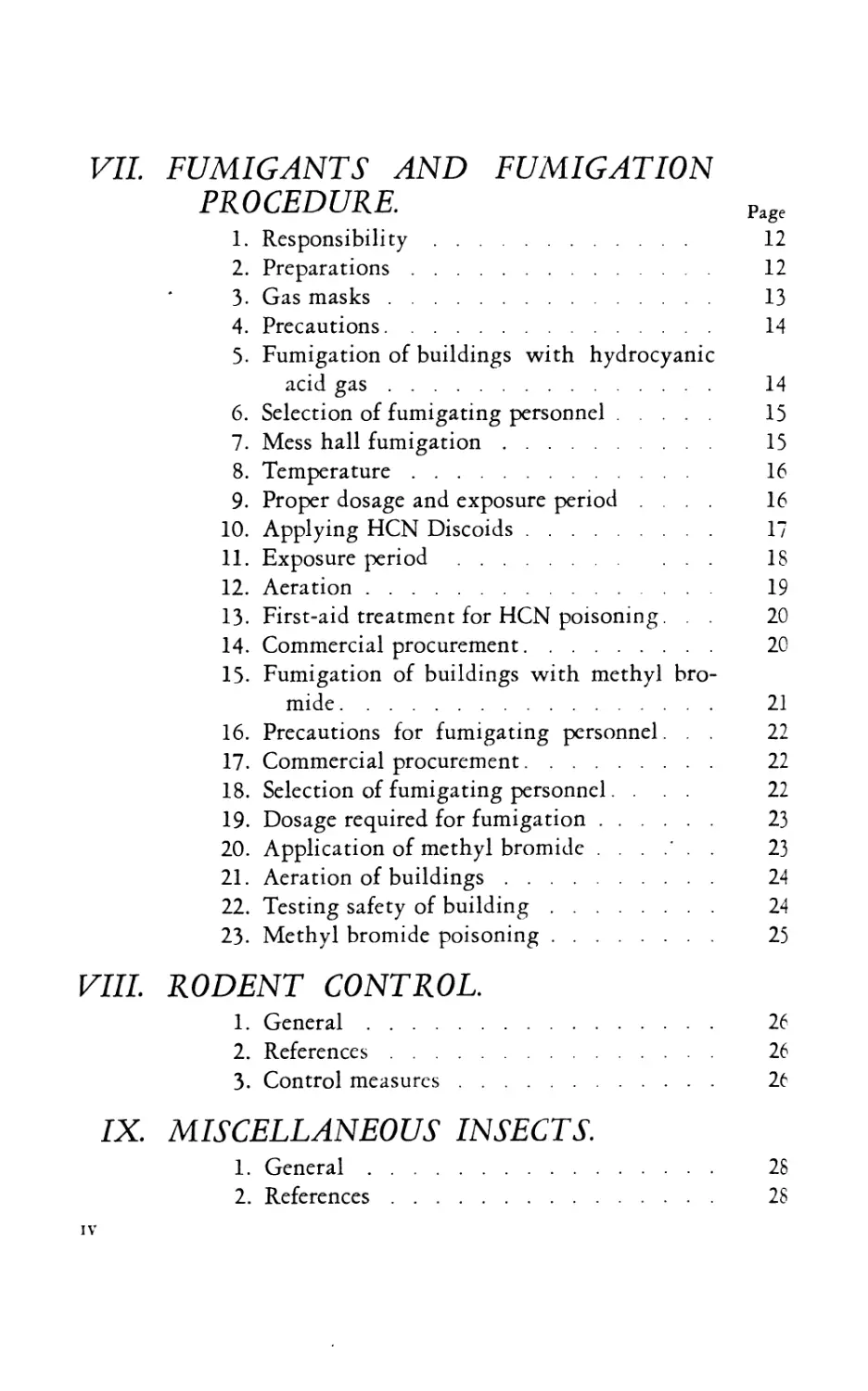
VII. FUMIGANTS AND FUMIGATION
PROCEDURE.	Page
1.	Responsibility................... 12
2.	Preparations.............................. 12
3.	Gas masks................................. 13
4.	Precautions............................... 14
5.	Fumigation of buildings with hydrocyanic
acid gas................................. 14
6.	Selection of fumigating personnel......... 15
7.	Mess hall fumigation...................... 15
8.	Temperature...................... 16
9.	Proper dosage and exposure period	...	16
10.	Applying HCN Discoids..................... 17
11.	Exposure period........................... 18
12.	Aeration.................................. 19
13.	First-aid treatment for HCN poisoning.	. .	20
14.	Commercial procurement.................... 20
15.	Fumigation of buildings with methyl bro-
mide ..................................... 21
16.	Precautions for fumigating personnel...	22
17.	Commercial procurement.................... 22
18.	Selection of fumigating personnel....	22
19.	Dosage required for fumigation............ 23
20.	Application of methyl bromide ......	23
21.	Aeration of buildings..................... 24
22.	Testing safety of building................ 24
23.	Methyl bromide poisoning.................. 25
VIII. RODENT CONTROL.
1.	General................................... 26
2.	References................................ 26
3.	Control measures.......................... 26
IX. MISCELLANEOUS INSECTS.
1.	General................................... 28
2.	References................................ 28
IV
Section' I
INTRODUCTION
This pamphlet contains selected recommendations pertaining to the con-
trol of insects, rodents, and other vermin as functions of the post engineer.
The information was obtained from War Department Technical Manuals,
Field Manuals, Training Manuals, U. S. Department of Agriculture
publications, and reference books pertaining to pest control, and has been
approved by the Office of The Surgeon General and the Office of the Chief
of Engineers. Suitable references are given for each chapter.
Section II
RESPONSIBILITY FOR INSECT AND
RODENT CONTROL
The responsibility for the initiation and enforcement of preventive
measures is vtsted in the Medical Department in accordance with the follow-
ing Army Regulations:
AR 40-210.
1. Responsibility for initiation and enforcement of preventive measures.—a. Medical Department.—
The Medical Department is charged with the initiation and supervision 6f measures for the
control and prevention of disease in military personnel and among inhabitants of occupied
territories. The functions of officers of the Medical Department are mainly those of an inspec-
torial and advisory nature.
b. Commanding officers.—Commanders of all grades are charged with the responsibility of
putting into effect the provisions of these regulations and will devote particular attention to—
*******
(6) Protection of personnel from insects, rodents, and other injurious animal pests.
(7) Maintenance of a high standard of cleanliness in quarters and buildings used by troops.
♦ ♦♦**♦♦
(13) Enforcement of current Army Air Forces and United States Public Health Service regu-
lations governing the quarantine, inspection, and disinsectization of Army aircraft operating
in or coming from regions where disease-bearing insects are found.
AR 40-205.
2.	Responsibility for sanitation.—b. Medical Department.—The Medical Department is charged
with the duty of investigating the sanitary condition of the Army and making recommendations
in relation thereto, * * *. The Medical Department is further charged with the respon-
sibility of investigating and making recommendations concerning—
**♦*♦♦♦
(3	) (y) Presence of rodents, vermin, and disease-bearing insects and the elimination thereof.
(See also pars. 21, Mosquitoes; 22, Flies; 23, Chiggers; 24, Ticks; 25, Sand Flies; 26, Lice;
27, Bedbugs; 28, Rodents.)
1
The responsibility for the execution and supervision of work as recom-
mended by the post surgeon and directed by the post commander on real
property and for the suppression of outbreaks of pests in troop organiza-
tions rests with the post engineer in accordance with the following Army
Regulations:
AR 100-80.
1.	Authority.—a. The Chief of Engineers under the direction of the Commanding General,
Army Service Forces, is charged with the direction of work pertaining to the maintenance and
repair of buildings, structures, and utilities for the Army, * * *.
2.	Definitions.—b. The term “repairs and utilities” as used in these regulations will be consid-
ered to include the preparation of estimates, budgetingfor funds, distribution of funds, provision
of material, labor, operating supplies, accessory installed equipment, and special purpose vehi-
cles necessary for—
*******
(4	) (j) Insect, rodents, and other vermin control.—The execution of work on real property re-
quired to effectuate control measures in connection with environmental factors of insects, rodents
or other vermin necessary for the protection of health in accordance with the recommendations
of the Medical Department.
Section III
MOSQUITO CONTROL
1.	SURVEYING NEED FOR CONTROL.
Depending upon the particular location of a military establishment,
mosquito control is necessary in order to prevent such mosquito-borhe
diseases as malaria, dengue, yellow fever, or filariasis. Pest mosquitoes of
the salt marsh or fresh water variety are controlled in areas where they
are in sufficient numbers to cause annoyance to the extent that it interferes
with the training operations and comfort, efficiency, and morale of the troops.
The Medical Department conducts original surveys to determine whether
or not mosquito control is necessary, depending upon the prevalence of
disease-bearing and pest type mosquitoes, potential mosquito-breeding areas,
and existence of a reservoir of infection in the native population and in the
military personnel. For certain oversea theaters, the Medical Department
furnishes special antimalaria organizations which work in close liaison
with the Corps of Engineers.
Subsequent surveys are also made by the Medical Department during the
mosquito-breeding season to determine the effectiveness of the control
program.
Where control is necessary, the post engineer will collaborate with the
Medical Department in determining the use of larvicides or the removal
of water surfaces, and when and where procedures will be employed.
2
2.	REFERENCES.
a.	Circular Letter No. 22, 16 January 1943, Office of The Surgeon General,
SPMCA, subject: “Military Malaria Control.’’
b.	FM 21-10, Military Sanitation and First Aid, section II, chapter 5.
C. FM 8-40, Medical Field Manual, Field Sanitation, chapter 8, Mosquito
Control.
d.	AR 40-205, 31 December 1942, paragraph 21.
e.	AR 40-210, 15 September 1942, paragraph 1^(6).
3. MOSQUITO ABATEMENT METHODS.
a.	Vegetation such as brush, small trees, and aquatic plants interfere
with the application of larvicides and should be removed where heavy
growth at the water’s edge makes it difficult for a man to patrol the area
and spread oil or paris green. If larvicides can be dispensed from boats,
this is sometimes more practicable than clearing.
Vegetation along banks of streams and ditches containing flowing water
provides favorable environment for mosquito breeding and interferes with
surface run-off causing impoundment of water. Streams and drainage chan-
nels must be maintained clean and free of such growth and debris, which is
often carried in by the water.
Emergent aquatic plants and grasses reaching to or projecting above the
water surface offer ideal harborage for the larvae of malaria-carrying
mosquitoes (Л. quadrimaculatus in the United States). Removal is desirable
to allow larvicide to cover the water surface, exposing larvae to fish and
other natural enemies. Underwater cutting to remove this type of growth
is practicable only in a few limited areas. If recurrent inundations of an
area cannot be prevented, the usual practice is to remove the water before
cutting the growth. Areas to be flooded by the impoundment of water
must always be thoroughly cleared and cleaned beforehand.
b.	One of the best methods of mosquito control is the elimination of
water surfaces favorable for mosquito breeding by ditching and draining.
This is a permanent measure and eliminates periodic application of larvi-
cides. Such a method may be costly and before employed its cost should be
balanced against the estimated cost of applying larvicides periodically for
the anticipated term of occupancy of the post or the cost of applying methods
of personal protection such as screens, nets, and repellents.
C.	The following methods of ditching are suggested: Hand excavation;
plow and scraper or fresno, horse- or tractor-drawn; dynamite; dragline or
other machine excavation.
(1) Main ditches should be dug first and laterals installed later where
necessary. Laterals and branches should join the main ditches at an angle
or gentle curve to prevent deposit of debris and erosion of the opposite bank.
(2) Small ditches capable of removing accumulated waters in 4 or 5 days
3
are satisfactory for mosquito control. Ditching to provide removal of all
surface run-off is unnecessary.
(3) Ditches should have a U- or V-shaped invert instead of a flat bottom
which may allow pools of water to form. Sides of ditches should be sloped
at least 2:1 and preferably flatter. Flat slopes made with bulldozer are
quickly constructed and can be more easily revegetated and protected
against destructive erosion.
(4) To avoid cutting off drainage and creating water pockets, care should be
exercised in piling excavated dirt.
d. Ditch lining is costly and should be installed only where necessary to
prevent erosion and subsequent ponding in the ditch channel. Sodding or
seeding with grass is the least expensive of the following types of ditch
lining: Placed sod or seeded grass; precast concrete slabs or shapes; concrete
poured in place; masonry; riprap. Where concrete or masonry linings are
necessary, the side slopes are stabilized by the use of grass sod. Ditches
require periodic cleaning and maintenance.
Subdrain small ponds, seepage areas, and swamps with French drains,
using crushed or small size rock, poles, bamboo, or other similar material;
drain tile; open joint or perforated tile.
Culverts used in connection with drainage may have a slightly greater
pitch than the ditches to prevent deposits of debris therein. Concrete or
rock aprons should be placed at inlet and outlet ends., and particular care
taken to prevent standing water in the culverts and pools at either inlet or
outlet ends.
Some water surfaces cannot be eliminated except by filling the area, which
may be done by bulldozer (small areas), dragline, truck and shovel, or
hydraulic fill.
Miscellaneous shallow depressions around footing columns, under build-
ings, and around borrow pits, road construction, etc., in newly constructed
camps, are usually best eliminated by filling.
Dumps should be carefully supervised to prevent water accumulation in
any containers or in the toe of the fills. Fire barrels, dire buckets, catch
basins, etc., should be emptied weekly or treated occasionally with borax,
paris green, or with larvicides such as phenol or cresol.
e. Suitable oils, properly applied, will kill aquatic stages of all species
of mosquitoes and will destroy sheltering vegetation at the edges of breed-
ing places. The chief killing factor is not suffocation, but toxicity, once
the oil enters the trachea of the mosquito. Volatile oils are more toxic
than nonvolatile, though not so persistent. Other desirable characteristics
are uniform spreading, persistency of film, and stability. The oil should
be free of grit and flocculent or fibrous material. The following oils are
generally used:
(1)	Fuel oil or Diesel oil No. 2.
4
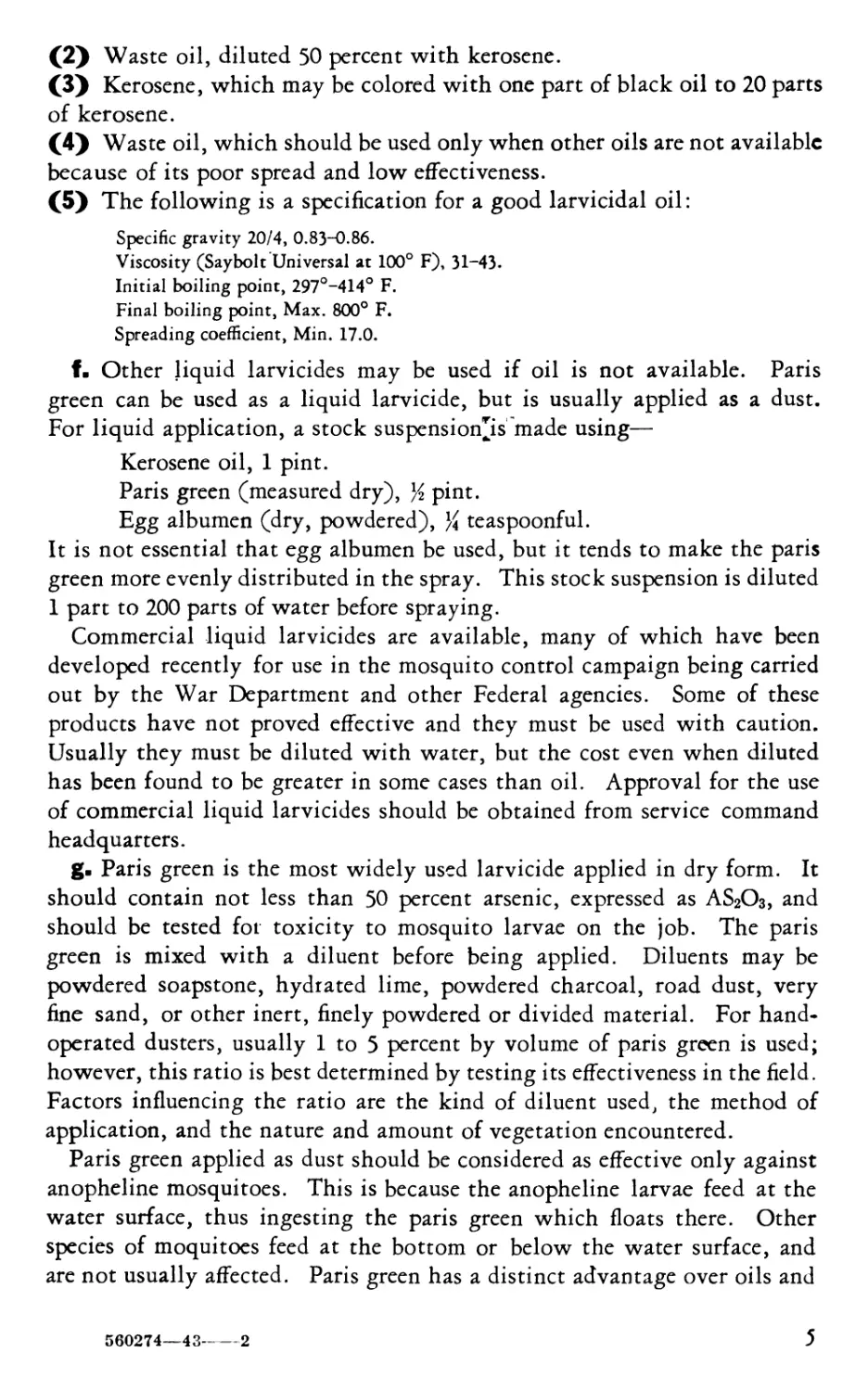
(2)	Waste oil, diluted 50 percent with kerosene.
(3)	Kerosene, which may be colored with one part of black oil to 20 parts
of kerosene.
co Waste oil, which should be used only when other oils are not available
because of its poor spread and low effectiveness.
(5)	The following is a specification for a good larvicidal oil:
Specific gravity 20/4, 0.83-0.86.
Viscosity (Saybolt Universal at 100° F), 31-43.
Initial boiling point, 297°-414° F.
Final boiling point, Max. 800° F.
Spreading coefficient, Min. 17.0.
f.	Other liquid larvicides may be used if oil is not available. Paris
green can be used as a liquid larvicide, but is usually applied as a dust.
For liquid application, a stock suspension's made using—
Kerosene oil, 1 pint.
Paris green (measured dry), % pint.
Egg albumen (dry, powdered), % teaspoonful.
It is not essential that egg albumen be used, but it tends to make the paris
green more evenly distributed in the spray. This stock suspension is diluted
1 part to 200 parts of water before spraying.
Commercial liquid larvicides are available, many of which have been
developed recently for use in the mosquito control campaign being carried
out by the War Department and other Federal agencies. Some of these
products have not proved effective and they must be used with caution.
Usually they must be diluted with water, but the cost even when diluted
has been found to be greater in some cases than oil. Approval for the use
of commercial liquid larvicides should be obtained from service command
headquarters.
g.	Paris green is the most widely used larvicide applied in dry form. It
should contain not less than 50 percent arsenic, expressed as AS2O3, and
should be tested foi toxicity to mosquito larvae on the job. The paris
green is mixed with a diluent before being applied. Diluents may be
powdered soapstone, hydrated lime, powdered charcoal, road dust, very
fine sand, or other inert, finely powdered or divided material. For hand-
operated dusters, usually 1 to 5 percent by volume of paris green is used;
however, this ratio is best determined by testing its effectiveness in the field.
Factors influencing the ratio are the kind of diluent used, the method of
application, and the nature and amount of vegetation encountered.
Paris green applied as dust should be considered as effective only against
anopheline mosquitoes. This is because the anopheline larvae feed at the
water surface, thus ingesting the paris green which floats there. Other
species of moquitoes feed at the bottom or below the water surface, and
are not usually affected. Paris green has a distinct advantage over oils and
560274—43----2
5
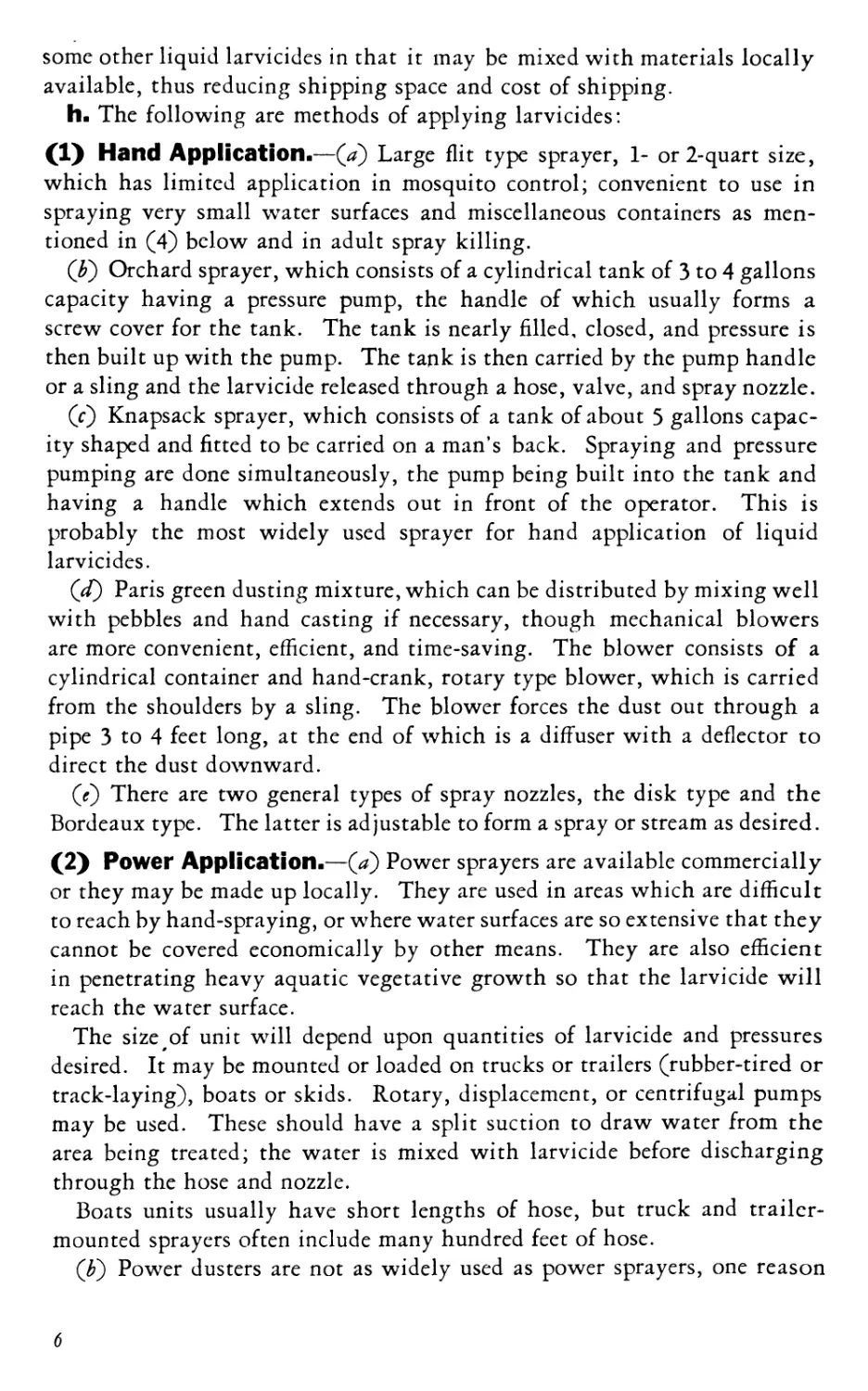
some other liquid larvicides in that it may be mixed with materials locally
available, thus reducing shipping space and cost of shipping.
h.	The following are methods of applying larvicides:
(1) Hand Application.—Large flit type sprayer, 1- or 2-quart size,
which has limited application in mosquito control; convenient to use in
spraying very small wrater surfaces and miscellaneous containers as men-
tioned in (4) below and in adult spray killing.
(b) Orchard sprayer, which consists of a cylindrical tank of 3 to 4 gallons
capacity having a pressure pump, the handle of which usually forms a
screw cover for the tank. The tank is nearly filled, closed, and pressure is
then built up with the pump. The tank is then carried by the pump handle
or a sling and the larvicide released through a hose, valve, and spray nozzle.
(c) Knapsack sprayer, which consists of a tank of about 5 gallons capac-
ity shaped and fitted to be carried on a man’s back. Spraying and pressure
pumping are done simultaneously, the pump being built into the tank and
having a handle which extends out in front of the operator. This is
probably the most widely used sprayer for hand application of liquid
larvicides.
(X) Paris green dusting mixture, which can be distributed by mixing well
with pebbles and hand casting if necessary, though mechanical blowers
are more convenient, efficient, and time-saving. The blower consists of a
cylindrical container and hand-crank, rotary type blower, which is carried
from the shoulders by a sling. The blower forces the dust out through a
pipe 3 to 4 feet long, at the end of which is a diffuser with a deflector to
direct the dust downward.
(e) There are two general types of spray nozzles, the disk type and the
Bordeaux type. The latter is adjustable to form a spray or stream as desired.
(2)	Power Application.—(a) Power sprayers are available commercially
or they may be made up locally. They are used in areas which are difficult
to reach by hand-spraying, or where water surfaces are so extensive that they
cannot be covered economically by other means. They are also efficient
in penetrating heavy aquatic vegetative growth so that the larvicide will
reach the water surface.
The size of unit will depend upon quantities of larvicide and pressures
desired. It may be mounted or loaded on trucks or trailers (rubber-tired or
track-laying), boats or skids. Rotary, displacement, or centrifugal pumps
may be used. These should have a split suction to draw water from the
area being treated; the water is mixed with larvicide before discharging
through the hose and nozzle.
Boats units usually have short lengths of hose, but truck and trailer-
mounted sprayers often include many hundred feet of hose.
(Ь) Power dusters are not as widely used as power sprayers, one reason
6
being that hand dusters cover more area than hand sprayers. The duster
unit is probably best obtained commercially. Hand dusters have been used
advantageously from boats.
(3)	Application by Airplane.—(a) This method is effective and eco-
nomical for large water areas which are inaccessible by other means and
where the vegetation is not too dense. Makeshift appliances for dispensing
the larvicide are not recommended for this method, as it requires precision
flying and considerable risk. The airplane should be specially powered
and the equipment should be well made and reliable.
(Z>) Paris green dust may be used effectively (ratio of paris green to diluent:
1 to 3), dosing at a rate of about 2 pounds of paris green per acre. Airplanes
dust at a rate of about 35 acres per minute.
(c) Dusting must be done when the air is quiet, usually during early
morning hours.
(</) When oil is used, it is dosed at the rate of about 15 gallons per acre.
(4)	Miscellaneous Methods.—(a) There are various small-scale meth-
ods of continuously applying larvicides, all of which are more or less of
questionable value as regards cost and efficiency. Drip oilers and drip cans
have been used. These consist of a barrel or can, supported over a running
stream, and equipped with a valve or other device to release oil drop by
drop. Modifications of this system include the use of a perforated pipe,
strip of cloth, or length of rope to release the oil to the water surface. Sub-
merged oilers are sometimes employed, consisting of a can of oil with two
holes punched in it, or a sack of oil-soaked sawdust, rags, or the like.
(i)	It is not advisable to rely on continuous oilers over running streams
to cover backwater reaches and quiescent areas in which vegetation is
growing, as these are the areas which usually produce mosquitoes.
I. Larvicidal dosages cannot be stated except within wide limits because
of variable conditions with respect to accessibility, extent and type of
vegetation, and nature of terrain; therefore, it is advisable to experiment with
various dosages in the area in question to determine lethal amounts neces-
sary. The following figures are given for estimating purposes in planning
mosquito control programs:
(1)	A complete season’s operation will show average usage per applica-
tion of from 10 to 20 gallons of oil per acre and about 10 pounds of paris
green mixture.
(2)	The rate of application for quiet waters containing considerable vege-
tation should be from 10 to 15 gallons of oil per acre of water and from 2 to
3 pounds of paris green (not paris green mixture) per acre.
(3)	For quiet waters containing little vegetation or debris, about 10 gallons
of oil per acre or 1 to 2 pounds of paris green (not paris green mixture) are
used per application per acre.
7
Under varying conditions of accessibility of water surfaces, one man will
distribute from 10 to 30 gallons of oil or from 1 to 8 pounds of paris green
(not paris green mixture) per day.
j. Adult killing can be accomplished as follows:
(1)	In some areas, despite regular local control activity, large flights of
fresh-water or salt-water pest mosquitoes may be blown in. Rather than
drain or apply larvicide to the breeding places of these mosquitoes which
may be located several miles away, have organizations employ large-scale
spraying with a spray containing pyrethrum (when available) in the areas
affected in the post itself. Such spraying can be done in tents and barracks
with flit-gun type sprayers, with pressure and paint spray type of dispenser,
or with aerosol insecticide dispenser (available through the Quartermaster
Corps).
(2)	Special consideration should be given to the type of spray material.
Approximately ounce of either of the following sprays, supplied by the
post supply officer, is used per 1,000 cubic feet of space:
- (a) 20-1 concentrate, each gallon containing not less than 75 to 100
grams of total pyrethrins per gallon, diluted for spraying with 14 parts of
good quality kerosene.
(i)	Ready-to-use pyrethrum spray which does not require dilution with
kerosene prior to use.
4. MISCELLANEOUS.
In malarious areas, all buildings and tents housing personnel should be
thoroughly screened with standard 18-mesh wire screening. Diameter of
wire should not be less than 0.01 inch; diameter of the inscribed circle of
the openings should not be greater than 0.0475 inch. Since a malaria
mosquito will enter a building through very small holes, all openings should
be effectively screened or closed. Double screen doors with a vestibule
between them are desirable. Screens should be well constructed and so
placed or hung that they will not warp or sag. Screen doors must open
outward. In the Tropics, copper, bronze, or aluminum wire should be used.
Although not a responsibility of the Corps of Engineers, the following
additional protective measures are mentioned:
a.	Use of head nets, gloves, and leggings.
b.	Mosquito bars or sleeping nets for use while sleeping.
C. Mosquito repellents such as “612” and dimethylphthalate (issued by
the post supply officer) applied to exposed skin; they are effective for approx-
imately 4 hours.
d. Suppressive treatment involving the daily use of prophylactic doses
of quinine, atabrine, or a combination of these drugs, as directed by the
Medical Department.
8
Section IV
FLY CONTROL
1.	GENERAL.
The control of fly-breeding places is the most effective part of a fly control
campaign. This is essentially a problem of the proper disposal of garbage
and of human and animal waste matter.
Fly traps are a valuable means for destruction of adult flies. They should
not be placed inside of buildings. The procurement, distribution, and
installation of fly traps at Army posts are the responsibilities of the post
engineer. These traps are an item of expendable property and are usually
serviced by troop organizations.
2.	REFERENCES.
a.	AR 40-205.
b.	FM 8-40.
с.	TM 8-220.
d.	Army Medical Bulletin No. 23 (Dunham).
3.	CONSTRUCTION OF FLY TRAPS.
The following instructions are given for the construction of an efficient
and economical fly trap:
a.	Materials.—(1) Lumber will be red oak, birch, ash, or gum, com-
plying with Federal Specifications MM-L-751 and MM-L-736 and latest
revisions, or other comparable species suitable for the purpose, free from
loose knots, checks, and other defects.
(2)	Screen cloth will be 14- or 16-mesh, japanned, complying with Federal
Specifications E-RR-C-451a, Type H.
(3)	Screws, nails, and tacks will be uncoated, complying with Federal
Specifications E-FF-101 or E-FF-S-111.
co Bait pan will be 14 inches in diameter, approximately 1 inch deep,
and will be of waterproof composition, enameled metal or equal. Bait
pan may be made of wood, waterproofed, with bottom of treated pressed
wood or exterior type plywood.
b.	Manufacture.—(1) Pieces will be cut, shaped, bored, and fastened
in jigs, or by other means to insure accuracy of fit when assembled.
(2)	All edges of wood members will be eased.
(3)	Hoops will be formed to a true circle and fastened with two staples at
the mill. Screw holes will be countersunk.
(4)	Legs will have holes drilled in notches.
(5)	Screen cloth will be cut without jagged or uneven edges. Allowance
9
will be made for overlap for fastening cone to tack strips. No allowance
will be made for overlap for barrel screen.
C. Assembly.—(1) Fasten top and bottom hoops to legs with screws.
(2) Tack barrel screen to inside of top and bottom hoops. Use bottom
edge of bottom hoop as a guide (this should keep top edge of screen
approximately % inch from top of top hoops/. Tack 3 inches c. c. on top
hoops and also on legs. Tack to bottom hoop just sufficiently to line
screen with bottom of hoop. Remainder of tacking on bottom hoop will
be done when cone is put in.
(3) Assemble cone screen with straight piece of %6 by %. Screen cloth
should overlap to edge of piece and be tacked 3 inches c. c. Wood piece
should be set with top at edge of 1-inch diameter hole at top of cone.
co Tack cone to bottom hoop, using bottom edge of hoop as a guide.
(5) Place outside hoop for top on table or other flat surface. Lay screen
on this hoop so that edges project evenly all around. Place inside hoop on
top and press down until bottom edges are even on table. Nail approxi-
mately 6 inches c. c. Legs should not project more than 1 -inch below
bottom of screen.
d. Shipping.—(1) Fly traps will be shipped completely fabricated or
knocked down as specified by the contracting officer.
(2) Method of crating or packing will be as approved by contracting
officer. Crating or packing will be adequate to protect contents from
injury.
(3) Each crate or package will be plainly labeled with a complete list of
contents.
Section V
BEDBUG CONTROL
1.	GENERAL.
Bedbugs are found wherever they can live in close association with man.
Frequently they become a serious pest in barracks and guardhouses. They
are spread from place to place in clothing, bedding, baggage, furniture, web
belts, gas masks, and field packs. They hide in seams of mattresses, pillow-
cases, and in cracks and crevices of any wooden or metal structure.
2.	REFERENCES.
a.	TM 8-220.
b.	FM 21-10.
C. Army Medical Bulletin No. 23 (Dunham).
10
3.	CONTROL MEASURES.
Liquid insecticides are effective only if thoroughly and repeatedly used.
Liberal quantities of liquid should be applied. Preferably a paint brush
should be used in the application of liquid insecticides. A spray is not as
effective.
Fumigation is the most effective bedbug control measure, but should not
be attempted by untrained personnel. It is extremely difficult to eradicate
all bedbugs and eggs from a room or building with one treatment by any
control measure except fumigation. (See sec. VII.)
Steam has been recommended for the eradication of bedbugs in mattresses,
blankets, etc. Dry heat is also effective when it is possible to heat the
building and contents to a temperature of 130° F. for 30 minutes or longer.
Heating Army barracks to this temperature is impracticable unless the
outside temperature is 90° F. or higher. A fire hazard is involved in heating
to this temperature and grates may be burned out unless competent per-
sonnel is in charge of firing furnaces.
Section VI
ROACH CONTROL
1.	GENERAL.
Cockroaches have been found infesting all types of military structures,
but particularly those in which food is handled or served, such as mess halls
and post exchanges.
2.	REFERENCES.
a.	TM 8-220.
b.	FM 21-10.
C. Army Medical Bulletin No. 23 (Dunham).
3.	CONTROL MEASURES.
The following control measures have been found most satisfactory fcr
roaches :
a.	Sanitary Measures.—The most effective measures for the control
of roaches are usually classified as “good housekeeping’’ by troop organi-
zations. These include the removal of sources of food for the insects,
elimination of breeding places, and periodic application of dusts and sprays.
b.	Powders, Baits, and Sprays.—(1) Thorough and frequent use of
powdered sodium fluoride, blowing or dusting the powder into all cracks,
crevices, or other places where roaches may hide, is a very effective method
of control. Care should be taken not to get the powder on food.
11
Roach powder consisting of 75 parts sodium fluoride and 25 percent py-
rethrum powder is also effective.
(2) Pyrethrum powder, diluted with flour or other diluent, when obtain-
able, is also effective. Pyrethrum sprays are sometimes used with success.
(3) Baits containing phosphorus or arsenic also may be used in locations
where powders or sprays would be objectionable, but should not be used
in kitchens or messes.
C. Fumigation.—(1) When peak infestations are reached, as may
occur in barracks or other buildings, fumigation of the entire building is
recommended for a complete clean-up. Reinfestation is likely to occur at
any time and it is important to apply suppressive measures at frequent
intervals.
(2) When fumigation is necessary, see section VII.
Section VII
FUMIGANTS AND FUMIGATION
PROCEDURE
1.	RESPONSIBILITY.
The post engineer is responsible for the fumigation of buildings. In
order to derive maximum benefit from fumigation of barracks and mess
halls, it is the responsibility of company commanders to see that—
a.	All squad rooms and supply rooms are left open.
Note.—HCN will not corrode guns or other metals and will not affect leather articles or
otherwise harm building contents.
b.	All cots, mattresses, bedding, and as much clothing as possible are
left in barracks, and the following steps are taken: separate slightly all
hanging clothing; leave open all foot lockers; unmake beds and unfold
blankets; leave mattresses unrolled.
C.	In mess halls, proceed as follows: Shut off all running water; shut off
all range pilot lights and in winter all furnace fires; leave open all refrig-
erator doors only if infestation is suspected; leave open the coolerator;
remove all ice and draw off all water in it. The day a mess hall is to be
fumigated, no ice should be received for the coolerator. In any event, all
ice should be removed and disposed of prior to the application of the gas.
2.	PREPARATIONS.
The following preparations for fumigation should be made:
a.	All doors should be closed, locked, and sealed on the inside, except
exit door, which should be sealed from the outside after the gas is applied.
b.	All windows and other openings to the building should be closed
12
and locked. All broken glass in windows should be replaced. If paper
is used to cover openings, it should be oiled paper or Kraft paper, smeared
with a thin coating of cup grease. If windows are loose, they should be
wedged with wooden wedges inserted finger-tight. If juncture of upper
and lower sash is not tight, seal with gummed paper tape, Scotch tape,
or with small wads of wet newspaper inserted finger-tight.
C.	If 2-inch gummed paper of good quality or Scotch tape is not available,
an excellent sealing material for the edges of doors and windows is a paste
made by adding lubricating oil to low grade flour; apply with a putty
knife.
d.	Screened vents in second-story ceilings may be sealed by setting the
wooden covers in place over the vents if they fit snugly, or closing the
vent screens covered with piece of Kraft paper cut to size.
e.	Roof ventilators and “attic” louvres should be sealed from the outside
with Kraft paper, plywood, or tar paper.
3.	GAS MASKS.
When fumigating with hydrocyanic acid gas, the Army service mask
MIA2, equipped with special HCN canister, is satisfactory. Only special
canisters for HCN can be used. Renewal canisters should be of the same
type. When this type mask is used, particular attention should be given
to the elastics which are depended upon to hold the mask tight. Such
elastic deteriorates quickly under strain, and is especially susceptible to
rotting by perspiration acids.
When fumigating with methyl bromide, a gas mask must be worn at all
times. The Army service mask is not as suitable for this work as one of the
following gas masks and canisters bearing the approval of the U. S. Bureau
of Mines:
Type	Canister recommended	Name of Manufacturer
AB	G. M. A.	Mine Safety Appliance Co.
CM	CM-1	E. D. Bullard Co.
M-l	C-l	Davis Emergency Equipment Co.
One fumigator should assist another in fitting masks each time they are
put on, whatever the type or make, to avoid twisted straps, unequal stresses
on straps or elastics, and poor fits. Each time a mask is put on, it should
be tested for fit by pinching off the tube to the canister, then breathing.
If the mask collapses, it is tight.
The following toxic symptoms indicate canister break-down, or absorp-
tion of dangerous amounts of HCN through the skin: smarting of eyes;
560274—43 -
13
taste of burned almonds in back of throat; dull ache at base of brain; feeling
of chill; palpitation of heart. Dull ache at base of brain, feeling of chill,
and palpitation of heart might occur as a result of absorption of gas through
skin pores. If any of one these symptoms occurs, the operator should im-
mediately leave the building. As talking through a mask is not practicable,
it should be understood by all operators that when a man starts toward
the exit, he is in trouble and is to be escorted outside.
After each day’s use, cleanse mask inside and outside with a cloth rinsed
in soap and water or dampened with some mild antispetic that will not
deteriorate rubber.
4.	PRECAUTIONS.
To prevent injury to Army and civilian personnel, a warning sign should
be placed on each door, at eye level, stating that the building is under fumi-
gation, and that it should not be entered except by a person experienced in
handling fumigation and equipped with a gas mask and special HCN
canister.
Wooden warning signs should be placed in the company street and guards
posted at entrance during the period of fumigation and until aeration is
completed and the building released by the office of the post surgeon for
occupancy.
The signs should be 14 by 18 inches, with red letters on a white back-
ground, and should read:
CYANIDE GAS
FUMIGATION
DEADLY POISON
KEEP OUT
By order: POST COMMANDER
All buildings must be given a final inspection before the gas is applied,
to make sure there are no occupants.
5.	FUMIGATION OF BUILDINGS WITH HYDROCYANIC ACID
GAS.
In the fumigation of Army barracks and mess halls, Discoids should be
used when HCN is the fumigating agent. Discoids are cellulosic disks in
which the hydrocyanic acid is absorbed. In fumigating with this type of
product, proper gas masks are always worn (see par. 3) and the hermetically
sealed containers are open with a special opener. The disks are scattered
14
on the floor of the space to be fumigated, whereupon the HCN is liberated
spontaneously. No other equipment is required.
The simplicity of the use of HCN Discoids is quite apparent, yet it has its
attendant danger. The fumigator must take the fumigant into the space
fumigated and remain long enough to open the cans and spread it around.
This means that he must expect to be exposed to the gas for a certain length
of time. In small buildings, the danger is not great because the period of
exposure is quite short. A well-trained crew of two or three men will
release the gas in a 63-man barracks in from 2 to 4 minutes. The danger
arises through leaky or improperly functioning gas masks or by the absorp-
tion of HCN through the skin.
Discoids should be stored in a cool, dry, and well-ventilated place.
The storage should be sufficiently isolated so that, in the event of leakage,
there will be no chance of persons or animals being affected. The post
chemical warfare officer can usually provide suitable storage space.
6.	SELECTION OF FUMIGATING PERSONNEL.
Only experienced men with professional or special training should be
employed. It is advisable to select for this work, when possible, young,
intelligent men. All men engaged in fumigation work should be in good
physical condition. Two or preferably three operators wearing masks
should be used on each operation—one to open cans, one to spread the Dis-
coids as instructed, and one to work progressively back from the two
workers, out of the gas, to be available in case of trouble. So that no
operator will be exposed too much to the danger of skin absorption, the
crew members should rotate functions. This increases the safety factor
and each operator will always “keep his hand in.”
It is usually undesirable to fumigate in 1 day more than 8 or 10 barracks
per crew. Between applications of gas, the crew should be in the open air
at least 15 minutes, so that any possible effect from the small amounts of
HCN absorbed through the skin will be neutralized. There is no cumulative
deleterious effect from small amounts of HCN absorbed through the skin
or breathed.
7.	MESS HALL FUMIGATION.
Hydrocyanic acid (HCN) does not combine chemically with foodstuffs,
and is not permanently fixed in the products exposed to fumigation. While
a certain amount of hydrocyanic acid is absorbed during fumigation, it is
rapidly given off from the commodity, and after 24 to 72 hours of aeration,
little or no HCN can be detected. Foods that are cooked after fumigation
are freed of residual HCN.
Certain precautions should be observed when fumigating food products
that carry a high moisture or oil content. With such commodities the
desorption of HCN is slowed down and the aeration period should be
extended before releasing them for use. As a safeguard, the period of
aeration of such food products should be not less than 72 hours. Such foods
as fresh fruit, vegetables, butter, salads, milk, cheese, opened jars of pre-
serves, jams, and sauces should never be fumigated. Discoids should never
be thrown directly onto food products, clothing, bedding, or overstuffed
furniture. If placed on varnished floors or furniture, they may stain the
finish.
Mess hall grease traps (outside) are breeders of roaches. They must be
fumigated, even though there will still be roaches in the dirt on the outside
concrete wall of the trap. The following procedure is recommended:
a.	Place about 2 inches of soft soil (dry) on the 4-inch trap, around wall
edge, to form a flexible seal for the tongue and groove cover; attach to a
pail or old gallon can a wire long enough to permit the can to hang just
above the fluid level in the trap. Provide a nail in the cover to which the
wire will be attached.
b.	About one-half of a 5-pound can of calcium cyanide should be dumped
into the grease trap and the trap cover replaced. The calcium cyanide is
effective and safer to apply than discoids. (This material should not be
used for the fumigation of buildings.)
8.	TEMPERATURE.
The ideal fumigating temperature is 72° F. or over, and no fumigation
should be conducted when the temperature in the building is lower than
65° F. Insects tend to become dormant at lower temperatures. When out-
door conditions cause the indoor temperature to fall below 65° F., it is
necessary to heat the structure before fumigating. Since the inside surface
of the walls may be cool, it is advisable that the heat be turned on and
maintained from 2 to 4 hours before the fumigation is started, to make
sure that the contents of the buildings, as well as the walls, are thor-
oughly warmed so that insects in their protected harborages may become
sufficiently activated.
Fumigation should not be conducted when it is raining or snowing. Such
weather conditions cause difficulty in aerating after the fumigation. Also,
fumigation should not be conducted during periods of high winds.
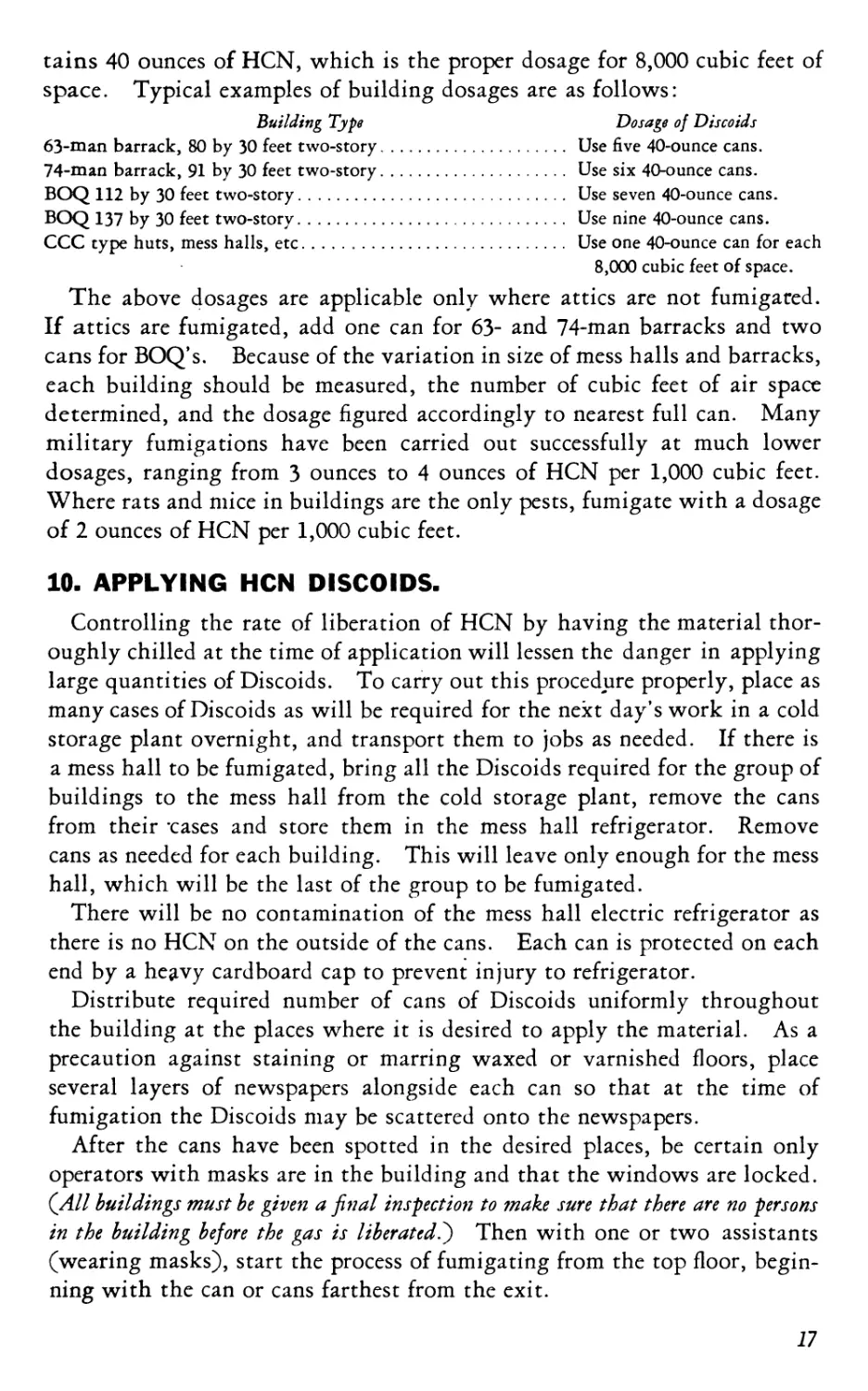
9.	PROPER DOSAGE AND EXPOSURE PERIOD.
 A dosage of 5 ounces of Discoids per 1,000 cubic feet of space should be
used when fumigating barracks or mess halls. Each can of Discoids con-
16
tains 40 ounces of HCN, which is the proper dosage for 8,000 cubic feet of
space. Typical examples of building dosages are as follows:
Building Type
63-man barrack, 80 by 30 feet two-story......................
74-man barrack, 91 by 30 feet two-story......................
BOQ 112 by 30 feet two-story.................................
BOQ 137 by 30 feet two-story.................................
CCC type huts, mess halls, etc...............................
Dosage of Dis co ids
Use five 40-ounce cans.
Use six 40-ounce cans.
Use seven 40-ounce cans.
Use nine 40-ounce cans.
Use one 40-ounce can for each
8,000 cubic feet of space.
The above dosages are applicable only where attics are not fumigated.
If attics are fumigated, add one can for 63- and 74-man barracks and two
cans for BOQ’s. Because of the variation in size of mess halls and barracks,
each building should be measured, the number of cubic feet of air space
determined, and the dosage figured accordingly to nearest full can. Many
military fumigations have been carried out successfully at much lower
dosages, ranging from 3 ounces to 4 ounces of HCN per 1,000 cubic feet.
Where rats and mice in buildings are the only pests, fumigate with a dosage
of 2 ounces of HCN per 1,000 cubic feet.
10.	APPLYING HCN DISCOIDS.
Controlling the rate of liberation of HCN by having the material thor-
oughly chilled at the time of application will lessen the danger in applying
large quantities of Discoids. To carry out this procedure properly, place as
many cases of Discoids as will be required for the next day’s work in a cold
storage plant overnight, and transport them to jobs as needed. If there is
a mess hall to be fumigated, bring all the Discoids required for the group of
buildings to the mess hall from the cold storage plant, remove the cans
from their -cases and store them in the mess hall refrigerator. Remove
cans as needed for each building. This will leave only enough for the mess
hall, which will be the last of the group to be fumigated.
There will be no contamination of the mess hall electric refrigerator as
there is no HCN on the outside of the cans. Each can is protected on each
end by a heavy cardboard cap to prevent injury to refrigerator.
Distribute required number of cans of Discoids uniformly throughout
the building at the places where it is desired to apply the material. As a
precaution against staining or marring waxed or varnished floors, place
several layers of newspapers alongside each can so that at the time of
fumigation the Discoids may be scattered onto the newspapers.
After the cans have been spotted in the desired places, be certain only
operators with masks are in the building and that the windows are locked.
(All buildings must be given a final inspection to make sure that there are no persons
in the building before the gas is liberated.^) Then with one or two assistants
(wearing masks), start the process of fumigating from the top floor, begin-
ning with the can or cans farthest from the exit.
17
In opening the cans and scattering the material, start on the second floor,
always working in a direction away from the gas and toward the stairway.
Having finished the top floor, proceed immediately to the next lower floor
and repeat the operation, working toward the exit. In case a cellar or
basement is to be fumigated, fumigate the main floor after the cellar.
Operators should never retrace their steps when scattering the Discoids,
nor reenter a fumigated space. Operators should work quickly, but they
should not rush.
Never apply Discoids by handling the individual disks one at a time.
Too much time is consumed in this manner and the operator may expose
himself to a dangerous concentration of gas even when equipped with a
mask. The smallest space can be satisfactorily taken care of by shaking
out of the can onto the floor or on newspapers or other protective material
one-half or one-fourth of the contents.
Always have Discoid cans spotted in barracks and mess halls at proper
intervals in a line down the middle of each floor whenever possible. This
simplifies the operator’s work and lessens the chance that a can will be
missed. One can is to be spotted in the washroom of a barrack.
If only a few cans are used on a floor or in a single space, the cans may be
opened and the contents immediately scattered. If the space to be fumi-
gated is large and a large number of cans of Discoids are required, first open
each can and immediately cap it with the fiber cap. (Each can of Discoids
is equipped with a fiber cap on top and bottom as a protection during ship-
ment.) After the cans on that floor have been opened and capped, the
contents of each may be scattered. Working for a prolonged period in a
high concentration of gas is thus avoided.
Another method of handling fumigations with Discoids, after proceeding
as above by spotting the cans in the desired places, is to open them and then
up-end them on the floor with the opened end down. This plan eliminates
the use of the fiber caps, saves time, and will hold gas in the cans equally
as long.
When all of the Discoids have been scattered and all of, the fumigating
personnel are out of the building, the exit door should be locked and sealed
with gummed paper, Scotch tape, or a flour oil mixture, as described in
paragraph 2c.
11.	EXPOSURE PERIOD.
The structure should be allowed to remain under gas for a period of 4 to
6 hours, although a period of from 3% to 4 hours may be found to be suffi-
cient under favorable conditions. However, when the structure contains a
large amount of heavy equipment, such as that worn by ski troops or winter
armored units, it is necessary to lengthen the period of exposure, since in
18
such cases more time must be allowed for complete penetration. It will
seldom be necessary to lengthen the exposure beyond 8 hours.
12.	AERATION.
When the necessary exposure period is completed, the front and fear
doors should first be opened from outside, opening first the door opposite
the direction from which the wind is blowing. Gas masks should be worn
during the entire -period of opening the building.
If the outside temperature is 65° F. or higher, buildings may be aerated
by opening all doors, vents, and windows, leaving them open until it is
shown by means of a methyl orange test paper that there is no harmful
concentration of gas in the bedding, usually a period of 4 hours is suffi-
cient for HCN.
Methyl orange test papers should be used in determining whether or not a
fumigated space has been entirely cleared of HCN. These papers are small
canary yellow strips which, in the presence of an atmosphere containing
HCN, turn pink or red and are very sensitive to relatively low concentra-
tions of the gas. A supply of these papers may be obtained from the
manufacturers of Discoids. They should be placed on mattresses, under
pillows, and in lockers and closets.
If the methyl orange test papers do not change color within 2 minutes
after exposure to supposed concentration of HCN, the space is safe for human
occupancy. If they do change color, additional aeration is needed, and then
the test for safety repeated until the papers show absence of HCN. Gas
masks should be worn until the test papers fail to change color.
If methyl orange test papers are not used to determine the presence of
HCN, allow the premises to ventilate sufficiently so that they may be en-
tered without gas-mask protection; then have the fumigation crew beat all
mattresses, pillows, and other bedding with smooth wooden staves and
air them until all traces of gas have been removed. This process of
moving and beating the bedding will readily disperse all gas which may
have been absorbed.
In cold weather, the ventilation procedure given below should be
followed:
a.	Wearing gas masks, the operators open all doors. After 15 minutes
(wearing gas masks) operators open all windows and ceiling vents. After
about an hour, or when a methyl orange test paper shows practically no
change in color after 2 minutes’ exposure in the building atmosphere, all
doors and windows should be closed so that the interior of the building
may heat up again for about an hour. Then, all doors and windows should
again be opened to permit the escape of gas which will have been released
from bedding and clothing.
b.	After further aeration of 30 to 40 minutes’ duration, tests should be
made with methyl orange papers to determine the concentration of gas
19
(if any) still remaining in mattresses, blankets, or pillows. If there is no
change in the color of the paper, or if the change is imperceptible, then the
building and contents may be assumed to be free of gas; but it is advisable,
particularly during cold weather, to leave a few windows in each barrack
remain open a little at the top during the day, so as to insure thorough
and complete ventilation before the barracks are occupied at night for
sleeping.
C. In muggy weather, or when it is necessary to ventilate during a rain,
it may be necessary to repeat this procedure. Under such conditions, the
process of ventilation must proceed, either through normal aeration or by
the aid of heat, until tests of bedding indicate there is no doubt as to the
absence of gas.
13.	FIRST-AID TREATMENT FOR^HCN POISONING.
In case of accident, keep cool. Poisoning by HCN gas should not be
fatal if prompt action is taken as follows:
a.	When a person is overcome by gas, remove him into fresh air as quickly
as possible. Fresh air does not mean outdoors in cold weather, but in a
room free from gas and comfortably warm.
b.	Do not rush’an unconscious'man toja^hospital.^ Prompt action on the
spot is essential.
C. Send for a physician. If patient is breathing, keep him in fresh air
but do not permit him to exert himself. Have patient inhale contents of an
amyl nitrite pearl, breaking pearl in handkerchief and holding lightly over
nose. Do not leave patient alone until he is normal; keep warm.
d.	If the patient is not breathing, start artificial respiration at once,
preferably by the prone-pressure method. The standard technique should
be followed to the letter. In all cases, continue artificial respiration until
the physician arrives and has taken .charge of the patient. While giving
artificial respiration, an assistant may administer an amyl nitrite pearl
(as above).
e.	Do not neglect immediate and continued first-aid treatment in order to
call a doctor. Have someone else call a doctor.
f.	Do not breathe HCN yourself; if you must go into an atmosphere of
HCN to rescue a victim, wear a gas mask. Protect yourself.
14.	COMMERCIAL PROCUREMENT.
Discoids may be procured in 40-ounce cans from American Cyanamid and
Chemical Corporation, 30 Rockefeller Plaza, New York, N. Y.
20
15.	FUMIGATION OF BUILDINGS WITH METHYL BROMIDE.
Methyl bromide is a colorless, odorless, volatile liquid, with a specific
gravity of 1.732 and a boiling point of 40.1° F. It is a gas at ordinary
temperatures, in which state it is approximately 3-5 times as heavy as air.
Methyl bromide is a well-known chemical, use of which as a fumigant is
relatively recent. It apparently is effective against all forms of insect life,
as well as spiders, mites, and various rodents. It has unusual properties of
penetration in gastight inclosures, which make possible the destruction of
insects in protected environments. It is effective at much lower tempera-
tures than most fumigants. Its effectiveness is not decreased by the presence
of moisture, unless enough is present to form a film of water which prevents
penetration. In its gaseous state it usually is limited to fumigation within
tight inclosures. It has also been combined with hydrocyanic acid as an
effective fumigant and with water as a soil treatment for subterranean
insect larvae. This fumigant is extensively used on living plants and plant
parts, fresh fruits, vegetables, and baled hay, to destroy insects restricted by
plant quarantines. It is also used to destroy moth larvae in pears, greenhouse
pests on potted plants, and insects in wooden antiques, chicory, spices,
cheese, dried fruits, nut meats, dry beans, and green coffee beans. It is also
widely used for destruction of storage insects in rice and wheat mills, seed
houses, and candy manufacturing plants, for seeds, flour-milled feeds, nut
meats, etc. It should not be applied in Army barracks, mess halls, or other
buildings unless they are constructed of brick, concrete, of other material
that can be tightly sealed.
Recent studies have shown that when properly employed, methyl bro-
mide is completely effective against all stages of the body or clothes louse
in relatively short exposure periods.
Lethal concentrations of methyl bromide for man and warm-blooded
animals are:
PPM
Concentration which kills most animals in short time.................... 20,000-40,000
Dangerous to life in from 30 to 60 minutes................................ 2,000-4,000
Maximum concentration tolerated for 60 minutes without serious disturbance. .	1,000
Maximum concentration for prolonged exposure (8 hours)......................... 50-170
The above table shows that when a sufficient concentration of methyl
bromide is present in the air for a sufficient length of time it can cause
injury or death to man and all other warm-blooded animals. Accidental
momentary exposures of operators to fumigation concentrations are not
likely to cause injury, but working many hours in a low concentration may
be harmful. Studies on animals have shown that prolonged and repeated
exposures to concentrations as low as 33 parts per million can be injurious.
The toxic effects on animals are:
560274—43—	4
21
a.	From continued exposure to low concentrations, a paralysis from
which they can completely recover when removed from the environment
of the gas.
b.	With higher concentrations, lung irritations which can become
severe and acute, often developing into typical confluent broncho-
pneumonia.
C. The effects of exposure to methyl bromide are additive during a given
exposure period or in closely repeated exposures, but where exposures are
irregular and at intervals of several days the effects can usually be thrown
off by the body without any apparent injury.
If directions are followed carefully in the fumigation of barracks and mess
halls, there is no reason for operators or other personnel to be exposed to
harmful concentrations of methyl bromide.
16.	PRECAUTIONS FOR FUMIGATING PERSONNEL.
As a matter of good fumigation practice, two men should always work
together when entering a building to open windows and vents to initiate
aeration. They should always have on their gas masks while in an
atmosphere of gas, and should always remain close to each other from jhe
time they enter a building until they leave, so that in case one becomes
incapacitated for any reason, such as suffering an accidental fall that might
possibly result in unconsciousness, the other could remove him to fresh air.
17.	COMMERCIAL PROCUREMENT.
Methyl bromide is procurable in 10-, 50-, and 150-pound cylinders; also
in 1-pound cans, with 24 cans per case. A special inexpensive opening
device is necessary when the 1-pound can is used. Methyl bromide is
obtainable from the following manufacturers:
The Dow Chemical Co., Midland, Mich.
E. I. du Pont de Nemours & Co., Wilmington, Del.
Michigan Chemical Corporation, St. Louis, Mich.
Pittsburg Chemical Co., Vernon, Calif.
18.	SELECTION OF FUMIGATING PERSONNEL.
Only experienced men must be employed in fumigating buildings. Some
posts have personnel who have had experience in the use of methyl bromide
as a fumigant in civilian life, and this experience should be made use of in
the organization of a fumigation crew. All men engaged in fumigation
work should be in good physical condition.
Where no trained personnel is available, obtain the services of experienced
personnel from commercial manufacturers for purposes of demonstration and
thorough instruction of a fumigating crew.
22
19.	DOSAGE REQUIRED FOR FUMIGATION.
The dosage of methyl bromide required for fumigation of barracks and
mess halls will depend upon several factors, such as temperature, exposure
period, type of construction of building and how effectively it is sealed,
and the amount of space to be fumigated.
Methyl bromide is more effective at higher temperature than at a lower
temperature; therefore, temperature must be considered an integral part of
the dosage schedule. It has been used effectively at a temperature as low as
25° F. and as high as 95° F. The efficiency of methyl bromide apparently
is not impaired by the presence of moisture; in fact, better results are often
obtained under conditions of high humidity.
Any change in one factor should be compensated for by an adjustment in
one of the others. For winter application, the fumigation should be per-
formed on as warm a day as possible, and the building should be heated up
to a temperature of 100° F., after which the fire is turned off, in the case of
a gas furnace, or pulled from a coal furnace and put out.
Prior to the date of fumigation, it is necessary to check the dimensions
of each room and each floor to compute the cubic footage. For a well-
sealed building, a dosage of 1 pound methyl bromide per 1,000 cubic feet of
space for an exposure period of 18 to 24 hours at a temperature above 60° F.
should be used. If the building is of such construction that it cannot be
tightly sealed, methyl bromide should not be used. If no circulation is
provided in the building, methyl bromide will tend to stratify and an over-
dosage or lengthened exposure is necessary to offset that condition.
20.	APPLICATION OF METHYL BROMIDE.
It is recommended that methyl bromide be distributed throughout the
building by utilizing the facilities already present. If the building is heated
by a hot-air, forced-circulation heating system, a cylinder of methyl bromide
placed on the outside of the building can be connected to the hot air system
of the furnace by a tube run into the hot air circulating furnace fan and in
this manner circulated through the hot air ducts to all parts of the building.
A quarter-inch O. D. copper or Saran plastic tube is attached to a 150-
pound cylinder and run into the furnace just above its air-circulating fan.
Tape must be used to hold the tube in place, since back pressure is capable
of removing it from its proper position. The draft opening to the firebox
of the furnace must be sealed, as well as all other openings to the furnace.
The outside openings to the furnace room should be sealed, with the ex-
ception of one exit door, which should be left open until the fumigator
leaves.
When all personnel are out of the building and all outside openings are sealed,
the furnace fan should be turned on by an outside arrangement for closing
23
the master switch after the thermostat has been properly adjusted, so that
the furnace fire will not start. (In winter fumigation, the fire should be
turned off or removed from the furnace.)
The valve to the methyl bromide cylinder is opened and the gas allowed
to flow in above the furnace fan which circulates it through the building
until the required amount has been released, after which the valve is closed.
The required dosage is measured by the use of a platform scale weighing
the amount delivered into the building by the decrease in weight of the
cylinder or by special applicator equipment.
The fumigator should then turn off the furnace fan by the same outside
arrangement by which it was started. The building should be kept thor-
oughly locked and posted with signs to the effect that it is under fumigation
and contains poisonous gas. Guards should be kept on duty at all times
to prevent accidental entry of any person.
21.	AERATION OF BUILDINGS.
After the exposure period of approximately 24 hours, the building should
be ready for aeration. Proceed as follows:
a.	The furnace room doors should be opened and allowed to remain
open for 10 or 15 minutes, after which the air circulating furnace fan should
be turned on.
b.	Barracks ordinarily have three doors opening to the outside, two on
the first floor and one on the second. These doors should be opened from
the outside and allowed to remain open for at least 1 hour before the build-
ing is entered for a brief period; all windows that will raise easily should be
opened.
C. The seals should be removed from the attic louvres and vent pipes
and the building allowed to air for at least another 2 hours before testing
to determine if it is safe to enter without a mask.
d.	Armed guards should be posted at entrances to keep out all persons
until aeration is complete.
Under ordinary conditions the building will air out in a period of approx-
imately 3 hours, but a considerable concentration of the gas may be present
in mattresses, pillows, and piles of clothing.
22.	TESTING SAFETY OF BUILDING.
After aeration is thought to be completed, the concentration of gas re-
maining in the barracks may be easily ascertained through the use of an
ordinary Halide leak detector. This detector is exceedingly sensitive to
methyl bromide so that when it fails to show a change in flame color in the
building, or clothing or equipment in the building, it is certain that for
practical purposes harmful concentrations of gas have been dissipated and
the building is safe for occupancy. Several types of leak detectors marketed
24
by refrigerator companies as refrigerant leak detectors (Frigidaire leak de-
tector, Piece SQ-2136, or equal) are the easiest and most useful means of
determining the presence of harmful concentrations of methyl bromide.
The Halide leak detector operates on the principle that fumes of any
Halide directed across red-hot copper will produce a colored flame. There-
fore, the largest part of the lamp is merely an alcohol torch which supplies
the colorless flame to heat the copper ring.
The sampler tube, due to the suction caused by the flame, tends to pick
up lint and dust which accumulate at the throat of the lamp or on the small
screen directly below the ring. Such material interferes with the flame so
that it will not properly heat the copper ring and it will show a green color
even when no Halide is present; therefore, the tube and screen should be
cleaned before each using. If the flame is weak or spreads around the
copper cone, there is some interference. If the flame is strong and direct
through the center of the cone, the flame will be colorless and the cone will
rapidly turn red hot, an indication of correct operation.
When the sampling tube is placed in air containing methyl bromide, a
green or blue flame will be seen in the torch, depending on the concentra-
tion. The following table, prepared by Dow Chemical Co., gives the
approximate methyl bromide concentration associated with color intensity
in the flame:
Parts (CH3Br) methyl bromide per million	I Pounds (CH3Br) methyl bromide per 1,000 cubic feet	1 1 Flame color
0	0	Almost invisible.
40	.010	Rather faint green.
60	.014	Moderate green.
100	.024	Do.
130	.031	Strong green, slightly blue at edges.
180	.043	Strong green, rather blue.
240	.058	Strong blue-green.
360	.086	Do.
800	:	.192	Strong blue.
23.	METHYL BROMIDE POISONING.
Methyl bromide lacks a distinctive odor and is but faintly noticeable in
small amounts, a feature that creates a hazard not present with some of
the rapidly toxic gases that possess distinctive warning properties. Expo-
sure to the gas may result in nausea, vertigo, visual disturbances, headache,
25
loss of appetite, and in severe cases to paralysis of the extremities, delirium,
convulsions, epileptiform attacks, or even death.
In case of accident, keep cool. Poisoning by gas should not be fatal if
action is taken promptly as follows:
a.	Remove the victim to fresh air as soon as possible.
b.	If patient is still breathing, keep him in fresh air; keep him warm with
blankets, hot water bottles, etc.
C. If breathing has stopped, is weak and intermittent, or is present in
only occasional gasps, artificial respiration, preferably by the prone-pressure
method, should be given persistently until the doctor arrives.
d. Do not rush an unconscious man to a hospital. Prompt action on
the spot is essential.
Section VIII
RODENT CONTROL
1.	GENERAL.
Rodents, particularly rats, are responsible for enormous economic losses,
as well as being causative factors in the spread of certain diseases such as
bubonic plague, endemic typhus, infectious jaundice, and rat-bite fever.
Usually no single measure will serve to reduce materially the rat population
of a given locality, and consequently several different procedures must be
simultaneously or successively employed.
2.	REFERENCES.
a.	Army Medical Bulletin No. 23 (Dunham).
b.	FM 8-40.
C. Conservation Bulletin No. 8, Rat Control, Fish and Wildlife Service,
Department of the Interior.
3.	CONTROL MEASURES.
a. Suppressive measures include the following:
(1)	Rat-proofing.—Structural design of buildings to prevent access of
rats to food supplies and harborages where rats may nest or breed.
(2)	Baiting,, trapping, and fumigation.—These measures are classi-
fied as destructive procedures, and are employed in the elimination of sources
of infestation on real property.
(a) Baiting.—An effective rat control measure where there arc large
numbers of rats but it will not kill all the rats as many will soon learn to
avoid the bait. The remainder may be killed or trapped.
(i) Trapping.—Effective in some cases, particularly in warehouses, if
persistently and systematically carried out, but relatively ineffective if
accessible food supply is present.
26
(c) Fumigation.—Hydrocyanic acid gas and sulphur dioxide are the gases
most commonly used for rat destruction in buildings; hydrocyanic acid gas
is by far the more toxic, effective, and economical. Due to its great tox-
icity to man and all forms of animal and insect life, its use in inclosed space
fumigation should be strictly limited to trained fumigator personnel. The same
precautions and procedure should be followed as in barracks fumigation.
(See sec. VII.) A minimum of 2 ounces of HCN should be applied per 1,000
cubic feet of space to be fumigated, with an exposure period of 2 hours for
empty space and at least 4 hours when space contains material of any kind.
Sulphur dioxide is less toxic to man, but cannot be depended upon to kill
more than an average of 50 percent of the rats in a building containing
materials under or in which the rats can hide.
b. For the destruction of rats in burrows located in dumps, around the
exterior of buildings, between walls, under floors, and in rubbish heaps,
calcium cyanide dust, which gives off hydrocyanic acid gas when acted on
by the moisture in the air or acid, is recommended.
The calcium cyanide dust is forced into burrows or other spaces harbor-
ing rats by means of a dust pump equipped with a flexible hose. Spaces
between walls or below floors should be dusted from the outside whenever
possible.
While it is possible to use a variety of dust pumps, the most satisfactory
type is a foot-pump duster designed especially for the application of calcium
cyanide dust, which may be procured from the American Cyanamid and Chem-
ical Corporation, 30 Rockefeller Plaza, New York, New York. This pump
is equipped with a cut-off device whereby free air can be blown into the
burrow after the injection of the calcium cyanide dust, thus giving further
diffusion of the dust throughout the burrow.
In practice, the pump is first operated with the cut-off device in the
“dust” position for approximately five full strokes; then the lever is
switched to the “air” position and the plunger is operated for approxi-
mately ten strokes, thus insuring thorough diffusion of the dust-air mixture
throughout the entire system. A very considerable saving in dust is effected
when this pump is used. Two types are available, one being equipped
with a glass jar holding about % pound of dust, which is suitable for treat-
ing a few burrows at a time; the other is equipped with a reservoir which
holds about 5 pounds of dust, and which is more suitable for use where a
large number of burrows are to be treated.
About % ounce of dust is sufficient for the treatment of the average rodent
burrow; therefore, the pump equipped with a glass jar has sufficient capacity
for about 36 burrows and the reservoir type for about 250, without reloading.
Both the dust and the gas are very poisonous in small quantities, and
containers of calcium cyanide dust should be opened and the pump always
27
be filled or operated outdoors. Calcium cyanide dust should not be used to
fumigate the interior of a building. Calcium cyanide dust is available
from the various quartermaster depots (Stock No. 51-0418).
Carbon monoxide may be used to eradicate rats in burrows, etc., the gas
being delivered through the exhaust pipe of an automobile. To apply, a
flexible pipe or rubber hose is attached to the exhaust pipe and the other
end is passed into the burrow. The carburetor should be adjusted for a
rich mixture.
Carbon disulphide, chloropicrin, and methyl bromide may also be used
effectively where burrows are in solid earth and where infestation is not
widespread.
All these materials are toxic to man, and care should be exercised to
follow the recommendations of manufacturers regarding their use.
Section IX
MISCELLANEOUS INSECTS
1.	GENERAL.
Among other insect pests, which under certain conditions may be brought
to the attention of the post engineer for control at source, are lice, ticks,
fleas, and ants. As control of these pests presents a particular and often
specific problem, the recommendations of the medical inspector should
always be followed closely in those instances where the type of control is
the responsibility of the Corps of Engineers, that is, control at source in
or on real property or for the suppression of outbreaks in troop organiza-
tions.	•
2.	REFERENCES.
a.	TM 8-220.
b.	FM 21-10.
C. Army Medical Bulletin No. 23 (Dunham).
О
28