/




Текст
                    Н. я. ДЬЯКОНОВА, Т. А. АМЕЛИНА
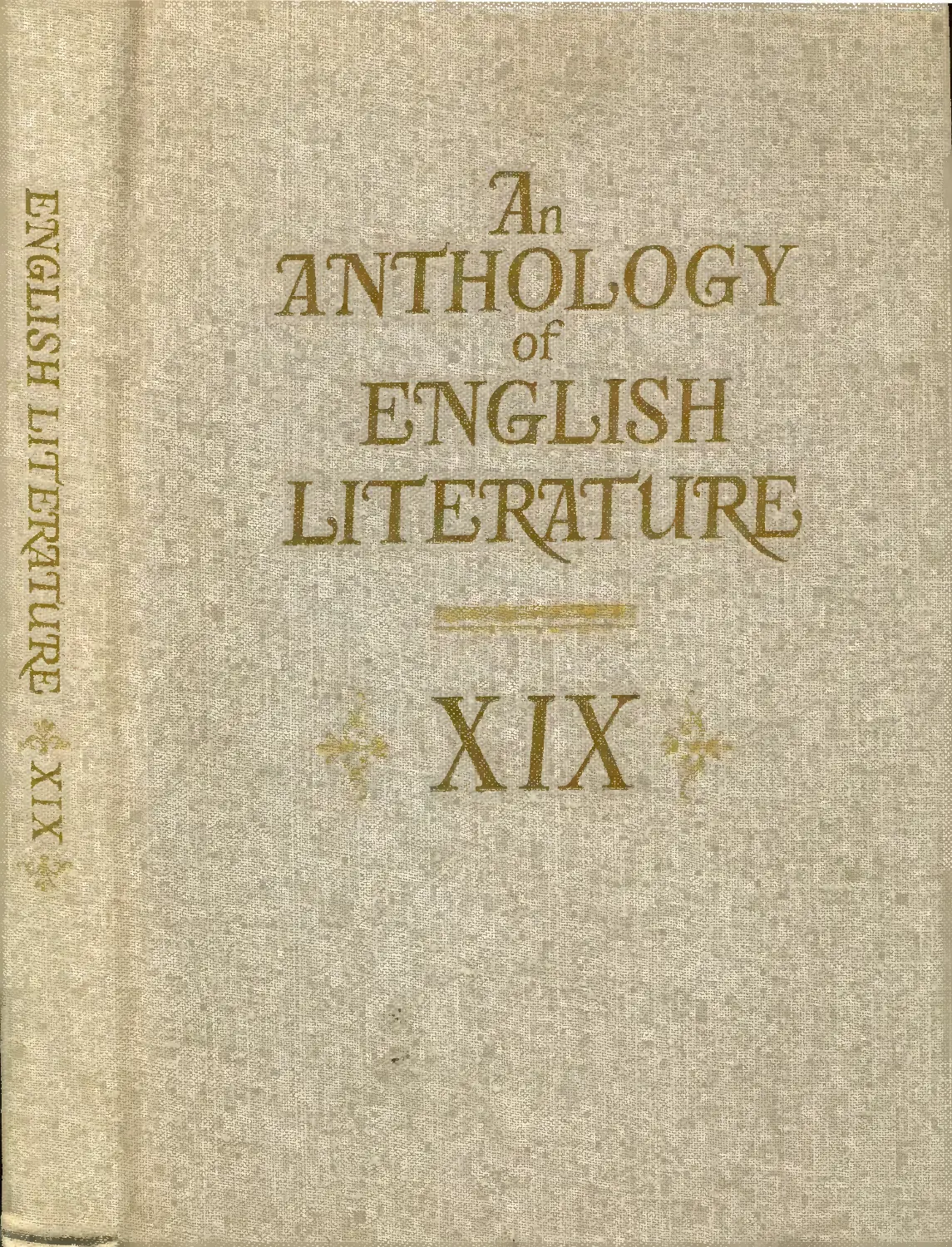
Хрестоматия
              по
английской
 литературе
 XIX
Допущено
Министерством просвещения СССР
в качестве учебного пособия
для студентов педагогических институтов
по специальности № 2103
«Иностранные языки»
Ленинград
«ПРОСВЕЩЕНИЕ»
*J1енинградское отделение
1978

4И(Англ)
Д 93
Дьяконова Н. Я. Амелина Т. А.^
Д9З Хрестоматия по английской литературе XIX века. Учеб.
пособие для студентов пед. ин-тов по специальности
№ 2103 «Иностранные языки». Л., «Просвещение», 1978.
287 с. с ил.
В хрестоматию включены отрывки из произведений английской литературы
XIX в., представляющих различные жанры и иллюстрирующих основные историко-
литературные направления. Аппарат книги состоит из вступительной статьи, био¬
графических справок и историко-литературного комментария.
4И(Англ)
60602-056 48_?8
103(03)—78 	©	Издательство	«Просвещение»,	1978	г.

ENGLISH LITERATURE
IN THE NINETEENTH CENTURY
A Brief Outline
Nineteenth century English literature is remarkable both for high artistic
achievement and ior variety. The greatest literary movement of its earlier period
was that of romanticism. It was born in the atmosphere of the violent economic
and political turmoil that marked the last decades of the 18th and the first decades
of the 19th century. The outburst of political activity brought on by the Great
French Revolution of 1789, the bitter wars with Napoleon’s France that ravaged
Europe for almost 25 years were the dominant political forces at work. The hardships
of the industrial and agrarian revolution whose joint effect was a gradual change of
all aspects of social life in England made the situation rife with class hatred.
Great distress was caused by large landowners enclosing millions of acres of
land for their own purposes and thus dispossessing labourers who were reduced
either to slaving on the fields of their masters or to migrating in search of the means
to support themselves by working 12—14 hours a day for wages notoriously below
subsistence level. The labouring poor, in town and country alike, suffered the utmost
misery from underpayment and overwork and from crowding in hugely overpopulat¬
ed industrial areas.	^
Misery resulted in blind outbreaks against machinery, which, the workers be¬
lieved, did their work leaving themselves to unemployment and their families to slow
starvation. Meanwhile “the rights of labour were not yet recognised, there were no
trade unions ... the majority of country-people could not read or write; the good old
discipline of Father Stick and his children Cat-O’-Nine-Tails, Rope’s End, Strap,
Birch, Ferule, and Cane was wholesomely maintained; landlords, manufacturers
and employers of all kinds did what they pleased witl>their own ... Elections were
carricd by open bribery ... the Church was intolerant, the Universities narrow and
prejudiced.”1^
The situation was not any better when the long wished for peace was at last
ushered in by the victory over Napoleon’s army at Waterloo (1815). Unemployment
became worse than ever after soldiers came home only to find that “the labouring
people were almost all become paupers.”2 This was the way the situation was summed
up by William Cobbett, a democratic writer and publisher renowned for his support,
of people’s rights. After a journey across England he wrote ^vith the simple eloquence
so characteristic of him: “Here are all the means of national power and of indi¬
vidual plenty and happiness ... every object seemed to pronounce an eulogium on the
industry, skill and perseverance of the people. And why then were those people in
a state of such misery and degradation?” 3
Meanwhile the wealthy ruling classes were frightened by what they called the
excesses of the French Revolution and by the growing spirit of discontent at home.
They were ever ready to see rebellion in any attempt of the workers to better their
lot. They invariably voted for a conservative .government at home and supported
all its blundering attempts to suppress revolt: “The leaders of reaction reigned su¬
preme ... filled with dread of the revolution they seemed to think that the only func¬
tion of government was the maintenance of order and the suppression of rebellion.” 4
1	Boas R. P. Social Background of English Literature. Boston, 1937, p. 199.
2	The Autobiography of William Cobbett. London, 1947, p. 140.
3	Ibid., p. 148.
4	Hearnshaw F. J. C. Conservatism in England. London, 1933, p. 177.

This, briefly, was the background of the English romantic movement. Its
principal stimuli were on the one hand.profound dissatisfaction with the atmosphere
of reaction that seemed to have set in for good after the hope and fervour of the
French Revolution was quenched in the blood of wars and numerous uprisings.
The state of things in Europe seemed to mock the theories of the great men of the
Enlightenment who had expected to see a world transformed by reason and common
sense. Thence the romantic distrust of reason, rationalism, emphasis on emotion,
intuition, the instinctive wisdom of the hearf, on nature as opposed to civilisation.
On the other hand, romantic writers were violently stirred by the suffering of
which they were the daily unwilling witnesses. They were anxious to find a way
of redressing the cruel social wrongs and hoped to do so by their writings, by word
or deed. A feature that all romantics had in common was a belief in literature being
a sort of mission to be carried out in the teeth of all difficulties, with the view of
bringing aid or, presumably, salvation to mankind.
In using the term “romantic” no effort is made here to treat all the romantics
of England as belonging to the same literary school. Romanticism is here regarded
as a very complex and certainly far from unified endeavour to give a new answer to
the problems of revolution and reaction, of past history and present-day politics,
of the materialistic philosophy dominant in the age of Enlightenment and the ideal¬
istic trends in early nineteenth century European thought. It is in the nature of
the answer given to all these urgent questions that the romantics differ from each
other. And it is precisely that difference, no less than the points of likeness between
them, that should be given serious consideration.
As distinct from the romantic writers of Germany or of France, their English
contemporaries did not call themselves romanticists, and some of them were at pains
to disprove public opinion calling them so. Nevertheless they all made part of a
movement eloquent of the spirit of the age, with its ingrained sense of incessant
historical change, of the interdependence of man and the Universe, of the world as
ruled by semi-intelligible powers surpassing individual will.
The first English poet to be fully aware of the dilemmas of the age of great
bourgeois revolutions was William Blake. His poetry has been discussed in the first
volume of the present series (An Anthology of English Literature, XVIII) where he
chronologically belongs, but as a forerunner of romanticism in the 19th century
he must also be mentioned here. Blake’s violent revulsion from rationalism, his
repeatedly proclaimed belief in intuition and inspiration as the only paths to true
wisdom, his idealistic and mystic conceptions of humanity and its mysterious ways
were then quite	original. Similar ideas were later taken up	by many poets	who did
not know of his	work, as in his own life-time he published	but one of his	books	of
poetry. The rest of his numerous lyrics and epics never reached the public of his
days. In his portrayal of a gigantic world in the Prophetic Lays Blake precedes the
Byron of Cain and Heaven and Earth, the Shelley oiy Prometheus Unbound.
Though bitterly disappointed in the downfall of the French Revolution, for
reasons that were personal as well as public, Blake never wavered in his devotion
to the cause of freedom, in his hatred of oppression and inequality. In this he dif¬
fered from his younger contemporaries William Wordsworth and Samuel Taylor
Coleridge. Both began as warm admirers of the Revolution, so much so that Words¬
worth even travelled to France to witness the great liberation of mankind. But after
their hopes were baffled .when a rapacious bourgeois clique came to power in 1794,
when the French republic started aggressive wars against its neighbours, both poets
arrived at the conclusion that they had been unwise in expecting any good to come
of political change, in placing too much trust in the capacity of reason to create
a self-sufficient	and well-regulated society of equals.
Both poets	resolved to withdraw from the evils of big	industrial cities and	to
devote themselves to seeking truth and beauty in the quiet of country-life, in the
grandeur and purity of nature, among unsophisticated and uncorrupted country¬
folk. They dreamed of creating art that would be true to the best that is in man
and help to bring it'out by sheer force of poetry. Living in the Lake country
of Northern England they were known as the Lakists.
Together they composed and published a small volume of poems entitled Lyri¬
cal Ballads to which Coleridge contributed the gruesome tale of the Ancient Mariner

and four more lyrics. The bulk of the volume was supplied by Wordsworth. He
called his ballads lyrical, because their interest did not lie in subject-matter and plot
but in mood and treatment, in making one feeling modify and transform all other
feelings and all the persons and events described. That treatment was what Words¬
worth and Coleridge termed imaginative. By imagination they meant the most
essential faculty of a poet, the one that enables him to modify all images, to give
unity to variety and see all things in one.1 “This power ... reveals itself in the balance
or reconcilement of opposite or discordant qualities; of sameness with difference;
of the general with the concrete; the idea with the image; the individual with the
representative; the sense of novelty and freshness with old and familiar .objects;
a more than usual state of emotion with more than usual order...”
Thus the poetic imagination is a power of paramount importance to the creative
artist. It is this power that helps Wordsworth to find beauty and significance in
the simplest things pertaining to nature — in the song of the cuckoo, in the un¬
adorned beauty of an early spring afternoon. In his assertion of man versus society,
of religion versus rationalism, of heart versus intellect, of nature versus civilisation
Wordsworth was a romantic — no less so than Coleridge with his passionate interest
in mystical experience and the supernatural. The latter is, for Coleridge, a symbol
of the complexity of human life, its painful contradictions, its dark and unfathom¬
able aspects. Thus, the tragic Odyssey of the Ancient Mariner, his fantastic adven¬
tures in the seas of everlasting ice and eternal tropics, his encounter with the spec-
treship and miraculous salvation are all symbols of states of mind, of crime, pun¬
ishment and expiation through repentance, prayer and love.
In their later years, after the bulk of their work was done, both poets became
increasingly conservative in their religious and political views and more rigid in
their moral attitudes. The political evolution of the two poets was closely paralleled
by a mutual friend of theirs, Robert Southey. His talent, at its best in simple bal¬
lads, was decidedly inferior to both Wordsworth’s and Coleridge’s. If he is at all
remembered now it is chiefly for his lifelong intimacy with them. As time went on
Southey came to voice the official opinion of the Tory government.
The greatest romantic poet of the elder generation was Walter Scott. Though
personally friendly to the Lakists, he never quite shared their literary tastes and
affinities. The author of a number of stylised imitations of old English and Scottish
ballads and original epic poems dealing with the feudal past of his native Scotland,
it is as a novelist and discoverer of a new province of writing that Walter Scptt
won his world renown. His claim to a high rank among the romantics mainly depends
on his profound sense of history. He was one of the first to realise the dialectical
nature of the relationship between individual and public life, of the interdependence
of great historical characters and popular movements and interests; with unerring
acumen did he trace individual and social psychology, no less than the influence
of social facts and circumstances upon the actions of the rulers and the ruled. His
novels struck the reader (and still do so) with their epic quality, with his analysis
of “the forces that go to make a situation and lead individuals to act $s they do.” 3
“Scott’s romanticism,” Kettle proceeds to say, “lies in his rejection of the 18th cen¬
tury polite tradition and his attempt to write of and for far broader sections of the
people.”4 His art was steeped in folklore, in ancient balladry, in the robust realism
of Fielding and Smollett, in the grandeur of Shakespeare’s historical chronicles.
While drawing largely on a vast store of book-learning and previous literary expe¬
rience he inaugurated a new era in the history of the English novel.
Among the romantic poets of the younger generation Scott preferred Byron.
They were drawn together by mutual admiration, personal and artistic alike, by
their concept of literature as having a straight message to give humanity, and teach
it a moral and political lesson. Like Scott, Byron had a distinct feeling of the move¬
ment of History, of unceasing development, of huge forces shaping human lives.
1	Coleridge S. T. Biographia Literaria. — Complete Works, vol. III. New York.'
1854, p. 202—203.
2	Ibid., p. 374—375.
3 Kettle A. Introduction to the English Novel, vol. I. London, 1951, p. 108.
4 Kettle A. Op. cit., p. 110.

Unlike Scott, however, who shared the Lake poets’ distrust of political reorgani¬
sation of society and their disapproval of revolutionary methods, Byron, though
sometimes sceptical about the results of a future revolution, entertained no doubt
whatever both about the inevitability of revolution and the moral and political
necessity for any man to fight for it to the best of his abilities. He too was disappoint¬
ed in the social aftermath of 1789 but he always realised its liberating effect and
its role in the future of mankind.
Byron’s romanticism was coloured by grief at sight of the corrupting and
debasing influence of reaction and absolute power — and hopes of future regenera¬
tion; by adherence to the ideals of the great men of the age of Reason — and a sense
that their theories were too single-minded, too facile to cope with the tragic con¬
flicts of his own time. Yet never did Byron go so far as the elder poets in his negation
of the theories of the Enlightenment, and only questioned the possibility of putting
them soon into practice. Neither did he agree with the senior romantics’ dispar¬
agement of classicism, one of the leading literary styles of the Age of Enlightenment.
He broke most of its rules, but to the last he proclaimed it as the only path to truth,
virtue and poetical excellence. Classicism was to Byron, along with the ethical
and political concepts of the Enlightenment, an ideal that he vainly endeavoured to
live up to himself and induce others to follow.
Like all the romantics, Byron was very versatile in his literary work. In poetry
he tried every possible genre, most unclassically destroying the proper divisions
and barriers between them. He created lyric and epic poems (shot through and through
with lyrical feeling), dramas, both classical and romantic, political satires, verse
tales, and, in prose, specimens of flaming oratory and fine epistolary art, as in his
letters and journals.
Byron’s hatred of social injustice, of every type of oppression, his indignation
at the suffering inflicted by man upon man, his sense of the conflicting wishes,
interests and passions tearing the world asunder, the intensity of h s satirical gift
along with an ardent belief in self-sacrifice and heroism as the only way to pull
mankind out of all its troubles, the great philosophic questions he raised though never
gave a final answer to, making his reader follow him in his daring search for truth
only to realise the impossibility of elementary dogmatic reading of the world’s
riddles — all this makes of Byron the most forceful embodiment of that spirit of
criticism, doubt and rebellion that characterises the romantic period of literature.
Another great rebel among the .romantifcs was Byron’s friend Shelley. With
him hatred of the abominations of a cruel and selfish class society reaches its climax.
His denunciations of the ruthlessness of employers and the condition^of the English
working class, as for instance in Queen Mab, have an almost modern ring. Like the
other romantics, he was fully aware of the tragedy of the French Revolution, but
like Byron, he devoted his life and poetry to the revolution of the future that would
not repeat the errors of 1789, and would culminate in a triumph of universal glad¬
ness and love.
Shelley was the only romantic to realise that liberty could not be won without
the enthusiasm of the working men of England, and he called upon them to rise against
their oppressors.
Shelley’s outlook was, not unlike Coleridge’s, strongly influenced by contempo¬
rary idealistic thought and by his early assimilation of the philosophy of Plato,
the great idealist of ancient Greece. Idealism was, as Karl Marx pointed out, a natu¬
ral stage in the development of modern philosophy on its way from mechanical,
metaphysical systems created in the 18th century — to dialectical materialism.
Shelley’s idealism was inconsistently blended with materialistic tendencies inherited
from the philosophers of the Enlightenment whom he never ceased to admire. He
wished to assert the predominance and activity of the spirit so as to emphasise the
paramount importance of ideas in the great struggle for the liberation of humanity.
He pinned his hopes on persuasion, education and altruism as the great instruments
of good but advocated the necessity of putting up a fight for the right cause.
Shelley was romantic in his resolute break with literary tradition, in creating
new imagery and rhythms, in drawing the inner world of man as part of the infinity
of the Universe. His poetic style is highly metaphorical, often symbolical, in an
effort to render daring visions of great catastrophes and great victories, of a glo¬

rious future for mankind. The complexity and novelty of his imagery were so much
ahead of his time that he was understood by very few readers. In this he was akin
to his younger contemporary John Keats, whose poetry was a powerful embodiment
of the romantic idea of freedom, love and beauty as opposed to the vulgarity and
prosiness of bourgeois civilisation.
Like Shelley, Keats lived in a poetic world of his own imagination, but though
he hated tyranny and oppression, both of Church and Government, he seldom let
his politics interfere with his poetry. His ambition was to influence men solely by
the power of beauty, not by a direct appeal to their views. Keats’s often repeated
speculations on beauty as the true source of happiness and moral freedom no less
than the subject-matter of his poems dealing with mythological or medieval themes,
his detachment from the burning issues of the day resulted in his poetry being in¬
terpreted as the expression of a kind of aestheticism. It was only about a hundred
years after his death that his work came to be understood as part of the humanitarian
romantic protest against the sordidness of contemporary society, against the shallow¬
ness and triviality of accepted art. “I find there is no worthy pursuit but the idea of
doing some good for the world,” Keats wrote in one of his letters, “there is but one
way for me — the way lies through application, study and thought.” 1 “...I am never
alone without rejoicing that there is such a thing as death.— without placing my
ultimate in the glory of dying for a great human purpose.” 2
Shelley and Keats were not recognised in their own times. They were considered
inferior not only to “Byron and Scott but also to a far lesser post, Thomas Moore,
the author of the musical and intensely emotional Irish Melodies bearing upon the
national misfortunes of oppressed Ireland. In his romantic poems on the East, m
his satirical Fables Moore took up some of the most popular topics of his day. The
easy flow of his verse, his pleasing sentimentality and the vividness of the colouring
he threw on all he described and particularly his musicality charmed the general
reader and won him many admirers.
The prose of English romanticism is to be studied in the works of the essayists
Thomas De Quincey, Charles Lamb, William Hazlitt, Leigh Hunt. While differing
in politics, religion and philosophy, all of them in their various ways contributed
towards the birth and growth of the lyrical romantic essay whose main function was
neither informative nor objectively descriptive but rather a subjective revelation
of the authors’ state of mind, their attitudes and idiosyncrasies. Emotional and
imaginative interpretation of facts (and not facts for their own sake) was the chief pur¬
pose of the romantic essayists. Thomas De Quincey, a warm admirer and close asso¬
ciate of the Lake poets, also wrote his world-famous story Confessions of an English
Opium-Eater which struck the reader by the persistent personal note of its avowal
of weakness, distress and of the triumph of poetical inspiration over the miseries
of actual existence.	"	;
The other essayists formed a more or less close group of friends doing joint
work in publishing and writing for critical and non-conformist literary periodicals.
In their ardent championship of radical political change (thence the term “radicals”
as opposed to the leading parliamentary parties — Tories and Whigs, after 1832 —
Conservatives and Liberals respectively), in their romantic theory of poetry as
defying universally accepted social, ethical and aesthetical standards Lamb, Hazlitt
and Hunt were the immediate allies and, in a way, the mentors and instructors
of John Keats. All of them were stigmatized by Tory reviewers as the Cockney3
school Qf poetry and criticism. It was a broad hint at their “plebeian” origins, at
their literary radicalism scorning the rigid rules of classicism, at the “low” subjects
of their essays on life in London.
1	The Letters of John Keats. Ed. by М. B. Forman. London, New York, 1948,
p. 134; April 24, 1818.
2	Ibid, p. 151; June 10, 1818.
3	A Cockney is strictly speaking anybody living in the heart of London within
the sound of the bells of the St. Mary-le-Bow Church. In a wider sensev a Cockney
is an ignorant, uneducated person speaking with the specific accent оГ lower-class
Londoners. The reviewers applied it to Keats and his friends as a disparaging term,
intimating that they were not “gentlemen” either in life or letters.

The essays of the Cockneys, and those of De Quincey, constituted what the critics
called the “prose form of English romanticism”. At the same time along with the
high flowering of romantic poetry and prose the older traditions of realism were
never discontinued. With George Crabbe in poetry, with Fanny Burney, Maria
Edgeworth and Jane Austen in prose, realism steadfastly stood its ground. Crabbe’s
narrative poems, “the annals of the poor” as he justly called them, gave a memorable
presentation of the degradation of country folk under the stress of want and dreary
hard work.
With the lady-novelists mentioned above literature moved in more fashionable
circles. Of these the art of Jane Austen is the most consummate and therefore repre¬
sentative. Through the very narrow social milieu (land-owners, gentry, country
clergy) that constitutes the theme of her novels, Jane Austen succeeded in bringing-
home the essence of the social relationships of her time. With unfailing accuracy
does she draw a small world possessed by a yearning for money and high social stand¬
ing, and depfived of either wish or capacity for using other criteria in their judge¬
ment over men and women but those of fortune and rank.
With a touch at once delicate and sure Austen introduces a vast variety of char¬
acters whose mentality is more or less distorted by false moral and social standards.
Her irony and humour are omniscient and ever at the service of her keen critical
insight, of her shrewd utterly unsentimental comprehension of the motives under¬
lying the actions and feelings of a vain, selfish and mercenary society. It is the few
persons who are comparatively unscathed by these shallow and ugly motives that
Austen makes her heroines. Almost none of them are just born wise and virtuous.
The most convincing of them are those who like Emma Woodhouse or Anne Elliott
have to pass through a moral ordeal before they find that the only thing that really
matters is the true worth of man and woman, his or her gift for disinterested affec¬
tion, loyalty and generosity. -
Jane Austen’s ethics are high and strict but they are never obtruded upon the
reader. Her methods are mostly indirect. The authorial voice is disguised by objec¬
tive presentation of dialogue, inner monologue (reported speech), as well as of the
characters’ actions and reactions. The “inimitable Jane” is warmly admired and
much studied in twentieth century England and America.
Although Austen stands aloof from the romantic trends of her own time and
mocks some of their more obvious and salient characteristics, although she is a fol¬
lower of 18th century realistic traditions, yet her artistic detachment and her dis¬
passionate survey of her contemporaries could only have been born out of the same
critical and humanitarian spirit and the same historicism that gave birth to the
romantic movement.
A sort of reduced and imitative romanticism is to be detected in the work of
Edward Bulwer Lytton. He modelled his early works on Byron’s and Scott’s and
later on the realistic novels of the ’forties and ’fifties. Hardly ever original, Bulwer
Lytton was a true and refined mirror of succeeding literary and philosophical
fashions.
Towards the end of the 1820’s the conclusion of the industrial revolution along
with its natural implications — the rise of a powerful manufacturing and trading
class and at the same time the radical agitation for political change — culminated
in the Parliamentary reform of 1832. It was carried in the teeth of a stout opposi¬
tion on the part of the Tory party. Its effect was a far better representation of the
middle class in Parliament. The lower classes, however, were still kept out of Par¬
liament by a high property qualification for members.
The political victory of the bourgeoisie brought no relief to the working class
and eventually considerably weakened its condition. Newly gained political power
enabled employers to introduce new methods of exploitation. Thus, with a view of
enlarging the number of workers at mills and factories and reducing the number
of the poor who obtained relief within their parishes and were under no immediate
necessity to sell their labour to mill-owners new Poor Laws were passed by Parlia- .
ment. According to these relief was granted to the poor only in special workhouses
where they were subjected to harsh treatment, practically little better than in
prison, and were made to work for their food.
The disappointment of the working class in reform, and acute social distress

led to the organised movement known under the name of Chartism. The oppressed
classes demanded a further and more democratic reform of Parliament. They enter¬
tained the hope that adequately represented, they could radically improve their
own condition. Chartist agitation, mass meetings, strikes and uprisings went on,
intermittently, for more than ten years, from the later thirties all through the “hungry
forties”.
The movement subsided after an improvement in economic condition and
after the English bourgeoisie wisely decided to avoid revolution by conceding the
most urgent demands of the Chartists.
Chartism had important literary results in the development of popular poetry.
Not only did the Chartists revive the revolutionary poems of Byron and Shelley
(whose Song to the Men of England became a Chartist marching*song) but within
a short time a new poetry sprang up voicing the aspiration of those who had as yet
not succeeded in making themselves heard. Besides a considerable amount of anony¬
mous songs and poems, there were poets of distinction among the organised fighters
for workers’ rights. Of these Gerald Massey, Thomas Cooper, William James Linton
and especially Ernest Jones probably ranked highest. A militant spirit of resistance,
sarcasm and irony, pathos and rhetorics, strong rhythms and sonorous rhymes go
together to give the Chartist poetry a peculiar vigour. The Chartists also wrote a few
good novels (Ernest Jones, Thomas Martin Wheeler) and published some literary
criticism devoted to those they looked upon as the early prophets of revolution.
The work of Chartist poets was deliberately neglected by bourgeois scholars; the
Chartist periodicals (e. g., The Northern Star) wherein most of that work was pub¬
lished have long been out of print and have been properly studied only in this
country.
The Chartists’ passionate concern for the cause of the suffering English people
inspired poets who were not in any direct way associated with Chartism. Elizabeth
Barrett Browning’s much anthologized Cry of Children, Thomas Hood’s no less
famous Song of the Shirt and The Bridge of Sighs plead for human kindness and
altruism, for sympathy with the hardships of the poor.
It was in the period of political strife, when social problems came to the fore
and revealed their prosaic, material nature, that new trends were born in literature.
Preoccupation with public life, a sense of the paramount importance of things social,
of the necessity of looking into the way things are and to describe them faithfully
so as to redress or at least palliate the evils of a cruel industrial system were the
forces that stimulated the growth of realism. Romanticism now seemed too abstract,
too aloof, too much relying upon symbolic or fantastic presentation of a'ctuality.
It had done its work and played its role; the time had come when the mysterious
powers ruling the new era that the romantics had anticipated stood much more clearly
revealed. A direct and straightforward consideration of everyday life became an
imperative necessity. At first realistic prose took the shape of short essays, more
objective, informative and descriptive than the romantic essay had been, and yet
certainly bearing some affinities with it. Nor was this the only debt mid-nineteenth
century realism owed to its romantic predecessors. Without their shattering social
criticism (even if couched in somewhat abstract terms and imagery), without
their repudiation of classicist regulations of literature, without their minute atten¬
tion to the individual and particular, without their psychological discoveries and
insight into the inner life of man, realism could not have come into being.
The greatest realist of England Charles Dickens certainly learned much from
romantic writers. In his early essays the influence of the London essays of Charles
Lamb and Leigh Hunt can easily be traced, though Dickens is more true to the
typical detail, to social fact, to objective observation of the habits and customs of
the poor inhabitants of Europe’s richest capital.
In each of his earlier novels written in the ’thirties Dickens devoted his efforts
to striking at some obvious social evil and helping to remove it. In the Pickwick
Papers, e. g., he laughed to scorn the clumsy comedy of Parliamentary elections,
of the English court of law and the iniquities of London’s prisons (a subject he was
later to take up on a much wider scale in Bleak House). In Oliver Twist he treated
the burning issues of the day — the horrors of workhouses and of crime; in Nicholas
Nickleby —- the conditions of Yorkshire boarding schools, etc.

In these early novels it is plain that Dickens was yet quite hopeful about the
future of his counjtry and confidently looked forward to happier days. The wrongs
he stigmatized are but episodes in his novels and do not become central in their
plotting. The ’forties were a sort of transitional period in his career. Towards the
end he emerged as a mature artist with such fine generalisations of the mental atti¬
tudes of the bourgeois as in Dombey and Son and in the partly autobiographical
David Copperfield.
Dickens’s greatest masterpieces, the sad and wise novels of the ’fifties, differed
from his earlier ventures in scope and structure.
In Little Dorrit and in Bleak House the novelist’s satire rises above the par¬
ticular and incidental and is transformed into a sweeping indictment of the whole
system, of the very foundations English society rests upon. In Bleak House the English
law is no longer an episode as in the Pickwick Papers but dominates the whole struc¬
ture of the epic; so does the criticism of government in Little Dorrit when compared
with similar pieces of criticism in the earlier novels. Social satire does not exist
apart from the plot (as, say, in Oliver Twist) but permeates the whole atmosphere
of the novel, shapes the plot and the relationship between the characters, major and
minor alike. A sense of tragic unity underlies the vast concept of these books. But by
the end of the ’fifties Dickens’s inspiration had very nearly exhausted itself. Despite
some very fine pages of description and character-drawing his last novels lack the
rich humour and fancy of his earlier works.
Dickens is not remarkable for circumstantial motivation of his heroes’ actions.
But he excels in the art of catching their more obvious social characteristics and
giving them an infinite variety of individual shapes and forms that were joyously
acclaimed as recognisable and memorable types. To the end of his days Dickens
liked no literary compliments better than that or the other reader’s admission he
or she had known somebody who was the spit of one of the novelist’s characters.
Through grotesque and comical exaggeration the fundamental realism of Dick¬
ens’s viewpoint was everywhere apparent. The author’s own attitude stands
clearly revealed. He hates every, species of oppression and injustice, every vestige
of fraudulent misrepresentation and hypocrisy, every sight of man’s cruelty to
man, and loves all who suffer and still’do not lose heart and^keep on doing their
best by all around them. Dickens’s love of humanity and his penetrative portrayal
of what is best and noblest about it, no less than of its foibles, his persistent champion¬
ship of the inherent goodness of common man ever opposed to the stiffness and class
egoism of the higher classes make him a central figure in the democratic literature
of England.
His stature can be properly appreciated when his work is compared to that
of such minor writers as Charles Kingsley, the author of popular novels on the con¬
dition and dramatic struggle of the Chartist workers (Yeast, Alton Locke). Dickens’s
works contain a wider view of man and his problems, a broader and more humane
qptlook and the art of hitting off types that alternately set all England laughing
and sobbing. He also compares well with his'friend Wilkie Collins, the author of
famous semi-detective, semi-social novels such as The Woman in White, No Name,
The Moonstone, etc. Though Dickens, too, introduced elements of the detective
story into his later work he always submitted the suspense and thrill of the plot to
the message of his novel. With Collins specific detective interest often came first.
Dickens’s closest follower and admirer was Elizabeth Gaskell. In his turn he
was delighted with her books and published them in the literary magazines that he
directed. Mary Barton, a simple and artless story of the misery and stout resistance
of English Chartist workers appealed to Dickens both for its strict veracity and for
its sentimental and idealistic sermon of love as the only remedy in a society endan¬
gered by the cancer of economic egoism and cynical indifference. Quite different
in style and treatment is the gay comedy of provincial life in the country-town of
Cranford. Gaskell’s humour is delicate, sensitive, and gently ridicules the petty
snobbery and prejudices of superannuated middle-class ladies. Her latest books deal
with serious problems of domestic life and are fine studies of the mentality of women.
Mrs, Gaskell is also the author of a subtle biography of three lady-writers of
her own time, the sisters Charlotte, Emily, anchAnne Вго^ё, all of whom died of
consumption when still young. Anne was the least remarkable of the three; Char¬
— 10 —

lotte won the greatest recognition, but it was Emily whose talent both for poetry
and prose was the most powerful and original. Her only novel Wuthering Heights
was published posthumously and is an extraordinary blend of Byronic romantic
individualism and realistic motivation. The tragedy of two lovers torn asunder by
difference in pecuniary and social standing and complicated by ambition and vanity
is drawn against a perfectly real world of sordid poverty and greed. The withering
influence of trampled love distorts the characters both of hero and heroine, turning
the one into a demonic sadist and the other into a capricious spoiled woman. The
drama of love and death gains in intensity by being rendered through the eyes of
a casual observer and a minor character, — an old servant, only indirectly partici¬
pating in the events she narrates. The bleak colouring of the story is height¬
ened by the natural background — vast moors, wind-blown hills and stone-grey
skies/ A note of' mysticism also rings in the novel, indicative of Emily Вго^ё’э
religious feeling and her interest in the irrational aspects of life.
Emily died at the age of thirty, and Charlotte survived her but Jor a few years.
Her art had more obvious ties with ordinary life and easier reached the audience —
and a wider one, at that. The most popular by far was Jane Eyre, the story of a poor
governess who by sheer force of personality won a decisive victory in the fierce battle
she had to fight for love and happiness. The dark Byronic nature of Jane’s “demon
lover”, the gruesome mystery of^his house, the final catastrophe are all depicted in
the stark melodramatic tones peculiar to the late. 18th century Gothic novel. But
borrowed romantic and preromantic motifs are developed along with entirely origi¬
nal realistic delineation of the radical injustice of a life dominated by all that
is not essential, as money and high connections, and leaving out and crushing all that
is fundamental — true moral worth, loyalty and intellect.
Вго^ё’в horror-struck realisation of the inhumanity of the relationship between
employers and employed appears to the greatest advantage in Shirley where scenes
introducing starving workers who break the machinery that threatens to supplant
their labour mingle with a fine social and psychological analysis of the plight of •
women in a men-ruled world. In all of Charlotte Вго^ё’з novels there is'a note of
true, unconventional passion (and a penetrative analysis of that passion) that shocked
the hypocritical morality of the Victorian bourgeoisie (“Victorian” was a much
used — and abused — term denoting the self-satisfied priggish and smug mentality
of the upper and middle classes during the greater part of the reign of Queen Victo¬
ria — 1837—1901).
Charlotte Вго^ё was in some ways a disciple of Dickens’s greatest rival, Wil¬
liam Makepeace Thackeray. He set out courageously to teach the English a harsh
lesson in self-appraisal. He let them see themselves with severely critical eyes, and
not through the rose-coloured glasses of complacency. A parallel has often been
drawn between Dickens and Thackeray, sometimes to the advantage of the 'one,
sometimes of the other. They are, indeed, very different in outlook and artistic
method, in education and background.
The essential thing they have in common, however, is their fundamental
honesty in carrying out what they conceive to be their moral obligation towards
their fellow-men. They both saw themselves as in duty bound to tell their readers
the unpalatable truth about the social wrongs wringing the body of society, about
its narrow and shallow standards, about the hypocritical greed and ruthlessness
•of the higher classes. Thackeray mostly used the weapon of sharp irony; in describ¬
ing the vices of the very high he hardly ever had recourse to Dickens’s grotesque
exaggeration, to his humourous presentation of variously coloured and comically
individualised figures. Thackeray was an excellent caricaturist (he illustrated some
of his own works), but his caricatures are less particularised and" more generalised
than Dickens’s. The latter was obviously quite judicious in rejecting Thackeray’s
offer to supply pictures to the Pickwick Papers — their ways were too different.
This was distinctly felt by both writers. Thackeray thought that Dickens was too
much given to melodrama and pathos, that his characters were too often angels or
devils, with very few links between them. Thackeray’s literary apprenticeship
was as long and painstaking as Dickens’s had been short and brilliant. Like Dickens,
he went to school to eighteenth century masters, especially Fielding (Dickens’s
favourite was Smollett), but unlike Dickens, he was also influenced by European
— 11 —

writers. Balzac’s Human Comedy, in particular, taught him the device of introduc¬
ing the same characters in different novels and thus giving them time for growth
and development.
Of Thackeray’s earlier work the most important was, probably, a collection of
sketches entitled The Book of Snobs. He derived the word “snob” from studentsr
slang and it is through him that it acquired first a national and then an internation¬
al significance. Thackeray’s definition of it was that “a snob is one who meanly
looks up to things mean”. A snob fawns upon his social superiors and is contemptu¬
ously haughty to inferiors. A snob, finally, is one who has no criteria to judge
of others but the degree of their wealth and rank. Having classified the snobs of
England according to their profession and social standing, having made it clear
that at court, church, shops, universities and in the walks of art snobs were ever
essentially the same, Thackeray was ready .to write his greatest work Vanity Fair.
The title was an allusion, quite familiar in those days, to the city of London which
had been described as Vanity Fair in the famous 17th century religious allegory of
John Bunyan (The Pilgrim's Progress, 1678).1 By referring thus to the heart of
England Thackeray also played on the inevitable association with the book of the
Bible called Ecclesiastes whose memorable and often reiterated words are: All is
vanity, sayeth the Preacher.
The novel follows the fates of two middle-class girls. One of them, Amelia Sedley,
the daughter of a wealthy merchant, goes down in the world as her father is ruined
in the course of the French wars. By the end of the book she is restored to respecta¬
bility by a second marriage and a timely legacy. The other, Rebecca or Becky Sharp,
is a clever adventuress, a genteel 19th century Moll Flanders. The ups and downs
of her career and final defeat are handled with ironical scorn, lashing not so much
at Becky’s tireless ruses and stratagems as at the society that encourages her and
makes it possible for her to win many victories before she has to accept her downfall.
With Thackeray neither of the two heroines is painted in black and white. He has
a sort of amused sympathy with the vicissitudes of Becky’s life and much pity and
little respect for Amelia’s sentimental silliness.
His main subject is the false heartless ways and the resourceful hypocrisy of
society, the silent misery of simple souls. Thackeray satirises the victims of inequal¬
ity and snobbishness. The story of a gifted young man very nearly corrupted by
the world of fashion and saved at the eleventh hour from disgrace and crime is told
in The History of Pendennis. Its sequel The Newcomes, a chronicle of a few generations
of a rich upper middle-class family, is narrated by a sadder and wiser Pendennis,
now firm on the path of virtue, authorship and domestic felicity. Thackeray’s his¬
torical novels, particularly Henry Esmond where the action is laid at the end of the
17th and the beginning of the 18th century, are realistic books that do not treat
history as the story of kings, generals and courtiers but as the history of a whole
people, with an eye to culture, literature, morality and general condition of the
nation. Wars are not described as glamorous, heroic and worthy of enthusiastic
admiration. They are drawn in all the ugliness of hatred, of atrocities inflicted in
cold blood and resulting in unheard-of suffering for thousands upon thousands of
innocent people. Thackeray, distinctly says he cares nothing for big wigs, but only
for the small fry. A historical novel, he maintained, should content itself with find¬
ing out how great events affect ordinary people (in Vanity Fair, too, he had described
the battle of Waterloo only in so far as it wrecked the life of his heroine).
The staunch realism of Dickens and Thackeray, of Gaskell and the Вгогйё
sisters did a great deal to explain their times and to explode the myth of Victorian
prosperity that bourgeois historians like Т. B. Macaulay had done their best to per¬
petuate.
By the ’fifties and ’sixties the worst period in the evolution of classical capi¬
talism in England was over. This is not to say, however, that progress was as uni¬
versal as official opinion had it. The condition of the w6rking-men was still pre¬
carious, a hand-to-mouth existence being the lot of the majority, with only the
1 The Russian translation „Ярмарка тщеславия** is incorrect. It ought really
to be „Ярмарка суеты**, but tradition is not easily broken, and after all, why should
it be?
— 12 —

minority of qualified workers finding themselves comparatively well off. Two more
parliamentary reforms were needed before the labouring classes were at all represented
in the House of Commons. English industry and trade and English finance were the
most powerful in the world and the bourgeoisie was cautious enough to see to it
that the economic status of those who made them rich should not sink to the star¬
vation wages of the 1840’s. But the disproportion between the situation of the classes
was more glaring than ever. It was in the ’fifties that Dickens wrote the books that
were most seriously critical of the whole order of things: it was in the ’fifties that
scientists and scholars began to question religious dogmas and ready-made ethical
formulae. The rapid development of natural sciences (geology, biology, embryology,
psychology), Darwin’s epoch-making Origin of Species undermined the current be¬
liefs and paved the ground to scepticism and non-conformism. The advanced men
of the ’60’s and ’70’s called themselves free-thinkers. They rebelled against the
narrow bourgeois ideology, they mocked the new spirit of militant national pride
growing along with England’s colonial expansion, they were full of concern for a new
and efficient rationalisation of public and private life.
In philosophy they supported rather mechanistic materialistic ideas; they drew
crude parallels between biological and social processes; they preached a new moral¬
ity whose foundation no longer was religious but utilitarian, i. e. the concept of
“the greatest happiness for the greatest number of people”. (This concept Vas, how¬
ever, given an entirely bourgeois interpretation, since the “greatest happiness” implied
uninterrupted development of capitalist production.) The most important ideologist
of this new trend was Herbert Spencer. He endeavoured to create an all-embracing
system of sociology, philosophy and psychology and to take care that it should rest
only on positive knowledge and facts and disregard all abstract speculation (Posi¬
tivism is the name frequently given to that school of thought — a term borrowed
from the French philosophy of Auguste Comte who exercised a great influence on
his later English colleagues).
Positivist ways of thinking left a profound impression on the work of George
Eliot. A lady of great learning, she was deeply read in European philosophy and
in the latest critical writings. She early stood up against orthodox religiosity. She
admired and translated Feuerbach, was friendly with Herbert Spencer and other
scholars and scientists of his group. On the one hand, positive philosophy was of
some use in giving theoretical support to Eliot’s notions both of society and of its
ideas; on the other hand, it narrowed her vision and scope and frequently led to the
writer’s incorporating her doctrines in novels, generally to the latters’ detriment.
George Eliot was a social novelist and one who took her duties to her readers
seriously. She lacked Dickens’s sense of the dramatic contrast between rich and
poor, she was rather inclined to accept them in a positivist spirit, as something that
should be taken for granted and only subjected to cautious reform. There is no defi¬
ance, no open rebellion in her books. And yet their true and honest tale of the drab
monotony and injustice of life, of the daily crime of indifference of man to man is
in its way enough to make her readers realise a great many things they had pre¬
viously left unnoticed.
In writing, as Eliot rrtostly did, about humble country folk, and setting them
far higher than their “elders and betters”, the novelist added her mite towards edu¬
cating public opinion and securing the democratic rights of those she glorified in
her books, as Adam Bede, the joiner, or Silas Marner, the weaver (Dickens himself,
fine as his popular characters were, did not cat! his novels Samuel Weller or Mark
Tapley, but the Pickwick Papers and Martin Chuzzlewit. Whatever he -did, the hero
had to be a gentleman).
Eliot’s best known novel is The Mill on the Floss. Largely autobiographical,
it is a searching analysis of the heroine’s inner life, of the forces that joined to make
her an outcast in the petty-bourgeois community she belonged to. The novelist’s
portrayal of the selfishness and callousness of self-satisfied mediocrity has a lasting
value. This is also true of George Eliot’s most ambitious book Middlemarch — 4
a bold endeavour of taking the whole of a typical English provincial town for her
subject and depicting its representative figures so as to achieve a sort of a cross-
section of the most important elements of the prevalent social psychology, of the
influence of environment and heredity on the shaping of the individual mind. The
— 13 —

political problems of England are treated in Felix Holt the Radical, an early specimen
of what later in the 20th century came to be called “a novel of ideas”. In some of
Eliot’s novels (partly even in The Mill on the Floss) the discussion of intellectual
problems and the too obvious embodiment of abstract ideas into characters proves
detrimental to art and testifies to the unwholesome influence of preconceived phi¬
losophical notions.
This criticism also applies to the work of George Meredith, a poet and novelist
whose books marked an important stage in the development of the psychological
novel in the late 19th century. His art is complex, being an imperfect blend of
subtle psychologism shot through and through by the critical and scientific tend¬
encies of the period and of a somewhat laboured and over-ornamented impressionism
in style and language. A consistent upholder of evolution as the central law domi¬
nating nature no less than society, Meredith regarded the destiny of man as follow¬
ing and illustrating universal laws. His first novel of importance, The Ordeal of
Rickard Feverel, considers life as a painful process of gradual maturing of intellect
and emotion, the hero’s natural development being thwarted by the artificial and
snobbish system of education introduced by his aristocratic father. Interference
with natural law has disastrous consequences for the life and happiness of Richard
and those he holds dear. The prejudices and narrow-minded arrogance of the privi¬
leged is ironically laid bare in Meredith’s best known novel The Egoist/ A scienti¬
fically refined psychological interpretation of Sir Willoughby Patterne’s feelings
exposes to ridicule and scorn his upper class belief in his own impeccability and
in the absolute moral value of his own judgement. The contrast between the immen¬
sity of pretension and the actual lack of anything to justify it is at once comical
and instructive.
By making the egoist Willoughby undergo a humiliating defeat at the hands
of an inexperienced girl, strong-minded enough to defend the right to dispose of her
own self in love and marriage, Meredith mocks the oveiweening pride of the upper
class and lets the reader see it in its true proportions. A radical in his political views,
he traced with warm sympathy the thorny progress of a rebel against a false and
hollow society in Beauchamp's Career.
Meredith’s over-elaborate and sometimes wayward style with his resolute pre¬
ference for the rarely used word and quaint metaphor made it next to impossible for
him to please the general reader. Subsequent generations have, so far, not reversed
the judgment of the writer’s own contemporaries. The somewhat heavy intellectu¬
ality, the abstract philosophising Meredith often indulges in demanding a strain and
an effort on the readers’ part that only the literary minority are prepared to make.
The tnajority decidedly preferred to skip the pages of Wilkie Collins’s sensational
thrillers and Anthony Trollope’s circumstantial comfortable tales of provincial life'
with commonplace people doing commonplace things and arriving at a timely happy
end. Trollope’s were the most gifted and true-to-life of numerous Victorian best¬
sellers.
The greatest contributor to the literature whose principal purpose was to divert
and amuse the reader was Arthur Conan Doyle. His stories of the adventures of the
master detectiye Sherlock Holmes fascinated England, and the name of the hero
became a household word.
Meanwhile the more serious literary work of the period was affected by modern
schools of thought. The ideas of positive philosophy also found their way into poetry
where, however, they curiously and variously combined with elements of the romantic
tradition, never quite extinct in England until the close of the century. In this
sense the art of Tennyson can be called transitional, in its endeavour to blend ro¬
mantic soaring above the commonplace and a romantic treatment of the common¬
place — with problems strictly belonging to the epoch and necessarily touched with
its prose. In his first poetical ventures Tennyson excells in word-painting, in melody
and euphony. His themes are frequently borrowed from an idealised past (compris¬
ing medieval England and classical antiquity), and from present-day scenes. In his
poem The Princess, for example, a fantastic setiing is used to inculcate modern ideas
of female emancipation and learning.
Tennyson is at his best in lyrical poetry, ever fresh with spontaneous feeling,
with admiration and understanding of everything that is lovely in the life of nature
— 14 —

and the heart. Unfortunately, Tennyson early began to entertain the belief that his
was the task of teaching his own generation, and those to follow, a new outlook,
a new lesson of morality, and the didactic'purpose he set to himself, mostly rather
specifically Victorian, took a great deal away from the immediate charm of his
lyrical impulse. Thus, the beautiful lyrics collected in In Memoriam are rather
heavily overlaid with platitudes of modern moral philosophy. In the poem of Maud
there is an abrupt, poetically and logically uncalled for transition from a violent
curse of the modern Money-God, from glorification of true love as the only thing
untainted in a wbrld of vulgar material interests — on to jubilant praise of war and
conquest in the final section of the poem.
In Tennyson’s Idylls of the King the romance of the Middle Ages centered upon
the legendary King Arthur and his Round Table is packed till bursting point with
purely modern moralising, with intellectual problems peculiarly midnineteenth
century. It has been aptly remarked by one of the contemporary reviewers that to
associate these with the life of a rude age produces the same effect as to combine
a man’s head, a horse’s neck, a woman’s body, and a fish’s tail. King Arthur is
less of a true knight than a modern gentleman whose wildest deeds of daring are done
on the Exchange and whose most deadly quarrels are settled in the Court of Queen’s
Bench.
Tennyson’s musical and pictorial art is sufficient for lyrics, most remembered
for imaginative symbolic descriptions of states of mind, aad sometimes also for his
popular idylls — studies of simple hearts in the Wordsworthian tradition, — but
it hardly ever sees him through his longer poems necessitating a wider and more
philosophical thinking.
Tennyson’s importance for the poetry of his age was, for most of later 19th and 20th
century critics, eclipsed by that of Browning. Endowed with a robust intellect and
a solid education he was abreast of the advanced liberal thought of his time. His
interest in moral and political problems, in the freedom of peoples and individuals,
in passions and ideas characteristic of past and present lent a bright open-eyed
vitality as well as a breadth and depth to his artistic vision that Tennyson manifestly
lacks. While certainly not a rebel from the main body of Victorian beliefs Browning
questioned enough of their assumptions to hold an individualistic attitude that
proved his intellectual courage.
From modern biological theories Browning drew knowledge that helped him to
attempt a detailed psychological motivation of his characters’ emotions. From this
point of view two of his greater works are of the keenest interest. One is his early
dramatic poem of Paracelsus, a 17th century Faust, bent on discovering the secret
spring of all knowledge and becoming a benefactor of mankind. The other is one
of his final achievements, the poem of The Ring and the Book. The same event, the
dastardly murder of a 17-year-old woman by her highly connected husband is the
subject of twelve Jong narratives, analysing the complex motives and reactions
of all the participants, witnesses, and judges of the drama. Browning’s most memo¬
rable contribution is probably his dramatic lyrics,' a large number of various mono¬
logues that the poet puts on the lips of characteis belonging each to a different epoch,
country, class, culture, religion. The art of speaking for an astounding variety of
dramatic characters and making their speech sound psychologically true, has won
universal admiration. Browning’s style struck the readers with its vigorous inde¬
pendence of all set models and the rich complexity of vocabulary and imagery.
While criticising his age from the standpoint of humane and democratic ideals,
Browning nevertheless was a man of his own time and shared its social optimism.
Towards the mid-seventies and more markedly so towards the ’eighties a crisis
of Victorian England began to make itself felt. There were the first warning symptoms
of decay in English economics; there was a general move towards political reaction;
a wave of chauvinistic imperialism rose high; British colonial power was greater
than ever, Queen Victoria was proclaimed empress of India, and the grandeur of
the British Empire became the key-phrase to official ideology. At the same time
a steady resistance to the nationalistic and aggressive policy of the ruling classes
rapidly gained in scope and intensity. That resistance was stimulated by the noncon¬
formist free thought of the previous period and by pessimistic trends of “fin de siecle”
philosophic systems, such as that of the German scholar Schopenhauer. He had
— 15 — v

written his famous and controversial book The World as Will and Idea as early as 1819
but it only became important by the end of the century.
The beginning of the crisis of Victorianism, of the decay of the English country¬
side is reflected in the bleakly pessimistic novels of Thomas Hardy. The narrow
village-world he depicts acts as a sort of microcosm through which an insight is
obtained into the deepening gloom of the century’s last decades.
Hardy’s first book of indisputable artistic worth is The Return of the Native
where, like Eliot in Middlemarch, he introduces a kind of collective hero in Egdon
Heath, a small out of the way place inhabited by poor wood-cutters and poorer
farmers. According to Hardy, it is precisely among common villagers devoting
themselves to a severe struggle for existence that genuine and spontaneous passions
still live, as distinct from the artificial sophistications that pass for feeling among
city ladies and gentlemen. It is in these God-forsaken villages,. Hardy claims, that
dramas of truly Sophoclean grandeur are enacted.
Clashes of wills, beliefs, personalities, dramas of love and death form the subject-
matter of most of Hardy’s novels. Those of his characters that adapt themselves
well to their surroundings/that become part of their nature and scenery mostly do
well and make good; those that rebel against them in one way or another are gener¬
ally destroyed or made hopelessly miserable. Sometimes these rebels, these unclassed
ones who attempt to rise above their own sphere succeed in ruining those who
under any other circumstances were made for a simple and healthy life, a life full
of such work as is consistent with nature’s ways and benefit. This is what occurs
- in Woodlanders where the lives of such true children of nature as Giles Winterbourne
and Mar they South are wrecked by weaklings who have severed their ties with
their native land.
In the novels Hardy wrote in his later years (Tess of the d' Urbervilles and Jude
the Obscure) his favourite characters fight a losing battle against the cruel social
law that is ever ready to do down those who by birth and education do not belong
to the privileged classes. The inhumanity of society causes the tragic death of
Hardy’s most attractive heroine Tess; Jude is thoroughly beaten in his quest for
inner freedom, for knowledge, for unconventional love. “Happiness,” Hardy sadly
remarked, “is but an episode in the general drama of pain.” In his novels Hardy
also displayed some affinities with the scientific thought of his time — ideas of
evolution, of biological necessity and struggle for existence go together with some¬
what mystical notions of fate blindly ruling the destiny of men and women and
often taking the shape of tragic irony.
After the hue and cry raised by critics and official opinion about the dreary
pessimism of Jude the Obscure Hardy gave up novels and devoted himself to poetry
which he had been steadily writing since his youth but hardly ever publishing. It
varies much in nature and form, including philosophical lyrics, popular ballads
and songs.
Hardy’s poetry has certain parallels with that of James Thomson, a philosoph¬
ical poet in violent revolt against Victorian moral and religious assumptions.
His symbolic poem The City of Dreadful Night is a ghastly vision of contemporary
s London and the “life-in-death” existence of its inhabitants.
The stark pessimism of the last decades was strongest in the works of George
Gissing. He emphasised his wish to go on where Dickens had left off. “I mean to
bring home to people the ghastly condition (material, mental, and moral) of our
poor classes, to show the hideous injustice of our whole system of society, to give
light on the plan of altering it...” In his first novel Workers in the Dawn Gissing
may be said to have stuck to this program, for he exposed the sordid realities under¬
lying capitalist civilisation and discussed social reform. But quite early in his
career he gave up all idea of altering the world. He became increasingly hostile to
socialism and to the working class (Demos). Gissing’s descriptions are naturalistic
and convey a feeling of deadly disgust with all aspects of physical degradation.
He never succeeds in creating convincing flesh and blood characters of “low” life
and hardly ever rises to see their essential humanity.
On the whole, English naturalism as represented by Gissing, Arthur Morrison
and, paftly, George Moore was derivative. It is easily traced to French influence,
and it never assumed the stature and the originality it had in France. This is not
— 16 —

to say that it had no raison d'etre in England where it was stimulated by the great
progress of science and consequent desire to explore the interdependence of physi¬
ology, psychology and sociology, to give a scientific explanation of man and society.
If the novel was an immediate answer to the relentless demands of time, the
answer given by poetry was more complex and indirect. Part of it seemed utterly
divorced from the problems of the age. In 1848 Dante Gabriel Rossetti, Holman Hunt
and John Millais organised an exhibition of their pictures, all of them signed with
the letters P. R. B. — which stood for Pre-Raphaelite Brotherhood. This implied
that the artists were of the opinion that the decay of art had started ever since
Raphael, who, they proclaimed, had already been formal and uninspired. They
called' for a return to early Italian Pre-Raphaelite art (Botticelli) where religious
inspiration had led to true and pure beauty. They lovingly painted pictures on
religious subjects and on subjects borrowed from romantic poets, as for example,
Keats. Their criticism of the soulless mechanical modernity assumed a purely aesthetic
form; it deliberately refused to seek for universal acception and appealed to a small
and sophisticated nupority.
Nevertheless, whatever the limitations of the creed of the Pre-Raphaelites,
their pictures and poetry were a protest against the prosperous bourgeois and against
the emptiness of official academic art. It was this protest that the well-known critic
and writer John Ruskin welcomed in his famous pamphlet Pre-Raphaelitism. He
praised the young painters for their earnestness of purpose, for their lofty perception
of the artist’s message to his public. Yet his own concepts were much more profound
and radical. In studying art Ruskin came to the bitter conclusion that its mission
could not be fulfilled unless it helped to make life more beautiful. Now in an age of
industrial capitalism with all the inevitable hideousness it brings in its wake art
proved incapable of carrying out its main function, because most people were too miser¬
able and too uneducated to enjoy it. Therefore it is the business of the artist not
only to create beauty but to enable common people to feel that beauty. This is how
Ruskin came to think of the artist’s duty in social terms. He preached his sermon
of love and mutual kindness to both higher and lower classes, naively entreating
them to fight the evils of capitalism together.
These ideas of Ruskin’s were also largely influenced by his senior contemporary
Thomas Carlyle, writer, historian and essayist, one of the first to utter a sweeping
denunciation of the victorious English bourgeoisie. Carlyle, according to Marx,
was strong inf his hatred of capitalism and in his understanding of all the suffering
it stood for but wrong-headed in his apotheosis of medieval old times as an ever¬
lasting model of social and moral perfection. Ruskin was at one with him in his
abhorrence of the annihilating effect of industrialisation upon the natural develop¬
ment of the majority of people, but his attention was focused on what was needed to
regenerate men so that their hearts should be open to the further vivifying influence
of art.
Ruskin’s political and economic ideas were na'ive (as for instance in The Political
Economy of Arty or Unto This Last), but his keen sense of the fundamental wrongness
of bourgeois civilisation and passionate belief in the uplifting and restorative power
of art had a far-reaching effect appreciated even outside England, as for instance
by L. N. Tolstoy. The aesthetic works of Ruskin were widely and anxiously read,
all the more so as his prose was lucid.,and pure and easy to follow. His worship of
art led his followeis to two different conclusions. One of them amounted to develop¬
ing Ruskin’s cult of beauty into a doctrine of the suprenjacy of art — to the
exclusion of most other principles and interests. The other was focused on the social
aspect of Ruskin’s theories. Its upholders came to think of beauty mostly in the
terms of its moral and social value. Ruskin had voiced his indignant protest against
the higher classes monopolising art and thus making it effete and anaemic. William
Morris, his disciple, went further than that. He began by being an enthusiastic
Pre-Raphaelite painter; he proceeded to write poems on subjects borrowed from
classical myth and medieval folklore and, seeing that poetry was helpless to relieve
the dreary ugliness of Victorian England, he started as decorator and artistic designer
with the view of bringing some beauty into everyday life. Unfortunately, the lovely
wall-paper, carpets, stained glass he produced, using nothing but the simplest looms,
were so expensive that only the very rich could afford to buy them. And of course
— 17 -

the readers of Morris’s poetry were not numerous either. It was in his desperate
attempt to make art serve the majority of the people that Morris adopted the ideas
of socialism as the only system that could provide for the happiness of the greatest
number of men and women. This occurred at the beginning of the ’eighties when
the protest of working-class and socialist agitation grew in power, as the crisis of
“classical” capitalism had begun to make itself felt in more ways than one. Morris
subsidised and contributed to several socialist papers, became an active member
of the Socialist League and wrote poetry intended to inspire and to enlighten the
working men of England so as to make them turn their minds to socialism. The
Chants for Socialists, The Poems by the Way, the verse narrative of The Pilgrims of
Hope called for freedom, justice and repeal of the selfish laws of capitalism.
Morris’s dreams of the universal happiness to be realised after a world-wide
victory of socialism were embodied in his prose tales A Dream of John Ball and
News from Nowhere. The land of the future as Morris sees it, must primarily be beau¬
tiful, but in contradistinction to Ruskin, Morris perfectly realised that the way to
the land of bliss did not lie through harmony and reconciliation of classes but through
clashes between them. He was but the most tainted, versatile and best known of
a fairly large number of revolutionary poets of the ’eighties (Henry Salt, James
Joynes and others).
The other literary group also supporting the doctrines of Ruskin drew mostly
on their weaker aspects. Thus, with Dante Gabriel Rossetti the concept of the supreme
influence of art became mystically religious. His poetry is overelaborate, refined
and heavily ornate. The beauty of its imagery is marred by mannerisms, some of
which are repetitive, and all of which are particularly obvious in comparison with
the sources from which he draws his inspiration — the poetry of Dante, Blake,
Keats, and the popular ballad (as in Sister Helen). With Rossetti poetry moves into
a sphere that can hardly be accessible to anybody outside a small artistic elite. It
seems safe to say that Rossetti’s greatest/achievement lay in painting: his insistence
on simplicity, on spirituality, his concentration on the inner instead of the outward
life were a fine display of indignation at official routine and mediocrity.
Rossetti exercised a powerful influence upon Algernon Charles Swinburne who
besides went to school to French poets (Hugo, Baudelaire) and painters (Manet).
His early poems, like the^art of the Pre-Raphaelites, were an aesthetic protest against
the pompous formality of Victorian art and poetry. Swinburne’s frank eroticism
shocked the critics who raised a terrible outcry against the immorality of the author.
For some time Swinburne was carried away by the Italian movement for liberation
(Risorgimento) and celebrated the cause of freedom in his masterpiece, a collection
of poems called Songs before Sunrise. But he soon gave up politics and went heart
and soul into a practical and theoretical defence of the idea of the supremacy of art,
which, he maintained, should have no purpose but beauty. Swinburne’s poems and
tragedies were generally brilliant specimens of excellent technique, as far as word-
painting and musical effects were concerned. Their virtuosity is extraordinary but
they are singularly void of true depth, — in thought and feeling alike.
In his later years Swinburne unexpectedly reconciled his republicanism and
his sympathy with freedom — with the most respectful admiration of Queen Victo¬
ria, of British colonial policy and even of the impmalist^Boer War.
' The formalistic aesthetic note that rang in th • poetry, prose and critical essays
of Swinburne was still more clearly pronounced ir uie work of Walter Pater. A dis¬
ciple of John Ruskin, he resolutely detached the latter’s cult of beauty from moral
and social purpose. He says: “Let us understand by poetry all literary production
which attains the power of giving pleasure by its form as distinct from its matter.”
Aestheticism goes hand in hand with extreme subjectivism and agnosticism in the
whole of Pater’s literary output. In his history of Renaissance painters, in the col¬
lection of critical essays Appreciations Pater definitely says he does not see his way
to any manner of objective interpretation. A critic can only answer one question:
“What is this song or picture to me?” This reduces the function of a critic to an impres¬
sionistic description of his own sensations in connection with art. Impressionism
also characterises Pater’s fiction (Marius the Epicurean).
Pater profoundly worked on the literary theory of the poet and critic Arthur
Symons, of the painter and prose writer Audrey Beardsley and even more so on that
— 18 —

of Oscar Wilde, who in the words of a latei historian, “pushed his master’s sober
andvacademic doctrine to an excessive and cynical display”. Not only did he support
Pater’s idea on the divorce between art and morality — he went so far as to maintain
that perfect art was perfectly consistent with perfect immorality. This is the subject
of the essay Pen, Pencil and Poison. In his own.art, however (fairy-tales, plays,
novels, poetry), Wilde was very often a moralist. In The Happy Prince and Other
Stories, in his novel The Picture of Dorian Gray, in dramas like The Ideal Husband
the moral is that of altruism, kindness and honesty. This contradiction between
theory and practice is partly the result of Wilde’s desire to shock bourgeois public
opinion, to take Mrs. Grundy’s breath away with the sharpness of his paradoxes.
These were really Wilde’s way of protest against the vulgarity and flatness of offi¬
cial ways of thinking. Paradoxes find their way into all his dramas and novels alike
and are mostly a simple and effective argument against the pretentious futility of
received opinion. Wilde’s work was certainly not so immoral as Wilde’s theory
proclaimed. Thus, in The Picture of Dorian Gray, despite the emphatic statement
of the preface, the conclusion the author arrives at is that immorality mars beauty —
at least in a society that is not yet ready to give full scope to persons who seek for
unfettered expression of their ego, regardless of other people’s sentiments. Wilde’s
most passionate plea for humanity is his Ballad of Reading Gaol.
A similar, though essentially different conflict between theoretical indiffer¬
ence to all moral purpose in art and practical preoccupation with moral problems
is obvious in all the writings of Robert Louis Stevenson. His art has curious
affinities with very nearly all of the most important aspects of contemporary litera¬
ture. To begin with, it has tangible associations with the aesthetic school whose “art
for art” precepts Stevenson often repeats; he is next closely associated with the novel
of adventure that flourished in the last decades pf the century, the difference being
that with Stevenson narrative is also, psychological' written in a style that is a model
of purity, simplicity and descriptive felicity; this brings Stevenson into close contact
with the psychological novel, dominated by the influence of French translations
of Dostoevsky’s books. Stevenson, finally, is the bearer of romantic traditions in
English literature. His poetry was stimulated by Coleridge’s and Wordsworth’s
interpretation of folklore, by the latter’s exploration of a child’s mentality; some of
his novels are historical, after the manner of Scott (e. g., Kidnapped). Stevenson’s
poetry for children is highly imaginative in his way of perfectly identifying himself
with his little readers, with their range of interest and vision. Stevenson’s later
novels are dramatic and they considerably gain in depth and subtlety. His is a tran¬
sitional and mixed art that has all the charm of profound sincerity, of anxious search¬
ing for truth and beauty.	\
The refinement of the aesthetic school, no less than the pessimistic tendencies
of later 19th century social thought, were criticised as decadent and effete by poets
like William Henley and Rudyard Kipling. The latter alternately adopted a natu¬
ralistic and imitative pseudo-romantic technique. An enthusiastic supporter of the
British Empire whose mission, Kipling believed, was to be a saviour of all nations,
Kipling glorified simple men of action, builders of the Empire, sacrificing health,
wealth and their very lives for what they felt to be their patriotic duty. They form
the subject matter of Kipling’s poetry (as in Barrack Room Ballads or The Seven
Seas) and of his prose^(as in Soldiers Three). As Kipling mostly describes common
men — soldiers, sailors, mechanics and petty colonial servants — his descriptions
of their self-sacrifice and heroic endeavour generally do not strike us as false. It is
only when Kipling lauds the great men of the Empire and the White Man’s bur¬
den that he departs from truth and art simultaneously.
Kipling’s novel The Light That Failed is the story of a painter who discovers
his vocation in painting scenes of war, colonial war, in all its naked ugliness and
crifelty and yet conveying the feeling that all suffering is worth while for the sake
of Britain’s greatness.
Kipling is at his best in works for children where reactionary politics interfere
least with his narrative and descriptive art. He was also a great master of the short
story, of striking description, particularly of Indian scenery.
The political and moral values Kipling stood.for were not palatable to his
more advanced and sensitive contemporaries. Their spokesman was the poet and
— 19 —

critic Matthew Arnold. The all-embracing criticism of Victorian civilisation voiced
in his essays found numerous admirers. He endeavoured to make his poetry severely
classical so as to strike a contrast to the shoddy sentimentality that was so much in
vogue with the general public.
Disgust with the spirit of Victorianism culminated in Samuel Butler’s The
Way of All Flesh. The author, a scholar and scientist, was at one and the same time
profoundly influenced by the new biological theories, by the discoveries of Darwin,
and repelled by their mechanistic interpretation. The novel is a history of several
generations of the middle-class family of the Pontifexes. Butler’s chief attention
is giv6n to their youngest off-spring Ernest. His life is very nearly wrecked by the
false and hypocritical upbringing he has enjoyed in the thoroughly smug home of
his clerical father and his weak and sentimental mother. School and University do
their best to deprive him of the capacity for independent thought (in an earlier
satire on the fantastic land of Erewhon, a parody of contemporary English life, Butler
had called them Colleges of Unreason whose main function was to cause atrophy of
opinion). It is only after Ernest’s public disgrace and imprisonment that the scales
fall from his eyes and he starts thinking for himself. On finally realising the nature
of the humbug and the pious frauds Victorian ideology rests upon, Ernest does exactly
what the author himself did: he practically becomes a recluse rejecting all social
and domestic ties and devotes himself to science and fiction, taking every precaution
not to mix freely with the leading literati of his time.
Butler’s style conforms as little to received notions as his ideas. It is concise,
terse, dry and ironical; it entirely dispenses with the sentimental vocabulary of
emotion and with rhetorical flourishes. The author dissects and analyses, he mocks
the fashionable stylistic tags and is careful to appeal to reason and logic rather
than to feeling and imagination. His very imagery (frequently derived from the
author’s biological studies) is more informative and businesslike than emotional
and suggestive. The quiet, subdued matter-of-factness of his tone makes his indict¬
ment of contemporary bourgeois ways of thinking all the more formidable.
Butler was wise not to have published in his own life-time a book that would,
certainly have made him the butt of savage critical attacks. It therefore was brought
to public attention posthumously and constitutes one of the stimulating influences
in the history of the advanced novel in the first decades of the 20th century.
The new flowering of critical and social realism associated with the names of
Shaw, Galsworthy, Wells, Conrad, Bennett, though "inaugurated in the later years
of the 19th century, belongs rather to the 20th and will, accordingly, be treated in
the last volume of the present series.
Nina Diakonova

Sstnuel Jaylof
1772'— rfoletidg-e
—1834 Vj
S. T. Coleridge, poet, philosopher,
and literary critic was born at Ottery
St. Mary, Devonshire. His father was a
clergyman and hoped that Samuel
would step into his shoes. With this view
Coleridge was sent for six years to the
charity school of Christ’s Hospital and
then to Cambridge which he left after
a few years without taking a degree.
Coleridge’s early passion and ca¬
pacity for abstract thought made him a
voracious reader. Before he was twenty-
five he was one of the most educated men
of his days. Inspired x by the French
Revolution which he hailed as the
advent of liberty he began writing both
political and lyrical poetry. He spent
a long time in the beautiful Lake-country
in the North of England where his
friend Wordsworth lived for more than
fifty years and where they were, at dif¬
ferent periods, joined by Southey and
De Quincey. Thence the term Lake
school (Lake poets, Lakists) applied to
them by their contemporaries and still
used by historians of literature, though
it is really more misleading than useful, the points of difference between these poets
being at least as important as the points of likeness.
Coleridge contributed the poem of The Ancient Mariner and four short pieces
to a volume of Lyrical Ballads that he and Wordsworth published in 1798. In 1799 the
poet lived in Germany studying German literature and philosophy. On his return
a period of deterioration began which rapidly destroyed his poetic genius. He had
lost his faith in Revolution, and started contributions to conservative periodicals.
Besides, he had become an opium addict, he was most unfortunate in his marriage
and quite unable to cope with the practical aspects of life. After a hard struggle Cole¬
ridge became the patient and inmate of Dr Gillman, a London physician.
Most of Coleridge’s poetry is fragmentary (Christabel, Kubla Khan, The Ballad
of the Dark Ladie, The Three Graves), and yet their influence upon the English poetry
of his days can hardly be overestimated. The same is true of his literary criticism,
especially of Lectures on Shakespeare and Other Poets delivered before a large and
enthusiastic audience. His Biographia Literaria (1817) and numerous essays such as
On Poesy or Art, On Beauty, etc. were important in shaping the principles of literary
taste and critical thought in 19th century England.
— 21 —

The Rime of the Ancient Mariner
PART III
The poem is a first-person narration of an old seaman. The crew of the mariner’s
ship suffered unutterable hardships and finally died of thirst in the tropical seas.
The extract below describes their last hours.
The Ancient Mariner
beholdeth a sign in
the element afar off.
At its nearer ap¬
proach it seemeth
him to be a ship; and
at a dear ransom he
freeth his speech
from the bonds of
thirst.
A flash of joy.
And horror follows.
For can it be a ship
that comes onward
without wind or
tide?
There passed a weary time. Each throat
Was parched, and glazed each eye.
A weary time! a weary time!
How glazed each weary eye,
When looking westward, I beheld
A something * in the sky.
At first it seemed a little speck,
And then it seemed a mist;
It moved and moved, and took at last
A certain shape, I wist. *
A speck, a mist, a shape, I wist!
And still it neared and neared:
As if it dodged a water-sprite,
It plunged and tacked and veered.
With throats unslaked, with black lips baked,
We could nor laugh nor wail;
Through utter drought all dumb we stood!
I bit my arm, I sucked the blood,
And cried, A sail! a sail!
With throats unslaked, with black lips baked,
Agape they heard me call:
Gramercy! * they for joy did grin,
And all at once their breath drew in,
As they were drinking all.
See! see! (I cried) she tacks no more!
Hither * to work us weal; *
Without a breeze, without a tide,
She steadies with upright keel!
The western wave was all aflame.
The day was well-nigh done!
Almost upon the western wave
Rested the broad bright Sun;
When that strange shape drove suddenly
Betwixt * us and the Sun.
— 22 —

It seemeth him but
the skeleton of a
ship.
And its ribs are
seen as bars on the
face of the setting
Sun. The Spectre-
Woirian and her
Death-mate, and no
other on board the
skeleton-ship. Like
vessel, like crew!
Death and Life-in-
Death have diced
for the Ship’s crew,
and she (the latter)
winneth the An¬
cient Mariner.
No twilight within
the courts of the Sun.
At the rising of the
Moon,
\
One after another,
And straight the Sun was flecked with bars,
(Heaven’s Mother send us grace!)
As if through a dungeon-grate he peered
With broad and burning face.
Alas! (thought I, and my heart beat loud)
How fast she nears and nears!
Are those her sails that glance in the Sun,
Like restless gossameres!
Are those- her ribs through which the Sun
Did peer, as through a grate?
And is that Woman all her crew?
Is that a Death?* and are there two?
Is Death that Woman’s mate?
Her lips were red, her looks were free,
Her locks were yellow as gold:
Her skin was as white as leprosy,
The Night-Mare Life-in-Death was she,
Who thicks man’s blood with cold.
The naked hulk alongside came,
And the twain were casting dice;
‘The game is done! I’ve won! I’ve won!'
Quoth* she, and whistles thrice.
The Sun’s rim dips; the stars rush out:
At one stride comes the dark;
With far-heard whisper, o’er the sea.
Off shot the spectre-bark.
We listened and looked sideways up!
Fear at my heart, as at a cup,
My life-blood seemed to sip!
The stars were dim, and thick the night,
The steersman’s face by his lamp gleamed
white;
From the sails the dew did drip —
Till clombe * above the eastern bar
The horned Moon, with one bright star
Within the nether * tip.
One after one, by the star-dogged Moon,
Too quick for groan or sigh,
Each turned his face with a ghastly pang,
And cursed me with his eye.
— 23 —

Four times fifty living men,
(And I heard nor sigh nor groan)
With heavy thump, a lifeless lump,
They dropped down one by one.
The souls did from their bodies fly, —
They fled to bliss or woe!
And every soul, it passed me by,
Like the whizz of my cross-bow! *
Love
All thoughts, all passions, all delights,
Whatever stirs this mortal frame,
All are but ministers of Love,
And feed his sacred flame.
Oft * in my waking dreams do I
Live o’er again that happy hour,
When midway on the mount I lay,
Beside the ruined tower.
The moonshine stealing o’er the scene,
Had blended with the lights of eve;*
And she was there, my hope, my joy,
My own dear Genevieve!
She lean’d against the armed man,
The statue of the armed Knight;
She stood and listened to my lay,*
Amid the lingering light.
Few sorrows hath she of her own,
My hope! my joy!' my Genevieve!
She loves me best, whene’er I sing
The songs that make her grieve.
I played a soft and doleful air,
I sang an old and moving story —
An old rude * song, that suited well
That ruin wild and hoary.
She listened with a flitting blush,
With downcast eyes and modest grace;
For well she knew, I could not choose
But gaze upon her face.
His shipmates drop
down dead;
But Life-in-Death
begins her work on
the Ancient Mari¬
ner.
— 24 —

Vft,
1 told her of the Knight that wore
Upon his shield a burning brand;
And that for ten long years he wooed
The Lady of the Land.
1 told her how he pined: and ah!
The deep, the low, the pleading tone
With which I sang another’s love,
Interpreted my own.
She listened with a flitting blush,
With downcast eyes, and modest grace;
And she forgave me, that I gazed
Too fondly on her face!
But when I told the cruel scorn
That crazed * that bold and lovely Knight,
And that he crossed the mountain-woods,
Nor rested day nor night;
That sometimes from the savage den,
And sometimes from the darksome shade,
And sometimes starting up at once
In green and sunny glade, —
There came and looked him in the face
An angel, beautiful and bright;
And that he knew it was a Fiend,
This miserable Knight!
And that unknowing what he did,
He leaped amid a murderous band,
And saved from outrage worse than death
The Lady of the Land; —	'
And how she wept and clasped his knees;
And how she tended him in vain —
And ever strove to expiate
/The scorn that crazed his brain; —
And that she nursed him in a cave;
And how his madness went away,
When on the yellow forest-leaves
A dying man he lay; —
His dying words — but when I reached
That tenderest strain * of all the ditty,
My faltering voice and pausing harp
Disturbed her soul with pity!
— 25 —

All impulses of soul and sense
Had thrilled my guileless Genevieve;
The music and the doleful tale,
The rich and balmy eve;
And hopes, and fears that kindle hope,
An undistinguishable throng,
And gentle wishes long subdued,
Subdued and cherished long!
She wept with pity and delight,
She blushed with love, and virgin shame;
And like the murmur of a dream,
I heard her breathe my name.
Her bosom heaved — she stepped aside,
As conscious of my look she stept —
Then suddenly, with timorous eye
She fled to me and wept.
She half enclosed me with her arms,
She pressed me with a meek embrace;
And bending back her head, looked up,
And gazed upon my face.
’Twas partly love, and partly fear,
And partly ’twas a bashful art, /
That I might rather feel, than see,
The swelling of her heart.
I calmed her fears, and she was calm,
And told her love with virgin pride;
And so I won my Genevieve,
My bright and beauteous Bride.
The Ballad of the Dark Ladie
Beneath yon * birch with silver bark,
And boughs so pendulous * and fair,
The brook falls scattered down the rock:
And all is mossy there!
And there upon the moss she sits,
The Dark Ladie in silent pain;
The heavy tear is in her eye,
And drops and swells again.
— 26 —

Three times she sends her little page
Up the castled mountain’s * breast,
If he might find the Knight that wears
The Griffin for his crest.
The sun was sloping down the sky,
And she had lingered there all day,
Counting moments, dreaming fears —
O! wherefore can he stay?
She hears a rustling o’er the brook,
She sees far off a swinging bough!
“’Tis he! ’Tis my betrothed Knight!
Lord Falkland, it is Thou!”
She springs, she clasps him round the neck,
She sobs a thousand hopes and fears;
Her kisses glowing on his' cheeks
She quenches with her tears.
“My friends with rude ungentle words
They scoff and bid me fly to thee!
0	give me shelter in thy breast!
О	shield and shelter me!
“My Henry, I have given thee much,
1	gave what I can ne’er recall,
I gave my heart, I gave my peace,
О	Heaven! I gave thee all.”
The Knight made answer to the Maid,
While to his heart he held her hand,
“Nine castles hath my noble sire, *
None statelier in the land.
“The fairest one shall be my love’s,
The fairest castle of the nine!
Wait only till the stars peep out,
The fairest эЪаП be thine:
“Wait only till the hand of eve
Hath wholly closed yon western bars,
And through the dark we two will steal
Beneath the twinkling stars!”
“The dark? the dark? No! not the dark?
The twinkling stars? How, Henry? How?
— 27 —

О	God! ’twas in the eye of noon
He pledged his sacred vow!
“And in the eye of noon, my love
Shall lead me from my mother’s door,
Sweet boys and girls, all clothed in white
Strewing flow’rs before:
“But first the nodding minstrels go
With music meet * for lordly bowers,
The children next in snow-white vests,
Strewing buds and flowers!
“And then my love and I shall pace,
My jet black hair in pearly braids,
Between our comely bachelors *
And blushing bridal maids!”
Kubla Khan
In Xanadu * did Kubla Khan
A stately pleasure-dome decree:
Where Alph,* the sacred river, ran
Through caverns measureless to man
Down to a sunless sea.
So twice five miles of fertile ground
With walls and towers were girdled round:
And there were gardens bright with sinuous rills,
Where blossomed many an incense-bearing tree;
And here were forests ancient as the hills,
Enfolding sunny spots of greenery.
But oh! that deep romantic chasm which slanted
Down the green hill athwart a cedarn cover!
A savage place! as holy and enchanted
As e’er beneath a waning moon was haunted
By woman wailing for her demon-lover!
And from this chasm, with ceaseless turmoil seething,
As if this earth in fast thick pants were breathing,
A mighty fountain momently was forced:
Amid whose swift half-intermitted burst
Huge fragments vaulted like rebounding hail,
Or chaffy grain beneath the thresher’s flail:
And ’mid * these dancing rocks at once and ever .
It flung up momently * the sacred river.
— 28 —

Five miles meandering with a mazy motion
Through wood and dale the sacred river ran,
Then reached the caverns measureless to man,
And sank in tumult to a Hfeless ocean:
And ’mid this tumult Kubla heard from far
Ancestral voices prophesying war!
The shadow of the dome of pleasure
Floated midway on the waves;
Where was heard the mingled measure
From the fountain and the caves.
It was a miracle of rare device,
A sunny pleasure-dome with caves of ice!
, A damsel with a dulcimer
In a vision once I saw:
It was an Abyssinian maid,
And on her dulcimer she played,
Singing of Mount Abora.*
Could I revive within me
' Her symphony #nd song,
To such a deep delight, ’twould win me,
That with music , loud and long,
1 would build that dome in air,
That sunny dome! those caves of ice!
And all who heard should see them there,
And all should cry, Beware! Beware!
His flashing eyes, his floating hair!
Weave a circle round him thrice,
And close your eyes with holy dread,
For he on honey-dew hath fed,
And drunk the milk' of Paradise.
Christabel
PART THE FIRST
’Tis the middle of night by the castle clock,
And the owls have awakened the crowing cock,
Tu—whit! — Tu—whoo!
And hark, again! the crowing cock,-
How drowsily it crew.
Sir Leoline, the Baron rich,
Hath a toothless mastiff, which
From her kennel beneath the rock
Maketh answer to the clock,
— 29 -

Four for the quarters, and twelve for the hour;
Ever and aye,* by shine and shower,
Sixteen short howls, not over loud:
Some say, she sees my lady’s shroud.
Is the night chilly and dark?
The night is chilly, but not dark.
The thin gray cloud is spread on high,
It covers but not hides the sky.
The moon is behind, and at the full;
And yet she looks both small and dull.
The night is chill, the cloud is gray:
’Tis a month before the month of May,
And the Spring comes slowly up this way.
The lovely lady, Christabel,
Whom her father loves so well,
What makes her * in the wood so late,
A furlong from the castle gate?
She had dreams all yesternight
Of her own betrothed knight;
And she in the midnight wood will pray
For the weal* of her lover that’s far away.
She stole along, she nothing spoke,
The sighs she heaved were soft and low,
And naught was green upon the oak,
But moss and rarest mistletoe:
She kneels beneath the huge oak tree,
And in silence prayeth she.
The lady sprang up suddenly,
The lovely lady, Christabel!
It moaned as near, as near can be,	'
But what it is she cannot tell. —
On the other side it1 seems to be,
Of the huge, broad-breasted, old oak tree.
The night is chill; the forest bare;
Is it the wind that moaneth bleak?
There is not wind enough in the air
To move away the ringlet curl
From the lovely lady’s cheek —
There is not wind enough to twirl
The one red leaf, the last of its clan,
That dances as often as dance it can,
Hanging so light, and hanging so high,
On the topmost twig that looks up at4he sky.
— 30 -

Hush, beating heart of Christabel!
Jesu, Maria,* shield her well!
She folded her arms beneath her cloak,
And stole to the other side of the oak.
What sees she there?
There she sees a damsel bright,
Drest in a silken robe of white,
That shadowy in the moonlight shone:
The neck that made that white robe wan,
Her stately neck and arms were bare;
Her blue-veined feet unsandal’d were;
And wildly glittered here and there
The gems entangled in her hair.
J guess ’twas frightful there to see
A lady so richly clad as she —
Beautiful exceedingly!

1770_ TirTordswottfi
~1850 W
The earlier life of Wordsworth was
in many ways similar to that of Cole¬
ridge. He too was born and bred in the
country (Cockermouth, Cumberland); his
father, a lawyer, died early and left
his family in straightened circumstances,
which did not prevent William from
going to a good school and, in due time,
to the University of Cambridge.
Like Coleridge, he left it after about
three years; like Coleridge, he began
to write poetry under the influence of
his enthusiasm for the French Revolution
(and even spent a few months in France
to see the great changes for himself);
like Coleridge, he came to be disappoint¬
ed in its theory and practice and sought
consolation in country life and in nature”,
in withdrawal from urban civilisation,
in philosophy and poetry.
Wordsworth’s first poems were De¬
scriptive Sketches (1793) and Guilt and
Sorrow (1793—94), the latter justly
considered as an endictment of the whole
social order. In his joint publication
with Coleridge (Lyrical Ballads) Words¬
worth was the more active of the two and wrote numerous poems descriptive of
village life, of common villagers and unadorned nature. He was also the author of
several long poems: the unfinished philosophical poem The Prelude, or the Growth
of a Poet's Mind (published posthumously but written between 1799 and 1805),
The Excursion (1814) and The White Doe of Rylstone (1815). Wordsworth expounded
his views on the art of poetry and on poetic diction in elaborate prefaces to the second
edition of Lyrical Ballads (1800), to the Poems of 1807 and the Poems of 1815.
Wordsworth is at his best in descriptions of natural scenery, in conveying delight
with all that is part of nature and analysing its influence upon the shaping of the
mind of man. His consistent effort in bringing the language of poetry into close
proximity with the colloquial speech of his day gave rise to much criticism but greatly
influenced 19th century English poets. His influence is also to be felt in the introspec¬
tive tone of his poetic successors who followed the autobiographical and self-revealing
nature of the Prelude and the earlier Tintern Abbey. Wordsworth deliberately bor¬
rowed his subjects from “humble and rustic life ... because, in that condition, the
essential passions of the heart find a better soil in which they can attain their maturity,
are less under restraint, and speak a plainer and more emphatic language,” (Preface
to Lyrical Ballads)
— 3*2 —

Lines
Composed a Few Miles Above Tintern Abbey
Five years have past; five summers, with the lengths
Of five long winters! and agaifi I hear
These waters, rolling from their mountain-springs
With a soft inland murmur. — Once again
Do I behold these steep and lofty cliffs,
That on a wild secluded scene impress
Thoughts of more deep seclusion; and connect
The landscape with the quiet of the sky.
The day is come when I again repose
Here, under this dark sycamore, and view
These plots of cottage-ground, these orchard-tufts,
Which at this season, with their unripe fruits,
Are clad in one green hue, and lose themselves
’Mid groves and copses. Once again I see
These hedge-rows, hardly hedge-rows, little lines
Of sportive wood run wild: these pastoral farms,
Green to the very door; and wreaths of smoke
Sent up, in silence, from among the trees!
With some uncertain notice, as might seem
Of vagrant dwellers in the houseless woods,
Or of some Hermit’s cave, where by his fire
The Hermit sits alone. 4
These beauteous forms,
Through a long absence, have not been to me
As is a landscape to a blind man’s eye:
But oft, in lonely rooms, and ’mid the din
Of towns and cities, I have owed to them
In hours of weariness, sensations sweet,
Felt in the blood, and felt along the heart;
And passing even into my purer mind,
With tranquil restoration: — feelings too
Of unremembered'pleasure: such, perhaps,
As have no slight or trivial	influence
On that best	portion of	a good man’s	life,
His little, nameless, unremembered, acts
Of kindness and of love. Nor less, I trust,
To them I may have owed another gift,
Of aspect more sublime; that blessed mood,
In which the	burthen of	the	mystery,
In which the	heavy and	the	weary weight
Of all this unintelligible world,
Is lightened: — that serene and blessed mood,
In which the affections gently lead us on, —
Until, the breath of this corporeal frame
Q Заказ 1883
— 33 -

And even the motion of our human blood
Almost suspended, we are laid asleep
In body, and become a living soul:
While with an eye made quiet by the power
Of harmony, and the deep power of joy,
We see into the life of things.
If this
Be but a vain belief, yet, oh! how oft —
In darkness and amid the many shapes
Of joyless daylight; when the fretful stir
Unprofitable, and the fever of the world,
Have hung upon the beatings of my heart —
How oft, in spirit, have I turned to thee,
0	sylvan Wye! * thou wanderer thro’ * the woo'ds,
4 How often has my spirit turned to thee!
And now, with gleams of half-extinguished thought,
With many recognitions dim and faint,
And somewhat of a sad perplexity,
The picture of the mind revives again:
While here I stand, not only with the sense
Of present pleasure, but with pleasing thoughts
That in this moment there is life and food
For future years. And so I dare to hope,
Though changed, no doubt, from 'what I was when first
1	came among these hills; when like a roe
I bounded o’er the mountains, by the sides
Of the deep rivers, and the lonely streams,
Wherever nature led: more like a man
Flying from something that he dreads, than one
Who sought the thing he loved. For nature then
(The coarser pleasures of my boyish days,
And their glad animal movements all gone by)
To me was all in all. — I cannot paint
What then I was. The sounding cataract
Haunted me like a passion: the tall rock,
The mountain, and the deep and gloomy wood,
Their colours and their forms, were then to me
An appetite; a feeling and a love,
That had no need of a remoter charm,
By thought supplied, nor any interest
Unborrowed from the eye. — That time is past,
And all its aching joys are now no more,
And all its dizzy raptures. Not for this
Faint I, nor mourn nor murmur; other gifts
Have followed; for such loss, I would believe,
Abundant recompense. For I have learned
To look on nature, not as in the hour
Of thoughtless youth; but hearing oftentimes
- 34 —

The still, sad music of humanity,
Nor harsh, nor grating, though of ample power
To chasten and subdue.
Lines Written in Early Spring
I heard a thousand blended notes,
While in a grove I sate* reclined,
In that sweet mood when pleasant thoughts
Bring sad thoughts to the mind.
To her fair works did Nature link
The human soul that through me ran;
And much it grieved my heart to think
What man has made of man.
Through primrose tufts, in that green bower,
The periwinkle trailed its wreaths;
And ’tis my faith that every flower
Enjoys the air it breathes.
The birds around me hopped and played,
Their thoughts I cannot measure: —
But the least motion which they made
It seemed a thrill of pleasure.
The budding twigs spread out their fan,
To catch the breezy air;
And I must think, do all I can,
That there was pleasure there'.
If this belief from heaven be sent,
If such be Nature’s holy plan,
Have I not reason to lament
What man has made of man?
Lucy Gray
or, Solitude
Oft I had heard of Lucy Gray:
And, when I crossed the wild,
I chanced to see at break of day
The solitary child.
- 35

No mate, no comrade Lucy knew;
She dwelt on a wide moor,
—	The sweetest thing that ever grew
Beside a human door!
You yet may spy the fawn at play,
The hare upon the green;
But the sweet face of Lucy Gray
Will never more be seen.
“To-night will be a stormy night —
You to the town must go;
And take a lantern, Child, to light
Your mother through the snow.”
“That, Father! will I gladly do:
’Tis scarcely afternoon —
The minster-clock has just struck two,
And yonder is the moon!”
At this the Father raised his hook,
And snapped a faggot-band;
He plied his work; — and Lucy took
The lantern in her hand.
Not blither is the mountain roe:
With many a wanton stroke
Her feet disperse the powdery snow,
That rises up like smoke.
The storm came on before its time:
She wandered up and down;
And many a hill did Lucy climb:
But never reached the town.
The wretched parents all that night
Went shouting far and wide;
But there was neither sound nor sight
To serve them for a guide.
At day-break on a hill they stood
That overlooked the moor;
And thence they saw the bridge of wood,
A furlong from their door.
They wept — and, turning homeward, cried,
“In Heaven we all shall meet:”
When in the snow the mother spied
The print of Lucy’s feet.
— 36 —

Then downwards from the steep hill’s edge
They tracked the footmarks small;
And through the broken hawthorn hedge,
And by the long stone-wall;
And then an open field they crossed:
The marks were still the same;
They tracked them on, nor ever lost;
And to the bridge they came.
They followed from the snowy bank
Those footmarks, one by one, ^
Into the middle of the plank;
And further there were none!
—	Yet some maintain that to this day
She is a living child;
That you may see sweet Lucy Gray
Upon the lonesome wild.
O’er rough and smooth she trips along,
And never looks behind;
And sings a solitary song
That whistles in the wind.
I Travelled Among Unknown Men
1 travelled among unknown men,
In lands beyond the sea;
Nor, England! did I know till then
What love I bore to thee.
’Tis past, that melancholy dream!
Nor will I. quit thy shore
A second'time; for still I seem
To love thee more and more.
Among thy mountains did I feel
The joy of my desire;
And she I cherished turned her wheel
Beside an English fire.
Thy mornings showed, thy nights concealed
The bowers where Lucy played;
And thine too is the last green field
That Lucy’s eyes surveyed.
— 37 —

She Dwelt Among the Untrodden Ways
She dwelt among the untrodden ways
Beside the springs of Dove,
A Maid whom there were none to praise
And very few to love.
A violet by a mossy stone
Half hidden from the eye!
—	Fair as a star, when only one
Is shining in the sky.
She lived unknown, and few could know
When Lucy ceased to be;
But she is in her grave, and, oh,
The difference to me!
A Slumber Did My Spirit Seal
A slumber did my spirit seal;
I	had no human fears:
She seemed a thing that could not feel
The touch of earthly years.
No motion has she now, no force;
She neither hears nor sees;
Rolled round in earth’s diurnal course,
With rocks, and stones, and trees.
t
She Was a Phantom of Delight
She was a Phantom of delight
When first she gleamed upon my sight;
A lovely Apparition, sent
To be a moment’s ornament;
Her eyes as stars of Twilight fair;
Like Twilight’s too, her dusky hair;
But all things else about her drawn
From May-time and the cheerful Dawn;
A dancing Shape, an Image gay,
To haunt, to startle, and waylay.
I	saw her upon nearer view,
A Spirit, yet a Woman too!
Her household motions light and free,
Arid steps of virgin-1 iberty;
A countenance in which did meet
Sweet records, promises as sweet;
A Creature not too bright or good
— 38 —

For human nature’s daily food;
For transient sorrows, simple wiles,
Praise, blame, love, kisses, tears, and smiles.
And now I see with eye serene
The very pulse of the machine;
A Being breathing thoughtful breath,
A traveller between life and death;
The reason firm, the temperate will,
Endurance, foresight, strength, and skill;
A perfect Woman, nobly planned,
To warn, to comfort, and command;
And yet a Spirit still, and bright
With something of angelic light.
London, 1802
Milton! * thou should’st be living at this hour:
England hath need of thee: she is a fen
Of stagnant waters: altar, sword, and pen,
Fireside, the heroic wealth of hall and bower,
Have forfeited their ancient English dower
Of inward happiness. We are selfish men;
Oh! raise us up, return to us again;
And give us manners, virtue, freedom, power.
Thy soul was like a Star, and dwelt apart:
Thou hadst a voice whose sound was like the sea;
Pure as the naked heavens, majestic, free,
So didst thou travel on life’s common way,
In cheerful godliness; and yet thy heart
The lowliest duties on herself did lay.
Upon the Sight ol a Beautiful Picture
Praised be the Art whose subtle power could stay
Yon * cloud, and fix it in that glorious shape;
Nor would permit the thin smoke to escape,
Nor those bright sunbeams to forsake the day;
Which stopped that band of travellers on their way,
Ere they were lost within the shady wood;
And showed the bark upon the glassy flood
For ever anchored in her sheltering bay,
Soul-soothing Art! whom Morning, Noontide, Even,
Do serve with all their changeful pageantry;
Thou, with ambition modest yet sublime,
Here, for the sight of mortal man, hast given
To one brief moment caught from fleeting time
The appropriate calm of blest eternity.

ISpbert_
177i — OOUtRey
—1843 О
Robert Southey, the son of a linen-
draper, was born at Bristol, and educated
at Westminster School, London, and
Balliol College, Oxford. At Oxford he
met Coleridge, with whom he elaborated
the scheme for a “Pantisocracy” (Greek) —
a self-governing community of free and
equal men and women, to be set up in
America. To abate his republican zeal,
his uncle, a chaplain at Lisbon, invited'
him for a visit to Portugal and Spain,
where Southey stayed for six months
(1795), and became thoroughly acquaint¬
ed with the Spanish language. After
some years of shifting from one place
to another, and after alternately trying
law,	lecturing, a secretaryship, and
literary work, he finally settled as an
author in the Cumberland Lake District
(1803), where he spent the rest of his
life in literary toil. Southey received
successively a pension from the Crown
(1807), the laureateship (1813), and a
degree from Oxford (1820). His later
days	were overshadowed by the loss
of his favourite child, and the insanity
of his wife. In 1840 his over-wrought mind gave way, and, three years later, he died
in utter mental darkness.
Robert Southey published over a hundred volumes, which comprise poetry as
well as history, biography, politics, criticism, and translations from the Spanish.
As a poet he is essentially the writer of romantic epics like those of Thalaba the
Destroyer (1801), Madoc (1805), The Curse of Kehama (1810), Roderick, the Last of
the Goths (1814). His shorter pieces include ballads, such as Bishop Hatto (1799),
Queen Orraca (1803), metrical tales like The Battle of Blenheim (1798), The Well
of St. Keyne (1798), and lyrics. Southey’s prose works are written in pure, vigorous,
lucid English. The merits of his prose-style are especially vivid in his popular Life
of Nelson (1813).
Soon after Southey’s death his literary reputation declined. He is now chiefly
remembered	for his	association with	his far greater	friends, Wordsworth and Coleridge
and, perhaps,	still	more	for	his	violent	literary	and political quarrefwith Byron.
In 1821 Southey wrote a poor and disgracefully sycophantic poem glorifying the late
English king George III. Byron retorted by publishing a satire in verse which he
entitled The Vision of Judgement, just as Southey had named his. The latter’s increas¬
ingly conservative and dogmatic ways of thinking estranged him from the more ad¬
vanced men of letters. Though certainly a gifted poet, Southey lacked jthe philoso¬
phical mind so essential for the creation of truly great poetry.
- 40 —

The Battle of Blenheim*
l.
It was a summer evening,
Old Kaspar’s work was done,
And he before his cottage door
Was sitting in the sun,
And by him sported on the green
His little grandchild Wilhelmine.
2.
She saw her brother Peterkin
Roll something large and round,
Which he beside the rivulet
In playing there had found;
He came to ask what he had found,-
That was so large, and smooth, and round.
, 3-
Old Kaspar took it from the boy,
Who stood expectant by;
And then the old man shook his head,
And with a natural sigh,
“’Tis some poor fellow’s skull,” said he,
“Who fell in the great victory.
4.
“I find them in the garden, for -
There’s many here about;
And often when I go to plough,
The ploughshare turns them out!
For many thousand men,” said he,
“Were slain in that great victory.”
5.
“Now tell us what ’twas all about,”
Young Peterkin, he cries;
And little Wilhelmine looks up
With wonder-waiting eyes;
“Now tell us all about the war,
And what they fought each other for.”
6.
“It was the English,” Kaspar cried,
“Who put the French to rout;

But what they fought each other for,
I	could not well make out;
But every body said,” quoth * he,
“That ’twas a famous victory.
7.
“My father lived at Blenheim then,
Yon little stream hard by;
They burnt his dwelling to the ground,
And he was forced to fly;
So with his wife and child he fled,
Nor had he where to rest his head.
8.
“With fire and sword the country round
Was wasted far and wide,
And many a chi 1 ding mother then,
And new-born baby died;
But things like that, you know, must be
At every famous victory.
9.
“They say it was a shocking sight
After the field was won;
For many thousand bodies here
Lay rotting in the sun;
But things like that, you know, must be
After a famous victory.
10.
“Great praise the Duke of Marlbro’ won,
And our good Prince Eugene.”
“Why ’twas a very wicked thing!”
Said little Wilhelmine.
“Nay... nay... my little girl,” quoth he,
“It was a famous victory.
11.
“And every body praised the Duke
Who this great fight did win.”
“But what good came of it at last?”
Quoth little Peterkin.
“Why that I cannot tell,” said he,
“But ’twas a famous victory.”
- 42 -

God’s Judgement on a Wicked Bishop
The summer and autumn had been so wet,
That in winter the corn was growing yet,
’Twas a piteous sight to see all around
, The grain lie rotting on the ground.
Every day the starving poor
Crowded around Bishop Hatto’s * door,
For he had a plentiful last-year’s store,
And all the neighbourhood could tell
His granaries were furnish’d well.
At last Bishop Hatto appointed a day
To quiet the poor without delay;
He bade them to his great Barn repair
And they should have food for the winter there.
Rejoiced such tidings good to hear,
The poor folk flock’d from far and near;
The great Barn was full as it could hold
Of women and children, and young and old.
Then when he saw it could hold no more,
Bishop Hatto he made fast the door;
And while for mercy on Christ they call,
He set fire to the Barn and burnt them all.
“I’ faith ’tis an excellent bonfire!” quoth he,
“And the country is greatly obliged to me,
For ridding it in these times forlorn
Of Rats that only consume the corn.”
So then to his palace returned he,
And he sat down to supper merrily,
And he slept that night like an innocent man;
But Bishop Hatto never slept again.
In the morning as he enter’d the hall
Where his picture hung against the wall,
A sweat like death all over him came,
For the Rats had eaten it out of the frame.
As he look’d there came a man from his farm,
He had a countenance white with alarm;
“My Lord, I open’d your granaries this morn,
And the Rats had eaten all your corn.”
Another came running presently,
And he was pale as pale could be;
— 43 —

“Fly! my Lord Bishop, fly,” quoth he,
“Ten thousand Rats are coming this way, ...
The Lord forgive you for yesterday!”
“I’ll go to my tower on the Rhine,” replied he,
“’Tis the safest place in Germany;
The walls are high and the shores are steep,
And the stream is strong and the water deep.”
Bishop Hatto fearfully hasten’d away,
And he crost.the Rhine without delay,
And reach’d his tower, and barr’d with care
All the windows, doors, and loop-holes there.
He laid him down and closed his eyes; ...
But soon a scream made him arise,
He started and saw two eyes of flame
On his pillow from whence the screaming came.
He listen’d and look’d; ...it was only the Cat;
But the Bishop he grew more fearful for that,
For she sat screaming, mad with fear
At the Army of Rats that were drawing near.
For they have swam over the river so deep,
And they have climb’d the shores so steep,
And up the Tower their way is bent,
To do the work for which they were sent.
У
They are not to be told by the dozen or score,
By thousands they come, and by myriads and more,
Such numbers had never been heard of before,
Such a judgement had never been witness’d of yore.
Down on his knees the Bishop fell,
And faster and faster his beads did he tell,
As louder and louder drawing near
The gnawing of their teeth he could hear.
And in at the windows and in at the door,
And through the walls helter-skelter they pour,
And down from the ceiling and up through the floor,
From the right and the left, from behind and before,
From within and without, from above and below,
And all at once to the Bishop they go.
They have whetted their teeth against the stones,
And now they pick the Bishop’s bones;
They gnaw’d the flesh from every limb,
For they were sent to do judgement on hi ml

1771 -— QCOtt
—1832 О
Walter Scott was descended from
an old Scottish family, and was born
in Edinburgh, where his father was an
attorney. After passing through the
University of Edinburgh, he was appren¬
ticed to his father, and, in 1792, was
called to the bar. Apart from his profes¬
sional work, he found time for wide mis¬
cellaneous reading and for long rambles
in the Highland and- Border Country,
thus storing his mind with antiquarian
knowledge and legendary lore. In 1799 he
received the office of Sheriff of Selkirl-
shire, and, in 1806, that of a principal
clerk of the Court of Session (the su¬
preme civil court of Scotland), both of
which he retained till within two years
of his death. With his growing fame as
a writer, honours came crowding upon
him, and, in 1820, he was created a baron¬
et. In 1826, however, his prosperous
career was suddenly stopped; for unfor¬
tunately he had at an early period,
secretly entered into partnership with
his publishers, and their failure, during
the great crisis of 1825, involved Scott’s
ruin. Scott at once heroically set to work to clear off his debt by extraordinary liter¬
ary exertions, and practically achieved this end. But the nervous strain on him was
too great, and his health broke down. A winter spent in Italy brought no relief; a few
months later he died of apoplexy.
Walter .Scott began his literary career with translations from the German of
Burger and Goethe. He published a valuable collection of old English and Scottish
ballads, under the title of The Minstrelsy of the Scottish Border (1802—1803). 1 Tn
hunting for ballads he also hit upon the goblin story out of which he developed his
first verse-tale of Border chivalry — The Lay of the Last Minstrel (1805). The imme¬
diate and brilliant success of this romance was speedily followed up with several other
verse-tales, such as -Marmion, a Tale of Flodden Field (1808), The Lady of the Lake
(1810), etc. They all ring with the clamour of battle scenes and give us vivid images
of the chivalry of feudal times, as well as strongly drawn pictures of Border and
Highland scenery.
By blending historical fact with romantic fancy, Scott created a new genre —
. the historical novel. Waver ley or ’Tis Sixty Years Since was the first of 29 prose tales
generally known under the name of the Waver ley Novels. They were all published
1 The Border Country was the land adjoining the boundary between England
and Scotland, a scene of numerous feuds and armed raids from both sides.
— 45 —

anonymously, and the identity of the author was not acknowledged till 1827. The
favourite scene of Scott’s earlier romances— Waver ley (1814), Guy Mannering (1815),
The Antiquary (1816), Old Mortality (1816), Rob Roy (1818), The Heart of Midlothian
(1818), The Bride of Lammermoor (1819) — is the Scotland of the 17th and 18th century.
Later he extended his province also to English history (Ivanhoe, 1819, Kenilworth,
1821, Woodstock, 1826), Elizabethan and medieval Scotland (The Monastery and The
Abbot, 1820, The Fair Maid of Perth, 1828), and the continent (Quentin Durward,
1823). In addition to his poems and novels Scott produced a great bulk of critical,
historical, biographical and miscellaneous work.
The Heart of Midlothian
The novel takes its name from the old Edinburgh Tolbooth or prison, known as
the “Heart of Midlothian”, and opens with the story of the city riot of 1736. Captain
John Porteous, commander of the City Guard, had caused the death of a number
of citizens by ordering his force to fire on the crowd insensed by the hanging of a con¬
victed robber whose courage and generosity had made him popular. A body of citi¬
zens, headed by one Robertson, broke into the Tolbooth, carried Porteous out, and
hanged him. With these substantially historical events, Scott links the story of Jeanie
and Effie Deans, which also has some basis in fact. Robertson, a reckless young man
of good family, is the lover of Effie Deans, who is imprisoned in the Tolbooth on a
charge of child-murder, Robertson’s plan to free Effie was frustrated by her refusal
to escape. She was tried, and sentenced to death, as her sister Jeanie, in a poignant
scene, refused to give the false evidence which would have secured her acquittal.
Thereupon Jeanie set out on foot for London, and through the influence of the duke
of Argyle, a Scotsman, obtained an interview with Queen Caroline.
Chapter XXXVII
...With that precision and easy brevity which is only acquired
by habitually conversing in the higher ranks of society, and which
is the diametrical opposite of that protracted style of disquisition,
“Which squires call potter, * and which men call prose,”*
the Duke explained the singular law under which Effie Deans had
received sentence of death, and detailed the affectionate exertions
which Jeanie had made in behalf of a sister, for whose sake she was
willing to sacrifice all but truth and conscience.
Queen Caroline listened with attention; she was rather fond, it
must be remembered, of an argument, and soon found matter in what
the Duke told her for raising difficulties to his request.
“It appears to me, my Lord,” she replied, “that this is a severe law.
But still it is adopted upon good grounds, I am bound to suppose,
as the law of the country, and the girl has been convicted under it.
The very presumptions which the law construes into a positive proof of
guilt exist in her case; and all that your Grace has said concerning
the possibility of her innocence may be a very good argument for
annulling the Act of Parliament, but cannot, while it stands good,
be admitted in favour of any individual convicted upon the statute.”
The Duke saw and avoided the snare; for he was conscious that,
by replying to the argument, he must have been inevitably' led to
— 46 —

a discussion, in the course of which the Queen was likely to be hardened
in her own opinion, until she became obliged, out of mere respect to
consistency, to let the criminal suffer. “If your Majesty,” he said,
“would condescend to hear my poor countrywoman herself, perhaps
she may find an advocate in your own heart, more able than I am, to
combat the doubts suggested by your understanding.”
The Queen seemed to acquiesce, and the Duke made a signal
for Jeanie to advance from the spot where she had hitherto remained
watching countenances, which were too long accustomed to suppress
all apparent signs of emotion, to convey to her any interesting intelli¬
gence. Her Majesty could not help smiling at the awe-struck manner
in which the quiet demure figure of the little Scotchwoman advanced
towards her, and yet more at the first sound of her broad northern
accent. But Jeanie had a voice low and sweetly toned, an admirable
thing in woman, and eke * besought “her Leddyship * to have pity
on a poor misguided young creature,” in tones so affecting, that,
like the notes of some of her native songs, provincial vulgarity was
lost in pathos.
“Stand up, young woman,” said the Queen, but in a kind tone,
“and tell me what sort of a barbarous people your countryfolk are,
where child-murder is become so common as to require the restraint
of laws like yours?”
“If your Leddyship pleases,” answered Jeanie, “there are mony *
places beside Scotland where mothers are unkind to their ain * flesh
and blood.”
It must be observed, that the disputes between George the Second,
and Frederick, Prince of Wales, were then at the highest, and that
the good-natured part of the public laid the-blame on the Queen.
She coloured highly, and darted a glance of a most penetrating charac¬
ter first at Jeanie, and then at the Duke. Both sustained it unmoved;
Jeanie from total unconsciousness of the offence she had given, and
the Duke from his habitual composure. But in his heart he thought,
My unlucky protegee has, with this luckless answer, shot dead, by a
kind of chance-medley, her only hope of success.
Lady Suffolk, good-humouredly and skilfully, interposed in this
awkward crisis. “You should tell this lady,” she said to Jeanie, “the
particular causes which render this crime common in your country.”
“Some thinks it’s the Kirk-Session * — that is — it’s the — it’s
the cutty-stool, if your Leddyship pleases,” said Jeanie, looking
down, and curtseying.
“The what?” said Lady Suffolk, to whom the phrase was new,
and who besides was rather deaf.
“That’s the stool of repentance, madam, if it please your Leddy¬
ship,” answered Jeanie, “for light life and conversation, and for break¬
ing the seventh command.” * Here she raised her eyes to the Duke,
saw his hand at his chin, and, totally unconscious of what she had said
out of joint, * gave double effect to the innuendo, by stopping short
and looking embarrassed.
- 47 -

As for Lady Suffolk, she retired like a covering party, which,
having interposed betwixt their retreating-friends and the enemy,
have suddenly drawn on themselves a fire unexpectedly severe.
The deuce take the lass, thought the Duke of Argyle to himself:
there goes another shot — and she has hit with both barrels right and
left!
Indeed the Duke had himself his share of the confusion, for, having
acted as master of ceremonies to this innocent offender, he felt much
in the circumstances of a country squire, who, having introduced his
spaniel into a well-appointed drawing-room, is doomed to witness
the disorder and damage which arises to china and to dress-gowns,
in consequence of its untimely frolics. Jeanie’s last chance-hit, how¬
ever, obliterated the ill impression which had arisen from the first; for
her Majesty had not so lost the feelings of a wife in those of a Queen,
but that she could enjoy a jest at the expense of “her good Suffolk”.
She turned towards the Duke of Argyle with a smile, which marked
that she enjoyed the triumph, and observed, “The Scotch are a rigidly
moral people.” Then again applying herself to Jeanie, she asked, how
she had travelled up from Scotland.
“Upon my foot mostly, madam,” was the reply.
“What, all that immense way upon foot? — How far can you
walk in a day?”
“Five and twenty miles and a bittock.” *
“And a what?” said the Queen, looking towards the Duke of Argyle.
“And about five miles more,” replied the Duke.
“I thought I was a good walker,” said the Queen, “but this shames
me sadly.”
“May you Leddyship never hae * sae * weary a heart, that ye
canna * be sensible of the weariness of the limbs!” said Jeanie.
That came better off, thought the Duke; it’s the first thing she
has said to the purpose.
“And I didna just a’thegether * walk the haill * way neither,
for I had whiles the cast of a cart; * and I had the cast of a horse from
Ferrybridge — and diverse other easements,” said Jeanie, cutting
short her story, for she observed the Duke made the sign he had fixed
upon.
“With all these accommodations,” answered the Queen, “you must
.have had a very fatiguing journey, and, I fear, to little purpose; since,
if the King were to pardon your sister, in all probability it would do
her little good, for I suppose your people of Edinburgh would hang
her out of spite.”
She will sink herself now outright, thought the Duke.
But he was wrong. The shoals on which Jeanie had touched in
this delicate conversation lay under ground, and were unknown to
her; this rock was above water, and she avoided it.
“She was confident,” she said, “that baith * town and country
wad * rejoice to see his Majesty taking compassion on a poor unfriend¬
ed creature.”

“His Majesty has not found it so in a late instance,” said the Queen;
“but, I suppose, my Lord Duke would advise him to be guided by
the votes of the rabble themselves, who should be hanged and who
spared?”
“No, madam,” said the Duke; “but I would advise his Majesty
to be guided by his own feelings, and those of his royal consort; and
then, I am sure, punishment will only attach itself to guilt, and even
then with cautious reluctance.”
“Well, my Lord,” said her Majesty, “all these fine speeches do not
convince me of the propriety of so soon showing any mark of favour
to your — 1 suppose I must not say rebellious? — but, at least, your
very disaffected and intractable metropolis. Why, the whole nation
is in a league to screen the savage and abominable murderers of that
unhappy man; otherwise, how is it possible but that, of so many
perpetrators who are engaged in so public an action for such a length
of time, one at least must have been recognized? Even this wench,
for aught I can tell, may be a depositary of the secret. — Hark
you, young woman, had you any friends engaged in the Porteous
mob?”
“No, madam,” answered Jeanie, happy that the question was
so-framed that she could, with a good conscience, answer it in the
negative.
“But I suppose,” continued the Queen, “if you were possessed of
such a. secret, you would hold it a matter of conscience to keep it to
yourself?”
“I would pray to be directed and guided what was the line of duty,
madam,” answered Jeanie.
“Yes, and take that which suited your own inclinations,” replied
her Majesty.
“If it like you,* madam,” said Jeanie, “I would hae gaen * to the
end of the earth to save the life of John Porteous, or any other unhappy
man in his condition, but I might lawfully doubt how far I am called
upon to be the avenger of his blood, though it may become the civil
magistrate to. do so. He is dead and gane * to his place, and they
that have slain him must answer for their ain act. But my sister —
my puir * sister Effie, still lives, though her days and hours are num¬
bered! — She still lives, and a word of the King’s mouth might re¬
store her to a broken-hearted auld * man, that never, in his daily
and nightly exercise, forgot to pray that his Majesty might be blessed
with a long and a prosperous reign, and that his throne, and the
throne of his posterity, might be established in righteousness. Oh,
madam, if ever ye kend * what it was to sorrow for and with a sinning
and a suffering creature, whose mind is sae * tossed that she can be
neither ca’d * fit to live or die, have some compassion on our misery! —
Save an honest house from dishonour, and an unhappy girl, not eigh- ■
teen years of age, from an early and dreadful death! Alas! it is not
when we sleep soft and wake merrily ourselves, that we think on other
people’s sufferings. Our hearts are waxed light within us then, and
— 49 —

we are for righting our ain wrangs * and fighting our ain battles.
But when the hour of trouble conies to the mind or to the body — and
seldom may it visit your Leddyship — and when the hour of death
comes, that comes to high and low — lang * and late may it be yours
—	Oh, my Leddy, then it isna * what we hae dune * for oursells,*
but what we hae dune for others, that we think on maist * pleasantly.
And the thoughts that ye hae intervened to spare the puir thing’s life
will be sweeter in that hour, come when it may, than if a word of
your mouth could hang the haill * Porteous mob at the tail of ae *
tow.” *
Tear followed tear down Jeanie’s cheeks, as, her features glowing
and quivering with emotion, she pleaded her sister’s cause with a
pathos which was at once simple and solemn.
“This is eloquence,” said her Majesty to the Duke of Argyle.
“Young woman,” she continued, addressing herself to Jeanie, “/ cannot
grant a pardon to your sister — but you shall not want my warm
intercession with his Majesty. Take this housewife case,” she con¬
tinued, putting a small embroidered needle-case into Jeanie’s hands;
“do not open it now, but at your leisure you will find something in it
which will remind you that you have had an interview with Queen
Caroline.”
Jeanie, having her suspicions thus confirmed,* dropped on her
knees, and would have expanded herself in gratitude; but the Duke,
who was upon thorns lest she should say more or less than just enough,
touched his chin once more.
“Our business is, I think, ended for the present, my Lord Duke,"
said the Queen, “and, I trust, to your satisfaction. Hereafter I hope
to see your Grace frequently, both at Richmond * and St. James’s.* —
Come, Lady Suffolk, we must wish his Grace good morning.”
They exchanged their parting reverences, and the Duke, so soon
as the ladies had turned their backs, assisted Jeanie to rise from the
ground, and conducted her back through the avenue, which she trod
with the feeling of one who walks in her sleep.
Maisie
The following literary ballad comes from The Heart of Midlothian. It is the
deathbed song of Madge Wildfire, a mad peasant woman.
“Proud Maisie is in the wood,
Walking so early; ,
Sweet Robin sits on the bush,
Singing so rarely.
‘“Tell me, thou bonny bird,
When shall I marry me?’ —
‘When six braw * gentlemen
Kirkward * shall carry ye.’
- 50 -

‘“Who makes the bridal bed,
Birdie, say truly?’ —
‘The grey-headed sexton,*
That delves the grave duly.’
“The glow-worm o’er grave and stone
Shall light thee steady;
The owl from the steeple sing,
‘Welcome, proud lady.’”
Lochinvar
(Song from Marmion)
O, young Lochinvar is come out of the west,
Through all the wide Border * his steed was the best;
And save his good broadsword he weapons had none;
He rode all unarm’d, and he rode all alone.
So faithful in4ove, and so dauntless in war,
There never was knight like the young Lochinvar.
He stayed not for brake,* and he stopp’d not for stone,
He swam the Eske river where ford there was none;
But ere he alighted at Netherby gate,
The bride had consented, the gallant came late;
For a laggard in love, and a dastard in war,
Was to wed the fair Ellen of brave Lochinvar.
So boldly he enter’d the Netherby hall,
Among bride’s men and kinsmen, and brothers, and all.
Then spoke the bride’s father, his hand on his sword,
(For the poor craven bridegroom said never a word),
“O come ye in peace here, or come ye in war,
Or to dance at our bridal, young Lord Lochinvar?”
“I long woo’d your daughter, my suit you denied; —
Love swells like the Solway, * but ebbs like its tide —
And now I am come, with this lost love of mine
To lead but one measure, drink one cup of wine.
There are maidens in Scotland more lovely by far,
That would gladly be bride to the young Lochinvar.”
The bride kiss’d the goblet;- the knight took it up,
He quaffed off the wine, and he threw down the cup,
She look’d down to blush, and she looked up to sigh,
With a smile on her lips, and a tear in her eye.
He took her soft hand, ere her mother could bar, —
“Now tread we a measure!” said young Lochinvar.

So stately his form, and so lovely her face,
That never a hail such a galliard * did grace;
While her mother did fret, and her father did fufiie,
And the bridegroom stood dangling his bonnet and plume;
And the bride-maidens whisper’d, ‘“Twere better by far
To have match’d our fair cousin with young Lochinvar.” .
One touch to her hand, and one word in her ear,
When they reach’d the hall-door, and the charger stood near;
So light to the croupe the fair lady he swung,
So light to the saddle before her he sprung! —
“She is won! we are gone, over bank, bush, and scaur; *
They’ll have fleet steeds that follow,” quoth young Lochinvar.
There was mounting ’mong * Graemes of the Netherby clan;
Forsters, Fenwicks, and Musgraves, they rode and they ran:
There was racing, and chasing, on Cannobie Lee,
But the lost bride of Netherby ne’er did they see.
So daring in love, and so dauntless in war,
Have ye e’er heard of a gallant like young Lochinvar?

77;
JLnomas
1779~ ГМ00™
—1852 J. rl
Thomas Moore was born of catho¬
lic parents in Dublin. As a student at
Trinity College, Dublin, he contracted
an intimate friendship with Robert
Emmet, one of the organizers of the
“United Irishmen” and leader of the
anti-British rebellion of 1803. After
his execution Moore devoted to his
memory some fine patriotic lyrics.
Having completed his studies of law
in London, he held the post of Admiralty
Registrar at Bermuda for some time
and then made a tour of the United
States and Canada. In 1811 he met Byron
and became his life-long friend. He was
entrusted with the compilation of the
Letters and Journals of Lord Byron with
Notices of His Life (1830).
Thomas Moore holds a	place	in
English literature as a song-writer' and
a satirist. His National Airs (1815)
and particularly the light and musical
songs known as the Irish Melodies
(1807—-1834), were written	for	old
Irish airs and have retained their
popularity up to this day. Moore’s
witty squibs on the Prince Regent and his favourites in the Intercepted Letters or,
the Two-penny Post-Bag (1813), the humorous skits in The Fudge Family in Paris
(1818) as well as the satirical Fables for the Holy Alliance (1823) were greatly enjoyed
by his contemporaries. Of his	longer	poems	special.mention	should	be	made of	the
Eastern romance Lalla Rookh	(1817)	written	in	imitation	of	Byron’s	verse-tales.	It
was popular on account of the exotic colouring and its treatment of national liberation
movements. It consists of four stories in verse, each introduced and'concluded in
prose. Of these The Veiled Prophet of Khorassan and Paradise and the Peri have frequent¬
ly been imitated. The same is true of Moore’s later poem Loves of the Angels (1823).
Thomas Moore was the poet who, next to Scott and Byron, came to be widely
read in Russia. It was his tender melancholy, no less than his wit and good-humoured
gaiety, that won him the admiration and sympathy of the general reader. Moore's
love for national Irish music and songs, his devotion to the cause of Irish independ*
ence on the one hand, and his oriental affinities on the other are characteristic of the
Romantic movement. A great many of Moore’s lyrics have become favourite album-
pieces and are more remarkable for musicality and metrical felicity than for depth
of feeling or thought.

The Minstrel-Boy
The Minstrel-boy to the war is gone,
In the ranks of death you’ll find him;
His father’s sword he has girded on,
And his wild harp slung behind him. —
“Land of song!” said the warrior-bard,
“Though all the world betrays thee,
One sword, at least, thy rights shall guard,
One faithful harp shall praise thee!”
The Minstrel fell! — but the foeman’s chain
Could not bring his proud soul under;
\	The	harp he loved ne’er spoke again,
For he tore its chords asunder;
And said, “No chains shall sully thee,
Thou soul of love and bravery!
Thy songs were made for the brave and free,
They shall never sound in slavery!”
Oh! Blame Not the Bard
Oh! blame not the bard, if he fly to the bowers
Where Pleasure lies, carelessly smiling at Fame,
He was born for much more, and in happier hours
His soul might have burned with a holier flame;
The string that now languishes loose o’er the lyre,
-	Might have bent a proud bow to the warrior’s dart;
And the lip, which now breathes but the song of desire,
Might have poured the full tide of a patriot’s heart.
But, alas for his country! — her pride has gone by,
And that spirit is broken, which never would bend;
O’er the ruin her children in secret must sigh,
For ’tis treason to love her, and death to defend.
Unprized are her sons, till they’ve learned to betray;
Undistinguished they live, if they shame not their sires;
And the torch, that would light them through dignity’s way,
Must be caught from the pile where their country expires.
Then blame not the bard, if in pleasure’s soft dream
He should try to forget what he never can heal;
Oh! give but a hope — let a vista but gleam
Through the gloom of his country, and mark how he’ll feel!
Every passion it nursed, every bliss it adored,
— 54 —

That instant, his heart at her shrine would lay down;
While the myrtle, now idly entwined with his crown,
Like the wreath of Harmodius,* should cover his sword.
But though glory be gone, and though hope fade away,
Thy name, loved Erin,* shall live in his songs;
Not even in the hour, when his heart is most gay,
Will he lose the remembrance of thee and thy wrongs.
The stranger shall hear thy lament on his plains;
The sigh of thy harp shall be sent o’er the deep,
Till thy masters themselves, as they rivet thy chains,
Shall pause at the song of their captive, and weep!
Oh! Breathe Not His Name*
Oh! breathe not his name, let it sleep in the shade,
Where cold and unhonour’d his relics are laid;
Sad, silent, and dark be the tears that we shed,
As the night-dew that falls on the grass o’er his head.
But the night-dew that falls, though in silence it weeps,
Shall brighten with verdure the grave where he sleeps;
And the tear that we shed, though in secret it rolls,
Shall long keep his memory green in our souls.
As a Beam O’er the Face
of the Waters May Glow
As a beam o’er the face of the waters may glow,
While the tide runs in darkness and coldness below,
So the cheek may be tinged with a warm sunny smile,
Though the cold heart to ruin runs darkly the while.
One fatal remembrance, one sorrow that throws
Its bleak shade alike o’er our joys and our woes,
To which life nothing darker, or brighter can bring,
For which joy has no balm and affliction no sting:
Oh! this thought in the midst of enjoyment will stay,
Like a dead leafless branch in the summer’s bright ray,
The beams of the warm sun play round it in vain,
It may smile in his light, but it blooms not again.
— 55 -

Those Evening Bells
This poem was written to a Russian air (The Bells of Petersburgh). It was later
translated into Russian by the poet Ivan Kozlov and became a popular song.
Those evening bells! those evening bells!
How many a tale their music tells,
Of youth, and home, and that sweet time,
When last I heard their soothing chime!
Those joyous hours are past away! ,
And many a heart that then was gay,
Within the tomb now darkly dwells,
And hears no more those evening bells!
And so ’twill be when I am gone;
That tuneful peal will still ring on,
While other bards shall walk these dells,
And sing your praise, sweet evening bells!

ГГ-
J. Вот as
1785-Т)еПиШСеУ
'—1859U \J
Thomas De Quincey, the remarkab¬
ly gifted son of a wealthy Manchester
merchant, ran away from school to live a
strange roving life in Wales and London.
For five years he studied at the Universi¬
ty of Oxford, but left it without a de¬
gree. While yet a student he resorted to
opium-eating, which unfortunately be¬
came a habit with him for the rest of his
life. In 1809 he settled at Grasmere,
where he spent more than twenty years
in the company of the Lake poets.
De Quincey’s work consists almost
entirely of magazine articles, of which
he wrote an immense number, ranging
over an extraordinary variety of subjects.
They may be classed under three heads,
as historical, speculative, and imagina¬
tive essays. The first group includes also
his biographical writings, such as Recol¬
lections of the Lakes and the Lake Poets
(1834), Autobiographical Sketches (1854)
and several chapters of the Confessions
of an English Opium-Eater (1821). The
second group is represented by such
essays as On Style (1840), On the Knocking at the Gate in Macbeth (1823) and others.
To the third class belong, among others, the “dream-phantasies” in the Confessions
of an English Opium-Eater and its sequel the Suspiria de Profundis (1845), the wild
rhapsodies of The English Mail-Coach (1849), and the humorous extravaganza On
Murder Considered as One of the Fine Arts (1827). These prose phantasies, although
his most original achievements, are less remarkable for their matter than for their
style. They are written in a very peculiar highly poetical and elaborate prose, which
De Quincey himself used to call “impassioned prose”.
In his best-known work Confessions of an English Opium-Eater De Quincey
displays his humane sympathy for all down-trodden and miserable creatures. In the
days when he was a “famishing scholar” in London he lived in a large unoccupied
house whose only other inmate was “a poor friendless child, apparently ten years
old; but she seemed hunger-bitten; and sufferings of that sort often make children look
older than they are.” His one other friend was a very young street-walker who was
kind to him and once actually saved his life. She could easily have been rescued from
her degraded state, but “the stream of London charity,” De Quincey observes/4 is not
readily accessible to poor houseless wanderers, for the framework of society is harsh,
cruel and repulsive.”
— 57 —

On the Knocking at the Gate in Macbeth
From my boyish days 1 had always felt a great perplexity on one
point in Macbeth. It was this: The knocking at the gate which succeeds
to the murder of Duncan * produced to my feelings an effect for which
I	never could account. The effect was that it reflected back upon the
murderer a peculiar awfulness and a depth of solemnity; yet, however
obstinately I endeavoured with my understanding to comprehend
this, for many years I never could see why it should produce such ef¬
fect...
In fact, my understanding said positively that it could not produce
any effect. But I knew better; I felt that it did; and I waited and clung
to the problem until further knowledge should enable me to solve it.
At length, in 1812, Mr. Williams made his debut on the stage of Rat-
cliffe Highway, * and executed those unparalleled murders which
have procured for him such a brilliant and undying reputation. On
which murders, by the way, I must observe that in one respect they
have had an' ill effect, by making the connoisseur in murder very
fastidious in his taste, and dissatisfied by anything that has been since
done in that line. All other murders look pale by the deep crimson
of his; and, as an amateur once said to me in a querulous tone, “There
has been absolutely nothing doing since his time, or nothing that’s
worth speaking of.” But this is wrong; for it is unreasonable to expect
all men to be great artists, and born with the genius of Mr. Williams.
Now, it will be remembered that in the first of these murders (that
of the Marrs) the same incident (of a knocking at the door after the
work of extermination was complete) did actually occur which the
genius of Shakespeare has invented; and all good judges, and the most
eminent dilettanti, acknowledged the felicity of Shakespeare’s sug¬
gestion as soon as it was actually realized. Here, then, was a fresh
proof that I was right in relying on my own feeling, in opposition to
my understanding; and I again set myself to study the problem. At
length I solved it to my own satisfaction; and my solution is this:
Murder, in ordinary cases, where the sympathy is wholly directed to
the case of the murdered person, is an incident of coarse and vulgar
horror; and for this reason — that it flings the interest exclusively
upon the natural but ignoble instinct by which we cleave to life:
an instinct which, as being indispensable to the primal law of self-
preservation, is the same in kind (though different in degree) amongst
all living creatures. This instinct, therefore, because it annihilates
all distinctions, and degrades the greatest of men to the level of “the
poor beetle that we tread on,”* exhibits human nature in its most
abject and humiliating attitude. Such an attitude would little suit
the purposes of the poet. What then must he do? He must throw the
interest on the murderer. Our sympathy must be with him (of course
I	mean a sympathy of comprehension, a sympathy by which we enter
into his feelings, and are made to understand them — not a sympathy
of pity or approbation). In the murdered person, all strife of thought,
— 58 —

all flux and reflux of passion and of purpose are crushed by one over¬
whelming panic; the fear of instant death smites him “with its petri-
fic mace.”* But in the murderer, such a murderer as a poet will con¬
descend to, there must be raging some great storm of passion —
jealousy, ambition, vengeance, hatred — which will create a hell
within him; and into this hell we are to look.
In Macbeth, for the sake of gratifying his own enormous and te¬
eming faculty of creation, Shakespeare has introduced two murderers:
and, as usual in his hands, they are remarkably discriminated: but —
though in Macbeth the strife of mind is greater than in his wife, the
tiger spirit not so awake, and his feelings caught chiefly by contagion
from her — yet, as both were finally involved in the guilt of murder,
the murderous mind is of necessity to be presumed in both. This was
to be expressed; and, on its own account, as well as to make it a more
proportionable antagonist to the unoffending nature of their victim,
“the gracious Duncan,”* and adequately to expound “the deep damna-
, tion of his taking-off,”* this was to be expressed with peculiar energy.
We were to be made to feel that the human nature — i. e., the divine
nature of love'and mercy, spread through the hearts of all creatures,
and seldom utterly withdrawn from man — was gone, vanished, ex¬
tinct, and that the fiendish nature had taken its place. And as this
effect is marvellously accomplished in the dialogues and soliloquies
themselves, so it is finally consummated by the expedient under
consideration;* and it is to this that I now solicit the reader’s atten¬
tion. If the reader has ever witnessed a wife, daughter, or sister in a
fainting fit, he may chance to have observed that the most affecting
moment in such a spectacle is that in which a sigh and a stirring
announce the recommencement of suspended life. Or if the reader
has ever been present in a vast metropolis on the day when some great
national idol was carried in funeral pomp to his grave, and, chancing
to walk near the course through which it passed, has felt powerfully,
in the silence and desertion of the streets, and in the stagnation of
ordinary business, the deep interest which at that moment was possess¬
ing the heart of man — if all at once he should hear the deathlike
.stillness broken up by the sound of wheels rattling away from the
scene, and making known that the transitory vision was dissolved,
he will be aware that at no moment was his sense of the complete
suspension and pause in ordinary human concerns so full and affecting
as at that moment when the suspension ceases, and the goings-on of
human life are suddenly resumed. All action in any direction is best
expounded, measured, and made apprehensible, by reaction. Now,
apply this to the case in Macbeth. Here, as I have said, the retiring
of the human heart and the entrance of the fiendish heart was to be
expressed and made sensible. Another world has stepped in; and the
murderers are taken out of the region of human things, human pur¬
poses, human desires. They are transfigured: Lady Macbeth is “un-
sexed”;* Macbeth has forgot that he was born of woman; both are
conformed to the image of devils; and the world of devils is suddenly
— 59 —

revealed. But how shall this be conveyed and made palpable? In
order that a new world may step in, this world must for a time dis¬
appear. The murderers and the murder must be insulated — cut off
by an immeasurable gulf from the ordinary tide and succession of
human affairs — locked up and sequestered in some deep recess; we
must be made sensible that the world of ordinary life is suddenly
arrested, laid asleep, tranced, racked into a dread armistice;* time
must be annihilated, relation to things without abolished; and all
must pass selfwithdrawn into a deep syncope * and suspension of
earthly passion. Hence it is that, when the deed is done, when the
work of darkness is perfect, then the world of darkness passes away
like a pageantry in the clouds: the knocking at the gate is heard, and
it makes known audibly that the reaction has commenced; the human
has made its reflux upon the fiendish; the pulses of life are beginning
to beat again; and the re-establishment of the goings-on of the world
in which we live first makes us profoundly sensible of the awful pa¬
renthesis that had suspended them.
О	mighty poet! Thy works are not as those of other men, simply
and merely great work of art, but are also like the phenomena of
nature, like the sun and the sea Г the stars and the flowers, like frosi
and snow, rain and dew, hailstorm and thunder, which are to be
studied with entire submission of our own faculties, and in the perfect
faith that in them there can be no too much or too little, nothing useless
or inert, but that, the farther we press in our discoveries, the more we
shall see proofs of design and self-supporting arrangement where the
careless eye had seen nothing but accident!

Gfiarles .
татЪ
1775-
1834k
Charles Lamb was born in London
into the family of a poor clerk. From a
charity school (“Christ’s Hospital”),
where he made friends with Coleridge, he
passed in 1789 as a clerk into the South
Sea House, * and, three years later, was
promoted to a clerkship in the East
India House, * a post which he held
for 33 years. After office-hours, his pen
was busy at home, writing poetry and
essays for various magazines. Lamb’s
life-long companion was his sister Mary,
who had been placed under his guardian¬
ship after she had killed their mother
in a fit of temporary insanity. Charles
Lamb discharged this trust with devoted
care and never married.
Lamb’s first success was a book for
children entitled Tales from Shakespeare
(1807),	which he composed in conjunction
with his sister, she making the versions
of the comedies. His subsequent Speci¬
mens of English Dramatic Poets Who
Lived about the Time of Shakespeare
(1808),	his papers on Shakespeare and
Hogarth exhibit him as a subtle and
sympathetic critic. But his talent as well as his innermost feelings were most fully
displayed in a series of lyric essays written under the pen-name of Elia (the name,
originally, of an Italian clerk he had known early in his business career). The Essays
of Elia (1823, 1833), enjoyed a lasting popularity for their naturalness, their kindly
humour blended with delicate pathos, and for the charm Lamb could lend to the com¬
mon things of everyday life and the familiar sights of London. The same is true of
his Letters, which are among the best in the language. Of his poems only a few, among
them The Old Familiar Faces (1798), have stood the test of time.
Lamb’s friend Hazlitt wrote about him: “Mr. Lamb has a distaste to new faces,
to new books, to new buildings, to new customs... He evades the present, he mocks
the future. His affections revert to, and settle on the past, but then, even this must
have something personal and local in it to interest him deeply and thoroughly...
No one makes the tour of our Southern metropolis, "or describes the manners of the
the last age*, so well as Mr. Lamb — with so fine, and yet so formal an air — with such
vivid obscurity, with such arch piquancy, such picturesque quaintness, such smiling
pathos.” (W. Hazlitt. The Spirit of the Age) Lamb is often commended for having writ¬
ten for and about children without the heavy didactic manner so common in his own
times.
- 61 -

Dream Children; A Reverie
Children love to listen to stories about their elders when they
were children; to stretch their imagination to the conception of a
traditionary great-uncle, or grandame whom they never saw. It was
in this spirit that my little ones crept about me the other evening
to hear about their great-grandmother Field,* who lived in a great
house in Norfolk (a hundred times bigger than that in which they and
papa lived) which had been the scene — so at least it was generally
believed in that part of the country — of the tragic incidents which
they had lately become familiar with from the ballad of the Children
in the Wood.* Certain it is that the whole story of the children and
their cruel uncle was to be seen fairly carved out in wood upon the
chijnneypiece of the great hall, the whole story down to the Robin
Redbreasts, till a foolish rich person pulled it down to set up a marble
one of modern invention in its stead, with no story upon it. Here
Alice put out one of her dear mother’s looks, too tender to be called
upbraiding. Then I went on to say, how religious and how good their
great-grandmother Field was, how beloved and respected by every¬
body, though she was not indeed the mistress of this great house, but
had only the charge of it (and yet in some respects she might be said
to be the mistress of it too) committed to her by the owner, who prefer¬
red living in a newer and more fashionable mansion which he had
purchased somewhere in the adjoining county; but still she lived in
it in a manner as if it had been her own, and kept up the dignity of
the great house in a sort while she lived, which afterwards came to
decay, and was nearly pulled down, and all its old ornaments stripped
and carried away to the owner’s other house, where they were set up,
and looked as awkward as if some one were to carry away the old tombs
they had seen lately at the Abbey,* and stick them up in Lady C’s
tawdry gilt drawing-room. Here John smiled, as much as to say,
“that would be foolish indeed”. And then I told how, when she came
to die, her funeral was attended by a concourse of all the poor, and
some of the gentry too, of the neighbourhood for many miles round,
to show their respect for her memory, because she had been such a
good and religious woman; so good indeed that she knew all the Psal¬
tery* by heart, ay, and a great part of the Testament* besides. Here
little Alice spread her hands. Then I told what a tall, upright, grace¬
ful person their great-grandmother Field once was; and how in her
youth she was esteemed the best dancer — here Alice’s little right foot
played an involuntary movement, till, upon my looking grave, it
desisted — the best dancer, I was saying, in the county, till a cruel
disease, called a cancer, came, and bowed her down with pain; but
it could never bend her good spirits, or make them stoop, but they were
still upright, because she was so good and religious. Then I told how
she was used to sleep by herself in a lone chamber of the great lone
house; and how she believed that an apparition of two infants was to
be seen at midnight gliding up and down the great staircase near where
— 62 —

she slept, but she said “those innocents would do her no harm”; and
how frightened I used to be, though in those days I had my maid to
sleep with me, because I was never half so good or religious as she —
and yet I never saw the infants. Here John expanded all his eyebrows
and tried to look courageous. Then I told how good she was to all
her grand-children, having us to the great house in the holidays, where
I in particular used to spend many hours.by myself, in gazing upon
the old busts of the Twelve Caesars, that had been Emperors of Rome,
till the old marble heads would seem to live again, or I to be turned
into marble with them; how I never could be tired with roaming about
that huge mansion, with its vast empty rooms, with their worn-out
hangings, fluttering tapestry, and carved oaken pannels, with the
gilding almost rubbed out — sometimes in the spacious old-fashioned
gardens, which I had almost to myself, unless when now and then
a solitary gardening man would cross me — and how the nectarines
and peaches hung upon the walls, without my ever offering to pluck
them, because they were forbidden fruit, unless now and then, —
and because I had more pleasure in strolling about among the old
melancholy-looking yew trees, or the firs, and picking up the red
berries, and the fir apples, which were good for nothing but to look
at — or in lying about upon the fresh grass, with all the fine garden
smells around me — or basking in the orangery, till I could almost
fancy myself ripening too along with the oranges and the limes in
that grateful warmth — or in watching the dace that darted to and
fro in the fish-pond, at the bottom of the garden, with here and there
a great sulky pike hanging midway down the water in silent state,
as if it mocked at their impertinent friskings, — I had more pleasure
in these busy-idle diversions than in all the sweet flavours of peaches,
nectarines, oranges, and such like common baits of children. Here
John slyly deposited back upon the plate a bunch of grapes, which,
not unobserved by Alice, he had meditated dividing with her, and
both seemed willing to relinquish them for the present as irrelevant.
Then in somewhat a more heightened tone, I told how, though their
great-grandmother Field loved all her grand-children, yet in an espe¬
cial manner she might be said to love their uncle, John L* — , because
he was so handsome and spirited a youth, and a king to the rest of
us; and instead of moping about in solitary corners, like some of us,
he would mount the most mettlesome horse he could get, when but
an imp no bigger than themselves, and make it carry him half over
the county in a morning, and join the hunters when there were any
out — and yet he loved the old great house and gardens too, but
had too much spirit to be always pent up within their boundaries —
and how their uncle grew up to man’s estate as brave as he was hand¬
some, to the admiration of every body, but of their great-grandmother
Field most especially; and how he used to carry me upon his back
when Г was a lame-footed boy — for he was a good bit older than
me — many a mile when I could not walk for pain; — and how in
after life he became lame-footed too, and I did not always (I fear)
— 63 —

make allowances enough for him when he was impatient, and in pain,
nor remember sufficiently how considerate he had been to me when
I was lame-footed; and how when he died, though he had not been dead
an hour, it seemed as if he had died a great while ago, such a distance
there is betwixt life and death; and how I bore his death as I thought
pretty well at first, but afterwards it haunted and haunted me; and
though I did not cry or take it to heart as some do, and as I think he
would have done if I had died, yet I missed him all day long, and
knew not till then how much I had loved him. I missed his kindness,
and I missed his crossness, and wished him to be alive again, to be
quarrelling with him (for we quarrelled sometimes), rather than not
have him again, and was as uneasy without him, as he, their poor
uncle, must have been when the doctor took off his limb. Here the
children fell а-crying, and asked if their little mourning which they
hadxon was not for uncle John, and they looked up, and prayed me
not to go on about their uncle, but to tell them some stories about
their pretty dead mother. Then I told how for seven long years, in
hope sometimes, sometimes in despair, yet persisting ever, I courted
the fair Alice W-n;* and, as much as children could understand, I
explained to them what coyness, and difficulty, and denial meant
in maidens — when suddenly turning to АНсё, the soul of the first
Alice looked out of her eyes with such a reality of re-presentment,
that I became in doubt which of them stood there before me, or whose
that bright hair was; and while I stood gazing, both the children
gradually grew fainter to my view, receding, and still receding till
nothing at last but two mournful features were seen in the uttermost
distance, which, without speech, strangely impressed upon me the
effects of speech: “We are not of Alice, nor of thee, nor are we children
at all. The children of Alice call Bartrum father. We are nothing;
less than nothing,, and dreams. We are only what might have been,
and must wait upon the tedious shores of Lethe* millions of ages be¬
fore we have existence, and a name” — and immediately awaking,
I found myself quietly seated in my bachelor arm-chair, where I
had fallen asleep, with the faithful Bridget * unchanged by my side —
but John L — (or James Elia) was gone for ever.

Wiliam
i77g _ rTjrezlltt
ill
1830
Hazlitt was born and bred in the
small country-town of Maidstone. His
father was a clergyman who suffered
much for his unorthodox religious and
political views. The boy was educated
in London at Hackney College at whose
head were scholars and scientists re¬
nowned for their enthusiastic support of
tHe French Revolution and materialist
philosophy. Quite early in life Hazlitt
mixed with democrats and adherents of
the doctrines of the Enlightenment'
(e. g., William Godwin, the author of
Political Justice). His first and immature
experiments in writing were concerned
with philosophy, which he gave up for
painting. His love of art, however,
exceeded his talent for it, and after
about five years’ hard work he aban¬
doned painting for literary criticism. The
few pictures that have come down to us
(e. g., a portrait of Charles Lamb) are
in the Tate Gallery in London.
As Hazlitt’s literary career practi¬
cally began rather late, his progress
was rapid. Before he was much older
than thirty he had become one of the most formidable left-wing journalists of his
days. His essays on the burning issues of his time, mostly published in the radical
paper The Examiner, were later collected under the title Political Essays. Hazlitt
denounced the despotism of Crown and Church, as well as the mercenary cruelty
of manufacturers reducing the workers to dire poverty; he uttered flaming invec¬
tives against the atrocities of war and the servility of the press that glorified it. One
of Hazlitt’s finest achievements was his brilliant characterisation of leading political
and literary figures in The Spirit of the Age (1825).
Along with politics Hazlitt devoted his efforts to lectures on the history of Eng¬
lish literature. These were published as The Characters of Shakespeare's Plays (1817),
Lectures on the English Poets (1818), Lectures on the English Comic Writers (1819),
Lectures Chiefly on the Dramatic Literature of the Age of Elizabeth (1820).
Hazlitt’s greatest successes were won in the field of the so-called personal essay.
His tastes, sympathies, affinities, his likes and dislikes, his thoughts and feelings
are freely and gracefully expressed in the essays of his Round Table (1817), Table
Talk (1821—22), The Plain Speaker (1826). Hazlitt was among the first English critics
of distinction to write penetrative essays on painters and painting» on dramatists and
actors (Review of the English Stage, 1818).
3 Заказ 1883
— 65 —

On the Love of Life
(From Round Table)
It is our intention, in the course of these papers, occasionally
to expose certain vulgar errors, which have crept into our reasonings
on men and manners. Perhaps one of the most interesting of these,
is that which relates to the source of our general attachment to life.
We are not going to enter into the question, whether life is, on the
whole, to be regarded as a blessing, though we are by no means in¬
clined to adopt the opinion of that sager who thought “that the best
thing that could have happened to a man was never to have been born,
and the next best to have died the moment after he came into
existence.”*
The common argument, however, which is made use of to prove
the value of life, from the strong desire which almost every one feels
for its continuance, appears to be altogether inconclusive. The
wise and the foolish, the weak and the strong, the lame and the blind,
the prisoner and the free, the prosperous and the wretched, the beggar
and the king, the rich and the poor, the young and the old, from the
little child who tries to leap over his own shadow, to the old man who
stumbles blindfold oh his grave, all feel this desire in common. Our
notions with respect to the importance of life, and our attachment to
it, depend on a principle, which has very little to do with its happi¬
ness or its misery.
The love of life is, in general, the effect not of our enjoyments, but
of our passions. We are not attached to it so much for its own sake,
or as it is connected with happiness, as because it is necessary to ac¬
tion. Without life there can be no action — По objects of pursuit —
no restless desires — no tormenting passions. Hence it is that we fondly
cling, to it — that we dread its termination as the close, not of enjoy¬
ment, but of hope. The proof-that our attachment to life is not abso¬
lutely owing to the immediate satisfaction we find in it, is, that-those
persons are commonly found most loath to part with it who have the
least enjoyment of it, and who have the greatest difficulties to struggle
with, as losing gamesters are the most desperate. And farther, there
are not many persons who, with all their pretended love of life, would
not, if it had been in their power, have melted down the longest life
to a few hours. “The school-boy,” says Addison,'* “counts the time till
the return of the holidays; the minor longs to be of age; the lover is
impatient till he is married.” — “Hope and fantastic expectations
spend much of our lives; and while with passion we look for a corona¬
tion, or the death of an enemy, or a day of joy, passing from fancy
to possession without any intermediate notices, we throw away a
precious year.” JEREMY TAYLOR.*—We would willingly, and
without remorse, sacrifice not only the present moment, but all the
interval (no matter how long) that separates us from any favourite
object. We chiefly look upon life, then, as the means to an end. Its
— 66 —

common enjoyment and its daily evils are alike disregarded for any
idle purpose we have in view. It should seem as if there were a few
green sunny spots in the desert of life, to which we are always hast¬
ening forward: we eye them wistfully in the distance, and care not
what perils or suffering we endure, so that we arrive at them at last.
However weary we may be of the same stale round — however sick
of the past — however hopeless of the future — the mind still revolts
at the thought of death, because the fancied possibility of good, which
always remains with life, gathers strength as it is about to be torn
from us for ever, and the dullest scene looks bright compared with
the darkness of the grave. Our reluctance to part with existence
evidently does not depend on the calm and even current of our lives,
but on the force and impulse of the passions. Hence that indifference
to death which has been sometimes remarked in people who lead a
solitary and peaceful Jife in remote and barren districts. The pulse
of life in them does not beat strong enough to occasion any violent
revulsion of the frame when it ceases. He who treads the green moun¬
tain turf, or he who sleeps beneath it, enjoys an almost equal quiet.
The death of those persons has always been accounted happy, who
had attained their utmost wishes, who had nothing left to regard or
to desire. Our repugnance to death increases in proportion to our con¬
sciousness of having lived in vain — to the violence of our efforts,
and the keenness of our disappointments — and to our earnest desire
to find in the future, if possible, rich amends for the past. We may
be said to nurse our existence with the greatest tenderness, according
to the pain it has cost us; and feel at every step of our varying prog-'
ress the truth of that line of the poet —
“An ounce of sweet is worth a pound of sour.”*
The love of life is in fact the sum of all our passions and of all our
enjoyments; but these are by no means the same thing, for the vehe¬
mence of our passions is irritated, not less by disappointment than by
the prospect of success. Nothing seems to be a match for this general
tenaciousness of existence, but such an extremity either of bodily or
mental suffering as destroys at once the power both of habit and imagi¬
nation. In short, the question, whether life is accompanied with
a greater quantity of pleasure or pain, may be fairly set aside as frivo¬
lous, and of no practical utility; for our attachment to life depends
on our interest in it; and it cannot be denied that we have more
interest in this moving,' busy scene, agitated with a thousand hopes
and fears, and checkered with every diversity of joy and sorrow,
than in a dreary blank. To be something-is better than to be nothing,
because we can feel no interest in nothing. Passion, imagination, self-
will, the sense of power, the very consciousness of our existence bind
us to life, and hold us fast in its chains, as by a magic spell, in spite
of every other consideration. Nothing can be more philosophical
than the reasoning which Milton* puts into the mouth of the fallen
angel:
3*
- 67 -

—	“And that must end us, that must be our cure, •
To be no more; sad cure; for who would lose,
Though full of pain, this intellectual being,
Those thoughts that wander through eternity,
To perish rather, swallow’d up and lost
In the wide womb of uncreated night,
Devoid of sense and motion?*
Nearly the same account may be given in answer to the question
which has been asked, Why so few tyrants kill themselves? In the first
place, they are never satisfied with the mischief they have done,
' and cannot quit their hold of power, after all sense of pleasure is fled.
Besides, they absurdly argue from the means of happiness placed
within their reach to the end itself; and dazzled by the pomp and
pageantry of a throne, cannot relinquish the persuasion that they
ought iо be happier than other men. The prejudice of opinion, which at¬
taches us to life, is in them stronger than in others, and incorrigible to
experience. The Great are life’s fools — dupes of the splendid shadows
that	surround them, and wedded	to the very mockeries of opinion.
Whatever is our situation or	pursuit in life, the result	will	be
much the same. The strength of the passion seldom corresponds to
the pleasure we find in its indulgence. The miser “robs himself to
increase his store”; the ambitious man toils up a slippery precipice
only to be tumbled headlong from its height; the lover is infatuated
with the charms of his mistress, exactly in proportion to the mortifi¬
cations he has received from her. Even those who succeed in nothing,
who, as it has been emphatically expressed —
—	“Are made desperate by too quick a sense
Of constant infelicity; cut off
From peace like exiles,	on some barren rock,
Their life’s sad prison,	with no more ,of ease,
Than sentinels between	two armies set;”*
are yet as unwilling as others to give over the unprofitable strife:
their harassed feverish existence refuses rest, and frets the languor
of exhausted hope into the torture of unavailing regret. The exile,
who has been unexpectedly restored to his country and to liberty,
often finds his courage fail with the accomplishment of all his wishes,
and the struggle of life and hope ceases at the same instant.
We once more repeat, that we do not, in the foregoing remarks,
mean to enter into a comparative estimate of the value of human
life, but merely to show, that the strength of our attachment to it is
a very fallacious test of its happiness.

(jeofg-e Qotdoti
1788
1824
Ъ
yron
Byron was born in London, of an
English father and a Scottish mother,
a rich heiress named Catherine Gordon.
Handsome and profligate Captain Byron
rapidly squandered his wife’s fortune
and fled to France to escape from his
debtors. He soon died, leaving his wife
and child in more than reduced circum¬
stances. The poet’s early years were
spent in the small town of Aberdeen.
He was ten when, on the death of a great-
uncle, whose sons had predeceased
him, the boy inherited the title of Lord
Byron. Mother and son went to live
in the half-decayed ancestral home in
Nottinghamshire. They got a small
pension from the government and the
new lord was sent to the privileged school
of Harrow and thence to Cambridge.
Byron’s first poetical efforts were
made before he was thirteen and he first
risked publication before he was eight¬
een (Fugitive Pieces). A collection of
his early lyrics (Hours of Idleness, 1807)
was abused by a critic of the Edinburgh
• Review. Byron’s answer was the fierce
satire of English Bards and Scotch Reviewers (1809). He then went on a two years’ long
voyage to Portugal, Spain, Greece, etc., which he described in the first cantos of
Childe Harold's Pilgrimage. Their publication in 1812 brought him fame and univer¬
sal acclaim. These grew with the appearance in print of the series of romantic tales
in verse (The Giaour, 1813, The Corsair and Lara, 1814, Parisinat 1816, and others)
and with new collections of Byron’s lyrical poetry.
The poet’s stinging denunciation of Government and the higher classes both
in Parliamentary speeches (he was a peer of the realm, member of the House of Lords)
and in verse was the reason why his separation from his wife gave rise to a well-or¬
ganised campaign of persecution. In 1816 Byron left England never to return. After a
few months in Switzerland, where he wrote the third canto of Childe Harold and the
drama of Manfred (1817) he went to stay in Italy. It was there he did his greatest work:
the fourth canto of Childe Harold, the tragedy of Cain (1821), the satirical poems The
Vision of Judgment (1821), The Age of Bronze (1823), and above all Don Juan (1818—
23).
Along with formidable literary activities, Byron also participated in the politi¬
cal movement for the liberation of Italy. He left her in 1823 only to devote himself
to the cause of freedom in Greece. After less than a year’s hard work he contracted
a dangerous fever and died.
— 69 —

Lines to a Lady Weeping*
Weep, daughter of a royal line,
A Sire’s disgrace, a realm’s decay;
Ah! happy if each tear of thine
Could wash a father’s fault away!
Weep — for thy tears are Virtue’s tears —
Auspicious to these suffering isles;
And be each drop in future years
Repaid thee by thy people’s smiles!
Song for the Luddites*
As the Liberty lads o’er the sea
Bought their freedom, and cheaply, with blood,
So we, boys, we
Will die fighting, or live free,
And down with all kings but King Ludd!
When the web that we weave is complete,
And the shuttle exchanged for the sword,
We will fling the winding-sheet
O’er the despot at our feet,
And dye it deep in the gore he has pour’d.
Though black as his heart its hue,
Since his veins are corrupted to mud,
Yet this is the dew
Which the tree shall renew
Of Liberty, planted by Ludd!
When We Two Parted
When we two parted
In silence and tears,
Half broken-hearted
To sever for years,
Pale grew thy cheek and cold,
Colder thy kiss; 1
Truly that hour foretold
Sorrow to this.
The dew of the morning
Sunk chill on my brow —
It felt like the warning
Of what 1 feel now.
- 70 -

Thy vows are all broken,
And light is thy fame;
I hear thy name spoken,
And share in its shame.
They name, thee before me,
A knell to mine ear;
A shudder comes o’er me —
Why wert thou so dear?
They know not I knew thee,
Who knew thee too well: —
Long, long shall I rue thee,
Too deeply to tell.
In secret we met —
In silence I grieve,
That thy heart could forget,
Thy spirit deceive.
If I should meet thee
After long years,
How should I greet thee? —
With silence and tears.
Sonnet on Chillon
This sonnet precedes the poem The Prisoner of Chillon, describing the prison-
castle of Chillon situated on a rock off the coast of the Lake of Geneva. The poeufis
dedicated to Francois Bonnivard (1496—1570) who spent six years in the dungeon
of that castle for his patriotic republican activities.
Eternal Spirit of the chainless Mind!
Brightest in dungeons, Liberty, thou art, —
For there thy habitation is the heart —
The heart which love of thee alone can bind;
And when thy sons to fetters are consign’d —
To fetters, and the damp vault’s dayless gloom,
Their country conquers with their martyrdom,
And Freedom’s fame finds wings on every wind.
Chillon!- thy prison is a holy place,
And thy sad floor an altar — for ’twas trod,
Until his very steps have left a trace
4 •	Worn,	as if thy cold pavement were a sod,
By Bonnivard! May none those marks efface!
For they appeal from tyranny to God.

So, We’ll Go No More A-Roving
So, we’ll go no more a-roving*
So late into the night,
Though the heart be still as loving,
And the moon be still as bright.
For the sword outwears its sheath,
And the soul wears out the breast,
And the heart must pause to breathe,
And love itself have rest.
Though the night was made for loving,
And the day returns too soon,
Yet we’ll go no more a-roving
By the light of the moon.
Stanzas
When a man hath no freedom to fight for at home,
Let him combat for that of his neighbours;
Let him think of the glories of Greece and of Rome,
And get knock’d on the head for his labours.
To do good to mankind is the chivalrous plan,
And is always as nobly requited;
Then battle for Freedom wherever you can,
And, if not shot or hang’d, you’ll get knighted.
Parisina
The poem is a story of the incestuous love pf Parisina, wife of Prince Azo of
Este in Ferrara (Italy), and her stepson Hugo, the illegitimate son of Azo. When the
latter learns the truth, the criminal pair have to stand their trial.
In Stanza XIII Hugo makes his last speech and is then sentenced to deat.h.
1
It is the hour when from the boughs
The nightingale’s high note is heard;
It is the hour when lovers’ vows
Seem sweet in every whisper’d word;
And gentle winds, and waters near,
Make music to the lonely ear.
Each flower the dews have lightly wet,
And in the sky the stars are met,
And on the wave is deeper blue,
And on the leaf a browner hue,
— 72 —

And in the heaven that clear obscure,
So softly dark, and darkly pure,
Which follows the decline of day,
As twilight melts beneath the moon away.
II
But it is not to list to the waterfall
That Parisina leaves her hall,
And it is not to gaze on the heavenly light
That the lady walks in the shadow of night;
And if she sits in Este’s bower,
’Tis not for the sake of its full-blown flower:
She listens — but not for the nightingale —
Though her ear expects as soft a tale.
There glides a step through the foliage thick,
And her cheek grows pale — and her heart beats quick;
There whispers a voice through the rustling leaves,
And her blush returns, and her bosom heaves:
A moment more, and they shall meet; —
’Tis past — her lover’s at her feet.
III
And what unto them is the world beside,
With all its change of time and tide,?
Its living things — its earth and sky —
Are nothing to their mind and eye.
And heedless as the dead are they
Of aught around, above, beneath;
As if all else had pass’d away,
They only for each other breathe;
Their very sighs are full of joy
So deep, that did it not decay,
That happy madness would destroy
The hearts which feel its fiery sway:
Of guilt, of peril, do they deem
In that tumultuous tender dream?
Who that have felt that passion’s power,
Or paused, or fear’d, in such an hour?
Or thought how brief such moments last?
But yet — they are already past!
Alas! we must awake before
We know such vision comes no more.
XIII
“It is not that I dread the death —
For thou hast seen me by thy side
All redly* through the battle ride,
— 73 —

And that — not once a useless brand* — -
Thy slaves have wrested from my hand
Hath shed more blood in cause of thine,
Than e’er can stain the axe of mine:
Thou gav’st, and may’st resume my breath,
A gift for which I thank thee not;
Nor are my mother’s wrongs forgot,'
Her slighted love and ruin’d name,
Her offspring’s heritage of shame;
But she is in the grave, where he,
Her son, thy rival, soon -shall be.
Her broken heart — my sever’d head —
Shall witness for thee from the dead
?[ow trusty and how tender were
hy youthful love — paternal care.
’Tis true that I have done thee wrong;
But wrong for wrong: — this, deem’d thy bride,
The other victim of thy pride,
Thou know’st for me was destined long:
Thou saw’st, and covetedst her charms;
And with thy very crime — my birth —
Thou tauntedst me — as little worth;
A match ignoble for her arms,*
Because, forsooth, I could not claim
The lawful heirship of thy name,
Nor sit on Este’s lineal throne:
Yet, were a few short summers mine,
My name should more than Este’s shine
With honours all my own.
I had a sword — and have a breast
That should have won as haught a crest
As ever waved along the line
Of all these sovereign sires of thine.
Not always knightly spurs are worn
The brightest by the better born;
And mine have lanced my courser’s flank
Before proud chiefs of princely rank,
When charging to the cheering cry
Of ‘Este and of Victory!’
1 will not plead the cause of crime,
Nor sue thee to redeem from time
A few brief hours or days that must
At length ro.ll o’er my reckless dust; —
Such maddening moments as my past,"
They could not, and they did not, last.
Albeit my birth and name be base,
And thy nobility of race
Disdain’d to deck a thing like me —

Yet in my lineaments they trace
Some, features of my father’s face,
And in my spirit — all of thee.
From thee — this tamelessness of heart;
From thee — nay, wherefore dost thou start? —
From thee in all their vigour came
My arm of strength, my soul of flame;
Thou didst not give me life alone,
But all that made me more thine own.
See what thy guilty love hath done!
Repaid thee with too like a son!
1 am no bastard in my soul,
For that, like thine, abhorr’d control:
And for my breath, that hasty boon
Thou gav’st, and wilt resume-so soon,
I valued it no more-than thou,
When rose thy casque above thy brow,
And we, all side by side, have striven,
And o’er the. dead our coursers driven:
The past is nothing — and at last
The future can but be the past:
Yet would I that I then had died:
For though thou work’dst my mother’s ill,
And made thy own my destined bride,
I	feel thou art my father still;
And, harsh as sounds thy hard decree,
’Tis not unjust, although from thee.-
Begot in sin, to die in shame,
My life begun and ends the same:
As err’d the sire, so err’d the son,
And thou must punish both in one.
My crime seems worst to human view,
But God must judge between us two!”
XV
The Convent bells are ringing,
But mournfully and slow;
In the grey square turret swinging,
With a deep sound, to and fro.
Heavily to the heart they go!
Hark! the hymn is singing —
The song for the dead below,
Or the living who shortly shall be so!
For a departing being’s soul
The death-hymn peals and the hollow bells knoll:
He is near his mortal goal;
Kneeling at the friar’s knee;
- 75 -

Sad to hear — and piteous to see —
Kneeling on the bare cold ground,
With the block before and the guards around —
And the headsman with his bare arm ready,
That the blow may be both swift and steady,
Feels if the ,axe be sharp and true —
Since he set its edge anew:
While the crowd in a speechless circle gather
To see the Son fall by the doom of the Father.
XVII
The parting prayers are said and over
;Of that false son — and daring lover!
His beads and sins are all recounted,
His hours to their last minute, mounted;
His mantling cloak before was stripp’d,
His bright brown locks must now be clipp’d;
’Tis done — all closely are they shorn;
The vest which till this moment worn —
The scarf which Parisina gave —
Must not adorn him to the grave.
Even that must now be thrown aside,
And o’er his eyes the kerchief tied.
But no — that last indignity
Shall ne’er approach his haughty eye.
All feelings seemingly subdued,
In deep disdain were half renew’d
When headsman’s hands prepared to bind
Those eyes which would not brook such blind,
As if they dared not look on death.
“No — yours my forfeit blood and breath;
These hands are chain’d, but.let me die
At least with an unshackled eye —
Strike!” — And as the word he said,
Upon the block he bow’d his head;
These the last accents Hugo spoke:
“Strike!” — and flashing fell the stroke.
XVIII
Still as the lips that closed in- death,
Each gazer’s bosom held his breath:
But yet, afar, from man to man,
A cold electric shiver ran,
As down the deadly blow descended
On him whose life and love thus ended;
And, with a hushing sound compress’d,
'I

A sigh shrunk back on every breast;
But no more thrilling noise rose there,
Beyond the blow that to the block
Pierced through with forced and sullen shock,
Save one: — What cleaves the silent air
So madly shrill, so passing wild?
That, as a mother’s o’er her child,
Done to death by sudden blow,
To the sky these accents go,
Like a soul’s in endless woe. '
Through Azo’s palace-lattice driven,
That horrid voice ascends to heaven,
And every eye is turn’d thereon;
But sound and sight alike are gone!
It was a woman’s shriek — and ne’er
In madlier accents rose despair;
And those who heard it, as it pass’d,
In mercy wish’d it were the last.
The Vision of Judgment
I
Saint Peter sat by the celestial gate:
His keys were rusty, and the lock was dull,
So little trouble had been given of late;
Not that the place by any means was full,
But since the Gallic era “eighty-eight” *
The devils had ta’en a longer, stronger pull,
And “a pull altogether,” as they say
At sea — which drew most souls another way.
II
The angels all were singing out of tune,
And hoarse with having little else to do,
Excepting to wind up the sun and moon,
Or curb a runaway young star or two,
Or wild colt of a comet, which too soon
Broke out of bounds o’er the ethereal blue,
Splitting some planet with its playful tail,
As boats are sometimes by a wanton whale.
III
The guardian seraphs had retired on high,
Finding their charges past all care below;
' Terrestrial business fill’d nought in the sky
Save the recording angel’s black bureau;
— 77 —

Who found, indeed, the facts to multiply
With such rapidity of vice and wo,
That he had stripp’d off both his wings in quills,
And yet was in arrear of human ills.
IV
His business so augmented of late years,
That he was forced, against his will no doubt,'
(Just like those cherubs, earthly- ministers,)
For some resource to turn himself about,
And claim the help of his celestial peers,
To aid him ere he should be quite worn out,
By the increased demand for his remarks:
Six angels and twelve saints were named his clerks.
V
This was a handsome board — at least for heaven;
And yet they had even then enough to do,
So many conquerors’ cars were daily driven,
So many kingdoms fitted up anew;
Each day too slew its thousands six or seven,
Till at the crowning carnage, Waterloo,
They threw their pens down in divine disgust —
The page was so besmeard with blood and dust.
VIII
In the first year of freedom’s second dawn *
Died George the Third; although no tyrant, one
Who shielded tyrants, till each sense "withdrawn *
Left him nor mental nor external sun:
A better farmer * ne’er brush’d dew from lawn,
A worse king never left a realm undone!
He died — but left his subjects still behind,
One half as mad — and’t other no less blind. -
XIII
“God save the King!” It is a large economy
In God to save the like; but if he will
Be saving, al4 the better; for not one am I
Of those who think damnation better still:
I hardly know too if not quite alone am I
In this small hope of bettering future ill
By circumscribing, with some slight restriction,
The eternity of hell’s hot jurisdiction.
XIV
I know this is unpopular; I know
’Tis blasphemous; I know one may be damn’d
— 78 —

For hoping no one else may e’er be so;
' I know my catechism; I know we are cramm’d
With the best doctrines till we quite o’erflow;
I know that all save England’s church have shamm’d
And that the other twice two hundred churches
And synagogues have made a damn’d bad purchase.
Love and Death
I watched thee when the foe was at our side,
Ready to strike at „him — or thee and me,
Were safety hopeless — rather than divide
Aught with one loved save love and liberty.
I watched thee on the breakers, when the rock
Received our prow and all was storm and fear,
And bade thee cling to me through every shock;
This arm would be thy bark, or breast thy bier.
I watched thee when the fever glazed thine eyes,
Yielding my couch and stretched me on the ground,
When overgrown with watching, ne’er to rise
From thence if thou an early grave hadst found.
The earthquake came, and rocked the quivering wall,
And men and nature reeled as if with wine,
Whom did I seek around the tottering -hall?
For thee. Whose safety first provide for? Thine.
And when, convulsive throes denied my breath,
the faintest utterance to my fading thought,
To thee — to thee — e’en in the gasp of death
My spirit turned, Oh! oftener than it ought.
Thus much and more; and yet thou lov’st me not,
And never wilt! Love dwells not in our will
Nor can I blame thee, though it be my lot
To strongly, wrongly, vainly love thee still.

Tercy '^Byssfie
1792 — ofie/ley
—1822 О
Born at the country-seat of a wealthy
and aristocratic family, Shelley was
educated at Eton and Oxford, where,
however, he only stayed little more than
a year, before he was expelled for writing
a pamphlet On the Necessity of Atheism
(1810). His marriage to a middle-class
girl further deepened the gulf between
him and his family.
From his earliest childhood Shelley
had been a rebel against cruelty and
convention. He had^ sought for truth
and knowledge in indefatigable reading.
From this habit he never desisted,
with the result that he was one of the
finest scholars of his time, the range
of his interests being broad enough to
include history, philosophy, science,
sociology, politics, literature, ancient
and modern. Like Byron, Shelley became
an exile on account of both his revolu¬
tionary views and his unconventional
behaviour: in 1814 he left his wife for
Mary Godwin (daughter of the radical
philosopher William Godwin). Only
later, after the suicide of his first wife,
he legally married Mary. Shelley resided for some time in Switzerland where he became
intimate with Byron, and to the end of his life stayed in Italy, whose nature, art,
history and literature worked the strongest spell upon his mind and writings.
Besides numerous lyrical pieces that Shelley wrote all his life and often dedicated
to topical problems of politics, “he was the author of many justly famous narrative
poems: Queen Mab (1813), Alastor (1816), The Revolt of Islam (1817). He also wrote
lyrical dramas — Prometheus Unbound (1818—19), Hellas (1821), and a Shakespearean
tragedy The Cenci (1819). Apart from poetry, Shelley is the author of several famous
prose pieces, A Defence of Poetry (1821) among them. .
The latter is an eloquent statement of the high moral importance of poetry and
beauty in the life of man. Poets, he says, “are the institutors of laws and the founders
of civil society, the inventors of the art of life... Poetry ever communicates all the
pleasure which men are capable of receiving: it is ever still the light of life; the source
of whatever of the beautiful, or generous or true can have place in an evil time.” How¬
ever highly Shelley speaks of poetry he never forgets it is conditioned by its epoch
and considers its evolution as part of the history of mankind. He firmly believes in the
faculty of poetry to inspire men with a yearning for revolutionary change,for liberation
from the blight'of tyranny.

England in 1819
An old, mad, blind, despised, and dying king, —*
Princes, the dregs of their dull race, who flow
Through public scorn, mud from a muddy spring, —
Rulers who neither see nor feel nor know,
But leech-like to their fainting country cling,
Till they drop, blind in blood, without a blow, —
A people starved and stabbed in the untilled field, —
An army which liberticide* and prey
Make as a two-edged sword to all who wield, —
Golden * and sanguine laws which tempt and slay, —
Religion Christless, Godless, a book sealed, —
A Senate * — time’s worst statute unrepealed, —
Are graves from which a glorious Phantom may
Burst to illuminate our tempestuous day.
Song to the Men of England
1
Men of England, wherefore plough
For the lords who lay ye low?
Wherefore weave with toil and care
The rich robes your tyrants wear?
II
Wherefore feed, and clothe, and save,
From the cradle to the grave,
Those ungrateful drones who would
Drain your sweat — nay, drink your blood?
III
Wherefore, Bees of England, forge
Many a weapon, chain and scourge,
That these stingless drones may spoil
The forced produce of your toil?
IV
Have ye leisure, comfort, calm,
Shelter, food, love’s gentle balm?
Or what is it ye buy so dear
With your pain and with your fear?
V
The seed ye sow, another reaps;
The wealth ye find, another keeps;
— 81 —

The robes ye weave, another wears;
The arms ye forge, another bears.
VI
Sow seed, — but let no tyrant reap;
-	Find wealth, — let no impostor heap;
Weave robes, — let not the idle wear;
Forge arms, — in your defence to bear.
VII
Shrink to your cellars, holes, and cells;
In halls ye deck another dwells.
Why shake the chains ye wrought? Ye see
The steel ye tempered glance on ye.
VIII
With plough and spade, and hoe and loom,
Trace your grave, and build your tomb,
And weave your winding-sheet, till fair
England be your sepulchre.
Ode to the West Wind
1.	О wild West Wind, thou breath of Autumn’s being,
Thou, from whose unseea presence the leaves dead
Are driven, like ghosts from an enchanter fleeing,
Yellow, and black, and pale, and hectic red,
•	Pestilence-stricken multitudes: О thou
Who chariotest to their dark wintry bed
The winged seeds, where they lie cold and low,
Each like a corpse within its grave, until
Thine azure sister of the Spring shall blow
Her clarion o’er the dreaming earth, and fill
(Driving sweet buds like flocks to feed in air).
With living hues and odours plain, and hill:
Wild Spirit, which art moving everywhere;
Destroyer and preserver; hear, oh hear!
2.	Thou on whose stream, ’mid the steep sky’s commotion,
Loose clouds like earth’s decaying leaves are shed,
Shook from the tangled boughs of Heaven and Ocean,
— 82 —

Angels of rain and lightning: there are spread
On the blue surface of thine airy surge,
Like the bright hair uplifted from the head
Of some fierce Maenad,* even from the dim verge
Of the horizon to the zenith’s height,
The locks of the approaching storm. Thou dirge
Of the dying year, to which this closing night
Will be the dome of a vast sepulchre,
Vaulted with all thy congregated might
Of vapours, from whose solid atmosphere
Black rain, and fire, and hail will burst: Oh hear!
3.	Thou who didst waken from his summer dreams
The blue Mediterranean, where he lay
Lulled by the coil of his crystalline streams,
Beside a pumice isle in Baiae’s* bay,
And saw in sleep old palaces and towers
Quivering within the wave’s intenser day,
All overgrown with azure moss and flowers
So sweet, the sense faints picturing them! Thou
For whose path the Atlantic’s level powers
Cleave themselves into chasms, while far below
The sea-blooms and the oozy woods which wear
The sapless foliage of the ocean, know
Thy voice, and suddenly grow grey with fear,
And tremble and despoil themselves: Oh hear!
4. If I were a dead leaf thou mightest bear;
If I were a swift cloud to fly with thee;
A wave to pant beneath thy power, and share
The impulse of thy strength, only less free
Than thou, О uncontrollable! If even
I were as in my boyhood, and could be
The comrade of thy wanderings over heaven,
As then, when to outstrip thy skiey speed
Scarce seemed a vision, I would ne’er have striven
As thus with thee in prayer in my sore need,
Oh! lift me as a wave, a leaf, a cloud!
1 fall upon the thorns of life! I bleedl
— 83 —

A heavy weight of hours tias chained and bowed
One too like thee: tameless, and swift, and proud.
5.	Make me thy lyre, even as the forest is:
What if my leaves are falling like its own!
The tumult of thy mighty harmonies
Will take from both a deep autumnal tone,
Sweet though in sadness. Be thou, Spirit fierce,
My spirit! Be thou me, impetuous one!
Drive my dead thoughts over the universe
Like withered leaves, to quicken a new birth;
And, by the incantation of this verse,
Scatter, as from an unextinguished hearth
Ashes and sparks, my words among mankindl
Be through my lips to unawakened earth
The trumpet of a prophecy! О Wind,
If Winter comes, can Spring be far behind?
Mutability
The flower that smiles to^day
To-morrow dies:
All that we wish to stay
Tempts and then ■flies.
What is this world’s delight?
Lightning that mocks the night,
Brief even as bright.
Virtue, how frail it is!
Friendship how rare!
Love, how it sells poor bliss
For.proud despair!
But we, though soon they fall,
Survive their joy, and all
Which ours we call.
Whilst skies are blue and bright,
Whilst flowers are gay,
Whilst eyes, that change ere night
Make glad the day,
Whilst yet the calm hours creep,
Dream thou — and from thy sleep
Then wake to weep.
— 84 —

A Dirge
Rough wind, that moanest loud
Grief too sad for song;
Wild wind, when sullen cloud
Knells all the night long;
Sad storm, whose tears are vain,
Bare woods, whose branches stain,
Deep caves and dreary main, —
Wail for the world’s wrong!
Lines
1.	When the lamp is shattered
The light in the dust lies dead;
When the cloud is scattered
The rainbow’s glory is shed.
When the lute is broken,
Sweet notes are remembered-not;
When the lips have spoken,
Loved accents are soon forgot.
2.	As music and splendour
Survive not the lamp and the lute,
The heart’s echoes render
No song when the spirit is mute: —
No song but sad dirges,
Like the wind in a ruined cell,
Or the mournful surges
That ring the dead seaman’s knell.
3.	When hearts have once mingled
Love first leaves the well-built nest;
The weak one is singled
To endure what it once possessed.
O, Love, who bewailest
The frailty of all things here,
Why chose you the-frailest
For your cradle, your home, and your bier?
4.	Its passions will rock thee,
As the storms rock the ravens	on	high:
Bright reason will mock thee,
Like the sun from a wintry sky.
From thy nest every rafter
Will rot, and thine eagle home
Leave thee naked to laughter,
When leaves fall and cold winds come.
— 85 —

Lines Written
in 1he Bay of Lerici
She left me at the silent tiifie
When the moon had ceased to climb
The azure path of heaven’s steep,
And, like an albatross asleep,
Balanced on her wings of light,
Hovered in the purple night,
Ere she sought her ocean nest
In the chambers of the West.
She left me, and I stayed alone
Thinking over 'every tone,
Which, though silent to the ear,
The enchanted heart could hear,
Like notes which die when born, but still
Haunt' the echoes of the hill,
And feeling ever,— oh, too much! —
The soft vibration of her touch,
As if her gentle hand, even now,
Lightly trembled on my brow;
And thus, although she absent were,
Memory gave me all of her
That even Fancy dares to claim.
Her presence had made weak and tame
All passions, and I lived alone
In the time which is our own; *
The past and future were forgot,
As they had been, and would be, not.
But soon, the guardian angel gone,
The daemon reassumed his throne
In my faint heart. I dare not speak
My thoughts; but thus disturbed and weak
I sat, and saw the vessels glide
Over the ocean bright and wide,
Like spirit-winged chariots sent
O’er some serenest element
For ministrations strange and far,
As if to some Elysian star *
Sailed for drink to medicine
Such sweet and bitter pain as mine.
And the wind that winged their flight
'From the land came fresh and light;
And the scent of winged flowers,
And the coolness of the hours
Of dew, and sweet warmth left by day,
Were scattered o’er the twinkling bay;
_ 86 —

And the fisher, with his lamp
And spear, about the low rocks damp
Crept, and struck the fish which came
To worship the delusive flame.
Too happy they, whose pleasure sought
Extinguishes all sense and thought
Of the regret that pleasure leaves, —
Destroying life alone, not peace!
Choric Songs from Hellas
SEMICHORUS I
Life may change, but it may fly not;
Hope may vanish, but can die not;
Truth be veiled, but still it burneth;
Love repulsed, — but it returneth!
SEMICHORUS II
Yet were life a charnel where
Hope lay coffined with Despair;
Yet were truth a sacred lie,
Love were lust —
SEMICHORUS III
If Liberty
Lent not life its soul of light,
Hope its iris of delight,
Truth its prophet’s robe to wear,
Love its power to give and bear.
Liberty
The fiery mountains answer each other;
Their thunderings are echoed from zone to zone;
The tempestuous oceans awake one another,
And the ice-rocks are shaken round Winter’s throne,
When the clarion of the Typhoon is blown.
From a single cloud the lightening flashes,
Whilst a thousand isles are illumined around,
r Earthquake is trampling one city to ashes,
An hundred are shuddering, and tottering; the sound
Is bellowing underground.
But keener thy gaze than the lightening’s glare,
And swifter thy step than the earthquake’s tramp;
- 87 -

Thou deafenest the rage of the ocean; thy stare
Makes blind the volcanoes; the sun’s bright lamp
To thine is a fen-fire damp.
From billow and mountain and exhalation
The sunlight is darted through vapour apd blast;
From spirit to spirit, from nation to nation,
From city to hamlet, thy dawning is cast, —	-
And tyrants and slaves are like shadows of night
In the van of the morning light.
Good-Night
Good-night? ah! no; the hour is ill
Which severs those it should unite;
Let us remain together still,
Then it will-be good-night.
How can I call the lone night good,
Though thy sweet wishes wing- its flight?
Be it not said, thought, understood —
Then it will be — good-night.
To hearts which near each other move
From evening close to morning light,
The night is good; because, my love,
They never say good-night.
To —
One word is too often profaned
For me to profane.it,
One feeling too falsely disdained
For thee to disdain it;
One hope is too like despair
For prudence to smother,
And pity from thee more dear
Than that from another.
I can give not what men call love,
But wilt thou accept not
The worship the heart lifts above
And the Heavens reject not, —
The desire of the moth for the star,
Of the night for the morrow,
The devotion to something afar
From the sphere of our sorrow?
— 88 —

To Jane
The keen stars were twinkling,
And the fair moon was rising among them,
Dear Jane!
The guitar was tinkling,
But the notes were not sweet till you sung them
Again.
As the moon’s soft splendour
O’er the faint cold starlight of Heaven
Is thrown,
So your voice most tender
To the strings without soul had then given
Its own.
The stars will "awaken,
Though the moon sleep a full hour later,
To-night;
No leaf will be shaken
Whilst the dews, of your melody scatter
Delight.
Though the sound overpowers,
Sing again, with your dear voice, revealing
A tone
Of some world far from ours,
Where music and moonlight and feeling
Are one.

1795
. JoRti
г~г resits
18^1
Keats came from a lower middle-
class family that resided in London.
He lost both parents very early in life
but there was money enough (on his
late grandmother’s side) to enable him
and his two brothers to attend a good
school. He left it to become appren¬
ticed to a surgeon. For a short while he
studied medicine at the hospitals of
London but soon abandoned it for the
sake of poetry.
He had been encouraged to write
by his schoolmaster-Charles C. Clarke,
a man of culture and advanced political
views, and later by the essayist, poet
and journalist Leigh Hunt (1784—1859),
who, in company with his brother John
edited a popular paper called The
Examiner, pre-eminent among those that
advocated reform of Government and
denounced political corruption. He is
also well known as a staunch friend,
upholder and biographer of Shelley.
Hunt was the first to introduce Keats to
the readers in The Examiner. Not unnatu¬
rally, Keats dedicated his fir§t volume
of poems (1817) to Leigh Hunt. This was speedily followed by a long poem Endymion
(1817), based on Greek mythology, by the verse tale of Isabella or the Pot of Basil
(a story from Boccaccio, 1818).
The poet’s best	work was the	achievement of one year — from the autumn of 1818
till the autumn	of	1819.	It	was	then	that	he wrote both versions of Hyperion (also
derived from Greek myths), the fantastic poems The Eve of St. Agnes, Lamia, and
all his best lyrics. Among the latter the odes and sonnets are particularly prominent.
By the end of 1819 hereditary tuberculosis had seriously impaired the poet’s
health. He was ill all through 1820 and died early in 1821 in Rome where he went
with his friend Joseph Severn, the painter, in vain search of recovery.
Keats’s whole life seems to have been an inner conflict between two opposite
tendencies — between his sense of duty that compelled him to “seek a nobler life”
where he could find “the agony and strife of human hearts” (Sleep and Poetry, 1816)
and his passionate yearning for the kind of beauty that modernity seemed unable to
yield. That conflict is embodied in the Ode to a Nightingale based as it is on strong
contrast between the beautiful world the bird belongs to and the weariness, fever
and fret of the world of men. It deeply hurts the poet who longs to escape from it,
but knows no escape is really possible. It is piecisely because Keats is haunted by the
misery of men despite the visions of happiness and beauty invoked b> the Nightingale’s
song that he is a great poet.
— 90 —

On First Looking into Chapman’s Homer*
Much have I travel I’d in the realms of gold,
And many goodly states and kingdoms seen;
Round many western islands have I been
Which bards in fealty * to Apollo * hold.
Oft of one wide expanse had I been told,
That deep-brow’d Homer rules as his demesne: *
Yet did I never breathe its pure serene
Till I heard Chapman speak out loud and bold:
Then felt I like some watcher of the skies
When a new planet swims into his ken;
Or like stout Cortez * when with eagle eyes
He stared at the Pacific — and all his men
Looked at each other with a wild surmise —
Silent, upon a peak in Darien.*
On the Grasshopper and Cricket
The poetry of earth is never dead:
When all the birds are faint with the hot sun,
And hide in cooling trees, a voice will run
From hedge to hedge about the new-mown mead:
That is the Grasshopper’s — he takes the lead
In summer luxury, — he has never done
With his delights, for when tired out with fun,
He rests at ease beneath some pleasant weed.
The poetry of earth is ceasing never:
On a lone winter evening, when the frost
Has wrought a silence, from the stove there shrills
The Cricket’s song, in warmth increasing ever,
And seems to one in drowsiness half-lost,
The Grasshopper’s among some grassy hills.
When I Have Fears
When I have fears that I may cease to be
Before my pen has glean’d my teeming brain,
Before high-piled books, in charact’ry,
Hold like full garners the full-ripen’d grain;
When I behold, upon the night’s starr’d face,
Huge cloudy symbols of a high romance,
And feel that I may never live to trace
Their shadows, with the magic hand of chance;
And when I feel, fair creature of an hour!
That I shall never look upon thee more,
— 91 —

Never have relish in the faery power
Of unreflecting love! — then on the shore
Of the wide world I stand alone, and think,-
Till Love and Fame to nothingness do sink.
Where Be You Going, You Devout Maid?
Where be you going, you Devon* maid?
And what have ye there in the basket?
Ye tight little fairy, just fresh from the dairy,
Will ye give me some cream if I ask it? -
I love your hills and I love your dales,
And I love your flocks a-bleating;
But oh, on the heather to lie together,
With both our hearts a-beating!
I’ll put your basket all safe in a nook;
Your shawl I’ll hang on a willow;
And we will sigh in the daisy’s eye,
And kiss on a grass-green pillow.
Meg Merrilies*
Old Meg she was a gipsy;
And lived upon the moors:
Her bed it was the brown heath turf,
And her house was out of doors.
Her apples were swart* blackberries,
Her currants, pods o’broom;
Her wine was dew of the wild white rose,
Her book a church-yard tomb.
Her brothers were the craggy hills,
Her sisters larchen trees;
Alone with her great family
She lived as she did please.
No breakfast had she many a morn,
No dinner many a noon,
And, ’stead of supper, she would stare
Full hard against the moon.
But every morn, of woodbine fresh
She made her: garlanding,
And, every night, the dark glen yew
She wove, and she would sing.
— 92 —

And with her fingers, old and brown,
She plaited mats of rushes,
And gave them to the cottagers
She met among the bushes.
Old Meg was brave as Margaret Queen,*
And tall as Amazon; *
An old red blanket cloak she wore,
A chip-hat had she on:
God rest her aged bones somewhere!
She died full long agone! *
Ode to a Nightingale
My heart aches, and a drowsy numbness pains
My sense, as though of hemlock I had drunk,
Or emptied some dull opiate to the drains
One minute past, and Lethe *-wards had sunk:
’Tis not through envy of thy happy lot,
But being too happy in thy happiness, —
That thou, light-winged Dryad * of the trees,
In some melodious plot
Of beechen green, and shadows numberless,
Singest of summer in full-throated ease.
О	for a draught of vintage, that hath been
Cool’d a long age in the deep-delved earth,
Tasting of Flora * and the country-green,
Dance, and Provencal * song, and sun-burnt mirth!
О	for a beaker full of the warm South,
Full of the true, the blushful Hippocrene,*
With beaded bubbles winking at the brim,
And purple-stained mouth;
That I might drink, and leave the world unseen,
And with thee fade away into the forest dim:
Г
Fade far away, dissolve, and quite forget
What thou among the leaves hast never known,
The weariness, the fever, and the fret
Here, where men sit and hear each other groan;
Where palsy shakes a few, sad, last grey hairs,
Where youth grows pale, and spectre-thin, and dies;
Where but to think is to be full of sorrow
And leaden-eyed despairs;
Where Beauty cannot keep her lustrous eyes,
Or new Love pine at them beyond to-morrow.
- 93 —

Away! away! for I will fly to thee,
Not charioted by Bacchus * and his pards,
-	But on the viewless wings of Poesy,
Though the dull brain perplexes and retards:
Already with thee! tender is the night,
And haply the Queen-Moon is on her throne,
Cluster’d around by all her starry Fays;
But here there is no light
Save what from heaven is with the breezes blown
Through verdurous glooms and winding mossy ways
I cannot see what flowers are at my feet,
Nor what soft incense hangs upon the boughs,
But, in embalmed darkness, guess each sweet
Wherewith the seasonable month endows
The grass, the thicket, and the fruit-tree wild;
White hawthorn, and the pastoral eglantine;
Fast-fading violets cover’d up in leaves;
And mid-May’s eldest child,
The coming musk-rose, full of dewy wjne,
•	The murmurous haunt of flies on summer eves.
Darkling I Jisten; * and for many a. time	,
I have been half in love with easeful Death,
Call’d him soft names in many a mused rhyme,
To take into the air my quiet breath;
Now more than ever seems it rich to die,
To cease upon the midnight with no pain,
While thou art pouring forth thy soul abroad
In such an ecstasy!
Still wouldst thou sing, and I have ears in vain —
To thy high requiem become a sod.
Thou wast not born for death, immortal Bird!
No hungry generations tread thee down;
The voice I hear this passing night was heard
In ancient days by emperor and clown:
Perhaps the self-same song that found a path
Through the sad heart of Ruth,* when, sick for home,
She stood in tears amid the alien corn;
The same that oft-times hath
Charm’d magic casements, opening on the foam
Of perilous seas, in faery lands forlorn.
Forlorn! the very word is like a bell
To toll me back from thee to my sole self.
Adieu! the fancy cannot cheat so well
As she is famed to do, deceiving elf.
— 94 —

Adieu! adieu! thy plaintive anthem fades
Past the near meadows, over the still stream,
Up the hill-side; and now ’tis buried deep
In the next valley-glades:
Was it a vision, or a waking dream?
Fled is that music: — do I wake or sleep?
On a Grecian Urn
Thou still unravish’d bride of quietness!
Thou foster-child of Silence and slow Time,
Sylvan historian,* who canst thus express
A flowery tale more sweetly than our rhyme:
What leaf-fringed * legend haunts about thy shape
Of deities or mortals, or of both,
In Tempe * or the dales of Arcady? *
What men or gods are these? What maidens loath?
What mad pursuit? What struggle to escape?
What pipes and timbrels? What wild ecstasy? '
Heard melodies are sweet, but those unheard
Are sweeter; therefore, ye soft pipes, play on;
Not to the sensual ear, but, more endear’d,
Pipe to the spirit ditties of no tone: *
Fair youth, beneath the trees, thou canst not leave
Thy song, nor ever can those trees be bare;
. Bold Lover, never, never canst thou kiss,
Though winning near the goal — yet, do not grieve;
She cannot fade, though thou hast not thy bliss,
For ever wilt thou love, and she be fair!
Ah, happy, happy boughs! that cannot shed
Your leaves, nor ever bid the Spring adieu;
And, happy melodist, unwearied,
For ever piping songs for ever new;
More happy love! more happy, happy love!
For ever warm and still to be enjoy’d,
For ever panting and for ever young;
All breathing human passion far above,
That leaves a heart high sorrowful and cloy’d,
A burning forehead, and a parching tongue.
Who are these coming to the sacrifice?
To what green altar, О mysterious priest,
Lead’st thou that heifer lowing at the skies,
And all her silken flanks with garlands drest?
What little town by river or sea-shore,
— 95 —

Or mountain-built with peaceful citadel,
Is emptied of its folk, this pious morn? .
And, little town, thy streets for evermore
Will silent be; and not a soul to tell
Why thou art desolate, can e’er return. <
О	Attic * shape! Fair attitude! with brede
Of marble men and maidens overwrought,
With forest branches and the trodden weed;
Thou, silent form! dost tease us out of thought
As doth eternity: Cold Pastoral! *
When old age shall this generation waste,
Thou shalt remain, in midst of other woe
Than ours, a friend to man, to whom thou say’st,
“Beauty is truth, truth beauty,” — that is all
Ye know on earth, and all ye need to know.
To Autumn
Season of mists and mellow fruitfulness!
Close bosom-friend of the maturing sun;
Conspiring with him how to load and bless
With fruit the vines that round the thatch-eves run;-
To bend with apples the moss’d cottage-trees,
And fill all fruit with ripeness to the core;
To swell the gourd, and plump the hazel shells
With a sweet kernel; to set budding more,
And still more, later flowers for the bees,
Until they think warm days will never cease,
For Summer has o’erbrimm’d their clammy cells.
Who hath not seen thee oft amid thy store?
Sometimes whoever seeks abroad may find
Thee sitting careless on a granary floor,
Thy hair soft-lifted by the winnowing wind;
Or on a half-reap’d furrow sound asleep,
Drowsed with the fumes of poppies, while thy hook
Spares the next swath and all its twined flowers;
And sometime like a gleaner thou dost keep
Steady thy laden head across a brook;
Or by a cider-press, with patient look,
Thou watchest the last oozings, hours by hours.
Where are the songs of Spring? Ay, where are they?
Think not of them, thou hast thy music too,
While barred clouds bloom the soft-dying day,
— 96 —

And touch the stubble-plains with rosy hue;
Then in a wailful choir, the small gnats mourn
Among the river sallows, borne aloft
Or sinking as the light wind lives or dies;
And full-grown lambs loud bleat from hilly bourn;
Hedge-crickets sing; and now with treble soft
The redbreast whistles from a garden-croft,
And gathering swallows twitter in the skies.
Bright Star!
Would I. Were Steadfast as Thou Art
Bright star! would I were steadfast as thou art—
Not in lone splendour hung aloft the night
And watching, with eternal lids apart,
Like nature’s patient, sleepless Eremite,
The moving waters at their priestlike task
Of pure ablution round earth’s human shores,
Or gazing on the new soft-fallen mask
Of snow upon the mountains and the moors —
No — yet still steadfast, still unchangeable,
Pillowed ypon my fair love’s ripening breast,
To feel for ever its soft swell and fall,
Awake for ever in a sweet unrest,
Still, still to hear her tender-taken breath,
And so live ever — or else swoon to death.
This Living Hand,
Now Warm and Capable
This living hand, now warm and capable
Of earnest grasping, would, if it <vere cold
And in the icy silence of the tomb,
So haunt thy days and chill thy dreaming nights
That thou would wish thine own heart dry of blood
So in my veins red life might stream again,
And thou be conscience — calmed — see here it is —
I hold it towards you.
Заказ 1883

1775
tJane
пт us ten
-1817
Л
Jane Austen was born at Stevenson
(Hampshire), a village of which her father
was rector. The life of no writer could
have been more uneventful than hers.
She never left home except on short visits
to London and to the watering-town of
Bath.
Jane Austen began to write early,
at first only for family entertainment,
composing burlesque stories and short
parodies on contemporary authors.
Though her days were quiet and her
area circumscribed, she saw enough of
middle-class provincial society to find
a basis on which her powers of searching
observation and imagination might create
a faithful representation of the life she
knew best. Her novels were brilliant
studies of her world, notable for the
author’s shrewd insight into human
psychology. Her interest was in common¬
place perplexitiesof emotion and conduct.
Austen’s elaborate criticism of life, as
displayed in Sense and Sensibility
(1811), Pride and Prejudice (1813),
Mansfield Park (1814), Emma (1816),
Northanger Abbey and Persuasion (posthumous, 1816) — was directed against snob¬
bishness, social pretentiousness, vulgarity and falsity. Throughout all of these
novels her gaze was steadily humorous and ironical. To other gifts she allied a
perfect sense of dramatic progression and an admirably lucid prose • style which
make her stories delightful reading even after almost 200 years since their first publi¬
cation.
Austen’s analysis of her characters’ motives, the silliness and shallowness of
their social values and standards is ever sharp and sensitive. She pokes fun at those
who	look	down	upon	their	neighbours	for	no better reason than comparative lack
of money	or rank.	Thus the	parson’s	wife	in	her novel is very properly disgusted with
self-enriched industrialists: “I have quite a horror of upstarts ... People of the name
of Tupman, very lately settled there, and encumbered with many low connexions,
but giving themselves immense airs, and expecting to be on a footing with the old
established families...” (Emma) Though Jane Austen’s novels are few, their range is
fairly wide, from burlesque and parody as in Northanger Abbey to the story of the
moral education of the heroine (Emma), from the unclouded gaiety of Pride and
Prejudice to the thoughtful and mellow sadness of Persuasion with its delicate de¬
lineation of suffering and error.
- 98 -

Emma
The novel tells the story of Emma Woodhouse, a rich, high-born and handsome
girl, who prides herself upon her skill in reading character and arranging other people’s
lives. Her chief concern is Harriet Smith, a young girl of modest descent and talent,
about to be married to Robert Martin, a local farmer. Emma endeavours to promote
an enstrangement between them and an engagement between Harriet and Mr. Elton,
the parish parson.
Chapter XV
...Emma found, on being escorted and followed into the second
carriage by Mr; Elton, that the door was to be lawfully shut on them,
and that they were to have a tete-a-tete drive. It would not have
been the awkwardness of a moment, it would have been rather a pleas¬
ure, previous to the suspicions of this very day; she could have
talked to him of Harriet, and the three quarters of a mile would
have seemed but one. But now she would rather it had not happened.
She believed he had been drinking too much of Mr. Weston’s good
wine, and felt sure that he would want to be talking nonsense.
To restrain him as much as might be, by her own manners, she
was immediately preparing to speak with exquisite ■ cafhmess and
gravity of the weather and the night; but scarcely had she begun,
scarcely had they passed the sweep gate and joined the other carriage,
than she found her subject cut up — her hand seized — her atten¬
tion demanded, and Mr. Elton actually making violent love to her:
availing himself of the precious opportunity, declaring sentiments
which must be already well known, hoping — fearing — adoring —
ready to die if she refused him; but flattering himself that his ardent
attachment and unequalled love and unexampled passion could
not fail of having some effect, and in short, very much resolved on
being seriously accepted as soon as possible. It really was so. With¬
out scruple — without apology — without much apparent diffi¬
dence, Mr. Elton, the lover of Harriet, was professing himself her lover.
She tried to stop him; but vainly; he would go on, and say it all.
Angry as she was the thought of the moment made her resolve to
restrain herself when she did speak. She felt that half this folly must
be drunkenness, and therefore could hope that it might belong only
to the passing hour. Accordingly, with a mixture of the serious and
the playful, which she hoped would best suit his half and half state,
she replied,
“I am very much astonished, Mr. Elton-. This to me! you forget
yourself — you take me for my friend — any message to Miss Smith
I	shall be happy to deliver; but no more of this to me, if you
please.”
“Miss Smith! — Message to Miss Smith! — What could she pos¬
sibly mean?” — And he repeated her words with such assurance of
accent, such boastful pretence of amazement, that she could not help
replying with quickness,
4*	—	99	—

“Mr. Elton, this is the most extraordinary conduct! and I can
account for it only in one way; you are not yourself, or you could
not speak either to me, or of Harriet, in such a manner. Command
yourself enough to say no more, and I will endeavour to forget it.”
But Mr. Elton had only drunk wine enough to elevate his spir¬
its, not at all to confuse his intellect. He perfectly knew his own
meaning; and having warmly protested against her suspicion as most
injurious, and slightly touched upon his respect for Miss Smith as
her friend, — but acknowledging his wonder that Miss Smith should
be mentioned at all, — he resumed the subject of his own passion,
and was very urgent for a favourable answer.
As she thought less of his inebriety, she thought more of his
inconstancy and presumption; and with fewer struggles for polite¬
ness, replied,.
“It'is impossible for me to doubt any longer. You have made
yourself too clear. Mr. Elton, my astonishment is much beyond any
thing I can express. After such behaviour, as I have witnessed dur¬
ing the last month, to Miss Smith — such attentions as I have been
in the daily habit of observing — to be addressing me in this man¬
ner — this is an unsteadiness of character, indeed, which I had not
supposed possible! Believe me, sir, I am far, very far, from gratified
in being the object of such professions.”
“Good heaven!” cried Mr. Elton, “what can. be the meaning of
this? — Miss Smith! — I never thought of Miss Smith in the whole
course of my existence — never paid her any attentions, but as your
friend: never cared whether she were dead or alive, but as your friend.
If she-has fancied otherwise, her own wishes have misled her; and
I	am very sorry — extremely sorry. — But, Miss Smith, indeed! —
Oh! Miss Woodhouse! who can think of Miss Smith when Miss Wood-
house is near! No, upon my honour, there is no unsteadiness of char¬
acter. I have thought only of you.-1 protest against having paid
the smallest attention to any one else. Every thing that I have said
or done, for many weeks past, has been with the sole view of mark¬
ing my adoration of yourself. You cannot really, seriously, doubt
it. No! — (in an accent meant to be insinuating) — I am sure you
have seen and understood me.”
It would be impossible to say what Emma felt, on hearing this —
which of all her unpleasant sensations was uppermost. She was too
completely overpowered to be immediately able to reply, and two
moments of silence being ample encouragement for Mr. Elton’s san¬
guine state of mind, he tried to take her hand again, as he joyously
exclaimed —
“Charming Miss Woodhouse! allow me to interpret this interest¬
ing silence. It confesses that you have long understood me.”
“No, sir,” cried Emma, “it confesses no such thing. So far from
having long understood you, I have been in a most complete error
with respect to your views, till this moment. As to myself, I am
very sorry that you should have been giving way to any feelings —
— 100 —

Nothing could be farther from my wishes — your attachment to my
friend Harriet — your pursuit of her (pursuit, it appeared), gave
me great pleasure, and I have been very earnestly wishing you suc¬
cess: but had I supposed that she were not your attraction to Hart-
field, I should certainly have thought you judged ill in making your
visits so frequent. Am I to believe that you have never sought to re¬
commend yourself particularly to Miss Smith? — that you have nev¬
er thought seriously of her?”
“Never, madam,” cried he, affronted in his turn: “never, I assure
you, did I think seriously of Miss Smith! — Miss Smith is a very good
sort of girl; and I should be happy to see her respectably settled.
I	wish her extremely well: and, no doubt, there are men who might
not object to — Every body has their level: but as for myself, 1
am not, I think^ quite so much at a loss. I need not so totally despair
of an equal alliance, as' to be addressing myself to Miss Smith! —
No, madam, my visits to Hartfield have been for yourself only; and
the encouragement I received —”
“Encouragement! — I give you encouragement! — sir, you have
been entirely mistaken in supposing it. I have seen you only as the
admirer of my friend. In no other light could you have been more
to me than a common acquaintance. I am exceedingly sorry: but
it is well that the mistake ends where it does. Had the same be¬
haviour continued, Miss Smith might have been led into a misconcep¬
tion of your views; not being aware, probably, any more than my¬
self, of the very great inequality which you are so sensible of. But,
as it is, the disappointment is single, and, I trust, will not be lasting.,
I	have no thoughts of matrimony at present.”
He was too angry to say another word; her manner too decided
to invite supplication; and in this state of swelling resentment and
mutually deep mortification, they had to continue together a few
minutes longer, for the fears of Mr. Woodhouse had confined them
to a foot pace. If there had not been so much anger, there would
have been desperate awkwardness; but their straight-forward emo¬
tions left no room for the little zigzags of embarrassment. Without
knowing when the carriage turned into Vicar age-lane, or when it
slopped, they found themselves, all at once, at the door of his house;
and he was out before another syllable passed. — Emma then felt
it indispensable to wish him a good-night. The compliment was
just returned, coldly and proudly; and, under indescribable irrita¬
tion of spirits, she was then conveyed to Hartfield.
Shortly after this awkward episode, Mr. Elton goes to Bath and eventually returns
engaged to Augusta Hawkins, a lady who is soon to be introduced to the local society.
Chapter XXII
Human nature is so well disposed towards those who are in inter¬
esting situations, that a young person, who either marries or dies,
is sure of being kindly spoken of.
— 101 —

A week had not passed since Miss Hawkins’s name was first men¬
tioned in Highbury, before she was, by some means or other, dis¬
covered to have every recommendation of person and mind; to be
handsome, elegant, highly accomplished, and perfectly amiable:
and when Mr. Elton himself arrived to triumph in his happy pro¬
spects, and circulate the fame of her merits, there was very little
more for him to do, than to tell her Christian name, and say whose
music she principally played.
Mr. Elton returned, a very happy man. He had gone away rejected
and mortified disappointed in a very sanguine hope, after a series
of what had appeared to him strong encouragement; and not only
losing the right -lady, but finding himself debased to the level of
a very wrong one. He had gone away deeply offended — he came
back engaged to another — and to another as superior, ,of course,
to the'first, as under such circumstances what is gained always is to
what is lost. He came back gay and self-satisfied, eager and busy,
caring nothing for Miss Woodhouse, and defying Miss Smith.
The charming Augusta Hawkins, in addition to all the usual
advantages of perfect beauty and merit, was in possession of an
independent fortune, of so many thousands as would always be called
ten; a point of some dignity, as well as some convenience: the story
told well, he had not thrown himself away — he had gained a woman
of 10,000 £, or thereabouts; and he had gained her with such delight¬
ful rapidity — the first hour of introduction had been so very soon
followed by distinguishing notice; the history which he had to give
Mrs. Cole of the rise and progress of the affair was so glorious — the
steps so quick, from the accidental rencontre, to the dinner at Mr.
Green’s and the party at Mrs. Brown’s — smiles and blushes rising
in importance — with consciousness and agitation richly scattered —
the lady had been so easily impressed — so sweetly disposed —
had in short, t£> use a most intelligible phrase, been so very ready to
have him, that vanity and prudence were equally contented.
He had caught both substance and shadow — both fortune and
affection, and was just the happy man he ought to be; talking only
of himself and his own concerns — expecting to be congratulated —
ready to be laughed at — and, with cordial, fearless smiles, now
addressing all the young ladies of the place, to whom a few weeks
ago he would have been more cautiously gallant.
The wedding was no distant event, as the parties had only them¬
selves to please, and nothing but the necessary preparations to wait
for; and when he set out for Bath again, there was a general expecta¬
tion, which a certain glance of Mrs. Cole’s did not seem to contradict,
that when he next entered Highbury he would bring his bride.
During his present short stay, Emma had barely seen him; but
just enough to feel that the first meeting was over, and to give her
the impression of his not being improved by the mixture of pique
and pretension, now spread over his air. She was, in fact, beginning
very much to wonder that she had ever thought him pleasing at all;-
— 102 —

and his sight was so inseparably connected with some very disagree¬
able feelings, that except in a moral light, as a penance, a lesson,
a source of profitable humiliation to her own mind, she would have
been thankful to be assured of never seeing him again. She wished
him very well; but he gave her pain, and his welfare twenty miles
off would administer most satisfaction.
The pain of his continued residence in Highbury, however, must
certainly be lessened by his marriage. Many vain solicitudes would
be "prevented — many awkwardnesses smoothed by it. A Mrs. Elton
would be an excuse for any change of intercourse; former intimacy
might sink without remark. It would be almost beginning their life
of civility again.

1800—
—1859
7wed
fiotnas JDahitigt
r-^racaulay
Thomas Babington Macaulay was
the son of a merchant of Scottish descent.
He studied law at Cambridge and in
1825 took his Master’s degree. From
1823 on, Macaulay wrote essays which
at once arrested the attention of the
public. In 1830 he entered upon a politi¬
cal career, being elected to Parliament
where he became an eminent Whig
leader and orator. In 1834 he was sent
to India and there took an active part
in the composition of the Indian Penal
Code. After his return (1839), Macaulay
began his History of England, which
he often had temporarily to suspend for
the sake of his parliamentary work. The
year 1857 brought him a peerage. He
died in his sixtieth year, leaving his
history unfinished. He only succeded in
bringing it up from the accession of
James II to the death of William III.
Apart from The History of England,
Macaulay’s literary fame is based on
his Critical and Historical Essays, con¬
tributed to the Edinburgh Review and col¬
lected in 1843. They comprise English
and foreign history, biography, politics, and literature.
Both the Essays and The History are written in a clear, forcible style, which had
made him one of the most widely read prose authors of England.
Macaulay did not possess a profound philosophical mind, nor did his ideas range
above the average level of the thought of his time. He is more conspicuous for deliber¬
ate artistry than for shrewd historical analysis and often indulges in paradox and
well-balanced antithesis at the expense of solid research. His knack of coining apt
and memorable phrases (such as, e. g. “The puritans hated bear-baiting not because
it gave pain to the bears, but because it gave pleasure to the spectators”) has made
him a much quoted writer. In the words of a modern French critic, “He knows how to
revive customs, and surround events and people with the influences which help
us to understand them; and he can also penetrate character, and interpret it as a master
of historical psychology, so long as the limits of his nature do not nai row his sympathy.”
— 104 —

The History of England
CHARACTER OF CHARLES II *
He had received from nature excellent parts,* and a happy tem¬
per. His education had been such as might have been expected of
every public and private virtue. He had passed "through all varieties
of fortune, and had seen both sides of human nature. He had, while
very young, been driven forth from a palace, to a life of exile, penury,
and danger. He had, at the age when the mind and body are in their
highest perfection, and when the first effervescence of boyish passions
should have subsided, been recalled from his wanderings to wear
a crown. He had been taught by bitter experience how much baseness,
perfidy, and ingratitude may lie hid under the obsequious demeanour
of courtiers. He had found, on the other hand, in the huts of the poor¬
est, true nobility of soul. When wealth was offered to any who would
betray him, when death was denounced against all who should shel¬
ter him, cottagers and serving men had kept his secret truly, and had
kissed his hand under his mean disguises with as much reverence *
as if he had been seated on his ancestral throne. From such a school
it might have been expected that a young man who wanted neither
abilities nor amiable qualities, would have come forth a great and
good King. Charles came forth from that school with social habits,
with polite and engaging manners, and with some talent for lively
conversation, addicted, beyond measure to sensual indulgence, fond
of sauntering and frivolous amusements, incapable of self-denial and
of exertion, without faith in human virtue or in human attachment,
without desire of renown, and without sensibility to reproach. Accord¬
ing to him, every person was to be bought: but some people haggled
more about their price than others; and when this haggling was very
obstinate and very skilful it was called by some fine name. The chief
trick by which clever men kept up the price of their abilities was
called integrity. The chief trick by which handsome women kept
up the price of their beauty was called modesty. The love of God,
the love of country, the love of family, the love of friends, were phrases
of the same sort, delicate and convenient synonyms for the love
of self. Thinking thus of mankind, Charles naturally cared very
little what they thought of him. Honour and shame were scarcely more
to him than light and darkness to the blind. His contempt of flattery
has been highly commended, but seems, when viewed in connection
with the rest of his character, to deserve no commendation. It is pos¬
sible to be below flattery, as well as above it. One who trusts nobody
will not trust sycophants. One who does not value real glory, will
not value its counterfeit.
It is creditable to Charles’s temper that, ill as he thought of his
species, he hever became a misanthrope. He saw little in men but
what was hateful. Yet he did not hate them. Nay, he was so far humane
that it was highly disagreeable to him to see their sufferings or to
- 105 -

hear their complaints. This, however, is a sort of humanity which,
though amiable and laudable in a private man whose power to help
or hurt is bounded by a narrow circle, has in princes often been rather
a vice than a virtue. More than one well-disposed ruler has given up
whole provinces to rapine and oppression, merely from a wish to see
none but happy faces round his own board and in his own walks.
No man is fit to govern great societies who hesitates about disoblig¬
ing the few who have access to him, for the sake of the many whom
he will never see. The facility * of Charles was such as has perhaps
never been found in any man of equal sense. He was a slave without
being a dupe. Worthless men and women, to the very bottom of whose
hearts he saw, and whom he knew to be destitute of affection for
him and undeserving of his confidence, could easily wheedle him out
of titles', places, domains, State secrets, and pardons. He bestowed
much; yet he neither enjoyed the pleasure nor acquired the fame of
beneficence. He never gave spontaneously; but it was painful to him
to refuse. The consequence was that his bounty generally went, not
to those who deserved it best, nor even to those whom he liked best,
but to the most shameless and importunate suitor who could obtain
an audience.
The motives which governed the political conduct of Charles
the Second differed widely from those by which his predecessor *
and his successor * were actuated. He was not a man to be imposed
upon by the patriarchal theory of government and the doctrine of
divine right. He was utterly without ambition. He detested busi¬
ness, and would sooner have abdicated his crown than have under¬
gone the trouble of really directing the administration. Such was
his aversion to toil, and such his ignorance of affairs, that the very
clerks who attended him when he sate in council could not,refrain
from sneering at his frivolous remarks, and at his childish impatience.
Neither gratitude nor revenge had any share in determining his course;
for never was there a mind on which both services and injuries left
such faint and transitory impressions. He wished merely to be a King
such as Lewis the Fifteenth of France afterwards was; a King who
could draw without limit on the treasury for the gratification of
his private tastes, who could hire with wealth and honours persons
capable of assisting him to kill the time, and who, even when the state
was brought by maladministration to the depths of humiliation
and to the brink of ruin, could still exclude unwelcome truth from
the purlieus of his own seraglio, and refuse to see and hear whatever
might disturb his luxurious repose. For these ends, and for these ends
alone, he wished to obtain arbitrary power, if it could be obtained
without risk or trouble. In the religious disputes which divided his
Protestant subjects his conscience was not at all interested. For his
opinions oscillated in contented suspense between infidelity and
Popery. But, though his conscience was neutral in the quarrel between
the Episcopalians * and the Presbyterians,* his taste was by no
means so. His favourite vices were precisely those to which the Puri-
ч
— 106 —

tans * were least indulgent. He could not get through one day with¬
out the help of diversions which the Puritans regarded as sinful.
As a man eminently well bred, and keenly sensible of the ridiculous,
he was moved to contemptuous mirth by the Puritan oddities. He
had indeed some reason to dislike the rigid sect. He had, at the age
when the passions are most impetuous and when levity is most par¬
donable, spent some months in Scotland, a King in name, but in fact
a state prisoner in the hands of austere Presbyterians. Not content
with requiring him to conform to their worship, and to subscribe
their Covenant,* th&y had watched all his- motions, and lectured him
on all his youthful follies. He had been compelled to give reluctant
attendance at endless prayers and sermons, and might think himself
fortunate when he was not insolently reminded from the pulpit of his
own frailties, of his father’s tyranny, and of his mother’s idolatry. *
Indeed he had been so miserable during this part of his life that the
defeat which made him again a wanderer might be regarded as a de¬
liverance rather than as a calamity. Under the influence of such feel¬
ings as these Charles was desirous to depress the party which had
resisted his father.

_Lfiotnas 4 4
1795- fialW*
—1881 \J
Thomas Carlyle, son of a Scottish
stone-mason, was educated at the Uni¬
versity of Edinburgh4 to prepare himself
for the Scottish ministry, but left without
taking a degree. Averse to entering the
clerical profession, he began doing
journalistic work and translations with
a literary career in mind. He was an
ardent student of German idealistic
philosophy and literature and above all
of Goethe, whom, in spite of many points
of difference, he revered through life
as his master. In 1822 he accepted a pri¬
vate tutorship, which first brought
him into contact with the literary circles
of London.
Carlyle’s own works were slow in
winning recognition; it first садее from
America. The four courses of lectures,
however, which he gave from 1837 to
1840 attracted large audiences. His
popularity found an expression in his
election to the rectorship of Edinburgh
University.
Carlyle holds a high place among
the masters of English prose as a histo-
rian^philosopher, and literary critic. To the early period of his work we owe The
Life of Friedrich Schiller (1823—24) and a series of fine essays, mostly on German
literature. Carlyle’s idealistic philosophical views are expressed in Sartor Resartus
(1833—34), as well as in his lectures On Heroes, Hero-Worship and the Heroic in History
(1841). The social problems of the time, which he first brought up in his political
pamphlet on Chartism (1839), were fully discussed in Past and Present (1843), in
which he contrasts medieval monastic life at St. Edmundsbury with the social evils
of modern industrialism. His eight Later-Day Pamphlets (1850) contain an even more
glowing protest against certain public institutions (prisons, parliaments, government
offices, etc.). Carlyle’s fame as a historian rests on three works: The French Revolu¬
tion: A History (1837), Oliver Cromwell's Letters and Speeches, with Elucidations
(1845), and his History of Friedrich 11 of Prussia (1858—65). By his virulent abuse
of bourgeois reality and ideology on the one hand, and by his reactionary social
program on the other, Thomas Carlyle greatly influenced the ethical, political
and literary beliefs of his contemporaries.
While Macaulay stood for liberal middle class opinion, and thus came to be
the spokesman for a wide majority, delighting in the progress of bourgeois civilisation,
Carlyle initiated a violent break from the main body of the political and moral creeds
of Victorian England; while Macaulay’s style was regarded as a model of classical
lucidity, Carlyle’s was a complete revulsion from received standards.

On Heroes, Hero-Worship and the Heroic
in History
THE HERO-POET
...Consider what this Shakespeare has actually become among us.
Which Englishman we ever made, in this land of ours, which million
of Englishmen, would we not give up rather than the Stratford Peas¬
ant? There is no regiment of highest Dignitaries that we would
sell him for.. He is the grandest thing we have yet done. For our hon¬
our among foreign nations, as an ornament to our English Household,
what item is there that we would not surrender-rather than him?
Consider now, if they asked us, will you give up your Indian Empire
or your Shakespeare, you English; never have had any Indian Em¬
pire, or never have had any Shakespeare? Really, it were a grave
question. Official persons would answer doubtless in official language;
but we, for our part too, should not we be forced to answer: Indian
Empire, or no Indian Empire, we cannot do without Shakespeare!
Indian Empire will go, at any rate, some day; but this Shakespeare
does not go, he lasts forever with us; we cannot give up our Shake¬
speare!
...Here, I say, is an English King, whom no time or chance, Par¬
liament or combination of Parliaments, can dethrone! This King
Shakespeare, does not he shine, in crowned sovereignty, over us all,
as the noblest, gentlest, yet strongest of rallying-signs; indestructible;
really more valuable in that point of view than any other means
or appliance whatsoever? We can fancy him as radiant aloft over
all the Nations of Englishmen, a thousand years hence, from Para¬
matta,* from New York, wheresoever, under what sort of Parish-
Constable soever, English men and women are, they will say to one
another: “Yes, this Shakespeare is ours: we produce him, we speak
and think by him; we are of one blood and kind with him.” The most
common sense politician, too, if he pleases, may think of that. Yes,
truly, it is a great thing for a Nation that it get an articulate voice;
that it produce a man who will speak forth melodiously what the
heart of it means!
Past and Present
BOOK FIRST
Chapter I
The condition of England, on which many pamphlets are now
in the course of publication, and many thoughts unpublished are going
on in every reflective head, is justly regarded as one of the most
ominous, and withal * one of the strangest, ever seen in this world.
England is full of wealth, of multifarious produce, supply for human
— 109 —

want in every kind; yet England is dying of inanition. With unabated
bounty the land of England blooms and grows; waving with yellow
harvests; thick-studded with work-shops, industrial implements,
which fifteen millions of workers, understood to be the strongest,
the cunningest and the willingest our Earth ever had; these men are
here; the work they have done, the fruit they have realised is here,
abundant, exuberant on every hand of us: and behold, some baleful
fiat as of Enchantment has gone forth, saying, “Touch it not, ye work¬
ers, ye master-workers, ye master-idlers; none of you can touch it,
no man of you shall be the better for it; this is enchanted fruit!” On
the poor workers such fiat falls first, in its rudest shape; but on the
rich master-workers too it falls; neither can the rich master-idlers,
nor any richest or highest man escape, but all are like to be brought
low wi4th it, and made “poor” enough, in the money sense or a far fa-
taler one.
Of these successful skilful workers some two millions, it is now
counted, sit in Workhouses, Poor-law * Prisons; or have “out-door
relief” * flung over the wall to them, — the workhouse Bastille
being filled to bursting, and the strong Poor-law broken asunder by
a stronger. They sit there, these many months now; their hope of
deliverance as yet small. In workhouses, pleasantly so named, be¬
cause work cannot be done in them. Twelve-hundred-thousand work¬
ers in England alone; their cunning right-hand lamed, lying idle
in their sorrowful4 bosom; their hopes, outlooks, share of this fair
world, shut-in by narrow walls. They sit there, pent-up, as in a kind
or horrid enchantment; glad to be imprisoned and enchanted, that
they may not perish starved...
We have more riches than any nation ever had before; we have
less good of them than any Nation ever had before. Our successful
industry is hitherto unsuccessful; a strange success, if we stop here!
In the midst of plethoric plenty, the people perish; with gold walls,
and full barns, no man feels himself safe or satisfied. Workers, Master
Workers, Unworkers, all men, come to a pause; stand fixed and can- ,
not farther. Fatal paralysis spreading inwards, from the extremities,
in St. Ives workhouses, in Stockport cellars, through all limbs, as
if towards the heart itself. Have we actually got enchanted, then;
accursed by some god? —
BOOK THIRD
Chapter XI
LABOUR
For there is a perennial nobleness, and even sacredness, in Work.
Were he never so benighted, forgetful of his high calling, there is
always hope in a man that actually and earnestly works: in Idleness
alone is there perpetual despair. Work, never so Mammonish,*
mean, is in communication with Nature; the real desire to get
— no —

Work done will itself lead one more and more to truth, to Nature’s
appointments and regulations, which are truth.
The latest Gospel in this world is, Know thy work and do it.
“Know thyself”: long enough has that poor “self” of thine tormented
thee; thou will never get to “know” it, I believe! Think it not thy
business, this of knowing thyself; thou art an unknowable individual:
know what thou canst work at; and work at it, like a Hercules! *
That will be thy better plan.
It has been written, “an endless significance lies in Work”; a man
perfects himself by working. Foul jungles are cleared away, fair
seed-fields rise instead, and stately cities; and withal * the man
himself first ceases to be a jungle and foul unwholesome desert there¬
by. Consider how, even in the meanest sorts of Labour, the whole
soul of a man is composed into a kind of real harmony, the instant
he sets himself to work! Doubt, Desire, Sorrow, Remorse, Indigna¬
tion, Despair itself, all these like helldogs lie beleaguering the soul
of the poor day-worker, as of every man: but he bends himself with
free valour against his task, and all these are stilled, all these shrink
murmuring far off into their caves. The man is now a man. The
blessed glow of Labour in him, is it not as purifying fire, wherein all
poison is burnt up, and of sour smoke itself there is made bright'
blessed flame!
Destiny-, on the whole, has no other way of cultivating us. A
formless Chaos, once set it revolving, grows round and ever rounder;
ranges itself, by mere force of gravity, into strata, spherical courses;
is no longer a Chaos, but a round compacted World. What would be¬
come of the Earth, did she cease to revolve? In the poor old Earth,
so long as she revolves, all inequalities, irregularities disperse them¬
selves; all irregularities are incessantly becoming regular. Hast thou
looked on the Potter’s wheel, — one of the venerablest objects;
old as the Prophet Ezechiel * and far older? Rude lumps of clay,
how they spin themselves up, by mere quick whirling, into beauti¬
ful circular dishes. And fancy the most assiduous Potter, but with¬
out his wheel; reduced to make dishes, or rather amorphous botches,
by mere kneading and baking! Even such a Potter were Destiny,
with a human soul that would rest and lie at ease, that would not
work and spin! Of an idle unrevolving man the kindest Destiny, like
the most assiduous Potter without wheel, can bake and knead noth¬
ing other than a botch; let her spend on him what expensive colouring,
what gilding and enamelling she will, he is but a botch. Not a dish;
no, a bulging, kneaded, crooked, shambling, squint-cornered, amor¬
phous botch, — a mere enamelled vessel of dishonour! Let the idle
think of this.
Blessed is he who has found his work; let him ask no other blessed¬
ness. He has a work, a life-purpose;. he has found it, and will fol¬
low it! How, as a free-flowing Channel, dug and torn by noble force
through the sour mud-swamp of one’s existence, like an ever-deepen¬
ing river there, it runs and flows; — draining-off the sour festering
-	Ill

water, gradually from the root of the remotest grass-blade; making,
instead of pestilential swamp, a green fruitful meadow with its
clear-flowing stream. How blessed for the meadow itself, let the
stream and its value be great or small! Labour is Life: from the
inmost heart of the Worker rises his god-given Force, the sacred
celestial Life-essence breathed into him by Almighty God: from his
inmost heart awakens him to all nobleness, — to all knowledge,
“self-knowledge” and much else, so soon as Work fitly begins. Knowl¬
edge? The knowledge that will hold good in working, leave thou
to that; for Nature herself accredits that, says Yea* to that. Properly
thou hast no other knowledge but what thou hast got by working:
the rest is yet all a hypothesis of knowledge; a thing to be argued
of in schools, a thing floating in the clouds, in endless logic-vortices,
till we try it and fix it. “Doubt, of whatever kind, can be ended by
Action alone.”
So many hundred thousands sit in workhouses: and other hundred
thousands have not yet got even workhouses; and in thrifty Scot¬
land itself, in Glasgow or Edinburgh City, in their dark lanes, hidden
from all but the eye of God, and of rare Benevolence the minister
of God, there are scenes of woe and destitution and desolation, such
as, one may hope, the Sun never saw before in the most barbarous
regions where men dwelt. Competent witnesses, the brave and humane
Dr. Alison, who speaks what he knows, whose noble Healing Art
in his charitable hands becomes once more a truly sacred one, report
these things for us: these things are not of this year, or of last year,
have no reference to our present state of commercial stagnation, but
only to the common state. Not in sharp feverfits, but in chronic
gangrene of this kind is Scotland suffering.

Jhjt'tiest Gffatles
1819
ittiest
Tones
1869
Ernest Jones was born and brought
up in Germany; he had a distinguished
officer for his father, and a king for,
godfather. He studied law and was
called to the bar. He was presented at
court in England, but soon broke away
from the higher classes he belonged to
by birth to become an ardent Chartist
agitator, a journalist, lecturer and poet.
He joined the more revolutionary group
of the Chartists in 1846 and soon became
one of their most outstanding leaders.
Jones published a great part of his
poetry in the Chartist magazine The
Northern Star. In 1848—49 he was a
two years’ prisoner for sedition. Despite
the rigours of his confinement he con¬
tinued writing poetry and soon published
his long poem The New World (1851).
After his imprisonment he started new
periodicals called Notes to the People
and the People's Paper.
Warmly approved of by Marx and
Engels; Ernest Jones did a great deal
to popularise their ideas. He remained
their enthusiastic disciple for many
years until the final collapse of the Chartist movement led him to support a less
radical political program. His poems were a great success with revolutionary woikers
and many of them became matching songs, as for instance his Songs of Democracy.
He was also the author of several prose works (The Confessions of a King, 1847,
The Romance of a People, 1847—48, both published in the Chartist magazine The
Labourer). A true internationalist, Jones took a keen interest in revolutionary move¬
ments and literature outside his own country, and wrote sympathetically about such
great men of Russia as Pushkin, Lermontov and the Decembrists.
His speeches delivered at numerous meetings and his appeals published in
leading Chartist magazines and papers were invariably eloquent and effective. At a
meeting in Manchester on October 20th, 1850 Jones said: “Two years ago, and more,
I went to prison for speaking three words. Those words were: ‘Organise — organise —
organise.’' And now, after two years, and more, of incarceration, I come forward
again to raise that'talismanic, watchword of salvation and this day again I say:
‘Organise! Organise! Organise!’ You cheer: it is well! but that is not enough! will
you act? We’ve had cheering enough — I want action now!”
- 113 -

A Song for the People
A song to the men — the working men,
Who long in their chains have sighed,
’Neath * the usurer’s frown — and lord and Crown,
And the Churchman’s greedy pride.
There’s strength in our bands — and our fate’s in our hands;
If we knew but to use our power,
The foul-class rule — of the knave and fool,
Needn’t last for a single hour.
Then down to the dust — with titled lust,
And down with the gold king vile,
For the world shall see — that we will be free,
And free be the sister-isle.*
In the days of old — when hearts beat bold,
To the flap of Freedom’s wing,
The dust at our feet — was the winding sheet,
That wrapt a headless king.*	-
Are we happier now? — No! the millions bow,
’Neath a yoke ten times more black:
Ten times more strong — we’ll march along,
And drive the vermin back.
Then down to the dust — with titled lust,
And down with the gold king vile,
For the world shall see — that we will be free,
And free be the sister-isle.
Do they think we’ll stand — with an idle hand,
And starve, while they gorge their fill?
They yet may wake — to their grand mistake,
And find there are men here-still.
We seek not strife — and we value life,
But only when life is free;
And we’ll ne’er be slaves — to idle knaves,
Whatever the cost may be.
Then down to the dust — with titled lust,
And down with the gold king vile,
For the world shall see — that we will be free,
And free be the sister-isle.
- 114 -

The Song of the Low
We’re low — we’re low — we’re very, very low,
As low as low can be;
The rich are high — for we make them so —
And a miserable lot are we!
And a miserable lot are we! are we!
A miserable lot are we!
We plough and sow — we’re very, very low,
That we delve in the dirty clay,
Till we bless the plain with the golden grain,
And the vale with the fragrant hay.
Our place we know — we’re so very low,
’Tis down, down at the landlord’s feet:
We’re not too low — the bread to grow
But too low the bread to eat.
We’re low, we’re low, etc.
Down, down we go — we’re so very, very low,
To the hell of the deep sunk mines.
But we gather the proudest gems that glow,
When the crown of a despot shines;
And whenever he lacks — upon our backs
Fresh loads he deigns to lay.
We’re far too low to vote the tax
But we’re not too low to pay.
We’re low, we’re low, etc.
We’re low, we’re low — mere rabble, we know,
But at our plastic power,
The mould at the lordling’s feet will grow
Into palace and church and tower —
Then prostrate fall — in the rich man’s hall,
And cringe at the rich man’s door,
We’re not too low to build the wall,
But too low to tread the floor.
We’re low, we’re low, etc.
We’re low, we’re low — we’re very, very low
Yet from our fingers glide
The silken flow — and the robes that glow,
. Round the limbs of the sons of pride.
And what we get — and what we give,
We know — and we know our share.
- 115 -

We’re not too low the cloth to weave —
But too low the cloth to wear.
We’re low, we’re low, etc.
We’re low, we’re low — we’re very, very low,
And yet when the trumpets ring,
The thrust of a poor man’s arm will go
Through the heart of the proudest king!
We’re low, we’re low — our place we know,
We’re only the rank and file,
We’re not too low — to kill the foe,
But too low to touch the spoil.
We’re low — we’re low — we’re very, very low,
As low as low can be;
The rich are high — for we make them so —
And a miserable lot are we!
And a miserable lot are wel are wel
A miserable lot are we!

(jEaties
1812 — T)
'—1870 JLJ
ickens
Charles Dickens was born at Land-
port, then a suburb of Portsmouth, where
his father held a clerkship in the Navy
Pay Office. He spent his youth at
Chatham and London where he had to
submit to a life of great hardship. His fa¬
ther being imprisoned for debt, the b*oy
was, for a time, packer in a London
blacking warehouse. Later he was
placed in a solicitor’s office, where he
acquired the knowledge of legal affairs
afterwards displayed in his novels.
The boy’s education was mainly
achieved by extensive reading and keen
observation of people and things around
him. In 1831 Dickens obtained an en¬
gagement as parliamentary reporter. Be¬
fore long he tried his hand at original
composition, and wrote short descriptive
essays on the London scenes familiar
to him, collected as Sketches by Boz in
1835. The success of the Sketches decid¬
ed the course of his life. The immense
popularity of his next publication The
Posthumous Papers of the Pickwick Club
(1836—37) spread his fame all over
Europe. The remainder of his life’s story is a record of literary triumphs and of his
visits to America (1842 and 1867), Italy, France and Switzerland. In 1858 Dickens
began to give public readings from his works, which, due to his great histrionic
talent, proved an extraordinary success.
Dickens created a series of novels, specially notable for critical and for comic
talent, for critical treatment of Victorian England. All Dickens’s great works —
Oliver Twist (1837—38), Life and Adventures of Nicholas Nickleby (1838—39), The
Old Curiosity Shop (1843—44), Martin Chuzzlewit (1843—44), Dealings with the Firm
of Dombey and Son (1846—48), The Personal History of David Copperfield (1849—50),
Bleak House (1852—53), Hard Times for These Times (1854), Little Dorrit (1855—57),
A Tale of Two Cities (1859), Great Expectations (1860—61) — carry a profound moral
message. At the same time Dickens is bent on correcting public grievances, like the
defects of the new outrageous Poor Law and the workhouse system, the miseries of
the debtors’ prisons, the clumsiness and injustice of the governmental and legal
systems. Dickens is at his best at depicting low and middle-class life and at inventing
unforgettable striking characters. A great many of them have become recognized
types in English fiction.
Dickens also tried his hand at the historical novel, as in Barnaby Rudge (1840—41)
and A Tale of Two Cities, at a vast number of short stories and also at writing for the
stage. His last novels include Our Mutual Friend (1864—65) and the unfinished
detective story of The Mystery of Edwin Drood (1870).
- 117 -

Oliver Twist
Chapter XXIII
Which Contains the Substance of a Pleasant Conversa¬
tion between Mr. Bumble* and a Lady; and Shows that even
a Beadle may be Succeptible on Some Points.
The night was bitter cold. The snow lay on the ground, frozen
into a hard thick crust, so that only the heaps that had drifted into
by-ways and corners were affected by the sharp wind that howled
abroad; which, as if expending increased fury on such prey as it found,
caught, it savagely up in clouds, and, whirling it into a thousand
misty eddies, scattered it in air. Bleak, dark, and piercing cold, it
was a night for the well-housed and fed to draw round the bright
fire and thank God they were at home; and for the homeless, starving
wretch to lay him down and die. Many hunger-worn outcasts close
their eyes in our bare streets, at such times, who, let their crimes
have be_en what they may, can hardly open them in a more bitter
world.
Such was the aspect of out-of-doors affairs, when Mrs. Corney,
the matron of the workhouse to which our readers have been already
introduced as the birthplace of Oliver Twist, sat herself down be¬
fore a cheerful fire in her own little room, and glanced, with no small
degree of complacency, at a small round table: on which stood a tray
of corresponding size, furnished with all necessary materials for the
most grateful meal that matrons enjoy. In fact, Mrs. Corney was about
to solace herself with a cup of tea. As she glanced from the table to
the fireplace, where the smallest of all possible kettles was singing
a small song in a small voice, her inward satisfaction evidently in¬
creased, — so much so, indeed, that Mrs. Corney smiled.
“Well!” said the matron, leaning her elbow on the table, and
looking reflectively at the fire; “I am sure we have all on us *
a great deal to be grateful for! A great deal, if we did but know it.
Ah!”
Mrs. Corney shook her head mournfully, as if deploring the men¬
tal blindness of those paupers who did not know it; and thrusting
a silver spoon (private property) into the inmost recesses of a two-
ounce tin tea-caddy, proceeded to make the tea.
How slight a thing will disturb the equanimity of our frail minds!
The black teapot, being very sm,all and easily filled, ran over while,
Mrs. Corney was moralising; and the water slightly scalded Mrs.
Corney’s hand.
“Drat the pot!” said the worthy matron, setting it down very
hastily on the hob; “a little stupid thing, that only holds a couple
of cups! What use is it of, to anybody! Except,” said Mrs. Corney,
pausing, “except to a poor desolate creature like me. Oh dear!”
— 118 —

With these words, the matron dropped into her chair, and, once
more resting her elbow on the table, thought of her solitary fate.
The small teapot, and the single cup, had awakened in her mind
sad recollections of Mr. Corney (who had not been dead more than
five-and-twenty years); and she was overpowered.
“I shall never get another!” said Mrs. Corney, pettishly; “I shall
never get another — like him.”
Whether this remark bore reference to the husband, or the teapot,
is uncertain. It might have been the latter; for Mrs. Corney looked
at it as she spoke; and took it up afterwards. She had just tasted
her first cup, when she was disturbed by a soft tap at the room
door.	\
“Oh, come in with you!” said Mrs. Corney, sharply. “Some of
the old women dying, I suppose. They always die when I’m at meals.
Don’t stand there, letting the cold air in, don’t. What’s amiss now,
eh?”
“Nothing, ma’am, nothing,” replied a man’s voice.
“Dear me!” exclaimed the matron, in a much sweeter tone, “is
that Mr. Bumble?”
“At your service, ma’am,” said Mr. Bumble, who had been stop¬
ping outside to rub his shoes clean, and to shake the snow off his coat;
and who now made his appearance, bearing the cocked hat in
one hand, and a bundle in the other. “Shall I shut the door,
ma’am?”
The lady modestly hesitated to reply, lest there should be any
impropriety in holding an interview with Mr. Bumble, with closed
doors. Mr. Bumble taking advantage of the hesitation, and being
very cold himself, shut it without permission.
“Hard weather, Mr. Bumble,” said the matron.
“Hard, indeed, ma’am,” replied the beadle. “Anti-porochial *
weather this, ma’am. We have given away, Mrs. Corney, we have
given away a matter of twenty quartern loaves and a cheese and a
half, this very blessed afternoon; and yet them paupers * are not
contented.”
“Of course not. When would they be, Mr. Bumble?” said the matron,
sipping her tea.
“When, indeed, ma’am!” rejoined Mr. Bumble. “Why here’s one
man that, in consideration of his wife and large family, has a quar¬
tern loaf and a good pound of cheese, full weight. Is he grateful,
ma’am? Is he grateful? Not a copper farthing’s worth of it! What
does he do, ma’am, but ask for a few coals; if it’s only a pocket hand¬
kerchief full, he says! Coals! What would he do with coals? Toast his
cheese with ’em, * and then comeback for more. That’s the way with
these people, ma’am; give ’em an apron full of coals to-day, and
they’ll come back for another, the day after to-morrow, as brazen
as alabaster.”
The matron expressed her entire concurrence in this intelligible
simile; and the beadle went on.
119 -

“I never,” said Mr. Bumble, “see * anything like the pitch it’s
got to. The day afore * yesterday, a man — you have been a married
woman, ma’am, and I may mention it to you — a man, with hardly
a rag upon his back (here Mrs. Corney looked at the floor), goes to
our overseer’s door when he has got company coming to dinner; and
says, he must be relieved, Mrs. Corney. As he wouldn’t go away,
and shocked the company very much, our overseer sent him out a
pound of potatoes and half a pint of oatmeal. ‘My heart!’ says the
ungrateful villain, ‘what’s the use of this to me? You might as well
give me a pair of iron spectacles!’ ‘Very good,’ says our overseer,
taking ’em away again, ‘you won’t get anything else here.’ ‘Then
I’ll die in the streets!’ says the vagrant. ‘Oh no, you won’t,’ says
our overseer.”
“Ha! Ha! That was very good! So like Mr. Grannett, wasn’t it?”
interposed the matron. “Well, Mr. Bumble?”
“Well, ma’am,” rejoined the beadle, “he went away; and he did
die in the streets. There’s an obstinate pauper for you!”
“It beats anything I could have believed,” observed the matron
emphatically. “But don’t you think out-of-door relief * a very bad
thing, any way, Mr. Bumble? You’re a gentleman of experience,
and ought to know. Come.”
“Mrs. Corney,” said the beadle, smiling as men smile who are
conscious of superior information, “out-of-door relief, properly man¬
aged: properly managed, ma’am: is the porochial safeguard. The great
principle of out-of-door relief is, to give the paupers exactly what
they don’t want; and then they get tired, of coming.”
“Dear me!” exclaimed Mrs. Corney. “Well, that is a good one, too!”
“Yes. Betwixt * you and me, ma’am,” returned Mr. Bumble,
“that’s the great principle; and that’s the reason why, if you look
at any cases that get into them owdacious * newspapers, you’ll al¬
ways observe that sick families have been relieved with slices of
cheese. That’s the rule now, Mrs. Corney, all over the country. But,
however,” said the beadle, stooping to unpack his bundle, “these are
official secrets, ma’am; not to be spoken of; except, as I may say,
among the porochial officers, such as ourselves. This is the port wine,
ma’am, that the board ordered for the infirmary; real, fresh, genuine
port wine; only out of the cask this forenoon; clear as a bell; and
no sediment!”
Having held the first bottle up to the light, and shaken it well
to test its excellence, Mr. Bumble placed them both on the top of
a chest of drawers; folded the handkerchief in which they had been
wrapped; put it carefully in his pocket; and took up his hat, as if
to go.
“You’ll have a very cold walk, Mr. Bumble,” said the matron.
“It blows, ma’am,” replied Mr. Bumble, turning up his coat-
collar, “enough to cut one’s ears off.”
The matron looked, from the little kettle, to the beadle, who was
moving towards the door; and as the beadle coughed, preparatory
- 120 —

to bidding her good night, bashfully inquired whether — whether
he wouldn’t take a cup of tea?
Mr. Bumble instantaneously turned back his collar again; laid
his hat and stick upon a chair; and drew another chair up to the
table. As he slowly seated himself, he looked at the lady. She fixed
her eyes upon the little teapot. Mr. Bumble coughed again, and slightly
smiled.
Mrs. Corney rose to get another cup and saucer from the closet.
As she sat down, her eyes once again encountered those of the gal¬
lant beadle; she coloured, and applied herself to the task of making
his tea. Again Mr. Bumble coughed, — louder this time than he had
coughed yet.
“Sweet? Mr. Bumble?” inquired the matron, taking up the sugar-
basin.
“Very sweet, indeed, ma’am,” replied Mr. Bumble. He fixed
his eyes on Mrs. Corney as he said this; and if ever a beadle looked
tender, Mr. Bumble was that beadle at that moment.
The tea was made, and handed in silence. Mr. Bumble, having
spread a handkerchief over his knees to prevent the crumbs from
sullying the splendour of his shorts, began to eat and drink; varying
these amusements, occassionally, by fetching a deep sigh; which,
however, had no injurious effect upon his appetite, but, on the con¬
trary, rather seemed to facilitate his operations in the tea and toast
department.
“You have a cat, ma’am, I see,” said Mr. Bumble, glancing at
one who, in the centre of her family, was basking before the fire; “and
kittens too, I declare!”
“I am so fond of them, Mr. Bumble, you can’t think,” replied
the matron. “They are so happy, so frolicsome, and so cheerful, that
they are quite companions for .me.”
“Very nice animals, ma’am,” replied Mr. Bumble, approvingly;
“so very domestic.”
“Oh, yes!” rejoined the matron with enthusiasm; “so fond of their
home too, that it’s quite a pleasure, I’m sure.”
“Mrs. Corney, ma’am,” said Mr. Bumble, slowly, and marking
the time with his teaspoon, “I mean to say this, ma’am; that any
cat, or kitten, that could live with you, ma’am, and not be fond
of its home, must be an ass, ma’am.”
“Oh, Mr. Bumble!” remonstrated Mrs. Corney.
“It’s of no use disguising facts, ma’am,” said Цх. Bumble, slowly
flourishing the teaspoon with a kind of amorous dignity which made
him doubly impressive; “I would drown it myself, with pleasure.”
“Then you’re a cruel man,” said the matron vivaciously, as she
held out her hand for the beadle’s cup; “and a very hard-hearted man
besides.”
“Hard-hearted, ma’am?” said Mr. Bumble. “Hard?” Mr. Bumble
resigned his cup without another word; squeezed Mrs. Corney’s little
finger as she took it; and inflicting two open handed slaps upon his
- 121 —

laced waistcoat, gave a mighty sigh, and hitched his chair a very
little morsel farther from the fire.
It was a round table; and as Mrs. Corney and Mr. Bumble had
been sitting opposite each other, with no great space between them,
and fronting the fire, it will be seen that Mr. Bumble, in receding
from the fire, and still keeping at the table, increased the distance
between himself and Mrs. Corney; which proceeding, some prudent
readers will doubtless be disposed to admire, and to consider an act
of great heroism on Mr. Bumble’s part: he being in some sort tempted
by time, place, and opportunity, to give utterance to certain soft noth¬
ings, which however well they may become the lips of the light and
thoughtless, do seem immeasurably beneath the dignity of judges
of the land, members of parliament, ministers of state, lord mayors,
and other great public functionaries, but more particularly beneath
the stateliness and gravity of a beadle: who (as is well known) should
be the sternest and most inflexible among them all.
Whatever were Mr. Bumble’s .intentions, however (and no doubt
they were of the best): it unfortunately happened, as has been twice
before remarked, that the table was a round one; consequently Mr.
Bumble, moving his chair by little and little, soon began to diminish
the distance between himself and the matron; and, continuing to
travel round the outer edge of the circle, brought his chair in time,
close to that in which the matron was seated. Indeed, the two chairs
touched; and when they did so, Mr. Bumble stopped.
Now, if the matron had moved her chair to the right, she would
have been scorched by the fire; and if to the left, she must have fallen
into Mr. Bumble’s arms; so (being a discreet matron, and no doubt
foreseeing these consequences at a glance) she remained where she
was, and handed Mr. Bumble another cup of tea.
“Hard-hearted, Mrs. Corney?” said Mr. Bumble, stirring his tea,
and looking up into the matrons’s face; “are you hard-hearted, Mrs.
Corney?”
“Dear me!” exclaimed the matron, “what a very curious question
from a single man. What can you want to know for, Mr. Bumble?”
The beadle drank his tea to the last drop; finished a piece of
toast; whisked the crumbs off his knees; wiped his lips; and deliber¬
ately kissed the matron.
“Mr. Bumble!” cried that discreet lady in a whisper; for the
fright was so great, that she had quite lost her voice, “Mr. Bumble,
I shall scream!” Mr. Bumble made no reply; but, in a slow and digni¬
fied manner, put his arm round the matron’s waist.
As the lady had stated her intention of screaming, of course she
would have screamed at this additional boldness, but that the exer¬
tion was rendered unnecessary by a hasty knocking at the door: which
was no sooner heard, than Mr. Bumble darted, with much agility,
to the wine bottles, and began dusting them with great violence:
while the matron sharply demanded who was there. It is worthy of
remark, as a curious physical instance of the efficacy of a sudden sur¬
— 122 —

prise in counteracting the effects of extreme fear, that her voice
had qtffte recovered all its official asperity.
“If you please, mistress,” said a withered old female pauper,
hideously ugly: putting her head in at the door, “Old Sally is a-going *
fast.”
“Well, what’s that to me?” angrily demanded the matron. “I can’t
keep her alive, can I?”
“No, no, mistress,” replied the old woman, “nobody can; she’s
far beyond the reach of help. I’ve seen a many people die; little babes
and great strong men; and I know when death’s а-coming,* well
enough. But she’s troubled in her mind: and when the fits are not
on her, — and that’s not often, for she is dying very hard, — she
says she has got sornething to tell, which you must hear. She’ll never
die quiet till[ you come, mistress.”
At this intelligence', the worthy Mrs. Corney muttered a variety
of invectives against old women who couldn’t even die without pur¬
posely annoying their betters; and, muffling herself in a thick shawl
which she hastily caught up, briefly requested Mr. Bumble to stay
till she came back, lest anything particular should occur. Bidding
the messenger walk fast, and not be all night hobbling up the stairs,
she followed her from the room with a very ill grace, scolding all
the/"way.
Mr. Bumble’s conduct on being left to himself, was.rather inexpli¬
cable. He opened the closet, counted the teaspoons, weighed the sug¬
ar-tongs, closely inspected a silver milk-pot to ascertain that it was
of the genuine metal, and, having satisfied his curiosity on these
points, put 6n his cocked hat corner-wise, and danced with much
gravity four distinct times round the table. Having gone through
this very extraordinary performance, he took off the cocked hat again,
and, spreading himself before the fire with his back towards it, seemed
to be mentally engaged in taking an exact inventory of the furni¬
ture.
David Copperfield
Chapter XVIII
A RETROSPECT
My school-days! The silent gliding on of my existence — the
unseen, unfelt progress of my life — from childhood up to youth!
Let me think, as I look back upon that flowing water, now a dry channel
overgrown with leaves, whether there are any marks along its course,
by which I can remember how it ran.
A moment, and I occupy my place in the cathedral, where we
all went together, every Sunday morning, assembling first at school
f6r that purpose. The earthy smell, the sunless air, the sensati6n of
— 123 —

the world being shut out, the resounding of the organ through the
black and white arched galleries and aisles, are wings that take me
back, and hold me hovering above those days, in a half-sleeping and
half-waking dream.
I am not the last boy in the school. 1 have risen, in a few months,
over several heads. But the first boy seems to me a mighty creature,
dwelling afar off, whose giddy height is unattainable. Agnes says
“No,” but I say “Yes,” and tell her that she little thinks what stores
of knowledge have been mastered by the wonderful being, at whose
place she thinks I, even I, weak aspirant, may arrive in time. He
is not my private friend and public patron, as Steerforth was; but
I hold him in a reverential respect. I chiefly wonder what he’ll be,
when he leaves Doctor Strong’s, and what mankind will do to maintain
any place against him.
But who is this that breaks upon me? This is Miss Shepherd, whom
I love.
Miss Shepherd is a boarder at the Misses Nettingalls’ establishment.
I adore Miss Shepherd. She is a little girl, in a spencer, with a round
face and curly flaxen hair. The Misses Nettingalls’ young ladies come
to the cathedral too. I cannot look upon my book, for I must look
upon Miss Shepherd. In the service I mentally insert Miss Shepherd’s
name; 1 put her in among the Royal Family. At home, in my own
room, I am sometimes moved to cry out, “Oh, Miss Shepherd!” in a
transport of love.
For some time, I am doubtful of Miss Shepherd’s feelings, but,
at length, Fate being propitious, we meet at the dancing-school.
I have Miss Shepherd for my partner. I touch Miss Shepherd’s glove,
and feel a thrill go up the right arm of my jacket, and come out at my
hair. I say nothing tender to Miss Shepherd, but we understand each
other. Miss Shepherd and myself live but to be united.
Why do I secretly give Miss Shepherd twelve Brazil nuts for a
present, I wonder? They are not expressive of affection, they are
difficult to pack into a parcel of any regular shape, they are hard
to crack, even in room-doors, and they are oily when cracked; yet
I feel that they are appropriate to Miss Shepherd. Soft, seedy biscuits,
also, I bestow upon Miss Shepherd; and oranges innumerable. Once,
I kiss Miss Shepherd in the cloak-room. Ecstasy! What are my agony
and indignation next day, when I hear a flying rumour that Misses
Nettingall have stood Miss Shepherd in the stocks for turning in her
toes!
Miss Shepherd-being the one pervading theme and vision of my
life, how do I ever come to break with her? I can’t conceive. And
yet a coolness grows between Miss Shepherd and myself. Whispers
reach me of Miss Shepherd having said she wished I wouldn’t stare
so, and having avowed a preference for Master Jones — for Jones!
a boy of no merit whatever! The gulf between me and Miss Shepherd
widens. At last, one day, I meet the Misses Nettingalls’ establishment
out walking. Miss Shepherd makes a face as she goes by, and laughs
— 124 —

at her companion. All is over. The devotion of a life — it seems a
life, it is all the same — is at an end; Miss Shepherd comes out of the
morning service, and the Royal Family know her no more.
I am higher in the school, and no one breaks my peace. I am not
at all polite, now,, to the Misses Nettingalls’ young ladies, and shouldn’t
dote on any of them, if they were twice as many and twenty as beauti¬
ful. I think the dancing-school a tiresome affair, and wonder why
the girls can’t dance by themselves and leave us alone. I am growing
great in Latin verses, and neglect the laces of my boots. Doctor Strong
refers to me in public as a promising young scholar. Mr. Dick is wild
with joy, and my aunt remits me a guinea by the next post.
The shade of a young butcher rises, like the apparition of an armed
head in Macbeth. Who is this young butcher? He is the terror of the
youth of Canterbury. There is a vague belief abroad, that the beef
suet with which he anoints his hair gives him unnatural strength,
and that he is a match for a man. He is a broad-faced, bull-necked
young butcher, with rough red cheeks, an ill-conditioned mind, and
an injurious tongue. His main use of this tongue, is, to disparage
Doctor Strong’s young gentlemen. He says, publicly, that if they
want anything he’ll give it ’em. He names individuals among them
(myself included), whom he could undertake to settle with one hand,
and the other tied behind him. He waylays the smaller boys to
punch their unprotected heads, and calls challenges after me in the
open streets. For these sufficient reasons I resolve to fight the
butcher.
It is a summer evening, down in a green hollow, at the corner of
a wall. I meet the butcher by appointment. I am attended by a select
body of our boys; the butcher, by two other butchers, a young publi¬
can, and a sweep. The preliminaries are adjusted, and the butcher
and myself stand face to face. In a moment the butcher lights ten
thousand candles out of my eyebrow. In another moment, I don’t
know where the wall is, or where I am, or where anybody is. I hardly
know which is myself and which the butcher, we are always in such
a tangle and tussle, knocking about upon the trodden grass. Sometimes
I see the butcher, bloody but confident; sometimes I see nothing, and
sit gasping on my second’s knee; sometimes I go in at the butcher
madly, and cut my knuckles open against his face, without appearing
to discompose him at all. At last I awake, very queer about the head,
as from a giddy sleep, and see the butcher walking off, congratulated
by the two other butchers and the sweep and publican, and putting
on his coat as he goes; from which I augur, justly, that the victory
is his.
I am taken home in a sad plight, and I have beef-steaks put to my
eyes, and am rubbed with vinegar and brandy, and find a great white
puffy-place bursting out on my upper lip, which swells immoderately.
For three or four days I remain at home, a very ill-looking subject,
with a green shade over my eyes; and I should be very dull, but that
Agnes is a sister to me, and condoles with me, and reads to me, and
- 125 -

makes the time light and happy. Agnes has my confidence completely,
always; I tell her all about the butcher, and the wrongs he has heaped
upon me; she thinks I couldn’t have done otherwise than fight the
butcher, while she shrinks and trembles at my having fought
him.
Time has stolen on unobserved, for Adams is not the head-boy
in the days that are come now, nor has he been this many and many
a day. Adams has left the school so long, that when he comes back,
on a visit to Doctor Strong, there are not many there, besides myself,
who know him. Adams is going to be called to the bar almost directly,
and is to be an advocate, and to wear a wig. I am surprised to find
him a meeker man than I had thought, and less imposing in appear¬
ance. He has not staggered the world yet, either; for it goes on (as
well as I can make out) pretty much the same as if he had never
joined it.
A blank, through which the warriors of poetry and history march
dn in stately hosts that seem to have no end — and what comes next!
I am the head-boy, now! I look down on the line of boys below me,
with a condescending interest in such of them as bring to my mind
the boy I was myself, when I first came there. That little fellow seems
to be no part of me; I remember him as something left behind upon
the road of life — as something I have passed, rather than have actu¬
ally been — and almost think of him as of some one else.
And the little girl I saw on that first day at Mr. Wickfield’s, where
is she? Gone also. In her stead, the perfect likeness of the picture,
a child likeness no more, moves about the house; and Agnes, my sweet
sister, as I call her in my thoughts, my counsellor and friend, the
better angel of the lives of all who come within her calm, good, self-
denying influence, is quite a woman.
What other changes have come upon me, besides the changes
in my growth and looks, and in the knowledge I have garnered all
this while? I wear a gold watch and chain, a ring upon my little finger,
and a long-tailed coat; and I use a great deal of bear’s grease —
which, taken in conjunction with the ring, looks bad. Am I in love
again? I am. I worship the eldest Miss Larkins.
The eldest Miss Larkins is not a little girl. She is a tall, dark,
black-eyed, fine figure of a woman. The eldest Miss Larkins is not
a chicken; for the youngest Miss Larkins is not that, and the eldest
must be three or four years older. Perhaps the eldest Miss Larkins may
be about thirty. My passion for her is beyond all bounds.
The eldest Miss Larkins knows officers. It is an awful thing to
bear. I see them speaking to her in the street. I see them cross the
way to meet her, when, her bonnet (she has a bright taste in bonnets)
is seen coming down the pavement, accompanied by her sister’s
bonnet. She laughs and talks, and seems to like it. I spend a good
deal of my own spare time in walking up and down to meet her. If I
can bow to her once in the day (I know her to bow to, knowing Mr. Lar-
kifls), I am happier. I deserve a bow now and then. The raging agonies
— 126 —

I suffer on the night of the Race Ball, where I know the eldest Miss
Larkins will be dancing with the military, ought to have some com¬
pensation, if there be even-handed justice in the world.
My passion takes away my appetite, and makes me wear my newest
silk neckerchief continually. I have no relief but in putting on my
best clothes, and having my boots cleaned over and over again. I seem,
then, to be worthier of the eldest Miss Larkins. Everything that be¬
longs to her, or is connected with her, is precious to me. Mr. Larkins
(a gruff old gentleman with a double chin, and one of his eyes immov¬
able in his head) is fraught with interest to me. When I can’t meet
his daughter, I go where I am likely to meet him. To say “How do
you do, Mr. Larkins? Are the young ladies and all the family quite
well?” seems so pointed, that I blush.
I think continually about my age. Say I am seventeen, and say that
seventeen is young for the eldest Miss Larkins, what of that? Besides,
I shall be one-and-twenty in no time almost. I regularly take walks
outside Mr. Larkins’s house in the evening, though it cuts me to the
heart to see the officers go in, or to hear them up in the drawing¬
room, where the eldest Miss Larkins plays the harp. I even walk, on
two or three occasion?, in a sickly, spoony manner, round and round
the hoHse after the family are gone to bed, wondering which is the
eldest Miss Larkins’s chamber (and pitching, I dare say now, on
Mr. Larkins’s instead); wishing that a fire would burst out; that the
assembled crowd would stand appalled; that I, dashing through them
with a ladder, might rear it against her window, save her in my arms,
go back for something she had left behind, and perish in the flames.
For I am generally disinterested in my love, and think I could be
content to make a figure before Miss Larkins, and expire. Generally,
but not always. Sometimes brighter visions rise before me. When I
dress (the occupation of two hours), for a great ball given at the Lar¬
kins’s (the anticipation of three weeks), I indulge my fancy with pleas¬
ing images. I picture myself taking courage to make a declaration
to Miss Larkins. I picture Miss Larkins sinking her head upon my
shoulder, and saying, “Oh, Mr. Copperfield, can I believe my ears!”
I picture Mr. Larkins waiting on me next morning, and saying,
“My dear Copperfield, my daughter has told me all. Youth is no objec¬
tion. Here are twenty thousand pounds. Be happy!” I picture my
aunt relenting, and blessing us; and Mr. Dick and Doctor Strong
being present at the marriage ceremony. I am a sensible fellow,
I believe — I believe, on looking back, I mean — and modest 1 am
sure; but all this goes on notwithstanding.
I repair to the enchanted house, where there are lights, chattering,
music, flowers, officers (I am sorry to see), and the eldest Miss Larkins,
a blaze of beauty. She is dressed in blue, with blue flowers in her
hair — forget-me-nots. As if she had any need to wear forget-me-nots!
it is the first really grown-up party that I have ever been invited to,
and I am a little uncomfortable; for I appear not to belong to anybody,
and nobody appears to have anything to say to me, except Mr. Larkins,
— 127 —

who asks me how school-fellows are, which he needn’t do, as I have
not come there to be insulted.
But after I have stood in the doorway for some time, and feastec.
my eyes upon the goddess of my heart, she approaches me — she,
the eldest Miss Larkins! — and asks me pleasantly, if I dance?
I stammer, with a bow, “With you, Miss Larkins.”
“With no one else?” inquires Miss Larkins.
“I should have no pleasure in dancing with any one else.”
Miss Larkins laughs and blushes (or I think she blushes), and
says, “Next time but one, I shall be very glad.”
The time arrives. “It is a waltz, I think,” Miss Larkins doubtfully
observes, when I present myself. “Do you waltz? If not, Captain
Bailey —”
But I do waltz (pretty well, too, as it happens), and I take Miss
Larkins out. I take her sternly from the side of Captain Bailey. He is
wretched, too. I waltz with the eldest Miss Larkins! I don’t know
where, among whom, or how long. I only know that I swim in space,
with a blue angel, in a state of blissful delirium, until I find myself
alone with her in a little room, resting on a sofa. She admires a flower
(pink camellia japonica, price half-a-crown), in my button-hole.
I give it her, and say:
“I ask an inestimable price for it, Miss Larkins.”
“Indeed! What is that?” returns Miss Larkins. ^
“A flower of yours, that I may treasure it as a miser does
gold.”
“You’re a bold boy,” says Miss Larkins. “There.”
She gives it me, not displeased; and I put it to my lips, and then
into my breast. Miss Larkins, laughing, draws her hand through my
arm, and says, “Now take me back to Captain Bailey.”
I am lost in the recollection of this delicious interview, and
the waltz, when she comes to me again, with a plain elderly gentle¬
man, who has been playing whist all night, upon her arm, and
says:
“Oh! here is my bold friend! Mr. Chestle wants to know you, Mr.
Copperfield.”
I feel at once that he is a friend of the family, and am much
gratified.
“I admire your taste, sir,” says Mr. Chestle. “It does you credit.
I suppose you don’t take much interest in hops; but I am a pretty
large grower myself; and if you ever like to come over to our neigh¬
bourhood—neighbourhood of Ashford — and take a run about our
place, we shall be glad for you to stop as long as you like.”
1 thank Mr. Chestle warmly, and shake hands. I think I am in
a happy dream. I waltz with the eldest Miss Larkins once again.
She says 1 waltz so well! I go home in a state of unspeakable bliss,
and waltz in imagination, all night long, with my arm round the
blue waist of my dear divinity. For some days afterwards, 1 am lost
in rapturous reflections; but I neither see her in the street, пот when
— 128 —

1 call. I am imperfectly consoled for this disappointment by the
sacred pledge, the perished flower.
f “Trotwood,” says Agnes, one day after dinner. “Who do you think
. з going to be married to-morrow? Some one you admire.”
“Not you, I suppose, Agnes?”
“Not me!” raising her cheerful face from the music she is copying.
“Do you hear him, Papa? — The eldest Miss Larkins.”
“To — to Captain Bailey?” I have just enough power to ask.
“No; to no Captain. To Mr. Chestle, a hop-grower.”
I am terribly dejected for about a week or two. I take off my ring,
1 wear my worst clothes, I use no bear’s grease, and I frequently la¬
ment over the late Miss Larkins’s faded flower. Being, by that time,
rather tired of this kind of life, and having received new provocation
from the butcher, I throw the flower away, go out with the butcher,
and gloriously defeat him.
This, and the resumption of my ring, as well as of the bear’s grease
in moderation, are the last marks I can discern, now, in my progress
to seventeen.
5

1811
^1$ШайП\Дякереаее
cjr'Aackeray
1863
William Makepeace Thackeray was
born in Calcutta, where his father was
employed in the East India Company.
In his sixth year he was sent to England,
and was educated at Charterhouse
School, London, and at Trinity College,
Cambridge. He spent some-months in
Weimar (1830), where he was introduced'
to Goethe. In search of a career he began
to read for the bar in London; however,
he did not find law much to his taste.
Later Thackeray studied drawing in
Paris and became an able draughtsman,
as may be seen from his collections of
satirical drawings entitled Flore et
Zephyr (1836), as well as from the plates
with which he himself illustrated some
of his books.
Thackeray started his literary career
as a journalist, writing stories, reviews
and art criticism. For nine years he was
on the staff of the Punch, a famous humor¬
ous paper, and from 1859—62 edited
the liberal Cornhill Magazine. The publi¬
cation of Vanity Fair (1847—48) estab¬
lished his reputation as a novelist.
The same world of go-getters and money-grabbers was also introduced to his
contemporaries in The Book of Snobs (1846—47), The History of Pendennis (1850)
and The Newcomes (1853—55). Although Thackeray’s two other major novels —
The History of Henry Esmond (1852) and its,sequel The Virginians (185,1—59) —
narrate about events which had occurred in the reign of Queen Anne and during the
war of American Independence, they betray the author’s preoccupation with the
social problems of his own time.
From 1851 Thackeray undertook lecturing tours, which were a great success,
both in England and America.
Thackeray’s earlier work includes short tales, novels and sketches: Catherine
(1839—40); A Shabby Genteel Story (1840), The Paris Sketch-book (1840); The Irish
Sketch-book (1843); The Luck of Barry Lindon (1844). Among his later books two series
of lectures proved to be of lasting importance: The English Humourists of the Eighteenth
Century (1853) and The Four Georges (1855—56). His last novels The Adventures of
Philip (1861—62) and the unfinished Denis Duval (published posthumously in 1864)
are at present but little remembered.
- 130 —

Vanity Fair
The following extract is the story of Rebecca Sharp’s attempt to get around old
Miss Crawley whose nephew Rawdon she married against that rich lady’s wishes.
Becky hopes to fool the latter into making Rawdon her heir. She starts by winning
the support of Miss Briggs, the old lady’s companion.
Chapter XXV
...At a very early hour in the morning, twice or thrice a week,
Miss Briggs used to betake herself to a bathing-machine, and disport
in the water in a flannel gown and an oilskin cap. Rebecca, as we
have seen, was aware of this circumstance, and though she did not
attempt to storm Briggs as she had threatened, and actually dive
into that lady’s presence and surprise her under the sacredness of the
awning, Mrs. Rawdon determined to attack Briggs as she came away
from her bath, refreshed and invigorated by her dip, and likely to
be in good humour.
So getting up very early the next morning, Becky brought the
telescope in their sitting-room, which faced the sea, to bear upon
the bathing machines on the beach; saw Briggs arrive, enter her box,
and put out to sea; and was on the shore just as the nymph of whom
she came in quest stepped out of the little caravan on to the shingles.
It was a pretty picture: the beach; the bathing-women’s faces; the
long line of rocks and buildings were blushing and bright in the sun¬
shine. Rebecca wore a kind, tender smile on her face, and was holding
out her pretty white hand as Briggs emerged from the box. What
could Briggs do but accept the salutation?
“Miss Sh —, Mrs. Crawley,” she said.
Mrs. Crawley seized her hand, pressed it to her heart, and with
a sudden impulse, flinging her arms round Briggs, kissed her affection¬
ately. “Dear, deaf friend!” she said, with a touch of such natural
feeling, that Miss Briggs of course at once began to melt, and even
the bathing-woman was mollified.
Rebecca found no difficulty in engaging Briggs in a long, intimate,
and delightful conversation. Everything that had passed since the
morning' of Becky’s sudden departure from Miss Crawley’s house
in Park Lane up to the present day, and Mrs. Bute’s * happy retreat,
was discussed and described by Briggs. All Miss Crawley’s symptoms,
&nd the particulars of her illness and medical treatment, were narrated
by the confidante with that fulness and accuracy which women delight
in. About their complaints and their doctors do ladies ever tire of
talking to each other? Briggs did not on this occasion; nor did Rebecca
weary of listening. She was thankful, truly thankful, that the dear,
kind Briggs, that the faithful, the invaluable Firkin, had been per¬
mitted to remain with their benefactress through her illness. Heaven
bless her! though she, Rebecca, had seemed to act undutifully toward
Miss Crawley; yet was not her fault, a natural and excusable one?
5*
— 131 -

Could she help giving her hand to the man who had won her heart?
Briggs, the sentimental, could only turn up her eyes to heaven at
this appeal, and heave a sympathetic sigh, and think that she, too,
had given away her affections long years ago, and own that Rebecca
was no very great criminal.
“Can I ever forget her who so befriended the friendless orphan?
No, though she has cast me off,” the latter said, “I shall never cease
to love her, and I would devote my life to her service. As my own
benefactress, as my beloved Rawdon’s adored relative, I love and
admire Miss Crawley, dear Miss Briggs, beyond any woman Jn
the world, and next to her I love all those who are faithful to her.
I would never have treated Miss Crawley’s faithful friends as that
odious, designing Mrs. Bute has done. Rawdon, who was all heart,”
Rebecca ^continued, “although his outward manners might seem rough
and careless, had said a hundred times, with tears in his eyes, that
he blessed Heaven for sending his dearest Aunty two such admirable
nurses as her attached Firkin and her admirable Miss Briggs.” Should
the machinations of the horrible Mrs. Bute end, as she too much,
feared they would, in banishing everybody that Miss Crawley loved
from her side, and leaving that poor lady a victim to those harpies
at the Rectory, Rebecca besought her (Miss Briggs) to remember
that her own home, humble as it was, was always open to receive
Briggs. “Dear friend,” she exclaimed, in a transport of enthusiasm,
“some hearts can never forget benefits; all women are not Bute Craw-
leys! Though why should I complain of her,” Rebecca added; “though
I have been her tool and the victim to her arts, do I not owe my dearest
Rawdon to her?” And Rebecca unfolded to Briggs all Mrs. Bute’s
conduct at Queen’s Crawley,* which, though unintelligible to her
then, was clearly enough explained by the events now, — now that
the attachment had sprung up which Mrs. Bute had encouraged by
a thousand artifices, — now that two innocent people had fallen into
the snares which she had laid for them, and loved and married and
been ruined through her schemes.
It was all very true. Briggs saw the stratagems as clearly as possible.
Mrs. Bute had made the match between Rawdon and Rebecca. Yet,
though the latter, was a perfectly innocent victim, Miss Briggs could
not disguise from her friend her fear that Miss Crawley’s affections
were hopelessly estranged from Rebecca, and that the old lady would
never forgive her nephew for making so imprudent a marriage.
On this point Rebecca had her own opinion, and still kept up a
good heart. If Miss Crawley did not forgive them at present, she
might at least relent on a future day. Even now, there was only that
puling, sickly Pitt Crawley between Rawdon and a baronetcy, and
should anything happen to the former, all would be well. At all events,
to have Mrs. Bute’s designs exposed, and herself well abused, was
a satisfaction, and might be advantageous to Rawdon’s interest;
and Rebecca, after an hour’s chat with her recovered friend, left
her with the most tender demonstrations of regard, and quite assured
— 132 —

that the conversation they had had together would be reported to
Miss Crawley before many hours were over.
This interview ended, it became full time for Rebecca to return
to her inn, where all the party of the previous day were assembled
at a farewell breakfast. Rebecca took such a tender leave of Amelia
as became two women who loved each other as sisters; and having
used her handkerchief plentifully, and hung on her friend’s neck as
if they were parting for ever, and waved the handkerchief (which
was quite dry, by the way) out of window, as the carriage drove off,
she came back to the breakfast table and ate some prawns, with a
good deal of appetite, considering her emotion; and while she was
munching these delicacies, explained to Rawdon what had occurred
in her morning walk between herself and Briggs. Her hopes were
very high; she made her husband share them. She generally succeeded
in making her husband share all her opinions, whether melancholy
or cheerful.
“You will now, if you please, my dear, sit down at the writing-
table and pen me a pretty little letter to Miss Crawley, in which
you’ll say that you are a good boy, and that sort of thing.” So Rawdon
sat down, and wrote off, “Brighton, Thursday,” and “My dear Aunt,”
with great rapidity: but there the gallant officer’s imagination failed
him. He mumbled the end of his pen, and looked up in his wife’s
face. She could not help laughing at his rueful countenance, and march¬
ing up and down the room with her hands behind her, the little woman
began to dictate a letter, which he took down.
“Before quitting the country and commencing a campaign, which
very possibly may be fatal —”
“What?” said RaWdon, rather surprised, but took the humour of
the phrase, and presently wrote it down with a grin.
“Which very poss'bly may be fatal, I have come hither —”
“Why not say come here, Becky? come, here’s grammar,” the
dragoon interposed.
“I have come hither,” Rebecca insisted, with a stamp of her foot,
“to say farewell to my dearest and earliest friend. I beseech you be¬
fore I go, not perhaps to return, once more to let me press the hand
from which I have received nothing but kindnesses all my life.”
“Kindnesses all my life,” echoed Rawdon, scratching down the
words and quite amazed at his own facility of composition.
“I ask nothing from you but that we should part not in anger.
1 have the pride of my family on some points, though not on all.
I married a painter’s daughter, and am not ashamed of the union.”
“No, run me through the body if I am!” Rawdon ejaculated.
“You old booby,” Rebecca said, pinching his ear and looking
over to see that he made no mistakes in spelling — “beseech is not
spelled with an a, and earliest is.” So he altered these words, bowing
to the superior knowledge of his little Missis.
“I thought that you were aware of the progress of my attachment,”
Rebecca continued: “I knew that Mrs. Bute Crawley confirmed and
— 133 —

encouraged it. But I make no reproaches. I married a poor woman,
and am content to abide by what I have done. Leave your property,
dear Aunt, as you. will. / shall never complain of the way in which
you dispose of it. I would have you believe that I love you for yourself,
and not for money’s sake. I want to be reconciled to you ere I leave
England. Let me, let me see you before I go. A few weeks or months
hence it may be too late, and I cannot bear the notion of quitting the
country without a kind word of farewell from you.”
“She won’t recognize my style in that,” said Becky. “I made the
sentences short and brisk on purpose.” And this authentic missive
was dispatched under cover to Miss Briggs.;
Old Miss Crawley laughed when Briggs, with great mystery,
handed her over this cand'd and simple-statement.
“We jnay read it now Mrs. Bute is away,” she said. “Read it to
me, Briggs.”
When Briggs had read the epistle out, her patroness laughed
more. “Don’t you see, you goose,” she said to Briggs, who professed
to be much touched by the honest affection which pervaded the com¬
position — “dont’ you see that Rawdon never wrote a word of it?
He never wrote to me without asking for money in his life, and all
his letters are full of bad spelling, and dashes, and bad grammar.
It is that little serpent of a governess who rules him.” They are all
alike, Miss Crawley thought in her heart. They all want me dead,
and are hankering for my money.
“I don’t mind seeing-Rawdon,” she added, after a pause, and in
a tone of perfect indifference. “I had just as soon shake hands with
him as not. Provided there is no scene, why shouldn’t we meet?
I don’t mind. But human patience has its limits; and mind, my dear,
I respectfully decline to receive Mrs. Rawdon — I can’t support
that quite” — and Miss Briggs was fain to be content with this half¬
message of conciliation, and thought that the best method of bringing
the old lady and her nephew together was to warn Rawdon to be
in waiting on the Cliff when Miss Crawley went out for her air in her
chair.
There they met. I don’t know whether Miss Crawley had any
private feeling of regard or emotion upon seeing her old favourite;
but she held out a couple of fingers to him with as smiling and good-
humoured an air, as if they had met only the day before. And as
for Rawdon, he turned as red as scarlet, and wrung off Briggs’s hand,
so great was his rapture and his confusion at the meeting. Perhaps
it was interest that moved him; or perhaps affection; perhaps he was
touched by the change which the illness of the last weeks had wrought
in his aunt.'
“The old girl has always acted like a trump to me,” he.said to his
wife, as he narrated the interview, “and I felt, you know, rather queer,
and that sort of thing. I walked by the side of the what-d’ye-call-’em,*
you know, and to her own door, where Bowls came to help her in.
And 1 wanted to go in very much, only —”
— 134 —

“You didn't go in, Rawdon!” screamed his wife.
“No, my dear; I’m hanged if I wasn’t afraid when it came to the
point.”
“You fool! you ought to have gone in, and never come out again,”
Rebecca said.
“Don’t call me names,” said the big Guardsman, sulkily. “Perhaps
I was a fool, Becky, but you shouldn’t say so;” and he gave his wife
a look such as his countenance could wear when angered, and' such
as was not pleasant to face.
“Well, dearest, to-morrow you must be on the look-out, and go
and see her, mind, whether she asks you or no,” Rebecca said, trying
to soothe her angry yoke-mate. On which he replied, that he would
do exactly as he liked, and would just thank her to keep a civil tongue
in her head — and the wounded husband went away, and passed the
forenoon at the billiard-room, sulky, silent, and suspicious.
But before the night was over he was compelled to give in, and
own, as usual, to his wife’s superior prudence and foresight, by the
most melancholy confirmation of the presentiments which she had
regarding the consequences of the mistake which he had made. Miss
Crawley must have had some emotion upon seeing him and shaking
hands with him after so long a rupture. She mused upon the meeting
a considerable time. “Rawdon is getting very fat and old, Briggs,”
she said to her companion. “His nose has become red, and he is ex¬
ceedingly coarse in appearance. His marriage to that woman has
hopelessly vulgarized him. Mrs. Bute always said they drank together;
and I have no doubt they do. Yes; he smelt of gin abominably. I re¬
marked it. Didn’t you?”
In vain Briggs interposed that Mrs. Bute spoke ill of everybody;
and, as far as a person in her humble position could judge, was an —
“An artful designing woman? Yes, so she is, and she does speak
ill of every one, — but I am certain that woman has made Rawdon
drink. All those low people do —”
“He was very m&ch affected at seeing you, ma’am,” the companion'
said; “and I am sure, when you remember that "he is going to the
field of danger —”
“How much money has he promised you, Briggs?” the old spinster'
cried out, working herself into a nervous rage — “there now, of course
you begin to cry. I hate scenes. Why am I always to be worried? Go
and cry up in your own room, and send Firkin to me, — no, stop,
sit down and blow your nose, and leave off crying, and write a letter
to Captain Crawley.” Poor Briggs went and placed herself obediently
at the writing-book. Its leaves were blotted all over with relics of
the firm, strong rapid handwriting of the spinster’s late amanuensis,
Mrs. Bute Crawley.
“Begin ‘My dear sir,’ or ‘Dear sir,’ that will be better, and say
you are desired by Miss Crawley — no, by Miss Crawley’s medical
man, by Mr. Creamer, to state, that my health is such that all strong
— 135 —

emotions would be dangerous in my present delicate condition, and
that I must decline any family discussions or interviews whatever.
And thank him for coming to Brighton, and so forth, and beg him
not to stay any longer on my account. And, Miss Briggs, you may
add that I wish him a bon voyage* and that if he will take the trouble
to call upon my lawyer’s in Gray’s Inn Square, he will
find there a communication for,him. Yes, that will do; and that will
make him leave Brighton.” The benevolent Briggs penned this sentence
with the utmost satisfaction.
“To seize upon me the very day after Mrs. Bute was gone,” the
old lady prattled on; “it was too indecent. Briggs, my dear, write
to Mrs. Crawley, and say she needn’t come back. No — she needn’t —
and she shan’t — and I won’t be a slave in my own house — and
I won’t he starved and choked with poison. They all want to kill me —
all — all” — and with this the lonely old woman burst into a scream
of hysterical tears.
The last scene of her dismal Vanity Fair comedy was fast approach¬
ing; the tawdry lamps were going out one by one; and the dark curtain
was almost ready to descend.
That final paragraph, which referred Rawdon to Miss Crawley’s
solicitor in London, and which Briggs had written so good-naturedly,
consoled the dragoon and his wife somewhat, after their first blank
disappointment, on reading the spinster’s refusal of a reconciliation.
And it effected the purpose for which the old lady had caused it to
be written, by making Rawdon very eager to get to London. ... He
came back furious.
“By Jove, Becky,” says he, “she’s only given me twenty pounds!”
Though it told against themselves, the joke was too good, and
Becky burst out laughing at Rawdon’s discomfiture.

The future novelist was the daughter
of a minister in Knutsford, Cheshire.
At fifteen she went to a boarding-school
at Stratford-on-Avon. Her mature life
belonged to Manchester where she mar¬
ried William Gaskell who, like her
father, was a Unitarian minister. (Uni-
tarianism is a system of Christian
thought that derives its name from its
central doctrine of the single personali¬
ty of God and rejection of the Trinity.)
Elizabeth Gaskell’s literary life began
with poetry, but it was her piose that
made her a successful writer. Mary
Barton: A Tale of Manchester Life
(1848) laid the foundation of her liter¬
ary reputation. The novel won a wide
popularity, and its author secuied first
the praise and then the friendship of
Carlyle, and Dickens, who asked Eli¬
zabeth Gaskell to contribute to his new
magazine Household Words, and here
the whole of Cranford, an idyll of quiet
village-town life in early 19th century
England, appeared at intervals from
1851 to 1853. Earlier than this, in 1850,
The Moorland Cottage, Gaskell’s second
along with Ruth (1853), were largely inspired by the memories of her giilhood at
Knutsford.
For a number of years Elizabeth Gaskell enjoyed the friendship of Charlotte
Впяйё: they exchanged visits and letters. Immediately after Charlotte’s death
Gaskell set to work on Life of Charlotte Bronte which came out in 1851 in two volumes.
By its vivid presentation of the sad and tragic story of the three Вплйё sisters, this
biography greatly widened the public’s interest in their writings and gave its author
a considerable place among English biographers.
Elizabeth Gaskell is also the author of several collections of short stories, the
most successful of them being Lizzie Leigh and Other Tales (1865), My Lady Ludlon
and Other Tales (1859) and Right at Last and Other Tales (1860). In 1863 Elizabeth
Gaskell published her last novel Sylvias Lovers.
Mrs. Gaskell’s work proved to be a wholesome influence, standing as it did for
the immediate reaction of sentiment against social wrongs and injustice. Despite the
unconvincingly moralistic and religious outcome of the political fight depicted in
Mary Barton the novel went a long way in exposing the glaring abuses marring the
lives of the industrial workers in the world’s richest country.
Mary Barton caused a violent controversy in the press and was thus instrumental
in drawing a great deal of general attention to the burning issues of the day.
— 137 —

Cranford
Chapter I
OUR SOCIETY
In the first place, Cranford is in possession of the Arnazons: * all
the holders of houses, above a certain rent, are women. If a married
couple come to settle in the town, somehow the gentleman disappears;
he is either fairly frightened to death by being the only man in the
Cranford evening parties, or he is accounted for by being with his
regiment, his ship, or closely engaged in business all the week in the
great neighbouring commercial town of Drumble, distant only twenty
miles on a railroad. In short, whatever does become of the gentlemen,
they are not at Cranford. What could they do if they were there?
The surgeon has his .round of thirty miles, and sleeps at Cranford;
but every man cannot be a surgeon. For keeping the trim gardens
full of choice flowers without a weed to speck them; for frightening
away little boys who look wistfully at the said flowers through the
railings; for rushing out at the geese that occasionally venture into
the gardens if the gates are left open; for deciding ail questions of
literature and politics without troubling themselves with unnecessary
reasons or arguments; for obtaining clear and correct knowledge of
everybody’s affairs in the parish; for keeping their neat maid-servants
in admirable order; for kindness (somewhat dictatorial) to the poor,
and real tender good offices to each other whenever they are in distress,
the ladies of Cranford are quite sufficient. “A man,” as one of them
observed to me once, “is so in the way in the house!” Although the
ladies of Cranford know all each other’s proceedings, they are exceed¬
ingly indifferent to each other’s opinions. Indeed, as each has her
own individuality, not to say eccentricity, pretty strongly developed,
nothing is so easy as verbal retaliation; but, somehow, goodwill
reigns among them to a considerable degree.
The Cranford ladies have only an occasional little quarrel, spirited
out in a few peppery words and angry jerks of the head; just enough
to prevent the even tenor of their lives from becoming too flat. Their
dress is very independent of fashion; as they observe, “What does
it signify how we dress here at Cranford, where everybody knows
us?” And if they go from home, their reason is equally cogent, “What
does it signify how we dress here, where nobody knows us?” ...
I can testify to a magnificent family red silk umbrella, under
which a gentle little spinster, left alone of many brothers and sisters,
used to patter to church on rainy days. Have you any red silk umbrellas
in London? We had a tradition of the first that had ever been seen
in Cranford; and the little boys mobbed it, and called it “a stick in
petticoats.” It might have been the very red silk one I have described,
— 138 —

held by a strong father over a troop of little ones; the poor little lady —
the survivor of all — could scarcely carry it.
Then there were rules and regulations for visiting and calls; and
they were announced to any young people, who might be staying in
the town, with all the solemnity with which the old Manx * laws
were read once a year on the Tinwald Mount.*
“Our friends have sent to inquire how you are after your journey
to-night, my dear” (fifteen miles, in a gentleman’s carriage); “they
will give you some rest to-morrow, but the next day, I have no doubt,
they will call; so be at liberty after twelve — from twelve to three
are our calling hours.”
Then, after they had called, —
“It is the third day; I dare say your mamma has told you, my
dear, never to let more than three days elapse between receiving a
call and returning it; and also, that, you are never to stay longer than
a quarter of an hour.”
“But am I to look at my watch? How am I to find out when a quarter
of an hour has passed?”
“You must keep thinking about the time, my .dear, and not allow
yourself to forget it in conversation.”
As everybody had this rule in their minds, whether they received
or paid a call, of course no absorbing subject was ever spoken about.
We kept ourselves to short sentences of small talk, and were punctual
to our time.
I imagine that a few of the gentlefolks of Cranford were poor, and
had some difficulty in making both ends meet; but they were like
the Spartans, and concealed their smart under a smiling face. We
none of us spoke of money, because that subject savoured of commerce
and trade, and though some might be poor, we were all aristocratic.
The Cranfordians had that kindly esprit de corps * which made them
overlook all deficiencies in success when some among them tried to
conceal their poverty. When Mrs. Forrester, for instance, gave a party
in her baby-house of a dwelling, and the little maiden disturbed the
ladies on the sofa by a request that she might get the tea-tray out
from underneath, every one took this novel proceeding as the most
natural thing in the world, and talked on about household forms
and ceremonies as if we all believed that our hostess had a regular
servants’ hall, second table, with house-keeper and steward, instead
of the one little charity-school maiden, whose short ruddy arms could
never have been strong enough to carry the tray upstairs, if she had
not been assisted in private by her mistress, who now sat in state,
pretending not to know what cakes were sent up, though she knew,
and we knew, and she knew that we knew, and we knew that she knew
that we knew, she had been busy all the morning making tea-bread
and sponge-cakes.
There were one or two consequences arising from this general but
unacknowledged poverty, and this very much acknowledged gentility,
which were not amiss, and which might be introduced into many
— 139 —

circles of society to their great improvement. For instance, the in¬
habitants of Cranford kept early hours, and clattered home in their
pattens, under the guidance of a lantern-bearer, about nine o’clock
at night; and the whole town was abed and asleep by half-past ten.
Moreover, it was considered “vulgar” (a tremendous word in Cranford)
to give anything expensive, in the way of eatable or drinkable, at the
evening entertainments. Wafer bread-and-butter and sponge-biscuits
were all that the Honourable Mrs. Jamieson gave; and she was sister-
in-law to the late Earl of Qlenmire, although she did practise such
“elegant economy.”
“Elegant economy!” How naturally one falls back into the phrase¬
ology of Cranford! There, economy was always “elegant,” and money-
spending always “vulgar and ostentatious;” a sort of sour grapeism
which made us very peaceful and satisfied. I never shall forget the
dismay felt when a certain Captain Brown came to live at Cranford,
and openly spoke about his being poor — not in a whisper to an inti¬
mate friend, the doors and windows being previously closed, but
in the public street! in a loud military voice! alleging his poverty as
a reason for not-taking a particular house. The ladies of Cranford
were already rather moaning over the invasion of their territories by
a man and a gentleman. He was a half-pay captain, and had obtained
some situation on a neighbouring railroad, which had been vehemently
petitioned against by the little town; and if, in addition to his mascu¬
line gender, and his connection with the obnoxious railroad, he was
so brazen as to talk of being poor — why, then, indeed, he must
be sent to Coventry.* Death was as true and as common as poverty;
yet people never spoke about that loud out in the streets. It was a
word not to be mentioned to ears polite. We had tacitly agreed to
ignore that any with whom we associated on terms of visiting equality
could ever be prevented by poverty from doing anything that they
wished. If we walked to or "from a party, it was because the night
was so fine, or the air so refreshing, not because sedan-chairs * were
expensive. If we wore prints, instead of summer silks, it was because
we preferred a washing material; and so on, till we blinded ourselves
to the vulgar fact that we were, all of us, people of very moderate
means. Of course, then, we did not know what to make of a man who
could speak of poverty as if it was not a disgrace. Yet, somehow,
Captain Brown made himself respected in Cranford, and was called
upon, in spite of all resolution to the contrary. I was surprised to
hear his opinions quoted as authority at a visit which I paid to Cran¬
ford about a year after he had settled in the town. My own friends
had been among the bitterest opponents of any proposal to visit the
captain and his daughters, only twelve months before; and now he
was even admitted in the tabooed hours before twelve. True, it was
to discover the cause of a smoking chimney, before the fire was lighted;
but still Captain Brown walked upstairs, nothing daunted, spoke in
a voice too large for the room, and joked quite in a way of a tame
man about the house. He had been blind to all the small slights and
— 140 -

omissions of trivial ceremonies with which he had been received.
He had been friendly, though the Cranford ladies had been cool;
he had answered small sarcastic compliments in good faith; and with
his manly frankness had overpowered all the shrinking which met
him as a man who was not ashamed to be poor. And, at last, his excel¬
lent masculine common sense, and his facility in devising expedients
to overcome domestic dilemmas, had gained him an extraordinary
place as authority among the Cranford ladies. He himself'went on
in his course, as unaware of his popularity as he had been of the reverse;
and I am sure he was startled one day when he found his advice so
highly esteemed as to make some counsel which he had given in jest
to be taken in sober, serious earnest.
It was on this subject: An old lady had an Alderney cow, * which
she looked upon as a daughter. You could not pay the short quarter
of an hour call without being told of the wonderful milk or wonderful
intelligence of this animal. The whole town knew and kindly regarded
Miss Betsy Barker’s Alderney; therefore great was- the sympathy
and regret when, in an unguarded moment, the poor cow tumbled
into a lime-pit. She moaned so loudly that she was soon heard and
rescued; but meanwhile the poor beast had lost most of her hair, and
came out looking naked, cold, and miserable, in a bare skin. Everybody
pitied the animal, though a few could not restrain their smiles at
her droll appearance. Miss Betsy Barker absolutely cried with sorrow
and dismay; and it was said she thought of trying a bath of oil. This
remedy, perhaps, was recommended by some one of the number whose
advice she asked; but the proposal, if ever it was made, was knocked
on the head by Captain Brown’s decided “Get her a flannel waistcoat
and flannel drawers, ma’am, if you wish to keep her alive. But my
advice is, kill the poor creature at once.”
Miss Betsy Barker dried her eyes, and thanked the captain heartily;
she set to work, and by-and-by all the town turned out to see the
Alderney meekly going to her pasture, clad in dark grey flannel.
I have watched her myself many a time. Do you ever see cows dressed
in gray flannel in London?

Gfiarlotte ,..
„ „ rntonte
18i6~ f-C
1855
Charlotte Вгогйё was the daughter
of the curate of Haworth, Yorkshire.
Her mother died in 1821, leaving five
daughters and a son. Four of the daugh¬
ters were sent to a boarding-school
. (of which Charlotte gives her recol¬
lections in Jane Eyre), an unfortunate
step which hastened the death of Char¬
lotte’s two elder sisters.
In 1831—32 Charlotte ВгоЫ:ё stayed
at another boarding-school, from which
she returned with a teacher’s licence.
She became subsequently a governess,
and in 1842 went with her sister Emily
to study the French language at a school
in Brussels, where she was employed
as a teacher of English. Back at Haworth
in 1846 a volume of verse appeared
entitled Poems	by Currer, Ellis, and
Acton Bell (i. e. Charlotte, Emily and
Anne Вго^ё). It fell still-born from the
press. The Professor, Charlotte’s first
novel, was refused by several publishers
and did not appear until 1857, after
her death. Her	second novel Jane Eyre
was published	in 1847 and achieved
immediate success. Fresh sorrows now descended on the author. In 1848 Charlotte’s
brother	died;	before	the	end	of	the	same	year tuberculosis	brought on the death of
Emily and	shortly afterwards	that of Anne.	Charlotte alone survived of the six child¬
ren. Despite he^ grief she went on writing. In 1849 she produced Shirley, and in 1853
Villette. She married in 1854 and died in 1855 at the age of 39. All her works appeared
under the pen-name of Currer Bell. Charlotte Вго^ё’з last work is Emma, a fragment
which was published in 1860, long after her death.
Jane Eyre was Charlotte Bntt^’s-most popular novel, but Shirley and Villette
were hardly less important. There is an atmosphere of harsh realism about the pictures
of every day life in the former, particularly about the shrewd description of Luddite
riots in Yorkshire and the emotionally starved existence of the heroine, Caroline
Helstone. Вплйё’з analysis of the slow torments of hopeless attachment, of compulsory
passiveness induced by severe social restraint is an outstanding'piece of psychological
realism. Produced in an uncommonly narrow and cramping milieu Shirley neverthe¬
less manages to summarise the vital features of an important stage in provincial
English middle-class life. Villette has a peculiar charm of its own blending as it does
faithful observation of the manners of a world of girls and a profound study of a pas¬
sionately proud mind.
— 142 —

Jane Eyre
Jane Eyre^ a penniless orphan, became governess at Thornfield Hall to a little
girl, named Adele, who is the natural daughter of Mr. Rochester, a wealthy aristocrat
of grim aspect and sardonic temper. The following extract describes the first conver¬
sation between Jane Eyre and Mr. Rochester.
Chapter XIII
I and my pupil dined as usual in Mrs. Faifax’s parlour; the after¬
noon was wild and snowy, and we passed it in the school-room. At
dark I allowed Adele to put away books and work, and to run down¬
stairs; for, from the comparative silence below, and from the cessation
of appeals to the doorbell, I conjectured that Mr. Rochester was now
at liberty. Left alone, I walked to the window; but nothing was
to be seen thence; twilight and snow-flakes together thickened
the air, and hid the very shrubs on the lawn. I let down the curtain
and went back to the fireside.
In the clear embers I was tracing a view, not unlike a picture
I remembered to have seen of the castle of Heidelberg, on the Rhine;
when Mrs. Fairfax came in: breaking up by her entrance the fiery
mosaic I had been piecing together, and scattering too some heavy
unwelcome thoughts that were beginning to throng on my solitude.
“Mr. Rochester would be glad if you and your'pupil would take
tea with him in the drawing-room this evening,” said she: “he has been
so much engaged all day that he could not ask to see you before.” [...]
Two wax candles stood lighted on the table, and two on the mantel¬
piece; basking in the light and heat of a superb fire, lay Pilot — Adele
knelt near him. Half reclined on a couch appeared Mr. Rochester,
his foot supported by the cushion; he was looking at Adele and the
dog: the fire shone full on his face. I knew my traveller with his broad
and jetty eyebrows; his square forehead, made squarer by the hori¬
zontal sweep of his black hair. I recognised his decisive nose, more
remarkable for character than beauty; his full nostrils, denoting,
I thought, choler; * his grim mouth, chin and jaw — yes, all three
were very grim, and no mistake. His shape, now divested of cloak,
I perceived harmonized in squareness with his physiognomy: I suppose
it was a good figure in the athletic sense of the term — broad chested
and thin flanked; though neither tall nor graceful.
Mr. Rochester must have been aware of the entrance of Mrs. Fair¬
fax and myself; but it appeared he was not in the mood to notice
us, for he never lifted his head as we approached.
“Here is Miss Eyre, sir,” said Mrs. Fairfax, in her quiet way.
He bowed; still not taking his eyes from the group of the .dog and
child.
“Let Miss Eyre be seated,” said he: and there was something in
the forced stiff bow, in the impatient yet formal tone, which seemed
further to express, “What the deuce is it to me whether Miss Eyre
143 -

be there or not? At this moment I am not disposed to accost
her.”
I sat down qui-te disembarrassed. A reception of finished politeness
would probably have confused me: I could not have returned or repaid
it by answering grace and elegance on my part; but harsh caprice
laid me under no obligation; on the contrary, a decent quiescence, •
under the freak of manner, gave me the advantage. Besides the
eccentricity of the proceeding was piquant: I felt interested to see
how he would go on.
He went on as a statue would: that is, he neither spoke nor moved.
Mrs. Fairfax seemed to think it necessary that some one should be
amiable, and she began to talk. Kindly, as usual — and, as usual,
rather trite — she condoled with him on the pressure of business he
had had all day; on the annoyance it must have been to him with
that painful sprain: then she commended his patience and perseverance
in going through with it.
“Madam, I should like some tea,” was the sole rejoinder she got.
She hastened to ring the bell; and, when the tray came, she proceeded
to arrange the cups, spoons, etc., with assiduous celerity. I and Adele
went to the table; but the master did not leave his couch.
“Will you hand Mr. Rochester’s cup?” said Mrs. Fairfax to me;
“Adele might perhaps spill it.”
I did as requested. As he took the cup from my hand, Adele,
thinking the moment propitious for making a request in my favour,
cried out: —
“N’est-ce pas, Monsieur, qu’il у a un cadeau pour Mademoiselle
Eyre, dans votre petit coffre?” *
“Who talks of cadeaux?” said he, gruffly: “did you expect a pre¬
sent, Miss Eyre? Are you fond of presents?” and he searched my face
with eyes that I saw were dark, irate, and piercing.
“I hardly know, sir; I have little experience of them: they are
generally thought pleasant things.”
“Generally thought? But what do you think?”
“I should be obliged to take time, sir, before I could give you an
answer worthy of your acceptance: a present has .many faces to it,
has it not? and one should consider all, before pronouncing an opinion
as to its nature.”
“Miss Eyre,_you are not so unsophisticated as Adele: she demands
a ‘cadeau’, clamorously, the moment she sees me: you beat about the
bush.”	1
“Because I have less confidence in my deserts than Adele has:
she can proffer the claim of old acquaintance, and the right too of
custom; for she says you have always been in the habit of giving her
playthings; but if I had to make out a case I should be puzzled, since
I am a stranger and have done nothing to entitle me to an acknowl¬
edgment.”
“Oh, don’t fall back on over-modesty! I have examined Adele,
and find you have taken great pains with her: she is not bright,
- 144 -

she has no talents; yet in a short time she has made much improve¬
ment.”
“Sir, you have now given me my ‘cadeau’; I am obliged to you:
it is the meed teachers most covet; praise of their pupils’ progress.”
“Humph!” said- Mr. Rochester, and he took his tea in silence.
“Come to the fire,” said the master, when the tray was taken away
and Mrs. Fairfax had settled into a corner with her knitting; while
Adele was leading me by the hand round the room, showing me the
beautiful books and ornaments on the consoles and chiffonieres. We
obeyed, as in duty bound; Adele wanted to take a seat on my knee
but she was ordered to amuse herself with Pilot.
“You have'been resident in my house three months?”
“Yes, sir.”
“And you came from —?”
“From Lowood school in — shire.”
“Ah! a charitable concern. — How long were you there?”
“Eight years.”
“Eight years! you must be tenacious of life. I thought half the
time in such a place would have done up any constitution! No wonder
you have rather the look of another world. I marvelled where you had
got that sort of face. When you came on me in Hay Lane last night, I
thought unaccountably of fairy tales, and had half a mind to demand
whether you had bewitched my horse: I am not sure yet. Who are
.your parents?”
“I have none.”
“Nor ever had, I suppose: do you remember them?”
“No.”
“I thought not. And so you were waiting for your people when
you sat on that stile?”
“For whom, sir?”
“For the men in green: * it was a proper moonlight evening for
them. Did I break through one of your rings, that you spread that
damned ice on the causeway?”
I shook my head. “The men in green all forsook England a hundred
years ago,” said I, speaking as seriously as he had done. “And not
even in Hay Lane or the field about it could you find a trace of them.
, I don’t think either summer or harvest, or winter moon, will ever
shine on their revels more.”
Mrs. Fairfax had dropped her knitting, and with raised eyebrows,
seemed wondering what sort of talk this was.
“Well,” resumed Mr. Rochester, “if you disown parents, you must
have some sort of kinsfolk: uncles and aunts?”
“No; none that I ever saw.”
“And your home?”
“I have none.”
“Where do your brothers and sisters live?”
“I have no brothers or sisters.”
“Who recommended you to come here?”
- 145 -

“I advertised, and Mrs. Fairfax answered my advertisement.”'
“Yes,” said the good lady, who now knew what ground .we were
upon, “and I am daily thankful for the choice Providence led me to
make. Miss Eyre has been an invaluable companion to me, and a
kind and careful teacher to Adele.”
“Don’t trouble yourself to give her a character,” returned Mr.
Rochester: “eulogiums will not bias me; I shall judge for myself.
She began by felling my horse.”
“Sir?” said Mrs. Fairfax.
“I have to thank her for this sprain.”
The widow looked bewildered.
“Miss Eyre, have you ever lived in a town?”
“No, sir.”
“Have you seen much society?”
“None but the pupils and teachers of Lowood; and now the inmates
of Thornfield.”
“Have you read much?”
“Only such books as came in my way; and they have not been
numerous or very learned.”
“You have lived the life of a nun: no doubt you are well drilled
in religious forms; — Brocklehurst, who I understand directs Lowood,
is a parson, is he not?”
“Yes, sir.”
“And you girls probably worshipped him, as a convent full of
religieuses * would worship their director.”
“Oh, no.”
“You are very cool! No! What! a novice not worship her priest!
That sounds blasphemous.”
“I disliked Mr. Brocklehurst; and I was not alone in the feeling.
He is a harsh man; at once pompous and meddling: he cut off our
hair; and for economy’s sake, bought us bad needles and thread,
with which we could hardly sew.”
“That was very false economy,” remarked Mrs. Fairfax, who now
again caught the drift of the dialogue.
“And was that the head and front of his offending?” * demanded
Mr. Rochester.
“He starved us when he had the sole superintendence of the pro¬
vision department, before the committee. was appointed; and he'
bored us with long lectures once a week, and with evening readings
from books of his own inditing, about sudden deaths and judgments, .
which made us afraid to go to bed.”
“What age were you when you went to Lowood?”
“About ten.”
“And you stayed there eight years: you are now, then, eighteen?”
I assented.
“Arithmetic, you see, is useful; withput its aid, I should hardly
have been able to guess your age. It'is a point difficult to fix where
the features and countenance are so much at variance as in your case.
- 146 -

And now, what did you learn at Lowood? Can you play?”
“A little.”
“Of course: that is the established answer. Go into the library —
I mean, if you please. — (Excuse my tone of command; I am used
to say ‘Do this’, and it is done: I cannot alter my customary habits
for one new inmate.) — Go, then, into the library; take a candle
with you; leave the door open; sit down to the piano, and play a tune.”
I departed, obeying his directions.
“Enough!” he called out in a few minutes. “You play a little,
I see; like any other English school-girl: perhaps rather better than
some, but not well.”
I closed the piano, and returned. Mr. Rochester continued: —
“Adele showed me some sketches this morning, which she said
were yours. I don’t know whether they were entirely of your doing:
probably a master aided you?”
“No, indeed!” I interjected.
“Ah! that pricks pride. Well, fetch me your portfolio, if you can
vouch for its contents being original; but don’t pass your word unless
you are certain: 1 can recognise patchwork.”
“Then I will say nothing, and you shall judge for yourself, sir.”
I brought the portfolio from the library.
“Approach the table,” said -he; and I wheeled it to his couch.
Adele and Mrs. Fairfax drew near to see the pictures.
“No crowding,” said Mr. Rochester: “take the drawings from my
hand as I finish with them; but don’t push your faces up to mine.”
He deliberately scrutinized each sketch and painting. Three he
laid aside; the others, when he had examined them, he swept from him.
“Take them off to the other table, Mrs. Fairfax,” said he, “and
look at them with Adele, — you” (glancing at me) “resume your seat,
and answer my questions. I perceive these pictures were done by one
hand: was that hand yours?”
“Yes.”
“And when did you find time to do them? They have taken much
time, and some thought.”
“I did them in the last two vacations I spent at Lowood, when
I had no other occupation.”
“Where did you get your copies?”
“Out of my head.”
“That head I see now on your shoulders?”
“Yes, sir.”
“Has it other furniture of the same kind within?”
“I should think it- may have: I should hope — better.”
He spread the pictures before him, .and again surveyed them
alternately.
While he is so occupied, I will tell you, reader, what they are:
and first, I must premise that they are nothing wonderful. The subjects
had indeed risen vividly on my mind. As I saw them with the spiritual
eye, before I attempted to embody them, they were striking; but my
- 147 -

hand would not second my fancy, and in each case it had wrought
out but a pale portrait of the thing I had conceived.
These pictures were in water colours. The first represented clouds
low and livid, rolling over a swollen sea: all the distance was in eclipse;
so, too, was the foreground; or rather, the nearest billows, for there
was no land. One gleam of light lifted into relief a half-merged mast,
on which sat a cormorant, dark and large, with wings flecked with
foam; its beak held a gold bracelet, set with gems, that I had touched
with as brilliant tints as my palette could yield, and as glittering
distinctness as my pencil could impart. Sinking below the bird and
mast, a drowned corpse glanced through the green water, a fair arm
was the only limb clearly visible, whence the bracelet had been washed
or torn.
The second picture contained for foreground. only the dim peak
of a hill4, with grass and some leaves slanting as if by a breeze. Beyond
and above spread an expanse of sky, dark blue as at twilight: rising
into the sky, was a woman’s shape to the bust, portrayed in tints
as dusk and soft as I could combine. The dim forehead was crowned
with a star; the lineaments below were seen as through the suffusion
of vapour; the eyes shone dark and wild; the hair streamed shadowy,
like a beamless cloud torn by storm or by electric travail.* On the
neck lay a pale reflection like moonlight; the same faint lustre touched
the train of thin clouds from which rose and bowed this vision of the
Evening Star.*
The third showed the pinnacle of an iceberg piercing a polar winter
sky: a muster of northern lights reared their dim lances, close serried,
along the horizon. Throwing these into distance, rose in the foreground,
a head, — a colossal head, inclined towards the iceberg, and resting
against it. Two thin hands, joined under the forehead, and supporting
it, drew up before the lower features a sable veil; a brow quite blood¬
less, white as bone, and an eye hollow and fixed blank of meaning
but for the glassiness of despair, alone were visible. Above the temples,
amidst wreathed turban folds of black drapery, vague in its character
and consistency as cloud, gleamed a ring of white flame, gemmed
with sparkles of a more lurid tinge. This pale crescent was “The like¬
ness of a Kingly Crown;” * what it diademed was “the shape which
shape had none.”
“Were you happy when you painted these pictures?” asked Mr.
Rochester, presently.
“I was absorbed, sir: yes, and I was happy. To paint them, in
short, was to enjoy one of the keenest pleasures I have ever known.”
“That is not saying much. Your pleasures, by your own account,
have been few: but I daresay you did exist in a kind of artist’s dream¬
land while you blent and arranged these strange tints. Did you sit
at them long each day?”
“I had nothing else to do, because it was the vacation, and I sat
at them from morning till noon, and from noon till night: the length
of the midsummer days favoured my inclination to apply.”
— 148 —

“And you felt self-satisfied with the result of your ardent labours?”
“Far from it. I was tormented by the contrast between my idea
and my handiwork: in each case I had imagined something which I was
quite powerless to realize.”
“Not quite: — you have secured the shadow of your thought;
but no more, probably. You had not enough of the artist’s skill and
science to give it full being: yet the drawings are for a school girl,
peculiar. As to the thoughts, they are elfish. These eyes in the Eve¬
ning Star you must have seen in a dream. How could you make them
look so clear, and yet not at all brilliant? for the planet above quells
their rays. And what meaning is that in their solemn depth? And
who taught you to paint wind? There is a high gale in that sky, and
on this hill-top. Where did you see Latmos? * For that is Latmos.
There, — put the drawings away.”
I had scarce tied the strings of the portfolio, when, looking'at
his watch, he said abruptly —
“It is nine o’clock: what are you about, Miss Eyre, to let Adele
sit up so long? Take her to bed.”
Adele went to kiss him before quitting the room: he endured the
caress, but scarcely seemed to relish it more than Pilot would have
done, nor so much.
“I wish you all good-night^ now,” said he, making a movement
of the hand towards the door, in token that he was tired of our com¬
pany, and wished to dismiss us. Mrs. Fairfax folded up her knitting:
I took my portfolio: we curtseyed to him, received a frigid bow in
return, and so withdrew.

1818
J-Jtnily
Ъ
ronte
1848
Emily Вго^ё, younger sister and
intimate friend of Charlotte Вго^ё,
shared her hard and solitary life. Along
with three more sisters and one brother
Emily and Charlotte lived largely in
a world shaped by their own imagination.
In their mind the children created a nev¬
er-never land that became the scene
of a great many of their youthful poetic
works. Emily left her.home at Haworth,
Yorkshire, only for a short stay at
a school in Brussels in the hope of gaining
some experience necessary to run a school
of their own. This plan, however, did
not materialise. Emily’s isolated life
partly accounts for the young recluse’s
utter concentration on her writings.
Emily’s only novel, the weird and power¬
ful Wuthering Heights (1847) was over¬
shadowed by the success of Charlotte’s
Jane Eyre. Emily died of tuberculosis
at the age of thirty, leaving a great
number of uncollected poems, mostly
lyrical and philosophical. Published
posthumously they became at least as
important as her novel. They are chiefly
remarkable for power, restraint and nobility of feeling and phrasing.*
Though bearing the imprint of earlier 19th century romanticism, they are strik¬
ingly original and certainly in many ways ahead of their time. True appreciation
and proper study of the neglected and carelessly'handled manuscripts of the poems
started as late as in mid-20th century. Wuthering Heights also won a belated recog¬
nition. Its fragmentary structure, its notes of stark realism along with trends mystic
and supernatural, the fierce energy of the characters’ emotions were not merely un¬
usual, but baffling against the literary background of the period. Emily Вго^ё
introduced the reader to depths of contradictory passions and inner conflicts as yet
unheard of. They are all the more striking as they are given a frank social motivation,
making it perfectly clear that the withdrawn life she led did not keep her from har¬
rowing social experience and realisation of its brutality.
— 150 —

Wuthering Heights
The central figure of the novel is Heathcliff, a gipsy boy of unknown parentage,
picked up by Mr. Earnshaw, a landowner, in the streets of Liverpool and reared by
hirn^ as one of his own children. Bullied and humiliated by Earnshaw’s son Hindley,
Heathcliff’s passionate and ferocious nature finds its complement in the latter’s
sister, Catherine, a clever, but highly self-willed girl, with whom he falls in love. The
extract below describes Catherine, Heathcliff and his rival, Edgar Linton, son of
a wealthy landowner. This part of the story is told by Ellen Dean, the Earnshaws’
housekeeper.
Chapter VIII
Mr. Hindley had gone from home one afternoon, and Heathcliff
presumed to give himself a holiday on the strength of it. He had
reached the age of sixteen then, I think, and without having bad
features or being deficient in intellect, he contrived to convey an
impression of inward and outward repulsiveness that his present
aspect retains no traces of. In the first place he had by that time
lost the benefit of his early education. Continual hard work, begun
soon and concluded late, had extinguished any curiosity he once
possessed in pursuit of knowledge, and any love for books or learning.
His childhood’s sense of superiority instilled into him by the favours
of old Mr. Earnshaw was faded away. He struggled long to keep up
an equality with Catherine in her studies, and yielded with poignant
though silent regret; but he yielded completely, and there was no
prevailing on him to take a step in the‘way of moving upward, when
he found he must necessarily sink beneath his former level. Then per¬
sonal appearance sympathised with mental deterioration. He acquired
a slouching gait and ignoble look; his naturally reserved disposition
was exaggerated into an almost idiotic excess of unsociable mo¬
roseness, and he took a grim pleasure, apparently, in exciting the
aversion rather than the esteem of his few acquaintance.
Catherine and he were constant companions still at his seasons
of respite from labour, but he had ceased to express his fondness for
her in words, and recoiled with angry suspicion from her girlish ca¬
resses, as if conscious there could be no gratification in lavishing
such marks of affection on him. On the before-named occasion he
came into the house to announce his intention of doing nothing, while
I was assisting Miss Cathy to arrange her dress. She had not reckoned
on his taking it into his head to be idle, and imagining she would
have the whole place to herself, she managed, by some means, to
inform Mr. Edgar of her brother’s absence, and was then preparing'
to receive him.
“Cathy, are you busy this afternoon?” asked Heathcliff. “Are you
going anywhere?”
“No; it is raining,” she answered.
“Why have you that silk frock on, then?” he said. “Nobody com¬
ing here, I hope?”
- 151 -

“Not that I know of,” stammered Miss; “but you should be in the
field now, Heathcliff. It is an hour past dinner time. I thought you
were gone.”
“Hindley does not often free us from his accursed presence,” ob¬
served the boy. “I’ll not work any more to-day; I’ll stay with you.”
“Oh, but Joseph will tell,” she suggested. “You’d better go.”
“Joseph is loading lime on the further side of Penniston Crag;
it will take him till dark, and he’ll never know.”
So saying, he lounged to the fire, and sat down. Catherine reflected
an instant, with knitted brows; she found it needful to smooth the
way for an intrusion. “Isabella and Edgar Linton talked of calling
this afternoon,” she said, at the conclusion of a minute’s silence.
“As it rains, I hardly expect them; but they may come, and if they
do you run the risk of being scolded for no good.”
“Order Ellen to say you are engaged, Cathy,” he persisted. Don’t
turn me out for those pitiful, silly friends of yours! I’m on the point,
sometimes, of complaining that they — but I’ll not—”
“That they what?” cried Catherine, gazing at him with a troubled
countenance. “Oh, Nelly!” she added petulantly, jerking 'her hair
away from my hands, “you’ve combed my hair quite out of curl'.
That’s enough; let me alone. What are you on the point of complaining
about, Heathcliff?”
“Nothing — only look at the almanac on that wall.” He pointed
to a framed sheet hanging near the window, and continued. “The
crosses are for the evenings you have spent with the Lintons, the dots
for those spent with me. Do you see? I’ve marked every day.”
“Yes; very foolish — as if I took notice!” replied Catherine in
a peevish tone. “And where is the sense of that?”
“To show that I do, take notice,” said Heathcliff.
“And should I always be sitting with you?” she demanded, grow¬
ing more irritated. “What good do I get? What do you talk about?
You might be dumb, or a baby, for anything you say to amuse me,
or for anything you do either!”.
“You never- told me before that I talked too little, or that you
disliked my company, Cathy!” exclaimed Heathcliff in much agi¬
tation.
“It’s no company at all, when people know nothing and say noth¬
ing,” she muttered.
Her companion rose up; but he hadn’t time to express his feelings
further, for a horse’s feet were heard on the flags; and having knocked
gently, young Linton entered, his face brilliant with delight at the
unexpected summons he had received. Doubtless Catherine marked
the difference between.her friends, as one came in and the other went
out. The contrast resembled what you see in exchanging a bleak,
hilly, coal country for a beautiful, fertile valley; and his voice and
greeting were as opposite as his aspect. He had a sweet, low manner
of speaking, and pronounced his words as you do — that’s less gruff
than we talk here, and softer.
— 152 —

“I’m not come too soon, am I?” he said, casting a look at me.
I had begun to wipe the plate and tidy some drawers at the far end
in the dresser.
“No,” answered Catherine. “What are you doing there, Nelly?”
“My work, Miss,” I replied. (Mr. Hindley had given me direc¬
tions to make a third party in any private visits Linton chose to
pay.)
She stepped behind me and whispered crossly, “Take yourself
and your dusters off. When company are in the house, servants don’t
commence scouring and cleaning in the room where they are.”
“It’s a good opportunity, now that master is away,” I answered
aloud. “He hates me to be fidgeting over these things in his presence.
I’m sure Mr. Edgar will excuse me.”
“I hate you to be fidgeting in my presence,” exclaimed the young
lady imperiously, not allowing her guest time to speak. She had failed
to recover her equanimity since the little dispute with Heathcliff.
“I’m sorry for it, Miss Catherine,” was my response; and I proceeded
assiduously with my occupation.
She, supposing Edgar could not see her, snatched the cloth from
my hand, and pinched me, with a prolonged wrench, very spitefully
on the arm. I’ve said I did not love her, and rather relished morti¬
fying her vanity now and then — besides, she hurt me extremely;
so I started up from my knees, and screamed out, “Oh Miss, that’s
a nasty trick! You have no right to nip me, and I’m not going to bear
it.”
“I didn’t touch you, you lying creature!” cried she, her fingers
tingling to repeat the act, and her ears red with rage. She never had
power to conceal her passion; it always set her whole complexion
in a blaze.
“What’s that, then?” I retorted, showing a decided purple wit¬
ness to refute her.
She stamped_her foot, wavered a moment, and then, irresistibly
impelled by the naughty spirit within her, slapped me on the cheek
a stinging blow that filled both eyes with water.
“Catherine, love! Catherine!” interposed Linton, greatly shocked
at the double fault of falsehood and violence his idol had commit¬
ted.
“Leave the room, Ellen!” she repeated, trembling all over.
Little Hareton,* who followed me everywhere, and was sitting
near me on the floor, at seeing my tears commenced crying himself,
and sobbed out complaints against ‘wicked aunt Cathy’, which drew
her fury on to his unlucky head. She seized his shoulders, and shook
him till the poor-child waxed livid, and Edgar thoughtlessly laid
hold of her hands to deliver him. In an instant one was wrung free,
and the astonished young man felt it applied over his own ear in
a way that could not be mistaken for jest. He drew back in conster¬
nation. I lifted Hareton in my arms, and walked off to the kitchen
with him, leaving the door of communication open, for I was curious
— 153 —

to watch how they would settle their disagreement. The insulted
visitor moved to the spot where he had laid his hat, pale and with
a quivering lip.
“That’s right!” I said to myself. “Take warning and begone! It’s
a kindness to let you have a glimpse of her genuine disposition.”
“Where are you going?” demanded Catherine, advancing to the
door.
He swerved aside, and attempted to pass.
“You must not go!” she exclaimed energetically.
“I must and I shall!” he replied in a subdued voice.
' “No,” she persisted, grasping the handle; “not yet, Edgar Linton.
Sit down. You shall not leave me in that temper. I should be miser¬
able all night, and I won’t be miserable for you!”
“Can I stay after you have struck me?” asked Linton.
Catherine was mute.
“You’ve made me afraid and ashamed of you,” he continued.
“I’ll not come here again.”
Her eyes began to glisten, and her lids to twinkle.
“And you told a deliberate untruth,” he said.
“I didn’t,” she cried, recovering her speech. “I did nothing delib¬
erately. Well, go, if you please — get away. And now I’ll cry — I’ll
cry myself sick.”
She dropped down on her knees by a chair, and set to weeping
in serious earnest. Edgar persevered in his resolution as far as the
court; there he lingered. I resolved to encourage him.
“Miss is dreadfully wayward, sir,” I called out. “As bad as any
marred child. You’d better be riding home, or else she will be sick
only to grieve us.”
The soft thing looked askance through the window. He possessed
the power to depart as much as a cat possesses the power to leave
a mouse half killed or a bird half eaten. Ah, I thought, there will
be no saving him; he’s doomed, and flies to his fate! And so it was.
He turned abruptly, hastened, into the house again, shut the door
behind him; and when I went in a while after to inform them that
Earnshaw had come home rabid drunk, ready to pull the whole place
about our ears (his ordinary frame of mind in that condition), I saw
the quarrel had merely effected a closer intimacy — had broken the
outworks of youthful timidity, and enabled them to forsake the dis¬
guise of friendship, and confess themselves lovers.
Intelligence of Mr. Hindley’s arrival drove Linton speedily to
his horse, and Catherine to her chamber. I went to hide little Hareton,
and to take the shot out of the master’s fowling-piece, which he was
fond of playing with in his insane excitement, to the hazard of the
lives of any who provoked or even attracted his notice too much; and
I had hit upon the plan of removing it, that he^might do less mischief
if he did go the length of firing the gun.
— 154 —

High Waving Heather
High waving heather, ’neath stormy blasts bending,
Midnight and moonlight and bright shining stars;
Darkness and glory rejoicingly blending,
Earth rising to heaven and heaven descending,
Man’s spirit away from its drear dungeon sending,
Busting the fetters and breaking the bars.
All down the mountain sides, wild forests lending
One mighty voice to the life-giving wind;
Rivers their banks in the jubilee rending,
Fast through the valleys a reckless course wending,
Leaving a desolate desert behind.
Shining and lowering and swelling and dying,
Changing for ever from midnight to noon;
Roaring like thunder, like soft music sighing,
Shadows on shadows advancing and flying,
Lightning-bright flashes the deep gloom defying,
Coming as swiftly and fading as soon.
Remembrance
Cold in the earth — and the deep snow piled above thee,
Far, far removed, cold in the dreary grave!
4 Have I forgot, my only Love, to love thee,
Severed at last by Time’s all-severing wave?
Now, when alone, do my thoughts no longer hover
Over the mountains, in that northern shore,
Resting their wings where heath and fern-leaves cover
Thy noble heart for ever, ever more?
Cold in the earth — and fifteen wild Decembers,
From those brown hills, have melted into spring:
Faithful, indeed, is the spirit that remembers
After such years of change and suffering!
Sweet Love of youth, forgive, if I forget thee,
While the world’s tide is bearing me along;
Other desires and other hopes beset me,
Hopes which obscure, but cannot do thee wrong!
No later light has lightened up my heaven,
No second morn has ever shone for me;
All my life’s bliss from thy dear life was given,
All my life’s bliss is in the grave with thee.
— 155 —

But, when the days of golden dreams had perished,
And even Despair was powerless to destroy;
Then did I learn how existence could be cherished,
Strengthened, and fed without the aid of joy.
Then did I check the tears of useless passion —
Weaned my young soul from yearning after thine;
Sternly denied its burning wish to hasten
Down to that tomb already more than mine.
And, even yet, I dare not let it languish,
Dare not indulge in memory’s rapturous pain;
Once drinking deep of that divinest anguish,
How could I seek the empty world again?
Castle Wood
The grief that prest this living breast
Was heavier far than earth can be;
And who would dread eternal rest
When labour’s hire was agony?
•Dark falls the fear of this despair
On spirits born for happiness;
But I was bred the mate of care,
The foster-child of sore distress.
No sighs for me, no sympathy,
No wish to keep my soul below;
The heart is dead since infancy,
Unwept-for let the body go.

TLlfted
1809
1892
cjr'ennyson
Alfred Tennyson was born at the
Lincolnshire village of Somersby. He
was mainly taught- at home by his fa¬
ther, the Rector of Somersby, till he
passed to Trinity College, Cambridge,
where he won a prize for his poem Tim-
buctoo. Tennyson did not enter any spe¬
cial profession, but devoted himself
entirely to poetry. His immense popular¬
ity found official recognition, Queen
Victoria making him Poet Laureate in
1850 and conferring a peerage upon him
in 1884.
Tennyson displayed his poetic talent
remarkably early: Poems by Two Brothers
(1826) appeared when he was seventeen,
and before he left the University, he
brought out Poems Chiefly Lyrical (1830),
which were only coolly received by the
public. The Poems of 1843, as well as
In Memoriam A. H. H. (1833—45), a
collection of meditative, mournful ele¬
gies, written on the untimely death of
his University friend Arthur Henry Hal-
lam, established his place among the
poets of England. Tennyson was a con¬
summate artist, both in phraseology and versification. Like his master John
Keats, he combined an interest in classical mythology (as in The Lotos-Eaters, 1832
and Ulysses, 1842) with a love for medieval legend, apparent irt such poems as The
Lady of Shalott (1832), Mode d'Arthur (1842), Sir Galahad (1842), -Sir Lancelot
and Queen Guinevere (1842), as well as the series of stories on King Arthur and his
Round Table (Idylls of the King, 1859—85).
From contemporary village life Tennyson	drew	the	idyllic	pastorals	of	Dora
(1842), The Gardener's Daughter, and Enoch Arden{ 1864).	Scenes	of	social	life	are
treated in Locksley Hall (1886), Aylmer's Field (1864) and Rizpah (1880). A social
undercurrent is also strongly felt in Maud (1855), a psychological study of a pas¬
sionate character in violent clash with harsh and hostile realities. Events of contem¬
porary English history inspired Tennyson with patriotic lyrics such as The Charge
of the Light Brigdde (1854) and others.
Of Tennyson’s work his early poem Maud is probably the most controversial.
An imperfect blend of exquisite lyric passages and violent rhetorics directed against
a world where greed and cruelty go hand in hand, upon which blend the final glori¬
fication of a soldier’s lot seems quite illogically superimposed, it presents a startling,
if uneven, vision of mid-Victorian England. It also provides an insight into the poet’s
mind, testifying to his preoccupation with the crucial problems of his time.
- 157 -

Ulysses
Homer’s Ulysses returns to Ithaca after the conquest of Troy and many adven¬
tures on the way home; he routs the suitors of his queen, Penelope, and	rejoices	in his
reunion with his son, Telemachus. The further story of Ulysses	was	told	by Dante.
In his Inferno he narrates how in old age Ulysses becomes restless and sets out with
some of his followers on yet another voyage. In 1833 Tennyson composed the follow¬
ing dramatic portrait of the restless Ulysses summoning his mariners to one last quest¬
ing voyage. The poem is a monologue of Ulysses.
It little profits that an idle king,
By this still hearth, among these barren crags,
Match’d with an aged wife, I mete and dole
Unequal laws unto a savage race,
That hoard, and sleep, and feed, and know not me.
I cartnot rest from travel: I will drink
Life to the lees: all times I have enjoy’d
Greatly, have suffer’d greatly, both with those
That loved me, and alone; on shore, and when
Thro’ scudding drifts * the rainy Hyades *
Vext the dim sea: I am become a name;
For always roaming with a hungry heart
Much have I seen and known; cities of men
And manners, climates, councils, governments,
Myself not least, but honour’d of them all;
And drunk delight of battle with my peers,
Far on the ringing plains of windy Troy.
I am a part of all that I have met;
Yet all experience is an arch wherethro’’
Gleams that untravell’d world, whose margin, fades
For ever and ever when I move.
How dull it is to pause, to make an end,
To rust unburnish’d, not to shine in use!
As tho’ * to breathe were life! Life piled on life
Were all-too little, and of one to me
Little remains: but every hour is saved
From that eternal silence, something more,
A bringer of new things; and vile it were
For some three suns to store and hoard myself,
And this gray spirit yearning in desire
To follow knowledge, like a sinking star,
Beyond the utmost bound of human thought.
This is my son, mine own Telemachus,
To whom I leave the sceptre and the isle * —
Well-loved of me, discerning to fulfil
This labour, by slow prudence to make mild
A rugged people, and thro’ soft degrees
Subdue them to the useful and the good.
— 158 —

Most blameless is he, centred in the sphere
Of common duties, decent not to fail
In offices of tenderness, and pay
Meet adoration to my household gods
When I am gone- He works his work, I mine.
There lies the port: the vessel puffs her sail:
There gloom the dark broad seas. My mariners,
Souls that have toil’d, and wrought, and thought with me —
That ever with a frolic welcome took
The thunder and the sunshine, and opposed
Free hearts, free foreheads — you and I are old;
Old age hath yet his honour and his toil;
Death closes all: but something ere the end,
Some work of noble note, may yet be done,
Not unbecoming men that strove with Gods.
The lights begin to twinkle from the rocks:
The long day wanes: the slow moon climbs: the deep
Moans round with many voices. Come, my friends,
’Tis not too late to seek a newer world.
Push off, and sitting well in order, smite
The sounding furrows; for my purpose holds
To sail beyond the sunset, and the baths
Of all the western stars,* until I die.
It may be that the gulfs will wash us down:
It may be we shall touch the Happy Isles,*
And see the great Achilles,* whom we knew.
Tho’ much is taken, much abides; and tho’
We are not now that strength which in old days
Moved earth and heaven; that which we are, we are;
One equal temper of heroic hearts,
Made weak by time and fate, but strong in will
To strive; to seek, to find, and not to yield.
Godiva
1 waited for the train at Coventry;
I hung with grooms and porters on the bridge,
To watch the three tall spires; and there I shaped
The city’s ancient legend into this: —
Not only we, the latest seed of Time,
New men, that in the flying of a wheel
Cry down the. past, not only we, that prate
Of rights and wrongs, have loved the people well,
And loathed to see them overtax’d; but she
Did more,' and underwent, and overcame,
— 159 —

The woman of a thousand summers back,
Godiva, wife to that grim Earl,* who ruled
In Coventry: for when he laid a tax
Upon his town, and all the mothers brought
Their children, clamouring, “If we pay, we starve!”
She sought her lord, and found him, where he strode
About the hall, among his dogs, alone,
His beard a foot before him, and his hair
A yard behind. She told him of their tears,
And pray’d him, “If they pay this tax, they starve.”
Whereat he stared, replying, half-amazed,
“You would not let your little finger ache
For such as these?' — “But I would die,” said she.
He laugh’d, and swore by Peter and by Paul:
4 Then fillip’d at the diamond in her ear;
“O ay, ay, ay, you talk!” — “Alas!” she said,
“But prove me what it is I would not do.”
And from a heart as, rough as Esau’s hand, *
He answer’d, “Ride you naked thro’ the town,
And I repeal it;” and nodding, as in scorn,
He parted, with great strides among his dogs.
So left alone, the passions of her mind,
As winds from all the compass shift and blow,
Made war upon each other for an hour,
Till pity won. She sent a herald forth,
And bade him cry, with sound of trumpet all
The hard condition; but that she would loose
The people: therefore, as they loved her well,
From then till noon no foot should pace the street,
No eye look down, she passing; but that all
Should keep within, door shut, and window barr’d.
Then fled she to her inmost bower, and there
Unclasp’d the wedded eagles of her belt,
The grim Earl’s gift; but ever at a breath
She linger’d, looking like a summer moon
Half-dipt in cloud: anon she shook her head,
And shower’d the rippled ringlets to her knee;
Unclad herself in haste; adown the stair
Stole on; and, like a creeping sunbeam, slid
From pillar unto pillar, until she reach’d
The gateway; there she found her palfrey trapt
In purple blazon’d with armorial gold.
Then she rode forth, clothed on with chastity:
The deep air listen’d round her as she rode,
And all the low wind hardly breathed for fear.
— 160 —

The little wide-mouth’d heads upon the spout *
Had cunning eyes to see:- the barking cur
Made her cheek flame: her palfrey’s footfall shot
Light horrors thro’ her pulses: the blind walls
Were full of chinks and holes; and overhead
Fantastic gables, crowding, stared: but she
Not less thro’ all bore up, till, last, she saw
The white-flower’d elder-thicket from the field
Gleam thro’ the Gothic archways in the wall.
Then she rode back, clothed on with chastity:
And one low churl, compact of thankless earth,
The fatal byword of all years to come,
Boring a little auger-hole in fear,
Peep’d — but his eyes, before they had their will,
Were shrivell’d into darkness in his head,
And dropt before him. So the Powers, who wait
On noble deeds, cancell’d a sense misused;
And she, that knew not, pass’d: and all at once,
With twelve great shocks of sound, the shameless noon
Was clash’d and hammer’d from a hundred towers,
One after one: but,even then she gain’d
Her bower; whence reissuing, robed and crown’d
To meet her lord, she took the tax away,
And built herself an everlasting name.
A Farewell
Flow down, cold rivulet, to the sea,
Thy tribute wave deliver:
No more by thee my steps shall be,
For ever and for ever.
Flow, softly flow, by lawn and lea,
A rivulet then a river:
No where by thee my steps shall be,
For ever and for ever.
But here will sigh thine alder tree,
And here thine aspen shiver;
And here by thee will hum the bee,
For ever and for ever.
A thousand suns will stream on thee,
A thousand moons will quiver;
But not by thee my steps shall be,
. For ever and for ever.
6 Заказ 1883
— 161 —

Vivien
Vivien is one of the long poems that make part of The Idylls of the Kins. The
following lyric is a song the enchantress sings to captivate the wise ana wily
magician Merlin.
“In Love, if Love be Love, if Love be ours,
Faith and unfaith can ne’er be equal powers:
Unfaith in aught is want of faith in all.
“It is the little rift within the lute,
That by and by will make the music mute,
And ever widening slowly silence all.
“The little rift within the lover’s lute
Or little pitted speck in garner’d fruit,
That rotting inward slowly moulders all.
“It is not worth the keeping: let it go;
But shall it? answer, darling, answer, no.
And trust me not at all or all in all.”
Maud
This is a fragment of the long narrative ascribed to a brooding young
man whose suit of Maud, a beautiful and high-born heiress, is made hopeless
by his social inferiority,
1
A voice by the cedar tree
In the meadow under the Hall!
She is singing an air that is known to me,
A passionate ballad gallant and gay,
A martial song like a trumpet’s call!
Singing alone in the morning of life,
In the happy morning of life and of May,
Singing of men that in battle array,
Ready in heart and ready in hand,
March with banner and bugle and fife
To the death, for their native land.
I!
Maud with her exquisite face,
And wild voice pealing up to the sunny sky,
And feet like sunny gems on an English green,
Maud in the light of her youth and her grace,
Singing of Death, and of Honour that cannot die,
Till I well could weep for a time so sordid and mean,
And myself so languid and base.
— 162 —

Ill
Silence, beautiful voice!
Be still, for you only trouble the mind
With a joy in which I cannot rejoice,
A glory I shall not find.
Still! I will hear you no more,
For your sweetness hardly leaves me a choice
But to move to the meadow and fall before
Her feet on the meadow grass, and adore
Not her, who is neither courtly nor kind,
Not her, not her, but a voice.
In Memoriam A. H. H.
V
I sometimes hold it half a sin
To put in words the grief I feel;
For words, like Nature, half reveal
And half conceal the Soul within.
But, for the unquiet heart and brain,
A use in measured language lies;
The sad mechanic exercise, .
Like dull narcotics, numbing pain.
In words, like weeds, I’ll wrap me o’er,
Like coarsest clothes against the cold;
But that large, grief which these enfold
Is given in outline, and no more.

±\obert
1812 ^m^wnrng'
—1889JLJ
Robert Browning was born in a
suburb of London; his father was a
clerk in the Bank of England. He was
taught at home by a tutor and this
teaching was afterwards supplemented,
by arduous reading in the British Mu¬
seum. In 1846 he married Elizabeth
Barrett, a well-known poetess, and for
the sake of her health went to live
with her in Italy, where they spent four¬
teen years. After his wife’s death Brown¬
ing returned to England and settled in
London. In 1878 he revisited Italy, and,
from that time, frequently spent part
of the year in Venice. There in 1889 he
died after a brief illness. His body was
conveyed to England and buried in the
Poets’ Corner of Westminster Abbey.
Browning was only twenty when
he wrote Pauline (1833), a young man’s
revelations of his mental attitudes to
his beloved. But this poem aroused so
little interest that he had to print his
next works Paracelsus (1835), Sordello
(1840) as Well as a collection of lyric
and dramatic pieces entitled Bells and
Pomegranates (1847) at his own expense. Among the more popular of his earlier works
is Pippa Passes (1841). It contains a series of dramatic scenes bound together by the
figure of Pippa, a young silk-weaver, representing the instinctive goodness and opti¬
mism of a simple heart. Of his later work The Ring and the Book (1869) is by far
the most important. It is the history of a crime retold by ten persons immediately or
indirectly concerned with it and twice by the author himself, in the introductory
and concluding parts. The idea of the poem is the immense complexity of motive un¬
derlying every action, the relativity of so called moral standards and the subjectivity
of all judgment. Each character gives his version of the story and tells it with an indi¬
vidual voice.
Browning’s interest in the sister arts comes out in such poems as Fra Lippo
Lippi (1855) and Andrea del Sarto (1855). A great many of his poems are remarkable for
intensity of feeling and philosophic depth (Dramatic Romances and Lyrics, 1845,
Men and Women, \85b,Dramatis Personae, 1864, Dramatic Idylls, 1879—80, and others).
— 164 —

My Last Duchess
That’s my last Duchess painted on the wall,
Looking as if she were alive. I call
That piece a wonder, now: Fra Pandolf’s * hands
Worked busily a day, and there she stands.
Will’t please you sit and look at her? I said
“Fra Pandolf” by design, for never read
Strangers like you that pictured countenance,
The depth and passion of its earnest glance,
But to myself they turned (since none puts by
The curtain I have drawn for you, but I)
And seemed as they would ask me, if they durst,
How such a glance came there; so, not the first
Are you to turn and ask thus. Sir, ’twas not
Her husband’s presence only, called that spot
Of joy into the Duchess’ , cheek: perhaps
Fra Pandolf chanced to say “Her mantle laps
“Over my lady’s wrist too much,” or “Paint
“Must never hope to reproduce the faint
“Half-flush that.dies along her throat:” such stuff
Was courtesy, she thought, and cause enough
For calling up that sport of joy. She had
A heart — how shall I say? — too soon made glad,
Too easily impressed; she liked whate’er
She looked on, and her looks went everywhere.
Sir, ’twas all one! My favour at her breast,
The dropping of the daylight in the West,
The bough of cherries some officious fool
Broke in the orchard for her, the white mule
She rode with round the terrace — all and each
Would draw from her alike the approving speech,
Or blush, at least. She thanked men, — good! but thanked
Somehow — I know not how — as if she ranked
My gift of a nine-hundred-years-old name
With anybody’s gift. Who’d stoop to blame
This sort of trifling? Even had you skill
In speech — (which' I have not) — to make your will
Quite clear to such an one, and say “Just this
“Or that in you disgusts me; here you miss,
“Or there exceed the mark” — and if she let
Herself be lessoned so, nor plainly set
Her wits to yours, forsooth, and made excuse',
—	E’en then would be some stooping; and I choose
Never to stoop. Oh sir, she smiled, no doubt,
Whene’er I passed her; but who pas.sed without
Much the same smile? This grew; I gave commands;
Then all smiles stopped together. There she stands
— 165 —

As if alive. Will’t please you rise? We’ll meet
The company below, then. I repeat,
The Count your master’s known munificence
Is ample warrant that no just pretence
Of mine for dowry will be disallowed;
Though his fair daughter’s self, £js I avowed
At starting, is my object. Nay, we’ll go
Together down, sir. Notice Neptune, though,
Taming a sea-horse, thought a rarity,
Which Claus of Innsbruck * cast in bronze for me!
Porphyria’s Lover
The rain set early in to-night,
The sullen wind was soon awake,
It tore the elm-tops down for spite,
And did its worst to vex the lake:
I listened with heart fit to break.
When glided in Porphyria; straight
She shut the cold out and the storm,
And kneeled and made the cheerless grate
Blaze up, and all the cottage warm;.
Which done, she rose, and from her form
Withdrew the dripping cloak and shawl,
And laid her soiled gloves by, untied
Her hat and let the damp hair fall,
And, last, she sat down by my side
And called me. When no voice replied,
She put my arm about her waist,
And made her smooth white shoulder bare,
And all her yellow hair displaced,
And, stooping, made my cheek lie there,
And spread, o’er all, her yellow hair,
Murmuring how she loved me — she
Too weak, for all 'her heart’s endeavour,
To set its struggling passion free
From pride, and vainer ties dissever,
And give herself to me for ever.
But passion sometimes would prevail,
Nor could to-night’s gay feast restrain
A sudden thought of one so pale
For love of her, and all in vain:
So, she was come through wind and rain.
Be sure I looked up at her eyes
Happy and proud; at last I knew
Porphyria worshipped me; surprise
Made my heart swell, and still it grew
— 166 —

While I debated what to do.
That moment she was mine, mine, fair,
Perfectly pure and good: I found
A thing to do, and all her hair
In one long yellow string I wound
Three times her little throat around,
' And strangled her. No pain felt she;
I am quite sure she felt no pain.
As a shut bud that holds a bee,
Г warily oped her lids: again
Laughed the blue eyes without a stain.
/And I untightened next the tress
About her neck; her cheek once more
Blushed bright beneath my burning kiss:
I	propped her head up as before,
Only, this time my shoulder bore
Her head, which droops upon it still:
The smiling rosy little head,
So glad it has its utmost will,
That all it scorned at one? is fled,
And I, its love, am gained instead!
Porphyria’s love: she guessed not how
Her darling one wish would be heard.
And thus we sit together now,
And all night long we have not stirred,
And yet God has not said a word!
The Lost Mistress
1
All’s over, then: does truth sound bitter
As one at- first believes?
' Hark, '’tis the sparrows’ good-night twitter
About your cottage eaves!
II
And the leaf-buds on the vine are woolly,
I	noticed that, to-day;
One day more bursts them open fully
—	You know the red turns grey.
III
To-morrow we meet the same then, dearest?
May I take your hand in mine?
Mere friends are we, — well, friends the merest
Keep much that I resign:
— 167 —

IV
For each glance of the eye so bright and black,
Though I keep with heart’s endeavour, —
Your voice, when you wish the snowdrops back,
Though it stays in my soul for ever! —
V
Yet 1 will but say what mere friends say,
Or only a thought stronger;
I will hold your hand but as long as all may,
Or so very little longerl
Love Among the Ruins
l
Where the quiet-coloured end of evening smiles
Miles and miles
On the solitary pastures where our sheep
Half-asleep
Tinkle homeward thro’ the twilight, stray or stop
As they crop —
2
Was the site once of a city great and gay,
(So they say)
Of our country’s very capital, its prince
Ages since
Held his court in, gathered councils, wielding far.
Peace or war.
3
Now — the country does not even boast a tree,..
* As you see,
To distinguish slopes of verdure, certain rills
From the hills
Intersect and give a name to (else they run
Into one)
4
Where the domed and daring palace shot its spires
Up like fires
O’er the hundred-gated circuit of a wall
Bounding all,
Made of marble, men might march on nor be prest,
Twelve abreast.'
— 168 —

And such plenty and perfection, see, of grass
Never was!
Such a carpet as, this summer-time, o’erspreads
And embeds
Every vestige of the city, guessed jalone,
Stock or stone —
Where a multitude of men breathed joy and woe
Long ago;
Lust of glory pricked their hearts up, dread of shame
Struck them tame;
And that glory and that shame alike, the gold
Bought and sold.
7
Now, — the single, little turret that remains
On the plains,
By the caper overrooted, by the gourd
Overscored,
While the patching houseleek’s head of blossom winks
Through the crinks —
8
Marks the basement whence a tower in ancient time-
Sprang sublime,
And a burning ring all round, the chariots traced
As they raced,
And the monarch and his minions and his dafnes
Viewed the games.
. 9
And 1 know, while thus the quiet-coloured eve
Smiles to leave
To their, folding, all our many-tinkling fleece
In such peace,
And the slopes and rills in undistinguished gray
Melt away —
10
That a girl with eager eyes and yellow hair
Waits me there
In the turret, whence the charioteers caught soul
For the goal,
When the king looked, where she looks now, breathless, dumb
Till I come.

11
But he looked upon the city, every side,
Far and wide,
All the mountains topped with temples, all the glades’
Colonnades,
All the causeys, bridges, aqueducts, — and then,
All the men!
12
When I do come, she will speak not, she will stand,
Either hand
On my shoulder, give her eyes the first embrace
Of iny face,
Ere4we rush, ere we extinguish sight and speech
Each on each.
13
In one year they sent a million fighters forth
South and north,
And they built their gods a brazen pillar high
As the sky,
Yet reserved a thousand chariots in full force —
Gold, of course.
14
Oh, heart! oh, blood that freezes, blood that burns!
Earth’s returns
For whole centuries of folly, noise and sin!
Shut them in,
With their triumphs and their glories and the rest.
Love is best!

1819
Job* 4
cj^uskiti
1900
John Ruskin, one of the finest
essayists and art scholars of his time,
early developed a warm love for nature
and a fine taste for landscape-painting.
At the age of eighteen, he entered Christ
Church, ^ Oxford, where he took his
degree in 1842. Ruskin devoted all
his energies to the study of art and, at
twenty-four, wrote his first volume of
Modern Painters (1843), the fifth and last
volume of which appeared in 1860.
Frequent visits to Italy revealed to him
the greatness of the early Italian masters.
And, when in 1851, the new group of
artists who since 1848 called themselves
Pre-Raphaelites, were savagely at¬
tacked by the critics, he stood forth to
defend them in several letters to the
Times and in a pamphlet On Pre-Rapha-
elitism (1851). From 1853 Ruskin took
up public lecturing, and, in 1869, accept¬
ed professorship of Fine Arts at Oxford,
which he held for thirteen years.
Ruskin was a voluminous writer on
painting, architecture, social reform,
ethics, education, political economy,
and other subjects. The Seven Lamps of Architecture (1849) was intended to teach
how the “lamps”, by which he meant ideas of Sacrifice, Truth, Power, Beauty, Life,
Memory, and Obedience were to be represented in stone; and The Stones of Venice
(1851—53) illustrated Ruskin’s belief that all beauty of architecture was dependent
on the sound social condition of a nation. In his later years, Ruskin turned more to
economic and social questions (The Political Economy of Art, 1857, The Two Paths,
1859). Under the influence of Carlyle he was an enthusiastic advocate of social reform
and grimly exposed the political and economic institutions of England in a series
of magazine essays which he collected under the title of Unto This Last (1862) and
Mutiera Pulveris (1872). Ruskin also applied himself to practical socialism in two
series of letters addressed to working men, entitled Time and Tide by Weare and
Tyne (1867) and Fors Clavigera (1871—84). Educational and ethical questions form
the main part of the three lectures called Sesame and Lilies (1865). Many of John
Ruskin’s works are written in a highly poetical and richly decorated prose.
His ardent criticism of bourgeois civilisation and prophecy of future regenera-,
tion appear at great advantage in Ethics of the Dust and The Crown of Wild Olive
(1866). Ruskin’s dream of the realisation of beauty, in life no less than in art, implied
a claim for justice, for dignity in the relationship of man with man and a horror-
stricken realisation of their total absence from modern society.
- 171 -

From. Sesame and Lilies
...All books are divisible into two classes, the books of the hour,
and the books of all time. Mark this distinction — it is not one of
quality only. It is not merely the bad book that does not last, and the
good one that does. It is a distinction of species. There are good books
for the hour, and good ones for all time; bad books for the hour, and
bad ones .for all time. I must define the two kinds before I go farther.
The good book of the hour, then, — I do not speak of the bad
ones, — is simply the useful or pleasant talk of some person whom
you cannot otherwise converse with, printed for you. Very useful
often, telling you what you need to know: very pleasant often, as a
sensible friend’s present talk would be. These, bright accounts of
travels; good-humoured and witty discussions of questions; lively or
pathetic story-telling in the form of novel; firm fact telling, by the
real agents concerned in the events of passing history; — all these
books of the hour, multiplying among us as education becomes more
general, are a peculiar possession of the present age: we ought to be
entirely thankful for them, and entirely ashamed of ourselves if we
make no good use of them. But we make the worst possible use if we
allow them to usurp the place of true books: for, strictly speaking,
they are not books at all, but merely letters or newspapers in good
print. Our friend’s letter may be delightful, or necessary, to-day:
whether worth keeping or not, is to be considered. The newspaper,
may be entirely proper at breakfast time, but assuredly it is not read¬
ing for all day. So, though bound up in a volume, the long letter
which gives you so'pleasant an account of the inns, and roads, and
weather, last year at such a place, or which tells you that amusing
story, or gives you the real circumstances of such and such events,
however valuable for occasional reference, may not be, in the real
sense, to be “read”. A book is essentially not a talking thing, but
a written thing; and written, not with a view of mere communication,
but of permanence. The book of talk is printed only because its author
cannot speak to thousands of people at once; if he could, he would —
the volume is mere multiplication of his voice. You cannot talk to
your friend in India; if you could, you would; you write instead: that
is mere conveyance of voice. But a book is written, not to multiply
the voice merely, not to carry it merely, but to perpetuate it. The
author has something to say which he perceives to be true and useful,
or helpfully beautiful. So far as he knows, no one else can say. it,
clearly and melodiously if he may; clearly at all events. In the sum
of his life he finds this to be the thing, or group of things, manifest
to him; — this, the piece of true knowledge, or sight, which his share
of sunshine and earth has permitted him to seize. He would fain set
it down for ever; engrave it on rock, if he could; saying, “This is the
best of me; for the rest, I ate, and drank, and slept, loved, and hated,
like another; my life was as the vapour, and is not; but this I saw
and knew: this, if anything of mine, is worth your memory.” That is
— 172 —

his “writing”; it is, in his small human way, and with whatever degree
of true inspiration is in him, his inscription, or scripture. That is
a “Book”.
Perhaps you think no books were ever so written?
But, again, I ask you, do you at all believe in honesty, or at all
in kindness, or do you think there is never any honesty or benevo¬
lence in wise people? None of us, I hope, are so unhappy'as to think
that. Well, whatever bit of a wise man’s work is honestly and benevo¬
lently done, that bit is his book or his piece of art. It is mixed
always with ’evil fragments — ill-done, redundant, affected work.
But if you read rightly, you will easily discover the true bits, and
those are the book.
Now books of this kind have been written in all ages by their
greatest men: — by great readers, great statesmen, and great think¬
ers. These are all at уош\ choice; and Life is §hort. You have heard
' as much before; — yet have, you measured and mapped out this short
^ life and its possibilities? Do you know, if you read this, that you
cannot read that — that what you lose to-day you cannot gain tomor¬
row? Will _you-go and gossip with your housemaid, or your stableboy,
when you may talk with queens and kings; or flatter yourself that
it is with any worthy consciousness of your own claims to respect, that
you jostle with the hungry and common crowd for entree * here,
and audience there, when all the while this eternal c’ourt is open to
you, with its society, wide as the world, multitudinous as its days,
the chosen, and the mighty, of every place and time? Into that you
may enter always; in that you may take fellowship and rank according
to your wish; from that, once entered into it, you can never be outcast
but by your own fault; by youf aristocracy of companionship there,
your own inherent aristocracy will be assuredly tested, and the motives
with which you strive to take high place in the society of the living,
measured, as to all the truth and sincerity that are in them, by the
place you desire to take in this company of the Dead.
“The place you desire”, and the'place you fit yourself for, I must
also say; because, observe, this court of the past differs from all living
. aristocracy in this: — it is open to labour and to merit, but to noth¬
ing else. No wealth will bribe, no name overawe, no artifice deceive,
the guardian of those Elysian gates.* In the deep sense, no vile or
vulgar person ever enters there. At the portieres of- that silent Fau¬
bourg St. Germain,* there is but a brief question: — “Do you deserve
to enter? Pass. Do you ask to be the companion of nobles? Make
yourself noble, and you shall be. Do you long for the conversation
of the wise? Learn to understand it, and you shall hear it. But on
other terms? — no. If you will not rise to us, we cannot stoop to you.
The living lord may assume courtesy, the living philosopher explain
his thought to you with considerable pain; but here we neither feign
nor interpret; you must rise to the level of our thoughts if you would
be gladdened by them, and share our feelings, if you would recognise
our presence.”
— 173 —

This, then, is what you have to do, and I admit that it is much.
You must, in a word, love these people, if you are to be among them.
No ambition is of any use. They scorn your ambition. You must
love them, and show your love in these two following ways.
(1)	First, by a true desire to be taught by them, and to enter into
their thoughts. To enter into theirs, observe; not to find your own
expressed by them. If the person who wrote the book is not wiser
than you, you need not read it; if he be, he will think differently
from you in many respects.
(2)	Very ready we are to say of a book, “How good this is — that’s
exactly what I think!” But the right feeling is, “How strange that
is! I never thought of that before, and yet I see it is true; or if I do
not now, I hope I shall some day.” But whether thus submissively
or not, at least be sure that you go to the author to get at his meafiing,
not to find yours. Judge it afterwards if you think yourself qualified
to do so; but ascertain it first. And be sure, also, if the author is worth
anything, that you will not get at 'his meaning all at once; — nay,
that at his whole meaning you will not for a long time arrive in any
wise. Not that he does not say what he means, and in strong words
too; but in a hidden way and in parables, in order that he maybe
sure you want it. I cannot quite see the reason of this, nor analyse
that cruel reticence in the breasts of wise men which makes them always
hide their deeper thought. They do not give it you by way of help,
but of reward; and will make themselves sure that you deserve it
before they allow you to reach it. But it is the same with the physical
type of wisdom, gold. There seems, to you and me, no reason why
the electric forces of the earth should not carry whatever there is of
gold within it at once to the mountain tops, so that kings and people
might know that all the gold they could get was there; and without
any'trouble of digging, or anxiety, or chance, or waste of time, cut
.it away, and coin as much as they needed. But Nature does not manage
it so. She puts it in little fissures in the earth, nobody knows where:
you may dig long and find none; you must dig painfully to find any.
And it is just the same with men’s best wisdom. When you come
to a good book, you must ask yourself, “Am I inclined to work as an
Australian miner would? Are my pickaxes and shovels in good order,
and am I in good trim myself, my sleeves well up to the elbow, and
my breath good, and my temper?” And, keeping the figure a little
longer, even at cost of tiresomeness, for it is a thoroughly useful one,
the metal you are in search of being the author’s mind or meaning,
his words are as the rock which you have to crush and smelt in order
to get at it. And your pickaxes are your own care, wit, and learning;
your smelting furnace is your own thoughtful soul. Do not hope to
get at any good author’s meaning without those tools and that fire;
often you will need sharpest, finest chiselling, and patientest
fusing, before you can gather one grain of the metal.

1828
~Datite @a hfiel.
n~\ossetti
1882
к
Dante Gabriel Rossetti was born
in London, where he spent almost the
whole of his life. His father was an
Italian, who, compelled to flee Naples
for political reasons, had settled in
London, where he became professor of
Italian in King’s College. His son early
showed literary inclinations but, on
leaving King’s College, decided to
become an artist. He entered the Royal
Academy School of Painting, and there
made the acquaintance of two other
art students Holman Hunt and John
Everett Millais, with whom he founded
the “Pre-Raphaelite Brotherhood” (1848).
In reaction against the current conven¬
tional style of academic art it was to
revert to the inspired religiosity of early
Italian painters.
To defend their new artistic prin¬
ciples they started a short-lived journal,
The Germ (1850), to which Rossetti
contributed some of his finest poems;
but they had to struggle hard against
virulent criticism, till John Ruskin
took up their defence. In 1860 Rossetti
married Elizabeth Siddal, a milliner’s assistant. Her sudden death only two years
after their marriage affected him so much that he had the manuscript of his unpub¬
lished poems buried in her coffin and did not consent to their disinterment till 1869,
when the state of his eyes forced him temporarily to abandon painting. During the
later years of his life he suffered much from insomnia, and resorted for relief to chlo¬
ral, which eventually shattered his nervous system. He died at the small watering-
place of Brichington in Kent.
His Poems of 1870 and Ballads and Sonnets of 1881 are remarkable for a strong
pictorial element, elaborateness of detail.
Rossetti’s best-known poems are: the ballads Sister Helen (1853), Rose Mary
(1871), the romantic tale of The Staff and Scrip (1852), the historical ballads of The
White Ship (1881) and The King's Tragedy (1881). His achievements in lyric poetry
are the dreamlike picture of The Blessed Damozel (1849) and the sonnet-sequence of
The House of Life (1870).
The former seems to have been largely inspired by Edgar Poe’s lyrics on the
death of the “rare and radiant maiden whom the angels named Lenore”, but Rossetti
reverses the usual situation and makes the dead in Heaven bemoan the living on
earth; the latter is a highly original blend of elements pictorial and spiritual, sensual
and religious, symbolic and musical.
- 175 -

A Little While
A little while a little love
The hour yet bears for thee and me
Who have not drawn the veil to see
If still our heaven be lit above.
Thou merely, at the day’s last sigh,
Hast felt thy soul prolong the tone;
And I have heard the night-wind cry
And deem’d its speech mine own.
A little while a little love
The scattering autumn hoards for us
Whose bower is not yet ruinous
Nor quite unleaved our songless grove.
Only across the shaken boughs
We hear the flood-tides seek the sea,
And deep in both our hearts they rouse
One wail for thee and me.
A little while a little love
May yet be ours who have not said
The word it makes our eyes afraid
To know that each is thinking of.
Not yet the end: be our lips dumb
In smiles a little season yet:
I’ll tell thee, when the end is come,
How we may best forget.
Lost Days
The lost days of my life until to-day,
What were they, could I see them on the street
Lie as they fell? Would they be ears of wheat
Sown once for food but trodden into clay?
Or golden coins squander’d and still to pay?
Or drops of blood dabbling the guilty sfeet?
Or such spilt water as in dreams must cheat
The throats of men in Hell, who thirst alway? *
I do not see them here; but after death
God knows I know the faces I shall see,
Each one a murder’d self, with low last breath.
“I am thyself, — what hast thou done to me?”
“And I — and I — thyself,” (lo! each one saith,)
“And thou thyself to all eternity!”
- 176 -

Lovesight
When do I see thee most, beloved one?
When in the light the spirits of mine eyes
Before thy face, their altar, solemnize
The worship of that Love through thee made known?
Or when in the dusk hours, (we two alone,)
Close kiss’d and eloquent of still replies
Thy twilight-hidden glimmering visage lies,
And my soul only sees thy soul its own?
О	love, my love! if I no more should see
Thyself, nor on the earth the shadow of thee,
Nor image of thine eyes in any spring, —
How then should sound upon Life’s darkening slope
The ground-whirl of the perish’d leaves of Hope,
The wind of Death’s imperishable wing?
I	\	>
Sister Helen
The following stanzas are the first in a long and weird ballad. Helen has made a
wax figure supposed to represent her faithless lover and is slowly melting it in the
fire. This rite has its roots in the belief that one can destroy a person by destroying
his or her likeness. Having used this “black magic” Helen also brought death and
eternal damnation upon herself.
“Why did you melt your waxen man,
Sister Helen?
To-day'is the third since you began.”
“The time was long, vet the time ran,
Little brother.”
(O Mother, Mary Mother,*
Three days to-day, between Hell and Heaven!)
“But if you have done your work aright,
Sister Helen,
You’ll let me play, for you said I might.”
“Be very still in your play to-night,
Little brother.”
(O Mother, Mary Mother,
Third night, to-night, between Hell and Heaven!)
“You said it must melt .ere vesper-bell,
Sister Helen;
If now it be molten, all is well.”
“Even so, — nay, peace! you cannot tell,
Little brother.”
(O Mother, Mary Mother,
О	what is this, between Hell and Heaven?)
- 177 -r

“Oh the waxen knave * was plump to-day,
Sister Helen;
How like dead folk he has dropped away!”
“Nay, now, of the dead what can you say,
Little brother?”
(O Mother, Mary Mother,
What of the dead, between Hell and Heaven!)
“See, see, the sunken pile of wood,
Sister Helen,
Shines through the thinned wax red as blood!”
“Nay now, when looked you yet on blood,
Little brother?”
(O Mother, Mary Mother,
How pale she is, between Hell and Heaven!)
“Now close your eyes, for they’re sick and sore,
Sister Helen,
And I’ll play without the gallery door.”
“Aye, let me rest, — I’ll lie on the floor,
Little brother.”
(O Mother, Mary Mother,
What rest to-night, between Hell and Heaven?)

Шиа» .
1834- 7l/r0trlS
—1896 1 VI
William Morris, the son of a wealthy
discount-broker was brought up for a
clerical career and studied at the Univer¬
sity of Oxford. As a young man he began
.his lifelong friendship with Edwaid
Burne-Jones, the famous Pre-Raphaelite
painter, and with Dante Gabriel Ros¬
setti. These connections, along with
an early enthusiasm for Gothic architec¬
ture, led him to abandon the idea of a
clerical	career	for	that of an	artist.
Accordingly he worked for a year under
G. E.	Street,	the	celebrated	Gothic
architect, but,	in	1857, through the
influence of Burne-Jones and Rossetti,
turned to painting, setting up a studio
in London. Soon afterwards he took to
artistic decoration, and that eventually
led to	the foundation of the	famous
firm of Morris and Co. for the manufac¬
ture of artistic furniture, metal and glass¬
ware, tapestry and other objects of
decorative art, to which he later added
book-illuminating and artistic printing.
He started the famous “Kelmscott Press”
which brought out a series of beauti¬
fully printed and sumptuously decorated editions of modern and medieval classics.
The necessity of employing and paying able craftsmen drew Morris’s attention to
the education and social conditions of the workers. To promote the former he adopt¬
ed the practice of giving public lectures on art. His enthusiasm for social reform
engaged him, for many years, in practical socialism.
Morris’s first contribution to poetry was The Defence of Guinevere and Other
Poems (1858) but his highest achievement in verse was attained in three long narrative
poems, which treat both medieval and classical legends in the manner of Chaucer,
whom he always acknowledged his chief master in poetry: The Life and Death of
Jason (1867), The Earthly Paradise (1870) and The Story of Sigurd the Volsung (1876).
His romances and imaginative stories s,uch as A Tale of the House of-the Wolfings
(1889) are written in a peculiar, archaic English and are a close imitation of old
Icelandic sagas, some of which he had previously translated into English. The social¬
ist writings of Morris include political pamphlets as well as Utopian romances
(A Dream of John Ball, 1888, News from Nowhere, 1890). The latter enjoyed a lasting
popularity and, characteristically, was first translated into Russian during the Revo¬
lution of 1905. Morris hoped to see beauty, freedom, love of work restored in his
country, and, accordingly, ugliness, oppression, meanness wiped out for ever.
A King's Lesson (1886) given below is a short story.
— 179 —

A King’s Lesson
-	It is told of Matthias Corvinus,* king of Hungary — the Alfred
the Great * of his time and people — that he once heard (once only?)
that some (only some, my lad?) of his peasants were over-worked and
under-fed. So he sent for his "Council, and bade come thereto also
some of the mayors of the good towns, and some of the lords of land
and their bailiffs, and asked them of the truth thereof; and in diverse
ways they all told one and the same tale, how the peasant carles * were
stout and well able to work and had enough and to spare of meat and
drink, seeing that they were but churls; and how if they worked not at
the least as hard as they did, it would be ill for them and ill for their
lords; for that the more the churl hath the more he asketh; and that
when he knoweth wealth, he knoweth the lack'of it also, as it fared
with t»ur first parents in the Garden of God. * The King sat and said
but little while they spake,* but he misdoubted them that they were
liars. So the Council brake* up with nothing done; but the King took the
matter to heart, being, as kings go, a just man besides being more
valiant than they mostly were, even in the old feudal time. So within
two or three days, says the tale, he called together such lords and
councillors as he deemed fittest,-and bade busk them for a ride; and
when they were ready he and they set out, over rough and smooth,
decked out in all the-glory of attire , which was the wont of those
days. Thus they rode till they came to some village or thorpe* of
the peasant folk, and through it to the vineyards where men were
working on the sunny southern slopes that went up from the river:
my tale does not say whether that were Theis, or Donau,* or what
river. Well, I judge it was late spring or early summer, and the vines
but just beginning to show their grapes; for the vintage is late in
those lands, and some of the grapes are not gathered till the first
frosts have touched them, whereby the wine.made from them is the
stronger and sweeter. Anyhow there were the peasants, men and
women, boys and young maidens, toiling and swinking; * some hoeing
between the vine-rows, some bearing baskets of dung up the steep
slopes, some in one way, some in another, labouring for the fruit
they should never eat, and the wine they should never drink. Thereto
turned the King and got off his horse and began to climb up the stony
ridges of the vine-yard, and his lords in like manner followed him,
wondering in their hearts what was toward;.* but to. the one who
was following next after him he turned about and said with a smile,
“Yea,* lords, this is a new game we are playing to-day, and a new
knowledge will come from it.” And the lord smiled, but somewhat
sourly. -
As for the peasants, great was their fear of those gay and golden
lords. I- judge that they did not know the King, since it was little
likely that any one of them had seen his face; and they knew of him
but as the Great Father, the mighty warrior who kept the Turk from
harrying their thorpe. Though, forsooth, little matter was it to any
— 180 —

man there whether Turk or Magyar was their over-lord, since to one
master or another they had to pay the due tale of labouring days in
the year, and hard was the livelihood that they earned for themselves
on the days when they worked for themselves and their wives and
children.
Well, belike they knew not the King; but aiftidst those rich lords
' they saw and knew their own lord, and of him they were sore afraid.
But nought it availed them to flee away from those strong men and
strong horses — they who had been toiling from before the rising of
the sun, and now it wanted little more than an hour of noon: besides,
with the King and lords was a guard of crossbowmen, who were left
the other side of the vineyard wall-keen-eyed Italians of the mountains,
straight shooters of the bolt. So, the poor folk fled not; nay they made
as if all this were none of their business, and went on with their work.
For indeed each man said to himself, “If I be the one that is not slain,
to-morrow I shall lack bread if I do not work my hardest to-day;
and maybe I shall be headman if some of these be slain and I alive.”
Now comes the King .amongst them and says: “Good fellows,
which of you is the headman?”
Spake a man, sturdy and sunburnt, well on in years and grizzled:
“I am the headman, lord.”
“Give me thy hoe, then,” says the King; “for now shall I order
this matter myself, since these lords desire a new game, and are fain
to work under me" at vine-dressing. But do you stand by me and set
me right if I order them Wrong: but the rest of you go play!”
The carle knew not what to think, and let the King stand with
his hand stretched out, while he looked askance at his own lord and
baron, who wagged his head at him grimly as one who says, “Do it,
dog!”
Then the carle lets the hoe comb into King’s hand; and the King
falls -to, and orders his lords for vine-dressing, to each his due share
of the work; and whiles the carle said yea and whiles nay * to his order¬
ing. And then ye should have seen velvet cloaks cast off, and mantles
of fine Flemish scarlet go to the dusty earth; as the lords and knights
busked them to the work.
So they buckled to; and to most of them it seemed good game to
* play at vine-dressing. But one there was who, when his scarlet cloak
was off, stood up in a doublet of glorious Persian web of gold and
silk, such as men make not now, worth a hundred florins the Bremen
ell.* Unto him' the King with no smile on his face gave the job of
toing and froing * up and down the hill with the biggest and the frail¬
est dung-basket that there was; and thereat the silken lord screwed
up a grin, that was sport to see, and all the lords laughed; and as he
turned away he said, yet so that none heard him, “Do I serve this
son’s son of a whore that he should bid me carry dung?” For you
must know that the King’s father, John Hunyad, one of the great
warriors of the world, the Hammer of the Turks, was not gotten in
wedlock,* though he were a king’s son.
— 181 —

Well, they sped the work bravely for a while, and loud was the
laughter as the hoes smote the earth and the flint stones tinkled and
the cloud of dust rose up; the brocaded dung-bearer went up and down,
cursing and swearing by the White God and the Black; * and one
would say to another, “See ye how gentle blood outgoes churls’ blood,
even when the gentle does the churl’s work: these lazy loons smote
but one stroke to our three.” But the King, who worked no worse than
any, laughed not at all; and meanwhile the poor folk stood by, not
daring to speak a word one to the other; for they were still sore afraid,
not now of being slain on the spot, but this rather was in their hearts:
“These great and strong lords and knights have come to see what
work a man may do without dying: if we are to have yet more days
added to our year’s tale of lords’ labour, then are we lost without
remedy.” And their hearts sank within them.
So'sped the work; and thesun rose higher in the heavens, and it was
noon and more. And now there was no more laughter among those
toiling lords, and the strokes of the hoe and mattock came far slower,
while the dung-bearer sat down at the bottom of the hill and looked
out on the river; but the King yet worked on doggedly, so for shame
the other lords yet kept at it. Till at last the next man to the King
let his hoe drop with a clatter, and swore a great oath. Now he was
a strong black-bearded man in the prime of life, a valiant captain of
that famous Black Band that had so often rent the Turkish array;
and the King loved him for his sturdy valour; so he says to him,
“Is aught * wrong, Captain?”
“Nay,- lord,” says he, “ask the headman carle yonder what ails us.”
“Headman,” says the King, “what ails these strong knights? Have I
ordered them wrongly?”
“Nay, but shirking ails them, lord,” says he, “for they are weary;
and no wonder, for they have been playing hard, and are of gentle
blood.”
“Is that so, lord,” says the King, “that ye are weary already?”
Then the rest hung their heads and said nought, all save that
captain of war; and he said, being a bold man and no liar: “King,
I see what thou wouldst be at; thou hast brought us here to preach
us a sermon from that Plato * of thine; and to say sooth, so that
I mayswinkno more, and go eat my dinner, now preach thy worst!
Nay, if thou wilt be priest I will be thy deacon. Wilt thou that I ask
this labouring carle a thing or two?”
“Yea,” said the King. And there cames, as it were, a cloud of
thought over his face.
Then the captain straddled his legs and looked big, and said to
the carle: “Good fellow, how long have we been working here?”
“Two hours or thereabout, judging by the sun above us,” says he.
“And how much of thy work have we done in that while?” says
the captain, and winks his eye at him withal.
“Lord,” says the carle, grinning a little despite himself, “be not
wroth with my word. In the first half-hour ye did five-and-forty
— 182 —

minutes’ work of ours, and in the next half-hour scant a thirty minu¬
tes’ work, and the third half-hour a fifteen minutes’ work, and in
the fourth half-hour two minutes’ work.” The grin now had faded
from his face, but a gleam came into his eyes as he said: “And now,
as I suppose, your day’s work is done, and ye will go to your dinner,
and eat the sweet and drink the strong; and we shall eat a little rye-
bread, and then be working here till after the sun has set and the
moon has begun to cast shadows. Now for you, I wot * not how ye
shall sleep nor where, nor what white body ye shall hold in your
arms while the night flits and the stars shine; but for us, while the
stars yet shine, shall we be at it again, and bethink ye for what!
1 know not what game and play ye shall be devising for to-morrow
as ye ride back home; but for us when we come back here to-morrow,
it shall be as if there had been no yesterday and nothing done therein,
and that work of that to-day shall be nought to us also, for we shall
win no respite from our toil thereby, and the morrow of to-morrow
will all be to begin again once more, and so on and on till no to-morrow
abideth us. Therefore, if you are thinking to lay some new tax or
tale upon us, think twice of it, for we may not bear it. And all this
I say with the less fear, because I perceive this man here beside me,
in the black velvet jerkin and the gold chain on his neck, is the King;
nor do I think he will slay me for my word since he hath so many
a Turk before him * and his mighty sword!”
Then said the captain: “Shall I smite the man, О King? or hath
iie preached thy sermon for thee?”
“Smite not, for he hath preached it,” said the King. “Hearken
to the carle’s sermon, lords and councillors of mine! Yet when another
hath spoken our thought, other thoughts are born therefrom, and
now have I another sermon to preach; but I will refrain me as now.
Let us down and to our dinner.”
So they went, the King and his gentles, and sat down by the
river under the rustle of the poplars, and they ate and drank and were
merry. And the King bade bear up the broken meats to the vine¬
dressers, and good draught of the archers’ wine, and to the headman
he gave a broad gold piece, and to each man three silver pennies.
But when the poor folk had all that under their hands, it was to them
as though the kingdom of heavens had come down to earth.
In the cool of the evening home rode the King and his lords. The
King was distraught and silent; but at last the captain, who
rode beside him, said to him: “Preach me now thine after-sermon,
О	King?”
“I think thou knowest it already,” said the King, “else hadst
thou not spoken in such wise to the carle; but tell me what is thy craft
and the craft of all these, whereby ye live as the potter by making
pots, and so forth?”
Said the captain: “As the potter lives by making pots, so we live
by robbing the poor.”
Again said the King. “And my trade?”

Said he, “Thy trade is to be a king of such thieves, yet no worse
than the rest.”
The King laughed.
“Bear that in mind,” said he, “and then shall I tell thee my thought
while yonder carle spake. ‘Carle,’ I thought, ‘were I thou or such
as thou, then would I take in my hand a sword or a spear, or were it
only a hedge-stake, and bid others do the like, and forth would we
go; and since we would be so many, and with nought to lose save
a miserable life, we would do battle and prevail, and make an end
of the craft of kings and of lords and of usurers, and there should
be but one craft in the world, to wit, to work merrily for ourselves
and to live merrily thereby.’”
Said the captain: “This then is thy sermon. Who will heed it if
thou preach it?”
Said the King: “They who will take the mad king and put him
in a king’s madhouse, therefore do I forbear to preach it. Yet it shall
be preached.”
“And- not heeded,” said the captain, “save by those who head *
and hang the setters forth * of new things that are good for the world.
Our trade is safe for many and many a generation.”
And therewith they came to the King’s palace, and they^ate and
drank and slept and the world went on its ways.
The Voice of Toil
[
I heard men saying, Leave hope and praying,
All days shall be as all have been;
To-day and to-morrow bring fear and sorrow,
The never-ending toil between.
When Earth was younger mid toil and hunger,
In hope we strove, and our hands were strong;
Then great men led us, with words they fed us,
And bade us right the earthly wrong.
Go read in story their deeds and glory,
Their names amidst the nameless dead;
Turn then from lying to us slow-dying
In that good world to which , they led.
Where fast and faster our iron master,
The thing we made, for ever drives,
Bids us grind treasure and fashion pleasure
For other hopes and other lives.
Where home is a hovel and dull we grovel,
Forgetting that the world is fair;
- 184

Where no babe we cherish, lest its very soul perish;
Where our mirth is crime, our love a snare.
Who now shall lead us, what god shall heed us
As we lie in the hell our hands have won?
For us are no rulers but fools and befoolers,
The great are fallen, the wise men gone.
I heard men saying, Leave tears and praying,
The sharp knife heedeth not the sheep;
Are we not 'stronger than the rich and the wronger,
When day breaks over dreams and sleep?
Come shoulder to shoulder ere this world grows older!
Help lies in nought but thee and me;
Hope is before us, the long years that bore us
Bore leaders more than men may be.
Let dead hearts tarry and trade and marry,
And. trembling nurse their dreams of mirth,
While we the living our lives are giving
To bring the bright new world to birth.
Come, shoulder to shoulder ere earth grows older!
The Cause spreads over land and sea;
Now the world shaketh, and fear awaketh
And joy at last for thee and me.

«us- доноре
—1882 JL
The future novelist was born in
London 'of an unsuccessful father who
finished by going bankrupt and a liter¬
ary mother, the author of many popular
novels. Trollope attended school at Har¬
row, was then clerk in the General Post
•Office and in 1841 was transferred to
Ireland. His early novels were barely
noticed, but his tales of seemingly un¬
eventful provincial life centering round
the imaginary town of Barchester proved
to have a wide appeal to the public.
They are still read as truthful, straight-
foiward narratives, which, though defi¬
cient in depth and critical acumen, are
based on sound knowledge of manners
and customs as well as on a v,ast fund
of psychological observation. The War¬
den (1855), Barchester Towers (1857),
Doctor Thorne (1858), Framley Parsonage
(1861), The Small House of Allington
(1864), The Last Chronicle of Barset
(1867) are realistic studies of convincing
characters shaped by shrewdly assessed
surroundings.
In 1859 Trollope returned to Lon¬
don where he was active both in politics and in literature. With Can You Forgive
Her (1865) and Phineas Finn (1869) he started a long series of political novels, reveal¬
ing his capacity for cool and detached analysis of motives and emotional entangle¬
ments.
In his last novels satirical tendencies are prevalent (The Eustace Diamonds,
1873, The Way We Live Now, 1875, The Prime Minister, 1876). Trollope also wrote
Autobiography (1883) and a book on Thackeray (1879).
The main part of his work, Cazamian observes “is a series of novels, limited in
scope, which treat of a small provincial town and of the ecclesiastical world in the
shadow of its cathedral — including as well glimpses of the fuller social life of the
surroundings. All this is described with precision and piquancy, in a rather uniform
-colouring, by a writer who is at once painstaking and methodical and who prides
himself upon the possession of such qualities.” (A History of English Literature)
Trollope’s down-to-earth realism, his lack of moral enthusiasm and wrath, of
all didactic fervour have made him popular ,with 20th century English readers.
The well-known novelist C. P. Snow has written an interesting study of his woik.
— 186 —

Barchester Towers
VOL. I
Chapter I
WHO WILL BE THE NEW BISHOP?
In the latter days of July in the year 185.., a most important
question was for ten days hourly asked in the cathedral city of Bar¬
chester, and answered every hour in various ways — Who was to
be the new Bishop?
The death of old Dr. Grantly, who had for many years filled that
chair with meek authority, took place exactly as the ministry of
Lord — was going to give place to that of Lord —. The illness of
the good old man was long and lingering, and it became at last a mat¬
ter of intense interest to those concerned whether the new appoint¬
ment should be made by a conservative or liberal government.
It was pretty well understood that the out-going premier * had
made his selection, and that if the question rested with him, the
mitre would descend on the head of Archdeacon * Grantly, the old
bishop’s son. The archdeacon had long managed the affairs of the
diocese; * and for some months previous to the demise of his father,
rumour had confidently assigned to him the reversion of his father’s
honours.
Bishop Grantly died as he had lived, peaceably, slowly, without
pain and without excitement. The breath ebbed from him almost
imperceptibly, and for a month before his death, it was a question
whether he were alive or dead.
A trying time was this for the archdeacon, for whom was designed
the reversion of his father’s see by those who then had the giving
away of episcopal thrones.*. I would not be understood to say that
the prime minister had in so many words promised the bishopric
to Dr. Grantly. He was too discreet a man for that. There is a pro¬
verb with reference to the killing of cats,* and those who know any¬
thing either of high or low government places, will be well aware
that a promise may be made without positive words, and that an
expectant may be put into the highest state of encouragement, though
the great man on whose breath he hangs may have done no more than
whisper that “Mr. So-and-so is certainly a rising man”.
Such a whisper had been made, and was known by those who heard
it to signify that the cures of the diocese of Barchester should not
be taken out of the hands of the archdeacon. The then prime minister
was all in all in Oxford, and had lately passed a night at the house
of the master of Lazarus.* Now the master of Lazarus... was the arch¬
deacon’s most intimate friend and most trusted counsellor. On the
occasion of the prime minister’s visit, Dr. Grantly was of course
present, and the meeting was very gracious. On the following
— 187 —

morning Dr. Gwynne, the master, told the archdeacon that in his
opinion the thing was settled.
At this time the bishop was quite on his last legs; but the minis¬
try also were tottering. Dr. Grantly returned from Oxford happy and
elated, to resume his place in the palace» and to. continue to perform
for the father the last duties of a son; which, to give him his due,
he performed" with more tender care than was to be expected from
his usual somewhat wordly manners.
A month since the physicians had named four weeks as the outside
period during which the breath could be supported within the body
of the dying man. At the end of the month the physicians wondered,
and named another fortnight. The old man lived on wine alone, but
at the end of the fortnight he still lived; and the tidings of the fall
of the ministry became more frequent. Sir Lamda Mewnew and Sir
Omicron Pie, the two great London doctors, now came down for the
fifth time, and declared, shaking their learned heads, that another
week of life was impossible; and as they sat down to lunch in the epis¬
copal dining-room, whispered to the archdeacon their own private
knowledge that the ministry must fall within five days. The son re¬
turned to the father’s room, and after administering with his own
hands the sustaining modicum of madeira, sat down by the bedside
to calculate his chances. '
The ministry were to be out * within five days; his father was to
be dead within — No, he rejected that view of the subject. The minis¬
try were to be out, and the diocese might probably be vacant at the
^ame period. There was much doubt as to the names of the men who
were to succeed to power, and a week must elapse before a Cabinet
was formed. Would not vacancies be filled by the out-going men dur¬
ing this week? Dr. Grantly had a kind of idea that such would be
the case, but did not know; and then he wondered-at his own ignorance
on such a question.
He tried to keep his mind away from the subject, but he could
not.-The race was so very close, and the stakes were so very high.
He then looked at the dying man’s impassive, placid face. There was
no sign there of death or disease; it was something thinner than of
yore*, somewhat grayer, and the deep lines of age more marked; but
as far as he could judge, life might yet hang there for weeks to come.
Sir Lamda Mewnew and Sir Omicron Pie had thrice been wrong, and
might yet be wrong thrice again. The old bishop slept during twenty
of the twenty-four hours, but during the short periods of his waking
moments, he knew both his son and his dear old friend, Mr. Harding,
the archdeacon’s father-in-law, and would thank them tenderly for
their care and love. No^v he lay sleeping like a baby, resting easily
on his back, .his mouth just open, and his few gray hairs straggling
from beneath his cap; his breath was perfectly noiseless, and his thin,
wan hand, which lay above the coverlid, never moved. Nothing
could be easier than the old man’s passage from this world to the
next.
— 188 —

But by no means easy were the emotions of him who sat there watch¬
ing. He knew it must be now or never. He was already over fifty,
and there was little chance that his friends who were now leaving
office would soon return to it. No probable British prime minister but
he who was now in, he who v/as so soon to be out, would think of
making a bishop of Dr. Grantly. Thus he thought long and sadly,
in deep silence, and then gazed at the still living face, and then at last
dared to ask himself whether he really longed for his father’s
death.
The effort was a salutary one, and the-question was answered in
a moment. The proud, wishful, wordly man, sank on his knees by the
bedside, and taking the bishop’s hand within «his own, prayed eagerly
that his sins might be forgiven him.
His face was still buried in the clothes when the door of the bed¬
room opened noiselessly, and Mr. Harding entered with a velvet
step. Mr. Harding’s attendance at that bedside had been nearly as
constant as that of the archdeacon, and his ingress and egress was
as much a matter of course as that of his son-in-law. He was standing
close beside the archdeacon before he was perceived, and would also
have knelt in prayer had not he feared that his doing so might have
caused some sudden start, and have disturbed the dying man. Dr.
Grantly, however, instantly perceived him, and rose from his knees.
As he did so Mr. Harding took both his hands, and pressed them warmly.
There was more fellowship between them at- that moment than there
had eyer been before, and it so happened that after circumstances great¬
ly preserved the feeling. As they stood there pressing each other’s
hands, the tears rolled freely down their cheeks.
“God bless you, my dears” — said the bishop with feeble voice
as he woke — “God bless you — may God bless you both, my dear
children”: and so he died.
There was no loud rattle in the throat, no dreadful struggle, no
palpable sign of death; but the lower jaw fell a little from its place,
and the eyes, which had been so constantly closed in sleep, now
remained fixed and open. Neither Mr. Harding nor Dr. Grantly knew
that life was gone, though they suspected it.
“I believe it’s all'over,” said Mr. Harding, still pressing the other’s
hands. “I think — nay, I hope it is.”
“I will ring the bell,” said the other, speaking all but in a whis¬
per. “Mrs. Phillips should be here.”
Mrs. Phillips, the nurse, was soon in the room, and immediately,
with practised hand, closed those staring eyes.
“It’s all over, Mrs. Phillips?” asked Mr. Harding.
“My lord is no more,” said Mrs. Phillips, turning round and curt¬
seying low with solemn face; “his lordship’s gone more like a sleep¬
ing babby * than any that I ever saw.”
“It’s a great relief, archdeacon,” said Mr. Harding, “a great relief—
dear, good, excellent old man. Oh that our last moments may be as
innocent and as peaceful as his!”
— 189 —

“Surely,” said Mrs. Phillips. “The Lord be praised for all his
mercies; but, for a meek, mild, gentle-spoken Christian, his lord¬
ship was — ” and Mrs. Phillips, with unaffected but easy grief, put
up her white apron to her flowing eyes.
' “You cannot but rejoice that it is over,” said Mr. Harding, still /
consoling his friend. The archdeacon’s mind, however, had already "
travelled from the death chamber to the closetthe prime minister.
He had brought himself to pray for his father’s life, but now that
that life was done, minutes were too precious to be lost. It was now
useless to dally with the fact of the bishop’s death — useless to lose
perhaps’ everything for the pretence of a foolish sentiment.
But how was he to act while his father-in-law stood there hold¬
ing his hand? How, without appearing unfeeling was he to forget his
father in the bishop — to overlook what he had lost, and think only
of what he might possibly gain?
“No; I suppose not,” said he, at last, in answer to Mr. Harding.
“We have all expected it so long.”
Mr. Harding took him by the arm and led him from the room.
“We will see him again to-morrow morning,” said he; “we had better
leave the room now to the women.” And so they went down¬
stairs.
It was already evening and nearly dark. It was most important
that the prime minister should know that night that the diocese
was vacant. Everything might depend on it; and so, in answer to
Mr. Harding’s further consolation, the archdeacon suggested that
a telegraph message should immediately be sent off to London. Mr.
Harding who had really been somewhat surprised to find Dr. Grantly,
as he thought so much affected, was rather taken aback; but he made
no objection. He knew that the archdeacon had some hope of succeed¬
ing to his father’s place, though he by no means knew how highly
raised that hope had been.
“Yes,” said Dr. Grantly, collecting himself anA shaking off his
weakness, “we must send a message at once; we don’t know what
might be the consequence of delay. Will you do it?”
“I! oh yes; certainly; I’ll do anything, only I don’t know exactly
what it is you want.”
Dr. Grantly sat down before a writing table, and taking pen
and ink, wrote on a slip of paper as follows: —
“By Electric Telegraph.
“For the Earl of —, Downing Street, or elsewhere.
‘“The Bishop of Barchester is dead’”
“Message sent by the Rev.* Septimus Harding.”
“There,” said he, “just take that to the telegraph office at the
railway station, and give it in'as it is; they’ll probably make you
copy it on to one of their own slips; that’s all you’ll have to do: then
you’ll have to pay them half-a-crown;” and the archdeacon put his
hand in his pocket and pulled out the necessary sum.
- 190 -

Mr. Harding felt very much like an errand-boy, and also felt that
he was called on to perform his duties as such at rather an unseemly
time; but he said nothing, and took the slip of paper and the prof¬
fered coin.
“But you’ve put my name into it, archdeacon.”
“Yes,” said the other, “there should be the name of some clergy¬
man you know, and what name so proper as that of so old a friend as
yourself? The Earl won’t look at the name, you may be sure of that;
but my dear Mr. Harding, pray don’t lose any time.”
Mr. Harding got as far as the library door on-his way to the sta¬
tion, when he suddenly remembered the news with which he was
fraught when he entered the poor bishop’s bed-room. He^had found
the moment so inopportune for any mundane tidings, that he had
repressed the words which were on his tongue, and immediately after¬
wards all recollection of the circumstance was for the time banished
by the scene which had occurred.
“But, archdeacon,” said he, turning back, “I forgot to tell you —
The ministry are out.”

1819
eorgre.
liot
1880
George Eliot is the pen-name of
Mary Ann Evans, who was the daughter
of a land-steward near Nuneaton, War¬
wickshire. Despite her provincial back¬
ground, she became one of the most
formidably learned -persons of her age.
Her first sustained literary endeavours
were the translations of Strauss’s Life
of Jesus (1846) ands Feuerbach’s Essence
of Christianity (1854). In 1851 George
Eliot settled in London as assistant edi¬
tor of the advanced Westminster Review,
and so was brought into contact with
most of the eminent writers and think¬
ers of the day, among them George
Henry Lewis, biographer,' translator,
and historian of philosophy. Their
union	proved a source of happiness
and intellectual	inspiration to both,
though circumstances prevented a legiti¬
mate marriage.	It was Lewis who
encouraged her	to try novel writing.
George Eliot’s first works of fiction,
the three tales forming the Scenes of
Clerical Life (1851) and the novels Adam
Bede	(1859), The Mill on the Floss
(1860), and Silas Marner (1861), all depended for their matter on her memories of
childhood and yoyng womanhood in Warwickshire. Along with a minute and realis¬
tic description of life and manners she laid special stress on the evolution and
shaping of character/ and thus became one of the founders of the psychological
novel in England. Romola (1862), Eliot’s next work, was a historical novel about
15th century Florence. This was followed by Felix Holt, the Radical (1866), Middle-
march (1872) and Daniel Deronda (1876). Her last book was a volume of essays, entitled
Impressions of Theophrastus Such (1879).
With George Eliot both painstaking observation and deliberate philosophy came
within the sphere of the novel. Her motto was faithfulness to life’s often dreary routine
along with,an uplifting rfioral lesson to her readers. She thought it her imperative
duty to draw characters from the lower classes. She refused to idealise her heroes,
to straighten	their	noses	and	improve	their tempers. Eliot	introduces women who
take selfless care of	their	sick husbands but grumble at them,	as soon as they are well,
for not wiping their shoes on the door-mat. She rejects aesthetic rules if they expel
from books pathetic old women with hands deformed by hard work, and rough village
lads enjoying	a	well-deserved	rest at the	pub. Her	purpose in writing is a conscien¬
tious	study	of	all	strata	in contemporary	society	and contribution towards an ethic
system to cause a large scale improvement of the world of men.
— 192 —

The Mill on the Floss
Tom and Maggie, the principal characters of the novel, are the children of Mr.
Tulliver, the miller of Dorlcote Mill on the Floss. Tom is a prosaic boy, narrow of
imagination and intellect and disposed to exercise control over others. Maggie is of
a far nobler type, highly strung and intelligent, endowed with intense sensibility
and artistic tastes. Maggie’s love for her brother is thwarted by his lack of understand¬
ing. In the extract that follows the children’s aunts and uncles, the Gleggs, the Pul¬
lets and the Deanes come on a visit to Dorlcote Mill.
Chapter VII
...“Well, sister, you’re late; what’s the matter?” said Mrs. Glegg
rather sharply, as they shook hands.
Mrs. Pullet sat down — lifting up her mantle carefully behind,
before she answered:
-	“She’s gone,” unconsciously using an impressive figure of rhetoric.
“It isn’t the glass this time, then,” thought Mrs. Tulliver.
“Died the day before yesterday,” continued Mrs. Pullet; “an’ *
her legs was as thick as my body,” she added with deep sadness,
after a pause. “They’d tapped her no end o’ * times, and the water —
they say you might ha’ * swum in it, if you’d liked.”
“Well, Sophy, it’s a mercy she’s gone, then, whoever she may
be,” said Mrs. Glegg, with the promptitude and eirlphasis of a mind
naturally clear and decided; “but I can’t think who you’re talking
of, for my part.”
“But I know,” said Mrs. Pullet, sighing and shaking her head;
“and there isn’t another such a dropsy in the parish. I know as it’s
old Mrs. Sutton’ o’ the Twentylands.”
“Well, she’s no kin o’ yours, nor much acquaintance as I’ve ever
heared * of,” said Mrs. Glegg, who always cried just as much as was
proper when anything happened to her own “kin”, but not on other
occasions.
“She’s so much acquaintance as I’ve seen her legs when they was
like bladders... And an old lady as had doubled her money over and
over again, and kept it all in her own management to the last, and
had her pocket with her keys in under her pillow constant. There
isn’t many old parish’ners like her, I doubt.”
“And they say she’d took as much physic as ’ud * fill a waggon,”
observed Mr. Pullet.
“Ah,” sighed Mrs. Pullet, “she’d another complaint ever so many
years before she had the dropsy, and the doctors couldn’t make out
what it was. And she said to me, when I went to see her last Christ¬
mas, she said, ‘Mrs. Pullet, if ever you have the dropsy, you’ll think
o’ me.’ She did say,” added Mrs. Pullet, beginning to cry bitterly
again; “those were her very words. And she’s to be buried o’ Saturday,
and Pullet’s bid to the funeral.”
“Sophy,” said Mrs. Glegg, unable any longer to contain her spir¬
it of rational remonstrance —^ “Sophy, 1 wonder at you, fretting
7 Заказ 1883
— 193 —

and injuring your health about people as don’t belong to you. Your
poor father never did so, nor your aunt Frances neither, nor any o’
the family as I ever heard of. You couldn’t fret no more than this,
if we’d heared as our cousin Abbott had died sudden without making
his will.”
Mrs. Pullet was silent, having to finish her crying, and rather
flattered than indignant at being upbraided for crying too much.
It was not everybody who could afford to cry so much about their
neighbours who had left them nothing; but Mrs. Pullet had married
a gentleman farmer, and had leisure and money to carry her crying
and everything else to the highest pitch of respectability.
“Mrs. Sutton didn’t die without making her will, though,” said
Mr. Pullet, with a confused sense that he was saying something to
sanction his wife’s tears; “ours is a rich parish, but they say there’s
nobody else to leave as many thousands behind ’em * as Mrs. Sutton.
And she’s left no leggicies,* to speak on — left it all in a lump to her
husband’s nevvy.” *
“There wasn’t much good i’ * being so rich, then,” said Mrs.
Glegg, “if she’d got none but husband’s kin to leave it to. It’s poor
work when that’s all you’ve got to pinch yourself for; — not as I’m
one o’ those as ’ud like to die without leaving more money out at
interest than other folks had reckoned. But it’s a poor tale when
it must go out o’ your own family.”
“I’m sure, sister,” said Mrs. Pullet, who had recovered sufficiently
to take off her veil and fold it carefully, “it’s a nice sort o’ man as
Mrs. Sutton has left her money to, for he’s troubled with the asthmy,*
and goes to bed every night at eight o’clock. He told me about it him¬
self — as free as could be — one Sunday when he came to our church.
He wears a hare-skin on his chest, and has a trembling in his talk —
quite a gentleman sort o’ man. I told him there wasn’t many months
in the year as I wasn’t under the doctor’s hands. And he said, ‘Mrs.
Pullet, I can feel for you.’ That was what he said — the very words.
Ah!” sighed Mrs. Pullet, shaking her head at the idea that there were
but few who could enter fully into her experiences in pink mixture
and white mixture, strong stuff in small bottles, and weak stuff
in large bottles, damp boluses at a shilling, and draughts at eighteen-
pence. “Sister, I may as well go and take my bonnet off now. Did
you see as the cap-box was put out?” she added, turning to her hus¬
band.
Mr. Pullet, by an unaccountable lapse of memory, had forgotten
it, and hastened out, with a stricken conscience, to remedy the
omission.
“They’ll bring it up-stairs, sister,” said Mrs. Tulliver, wishing
to go at once, lest Mrs. Glegg should begin to explain her feelings
about Sophy’s being the first Dodson who ever ruined her consti¬
tution with doctor’s stuff.
Mrs. Tulliver was fond of going up-stairs with her sister Pullet,
and looking thoroughly at her* cap before she put it on her head,
- 194 -

and discussing millinery in general. This was part of Bessy’s weak¬
ness, that stirred Mrs. Glegg’s sisterly compassion: Bessy went far
too well drest, considering; and she was too proud to dress her child
in the good clothing her sister Glegg gave her from the primeval strata
' of her wardrobe; it was a sin and a shame to buy anything to dress
that child, if it wasn’t a pair of shoes. In this particular, however,
Mrs. Glegg did her sister Bessy some injustice, for Mrs. Tulliver had
really made great efforts to induce Maggie to wear a leghorn bonnet
and a dyed silk frock made out of her aunt Glegg’s, but the results
had been such that Mrs. Tulliver was obliged to bury them in her
maternal bosom; for Maggie, declaring that the frock smelt of nasty
dye, had taken an opportunity of basting it together with the roast-
beef the first Sunday she wore it, and finding this scheme answer,
she had subsequently pumped on the bonnet with its green ribbons,
so as to give it a general resemblance to a sage cheese garnished with
withered lettuces. I must urge in excuse for Maggie, that Tom had
laughed at her in the bonnet, and said she looked like an old Judy.*
Aunt Pullet, too, made presents of clothes, but these were always
pretty enough to please Maggie as well as her mother. Of all her sis¬
ters, Mrs. Tulliver certainly preferred her sister Pullet, not without
a return of preference; but Mrs. Pullet was sorry Bessy had those
naughty awkward children; she would do the best she could by them,
but it was a pity they weren’t as good and as pretty as sister Deane’s
child. Maggie and Tom, on their part, thought their aunt Pullet
tolerable, chiefly because she was not their aunt Glegg. Tom always
declined to go more than once, during his holidays, to see either of
them: both his uncles tipped him that once, of course; but at his aunt
Pullet’s there were a great many toads to pelt in the cellar-area, so
that he preferred the visit to her. Maggie shuddered at the toads, and
dreamed of them horribly, but she liked her uncle Pullet’s musical
snuff-box. Still, it was agreed by the sisters, in Mrs. Tulliver’s absence,
that the Tulliver blood did-not mix well with the Dodson blood;
that, in fact, poor Bessy’s children were Tullivers, and that Tom,
notwithstanding he had the Dodson complexion, was likely to be as
‘contrairy’ * as his father. As for Maggie, she was the picture of her
aunt Moss, Mr. Tulliver’s sister, — a large-boned woman, who had
married as poorly as could be; had no china, and had a husband who
had much ado to pay his rent. But when Mrs. Pullet was alone with
Mrs. Tulliver upstairs the remarks were naturally to the disadvantage
of Mrs. Glegg, and they agreed, in confidence, that there was no know¬
ing what sort of fright sister Jane would come out next. But their
tete-a-tete was curtailed by the appearance of Mrs. Deane with little
Lucy; and Mrs. Tulliver had to look on with a silent pang while Lucy’s
blond curls were adjusted. It was quite unaccountable that Mrs.
Deane, the thinnest and sallowest of all the Miss Dodsons, should
have had this child, who might have been taken for Mrs. Tulliver’s
any day. And Maggie always looked twice as dark as usual when ,she
was by the side of Lucy.
7*
- 195 -

She did to-day, when she and Tom came in from the garden with
their father and their uncle Glegg. Maggie had thrown her bonnet
off very carelessly, and, coming in with her hair rough as well as
out of curl, rushed at once to Lucy, who was standing by her moth¬
er’s knee. Certainly the contrast between the cousins was conspicu¬
ous, and, to superficial eyes, was very much to the disadvantage
of Maggie, though a connoisseur might have seen ‘points’ in her which
had a higher promise for maturity than Lucy’s natty completeness.
It was like the contrast between a rough, dark, overgrown puppy and
a white kitten. Lucy put up the neatest little rosebud mouth to be
kissed: everything about her was neat — her little round neck, with
the row of coral beads; her little straight nose, not at all snubby;
her little clear eyebrows, rather darker than her curls, to match her
hazel eyes, which looked up with shy pleasure at Maggie, taller by
the head, though scarcely a year older. Maggie always looked at Lucy
with delight. She was fond of fancying a world where the people
never got any larger than children of their own age, and she made
the queen of it just, like Lucy with a little crown on her head, and
a little sceptre in her hand... only the queen was Maggie herself in
Lucy’s form.
“O Lucy,” she burst out, after kissing her, “you’ll stay with Tom -
and me, won’t you? oh kiss her, Tom.”
Tom, too, had come up to Lucy, but he was not going to kiss
her — no; he came up to her with Maggie, because it seemed easier,
on the whole, than saying, “How do you do?” to all those aunts and
uncles: he stood looking at nothing in particular, with the blushing,
awkward air and semi-smile which are common to shy boys when
in company — very much as if they had come into the world by
mistake, and found it in a degree of undress that was quite embarrass¬
ing.
“Heyday!” said aunt Glegg, with loud emphasis. “Do little boys
and gells * come into a room without taking notice o’ their uncles
and aunts? That wasn’t the way when I was a little gell.”
“Go and speak to your aunts and uncles, my dears,” said Mrs.
Tulliver, looking anxious and melancholy. She wanted to whisper
to Maggie a command to go and have her hair brushed.
“Well, and how do you do? And I hope you’re good children,
are you?” said, aunt Glegg, in the same loud emphatic way, as she
took their hands, hurting them with her large rings, and kissing
their cheeks much against their desire. “Look up, Tom, look up.
Boys as go to boarding-schools should hold their heads up. Look
at me now.” Tom declined that pleasure apparently, for he tried
to draw his hand away. “Put your hair behind your ears, Maggie,
and keep your frock on your shoulder.”
Aunt Glegg always spoke to them in this loud emphatic way, as
if she considered them deaf, or perhaps rather idiotic: it was a means,
she thought, of making them feel that they were accountable crear
tures, and might be a salutary check on naughty tendencies. Bessy’s
— 196 —

children were so spoiled — they’d need have somebody to make them
feel their duty.
“Well, my dears,” said aunt Pullet, in a compassionate voice,
“you grow wonderful fast. 1 doubt, they’ll outgrow their strength,”
she added, looking over their heads with a melancholy expression,
at their mother. “I think the gell has too much hair. I’d have it
thinned and cut shorter, sister, if I was you: it isn’t good for her
health. It’s that as makes* her skin so brown. I shouldn’t wonder.
Don’t you think so, sister Deane?”
“I can’t say, I’m sure, sister,” said Mrs. Deane, shutting her lips
close again, and looking at Maggie with a critical eye.
“No, no,” said Mr. Tulliver, “the child’s healthy enough — there’s
nothing ails her. There’s red wheat as well as white, for that matter,
and some like the dark grain best. But it ’ud be as well if Bessy ’ud
have the child’s hair cut, so as it ’ud lie smooth.”
A dreadful resolve was gathering in Maggie’s breast, but it was
arrested by the desire to know from her aunt Deane whether she
would leave Lucy behind: aunt Deane would hardly ever let Lucy
come to see them. After various reasons for refusal, Mrs. Deane ap¬
pealed to Lucy herself.
“You wouldn’t like tostay behind without mother, should you, Lucy?”
“Yes, please, mother,” said Lucy timidly, blushing very pink
all over her very little neck.
“Well done, Lucy! Let her stay, Mrs. Deane, let her stay,” said
Mr. Deane, a large but alert-looking man, with a type of physique
to be seen in all ranks of English society — bald crown, red whiskers,
full forehead, and general solidity without heaviness. You may see
noblemen like Mr. Deane, and you may see grocers or day-labourers
like him; but the keenness of his brown eyes was less common than
his contour. He held a silver snuff-box very tightly in his hand, and
now and then exchanged a pinch with Mr. Tulliver, whose box was
only silver-mounted, so that it was naturally a joke between them
that Mr. Tulliver wanted to exchange snuff-boxes also. Mr. Deane’s
box had been given him by the superior partners in the firm to
which he belonged, at the same time that they gave him a share in the
business, in acknowledgment of his valuable services as manager.
No man,w^s thought more highly of in St. Ogg’s than Mr. Deane,
and some persons were even of opinion that Miss Susan Dodson, who
was once held to have made the worst marriage of all the Dodson
sisters, might one day ride in a better carriage, and live in a better
house, even than her sister Pullet. There was no knowing where a
man would stop, who had got his foot into a great mill-owning, ship-
owning business like that of Guest and Co., with a banking concern
attached. And Mrs. Deane, as her intimate female friends observed,
was proud and ‘having’ * enough: she wouldn’t let her husband
stand still in the world for want of spurring.
“Maggie,” said Mrs. Tulliver, beckoning Maggie to her, and whis¬
pering in her ear, as soon as this point of Lucy’s staying was settled,
— 197 —

“go and get your hair brushed — do, for shame. I told you not
to come in without going to Martha first; you know I did.”
“Tom, come out with me,” whispered Maggie, pulling his sleeve
as she passed him; and Tom followed willingly enough.
“Come upstairs with me, Tom,” she whispered, when they were
outside the door. “There’s something I want to do before dinner.”
“There’s no time to play at anything before dinner,” said Tom,
whose imagination was impatient of any intermediate prospect;
“O, yes, there is time for this — do come, Tom.”
Tom followed Maggie upstairs into her mother’s room, and saw her
go at once to a drawer, from which she took out a large pair of scissors.
“What are they for, Maggie?”saidTom.feelinghiscuriosity awakened.
Maggie answered by seizing her front locks and cutting them
straight across the middle of her forehead.
“Oh my buttons,* Maggie, you’ll catch it!” exclaimed Tom; “you’d
better not cut any more off.”
Snip! went the great scissors again while Tom was speaking;
and he couldn’t help feeling it was rather good fun: Maggie would
look so queer.
“Here, Tom, cut it behind for me,” said Maggie, excited by her
own daring and anxious to finish the deed.
“You’ll catch it, you know,” said Tom, nodding his head in an
admonitory manner, and hesitating a little as he took the scissors.
“Never mind — make haste!” said Maggie, giving a little stamp
with her foot. Her cheeks were quite flushed.
The black locks were so thick — nothing could be more tempt¬
ing to a lad who had already tasted the forbidden pleasure of cut¬
ting the pony’s mane. 1 speak to those who know the satisfaction of
making a pair of shears meet through a duly resisting mass of hair.
One delicious grinding snip, and then another and another, and the
hinder-locks fell heavily on the floor, and Maggie stood cropped in a
jagged, uneven manner, but with a sense of clearness and freedom,
as if she had emerged from a wood into the open plain.
“Oh, Maggie,” said Tom, jumping round her and slapping his
knees as he laughed, “Oh my buttons, what a queer thing you look!
Look at yourself in the glass — you look like the idiot we throw
our nut-shells to at school.”
Maggie felt an unexpected .pang. She had thought beforehand
chiefly of her own deliverance from her teasing hair and teasing
remarks about it, and something also of the triumph she should
have over her mother and her aunts by this very decided course of
action; she didn’t want her hair to look pretty — that was out of
the question — she only wanted people to think her a clever little
girl, and not to find fault with her. But now, when Tom began to
laugh at her, and say she was like the idiot, the affair had quite a
new aspect. She looked in the glass, and still Tom laughed and
clapped his hands, and Maggie’s flushed cheeks began to pale, and
her lips to tremble a little.

Qeotg-e
George Meredith, son of a Ports¬
mouth tailor, was educated in Germany
and studied law in England, but pre¬
ferred a literary career. He began by writ¬
ing for the periodicals. In 1859 after
having written the somewhat flimsy
The Shaving of Shagpat (1856) and
Farina (1857) he published The Ordeal
of Richard Feverel, which immediately
placed him in the front ranks of the
English novelists of his time, though
the public was slow to recognize his
merit. For over thirty yeais he acted
as reader of manuscripts for the publish¬
ing firm of Chapman and Hall.
George Meredith continued the psycho¬
logical novel tradition of George Eliot.
He reveals a strong tendency to ridicule
the frailties of human nature, notably
the various forms of egoism, in the spir¬
it of grave “comedy” whose essential
characteristics he discussed in his essay
On the Idea of Comedy and the Uses of
the Comic Spirit (1877). He specially
excelled in delineating female types
of a fascinating complexity (such as
Cecilia Halkett, Clara Middleton, Diana Warwick and Sandra Belloni). Meredith’s
whole work is marked by a highly intellectual criticism of life and freedom from senti¬
mentality, by a capacity for coining aphorisms and well-turned phrases. On the other
hand, his style is often so compressed and elliptical, his diction frequently so artifi- ■
cial, that he does not always escape the danger of becoming obscure. Besides The
Ordeal of Richard Feverel, Meredith’s major novels are Evan Harrington (1861),
Emilia in England or Sandra Belloni (1864) and its sequel Vittoria (1866), Rhoda
Fleming (1865), The Adventures of Henry Richmond (1871), Beauchamp's Career
(1876), The Egoist (1879), which is generally considered his most characteristic work,
The Tragic Comedians (1880), Diana of the Crossways (1885). His last books One of
Our Conquerors (1891), Lord Ormont and His Aminta (1894) and The Amazing Mar¬
riage (1895), were considerably weaker. Meredith also was a poet of distinction;
Modern Love (1862) is a long poem on the death of love. His sonnets were various
in subject and treatment. The metrical ingenuity and intellectual brilliance of Mere¬
dith’s poems made them even more important than his novels.
- 199 -

The Egoist
Chapter I
A MINOR INCIDENT, SHOWING A HEREDITARY
APTITUDE IN THE USE OF THE KNIFE
There was an ominously anxious watch of eyes visible and invis¬
ible over the infancy of Willoughby, fifth in descent from Simon
Patterne, of Patterne Hall, premier * of this family, a lawyer, a man
of solid acquirements and stout ambition, who well understood the
foundation-work of a House, and was endowed with the power of say¬
ing No to those first agents of destruction, besieging relatives. He
said it with the resonant emphasis of death to younger sons. For if
the oak is to become a stately tree, we must provide against the crowd¬
ing of timber. Also the tree beset with parasites prospers not. A great
House in its beginning, lives, we may truly say, by the knife. Soil
is easily got, and so are bricks, and a wife, and children come of wish¬
ing for them, but the vigorous use of the knife is a natural gift and
points to growth. Pauper Patternes were numerous when the fifth
head of the race was the hope of his county. A Patterne was in the
Marines.
The country and the chief of this family were simultaneously
informed of the existence of one Lieutenant Crossjay Patterne, of
the corps of the famous hard fighters, through an act of heroism
of the unpretending cool sort which kindles British blood, on the
part of the modest young officer, in the storming of some eastern
riverain stronghold, somewhere about the coast of China.* The
officer’s youth was assumed on the strength of his rank, perhaps
likewise from the tale of his modesty: “he had only done his duty.”
Our Willoughby was then at College, emulous of the generous enthu¬
siasm of his years, and strangely impressed by the report, and the
printing of his name in the newspapers. He thought over it for sever¬
al months, when, coming to his title and heritage, he sent Lieuten¬
ant] Crossjay Patterne a cheque for a sum of money amounting to
the gallant fellow’s pay per annum, at the same time showing his
acquaintance with the first, or chemical, principles of generosity,
in the remark to friends at home, that “blood is thicker than water.”
The man is a Marine, but he is a Patterne. How any Patterne should
have drifted into the Marines, is of the order of questions which are
senselessly asked of the great dispensary.* In the complimentary
letter accpmpanying his cheque, the lieutenant was invited to present
himself at the ancestral Hall, when convenient to him, and he was
assured that he had given his relative and friend a taste for a sol¬
dier’s life. Young Sir Willoughby was fond of talking of his “mili¬
tary namesake and distant cousin, young Patterne — the Marine.”
It was funny; and not less laughable was the description of his
namesake’s deed of valour: with the rescued British sailor inebriate,
— 200 -

and the hauling off to captivity of the three braves of the black drag¬
on on a yellow ground,* and the tying of them together back to
back by their pigtails, and driving of them into our lines upon a newly
devised dying-top style of march that inclined to the oblique, like
the astonished six eyes of the celestial prisoners,* for straight they
could not go. The humour of gentlemen at home is always highly excit¬
ed by such cool feats. We are a small island, but you see what we
do. The ladies at the Hall, Sir Willoughby’s mother, and his aunts
Eleanor and Isabel, were more affected than he by the circumstance
of their having a Patterne in the Marines. But how then! We English
have ducal blood in business: we have, genealogists tell us, royal
blood in common trades. For all our pride we are a queer people;
and you may be ordering butcher’s meat of a Tudor,* sitting on the
cane-bottom chairs of a Plantagenet.* By-and-by you may ... but
cherish your reverence. Young Willoughby made a kind of shock-
head * or football hero of his gallant distant cousin, and wondered
occasionally that the fellow had been content to dispatch a letter of
effusive thanks without availing himself of the invitation to partake-
of the hospitalities of Patterne.
He was one afternoon parading between showers on the stately
garden terrace of the Hall, in company with his affianced, the beau¬
tiful and dashing Constantia Durham, followed by knots of ladies
and gentlemen vowed to fresh air before dinner, while it was to be
had. Chancing with his usual happy fortune (we call these things
dealt to us out of the great hidden dispensary, chance) to glance
up the avenue of limes, as he was in the act of turning on his heel
at the end of the terrace, and it should be added, discoursing with
passion’s privilege of the passion of love to Miss Durham, Sir Wil¬
loughby, who was anything but obtuse, experienced a presentiment
upon espying a thick-set stumpy man crossing the gravel space from
the avenue to the front steps of the Hall, decidedly not bearing the
stamp of the gentleman “on his hat, his coat, his feet, or anything
that was his,” Willoughby subsequently observed to the ladies of
his family in the Scriptural style * of gentlemen who do bear the
stamp. His brief sketch of the creature was repulsive. The visitor
carried a bag, and his coat-collar was up, his hat was melancholy;
he had the appearance of a bankrupt tradesman absconding; no
gloves, no umbrella.
As to the incident we have to note, it was very slight. The card
of Lieutenant Patterne was handed to Sir Willoughby, who laid
it on the salver, saying to the footman: “Not at home.”
He had been disappointed in the age, grossly deceived in the
appearance of the man claiming to be his relative in this unseasonable
fashion; and his acute instinct advised him swiftly of the absurdity
of introducing to his friends a heavy unpresentable senior as the cele¬
brated gallant Lieutenant of Marines, and the same as a member
of his family! He had talked of the man too much, too enthusiasti¬
cally, to be able to do so. A young subaltern, even if passably
- 201 -

vulgar in figure, can be shuffled through by the aid of the heroical story
humorously exaggerated in apology for his aspect. Nothing can be
done with a mature and stumpy Marine of that rank. Considerateness
dismisses him on the spot, without parley. It was performed by a gen¬
tleman supremely advanced at a very early age in the art of cutting.*
Young Sir Willoughby spoke a word of the rejected visitor to
Miss Durham, in response to her startled look: “I shall drop him
a cheque,” he said, for she seemed personally wounded, and had
a face of crimson.
The young lady did not reply.
Dating from the humble departure of Lieutenant Crossjay Patterne
up the limes-avenue under a gathering raincloud, the ring of imps *
in attendance on Sir Willoughby maintained their station with strict
observation of his movements at all hours: and were comparisons
in quest, the sympathetic eagerness of the eyes of caged monkeys
for the hand about to feed them, would supply one. They perceived
in him a fresh development and very subtle manifestation of the very
old thing from which he had sprung.
Modern Love
l
By this he knew she wept with waking eyes:
That, at his hand’s light quiver by her head, •
The strange low sobs that shook their common bed
Were called into her with a sharp surprise,
And strangled mute, like little gaping snakes,
Dreadfully venemous to him. She lay
Stone-still, and the long darkness flowed away
With muffled pulses. Then, as midnight makes
Her giant heart of Memory and Tears
Drink the pale drug of silence, and so' beat
Sleep’s heavy measure, they from head to feet
Were moveless, looking through their dead black years,
By vain regret scrawled over the blank wall.
Like sculptured effigies they might be seen
Upon their marriage-tomb, the sword between;
Each wishing for the sword that severs all.

Lewis ..
<oan /^iartoll
1832'— t
1898
Alice's Adventures in Wonderland
(1865)	and Through the Looking-Glass
(1878) were written by a gifted lecturer
in mathematics at Oxford whose real
name was Charles Lutwidge Dodgson.
Most of his life he busied himself with
problems in logic and mathematics. The
first of his two most famous books was
written to amuse a young friend named
Alice Liddell, daughter of Dean Liddell of
Oxford, an outstanding classical scholar.
These two books have ever delighted both
children and adults. They have become
classics of English literature and inex¬
haustible stores of quotations.
The immense attraction of the
“Alice” stories is that the nonsense they
are full of is in a peculiar way “logical
nonsense”. Their chief characteristic is
an endless flow of elaborate games with
words. Sometimes the game consists of
humorously dislocating and recombining
elements of familiar words. In Jabber-
wocky, for example, the poem that
Alice reads in Through the Looking-
Glass, we find “chortle”, which combines
‘chuckle” and “snort”, and “galumphing”,
an exciting combination of “gallop” and “triumph”. Sometimes the word-play is a
parody of well-known poems for children as in Alice in Wonderland where “Twinkle,
twinkle, little bat” is substituted for “Twinkle, twinkle, little star”.
Carroll’s endless play with, language makes the reader guess between the liter¬
al and figurative meaning of words.
The significance of Lewis Carroll’s stories lay in setting an example of books for
children that are practically free from the weight of excessive didactics and moral
preaching and at the same time recognise the essential difference between the view
a child and a grown-up person respectively adopt of things as they are.
— 203 -

Alice’s Adventures in Wonderland
Alice’s adventures occur in a strange fantastic underground world she has miracu¬
lously reached: she followed a white rabbit into its burrow and entered a land
possessing a weird consistency of its own that bewilders her and amuses the
reader.
Chapter VI
PIG AND PEPPER
For a minute or two she stood looking at the house, and wonder¬
ing what to do next, when suddenly a footman in livery came running
out of the wood (she considered him to be a footman because he was
in livery: otherwise, judging by his face only, she would have called
him a fish) and rapped loudly at the door with his knuckles. It was
opened by another footman in livery with a round face and large
eyes like a frog; and both footmen, Alice noticed, had powdered
hair that curled all over their heads. She felt very curious to know
what it was all about, and crept a little way out of the wood to lis¬
ten.
The Fish-Footman began by producing from under his arm a great
letter, nearly as large as himself, and this he handed over to the
other, saying in a solemn tone, “For the Duchess. An invitation from
the Queen to play croquet.” The Frog-Footman repeated in the same
solemn tone, only changing the order of the words a little, “From
the Queen. An invitation for the Duchess to play croquet.”
Then they both bowed low, and their curls got entangled to¬
gether.!)
Alice laughed so much at	this that she had to run	back	into	the
wood for fear of their hearing	her, and when she next	peeped out	the
Fish-Footman was gone, and the other was sitting on the ground
near the door, staring stupidly up into the sky.
Alice went timidly up to	the door, and knocked.
“There’s no sort of use in knocking,” said the Footman, “and
that for two reasons: First, because I’m on the same side of the door
as you are; secondly, because they’re making such a noise inside,
no one could possibly hear you.” And certainly there was a most extra¬
ordinary noise going on within — a constant howling and sneezing,
and every now and then a great crash, as if a dish or kettle had been
broken to pieces.
“Please, then,” said Alice, “how am I to get in?”
“There might be some sense in your knocking,” the Footman
went on without attending to her, “if we had the door between us.
For instance, if you were inside, you might knock, and I could let
you out, you know.” He was looking up into the sky all the time he
was speaking, and this Alice thought decidedly uncivil. “But per¬
haps he can’t help it,” she said to herself; “his eyes are so very nearly
- 204 -

at the top of his head. But at any fate he might answer questions —
How am I to get in?” she repeated, aloud.
“I shall sit here,” the Footman remarked, “till tomorrow —”
At this moment the door of the house opened, and a large plate
came skimming out, straight at the Footman’s head: it just grazed
his nose, and broke to pieces against one of the trees behind him.
“— or next day, maybe,” the Footman continued in the same
tone, exactly as if nothing had happened.
“How am I to get in?” Alice asked again in a louder tone.
“Are you to get in at all?” said the Footman. “That’s the first
question, you know.”
It was, no doubt: only Alice did not like to be told so. “It’s really
dreadful,” she muttered to herself, “the way all the creatures argue.
It’s enough to drive one crazy!”
The Footman seemed to think this a good opportunity for repeat¬
ing his remark, with variations. “I shall sit here,” he said, “on and
off, for days and days.”
“But what am I to do?” said Alice.
“Anything you like,” said the Footman, and began whistling.
“Oh, there’s no use in talking to him,” said Alice desperately:
“he’s perfectly idiotic!” And she opened Шечкюг and went in.
The door led right info a large kitchen, which was full of smoke
from one end to the other: the Duchess was sitting on a three-legged
stool in the middle, nursing a baby; the cook was leaning over the
fire, stirring a large cauldron which seemed to be full of soup.
“There’s certainly too much pepper in that soup!” Alice said to
herself, as well as she could for sneezing.
There was certainly too much of it in the air. Even the Duchess
sneezed occasionally; and as for the baby, it was sneezing and howling
alternately without a moment’s pause. The only two creatures in the
kitchen that did not sneeze, were the cook, and a large cat which was
sitting on the hearth and grinning from ear to ear.
“Please, would' you tell me,” said Alice, a little timidly, for she
was not sure whether it was good manners for her to speak first, “why
your cat grins like that?”
“It’s a Cheshire cat,” * said the Duchess, “and that’s why. Pig!”
She said the last word with such sudden violence that Alice quite
jumped; but she saw in another moment that it was addressed to the
baby, and not to her, so she took courage, and went on again:
“I didn’t know that Cheshire cats always grinned; in fact, I didn’t
know that cats could grin.”
“They all can,” said the Duchess; “and most of ’em do.”
“I don’t know of any that do,” Alice said very politely, feeling
quite pleased to have got into a conversation.
“You don’t know much,” said the Duchess; “and that’s a fact.”
Alice did not at all like the tone of this remark, and thought
it would be as well to introduce some other subject of conversation.
While she was trying to fix on one, the cook took the cauldron of
— 205 -

soup off the fire, and at once set to work throwing everything with¬
in her reach at the Duchess and the baby — the fire-irons came
first; then followed a shower of saucepans, plates and dishes. The
Duchess took no notice of them, even when they hit her; and the
baby was howling so much already, that it was quite impossible to
say whether the blows hurt it or not.
“Oh, please mind what you are doing!” cried Alice, jumping up
and down in an agony of terror. “Oh, there goes his precious nose!”
as an unusually large saucepan flew close by it, and very nearly
carried it off.
“If everybody minded their own business,” said the Duchess in a
hoarse growl, “the world would go round a deal faster than it does.”
“Which would not be an advantage,” said Alice, who felt very
glad to get an opportunity of showing off a little of her knowledge.
“Just think what it would make with the day and night! You see the
earth takes twenty-four hours to turn round on its axis —”
“Talking of axes,” said the Duchess, “chop off her head!”
' Alice glanced rather anxiously at the cook, to see if she meant
to take the hint; but the cook was busily stirring the soup, and
seemed not to be listening, so she went on again: “Twenty-four hours,
I think; or is it twelve? I —”
“Oh, don’t bother me,” said the Duchess; “I never could abide
figures.” And with that she began nursing her child again, singing
a sort of lullaby to it as she did so, and giving it a violent shake at
the end of every line:
“Speak roughly to your little boy,*
And beat him when he sneezes;
He only does it to annoy,
Because he knows it teases.”
Chorus
(in which the cook and the baby joined):
“Wow! wow! wow!”
While the Duchess sang the second verse of the song, she kept
tossing the baby violently up and down, and the poor little thing
howled so, that Alice could hardly hear the words:
“I speak severely to my boy,
I beat him when he sneezes;
For he can thoroughly enjoy
The pepper when he pleases!”
Chorus
“Wow! wow! wow!”
“Here! you may nurse it a bit, if you like!” said the Duchess to
Alice, flinging the baby at her as she spoke. “I must go and get
ready to play croquet with the Queen,” and she hurried out of the
room. The cook threw a frying-pan after her as she went, but it just
missed her.
— 206 —

Alice caught the baby with some difficulty, as it was a queer¬
shaped little creature, and held out its arms and legs in all directions,
“just like a starfish,” thought Alice. The poor little thing was snort¬
ing like a steam engine when she caught it, and kept doubling itself
up and straightening itself out again, so that altogether, for the
first minute or two, it was as much as she could do to hold it.
As soon as she made out the proper way of nursing it (which was
to twist it up into a sort of knot, and'then keep tight hold of its right
ear and left foot, so as to prevent its undoing itself), she carried it
out into the open air. “If I don’t take this child away with me,”
thought Alice, “they’re sure to kill it in a day or two; wouldn’t it be
murder to leave it behind?” She said the last words out loud, and
the little thing grunted in reply (it had left off sneezing by this time).
“Don’t grunt,” said Alice: “that’s not at all a proper way of express¬
ing yourself.”
The baby grunted again, and Alice looked very anxiously into
its face to see what was the matter with it. There could be no doubt
that it had a very turn-up nose, much more like a snout than a real
nose; also its eyes were getting extremely small, for a baby: altogeth¬
er Alice did not like the look of the thing at all. “But perhaps it was
only sobbing,” she thought, and looked into its eyes again, to see.
if there were any tears.
No, there were no tears. “If you’re going to turn into a pig, my
dear,” said Alice, seriously, “I’ll have,nothing more to do with you.
Mind now!” The poor little thing sobbed again (or grunted, it was
impossible to say which), and they went on for some while in silence.
Alice was just beginning to think to herself, “Now, what am I
to do with this creature when I get home?” when it grunted aga'in,
so violently, that she looked down into its*face in some alarm. This
time there could be no mistake about it: it was neither more nor
less than a pig, and she felt that it would be quite absurd for her to
carry it any further.
So she set the little creature down, and felt quite relieved to see
it trot away quietly into the wood. “If it had grown up,” she- said
to herself, “it would have been a dreadfully ugly child: but it
makes rather a handsome pig, I think.” And she began thinking over
other children she knew, who might do very well as pigs, and was
just saying to herself, “If one only knew the right way to change
them—” when she was a little startled by seeing the Cheshire Cat
sitting on a bough of a tree a few yards' off.
The Cat only grinned when it saw Alice. It looked good-natured,
she thought; still it had very long claws and a great many teeth,
so she felt it ought to be treated with respect.
“Cheshire Puss,” she began, rather timidly, as she did not at
all know whether it would like the name: however, it only grinned
a little wider. “Come, it’s pleased so far,” thought Alice, and she went
on, “Would you tell me, please, which way I ought to walk from
here?”
— 207 —

“That depends a good deal on where you want to get to,”, said
the Cat.
“I don’t much care where —” said Alice.
“Then it doesn’t matter which way you walk,” said the Cat.
“— so long as I get somewhere," Alice added as an explanation.
“Oh, you’re sure to do that,” said the Cat, “if you only walk long
enough.”
Alice felt that this could not be denied, so she tried another ques¬
tion. “What sort of people live about here?”
“In that direction,” the Cat said, waving its right paw round,
“lives a Hatter; and in that direction,” waving the other paw, “lives
a March Hare. Visit either you like; they’re both mad.” *
“But I don’t want to go among mad people,” Alice remarked.
“Oh, you can’t help that,” said the Cat; “we’re all mad here. I’m
mad.'You’re mad.”
“How do you know I’m mad?” said Alice.,
“You must be,” said the Cat, “or you wouldn’t have come here.”

J\>bert -Ljouis
изо - Qtevenson
—1694 О
Robert Louis Stevenson was descend¬
ed from a wealthy family of Scottish
civil engineers and lighthouse-builders.
He first studied engineering and after¬
wards law at the University of Edin¬
burgh, and, in 1875, was called to the
bar. Meanwhile, he had been writing
essays for various magazines and fi¬
nally made literatuie his profession. To
strengthen his delicate constitution, he
went in for much pedestrian travelling in
Scotland and France. His lung-disease
having become chronic, he tried several
health-resorts in England, France and
America, then started on a cruise in
the Pacific (1888), and at last in 1890
bought the estate of Vailima in Samoa,
where he spent the last four years of
his life.
Stevenson’s earliest books were
accounts of travelling (An Inland
Voyage, 1877, Travels with a Donkey
in the CevenneSy 1879). His volumes of
collected essays, Virginibus Puerisque
(1881),	Familiar Studies of Men and
Books (1882), Memories and Portraits
(1887), and Across the Plains (1892) reveal him as a fanciful humorist,
graceful and highly polished prose-style, and a subtle critic both of life
ture. As a novelist his forte lies in the art of story-telling. His chief works of fiction —
all stories of adventure — are the grotesque modern tales of The New Arabian Nights
(1882),	the stirring story of Treasure Island (1883), The Strange Case of Dr. Jekyll
and Mr. Hyde (1886), the historical 15th century tale of The Black Arrow (1888)
and his masterly Scottish 18th century romances, — Kidnapped (1886) with its sequel
Catriona (1893), The Master of Ballantrae (1889), and the fragmentary Weir of Hermis-
ton (posthumous, 1896), where the opening chapters display tragedy and austere
realism that promise something of a new era in the writer’s work.
R. L. Stevenson was also the author of several collections of poetry including
A Child's Garden of Verses (1885), Ballads (1890) and Songs of Travel (1896).
Stevenson’s love of the romantic and the remote was conditioned by his intense
dislike of the vulgar philistinism and narrow-minded complacency of the Victorian
middle-class way of living and thinking. In his essays the apology of art as preferable
to life, and of literature turning its back on reality as superior to grim and stark
realism means no more than affirmation of the decisive importance of artistic achieve¬
ment and a protest against works of too clearly pronounced moralistic and natural¬
istic leanings.
a master of
and litera-

Kidnapped
Young David Balfour and Alan Breck Stewart, a notorious Highland Jacobite, *
run away from the English troops, as they are suspected of complicity in the murder
of Colin Roy Campbell of Glenure.King George’s factor on the lands of Appin in Argyll,
Scotland.
Chapter XXII
THE FLIGHT IN THE HEATHER: THE MOOR
Some seven hours’ incessant, hard travelling brought us early
in the morning to the end of a range of mountains. In front of us
there lay a piece of low, broken, desert land, which we must now
cross. vThe sun was not long up, and -shone straight in our eyes; a
little, thin mist went up from the face of the moorland like a smoke;
so that (as Alan said) there might have been twenty squadron of
dragoons there and we none the wiser.
We sat down, therefore, in a howe of the hill-side till the mist
should have risen, and made ourselves a dish of drammach,* and
held a council of war.
“David,” said Alan, “this is the kittle * bit. Shall we lie here
till it comes night, or shall we risk it and stave on ahead?”
“Well,” said I, “I am tired indeed, but I could walk as far again,
if that is all.”
“Ay, but it isnae,” * said Alan, “nor yet the half. This is how
we stand: Appin’s fair death to us. To the south it’s all Campbells,
and not to be thought of. To the north; well, there’s no muckle * to
be gained by going north; neither for you, that wants to get to Queens-
ferry, nor yet for me, that wants to get to France. Well then, we’ll
can strike east.”
“East be it!” says I, quite cheerily; but I was thinking, to myself:
“O, man, if you would only take one point of the compass, and let
me take any other, it would be the,best for both of us.”
“Well, then east, ye see, we have the muirs,” * said Alan. “Once
there, David, it’s mere pitch-and-toss. Out on yon bald, naked,
flat place, where can a body turn to? Let the redcoats come over
a hill, they can spy you miles away; and the sorrow’s in their
horses’ heels, they would soon ride you down. It’s no good place, David;
and I’m free to say, it’s worse by daylight than by dark.”
“Alan,” said I, “hear my way of it. Appin’s death for us; we have
none too much money, nor yet meal; the longer they seek, the nearer
they may guess where we are; it’s all a risk; and I give my word to
go ahead until we drop.”
Alan was delighted. “There are whiles,” said he, “when ye are
altogether too canny and Whiggish to be company for a gentleman
like me; but there come other whiles when ye show yourseP a mettle
spark; and it’s then, David, that I love ye like a brother.”
— 210 -

The mist rose and died away, and showed us that country lying
as waste as the sea; only the moorfowl and the peewees crying upon
it, and far over to the east a herd of deer, moving like dots. Much
of it was red with heather; much of the rest broken up with bogs and
hags * and peaty pools; some had been burnt black in a heath fire;
and in another place there was quite a forest of dead firs, standing
like skeletons. A wearier-looking desert man never saw; but at least
it was clear of troops, which was our point.
We went down accordingly into the waste, and began to make our
toilsome and devious travel towards the eastern verge. There were
the tops of mountains all round (you are to remember) from whence
we might be spied at any moment; so it behoved us to keep in the
hollow parts of the moor, and when these turned aside from our
direction to move upon its naked face with infinite care. Some¬
times, for half an hour together, we must crawl from one heather bush
to another, as hunters do when they are hard upon the deer. It was
a clear day again, with a blazing sun; the water in the brandy bottle
was soon gone; and altogether, if I had guessed what it would be to
crawl half the time upon my belly and to walk much of the rest
stooping nearly to the knees, I should certainly have held back from
such a killing enterprise.
Toiling and resting and toiling again, we wore away the morning;
and about noon lay down in a thick bush of heather to sleep. Alan
took the first watch; and it seemed to me I had scarce closed my
eyes before I was shaken up to take the second. We had no clock
to go by; and Alan stuck a sprig of heath in the ground to serve
instead; so that as soon as the shadow of the bush should fall so far
to the east, I might know to rouse him. But I was by this time so
weary that I could have slept twelve hours at a stretch; I had the
taste of sleep in my throat; my joints slept even when my mind was
waking; the hot smell of the heather, and the drone of the wild bees,
were like possets to me; and every now and again I would give a jump
and find I had been dozing.
The last time I woke I seemed to come back from farther away,
and thought the sun had taken a great start in the heavens. I looked
at the sprig of heath, and at that I could have cried out: for I saw
I had betrayed my trust. My head was nearly turned with fear and
shame; and at what I saw, when I looked out around me on the moor,
my heart was like dying in my body. For sure enough, a body of
horse-soldiers had come down during my sleep, and were draw¬
ing near to us from the south-east, spread out in the shape of
a fan and riding their horses to and fro in the deep parts of the
heather.
When I waked Alan, he glanced first at the soldiers, then at the
mark and the position of the sun, and knitted his brows with a sud¬
den, quick look, both ugly and anxious, which was all the reproach
I had of him.
“What are we do now?” I asked.
- 211 -

“We’ll have to play at being hares,” said he. “Do ye see yotl moun- ■
tain?” pointing to one on the north-eastern sky.
“Ay,” said I.
“Well then,” says he, “let us strike for that. Its name is Ben Al¬
der; it is a wild, desert mountain full of hills and hollows, and if
we can win to it before the morn, we may do yet.”
“But, Alan,” cried I, “that will take us across the very coming
of the soldiers!”
“I ken * that fine,” said he; “but if we are driven back on Appin,
we are two dead men. So now, David man, be brisk!”
With that he began to run forward on his hands and knees with
an incredible quickness, as though it were his natural way of going.
All the time, too, he kept winding in and out in the lower parts of
the moorland where we were the best concealed. Some of these had
been burned or at least scathed with fire; and there rose in our faces
(which were close to the ground) a blinding, choking dust as fine as
smoke. The water was long out; and this' posture of running on the
hands and knees brings an overmastering weakness and weariness,
so that the joints ache and the wrists faint under your weight.
Now and then, indeed, where was a big bush of heather, we lay
awhile, and panted, and putting aside the leaves, looked at the
dragoons. They had not spied us, for they held straight on; a half¬
troop, I think, covering about two miles of ground, and beating
it mighty thoroughly as they went. I had awakened just in time;
a little later, and we must /have fled in front of them, instead of
escaping on one side. Even as it was, the least misfortune might
betray us; and now and again, when a grouse rose out of the heather
with a clap of wings, we lay as still as the dead and were afraid to
breathe.
The aching and faintness of my body, the labouring of my heart,
the soreness of my hands, and the smarting of my throat and eyes
in the continual smoke of dust and ashes had soon grown to be so
unbearable that I would gladly have given up. Nothing but the fear
of Alan lent me enough of a false kind of courage to continue. As
for himself (and you are to bear in mind that he was cumbered with
a great-coat) he had first turned crimson, but as time went on the
redness began to be .mingled with patches of white; his breath cried
and whistled as it came; and his voice, when he whispered his obser¬
vations in my ear during our halts, sounded like nothing human. Yet
he seemed in no way dashed in spirits, nor did he at all abate in his
activity; so that I was driven to marvel at the man’s endurance.
At length, in the first gloaming of the night, we heard a trum¬
pet sound, and looking back from among the heather, saw the troop
beginning to collect. A little after, they had built a fire and camped
for the night, about the middle of the waste.
At this I begged and besought that we might lie down and sleep.
“There shall be no sleep the night!” said Alan. “From now on,
these weary dragoons of yours will keep the crown of the muirland,
- 212 -

and none will get out of Appin but winged fowls. We got through in
the nick of time, and shall we jeopard what we’ve gained? Na, na,*
when the'day comes, it shall find you and me in a fast place on Ben
Alder.”
“Alan,” I said, “it’s not the want of will: it’s the strength that
I want. If I could, I would; but as sure as I’m alive I cannot.”
“Very well, then,” said Alan, “I’ll carry ye.”
1 looked to see if he were jesting; but no, the	little	man	was	in
dead earnest; and the sight of so much resolution shamed me.
“Lead away!” said I. “I’ll follow.”
He gave me one look as much as to say, “Well done, David!” and
off he set again at this top speed.
It grew cooler and even a little darker (but not much) with the
coming of the night. The sky was cloudless; it was still early in July,
and pretty far north; in the darkest part of that night you would
have needed pretty good eyes to read, but for all that, I have often
seen it darker in a winter midday. Heavy dew fell and drenched
the moor like rain; and this refreshed me for awhile. When we stopped
to breathe, and I had time to see all about me, the clearness and sweet¬
ness of the night, the shapes of the hills like things asleep, and the
fire dwindling away behind us like a bright spot in the midst of the
moor, anger would come upon me in a clap that	I	must	still	drag
myself in agony and eat the dust like a worm.
By what I have read in books, I think few that have held a pen
were ever really wearied, or they would write of it more strongly.
I had no care of my life, neither past nor future, and I scarce remem¬
bered there was such a lad as David Balfour; I did not think of my¬
self, but just of each fresh step which I was sure would be my last,
with despair — and of Alan, who was the cause of it, with hatred.
Alan was in the right trade as a soldier; this is the officer’s part to
make men continue to do things, they know not wherefore, and when,
if the choice was offered, they would lie down where they were and
be killed. And I dare say I would have made a good enough private;
for in these last hours, it never occurred to me that I had any choice
but just to obey as long as I was able, and die obeying.
Day began to come in, after years, I thought; and by that time
we were past the greatest danger, and could walk upon our feet like
men, instead of crawling like brutes. But, dear heart have mercy!
what a pair we must have made, going double like old grandfathers,
stumbling like babes, and as white as dead folk. Never a word passed
between us; each set his mouth and kept his eyes in front of him,
and lifted up his foot and set it down again, like people lifting weights
at a country play; all the while, with the moorfowl crying “peep!”
in the heather, and the light coming slowly clearer in the
east.
I say Alan did as I did. Not that ever I looked at him, for I had
enough ado to keep my feet; but because it is plain he must have
been as stupid with weariness as myself, and looked as little where
- 213 -

we were going, or we. should not have walked into an ambush like
blind men.
It fell in this way. We were going down a heathery brae, Alan
leading and I following a pace or two behind, like a fiddler and his
wife; when upon a sudden the heather gave a rustle, three or four
ragged men leaped out, and the next moment we were lying on our
backs, each with a dirk at his throat.
I don’t think I cared; the pain of this rough handling was quite
swallowed up by the pains of which I was already full; and I was
too glad to have stopped walking to mind about a dirk. I lay looking
up in the face of the man that held me; and I mind his face was black
with the sun and his eyes very light, but I was not afraid of him.
I heard Alan and another whispering in the Gaelic; * and what they
said was all one to me.
Then the dirks were put up, our weapons were taken away, and we
were set face to face, sitting in the heather.
“They are Cluny’s men,” said Alan.
“We couldnae * have fallen better. We’re just to bide here with
these, which are his out-sentries, till they can get word to the chief
of my arrival.”
Now Cluny Macpherson, the chief of the clan Vourich, had been
one of the leaders of the great rebellion * six years before; there was
a price on his life; and I had supposed him long ago in France, with
the rest of the heads of that desperate party. Even tired as I was,
the surprise of what I heard half wakened me.
“What,” I cried, “is Cluny still here?”
“Ay, is he so!” said Alan. “Still in his own country and kept by
his own clan. King George can do no more.”
I think I would have asked farther, but Alan gave me the put-off.
“I am rather wearied,” he said, “and I would like fine to get a sleep.”
And without more words, he rolled on his face in a deep heather bush,
and seemed to sleep at once.
There was no such thing possible for me. You have heard grass¬
hoppers whirring in the grass in the summer time? Well, I had no
sooner closed my eyes, than my body, and above all my head, belly,
and wrists, seemed to be filled with whirring grasshoppers; and I must
open my eyes again at once, and tumble and toss, and sit up and lie
down; and look at the sky which dazzled me, or at Cluny’s wild and
dirty sentries, peering out over the top of the brae and chattering
to each other in the Gaelic.
That was all the rest I had, until the messenger returned; when,
as it appeared that Cluny would be glad to receive us, we must get
once more upon our feet and set forward. Alan was in excellent good
spirits, much refreshed by his sleep, very hungry, and looking pleas¬
antly forward to a dram and a dish of hot collops, of which, it seems,
the messenger had brought him word. For my part, it made me sick
to hear of eating. I had been dead-heavy before, and now I felt a sort
of dreadful lightness, which would not suffer me to walk. I drifted
- 214 —

like a gossamer; the ground seemed to me a cloud, the hills a feather¬
weight, the air to have a current, like a running burn, which carried
me to and fro. With all that, a sort of horror of despair sat on my
mind, so that I could have wept at my own helplessness.
I	saw Alan knitting his brows at me, and supposed it was in anger;
and that gave me a pang of lightheaded fear, like what a child may
have. I remember, too, that I was smiling, and could not stop smil¬
ing, hard as I tried; for I thought it was out of place at such a time.
But my good companion had nothing in his mind but kindness; and
the next moment, two of the gillies * had me by the arms, and I began
to be carried forward with great swiftness (or so it appeared to me,
although I dare say it was slowly enough in truth), through a laby¬
rinth of dreary glens and hollows and into the heart of that dismal
mountain of Ben Alder.
A Good Play
We built a ship upon the stairs
All made of the back-bedroom chairs
And. filled it full of sofa pillows
To go a-sailing on the billows.
We took a saw and several nails,
And water in the nursery pails;
And Tom said, “Let us also take
An apple and a slice of cake”; —
Which was enough for Tom and me
To go a-sailing on, till tea.
We sailed along for days and days,
And had the very best of plays;
But Tom fell out and hurt his knee,
So there was no one left but me.
Where Go the Boats?
Dark brown is the river,
Golden is the sand.
It flows along for ever,
With trees on either hand.
Green leaves a-floating,
Castles of the foam,
Boats of mine a-boating —
Where will all come home?
- 215 -

On goes the river
And out past the mill,
Away down the valley,
Away down the hill.
Away down the river,
A hundred miles or more,
Other little children
Shall bring my boats ashore.
Travel
I	should like to rise and go
Where the golden apples grow; —
Where below another sky
Parrot islands anchored lie,
And, watched by cockatoos and goats,
Lonely Crusoes building boats; —
Where in sunshine reaching out
Eastern cities, miles about,
Are with mosque- and minaret
Among sandy gardens set,
And the rich goods from near and far
Hang for sale in the bazaar; —
Where the Great Wall round China goes,
And on one side the desert blows,
And with bell and voice and drum,
Cities on the other hum; —
Where are forests, hot as fire,
Wide as England, tall as a spire,
Full of apes and cocoa-nuts
And the negro hunters’ huts; —
Where the knotty crocodile
Lies and blinks in the Nile,
And the red flamingo flies
Hunting fish before his eyes; —
Where in jungles, near and far,
Man-devouring tigers are,
Lying close and giving ear
Lest the hunt be drawing near,
Or a comer-by be seen
Swinging in a palanquin; —
Where among the desert sands
Some deserted city stands,
All its children, sweep and prince,
Grown to manhood ages since,
Not a foot in street or house,
Not a stir of child or mouse,
— 216 -

And when kindly falls the night,
In all the town no spark of light.
There I’ll come when I’m a man
With a camel caravan;
Light a fire in the gloom
Of some dusty dining-room;
See the pictures on the walls,
Heroes, fights, and festivals;
And in a corner find the toys
Of the old Egyptian boys.
The Vagabond
(To an air of Schubert)
Give to me the life I love,
Let the lave * go by me,
Give the jolly heaven above
And the byway nigh me.
Bed in the bush with stars to see,
Bread I dip in the river —
There’s the life for a man like me,
There’s the life for ever.
Let the blow fall soon or late,
Let what will be o’er me;
Give the face of earth around
And the road before me.
Wealth I ask not, hope nor love,
Nor a friend to know me;
All I ask, the heaven above
And the road below me.
Or let autumn fall on me
Where afield I linger,
Silencing the bird on tree,
Biting the blue finger.
White as meal the frosty field —
Warm as fireside haven —
Not to autumn will I yield,
Not to winter even!
Let the blow fall soon or late,
Let what will be p’er me;
Give the face of earth around,
And the road before me.
Wealth I ask not, hope nor love,
Nor a friend to know me.
All I ask, the heaven above
And the road below me-

gernonl
CjRatles
1837
—1909
S
witiburne
Algernon Charles Swinburne, son
of Admiral Charles Swinburne, was
descended from an ancient Northumbrian
family. Part of his early life was spent
on the Isle of Wight, where he first
developed that passionate love of the
sea which is so prominent a feature in
his poetry. Swinburne was educated in
Fiance and at Eton, and matriculated
at Balliol College, Oxford. After spend¬
ing some time in Italy, he settled in
London.
Swinburne’s fame is based on a ser¬
ies of lyric, dramatic and epic works,
in which the impact of Greek antiquity,
medieval romance, English Renaissance,
and French Romanticism are combined
with modern thought and feeling. He
holds a high place both as a master of
richly modulated verse and as a metrical
inventor, who has enriched English
poetry with an extraordinary variety
of new metrical forms.
Swinburne’s dramatic works include
such poetic dramas as Atalanta in
Calydon (1865), Marino Faliero (1885),
Locrine (1887), Rosamund, Queen of the Lombards (1889), as well as his historical
trilogy consisting of Chastelard (1865), Bothwell (1874), and Mary Stuart (1881).
His numerous prose works include novels and critical essays.
Swinburne’s lyrical poems were collected under the title of Poems and Ballads
(1866), Songs before Sunrise (1871), devoted to the national liberation movement in
Italy (the Risorgimento). Songs of Two Nations (1875), Songs of the Springtides
(1880), etc. Special attention may be called to his elegy Aveatque Vale (1878) in memory
of the French poet Charles Baudelaire, his fine series of sonnets on the Elizabethan
dramatists (1882), and above all to his sea-ballads, A Forsaken Garden (1878), Off
Shore (1880), By the North Sea (1880), On the Verge, and In the Water (1884).
The radical tendencies of his earlier poems did not'develop further in his work.
He gradually grew into a supporter of the Conservative government.
Swinburne holds a high place among the English critics of the Aesthetic school.
“No work of art,” he proclaimed “has any worth or life in it that is not done in the
absolute terms of art; that is not before all things and above all things a work of
positive excellence, as judged by the laws of that special art to whose laws it is ame¬
nable.”
- 218 -

Chorus from
Atalanta in Calydon
Before the beginning of years
There came to the making of man
Time, with a gift of tears;
Grief, with a glass that ran;
Pleasure, with pain for leaven;
Summer, with flowers that fell;
Remembrances fallen from heaven,
And madness risen from hell;
Strength without hands to smite;
Love that endures for a breath;
Night, the shadow of light,
And life, the shadow of death.
And the high gods took in hand
Fire, and the falling of tears,
And a measure of sliding sand
From under the feet of the years;
And froth and drift of the sea;
And dust of the labouring earth;
And bodies of things to be
In the houses of death and of birth;
And wrought with weeping and laughter,
And fashioned with loathing and love,
With life before and after
And death beneath and above,
For a day and a night and a morrow,
That his strength might endure for a span
With travail and heavy sorrow,
The holy spirit of man.
From the winds of the north and the south
They gathered as unto strife;
They breathed upon his mouth,
They filled his body with life;
Eyesight and speech they wrought
For the veils of the soul therein,
A time for labour and thought,
A time to serve and to sin;
They gave him light in his ways,
And love, and a space for delight,
And beauty and length of days,
And night, and sleep in the night.
His speech is a burning fire;
With his lips he travaileth;
- 219 -

In his heart is a blind desire,
In his eyes foreknowledge of death;
He weaves, and is clothed with derision;
Sows, and he shall not reap;
His life is a watch or a vision
Between a sleep and a sleep.
A Leave-Taking
Let us go hence, my songs; she will not hear.
Let us go hence together without fear;
Keep silence now, for singing-time is over,
And over all old things and all things dear.
She loves not you nor me as all we love her.
Yea, though we sang as angels in her ear,.
She would not hear.
Let us rise up and part; she will not know.
Let us go seaward as the great winds go,
Full of blown sand and foam; what help is there?
There is no help, for all these things are so,
And all the world is bitter as a tear.
And how those things are, though ye strove to show
She would not know.
Let us go home and hence; she will not weep.
We gave love many dreams and days to keep,
Flowers without scent, and fruits that would not grow,
Saying, “If thou wilt, thrust in thy sickle and reap.”
All is reaped now; no grass is left to mow;
And we that sowed, though all we fell on sleep,
She would not weep.
Let us go hence and rest; she will not love.
She shall not hear us if we sing hereof. *
Nor see love’s ways, how sore they are and steep.
Come hence, let be, lie still; it is enough.
Love is a barren sea, bitter and deep;
And though she saw all heaven in flower above,
She would not love.
Let us give up, go down; she will not care.
Though all the stars made gold of all the air,
And the sea moving saw before it move
One moon-flower making all the foam-flowers fair;
Though all those waves went over us, and drove
Deep down the stifling lips and drowning hair
She would not care.
— 220 —

Let us go hence, go hence; she will not see.
Sing all once more together; .surely ^he,
She too, remembering days and words that were,
Will turn a little toward us, sighing; but we,
We are hence, we are gone, as though we had not been
there.
Nay, * and though all men seeing had pity on me,
She would not see.
A Ballad of Burdens
The burden of fair woman. Vain delight,
And love self-slain in some sweet shameful way,
And sorrowful old age that comes by night
As a thief comes that has no heart by day,
And change that finds fair cheeks and leaves them grey,
And weariness that keeps awake for hire,
And grief that says what pleasure used to say:
This is the end of every man’s desire,
The burden of bought kisses. This is sore,
A burden without fruit in childbearing;
Between the nightfall and the dawn threescore,
Threescore between the dawn and evening.
The shuddering in thy lips, the shuddering
In thy sad eyelids tremulous like fire,
Makes love seem shameful and a wretched thing.
This is the end of every man’s desire.
The burden of sweet speeches. Nay, kneel down,
Cover thy head, and weep; for verily
These market-men that buy thy white and brown
In the last days shall take no thought for thee.
In the last days like earth thy face shall be,
Yea, like sea-marsh made thick with brine and mire,
-	Sad with sick leavings for the sterile sea.
This is the end of every man’s desire.
The burden of long living. Thou shalt fear
Waking, and sleeping mourn upon thy bed;
And say at night, “Would God the day were here,”
And say at dawn, “Would God the day were dead.”
With weary days thou shalt be clothed and fed,
And wear remorse of heart for thine attire,
Pain for thy girdle, and sorrow upon thine head;
This is the end of every man’s desire.
— 221 —

The burden of bright colours. Thou shalt see
Gold tarnished, and the grey above the green;
And as the thing thou seest thy face shall be,
And no more as the thing beforetime seen.
And thou shalt say of mercy, “It hath been,”
And living, watch the old lips and loves expire,
And talking, tears shall take thy breath between.
This is the end of every man’s desire.
The burden of sad sayings. In that day
Thou shalt tell all thy days and hours, and tell
Thy times and ways and words of love, and say
How one was dear and one desirable,
And 'sweet was life to hear and sweet to smell,
But now with lights reverse the old hours retire
And the last hour is shod with fire from hell.
This is the end of every man’s desire.
The burden of four seasons. Rain in spring,
White rain and wild among the tender trees;
A summer of green sorrows gathering,
Rank autumn in a mist of miseries,
With sad face set towards the year, that sees
The charred ash drop out of the dropping pyre,
And winter man with many maladies;
This is the end of every man’s desire.
The burden of dead faces. Out of sight
And out of love, beyond the reach of hands,
Changed in the changing of the dark and light,
They walk and weep about the barren lands
Where no seed is, nor any garner stands,
Where in short breaths the doubtful days respire,
And time’s turned glass lets through the sighing sands;
This is the end of every man’s desire.
The burden of much gladness. Life and lust
Forsake thee, and the. face of thy delight;
And underfoot the heavy hour strews dust,
And overhead strange weathers burn and bite;
And where the red was, to the bloodless white,
And where truth was, the likeness of a liar,
And where day was, the likeness of the night;
This is the end of every man’s desire.
— 222 —

William Shakespeare
Not if men’s tongues and angels’ all in one
Spake *, might the word .be said'that might speak Thee.
Streams, winds, woods, flowers, fields, mountains, yea,
the sea,
What power is in them all to praise the sun?
His praise is this, — he can be praised of none.
Man, woman, child, praise God for him; but he
Exults not to be worshipped, but to be.
He is; and, being, beholds his work well done.
All joy, all glory, all sorrow, all strength, all mirth,
Are his: without him, day were night on earth.
Time knows not his from time’s own period.
All lutes, all harps, all viols, all flutes, all lyres,
Fall dumb before him ere one string suspires. *
All stars are angels; but the sun is God.
Cor Cordium *
О	heart of hearts, the chalice of love’s fire,
Hid round with flowers and all the bounty of bloom;
О	wonderful and perfect heart, for whom
The lyrist liberty made life of lyre;
О	heavenly heart, at whose most dear desire
Dead love, living and singing, cleft his tomb,
And with him risen and regent in death’s room
All day thy choral pulses rang full choir;
A heart whose beating blood was running song,
О	sole thing sweeter than thine own songs were,
Help us for thy free love’s sake to be free,
True for thy truth’s sake, for thy strength’s sake strong,
Till very liberty make clean and fair
The nursing earth as the sepulchral sea.

о
1856—-
—1900
scat
w
ilde
Oscar Fingal O’Flahertie Wills Wilde
was born in Dublin into the family of a
distinguished Irish surgeon and educated
at Dublin and Oxford Universities. His
mother was a writer of poetry and prose.
Under the influence of John Ruskin,
Wilde joined the Aesthetic Movement and
soon became its leader. He made him¬
self the apostle of “art for art’s sake”
and of the cult of beauty. In 1882 he
made a triumphant tour of the United
States lecturing on the Aesthetic Move¬
ment in England.
The next ten years saw the appear¬
ance of all his major works. They include
fairy-tales: The Happy Prince (1888),
A House of Pomegranates (1891), stories:
Lord Arthur Savile's Crime (1891), the
novel The Picture of Dorian Gray (1891),
several sparkling comedies, up to now
repeatedly produced all over the world:
Lady Windermere's Fan (1893), A Woman
of No Importance (1894), An Ideal
Husband (1895), The Importance of
Being Earnest	(1895). Oscar	Wilde	also
wrote poems,	political and	literary	es¬
says (The Soul of Man under Socialism, Intentions, 1891) and various occasional
pieces on history, drama and painting. He had the reputation of a brilliant society
wit. Wilde’s splendid literary career and social position suddenly collapsed when
in 1895 he was sentenced to a two-years’ term of imprisonment for immoral prac¬
tices. After his release he lived in obscurity in France. In 1898 he published his best-
known poem The Ballad of Reading Gaol.
An abridged version of his prose confession	bearing	the	Latin	name	of	De	Pro-
fundis (Out of the Depths) was printed posthumously, its full text only to appear as
late as 1962. The writer’s aesthetic views are disclosed in the three essays of Inten¬
tions (The Decay of Lying, The Critic as an Artist, and Pen, Pencil and Poison) and,
in his most brilliantly paradoxical style, in the famous preface to Dorian Gray:
The artist is the creator of beautiful things.
To reveal	art	and	conceal	the	artist	is art’s aim...
They	are	the	elect	to	whom	beautiful things mean	only Beauty.
. There is no such thing as moral or immoral book.
Books are well written, or badly written. That is all.
All art is quite useless.
Fortunately, Oscar Wilde’s work disproves	his	own	statements,	thus	adding
another paradox to his life and work.
— 224 —

Lord Arthur Savile’s Crime
1
It was Lady Windermere’s last reception before Easter, and
Bentinck House was even more crowded than usual. In fact, it was
one of Lady Windermere’s best nights. It was said that at one time
the supper-room was absolutely crammed with geniuses.
Lady Windermere looked eagerly round the room, and said, in
her clear contralto voice, “Where is my cheiromantist?” *
“Your what, Gladys?” exclaimed the Duchess, giving an involun¬
tary start.
“My cheiromantist, Duchess; I can’t live without him at pres¬
ent.”
“Dear Gladys! you are always so original,” murmured the Duchess,
trying to remember what a cheiromantist really was, and hoping it
was not the same as a cheiropodist. *
“He comes to see my hand twice a week regularly,” continued
Lady Windermere, “and is most interesting about it.”
“Oh, I see!” said the Duchess, feeling very much relieved; “he
tells fortunes, I suppose?”
“And misfortunes, too,” answered Lady Windermere, “any amount
of them. Next year, for instance, I am in great danger, both by land
and sea, so I am going to live in a balloon, and draw up my dinner in
a basket every evening. It is all written down on my little finger, or
on the palih of my hand, I forget which.”
“Ah, here is Mr. Podgers! Duchess, you must take your glove off.
No, not the left, the other. Now, Mr. Podgers, I want you to tell the
Duchess of Paisley’s hand,” said Lady Windermere.
Lord Arthur Savile who had been watching Mr. Podgers with
a great deal of interest, was filled with an immense curiosity to have
his own hand read, and feeling somewhat shy about putting himself
forward crossed over the room to where Lady Windermere was sitt¬
ing, and, with a charming blush, asked her if she thought Mr. Podgers
would mind. “Of course, he won’t mind,” said Lady Windermere,
“that is what he is here for. All my lions, Lord Arthur, are performing
lions, and jump through hoops whenever I ask them. But I must warn
you beforehand that I shall tell Sybil everything. She is coming to
lunch with me to-morrow, to talk about bonnets, and if Mr. Podgers
finds out that you have a bad temper, or a tendency to gout, or a wife
living in Bayswater, I shall certainly let her know all about it.”
Lord Arthur smiled, and shook his head. “I am not afraid,” he
answered, “Sybil knows me as well as I know her.”
“Of course; we are all going to be part of the audience,” said Lady
Windermere; “and now, Mr. Podgers, be sure and tell us something
nice. Lord Arthur is one of my special favourites.”
But when Mr. Podgers saw Lord Arthur’s hand he grew curiously
pale and said nothing. A shudder seemed to pass through him, and
8 Заказ 1883
— 225 —

his great bushy eyebrows twitched convulsively, in an odd, irritating
way they had when he was puzzled. Then some huge beads of perspi¬
ration broke out on his yellow forehead, like a poisonous dew, and
his fat fingers grew cold and clammy.
Lord Arthur did not fail to notice these strange signs of agita¬
tion, and, for the fir?t time in his life, he himself felt fear. His impulse
was to rush from the room, but he restrained himself. It was better
to know the worst, whatever it was, than to be left in this hideous
uncertainty.
“I am waiting, Mr. Podgers,” he said.
“We are all waiting,” cried Lady Windermere, in her quick, impa¬
tient manner, but the cheiromantist made no reply.
Suddenly Mr. Podgers .dropped Lord Arthur’s hand, and seized
hold of his left, bending down so low to examine it that the gold rims
of his spectacles seemed to touch the palm. For a moment his face
became a white mask of horror, but he soon recovered his sang-froid, *
and looking up at Lady Windermere, said with a forced smile, “It
is the hand of a charming young man.”
“Of course it is!” answered Lady Windermere, “but will he
a charming husband? That is what I want to know.”
“Well, within the next few months Lord Arthur	will	go	a	voy¬
age —” •
“Oh yes, his honeymoon, of course!”
“And lose a relative.”	'
“Not his sister, I hope?” said Lady Jedburgh, in	a	piteous	tone
of voice.
“Certainly not his sister,” answered Mr. Podgers, with a deprecat¬
ing wave of the hand, “a distant relative merely.”
“Well, I am dreadfully disappointed,” said Lady Windermere.
“And now let us go to supper.”
All this time Lord Arthur Savile had remained standing by the
fireplace, with the same feeling of dread over him, the same sicken¬
ing sense of coming evil. He hardly heard Lady Windermere when
she called to him to follow her. He thought of Sybil Merton, and the
idea that anything could come between them made his eyes dim with
tears.
How mad and monstrous it all seemed! Could it be that written
on his hand, in characters that he could not read himself, but another
could decipher, was some fearful secret of sin, some blood-red sign
of crime? Was there no escape possible?
Suddenly Mr. Podgers entered the room. When he saw Lord Arthur,
he started, and his coarse, fat face became a sort of greenish-yellow
colour. The two men’s eyes met, and for a moment there was
silence.
Lord Arthur walked across the room to where Mr. Podgers was
standing, and held his hand out.
“Tell me what you saw there,” he said. “Tell me the truth. I must
know it. I am not a child.”
— 226 —

Mr. Podgers’s eyes	blinked behind	his	goldrimined	spectacles,
and he moved uneasily	from one foot to the	other, while	his fingers
played nervously with a flash watch-chain.
“What makes you think that I saw anything in your hand, Lord
Arthur, more than I told you?”
“I know you did, and I insist on your telling me what it was.
I	will pay you. I will give you a cheque for a hundred pounds.”
The green eyes flashed for a moment,	and	then became	dull again.
“Guineas?” said Mr.	Podgers at last,	in a	low voice.
“Certainly. I will send you a cheque to-morrow.”
Mr. Podgers handed him a bit of gilt-edge pasteboard with a low
bow and Lord Arthur read on it.
Mr. Septimus R. PODGERS
Professional Cheiromantist
103a West Moon Street
“My hours are from ten to four,” murmured Mr. Podgers mechani¬
cally, “and I make a reduction for families.”
“Be quick,” cried Lord Arthur, looking very pale, and holding
his hand out.
Mr. Podgers glanced nervously round, and drew the heavy por¬
tiere across the door.
“It will take a little time, Lord Arthur, you had better sit down.”
“Be quick, sir,” cried Lord Arthur again, stamping his foot angrily
on the polished floor.
Mr. Podgers smiled, drew from his breastpocket a small magnify¬
ing glass, and wiped it carefully withjhis handkerchief.
“I am quite ready,” he said.
II
Ten minutes later, with face blanched by terror, and eyes wild
with grief, Lord Arthur Savile rushed from Bentinck House seeming
not to see or hear anything. Once he stopped under a lamp, and looked
at his hands. He thought he could detect the stain of blood already
upon them, and a faint cry broke from his trembling lips.
“Murder! that is what the cheiromantist has seen there. Murder!”
He walked hastily in the direction of Portland Place, now and
then looking round, as though he feared that he was being followed.
He hurried on into the night and by the time he had reached Bel-
grave Square the sky was a faint blue, and the birds were beginning
to twitter in the gardens.
III
When Lord Arthur woke it was twelve o’clock, and the midday
sun was streaming through the curtains of his room. After breakfast,
he flung himself down on a divan, and lit a cigarette.
Now as Lord Arthur looked at a large photograph of Sybil, he
was filled with the terrible pity that is born of love. What happiness
8*
— 227 —

could be there for them, when at any moment he might be called upon
to carry out the awful prophecy written in his hand? The marriage
must be postponed, at all costs. He recognized clearly where his duty
lay, and was fully conscious of the fact that he had no right to marry
-until he had committed the murder. But done it must be first; and
the sooner the better for both.
The only question that seemed to trouble him was, whom to make
away with. Not being a genius he had no enemies. He accordingly
made out a list of his friends and relatives on a sheet of notepaper,
and after careful consideration, decided in favour of Lady Clementina
Beauchamp, a dear old lady who lived in Curzon Street, and was his
own second cousin by his mother’s side. Feeling that any delay would
be unfair to Sybil, he determined to make his arrangements at
once.
The first thing, he sent a cheque to Mr. Septimus Podgers and
then sent Sybil a beautiful basket of narcissus. On arriving at the club
he went straight to the library and ordered a book on Toxicology.
He had fully decided that poison was the best means to adopt in this
troublesome business.
He was a good deal puzzled at the technical terms used in the
books, and had begun to regret that he had not paid more attention
to his classics at Oxford, when in one of the volumes he found a very
interesting and complete account of the properties of aconitine written
in fairly clear English. It was swift — indeed, almost immediate,
in its effect — perfectly painless, and when taken in the form of a
gelatine capsule not by any means unpalatable.
Lord Arthur had the prescription made up immediately and put
the capsule into a pretty little silver bonbonniere * that he saw in
Bond Street, and drove off at once to Lady Clementina’s.
“Well,” cried the old lady, as he entered the room, “Why haven’t
you been to see me all this time?”
“My dear Lady Clem, I never have a moment to myself,” said
Lord Arthur, smiling. “I have brought you a cure for your heartburn.
It is a wonderful thing, invented by an American.”
“I don’t think I like American inventions, Arthur. I am quite
sure I don’t. I read some American novels lately, and they were quite
nonsensical.”
“Oh, but there is no nonsense at all about this, Lady Clem! I assure
you it is a perfect cure. You must promise to try it,” and Lord Arthur
brought the little box out of his pocket, and handed it to her.
“Well, the box is charming, Arthur. Is it really a present? That
is very sweet of you. And }s this the wonderful medicine? It looks like
a bonbon. I’ll take it at once.”
“Good heavens! Lady Clem,” cried Lord Arthur, catching hold
of her hand, “you mustn’t do anything of the kind. It is a homoeopathic
medicine, and if you take it without having heartburn, it might
do you no end of harm. Wait till you have an attack, and take it then.
You will be astonished at the result.”
— 228 —

“I love medicines,” said Lady Clementina. However, I’ll keep
it till my next attack.”
“You are sure to have one before the end of the month, Lady Clem?”
asked Lord Arthur eagerly.
“I am afraid so. But how sympathetic you are to-day, Arthur!
Good-bye, Arthur, give my love to Sybil, and thank you so much for
the American medicine.”
“You won’t forget to take the medicine, Lady Clem, will you?”
said Lord Arthur, rising from his seat.
“Of course I won’t, you, silly boy. I shall write and tell you if
I	want any more.”
He left the house in high spirits, and with a feeling of' immense
relief.
Early the next morning he left for Venice, after writing a manly
firm letter to Mr. Merton about the necessary postponement of the
marriage.
IV
In Venice he met his brother and the two young men spent a de¬
lightful fortnight together. Yet somehow Lord Arthur was not happy.
Every day he studied the obituary in the Times but every day he was
disappointed. A few days later the proprietor of the hotel came with
a sheaf of telegrams. Everything had been successful. Lady Clemen¬
tina had died quite suddenly on the night of the 17th and this was
the 22nd.
A few days before she died she had made her will, and left Lord
Arthur her little house in Curzon Street. Mr. Mansfield, the solicitor,
was extremely anxious for Lord Arthur to return at once, if possible,
as there were a great many bills to be paid.
When he arrived at home he felt perfectly happy. The Mertons
received him very kindly and the marriage was fixed for the 7th June.
One day, however, he was going over the house in Curzon Street,
in company with the solicitor and Sybil herself. The young girl suddenly
gave a little cry of delight.
“This lovely little silver bonbonniere, Arthur. Isn’t it quaint and
Dutch? Do give it to me!”
It was the box that held the aconitine.
“Of course you can have it, Sybil. I gave it to poor Lady Clem
myself,” said Lord Arthur with a faint blush.
“Oh! thank you, Arthur, and may I have the bonbon too? I had no
notion that Lady Clementina liked sweets. I thought she was far too
intellectual.”
Lord Arthur grew deadly pale, and a horrible idea crossed his
mind. He rushed across the room, and seized the box. Inside it was
the amber-coloured capsule, with its poison-bubble. Lady Clemen¬
tina had died a natural death after all! He flung the capsule into the
fire, and sank on the sofa with a cry of despair.

V
Mr. Merton was a good deal distressed at the second postpone¬
ment of the marriage. As for Lord Arthur his sound, practical mind
did not leave him long in doubt about what to-do. Poison having
proved a complete failure, dynamite, or some other form of explosive,
was obviously the proper thing to try.
He accordingly looked again over the list of the friends and rela¬
tives, and, after careful consideration, determined to blow up his
uncle, the Dean of Chichester. The Dean, who was a man of great
culture and learning, was extremely fond of clocks, and had a wonder¬
ful collection of timepieces. It seemed to Lord Arthur that this hobby
of the good Dean’s offered him an excellent opportunity for carrying
out his scheme. Where to procure an explosive machine was, of course,
quite another matter.
Lord Arthur found just the man for his purpose who in turn hand¬
ed him an address of Herr Winckelkopf. Lord Arthur introduced
himself as Mr. Robert Smith, and said: “I want you to supply me with
an explosive clock.”
“Charmed to meet you, Lord Arthur,” said the genial little Ger¬
man, laughing. “Explosive clocks are not very good things for foreign
exportation, as even if they succeed in passing the Custom House, the
train service is so irregular, that they usually go off before they
have reached their proper destination. May I -ask for whom it is
intended?”
“The clock is intended for the Dean, of Chichester,” said Lord
Arthur.
“Dear mel I had no idea that you felt so strongly about religion,
Lord Arthur. Few young men do nowadays.” _
Herr Winckelkopf brought a pretty little French clock, surmounted
by a figure of Liberty trampling on the hydra of Despotism.
Lord Arthur’s face brightened up when he saw it. “If it is deliv¬
ered to-morrow night or Thursday morning, it will be time enough
for the moment of the explosion,” said Lord Arthur politely,
“say Friday at noon exactly, the Dean is always at home at that
hour.”
For the next two days he was in a state of the greatest excitement,
and on Friday at twelve o’clock drove down to the Buckingham to
wait for news. None of the papers, however, contained even the slight¬
est allusion to Chichester, and Lord Arthur felt that the attempt
must have failed. He was destined to disappointment, for two days
afterwards, as he was going upstairs, his mother called him into her
room, and showed him a letter she had just received from the Dean¬
ery. *
“Jane writes charming letters,” said the Duchess; “You must really
read her last.”
Lord Arthur seized the letter from her hand. It ran as fol¬
lows:
— 230 —

The Deanery, Chichester
27th May.
My Dearest Aunt,
Thank you so much for the flannel for the Dorcas Society, *
and also for the gingham.
We have had great fun over a clock that an unknown admirer
sent papa last Thursday. Papa said it was historical and put
it on the mantelpiece in the library, and we were all sitting there
on Friday morning, when just as the clock struck twelve, we heard
a whirring noise, a little puff of smoke came from the pedestal of
the figure, and the goddess of Liberty fell off, and broke her nose
on the fender! It looked so ridiculous that James and I went off
into fits of laughter, and even papa was amused. Papa said it
must not remain in the library, as it made a noise, so Reggie
carried it away to the schoolroom, and does nothing but have
small explosions all day long. Do you think Arthur would like
one for a wedding present? I suppose they are quite-fashionable
in London. ...
Papa sends his love, in which James and Reggie, and Maria
all unite, and, hoping that Uncle Cecil’s gout is better, believe
me, dear aunt, ever your affectionate niece,
Jane Percey.
When Lord Arthur got upstairs, he flung himself on a sofa, and
his eyes filled with tears. He tried to do his duty, but it seemed as
if Destiny herself had turned traitor. He would not stir to help her.
At half-past seven he dressed, and went down to the club but in
order to get away invented some engagement and wandered down to
the Thames Embankment, and sat for hours by the river. '
At two o’clock he got up, and strolled towards Blackfriars. *
How unreal everything looked!
As he approached Cleopatra’s Needle * he saw a man leaning
over the parapet, and as he came nearer the man looked up.
It was Mr. Podgers, the cheiromantist! Lord Arthur stopped.
A brilliant idea flashed across him. In a moment he had seized Mr.
Podgers by the legs, and flung him into the Thames. At last he
seemed to have realised the decree of destiny.
“Have you dropped anything, sir?” said a voice behind him sud¬
denly.
“Nothing of importance, sergeant,” he answered, smiling. For the
next few days he alternated between hope and fear. He longed for
certainty, and was afraid of it. He took up the St. James’s, * and
was listlessly turning over its pages, when this strange heading caught
his eye: Suicide of a cheiromantist. It is supposed that he committed
suicide under the influence of a temporary mental derangement,
caused by overwork, and a verdict to that effect was returned this
afternoon by the coroner’s jury. The deceased was sixty-five years
of age, and does not seem to have left any relations.
- 231 -

VI
When the wedding took place, some three weeks later, St. Pe¬
ter’s * was crowded with a perfect mob of smart people. The service
was read in the most impressive manner by the Dean of Chichester,
and everybody agreed that they had never seen a handsomer couple
than the bride and the bridegroom. They were more than handsome,
however — they were happy.
Some years afterwards, when two children had been born to them,
Lady Windermere came down on a visit. “Are you happy, Sybil?”
she asked her hostess.
“Dear Lady Windermere, of course, I am happy. Aren’t you?”
“I have no time to be happy, Sybil. I always like the last person
who is introduced to me; but, as a rule, as soon as I know people I get
tired of them.”
“Don’t your lions satisfy you, Lady Windermere?”
“Oh dear, no! lions are only good for one season. As soon as their
manes are cut, they are the dullest creatures going. Besides, they
behave very badly, if you are really nice to them. Do you remember
that horrid Mr. Podgers? He was a dreadful impostor. Of course,
I	didn’t mind that at all, and even when he wanted to borrow money
1	forgave him, but I could not stand his making love to me. He" has
really made me hate cheiromancy. I go in for telepathy now. It is
much more amusing.”
“You mustn’t say anything against cheiromancy here, Lady
Windermere; it is the only subject that Arthur does not like people
to chaff about. I assure you he is quite serious over it.”
“You don’t mean to say that he believes in it, Sybil?”
“Ask him, Lady Windermere, here he is;” and Lord Arthur came
up the garden with a large bunch of yellow roses in his hand, and his
two beautiful children dancing round him.
“Lord Arthur?”
“Yes, Lady Windermere.”
“You don’t mean to say that you believe in cheiromancy?”
“Of course, I do,” said the young man smiling.
“But why?”
“Because I owe to it all the happiness of my life,” he murmured,
throwing himself into a wicker chair. .
“My dear Lord Arthur, what do you owe to it?”
“Sybil,” he answered, handing his wife the roses, and looking into
her violet eyes.
“What nonsense!” cried Lady Windermere. “I never heard such
nonsense in all my life.”
— 232 —

Impressions
Les Silhouettes
The sea is flecked with bars of grey,
The dull dead wind is out of tune,
And like a withered leaf the moon
Is blown across the stormy bay.
Etched clear upon the pallid sand
Lies the black boat: a sailor boy
Clambers aboard in careless joy
With laughing face and gleaming hand.
And overhead the curlews cry,
Where through the dusky upland grass
The young brown-throated reapers pass,
Like silhouettes against the sky.
The Ballad of Reading Gaol
V
The vilest deeds like poison weeds
Bloom well in prison-air:
It is only what is good in Man
That wastes and withers there:
Pale Anguish keeps the heavy gate,
And the Warder is Despair.
For they starve the little frightened child
Till it weeps both night and day:
And they scourge the weak, and flog the fool,
And gibe the old and gray,
And some grow mad, and all grow bad,
And none a word may say.
Each narrow cell in which we dwell
Is a foul and dark latrine,
And the fetid breath of living Death
Chokes up each grated screen,
And all but Lust, is turned to dust
In J^umanity’s machine,

±homas ,
1840— nrratdy
—1928 JL JL
Thomas Hardy was born and raised
in Dorsetshire. At fifteen he was appren¬
ticed to an architect, who specialized
in renovating and rebuilding old
churches. Hardy’s work took him into
many a remote village. He was largely
self-educated, and read widely in the
few hours of leisure from work. In 1859
he began writing verse and essays, but
in 1861 was compelled to apply himself
more strictly to architecture. In 1863
Hardy won the prize of the Architectu¬
ral Association for design. However,
he preferred to take to literature as a
profession. In 1865 his first story was
published, and during the next few
years he wrote a good deal of verse.
Hardy’s first popular success was made
by the novel Far from the Madding
Crowd (1874), which, on its anonymous
appearance in the Cornhill Magazine,
was attributed by many to George Eliot.
Hardy’s major works appeared in the
following succession: The Return of the
Native (1878), Two on a Tower (1882),
The Mayor of Casterbridge (1886), The
Woodlanders (1887), Wessex Tales (1888), Tess of the D'Urbervilles (1891), Hardy’s
most famous novel, the stories Life's Little Ironies (1894), and Jude the Obscure (1895).
In all of them the scene is laid in Dorsetshire and Wiltshire, described as Wessex.
Hardy’s most famous collection of poems appeared in 1909 under the title
Time's Laughingstocks and Other Verses.
In the eyes of contemporary English readers Hardy’s poetry has a more modern
ring than his novels. It is precisely their lack of deliberate artistry, their clumsiness
and their brooding tone, their simplicity and proximity to popular measures and
metres that appeal to 20th century tastes. According to Hardy, men and women are
condemned to live in a world that is ruled by universal and cruel laws predetermined
by nature herself. When accused of pessimism he had explained: “I never could
understand why the word “pessimism” should be such a red flag to many worthy people,
and I believe indeed, that a good deal of the robustious, swaggering optimism of recent
literature is at bottom cowardly and insincere. I do not see that we are likely to im¬
prove the world by asseverating, however loudly, that black is white, or at least that
black is but a necessary contrast and foil without which white would be white no
longer.”
- 234 -

The Return of the Native
Chapter I
A Saturday afternoon in November was approaching the time
of twilight, and the vast tract of unenclosed wild known as Egdon
Heath* embrowned itself moment by moment. Overhead the hollow
stretch of whitish cloud shutting out the sky was as a tent which had
the whole heath for its floor.
The heaven being spread with this pallid screen and the earth
with the darkest vegetation, their meeting-line at the horizon was
clearly marked. In such contrast the heath wore the appearance of
an installment of night which had taken up its place before its astro¬
nomical hour was come: darkness had to a great extent arrived hereon,
while day stood distinct in the sky. Looking upward, a furze-cutter *
would have been inclined to continue work; looking down, he would
have decided to finish his fagot and go home. The distant rims of the
world and of the firmament seemed to be a division in time no less
than a division in matter. The face of the heath by its mere complexion
added half an hour to evening; it could in like manner retard the dawn,
sadden noon, anticipate the frowning of storms scarcely generated,
and intensify the opacity of a moonless midnight to a cause of shaking
and dread.
In fact, precisely at this transitional point of its nightly roll
into darkness the great and particular glory of the Egdon waste began,
and nobody could be said to understand the heath who had not been
there at such a time. It could best be felt when it could not clearly be
seen, its complete effect and explanation lying in this and the succed-
ing hours before the next dawn: then, and only then, did it tell its
true tale. The spot was, indeed, a near relation of night, and when
night showed itself an apparent tendency to gravitate together could
be perceived in its shades and the scene. The somber stretch of rounds
and hollows seemed to rise and meet the evening gloom in pure sym¬
pathy, the heath exhaling darkness as rapidly as the heavens precipi¬
tated it. And so the obscurity in the air and the obscurity in the
land closed together in a black fraternization toward which each
advanced halfway.
The place became full of a watchful intentness now; for when
other things sank brooding to sleep the heath appeared slowly to awake
and listen. Every night its Titanic form seemed to await something;
but it had waited thus, unmoved^ during so many centuries, through
the crisis of so many things, that it could only be imagined to await
one last crisis — the final overthrow.
It was a spot which returned upon the memory of those who loved
it with an aspect of peculiar and kindly congruity. Smiling champaigns
- of flowers and fruit hardly do this, for they are permanently harmo¬
nious only with an existence of better reputation as to its issues than
— 235 —

the present. Twilight combined with the scenery of Egdon Heath
to evolve a thing majestic without severity, impressive without showi¬
ness, emphatic in its admonitions, grand in its simplicity. The
qualifications which frequently invest the facade of a prison with
far more dignity than is found in the facade of a palace double its
size lent to this heath a sublimity in which spots renowned for beauty
of the accepted kind are utterly wanting. Fair prospects wed happily
with fair times; but alas, if times be not fair! Men have oftener suf¬
fered from the mockery of a place too smiling for their reason than
from the oppression of surroundings oversadly tinged. Haggard Egdon
appealed to a subtler and scarcer instinct, to a more recently learned
emotion, than that which responds to the sort of beauty called charm¬
ing and fair.
Indeed, it is a question if the exclusive reign of this orthodox
beauty is not approaching its last quarter. The new Vale of Tempe *
may be a gaunt waste in Thule: * human souls may find themselves
in closer and closer harmony with external things wearing a somber¬
ness distasteful to our race when it was young. The time seems near,
if it has not actually arrived, when the chastened sublimity of a moor,
a sea, or a mountain will be all of nature that is absolutely in keeping
with the moods of the more thinking1 among mankind. And ultimately,
to the commonest tourist, spots like Iceland .may become what the
vineyards and myrtle-gardens of South Europe are to him now; and
Heidelberg * and Baden * be passed unheeded as he hastens from the
Alps to the sand dunes of Scheveningen. *
The most thorough-going ascetic could feel that he had a natural
right to wander on Egdon: he was keeping within the line of legiti¬
mate indulgence when he laid himself open to influences such as these.
Colours and beauties so far subdued were, at least, the birthright of
all. Only in summer days of highest feather did its mood touch the
level of gaiety. Intensity was more usually reached by way of the
solemn than by way of the brilliant, and such a sort of intensity was
often arrived at during winter darkness, tempests, and mists. Then
Egdon was aroused to reciprocity; for the storm was its lover; and
the wind its friend. Then it became the home of strange phantoms;
and it was found to be the hitherto unrecognized original of those wild
regions of obscurity which are vaguely felt to be compassing us about
in midnight dreams of flight and disaster, and are never thought of
after the dream till revived by scenes like this.
A Few Crusted -Characters
A Few Crusted Characters consists of nine short stories which form part of a larg¬
er collection Life’s Utile Ironies. The stories are told in turn by the passengers of
a van on their way home from the market. The episode presented here is a story told
by the village thatcher.
— 236 -

ANDREY SATCHEL AND PARSON AND CLERK
“It all arose, you must know, from Andrey being fond of a drop
of drink at that time — though he’s a sober enough man now by all
account, so much the better for him. Jane, his bride, you see, was
somewhat older than Andrey; how much older I don’t pretend to say;
she was not one of our parish, and the register alone may be able to
tell that. But, at any rate, her being a little ahead of her young man
in mortal years, coupled with other bodily circumstances —”
(“Ah, poor thing!” sighed the women.) .
“— made her very anxious to get the thing done before he changed
his mind; and ’twas with a joyful countenance (they say) that she,
with Andrey and his brother and sister-in-law, marched off to church
one November morning as soon as ’twas day a’most, to be made one
with Andrey for the rest of her life. He had left our place long before
it was light, and the folks that were up all waved their lanterns at
him, and flung up their hats as he went.
“The church of her parish was a mile and more from the house,
and, as it was a wonderful fine day for the time of year, the plan was
that as soon as they were married they would make out a holiday by
driving straight off to Port Bredy, to see the ships and the sea and the
sojers, * instead of coming back to a meal at the house of the distant
relation she lived wi’, * and moping about there all the afternoon.
“Well, some folks noticed that Andrey walked with rather wambl¬
ing steps to church that morning; the truth o’t * was that his nearest
neighbour’s child had been christened the day before, and Andrey,
having stood godfather, had stayed all night keeping up the christen¬
ing, for he had said to himself, ‘Not if I live to be a.thousand shall
I again be made a godfather one day, and a husband the next, and
perhaps a father the next, and therefore I’ll make the most of the bless¬
ing’. So that when he started from home in the morning he had not
been in bed at all. The result was, as I say, that when he and his bride-
to-be walked up the church to get married, the pa’son (who was a very
strict man inside the church, whatever he was outside) looked hard
at Andrey, and said, very sharp:
‘“How’s this, my man? You are in liquor. And so early, too. I’m
ashamed of you!’
‘“Well, that’s true, sir,’ says Andrey. ‘But I can walk straight
enough for practical purposes. I can walk a chalk line,’ he says (mean¬
ing no offence), ‘as well as some other folk: and —’ (getting hotter) —
‘I reckon that if you, Pa’son Billy Toogood, had kept up a christen¬
ing all night so thoroughly as I have done, you wouldn’t be able to
stand at all; d — me * if you would!’
“This answer made Pa’son Billy — as they used to call him —
rather spitish, * not to say hot, for he was a warm-tempered man if
provoked, and he said, yery decidedly: ‘Well, I cannot marry you in
this state; and I will not! Go home and get sober!’ And he slapped the
book together like a rat-trap.
— 237 —

“Then the bride burst out crying as if her heart would break,
for very fear that she would lose Andrey after all her hard work to get
him, and begged and implored the pa’son to go on with the ceremony.
' But no.
“‘I won’t be a party to your solemnizing matrimony with a tipsy
man,’ says Mr. Toogood. ‘It is not right and decent. I am sorry for
you, my young woman, but you’d better go home again. I wonder how
you could think of bringing him here drunk like this!’
‘“But if — if he don’t come drunk he won’t come at all, sir!’
she says, through her sobs.
“‘I can’t help that,’ says the pa’son; and plead as she might, it
did not move him. Then she tried him another way.
‘“Well, then, if you’ll go home, sir, and leave us here, and come
back to the church in an hour or two, I’ll undertake to say that he
shall be as sober as a judge,’ she cries. ‘We’ll bide * here, with your
permission; for if he once goes out of this here church unmarried, all
Van Amburgh’s horses won’t drag him back again!’
“‘Very well,’ says the parson. ‘I’ll give you two hours, and then
I’ll return.’
“‘And please, sir, lock the door, so that we can’t escape!’ says
she.
“‘Yes,’ says the parson.
“‘And let nobody know that we are here.’
“The pa’son then took off his clean white surplice, and went away;
and the others consulted upon the best means for keeping the matter
a secret, which it was not a very hard thing to. do, the place being so
lonely, and the hour so early. The witnesses, Andrey’s brother and
brother’s wife, neither one o’which cared about Andrey’s marrying
Jane, and had come rather against their will, said they couldn’t
wait two hours in that hole of a place, wishing to get home to Long-
puddle before dinner-time. They were altogether so crusty that the
clerk said there was no difficulty in their doing as they wished. They1
could go home as if their brother's wedding had actually taken place
and the married couple had gone onward for their day’s pleasure jaunt
to Port Bredy as intended. He, the clerk, and any casual passer-by
would act as witnesses when the pa’son came back.
“This was agreed to, and away Andrey’s relations went, nothing
loath, and the clerk shut the church door and prepared to lock in the
couple. The bride went up and whispered to him, with her eyes a-stream-
ing still.
“‘My dear good clerk,’ she says, ‘if we bide here in the church,
folk may see us through the winders,* and find out what has happened;
and ’twould cause such a talk and scandal that I never should get over
it: and perhaps, too, dear Andrey might try to get out and leave me!
Will ye lock us up in the tower, my dear good clerk?’ she says. ‘I’ll
tole * him in there if you will.’
“The clerk had no objection to do this to oblige the poor young
woman, and they toled Andrey into the tower, and the clerk locked

’em both up straightway, and then went home, to return at the end
of the two hours.
“Pa’son Toogood had not been long in his house after leaving
the church when he saw a gentleman in pink and top-boots ride past
his windows, and with a sudden flash of heat he called to mind that
the hounds met that day just on the edge of his parish. The pa’son was
one who dearly loved sport, and much he longed to be there.
“In short, except o’Sundays and at tide-times in the'week, Pa’son
Billy was the life o’ the Hunt. ’Tis true that he was poor, and that
he rode all of a heap, and that his black mare was rat-tailed and old,
and his tops older, and all over of one colour, white-brown, and full
o’cracks. But he’d been in at the death of three thousand foxes. And—
being a bachelor man — every time he went to-bed in summer he used
to open the bed at bottom and crawl up head foremost, to mind en *
of the coming winter and the good sport he’d have, and the foxes
going to earth. And whenever there was christening at the Squire’s,
and he had dinner there afterwards, as he always did, he never failed
to christen the chiel * over again in a bottle of port wine.
“Now the clerk was the parson’s groom and gardener and jineral *
manager, and had just got back to his work in the garden when he,
too, saw the hunting man pass, and presently saw lots more of ’em,*
noblemen and gentry, and then he saw the hounds, the huntsman,
Jim Treadhedge, the whipper-in, and I don’t know who besides. The
clerk loved going to cover as frantical as the pa’son, so much so that
whenever he saw or heard the pack he could no more rule his feelings
than if they were the winds of heaven. He might be bedding, or he
might be sowing — all was forgot. So he throws down his spade and
rushes in to the pa’son, who was by this time as frantical to go as he.
‘“That there mare of yours, sir, do want exercise bad, very bad,
this morning!’ the clerk says, all of a tremble. ‘Don’t ye think I’d
better trot her round the down for an hour, sir?’
“‘To be.sure, she does want exercise badly. I’ll trot her round my¬
self,’ says the parson.
‘“Oh — you’ll trot her yerself? * Well, there’s the cob, sir. Really
that cob is getting oncontrollable * through biding in a stable so long!
If you woufdn’t mind my putting on the saddle —’
“‘Very well. Take him out, certainly,’ says the pa’son, never
caring what the clerk did so long as he himself could get off imme¬
diately. So, scrambling into his riding-boots and breeches as quick
as he could, he rode off towards the meet, intending to be back in an
hour. No sooner was he gone than the clerk mounted the cob, and was
off .after him. When the pa’son got to the meet, he found a lot of
friends, and was as jolly as he could be: the hounds found a’most * as
soon as they threw off, and there was great excitement. So, forgetting
that he had meant to go back at once, away rides the pa’son with
the rest o’ the hunt, all across the fallow ground that lies between
Lippet Wood and Green’s Copse; and as he galloped he looked behind
for a moment, and there was the clerk close to his heels.
- 239 -

‘“Ha, ha, clerk — you here?’ he says.
“‘Yes, sir, here be I,’ says t’other.
“‘Fine exercise for the horses!’
“‘Ay, sir — hee, hee!’ says the clerk.
“So they went on and on, into Green’s Copse, then across to Higher
Jirton; then on across this very turnpike-road to Climmerston Ridge,
then away towards Yalbury Wood: up hill and down dale, like the
very wind, the clerk close to the pa’son, and the pa’son not far from
the hounds. Never was there a finer run knowed with that pack than
they had that day; and neither pa’son nor clerk thought one word about
the unmarried couple locked up in the church tower waiting to get
j’ined. *
“‘These hosses * of yours, sir, will be much improved by this!’
says the clerk as he rode along, just a neck behind the pa’son; "Twas
a happy thought of your reverent mind to bring ’em out to-day. Why,
it may be frosty in a day or two, and then the poor things mid * not
be able to leave the stable for weeks.’
“‘They may not, they may not, it is true. A merciful man is merci¬
ful to his beast,’ says the pa’son.
“‘Нее, hee!’ says the clerk, glancing sly into the pa’son’s eye.
“‘Ha, ha!’ says the pa’son, a-glancing * back into the clerk’s. ‘Hal¬
loo!’ he shouts, as he sees the fox break cover at that moment.
“‘Halloo!’ cries the clerk. ‘There he goes! Why, dammy, there’s
two foxes —’
“‘Hush, clerk, hush! Don’t let me hear that word again! Remember _
our calling.’
“‘True, sir, true. But really, good sport do carry away a man so,
that he’s apt to forget his high persuasion!’ And the next minute the
corner of the clerk’s eye shot again into the corner of the pa’son’s,
and the pa’son’s back again to the clerk’s. ‘Нее, hee!’ said the clerk.
“‘Ha, ha!’ said Pa’son Toogood.
“‘Ah, sir,’ says the clerk again, ‘this is better than crying Amen
to your Ever-and-ever x>n a winter’s morning!’
“‘Yes, indeed, clerk! To everything there’s a season,’ says Pa’son
Toogood, quite pat, for he was a learned Christian man when he
liked, and had chapter and ve’se at his tongue’s end, * as a pa’son
should.
“At last, late in'the day, the hunting came to an end by the fox
running into a’ old woman’s cottage, under her table, and up the clock-
case. The pa’son and clerk were among the first in at the death, their
faces a-staring in at the old woman’s winder, and the clock striking
as he’d never been heard to strik’ before. Then came the question of
finding their way home.
“Neither the pa’son nor the clerk knowed how they were going
to do this, for their beasts were well-nigh tired down to the ground.
But they started back-along as well as they could, though they were
so done up that they could only drag along at a’ amble, and not much
of that at a time.
- 240

‘“We shall never, never get there!’ groaned Mr. Toogood, quite
bowed down.
• “‘Never!’ groans the clerk.’ ’Tis a judgment upon us for our in¬
iquities!’
“‘I fear it is,’ murmurs the pa’son.
“Well, ’twas quite dark afore they entered the pa’sonage gate,
having crept into the parish as quiet as if they’d stole a hammer,
little wishing their congregation to know what they’d been up to all
day long. And as they were so. dog-tired, and so anxious about the
horses, never once did they think of the unmarried couple. As soon
as ever the horses had been stabled'and fed, and the pa’son and clerk
had had a bit and a sup theirselves, they went to bed.
“Next morning when Pa’son Toogood was at breakfast, thinking
of the glorious sport he’d had the day before, the clerk came in a hurry
to the door and asked to see him.
“‘It has just come into my mind, sir, that we’ve forgot all about
the couple that we was to have married yesterday!’
“The half-chewed victuals dropped from the pa’son’s mouth as
if he’d been shot. ‘Bless my soul,’ says he, ‘so we have! How very
awkward!’
“‘It is, sir, very. Perhaps we’ve ruined the ’ooman!’ *
‘“Ah — to be sure — I remember! She ought to have been married
before.’
“‘If anything has happened to her up in that there tower, and no
doctor or nuss —’ *
(“Ah — poor thing!” sighed the women.)
“‘— ’twill be a quarter-sessions matter for us, * not to speak of
the disgrace to the Church!’
“‘Good God, clerk, don’t drive me wild!’ says the pa’son. ‘Why
the hell didn’t I marry ’em, drunk or sober!’ (Pa’sons used to cuss
in them days * like plain honest men.) ‘Have you been to the church
to see what happened to them, or inquired in the village?’
“‘Not I, sir! It only came into my head a moment ago, and I al¬
ways like to be second to you in church 'matters. You could have
knocked me down with a sparrer’s * feather when I thought o’t, sir;
I assure ’ее * you could!’
“Well, the parson jumped up from his breakfast, and together they
went off to the church.
“‘It is not at all likely that they are there now,’ says Mr. Toogood,
as they went; ‘and indeed I hope they are not. They be pretty sure to
have ’scaped * and gone home.’
“However, they opened the church-latch, entered the churchyard,
and looking up at the tower, there they seed * a little small white
face at the belfry-winder, and a little small hand waving. ’Twas the
bride.
“‘God my life, clerk,’ says Mr. Toogood, ‘I don’t know how to
face ’em!’ And he sank down upon a tombstone. ‘How I wish I hadn’t
been so cussed particular!’
- 241 —

‘“Yes — ’twas a pity we didn’t finish it when we’d begun,’ the
clerk said. ‘Still, since the feelings of your holy priest-craft wouldn’t
let ye, the couple must put up with it.’
“‘True, clerk, true! Does she look as if anything premature had
took place?’
‘“I can’t see her no lower down than her armpits, sir.’
“‘Well — how do her face look?’
“‘It do look mighty white!’
“‘Well, we must know the worst! Dear me, how the small of my
back do ache from that ride yesterday!... But to more godly busi¬
ness! ’
“They went on into the church, and unlocked the tower stairs,
and immediately poor Jane and Andrey busted out like starved mice
from a cupboard, Andrey limp and sober enough now, and his bride
pale and cold, but otherwise as usual.
“‘What,’ says the pa’son, with a great breath of relief, ‘you
haven’t been here ever since?’
“‘Yes, we Ьауё, sir!’ says the bride, sinking down upon a seat
in her weakness. ‘Not a morsel, wet or dry, have we had since! It
was impossible to get out without help, and here we’ve stayed!’
‘“But why didn’t you shout, good souls?’ said the pa’son.
‘“She wouldn’t let me,’ says Andrey.
“‘Because we were so ashamed at what had led to it,’ sobs Jane.
‘We felt that if it were noised abroad it would cling to us all our
lives! Once or twice Andrey had a good mind to toll the bell, but
then he said: “No; I’ll starve first. I won’t bring disgrace on my name
and yours, my dear.” And so we waited and waited, and walked round
and round; but never did you co'me till now!’
‘“To my regret!’ says the parson. ‘Now, then, we will soon get it
over.’
‘“I — I .should like some victuals,’ said Andrey; "twould gie *
me courage if it is only a crust o’bread and a’ onion; for I am that
leery * that I can feel my stomach rubbing against my backbone.’
“‘I think we had better get it done,’ said the bride, a bit anxious
in manner; ‘since we are all here convenient, too!’
“Andrey gave way about the victuals, and the clerk called in a sec¬
ond witness who wouldn’t be likely to gossip about it, and soon the
knot was tied, and the bride looked smiling and calm forthwith, and
Andrey limper than ever.
“‘Now,’ said Pa’son Toogood, ‘you two must come to my house,
and have a good lining put to your insi des before you go a step fur¬
ther.’
“They were very glad, of the offer, and went out of the churchyard
by one path while the pa’son and clerk went out by the other, and so
did not attract notice, it being still early. They entered the rectory
as if they’d just come back from their trip to Port Bredy; and then
they knocked in the victuals and drink till they could hold no
more.
_ 242 —

“It was a long while before the story of what they had gone through
was known, But it was talked of in time, and they themselves laugh
over it now; though what Jane got for her pains was no great bargain
after all. ’Tis true she saved her name.”
The Darkling* Thrush
1 leant upon a coppice gate
When Frost was spectre-gray,
And Winter’s dregs made desolate
The weakening eye of day.
The tangled bine-stems scored the sky
Like strings from broken lyres,
And all mankind that haunted nigh
Had sought their household fires.
The land’s sharp features seemed to be
The Century’s corpse outleant, *
His crypt the cloudy canopy,
The wind his death-lament.
The ancient pulse of germ and birth
Was shrunken hard and dry,
And every spirit upon earth
Seemed fervour less as I.
At once a voice arose among
The bleak twigs overhead
In a full-hearted evensong
Of joy illimited;
An aged thrush, frail, gaunt, and small,
In blast-beruffled plume,
Had chosen thus to fling his soul
Upon the growing gloom.
So little cause for carollings
Of such ecstatic sound
Was written on terrestrial things
Afar or nigh around,
That I could think there trembled through
His happy good-night air
Some blessed Hope, whereof he knew
And I was unaware.
— 243 —

Two Lips
I kissed them in fancy as I came
Away in the morning glow:
I kissed them through the glass of her picture-frame:
She did not know.
I kissed them in love, in troth, in laughter,
When she knew all; long so!
That I should kiss them in a shroud thereafter
She did not know.
A Cry from the Green-Grained Sticks
of the Fire
A cry from the green-grained sticks of the fire
Made me gaze where it seemed to be:
It was my own voice talking thereof to me
On how I had walked when my sun was higher,
My heart in its arrogancy. '
“You held not to whatsoever was true,”
Said my own voice talking to me:
“Whatsoever was just you were slack to see;
Kept not things lovely and pure in view,”
Said my own voice talking to me.
“You slighted her that endureth all,”
Said my own voice talking to me;
“Vaunteth not, trusteth hopefully,
That suffereth long and is kind withal,”
Said my own voice talking to me.
“You taught not that which you set about,”
Said my own voice talking to me;
“That the greatest of things is Charity...”
And the sticks burnt low, and the fire went out,
And my own voice ceased talking to me.

eorg'je .
i8S7~ Qtsswsr
1903 Cy
George Gissing was born at Wake¬
field, educated at a boarding-school
and then at a College in Manchester.
His life, especially its earlier period,
was spent in great poverty. He lived
mainly in London, and for some time
also in the United States, supporting
himself chiefly by private teaching.
He published his first novel Work¬
ers in the Dawn in 1880. The Unclassed
(1884) and Isabel Clarendon (1886) fol¬
lowed. His first book to attract atten¬
tion, however, was Demos (1886), a
novel dealing with socialist ideas and
working-class movement. It was fal¬
lowed by a series of novels remarkable
for their pictures of lower middle-class,
life. Gissing’s own experiences led to
his preoccupation with problems of
poverty, and especially its brutalizing
effect on human character. He described
this in the naturalistic style popular
in the ’eighties.
Among his more important novels
are also: The Nether World (1889),
New Grub Street (1891), Born in Exile
(1892), In the Year of Jubilee (1894), The Whirlpool (1897). The prevailing subject of
his novels is that of the struggling life of the shabby-genteel and lower .classes. The
semi-autobiographical Private Papers of Henry Ryecroft (1903) reflects throughout
Gissing’s classical scholarship, his studious and subtle tastes. Gissing’s power as a
literary critic is obvious in his valuable study on Charles Dickens.
In a letter dated November 3d, Л880, Gissing declared: “One cannot, of course,
compare my methods and aims with those of Dickens. I mean to bring home to people
the ghastly condition (material, mental and moral) of our poor classes, to show the
hideous injustice of our whole system of society, to give light on the plan of altering
it, and above all, to preach an enthusiasm for just and high idealism in this age of
unmitigated egotism and “shop”. I shall never write a book which does not keep all
these ends in view.” The word “idealism” as used by Gissing does not stand for a system
of philosophy, but for living up to the lofty moral and social ideals the writer consid¬
ered indispensable for anyone who wished to improve things. Whatever hopes for
drastic reform he had at the beginning of his career, he soon gave them up only to
concentrate on portrayal of misery and degradation.
Gissing was also successful as a short-story writer, his best stories having been
collected in a posthumous volume under the tittle The House of Cobwebs (1906).
- 245 -

The House of Cobwebs
Mr. Goldthorpe, a penniless young man, whole-heartedly devoted to the career
of authorship, finds lodgings in a deserted old mansion. At a negligible price Mr.
Spicer, the kindly and good-humoured ^owner of the “house of cobwebs”, willingly
lets a room to the young man.
In less than a week Mr. Spicer and he were so friendly that they
began to eat together, taking it in- turns to prepare the meal. Now
and then they walked in company, and every evening they sat smoking
(very cheap tobacco) in the wild garden. Little by little Mr. Spicer
revealed the facts of his history. He had begun life, in a midland town,
as chemist’s errand-boy, and by steady perseverance, with -a little
pecuniary help from relatives, had at length risen to the position of
chemist’s assistant. For five-and-twenty years he practised such rigid
economy, that, having no one but himself to provide for, he began
to foresee a possibility of passing his old age elsewhere than in the
workhouse. Then befell the death of his uncle, which was to have
important consequences for him. Mr. Spicer told the story' of this
exciting moment late one evening, when kept indoors by rain, the
companions sat upstairs, one on each side of the rusty and empty
fireplace.
“All my life, Mr. Goldthorpe, I’ve thought what a delightful
thing it must be to have a house of one’s own. I mean, really of one’s
own; not only a rented house but one in which you could live and
die, feeling that no one had a right to turn you out. Often and often
I’ve dreamt of it, and tried to imagine what the feeling would be like.
Not a large, fine house — oh dear, no! I didn’t care how small it might
be; indeed, the smaller the better for a man of my sort. Well, then,
you can imagine how it came upon me when I heard —. But let me
tell you first that I hadn’t seen my uncle for fifteen years or more.
I had always thought him a well-to-do man, and I knew he wasn’t
married, but the truth is, it never came into my head that he might
leave me something. Picture me, Mr. Goldthorpe — you have imagi¬
nation, sir — standing behind the counter and thinking about nothing
but business, when in comes a young gentleman — I see him now —
and asks for Mr. Spicer. ‘Spicer is my name, sir,’ I said. ‘And you are
the nephew,’ were his next words, ‘of the late Mr. Isaac Spicer, of
Clapham, London?’ That shook me, sir, I assure you it did, but I
hope I behaved decently. The young gentleman went on to tell me
that my uncle had left no will, and that I was believed to be his next-
of-kin, and that if so, I inherited all his property, the principal part
of which was three houses in London. Now try and think, Mr. Gold¬
thorpe, what sort of state I was in after hearing that. You’re an intel¬
lectual man, and you can enter into another’s mind. Three houses!
Well, sir, you know what houses those were. I came up to London at
once (it was last autumn), and I saw my uncle’s lawyer, and he told
me all about the property, and I saw it for myself. Ah, Mr. Gold¬
thorpe! If ever a man suffered a bitter disappointment,* sirl”
- 246 -

He ended on a little laugh, as if excusing himself for making so
much of his story, and sat for a moment with head bowed.
“Fate played you a nasty trick there,” said Goldthorpe. “A knavish
trick.”
“One felt almost justified in using strong language, sir — though
I always avoid it on principle. However, I must tell you that houses
weren’t all. Luckily there was a little money as well, and, putting
it with my own savings, sir, I found it would yield me an income.
When I say an income, I mean, of course, for a man in my position.
Even when I have to go into lodgings, when my houses become the
property of the ground-landlord — to my mind, Mr. Goldthorpe, a
very great injustice, but I don’t set myself up against the law of the
. land — I shall just be able to live. And that’s no small blessing, sir,
as I think you’ll agree.”
“Rather! It’s the height of human felicity, Mr. Spicer. I envy you
vastly.”
“Well, sir, I’m rather disposed to look at it in that light myself.
My nature is not discontented, Mr. Goldthorpe. But4, sir, if you could
have seen me when the lawyer began to explain about the houses!
I was absolutely ignorant of the leasehold system; and at first I really
couldn’t understand. The lawyer thought me a fool, I fear, sir.
And when I came down here and saw the houses themselves! I’m
afraid, Mr. Goldthorpe, I’m really afraid, sir, I was weak enough to
shed a tear.”
They were sitting by the light of a very small lamp, which did
not tend to cheerfulness.
“Come,” cried Goldthorpe, “after all, the houses are yours for a
twelvemonth. Why shouldn’t we both live on here all the time? It’ll
be a little breezy in winter, but we could have the fireplaces knocked
into shape, and keep up good fires. When I’ve sold my book I’ll pay
a higher rent, Mr. Spicer. I like the old house, upon my word I do!
Come, let us have a tune before we go to bed.”
Smiling and happy, Mr. Spicer fetched from the cupboard his
concertina, and after the usual apology for what he called his “imper¬
fect mastery of the instrument”, sat down to play “Home, Sweet Home”. *
He had played it for years, and evidently would never improve in
his execution. After “Home, Sweet Home” came “The Bluebells of
Scotland”,* after that “Annie Laurie”;* and Mr. Spicer’s repertory
was at an end. He talked of learning new pieces, but there was not
the slightest hope of this achievement.
,Mr. Spicer’s mental development had ceased more than twenty
years ago, when, after extreme efforts, he had attained the qualifi¬
cation of chemist’s assistant. Since then the world had stood still
with him. Though a true lover of books, he knew nothing of any that
had been published during his own lifetime. His father, though very
poor, had possessed a little collection of volumes, the very same
which now stood in Mr. Spicer’s cupboard. The authors represented
in this library were either English classics or obscure writers of the
— 247 —

early part of the nineteenth century. Knowing these books very thor¬
oughly, Mr. Spicer sometimes indulged in a quotation which would
have puzzled even the erudite. His favourite poet was Cowper, * whose
moral sentiments greatly soothed him. He spoke of Byron like some
contemporary who, whilst admitting his lordship’s genius, felt an
abhorrence of his life. He judged literature solely from the moral point
of view, and was incapable of understanding any other. Of fiction he
had read very little indeed, for it was not regarded with favour by
his parents. Scott was hardly more than a name to him. And though
he avowed acquaintance with one or two works of Dickens, he spoke of
them with an uneasy smile, as if in some doubt as to their tendency.
With these intellectual characteristics, Mr. Spicer naturally found
it difficult to appreciate the attitude of his literary friend, a young
man whose brain thrilled in response to modern ideas, and who re¬
garded himself as the destined leader of a new school of fiction. Not
indiscreet, Goldthorpe soon became aware that he had better talk
as little as possible of the work which absorbed his energies. He had
enough liberality and sense of humour to understand and enjoy his
landlord’s conversation, and the simple goodness of the man inspired
him with no little respect. Thus they got along together remarkably
well. Mr. Spicer never ceased to feel himself honoured by the presence
under his roof of one who — as he was wont to say — wielded the
pen. The tradition of Grub Street* was for him a living fact. He thought
of all authors as struggling with poverty, and continued to cite eight¬
eenth-century examples by way of encouraging Goldthorpe and ani¬
mating his zeal. Whilst the young man was at work Mr. Spicer moved
about the house with soundless footsteps. When invited into his
tenant’s room he had a reverential demeanour, and the sight of manu¬
script on the bare deal table caused him to subdue his voice.
The weeks went by, and Goldthorpe’s novel steadily progressed. In
London he had only two or three acquaintances, and from them he
held aloof, lest necessity or temptation should lead to his spending
money which he could not spare. The few letters which he received
were addressed to a post-office — impossible to shock the nerves of
a postman by requesting him to deliver correspondence at this dead
house, of which the front door had not been opened for years. The
weather was perfect; a great deal of sunshine, but as yet no oppres¬
sive heat, even in the chambers under the roof. Towards the end of
June Mr. Spicer began to amuse himself with a little gardening. He
had discovered in the coal-hole an ancient fork, with one prong broken
and the others rusting away. This implement served him in his slow,
meditative attack on that part of the jungle which seemed to offer
least resistance. He would work for a quarter of an hour, then, resting
on his fork, contemplate the tangled mass of vegetation which he had
succeeded in tearing up.
“Our aim should be,” he said gravely, when Goldthorpe came to
observe his progress, “to clear the soil round about those vegetables and
flowers which seem worth preserving. These broad-beans, for instance —
— 248 —

they seem to be a very fine sort. And the Jerusalem artichokes. I’ve
been making inquiry about the artichokes, and I’m told they are not
ready to eat till the autumn. The first frost is said to improve them.
They’re fine plants — very fine plants.”
Already the garden had supplied them with dccasional food, but
they had to confess that, for the most part, these wild vegetables
lacked savour. The artichokes, now shooting up into a leafy grove,
were the great hope of the future. It would be deplorable to quit the
house before this tuber came to maturity.
“The worst of it is,” remarked Mr. Spicer one day, when he was
perspiring freely, “that I can’t help thinking of how different it
would be if this garden was really my own. The fact is, Mr. Goldthorpe,
I can’t put much heart into the work; no, I can’t. The more I reflect,
the more indignant I become. Really now, Mr. Goldthorpe, speaking
as an intellectual man, as a man of imagination, could anything be
more cruelly unjust than this leasehold system? I assure you, it keeps
me awake at night; it really does.”	,
The tenor of his conversation proved that Mr. Spicer had no in¬
tention of leaving the house until he was legally obliged to do so.
More than once he had an interview with his late uncle’s solicitor, and
each time he came back with melancholy brow. All the details of
the story were now familiar to him; he knew all about the lawsuits
which had ruined the property. Whenever he spoke of the ground-
landlord, known to him only by name, it was with a severity such,
as he never permitted himself on any other subject. The ground-land-
lord was, to his mind, an embodiment of social injustice.
“Never in my life, Mr. Goldthorpe, did I grudge any payment of
money as I grudge the ground-rent of these houses. I feel it as robbery,
sir, as sheer robbery, though the sum is so small. When, in my igno¬
rance, the matter was first explained to me, I wondered why my uncle
had continued to pay this rent, the houses being of no profit to him.
But now I understand, Mr, Goldthorpe; the sense of possession is very
sweet. Property’s property even when it’s leasehold and in ruins.
I grudge the ground-rent bitterly, but I feel, sir, that I couldn’t
bear to lose my houses until the fatal moment, when lose them
I must.”
In August the thermometer began to mark high degrees. Goldthorpe
found it necessary to dispense with coat and waistcoat when he was
working, and at times a treacherous languor whispered to him of the
delights of idleness. After one particularly hot day, he and his land¬
lord smoked together in the dusking garden, both unusually silent.
Mr. Spicer’s eye dwelt upon the great heap of weeds which was result¬
ing from his labour; an odour somewhat too poignant arose from it
upon'the close air. Goldthorpe, who had been rather headachy all day,
was trying to think into perfect clearness the last chapters of his book,
and found it difficult.
“You know,” he said all at once, with an impatient movement,
“we ought to be at the seaside.”
- 249 -

“The seaside?” echoed his companion, in surprise. “Ah,it’s a long
time since I saw the sea, Mr. Goldthorpe. Why, it must be — yes,
it is at least twenty years.”
“Really? I’ve been there every year of my life till this. One gets
into the way of thinking of luxuries as necessities. I tell you what it
is. If I sell my book as soon as it’s done, we’ll have a few days some¬
where on the south coast together.” Mr. Spicer betrayed uneasiness.
“I should like it much,” he murmured, “but I fear, Mr. Gold¬
thorpe, I greatly fear I can’t afford it.”
“Oh, but I mean that you shall go with me as my guest! But for
you, Mr. Spicer, I might never have got my book written at all.”
“I feel it an honour, sir, I assure you, to have a literary man in
my house,” was the genial reply. “And you think the work will soon
be finished, sir?”
Mr. Spicer always spoke of his tenant’s novel as the work — which
on his lips had a very large and respectful sound.
“About a fortnight more,” answered Goldthorpe with grave in¬
tensity.
The heat continued. As he lay awake before getting up, eager
to finish his book, yet dreading the horrid temperature of his room,
which made the brain sluggish and the hand slow, Goldthorpe saw
how two or three energetic spiders had begun to spin webs once more
at the corners of the ceiling; now and then he heard the long buzzing
of a fly entangled in one of these webs. The same thing was happen¬
ing in Mr. Spicer’s chamber. It did not seem worth while to brush
the new webs away.
“When you come to think of it, sir,” said the landlord, “it’s the spi¬
ders who are the real owners of these houses. When I go away, they’ll
be pulled down; they’re not fit for human habitation. Only the spi¬
ders are really at home here, and the fact is, sir, I don’t feel I have
the right to disturb them. As a man of imagination, Mr. Goldthorpe,
you’ll understand my thoughts!”
Only with a great effort was the novel finished. Goldthorpe had
lost his appetite (not, perhaps altogether a disadvantage), and he could
not sleep; a slight fever seemed to be constantly upon him. But this
work was a question of life and death to him, and he brought it to
an end only a few days after the term he had set himself. The complete
manuscript was exhibited to Mr. Spicer, who expressed his profound
sense of the privilege. Then, without delay, Goldthorpe took it to
the publishihg house in which he had most hope.
The young author could now do nothing but wait, and under the
circumstances, waiting meant torture. His money was all but ex¬
hausted; if he could not speedily sell the book, his position would be
that of a mere pauper. Supported thus long by the artist’s enthusiasm,
he fell into despondency, saw the dark side of things. To be sure, his
mother (a widow in narrow circumstances) had written pressing him
to take a holiday “at home”, but he dreaded the thought of going
penniless to his mother’s house, and there, perchance, receiving bad
— 250 —

news about his book. An ugly feature of the situation was that he
continued to feel anything but well; indeed, he felt sure that he was
getting worse. At night he suffered severely; sleep had almost forsaken
him'. Hour after hour he lay listening to mysterious noises, strange
crackings and creakings through the desolate house; sometimes he
i magined the sound of footsteps in the bare rooms below; even hushed
voices, from he knew not where, chilled his blood at midnight. Since
crumbs had begun to lie about, mice were common; they scampered
as if in revelry above the ceiling, and under the floor, and within the
walls. Goldthorpe began to dislike this strange abode. He felt that
under any circumstances it would be impossible for him to dwell here,
much longer.
When his last coin was spent, and he had no choice but to pawn
or sell something for a few days’ subsistence, the manuscript came
back upon his hands. It had been judged — declined.
That morning he felt seriously unwell. After making known the
catastrophe to Mr. Spicer — who was stricken voiceless — he stood
silent for a minute or two, then said with quiet resolve:
“It’s all up. I’ve no money, and I feel as if I were going to have
an illness. I must say good-bye to you, old friend.”
“Mr. Goldthorpe!” exclaimed the other solemnly; “I entreat you,
sir, to do nothing rash! Take heart, sir! Think of Samuel Johnson,*
think of Goldsmith —”*
“The extent of my rashness, Mr. Spicer, will be to raise enough
money on my watch to get down into Derbyshire. I must go home.
If I don’t, you’ll have the pleasant job of taking me to a hospital.”
Mr. Spicer insisted on lending him the small sum he needed. An
hour or two later they were at St. Pancras Station, and before sunset
Goldthorpe had found harbourage under his mother’s roof. There he
lay ill for more than a month, and convalescent for as long again.
His doctor declared that he must have been living in some very un¬
healthy place, but the young man preferred to explain his illness by over¬
work. It seemed to him sheer ingratitude to throw blame on Mr.
Spicer’s house, where he had been so contented and worked so well
until the hot days of later August. Mr. Spicer himself wrote kind
and odd little letters, giving an account of the garden, and earnestly
hoping that his literary friend would be back in London to taste the
Jerusalem artichokes. But Christmas came and w£nt, and Goldthorpe
was still at his mother’s house.
Meanwhile the manuscript had gone from publisher to publisher,
and at length, on a day in January — date ever memorable in Gold-
thorpe’s life — there arrived a short letter in which a certain form
dryly intimated their approval of the story offered them, and their
willingness to purchase the copyright for a sum of fifty pounds. The
next morning the triumphant author travelled to London. For two
or three days a violent gale had been blowing, with much damage
throughout the country; on his journey Goldthorpe saw many great
trees lying prostrate, beaten, as though scornfully, by the cold rain
- 251 -

which now descended in torrents. Arrived in town, he went to the house
where he had lodged in the time of comparative prosperity, and there
was lucky enough to find his old rooms vacant. On the morrow he
called upon the gracious publishers, and after that under a sky now
become more gentle, he took his way towards the abode of Mr. Spicer.
Eager to communicate the joyous news, glad in the prospect' of
seeing his simple-hearted friend, he went at a great pace up the ascend¬
ing road. There were the three houses, looking drearier than ever in
a faint gleam of winter sunshine. There were his old windows. But —
what had happened to the roof? He stood in astonishment and appre¬
hension, for, just above the room where he had dwelt, the roof was
an utter wreck, showing a great hole, as if something had fallen upon
it with crushing weight. As indeed was the case; evidently the chimney-
stack had come down, and doubtless in the recent gale. Seized with
anxiety on Mr. Spicer’s account, he ran round to the back of the
garden and tried the door; but it was locked as usual. He strained to
peer over the garden wall, but could discover nothing that threw light
on his friend’s fate; he noticed, however, a great grove of dead, brown
artichoke stems, seven or eight feet high. Looking up at the back
windows, he shouted Mr. Spicer’s name; it was useless. Then, in
serious alarm, he betook himself to the house on the other side of the
passage, knocked at the door, and asked of the woman who presented
herself whether anything was known of a gentleman who dwelt where
the chimney-stack had just fallen. News was at once forthcoming;
the event had obviously caused no small local excitement. It was two
days since the falling of the chimney, which happened towards evening,
when the gale blew its hardest. Mr. Spicer was at that moment sitting
before the fire, and only by a miracle had he escaped destruction,
for an immense weight of material came down through the rotten roof,
and even broke a good deal of the flooring. Had the occupant been
anywhere but close by .the fireplace, he must have been crushed to a
mummy; as it was, only a few bricks struck him, inflicting severe
bruises on back and arms. But the shock had been serious. When his
shouts from the window at length attracted attention and brought
help, the poor man had to be carried downstairs, and in a throughly
helpless state was removed to the nearest hospital.
“Which room was he in?” inquired Goldthorpe. “Back or front?”
“In the front room. The back wasn’t touched.”
Musing on Mr. Spicer’s bad luck — for it seemed as if he had
changed from the back to the front room just in order that the chimney
might fall on him, — Goldthorpe hastened away to the hospital. He
could not be admitted to-day, but heard that his friend was doing
very well; on the morrow he would be allowed to see him.
So at the visitors’ hour Goldthorpe returned. Entering the long
accident ward, he searched anxiously for the familiar face, and caught
sight of it just as it began to beam recognition. Mr. Spicer was sitting
up in bed; he looked pale and meagre, but not seriously ill;'his voice
quivered with delight as he greeted the young man.
— 252 —

“I heard of your inquiring for me yesterday, Mr. Goldthorpe, and
I’ve hardly been able to live for impatience to see you. How are you,
sir? How are you? And what news about the work, sir?”
“We’ll talk about that presently, Mr. Spicer. Tell me all about
your accident. How came you to be in the front room?”
“Ah, sir,” replied the patient, with a little shake of the head, “that
indeed was singular. Only a few days before, I had made a removal
from my room into yours. I call it yours, sir, for I always
thought of it as yours; but thank heaven you were not there. Only a
few days before. I took that step, Mr. Goldthorpe, for two reasons:
first, because water was coming through the roof at the back in rather
unpleasant quantities, and secondly, because I hoped to get a little
morning sun in the front. The fact is, sir, my room had been just a
little depressing. Ah, Mr. Goldthorpe, if you knew how I have missed
you, sir! But the work — what news of the work?’
Smiling as,though carelessly, the author made known his good
fortune. For a quarter of an hour Mr. .Spicer could talk of nothing
else.
“This has completed- my cure!” he kept repeating. “The work
was composed under itiy roof, sir! Did I not tell you to take heart?”
“And where are you going to live?” — asked Goldthorpe presently.
“You can’t go back to the old house.”
“Alas! no, sir. All my life I have dreamt of the joy of owning a
house. You know how the dream was realised, Mr. Goldthorpe, and
you see what has come of it at last. Probably it is a chastisement
for overweening desires, sir. I should have remembered my position,
and kept my wishes within bounds. But, Mr. Goldthorpe, I shall
continue to cultivate the garden, sir. I shall put in spring lettuces,
and radishes, and mustard and cress. The property is mine till midsum¬
mer day. You shall eat a lettuce of my growing, Mr. Goldthorpe; I
am bent on that. And how I grieve that you were not with me at the
time of the artichokes — just at the moment when they were touched
by the first frost!”
“Ah! They were really good, Mr. Spicer?”
“Sir, they seemed good to me, very good. Just at the moment of
the first frost!”

Samuel 4
,noB rnutler
1835—
—1902
The son of a clergyman, born at a
country rectory in Nottighamshire,
Butler was educated at Shrewsbury school
and then went to Cambridge to prepare
himself for the Church. The idea of a
clerical career being, however, distaste¬
ful to him, he abandoned the University
and emigrated to New Zealand where he
took up sheep-breeding. He returned to
England in 1864 having made enough
money to enable him to,live the life of a
man of independent means and opinions.
To the end of his days Butler was
a solitary. He antagonised the reli¬
gious by his unorthodox views — and
advanced men by his attacks on Darwin’s
theories which he found too mechanical
(Life and Habit, 1878, Evolution, Old
and New, 1879, etc.).
Besides scientific	and scholarly
pamphlets, most^of them highly contro;
versial, Butler wrote an account of his
journey in Italy (Alps and Sanctuaries
of Piedmont, 1881). In his own life¬
time only the partly	Utopian partly
satirical tales of Erewhon (1872) and
Erewhon	Revisited	(1901)	were	really	noticed. He worked at his	autobiographical
novel The	Way	of	All	Flesh	all	through	the ’seventies and part of	the ’eighties but
never published it. The book reached the readers only after the author’s death (1903).
Butler claimed for it: “It contains records of the things I saw happening rather
than imaginary incidents”; its principal objective was to startle people into thinking
for themselves, to expose the hypocritical ways of modern men and women and to
undermine all fixed moral and religious authorities. In his numerous note-books he
had a stock of “little poisonous microbes of thought which the cells of the world would
not know what to do with.” He put them to good use in his novel. Its very title
points to Butler’s wish for generalisation, to his sense of having committed to paper
the predicament of a whole civilisation. Butler’s style is ironical throughout and
deliberately free from all common poetic devices.
The extract given below describes a conflict in the family of Theobald Pontifex
(a satirical portrait of the author’s own father, Canon Thomas Butler). His son
Ernest (a character largely autobiographical) gave the watch he had been presented
with to Ellen, a seduced serving-girl who had been sent away from the rectory on ac¬
count of her pregnancy. Theobald discovered the transgression and made a scene.
- 254 -

The Way of All Flesh
Chapter XLI
Long before Ernest reached the dining-room his ill-divining soul
had told him that his sin had found him out. What head of a family
ever sends for any of its members into the dining-room if his inten¬
tions are honourable?
When he reached it he found it empty — his father having been
called away for a few minutes unexpectedly upon some parish busi¬
ness — and he was left in the same kind of suspense as people are in
after they have been ushered into their dentist’s ante-room.
Of all the rooms in the house he hated the dining-room worst. It
was here that he had to do his Latin and Greek lessons with his father.
It had a smell of some particular kind of polish or varnish which was
used in polishing the furniture, and neither I nor Ernest can even now
come within range of the smell of this kind of varnish without our
hearts failing us.
Over the chimney-piece there was a veritable old master, one of
the few original pictures which Mr. George Pontifex had brought
from Italy. It was supposed to be a Salvator Rosa,* and had been
bought as a great bargain. The subject was Elijah or Elisha* (which¬
ever it was) being fed by the ravens in the desert. There were the
ravens in the upper corner with bread and meat in their beaks and
claws, and there was the prophet in question in the lower left-hand
corner looking longingly up to them. When Ernest was a small boy
it had been a constant matter of regret to him that the food which the
ravens carried never actually reached the prophet; he did not under¬
stand the limitation of the painter’s art, and wanted the meat and
the prophet to be brought into direct contact. One day, with the help
of some steps which had been left in the room, he had clambered up
to the picture and with a piece of bread and butter traced a greasy
line right across it from the ravens to Elisha’s mouth, after which he
had felt more comfortable.
Ernest’s mind was drifting back to this youthful escapade when
he heard his father’s, hand in the door, and in another second Theo¬
bald entered.
“Oh, Ernest,” said he in an off-hand, rather cheery manner, “there’s
a little matter which I should like you to explain to me, as I have no
doubt you easily can.” Thump, thump, went Ernest’s heart against
his ribs; but his Father’s manner was so much nicer than usual
that he began to think it might be after all only another false
alarm.
“It had occurred to your mother and myself that we should like
to set you up with a watch again before you went back to school” (“Oh,
that’s all,” said Ernest to himself quite relieved), “and I have been
to-day to look out for a second-hand one which should answer every
purpose so long as you are at school.”
— 255 —

Theobald spoke as if watches had half-a-dozen purposes besides
time-keeping, but he could hardly open his mouth without using one
of his tags, and “answering every purpose” was one of them.
Ernest was breaking out into the usual expressions of gratitude,
when Theobald continued, “You are interrupting me,” and Ernest’s
heart thumped again.
“You are interrupting me, Ernest. I have not yet done.” Ernest
was instantly dumb.
“I passed several shops with second-hand watches for sale, but I
saw none of a description and price which pleased me, till at last I
was shown one which had, so the shopman said, been left with him
recently for sale, and which I at once recognised as the one which had
been given you by your Aunt Alethea. Even if I had failed to recognise
it, as perhaps I might have done, I should have identified it directly
it reached my hands, inasmuch as it had “E. P., a present from A. P.”
engraved upon the inside. I need say no more to show that this was
the very watch which you told your mother and me that you had
dropped out of your pocket.”
Up to this time Theobald’s manner had been studiously calm, and
his words had been uttered slowly, but here he suddenly quickened
and flung off the mask as he added the words, “or some such cock and
bull story, which your mother and I were too truthful to disbelieve.
You can guess what must be our feelings now.”
Ernest felt that this last home-thrust was just. In his less anxious
moments he had thought his papa and mamma “green” for the readi¬
ness with which they had believed him, but he could not deny that
their credulity was a proof of their habitual truthfulness of mind. In
common justice he must own that it was very dreadful for two such
truthful people to have a son as untruthful as he knew himself to be.
“Believing that a son of your mother and myself would be incapable
of falsehood I at once assumed that some tramp had picked the watch
up and was now trying to dispose of it.”
This to the best of my belief was not accurate. Theobald’s first
assumption had been that it was Ernest who was trying to sell the
watch, and it was an inspiration of the moment to say that his mag¬
nanimous mind had at once conceived the idea of a tramp.
“You may imagine how shocked I was when I discovered that the
watch had been brought for sale by that miserable woman Ellen” —
here Ernest’s heart hardened a little, and he felt as near an approach
to an instinct to turn as one so defenceless could be expected to feel;
his father quickly perceived this and continued, “who was turned out
of this house in circumstances which I will not pollute your ears by
more particularly describing.
“I put aside the horrid conviction which was beginning to dawn
upon me, and assumed that in the interval between her dismissal and
her leaving this house, she had added theft to her other sin, and hav¬
ing found your watch in your bedroom had purloined it. It even oc¬
curred to me that you might have missed your watch after the woman
— 256 —

was gone, and, suspecting who had taken it, had run after the carriage
in order to recover it; but when I told the shopman of my suspicions
he assured me that the person who left it with him had declared most
solemnly that it had been given her by her master’s son, whose property
it was, and who had a perfect right to dispose of it.
“He told me further that, thinking the circumstances in which the
watch was offered for sale somewhat suspicious, he had insisted upon
the woman’s telling him the whole story of how she came by it, before
he would consent to buy it of her.
“He said that at first — as women of that stamp invariably do —
she tried prevarication, but on being threatened that she should at
once be given into custody if she did not tell the whole truth, she
described the way in which you had run after the carriage, till, as she
said you were black in the face, and insisted on giving her all your
pocket money, your knife and your watch. She added that my coach¬
man John — whom I shall instantly discharge — was witness to the
whole transaction. Now, Ernest, be pleased to tell me whether this
appalling story is true or false?”
It never occurred to Ernest to ask his father why he did not hit a
man his own size, or to stop him midway in the story with a remon¬
strance against being kicked when he was down. The boy was too much
shocked and shaken to be inventive; he could only drift and stammer
out that the tale was true.
“So I feared,” said Theobald, “and now, Ernest,	be good	enough
to ring the bell.”
When the bell had been answered, Theobald desired that John
should be sent for, and when John came Theobald calculated the wages
due to him and desired him at once to leave the house.
John’s manner was quiet and respectful. He took his dismissal
as a matter of course, for Theobald had hinted enough to make him
understand why he was being discharged, but when he saw Ernest
sitting pale and awestruck on the edge of his chair against the din¬
ing-room wall, a.sudden thought seemed to strike him, and turning
to Theobald he said in a broad northern accent which I will not attempt
to reproduce:
“Look here, master, I can guess what all this	is	about	—	now
before I goes I want to have a word with you.”	„
“Ernest,” said Theobald} “leave the room.”
“No, Master Ernest, you shan’t,” said John, planting himself
against the door. “Now, master,” he continued, “you may do as you
please about me. I’ve been a good servant to you, and I don’t mean
to say as you’ve been a bad master to me, but I do say that if you bear
hardly on Master Ernest here I have those in the village as’ll hear
on’t* and let me know; and if I do hear on’t I’ll come back and
break every bone in your skiji, so there!”
John’s breath came and went quickly, as though he would have
been well enough pleased to begin the bone-breaking business at
once. Theobald turned of an ashen colour — not, as he explained
9 Заказ 1883
— 257 —

afterwards, at the idle threats of a detected and angry ruffian, but
at such atrocious insolence from one of his own servants.
“I shall leave Master Ernest, John,” he rejoined proudly, “to the
reproaches of his own conscience.” (“Thank God and thank John,”
thought Ernest.) “As for yourself, I admit that you have been ap excel-
lent servant until this unfortunate business came on, and I shall
have much pleasure in giving you a character if you want one. Have
you anything more to say?”
“No more nor what I have said,” said John sullenly, “but what
I’ve said I means and I’ll stick to — character or no character.”
“Oh, you need not be afraid about your character, John,” said
Theobald kindly, “and as it is getting late, there can be no occasion
for you to leave the house before to-morrow morning.”
To this there was no reply from John, who retired, packed up his
things, and left the house at once.
When Christina heard what had happened she said she could con¬
done all except that Theobald should have been subjected to such
insolence from one of his own servants through the misconduct of his
son. Theobald was the bravest man in the whole world, and could
easily have collared the wretch and turned him out of the room, but
how far more dignified, how far nobler had been his reply! How it
would tell in a novel or upon the stage, for though the stage as a whole
was immoral, yet there were doubtless some plays which were improv¬
ing spectacles. She could fancy the whole house hushed with excite¬
ment at hearing John’s menace, and hardly breathing by reason of
their interest and expectation of the coming answer. Then the actor —
probably the great and good Mr. Macready *— would say, “I shall
leave Master Ernest, John, to the reproaches of his own conscience.”
Oh, it was sublime! What a roar of applause must follow! Then she
should enter herself, and fling her arms about her husband’s neck,
and call him her lion-hearted husband. When the curtain dropped, it
would be buzzed about the house that the scene just witnessed had
been drawn from real life, and had actually occurred in the household
of the Rev. Theobald Pontifex, who had married a Miss Allaby, etc.,
etc.
As regards Ernest the suspicions which had already crossed her
mind were deepened, but she thought- it better to leave the matter
where it was. At present she was in a very strong position. Ernest’s
official purity was firmly established, but at the same time he had
shown himself so susceptible that she was able to fuse two contradic¬
tory impressions concerning him into a single idea, and consider him
as a kind of Joseph and Don Juan* in one. This was what she had
wanted all along, but her vanity being gratified by the possession of
such a son, there was an end of it; the son himself was naught.

1865
1936
iplitlg'
Born in Bombay in an artistic and
intellectual family Kipling was educat¬
ed in England and lived there from six
to seventeen. He went back to India
in 1882 to take up journalism. He
worked for the Civil and Military Gazette
at Lahore where his father was the cura¬
tor of the local museum.
Kipling produced Departmental Dit¬
ties in 1886, Plain Tales from the Hills
in 1888 and Soldiers Three in 1888.
On his return to England in 1889 he
made a rapid progress in the affections
of the general reader. Barrack-Room
Ballads (1892) making wide use of the
vigorous and unliterary language of
soldiers and common people were uni¬
versally admired.
After much travelling and pro¬
longed stays in South Afi ica where he was
active in supporting British imperi¬
alism and popularising the war against
the Boers, Kipling settled in England.
His political influence was no less
important than his literary reputation.
His poetry is best represented in the
Seven Seas (1896) and The Five Nations (1903), while his prose, inferior in the novel
The Light That Failed (1891), appears to the gieatest advantage in short stories:
Many Inventions (1893), the two Jungle Books (1894, 1895), Just So Stories (for child¬
ren, 1902), Actions and Reactions (1909), Debits and Credits (1926) and many others.
For the children he also wrote Captains Courageous (1897), Stalky and Co. (1899),
Kim (1901), etc. He was the first writer to get the Nobel prize for short stories.
Kipling’s reputation, very high in the ’nineties, began to decline after the turn
of the century; and particularly after World War I. Bitterly disappointed in his dreams
of Britain’s grandeur, he shut himself up in gloomy solitude and though he never
left off writing, his books fell stillborn from the press. When he died, he was buried
in the Poets’ Comer of Westminster Abbey, but no man of letters of any distinction
took part in the ceremony.
After World War II, however, Kipling began to come into his own. He is more
and more widely recognised as a sort of “popular classic” and in 1965, on the occasion
of the writer’s centenary, the Communist Party of Great Britain started a discus¬
sion of his work and its value.
9*
— 259 —

The Story of Muhammad Din
The polo-ball was an old one, scarred, chipped, and dented. It
stood on the mantelpiece among the pipestems which Imam Din,
khitmatgar,* was cleaning for me.
“Does the Heaven-born* want this ball?” said Imam Din deferentially.
The Heaven-born set no particular store by it; but of what use
was a polo-ball to a khitmatgar?
“By Your Honour’s favour, I have a little son. He has seen this
ball, and desires it to play with. I do not want it for myself.”
No one would for an instant accuse portly old Imam Din of want¬
ing to play with polo-balls. He carried out the battered thing into
the verandah; and there followed a hurricane of joyful squeaks, a
patter of small feet, and the thud-thud-thud of the ball rolling along
the ground. Evidently the little son had been waiting outside the door
to secure his treasure. But how had he managed to see that polo-ball?
Next day, coming back from office half-an-hour earlier than usual,
1 was aware of a small figure in the dining-room — a tiny, plump
figure in a ridiculously inadequate shirt which came, perhaps, half¬
way down the tubby stomach. It wandered round the room, thumb
in mouth, crooning to itself as it took stock of the pictures. Undoubt¬
edly this was the “little son”.
He had no business in my room, of course; but was so deeply ab¬
sorbed in his discoveries that he never noticed me in the doorway.
I stepped into the room and startled him nearly into a fit. He sat down
on the ground with a gasp. His eyes opened, and his mouth followed
suit. I knew what was coming, and fled, followed by a long, dry howl
which reached the servants’ quarters far more quickly than any com¬
mand of mine had ever done. In ten seconds Imam Din was in the din¬
ing-room. Then despairing sobs arose, and I returned to find Imam
Din admonishing the small sinner who was using most of his shirt
as a handkerchief.
“This boy,” said Imam Din, judicially, “is a budmash* — a big
budmash. He will, without doubt, go to the jail-khana* for his behav¬
iour.” Renewed yells from the penitent, and an elaborate apology to
myself from Imam Din.
“Tell the baby,” said I, “that the Sahib is not angry, and take him
away.” Imam Din conveyed my forgiveness to the offender, who had
now gathered all his shirt round his neck, stringwise, and the yell sub¬
sided into a sob. The two set off for the door. “His name,” said Imam
Din, as-though the name were part of the crime, “is Muhammad Din,
and he is a budmash.” Freed from present danger, Muhammad Din
turned round, in his father’s arms, and said gravely: — “It is true
that my name is Muhammad Din, Tahib,* blit I am not a budmash.
I am a man!”
From that day dated my acquaintance with Muhammad Din.
Never again did he come into my dining-room, but on the neutral
ground of the compound, we greeted each other with much state,
- 260 -

though our conversation was confined to “Talaam,* Tahib” from his
side, and “Salaam, Muhammad Din” from mine. Daily on my return
from office, the little white shirt and the fat little body used to rise
from the shade of the creeper-covered trellis where they had been
hid; and daily 1 checked my horse here, that my salutation might
not be slurred over or given unseemly.
Muhammad Din never had any companions. He used to trot about
the compound, in and out of the castor-oil bushes, on mysterious
errands of his own. One day I stumbled upon some of his handiwork
far down the grounds. He had half buried the polo-ball in dust, and
stuck six shrivelled old marigold flowers in a circle round it. Outside
that circle again was a rude square, traced out in bits of red brick
alternating with fragments of broken china; the whole bounded by
a little bank of dust. The bhistie* from the well-curb put in a plea
for the small architect, saying that it was only the play of a baby and
did not much disfigure my garden.
Heaven knows that I had no intention of touching the child’s
work then or later; but, that evening, a stroll through the garden brought
me unawares full on it; so that I trampled, before I knew, marigold-
heads, dust-bank, and fragments of broken soap-dish into confusion
past all hope of mending. Next morning, I came upon Muhammad Din
crying softly to himself over the ruin I had wrought. Some one had
cruelly told him that the Sahib was very angry with him for spoiling
the garden, and had scattered his rubbish, using bad language the
while. Muhammad Din laboured for an hour at effacing every trace
of the dust-bank and pottery fragments, and it was with a tearful and
apologetic face that he said, “Talaam, Tahib,” when I came home
from office. A hasty inquiry resulted in Imam Din informing Muham¬
mad Din that, by my singular favour, he was permitted to disport
himself as he pleased. Whereat the child took heart and fell to
tracing the ground-plan of an edifice which was to eclipse the
marigold-polo-ball creation.
For some months, the chubby little eccentricity revolved in his
humble orbit among the castor-oil bushes and in the dust; always
fashioning magnificent palaces from stale flowers thrown away by
the bearer, smooth water-worn pebbles, bits of broken glass, and
feathers pulled, I fancy, from my fowls — always alone, and always
crooning to himself.
A gaily-spotted sea-shell was dropped one day close to the last of
his little buildings; and I looked that Muhammad Din should build
something more than ordinarily splendid on the strength of it. Nor
was I disappointed. He meditated for the better part of an hour, and
his crooning rose to a jubilant song. Then he began tracing in the dust.
It would certainly be a wondrous palace, this one, for it was two yards
long and a yard broad in ground-plan. But the palace was never com¬
pleted.
Next day, there was no Muhammad Din at the head of the carriage-
drive, and no “Talaam, Tahib” to welcome my return. I had grown
— 261 —

accustomed to the greeting, and its omission troubled me. Next day,
Imam Din told me that the child was suffering slightly from fever and
needed quinine. He got the medicine, and an-English Doctor.
“They have no stamina, these brats,” said the Doctor, as he left
Imam Din’s quarters.
A week later, though I would have given much to have avoided
it, I met on the road to the Mussulman burying-ground Imam Din,
accompanied by one other friend, carrying in his arms, wrapped in
a white cloth, all that was left of little Muhammad Din.
The Ballad of East and West
Oh, East is East, and West is West, and never the twain shall meet,
Till Earth and Sky stand presently at God’s great Judgment Seat;
But there is neither East nor West, Border, nor Breed, nor Birth,
When two strong men stand face to face, though they come from
the ends of the earthI
Kamal is out with twenty men to raise the Border-side,*
And he has lifted* the Colonel’s mare that is the Colonel’s pride.
He has lifted her out of the stable-door between the dawn and
the day,
And turned the calkins upon her feet, and ridden her far away.
Then up and spoke the Colonel’s son that led a troop of the
Guides:*
“Is there never a man of all my men can say where Kamal hides?”
Then up and spoke Mohammed Khan, the son of the Ressaldar:*
“If ye know the track of the morning-mist, ye know where his
pickets are.
.At dusk he harries the Abazai* — at dawn he is into Bonair,*
But he must go by Fort Bukloh to his own place to fare.
So if ye gallop to Fort Bukloh as fast as bird can fly,
By the favour of God ye may cut him off ere he win to the
Tongue of Jagai.*
But if he be past the Tongue of Jagai, right swiftly turn ye then,
For the length and the breadth of that grisly plain is sown with
Kamal’s men.
The Colonel’s son to the Fort has won, they bid him stay to eat —
Who rides at the tail of a Border thief, he sits not long at his
meat.
He’s up and away from Fort Bukloh as fast as he can fly,
Till he was aware of his father’s mare in the gut of the Tongue
of Jagai,
Till he was aware of his father’s mare with Kamal upon her back,
And when he could spy the white of her eye, he made the pistol
crack.
— 262 —

He has fired once, he has fired twice, but the whistling ball went
wide.
“Ye shoot like a soldier,” Kamal said. “Show now if ye can ride!”
It’s up and over the Tongue of Jagai, as blown dust-devils* go,
The dun * he fled like a stag of ten, but the mare like a barren
doe.
They have ridden the low moon out of the sky, their hoofs drum
up the dawn.
The dun he went like a wounded bull, but the mare like a new-
roused fawn.
The dun he fell at a water-course — in a woeful heap fell he,
And Kamal has turned the red mare back, and pulled the rider
free.
He has knocked the pistol out of his hand — small room was there
to strive,
‘“Twas only by favour of mine,” quoth * he, “ye rode so long
alive:
“There was not a rock for twenty mile, there was not a clump
of tree,
“But covered a man of my own men with his rifle cocked on
his knee.
“If I had raised my bridle-hand, as I have held it low,
“The little jackals that flee so fast were feasting all in a row.
“If I had bowed my hand on the breast, as I have held it high,
“The kite that whistles above us now were gorged till she could
not fly.”
, Lightly answered the Colonel’s son: “Do good to bird and beast,
“But count who come for the broken meats before thou makest
a feast.
“If there should follow a thousand swords to carry my'bones
away,
“Belike* the price of a jackal’s meal were more than a thief could
pay.
“They will feed their horse on the standing crop, their men on
the garnered grain.
“The thatch of the byres will serve their fires when all the cattle
are slain.
“But if thou thinkest the price be fair, — thy brethren wait to sup,
“The hound is kin to the jackal-spawn, — howl, dog, and call
them up!
“And if thou thinkest the price be high, in steer and gear and stack,*
“Give'me my father’s mare again, and I’ll fight my own way
back!”
Kamal has gripped him by the hand and set him upon his feet.
“No talk shall be of dogs,” said he, “when wolf and grey wolf
meet.
“May I eat dirt if thou hast hurt of me in deed or breath;
— 263 —

“What dam of lances* brought thee forth to jest at the dawn
with Death?”
Lightly answered the Colonel’s son: “I hold by the blood of
my clan:
“Take up the mare for my father’s gift — by God, she has carried
a man!”
The red mare ran to the Colonel’s son, and nuzzled against his
breast;
“We be two strong men,” said Kamal then, “but she loveth the
younger best.
“So she shall go with a lifter’s dower, my turquoise-studded rein,
“My ’broidered* saddle and saddle-cloth, and silver stirrups twain.”
The Colonel’s son a pistol drew, and held it muzzle-end,
“Ye have taken the one from a foe,” said he. “Will ye take the
mate from a friend?”
“A gift for a gift,” said Kamal straight: “a limb for the risk of
a limb.
“Thy father has sent his son to me, I’ll send my son to him!”
With that he whistled his only son, that dropped from a moun-
tain-crest —
He trod the ling like a buck in spring, and he looked like a lance
in rest.
“Now here is thy master,” Kamal said, “who leads a troop of
the Guides,
“And thou must ride at his left side as shield on shoulder rides.
“Till Death or I cut loose the tie, at camp and board and bed,
“Thy life is his — thy fate it is to guard him with thy hand.
“So, thou must eat the White Queen’s* meat, and all her foes are
thine,
“And thou must harry thy father’s hold for the peace of the
Border-line.
“And thou must make a trooper tough and hack thy way to
power —
“Belike they will raise thee to Ressaldar when I am hanged in
Peshawur.”*
The Colonel’s son he rides the mare and Kamal’s boy the dun,
And two have come back to Fort Bukloh where there went forth
but one,
And when they drew to the Quarter-Guard,* full twenty swords
flee clear —
There was not a man but carried his feud with the blood of
the mountaineer.
“Ha’ done! ha’ done!”* said the Colonel’s son. “Put up the steel
at your sides!
“Last night ye had struck at a Border thief — to-night ’tis a man
of the guides”.
— 264 —

Oh, East is East, and West is West, and never the twain shall meet,
Till Earth and Sky stand presently at God’s great Judgment Seat;
But there is neither East nor West, Border, nor Breed, nor Birth,
When two strong men stand face to face, though they come from
the ends of the earth!
The Vampire
A fool there was and he made his prayer
(Even as you and I!)
To a rag and a bone — and a hank of hair
(We called her the woman who did not care)
But the fool he called her his lady fair —
(Even as you and I!)
Oh, the years we waste and the tears we waste
And the work of our head and hand
Belong to the woman who did not know
(And now we know that she never could know)
And did not understand!
A fool there was and his goods he spent
(Even as you and I!)
Honour and faith and a sure intent
(And it wasn’t the least what the lady meant)
But a fool must follow his natural bent
(Even as you and I!)
Oh, the toil we lost and the spoil we tost
And the excellent things we planned
Belong to the woman who didn’t know why
(And now we know that she never knew why)
And did not understand!
The fool was stripped to his foolish hide
(Even as you and I!)
Which she might have seen when she threw him aside —
(But it isn’t on record the lady tried)
So some of him lived but the most of him died —
(Even as you and I!)
And it isn’t the shame and it isn’t the blame
That stings like a white-hot brand —
It's coming to know that she never knew why
(Seeing, at last, she could never know why)
And never could understand!
— 265 —

When Earth’s Last Picture Is Painted
When Earth’s last picture is painted and the tubes are twisted
and dried,
When the oldest colours have faded, and the youngest critic
has died,
We shall rest, and, faith, we shall need it — lie down for an aeon
or two,
Till the Master of All Good Workmen shall put us to work anew.
And those that were good shall be happy: they shall sit in a
golden chair.
They shall splash at a ten-league canvas with brushes of comets’
hair.
They shall find real saints to draw from — Magdalene, Peter, and
Paul,
They shall work for an age at a sitting and never be tired at all!
Г
And only The Master shall praise us, and only The Master shall
blame;
And no one shall work for money, and no one shall work for
fame,
But each for the joy of the working, and each, in his separate star,
Shall draw the Thing as he sees It for the God of Things as
They are!

COMMENTARY
SAMUEL TAYLOR COLERIDGE
The Rime of the Ancient Mariner
To page 22
a something — contrary to common usage something is here used as a noun and
is, accordingly, preceded by an article
I wist (arch.) — I know
gramercy (arch.) — thank you
hither (arch.) — here,
weal (arch.) — welfare; to work us weal — to bring us safety and well-being
betwixt (arch., poet., or dial.) — between
To page 23
a Death — here death is personified and therefore preceded by an article; the other
figure on board the spectre-ship is Life-in-Death whom Coleridge describes
by using the epithet nightmare
quoth (arch.) — said
clombe (arch.) — climbed
nether (arch.) — lower
To page 24
the whizz of my cross-bow — a reference to previous events: with his cross-bow
the mariner had shot a white albatross, which evil deed started the ship’s
misfortunes
Love
oft (arch.) — often
eve (arch.) — evening
lay (arch.) — song, poem
rude (here) — simple, artless
To page 25
crazed (here) — made crazy
strain (here) — tones of music
The Ballad of the Dark Ladie
To page 26
yon, yonder (poet.) — that; refers to an object within view but distant
pendulous — hanging down
To page 27
castled mountain — a mountain with a castle on top
sire (arch.) — father
To page 28
meet (here) *— fit
bachelors (here) — unmarried friends of the bridegroom
— 267 —

Kubla Khan
Xanadu, Alph, Abora ►— imaginary places
mid (poet.) — amid
momently -= every moment
Christabel
To page 30
aye (arch.) — always
what makes her (arch.) — what does she do
weal (arch.) — cf. note to p. 22
To page 31
Jesu, Maria (Lat.f Bibl.) — Jesus Christ, Mary, mother of Christ
WILLI AM WORDSWORTH
Lines
Composed a Few Miles Above Tintern Abbey
To page 34
sylvan (or silvan) Wye (poet.) — the woody banks of the river Wye
thro’ (poet.) through
Lines Written in Early .Spring
To page 35
sate (arch.) — sat
London, 1802
To page 39
Milton, John (1608—1674) — great English poet and political writer, a staunch
republican and upholder of the English Revolution of 1642—1649
Upon the Sight of a Beautiful Picture %
yon, yonder (arch., poet.) — cf. note to p.' 26
ROBERT SOUTHEY
The Battle of Blenheim
To page 41
the battle of Blenheim (Blindheim), Bavaria (now Federal Republic of Germany)
was fought on August 13, 1704, during the war to decide who was to be the next
king of Spain', an Austrian or French prince. On one side were the English
under the duke of Marlborough (Malebrouc) and the Austrians under Prince
Eugene; on the other were the French and Bavarians; they were defeated, losing
30 to 40 thousand men. The Austrians and the English lost 4500 killed and
7500 wounded. The battle was .the greatest victory of Marlborough and brought
him great fame and wealth.
To page 42
quoth (arch.) ■=» cf. note to p. 23
— 268 —

God’s Judgement on a Wicked Bishop
To page 43
Bishop Hatto was the archbishop of Maintz in Western Germany (died in 913). The
legend about him as told by Southey originates from the supporters of his
enemy, the Saxon duke (later German king) Henry the Fowler and is not con¬
sidered trustworthy.
WALTER SCOTT
The Heart of Midlothian
To page 46
potter (here) — pottering, careless, slow and unreliable work
“Which squires call potter, and which men call prose” — a quotation from Pope,
Alexander Pope (1688—1744), a great poet of English classicism
To page 47
eke (arch.) — also
her Leddyship (Sc.) — her Ladyship
mony (Sc.) — many
ain (Sc.) — own
Kirk-Session — a church court in Scotland
the seventh command (commandment) runs: “Thou shalt not commit adultery.”
The Duke told Jeanie that he would put his hand to his chin to warn her if she
made a dangerous remark. That was one, as the duchess was the mistress of
George II, Caroline’s husband,
out of joint (here) — out of place
To page 48
bittock (Sc.) — little bit
hae (Sc.) — have
sae (Sc.) — so
canna (Sc.) — cannot
a’thegether (Sc.) — altogether
haill (Sc.) — whole
1 had whiles the cast of a cart —• from time to time I had the advantage of riding
on a cart
baith (Sc.) — both
wad (Sc.) — would
To page 49
if it like you — if you please
gaen, gane (Sc.) — gone
puir (Sc.) = poor
auld (Sc.) — old
kend (Sc.) — knew
sae (Sc.) — cf. note to p. 48
ca’d (Sc.) — called
To page 50
wrangs (Sc.) — wrongs
lang (Sc.) — long
isna (Sc.) — is not
dune (Sc.) — done
oursells — ourselves
maist (Sc.) — most
haill — cf. note to p. 48
ae — a
tow (Sc.) =* rope
— 269 —

having her suspicions' thus confirmed — the Duke of Argyledidnot tellher she
was to speak before the Queen, but Jeame guessed the lady s identity
Richmond — the royal palace by the Thames at 'Richmond, Surrey
St. James’s —the royal palace in London
Maisie
braw — good
kirkward — toward the church-yard
To* page 51
sexton — a church official in charge of church property; sometimes also a grave¬
digger	*■
Lochinvar
Border — cf. note to p. 45 (Introduction to Scott)
brake — thicket
Solway — a deep bay of the Irish Sea
To page 52
galliard — a lively Scottish dance
scaur (Sc.) — a rocky hill
’mong — among
THOMAS MOORE
Oh! Blame Not the Bard
To page 55
Harmodius — a Greek youth who together with his friend Aristogiton killed the
tyrant Hipparch in 514 В. C. Before striking the tyrant they had hidden
their swords under branches of my#rtle.
Erin (poet.) — Ireland
Oh! Breathe Not His Name
his name — the name of Robert Emmet (see Introduction to Moore)
THOMAS DE QUINCEY
On the Knocking at the Gate in Macbeth
To page 58
Duncan — the kindly king of Scotland 'killed by Macbeth
Ratcliffe Highway — the district of London where one John Williams, a sailor,
murdered in 1811 (not 1812) two families, the Marrs and the Williamsons
“the poor beetle that we tread on” — a quotation from Shakespeare’s Measure for
Measure (Act III, Scene I)
To page 59
“with its petrific mace” — from John Milton’s Paradise Lost; petrific means “turning
to stone”
“the gracious Duncan” — from Macbeth (Act III, Scene I)
“the deep damnation of his taking-off” — from Macbeth (Act I, Scene VII)
expedient under consideration (here) — the knocking at the gate
“unsexed” -*■ from Macbeth (Act I, Scene V)
- 270 -

To page 60
racked into a dread armistice (here) — brought to a painful standstill
all must pass selfwithdrawn into a deep syncope — all must of its own accord come
to a dead pause
CHARLES LAMB
To page 61
South Sea House — the house of a British firm in charge of trade relations with the
countries situated in the Pacific Ocean area
East India House — the house of an English company (since 1600) to trade with In¬
dia and the East; it created there an empire of its own and laid the foundation
of British rule in India
Dream Children; a Reverie
To page 62
great-grandmother Field — Lamb’s grandmother
the ballad of the Children in the Wood — a story of the mysterious disappearance
of two children
the Abbey — Westminster Abbey
Psaltery — the Book of Psalms
Testament = the New Testament — the portion of the Bible added by the Chris¬
tians
To page 63
John L — John Lamb, Charles’ brother
To page 64	'	'	'
Alice W-n — Lamb’s name for his old love Ann Simmons
Lethe (Gr. myth.) — the river of forgetfulness in the Netherworld
Bridget — Mary Lamb
WILLIAM HAZLITT
On the Love of Life
To page 66
after he came into existence —the reference is, perhaps, to the lines of an
epigram by Francis Bacon (1561 — 1626):
What then remains but that we still should cry
For being born, or being born, to die?
Addison, Joseph (1672—1719) — English essayist, poet and dramatist, editor of
famous periodicals (The Tatler, The Spectator, The Guardian), where he col¬
laborated with Richard Steele. The quotation is from The Spectator, No. 93.
Taylor, Jeremy (1613—1667) — English religious writer, author'of sermons and
books like Holy Living (1650), etc. The quotation is derived from'Holy Dying.
To page 67
“An ounce of sweet is worth a pound of sour” — a slightly altered quotation from
The Faerie Queene, Book I, Canto III, poem by Edmund Spenser (1552—1599)
Milton, John; —see note to p. 39. The quotation is from Book II of his most
famous poem Paradise Lost (1667).
To page 68
between two - armies set —an inexact quotation from Wordsworth’s Excursion,
Book II
- 271 -

GEORGE GORDON BYRON
To page 70
Lines to a Lady Weeping are addressed to Princess Charlotte, daughter of the
Prince Regent (since 1820 — King George IV). Charlotte was supposed to have
liberal tastes and sympathies.
Song for the Luddites
Luddites — or followers of the legendary rebel Ludd — so-called framebreakers,
workers protesting against new machines
So, We’ll Go No More A-Roving
To page 72
a-roving — roving (the form “a” is the result of the weakening of the OE prepo¬
sition an (on)
Parisina
To page 73
redly (here) —■ covered with blood
To page 74	'
brand (poet.) — sword
arms (here) — coat of arms
The Vision of Judgment
To page 77
the Gallic era “eighty-eight” — an allusion to the French Revolution (1789)
To page 78
freedom’s second dawn — in 1820 the revolutionary spirit broke out all over the south
of Europe
each sense withdrawn — in the later period of his life George III was deaf, blind
and mad
a better farmer — George liked to posture as a model agriculturist
PERCY BYSSHE SHELLEY
England in 1819
To page 81
An old, mad, blind, despised, and dying king —- George III
liberticide — myrder of liberty
golden (here) — mercenary
Senate (here) — parliament
Ode to the West Wind
To page 83
Maenad (Gr. myth.) — a nymph, an attendant of Bacchus, the Greek god of wine
and vegetation
Baiae — a town west of Naples, famous in antiquity as a beautiful seaside resort
Lines Written in the Bay of Lerici
To page 86
Elysian star (Gr. myth.) —- a star in Elysium, dwelling of the blessed after death,
also place (or state) of ideal happirjess
— 272 —

JOHN KEATS
On First Looking into Chapman’s Homer
To page 91
Chapman’s Homer — the translation of Homer’s epics made by the Elizabethan
poet George Chapman (1559?—1634)
fealty — duty owed by a vassal to his feudal lord
Apollo (Gr. myth.) — god of arts
demesne — an estate ruled by a feudal lord
Cortez — it was Balboa, not Cortez, who discovered the Pacific
Darien — Panama
Where Be You Going, You Devon Maid?
To page 92
Devon, Devonshire — a county in south-western England
Meg Merrilies
Meg Merrilies — a character in Walter Scott’s novel Guy Matitiering (1815)
swart (arch.) — swarthy
To page 93
Margaret Queen — queen and patron saint of Scotland
Amazons (Gr. myth.) — a race of brave and strong female warriors of Scythia
agone (arch.) — ago
Ode to a Nightingale
Lethe — cf. note to p. 64
Dryad (Gr. myth.) — a wood-nymph
Flora (Gr. myth.) — goddess of flowers
Provencal — pertaining to Provence, a province of south-east France
Hippocrene — a legendary fountain on Mount Helicon in Greece, a part of the Par*
nassus range, sacred to the Muses; thence used of poetic inspiration
To page 94
Bacchus — cf. note to p. 83
darkling I listen (here) — in darkness I listen
Ruth — The Book of Ruth in the Old Testament tells how a woman called Naomi
lost her husband and sons in Moab, a country whither they had migrated from
Bethlehem; one of her daughters-in-law, Ruth, a Moabitess, refused to desert
her and went back with her to Bethlehem, where Ruth gleaned corn after the
reapers in the fields of Boaz, who later married her.
On a Grecian Urn
To page 95
sylvan historian — the marble urn presents a woodland scene
leaf-fringed — Greek urns often had a leaf-pattern brim
Tempe — a beautiful valley in Greece; in poetry a synonym for rural beauty
Arcady — the mountainous "centre of the Greek peninsula Peloponnesus; figuratively
means “a carefree land”
ditties of no tone — songs which cannot be heard
To page 96
Attic — Athenian; also used of perfection in style
Pastoral — a country scene or story
— 273 —

THOMAS BABINGTON MACAULAY
The History of England
To page 105
Charles II (1630—1685). After the Civil wars of 1642—1649 he spent 11 years in exile
in France and returned to become King of England in 1660. This started the
period of the Restoration (1660—1688).
parts (arch.) — abilities
as much reverence — Macaulay exaggerates the loyalty of the English to Charles
To fiage 106
facility (here) — pliancy, being easy of temper
his	predecessor — Charles I, the	father of	Charles II, whose reign resulted	in.
bourgeois revolution and civil war. In	1649 he was tried and beheaded as	“a
tyrant, traitor, murderer, and public enemy to the good people of the nation”,
his successor — Charles II was succeeded by his brother James II who would not
recognize the limitations put upon the monarch by Parliament during the
Restoration. James II was deposed and replaced in 1688 by William, Prince
of Orange, husband of Mary,	daughter	of James II.
Episcopalians — a name given to	members	of the Protestant Church governed	by
bishops (Greek episcopos = bishop). In the times of CharlesII a name for adher¬
ents of the Church of England in Scotland.
Presbyterians — adherents of Presbyterianism, a form of Church governance adopted,
among others, by the Church of Scotland. The Presbyterian Church is governed
by elders and renowned for its severity. After Charles II it became the established
church of Scotland.
To page 107
Puritans — English Protestants who regarded the reformation of the Cljurch under
Queen Elizabeth as incomplete and sought to abolish religious ceremonies not
founded on the Bible tradition; also persons affecting extreme strictness, in re¬
ligion and morals
Covenant (here) j— the so-called Solemn League and Covenant by which the Scottish
Presbyterians pledged themselves to support the English Government subject
to the condition of a reform of the Church of England and the recognition of
Presbyterianism as the established church in Scotland
idolatry (here) — Catholicism (the mother of Charles II, Henrietta Maria, was a
French princess and a Catholic)
THOMAS CARLYLE
_ On Heroes, Hero-Worship and the Heroic in History
The Hero-Poet
To page 109
Paramatta — a town in New South Wales, Australia
withal (arch.) — in addition, moreover
Past and Present
To page 110
Poor Law — according to the Poor Law of 1832 all people unable to support them¬
selves or find employment were deprived of the formerly existing right to an
unemployment relief. Instead the law established institutions For the poor
called workhouses; famed for their wretched living conditions. The workhouses
were administered by parishes, subdivisions of the counties, often coinciding
with church parishes.
- 274 -

out-door relief — assistance given to persons not resident in workhouses
Mammonish — fond of riches, generally of ill-gotten riches; from Mammon, dn
Aramaic word denoting riches personified
To page 111
Hercules (Gr. myth.) — the Latin name of Heracles famed for prodigious strength
and, great feats
withal (arch.) — cf. nofe to p. 109
Ezechiel — a prophet in the Old Testament
To page 112
yea (arch.) — yes
ERNEST CHARLES JONES
A Song for the People
To page 114
’neath (poet.) — beneath
the sister-isle — Ireland
headless king — Charles I (see note to p. 106)
CHARLES DICKENS
Oliver Twist
'To page 118
Mr. Bumble — the parish beadle
all on us — ungrammatical for all of us
To page 119
porochial — ungrammatical for parochial, i. e. pertaining to the parish, cf. note to
p. 110
them paupers — ungrammatical for those paupers
’em — them
To page 120
I never see — ungrammatical for I never saw
afore — ungrammatical for before
out-of-door relief —cf. note to p. 110
betwixt — cf. note to p. 22
owdacious — ungrammatical for audacious
To page 123
a-going — cf. note to p. 72
a-coming — cf. note to p. 72
WILLIAM MAKEPEACE THACKERAY
Vanity Fair
To page 131
Mrs. Bute — a tyrannical relation of Miss Crawley’s who kept scheming to get
her money and failed
To page 132
Queen’s Crawley — the name of the Crawleys’ family estate where Becky had met
her future husband
— 275 —

To page 134
what-d’ye-call-’em — Rawdon’s careless reference to his aunt’s chair = sedan-
chair— a 17th and 18th century vehicle seated for one and carried by two chair¬
men with poles
To page 136
bon voyage (Fr.) — happy journey
ELIZABETH OASKELL
Cranford
To page 138
Amazons — cf. note to p. 93
To page 139
Manx — the people and the Celtic language (now extinct) of the Isle of Man
TinwaldMount — corrupted from Thingwall, Old Norse “council lawn”, a hill serving
as a meeting place of the Manx council
esprit de corps (Fr.)— regard for the honour and interests of the body one belongs to
To page 140
to send to Coventry — to ostracize, refuse to speak to
sedan-chair — cf. note to p. 134
To page 141
Alderney cow — a cow bred in Alderney in the British Channel Islands
CHARLOTTE BRONTE
Jane Eyre
To page 143
choler (hist.) — one of the four humours, bile; (poet.f arch.) — anger, irascibility
To page 144
N’est-ce pas, Monsieur, qu’il у a un cadeau pour Mademoiselle Eyre, dans votre
petit coffre? (Fr.) — Is it not true, Sir, that there is a present for Miss Eyre in
your little suitcase?
To page 145
the men in green (here) — fairies, elves
To page 146
religieuse (Fr.) — a nun
the head and front of his offending — his principal crime. The words are from
Othello’s speech before the Duke and Senators of Venice:
True, I have married her:
The very head and front of my offending
Hath this effect, no more.
(Shakespeare, Othello, Act III, Scene III)
To page 148
electric travail — lightening
the Evening Star « generally Venus which is the first to appear in the evening sky
after sunset
“the likeness of a Kingly Crown” and “the shape which shape had none” are from the
description of a shapeless figure that watched at the Gates of Hell in Paradise
Lost by John Milton (see note to p. 39)
— 276 —

To page 149
Latmos — a mountain in Asia Minor, near the Aegean Sea. There the goddess of
the Moon put to eternal sleep her beloved Endymion so as to keep him forever.
EMILY BRONTi
Wuthering Heights
To page 153
little Hareton — Hindley Earnshow’s son and Catherine’s nephew
ALFRED TENNYSON
Ulysses
To page 158
thro’ scudding drifts — through driving showers
Hyades — stars (in the constellation Taurus) thought to bring rain
tho’ (poet.) — though
the isle — Ithaca, a small island off the west coast of Greece, Ulysses’s kingdom
(Gr. myth.) '
To page 159
the baths of all the western stars — the Ocean that, as the Greeks believed, sur¬
rounded the flat, circular earth
the Happy Isles (Gr. myth.) — the place to which heroes go after death
Achilles (Gr. myth.) = the great hero of the Trojan war
Godiva
To page 160
grim Earl — Leofric, Earl of Mercia (11th century)
from a heart as rough as Esau’s hand — in the Bible Esau is the son of Isaac and
Rebecca and the twin brother of Jacob; he was red and hairy at birth, hence
“a heart as rough as Esau’s hand”
To page 161
the little wide-mouth’d heads upon the spout — in medieval architecture stone gutters
descending from roofs were often adorned with ornamental heads spouting water
ROBERT BROWNING
My Last Duchess
To page 165
My Last Duchess — the speaker here is a 16th century Italian Duke. He is a widower
and is entertaining the agent of another nobleman whose “fair daughter” he
seeks to marry. As he shows his visitor through his palace he pauses before the
painting of his late ’wife.
Fra Pandolf an imaginary friar and artist
To page 166
Claus of Innsbruck = an imaginary sculptor
— 277 —

JOHN RUSKIN
From Sesame and Lilies
To page 173
entree (Fr.) — Elysian gates, the entry to Elysium (Gr. myth.)] cf. note to p. 86
Elysian gates—cf. note to p. 86
Faubourg St. Germain — the quarter in Paris where the elite of the 18th century
French society used to live, on the left bank of the Seine opposite the Tuilleries
Palace
DANTE GABRIEL ROSSETTI
Lost Days
To page 176
alway (poet.) — always
Sister Helen
To page 177
Mary Mother — cf. note to p. 31
To page 178
knave (arch.) (here) — youth	_
WILLIAM MORRIS
A King's Lesson
To page 180
Matthias Corvinus'(1443—1490) — king of Hungary
Alfred the Great — a famous Anglo-Saxon king supposed to have done much for the
welfare and education of his people
carle (Sc.) — peasant
the Garden of God — an allusion to the biblical Garden of Eden, the abode of Adam
and Eve
spake (arch.) — spoke
brake (arch.) — broke
thorpe (arch.) — small village
Theis, Donau — the Tinza, the Danube, rivers in Central and South-Eastern Europe
swink (arch.) — toil
what was toward — what was going to happen
yea — cf. note to p. 112
To page 181
whiles the carle said yea and whiles nay — and sometimes the peasant said “yes”
and sometimes “no”
the Bremen ell — an ell is a measure of length, originally from tip of fingers to the
elbow. There were different ells in medieval Europe, measuring from 40 cm to 1 m.
toing and froing — going to and fro, the adverbial phrase to and fro modified ac¬
cording to the gerund formation pattern
was not gotten in	wedlock — was an illegitimate	son;	gotten	(arch.) —	begot
. To page 182
the White God and the Black — God and the Devil
aught (arch.) — anything
Plato — a famous	Greek philosopher (427—347 В.	C.)	whom	the	speaker	supposed
to be a great	authority for the King
To page 183
1 wot (arch.) — I know
many a Turk before him — meaning that the King had to fight the Turks
— 278 —

To page 184
head — behead
the setters forth — the bearers (speakers)
ANTHONY TROLLOPE
Barchester Towers
To page 187
the out-goirtg premier — the prime minister about to retire
Archdeacon — a church dignitary next below bishop
diocese=bishopric—bishop’s district usually encompassing several counties and
a great number of parishes
those who then had the giving away of episcopal thrones — the head of the Church
of England is nominally the King (or Queen) “in council”, which means that
the appointment of bishops depends on the Cabinet of ministers (the ministry),
actually on the premier personally, although the Orders are signed by the
reigning monarch
proverb with reference to the killing of cats — “care killed the cat”; care is here
, /taken to stand for “indiscretion”, or “excess of anxiety”
master of Lazarus — the head of Lazarus, a fictitious name of a college. In old Eng¬
lish universities,Cambridge and Oxford,colleges are not faculties, but independ¬
ent corporations of “fellows” (professors or familiarly “dons”) and “scholars”
(students) who are supposed to live and have meals together. Connections formed
at colleges were generally kept up through life, all the more so as in the 19th
century members of colleges belonged to one and the same narrow aristocratic
set.
To page 188
the ministry were to be out — the ministry were to retire
of yore (arch.) — long ago.
To page 189
babby — ungrammatical for baby
To page 190
the Rev. — the Reverend, official title used before the proper name of a clergyman.
A dean is called “the Very Reverend”, a bishop — “the Right Reverend”, etc.
GEORGE ELIOT
The Mill on the Floss
In the extract below the characters use many ungrammatical words and ex¬
pressions:
To page 193
an’ — and
o’ — of
ha’ — have
heared — heard
"ud — would
To page 194
’em — them
leggicies — legacies
nevvy — nephew
i’ in
asthmy — asthma
— 279 —

To page 195
Judy — a comic character in English puppet-shows
contrairy — contrary
To page 196
gells — girls
To page 197
it’s that as makes — it’s that which makes
having (here) — conquering
To page 198
my buttons — interjection
GEORGE MEREDITH
The Egoist
To page 200
premier (Fr., here si.) — the first one in the family to become a man of importance
the coast of China — a reference to the war between England and China in the middle
of the 19th century
the great dispensary (here) — providence, or chance
To page 201
the black dragon on a yellow ground — the pattern of the flag of the Chinese Empire
celestial prisoners — prisoners captured in the Celestial Empire (the name is the
translation of the Chinese name for the Chinese Empire)
Tudor, Plantagenet — English royal dynasties
shock-head — unkempt mass of hair; (here) — rough soldier
in the Scriptural style — the style of the Bible; (here) — in a dogmatic style
To page 202
the art of cutting (here) — the art of dismissing an undesirable acquaintance
the ring of imps — the comic imps that made part of-the comedy of life drawn by
Meredith
LEWIS CARROLL
Alice’s Adventures in Wonderland
To page 205
It’s a Cheshire cat — an allusion to the phrase “to grin like a Cheshire cat”
To page 206
Speak roughly to your little boy — this fierce-sounding lullaby is a parody of a sen¬
timental poem by G. W. Langford:
Speak gently, it is better far
To rule by love than fear;
Speak gently, let no hard word mar
The good we may do here.
Speak gently to the little child,
Its love be sure to gain;
Teach it in accents soft and mild;-
It may not long remain.
To page 208
they’re both mad —■ an allusion to two proverbial expressions: “mad as a hatter ,
and “mad as a March hare”
- 280 —

ROBERT LOUIS STEVENSON
Kidnapped
To page 210
Jacobites — adherents of the royal dynasty of Stuarts exiled in 1688
drammach (Sc.) — meal and water mixed raw
kittle (»Sc.) — difficult to deal with
isnae (Sc.) — is not
muckle (Sc.) — much
muirs (Sc.) =- moors
To page 211
hags — firm places in bogs
To page 212
ken (Sc.) — know
To page 213
na, na (Sc.) — no, no
To page 214
Gaelic — a term applied to the Celtic languages spoken in Ireland and Scotland
now usually restricted to the latter
couldnae (Sc.) — could not
the great rebellion — an armed uprising in favour of the deposed Stuarts (1745);
many Scots joined with’ the idea they were fighting for the independence of
Scotland
To page 215
gillies (Sc.) = Scottish chief’s attendants
The Vagabond
To page 217
lave (poet., here) — brook, stream; generally used as a verb (to wash, bathe about
brook or stream)
ALGERNON CHARLES SWINBURNE
A Leave-Taking
To page 220
hereof (arch.) = of this
To page 221
nay (arch.) — no, more than that
William Shakespeare
To page 223
spake «=» cf. note to p. 180
suspire (poet.) = sigh
Cor Cordium
Cor cordium (Lat.) — the heart of hearts. These are the words inscribed on the grave
of Shelley. It is to him that the sonnet is addressed.
— 281 —

OSCAR WILDE
Lord Arthur Savile’s Crime
To page 225
cheiromantist = chiromancer, a fortune-teller who divines from the palm of the
hand
cheiropodist = chiropodist, a treater of feet, toe-nails, corns, etc.
To page 226 1
sang-froid (Fr.) — cold blood
To page 228
bonbonniere (Fr.) — a fancy-box for bonbons'
To page 230
Deanery — the office and house of a dean, head of the clergymen of a cathedral
To page 231
Dorcas Society — ladies’ society established to make clothes for the poor
Blackfriars — a Thames-side section of London named after the Dominicans, or
the Black friars, an order of mendicant friars who had their monastery there
Cleopatra’s Needle — a name given to two ancient Egyptian inscribed obelisks
(2nd millennium В. C.) erected at Heliopolis and later moved to Alexandria.
One now stands on the Thames embankment, London, and the other in Central
Park, New York. Neither has any connection with Cleopatra.
St. James's (here) — a fashionable news bulletin
To page 232	>
St. Peter’s —^St. Peter’s church
THOMAS HARDY
The Return of the Native
To page 235
Egdon Heath is Hardy’s name for a heath-grown district in Wessex which, in his
own phrase,-is a “place perfectly accordant with man’s nature”
furze — shrub cut for fuel
To page 236
Vale of Tempe — cf. note to p. 95
Thule — a classical term for a remote northerly land
Heidelberg — a picturesque university city in West Germany
Baden — a mineral water resort in West Germany
Scheveningen — a seaside resort in the Netherlands
Andrey Satchel and Parson and Clerk
In this story the narrator uses numerous ungrammatical, dialectal words and
expressions:
To page 237
sojers — soldiers
wi’ — with
o’t — of it
d — me — damn me
spitish — cross
To page 238
bide — wait
winders — windows
tole — lure, draw
— 282 —

To page 239
to mind en — to remind him
chiel — child
jineral — general
'em — cf. note to p. 119
yerself — yourself
oncontroliable — uncontrollable
a’most — almost
To page 240
j’ined — joined
hosses — horses
mid — might
a-glancing — cf. note to p. 72
had chapter and ve’se at his tongue’s end — had a quotation from the Bible ready
To page 241
’ooman — woman
nuss^— nurse
a quarter-sessions matter for us — we shall be tried for this
to cuss in them days = to curse in those days
sparrer — sparrow
’ее — ye
’scaped — escaped
they seed — they saw
To page 242
gie — give
leery — hungry
The Darkling Thrush
To page 243
darkling — cf. note to p. 94
the Century’s corpse outleant — the century is dead and laid on the ground
GEORGE GISSING
The House of Cobwebs
To page 246
if ever a man suffered a bitter disappointment — earlier in the story Mr. Spicer
related that the houses would be his only for a little more than a year, since
everything he inherited from his uncle was leasehold property, and the lease
was coming to an end/A lease is a contract by which a landowner conveys land
to a tenant for a specified time against the payment of a rent.
1 To page 247
“Home, Sweet Home” — a popular English song written in 1823 by John Howard
Payne to an old Sicilian tune
“The Bluebells of Scotland” — a popular song
“Annie Laurie” — a poem by Sir William Douglas written about 1700. It was set
to music by an unknown composer in the middle of the 19th century.
To page 248
Cowper, William (1731—1800) — a distinguished English poet
Grub street — a London street described by Samuel Johnson as “much inhabited
by writers of small histories, dictionaries, and temporary poems”, hence petty
or needy writers
To page 251
Johnson, Samuel (1709—1784) and Goldsmith, Oliver (1728—1774) — eminent
English poets, novelists, essayists, dramatists, had lives of great hardship. How¬
ever, both made their way by their writings.
— 283 —

SAMUEL BUTLER
The Way cf All Flesh
To page 255
Salvator Rosa (1615—1673) -=• an Italian painter
Elijah (Bibl.) — a prophet who, hiding in the desert from persecution, was fed by
. the ravens; Elisha was his disciple
To page 257
on’t —of it
To page 258
Macready, William Charles (1793—1873) — a distinguished English actor
Joseph and Don Juan — an ironical reference to the fact that Christina could not
make up her mind which she preferred her son to be — as pure as Joseph (Bibl.)
or reckless as Don Juan, the proverbial rake and seducer. She compromised
by thinking of him as pure but sensitive to the charm of women.
RUDYARD KIPLINQ
v	The	Story	of	Muhammad Dsn
To page 260
khitmatgar (Hindi) — a male servant in India
the Heaven-born — the Indian servant’s name for his English master
budmash (Hindi) — a villain
khana (Hindi) — a house
Tahib — childish pronunciation of Sahib (Hindi) — master
To page 261
Talaam — childish pronunciation of Salaam, oriental welcome (peace)
bhistie (Hindi) — water-carrier
The Ballad of East and West
To page 262
Border-side — the British occupied part of the territory inhabited by Afghan
tribes, or Pathans
to lift (here) — to steal
Guides — mounted border units of the British army. A cavalry troop is equivalent
to a platoon, a squadron to a company in the infantry.
Ressaldar — senior non-commissioned officer in a native staffed British Indian
cavalry squadron
Abazai — an Afghan tribe
Bonair, Tongue of Jagai — names of places
To page 263
dust-devil (here) — a small tornado .
dun — a dun coloured horse
quoth (arch.) — cf. note to p. 23
belike (arch.) — perhaps
in steer and gear and stack — in live stock, harness and forage
To page 264
dam of lances (here) — mother of warriors
’broidered — embroidered
the White Queen — Queen Victoria
Peshawur — the most important city in the Border country
Quarter-Guard — the -body of soldiers guarding their quarters
ha* done= have done (here) — enough, that will do

CONTENTS
Page
English Literature in the Nineteenth Century
A Brief Outline		3
Samuel Taylor Coleridge		21
The Rime of the Ancient Mariner . 			22
Love . 			24
The Ballad of the Dark Ladie		26
Kubla Khan		28
Christabel. , 			29
William Wordsworth		32
Lines Composed a Few Miles Above Tintern Abbey		33
Lines Written in Early Spring	*		35
Lucy Gray or, Solitude		—
I Travelled Among Unknown Men		37
She Dwelt Among the Untrodden Ways		38
A Slumber Di3 My Spirit Seal . .;		—
She Was a Phantom of Delight		—
London, 1802 		39
Upon the Sight of a Beautiful Picture		—
Robert Southey 			40
The Battle of Blenheim		41
God’s Judgement on a Wicked Bishop		43
Walter Scott		45
The Heart of Midlothian :		 . .	46
Maisie		50
Lochinvar . ,		51
Thomas Moore		53
The Minstrel-Boy		54
Oh! Blame Not the Bard		—
Oh! Breathe Not His Name		55
As a Beam O’er the Face of the Waters May Glow		—
Those Evening Bells		56
Thomas De Quincey		57
On the Knocking at the Gate in Macbeth		58
Charles Lamb		61
Dream Children; A Reverie		62
William Hazlitt		65
On the Love of Life		66
George Gordon Byron		69
Lines to a Lady Weeping		70
Song for the Luddites . 			—
When We Two Parted		—
Sonnet on Chillon		71
So, We’ll Go No More A-Roving		72
Stanzas 		—
Parisina . *		—
The Vision of Judgment		77
Love and Death		79
— 285 —

Percy Bysshe Shelley
England in 1819	.
Song to the Men of England
Ode to the West Wind
Mutability	. .
A Dirge
Lines
Lines Written in the Bay of Lerici
Choric Songs from Hellas
Liberty
Good-Night
To -
To J ane.
John Keats
On First Looking into Chapman’s Homer
On the Grasshopper and Cricket
When I Have Fears
Where Be You Going, You Devon Maid?
Meg Merrilies
Ode to a Nightingale
On a Grecian Urn	■
To Autumn
Bright Star! Would I Were Steadfast as Thou Art
This Living Hand, Now Warm and Capable ....
Jane Austen
Emma
Thomas Babington Macaulay
The History of England . . ‘
Thomas Carlyle
On Heroes, Hero-Worship and the Heroic in History
Past and Present
Ernest Charles Jones 	: . . . .
A Song for the People
The Song of the Low
Charles Dickens
Oliver Twist . ;
David Copperfield
William Makepeace Thackeray . .
Vanity 'Fair
Elizabeth Gaskell
Cranford
Charlotte Вгоп£ё
Jane Eyre
Emily ВгоМё
Wuthering Heights
High Waving Heather
Remembrance
Alfred Tennyson
Ulysses
Godiva
A Farewell
Vivien
Maud
In Memoriam A. H. H
Robert Browning
My Last Due ness
Porphyria’s Lover		*
— 286 —
80
81
82
84
85
86
87
88
89
90
91
92
93
95
96
97
98
99
104
105
108
109
113
114
115
117
118
123
130
131
137
138
142
143
150
151
155
157
158
159
161
162
163
164
165
166

The Lost Mistress	f
Love Among the Ruins	Г	-. .
John Ruskin
From Sesame and Lilies
Dante Gabriel Rossetti
A Little While
Lost Days
Lovesight
Sister Helen
William Morris
A King’s Lesson
The Voices of Toil
Anthony Trollope
Barchester Towers
George Eliot
The Mill on the Floss
George Meredith
The Egoist
Modern Love
Lewis Carroll
Alice’s Adventures in Wonderland
Robert Louis Stevenson
Kidnapped
A Good Play
Where Go the Boats?
Travel
The Vagabond (To an air of Schubert)
Algernon Charles Swinburne
Chorus from Atalanta in Calydon
A Leave-Taking
A Ballad of Burdens
William Shakespeare . .
Cor Cordium
Oscar Wilde 	,.
Lord Arthur Savile’s Crime
Impressions (Les Silhouettes)
The Ballad of Reading Gaol
Thomas Hardy
The Return of the Native
A Few Crusted Characters . . .4
Andrey Satchel and Parson,and Clerk
The Darkling Thrush
Two Lips
A Cry from the Greed-Grained Sticks of the Fire
George Gissing
The House of Cobwebs
Samuel Butler
The Way of All Flesh .
Rudyard Kipling		...
The Story of Muhammad Din
The Ballad of East and West
The Vampire
When Earth’s Last Picture Is Painted
Commentary
167
168
171
172
175
176
177
179
.180
184
186
187
192
193
199
200
202
203
204
209
210
215
216
217
218
219
220
221
223
224
225
233
234
235
236
237
243
244
245
246
254
255
259
260
262
265
266
267

И Б № 2095
Нина Яковлевна Дьяконова
Татьяна Анатольевна Амелина
хрестоматия
ПО АНГЛИЙСКОЙ ЛИТЕРАТУРЕ
XIX ВЕКА
Учебное пособие для студентов
педагогических институтов
Редактор А. Ф. Акимова
Художник Л. А. Яценко
Художественный редактор В. Б. Михневич
Технический редактор Л. Ф. Лаврентьева
Корректор Н. И. Зисман.
Сдано в набор 07.04.78. Подписано к печати
11.09.78. Формат бумаги 60 X90Vi6. Бумага
типографская № 3. Гарнитура литератур¬
ная. Печать высокая. Печ. л. 18. Уч.-изд. л.
19,06. Тираж 73 000 экз. Заказ № 1883. Цена
85 коп.
Ленинградское отделение ордена Трудово¬
го Красного Знамени издательства «Про¬
свещение» Государственного комитета
РСФСР по делам издательств, полигра¬
фии и книжной торговли. 191186, Ленин¬
град, Д-186, Невский пр., 28.
Ордена Октябрьской Революции, ордена
Трудового Красного Знамени Ленинград¬
ское производственно-техническое объеди¬
нение «Печатный Двор» имени А. М. Горь¬
кого Союзполиграфпрома при Государст¬
венном комитете СССР по делам изда¬
тельств, полиграфии и книжной торговли.
197136, Ленинград, П-136, Гатчинская ул., 26.