/







Текст
                    First Edition
Xinfeng Zhou
Edited by Brett Jiu

To the memory of my sister, Xinli Zhou
© Copyright 2008 by Xinfeng Zhou, http://www.quantfinanceinterviews.com
All right reserved.
No part of this book may be reproduced or transmitted in any form or by any means,
electronic or mechanical, including photocopying, recording or by any information
storage and retrieval system, without the written permission of the Publisher, except
where permitted by law.

Table of Contents
Chapter 1 General Principles 1
1. Build a broad knowledge base 1
2. Practice your interview skills 1
3. Listen carefully 2
4. Speak your mind 2
5. Make reasonable assumptions 2
Chapter 2 Brain Teasers 3
2.1 Problem Simplification 3
Screwy pirates 3
Tiger and sheep 4
2.2 Logic Reasoning 5
River crossing 5
Birthday problem 5
Card game 6
Burning ropes 7
Defective ball 7
Trailing zeros 9
Horserace 9
Infinite sequence 10
2.3 Thinking Out of the Box 10
Box packing 10
Calendar cubes 11
Door to offer 12
Message delivery 13
Last ball 13
Light switches 14
Quant salary 15
2.4 Application of Symmetry 15
Compiles 15
Mislabeled bags 16
Wise men 17
2.5 Series Summation 17
Clock pieces 18
Missing integers 18
Counterfeit coins I 19
2.6 The Pigeon Hole Principle 20
Matching socks 21
Handshakes 21
Have we met before? 21
Ants on a square 22
Counterfeit coins II 22

Contents
2.7 Modular Arithmetic 23
Prisoner problem 24
Division by 9 25
Chameleon colors 26
2.8 Math Induction 27
Coin split problem 27
Chocolate bar problem 28
Racetrack 29
2.9 Proof by Contradiction 31
Irrational number 31
Rainbow hats 31
Chapter 3 Calculus and Linear Algebra 33
3.1 Limits and Derivatives 33
Basics of derivatives 33
Maximum and minimum 34
L'Hospital's rule 35
3.2 Integration 36
Basics of integration 36
Applications of integration 38
Expected value using integration 40
3.3 Partial Derivatives and Multiple Integrals 40
3.4 Important Calculus Methods 41
Taylor's series 41
Newton's method 44
Lagrange multipliers 45
3.5 Ordinary Differential Equations 46
Separable differential equations 47
First-order linear differential equations 47
Homogeneous linear equations 48
Nonhomogeneous linear equations 49
3.6 Linear Algebra 50
Vectors 50
QR decomposition 52
Determinant, eigenvalue and eigenvector 53
Positive semidefinite/definite matrix 56
LU decomposition and Cholesky decomposition 57
Chapter 4 Probability Theory 59
4.1 Basic Probability Definitions and Set Operations 59
Coin toss game 61
Card game 61
Drunk passenger 62
li

A Practical Guide To Quantitative Finance Interviews
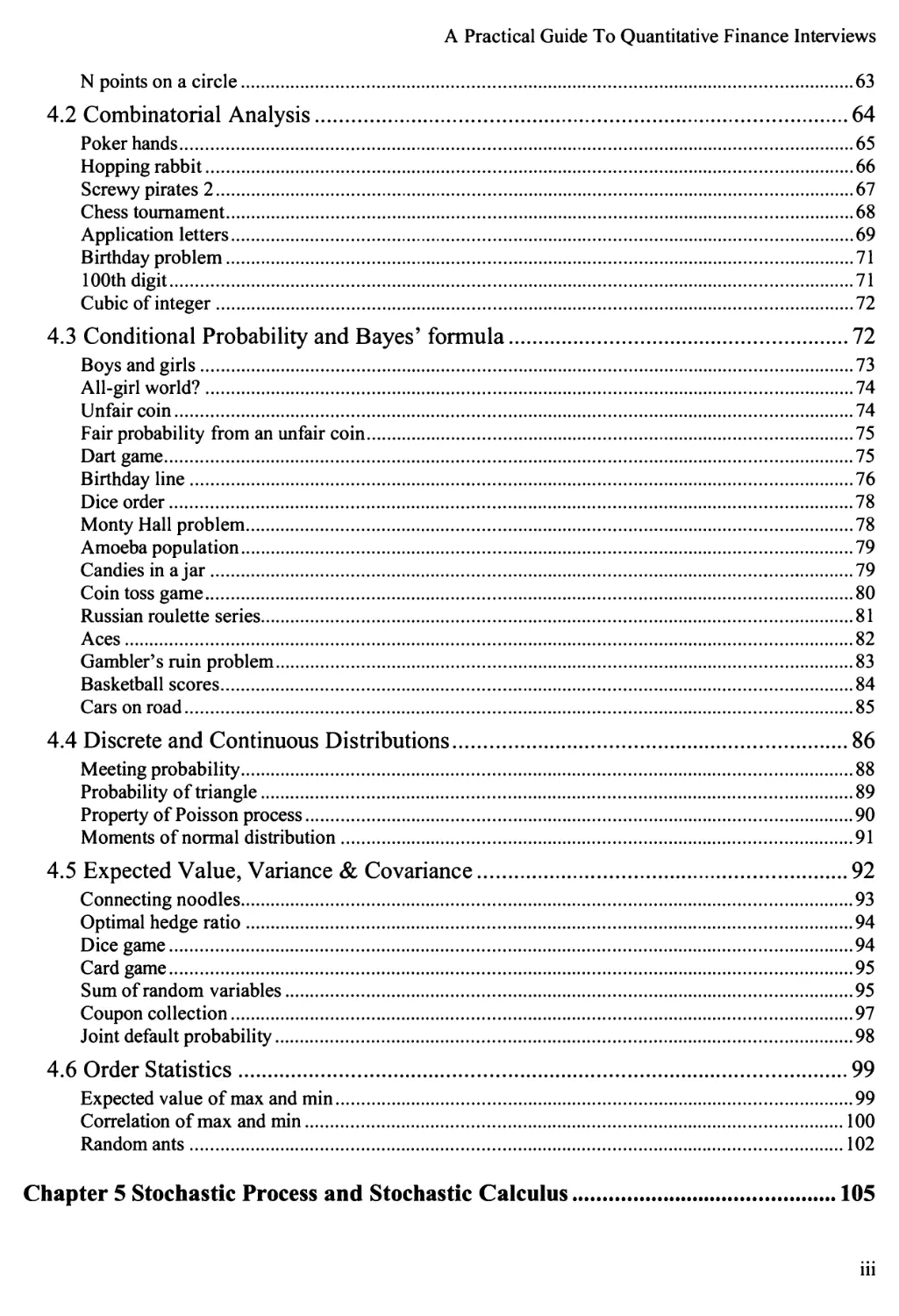
N points on a circle 63
4.2 Combinatorial Analysis 64
Poker hands 65
Hopping rabbit 66
Screwy pirates 2 67
Chess tournament 68
Application letters 69
Birthday problem 71
100th digit 71
Cubic of integer 72
4.3 Conditional Probability and Bayes' formula 72
Boys and girls 73
All-girl world? 74
Unfair coin 74
Fair probability from an unfair coin 75
Dart game 75
Birthday line 76
Dice order 78
Monty Hall problem 78
Amoeba population 79
Candies in ajar 79
Coin toss game 80
Russian roulette series 81
Aces 82
Gambler's ruin problem 83
Basketball scores 84
Cars on road 85
4.4 Discrete and Continuous Distributions 86
Meeting probability 88
Probability of triangle 89
Property of Poisson process 90
Moments of normal distribution 91
4.5 Expected Value, Variance & Covariance 92
Connecting noodles 93
Optimal hedge ratio 94
Dice game 94
Card game 95
Sum of random variables 95
Coupon collection 97
Joint default probability 98
4.6 Order Statistics 99
Expected value of maxandmin 99
Correlation of max and min 100
Random ants 102
Chapter 5 Stochastic Process and Stochastic Calculus 105
iii

Contents
5.1 Markov Chain 105
Gambler's ruin problem 107
Dice question 108
Coin triplets 109
Color balls 113
5.2 Martingale and Random walk 115
Drunk man 116
Dice game 117
Ticket line 117
Coin sequence 119
5.3 Dynamic Programming 121
Dynamic programming (DP) algorithm 122
Dice game 123
World series 123
Dynamic dice game 126
Dynamic card game 127
5.4 Brownian Motion and Stochastic Calculus 129
Brownian motion 129
Stopping time/ first passage time 131
Ito's lemma 135
Chapter 6 Finance 137
6.1. Option Pricing 137
Price direction of options 137
Put-call parity 138
American v.s. European options 139
Black-Scholes-Merton differential equation 142
Black-Scholes formula 143
6.2. The Greeks 149
Delta 149
Gamma 152
Theta 154
Vega 156
6.3. Option Portfolios and Exotic Options 158
Bull spread 159
Straddle 159
Binary options 160
Exchange options 161
6.4. Other Finance Questions 163
Portfolio optimization 163
Value at risk 164
Duration and convexity 165
Forward and futures 167
Interest rate models 168
iv

A Practical Guide To Quantitative Finance Interviews
Chapter 7 Algorithms and Numerical Methods 171
7.1. Algorithms 171
Number swap 172
Unique elements 173
Horner's algorithm 174
Moving average 174
Sorting algorithm 174
Random permutation 176
Search algorithm 177
Fibonacci numbers 179
Maximum contiguous subarray 180
7.2. The Power of Two 182
Power of 2? 182
Multiplication by 7 182
Probability simulation 182
Poisonous wine 183
7.3 Numerical Methods 184
Monte Carlo simulation 184
Finite difference method 189
v

Preface
This book will prepare you for quantitative finance interviews by helping you zero in on
the key concepts that are frequently tested in such interviews. In this book we analyze
solutions to more than 200 real interview problems and provide valuable insights into
how to ace quantitative interviews. The book covers a variety of topics that you are
likely to encounter in quantitative interviews: brain teasers, calculus, linear algebra,
probability, stochastic processes and stochastic calculus, finance and programming.
Professionals and students seeking to pursue a career in quantitative finance or related
quantitative fields will benefit most from thoroughly reading this book. In recent years,
we have seen a dramatic surge in demand for talents with strong quantitative skills from
investment banks, investment management firms, hedge funds, financial software
vendors and financial consulting companies. As a result, quant, an umbrella description
that encompasses quantitative analysts, quantitative researchers, quantitative strategists,
quantitative traders, and quantitative developers, has become an attractive career choice.
Dozens of financial engineering or computational finance programs have been
established in the last few years to educate professionals for quantitative finance jobs.
Graduates with backgrounds in finance, mathematics, physics, computer sciences, and
various engineering majors are contending for quant jobs as well. Naturally, the
competition is fierce. To be a successful candidate, you have to distinguish yourself
from many other excellent applicants.
In general, a successful candidate for a quantitative finance position is expected to have
a strong mathematics background (in probability, statistics, stochastic calculus, etc.),
solid programming skills and basic to intermediate-level finance knowledge. Most
candidates find quantitative interviews, or at least some interview problems, challenging.
Quantitative interviews cover a broad range of mathematics, finance and programming
topics that the candidates may have never used or even encountered in their daily work
or study. Moreover, most interview problems require strong problem-solving skills,
beyond reciting formulas or doing simple calculations. A successful candidate needs a
combination of knowledge and problem-solving skills in order to excel in quantitative
interviews. This is precisely what this book provides!
This book addresses these aspects by reviewing the necessary finance and mathematical
concepts that serve as tools to structure and solve interview problems. Since it includes
most of the topics used by quantitative interviewers, it presupposes some basic
preparation in mathematics, statistics, finance, and programming.
I also strongly recommend that you try to solve each problem on your own first before
reading the answer. Working out solutions on your own will help you improve your
problem-solving skills and help you quickly identify common approaches to tackling
quantitative problems.

Needless to say, you are likely to encounter some problems in interviews that are similar
to or exactly the same as the problems in this book. After all, the book covers many
essential quantitative topics using real interview problems. However, the goal of the
book is not to teach you how to game the system by remembering the answers! In fact,
just memorizing answers may not help much in your interview process. Unless you truly
understand the underlying concepts and can analyze the problems yourself, you will fail
to elaborate on the solutions and will be ill-equipped to answer many other problems
that use similar concepts. (Besides, many experienced quantitative interviewers are good
at catching those who have simply memorized "canned" answers.)
This is exactly the reason why I make significant effort to review essential concepts, to
present solution strategies, and to analyze the solutions in detail instead of simply
providing answers to problems. Furthermore, although the building blocks can be
learned, how one analyzes problems and implements these concepts usually makes a big
difference—and these are the skills you can acquire through practice, practice and
practice.
I realize that there may be better methods to solve some of the problems presented in
this book. It is entirely possible that despite my best efforts some inadvertent errors may
have crept in. Please email me at xinfeng@quantfinanceinterviews.com if you have a
better approach to solving some of these problems or find errors. I will be grateful for
your feedback and will post corrections and your constructive feedback on the book's
companion website http://www.quantfinanceinterviews.com. The website is a joint
venture with my editor, Brett Jiu. You will also find some extra interview problems
with answers that we have gathered.
I sincerely hope that you enjoy solving these problems and are successful in your
interviews.
Xinfeng Zhou

Notations
V
3
.'.
A^>B
s.t.
a/\b
av b
n
ii*.
for each/for every/for all
there exists
therefore
whenever A is true, B is also true
such that
the minimum of a and b
the maximum of a and b
X\ + X2 + *" Xn
Xt ^N J\,~ S\ * * * S\ X
1=1
«! factorial of nonnegative integer n, n! = Y\ i (0! = 1)
x%y modulo operation
O empty set
\f{x)dx indefinite integral of f(x)
f f{x)dx definite integral of f(x) from a to b
x+ max(x, 0)
N(ju, a2) normal distribution with mean ju and variance a1
cdf cumulative density function
pdf probability density function

Chapter 1 General Principles
Let us begin this book by exploring five general principles that will be extremely helpful
in your interview process. From my experience on both sides of the interview table,
these general guidelines will better prepare you for job interviews and will likely make
you a successful candidate.
1. Build a broad knowledge base
The length and the style of quant interviews differ from firm to firm. Landing a quant
job may mean enduring hours of bombardment with brain teaser, calculus, linear algebra,
probability theory, statistics, derivative pricing, or programming problems. To be a
successful candidate, you need to have broad knowledge in mathematics, finance and
programming.
Will all these topics be relevant for your future quant job? Probably not. Each specific
quant position often requires only limited knowledge in these domains. General problem
solving skills may make more difference than specific knowledge. Then why are
quantitative interviews so comprehensive? There are at least two reasons for this:
The first reason is that interviewers often have diverse backgrounds. Each interviewer
has his or her own favorite topics that are often related to his or her own educational
background or work experience. As a result, the topics you will be tested on are likely to
be very broad. The second reason is more fundamental. Your problem solving skills—a
crucial requirement for any quant job—is often positively correlated to the breadth of
your knowledge. A basic understanding of a broad range of topics often helps you better
analyze problems, explore alternative approaches, and come up with efficient solutions.
Besides, your responsibility may not be restricted to your own projects. You will be
expected to contribute as a member of a bigger team. Having broad knowledge will help
you contribute to the team's success as well.
The key here is "basic understanding." Interviewers do not expect you to be an expert on
a specific subject—unless it happens to be your PhD thesis. The knowledge used in
interviews, although broad, covers mainly essential concepts. This is exactly the reason
why most of the books I refer to in the following chapters have the word "introduction"
or "first" in the title. If I am allowed to give only one suggestion to a candidate, it will be
know the basics very well.
2. Practice your interview skills
The interview process starts long before you step into an interview room. In a sense, the
success or failure of your interview is often determined before the first question is asked.
Your solutions to interview problems may fail to reflect your true intelligence and

General Principles
knowledge if you are unprepared. Although a complete review of quant interview
problems is impossible and unnecessary, practice does improve your interview skills.
Furthermore, many of the behavioral, technical and resume-related questions can be
anticipated. So prepare yourself for potential questions long before you enter an
interview room.
3. Listen carefully
You should be an active listener in interviews so that you understand the problems well
before you attempt to answer them. If any aspect of a problem is not clear to you,
politely ask for clarification. If the problem is more than a couple of sentences, jot down
the key words to help you remember all the information. For complex problems,
interviewers often give away some clues when they explain the problem. Even the
assumptions they give may include some information as to how to approach the problem.
So listen carefully and make sure you get the necessary information.
4. Speak your mind
When you analyze a problem and explore different ways to solve it, never do it silently.
Clearly demonstrate your analysis and write down the important steps involved if
necessary. This conveys your intelligence to the interviewer and shows that you are
methodical and thorough. In case that you go astray, the interaction will also give your
interviewer the opportunity to correct the course and provide you with some hints.
Speaking your mind does not mean explaining every tiny detail. If some conclusions are
obvious to you, simply state the conclusion without the trivial details. More often than
not, the interviewer uses a problem to test a specific concept/approach. You should focus
on demonstrating your understanding of the key concept/approach instead of dwelling
on less relevant details.
5. Make reasonable assumptions
In real job settings, you are unlikely to have all the necessary information or data you'd
prefer to have before you build a model and make a decision. In interviews,
interviewers may not give you all the necessary assumptions either. So it is up to you to
make reasonable assumptions. The keyword here is reasonable. Explain your
assumptions to the interviewer so that you will get immediate feedback. To solve
quantitative problems, it is crucial that you can quickly make reasonable assumptions
and design appropriate frameworks to solve problems based on the assumptions.
We are now ready to review basic concepts in quantitative finance subject areas and
have fun solving real-world interview problems!
2

Chapter 2 Brain Teasers
In this chapter, we cover problems that only require common sense, logic, reasoning, and
basic—no more than high school level—math knowledge to solve. In a sense, they are
real brain teasers as opposed to mathematical problems in disguise. Although these brain
teasers do not require specific math knowledge, they are no less difficult than other
quantitative interview problems. Some of these problems test your analytical and general
problem-solving skills; some require you to think out of the box; while others ask you to
solve the problems using fundamental math techniques in a creative way. In this chapter,
we review some interview problems to explain the general themes of brain teasers that
you are likely to encounter in quantitative interviews.
2.1 Problem Simplification
If the original problem is so complex that you cannot come up with an immediate
solution, try to identify a simplified version of the problem and start with it. Usually you
can start with the simplest sub-problem and gradually increase the complexity. You do
not need to have a defined plan at the beginning. Just try to solve the simplest cases and
analyze your reasoning. More often than not, you will find a pattern that will guide you
through the whole problem.
Screwy pirates
Five pirates looted a chest full of 100 gold coins. Being a bunch of democratic pirates,
they agree on the following method to divide the loot:
The most senior pirate will propose a distribution of the coins. All pirates, including the
most senior pirate, will then vote. If at least 50% of the pirates (3 pirates in this case)
accept the proposal, the gold is divided as proposed. If not, the most senior pirate will be
fed to shark and the process starts over with the next most senior pirate... The process is
repeated until a plan is approved. You can assume that all pirates are perfectly rational:
they want to stay alive first and to get as much gold as possible second. Finally, being
blood-thirsty pirates, they want to have fewer pirates on the boat if given a choice
between otherwise equal outcomes.
How will the gold coins be divided in the end?
Solution: If you have not studied game theory or dynamic programming, this strategy
problem may appear to be daunting. If the problem with 5 pirates seems complex, we
can always start with a simplified version of the problem by reducing the number of
pirates. Since the solution to l-pirate case is trivial, let's start with 2 pirates. The senior

Brain Teasers
pirate (labeled as 2) can claim all the gold since he will always get 50% of the votes
from himself and pirate 1 is left with nothing.
Let's add a more senior pirate, 3. He knows that if his plan is voted down, pirate 1 will
get nothing. But if he offers private 1 nothing, pirate 1 will be happy to kill him. So
pirate 3 will offer private 1 one coin and keep the remaining 99 coins, in which strategy
the plan will have 2 votes from pirate 1 and 3.
If pirate 4 is added, he knows that if his plan is voted down, pirate 2 will get nothing. So
pirate 2 will settle for one coin if pirate 4 offers one. So pirate 4 should offer pirate 2 one
coin and keep the remaining 99 coins and his plan will be approved with 50% of the
votes from pirate 2 and 4.
Now we finally come to the 5-pirate case. He knows that if his plan is voted down, both
pirate 3 and pirate 1 will get nothing. So he only needs to offer pirate 1 and pirate 3 one
coin each to get their votes and keep the remaining 98 coins. If he divides the coins this
way, he will have three out of the five votes: from pirates 1 and 3 as well as himself.
Once we start with a simplified version and add complexity to it, the answer becomes
obvious. Actually after the case n = 5, a clear pattern has emerged and we do not need to
stop at 5 pirates. For any In +1 pirate case (n should be less than 99 though), the most
senior pirate will offer pirates 1, 3, •••, and 2n-\ each one coin and keep the rest for
himself.
Tiger and sheep
One hundred tigers and one sheep are put on a magic island that only has grass. Tigers
can eat grass, but they would rather eat sheep. Assume: A. Each time only one tiger can
eat one sheep, and that tiger itself will become a sheep after it eats the sheep. B. All
tigers are smart and perfectly rational and they want to survive. So will the sheep be
eaten?
Solution: 100 is a large number, so again let's start with a simplified version of the
problem. If there is only 1 tiger (n = 1), surely it will eat the sheep since it does not need
to worry about being eaten. How about 2 tigers? Since both tigers are perfectly rational,
either tiger probably would do some thinking as to what will happen if it eats the sheep.
Either tiger is probably thinking: if I eat the sheep, I will become a sheep; and then I will
be eaten by the other tiger. So to guarantee the highest likelihood of survival, neither
tiger will eat the sheep.
If there are 3 tigers, the sheep will be eaten since each tiger will realize that once it
changes to a sheep, there will be 2 tigers left and it will not be eaten. So the first tiger
that thinks this through will eat the sheep. If there are 4 tigers, each tiger will understand
4

A Practical Guide To Quantitative Finance Interviews
that if it eats the sheep, it will turn to a sheep. Since there are 3 other tigers, it will be
eaten. So to guarantee the highest likelihood of survival, no tiger will eat the sheep.
Following the same logic, we can naturally show that if the number of tigers is even, the
sheep will not be eaten. If the number is odd, the sheep will be eaten. For the case
n = 100, the sheep will not be eaten.
2.2 Logic Reasoning
River crossing
Four people, A, B, C and D need to get across a river. The only way to cross the river is
by an old bridge, which holds at most 2 people at a time. Being dark, they can't cross the
bridge without a torch, of which they only have one. So each pair can only walk at the
speed of the slower person. They need to get all of them across to the other side as
quickly as possible. A is the slowest and takes 10 minutes to cross; B takes 5 minutes; C
takes 2 minutes; and D takes 1 minute.
What is the minimum time to get all of them across to the other side?1
Solution: The key point is to realize that the 10-minute person should go with the 5-
minute person and this should not happen in the first crossing, otherwise one of them
have to go back. So C and D should go across first (2 min); then send D back (lmin); A
and B go across (10 min); send C back (2min); C and D go across again (2 min).
It takes 17 minutes in total. Alternatively, we can send C back first and then D back in
the second round, which takes 17 minutes as well.
Birthday problem
You and your colleagues know that your boss A's birthday is one of the following 10
dates:
Mar 4, Mar 5, Mar 8
Jun 4, Jun 7
Sep 1, Sep 5
Dec 1, Dec 2, Dec 8
A told you only the month of his birthday, and told your colleague C only the day. After
that, you first said: "I don't know A's birthday; C doesn't know it either." After hearing
1 Hint: The key is to realize that A and B should get across the bridge together.
5

Brain Teasers
what you said, C replied: "I didn't know A's birthday, but now I know it." You smiled
and said: "Now I know it, too." After looking at the 10 dates and hearing your comments,
your administrative assistant wrote down A's birthday without asking any questions. So
what did the assistant write?
Solution: Don't let the "he said, she said" part confuses you. Just interpret the logic
behind each individual's comments and try your best to derive useful information from
these comments.
Let D be the day of the month of A's birthday, we have Dg {1,2,4,5,7,8}. If the
birthday is on a unique day, C will know the A's birthday immediately. Among possible
£>s, 2 and 7 are unique days. Considering that you are sure that C does not know A's
birthday, you must infer that the day the C was told of is not 2 or 7. Conclusion: the
month is not June or December. (If the month had been June, the day C was told of may
have been 2; if the month had been December, the day C was told of may have been 7.)
Now C knows that the month must be either March or September. He immediately
figures out A's birthday, which means the day must be unique in the March and
September list. It means A's birthday cannot be Mar 5, or Sep 5. Conclusion: the
birthday must be Mar 4, Mar 8 or Sep 1.
Among these three possibilities left, Mar 4 and Mar 8 have the same month. So if the
month you have is March, you still cannot figure out A's birthday. Since you can figure
out A's birthday, A's birthday must be Sep 1. Hence, the assistant must have written Sep
1.
Card game
A casino offers a card game using a normal deck of 52 cards. The rule is that you turn
over two cards each time. For each pair, if both are black, they go to the dealer's pile; if
both are red, they go to your pile; if one black and one red, they are discarded. The
process is repeated until you two go through all 52 cards. If you have more cards in your
pile, you win $100; otherwise (including ties) you get nothing. The casino allows you to
negotiate the price you want to pay for the game. How much would you be willing to
pay to play this game?2
Solution: This surely is an insidious casino. No matter how the cards are arranged, you
and the dealer will always have the same number of cards in your piles. Why? Because
each pair of discarded cards have one black card and one red card, so equal number of
2 Hint: Try to approach the problem using symmetry. Each discarded pair has one black and one red card.
What does that tell you as to the number of black and red cards in the rest two piles?
6

A Practical Guide To Quantitative Finance Interviews
red and black cards are discarded. As a result, the number of red cards left for you and
the number of black cards left for the dealer are always the same. The dealer always
wins! So we should not pay anything to play the game.
Burning ropes
You have two ropes, each of which takes 1 hour to burn. But either rope has different
densities at different points, so there's no guarantee of consistency in the time it takes
different sections within the rope to burn. How do you use these two ropes to measure 45
minutes?
Solution: This is a classic brain teaser question. For a rope that takes x minutes to burn,
if you light both ends of the rope simultaneously, it takes x/2 minutes to burn. So we
should light both ends of the first rope and light one end of the second rope. 30 minutes
later, the first rope will get completely burned, while that second rope now becomes a
30-min rope. At that moment, we can light the second rope at the other end (with the
first end still burning), and when it is burned out, the total time is exactly 45 minutes.
Defective ball
You have 12 identical balls. One of the balls is heavier OR lighter than the rest (you
don't know which). Using just a balance that can only show you which side of the tray is
heavier, how can you determine which ball is the defective one with 3 measurements?3
Solution: This weighing problem is another classic brain teaser and is still being asked
by many interviewers. The total number of balls often ranges from 8 to more than 100.
Here we use n = l2 to show the fundamental approach. The key is to separate the
original group (as well as any intermediate subgroups) into three sets instead of two. The
reason is that the comparison of the first two groups always gives information about the
third group.
Considering that the solution is wordy to explain, I draw a tree diagram in Figure 2.1 to
show the approach in detail. Label the balls 1 through 12 and separate them to three
groups with 4 balls each. Weigh balls 1, 2, 3, 4 against balls 5, 6, 7, 8. Then we go on to
explore two possible scenarios: two groups balance, as expressed using an "=" sign, or 1,
Hint: First do it for 9 identical balls and use only 2 measurements, knowing that one is heavier than the
rest.
7

Brain Teasers
2, 3, 4 are lighter than 5, 6, 7, 8, as expressed using an "<" sign. There is no need to
explain the scenario that 1, 2, 3, 4 are heavier than 5, 6, 7, 8. (Why?4)
If the two groups balance, this immediately tells us that the defective ball is in 9, 10, 11
and 12, and it is either lighter (L) or heavier (H) than other balls. Then we take 9, 10 and
11 from group 3 and compare balls 9, 10 with 8, 11. Here we have already figured out
that 8 is a normal ball. If 9, 10 are lighter, it must mean either 9 or 10 is L or 11 is H. In
which case, we just compare 9 with 10. If 9 is lighter, 9 is the defective one and it is L\ if
9 and 10 balance, then 11 must be defective and H\ If 9 is heavier, 10 is the defective
one and it is L. If 9, 10 and 8, 11 balance, 12 is the defective one. If 9, 10 is heavier, than
either 9 or 10 is //, or 11 is L.
You can easily follow the tree in Figure 2.1 for further analysis and it is clear from the
tree that all possible scenarios can be resolved in 3 measurements.
©
5,6,7,8
1/2/3/4 Lor 5/6/7/8 H
9/10/11/12 L or H
<2D
/ i \
l/2Lor6H 4Lor7/8H 5Hor3L 9/10LorllH 12Lorl2H 9/10HorllL
©-© 0-© ©"© ©-© ©-© ©-©
/■! \ /■! \ i \ /■! \ / \ /-I \
1L 6H 2L 8H 4L 7H 3L 5H 9L 11H 10L 12H 12L 10H 11L 9H
Figure 2.1 Tree diagram to identify the defective ball in 12 balls
In general if you have the information as to whether the defective ball is heavier or
4 Here is where the symmetry idea comes in. Nothing makes the 1, 2, 3, 4 or 5, 6, 7, 8 labels special. If 1, 2,
3, 4 are heavier than 5, 6, 7, 8, let's just exchange the labels of these two groups. Again we have the case
of 1,2, 3,4 being lighter than 5, 6, 7, 8.

A Practical Guide To Quantitative Finance Interviews
lighter, you can identify the defective ball among up to 3" balls using no more than n
measurements since each weighing reduces the problem size by 2/3. If you have no
information as to whether the defective ball is heavier or lighter, you can identify the
defective ball among up to (3W - 3) / 2 balls using no more than n measurements.
Trailing zeros
How many trailing zeros are there in 100! (factorial of 100)?
Solution: This is an easy problem. We know that each pair of 2 and 5 will give a trailing
zero. If we perform prime number decomposition on all the numbers in 100!, it is
obvious that the frequency of 2 will far outnumber of the frequency of 5. So the
frequency of 5 determines the number of trailing zeros. Among numbers 1,2,•••,99, and
100, 20 numbers are divisible by 5 (5,10, •••, 100). Among these 20 numbers, 4 are
divisible by 52 (25, 50, 75, 100). So the total frequency of 5 is 24 and there are 24
trailing zeros.
Horse race
There are 25 horses, each of which runs at a constant speed that is different from the
other horses'. Since the track only has 5 lanes, each race can have at most 5 horses. If
you need to find the 3 fastest horses, what is the minimum number of races needed to
identify them?
Solution: This problem tests your basic analytical skills. To find the 3 fastest horses,
surely all horses need to be tested. So a natural first step is to divide the horses to 5
groups (with horses 1-5, 6-10, 11-15, 16-20, 21-25 in each group). After 5 races, we will
have the order within each group, let's assume the order follows the order of numbers
(e.g., 6 is the fastest and 10 is the slowest in the 6-10 group)5. That means 1, 6, 11, 16
and 21 are the fastest within each group.
Surely the last two horses within each group are eliminated. What else can we infer? We
know that within each group, if the fastest horse ranks 5th or 4th among 25 horses, then
all horses in that group cannot be in top 3; if it ranks the 3rd, no other horse in that group
can be in the top 3; if it ranks the 2nd, then one other horse in that group may be in top 3;
if it ranks the first, then two other horses in that group may be in top 3.
5 Such an assumption does not affect the generality of the solution. If the order is not as described, just
change the labels of the horses.
9

Brain Teasers
So let's race horses 1, 6, 11, 16 and 21. Again without loss of generality, let's assume
the order is 1, 6, 11, 16 and 21. Then we immediately know that horses 4-5, 8-10, 12-15,
16-20 and 21-25 are eliminated. Since 1 is fastest among all the horses, 1 is in. We need
to determine which two among horses 2, 3, 6, 7 and 11 are in top 3, which only takes one
extra race.
So all together we need 7 races (in 3 rounds) to identify the 3 fastest horses.
Infinite sequence
lfxAxAxAxAx--- = 2, where xAy = xy, what is xl
Solution: This problem appears to be difficult, but a simple analysis will give an elegant
solution. What do we have from the original equation?
lim xAxAxAxAx-" = 2<^> limxA xA xAxAx- = 2. In other words, as «->oo,
"-*00 n terms "-^ n-\ terms
adding or minus one x A should yield the same result.
so xAxAxAxAx--- = xA(xAxAxAx---) = xA2 = 2 =>x = V2.
2.3 Thinking Out of the Box
Box packing
Can you pack 53 bricks of dimensions 1x1x4 into a 6x6x6 box?
Solution: This is a nice problem extended from a popular chess board problem. In that
problem, you have a 8 x 8 chess board with two small squares at the opposite diagonal
corners removed. You have many bricks with dimension 1 x 2. Can you pack 31 bricks
into the remaining 62 squares? (An alternative question is whether you can cover all 62
squares using bricks without any bricks overlapping with each other or sticking out of
the board, which requires a similar analysis.)
A real chess board figure surely helps the visualization. As shown in Figure 2.2, when a
chess board is filled with alternative black and white squares, both squares at the
opposite diagonal corners have the same color. If you put a 1x2 brick on the board, it
will always cover one black square and one white square. Let's say it's the two black
corner squares were removed, then the rest of the board can fit at most 30 bricks since
we only have 30 black squares left (and each brick requires one black square). So to
pack 31 bricks is out of the question. To cover all 62 squares without overlapping or
overreaching, we must have exactly 31 bricks. Yet we have proved that 31 bricks cannot
10

A Practical Guide To Quantitative Finance Interviews
fit in the 62 squares left, so you cannot find a way to fill in all 62 squares without
overlapping or overreaching.
Removed
Removed <«-
Figure 2.2 Chess board with alternative black and white squares
Just as any good trading strategy, if more and more people get to know it and replicate it,
the effectiveness of such a strategy will disappear. As the chess board problem becomes
popular, many interviewees simply commit it to memory (after all, it's easy to remember
the answer). So some ingenious interviewer came up with the newer version to test your
thinking process, or at least your ability to extend your knowledge to new problems.
If we look at the total volume in this 3D problem, 53 bricks have a volume of 212, which
is smaller then the box's volume 216. Yet we can show it is impossible to pack all the
bricks into the box using a similar approach as the chess board problem. Let's imagine
that the 6x6x6 box is actually comprised of small 2x2x2 cubes. There should be 27
small cubes. Similar to the chess board (but in 3D), imagine that we have black cubes
and white cubes alternates—it does take a little 3D visualization. So we have either 14
black cubes & 13 white cubes or 13 black cubes & 14 white cubes. For any 1x1x4 brick
that we pack into the box, half (1x1x2) of it must be in a black 2x2x2 cube and the
other half must be in a white 2x2x2 cube. The problem is that each 2x2x2 cube can
only be used by 4 of the 1x1x4 bricks. So for the color with 13 cubes, be it black or
white, we can only use them for 52 1x1x4 tubes. There is no way to place the 53th
brick. So we cannot pack 53 bricks of dimensions 1x1x4 into a 6x6x6 box.
Calendar cubes
You just had two dice custom-made. Instead of numbers 1 - 6, you place single-digit
numbers on the faces of each dice so that every morning you can arrange the dice in a
way as to make the two front faces show the current day of the month. You must use
both dice (in other words, days 1 - 9 must be shown as 01 - 09), but you can switch the
11

Brain Teasers
order of the dice if you want. What numbers do you have to put on the six faces of each
of the two dice to achieve that?
Solution: The days of a month include 11 and 22, so both dice must have 1 and 2. To
express single-digit days, we need to have at least a 0 in one dice. Let's put a 0 in dice
one first. Considering that we need to express all single digit days and dice two cannot
have all the digits from 1 - 9, it's necessary to have a 0 in dice two as well in order to
express all single-digit days.
So far we have assigned the following numbers:
Dice one
| Dice two
1
1
2
2
0
0
?
?
?
?
? J
?
If we can assign all the rest of digits 3, 4, 5, 6, 7, 8, and 9 to the rest of the faces, the
problem is solved. But there are 7 digits left. What can we do? Here's where you need to
think out of the box. We can use a 6 as a 9 since they will never be needed at the same
time! So, simply put 3, 4, and 5 on one dice and 6, 7, and 8 on the other dice, and the
final numbers on the two dice are:
Dice one
1 Dice two
1
1
2
2 __
0
0
3
6
4
7
5
_8 |
Door to offer
You are facing two doors. One leads to your job offer and the other leads to exit. In front
of either door is a guard. One guard always tells lies and the other always tells the truth.
You can only ask one guard one yes/no question. Assuming you do want to get the job
offer, what question will you ask?
Solution: This is another classic brain teaser (maybe a little out-of-date in my opinion).
One popular answer is to ask one guard: "Would the other guard say that you are
guarding the door to the offer?" If he answers yes, choose the other door; if he answers
no, choose the door this guard is standing in front of.
There are two possible scenarios:
1. Truth teller guards the door to offer; Liar guards the door to exit.
2. Truth teller guards the door to exit; Liar guards the door to offer.
If we ask a guard a direct question such as "Are you guarding the door to the offer?" For
scenario 1, both guards will answer yes; for scenario 2, both guards will answer no. So a
12

A Practical Guide To Quantitative Finance Interviews
direct question does not help us solve the problem. The key is to involve both guards in
the questions as the popular answer does. For scenario 1, if we happen to choose the
truth teller, he will answer no since the liar will say no; if we happen to choose the liar
guard, he will answer yes since the truth teller will say no. For scenario 2, if we happen
to choose the truth teller, he will answer yes since the liar will say yes; if we happen to
choose the liar guard, he will answer no since the truth teller with say yes. So for both
scenarios, if the answer is no, we choose that door; if the answer is yes, we choose the
other door.
Message delivery
You need to communicate with your colleague in Greenwich via a messenger service.
Your documents are sent in a padlock box. Unfortunately the messenger service is not
secure, so anything inside an unlocked box will be lost (including any locks you place
inside the box) during the delivery. The high-security padlocks you and your colleague
each use have only one key which the person placing the lock owns. How can you
securely send a document to your colleague?6
Solution: If you have a document to deliver, clearly you cannot deliver it in an unlocked
box. So the first step is to deliver it to Greenwich in a locked box. Since you are the
person who has the key to that lock, your colleague cannot open the box to get the
document. Somehow you need to remove the lock before he can get the document,
which means the box should be sent back to you before your colleague can get the
document.
So what can he do before he sends back the box? He can place a second lock on the box,
which he has the key to! Once the box is back to you, you remove your own lock and
send the box back to your colleague. He opens his own lock and gets the document.
Last ball
A bag has 20 blue balls and 14 red balls. Each time you randomly take two balls out.
(Assume each ball in the bag has equal probability of being taken). You do not put these
two balls back. Instead, if both balls have the same color, you add a blue ball to the bag;
if they have different colors, you add a red ball to the bag. Assume that you have an
unlimited supply of blue and red balls, if you keep on repeating this process, what will
be the color of the last ball left in the bag?7 What if the bag has 20 blue balls and 13 red
balls instead?
6 Hint: You can have more than one lock on the box.
7 Hint: Consider the changes in the number of red and blue balls after each step.
13

Brain Teasers
Solution: Once you understand the hint, this problem should be an easy one. Let (B, R)
represent the number of blue balls and red balls in the bag. We can take a look what will
happen after two balls are taken out.
Both balls are blue: (B,R)^>(B~IR)
Both balls are red: (£, R) -> (B +1, R - 2)
One red and one blue: (5, R)^>(B-1, R)
Notice that R either stays the same or decreases by 2, so the number of red balls will
never become odd if we begin with 14 red balls. We also know that the total number of
balls decreases by one each time until only one ball is left. Combining the information
we have, the last ball must be a blue one. Similarly, when we start with odd number of
red balls, the final ball must be a red one.
Light switches
There is a light bulb inside a room and four switches outside. All switches are currently
at off state and only one switch controls the light bulb. You may turn any number of
switches on or off any number of times you want. How many times do you need to go
into the room to figure out which switch controls the light bulb?
Solution: You may have seen the classical version of this problem with 3 light bulbs
inside the room and 3 switches outside. Although this problem is slightly modified, the
approach is exact the same. Whether the light is on and off is binary, which only allows
us to distinguish two switches. If we have another binary factor, there are 2x2 = 4
possible combinations of scenarios, so we can distinguish 4 switches. Besides light, a
light bulb also emits heat and becomes hot after the bulb has been lit for some time. So
we can use the on/off and cold/hot combination to decide which one of the four switches
controls the light.
Turn on switches 1 and 2; move on to solve some other puzzles or do whatever you like
for a while; turn off switch 2 and turn on switch 3; get into the room quickly, touch the
bulb and observe whether the light is on or off.
The light bulb is on and hot —► switch 1 controls the light;
The light bulb is off and hot —► switch 2 controls the light;
The light bulb is on and cold —► switch 3 controls the light;
The light bulb is off and cold —► switch 4 controls the light.
14

A Practical Guide To Quantitative Finance Interviews
Quant salary
Eight quants from different banks are getting together for drinks. They are all interested
in knowing the average salary of the group. Nevertheless, being cautious and humble
individuals, everyone prefers not to disclose his or her own salary to the group. Can you
come up with a strategy for the quants to calculate the average salary without knowing
other people's salaries?
Solution: This is a light-hearted problem and has more than one answer. One approach is
for the first quant to choose a random number, adds it to his/her salary and gives it to the
second quant. The second quant will add his/her own salary to the result and give it to
the third quant; ...; the eighth quant will add his/her own salary to the result and give it
back to the first quant. Then the first quant will deduct the "random" number from the
total and divide the "real" total by 8 to yield the average salary.
You may be wondering whether this strategy has any use except being a good brain
teaser to test interviewees. It does have applications in practice. For example, a third
party data provider collect fund holding position data (securities owned by a fund and
the number of shares) from all participating firms and then distribute the information
back to participants. Surely most participants do not want others to figure out what they
are holding. If each position in the fund has the same fund ID every day, it's easy to
reverse-engineer the fund from the holdings and to replicate the strategy. So different
random numbers (or more exactly pseudo-random numbers since the provider knows
what number is added to the fund ID of each position and complicated algorithm is
involved to make the mapping one to one) are added to the fund ID of each position in
the funds before distribution. As a result, the positions in the same fund appear to have
different fund IDs. That prevents participants from re-constructing other fiinds. Using
this approach, the participants can share market information and remain anonymous at
the same time.
2.4 Application of Symmetry
Coin piles
Suppose that you are blind-folded in a room and are told that there are 1000 coins on the
floor. 980 of the coins have tails up and the other 20 coins have heads up. Can you
separate the coins into two piles so to guarantee both piles have equal number of heads?
Assume that you cannot tell a coin's side by touching it, but you are allowed to turn over
any number of coins.
Solution: Let's say that we separate the 1000 coins into two piles with n coins in one pile
and 1000-« coins in the other. If there are m coins in the first pile with heads up, there
15

Brain Teasers
must be 20 -m coins in the second pile with heads up. We also know that there are
n-m coins in the first pile with tails up. We clearly cannot guarantee that m = 10 by
simply adjusting n.
What other options do we have? We can turn over coins if we want to. Since we have no
way of knowing what a coin's side is, it won't guarantee anything if we selectively flip
coins. However, if we flip all the coins in the first pile, all heads become tails and all
tails become heads. As a result, it will have n-m heads and m tails (symmetry). So, to
start, we need to make the number of tails in the original first pile equal to the number of
heads in the second pile; in other words, to make n-m = 20-m. n = 20 makes the
equation hold. If we take 20 coins at random and turn them all over, the number of heads
among these turned-over 20 coins should be the same as the number of heads among the
other 980 coins.
Mislabeled bags
You are given three bags of fruits. One has apples in it; one has oranges in it; and one
has a mix of apples and oranges in it. Each bag has a label on it (apple, orange or mix).
Unfortunately, your manager tells you that ALL bags are mislabeled. Develop a strategy
to identify the bags by taking out minimum number of fruits? You can take any number
of fruits from any bags.8
Solution: The key here is to use the fact that ALL bags are mislabeled. For example, a
bag labeled with apple must contain either oranges only or a mix of oranges and apples.
Let's look at the labels: orange, apple, mix (orange + apple). Have you realized that the
orange label and the apple label are symmetric? If not, let me explain it in detail: If you
pick a fruit from the bag with the orange label and it's an apple (orange -> apple), then
the bag is either all apples or a mix. If you pick a fruit from the bag with the apple label
and it's an orange (apple -» orange), then the bag is either an orange bag or a mix.
Symmetric labels are not exciting and are unlikely to be the correct approach. So let's try
the bag with the mix label and get one fruit from it. If the fruit we get is an orange, then
we know that bag is actually orange (It cannot be a mix of oranges and apples since we
know the bag's label is wrong). Since the bag with the apple label cannot be apple only,
it must be the mix bag. And the bag with the orange label must be the apple bag.
Similarly, for the case that apples are in the bag with the mix label, we can figure out all
the bags using one single pick.
8 The problem struck me as a word game when I first saw it. But it does test a candidate's attention to
details besides his or her logic reasoning skills.
16

A Practical Guide To Quantitative Finance Interviews
Wise men
A sultan has captured 50 wise men. He has a glass currently standing bottom down.
Every minute he calls one of the wise men who can choose either to turn it over (set it
upside down or bottom down) or to do nothing. The wise men will be called randomly,
possibly for an infinite number of times. When someone called to the sultan correctly
states that all wise men have already been called to the sultan at least once, everyone
goes free. But if his statement is wrong, the sultan puts everyone to death. The wise men
are allowed to communicate only once before they get imprisoned into separate rooms
(one per room). Design a strategy that lets the wise men go free.
Solution: For the strategy to work, one wise man, let's call him the spokesman, will state
that every one has been called. What does that tell us? 1. All the other 49 wise men are
equivalent (symmetric). 2. The spokesman is different from the other 49 men. So
naturally those 49 equivalent wise men should act in the same way and the spokesman
should act differently.
Here is one of such strategies: Every one of the 49 (equivalent) wise men should flip the
glass upside down the first time that he sees the glass bottom down. He does nothing if
the glass is already upside down or he has flipped the glass once. The spokesman should
flip the glass bottom down each time he sees the glass upside down and he should do
nothing if the glass is already bottom down. After he does the 49th flip, which means all
the other 49 wise men have been called, he can declare that all the wise men have been
called.
2.5 Series Summation
Here is a famous story about the legendary mathematician/physicist Gauss: When he
was a child, his teacher gave the children a boring assignment to add the numbers from 1
to 100. To the amazement of the teacher, Gauss turned in his answer in less than a
minute. Here is his approach:
100
£w= 1 + 2 + .-+ 99+ 100
"=1 + + + +
100
5> = 100+99 + -..+ 2 + 1
ioo ▼ ▼ ▼ ▼ ioo 100x101
2^w = 101 +101+ ••• +101 +101= 101x100 =>£« = ———
n=\ n=\ 2
17

Brain Teasers
/v
This approach can be generalized to any integer N: ^n =
N(N + l)
2
The summation formula for consecutive squares may not be as intuitive:
A 2_N(N + l)(2N + l)_N3 N2 N_
hH 6 ~ 3 + 2 + 6 '
N
But if we correctly guess that ^n2 =aN3+bN2+cN + d and apply the initial
conditions
7V = 0=>0 = J
N = 1 => l=tf+6+c+d
7V = 2=>5 = 8a + 4Z> + 2c + J '
7V = 3=>14 = 27a + 96 + 3c + </
we will have the solution that a = 1/3, b = 1/2, c = 1/6, d = 0. We can then easily show
that the same equation applies to all TV by induction.
Clock pieces
A clock (numbered 1-12 clockwise) fell off the wall and broke into three pieces. You
find that the sums of the numbers on each piece are equal. What are the numbers on each
piece? (No strange-shaped piece is allowed.)
12 12x13
Solution: Using the summation equation, ^n = =78. So the numbers on each
piece must sum up to 26. Some interviewees mistakenly assume that the numbers on
each piece have to be continuous because no strange-shaped piece is allowed. It's easy to
see that 5, 6, 7 and 8 add up to 26. Then the interviewees' thinking gets stuck because
they cannot find more consecutive numbers that add up to 26.
Such an assumption is not correct since 12 and 1 are continuous on a clock. Once that
wrong assumption is removed, it becomes clear that 12 + 1 = 13 and 11 + 2 = 13. So the
second piece is 11, 12, 1 and 2; the third piece is 3, 4, 9 and 10.
Missing integers
Suppose we have 98 distinct integers from 1 to 100. What is a good way to find out the
two missing integers (within [1, 100])?
18

A Practical Guide To Quantitative Finance Interviews
Solution: Denote the missing integers as x and y9 and the existing ones are zp---,z98.
Applying the summation equations, we have
^ A 100x101 A
2^n = x + y + 2^Zj =>* + }> = 2^z/
n=\ i=l ^ /=1
^222^2 2 2 1003 1002 100 £, 2
n=\ i=\ J Z O /=i
Using these two equations, we can easily solve x and y. If you implement this strategy
using a computer program, it is apparent that the algorithm has a complexity of 0(ri) for
two missing integers in 1 to n.
Counterfeit coins I
There are 10 bags with 100 identical coins in each bag. In all bags but one, each coin
weighs 10 grams. However, all the coins in the counterfeit bag weigh either 9 or 11
grams. Can you find the counterfeit bag in only one weighing, using a digital scale that
tells the exact weight? 9
Solution: Yes, we can identify the counterfeit bag using one measurement. Take 1 coin
out of the first bag, 2 out of the second bag, 3 out the third bag, •••, and 10 coins out of
10
the tenth bag. All together, there are ^n = 55 coins. If there were no counterfeit coins,
/=i
they should weigh 550 grams. Let's assume the j-th bag is the counterfeit bag, there will
be i counterfeit coins, so the final weight will be 550±i. Since i is distinct for each bag,
we can identify the counterfeit coin bag as well as whether the counterfeit coins are
lighter or heavier than the real coins using 550 ± i.
This is not the only answer: we can choose other numbers of coins from each bag as long
as they are all different numbers.
Glass balls
You are holding two glass balls in a 100-story building. If a ball is thrown out of the
window, it will not break if the floor number is less than X, and it will always break if
9 Hint: In order to find the counterfeit coin bag in one weighing, the number of coins from each bag must
be different. If we use the same number of coins from two bags, symmetry will prevent you from
distinguish these two bags if one is the counterfeit coin bag.
19

Brain Teasers
the floor number is equal to or greater than X. You would like to determine X. What is
the strategy that will minimize the number of drops for the worst case scenario? 10
Solution: Suppose that we have a strategy with a maximum of N throws. For the first
throw of ball one, we can try the Af-th floor. If the ball breaks, we can start to try the
second ball from the first floor and increase the floor number by one until the second
ball breaks. At most, there are N-l floors to test. So a maximum of TV throws are
enough to cover all possibilities. If the first ball thrown out of N-th floor does not break,
we have N -I throws left. This time we can only increase the floor number by N-l for
the first ball since the second ball can only cover N-2 floors if the first ball breaks. If
the first ball thrown out of (2A^l)th floor does not break, we have N-2 throws left. So
we can only increase the floor number by N-2 for the first ball since the second ball
can only cover N-3 floors if the first ball breaks...
Using such logic, we can see that the number of floors that these two balls can cover
with a maximum of N throws is TV + (jV -1) + • • • +1 = N(N +1)/2.In order to cover 100
stories, we need to have N(N +1) / 2 > 100. Taking the smallest integer, we have N = 14.
Basically, we start the first ball on the 14th floor, if the ball breaks, we can use the
second ball to try floors 1,2, •••,13 with a maximum throws of 14 (when the 13th or the
14th floor is X). If the first ball does not break, we will try the first ball on the
14 -h (14 — 1) = 27th floor. If it breaks, we can use the second ball to cover floors
15,16, •••,26 with a total maximum throws of 14 as well...
2.6 The Pigeon Hole Principle
Here is the basic version of the Pigeon Hole Principle: if you have fewer pigeon holes
than pigeons and you put every pigeon in a pigeon hole, then at least one pigeon hole has
more than one pigeon. Basically it says that if you have n holes and more than n + l
pigeons, at least 2 pigeons have to share one of the holes. The generalized version is that
if you have n holes and at least mn +1 pigeons, at least m +1 pigeons have to share one
of the holes. These simple and intuitive ideas are surprisingly usefiil in many problems.
Here we will use some examples to show their applications.
10 Hint: Assume we design a strategy with N maximum throws. If the first ball is thrown once, the second
ball can cover N -1 floors; if the first ball is thrown twice, the second ball can cover N-2 floors...
20

A Practical Guide To Quantitative Finance Interviews
Matching socks
Your drawer contains 2 red socks, 20 yellow socks and 31 blue socks. Being a busy and
absent-minded MIT student, you just randomly grab a number of socks out of the draw
and try to find a matching pair. Assume each sock has equal probability of being
selected, what is the minimum number of socks you need to grab in order to guarantee a
pair of socks of the same color?
Solution: This question is just a variation of the even simpler version of two-color-socks
problem, in which case you only need 3. When you have 3 colors (3 pigeon holes), by
the Pigeon Hole Principle, you will need to have 3 + 1=4 socks (4 pigeons) to guarantee
that at least two socks have the same color (2 pigeons share a hole).
Handshakes
You are invited to a welcome party with 25 fellow team members. Each of the fellow
members shakes hands with you to welcome you. Since a number of people in the room
haven't met each other, there's a lot of random handshaking among others as well. If you
don't know the total number of handshakes, can you say with certainty that there are at
least two people present who shook hands with exactly the same number of people?
Solution: There are 26 people at the party and each shakes hands with from 1—since
everyone shakes hands with you—to 25 people. In other words, there are 26 pigeons and
25 holes. As a result, at least two people must have shaken hands with exactly the same
number of people.
Have we met before?
Show me that, if there are 6 people at a party, then either at least 3 people met each other
before the party, or at least 3 people were strangers before the party.
Solution: This question appears to be a complex one and interviewees often get puzzled
by what the interviewer exactly wants. But once you start to analyze possible scenarios,
the answer becomes obvious.
Let's say that you are the 6th person at the party. Then by generalized Pigeon Hole
Principle (Do we even need that for such an intuitive conclusion?), among the remaining
5 people, we conclude that either at least 3 people met you or at least 3 people did not
meet you. Now let's explore these two mutually exclusive and collectively exhaustive
scenarios:
Case 1: Suppose that at least 3 people have met you before.
21

Brain Teasers
If two people in this group met each other, you and the pair (3 people) met each other. If
no pair among these people met each other, then these people (> 3 people) did not meet
each other. In either sub-case, the conclusion holds.
Case 2: Suppose at least 3 people have not met you before.
If two people in this group did not meet each other, you and the pair (3 people) did not
meet each other. If all pairs among these people knew each other, then these people (> 3
people) met each other. Again, in either sub-case, the conclusion holds.
Ants on a square
There are 51 ants on a square with side length of 1. If you have a glass with a radius of
1/7, can you put your glass at a position on the square to guarantee that the glass
encompasses at least 3 ants?1!
Solution: To guarantee that the glass encompasses at least 3 ants, we can separate the
square into 25 smaller areas. Applying the generalized Pigeon Hole Principle, we can
show that at least one of the areas must have at least 3 ants. So we only need to make
sure that the glass is large enough to cover any of the 25 smaller areas. Simply separate
the area into 5x5 smaller squares with side length of 1/5 each will do since a circle with
radius of 1/7 can cover a square12 with side length 1/5.
Counterfeit coins II
There are 5 bags with 100 coins in each bag. A coin can weigh 9 grams, 10 grams or 11
grams. Each bag contains coins of equal weight, but we do not know what type of coins
a bag contains. You have a digital scale (the kind that tells the exact weight). How many
times do you need to use the scale to determine which type of coin each bag contains?13
Solution: If the answer for 5 bags is not obvious, let's start with the simplest version of
the problem—1 bag. We only need to take one coin to weigh it. Now we can move on to
2 bags. How many coins do we need to take from bag 2 in order to determine the coin
types of bag 1 and bag 2? Considering that there are three possible types for bag 1, we
will need three coins from bag 2; two coins won't do. For notation simplicity, let's
change the number/weight for three types to -1, 0 and 1 (by removing the mean 10). If
1' Hint: Separate the square into 25 smaller areas; then at least one area has 3 ants in it.
12 A circle with radius r can cover a square with side length up to V2 r and V2 ~ 1.414.
13 Hint: Start with a simpler problem. What if you have two bags of coins instead of 5, how many coins do
you need from each bag to find the type of coins in either bag? What is the minimum difference in coin
numbers? Then how about three bags?
22

A Practical Guide To Quantitative Finance Interviews
we only use 2 coins from bag 2, the final sum for 1 coin from bag 1 and 2 coins from
bag 2 ranges from -3 to 3 (7 pigeon holes). At the same time we have 9(3x3) possible
combinations for the weights of coins in bag 1 and bag 2 (9 pigeons). So at least two
combinations will yield the same final sum (9>7, so at least two pigeons need to share
one hole), and we can not distinguish them. If we use 3 coins from bag 2, then the sum
ranges from -4 to 4, which is possible to cover all 9 combinations. The following table
exactly shows that all possible combinations yield different sums:
Sum
3 Coins, Bag 2
1 coin, bag 1 |
m
[-11
0
1
-1 0 1
-4 -3 -2 1
-1 0 1
2 3 4
CI and C2 represent the weights of coins from bag 1 and 2 respectively.
Then how about 3 bags? We are going to have 33 = 27 possible combinations. Surely an
indicator ranging from -13 to 13 will cover it and we will need 9 coins from bag 3. The
possible combinations are shown in the following table:
Sum
9 Coins, Bag 3
C2 = -l
C3\
-1
0
1
-1 0 1
-13 -12 -11
-4 -3 -2
5 6 7
f C2=0
-1 0 1
-10 -9 -8
-1 0 1
8 9 10
C2=l |
-1 0 1
-7 -6 -5 1
2 3 4
11 12 13
CI, C2, and C3 represent the weights of coins from bag 1, 2, and 3 respectively.
Following this logic, it is easy to see that we will need 27 coins from bag 4 and 81 coins
from bag 5. So the answer is to take 1, 3, 9, 27 and 81 coins from bags 1, 2, 3, 4, and 5,
respectively, to determine which type of coins each bag contains using a single weighing.
2.7 Modular Arithmetic
The modulo operation—denoted as x%y orx mody—finds the remainder of division of
number x by another number y. For simpicility, we only consider the case where y is a
positive integer. For example, 5%3 = 2. An intuitive property of modulo operation is
23

Brain Teasers
that if xl%y = x2%y, then (jc, -x2)%y = 0. From this property we can also show that
x%y, (x + l)%y, •••, and (x + y-l)%y are all different numbers.
Prisoner problem
One hundred prisoners are given the chance to be set free tomorrow. They are all told
that each will be given a red or blue hat to wear. Each prisoner can see everyone else's
hat but not his own. The hat colors are assigned randomly and once the hats are placed
on top of each prisoner's head they cannot communicate with one another in any form, or
else they are immediately executed. The prisoners will be called out in random order and
the prisoner called out will guess the color of his hat. Each prisoner declares the color of
his hat so that everyone else can hear it. If a prisoner guesses correctly the color of his
hat, he is set free immediately; otherwise he is executed.
They are given the night to come up with a strategy among themselves to save as many
prisoners as possible. What is the best strategy they can adopt and how many prisoners
can they guarantee to save?14
Solution: At least 99 prisoners can be saved.
The key lies in the first prisoner who can see everyone else's hat. He declares his hat to
be red if the number of red hats he sees is odd. Otherwise he declares his hat to be blue.
He will have a 1/2 chance of having guessed correctly. Everyone else is able to deduce
his own hat color combining the knowledge whether the number of red hats is odd
among 99 prisoners (excluding the first) and the color of the other 98 prisoners
(excluding the first and himself). For example, if the number of red hats is odd among
the other 99 prisoners. A prisoner wearing a red hat will see even number of red hats in
the other 98 prisoners (excluding the first and himself) and deduce that he is wearing a
red hat.
The two-color case is easy, isn't it? What if there are 3 possible hat colors: red, blue, and
white? What is the best strategy they can adopt and how many prisoners can they
guarantee to save?15
Solution: The answer is still that at least 99 prisoners will be saved. The difference is
that the first prisoner now only has 1/3 chance of survival. Let's use the following
scoring system: red=0, green=l, and blue=2. The first prisoner counts the total score for
14 Hint: The first prisoner can see the number of red and blue hats of all other 99 prisoners. One color has
odd number of counts and the other has even number of counts.
15 Hint: That a number is odd simply means x%2 = 1. Here we have 3 colors, so you may want to consider
jc%3 instead.
24

A Practical Guide To Quantitative Finance Interviews
the rest of 99 prisoners and calculates s%3. If the remainder is 0, he announces red; if
the remainder is 1, green; 2, blue. He has 1/3 chance of living, but all the rest of the
prisoners can determine his own score (color) from the remainder. Let's consider a
prisoner i among 99 prisoners (excluding the first prisoner). He can calculate the total
score (x) of all other 98 prisoners. Since (x + 0)%3, (x + l)%3, and (x + 2)%3 are all
different, so from the remainder that the first prisoner gives (for the 99 prisoners
including /), he can determine his own score (color). For example, if prisoner i sees that
there are 32 red, 29 green and 37 blue in those 98 prisoners (excluding the first and
himself). The total score of those 98 prisoners is 103. If the first prisoner announces that
the remainder is 2 (green), then prisoner i knows his own color is green (1) since
onlyl04%3 = 2 among 103, 104 and 105.
Theoretically, a similar strategy can be extended to any number of colors. Surely that
requires all prisoners to have exceptional memory and calculation capability.
Division by 9
Given an arbitrary integer, come up with a rule to decide whether it is divisible by 9 and
prove it.
Solution: Hopefully you still remember the rules from your high school math class. Add
up all the digits of the integer. If the sum is divisible by 9, then the integer is divisible by
9; otherwise the integer is not divisible by 9. But how do we prove it?
Let's express the original integer as a = anl0" + <?„_, 10w_1 +••• + #, 101 +a0. Basically we
state that if an +an_x +••• + #, +a0 =9x (x is a integer), then the a is divisible by 9 as
well. The proof is straightforward:
For any a = anl0" + <2W_110"~1 + - + a1101 +a0, let b = a-(an +an_x +--- + A, +a0). We
have 6 = a„(10w-l) + aw_1(10w"1 -l) + -- + aI(10l -l) = a-9x, which is divisible by 9
since all (10* -1), k = l,--,« are divisible by 9. Because both b and 9x are divisible by 9,
a = b + 9x must be divisible by 9 as well.
(Similarly you can also show that a = {-\)"an + (-\)"~xan_x + • • • + (-l)1^, + a0 = 1 Ix is the
necessary and sufficient condition for a to be divisible by 11.)
25

Brain Teasers
Chameleon colors
A remote island has three types of chameleons with the following population: 13 red
chameleons, 15 green chameleons and 17 blue chameleons. Each time two chameleons
with different colors meet, they would change their color to the third color. For example,
if a green chameleon meets a red chameleon, they both change their color to blue. Is it
ever possible for all chameleons to become the same color? Why or why not?16
Solution: It is not possible for all chameleons to become the same color. There are
several approaches to proving this conclusion. Here we discuss two of them.
Approach 1. Since the numbers 13, 15 and 17 are "large" numbers, we can simplify the
problem to 0, 2 and 4 for three colors. (To see this, you need to realize that if
combination (m + l,w + l,/? + l) can be converted to the same color, combination
(m,n,p) can be converted to the same color as well.) Can a combination (0,2,4) be
converted to a combination (0,0,6)? The answer is NO, as shown in Figure 2.3:
(0,2,4), »(1,2,3)^ )
"(0,1,5)
Figure 2.3 chameleon color combination transitions from (0, 2, 4)
Actually combination (1,2,3) is equivalent to combination (0,1,2), which can only be
converted to another (0,1,2) but will never reach (0,0,3).
Approach 2. A different, and more fundamental approach, is to realize that in order for
all the chameleons to become the same color, at certain intermediate stage, two colors
must have the same number. To see this, just imagine the stage before a final stage. It
must has the combination (1,1, x). For chameleons of two different colors to have the
same number, their module of 3 must be the same as well. We start with 15 = 3x,
I3 = 3j> + 1, and 17 = 3z + 2 chameleon, when two chameleons of different colors meet,
we will have three possible scenarios:
16 Hint: consider the numbers in module of 3.
26

A Practical Guide To Quantitative Finance Interviews
(3x + 2,3j>, 3z +1) = (3x \ 3y f+1,3z f+ 2), one y meets one z
(3x,3>; + l,3z + 2)^><!(3(jc-l) + 2,3(!y + l),3z + l) = (3jc,,3!y,+ l,3z,+ 2), one* meets one z
l(3(x-l) + 2,3j%3(z + l) + l) = (3x\3y+l,3zf+2), one xmeets one y
So the pattern is preserved and we will never get two colors to have the same module of
3. In other words, we cannot make two colors have the same number. As a result, the
chameleons cannot become the same color. Essentially, the relative change of any pair of
colors after two chameleons meet is either 0 or 3. In order for all the chameleons to
become one color, at least one pair's difference must be a multiple of 3.
2.8 Math Induction
Induction is one of the most powerful and commonly-used proof techniques in
mathematics, especially discrete mathematics. Many problems that involve integers can
be solved using induction. The general steps for proof by induction are the following:
■ State that the proof uses induction and define an appropriate predicate P{ri).
■ Prove the base case P(Y), or any other smallest number n for the predicate to be true.
■ Prove that P{ri) implies P(n +1) for every integer n. Alternatively, in a strong
induction argument, you prove that P(l), P(2), •••, and P(ri) together imply
P(« + l).
In most cases, the real difficulty lies not in the induction step, but to formulate the
problem as an induction problem and come up with the appropriate predicateP(ri). The
simplified version of the problem can often help you identify P(ri).
Coin split problem
You split 1000 coins into two piles and count the number of coins in each pile. If there
are x coins in pile one and y coins in pile two, you multiple x by y to get xy. Then you
split both piles further, repeat the same counting and multiplication process, and add the
new multiplication results to the original. For example, you split x to jc, andx2, y to yx
andj>2, then the sum is xy + xxx2+yxy2. The same process is repeated until you only
have piles of 1 stone each. What is the final sum? (The final l's are not included in the
sum.) Prove that you always get the same answer no matter how the piles are divided.
27

Brain Teasers
Solution: Let n be the number of the coins and f(n) be the final sum. It is unlikely that
a solution will jump to our mind since the number n = 1000 is a large number. If you
aren't sure how to approach the problem, it never hurts to begin with the simplest cases
and try to find a pattern. For this problem, the base case has n = 2. Clearly the only split
is 1 +1 and the final sum is 1. When n = 3, the first split is 2 +1 and we have xy = 2 and
the 2-coin pile will further give an extra multiplication result 1, so the final sum is 3.
This analysis also gives the hint that when n coins are split into x and n-x coins, the
total sum will be f(n) = x(n-x) + f(x) + f(n-x). 4 coins can be split into 2 + 2 or
3 +1. For either case we can apply x{n - x) + f(x) + f{n - x) and yields the same final
sum 6.
Claim: For n coins, independent of intermediate splits, the final sum is . 17
So how do we prove it? The answer should be clear to you: by strong induction. We
have proved the claim for the base cases « = 2,3,4. Assume the claim is true for
n = 2,---,N-l coins, we need to prove that it holds for n = Ncoins as well. Again we
apply the equation f(ri) = x(n -x) + f(x) + f(n -x). IfN coins are split into x coins and
N-x coins, we have
f(N) = x(N-x) + f(x) + f(N-x)
= x(N x) I N(N~l) I W-x)W-x-V = "W-1)
2 2 2
n(n — 1)
So indeed it holds for n = N as well and f(n) = is true for any n > 2 . Applying
the conclusion to n = 1000, we have f(n) = 1000x999/2 .
Chocolate bar problem
A chocolate bar has 6 rows and 8 columns (48 small lxl squares). You break it into
individual squares by making a number of breaks. Each time, break one rectangle into
two smaller rectangles. For example, in the first step you can break the 6x8 chocolate
bar into a 6x3 one and a 6x5 one. What is the total number of breaks needed in order
to break the chocolate bar into 48 small squares?
17 /(2) = 1, /(3)-/(2) = 2 and /(4)-/(3) = 3 should give you enough hint to realize the pattern is
n(n-\)
28

A Practical Guide To Quantitative Finance Interviews
Solution: Let m be the number of the rows of the chocolate bar and n be the number of
columns. Since there is nothing special for the case m = 6 and n = 8, we should find a
general solution for all m and n. Let's begin with the base case where m = 1 and n = 1.
The number of breaks needed is clearly 0. For m > 1 and n = 1, the number of breaks is
m-\\ similarly for m = 1 and n > 1, the number of breaks is n-\. So for any m and «,
if we break the chocolate into m rows first, which takes m -1 breaks, and then break
each row into n small pieces, which takes m(n-l) breaks, the total number of breaks is
(m-l) + m(n-l) = mn-l. If we breaks it into n columns first and then break each
column into m small pieces, the total number of breaks is also mn-l. But is the total
number of breaks always mn-l for other sequences of breaks? Of course it is. We can
prove it using strong induction.
We have shown the number of breaks is mn-l for base cases m > 1, n = 1 and
m = l9n>l. To prove it for a general mxn case, let's assume the statement is true for
cases where rows < m, columns < n and rows < m, columns < n. If the first break is
along a row and it is broken into two smaller pieces m x nx and m x (n - nx), then the
total number of breaks is l + (wx«, -l) + (wx(«-«,)-I)-mn-l. Here we use the
results for rows < m, columns < n. Similarly, if it is broken into two pieces m, x n and
(m-m,)x«, the total number of breaks is l + (w, xn-l) + ((m-m])xn-l) = mn-l. So
the total number of breaks is always mn-l in order to break the chocolate bar into
mxn small pieces. For the case m = 6 and n = 8, the number of breaks is 47.
Although induction is the standard approach used to solve this problem, there is actually
a simpler solution if you've noticed an important fact: the number of pieces always
increases by 1 with each break since it always breaks one piece into two. In the
beginning, we have a single piece. In the end, we will have mn pieces. So the number of
breaks must be mn -1.
Race track
Suppose that you are on a one-way circular race track. There are N gas cans randomly
placed on different locations of the track and the total sum of the gas in these cans is
enough for your car to run exactly one circle. Assume that your car has no gas in the gas
tank initially, but you can put your car at any location on the track and you can pick up
the gas cans along the way to fill in your gas tank. Can you always choose a starting
position on the track so that your car can complete the entire circle?1
18 Hint: Start with N= 1,2 and solve the problem using induction.
29

Brain Teasers
Solution: If you get stuck as to how to solve the problem, again start with the simplest
cases (N = 1, 2) and consider using an induction approach. Without loss of generality,
let's assume that the circle has circumference of 1. For N = l9 the problem is trivial. Just
start at where the gas can is. For N = 2, The problem is still simple. Let's use a figure to
visualize the approach. As shown in Figure 2.4A, the amount of gas in can 1 and can 2,
expressed as the distance the car can travel, are jc, and x2 respectively, so jc, + x2 = 1.
The corresponding segments are yx and y2, so yx+y2=l. Since x,+x2=l and
y{+y2= 1> we must have x, > yx or x2 > y2 (x, < yx and x2 < y2 cannot both be true). If
x, > yx, we can start at gas can 1, which has enough gas to reach gas can 2, and get more
gas from gas can 2 to finish the whole circle. Otherwise, we will just start at gas can 2
and pick up gas can 1 along the way to finish the whole circle.
Figure 2.4 Gas can locations on the cycle and segments between gas cans
The argument for N = 2 also gives us the hint for the induction step. Now we want to
show that if the statement holds for N = n, then the same statement also holds for
N = n + l. As shown in Figure 2.4B, we have x, +x2 + ••• + *„+, = 1 and
yx +y2 +--- + JVH =1 for N = n + l. So there must exist at least one /, 1 </ < w +1, that
has xi >yr That means whenever the car reaches x;, it can reach x/+1 with more gas
(For i = n +1, it goes to i = 1 instead). In other words, we can actually "combine" x;. and
x/+1 to one gas can at the position of x;. with an amount of gas x;. + x/+1 (and eliminate
the gas can i + l). But such combination reduces the N = n + \ problem to N = n, for
30

A Practical Guide To Quantitative Finance Interviews
which the statement holds. So the statement also holds for N = n + \. Hence we can
always choose a starting position on the track to complete the entire circle for any N.
There is also an alternative approach to this problem that provides a solution to the
starting point. Let's imagine that you have another car with enough gas to finish the
circle. You put that car at the position of a randomly chosen gas can and drive the car for
a full circle. Whenever you reach a gas can (including at the initial position), you
measure the amount of gas in your gas tank before you add the gas from the can to your
gas tank. After you finish the circle, read through your measurement records and find the
lowest measurement. The gas can position corresponding to the lowest measurement
should be your starting position if the car has no gas initially. (It may take some thinking
to fully understand this argument. I'd recommend that you again draw a figure and give
this argument some careful thoughts if you don't find the reasoning obvious.)
2.9 Proof by Contradiction
In a proof by contradiction or indirect proof, you show that if a proposition were false,
then some logical contradiction or absurdity would follow. Thus, the proposition must be
true.
Irrational number
Can you prove that V2 is an irrational number? A rational number is a number that can
be expressed as a ratio of two integers; otherwise it is irrational.
Solution: This is a classical example of proof by contradiction. If v2 is not an irrational
number, it can be expressed as a ratio of two integers m and n. If m and n have any
common factor, we can remove it by dividing both m and n by the common factor. So in
the end, we will have a pair of m and n that have no common factors. (It is called
irreducible fraction.) Since m/n = y/29 we have m2 =2n2. So m2 must be an even
number and m must be an even number as well. Let's express m as 2x, where x is an
integer, since m is even. Then m2 -Ax2 and we also have n2 =2x2, which means n
must be even as well. But that both m and n are even contradicts the earlier statement
that m and n have no common factors. So must be an irrational number.
Rainbow hats
Seven prisoners are given the chance to be set free tomorrow. An executioner will put a
hat on each prisoner's head. Each hat can be one of the seven colors of the rainbow and
the hat colors are assigned completely at the executioner's discretion. Every prisoner can
31

Brain Teasers
see the hat colors of the other six prisoners, but not his own. They cannot communicate
with others in any form, or else they are immediately executed. Then each prisoner
writes down his guess of his own hat color. If at least one prisoner correctly guesses the
color of his hat, they all will be set free immediately; otherwise they will be executed.
They are given the night to come up with a strategy. Is there a strategy that they can
guarantee that they will be set free?19
Solution: This problem is often perceived to be more difficult than the prisoner problem
in the modular arithmetic section. In the previous prisoner problem, the prisoners can
hear others' guesses. So one prisoner's declaration gives all the necessary information
other prisoners need. In this problem, prisoners won't know what others' guesses are. To
solve the problem, it does require an aha moment. The key to the aha moment is given
by the hint. Once you realize that if we code the colors to 0-6, ^x. %7 must be
among 0, 1, 2, 3, 4, 5 or 6 as well. Then each prisoner i—let's label them as 0-6 as
well—should give a guess g;. so that the sum of g;. and the rest of 6 prisoners' hat color
codes will give a remainder of i when divided by 7, where g;. is a unique number
between 0 and 6. For example, prisoner 0's guess should make g0+Xx* %7 = 0.
This way, we can guarantee at least one of g;. = xt for i = 0,1,2,3,4,5,6.
We can easily prove this conclusion by contradiction. If g,**,, then ^x. \%7*i
(since g;. +^xk %7 * i and giand xi are both between 0 and 6). But if g;. * x;. for all
i = 0,1,2,3,4,5, and 6, then ^Tjcf. %7 * 0,1,2,3,4,5,6, which is clearly impossible. So
at least one of gi must equal to xi. As a result, using this strategy, they are guaranteed
to be set free.
19 Hint: Let's assign the 7 colors of rainbow with code 0-6 and Xf be the color code of prisoner /. Then
V x %7 must be 0, 1, 2, 3,4, 5 or 6. How many guesses can 7 prisoners make?
32

Chapter 3 Calculus and Linear Algebra
Calculus and linear algebra lay the foundation for many advanced math topics used in
quantitative finance. So be prepared to answer some calculus or linear algebra
problems—many of them may be incorporated into more complex problems—in
quantitative interviews. Since most of the tested calculus and linear algebra knowledge
is easy to grasp, the marginal benefit far outweighs the time you spend brushing up your
knowledge on key subjects. If your memory of calculus or linear algebra is a little rusty,
spend some time reviewing your college textbooks!
Needless to say, it is extremely difficult to condense any calculus/linear algebra books
into one chapter. Neither is it my intention to do so. This chapter focuses only on some
of the core concepts of calculus/linear algebra that are frequently occurring in
quantitative interviews. And unless necessary, it does so without covering the proof,
details or even caveats of these concepts. If you are not familiar with any of the concepts,
please refer to your favorite calculus/linear algebra books for details.
3.1 Limits and Derivatives
Basics of derivatives
Let's begin with some basic definitions and equations used in limits and derivatives.
Although the notations may be different, you can find these materials in any calculus
textbook.
Derivative: Let y = f(x), then / '(*) = — = lim ^ = lim /(* + A*)"/(*)
(fa Ax->0 fa Ajt->0 ^
The product rule: If u = u{x) and v = v(x) and their respective derivatives exist,
d{uv) dv du , ., , ,
= u — + v—, (wv) = u v + uv
dx dx dx
The quotient rule: ±{tL\Jv^-u^\lv\ (l}=«'v-«v'
dx^vj { dx dx)/ \^v) v2
The chain rule: If y = f{u(x)) and u = u{x), then — = ——
dx du dx
The generalized power rule: -^— = nyn~x — for \/n * 0
dx dx
Some useful equations:

Calculus and Linear Algebra
ax=exlna ln(ab) = lna + lnb ex = lim(l + j-)"
«->oo
lim siM. = i iim(! + xy =! + ^ for k
x^>0 X x-^0
lim(ln x I xr) = 0 for any r > 0 lim xre~x = 0 for any r
;r-»oo x >oo
J „ u du da4 , u t ^du d t 1 du uf
—e =e — = (a ma)— —lnw = = —
dx dx dx dx dx u dx u
d . d d 2
—sinx = cosx, —cosx = -sinx, —tanx = sec x
dx dx dx
What is the derivative of y = In xlnx 71
Solution: This is a good problem to test your knowledge of basic derivative formulas—
specifically, the chain rule and the product rule.
Let w = ln>> = ln(lnxlnjr) = lnxxln(lnx). Applying the chain rule and the product rule,
we have
du_d(\ny)_ 1 dy _ d(ln x) ^ x) , ln x x 4ln(ln *)) = ln(ln x) | In x
dx dx y dx dx dx xxlnx
^ j . </(ln(lnx)) . . • , .
To derive — -, we again use the chain rule by setting v = ln x :
</(ln(lnx)) d(lnv)dv _\ 1 _ 1
<& dv dx v x x\nx
I dy ln(lnx) lnx dy y,. n x ^ lnx,n*,. n . ^
.*. —- = — - + => — = — (ln(lnx) + l) = (ln(lnx) + l).
y dx x x\nx dx x x
Maximum and minimum
Derivative f\x) is essentially the slope of the tangent line to the curve y = f(x) and
the instantaneous rate of change (velocity) of y with respect to x. At point x = c9 if
1 Hint: To calculate the derivative of functions with the format y = /(*)"", it is common to take natural
logs on both sides and then take the derivative, since d(\ny)l dx = \l yxdyl dx.
34

A Practical Guide To Quantitative Finance Interviews
/ f(c) > 0, f(x) is an increasing function at c; if / f(c) < 0, f(x) is a decreasing
function at c.
Local maximum or minimum: suppose that f(x) is differentiable at c and is defined
on an open interval containing c. If f(c) is either a local maximum value or a local
minimum value of f(x\ then / \c) = 0.
Second Derivative test: Suppose the secondary derivative of f{x\ /"(*)> is
continuous near c. If f\c) = 0 and f"{c) > 0, then f(x) has a local minimum at c; if
/f(c) = 0 and /"(c) < 0, then./(x) has a local maximum at c.
Without calculating the numerical results, can you tell me which number is larger, en or
7Tef
Solution: Let's take natural logs of en and ne. On the left side we have n\ne, on the
right side we have eInn. If en>ne, eK >xe o7rx\ne>exXnxo > .
e n
lnx
Is it true? That depends on whether f(x) = is an increasing or decreasing function
x
1 / x x x — In x 1 — In x
from e to n. Taking the derivative of f(x), we have f\x) = = = —,
x x
which is less than 0 when x>e (lnx>l). In fact, f(x) has global maximum when
r> ii n o ^ne ^n7r An e
x = e for all x > 0. So > and e > n: .
e n
Alternative approach: If you are familiar with the Taylor's series, which we will discuss
00 1 x x2 x3
in Section 3.4, you can apply Taylor's series toe*: ex =^— = 1 + —+ — + — + ••• So
w=o ^ • A • ^ • *.
e* >l + x, Vx>0. Let x = 7rle-\, then enleIe>nle <=> eWe >^<=> e^ >^e.
L'Hospital's rule
Suppose that functions f(x) and g(x) are differentiable at x -> a and that limg'(a) * 0.
Further suppose that lim/(a) = 0 and limg(a) = 0 or that lim f(a) -> ±oo and
2 Hint: Again consider taking natural logs on both sides; \na>hib=>a>b since Inx is a
monotonously increasing function.
35

Calculus and Linear Algebra
f(x) f \x)
limg(a)-»±oo, then lim = lim . L'Hospital's rule converts the limit from
an indeterminate form to a determinate form.
What is the limit of ex I x2 as x —» oo, and what is the limit of x2 In x as x -> 0+ ?
ex
Solution: lim— is a typical example of L'Hospital's rule since lime* =00 and
limx2 =00. Applying L'Hospital's rule, we have
v fix) v ex y f\x) v ex
lim = lim— = lim = lim—.
*~>fl gix) *"*" x x-^co g \x) *■+«> 2x
The result still has the property that lim/(x) = lime* = 00 and limg(x) = lim2x = 00, so
we can apply the L' Hospital's rule again:
r fix) v ex y f\x) v ex y d(ex)/dx y ex
\\m:L^-L = lim — = lim*7 = lim— = lim—-— = lim— = 00.
jr~>Q0 g(x) *-*" x *->°° g \x) *->°° 2x *->* d{2x) I dx ^°° 2
At first look, L'Hospital's rule does not appear to be applicable to lim x2 lnx since it's
x-+0+
r / \ 1
not in the format of lim . However, we can rewrite the original limit as lim——
x~*a g(x) *->0+ x
)bviou
L'Hospital's rule:
lim x2 In x = lim -
x-+o* *->o+ x *->o+ d{x )ldx *->o+ -21 x *->o+ -2
3.2 Integration
Basics of integration
Again, let's begin with some basic definitions and equations used in integration.
If we can find a function F(x) with derivative f(x\ then we call F(x) an
antiderivative of f(x).
lff(x) = F\x)9 £/(*) = [F\x)dx = [F{x)]ha = F{b)-F{a)
and it becomes obvious that lim x 2 = 00 and lim In x = -00. So we can now apply
x->0+ x-+0+
.. 21 ,. fox t. d(\nx)/dx ,. l/x t. x2
lim x In x = lim —— = lim r^ = lim = lim — = 0
36

A Practical Guide To Quantitative Finance Interviews
^P = f(x), F{a) = ya^ F(x) = ya+[ f(t)dt
k+\
The generalized power rule in reverse: \ukdu = + c (k*l), where c is any
J £ + 1
constant.
Integration by substitution:
{/(g(*)) • g \x)dx = \f{u)du with u = g(x\ du = g \x)dx
Substitution in definite integrals: \ f(g(x)) • g \x)dx = \ f(u)du
Ja Jg(a)
Integration by parts: \udv = uv- \vdu
A. What is the integral of ln(x)?
Solution: This is an example of integration by parts. Let u = \nx and v = x, we have
d(uv) = vdu + udv = (xx 1 / x)dx + In xdx,
.'. Jin xdx = x In x - \dx = x In x - x + c, where c is any constant.
B. What is the integral of sec(x) from x = 0tox= kI61
Solution: Clearly this problem is directly related to differentiation/integration of
trigonometric functions. Although there are derivative functions for all basic
trigonometric functions, we only need to remember two of them: —sinx = cosx,
dx
—cosx = -sin x. The rest can be derived using the product rule or the quotient rule. For
dx
example,
dsecx d(l/cosx) sinx
= secxtanx,
dx dx cos2 x
dtanx J(sinx/cosx) cos2 x + sin2x 2
dx dx cos2 x
d(secx + tanx)
= sec x.
dx
:secx(secx + tanx).
37

Calculus and Linear Algebra
Since the (secx + tanx) term occurs in the derivative, we also have
din | secx + tanx | secx(secx + tanx)
= secx
dx (secx + tanx)
=> fsecx=ln|secx + tanx|+c
f/6 j—
sec x = ln(sec(;r / 6) + tan(> / 6)) - ln(sec(0) + tan(O)) = ln( v 3 )
Applications of integration
A. Suppose that two cylinders each with radius 1 intersect at right angles and their
centers also intersect. What is the volume of the intersection?
Solution: This problem is an application of integration to volume calculation. For these
applied problems, the most difficult part is to correctly formulate the integration. The
general integration function to calculate 3D volume is V - P A{z)dz where A(z) is the
cross-sectional area of the solid cut by a plane perpendicular to the z-axis at coordinate z.
The key here is to find the right expression for cross-sectional area A as a function of z.
Figure 3.1 gives us a clue. If you cut the intersection by a horizontal plane, the cut will
be a square with side-length \/(2r) -(2z) . Taking advantage of symmetry, we can
calculate the total volume as
2xf|"(2r)2-(2z)2l/z = 8x[r2z-z3/3j=16/3r3=16/3.
An alternative approach requires even better 3D imagination. Let's imagine a sphere that
is inscribed inside both cylinders, so it is inscribed inside the intersection as well. The
sphere should have a radius of r/2. At each cut perpendicular to the z-axis, the circle
from the sphere is inscribed in the square from the intersection as well. So
Airde = T^quare' Since it's true for all z values, we have
y =4.w(iL\3 =2Ly => y =16/3r3=16/3
rsphere 3 JL\2' 4 Vmlersection ~^ 'intersection 1U/jr 1U/J"
38

A Practical Guide To Quantitative Finance Interviews
Figure 3.1 Interaction of two cylinders
5. The snow began to fall some time before noon at a constant rate. The city of
Cambridge sent out a snow plow at noon to clear Massachusetts Avenue from MIT to
Harvard. The plow removed snow at a constant volume per minute. At 1 pm, it had
moved 2 miles and at 2 pm, 3 miles. When did the snow begin to fall?
Solution: Let's denote noon as time 0 and assume snow began to fall T hours before
noon. The speed at which the plow moves is inversely related to the vertical cross-
sectional area of the snow: v = c, / A(t\ where v is the speed of the plow, c, is a constant
representing the volume of snow that the plow can remove every hour and A(t) is the
cross-sectional area of the snow. If / is defined as the time after noon, we also have
A(t) = c2(t + T), where c2 is the rate of cross-sectional area increase per hour (since the
c c c
snow falls at a constant rate). So v = 1 = where c = —. Taking the
c2(t + T) t + T c2
integration, we have
t
C -<# = cln(l + r)-clnr = cln[—1 = 2,
T + t { T
1
C ^ = cln(2 + r)-cln7, = cln|^^| = 3
T + t
From these two equations, we get
T2-r+i=o=>r=(V5-i)/2.
39

Calculus and Linear Algebra
Overall, this question, although fairly straightforward, tests analytical skills, integration
knowledge and algebra knowledge.
Expected value using integration
Integration is used extensively to calculate the unconditional or conditional expected
value of continuous random variables. In Chapter 4, we will demonstrate its value in
probability and statistics. Here we just use one example to show its application:
If X is a standard normal random variable, X ~ jV(0, 1), what is E[X \ X > 0] ?
Solution: Since X- N(0,1), the probability density function of x is f(x) = -j=e~U2x
and we have E[X \ X > 0] = £ xf(x)dx = j^x-^"172*'dx.
Because d(-l/2x2) = -x and \eudy = eu+c, where c is an arbitrary constant, it is
obvious that we can use integration by substitution by letting u = -l/2x2. Replace
e~U2x with eu and xdx with -du, we have
determined by x = 0=> w = 0 and x = oo => u = -oo.
/. E[X | X > 0] = \j4ln
3.3 Partial Derivatives and Multiple integrals
Partial derivative: w = f(x,y) => ^(x0,y0) = lim f(xo+Ax,y0)-f(x0,y0) =
dx to-*0 Ax
d^£ = ±^% d2f _d(df)=d(Qf)
dx2 dx dx ' dxdy dx dy dy dxJ
Second order partial derivatives: -^ = — (-^-), ^ = — (-^-) = —(t~)
The general chain rule: Suppose that w = /(xpx2,--,xm) and that each of variables
jtp x2, •••, xm is a function of the variables /,, t2, •••, /„. If all these functions have
. , - . dw dw dx, dw dx, dw dx .
continuous first-order partial derivatives, then — = L + - + ••• + — for
dt. dx, dti dx2 dtt dxm dti
each /, 1 < / < n.
40

A Practical Guide To Quantitative Finance Interviews
Changing Cartesian integrals into polar integrals: The variables in two-dimension
plane can be mapped into polar coordinates: x = rcosO, y = rsinO. Tthe integration in a
continuous polar region R is converted to
jT/(x, y)dxdy = \\f(r cos 0, r sin 0) r dr dO.
Calculate Te~xl'2dx.
Solution: Hopefully you happen to remember that the probability density function (pdf)
1 - 2 /?
of the standard normal distribution is f(x) = .— e x . By definition, we have
\I27T
If you've forgotten the pdf of the standard normal distribution or if you are specifically
£1 - 2 ii
I—e x dx-\, you will need to use polar integrals to solve the
problem:
= f Ce-r2/2rdrdO=-[e-'-2/2d(-r2/2)^d0
Since [ae-x2/2dx=£oe-y2/2dy,wehave ^jTx2l2dx = Jl^^ ^e~x2/2dx = J-.
3.4 Important Calculus Methods
Taylor's series
One-dimensional Taylor's series expands function f(x) as the sum of a series using the
derivatives at a point x = x0:
f(x) = f(x0) + fXx0)(x-xo) + £^(x-xo)2+... + £^(x-x0y+---
2! n\
41

Calculus and Linear Algebra
Ifx0=0, f(x) = f(Q) + fX0)x + £^x2+--- + £^p-x"+---
2! n\
Taylor's series are often used to represent functions in power series terms. For example,
Taylor's series for three common transcendental functions, ex, sinx and cosx , at
x0 = 0 are
e =
Zl + X X X
— = 1+—+—+—+•••,
„=„«! 1! 2! 3!
^(-iyv+l x* x> x'
sinx= > = x h 1----,
ti (2« + l)! 3! 5! 7!
^(-l)"*2" , x2 x4 x6
cosx= > -— = 1 + +•••
ZZ (2n)\ 2! 4! 6!
The Taylor's series can also be expressed as the sum of the wth-degree Taylor
polynomial T^x) = f(x0) + fXx0)(x-x0) + l^(x-x0)2+--- + l^^(x-xoy and
2! n\
a remainder Rn (x): f{x) = Tn (x) + Rn (x).
For some x between x0 andx, R„(x) = —\x-x0 |"+1 . Let Mbe the maximum of
(n + l)\
\f{n+])(x)\ for all x between x0 and x9 we get constraint |/?w(x)|<
Mx \x-x0\n
(w + 1)!
A. What is /'?
Solution: The solution to this problem uses Euler's formula, e'° =cos# + /sin#, which
can be proven using Taylor's series. Let's look at the proof. Applying Taylor's series to
e10, cos# and sin#, we have
i6 t W (iOf (Wf (i0)4 % .0 02 .03 04 .05
e =1 + — + -^^- + -^- + -^—+ ••• = ! + / / — +— + z— + •••
1! 2! 3! 4! 1! 2! 3! 4! 5!
n t 02 04 06
cos 0 = 1 + + •••
2! 4! 6!
. n n 03 05 01 . . n .0 .0' .05 .01
sin 0 = 0 + + •••=>/sin 0 = / — / — + / i— + •••
3! 5! 7! 1! 3! 5! 7!
42

A Practical Guide To Quantitative Finance Interviews
Combining these three series, it is apparent that e'° = cos# + / sin 0.
When 0 = n, the equation becomes elK = cos n + / sin n = -1. When 0 = x/29 the
equation becomes el7tl1 = cos(;r/2) + /sin(;z72) = /.3 So In/ = \n\el7rl2\ = i7r 12.
Hence, ln(/') = /Ini = i{ixl2) = -tt/2^/' = e"*72.
B. Prove (1 + x)" > 1 + nx for all jc > —1 and for all integers n > 2 .
Solution: Let /(x) = (l + x)w. It is clear that l + nx is the first two terms in the Taylor's
series of f(x) with x0 =0. So we can consider solving this problem using Taylor's
series.
For x0 = 0 we have (1 + x)n = 1 for V« > 2. The first and secondary derivatives of f(x)
are f\x) = n(\ + x)n_1 and /"(x) = «(«-l)(l + x)w"2. Applying Taylor's series, we have
/(*) = /(*o) + /K)(*-*o) + ^^
= 1 + «x + «(«-1)(1 + x)w"2jc2
where x<x<0 ifx<0 and x>Jc>0 ifx>0.
Since jc>-1 and n> 2, we have «>0, (n -1) > 0, (1 + x)n~2 > 0, x2 > 0.
Hence, «(«-l)(l +Jc)""2*2 >0 and f(x) = (l + x)" >l + nx.
If Taylor's series does not jump to your mind, the condition that « is an integer may give
you the hint that you can try the induction method. We can rephrase the problem as: for
every integer n > 2 , prove (1 + x)" > 1 + nx for x > -1.
The base case: show (l + x)w > 1 + /ix,Vjc>-1 when « = 2, which can be easily proven
since (1 + x)2 >1 + 2jc + x2 >1 + 2jc, Vjc>-1.
The induction step: show that if (l + x)w > 1 + hx,Vjc>-1 when n = k, the same
statement holds for n = k +1: (1 + x)k+x > 1 + (k + l)x, Vx > -1. This step is
straightforward as well.
3 Clearly they satisfy equation U"2 V = /2 = e" = -1.
43

Calculus and Linear Algebra
(l + x)*+1 =(1 + jc)*(1 + jc)
>(l + fcc)(l + x) = l + (A: + l)jc + fo2, Vjc>-1
>1 + (£ + 1)jc
So the statement holds for all integers n > 2 when x > -1.
Newton's method
Newton's method, also known as the Newton-Raphson method or the Newton-Fourier
method, is an iterative process for solving the equation f(x) = 0. It begins with an initial
f(x )
value x0 and applies the iterative step xn+l = xn -——— to solve f(x) = 0 if jcpjc2,---
/'(*„)
converge.4
Convergence of Newton's method is not guaranteed, especially when the starting point
is far away from the correct solution. For Newton's method to converge, it is often
necessary that the initial point is sufficiently close to the root; f(x) must be
differentiable around the root. When it does converge, the convergence rate is quadratic,
which means
Xn+\ Xf
(Xn~Xf)
< £ < 1, where xf is the solution to f(x) = 0.
A. Solve x2 = 37 to the third digit.
Solution: Let f(x) = x2 -37, the original problem is equivalent to solving f(x) = 0.
x0=6 is a natural initial guess. Applying Newton's method, we have
fix.) x02-37 ^ 36-37
x =jcn- J ° =x0— = 6 = 6.083.
0 f\x0) 2x0 2x6
(6.0832 = 37.00289, which is very close to 37.)
If you do not remember Newton's method, you can directly apply Taylor's series for
function f(x) = yfx with f\x) = jx~]/2:
/(37) * /(36) + / '(36)(37 - 36) = 6 +1 /12 = 6.083 .
4 The iteration equation comes from the first-order Taylor's series:
/(*..,) * /(*) + /'(*„)(*,„ -x.) = 0 => *„., = *.
f\xm)
44

A Practical Guide To Quantitative Finance Interviews
Alternatively, we can use algebra since it is obvious that the solution should be slightly
higher than 6. We have (6 + y)2 =37 => y2 +12>>-1 = 0. If we ignore the y2 term,
which is small, then y = 0.083 and x = 6 + y = 6.083.
B. Could you explain some root-finding algorithms to solve f(x) = 0 ? Assume f(x) is
a differentiable function.
Solution: Besides Newton's method, the bisection method and the secant method are two
alternative methods for root-finding.5
Bisection method is an intuitive root-finding algorithm. It starts with two initial values
a0and b0 such that f(a0)<0 and f(b0)>0. Since f(x) is differentiable, there must be
an x between a0 and bQ that makes f(x) = 0. At each step, we check the sign of
f((an+b„)/2). If f{(an + bn)/2)<0, we set bn+,=b„ and an+i =(a„ +6„)/2; If
f((a„+b„)/2)>0, we set an+x=a„ and b„+l =(a„ +bn)/2; If f ((a„ + b„) / 2) = 0, or its
absolute value is within allowable error, the iteration stops and x = (an + bn) / 2. The
bisection method converges linearly, — < 5 < 1, which means it is slower than
xn - xf
Newton's method. But once you find an a0/b0 pair, convergence is guaranteed.
Secant method starts with two initial values x0, x, and applies the iterative step
x — x
xn+\=xn " ~ f(xn)- ^ replaces the f\xn) in Newton's method with a
/(*„ )-/(*„-!)
f(x ) _ f(x _ )
linear approximation -—-—-—tLj—. Compared with Newton's method, it does not
Xn ~ Xn-\
require the calculation of derivative f\xn), which makes it valuable if f\x) is difficult
to calculate. Its convergence rate is (l + V5)/2, which makes it faster than the bisection
method but slower than Newton's method. Similar to Newton's method, convergence is
not guaranteed if initial values are not close to the root.
Lagrange multipliers
The method of Lagrange multipliers is a common technique used to find local
maximums/minimums of a multivariate function with one or more constraints.6
5 Newton's method is also used in optimization—including multi-dimensional optimization problems—to
find local minimums or maximums.
45

Calculus and Linear Algebra
Let f{xvx2,'",xn) be a function of n variables x = (xp x2, •••, xn) with gradient
vector V/(x) = (-|^, J£-, •••, -J-^- V The necessary condition for maximizing or
minimizing f(x) subject to a set ofk constraints
is that V/(x) + A1Vg,(x) + ^2Vg2(x)+ • + ^Vg/t(x) = 0, where A,,---,^ are called the
Lagrange multipliers.
What is the distance from the origin to the plane 2x + 3y + 4z = 12 ?
Solution: The distance (D) from the origin to a plane is the minimum distance between
the origin and points on the plane. Mathematically, the problem can be expressed as
min D2 = f(x, y, z) = x2 +y2 + z2
sJ. g(x,y,z) = 2x + 3y + 4z-l2 = 0
Applying the Lagrange multipliers, we have
f + Af = 2x+2A = 0"
2x + 3y + 4z-\2 = 0
A = -24/29
x = 24/29
j; = 36/29
z = 48/29
^ = V(i)2+(f)2+(f)2
12
V29
In general, for a plane with equation ax + by + cz = d, the distance to the origin is
\d\
D =
4?
+ b2+c2
3.5 Ordinary Differential Equations
In this section, we cover four typical differential equation patterns that are commonly
seen in interviews.
6 The method of Lagrange multipliers is a special case of Karush-Kuhn-Tucker (K.KT) conditions, which
reveals the necessary conditions for the solutions to constrained nonlinear optimization problems.
46

A Practical Guide To Quantitative Finance Interviews
Separable differential equations
dy
A separable differential equation has the form — = g(x)h(y). Since it is separable, we
dx
can express the original equation as —— = g{x)dx. Integrating both sides, we have the
h{y)
solution J—— = \g{x)dx.
A. Solve ordinary differential equation y'+ 6xy = 0, y(0) = 1
Solution: Let g(x) = -6x and h(y) = y9 we have — = -6xdx. Integrate both sides of
y
the equation: \—= \-6xdx => Iny = -3x2 + c => y = e~3x +c, where c is a constant.
J y J
Plugging in the initial condition y(0) = 1, we have c = 0 and y-e
-3xz
B. Solve ordinary differential equation y' = — .7
x + y
Solution: Unlike the last example, this equation is not separable in its current form. But
we can use a change of variable to turn it into a separable differential equation. Let
z = x + y, then the original differential equation is converted to
d(z-x) x-(z-x) dz 2x
1= 1 => zdz = 2xdx => \zdz= \2xdx + i
dx z dx z
=>(x + y)2 =z2 =2x2 +c=> y2 +2xy-x2 =c
First-order linear differential equations
dy
A first-order differential linear equation has the form — + P(x)y = Q(x). The standard
dx
approach to solving a first-order differential equation is to identify a suitable function
/(x), called an integrating factor, such that I(x)(y'+ P(x)y) = I(x)y'+ I(x)P(x)y
7 Hint: Introduce variable z = x + y.
47

Calculus and Linear Algebra
= (l(x)yy; Then we have (/(x)j>)! = I{x)Q{x) and we can integrate both sides to solve
r [l{x)Q{x)dx
foxy: I(x)y = \I(x)Q(x)dx ^y = J — .
J I(x)
The integrating factor, /(x), must satisfy —— = /(x)P(x), which means I(x) is a
separable differential equation with general solution I(x) = e
(P(x)cix
8
y 1
Solve ordinary different equation y f+ — = —-, y{\) = 1, where x > 0.
x x
Solution: This is a typical example of first-order linear equations with P(x) = — and
x
0(x) = -L So /(x) = e^** = el(Ux)dx = e'nx = x and we have I{x)Q{x) = -.
x x
.: I(x)(y'+P(x)y) = (xyy = I(x)Q(x) = l/x
Taking integration on both sides, xy = f(l/x)dx = lnx + c^> y = .
Plugging in y(l) = 1, we get c = 1 and y = .
Homogeneous linear equations
A homogenous linear equation is a second-order differential equation with the form
a(x)^r + b(x)^ + c(x)y = 0.
ax ax
It is easy to show that, if yx and y2 are linearly independent solutions to the
homogeneous linear equation, then any y(x) = c\yl(x) + c2y2(x)9 where c, and c2 are
arbitrary constants, is a solution to the homogeneous linear equation as well.
When a, b and c (a * 0) are constants instead of functions of x, the homogenous
linear equation has closed form solutions:
Let rx and r2 be the roots of the characteristic equation ar1 + br + c = 0,9
; The constant c is not needed in this case since it just scales both sides of the equation by a factor.
48

A Practical Guide To Quantitative Finance Interviews
1. If r, and r2 are real and rx * r2, then the general solution is y-cxer]X + c2elX;
2. If rx and r2 are real and rx = r2 - r, then the general solution is y = cxerx + c2xerx;
3. If r, and r2 are complex numbers a±ifi, then the general solution is
y = eax (c, cos fix + c2 sin fix).
It is easy to verify that the general solutions indeed satisfy the homogeneous linear
solutions by taking the first and secondary derivatives of the general solutions.
What is the solution of ordinary differential equation y"+ y f+ y = 0?
Solution: In this specific case, we have a = b = c = 1 and b2 - Aac = -3 < 0, so we have
complex roots r = -l/2±v3/2/ (or = -l/2, /? = v3/2), and the general solution to the
differential equation is therefore
y = eax (c, cos fix + c2 sin fix) = e~U2x [cx cos(V3 / 2x) + c2 sin(V3 / 2x)).
Nonhomogeneous linear equations
dx dx
<0z+b±
dx dx
dx dx
dx dx
d2y udy
dx dx
Unlike a homogenous linear equation a—fY + b-^- + cy = 0, a nonhomogeneous linear
equation a^-^ + b^f- + cy = d(x) has no closed-form solution. But if we can find a
particular solution yD(x) for a-^-y- + &— + cy = d{x\ then y = y (x) + y (x), where
p dx dx p x
d2y dy
y (x) is the general solution of the homogeneous equation a—y + b— + cy = 0, is a
* dx
general solution of the nonhomogeneous equation a -fj + b-y- + cy = d(x).
9 A quadratic equation ar2 + br + c = 0 has roots given by quadratic formula r = — • You
2a
should either commit the formula to memory or be able to derive it using (r + b/2a)2 =(b2 - Aac)14a2.
49

Calculus and Linear Algebra
Although it may be difficult to identify a particular solution yp(x) in general, in the
special case when d(x) is a simple polynomial, the particular solution is often a
polynomial of the same degree.
What is the solution of ODEs y"+ y f+ y = 1 and y"+ y f+ y = x ?
Solution: In these ODEs, we again have a = b = c = 1 and b2 - Aac = -3 < 0, so we have
complex solutions r = -l/2±V3/2i (a = -l/29 J3 = y/3/2) and the general solution is
jy = e~U2x (c, cos(V3 / 2jc) + c2 sin(V3 / 2jc)).
What is a particular solution for y"+ y'+y = 1? Clearly _y = l is. So the solution to
y"+y'+y = l is
>; = ^(x) + ^(x) = e",/2jr(c1cos(V3/2x) + c2sin(V3/2x)) + l.
To find a particular solution for y"+ j> f+ y - x9 Let .y (jc) = mx + «, then we have
<yB+<yl+iy = 0 + /in-(/wx + «) = x=>/w = l,« = -l. So the particular solution is jc-1 and
the solution to y"+ y f+ y - x is
^ = ^(x) + ^(x) = e",/2x(c1cos(V3/2x) + c2sin(V3/2x)) + (x-l).
3.6 Linear Algebra
Linear algebra is extensively used in applied quantitative finance because of its role in
statistics, optimization, Monte Carlo simulation, signal processing, etc. Not surprisingly,
it is also a comprehensive mathematical field that covers many topics. In this section, we
discuss several topics that have significant applications in statistics and numerical
methods.
Vectors
An n x 1 (column) vector is a one-dimensional array. It can represent the coordinates of
a point in the R" (^-dimensional) Euclidean space.
50

A Practical Guide To Quantitative Finance Interviews
Inner product/dot product: the inner product (or dot product) of two R" vectors x and
n
y is defined as ^xjyj = xTy
i=\
Euclidean norm: |*| = */][]■** -^^^ \\x~y\\ = yj(x~y)T(x~ y)
T
X V
Then angle 0 between R" vectors x axidy has the property that cosfl= . x and y
are orthogonal if xTy = 0. The correlation coefficient of two random variables can be
viewed as the cosine of the angle between them in Euclidean space (p = cos 0).
There are 3 random variables x, y and z. The correlation between x and y is 0.8 and the
correlation between x and z is 0.8. What is the maximum and minimum correlation
between;; and z?
Solution: We can consider random variables x, y and z as vectors. Let 0 be the angle
between x and y, then we have cos 0 = pxy =0.8. Similarly the angle between x and z is
0 as well. For y and z to have the maximum correlation, the angle between them needs
to be the smallest. In this case, the minimum angle is 0 (when vector y and z are in the
same direction) and the correlation is 1. For the minimum correlation, we want the
maximum angle between^ and z, which is the case shown in Figure 3.2.
If you still remember some trigonometry,
all you need is that
cos(20) = (cos0)2-(sin0)2
= 0.82-0.62=0.28
Otherwise, you can solve the problem using
Pythagoras's Theorem:
0.8x1.2 = lxh^h = 0.96
z cos20 = Vl2-0.962 = 0.28
0.6 0.6
Figure 3.2 Minimum correlation and maximum angle between vectors y and z
51

Calculus and Linear Algebra
QR decomposition
QR decomposition: For each non-singular nxn matrix A, there is a unique pair of
orthogonal matrix Q and upper-triangular matrix R with positive diagonal elements such
that A = QR.]0
QR decomposition is often used to solve linear systems Ax = b when A is a non-singular
matrix. Since Q is an orthogonal matrix, Q~x = QT and QRx = 6 => Rx = QTb. Because R
is an upper-triangular matrix, we can begin with xn (the equation is simply
Rnnxn = (QTb)n), and recursively calculate all x.9 Vi = n9 n -1, • • •, 1.
If the programming language you are using does not have a function for the linear least
squares regression, how would you design an algorithm to do so?
Solution: The linear least squares regression is probably the most widely used statistical
analysis method. Let's go over a standard approach to solving linear least squares
regressions using matrices. A simple linear regression with n observations can be
expressed as
y-i = A*/.o + fi\xi,\ +''' + Pp-\xuP-\ + *,•» V/ = 1, • • •, n9 where xi0 = 1, V/, is the intercept
term and xitX9'"9x. x are p-\ exogenous regressors.
The goal of the linear least squares regression is to find a set of y5 = [y50,yff1,---,y5/7_,]r
n
that makes ^£? the smallest. Let's express the linear regression in matrix format:
Y = Xj3 + £, where Y = [Y^Y2,---,Yn]T and € = [e]9£29'"9€n]T are both nxl column
vectors; X is a n x p matrix with each column representing a regressor (including the
intercept) and each row representing an observation. Then the problem becomes
min/(^) = minX^Nmin(r-X/?)r(r-^)
10 A nonsingular matrix Q is called an orthogonal matrix if Q"' = Q'. Q is orthogonal if and only if the
columns (and rows) of Q form an orthonormal set of vectors in R". The Gram-Schmidt
orthonormalization process (often improved to increase numerical stability) is often used for QR
decomposition. Please refer to a linear algebra textbook if you are interested in the Gram-Schmidt process.
52

A Practical Guide To Quantitative Finance Interviews
To minimize the function /(/?), taking the first derivative11 of f(j3) with respect to /?,
we have f\p) = 2XT(Y-XJ3) = 0 => (XTX)/3 = XTY9 where (XTX) is a pxp
symmetric matrix and XTY is a p x 1 column vector.
Let A = (XTX) and b = XTY9 then the problem becomes AJ3 = b9 which can be solved
using QR decomposition as we described.
Alternatively, if the programming language has a function for matrix inverse, we can
directly calculate p as J3 = {XTX)~x XTYn
Since we are discussing linear regressions, it's worthwhile to point out the assumptions
behind the linear least squares regression (a common statistics question at interviews):
1. The relationship between Y and X is linear: Y = Xfi + e.
2. E[£i] = 09Vi = l9 — 9n.
3. var(£.) = o"2, i = 1, • • •, n (constant variance), and E\sisj ] = 0, i * j (uncorrelated
errors).
4. No perfect multicollinearity: p(xi9x.)*±l9 i*j where p(xi9x.) is the
correlation of regressors x. and x..
5. s and x( are independent.
Surely in practice, some of these assumptions are violated and the simple linear least
squares regression is no longer the best linear unbiased estimator (BLUE). Many
econometrics books dedicate significant chapters to addressing the effects of assumption
violations and corresponding remedies.
Determinant, eigenvalue and eigenvector
Determinant: Let A be an nxn matrix with elements {A. -}9 where i9j = l9~-9n. The
determinant of A is defined as a scalar: det(A) = ^i//(p)al%pa1%p2"'an,Pn> where
p
p = (P\, p29u"9 P„) is any permutation of (1, 2, •••, n)\ the sum is taken over all n\
possible permutations; and
1' To do that, you do need a little knowledge about matrix derivatives. Some of the important derivative
equations for vectors/matrices are *°JL = **± = a% **L = A% ^^ = (AT+A)x, aV^%2^
dx dx dx dx dxdxr
d(Ax + b)TC(Dx + e) T T T
— — = ATC(Dx + e) + DTC {Ax + b\
dx
12 The matrix inverse introduces large numerical error if the matrix is close to singular or badly scaled.
53

Calculus and Linear Algebra
v(p)
[l, if p can be coverted to natural order by even number of exchanges
[ -1, if p can be coverted to natural order by odd number of exchanges
For example, determinants of 2 x 2 and 3x3 matrices can be calculated as
det
a b
c d
-ad-be, det
a b
d e
g h
c
f
i
aei + bfg + cdh - ceg -qfh- bdi.
13
1
Determinant properties: det(^r) = det(^), det(AB) = det(^) det(5), det(^_1) =
det(^)
Eigenvalue: Let A be an n x n matrix. A real number X is called an eigenvalue of A if
there exists a nonzero vector x in R" such that Ax = Ax. Every nonzero vector x
satisfying this equation is called an eigenvector of A associated with the eigenvalue X.
Eigenvalues and eigenvectors are crucial concepts in a variety of subjects such as
ordinary differential equations, Markov chains, principal component analysis (PCA), etc.
The importance of determinant lies in its relationship to eigenvalues/eigenvectors.14
The determinant of matrix A-XI, where /is an nxn identity matrix with ones on the
main diagonal and zeros elsewhere, is called the characteristic polynomial of A. The
equation det(A-AI) = 0 is called the characteristic equation of A. The eigenvalues of
A are the real roots of the characteristic equation of A. Using the characteristic equation,
n n
we can also show that \Al--Xn = det(A) and ^A. = trace(A) = ^Air
A is diagonalizable if and only if it has linearly independent eigenvectors.15 Let
A,, >^, •••, An be the eigenvalues of^, x,, x29 •••, xn be the corresponding eigenvectors.
andX = [x, |x2 \ • ■ • | xw], then
X~'AX =
\
K
= D^A = XDX~X => Ak = XDkX~
13 In practice, determinant is usually not solved by the sum of all permutations because it is
computationally inefficient. LU decomposition and cofactors are often used to calculate determinants
instead.
14 Determinant can also be applied to matrix inverse and linear equations as well.
15 If all n eigenvalues are real and distinct, then the eigenvectors are independent and/* is diagonalizable.
54

A Practical Guide To Quantitative Finance Interviews
If matrix A =
2 1
1 2
, what are the eigenvalues and eigenvectors of A!
Solution: This is a simple example of eigenvalues and eigenvectors. It can be solved
using three related approaches:
Approach^: Apply the definition of eigenvalues and eigenvectors directly.
Let X be an eigenvalue and x =
have
Ax =
be its corresponding eigenvector. By definition, we
"2
1
1~|
2J
iv
[x2_
2jc, + x2
jc, + 2x2
= Xx =
AX.
Xx2
ZX, + Xj — AX,
X, + ZXj = AXj
3(x, + x2) = X{xx + x2)
So either X - 3, in which case xx = x2 (plug X = 3 into equation 2jc, + x2 = Xxx) and the
"l/V2"
corresponding normalized eigenvector is
normalized eigenvector is
' 1/V2 '
-1/V2
,, or x, + x2 = 0, in which case the
1/V2_
and X = 1 (plug x2 = -x, into equation
ZXj + X2 — /iXj ).
Approach B: Use equation det(^ - XI) = 0.
det(^ - XI) = 0 => (2 - A)(2 - A) -1 = 0. Solving the equation, we have \ = 1 and
X2=3. Applying the eigenvalues to Ax = Xx, we can get the corresponding
eigenvectors.
n n
Approach C: Use equations \ -X^ ~-Xn = det(^) and ^Xi = trace(A) = ^Air
i=\
i=\
det(^) = 2x2-lxl = 3 and trace(A) = 2x2 = 4.
XxX2=3) {X=l
So we have > => < . Again apply the eigenvalues to Ax = Xx, and we
Xl+X2=4) [4>=3
can get the corresponding eigenvectors.
55

Calculus and Linear Algebra
Positive semidefinite/definite matrix
When A is a symmetric nxn matrix, as in the cases of covariance and correlation
matrices, all the eigenvalues of A are real numbers. Furthermore, all eigenvectors that
belong to distinct eigenvalues of A are orthogonal.
Each of the following conditions is a necessary and sufficient condition to make a
symmetric matrix A positive semidefmite:
1. xTAx > 0 for any n x 1 vector x.
2. All eigenvalues of A are nonnegative.
3. All the upper left (or lower right) submatrices AK, K = 1, • • •, n have nonnegative
determinants.16
Covariance/correlation matrices must also be positive semidefmite. If there is no perfect
linear dependence among random variables, the covariance/correlation matrix must also
be positive definite. Each of the following conditions is a necessary and sufficient
condition to make a symmetric matrix A positive definite:
1. xTAx > 0 for any nonzero n x 1 vector x.
2. All eigenvalues of A are positive.
3. All the upper left (or lower right) submatrices AK9 K = 1, •••, n have positive
determinants.
There are 3 random variables x, y and z. The correlation between x and^y is 0.8 and the
correlation between x and z is 0.8. What is the maximum and minimum correlation
between y and z?
Solution: The problem can be solved using the positive semidefmiteness property of the
correlation matrix.
Let the correlation between;; and z be/7, then the correlation matrix forx,y and z is
1 0.8 0.8"
P =
0.8 1 p
0.8 p 1
16 A necessary, but not sufficient, condition for matrix A to be positive semidifinite is that A has no
negative diagonal elements.
56

A Practical Guide To Quantitative Finance Interviews
(
det(P) = lxdet
1 P
P 1
>\ (
-0.8xdet
+ 0.8xdet
j/
0.8 0.8
1 P
0.8 0.8
= (l-/72)-0.8x(0.8-0.8/7) + 0.8x(0.8/7-0.8) = -0.28 + 1.28/7-/72>0
=> (p-l)(p-0.2S)<0 => 0.28</?<l
So the maximum correlation between y and z is 1, the minimum is 0.28.
LU decomposition and Cholesky decomposition
Let A be a nonsingular «x« matrix. LU decomposition expresses A as the product of a
lower and upper triangular matrix: A = LU.17
LU decomposition can be use to solve Ax = b and calculate the determinant of A:
LUx = b^Ux = y,Ly = b; det(^) = det(L)det(t/) = f[L^flUhj.
When ^4 is a symmetric positive definite matrix, Cholesky decomposition expresses A
as A = RTR, where R is a unique upper-triangular matrix with positive diagonal entries.
Essentially, it is a LU decomposition with the property L = UT.
Cholesky decomposition is useful in Monte Carlo simulation to generate correlated
random variables as shown in the following problem:
How do you generate two N(0,1) (standard normal distribution) random variables with
correlation p if you have a random number generator for standard normal distribution?
Solution: Two TV(0,1) random variables jc, , x2 with a correlation p can be generated
from independent iV(0,l) random variables z]9 z2 using the following equations:
x\ = z\
X2 = pZx +y]l-p2Z2
It is easy to confirm that var(x,) = var(z,) = l, var(x2) = /?2 var(z,) + (l-/?2)var(z2) = l,
and cov(x,,x2) = cov(z,,pz] +y]l-p2z2) = cov(z,,pz]) = p .
This approach is a basic example using Cholesky decomposition to generate correlated
random numbers. To generate correlated random variables that follow a ^-dimensional
17 LU decomposition occurs naturally in Gaussian elimination.
57

Calculus and Linear Algebra
multivariate normal distribution X = [X,, X2, • • •, Xn f ~ N(ju, I) with mean
// = [//,,//2,-,/iJr and covariance matrix I (a nxn positive definite matrix)18, we can
decompose the covariance matrix I into 7?r/? and generate n independent N(0,1)
random variables z,, z2, • • •, zn. Let vector Z = [z,, z2, • • •, zn f, then X can be generated
as X = {i + RTZ.]9
Alternatively, X can also be generated using another important matrix decomposition
called singular value decomposition (SVD): For any nxp matrix X, there exists a
factorization of the form X = UDVT, where U and V are nxp and px/? orthogonal
matrices, with columns of U spanning the column space of X, and the columns of V
spanning the row space; D is a pxp diagonal matrix called the singular values of X.
For a positive definite covariance matrix, we have V = U and X = UDUT. Furthermore,
D is the diagonal matrix of eigenvalues A,, A^---,^ and £/ is the matrix of n
corresponding eigenvectors. Let DV2 be a diagonal matrix with diagonal elements
&> >IX>-"> yfc> then * is clear that D = (DU2)2=(D]/2)(DV2)T and
T = UD]/2(UD]/2)T. Again, if we generate a vector of n independent jV(0, 1) random
variables Z = [z]y z2,---,zj7, Xcan be generated as X = ju + (UD]/2)Z.
18 The probability density of multivariate normal distribution is /(r) = ^—: " L
(2;r)"2dct(I)' 2
19 In general, if y = AX +/>, where A and b are constant, then the covariance matricein. = alxxat.
58

Chapter 4 Probability Theory
Chances are that you will face at least a couple of probability problems in most
quantitative interviews. Probability theory is the foundation of every aspect of
quantitative finance. As a result, it has become a popular topic in quantitative interviews.
Although good intuition and logic can help you solve many of the probability problems,
having a thorough understanding of basic probability theory will provide you with clear
and concise solutions to most of the problems you are likely to encounter. Furthermore,
probability theory is extremely valuable in explaining some of the seemingly-
counterintuitive results. Armed with a little knowledge, you will find that many of the
interview problems are no more than disguised textbook problems.
So we dedicate this chapter to reviewing basic probability theory that is not only broadly
tested in interviews but also likely to be helpful for your future career.] The knowledge
is applied to real interview problems to demonstrate the power of probability theory.
Nevertheless, the necessity of knowledge in no way downplays the role of intuition and
logic. Quite the contrary, common sense and sound judgment are always crucial for
analyzing and solving either interview or real-life problems. As you will see in the
following sections, all the techniques we discussed in Chapter 2 still play a vital role in
solving many of the probability problems.
Let's have some fun playing the odds.
4.1 Basic Probability Definitions and Set Operations
First let's begin with some basic definitions and notations used in probability. These
definitions and notations may seem dry without examples—which we will present
momentarily—yet they are crucial to our understanding of probability theory. In
addition, it will lay a solid ground for us to systematically approach probability
problems.
Outcome (co): the outcome of an experiment or trial.
Sample space/Probability space (CI): the set of all possible outcomes of an experiment.
1 As I have emphasized in Chapter 3, this book does not teach probability or any other math topics due to
the space limit—it is not my goal to do so, either. The book gives a summary of the frequently-tested
knowledge and shows how it can be applied to a wide range of real interview problems. The knowledge
used in this chapter is covered by most introductory probability books. It is always helpful to pick up one
or two classic probability books in case you want to refresh your memory on some of the topics. My
personal favorites are First Course in Probability by Sheldon Ross and Introduction to Probability by
Dimitri P. Bertsekas and John N. Tsitsiklis.

Probability Theory
P{co): Probability of an outcome (P(co) > 0, \/co e Q, ^ P{co) = 1).
<yeQ
Event: A set of outcomes and a subset of the sample space.
P(A): Probability of an event A, P(A) = ^ P(co).
coeA
AkjB\ Union A kjB is the set of outcomes in event A or in event B (or both).
;4 n B or AB: Intersection A n B (or ,42?) is the set of outcomes in both A and B.
Ac: The complement of A, which is the event "not A".
Mutually Exclusive: AnB = <S> where O is an empty set.
[jEi \ = ^P(Ei).
Random variable: A function that maps each outcome (co) in the sample space (Q) into
the set of real numbers.
Let's use the rolling of a six-sided dice to explain these definitions and notations. A roll
of a dice has 6 possible outcomes (mapped to a random variable): 1, 2, 3, 4, 5, or 6. So
the sample space Q is {1,2,3,4,5,6} and the probability of each outcome is 1/6
(assuming a fair dice). We can define an event A representing the event that the outcome
is an odd number A = {1, 3, 5}, then the complement of A is Ac = {2, 4, 6}. Clearly
P(A)= P(l) + P(3) + P(5) = l/2. Let B be the event that the outcome is larger than 3:
B = {4, 5, 6}. Then the union is A u B = {1, 3, 4, 5, 6} and the intersection is
AnB = {5}. One popular random variable called indicator variable (a binary dummy
variable) for event A is defined as the following:
fl, i/jcg{1,3,5}
IA = < . Basically IA = 1 when A occurs and IA - 0 if Ac occurs. The
[0, if x£ {1, 3, 5}
expected value of IA is E[IA ] = P{A).
Now, time for some examples.
60

A Practical Guide To Quantitative Finance Interviews
Coin toss game
Two gamblers are playing a coin toss game. Gambler A has (n +1) fair coins; B has n
fair coins. What is the probability that A will have more heads than B if both flip all their
coins?2
Solution: We have yet to cover all the powerful tools probability theory offers. What do
we have now? Outcomes, events, event probabilities, and surely our reasoning
capabilities! The one extra coin makes A different from B. If we remove a coin from A,
A and B will become symmetric. Not surprisingly, the symmetry will give us a lot of
nice properties. So let's remove the last coin of A and compare the number of heads in
A9s first n coins with i?'s n coins. There are three possible outcomes:
£,: A9s n coins have more heads than B'sn coins;
E2::A9s n coins have equal number of heads as B9s n coins;
E3::A9s n coins have fewer heads than 2?'s n coins.
By symmetry, the probability that A has more heads is equal to the probability that B has
more heads. So we have P(E]) = P(E3). Let's denoteP(E]) = P(E3) = xand P(E2) = y.
Since ^ P{a>) = 1, we have 2x + y = 1. For event Ex, A will always have more heads
coeQ.
than B no matter what A9s {n + \)th coin's side is; for event E3, A will have no more
heads than B no matter what A9s (n + \)th coin's side is. For event E2, A9s (n + l)th
coin does make a difference. If it's a head, which happens with probability 0.5, it will
make A have more heads than B. So the (n + \)th coin increases the probability that A
has more heads than B by 0.5;; and the total probability that A has more heads is
jc + 0.5>> = x +0.5(1-2jc) = 0.5 when A has (« +1) coins.
Card game
A casino offers a simple card game. There are 52 cards in a deck with 4 cards for each
jack queen king ace
value 2, 3, 4, 5,6, 7,8, 9,10, J, 0, K, A. Each time the cards are thoroughly shuffled
(so each card has equal probability of being selected). You pick up a card from the deck
and the dealer picks another one without replacement. If you have a larger number, you
win; if the numbers are equal or yours is smaller, the house wins—as in all other casinos,
the house always has better odds of winning. What is your probability of winning?
2 Hint: What are the possible results (events) if we compare the number of heads in^'s first n coins with
B's n coins? By making the number of coins equal, we can take advantage of symmetry. For each event,
what will happen if A's last coin is a head? Or a tail?
61

Probability Theory
Solution: One answer to this problem is to consider all 13 different outcomes of your
card. The card can have a value 2, 3, -,A and each has 1/13 of probability. With a
value of 2, the probability of winning is 0/51; with a value of 3, the probability of
winning is 4/51 (when the dealer picks a 2); ...; with a value of A, the probability of
winning is 48/51 (when the dealer picks a 2, 3, -, or K). So your probability of
winning is
/a 1 1^ 4 l2xl3 8
x(0 + l + --- + l2) = x-
I3x5l 2 17
Although this is a straightforward solution and it elegantly uses the sum of an integer
sequence, it is not the most efficient way to solve the problem. If you have got the core
spirits of the coin tossing problem, you may approach the problem by considering three
different outcomes:
E]: Your card has a number larger than the dealer's;
E2: Your card has a number equal to the dealer's;
E3: Your card has a number lower than the dealer's.
Again by symmetry, P(E]) = P(E3). So we only need to figure out P(E2\ the
probability that two cards have equal value. Let's say you have randomly selected a card.
Among the remaining 51 cards, only 3 cards will have the same value as your card. So
the probability that the two cards have equal value is 3/51. As a result, the probability
that you win isP(El) = (l-P(E2))/2 = (l-3/5l)/2 = 8/17.
Drunk passenger
A line of 100 airline passengers are waiting to board a plane. They each hold a ticket to
one of the 100 seats on that flight. For convenience, let's say that the n-th passenger in
line has a ticket for the seat number n. Being drunk, the first person in line picks a
random seat (equally likely for each seat). All of the other passengers are sober, and will
go to their proper seats unless it is already occupied; In that case, they will randomly
choose a free seat. You're person number 100. What is the probability that you end up
in your seat (i.e., seat #100) ?3
Solution: Let's consider seats #1 and #100. There are two possible outcomes:
3 Hint: If you are trying to use complicated conditional probability to solve the problem, go back and think
again. If you decide to start with a simpler version of the problem, starting with two passengers and
increasing the number of passengers to show a pattern by induction, you can solve the problem more
efficiently. But the problem is much simpler than that. Focus on events and symmetry and you will have
an intuitive answer.
62

A Practical Guide To Quantitative Finance Interviews
E]: Seat #1 is taken before #100;
E2: Seat #100 is taken before #1.
If any passenger takes seat #100 before #1 is taken, surely you will not end up in you
own seat. But if any passenger takes #1 before #100 is taken, you will definitely end up
in you own seat. By symmetry, either outcome has a probability of 0.5. So the
probability that you end up in your seat is 50%.
In case this over-simplified version of reasoning is not clear to you, consider the
following detailed explanation: If the drunk passenger takes #1 by chance, then it's clear
all the rest of the passengers will have the correct seats. If he takes #100, then you will
not get your seat. The probabilities that he takes #1 or #100 are equal. Otherwise assume
that he takes the n-th seat, where n is a number between 2 and 99. Everyone between 2
and (n-l) will get his own seat. That means the n-th passenger essentially becomes the
new "drunk" guy with designated seat #1. If he chooses #1, all the rest of the passengers
will have the correct seats. If he takes #100, then you will not get your seat. (The
probabilities that he takes #1 or #100 are again equal.) Otherwise he will just make
another passenger down the line the new "drunk" guy with designated seat #1 and each
new "drunk" guy has equal probability of taking #1 or #100. Since at all jump points
there's an equal probability for the "drunk" guy to choose seat #1 or 100, by symmetry,
the probability that you, as the 100th passenger, will seat in #100 is 0.5.
N points on a circle
Given TV points drawn randomly on the circumference of a circle, what is the probability
that they are all within a semicircle?4
Solution: Let's start at one point and clockwise label the points as l929-~9N. The
probability that all the remaining N-l points from 2 to N are in the clockwise
semicircle starting at point 1 (That is, if point 1 is at 12:00, points 2 to N are all
between 12:00 and 6:00) is \I2N~X . Similarly the probability that a clockwise semicircle
starting at any point /, where ie{29-~9N} contains all the other TV -1 points is also
1/2""1.
Claim: the events that all the other TV -1 points are in the clockwise semicircle starting
at point i, i = l929-"9N are mutually exclusive. In other words, if we, starting at point i
and proceeding clockwise along the circle, sequentially encounters points i + l, i + 2,«••,
N91, •••,/-1 in half a circle, then starting at any other point j9 we cannot encounter all
Hint: Consider the events that starting from a pointw, you can reach all the rest of the points on the circle
clockwise, n e {!,-••, N) in a semicircle. Are these events mutually exclusive?
63

Probability Theory
other points within a clockwise semicircle. Figure 4.1 clearly demonstrates this
conclusion. If starting at point i and proceeding clockwise along the circle, we
sequentially encounter points / +1, / + 2, • • •, N, 1, • • •, i -1 within half a circle, the
clockwise arc between i -1 and i must be no less than half a circle. If we start at any
other point, in order to reach all other points clockwise, the clockwise arc between i -1
and i are always included. So we cannot reach all points within a clockwise semicircle
starting from any other points. Hence, all these events are mutually exclusive and we
have
f N
f N
(jEi \ = Y,P(Ei)^p\ \JE' \ = Nxl/2N-]=N/2N-]
V/=i J /=i V/=i J
The same argument can be extended to any arcs that have a length less than half a circle.
If the ratio of the arc length to the circumference of the circle is x (x < 1 / 2), then the
probability of all TV points fitting into the arc is NxxN~].
Figure 4.1 N points fall in a clockwise semicircle starting from /
4.2 Combinatorial Analysis
Many problems in probability theory can be solved by simply counting the number of
different ways that a certain event can occur. The mathematic theory of counting is
often referred to as combinatorial analysis (or combinatorics). In this section, we will
cover the basics of combinatorial analysis.
Basic principle of counting: Let S be a set of length-/: sequences. If there are
64

A Practical Guide To Quantitative Finance Interviews
• nx possible first entries,
• n2 possible second entries for each first entry,
• n3 possible third entries for each combination of first and second entries, etc.
Then there are a total of nx • n2 • • -nk possible outcomes.
Permutation: A rearrangement of objects into distinct sequence (i.e., order matters).
Property: There are different permutations of n objects, of which n} are
nx\n2\...nr!
alike, n2 are alike, • • •, nr are alike.
Combination: An unordered collection of objects (i.e., order doesn't matter).
(ri\ n\
Property: There are = different combinations of n distinct objects taken
(n-r)\r\
\rJ
r at a time.
n
Binomial theorem: (x + y)" = ^
fn
,*y->
Inclusion-Exclusion Principle: P(E] u E2) = P(E]) + P(E2) - P(£,£2)
P(E]uE2KjE3) = P(E]) + P(E2) + P(Ei)-P(ElE2)-P(ElE2)-P(E2E2) + P(ElE2Ei)
and more generally,
P(E,uE2(J...(jEN) = fdP(Ei)-YdP(EiEi2) + - + (-lY+] J P(E.Ei2...Eir) + -
i=\ ix<i2 ix<i2<...ir
+ (-l)N+'P(ElE2-EN)
where £ P(£,. Eh •■■Ei) has
;,</2<.../r
(N>i
\r J
terms.
Poker hands
Poker is a card game in which each player gets a hand of 5 cards. There are 52 cards in a
deck. Each card has a value and belongs to a suit. There are 13 values,
jack queen king ace spade club heart diamond
2, 3, 4, 5, 6, 7, 8, 9, 10, J, Q, K, A, and four suits, *,*,*, ♦ .
65

Probability Theory
What are the probabilities of getting hands with four-of-a-kind (four of the five cards
with the same value)? Hands with a full house (three cards of one value and two cards of
another value)? Hands with two pairs?
Solution: The number of different hands of a five-card draw is the number of 5-element
'52"
subsets of a 52-element set, so total number of hands
= 2,598,960.
Hands with a four-of-a-kind: First we can choose the value of the four cards with the
same value, there are 13 choices. The 5th card can be any of the rest 48 cards (12
choices for values and 4 choices for suits). So the number of hands with four-of-a kind is
13x48 = 624.
Hands with a Full House: In sequence we need to choose the value of the triple, 13
choices; the suits of the triple, choices; the value of the pair, 12 choices; and the
suits of the pair,
UJ
v3y
choices. So the number of hands with full house is
13x
(4)
xl2x
f4l
= 13x4x12x6 = 3,744.
Hands with Two Pairs: In sequence we need to choose the values of the two pairs,
fl3"| [4s] (4s)
choices; the suits of the first pair, choices; the suits of the second pair,
UJ UJ {2)
choices; and the remaining card, 44 (52-4x2, since the last cards can not have the
same value as either pair) choices. So the number of hands with two pairs is
x44 = 78x6x6x44 = 123,552.
To calculate the probability of each, we only need to divide the number of hands of each
kind by the total possible number of hands.
131
2J
X
(4)
UJ
X
(4)
lv
Hopping rabbit
A rabbit sits at the bottom of a staircase with n stairs. The rabbit can hop up only one or
two stairs at a time. How many different ways are there for the rabbit to ascend to the
top of the stairs?5
5 Hint: Consider an induction approach. Before the final hop to reach the w-th stair, the rabbit can be at
either the (w-l)th stair or the («-2)th stair assuming n > 2.
66

A Practical Guide To Quantitative Finance Interviews
Solution: Let's begin with the simplest cases and consider solving the problem for any
number of stairs using induction. For n = \, there is only one way and /(1) = 1. For
n = 2, we can have one 2-stair hop or two 1-stair hops. So f(2) = 2. For any n>2,
there are always two possibilities for the last hop, either it's a 1-stair hop or a 2-stair hop.
In the former case, the rabbit is at (n-\) before reaching n, and it has f(n-l) ways to
reach (n-l). In the latter case, the rabbit is at (n-2) before reaching n, and it has
f(n-2) ways to reach {n-2). So we have f(n) = f(n-2) + f(n-l). Using this
function we can calculate f(n) for n = 3, 4, • • •6
Screwy pirates 2
Having peacefully divided the loot (in chapter 2), the pirate team goes on for more
looting and expands the group to 11 pirates. To protect their hard-won treasure, they
gather together to put all the loot in a safe. Still being a democratic bunch, they decide
that only a majority - any majority - of them (>6) together can open the safe. So they
ask a locksmith to put a certain number of locks on the safe. To access the treasure,
every lock needs to be opened. Each lock can have multiple keys; but each key only
opens one lock. The locksmith can give more than one key to each pirate.
What is the smallest number of locks needed? And how many keys must each pirate
carry?7
Solution: This problem is a good example of the application of combinatorial analysis in
information sharing and cryptography. A general version of the problem was explained
in a 1979 paper "How to Share a Secret" by Adi Shamir. Let's randomly select 5 pirates
from the 11-member group; there must be a lock that none of them has the key to. Yet
any of the other 6 pirates must have the key to this lock since any 6 pirates can open all
locks. In other words, we must have a "special" lock to which none of the 5 selected
pirates has a key and the other 6 pirates all have keys. Such 5-pirate groups are randomly
selected. So for each combination of 5 pirates, there must be such a "special" lock. The
(U\ 11!
= 462 locks. Each lock has 6 keys,
minimum number of locks needed is
v5y
5!6!
which are given to a unique 6-member subgroup. So each pirate must have
= 252 keys. That's surely a lot of locks to put on a safe and a lot of keys for
each pirate to carry.
6 You may have recognized that the sequence is a sequence of Fibonacci numbers.
7 Hint: every subgroup of 6 pirates should have the same key to a unique lock that the other 5 pirates do
not have.
67

Probability Theory
Chess tournament
A chess tournament has 2" players with skills 1 > 2 > ••• >2n. It is organized as a
knockout tournament, so that after each round only the winner proceeds to the next
round. Except for the final, opponents in each round are drawn at random. Let's also
assume that when two players meet in a game, the player with better skills always wins.
What's the probability that players 1 and 2 will meet in the final?8
Solution: There are at least two approaches to solve the problem. The standard approach
applies multiplication rule based on conditional probability, while a counting approach
is far more efficient. (We will cover conditional probability in detail in the next section.)
Let's begin with the conditional probability approach, which is easier to grasp. Since
there are 2" players, the tournament will have n rounds (including the final). For round
1, players 2,3,---,2" each have —-— probability to be l's rival, so the probability that
2"-2 2x(2w_1-l)
1 and 2 do not meet in round 1 is = — -. Condition on that 1 and 2 do not
2W-1 2W-1
meet in round 1, 2"_1 players proceed to the 2nd round and the conditional probability
2«-i_2 2x(2""2-l)
that 1 and 2 will not meet in round 2 is —; = —^—; -. We can repeat the same
process until the {n-X)th round, in which there are 22 (=2" /2"~2) players left and the
conditional probability that 1 and 2 will not meet in round (n-\) is
22-2_2x(22-'-l)
22-l~ 22-l
Let E} be the event that 1 and 2 do not meet in round 1;
E2 be the event that 1 and 2 do not meet in rounds 1 and 2;
En_x be the event that 1 and 2 do not meet in round 1,2, •••,«-1.
Apply the multiplication rule, we have
P(l and 2 meet in the nth game) = P(E]) x P(E2 \ E]) x • • • x P(En_x \EXE2 — En_2)
_2x(2"-1-l) 2x(2"'2-l) 2x(22-]-l)_ 2"~]
2n-\ X 2""1-! X'"'X 22-l ~2W-1
8 Hint: Consider separating the players to two 2""1 subgroups. What will happen if player 1 and 2 in the
same group? Or not in the same group?
68

A Practical Guide To Quantitative Finance Interviews
Now let's move on to the counting approach. Figure 4.2A is the general case of what
happens in the final. Player 1 always wins, so he will be in the final. From the figure, it
is obvious that T players are separated to two 2""1 -player subgroups and each group
will have one player reaching the final. As shown in Figure 4.2B, for player 2 to reach
the final, he/she must be in a different subgroup from 1. Since any of the remaining
players in 2,3,- •-,2" are likely to be one of the (2"_1 -1) players in the same subgroup
as player 1 or one of the 2""1 players in the subgroup different from player 1, the
probability that 2 is in a different subgroup from 1 and that 1 and 2 will meet in the final
ryn-\
is simply —-—. Clearly, the counting approach provides not only a simpler solution but
also more insight to the problem.
General Case
1
t
+
1 & 2 in the Final
1
t
+
nth round
(n-l)th round
nth round
(n-l)th round
1
A
A
1 +
9
2
A
A
2 +
9
2n_1 players 2n_1 players
A
2n_1 players 2n_1 players
B
Figure 4.2A The general case of separating 2n players into 2n'1-player subgroups;
4.2B The special case with players 1 and 2 in different groups
Application letters
You're sending job applications to 5 firms: Morgan Stanley, Lehman Brothers, UBS,
Goldman Sachs, and Merrill Lynch. You have 5 envelopes on the table neatly typed with
names and addresses of people at these 5 firms. You even have 5 cover letters
personalized to each of these firms. Your 3-year-old tried to be helpful and stuffed each
cover letter into each of the envelopes for you. Unfortunately she randomly put letters
69

Probability Theory
into envelopes without realizing that the letters are personalized. What is the probability
that all 5 cover letters are mailed to the wrong firms?9
Solution: This problem is a classic example for the Inclusion-Exclusion Principle. In fact,
a more general case is an example in Ross' textbook First Course in Probability.
Let's denote by Ei9i = l,---,5 the event that the i-th letter has the correct envelope. Then
P\ \<jEi is the probability that at least one letter has the correct envelope and
1-P \<jEi is the probability that all letters have the wrong envelopes. P\ \jEi can
be calculated using the Inclusion-Exclusion Principle:
1 5
It's obvious thatP(£,) = -, Vi = 1,—,5. So £/>(£,) = 1.
5 ,=i
P(Ei E.t) is the event that both letter /, and letter i2 have the correct envelope. The
probability that /, has the correct envelope is 1/5; Conditioned on that /, has the correct
envelope, the probability that i2 has the correct envelope is 1/4 (there are only 4
1 1 C5-2V
envelopes left). So />(£,. E,) = - x ■ - v }'
5 5-1 5!
There are ,
2
5^ 5!
2!(5-2)!
members of P{EjEi) in ^P{EtEh), so we have
'l<'2
(5-2)! 5! 1
x- —
Yp(e,e,) =
fa '' - 5! 2!(5-2)! 2!
Similarly we have Y,P{EiE,Eh) = ^, J) ^WW = 7r and
P(E,E2-E5)=5]
3» rr> .
•^' ;, <;2<;3<;4
1
Hint: The complement is that at least one letter is mailed to the correct firm.
70

A Practical Guide To Quantitative Finance Interviews
D 5r t 1 1 1 1 19
1 ^^ ' 2! 3! 4! 5! 30
/=i
(5 ^ ii
So the probability that all 5 letters are mailed to the wrong firms is \-P\ l^j£; = — •
V ;=i ) 30
Birthday problem
How many people do we need in a class to make the probability that two people have the
same birthday more than 1/2? (For simplicity, assume 365 days a year.)
Solution: The number is surprisingly small: 23. Let's say we have n people in the class.
Without any restrictions, we have 365 possibilities for each individual's birthday. The
basic principle of counting tells us that there are 365" possible sequences.
We want to find the number of those sequences that have no duplication of birthdays.
For the first individual, we can choose any of the 365 days; but for the second, only 364
remaining choices left, ..., for the rf/zindividual, there are 365-r + l choices. So for n
people there are 365x364x-x (365-^ + 1) possible sequences where no two
.,..,,, , i • i j iw j i 365x364x---x(365-w + l)
individuals have the same birthday. We need to have < 1 / 2
7 365"
for the odds to be in our favor. The smallest such n is 23.
100th digit
What is the 100th digit to the right of the decimal point in the decimal representation of
(1 + V2)3000?10
Solution: If you still have not figure out the solution from the hint, here is one more hint:
(1 + y[2)n + (1 - J2)" is an integer when n = 3000.
Applying the binomial theorem for (x + y)", we have
o+v2)-=i;("lr'V2'= ± f;V-'V2\ ± f:W
*-0W k=2j,0<j^kJ k=2j+\,0ZJ<?\k J
' Hint: (1 + -Jl)2 + (1 - -Jl)1 = 6 . What will happen to (1 - V2)2" as n becomes large?
71

Probability Theory
a-v2)-=zf;H-v2)*= ± f-W- ± f-W
*-0^ ' k=2j\0<j<"^ ' k=2j+\,0<j<
»l*
. . n ( ft \ r—k
So (1 +V2)W +(1 - V2)w = 2 ^ \\n~k V2 , which is always an integer. It is easy
k=2j\0<j<-\ /
see that 0<(1-V2)3000 «10"100. So the 100th digit of (1 + V2)W must be 9.
to
Cubic of integer
Let x be an integer between 1 and 1012, what is the probability that the cubic of x ends
withll?11
Solution: All integers can be expressed as x = a + \0b, where a is the last digit of x.
Applying the binomial theorem, we have x3 = {a + \0b)3 =a3 +30a2b + 300ab2 + 100063.
The unit digit of jc3 only depends on a3. So a3 has a unit digit of 1. Only a = 1 satisfies
this requirement and a3 = 1. Since a3 = 1, the tenth digit only depends on 30a2b = 30b.
So we must have that 3b ends in 1, which requires the last digit of b to be 7.
Consequently, the last two digits of x should be 71, which has a probability of 1% for
integers between 1 and 1012.
4.3 Conditional Probability and Bayes' formula
Many financial transactions are responses to probability adjustments based on new—and
most likely incomplete—information. Conditional probability surely is one of the most
popular test subjects in quantitative interviews. So in this section, we focus on basic
conditional probability definitions and theorems.
Conditional probabilityP(A\B): If P(B)>0, then P{A\B) = P(^ is the fraction
of B outcomes that are also A outcomes.
Multiplication Rule: P(E} E,-E„) = P(E} )P(E, \Ex)P{E,\ExE2)-P(En \EX •£„_,).
1' Hint: The last two digits of X only depend on the last two digits of jc.
72

A Practical Guide To Quantitative Finance Interviews
Law of total probability: for any mutually exclusive events {^}, i = 1,2, ••-,*!, whose
n
union is the entire sample space (F.r\Fj= O, Vi ^ j; \<JFi'•= Q), we have
/=!
/>(£) = P{EFx) + P(EF2)+~ + P{EFn) = Y,P{E\Fi)P{Fi)
= JP(£|^)P(^) + P(£|F2)P(F2)+- + P(£|F„)P(FJ
Independent events: P(EF) = P(E)P(F) => P(EFC) = P(E)P(FC).
Independence is a symmetric relation: X is independent of Y <=> Y is independent of X.
P(E\F,)P(F.)
Bayes' Formula: P(Fj\E) = — if F„ i = 1, •■■, n, are mutually
YjP(E\Fi)P{Fi)
i=\
exclusive events whose union is the entire sample space.
As the following examples will demonstrate, not all conditional probability problems
have intuitive solutions. Many demand logical analysis instead.
Boys and girls
Part A. A company is holding a dinner for working mothers with at least one son. Ms.
Jackson, a mother with two children, is invited. What is the probability that both
children are boys?
Solution: The sample space of two children is given by n = {(ft,6),(ft,g),(g,ft),(g,g)}
(e.g., (g,6) means the older child is a girl and the younger child a boy), and each
outcome has the same probability. Since Ms. Jackson is invited, she has at least one son.
Let B be the event that at least one of the children is a boy and A be the event that both
children are boys, we have
P(A\B)=P{AnB)= P({(M)}) =1/4 = 1
P(B) P({(b9bUb9g)9(g,b)}) 3/4 3*
Part B. Your new colleague, Ms. Parker is known to have two children. If you see her
walking with one of her children and that child is a boy, what is the probability that both
children are boys?
73

Probability Theory
Solution: the other child is equally likely to be a boy or a girl (independent of the boy
you've seen), so the probability that both children are boys is 1/2.
Notice the subtle difference between part A and part B. In part A, the problem essentially
asks given there is at least one boy in two children, what is the conditional probability
that both children are boys. Part B asks that given one child is a boy, what is the
conditional probability that the other child is also a boy. For both parts, we need to
assume that each child is equal likely to be a boy or a girl.
All-girl world?
In a primitive society, every couple prefers to have a baby girl. There is a 50% chance
that each child they have is a girl, and the genders of their children are mutually
independent. If each couple insists on having more children until they get a girl and once
they have a girl they will stop having more children, what will eventually happen to the
fraction of girls in this society?
Solution: It was surprising that many interviewees—include many who studied
probability—have the misconception that there will be more girls. Do not let the word
"prefer" and a wrong intuition misguide you. The fraction of baby girls are driven by
nature, or at least the X and Y chromosomes, not by the couples' preference. You only
need to look at the key information: 50% and independence. Every new-born child has
equal probability of being a boy or a girl regardless of the gender of any other children.
So the fraction of girls born is always 50% and the fractions of girls in the society will
stay stable at 50%.
Unfair coin
You are given 1000 coins. Among them, 1 coin has heads on both sides. The other 999
coins are fair coins. You randomly choose a coin and toss it 10 times. Each time, the
coin turns up heads. What is the probability that the coin you choose is the unfair one?
Solution: This is a classic conditional probability question that uses Bayes' theorem. Let
A be the event that the chosen coin is the unfair one, then Ac is the event that the chosen
coin is a fair one. Let B be the event that all ten tosses turn up heads. Apply Bayes'
^/ , i nx P(B | A)P(A) P(B I A)P(A)
theorem we have P(A \B) = v ' ' v ' = v ' } v } .
P(B) P(B\A)P(A) + P(B\AC)P(AC)
The priors are P(^) = l/1000 and P(AC) = 999/1000. If the coin is unfair, it always
turns up heads, so P{B \A)-\. If the coin is fair, each time it has 1/2 probability turning
74

A Practical Guide To Quantitative Finance Interviews
up heads. So P(B \AC) = (1/2)10 =1/1024. Plug in all the available information and we
have the answer:
P(A\B) = nB\A)P(A) 1/1000*1 .0-5.
P(B\A)P(A) + P(B\AC)P(AC) 1/1000x1 + 999/1000x1/1024
Fair probability from an unfair coin
If you have an unfair coin, which may bias toward either heads or tails at an unknown
probability, can you generate even odds using this coin?
Solution: Unlike fair coins, we clearly can not generate even odds with one toss using an
unfair coin. How about using 2 tosses? Let pH be the probability the coin will yield
head, and pT be the probability the coin will yield tails {pH+ pT = 1). Consider two
independent tosses. We have four possible outcomes HH, HT, TH and TT with
probabilities P{HH) = pHpH, P{HT) = pHpT, P(TH) = pTpH, and P{TT) = pTpT .
So we have P(HT)=P(TH). By assigning HT to winning and TH to losing, we can
generate even odds.
Dart game
Jason throws two darts at a dartboard, aiming for the center. The second dart lands
farther from the center than the first. If Jason throws a third dart aiming for the center,
what is the probability that the third throw is farther from the center than the first?
Assume Jason's skillfulness is constant.
Solution: A standard answer directly applies the conditional probability by enumerating
all possible outcomes. If we rank the three darts' results from the best (A) to the worst
(C), there are 6 possible outcomes with equal probability:
121 should point out that this simple approach is not the most efficient approach since I am disregarding
the cases HH and TT. When the coin has high bias (one side is far more likely than the other side to occur),
the method may take many runs to generate one useful result. For more complex algorithm that increasing
efficiency, please refer to Tree Algorithms for Unbiased Coin Tossing with a Biased Coin by Quentin F.
Stout and Bette L. Warren, Annals of Probability 12 (1984), pp. 212-222.
75

Probability Theory
Outcome
1st throw
2nd throw
3rd throw
1
A
B
C
2
B
A
C
3
A
C
B
4
C
A
B
5
B
C
A
6
C
B
A
The information from the first two throws eliminates outcomes 2, 4 and 6. Conditioned
on outcomes 1, 3, and 5, the outcomes that the 3rd throw is worse than the 1st throw are
outcomes 1 and 3. So there is 2/3 probability that the third throw is farther from the
center than the first.
This approach surely is reasonable. Nevertheless, it is not an efficient approach. When
the number of darts is small, we can easily enumerate all outcomes. What if it is a more
complex version of the original problem:
Jason throws n (n > 5 ) darts at a dartboard, aiming for the center. Each subsequent dart
is farther from the center than the first dart. If Jason throws the (n + l)th dart, what is the
probability that it is also farther from the center than his first?
This question is equivalent to a simple question: what is the probability that the (n + \)th
throw is not the best among all {n +1) throws? Since the 1st throw is the best among the
first n throws, essentially I am saying the event that the {n + l)th throw is the best of all
(n +1) throws (let's call it An+]) is independent of the event that the 1st throw is the best
of the first n throws (let's call it A]). In fact, An+] is independent of the order of the first
n throws. Are these two events really independent? The answer is a resounding yes. If it
is not obvious to you that^w+1 is independent of the order of the first n throws, let's look
at it another way: the order of the first n throws is independent of An+]. Surely this claim
is conspicuous. But independence is symmetric! Since the probability of An+] is
1 l(n +1), the probability that (n + \)th throw is not the best is n l{n + 1).13
For the original version, three darts are thrown independently, they each have a 1/3
chance of being the best throw. As long as the third dart is not the best throw, it will be
worse than the first dart. Therefore the answer is 2/3.
Birthday line
At a movie theater, a whimsical manager announces that she will give a free ticket to the
first person in line whose birthday is the same as someone who has already bought a
ticket. You are given the opportunity to choose any position in line. Assuming that you
13 Here you can again use symmetry argument: each throw is equally likely to be the best.
76

A Practical Guide To Quantitative Finance Interviews
don't know anyone else's birthday and all birthdays are distributed randomly throughout
the year (assuming 365 days in a year), what position in line gives you the largest chance
of getting the free ticket?1
Solution: If you have solved the problem that no two people have the same birthday in
an w-people group, this new problem is just a small extension. Assume that you choose
to be the «-th person in line. In order for you to get the free ticket, all of the first n -1
individuals in line must have different birthdays and your birthday needs to be the same
as one of those n-\ individuals.
p(n) - p {first n — 1 people have no same birthday) x p(yours among those n-\ birthdays)
365x364x — (365-#i + 2) n-\
365"
365
It is intuitive to argue that when n is small, increasing n will increase your chance of
getting the free ticket since the increase of p(yours among those n-\ birthdays) is
more significant than the decrease in p(first #7-1 people have no same birthday). So
when n is small, we have P(n) > P(n -1). As n increases, gradually the negative impact
of p(first n-\ people have no same birthday) will catch up and at a certain point we
will have P(n +1) < P(n). So we need to find such an n that satisfies P(n) > P(n -1)
and P(n) > P(n +1).
_, ,. 365 364 365-(»-3) n-2
P(n -1) = x x • • • x x ■
365 365
D. . 365 364
P(n) = x x-
365 365
_, „ 365 364
P(n +1) = x x •
365 365
365
365
365-(#i-2) #i-l
•x - -x-
365
365
365-(#7-2) 365-(#i-l) #i
•X -X -X-
365
365
365
P(n) > P(n -1)
365-(#i-2) #7-1 #i-2
v ■ x >
Hence,
365
365 365
P(n) > P(n +1)
#i-l 365-(#i-l) n
> -x-
365
365
365
n -3«-363<0
«2-#7-365>0
« = 20
You should be the 20th person in line.
14 Hint: If you are the «-th person in line, to get the free ticket, the first («-l) people in line must not have
the same birthday and you must have the same birthday as one of them.
77

Probability Theory
Dice order
We throw 3 dice one by one. What is the probability that we obtain 3 points in strictly
increasing order?15
Solution: To have 3 points in strictly increasing order, first all three points must be
different numbers. Conditioned on three different numbers, the probability of strictly
increasing order is simply 1/3! = 1/6 (one specific sequence out of all possible
permutations). So we have
P = P(different numbers in all three throws) x P(increasing order|3 different numbers)
= 0*!*M = 5/54
Monty Hall problem
Monty Hall problem is a probability puzzle based on an old American show Lefs Make
a Deal The problem is named after the show's host. Suppose you're on the show now,
and you're given the choice of 3 doors. Behind one door is a car; behind the other two,
goats. You don't know ahead of time what is behind each of the doors.
You pick one of the doors and announce it. As soon as you pick the door, Monty opens
one of the other two doors that he knows has a goat behind it. Then he gives you the
option to either keep your original choice or switch to the third door. Should you switch?
What is the probability of winning a car if you switch?
Solution: If you don't switch, whether you win or not is independent of Monty's action
of showing you a goat, so your probability of winning is 1/3. What if you switch? Many
would argue that since there are only two doors left after Monty shows a door with goat,
the probability of winning is 1/2. But is this argument correct?
If you look at the problem from a different perspective, the answer becomes clear. Using
a switching strategy, you win the car if and only if you originally pick a door with a goat,
which has a probability of 2/3 (You pick a door with a goat, Monty shows a door with
another goat, so the one you switch to must have a car behind it). If you originally
picked the door with the car, which has a probability of 1/3, you will lose by switching.
So your probability of winning by switching is actually 2/3.
15 Hint: To obtain 3 points in strictly increasing order, the 3 points must be different. For 3 different points
in a sequence, strictly increasing order is one of the possible permutations.
78

A Practical Guide To Quantitative Finance Interviews
Amoeba population
There is a one amoeba in a pond. After every minute the amoeba may die, stay the same,
split into two or split into three with equal probability. All its offspring, if it has any, will
behave the same (and independent of other amoebas). What is the probability the
amoeba population will die out?
Solution: This is just another standard conditional probability problem once you realize
we need to derive the probability conditioned on what happens to the amoeba one
minute later. Let P(E) be the probability that the amoeba population will die out and
apply the law of total probability conditioned on what happens to the amoeba one
minute later:
P(E)= P(E\Fx)P{Fx) + P(E\F2)P(F2)+- + P(E\Fn)P{Fn).
For the original amoeba, as stated in the question, there are four possible mutually
exclusive events each with probability 1/4. Let's denote Fx as the event the amoeba dies;
F2 as the event that it stays the same; F3 as the event that it splits into two; F4 as the
event that it splits into three. For event F}9 P(E\F]) = l since no amoeba is left.
P(E\F2) = P(E) since the state is the same as the beginning. For F3, there are two
amoebas; either behaves the same as the original one. The total amoeba population will
die only if both amoebas die out. Since they are independent, the probability that they
both will die out is P(E)2. Similarly we have P(F4) = P(E)3. Plug in all the numbers,
the equation becomes P(E)= 1/4x1 + \IAxP(E) + \/4xP(E)2 +\IAxP{E)\ Solve
this equation with the restriction 0<P(E)<\, and we will get P(E) = V2-l« 0.414
(The other two roots of the equation are 1 and -V2-1).
Candies in a jar
You are taking out candies one by one from ajar that has 10 red candies, 20 blue candies,
and 30 green candies in it. What is the probability that there are at least 1 blue candy and
1 green candy left in the jar when you have taken out all the red candies?16
Solution: At first look, this problem appears to be a combinatorial one. However, a
conditional probability approach gives a much more intuitive answer. Let Tr, Tb and Tg
16 Hint: If there are at least 1 blue candy and 1 green candy left, the last red candy must have been
removed before the last blue candy and the last green candy in the sequence of 60 candies. What is the
probability that the blue candy is the last one in the 60-candy sequence? Conditioned on that, what is the
probability that the last green candy is the last one in the 30-candy sequence (10 red, 20 green)? What if
the green candy is the last one in the 60-candy sequence?
79

Probability Theory
we have P{Tr<Tg <Tb) = — x—.
be the number that the last red, blue, and green candies are taken out respectively. To
have at least 1 blue candy and 1 green candy left when all the red candies are taken out,
we need to have Tr<Th and Tr<Tg. In other words, we want to derive
P{Tr <ThnTr <T ). There are two mutually exclusive events that satisfy Tr < Th and
Tr<Tg:Tr<Th<T^ndTr<Tg<Th.
..P(Tr<TbnTr<Tg) = P(Tr<Th<Tg) + P(Tr<Tg<Th)
Tr <Th< Tg means that the last candy is green (Tg = 60). Since each of the 60 candies
are equally likely to be the last candy and among them 30 are green ones, we have
30
P(T = 60) = —. Conditioned on T = 60, we need P(T <Tb\T = 60). Among the 30
60
red and blue candies, each candy is again equally likely to be the last candy and there are
20 30 20
20 blue candies, so P(T < 71 | T = 60) = — and P(T < 71 < T) = — x —. Similarly,
V r b\ g ) 3Q \r b g> 6Q 3Q J>
20 30
60X40
Hence,
30 20 20 30 7
P(T<ThnT<T) = P(T<Th<T) + P(T <T<Th) = —x — + — x — = — .
V r b r gJ V r b g) \ r g *' 60 30 60 40 12
Coin toss game
Two players, A and B, alternatively toss a fair coin (A tosses the coin first, then B tosses
the coin, then A, then B...). The sequence of heads and tails is recorded. If there is a
head followed by a tail {HT subsequence), the game ends and the person who tosses the
tail wins. What is the probability that ,4 wins the game?17
Solution: Let P{A) be the probability that A wins; then the probability that B wins is
P(B) = l-P(A). Let's condition P(A) on A9s first toss, which has 1/2 probability of H
(heads) and 1/2 probability of T(tails).
P(A) = l/2P(A | H) + \I2P{A | T)
If A's first toss is T, then B essentially becomes the first to toss (An H is required for the
HT subsequence). So we have P{A \ T) = P{B) = 1 - P(A).
If A9s first toss ends in //, let's further condition on fi's first toss. B has 1/2 probability
of getting T, in that case A loses. For the 1/2 probability that B gets //, B essentially
17 Hint: condition on the result of /Ts first toss and use symmetry.
80

A Practical Guide To Quantitative Finance Interviews
becomes the first one to toss an H. In that case, A has (l-P(A\H)) probability of
winning. So P{A \H) = l/2xO + l/2(l-P(A \H)) => P(A\H) = 1/3
Combining all the available information, we have
P(A) = l/2xl/3 + l/2(l-P(A))=>P(A) = 4/9.
Sanity check: we can see that P(A) < 1 / 2, which is reasonable since A cannot win in his
first toss, yet B has 1/4 probability to win in her first toss.
Russian roulette series
Let's play a traditional version of Russian roulette. A single bullet is put into a 6-
chamber revolver. The barrel is randomly spun so that each chamber is equally likely to
be under the hammer. Two players take turns to pull the trigger—with the gun
unfortunately pointing at one's own head—without further spinning until the gun goes
off and the person who gets killed loses. If you, one of the players, can choose to go first
or second, how will you choose? And what is your probability of loss?
Solution: Many people have the wrong impression that the first person has higher
probability of loss. After all, the first player has a 1/6 chance of getting killed in the first
round before the second player starts. Unfortunately, this is one of the few times that
intuition is wrong. Once the barrel is spun, the position of the bullet is fixed. If you go
first, you lose if and only if the bullet is in chamber 1, 3 and 5. So the probability that
you lose is the same as the second player, 1/2. In that sense, whether to go first or second
does not matter.
Now, let's change the rule slightly. We will spin the barrel again after every trigger pull.
Will you choose to be the first or the second player? And what is your probability of loss?
Solution: The difference is that each run now becomes independent. Assume that the
first player's probability of losing is p, then the second player's probability of losing is
l-/?. Let's condition the probability on the first person's first trigger pull. He has 1/6
probability of losing in this run. Otherwise, he essentially becomes the second player in
the game with new (conditional) probability of losing I-p. That happens with
probability 5/6. That gives us /? = lxl/6 + (l-/?)x5/6=>/? = 6/ll. So you should
choose to be the second player and have 5/11 probability of losing.
If instead of one bullet, two bullets are randomly put in the chamber. Your opponent
played the first and he was alive after the first trigger pull. You are given the option
whether to spin the barrel. Should you spin the barrel?
81

Probability Theory
Solution: if you spin the barrel, the probability that you will lose in this round is 2/6. If
you don't spin the barrel, there are only 5 chambers left and your probability of losing in
this round (conditioned on that your opponent survived) is 2/5. So you should spin the
barrel.
What if the two bullets are randomly put in two consecutive positions? If your opponent
survived his first round, should you spin the barrel?
Solution: Now we have to condition our probability on the fact that the positions of the
two bullets are consecutive. As shown in Figure 4.3, let's label the empty chambers as 1,
2, 3 and 4; label the ones with bullets 5 and 6. Since your opponent survived the first
round, the possible position he encountered is 1, 2, 3 or 4 with equal probability. With
1/4 chance, the next one is a bullet (the position was 4). So if you don't spin, the chance
of survival is 3/4. If you spin the barrel, each position has equal probability of being
chosen, and your chance of survival is only 2/3. So you should not spin the barrel.
Figure 4.3 Russian roulette with two consecutive bullets.
Aces
Fifty-two cards are randomly distributed to 4 players with each player getting 13 cards.
What is the probability that each of them will have an ace?
Solution: The problem can be answered using standard counting methods. To distribute
52'
52 cards to 4 players with 13 cards each has permutations. If each player
13!13!13!13!
82

A Practical Guide To Quantitative Finance Interviews
needs to have one ace, we can distribute the aces first, which has 4! ways. Then we
48?
distribute the rest 48 cards to 4 players with 12 cards each, which has
12!12!12!12!
permutations. So the probability that each of them will have an Ace is
48! . 52! 52^39^26^13
'* 12!12!12!12! ' 13!13!13!13! ~ 52 X 51 X 50 X 49 "
The logic becomes clearer if we use a conditional probability approach. Let's begin with
any one of the four aces; it has probability 52/52 = 1 of belonging to a pile. The second
ace can be any of the remaining 51 cards, among which 39 belong to a pile different
from the first ace. So the probability that the second ace is not in the pile of the first ace
is 39/51. Now there are 50 cards left, among which 26 belong to the other two piles. So
the conditional probability that the third ace is in one of the other 2 piles given the first
two aces are already in different piles is 26/50. Similarly, the conditional probability
that the fourth ace is in the pile different from the first three aces given that the first
three aces are in different piles is 13/49. So the probability that each pile has an ace is
t 39 26 13
lx — x — x— .
51 50 49
Gambler's ruin problem
A gambler starts with an initial fortune of i dollars. On each successive game, the
gambler wins $1 with probability /?, 0 < p < 1, or loses $1 with probability q = 1 - p. He
will stop if he either accumulates N dollars or loses all his money. What is the
probability that he will end up with N dollars?
Solution: This is a classic textbook probability problem called the Gambler's Ruin
Problem. Interestingly, it is still widely used in quantitative interviews.
From any initial state i (the dollars the gambler has), 0<i<N, let P. be the probability
that the gambler's fortune will reach TV instead of 0. The next state is either z + lwith
probability p or i-1 with probability q. So we have
Pi=pPM+qPi.]^PM-Pi=l(Pi-Pi-i) =
( n V ( a Y
P)
P
We also have the boundary probabilities P0 = 0 and PN=\.
So starting from P2, we can successively evaluate P. as an expression of P}:
83

Probability Theory
Pi=pP2+qP0^P2=-P,=
P
P3 =
1+<L +
[pj
i+^-
p =
1 + -2- + - +
(4'
Extending this expression to PN, we have
^ = 1 =
=>P,=
V/V-1
1 + X + ...+ x
fi-^/^r
*?=
Px,ifqlp*\
l-q/p
NP„ ifqlp = \
\-(qlp)N F ^P^ll-idpY l' J F
l/N,
ifqlp = \
iqlpY
UN, if p = 1/2
Basketball scores
A basketball player is taking 100 free throws. She scores one point if the ball passes
through the hoop and zero point if she misses. She has scored on her first throw and
missed on her second. For each of the following throw the probability of her scoring is
the fraction of throws she has made so far. For example, if she has scored 23 points after
the 40th throw, the probability that she will score in the 41th throw is 23/40. After 100
throws (including the first and the second), what is the probability that she scores exactly
50 baskets?18
Solution: Let (n,k), \<k<n, be the event that the player scores k baskets after n
throws and Pnk = P((n,k)). The solution is surprisingly simple if we use an induction
approach starting with n = 3. The third throw has 1/2 probability of scoring. So we have
P3l=l/2 and Pi2=\/2. For the case when « = 4, let's apply the law of total
probability
Hint: Again, do not let the number 100 scares you. Start with smallest n, solve the problem; try to find a
pattern by increasing «; and prove the pattern using induction.
84

A Practical Guide To Quantitative Finance Interviews
P4jl=/>((4,l)|(3,l))xP31+/>((4,l)|(3,2))xP32=|xI + 0xI = I
P4,2 = />((4,2)|(3,l))xP31+/>((4,2)|(3,2))xP32 =1x1 + 1x1 = 1
P43 = P((4,3)\(3,l))xPi]+P((4,3)\(3,2))><PX2=0><^ + ^ = ^
The results indicate that Pnk = , V£ = 1,2, •■•,«-1, and give the hint that the law of
n-\
total probability can be used in the induction step.
Induction step: given that Pnk = , V£ = l, 2, ■■■,«-1, we need to prove
«-l
P„+]Jc=- ——7 = —, V£ = l, 2,---, n. To show it, simply apply the law of total
1 __1
probability:
Pn^k=P{miss\{n,k))Pnk + P(score\(n,k-\))Pnk_,
V n)n-\ n n-\ n
k-\
The equation is also applicable to the Pn+], and Pn+] w, although in these cases = 0
n
k
and 1-
V nj
Hence, Pm,0 = 1/99
= 0, respectively. So we have Pnk= , V£ = l,2,---,«-l and \/n>2.
n-\
Cars on road
If the probability of observing at least one car on a highway during any 20-minute time
interval is 609/625, then what is the probability of observing at least one car during any
5-minute time interval? Assume that the probability of seeing a car at any moment is
uniform (constant) for the entire 20 minutes.
Solution: We can break down the 20-minute interval into a sequence of 4 non-
overlapping 5-minute intervals. Because of constant default probability (of observing a
car), the probability of observing a car in any 5-minute interval is constant. Let's denote
the probability to be /?, then the probability that in any 5-minute interval we do not
observe a car is 1 - p .
85

Probability Theory
The probability that we do not observe any car in all four of such independent 5-minute
intervals is (1 - p)4 = 1 -609/625 = 16/625, which gives p = 3/5.
4A Discrete and Continuous Distributions
In this section, we review a variety of distribution functions for random variables that
are widely used in quantitative modeling. Although it may not be necessary to memorize
the properties of these distributions, having an intuitive understanding of the
distributions and having the ability to quickly derive important properties are valuable
skills in practice. As usual, let's begin with the theories:
Common function of random variables
Table 4.1 summarizes how the basic properties of discrete and continuous random
variables are defined or calculated. These are the basics you should commit to memory.
Random variable (X)
Cumulative distribution function/cdf
Probability mass function /pmf
Probability density function /pdf
Expected value/ E[X]
Expected value of g(X)/E[g(X)]
Variance of Xlvar(X)
Standard deviation of XIstd{X)
Discrete
F{a) = P{X < a}
pmf:
p(x) = P{X = x}
x:pix)>0
2 s(x)pix)
x:pix)>0
Continuous19
Fia)=[oafix)dx
pdf: fix) = ±- Fix)
ax
P xf(x)dx
J-00
r gix)fix)dx
J-00
E[iX-E[X])2] = E[X2]-iE[X]f
JvariX)
Table 4.1 Basic properties of discrete and continuous random variables
Discrete random variables
Table 4.2 includes some of the most widely-used discrete distributions. Discrete uniform
random variable represents the occurrence of a value between number a and b when all
values in the set {a, a + l,-~, b} have equal probability. Binomial random variable
represents the number of successes in a sequence of n experiments when each trial is
I9
For continuous random variables, P(X = x) = 0, Vjc e (-00,00), so P{X < x} = P{X < x).
86

A Practical Guide To Quantitative Finance Interviews
independently a success with probability p. Poisson random variable represents the
number of events occurring in a fixed period of time with the expected number of
occurrences Xt when events occur with a known average rate X and are independent of
the time since the last event. Geometric random variable represents the trial number (n)
to get the first success when each trial is independently a success with probability p.
Negative Binomial random variable represents the trial number to get to the r-th success
when each trial is independently a success with probability/?.
Name
Probability mass function (pmf)
E[X]
var(^)
Uniform
P(x) =
1
b-a + l
, x = a,a + \,-,b
b + a
(b-a + l)2-I
12
Binomial
(ri\
yXj
P(x) = \ \px(l-p)"-x, jc = 0,1,-,#i
np
np{\-p)
Poisson
P(x) = -
-x,(xty
x = 0,\,-
20
At
At
Geometric
p(x)=(\-Py-lp,x=i,2,
p
\-p
Negative
Binomial
P(x) = \
x-i\
r-\
P'Q-PY
x = r,r + L
r
P
r{\-p)
Table 4.2 Probability mass function, expected value and variance of discrete random
variables
Continuous random variables
Table 4.3 includes some of the commonly encountered continuous distributions.
Uniform distribution describes a random variable uniformly distributed over the interval
[a,b]. Because of the central limit theorem, normal distribution/Gaussian distribution is
by far the most popular continuous distribution. Exponential distribution models the
arrival time of an event if it has a constant arrival rate k. Gamma distribution with
parameters (a, k) often arises, in practice, as the distribution of the amount of time one
has to wait until a total of n events occur. Beta distributions are used to model events
20 Here we use the product of arrival rate k and time t to define the parameter (expected value) since it is
the definition used in many Poisson process studies.
87

Probability Theory
that are constrained within a defined interval. By adjusting the shape parameters a and P,
it can model different shapes of probability density functions.21
Name
Probability density function (pdf)
E[X]
var(X)
Uniform
1
b-a
, a<x<b
b + a
(b-af
12
-U-fY
Normal
V2fl7T
e 2<T , x e (-00, oo)
Exponential
Ae , x>0
MX
MX2
-Xx
Gamma
Xe-AX(Xx)'
—, x>0, r(a) =£>>""'
alX
alX2
Beta
T(a + ^-x"-\l-xf-\0<x<l
a
ap
T{a)T{P)
a + p
(a + p + \){a + py
Table 4.3 Probability density function, expected value
random variables
and variance of continuous
Meeting probability
Two bankers each arrive at the station at some random time between 5:00 am and 6:00
am (arrival time for either banker is uniformly distributed). They stay exactly five
minutes and then leave. What is the probability they will meet on a given day?
Solution: Assume banker^ arrives Xminutes after 5:00 am and B arrives 7minutes after
5:00 am. Xand Y are independent uniform distribution between 0 and 60. Since both
only stay exactly five minutes, as shown in Figure 4.4, A and B meet if and only if
\X-Y\<5.
So the probability that A and B will meet is simply the area of the shadowed region
divided by the area of the square (the rest of the region can be combined to a square with
60x60-2x(l/2x55x55)_(60 + 55)x(60-55) 23
size length 55):
60x60
60x60
144
21 For example, beta distribution is widely used in modeling loss given default in risk management. If you
are familiar with Bayesian statistics, you will also recognize it as a popular conjugate prior function.
88

A Practical Guide To Quantitative Finance Interviews
55 60
Figure 4.4 Distributions of Banker As and Banker B's arrival times
Probability of triangle
A stick is cut twice randomly (each cut point follows a uniform distribution on the stick),
what is the probability that the 3 segments can form a triangle?
Solution: Without loss of generality, let's assume that the length of the stick is 1. Let's
also label the point of the first cut as x and the second cut asjy .
1
If x < y, then the three segments are x, y-x and
1-y. The conditions to form a triangle are
mmYmm
X
v
y-x
Try
x + (y-x)>l-y^>y>l/2
x + (l-y)>y-x^>y<l/2 + x
(y - x) + (1 - y) > x => x < 1 / 2
The feasible area is shown in Figure 4.5. The
case for x < y is the left gray triangle. Using
symmetry, we can see that the case for x > y is
the right gray triangle.
1/2 X
Figure 4.5 Distribution of cuts X
1
andY
22
Hint: Let the first cut point be x, the second one bey, use the figure to show the distribution of x andy.
89

Probability Theory
The total shadowed area represents the region where 3 segments can form a triangle,
which is 1/4 of the square. So the probability is 1/4.
Property of Poisson process
You are waiting for a bus at a bus station. The buses arrive at the station according to a
Poisson process with an average arrival time of 10 minutes (A = 0.1/min). If the buses
have been running for a long time and you arrive at the bus station at a random time,
what is your expected waiting time? On average, how many minutes ago did the last bus
leave?
Solution: Considering the importance of jump-diffusion processes in derivative pricing
and the role of Poisson processes in studying jump processes, let's elaborate more on
exponential random variables and the Poison process. Exponential distribution is widely
used to model the time interval between independent events that happen at a constant
\Xe~Xt (t > 0)
average rate (arrival rate) k: f(t) = < . The expected arrival time is MX
[0 (t < 0)
and the variance is 1/ X2. Using integration, we can calculate the cdf of an exponential
distribution to be F(t) = P(t < t) = 1 - e~rt and P(r>t) = e~rt, where r is the random
variable for arrival time. One unique property of exponential distribution is
memorylessness: P{t>s + t\r>s} = P{r>/}.23 That means if we have waited for s
time units, the extra waiting time has the same distribution as the waiting time when we
start at time 0.
When the arrivals of a series of events each independently follow an exponential
distribution with arrival rate k, the number of arrivals between time 0 and / can be
modeled as a Poisson process P(N(t) = x) = , x = 0, 1, ••• 24 The expected
x\
number of arrivals is Xt and the variance is also Xt. Because of the memoryless nature
of exponential distribution, the number of arrivals between time s and / is also a Poisson
e-M'-s){A(t-s))x
process P(N(t - s) = x) =
jc!
Taking advantage of the memoryless property of exponential distribution, we know that
the expected waiting time is \lX = 10min. If you look back in time, the memoryless
property stills applies. So on average, the last bus arrived 10 minutes ago as well.
23 P{t > 5 + /1 t > s} = e-Ms+t)/e-As = e~Xt = P(x > /}
24 More rigorously, N(t) is defined as a right-continuous function.
90

A Practical Guide To Quantitative Finance Interviews
This is another example that your intuition may misguide you. You may be wondering
that if the last bus on average arrived 10 minutes ago and the next bus on average will
arrive 10 minutes later, shouldn't the average arrival time be 20 minutes instead of 10?
The explanation to the apparent discrepancy is that when you arrive at a random time,
you are more likely to arrive in a long time interval between two bus arrivals than in a
short one. For example, if one interval between two bus arrivals is 30 minutes and
another is 5 minutes, you are more likely to arrive at a time during that 30-minute
interval rather than 5-minute interval. In fact, if you arrive at a random time, the
F\ X^l
expected residual life (the time for the next bus to arrive) is — for a general
2E[X]
distribution.25
Moments of normal distribution
If X follows standard normal distribution (X ~ N(0,1)), what is E[Xn] for n = 1, 2, 3
and 4?
Solution: The first to fourth moments of the standard normal distribution are essentially
the mean, the variance, the skewness and the kurtosis. So you probably have
remembered that the answers are 0, 1, 0 (no skewness), and 3, respectively.
1 _ 2 /9
Standard normal distribution has pdf f(x) = —j^e x . Using simple symmetry we
yj27T
have E[xn]= £xw-t=^2/2 dx = 0 when n is odd. For n = 2, integration by parts are
often used. To solve E[Xn] for any integer n, an approach using moment generating
functions may be a better choice. Moment generating functions are defined as
^Vx/?(x), // x is discrete
X
£etx f(x)dx, if x is continuous
Sequentially taking derivative of M(t), we get one frequently-used property of M(t):
M(t) = E[etx] =
M'(/) = — E[etx ] = E[XetX ] => M '(0) = E[X],
dt
M\t) = — E[XetX] = E[X2e'x]^M"(0) = E[X2],
dt
25
The residual life is explained in Chapter 3 of "Discrete Stochastic Process" by Robert G. Gallager.
91

Probability Theory
and M"(0) = E[X"], V« > 1 in general.
We can use this property to solve ^'[A'"] for X ~ Af(0,1). For standard normal
distribution M(t) = E[e'x] = f etx ^=e*2'2dx = /12 f° -^=e(x-'fl2dx = /12.
(-=e-{x-')2/2 is the pdf of normal distribution X ~ N(t, 1), so £/(*>£: = 1).
Taking derivatives, we have
M'(/) = te'2'2 =>M'(0) = 0, M"(/) = e'2'2 + tV12 => M"(0) = e° = 1,
M3(0 = ///2 + It/12 + tV12 = 3te'2'2 +13/12 => M3(0) = 0,
and M\t) = 3e'2'2 + It2/12 + 3t2/12 + 3tV'2 =>M4(0) = 3e° = 3.
4.5 Expected Value, Variance & Covariance
Expected value, variance and covariance are indispensable in estimating returns and
risks of any investments. Naturally, they are a popular test subject in interviews as well.
The basic knowledge includes the following:
If E[x,] is finite for all i = l, •••,«, then E[Xl+ — + X„] = E[Xl] + — + E[Xn].The
relationship holds whether the xt 's are independent of each other or not.
If Xand yare independent, then E[g(X)h(Y)] = E[g(x)]E[h(Y)].
Covariance: Cov(X, Y) = E[(X - E[X])(Y - E[Y])] = E[XY] - E[X]E[Y].
Cov(X,Y)
Correlation: p(X,Y) =
^Var{X)Var{Y)
MX and Y are independent, Cov{X, Y) = 0 and p{X, Y) = 0.26
General rules of variance and covariance:
n m n m
Covi^X,, ZW = Y^aJbjCoviX^ Yj)
i=\ j=\ i=\ j=\
Varfcx^YVariXt + lYZ Cov{XnXj)
The reverse is not true. p(X, Y) = 0 only means A'and Y are uncorrelated; they may well be dependent.
92

A Practical Guide To Quantitative Finance Interviews
Conditional expectation and variance
For discrete distribution: E[g{X) \ Y = y] = ^g(x)pX{Y(x \ y) = ^g(x)p(X = x \ Y = y)
X X
For continuous distribution: E[g(X) \ Y = y] = T g(x)fx{Y (x \ y)dx
Law of total expectation:
f YaElx I Y = yMY = y\ for discrete Y
y
fE[X | Y = y]fY(y)dy, for continuous Y
oo
E[X] = E[E[X | 7]] =
Connecting noodles
You have 100 noodles in your soup bowl. Being blindfolded, you are told to take two
ends of some noodles (each end on any noodle has the same probability of being chosen)
in your bowl and connect them. You continue until there are no free ends. The number
of loops formed by the noodles this way is stochastic. Calculate the expected number of
circles.
Solution: Again do not be frightened by the large number 100. If you have no clue how
to start, let's begin with the simplest case where n = 1. Surely you have only one choice
(to connect both ends of the noodle), so Zs[/(1)] = 1. How about 2 noodles? Now you
(4^\ 4x3
have 4 ends (2x2) and you can connect any two of them. There are = = 6
\2) 2
combinations. Among them, 2 combinations will connect both ends of the same noodle
together and yield 1 circle and 1 noodle. The other 4 choices will yield a single noodle.
So the expected number of circles is
E[f(2)] = 216 x (1 + £[/(!)]) + 4 / 6 x E[f(l)] = 1 / 3 + £[/(!)] = 1/3 + 1.
We now move on to 3 noodles with
(6} 6x5
v2y
= 15 choices. Among them, 3 choices
2
will yield 1 circle and 2 noodles; the other 12 choices will yield 2 noodles only, so
E[fO)] = 3/15 x(l + ^[/(2)]) +12/15 x£[/(2)] = 1/5 + E[f(2)] = 1/5 + 1/3 + 1.
See the pattern? For any n noodles, we will have E[f(n)] = l + l/3 + l/5 + --- + ll{2n-1),
which can be easily proved by induction. Plug 100 in, we will have the answer.
93

Probability Theory
Actually after the 2-noodle case, you probably have found the key to this question. If
(ln\
you start with n noodles, among \ = n(2n-\) possible combinations, we have
V 2 J
Yi 1 2/7 — 2
= probability to yield 1 circle and n -1 noodles and probability
n{2n-\) 2n — \ 2n-\
to yield n-\ noodles only, so E[f(n)] = E[f(n-1)] + . Working backward, you
2n-l
can get the final solution as well.
Optimal hedge ratio
You just bought one share of stock A and want to hedge it by shorting stock B. How
many shares of B should you short to minimize the variance of the hedged position?
Assume that the variance of stock ^4's return is a]; the variance of 2?'s return is a\\
their correlation coefficient is p.
Solution: Suppose that we short h shares of B, the variance of the portfolio return is
var(r, - hrB) = a\ - 2phaAaB + h2a2B
The best hedge ratio should minimize var(rA-hrB). Take the first order partial
derivative with respect to h and set it to zero: = -2paAaB + 2ha2B - 0 => h = p—^.
dh <jb
To confirm it's the minimum, we can also check the second-order partial derivative:
— = 2a2B>0. So Indeed when h = p^L, the hedge portfolio has the minimum
dh aB
variance.
Dice game
Suppose that you roll a dice. For each roll, you are paid the face value. If a roll gives 4, 5
or 6, you can roll the dice again. Once you get 1,2 or 3, the game stops. What is the
expected payoff of this game?
Solution: This is an example of the law of total expectation. Clearly your payoff will be
different depending on the outcome of first roll. Let E[X] be your expected payoff and
Kbe the outcome of your first throw. You have 1/2 chance to get Ye {1,2,3}, in which
case the expected value is the expected face value 2, so E[X | Y e {1,2,3}] = 2; you have
94

A Practical Guide To Quantitative Finance Interviews
1/2 chance to get Ye {4,5, 6}, in which case you get expected face value 5 and extra
throw(s). The extra throw(s) essentially means you start the game again and have an
extra expected value E[X]. So we have E[X | Y e (4,5,6)] = 5 + E[X]. Apply the law of
total expectation, we have E[X] = E[E[X\ Y]] = ±x2 + ±x(5 + E[X]) => E[X] = 7.27
Card game
What is the expected number of cards that need to be turned over in a regular 52-card
deck in order to see the first ace?
Solution: There are 4 aces and 48 other cards. Let's label them as card 1,2,- -,48. Let
f 1, if card i is turned over before 4 aces
xi=\
[0, otherwise
The total number of cards that need to be turned over in order to see the first ace is
48 48
X = l + ^X.9 so we have E[X] = 1 + ^E[X.]. As shown in the following sequence,
;=1 /=!
each card i is equally likely to be in one of the five regions separated by 4 aces:
1A2A3A4A5
So the probability that card i appears before all 4 aces is 1/5, and we have E[X{] = 1/5.
48
Therefore, E[X] = 1 + ^£[X;] = 1 + 48/5 = 10.6.
This is just a special case for random ordering of m ordinary cards and n special cards.
m Yyi
The expected position of the first special card is 1 + J]E[X.] = 1 + .
Sum of random variables
Assume that X]9 X29 •••, and Xn are independent and identically-distributed (IID)
random variables with uniform distribution between 0 and 1. What is the probability
\+x2
that S =X,+X, + — + Xm <1?28
27 You will also see that the problem can be solved using Wald's equality in Chapter 5.
28 Hint: start with the simplest case where n =1, 2, and 3. Try to find a general formula and prove it using
induction.
95

Probability Theory
Solution: This problem is a rather difficult one. The general principle to start with the
simplest cases and try to find a pattern will again help you approach the problem; even
though it may not give you the final answer. When n = 1, P(S^ < 1) is 1. As shown in
Figure 4.6, when n = 2, the probability that X}+X2<1 is just the area under
Xx +X2 <1 within the square with side length 1 (a triangle). So P(S2 < 1) = 1/2. When
n = 3, the probability becomes the tetrahedron ABCD under the plane Xx + X2 + X3 < 1
within the cube with side length 1. The volume of tetrahedron ABCD is 1/6.29 So
P(S3 <l) = l/6. Now we can guess that the solution is \ln\. To prove it, let's again
resort to induction. Assume P(Sn <1) = l/n\. We need to prove that
P(Sn+l<\) = l/(n + l)\.
n = 2
Figure 4.6 Probability that Sn ^ 1 when n = 2 or n= 3.
n = 3
Here we can use probability by conditioning. Condition on the value of Xn+l, we have
P(Sn+]<\)= lf(Xn+])P(Sn<l-Xn+l)dXn+], where f(XH+l) is the probability density
function of Xn+X, so / (Xn+l) = 1. But how do we calculate P(Sn < 1 - Xn+]) ? The cases
of n = 2 and n - 3 have provided us with some clue. For Sn < 1 - Xn+^ instead of Sn < 1,
we essentially need to shrink every dimension of the ^-dimensional simplex30 from 1 to
29 You can derive it by integration: T A(z)dz = f 1 /2z2dz = 1 /6> where A(z) is the cross-sectional area.
30 An rt-Simplex is the ^-dimensional analog of a triangle.
96

A Practical Guide To Quantitative Finance Interviews
(1 — X )" 1
\-Xn+v So its volume should be ^— instead of—. Plugging in these results,
n\ n\
wehaveP(5„+1<l)=>[
o-*~.>
.w+1
n+\ >
tt + 1
_J_ 1 1
n\ n + \ {n + \)\
So the general result is true for n +1 as well and we have P{Sn < 1) = 1 / n!.
Coupon collection
There are TV distinct types of coupons in cereal boxes and each type, independent of prior
selections, is equally likely to be in a box.
A. If a child wants to collect a complete set of coupons with at least one of each type,
how many coupons (boxes) on average are needed to make such a complete set?
B. If the child has collected n coupons, what is the expected number of distinct coupon
types?31
Solution: For part A, let Xi9 i = 1,2, • • •, TV, be the number of additional coupons needed
to obtain the /-th type after (i -1) distinct types have been collected. So the total number
N
of coupons needed is X = X] + X2 + • • • + XN = ^JXi .
For any i, i -1 distinct types of coupons have already been collected. It follows that a
new coupon will be of a different type with probability \-(i-\)lN = {N-i + \)lN.
Essentially to obtain the /-th distinct type, the random variable Xi follows a geometric
distribution with p = (N-i + l)/N and E[Xj] = N/(N-i + l). For example, if / = 1, we
simply have X. = E[X;] = 1.
••• E[X] = YE[Xi] = Y^— = N(± + — + ---+1-}
L J tt ' tfN-i + l {N N-l X)
31 Hint: For part A, let Xi be the number of extra coupons collected to get the /-th distinct coupon after
/-I types of distinct coupons have been collected. Then the total expected number of coupons to collect
N
all distinct types is E[X] = J\E[X.]- F°r Part B, which is the expected probability (P) that the /-th
coupon type is not in the n coupons?
97

Probability Theory
For part 2?, let Y be the number of distinct types of coupons in the set of n coupons. We
introduce indicator random variables l{., i = 1, 2, • • •, N , where
17. = 1, if at least one coupon of the i-th type is in the set of n coupons
[ I; = 0, otherwise
So we have Y = 7, +12 + • • • + IN = ]T 7
/=i
N-l
For each collected coupon, the probability that it is not the i-th coupon type is .
TV
Since all n coupons are independent, the probability that none of the n coupons is the i-th
coupon type is P(/; = 0) = and we have £[/.] = P{Ii = 1) = 1
£&] = ££[!;] = N-N\
N J ...... ^ N
N-V
32
;=1
A^
Joint default probability
If there is a 50% probability that bond A will default next year and a 30% probability
that bond B will default. What is the range of probability that at least one bond defaults
and what is the range of their correlation?
Solution: The range of probability that at least one bond defaults is easy to find. To have
the largest probability, we can assume whenever A defaults, B does not default;
whenever B defaults, A does not default. So the maximum probability that at least one
bond defaults is 50%+ 30% = 80%. (The result only applies if P{A) +P{B)<\). For
the minimum, we can assume whenever A defaults, B also defaults. So the minimum
probability that at least one bond defaults is 50%.
To calculate the corresponding correlation, let IA and IB be the indicator for the event
that bond A/B defaults next year and pAB be their correlation. Then we have
£[/J = 0.5, £[/,] = 0.3, var(/,) = pA x(1 -pA) = 0.25, var(/,) = 0.21.
32 A similar question: if you randomly put 18 balls into 10 boxes, what is the expected number of empty
boxes?
98

A Practical Guide To Quantitative Finance Interviews
P(A or B defaults) = E[IA] + E[IB]-E[IAIB]
= E[IA] + E[IB]-(E[IA]E[IB]-cow(IA,IB))
= 0.5 + 03-(0.5x0.3-pABc7A<7B)
= O.65-j021/2pAB
For the maximum probability, we have 0.65- V0.21 /2pAB = 0.8 => pAB = -V3/7 .
For the minimum probability, we have 0.65-y[02l 12pAB = 0.5 => pAB = JiTl .
In this problem, do not start with P(A or B defaults)=0.65-y/0.2l/2pAB and try to set
pAB=±l to calculate the maximum and minimum probability since the correlation
cannot be ±1. The range of correlation is restricted to
4.6 Order Statistics
Let X be a random variable with cumulative distribution function Fx (x). We can derive
the distribution function for the minimum Yn = min(^T,, X2,• • •, Xn) and for the maximum
Zn = max(Xt, X2, • • •, Xn) of n IID random variables with cdf Fx (x) as
P(Yn >x) = (P(X>x))"^\-FYn(x) = (l-Fx(x))" => fYa(x) = nfx(*)(1 -Fx(x))""1
P(Zn <x) = (P(X < x))" => FZn (x) = (Fx (x))" =* fZm (x) = nfx (x)(Fx (x))""'
Expected value of max and min
Let Xx,X2,--,Xn be IID random variables with uniform distribution between 0 and 1.
What are the cumulative distribution function, the probability density function and
expected value of Zn =max(X\,X2,--,Xn)? What are the cumulative distribution
function, the probability density function and expected value of Yn = min(X,, X2, • • •, Xn) ?
Solution: This is a direct test of textbook knowledge. For uniform distribution on [0,1],
Fx(x) = x and fx(x) = \. Applying Fx(x) and fx(x)to Z„ =max(X„X2,--,^„) we
have
P(Z„ <x) = (P(X < x))" ^ FZn (x) = (Fx (x)T = x"
=> fz. (x) = nfx (xXFx (x)r] = nx-x
99

Probability Theory
and E[Zn] = fxfz (x)dx = fnxndx = ~^-[xn+] T = ^-.
Jo » Jo n + lL Jo n + \
Applying Fx{x) and fx(x)io Yn =mm(X],X2,-,Xn) we have
P(Yn>x) = (P(X>x)y^FY(x) = \-(l-Fx(x)y=\-(l-xy
=> /r. (*) = nfx (x)(l - /V (x))-1 = n(l - x)-1
and E[YJ= (nx(l-xy]dx= (,,(i-^/-'A = [/]'-^[^']' =--
JO JO LJO^ + JLJO^ + I
Correlation of max and min
Let X] and X2 be IID random variables with uniform distribution between 0 and 1,
Y = min(X],X2) and Z = max(X],X2). What is the probability of Y>y given that
Z <z for any y,z e [0,1] ? What is the correlation of Y and Z?
Solution: This problem is another demonstration that a figure is worth a thousand words.
As shown in Figure 4.7, the probability that Z < z is simply the square with side length
z. So P(Z<z) = z2. Since Z = max(X^X2) and K = min^,,^), we must have
Y < Z for any pair of X, and X2. So if y > z, P(Y > y \ Z < z) = 0. For y < z, that *,
and A^ satisfies Y>y and Z < z is the square with vertices (y,y),(z,y),(z,z), and
(y, z), which has an area (z-y)2. So P(Y>ynZ<z) = (z-y)2.Hence
, rr x f(2-v)2/z2, if0<z<land0<y<z
P{Y>y\Z<z) = \K " J *
[0, otherwise
Now let's move on to calculate the correlation of Y and Z.
cov(/,Z) E[YZ]-E[Y]E[Z]
corr(/,Z) =
std(y)xstd(Z) ylE[Y2]-E[Y]2 x^E[Z2]-E[Z]2
100

A Practical Guide To Quantitative Finance Interviews
x2 *
(y.z) (z,z)
y zi
-**h*^*sv^ ,*r^^*=-
0 i
y z 1 x,
Figure 4.7 Distribution of Xi, X2, their maximum and minimum.
11 2 2
Using previous problem's conclusions, we have E[Y] = =—, E[Z] = = —.
From the pdfs of Y and Z, fY (x) = n(l-x)n~] = 2(1- jc) and fz(z) = nzn~x = 2z9 we can
also get E[Yn2 ] = j[ 2(1 - y)y2dy = - - - = - and £[Z„2 ] = j[ 2z3<fe = -, which give us the
2 , ^ /^\2
variances: var(Y) = E[Y2]-E[Yf =--[-] =— and var(Z) =
Ml
J_33
18'
6 UJ 18
To calculate E[YZ], we can use E[YZ] = T [yzf(y,z)dydz. To solve this equation, we
need f{y,z). Let's again go back to Figure 4.7. From the figure we can see that when
0<z < 1 and 0<y<z, F(y,z) is the shadowed area with probability
F(y,z) = P(Y < ynZ < z) = P(Z < z)-P(Y>ynZ < z) = z2 -(z- yf =2zy- y2
-?-F(y,z) = 2 and E[YZ]= [[^yzdydz = {z\y2\dz = [r>dz = ±.
■f(y,z)
33 You may have noticed that var(y) = var(Z) and wonder whether it is a coincidence for n = 2. It is
actually true for all integer n. You may want to think about why that is true without resorting to
calculation. Hint: var(x) = var(l - x) for any random variable x.
101

Probability Theory
An alternative and simpler approach to calculate E[YZ] is again to take advantage of
symmetry. Notice that no matter xx<x2 or x,>jc2, we always have yz = x]x2
(z = max(jc,,x2) and y-min(x,,x2)).
.'. E[YZ] =H xxx2dxxdx2 = E[X, ]E[X2 ] = I x I = I
Hence cov(K, Z) = E[YZ] - E[Y]E[Z] = — and corr(r, Z) = cov(r,Z) = l_
36 ^/var(y) x yvar(Z) 2
Sanity check: That Y and Z have positive autocorrelation make sense since when Y
becomes large, Z tends to become large as well (Z > Y).
Random ants
500 ants are randomly put on a 1-foot string (independent uniform distribution for each
ant between 0 and 1). Each ant randomly moves toward one end of the string (equal
probability to the left or right) at constant speed of 1 foot/minute until it falls off at one
end of the string. Also assume that the size of the ant is infinitely small. When two ants
collide head-on, they both immediately change directions and keep on moving at 1
foot/min. What is the expected time for all ants to fall off the string?34
Solution: This problem is often perceived to be a difficult one. The following
components contribute to the complexity of the problem: The ants are randomly located;
each ant can go either direction; an ant needs to change direction when it meets another
ant. To solve the problem, let's tackle these components.
When two ants collide head-on, both immediately change directions. What does it mean?
The following diagram illustrates the key point:
Before collision: —^—><—-—; After collision: <—* ^—>; switch label: <—^ ^—>
When an ant A collides with another ant B, both switch direction. But if we exchange the
ants' labels, it's like that the collision never happens. A continues to move to the right
and B moves to the left. Since the labels are randomly assigned anyway, collisions make
no difference to the result. So we can assume that when two ants meet, each just keeps
on going in its original direction. What about the random direction that each ant chooses?
Once the collision is removed, we can use symmetry to argue that it makes no difference
which direction that an ant goes either. That means if an ant is put at the jc-th foot, the
34 Hint: If we switch the label of two ants that collide with each other, it's like that the collision never
happened.
102

A Practical Guide To Quantitative Finance Interviews
expected value for it to fall off is just x min. If it goes in the other direction, simply set x
to 1 - x. So the original problem is equivalent to the following:
What is the expected value of the maximum of 500 IID random variables with uniform
distribution between 0 and 1?
499
Clearly the answer is min, which is the expected time for all ants to fall off the
500
string.
103

Chapter 5 Stochastic Process and Stochastic Calculus
In this chapter, we cover a few topics—Markov chain, random walk and martingale,
dynamic programming—that are often not included in introductory probability courses.
Unlike basic probability theory, these tools may not be considered to be standard
requirements for quantitative researchers/analysts. But a good understanding of these
topics can simplify your answers to many interview problems and give you an edge in
the interview process. Besides, once you learn the basics, you'll find many interview
problems turning into fun-to-solve math puzzles.
5.1 Markov Chain
A Markov chain is a sequence of random variables XQ9X}9---9Xn9-~ with the Markov
property that given the present state, the future states and the past states are independent:
P{Xn+x=J\Xn = UXn_x=in_X9-''9XQ=iQ} = Pij=P{Xn^=j\Xn = i} for all n9 z0, -,
/„_,, i, and j9 where /, j e {1, 2, •••, M) represent the state space S = {s]9 s29..., sM} of
X.
In other words, once the current state is known, past history has no bearing on the future.
For a homogenous Markov chain, the transition probability from state i to state j does
not depend on n.l A Markov chain with M states can be completely described by an
MxM transition matrix P and the initial probabilities P(X0) .
Transition matrix: P = {/?„} =
P\\ P\2 '" P\M
Pl\ P22 '" PlM
'M\
Pm2 '" Pmm.
, where pl} is the transition
probability from state i to statey.
M
Initial probabilities: P(X0) = (P(X0 =l)9 P(X0=2)9 •••, P(X0 = M))9 YjP(Xo =') = !■
;=1
The probability of a path: P{XX =i],X2=i2-..9Xn= in \X0=i0) = pw phh p^
Transition graph: A transition graph is often used to express the transition matrix
graphically. The transition graph is more intuitive than the matrix, and it emphasizes
1 In this chapter, we only consider finite-state homogenous Markov chains (i.e., transition probabilities do
not change over time).

Stochastic Process and Stochastic Calculus
possible and impossible transitions. Figure 5.1 shows the transition graph and the
transition matrix of a Markov chain with four states:
•« •*>-.
J *->•
i =
P =
1
" 0
0.5
0
0
2
0.5
0
0.4
0
3
0
0.25
0.4
0
4
0.5"
0.25
0.2
1
||
1
?
3
4
Figure 5.1 Transition graph and transition matrix of the Play
Classification of states
State y is accessible from state i if there is a directed path in the transition graph from i to
j (3n such that 7>(w) > 0). Let Ttj = mir\(n :Xn =j\X0= i), then P{T. < oo) > 0 ) if and
only if state j is accessible from state i. States i andy communicate if i is accessible
from j andy is accessible from i. In Figure 5.1, state 3 and 1 communicate. State 4 is
accessible form state 1, but they do not communicate since state 1 is not accessible from
state 4.
We say that state i is recurrent if for every state j that is accessible from /, i is also
accessible fromy (Vy, P{Ttj < oo) > 0 => P{Ttj < oo) = 1). A state is called transient if it is
not recurrent (3/, JP(7^/<oo)>0 and P{T{j < oo) < 1). In Figure 5.1, only state 4 is
recurrent. States 1, 2 and 3 are all transient since 4 is accessible from 1/2/3, but 1/2/3 are
not accessible from 4.
Absorbing Markov chains: A state i is called absorbing if it is impossible to leave this
state (pu = 1, pi} - 0, V/ * i). A Markov chain is absorbing if it has at least one absorbing
state and if from every state it is possible to go to an absorbing state. In Figure 5.1, state
4 is an absorbing state. The corresponding Markov chain is an absorbing Markov chain.
Equations for absorption probability: The probability to reach a specific absorbing
state s, av'-,aM, are unique solutions to equations as=l9 at =0 for all absorbing
M
state(s) i*s, and ai =^0//^- for all transient states i. These equations can be easily
y-i
106

A Practical Guide To Quantitative Finance Interviews
derived using the law of total probability by conditioning the absorption probabilities on
the next state.
Equations for the expected time to absorption: The expected times to absorption,
fi]9'"9fiM9 are unique solutions to the equations /ut = 0 for all absorbing state(s) / and
m
//; = 1 + ^ Pij/jj for all transient states i. These equations can be easily derived using the
law of total expectation by conditioning the expected times to absorption on the next
state. The number 1 is added since it takes one step to reach the next state.
Gambler's ruin problem
Player M has $1 and player N has $2. Each game gives the winner $1 from the other. As
a better player, Mwins 2/3 of the games. They play until one of them is bankrupt. What
is the probability that Mwins?
Solution: The most difficult part of Markov chain problems often lies in how to choose
the right state space and define the transition probabilities Py 's, Vi, j. This problem has
fairly straightforward states. You can define the state space as the combination of the
money that player M has ($m) and the money that player TV has {%n)\
{(m, a)} = {(3,0), (2,1), (1,2), (0,3)}. (Neither m nor n can be negative since the whole
game stops when one of them goes bankrupt.) Since the sum of the dollars of both
players is always $3, we can actually simplify the state space using only m:
{m} = {0,1,2,3}.
The transition graph and the corresponding transition matrix are shown in Figure 5.2.
"10 0 0"
y3 o % o
oxo%
0 0 0 1
Figure 5.2 Transition matrix and transition graph for Gambler's ruin problem
The initial state is X0 = 1 (Mhas $1 at the beginning). At state 1, the next state is 0 (M
loses a game) with probability 1/3 and 2 (M wins a game) with probability 2/3. So
ph0 =1/3 and px2 =2/3. Similarly we can get plx =1/3 and p23 =2/3. Both state 3
(Mwins the whole game) and state 0 (Mioses the whole game) are absorbing states.
To calculate the probability that M reaches absorbing state 3, we can apply absorption
probability equations:
p = {p»} = \
Po,o
P\.o
Pl,0
POA
P\.\
PlA
Po,2
Pl2
Pl,2
Pl.O Pl,\ Pl.7
107

Stochastic Process and Stochastic Calculus
a3=la0=0, and a, =^pUJaJ9 a2 = YdP2,/a/
Plugging in the transition probabilities using either the transition graph or transition
a, =l/3x0 + 2/3xa2l [a =4/7
matrix, we have
So, starting from $1, player A/has 4/7 probability of winning.
a2=l/3xa,+2/3xlJ [a2 =6/7
Dice question
Two players bet on roll(s) of the total of two standard six-face dice. Player A bets that a
sum of 12 will occur first. Player B bets that two consecutive 7s will occur first. The
players keep rolling the dice and record the sums until one player wins. What is the
probability that A will win?
Solution: Many of the simple Markov chain problems can be solved using pure
conditional probability argument. It is not surprising considering that Markov chain is
defined as conditional probability:
P{Xn+x=j\Xn=i,XnA=in_x,-,X0=i0} = Pij=P{Xn+x=j\Xn=i}.
So let's first solve the problem using conditional probability arguments. Let P(A) be the
probability that A wins. Conditioning P{A) on the first throw's sum F, which has three
possible outcomes F = 12, F = 7 and F g {7,12}, we have
P(A) = P(A\F = 12)F(F = 12) + P(A\F = 1)P{F = 1) + P{A\F<£ {7,12})F(F £ {7,12})
Then we tackle each component on the right hand side. Using simple permutation, we
can easily see that P(F = 12) = 1/36, P(F = 7) = 6/36, P{F £ {7,12}) = 29/36. Also it
is obvious that F(^|F = 12) = 1 and P(A | F e {7,12}) = P(A). (The game essentially
starts over again.) To calculate P(A \ F = 7), we need to further condition on the second
throw's total, which again has three possible outcomes: E = 12, E = 7, and E £ {7,12}.
P(A | F = 7) = P(A | F = 7,F = 12)F(F = 12 | F = 7) + P(A | F = 7,E = 1)P(E = 1\F = 1)
+ P(A\F = 7,Ee {7,12})F(F £ {7,12} | F = 7)
= F(^|F = 7,F = 12)xl/36 + F(^|F = 7,F = 7)x6/36
+ F(^|F = 7,F£{7,12})x29/36
= lx 1/36 + 0x6/36 +F(^)x29/36 = l/36 + 29/36F(^)
Here the second equation relies on the independence between the second and the first
rolls. IfF = 7 and F = 12, A wins; if F = 7 and F = 7, A loses; if F = 7 and
108

A Practical Guide To Quantitative Finance Interviews
£g{7,12}, the game essentially starts over again. Now we have all the necessarily
information for P{A). Plugging it into the original equation, we have
P(A) = P(A\F = \2)P(F = 12) + P(A | F = 1)P(F = 7) + P(A\Fe {7,\2})P(F £ {7,12})
= lxl/36 + 6/36x(l/36 + 29/36P(^)) + 29/36P(,4)
Solving the equation, we get P(A) = 7/13.
This approach, although logically solid, is not intuitively appealing. Now let's try a
Markov chain approach. Again the key part is to choose the right state space and define
the transition probabilities. It is apparent that we have two absorbing states, 12 (A wins)
and 7-7 (B wins), at least two transient states, S (starting state) and 7 (one 7 occurs, yet
no 12 or 7-7 occurred). Do we need any other states? Theoretically, you can have other
states. In fact, you can use all combination of the outcomes of one roll and two
consecutive rolls as states to construct a transition matrix and you will get the same final
result. Nevertheless, we want to consolidate as many equivalent states as possible. As
we just discussed in the conditional probability approach, if no 12 has occurred and the
most recent roll did not yield 7, we essentially go back to the initial starting state S. So
all we need are states S, 7, 7-7 and 12. The transition graph and probability to reach state
12 are shown in Figure 5.3.
6/36 t^ n n^\ \ Probability to absorption state 12
29/36
a\i = *> ai-i = °
as =l/36xl + 6/36xtf7 + 29/36xtf5
tf7=l/36xl + 6/36x0 + 29/36xtf5
as=lltt
Figure 5.3 Transition graph and probability to absorption for dice rolls
Here the transition probability is again derived from conditional probability arguments.
Yet the transition graph makes the process crystal clear.
Coin triplets
Part A. If you keep on tossing a fair coin, what is the expected number of tosses such
that you can have HHH (heads heads heads) in a row? What is the expected number of
tosses to have THH (tails heads heads) in a row?
Solution: The most difficult part of Markov chain is, again, to choose the right state
space. For the HHH sequence, the state space is straightforward. We only need four
states: S (for the starting state when no coin is tossed or whenever a T turns up before
HHH), //, ////, and HHH. The transition graph is
109

Stochastic Process and Stochastic Calculus
At state S, after a coin toss, the state will stay at S when the toss gives a T. If the toss
gives an H, the state becomes H. At state //, it has 1/2 probability goes back to state S if
the next toss is T; otherwise, it goes to state HH. At state HH, it also has 1/2 probability
goes back to state S if the next toss is T; otherwise, it reaches the absorbing state HHH.
So we have the following transition probabilities: Pss=j,
P =J-
P = 1
1H,S 2'
P =1 P
AH,HH 2' * Hi
= J- P
= i.andP„
= 1.
We are interested in the expected number of tosses to get HHH, which is the expected
time to absorption starting from state S. Applying the standard equations for the
expected time to absorption, we have
Mn^+lMs+lM*
HH
Mhh=1 + iMs+TMhhh
\Mh =12
Mhh = 8
[Mhhh = "
So from the starting state, the expected number of tosses to get HHH is 14.
Similarly for expected time to reach THH, we can construct the following transition
graph and estimate the corresponding expected time to absorption:
*hhh
= 0
1/2
M&z
cjHijy
Ms= l + i;"s+iy"r
Mm = 1 + t /^y + y Mthh
Mthh ~ "
>=>•
>5=8
Mr =4
y"™ = 2
./^77/W = "
So from the starting state S, the expected number of tosses to get THH is 8.
Part B. Keep flipping a fair coin until either HHH or THH occurs in the sequence. What
is the probability that you get an HHH subsequence before THH?2
2 Hint: This problem does not require the drawing of a Markov chain. Just think about the relationship
between an HHH pattern and a THH pattern. How can we get an HHH sequence before a THH sequence?
110

A Practical Guide To Quantitative Finance Interviews
Solution: Let's try a standard Markov chain approach. Again the focus is on choosing
the right state space. In this case, we begin with starting state S. We only need ordered
subsequences of either HHH or THH. After one coin is flipped, we have either state T or
H. After two flips, we have states 77/ and 7/7/. We do not need TT (which is equivalent
to T for this problem) or HT (which is also equivalent to T as well). For three coin
sequences, we only need THH and 7/7/7/ states, which are both absorbing states. Using
these states, we can build the following transition graph:
1/2
1/2 1/2 f\ 1/2 1/2 1/2 J72 ^\1
{(jhyl) QnT) © ® ®
Vl/2^
Figure 5.4 Transition graph of coin tosses to reach HHH or THH
We want to get the probability to reach absorbing state 7/7/7/ from the starting state S.
Applying the equations for absorption probability, we have
QHHH ~ 1> aTHH ~~ "
as=\aT+\aH
aT =laT ~*~ T aTH ' aH =TaT ~*~ 1QHH
GTH ~l.aT ~^laTHH->aHH = ~iaT +laHHH ,
>=><
aT = 0, aTH = 0
as=k
aH=\
a =-L
UHH 2
So the probability that we end up with the 7/7/7/^ pattern is 1/8.
This problem actually has a special feature that renders the calculation unnecessary. You
may have noticed that aT = 0. Once a tail occurs, we will always get THH before HHH.
The reason is that the last two coins in THH is 7/7/, which is the first two coins in
sequence HHH. In fact, the only way that the sequence reaches state 7/7/7/ before THH
is that we get three consecutive 7/s in the beginning. Otherwise, we always have a T
before the first 7/7/ sequence and always end in THH first. So if we don't start the coin
flipping sequence with 7/7/7/, which has a probability of 1/8, we will always have THH
before 7/7/7/.
Part C. (Difficult) Let's add more fun to the triplet game. Instead of fixed triplets for the
two players, the new game allows both to choose their own triplets. Player 1 chooses a
triplet first and announces it; then player 2 chooses a different triplet. The players again
toss the coins until one of the two triplet sequences appears. The player whose chosen
triplet appears first wins the game.
Ill

Stochastic Process and Stochastic Calculus
If both player 1 and player 2 are perfectly rational and both want to maximize their
probability of winning, would you go first (as player 1)? If you go second, what is your
probability of winning?3
Solution: A common misconception is that there is always a best sequence that beats
other sequences. This misconception is often founded on a wrong assumption that these
sequences are transitive: if sequence A has a higher probability occurring before
sequence B and sequence B has a higher probability occurring before sequence C, then
sequence A has a higher probability occurring before sequence C. In reality, such
transitivity does not exist for this game. No matter what sequence player 1 chooses,
player 2 can always choose another sequence with more than 1/2 probability of winning.
The key, as we have indicated in Part B, is to choose the last two coins of the sequence
as the first two coins of player l's sequence. We can compile the following table for
each pair of sequences:
2's
winning
Probability
Player 2
HHH
THH
HTH
HHT
TTH
THT
HTT
TTT
Player 1
HHH
/
7/8
3/5
1/2
7/10
7/12
3/5
1/2
THH
1/8
/
1/2
1/4
2/3
1/2
1/2
2/5
HTH
2/5
1/2
/
2/3
5/8
1/2
1/2
5/12
HHT
1/2
3/4
1/3
/
1/2
3/8
1/3
3/10
TTH
3/10
1/3
3/8
1/2
/
1/3
3/4
1/2
THT
5/12
1/2
1/2
5/8
2/3
/
1/2
2/5
HTT
2/5
1/2
1/2
2/3
1/4
1/2
/
1/8
TTT
1/2
3/5
7/12
7/10
1/2
3/5
7/8
/
Table 5.1 Player 2's winning probability with different coin sequence pairs
As shown in Table 5.1 (you can confirm the results yourself), no matter what player 1 's
choices are, player 2 can always choose a sequence to have better odds of winning. The
best sequences that player 2 can choose in response to l's choices are highlighted in
bold. In order to maximize his odds of winning, player 1 should choose among HTH,
HTT, THH and THT. Even in these cases, player 2 has 2/3 probability of winning.
3 This problem is a difficult one. Interested reader may find the following paper helpful: "Waiting Time
and Expected Waiting Time-Paradoxical Situations" by V. C. Hombas, The American Statistician, Vol. 51,
No. 2 (May, 1997), pp. 130-133. In this section, we will only discuss the intuition.
112

A Practical Guide To Quantitative Finance Interviews
Color balls
A box contains n balls of n different colors. Each time, you randomly select a pair of
balls, repaint the first to match the second, and put the pair back into the box. What is
the expected number of steps until all balls in the box are of the same color? (Very
difficult)
Solution: Let Nn be the number of steps needed to make all balls the same color, and let
Fn i = l, 2,'~9 n, be the event that all balls have color i in the end. Applying the law of
total expectation, we have
E[N^E[NJF,]P[F^E[NJF2]I\F2} + -^E[NJFn]P[Fn].
Since all the colors are symmetric (i.e., they should have equivalent properties), we have
P[Fx} = P[F2] = ... = P[Fn} = \ln and E[Nn] = E[Nn\F,] = E[Nn\F2] = E[Nn\Fn\ That
means we can assume that all the balls have color 1 in the end and use E[Nn \ F] ] to
represent E[Nn].
So how do we calculate E[Nn |/*|]? Not surprisingly, use a Markov chain. Since we
only consider event Fl9 color 1 is different from other colors and colors 2, •••,«
become equivalent. In other words, any pairs of balls that have no color 1 ball involved
are equivalent and any pairs with a color 1 ball and a ball of another color are equivalent
if the order is the same as well. So we only need to use the number of balls that have
color 1 as the states. Figure 5.5 shows the transition graph.
Figure 5.5 Transition graph for all n balls to become color 1
State n is the only absorbing state. Notice that there is no state 0, otherwise it will never
reach Fx. In fact, all the transition probability is conditioned on Fx as well, which makes
the transition probability pii+] \ Fx higher than the unconditional probability pii+] and
Pu-\\F\ lower than pit_r For example, /?10|Z^=0 and p]0=l/n. (Without
conditioning, each ball is likely to be the second ball, so color 1 has 1 / n probability of
being the second ball.) Using the conditional transition probability, the problem
essentially becomes expected time to absorption with system equations:
E[Ni\Fi] = \ + E[Ni_]\Fi]xPi^\Fi+E[Ni\F1]xPi.\Fi+E[NM\F1]xPjM\Fl.
113

Stochastic Process and Stochastic Calculus
To calculate ^,_,|^, let's rewrite the probability as P(xk+l=i-\\xk=i, F}),
V£ = 0,1,..., to make the derivation step clearer:
FKxk+\ -'-l\xk -hr\)- — —
P(xk=i,Ft)
= P(F\ I **+■ = * -1, s* = 0 * P(xk+l =i-\\xk=i)x P(xk = i)
P(Fi\xk=i)xP(xk=i)
= ^ K+i =i-l)xP(xk+,=i-l\xk=i)
P(Fx\xk=i)
i -1 i(n - i)
x
n(n-\) _ (w-i)x(i-l)
iln n{n-\)
The first equation is simply the definition of conditional probability; the second equation
is the application of Bayes' theorem; the third equation applies the Markov property. To
derive P{FX \ xk = i) = i/n, we again need to use symmetry. We have shown that if all
the balls have different colors, then we have P[F]] = P[F2] = ••• = P[Fn] = \ln. What is
the probability of ending in a given color, labeled as c, if i of the balls are of color c ? It
is simply iln. To see that, we can label the color of each of the i balls of color c as
cj9 j = l9-~J (even though they are in fact the same color). Now it's obvious that all
balls will end with color c. with probability \l n. The probability for c is the sum of
probabilities of c^'s, which gives the result iln.
Similarly we have P(F] \xk+] =i-\) = (i-\)ln. For P(xk+]=i-l\xk=i), we use a
basic counting method. There are n(n -1) possible permutations to choose 2 balls out of
n balls. In order for one color 1 ball to change color, the second ball must be color 1,
which has i choices; the first ball needs to be another color, which has (n-i) choices.
SoP(xk+]=i-\\xk=i) = -^-.
Applying the same principles, we can get
. r^x (n-i)x2i _. . tl . _. (h-i)x(i + 1)
P(xk+]=i\xk=i,F])=y / P(s,+1=i + l|s,=i,f;) = v / \ ;.
Plugging into E[Ni \ Fr] and simplifying E[Ni \F}] as Z., we have
(/i-0x2ixZ/=/i(fi-l) + (fi-0(i>l)Z/+I+(/i-i)(i-l)ZM.
114

A Practical Guide To Quantitative Finance Interviews
Using these recursive system equations and the boundary condition Zn = 0, we can get
Zx=(n-\f*
5.2 Martingale and Random walk
Random walk: The process {Sn; n>\) is called a random walk if {X.\i>\} are IID
(identical and independently distributed) random variables and Sn=Xx+~-Xn9 where
n = 1,2, • • • The term comes from the fact that we can think of Sn as the position at time
n for a walker who makes successive random steps Xx, X2, • • •
If X. takes values 1 and -1 with probabilities p and 1 - p respectively, Sn is called a
simple random walk with parameter p. Furthermore, if p = j, the process Sn is a
symmetric random walk. For symmetric random walk, it's easy to show that
E[Sn] = 0 and var(Sn) = E[S2n]-E[Snf =E[S2n] = n 5
Symmetric random walk is the process that is most often tested in quantitative
interviews. The interview questions on random walk often revolve around finding the
first n for which Sn reaches a defined threshold or, or the probability that Sn reaches
a for any given value of n.
Martingale: a martingale {Zn\n>\} is a stochastic process with the properties that
E[\ Z„ |] < oo for all n and E[Zn+x | Z„ = zn9Zn_x = zn_w~,Zx = zx] = zn. The property of a
martingale can be extended to E[Zm;m>n\Zn=zn9Zn_l=zn_l9-~9Zl =zl] = zn, which
means the conditional expected value of future Zm is the current value Zw.6
A symmetric random walk is a martingale. From the definition of the symmetric random
{S +1 with probability 1/2 r .
walk we have Sn+]=< , so E \Sn+] \S„ =sn9---,S] =s, \ = s„.
n+] [Sn-l with probability 1/2 L w+1' n n x lj n
Since E[S2n+x -{n +1)] = ±[(Sn +1)2 + (Sn -1)2] - (n +1) = S2n - n9 S2n - n is a martingale
as well.
4 Even this step is not straightforward. You need to plug in the /'s and try a few cases starting with
i = n-\. The pattern will emerge and you can see that all the terms containing Zn _,, Zn2 ,~,Z2 cancel out.
5 Induction again can be used for its proof. Var(Sx) = Var(Zx) = 1. Induction step: If Var(Sn) = n, then we
have Var(Snil) = Var(Sn + jcw+1 ) = Var(Sn) + Var(xnkX) = n +1 since jcn+1 is independent of Sn.
6 Do not confuse a martingale process with a Markov process. A martingale does not need to be a Markov
process; a Markov process does not need to be a martingale process, either.
115

Stochastic Process and Stochastic Calculus
Stopping rule: For an experiment with a set of IID random variables X]9X29-- 9 a
stopping rule for {Xi9i > 1} is a positive integer-value random variable TV (stopping time)
such that for each n > 1, the event {N < n) is independent of Xn+], Xn+2, • • •. Basically it
says that whether to stop at n depends only on Xl9X29-~9Xn (i.e., no look ahead).
Wald's Equality: Let TV be a stopping rule for IID random variables Xl9X29-~ and let
SN = Xx + X2 + •. • + XN , then E[SN] = E[X]E[N].
Since it is an important—yet relatively little known—theorem, let's briefly review its
proof. Let In be the indicator function of the event {N>n}. So SN can be written as
SN=y Xn I ,where/ =1 if N>n and/ =0 if N<n-\.
From the definition of stopping rules, we know that ln is independent of Xn9 Xn+]9 •••
(it only depends on X}9 X29 .-, Xn_x). So E[XJn] = E[Xn]E[ln] = E[X]E[l„] and
E[SN] = E
n=\
Z^/J=Z^K/J=Z^W£[/J=^WZ£[/J=^^]^^]-7
n=\ n-\ n-\
A martingale stopped at a stopping time is a martingale.
Drunk man
A drunk man is at the 17th meter of a 100-meter-long bridge. He has a 50% probability
of staggering forward or backward one meter each step. What is the probability that he
will make it to the end of the bridge (the 100th meter) before the beginning (the 0th
meter)? What is the expected number of steps he takes to reach either the beginning or
the end of the bridge?
Solution: The probability part of the problem—often appearing in different disguises—is
among the most popular martingale problems asked by quantitative interviewers.
Interestingly, few people use a clear-cut martingale argument. Most candidates either
use Markov chain with two absorbing states or treat it as a special version of the
gambler's ruin problem with p = 1/2. These approaches yield the correct results in the
end, yet a martingale argument is not only simpler but also illustrates the insight behind
the problem.
7 For detailed proof and applications of Wald's Equality, please refer to the book Discrete Stochastic
Processes by Robert G. Gal lager.
116

A Practical Guide To Quantitative Finance Interviews
Let's set the current position (the 17th meter) to 0; then the problem becomes a
symmetric random walk that stops at either 83 or -17. We also know that both Sn and
S2 - n are martingales. Since a martingale stopped at a stopping time is a martingale,
SN and S2N-N (where SN=Xl+X2+-~ + XN with N being the stopping time) are
martingales as well. Let pa be the probability that it stops at or = 83, pp be the
probability it stops at -/? = -17 (Pp=l-pa), and N be the stopping time. Then we
have
E[sN] = PaxS3-(\-pa)xn = s0 = o if Pa = o.n
E[Sl-N] = E[paxS32+(l-pJxl72]-E[N] = S20-0 = 0\^[E[N] = l44l
Hence, the probability that he will make it to the end of the bridge (the 100th meter)
before reaching the beginning is 0.17, and the expected number of steps he takes to
reach either the beginning or the end of the bridge is 1441.
We can easily extend the solution to a general case: a symmetric random walk starting
from 0 that stops at either a (or > 0 ) or -/? (/? > 0). The probability that it stops at a
instead of -/? is pa = J3/(a + /3). The expected stopping time to reach either a or -J3
is E[N] = aj3.
Dice game
Suppose that you roll a dice. For each roll, you are paid the face value. If a roll gives 4, 5
or 6, you can roll the dice again. If you get 1, 2 or 3, the game stops. What is the
expected payoff of this game?
Solution: In Chapter 4, we used the law of total expectation to solve the problem. A
simpler approach—requiring more knowledge—is to apply Wald's Equality since the
problem has clear stopping rules. For each roll, the process has 1/2 probability of
stopping. So the stopping time TV follows a geometric distribution with p = l/2 and we
have E[N] = l/ p = 2. For each roll, the expected face value is E[X] = 7/2. The total
expected payoff is E[SN ] = E[X]E[N] = 112x2 = 1.
Ticket line
At a theater ticket office, 2n people are waiting to buy tickets, n of them have only $5
bills and the other n people have only $10 bills. The ticket seller has no change to start
117

Stochastic Process and Stochastic Calculus
with. If each person buys one $5 ticket, what is the probability that all people will be
able to buy their tickets without having to change positions?
Solution: This problem is often considered to be a difficult one. Although many can
correctly formulate the problem, few can solve the problem using the reflection
principle.8 This problem is one of the many cases where a broad knowledge makes a
difference.
Assign +1 to the n people with $5 bills and -1 to the n people with $10 bills. Consider
the process as a walk. Let (a, b) represent that after a steps, the walk ends at b. So we
start at (0,0) and reaches (2n,0) after In steps. For these 2n steps, we need to choose n
steps as +1, so there are
(2n\ 2n\
\n J
n\n\
possible paths. We are interested in the paths that
have the property 6>0, \/0<a<2n steps. It's easier to calculate the number of
complement paths that reach b = -1, 30 < a < 2n. As shown in Figure 5.6, if we reflect
the path across the line y = -l after a path first reaches -1, for every path that reaches
(2a,0) at step 2«, we have one corresponding reflected path that reaches (2n,-2) at
step 2n. For a path to reach (2n,-2), there are (n -1) steps of+ 1 and (n +1) steps of-1.
So there are
( 2n '
n-\
2n\
such paths. The number of paths that have the
( 2n\
(fi-l)!(w + l)!
property b = -l, 30<a<2n, given that the path reaches (2h,0) is also
number of paths that have the property b > 0, V0 < a < 2n is
n-\
and the
(2n\
n)
n + \
(2n\
\" J
1
n + \
2n\
\n J
Hence, the probability that all people will be able to buy their tickets without having to
change positions is 1/(^ + 1).
K Consider a random walk starting at a, S0 = a, and reaching b in n steps: Sn = b. Denote Nn(a,b) as the
number of possible paths from (0,a) to (n,b) and N{)n(a,b) as the number possible paths from (0,a) to
(n,b) that at some step k ( k > 0, ), Sk =0; in other words, N^ia.b) are the paths that contain
(£,0), 30 < k < n. The reflection principle says that if a, b > 0, then N]{a,b) = Nn(-a,b). The proof is
intuitive: for each path (0,a) to (£,0), there is a one-to-one corresponding path from (0,-a) to (£,0).
118

A Practical Guide To Quantitative Finance Interviews
bi
Figure 5.6 Reflected paths: the dashed line is the reflection of the solid line
after it reaches -1
Coin sequence
Assume that you have a fair coin. What is the expected number of coin tosses to get n
heads in a row?
Solution: Let E[f(n)] be the expected number of coin tosses to get n heads in a row. In
the Markov chain section, we discussed the case where n = 3 (to get the pattern HHH).
For any integer n, we can consider an induction approach. Using the Markov chain
approach, we can easy get that E[f(l)] = 2, E[f(2)] = 6 and E[f (3)] = 14. A natural
guess for the general formula is that E[f(n)] = 2"+] -2. As always, let's prove the
formula using induction. We have shown the formula is true for n = 1,2,3. So we only
need to prove that if E[f(n)] = 2"+] -2, E[f(n + l)] = 2"+2 -2. The following diagram
shows how to prove that the equation holds for E[f(n +1)]:
P=l/2
CnjO ► ((n+ljj)
The state before {n +1) heads in a row (denoted as (n + \)H) must be n heads in a row
n+\
(denoted as nH ). It takes an expected E[f(n)] = 2" -2 tosses to reach nH.
Conditioned on state nH, there is a 1/2 probability it will go to (n + l)H (the new toss
yields H) and the process stops. There is also a 1/2 probability that it will go to the
119

Stochastic Process and Stochastic Calculus
starting state 0 (the new toss yields 7) and we need another expected E[f(n +1)] tosses
to reach (n + \)H. So we have
£[/(/i + l)] = £[F(w)] + lxl + lx£[/(/i + l)]
=> E[f{n +1)] = 2 x E[F{n)] + 2 = T+2 - 2
General Martingale approach: Let's use HH -Hn to explain a general approach for the
expected time to get any coin sequence by exploring the stopping times of martingales.9
Imagine a gambler has $1 to bet on a sequence of n heads {HH'•••//„ ) in a fair game
with the following rule: Bets are placed on up to n consecutive games (tosses) and each
time the gambler bets all his money (unless he goes bankrupt). For example, if H
appears at the first game, he will have $2 and he will put all $2 into the second game. He
stops playing either when he loses a game or when he wins n games in a roll, in which
case he collects $2" (with probability 1/2"). Now let's imagine, instead of one gambler,
before each toss a new gambler joins the game and bets on the same sequence of n heads
with a bankroll of $1 as well. After the i-th game, i gamblers have participated in the
game and the total amount of money they have put in the game should be $/. Since each
game is fair, the expected value of their total bankroll is $i as well. In other words, if we
denote jcf. as the amount of money all the participating gamblers have after the /-th game,
then (xi -i) is a martingale.
Now, let's add a stopping rule: the whole game will stop if one of the gamblers becomes
the first to get n heads in a roll. A martingale stopped at a stopping time is a martingale.
So we still have E[(x.-i)] = 0. If the sequence stops after the i-th toss (i>n), the
(i-n +1)-th player is the (first) player who gets n heads in a roll with payoff 2n. So all
the (i-n) players before him went bankrupt; the (i-« + 2)-th player gets (n-l) heads
in a roll with payoff 2n~x; ...; the i-th player gets one head with payoff 2. So the total
payoff is fixed and jc,. = 2" + 2"~] + • • • + 21 = 2n+] - 2.
Hence, £[(x;. - /)] = 2"+] - 2 - E[i] = 0 => E[i] = 2"+l - 2.
This approach can be applied to any coin sequences—as well as dice sequences or any
sequences with arbitrary number of elements. For example, let's consider the sequence
HHTTHH. We can again use a stopped martingale process for sequence HHTTHH. The
gamblers join the game one by one before each toss to bet on the same sequence
HHTTHH until one gambler becomes the first to get the sequence HHTTHH. If the
sequence stops after the /-th toss, the (i - 5)th gambler gets the HHTTHH with payoff
9 If you prefer more details about the approach, please refer to "A Martingale Approach to the Study of
Occurrence of Sequence Patterns in Repeated Experiments" by Shuo-Yen Robert Li, The Annals of
Probability, Vol. 8, No. 6 (Dec, 1980), pp. 1171 -1176.
120

A Practical Guide To Quantitative Finance Interviews
26. All the (1-6) players before him went bankrupt; the (i-4)th player loses in the
second toss (HT); the (i-3)th player and the {i-2)th player lose in the first toss (7);
the (i - \)th player gets sequence HH with payoff 22 and the /-th player gets H with
payoff 2.
Hence, £[(*,. - /)] = 26 + 22 + 21 - E[i] = 0 => E[i] = 70.
5.3 Dynamic Programming
Dynamic Programming refers to a collection of general methods developed to solve
sequential, or multi-stage, decision problems.10 It is an extremely versatile tool with
applications in fields such as finance, supply chain management and airline scheduling.
Although theoretically simple, mastering dynamic programming algorithms requires
extensive mathematical prerequisites and rigorous logic. As a result, it is often perceived
to be one of the most difficult graduate level courses.
Fortunately, the dynamic programming problems you are likely to encounter in
interviews—although you often may not recognize them as such—are rudimentary
problems. So in this section we will focus on the basic logic used in dynamic
programming and apply it to several interview problems. Hopefully the solutions to
these examples will convey the gist and the power of dynamic programming.
A discrete-time dynamic programming model includes two inherent components:
1. The underlying discrete-time dynamic system
A dynamic programming problem can always be divided into stages with a decision
required at each stage. Each stage has a number of states associated with it. The decision
at one stage transforms the current state into a state in the next stage (at some stages and
states, the decision may be trivial if there is only one choice).
Assume that the problem has N + \ stages (time periods). Following the convention, we
label these stages as 0,1, •••,A^-1, N. At any stage k, 0<k<N-l,the state transition
can be expressed as xk+] = f(xk,uk9wk)9 where xk is the state of system at stage k;u uk
is the decision selected at stage k; wk is a random parameter (also called disturbance).
This section barely scratches the surface of dynamic programming. For up-to-date dynamic
programming topics, I'd recommend the book Dynamic Programming and Optimal Control by Professor
Dimitri P. Bertsekas.
1' In general, xk can incorporate all past relevant information. In our discussion, we only consider the
present information by assuming Markov property.
121

Stochastic Process and Stochastic Calculus
Basically the state of next stage xk+x is determined as a function of the current state xk9
current decision uk (the choice we make at stage k from the available options) and the
random variable wk (the probability distribution of wk often depends on xk and uk).
2. A cost (or profit) function that is additive over time.
Except for the last stage (TV), which has a cost/profit gN(xN) depending only on xN9 the
costs at all other stages gk(xk9uk9wk) can depend on xk9 uk, and wk. So the total
N-\
cost/profit is gN(xN) + Y,Sk(xk>uk> wk)} ■
The goal of optimization is to select strategies/policies for the decision sequences
a* = {Uq*9-~9un_x*} that minimize expected cost (or maximize expected profit):
N-\
JAXo) = minE{gN(XN) + T,8k(Xk>Uk>Wk)}'
Dynamic programming (DP) algorithm
The dynamic programming algorithm relies on an idea called the Principle of
Optimality: If n* = {uQ*9--9uN ,*} is the optimal policy for the original dynamic
programming problem, then the tail policy n.* = {u.*9-~9uN_x*} must be optimal for the
N 1
tail subproblem E{gN{xN) + £gk (xk,uk, wk)}.
k-i
N 1
DP algorithm: To solve the basic problem Jx*(x0) = mmE{gN(xN) + y]gk(xk,uk,wk)},
A-0
start with JN(xN) = gN(xN\ and go backwards minimizing cost-to-go function Jk(xk):
Jk(xk)= min E{gk(xk,uk,wk) + Jk+](f(xk,uk,wk))},k=0,---,N-l. Then the J0(x0)
ukcUk(xk)wk
generated from this algorithm is the expected optimal cost.
Although the algorithm looks complicated, the intuition is straightforward- For dynamic
programming problems, we should start with optimal policy for every possible state of
the final stage (which has the highest amount of information and least amount of
uncertainty) first and then work backward towards earlier stages by applying the tail
policies and cost-to-go functions until you reach the initial stage.
Now let's use several examples to show how the DP algorithm is applied.
122

A Practical Guide To Quantitative Finance Interviews
Dice game
You can roll a 6-side dice up to 3 times. After the first or the second roll, if you get a
number jc, you can decide either to get x dollars or to choose to continue rolling. But
once you decide to continue, you forgo the number you just rolled. If you get to the third
roll, you'll just get x dollars if the third number is x and the game stops. What is the
game worth and what is your strategy?
Solution: This is a simple dynamic programming strategy game. As all dynamic
programming questions, the key is to start with the final stage and work backwards. For
this question, it is the stage where you have forgone the first two rolls. It becomes a
simple dice game with one roll. Face values 1, 2, 3, 4, 5, and 6 each have a 1/6
probability and your expected payoff is $3.5.
Now let's go back one step. Imagine that you are at the point after the second roll, for
which you can choose either to have a third roll with an expected payoff of $3.5 or keep
the current face value. Surely you will keep the face value if it is larger than 3.5; in other
words, when you get 4, 5 or 6, you stop rolling. When you get 1,2 or 3, you keep rolling.
So your expected payoff before the second roll is 3/6x 3.5+ l/6x (4 + 5 + 6) = $4.25.
Now let's go back one step further. Imagine that you are at the point after the first roll,
for which you can choose either to have a second roll with expected payoff $4.25 (when
face value is 1, 2, 3 or 4) or keep the current face value. Surely you will keep the face
value if it is larger than 4.25; In other words, when you get 5 or 6, you stop rolling. So
your expected payoff before the first roll is 4/6x 4.25 + l/6x(5 + 6) = $14/3.
This backward approach—called tail policy in dynamic programming—gives us the
strategy and also the expected value of the game at the initial stage, $14/3.
World series
The Boston Red Sox and the Colorado Rockies are playing in the World Series finals. In
case you are not familiar with the World Series, there are a maximum of 7 games and
the first team that wins 4 games claims the championship. You have $100 dollars to
place a double-or-nothing bet on the Red Sox.
Unfortunately, you can only bet on each individual game, not the series as a whole. How
much should you bet on each game so that if the Red Sox wins the whole series, you win
exactly $100, and if Red Sox loses, you lose exactly $100?
Solution: Let (/,/) represents the state that the Red Sox has won i games and the
Rockies has wony games, and let f(i9j) be our net payoff, which can be negative when
we lose money, at state (/,/). From the rules of the game, we know that there may be
between 4 and 7 games in total. We need to decide on a strategy so that whenever the
123

Stochastic Process and Stochastic Calculus
series is over, our final net payoff is either +100—when Red Sox wins the
championship—or -100—when Red Sox loses. In other words, the state space of the
final stage includes {(4,0), (4,1), (4,2), (4,3)} with payoff /(/,./) = 100 and
{(0,4), (1,4), (2,4), (3,4)} with payoff/(i,y) = -100. As all dynamic programming
questions, the key is to start with the final stage and work backwards—even though in
this case the number of stages is not fixed. For each state (/, j\ if we bet $y on the Red
Sox for the next game, we will have (/(/, j) + y) if the Red Sox wins and the state goes
to (i + l, j), or (f(i9j)-y) if the Red Sox loses and the state goes to (/, y + 1). So
clearly we have
/(i +1, j) = /(/, j) + y] f/Ci, j) = (/(/ +1, j) + /(i, j +1)) / 2
r^ ^ /(4,3)+ /(3, 4) 100-100 A f ,
For example, we have 7(3, 3) = J v ' J v = = 0. Let's set up a table
with the columns representing i and the rows representing j. Now we have all the
information to fill in 7(4, 0), 7(4,1), /(4, 3), /(4, 2), /(0, 4), /(l, 4), /(2, 4),
/(3, 4), as well as 7(3,3). Similarly we can also fill in all f{ij) for the states where
i=3 or y= 3 as shown in Figure 5.7. Going further backward, we can fill in the net
payoffs at every possible state. Using equation y = (f(i + l, j)-f(i, y' + l))/2, we can
also calculate the bet we need to place at each state, which is essentially our strategy.
If you are not accustomed to the table format, Figure 5.8 redraws it as a binomial tree, a
format you should be familiar with. If you consider that the boundary conditions are
/(4,0), 7(4,1), 7(4,3), 7(4,2), 7(0,4), 7(1,4), 7(2,4), and 7(3,4), the
underlying asset either increases by 1 or decrease by 1 after each step, and there is no
interest, then the problem becomes a simple binomial tree problem and the bet we place
each time is the delta in dynamic hedging. In fact, both European options and American
options can be solved numerically using dynamic programming approaches.
124

A Practical Guide To Quantitative Finance Interviews
Colorado Rockies
wins
0
1
2
3
4
Red Sox
0
-100
1
-100
2
-100
3
V
-100
4
100
100
100
-100
Colorado Rockies
wins
0
1
2
3
4
Red Sox
0
0
-31.3
-62.5
-87.5
-100
1
31.25
0
-37.5
-75
-100
2
62.5
37.5
0
-50
-100
3
87.5
75
50
0
-100
4
100
100
100
100
>=>
l=>
a
o
0*
o
J.
U
Figure 5.7 Payoffs and bets at different states
wins
Red Sox
-87.9t--ZS
-100
¥
-100
-5CH-
3
-100
87.5+100
7^«|-1
*
-100
00
l(H-ioo
■100
Colorado Rockies
bets
0
1
2
3
4
Red Sox
0
1
31.2931.25
31.25
25
12.5
37.5
37.5
25
2
25
37.5
50
50
3
12.5
25
50
100
4
100
(4,3)
Figure 5.8 Payoff at different states expressed in a binomial tree
125

Stochastic Process and Stochastic Calculus
Dynamic dice game
A casino comes up with a fancy dice game. It allows you to roll a dice as many times as
you want unless a 6 appears. After each roll, if 1 appears, you will win $1; if 2 appears,
you will win $2; ...; if 5 appears, you win $5; but if 6 appears all the moneys you have
won in the game is lost and the game stops. After each roll, if the dice number is 1-5,
you can decide whether to keep the money or keep on rolling. How much are you
willing to pay to play the game (if you are risk neutral)?12
Solution: Assuming that we have accumulated n dollars, the decision to have another
roll or not depends on the expected profit versus expected loss. If we decide to have an
extra roll, our expected payoff will become
-(n + l) + -(n + 2) + -(n + 3) + -(n + 4) + -(n + 5) + -x0 = -n + 2.5.
6 6 6 6 6 6 6
We have another roll if the expected payoff —n + 2.5> n, which means that we should
6
keep rolling if the money is no more than $14. Considering that we will stop rolling
when n > 15, the maximum payoff of the game is $19 (the dice rolls a 5 after reaching
the state n = \4). We then have the following: /(19) = 19, /(18) = 18, /(17) = 17,
/(16) = 16, and /(15) = 15. When n<\4, we will keep on rolling, so
E[f(n) | a <14] = —^ E[f(n + i)]. Using this equation, we can calculate the value for
6 /=!
E[f(n)] recursively for all n = 14, 13, •••, 0. The results are summarized in Table 5.2.
Since E[f(0)] = 6.15, we are willing to pay at most $6.15 for the game.
n
m»n
n
k/M
19 18
19.00 18.00
9 8
10.52 9.91
17
17.00
7
9.34
16
16.00
6
8.80
15 14
15.00 14.17
5 4
8.29 7.81
13 12
13.36 12.59
3 2
7.36 6.93
11 10
11.85 11.16
1 0
6.53 6.15
Table 5.2 Expected payoff of the game when the player has accumulated n dollars
12 Hint: If you decide to have another roll, the expected amount you have after the roll should be higher
than the amount before the roll. As the number of dollars increases, you risk losing more money if a 6
appears. So when the amount of dollar reaches a certain number, you should stop rolling.
126

A Practical Guide To Quantitative Finance Interviews
Dynamic card game
A casino offers yet another card game with the standard 52 cards (26 red, 26 black). The
cards are thoroughly shuffled and the dealer draws cards one by one. (Drawn cards are
not returned to the deck.) You can ask the dealer to stop at any time you like. For each
red card drawn, you win $1; for each black card drawn, you lose $1. What is the optimal
stopping rule in terms of maximizing expected payoff and how much are you willing to
pay for this game?
Solution: It is another problem perceived to be difficult by many interviewees. Yet it is a
simple dynamic programming problem. Let (6, r) represent the number of black and red
cards left in the deck, respectively. By symmetry, we have
red cards drawn - black cards drawn = black cards left - red cards left = b-r
At each (6, r), we face the decision whether to stop or keep on playing. If we ask the
dealer to stop at (6, r), the payoff is b-r. If we keep on going, there is
b + r
probability that the next card will be black—in which case the state changes to
r
{b -1, r) —and probability that the next card will be red—in which case the state
b + r
changes to (b, r-l). We will stop if and only if the expected payoff of drawing more
cards is less than b-r. That also gives us the system equation:
£[/(fc,r)] = max(Vr,^
As shown in Figure 5.9 (next page), using the boundary conditions /(0, r) = 0,
f(b,0) = b, V6, r = 0, 1, ••-, 26, and the system equation for E[f(b, r)], we can
recursively calculate E[f(b, r)] for all pairs of b and r.
The expected payoff at the beginning of the game is is [/(26, 26)] = $2.62.
13 You probably have recognized this system equation as the one for American options. Essentially you
decide whether you want to exercise the option at state (b, r).
127

Stochastic Process and Stochastic Calculus
f(b,r;
1
£
d Cards Le
<?
*•-
o
Numbei
0
1
2
3
4
5
6
7
8
9
10
11
12
13
14
15
16
17
18
19
20
21
22
23
24
25
26
Number of Black Cards Left |
0
0
0
0
0
0
0
0
0
0
0
0
0
0
0
0
0
0
0
0
p
p
p
p
p
p
p
b
_J
1
0.50
0.33
0.25
0.20
0.17
0.14
0.13
0.11
0.10
0.09
0.08
0.08
0.07
0.07
0.06
0.06
0.06
0.05
0.05
0.05
0.05
0.04
0.04
0.04
0.04
0.04
_2
2
1
0.67
0.50
0.40
0.33
0.29
0.25
0.22
0.20
0.18
0.17
0.15
0.14
0.13
0.13
0.12
0.11
0.11
0.10
0.10
0.09
0.09
0.08
0.08
0.08
0.07
_3
3
2
1.20
0.85
0.66
0.54
0.45
0.39
0.35
0.31
0.28
0.26
0.24
0.22
0.20
0.19
0.18
0.17
0.16
0.15
0.14
0.14
0.13
0.13
0.12
0.12
0.11
_4
4
3
2
1.34
1.00
0.79
0.66
0.56
0.49
0.43
0.39
0.35
0.32
0.30
0.28
0.26
0.24
0.23
0.22
0.20
0.19
0.19
0.18
0.17
0.16
0.16
0.15
_5
5
4
3
2
1.44
1.12
0.91
0.76
0.66
0.58
0.52
0.46
0.42
0.39
0.36
0.33
0.31
0.29
0.28
0.26
0.25
0.24
0.23
0.22
0.21
0.20
0.19
_6
6
5
4
3
2.07
1.55
1.23
1.01
0.86
0.75
0.66
0.59
0.54
0.49
0.45
0.42
0.39
0.36
0.34
0.32
0.31
0.29
0.28
0.26
0.25
0.24
0.23
_7
7
6
5
4
3
2.15
1.66
1.34
1.11
0.95
0.83
0.74
0.66
0.60
0.55
0.51
0.47
0.44
0.41
0.39
0.37
0.35
0.33
0.32
0.30
0.29
0.28
J
8
7
6
5
4
3
2.23
1.75
1.43
1.21
1.04
0.91
0.81
0.73
0.67
0.61
0.57
0.53
0.49
0.46
0.43
0.41
0.39
0.37
0.35
0.34
0.32
J
9
8
7
6
5
4
3
2.30
1.84
1.52
1.30
1.12
0.99
0.89
0.80
0.73
0.67
0.62
0.58
0.54
0.51
0.48
0.45
0.43
0.41
0.39
0.37
10
10
9
8
7
6
5
4
3
2.36
1.92
1.61
1.38
1.20
1.06
0.95
0.86
0.79
0.73
0.67
0.63
0.59
0.55
0.52
0.49
0.47
0.45
0.43
J1
11
10
9
8
7
6
5
4
3.05
2.43
2.00
1.69
1.46
1.28
1.13
1.02
0.93
0.85
0.78
0.73
0.68
0.63
0.60
0.56
0.53
0.51
0.48
12
12
11
10
9
8
7
6
5
4
3.10
2.50
2.08
1.77
1.53
1.35
1.20
1.08
0.99
0.90
0.84
0.78
0.72
0.68
0.64
0.60
0.57
0.54
13
13
12
11
10
9
8
7
6
5
4
3.15
2.57
2.15
1.84
1.60
1.42
1.27
1.15
1.04
0.96
0.89
0.83
0.77
0.72
0.68
0.64
0.61
14
14
13
12
11
10
9
8
7
6
5
4
3.20
2.63
2.22
1.91
1.67
1.48
1.33
1.21
1.10
1.01
0.94
0.87
0.82
0.77
0.72
0.68
15
15
14
13
12
11
10
9
8
7
6
5
4
3.24
2.70
2.29
1.98
1.74
1.55
1.39
1.26
1.16
1.07
0.99
0.92
0.86
0.81
0.76
16
16
15
14
13
12
11
10
9
8
7
6
5
4
3.28
2.75
2.36
2.05
1.81
1.61
1.45
1.32
1.21
1.12
1.04
0.97
0.90
0.85
_17
17
16
15
14
13
12
11
10
9
8
7
6
5
4.03
3.33
2.81
2.42
2.11
1.87
1.67
1.51
1.38
1.26
1.17
1.08
1.01
0.95
18
18
17
16
15
14
13
12
11
10
9
8
7
6
5
4.06
3.38
2.87
2.48
2.17
1.93
1.73
1.57
1.43
1.32
1.22
1.13
1.06
19
19
18
17
16
15
14
13
12
11
10
9
8
7
6
5
4.09
3.43
2.93
2.54
2.24
1.99
1.79
1.62
1.48
1.37
1.26
1.18
20
20
19
18
17
16
15
14
13
12
11
10
9
8
7
6
5
4.13
3.48
2.99
2.60
2.30
2.05
1.85
1.68
1.54
1.42
1.31
_21
21
20
19
18
17
16
15
14
13
12
11
10
9
8
7
6
5
4.16
3.53
3.04
2.66
2.35
2.11
1.90
1.73
1.59
1.46
22
22
21
20
19
18
17
16
15
14
13
12
11
10
9
8
7
6
5
4.19
3.57
3.09
2.72
2.41
2.16
1.96
1.78
1.64
23
23
22
21
20
19
18
17
16
15
14
13
12
11
10
9
8
7
6
5
4.22
3.62
3.15
2.77
2.47
2.22
2.01
1.83
24
24
23
22
21
20
19
18
17
16
15
14
13
12
11
10
9
8
7
6
5.01
4.25
3.66
3.20
2.82
2.52
2.27
2.06
25 26
25 26
24 25
23 24
22 23
21 22
20 21
19 20
18 19
17 18
16 17
15 16
14 15
13 14
12 13
11 12
10 11
9 10
8 9
7 8
6 7
5.03 6
4.28 5.05
3.71 4.32
3.25 3.75
2.88 3.30
2.57 2.93
2.32 2.62
Figure 5.9 Expected payoffs at different states (b, r)
128

A Practical Guide To Quantitative Finance Interviews
5.4 Brownian Motion and Stochastic Calculus
In this section, we briefly go over some problems for stochastic calculus, the counterpart
of stochastic processes in continuous space. Since the basic definitions and theorems of
Brownian motion and stochastic calculus are directly used as interview problems, we'll
simply integrate them into the problems instead of starting with an overview of
definitions and theorems.
Brownian motion
A. Define and enumerate some properties of a Brownian motion?1
Solution: This is the most basic Brownian motion question. Interestingly, part of the
definition, such as W(0) = 0, and some properties are so obvious that we often fail to
recite all the details.
A continuous stochastic process W(t), t > 0, is a Brownian motion if
• W(0) = 0;
• The increments of the process W{tx)-W{0\ W{t2)-W{tx\ ••-, W(tH)-W(tH_x),
VO < tx < t2 < - - - < tn are independent;
• Each of these increments is normally distributed with distribution
^/+1)-^(O-^(0,//+1-o.
Some of the important properties of Brownian motion are the following: continuous (no
jumps); E[W(t)] = 0; E\W(tf^ = t\ W(t)~N(0,t); martingale property
E[W(t + s)\W(t)] = W(t); co\(W(s),W(t)) = s, V0<s<t; and Markov property (in
continuous space).
There are two other important martingales related to Brownian motion that are valuable
tools in many applications.
• Y(t) = W(tf -t is a martingale.
where X is any constant and W{t) is a Brownian
motion, is a martingale. (Exponential martingale).
1 A Brownian motion is often denoted as Br Alternatively it is denoted as W(t) since it is a Wiener
process. In this section, we use both notations interchangeably so that you get familiar with both.
129

Stochastic Process and Stochastic Calculus
We'll show a proof of the first martingale using Ito's lemma in the next section. A
sketch for the exponential martingale is the following:2
E[Z(t + s)] = E[exp^W(t) + W(s))-±A,2(t + s)}~j
= exp{AW(t)-±A2t}exp{-±A2s}E[exp{W(s)}~]
= Z, exp |—i-A2s} exp ||A,2s) = Z,
B. What is the correlation of a Brownian motion and its square?
Solution: The solution to this problem is surprisingly simple. At time t, Bt ~ N(0,t), by
symmetry, E[Bt] = 0 and E[B?] = 0. Applying the equation for covariance
Cov(XJ) = E[XY]-E[X]E[Yl we have Cov(BnB?) = E[B?]-E[Bt]E[B?] = 0-0 = 0.
So the correlation of a Brownian motion and its square is 0, too.
C Let Bt be a Brownian motion. What is the probability that B} > 0 andi?2 < 0?
Solution: A standard solution takes advantage of the fact that B} ~ N(0,1), and B2 - B]
is independent of B]9 which is again a normal distribution: B2 - B} ~ N(0,1). If
B} = x > 0, then for B2 < 0, we must have B2-B} <-x.
P(B} >0,B2<O) = P(B]>0,B2-B] <-B})
•*>>/2^ ^fhz *^2n
= r r^2/w^^
* */2* 2x In L Jo 8
But do we really need the integration step? If we fully take advantage of the facts that B]
and B2-B] are two IID jV(0,1), the answer is no. Using conditional probability and
independence, we can reformulate the equation as
P(B} > 0,B2 < 0) = P(B} > 0)P(B2 -B}< 0)P(\ B2 - B, \>\ B, |)
= 1/2x1/2x1/2 = 1/8
2 W(s) ~ N(0,s). So £[exp{AW0?)}] is the moment generating function of normal random variable
N(0,s).
130

A Practical Guide To Quantitative Finance Interviews
This approach is better demonstrated in Figure 5.10. When we have 2?,>0 and
B2-Bx < -Z?,, which accounts for 1/8 of the density volume. (All 8 regions separated by
x = 0, y - 0, y = x, and y = -x have the same density volume by symmetry.)
0.15
§ 0.1
Q
0.05
Figure 5.10 Probability density graph of (B1f B2-B!)
Stopping time/ first passage time
A. What is the mean of the stopping time for a Brownian motion to reach either -1 or 1?
Solution: As we have discussed, B] -Ms martingale. It can be proved by applying Ito's
lemma:
d(Bf-t) = ^^dBl+^^dt+^^^dt = 2BldBl-dt + dt = 2BtdBt.
V ' ' dB, ' dt 2 8B,2
So d(Bf-t) has no drift term and is a martingale. Let T = mm{t; Bt =1 or -1}. At
continuous time and space, the following property still applies: A martingale stopped at
131

Stochastic Process and Stochastic Calculus
a stopping time is a martingale! So B\ -T is a martingale and e\bI -7j = B% -0 = 0.
The probability that 5, hits 1 or -1 is 1, so B2T = 1 => E[T] = #[#*] = 1.
5. Let W(/) be a standard Wiener process and tx {x > 0) be the first passage time to
level x (tx =min{/; W(t) = x}). What is the probability density function of rx and the
expected value of rx ?
Solution: This is a textbook problem that is elegantly solved using the reflection
principle, so we will simply summarize the explanation. For any Wiener process paths
that reach x before t ( rx < t), they have equal probability ending above x or below x at
time /, P{rx<t,W{t)>x) = P{rx<t,W{t)<x). The explanation lies in the reflection
principle. As shown in Figure 5.11, for each path that reaches x before t and is at a level
y above x at time t, we can switch the sign of any move starting from rx and the
reflected path will end at 2x - y that is below x at time t. For a standard Wiener process
(Brownian motion), both paths have equal probability.
P(tx <t) = P(tx < t, W(t) >x) + P(tx < u Wit) < x) = 2P(tx < t, W(t) > x)
= 2P(W(t) >x) = 2 f-^e-^/2tdw
Jx \l27Tt
Let v = —=■, we have e =e and dv = —^.
y/t ylt
:. P(t <0 = 2T-^e-w2/2V>v = 2rr-7l=e-v2/2Jv = 2-2yV(x/V/).3
Take the derivative with respect to /, we have
T* dt d(x/yTt) dt 2 ty[2rt
From part A, it's easy to show that the expected stopping time to reach either a (a>0)
or -/? (/?>0) is again E[N] = aj3. The expected first passage time to level x is
3 If we define M(t) = max W(s), then P(z < t) if and only if M(t) > x. Taking the derivative of P(rx < t)
0<s<t
with respect to jc, we can derive the probability density function of M(t).
132

A Practical Guide To Quantitative Finance Interviews
essentially the expected stopping time to reach either x or -oo and £'[rjc] = xxoo = 00.
Although we have P{rx < 00) = 2 - 2N(x/yf^) = 1, the expected value of rx is 00!
W(t){
Figure 5.11 Sample path of a standard Weiner process and its reflected path
C. Suppose that A'is a Brownian motion with no drift, i.e. dX{t) = dW{t). If X starts at 0,
what is the probability that X hits 3 before hitting -5? What if X has drift m, i.e.
dX(t) = mdt + dW(t)l
Solution: A Brownian motion is a martingale. Let p3 be the probability that the
Brownian motion hits 3 before -5. Since a martingale stopped at a stopping time is a
martingale, we have 3P3 +(-5)(l-P3) = 0 =>P3=5/S. Similar to random walk, if we
have stopping boundaries (a>0) and -/? (/?>0), the probability that it stops at a
instead of -J3 is pa = J31 {a + /?). The expected stopping time to reach either a or -/?
is again E[N] = a/3.
When X has drift aw, the process is no longer a martingale. Let P(t, x) be the probability
that the process hits 3 before hitting -5 when X = x at time t. Although X is no longer a
133

Stochastic Process and Stochastic Calculus
martingale process, it is still a Markov process. So P{t,x) = P{x) is actually independent
oft. Applying the Feynman-Kac equation4, we have
mPx{x) + \l2Pxx(x) = 0 for -5<x<3.
We also have boundary conditions that P(3) = 1 and P{-5) = 0.
mPx(x) +1 /2Pxx(x) = 0 is a homogeneous linear differential equation with two real roots:
r, = 0 and r2 = -2m. So the general solution is P(x) = c}e0x + c2e~2mx = c, + c2e~2mx .
Applying the boundary conditions, we have
\cl+c2e^=0 \c2=l/(e-6m-e^) W ' 2 eWm-e*m
A different and simpler approach takes advantage of the exponential martingale:
Z(t) = exp{AW(t)-±A2t}. Since W(t) = X(t)-mt, X(t)-mt is a Brownian motion as
well. Applying the exponential martingale, we have £[exp(A(^-m/)-^A2/)] = l for
any constant L To remove the terms including time t, we can set A = -2m and the
equation becomes is [exp(-2m.Ar)] = 1. Since a martingale stopped at a stopping time is
e]0m -1
a martingale, we have P3 exp(-2w x 3) + (1 - P3) exp(-2w x -5) = 1:
10m -6m
e —e
D. Suppose that X is a generalized Weiner process dX = dt + dW(t), where W(t) is a
Brownian motion. What is the probability that X ever reaches -1?
Solution: To solve this problem, we again can use the equation £[exp(-2AwX)] = 1
from the previous problem with m-\. It may not be obvious since we only have one
apparent boundary, -1. To apply the stopping time, we also need a corresponding
positive boundary. To address this problem, we can simply use +oo as the positive
boundary and the equation becomes
4 Let A'be an Ito process given by equation dX(t) = fi(t, X)dt + y(t, X)dW and f(x) be a function of X.
Define function V(t,x) = E[f(Xr) \ Xt = x], then K(/,x) is a martingale process that satisfies the partial
dV dV 1 , d2V
differential equation + /?(/,*) -\- — y(t,x) = 0 and terminal condition V(T,x) = f(x) for all
dt dS 2 dS2
x.
134

A Practical Guide To Quantitative Finance Interviews
P, exp(-2x-l) + (l-P ,)exp(-2x-Hx>) = P{e2 = 1 => P_x = e~2.
Ito's lemma
Ito's lemma is the stochastic counterpart of the chain rule in ordinary calculus. Let X(t)
be an Ito process satisfying dX{t)= p(t,X)dt + y{t,X)dW(t), and f(X(t),t) be a
twice-differentiable function of X(t) and /. Then f(X(t),t) is an Ito process satisfying
df={^+m,x)^4r\t,x)^
dt dx 2 dx1
dt + y(t,X)^dW(t).
dx
Drift rate = ^ + /9(/,X)^ + i/2(/,X)|^
dt ox 2 ox
A. Let Bt be a Brownian motion and Z, . What is the mean and variance of Z, ? Is
Z, a martingale process?
Solution: As a Brownian motion, 2?, - N(0, t), which is symmetric about 0. Since yft is
a constant at /, Z, = 4tBt is symmetric about 0 and has mean 0 and variance
t x var(£,) = t2. More exactly, Z, - N(0, f2).
Although Z, has unconditional expected value 0, it is not a martingale. Applying Ito's
lemma to Z=y[tBt, we have dZ=^dBt+^dt + \x^^dt = U-mBtdt + yTtdBt.
' dBt ' dt 2 a#,2 2
For all the cases that B(*0, which has probability 1, the drift term jt~U2Btdt is not
zero.5 Hence, the process Z, = 4tBt is not a martingale process.
B. Let ^(7) be a Brownian motion. Is W{if a martingale process?
5 A generalized Wiener process dx = a(x,t)dt + b(x,t)dW(t) is a martingale process if and only if the
drift term has coefficient a(x,t) = 0.
135

Stochastic Process and Stochastic Calculus
Solution: Applying Ito's lemma to f(W(t),t) = W(t)\ we have —— = 3W(t)2,
^ = 0, d f 2 = 6W(t), and df(W{t), t) = 3W(t)dt + 3W(t)2dW(t). So again for the
cases W{t) * 0, which has probability 1, the drift term is not zero. Hence, W{tf is not a
martingale process.
136

Chapter 6 Finance
It used to be common for candidates with no finance knowledge to get hired into
quantitative finance positions. Although this still happens for candidates with specialized
knowledge that is in high demand, it's more likely that you are required, or at least
expected, to have a basic grasp of topics in finance. So you should expect to answer
some finance questions and be judged on your answers.
Besides classic textbooks,1 there are a few interview books in the market to help you
prepare for finance interviews.2 If you want to get prepared for general finance problems,
you may want to read a finance interview book to get a feel for what types of questions
are asked. The focus of this chapter is more on the intuitions and mathematics behind
derivative pricing instead of basic finance knowledge. Derivative problems are popular
choices in quantitative interviews—even for divisions that are not directly related to
derivative markets—because these problems are complex enough to test your
understanding of quantitative finance.
6.1 Option Pricing
Let's begin with some notations that we will use in the following sections.
T: maturity date; t: the current time; r — T — t: time to maturity; S: stock price at time t\
r\ continuous risk-free interest rate; y\ continuous dividend yield; a: annualized asset
volatility; c: price of a European call; p: price of a European put; C: price of an
American call; P: price of an American put; D: present value, at t, of future dividends; K:
strike price; PV: present value at t.
Price direction of options
How do vanilla European/American option prices change when S, K, r , a, r, or D
changes?
Solution: The payoff of a call is max(5 - AT,0) and the payoff of a put is max(A^ -5,0).
A European option can only be exercised at the expiration time, while an American
option can be exercised at any time before maturity. Intuitively we can figure out that
the price of a European/American call should decrease when the strike price increases
1 For basic finance theory and financial market knowledge, I recommend Investments by Zvi Bodie, Alex
Kane and Alan J. Marcus. For derivatives, Options, Futures and Other Derivatives by John C. Hull is a
classic. If you want to gain a deeper understanding of stochastic calculus and derivative pricing, I'd
recommend Stochastic Calculus for Finance (Volumes I and II) by Steven E. Shreve.
2 For example, Vault Guide to Finance Interviews and Vault Guide to Advanced and Quantitative
Finance Interviews.

Finance
since a call with a higher strike has no higher—and sometimes lower—payoff than a call
with a lower strike. Using similar analyses, we summarize the effect of changing market
conditions on an option's value in Table 6.1.
The impact of time to maturity on the price of a European call/put is uncertain. If there is
a large dividend payoff between two different maturity dates, a European call with
shorter maturity that expires before the ex-dividend date may be worth more than a call
with longer maturity. For deep in-the-money European puts, the one with shorter
maturity is worth more since it can be exercised earlier (time value of the money).
Variable
Stock price t
Strike price t
Time to maturity |
Volatility |
Risk-free rate t
Dividends |
European call
T
i
?
T
T
1
European put
i
t
?
t
1
r
American call
t
1
t
T
T
4
American Put
Table 6.1 Impact of S, K, r , a, r, and D on option prices
f: increase; J,: decrease; ?: increase or decrease
It is also worth noting that Table 6.1 assumes that only one factor changes value while
all others stay the same, which in practice may not be realistic since some of the factors
are related. For example, a large decrease in interest rate often triggers a stock market
rally and increases the stock price, which has an opposite effect on option value.
Put-call parity
Put-call parity: c + K~rT = p + S-D, where the European call option and the European
put option have the same underlying security, the same maturity T and the same strike
price K. Since p > 0, we can also derive boundaries for c, S-D-Ke~rr <c<S, from
the put-call parity.
For American options, the equality no longer holds and it becomes two inequalities:
S-D-K<C-P<S-K~rr.
Can you write down the put-call parity for European options on non-dividend paying
stocks and prove it?
138

A Practical Guide To Quantitative Finance Interviews
Solution: The put-call parity for European options on non-dividend paying stocks is
c + K~rT = p + S. We can treat the left side of the equation as portfolio A—a call and a
zero-coupon bond with face value K—and the right side as portfolio B—a put and the
underlying stock, which is a protective put. Portfolio A has payoff
max(ST -K,0) + K = max(ST,K) at maturity T; portfolio B has payoff
max(K - ST,0) + ST =max(ST,K) at T. Since both portfolios have the same payoff at T
and no payoff between t and T, the no-arbitrage argument3 dictates that they must have
the same value at t. Hence, c + K~rT = p + S.
If we rearrange the put-call parity equation into c- p = S-K~rT, it will give us different
insight. The portfolio on the left side of the equation—long a call and short a put—has
the payoff max(ST -K,0)-max(K -ST,0) = ST-K, which is the payoff of a forward
with delivery price K. A forward with delivery price K has present value S-K~rr. So
we again have the put-call parity c — p = S-K~rT. This expression shows that when the
strike price K = SrT (forward price), a call has the same value as put; when K <SrT, a
call has higher value; and when K > SrT, a put has higher value.
American v.s. European options
A. Since American options can be exercised at any time before maturity, they are often
more valuable than European options with the same characteristics. But when the stock
pays no dividend, the theoretical price for an American call and European call should be
the same since it is never optimal to exercise the American call. Why should you never
exercise an American call on a non-dividend paying stock before maturity?
Solution: There are a number of solutions to this popular problem. We present three
arguments for the conclusion.
Argument 1. If you exercises the call option, you will only get the intrinsic value of the
call S - K. The price of the American/European call also includes time value, which is
positive for a call on a non-dividend paying stock. So the investor is better off selling the
option than exercising it before maturity.
In fact, if we rearrange the put-call parity for European options, we have
c = S-K~rT + p = (S-K) + (K-K~rT) + p. The value of a European call on a non-
dividend paying stock includes three components: the first component is the intrinsic
value S-K; the second component is the time value of the strike (if you exercise now,
3 A set of transactions is an arbitrage opportunity if the initial investment < 0; payoff > 0; and at least one
of the inequalities is strict.
139

Finance
you pay K now instead of K at the maturity date, which is lower in present value); and
the third component is the value of the put, which is often considered to be a protection
against falling stock price. Clearly the second and the third components are both positive.
So the European call should be worth more than its intrinsic value. Considering that the
corresponding American call is worth at least as much as the European call, it is worth
more than its intrinsic value as well. As a result, it is not optimal to exercise the
American call before maturity.
Argument 2. Let's compare two different strategies. In strategy 1, we exercise the call
option4 at time t {t < T) and receive cash S-K. Alternatively, we can keep the call,
short the underlying stock and lend K dollars with interest rate r (the cash proceedings
from the short sale, 5, is larger than K). At the maturity date 7", we exercise the call if it's
in the money, close the short position and close the lending. Table 6.2 shows the cash
flow of such a strategy:
It clearly shows that at time t, we have the same cash flow as exercising the call, S-K.
But at time T, we always have positive cash flow as well. So this strategy is clearly
better than exercising the call at time t. By keeping the call alive, the extra benefit can be
realized at maturity.
Cash flow
Call option
Short Stock
Lend K at /
Total
/
0
S
-K
S-K
T
ST <K
0
-ST
KerT
KerT-ST>0
ST>K
St-K
-St
KerT
KerT-K>0
Table 6.2 Payoff of an alternative strategy without exercising the call
Argument 3. Let's use a mathematical argument relying on risk-neutral pricing and
Jensen's inequality—iff(X) is a convex function,5 then E[f(X)]>f(E[X]). From
Figure 6.1, it's obvious that the payoff (if exercised when S> K) of a call option
C(S) = (S- K)+ is a convex function of stock price with property
C(XSl+(l-X)S2)<AC(S]) + (l-A)C(S2)9 0<A<1.
4 We assume S > K in our discussion. Otherwise, the call surely should not be exercised.
5 A function f(X) is convex if and only if /(/U + (l -A)y) < A/(jc) + (1 -X)f(y\ 0 < A < 1. If
/ "(jc) > 0, Vx, then f(X) is convex.
140

A Practical Guide To Quantitative Finance Interviews
Let S} =S and S2 = 0, then C(AS)< AC(S) + (1-A)C(0) = AC(S) since C(0) = 0.
c!
AC(S,)+(1-A)C(S2)
C(AS,+(1-A)S2)
AS,+(1-A)S2 S,
Figure 6.1 Payoff of a European call option
If the option is exercised at time t, the payoff at t is C(St -K). If it is not exercised until
maturity, the discounted expected payoff (to /) is ^Te^CXS^)] under risk-neutral
measure. Under risk-neutral probabilities, we also have E[ST] = SterT.
So E\e-rTC{ST)^ = e-rTE[C{ST)]>e-rTC{E[ST^
where the inequality is from Jensen's inequality.
Let S = erTSt and A = e~r\ we have C(AS) = C(St)<e-rTC(erTst)<e-rTE[C(ST)] .
Since the discounted payoff e~rTE[C(ST)] is no less than C(St) for any t < T under the
risk neutral measure, it is never optimal to exercise the option before expiration.
I should point out that the payoff of a put is also a convex function of the stock price.
But it is often optimal to exercise an American put on a non-dividend paying stock. The
difference is that P(0) = K, so it does not have the property that P(AS) < AP(S). In fact,
P(AS) > AP(S). So the argument for American calls does not apply to American puts.
Similar analysis can also show that early exercise of an American call option for
dividend-paying stocks is never optimal except possibly for the time right before an ex-
dividend date.
B. A European put option on a non-dividend paying stock with strike price $80 is
currently priced at $8 and a put option on the same stock with strike price $90 is priced
at $9. Is there an arbitrage opportunity existing in these two options?
141

Finance
Solution: In the last problem, we mentioned that the payoff of a put is a convex function
in stock price. The price of a put option as a function of the strike price is a convex
function as well. Since a put option with strike 0 is worthless, we always have
P(0) + AP(K) = AP(K) > P(AK).
For this specific problem, we should have 8/9 xP(90) = 8/9x9 = 8>P(80). Since the
put option with strike price $80 is currently price at 8, it is overpriced and we should
short it. The overall arbitrage portfolio is to short 9 units of put with K = $80 and long 8
units of put with K = 90. At time 0, the initial cash flow is 0. At the maturity date, we
have three possible scenarios:
ST > 90, payoff = 0 (No put is exercised.)
90 > ST > 80, payoff = 8 x (90 - ST) > 0 (Puts with K = 90 are exercised.)
ST < 80, payoff = 8 x (90 - ST ) - 9 x (80 - ST) = ST > 0 (All puts are exercised.)
The final payoff > 0 with positive probability that payoff > 0. So it is clearly an
arbitrage opportunity.
Black-Scholes-Merton differential equation
Can you write down the Black-Scholes-Merton differential equation and briefly explain
how to derive it?
Solution: If the evolution of the stock price is a geometric Brownian motion,
dS = juSdt + crSdW(t), and the derivative V = V(S9t) is a function of S and t, then
applying Ito's lemma yields:
dV = (— + /dS + -cj2S2—Y)dt + cjS—dW{t\ where W{t) is a Brownian motion.
dt dS 2 dS dS
The Black-Scholes-Merton differential equation is a partial differential equation that
should be satisfied by V: — + r£— +—a2S2—z- = rV-
To derive the Black-Scholes-Merton differential equation, we build a portfolio with two
dV
components: long one unit of the derivative and short — unit of the underlying stock.
dS
dV
Then the portfolio has value n = V S and the change of n follows equation
dS
142

A Practical Guide To Quantitative Finance Interviews
dV
dTl = dV-—dS
dS
+uS— + -cr2S2—T)dt + <rS—dW(i) 1
a as 2 as2 as es
dt 2 dS2
It is apparent that this portfolio is risk-free since it has no diffusion term. It should have
dV
risk-free rate of return as well: dl\ = r(V S)dt. Combining these results we have
fdV 1 2o2d*\. ,„ 3Kow dV „dV 1 2€i2d2V
+ -a2S2—-)dt = r(V S)dt=>— + rS + -cr2S2—-
dt 2 dS2 8S dt dS 2 8S2
which is the Black-Scholes-Merton differential equation.
The Black-Scholes-Merton differential equation is a special case of the discounted
Feynman-Kac theorem. The discounted Feynman-Kac theorem builds the bridge
between stochastic differential equations and partial differential equations and applies to
all Ito processes in general:
Let X be an Ito process given by equation dX{t) = /3(t,X)dt + y(t,X)dW(t) and f(x)
be a function of X. Define function V(t9x) = E[e-r(T-f)f(XT) \ Xt = x], then V(t,x) is a
martingale process that satisfies the partial differential equation
dV 0i ^dV 1 2/ .d2V T„ x
— + /B(t9x)— + -y2(t,x)—Y = rV(t,x)
dt ox 2 ox
and boundary condition V(T,x) = f(x) for all x.
Under risk-neutral measure, dS = rSdt + aSdW(t). Let S = X, fi(t9X) = rS and
y{t9 X) = crS, then the discounted Feynman-Kac equation becomes the Black-Scholes-
Merton differential equation — + rS—+—a2S2 —- = rV.
dt dS 2 dS2
Black-Scholes formula
The Black-Scholes formula for European calls and puts with continuous dividend yields
is:
c = Se~yTN(dx) - Ke~rTN{d2) and p = Ke~rTN{-d2) - Se~yTN(-dx),
143

Finance
ln(Se-yT /K) + (r + a2/2)T ln(S/K) + (r-y + a2/2)t
where
(JyJT
N(x) is the cdf of the standard normal distribution and TV \x) is the pdf of the standard
normal distribution: N(x)= \ ,— e~y /2dy and N\x) = —j=e~x /2.
If the underlying asset is a futures contract, then yield y = r. If the underlying asset is a
foreign currency, then yield y = rf9 where rf is the foreign risk-free interest rate.
A. What are the assumptions behind the Black-Scholes formula?
Solution: The original Black-Scholes formula for European calls and puts consists of the
equations c = SN(d])-Ke~rTN(d2) and p = Ke~rTN{-d2)-SN(-d}% which require the
following assumptions:
1. The stock pays no dividends.
2. The risk-free interest rate is constant and known.
3. The stock price follows a geometric Brownian motion with constant drift ju and
volatility a: dS = juSdt + crSdW(t).
4. There are no transaction costs or taxes; the proceeds of short selling can be fully
invested.
5. All securities are perfectly divisible.
6. There are no risk-free arbitrage opportunities.
B. How can you derive the Black-Scholes formula for a European call on a non-dividend
paying stock using risk-neutral probability measure?
Solution: The Black-Scholes formula for a European call on a non-dividend paying
stock is
c = SN(d])-Ke-rTN(d2\ where d} = ln(S'K>> + (r + C7 /2)r and d2=d}-a^.
144

A Practical Guide To Quantitative Finance Interviews
Under the risk-neutral probability measure, the drift of stock price becomes the risk-free
interest rate r{t): dS = r{t)Sdt + crSdW(t). Risk-neutral measure allows the option to be
priced as the discounted value of its expected payoff with the risk-free interest rate:
- (r{u)du
* I
V(t) = E
V{T)
S(t)
,0<t<T, where V(T) is the payoff at maturity T.
When r is constant, the formula can be further simplified as V(t) = e~rTE[V(T)\S(t)].
Under risk-neutral probabilities, dS = rSdt + crSdW{t). Applying Ito's lemma, we get
d(\n(S)) = (r-a2 /2)dt + adW(t) => \nST ~ N(lnS + {r-a1 I2)t,cj2t).
So ST = Se(r~(j2'2)r+(JyRe, where e ~ N(0,1). For a European option, we have
= J Se(r-(T2/2)T+(T*£ -K, if Se(r-a2/2)T+(7rTe > K
[0, otherwise
S^n^e >K=>£> WK/S)-(r-*>/2)T = _^ ^
CTyJT
E[V{T) | S] = E[max(ST - K,0) | S] = £ ^Selr-^/2)r+ff^s -K}-j=e-el,2de
= Se" T -Ue+-*t,2de -Kf *e-"2de
Let £ = e-<j4t , then de = de, s = -d2 =>e = -d2 -crvr = -d] and we have
Kf -^=e£l,1ds = K(l-N(-d2)) = KN(d2)
ydi -4271
.-. E[V(T)] = SenN(dl)-KN(d2) and V(t) = e-rrE[V(T)] = SN(dl)-Ke-rrN(d2)
From the derivation process, it is also obvious that l-N(-d2) = N(d2) is the risk-
neutral probability that the call option finishes in the money.
C. How do you derive the Black-Scholes formula for a European call option on a non-
dividend paying stock by solving the Black-Scholes-Merton differential equation?
145

Finance
Solution: You can skip this problem if you don't have background in partial differential
equations (PDE). One approach to solving the problem is to convert the Black-Scholes-
Merton differential equation to a heat equation and then apply the boundary conditions
to the heat equation to derive the Black-Scholes formula.
Let y = \nS (S = eMand x = T-t, then — = , = - = and
dt df dS dy dS S dy
d2V _dV(dV\_dV
(
dS2 dS { dS
dS
1 dV
^ -\dV IdVfdV^
—— +
S dy J Sz dy S dS
-1 dV 1 d2V 6
■ + -
dy) S1 dy Sz dy1
\^y j
dV w i 2 2
The Black-Scholes-Merton differential equation — + rS— +—crS
dt dS 2
dV 1 ,^d2V
dS2
-rV = 0
- i 1 i^V 1 2d2V „ „
can be converted to + r — c — + —c —--rv =0.
dV_
df
dy 2 dy1
rTTr t . ~„ , 1 o\du 1 yd2u
Let u = e V, the equation becomes + r — o ' ' ~
5w
a7
- + —cr
2 J^ 2 dy2
= 0.
Finally, let x = y +
r — (J2 f = ln5 + \r — o2 \f and r = f, then ^L = m an(j
5w _ 5w
dy dx
du _ du
df dr
1 _2}du
r — g —, which transforms the equation to
2 dx
du f 1 2 \du f
r — o —+ r--G
dx \ 2 Jdx { 2
1 2 1 dU , 1 _2 52W
+ -CT
fix 2 dx
5w 1 252w
= 0=> — = -cr —-
dr 2 dx2
So the original equation becomes a heat/diffusion equation — = — o2—-. For heat
dr 2 dx
equation — = — a2 —-, where u = u{x,x) is a function of time r and space variable x,
dr 2 dx
with boundary condition w(jc,0) = w0(x), the solution is
\x-v)
1 /CO (X-y/) n
u(x9r) = -f=^\ w0(^)exp -\ 2 \Iy/.
y\2nr<j J-00 \ 2o x \
6 The log is taken to convert the geometric Brownian motion to an arithmetic Brownian motion; x-T — t
is used to convert the equation from a backward equation to a forward equation with initial condition at
x - 0 (the boundary condition at t = T =>x = 0).
146

A Practical Guide To Quantitative Finance Interviews
For European calls, the boundary condition is u0(ST) = max(ST - K,0).
S = exp(x-(r-0.5<j2)rY When x = y/ andr = 0, ST=ey/.
u(S,t) = w(x,r) = , \ max(e^ -K,O)exp
2a2r
2\
Wlf/
\2nza
J>'-*)exp
(x-V)
2(72T
vw
Let s= r 9 then ds = —%=,
ev = e , exp
( ( \2A
{x-y/)
2(T2T
= e
and when
(Jy/T
e-"2de
Now, it's clear that the equation for u{S,r) is exactly the same as the equation for
E[V(T)\S] in question B. Hence, we have V{S,t) = e~rTu{S,T) = SN{dx)-Ke~rTN{d1)
as well.
D. Assume zero interest rate and a stock with current price at $1 that pays no dividend.
When the price hits level $H (H > 1) for the first time you can exercise the option and
receive $1. What is this option worth to you today?
Solution: First let's use a brute-force approach to solve the problem by assuming that
the stock price follows a geometric Brownian motion under risk-neutral measure:
dS = rSdt + aSdW{t\ Since r = 0, dS = aSdW{t) => </(ln S) = -\a2dt + adW(t).
When t = 0, we have S0 = 1 => ln(50) = 0.
7 du 1 d2u
The fundamental solution to heat equation — = with initial condition u0(y/) = f(y/) is
dr 2 dx2
u(x,t) = f p(xt =x\x0 =y/)f(y/)dif/, where p(xt =x\x0 =y/) = —==Qxp{-(x-y/)212t\.
*M0 yJ2xt
For detailed discussion about heat equation, please refer to The Mathematics of Financial Derivatives by
Paul Wilmott, Sam Howison, and JeffDewynne.
147

Finance
Hence, In S = -^<j2t + oW(t) => - = W{t) is a Brownian motion.
G
Whenever S reaches $//, the payoff is $1. Because the interest rate is 0, the discounted
payoff is also $1 under risk-neutral measure. So the value of the option is the probability
that S ever reaches $//, which is equivalent to the probability that In S ever reaches
In//. Again we can apply the exponential martingale Z(t) = explAW(t)-jA,2t\ as we
did in Chapter 5: E[Z(t)] = E
\nS + \cr2t _
exPamui 2" -\x2t\
= 1.
To remove the terms including time t, we can set X = o and the equation becomes
£'[exp(ln5')] = 1. The Let P be the probability that InS ever reaches In// (using -oo
as the negative boundary for stopping time), we have
Pexp(ln//) + (l-P)exp(-oo) = Px// = l^P = l///.
So the probability that S ever reaches $// is \IH and the price of the option should be
$1///. Notice that S is a martingale under the risk-neutral measure;8 but In S has a
negative drift. The reason is that In S follows a (symmetrical) normal distribution, but S
itself follows a lognormal distribution, which is positively skewed. As T —> oo, although
the expected value of ST is 1, the probability that Sr > 1 actually approaches 0.
It is simpler to use a no-arbitrage argument to derive the price. In order to pay $1 when
the stock price hits $//, we need to buy \IH shares of the stock (at $1///). So the option
should be worth no more than $1///. Yet if the option price C is less than %\IH
(C < \lH => CH < 1), we can buy an option by borrowing C shares of the stock. The
initial investment is 0. Once the stock price hits $//, we will excise the option and return
the stock by buying C shares at price $//, which gives payoff 1 - CH > 0. That means we
have no initial investment, yet we have possible positive future payoff, which is
contradictory to the no arbitrage argument. So the price cannot be less than $1///. Hence,
the price is exactly $ 1///.
E. Assume a non-dividend paying stock follows a geometric Brownian motion. What is
the value of a contract that at maturity T pays the inverse of the stock price observed at
the maturity?
8 Once we recognize that S is a martingale under the risk neutral measure, we do not need the assumption
that S follows a geometric Brownian motion. S has two boundaries for stopping: 0 and H. The boundary
conditions are /(0) = 0 and /(//) = l. Using the martingale, the probability that it will ever reaches H is
Px// +(\-P)xO = S=\^> P = \/H.
148

A Practical Guide To Quantitative Finance Interviews
Solution: Under risk-neutral measure dS = rSdt + crSdW(t). Apply Ito's lemma to
dV=\
(dV 0 dV \d2V 2o2^| , dV
V-U
dS dt 2 dS
2
dt +—aSdW(t)
dS
-\rS + 0+--^-a2S2)dt-\aSdW(t) = (-r + a2)Vdt-cjVdW(t)
So V follows a geometric Brownian motion as well and we can apply Ito's lemma to
lnF:
V , \V2 ^
dQnV) = \ -(-r + o-2) + 0---yO-
{V 2V2 j
dt + -<jdW(t) = {-r + -a2 \dt-adW(t).
Hence, \n(VT)~\n(Vt) + N((-r + \o-2)T,<j2T) and E[VT] = E[e]nyT] = j;e-rT+a2T.
Discounting the payoff by er\ we have V = erT E\yr\ = \e2rT+(jl\
6.2. The Greeks
All Greeks are first-order or second-order partial derivatives of the option price with
respect to different underlying factors, which are used to measure the risks—as well as
potential returns—of the financial derivative. The following Greeks for a derivative /are
routinely used by financial institutions:
= ^;Gamma: r = ^4;Theta: 0 = ^;Vega: u = ^;Rho: p = —
dS dS2 8t * da H dr
Delta
For a European call with dividend yieldy: A = e~yTN(dx)
For a European put with dividend yield y: A = -e~yT [1 - N(dx)]
A. What is the delta of a European call option on a non-dividend paying stock? How do
you derive the delta?
Solution: The delta of a European call on a non-dividend paying stock has a clean
expression: A = N(dx). For the derivation, though, many make the mistake by treating
149

Finance
Af(dj)and N(d2) as constants in the call pricing formula c = SN (dx)- Ke~rT N(d2) and
simply taking the partial derivative on S to yield N(dx). The derivation step is actually
more complex than that since both N(dx) and N(d2) are functions of S through dx and
^s ^s ^s
d2. So the correct partial derivative is — = N(dx) + S x — N(d}) - Ke~rT — N(d2).
dS dS dS
Take the partial derivative with respect to S for N(dx) and N(d2)9:
■£-N(d2) = N\d2)^-d2 =^=e-dl'2 x —1-= = \_e-^-^fn
dS 2J 2JdS 2 Jl^ Scryfc Scry/2^
- I re-d?lle*rTdXe-jTl2 = 1 e-rf,2/2 xS_err
I O O C i C /^ <
S<TyJ2xT SiJyJlXT K
JLN(d2) = ±e"N(d])^Sx-^N(dl)-Ke-"^
So we have -^N(d2) = ^7erTN(d^^>Sx-^N(dx)-Ke~rT — N(d2) = 0. Hence, the
dc dc
last two components of — cancel out and — = N(dx).
dS dS
B. What is your estimate of the delta of an at-the-money call on a stock without dividend?
What will happen to delta as the at-the-money option approaches maturity date?
Solution: For an at-the-money European call, the stock price equals the strike price.
S = K^>dx = <<r + C7 '^ = {— + -)Tr>0 and A = N(dx) >0.5. As shown in Figure
(7yJT C 2
6.2, all at-the-money call options indeed have A > 0.5 and the longer the maturity, the
higher the A. As T-t^>0, (— + — )Vr->0 => N(dx) = N(0) = 0.5, which is also
g 2
shown in Figure 6.2 (T = 10 days). The same argument is true for calls on stock with
continuous dividend rate y if r > y.
Figure 6.2 also shows that when S is large ( S » K), A approaches 1. Furthermore, the
shorter the maturity, the faster the delta approaches 1. On the other hand, if S is small
( S « K), A approaches 0 and the shorter the maturity, the faster the delta approaches 0.
K oS oS
150

A Practical Guide To Quantitative Finance Interviews
1
0.9
0.8
0.7
0.6
(0
"05 0.5
Q
0.4
0.3
0.2
0.1
Delta of Call Options
o^
t = 10 days
x= 1 month
x= 3 months
75 80 85 90 95 100 105 110 115 120 125
Spot Price
Figure 6.2 Variation of delta of a European call option with respect to S and
T. K= 100, r= 0.05, a =0.25.
C. You just entered a long position for a European call option on GM stock and decide
to dynamically hedge the position to eliminate the risk from the fluctuation of GM stock
price. How will you hedge the call option? If after your hedge, the price of GM has a
sudden increase, how will you rebalance your hedging position?
Solution: Since dl =— —-jJ- and A = e~yTN(d]) is a monotonously
O-ylT
increasing function of dX9 we have St=> dx T=>AT.
One hedging method is delta hedging, for which we short A = e~yTN{dx) shares of stock
for each unit of call option to make the portfolio delta-neutral. Since A shares of GM
stock costs more than one unit of GM option, we also need to invest cash (if the option
price exactly follows the Black-Scholes formula, we need to lend %Ke~rTN(d2) for each
151

Finance
unit of option) in the money market. If there is a sudden increase in S, dx increases and
A increases as well. That means we need to short more stock and lend more cash
(Ke~rrN(d2) also increases).
The delta hedge only replicates the value and the slope of the option. To hedge the
curvature of the option, we will need to hedge gamma as well.
D. Can you estimate the value of an at-the-money call on a non-dividend paying stock?
Assume the interest rate is low and the call has short maturity.
Solution: When S = K, we have c = s(N(dl)-e~rrN(d2)). In a low-interest
environment, r « 0 and e~rT «1, so c « S(N(dx)- N{d2)).
We also have N(dx) -N{d2) = f'1 -^e"172*2^,
where d2 =( )Vr and dx =(— + — )vr .
a 2 a 2
For a small r, a typical cr for stocks (< 40% per year) and a short maturity (< 3 months),
both d2 and dx are close to 0. For example, if r = 0.03, a = 0.3, and r = 1/6 year, then
J2=-0.02 and e'xl2di =0.98.
.-. N(dl)-N(d2)*-jt=(d]-d2) = !^aOA<Ty/T^i =>c«0.4<rSV?.
v2;r V2;r
In practice, this approximation is used by some volatility traders to estimate the implied
volatility of an at-the-money option.
1/^2 1/^2
(The approximation e~ x «1 causes a small overestimation since e~ * < 1; but the
approximation -e~rTK &-K causes a small underestimation. To some extent, the two
opposite effects cancel out and the overall approximation is fairly accurate.)
Gamma
N\d,)e~yT
For a European call/put with dividend yield y: T =
SnCTyfr
152

A Practical Guide To Quantitative Finance Interviews
What happens to the gamma of an at-the-money European option when it approaches its
maturity?
Solution: From the put-call parity, it is obvious that a call and a put with identical
characteristics have the same gamma (since T = 0for both the cash position and the
underlying stock). Taking the partial derivative of the A of a call option with respect to
S, we have r=NWey\ where N\dl) = -^= e~U2d?.
So for plain vanilla call and put options, gamma is always positive.
Figure 6.3 shows that gamma is high when options are at the money, which is the stock
price region that A changes rapidly with S. If S « K or S » K (deep in the money or
out of the money), gamma approaches 0 since A stays constant at 1 or 0.
The gamma of options with shorter maturities approaches 0 much faster than options
with longer maturities as S moves away from K. So for deep in-the-money or deep out-
of-the-money options, longer maturity means higher gamma. In contrast, if the stock
prices are close to the strike price (at the money) as the maturity nears, the slope of delta
for an at-the-money call becomes steeper and steeper. So for options close to the strike
price, shorter-term options have higher gammas.
As r—>0, an at-the-money call/put has r—>oo (A becomes a step function). This can
be shown from the formula of gamma for a European call/put with no dividend,
r_^^).
Saypr'
When S = K, d = lim(— + —)Vr -^ 0 => lim TV \d) -+ —f=. The numerator is 1 / yflx;
yet the denominator has a limit lim Sayfr —> 0, so T —> oo. In other words, When t = T,
r->0
delta becomes a step function. This phenomenon makes hedging at-the-money options
difficult when t —> T since delta is extremely sensitive to changes in S.
153

Finance
Gamma of Call/Put Options
0.1
0 09
\J.\JZf
0.08
0.07
0.06
CO
£ 0.05
CO
O
0.04
0.03
0.02
0.01
u —
75
^^^^^^^^^^^_ ^— 4 n ^1^\/^ # ■ %
—■-—~ x — i u days / i \
t- 1 month / j \
t- 3 months / i \
/ ' \
/ ' \
/ / j Y
m A .1 \\
• f i • % \
•• / / ! A. ^
v / i \ V
80 85 90 95 100 105 110 115 120 125
Spot Price
Figure 6.3 Variation of gamma of a European call option with respect to S and T.
K=100, r= 0.05, a=0.25.
Theta
For a European call option: 0 = -
For a European put option: 0 = -
SN\dx)cre , ^_yr
l4t
+ ySe~yTN{dx) - rKe~rTN{d2)
- - ySe~yTN(-dx) + rKe-'TN(-d2)
flV'(4)<rg~
When there is no dividend, the theta for a European call option is simplified to
0 = -jJ—rKe~rTN(d2), which is always negative. As shown in Figure 6.4, when
2vr
S«K, N(d2)*0 and #'(</,)*(). Hence, 0->O. When S» K, N(d2)«\ and
154

A Practical Guide To Quantitative Finance Interviews
A^'(J,)«0. Hence, ®^>-rKe~rT. When S»K, & has large negative value and the
smaller the r, the more negative the 0.
Theta of Call Options
-5
-10
-15
-20
-25
-30
I^55"
' x = 10 days
x= 1 month
x= 3 months
-35
75 80 85 90 95 100 105 110 115 120 125
Spot Price
Figure 6.4 Variation of theta of a European call option with respect to S and
T.K= 100, a= 0.25, r= 0.05
A. When will a European option have positive theta?
Solution: For American options as well as European calls on non-dividend paying assets,
theta is always negative. But for deep in-the-money European puts, their values may
increase as t approaches T if all other factors remain the same, so they may have positive
theta.
A put option on a non-dividend paying asset has 0 = -
SN\dx)a
i4t
+ rKe-rTN(-d2). If the
put option is deep in-the-money (S«K), then A^'(J,)«0 and N(-d2)&\. Hence,
155

Finance
0 « rKe rT > 0. That's also the reason why it can be optimal to exercise a deep in-the-
money American put before maturity.
For deep in-the-money European call options with high dividend yield, the theta can be
positive as well. If a call option with high dividend yield is deep in-the-money (S » K),
N(d])&N(d2)&l, N'^d^xO, so the component ySe~yTN( d}) canmake 0 positive.
B. You just entered a long position for a call option on GM and hedged the position by
shorting GM shares to make the portfolio delta neutral. If there is an immediate increase
or decrease in GM's stock price, what will happen to the value of your portfolio? Is it an
arbitrage opportunity? Assume that GM does not pay dividends.
Solution: A position in the underlying asset has zero gamma. So the portfolio is delta-
neutral and long gamma. Therefore, either an immediate increase or decrease in the GM
stock price will increase the portfolio value. The convexity (positive gamma) enhances
returns when there is a large move in the stock price in either direction.
Nevertheless, it is not an arbitrage opportunity. It is a trade-off between gamma and
theta instead. From the Black-Scholes-Merton differential equation, the portfolio V
dV C8V 1 2c2d2V ^ CA 1 2c2t
— + rS + -<T 2S—T = ® + rSA + -r-2c2j
dt 8S 2 8S2 2
satisfies the equation — + rS + -a2S2—r = 0 + rSA + -cr2S'2r = rV. For a delta-
1 2 2
neutral portfolio, we have 0 + —a S r = rV. This indicates that gamma and theta often
have opposite signs. For example, when an at-the-money call approaches maturity,
gamma is large and positive, so theta is large and negative. Our delta neutral portfolio
has positive gamma and negative theta. That means if the price does not move, the
passage of time will result in a lower portfolio value unless we rebalance. So the
portfolio does not provide an arbitrage opportunity.
Vega
For European options: u = — = -*— = Se~yr yfrN \d})
da da
At-the-money options are most sensitive to volatility change, so they have higher vegas
than either in-the-money or out-of-the-money options. The vegas of all options decrease
as time to expiration becomes shorter (vr —> 0) since a long-term option is more
sensitive to change in volatility.
A. Explain implied volatility and volatility smile. What is the implication of volatility
156

A Practical Guide To Quantitative Finance Interviews
smile for the Black-Scholes pricing model?
Solution: Implied volatility is the volatility that makes the model option price equal to
the market option price. Volatility smile describes the relationship between the implied
volatility of the options and the strike prices for a given asset. For currency options,
implied volatilities tend to be higher for in-the-money and out-of-the-money options
than for at-the-money options. For equity, volatility often decreases as the strike price
increases (also called volatility skew). The Black-Scholes model assumes that the asset
price follows a lognormal distribution with constant volatility. In reality, volatilities are
neither constant nor deterministic. In fact, the volatility is a stochastic process itself.
Furthermore, there may be jumps in asset prices.
B. You have to price a European call option either with a constant volatility 30% or by
drawing volatility from a random distribution with a mean of 30%. Which option would
be more expensive?
Solution: Many would simply argue that stochastic volatility makes the stock price
more volatile, so the call price is more valuable when the volatility is drawn from a
random distribution. Mathematically, the underlying argument is that the price of a
European call option is a convex function of volatility and as a result
c(E[cr])< E[c(cj)], where a is the random variable representing volatility and c is the
call option price. Is the underlying argument correct? It's correct in most, but not all,
i!i>o .*•
da2 da
Vega of the option. For a European call option,
cases. If the call price c is always a convex function of a, then -^—^ > 0. ^— is the
o = ^ = s4~rN\dx) = ^^{-d2ll).
da -42n v '
d2c
The secondary partial derivative —- is called Volga. For a European call option,
da
dc Syr i ,2 ..\d.dj d.dj
4l^ X ' a a
da
v is always positive. For most out-of-the-money call options, both dx and d2 are
negative; for most in-the-money call options, both J, and d2 are positive. So dxd2 > 0
in most cases and c is a convex function of a when dxd2 > 0. But theoretically, we can
d2c
have conditions that dx > 0 and d2 < 0 and —- < 0 when the option is close to being
da
157

Finance
at-the-money. So the function is not always convex. In those cases, the option with
constant volatility may have a higher value.
C. The Black-Scholes formula for non-dividend paying stocks assumes that the stock
follows a geometric Brownian motion. Now assume that you don't know the stochastic
process followed by the stock price, but you have the European call prices for all
(continuous) strike prices K. Can you determine the risk-neutral probability density
function of the stock price at time 7?
Solution: The payoff a European call at its maturity date is Max(ST - K, 0). Therefore
under risk-neutral measure, we have c = e~rT V(s-K)fSr(s)ds, where fs(s) is the
probability density function of ST under the risk-neutral probability measure. Taking the
first and second derivatives of c with respect to AT,10 we have
dc _rr d
— = e-rT— ns-K)fs (s)ds
= ^TfK^^fsT(^s-e-(K-K)x\
dK
= e-fK-fST(s)ds
and *1 = ±-(*-} = e" A f" _f$ (s)ds = e-~f (K).
dK2 dK\dK) dK^ St St
r 82C
Hence the risk-neutral probability density function is fs (K) = erT
dK2
6.3. Option Portfolios and Exotic Options
In addition to the pricing and properties of vanilla European and American options, you
may be expected to be familiar with the construction and payoff of basic option-based
trading strategies—covered call, protective put, bull/bear spread, butterfly spread,
straddle, etc. Furthermore, if you are applying for a derivatives-related position, you
To calculate the derivatives requires the Leibniz integral rule, a formula for differentiating a definite
integral whose limits are functions of the differential variable:
d eh(z) rt>(z)df(x,z) db da
— f f(x,z)dx= £ ,— -A + /(6(z),z) — -f(a(z\z) —
dz 1{Z) -k(2) dz dz dz
158

A Practical Guide To Quantitative Finance Interviews
should also have a good understanding of pricing and hedging of some of the common
exotic derivatives—binary option, barrier option, Asian option, chooser option, etc.
Bull spread
What are the price boundaries for a bull call spread?
Solution: A bull call spread is a portfolio with two options: long a call c, with strike K}
and short a call c2 with strike K2 {Kx < K2). The cash flow of a bull spread is
summarized in table 6.3.
Cash flow
Long Cj
Short c2
Total
Time 0
~c\
C2
c2 - Cj < 0
Maturity T
ST<K,
0
0
0
A., < O- < K.J
bT — /£|
0
Oy, A.j
ST>K2
ST — K^
-(ST -K2)
K2-K]
Table 6.3 Cash flows of a bull call spread.
Since KX<K2, the initial cash flow is negative. Considering that the final payoff is
bounded by K2-Kv the price of the spread, cx—c19 is bounded by e~rT{K2-Kx).
K — K
Besides, the payoff is also bounded by — lST, so the price is also bounded by
K2
K2
Straddle
Explain what a straddle is and when you want to purchase a straddle.
Solution: A straddle includes long positions in both a call option and a put option with
the same strike price K and maturity date T on the same stock. The payoff of a long
straddle is \ST-K\. So a straddle may be used to bet on large stock price moves. In
practice, a straddle is also used as a trading strategy for making bets on volatility. If an
investor believes that the realized (future) volatility should be much higher than the
implied volatility of call and put options, he or she will purchase a straddle. For example,
159

Finance
the value of an at-the-money call or put is almost a linear function of volatility. If the
investor purchases an at-the-money straddle, both the call and the put options have the
price c « p « OAcj-Syfr, where cr is the implied volatility. If the realized volatility
ar >cr, both options are undervalued. When the market prices converge to the prices
with the realized volatility, both the call and the put will become more valuable.
Although initially a straddle with an at-the-money call and an at-the-money put (K = S)
has a delta close to 0, as the stock price moves away from the strike price, the delta is no
longer close to 0 and the investor is exposed to stock price movements. So a straddle is
not a pure bet on stock volatility. For a pure bet on volatility, it is better to use volatility
swaps or variance swaps.11 For example, a variance swap pays Nx(cr2r - A^var), where TV
is the notional value, o) is the realized variance and ATvar is the strike for the variance.
Binary options
What is the price of a binary (cash-or-nothing digital) European call option on a non-
dividend paying stock if the stock price follows a geometric Brownian motion? How
would you hedge a cash-or-nothing call option and what's the limitation of your hedging
strategy?
Solution: A cash-or-nothing call option with strike price AT pays $1 if the asset price is
above the strike price at the maturity date, otherwise it pays nothing. The price of the
option is cB = e rTN{d2) if the underlying asset is a non-dividend paying stock. As we
have discussed in the derivation of the Black-Scholes formula, N{d2) is the probability
that a vanilla call option finishes in the money under the risk-neutral measure. So its
discounted value is e~rTN{d2).
Theoretically, a cash-or-nothing call option can be hedged using the standard delta
dc _ 1
hedging strategy. Since A = —- = e rTN\d2) j=, a long position in a cash-or-
dS SayiT
nothing call option can be hedged by shorting e~rTN\d2) j= shares (and a risk-free
money market position). Such a hedge works well when the difference between S and K
is large and r is not close to 0. But when the option is approaching maturity T(t —> 0)
11 For detailed discussion about volatility swaps, please refer to the paper "More Than You Ever Wanted
to Know about Volatility Swaps" by Kresimir Demeterfi, et al. The paper shows that a variance swap can
be approximated by a portfolio of straddles with proper weights inversely proportional to 1/Zr2.
160

A Practical Guide To Quantitative Finance Interviews
1 9
and the stock price S is close to K, A is extremely volatile and small changes in the
stock price cause very large changes in A. In these cases, it is practically impossible to
hedge a cash-or-nothing call option by delta hedging.
We can also approximate a digital option using a bull spread with two calls. If call
options are available for all strike prices and there are no transaction costs, we can long
1 /2s call options with strike price K-s and short 1 /2s call options with strike price
K + s. The payoff of the bull spread is the same as the digital call option if ST < K - s
(both have payoff 0) or ST >K + s (both have payoff $1). When K-s<ST<K + s,
their payoffs are different. Nevertheless, if we set s —> 0, such a strategy will exactly
replicate the digital call. So it provides another way of hedging a digital call option. This
hedging strategy suffers its own drawback. In practice, not all strike prices are traded in
the market. Even if all strike prices were traded in the market, the number of options
needed for hedging, 1 / 2s, will be large in order to keep s small.
Exchange options
How would you price an exchange call option that pays max(STl -STa, 0) at maturity.
Assume that Sx and S2 are non-dividend paying stocks and both follow geometric
Brownian motions with correlation p.
Solution: The solution to this problem uses change of numeraire. Numeraire means a
unit of measurement. When we express the price of an asset, we usually use the local
currency as the numeraire. But for modeling purposes, it is often easier to use a different
asset as the numeraire. The only requirement for a numeraire is that it must always be
positive.
The payoff of the exchange option depends on both STl (price of 5, at maturity date T)
and ST2 (price of S2 at 7), so it appears that we need two geometric Brownian motions:
dSx = /uxSxdt + crxSxdWtX
dS2 = ju2S2dt + cr2S2dWt2
Yet if we use 5, as the numeraire, we can convert the problem to just one geometric
Brownian motion. The final payoff is max yST 2 — ST], Oj — STX max
A
V 7\1
-1,0
. When
12
1
S ^>K and r-> 0 =>ln(S7A:)-> 0 => </2 -> (r / a + 0.5er)\[r -> 0 => A -> —j= r^oo.
yj27T Say/r
161

Finance
S, and S2 are geometrical Browian motions, / = — is a geometric Brownian motion as
well. One intuitive explanation is that both In 5, and lnS2 follow normal distributions,
so ln/ = lnS2 -ln£j follows a normal distribution as well and/follows a lognormal
S
distribution. More rigorously, we can apply the Ito's lemma to / = — :
df_ = zsJL V_ = A_ 5V = 25L d\f_= d2f -l
es} s? ds2 s} es}2 s; es2
dS}dS2 S?
# = ^|+^dff2J-^^
dSl ' dS2
2dS:
2dS,
dS}dS2
\""2
= (fi2 -^+^-p<T\<T2)fdt-<JxfdWtX+<J2fdWt2
= {m2 -H+v? -po,o^)fdt + ^o]-2poxo2+o\ *fdW(3
To make / = — a martingale, set ju2 -//, H-cr, - poxo2 = 0 and we have is
^7,1
-£.
and —— is a martingale under the new measure. The value of the exchange option using
M
S. as the numeraire is C. = E
max
^-1,0
, which is just the value of a call option
with underlying asset price S = —, strike price K = 1, interest rate r = 0, and volatility
crs = yjcrf -2pox<j2+o\. So its value is Cs = — N(dx)-N{d2), where
\n(S2IS,) + 0.5<jlT r
d}=— —/= — and d2=dx-o^z. The payoff of the exchange option
expressed in local currency is 5,C5 = S2N(d})- S}N(d2).
162

A Practical Guide To Quantitative Finance Interviews
6A. Other Finance Questions
Besides option pricing problems, a variety of other quantitative finance problems are
tested in quantitative interviews as well. Many of these problems tend to be position-
specific. For example, if you are applying for a risk management job, prepare to answer
questions about VaR; for fixed-income jobs, get ready to answer questions about interest
rate models. As I explained in Chapter 1, it always helps if you grasp the basic
knowledge before the interview. In this section, we use several examples to show some
typical interview problems.
Portfolio optimization
You are constructing a simple portfolio using two stocks A and B. Both have the same
expected return of 12%. The standard deviation of A's return is 20% and the standard
deviation of 5's return is 30%; the correlation of their returns is 50%. How will you
allocate your investment between these two stocks to minimize the risk of your portfolio?
Solution: Portfolio optimization has always been a crucial topic for investment
management firms. Harry Markowitz's mean-variance portfolio theory is by far the most
well-known and well-studied portfolio optimization model. The essence of the mean-
variance portfolio theory assumes that investors prefer (1) higher expected returns for a
given level of standard deviation/variance and (2) lower standard deviations/variances
for a given level of expected return. Portfolios that provide the minimum standard
deviation for a given expected return are termed efficient portfolios. The expected return
and the variance of a portfolio with N assets can be expressed as
N
where w., V/ = 1, • • •, TV , is the weight of the /-th asset in the portfolio; jut, V/ = 1, • • •, N , is
the expected return of the /-th asset; o] is the variance of /-th asset's return;
&u - P;;&;<?! is the covariance of the returns of the /-th and the /-th assets and p.. is their
correlation; w is an Nxl column vector of wi 's; ju is an Nxl column vector of //,'s;
Z is the covariance matrix of the returns of Af assets, m NxN matrix.
Since the optimal portfolio minimizes the variance of the return for a given level of
expected return, the efficient portfolio can be formulated as the following optimization
problem:
163

Finance
min v/Zw
w , where e is an Nx\ vector with all elements equal to 1 .,3
s.t. wTju = jup,wTe = l
For this specific problem, the expected returns are 12% for both stocks. So jup is always
12%o no matter what wA and wB ( wA + wB = 1) are. The variance of the portfolio is
2 2 2 2
TAWA+°BWB
.2 2 , _2/i _. \2
var^) = <rAwA + cr^ + 2pAtBaA<TBwAwB
= cjAwA+cjB(l-wA) +2pABaA(jBwA(\-wA)
Taking the derivative of var(r^) with respect to wA and setting it to zero, we have
dvar(r )
JJL-I^r1^, _0^r2
dw
= 2^awa-2^b(^-wa) + 2Pa^actb(1-wa)-2Pa^a^bwa=^
A
°b-Pa%b°agb _ 0.09-0.5x0.2x0.3
w A — ■
ga - 2Pa,b(Ja(Jb + (7b 0.04 - 2 x 0.5 x 0.2 x 0.3 + 0.09 7
So we should invest 6/7 of the money in stock A and 1/7 in stock B.
Value at risk
Briefly explain what VaR is. What is the potential drawback of using VaR to measure
the risk of derivatives?
Solution: Value at Risk (VaR) and stress test—or more general scenario analysis—are
two important aspects of risk management. In the Financial Risk Manager Handbook,™
VaR is defined as the following: VAR is the maximum loss over a target horizon such
that there is a low, pre-specified probability that the actual loss will be larger.
Given a confidence level a e. (0,1), the VaR can be implicitly defined as
a = I xf(x)dx, where x is the dollar profit (loss) and f(x) is its probability density
J-VaR
function. In practice, a is often set to 95% or 99%. VaR is an extremely popular choice
in financial risk management since it summarizes the risk to a single dollar number.
C — u B
13 The optimal weights have closed form solution w* = AZ e + fL"//, where A = —,
D
/ = — , A = e'Z-'e>0, B = e'Z '//, C = //'Z '// > 0, D = AC - B2.
D
14 Financial Risk Manager Handbook by Phillippe Jorion is a comprehensive book covering different
aspects of risk management. A classic book for VaR is Value at Risk, also by Philippe Jorion.
164

A Practical Guide To Quantitative Finance Interviews
Mathematically, it is simply the (negative) first or fifth percentile of the profit
distribution.
As a percentile-based measure on the profit distribution, VaR does not depend on the
shape of the tails before (and after) probability 1 - a, so it does not describe the loss on
the left tail. When the profit/loss distribution is far from a normal distribution, as in the
cases of many derivatives, the tail portion has a large impact on the risk, and VaR often
does not reflect the real risk.15 For example, let's consider a short position in a credit
default swap. The underlying asset is bond/I with a $1M notional value. Further assume
that A has a 3% default probability and the loss given default is 100% (no recovery).
Clearly we are facing the credit risk of bond A. Yet if we use 95% confidence level,
VaR(A) = 0 since the probability of default is less than 5%.
Furthermore, VaR is not sub-additive and is not a coherent measure of risk, which
means that when we combine two positions A and B to form a portfolio C, we do not
always have VaR{C)< VaR(A) + VaR(B). For example, if we add a short position in a
credit default swap on bond B with a $1M notional value. B also has a 3% default
probability independent of A and the loss given default is 100%. Again we have
VaR(B) = 0. When A and B form a portfolio C, the probability that at least one bond will
default becomes l-(l-3%)(l-3%)»5.9%. So VaR(C) = $lM>VaR(A) + VaR(B).
Lack of sub-additivity directly contradicts the intuitive idea that diversification reduces
risk. So it is a theoretical drawback of VaR.
(Sub-additivity is one property of a coherent risk measure. A risk measure p(X) is
considered coherent if the following conditions holds: p(X + Y) < p(X) + p(Y);
p(aX) = ap(X\ Vtf > 0; p(X) < p(Y), if X < Y\ and p(X + k) = p(X) - k for any
constant k. It is defined in Coherent Measure of Risk by Artzner, P., et al., Mathematical
Finance, 9 (3):203-228. Conditional VaR is a coherent risk measure.)
Duration and convexity
1 dP
The duration of a bond is defined as D = , where P is the price of the bond andj>
P dy
1 d2P
is yield to maturity. The convexity of a bond is defined as C- -. Applying
\P \ \p
Taylor's expansion, «-Z)Ay + — CAy2. when Ay is small, &-DAy.
For a fixed-rate bond with coupon rate c and time-to-maturity T:
15 Stress test is often used as a complement to VaR by estimating the tail risk.
165

Finance
rt=>Z)t ct=>Dl yt^Dl rt=>Ct ct=>Cl y^=>Ci.
Another important concept is dollar duration: %D = = PxD. Many market
dy
dP
participants use a concept called DV01: DV0\ = , which measures the
\0,000xdy
price change when the yield changes by one basis point. For some bond derivatives,
such as swaps, dollar duration is especially important. A swap may have value P = 0, in
which case dollar duration is more meaningful than duration.
When n bonds with values P., i = 1, • ••, /?, and Durations D. (convexities C#.) form a
portfolio, the duration of the portfolio is the value-weighted average of the durations of
n p n p n
the components: D = ^—Dj (C = ^—Ci ), where P = ^Pr The dollar duration of
;=i P ;=i P /=i
n
the portfolio is simply the sum of the dollar durations of the components: %D = ^%Dr
/=i
What are the price and duration of an inverse floater with face value $100 and annual
coupon rate 30% -3r that matures in 5 years? Assume that the coupons are paid
semiannually and the current yield curve is flat at 7.5%.
Solution: The key to solving basic fixed-income problems is cash flow replication. To
price a fixed-income security with exotic structures, if we can replicate its cash flow
using a portfolio of fundamental bond types such as fixed-rate coupon bonds (including
zero-coupon bonds) and floating-rate bonds, no-arbitrage arguments give us the
following conclusions:
Price of the exotic security = Price of the replicating portfolio
Dollar duration of the exotic security = Dollar duration of the replicating portfolio
To replicate the described inverse floater, we can use a portfolio constructed by shorting
3 floating rate bonds, which is worth $100 each, and longing 4 fixed-rate bonds with a
7.5% annual coupon rate, which is worth $100 each as well. The coupon rate of a
floating-rate bond is adjusted every 0.5 years payable in arrear: the coupon rate paid at
t + 0.5y is determined at t. The cash flows of both positions and the whole portfolio are
summarized in the following table. It is apparent that the total cash flows of the portfolio
are the same as the described inverse floater. So the price of the inverse float is the price
of the replicating portfolio: Pinverse = $100.
166

A Practical Guide To Quantitative Finance Interviews
Cash flow
Short 3 floating-
rate bonds
Long 4 bonds with
7.5% coupon rate
Total
YearO
300
-400
-100
Year 0.5
-150r0
15
15-150r0
...
...
Year 4.5
-150r
4
15
30-300r0
Year 5
-300-150r„
4.5
400 + 15
115-150r,,
4.5
The dollar duration of the inverse floater is the same as the dollar duration of the
portfolio as well: $Dinverse =4x$Dflxed-3x$DJJoating. Since the yield curve is flat,
r0 =7.5% and the floating-rate bond is always worth $103.75 (after the payment of
$3.75, the price of the floating-rate bond is $100) at year 0.5, and the dollar duration16 is
%D
floating
d(l03.75/(l + y/2))_
~dy "
0.5x 10375, =100*^^ = 48.19.
IT
(\ + y/2)2
c/2
l + y/2
100
The price ofa fixed-rate bond is P = y"- , .
tf(\+y/2)' (l+y/2)2T
of the bond. So the dollar duration of the fixed-rate bond is
, where T is the maturity
1
( 2T ,
c/2
loor
$£> =-^-
f,xed dy \ + yl2\jj2(\ + yl2)' ' (\ + yl2)1T
\
= 410.64.
So %Dinverse =4x$Dflxed -^%Dfloaling = 1498 and the duration of the inverse floater is
D =$D. IP. =14.98.
inverse ^ inverse inverse
Forward and futures
What's the difference between futures and forwards? If the price of the underlying asset
is strongly positively correlated with interest rates, and the interest rates are stochastic,
which one has higher price: futures or forwards? Why?
Solution: Futures contracts are exchange-traded standardized contracts; forward
contracts are over-the-counter agreements so they are more flexible. Futures contracts
are marked-to-market daily; forwards contacts are settled at the end of the contract term.
16 The initial duration of a floating rate bond is the same as the duration of a six-month zero coupon bond.
167

Finance
If the interest rate is deterministic, futures and forwards have the same theoretical price:
F = Se(r+u~y)T, where u represents all the storage costs and y represents dividend yield
for investment assets, convenience yield for commodities and foreign risk-free interest
rate for foreign currencies.
The mark-to-market property of futures makes their values differ from forwards when
interest rates vary unpredictably (as they do in the real world). As the life of a futures
contract increases, the differences between forward and futures contracts may become
significant. If the futures price is positively correlated with the interest rate, the
increases of the futures price tend to occur the same time when interest rate is high.
Because of the mark-to-market feature, the investor who longs the futures has an
immediate profit that can be reinvested at a higher rate. The loss tends to occur when the
interest rate is low so that it can be financed at a low rate. So a futures contract is more
valuable than the forward when its value is positively correlated with interest rates and
the futures price should be higher.
Interest rate models
Explain some of the basic interest rate models and their differences.
Solution: In general, interest rate models can be separated into two categories: short-rate
models and forward-rate models. The short-rate models describe the evolution of the
instantaneous interest rate R(t) as stochastic processes, and the forward rate models
(e.g., the one- or two-factor Heath-Jarrow-Morton model) capture the dynamics of the
whole forward rate curve. A different classification separates interest rate models into
arbitrage-free models and equilibrium models. Arbitrage-free models take the current
term structure—constructed from most liquid bonds—and are arbitrage-free with respect
to the current market prices of bonds. Equilibrium models, on the other hand, do not
necessarily match the current term structure.
Some of the simplest short-rate models are the Vasicek model, the Cox-Ingersoll-Ross
model, the Ho-Lee model, and the Hull-White model.
Equilibrium short-rate models
Vasicek model: dR{t) = a(b-R(tj)dt + <jdW{t)
When R{t) > b, the drift rate is negative; when R{t)< b, the drift rate is positive. So the
Vasicek model has the desirable property of mean-reverting towards long-term average
b. But with constant volatility, the interest rate has positive probability of being negative,
which is undesirable.
Cox-Ingersoll-Ross model: dR(t) = a(b-R{t))dt + (JyJR{u) dW{t)
168

A Practical Guide To Quantitative Finance Interviews
The Cox-Ingersoll-Ross model keeps the mean-reversion property of the Vasicek model.
But the diffusion rate cr^R(u) addresses the drawback of Vasicek model by
guaranteeing that the short rate is positive.
No-arbitrage short-rate models
Ho-Lee model: dr = 0(t)dt + crdz
The Ho-Lee model is the simplest no-arbitrage short-rate model where 0{t) is a time-
dependent drift. 0(t) is adjusted to make the model match the current rate curve.
Hull-White model: dR(t) = a(b(t) -R(tj)dt + adW(t)
The Hull-White model has a structure similar to the Vasicek model. The difference is
that b{t) is a time-dependent variable in the Hull-White model to make it fit the current
term structure.
169

Chapter 7 Algorithms and Numerical Methods
Although the percentage of time that a quant spends on programming varies with the job
function (e.g., quant analyst/researcher versus quant developer) and firm culture, a
typical quant generally devotes part of his or her time to implementing models through
programming. Therefore, programming skill test is often an inherent part of the
quantitative interview.
To a great extent, the programming problems asked in quantitative interviews are similar
to those asked in technology interviews. Not surprisingly, many of these problems are
platform- or language-specific. Although C++ and Java still dominate the market, we've
seen a growing diversification to other programming languages such as Matlab, SAS, S-
Plus, and R. Since there are many existing books and websites dedicated to technology
interviews, this chapter will not give a comprehensive review of programming problems.
Instead, it discusses some algorithm problems and numerical methods that are favorite
topics of quantitative interviews.
7.1. Algorithms
In programming, the analysis of algorithm complexity often uses asymptotic analysis
that ignores machine-dependent constants and studies the running time T(n) —the
number of primitive operations such as addition, multiplication, and comparison—as the
number of inputs n —► oo.1
Three of the most important notations in algorithm complexity are big-O notation, Q
notation and 0 notation:
0(g(n))= {f(ri): there exist positive constants c and n0 such that 0 < f{n) < cg(ri) for
all n > n0}. It is the asymptotic upper bound of f{n).
Q{g(n)) = {f(n): there exist positive constants c and n0 such that 0 < cg{ri) < f{ri) for
all n > n0}. It is the asymptotic lower bound of f(n).
®(g(w)) = { f(n): there exist positive constants cp c2, and n0 such that
cxg(n) < f(n) < c2g{n) for all n > n0}. It is the asymptotic tight bound of f(n).
Besides notations, it is also important to explain two concepts in algorithm complexity:
If you want to review basic algorithms, I highly recommend "Introduction to Algorithm" by Thomas H.
Cormen, Charles E. Leiserson, Ronald L. Rivest and Clifford Stein. It covers all the theories discussed in
this section and includes many algorithms frequently appearing in interviews.

Algorithms and Numerical Methods
Worst-case running time W{n): an upper bound on the running time for any n inputs.
Average-case running time A(n): the expected running time if the n inputs are
randomly selected.
For many algorithms, W{ri) and A{ri) have the same 0(g(n)). But as we will discuss
in some problems, they may well be different and their relative importance often
depends on the specific problem at hand.
A problem with n inputs can often be split into a subproblems with nib inputs in each
subproblem. This paradigm is commonly called divide-and-conquer. If it takes f{ri)
primitive operations to divide the problem into subproblems and to merge the solutions
of the subproblems, the running time can be expressed as a recurrence equation
T(n) = aT{nlb) + f{n\ where a > 1,6> 1, and f(n)>0.
The master theorem is a valuable tool in finding the tight bound for recurrence
equation T(n) = aT(n/b) + f(n): If f(n) = o(n°gba~S\ for some constant £>0,
T{n) = ®Uogha), since f(n)grows slower than n°gl>a. Iff{n) = @lnogha log" n\ for
some k>0, T(n) = ®lnogfja log*+1 /?), since f(ri) and nogt>a grow at similar rates. If
f(n) = Gllnogha+ I for some constant s > 0, and af(nIb) < cf{ri) for some constant
c < 1, T{ri) = ©(/(/?)), since f(n) grows faster than n oghQ.
Let's use binary search to show the application of the master theorem. To find an
element in an array, if the numbers in the array are sorted {ax < a2 < ••• < an), we can use
binary search: The algorithm starts with a /2,. If a>l2i=x, the search stops. If
a\nii\ >JC' we on^y need t0 search tfp---,a /2_j,. If a /2, <x, we only need to search
a|/7/2+i|''"'a/7- Each time we can reduce the number of elements to search by half after
making one comparison. So we have a = 1, b = 2, and f(n) = \. Hence,
f(n) = e(n]0^ log0 n) and the binary search has complexity @(log«).
Number swap
How do you swap two integers, / and /, without using additional storage space?
Solution: Comparison and swap are the basic operations for many algorithms. The most
common technique for swap uses a temporary variable, which unfortunately is forbidden
in this problem since the temporary variable requires additional storage space. A simple
172

A Practical Guide To Quantitative Finance Interviews
mathematic approach is to store the sum of/ andy first, then extract z's value and assign
it toy and finally assign/s value to /. The implementation is shown in the following
code:2
void swap(int &i, int &j) {
i = i + j; //store the sum of i and j
j = i - j; //change j to i's value
i = i - j; //change i to j's value
}
An alternative solution uses bitwise XOR (A) function by taking advantage of the fact
thatxAx = OandOAx = x:
void swap(int &i, int &j){
i = i A j;
j = j A i; //j = i A (j A i) = i
i = i A j; //i = (i A j) A i = j
}
Unique elements
If you are given a sorted array, can you write some code to extract the unique elements
from the array? For example, if the array is [1, 1, 3, 3, 3, 5, 5, 5, 9, 9, 9, 9], the unique
elements should be [1, 3, 5, 9].
Solution: Let a be an ^-element sorted array with elements a0 < ax < • • • < an_x. Whenever
we encounter a new element ai in the sorted array, its value is different from its
previous element ( at ^ at_}). Using this property we can easily extract the unique
elements. One implementation in C++ is shown as the following function:3
template <class T> vector<T> unique(T a[], int n) {
vector<T> vec; // vector used to avoid resizing problem
vec.reserve(n); //reserver to avoid reallocation
vec.push_back(a[0]);
for (int i=l; i<n; ++i) {
This chapter uses C++ to demonstrate some implementations. For other problems, the algorithms are
described using pseudo codes.
The following is a one-line equivalent function for swapping two integers. It is not recommend, though, as
it lacks clarity.
void swap(int &i, int &j) { i-=j=(i+=j)-j; };
31 should point out that C++ STL has general algorithms for this basic operation: unique and uniquecopy.
173

Algorithms and Numerical Methods
if(a[i] != a[i-l])
vec.push_back (a [i] ) ;
}
return vec;
}
Horner's algorithm
Write an algorithm to compute y = A0 + A]x + A^x1 + A3x3 + • • • + Anx".
Solution: A naive approach calculates each component of the polynomial and adds them
up, which takes 0(n2) number of multiplications. We can use Horner's algorithm to
reduce the number of multiplications to 0(n). The algorithm expresses the original
polynomial as }^ = m (Anx + An_} )x + An_2) jc + • • • + A^}x + AAx + A^ and sequentially
calculate Bn = An, Bn_{ =Bnx + An_]9 • ••, BQ =B]x + A0. We have y = BQ with at most n
multiplications.
Moving average
Given a large array A of length aw, can you develop an efficient algorithm to build
another array containing the w-element moving average of the original array
Solution: When we calculate the moving average of the next n consecutive numbers, we
can reuse the previously computed moving average. Just multiply that average by «,
subtract the first number in that moving average and then add the new number, and you
have the new sum. Dividing the new sum by n yields the new moving average. Here is
the pseudo-code for calculating the moving average:
S=A[1]+-- + A[n]; B[n] = S/n;
for (z=n+l to m) { S = S - A[i-n] + A[i]; B[i] = S/n; }
Sorting algorithm
Could you explain three sorting algorithms to sort n distinct values A]9-~,An and
analyze the complexity of each algorithm?
Solution: Sorting is a fundamental process that is directly or indirectly implemented in
many programs. So a variety of sorting algorithms have been developed for different
174

A Practical Guide To Quantitative Finance Interviews
purposes. Here let's discuss three such algorithms: insertion sort, merge sort and quick
sort.
Insertion sort: Insertion sort uses an incremental approach. Assume that we have sorted
subarray A[l, ..., M]. We insert element A. into the appropriate place in A[l, ..., M],
which yields sorted subarray A[l, ..., /]. Starting with j = l and increases i step by step
to «, we will have a fully sorted array. For each step, the expected number of
comparisons is ill and the worst-case number of comparisons is L So we have
( n \ ( n \
A(n) = ® £/72 \ = ®("2) and W(n) = ®\YJi
V/=i J V/=i J
= ®(nz).
Merge sort: Merge sort uses the divide-and-conquer paradigm. It divides the array into
two subarrays each with nil items and sorts each subarray. Unless the subarray is small
enough (with no more than a few elements), the subarray is again divided for sorting.
Finally, the sorted subarrays are merged to form a single sorted array.
The algorithm can be expressed as the following pseudocode:
mergesort(A, beginindex, endindex)
if beginindex < endindex
then centerindex <— (beginindex + endindex)/2
merge 1 <- mergesort(A, beginindex, centerindex)
merge2 <- mergesort(A, centerindex + 1, endindex)
merge(mergel, merge2)
The merge of two sorted arrays with nil elements each into one array takes Q(n)
primitive operations. The running time T{n) follows the following recursive function:
[1, ifn = \
Applying the master theorem to T(n) with a = l,b = l, and f(n) = 0(w), we have
f(ri) = &{nogt>a log0 n\. So T(n) = ®(n\ogn). For merge sort, A(n) and W{n) are the
same as T{ri).
Quicksort: Quicksort is another recursive sorting method. It chooses one of the
elements, A., from the sequence and compares all other values with it. Those elements
smaller than A. are put in a subarray to the left of Ai; those elements larger than A- are
put in a subarray to the right of At. The algorithm is then repeated on both subarrays
(and any subarrays from them) until all values are sorted.
175

Algorithms and Numerical Methods
In the worst case, quicksort requires the same number of comparisons as the insertion
sort. For example, if we always choose the first element in the array (subarray) and
compare all other elements with it, the worst case happens when A]9~-,An are already
sorted. In such cases, one of the subarray is empty and the other has n -1 element. Each
( n \
step only reduces the subarray size by one. Hence, W(n) = ®\ J^i \ = @(n2).
v/=i J
To estimate the average-case running time, let's assume that the initial ordering is
random so that each comparison is likely to be any pair of elements chosen from
Al9'~,An. If we suspect that the original sequence of elements has a certain pattern, we
can always randomly permute the sequence first with complexity ©(/?) as explained in
the next problem. Let Ap and Aq be the /?th and q\h element (1 < p < q < n) in the final
sorted array. There are q - p + 1 numbers between Ap and Aq. The probability that Ap
and Aq is compared is the probability that Aq is compared with Ap before Ap+],--, or
A x is compared with either Ap or Aq (otherwise, Ap and Aq are separated into
different subarrays and will not be compared), which happens with probability
2
P(P-> 4)= (y°u can again use the symmetry argument to derive this probablity).
q-p + l
n q-\ n q-\ { *) \
The total expected number of comparison is A(n) = ^^P(p,q) = ^^J
q=2 p=\ q=2 p=\ V ^ ~ P + U
= ®(n lg n).
Although theoretically quicksort can be slower than merge sort in the worst cases, it is
often as fast as, if not faster than, merge sort.
Random permutation
A. If you have a random number generator that can generate random numbers from
either discrete or continuous uniform distributions, how do you shuffle a deck of 52
cards so that every permutation is equally likely?
Solution: A simple algorithm to permute n elements is random permutation by sorting. It
assigns a random number to each card and then sorts the cards in order of their assigned
random numbers.4 By symmetry, every possible order (out of n\ possible ordered
sequences) is equally likely. The complexity is determined by the sorting step, so the
4 If we use the continuous uniform distribution, theoretically any two random numbers have zero
probability of being equal.
176

A Practical Guide To Quantitative Finance Interviews
running time is Q(nlogn). For a small /?, such as « = 52 in a deck of cards, the
complexity ®(n\ogn) is acceptable. For large /?, we may want to use a faster algorithm
known as the Knuth shuffle. For n elements^[l],--,^[w], the Knuth shuffle uses the
following loop to generate a random permutation:
for (i=l to n) swap(y4[/], ^[Random(/, /?)]),
where Random(z, ri) is a random number from the discrete uniform distribution between
i and n.
The Knuth shuffle has a complexity of &(n) and an intuitive interpretation. In the first
step, each of the n cards has equal probability of being chosen as the first card since the
card number is chosen from the discrete uniform distribution between 1 and n\ in the
second step, each of the remaining n -1 cards elements has equal probability of being
chosen as the second card; and so on. So naturally each ordered sequence has \l n\
probability.
B. You have a file consisting of characters. The characters in the file can be read
sequentially, but the length of the file is unknown. How do you pick a character so that
every character in the file has equal probability of being chosen?
Solution: Let's start with picking the first character. If there is a second character, we
keep the first character with probability 1/2 and replace the pick with the second
character with probability 1/2. If there is a third character, we keep the pick (from the
first two characters) with probability 2/3 and replace the pick with the third character
with probability 1/3. The same process is continued until the final character. In other
words, let Cn be the character that we pick after we have scanned n characters and the
n
(n + l)th character exists, the probability of keeping the pick is and the probability
w + 1
of switching to the {n + \)th character is . Using simple induction, we can easily
n + \
prove that each character has Mm probability of being chosen if there are m characters.
Search algorithm
A. Develop an algorithm to find both the minimum and the maximum of n numbers
using no more than 3/i/2 comparisons.
Solution: For an unsorted array of n numbers, it takes n -1 comparisons to identify
either the minimum or the maximum of the array. However, it takes at most 3n/2
comparisons to identify both the minimum and the maximum. If we separate the
elements to nil pairs, compare the elements in each pair and put the smaller one in group
177

Algorithms and Numerical Methods
A and the larger one in group B. This step takes nil comparisons. Since the minimum
of the whole array must be in group A and the maximum must be in group 2?, we only
need to find the minimum in A and the maximum in 2?, either of which takes n 12 -1
comparisons. So the total number of comparisons is at most 3n/2.5
B. You are given an array of numbers. From the beginning of the array to some position,
all elements are zero; after that position, all elements are nonzero. If you don't know the
size of the array, how do you find the position of the first nonzero element?
Solution: We can start with the 1st element; if it is zero, we check the 2nd element; if the
2nd element is zero, we check the 4th element... The process is repeated until the /th
2'" + 2M
step when the 2'th element is nonzero. Then we check the th element. If it is
2
2'" +2/_1
zero, the search range is limited to the elements between the th element and
the T th element; otherwise the search range is limited to the elements between the
T + 2M
2' x th element and the th element... Each time, we cut the range by half. This
method is basically a binary search. If the first nonzero element is at position n, the
algorithm complexity is ©(log n).
C. You have a square grid of numbers. The numbers in each row increase from left to
right. The numbers in each column increase from top to bottom. Design an algorithm to
find a given number from the grid. What is the complexity of your algorithm?
Solution: Let A be an n x n matrix representing the grid of numbers and x be the number
we want to find in the grid. Begin the search with the last column from top to bottom:
A,n >'">4ur If the number is found, then stop the search. If Ann < jc, x is not in the grid
and the search stops as well. If Ain <x< Ai+Un, then we know that all the numbers in
rows l,--,z are less than x and are eliminated as well.6 Then we search the (i + l)th row
from right to left. If the number is found in the (i + l)th row, the search stops. If
A i+i > x9 jc is not in the grid since all the number in rows / +1 and above are larger than
jc. If 4+i,/+i >JC>4+i,/> we eliminate all the numbers in columns y' + l,••-,/?. Then we
can search along column from Ai+lJ towards AnJ until we find jc (or x does not exist in
5 Slight adjustment needs to be made if n is odd, but the upper bound 3«/2 still applies.
6 /' can be 0, which means x < A] m, in which case we can search the first row from right to left.
178

A Practical Guide To Quantitative Finance Interviews
the grid) or a A: that makes Akj <x< Ak+lj and then we search left along the row k +1
from Ak+l j towards Ak+l,... Using this algorithm, the search takes at most In steps. So
its complexity is 0(n).
Fibonacci numbers
Consider the following C++ program for producing Fibonacci numbers:
int Fibonacci(int n)
{
if (n <= 0)
return 0;
else if (n==l)
return 1;
else
return Fibonacci(n-1)+Fibonacci(n-2);
}
If for some large n, it takes 100 seconds to compute Fibonacci(w), how long will it take
to compute Fibonacci(«+l), to the nearest second? Is this algorithm efficient? How
would you calculate Fibonacci numbers?
Solution: This C++ function uses a rather inefficient recursive method to calculate
Fibonacci numbers. Fibonacci numbers are defined as the following recurrence:
f0=o,jf;=i,f„ = f„_1+f„_2,v/7>2
(1+^r_(!_^)"
Fn has closed-formed solution Fn =- I- —, which can be easily proven
2"v5
using induction. From the function, it is clear that
7X0) = 1, 7X1) = 1, T(n) = T{n -1) + T(n - 2) +1.
So the running time is a proportional to a sequence of Fibonacci numbers as well. For a
large n, (1 - v5)" -> 0, so « . If it takes 100 seconds to compute
T(n)
\{n), the time to
seconds.7
Fibonacci(tf), the time to compute Fibonacci(/?+1) is T(n +1) « T(n) « 162
: ^ is called the golden ratio.
179

Algorithms and Numerical Methods
The recursive algorithm has exponential complexity 0
'Vs+iY^
, which is surely
inefficient. The reason is that it fails to effectively use the information from Fibonacci
numbers with smaller n in the Fibonacci number sequence. If we compute F0, F]9 -,Fn
in sequence using the definition, the running time has complexity &(n).
An algorithm called recursive squaring can further reduce the complexity to 0(log«).
Since
\F„+l
[f„
~Fn+x
_Fn
F„~
Fn->_
F„~
—
=
"1 f
1
0
[1 1"
1 0
X
n
usinj
gi
n n-\
and
F2 F}
1 1
1 0
and-conquer paradigm to calculate A" : A" =
, we can show that
, we can again apply the divide-
The
1 1
1 0
An/2xAn/\ ifwiseven
Ain-])/2xAin-])/2xA, ifwisodd
multiplication of two 2x2 matrices has complexity 0(1). So T(n) = T(n/2) + ®(l)
Applying the master theorem, we have T{ri) = 0(log n).
Maximum contiguous subarray
Suppose you have a one-dimensional array A with length n that contains both positive
and negative numbers. Design an algorithm to find the maximum sum of any contiguous
j
subarray A[i9 j] of A: V{i, j) = ^ A[x\, \<i< j <n.
x-i
Solution: Almost all trading systems need such an algorithm to calculate maximum
runup or maximum drawdown of either real trading books or simulated strategies. Therefore
this is a favorite algorithm question of interviewers, especially interviewers at hedge
funds and trading desks.
The most apparent algorithm is an 0(n2) algorithm that sequentially calculates the
V(iJ) 's from scratch using the following equations:
V(iJ) = A[i] when j = i and V(iJ) = X^W = vilJ~0 + 4/1 when j>i.
x-i
As the V(iJ) 's are calculated, we also keep track of the maximum of V{i,j) as well as
the corresponding subarray indices / and /.
180

A Practical Guide To Quantitative Finance Interviews
A more efficient approach uses the divide-and-conquer paradigm. Let's define
T(i) = YdA[x] and T(0) = 0, thenV(iJ) = T(j)-T(i-l)9Vl£i<j<n. Clearly for
any fixed j, when T(i-l) is minimized, V(iJ) is maximized. So the maximum
subarray ending at j is V^ = T(J) - T^ where Tmin = min(r(l), -J{j-1)). If we keep
track of and update Vmax and rmin as j increases, we can develop the following 0(n)
algorithm:
T = A[l];Vmili=A[l];TmiB=mm(0,T)
For j = 2io n
{ T = T + A[j];
If T-Tmn>Vmax thenFmax=r-rmin;
ifr<rmin,then7;in=r;
}
Return Vmax;
The following is a corresponding C++ function that returns Vnmx and indices i and j
given an array and its length:
double maxSubarray(double A[], int len, int &i, int &j)
{
double T=A[0], Vmax=A[0];
double Tmin = min(0.0, T);
for(int k=l; k<len; ++k)
{
T+=A[k];
if (T-Tmin > Vmax) {Vmax=T-Tmin; j=k; }
if (T<Tmin) {Tmin = T; i = (k+Kj)? (k+l):j;J
}
return Vmax;
}
Applying it to the following array A,
double A[]={1.0,2.0,-5.0,4.0,-3.0, 2.0, 6.0, -5.0, -1.0};
int i = 0, j =0;
181

Algorithms and Numerical Methods
double Vmax = maxSubarray(A, sizeof(a)/sizeof(A[1]), i, j);
will give Vm3LX = 9, i = 3 and j = 6. So the subarray is [4.0, - 3.0, 2.0, 6.0].
7.2. The Power of Two
There are only 10 kinds of people in the world—those who know binary, and those who
don't. If you happen to get this joke, you probably know that computers operate using
the binary (base-2) number system. Instead of decimal digits 0-9, each bit (binary digit)
has only two possible values: 0 and 1. Binary representation of numbers gives some
interesting properties that are widely explored in practice and makes it an interesting
topic to test in interviews.
Power of 2
How do you determine whether an integer is a power of 2?
Solution: Any integer x = 2" (n > 0) has a single bit (the (n + \)th bit from the right) set
to 1. For example, 8 (= 23) is expressed as 0--01000. It is also easy to see that 2" -1
has all the n bits from the right set to 1. For example, 7 is expressed as 0 • • • 00 111. So
2" and 2" -1 do not share any common bits. As a result, x & (jc -1) = 0, where & is a
bitwise AND operator, is a simple way to identify whether the integer x is a power of 2.
Multiplication by 7
Give a fast way to multiply an integer by 7 without using the multiplication (*) operator?
Solution: (x « 3) - x, where « is the bit-shift left operator, x « 3 is equivalent to x*8.
Hence (x « 3) - x is x*7.8
Probability simulation
You are given a fair coin. Can you design a simple game using the fair coin so that your
probability of winning is/?, 0 < p < l?9
8 The result could be wrong if« causes an overflow.
9 Hint: Computer stores binary numbers instead of decimal ones; each digit in a binary number can be
simulated using a fair coin.
182

A Practical Guide To Quantitative Finance Interviews
Solution: The key to this problem is to realize that p e (0,1) can also be expressed as a
binary number and each digit of the binary number can be simulated using a fair coin.
First, we can express the probability/? as binary number:
p = 0.pxp2-pH = PXTX + p22~2 +--- + Pn2-\ Pi e {0,1}, Vz = 1, 2, •..,*.
Then, we can start tossing the fair coin, and count heads as 1 and tails as 0. Let s. e {0,1}
be the result of the z-th toss starting from i = 1. After each toss, we compare p. with s..
If s. < pt, we win and the coin tossing stops. If s. > pt, we lose and the coin tossing
stops. If s. = Pi, we continue to toss more coins. Some p values (e.g., 1/3) are infinite
series when expressed as a binary number (n —» oo). In these cases, the probability to
reach st * px is 1 as i increases. If the sequence is finite, (e.g., 1/4=0.01) and we reach
the final stage with sn=pn, we lose (e.g., for 1/4, only the sequence 00 will be
classified as a win; all other three sequences 01,10 and 11 are classified as a loss). Such
a simulation will give us probability/? of winning.
Poisonous wine
You've got 1000 bottles of wines for a birthday party. Twenty hours before the party,
the winery sent you an urgent message that one bottle of wine was poisoned. You
happen to have 10 lab mice that can be used to test whether a bottle of wine is poisonous.
The poison is so strong that any amount will kill a mouse in exactly 18 hours. But before
the death on the 18th hour, there are no other symptoms. Is there a sure way that you can
find the poisoned bottle using the 10 mice before the party?
Solution: If the mice can be tested sequentially to eliminate half of the bottles each time,
the problem becomes a simple binary search problem. Ten mice can identify the
poisonous bottle in up to 1024 bottles of wines. Unfortunately, since the symptom won't
show up until 18 hours later and we only have 20 hours, we cannot sequentially test the
mice. Nevertheless, the binary search idea still applies. All integers between 1 and 1000
can be expressed in 10-bit binary format. For example, bottle 1000 can be labeled as
111 1101000 since 1000 = 29+28 +27+26+25 +23.
Now let mouse 1 take a sip from every bottle that has a 1 in the first bit (the lowest bit
on the right); let mouse 2 take a sip from every bottle with a 1 in the second bit; ...; and,
finally, let mouse 10 take a sip from every bottle with a 1 in the 10th bit (the highest bit).
Eighteen hours later, if we line up the mice from the highest to the lowest bit and treat a
live mouse as 0 and a dead mouse as 1, we can easily back track the label of the
poisonous bottle. For example, if the 6th, 7th, and 9th mice are dead and all others are
alive, the line-up gives the sequence 0101100000 and the label for the poisonous bottle
is 28+26+25=352.
183

Algorithms and Numerical Methods
7.3 Numerical Methods
The prices of many financial instruments do not have closed-form analytical solutions.
The valuation of these financial instruments relies on a variety of numerical methods. In
this section, we discuss the application of Monte Carlo simulation and finite difference
methods.
Monte Carlo simulation
Monte Carlo simulation is a method for iteratively evaluating a deterministic model
using random numbers with appropriate probabilities as inputs. For derivative pricing, it
simulates a large number of price paths of the underlying assets with probability
corresponding to the underlying stochastic process (usually under risk-neutral measure),
calculates the discounted payoff of the derivative for each path, and averages the
discounted payoffs to yield the derivative price. The validity of Monte Carlo simulation
relies on the law of large numbers.
Monte-Carlo simulation can be used to estimate derivative prices if the payoffs only
depend on the final values of the underlying assets, and it can be adapted to estimate
prices if the payoffs are path-dependent as well. Nevertheless, it cannot be directly
applied to American options or any other derivatives with early exercise options.
A. Explain how you can use Monte Carlo simulation to price a European call option?
Solution: If we assume that stock price follows a geometric Brownian motion, we can
simulate possible stock price paths. We can split the time between / and T into N
T — t
equally-spaced time steps.10 So At = and tj=t + Atxi, for z = 0,1,2, ••-,#. We
N
then simulate the stock price paths under risk-neutral probability using equation
Si =Si_]e{r~CT /2)(A/)+0"^A/f/9 where e.'s are IID random variables from standard normal
distribution. Let's say that we simulate Mpaths and each one yields a stock price STJ(,
where k = 1,2, • • •, A/, at maturity date T.
10 For European options, we can simply set N=\. But for more general options, especially the path-
dependent ones, we want to have small time steps and therefore N should be large.
184

A Practical Guide To Quantitative Finance Interviews
The estimated price of the European call is the present value of the expected payoff,
M
^max(STk-K,0)
which can be calculated as C = e
_„-r(T-t) k=\
M
B. How do you generate random variables that follow N(ju,<j2) (normal distribution
with mean ju and variance a2) if your computer can only generate random variables
that follow continuous uniform distribution between 0 and 1?
Solution: This is a great question to test the basic knowledge of random number
generation, the foundation of Monte Carlo simulation. The solution to this question can
be dissected to two steps:
1. Generate random variable of x ~ N(0,1) from uniform random number generator
using inverse transform method and rejection method.
2. Scale x to ju + crx to generate the final random variables that follow N(ju,cr2).
The second step is straightforward; the first step deserves some explanations. A popular
approach to generating random variables is the inverse transform method: For any
continuous random variable X with cumulative density function F (U = F(X)), the
random variable X can be defined as the inverse function of U: X = F~x (£/), 0 < U < 1.
It is obvious that X = F~\U) is a one-to-one function with 0<£/<l. So any
continuous random variable can be generated using the following process:
■ Generate a random number u from the standard uniform distribution.
■ Compute the value x such that u = F(x) as the random number from the
distribution described by F.
For this model to work, F~\U) must be computable. For standard normal distribution,
nl 2 ij
-=e-x,zdx. The inverse function has no analytical solution.
Theoretically, we can come up with the one-to-one mapping of X to U as the numeric
1 _ 2 n
solution of ordinary differential equation F\x) = f(x) = . e x using numerical
integration method such as the Euler method.11 Yet this approach is less efficient than
the rejection method:
11 To integrate y = F(x) with first derivative y' = f(x) and a known initial value y0 = F(x0), the Euler
method chooses a small step size h ( h can be positive or negative) to sequentially approximate y values:
185

Algorithms and Numerical Methods
Some random variables have pdf f{x\ but no analytical solution for F~\U). In these
cases, we can use a random variable with pdf g(y) and Y = G"1 (U) to help generate
f(y)
random variables with pdf f(x). Assume that Mis a constant such that < M, Vy .
g(y)
We can implement the following acceptance-rejection method:
• Sampling step: Generate random variable y from g{y) and a random variable v
from standard uniform distribution [0,1].
f(y)
• Acceptance/rejection step: If v < , accept x = y; otherwise, repeat the
Mg(y)
sampling step.
An exponential random variable (g(x) = Xe~Xx) with A = l has cdf u = G(x) = l-e~x.
So the inverse function has analytical solution x = -log(l-w)and a random variable
with exponential distribution can be conveniently simulated. For standard normal
1 _ 2 ,
distribution, f(x) = . e x ,
V2;r
JM = Jlex-x2/2 < £-(x-i)'/2+i/2 < &1/2 «L32, V0<x<oo
So we can choose M = 132 and use the acceptance-rejection method to generate
x~jV(0,1) random variables and scale them to N(ju,cr2) random variables.
C. Can you explain a few variance reduction techniques to improve the efficiency of
Monte Carlo simulation?
Solution: Monte Carlo simulation, in its basic form, is the mean of IID random variables
_ i M
Y]9Y2,'~9YM: Y=—V)^. Since the expected value of each Yi is unbiased, the
estimator Y is unbiased as well. If Var(Y) = cr and we generate IID Yi9 then
where M is the number of simulations. Not surprisingly, Monte Carlo
F(x0 +h) = F(x()) + f(x0)xh, F(xQ + 2h) = F(x0 + A) + f(x0 + h)x //,•••. The initial value of the cdf of
a standard normal can be F(0) = 0.5.
r f(y) r P(X<x) r
12 P(X < x) ex J g(y)-L^-Jy =M\ f(y)dy => F(x) = = \ f(y)dy
J' Mg(y) J' P(X<co) J'
186

A Practical Guide To Quantitative Finance Interviews
simulation is computationally intensive if a is large. Thousands or even millions of
simulations are often required to get the desired accuracy. Depending on the specific
problems, a variety of methods have been applied to reduce variance.
Antithetic variable: For each series of e^s, calculate its corresponding payoff
Y(£l9'~,£N). Then reverse the sign of all s. 's and calculate the corresponding payoff
Y(-£l9'~,-£N). When Y(£l9---9£N) and Y(-£l9-~9-£N) are negatively correlated, the
variance is reduced.
Moment matching: Specific samples of the random variable may not match the
population distribution well. We can draw a large set of samples first and then rescale
the samples to make the samples' moments (mean and variance are the most commonly
used) match the desired population moments.
Control variate: If we want to price a derivative X and there is a closely related
derivative Y that has an analytical solution, we can generate a series of random numbers
and use the same random sequences to price both X and Y to yield X and Y. Then X can
be estimated as X + (Y-Y). Essentially we use (Y-Y) to correct the estimation error of
X.
Importance sampling: To estimate the expected value of h{x) from distribution/(x),
instead of drawing x from distribution/^), we can draw x from distribution g(x) and
h(x)f(x).
use Monte Carlo simulation to estimate expected value of
*(*)
*,(„[*(*)]= \Kx)Ax)dx= lKxY[X)g(x)dx = Eg{x)
£\X)
Kx)f(x)
13
If — has a smaller variance than h(x), then importance sampling can result in a
more efficient estimator. This method is better explained using a deep out-of-the-money
option as an example. If we directly use risk-neutral f(ST) as the distribution, most of
the simulated paths will yield h(ST) = 0 and as a result the estimation variance will be
large. If we introduce a distribution g(ST) that has much wider span (fatter tail for ST),
f(x)
more simulated paths will have positive h(ST). The scaling factor —— will keep the
g(x)
estimator unbiased, but the approach will have lower variance.
13 Importance sampling is essentially a variance reduction method using a change of measure.
187

Algorithms and Numerical Methods
Low-discrepancy sequence: Instead of using random samples, we can generate a
deterministic sequence of "random variable" that represents the distribution. Such low-
discrepancy sequences may make the convergence rate 1 / M.
D. If there is no closed-form pricing formula for an option, how would you estimate its
delta and gamma?
Solution: As we have discussed in problem A, the prices of options with or without
closed-form pricing formulas can be derived using Monte Carlo simulation. The same
methods can also be used to estimate delta and gamma by slightly changing the current
underlying price from S to S±SS, where SS is a small positive value. Run Monte
Carlo simulation for all three starting prices S - SS, S and S + SS, we will get their
corresponding option prices f(S-SS), f(S) and f(S + SS).
Es.ima.ed deta: A . °J- - f^^S)-fjS-SS)
SS 2SS
_(f(S + SS)-f(S))-{f(S)-f(S-SS))
SS2
Estimated gamma: T = or^2
To reduce variance, it's often better to use the same random number sequences to
estimate f(S-SS), f(S) and f(S + SS).M
E. How do you use Monte Carlo simulation to estimate n ?
Solution: Estimation of n is a classic example of Monte Carlo simulation. One standard
method to estimate n is to randomly select points in the unit square (x and y are
independent uniform random variables between 0 and 1) and determine the ratio of
points that are within the circle x2 +y2 < 1. For simplicity, we focus on the first quadrant.
As shown in Figure 7.1, any points within the circle satisfy the equation x2 +y2 < 1. The
percentage of the points within the circle is proportional to its area:
Number of (x, y.) within x) + y] <1 \IAx 1 A A
p = = = —n=>n = 4/?.
Number of (xi9y.) within the square lxl 4
So we generate a large number of independent (x, y) points, estimate the ratio of the
points within the circle to the points in the square, and multiply the ratio by 4 to yield an
estimation of n. Figure 7.1 uses only 1000 points for illustration. With today's
14 The method may not work well if the payoff function is not continuous.
188

A Practical Guide To Quantitative Finance Interviews
computing power, we can easily generate millions of (jc, y) pairs to estimate n with
good precision. 1,000 simulations with 1,000,000 (jc, y) points each using Matlab took
less than 1 minute on a laptop and gave an average estimation of n as 3.1416 with
standard deviation 0.0015.
0 0.2 0.4 0.6 0.8 1
X
Figure 7.1 A Monte Carlo simulation method to estimate u
Finite difference method
The finite difference method is another popular numerical technique for derivative
pricing. It numerically solves a differential equation to estimate the price of a derivative
by discretizing the time and the price of the underlying security. We can convert the
Black-Scholes-Merton equation, a second order nonlinear partial differential equation, to
a heat diffusion equation (as we did in Chapter 6). This new equation, expressed as a
function of r (time to maturity) and x (a function of the price of the underlying security),
is a general differential equation for derivatives. The difference between various
derivatives lies in the boundary conditions. By building a grid of x and r and using the
boundary conditions, we can recursively calculate u at every x and r using finite
difference methods.
A. Can you briefly explain finite difference methods?
Solution: There are several version of finite difference methods used in practice. Let's
briefly go over the explicit difference method, the implicit difference method and the
189

Algorithms and Numerical Methods
Crank-Nicolson method. As shown in Figure 7.2, if we divide the range of r, [0, T], into
Af discrete intervals with increment At = 77N and divide the range of x, [x0, Xj], into
/discrete intervals with increment Ax = (x, -x0)/J, the time r and the space of x can be
expressed as a grid of r„, n = l9 •••, N and xy, j = l, •••, 7.
x
v-/
*/+/
A/-/
k
u"
u"
J .
u"
UH
k ,'
>. •
n ^r
*- ^
u"+l
uj+i
u"+l
J
7-/
I
►
0
Ln+1
LN-1
Figure 7.2 Grid of t and x for finite different methods
The explicit difference method uses the forward difference at time rn and the second-
order central difference at x.: — « — = —— J——— « —-.
J dr At (Ax)2 dx2
Rearranging terms, we can express u"+] as a linear combination of u"+]9 u" and u"H :
u"+] =aUj_} +(l-2a)u" +au"+], where a = At/(Ax)2. Besides, we often have boundary
conditions u°r w^, and u" for all n = 1, •••, N; j = 0, •••, J. Combining the boundary
190

A Practical Guide To Quantitative Finance Interviews
conditions and equation u"+] =au"_] +(\-2a)u" +au"+]9 we can estimate all u"'s on
the grid.
The implicit difference method uses the backward difference at time tn+] and the
second-order central difference
du U; -u* uj+]-2ui +w_, du
at x.: — « — = — J——— « —-.
J A~ A~ /A^\2 3V2
dr At (Ax)2 dx2
The Crank-Nicolson method uses the central difference at time (tn+tn+])/2 and the
second-order central difference at x,:
gg/ ^ Uj -Uj _ l i/y+l -2ay + ay_l ay+l -2ay +g/7-l }du
7"" 7~~ ~T /A x2 ' / A x2 ~ 3 2
5r Ar 2
v (Ax)2 + (Ax)2 j
dx
B. If you are solving a parabolic partial differential equation using the explicit finite
difference method, is it worse to have too many steps in the time dimension or too many
steps in the space dimension?
Solution: The equation for u"+] in the explicit finite difference method is
u"+] =aUj_]+(l-2a)uj+aUj+l, where a = At/(Ax)2. For the explicit finite difference
method to be stable, we need to have l-2or > 0=> At/(Ax)2 < 1/2. So a small At (i.e.,
many time steps) is desirable, but a small Ax (too many space steps) may make
At /(Ax)2 > 1/2 and the results unstable. In that sense, it is worse to have too many steps
in the space dimension. In contrast, the implicit difference method is always stable and
convergent.
I9l

Index
absorbing Markov chain, 106
absorbing state, 113
absorption probability, 107
algorithm complexity, 171
analytical skills, 9
antithetic variable, 187
average-case running time, 172
Bayes' Formula, 73
binary option, 160
binomial theorem, 65, 71
bisection method, 45
bitwise XOR, 173
Black-Scholes formula, 143
Black-Scholes-Merton differential
equation, 142
boundary condition, 115
Brownian motion, 129
bull spread, 159
Cartesian integral, 41
chain rule, 33, 34
characteristic equation, 54
Cholesky decomposition, 57
coherent risk measure, 165
combination, 65
conditional probability, 68, 72, 75, 83
continuous distribution, 87
control variate, 187
convex function, 140
convexity, 165
correlation, 92
covariance, 92
Cox-Ingersoll-Ross model, 168
Crank-Nicolson method, 191
cross-sectional area, 38
delta, 149
derivative, 33, 35
determinant, 53
diagonalizable, 54
discounted Feynman-Kac equation, 143
discrete distribution, 86
divide-and-conquer, 180
dollar duration, 166
duration, 165
dynamic programming, 121
dynamic programming algorithm, 122
eigenvalue, 54
eigenvector, 54
European put, 137
event, 60, 63
exchange option, 161
expected time to absorption, 110
expected times to absorption, 107
expected value, 86
explicit difference method, 190
exponential martingale, 129
Feynman-Kac equation, 134
Fibonacci numbers, 179
finite difference method, 189
first passage time, 131
first-order differential linear equation,
47
fixed-rate coupon bond, 166
floating-rate bond, 166
forwards, 167
futures, 167
Gamma, 149
general chain rule, 40
generalized power rule, 33
heat equation, 146
Ho-Lee model, 168
homogenous linear equation, 48
Horner's algorithm, 174
Hull-White model, 168
implicit difference method, 191
importance sampling, 187
Inclusion-Exclusion Principle, 65
independence, 73
induction, 27, 29
insertion sort, 175
integration, 36
193

integration by parts, 37
integration by substitution, 37, 40
interest rate model, 168
intersection, 60
inverse floater, 166
Ito's lemma, 135
Jensen's inequality, 140
jump-diffusion process, 90
L'Hospital's rule, 36
Lagrange multipliers, 45
law of total expectation, 93, 113
Law of total probability, 73
linear least squares, 52
linear regression, 53
logic, 6
low-discrepancy sequence, 188
LU decomposition, 57
Markov chain, 105
Markov property, 105, 114
mark-to-market, 168
martingale, 115
master theorem, 172
maximum, 35
maximum drawdown, 180
merge sort, 175
minimum, 35
module, 26
modulo operation, 23
moment generating function, 91
moment matching, 187
Monte Carlo simulation, 184
moving average, 174
multiplication rule:, 72
mutually exclusive, 60, 63
Newton's method, 44
Newton-Raphson method, 44
nonhomogeneous linear equation, 49
normal distribution, 91
numerical method, 184
order statistics, 99
orting algorithm, 174
out of the box, 3, 12
outcome, 59
partial derivative, 40
partial differential equations, 146
permutation, 65
Pigeon Hole Principle, 20, 21
Poison process, 90
Poisson process, 90
polar integral, 41
portfolio optimization, 163
positive definite, 56
positive semidefinite, 56
principle of counting, 64
Principle of Optimality, 122
probability density function, 41, 86
probability mass function, 86
probability space, 59
product rule, 34, 37
product rule:, 33
proof by contradiction, 31
put-call parity, 138
QR decomposition, 52
quicksort, 175
quotient rule, 33, 37
random permutation, 176
random variable, 60
random walk, 115
reflection principle, 118, 132
replicating portfolio, 166
Rho, 149
running time, 171
sample space, 59
secant method, 45
separable differential equation, 47
simplified version, 3, 4
singular value decomposition, 58
state space, 107
stopping rule, 116
straddle, 159
sub-additivity, 165
summation equation, 18
symmetric random walk, 115
symmetry, 16
194

A Practical Guide To Quantitative Finance Interviews
system equation, 127
Taylor's series, 42, 43
Theta, 149
transition graph, 105, 109, 111
transition matrix, 105
union, 60
uropean call, 137
Value at Risk, 164
variance reduction, 186
Vasicek model, 168
vector, 51
Vega, 149
Volga, 157
Wald's Equality, 116
worst-case running time, 172
195

18555154R00119
Made in the USA
San Bernardino, CA
19 January 2015